
Next Generation Science Standards
|
|
|
- Christian Chandler
- 9 years ago
- Views:
Transcription
1 Pearson Biology Miller & Levine 2014 To the Next Generation Science Standards Life Science Standards Earth and Space Science Standards Engineering Standards May 2013
2 Dear Educator, Pearson is committed to offering its complete support as classrooms transition to the new Next Generation Science Standards.* Ready-to-use solutions for today and a forward-thinking plan for tomorrow connect teacher education and development; curriculum content and instruction; and assessment. We ll be here every step of the way to provide the easiest possible transition to the Next Generation Science Standards with a coherent, phased approach to implementation. The planning and development of Pearson s Miller & Levine Biology was informed by the same foundational research as A Framework for K 12 Science Education: Practices, Crosscutting Concepts, and Core Ideas. Specifically, our development team used Project 2061, the National Science Education Standards (1996) developed by the National Research Council, as well as the Science Anchors Project 2009 developed by the National Science Teachers Association. As a result, students make connections throughout the program to concepts that cross disciplines; practice science and engineering skills; and build on their core science ideas. Authors Ken Miller and Joe Levine have created a bold, comprehensive on-level program to inspire students with both fundamental and cutting edge biology content. The authors unique storytelling style, with a greater focus on written and visual analogies, engages students in biology. Study Workbook A and Laboratory Manual A offer leveled activities for students of varying abilities. Teachers can choose to differentiate activities within a classroom or choose an activity that best fits the whole class profile. Miller & Levine Biology: Foundation Edition, Study Workbook B, and Laboratory Manual B are the options for below-level students. These items have additional embedded reading support to help students master key biology concepts. Biology.com, the latest in digital instruction technology, provides a pedagogically relevant interface for your biology classroom. Complete Student Edition online with audio Complete Teacher s Edition Untamed Science videos (also on DVD) Lesson review presentations Editable worksheets Test preparation, online assessments, and remediation Interactive features and simulations Chapter mysteries from the textbook Interactive study guides Virtual Labs STEM activities with worksheets The following document demonstrates how Miller & Levine Biology 2014 is compatible with the Next Generation Science Standards for. Correlation references are to the Student Edition, Teacher Edition, Laboratory Manual A, and Biology.com. *Next Generation Science Standards is a registered trademark of Achieve. Neither Achieve nor the lead states and partners that developed the Next Generation Science Standards was involved in the production of, and does not endorse, this product. SE = Student Edition; TE = Teacher s Edition; LMA = Lab Manual A 2
3 Table of Contents HS-LS1 From Molecules to Organisms: Structures and Processes 4 HS-LS2 Ecosystems: Interactions, Energy, and Dynamics 8 HS-LS3 Heredity: Inheritance and Variation of Traits 13 HS-LS4 Biological Evolution: Unity and Diversity 15 HS-ESS2 Earth s Systems 19 HS-ESS3 Earth and Human Activity 21 HS-ETS1 Engineering Design 24 SE = Student Edition; TE = Teacher s Edition; LMA = Lab Manual A 3
4 HS-LS1 From Molecules to Organisms: Structures and Processes HS-LS1 From Molecules to Organisms: Structures and Processes Students who demonstrate understanding can: HS-LS1-1. Construct an explanation based on evidence for how the structure of DNA determines the structure of proteins which carry out the essential functions of life through systems of specialized cells. [Assessment Boundary: Assessment does not include identification of specific cell or tissue types, whole body systems, specific protein structures and functions, or the biochemistry of protein synthesis.] Miller & Levine Biology: Students are introduced to the structure of DNA in Lesson 12.2 (pp ) and to DNA replication in Lesson 12.3 (pp ). Lessons 13.1 and 13.2 (pp ) provide evidence for how the structure of DNA determines the structure of proteins. Students construct an explanation based on evidence about how the structure of DNA determines the structure of proteins: Students explain how the unique structure of DNA makes the functions of DNA possible (Q2, p. 355). Students write a paragraph explaining the central dogma of molecular biology information is transferred from DNA to RNA to protein (TE p. 371). Students explain the roles of the three types of RNA in using the information stored in DNA to make proteins (Q38, p. 388). HS-LS1-2. Develop and use a model to illustrate the hierarchical organization of interacting systems that provide specific functions within multicellular organisms. [Clarification Statement: Emphasis is on functions at the organism system level such as nutrient uptake, water delivery, and organism movement in response to neural stimuli. An example of an interacting system could be an artery depending on the proper function of elastic tissue and smooth muscle to regulate and deliver the proper amount of blood within the circulatory system.] [Assessment Boundary: Assessment does not include interactions and functions at the molecular or chemical reaction level.] Miller & Levine Biology: Students are introduced to levels of organization in Lesson 7.4 (p. 216). Plant structure and function is addressed throughout Chapter 23 (pp ). Lessons 27.1 (pp ), 27.2 (pp ), 27.4 (pp ), 28.2 (pp ), 28.3 (pp ), and 28.4 (pp ) focus on the interacting systems in animals. The corresponding systems in humans are addressed in Lessons 30.1 (pp ), 30.3 (pp ), 30.4 (pp ), 31.1 (pp ), 32.1 (pp ), 33.1 (pp ), 33.3 (pp ), 34.1 (pp ), 34.2 (pp ), and 35.1 (pp ). 35.2, Immune System, pp Representative examples of how students develop and use a model to illustrate the organization of systems that provide specific functions: Students draw a diagram of a cell membrane and use it to explain how the cell regulates what enters or leaves the cell (Q1 and Q2, p. 219). Students make a model of a seed plant and explain how the model would change if the plant grew in a wet environment (Q1 and Q2, p. 689). Students draw a Venn diagram to relate the four levels of organization in the human body (Q3, p. 867). Students evaluate the usefulness of a swimming pool filter as a model for a nephron (Q1, p. 889). HS-LS1-3. Plan and conduct an investigation to provide evidence that feedback mechanisms maintain homeostasis. [Clarification Statement: Examples of investigations could include heart rate response to exercise, stomate response to moisture and temperature, and root development in response to water levels.] [Assessment Boundary: Assessment does not include the cellular processes involved in the feedback mechanism.] MILLER & LEVINE BIOLOGY: The term homeostasis is defined in Lesson 1.3 (p. 19). Students learn how cells maintain homeostasis in Lesson 7.4 (pp ) and the role that stomata play in maintaining homeostasis in plants in Lesson 23.4 (pp ). The term feedback inhibition is defined in Lesson 25.1 (p. 732). Lesson 28.4 (pp ) explains why all body systems must work together. Mechanisms that control kidney function, gas exchange, and blood glucose levels are discussed in Lesson 30.4 (p. 886), Lesson 33.3 (pp ), and Lesson 34.2 (p. 984), respectively. Students plan and conduct investigations that provide evidence about homeostasis and feedback mechanisms: Students examine leaves to determine the average number of stomata per square inch (Quick Lab, p. 683). Students develop a method for maintaining water at a specific temperature for fifteen minutes (Quick Lab, p. 866). Students explore how plant hormones affect leaf loss (Lab Manual A, pp ) and how chemicals affect heart rate in Daphnia (Lab Manual A, pp ). HS-LS1-4. Use a model to illustrate the role of cellular division (mitosis) and differentiation in producing and maintaining complex organisms. [Assessment Boundary: Assessment does not include specific gene control mechanisms or rote memorization of the steps of mitosis.] Miller & Levine Biology: The process of cell division is described in Lesson 10.2 (pp ). The process of cell differentiation is introduced in Lesson 10.4 (pp ). In Lesson 13.4 (pp ), students learn that genes control the differentiation of cells in complex organisms. Students use a model to illustrate their understanding of cellular division in complex organisms: Students use a Visual Summary of mitosis to explain the critical relationship between the breakdown of the nuclear envelope and the formation of the mitotic spindle (p. 285). Students draw a model of the cell cycle for a eukaryotic cell; label key events that result in growth and cell division; and expand the model to include two additional rounds of cell division (Q1 and Q2, p. 299). Students with special needs use physical models of cells to feel and describe the structural differences between stem cells and differentiated cells (TE p. 295). Students compare the processes cells use to SE = Student Edition; TE = Teacher s Edition; LMA = Lab Manual A 4
5 regulate gene expression to a build to order manufacturing model (Q4, p. 385). HS-LS1-5. Use a model to illustrate how photosynthesis transforms light energy into stored chemical energy. [Clarification Statement: Emphasis is on illustrating inputs and outputs of matter and the transfer and transformation of energy in photosynthesis by plants and other photosynthesizing organisms. Examples of models could include diagrams, chemical equations, and conceptual models.] [Assessment Boundary: Assessment does not include specific biochemical steps.] MILLER & LEVINE BIOLOGY: The term photosynthesis is defined in Lesson 3.2 (p. 70) and in Lesson 8.1 (p. 228). Lesson 8.2 (pp ) presents an overview of the process of photosynthesis. Lesson 8.3 (pp ) provides details about the light-dependent and lightindependent sets of reactions. Representative examples of how students use a model to illustrate the conversion of light energy into chemical energy during photosynthesis: Students use a visual model to determine what happens to the ATP and NADPH produced during the light-dependent reactions (Figure 8 7, p. 233). Students use a visual model to determine how many molecules of ATP are needed for each iteration of the Calvin cycle (Figure 8 11, p. 238). Students draw and label a model of a chloroplast; indicate the key events in the conversion of sunlight to chemical energy; and expand the model to show the location of photosystems (Q1 and Q2, p. 243). Students working in small groups construct a physical model of photosynthesis that includes both the light-dependent and light-independent reactions (TE p. 242). HS-LS1-6. Construct and revise an explanation based on evidence for how carbon, hydrogen, and oxygen from sugar molecules may combine with other elements to form amino acids and/or other large carbon-based molecules. [Clarification Statement: Emphasis is on using evidence from models and simulations to support explanations.] [Assessment Boundary: Assessment does not include the details of the specific chemical reactions or identification of macromolecules.] Miller & Levine Biology: Carbon compounds are introduced in Lesson 2.3 (pp ). Students learn about the organelles that build proteins and the organelles that capture and store energy in Lesson 7.2 (pp ). Lesson 13.2 (pp ) provides more details about the synthesis of proteins in ribosomes. Lesson 30.2 (pp ) focuses on the nutrients in food that supply the raw materials that are used to build and repair tissues. In Lesson 30.3 (pp ), students learn how the digestive system converts food into small molecules that can be used by cells in the body. Students construct an explanation based on evidence for how elements combine to form carbon-based molecules: Students demonstrate their understanding of how the body converts food into useful molecules by developing an analogy for each of the four functions of the digestive system (TE p. 875). HS-LS1-7. Use a model to illustrate that cellular respiration is a chemical process whereby the bonds of food molecules and oxygen molecules are broken and the bonds in new compounds are formed resulting in a net transfer of energy. [Clarification Statement: Emphasis is on the conceptual understanding of the inputs and outputs of the process of cellular respiration.] [Assessment Boundary: Assessment should not include identification of the steps or specific processes involved in cellular respiration.] Miller & Levine Biology: Lesson 9.1 (pp ) provides an overview of cellular respiration. Lesson 9.2 (pp ) provides additional details. Representative examples of how students use a model to illustrate their understanding of cellular respiration: Students make a sketch of the overall process of cellular respiration (TE p. 254). Students make a simplified drawing of cellular respiration that shows how the reactants and products at each stage are related (TE p. 259). Groups of students write a screenplay that shows how energy is produced in a cell (TE p. 266). Students use sketches to show how the processes of respiration and cellular respiration are related (Q37, p. 270). The performance expectations above were developed using the following elements from the NRC document A Framework for K-12 Science Education: SE = Student Edition; TE = Teacher s Edition; LMA = Lab Manual A 5
![Examples of models could include diagrams, chemical equations, and conceptual models.] [Assessment Boundary: Assessment does not include specific biochemical steps.](/docs-images/47/20866643/images/page_5.jpg "] MILLER & LEVINE BIOLOGY: The term photosynthesis is defined in Lesson 3.2 (p. 70) and in Lesson 8.1 (p. 228). Lesson 8.2 (pp. 230 234) presents an overview of the process of photosynthesis.")
6 Science and Engineering Practices Developing and Using Models Modeling in 9 12 builds on K 8 experiences and progresses to using, synthesizing, and developing models to predict and show relationships among variables between systems and their components in the natural and designed worlds. Develop and use a model based on evidence to illustrate the relationships between systems or between components of a system. (HS-LS1-2) SE: Q1 and Q2 (p. 219); Q1 and Q2 (p. 689); Q3 (p. 867); Q1 (p. 889) Use a model based on evidence to illustrate the relationships between systems or between components of a system. (HS-LS1-4),(HS-LS1-5),(HS-LS1-7) SE: Figure 8 7 (p. 233); Figure 8 11 (p. 238); Q1 and Q2 (p. 243); Q37 (p. 270); Visual Summary (p. 285); Q1 and Q2 (p. 299); Q4 (p. 385) TE: Summative Performance Task (p. 242); Teach for Understanding (p. 254); Check for Understanding (p. 259); Summative Performance Task (p. 266); Differentiated Instruction (p. 295) Planning and Carrying Out Investigations Planning and carrying out in 9-12 builds on K-8 experiences and progresses to include investigations that provide evidence for and test conceptual, mathematical, physical, and empirical models. Plan and conduct an investigation individually and collaboratively to produce data to serve as the basis for evidence, and in the design: decide on types, how much, and accuracy of data needed to produce reliable measurements and consider limitations on the precision of the data (e.g., number of trials, cost, risk, time), and refine the design accordingly. (HS-LS1-3) SE: Quick Lab (p. 683); Quick Lab (p. 866) LMA: Plant Hormones and Leaves (pp ); The Effect of Chemicals on Heart Rate (pp ) Constructing Explanations and Designing Solutions Constructing explanations and designing solutions in 9 12 builds on K 8 experiences and progresses to explanations and designs that are supported by multiple and independent student-generated sources of evidence consistent with scientific ideas, principles, and theories. Construct an explanation based on valid and reliable evidence obtained from a variety of sources (including students own investigations, models, theories, simulations, peer review) and the assumption that theories and laws that describe the natural world operate today as they did in the past and will continue to do so in the future. (HS-LS1-1) SE: Q2 (p. 355); Q38 (p. 388) TE: Evaluate Understanding (p. 371) Disciplinary Core Ideas LS1.A: Structure and Function Systems of specialized cells within organisms help them perform the essential functions of life. (HS-LS1-1) SE/TE: Cell Specialization (p. 215); Specialized Tissues in Plants (pp ); Neurons (p. 897); Bones (pp ); Muscle Tissue (pp ); Blood (pp ) All cells contain genetic information in the form of DNA molecules. Genes are regions in the DNA that contain the instructions that code for the formation of proteins, which carry out most of the work of cells. (HS-LS1-1) (Note: This Disciplinary Core Idea is also addressed by HS-LS3-1.) SE/TE: Carbon Compounds (pp ); The Structure of DNA (pp ); DNA Replication (pp ); RNA Synthesis (pp ); The Genetic Code (pp ); Translation (pp ) Multicellular organisms have a hierarchical structural organization, in which any one system is made up of numerous parts and is itself a component of the next level. (HS-LS1-2) SE/TE: Levels of Organization (pp ); Seed Plant Structure (p. 664); Root Structure and Growth (pp ); Stem Structure and Function (pp ); Leaf Structure and Function (pp ); Features of Body Plans (pp ); Organization of the Human Body (pp ) Feedback mechanisms maintain a living system s internal conditions within certain limits and mediate behaviors, allowing it to remain alive and functional even as external conditions change within some range. Feedback mechanisms can encourage (through positive feedback) or discourage (negative feedback) what is going on inside the living system. (HS-LS1-3) SE/TE: Homeostasis and Cells (pp ); Gas Exchange and Homeostasis (pp ); Maintaining Homeostasis (p. 732); Homeostasis (pp ); Homeostasis (pp ); The Kidneys and Homeostasis (pp ); Integumentary System Functions (p. 935); Breathing and Homeostasis (p. 967); Blood Glucose Regulation (p. 984); Control of the Endocrine System (pp ) Crosscutting Concepts Systems and System Models Models (e.g., physical, mathematical, computer models) can be used to simulate systems and interactions including energy, matter, and information flows within and between systems at different scales. (HS-LS1-2), (HS-LS1-4) SE: Quick Lab (p. 203); Visual Summary (p. 206); Quick Lab (p. 275); Visual Summary (p. 285) Energy and Matter Changes of energy and matter in a system can be described in terms of energy and matter flows into, out of, and within that system. (HS-LS1-5), (HS-LS1-6) SE: Zooming In (p. 237); Zooming In (p. 238); Q4 (p. 243); Chapter Mystery, Q2 and Q3 (p. 245) TE: Teach for Understanding (p. 226); Transfer Performance Task (p. 242); Summative Performance Task (p. 266) Energy cannot be created or destroyed it only moves between one place and another place, between objects and/or fields, or between systems.(hs-ls1-7) SE: Comparing Photosynthesis and Respiration (p. 253); Q5 (p. 260) TE: Address Misconceptions (p. 255) Structure and Function Investigating or designing new systems or structures requires a detailed examination of the properties of different materials, the structures of different components, and connections of components to reveal its function and/or solve a problem. (HS-LS1-1) SE: The Human Genome Project (pp ); Changing DNA (pp ); Transgenic Organisms (pp ); Technology & Biology (p. 435) Stability and Change Feedback (negative or positive) can stabilize or destabilize a system. (HS-LS1-3) SE: Nutrient Transport (p. 687); Quick Lab (p. 732); Analyzing Data (p. 828); Visual Summary (p. 1018) LMA: Modeling Breathing (pp ) Biology.com: Chapter 28 Data Analysis, Metabolic Activity SE = Student Edition; TE = Teacher s Edition; LMA = Lab Manual A 6
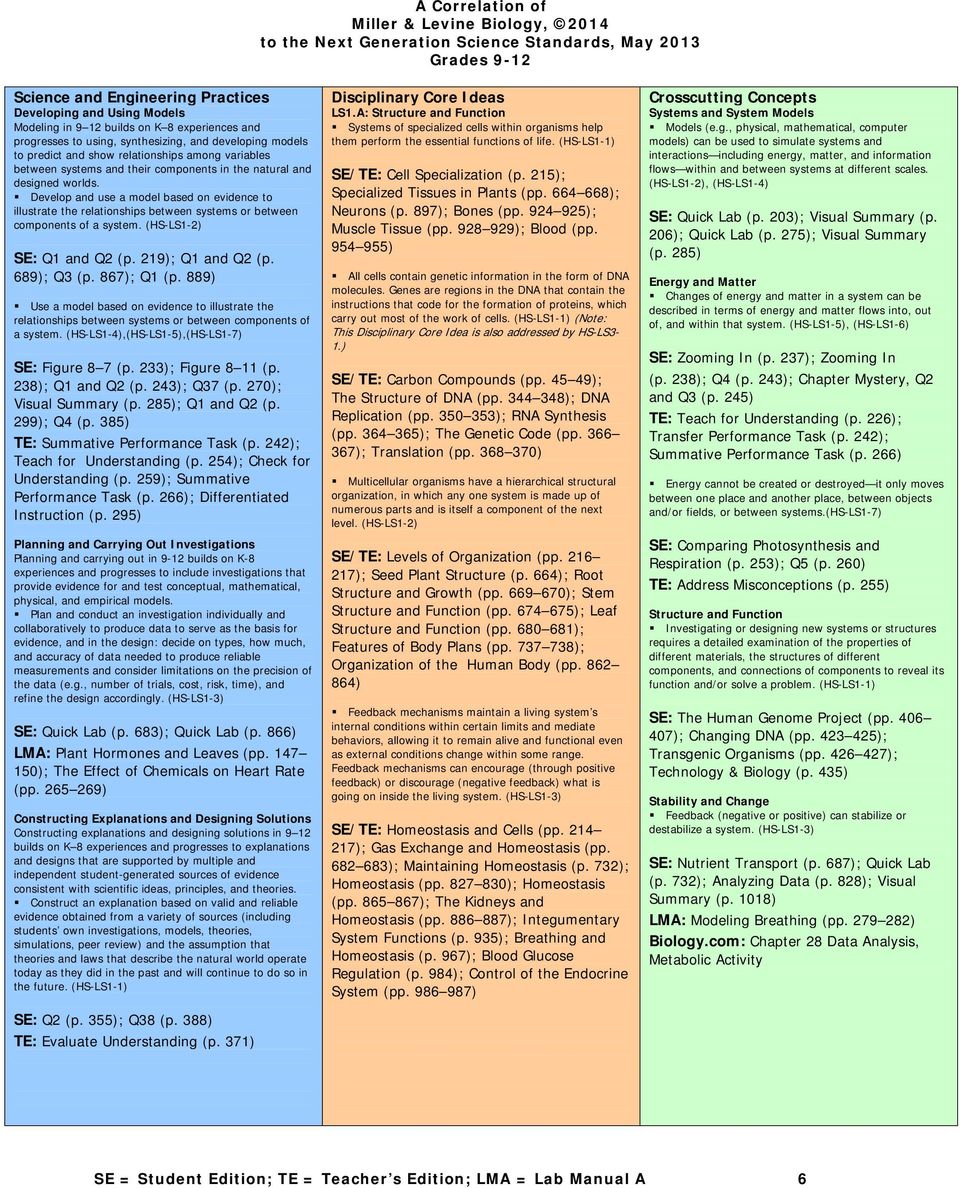
7 Construct and revise an explanation based on valid and reliable evidence obtained from a variety of sources (including students own investigations, models, theories, simulations, peer review) and the assumption that theories and laws that describe the natural world operate today as they did in the past and will continue to do so in the future. (HS-LS1-6) TE: Teach for Understanding (p. 875) Connections to Nature of Science Scientific Investigations Use a Variety of Methods Scientific inquiry is characterized by a common set of values that include: logical thinking, precision, openmindedness, objectivity, skepticism, replicability of results, and honest and ethical reporting of findings. (HS-LS1-3) SE: Lessons 1.1 and 1.2 (pp. 4 15) provide background information in support of this scientific practice LS1.B: Growth and Development of Organisms In multicellular organisms individual cells grow and then divide via a process called mitosis, thereby allowing the organism to grow. The organism begins as a single cell (fertilized egg) that divides successively to produce many cells, with each parent cell passing identical genetic material (two variants of each chromosome pair) to both daughter cells. Cellular division and differentiation produce and maintain a complex organism, composed of systems of tissues and organs that work together to meet the needs of the whole organism. (HS-LS1-4) SE/TE: The Process of Cell Division (pp ); Cell Differentiation (pp ); Gametes to Zygotes (p. 325); Genetic Control of Development (pp ); Fertilization and Early Development (pp ) LS1.C: Organization for Matter and Energy Flow in Organisms The process of photosynthesis converts light energy to stored chemical energy by converting carbon dioxide plus water into sugars plus released oxygen. (HS-LS1-5) SE/TE: Energy From the Sun (p. 70); Photosynthesis: An Overview (pp ); The Process of Photosynthesis (pp ) The sugar molecules thus formed contain carbon, hydrogen, and oxygen: their hydrocarbon backbones are used to make amino acids and other carbon-based molecules that can be assembled into larger molecules (such as proteins or DNA), used for example to form new cells. (HS-LS1-6) SE/TE: Carbon Compounds (pp ) As matter and energy flow through different organizational levels of living systems, chemical elements are recombined in different ways to form different products. (HS-LS1-6),(HS-LS1-7) SE/TE: Organelles That Build Proteins (pp ) As a result of these chemical reactions, energy is transferred from one system of interacting molecules to another and release energy to the surrounding environment and to maintain body temperature. Cellular respiration is a chemical process whereby the bonds of food molecules and oxygen molecules are broken and new compounds are formed that can transport energy to muscles. (HS-LS1-7) SE/TE: Cellular Respiration: An Overview (pp ); The Process of Cellular Respiration (pp ) SE = Student Edition; TE = Teacher s Edition; LMA = Lab Manual A 7
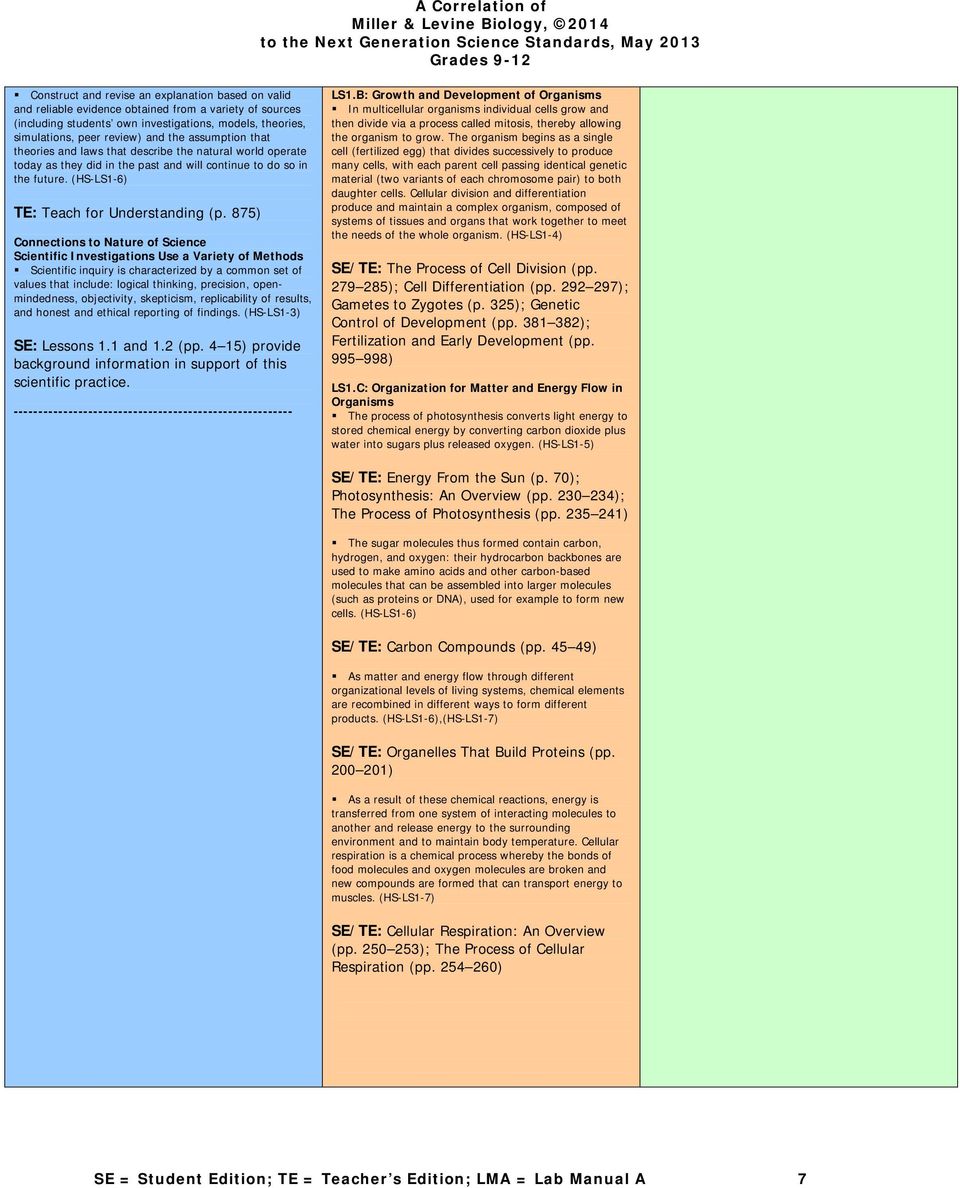
8 HS-LS2 Ecosystems: Interactions, Energy, and Dynamics HS-LS2 Ecosystems: Interactions, Energy, and Dynamics Students who demonstrate understanding can: HS-LS2-1. Use mathematical and/or computational representations to support explanations of factors that affect carrying capacity of ecosystems at different scales. [Clarification Statement: Emphasis is on quantitative analysis and comparison of the relationships among interdependent factors including boundaries, resources, climate, and competition. Examples of mathematical comparisons could include graphs, charts, histograms, and population changes gathered from simulations or historical data sets.] [Assessment Boundary: Assessment does not include deriving mathematical equations to make comparisons.] MILLER & LEVINE BIOLOGY: The concept of carrying capacity is introduced in Lesson 5.1 (p. 135). Students learn about factors that affect population growth, such as competition and predation, in Lesson 5.2 (pp ). Lesson 5.3 (pp ) provides a historical overview of human population growth and explains how to use age-structure diagrams to analyze population growth. Students use mathematics and computational representations to explain factors that affect carrying capacity: Students identify the general trends in a graph of moose and wolf populations and the factors that affect the size of the populations (TE p. 139). Students explain how the size of a population can continue to grow as its rate of growth decreases (Q1, p. 147). Students use a table of world population milestones to identify a trend in population growth (Q31, p. 150). HS-LS2-2. Use mathematical representations to support and revise explanations based on evidence about factors affecting biodiversity and populations in ecosystems of different scales. [Clarification Statement: Examples of mathematical representations include finding the average, determining trends, and using graphical comparisons of multiple sets of data.] [Assessment Boundary: Assessment is limited to provided data.] MILLER & LEVINE BIOLOGY: Population size is addressed throughout Chapter 5 (pp ). The concept of biodiversity is addressed in Lesson 6.3 (pp ). Students use mathematics and computational representations to explain factors that affect biodiversity: Students use a graph to explain the decline of fish populations in the North Atlantic (p. 176). Students use a graph to compare the growth of native and foreign species in the U.S. between 1850 and 1996 (p. 184). HS-LS2-3. Construct and revise an explanation based on evidence for the cycling of matter and flow of energy in aerobic and anaerobic conditions. [Clarification Statement: Emphasis is on conceptual understanding of the role of aerobic and anaerobic respiration in different environments.] [Assessment Boundary: Assessment does not include the specific chemical processes of either aerobic or anaerobic respiration.] MILLER & LEVINE BIOLOGY: Students are introduced to autotrophs and heterotrophs as they study the relationship between consumers and producers in Lesson 3.2 (pp ). The interdependence of these categories of organisms is reinforced in Lesson 8.1 (pp ) and Lesson 9.1 (pp ). Lesson 21.3 (pp ) provides a detailed comparison of autotrophic protests and heterotrophic protests. Students construct an explanation based on evidence for how matter and energy are cycled in aerobic and anaerobic conditions: Students apply what they have learned about producers and consumers to explain the source of energy for cave-dwelling organisms (Q13, p. 90). Students explain how whales are able to stay underwater for up to 45 minutes (Chapter Mystery, pp. 249 and 269). HS-LS2-4. Use mathematical representations to support claims for the cycling of matter and flow of energy among organisms in an ecosystem. [Clarification Statement: Emphasis is on using a mathematical model of stored energy in biomass to describe the transfer of energy from one trophic level to another and that matter and energy are conserved as matter cycles and energy flows through ecosystems. Emphasis is on atoms and molecules such as carbon, oxygen, hydrogen and nitrogen being conserved as they move through an ecosystem.] [Assessment Boundary: Assessment is limited to proportional reasoning to describe the cycling of matter and flow of energy.] MILLER & LEVINE BIOLOGY: The concept of energy transfer between organisms is introduced in Lesson 3.2 (pp ). Lesson 3.3 (pp ) describes food chains and food webs. Students also learn about pyramids of energy and biomass. Cycles of matter are addressed in Lesson 3.4 (pp ). Students use mathematical representations to support claims for the cycling of energy and matter: Students calculate the energy available at each level in a pyramid of energy (Analyzing Data, p. 77). Struggling students use Calories to understand the 10-percent rule of energy transfer (TE p. 77). Students draw an energy pyramid for a five-step food chain and calculate the energy available at the highest trophic level (Q2, p. 78). Students use a food web to calculate the percentage of energy originally captured by primary producers that is available to specific consumers (Q2, p. 89). Students use a graph to explore the effect of rainfall on plant tissue productivity (Q27 and Q28, p. 92). SE = Student Edition; TE = Teacher s Edition; LMA = Lab Manual A 8
9 HS-LS2-5. Develop a model to illustrate the role of photosynthesis and cellular respiration in the cycling of carbon among the biosphere, atmosphere, hydrosphere, and geosphere. [Clarification Statement: Examples of models could include simulations and mathematical models.] [Assessment Boundary: Assessment does not include the specific chemical steps of photosynthesis and respiration.] MILLER & LEVINE BIOLOGY: The cycling of carbon between the biosphere, atmosphere, hydrosphere, and geosphere is addressed in Lesson 3.4 (pp ). Certain aspects of the cycle are reinforced in Lesson 8.2 (pp ) and Lesson 9.1 (pp ). Students develop a model to illustrate the role of photosynthesis and cellular respiration in the carbon cycle: Students design a museum exhibit about the movement of matter in ecosystems (TE p. 88). HS-LS2-6. Evaluate the claims, evidence, and reasoning that the complex interactions in ecosystems maintain relatively consistent numbers and types of organisms in stable conditions, but changing conditions may result in a new ecosystem. [Clarification Statement: Examples of changes in ecosystem conditions could include modest biological or physical changes, such as moderate hunting or a seasonal flood; and, extreme changes, such as volcanic eruption or sea level rise.] MILLER & LEVINE BIOLOGY: Students study community interactions in Lesson 4.2 (pp ). Students study primary and secondary succession in Lesson 4.3 (pp ). Students learn about different types of population growth in Lesson 5.1 (pp ) and factors that limit population growth in Lesson 5.2 (pp ). Students evaluate claims, evidence, and reasoning about what happens to populations in stable and unstable conditions: Students predict how changes in an ecosystem will affect the population size of predators and prey (Analyzing Data, p. 102). They construct arguments from evidence about whether succession has occurred in a closed aquatic community (Quick Lab, p. 108). Students predict how the removal of a predator from an ecosystem would affect its prey (Q2, p. 147). HS-LS2-7. Design, evaluate, and refine a solution for reducing the impacts of human activities on the environment and biodiversity.* [Clarification Statement: Examples of human activities can include urbanization, building dams, and dissemination of invasive species.] MILLER & LEVINE BIOLOGY: Lesson 6.1 (pp ) provides an overview of the impact of human activities on the environment and of sustainable development. Students learn about ways that humans can use resources wisely in Lesson 6.2 (pp ). Lesson 6.3 (pp ) discusses the value of biodiversity, threats to biodiversity, and ways to conserve biodiversity. Lesson 6.4 (pp ) uses case studies to teach students ways to meet ecological challenges. Students design and evaluate solutions for reducing the impact of humans on the environment and biodiversity: Students evaluate ways to reduce dry trash (Quick Lab, p. 155). Students evaluate reintroduction of species as a way to maintain biodiversity (Analyzing Data, p. 172). Students determine ways that their school can conserve water (Q4, p. 181). Groups of students pick a specific region that is threatened by human actions and then create a Web site that describes the problem and potential solutions (TE p. 122). Students research the reduction of mussel populations in tide pools off the Pacific Coast and propose a possible solution (pp. 61a 61b). HS-LS2-8. Evaluate the evidence for the role of group behavior on individual and species chances to survive and reproduce. [Clarification Statement: Emphasis is on: (1) distinguishing between group and individual behavior, (2) identifying evidence supporting the outcomes of group behavior, and (3) developing logical and reasonable arguments based on evidence. Examples of group behaviors could include flocking, schooling, herding, and cooperative behaviors such as hunting, migrating, and swarming.] MILLER & LEVINE BIOLOGY: In Lesson 29.1 (pp ), students learn that many behaviors are essential to survival. Lesson 29.2 (pp ) expands the concept to include group behaviors such as migration. Students evaluate evidence for the role of group behavior in the ability of individuals and species to survive and reproduce: Students explain how a social behavior in an animal aids in the survival of a species (Q30, p. 856). Students evaluate evidence of how wolves behave in a pack (Chapter 29 STEM activity, Yellowstone Wolves). The performance expectations above were developed using the following elements from the NRC document A Framework for K-12 Science Education: SE = Student Edition; TE = Teacher s Edition; LMA = Lab Manual A 9
![] [Assessment Boundary: Assessment does not include the specific chemical steps of photosynthesis and respiration.](/docs-images/47/20866643/images/page_9.jpg "] MILLER & LEVINE BIOLOGY: The cycling of carbon between the biosphere, atmosphere, hydrosphere, and geosphere is addressed in Lesson 3.4 (pp. 82 83).")
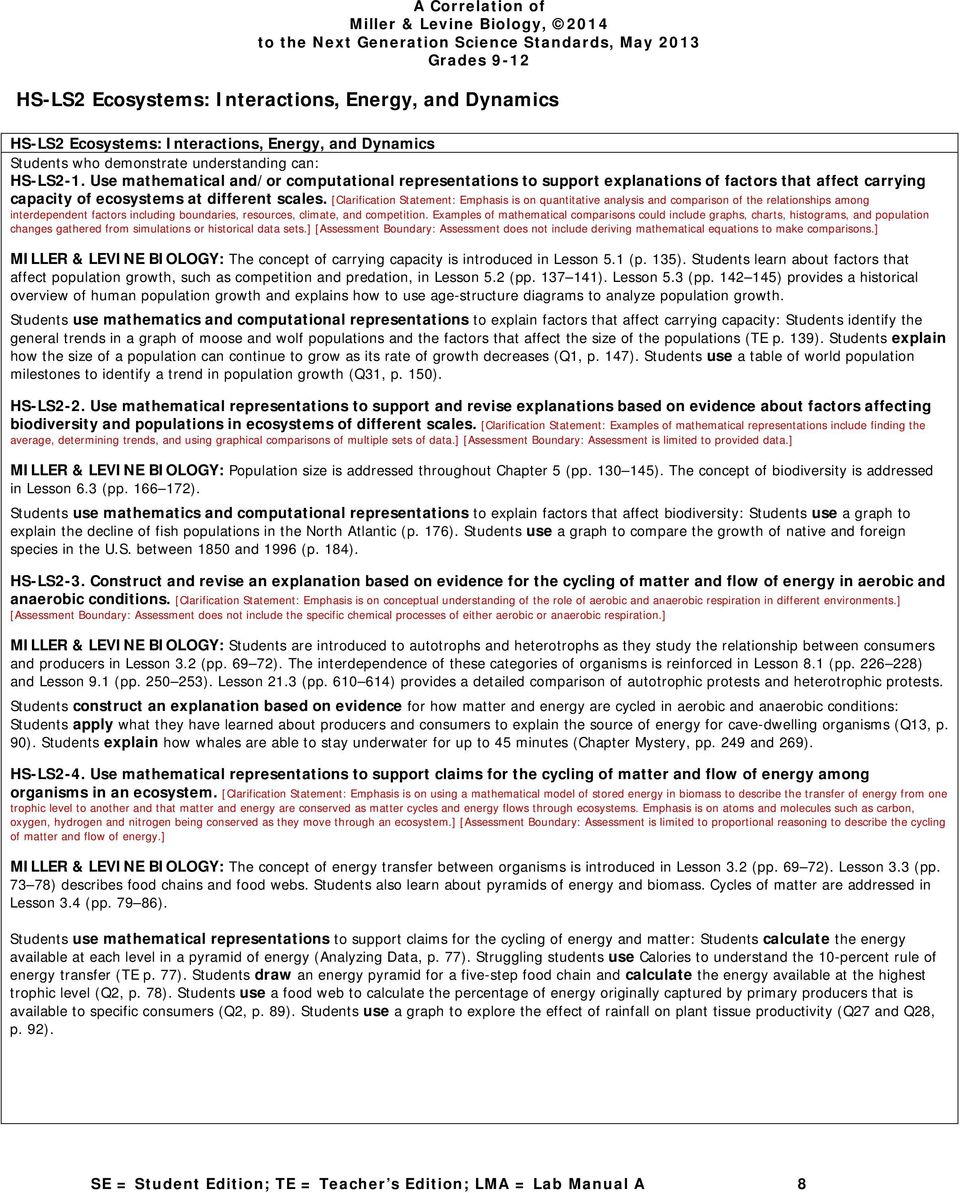
10 Science and Engineering Practices Developing and Using Models Modeling in 9 12 builds on K 8 experiences and progresses to using, synthesizing, and developing models to predict and show how relationships among variables between systems and their components in the natural and designed worlds. Develop a model based on evidence to illustrate the relationships between systems or components of a system. (HS-LS2-5) TE: Summative Performance Task (p. 88) Using Mathematics and Computational Thinking Mathematical and computational thinking in 9-12 builds on K-8 experiences and progresses to using algebraic thinking and analysis, a range of linear and nonlinear functions including trigonometric functions, exponentials and logarithms, and computational tools for statistical analysis to analyze, represent, and model data. Simple computational simulations are created and used based on mathematical models of basic assumptions. Use mathematical and/or computational representations of phenomena or design solutions to support explanations. (HS-LS2-1) SE: Q1 (p. 147); Q31 (p. 150) TE: Use Visuals (p. 139) Use mathematical representations of phenomena or design solutions to support and revise explanations. (HS- LS2-2) SE: Case Study #2 (p. 176); Analyzing Data (p. 184) Use mathematical representations of phenomena or design solutions to support claims. (HS-LS2-4) SE: Analyzing Data (p. 77); Q2 (p. 78); Q2 (p. 89); Q27 and Q28 (p. 92) TE: Differentiated Instruction (p. 77) Constructing Explanations and Designing Solutions Constructing explanations and designing solutions in 9 12 builds on K 8 experiences and progresses to explanations and designs that are supported by multiple and independent student-generated sources of evidence consistent with scientific ideas, principles, and theories. Construct and revise an explanation based on valid and reliable evidence obtained from a variety of sources (including students own investigations, models, theories, simulations, peer review) and the assumption that theories and laws that describe the natural world operate today as they did in the past and will continue to do so in the future. (HS-LS2-3) SE: Q13 (p. 90); Chapter 9 Mystery (pp. 249 and 269) Design, evaluate, and refine a solution to a complex real-world problem, based on scientific knowledge, student-generated sources of evidence, prioritized criteria, and tradeoff considerations. (HS-LS2-7) Disciplinary Core Ideas LS2.A: Interdependent Relationships in Ecosystems Ecosystems have carrying capacities, which are limits to the numbers of organisms and populations they can support. These limits result from such factors as the availability of living and nonliving resources and from such challenges such as predation, competition, and disease. Organisms would have the capacity to produce populations of great size were it not for the fact that environments and resources are finite. This fundamental tension affects the abundance (number of individuals) of species in any given ecosystem. (HS-LS2-1),(HS-LS2-2) SE/TE: Competition (pp ); Exponential Growth (pp ); Logistic Growth (pp ); Density-Dependent Limiting Factors (pp ) LS2.B: Cycles of Matter and Energy Transfer in Ecosystems Photosynthesis and cellular respiration (including anaerobic processes) provide most of the energy for life processes. (HS-LS2-3) SE/TE: Primary Producers (pp ); Energy and Life (pp ); Chemical Energy and Food (p. 250) Plants or algae form the lowest level of the food web. At each link upward in a food web, only a small fraction of the matter consumed at the lower level is transferred upward, to produce growth and release energy in cellular respiration at the higher level. Given this inefficiency, there are generally fewer organisms at higher levels of a food web. Some matter reacts to release energy for life functions, some matter is stored in newly made structures, and much is discarded. The chemical elements that make up the molecules of organisms pass through food webs and into and out of the atmosphere and soil, and they are combined and recombined in different ways. At each link in an ecosystem, matter and energy are conserved. (HS-LS2-4) SE/TE: Food Chains and Food Webs (pp ); Trophic Levels and Ecological Pyramids (pp ); Recycling in the Biosphere (pp ); Nutrient Cycles (pp ) Photosynthesis and cellular respiration are important components of the carbon cycle, in which carbon is exchanged among the biosphere, atmosphere, oceans, and geosphere through chemical, physical, geological, and biological processes. (HS-LS2-5) SE/TE: The Carbon Cycle (pp ) Crosscutting Concepts Cause and Effect Empirical evidence is required to differentiate between cause and correlation and make claims about specific causes and effects. (HS-LS2-8) TE: How Science Works (p. 848) Biology.com: Chapter 29 STEM activity, Yellowstone Wolves Scale, Proportion, and Quantity The significance of a phenomenon is dependent on the scale, proportion, and quantity at which it occurs. (HS- LS2-1) SE: Analyzing Data (p. 150) TE: Connect to Math (p. 143) Biology.com: Chapter 3 Data Analysis, Counting on Nature Using the concept of orders of magnitude allows one to understand how a model at one scale relates to a model at another scale. (HS-LS2-2) TE: Connect to Math (p. 133) Systems and System Models Models (e.g., physical, mathematical, computer models) can be used to simulate systems and interactions including energy, matter, and information flows within and between systems at different scales. (HS-LS2-5) SE: Figure 3 17 (p. 83) TE: Transfer Performance Task (p. 242) Energy and Matter Energy cannot be created or destroyed it only moves between one place and another place, between objects and/or fields, or between systems. (HS-LS2-4) SE: Figure 3 5 (p. 70); Figure 3 6 (p. 71); Figure 3 11 (p. 77) TE: Address Misconceptions (p. 70); Address Misconceptions (p. 82) Energy drives the cycling of matter within and between systems. (HS-LS2-3) SE: Visual Analogy (p. 79); Q 26 (p. 92) TE: Build Background (p. 69); Quick Facts (p. 70) SE: Quick Lab (p. 155); Analyzing Data (p. 172); Q4 (p. 181); Unit 2 Project (pp. 61a 61b) SE = Student Edition; TE = Teacher s Edition; LMA = Lab Manual A 10
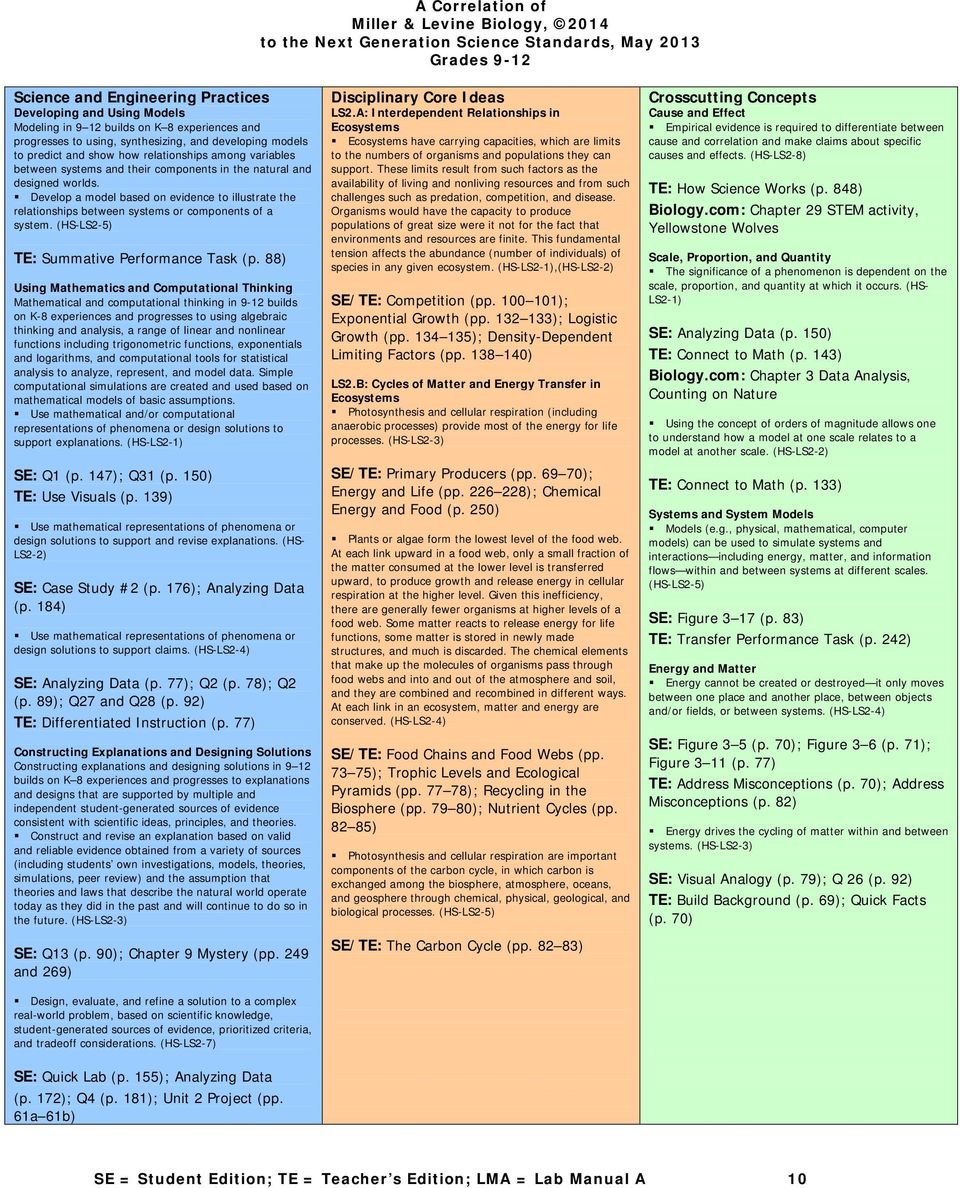
11 TE: Transfer Performance Task (p. 122) Engaging in Argument from Evidence Engaging in argument from evidence in 9 12 builds on K 8 experiences and progresses to using appropriate and sufficient evidence and scientific reasoning to defend and critique claims and explanations about the natural and designed world(s). Arguments may also come from current scientific or historical episodes in science. Evaluate the claims, evidence, and reasoning behind currently accepted explanations or solutions to determine the merits of arguments. (HS-LS2-6) SE: Analyzing Data, p. 102; Quick Lab, p. 108; Q2 (p. 147) Evaluate the evidence behind currently accepted explanations to determine the merits of arguments. (HS- LS2-8) SE: Q30 (p. 856) Biology.com: Chapter 29 STEM activity Connections to Nature of Science Scientific Knowledge is Open to Revision in Light of New Evidence Most scientific knowledge is quite durable, but is, in principle, subject to change based on new evidence and/or reinterpretation of existing evidence. (HS-LS2-2),(HS-LS2-3) SE: Chapter 3 Mystery (pp. 63 and 91); Chapter 4 Mystery (pp. 95 and 125) TE: How Science Works (p. 100) Scientific argumentation is a mode of logical discourse used to clarify the strength of relationships between ideas and evidence that may result in revision of an explanation. (HS-LS2-6),(HS-LS2-8) SE: Chapter 5 Mystery (pp. 129 and 149); Chapter 29 Mystery (pp. 839 and 855) TE: Lead a Discussion (p. 108); Address Misconceptions (p. 109); How Science Works (p. 539) LS2.C: Ecosystem Dynamics, Functioning, and Resilience A complex set of interactions within an ecosystem can keep its numbers and types of organisms relatively constant over long periods of time under stable conditions. If a modest biological or physical disturbance to an ecosystem occurs, it may return to its more or less original status (i.e., the ecosystem is resilient), as opposed to becoming a very different ecosystem. Extreme fluctuations in conditions or the size of any population, however, can challenge the functioning of ecosystems in terms of resources and habitat availability. (HS-LS2-2),(HS-LS2-6) SE/TE: Primary and Secondary Succession (pp ); Climax Communities (pp ) Moreover, anthropogenic changes (induced by human activity) in the environment including habitat destruction, pollution, introduction of invasive species, overexploitation, and climate change can disrupt an ecosystem and threaten the survival of some species. (HS-LS2-7) SE/TE: What Can Be Done About Invasive Mussels? (p. 136); The Effect of Human Activity (pp ); Soil Erosion (p. 159); Water Pollution (pp ); Air Pollution (pp ); Air Quality and Sustainability (p. 165); Altered Habitats (p. 168) LS2.D: Social Interactions and Group Behavior Group behavior has evolved because membership can increase the chances of survival for individuals and their genetic relatives. (HS-LS2-8) SE/TE: Behavioral Cycles (p. 845); Social Behavior (pp ); Communication (pp ) LS4.D: Biodiversity and Humans Biodiversity is increased by the formation of new species (speciation) and decreased by the loss of species (extinction). (secondary to HS-LS2-7) SE/TE: The Process of Speciation (pp ); Speciation and Extinction (pp ) Humans depend on the living world for the resources and other benefits provided by biodiversity. But human activity is also having adverse impacts on biodiversity through overpopulation, overexploitation, habitat destruction, pollution, introduction of invasive species, and climate change. Thus sustaining biodiversity so that ecosystem functioning and productivity are maintained is essential to supporting and enhancing life on Earth. Sustaining biodiversity also aids humanity by preserving landscapes of recreational or inspirational value. (secondary to HS-LS2-7) (Note: This Disciplinary Core Idea is also addressed by HS-LS4-6.) SE/TE: The Value of Biodiversity (pp ); Threats to Biodiversity (pp ); Conserving Biodiversity (pp ); Ecology in Action (pp ) Stability and Change Much of science deals with constructing explanations of how things change and how they remain stable. (HS- LS2-6),(HS-LS2-7) SE: Q2 (p. 123); Q18 (p. 124); Analyzing Data (p. 126); Q3 (p. 179); Chapter Mystery (p. 183) TE: Build Background (p. 69); Quick Facts (p. 70); How Science Works (p. 106); Differentiated Instruction (p. 108); Use Visuals (p. 176) Biology.com: Virtual Lab, Introduction to Ecology SE = Student Edition; TE = Teacher s Edition; LMA = Lab Manual A 11

12 PS3.D: Energy in Chemical Processes The main way that solar energy is captured and stored on Earth is through the complex chemical process known as photosynthesis. (secondary to HS-LS2-5) SE/TE: Energy From the Sun (p. 70); Photosynthesis: An Overview (pp ); The Process of Photosynthesis (pp ) ETS1.B: Developing Possible Solutions When evaluating solutions it is important to take into account a range of constraints including cost, safety, reliability and aesthetics and to consider social, cultural and environmental impacts. (secondary to HS-LS2-7) SE/TE: Case Study #1, Atmospheric Ozone (p. 175); Case Study #2, North Atlantic Fisheries (p. 176); Case Study #3, Climate Change (pp ); Unit 6 Project, A Living Roof (pp. 571a 571b) *The performance expectations marked with an asterisk integrate traditional science content with engineering through a Practice or Disciplinary Core Idea. SE = Student Edition; TE = Teacher s Edition; LMA = Lab Manual A 12
13 HS-LS3 Heredity: Inheritance and Variation of Traits HS-LS3 Heredity: Inheritance and Variation of Traits Students who demonstrate understanding can: HS-LS3-1. Ask questions to clarify relationships about the role of DNA and chromosomes in coding the instructions for characteristic traits passed from parents to offspring. [Assessment Boundary: Assessment does not include the phases of meiosis or the biochemical mechanism of specific steps in the process.] MILLER & LEVINE BIOLOGY: In Lesson 7.2 (p. 197), students learn that the nucleus of a cell contains chromosomes with DNA. In Lesson 10.2 (pp ), students learn about the role of chromosomes in cell division. Lesson 12.1 (pp ) provides a general description of the role of DNA. Lesson 12.2 (pp ) describes the structure of DNA. In Lesson 13.2 (pp ), students learn how the instructions for characteristic traits (the genetic code) are stored in DNA. Students ask questions about the role of DNA and chromosomes in the inheritance of characteristic traits: Students write a series of questions about one component of the process that translates the genetic code into proteins (Q4, p. 371). Students write questions about the transmission of human traits (In Your Notebook, p. 396). HS-LS3-2. Make and defend a claim based on evidence that inheritable genetic variations may result from: (1) new genetic combinations through meiosis, (2) viable errors occurring during replication, and/or (3) mutations caused by environmental factors. [Clarification Statement: Emphasis is on using data to support arguments for the way variation occurs.] [Assessment Boundary: Assessment does not include the phases of meiosis or the biochemical mechanism of specific steps in the process.] MILLER & LEVINE BIOLOGY: Students are introduced to the process of DNA replication in Lesson 12.3 (pp ) and mutations in Lesson 13.3 (pp ). Lesson 17.1 (pp ) connects genetics to evolutionary theory. Lesson 17.2 (pp ) focuses on the mechanisms by which genetic variation is introduced into populations. Students revisit the effect of mutations on evolution in Lesson 17.4 (pp ). Students defend claims based on evidence about the causes of inheritable genetic variations: Students write an argument to support a claim about antibiotic use as a cause of genetic variation in bacteria (p. 493). Students use evidence to choose the correct hypothesis about the evolution of two fish populations (Analyzing Data, p. 500). Students defend the claim that evolution is ecology over time (Q38, p. 506). HS-LS3-3. Apply concepts of statistics and probability to explain the variation and distribution of expressed traits in a population. [Clarification Statement: Emphasis is on the use of mathematics to describe the probability of traits as it relates to genetic and environmental factors in the expression of traits.] [Assessment Boundary: Assessment does not include Hardy-Weinberg calculations.] MILLER & LEVINE BIOLOGY: The term probability is defined in Lesson 11.2 (p. 313) in relation to genetic crosses. Exceptions to Mendel s principles are discussed in Lesson 11.3 (pp ) as is how the environment can affect the expression of genes (p. 321). Lesson 14.1 (pp ) focuses on the variation of traits in humans. Students apply concepts of statistics and probability to the variation of traits: Students use probability to explore the inheritance of height in plants (Q2b, p. 318). Students use a Punnett square to show the results of a two-factor cross and explain why the actual results do not match the expected results (Q1 and Q2, p. 331). Students use probability to explain the inheritance of smooth coats in guinea pigs (Q12, p. 332). Students use data to draw conclusions about the inheritance of eye color in fruit flies (Analyzing Data, p. 334). The performance expectations above were developed using the following elements from the NRC document, A Framework for K-12 Science Education: Science and Engineering Practices Disciplinary Core Ideas Asking Questions and Defining Problems LS1.A: Structure and Function Asking questions and defining problems in 9-12 builds on All cells contain genetic information in the form of DNA K-8 experiences and progresses to formulating, refining, molecules. Genes are regions in the DNA that contain the and evaluating empirically testable questions and design instructions that code for the formation of proteins. problems using models and simulations. (secondary to HS-LS3-1) (Note: This Disciplinary Core Ask questions that arise from examining models or a Idea is also addressed by HS-LS1-1.) theory to clarify relationships. (HS-LS3-1) SE: Q4 (p. 371); In Your Notebook (p. 396) SE/TE: The Nucleus (p. 197); Genes and Alleles (p. 310); The Role of DNA (pp ); The Genetic Code (pp ) Crosscutting Concepts Cause and Effect Empirical evidence is required to differentiate between cause and correlation and make claims about specific causes and effects. (HS-LS3-1),(HS-LS3-2) SE: Q6 (p. 332); Q28 (p. 334); Q8 (p. 356); Use Science Graphics (p. 358); Analyzing Data (p. 381); Q17 (p. 386); Q15 (p. 413); Analyzing Data (p. 414) TE: Transfer Performance Task (p. 330); Assess and Remediate, Constructing Explanations (p. 336b); How Science Works (p. 370) SE = Student Edition; TE = Teacher s Edition; LMA = Lab Manual A 13
![[Assessment Boundary: Assessment does not include the phases of meiosis or the biochemical mechanism of specific steps in the process.] MILLER & LEVINE BIOLOGY: In Lesson 7.2 (p.](/docs-images/47/20866643/images/page_13.jpg "197), students learn that the nucleus of a cell contains chromosomes with DNA. In Lesson 10.2 (pp. 279 280), students learn about the role of chromosomes in cell division. Lesson 12.1 (pp.")
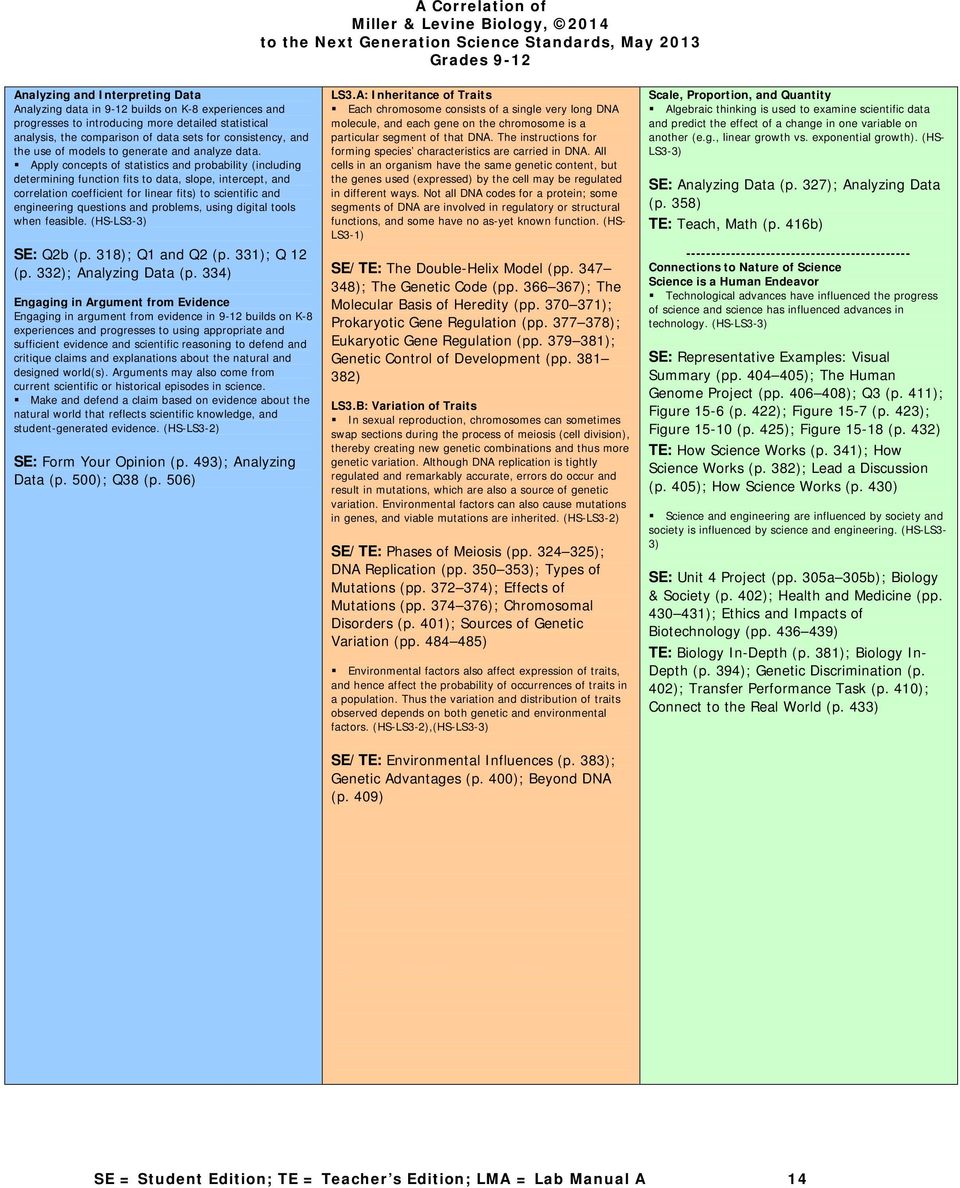
14 Analyzing and Interpreting Data Analyzing data in 9-12 builds on K-8 experiences and progresses to introducing more detailed statistical analysis, the comparison of data sets for consistency, and the use of models to generate and analyze data. Apply concepts of statistics and probability (including determining function fits to data, slope, intercept, and correlation coefficient for linear fits) to scientific and engineering questions and problems, using digital tools when feasible. (HS-LS3-3) SE: Q2b (p. 318); Q1 and Q2 (p. 331); Q 12 (p. 332); Analyzing Data (p. 334) Engaging in Argument from Evidence Engaging in argument from evidence in 9-12 builds on K-8 experiences and progresses to using appropriate and sufficient evidence and scientific reasoning to defend and critique claims and explanations about the natural and designed world(s). Arguments may also come from current scientific or historical episodes in science. Make and defend a claim based on evidence about the natural world that reflects scientific knowledge, and student-generated evidence. (HS-LS3-2) SE: Form Your Opinion (p. 493); Analyzing Data (p. 500); Q38 (p. 506) LS3.A: Inheritance of Traits Each chromosome consists of a single very long DNA molecule, and each gene on the chromosome is a particular segment of that DNA. The instructions for forming species characteristics are carried in DNA. All cells in an organism have the same genetic content, but the genes used (expressed) by the cell may be regulated in different ways. Not all DNA codes for a protein; some segments of DNA are involved in regulatory or structural functions, and some have no as-yet known function. (HS- LS3-1) SE/TE: The Double-Helix Model (pp ); The Genetic Code (pp ); The Molecular Basis of Heredity (pp ); Prokaryotic Gene Regulation (pp ); Eukaryotic Gene Regulation (pp ); Genetic Control of Development (pp ) LS3.B: Variation of Traits In sexual reproduction, chromosomes can sometimes swap sections during the process of meiosis (cell division), thereby creating new genetic combinations and thus more genetic variation. Although DNA replication is tightly regulated and remarkably accurate, errors do occur and result in mutations, which are also a source of genetic variation. Environmental factors can also cause mutations in genes, and viable mutations are inherited. (HS-LS3-2) SE/TE: Phases of Meiosis (pp ); DNA Replication (pp ); Types of Mutations (pp ); Effects of Mutations (pp ); Chromosomal Disorders (p. 401); Sources of Genetic Variation (pp ) Environmental factors also affect expression of traits, and hence affect the probability of occurrences of traits in a population. Thus the variation and distribution of traits observed depends on both genetic and environmental factors. (HS-LS3-2),(HS-LS3-3) SE/TE: Environmental Influences (p. 383); Genetic Advantages (p. 400); Beyond DNA (p. 409) Scale, Proportion, and Quantity Algebraic thinking is used to examine scientific data and predict the effect of a change in one variable on another (e.g., linear growth vs. exponential growth). (HS- LS3-3) SE: Analyzing Data (p. 327); Analyzing Data (p. 358) TE: Teach, Math (p. 416b) Connections to Nature of Science Science is a Human Endeavor Technological advances have influenced the progress of science and science has influenced advances in technology. (HS-LS3-3) SE: Representative Examples: Visual Summary (pp ); The Human Genome Project (pp ); Q3 (p. 411); Figure 15-6 (p. 422); Figure 15-7 (p. 423); Figure (p. 425); Figure (p. 432) TE: How Science Works (p. 341); How Science Works (p. 382); Lead a Discussion (p. 405); How Science Works (p. 430) Science and engineering are influenced by society and society is influenced by science and engineering. (HS-LS3-3) SE: Unit 4 Project (pp. 305a 305b); Biology & Society (p. 402); Health and Medicine (pp ); Ethics and Impacts of Biotechnology (pp ) TE: Biology In-Depth (p. 381); Biology In- Depth (p. 394); Genetic Discrimination (p. 402); Transfer Performance Task (p. 410); Connect to the Real World (p. 433) SE = Student Edition; TE = Teacher s Edition; LMA = Lab Manual A 14
15 HS-LS4 Biological Evolution: Unity and Diversity A Correlation of HS-LS4 Biological Evolution: Unity and Diversity Students who demonstrate understanding can: HS-LS4-1. Communicate scientific information that common ancestry and biological evolution are supported by multiple lines of empirical evidence. [Clarification Statement: Emphasis is on a conceptual understanding of the role each line of evidence has relating to common ancestry and biological evolution. Examples of evidence could include similarities in DNA sequences, anatomical structures, and order of appearance of structures in embryological development.] MILLER & LEVINE BIOLOGY: Lesson 16.1 (pp ) describes what Darwin observed during the voyage of the Beagle. Lesson 16.3 (pp ) presents Darwin s argument for evolution by natural selection. In Lesson 16.4 (pp ), students learn about other empirical evidence that supports Darwin s argument. Lesson 17.4 (pp ) presents the molecular evidence for evolution. Students communicate scientific information about the multiple lines of evidence for biological evolution: Students write a paragraph explaining how evidence since Darwin s time has strengthened his theories (Q6, p. 473). Students write and refine a paragraph about how descent with modification can explain the diversity of life today (Q19, p. 477). Students write a paragraph explaining how Earth s age supports the theory of evolution (Q35, p. 478). Students write a newspaper article about the theory of evolution for an audience that knows nothing about the subject (Q37, p. 478). HS-LS4-2. Construct an explanation based on evidence that the process of evolution primarily results from four factors: (1) the potential for a species to increase in number, (2) the heritable genetic variation of individuals in a species due to mutation and sexual reproduction, (3) competition for limited resources, and (4) the proliferation of those organisms that are better able to survive and reproduce in the environment. [Clarification Statement: Emphasis is on using evidence to explain the influence each of the four factors has on number of organisms, behaviors, morphology, or physiology in terms of ability to compete for limited resources and subsequent survival of individuals and adaptation of species. Examples of evidence could include mathematical models such as simple distribution graphs and proportional reasoning.] [Assessment Boundary: Assessment does not include other mechanisms of evolution, such as genetic drift, gene flow through migration, and co-evolution.] MILLER & LEVINE BIOLOGY: The foundation for understanding the evidence for evolution is laid in Lesson 4.2 (pp ) where the competitive exclusion principle is discussed; in Lessons 5.1 and 5.2 (pp ) where population growth and limits to growth are discussed; and in Lesson 13.3 (pp ) where mutations are discussed. In Lesson 16.3 (pp ), students are introduced to the concept of natural selection. In Lesson 17.2 (pp ), students learn about the impact of genetic variation on natural selection. In the Chapter 17 Lab, Competing for Resources, students use assorted tools to simulate the competition of birds for seeds. Students construct an explanation based on evidence that evolution results primarily from four factors: Students use experimental data to explain how genetic variation is important in the survival of a species (Q5b, p. 473). Students explain how the process of natural selection accounts for the diversity of the organisms that Darwin observed on the Galápagos Islands (Q23, p. 477). Students describe three lines of evidence that support the theory of evolution (Q36, p. 478). HS-LS4-3. Apply concepts of statistics and probability to support explanations that organisms with an advantageous heritable trait tend to increase in proportion to organisms lacking this trait. [Clarification Statement: Emphasis is on analyzing shifts in numerical distribution of traits and using these shifts as evidence to support explanations.] [Assessment Boundary: Assessment is limited to basic statistical and graphical analysis. Assessment does not include allele frequency calculations.] MILLER & LEVINE BIOLOGY: In Lesson 16.3 (pp ), students learn how advantageous traits affect survival. In Lesson 16.4 (pp ), students learn how scientists can observe natural selection in a natural environment. Students apply concepts of statistics and probability to the relationship between advantageous traits and population size: Students identify a trend in bird survival based on beak size (Figure 16-18, p. 473). Students use statistics to explore drug resistance as an advantageous trait for bacteria (Analyzing Data, p. 591). Students learn how the presence of mycorrhizae affects the growth and survival of plants (Analyzing Data, p. 624). HS-LS4-4. Construct an explanation based on evidence for how natural selection leads to adaptation of populations. [Clarification Statement: Emphasis is on using data to provide evidence for how specific biotic and abiotic differences in ecosystems (such as ranges of seasonal temperature, longterm climate change, acidity, light, geographic barriers, or evolution of other organisms) contribute to a change in gene frequency over time, leading to adaptation of populations.] MILLER & LEVINE BIOLOGY: Lesson 17.1 (pp ) introduces the concepts of a gene pool and allele frequency. In Lesson 17.2 (pp ), students learn how natural selection affects allele frequencies. In Lesson 17.3 (pp ), students learn how different types of isolation can lead to the adaptation of populations. Students construct an explanation based on evidence for how natural selection leads to adaptation of populations: Students explain why rapid evolution is likely to occur in a small population that has been separated from the main population (Q19, p. 566). Students explain how the evolution of a vascular system affected the ability of plants to survive in various environments (Q2, p. 657). Students explain why it is adaptive for seeds to remain dormant before they germinate (Q3b, p. 707). SE = Student Edition; TE = Teacher s Edition; LMA = Lab Manual A 15

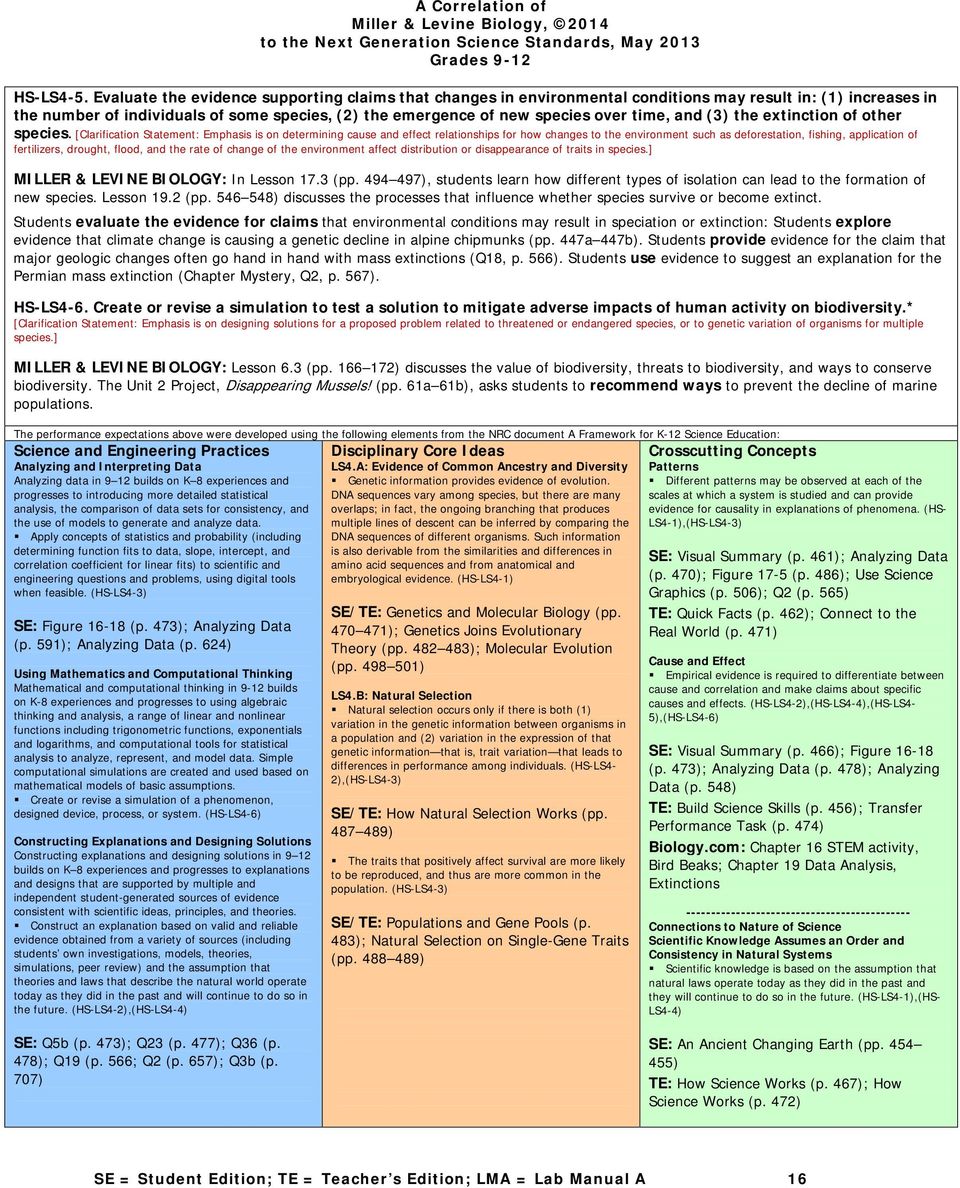
16 HS-LS4-5. Evaluate the evidence supporting claims that changes in environmental conditions may result in: (1) increases in the number of individuals of some species, (2) the emergence of new species over time, and (3) the extinction of other species. [Clarification Statement: Emphasis is on determining cause and effect relationships for how changes to the environment such as deforestation, fishing, application of fertilizers, drought, flood, and the rate of change of the environment affect distribution or disappearance of traits in species.] MILLER & LEVINE BIOLOGY: In Lesson 17.3 (pp ), students learn how different types of isolation can lead to the formation of new species. Lesson 19.2 (pp ) discusses the processes that influence whether species survive or become extinct. Students evaluate the evidence for claims that environmental conditions may result in speciation or extinction: Students explore evidence that climate change is causing a genetic decline in alpine chipmunks (pp. 447a 447b). Students provide evidence for the claim that major geologic changes often go hand in hand with mass extinctions (Q18, p. 566). Students use evidence to suggest an explanation for the Permian mass extinction (Chapter Mystery, Q2, p. 567). HS-LS4-6. Create or revise a simulation to test a solution to mitigate adverse impacts of human activity on biodiversity.* [Clarification Statement: Emphasis is on designing solutions for a proposed problem related to threatened or endangered species, or to genetic variation of organisms for multiple species.] MILLER & LEVINE BIOLOGY: Lesson 6.3 (pp ) discusses the value of biodiversity, threats to biodiversity, and ways to conserve biodiversity. The Unit 2 Project, Disappearing Mussels! (pp. 61a 61b), asks students to recommend ways to prevent the decline of marine populations. The performance expectations above were developed using the following elements from the NRC document A Framework for K-12 Science Education: Science and Engineering Practices Disciplinary Core Ideas Analyzing and Interpreting Data LS4.A: Evidence of Common Ancestry and Diversity Analyzing data in 9 12 builds on K 8 experiences and Genetic information provides evidence of evolution. progresses to introducing more detailed statistical DNA sequences vary among species, but there are many analysis, the comparison of data sets for consistency, and overlaps; in fact, the ongoing branching that produces the use of models to generate and analyze data. multiple lines of descent can be inferred by comparing the Apply concepts of statistics and probability (including DNA sequences of different organisms. Such information determining function fits to data, slope, intercept, and is also derivable from the similarities and differences in correlation coefficient for linear fits) to scientific and amino acid sequences and from anatomical and engineering questions and problems, using digital tools embryological evidence. (HS-LS4-1) when feasible. (HS-LS4-3) SE: Figure (p. 473); Analyzing Data (p. 591); Analyzing Data (p. 624) Using Mathematics and Computational Thinking Mathematical and computational thinking in 9-12 builds on K-8 experiences and progresses to using algebraic thinking and analysis, a range of linear and nonlinear functions including trigonometric functions, exponentials and logarithms, and computational tools for statistical analysis to analyze, represent, and model data. Simple computational simulations are created and used based on mathematical models of basic assumptions. Create or revise a simulation of a phenomenon, designed device, process, or system. (HS-LS4-6) Constructing Explanations and Designing Solutions Constructing explanations and designing solutions in 9 12 builds on K 8 experiences and progresses to explanations and designs that are supported by multiple and independent student-generated sources of evidence consistent with scientific ideas, principles, and theories. Construct an explanation based on valid and reliable evidence obtained from a variety of sources (including students own investigations, models, theories, simulations, peer review) and the assumption that theories and laws that describe the natural world operate today as they did in the past and will continue to do so in the future. (HS-LS4-2),(HS-LS4-4) SE/TE: Genetics and Molecular Biology (pp ); Genetics Joins Evolutionary Theory (pp ); Molecular Evolution (pp ) LS4.B: Natural Selection Natural selection occurs only if there is both (1) variation in the genetic information between organisms in a population and (2) variation in the expression of that genetic information that is, trait variation that leads to differences in performance among individuals. (HS-LS4-2),(HS-LS4-3) SE/TE: How Natural Selection Works (pp ) The traits that positively affect survival are more likely to be reproduced, and thus are more common in the population. (HS-LS4-3) SE/TE: Populations and Gene Pools (p. 483); Natural Selection on Single-Gene Traits (pp ) Crosscutting Concepts Patterns Different patterns may be observed at each of the scales at which a system is studied and can provide evidence for causality in explanations of phenomena. (HS- LS4-1),(HS-LS4-3) SE: Visual Summary (p. 461); Analyzing Data (p. 470); Figure 17-5 (p. 486); Use Science Graphics (p. 506); Q2 (p. 565) TE: Quick Facts (p. 462); Connect to the Real World (p. 471) Cause and Effect Empirical evidence is required to differentiate between cause and correlation and make claims about specific causes and effects. (HS-LS4-2),(HS-LS4-4),(HS-LS4-5),(HS-LS4-6) SE: Visual Summary (p. 466); Figure (p. 473); Analyzing Data (p. 478); Analyzing Data (p. 548) TE: Build Science Skills (p. 456); Transfer Performance Task (p. 474) Biology.com: Chapter 16 STEM activity, Bird Beaks; Chapter 19 Data Analysis, Extinctions Connections to Nature of Science Scientific Knowledge Assumes an Order and Consistency in Natural Systems Scientific knowledge is based on the assumption that natural laws operate today as they did in the past and they will continue to do so in the future. (HS-LS4-1),(HS- LS4-4) SE: Q5b (p. 473); Q23 (p. 477); Q36 (p. 478); Q19 (p. 566; Q2 (p. 657); Q3b (p. 707) SE: An Ancient Changing Earth (pp ) TE: How Science Works (p. 467); How Science Works (p. 472) SE = Student Edition; TE = Teacher s Edition; LMA = Lab Manual A 16
17 Engaging in Argument from Evidence Engaging in argument from evidence in 9-12 builds on K-8 experiences and progresses to using appropriate and sufficient evidence and scientific reasoning to defend and critique claims and explanations about the natural and designed world(s). Arguments may also come from current or historical episodes in science. Evaluate the evidence behind currently accepted explanations or solutions to determine the merits of arguments. (HS-LS4-5) SE: Unit 5 Project (pp. 447a 447b); Q18 (p. 566); Chapter Mystery, Q2 (p. 567) Obtaining, Evaluating, and Communicating Information Obtaining, evaluating, and communicating information in 9 12 builds on K 8 experiences and progresses to evaluating the validity and reliability of the claims, methods, and designs. Communicate scientific information (e.g., about phenomena and/or the process of development and the design and performance of a proposed process or system) in multiple formats (including orally, graphically, textually, and mathematically). (HS-LS4-1) SE: Q6 (p. 473); Q19 (p. 477); Q35 (p. 478); Q37 (p. 478) Connections to Nature of Science Science Models, Laws, Mechanisms, and Theories Explain Natural Phenomena A scientific theory is a substantiated explanation of some aspect of the natural world, based on a body of facts that have been repeatedly confirmed through observation and experiment and the science community validates each theory before it is accepted. If new evidence is discovered that the theory does not accommodate, the theory is generally modified in light of this new evidence. (HS-LS4-1) SE: Scientific Theories (p. 13); Evaluating Evolutionary Theory (p. 473); Q6 (p. 473); Biology & History (p. 459) TE: How Science Works (p. 455); Address Misconceptions (p. 462); How Science Works (p. 483); How Science Works (p. 548) LS4.C: Adaptation Evolution is a consequence of the interaction of four factors: (1) the potential for a species to increase in number, (2) the genetic variation of individuals in a species due to mutation and sexual reproduction, (3) competition for an environment s limited supply of the resources that individuals need in order to survive and reproduce, and (4) the ensuing proliferation of those organisms that are better able to survive and reproduce in that environment. (HS-LS4-2) SE/TE: Observations Aboard the Beagle (pp ); Variation and Adaptation (pp ); Survival of the Fittest (p. 461); Common Descent (p. 464); Sources of Genetic Variation (pp ) Natural selection leads to adaptation, that is, to a population dominated by organisms that are anatomically, behaviorally, and physiologically well suited to survive and reproduce in a specific environment. That is, the differential survival and reproduction of organisms in a population that have an advantageous heritable trait leads to an increase in the proportion of individuals in future generations that have the trait and to a decrease in the proportion of individuals that do not. (HS-LS4-3),(HS-LS4-4) SE/TE: Evolution by Natural Selection (pp ) Adaptation also means that the distribution of traits in a population can change when conditions change. (HS- LS4-3) SE/TE: Evolution Versus Genetic Equilibrium (pp ); Isolating Mechanisms (pp ) Changes in the physical environment, whether naturally occurring or human induced, have thus contributed to the expansion of some species, the emergence of new distinct species as populations diverge under different conditions, and the decline and sometimes the extinction of some species. (HS-LS4-5),(HS-LS4-6) SE/TE: Genetic Drift (p. 490); Speciation in Darwin s Finches (pp ) Species become extinct because they can no longer survive and reproduce in their altered environment. If members cannot adjust to change that is too fast or drastic, the opportunity for the species evolution is lost. (HS-LS4-5) SE/TE: Speciation and Extinction (pp ) SE = Student Edition; TE = Teacher s Edition; LMA = Lab Manual A 17

18 LS4.D: Biodiversity and Humans Humans depend on the living world for the resources and other benefits provided by biodiversity. But human activity is also having adverse impacts on biodiversity through overpopulation, overexploitation, habitat destruction, pollution, introduction of invasive species, and climate change. Thus sustaining biodiversity so that ecosystem functioning and productivity are maintained is essential to supporting and enhancing life on Earth. Sustaining biodiversity also aids humanity by preserving landscapes of recreational or inspirational value. (HS-LS4-6) (Note: This Disciplinary Core Idea is also addressed by HS-LS2-7.) SE/TE: The Value of Biodiversity (pp ); Threats to Biodiversity (pp ); Conserving Biodiversity (pp ); Ecology in Action (pp ) ETS1.B: Developing Possible Solutions When evaluating solutions, it is important to take into account a range of constraints, including cost, safety, reliability, and aesthetics, and to consider social, cultural, and environmental impacts. (secondary to HS-LS4-6) SE/TE: Appendix C (pp. A-16 and A-17) Both physical models and computers can be used in various ways to aid in the engineering design process. Computers are useful for a variety of purposes, such as running simulations to test different ways of solving a problem or to see which one is most efficient or economical; and in making a persuasive presentation to a client about how a given design will meet his or her needs. (secondary to HS-LS4-6) *The performance expectations marked with an asterisk integrate traditional science content with engineering through a Practice or Disciplinary Core Idea. SE = Student Edition; TE = Teacher s Edition; LMA = Lab Manual A 18

19 HS-ESS2 Earth s Systems A Correlation of HS-ESS2 Earth s Systems Students who demonstrate understanding can: HS-ESS2-2. Analyze geoscience data to make the claim that one change to Earth s surface can create feedbacks that cause changes to other Earth s systems. [Clarification Statement: Examples should include climate feedbacks, such as how an increase in greenhouse gases causes a rise in global temperatures that melts glacial ice, which reduces the amount of sunlight reflected from Earth s surface, increasing surface temperatures and further reducing the amount of ice. Examples could also be taken from other system interactions, such as how the loss of ground vegetation causes an increase in water runoff and soil erosion; how dammed rivers increase groundwater recharge, decrease sediment transport, and increase coastal erosion; or how the loss of wetlands causes a decrease in local humidity that further reduces the wetland extent.] MILLER & LEVINE BIOLOGY: Lesson 6.1 (pp ) discusses the effects of agriculture, development, and industry on Earth s surface. In Lesson 6.2 (pp ), students learn how poor management of resources can lead to desertification and deforestation. Case Study #3 in Lesson 6.4 (pp ) addresses the causes and effects of climate change. Students analyze geoscience data about how a change to Earth s surface can cause changes to other Earth systems: Students use a map of desertification risk to categorize the risk of desertification in their local area (Figure 6 6, p. 159). Students compare data on global landsurface air temperature, mean global sea ice, and global sea level (p. 177). HS-ESS2-4. Use a model to describe how variations in the flow of energy into and out of Earth s systems result in changes in climate. [Clarification Statement: Examples of the causes of climate change differ by timescale, over 1-10 years: large volcanic eruption, ocean circulation; s of years: changes in human activity, ocean circulation, solar output; s of thousands of years: changes to Earth's orbit and the orientation of its axis; and s of millions of years: long-term changes in atmospheric composition.] [Assessment Boundary: Assessment of the results of changes in climate is limited to changes in surface temperatures, precipitation patterns, glacial ice volumes, sea levels, and biosphere distribution.] MILLER & LEVINE BIOLOGY: Lesson 3.4 (p. 80) introduces the different types of processes that are involved in biogeochemical cycles. In Lesson 4.1 (pp ), students study some factors that affect climate, including solar output. In Lesson 4.4 (pp ), students learn about additional factors that affect climate, including ocean circulation. In Lesson 6.2 (p. 159), students learn how deforestation can affect local climates. Case Study #3 in Lesson 6.4 (pp ) provides details about the effects of human activity on climate change. Lesson 19.3 (pp ) discusses long-term changes in atmospheric composition. Students use a model to describe how variations in energy flow can result in climate change: Students create labeled diagrams to show that they understand the factors that affect global climate (TE p. 96). Students model the relationship between latitude and solar energy (TE p. 97). HS-ESS2-6. Develop a quantitative model to describe the cycling of carbon among the hydrosphere, atmosphere, geosphere, and biosphere. [Clarification Statement: Emphasis is on modeling biogeochemical cycles that include the cycling of carbon through the ocean, atmosphere, soil, and biosphere (including humans), providing the foundation for living organisms.] MILLER & LEVINE BIOLOGY: The cycling of carbon between the biosphere, atmosphere, hydrosphere, and geosphere is addressed in Lesson 3.4 (pp ). Certain aspects of the cycle are reinforced in Lesson 8.2 (pp ) and Lesson 9.1 (pp ). HS-ESS2-7. Construct an argument based on evidence about the simultaneous coevolution of Earth s systems and life on Earth. [Clarification Statement: Emphasis is on the dynamic causes, effects, and feedbacks between the biosphere and Earth s other systems, whereby geoscience factors control the evolution of life, which in turn continuously alters Earth s surface. Examples of include how photosynthetic life altered the atmosphere through the production of oxygen, which in turn increased weathering rates and allowed for the evolution of animal life; how microbial life on land increased the formation of soil, which in turn allowed for the evolution of land plants; or how the evolution of corals created reefs that altered patterns of erosion and deposition along coastlines and provided habitats for the evolution of new life forms.] [Assessment Boundary: Assessment does not include a comprehensive understanding of the mechanisms of how the biosphere interacts with all of Earth s other systems.] MILLER & LEVINE BIOLOGY: Lesson 19.1 (pp ) explains how changes in Earth s physical environment affect life on Earth and how biological forces affect Earth s physical environment. Lesson 22.1 (pp ) provides the specific example of how the evolution of plants changed the environment in ways that enabled new species to evolve. In Lesson 21.3 (pp ) and Lesson 21.4 (pp ), students learn about the key roles photosynthetic protists and fungi play in support of aquatic and terrestrial life forms. Students construct an argument based on evidence about the coevolution of the biosphere and Earth s other systems: Students argue how life would be different on Earth without photosynthetic plants (TE p. 555). The performance expectations above were developed using the following elements from the NRC document A Framework for K-12 Science Education: SE = Student Edition; TE = Teacher s Edition; LMA = Lab Manual A 19
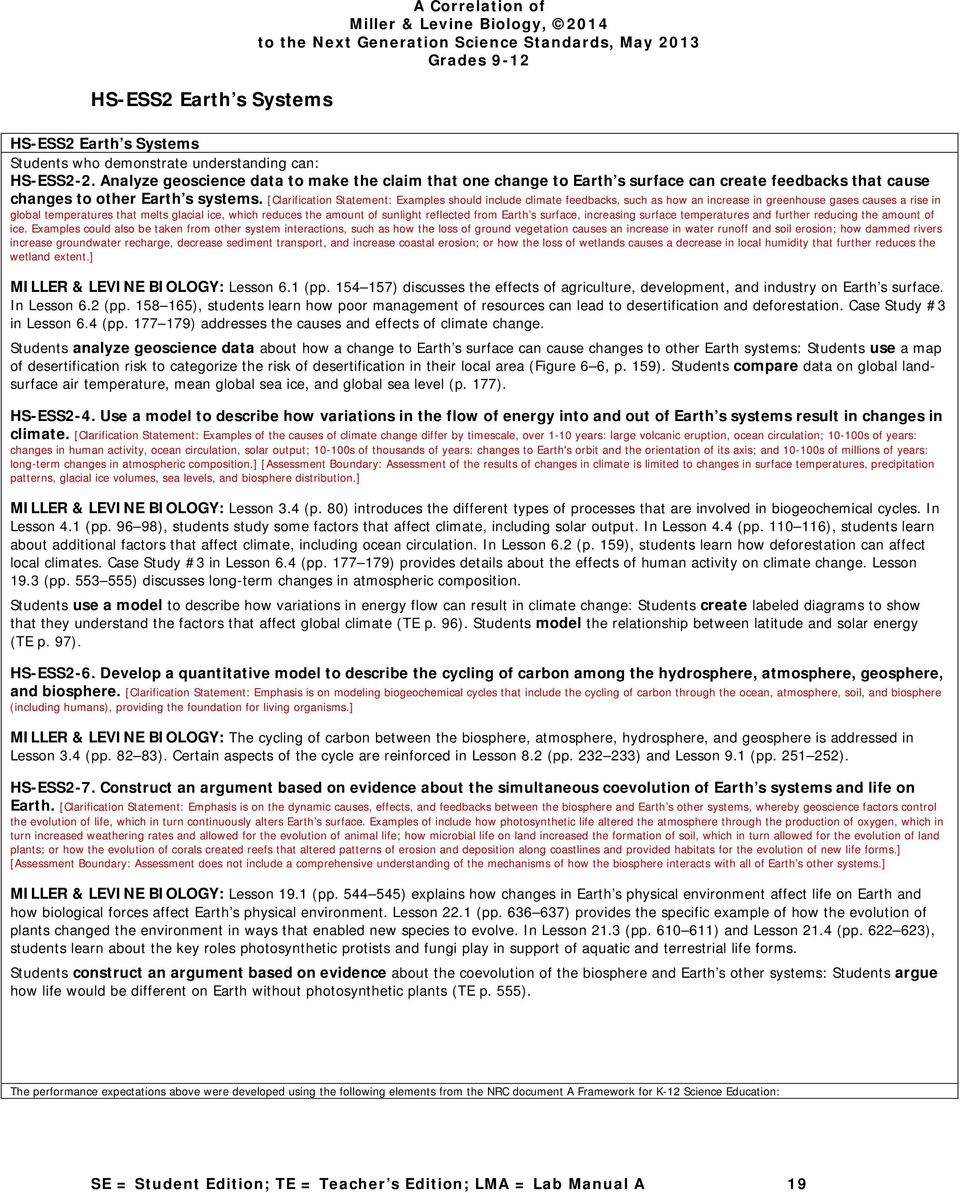
20 Science and Engineering Practices Developing and Using Models Modeling in 9 12 builds on K 8 experiences and progresses to using, synthesizing, and developing models to predict and show relationships among variables between systems and their components in the natural and designed world(s). Develop a model based on evidence to illustrate the relationships between systems or between components of a system. (HS-ESS2-6) Analyzing and Interpreting Data Analyzing data in 9 12 builds on K 8 experiences and progresses to introducing more detailed statistical analysis, the comparison of data sets for consistency, and the use of models to generate and analyze data. Analyze data using tools, technologies, and/or models (e.g., computational, mathematical) in order to make valid and reliable scientific claims or determine an optimal design solution. (HS-ESS2-2) SE: Figure 6 6 (p. 159); Case Study #3 (p. 177) Engaging in Argument from Evidence Engaging in argument from evidence in 9 12 builds on K 8 experiences and progresses to using appropriate and sufficient evidence and scientific reasoning to defend and critique claims and explanations about the natural and designed world(s). Arguments may also come from current scientific or historical episodes in science. Construct an oral and written argument or counterarguments based on data and evidence. (HS-ESS2-7) TE: Check for Understanding (p. 555) Connections to Nature of Science Scientific Knowledge is Based on Empirical Evidence Science arguments are strengthened by multiple lines of evidence supporting a single explanation. (HS-ESS2-4) SE: Analyzing Data (p. 115); Analyzing Data (p. 126); Analyzing Data (p. 556) TE: Quick Facts (p. 70); Quick Facts (p. 82); How Science Works (p. 87); Quick Facts (p. 177) Disciplinary Core Ideas ESS1.B: Earth and the Solar System Cyclical changes in the shape of Earth s orbit around the sun, together with changes in the tilt of the planet s axis of rotation, both occurring over hundreds of thousands of years, have altered the intensity and distribution of sunlight falling on the earth. These phenomena cause a cycle of ice ages and other gradual climate changes. (secondary to HS-ESS2-4) ESS2.A: Earth Materials and Systems Earth s systems, being dynamic and interacting, cause feedback effects that can increase or decrease the original changes. (HS-ESS2-2) SE/TE: The Mysteries of Life s Origins (pp ); Ecological Footprints (pp ) The geological record shows that changes to global and regional climate can be caused by interactions among changes in the sun s energy output or Earth s orbit, tectonic events, ocean circulation, volcanic activity, glaciers, vegetation, and human activities. These changes can occur on a variety of time scales from sudden (e.g., volcanic ash clouds) to intermediate (ice ages) to very long-term tectonic cycles. (HS-ESS2-4) SE/TE: Life on a Changing Planet (pp ); Case Study #3, Climate Change (pp ) ESS2.D: Weather and Climate The foundation for Earth s global climate systems is the electromagnetic radiation from the sun, as well as its reflection, absorption, storage, and redistribution among the atmosphere, ocean, and land systems, and this energy s re-radiation into space. (HS-ESS2-4) SE/TE: Weather and Climate (p. 96); Factors That Affect Climate (pp ) Gradual atmospheric changes were due to plants and other organisms that captured carbon dioxide and released oxygen. (HS-ESS2-6),(HS-ESS2-7) SE/TE: Production of Free Oxygen (p. 555) Changes in the atmosphere due to human activity have increased carbon dioxide concentrations and thus affect climate. (HS-ESS2-6),(HS-ESS2-4) SE/TE: Case Study #3, Climate Change (pp ) ESS2.E: Biogeology The many dynamic and delicate feedbacks between the biosphere and other Earth systems cause a continual co-evolution of Earth s surface and the life that exists on it. (HS-ESS2-7) Crosscutting Concepts Cause and Effect Empirical evidence is required to differentiate between cause and correlation and make claims about specific causes and effects. (HS-ESS2-4) SE: Analyzing Data (p. 115); Analyzing Data (p. 126); Analyzing Data (p. 556) Energy and Matter The total amount of energy and matter in closed systems is conserved. (HS-ESS2-6) SE: Comparing Photosynthesis and Respiration (p. 253); Q5 (p. 260) TE: Address Misconceptions (p. 70); Address Misconceptions (p. 82); Address Misconceptions (p. 255) Stability and Change Much of science deals with constructing explanations of how things change and how they remain stable. (HS- ESS2-7) SE: Q22 (p. 629); Q33 (p. 630) TE: Differentiated Instruction (p. 544); Teach For Understanding (p. 553); Build Study Skills (p. 555); Build Reading Skills (p. 611); Differentiated Instruction (p. 622); Connect to Earth Science (p. 623) Feedback (negative or positive) can stabilize or destabilize a system. (HS-ESS2-2) SE: Analyzing Data (p. 164); Case Study #1 (p. 175) Connections to Engineering, Technology, and Applications of Science Influence of Engineering, Technology, and Science on Society and the Natural World New technologies can have deep impacts on society and the environment, including some that were not anticipated. Analysis of costs and benefits is a critical aspect of decisions about technology. (HS-ESS2-2) TE: Building Scientific Literacy, STEM (p. 152a); Building Scientific Literacy, STEM (p. 153); How Science Works (p. 161) SE/TE: The Mysteries of Life s Origins (pp ); Autotrophic Protists (pp ); The Ecology of Fungi (pp ) SE = Student Edition; TE = Teacher s Edition; LMA = Lab Manual A 20

21 HS-ESS3 Earth and Human Activity A Correlation of HS-ESS3 Earth and Human Activity Students who demonstrate understanding can: HS-ESS3-1. Construct an explanation based on evidence for how the availability of natural resources, occurrence of natural hazards, and changes in climate have influenced human activity. [Clarification Statement: Examples of key natural resources include access to fresh water (such as rivers, lakes, and groundwater), regions of fertile soils such as river deltas, and high concentrations of minerals and fossil fuels. Examples of natural hazards can be from interior processes (such as volcanic eruptions and earthquakes), surface processes (such as tsunamis, mass wasting and soil erosion), and severe weather (such as hurricanes, floods, and droughts). Examples of the results of changes in climate that can affect populations or drive mass migrations include changes to sea level, regional patterns of temperature and precipitation, and the types of crops and livestock that can be raised.] MILLER & LEVINE BIOLOGY: Lesson 5.2 (pp ) explains how natural disasters are a limiting factor for population growth. Lesson 6.2 (pp ) discusses the importance of freshwater for humans. Lesson 24.4 (pp ) focuses on the effect of agriculture on human civilizations. Students construct an explanation for how natural resources, natural hazards, or climate influence human activity: Students explore how the presence or absence of trees affected the inhabitants of Easter Island (pp. 153 and 183). Students explain how the domestication of a crop contributed to the rise of civilization in a specific region (p. 719). HS-ESS3-3. Create a computational simulation to illustrate the relationships among management of natural resources, the sustainability of human populations, and biodiversity. [Clarification Statement: Examples of factors that affect the management of natural resources include costs of resource extraction and waste management, per-capita consumption, and the development of new technologies. Examples of factors that affect human sustainability include agricultural efficiency, levels of conservation, and urban planning.] [Assessment Boundary: Assessment for computational simulations is limited to using provided multi-parameter programs or constructing simplified spreadsheet calculations.] MILLER & LEVINE BIOLOGY: Chapter 6 (pp ) discusses the effect of human activity on the environment. Students create a computational simulation to illustrate the relationship between management of natural resources and biodiversity: Students use mathematical and computational tools to analyze data about the genetic decline of alpine chipmunks due to climate change caused by human activities (pp. 447a 447b). HS-ESS3-4. Evaluate or refine a technological solution that reduces impacts of human activities on natural systems.* [Clarification Statement: Examples of data on the impacts of human activities could include the quantities and types of pollutants released, changes to biomass and species diversity, or areal changes in land surface use (such as for urban development, agriculture and livestock, or surface mining). Examples for limiting future impacts could range from local efforts (such as reducing, reusing, and recycling resources) to large-scale geoengineering design solutions (such as altering global temperatures by making large changes to the atmosphere or ocean).] MILLER & LEVINE BIOLOGY: Lessons 6.1, 6.2, and 6.3 (pp ) focus on the impact of humans on the environment. Students evaluate or refine a technological solution that reduces impacts of human activities on natural systems: Students evaluate ways to reduce dry trash (Quick Lab, p. 155). Students design a green roof system for a building (pp. 571a 571b). HS-ESS3-5. Analyze geoscience data and the results from global climate models to make an evidence-based forecast of the current rate of global or regional climate change and associated future impacts to Earth systems. [Clarification Statement: Examples of evidence, for both data and climate model outputs, are for climate changes (such as precipitation and temperature) and their associated impacts (such as on sea level, glacial ice volumes, or atmosphere and ocean composition).] [Assessment Boundary: Assessment is limited to one example of a climate change and its associated impacts.] MILLER & LEVINE BIOLOGY: Case Study #3 in lesson 6.4 (pp ) addresses the causes and effects of climate change. Students analyze geoscience data about global climate change: Students analyze data on air temperature, sea ice, sea level, and greenhouse gas emissions (pp ). HS-ESS3-6. Use a computational representation to illustrate the relationships among Earth systems and how those relationships are being modified due to human activity. [Clarification Statement: Examples of Earth systems to be considered are the hydrosphere, atmosphere, cryosphere, geosphere, and/or biosphere. An example of the far-reaching impacts from a human activity is how an increase in atmospheric carbon dioxide results in an increase in photosynthetic biomass on land and an increase in ocean acidification, with resulting impacts on sea organism health and marine populations.] [Assessment Boundary: Assessment does not include running computational representations but is limited to using the published results of scientific computational models.] MILLER & LEVINE BIOLOGY: Lesson 3.4 (pp ) describes biogeochemical cycles. Lessons 6.1, 6.2, 6.3, and 6.4 (pp ) address ways humans modify Earth s systems. Students use computational representations to illustrate relationships among Earth s systems: Students interpret data about the effect of rainfall on plant productivity (p. 92). Students interpret data on air pollution trends (Analyzing Data, p. 164). Students compare data on land-surface air temperature, global sea ice, and global sea level (p. 177). The performance expectations above were developed using the following elements from the NRC document A Framework for K-12 Science Education: SE = Student Edition; TE = Teacher s Edition; LMA = Lab Manual A 21
22 Science and Engineering Practices Analyzing and Interpreting Data Analyzing data in 9 12 builds on K 8 experiences and progresses to introducing more detailed statistical analysis, the comparison of data sets for consistency, and the use of models to generate and analyze data. Analyze data using computational models in order to make valid and reliable scientific claims. (HS-ESS3-5) SE: Case Study #3 (pp ) Using Mathematics and Computational Thinking Mathematical and computational thinking in 9-12 builds on K-8 experiences and progresses to using algebraic thinking and analysis, a range of linear and nonlinear functions including trigonometric functions, exponentials and logarithms, and computational tools for statistical analysis to analyze, represent, and model data. Simple computational simulations are created and used based on mathematical models of basic assumptions. Create a computational model or simulation of a phenomenon, designed device, process, or system. (HS- ESS3-3) SE: Unit 4 Project (pp. 447a 447b) Use a computational representation of phenomena or design solutions to describe and/or support claims and/or explanations. (HS-ESS3-6) SE: Use Science Graphics (p. 92); Analyzing Data (p. 164); Case Study #3 (p. 177) Constructing Explanations and Designing Solutions Constructing explanations and designing solutions in 9 12 builds on K 8 experiences and progresses to explanations and designs that are supported by multiple and independent student-generated sources of evidence consistent with scientific knowledge, principles, and theories. Construct an explanation based on valid and reliable evidence obtained from a variety of sources (including students own investigations, models, theories, simulations, peer review) and the assumption that theories and laws that describe the natural world operate today as they did in the past and will continue to do so in the future. (HS-ESS3-1) SE: Chapter 6 mystery (pp. 153 and 183); Biology & History (p. 719) Design or refine a solution to a complex real-world problem, based on scientific knowledge, studentgenerated sources of evidence, prioritized criteria, and tradeoff considerations. (HS-ESS3-4) SE: Quick Lab (p. 155); Unit 6 Project (pp. 571a 571b) Connections to Nature of Science Scientific Investigations Use a Variety of Methods Science investigations use diverse methods and do not always use the same set of procedures to obtain data. (HS-ESS3-5) Disciplinary Core Ideas ESS2.D: Weather and Climate Current models predict that, although future regional climate changes will be complex and varied, average global temperatures will continue to rise. The outcomes predicted by global climate models strongly depend on the amounts of human-generated greenhouse gases added to the atmosphere each year and by the ways in which these gases are absorbed by the ocean and biosphere. (secondary to HS-ESS3-6) SE/TE: Greenhouse Gases (p. 164); Case Study #3, Climate Change (p. 178) ESS3.A: Natural Resources Resource availability has guided the development of human society. (HS-ESS3-1) SE/TE: Sustainable Development (pp ); Soil Resources (pp ); Freshwater Resources (pp ); Agriculture (pp ) ESS3.B: Natural Hazards Natural hazards and other geologic events have shaped the course of human history; [they] have significantly altered the sizes of human populations and have driven human migrations. (HS-ESS3-1) ESS3.C: Human Impacts on Earth Systems The sustainability of human societies and the biodiversity that supports them requires responsible management of natural resources. (HS-ESS3-3) SE/TE: Sustainable Development (pp ); Using Resources Wisely (pp ); Ecology in Action (pp ) Scientists and engineers can make major contributions by developing technologies that produce less pollution and waste and that preclude ecosystem degradation. (HS- ESS3-4) SE/TE: Using Resources Wisely (pp ); Conserving Biodiversity (pp ); Ecology in Action (pp ) ESS3.D: Global Climate Change Though the magnitudes of human impacts are greater than they have ever been, so too are human abilities to model, predict, and manage current and future impacts. (HS-ESS3-5) SE/TE: Case Study #3, Climate Change (pp ) Through computer simulations and other studies, important discoveries are still being made about how the ocean, the atmosphere, and the biosphere interact and are modified in response to human activities. (HS-ESS3-6) SE/TE: Case Study #1, Atmospheric Ozone (p. 175); Case Study #3, Climate Change (pp ) Crosscutting Concepts Cause and Effect Empirical evidence is required to differentiate between cause and correlation and make claims about specific causes and effects. (HS-ESS3-1) TE: How Science Works (p. 107); Quick Facts (p. 118); Quick Facts (p. 159); Biology in Depth (p. 160) Systems and System Models When investigating or describing a system, the boundaries and initial conditions of the system need to be defined and their inputs and outputs analyzed and described using models. (HS-ESS3-6) TE: How Science Works (p. 131) Stability and Change Change and rates of change can be quantified and modeled over very short or very long periods of time. Some system changes are irreversible. (HS-ESS3-3),(HS- ESS3-5) SE: Case Study #1 (p. 175); Case Study #3 (pp ) Feedback (negative or positive) can stabilize or destabilize a system. (HS-ESS3-4) SE: Chapter 3 Mystery (pp. 63 and 91); Chapter 5 Mystery (pp. 130 and 149) Connections to Engineering, Technology, and Applications of Science Influence of Engineering, Technology, and Science on Society and the Natural World Modern civilization depends on major technological systems. (HS-ESS3-1),(HS-ESS3-3) SE: The Role of Technology (p. 11); Technology & Biology (p. 87) TE: How Science Works (p. 112) Engineers continuously modify these technological systems by applying scientific knowledge and engineering design practices to increase benefits while decreasing costs and risks. (HS-ESS3-4) TE: Biology in Depth (p. 162) New technologies can have deep impacts on society and the environment, including some that were not anticipated. (HS-ESS3-3) TE: Biology in Depth (p. 97); Building Scientific Literacy, STEM (p. 152a); Building Scientific Literacy, STEM (p. 153) SE = Student Edition; TE = Teacher s Edition; LMA = Lab Manual A 22
23 New technologies advance scientific knowledge. (HS- ESS3-5) SE: Technology & Biology (p. 87) TE: How Science Works (p. 87); Building Scientific Literacy, STEM (p. 152a); Biology in Depth (p. 162) Scientific Knowledge is Based on Empirical Evidence Science knowledge is based on empirical evidence. (HS-ESS3-5) SE: Case Study #3 (pp ) TE: Building Scientific Literacy, Writing (p. 152a) Science arguments are strengthened by multiple lines of evidence supporting a single explanation. (HS-ESS2-5) ETS1.B: Developing Possible Solutions When evaluating solutions, it is important to take into account a range of constraints, including cost, safety, reliability, and aesthetics, and to consider social, cultural, and environmental impacts. (secondary HS-ESS3-4) SE/TE: Appendix C, Technology & Design (pp. A-16 and A-17) Connections to Nature of Science Science is a Human Endeavor Science is a result of human endeavors, imagination, and creativity. (HS-ESS3-3) SE: Careers & Biology (p. 105) TE: How Science Works (p. 120) SE: Case Study #3 (pp ) *The performance expectations marked with an asterisk integrate traditional science content with engineering through a Practice or Disciplinary Core Idea. SE = Student Edition; TE = Teacher s Edition; LMA = Lab Manual A 23
24 HS-ETS1 Engineering Design A Correlation of HS-ETS1 Engineering Design Students who demonstrate understanding can: HS-ETS1-1. Analyze a major global challenge to specify qualitative and quantitative criteria and constraints for solutions that account for societal needs and wants. MILLER & LEVINE BIOLOGY: In Lesson 1.2 (p. 11), students learn that technology, science, and society are closely linked. Lesson 1.2 (pp ) describes the relationship between science and society. In Lesson 15.4 (pp ), students explore the ethics and impacts of biotechnology. Students specify criteria and constraints for solutions that account for societal needs and wants: In the Unit 8 Project, Body Mechanics (pp. 859a 859b), students evaluate how medical technologies can account for the needs of people living with disabilities or chronic diseases. Students analyze how cross-pollination affects the genetics of corn populations (Chapter 17 STEM activity, Pollination or Contamination). Students analyze the factors involved with replacing a heart (Chapter 33 STEM activity, The Artificial Heart of the Matter). HS-ETS1-2. Design a solution to a complex real-world problem by breaking it down into smaller, more manageable problems that can be solved through engineering. MILLER & LEVINE BIOLOGY: In Appendix C, Technology & Design (pp. A-16 and A-17), students learn the general process for designing a solution to a problem. Students design a solution to a complex real-world problem: In the Unit 6 Project, A Living Roof (pp. 571a 571b), students design a green roof. Students redesign product packaging to reduce solid waste (Chapter 6 STEM activity, Redesign to Reduce Waste). Students design a mosquito net to help combat malaria outbreaks (Chapter 21 STEM activity, Malaria and Fungi). Students design technology to help protect workers from blood-borne pathogens (Chapter 35 STEM activity, Reducing the Spread of Bloodborne Pathogens). HS-ETS1-3. Evaluate a solution to a complex real-world problem based on prioritized criteria and trade-offs that account for a range of constraints, including cost, safety, reliability, and aesthetics, as well as possible social, cultural, and environmental impacts. MILLER & LEVINE BIOLOGY: In Appendix C, Technology & Design (pp. A-16 and A-17), students learn to evaluate constraints and make trade-offs. Students evaluate a solution to a complex real-world problem: In the Unit 1 Project, Harnessing the Fear of Water (pp. 1a 1b), students determine the criteria for a technological solution to a specific problem. In the Unit 4 Project, Food Fight! (pp. 305a 305b), students evaluate the use of GM foods as a way to increase crop yields. In the Unit 8 Project, Body Mechanics (pp. 859a 859b), students identify the criteria and constraints for a prosthetic limb. The performance expectations above were developed using the following elements from the NRC document A Framework for K-12 Science Education: Science and Engineering Practices Disciplinary Core Ideas Connections to Engineering, Technology, Asking Questions and Defining Problems ETS1.A: Defining and Delimiting Engineering and Applications of Science Asking questions and defining problems in 9 12 builds on Problems Influence of Science, Engineering, and Technology K 8 experiences and progresses to formulating, refining, Criteria and constraints also include satisfying any on Society and the Natural World and evaluating empirically testable questions and design requirements set by society, such as taking issues of risk New technologies can have deep impacts on society problems using models and simulations. mitigation into account, and they should be quantified to and the environment, including some that were not Analyze complex real-world problems by specifying the extent possible and stated in such a way that one can anticipated. Analysis of costs and benefits is a critical criteria and constraints for successful solutions. tell if a given design meets them. (HS-ETS1-1) aspect of decisions about technology. (HS-ETS1-1) (HS- (HS-ETS1-1) ETS1-3) SE: Unit 8 Project (pp. 859a 859b) Biology.com: Chapter 17 STEM activity; Chapter 33 STEM activity SE/TE: Science and Society (pp ); Ethics and Impacts of Biotechnology (pp ) Humanity faces major global challenges today, such as the need for supplies of clean water and food or for energy sources that minimize pollution, which can be addressed through engineering. These global challenges also may have manifestations in local communities. (HS- ETS1-1) SE/TE: Using Resources Wisely (pp ) SE: Building Scientific Literacy, STEM (p. 123) Biology.com: Chapter 14 STEM activity, Human Genomes and Medicine; Chapter 15 STEM activity, Recombinant DNA in Genetically Modified Organisms; Chapter 31 STEM activity, Technology and Physical Disabilities SE = Student Edition; TE = Teacher s Edition; LMA = Lab Manual A 24
25 Constructing Explanations and Designing Solutions Constructing explanations and designing solutions in 9 12 builds on K 8 experiences and progresses to explanations and designs that are supported by multiple and independent student-generated sources of evidence consistent with scientific ideas, principles and theories. Design a solution to a complex real-world problem, based on scientific knowledge, student-generated sources of evidence, prioritized criteria, and tradeoff considerations. (HS-ETS1-2) SE: Unit 6 Project (pp. 571a 571b) Biology.com: Chapter 6 STEM activity; Chapter 21 STEM activity; Chapter 35 STEM activity ETS1.B: Developing Possible Solutions When evaluating solutions, it is important to take into account a range of constraints, including cost, safety, reliability, and aesthetics, and to consider social, cultural, and environmental impacts. (HS-ETS1-3) SE/TE: Appendix C (pp. A-16 and A-17) ETS1.C: Optimizing the Design Solution Criteria may need to be broken down into simpler ones that can be approached systematically, and decisions about the priority of certain criteria over others (tradeoffs) may be needed. (HS-ETS1-2) SE/TE: Appendix C (pp. A-16 and A-17) Evaluate a solution to a complex real-world problem, based on scientific knowledge, student-generated sources of evidence, prioritized criteria, and tradeoff considerations. (HS-ETS1-3) SE: Unit 1 Project (pp. 1a 1b); Unit 4 Project (pp. 305a 305b); Unit 8 Project (pp. 859a 859b) SE = Student Edition; TE = Teacher s Edition; LMA = Lab Manual A 25
Essentials of Human Anatomy & Physiology 11 th Edition, 2015 Marieb
 A Correlation of Essentials of Human Anatomy Marieb To the Next Generation Science Standards Life A Correlation of, HS-LS1 From Molecules to Organisms: Structures and Processes HS-LS1-1. Construct an explanation
A Correlation of Miller & Levine Biology 2014
 A Correlation of Miller & Levine Biology To Ohio s New Learning Standards for Science, 2011 Biology, High School Science Inquiry and Application Course Content A Correlation of, to Introduction This document
Biology: Foundation Edition Miller/Levine 2010
 A Correlation of Biology: Foundation Edition Miller/Levine 2010 to the IDAHO CONTENT STANDARDS Science - Biology Grades 9-10 INTRODUCTION This document demonstrates how Prentice Hall s Biology: Foundation
MS. Structure, Function, and Information Processing
 MIDDLE SCHOOL LIFE SCIENCE Alignment with National Science Standards Use the chart below to find Science A-Z units that best support the Next Generation Science Standards* for Middle School Life Science,
MCAS Biology. Review Packet
 MCAS Biology Review Packet 1 Name Class Date 1. Define organic. THE CHEMISTRY OF LIFE 2. All living things are made up of 6 essential elements: SPONCH. Name the six elements of life. S N P C O H 3. Elements
Unit I: Introduction To Scientific Processes
 Unit I: Introduction To Scientific Processes This unit is an introduction to the scientific process. This unit consists of a laboratory exercise where students go through the QPOE2 process step by step
AP Biology Essential Knowledge Student Diagnostic
 AP Biology Essential Knowledge Student Diagnostic Background The Essential Knowledge statements provided in the AP Biology Curriculum Framework are scientific claims describing phenomenon occurring in
AP Biology Unit I: Ecological Interactions
 AP Biology Unit I: Ecological Interactions Essential knowledge 1.C.1: Speciation and extinction have occurred throughout the Earth s history. Species extinction rates are rapid at times of ecological stress.
Common Core Standards for Literacy in Science and Technical Subjects
 A Correlation of Miller & Levine Biology To the Common Core Standards for Literacy in Science and Technical Subjects INTRODUCTION This document demonstrates how meets the Common Core Standards for Literacy
Prentice Hall Biology (Miller/Levine) 2008 Correlated to: Colorado Science Standards and Benchmarks (Grades 9-12)
 1. ask questions and state hypotheses using prior scientific knowledge to help design and guide their development and implementation of a scientific investigation STANDARD 1: Students apply the processes
Utah State Office of Education Elementary STEM Endorsement Course Framework Nature of Science and Engineering
 Course Description: Utah State Office of Education Elementary STEM Endorsement Course Framework Nature of Science and Engineering In this course participants will experience introductory explorations of
Cellular Respiration: Practice Questions #1
 Cellular Respiration: Practice Questions #1 1. Which statement best describes one of the events taking place in the chemical reaction? A. Energy is being stored as a result of aerobic respiration. B. Fermentation
A Correlation of Pearson Miller & Levine Biology 2014 To the Utah Core State Standards for Biology Grades 9-12
 A Correlation of Pearson To the Utah Core State Standards Resource Title: Publisher: Pearson Education publishing as Prentice Hall ISBN (10 or 13 digit unique identifier is required): SE: 9780133242003
Topic 3: Nutrition, Photosynthesis, and Respiration
 1. Base your answer to the following question on the chemical reaction represented below and on your knowledge of biology. If this reaction takes place in an organism that requires sunlight to produce
Cells & Cell Organelles
 Cells & Cell Organelles The Building Blocks of Life H Biology Types of cells bacteria cells Prokaryote - no organelles Eukaryotes - organelles animal cells plant cells Cell size comparison Animal cell
Cellular Energy. 1. Photosynthesis is carried out by which of the following?
 Cellular Energy 1. Photosynthesis is carried out by which of the following? A. plants, but not animals B. animals, but not plants C. bacteria, but neither animals nor plants D. all living organisms 2.
High School Science Course Correlations between Ohio s 2010 Course Syllabi and the First Draft of the High School NGSS
 High School Science Course Correlations between Ohio s 2010 Course Syllabi and the First Draft of the High School NGSS This document correlates the content in Ohio s course syllabi with the performance
A CONTENT STANDARD IS NOT MET UNLESS APPLICABLE CHARACTERISTICS OF SCIENCE ARE ALSO ADDRESSED AT THE SAME TIME.
 Biology Curriculum The Georgia Performance Standards are designed to provide students with the knowledge and skills for proficiency in science. The Project 2061 s Benchmarks for Science Literacy is used
2. Which type of macromolecule contains high-energy bonds and is used for long-term energy storage?
 Energy Transport Study Island 1. During the process of photosynthesis, plants use energy from the Sun to convert carbon dioxide and water into glucose and oxygen. These products are, in turn, used by the
The animals at higher levels are more competitive, so fewer animals survive. B.
 Energy Flow in Ecosystems 1. The diagram below shows an energy pyramid. Which of the following best explains why the number of organisms at each level decreases while moving up the energy pyramid? The
Differences Between 1997 Illinois Learning Standards and 2014 Illinois Learning Standards (NGSS)
 Differences Between 1997 Illinois Learning Standards and 2014 Illinois Learning Standards (NGSS) 1997 Illinois Learning Standards in Science 2014 Illinois Learning Standards (NGSS) Grouped by grade spans:
Unit 5 Photosynthesis and Cellular Respiration
 Unit 5 Photosynthesis and Cellular Respiration Advanced Concepts What is the abbreviated name of this molecule? What is its purpose? What are the three parts of this molecule? Label each part with the
2. What kind of energy is stored in food? A. chemical energy B. heat energy C. kinetic energy D. light energy
 Assessment Bank Matter and Energy in Living Things SC.8.L.18.4 1. What is energy? A. anything that takes up space B. anything that has mass C. the ability to conduct current D. the ability to do work 2.
CPO Science and the NGSS
 CPO Science and the NGSS It is no coincidence that the performance expectations in the Next Generation Science Standards (NGSS) are all action-based. The NGSS champion the idea that science content cannot
Smart Science Lessons and Middle School Next Generation Science Standards
 Smart Science Lessons and Middle School Next Generation Science Standards You have chosen the right place to find great science learning and, beyond learning, how to think. The NGSS emphasize thinking
Endocrine System: Practice Questions #1
 Endocrine System: Practice Questions #1 1. Removing part of gland D would most likely result in A. a decrease in the secretions of other glands B. a decrease in the blood calcium level C. an increase in
Which of the following can be determined based on this model? The atmosphere is the only reservoir on Earth that can store carbon in any form. A.
 Earth s Cycles 1. Models are often used to explain scientific knowledge or experimental results. A model of the carbon cycle is shown below. Which of the following can be determined based on this model?
Ecosystems and Food Webs
 Ecosystems and Food Webs How do AIS affect our lakes? Background Information All things on the planet both living and nonliving interact. An Ecosystem is defined as the set of elements, living and nonliving,
Given these characteristics of life, which of the following objects is considered a living organism? W. X. Y. Z.
 Cell Structure and Organization 1. All living things must possess certain characteristics. They are all composed of one or more cells. They can grow, reproduce, and pass their genes on to their offspring.
Name Date Class. energy phosphate adenine charged ATP chemical bonds work ribose
 Energy in a Cell Reinforcement and Study Guide Section.1 The Need for Energy In your textbook, read about cell energy. Use each of the terms below just once to complete the passage. energy phosphate adenine
pathway that involves taking in heat from the environment at each step. C.
 Study Island Cell Energy Keystone Review 1. Cells obtain energy by either capturing light energy through photosynthesis or by breaking down carbohydrates through cellular respiration. In both photosynthesis
McDougal Littell Middle School Science
 McDougal Littell Middle School Science correlated to the Assessed Indicators, and the Assessed Indicators CC2 1/2004 2004 KS 49 correlated to the, and the Science Correlation Chart Strand Inquiry (INQ
Next Generation Science Standards
 The Next Generation Science Standards and the Life Sciences The important features of life science standards for elementary, middle, and high school levels Rodger W. Bybee Publication of the Next Generation
Energy Flow in the Pond Teacher s Guide February 2011
 Energy Flow in the Pond Teacher s Guide February 2011 Grades: 6, 7 & 8 Time: 3 hours With the pond as a model, students explore how energy that originates from the sun keeps changing shape and form as
Respiration occurs in the mitochondria in cells.
 B3 Question Which process occurs in the mitochondria in cells? Why do the liver and muscle cells have large number of mitochondria? What is the function of the ribosomes? Answer Respiration occurs in the
Middle School Life Science
 Middle School Life Science Students in middle school develop understanding of key concepts to help them make sense of life science. The ideas build upon students science understanding from earlier grades
Biology. EL indicates a goal that supports the Maryland Environmental Literacy Standards.
 Biology Students must pass the High School Assessment in Biology to earn a high school diploma in Maryland. The HCPSS curriculum in Biology is aligned to the Maryland State Curriculum in Biology. Special
Lesson Plan: The Building Blocks of Photosynthesis
 Lesson Plan: The Building Blocks of Photosynthesis Summary In this lesson, students will use colored blocks to represent the elements in photosynthesis and illustrate how they are broken down and reassembled
Ecology 1 Star. 1. Missing from the diagram of this ecosystem are the
 Name: ate: 1. Missing from the diagram of this ecosystem are the 5. ase your answer(s) to the following question(s) on the diagram below and on your knowledge of biology.. biotic factors and decomposers.
MIDLAND ISD ADVANCED PLACEMENT CURRICULUM STANDARDS AP ENVIRONMENTAL SCIENCE
 Science Practices Standard SP.1: Scientific Questions and Predictions Asking scientific questions that can be tested empirically and structuring these questions in the form of testable predictions SP.1.1
A CONTENT STANDARD IS NOT MET UNLESS APPLICABLE CHARACTERISTICS OF SCIENCE ARE ALSO ADDRESSED AT THE SAME TIME.
 Environmental Science Curriculum The Georgia Performance Standards are designed to provide students with the knowledge and skills for proficiency in science. The Project 2061 s Benchmarks for Science Literacy
Keystone Review Practice Test Module A Cells and Cell Processes. 1. Which characteristic is shared by all prokaryotes and eukaryotes?
 Keystone Review Practice Test Module A Cells and Cell Processes 1. Which characteristic is shared by all prokaryotes and eukaryotes? a. Ability to store hereditary information b. Use of organelles to control
PHOTOSYNTHESIS AND CELLULAR RESPIRATION
 reflect Wind turbines shown in the photo on the right are large structures with blades that move in response to air movement. When the wind blows, the blades rotate. This motion generates energy that is
B2 Revision. Subject Module Date Biology B2 13 TH May (am)
 B2 Revision Subject Module Date Biology B2 13 TH May (am) Useful websites www.aqa.org.uk This website contains the specifications that we follow and also has a large number of past papers and mark schemes
Visualizing Cell Processes
 Visualizing Cell Processes A Series of Five Programs produced by BioMEDIA ASSOCIATES Content Guide for Program 3 Photosynthesis and Cellular Respiration Copyright 2001, BioMEDIA ASSOCIATES www.ebiomedia.com
5 E Lesson Plan. Title: Modeling Photosynthesis Grade Level and Course: 7 th grade, Life Science 10 th grade, Biology
 5 E Lesson Plan Title: Modeling Photosynthesis Grade Level and Course: 7 th grade, Life Science 10 th grade, Biology Materials: a. aluminum tray b. waxed paper c. 6 green marshmallows d. 12 pink marshmallows
XII. Biology, Grade 10
 XII. Biology, Grade 10 Grade 10 Biology Pilot Test The spring 2004 Grade 10 MCAS Biology Test was based on learning standards in the Biology content strand of the Massachusetts Science and Technology/Engineering
1. The diagram below represents a biological process
 1. The diagram below represents a biological process 5. The chart below indicates the elements contained in four different molecules and the number of atoms of each element in those molecules. Which set
Interactive Science Grade 5 2012
 A Correlation of Interactive Science Grade 5 2012 To the New Jersey Science Standards Grade 5 Introduction This document demonstrates the close alignment between Interactive Science, 2012, and the for
GRADE 6 SCIENCE. Demonstrate a respect for all forms of life and a growing appreciation for the beauty and diversity of God s world.
 GRADE 6 SCIENCE STRAND A Value and Attitudes Catholic Schools exist so that curriculum may be taught in the light of Gospel teachings. Teachers must reinforce Gospel truths and values so that students
INSTRUCTIONAL MATERIALS ADOPTION Score Sheet I. Generic Evaluation Criteria II. Instructional Content Analysis III. Specific Science Criteria
 GRADE: 9-12 VENDOR: Prentice Hall COURSE: Advanced Biology TITLE: Biology (Miller/Levine) COPYRIGHT DATE: 2006 SE ISBN: 0-13-166255-4 (SE) TE ISBN: 0-13-166288-0 (TE) INSTRUCTIONAL MATERIALS ADOPTION Score
High School Environmental Science Scope and Sequence for the
 High School Environmental Science Scope and Sequence for the A Guide to Reading the DCPS Science Scope and Sequence In response to the adoption of the Next Generation Science Standards (NGSS) 1 by the
8.3 The Process of Photosynthesis
 8.3 The Process of Photosynthesis Lesson Objectives Describe what happens during the light-dependent reactions. Describe what happens during the light-independent reactions. Identify factors that affect
How To Understand The Human Body
 Introduction to Biology and Chemistry Outline I. Introduction to biology A. Definition of biology - Biology is the study of life. B. Characteristics of Life 1. Form and size are characteristic. e.g. A
CELL/ PHOTOSYNTHESIS/ CELLULAR RESPIRATION Test 2011 ANSWER 250 POINTS ANY WAY IN WHICH YOU WANT
 CELL/ PHOTOSYNTHESIS/ CELLULAR RESPIRATION Test 2011 ANSWER 250 POINTS ANY WAY IN WHICH YOU WANT Completion: complete each statement. (1 point each) 1. All cells arise from. 2. The basic unit of structure
AP Biology. The four big ideas are:
 AP Biology Course Overview: This course is an intensive study in biological concepts that emphasizes inquiry based learning. It is structured around the four Big Ideas and the Enduring Understandings that
AS Biology Unit 2 Key Terms and Definitions. Make sure you use these terms when answering exam questions!
 AS Biology Unit 2 Key Terms and Definitions Make sure you use these terms when answering exam questions! Chapter 7 Variation 7.1 Random Sampling Sampling a population to eliminate bias e.g. grid square
Photo Cell Resp Practice. A. ATP B. oxygen C. DNA D. water. The following equation represents the process of photosynthesis in green plants.
 Name: ate: 1. Which molecule supplies the energy for cellular functions?. TP. oxygen. N. water 2. Photosynthesis The following equation represents the process of photosynthesis in green plants. What happens
Section 3: Trophic Structures
 Marine Conservation Science and Policy Service learning Program Trophic Structure refers to the way in which organisms utilize food resources and hence where energy transfer occurs within an ecosystem.
Chapter 9 Review Worksheet Cellular Respiration
 1 of 5 11/9/2011 8:11 PM Name: Hour: Chapter 9 Review Worksheet Cellular Respiration Energy in General 1. Differentiate an autotroph from a hetertroph as it relates to obtaining energy and the processes
Cells, tissues and organs
 Chapter 8: Cells, tissues and organs Cells: building blocks of life Living things are made of cells. Many of the chemical reactions that keep organisms alive (metabolic functions) take place in cells.
Bioenergetics Module A Anchor 3
 Bioenergetics Module A Anchor 3 Key Concepts: - ATP can easily release and store energy by breaking and re-forming the bonds between its phosphate groups. This characteristic of ATP makes it exceptionally
8-3 The Reactions of Photosynthesis Slide 1 of 51
 8-3 The of Photosynthesis 1 of 51 Inside a Chloroplast Inside a Chloroplast In plants, photosynthesis takes place inside chloroplasts. Plant Chloroplast Plant cells 2 of 51 Inside a Chloroplast Chloroplasts
Photosynthesis (Life from Light)
 Photosynthesis Photosynthesis (Life from Light) Energy needs of life All life needs a constant input of energy o Heterotrophs (consumers) Animals, fungi, most bacteria Get their energy from other organisms
GCSE Additional Science Biology Contents Guide
 GCSE Additional Science Contents Guide Copyright Boardworks Ltd 2007 Boardworks Ltd The Gallery 54 Marston Street Oxford OX4 1LF 08703 50 55 60 [email protected] www.boardworks.co.uk 04-07 contains
What is Photosynthesis? Measuring Air Pressure Inside an Active Photosynthetic System (Teacher s Guide)
 What is Photosynthesis? Measuring Air Pressure Inside an Active Photosynthetic System (Teacher s Guide) OVERVIEW After placing a photosynthetic organism inside a syringe, students will measure the air
FOR TEACHERS ONLY. The University of the State of New York REGENTS HIGH SCHOOL EXAMINATION LIVING ENVIRONMENT
 FOR TEACHERS ONLY LE The University of the State of New York REGENTS HIGH SCHOOL EXAMINATION LIVING ENVIRONMENT Tuesday, June 21, 2011 9:15 a.m. to 12:15 p.m., only SCORING KEY AND RATING GUIDE Directions
2014 GED Test Free Practice Test Companion
 2014 GED Test Free Practice Test Companion Now that you have viewed or taken the 2014 GED Free Practice Test, the information in this Companion will help you understand what content is covered on each
NORTH DAKOTA SCIENCE CONTENT STANDARDS
 NORTH DAKOTA SCIENCE CONTENT STANDARDS Draft April 2014 Draft Performance Expectations by Grade: High School Engineering Design Released for Public Comment North Dakota Department of Public Instruction
Reproductive System & Development: Practice Questions #1
 Reproductive System & Development: Practice Questions #1 1. Which two glands in the diagram produce gametes? A. glands A and B B. glands B and E C. glands C and F D. glands E and F 2. Base your answer
Understanding by Design. Title: BIOLOGY/LAB. Established Goal(s) / Content Standard(s): Essential Question(s) Understanding(s):
 Understanding by Design Title: BIOLOGY/LAB Standard: EVOLUTION and BIODIVERSITY Grade(s):9/10/11/12 Established Goal(s) / Content Standard(s): 5. Evolution and Biodiversity Central Concepts: Evolution
State Performance Indicators
 Sequences of Seventh Grade Science 2012-2013 *Results must be reported to Principal GLE Imbedded Standards Checking for Understanding State Performance Indicators Resource / Required Lab Projected Dates
REVIEW UNIT 10: ECOLOGY SAMPLE QUESTIONS
 Period Date REVIEW UNIT 10: ECOLOGY SAMPLE QUESTIONS A. Sample Multiple Choice Questions Complete the multiple choice questions to review this unit. 1. All of the following are density-dependent factors
Illinois School for the Deaf Course Curriculum. Craft and Structure RL.6.4. RL.6.5. RL.6.6. Integration of Knowledge and Ideas RL.6.7. RL.6.8. RL.6.9.
 Illinois School for the Deaf Course Curriculum Course Title: Science Grades 6-8 Cycle: Year 3 (Physical Science) Course Agenda: Topic Length of Unit Characteristics of Matter 3 weeks MS-PS1-1., MS-PS1-3.,
Introduction to Animals
 Introduction to Animals Unity and Diversity of Life Q: What characteristics and traits define animals? 25.1 What is an animal? WHAT I KNOW SAMPLE ANSWER: Animals are different from other living things
FOR TEACHERS ONLY. The University of the State of New York REGENTS HIGH SCHOOL EXAMINATION LIVING ENVIRONMENT
 LE FOR TEACHERS ONLY The University of the State of New York REGENTS HIGH SCHOOL EXAMINATION LIVING ENVIRONMENT Thursday, January 29, 2004 9:15 a.m. to 12:15 p.m., only SCORING KEY AND RATING GUIDE Directions
Photosynthesis P P P. Autotrophs and Heterotrophs (page 201) Chemical Energy and ATP (pages 202 203) Chapter 8. Name Class Date
 Chapter 8 Photosynthesis Section 8 1 Energy and Life (pages 201 203) This section explains where plants get the energy they need to produce food. It also describes the role of the chemical compound ATP
APPENDIX E Progressions Within the Next Generation Science Standards
 APPENDIX E Progressions Within the Next Generation Science Standards Following the vision of A Framework for K-12 Science Education, the NGSS are intended to increase coherence in K-12 science education.
Scope and Sequence Interactive Science grades 6-8
 Science and Technology Chapter 1. What Is Science? 1. Science and the Natural World 2.Thinking Like a Scientist 3. Scientific Inquiry Scope and Sequence Interactive Science grades 6-8 Chapter 2. Science,
Climate Change: A Local Focus on a Global Issue Newfoundland and Labrador Curriculum Links 2010-2011
 Climate Change: A Local Focus on a Global Issue Newfoundland and Labrador Curriculum Links 2010-2011 HEALTH Kindergarten: Grade 1: Grade 2: Know that litter can spoil the environment. Grade 3: Grade 4:
Mississippi SATP Biology I Student Review Guide
 Mississippi Student Review Guide Author: Cecilia L. Boles Published by Enrichment Plus, LLC PO Box 2755 Acworth, GA 30102 Toll Free: 1-800-745-4706 Fax 678-445-6702 Web site: www.enrichmentplus.com Mississippi
Cellular Respiration Worksheet 1. 1. What are the 3 phases of the cellular respiration process? Glycolysis, Krebs Cycle, Electron Transport Chain.
 Cellular Respiration Worksheet 1 1. What are the 3 phases of the cellular respiration process? Glycolysis, Krebs Cycle, Electron Transport Chain. 2. Where in the cell does the glycolysis part of cellular
Plants, like all living organisms have basic needs: a source of nutrition (food), water,
 WHAT PLANTS NEED IN ORDER TO SURVIVE AND GROW: LIGHT Grades 3 6 I. Introduction Plants, like all living organisms have basic needs: a source of nutrition (food), water, space in which to live, air, and
General Biology. Course Description and Philosophy
 General Biology Course Description and Philosophy Biology is the study of life on the planet Earth. This is a standard college preparatory life science course. Among the concepts covered in the course
PRESTWICK ACADEMY NATIONAL 5 BIOLOGY CELL BIOLOGY SUMMARY
 Name PRESTWICK ACADEMY NATIONAL 5 BIOLOGY CELL BIOLOGY SUMMARY Cell Structure Identify animal, plant, fungal and bacterial cell ultrastructure and know the structures functions. Plant cell Animal cell
Miller & Levine Biology
 A Correlation of Miller & Levine Biology Alabama Content Standards for Biology INTRODUCTION This document demonstrates how meets the Alabama Content Standards for Biology, grades 9-12. Correlation page
Central High School DC Angelo State University BIO 1481 Principles of Biology I Spring 2016
 Central High School DC Angelo State University BIO 1481 Principles of Biology I Spring 2016 INSTRUCTOR CONTACT INFORMATION: Shamone Minzenmayer Office: Tucker 117 Email: [email protected] Phone: 325-659-3400
The Cell Teaching Notes and Answer Keys
 The Cell Teaching Notes and Answer Keys Subject area: Science / Biology Topic focus: The Cell: components, types of cells, organelles, levels of organization Learning Aims: describe similarities and differences
BIOLOGY HIGHER LEVEL
 2008. M44 Write your Examination Number here Coimisiún na Scrúduithe Stáit State Examinations Commission LEAVING CERTIFICATE EXAMINATION, 2008 BIOLOGY HIGHER LEVEL THURSDAY, 12 JUNE MORNING, 9.30 TO 12.30
Chapter 2. The Chemistry of Life Worksheets
 Chapter 2 The Chemistry of Life Worksheets (Opening image courtesy of David Iberri, http://en.wikipedia.org/wiki/file:camkii.png, and under the Creative Commons license CC-BY-SA 3.0.) Lesson 2.1: Matter
A CONTENT STANDARD IS NOT MET UNLESS APPLICABLE CHARACTERISTICS OF SCIENCE ARE ALSO ADDRESSED AT THE SAME TIME.
 Anatomy and Physiology of Human Body Curriculum The Georgia Performance Standards are designed to provide students with the knowledge and skills for proficiency in science. The Project 2061 s Benchmarks
Summary. 16 1 Genes and Variation. 16 2 Evolution as Genetic Change. Name Class Date
 Chapter 16 Summary Evolution of Populations 16 1 Genes and Variation Darwin s original ideas can now be understood in genetic terms. Beginning with variation, we now know that traits are controlled by
Pre-requisites: Successful completion of 4th grade science and the 4th grade science assessment.
 Throughout each unit, assessments are incorporated into lessons. These assessments are activities that occur within the context of each lesson providing the guidelines for assessing students' progress.
Regents Biology REGENTS REVIEW: PROTEIN SYNTHESIS
 Period Date REGENTS REVIEW: PROTEIN SYNTHESIS 1. The diagram at the right represents a portion of a type of organic molecule present in the cells of organisms. What will most likely happen if there is
GCSE Science: Biology
 Nutrients 23 slides 9 Flash activities Accompanied by Nutrients Energy from food Protein For OCR Gateway Diet, Exercise and Health 34 slides 14 Flash activities Accompanied by Diet, Exercise and Health
CURRICULUM MAP (Revised 6.15.07)
 (Revised 6.15.07) Below is an outline of the Living Environment course that uses the Glencoe NY State Living Environment textbook. Please note that there is more depth in the book than is needed for the
Environmental Science Overview
 Overview The standards establish the scientific inquiry skills and core content for all courses in DoDEA schools. The course of study provides students with a basic knowledge of the natural world that
This Performance Standards include four major components. They are
 Seventh Grade Science Curriculum Approved July 13, 2006 The Georgia Performance Standards are designed to provide students with the knowledge and skills for proficiency in science at the seventh grade
Plants and Photosynthesis
 Plants and Photosynthesis Original Authors: Jennifer Michnowicz and Lois Kiraly Revision June 2006: Jennifer Michnowicz and Rebecca Shomo Farmington Public Schools 11 th Grade Biology Rebecca Shomo/Jennifer