
The Valuation and Characteristics of Bonds
|
|
|
- Debra Short
- 10 years ago
- Views:
Transcription
1 CHAPTER 6 The Valuation and Characteristics of Bonds Chapter Outline The Basis of Value Investing Return Bond Valuation Bond Terminology and Practice Bond Valuation Basic Ideas Determining the Price of a Bond Maturity Risk Revisited Finding the Yield at a Given Price Call Provisions Risky Issues Institutional Characteristics of Bonds Registration, Transfer Agents, and Owners of Record Kinds of Bonds Bond Ratings Assessing Default Risk Bond Indentures Controlling Default Risk Valuation is a systematic process through which we establish the price at which a security should sell. We can call that price the security s intrinsic value. THE BASIS OF VALUE Securities are pieces of paper, and unlike real assets they have no utility of their own. Real assets such as houses and cars have worth because they provide services like shelter and transportation. Paper assets must rely on something else to make them valuable. That something is the expectation of future income that goes along with owning securities. This is an important point. Every financial asset depends for its value on the future cash flows that come with it. Since money expected in the future is worth its present (discounted) value today, a security s value is equal to the present value of its expected future cash flows. Further, the security should sell in financial markets for a price very close to that value. There are often differences of opinion about what the price of a security should be. They arise because people make different assumptions about what the Securities are worth the present value of the future cash income associated with owning them. 189

2 190 PART 2 DISCOUNTED CASH FLOW AND THE VALUE OF SECURITIES Investing means using a resource to benefit the future rather than for current satisfaction. The rate of return on a security is the interest rate that equates the present value of its expected future cash flows with its current price. security s cash flows will turn out to be and about the appropriate interest rate to use in taking present values. The most arguable cash flows are associated with stocks, because future dividends are never guaranteed and the eventual selling price of a share is always speculative. The idea of valuation is bound closely to the concept of return on investment. Because of the precise nature of the work we re about to undertake, we need to be very exact in our understanding of what the terms investment and return mean. INVESTING Investing means using a resource in a way that generates future benefits rather than in a way that results in immediate satisfaction. We say an investor forgoes current consumption in order to improve his or her position in the future. In everyday language that means a person buys securities or puts money in the bank rather than spending it on a new car or going out to dinner. In finance, investing means putting money to work to earn more money, generally by entrusting it to a person or an organization that uses it and pays the owner for its use. The two most common methods of entrusting money are lending and buying an ownership interest in a business. They are called debt and equity investments, respectively. The vehicle for a debt investment is generally a bond, while for an equity investment it s a share of stock. RETURN Returns on One-Year Investments Return is what an investor receives for making an investment. It can be expressed as a dollar amount or as an annual rate. For investments held for one year, the rate of return is what the investor receives divided by what he or she invests. For debt that s simply the interest received divided by the amount loaned, which is the interest rate we ve been calling k. Let s look at the idea a little more deeply in terms of the time value of money. An amount PV loaned for one year at interest rate k earns interest of kpv. If the lender receives the principal plus the interest at the end of the year, these are the future cash flows that come from making the original investment of PV. Call these future cash flows FV 1 and write FV 1 5 PV 1 kpv FV 1 5 PV(1 1 k). We recognize this as equation 5.1 from our study of the time value of money. Now solve for the original investment. PV 5 FV 1 (1 1 k) Again we recognize this expression from our study of time value. It s the present value of a future amount due in one year, equation 5.5, with n 5 1. In the context of valuing a security that represents a loan (usually a bond), think of PV as the price of the security that returns cash flows FV 1. Then the rate of return, k, can be thought of as the interest rate that makes the present value of

3 CHAPTER 6 THE VALUATION AND CHARACTERISTICS OF BONDS 191 The terms yield, return, and interest mean essentially the same thing. A bond issue allows an organization to borrow from many lenders at one time under a single agreement. the future cash flows equal to the price. This is a fundamental definition that applies to any investment held for any length of time. The details are a bit more involved for equity (stock) investments than for debt, because the future cash flows are more complicated. Nevertheless, the basic rule is the same. We ll discuss the returns to equity investments in Chapter 7. Returns on Longer Term Investments When the holding period is longer and there are a number of cash flows at different times, the concept remains the same. The return is still the discount rate that makes the present value of the future cash flows equal to the price. For example, suppose someone offers to sell you an investment that will pay $200 one year from now and $250 two years from now for $363 paid today. If you accept the offer, the return on your investment will be the interest rate at which the present value of the two payments just equals the $363 price of the investment today. A time line for the arrangement looks like this. 0 1 $363 + PV $200 $250 As an exercise, show that the return on this hypothetical investment would be very close to 15%. The term yield is synonymous with rate of return. Its use is especially common with debt securities and traditional loans. In the remainder of this chapter we ll look closely at the valuation of bonds and then at their institutional 1 characteristics. We ll turn our attention to stocks in Chapter 7. BOND VALUATION Bonds represent a debt relationship in which the issuing company borrows and the buyer lends. A bond issue is an arrangement through which one company can borrow from many people at once. For example, suppose a large firm wants to borrow $10 million but can t find anyone willing to lend that much. Many people might be willing to lend smaller amounts, however, if the firm s credit reputation is good. If the company issues 10,000 bonds at $1,000 each, as many as 10,000 people could participate in the loan by buying one bond apiece. Bonds enable firms to raise large amounts by spreading a loan among a number of lenders. Before we get into the valuation of bonds, we need to learn a little about terminology and practice. We ve introduced some of these ideas before, but will repeat them here for convenience. PV 2 1. The term institutional refers to the rules and practices according to which things are done in an organized society.

4 192 PART 2 DISCOUNTED CASH FLOW AND THE VALUE OF SECURITIES A bond s term or maturity is the time from the present until the principal is to be returned. A bond s par or face value is the amount the issuer intends to borrow at the coupon rate of interest. BOND TERMINOLOGY AND PRACTICE A bond represents a loan made by the buyer to the issuer for a period known as the term. The bond itself is a promissory note that serves as legal evidence of the debt. Bonds are said to mature on the last day of their terms. Every bond issued has a par or face value, which is printed on the face of the document. This is the amount the issuing company intends to borrow; in effect, it s the principal of the loan. Bonds are non-amortized debt. That means no repayment of principal is made during the term. Rather, the face value is repaid in a lump sum on the maturity date. Interest is paid regularly during the term, however, usually semiannually. Any lender is said to extend credit to borrowers. Therefore bondholders are called creditors of the company issuing the bonds. The term creditor also applies to banks that make loans to companies and vendors that sell products without receiving immediate payment. Newly issued bonds are called new issues, as one might expect, while older bonds are commonly called seasoned issues. The Coupon Rate Most bonds pay interest at rates set at the time of issue called coupon rates. The coupon rate applied to the face value of a bond yields the dollar amount of interest paid, called the coupon payment. Coupon rates and payments are generally fixed throughout the life of a bond regardless of what happens to interest rates in financial markets. The term coupon is outdated but is still in common use. Years ago, bonds were issued with a number of coupons attached that looked something like a sheet of postage stamps. When an interest payment was due, a bond owner would clip off a coupon and send it to the issuing company, which would return a check for the interest. Hence the term coupon became associated with bond interest. Coupons are rarely used today. Interest payments are now mailed directly to bondholders whose names and addresses are registered with the issuing company or its agent. Nevertheless, the term coupon is still associated with bond interest. BOND VALUATION BASIC IDEAS Now we have enough background to begin studying bond valuation. Keep in mind that valuation simply means determining the price a security should command in the financial market in which it is traded. Adjusting to Interest Rate Changes Let s put several facts from our earlier work together with what we ve just learned about bonds. First recall from Chapter 4 that securities including bonds are sold in both primary and secondary markets. A primary market transaction refers to the original sale of the bond by the issuing company, and secondary market transactions are subsequent trades among investors. Second, recall from our discussion of financial markets in Chapter 4 that interest rates change all the time. Finally, we ve just learned that most bonds pay interest at coupon rates that are fixed throughout their lives.

5 CHAPTER 6 THE VALUATION AND CHARACTERISTICS OF BONDS 193 Bond prices respond to changes in the market rate of interest by moving in a direction opposite to the change. All this raises a question. How can a bond that pays a fixed rate be sold in the secondary market if interest rates have changed since it was originally issued? An example will make the idea clear. Suppose Tom Benning, a typical investor, buys a newly issued 20-year bond directly from the Groton Company for its face value of $1,000. We ll assume that the bond pays interest at a coupon rate of 10%, which is the market rate for bonds of comparable risk at the time. From the discussion we ve already had about valuation, we know that Tom has actually purchased a stream of future income. He ll receive interest payments of $100 a year (10% of $1,000) for 20 years and a payment of $1,000 returning principal along with the last interest payment. Now imagine that a few days after Tom s purchase, interest rates rise to 12%. Also assume that coincidentally something occurs in Tom s financial situation that requires him to get out of the bond investment. That is, he needs the cash he used to buy the bond for something else, perhaps an emergency. Tom can t go back to Groton, the issuing company, and ask for a refund. The company borrowed the funds expecting to keep them for 20 years, and it would be unwilling to give up those terms. So to get his money back, Tom has to sell the bond to another investor in a secondary market transaction. Let s suppose Tom approaches Sandra Fuentes, a friend who he knows is in the market for an investment, and asks if she d like to buy his Groton Company bond. She says she might be interested and asks how much he wants. Tom answers that he bought it only a few days ago for $1,000 and would like to get about that much. What would Sandra s reaction be to Tom s asking price? Unfortunately for Tom, Sandra wouldn t be willing to pay $1,000. That s because the increase in interest rates has given her better options. New bonds now being issued offer 12%, which means they ll pay $120 a year for 20 years plus the final $1,000. Sandra, as a rational investor, would have to refuse Tom s offer. But suppose Tom is desperate and really has to sell his bond. What is he to do? Clearly the only way he ll interest a buyer is to lower the price. In fact, he ll have to lower the price until the return to the new buyer on his or her investment is just 12%. It turns out that he d have to lower the price to exactly $ We ll see how that figure is calculated later in the chapter. For now the important thing to understand is that the price of bonds on the secondary market drops in response to an increase in interest rates. What would have happened if interest rates had fallen rather than having gone up? In that case, new issues would have offered less interest than Tom s bond, and he could have sold it for more than $1,000. In general, bond prices rise in response to a drop in interest rates. Summarizing, we see that bond prices and interest rates move in opposite directions. This phenomenon is a fundamental and critically important law of finance and economics. When interest rates decline, the prices of debt securities go up; when rates increase, prices go down. The price changes are just enough to keep the yields (returns) on investments in seasoned issues equal to the yields on new issues of comparable risk and maturity. In other words, bonds adjust to changing yields by changing their prices. As a result of all this, bonds don t generally sell for their face values. They trade for more or less, depending on where the current interest rate is in relation to their coupon rates. The terminology associated with this phenomenon is important. Bonds selling above their face values are said to be trading at a premium, while

6 194 PART 2 DISCOUNTED CASH FLOW AND THE VALUE OF SECURITIES FIGURE 6.1 Cash Flow Time Line for a Bond those selling below face value are said to trade at a discount. If at a point in time the market interest rate returns to a bond s coupon rate, the bond sells for its face value at that time. At such a time, we say the bond is trading at par value. DETERMINING THE PRICE OF A BOND We made the point earlier that the value and hence the price of any security should be equal to the present value of the expected future cash flows associated with owning that security. In the case of bonds, those future cash flows are quite predictable, because they re specified by the bond agreement. Bondholders receive interest payments periodically and a lump sum return of principal at the bond s maturity. Yearly interest is determined by applying the coupon rate to the face value of the bond, and the principal is simply the face value itself. Let s illustrate the pattern of these payments by setting up a time line to display the cash flows coming from a $1,000 bond with a coupon rate of 10% whose maturity date is 10 years off. Most bonds pay interest semiannually, but for illustrative purposes we ll assume this one pays annually. The time line of cash flows is illustrated in Figure 6.1. Notice that the amount received in the tenth year is the sum of the last interest payment and the return of principal. Also notice that the interest payments are all the same and occur regularly in time. It s important to realize that it doesn t matter whether the bond is new at time zero. The picture shown would be valid for a new 10-year bond, a 20-year bond that s currently 10 years old, or any other 10% $1,000 bond that has 10 years to go until maturity. Time zero is now, and the only thing that matters in today s valuation is future cash flows. Past cash flows are gone and irrelevant to today s buyer. Having used Figure 6.1 to visualize bond cash flows in a simple numerical case, let s generalize the idea by showing a time to maturity of n periods, an interest payment represented as PMT, and a face value of FV. Recognize that each of these elements varies with different bonds. The general case is represented by the time line at the top of Figure 6.2. In practice most bonds pay interest semiannually. That means the periods represented along the time line in Figure 6.2 are usually half years. Under those conditions, the interest payment, PMT, is calculated by applying the coupon rate to the face value and dividing by two. For example, if the bond in Figure 6.2 had 10 years to go until maturity, had a face value of $1,000, and paid 10% interest semiannually, the time line would contain 20 periods, and each PMT would be $50. 0 Years $100 $100 $100 $100 $100 $100 $100 $100 $100 $100 $1,000 $1,100

7 CHAPTER 6 THE VALUATION AND CHARACTERISTICS OF BONDS 195 FIGURE 6.2 Bond Cash Flow and Valuation Concepts n-2 n-1 PMT PMT The Bond Valuation Formula PMT FV As we ve been saying, a security s price should be equal to the present value of all the cash flows expected to come from owning it. In the case of a bond, the expected cash flows consist of a series of interest payments and a single payment returning principal at maturity. Hence the price of a bond, which we ll write as P B, is the present value of the stream of interest payments plus the present value of the principal repayment. (6.1) P B 5 PV(interest payments) 1 PV(principal repayment) Because the interest payments are made regularly and are constant in amount, they can be treated as an annuity, and we can calculate their present value by using equation 5.19, the present value of an annuity formula. We ll rewrite that formula here for convenience. (5.19) PVA 5 PMT[PVFA k,n ] Applying this formula directly to the bond s interest, we can write (6.2) PV(interest payments) 5 PMT[PVFA k,n ], where PMT is the bond s regular interest payment, n is the number of interestpaying periods remaining in the bond s life, and k is the current market interest rate for comparable bonds for the interest-paying period. A bond s principal is always equal to its face value, so the return of principal is an expected payment of that amount n periods in the future. Its present value can be calculated by using equation 5.7, the present value of an amount formula, which we ll repeat here. (5.7) PV 5 FV n [PVF k,n ] We ll drop the subscript on FV n and think of FV as face value rather than future value in this application. Then we can write (6.3) PV(principal repayment) 5 FV[PVF k,n ]. Substituting equations 6.2 and 6.3 in 6.1, we get a convenient expression for calculating the price of a bond based on its future cash flows using our familiar time value techniques. PMT Annuity PVA = PMT [PVFA k,n ] PV = FV [PVF k,n ] PMT PMT P B = PMT [PVFA k,n ] + FV [PVF k,n ] n Amount

8 196 PART 2 DISCOUNTED CASH FLOW AND THE VALUE OF SECURITIES A bond s value is the sum of the present value of the annuity of its interest payments plus the present value of the return of principal, both taken at the current market rate of interest. Yield-to-maturity is easily calculated using the financial calculator at (6.4) P B 5 PMT[PVFA k,n ] 1 FV[PVF k,n ] The approach is illustrated graphically in Figure 6.2. In essence, pricing a bond involves doing an annuity problem and an amount problem together, and summing the results. Two Interest Rates and One More It s important to notice that two interest rates are associated with pricing a bond. The first is the coupon rate, which when applied to the face value determines the size of the interest payments made to bondholders. The second is k, the current market yield on comparable bonds at the time the price is being calculated. Don t confuse the two. The rate at which the present value of cash flows is taken is k. The only thing you do with the coupon rate is calculate the interest payment. The return or yield on the bond investment to the bond holder is k. It is the interest rate that makes the present value of all the payments represented in Figure 6.2 equal to the price of the bond. Because this return considers all payments until the bond s maturity, it s called the yield to maturity, abbreviated YTM. When people refer to a bond s yield, they generally mean the YTM. The third yield associated with a bond is called the current yield. This is a summary piece of information used in financial quotations and is not associated with the pricing process. The current yield is the annual interest payment divided by the bond s current price. Solving Bond Problems with a Financial Calculator In Chapter 5 we noted that financial calculators have five time value keys. When doing amount or annuity problems we used four of the five keys and zeroed the fifth. In bond problems we use all five keys. The calculator is programmed to recognize the five inputs as two problems and add the results together. In a bond problem the keys have the following meanings. n number of periods until maturity I/Y Market interest rate PV price of the bond that is, the present value of all the cash flows FV Face value of the bond PMT Coupon interest payment per period The unknown is either the price of the bond (PV) or the market interest rate (IY), which is equal to the bond s yield to an investor buying at the current price. To solve a problem, we enter the four known variables first, press the compute key, and then press the key for the unknown variable. Sophisticated calculators have a bond mode that allows you to input exact calendar dates for the present and the bond s maturity as well as some additional details about the payment of principal and interest. This facilitates the exact pricing of bonds sold in the middle of the month and issues with unusual provisions. Traders operating in fast-moving bond markets use such calculating options all the time. The time value keys are sufficient for our purposes, since our goal is simply to gain a broad understanding of bond operations.
![4) P B 5 PMT[PVFA k,n ] 1 FV[PVF k,n ] The approach is illustrated graphically in Figure 6.2.](/docs-images/50/15339792/images/page_8.jpg "In essence, pricing a bond involves doing an annuity problem and an amount problem together, and summing the results.")
9 CHAPTER 6 THE VALUATION AND CHARACTERISTICS OF BONDS 197 EXAMPLE 6.1 Calculator Solution Key Input n 20 I/Y 5 FV 1,000 PMT 40 Answer PV The Emory Corporation issued an 8%, 25-year bond 15 years ago. At the time of issue it sold for its par (face) value of $1,000. Comparable bonds are yielding 10% today. What must Emory s bond sell for in today s market to yield 10% (YTM) to the buyer? Assume the bond pays interest semiannually. Also calculate the bond s current yield. Solution: This is the typical bond problem. We re given a bond s face value, coupon rate, and remaining term, and are asked to find the price at which it must sell to achieve a particular return. Since the return is the market interest rate, we re being asked to find the market price of the bond. The question is equivalent to asking for the present value of the bond s expected cash flows at today s interest rate. To solve the problem, we first write equation 6.4, the bond valuation formula. P B 5 PMT[PVFA k,n ] 1 FV[PFV k,n ] Then we put the information given in the proper form for substitution into the equation. The interest payment is found by applying the coupon rate to the face value and dividing by two, because payments are semiannual. PMT 5 [coupon rate 3 face value]/2 5 (.08 3 $1,000)/2 5 $40.00 Next we need n, the number of interest-paying periods from now until the end of the bond s term. This bond, like most, pays interest semiannually, so we multiply the number of years until maturity by two to get n. Notice that n represents the time from now until maturity. It doesn t matter how long the bond has been in existence previously. In this case, n 5 10 years Next we need k, the current market interest rate. Recall that when using time value formulas for non-annual compounding, we have to state n and k consistently for the compounding period. Here, n represents a number of semiannual periods, so k must be stated for semiannual compounding. That just means dividing the nominal rate by two, k 5 10%/2 5 5%. Finally, the face value is given directly as $1,000, so FV 5 $1,000. Substitute these values into the bond equation, P B 5 $40[PVFA 5,20 ] 1 $1,000[PVF 5,20 ], and use Appendix A for the factors. A-4 gives PVFA 5, , while A-2 yields

10 198 PART 2 DISCOUNTED CASH FLOW AND THE VALUE OF SECURITIES PVF 5, Substituting, we get P B 5 $40[ ] 1 $1,000[.3769] Then, using equation 6.4, 5 $ $ $ This is the price at which the Emory bond must sell to yield 10%. It won t be competitive with other bonds at any higher price. Notice that it s selling at a discount, a price below its face value, because the current interest rate is above the coupon rate. The bond s current yield is calculated as follows. annual interest current yield 5 5 $80 price $ %. Although using the bond valuation formula is easy once you get used to it, students often have trouble knowing where to put what at first. Here s a self-test example using the method we ve just illustrated. It will help your understanding a great deal if you work it yourself before looking at the solution. EXAMPLE 6.2 Carstairs Inc. issued a $1,000, 25-year bond five years ago at 11% interest. Self-Test Comparable bonds yield 8% today. What should Carstairs s bond sell for now? Solution: The variables are as follows (as usual, assume semiannual interest). PMT 5 (.11 3 $1,000)/2 5 $55, n , k 5 8%/2 5 4%, and FV 5 $1,000 Calculator Solution Key Input n 40 I/Y 4 FV 1,000 PMT 55 Answer PV 1, P B 5 PMT[PVFA k,n ] 1 FV[PVF k,n ] 5 $55[PVFA 4,40 ] 1 $1,000[PVF 4,40 ] 5 $55( ) 1 $1,000(.2083) 5 $1, $ $1, The current yield is current yield 5 $110/$1, %..

11 CHAPTER 6 THE VALUATION AND CHARACTERISTICS OF BONDS 199 Maturity risk exists because the prices of longer term bonds fluctuate more in response to interest rate changes than the prices of shorter term bonds. Estimating the Answer First If we think of the bond as having been issued at a time when the market rate was equal to the coupon rate, we can make a rough estimate of the current price before starting the problem. That provides a good reasonableness check on the solution we come up with. We base the estimate on the fact that bond prices and interest rates move in opposite directions. In Example 6.1, we knew the current price of the bond had to be below the face value of $1,000. That s because the market interest rate had risen from 8% at the time of the bond s issue to its current value of 10%. Further, the increase was fairly substantial, so we were looking for a significant drop in price, which is what we found. It doesn t matter whether the interest rate fluctuated up and down past 8% after the bond was issued or moved directly to 10%. The only rates that count for today s price are the original coupon rate and the current rate. 2 Before starting a bond problem, you should always decide whether the new price will represent a premium or a discount from the face value. In general, price changes due to a given interest rate change will be larger the more time there is remaining until maturity. We ll see that more clearly in the next section. MATURITY RISK REVISITED In Chapter 4 we developed an interest rate model in which rates generally consist of a base rate plus premiums for various risks borne by lenders. In particular, the model recognizes maturity risk, which is related to the term of the debt. We re now in a position to fully understand this important idea. The risk arises from the fact that bond prices vary (inversely) with interest rates. When an investor buys a bond, the only way to recover the invested cash before maturity is to sell it to someone else. If interest rates rise and prices fall while the investor is holding the bond, the sale to someone else will be at a loss. (Review page 123 if necessary.) This is exactly what happened to Tom Benning in our illustration of price adjustments to interest rate changes. The possibility of such a loss viewed at the time of purchase is the risk we re talking about. Maturity risk has two other names, price risk and interest rate risk. These terms reflect the fact that bond prices move up and down with changes in interest rates. The expression maturity risk emphasizes the fact that the degree of risk is related to the maturity (term) of the bond. The longer the term (time until maturity), the greater the maturity (price, interest rate) risk. The reason is that the prices of longer term bonds change more in response to interest rate movements than do the prices of shorter term bonds. 2. Bonds aren t always issued at coupon rates equal to the current market interest rate, but it helps to understand the pricing process if we imagine that they are. In practice, coupon rates are usually targeted at or near the current market rate. However, the mechanics of printing and issuing cause a delay between the time the rate is chosen and the time the bond actually hits the market. As a result there s usually a slight difference between coupon rates and current market rates. Bonds issued above or below market rates simply sell at premiums or discounts, respectively, when offered on the primary market. Because market rates change constantly some discount or premium is almost always associated with a new issue.

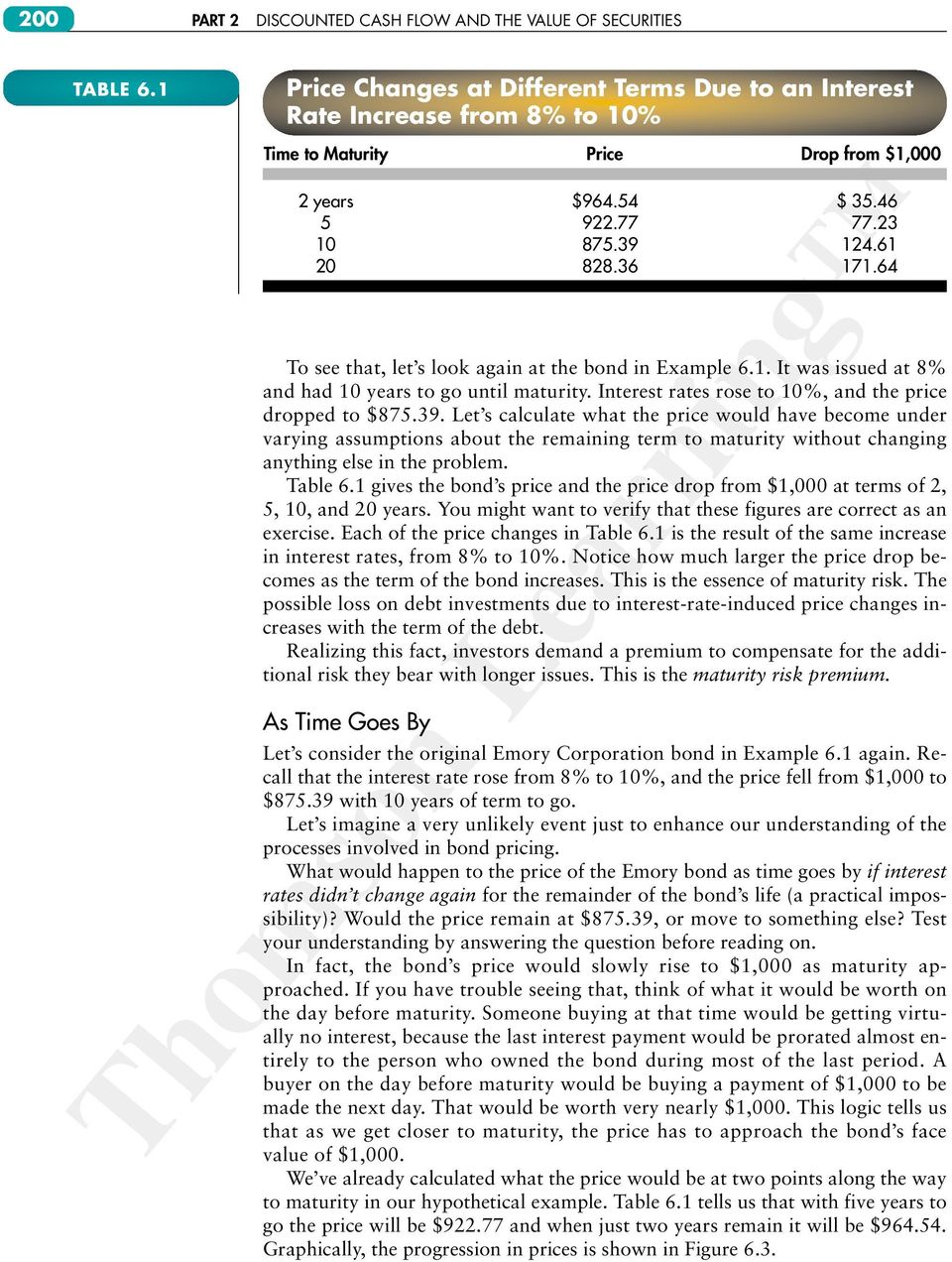
12 200 PART 2 DISCOUNTED CASH FLOW AND THE VALUE OF SECURITIES TABLE 6.1 Price Changes at Different Terms Due to an Interest Rate Increase from 8% to 10% Time to Maturity Price Drop from $1,000 2 years $ $ To see that, let s look again at the bond in Example 6.1. It was issued at 8% and had 10 years to go until maturity. Interest rates rose to 10%, and the price dropped to $ Let s calculate what the price would have become under varying assumptions about the remaining term to maturity without changing anything else in the problem. Table 6.1 gives the bond s price and the price drop from $1,000 at terms of 2, 5, 10, and 20 years. You might want to verify that these figures are correct as an exercise. Each of the price changes in Table 6.1 is the result of the same increase in interest rates, from 8% to 10%. Notice how much larger the price drop becomes as the term of the bond increases. This is the essence of maturity risk. The possible loss on debt investments due to interest-rate-induced price changes increases with the term of the debt. Realizing this fact, investors demand a premium to compensate for the additional risk they bear with longer issues. This is the maturity risk premium. As Time Goes By Let s consider the original Emory Corporation bond in Example 6.1 again. Recall that the interest rate rose from 8% to 10%, and the price fell from $1,000 to $ with 10 years of term to go. Let s imagine a very unlikely event just to enhance our understanding of the processes involved in bond pricing. What would happen to the price of the Emory bond as time goes by if interest rates didn t change again for the remainder of the bond s life (a practical impossibility)? Would the price remain at $875.39, or move to something else? Test your understanding by answering the question before reading on. In fact, the bond s price would slowly rise to $1,000 as maturity approached. If you have trouble seeing that, think of what it would be worth on the day before maturity. Someone buying at that time would be getting virtually no interest, because the last interest payment would be prorated almost entirely to the person who owned the bond during most of the last period. A buyer on the day before maturity would be buying a payment of $1,000 to be made the next day. That would be worth very nearly $1,000. This logic tells us that as we get closer to maturity, the price has to approach the bond s face value of $1,000. We ve already calculated what the price would be at two points along the way to maturity in our hypothetical example. Table 6.1 tells us that with five years to go the price will be $ and when just two years remain it will be $ Graphically, the progression in prices is shown in Figure 6.3.
13 CHAPTER 6 THE VALUATION AND CHARACTERISTICS OF BONDS 201 FIGURE 6.3 Price Progression with Constant Interest Rate $1, $ $ $ Price 0 0 Issue Maturity Time FINDING THE YIELD AT A GIVEN PRICE Basically only two questions are asked about the dollars and cents of bonds. We ve just explored the first, finding the price at which a bond achieves a specified yield. The second question is the reverse of the first. It asks for the yield on a bond investment if the security sells at a particular price. In the bond valuation formula, equation 6.4, this question asks us to find the market interest rate, k, given a value for P B. Let s rewrite equation 6.4 for convenient reference. (6.4) P B 5 PMT[PVFA k,n ] 1 FV[PVF k,n ] Recall that finding P B when the market yield is known simply involves doing two time value problems and adding the results together. We do a present value of an annuity problem for the interest payments and a present value of an amount problem for the return of the face value. Finding k when P B is known is conceptually the same but much more difficult. Recall the time value problems we studied in Chapter 5. In both amount and annuity problems we were able to solve for an unknown k quite easily. We did so by solving one of the time value formulas for a factor, and then finding the factor in the table. Even though the bond formula utilizes present value factors and the same tables we used in Chapter 5, this approach doesn t work. It fails because equation 6.4 uses two time value factors at the same time. As we have only one equation, we can t solve for both, and therefore can t find the right column and row in each table simultaneously. This mathematically unfortunate state of affairs means we have to resort to a rather tedious approach to solving the problem, trial and error. We begin by guessing at a solution for k. Then we value the bond at that return by using equation 6.4 and whatever other information we have. That process results in a price

14 202 PART 2 DISCOUNTED CASH FLOW AND THE VALUE OF SECURITIES EXAMPLE 6.3 Calculator Solution Key Input n 32 PV FV 1,000 PMT 40 Answer I/Y we can compare with the price given by the problem. If they re significantly different, we have to guess at the return again and reevaluate for another price. We keep doing that until we get a price that s very close to the one we re looking for. The trial and error approach isn t as haphazard as it may seem. By applying a little logic, we can usually get close to the answer in a few tries. An example will make the process clear. The Benson Steel Company issued a 30-year bond 14 years ago with a face value of $1,000 and a coupon rate of 8%. The bond is currently selling for $718. What is the yield to an investor who buys it today at that price? (Assume semiannual interest.) Solution: First we make an educated guess at the answer on the basis of our knowledge that interest rates and bond prices move in opposite directions. In this case the $718 price is substantially below the face value of $1,000, so we know the bond s yield must be quite a bit above the coupon rate. Let s make a first guess at 10%. Evaluating at 10%, we have the following variables. PMT 5 (.08 3 $1,000)/2 5 $40 n k 5 10%/2 5 5% FV 5 $1,000 Then, using Equation 6.4, we have P B 5 PMT[PVFA k,n ] 1 FV[PVF k,n ] 5 $40[PVFA 5,32 ] 1 $1,000[PVF 5,32 ] 5 $40( ) 1 $1,000(.2099) 5 $ $ $ Clearly 10% isn t the solution, because we re looking for the rate that yields a price of $718. Our choice has brought the price down from $1,000, but not far enough. That means we have to bring the rate up quite a bit more. For illustrative purposes, let s jump all the way to 14% (we probably wouldn t go that far if we weren t trying to make a point). The only input that changes from our last try is k, which is now k 5 14%/2 5 7%. Substitute into equation 6.4 and verify that the calculation leads to P B 5 $ This figure is substantially below the target of $718, so we ve pushed our interest rate too high. Now we know the answer has to be between 10% and 14%. Let s try a figure right in the middle. Evaluate the bond at 12% to verify that the resulting price is P B 5 $

15 CHAPTER 6 THE VALUATION AND CHARACTERISTICS OF BONDS 203 Call provisions allow bond issuers to retire bonds before maturity by paying a premium (penalty) to bondholders. This is just a shade higher than the actual selling price, so the true yield is just below 12%. For most purposes, declaring 12% the solution would be close enough. Financial calculators are programmed to solve bond programs, including finding yields. The internal workings of such calculators do exactly what we ve just done, find the solution by trial and error.. CALL PROVISIONS Circumstances sometimes arise in which bond issuers want to pay off their indebtedness early. This commonly occurs when interest rates drop a great deal after bonds are issued. For example, suppose a company issues a 30-year bond with a 15% coupon rate when interest rates are at about that level. Some years later, suppose rates drop to 7%. The firm will be stuck paying above-market rates on the bond s principal until maturity unless it can somehow get out of the loan arrangement with the bondholders. Companies that issue bonds anticipate this sort of thing, and like to include call provisions in bond agreements to protect themselves. A call provision is a clause that gives the issuing organization the right to pay off the bond prior to maturity. In our illustration, the company would like to borrow money at the new lower interest rate of 7%, and use it to retire the old bond that pays 15%. The process is called refunding the debt. Investors who buy bonds don t like call provisions because they feel the clauses give firms the opportunity to renege on interest rate obligations. In the example we ve just described, the bondholders were getting a 15% return on funds in a market that currently offered only 7%. If the bond is paid off early, they ll lose that 15% and will have to reinvest at 7%. These conflicting interests are reconciled with a two- or three-part compromise. First, call provisions are generally written to include a call premium that must be paid to bondholders if the feature is exercised. This means that if the company chooses to pay a bond off early, it must pay lenders (bondholders) some extra money as compensation for their loss of the original deal. The premium is usually stated in terms of extra interest at the coupon rate, and diminishes as the bond s maturity approaches. Second, issuers usually agree that the bond won t be called for a certain number of years at the beginning of its life. This initial time is the period of call protection. Finally, to attract buyers, a bond with a call provision may require a somewhat higher interest rate than similar bonds without call provisions. Call provisions are also sometimes exercised to free companies of restrictions imposed by certain agreements associated with bond contracts called indentures. We ll discuss indentures later in the chapter. Figure 6.4 portrays a declining call premium starting at one year s interest on a 10%, $1,000 bond with a term of 10 years and a call-protected period of five years. The call premium is also known as a call penalty. This apparent conflict is easily explained by point of view. The payment is a premium to the investor who receives it but a penalty to the company that pays it. Call provisions are also called call features.

16 204 PART 2 DISCOUNTED CASH FLOW AND THE VALUE OF SECURITIES INSIGHTS Practical Finance A zero coupon bond pays no interest during its life, but imputed interest is still taxable. FIGURE 6.4 The Call-Protected Period and a Declining Call Premium Can a Bond Be a Bond without Paying Interest? The answer to that mysterious question is yes; they re called zero coupon bonds. To understand the idea think about a bond issued at a very low coupon rate say, half the market rate. It would sell at a deep discount because the interest payments would be less than investors could get elsewhere. But offsetting the low interest payments, investors would receive the bond s face value at maturity, which would be more than they paid for it. In other words, investors who chose the bond would be trading some current income for a capital gain later on. But that capital gain would be unusual in that it wouldn t come from changing market values. It would actually be interest earned on the debt all along but not paid until maturity. If we take this idea to the extreme making the coupon interest smaller and smaller until it s gone, we ve got a zero coupon bond. Essentially it s just a promise to pay a face amount in the future that sells for the present value of that amount today. The zero has some interesting tax implications. You d think the investor would pay no tax until maturity because no money is received until then. But that isn t the case. The IRS imputes interest during the bond s life and demands tax on the phantom income. We re all familiar with zeros under another name, U.S. savings bonds. They operate in exactly the same way. We buy a bond for the present value of its face at maturity. They re a popular gift because a $100 bond only costs about $60. There is one big difference, however. The government gives buyers of its own zeros a break by not taxing the interest until maturity. The Effect of a Call Provision on Price A special situation arises when a bond with a call provision is in its protected period, but appears certain to be called as soon as that period is over. In such a case the traditional bond valuation procedure doesn t work because it includes cash flows projected to occur after the protected period. These cash flows aren t likely to be forthcoming because the bond will probably be paid off exactly at the end of the protected period. In such cases, bondholders will actually receive normal interest payments up until call, at which time they ll receive the bond s face value plus the call premium. The situation is illustrated graphically in Figure 6.5. Examine the diagram carefully. It shows the entire life of a bond that was originally intended to pay interest for 10 semiannual periods. This would normally be a five-year bond. The first three years are call protected in this example. We re 0 Call Protected Bond s Term in Years $100 $80 $60 $40 $20 Declining Call Premium 10

17 CHAPTER 6 THE VALUATION AND CHARACTERISTICS OF BONDS 205 FIGURE 6.5 Valuation of a Bond Subject to Call 0 assuming the first year has past, so the present is indicated by Now at the end of period 2. We assume the interest rate has dropped substantially, so the bond is very likely to be called at the end of the third year, period 6. Cash flows planned after that time probably won t happen. These are shown in italics. We d normally value this bond by taking the present value of all the payments from Now until maturity, including the return of the face value at maturity. This would mean that in the bond valuation formula we would use n 5 8 and substitute the face value for FV. What s actually going to happen, however, is a shorter series of interest payments ending with the sixth, and a final payment equal to FV plus the call premium. Valuing the Sure To Be Called Bond We can value this bond with the same formula we ve used up until now by making two simple modifications to our inputs. All we have to do to realistically represent what is likely to happen is let n equal the time to call instead of the time to maturity, and add the call premium to the face value when we portray the final payment. The sum of the face value and the call premium is known as the call price. We can express these ideas in a modification of the bond formula as follows. (6.5) P B (call) 5 PMT[PVFA k,m ] 1 CP[PVF k,m ], where PMT PMT PMT PMT Now Valuation to Call Bond s Life PMT PMT PMT PMT PMT PMT FV End of Call Protection FV + Maturity Call Premium Valuation to Maturity m 5 number of periods to call CP 5 call price 5 face value 1 call premium Unlikely to Occur PMT and k are computationally the same as in the problem without a call. However, k is known as the yield to call, abbreviated YTC, because it s used in taking the present value of cash flows only until the call is likely to occur.

18 206 PART 2 DISCOUNTED CASH FLOW AND THE VALUE OF SECURITIES EXAMPLE 6.4 Calculator Solution Key Input n 40 I/Y 4 FV 1,000 PMT 90 Answer PV 1, The Northern Timber Co. issued a $1,000, 25-year bond five years ago. The bond has a call provision that allows it to be retired any time after the first 10 years with the payment of an additional year s interest at the coupon rate. Interest rates were especially high when the bond was issued, and its coupon rate is 18%. Interest rates on bonds of comparable risk are now 8%. What is the bond worth today? What would it be worth if it didn t have the call feature? Assume interest payments are semiannual. Solution: This problem asks us to evaluate the price of the bond, first assuming the call feature will be exercised (which is very likely) and then in the normal way. The basic assumption is that the bond must yield the current rate of interest in either case. That is, even if the bond is going to be called, the price will adjust to bring the yield to the market rate of 8%. A graphic depiction of the problem follows (the interest payments are omitted). Notice that the time line shows semiannual periods rather than years. The call premium is 18% of $1,000 or $180, so the call price is ($1,000 1 $180 5) $1,180. Normal Valuation to Maturity n = 20 years 2 = 40 Now FV = $1, Now Call Valuation CP = FV + Call Premium = $1,180 to Call m = 5 years 2 = 10 At the top of the diagram, above the time line, we show the period over which the bond would normally be evaluated and the face value to be returned of $1,000. At the bottom we show the relevant period for a likely call and a call price of $1,180. First we ll evaluate to maturity using equation 6.4. P B 5 PMT[PVFA k,n ] 1 FV[PVF k,n ]. The variables follow. PMT 5 (.18 3 $1,000)/2 5 $90 n k 5 8%/2 5 4% FV 5 $1, Semiannual Periods

19 CHAPTER 6 THE VALUATION AND CHARACTERISTICS OF BONDS 207 Substituting, we have P B 5 $90[PVFA 4,40 ] 1 $1,000[PVF 4,40 ] Calculator Solution Key Input n 10 I/Y 4 FV 1,180 PMT 90 Answer PV 1, $90[ ] 1 $1,000[.2083] 5 $1, $ $ Notice how much the price has risen, almost doubling the original $1,000. That s because the drop in the interest rate was very substantial and the bond has a long time to go until maturity. This price represents the present value of Northern Timber s (the bond issuer) cash flow commitment if the bond isn t called. Next we ll evaluate to call using equation 6.5. P B (call) 5 PMT[PVFA k,m ] 1 CP[PVF k,m ]. The variables follow. PMT 5 (.18 3 $1,000)/2 5 $90 m k 5 8%/2 5 4% CP 5 $1, ($1,000) 5 $1,180 Substituting, P B (call) 5 $90[PVFA 4,10 ] 1 $1,180[PVF 4,10 ] 5 $90[8.1109] 1 $1,180[.6756] 5 $ $ $1, Notice that the price is substantially above $1,000 but is much less than the price without a call. From the point of view of a bond buyer, the only relevant price is $1,527.19, because the likelihood of call is very high. This price represents the value of Northern Timber s cash flow commitment if the bond is called. Notice how much Northern will save if it calls the bond.. The Refunding Decision Whenever the current interest rate is substantially below a bond s coupon rate and the issue has a call feature, the issuing company has to decide whether or not to exercise the call. The company has to compare the interest savings from calling the bond with the cost of making the call and issuing a new bond to raise the money required to pay the old one off. The difference in bond prices in the last example shows the interest savings associated with a call and includes a major cost item, the call premium. However, the figure does not include administrative expenses or the cost of issuing a new bond. The costs incurred in issuing new bonds are known as flotation costs and can be rather substantial. They re primarily brokerage fees paid to investment bankers, but they also include administrative expenses and the costs of printing and engraving.

20 208 PART 2 DISCOUNTED CASH FLOW AND THE VALUE OF SECURITIES As a result of these costs, interest rates have to drop a lot before it s advisable for a company to refund by calling in one bond issue and floating another. from the CFO from the CFO Dangerous Bonds with Surprising Calls Bonds can occasionally have obscure call features buried in their contract terms that can cause unwary investors real grief. These generally take the form of a clause that says if some particular event occurs the bond will be called at face value. The most common of these clauses involve sinking fund provisions. Recall that in Chapter 5 we described a sinking fund as a way lenders guarantee that borrowers will have enough money put aside to pay off a bond s principal when it comes due. (Review pages if necessary.) There we said that borrowing firms can make deposits in a separate account whose future value will be the amount of the bond s principal. Another way to provide for an orderly payoff of principal is to require that the individual bonds of an issue be called in and paid off over a series of years rather than all at once. For example, suppose a company borrowed a million dollars for 25 years by issuing 1, year bonds, each with a face value of $1,000. Repayment could be made a lot more secure if, instead of paying off all the bonds at the maturity date, the company called and retired a few each year during the last five years of the issue s life. Sinking fund provisions often require companies to do just that, call in and retire a fixed percentage of the issue each year toward the end of the term. Since this procedure is for the benefit of the bondholders (to increase their security), the agreements don t generally include a call premium. The bonds called are usually determined by a lottery, so no one knows which bonds will be called early and which will continue to maturity. Now, suppose a particular bond that s subject to sinking fund provisions like these happens to be selling at a premium because of interest rate changes. An unlucky investor might buy a $1,000 face value bond for, say, $1,100, and in short order receive a call at $1,000 that results in an immediate loss of $100! This does happen, even though bond investments are supposed to be relatively safe. Here s another example. Government agencies issue bonds that are backed by mortgages on residential real estate. If the mortgages underlying the bonds are held to maturity, the bonds pay interest until maturity. But if the mortgages are paid off early, the funds are used to retire the bonds at face value. Because no one knows how fast people will pay off their home mortgages, you can never be sure the mortgage-backed bonds won t be called early. Needless to say, it s wise to check the details of bond agreements before investing. RISKY ISSUES Sometimes bonds sell for prices far below those indicated by the valuation techniques we ve described so far in this chapter. For example, suppose we applied equation 6.4 to a particular $1,000 face value bond and came up with a value of $950. However, suppose we checked the financial pages of a newspaper and found the bond to be trading at $500. This would usually mean the company that issued the bond is in financial trouble, and there is some question about its ability to honor the obligations of the bond agreement. In other words, analysts feel it might default on the payment of interest and/or principal. Obviously such a risk will cause investors to lower their estimates of what any security is worth.

21 CHAPTER 6 THE VALUATION AND CHARACTERISTICS OF BONDS 209 A record of owners of registered securities is kept by a transfer agent. Payments are sent to owners of record as of the dates the payments are made. Current bond investment articles can be found in MONEY magazine at in Kiplinger s Personal Finance magazine at in Business Week at and in Smart Money at Financial purists argue that in such a situation equation 6.4 still gives the right answer if we properly select the interest rate k. The argument is that the increased risk should be reflected in a higher expected return to the investor. Using a higher k results in a lower calculated price. In other words, the bond has slipped into a lower quality class, which should be reflected by the requirement of a higher yield to compensate for the chance that the investor may lose everything if things go poorly for the company. However you look at it, a major deterioration in a bond-issuing company s financial performance will substantially depress the price of its securities, including bonds. INSTITUTIONAL CHARACTERISTICS OF BONDS In the remainder of this chapter we ll describe some of the more important features of bonds and bond agreements that aren t directly related to pricing. Keep the fundamental definition of a bond in mind as we go forward. A bond is a device that enables an organization (generally a corporation or a government unit) to borrow from a large number of people at the same time under one agreement. REGISTRATION, TRANSFER AGENTS, AND OWNERS OF RECORD Bonds are classified as either bearer bonds or registered bonds. Bearer bonds belong to whoever possesses them, a convention that makes them dangerously subject to loss and theft. Bearer bonds have coupons attached for the payment of interest as described earlier. The owners of registered bonds are recorded with a transfer agent. This is an organization, usually a bank, that keeps track of the owners of stocks and bonds for issuing companies. When one investor sells a security to another, the agent transfers ownership in its records as of the date of the sale. On any given date, there is a particular owner of record on the transfer agent s books for every bond (and share of stock) outstanding. Interest payments are sent directly to the owners of record of registered bonds as of the date the interest is paid. KINDS OF BONDS Several distinguishing features divide bonds into different categories. We ll briefly discuss a few of the more important distinctions. Secured Bonds and Mortgage Bonds Secured bonds are backed by the value of specific assets owned by the issuing company. If the firm defaults, the secured bondholders can take possession of the assets and sell them to recover their claims on the company. The essence of the secured arrangement is that the assets tied to specific debt aren t available to other creditors until that debt is satisfied. When the securing assets are real estate, the bond is called a mortgage bond. Debentures Debentures are unsecured bonds. They rely on the general creditworthiness of the issuing company rather than the value of specific assets. Debentures are clearly more risky than the secured debt of the same company. Therefore, they must usually be issued to yield higher returns to investors.
22 210 PART 2 DISCOUNTED CASH FLOW AND THE VALUE OF SECURITIES Subordinated debt is lower in priority for payment of principal and interest than senior debt. Convertible bonds can be exchanged for specified amounts of stock. Junk bonds are issued by risky companies and pay high interest rates. Subordinated Debentures and Senior Debt The term subordinated means lower in rank or priority. In terms of debt, it means having lower priority than other debt for repayment in the event the issuing company fails. Debentures can be subordinated to specific issues or to all other debentures in general. The debt having priority over a subordinated debenture is known as senior debt. Conceptually, subordination arises with the senior debt. For example, suppose a lender is considering making a loan but fears the borrower will take on more debt from other lenders in the future. Then if the borrower failed, whatever assets were available to satisfy unpaid loans would have to be shared among a large number of creditors. Some security is afforded to the first lender by writing a clause into the loan agreement requiring the subordination of all future debt. Because subordinated debt is riskier than senior or unsubordinated debt, it generally requires a higher yield than those issues. Convertible Bonds Convertible bonds can be converted into a specified number of shares of stock at the option of the owner. Bondholders generally exercise the conversion privilege if the stock s price rises enough to make the converted shares of stock worth more than the bond. Recall that an important distinction between stocks and bonds is that stocks have a potential for significant price appreciation if the issuing company does very well, but bonds do not. Convertible features are designed to share a limited amount of that appreciation potential with bondholders. Hence, they re sweeteners that make bonds more attractive. For example, a $1,000 bond might be convertible into 50 shares of stock, implying a conversion price of $20 per share. The bond is issued when the price of the stock is substantially below $20. Then suppose the stock s price rises to $25. The bondholder converts, effectively paying $20 for shares with a market value of $25, making a gain of $ shares 5 $250. Of course, if the stock s price never exceeds $20, the conversion feature is never exercised and turns out to have no value. Convertibles can generally be issued at somewhat lower interest rates than regular bonds. Such a rate reduction reflects the value placed on the conversion potential by the market. Further, companies can occasionally borrow using convertibles when traditional debt would be impossible to market because of risk. Junk Bonds Junk bonds are issued by companies that are not in particularly sound financial condition or are considered risky for some other reason. They generally pay interest rates that are as much as 5% higher than the rates paid by the strongest companies. Hence they re also called high-yield securities. Before the mid-1970s it was virtually impossible for risky firms, especially new, small companies, to borrow by issuing unsecured bonds. Investors were simply unwilling to accept the risks associated with such firms at any promised rate of return. At that time, however, a concept of pooling risky bonds arose and seemed to make high-risk, high-yield issues viable in the sense of being reason-
23 CHAPTER 6 THE VALUATION AND CHARACTERISTICS OF BONDS 211 Bond ratings gauge the probability that issuers will fail to meet their obligations. ably safe investments. For a few years the volume of junk bonds exploded, growing until it represented 10% to 20% of the total domestic bond market. In the late 1980s and early 1990s, the safety perceived in the pooling technique evaporated when the economy went into a sustained recession. As a result, the junk bond vehicle lost most of its popularity. We ll discuss junk bonds again in Chapter 17. BOND RATINGS ASSESSING DEFAULT RISK Recall that in Chapter 4 we discussed several risks associated with bonds, including the risk of default (pages ). In practice, investors and the financial community go to great lengths to assess and control exposure to default risk in bonds. Bonds are assigned quality ratings that reflect the probability of their going into default. Higher ratings mean lower default probabilities. The bond ratings are developed by rating agencies that make a business of staying on top of the things that make bonds and the underlying firms more or less risky. The best known rating agencies are Moody s Corporation (known as Moody s) and Standard & Poor s Corporation (generally called S&P). The agencies rate bonds by examining the financial and market condition of the issuing companies and the contractual provisions supporting individual bonds. It s important to realize that the analysis has these two parts. A bond s strength is fundamentally dependent on that of the issuing corporation, but some things can make one bond safer than another issued by the same company. For example, a mortgage bond backed by real estate will always be stronger than an unsecured debenture issued by the same company. Similarly, senior debt is always superior to subordinated debt. The process of rating a bond begins with a financial (ratio) analysis of the issuing firm using the kinds of tools we developed in Chapter 3. To that the agencies add any knowledge they have about the company, its markets, and its other dealings. For example, suppose a firm has good financial results and a prosperous market outlook but is threatened by a major lawsuit. If the lawsuit is very serious, it can lower the rating of the firm s bonds. Bond ratings are not precise in the sense of being the result of a mathematical formula. Although they do rely heavily on standard numerical (ratio) analyses, they also include qualitative judgments made by the rating agencies. Rating Symbols and Grades Moody s and S&P use similar scales to describe the bonds they rate. It s important to be generally familiar with the meaning of the terms. Table 6.2 summarizes the symbols used by the two firms and their meanings. The distinction between bonds above and below the Baa/BBB is especially significant. Bonds at or above that level are said to be investment grade, whereas those below are considered substandard. The latter can be called junk bonds. Why Ratings Are Important Throughout our study, we ve stressed the fact that risk and return are related, and that investors require higher returns on riskier investments. Ratings are the primary measure of the default risk associated with bonds. Therefore they re an important determinant of the interest rates investors demand on the bonds of different companies.
24 212 PART 2 DISCOUNTED CASH FLOW AND THE VALUE OF SECURITIES TABLE Bonds Online Internet provides information about investing in bonds at FIGURE 6.6 The Yield Differential between High- and Low-Quality Bonds Moody s and S&P Bond Ratings Moody s S&P Implication Aaa AAA Highest quality, Aa AA extremely safe A A Good quality, Baa BBB investment grade Ba BB Poor quality, B B risky Caa CCC Low quality, Ca CC very risky C C D In effect, the rating associated with a firm s bonds determines the rate at which the firm can borrow. A lower rating implies the company has to pay higher interest rates. That generally means it s more difficult for the company to do business and earn a profit, because it s burdened with a higher cost of debt financing. To be precise about what we ve just said, the idea is laid out in Figure 6.6. All bond yields (interest rates) move up and down over time, but there s always a differential between the rates required on high and low quality issues. The lower curve associated with high-quality bonds means that the issuing companies can borrow at lower rates (more cheaply) than those associated with risky, low-quality bonds. The safest, highest quality bond is a federal treasury bond, which has no default risk (Chapter 4, page 125). Its yield plotted on a graph like Figure 6.6 would be lower than that of any other bond. A bond s rating affects the size of the differential between the rate it must pay to borrow and the rate demanded of high quality issues. It does not affect the overall up and down motion of the rate structure. Clearly, the differential reflects Bond Yields Low Quality Differential between High- and Low- Quality Bonds High Quality Time
25 CHAPTER 6 THE VALUATION AND CHARACTERISTICS OF BONDS 213 INSIGHTS Real Applications Even the Safest Companies Can Default on Bonds The Perils of Utility Deregulation in California Public utilities like water and power companies have traditionally issued some of the safest securities available. That s because until recently they were all regulated monopolies. This means customers have to buy their water and electricity from the utilities, but prices are set by government commissions that ensure customers get a fair deal. This generally makes investment in utility stocks and bonds safe but unexciting. Under normal conditions, regulated utilities just about can t lose money, but they can t make much either. As a result, returns on their securities are stable and relatively risk free. Utility bonds have always been particularly safe havens for investors concerned about risk, and traditionally received high grades from bond rating agencies. However, in recent years there s been a general movement by state governments to deregulate utilities, that is, to take away their monopoly status and eliminate price controls. The rationale is that the pressure of competition will result in greater efficiency and lower prices for consumers. California moved toward an unregulated approach to the electric power business with laws passed in Electric power is provided in a two-step process. Suppliers generate electricity and sell it wholesale to electric utilities, who sell it to homes and businesses at retail prices. Traditionally both wholesale and retail transactions were regulated. In California, legislation was designed to phase in deregulation by introducing market pricing of the utilities purchase of power from power suppliers first, and then to later introduce market pricing to the end consumer. It was believed this two-step procedure would prevent consumers from experiencing a big jolt at the start of deregulation. Unfortunately, the convergence of unregulated wholesale prices and regulated retail prices had an unexpected outcome that put some of California s huge electric utilities in great peril. They were forced to buy their power in a market in which suppliers could raise prices at will, but they had to sell it in regulated markets in which they couldn t raise prices to match their costs. From May of 2000 until May of 2001, companies like Southern California Edison ran up massive bills as prices to purchase wholesale electricity surged to unforeseen highs. With customer prices controlled, Southern California Edison was unable to pass on its higher cost and accumulated losses of $3.3 billion. That loss caused the company to default on many of its bond obligations in January of Seeing the trouble coming, Moody s downgraded the bonds rating from A1 to A2 in November of Then, after the default, the debt s rating was further lowered to junk status of Caa2. The downgrading of Southern California Edison s debt wasn t surprising since there was serious talk about the company going into bankruptcy. In October of 2001, the state stepped in and entered into an agreement with the company to help it pay off its debt. That was great news for the bondholders who had invested in these securities before the series of downgrades and for those who took a chance and invested later when the company was in default. Whether Southern California Edison will regain its investment grade status in the near future is still uncertain. Although the current debt crisis has been handled, the fact that Southern California Edison still cannot pass on the wholesale cost of energy to consumers will continue to make investors cautious. Sources: Jacob Fine, California s Silver Lining, The Bond Buyer (January 31, 2001): 1; Christopher O Leary, Wall Street Pans for gold in the Detritus of California s Big Utilities, The Investment Dealers Digest (January 15, 2001): 3 4; Mark Golden, Dow Jones Newswires (October 5, 2001).
26 214 PART 2 DISCOUNTED CASH FLOW AND THE VALUE OF SECURITIES the risk of default perceived to exist with lower quality bonds. This is the default risk premium we discussed in Chapter 4. The differential between the yields on high- and low-quality bonds is an indicator of the health of the economy. Bond indentures attempt to prevent firms from becoming riskier after the bonds are purchased. THE DIFFERENTIAL OVER TIME Notice that the quality differential tends to be larger when interest rates are generally high than when they re low. This is an important fact and makes logical sense. High rates tend to be associated with recessions and tough economic times. It s during those periods that marginal companies are prone to fail. In other words, the risk of default associated with weak companies is greater in bad times than in good times. Because it expresses the level of risk, the differential tends to be larger in recessionary periods. In fact, this phenomenon is strong enough to be considered an economic indicator. That means a high differential is taken as a signal that harder times are on the way. THE SIGNIFICANCE OF THE INVESTMENT GRADE RATING Most bonds are purchased by institutional investors rather than by individuals. These investors include mutual funds, banks, insurance companies, and pension funds. Many such institutions are required by law to make only relatively safe, conservative investments. Therefore they can deal only in investment grade bonds. This requirement severely limits the market for the debt of companies whose bonds aren t considered investment grade. BOND INDENTURES CONTROLLING DEFAULT RISK In Chapter 1 we discussed a conflict of interest between creditors and stockholders (page 18). Virtually all business operations involve some risk. However, higher levels of risk are usually associated with higher rewards. The conflict of interest arises because the rewards of successful risk taking accrue largely to stockholders, while the penalties for failure can be shared between stockholders and creditors. Indeed, bondholders can be hurt even if failure doesn t occur. If a company is perceived to become more risky, the return investors require on its debt increases immediately, which in turn drives down the market price of its bonds. When that happens, bondholders suffer an immediate loss. Investors contemplating lending to a company by buying its bonds look at the current level of risk associated with the business. If they re comfortable with that level, they purchase bonds, but remain concerned that future operations could become more risky. That might happen if the firm takes on riskier projects, encounters financial problems, or is managed unwisely. To ensure that bond-issuing companies maintain an even level of risk, lenders usually insist that bond agreements contain restrictions on the borrower s activities until the bonds are paid off. The contractual document containing such restrictive covenants is called the bond indenture. Typical indenture provisions preclude entering certain high-risk businesses and limit borrowing more money from other sources. Indentures may also require that certain financial ratios be held above minimum levels. For example, an indenture might require that times interest earned (TIE) be maintained above a particular figure, say seven. Every bond issue has a trustee whose job is to administer and enforce the terms of the indenture on behalf of the bondholders. Trustees are usually banks.
27 CHAPTER 6 THE VALUATION AND CHARACTERISTICS OF BONDS 215 INSIGHTS Practical Finance Sinking funds provide money for the repayment of bond principal Ethical Debt Management Suppose a firm borrows through a bond issue with a relatively weak indenture that doesn t say anything about additional future debt. Then suppose it wants to borrow more later on, but the new lender is concerned about safety, and insists that its debt be made senior to existing debt. If the firm agrees it will damage the investors who hold the old bonds. It s fairly obvious that the original bondholders will suffer if the firm fails, because they ll stand behind the new creditors in being paid out of any assets that survive the failure. But they may be hurt even if the firm does well. That s because the old bond s rating is likely to be lowered because of its new subordinate status. That means the market will perceive the issue as having more risk, and is likely to lower its price immediately. Hence old bondholders will take a loss if they sell. Is it ethical for a firm to do that without in some way compensating the old bondholders? What if management argues that the firm desperately needs the new money and will be in big trouble without it. What would you do if you were CFO? Sinking Funds Recall that bonds are non-amortized debt, meaning that the borrowed principal is not repaid until maturity. This creates a risk for bondholders in that borrowing firms may not have the funds to make large principal repayments. Considerable safety is provided by a sinking fund that spreads the repayment of principal over time. We ve already discussed two sinking fund arrangements. The first calls for periodic deposits such that the amount available at maturity is equal to the principal to be repaid. We illustrated that approach as a future value of an amount problem in Example 5.6 on page 155. A second arrangement involves randomly calling in some bonds for retirement prior to maturity. We discussed that approach starting on page 208 of this chapter. Still another approach is to issue serial bonds, splitting the total amount borrowed into several separate issues with different maturities, usually about a year apart. DISCUSSION QUESTIONS 1. What is valuation, and why are we interested in the results? 2. Contrast real assets and financial (paper) assets. What is the basis for the value of each? 3. How can two knowledgeable people come to different conclusions about the value of the same security? Can this happen if they have access to the same information? 4. Describe the nature of a bond. Include at least the following ideas. term/maturity face value debt versus equity buying a bond non-amortized one borrower/many lenders risk conflict with stockholders
28 216 PART 2 DISCOUNTED CASH FLOW AND THE VALUE OF SECURITIES 5. What is a call provision? Why do companies put them in bonds? Define call-protected period and call premium/penalty. 6. Two interest rates are associated with pricing a bond. Name and describe each. How are they used? Describe a third rate not used in pricing. 7. If bonds pay fixed interest rates, how can they be sold year after year on the secondary market? Include the idea of how yields adjust to changing market interest rates. 8. Why do bonds have indentures? 9. Describe bond pricing as two time value of money problems. 10. What is the relationship between bond prices and interest rates? Verbally describe how this relationship comes about. How can we use this relationship to estimate the value of a bond? 11. What is interest rate or price risk? Why is it sometimes called maturity risk? Explain fully. 12. What causes maturity risk? In other words, why do long-term bonds respond differently to interest rate changes than short-term bonds? (Hint: Think about how the present value formulas work.) 13. Using words only, describe the process of finding a bond s yield at a given selling price. 14. Under what conditions is a bond almost certain to be called at a particular date in the future? How does this condition affect its price? 15. You re an analyst in the finance department of Flyover Corp., a new firm in a profitable but risky high-tech business. Several growth opportunities have come along recently, but the company doesn t have enough capital to undertake them. Stock prices are down, so it doesn t make sense to try to raise new capital through the sale of equity. The company s bank won t lend it any more money than it already has, and investment bankers have said that debentures are out of the question. The treasurer has asked you to do some research and suggest a few ways in which bonds might be made attractive enough to allow Flyover to borrow. Write a brief memo summarizing your ideas. 16. The Everglo Corp., a manufacturer of cosmetics, is financed with a mix of debt and equity. The debt is in the form of debentures that have a relatively weak indenture. Susan Moremoney, the firm s president and principal stockholder, has proposed doubling the firm s debt by issuing new bonds secured by the company s existing assets, and using the money raised to attack the lucrative but very risky European market. You re Everglo s treasurer, and have been directed by Ms. Moremoney to implement the new financing plan. Is there an ethical problem with the president s proposal? Why? Who is likely to gain at whose expense? (Hint: How are the ratings of the existing debentures likely to change?) What would you do if you really found yourself in a position like this?
29 CHAPTER 6 THE VALUATION AND CHARACTERISTICS OF BONDS 217 PROBLEMS 17. You re the CFO of Nildorf Inc., a maker of luxury consumer goods that, because of its product, is especially sensitive to economic ups and downs (people cut back drastically on luxury items during recessionary times). In an executive staff meeting this morning, Charlie Suave, the president, proposed a major expansion. You felt the expansion would be feasible if the immediate future looked good, but were concerned that spreading resources too thin in a recessionary period could wreck the company. When you expressed your concern, Charlie said he wasn t worried about the economy because the spread between AAA and B bonds is relatively small, and that s a good sign. You observed, however, that rates seem to have bottomed out recently and are rising along with the differential between strong and weak companies. After some general discussion, the proposal was tabled pending further research. Later in the day, Ed Sliderule, the chief engineer, came into your office and asked, What in the world were you guys talking about this morning? Prepare a brief written explanation for Ed. 18. How and why do sinking funds enhance the safety of lenders? Assume all bonds pay interest semiannually. 1. The Altoona Company issued a 25-year bond five years ago with a face value of $1,000. The bond pays interest semiannually at a 10% annual rate. a. What is the bond s price today if the interest rate on comparable new issues is 12%? b. What is the price today if the interest rate is 8%? c. Explain the results of parts a and b in terms of opportunities available to investors. d. What is the price today if the interest rate is 10%? e. Comment on the answer to part d. 2. Calculate the market price of a $1,000 face value bond under the following conditions. Coupon Rate Time Until Maturity Current Market Rate a. 12% 15 years 10% b c d e The Sampson Company issued a $1,000 bond 5 years ago with an initial term of 25 years and a coupon rate of 6%. Today s interest rate is 10%. a. What is the bond s current price if interest is paid semiannually as it is on most bonds? b. What is the price if the bond s interest is paid annually? Comment on the difference between a and b. c. What would the price be if interest was paid semiannually and the bond was issued at a face value of $1,500?
30 218 PART 2 DISCOUNTED CASH FLOW AND THE VALUE OF SECURITIES 4. The Mariposa Co. has two bonds outstanding. One was issued 25 years ago at a coupon rate of 9%. The other was issued five years ago at a coupon rate of 9%. Both bonds were originally issued with terms of 30 years and face values of $1,000. The going interest rate is 14% today. a. What are the prices of the two bonds at this time? b. Discuss the result of part a in terms of risk in investing in bonds. 5. Longly Trucking is issuing a 20-year bond with a $2,000 face value tomorrow. The issue is to pay an 8% coupon rate, because that was the interest rate while it was being planned. However, rates increased suddenly and are expected to be 9% when the bond is marketed. What will Longly receive for each bond tomorrow? 6. John Wilson is a conservative investor who has asked your advice about two bonds he is considering. One is a seasoned issue of the Capri Fashion Company that was first sold 22 years ago at a face value of $1,000, with a 25-year term, paying 6%. The other is a new 30-year issue of the Gantry Elevator Company that is coming out now at a face value of $1,000. Interest rates are now 6%, so both bonds will pay the same coupon rate. a. What is each bond worth today? (No calculations should be necessary.) b. If interest rates were to rise to 12% today, estimate without making any calculations what each bond would be worth. Review page 199 on estimating if necessary. c. Calculate the prices in part b to check your estimating ability. If interest rates are expected to rise, which bond is the better investment? d. If interest rates are expected to fall, which bond is better? Are longterm rates likely to fall much lower than 6%? Why or why not? (Hint: Think about the interest rate model of Chapter 4 and its components.) 7. Smithson Co. s Class A bonds have 10 years to go until maturity. They have a $1,000 face value and carry coupon rates of 8%. Approximately what do the bonds yield at the following prices? a. $770 b. $1,150 c. $1,000 Problems 8 through 10 refer to the bonds of the Apollo Corporation, all of which have a call feature. The call feature allows Apollo to pay off bonds anytime after the first 15 years, but requires that bondholders be compensated with an extra year s interest at the coupon rate if such a payoff is exercised. 8. Apollo s Alpha bond was issued 10 years ago for 30 years with a face value of $1,000. Interest rates were very high at the time, and the bond s coupon rate is 20%. The interest rate is now 10%. a. At what price should an Alpha bond sell? b. At what price would it sell without the call feature?
31 CHAPTER 6 THE VALUATION AND CHARACTERISTICS OF BONDS Apollo s Alpha-1 bond was issued at a time when interest rates were even higher. It has a coupon rate of 22%, a $1,000 face value, an initial term of 30 years, and is now 13 years old. Calculate its price if interest rates are now 12%, compare it with the price that would exist if there were no call feature, and comment on the difference. 10. Apollo s Beta bond has just reached the end of its period of call protection, has 10 years to go until maturity, and has a face value of $1,000. Its coupon rate is 16% and the interest rate is currently 10%. Should Apollo refund this issue if refunding costs a total of 8% of the value of the debt refunded plus the call penalty? 11. Pacheco Inc. issued convertible bonds 10 years ago. Each bond had an initial term of 30 years, had a face value of $1,000, paid a coupon rate of 11%, and was convertible into 20 shares of Pacheco stock, which was selling for $30 per share at the time. Since then the price of Pacheco shares has risen to $65, and the interest rate has dropped to 8%. What are the bonds worth today? Comment on the function of the bond valuation procedure for convertibles. Internet Problem DIS 12. Moody s Investors Services at provides information to help investors select bonds more prudently. Click on RATING Actions and choose two issues that have recently undergone a change in bond rating. Write a short report in each issue explaining how the rating was changed and why. COMPUTER PROBLEMS 13. You are a securities salesperson. Many of your clients are elderly people who want very secure investments. They remember the days when interest rates were very stable (before the 1970s) and bond prices hardly fluctuated at all regardless of their terms. You ve had a hard time convincing some of them that bonds, especially those with longer terms, can be risky during times when interest rates move rapidly. Use the BONDVAL program to make up a chart to help illustrate your point during discussions with your clients. The Value of a $1,000 Par, 12% Coupon Bond as a Function of Term as Interest Rates Change Market Rates 6% 8% 10% 12% Bond Term in Years
32 220 PART 2 DISCOUNTED CASH FLOW AND THE VALUE OF SECURITIES Write out a brief paragraph outlining your warning about bond price volatility to an elderly customer. Refer to your chart. 14. Use BONDVAL to find the YTM of the following $1,000 par value bonds Market Price $ $1, $ Coupon Rate 6.5% 7.24% 12.5% Term 15.5 yrs 8.5 yrs 2.5 yrs
CHAPTER 14: BOND PRICES AND YIELDS
 CHAPTER 14: BOND PRICES AND YIELDS PROBLEM SETS 1. The bond callable at 105 should sell at a lower price because the call provision is more valuable to the firm. Therefore, its yield to maturity should
Bond valuation. Present value of a bond = present value of interest payments + present value of maturity value
 Bond valuation A reading prepared by Pamela Peterson Drake O U T L I N E 1. Valuation of long-term debt securities 2. Issues 3. Summary 1. Valuation of long-term debt securities Debt securities are obligations
LOS 56.a: Explain steps in the bond valuation process.
 The following is a review of the Analysis of Fixed Income Investments principles designed to address the learning outcome statements set forth by CFA Institute. This topic is also covered in: Introduction
Chapter 9 Bonds and Their Valuation ANSWERS TO SELECTED END-OF-CHAPTER QUESTIONS
 Chapter 9 Bonds and Their Valuation ANSWERS TO SELECTED END-OF-CHAPTER QUESTIONS 9-1 a. A bond is a promissory note issued by a business or a governmental unit. Treasury bonds, sometimes referred to as
How To Calculate Bond Price And Yield To Maturity
 CHAPTER 10 Bond Prices and Yields Interest rates go up and bond prices go down. But which bonds go up the most and which go up the least? Interest rates go down and bond prices go up. But which bonds go
FNCE 301, Financial Management H Guy Williams, 2006
 REVIEW We ve used the DCF method to find present value. We also know shortcut methods to solve these problems such as perpetuity present value = C/r. These tools allow us to value any cash flow including
CHAPTER 8 INTEREST RATES AND BOND VALUATION
 CHAPTER 8 INTEREST RATES AND BOND VALUATION Answers to Concept Questions 1. No. As interest rates fluctuate, the value of a Treasury security will fluctuate. Long-term Treasury securities have substantial
CHAPTER 14: BOND PRICES AND YIELDS
 CHAPTER 14: BOND PRICES AND YIELDS 1. a. Effective annual rate on 3-month T-bill: ( 100,000 97,645 )4 1 = 1.02412 4 1 =.10 or 10% b. Effective annual interest rate on coupon bond paying 5% semiannually:
Module 8: Current and long-term liabilities
 Module 8: Current and long-term liabilities Module 8: Current and long-term liabilities Overview In previous modules, you learned how to account for assets. Assets are what a business uses or sells to
Chapter 6. Learning Objectives Principles Used in This Chapter 1. Annuities 2. Perpetuities 3. Complex Cash Flow Streams
 Chapter 6 Learning Objectives Principles Used in This Chapter 1. Annuities 2. Perpetuities 3. Complex Cash Flow Streams 1. Distinguish between an ordinary annuity and an annuity due, and calculate present
BOND - Security that obligates the issuer to make specified payments to the bondholder.
 Bond Valuation BOND - Security that obligates the issuer to make specified payments to the bondholder. COUPON - The interest payments paid to the bondholder. FACE VALUE - Payment at the maturity of the
Bond Valuation. What is a bond?
 Lecture: III 1 What is a bond? Bond Valuation When a corporation wishes to borrow money from the public on a long-term basis, it usually does so by issuing or selling debt securities called bonds. A bond
Click Here to Buy the Tutorial
 FIN 534 Week 4 Quiz 3 (Str) Click Here to Buy the Tutorial http://www.tutorialoutlet.com/fin-534/fin-534-week-4-quiz-3- str/ For more course tutorials visit www.tutorialoutlet.com Which of the following
Bonds, in the most generic sense, are issued with three essential components.
 Page 1 of 5 Bond Basics Often considered to be one of the most conservative of all investments, bonds actually provide benefits to both conservative and more aggressive investors alike. The variety of
Chapter 5: Valuing Bonds
 FIN 302 Class Notes Chapter 5: Valuing Bonds What is a bond? A long-term debt instrument A contract where a borrower agrees to make interest and principal payments on specific dates Corporate Bond Quotations
Part 9. The Basics of Corporate Finance
 Part 9. The Basics of Corporate Finance The essence of business is to raise money from investors to fund projects that will return more money to the investors. To do this, there are three financial questions
2 The Mathematics. of Finance. Copyright Cengage Learning. All rights reserved.
 2 The Mathematics of Finance Copyright Cengage Learning. All rights reserved. 2.3 Annuities, Loans, and Bonds Copyright Cengage Learning. All rights reserved. Annuities, Loans, and Bonds A typical defined-contribution
Answers to Review Questions
 Answers to Review Questions 1. The real rate of interest is the rate that creates an equilibrium between the supply of savings and demand for investment funds. The nominal rate of interest is the actual
CALCULATOR TUTORIAL. Because most students that use Understanding Healthcare Financial Management will be conducting time
 CALCULATOR TUTORIAL INTRODUCTION Because most students that use Understanding Healthcare Financial Management will be conducting time value analyses on spreadsheets, most of the text discussion focuses
U.S. Treasury Securities
 U.S. Treasury Securities U.S. Treasury Securities 4.6 Nonmarketable To help finance its operations, the U.S. government from time to time borrows money by selling investors a variety of debt securities
The Mathematics of Financial Planning (supplementary lesson notes to accompany FMGT 2820)
 The Mathematics of Financial Planning (supplementary lesson notes to accompany FMGT 2820) Using the Sharp EL-738 Calculator Reference is made to the Appendix Tables A-1 to A-4 in the course textbook Investments:
REVIEW MATERIALS FOR REAL ESTATE ANALYSIS
 REVIEW MATERIALS FOR REAL ESTATE ANALYSIS 1997, Roy T. Black REAE 5311, Fall 2005 University of Texas at Arlington J. Andrew Hansz, Ph.D., CFA CONTENTS ITEM ANNUAL COMPOUND INTEREST TABLES AT 10% MATERIALS
Interest Rates and Bond Valuation
 and Bond Valuation 1 Bonds Debt Instrument Bondholders are lending the corporation money for some stated period of time. Liquid Asset Corporate Bonds can be traded in the secondary market. Price at which
The Mathematics of Financial Planning (supplementary lesson notes to accompany FMGT 2820)
 The Mathematics of Financial Planning (supplementary lesson notes to accompany FMGT 2820) Using the Sharp EL-733A Calculator Reference is made to the Appendix Tables A-1 to A-4 in the course textbook Investments:
Chapter 4 Bonds and Their Valuation ANSWERS TO END-OF-CHAPTER QUESTIONS
 Chapter 4 Bonds and Their Valuation ANSWERS TO END-OF-CHAPTER QUESTIONS 4-1 a. A bond is a promissory note issued by a business or a governmental unit. Treasury bonds, sometimes referred to as government
ANALYSIS OF FIXED INCOME SECURITIES
 ANALYSIS OF FIXED INCOME SECURITIES Valuation of Fixed Income Securities Page 1 VALUATION Valuation is the process of determining the fair value of a financial asset. The fair value of an asset is its
CHAPTER 5 INTRODUCTION TO VALUATION: THE TIME VALUE OF MONEY
 CHAPTER 5 INTRODUCTION TO VALUATION: THE TIME VALUE OF MONEY Answers to Concepts Review and Critical Thinking Questions 1. The four parts are the present value (PV), the future value (FV), the discount
Introduction to the Hewlett-Packard (HP) 10BII Calculator and Review of Mortgage Finance Calculations
 Introduction to the Hewlett-Packard (HP) 10BII Calculator and Review of Mortgage Finance Calculations Real Estate Division Sauder School of Business University of British Columbia Introduction to the Hewlett-Packard
appendix B COMPOUND SUM OF AN ANNUITY OF $1 appendix C PRESENT VALUE OF $1 appendix D PRESENT VALUE OF AN ANNUITY OF $1
 appendices appendix A COMPOUND SUM OF $1 appendix B COMPOUND SUM OF AN ANNUITY OF $1 appendix C PRESENT VALUE OF $1 appendix D PRESENT VALUE OF AN ANNUITY OF $1 appendix E TIME VALUE OF MONEY AND INVESTMENT
Chapter 6 APPENDIX B. The Yield Curve and the Law of One Price. Valuing a Coupon Bond with Zero-Coupon Prices
 196 Part Interest Rates and Valuing Cash Flows Chapter 6 APPENDIX B The Yield Curve and the Law of One Price Thus far, we have focused on the relationship between the price of an individual bond and its
CHAPTER 5 HOW TO VALUE STOCKS AND BONDS
 CHAPTER 5 HOW TO VALUE STOCKS AND BONDS Answers to Concepts Review and Critical Thinking Questions 1. Bond issuers look at outstanding bonds of similar maturity and risk. The yields on such bonds are used
How To Buy Stock On Margin
 LESSON 8 BUYING ON MARGIN AND SELLING SHORT ACTIVITY 8.1 A MARGINAL PLAY Stockbroker Luke, Katie, and Jeremy are sitting around a desk near a sign labeled Brokerage Office. The Moderator is standing in
The Time Value of Money
 The following is a review of the Quantitative Methods: Basic Concepts principles designed to address the learning outcome statements set forth by CFA Institute. This topic is also covered in: The Time
Investing in Bonds - An Introduction
 Investing in Bonds - An Introduction By: Scott A. Bishop, CPA, CFP, and Director of Financial Planning What are bonds? Bonds, sometimes called debt instruments or fixed-income securities, are essentially
Present Value Concepts
 Present Value Concepts Present value concepts are widely used by accountants in the preparation of financial statements. In fact, under International Financial Reporting Standards (IFRS), these concepts
Chapter 6 Interest rates and Bond Valuation. 2012 Pearson Prentice Hall. All rights reserved. 4-1
 Chapter 6 Interest rates and Bond Valuation 2012 Pearson Prentice Hall. All rights reserved. 4-1 Interest Rates and Required Returns: Interest Rate Fundamentals The interest rate is usually applied to
Interest Rates and Bond Valuation
 Interest Rates and Bond Valuation Chapter 6 Key Concepts and Skills Know the important bond features and bond types Understand bond values and why they fluctuate Understand bond ratings and what they mean
Calculations for Time Value of Money
 KEATMX01_p001-008.qxd 11/4/05 4:47 PM Page 1 Calculations for Time Value of Money In this appendix, a brief explanation of the computation of the time value of money is given for readers not familiar with
CHAPTER 6 DISCOUNTED CASH FLOW VALUATION
 CHAPTER 6 DISCOUNTED CASH FLOW VALUATION Answers to Concepts Review and Critical Thinking Questions 1. The four pieces are the present value (PV), the periodic cash flow (C), the discount rate (r), and
CHAPTER 4 DISCOUNTED CASH FLOW VALUATION
 CHAPTER 4 DISCOUNTED CASH FLOW VALUATION Answers to Concepts Review and Critical Thinking Questions 1. Assuming positive cash flows and interest rates, the future value increases and the present value
Mathematics. Rosella Castellano. Rome, University of Tor Vergata
 and Loans Mathematics Rome, University of Tor Vergata and Loans Future Value for Simple Interest Present Value for Simple Interest You deposit E. 1,000, called the principal or present value, into a savings
Chapter 4 Time Value of Money ANSWERS TO END-OF-CHAPTER QUESTIONS
 Chapter 4 Time Value of Money ANSWERS TO END-OF-CHAPTER QUESTIONS 4-1 a. PV (present value) is the value today of a future payment, or stream of payments, discounted at the appropriate rate of interest.
Chapter 19. Web Extension: Rights Offerings and Zero Coupon Bonds. Rights Offerings
 Chapter 19 Web Extension: Rights Offerings and Zero Coupon Bonds T his Web Extension discusses two additional topics in financial restructuring: rights offerings and zero coupon bonds. Rights Offerings
Financial Math on Spreadsheet and Calculator Version 4.0
 Financial Math on Spreadsheet and Calculator Version 4.0 2002 Kent L. Womack and Andrew Brownell Tuck School of Business Dartmouth College Table of Contents INTRODUCTION...1 PERFORMING TVM CALCULATIONS
How To Value Bonds
 Chapter 6 Interest Rates And Bond Valuation Learning Goals 1. Describe interest rate fundamentals, the term structure of interest rates, and risk premiums. 2. Review the legal aspects of bond financing
The cost of capital. A reading prepared by Pamela Peterson Drake. 1. Introduction
 The cost of capital A reading prepared by Pamela Peterson Drake O U T L I N E 1. Introduction... 1 2. Determining the proportions of each source of capital that will be raised... 3 3. Estimating the marginal
CHAPTER 5 INTRODUCTION TO VALUATION: THE TIME VALUE OF MONEY
 CHAPTER 5 INTRODUCTION TO VALUATION: THE TIME VALUE OF MONEY 1. The simple interest per year is: $5,000.08 = $400 So after 10 years you will have: $400 10 = $4,000 in interest. The total balance will be
CHAPTER 5. Interest Rates. Chapter Synopsis
 CHAPTER 5 Interest Rates Chapter Synopsis 5.1 Interest Rate Quotes and Adjustments Interest rates can compound more than once per year, such as monthly or semiannually. An annual percentage rate (APR)
Module 5: Interest concepts of future and present value
 Page 1 of 23 Module 5: Interest concepts of future and present value Overview In this module, you learn about the fundamental concepts of interest and present and future values, as well as ordinary annuities
Lesson 6 Save and Invest: Bonds Lending Your Money
 Lesson 6 Save and Invest: Bonds Lending Your Money Lesson Description This lesson introduces bonds as an investment option. Using a series of classroom visuals, students will identify the three main parts
You just paid $350,000 for a policy that will pay you and your heirs $12,000 a year forever. What rate of return are you earning on this policy?
 1 You estimate that you will have $24,500 in student loans by the time you graduate. The interest rate is 6.5%. If you want to have this debt paid in full within five years, how much must you pay each
Chapter 3 Present Value
 Chapter 3 Present Value MULTIPLE CHOICE 1. Which of the following cannot be calculated? a. Present value of an annuity. b. Future value of an annuity. c. Present value of a perpetuity. d. Future value
Topics in Chapter. Key features of bonds Bond valuation Measuring yield Assessing risk
 Bond Valuation 1 Topics in Chapter Key features of bonds Bond valuation Measuring yield Assessing risk 2 Determinants of Intrinsic Value: The Cost of Debt Net operating profit after taxes Free cash flow
Bonds. Describe Bonds. Define Key Words. Created 2007 By Michael Worthington Elizabeth City State University
 Bonds OBJECTIVES Describe bonds Define key words Explain why bond prices fluctuate Compute interest payments Calculate the price of bonds Created 2007 By Michael Worthington Elizabeth City State University
Chapter 6 Contents. Principles Used in Chapter 6 Principle 1: Money Has a Time Value.
 Chapter 6 The Time Value of Money: Annuities and Other Topics Chapter 6 Contents Learning Objectives 1. Distinguish between an ordinary annuity and an annuity due, and calculate present and future values
2. Determine the appropriate discount rate based on the risk of the security
 Fixed Income Instruments III Intro to the Valuation of Debt Securities LOS 64.a Explain the steps in the bond valuation process 1. Estimate the cash flows coupons and return of principal 2. Determine the
Introduction to Real Estate Investment Appraisal
 Introduction to Real Estate Investment Appraisal Maths of Finance Present and Future Values Pat McAllister INVESTMENT APPRAISAL: INTEREST Interest is a reward or rent paid to a lender or investor who has
1. If you wish to accumulate $140,000 in 13 years, how much must you deposit today in an account that pays an annual interest rate of 14%?
 Chapter 2 - Sample Problems 1. If you wish to accumulate $140,000 in 13 years, how much must you deposit today in an account that pays an annual interest rate of 14%? 2. What will $247,000 grow to be in
CHAPTER 8 INTEREST RATES AND BOND VALUATION
 CHAPTER 8 INTEREST RATES AND BOND VALUATION Solutions to Questions and Problems 1. The price of a pure discount (zero coupon) bond is the present value of the par value. Remember, even though there are
The time value of money: Part II
 The time value of money: Part II A reading prepared by Pamela Peterson Drake O U T L I E 1. Introduction 2. Annuities 3. Determining the unknown interest rate 4. Determining the number of compounding periods
Chapter 8. Step 2: Find prices of the bonds today: n i PV FV PMT Result Coupon = 4% 29.5 5? 100 4 84.74 Zero coupon 29.5 5? 100 0 23.
 Chapter 8 Bond Valuation with a Flat Term Structure 1. Suppose you want to know the price of a 10-year 7% coupon Treasury bond that pays interest annually. a. You have been told that the yield to maturity
Problem Set: Annuities and Perpetuities (Solutions Below)
 Problem Set: Annuities and Perpetuities (Solutions Below) 1. If you plan to save $300 annually for 10 years and the discount rate is 15%, what is the future value? 2. If you want to buy a boat in 6 years
Chapter 2 An Introduction to Forwards and Options
 Chapter 2 An Introduction to Forwards and Options Question 2.1. The payoff diagram of the stock is just a graph of the stock price as a function of the stock price: In order to obtain the profit diagram
TIME VALUE OF MONEY. In following we will introduce one of the most important and powerful concepts you will learn in your study of finance;
 In following we will introduce one of the most important and powerful concepts you will learn in your study of finance; the time value of money. It is generally acknowledged that money has a time value.
Corporate Finance Fundamentals [FN1]
![Corporate Finance Fundamentals [FN1]](/thumbs/29/13224229.jpg "Corporate Finance Fundamentals [FN1]") Page 1 of 32 Foundation review Introduction Throughout FN1, you encounter important techniques and concepts that you learned in previous courses in the CGA program of professional studies. The purpose
Page 1 of 32 Foundation review Introduction Throughout FN1, you encounter important techniques and concepts that you learned in previous courses in the CGA program of professional studies. The purpose
Applying Time Value Concepts
 Applying Time Value Concepts C H A P T E R 3 based on the value of two packs of cigarettes per day and a modest rate of return? Let s assume that Lou will save an amount equivalent to the cost of two packs
How To Calculate A Balance On A Savings Account
 319 CHAPTER 4 Personal Finance The following is an article from a Marlboro, Massachusetts newspaper. NEWSPAPER ARTICLE 4.1: LET S TEACH FINANCIAL LITERACY STEPHEN LEDUC WED JAN 16, 2008 Boston - Last week
January 2008. Bonds. An introduction to bond basics
 January 2008 Bonds An introduction to bond basics The information contained in this publication is for general information purposes only and is not intended by the Investment Industry Association of Canada
Chapter 7 SOLUTIONS TO END-OF-CHAPTER PROBLEMS
 Chapter 7 SOLUTIONS TO END-OF-CHAPTER PROBLEMS 7-1 0 1 2 3 4 5 10% PV 10,000 FV 5? FV 5 $10,000(1.10) 5 $10,000(FVIF 10%, 5 ) $10,000(1.6105) $16,105. Alternatively, with a financial calculator enter the
Chapter 3. Understanding The Time Value of Money. Prentice-Hall, Inc. 1
 Chapter 3 Understanding The Time Value of Money Prentice-Hall, Inc. 1 Time Value of Money A dollar received today is worth more than a dollar received in the future. The sooner your money can earn interest,
Save and Invest Bonds
 Lesson 6 Save and Invest Bonds Lesson Description In this lesson, students will learn that bonds are financial assets used to build wealth. Using the more familiar concept of bank loans, bonds are introduced
PRESENT DISCOUNTED VALUE
 THE BOND MARKET Bond a fixed (nominal) income asset which has a: -face value (stated value of the bond) - coupon interest rate (stated interest rate) - maturity date (length of time for fixed income payments)
American Options and Callable Bonds
 American Options and Callable Bonds American Options Valuing an American Call on a Coupon Bond Valuing a Callable Bond Concepts and Buzzwords Interest Rate Sensitivity of a Callable Bond exercise policy
Bonds are IOUs. Just like shares you can buy bonds on the world s stock exchanges.
 Investing in bonds Despite their names, ShareScope and SharePad are not just all about shares. They can help you with other investments as well. In this article I m going to tell you how you can use the
Chapter. Bond Prices and Yields. McGraw-Hill/Irwin. Copyright 2008 by The McGraw-Hill Companies, Inc. All rights reserved.
 Chapter Bond Prices and Yields McGraw-Hill/Irwin Copyright 2008 by The McGraw-Hill Companies, Inc. All rights reserved. Bond Prices and Yields Our goal in this chapter is to understand the relationship
Dick Schwanke Finite Math 111 Harford Community College Fall 2013
 Annuities and Amortization Finite Mathematics 111 Dick Schwanke Session #3 1 In the Previous Two Sessions Calculating Simple Interest Finding the Amount Owed Computing Discounted Loans Quick Review of
The Time Value of Money
 C H A P T E R6 The Time Value of Money When plumbers or carpenters tackle a job, they begin by opening their toolboxes, which hold a variety of specialized tools to help them perform their jobs. The financial
Foundation review. Introduction. Learning objectives
 Foundation review: Introduction Foundation review Introduction Throughout FN1, you will be expected to apply techniques and concepts that you learned in prerequisite courses. The purpose of this foundation
CHAPTER 4 DISCOUNTED CASH FLOW VALUATION
 CHAPTER 4 DISCOUNTED CASH FLOW VALUATION Solutions to Questions and Problems NOTE: All-end-of chapter problems were solved using a spreadsheet. Many problems require multiple steps. Due to space and readability
How To Read The Book \"Financial Planning\"
 Time Value of Money Reading 5 IFT Notes for the 2015 Level 1 CFA exam Contents 1. Introduction... 2 2. Interest Rates: Interpretation... 2 3. The Future Value of a Single Cash Flow... 4 4. The Future Value
Understanding Fixed Income
 Understanding Fixed Income 2014 AMP Capital Investors Limited ABN 59 001 777 591 AFSL 232497 Understanding Fixed Income About fixed income at AMP Capital Our global presence helps us deliver outstanding
Time Value of Money Dallas Brozik, Marshall University
 Time Value of Money Dallas Brozik, Marshall University There are few times in any discipline when one topic is so important that it is absolutely fundamental in the understanding of the discipline. The
http://www.investopedia.com/university/bonds/ Thanks very much for downloading the printable version of this tutorial.
 Bond Basics Tutorial http://www.investopedia.com/university/bonds/ Thanks very much for downloading the printable version of this tutorial. As always, we welcome any feedback or suggestions. http://www.investopedia.com/contact.aspx
CREATE TAX ADVANTAGED RETIREMENT INCOME YOU CAN T OUTLIVE. create tax advantaged retirement income you can t outlive
 create tax advantaged retirement income you can t outlive 1 Table Of Contents Insurance Companies Don t Just Sell Insurance... 4 Life Insurance Investing... 5 Guarantees... 7 Tax Strategy How to Get Tax-Free
VALUATION OF DEBT CONTRACTS AND THEIR PRICE VOLATILITY CHARACTERISTICS QUESTIONS See answers below
 VALUATION OF DEBT CONTRACTS AND THEIR PRICE VOLATILITY CHARACTERISTICS QUESTIONS See answers below 1. Determine the value of the following risk-free debt instrument, which promises to make the respective
Determinants of Valuation
 2 Determinants of Valuation Part Two 4 Time Value of Money 5 Fixed-Income Securities: Characteristics and Valuation 6 Common Shares: Characteristics and Valuation 7 Analysis of Risk and Return The primary
CHAPTER 1. Compound Interest
 CHAPTER 1 Compound Interest 1. Compound Interest The simplest example of interest is a loan agreement two children might make: I will lend you a dollar, but every day you keep it, you owe me one more penny.
Important Financial Concepts
 Part 2 Important Financial Concepts Chapter 4 Time Value of Money Chapter 5 Risk and Return Chapter 6 Interest Rates and Bond Valuation Chapter 7 Stock Valuation 130 LG1 LG2 LG3 LG4 LG5 LG6 Chapter 4 Time
RISK EQUITIES BONDS PROPERTY INCOME SPIN-FREE GUIDE TO BONDS
 INVESTING RISK EQUITIES BONDS PROPERTY INCOME SPIN-FREE GUIDE TO BONDS Contents Explaining the world of bonds 3 So what are bonds? 3 Understanding the risks 4 Three words you need to know 4 Understanding
Simple Interest. and Simple Discount
 CHAPTER 1 Simple Interest and Simple Discount Learning Objectives Money is invested or borrowed in thousands of transactions every day. When an investment is cashed in or when borrowed money is repaid,
Fixed Income: Practice Problems with Solutions
 Fixed Income: Practice Problems with Solutions Directions: Unless otherwise stated, assume semi-annual payment on bonds.. A 6.0 percent bond matures in exactly 8 years and has a par value of 000 dollars.
CHAPTER 15: THE TERM STRUCTURE OF INTEREST RATES
 Chapter - The Term Structure of Interest Rates CHAPTER : THE TERM STRUCTURE OF INTEREST RATES PROBLEM SETS.. In general, the forward rate can be viewed as the sum of the market s expectation of the future
Bond Valuation. FINANCE 350 Global Financial Management. Professor Alon Brav Fuqua School of Business Duke University. Bond Valuation: An Overview
 Bond Valuation FINANCE 350 Global Financial Management Professor Alon Brav Fuqua School of Business Duke University 1 Bond Valuation: An Overview Bond Markets What are they? How big? How important? Valuation
CHAPTER 15: THE TERM STRUCTURE OF INTEREST RATES
 CHAPTER : THE TERM STRUCTURE OF INTEREST RATES CHAPTER : THE TERM STRUCTURE OF INTEREST RATES PROBLEM SETS.. In general, the forward rate can be viewed as the sum of the market s expectation of the future
Class Note on Valuing Swaps
 Corporate Finance Professor Gordon Bodnar Class Note on Valuing Swaps A swap is a financial instrument that exchanges one set of cash flows for another set of cash flows of equal expected value. Swaps
Bond Price Arithmetic
 1 Bond Price Arithmetic The purpose of this chapter is: To review the basics of the time value of money. This involves reviewing discounting guaranteed future cash flows at annual, semiannual and continuously
Chapter 4 Valuing Bonds
 Chapter 4 Valuing Bonds MULTIPLE CHOICE 1. A 15 year, 8%, $1000 face value bond is currently trading at $958. The yield to maturity of this bond must be a. less than 8%. b. equal to 8%. c. greater than
Financial-Institutions Management. Solutions 6
 Solutions 6 Chapter 25: Loan Sales 2. A bank has made a three-year $10 million loan that pays annual interest of 8 percent. The principal is due at the end of the third year. a. The bank is willing to
Finding the Payment $20,000 = C[1 1 / 1.0066667 48 ] /.0066667 C = $488.26
![Finding the Payment $20,000 = C[1 1 / 1.0066667 48 ] /.0066667 C = $488.26](/thumbs/17/134163.jpg "Finding the Payment $20,000 = C[1 1 / 1.0066667 48 ] /.0066667 C = $488.26") Quick Quiz: Part 2 You know the payment amount for a loan and you want to know how much was borrowed. Do you compute a present value or a future value? You want to receive $5,000 per month in retirement.
Quick Quiz: Part 2 You know the payment amount for a loan and you want to know how much was borrowed. Do you compute a present value or a future value? You want to receive $5,000 per month in retirement.