
Service. Engine. Engine Model: General Motors 4.3 L Powertrain. Generator Models: kw TP /01
|
|
|
- Charleen Patrick
- 10 years ago
- Views:
Transcription
1 Service Engine Engine Model: General Motors 4.3 L Powertrain Generator Models: kw TP /01

2 CAUTION Caution: In order to reduce the chance of personal injury and/or property damage, carefully observe the instructions that follow. The service manual of General Motors Powertrain is intended for use by professional, qualified technicians. Attempting repairs or service without the appropriate training, tools, and equipment could cause injury to you or others, damage the equipment, or cause the equipment to operate improperly. Proper equipment and repair are important to the safety of the service technician and to the safe, reliable operation of the equipment. If you need to replace a part, use the same part number or an equivalent part. Do not use a replacement part of lesser quality. The service procedures we recommend and describe in this service manual are effective methods of performing service and repair. Some of the procedures require the use of tools that are designed for specific purposes. Accordingly, any person who intends to use a replacement part, a service procedure, or a tool that is not recommended by General Motors Powertrain must first establish that there is no jeopardy to personal safety or the safe operation of the equipment. This manual contains various Cautions and Notices that you must observe carefully to reduce the risk of personal injury during service or repair. Improper service or repair may damage the equipment or render the equipment unsafe. These Cautions and Notices are not exhaustive. General Motors Powertrain cannot possibly warn of all the potentially hazardous consequences of failure to follow these instructions.

3 Table of Contents Caution Introduction... Inside Front Cover... i Cautions and Notices... I Fastener Tightening Specifications Engine Mechanical Specifications GM SPO Group Numbers Sealers, Adhesives, and Lubricants Diagnostic Information and Procedures Base Engine Misfire Diagnostic Engine Compression Test Engine Noise Diagnostic Valve Train Diagnosis Excessive Oil Consumption Oil Pressure Diagnosis and Testing Oil Leak Diagnosis Drive Belts Drive Belt Chirping Drive Belt Squeal Drive Belt Whine Drive Belt Rumbling Drive Belt Vibration Drive Belt Falls Off Drive Belt Excessive Wear Drive Belt Tensioner Component Locator Intake Manifold Cylinder Head and Exhaust Manifold Cylinder Block and Components Lower Engine Block and Oil Pan Repair Instruction Removal Draining Fluids and Oil Filter Removal Engine Flywheel Removal Clutch Pilot Bearing Removal Exhaust Manifold Removal Oil Level Indicator and Tube Removal Water Pump Removal Crankshaft Balancer Removal Valve Rocker Arm Cover Removal Distributor Removal Intake Manifold Removal Valve Rocker Arm and Push Rod Removal Cylinder Head Removal Valve Lifter Removal Oil Pan Removal Oil Pump Removal Engine Front Cover Removal Timing Chain and Sprockets Removal Balance Shaft Removal Camshaft Removal Piston, Connecting Rod, and Bearing Removal TP /01 Table of Contents

4 Table of Contents, continued Crankshaft Rear Oil Seal Removal Crankshaft and Bearings Removal Engine Block Plug Removal Inspection Engine Block Clean and Inspect Cylinder Boring and Honing Boring Procedure Piston and Connecting Rod Disassemble Piston, Connecting Rod, and Bearings Clean/Inspect Piston Selection Piston and Connecting Rod Assemble Crankshaft and Bearings Clean and Inspect Bearing Clearance Measuring Procedure Crankshaft Balancer Clean and Inspect Engine Flywheel Clean and Inspect Camshaft and Bearings Clean and Inspect Camshaft Bearing Removal Camshaft Bearing Installation Balance Shaft Bearing and/or Bushing Removal Balance Shaft Clean and Inspect Balance Shaft Bearing and/or Bushing Installation Timing Chain and Sprockets Clean and Inspect Valve Rocker Arm and Push Rods Clean and Inspect Valve Lifters and Guides Clean and Inspect Cylinder Head Disassemble Cylinder Head Clean and Inspect Valve Guide Reaming/Valve and Seat Grinding Cylinder Head Assemble Oil Pump Disassemble OIl Pump Clean and Inspect Oil Pump Assemble Valve Rocker Arm Cover Clean and Inspect Oil Pan Clean and Inspect Intake Manifold Disassemble Intake Manifold Clean and inspect Intake Manifold Assemble Exhaust Manifold Clean and inspect Water Pump Clean and inspect Thread Repair Service Prior to Assembly Installation Engine Block Plug Installation Crankshaft and Bearings Installation Crankshaft Rear Oil Seal and Housing Installation Piston, Connecting Rod, and Bearing Installation Balance Shaft Installation Timing Chain and Sprockets Installation Engine Front Cover Installation Oil Pump Installation Oil Pan Installation Crankshaft Balancer Installation Valve Lifter Installation Cylinder Head Installation Table of Contents, continued TP /01

5 Table of Contents, continued Valve Rocker Arm and Push Rod Installation Intake Manifold Installation Distributor Installation Valve Rocker Arm Cover Installation Oil Level Indicator and Tube Installation Water Pump Installation Exhaust Manifold Installation Clutch Pilot Bearing Installation Engine Flywheel Installation Engine Setup and Testing Description and Operation Engine Component Description Drive Belt System Description New Product Information Lubrication Cleanliness and Care Replacing Engine Gaskets Use of RTV and Anaerobic Sealer Separating Parts Tools and Equipment Special Tools and Equipment TP /01 Table of Contents, continued

6 Table of Contents, continued TP /01

7 Introduction This service manual provides the service technician with information to service the General Motors Powertrain engines. In general, this manual covers the service of the engine and associated standard equipment. In some cases the engine is supplied with accessories and equipment that are unique to the application. If service information is required on such unique accessories or equipment, contact the generator set manufacturer who will forward the proper information or advise the service technician where it can be obtained. The information in this manual is grouped in sections according to the type of work being performed. The various sections are indicated in the Table of Contents of the manual. This manual has been reprinted by the generator set manufacturer with the permission of General Motors Powertrain. This manual is a reproduction of a General Motors Powertrain publication and contains information pertaining to industrial generator set engines. Some information pertains to other applications of the engine. The accuracy and completeness of information is the sole responsibility of General Motors Powertrain. The descriptions and specifications contained in this manual were in effect at the time the book was released by General Motors Powertrain. The generator set manufacturer and General Motors Powertrain reserve the right to discontinue models or change specs or design at any time without notice and without incurring obligation. TP /01 Introduction i

8 Notes ii Introduction TP /01
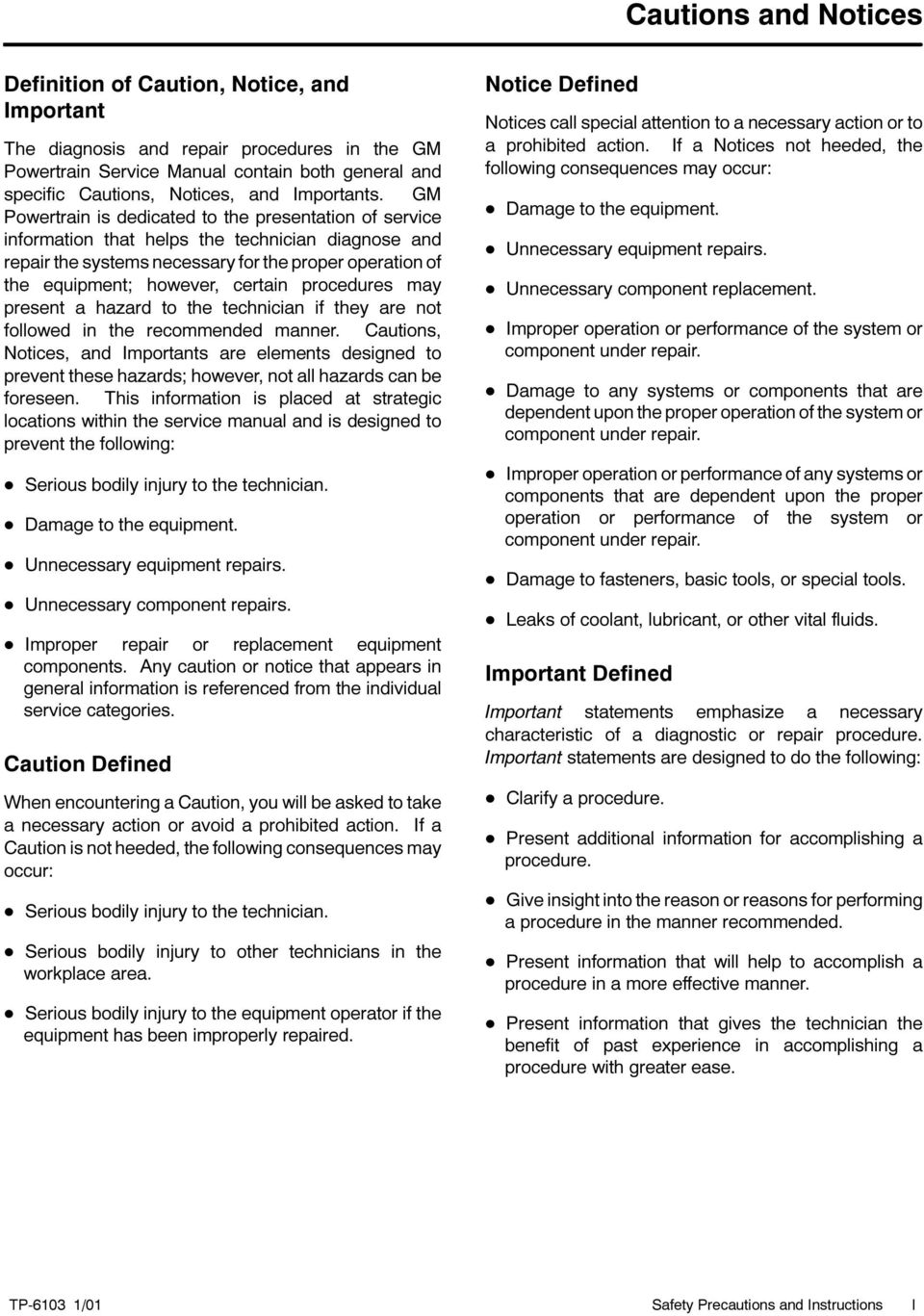
9 Cautions and Notices Definition of Caution, Notice, and Important The diagnosis and repair procedures in the GM Powertrain Service Manual contain both general and specific Cautions, Notices, and Importants. GM Powertrain is dedicated to the presentation of service information that helps the technician diagnose and repair the systems necessary for the proper operation of the equipment; however, certain procedures may present a hazard to the technician if they are not followed in the recommended manner. Cautions, Notices, and Importants are elements designed to prevent these hazards; however, not all hazards can be foreseen. This information is placed at strategic locations within the service manual and is designed to prevent the following: Serious bodily injury to the technician. Damage to the equipment. Unnecessary equipment repairs. Unnecessary component repairs. Improper repair or replacement equipment components. Any caution or notice that appears in general information is referenced from the individual service categories. Caution Defined When encountering a Caution, you will be asked to take a necessary action or avoid a prohibited action. If a Caution is not heeded, the following consequences may occur: Serious bodily injury to the technician. Serious bodily injury to other technicians in the workplace area. Serious bodily injury to the equipment operator if the equipment has been improperly repaired. Notice Defined Notices call special attention to a necessary action or to a prohibited action. If a Notices not heeded, the following consequences may occur: Damage to the equipment. Unnecessary equipment repairs. Unnecessary component replacement. Improper operation or performance of the system or component under repair. Damage to any systems or components that are dependent upon the proper operation of the system or component under repair. Improper operation or performance of any systems or components that are dependent upon the proper operation or performance of the system or component under repair. Damage to fasteners, basic tools, or special tools. Leaks of coolant, lubricant, or other vital fluids. Important Defined Important statements emphasize a necessary characteristic of a diagnostic or repair procedure. Important statements are designed to do the following: Clarify a procedure. Present additional information for accomplishing a procedure. Give insight into the reason or reasons for performing a procedure in the manner recommended. Present information that will help to accomplish a procedure in a more effective manner. Present information that gives the technician the benefit of past experience in accomplishing a procedure with greater ease. TP /01 Safety Precautions and Instructions I
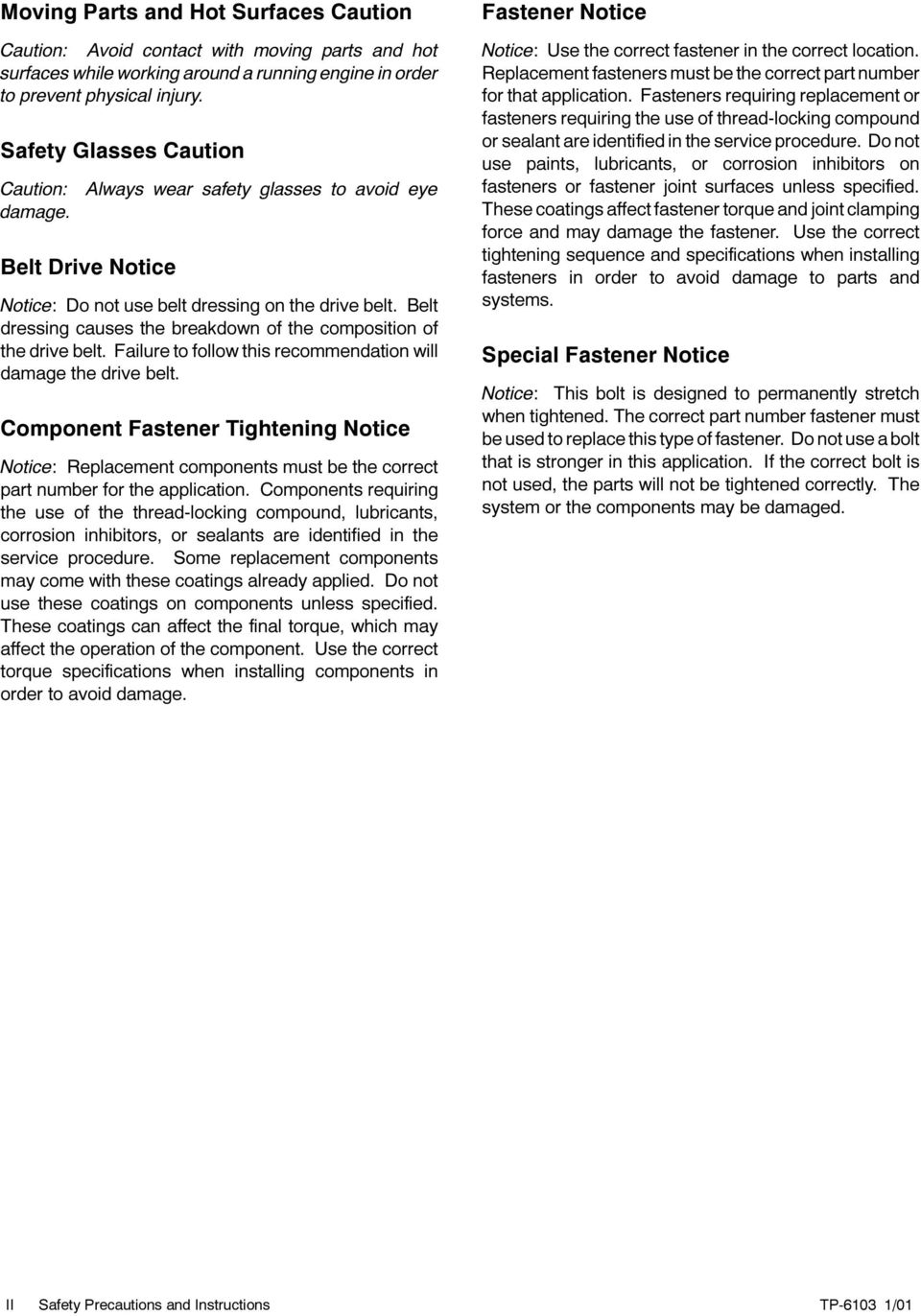
10 Moving Parts and Hot Surfaces Caution Caution: Avoid contact with moving parts and hot surfaces while working around a running engine in order to prevent physical injury. Safety Glasses Caution Caution: damage. Always wear safety glasses to avoid eye Belt Drive Notice Notice: Do not use belt dressing on the drive belt. Belt dressing causes the breakdown of the composition of the drive belt. Failure to follow this recommendation will damage the drive belt. Component Fastener Tightening Notice Notice: Replacement components must be the correct part number for the application. Components requiring the use of the thread-locking compound, lubricants, corrosion inhibitors, or sealants are identified in the service procedure. Some replacement components may come with these coatings already applied. Do not use these coatings on components unless specified. These coatings can affect the final torque, which may affect the operation of the component. Use the correct torque specifications when installing components in order to avoid damage. Fastener Notice Notice: Use the correct fastener in the correct location. Replacement fasteners must be the correct part number for that application. Fasteners requiring replacement or fasteners requiring the use of thread-locking compound or sealant are identified in the service procedure. Do not use paints, lubricants, or corrosion inhibitors on fasteners or fastener joint surfaces unless specified. These coatings affect fastener torque and joint clamping force and may damage the fastener. Use the correct tightening sequence and specifications when installing fasteners in order to avoid damage to parts and systems. Special Fastener Notice Notice: This bolt is designed to permanently stretch when tightened. The correct part number fastener must be used to replace this type of fastener. Do not use a bolt that is stronger in this application. If the correct bolt is not used, the parts will not be tightened correctly. The system or the components may be damaged. II Safety Precautions and Instructions TP /01
11 Engine Marine/Industrial 4.3L 6-1 Engine Mechanical - 4.3L Specifications Fastener Tightening Specifications Specification Application Metric English Accelerator Control Cable Bracket Nut to Stud 12 N m 106 lb in Accelerator Control Cable Bracket Nut to Throttle Body 9 N m 80 lb in Accelerator Control Cable Bracket Stud to Intake Manifold 6 N m 53 lb in Accelerator Control Cable Bracket Stud to Throttle Body 12 N m 106 lb in Air Cleaner Adapter Stud 8 N m 71 lb in Balance Shaft Driven Gear Bolt First Pass 20 N m 15 lb ft Final Pass 35 degrees Balance Shaft Retainer Bolt 12 N m 106 lb in Battery Cable Bracket Bolt to Oil Pan 12 N m 106 lb in Battery Negative Cable Bolt to Engine 25 N m 18 lb ft Battery Positive Cable Junction Block Bracket Bolt 25 N m 18 lb ft Belt Idler Pulley Bolt 50 N m 37 lb ft Camshaft Retainer Bolt 12 N m 106 lb in Camshaft Sprocket Bolt 25 N m 18 lb ft Connecting Rod Nut First Pass 27 N m 20 lb ft Final Pass 70 degrees Crankshaft Balancer Bolt 95 N m 70 lb ft Crankshaft Bearing Cap (Preferred Method) First Pass 20 N m 15 lb ft Final Pass 73 degrees Crankshaft Bearing Cap Bolt 105 N m 77 lb ft Crankshaft Position Sensor Bolt 8 N m 71 lb in Crankshaft Pulley Bolt 58 N m 43 lb ft Crankshaft Rear Oil Seal Housing Bolt and Nut 12 N m 106 lb in Crankshaft Rear Oil Seal Housing Retainer Stud 6 N m 53 lb in Cylinder Head Bolt (Preferred Method) All Bolts First Pass in Sequence 30 N m 22 lb ft Long Bolts Final Pass in Sequence 75 degrees Medium Bolts Final Pass in Sequence 65 degrees Short Bolts Final Pass in Sequence 55 degrees Cylinder Head Core Hole Plug 20 N m 15 lb ft Distributor Cap Bolt 2.4 N m 21 lb in Distributor Clamp Bolt 25 N m 18 lb ft Drive Bolt Tensioner Bolt 50 N m 37 lb ft EGR Valve Bolt First Pass 7 N m 62 lb in Final Pass 30 N m 22 lb ft

12 6-2 Marine/Industrial 4.3L Engine Fastener Tightening Specifications (cont d) Specification Application Metric English EGR Valve Inlet Pipe Clamp Bolt 25 N m 18 lb ft EGR Valve Inlet Pipe Nut at Intake Manifold 25 N m 18 lb ft EGR Valve Inlet Pipe Nut at Exhaust Manifold 30 N m 22 lb ft Engine Block Left Side Oil Gallery Plug 20 N m 15 lb ft Engine Block Left Rear Oil Gallery Plug 30 N m 22 lb ft Engine Block Right Rear Oil Gallery Plug 20 N m 15 lb ft Engine Block Coolant Drain Hole Plug 20 N m 15 lb ft Engine Block Oil Gallery Plug 20 N m 15 lb ft Engine Coolant Heater Bolt/Screw 2 N m 18 lb in Engine Coolant Temperature (ECT) Sensor 20 N m 15 lb ft Engine Flywheel Bolt 100 N m 74 lb ft Engine Front Cover Bolt 12 N m 106 lb in Engine Lift Bracket Bolt (Special Tool J 41427) 15 N m 11 lb ft Engine Lift Front Bracket Stud 35 N m 26 lb ft Engine Mount Bolt to Engine Bracket 50 N m 37 lb ft Engine Mount Engine Bracket Bolt to Engine 50 N m 37 lb ft Engine Mount Frame Bracket Through-Bolt 75 N m 55 lb ft Engine Mount Frame Side Mount Bolt 65 N m 50 lb ft Engine Oil Level Sensor 13 N m 115 lb in Engine Oil Pressure Gauge Sensor 30 N m 22 lb ft Engine Oil Pressure Gauge Sensor Fitting (Plus Required Angle) 15 N m 11 lb ft Engine Wiring Harness Bracket Bolt to Battery Positive Cable Junction Block Bracket 9 N m 80 lb in Engine Wiring Harness Bracket Bolt to Generator and Drive Belt Tensioner Bracket 25 N m 18 lb ft Engine Wiring Harness Bracket Bolt to Rear Right Side Cylinder Head 25 N m 18 lb ft Engine Wiring Harness Bracket Nut to Evaporative Emission (EVAP) Canister Purge Solenoid Valve Stud 9 N m 80 lb in Engine Wiring Harness Bracket Nut to Intake Manifold Stud 12 N m 106 lb in Evaporitive Emission (EVAP) Canister Purge Solenoid Valve Stud to Intake Manifold 10 N m 89 lb in Exhaust Manifold Bolt/Stud First Pass 15 N m 11 lb ft Final Pass 30 N m 22 lb ft Exhaust Manifold Heat Shield Bolt 9 N m 80 lb in Fan and Water Pump Pulley Bolt 25 N m 18 lb ft Frame Cross Bar Bolt 100 N m 74 lb ft Fuel Meter Body Bracket Bolt 10 N m 89 lb in Fuel Pipe Bracket Bolt 6 N m 53 lb in Fuel Pipe Retainer Nut 3 N m 27 lb in Fuel Supply Pipe Nut (Fuel Tank Side) 30 N m 22 lb ft Generator and Drive Belt Tensioner Bracket Bolt to Engine 41 N m 30 lb ft Generator and Drive Belt Tensioner Bracket Stud to Engine 20 N m 15 lb ft

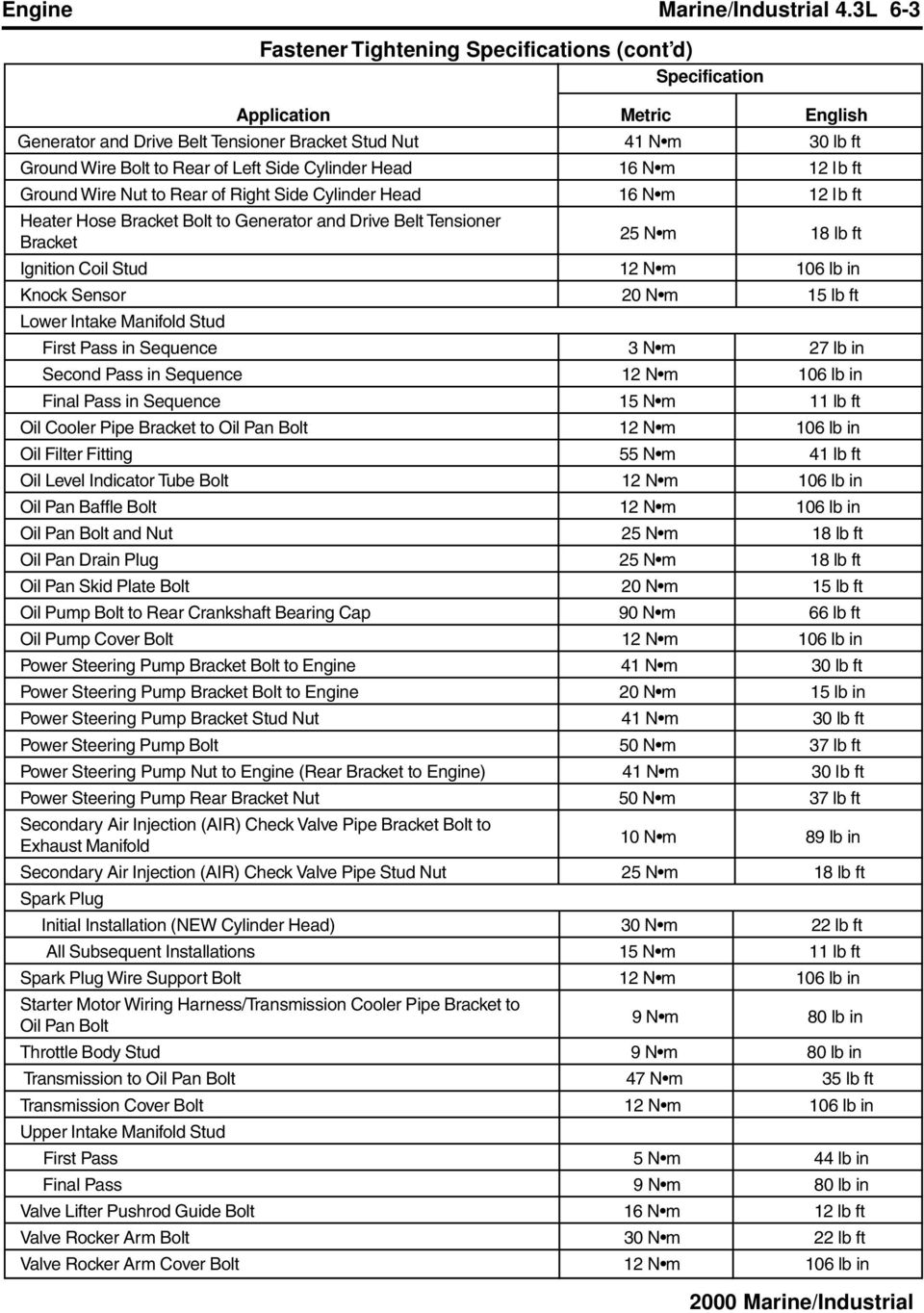
13 Engine Marine/Industrial 4.3L 6-3 Fastener Tightening Specifications (cont d) Specification Application Metric English Generator and Drive Belt Tensioner Bracket Stud Nut 41 N m 30 lb ft Ground Wire Bolt to Rear of Left Side Cylinder Head 16 N m 12 lb ft Ground Wire Nut to Rear of Right Side Cylinder Head 16 N m 12 lb ft Heater Hose Bracket Bolt to Generator and Drive Belt Tensioner 25 N m 18 lb ft Bracket Ignition Coil Stud 12 N m 106 lb in Knock Sensor 20 N m 15 lb ft Lower Intake Manifold Stud First Pass in Sequence 3 N m 27 lb in Second Pass in Sequence 12 N m 106 lb in Final Pass in Sequence 15 N m 11 lb ft Oil Cooler Pipe Bracket to Oil Pan Bolt 12 N m 106 lb in Oil Filter Fitting 55 N m 41 lb ft Oil Level Indicator Tube Bolt 12 N m 106 lb in Oil Pan Baffle Bolt 12 N m 106 lb in Oil Pan Bolt and Nut 25 N m 18 lb ft Oil Pan Drain Plug 25 N m 18 lb ft Oil Pan Skid Plate Bolt 20 N m 15 lb ft Oil Pump Bolt to Rear Crankshaft Bearing Cap 90 N m 66 lb ft Oil Pump Cover Bolt 12 N m 106 lb in Power Steering Pump Bracket Bolt to Engine 41 N m 30 lb ft Power Steering Pump Bracket Bolt to Engine 20 N m 15 lb in Power Steering Pump Bracket Stud Nut 41 N m 30 lb ft Power Steering Pump Bolt 50 N m 37 lb ft Power Steering Pump Nut to Engine (Rear Bracket to Engine) 41 N m 30 lb ft Power Steering Pump Rear Bracket Nut 50 N m 37 lb ft Secondary Air Injection (AIR) Check Valve Pipe Bracket Bolt to 10 N m 89 lb in Exhaust Manifold Secondary Air Injection (AIR) Check Valve Pipe Stud Nut 25 N m 18 lb ft Spark Plug Initial Installation (NEW Cylinder Head) 30 N m 22 lb ft All Subsequent Installations 15 N m 11 lb ft Spark Plug Wire Support Bolt 12 N m 106 lb in Starter Motor Wiring Harness/Transmission Cooler Pipe Bracket to 9 N m 80 lb in Oil Pan Bolt Throttle Body Stud 9 N m 80 lb in Transmission to Oil Pan Bolt 47 N m 35 lb ft Transmission Cover Bolt 12 N m 106 lb in Upper Intake Manifold Stud First Pass 5 N m 44 lb in Final Pass 9 N m 80 lb in Valve Lifter Pushrod Guide Bolt 16 N m 12 lb ft Valve Rocker Arm Bolt 30 N m 22 lb ft Valve Rocker Arm Cover Bolt 12 N m 106 lb in
14 6-4 Marine/Industrial 4.3L Engine Fastener Tightening Specifications (cont d) Specification Application Metric English Water Outlet Stud 25 N m 18 lb ft Water Pump Bolt 45 N m 33 lb ft General Data Engine Type Engine Mechanical Specifications Specification Application Metric English Regular Production Option (RPO) Code L35 VIN Code W Displacement 4.3L 262 CID Bore mm in Stroke mm in Compression Ratio 9.2:1 Firing Order Spark Plug Gap 1.52 mm in 42 kpa at 6.0 psig at 1,000 engine rpm 1,000 engine rpm Oil Pressure (Minimum) at Normal Operating Temperature 125 kpa at 18.0 psig at 2,000 engine rpm 2,000 engine rpm 166 kpa at 24.0 psig at 4,000 engine rpm 4,000 engine rpm Balance Shaft Rear Bearing Journal Clearance mm in Rear Bearing Journal Diameter mm in Camshaft End Play mm in Journal Diameter mm in Journal Diameter Out-of-Round mm (Maximum) in (Maximum) Lobe Lift (Exhaust) mm in Lobe Lift (Intake) mm in Runout mm in Connecting Rod Connecting Rod Bearing Clearance (Production) mm in Connecting Rod Bearing Clearance (Service) mm in Connecting Rod Side Clearance mm in Connecting Rod Journal Diameter mm in Connecting Rod Journal Taper (Production) mm (Maximum) in (Maximum) Connecting Rod Journal Taper (Service) mm (Maximum) in (Maximum) Connecting Rod Journal Out-of-Round (Production) mm (Maximum) in (Maximum) Connecting Rod Journal Out-of-Round (Service) mm (Maximum) in (Maximum) Crankshaft Crankshaft Bearing Clearance (Journal #1-Production) mm in Crankshaft Bearing Clearance (Journal #2, #3 and #4-Production) mm in Crankshaft Bearing Clearance (Journal #1-Service) mm in Crankshaft Bearing Clearance (Journal #2, #3 and #4-Service) mm in Crankshaft End Play mm in Crankshaft Journal Diameter (Journal #1) mm in Crankshaft Journal Diameter (Journal #2 and #3) mm in V6

15 Engine Marine/Industrial 4.3L 6-5 Engine Mechanical Specifications (cont d) Crankshaft Journal Diameter (Journal #4) mm in Crankshaft Journal Out-of-Round (Production) mm (Maximum) in (Maximum) Crankshaft Journal Out-of-Round (Service) mm (Maximum) in (Maximum) Crankshaft Journal Taper (Production) mm (Maximum) in (Maximum) Crankshaft Runout 0.025mm (Maximum) in (Maximum) Cylinder Bore Diameter mm in Out-of-Round (Production) mm (Maximum) in (Maximum) Out-of-Round (Service) 0.05 mm (Maximum) in (Maximum) Taper (Production Relief Side) mm (Maximum) in (Maximum) Taper (Production Thrust Side) mm (Maximum) in (Maximum) Taper (Service) mm (Maximum) in (Maximum) Cylinder Head Surface Flatness 0.10 mm (Maximum) in (Maximum) Exhaust Manifold Surface Flatness (Flange to Flange) 0.25 mm (Maximum) in (Maximum) Surface Flatness (Individual Flange) 0.05 mm (Maximum) in (Maximum) Intake Manifold Oil Pan Piston Surface Flatness 0.10 mm (Maximum) in (Maximum) Oil Pan Alignment at Rear of Engine Block 0.3 mm (Maximum) in (Maximum) Piston Bore Clearance (Production) mm in Piston Bore Clearance (Service) mm (Maximum) in (Maximum) Piston Pin Clearance in Piston (Production) mm in Clearance in Piston (Service) mm (Maximum) in (Maximum) Diameter mm in Fit in Connecting Rod Piston Rings (End Gap Measured in Cylinder Bore) mm in (Interference) (Interference) Piston Compression Ring Gap (Production-Top Groove) mm in Piston Compression Ring Gap (Production- 2nd Groove) mm in Piston Compression Ring Gap (Service -Top Groove) 0.5 mm (Maximum) 0.19 in (Maximum) Piston Compression Ring Gap (Service - 2nd Groove) 0.8 mm (Maximum) 0.31 in (Maximum) Piston Compression Ring Groove Clearance (Production-Top Groove) mm in Piston Compression Ring Groove Clearance (Production- 2nd Groove) mm in Piston Compression Ring Groove Clearance (Service) mm (Maximum) in (Maximum) Piston Oil Ring Gap (Production) mm in Piston Oil Ring Gap (Service) 0.90 mm(maximum) in (Maximum) Piston Oil Ring Groove Clearance (Production) mm in Piston Oil Ring Groove Clearance (Service) 0.10 mm (Maximum) in (Maximum) Valve System Valve Face Angle 45 Degrees Valve Head Edge Margin 0.79 mm (Minimum) in (Minimum) Valve Lash Net Lash - No Adjustment Valve Lift (Exhaust) mm in Valve Lift (Intake) mm in Valve Lifter Valve Rocker Arm Hydraulic Roller Type Roller Pivot Type Valve Rocker Arm Ratio 1.5:1 Valve Seat Angle 46 Degrees Valve Seat Runout 0.05 mm (Maximum) in (Maximum) Valve Seat Width (Exhaust) mm in

16 6-6 Marine/Industrial 4.3L Engine Engine Mechanical Specifications (cont d) Valve Seat Width (Intake) mm in Valve Spring Free Length 51.3 mm 2.02 in Valve Spring Installed Height (Exhaust) mm in Valve Spring Installed Height (Intake) mm in Valve Spring Pressure (Closed) N at 43.2 mm lb at 1.70 in Valve Spring Pressure (Open) N at 32.3 mm lb at 1.27 in Valve Stem Clearance (Exhaust-Production) mm in Valve Stem Clearance (Exhaust-Service) mm in Valve Stem Clearance (Intake-Production) mm in Valve Stem Clearance (Intake-Service) mm in Valve Stem Oil Seal Installed Height (Measured from the Top of the Large Diameter Valve Guide Bevel to the Bottom of the Valve Stem 1-2 mm in Oil Seal) GM SPO Group Numbers Application GM SPO Group Number Accelerator Control Cable Bracket Balance Shaft Balance Shaft Bearing Kit (Rear) Balance Shaft Gear Kit (Includes Drive and Driven Gears) Balance Shaft Retainer Belt Idler Pulley (Grooved) Belt Idler Pulley (Smooth) Camshaft Bearing Camshaft Retainer Camshaft Sprocket Camshaft Timing Chain Clutch Pilot Bearing Connecting Rod Connecting Rod Bearing Kit Coolant Radiator Crankshaft Balancer Crankshaft Balancer Key Crankshaft Bearing Kit Crankshaft Front Oil Seal Crankshaft Rear Oil Seal Crankshaft Rear Oil Seal Housing Crankshaft Rear Oil Seal Housing Retainer Stud Crankshaft Rear Oil Seal Retainer Stud Crankshaft Position Sensor Crankshaft Position Sensor Reluctor Ring Crankshaft Position Sensor Seal (O-ring) Crankshaft Pulley Crankshaft Sprocket Cylinder Head Cylinder Head Gasket Distributor Distributor Clamp Distributor Gasket Dowel Pin (Cylinder Head Locator) Dowel Straight Pin (Transmission Locator) 8.939

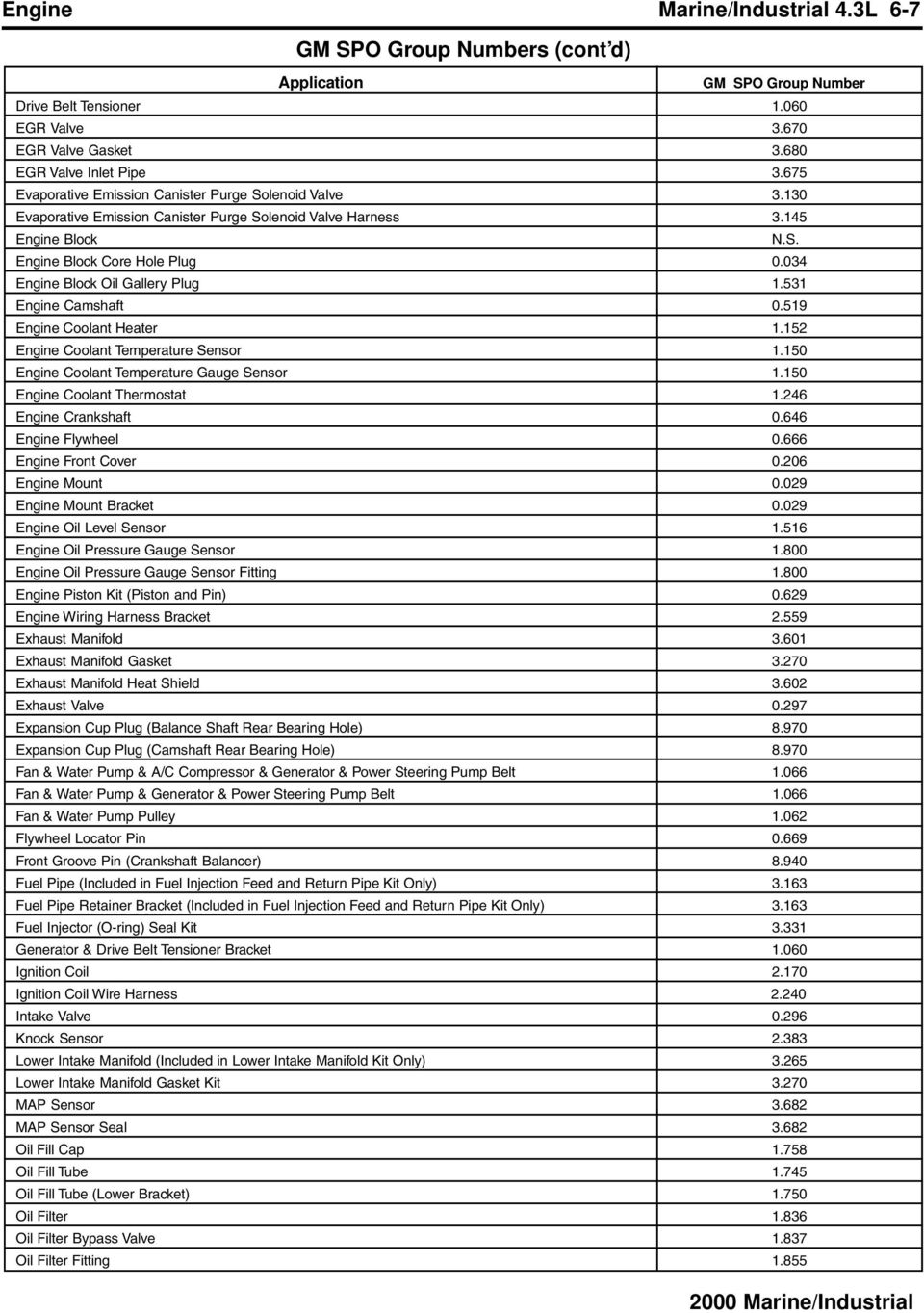
17 Engine Marine/Industrial 4.3L 6-7 GM SPO Group Numbers (cont d) Application GM SPO Group Number Drive Belt Tensioner EGR Valve EGR Valve Gasket EGR Valve Inlet Pipe Evaporative Emission Canister Purge Solenoid Valve Evaporative Emission Canister Purge Solenoid Valve Harness Engine Block N.S. Engine Block Core Hole Plug Engine Block Oil Gallery Plug Engine Camshaft Engine Coolant Heater Engine Coolant Temperature Sensor Engine Coolant Temperature Gauge Sensor Engine Coolant Thermostat Engine Crankshaft Engine Flywheel Engine Front Cover Engine Mount Engine Mount Bracket Engine Oil Level Sensor Engine Oil Pressure Gauge Sensor Engine Oil Pressure Gauge Sensor Fitting Engine Piston Kit (Piston and Pin) Engine Wiring Harness Bracket Exhaust Manifold Exhaust Manifold Gasket Exhaust Manifold Heat Shield Exhaust Valve Expansion Cup Plug (Balance Shaft Rear Bearing Hole) Expansion Cup Plug (Camshaft Rear Bearing Hole) Fan & Water Pump & A/C Compressor & Generator & Power Steering Pump Belt Fan & Water Pump & Generator & Power Steering Pump Belt Fan & Water Pump Pulley Flywheel Locator Pin Front Groove Pin (Crankshaft Balancer) Fuel Pipe (Included in Fuel Injection Feed and Return Pipe Kit Only) Fuel Pipe Retainer Bracket (Included in Fuel Injection Feed and Return Pipe Kit Only) Fuel Injector (O-ring) Seal Kit Generator & Drive Belt Tensioner Bracket Ignition Coil Ignition Coil Wire Harness Intake Valve Knock Sensor Lower Intake Manifold (Included in Lower Intake Manifold Kit Only) Lower Intake Manifold Gasket Kit MAP Sensor MAP Sensor Seal Oil Fill Cap Oil Fill Tube Oil Fill Tube (Lower Bracket) Oil Filter Oil Filter Bypass Valve Oil Filter Fitting 1.855
18 6-8 Marine/Industrial 4.3L Engine GM SPO Group Numbers (cont d) Application GM SPO Group Number Oil Level Indicator Oil Level Indicator Tube Oil Pan Oil Pan Drain Plug Oil Pan Drain Plug Seal (O-ring) Oil Pan Gasket Oil Pump Oil Pump Cover Oil Pump Drive Shaft Oil Pump Drive Shaft Retainer Oil Pump Pressure Relief Valve Oil Pump Pressure Relief Valve Spring Oil Pump Pressure Relief Valve Spring Bore Plug Oil Pump Pressure Relief Valve Spring Straight Pin Oil Pump Screen PCV Tube PCV Valve PCV Valve Cover PCV Valve Elbow PCV Valve Hose Pin (Oil Pump Locator) Piston Ring Kit Power Steering Pump Bracket Secondary Air Injection (AIR) Check Valve Secondary Air Injection (AIR) Check Valve Gasket Secondary Air Injection (AIR) Check Valve (Crossover) Pipe Secondary Air Injection (AIR) Check Valve Pipe Spark Plug Spark Plug Wire Spark Plug Wire Shield Spark Plug Wire Support Spring Type S Pin (Crankshaft Rear Oil Seal Housing Locator) Starter Motor TBI Fuel Meter Throttle Body Throttle Body to Upper Manifold Gasket (Included in Service Kits Only) N.S. Torque Converter Housing Access Hole Plug (Rubber/at Oil Pan) Transmission Brace Transmission Cover Upper Intake Manifold (Included in Upper Intake Manifold Kit Only) Upper Intake Manifold to Lower Intake Manifold Gasket (Included in Intake Manifold Seal Kit) Valve Lifter Valve Lifter Pushrod Guide Valve Pushrod Valve Rocker Arm Assembly Valve Rocker Arm Cover Valve Rocker Arm Cover Bolt Grommet Valve Rocker Arm Cover Gasket Valve Rocker Arm Support Valve Spring Valve Spring Cap Valve Stem Key Valve Stem Oil Seals 0.308

19 Engine Marine/Industrial 4.3L 6-9 GM SPO Group Numbers (cont d) Application GM SPO Group Number Water Outlet Water Pump Gaskets Water Pump Inlet Hose Water Pump Kit (with Gaskets) Sealers, Adhesives and Lubricants Application Type of Material GM Part Number Balancer Shaft Driven Gear Bolt Threadlock Camshaft Retainer Bolt Threadlock Crankshaft Balancer Keyway Adhesive Cylinder Head Bolt Sealant Engine Block to the Crankshaft Rear Oil Seal Housing Junction at the Oil Pan Sealing Surfaces Adhesive Engine Block to the Engine Front Cover Junction at the Oil Pan Sealing Surfaces Adhesive Engine Block at the Lower Intake Manifold Sealing Surfaces Adhesive Engine Block Coolant Drain Hole Plug Sealant Engine Block Core Hole Plug Threadlock Engine Block Oil Gallery Plug Sealant Engine Coolant Temperature (ECT) Sensor Sealant Engine Coolant Temperature (ECT) Gauge Sensor Sealant Engine Oil SAE 5W-30 Oil Engine Oil Pressure Sensor Sealant Engine Oil Pressure Sensor Fitting Sealant Engine Oil Supplement Lubricant Evaporative Emission (EVAP) Canister Purge Solenoid Valve Stud Threadlock Exhaust Manifold Bolt/Stud Threadlock Expansion Cup Plug (Balance Shaft Rear Bearing Hole) Sealant Expansion Cup Plug (Camshaft Rear Bearing Hole) Sealant Fuel Meter Body Bracket Bolt Threadlock Fuel Pipe Bolt Threadlock Lower Intake Manifold Bolt Threadlock Oil Level Indicator Tube Sealant Oil Pump Screen Tube Sealant Throttle Body Stud Threadlock Upper Intake Manifold Stud Threadlock Valve Train Component Prelube Lubricant Water Pump Bolt Sealant
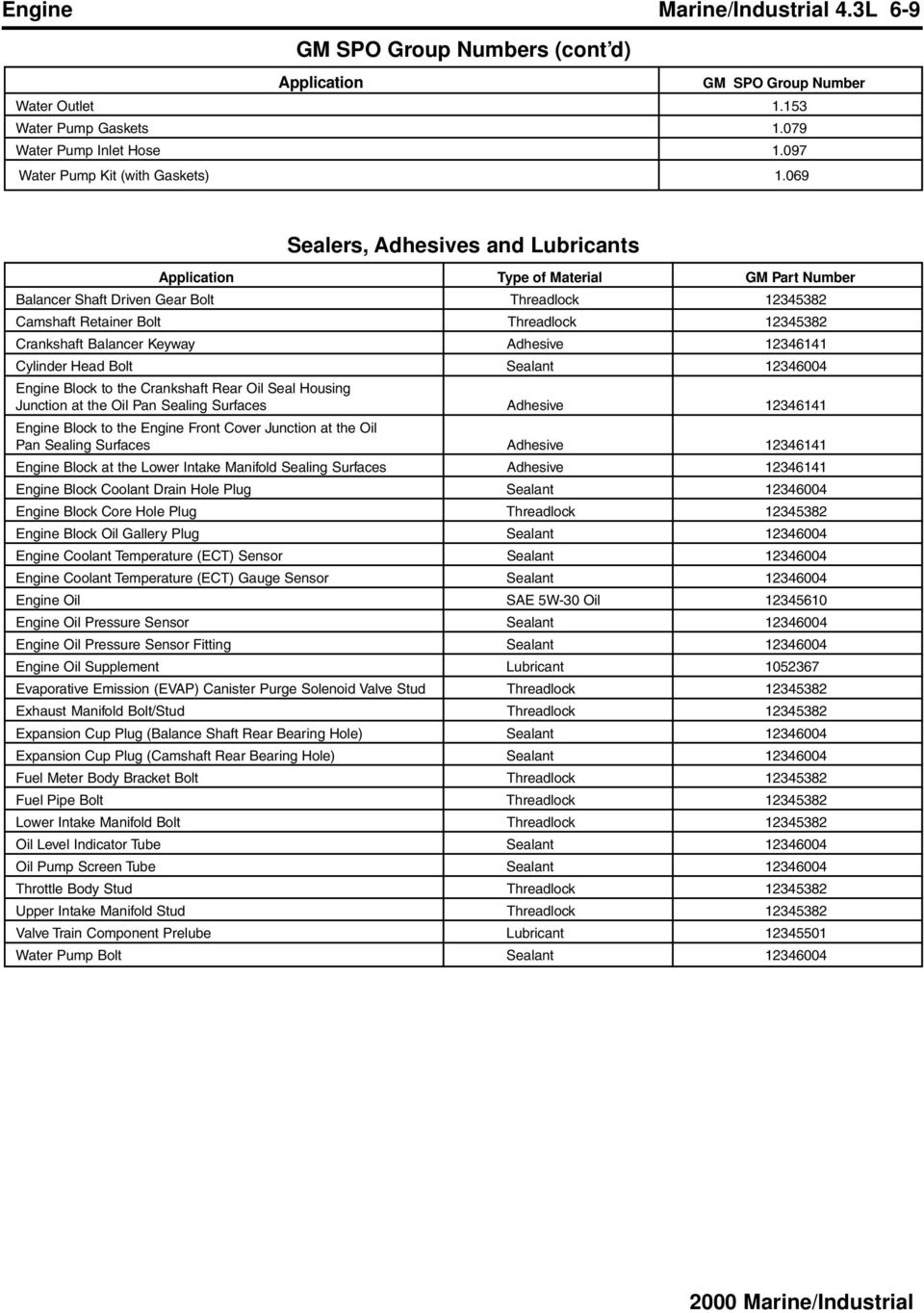
20 6-10 Marine/Industrial 4.3L Engine Diagnostic Information and Procedures Base Engine Misfire Diagnosis Checks Action Engine Performance diagnosis procedures are covered in Engine Controls and should be consulted for diagnosis of any Drivability, Emissions or Malfunctioning Indicator Lamp (MIL) concerns. The following diagnosis covers common concerns and possible causes. When the proper diagnosis is made, the concern should be corrected by adjustment, repair or replacement as required. Refer to the appropriate section of the service manual for each specific procedure. This diagnostic table will assist in engine misfire diagnosis due to a mechanical concern such as a faulty engine camshaft, worn or damaged bearings or bent valve pushrod. Thsi table will not isolate a crossed fuel injector wire, faulty fuel injector or any other drivability component failure that may cause a misfire. The Powertrain On-Board Diagnostic System checks must be performed first. When using this table to make a Base Engine Misfire diagnosis, begin with the preliminary information below and then proceed to the specific category. Preliminary 1. Perform DTC P0300 before proceeding with Base Engine Misfire Diagnosis information. DTC P0300 will assist in determining which cylinder or cylinders are misfiring. 2. Perform a visual inspection of the following: A loose or improperly isnstalled engine flywheel or crankshaft balancer Worn, damaged or misaligned accessory drive system components 3. Listen to the engine for any abnormal internal engine noises. 4. Inspect the engine for acceptable oil pressure. 5. Verify if the engine has excessive oil consumption. 6. Verify if the engine has excessive coolant consumption. 7. Perform a compression test on the engine. Intake Manifold Leaks An intake manifold that has a vacuum leak may cause a misfire. Inspect for the following: Improperly installed or damaged vacuum hoses Faulty or improperly installed lower intake manifold and/or gaskets Cracked or damaged lower intake manifold Improperly installed MAP sensor The sealing grommet of the MAP sensor should not be torn or damaged Improperly installed throttle body or damaged gasket Warped intake manifold Warped or damaged cylinder head sealing surface Coolant Consumption Coolant consumption may or may not cause the engine to overheat. Inspect for the following: External coolant leaks Faulty cylinder head gasket Warped cylinder head Cracked cylinder head Damaged engine block Oil Consumption Oil consumption may or may not cause the engine to misfire. 1. Remove the spark plugs and inspect for an oil fouled spark plug. 2. Perform a cylinder compression test. 3. If the compression test indicates worn valves or valve guides, inspect the following: Worn, brittle or improperly installed valve stem oil seals Worn valve guides Worn valve stems Worn or burnt valves or valve seats 4. If the compression test indicates worn or damaged piston rings, inspect the following: Broken or improperly seated piston rings Excessive piston ring end gap Excessive cylinder bore wear or taper Cylinder damage Piston damage
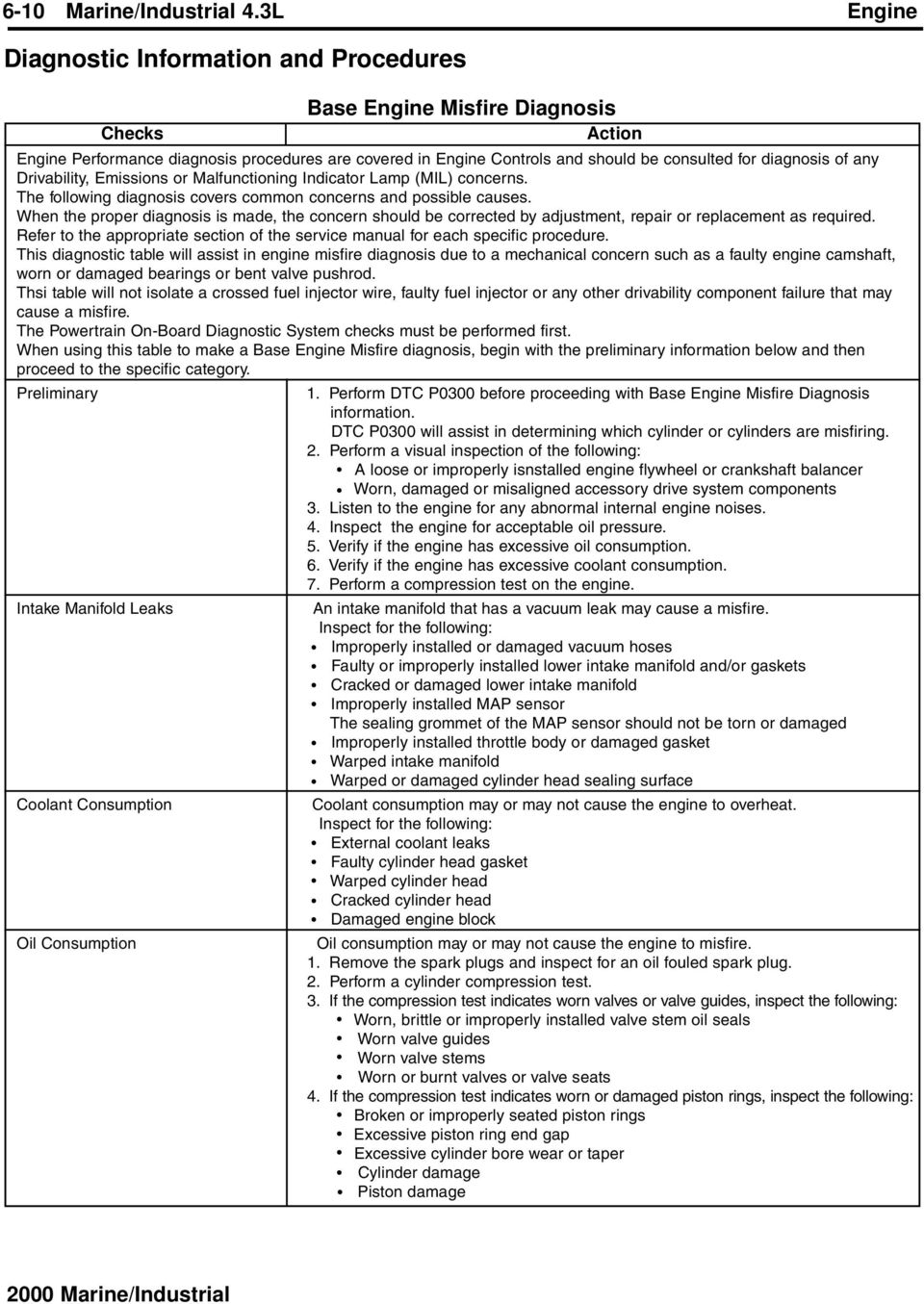
21 Engine Marine/Industrial 4.3L 6-11 Base Engine Misfire Diagnosis (cont d) Checks Action Abnormal Internal Engine Noises No Abnormal Internal Engine Noise 1. Start the engine and determine if the noise is timed to the engine camshaft speed or the crankshaft speed. 2. Using a timing light, two knocks per flash is the crankshaft speed and one knock per flash is the engine camshaft speed. 3. If the noise is timed to the engine camshaft speed, inspect the following: Missing or loose valve train components Worn or loose valve rocker arms Worn or bent valve pushrods Faulty valve springs Bent or burnt valves Worn engine camshaft lobes Worn or damaged camshaft timing chain and/or sprockets Important: A slight COLD knock or piston slapping noise could be considered normal if not present after the engine has reached normal operating temperatures. If the knock is timed to the crankshaft speed, inspect the following: Worn crankshaft or connecting rod bearings Piston ro cylinder damage Worn piston or piston pin Faulty connecting rod Excessive carbon build-up on the top of the piston 1. Inspect for a worn or improperly installed camshaft timing chain and/or sprockets. 2. Remove the valve rocker arm cover on the side of the engine with the cylinder that is misfiring. 3. Inspect for the following: Loose valve rocker arm studs Bent valve push rods Faulty valve springs Faulty valve lifters (bleeding down) Worn or improperly seated valves Worn engine camshaft lobes Engine Compression Test 1. Disconnect the positive ignition coil wire plug from ignition coil. 2. Disconnect the fuel injector electrical connector. 3. Remove all the spark plugs. 4. Block the throttle plate wide open. 5. Charge the battery if the battery is not fully charged. 6. Start with the compression gauge at zero. Then crank the engine through four compression strokes (four puffs). 7. Make the compression check the same for each cylinder. Record the reading. The minimum compression in any one cylinder should not be less than 70 percent of the highest cylinder. No cylinder should read less than 690 kpa (100 psi). For example, if the highest pressure in any one cylinder is 1035 kpa (150 psi), the lowest allowable pressure for any other cylinder would be 725 kpa (105 psi). (1035 x 70% = 725) (150 x 70% = 105). 8. If some cylinders have low compression, inject approximately 15 ml (one tablespoon) of engine oil into the combustion chamber through the spark plug hole. Normal - Compression builds up quickly and evenly to the specified compression for each cylinder. Piston Rings Leaking - Compression is low on the first stroke. Then compression builds up with the following strokes but does not reach normal. Compression improves considerably when you add oil. Valves Leaking - Compression is low on the first stroke. Compression usually does not build up on the following strokes. Compression does not improve much when you add oil. If two adjacent cylinders have lower than normal compression, and injecting oil into the cylinders does not increase the compression, the cause may be a head gasket leaking between the two cylinders. 9. Install the removed parts. 10. Connect the disconnected components.
22 6-12 Marine/Industrial 4.3L Engine Engine Noise Diagnosis Symptoms Cause When diagnosing engine noisee complaints, use the following steps to isolate the source of the engine noise: Determine the type of noise For example, is the noise a light rattle/tapping or a low rumble/knocking? The exact operating condition under which the noise exists Note factors such as ambient temperature, the amount of engine warm-up time, the engine temperature, the engine RPM and other specifics. At what rate the noise occurs, and at what location on the engine Engine noises are generally synchronized to either engine speed (crankshaft, engine flywheel, connecting rods, crankshaft balancer or pistons and related components) or one-half engine speed (valve train noise such as valve rocker arms, valve lifters and camshaft timing chain). Determine the rate at which the noise is occurring. Compare the engine sounds to other engines, and make sure you are not trying to correct a normal condition. Noise on Start-Up but Only Lasts a Improper oil viscosity. Install the recommended oil viscosity for the expected Few seconds temperatures. Worn or dirty valve lifters Excessive piston-to-cylinder bore clearance Excessive piston pin-to-bore clearance Excessive crankshaft bearing clearance Knocks Cold and Continues for Loose or broken crankshaft balancer or accessory drive components 1 to 2 Minutes Excessive piston-to-bore clearance A cold piston knock which appears in 1.5 minutes should be considered acceptable. A cold engine knock usually disappears when the specific cylinders secondary ignition circuit is grounded out. Intermittent Noise on Idle, Improper oil viscosity. Install the recommended oil viscosity for the expected Disappearing When Engine Speed is temperatures. Increased Lower than specified oil pressure Install an oil pressure gauge and measure the engine oil pressure. Dirty or worn valve lifter Valve Train Noise (Rattle/Tapping) The following conditions may cause valve train noise: Lower than specified oil pressure Worn or faulty oil pump Loose oil pump-to-engine block bolt Loose valve rocker arm attachments Worn valve rocker arms and/or valve pushrods Broken valve spring Sticking valves Worn, dirty or faulty valve lifters Worn engine camshaft lobes Worn valve guides or valve stems Bent, broken or damaged timing chain sprocket teeth Knocks Hot at The following conditions may cause a knocking noise: Idle (Rumble/Knocking) Malfunctioning accessory drive system components Loose or broken crankshaft balancer Detonation or spark knock Check for proper operation of the cooling, knock and ignition control components. Refer to diagnostic information in Engine Controls Excessive connecting rod bearing clearance Excessive piston pin-to-bore clearance Bent connecting rod Excessive crankshaft bearing clearance Loose torque converter bolts (if equipped) Cracked or damaged engine flywheel Exhaust leak at the exhaust manifold Combustion chamber deposits Exhaust System Noise and/or Exhaust system noise and/or leakage may be caused by the following conditions: Leakage Improperly installed or misaligned exhaust system components A cracked or broken exhaust manifold Damaged or worn exhaust manifold gaskets and/or seals Burnt or rusted out exhaust system components Broken or loose exhaust clamps and/or brackets
23 Engine Marine/Industrial 4.3L 6-13 Valve Train Diagnosis General Information Symptoms Cause A light tapping noise at 1/2 engine speed, or any varying frequency, may indicate a valve train problem. Tapping noises will typically increase with increased engine speed. Before attempting to diagnose a valve train noise, check for the proper engine oil level and then allow the engine to obtain normal operating temperature. Following this procedure will bring all engine components to a normal state of expansion. Sit in the driver s seat, then operate the engine at various speeds and listen for any abnormal engine noise. Valve Train Noise Low engine oil pressure A worn or faulty oil pump A loose or plugged oil pump screen Loose valve rocker arm attachments (causing excessive valve lash) A worn or damaged valve rocker arm ball A worn valve rocker arm and/or valve pushrod A broken valve spring Sticking valves Valve lifters worn, dirty or faulty A broken valve lifter guide Engine camshaft lobes worn Worn valve guides or valve stems Bent valve pushrods Excessive free play in the camshaft timing chain Bent, broken or damaged camshaft sprocket teeth Diagnostic Table Step Action Value(s) Yes No DEFINITION: A light tapping noise at 1/2 engine speed, or any varying frequency. 1 Is there valve train noise? Go to Step 2 System OK Check for a high engine oil level. An engine with the engine oil level above the FULL mark on the oil level indicator allows the crankshaft counterweights to churn the 2 engine oil into foam. When the foamy engine oil is pumped into the valve lifters, the valve lifters become noisy. A solid column of engine oil ensures proper valve lifter operation. Is the engine oil level too high? Go to Step 3 Go to Step 4 3 Drain the engine oil to the proper level. Is the tapping noise gone? System OK Go to Step 6 Check for a low engine oil level. An engine with the engine oil level below the ADD mark on the oil level indicator may 4 allow the oil pump to pump air at high engine RPM. Is the engine oil level below the ADD mark on the oil level indicator? Go to Step 5 Go to Step Add the engine oil as required. Is the tapping noise gone? System OK Go to Step 6 Check for the proper engine oil pressure. Refer to Engine Mechanical Specifications and Oil Pressure Diagnosis and 41.4 kpa Testing. (6 psi) Is the engine oil pressure within specifications? Go to Step 11 Go to Step 7
24 6-14 Marine/Industrial 4.3L Engine Diagnostic Table (cont d) Step Action Value(s) Yes No Check the oil pump screen for damage or a loose fit to the 7 oil pump. Is the oil pump screen loose or is the oil pump screen damaged? Go to Step 8 Go to Step 9 8 Repair as required. Is the tapping noise gone? System OK Go to Step 9 Check for a damaged oil pump or loose bolts. 9 Refer to Oil Pump Clean and Inspect. Is the oil pump damaged or are the bolts loose? Go to Step 10 Go to Step Repair as required. Is the tapping noise gone? System OK Go to Step 11 Remove and inspect the valve lifters, the valve rocker arms and the valve pushrods. Refer to Valve Rocker Arm 11 and Pushrods Clean and Inspect and Valve Lifters and Guides Clean and Inspect. Are the components worn or damaged? Go to Step 12 Go to Step Replace the components as required. Is the tapping noise gone? System OK Go to Step 13 Perform an engine camshaft lobe lift test. Refer to 13 Camshaft and Bearings Clean and Inspect. Is the engine camshaft lobes within specifications? Go to Step 15 Go to Step Replace the engine camshaft and valve lifters. Is the tapping noise gone? System OK Go to Step 13 Remove the engine front cover and inspect the camshaft timing chain and sprockets for excessive wear or damage. Refer totiming Chain and Sprockets Clean and Inspect. Are the components worn or damaged? Go to Step 17 Go to Step 16 Replace the components as required. Is the tapping noise gone? System OK Go to Step 17 Perform a complete disassembly of the engine and inspect 17 all components. Are the components worn or damaged? System OK Go to Step 11 Replace the components as required. 18 Did you complete the worn or damaged component replacement? System OK
25 Engine Marine/Industrial 4.3L 6-15 Excessive oil consumption (not due to leaks) is the use 1.9 liters (2 quarts) of engine oil within 3,200 kilometers (2,000 miles). However, during initial engine break-in periods 4,828-6,437 kilometers (3,000-4,000 miles) oil consumption may exceed 1.9 liters (2 quarts) or more. The causes of excessive oil consumption include the following conditions: External oil leaks. Tighten the bolts and/or replace gaskets and oil seals as necessary. Incorrect oil level or improper reading of oil level indicator. With the vehicle on a level surface, allow adequate drain down time and check for the correct oil level. Improper oil viscosity. Use a recommended SAE viscosity for the prevailing temperatures. Continuous high speed operation and/or severe usage. Crankcase ventilation system restrictions or malfunctioning components. Possible improper PCV valve. Valve guides and/or valve stem oil seals worn, damaged or the seal omitted. Ream the valve guides and install oversize service valves and/ or new valve stem oil seals. Piston rings broken, improperly installed, worn or not seated properly. Allow adequate time for the piston rings to seat. Replace broken or worn piston rings as necessary. Piston improperly installed or mis-fitted. Oil Pressure Diagnosis and Testing 1. With the vehicle on a level surface, allow adaquate drain down time (2-3 minutes) and measure for a low engine oil level. Add the recommended grade engine oil, and fill the crankcase until the oil level measures FULL on the oil level indicator. 2. Operate the engine and verify low or no oil pressure on the vehicle oil pressure gauge or the oil indicator light. Listen for a noisy valve train or a knocking noise. 3. Inspect for the following: Engine oil diluted by moisture or unburned fuel mixtures Improper engine oil viscosity for the expected temperature Incorrect or faulty oil pressure gauge sensor Incorrect or faulty oil pressure gauge Plugged oil filter Malfunctioning oil filter bypass valve 4. Remove the oil pressure gauge sensor or another engine block oil gallery plug. 5. Install an oil pressue gauge. 6. Start the engine and then allow the engine to reach normal operation temperature. 7. Measure the engine oil pressure at the following RPM: Specification kpa (6psig) (minimum) at 1,000 RPM kpa (18 psig) (minimum) at 2,000 RPM kpa (24 psig) (minimum) at 4,000 RPM 8. If the engine oil pressure is below minimum specifications, inspect the engine for one or more of the following: Oil pump worn or dirty Malfunctioning oil pump pressure relief valve Oil pump screen loose, plugged or damaged Excessive bearing clearance Cracked, porous or restricted oil galleries Engine block oil gallery plugs missing or incorrectly installed Broken valve lifters
26 6-16 Marine/Industrial 4.3L Engine Oil Leak Diagnosis Step Action Value(s) Yes No Important: You can repair most fluid leaks by first visually locating the leak, repairing or replacing the component, or by resealing the gasket surface. Once the leak is identified, determine the cause of the leak. Repair the cause of the leak as ewll as the leak itself Operate the vehicle until it reaches normal operating temperature. 2. Park the vehicle on a level surface, over a large sheet of paper or other clean surface. Go to Step 2 System OK Can you identify the type of fluid and the approximate location of the leak? Go to Step 10 Go to Step 3 1. Visually inspect the suspected area. Use a small mirror to assist in looking at hard to see areas. 2. Check for leaks at the following locations: Sealing surfaces Fittings Cracked or damaged components Can you identify the type of fluid and the approximate location of the leak? Go to Step 10 Go to Step 4 1. Completely clean the entire engine and surrounding components. 2. Operate the vehicle for several kilometers (miles) at normal operating temperature and at varying speeds. 3. Park the vehicle on a level surface, over a large 4 sheet of paper or other clean surface. 4. Wait (15 minutes). 5. Idetify the type of fluid and the approximate location of the leak. Can you identify the type of fluid and the approximate location of the leak? Go to Step 10 Go to Step Visually inspect the suspected area. Use a small mirror to assist in looking at hard to see areas. 2. Check for leaks at the following locations: Sealing surfaces Fittings Cracked or damaged components Can you identify the type of fluid and the approximate location of the leak? Go to Step 10 Go to Step 6 1. Completely clean the entire engine and surrounding components. 2. Apply an aerosol-type powder (baby powder, foot powder, etc.) to the suspected area. 3. Operate the vehicle for several kilometers (miles) at normal operating temperature and at varying speeds. 5. Idetify the type of fluid and the approximate location of the leak, from the discolorations in the powder surface.
27 Engine Marine/Industrial 4.3L 6-17 Oil Leak Diagnosis (cont d) Step Action Value(s) Yes No Can you identify the type of fluid and the approximate 6 location of the leak? Go to Step 10 Go to Step Visually inspect the suspected area. Use a small mirror to assist in looking at hard to see areas. 2. Check for leaks at the following locations: Sealing surfaces Fittings Cracked or damaged components Can you identify the type of fluid and the approximate location of the leak? Go to Step 10 Go to Step 8 Use J E, Dye and Light Kit, in order to identify the type of fluid and the approximate location of the leak. Refer to manufacturer s instructions when using the tool. Can you identify the type of fluid and the approximate location of the leak? Go to Step 10 Go to Step 9 1. Visually inspect the suspected area. Use a small mirror to assist in looking at hard to see areas. 2. Check for leaks at the following locations: Sealing surfaces Fittings Cracked or damaged components Can you identify the type of fluid and the approximate location of the leak? Go to Step 10 System OK 1. Inspect the engine for mechanical damage. Special attention should be shown to the following areas: Higher than recommended fluid levels Higher than recommended fluid pressures Plugged or maalfunctioning fluid filters or pressure bypass valves Plugged or malfunctioning engine ventilation system 10 Improperly tightened or damaged fasteners Cracked or porous components Improper sealants or gaskets where required Improper sealant or gasket installation Damaged or worn gaskets or seals Damaged or worn sealing surfaces 2. Inspect the engine for customer modifications. Is there mechanical damage, or custormer modifications to the engine? Go to Step 11 System OK 11 Repair or replace all damaged or modified components. Does the engine still leak oil? Go to Step 1
28 6-18 Marine/Industrial 4.3L Engine Symptoms - Drive Belt Important: Review the system operation in order to familiarize yourself with the system functions. Refer to Drive Belt System Description. Visual/Physical Inspection Inspect for aftermarket devices which could affect the operation of the drive belts. Inspect the easily accessible or visible system components for obvious damage or conditions which could cause the symptom. Inspect the drive belt for excessive wear, shredding or missing sections. Inspect the drive belt for contamination of excessive dirt, oil, coolant or other substances that may affect the drive belt operation. Intermittent Drive belt symptoms may be from intermittent failure of an accessory drive component. Drive belt symptoms may occur from changes in load of the accessory drive components.. Ambient temperatures, moisture or engine operating temperature can affect the drive belt operation. Symptoms List Refer to a symptom diagnostic procedure from the following list in order to diagnose the symptom: Drive Belt Chirping Diagnosis Drive Belt Squeal Diagnosis Drive Belt Whine Diagnosis Drive Belt Rumbling Diagnosis Drive Belt Vibration Diagnosis Drive Belt Falls Off Diagnosis Drive Belt Excessive Wear Diagnosis Drive Belt Chirping Diagnosis Diagnostic Aids The symptom may be intermittent due to moisture on the drive belt(s) or the pulleys. It may be necessary to spray a small amount of water on the drive belt(s) in order to duplicate the customers concern. If spraying water on the drive belt(s) duplicates the symptom, cleaning the belt pulleys may be the probable solution. A loose or improper installation of a body component, a suspension component or other items of the vehicle may cause the chirping noise. Test Description The number(s) below refer to the step number(s) on the diagnostic table. 2. The noise may not be engine related. This step is to verify that the engine is making the noise. If the engine is not making the noise, do not proceed further with this table. 3. The noise may be an internal engine noise. Removing the drive belt and operating the engine for a brief period will verify the noise is related to the drive belt. When removing the drive belt(s), the water pump may not be operating and the engine may overheat. Also DTCs may set when the engine is operating with the drive belt removed. 4. Inspect all drive belt pulleys for pilling. Pilling is the small balls or pills or it can be strings in the drive belt grooves from the accumulation of rubber dust. 6. Misalignment of the pulleys may be caused from improper mounting of the accessory drive component, incorrect installation of the accessory drive component pulley or the pulley bent inward or outward from a previous repair. Test for a misaligned pulley.using a straight edge in the pulley grooves across two or three pulleys. If a misaligned pulley is found, refer to that accessory drive component for the proper installation procedure for that pulley. 10. Inspecting of the fasteners can eliminate the possibility that a wrong bolt, nut, spacer or washer was installed. 12. Inspecting the pulleys for being bent should include inspecting for a dent or other damage to the pulleys that would prevent the drive belt from not seating properly in all of the pulley grooves or on the smooth surface of a pulley when the back side of the belt is used to drive the pulley. 14. Replacing the drive belt when it is not damaged or there is not excessive pilling will only be a temporary repair.
29 Engine Marine/Industrial 4.3L 6-19 Drive Belt Chirping Diagnosis Step Action Value(s) Yes No Notice: Refer to Belt Dressing Notice in Cautions and Notices. DEFINITION: The following items are indications of chirping: A high pitched noise that is heard once per revolution of the drive belt or a pulley. It usually occurs on cold damp mornings. 1 2 Did you review the Drive Belt Symptom operation an d perform Go to Symptoms - the necessary inspections? Go to Step 2 Drive Belt Verify that there is a chirping noise. Go to Does the engine make the chirping noise? Go to Step 3 Diagnostic Aids 1. Remove the drive belt Operate the engine for no longer than 30 to 40 seconds. Go to Engine Does the chirping noise still exist? Noise Diagnosis Go to Step Inspect for severe pilling exceeding 1/3 of the belt groove depth. Does the belt grooves have pilling? Go to Step 5 Go to Step 6 Clean the drive belt pulleys with a suitable wire brush. Did you complete the repair? Go to Step 15 Go to Step 6 Inspect for misalignment of the pulleys. Are any of the pulleys misaligned? Go to Step 7 Go to Step 8 Replace or repair any misaligned pulleys. Did you complete the repair? Go to Step 15 Go to Step 8 Inspect for bent or cracked brackets. Did you find any bent or cracked brackets? Go to Step 9 Go to Step 10 Replace any bent or cracked brackets. Did you complete the repair? Go to Step 15 Go to Step 10 Inspect for improper, loose or missing fasteners Did you find the condition? Go to Step 11 Go to Step 12 Tighten any loose fasteners. Replace any improper or missing fasteners. Refer to Fastener Tightening Specifications. Did you complete the repair? Go to Step 15 Go to Step 12 Inspect for a bent pulley. Did you find the condition? Go to Step 13 Go to Step 14 Replace the bent pulley. Did you complete the repair? Go to Step 15 Go to Step 14 Replace the drive belt. Refer to Drive Belt Replacement. Go to Did you complete the repair? Go to Step 15 Diagnostic Aids Operate the system in order to verify the repair. Did you correct the condition? System OK Go to Step 3
30 6-20 Marine/Industrial 4.3L Engine Drive Belt Squeal Diagnosis Diagnostic Aids A loose or improper installation of a body component, a suspension component or other items of the vehicle may cause the chirping noise. If the noise is intermittent, verify the accessory drive components by varying their loads making sure they are operated to their maximum capacity. An overcharged A/C system, power steering system with a pinched hose or wrong fluid or a generator failing are suggested items to inspect. Test Description The number(s) below refer to the step number(s) on the diagnostic table. 2. The noise may not be engine related. This step is to verify that the engine is making the noise. If the engine is not making the noise, do not proceed further with this table. 3. The noise may be an internal engine noise. Removing the drive belt and operating the engine for a brief period will verify the noise is related to the drive belt. When removing the drive belt(s), the water pump may not be operating and the engine may overheat. Also DTCs may set when the engine is operating with the drive belt removed. 4. This test is to verify that an accessory drive component does not have a seized bearing. With the belt removed, test the bearings in the accessory drive components for turning smoothly. Also test the accessory drive components with the engine operating by varying the load on the components to verify that the components operate properly. 5. This test is to verify that the drive belt tensioner operates properly. If the drive belt tensioner is not operating properly, proper belt tension may not be achieved to keep the drive belt from slipping, which could cause a squeal noise. 6. This test is to verify that the drive belt(s) is not too long, which would prevent the drive belt tensioner from working properly. Also, if an incorrect length drive belt was installed, it may not be routed properly and may be turning an accessory drive component in the wrong direction. 7. Misalignment of the pulleys may be caused from improper mounting of the accessory drive component, incorrect installation of the accessory drive component pulley or the pulley bent inward or outward from a previous repair. Test for a misaligned pulley using a straight edge in the pulley grooves across two or three pulleys. If a misaligned pulley is found, refer to that accessory drive component for the proper installation procedure for that pulley. 8. This test is to verify that the pulleys are the correct diameter or width. Using a known good vehicle compare the pulley sizes. Drive Belt Squeal Diagnosis Step Action Value(s) Yes No Notice: Refer to Belt Dressing Notice in Cautions and Notices. DEFINITION: The following items are indications of drive belt squeal: A loud screeching noise that is caused by a slipping drive belt (this is unusual for a drive belt with multiple ribs) The noise occurs when a heavy load is applied to the drive belt, such as an air conditioning compressor engagement, snapping the throttle or slipping on a seized pulley or a faulty accessory drive component. 1 2 Did you review the Drive Belt Symptom operation an d perform Go to Symptoms - the necessary inspections? Go to Step 2 Drive Belt Verify that there is a squeal noise. Go to Does the engine make the squeal noise? Go to Step 3 Diagnostic Aids 1. Remove the drive belt(s) Operate the engine for no longer than 30 to 40 seconds. Go to Engine Does the chirping noise still exist? Noise Diagnosis Go to Step 4 4 Inspect for an accessory drive component seized bearing or faulty accessory drive component. Did you find and correct the condition? Go to Step 9 Go to Step 5
31 Engine Marine/Industrial 4.3L 6-21 Test the drive belt tensioner for proper operation. Refer to Drive 5 Belt Tensioner Diagnosis. Drive Belt Squeal Diagnosis (cont d) Step Action Value(s) Yes No Did you find and correct the condition? Go to Step 9 Go to Step 6 Inspect for the correct drive belt length. Refer to Drive Belt 6 Replacement. Did you find and correct the condition? Go to Step 9 Go to Step Inspect for a misalignment of a pulley. Did you find and correct the condition? Go to Step 9 Go to Step 8 Inspect for the correct pulley size. Go to Did you find and correct the condition? Go to Step 9 Diagnostic Aids Operate the system in order to verify the repair. Did you correct the condition? System OK Go to Step 3 Drive Belt Whine Diagnosis Diagnostic Aids The drive belt(s) will not cause the whine noise. If the whine noise is intermittent, verify the accessory drive components by varying their loads making sure they are operated to their maximum capacity. An overcharged A/C system, power steering system with a pinched hose or wrong fluid or a generator failing are suggested items to inspect. Test Description The number(s) below refer to the step number(s) on the diagnostic table. 3. This test is to verify that the noise is being caused by the drive belt(s) or the accessory drive components. When removing the drive belt(s), the water pump may not be operating and the engine may overheat. Also DTCs may set when the engine is operating with the drive belt(s) removed. 4. The inspection should include checking the drive belt tensioner and the drive belt idler pulley bearings. The drive belt(s) may have to be installed and the accessory drive components operated seperately by varying their loads. Refer to the suspected accessory drive component for the proper inspection and replacement procedure. Drive Belt Whine Diagnosis Step Action Value(s) Yes No Notice: Refer to Belt Dressing Notice in Cautions and Notices. DEFINITION: A high pitched continuous noise that may be caused by an accessory drive component failed bearing. 1 2 Did you review the Drive Belt Symptom operation and perform Go to Symptomsthe necessary inspections? Go to Step 2 Drive Belt Verify that there is a whine noise. Go to Does the engine make the whine noise? Go to Step 3 Diagnostic Aids 1. Remove the drive belt(s) Operate the engine for no longer than 30 to 40 seconds. Go to Engine Does the whine noise still exist? Noise Diagnosis Go to Step Inspect for a failed accessory drive component bearing. Go to Did you find and repair the condition? Go to Step 5 Diagnostic Aids Operate the system in order to verify the repair. Did you correct the condition? System OK
32 6-22 Marine/Industrial 4.3L Engine Drive Belt Rumbling Diagnosis Diagnostic Aids Vibration from the engine operating may cause a body component or another part of the vehicle to make rumbling noise. The drive belt(s) may have a condition that can not be seen or felt. Sometimes replacing the drive belt may be the only repair for the symptom. If replacing the drive belt(s), completing the diagnostic table, and the noise is only heard when the drive component with a failure. Varying the load on the different accessory drive components may aid in identifying which component is causing the rumbling noise. Test Description The number(s) below refer to the step number(s) on the diagnostic table. Notice: Refer to Belt Dressing Notice in Cautions and Notices. DEFINITION: A low pitch tapping, knocking or thumping noise heard at or just above idle. Heard once per revolution of the drive belt or a pulley. Drive Belt Rumbling Diagnosis 2. This test is to verify that the symptom is present during diagnosing. Other vehicle components may cause a similar symptom. 3. This test is to verify that the drive belt(s) is causing the rumbling noise. Rumbling noise may be confused with an internal engine noise due to the similarity in the description. Remove only one drive belt at a time if the vehicle has multiple drive belts. When removing the drive belt the water pump may not be operating and the engine may overheat. Also, DTC s may set when the engine is operating with the drive belt removed. 4. Inspecting the drive belt(s) is to ensure that it is not causing the noise. Small cracks across the ribs of the drive belt will not cause the noise. Belt separation is identified by the plys of the belt separating and may be seen at the edge of the belt, or felt as a lump in the belt. 5. Small amounts of pilling is a normal condition and acceptable. When the pilling is severe, the drive belt does not have a smooth surface for proper operation. Step Action Value(s) Yes No Rumbling may be caused from: - Pilling, the accumulation of rubber dust that forms small balls (pills) or strings in the drive belt pulley groove - The separation of the drive belt - A damaged drive belt 1 2 Did you review the Drive Belt Symptom operation and perform Go to Symptomsthe necessary inspections? Go to Step 2 Drive Belt Verify that there is a rumbling noise. Go to Does the engine make the rumbling noise? Go to Step 3 Diagnostic Aids 1. Remove the drive belt(s) Operate the engine for no longer than 30 to 40 seconds. Go to Engine Does the rumbling noise still exist? Noise Diagnosis Go to Step 4 Inspect the drive belt(s) for damage, separation or sections of 4 missing ribs. Did you find and repair the condition? Go to Step 7 Go to Step 5 Inspect for severe pilling of more than 1/3 of the drive belt 5 pulley grooves. Did you find severe pilling? Go to Step 6 Go to Step 7 1. Clean the drive belt pulleys using a suitable wire brush Reinstall the drive belt. Refer to Drive Belt Replacement. Did you complete the repair? Go to Step 8 Go to Step 7
33 Engine Marine/Industrial 4.3L Drive Belt Rumbling Diagnosis (cont d) Step Action Value(s) Yes No Install a new drive belt. Refer to Drive Belt Replacement. Did you complete the replacement? Go to Step 8 8 Operate the system in order to verify the repair. Go to Did you correct the condition? System OK Diagnostic Aids Drive Belt Vibration Diagnosis Diagnostic Aids The accessory drive components can have an affect on engine vibration. Such as, but not limited to the A/C system overcharged, the power steering system restricted or the incorrect fluid or an extra load on the generator. To help identify an intermittent or an improper condition, vary the loads on the accessory drive components. Test Description The number(s) below refer to the step number(s) on the diagnostic table. 2. This test is to verify that the symptom is present during diagnosing. Other vehicle components may cause a similar symptom such as the exhaust system or the drivetrain. 3. This test is to verify that the drive belt(s) or accessory drive components may be causing the vibration. When removing the drive belt the water pump may not be operating and the engine may overheat. Also, DTC s may set when the engine is operating with the drive belt removed. 4. The drive belt(s) may cause a vibration. While the drive belt(s) is removed, inspect the condition of the belt. 6. Inspecting of the fasteners can eliminate the possibility that a wrong bolt, nut, spacer or washer was installed. 8. This step should only be performed if the fan is driven by the drive belt. Inspect the engine cooling fan for bent, twisted, loose or cracked blades. Inspect the fan clutch for smoothness, ease of turning. Inspect for a bent fan shaft or bent mounting flange. 9. This step should only be performed if the water pump is driven by the drive belt. Inspect the water pump shaft for being bent. Also inpsect the water pump bearings for smoothness and excessive play. Compare the water pump with a known good water pump. 10. Accessory drive component brackets that are bent, cracked or loose may put extra strain on that accessory component causing it to vibrate. Drive Belt Vibration Diagnosis Step Action Value(s) Yes No Notice: Refer to Belt Dressing Notice in Cautions and Notices. DEFINITION: The vibration is engine-speed related. The vibration may be sensitive to accessory load. 1 2 Did you review the Drive Belt Symptom operation and perform Go to Symptomsthe necessary inspections? Go to Step 2 Drive Belt Verify that the vibration is engine related. Go to Does the engine make the vibration? Go to Step 3 Diagnostic Aids 1. Remove the drive belt(s). Go to Engine 3 2. Operate the engine for no longer than 30 to 40 seconds. Related Vibration Does the rumbling noise still exist? in Vibration and Diagnosis Go to Step 4 Inspect the drive belt(s) for wear, damage, debris build-up and 4 missing drive belt ribs. Did you find any of these conditions? Go to Step 5 Go to Step 6
34 6-24 Marine/Industrial 4.3L Engine 5 Drive Belt Vibration Diagnosis (cont d) Step Action Value(s) Yes No Install a new drive belt. Refer to Drive Belt Replacement. Did you complete the replacement? Go to Step Inspect for improper, loose or missing fasteners. Did you find any of these conditions? Go to Step 5 Go to Step 6 Tighten any loose fasteners. Replace improper or missing fasteners. Refer to Fastener Tightening Specifications. Did you complete the repair? Go to Step 11 Inspect for damaged fan blades or bent fan clutch shaft, if the fan is belt driven. Refer to Fan Clutch Replacement in Engine Cooling. Did you find and correct the condition? Go to Step 11 Go to Step 9 Inspect for bent water pump shaft, if the water pump is belt driven. Refer to Water Pump Replacement (4.3L Engine) in Engine Cooling. Did you find and correct the condition? Go to Step 11 Go to Step 10 Inspect for bent or cracked brackets. Go to Did you find and correct the condition? Go to Step 11 Diagnostic Aids Operate the system in order to verify the repair. Did you correct the condition? System OK Go to Step 3 Drive Belt Falls Off Diagnosis Diagnostic Aids If the drive belt(s) repeatedly falls off the drive belt pulleys, this is because of pulley misalignment. An extra load that is quickly applied and released by an accessory drive component may cause the drive belt to fall off the pulleys. Verify the accessory drive components operate properly. If the drive belt(s) is the incorrect length, the drive belt tensioner may not keep the proper tension on the drive belt. Test Description The number(s) below refer to the step number(s) on the diagnostic table. 2. This inspection is to verify the condition of the drive belt. Damage may of occured to the drive belt when the drive belt fell off. The drive belt may of been damaged, which caused the drive belt to fall off. Inspect the belt for cuts, tears, sections of ribs missing or damaged belt plys. 4. Misalignment of the pulleys may be caused from improper mounting of the accessory drive component, incorrect installation of the accessory drive component pulley or the pulley bent inward or outward from a previous repair. Test for a misaligned pulley using a straight edge in the pulley grooves across two or three pulleys. If a misaligned pulley is found, refer to that accessory drive component for the proper installation procedure of that pulley. 5. Inspecting the pulleys for being bent should include inspecting for a dent or other damage to the pulleys that would prevent the drive belt from not seating properly in all of the pulley grooves or on the smooth surface of a pulley when the back side of the belt is used to drive the pulley. 6. Accessory drive component brackets that are bent or cracked will let the drive belt fall off. 7. Inspecting of the fasteners can eliminate the possibility that a wrong bolt, nut, spacer or washer was installed. Missing, loose or the wrong fasteners may cause pulley misalignment from the bracket moving under load. Over tightening of the fasteners may cause misalignment of the accessory component bracket.
35 Engine Marine/Industrial 4.3L 6-25 Drive Belt Falls Off Diagnosis Step Action Value(s) Yes No Notice: Refer to Belt Dressing Notice in Cautions and Notices. DEFINITION: The drive belt falls off the pulleys or may not ride correctly on the pulleys Did you review the Drive Belt Symptom operation and perform Go to Symptomsthe necessary inspections? Go to Step 2 Drive Belt Inspect for a damaged drive belt. Did you find the condition? Go to Step 3 Go to Step 4 Install a new drive belt. Refer to Drive Belt Replacement. Does the drive belt continue to fall off? Go to Step 4 System OK Inspect for misalignment of the pulleys. Did you find and repair the condition? Go to Step 12 Go to Step 5 Inspect for a bent or dented pulley. Did you find and repair the condition? Go to Step 12 Go to Step 6 Inspect for a bent or cracked bracket. Did you find and repair the condition? Go to Step 12 Go to Step 7 Inspect for improper, loose or missing fasteners. Did you find loose or missing fasteners? Go to Step 8 Go to Step 9 Tighten any loose fasteners. Replace improper or missing fasteners. Refer to Fastener Tightening Specifications. Does the drive belt continue to fall off? Go to Step 9 System OK Test the drive belt tensioner for operating correctly. Refer 9 to Drive Belt Tensioner Diagnosis. Does the drive belt tensioner operate correctly? Go to Step 11 Go to Step 10 Replace the drive belt tensioner. Refer to Drive Belt Tensioner 10 Replacement. Does the drive belt continue to fall off? Go to Step 11 System OK Inspect for failed drive belt idler and drive belt tensioner pulley 11 bearings. Go to Did you find and repair the condition? Go to Step 12 Diagnostic Aids 12 Operate the system in order to verify the repair. Did you correct the condition? System OK Go to Step 2 Drive Belt Excessive Wear Diagnosis Diagnostic Aids Excessive ewar on a drive belt(s) is usually caused by an incorrect installation or the wrong drive belt for the application. Minor misalignment of the drive belt pulleys will not cause excessive wear, but will probably cause the drive belt(s) to make a noise or to fall off. Excessive misalignment of the drive belt pulleys will cause excessive wear but may also make the drive belt(s) fall off. Test Description The number(s) below refer to the step number(s) on the diagnostic table. 2. This inspection is to verify the drive belt(s) is correctly installed on all of the drive belt pulleys. Wear on the drive belt(s) may be caused by mis-positioning the drive belt(s) by one groove on a pulley. 3. The installation of a drive belt that is two wide or two narrow will cause wear on the drive belt. The drive belt ribs should match all of the grooves on all of the pulleys. 4. This inspection is to verify the drive belt(s) is not contacting any parts of the engine or body while the engine is operating. There should be sufficient clearance when the drive belt accessory drive components load varies. The drive belt(s) should not come in contact with an engine or a body component when snapping the throttle.
36 6-26 Marine/Industrial 4.3L Engine Drive Belt Excessive Wear Diagnosis Step Action Value(s) Yes No Notice: Refer to Belt Dressing Notice in Cautions and Notices. DEFINITION: Wear at the outside ribs of the drive belt due to an incorrectly installed drive belt. 1 Did you review the Drive Belt Symptom operation and perform Go to Symptomsthe necessary inspections? Go to Step 2 Drive Belt Inspect the drive belt(s) for the proper installation. Refer to 2 Drive Belt Replacement. Did you find the condition? Go to Step 5 Go to Step 3 3 Inspect for the proper drive belt. Did you find this condition? Go to Step 5 Go to Step 4 Inspect for the drive belt rubbing against a bracket, hose or 4 wiring harness. Go to Did you find and repair the condition? Go to Step 6 Diagnostic Aids 5 6 Replace the drive belt. Refer to Drive Belt Replacement. Did you complete the replacement? Go to Step 6 Operate the system in order to verify the repair. Does the drive belt continue to fall off? System OK Drive Belt Tensioner Diagnosis Inspection Procedure Important When the engine is operating the drive belt tensioner arm will move. Do not replace the drive belt tensioner because of movement in the drive belt tensioner arm. 2. Position a 3/8 inch drive wrench on the drive belt tensioner arm and rotate the arm counterclockwise. 3. Move the drive belt tensioner through it s full travel. The movement should feel smooth There should be no binding The tensioner should return freely 4. If any binding is observed, replace the drive belt tensioner. Refer to Drive Belt Tensioner Replacement. 5. Install the drive belt. Refer to Drive Belt Replacement. Notice: Allowing the drive belt tensioner to snap into the free position may result in damage to the tensioner. 1. Remove the drive belt. Refer to Drive Belt Replacement
37 Engine Marine/Industrial 4.3L 6-27
38 6-28 Marine/Industrial 4.3L Engine Visual Identification Dissassembled Views Upper and Lower Intake Manifold View Legend (1) Fuel Pipe Retainer Bracket Nut (2) Fuel Pipe Retainer (3) Fuel Pipe (4) Fuel Pipe Bolt (5) Fuel Seal Retainer (6) Upper Fuel Seal (Yellow O-ring) (7) Spacer Ring (Metal Flat Washer) (8) Lower Fuel Seal (Black O-ring) (9) Upper Manifold Attaching Stud (10) Upper Intake Manifold (11) Upper Intake to Lower Intake Manifold Gasket (12) Fuel Meter Body Seal (O-ring) (13) Fuel Meter Body (14) Intake Manifold (15) Throttle Body to Upper Intake Manifold Gasket (16) Throttle Body (17) Throttle Body Attaching Stud
39 Engine Marine/Industrial 4.3L 6-29 Upper Engine View Legend (1) Distributor Bolt (2) Distributor (3) Intake Manifold Bolt (Lower) (4) Intake Manifold Gasket (Lower) (5) Intake Manifold Assembly (6) EGR Valve (7) EGR Valve Bolt (8) EGR Valve Gasket (9) Water Outlet (10) Water Outlet Stud (11) Engine Coolant Thermostat (12) Accelerator Control Cable Bracket (13) Accelerator Control Cable Bracket Stud (14) Ignition Coil (15) Ignition Coil Stud (16) EVAP Canister Purge Solenoid Valve Stud (17) EVAP Canister Purge Solenoid Valve
40 6-30 Marine/Industrial 4.3L Engine Upper Engine View Legend (1) Valve Rocker Arm Cover (2) Valve Rocker Arm Cover Gasket (3) Valve Rocker Arm Assembly (4) Valve Rocker Arm Support (5) Spark Plug Wire Support (6) Spark Plug Wire Support Bolt (7) Exhaust Manifold Gasket (8) Exhaust Manifold (9) Exhaust Manifold Bolt (10) Spark Plug Wire Shields (11) Exhaust Manifold Gasket (12) Valve Lifter (13) Valve Lifter Pushrod Guide (14) Valve Pushrod (15) Cylinder Head Gasket (16) Engine Lift Front Bracket (17) Cylinder Head Bolt (18) Cylinder Head
41 Engine Marine/Industrial 4.3L 6-31 Lower Engine View 1 Legend (1) Oil Level Indicator Tube Bolt (2) Oil Level Indicator (3) Oil Level Indicator Tube (4) Engine Oil Pressure Sensor Fitting (5) Balance Shaft Bearing (Rear) (6) Knock Sensor (7) Expansion Cup Plug (Balance Shaft Rear Bearing Hole) (8) Engine Block Rear Oil Gallery Plug (9) Expansion Cup Plug (Camshaft Rear Bearing Hole) (10) Engine Block (11) Dowel Straight Pin (Transmission Locator) (12) Left Side Oil Gallery Plug (13) Oil Filter (14) Oil Filter Fitting (15) Oil Filter Bypass Valve (16) Engine Coolant Drain Hole Plug (17) Engine Block Core Hole Plug (18) Dowel Pin (Cylinder Head Locator) (19) Water Pump Gasket (20) Water Pump (21) Water Pump Bolt (22) Front Oil Gallery Plug (23) Camshaft Bearings (24) Engine Camshaft (25) Camshaft Retainer (26) Camshaft Retainer Bolt (27) Balance Shaft Drive Gear (28) Camshaft Sprocket
42 6-32 Marine/Industrial 4.3L Engine (29) Camshaft Timing Chain (30) Camshaft Sprocket Bolt (31) Balance Shaft Gear Bolt (32) Balance Shaft Driven Gear (33) Balance Shaft Retainer Bolt (34) Balance Shaft Retainer (35) Balance Shaft (36) Piston Ring Set (37) Piston (38) Piston Pin (39) Connecting Rod Bolt (40) Connecting Rod (41) Connecting Rod Bearings (42) Connecting Rod Cap (43) Hex Nut
43 Engine Marine/Industrial 4.3L 6-33 Lower Engine View 2 Legend (1) Crankshaft Rear Oil Seal Housing Retainer Stud (2) Crankshaft Rear Oil Seal Housing Nut (3) Flywheel Locator Pin (4) Crankshaft Rear Oil Seal Housing Bolt (5) Crankshaft Rear Oil Seal Housing (6) Crankshaft Rear Oil Seal Housing Gasket (7) Crankshaft (8) Oil Pump Drive Shaft (9) Oil Pump Locator Pin (10) Oil Pump Drive Shaft Retainer (11) Oil Pump (12) Oil Pump Bolt (13) Oil Pan (14) Oil Pan Bolt (15) Oil Pan Gasket (16) Crankshaft Bearing Cap Bolt (17) Crankshaft Bearing Cap (18) Crankshaft Bearings (Lower) (19) Crankshaft Sprocket (20) Crankshaft Position Sensor Reluctor Ring (21) Engine Front Cover (22) Crankshaft Front Oil Seal (23) Crankshaft Balancer (24) Crankshaft Balancer Bolt (25) Crankshaft Balancer Key (26) Crankshaft Bearings (Upper)
44 6-34 Marine/Industrial 4.3L Engine Draining Fluids and Oil Filter Removal 1. Remove the oil pan drain plug and allow the engine oil to drain into a suitable container Remove the oil filter (if applicable). 3. Discard the oil filter (if applicable) Remove both the engine block coolant drain hole plugs and allow the coolant to drain into a suitable container
45 Engine Marine/Industrial 4.3L 6-35 Engine Flywheel Removal 1. Remove the engine flywheel bolts. 2. Remove the engine flywheel (automatic transmission) (1), if applicable. 3. Remove the engine flywheel (manual transmission) (2), if applicable. Important: If replacing the engine flywheel (manual transmission), then NEW flywheel weights must be installed into the NEW engine flywheel in the same location as the old flywheel weights in the old engine flywheel. Note the position of any flywheel weights for assembly (if applicable) Clutch Pilot Bearing Removal Tools Required J Clutch Pilot Bearing Remover Caution: Refer to Safety Glasses Caution in Cautions and Notices Notice: When using the J Clutch Pilot Bearing Remover, always secure the J Clutch Pilot Bearing Remover tool body using a wrench. Do not allow the J Clutch Pilot Bearing Remover tool body to rotate. Failing to do so will cause damage to the J Clutch Pilot Bearing Remover tool body. 1. Remove the clutch pilot bearing using the J Install the J tool body into the clutch pilot bearing
46 6-36 Marine/Industrial 4.3L Engine 1.2. Using a wrench secure the J tool body Insert the J forcing screw into the J tool body Rotate the J forcing screw clockwise into the J tool body until the clutch pilot bearing is completely removed from the crankshaft Rotate the J forcing screw counterclockwise to remove the J forcing screw from the J tool body Remove the J tool body from the clutch pilot bearing. 2. Discard the clutch pilot bearing. Exhaust Manifold Removal (Left) Notice: Twist the spark plug boot one-half turn in order to release the boot. Pull on the spark plug boot only. Do not pull on the spark plug wire or the wire could be damaged. 1. Remove the spark plug wires from the spark plugs Rotate the spark plug wire boot one-half turn Pull outward on the spark plug wire boot to release from the spark plug. 2. Remove the spark plug wires from the spark plug wire retainers. 3. Remove the exhaust manifold bolts and the stud. 4. Remove the spark plug wire shields (if applicable) and the exhaust manifold Remove and discard the exhaust manifold gaskets
47 Engine Marine/Industrial 4.3L 6-37 Exhaust Manifold Removal (Right) Notice: Twist the spark plug boot one-half turn in order to release the boot. Pull on the spark plug boot only. Do not pull on the spark plug wire or the wire could be damaged. 1. Remove the spark plug wires from the spark plugs Rotate the spark plug wire boot one-half turn Pull outward on the spark plug wire boot to release from the spark plug. 2. Remove the spark plug wires from the spark plug wire retainers. 3. Remove the exhaust manifold bolts and the stud. 4. Remove the spark plug wire shields (if applicable) and the exhaust manifold. 5. Remove and discard the exhaust manifold gaskets Oil Level Indicator and Tube Removal 1. Remove the oil level indicator from the oil level indicator tube, if applicable
48 6-38 Marine/Industrial 4.3L Engine 2. Remove the oil level indicator tube bolt. 3. Remove the oil level indicator tube from the engine block Water Pump Removal Tools Required J Fan Clutch Remover and Installer 1. Remove the bolts and the fan and water pump pulley using the J Remove the clamps and water pump inlet hose
49 Engine Marine/Industrial 4.3L Remove the water pump bolts. 4. Remove the water pump. 5. Remove the water pump gaskets. 6. Discard the water pump gaskets. Crankshaft Balancer Removal Tools Required J F Balancer Remover and Installer 1. Remove the crankshaft balancer bolt and washer Remove the bolts and the crankshaft pulley
50 6-40 Marine/Industrial 4.3L Engine Notice: Refer to Fastener Notice in Cautions and Notices. 3. Use the J23523-F in order to remove the crankshaft balancer Install the J F plate and bolts onto the crankshaft balancer. Tighten Tighten the bolts to 25 N m (18 lb ft) Install the J F forcing screw into the plate Rotate the J F forcing screw clockwise in order to remove the crankshaft balancer. 4. Remove the J F from the crankshaft balancer Note the position of any front groove pins (crankshaft balancer) (if applicable) Valve Rocker Arm Cover Removal (Left) 1. Remove the valve rocker arm cover bolts. 2. Remove the valve rocker arm cover bolt grommets. 3. Discard the valve rocker arm cover bolt grommets
51 Engine Marine/Industrial 4.3L Remove the valve rocker arm cover. 5. Remove the valve rocker arm cover gasket. 6. Discard the valve rocker arm cover gasket Valve Rocker Arm Cover Removal (Right) 1. Remove the valve rocker arm cover bolts. 2. Remove the valve rocker arm cover bolt grommets. 3. Discard the valve rocker arm cover bolt grommets
52 6-42 Marine/Industrial 4.3L Engine 4. Remove the valve rocker arm cover Remove the valve rocker arm cover gasket. 6. Discard the valve rocker arm cover gasket Distributor Removal 1. Remove the ignition coil wire harness from the ignition coil and distributor cap
53 Engine Marine/Industrial 4.3L Remove the distributor clamp bolt. 3. Remove the distributor and the distributor clamp. 4. Remove the distributor gasket and discard Intake Manifold Removal 1. Remove the evaporitive emission (EVAP) canister purge solenoid valve harness Push the quick disconnect clip and hold in place Pull outward on the harness elbow
54 6-44 Marine/Industrial 4.3L Engine 2. Remove the engine coolant temperature (ECT) sensor wire connector (if equipped) from the engine wiring harness bracket. 3. Remove the lower intake manifold bolts. Important: The intake manifold may be removed as an assembly. Do not remove the specific intake manifold components unless component service is required. Do not allow dirt or debris to enter the fuel system. Ensure that the ends of the fuel system are properly sealed. Do not dissassemble the Central Sequential Fuel Injection (SFI) unit unless service is required. 4. Remove the intake manifold assembly. 5. Remove and discard the lower intake manifold gaskets Valve Rocker Arm and Push Rod Removal Important: Mark, sort and organize all the components for assembly. 1. Remove the valve rocker arms Remove the valve rocker arm supports
55 Engine Marine/Industrial 4.3L Remove the valve pushrods. Cylinder Head Removal (Left) 1. Remove the engine coolant temperature sensor (if applicable) Remove the engine coolant temperature gauge sensor (if applicable)
56 6-46 Marine/Industrial 4.3L Engine 3. Remove the spark plugs Remove the bolts and the spark plug wire support Remove the cylinder head bolts
57 Engine Marine/Industrial 4.3L 6-47 Notice: After removal, place the cylinder head on two wood blocks to prevent damage. 6. Remove the cylinder head. 7. Remove and discard the cylinder head gasket Remove the dowel pins (cylinder head locator) (if required)
58 6-48 Marine/Industrial 4.3L Engine Cylinder Head Removal (Right) 1. Remove the spark plugs Remove the bolts and the spark plug wire support Remove the cylinder head bolts
59 Engine Marine/Industrial 4.3L 6-49 Notice: After removal, place the cylinder head on two wood blocks to prevent damage. 4. Remove the cylinder head. 5. Remove and discard the cylinder head gasket Remove the dowel pins (cylinder head locator) (if required)
60 6-50 Marine/Industrial 4.3L Engine Valve Lifter Removal Tools Required J 3049-A Valve Lifter Remover Important: Place the components in a rack so that the components can be reinstalled to their original location. 1. Remove the bolts and the valve lifter pushrod guide Important: Place the valve lifters in the rack in the upright position in order to maintain the oil inside the valve lifters. 2. Remove the valve lifters Important: Some valve lifters may be stuck in the valve lifter bores because of gum or varnish deposits and may require the use of J 3049-A for removal. 3. Use the J 3049-A in order to remove the stuck valve lifters
61 Engine Marine/Industrial 4.3L 6-51 Oil Pan Removal 1. Remove and discard the engine oil level sensor (if applicable). 2. Remove the oil pan bolts and nuts Remove the oil pan
62 6-52 Marine/Industrial 4.3L Engine 4. Remove the oil pan gasket. 5. Discard the oil pan gasket Oil Pump Removal 1. Remove the oil pump bolt Remove the oil pump
63 Engine Marine/Industrial 4.3L Inspect the pins (oil pump locator) for damage, and replace the pins if required. Engine Front Cover Removal 1. Remove the crankshaft position sensor bolt. 2. Remove the crankshaft position sensor Remove the crankshaft position sensor seal (O-ring). 4. Discard the crankshaft position sensor seal (O
64 6-54 Marine/Industrial 4.3L Engine 5. Remove the engine front cover bolts. Important: After the composite engine front cover is removed, do not reinstall the engine front cover. Always install a NEW engine front cover. 6. Remove the engine front cover. 7. Discard the engine front cover Timing Chain and Sprockets Removal Tools Required J 5825-A Crankshaft Gear Remover 1. Remove the crankshaft position sensor reluctor ring Check the camshaft timing chain free play Rotate the camshaft sprocket (1) counterclockwise until all slack is removed from the camshaft timing chain (2) Measure the free play on the slack side (3) of the camshaft timing chain. If the camshaft timing chain can be moved side to side in excess of 11 mm (0.43 in), replacement of the camshaft timing chain and the sprockets is recommended during assembly
65 Engine Marine/Industrial 4.3L Remove the camshaft sprocket bolts. 4. Remove the camshaft sprocket and the camshaft timing chain Caution: Refer to Safety Glasses Caution in Cautions and Notices. 5. Remove the crankshaft sprocket using the J 5825-A
66 6-56 Marine/Industrial 4.3L Engine 6. Remove the crankshaft balancer key Balance Shaft Removal 1. Remove the balancer shaft drive gear Important: The balance shaft drive and balance shaft driven gears are serviced as a set. The set includes the balance shaft driven gear bolt. 2. Remove the balance shaft driven gear bolt from the balance shaft Use a wrench in order to secure the balance shaft. Place the wrench onto the balance shaft near to the balance shaft front bearing Remove the balance shaft bolt Remove the wrench from the balance shaft. 3. Remove the balance shaft driven gear from the balance shaft. 5136
67 Engine Marine/Industrial 4.3L Remove the bolts and the balance shaft retainer. Important: The balance shaft and the balance shaft front bearing are serviced only as a package. Do not remove the balance shaft front bearing from the balance shaft. 5. Use a soft-faced hammer in order to remove the balance shaft from the engine block Camshaft Removal 1. Remove the camshaft retainer bolts and
68 6-58 Marine/Industrial 4.3L Engine Notice: All camshaft journals are the same diameter, so care must be used in removing or installing the camshaft to avoid damage to the camshaft bearings. 2. Remove the engine camshaft Install the three 5/16-18 x 4.0 inch bolts into the engine camshaft front bolt holes Using the bolts as a handle, carefully rotate and pull the engine camshaft out of the camshaft bearings Remove the bolts from the front of the engine camshaft Piston, Connecting Rod, and Bearing Removal Tools Required J 5239 Conneting Rod Bolt Guide Set J Cylinder Bore Ridge Reamer 1. Use the J in order to remove the cylinder ring ridge Turn the crankshaft until the piston is at the bottom of the stroke Place a cloth on top of the piston Use the J to remove all of the cylinder ring ridge Turn the crankshaft so the piston is at the top of the stroke Remove the cloth Remove the cutting debris. Important: Place matchmarks or numbers on the connecting rods and the connecting rod caps. 2. Remove the connecting rod nuts. 3. Remove the connecting rod cap
69 Engine Marine/Industrial 4.3L Use the J 5239 in order to protect the crankshaft journals and remove the connecting rod and the piston out of the top of the engine block. Important: Always assemble the connecting rod caps to the matching connecting rods. 5. Remove the connecting rod bearings Keep the connecting rod bearings with the original connecting rod and connecting rod cap Wipe the oil from the connecting rod bearings Wipe the oil from the crankpins Crankshaft Rear Oil Seal and Housing Removal 1. Remove the crankshaft rear oil seal from the crankshaft rear oil seal housing. 2. Insert a suitable tool into the access notches and then carefully pry the crankshaft rear oil seal from the crankshaft rear oil seal housing. 3. Discard the crankshaft rear oil seal
70 6-60 Marine/Industrial 4.3L Engine 4. Remove the crankshaft rear oil seal housing nut and bolts. 5. Remove the crankshaft rear oil seal housing Remove the crankshaft rear oil seal housing gasket. 7. Discard the crankshaft rear oil seal housing gasket Remove the crankshaft rear oil seal housing retainer stud from the engine block
71 Engine Marine/Industrial 4.3L 6-61 Crankshaft and Bearings Removal 1. Mark or identify the crankshaft bearing cap locations, direction and positions for assembly. 2. Remove the crankshaft bearing cap bolts. 3. Remove the crankshaft bearing caps. 4. Remove the crankshaft Remove the crankshaft bearings from the crankshaft bearing caps
72 6-62 Marine/Industrial 4.3L Engine 6. Remove the crankshaft bearings from the engine block Engine Block Plug Removal Tools Required J Oil Pressure Switch Socket Caution: Refer to Safety Glasses Caution in Cautions and Notices. 1. Remove the knock sensor from the engine block Remove the engine oil pressure gauge sensor using the J
73 Engine Marine/Industrial 4.3L Remove the engine oil pressure sensor fitting. 4. Remove the dowel straight pins (transmission locator) (if required) Remove the engine block left side oil gallery plug. 6. Remove the engine block left rear oil gallery plug. 7. Remove the engine block right rear oil gallery plug. 5271
74 6-64 Marine/Industrial 4.3L Engine 8. Remove the expansion cup plug (camshaft rear bearing hole) and discard Remove the expansion cup plug (balance shaft rear bearing hole) and discard Remove the spring type S pin (crankshaft rear oil seal housing locator) (if required)
75 Engine Marine/Industrial 4.3L Remove the front oil gallery plugs or balls from the front of the engine block and discard. 12. Insert a 3/8 x 26 in. rod into the rear oil gallery holes in order to drive out the front oil gallery plugs or balls. 13. Remove the engine block core hole plugs Use a suitable tool in order to drive the engine block core hole plugs into the coolant jacket Use a suitable tool in order to pull the engine block core hole plugs from the coolant jacket Discard the engine block core hole plugs Remove the oil filter bypass valve and discard
76 6-66 Marine/Industrial 4.3L Engine Engine Block Clean and Inspect Tools Required J 8087 Cylinder Bore Gauge Caution: Refer to Safety Glasses Caution in Cautions and Notices. 1. Clean all the remaining sealing or gasket material from the sealing surfaces. 2. Clean the engine block with cleaning solvent. 3. Flush the engine block with clean water or steam. 4. Clean the cylinder bores. 5. Clean the oil galleries and the oil passages. 6. Clean the scale and the deposits from the coolant passages. Notice: Clean all debris, dirt and coolant from the engine block cylinder head bolt holes. Failure to remove all foreign material may result in damaged threads, improperly tightened fasteners or damage to the components. 7. Clean the engine block cylinder head bolt holes. 8. After cleaning the engine block, spray or wipe the cylinder bores and the machined surfaces with clean engine oil. 9. Inspect the following areas: Coolant jackets (1) for cracks Cylinder bores (2) for scratches or gouging Valve lifter bores (3) for excessive scoring or wear Threaded holes (4) for damage Crankshaft bearing webs (5) for cracks Crankshaft bearing caps (6) and the crankshaft bearing bores (7) for damage - The crankshaft bearing bores should be round and uniform when measuring the inside diameter (ID). - The surface where the crankshaft bearings contact the crankshaft bearing bore should be smooth. - If a crankshaft bearing cap is damaged and requires replacement, replace the crankshaft bearing cap first, then rebore the engine block crankshaft bearing bores and check for proper alignment. Finally, check the crankshaft fro the proper clearances. Engine block core hole plug bores (8) for damage Engine block (9) fro cracks or damage Engine mount bosses (10) for damage
77 Engine Marine/Industrial 4.3L Measure the cylinder bores for taper and out-of-round Depress the plunger on the J mm (0.275 in) or until the J 8087 enters the cylinder bore Center the J 8087 in the cylinder bore and turn the indicator dial to Move the J 8087 up and down the cylinder bore to determine the cylinder bore taper. Refer to Engine Mechanical Specifications Turn the J 8087 to different points around the cylinder bore to determine the cylinder bore out-of-round condition. Refer to Engine Mechanical Specifications Cylinder Boring and Honing Honing Procedure Caution: Refer to Safety Glasses Caution in Cautions and Notices. 1. When honing the cylinder bores, follow the manufacturer s recommendations for equipment use, cleaning and lubrication. Use only clean sharp stones of the proper grade for the amount of material to be removed. Dull, dirty stones cut unevenly and generate excessive heat. DO NOT hone to a final grade with a coarse or mediumgrade stone. Leave sufficient metal so that all the stone marks will be remove with the fine grade stones. Perform the final honing with a fine-grade stone and hone the cylinder bore in a cross-hatch pattern at degrees to obtain the proper clearance. 2. During the honing operation, thoroughly check the cylinder bore. Repeatedly check the cylinder bore fit with the selected piston. All measurements of the piston or cylinder bore should be made with the components at normal room temperature. 3. When honing to eliminate taper in the cylinder bore, use full strokes the complete length of the cylinder bore. 4. Repeatedly check the measurement at the top, the middle and the bottom of the cylinder bore. The finish marks should be clean but not sharp. The finish marks should be free from imbedded particles or torn or folded material
78 6-68 Marine/Industrial 4.3L Engine 5. By measuring the selected piston at the sizing point and then by adding the average of the clearance specification, the final cylinder bore honing dimension required can be determined. 6. When finished, the reconditioned cylinder bores should have less than or meet the specified out-of-round and taper requirements. 7. After the final honing and before the piston is checked for fit, clean the cylinder bore with hot water and detergent Scrub the cylinder bores with a stiff bristle brush Rinse the cylinder bores thoroughly with clean hot water Dry the cylinder bores with a clean rag Do not allow any abrasive material to remain in the cylinder bores. Abrasive material may cause premature wear of the new piston rings and the cylinder bores. Abrasive material will contaminate the engine oil and may cause premature wear of the bearings. 8. Perform final measurements of the piston and the cylinder bore. 9. Permanently mark the top of the piston for the specified cylinder to which it has been fitted. 10. Apply clean engine oil to each cylinder bore in order to prevent rusting. Boring Procedure Caution: Refer to Safety Glasses Caution in Cautions and Notices. 1. Before starting the honing or reboring operation, measure all the new pistons with the micrometer contacting at points exactly 90 degrees from the piston pin centerline. 2. File the top of the cylinder block in order to remove any dirt or burrs before using any type of boring bar. 3. Follow the instructions furnished by the manufacturer regarding the use of the boring equipment. 4. When reboring the cylinders, make sure all the crankshaft bearing caps are installed in the original position and direction. 5. Tighten the crankshaft bearing caps to the proper torque specifications in order to avoid distortion of the cylinder bores in the final assembly. 6. When making the final cut with the boring bar, leave 0.03 mm (0.001 in) on the cylinder bore diameter for finish honing. This gives the required position to the cylinder clearance specifications. (Carefully perform the honing and boring operation in order to maintain the specified clearances between the pistons, the piston rings and the cylinder bores)
79 Engine Marine/Industrial 4.3L 6-69 Piston and Connecting Rod Disassemble Tools Required J C Piston Pin Remover/Installer Caution: Refer to Safety Glasses Caution in Cautions and Notices. 1. Remove the piston rings from the pistons. 2. Press the piston pin from the connecting rod using the J C. 3. The piston pin has an interference fit into the connecting rod, and is full floating in the piston Mark, seperate and organize the parts for assembly
80 6-70 Marine/Industrial 4.3L Engine Piston, Connecting Rod and Bearings Clean/ Inspect Important: Measurement of all components should be taken with the components at room temperature. Do not use a wire brush in order to clean any part of the piston. Caution: Refer to Safety Glasses Caution in Cautions and Notices. 1. Clean the piston and connecting rod in solvent. 2. Dry the components with compressed air Clean the piston ring grooves with a suitable ring groove cleaning tool Clean the piston oil lubrication holes and slots. 5. Inspect the piston for the following: Eroded areas (1) on the top of the piston Scuffed or damaged skirt (2) Damage to the pin bore (3) Cracks in the piston ring lands, the piston skirt or the pin bosses Piston ring grooves for nicks, burrs or other warpage which may cause the piston ring to bind 6. Inspect the piston pin for scoring, wear or other damage
81 Engine Marine/Industrial 4.3L Measure the piston ring-to-piston ring groove side clearance Insert the edge of the piston ring into the piston ring groove Roll the piston ring completely around the piston. If binding is caused by a distorted piston ring groove, MINOR imperfections may be removed with a fine file. If binding is caused by a distorted piston ring, replace the piston ring. 8. Measure the piston ring side clearance with a feeler gauge. 9. If the side clearance is too small, try another piston ring set. 10. If the proper piston ring-to-piston ring groove clearance cannot be achieved, replace the piston and pin assembly. 11. To determine the proper piston ring side clearance, refer to Engine Mechanical Specifications To determine piston pin-to-bore clearance, use a micrometer and measure the piston pin
82 6-72 Marine/Industrial 4.3L Engine 13. To determine piston pin-to-bore clearance, use an inside micrometer and measure the piston pin bore. 14. To determine the piston pin-to-bore clearance, subtract the piston pin diameter from the piston pin bore diameter. Refer to Engine Mechanical Specifications Measure the piston with a micrometer at a right angle to the piston pin bore, measure the piston at 11 mm (0.433 in) from the bottom of the skirt. Refer to Engine Mechanical Specifications. If the piston is not within specifications, replace the piston and pin as an assembly Inspect the connecting rod for an out-of-round bearing bore. Refer to Engine Mechanical Specifications
83 Engine Marine/Industrial 4.3L Inspect the connecting rod for twisting. 18. Inspect the connecting rod for damage to the bearing cap and bolt threads. 19. Measure the piston compression ring end gap. Important: Fit each compression ring to the cylinder in which it will be used. 20. Place the compression ring into the cylinder bore Push the compression ring into the cylinder bore to approximately 6.5 mm (0.25 in) above the ring travel. The ring must be square to the cylinder wall Use a feeler gauge in order to measure the end gap Select another size ring set if the end gap exceeds specifications. Refer to Engine Mechanical Specifications Piston Selection Tools Required J 8087 Cylinder Bore Gauge Important: Measurements of all components should be taken with the comonents at normal room temperature. For proper piston fit, the engine block cylinder bores should not have excessive wear or taper. A used piston and piston pin set may be reinstalled if, after cleaning and inspection, the piston and piston pin are within specifications. 1. Use the J 8087 in order to measure the cylinder bore diameter. Measure at a point 64 mm (2.5 in) from the top of the cylinder bore and 90 degrees to the crankshaft centerline
84 6-74 Marine/Industrial 4.3L Engine 2. Measure the J 8087 with a micrometer and record the reading With a micrometer or caliper at a right angle to the piston pin bore, meausre the piston 11 mm (0.433 in) from the bottom of the skirt. 4. Subtract the piston diameter from the cylinder bore diameter in order to determine piston-to-bore clearance. Refer to Engine Mechanical Specifications. 5. If the proper clearance cannot be obtained, then select another piston and measure the clearances. If the proper fit cannot be obtained, the cylinder bore may require honing or boring. 6. When the piston-to-cylinder bore clearance is within specifications, permanently mark the top of the piston for installation into the proper cylinder Piston and Connecting Rod Assemble Tools Required J C Piston Pin Remover/Installer Caution: Avoid contact with HOT components. Wear safetly glasses and protective gloves to avoid personal injury. Notice: Applying excessive heat to the connecting rod may damage or distort the rod. Rod temperature SHOULD NOT exceed 315 C (600 F). At this temperature, the end of the connecting rod will turn a straw color upon visual inspection. Notice: After the J C installer hub bottoms on the support assembly, DO NOT exceed 35,000 kpa (5,000 psi) or the tool may be damaged. 4965
85 Engine Marine/Industrial 4.3L 6-75 Important: When assembling the piston and connecting rod, the mark on the top of the piston must point to the front of the engine block. The left bank connecting rods should have the flange face toward the front of the engine block. The right bank connecting rods should have the flange face toward the rear of the engine block. The piston pin has an interference fit into the connecting rod and is full floating in the piston. 1. Install the piston pin and connecting rod assembly Lubricate the piston pin bores with clean engine oil Use a torch and apply MILD heat to the piston pin end of the connecting rod Use the J C in order to press the piston pin into the piston and connecting rod assembly Inspect for the proper installation of the piston and piston pin. The piston must move freely on the piston pin with no binding or interference. Notice: Use a piston ring expander to install the piston rings. The rings may be damaged if expanded more than necessary. 2. Install the piston rings onto the piston Install the oil control piston ring spacer Install the lower oil control piston ring Install the upper oil control piston ring Install the lower compression piston ring. The mark on the side of the piston ring should face the top of the piston Install the upper compression piston ring. The mark on the side of the piston ring should face the top of the piston
86 6-76 Marine/Industrial 4.3L Engine 3. Space the compression piston ring end gaps 120 degrees apart. 4. Space the oil control piston ring end gaps a minimum of 90 degrees apart Crankshaft and Bearings Clean and Inspect Tools Required J 7872 Magnetic Base Dial Indicator J Electronic Torque Angle Meter Caution: Refer to Safety Glasses Caution in Cautions and Notices. Important: Use care when handling the crankshaft. Avoid damage to the crankshaft bearing surfaces. 1. Clean the crankshaft in cleaning solvent. Remove all sludge or restrictions from the oil passages. 2. Dry the crankshaft with compressed air Clean the crankshaft bearings in cleaning solvent. Wipe the crankshaft bearings clean with a soft cloth, do not scratch the crankshaft bearing surface. 4. Dry the crankshaft bearings with compressed air
87 Engine Marine/Industrial 4.3L Inspect the crankshaft for the following: Crankshaft journals (1) should be smooth with no evidence of scoring or damage. Deep grooves (2) Scratches or uneven wear (3) Pitted surfaces (4) Wear or damage to the thrust journal surfaces Scoring or damage to the rear seal surface Restrictions to the oil passages Damage to the threaded bolt holes 6. Inspect the crankshaft balancer key (1), the keyway (2) and the threaded hole (3) for damage. Repair or replace the crankshaft as necessary Measure the crankpins for out-of-round and taper. Refer to Engine Mechanical Specifications
88 6-78 Marine/Industrial 4.3L Engine 8. Use a suitable support to support the crankshaft on the front and rear journals. 9. Use the J 7872 in order to measure the crankshaft journal runout. The crankshaft runout should not exceed mm ( in) Measure the crankshaft end play. Important: In order to properly measure the crankshaft end play, the crankshaft, the crankshaft bearings and the crankshaft bearing caps, the crankshaft bearing cap bolts must be installed into the engine block and the bolts tightened to specifications. Firmly thrust the crankshaft first rearward, then forward. This will align the crankshaft rear bearings and the crankshaft thrust surfaces With the crankshaft pushed forward, insert a feeler gauge between the crankshaft and the crankshaft bearing surface and then measure the clearance. Refer to Engine Mechanical Specifications If the correct end play cannot be obtained, verify that the correct size crankshaft bearing has been installed. Refer to Engine Mechanical Specifications Inspect the crankshaft for binding. Turn the crankshaft to check for binding. If the crankshaft does not turn freely, then loosen the crankshaft bearing cap bolts, one bearing cap at a time, until the tight crankshaft bearing is located. Burrs on the crankshaft bearing cap, foreign matter between the crankshaft bearing and the engine block or crankshaft bearing cap or a faulty crankshaft bearing could cause a lack of clearance at the crankshaft bearing.
89 Engine Marine/Industrial 4.3L Inspect the crankshaft bearings for craters or pockets. Flattened sections on the crankshaft bearing halves also indicate fatigue. 12. Inspect the crankshaft bearings for excessive scoring or discoloration. 13. Inspect the crankshaft bearings for dirt or debris imbedded into the crankshaft bearing material Inspect the crankshaft bearings for improper seating indicated by bright, polished sections of the crankshaft bearings. If the lower half of the crankshaft bearing is worn or damaged, both the upper and lower halves of the crankshaft bearing should be replaced. Generally, if the lower half of the crankshaft bearing is suitable for use, the upper half of the crankshaft bearing should also be suitable for use
90 6-80 Marine/Industrial 4.3L Engine Bearing Clearance Measuring Procedures The crankshaft bearings are of the precision insert type and do not use shims for adjustment. If the clearances are excessive, then new upper and lower crankshaft bearings will be required. The service crankshaft bearings are available in the standard size and an undersize. The selective fitting of the crankshaft bearings are necessary in production in order to obtain close tolerances. For this reason, in one journal bore you may use one-half of a standard crankshaft bearing with one-half of an undersize crankshaft bearing. Important: Do not use the plastic gauge method to measure connecting rod bearing clearances. The plastic gauge method for measuring connecting rod bearing clearances will result in unreliable measurements. Use only the micrometer method to correctly determine the connecting rod bearing clearances. In order to determine the correct replacement crankshaft bearing size, the crankshaft bearing clearance must be measured accurately. Either the micrometer or plastic gauge method may be used; however, the micrometer method gives more reliable results and is preferred. Micrometer Method for Crankshaft Bearings 1. Measure the crankshaft journal diameter with a micrometer in several places, approximately 90 degrees apart, and then average the measurements. 2. Determine the taper and the out-of-round of the crankshaft journal. Refer to Engine Mechanical Specifications. 3. Install the crankshaft bearings into the engine block
91 Engine Marine/Industrial 4.3L Install the crankshaft bearings into the crankshaft bearing caps Install the crankshaft bearing caps in the original positions and with the arrow on the crankshaft bearing caps in the direction of the front of the engine block. Notice: Refer to Fastener Notice in Cautions and Notices. 6. Install the crankshaft bearing cap bolts. Tighten 6.1. Tighten the crankshaft bearing cap bolts on the first pass to 20 N m (15 lb ft) Tighten the crankshaft bearing cap bolts on the final pass an additional 73 degrees using the J Measure the crankshaft bearing inside diameter (ID) at the top and the bottom using an inside micrometer. 8. In order to determine the crankshaft bearing clearance, subtract the journal diameter from the crankshaft bearing ID. 9. Compare the crankshaft bearing clearance to the specifications. Refer to Engine Mechanical Specifications. 10. If the crankshaft bearing clearances exceeds specifications, install the new crankshaft bearings as follows: Measure the crankshaft bearing inside diameter (ID) at the top and the bottom using an inside micrometer Compare the crankshaft bearing clearance to the specifications. Refer to Engine Mechanical Specifications. 11. Replace or repair the crankshaft if the proper clearances cannot be obtained
92 6-82 Marine/Industrial 4.3L Engine Micrometer Method for Connecting Rod Bearings Notice: Do not shim, scrape or file bearing inserts. Do not touch the bearing surface of the insert with bare fingers. Skin oil and acids will etch the bearing surface. 1. Measure the crankpin diameter with a micrometer in several places, approximately 90 degrees apart, and then average the measurements. 2. Determine the taper and the out-of-round. Refer to Engine Mechanical Specifications. 3. Install the connecting rod bearings into the connecting rod cap and the connecting rod. Notice: Refer to Fastener Notice in Cautions and Notices. 4. Install the connecting rod caps and the nuts. Tighten 4.1. Tighten the connecting rod nuts on the first pass, evenly to 27 N m (20 lb ft) Tighten the connecting rod nuts on the final pass an additional 70 degrees using the J Measure the connecting rod bearing inside diameter (ID) at the top and the bottom using an inside micrometer. 6. Compare the connecting rod bearing clearance to the specifications. Refer to Engine Mechanical Specifications. 7. If the connecting rod bearing clearance is within specifications, the connecting rod bearing is satisfactory. Replace the connecting rod bearing if the clearance is not within specifications. Always replace both the upper and the lower connecting rod bearings as an assembly. 8. A standard or undersize connecting rod bearing combination may result in the proper clearance. If the proper connecting rod bearing clearance cannot be achieved using the standard or the undersize connecting rod bearings, it will be necessary to replace or repair the crankshaft.
93 Engine Marine/Industrial 4.3L 6-83 Plastic Gauge Method for Crankshaft Bearings 1. Install the crankshaft bearings into the engine block. 2. Install the crankshaft Install the gauging plastic the full width of the journal
94 6-84 Marine/Industrial 4.3L Engine 4. Install the crankshaft bearings into the crankshaft bearing caps Install the crankshaft bearing caps in the original positions and with the arrow on the crankshaft bearing caps in the direction of the front of the engine block. Notice: Refer to Fastener Notice in Cautions and Notices. 6. Install the crankshaft bearing cap bolts. Tighten 6.1. Tighten the crankshaft bearing cap bolts on the first pass to 20 N m (15 lb ft) Tighten the crankshaft bearing cap bolts on the final pass an additional 73 degrees using the J Remove the crankshaft bearing cap bolts. 8. Remove the crankshaft bearing caps. The gauging plastic may adhere to either the crankshaft bearing journal or the crankshaft bearing surface Without removing the gauging plastic, measure the compressed width at the widest point using the graduated scale on the edge of the gauging plastic envelope. If the flattened gauging plastic tapers toward the middle or the ends, there may be a difference in clearance indicating taper, low spot or other irregularity of the crankshaft bearing or the crankshaft bearing journal. Normally the crankshaft bearing journals wear evenly and are not ou-of-round. However, if a crankshaft bearing is being fitted to an out-of-round mm ( in) (maximum) crankshaft bearing journal, be sure to fit to the maximum diameter of the crankshaft bearing journal. If the crankshaft bearing is fitted to the minimum diameter and the crankshaft bearing journal is excessively out-ofround, the interference between the crankshaft bearing and the crankshaft bearing journal will result in rapid crankshaft bearing failure.
95 Engine Marine/Industrial 4.3L 6-85 If the crankshaft bearing clearance is within specifications, the crankshaft bearing is satisfactory. If the clearance is not within specifications, replace the crankshaft bearing. Always replace both the upper and lower crankshaft bearings as a unit. A standard or undersize crankshaft bearing combination may result in the proper clearance. If the proper crankshaft bearing clearance cannot be achieved using the standard or the undersize crankshaft bearings, it may be necessary to repair or replace the crankshaft. Notice: Do not shim, scrape or file bearing inserts. Do not touch the bearing surface of the insert with bare fingers. Skin oil and acids will etch the bearing surface. 10. Remove the flattened gauging plastic. 11. Measure the remaining crankshaft bearing journals. Connecting Rod Side Clearance Measuring Procedure 1. Insert a feeler gauge between the connecting rod caps and measure the connecting rod side clearance. Refer to Engine Mechanical Specifications. 2. Connecting rod side clearances may also be measured with a dial indicator set. 5163
96 6-86 Marine/Industrial 4.3L Engine Crankshaft Balancer Clean and Inspect Caution: Refer to Safety Glasses Caution in Cautions and Notices. 1. Clean the crankshaft balancer in cleaning solvent. 2. Dry the crankshaft balancer with compressed air. 3. Inspect the crankshaft balancer for the following: Loose or improperly installed front groove pin (1) (crankshaft balancer) A properly installed front groove pin should be installed until flush or below flush with the face of the crankshaft balancer. Important: A crankshaft front oil sealing surface with excessive scoring, grooves, rust or other damage must be replaced. Worn, grooved or damaged crankshaft front oil sealing surface (2) Minor imperfections on the crankshaft balancer crankshaft front oil seal surface may be removed with a polishing compound or fine grade emery cloth. Worn, chunking or deteriorated rubber (3) between the hub and the outer ring Worn or damaged keyway (4) Worn or damaged bolt hole threads (5) Engine Flywheel Clean and Inspect Caution: Refer to Safety Glasses Caution in Cautions and Notices. 1. Clean the engine flywheel (1) or (2) in cleaning solvent. 2. Dry the engine flywheel with compressed air
97 Engine Marine/Industrial 4.3L Inspect the engine flywheel (automatic transmission) (if equipped) for the following: Stress cracks around the engine flywheel-to-torque converter bolt hole locations (1) Missing balance weights Stress cracks around the engine flywheel-to-crankshaft bolt hole locations (2) or (3) Important: Do not attempt to repair the welded areas (if present) that retain the ring gear to the engine flywheel plate. Always install a NEW engine flywheel. Welded areas that retain the ring gear onto the engine flywheel for cracking (4) (if present) Damaged ring gear teeth (5) 4. Inspect the engine flywheel (manual transmission) (if equipped) for loose or improperly installed flywheel weights (if applicable). A properly installed flywheel weight should be installed until flush or below flush with the face of the engine flywheel Inspect the engine flywheel (manual transmission) (if equipped) for the following: Pitted friction surface (1) Scoring or grooves (2) Rust or other surface damage (3) Damaged ring gear teeth (4) Loose or improperly positioned ring gear The ring gear has an interference fit onto the engine flywheel and the ring gear should be positioned completely flat against the flange of the engine flywheel
98 6-88 Marine/Industrial 4.3L Engine Camshaft and Bearings Clean and Inspect Tools Required J 7872 Magnetic Base Dial Indicator Caution: Refer to Safety Glasses Caution in Cautions and Notices. 1. Clean the engine camshaft in cleaning solvent. 2. Dry the engine camshaft with compressed air. 3. Inspect the camshaft retainer plate fro damage. If the camshaft retainer plate is damaged, replace as necessary. 4. Inspect the camshaft bearings for correct fit into the engine block camshaft bearing bores. The camshaft bearings have an interference fit to the engine block camshaft bearing bores and must not be loose in the engine block camshaft bearing bores. Important: If any camshaft bearing is excessively worn or scored, replace all the camshaft bearings. 5. Inspect the camshaft bearings for excessive wear or scoring. 6. Inspect the engine camshaft for the following: Worn, scored or damaged bearing journals (1) Worn engine camshaft lobes (2) Damaged bolt hole threads (3) Damaged camshaft sprocket locator pin (4)
99 Engine Marine/Industrial 4.3L Measure the engine camshaft journals with a micrometer. If the camshaft journals are more than mm ( in) out-of-round, then replace the engine camshaft. 8. Measure for a bent engine camshaft or excessive engine camshaft runout using the J Mount the engine camshaft in a suitable stand between centers Use the J 7872 in order to check the intermediate engine camshaft journals. 9. Measure the engine camshaft lobe lift using the J Place the engine camshaft on the V-blocks Use the J 7872 in order to measure the engine camshaft lobe lift. 10. Replace the engine camshaft if the engine camshaft lobe lift is not within specifications. Refer to Engine Mechanical Specifications Camshaft Bearing Removal Tools Required J Camshaft Bearing Service Kit 1. Select the cone (1), the handle (10), the expanding driver (4-8), the washer (2 or 3) and the expander assembly (15) from the J Assemble the J
100 6-90 Marine/Industrial 4.3L Engine Important: A loose camshaft bearing may be caused by an enlarged, out-of-round or damaged engine block camshaft bearing bore. Important: Always remove the camshaft inner bearings #2 and #3 first. The camshaft outer bearings #1 and #4 serve as a guide for the J Caution: Refer to Safety Glasses Caution in Cautions and Notices. 3. Remove the camshaft inner bearings #2 and # Insert the J through the front of the engine block and into the camshaft inner bearing # Tighten the J expander assembly nut until snug Push the J guide cone into the camshaft front bearing in order to align the J Drive the camshaft inner bearing #2 from the camshaft inner bearing bore # Loosen the J expander assembly nut Remove the camshaft inner bearing #2 from the J expander assembly Insert the J expander assembly into the camshaft inner bearing # Tighten the J expander assembly nut until snug Push the J guide cone into the camshaft front bearing in order to align the J Drive the camshaft inner bearing #3 from the camshaft inner bearing bore # Loosen the J expander assembly nut Remove the camshaft inner bearing #3 from the J expander asssembly. 4. Remove the J from the engine block. 5. Remove the camshaft outer bearings #1 and # Insert the J into the camshaft outer bearing # Tighten the J expander assembly nut until snug Drive the camshaft outer bearing #1 from the camshaft outer bearing bore # Loosen the J expander assembly nut Remove the camshaft outer bearing #1 from the J expander assembly Remove the J from the engine block Insert the J expander assembly into the camshaft outer bearing # Tighten the J expander assembly nut until snug Drive the camshaft outer bearing #4 from the camshaft outer bearing bore # Loosen the J expander assembly nut Remove the camshaft outer bearing #4 from the J expander asssembly. 6. Remove the J from the engine block. 7. Discard the camshaft bearings.
101 Engine Marine/Industrial 4.3L 6-91 Camshaft Bearing Installation Tools Required J Camshaft Bearing Service Kit Important: When installing the camshaft bearings, always look in order to ensure that the camshaft bearing lubrication hole is located above the 3 o clock position (1) or the 9 o clock position (2). The proper positioning of the camshaft bearing lubrication hole is in order to ensure the best lubrication of the engine camshaft journals. 1. Select the handle (10), the expanding driver (4-8), the washer (2 or 3) and the expander assembly (15) from the J Assemble the J
102 6-92 Marine/Industrial 4.3L Engine Caution: Refer to Safety Glasses Caution in Cautions and Notices. Important: The camshaft bearings vary in size. When ordering the new camshaft bearings, be sure to order the correct camshaft bearings for the application to be serviced. Always install the camshaft outer bearings #1 and #4 first. The camshaft outer bearings serve as a guide for the J and help center the camshaft inner bearings during the installation process. 3. Install the NEW camshaft outer bearings #4 and # Install the NEW camshaft outer bearing #4 onto the J33049 expander assembly Tighten the J expander assembly nut until snug Align the lubrication hole of the camshaft outer bearing #4 above the 3 o clock position or the 9 o clock position of the camshaft outer bearing bore #4 at the rear of the engine block Drive the camshaft outer bearing #4 into the camshaft outer bearing bore #4 at the rear of the engine block Loosen the J expander assembly nut Remove the camshaft outer bearing #4 from the J33049 expander assembly Install the NEW camshaft outer bearing #1 onto the J33049 expander assembly Tighten the J expander assembly nut until snug Align the lubrication hole of the camshaft outer bearing #1 above the 3 o clock position or the 9 o clock position of the camshaft outer bearing bore #1 at the front of the engine block Drive the camshaft outer bearing #1 into the camshaft outer bearing bore #1 at the front of the engine block Loosen the J expander assembly nut Carefully slide the J into the engine block until the J expander assembly is positioned between the camshaft inner bearing bores.
103 Engine Marine/Industrial 4.3L Install the NEW camshaft inner bearings #3 and # Install the NEW camshaft inner bearing #3 onto the J33049 expander assembly Tighten the J expander assembly nut until snug Align the lubrication hole of the camshaft inner bearing #3 above the 3 o clock position or the 9 o clock position of the camshaft inner bearing bore #3 of the engine block Push the J guide cone into the camshaft front bearing bore #1 in order to align the J Drive the camshaft inner bearing #3 into the camshaft inner bearing bore #3 of the engine block Loosen the J expander assembly nut Carefully slide the J until the J expander assembly is positioned between the camshaft inner bearing bore #2 and the camshaft outer bearing bore # Install the NEW camshaft inner bearing #2 onto the J33049 expander assembly Tighten the J expander assembly nut until snug Align the lubrication hole of the camshaft inner bearing #2 above the 3 o clock position or the 9 o clock position of the camshaft inner bearing bore #2 of the engine block Push the J guide cone into the camshaft front bearing bore #1 in order to align the J Drive the camshaft inner bearing #2 into the camshaft inner bearing bore #2 of the engine block Loosen the J expander assembly nut. 5. Carefully remove the J from the engine block Balance Shaft Bearing and/or Bushing Removal Tools Required J Bushing/Bearing Remover J Balance Shaft Service Kit Caution: Refer to Safety Glasses Caution in Cautions and Notices. 1. Use the J and the J in order to remove the balance shaft rear bearing Install the J legs behind the balance shaft rear bearing and secure Install the J with the short threaded end through the balance shaft bore in the front of the engine block Install the J into the J
104 6-94 Marine/Industrial 4.3L Engine 1.4. Slide the J onto the J and into the balance shaft bore of the engine block Install the J bearing, washer and nut onto the J Using a wrench, secure the J and then rotate the J nut clockwise until the balance shaft rear bearing is removed from the engine block Remove the J from the balance shaft rear bearing. 2. Discard the balance shaft rear bearing Balance Shaft Clean and Inspect Caution: Refer to Safety Glasses Caution in Cautions and Notices. Important: The balance shaft and the balance shaft front bearing are serviced only as an assembly. Do not remove the balance shaft front bearing from the balance shaft. 1. Clean the following components in cleaning solvent: The balance shaft (1) The balance shaft retainer (2) The balance shaft rear bearing The balance shaft driven gear (4) The balance shaft drive gear 2. Dry the following components with compressed air: The balance shaft (1) The balance shaft retainer (2) The balance shaft rear bearing The balance shaft driven gear (4) The balance shaft drive gear 3. Inspect the balance shaft bearings for the following: Front ball bearing for damage or wear Front ball bearing for smoothness of operation Rear sleeve bearing for wear, scoring or other damage 4. Inspect the balance shaft (1) for the following: Wear or scoring on the rear bearing journal Damaged bolt hole threads Damaged to the balance shaft driven gear locator pin 5. Inspect the balance shaft retainer (2) for wear or damage. 6. Inspect the balance shaft retainer bolts (3) for damaged threads. 7. Inspect the driven gear (4) for the following: Excessive wear or damage Nicks, burrs or scoring
105 Engine Marine/Industrial 4.3L Inspect the driven gear bolt (5) for damaged threads. 9. Inspect the balance shaft drive gear for the following: Excessive wear or damage Nicks, burrs or scoring 9848 Balance Shaft Bearing and/or Bushing Installation Tools Required J Balance Shaft Service Kit Caution: Refer to Safety Glasses Caution in Cautions and Notices. 1. Use the J in order to install the balance shaft rear bearing Install the J onto the short threaded end of the J Install the J nut, the washer and the bearing on the long threaded end of the J Install the J onto the J so that the smaller diameter of the J will be facing the front of the engine block Install the J on the inside of the balavnce shaft front bearing bore Lubricate the NEW balance shaft rear bearing with clean engine oil Install the balance shaft rear bearing onto the J Align the balance shaft rear bearing for installation Using a wrench, secure the J into place Rotate the J nut until the balance shaft rear bearing is properly and completely pushed into the balance shaft rear bearing bore. 2. Remove the J
106 6-96 Marine/Industrial 4.3L Engine Timing Chain and Sprockets Clean and Inspect Caution: Refer to Safety Glasses Caution in Cautions and Notices. 1. Clean the components with cleaning solvent. 2. Dry the components with compressed air. 3. Inspect the camshaft timing chain for binding or wear Inspect the camshaft sprocket and the crankshaft sprocket for the following: Broken teeth (1) Damaged teeth (2) Chipped teeth (3) Worn teeth Uneven wear on the edge of the teeth Worn valleys between the sprocket teeth Crankshaft sprocket keyway for wear Valve Rocker Arm and Push Rods Clean and Inspect Important: Parts that are to be reused must be marked, sorted and organized for assembly. 1. Mark, sort and organize the components for assembly. Caution: Refer to Safety Glasses Caution in Cautions and Notices. 2. Clean the components with cleaning solvent. 3. Dry the components with compressed air. 4. Inspect the valve rocker arm components for the following: Valve rocker arm valve push rod socket contact surface (1). The contact surface must be smooth with no scoring or excessive wear. Valve rocker arm roller pivot for binding or damage (2) Valve rocker arm valve stem contact surface (3) Valve rocker arm bolt threads for damage (4)
107 Engine Marine/Industrial 4.3L Inspect the valve push rods for the following: Restriction of the oil passage (1) Wear or scoring of the end contact surfaces (2). The end contact surfaces must be smooth with no scoring or excessive wear. Shaft for bends (3). Roll the valve pushrod on a flat surface to determine if the valve pushrod is bent. 6. Inspect the valve rocker arm support for excessive wear or damage
108 6-98 Marine/Industrial 4.3L Engine Valve Lifters and Guides Clean and Inspect Important: Parts that are to be reused must be marked, sorted and organized for assembly. 1. Mark, sort and organize the components for assembly. Caution: Refer to Safety Glasses Caution in Cautions and Notices. 2. Clean the components with cleaning solvent. 3. Dry the components with compressed air Inspect the valve lifter pushrod guides for excessive wear. 5. Inspect the valve lifter pushrod guides for cracks or damage Inspect the valve lifter for the following: Broken or damaged clip (1) Worn pushrod socket (2) Scuffed or worn lifter body (3) If the valve lifter shows scuffing or wear, inspect the engine block valve lifter bores for wear. Worn roller (4) Loose or damaged pin (5) Plugged oil hole (6)
109 Engine Marine/Industrial 4.3L 6-99 Cylinder Head Disassemble Tools Required J 8062 Valve Spring Compressor Caution: Compressed valve springs have high tension against the valve spring compressor. Valve springs that are not properly compressed by or released from the valve spring compressor can be ejected from the valve spring compressor with intense force. Use care when compressing or releasing the valve spring with the valve spring compressor and when removing or installing the valve stem keys. Failing to use care may cause personal injury. Caution: Refer to Safety Glasses Caution in Cautions and Notices. 1. Use the J 8062 in order to compress the valve springs. Important: Mark, sort and organize the components so that the components can be reinstalled in their original location and position. 2. Remove the valve stem keys (1). 3. Remove the J 8062 from the cylinder head. 4. Remove the valve spring cap (2). 5. Remove the valve spring (3). 6. Remove the valve stem oil seal (4). 7. Discard the valve stem oil seal. 8. Remove the valve Cylinder Head Clean and Inspect Tools Required J 8001 Dial Indicator Set J 8089 Carbon Removing Brush J 9666 Valve Spring Tester Caution: Refer to Safety Glasses Caution in Cautions and Notices. 1. Clean the valve stems and cylinder heads on a buffing wheel. 2. Clean the following components in cleaning solvent: Valve stem keys (1) Valve spring cap (2) Valve spring (3) Cylinder head
110 6-100 Marine/Industrial 4.3L Engine 3. Dry the components with compressed air. 4. Use the J 8089 to clean the carbon from the cylinder head combustion chambers. Be careful not to scuff the combustion chambers. 5. Inspect the cylinder head for the following: Damage to the gasket surfaces Damage to the threaded bolt holes Burnt or eroded areas in the combustion chambers Cracks in the exhaust ports and combustion chambers External cracks in the water chambers Restrictions in the intake or exhaust passages Restrictions in the cooling system passages Rusted, damaged or leaking core plugs Measure the cylinder head for warpage with a straight edge and feeler gauge A cylinder head block deck with warpage in excess of 0.10 mm (0.004 in) within a mm (6.0 in) area must be repaired or replaced. A cylinder head exhaust manifold deck with warpage in excess of 0.05 mm (0.002 in) within a mm (6.0 in) area must be repaired or replaced. A cylinder head intake manifold deck with warpage in excess of 0.10 mm (0.004 in) within a mm (6.0 in) area must be repaired or replaced
111 Engine Marine/Industrial 4.3L Use the J 9666 in order to measure the valve spring. Replace the valve spring if the valve spring tension is less than 338 N (76 lb) at 43.2 mm (1.70 in). 8. Inspect the valve springs for squareness Valve stems (1) with excessive valve guide (2) clearance must be repaired or the cylinder head replaced
112 6-102 Marine/Industrial 4.3L Engine Measure the valve stem-to-guide clearance. Excessive valve stem-to-guide clearance may cause an excessive oil consumption and may also cause a valve to break. Insufficient clearance will result in noisy and sticky functioning of the valve and will disturb the engine assembly smoothness Clamp the J 8001 on the exhaust port side of the cylinder head Position the dial indicator so that the movement of the valve stem from side to side (crosswise to the cylinder head) will cause a direct movement of the dial indicator stem. The dial indicator stem must contract the side of the valve stem just above the valve guide Drop the valve head about 1.6 mm (0.063 in) off the valve seat Use light pressure and move the valve stem from side to side in order to obtain a valve stem-to-guide clearance reading. Refer to Engine Mechanical Specifications. Valve Guide Reaming/Valve and Seat Grinding Tools Required J Valve Guide Reamer Set J 8001 Dial Indicator Set 1. Measure the valve stem-to-guide clearance. Refer to Cylinder Head Clean and Inspect
113 Engine Marine/Industrial 4.3L Improper valve stem (1) to valve guide (2) clearance may cause excessive oil consumption. Caution: Refer to Safety Glasses Caution in Cautions and Notices. Important: Exhaust valves with excessive valve stem-to-guide clearance must be replaced with the available service valve that has an mm ( in) oversize valve stem. The intake valves are NOT available with oversize valve stems. Replace the cylinder head if after using a NEW intake valve in order to measure the valve stem-to-guide clearance, the valve stem-to-guide clearance is not within specifications. 3. Use the J in order to ream the exhaust valve guide in order to achieve the correct valve stem-to-guide clearance. 4. Always recondition the exhaust valve seat after reaming the exhaust valve guide bores and installing new exhaust valves Inspect the valves for the following: Burnt or damaged areas (1) Undersize margain (2) Bent stem (3) Scoring or other damage to the stem (4) Worn key groove (5) Worn stem tip (6)
114 6-104 Marine/Industrial 4.3L Engine Inspect the valve contact surface for the following: Undersized margin (1) Pitted surfaces (2) Burnt or eroded areas (3) Acceptable edge (margain) (4) Valves with excessive damage must be replaced. Minor imperfections of the valve or valve seat may be repaired. 7. Reconditioning of the valves and valve seats: The valves must seat perfectly for the engine to deliver optimum power and performance. Cooling the valve heads is another important factor. Good contact between each valve and valve seat in the cylinder head is necessary to insure that the heat in the valve head is properly carried away. Regardless of what type of equipment is used, it is essential that the valve guide bores are free from carbon or dirt in order to ensure the proper centering of the pilot in the valve guide. The valve seats should be concentric to within 0.05 mm (0.002 in) total indicator reading. Reface pitted valves on a valve refacing machine in order to ensure the correct relationship between the valve head and the valve stem. Replace the valve if the valve stem is excessively worn or warped. Replace the valve if the edge margin (4) of the valve head is less than 0.79 mm (0.031 in) thick after grinding. Several different types of equipment are available for reconditioning valves and valve seats. Follow the equipment manufacturer s recommendations for equipment use to attain the proper results. Cylinder Head Assemble Tools Required J 8062 Valve Spring Compressor J Valve Stem Seal Installer Important: The exhaust valve oil stem seal has the letters EX (1) molded into the top of the seal. The exhaust valve oil stem seal material is brown in color (2) with a white stripe (3) painted onto the outside diameter of the seal, or the material may be red in color (2) with no paint stripe. The intake valve oil seal is black in color. 1. Assemble the valve into the proper valve guide. 2. Select the proper valve stem oil seal for the specific valve guide. 3. Lubricate the valve stem oil seal and the outside diameter of the valve guide with clean engine oil
115 Engine Marine/Industrial 4.3L Assemble the valve stem oil seal onto the valve stem. Caution: Refer to Safety Glasses Caution in Cautions and Notices. 5. Install the valve stem oil seal onto the valve guide using the J Tap the valve stem oil seal onto the valve guide until the J bottoms against the valve spring seat. 6. Inspect the valve stem oil seal. The valve stem oil seal should not be bottomed against the valve guide. There should be a 1-2 mm ( in) gap between the bottom edge of the valve stem oil seal and the valve guide. 7. Install the valve spring (3). 8. Install the valve spring cap (2) onto the valve spring (3) and over the valve stem
116 6-106 Marine/Industrial 4.3L Engine Caution: Compressed valve springs have high tension against the valve spring compressor. Valve springs that are not properly compressed by or released from the valve spring compressor can be ejected from the valve spring compressor with intense force. Use care when compressing or releasing the valve spring with the valve spring compressor and when removing or installing the valve stem keys. Failing to use care may cause personal injury. Caution: Refer to Safety Glasses Caution in Cautions and Notices. 9. Use the J 8062 in order to compress the valve springs. 10. Install the valve stem keys Use grease in order to hold the valve stem keys in place while disconnecting the J Look to ensure that the valve stem keys seat properly in the upper groove of the valve stem Tap the end of the valve stem with a plastic-faced in order to seat the valve stem keys, if necessary. Oil Pump Disassemble 1. Remove the oil pump driveshaft and oil pump driveshaft retainer. 5274
117 Engine Marine/Industrial 4.3L Remove the oil pump screen (if necessary). The oil pump screen has a press fit into the oil pump cover. DO NOT remove the oil pump screen from the pipe. The pipe and oil pump screen are serviced as a complete assembly. 3. Remove the oil pump cover bolts Remove the oil pump cover
118 6-108 Marine/Industrial 4.3L Engine 5. Remove the oil pump drive gear and the oil pump driven gear. 6. Matchmark the gear teeth for assembly Caution: Refer to Safety Glasses Caution in Cautions and Notices. 7. Remove the following items: 7.1. The oil pump pressure relief valve spring straight pin 7.2. The oil pump pressure relief spring 7.3. The oil pump pressure relief valve Oil Pump Clean and Inspect Caution: Refer to Safety Glasses Caution in Cautions and Notices. 1. Clean the oil pump components in cleaning solvent. 2. Dry the components with compressed air. 3. Inspect the oil pump for the following conditions: Scoring on the top of the gears (1) Damaged gears (2) for the following: Chipping Gailing Wear Scoring, damage or casting imperfections to the body (3) Damaged or scored gear shaft (4) Damaged or scored gear shaft (5)
119 Engine Marine/Industrial 4.3L Damaged bolt hole threads Worn oil pump driveshaft bore Damaged or sticking oil pump pressure relief valve (minor imperfections may be removed with a fine oil stone) Collapsed or broken oil pump pressure relief valve spring 4. If the oil pump is to be reused, install a NEW oil pump pressure relief valve spring. 5. During oil pump installation, install a NEW oil pump driveshaft retainer. Oil Pump Assemble Tools Required J Oil Suction Pipe Installer 1. Apply clean engine oil GM P/N or equivalent to the oil pump pressure relief valve, oil pump pressure relief valve spring and oil pump body. Caution: Refer to Safety Glasses Caution in Cautions and Notices. Important: Replace the oil pump pressure relief valve spring when you reuse the oil pump. 2. Install the following items: 2.1. The oil pump pressure relief valve 2.2. The oil pump pressure relief valve spring 2.3. The oil pump pressure relief valve spring straight pin 3. Apply clean engine oil GM P/N or equivalent to the oil pump drive gear, the oil pump driven gear and the oil pump body internal surfaces. 4. Install the oil pump drive gear and the oil pump driven gear into the oil pump body Align the matchmarks on the oil pump drive and driven gears Install the smooth side of the oil pump drive and driven gears toward the oil pump cover
120 6-110 Marine/Industrial 4.3L Engine 4. Install the oil pump cover Notice: Refer to Fastener Notice in Cautions and Notices. 5. Install the oil pump cover bolts. Tighten Tighten the bolts to 12 N m (106 lb in). 6. Inspect the oil pump for smoothness of operation by turning the oil pump driveshaft by hand Install the oil pump screen If removed, replace the oil pump screen. The oil pump screen must have a good press fit into the oil pump body Mount the oil pump in a soft jawed vise Apply sealant GM P/N or equivalent to the end of the oil pump screen pipe Use the J and a soft-faced hammer in order to tap the oil pump screen into the pump body. The oil pump screen must align parallel with the bottom of the oil pan when the oil pan is installed. 5280
121 Engine Marine/Industrial 4.3L Important: Install a NEW oil pump driveshaft retainer during assembly. 8. Install the oil pump driveshaft and the NEW oil pump driveshaft retainer. Valve Rocker Arm Cover Clean and Inspect Caution: Refer to Safety Glasses Caution in Cautions and Notices. 1. Clean the valve rocker arm cover in cleaning solvent. 2. Dry the valve rocker arm cover with compressed air. 3. Inspect the valve rocker arm cover for the following: Damage to the PCV valve grommet (1) Damage to the bolt holes (2) A damaged valve rocker arm cover may interfere with the valve rocker arms. Damage to the exterior of the valve rocker arm cover (3) Gouges or damage to the sealing surface (4) Damage to the oil fill tube grommet (5) Restrictions to the ventilation system passages
122 6-112 Marine/Industrial 4.3L Engine Oil Pan Clean and Inspect 1. Remove the oil pan baffle bolts and the oil pan baffle Caution: Refer to Safety Glasses Caution in Cautions and Notices. 2. Clean the oil pan and the oil pan baffle in cleaning solvent. 3. Dry the oil pan and the oil pan baffle with compressed air. 4. Inspect the oil pan for the following: Gouges or damage to the oil pan sealing surfaces (1) Damage to the threaded holes (2) Damaged oil pan drain hole threads (3) Damage to the oil pan baffle Damage to the exterior of the oil pan A damaged oil pan may interfere with the proper position of the oil pump screen, or may not distribute oil properly in the oil pan sump area Notice: Refer to Fastener Notice in Cautions and Notices. 5. Install the oil pan baffle and the bolts. Tighten Tighten the oil pan baffle bolts to 12 N m (106 lb in)
123 Engine Marine/Industrial 4.3L Intake Manifold Disassemble 1. Remove the nuts, the studs and the accelerator control cable bracket. 2. Remove the throttle body attaching studs Remove the throttle body. 4. Remove the throttle body to upper intake manifold gasket. 5. Discard the throttle body to upper intake manifold gasket
124 6-114 Marine/Industrial 4.3L Engine 6. Remove the water outlet studs. 7. Remove the water outlet (1) or (2). 8. Remove the engine coolant thermostat Important: Note the position and direction of the exhaust gas recirculation (EGR) valve before removal. It is possible to improperly install the EGR valve 180 degrees from the original position. 9. Remove the exhaust gas recirculation (EGR) valve bolts Notice: The linear EGR valve is an electrical component. DO NOT soak in any liquid cleaner or solvent because damage may result. 10. Remove the EGR valve and the EGR valve gasket from the lower intake manifold. 11. Discard the EGR valve gasket
125 Engine Marine/Industrial 4.3L Remove the engine coolant temperature (ECT) sensor plug (1) or the ECT sensor (2) from the front of the lower intake manifold (if equipped). 13. Remove the studs and the ignition coil Remove the manifold absolute pressure (MAP) sensor. 15. Remove the MAP sensor seal from the MAP sensor. 16. Discard the MAP sensor seal
126 6-116 Marine/Industrial 4.3L Engine 17. Remove the fuel pipe bolt (4). 18. Remove the fuel pipe retainer nuts (1). 19. Remove the fuel pipe retainer (2). 20. Remove the fuel pipe (3). 21. Remove and discard the fuel seal retainers (5). 22. Remove and discard the fuel seals (6) (yellow O-rings). 23. Remove and discard the spacer rings (7) (flat washers). 24. Remove and discard the fuel seals (8) (black O-rings) Remove the studs and the evaporative emission (EVAP) canister purge solenoid valve. 26. Remove the nut and the engine wiring harness bracket Remove the upper intake manifold attaching studs. 28. Remove the upper intake manifold. 29. Remove the upper intake manifold to lower intake manifold gasket. 30. Discard the upper intake manifold to lower intake manifold gasket
127 Engine Marine/Industrial 4.3L Remove the fuel meter body seal and discard. 32. Remove the 6 poppet nozzles from the lower intake manifold bores. 33. Remove the fuel meter body. 34. Remove the bolt and the fuel meter body bracket. Intake Manifold Clean and Inspect Caution: Refer to Safety Glasses Caution in Cautions and Notices. 1. Clean the upper intake manifold in cleaning solvent. 2. Dry the upper intake manifold with compressed air Clean the lower intake manifold in cleaning solvent. 4. Dry the lower intake manifold with compressed air
128 6-118 Marine/Industrial 4.3L Engine 5. Inspect the upper intake manifold for the following: Cracks or other damage to the exterior (1) Cracking or damage in the gasket grooves (2) and (3) Damage to the throttle body mounting surface (4) Loose or damaged bolt hole thread inserts (5) Inspect the lower intake manifold for the following: Damage to the gasket sealing surfaces (1), (2) and (3) Restricted exhaust gas recirculation (EGR) system passages Restricted cooling system passages (5) Cracks or damage Damage to the threaded bolt holes Intake Manifold Assemble Notice: Refer to Fastener Notice in Cautions and Notices. 1. If reusing the fastener, apply threadlock GM P/N or equivalent to the threads of the fuel meter body bracket bolt. 2. Install the fuel meter body bracket and bolt. Tighten Tighten the fuel meter body bracket bolt to 10 N m (89 lb in). 3. Install the fuel meter body into the fuel meter body bracket. 4. Install the 6 poppet nozzles into the proper lower intake manifold bores. 5. Inspect the poppet nozzles in order to ensure that the poppet nozzles are firmly seated and locked in the lower intake manifold bores
129 Engine Marine/Industrial 4.3L Install a NEW fuel meter body seal into the groove of the fuel meter body. 7. Install NEW upper intake manifold to lower intake manifold gasket into the groove of the upper intake manifold. 8. Install the upper intake manifold onto the lower intake manifold. 9. If reusing the fasteners, apply threadlock GM P/N or equivalent to the threads of the upper intake manifold attaching studs. 10. Install the upper intake manifold attaching studs. Tighten Tighten the upper intake manifold attaching studs on the first pass to 5 N m (44 lb in) Tighten the upper intake manifold attaching studs on the final pass to 9 N m (80 lb in). 11. If reusing the fasteners, apply threadlock GM P/N or equivalent to the threads of the evaporative emission (EVAP) canister purge solenoid valve studs. 12. Install the EVAP canister purge solenoid valve and studs. Tighten Tighten the EVAP canister purge solenoid valve studs to 10 N m (89 lb in)
130 6-120 Marine/Industrial 4.3L Engine Install the engine wiring harness bracket and nut. Tighten Tighten the engine wiring harness bracket nut to 12 N m (106 lb in). 14. Install the NEW fuel seals (8) (black O-rings) into the fuel meter body. 15. Install the NEW spacer rings (7) (flat washers) into the fuel meter body. 16. Install the NEW fuel seals (6) (yellow O-rings) into the fuel meter body. 17. Install the NEW fuel seal retainers (5) into the fuel meter body. 18. Install the fuel pipe (3) into the fuel meter body. 19. Install the fuel pipe retainer bracket (2) onto the fuel pipe. 20. Install the fuel pipe retainer bracket nuts (1). 21. If reusing the fastener, apply threadlock GM P/N or equivalent to the threads of the fuel pipe bolt. 22. Install the fuel pipe bolt (4). Tighten Tighten the fuel pipe bracket nuts to 3 N m (27 lb in) Tighten the fuel pipe bolt to 6 N m (53 lb in). 23. Install a NEW manifold absolute pressure (MAP) sensor seal onto the MAP sensor. 24. Apply a small amount (1 drop) of clean engine oil to the MAP sensor seal. 25. Install the MAP sensor into the upper intake manifold
131 Engine Marine/Industrial 4.3L Install the ignition coil and studs. Tighten Tighten the ignition coil studs to 12 N m (106 lb in). 27. If reusing the engine coolant temperature (ECT) sensor plug (1) or the ECT sensor (2) (if equipped), apply sealant GM P/ N or equivalent to the threads of the ECT sensor plug (1) or the ECT sensor (2). 28. Install the ECT sensor or plug (if equipped) into the front of the lower intake manifold. Tighten Tighten the ECT sensor or plug to 20 N m (15 lb ft) Important: The exhaust gas recirculation (EGR) valve must be installed in the original orientation. 29. Install the NEW EGR valve gasket and the EGR valve
132 6-122 Marine/Industrial 4.3L Engine 30. Install the EGR valve bolts. Tighten Tighten the EGR valve bolts on the first pass to 7 N m (62 lb in) Tighten the EGR valve bolts on the final pass to 30 N m (22 lb ft) Install the engine coolant thermostat. 32. Install the water outlet (1) or (2). 33. Install the water outlet studs. Tighten Tighten the water outlet studs to 25 N m (18 lb ft) Install a NEW throttle body gasket into the groove in the upper intake manifold. 35. Install the throttle body onto the upper intake manifold
133 Engine Marine/Industrial 4.3L If reusing the fasteners, apply threadlock GM P/N or equivalent to the threads of the throttle body attaching studs. 37. Install the throttle body attaching studs. Tighten Tighten the throttle body attaching studs to 9 N m (80 lb in). 38. Install the accelerator control cable bracket, the studs and the nuts. Tighten Tighten the accelerator control cable bracket stud to the intake manifold to 6 N m (53 lb in) Tighten the accelerator control cable bracket nuts to 12 N m (106lb in) Tighten the accelerator control cable bracket stud to the throttle body to 12 N m (106 lb in) Exhaust Manifold Clean and Inspect Caution: Refer to Safety Glasses Caution in Cautions and Notices. 1. Clean the exhaust manifolds in cleaning solvent. 2. Dry the components with compressed air. 3. Inspect the exhaust manifolds for the following: Damage to the gasket sealing surfaces (1) Damage to the exhaust gas recirculation (EGR) pipe fitting (2) (left manifold). Damage to the threaded holes (3) Restrictions within exhaust passages Broken or damaged exhaust manifold heat shields (4) (if applicable) Broken or damaged exhaust manifold
134 6-124 Marine/Industrial 4.3L Engine 4. Measure the alignment or surface flatness of the exhaust manifold flanges using a straight edge and a feeler gauge. Refer to Engine Mechanical Specifications. If the surface flatness is not within the specifications, the exhaust manifold is warped and must be replaced Water Pump Clean and Inspect Caution: Refer to Safety Glasses Caution in Cautions and Notices. 1. Remove all the old gasket material from the water pump sealing surfaces. 2. Clean all the dirt and any debris from the water pump. 3. Inspect the water pump for the following: Leakage or damage to the housing cover or gasket (1) Excessive scratches or gouging to the gasket sealing surfaces (2) Leakage from the water pump vent hole (3) A stain around the vent hole is acceptable. If leakage occurred (dripping) with the engine operating and the cooling system pressurized, then replace the water pump. Damaged bolt hole threads (4) Excessive side-to-side movement of the water pump shaft (5) Leakage around the water inlet pipe (6) Leakage around the heater hose pipe (7) Restrictions within the internal coolant passages
135 Engine Marine/Industrial 4.3L Thread Repair General purpose thread repair kits are available commercially. Caution: Refer to Safety Glasses Caution in Cautions and Notices. Important: Refer to the thread repair kit manufacturer s instructions regarding the size of the drill and which tap to use. Always avoid any buildup of chips. Back out the tap every few turns and remove the chips. Determine the size, the pitch and the depth of the damaged thread. 1. Adjust the stop collars on the cutting tool as needed. Tap the stop collars to the required depths. 2. Drill out the damaged thread. 3. Remove the chips. 4. Apply clean engine oil to the top thread. 5. Use the tap in order to cut new thread. 6. Clean the thread. 7. Screw the thread insert onto the mandrel of the thread insert installer. Engage the tang of the thread insert onto the end of the mandrel. Important: The thread insert should be flush to 1 turn below the surface. 8. Lubricate the thread insert with clean engine oil (except when installing in aluminum) and install the thread insert. 9. If the tang of the thread insert does not break off when backing out the thread insert installer, break off the tang using a drift punch
136 6-126 Marine/Industrial 4.3L Engine Service Prior to Assembly Dirt will cause premature wear of the rebuilt engine. Clean all the components. Use the proper tools to measure the components when checking for excessive wear. Components not within the manufacturer s specification must be repaired or replaced. When the components are re-installed into an engine, return the components to the original location, position and direction. During assembly, lubricate all the moving parts with clean engine oil (unless otherwise specified). The engine oil will provide the initial lubrication when the engine is first started.
137 Engine Marine/Industrial 4.3L This page left intentionally blank
138 6-128 Marine/Industrial 4.3L Engine Engine Block Plug Installation Tools Required J Oil Pressure Switch Socket Caution: Refer to Safety Glasses Caution in Cautions and Notices. 1. Install a NEW oil filter bypass valve Install the oil filter bypass valve into the oil gallery bore until slightly below flush with the surface of the engine block Using a pointed punch, stake the engine block area around the oil filter bypass valve Apply sealant GM P/N or equivalent to the outside diameter of the NEW front engine oil gallery plugs. 3. Install the NEW front engine block oil gallery plugs. A properly installed front engine oil gallery plug must be installed slightly below flush with the front face of the engine block Apply threadlock GM P/N or equivalent to the outside diameter of the NEW engine block core hole plugs. 5. Install the NEW engine block core hole plugs. A properly installed engine block core hole plug must be insalled flush with the bottom of the chamfer (1) of the engine block core hole
139 Engine Marine/Industrial 4.3L Install the spring type S pin (crankshaft rear oil seal housing locator) (if required). 7. Apply sealant GM P/N or equivalent to the outside diameter of the NEW expansion cup plug (balance rear bearing hole). 8. Install the NEW expansion cup plug (balance shaft rear bearing hole) Apply sealant GM P/N or equivalent to the outside diameter of the NEW expansion cup plug (camshaft rear bearing hole). 10. Install the NEW expansion cup plug (camshaft rear bearing hole)
140 6-130 Marine/Industrial 4.3L Engine 11. Apply sealant GM P/N or equivalent to the threads of the engine block right rear oil gallery plug, the engine block left rear oil gallery plug and the engine block left side oil gallery plug. Tighten Tighten the engine block left side oil gallery plug and the engine block right rear oil gallery plug to 20 N m (15 lb ft) Tighten the engine block left rear oil gallery plug to 30 N m (22 lb ft) Install the dowel straight pins (transmission locator) (if required) Install the left side dowel pins (cylinder head locator) (if required)
141 Engine Marine/Industrial 4.3L Install the right side dowel pins (cylinder head locator) (if required). 16. Apply sealant GM P/N or equivalent to the threads of the engine block coolant drain hole plugs. 17. Install the engine block coolant drain hole plugs. Tighten Tighten the engine block coolant drain hole plugs to 20 N m (15 lb ft) If reusing the engine oil pressure sensor fitting, apply sealant GM P/N or equivalent to the threads of the engine oil pressure sensor fitting. Important: Do not loosen the engine oil pressure fitting after the initial torque has been obtained. 19. Install the engine oil pressure sensor fitting. Tighten Tighten the engine oil pressure sensor fitting to 15 N m (11 lb ft). Important: Do not rotate the engine oil pressure fitting clockwise more than 359 degrees after the initial torque has been obtained. 20. Rotate the engine oil pressure sensor fitting clockwise to the proper position (1), 50 degrees from the centerline (2)
142 6-132 Marine/Industrial 4.3L Engine 21. If reusing the engine oil pressure gauge sensor, apply sealant GM P/N or equivalent to the threads of the engine oil pressure gauge sensor. 22. Install the engine oil pressure gauge sensor using the J Tighten Tighten the engine oil pressure gauge sensor to 30 N m (22 lb ft) Install the knock sensor. Tighten Tighten the knock sensor to 20 N m (15 lb ft) Crankshaft and Bearings Installation Tools Required J Electronic Torque Angle Meter 1. Install the crankshaft bearings into the engine block. 2. Apply clean engine oil to the crankshaft bearings
143 Engine Marine/Industrial 4.3L Apply clean engine oil to the crankshaft bearing journals. 4. Install the crankshaft. 5. Install the crankshaft bearings into the crankshaft bearing caps. 6. Apply clean engine oil to the crankshaft bearings Install the crankshaft bearing caps in the original position and with the arrow on the crankshaft bearing caps in the direction of the front of the engine block. Notice: Refer to Fastener Notice in Cautions and Notices. 8. Install the crankshaft bearing cap bolts until snug. 9. Thrust the crankshaft rearward in order to set and align the crankshaft thrust bearings and the crankshaft bearing caps. 10. Thrust the crankshaft forward in order to align the rear faces of the crankshaft thrust bearings. 11. Tighten the crankshaft bearing cap bolts. Tighten Tighten the crankshaft bearing cap bolts on the first pass to 20 N m (15 lb ft)
144 6-134 Marine/Industrial 4.3L Engine Tighten the crankshaft bearing cap bolts on the final pass an additional 73 degrees using the J Measure the crankshaft end play Firmly thrust the crankshaft rearward, and then forward. This will align the crankshaft rear bearing thrust surfaces With the crankshaft pushed forward, insert a feeler gauge between the crankshaft and the crankshaft rear bearing thrust surface to measure the clearance. Specification Crankshaft end play mm ( in) 13. Rotate the crankshaft in order to check for binding. A bent crankshaft or lack of proper crankshaft bearing clearance may cause binding. 14. If the crankshaft does not turn freely, loosen the crankshaft bearing cap bolts on 1 crankshaft bearing cap at a time in order to determine the location of the binding. A lack of proper crankshaft bearing clearance may be caused by the following: Burrs on the crankshaft bearing cap Foreign material between the crankshaft bearing and the engine block Foreign material between the crankshaft bearing and the crankshaft bearing cap Damaged crankshaft bearing Improper size crankshaft bearing Crankshaft Rear Oil Seal and Housing Installation Tools Required J B Rear Main Seal Installer Notice: Refer to Fastener Notices in Cautions and Notices. 1. Install the crankshaft rear oil seal housing retainer stud. Tighten Tighten the crankshaft rear oil seal housing retainer stud to 6 N m (53 lb in)
145 Engine Marine/Industrial 4.3L Important: Always use a NEW crankshaft rear oil seal housing gasket when installing the crankshaft rear oil seal housing. 2. Install the NEW crankshaft rear oil seal housing gasket. 3. Install the crankshaft rear oil seal housing onto the crankshaft rear oil seal housing retainer stud. 4. Install the crankshaft rear oil seal housing nut and bolts. Tighten Tighten the crankshaft rear oil seal housing nut and bolts to 12 N m (106 lb in) Apply a small amount (2 to 3 drops) of clean engine oil to the bore of the crankshaft rear oil seal housing. 6. Apply a small amount (2 to 3 drops) of clean engine oil to the outside diameter of the engine flywheel pilot flange. 7. Apply a small amount (1 drop) of clean engine oil to the outside diameter of the flywheel locator pin. 8. Apply a small amount (2 to 3 drops) of clean engine oil to the crankshaft seal surface. 9. Inspect the J B flange for imperfections that may damage the crankshaft rear oil seal. Minor imperfections may be removed with a fine grade emery cloth. Important: DO NOT allow oil or any other lubricants to contact the seal lip of the crankshaft rear oil seal
146 6-136 Marine/Industrial 4.3L Engine 10. Remove the sleeve from the crankshaft rear oil seal. 11. Apply a small amount (2 to 3 drops) of clean engine oil to the outside diameter of the crankshaft rear oil seal. 12. Install the crankshaft rear oil seal onto the J B. 13. Install the J B onto the rear of the crankshaft and hand tighten the tool bolts until snug. Notice: Proper alignment of the crankshft rear oil seal is critical. Install the crankshaft rear oil seal near to flush and square to the crankshaft rear oil seal housing. Failing to do so may cause the crankshaft rear oil seal or the crankshaft rear oil seal installlation tool to fail. 14. Install the crankshaft rear oil seal onto the crankshaft and into the crankshaft rear oil seal housing Turn the J B wing nut clockwise until the crankshaft rear oil seal is installed near to flush and square to the crankshaft rear oil seal housing. Increased resistance will be felt when the crankshaft rear oil seal has reached the bottom of the crankshaft rear oil seal housing bore Turn the J B wing nut counterclockwise to release the J B from the crankshaft rear oil seal. 15. Remove the J B from the crankshaft. 16. Wipe off any excess engine oil with a clean rag. Piston, Connecting Rod and Bearing Installation Tools Required J 5239 Connecting Rod Bolt Guide Set J 8037 Ring Compressor J Electronic Torque Angle Meter 1. Apply clean engine oil to the following components: The piston The piston rings The cylinder bore The bearing surfaces 2. Install the J 5239 onto the connecting rod bolts
147 Engine Marine/Industrial 4.3L Install the J 8037 onto the piston and compress the piston rings. Important: The mark on the top of the piston must face the front of the engine block. When assembled, the flanges on the connecting rod and connecting rod cap should face to the front of the engine block on the left bank, and to the rear of the engine block on the right bank. 4. Install the piston and connecting rod assembly, and the J 8037 into the proper cylinder bore Use the J 8037 and the J 5239 and lightly tap the top of the piston with a wooden hammer handle Hold the J 8037 firmly against the engine block until all of the piston rings have entered the cylinder bore Use the J 5239 in order to guide the connecting rod onto the crankshaft journal
148 6-138 Marine/Industrial 4.3L Engine 6. Remove the J Notice: Refer to Fastener Notice in Cautions and Notices. 7. Install the connecting rod caps, bearings and nuts. Tighten 7.1. Tighten the nuts evenly on the first pass to 27 N m (20 lb ft) Use the J in order to tighten the nuts on the final pass an additional 70 degrees After the piston and connecting rod assemblies have been installed, then lightly tap each connecting rod assembly (parallel to the crankpin) in order to ensure that the connecting rods have side clearance. 9. Use a feeler gauge or a dial indicator to measure the connecting rod side clearance between the connecting rod caps. The connecting rod side clearance should be mm ( in). 5163
149 Engine Marine/Industrial 4.3L Camshaft Installation 1. Apply clean engine oil GM P/N or equivalent, or engine oil supplement GM P/N or equivalent to the following components: The engine camshaft lobes The camshaft bearing journals The camshaft bearings 2. Install three 5/16-18 x 4.0 in. bolts into the engine camshaft front bolt holes. Notice: All camshaft journals are the same diameter, so care must be used in removing or installing the camshaft to avoid damage to the camshaft bearings. 3. Use the bolts as a handle in order to install the engine camshaft. 4. Remove the 3 bolts from the front of the engine camshaft. Notice: Refer to Fastener Notice in Cautions and Notices. 5. If reusing the fasteners, apply threadlock GM P/N or equivalent to the threads of the camshaft retainer bolts. 6. Install the camshaft retainer and bolts. Tighten the camshaft retainer bolts to 12 N m (106 lb in) Balance Shaft Installation Tools Required J 8092 Universal Driver Handle J Electronic Torque Angle Meter J Balance Shaft Installer Important: The balance shaft and the balance shaft front bearing are serviced only as an assembly. Do not remove the balance shaft front bearing from the balance shaft. 1. Apply clean engine oil GM P/N or equivalent to the balance shaft front bearing. Caution: Refer to Safety Glasses Caution in Cautions and Notices. 2. Use the J and the J 8092 in order to install the balance shaft
150 6-140 Marine/Industrial 4.3L Engine Notice: Refer to Fastener Notice in Cautions and Notices. 3. Install the balance shaft retainer and bolts. Tighten Tighten the balance shaft retainer bolts to 12 N m (106 lb in) Install the balance shaft driven onto the balance shaft. 5. If reusing the fastener, apply threadlock GM P/N or equivalent to the threads of the balance shaft driven gear bolt. 6. Install the balance shaft driven gear bolt Use a wrench to secure the balance shaft. Place the wrench onto the balance shaft near to the balance shaft front bearing Install the balance shaft driven gear bolt. Tighten Tighten the balance shaft driven gear bolt on the first pass to 20 N m (15 lb ft) Tighten the balance shaft driven gear bolt on the final pass using the J an additional 35 degrees. 7. Remove the wrench from the balance shaft. 8. Rotate the balance shaft by hand in order to ensure that there is clearance between the balance shaft and the valve lifter pushrod guide. If the balance shaft does not rotate freely, check to ensure that the retaining ring on the balance shaft front bearing is seated on the case.
151 Engine Marine/Industrial 4.3L Install the balance shaft drive gear. DO NOT install the camshaft sprocket bolts at this time. 10. Rotate the engine camshaft so that the timing mark on the balance shaft drive gear is in the 12 o clock position Remove the balance shaft drive gear
152 6-142 Marine/Industrial 4.3L Engine 12. Rotate the balance shaft so that the timing mark on the balance shaft driven gear is in the 6 o clock position Position the balance shaft drive gear onto the engine camshaft. 14. Look to ensure that the balance shaft drive gear and the balance shaft driven gear timing marks are aligned Timing Chain and Sprockets Installation Tools Required J 5590 Installer 1. Install the crankshaft balancer key into the crankshaft keyway. The crankshaft balancer key should be parallel to the crankshaft or with a slight incline
153 Engine Marine/Industrial 4.3L Align the keyway of the crankshaft sprocket with the crankshaft balancer key. Caution: Refer to Safety Glasses Caution in Cautions and Notices. 3. Use the J 5590 in order to install the crankshaft sprocket. 4. Rotate the crankshaft until the crankshaft sprocket is at the 12 o clock position. Important: Install the camshaft sprocket with the alignment mark at the 6 o clock position. 5. Install the camshaft sprocket and the camshaft timing chain Look to ensure that the crankshaft sprocket is aligned at the 12 o clock position and the camshaft sprocket is aligned at the 6 o clock position
154 6-144 Marine/Industrial 4.3L Engine Notice: Refer to Fastener Notice in Cautions and Notices. Important: Do not use a hammer to install the camshaft sprocket onto the camshaft. To do so may dislodge the expansion cup plug (camshaft rear bearing hole). 7. Install the camshaft sprocket bolts. Tighten Tighten the camshaft sprocket bolts to 25 N m (18 lb ft) Install the crankshaft position sensor reluctor ring Align the keyway on the crankshaft position sensor reluctor ring with the crankshaft balancer key in the crankshaft Use the J 5590 in order to push the crankshaft position sensor reluctor ring onto the crankshaft until completely seated against the crankhshaft sproket Engine Front Cover Installation Important: Once the composite engine front cover is removed, DO NOT reinstall the engine front cover. Always install a NEW engine front cover. 1. Install the NEW engine front cover. Notice: Refer to Fasteners Notice in Cautions and Notices. 2. Install the engine front cover bolts. Tighten Tighten the engine front cover bolts to 12 N m (106 lb in)
155 Engine Marine/Industrial 4.3L Important: DONOT reuse the original crankshaft position sensor seal (o-ring). When installing the crankshaft position sensor, be sure the crankshaft position sensor is fully seated and held stationary in the engine front cover crankshaft position sensor bore. A crankshaft position sensor that is not completely seated will cock in the engine front cover and may result in erratic engine operation. 3. Lubricate the NEW crankshaft position sensor seal (O-ring) with clean engine oil. 4. Install the NEW crankshaft position sensor seal (O-ring) onto the crankshaft position sensor. 5. Install the crankshaft position sensor until fully seated into the engine front cover. 6. Install the crankshaft position sensor bolt. Tighten Tighten the crankshaft position bolt to 8 N m (71 lb in) Oil Pump Installation 1. Inspect for properly installed pins (oil pump locator)
156 6-146 Marine/Industrial 4.3L Engine Important: DO not reuse the oil pump driveshaft retainer. During assembly, install a NEW oil pump driveshaft retainer. 2. Install the oil pump. 3. Position the oil pump onto the pins Notice: Refer to Fasteners Notice in Cautions and Notices. 4. Install the oil pump bolt attaching the oil pump to the rear crankshaft bearing cap. Tighten Tighten the oil pump bolt to 90 N m (66 lb ft) Oil Pan Installation 1. Apply a 5 mm (0.197 in) wide and 25 mm (1.0 in) long bead of adhesive GM P/N or equivalent to both the right and left sides of the engine front cover to engine block junction at the oil pan sealing surfaces
157 Engine Marine/Industrial 4.3L Apply a 5 mm (0.197 in) wide and 25 mm (1.0 in) long bead of adhesive GM P/N or equivalent to both the right and left sides of the crankshaft rear oil seal housing to engine block junction at the oil pan sealing surfaces. Important: Always install a NEW oil pan gasket. The oil pan gasket and oil pan must be installed and the fasteners tightened while the adhesive is still wet to the touch. 3. Install the NEW oil pan gasket into the groove in the oil pan Important: The oil pan alignment must always be flush or forward no more than 0.3 mm (0.011 in) from the rear face of the engine block. 4. Install the oil pan onto the engine block. Press the oil pan gasket into the grooves of the engine front cover and crankshaft rear oil seal housing. 5. Slide the oil pan back against a suitable straight edge
158 6-148 Marine/Industrial 4.3L Engine Notice: Refer to Fastener Notice in Cautions and Notices. 6. Install the oil pan bolts and nuts, but do not tighten. 7. Measure the pan-to-transmission housing clearance using a feeler gauge and a straight edge. Use a feeler gauge to check the clearance between the oil pan-to-transmission housing measurement points. If the clearance exceeds 0.3 mm (0.011 in) at any of the 3 oil panto-transmission housing measurement points (1), then repeat the step until the oil pan-to-transmission housing clearance is within the specification. The oil pan must always be forward of the rear face of the engine block Notice: If the clearance is more than 0.3 mm (0.011 in), powertrain durability may be reduced. 8. Tighten the oil pan bolts and nuts in sequence (1-12). Tighten Tighten the oil pan bolts to 25 N m (18 lb ft). 9. Measure the clearance between the 3 oil pan-totransmission housing measurement points in order to ensure proper alignment Install a NEW oil pan drain plug seal (O-ring) onto the oil pan drain plug. 11. Install the oil pan drain plug into the oil pan. Tighten Tighten the oil pan drain plug to 25 N m (18 lb ft)
159 Engine Marine/Industrial 4.3L Install the NEW engine oil level sensor (if applicable). Tighten Tighten the engine oil level sensor to 13 N m (115 lb in). Crankshaft Balancer Installation Tools Required J F Balancer Remover and Installer 1. Look to ensure that the front groove pin (crankshaft balancer) is installed in the proper location (if applicable) Notice: The inertial weight section of the crankshaft balancer is assembled to the hub with a rubber type material. The correct installation procedures (with the proper tool) must be followed or movement of the inertial weight section of the hub will destroy the tuning of the crankshaft balancer. 2. Apply a small amount of adhesive GM P/N or equivalent onto the crankshaft balancer keyway in order to seal the crankshaft balancer keyway and crankshaft joint. 3. Align the keyway of the crankshaft balancer with the crankshaft balancer key. 4. Install the crankshaft balancer onto the end of the crankshaft
160 6-150 Marine/Industrial 4.3L Engine 5. Use the J F in order to press the crankshaft balancer onto the crankshaft Install the J F plate and bolts onto the front of the crankshaft balancer. Tighten Tighten the J F plate bolts to 25 N m (18 lb ft) Install the J F screw into the end for the crankshaft Install the J F bearing, the washer and the nut onto the J F screw Rotate the J F nut clockwise until the crankshaft balancer hub is completely seated against the crankshaft position sensor reluctor ring. 6. Remove the J F Notice: Refer to Fastener Notice in Cautions and Notices. 7. Install the crankshaft pulley and bolts. Tighten Tighten the crankshaft pulley bolts to 58 N m (43 lb ft) Ensure that the crown of the crankshaft balancer washer (2) is faced away from the engine
161 Engine Marine/Industrial 4.3L Install the crankshaft balancer washer and the bolt. Tighten Tighten the crankshaft balancer bolt to 95 N m (70 lb ft). Valve Lifter Installation 1. Apply lubricant GM P/N or equivalent to the valve lifter rollers. Important: If reusing the valve lifters, install the valve lifters in the original positions. 2. Install the valve lifters Notice: Refer to Fastener Notice in Cautions and Notices. 3. Install the valve lifter pushrod guides. Tighten Tighten the valve lifter pushrod guide bolts to 16 N m (12 lb ft)
162 6-152 Marine/Industrial 4.3L Engine Cylinder Head Installation (Left) Tools Required J Electronic Torque Angle Meter 1. Clean the cylinder head gasket surfaces on the engine block. 2. Inspect the dowel pins (cylinder head locators) for proper installation. 3. Clean the cylinder head gasket surfaces on the cylinder head Important: Do not use any type of sealer on the cylinder head gasket (unless specified). 4. Install the NEW cylinder head gasket in position over the dowel pins (cylinder head locators) Install the cylinder head onto the engine block. Guide the cylinder head carefully into place over the dowel pins and the cylinder head gasket
163 Engine Marine/Industrial 4.3L Apply sealant GM P/N or equivalent to the threads of the cylinder head bolts. Notice: Refer to Fastener Notice in Cautions and Notices. 7. Install the cylinder head bolts finger tight. 8. Tighten the cylinder head bolts in sequence on the first pass. Tighten Tighten the bolts in sequence on the first pass to 30 N m (22 lb ft). 9. Use the J in order to tighten the cylinder head bolts in sequence on the final pass. Tighten the long bolts (1,4,5,8 and 9) on the final pass in sequence to 75 degrees. Tighten the medium bolts (12 and 13) on the final pass in sequence to 65 degrees. Tighten the short bolts (2,3,6,7,10 and 11) on the final pass in sequence to 55 degrees Install the spark plug wire support and bolts. Tighten Tighten the spark plug wire support bolts to 12 N m (106 lb in)
164 6-154 Marine/Industrial 4.3L Engine 11. Measure the NEW spark plugs for the proper gap. Adjust the spark plug gap if necessary. Specification Spark plug gap to 1.52 mm (0.060 in) 12. Install the spark plugs. Tighten Tighten the spark plugs for a USED cylinder head to 15 N m (11 lb ft) Tighten the spark plugs for the initial installation of a NEW cylinder head to 30 N m (22 lb ft) If reusing the engine coolant temperature gauge sensor (if applicable), apply sealant GM P/N or equivalent to the threads of the engine coolant temperature gauge sensor. 14. Install the engine coolant temperature gauge sensor (if applicable). Tighten Tighten the engine coolant temperature gauge sensor to 20 N m (15 lb ft) If reusing the engine coolant temperature sensor (if applicable), apply sealant GM P/N or equivalent to the threads of the engine coolant temperature sensor. 16. Install the engine coolant temperature sensor (if applicable). Tighten Tighten the engine coolant temperature sensor to 20 N m (15 lb ft)
165 Engine Marine/Industrial 4.3L Cylinder Head Installation (Right) Tools Required J Electronic Torque Angle Meter 1. Clean the cylinder head gasket surfaces on the engine block. 2. Inspect the dowel pins (cylinder head locators) for proper installation. 3. Clean the cylinder head gasket surfaces on the cylinder head. Important: Do not use any type of sealer on the cylinder head gasket (unless specified). 4. Install the NEW cylinder head gasket in position over the dowel pins (cylinder head locators) Install the cylinder head onto the engine block. Guide the cylinder head carefully into place over the dowel pins and the cylinder head gasket
166 6-156 Marine/Industrial 4.3L Engine 6. Apply sealant GM P/N or equivalent to the threads of the cylinder head bolts. Notice: Refer to Fastener Notice in Cautions and Notices. 7. Install the cylinder head bolts finger tight Tighten the cylinder head bolts in sequence on the first pass. Tighten Tighten the bolts in sequence on the first pass to 30 N m (22 lb ft). 9. Use the J in order to tighten the cylinder head bolts in sequence on the final pass. Tighten the long bolts (1,4,5,8 and 9) on the final pass in sequence to 75 degrees. Tighten the medium bolts (12 and 13) on the final pass in sequence to 65 degrees. Tighten the short bolts (2,3,6,7,10 and 11) on the final pass in sequence to 55 degrees Install the spark plug wire support and bolts. Tighten Tighten the spark plug wire support bolts to 12 N m (106 lb in). 11. Remove the front spark plug wire support bolt. The front spark plug wire support bolt is used to fasten the oil level indicator tube, and will be installed within the oil level indicator tube installation procedure
167 Engine Marine/Industrial 4.3L Measure the NEW spark plugs for the proper gap. Adjust the spark plug gap if necessary. Specification Spark plug gap to 1.52 mm (0.060 in) 13. Install the spark plugs. Tighten Tighten the spark plugs for a USED cylinder head to 15 N m (11 lb ft) Tighten the spark plugs for the initial installation of a NEW cylinder head to 30 N m (22 lb ft). Valve Rocker Arm and Push Rod Installation Important: Be sure to keep parts in order. Parts must be reinstalled into the original location and position. 1. Install the valve pushrods Important: Be sure that the arrow on the valve rocker arm support is in the up position. 2. Install the valve rocker arm supports
168 6-158 Marine/Industrial 4.3L Engine 3. Apply prelube GM P/N or equivalent to the following valve rocker arm contact surfaces: Valve pushrod socket (1) Roller pivot (2) Valve stem tip (3) Notice: Refer to Fastener Notice in Cautions and Notices. 4. Install the valve rocker arm assemblies as follows: 4.1. Finger start the bolt at location (1) 4.2. Finger start the bolt at location (2) 4.3. Finger start the bolt at location (3) 4.4. Finger start the remaining valve rocker arm bolts Rotate the crankshaft balancer to position the crankshaft balancer alignment mark (1) degrees clockwise or counterclockwise from the engine front cover alignment tab (2). Important: Once the valve rocker arm assemblies are installed and properly torqued, no additional valve lash adjustment is required. 6. Tighten the valve rocker arm bolts. Tighten Tighten the valve rocker arm bolts to 30 N m (22 lb ft)
169 Engine Marine/Industrial 4.3L Intake Manifold Installation Notice: Applying excessive amounts of sealant may prohibit the intake manifold gaskets from sealing properly. 1. Apply a 4.0 mm (0.157 in) patch of adhesive GM P/N or equivalent to the cylinder head side of the lower intake manifold gasket at each end. Important: The lower intake manifold gasket must be installed while the adhesive is still wet to the touch. 2. Install the lower intake manifold gasket onto the cylinder head. Use the gasket locator pins in order to properly seat the lower intake manifold gasket on the cylinder head. Notice: Care must be used to apply the correct amount of sealant onto the gaskets. Applying excessive amounts of sealant may prohibit the intake manifold gaskets from sealing properly. Important: The lower intake manifold must be installed and the fasteners tightened while the adhesive is still wet to the touch. 3. Apply a 5.0 mm (0.197 in) bead of adhesive GM P/N or equivalent to the front top of the engine block. Extend the adhesive bead 13 mm (0.50 in) onto each lower intake manifold gasket Apply a 5.0 mm (0.197 in) bead of adhesive GM P/N or equivalent to the rear top of the engine block. Extend the adhesive bead 13 mm (0.50 in) onto each lower intake manifold gasket
170 6-160 Marine/Industrial 4.3L Engine 5. Install the lower intake manifold onto the engine block. Notice: Refer to Fastener Notice in Cautions and Notices. 6. If reusing the fasteners, apply threadlock GM P/N or equivalent to the threads of the lower intake manifold bolts. 7. Install the lower intake manifold bolts Notice: Proper lower intake manifold fastener tightening sequence and torque is critical. Always follow the tightening sequence, and torque the intake manifold bolts using the 3 step method. Failing to do so may distort the crankshaft bearing bore alignment and cause damage to the crankshaft bearings. 8. Tighten the lower intake manifold bolts. Tighten 8.1. Tighten the bolts in sequence (1-8) on the first pass to 3 N m (27 lb in) Tighten the bolts in sequence (1-8) on the first pass to 12 N m (106 lb in) Tighten the bolts in sequence (1-8) on the first pass to 15 N m (11 lb ft) Connect the evaporative emission (EVAP) canister solenoid valve harness Push the elbow inward until the quick connect snaps into place Pull the elbow outward in order to ensure proper connection
171 Engine Marine/Industrial 4.3L Distributor Installation Important: The engine front cover has 2 alignment tabs and the crankshaft balancer has 2 alignment marks (spaced 90 degrees apart) which are used for positioning number 1 piston at Top Dead Center (TDC). With the piston on the compression stroke and at top dead center, the crankshaft balancer alignment mark (1) must align with the engine front cover tab (2) and the crankshaft balancer alignment mark (4) must align with the engine front cover tab (3). Rotate the crankshaft balancer clockwise until the alignment marks on the crankshaft balancer are aligned with the tabs on the engine front cover and the number 1 piston is at top dead center of the compression stroke. 1. Remove the distributor cap bolts and discard. 2. Remove the distributor cap Install a NEW distributor gasket onto the distributor
172 6-162 Marine/Industrial 4.3L Engine 4. Align the indent hole on the driven gear with the paint mark on the distributor housing. 5. Ensure that the distributor rotor segment points to the cap hold area Align the slotted tang in the oil pump driveshaft with the distributor driveshaft. Rotate the oil pump driveshaft with a screwdriver if necessary. 7. Align the flat (1) in the distributor housing toward the front of the engine Install the distributor and distributor clamp. The flat in the distributor housing must point toward the front of the engine
173 Engine Marine/Industrial 4.3L Once the distributor is fully seated, align the distributor rotor segment with the number 6 pointer (1) that is cast into the distributor base. If the distributor rotor segment does not come with a few degrees of the number 6 pointer (1), the gear mesh between the distributor and camshaft may be off a tooth or more. Repeat the procedure again in order to achieve proper alignment Notice: Refer to Fastener Notice in Cautions and Notices. 10. Install the distributor clamp bolt. Tighten Tighten the distributor clamp bolt to 25 N.m (18 lb ft) Install the distributor cap and NEW distributor cap bolts. Tighten Tighten the distributor cap bolts to 2.4 N.m (21 lb in)
174 6-164 Marine/Industrial 4.3L Engine 12. Install the ignition coil wire harness Valve Rocker Arm Cover Installation (Left) Important: Do not reuse the valve rocker arm cover gasket or the valve rocker arm cover grommets. 1. Install the NEW valve rocker arm cover gasket into the groove of the valve rocker arm cover. 2. Install the NEW valve rocker arm cover bolt grommets into the valve rocker arm cover Install the valve rocker arm cover onto the cylinder head
175 Engine Marine/Industrial 4.3L Notice: Refer to Fastener Notice in Cautions and Notices. 4. Install the valve rocker arm cover bolts. Tighten Tighten the valve rocker arm cover bolts to 12 N.m (106 lb in). Valve Rocker Arm Cover Installation (Right) Important: Do not reuse the valve rocker arm cover gasket or the valve rocker arm cover bolt grommets. 1. Install the NEW valve rocker arm cover gasket into the groove of the valve rocker arm cover. 2. Install the NEW valve rocker arm cover bolt grommets into the valve rocker arm cover Install the valve rocker arm cover onto the cylinder head
176 6-166 Marine/Industrial 4.3L Engine Notice: Refer to Fastener Notice in Cautions and Notices. 4. Install the valve rocker arm cover bolts. Tighten Tighten the valve rocker arm cover bolts to 12 N.m (106 lb in) Oil Level Indicator and Tube Installation 1. Apply sealant GM P/N or equivalent around the oil level indicator tube 13 mm (0.50 in) below the tube bead. 2. Install the oil level indicator tube into the engine block. Rotate the oil level indicator tube into position. Notice: Refer to Fastener Notice in Cautions and Notices. 3. Install the oil level indicator tube bolt. Tighten Tighten the oil level indicator tube bolt to 12 N m (106 lb in) Install the oil level indicator into the oil level indicator tube, if required
177 Engine Marine/Industrial 4.3L Water Pump Installation Tools Required J Fan Clutch Remover and Installer 1. If reusing the fasteners, apply sealant GM P/N or equivalent to the threads of the water pump bolts. 2. Install the water pump and the NEW water pump gaskets. Notice: Refer to Fastener Notice in Cautions and Notices. 3. Install the water pump bolts. Tighten Tighten the water pump bolts to 45 N.m (33 lb ft). Important: After final assembly, the water pump inlet hose clamp tangs (water pump end) must point forward and the upper tang should be level with the outside diameter of the water pump inlet hose. 4. Install the water pump inlet hose and the water pump inlet hose clamps Install the fan and water pump pulley and bolts using the J Tighten Tighten the fan and water pump pulley bolts to 25 N.m (18 lb ft)
178 6-168 Marine/Industrial 4.3L Engine Exhaust Manifold Installation (Left) 1. Install the NEW exhaust manifold gaskets Install the exhaust manifold. 3. Install the spark plug wire shields. Notice: Refer to Fastener Notice in Cautions and Notices. 4. If reusing the fasteners, apply threadlock GM P/N or equivalent to the threads of the exhaust manifold bolts and stud. 5. Install the exhaust manifold bolts and stud. Tighten 5.1. Tighten the exhaust manifold bolts and stud on the first pass to 15 N m (11 lb ft) Tighten the exhaust manifold bolts and stud on the final pass to 30 N m (22 lb ft). 6. Install the spark plug wires to the spark plug wire retainers. 7. Install the spark plug wires onto the spark plugs Exhaust Manifold Installation (Right) 1. Install the NEW exhaust manifold gaskets
179 Engine Marine/Industrial 4.3L Install the exhaust manifold. 3. Install the spark plug wire shields. Notice: Refer to Fastener Notice in Cautions and Notices. 4. If reusing the fasteners, apply threadlock GM P/N or equivalent to the threads of the exhaust manifold bolts and stud. 5. Install the exhaust manifold bolts and stud. Tighten 5.1. Tighten the exhaust manifold bolts and stud on the first pass to 15 N m (11 lb ft) Tighten the exhaust manifold bolts and stud on the final pass to 30 N m (22 lb ft). 6. Install the spark plug wires to the spark plug wire retainers. 7. Install the spark plug wires onto the spark plugs. Clutch Pilot Bearing Installation Caution: Refer to Safety Glasses Caution in Cautions and Notices. 1. Install the NEW clutch pilot bearing using a suitable clutch pilot bearing installation tool. 2. Measure to ensure the proper installation depth is obtained Engine Flywheel Installation Important: If replacing the engine flywheel (manual transmission), note the position of the original flywheel weights (if applicable). Flywheel weights must be installed into the new engine flywheel in the same location as the old flywheel weights were in the old engine flywheel. Note the position of the flywheel weights and install the NEW flywheel weights as required. A properly installed flywheel weight will be flush or slightly below flush with the face of the engine flywheel
180 6-170 Marine/Industrial 4.3L Engine 1. Install the engine flywheel (1) or (2) to the crankshaft. Align the engine flywheel locator hole to the flywheel locator pin Notice: Refer to Fastener Notice in Cautions and Notices. 2. Install the engine flywheel bolts. Tighten Tighten the engine flywheel bolts in sequence (1-6) to 100 N m (74 lb ft)
181 Engine Marine/Industrial 4.3L Engine Set-Up and Testing After overhaul, the engine must be tested before it is installed in the vehicle. If a suitable test stand is not available, the following procedures can be used after the engine is installed in the vehicle. 1. Fill the crankcase with the proper quantity and grade of engine oil. 2. Add engine oil supplement GM P/N or equivalent to the engine oil. Notice: DO NOT use cooling system seal tabs (or similar compounds) unless otherwise instructed. The use of cooling system seal tabs (or similar compounds) may restrict coolant flow through the passages of the cooling system or the engine components. Restricted coolant flow may cause engine overheating and/or damage to the cooling system or the engine components/assembly. 3. Fill the cooling system with the proper quantity and grade of coolant. 4. With the ignition OFF or disconnected, crank the engine several times. Listen for any unusual noises or evidence that any of the parts are binding. 5. Start the engine and listen for unusual noises. 6. Check the vehicle oil pressure gauge or light and confirm that the engine has acceptable oil pressure. If necessary, install an oil pressure gauge and measure the engine oil pressure. 7. Operate the engine at about 1,000 RPM until the engine has reached normal operating temperature. 8. Listen for improperly adjusted or sticking valves, sticking valve lifters or other unusual noises. 9. Inspect for oil and/or coolant leaks while the engine is operating. 10. Verify that the distributor is properly positioned. 11. Perform a final inspection for the proper engine oil and coolant levels.
182 6-172 Marine/Industrial 4.3L Engine Description and Operation Engine Component Description Balance Shaft The cast iron balance shaft is mounted in the crankcase above and in-line with the camshaft. A camshaft gear drives the gear attached to the balance shaft. The front end of the balance shaft is supported by a ball-type bearing. The rear end of the balance shaft uses a sleeve-type bearing. Camshaft The steel camshaft is supported by four bearings pressed into the engine block. The camshaft timing chain sprocket mounted to the front of the camshaft is driven by the crankshaft sprocket through a camshaft timing chain. Crankshaft The cast nodular iron crankshaft is supported by four crankshaft bearings. The number four crankshaft bearing at the rear of the engine is the end thrust bearing. The crankshaft bearings are retained by bearing caps that are machined with the engine block for proper alignment and clearances. The crankshaft position sensor reluctor ring has three lugs used for crankshaft timing and is constructed of powdered metal. The crankshaft position sensor reluctor ring has a slight interference fit onto the crankshaft and an internal keyway for correct positioning. Cylinder Heads The cast iron cylinder heads have one intake and one exhaust valve for each cylinder. A spark plug is located between the valves in the side of the cylinder head. The valve guides and seats are integral to the cylinder head. The 4.3L heavy duty applications have pressed in exhaust valve seats. The valve rocker arms are positioned on the valve rocker arm supports and retained by a bolt. Engine Block The cast iron engine block has six cylinders arranged in a V shape with three cylinders in each bank. Starting at the front side of the engine block, the cylinders in the left bank are numbered and cylinders in the right bank are numbered (when viewed from the rear). The firing order of the cylinders is The cylinders are encircled by coolant jackets. Exhaust Manifolds The cast iron exhaust manifolds direct exhaust gases from the combustion chambers to the exhaust system. The left side exhaust manifold has a port for the EGR valve inlet pipe. Intake Manifold The intake manifold is a two-piece design. The upper portion is made from a composite material and the lower portion is cast aluminum. The throttle body attaches to the upper manifold. The lower manifold has an exhaust gas recirculation (EGR) port cast into the manifold for mixture. The (EGR) valve bolts into the lower intake manifold. The Central Sequential Multiport Fuel Injection system uses multiple fuel injectors to meter and distribute fuel to each engine cylinder. The Central (SFI) is retained by a bracket bolted to the lower intake manifold. The fuel meter body also houses the pressure regulator. Metal inlet and outlet fuel lines and nylon delivery tubes connect to the Central (SFI) unit. The delivery tubes independently distribute fuel to each cylinder through nozzles located at the port entrance of each manifold runner where the fuel is atomized. Piston and Connecting Rod Assemblies The cast aluminum pistons use two compression rings and one oil control assembly. The piston is a low friction, lightweight design with a flat top and barrel shaped skirt. The piston pins are offset 0.9 mm ( in) toward the major thrust side (right side) to reduce piston slap as the connecting rod travels from one side of the piston to the other side after a stroke. The piston pins have a floating fit in the piston and are retained by a press fit in the connecting rod. The connecting rods are forged steel. The connecting rods are machined with the rod cap installed for proper clearances and alignments. Valve Train Motion is transmitted from the camshaft through the hydraulic roller valve lifters and the tubular valve pushrods to the roller type valve rocker arms. The roller type valve rocker arm pivots on a needle type bearing in order to open the valve. The valve rocker arms for each bank of cylinders are mounted to a one piece valve rocker arm support. Each valve rocker arm is retained on the valve rocker arm support and the cylinder head by a bolt. The hydraulic valve lifters keep all the parts of the valve train in constant contact. Each hydraulic valve lifter acts as an automatic adjuster and maintains zero lash in the valve train. This eliminates the need for periodic valve adjustment. Drive Belt System Description The drive belt system consists of the following components: The drive belt The drive belt tensioner The drive belt idler pulley The crankshaft balancer pulley The accessory drive component mounting brackets The accessory drive components The power steering pump, if belt driven The generator The A/C compressor, if equipped The engine cooling fan, if belt driven The water pump, if belt driven The vacuum pump, if belt driven The air compressor, if belt driven
183 Engine Marine/Industrial 4.3L The drive belt system may use one belt or two belts. The drive belt is thin so that it can bend backwards and has several ribs to match the grooves in the pulleys. There also may be a V-belt style belt used to drive certain accessory drive components. The drive belts are made of different types of rubbers (chloroprene or EPDM) and have different layers or plys containing either fiber cloth or cords for reinforcement. Both sides of the drive belt may be used to drive the different accessory drive components. When the back side of the drive belt is used to drive a pulley, the pulley is smooth. The drive belt is pulled by the crankshaft balancer pulley across the accessory drive component puleys. The spring loaded drive belt tensioner keeps constant tension on the drive belt to prevent the drive belt from slipping. The drive belt tensioner arm will move when loads are applied to the drive belt by the accessory drive components and the crankshaft. The drive belt system may have an idler pulley, which is used to add wrap to the adjacent pulleys. Some systems use an idler pulley in place of an accessory drive component when the vehicle is not equipped with the accessory. New Product Information The purpose of New Product Information is to highlight or indicate important product changes from the previous model year. Changes may include one or more of the following items: A component comparison from the previous year Fastener changes Torque values and/or fastener tightening strategies Changed engine specifications New sealants and/or adhesives Disassembly and assembly procedure revisions Engine mechanical diagnostic procedure revisions New special tools required Component Comparison Eliminated the oil filter adapter assembly Revised the water pump seal Revised the engine coolant thermostat New roller type timing chain and sprockets New roller pivot type valve rocker arm assemblies using a one piece valve rocker arm support to replace the ball pivot type valve rocker arm system Cylinder heads revised using dry holes for the valve rocker arm bolts Torque Values and/or Fastener Tightening Strategies Cylinder head bolts, the crankshaft bearing cap bolts, the connecting rod bolts and balance shaft bolt apply a torque angle strategy. In an on-vehicle situation where a torque angle meter may not fit into the vehicle packaging, a three step tightening process may be followed using a torque wrench. Certain fasteners should not be reused. Bolts, studs or other fasteners that must be replaced will be called out in the specific service procedures. Changed Engine Specifications Engine mechanical specifications remain the same as the 1999 products. New Sealants and/or Adhesives No new sealants or adhesives have been added. Disassembly and Assembly Procedure Revisions Valve rocker arm and pushrod Timing chain and sprockets Discard all used gaskets, seals or O-ring seals unless otherwise indicated Gaskets, seals or O-ring seals that can be reused will be identified in the specific service procedure. Engine Mechanical Diagnostic Procedure Revisions Valve Train diagnostic information is now provided in table form. Potential or probable causes are supplied for each specific concern. Engine Noise diagnostic information is now provided in table form. Potential or probable causes are supplied for each specific concern. New Special Tools Required No new special tools are required.
184 6-174 Marine/Industrial 4.3L Engine Engine Identification The Vehicle Identification Number (VIN) Derivative is located on the left side rear of the engine block (1) or on the right side rear (2) and typically is a nine digit number stamped or laser etched onto the engine at the vehicle assembly plant. The first digit identifies the division. The second digit identifies the model year. The third digit identifies the assembly plant. The fourth through ninth digits are the last six digits of the Vehicle Identification Number (VIN) Engines built at the Tonawanda engine plant have the engine identification number located at the right front top of the engine block. The first digit (1) is the source code. The second and third digits (2) are the month of the build. The forth and fifth digits (3) are the date of the build. The sixth, seventh and eighth digits (4) are the broadcast code Engines built at the Romulus engine plant have the engine identification number located at the right front top of the engine block. The first digit (1) is the source code. The second and third digits (2) are the month of the build. The forth digit (3) is the hour of the build. The fifth and sixth digits (4) are the date of the build. The seventh, eighth and ninth digits (5) are the broadcast code
185 Engine Marine/Industrial 4.3L Lubrication Engine Lubrication Full pressure lubrication, through a full-flow oil filter is supplied by a gear-type oil pump. Oil is drawn up through the oil pump screen and passes through the pump to the oil filter. The oil filter is full-flow paper element unit with an anti-drain back valve. An oil filter bypass valve is used to ensure adequate oil supply, in the event the filter becomes plugged or develops excessive pressure drop. Filtered oil flows into the main gallery and then to the camshaft, the balance shaft, the rear bearing and the crankshaft bearings. The valve lifter oil gallery supplies oil to the valve lifters. Oil flows from the valve lifters through the hollow valve pushrods to the valve rocker arms. Oil drains back to the crankcase through the oil drain holes in the cylinder head. The camshaft timing chain is drip fed from the front camshaft bearing. The pistons and piston pins are lubricated by oil splash. Cleanliness and Care Throughout this section, it should be understood that proper cleaning and protection of machined surfaces and friction areas is part of the repair procedure. This is considered standard shop practice even if not specifically stated. When any internal engine parts are serviced, care and cleanliness is important. When components are removed for service, the components should be marked, organized or retained in a specific order for re-assembly.
186 6-176 Marine/Industrial 4.3L Engine At the time of installation, the components should be installed in the same location and with the same mating surface as when removed. An automobile engine is a combination of many machined, honed, polished and lapped surfaces with tolerances that are measured in millimeters or thousandths of an inch. The surfaces should be protected to avoid component damage. Apply a liberal amount of clean engine oil to friction areas during assembly. Proper lubrication will protect and lubricate friction areas during initial operation. Replacing Engine Gaskets Gasket Reuse and Applying Sealant Do not reuse any gasket unless specified. Gaskets that can be reused will be identified in the service procedure. Do not apply sealant to any gasket or sealing surface unless specified in the service procedure. Separating Components Use a rubber mallet in order to seperate the components. Bump the part sideways in order to loosen the components. Bumping of the component should be done at bends or reinforced areas of the component to prevent distortion of the components. Cleaning Gasket Surfaces Use care to avoid gouging or scraping the sealing surfaces. Use a plastic or wood scraper in order to remove all the sealant from the components. Do not use any other method or technique to remove the sealant or the gasket material from a part. Do not use abrasive pads, sand paper or power tools to clean the gasket surfaces. These methods of cleaning can cause damage to the component sealing surfaces. Abrasive pads also produce a fine grit that the oil filter cannot remove from the engine oil. This fine grit is abrasive and can cause internal engine damage. Assembling Components Assemble components using only the sealant (or equivalent) that is specified in the service procedure. Sealing surfaces must be clean and free of debris or oil. Specific components such as crankshaft oil seals or valve stem oil seals may require lubrication during assembly. Components requiring lubrication will be identified in the service procedure. Apply only the amount of sealant specified in the service procedure to a component. Do not allow the sealant to enter into any blind threaded holes, as the sealant may prevent the fastener from clamping properly or cause component damage when tightened. Tighten fasteners to the proper specifications. DO NOT overtighten the fasteners. Use of RTV and Anaerobic Sealer Sealant Types Important: The correct sealant and amount of sealant must be used in the proper location to prevent oil leaks, coolant leaks or the loosening of the fasteners. DO NOT interchange the sealants. Use only the sealant (or equivalent) as specified in the service procedure. The following 2 major types of sealant are commonly used in engines: Aerobic sealant [Room Temperature Vulcanizing (RTV)] Anaerobic sealant, which include the following: Gasket eliminator Pipe Threadlock Aerobic Type Room Temperature Vulcanizing (RTV) Sealant Aerobic type Room Temperature Vulcanizing (RTV) sealant cures when exposed to air. This type of sealant is used where 2 components (such as the intake manifold and the engine block) are assembled together. Use the following information when using RTV sealant: Do not use RTV sealant in areas where extreme temperatures are expected. These areas include: The exhaust manifold The head gasket Any other surfaces where a different type of sealant is specified in the service procedure Always follow all the safety recommendations and the directions that are on the RTV sealant container. Use a plastic or wood scraper in order to remove all the RTV sealant from the components. Important: Do not allow the RTV sealant to enter any blind threaded holes, as it may prevent the fasteners from
187 Engine Marine/Industrial 4.3L clamping properly or cause damage when the fastener is tightened. The surfaces to be sealed must be clean and dry. Use a RTV sealant bead size as specified in the service procedure. Apply the RTV sealant bead to the inside of any bolt hole areas. Assemble the components while the RTV sealant is still wet to the touch (within 3 minutes). Do not wait for the RTV sealant to skin over. Tighten the fasteners in sequence (if specified) and to the proper torque specifications. DO NOT overtighten the fasteners. Anaerobic Type Gasket Eliminator Sealant Anaerobic type gasket eliminator sealant cures in the absence of air. This type of sealant is used where 2 rigid parts (such as castings) are assembled together. When 2 rigid parts are disassembled and no sealant or gasket is readily noticeable, then the 2 parts were probably assembled using an anaerobic type gasket eliminator sealant. Use the following information when using gasket eliminator sealant: Always follow all the safety recommendations and directions that are on the gasket eliminator sealant container. Apply a continuous bead of gasket eliminator sealant to one flange. The surfaces to be sealed must be clean and dry. Important: Do not allow the gasket eliminator sealant to enter any blind threaded holes, as the gasket eliminator sealant may prevent the fasteners from clamping properly, seating properly or cause damage when the fastener is tightened. Apply the gasket eliminator sealant evenly to get a uniform thickness of the gasket eliminator sealant on the sealing surface. Important: Gasket eliminator sealed joint fasteners that are partially torqued and the gasket eliminator sealant allowed to cure more than 5 minutes, may result in incorrect shimming and sealing of the joint. Tighten the fasteners in sequence (if specified) and to the proper torque specifications. DO NOT overtighten the fasteners. After properly tightening the fasteners, remove the excess gasket eliminator sealant from the outside of the joint. Anaerobic Type Threadlock Sealant Anaerobic type threadlock sealant cures in the absence of air. This type of sealant is used for threadlocking and sealing of bolts, fittings, nuts and studs. This type of sealant cures only when confined between 2 close fitting metal surfaces. Use the following information when using threadlock sealant: Always follow all safety recommendations and directions that are on the threadlock sealant container. The threaded surfaces must be clean and dry. Apply the threadlock sealant as specified on the threadlock sealant container. Important: Fasteners that are partially torqued and then the threadlock sealant allowed to cure more than five minutes, may result in incorrect clamp load of assembled components. Tighten the fastener in sequence (if specified) and to the proper torque specification. DO NOT overtighten the fasteners. Anaerobic Type Pipe Sealant Anaerobic type pipe sealant cures in the absence of air and remains pliable when cured. This type of sealant is used where 2 parts are assembled together and require a leak proof joint. Use the following information when using pipe sealant: Do not use pipe sealant in areas where extreme temperatures are expected. These areas include: The exhaust manifold The head gasket Surfaces where a different sealant is specified Always follow all the safety recommendations and directions that are on the pipe sealant container. Ther surfaces to be sealed must be clean and dry. Use a pipe sealant bead of the size or quantity as specified in the service procedure. Important: Do not allow the pipe sealant to enter any of the blind threaded holes, as the pipe sealant may prevent the fastener from clamping properly, or cause component damage when the fastener is tightened. Apply the pipe sealant bead to the inside of any bolt hole areas. Apply a continuous bead of pipe sealant to 1 sealing surface. Tighten the fasteners in sequence (if specified) and to the proper torque specifications. DO NOT overtighten the fasteners. Separating Parts Important: Many internal engine components will develop specific wear patterns on their friction surfaces. When disassembling the engine, internal components MUST be seperated, marked and organized in a way to ensure reinstallation to the original location and position. Mark or identify the following components:
188 6-178 Marine/Industrial 4.3L Engine Piston and the piston pin Piston to the specific cylinder bore Piston rings to the specific cylinder bore Connecting rod to the crankshaft journal Connecting rod to connecting rod cap Crankshaft bearings and connecting rod bearings Engine camshaft and valve lifters Valve lifters, valve rocker arms and valve rocker arm supports Valve to the valve guide Valve spring to cylinder head location Engine block bearing cap location and direction Oil pump drive and driven gears Tools and Equipment Special tools are listed and illustrated throughout this section with a complete listing at the end of the section. The tools (or equivalents) are specially designed to quickly and safely accomplish the operations for which the tools are intended. The use of special tools will also minimize possible damage to engine components. Some precision measuring tools are required for inspection of certain critical components. Torque wrenches and a torque angle meter are necessary for the proper tightening of various fasteners. To properly service the engine assembly, the following items should be readily available: Approved eye protection and safety gloves A clean, well-lit, work area A suitable parts cleaning tank A compressed air supply Trays or storage containers to keep parts and fasteners organized An adequate set of hand tools Approved engine repair stand An approved engine lifting device that will adequately support the weight of the components
189 Engine Marine/Industrial 4.3L Special Tools and Equipment Illustration Tool Number/Description Illustration Tool Number/Description J 3049-A Valve Lifter Remover J 5892-D Valve Spring Compressor J 5239 Connecting Rod Bolt Guide Set J 7872 Magnetic Base Dial Indicator J 5590 Installer J 8001 Dial Indicator Set J 5825-A Crankshaft Gear Remover J 8037 Ring Compressor J Valve Guide Reamer Set J 8062 Valve Spring Compressor
190 6-180 Marine/Industrial 4.3L Engine Illustration Tool Number/Description Illustration Tool Number/Description J 8087 Cylinder Bore Gauge J Spark Plug Port Adapter J 8089 Carbon Removing Brush J F Balancer Remover and Installer J 8092 Universal Driver Handle J C Piston Pin Remover/Installer J 9666 Valve Spring Tester J Cylinder Bore Ridge Reamer J Oil Suction Pipe Installer J Bushing/Bearing Remover
191 Engine Marine/Industrial 4.3L Illustration Tool Number/Description Illustration Tool Number/Description J E High Intensity Black Light Kit J Balance Shaft Installer J Camshaft Bearing Service Kit J Valve Spring Compressor J Cover Aligner/Seal Installer J Balance Shaft Service Kit J B Rear Main Seal Installer J Engine Support Table J Electronic Torque Angle Meter J Fan Clutch Remover and Installer
192 6-182 Marine/Industrial 4.3L Engine Illustration Tool Number/Description J Engine Lift Bracket J Body Protection Hoist Adapter Set J Oil Pressure Switch Socket J Valve Stem Seal Installer J Clutch Pilot Bearing Remover
193 Notes
194 Notes
195 Notes
196 TP /01
Turbocharger system components, servicing
 21-1 Turbocharger system components, servicing Engine codes: AAZ, 1Z, AHU Observe rules of cleanliness Page 21-10 Turbocharger hoses and lines, connecting Page 21-11 WARNING! Do not re-use any fasteners
REMOVAL AND INSTALLATION
 303-01C-1 REMOVAL AND INSTALLATION Engine Body On Special Tool(s) Adapter For 303-D043 303-D043-02 or equivalent Special Tool(s) 303-01C-1 Turbocharger Lifting Bracket 303-1266 Wrench, Fan Clutch Nut 303-214
6-years/75,000 miles Comprehensive coverage Subsequent Owner Warranty $100 Deductible
 LINCOLN PREMIER LIMITED WARRANTY 6-years/75,000 miles Comprehensive coverage Subsequent Owner Warranty $100 Deductible Comprehensive Coverage Because Lincoln has always been a brand you can trust and respect,
Skills Standards MEDIUM/HEAVY DUTY TRUCK: DIESEL ENGINE REPAIR TECHNICIAN OD32151 ALIGNED WITH ASE/NATEF
 Skills Standards MEDIUM/HEAVY DUTY TRUCK: DIESEL ENGINE REPAIR TECHNICIAN OD32151 ALIGNED WITH ASE/NATEF Competency-Based Education: OKLAHOMA S RECIPE FOR SUCCESS BY THE INDUSTRY FOR THE INDUSTRY Oklahoma
STATE UNIVERSITY OF NEW YORK COLLEGE OF TECHNOLOGY CANTON, NEW YORK COURSE OUTLINE AUTO 220 INTERNAL COMBUSTION ENGINES
 STATE UNIVERSITY OF NEW YORK COLLEGE OF TECHNOLOGY CANTON, NEW YORK COURSE OUTLINE AUTO 220 INTERNAL COMBUSTION ENGINES Prepared By: BRANDON BALDWIN CANINO SCHOOL OF ENGINEERING TECHNOLOGY AUTOMOTIVE TECHNOLOGY
Intake Manifold: Service and Repair
 2000 Chevy Truck S10/T10 P/U 2WD L4-2.2L VIN 4 Copyright 2008, ALLDATA 9.90 Page 1 Intake Manifold: Service and Repair Removal Procedure 1. Disconnect the battery negative cable. Refer to Battery Replacement.
Engine, Drive Train, and Hydraulic Repair Indicator Quick Reference Guide
 Engine, Drive Train, and Hydraulic Repair Indicator Quick Reference Guide Planned Indicators Planned Indicators SM provide the best insight Service Meter Hours CAT Engine Repair Indicators Description
System Saver 318 Air Compressor for Mack E-Tech and ASET Engines
 Maintenance Manual 31 System Saver 318 Air Compressor for Mack E-Tech and ASET Engines Revised 08-05 NON-THROUGH DRIVE THROUGH DRIVE Service Notes About This Manual This manual provides service and repair
Cooling system components, removing and installing
 Page 1 of 34 19-1 Cooling system components, removing and installing WARNING! The cooling system is pressurized when the engine is warm. When opening the expansion tank, wear gloves and other appropriate
Kobelco Extended Warranty Program. www.kobelco-europe.com
 Kobelco Extended Warranty Program www.kobelco-europe.com Kobelco Extended Warranty is a convenient, value added way to give your Kobelco customers added security and peace of mind. Benefits of the Kobelco
Wynn s Extended Care
 Wynn s Extended Care Every car deserves to receive the very best care... especially yours. How Do You Keep Your Reliable Transportation Reliable? Count on Wynn s Because Wynn s has been caring for cars
Cylinder head, removing and replacing
 15-1 Cylinder head, removing and replacing WARNING! Do not re-use any fasteners that are worn or deformed in normal use. Some fasteners are designed to be used only once, and are unreliable and may fail
COVERING MILLIONS Preferred Protection Plan, a Service Group Company www.sgifs.com PO Box 26830, Austin, TX 78755-0800.
 COVERING MILLIONS Preferred Protection Plan, a Service Group Company www.sgifs.com PO Box 26830, Austin, TX 78755-0800. 1-877-565-0816 PPP-308 0903 rev 0408 BENEFITS New and Pre-Owned Vehicles Preferred
The cylinder head bolts tightening stages have been updated as listed in Table 1.
 NUMBER: 07 EPA04 MBE 4000-6 S.M. REF.: 1.2.2 ENGINE: MBE 4000 DATE: November 2007 SUBJECT: CYLINDER HEAD BOLTS TIGHTENING STAGES PUBLICATION: 6SE412 The cylinder head bolts tightening stages have been
Fuel Injection Pump, Rotary (005-014)
 Fuel Injection Pump, Rotary View Related Topic Page 1 of 30 Fuel Injection Pump, Rotary (005-014) Table of Contents Summary General Information Preparatory Steps Remove Front Gear Train Rear Gear Train
CYLINDER HEAD (4A FE)
 EM81 CYLINDER HEAD (4AFE) COMPONENTS EM82 ENGINE MECHANICAL REMOVAL OF CYLINDER HEAD (See page EM81) 1. DISCONNECT CABLE FROM NEGATIVE TERMINAL OF BATTERY CAUTION: Work must be started after approx. 20
Training Syllabus to Instruct/Prepare for the ASE Transit Bus Diesel Engines Test
 APTA STANDARDS DEVELOPMENT PROGRAM RECOMMENDED PRACTICE American Public Transportation Association 1666 K Street, NW, Washington, DC, 20006-1215 APTA-BTS-BMT-RP-005-10 Approved October, 2010 APTA Bus Maintenance
CDS TROUBLESHOOTING SECTION I. VACUUM. 1.0. Weak vacuum at wand. Gauge reads normal (10hg to 14hg)
 CDS TROUBLESHOOTING SECTION I. VACUUM 1.0. Weak vacuum at wand. Gauge reads normal (10hg to 14hg) 1.1. Clogged hoses or wand tube. Disconnect hoses and carefully check for an obstruction. 1.2. Excessive
ENGINE 4G1 SERIES CONTENTS GENERAL INFORMATION ... 1. SPECIFICATIONS... 11A-1-1 SERVICE SPECIFICATIONS REWORK DIMENSIONS TORQUE SPECIFICATIONS ...
 11A-0-1 ENGINE 4G1 SERIES CONTENTS GENERAL INFORMATION... 11A-0-3 1. SPECIFICATIONS... 11A-1-1 SERVICE SPECIFICATIONS REWORK DIMENSIONS TORQUE SPECIFICATIONS......... NEW TIGHTENING METHOD-BY USE OF BOLTS
EM 58. 19. REMOVE NO. 2 MANIFOLD STAY (a) Remove the bolt, nut and stay.
 57 ROVAL 1. DISCHARGE FUEL SYST PRESSURE (See page FU-9) 2. DISCONNECT CABLE FROM NEGATIVE BATTERY TERMINAL CAUTION: Wait at least 90 seconds after disconnecting the cable from the negative (-) battery
Trouble Shooting. Pump
 Trouble Shooting Pump Trouble Possible Cause Remedy Oil leaking in the area of water pump crankshaft Worn crankshaft seal, bad bearing, grooved shaft, or failure of retainer o-ring. Excessive play on crankshaft
Cooling system components, removing and installing
 Engine BHW Cooling system components, removing and installing Page 1 / 24 19-1 Cooling system components, removing and installing Warning! When doing any repair work, especially in the engine compartment,
1993 VOLKSWAGEN ENGINES 2.5L 5-Cylinder. EuroVan
 Article Text ARTICLE BEGINNING 1993 VOLKSWAGEN ENGINES 2.5L 5-Cylinder EuroVan * PLEASE READ THIS FIRST * NOTE: For engine repair procedures not covered in this article, see ENGINE OVERHAUL PROCEDURES
Volkswagen Jetta, Golf, GTI 1999, 2000 2.8 Liter VR6 2V Engine Mechanical, Engine Code(s): AFP 17 Engine-Lubrication (Page GR-17)
 17 Engine-Lubrication (Page GR-17) Lubrication system components, removing and installing Oil filter housing, disassembling and assembling Oil pan, removing and installing Oil pressure and oil pressure
BR150 Pmi Baja Reaction 150cc Go Kart (VIN PREFIX L4VM)
 Page 1 of 21 Product Information Baja Web > Product Information > Parts Lists > GOKART > BR150 Pmi Baja Reaction 150cc Go Kart (VIN PREFIX L4VM) BR150 Pmi Baja Reaction 150cc Go Kart (VIN PREFIX L4VM)
Volkswagen B3 Passat General-Engine 4 CYL. 19 Engine - Cooling System (Page GR-19)
 19 Engine - Cooling System (Page GR-19) Cooling system draining and filling general information Body components, layout Engine components, layout Radiator fan run-on checking Recommended mixture ratios
P7100 PUMP INSTALLATION INSTRUCTIONS Diesel Care & Performance Inc
 P7100 PUMP INSTALLATION INSTRUCTIONS Diesel Care & Performance Inc Installation Timing Pin Location CAUTION: Before installing the injection pump, be sure that number 1 cylinder is at the Top Dead Center
SLP 1.85 Ratio Offset Rocker Arms with Valve Springs, LS3
 PART #50190 SLP 1.85 Ratio Offset Rocker Arms with Valve Springs, LS3 PACKING LIST Before installation, use this check list to make sure all necessary parts have been included. ITEM QTY CHECK PART NUMBER
1994 Volkswagen Corrado SLC
 1994-98 ENGINES Volkswagen 2.8L 6-Cylinder ENGINE IDENTIFICATION NOTE: For engine repair procedures not covered in this article, see ENGINE OVERHAUL PROCEDURES - GENERAL INFORMATION article in the GENERAL
Volkswagen Jetta, Golf, GTI 1999, 2000 Brake System 47 Brakes - Hydraulic Components (Page GR-47)
 47 Brakes - Hydraulic Components (Page GR-47) FS III front brake calipers, servicing Front brake caliper piston, removing and installing FN 3 front brake calipers, servicing Front caliper piston, removing
1/29/2008 DR50. Baja Motorsports Inc. P.O. Box 61150 Phoenix, AZ 85082 Toll Free: 888-863-2252 PART NUMBERS PRICES ARE SUBJECT TO CHANGE 1 of 45
 DR50 Toll Free: 888-863-2252 PART NUMBERS PRICES ARE SUBJECT TO CHANGE 1 of 45 CYLINDER & CYLINDER HEAD Part UPC Number Description Baja Description 1 DR50-001 842645074424 CYLINDER 1 1 2 DR50-002 842645074431
DR50 Hensim Dirt Runner 49cc Dirt Bike (VIN PREFIX LLCH or LUAH)
 Page 1 of 21 Product Information Baja Web > Product Information > Parts Lists > DIRTBIKE > DR50 Hensim Dirt Runner 49cc Dirt Bike (VIN PREFIX LLCH or LUAH) DR50 Hensim Dirt Runner 49cc Dirt Bike (VIN PREFIX
Volkswagen Golf 5 2004-> VW Rabbit GTI 2006->
 Стр. 1 из 24 Volkswagen Golf 5 2004-> VW Rabbit GTI 2006-> 19-1 Cooling system components Warning! Hot steam may escape when opening expansion tank. Wear protective goggles and protective clothing to prevent
CONTINUED COVERAGE FOR YOUR NEW, USED, OR CERTIFIED PRE-OWNED BMW.
 BMW EXTENDED SERVICE CONTRACTS FEEL THE RUSH OF ASSURANCE. CONTINUED COVERAGE FOR YOUR NEW, USED, OR CERTIFIED PRE-OWNED BMW. Whether your original 4-year/50,000-mile BMW Warranty is coming to an end,
COOLING SYSTEM Section Page
 5 COOLING SYSTEM Section Page 5.1 COOLANT PRE-HEATER... 5-3 5.2 COOLANT PUMP NON-EGR ENGINE... 5-7 5.3 COOLANT PUMP EGR ENGINE... 5-13 5.4 FRONT CONNECTOR HOUSING NON-EGR ENGINE... 5-17 5.5 FRONT CONNECTOR
Emission Control Systems Warranties
 2004 Chevrolet TrailBlazer - 2WD Emission Control Systems Warranties This section outlines the emission warranties that General Motors provides for your vehicle in accordance with the U.S. Federal Clean
Cooling system components, servicing
 19-1 Cooling system components, servicing WARNING! The cooling system is pressurized when the engine is warm. When opening the expansion tank, wear gloves and other appropriate protection, cover the cap
Cooling system components, removing and installing
 Volkswagen Touareg 3.2 - Cooling system components, removing and installing Page 1 / 24 19-1 Cooling system components, removing and installing Warning! Hot steam may escape when opening expansion tank.
1/29/2008 DR70. Baja Motorsports Inc. P.O. Box 61150 Phoenix, AZ 85082 Toll Free: 888-863-2252 PART NUMBERS PRICES ARE SUBJECT TO CHANGE 1 of 43
 DR70 Toll Free: 888-863-2252 PART NUMBERS PRICES ARE SUBJECT TO CHANGE 1 of 43 CYLINDER & CYLINDER HEAD 1 DR70-001 883099044472 CYLINDER 1 1 2 DR70-002 883099044489 GASKET, CYLINDER 1 1 3 DR70-003 883099044496
DR90. Baja Motorsports Inc. P.O. Box 61150 Phoenix, AZ 85082 Toll Free: 888-863-2252 PART NUMBERS AND PRICES ARE SUBJECT TO CHANGE 1 of 51
 DR90 Toll Free: 888-863-2252 PART NUMBERS AND PRICES ARE SUBJECT TO CHANGE 1 of 51 CYLINDER & CYLINDER HEAD 1 DR90-001 842645048166 CYLINDER 1 1 2 DR90-002 842645048173 GASKET, CYLINDER 1 1 3 DR90-003
Oregon Fuel Injection
 FORD POWERSTROKE DIAGNOSTICS 1994-2003 This guide is not a substitute for the proper diagnostic manuals and a scan tool. It is intended to be used with the proper tools to help diagnose and solve drivability
Adjustment Data MAZDA - 626-2.0 Comprex D - RF-CX
 Adjustment Data MAZDA - 626-2.0 Comprex D - RF-CX Engine (general) Engine code RF Capacity 1998 (cc) Idle speed 725 ± 25 Valve clearance Valve clearance Cold Inlet 0.25 (mm) Exhaust 0.35 (mm) Compression
Engine. 204-1890 Strobe light, 110V 204-1891 Strobe light, 220V 204-458 Replacement bulb. 204-1057 Compression gauge. 204-166 Dial indicator
 The Strobe light checks the unit for: Balance of operating machinery RPM of motors, engine pulleys, fans, etc. Observe belt slippage Strobe light will stop action at speeds from 200 to 6000 RPM 204-1890
Water Pump Replacement
 1 of 8 2/5/2008 6:36 AM Document ID# 713637 2001 Cadillac Seville Print Water Pump Replacement Tools Required 1. J 38816-A Water Pump Remover & Installer 2. J 38185 Hose Clamp Pliers
Section 7 Adjustment, Repair and Replacement
 Section 7 Adjustment, Repair, and Replacement Page 7-1 Section 7 Adjustment, Repair and Replacement Section Contents Page Overview...7-5 Belts Belt Guard Removal/Installation...7-7 Belt Removal/Installation...7-11
How To Fix A Car With A Carbide Engine
 Section 12 Adjustment, Repair, and Replacement Page 12-1 Section 12 Adjustment, Repair and Replacement Section Contents Page Overview...12-5 Belts Belt Guard Removal/Installation...12-7 Belt Removal/Installation...12-11
Volkswagen New Beetle 2.0 Liter 4-cyl General, Engine (Engine Code AEG) 17 Engine-Lubrication system (Page GR-17)
 17 Engine-Lubrication system (Page GR-17) Lubrication system components, removing and installing Oil pan, removing and installing Oil pressure and oil pressure switch, checking Dynamic oil pressure warning
PARTS MANUAL EH12-2 ENGINE. Model. PUB-EP5713 Rev. 7/99
 PARTS MANUAL Model EH12-2 ENGINE PUB-EP5713 Rev. 7/99 940 Lively Blvd. Wood Dale, IL 60191 Phone: 630-350-8200 Fax: 630-350-8212 e-mail: [email protected] www.robinamerica.com Copyright 1999 Robin
11. COOLING SYSTEM 11-0 COOLING SYSTEM BET & WIN 50
 11 COOLING SYSTEM SERVICE INFORMATION------------------------------------------------ 11-1 TROUBLESHOOTING----------------------------------------------------- 11-1 RADIATOR ------------------------------------------------------------------
1 5 05-12 5 05-12. Additions, Revisions, or Updates
 5 05-12 1 5 05-12 SUBJECT DATE Cylinder Head May 2012 Additions, Revisions, or Updates Publication Number / Title Platform Section Title Change DDC-SVC-MAN-0023 EPA04 MBE 4000 Cylinder Head Additional
Austin High School Automotive Service Technology Engine Repair 9 th grade Course Syllabus
 Austin High School Automotive Service Technology Engine Repair 9 th grade Course Syllabus 1 Prerequisites: Students entering the Automotive Technology Program for engine repair must be of the ninth grade
Cylinder head gasket, replacement
 "VCC065612 EN 20110604" 1(7) Cylinder head gasket, replacement Special tools: 999 5098 Disconnect battery earth lead Drain coolant Remove heat shield over exhaust manifold. (Only the two bottom bolts on
Volkswagen New Beetle 2.0 Liter 4-cyl General, Engine (Engine Code AEG) 15 Engine- Cylinder head, Valvetrain (Page GR-15)
 15 Engine- Cylinder head, Valvetrain (Page GR-15) Cylinder head, removing and installing Compression, checking Valve train, servicing Camshaft oil seal, replacing Camshaft, removing and installing Hydraulic
MINI EXTENDED SERVICE CONTRACTS
 MINI EXTENDED SERVICE CONTRACTS LESS WORRY, MORE WEEEE! CONTINUING COVERAGE FOR YOUR NEW, USED, OR CERTIFIED PRE-OWNED MINI. Whether your odometer is ticking toward the end of your original 4-year/50,000-mile
Apprenticeship Training Standard. Automotive Service Technician. Trade Code: 310S
 Apprenticeship Training Standard Automotive Service Technician Trade Code: 310S Development Date: January 2003 Please Note: Apprenticeship Training and Curriculum Standards were developed by the Ministry
E - THEORY/OPERATION
 E - THEORY/OPERATION 1995 Volvo 850 1995 ENGINE PERFORMANCE Volvo - Theory & Operation 850 INTRODUCTION This article covers basic description and operation of engine performance-related systems and components.
Cooling system components, removing and installing
 Page 1 of 30 19-1 Cooling system components, removing and installing Notes: When the engine is warm the cooling system is under pressure. If necessary release pressure before commencing repair work. Secure
DIESEL Technician. Endorsement: Diesel Technician Prerequisite: None CORE STANDARDS, OBJECTIVES, AND INDICATORS
 DIESEL Technician Levels: Grades 10-12 Units of Credit: Minimum 0.5 CIP Code: 47.0605 11 Digit Code: 40-09-00-z00-060 11 Digit CE Code: 40-09-00-13-060 Test #: 907, 908, 909, 910 License: CTE/Secondary
MEASURING WHEEL ALIGNMENT
 MEASURING WHEEL ALIGNMENT 2003-04 WHEEL ALIGNMENT Specifications & Procedures - Hummer - H2 Steering and vibration complaints are not always the result of improper alignment. One possible cause is wheel
Chapter 7 Hydraulic System Troubleshooting
 Chapter 7 Hydraulic System Troubleshooting General The following troubleshooting information is provided as a general guide to identify, locate and correct problems that may be experienced with the hydraulic
MAN - MERCEDES - BENZ
 SAYFA: 1 10100 10102 10103 355 353 06 15 355 353 03 15 346 353 08 15 AXLE GEAR AXLE GEAR AXLE (WITH BUSHING TYPE) (WITH BUSHING TYPE) (WITH BUSHING TYPE) 2521 2517-2521-2622 10104 10105 10106 308 350 00
Technician High Pressure Pump Guide for the 7.3 Power Stroke Engine
 Technician High Pressure Pump Guide for the 7.3 Power Stroke Engine HIGH PRESSURE PUMP. PUMP LEAKS. ICP SYSTEM DIAGNOSTICS. REPAIR PARTS. TOOLS IPR TEST TOOLS AND ICP PUMP LEAK REPAIR High pressure pumps
Oregon Fuel Injection
 Corporate Office: P.O. Box 21121, VE Pump Removal and Installation Cummins Lock Timed Applications Removal Clean the exterior of the injection pump and mounting surfaces. 1. Disconnect the fuel return
ENGINE FUEL FUEL FILTER... FUEL HEATER... INJECTOR... SUPPLY PUMP... COMMON RAIL... FUEL PRESSURE LIMITTER...
 FUEL FILTER............................ FUEL HEATER.......................... INJECTOR.............................. SUPPLY PUMP.......................... COMMON RAIL.......................... FUEL PRESSURE
DR90. Baja Motorsports Inc. P.O. Box 61150 Phoenix, AZ 85082 Toll Free: 888-863-2252 PART NUMBERS AND PRICES ARE SUBJECT TO CHANGE 1 of 51
 DR90 Toll Free: 888-863-2252 PART NUMBERS AND PRICES ARE SUBJECT TO CHANGE 1 of 51 CYLINDER & CYLINDER HEAD Part UPC Number Description Baja Description 1 DR90-001 842645048166 CYLINDER 1 1 2 DR90-002
SUSPENSION DIAGNOSIS
 SECTION 2A SUSPENSION DIAGNOSIS TABLE OF CONTENTS Diagnosis... 2A-2 General Diagnosis... 2A-2 Hub and Bearing... 2A-7 2A-2 SUSPENSION DIAGNOSIS DIAGNOSIS GENERAL DIAGNOSIS Problems in the steering, the
MOTOR VEHICLE MECHANIC REPAIR CATEGORIES
 Chapter 8: Motor Vehicle Mechanic Repair Categories Page 1 CHAPTER 8 MOTOR VEHICLE MECHANIC REPAIR CATEGORIES Section 8-1 REQUIREMENT Section 10 of the Motor Vehicle Service and Repair Act (MCL 257.1310)
ENGINE COOLING SYSTEM
 ENGINE COOLING SYSTEM 1988 Toyota Celica 1987-88 TOYOTA Engine Cooling Systems Celica DESCRIPTION The basic liquid cooling system consists of a radiator, water pump, thermostat, cooling fan, pressure cap,
Service Parts. John Deere TO4039D 4039TL CD4039DF CD4039TF 4045DF 4045TF. Engine. Engine Models:
 Service s Engine Engine Models: John Deere TO4039D 4039TL CD4039DF CD4039TF 4045DF 4045TF Generator Models: 20--40ROZJ/REOZJ 20--40DSJ/DSEJ 50/60ROZJ serial nos. 257821 and above 50/60REOZJ/REOZJB 50/60DSJ/DSEJ/DSEJB
C O N T E N T S 1 ABOUT THIS PARTS LIST... 2 ENGINE GROUP... 3 3 CONTENTS-FRAME GROUP
 C O N T E N T S 1 ABOUT THIS PARTS LIST... 2 2 CONTENTS-ENGINE ENGINE GROUP ENGINE GROUP... 3 3 CONTENTS-FRAME GROUP FRAME GROUP... 5 4 ENGINE PARTS LIST... 9 5 FRAME PARTS LIST...37 1 ABOUT THIS PARTS
Model No: VS4815 1. SAFETY INSTRUCTIONS VS4800 2. INTRODUCTION & APPLICATIONS VS4815 3. CONTENTS. 2.1 Introduction. 2.
 Instructions for: Petrol Engine Twin Camshaft Setting / Locking Tool Kit - (incorporating Vanos Alignment) - BMW N42 & N46 Engines Model No: VS4800 Associated kit: Camshaft/Carrier Bracket Remover & Installer
Extended Protection Plans for New and Pre-Owned Vehicles
 Extended Protection Plans for New and Pre-Owned Vehicles Extended Protection you can count on from Old Republic Insured Automotive Services, Inc. (ORIAS) Your vehicle is a major investment. Next to your
Contents. Description Page Description Page
 Contents Description Page Description Page Auger Housing Assembly 1 Muffler 18 Handle and Control Assembly 3 Fuel Tank r Assembly 19 Engine and Drive Assembly 5 Clutch Retarder 20 Cylinder Head 7 Retarder
Cooling system components
 Page 1 / 33 19-1 Cooling system components Caution! When doing any repair work, especially in the engine compartment, pay attention to the following due to clearance issues: Route lines of all types (e.g.
1/29/2008 DR125 / DR150. Baja Motorsports Inc. P.O. Box 61150 Phoenix, AZ 85082 Toll Free: 888-863-2252 PARTS AND PRICES ARE SUBJECT TO CHANGE 1 of 55
 DR125 / DR150 Toll Free: 888-863-2252 PARTS AND PRICES ARE SUBJECT TO CHANGE 1 of 55 CYLINDER HEAD ASSY. 1 125-001 883099006937 CYLINDER HEAD COVER 1 1 2 125-002 883099006944 BOLT M6X28 2 3 3 125-003 883099006951
2001 Mercedes-Benz ML320
 MODEL IDENTIFICATION 2001-04 STARTING & CHARGING SYSTEMS Starters - 163 Chassis WARNING: Vehicles are equipped with air bag supplemental restraint system. Before attempting any repairs involving steering
BLUES CURING THE FUEL INJECTOR. In 1992, General Motors. BY JEFF MASTERMAN Armed with a pressure gauge, a good
 CURING THE FUEL INJECTOR BLUES In 1992, General Motors introduced a very unique fuel injection system on its 4.3-liter Vortec V6 truck engine. Dubbed Central Port Injection, or CPI, the system looked and
Figure 2 Chrysler 2.4L head retorque
 Recommended Engine Oil For 2004-2007 Chrysler Engines The following information refers to recommended engine oil for 2004-2007 Chrysler engines. This information should be considered any time the engine
13. REAR WHEEL/BRAKE/SUSPENSION
 13. REAR WHEEL/BRAKE/SUSPENSION 13 3.5~4.5kg-m 8.0~10.0kg-m 0.8~1.2kg-m 3.0~4.0kg-m 2.4~3.0kg-m 3.5~4.5kg-m 6.0~8.0kg-m 13-0 13. REAR WHEEL/BRAKE/SUSPENSION 13 REAR WHEEL/BRAKE/SUSPENSION SERVICE INFORMATION...
SERIES 60 SERVICE MANUAL
 SERIES 60 SERVICE MANUAL The original air compressor is driven by the bull gear and water cooled. Engine coolant is fed to the compressor through a flexible hose tapped into the engine block water jacket
DR125 and DR150 Hensim Dirt Runner 125cc and 150cc Dirt Bike (VIN PREFIX LLCH or LUAH)
 Parts Lists - DR125 and DR150 Hensim Dirt Runner 125cc and 150cc Dirt Bike (VIN PR... Page 1 of 25 Product Information Baja Web > Product Information > Parts Lists > DIRTBIKE > DR125 and DR150 Hensim Dirt
TABLE OF CONTENTS. iii
 TABLE OF CONTENTS GENERAL INFORMATION 1 PERIODIC MAINTENANCE AND TUNE-UP PROCEDURES 5 ENGINE 9 LUBRICATION SYSTEM 24 FUEL SUPPLY SYSTEM 28 TRANSMISSION COMPONENTS 33 ELECTRICAL STARTING SYSTEM 36 BELT
Volkswagen B3 Passat Manual Transmission 02A 34 Manual Transmission - Controls, Assembly (Page GR-34) 02A 5-speed. Gearshift cable/lever installing
 34 Manual Transmission - Controls, Assembly (Page GR-34) 02A 5-speed Gearshift cable/lever installing Gearshift housing repairing Gearshift lever repairing lever/relay lever, installing Gearshift mechanism
BUYERS GUIDE. IMPORTANT: Spoken promises are difficult to enforce. Ask the dealer to put all promises in writing. Keep this form.
 BUYERS GUIDE IMPORTANT: Spoken promises are difficult to enforce. Ask the dealer to put all promises in writing. Keep this form. VEHICLE MAKE MODEL YEAR VIN NUMBER DEALER STOCK NUMBER (Optional) WARRANTIES
CO-10 COOLING SYSTEM. Page DESCRIPTION TROUBLESHOOTING CHECK AND REPLACEMENT OF ENGINE COOLANT
 CO-1 COOLING SYSTEM DESCRIPTION TROUBLESHOOTING CHECK AND REPLACEMENT OF ENGINE COOLANT WATER PUMP THERMOSTAT RADIATOR Page CO-2 CO-4 CO-4 CO-6 CO-10 CO-12 CO-2 COOLING SYSTEM - Description DESCRIPTION
2003 ACCORD - Automatic Transmission Removal
 2003 ACCORD - Automatic Transmission Removal Special Tools Required Engine support hanger, A and Reds AAR-T-12566 Engine hanger balancer bar VSB02C000019 Front subframe adapter VSB02C000016 These special
PREVENTION MAINTENANCE CHECKLIST FOR TRACTORS, TRUCKS, AND AUTOMOBILES
 PREVENTION MAINTENANCE CHECKLIST FOR TRACTORS, TRUCKS, AND AUTOMOBILES Farm Machinery Fact Sheet FM-21 By Dr. Von H. Jarrett, Extension Agricultural Engineer Systematic sequence for inspection GASOLINE
Heavy Duty Equipment Mechanic (Class Code 3743) Task List. Inspection and Diagnosis
 Heavy Duty Equipment Mechanic (Class Code 3743) Task List Inspection and Diagnosis In order to verify complaints and determine malfunctions a Heavy Duty Mechanic: 1. Reads operators written trouble reports,
- Service Bulletin - Pistons.
 Normal combustion: is smooth and even from the spark plug through the top of the chamber. 1 2 3 Spark occurs Combustion moves smoothly across chamber Combustion and power completed Pre-Ignition: occurs
Section 10 Maintenance Specifications
 Page 10-1 Section Contents Page General Engine Data...10-3 Fuel System Specifications...10-3 Lubricating Oil System Specifications...10-4 Cooling System Specifications...10-4 Air Intake System Specifications...10-4
PRINCE 50 Parti di ricambio agg. al 30-11-09
 . 缸 头 罩 部 件 CYLINDER HEAD COVER(FOR EUROPE) 50000 COVER COMP HEAD 2 5000 GASKET HEAD COVER 3 50002 Aeration Head Cover 4 50372 AERATION CAP 5 50355 TUBE BREATHER 6 50356 TIE-IN 7 50358 AERATION TUBE ASSY
This instruction is valid for all ACD pump models shown on page 2
 Screw pumps ACD Maintenance and Service Instruction This instruction is valid for all ACD pump models shown on page 2 Contents Page List of components 2 Exploded view/ordering code 3 Service intervals
Evaluate, Clean, and Tune Guidance
 Evaluate, Clean, and Tune Guidance The Evaluate, Clean and Tune (ECT) process serves three essential purposes in the Weatherization Assistance Program (WAP). The first is to evaluate the existing system
Powertrain DTC Summaries EOBD
 Powertrain DTC Summaries Quick Reference Diagnostic Guide Jaguar XJ Range V6, V8 N/A and V8 SC 2003.5 Model Year Refer to pages 2 9 for important information regarding the use of Powertrain DTC Summaries.
2007 Hummer H3. 2007 BRAKES Disc Brakes - H3. Fastener Tightening Specifications Specification Application
 2007 BRAKES Disc Brakes - H3 SPECIFICATIONS FASTENER TIGHTENING SPECIFICATIONS Fastener Tightening Specifications Specification Application Metric English Backing Plate Bolts 135 N.m 100 lb ft Brake Hose
DTB Date: April 23, 2009
 DTB Date: April 23, 2009 Order No.: S-B-03.30/08i Supersedes: S-B-03.30/08h dated October 24, 2008 Group: 03 Revision History Revision Date Purpose i 4/23/09 Applicable Models Updated / Technical Content
Hydraulic Troubleshooting PRESENTED BY
 Hydraulic Troubleshooting PRESENTED BY NORMAN KRONOWITZ Introduction Welcome to the CMA/Flodyne/Hydradyne s Hydraulic Troubleshooting presentation. We will introduce many aspects of troubleshooting hydraulic
2001 Nissan Pathfinder LE 2001 ENGINES 3.5L V6
 2001 ENGINES 3.5L V6 ENGINE IDENTIFICATION NOTE: For repair procedures not covered in this article, see ENGINE OVERHAUL PROCEDURES article in GENERAL INFORMATION. Engine can be identified by fourth character
Training Syllabus to Instruct/Prepare for the ASE Transit Bus HVAC Test
 APTA STANDARDS DEVELOPMENT PROGRAM RECOMMENDED PRACTICE American Public Transportation Association 1666 K Street, NW, Washington, DC, 20006-1215 APTA BTS-BMT-RP-001-10 Approved October, 2010 APTA Bus Maintenance
Appendix S TRANSPORTATION, DISTRIBUTION AND LOGISTICS YOUTH APPRENTICESHIP AUTO TECHNICIAN PATHWAY ENGINE PERFORMANCE & REPAIR (UNIT 11)
 Appendix S TRANSPORTATION, DISTRIBUTION AND LOGISTICS YOUTH APPRENTICESHIP AUTO TECHNICIAN PATHWAY ENGINE PERFORMANCE & REPAIR (UNIT 11) Auto Technician Pathway: (Unit 11) PAGE 1 OF 27 1. Assist to diagnose