
Geotechnical Data Sharing and Electronic Data Exchange at Minnesota DOT. Derrick D. Dasenbrock 1, M. ASCE, P.E.
|
|
|
- Domenic McCormick
- 10 years ago
- Views:
Transcription
1 Geotechnical Data Sharing and Electronic Data Exchange at Minnesota DOT Derrick D. Dasenbrock 1, M. ASCE, P.E. 1 Minnesota Department of Transportation, 1400 Gervais Ave, Maplewood, MN, USA PH (651) ; dot.state.mn.us ABSTRACT: The Minnesota Department of Transportation (Mn/DOT) has advanced over 25,000 soil borings and CPT soundings for state transportation projects; there is increasing interest in using this information for private projects, studies, and new construction. Boring and sounding information is stored electronically in project databases. These discrete project databases are then used to populate a composite database for a web-based GIS application, developed to make the data more accessible to Mn/DOT personnel and the general public. Interfaces and query tools have been developed to create a self-service environment for users to find, select, and download information. Mn/DOT is participating in the development of the DIGGS (Data Interchange for Geotechnical and Geoenvironmental Specialists) data exchange standard. In addition to electronic Adobe PDF boring logs, users of the ArcGIS application can also obtain DIGGS [draft] compliant XML files for use in DIGGS-ready applications. Development aspects of the Mn/DOT geotechnical database and the applications associated with the data storage and exchange are described. INTRODUCTION The Minnesota Department of Transportation (Mn/DOT) has been performing geotechnical site investigations, since To date, Mn/DOT personnel and consultants under contract to Mn/DOT have advanced more than 25,000 soil borings and soundings. Electronic storage of completed log data began in 1992 using a MS-DOS database system; this system was upgraded to a MS-Windows environment in Today, roughly 30% of logs have complete information stored in a database format; another 50% have been scanned and are electronically available in an Adobe PDF format. Location and general attribute information is available for about 98% of all borings. At present, boring information is entered based on time and project need. In the interim, older logs are being scanned and stored as electronic documents. Recognizing the increasing importance of accessing historic geotechnical data, Mn/DOT began developing specifications for the development of a GIS application to access geotechnical data in The intent was to allow internal and external users to search for borings and soundings using interactive maps and query tools. A web-based ESRI (Environmental System Research Institute) ArcIMS application was developed by a consultant to Mn/DOT in the summer of 1

2 2003 to allow point attribute data to be queried by a variety of properties including project number, structure number, and boring number and display this information on United States Geological Survey (USGS) topographic maps, aerial photos, or a Mn/DOT base map. A new GIS application, with enhanced functionality, has been created, adopting the new Mn/DOT GIS BaseMap. Improvements have been made in the data loading, background mapping, and data presentation formats. Additional map layers are also in development for the presentation of other geotechnical information, assets, and features. In the new system, users can obtain Adobe PDF files of complete boring and sounding logs or can output point-based information to the screen or MS Excel files. The user can select one of 6 report styles to best suit their information needs about the point information. Using the new draft DIGGS data interchange standard, Mn/DOT is also providing boring log and sounding information in an XML (Extensible Markup Language) format. This information can then be manipulated easily with a variety of software packages that are DIGGS compatible. With the new web based system, individuals can easily search for geotechnical data relevant to their project, research, or other need; data can be easily queried in a self-service fashion by keying in search parameters or by navigating on a state map. Users can print logs or download information without traveling to the Mn/DOT geotechnical offices. Additional history about Mn/DOT s geotechnical database development is described by Dasenbrock (2006). APPLICATION DEVELOPMENT A group of Mn/DOT personnel familiar with the development of web-based applications and geospatial data, held a series of meetings beginning in the spring of 2003 to define the scope of work for developing a geotechnical ArcIMS application. Boring information and existing database content was reviewed. Specifications for functionality and user interface organization were developed. Concepts for queries, reports, map navigation, selection tools, links, and other issues of the user interface were discussed. Different mapping layers, entities, boundaries, labels, colors, and other aspects were also explored. In addition to the interface and overall application development, a method to populate a new geotechnical database, referenced by this application, was included as part of the application scope. A basic querying tool was developed, as was a simple output report. The output report contained links to a PDF file of the associated logs. This file is either a scanned copy of the original log or a PDF output log generated by the gint software. In some cases PDF files do not yet exist, although gaps in data availability are slowly being fixed as they are encountered. After using the 2003 application, it was recognized as a powerful tool for searching Mn/DOT geotechnical data; it also quickly showed that a substantial portion of the older data contained erroneous information, including the coordinate location, highway number or asset number or type. The work to correct the erroneous data has been ongoing since the application roll-out. In the summer of 2005, the functionality for referencing and presenting map backgrounds was substantially improved. Entering historic data, creating electronic images of old borings, and exporting current logs to Adobe PDF files is ongoing. In 2006, the Office of Materials, of which the geotechnical section is a part, began an effort to update the user interface and other functional components of the geotechnical GIS database system to use the framework of the Mn/DOT interactive BaseMap, described in the following section. The Mn/DOT interactive BaseMap can be found on Mn/DOT s external web site at: 2
3 Mn/DOT BASEMAP HISTORY The BaseMap includes information about transportation features, as well as boundary information, stream and lake locations. The Mn/DOT web based GIS BaseMap is a recent development, although components of it have been created over the past 40 years. In 1979, Mn/DOT began using computer aided drafting to convert hand drafted Mn/DOT cartography into electronic files. Minnesota's 1,745 USGS 1:24,000 scale quadrangles were digitized to obtain seamless digital map coverage. By 1985, the seven-county St. Paul-Minneapolis Metropolitan Area was completed and a set of 50 edge matched CAD files containing all public road centerlines, railroads, political/administrative boundaries, the Public Land Survey System and surface water was produced. In the late 1980's, Mn/DOT began to research the potential offered by the exploding use of Geographic Information System (GIS) technology for its own needs and services. A series of internal task forces and consultation with the [Minnesota] state Land Management Information Center (LMIC) resulted in a 1992 decision to incorporate the CAD digitizing into a statewide seamless basic core of geography providing a means for relating Mn/DOT spatial data to other spatial data. The GIS software chosen was ESRI s Arc/Info. Digitizing continued, to complete statewide 1:24,000 scale coverage within 18 months. Mn/DOT also switched from using State Plane Coordinates, zone specific, NAD83, to Universal Transverse Mercator (UTM) Minnesota extended Zone 15, NAD83 coordinates. In 1996, Mn/DOT produced its first State of Minnesota GIS BaseMap on a CD-ROM. In 2003, Federal Geographic Data Committee (FGDC) compliant metadata was also provided for each individual feature data set. The metadata presents the basic characteristics of the data resource and information on data sources, and information related to geographic and database elements (Mn/DOT 2007). Mn/DOT GEOTECHNICAL PROJECT DATABASE ARCHITECTURE Originally, only point attribute information was stored in an electronic format, through a mainframe application. In the 1980 s information was entered into electronic systems that created dot-matrix log printouts; it is unclear if this information was stored electronically. In 1992, information was entered into an early DOS version of the gint software package; a MS Windows version is in use today. Depth based boring information from this point forward was entered into project databases; point-based attribute information was entered both there and in the mainframe application, which by this time had been migrated to a Borland Paradox database. This database was later migrated again to a MS Access structure and then to a MS Excel table, where it presently resides. Approximately 670 projects were entered into MS-DOS databases from 1992 to 1997 when a MS Windows version of the product was purchased. When a new file structure was implemented, the legacy MS-DOS files needed to be converted to the new format. This process was combined with an error checking and validation program and took several years of intermittent work, as time permitted, to update all of the old project files to the same file structure. Boring and sounding data is principally grouped by either State Project Number or by Minnesota State Highway Control Section, which may contain a number of discrete projects. The latter system of grouping is generally used in rural areas with smaller projects or in those situations where data from a number of independent projects is related. Boring and sounding 3

4 information for each of these project groups is entered and stored in an independent database. There are roughly 3500 project databases, organized by County and State Project Number. Until 2003, point attribute information was entered into both the MS Access database and the gint database where depth-based information was also stored. This allowed for easy searching and querying among all borings in the MS Access database. After 2003, the MS Access database was only periodically updated with exports from the gint project databases. The ArcGIS system has replaced the legacy MS Access system in general function. All the current exploration borings and soundings, as well as the historic investigation data now reside in gint project databases. These databases are now used to populate the ArcGIS database. The legacy MS Excel table is now used principally to locate records that have known errors or omissions and have not been uploaded to the ArcGIS system. Recent Project Database Enhancements In part due to an increase in the number of cone penetration test (CPT) soundings advanced for recent projects, there have been several enhancements and utilities added to the Mn/DOT gint project database environment. In November of 2006, all borings and soundings were loaded into gint project database files. Legacy and current files were all updated to a new database structure; this structure included some substantial revisions to better organize similar data and create new tables and fields for in-situ testing information. Several utilities have also been incorporated recently, including coordinate and CPT data importing routines, a coordinate conversion system to populate county coordinate, latitude/longitude, and UTM fields. A system to provide automated public lands survey legal descriptions, based on coordinate locations, has recently been implemented. Project Database Design and Electronic Data Storage The database design has changed significantly since the first borings were entered into the electronic format in the early 1990 s. Using built-in translation tools, data transfer was not particularly difficult for most of the transitions. The most cumbersome transition was migrating from DOS to MS Windows; this required significant data conversions, data validation, and error checking. The current project database format has 21 tables containing depth-based geotechnical information. The structure contains data from Mn/DOT s geotechnical borings, CPT soundings, and DMT pushes. Table 1 shows the tables in each project database and those that are available in the current electronic output formats through the ArcGIS interface. The Mn/DOT geotechnical section has been maintaining the project level databases and the legacy database internally since they were introduced. In addition, lab data, geophysics data, and in-situ testing data are presently kept in data files associated with specialty software. This information is not recorded in the project databases and is not yet available through the ArcGIS application, although this is an area for future development. A development project is underway with a geotechnical lab testing software vendor to create an interactive viewer that will allow original lab data files to be accessed through either the gint database or the ArcGIS web application. The lab data can then remain resident in the original software files and is not replicated unnecessarily in the gint database or the ArcGIS database. This also means that data, if updated or changed, only needs to be updated in the original data files. It is anticipated that users will eventually be able to print copies of the lab data in a similar method to printing copies of boring and sounding logs. 4

5 Table 1. Mn/DOT Geotechnical Database Tables and Present Data Availability by Electronic Log, GIS Application Downloadable Table Output, and DIGGS XML output. gint Project Database Boring/Sounding Tables Electronic Logs/ Adobe PDF GIS Application screen output or downloadable MS Excel file output DIGGS XML file output Project X X X Point X X X Log X X X Stationing X X X Sample X X Classification X X Legal Description / Health Dept X X X Lab Testing X X Rock Core Breaks X X Remarks X X Piezometer Information X X Database X Field Test Data * X Electronic Data X CPT Data X X CPT / DMT Settings / Project Info CPT / SPT Output In-Situ Tests * ** CPT Seismic Data * ** DMT Data * ** Push-In Piezometer Data * ** * The output from these specialty applications is in development, and is expected to become available through the web-based application by At present logs indicate that specialty investigation methods were used and that data from these tests is available on request. ** The availability of data from these tests will depend on the ability of the initial information and the ability to convert the information into the DIGGS format (still in development at the time of this publication). Parameters in these tables are used to adjust the output of collected data on computer generated field logs and do not contain test data or borehole/sounding data. GIS APPLICATION FOR GEOTECHNICAL DATA The GIS application system consists of a web server, an ArcIMS web application server, and an ArcSDE server application [used to access multi-user geographic databases stored in relational database management systems (RDBMSs)], an Oracle database with the boring and sounding data, the data loader system to take the gint data and populate the Oracle database, and the related databases with base maps, background maps, and other feature class information. Figure 1 shows the system of databases and applications used to provide content to the user. Data Loading to the ArcGIS Application For a time, two different systems were needed to load data into the ArcGIS system. Data was loaded from the single legacy point attribute MS Access database and the multiple individual gint project databases. With the successful migration of all of the point-based information to 5

6 individual, project-based, gint database files, the legacy database is no longer needed to import older project information into the ArcGIS system. The current process involves loading the data into 17 Oracle database tables by executing Pervasive Software mapping tools. A reporting table is created to contain data for reporting (shown in Table 1) through SQL procedures. Figure 1. Diagram of the new Mn/DOT Foundation Boring ArcGIS application A new universally unique identifier (UUID) field was added at the project and point level tables to relate project table data to all points within that project (as the point table did not inherently contain a reference to the parent project table). Current plans are to purge the data in the ArcGIS application every two months and upload new data from the project databases. Queries, Other Features, and Background Maps In addition to the boring and sounding point features, the system also shows highways, bodies of water and other information including city and county names. Users can select a state base-map, 6

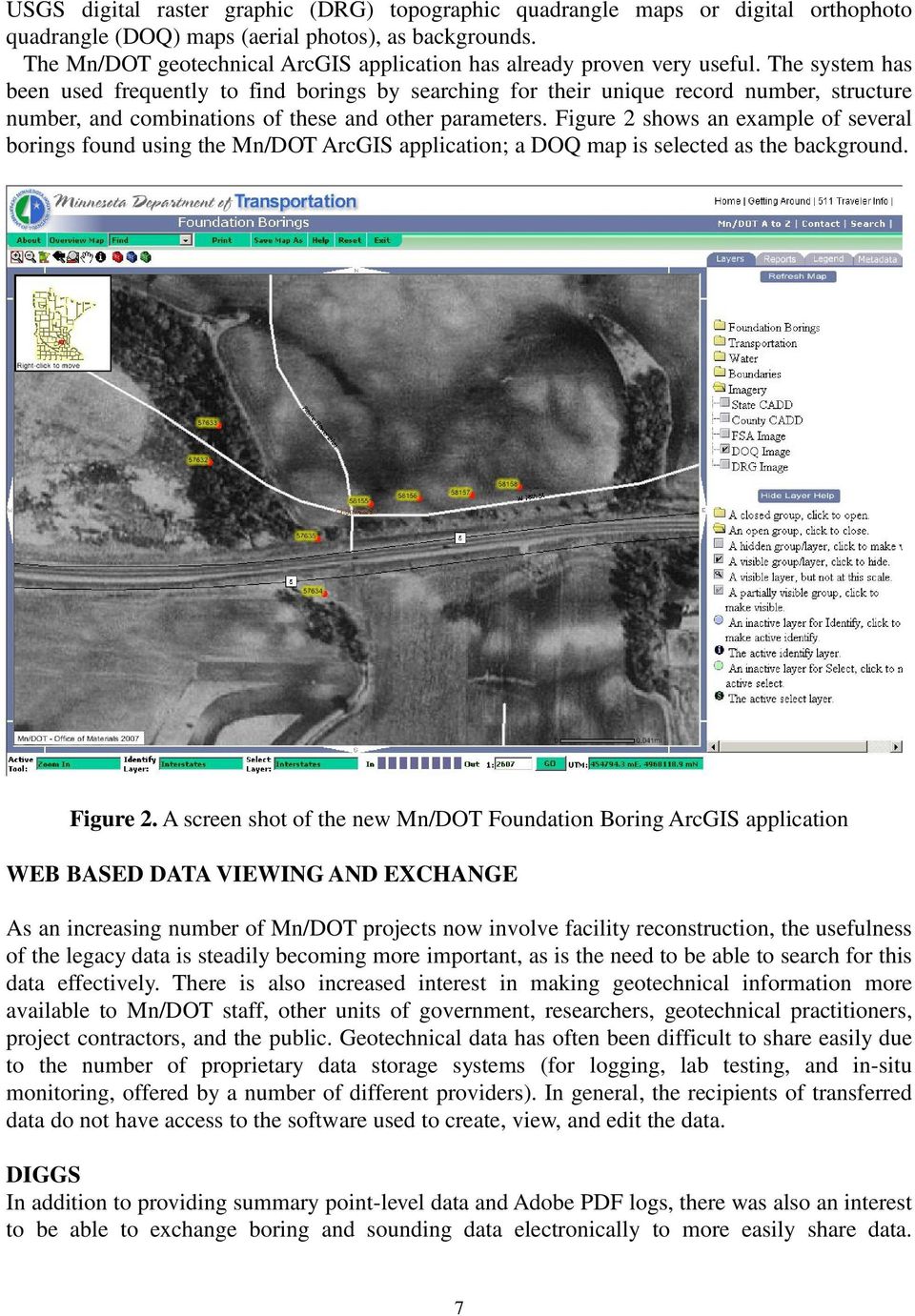
7 USGS digital raster graphic (DRG) topographic quadrangle maps or digital orthophoto quadrangle (DOQ) maps (aerial photos), as backgrounds. The Mn/DOT geotechnical ArcGIS application has already proven very useful. The system has been used frequently to find borings by searching for their unique record number, structure number, and combinations of these and other parameters. Figure 2 shows an example of several borings found using the Mn/DOT ArcGIS application; a DOQ map is selected as the background. Figure 2. A screen shot of the new Mn/DOT Foundation Boring ArcGIS application WEB BASED DATA VIEWING AND EXCHANGE As an increasing number of Mn/DOT projects now involve facility reconstruction, the usefulness of the legacy data is steadily becoming more important, as is the need to be able to search for this data effectively. There is also increased interest in making geotechnical information more available to Mn/DOT staff, other units of government, researchers, geotechnical practitioners, project contractors, and the public. Geotechnical data has often been difficult to share easily due to the number of proprietary data storage systems (for logging, lab testing, and in-situ monitoring, offered by a number of different providers). In general, the recipients of transferred data do not have access to the software used to create, view, and edit the data. DIGGS In addition to providing summary point-level data and Adobe PDF logs, there was also an interest to be able to exchange boring and sounding data electronically to more easily share data. 7
8 Mn/DOT is a member of the Geotechnical Management Systems Group for the development of DIGG.S and is making progress toward providing boring and sounding information using the new standard. The development of the DIGGS standard, and the roles of participating organizations are described by Lefchik (2006). When the first DIGGS standard becomes available, Mn/DOT will create DIGGS compliant XML files. These files will then be available through the ArcGIS application in addition to the Adobe PDF electronic boring logs and the MS Excel files of the point-based data. Data Conversion to XML/DIGGS Through a conversion application within the gint database environment, gint project files can be converted into the DIGGS XML standard. Little additional effort will be required to create the data interchange files based on the existing project databases. A correspondence file will be used to map the Mn/DOT data into the DIGGS data structure; the program automates the creation of the XML files with the correct nomenclature and syntax. Features of the XML format and its use in the exchange of geotechnical database information are described by Caronna (2006). CONCLUSIONS Mn/DOT has developed an ArcGIS application that makes most agency geotechnical borings web-searchable and printable. As part of recent improvements, point-based data is also available as downloadable in a MS Excel file format. Boring and sounding data will be converted to the new DIGGS data interchange standard and this information will be available through the web based ArcGIS application. Additional areas for development include the addition of 2-D geophysical data, lab data, and monitoring/instrumentation data. The overall effort to develop the data sharing and exchange system has resulted in an increase in data quality, an improvement in overall process automation, and significantly improved data sharing techniques. Using the ArcGIS interface, records can now be obtained in real-time in a variety of formats. REFERENCES Caronna, S., (2006) Implementing XML for Geotechnical Databases JTC2 Workshop on Geo- Engineering Data: Representation and Standardisation, IAEG Congress, University of Nottingham, United Kingdom ( Dasenbrock, D. D., (2006) Mn/DOT s On-Line Geo-Spatial Borehole/Sounding Database Development. Geotechnical Engineering In the Information Technology Age, Proc., Geo- Congress 2006, Feb 26-March 1, 2006, Atlanta, GA, Edited by DeGroot, DeJong, Frost, Baise (CD-ROM), ASCE, Reston, VA. Lefchik, T. E., and Beach K.(2006) Development of National Geotechnical Management System Standards for Transportation Applications Geotechnical Engineering In the Information Technology Age, Proc., Geo-Congress 2006, Feb 26-March 1, 2006, Atlanta, GA, Edited by DeGroot, DeJong, Frost, Baise (CD-ROM), ASCE, Reston, VA. Mn/DOT (2007), Mn/DOT BaseMap History Minnesota Department of Transportation agency website 8
Geotechnical Data Management Initiatives at Caltrans
 Geotechnical Data Management Initiatives at Caltrans Loren L. Turner 1, Craig Hannenian 2, and Steve Mahnke 3 1 California Department of Transportation, Research & Innovation, GeoResearch Group, 5900 Folsom
Development of National Geotechnical Management System Standards for Transportation Applications
 Development of National Geotechnical Management System Standards for Transportation Applications Thomas E. Lefchik P.E. 1 and Kirk Beach 2 1 Federal Highway Administration, 200 N. High Street, Room 328,
Guidelines on Information Deliverables for Research Projects in Grand Canyon National Park
 INTRODUCTION Science is playing an increasing role in guiding National Park Service (NPS) management activities. The NPS is charged with protecting and maintaining data and associated information that
ArcGIS Reference Document
 Migration of GIS Data to ArcSDE Page 1 of 10 Table of Contents A Brief Summary of DEP s GIS Data Storage o The Y Drive o ArcSDE (Spatial Database) Keeping Your GIS Project Data Current o Checking Your
INTRODUCTION TO ARCGIS SOFTWARE
 INTRODUCTION TO ARCGIS SOFTWARE I. History of Software Development a. Developer ESRI - Environmental Systems Research Institute, Inc., in 1969 as a privately held consulting firm that specialized in landuse
Project Overview. Kirk Beach Ohio Department of Transportation. ODOT Geotechnical Data Management System. Office of Geotechnical Engineering
 Project Overview ODOT Geotechnical Data Management System Kirk Beach Ohio Department of Transportation Office of Geotechnical Engineering Geology and Exploration Section Project Goals Development of a
Creating the US Topo
 Creating the US Topo A Process Discussion National Geospatial Program Office National Geospatial Technical Operations Center Helmut Lestinsky Graphics Product Specialist MOD Project Manager U.S. Department
DATA SHARING AND SPATIAL QUERY
 Technical Memorandum No. 2 DATA SHARING AND SPATIAL QUERY Raghavan Srinivasan Spatial Sciences Laboratory Texas Agricultural Experiment Station, Texas A&M University Submitted to El Paso Water Utilities
University of Arizona THE CAMPUS SPATIAL DATA INITIATIVE
 University of Arizona THE CAMPUS SPATIAL DATA INITIATIVE Presentation Review 1. Background on Campus Mapping and Spatial Data 2. The Campus Spatial Data Users Research / Teaching / Outreach Administration
Minnesota Department of Natural Resources \mn_dnr \mn_dnr\spatial \mn_dnr\tabular \mn_dnr\metadata
 INDEX OF GIS SPATIAL DATA, TABULAR DATA, AND METADATA ASSOCIATED WITH REPORT 380, AGGREGATE RESOURCE POTENTIAL PARTS OF NORTHERN ST. LOUIS AND LAKE COUNTIES, MN. Project of the Minnesota Department of
The GeoMedia Architecture Advantage. White Paper. April 2002. The GeoMedia Architecture Advantage Page 1
 The GeoMedia Architecture Advantage White Paper April 2002 The GeoMedia Architecture Advantage Page 1 Introduction What is wrong with GIS? GIS is primarily about data not software. Data should be independent
GEOGRAPHIC INFORMATION SYSTEMS
 GEOGRAPHIC INFORMATION SYSTEMS WHAT IS A GEOGRAPHIC INFORMATION SYSTEM? A geographic information system (GIS) is a computer-based tool for mapping and analyzing spatial data. GIS technology integrates
A GIS helps you answer questions and solve problems by looking at your data in a way that is quickly understood and easily shared.
 A Geographic Information System (GIS) integrates hardware, software, and data for capturing, managing, analyzing, and displaying all forms of geographically referenced information. GIS allows us to view,
Geographic Information System Product Distribution Policies. Preface
 Support Services Department Information Technologies Division Geographic Information System Product Distribution Policies Preface 1. Purpose Geographic Information System (GIS) Product Distribution Policies
National Register of Historic Places: GIS Webinar Cultural Resource GIS Facility National Park Service June 2012
 National Register of Historic Places: GIS Webinar Cultural Resource GIS Facility National Park Service June 2012 In February and March 2012 the National Register of Historic Places held webinars in conjunction
Primavera Project Management System at WVDOT. Presented by Marshall Burgess, WVDOT Stephen Cole, Stephen Cole Consulting Jervetta Bruce, CDP, Inc.
 : Integrating GIS With Primavera Project Management System at WVDOT Presented by Marshall Burgess, WVDOT Stephen Cole, Stephen Cole Consulting Jervetta Bruce, CDP, Inc. WVDOT Geographic Information System
ArcSDE Spatial Data Management Roles and Responsibilities
 ArcSDE Spatial Data Management Roles and The following discussion outlines the major roles and responsibilities involved in deploying your spatial data and geographic information system (GIS) applications
Introduction to GIS (Basics, Data, Analysis) & Case Studies. 13 th May 2004. Content. What is GIS?
 Introduction to GIS (Basics, Data, Analysis) & Case Studies 13 th May 2004 Content Introduction to GIS Data concepts Data input Analysis Applications selected examples What is GIS? Geographic Information
Implementation of a Web Portal for Managing and Sharing Environmental Data
 Implementation of a Web Portal for Managing and Sharing Environmental Data Prepared for: 2011 DoD Environmental Monitoring & Data Quality Workshop Presented by: Jason Samus EA Engineering, Science and
GIS Databases With focused on ArcSDE
 Linköpings universitet / IDA / Div. for human-centered systems GIS Databases With focused on ArcSDE Imad Abugessaisa [email protected] 20071004 1 GIS and SDBMS Geographical data is spatial data whose
Data access and management
 B Data access and management CONTENTS B.1 Introduction... B-1 B.2 Data requirements and availability... B-1 B.3 Data access... B-2 B.4 Overall procedures... B-2 B.5 Data tools and management... B-4 Appendix
ArcGIS. Server. A Complete and Integrated Server GIS
 ArcGIS Server A Complete and Integrated Server GIS ArcGIS Server A Complete and Integrated Server GIS ArcGIS Server enables you to distribute maps, models, and tools to others within your organization
EXPLORING AND SHARING GEOSPATIAL INFORMATION THROUGH MYGDI EXPLORER
 EXPLORING AND SHARING GEOSPATIAL INFORMATION THROUGH MYGDI EXPLORER Subashini Panchanathan Malaysian Centre For Geospatial Data Infrastructure ( MaCGDI ) Ministry of National Resources and Environment
Mapping Mashup/Data Integration Development Resources Teaching with Google Earth and Google Ocean Stone Lab August 13, 2010
 Mapping Mashup/Data Integration Development Resources Teaching with Google Earth and Google Ocean Stone Lab August 13, 2010 David Hart GIS Specialist University of Wisconsin Sea Grant Institute Virtual
Coming To An Airport Near You
 Airport GIS Data & ealp Coming To An Airport Near You Kevin Shirer, AAE Project Manager Association of California Airports; September 2009 Today s Presentation & Expectations Take away Basic knowledge
GIS Architecture and Data Management Practices Boone County GIS Created and Maintained by the Boone County Planning Commission GIS Services Division
 GIS Architecture and Data Management Practices Boone County GIS Created and Maintained by the Boone County Planning Commission June 2008 Background Boone County s GIS program has been in existence for
Interoperable Solutions in Web-based Mapping
 ISPRS SIPT IGU UCI CIG ACSG Table of contents Table des matières Authors index Index des auteurs Search Recherches Exit Sortir Interoperable Solutions in Web-based Mapping Marta Wojnarowska and Bridget
How To Use The Alabama Data Portal
 113 The Alabama Metadata Portal: http://portal.gsa.state.al.us By Philip T. Patterson Geological Survey of Alabama 420 Hackberry Lane P.O. Box 869999 Tuscaloosa, AL 35468-6999 Telephone: (205) 247-3611
Open Source Desktop GIS Solutions for the Not-So Casual User
 Open Source Desktop GIS Solutions for the Not-So Casual User Roger C. Lowe III Warnell School of Forestry and Natural Resources The University of Georgia Athens, GA 30605 [email protected] Abstract Ask
Building & Developing the Environmental
 Building & Developing the Environmental Web Explorer for Riyadh City Authors: Engineer Yousef Bin Othman Al-Fariheedi Manager of Environmental Data Unit Environmental Management and Protection Department
A Brief Explanation of Basic Web Services
 A Brief Explanation of Basic Web Services What is REST? REpresentational State Transfer (REST) is a way for software to work when distributed across a network. For example, if I want to view the Iowa Dept
CITY OF SUFFOLK, VIRGINIA GIS DATA DISTRIBUTION AND PRICING POLICY
 CITY OF SUFFOLK, VIRGINIA GIS DATA DISTRIBUTION AND PRICING POLICY 1 The City of Suffolk has invested a large amount of effort into the development of a Citywide Geographic Information System (GIS). The
An ESRI White Paper December 2007 Enterprise GIS for Local Government
 An ESRI White Paper December 2007 Enterprise GIS for Local Government ESRI 380 New York St., Redlands, CA 92373-8100 USA TEL 909-793-2853 FAX 909-793-5953 E-MAIL [email protected] WEB www.esri.com Copyright
Work Type Definition and Submittal Requirements
 Work Type: Highway Materials Testing Geotechnical Laboratory Testing, Geotechnical Laboratory Testing, Standard Penetration (SPT) & Rock Coring, Cone Penetration Test, Solid Stem Auger Drilling, and Materials
GEOTECHNICAL DATA TRANSFER AND MANAGEMENT FOR LARGE CONSTRUCTION PROJECTS AND NATIONAL ARCHIVES
 International Symposium on Advances in Ground Technology and Geo-Information (IS-AGTG) 1-2 Dec 2011, Singapore Chandler R.J GEOTECHNICAL DATA TRANSFER AND MANAGEMENT FOR LARGE CONSTRUCTION PROJECTS AND
Web Map Service Architecture for Topographic Data in Finland
 Web Map Service Architecture for Topographic Data in Finland Teemu Sipilä National Land Survey of Finland Abstract. Since 2012 National Land Survey of Finland has been renewing its web map services and
{ { { Meeting Date 08/03/10. City of Largo Agenda Item 24. Leland Dicus, P.E., City Engineer
 City of Largo Agenda Item 24 Form Revision Date: 10/19/09: Meeting Date 08/03/10 Presenter: Leland Dicus, P.E., City Engineer Department: CD Community Development TITLE: GIS PROGRAM UPDATE The implementation
GIS MAPPING FOR IRRIGATION DISTRICT RAPID APPRAISALS Daniel J. Howes 1, Charles M. Burt 2, Stuart W. Styles 3 ABSTRACT
 GIS MAPPING FOR IRRIGATION DISTRICT RAPID APPRAISALS Daniel J. Howes 1, Charles M. Burt 2, Stuart W. Styles 3 ABSTRACT Geographic information system (GIS) mapping is slowly becoming commonplace in irrigation
REGIONAL SEDIMENT MANAGEMENT: A GIS APPROACH TO SPATIAL DATA ANALYSIS. Lynn Copeland Hardegree, Jennifer M. Wozencraft 1, Rose Dopsovic 2 INTRODUCTION
 REGIONAL SEDIMENT MANAGEMENT: A GIS APPROACH TO SPATIAL DATA ANALYSIS Lynn Copeland Hardegree, Jennifer M. Wozencraft 1, Rose Dopsovic 2 ABSTRACT: Regional sediment management (RSM) requires the capability
Create a folder on your network drive called DEM. This is where data for the first part of this lesson will be stored.
 In this lesson you will create a Digital Elevation Model (DEM). A DEM is a gridded array of elevations. In its raw form it is an ASCII, or text, file. First, you will interpolate elevations on a topographic
Geographic Information System Tools for Management of US DOE Sites 14125
 Geographic Information System Tools for Management of US DOE Sites 14125 John Montgomery*, Cliff Carpenter*, Leonard Turton**, Steve Pawel** *US DOE, Office of Legacy Management **S.M. Stoller Corporation
County of Los Angeles. Chief Information Office Preferred Technologies for Geographic Information Systems (GIS) September 2014
 County of Los Angeles Chief Information Office Preferred Technologies for Geographic Information Systems (GIS) September 2014 CIO Preferred Technologies for GIS This document lists the preferred Geographic
Oklahoma s Open Source Spatial Data Clearinghouse: OKMaps
 Oklahoma s Open Source Spatial Data Clearinghouse: OKMaps Presented by: Mike Sharp State Geographic Information Coordinator Oklahoma Office of Geographic Information MAGIC 2014 Symposium April 28-May1,
Work Type Definition and Submittal Requirements
 Work Type: Geotechnical Studies Soils Analysis & Recommendations The first section, Work Type Definition, provides a detailed explanation of the work type. The second section, Work Type Submittal Requirements,
Cookbook 23 September 2013 GIS Analysis Part 1 - A GIS is NOT a Map!
 Cookbook 23 September 2013 GIS Analysis Part 1 - A GIS is NOT a Map! Overview 1. A GIS is NOT a Map! 2. How does a GIS handle its data? Data Formats! GARP 0344 (Fall 2013) Page 1 Dr. Carsten Braun 1) A
Looking Beyond Data Synchronization for Mission Critical GIS Data
 Looking Beyond Data Synchronization for Mission Critical GIS Data Table of Contents Preface... 2 Background Information... 3 Introduction... 4 Area of Focus #1: Locally Authoritative GIS Data Development
North Dakota GIS Program Report To Governor Jack Dalrymple. July 1, 2011 June 30, 2012
 North Dakota GIS Program Report To Governor Jack Dalrymple July 1, 2011 June 30, 2012 Executive Order 2001-06: The committee shall issue a report to the Governor's office at the end of each fiscal year,
Can GIS Help You Manage Water Resources? Erika Boghici Texas Natural Resources Information Systems
 Can GIS Help You Manage Water Resources? Erika Boghici Texas Natural Resources Information Systems Hydrologic Information System Hydrologic Modeling Arc Hydro Geodatabase Arc Hydro Data Model: combination
ArcGIS Data Models Practical Templates for Implementing GIS Projects
 ArcGIS Data Models Practical Templates for Implementing GIS Projects GIS Database Design According to C.J. Date (1995), database design deals with the logical representation of data in a database. The
The Development and Implementation of a GIS System for Sunde Land Surveying, LLC.
 The Development and Implementation of a GIS System for Sunde Land Surveying, LLC. Ryan R. Bormann 1,2 1 Department of Resource Analysis, Saint Mary s University of Minnesota, Winona, MN 55987. 2 Sunde
Finding GIS Data and Preparing it for Use
 Finding_Data_Tutorial.Doc Page 1 of 19 Getting Ready for the Tutorial Sign Up for the GIS-L Listserv Finding GIS Data and Preparing it for Use The Yale University GIS-L Listserv is an internal University
Michigan Tech Research Institute Wetland Mitigation Site Suitability Tool
 Michigan Tech Research Institute Wetland Mitigation Site Suitability Tool Michigan Tech Research Institute s (MTRI) Wetland Mitigation Site Suitability Tool (WMSST) integrates data layers for eight biophysical
GIS User Guide. for the. County of Calaveras
 GIS User Guide for the County of Calaveras Written by Dave Pastizzo GIS Coordinator Calaveras County San Andreas, California August 2000 Table of Contents Introduction..1 The Vision.1 Roles and Responsibilities...1
Remote Sensing, GPS and GIS Technique to Produce a Bathymetric Map
 Remote Sensing, GPS and GIS Technique to Produce a Bathymetric Map Mark Schnur EES 5053 Remote Sensing Fall 2007 University of Texas at San Antonio, Department of Earth and Environmental Science, San Antonio,
Agenda. What is GIS? GIS and SAP Real Examples
 Agenda What is GIS? GIS and SAP Real Examples Life Without GIS My Stuff My Paper Maps Features Three Elements of a GIS Attributes What parcels are adjacent to Main Street? Behavior Display Query Analysis
Metadata for Big River Watershed Geologic and Geomorphic Data
 Metadata for Big River Watershed Geologic and Geomorphic Data Metadata are descriptions and information regarding compiled data. This appendix contains the metadata that describes the compiled data used
Web and Mobile GIS Applications Development
 Web and Mobile GIS Applications Development Presented by : Aamir Ali Manager Section Head (GIS Software Customization) Pakistan Space and Upper Atmosphere Research Commission (SUPARCO) Geographical Information
Web-based GIS Application of the WEPP Model
 Web-based GIS Application of the WEPP Model Dennis C. Flanagan Research Agricultural Engineer USDA - Agricultural Research Service National Soil Erosion Research Laboratory West Lafayette, Indiana, USA
End-User Interest in Geotechnical Data Management Systems
 End-User Interest in Geotechnical Data Management Systems Division of Research & Innovation Final Report Report CA07-0057 November 2008 This page left intentionally blank End-User Interest in Geotechnical
GIS-Integrated Emissions Inventory Software Solution
 GIS-Integrated Emissions Inventory Software Solution Dr. Jesse L. Thé, Mike Johnson, Steve Koo, Mark Hilverda, Cris Thé Lakes Environmental Software, Inc., 450 Phillip Street, Suite 2 Waterloo, Ontario,
Implementing ArcGIS for SharePoint Habitat for Humanity of Omaha April, 2013
 Ingenuity Innovation Integrity Implementing ArcGIS for SharePoint Habitat for Humanity of Omaha April, 2013 1851 Alexander Bell Drive Suite 350 Reston, VA 20191 703.463.2059 800.483.2434 www.vistronix.com
Mapping Mashup/Data Integration Development Resources
 Mapping Mashup/Data Integration Development Resources David Hart GIS Specialist University of Wisconsin Sea Grant Institute October 6, 2008 Virtual Globes A virtual globe is a 3D software model or representation
TerraGo Geospatial Collaboration Solutions
 TerraGo Geospatial Collaboration Solutions Oil and Gas Deploying Enterprise Geospatial Information Throughout the Petroleum Lifecycle TerraGo Solutions for Oil and Gas Whether in the exploration phase
[ DISTRIBUTING AVL USING ARCIMS
 [ DISTRIBUTING AVL USING ARCIMS The Chicago MAGIC Project ] GIS-T 2003 Colorado Springs presented by Louis Schoolkate Transportation Division Manager GeoAnalytics, Inc. 2002 [ Presentation Overview ] Project
About As. In a team with the best. ESRI Bulgaria is the exclusive distributor of Esri Inc. for Bulgaria. Esri Inc.
 About As ESRI Bulgaria is an IT company, leader in the field of Geographic Information Systems (GIS) on the Bulgarian market. Offering the most advanced high-tech products, solutions and services, ESRI
Lecture 8. Online GIS
 Lecture 8 Online GIS Lecture 8: Outline I. Online GIS 1. Google Earth 2. MSN Live Maps II. Open Source GIS III. ArcGIS Server and the ESRI suite of online software utility options IV. Advanced Data Mining
Data Integration for ArcGIS Users Data Interoperability. Charmel Menzel, ESRI Don Murray, Safe Software
 Data Integration for ArcGIS Users Data Interoperability Charmel Menzel, ESRI Don Murray, Safe Software Product overview Extension to ArcGIS (optional) Jointly developed with Safe Software Based on Feature
Creating a File Geodatabase
 Creating a File Geodatabase Updated by Thomas Stieve January 06, 2012 This exercise demonstrates how to create a file geodatabase in ArcGIS 10; how to import existing data into the geodatabase, and how
Pro/INTRALINK 9.0/9.1 Curriculum Guide
 Pro/INTRALINK 9.0/9.1 Curriculum Guide NOTE: For a graphical depiction of the curriculum based on job role, please visit this page: http://www.ptc.com/services/edserv/learning/paths/ptc/proi_90.htm Web
Questions and Answers for Citrix Ready Software
 AutoCAD Map 3D 2009 Questions and Answers for Citrix Ready Software AutoCAD Map 3D software is one of the leading engineering platforms for creating and managing spatial data. Bridging the gap between
Using AGS digital data transfer format D C Entwisle and S Self
 Using AGS digital data transfer format D C Entwisle and S Self Synopsis UK Business model What is the AGS? What is AGS digital data transfer format? Using AGS data UK business model Client Consultant Main
What you can do:...3 Data Entry:...3 Drillhole Sample Data:...5 Cross Sections and Level Plans...8 3D Visualization...11
 What you can do:...3 Data Entry:...3 Drillhole Sample Data:...5 Cross Sections and Level Plans...8 3D Visualization...11 W elcome to North Face Software s software. With this software, you can accomplish
Accessing State Mine Related Databases 2012
 Accessing State Mine Related Databases 2012 Kentucky Office of Mine Safety and Licensing Annual Reports of coal mines http://omsl.ky.gov/pages/annualreports.aspx Annual License Activity Listings in pdf
Database Production and Map Series Management. Using. The Production Line Tool Set
 Database Production and Map Series Management Using The Production Line Tool Set Dewey Marino - ESRI Redlands Production Line Tool Set ArcGIS Solution for high volume database and map creation Creates
Raghu Satyanarayana, Ph.D. Geotechnical/Software Consultant ESC, Inc.
 By Raghu Satyanarayana, Ph.D. Geotechnical/Software Consultant ESC, Inc. Jean Benoît, Ph.D. Professor & Chair, Dept. of Civil Engineering University of New Hampshire NGES What is NGES? Network of well-documented
INTEGRATING BIM AND GIS FOR ASSET MANAGEMENT
 INTEGRATING BIM AND GIS FOR ASSET MANAGEMENT Andy Chan MHKIBIM Project Manager Spatial Technology Limited Agenda Introduction of Asset Management Why GIS is not sufficient for Asset Management Data model