
|
|
|
- Anabel Ferguson
- 10 years ago
- Views:
Transcription
1 Rend. Istit. Mat. Univ. Trieste Suppl. Vol. XXX, 111{121 (1999) Fuzziness in Chang's Fuzzy Topological Spaces Valentn Gregori and Anna Vidal () Summary. - It is known that fuzziness within the concept of openness of a fuzzy set in a Chang's fuzzy topological space (fts) is absent. In this paper we introduce a gradation of openness for the open sets of a Chang fts (X; T ) by means of a map : I X,! I (I = [0; 1]), which is at the same time a fuzzy topology on X in Shostak's sense. Then, we will be able to avoid the fuzzy point concept, and to introduce an adequate theory for -neighbourhoods and, T i separation axioms which extend the usual ones in General Topology. In particular, our -Hausdor fuzzy space agrees with -Rodabaugh Hausdor fuzzy space when (X; T ) is interpreservative or -locally minimal. 1. Introduction In 1968 C. Chang [1] introduced the concept of a fuzzy topology on a set X as a family T I X, where I =[0; 1], satisfying the well-know axioms, and he referred to each member of T as an open set. So, in his denition of a fuzzy topology some authors notice fuzziness in the () Authors' addresses: Valentn Gregori, Departamento de Matematica Aplicada, Universidad Politecnica de Valencia Escola Universitaria de Gandia Carretera Nazaret-Oliva S.N Grau de Gandia, Valencia, Spain, [email protected],[email protected] Anna Vidal, Departamento de Matematica Aplicada, Universidad Politecnica de Valencia Escola Universitaria de Gandia Carretera Nazaret-Oliva S.N Grau de Gandia, Valencia, Spain AMS Classication: 54A40 Keywords: fuzzy topology, gradation of openness, fuzzy point. While working on this paper the rst-listed author has been partially supported by a grant from Ministerio de Educacion y Ciencia DGES PB

2 112 V. GREGORI and A. VIDAL concept of opennes of a fuzzy set has not been considered. Keeping this in view, A.P. Shostak [8], began the study of fuzzy structures of topological type. The idea of this paper is to allow open sets of a Chang's fuzzy topology to be open to some degree by means of a particular Shostak's fuzzy topology (or gradation of openness [2]) on X (Proposition 3.1). This gradation of openness will enable us to introduce fuzzy topological concepts which are generalitation of the corresponding ones in General Topology and to work with points of X instead of fuzzy points (the idea of a fuzzy point and fuzzy point belonging is a rather problematic, see Gottwald [4] for a discussion). After preliminary section, in section 3 we dene the concept of an -set and study some denitions and properties relative to it. In particular we show the family of all -neighborhoods of x 2 X, have similar properties to the classic cases. In section 4 we dene and study the families of interpreservative and -locally minimal spaces. In section 5 we dene the concept of an -T i space (i =0; 1; 2) and show that the concept of an -T 2 space coincides with the -Hausdor concept due to S.E. Rodabaugh [7] in the spaces mentioned in section 4. Our study may be thought to be just the beginning of this subjet which is far from being completed. 2. Preliminary notions Let X be a nonempty set and I the closed unit interval. A fuzzy set of X is a map M : X,! I. M(x) is interpreted as the degree of membership of a point x 2 X in a fuzzy set M, while an ordinary subset A X is identied with its characteristic function and, in consequence ; and X are identied with the constant functions on X, 0 and 1 respectively. As usual in fuzzy sets, we write A B if A(x) B(x); x2 X. We dene the union, intersection and [! _ complement of fuzzy sets as follows: A i (x) = A i (x); x 2 X i i \! A i (x) =^ A i (x); x 2 X. i A c (x) =1, A(x); x2 X i

3 FUZZINESS IN CHANG'S FUZZY TOPOLOGICAL SPACES 113 A.P. Shostak [8] dened a fuzzy topology on X as a function : I X,! I satisfying the following axioms: (i) (0) =(1) =1 (ii) ; 2 I X implies ( \ ) () [ ^ () ^ (iii) i 2 I X for all i 2 J implies ( i ) ( i ) i i K.C. Chattopadhyay et al. [2] rediscovered the Shostak's fuzzy topology concept and called gradation of openness the function. Also, they called gradation of closedness on X [2], a function F : I X,! I satisfying the above axioms (i)-(iii) but interchanging the intersection with the union and vice-versa. From now, a fuzzy topology in Shostak's sense will be called gradation of openness, and we dene a fuzzy topological space, or fts for short, as a pair (X; T ) where T is a fuzzy topology in Chang's sense, on X, i.e., T is a collection of fuzzy sets of X, closed under arbitrary unions and - nite intersections. A set is called open if it is in T, and closed if its complement isint. The interior of a fuzzy set A is the largest open fuzzy set contained in A. If confusion is not possible we say X is a space instead of a fts. We will denote inf B, the inmum of a set B of real numbers. Recall the support of a fuzzy set A is supp A = fx 2 X : A(x) > 0g. We denote x ^2 A whenever x 2 supp A, and we say A contains the point x or that x is in A. The next denition was given by PuPao-Ming et al. [6]. Definition 2.1. A fuzzy point is a fuzzy set p x which takes the value 0 for all y 2 X except one, that is x 2 X. The fuzzy point p x is said to belong to the fuzzy set A, denoted byp x ~2A, ip x (x) A(x). We notice x^2a if p x ~2A. 3. Gradation of openness The proof of the following proposition can be seen in [5] Proposition 3.1. Let X be a nonempty set. Then the map : I X,! I given by (0) = 1 and (A) = inffa(x) : x 2 supp Ag if A 6= 0, satises both the axioms of gradation of openness and the axioms of gradation of closedness.
![[2] rediscovered the Shostak's fuzzy topology concept and called gradation of openness the function. Also, they called gradation of closedness on X [2], a function F : I X,!](/docs-images/58/146366/images/page_3.jpg "I satisfying the above axioms (i)-(iii) but interchanging the intersection with the union and vice-versa.")
4 114 V. GREGORI and A. VIDAL The real number (A) is the degree of openness [8] of the fuzzy set A; clearly, (A) = implies the degree of membership of each point in the support of A, in the fuzzy set A, is at least. We notice (A) =1iA is an ordinary subset of X and (A) = 0 i there is a sequence fx n g in X such that A(x n ) > 0, 8n 2 N and lim n A(x n )=0. With this terminology we give the following denitions. Definitions 3.2. The fuzzy set A of X is an -set if (A) ; moreover, if A was open (closed) we will say A is -open (closed). Clearly, each A 2 I X is a 0-set and the 1-sets are only the ordinary subsets of X. Since is a gradation of openness and closedness, we have the following proposition. Proposition 3.3. The union and intersection of -sets is an -set. The following example shows that if A is an -set and A B, then B is not an -set necesarily. Example 3.4. Let X be a set with at least two points and 2]0; 1]. Let fm;ng be a partition of X. We dene the following fuzzy sets A and B: A(x) = if x 2 M and A(x) =0if x 2 N B(x) = if x 2 M and B(x) ==2 if x 2 N We have that A is an -set and A B, but B is not. Nevertheless we have the following proposition. Proposition 3.5. Let A; B be fuzzy sets. If A is an -set, A B and supp B supp A, then B is an -set. Proof. It is obvious. Definitions 3.6. Let (X; T ) be a fts and let 2 I. The fuzzy topology T = fa 2T : (A) g is called the -level of openness of the fuzzy topology T. Clearly ft : 2 Ig is a descending family, (i.e., >implies T T ), where T 0 = T and T 1 is an ordinary topology on X.

5 FUZZINESS IN CHANG'S FUZZY TOPOLOGICAL SPACES 115 We call -interior of the fuzzy set A, denoted int (A), the largest -open contained in A, i.e., int (A) =[fg 2T : G Ag. Clearly, int (A) is welldened, since 0 2T 8 2 I, and int (A) A for each A 2 I X. Note, int 0 (A) is the interior of A in Chang's sense and the -interior of a fuzzy set A is just its interior in the -level fuzzy topology T. We say that the fuzzy set A is an -neighborhood, or -nbhd for short, of p 2 X if there exists G 2 T such that p ^2 G A. Equivalently, a point in (the support of) int (A) will be called an -interior point of A. The -nbhd system of a point p 2 X, is the family N (p) of all -nbhd's of the point p. Obviously, if > then N (p) N (p). With this notation we have the following proposition. Proposition 3.7. Let (X; T ) be a fts, A 2 I X, 2 I and p 2 X. Then, (i) A is -open if and only if A = int (A). (ii) p ^2 int (A) if and only if A 2N (p). Proof. It is obvious. If A is an -open set, then A is an -neighbourhood of all points of its support, but the converse is not true as shows the following example. Example 3.8. Let (X; T) be a topological space, 2]0; 1[ and let T = f0; 1g [f U : U 2 T g. Then any U 2 T is an -neighbourhood for any point x 2 U, i.e. for any point of its support, but obviously U fails to be -open in (X; T ). In the next proposition we show that the family N (p) satises similar properties to the corresponding ones in General Topology. Proposition 3.9. Let (X; T ) be a fts and let 2 I. For each point p 2 X let N (p) be the family of all -nbhd's of p. Then 1. If M 2N (p), then p ^2 M. 2. If M;N 2N (p), then M \ N 2N (p).

6 116 V. GREGORI and A. VIDAL 3. If M 2N (p) and M N, then N 2N (p). 4. If M 2N (p), then there is N 2N (p) such that (N), N M and N 2N (q); 8q ^2 N. Proof. 1. If M 2 N (p), then there exists G 2 T such that p^2g M, and therefore p ^2 M. 2. If M;N 2N (p), then there are two -open fuzzy sets G 1 and G 2 such that p ^2 G 1 M, p ^2 G 2 N. Since G 1 \ G 2 2T and p ^2 G 1 \ G 2 M \ N, wehave M \ N 2N (p). 3. If M 2N (p), there exists G 2T such that p ^2 G M N and therefore N 2N (p). 4. Suppose M 2 N (p). Then there exists G 2 T such that p ^2 G M. Let N = G. We have (N) and N 2 N (q); 8q ^2 N. Proposition Let 2 I. If N is a function which assigns to each p 2 X a nonempty family N (p) of fuzzy sets satisfying properties 1, 2 and 3 of the above proposition, then the family T = fm 2 I X : (M) ; M 2N (p); 8p ^2 Mg is a fuzzy topology on X. If property 4 of the above proposition is also satised, then N (p) is precisely the -nbhd system of p relative to the topology T. Proof. First, we will show that T is a fuzzy topology on X. Obviously 0 2T and since M 1, 8M 2N (p), according to property 3,1 2N (p), 8p 2 X, i.e, 1 2T. Let M;N 2T. If p ^2 M \N, clearly p ^2 M and p ^2 N, therefore M;N 2N (p) and according to property 2wehave M \N 2N (p). Now, by Proposition 3.3, (M \ N) and then M \ N [ 2T. Let fm i g i2j be a family of sets of T and let M = M i. If i p ^2 M, then we have 0 < [ i M i! (p), and therefore there exists

7 FUZZINESS IN CHANG'S FUZZY TOPOLOGICAL SPACES 117 j 2 J such that 0 < M j (p), i.e, p ^2 M j. Therefore, M j 2 N (p) and according to property 3,M 2N (p). Now, by Proposition 3.3, (M) and then M 2T. Now, we suppose property 4 is also satised. We will see that the -neighbourhood system of p, V (p), relative to the fuzzy topology T, is the family N (p). If M 2V (p), then there exists an -open, G of T with p^2g M. Therefore, G 2 N (p) and, according to property 3, we have M 2N (p). If M 2N (p), according to property 4, there exists N 2N (p), with N M and such that (N) and N 2N(q), 8q^2N. Then we have N 2T such that p ^2 N M, i.e., M 2N (p). Observetion 3.11: In [6], the authors dened the concept of neighborhood of a fuzzy point and they showed similar results, but in [9] Shostak remarks that there are inaccuracies in the formulation of these authors. In fact, the family constructed by the authors is a base for a fuzzy topology, but it is not a fuzzy topology. 4. Interpreservative and locally minimal fts We begin with the following denitions. Definitions 4.1. Let (X; T ) be a fts. We say X is interpreservative if the intersection of each family of open sets is an open set, or equivalently, if the family of closed sets is a fuzzy topology on X. We say X is locally minimal if \fg 2 T : x ^2 Gg is open for each x 2 X, i.e., each x 2 X admits a smallest nbhd. We say X is -locally minimal, 2]0; 1], if \fg 2T : x ^2 Gg is -open, for each x 2 X. Clearly, for > > 0, -locally minimal implies -locally minimal. Also, an -locally minimal space is locally minimal but the converse is false as shows the next example. Example 4.2. Let X the real interval ]1; +1[ with the fuzzy topology T = f0; 1;Gg where G(x) =1=x; x 2 X. Obviosly G is the smallest nbhd of each point of X and so, X is locally minimal but (G) =0 and then X is not -locally minimal for any 2]0; 1].

8 118 V. GREGORI and A. VIDAL In the following proposition we study the relationship between interpreservative and locally minimal spaces. Proposition 4.3. Let 2]0; 1] and let (X; T ) be an interpreservative fts where (G), for each G 2 T. Then T is - locally minimal (therefore locally minimal). Proof. \ Let x 2 X and A x = fg 2 T : x^2gg. We consider G x = G. Since T is interpreservative wehave G x 2T. It is sucient G2A x to prove G x 6= 0. Now, ^ for each G 2 A x we have G(x) > 0. Therefore G x (x) = G(x) > 0 and x ^2 G x, i.e., G x 6= 0. G2A x Then the -open G x is the smallest nbhd of x. In the following example we will see that we cannot remove the condition (G) >0, for each G 2T, in the above proposition. Example 4.4. Let X be the unit interval [0,1]. For each h 2]0; 1], we consider the following functions f h (x) = 2hx; x 2 [0; 1=2] 2h(1, x); x 2 [1=2; 1] The family A = ff h :0<h 1g[f0g[f1g is an interpreservative fuzzy topology, however there does not exist the smallest nbhd for any x 2 X. Also, we can nd a locally minimal space that is not an interpreservative space. Example 4.5. Consider in the real line R the laminated indiscrete fuzzy topology L, i.e., L is constituted by the constant functions from R to the unit interval I. We denote f c : R,! I the constant function f c (x) =c for each x 2 R. Take 2]0; 1] and consider the fuzzy topology T = C [ff =2 g with C = ff c 2L: c>g[f0g. Then, f =2 is the smallest nbhd of x, for all x 2 R and therefore (R; T ) is locally minimal. However \ c> f c = f =2T:

9 FUZZINESS IN CHANG'S FUZZY TOPOLOGICAL SPACES 119 We have seen that in general the two concepts interpreservative and locally minimal are not equivalent, but they are for ordinary topologies. Proposition 4.6. Let (X; T ) be a topological space. Then X is interpreservative if and only if it is locally minimal. Proof. It is obvious. Proposition 4.7. Let (X; T ) be a locally minimal fts. Then each nonempty intersection of open sets contains a nonempty open set. Proof. Let G = \ i2j G i with G i 2 T ; 8i 2 J. If G 6= 0, then there exists x ^2 G and therefore x ^2 G i ; 8i 2 J. For this x 2 X let G x be the smallest nbhd of x. We have G x G i ; 8i 2 J and therefore G x \ i2j G i. G x is the required open set. 5. Separation axioms in fts We will dene new separation axioms for fts. Definition 5.1. Let 2 I. We say the fts (X; T ) is -Hausdor, or -T 2, if for all points of space x; y 2 X with x 6= y, there are G; H 2 T such that x^2g, y^2h and G \ H = 0. -T 1 if for all x; y 2 X with x 6= y there are G; H 2T such that x^2g, y^2h,x =2 supp H and y =2 supp G. -T 0 if for all x; y 2 X with x 6= y there is G 2T such that x^2g, and y =2 supp G. Clearly, the following implications are satised. -T 2,! -T 1,! -T 0 Also, for >we have -T i,! -T i, for i =0; 1; 2. The following denition is due to S.E. Rodabaugh [7]. Definition 5.2. A fts (X; T ) is -Hausdor if for all x; y 2 X with x 6= y, there are G; H 2T such that G(x), H(y) and G \ H = 0.

10 120 V. GREGORI and A. VIDAL Clearly an -Hausdor space is -Hausdor. We will see in the next two propositions that the -Hausdor and -Hausdor concepts agree in interpreservative and -locally minimal spaces. Proposition 5.3. Let (X; T ) be an interpreservative fts and let 2 ]0; 1]. Then (X; T ) is -Hausdor if and only if it is -Hausdor. Proof. We only see the converse. Assume that (X; T ) is interpreservative and -Hausdor and let x; z 2 X; x 6= z. Further, let the open fuzzy sets U x = ^fu : U 2 T ; U(x) g, V z = ^fv : V 2T ; V (z) g. Then, obviously, U x ^ V z = 0 and (U x ) ; (V z ) (notice that supp U x = fxg and supp V z = fzg, since X is -Hausdor ) and hence X is -Hausdor. Proposition 5.4. Let 2]0; 1] and let (X; T ) be an -locally minimal space. Then (X; T ) is -Hausdor if and only if it is - Hausdor. Proof. We only see the converse. Suppose X is -Hausdor. For each a 2 X we denote G a the smallest nbhd of a, which is -open by the hypothesis. Now consider U a = ^fu : U 2T ; U(a) g. We have G a U a, and therefore supp G a = fag, since X is -Hausdor. Finally, let x; z 2 X with x 6= z. Then, G x \ G z = 0 and thus (X; T )is-hausdor. There are some denitions of Hausdorfness depending on fuzzy points. One of these was given by D. Adnajevic. Definition 5.5. The fts (X;T ) is Hausdor (denoted Adn-H 2, here) if for all fuzzy points p x ;q y 2 I X with x 6= y, there are G; H 2 T, such that p x ^2 G, q y ^2 H and G \ H = 0. Observetion 5.6: In [3] there is the following diagram which relates various fuzzy Hausdor conditions: Adn-H 2 () GSW-H =) SLS-H () LP-FT 2 =) -Hausdor Clearly a fts X is 1 -Hausdor if and only if it is Adn-H 2. Now, as a consequence of Propositions 5.3 and 5.4 we can complete and particularize the above diagram. In fact, the conditions Adn-H 2,
![Let (X; T ) be an interpreservative fts and let 2 ]0; 1]. Then (X; T ) is -Hausdor if and only if it is -Hausdor. Proof. We only see the converse.](/docs-images/58/146366/images/page_10.jpg "Assume that (X; T ) is interpreservative and -Hausdor and let x; z 2 X; x 6= z. Further, let the open fuzzy sets U x = ^fu : U 2 T ; U(x) g, V z = ^fv : V 2T ; V (z) g.")
11 FUZZINESS IN CHANG'S FUZZY TOPOLOGICAL SPACES 121 GSW-H, SLS-H, LP-FT2, 1 -Hausdor and 1-Hausdor are equivalent for interpreservative fts, 1-locally minimal fts or locally minimal (ordinary) topological space. Acknowledgement The authors are grateful to the referee for his valuable suggestions. References [1] C.L. Chang, Fuzzy topological spaces, J. Math. Anal. Appl. 24 (1968), 182{190. [2] K.C. Chattopadhyay, R.N. Hazra, and S.K. Samanta, Gradation of openness: fuzzy topology, Fuzzy sets and Systems 49 (1992), 237{242. [3] D.R. Cutler and I.L. Reilly, A comparison of some Hausdor notions in fuzzy topological spaces, Computers Math. Applic. 19 (1990), no. 11, 97{104. [4] S. Gottwald, Fuzzy points and local properties of fuzzy topological spaces, Fuzzy Sets and Systems 5 (1981), 199{201. [5] V. Gregori and A. Vidal, Gradations of openness and Chang's fuzzy topologies, to appear. [6] Pu Pao-Ming and Liu Ying-Ming, Fuzzy topology. I. Neighbourhood structure of a fuzzy point and Moore-Smith convergence, Journal of Mathematical Analysis and Applications 76 (1980), 571{599. [7] S.E. Rodabaugh, The Hausdor separation axiom for fuzzy topological spaces, Topology and its Applications 11 (1980), 319{334. [8] A.P. Shostak, On a fuzzy topological structure, Rend. Circ. Mat. Palermo Ser II (1985), no. 11, 89{103. [9] A.P. Shostak, Two decades of fuzzy topology: basic ideas, notions, and results, Uspeki Mat. Nau. 44 (1989), no. 6, 99{147. Received October 24, 1997.
![[2] K.C. Chattopadhyay, R.N. Hazra, and S.K. Samanta, Gradation of openness: fuzzy topology, Fuzzy sets and Systems 49 (1992), 237{242. [3] D.R. Cutler and I.L.](/docs-images/58/146366/images/page_11.jpg "Reilly, A comparison of some Hausdor notions in fuzzy topological spaces, Computers Math. Applic. 19 (1990), no. 11, 97{104. [4] S.")
Metric Spaces. Chapter 1
 Chapter 1 Metric Spaces Many of the arguments you have seen in several variable calculus are almost identical to the corresponding arguments in one variable calculus, especially arguments concerning convergence
MA651 Topology. Lecture 6. Separation Axioms.
 MA651 Topology. Lecture 6. Separation Axioms. This text is based on the following books: Fundamental concepts of topology by Peter O Neil Elements of Mathematics: General Topology by Nicolas Bourbaki Counterexamples
Chapter 7. Continuity
 Chapter 7 Continuity There are many processes and eects that depends on certain set of variables in such a way that a small change in these variables acts as small change in the process. Changes of this
Basic Concepts of Point Set Topology Notes for OU course Math 4853 Spring 2011
 Basic Concepts of Point Set Topology Notes for OU course Math 4853 Spring 2011 A. Miller 1. Introduction. The definitions of metric space and topological space were developed in the early 1900 s, largely
1 if 1 x 0 1 if 0 x 1
 Chapter 3 Continuity In this chapter we begin by defining the fundamental notion of continuity for real valued functions of a single real variable. When trying to decide whether a given function is or
Minimal R 1, minimal regular and minimal presober topologies
 Revista Notas de Matemática Vol.5(1), No. 275, 2009, pp.73-84 http://www.saber.ula.ve/notasdematematica/ Comisión de Publicaciones Departamento de Matemáticas Facultad de Ciencias Universidad de Los Andes
No: 10 04. Bilkent University. Monotonic Extension. Farhad Husseinov. Discussion Papers. Department of Economics
 No: 10 04 Bilkent University Monotonic Extension Farhad Husseinov Discussion Papers Department of Economics The Discussion Papers of the Department of Economics are intended to make the initial results
ON LIMIT LAWS FOR CENTRAL ORDER STATISTICS UNDER POWER NORMALIZATION. E. I. Pancheva, A. Gacovska-Barandovska
 Pliska Stud. Math. Bulgar. 22 (2015), STUDIA MATHEMATICA BULGARICA ON LIMIT LAWS FOR CENTRAL ORDER STATISTICS UNDER POWER NORMALIZATION E. I. Pancheva, A. Gacovska-Barandovska Smirnov (1949) derived four
INTRODUCTION TO TOPOLOGY
 INTRODUCTION TO TOPOLOGY ALEX KÜRONYA In preparation January 24, 2010 Contents 1. Basic concepts 1 2. Constructing topologies 13 2.1. Subspace topology 13 2.2. Local properties 18 2.3. Product topology
Some other convex-valued selection theorems 147 (2) Every lower semicontinuous mapping F : X! IR such that for every x 2 X, F (x) is either convex and
 PART B: RESULTS x1. CHARACTERIZATION OF NORMALITY- TYPE PROPERTIES 1. Some other convex-valued selection theorems In this section all multivalued mappings are assumed to have convex values in some Banach
How To Find Out How To Calculate A Premeasure On A Set Of Two-Dimensional Algebra
 54 CHAPTER 5 Product Measures Given two measure spaces, we may construct a natural measure on their Cartesian product; the prototype is the construction of Lebesgue measure on R 2 as the product of Lebesgue
The Henstock-Kurzweil-Stieltjes type integral for real functions on a fractal subset of the real line
 The Henstock-Kurzweil-Stieltjes type integral for real functions on a fractal subset of the real line D. Bongiorno, G. Corrao Dipartimento di Ingegneria lettrica, lettronica e delle Telecomunicazioni,
SOLUTIONS TO ASSIGNMENT 1 MATH 576
 SOLUTIONS TO ASSIGNMENT 1 MATH 576 SOLUTIONS BY OLIVIER MARTIN 13 #5. Let T be the topology generated by A on X. We want to show T = J B J where B is the set of all topologies J on X with A J. This amounts
A PRIORI ESTIMATES FOR SEMISTABLE SOLUTIONS OF SEMILINEAR ELLIPTIC EQUATIONS. In memory of Rou-Huai Wang
 A PRIORI ESTIMATES FOR SEMISTABLE SOLUTIONS OF SEMILINEAR ELLIPTIC EQUATIONS XAVIER CABRÉ, MANEL SANCHÓN, AND JOEL SPRUCK In memory of Rou-Huai Wang 1. Introduction In this note we consider semistable
Duality of linear conic problems
 Duality of linear conic problems Alexander Shapiro and Arkadi Nemirovski Abstract It is well known that the optimal values of a linear programming problem and its dual are equal to each other if at least
1 Introduction, Notation and Statement of the main results
 XX Congreso de Ecuaciones Diferenciales y Aplicaciones X Congreso de Matemática Aplicada Sevilla, 24-28 septiembre 2007 (pp. 1 6) Skew-product maps with base having closed set of periodic points. Juan
FACTORING POLYNOMIALS IN THE RING OF FORMAL POWER SERIES OVER Z
 FACTORING POLYNOMIALS IN THE RING OF FORMAL POWER SERIES OVER Z DANIEL BIRMAJER, JUAN B GIL, AND MICHAEL WEINER Abstract We consider polynomials with integer coefficients and discuss their factorization
TOPOLOGY: THE JOURNEY INTO SEPARATION AXIOMS
 TOPOLOGY: THE JOURNEY INTO SEPARATION AXIOMS VIPUL NAIK Abstract. In this journey, we are going to explore the so called separation axioms in greater detail. We shall try to understand how these axioms
Properties of BMO functions whose reciprocals are also BMO
 Properties of BMO functions whose reciprocals are also BMO R. L. Johnson and C. J. Neugebauer The main result says that a non-negative BMO-function w, whose reciprocal is also in BMO, belongs to p> A p,and
ON COMPLETELY CONTINUOUS INTEGRATION OPERATORS OF A VECTOR MEASURE. 1. Introduction
 ON COMPLETELY CONTINUOUS INTEGRATION OPERATORS OF A VECTOR MEASURE J.M. CALABUIG, J. RODRÍGUEZ, AND E.A. SÁNCHEZ-PÉREZ Abstract. Let m be a vector measure taking values in a Banach space X. We prove that
On the Algebraic Structures of Soft Sets in Logic
 Applied Mathematical Sciences, Vol. 8, 2014, no. 38, 1873-1881 HIKARI Ltd, www.m-hikari.com http://dx.doi.org/10.12988/ams.2014.43127 On the Algebraic Structures of Soft Sets in Logic Burak Kurt Department
Mathematics for Computer Science/Software Engineering. Notes for the course MSM1F3 Dr. R. A. Wilson
 Mathematics for Computer Science/Software Engineering Notes for the course MSM1F3 Dr. R. A. Wilson October 1996 Chapter 1 Logic Lecture no. 1. We introduce the concept of a proposition, which is a statement
INTRODUCTORY SET THEORY
 M.Sc. program in mathematics INTRODUCTORY SET THEORY Katalin Károlyi Department of Applied Analysis, Eötvös Loránd University H-1088 Budapest, Múzeum krt. 6-8. CONTENTS 1. SETS Set, equal sets, subset,
1. Prove that the empty set is a subset of every set.
 1. Prove that the empty set is a subset of every set. Basic Topology Written by Men-Gen Tsai email: [email protected] Proof: For any element x of the empty set, x is also an element of every set since
Invertible elements in associates and semigroups. 1
 Quasigroups and Related Systems 5 (1998), 53 68 Invertible elements in associates and semigroups. 1 Fedir Sokhatsky Abstract Some invertibility criteria of an element in associates, in particular in n-ary
Section 3.7. Rolle s Theorem and the Mean Value Theorem. Difference Equations to Differential Equations
 Difference Equations to Differential Equations Section.7 Rolle s Theorem and the Mean Value Theorem The two theorems which are at the heart of this section draw connections between the instantaneous rate
ON SEQUENTIAL CONTINUITY OF COMPOSITION MAPPING. 0. Introduction
 ON SEQUENTIAL CONTINUITY OF COMPOSITION MAPPING Abstract. In [1] there was proved a theorem concerning the continuity of the composition mapping, and there was announced a theorem on sequential continuity
ON ROUGH (m, n) BI-Γ-HYPERIDEALS IN Γ-SEMIHYPERGROUPS
 U.P.B. Sci. Bull., Series A, Vol. 75, Iss. 1, 2013 ISSN 1223-7027 ON ROUGH m, n) BI-Γ-HYPERIDEALS IN Γ-SEMIHYPERGROUPS Naveed Yaqoob 1, Muhammad Aslam 1, Bijan Davvaz 2, Arsham Borumand Saeid 3 In this
Practice with Proofs
 Practice with Proofs October 6, 2014 Recall the following Definition 0.1. A function f is increasing if for every x, y in the domain of f, x < y = f(x) < f(y) 1. Prove that h(x) = x 3 is increasing, using
Chapter 4, Arithmetic in F [x] Polynomial arithmetic and the division algorithm.
![Chapter 4, Arithmetic in F [x] Polynomial arithmetic and the division algorithm.](/thumbs/26/8276997.jpg "Chapter 4, Arithmetic in F [x] Polynomial arithmetic and the division algorithm.") Chapter 4, Arithmetic in F [x] Polynomial arithmetic and the division algorithm. We begin by defining the ring of polynomials with coefficients in a ring R. After some preliminary results, we specialize
Chapter 4, Arithmetic in F [x] Polynomial arithmetic and the division algorithm. We begin by defining the ring of polynomials with coefficients in a ring R. After some preliminary results, we specialize
Metric Spaces Joseph Muscat 2003 (Last revised May 2009)
 1 Distance J Muscat 1 Metric Spaces Joseph Muscat 2003 (Last revised May 2009) (A revised and expanded version of these notes are now published by Springer.) 1 Distance A metric space can be thought of
GROUPS ACTING ON A SET
 GROUPS ACTING ON A SET MATH 435 SPRING 2012 NOTES FROM FEBRUARY 27TH, 2012 1. Left group actions Definition 1.1. Suppose that G is a group and S is a set. A left (group) action of G on S is a rule for
Introduction to Finite Fields (cont.)
 Chapter 6 Introduction to Finite Fields (cont.) 6.1 Recall Theorem. Z m is a field m is a prime number. Theorem (Subfield Isomorphic to Z p ). Every finite field has the order of a power of a prime number
THE FUNDAMENTAL THEOREM OF ALGEBRA VIA PROPER MAPS
 THE FUNDAMENTAL THEOREM OF ALGEBRA VIA PROPER MAPS KEITH CONRAD 1. Introduction The Fundamental Theorem of Algebra says every nonconstant polynomial with complex coefficients can be factored into linear
A new continuous dependence result for impulsive retarded functional differential equations
 CADERNOS DE MATEMÁTICA 11, 37 47 May (2010) ARTIGO NÚMERO SMA#324 A new continuous dependence result for impulsive retarded functional differential equations M. Federson * Instituto de Ciências Matemáticas
2.3 Convex Constrained Optimization Problems
 42 CHAPTER 2. FUNDAMENTAL CONCEPTS IN CONVEX OPTIMIZATION Theorem 15 Let f : R n R and h : R R. Consider g(x) = h(f(x)) for all x R n. The function g is convex if either of the following two conditions
Cartesian Products and Relations
 Cartesian Products and Relations Definition (Cartesian product) If A and B are sets, the Cartesian product of A and B is the set A B = {(a, b) :(a A) and (b B)}. The following points are worth special
Degree Hypergroupoids Associated with Hypergraphs
 Filomat 8:1 (014), 119 19 DOI 10.98/FIL1401119F Published by Faculty of Sciences and Mathematics, University of Niš, Serbia Available at: http://www.pmf.ni.ac.rs/filomat Degree Hypergroupoids Associated
LECTURE NOTES IN MEASURE THEORY. Christer Borell Matematik Chalmers och Göteborgs universitet 412 96 Göteborg (Version: January 12)
 1 LECTURE NOTES IN MEASURE THEORY Christer Borell Matematik Chalmers och Göteborgs universitet 412 96 Göteborg (Version: January 12) 2 PREFACE These are lecture notes on integration theory for a eight-week
Labeling outerplanar graphs with maximum degree three
 Labeling outerplanar graphs with maximum degree three Xiangwen Li 1 and Sanming Zhou 2 1 Department of Mathematics Huazhong Normal University, Wuhan 430079, China 2 Department of Mathematics and Statistics
INDISTINGUISHABILITY OF ABSOLUTELY CONTINUOUS AND SINGULAR DISTRIBUTIONS
 INDISTINGUISHABILITY OF ABSOLUTELY CONTINUOUS AND SINGULAR DISTRIBUTIONS STEVEN P. LALLEY AND ANDREW NOBEL Abstract. It is shown that there are no consistent decision rules for the hypothesis testing problem
Logic, Algebra and Truth Degrees 2008. Siena. A characterization of rst order rational Pavelka's logic
 Logic, Algebra and Truth Degrees 2008 September 8-11, 2008 Siena A characterization of rst order rational Pavelka's logic Xavier Caicedo Universidad de los Andes, Bogota Under appropriate formulations,
Fuzzy Differential Systems and the New Concept of Stability
 Nonlinear Dynamics and Systems Theory, 1(2) (2001) 111 119 Fuzzy Differential Systems and the New Concept of Stability V. Lakshmikantham 1 and S. Leela 2 1 Department of Mathematical Sciences, Florida
FIRST YEAR CALCULUS. Chapter 7 CONTINUITY. It is a parabola, and we can draw this parabola without lifting our pencil from the paper.
 FIRST YEAR CALCULUS WWLCHENW L c WWWL W L Chen, 1982, 2008. 2006. This chapter originates from material used by the author at Imperial College, University of London, between 1981 and 1990. It It is is
Mathematics Review for MS Finance Students
 Mathematics Review for MS Finance Students Anthony M. Marino Department of Finance and Business Economics Marshall School of Business Lecture 1: Introductory Material Sets The Real Number System Functions,
Further Study on Strong Lagrangian Duality Property for Invex Programs via Penalty Functions 1
 Further Study on Strong Lagrangian Duality Property for Invex Programs via Penalty Functions 1 J. Zhang Institute of Applied Mathematics, Chongqing University of Posts and Telecommunications, Chongqing
Notes on metric spaces
 Notes on metric spaces 1 Introduction The purpose of these notes is to quickly review some of the basic concepts from Real Analysis, Metric Spaces and some related results that will be used in this course.
BANACH AND HILBERT SPACE REVIEW
 BANACH AND HILBET SPACE EVIEW CHISTOPHE HEIL These notes will briefly review some basic concepts related to the theory of Banach and Hilbert spaces. We are not trying to give a complete development, but
4. CLASSES OF RINGS 4.1. Classes of Rings class operator A-closed Example 1: product Example 2:
 4. CLASSES OF RINGS 4.1. Classes of Rings Normally we associate, with any property, a set of objects that satisfy that property. But problems can arise when we allow sets to be elements of larger sets
An example of a computable
 An example of a computable absolutely normal number Verónica Becher Santiago Figueira Abstract The first example of an absolutely normal number was given by Sierpinski in 96, twenty years before the concept
Continued Fractions and the Euclidean Algorithm
 Continued Fractions and the Euclidean Algorithm Lecture notes prepared for MATH 326, Spring 997 Department of Mathematics and Statistics University at Albany William F Hammond Table of Contents Introduction
Advanced Microeconomics
 Advanced Microeconomics Ordinal preference theory Harald Wiese University of Leipzig Harald Wiese (University of Leipzig) Advanced Microeconomics 1 / 68 Part A. Basic decision and preference theory 1 Decisions
Limits and Continuity
 Math 20C Multivariable Calculus Lecture Limits and Continuity Slide Review of Limit. Side limits and squeeze theorem. Continuous functions of 2,3 variables. Review: Limits Slide 2 Definition Given a function
Inner product. Definition of inner product
 Math 20F Linear Algebra Lecture 25 1 Inner product Review: Definition of inner product. Slide 1 Norm and distance. Orthogonal vectors. Orthogonal complement. Orthogonal basis. Definition of inner product
Math 4310 Handout - Quotient Vector Spaces
 Math 4310 Handout - Quotient Vector Spaces Dan Collins The textbook defines a subspace of a vector space in Chapter 4, but it avoids ever discussing the notion of a quotient space. This is understandable
The Structure of Galois Algebras
 The Structure of Galois Algebras George Szeto Department of Mathematics, Bradley University Peoria, Illinois 61625 { U.S.A. Email: [email protected] and Lianyong Xue Department of Mathematics,
Mathematics for Econometrics, Fourth Edition
 Mathematics for Econometrics, Fourth Edition Phoebus J. Dhrymes 1 July 2012 1 c Phoebus J. Dhrymes, 2012. Preliminary material; not to be cited or disseminated without the author s permission. 2 Contents
Convex Programming Tools for Disjunctive Programs
 Convex Programming Tools for Disjunctive Programs João Soares, Departamento de Matemática, Universidade de Coimbra, Portugal Abstract A Disjunctive Program (DP) is a mathematical program whose feasible
1 The Concept of a Mapping
 Arkansas Tech University MATH 4033: Elementary Modern Algebra Dr. Marcel B. Finan 1 The Concept of a Mapping The concept of a mapping (aka function) is important throughout mathematics. We have been dealing
MASSACHUSETTS INSTITUTE OF TECHNOLOGY 6.436J/15.085J Fall 2008 Lecture 5 9/17/2008 RANDOM VARIABLES
 MASSACHUSETTS INSTITUTE OF TECHNOLOGY 6.436J/15.085J Fall 2008 Lecture 5 9/17/2008 RANDOM VARIABLES Contents 1. Random variables and measurable functions 2. Cumulative distribution functions 3. Discrete
Elements of probability theory
 2 Elements of probability theory Probability theory provides mathematical models for random phenomena, that is, phenomena which under repeated observations yield di erent outcomes that cannot be predicted
Inner Product Spaces
 Math 571 Inner Product Spaces 1. Preliminaries An inner product space is a vector space V along with a function, called an inner product which associates each pair of vectors u, v with a scalar u, v, and
1 = (a 0 + b 0 α) 2 + + (a m 1 + b m 1 α) 2. for certain elements a 0,..., a m 1, b 0,..., b m 1 of F. Multiplying out, we obtain
 Notes on real-closed fields These notes develop the algebraic background needed to understand the model theory of real-closed fields. To understand these notes, a standard graduate course in algebra is
SOLUTIONS TO EXERCISES FOR. MATHEMATICS 205A Part 3. Spaces with special properties
 SOLUTIONS TO EXERCISES FOR MATHEMATICS 205A Part 3 Fall 2008 III. Spaces with special properties III.1 : Compact spaces I Problems from Munkres, 26, pp. 170 172 3. Show that a finite union of compact subspaces
Working Paper Series
 RGEA Universidade de Vigo http://webs.uvigo.es/rgea Working Paper Series A Market Game Approach to Differential Information Economies Guadalupe Fugarolas, Carlos Hervés-Beloso, Emma Moreno- García and
THE BANACH CONTRACTION PRINCIPLE. Contents
 THE BANACH CONTRACTION PRINCIPLE ALEX PONIECKI Abstract. This paper will study contractions of metric spaces. To do this, we will mainly use tools from topology. We will give some examples of contractions,
Convex analysis and profit/cost/support functions
 CALIFORNIA INSTITUTE OF TECHNOLOGY Division of the Humanities and Social Sciences Convex analysis and profit/cost/support functions KC Border October 2004 Revised January 2009 Let A be a subset of R m
Pooja Sharma and R. S. Chandel FIXED POINT THEOREMS FOR WEAKLY COMPATIBLE MAPPINGS IN FUZZY METRIC SPACES. 1. Introduction
 F A S C I C U L I M A T H E M A T I C I Nr 51 2013 Pooja Sharma and R. S. Chandel FIXED POINT THEOREMS FOR WEAKLY COMPATIBLE MAPPINGS IN FUZZY METRIC SPACES Abstract. This paper presents some fixed point
3. Mathematical Induction
 3. MATHEMATICAL INDUCTION 83 3. Mathematical Induction 3.1. First Principle of Mathematical Induction. Let P (n) be a predicate with domain of discourse (over) the natural numbers N = {0, 1,,...}. If (1)
The Positive Supercyclicity Theorem
 E extracta mathematicae Vol. 19, Núm. 1, 145 149 (2004) V Curso Espacios de Banach y Operadores. Laredo, Agosto de 2003. The Positive Supercyclicity Theorem F. León Saavedra Departamento de Matemáticas,
E3: PROBABILITY AND STATISTICS lecture notes
 E3: PROBABILITY AND STATISTICS lecture notes 2 Contents 1 PROBABILITY THEORY 7 1.1 Experiments and random events............................ 7 1.2 Certain event. Impossible event............................
This chapter is all about cardinality of sets. At first this looks like a
 CHAPTER Cardinality of Sets This chapter is all about cardinality of sets At first this looks like a very simple concept To find the cardinality of a set, just count its elements If A = { a, b, c, d },
Fuzzy Probability Distributions in Bayesian Analysis
 Fuzzy Probability Distributions in Bayesian Analysis Reinhard Viertl and Owat Sunanta Department of Statistics and Probability Theory Vienna University of Technology, Vienna, Austria Corresponding author:
I. GROUPS: BASIC DEFINITIONS AND EXAMPLES
 I GROUPS: BASIC DEFINITIONS AND EXAMPLES Definition 1: An operation on a set G is a function : G G G Definition 2: A group is a set G which is equipped with an operation and a special element e G, called
(2) the identity map id : S 1 S 1 to the symmetry S 1 S 1 : x x (here x is considered a complex number because the circle S 1 is {x C : x = 1}),
 Chapter VI Fundamental Group 29. Homotopy 29 1. Continuous Deformations of Maps 29.A. Is it possible to deform continuously: (1) the identity map id : R 2 R 2 to the constant map R 2 R 2 : x 0, (2) the
Point Set Topology. A. Topological Spaces and Continuous Maps
 Point Set Topology A. Topological Spaces and Continuous Maps Definition 1.1 A topology on a set X is a collection T of subsets of X satisfying the following axioms: T 1.,X T. T2. {O α α I} T = α IO α T.
Reference: Introduction to Partial Differential Equations by G. Folland, 1995, Chap. 3.
 5 Potential Theory Reference: Introduction to Partial Differential Equations by G. Folland, 995, Chap. 3. 5. Problems of Interest. In what follows, we consider Ω an open, bounded subset of R n with C 2
CHAPTER II THE LIMIT OF A SEQUENCE OF NUMBERS DEFINITION OF THE NUMBER e.
 CHAPTER II THE LIMIT OF A SEQUENCE OF NUMBERS DEFINITION OF THE NUMBER e. This chapter contains the beginnings of the most important, and probably the most subtle, notion in mathematical analysis, i.e.,
It all depends on independence
 Working Papers Institute of Mathematical Economics 412 January 2009 It all depends on independence Daniel Eckert and Frederik Herzberg IMW Bielefeld University Postfach 100131 33501 Bielefeld Germany email:
A REMARK ON ALMOST MOORE DIGRAPHS OF DEGREE THREE. 1. Introduction and Preliminaries
 Acta Math. Univ. Comenianae Vol. LXVI, 2(1997), pp. 285 291 285 A REMARK ON ALMOST MOORE DIGRAPHS OF DEGREE THREE E. T. BASKORO, M. MILLER and J. ŠIRÁŇ Abstract. It is well known that Moore digraphs do
1 Local Brouwer degree
 1 Local Brouwer degree Let D R n be an open set and f : S R n be continuous, D S and c R n. Suppose that the set f 1 (c) D is compact. (1) Then the local Brouwer degree of f at c in the set D is defined.
FUZZY CLUSTERING ANALYSIS OF DATA MINING: APPLICATION TO AN ACCIDENT MINING SYSTEM
 International Journal of Innovative Computing, Information and Control ICIC International c 0 ISSN 34-48 Volume 8, Number 8, August 0 pp. 4 FUZZY CLUSTERING ANALYSIS OF DATA MINING: APPLICATION TO AN ACCIDENT
On characterization of a class of convex operators for pricing insurance risks
 On characterization of a class of convex operators for pricing insurance risks Marta Cardin Dept. of Applied Mathematics University of Venice e-mail: [email protected] Graziella Pacelli Dept. of of Social
How To Prove The Theory Of Topological Structure
 Part 1 General Topology The goal of this part of the book is to teach the language of mathematics. More specifically, one of its most important components: the language of set-theoretic topology, which
15 Limit sets. Lyapunov functions
 15 Limit sets. Lyapunov functions At this point, considering the solutions to ẋ = f(x), x U R 2, (1) we were most interested in the behavior of solutions when t (sometimes, this is called asymptotic behavior
Mathematics Course 111: Algebra I Part IV: Vector Spaces
 Mathematics Course 111: Algebra I Part IV: Vector Spaces D. R. Wilkins Academic Year 1996-7 9 Vector Spaces A vector space over some field K is an algebraic structure consisting of a set V on which are
MATHEMATICAL INDUCTION. Mathematical Induction. This is a powerful method to prove properties of positive integers.
 MATHEMATICAL INDUCTION MIGUEL A LERMA (Last updated: February 8, 003) Mathematical Induction This is a powerful method to prove properties of positive integers Principle of Mathematical Induction Let P
LEARNING OBJECTIVES FOR THIS CHAPTER
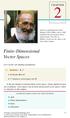 CHAPTER 2 American mathematician Paul Halmos (1916 2006), who in 1942 published the first modern linear algebra book. The title of Halmos s book was the same as the title of this chapter. Finite-Dimensional
ON GALOIS REALIZATIONS OF THE 2-COVERABLE SYMMETRIC AND ALTERNATING GROUPS
 ON GALOIS REALIZATIONS OF THE 2-COVERABLE SYMMETRIC AND ALTERNATING GROUPS DANIEL RABAYEV AND JACK SONN Abstract. Let f(x) be a monic polynomial in Z[x] with no rational roots but with roots in Q p for
DIFFERENTIABILITY OF COMPLEX FUNCTIONS. Contents
 DIFFERENTIABILITY OF COMPLEX FUNCTIONS Contents 1. Limit definition of a derivative 1 2. Holomorphic functions, the Cauchy-Riemann equations 3 3. Differentiability of real functions 5 4. A sufficient condition
Mathematical Methods of Engineering Analysis
 Mathematical Methods of Engineering Analysis Erhan Çinlar Robert J. Vanderbei February 2, 2000 Contents Sets and Functions 1 1 Sets................................... 1 Subsets.............................
Discrete Mathematics
 Discrete Mathematics Chih-Wei Yi Dept. of Computer Science National Chiao Tung University March 16, 2009 2.1 Sets 2.1 Sets 2.1 Sets Basic Notations for Sets For sets, we ll use variables S, T, U,. We can
Introduction to Topology
 Introduction to Topology Tomoo Matsumura November 30, 2010 Contents 1 Topological spaces 3 1.1 Basis of a Topology......................................... 3 1.2 Comparing Topologies.......................................
Max-Min Representation of Piecewise Linear Functions
 Beiträge zur Algebra und Geometrie Contributions to Algebra and Geometry Volume 43 (2002), No. 1, 297-302. Max-Min Representation of Piecewise Linear Functions Sergei Ovchinnikov Mathematics Department,
A simple application of the implicit function theorem
 Boletín de la Asociación Matemática Venezolana, Vol. XIX, No. 1 (2012) 71 DIVULGACIÓN MATEMÁTICA A simple application of the implicit function theorem Germán Lozada-Cruz Abstract. In this note we show