
WORLD-WIDE TSUNAMIS 2000 B.C
|
|
|
- Katherine Rose
- 10 years ago
- Views:
Transcription
1 WORLD DATA CENTER A for Solid Earth Geophysics WORLD-WIDE TSUNAMIS 2000 B.C U.S. DEPARTMENT OF COMMERCE NATIONAL OCEANIC AND ATMOSPHERIC ADMINISTRATION National Geophysical Data Center Boulder, Colorado, 80303, USA

2 CONTENTS CHAPTER 1. BACKGROUND INFORMATION World-wide Occurrence of Tsunam is Tsunami Characteristics Meaning of Column Headings Event D a ta Tsunami Effect D ata Data Table... 6 CHAPTER 2. REFERENCES...8

3 BACKGROUND INFORMATION Tsunamis, commonly called seismic sea waves or incorrectly, tidal waves have been responsible for at least 470 fatalities and several hundred million dollars in property damage in the United States and its territories. These events are somewhat rare. Major tsunamis occur in the Pacific Ocean region only about once per decade. Therefore, it is important to learn as much as possible from the relatively short history available. The preparation of this history was undertaken because of the evident need for an up-to-date and comprehensive compilation. TTie previously available history of tsunamis in the United States and environs was scattered through several regional catalogs, research papers, and unpublished works, l i e continued research of several people has improved these now-dated catalogs. The present history incorporated all works known to the compilers into a single, comprehensive volume. "Tsunami" is a Japanese word meaning "harbor wave." It is a water wave or a series of waves generated by an impulsive vertical displacement of the surface of the ocean or other body of water. Other terms for "tsunami" found in the literature include: seismic sea wave, Flutwellen, vloedgolven, raz de mar6e, vagues sismique, maremoto, and, incorrectly, tidal wave. The term "tidal wave" is frequently used in the older literature and in popular accounts, but is now considered incorrect. Tides are produced by the gravitational attraction of the sun and moon and occur predictably with twelve hour periods. The effects of a tsunami may be increased or decreased depending on the level of the tide, but otherwise the two phenomena are independent. Although there are warning systems for tsunamis occurring around die Pacific, including local and regional warning systems in Hawaii and Alaska, the risks from future tsunamis are still not fully known. Some events, such as that in Prince William Sound, Alaska, in March 1964, can be devastating over large distances. Even over short distances along a coast, the heights of a tsunami wave will vary considerably. An important part of the risk assessment is to gain a clearer understanding of the effects of past tsunamis. 1.1 WORLDWIDE OCCURRENCE OF TSUNAMIS Tsunamis have been reported since ancient times. They have been documented extensively, especially in Japan and the Mediterranean areas. The first recorded tsunami occurred off the coast of Syria in 2000 B.C. Since 1900 (the beginning of instrumentally located earthquakes), most tsunamis have been generated in Japan, Peru, Chile, New Guinea and the Solomon Islands. However, the only regions that have generated remote-source tsunamis affecting the entire Pacific Basin are the Kamchatka Peninsula, the Aleutian Islands, the Gulf of Alaska, and the coast of South America. Hawaii, because of its location in the center of the Pacific Basin, has experienced tsunamis generated in all parts of the Pacific. The Mediterranean and Caribbean Seas both have small subduction zones, and have histories of locally destructive tsunamis. Only a few tsunamis have been generated in the Atlantic and Indian Oceans. In the Atlantic Ocean, there are no subduction zones at the edges of plate boundaries to spawn such waves except small subduction zones under the Caribbean and Scotia arcs. In the Indian Ocean, however, the Indo-Australian plate is being subducted beneath the Eurasian plate at its east margin. Therefore, most tsunamis generated in this area are propagated toward the southwest shores of Java and Sumatra, rather than into the Indian Ocean. 1.2 TSUNAMI CHARACTERISTICS Most tsunamis are caused by a rapid vertical movement along a break in the Earth* s crust (i.e., their origin is tectonic). A tsunami is generated when a large mass of earth on the bottom of the ocean drops or rises, thereby displacing the column of water directly above it. This type of displacement commonly occurs in large subduction zones, where the collision of two tectonic plates causes the

4 oceanic plate to dip beneath the continental plate to form deep ocean trenches. Most shallow earthquakes occur offshore in these trenches. Subduction occurs along most of the island arcs and coastal areas of the Pacific, the notable exception being the west coast of the United States and Canada. Movement along the faults there is largely strike-slip, having little vertical displacement, and the movement produces few local tsunamis. Volcanoes have generated significant tsunamis with death tolls as large as 30,000 people from a single event. Roughly one fourth of the deaths occurring during volcanic eruptions where tsunamis were generated, were the result of the tsunami rather than the volcano. A tsunami is an effective transmitter of energy to areas outside the reach of the volcanic eruption itself. The most efficient methods of tsunami generation by volcanoes include disruption of a body of water by the collapse of all or part of the volcanic edifice, subsidence, an explosion, a landslide, a glowing avalanche, and an earthquake accompanying or preceding the eruption. Roughly one-half of all volcanic tsunamis are generated at calderas or at cones within calderas. Submarine eruptions may also cause minor tsunamis. Locally destructive tsunamis may be generated by subaerial and submarine landslides into bays or lakes. Lituya Bay, Alaska, has been the site of several landslidegenerated tsunamis, including one in 1958 that produced a splash wave that removed trees to a height of 525 m. It also caused a tsunami of at least 50 m in the bay. The 1964 Prince William Sound earthquake triggered at least four submarine landslides, which accounted for 71 to 82 of the 106 fatalities in Alaska for the 1964 event. However, it is tectonic earthquake-generated tsunamis (those produced by a major deformation of Earth s crust) that may affect the entire Pacific Basin. Other possible but less efficient methods of tsunami generation include: strong oscillations of the bottom of the ocean, or transmission of energy to a column of water from a seismic impulse (e.g., a deep-focus earthquake that has no surface rupture); transmission of energy from a horizontal seismic impulse to the water column through a vertical or inclined wall such as a bathymetric ridge; strong turbidity currents; underwater and above-water explosions. Several mechanisms commonly are involved in the generation of a tsunami (e.g., vertical movement of the crust by a seismic impulse or an earthquake, and a submarine landslide). Our knowledge of tsunami generation is incom plete, because the generation phenomena has not been observed nor measured directly. However, studies of tsunami data suggest that the size of a tsunami is directly related to: the size of the shallow-focus earthquake, the area and shape of the rupture zone, the rate of displacement and sense of motion of the ocean-floor in the source (epicentral) area, the amount of displacement of the rupture zone, and the depth of the water in the source area. It is also observed that long-period tsunamis are generated by large-magnitude earthquakes associated with seafloor deformation of the continental shelf; while, shorter period tsunamis are generated by smaller magnitude earthquakes associated with seafloor deformation in deeper water beyond the continental shelf. Once the energy from an undersea disturbance has been transmitted to the column of water, the wave can propagate outward from the source at a speed of more than 1,000 km per hour depending on the depth of the water. Because die height of the long-period waves in the open ocean is commonly 1 m or less and their wavelength is hundreds of kilometers, they pass unnoticed by observers in ships or planes in the region. As the tsunami enters shallow water along coastlines, the velocity of its waves is reduced, and the height of each wave increases. The waves pile up on shore especially in the region of the earthquake source, producing a "local tsunami." Some dramatic examples of such local tsunamis include those generated by landslides or by volcanic eruptions, which have caused "runup" heights of 30 to 50 m in some coastal areas.

5 "Runup" is the maximum height of the water observed above a reference sea level. Two other terms may be determined from the runup value: (1) tsunami magnitude, which is defined (Iida and others, 1967) as m = log2h; and (2) tsunami intensity, which is defined (Soloviev and Go, 1974) as I = log2(21/2x H), where H in both equations is the maximum runup height of the wave. If the energy produced by the generating disturbance is sufficiently large, such as that released by a major deformation of the crust in a trench area, the resulting tsunami wave may cross the open ocean and emerge as a destructive wave many thousands of kilometers from its source. The severity of a tsunami of this type-called a "remotesource" tsunami-decreases slowly with distance. However, it may be observed and perhaps cause damage throughout the Pacific Ocean Basin (e.g., the Chile tsunami of May 1960). Radiation of a remote-source tsunami from the focus of an earthquake is directional, depending on the geometry of the seafloor in the source region. The source region for major tectonic earthquakes is usually elliptical, and the major axis is as much as 600 km long and corresponds to the activated part of the fault. The major part of the tsunami energy is transmitted at right angles to the direction of the major axis, both toward the near shore and along a great circle path toward the shore on the opposite side of the ocean. Thus, tsunamis in Chile have severe impact on Japan; and those in the Gulf of Alaska on the west coast of North America. Hawaii, which lies in the central Pacific Basin, is vulnerable to remote-source tsunamis generated both in the North Pacific and along the coast of South America. The velocity (V) of a tsunami in the open ocean is expressed as the product of the square root of the depth of the water (d) and the acceleration of the force of gravity (g). v = (dgr Because the speed of the tsunami depends on the depth of the ocean basin, the waves decrease in speed as they reach shallower water. The wavelength is shortened, the energy within each wave is crowded into progressively less water, increasing the height of the wave. The tsunami may increase in height from 1 m in the open ocean to more than 20 m during runup. Also, if underwater ridges are present, they may act as collecting lenses and further intensify the tsunami. If the tsunami encounters a coastal scarp, the height of its waves increases. Because the long-period wave can bend around obstacles, the tsunami can enter bays and gulfs having the most intricate shapes. Experience has shown that wave heights increase in bays that narrow from the entrance to the head, but decrease in bays that have narrow entrances. Shores of islands protected by coral reefs commonly receive less energy than unprotected coastlines lying in the direct path of an approaching tsunami. Islands in a group may "shadow" one another reducing die tsunami effect. Small islands may experience reduced runup as the tsunami waves may refract around them. A tsunami wave may break on the beach, appear as flooding, or form a "bore" (violent rush of water with an abrupt front) as it moves up a river or stream. When the trough of the wave arrives first, die water level drops rapidly. Where this occurs the harbor or offshore area may be drained of its water, exposing sea life and ocean bottom. This phenomenon may be the only warning to residents that a large tsunami is approaching. Fatalities have occurred where people have tried to take advantage of this situation to gather fish or explore the strange landscape. The wave returns to cover the exposed coastline faster than the people can run. Although there may be an interval of minutes or perhaps an hour between the arrival of waves, the second, third, or later waves can be more destructive than the first. Residents returning too soon to the waterfront, assuming that the worst has past, represent another kind of preventable fatalities.

6 MEANING OF COLUMN HEADINGS: EVENT DATA (EVENT.TXT PILE) SY: "<" Indicates that the event produced damage. An asterisk (*) indicates that the event produced a tsunami runup height of at least 1.5 M outside of the source region and/or at least 1500 km from the source. Date >Time YEAR, MO, DA, TIME: If a time (hour/hunute) is given for an entry, the date and time are in Universal Coordinated Time (UTC); otherwise the date is the local date at the source of the tsunami. Earthquake Param eters LAT: latitude of earthquake epicenter. Blanks in columns indicate data are unknown. Dashes (-) in columns indicate that parameters do not exist for that event. (i.e. earthquake magnitude for tsunamis caused by volcanoes.) Where cause = V or L, coordinates (latitude and longitude) are for volcano or landslide. LONG: Longitude of earthquake epicenter. The epicenter (latitude, longitude) is not critical information since it represents a single point where the rupture began while the actual rupture that generated the tsunami may cover thousands of square kilometers. MAG: magnitude of the earthquake. The magnitude is more useful for tsunami work than the epicenter but typically has an uncertainty of a quarter unit or more. The magnitudes are based on surface waves (Ms) or the equivalent derived from intensities for pre-instrumental events. Epicenters and magnitudes before about 1898 are usually based on the maximum intensity of the earthquake. DEP: Depth of the earthquake hypocenter in kilometers is given where known. SH = shallow (depth 70 km or less). Tsunami Event Param eters R_UP: maximum runup for a given event. Runup: The maximum water height above sea level in meters. The runup is the height the tsunami reached above a reference level such as mean sea level but it is not always clear which reference level was used. TMAG: Tsunami magnitude which is defined by lida and others (1967) as M = log2h, where "h" is the maximum runup height of the wave. TINT: Tsunami intensity which is defined by Soloviev and Go (1974) as I = log2 /2 h, where "h" is the maximum runup height of the wave. The tsunami magnitude and tsunami intensity are measurements of the size of the tsunami based on the logarithm of the runup as defined later. SOURCE_REG: source region of the tsunami. V: Validity; probability of actual tsunami occurrence is indicated by a numerical rating of the validity of the reports of that event: 4 = definite tsunami, 3 = probable tsunami, 2 = questionable tsunami, 1 = very doubtful tsunami, 0 = erroneous entiy. By cross-checking data sources, a best estimate of this probability was determined. REG: Region number; regional boundaries are based on frequency of occurrence of tsunamigenic events, geophysical relations, risk in distant areas, and political justification. In the Pacific basin P0 = Hawaii, PI = New Zealand and South Pacific Islands, P2 = New Guinea and Solomon Islands, P3 = Indonesia, P4 = Philippines, P5 = Japan, P6 = Kuril Islands and Kamchatka, P7 = Alaska (including Aleutian Islands), P8 = West Coast of North and Central America, and P9 = West Coast of South America. Non-pacific basin tsunamis include: 10 - Indian Ocean, MO = Meditteranean Sea, AO = Southeast Atlantic Ocean, A1 = Southwest Atlantic Ocean, A2 = Northwest Atlantic, and A3 = Northeast Atlantic.

7 CAU: The source type codes are E for earthquake, V for volcanic, L for landslide, M for meteorological, X = Explosion. Events with an "M" for cause would have a "0" validity since they are not tsunamis. REF: Reference; this column provides additional sources of information about each tsunami. The numbers correspond to the list of references and sources of information below. TSUNAMI EFFECTS (RUNUP.TXT FILE) Date - Time YEAR, MO, DA: If a time (hour/minute) is given for an entry, the date and time are in Universal Coordinated Time (UTC); otherwise the date is the local date at the source of the tsunami. FELT: Numerical code for area where tsunami was observed or measured. (See "reg" above. Location REGION: Area where tsunami was observed or measured. TOWN_AREA: Town or area where tsunami was observed or measured. LATI: Latitude of town or area where tsunami was observed or measured. LONG: Longitude of town or area where tsunami was observed or measured. Wave Information RUNUP: Runup in meters at the town or area where tsunami was observed or measured. The maximum water height above sea level in meters. The runup is the height the tsunami reached above a reference level such as mean sea level but it is not always clear which reference level was used. The amplitude may be quoted rather than the runup. The amplitude is also given in meters and may be half the range when that number is given. OBS" refers to the fact that the tsunami or an effect of the tsunami was seen at that location but the amplitude was not given. "OBS?" indicates that the report of a tsunami being observed at that location is questionable. ARRIVAL: The arrival time is the universal time of the arrival of the tsunami at the location of the effects given in day, hour, and minutes. TRAVEL: The travel time is the time in hours and minutes that it took the tsunami to travel from the source to the location of effects. PERIOD: The period is in minutes, and when available is the period of the first cycle. RISE: The first motion of the wave, i.e. rise (R) or fall (F). REMARKS: Remarks include effects at the location including damage and deaths, and comments on the accuracy of the report. NOTE Please note that there is not a one to one correspondence between the records in EVENT and the records in RUNUP. No information about locations where tsunamis were observed was available for many of the events so no corresponding entries are found in the runup file. In other instances a number of runup records are available for one event described in EVENT. FOR ADDITIONAL INFORMATION CONTACT: PAT LOCKRIDGE NOAA/NGDC 325 BROADWAY BOULDER, CO TELEPHONE (303)

8 REFERENCES 101. Ambraseys, N.N., The Seismic Sea Wave of July 9, 1956, in the Greek Archipelago, Journal of Geophysical Research, Vol. 65, No. 4, April 1960, p Ambraseys, N.N., Data for the Investigation of the Seismic Sea Waves in the eastern Mediterranean, Bulletin of the Seismological Society of America, Vol. 52, No. 4, October 1962, pp Ambraseys, N.N., Seismic Seawave in the Gulf of Corinth, Letter to the Editor, Bulletin of the Seismological Society of America, Vol. 53, No. 4, July, 1963, p Antonopoulos, J., Catalogue of Tsunamis in the Eastern Mediterranean! from Antiquity to Present Times, Annali Di Geofisica, Vol. 32, 1979, pp Antonopoulos, J., Data from Investigation on Seismic Sea Waves Events in the Eastern Mediterranean from Antiquity to 500 B.C., Annali Di Geofisica, Vol. 33, 1980, p Antonopoulos, J., Data from Investigation on Seismic Sea Waves Events in the Eastern Mediterranean from 500 B.C. to the Birth of Christ, Annali Di Geofisica, Vol. 33, 1980, pp Antonopoulos, J., Data from Investigation on Seismic Sea Waves Events in the Eastern Mediterranean from Birth of Christ to 500 A.D., Annali Di Geofisica, Vol. 33, 1980, pp Antonopoulos, J., Data from Investigation on Seismic Sea Waves Events in the eastern Mediterranean from 500 A.D. to 1000 A.D., Annali Di Geofisica, Vol. 33, 1980, pp Antonopoulos, J., Data from investigation on seismic sea waves events in the eastern Mediterranean from 1000 A.D. to 1500 A.D., Annali Di Geofisica, Vol. 33, 1980, pp Antonopoulos, J., Data from investigation on seismic sea waves events in the eastern Mediterranean from 1500 A.D. to 1800 A.D., Annali Di Geofisica, Vol. 33, 1980, pp Antonopoulos, J., Data from investigation on seismic sea waves events in the eastern Mediterranean from 1800 A.D. to 1900 A.D., Annali Di Geofisica, Vol. 33, 1980, pp Antonopoulos, J., Data from investigation on seismic sea waves events in the eastern Mediterranean from 1900 A.D. to 1980 A.D., Annali Di Geofisica, Vol. 33, 1980, pp Beminghausen, W,H., "Tsunamis Reported from the West Coast of South America, ," Bulletin of the Seismological Society of America, Vol. 52, 1962, p Beminghausen, W.H., "Tsunamis and Seismic Seiches of Southeast Asia," Bulletin of the Seismological Society of America, Vol. 59, 1969, p Beringhausen, W.H., "Tsunamis and Seismic Seiches Reported from the Eastern Atlantic South of the Bay of Biscay, Bulletin of the Seismological Society of America, Vol. 54, No. 1, February 1964, pp Beringhausen, W.H., Tsunamis and Seismic Seiches Reported from Regions Adjacent to the Indian Ocean, Bulletin of the Seismological Society of America, Vol. 56, No. 1, February 1966, pp

9 115. Beringhausen, W.H., Informal report: Tsunamis and Seismic Seiches Reported from the Western North and South Atlantic and the Coastal Waters of Northwestern Europe, Naval Oceanographic Office, Informal Report IR No. 6885, Washington, D.C., September Bolt, Bruce A. and Roy D. Miller, Catalogue of Earthquakes in Northern California and Adjoining Areas, 1 January 1910 to 31 December 1972, Seismographic Station, University of California, Berkeley, 1975, 567 p. 4. Cox, Doak C., and George Pararas-Carayannis, Catalog of Tsunamis in Alaska, SE-1, U.S. Department of Commerce, National Oceanic and Atmospheric Administration, March 1976, 43 p. 5. Pararas-Carayannis, George, Catalog of Tsunamis in Hawaii, SE-4, U.S. Department of Commerce, National Oceanic and Atmospheric Administration, March 1977, 77 p. 6. Coast and Geodetic Survey, U.S. Department of Commerce, Rockville, Maryland. 7. Cox, Doak C., "Discussion of Tsunamis and Seismic Seiches of Southeast Asia by William H. Beminghausen, Bulletin of the Seismological Society of America, February 1970, p Cox, Doak C., Source of the Tsunami Associated with the Kalapana (Hawaii) Earthquake of November 1975, HIG-80-8, Hawaii Institute of Geophysics, December 1980, 46 p. 9. Cox, Doak C., Kumizi Iida, S.L. Solov ev, and George Pararas-Carayannis, Pacific Tsunami Historic File, National Oceanic and Atmospheric Administration, Boulder, Colorado, unpublished manuscript. 10. Cox, Doak C., Kumizi Iida, and George Pararas-Carayannis, Preliminary Catalog of Tsunamis Occurring in the Pacific Ocean, University of Hawaii, 1967, 274 p. 11. Cox, Doak C., and Joseph Morgan, Local Tsunamis and Possible Local Tsunamis in Hawaii, HIG-77-14, Hawaii Institute of Geophysics, November 1977, 118 p. 12. Cruz, Gonzolo and Max Wyss, "Large Earthquakes, Mean Sea Level, and Tsunamis Along the Pacific Coast of Mexico and Central America," Bulletin of the Seismological Society of America, Vol. 73, 1983, p Duda, S.J., "Secular Seismic Energy Release in Circum-Pacific Belt," Tectonophysics, Vol. 2, 1965, p Earthquake Research Institute, Tokyo, Japan. 15. U.S. Naval Oceanographic Office, Earthquakes, Tsunamis and Volcanoes of Southeast Asia, IR no , Washington, D.C., November Environmental Research Laboratories, U.S. Department of Commerce, National Oceanic and Atmospheric Administration, Boulder, Colorado. 17. Everington, I.B., Preliminary Catalogue of Tsunamis for the New Guinea/Solomon Islands Region, , Report 180, Department of National Resources, Australia, 1977, 71+ p Galanopoulos, A.G., Tsunamis observed on the coasts of Greece from antiquity to present time, Annali Di Geofisica, Vol. ΧΠΙ, n. 3-4, 1960, pp Geology Section, Environment Branch, Oceanographic Analysis Division, Earthquakes, Tsunamis and Volcanoes in Northeastern Indian Ocean, Informal report, August 1968, pp. 5-9.

10 18. Gutenberg, B. and C.F. Richter, Seismicity of the Earth and Associated Phenomena, Princeton University Press, 1954 (second edition), Hafner Publishing Company, 1965 (facsimile edition), 310 p. 19. Hebenstreit, G.T. and R.O. Reid, Tsunami Response of the Hawaiian Islands, Reference 80-2-T, Texas A & M University, College Station, Texas, March 1980, 289 p. 20. Heck, N.H., "List of Seismic Sea Waves," Bulletin of the Seismological Society of America, Vol. 37, 1947, p Heck, N.H. and R.R. Bodle, "United States Earthquakes, 1929," United States Department of Commerce, Coast and Geodetic Survey, Government Printing Office, Washington, Heck, N.H., List of Seismic Sea Waves, Bulletin of the Seismological Society of America, Vol. 37, 1947, p Hedervari, Peter, Catalog of Submarine Volcanoes and Hydrological Phenomena Associated with Volcanic Events, Georgiana Observatory, Budapest, Hungary, Unpublished Manuscript. 22. Hileman, James A., Clarence R. Allen, and John M. Nordquist, Seismicity of the Southern California Region, 1 January 1932 to 31 December 1972, Seismological Laboratory, California Institute of Technology, Pasadena, 1973, 490 p. 23. U.S. Department of Commerce, National Oceanic and Atmospheric Administration, Historical Seismogram Filming Project, Third Progress Report, SE-28, July 1981, 76 p. 24. U.S. Department of Commerce, National Oceanic and Atmospheric Administration, Historical Seismogram Filming Project, Fourth Progress Report, SE-33, December 1982, 47 p. 25. Honolulu Observatory, National Oceanic and Atmospheric Administration, National Weather Service, Honolulu, Hawaii International Seismological Center, International Seismological Center Catalogue of Major Earthquakes , Newburg, Berkshire, England, published semiannually. 27. International Tsunami Information Center, ITIC Newsletter, Honolulu, Hawaii, published quarterly Japan Central Meteorological Observatory (later became Japan Meteorological Agency), Tokyo, Japan. 29. Japan Meteorological Agency, Tokyo, Japan. 30. Kondorskaya, N.V. and N.V. Shebalin, editors, New Catalog of Strong Earthquakes in the U.S.S.R. from Ancient Times through 1977, report SE-31, U.S. Department of Commerce, National Oceanic and Atmospheric Administration, July 1982, 608 p. 31. Lomnitz, Cinna, "Major Earthquakes and Tsunamis in Chile during the Period 1535 to 1955", Geologishe Rundschau International, Vol. 59, No. 3, 1970, p Loomis, Harold G., The Tsunami of November 29, 1975 in Hawaii, HIG-75-21, Hawaii Institute of Geophysics, December 1975, 29 p. 33. Loomis, Harold G., Tsunami Wave Runup Heights in Hawaii, HIG-76-5, Hawaii Institute of Geophysics, May 1976, 93 p.

11 125. Lynch, JJ. and R. R. Bodle, "The Dominican Earthquakes of August 1946," Bulletin of the Seismological Society of America, Vol. 38, No. 1, 1948, pages Bodle, R. R. and L. M. Murphy, "United States Earthquakes, 1946," United States Department of Commerce, Coast and Geodetic Survey, Government Printing Office, Washington, Mallet, R., "Catalogue of Recorded Earthquakes," Transactions, British Association for Advancement of Science, London, 1852, Murty, T.S., Tsunamis in the Andaman Sea, Tsunami Newsletter, Vol. XVIII, No. 1, July 1985, pp National Ocean Survey, National Oceanic and Atmospheric Administration, Rockville, Maryland Papadopoulos, G.A. and B.J. Chalkis, Tsunamis observed in Greece and the surrounding area from antiquity up to the present times, Marine Geology, Vol 56, 1984, pp Pereira, E.J., "The Great Earthquake of Lisbon," Transactions of the Seismological Society of Japan, Vol. 12, 1988, p Reid, H.F. and S. Taber, "The Porto Rico Earthquakes of October-November 1918" Bulletin of the Seismological Society of America, Vol. 9, No. 4, 1919, pages Reid, H.F. and S. Taber, "The Virgin Islands Earthquakes of ," Bulletin of the Seismological Society of America, Vol. 10, No. 1, 1920, pages U.S. Department of the Interior/Geological Survey, National Earthquake Information Center, Preliminary Determination of Epicenters, U.S. Government Printing Office, Washington, D.C Solov ev, S.L. and M.D. Ferchev, Summary of Data on Tsunamis in the USSR, Bulletin of the Council for Seismology, Academy of Sciences of the USSR, No. 9, 1961, 32 p. 37. Solov ev, S.L. and Ch.N. Go, A Catalogue of Tsunamis on the Western Shore of the Pacific Ocean, Academy of Sciences of the USSR, "Nauka" Publishing House, Moscow, 1974, 308 p. 38. Solov ev, S.L. and Ch.N. Go, A Catalogue of Tsunamis of the Eastern Shore of the Pacific Ocean, Academy of Sciences of the USSR, "Nauka" Publishing House, Moscow, 1975, 202 p. 39. Tokyo Astronomic Observatory, Tokyo, Japan Taber, S., "The Seismic Belt of the Greater Antilles," Bulletin of the Seismological Society of America, Vol. 12, No. 4, 1922, pages International Tsunami Information Center, Tsunami Newsletter, Honolulu, Hawaii, published periodically, U.S. Department of Commerce, Tsunami of May 2, 1960 as Recorded at Tide Stations, Washington, D.C., 1960, 79 P. 43. Spaeth, M.G. and S.C. Berkman, Tsunami of March 28, 1964, as Recorded at Tide Stations, U.S. Department of Commerce, Washington, D.C., April 1964, 59 p.

12 44. International Tsunami Information Center, Tsunami Reports, Honolulu, Hawaii, Pacific Tsunami Warning Center, Tsunami Warning Log, Honolulu, Hawaii. (Issued when necessary). 46. Journal of Hydraulic Research, "Tsunamis Occurring on the Mexican Coast in the Pacific Ocean from 1732 to 1902", Vol. 13, 1975, p U.S. Department of the Interior, Geological Survey and U.S. Department of Commerce, National Oceanic and Atmospheric Administration, United States Earthquakes, annual volumes, , published monthly. 48. University of Chile, Santiago Lang, A.C.M., "Note on Tsunamis reaching New Zealand", New Zealand Journal of Science and Technology, 1954, p Institute Hidrografico de la Armada, Maremotos en la Costa de Chile, Valparaiso, Chile, 1982, 48 p. 52. Houston, James T., Tsunami Elevation Predictions for American Samoa, U.S. Army Engineer Waterways Experiment Station, Fort Shatter, Hawaii, 1980, 110+ p Iida, Kumizi, Catalog of Tsunamis in Japan and its Neighboring Countries, Aichi Institute of Technology, Yachigusa, Yakusa-cho, Toyota-shi, , Japan, 1984, 52 p. 61. El-Sabh, M.I., Editor, Natural Hazards Journal, Kluwer Academic Publishers, The Netherlands, Vol. 1, No. 2, 1988, P El-Sabh, M.I., Editor, Natural Hazards Journal, Kluwer Academic Publishers, The Netherlands, Vol. 1, No. 3, 1988, p. 282, 291, El-Sabh, M.I., Editor, Natural Hazards Journal, Kluwer Academic Publishers, The Netherlands, Vol. 1, No. 4, 1988, p Wigen, S.O. T.S. Murty, and D.G. Philip, Tsunami of May 11, 1981 on the coast of South Africa, Proceedings Tsunami Symposium, Aug. 1983, pp

13 Other References Agnew, Duncan Carr, "Tsunami History of San Diego", Earthquakes and Other Perils, San Diego Region, San Diego Association of Geologists, 1979, pp Committee on the Alaska Earthquake, the Great Alaska Earthquake of 1964, Human Ecology, Natural Academy of Science, Washington, D.C., 1970, 510 p. Committee on the Alaska Earthquake, the Great Alaska Earthquake of 1964, Oceanography and Coastal Engineering, Natural Academy of Science, Washington, D.C., 1972, 556 p. Costello, Joyce A. (editor), Tsunamis: Hazard Definition and Effects on Facilities, a Draft Technical Report of Subcommittee 3, "Evaluation of Site Hazards," A Part of the Interagency Committee on Seismic Safety in Construction, U.S. Geological Survey, Reston, Virginia, 1985, 138 P- Cox, Doak C "Probable Central Aleutian Source of the Tsunami Observed in August 1872 in Hawaii, Oregon, and California," Science of Tsunami Hazards, the International Journal of the Tsunami Society, Honolulu, Hawaii, vol. 2, No. 2, 1984, p , Cox, Doak C., and Joseph Morgan, Supplement to Local Tsunamis or Possible Local Tsunamis in Hawaii, HIG 77-14, 1978, 6 p. Cox, Doak C., The Lanai Earthquake of February 1871, University of Hawaii, Honolulu, Hawaii, 1985, 50 p. Cox, Doak C., Japanese Tsunamis in Hawaii, a Preliminary Report, Environmental Center, University of Hawaii, Honolulu, Hawaii, 1980, 67 p. Cox, Doak C., Personal Correspondence April 20, Cox, Doak C., Reported British Columbia Tsunami of 22 March 1938, Memorandum for the Record, University of Hawaii at Manoa, unpublished, 5 May, 1982, 2 p. Cox, Doak C., Reported Pacific Marigraphic Evidence of the Indonesian Tsunami of 20 May 1928, Memorandium for the Record, University of Hawaii at Manoa, unpublished, 5 May, 1982, 2 P Cox, Doak C., Volcanic Activity, Tidal Waves, and other Marine Disturbances in Hawaii, September-December Cox, Doak C., Tsunami Casualties and Mortality in Hawaii, Joint Institute for Marine and Atmospheric Research, University of Hawaii, Honolulu, Hawaii, 1987, 53 p. Dohler, G.C., Tsunami Where...Next?, Compilation of Data and Information for the Preparation of a Master Plan, Canadian Hydrographic Service, Ottawa, Canada, 1983, 61 p. Gorshkov, G.S. "Gigantic Eruption of the Volcano Beymianny," Bulletin of Volcanologie, Series, Π Tome XX, 1959, pp Grouginis, V.J., J.W. Joy, and R.R. Putz, The Reported California Tsunami of December, 1812, unpublished manuscript, 1972, 120 p.

14 Heaton, Thomas H., and Parke D. Snavely, Jr., "Possible Tsunami along the Northwestern Coast of the United States inferred from Indian Traditions", Bulletin of the Seismological Society of America, Vol. 75, No. 5, pp Historia de los Grandas Tsunamis Producidos en la Costa Occidental de America del Sur. Larsen, L.H., "Tsunami Hazard along Washington s Coast", Natural Hazards in Washington s Coastal Zone, Washington State Department of Emergency Services, Olympia, Washington, 1979, pp Marine Advisers, Inc., Examination of Tsunami Potential at the San Onofre Nuclear Generating Station, Report A-163, Los Angeles, California, September 1965, 59+ p. Mcculloch, D.S., "Evaluating Tsunami Potential", Evaluating Earthquake Hazards in the Los Angeles Region: U.S. Geological Survey Professional Paper 1360, U.S. Geological Survey, Reston, Virgina, 19??. pp Miller, Don J., Giant Waves in Lituya Bay, Alaska, Geological Survey Professional Paper 354-C, United States Government Printing Office, Washington, 1960, 83 p. Pararas-Carayannis, George, "The Pacific Tsunami Warning System", Earthquakes and Volcanoes, U.S. Geological Survey, Vol. 18, No. 3, 1986, pp Pararas-carayannis, George and Bonnie Dong, "Catalog of Tsunamis in the Samoan Islands," Appendix A in Tsunami Elevation Predictions for American Samoa, by James R. Houston, U.S. Army Corps of Engineers Waterways Experiment Station, Ft. Shafter, Hawaii, Reid, Harry Fielding and Stephen Taber, "The Porto Rico Earthquakes of October - November, 1918", The Bulletin of the Seismological Society of America, Vol. DC, No. 4, December 1919, pp Reid, Harry Fielding and Stephen Taber, "The Virgin Islands Earthquakes of ", The Bulletin of the Seismological Society of America, Vol.??, No.??, Date??? pp Reid, Harry Fielding and Stephen Taber, "The Porto Rico Earthquake of 1918 with Descriptions of Earlier Earthquakes," Report of the Earthquake Investigation Commission, House of Representatives Document No. 269, Government Printing Office, Washington, D.C., 1919, 74 P. F. P. Shepard, G.A. Macdonald, and D.C. Cox, "The Tsunami of April 1, 1946", Bulletin of the Scripps Institution of Oceanography of the University of California, University of California Press, Berkeley and Los Angeles, California, 1950, p Tsunami Digital Data Base, National Oceanic and Atmospheric Administration, National Geophysical Data Center/World Data Center A for Solid Earth Geophysics, Boulder, Colorado. U.S. Department of Commerce, Tsunami of November 4, 1952, as Recorded at Tide Stations, Washington, D.C., 1953, 62 p. U.S. Department of Commerce, Tsunami of March 9, 1957 as Recorded at Tide Stations, Washington, D.C., 1959, 18 p.

TECTONICS ASSESSMENT
 Tectonics Assessment / 1 TECTONICS ASSESSMENT 1. Movement along plate boundaries produces A. tides. B. fronts. C. hurricanes. D. earthquakes. 2. Which of the following is TRUE about the movement of continents?
Tsunami Practice Questions and Answers Revised November 2008
 Tsunami Practice Questions and Answers Revised November 2008 1. What happened on 26 December 2004 off the west coast of Sumatra? 2. What is the final estimate of the magnitude of the Sumatra 26 December
How Did These Ocean Features and Continental Margins Form?
 298 10.14 INVESTIGATION How Did These Ocean Features and Continental Margins Form? The terrain below contains various features on the seafloor, as well as parts of three continents. Some general observations
DYNAMIC CRUST: Unit 4 Exam Plate Tectonics and Earthquakes
 DYNAMIC CRUST: Unit 4 Exam Plate Tectonics and Earthquakes NAME: BLOCK: DATE: 1. Base your answer to the following question on The block diagram below shows the boundary between two tectonic plates. Which
Regents Questions: Plate Tectonics
 Earth Science Regents Questions: Plate Tectonics Name: Date: Period: August 2013 Due Date: 17 Compared to the oceanic crust, the continental crust is (1) less dense and more basaltic (3) more dense and
Chapter 5: Earthquakes
 Chapter 5: Earthquakes 1. Experiencing an Earthquake firsthand 2. The Science of Ghost Forests and Megaearthquakes 3. Faults, Earthquakes, and Plate Tectonics 4. Seismic Waves and Earthquake Detection
Magnitude 8.8 OFFSHORE MAULE, CHILE
 A great 8.8-magnitude struck central Chile early Saturday. The quake hit 200 miles (325 kilometers) southwest of the capital Santiago. The epicenter was just 70 miles (115 kilometers) from Concepcion,
Chapter 7 Earthquake Hazards Practice Exam and Study Guide
 Chapter 7 Earthquake Hazards Practice Exam and Study Guide 1. Select from the following list, all of the factors that affect the intensity of ground shaking. a. The magnitude of the earthquake b. Rather
Tectonic plates push together at convergent boundaries.
 KEY CONCEPT Plates converge or scrape past each other. BEFORE, you learned Plates move apart at divergent boundaries In the oceans, divergent boundaries mark where the sea floor spreads apart On land,
Lecture 12 Earthquake Magnitude
 Lecture 12 Earthquake Magnitude Locating Earthquakes Last time, we learned that we could obtain a rough estimate of the distance in miles to an earthquake epicenter by multiplying the S - P time interval
Waves disturbances caused by the movement of energy from a source through some medium.
 Oceanography Chapter 10 Waves disturbances caused by the movement of energy from a source through some medium. Floating Gull- Figure 10.1 water is not moving only the energy is moving through the water.
Earthquake Hazards and Risks
 Page 1 of 7 EENS 3050 Tulane University Natural Disasters Prof. Stephen A. Nelson Earthquake Hazards and Risks This page last updated on 28-Aug-2013 Earthquake Risk Many seismologists have said that "earthquakes
TIDES. 1. Tides are the regular rise and fall of sea level that occurs either once a day (every 24.8 hours) or twice a day (every 12.4 hours).
 TIDES What causes tides? How are tides predicted? 1. Tides are the regular rise and fall of sea level that occurs either once a day (every 24.8 hours) or twice a day (every 12.4 hours). Tides are waves
Glossary. continental crust: the sections of crust, the outermost layer of the earth, that include the continents
 aftershock: an earthquake that follows a larger earthquake or main shock and originates in or near the rupture zone of the larger earthquake. Generally, major earthquakes are followed by a number of aftershocks
The Dynamic Crust 2) EVIDENCE FOR CRUSTAL MOVEMENT
 The Dynamic Crust 1) Virtually everything you need to know about the interior of the earth can be found on page 10 of your reference tables. Take the time to become familiar with page 10 and everything
Hot Spots & Plate Tectonics
 Hot Spots & Plate Tectonics Activity I: Hawaiian Islands Procedures: Use the map and the following information to determine the rate of motion of the Pacific Plate over the Hawaiian hot spot. The volcano
Plate Tectonics: Ridges, Transform Faults and Subduction Zones
 Plate Tectonics: Ridges, Transform Faults and Subduction Zones Goals of this exercise: 1. review the major physiographic features of the ocean basins 2. investigate the creation of oceanic crust at mid-ocean
Chapter Overview. Bathymetry. Measuring Bathymetry. Echo Sounding Record. Measuring Bathymetry. CHAPTER 3 Marine Provinces
 Chapter Overview CHAPTER 3 Marine Provinces The study of bathymetry charts ocean depths and ocean floor topography. Echo sounding and satellites are efficient bathymetric tools. Most ocean floor features
THE 2004 SUMATRA EARTHQUAKE AND INDIAN OCEAN TSUNAMI: WHAT HAPPENED AND WHY
 Page 6 The Earth Scientist THE 2004 SUMATRA EARTHQUAKE AND INDIAN OCEAN TSUNAMI: WHAT HAPPENED AND WHY Seth Stein and Emile A. Okal Dept of Geological Sciences, Northwestern University, Evanston Illinois
Thompson/Ocean 420/Winter 2005 Tide Dynamics 1
 Thompson/Ocean 420/Winter 2005 Tide Dynamics 1 Tide Dynamics Dynamic Theory of Tides. In the equilibrium theory of tides, we assumed that the shape of the sea surface was always in equilibrium with the
EARTHQUAKES. Compressional Tensional Slip-strike
 Earthquakes-page 1 EARTHQUAKES Earthquakes occur along faults, planes of weakness in the crustal rocks. Although earthquakes can occur anywhere, they are most likely along crustal plate boundaries, such
Interactive Plate Tectonics
 Interactive Plate Tectonics Directions: Go to the following website and complete the questions below. http://www.learner.org/interactives/dynamicearth/index.html How do scientists learn about the interior
Geol 101: Physical Geology PAST EXAM QUESTIONS LECTURE 4: PLATE TECTONICS II
 Geol 101: Physical Geology PAST EXAM QUESTIONS LECTURE 4: PLATE TECTONICS II 4. Which of the following statements about paleomagnetism at spreading ridges is FALSE? A. there is a clear pattern of paleomagnetic
Earthquakes. Earthquakes: Big Ideas. Earthquakes
 Earthquakes Earthquakes: Big Ideas Humans cannot eliminate natural hazards but can engage in activities that reduce their impacts by identifying high-risk locations, improving construction methods, and
HAZARD MAPPING, RISK ASSESSMENT, AND INSURANCE COVERAGE OF NATURAL CATASTROPHE RISK
 SESSION III HAZARD MAPPING, RISK ASSESSMENT, AND INSURANCE COVERAGE OF NATURAL CATASTROPHE RISK Mr. Sumarjono Insurance Bureau of The Ministry of Finance of the Republic of Indonesia Geological Position
Georgia Performance Standards Framework for Natural Disasters 6 th Grade
 The following instructional plan is part of a GaDOE collection of Unit Frameworks, Performance Tasks, examples of Student Work, and Teacher Commentary. Many more GaDOE approved instructional plans are
Earthquakes and Plate Boundaries Deborah Jordan and Samuel Spiegel
 Earthquakes and Plate Boundaries Deborah Jordan and Samuel Spiegel Jordan, Deborah and Spiegel, Samuel: Learning Research Development Center, University of Pittsburgh. Earthquakes and Plate Boundaries.
Transform Boundaries
 Lecture 7 Plates and Mantle Plumes Transform Boundaries Transform boundaries occur where one segment of rigid lithosphere slides horizontally past another in response to stresses in the lithosphere. The
Magnitude 7.2 GUERRERO, MEXICO
 A powerful magnitude-7.2 earthquake shook central and southern Mexico on Friday. The earthquake occurred at a depth of 24 km (15 miles). Its epicenter was in the western state of Guerrero, near the seaside
ebb current, the velocity alternately increasing and decreasing without coming to
 Slack water (slack tide): The state of a tidal current when its velocity is near zero, especially the moment when a reversing current changes its direction and its velocity is zero. The term is also applied
1. The diagram below shows a cross section of sedimentary rock layers.
 1. The diagram below shows a cross section of sedimentary rock layers. Which statement about the deposition of the sediments best explains why these layers have the curved shape shown? 1) Sediments were
Storm tide is the water level rise during a storm due to the combination of storm surge and the astronomical tide.
 INTRODUCTION TO STORM SURGE Introduction to Storm Surge BOLIVAR PENINSULA IN TEXAS AFTER HURRICANE IKE (2008) What is Storm Surge? Inland Extent Storm surge can penetrate well inland from the coastline.
Chapter 2. Plate Tectonics. Plate Tectonics: Learning Goals
 Plate Tectonics Chapter 2 Interactions at depend on the direction of relative plate motion and the type of crust. Which kind of plate boundary is associated with Earthquake activity? A. Divergent Boundary
Tides and Water Levels
 Tides and Water Levels What are Tides? Tides are one of the most reliable phenomena in the world. As the sun rises in the east and the stars come out at night, we are confident that the ocean waters will
HAZARDS AND THREATS TSUNAMI HISTORY. History of Tsunamis/High Waves that have Impacted Los Angeles County Operational Area
 HAZARDS AND THREATS TSUNAMI HISTORY History of Tsunamis/High Waves that have Impacted Los Angeles County Operational Area July 10, 1755: An earthquake in Los Angeles triggered two large swells that hit
Storm tide is the water level rise during a storm due to the combination of storm surge and the astronomical tide.
 INTRODUCTION TO STORM SURGE Introduction to Storm Surge National Hurricane Center Storm Surge Unit BOLIVAR PENINSULA IN TEXAS AFTER HURRICANE IKE (2008) What is Storm Surge? Inland Extent Storm surge can
GENERAL SCIENCE LABORATORY 1110L Lab Experiment 9B: Tracking the Hawaiian Islands: How Fast Does the Pacific Plate Move?
 GENERAL SCIENCE LABORATORY 1110L Lab Experiment 9B: Tracking the Hawaiian Islands: How Fast Does the Pacific Plate Move? Background You know that the Earth s crustal plates are always moving, but how fast?
6.E.2.2 Plate Tectonics, Earthquakes and Volcanoes
 Name: Date: 1. The road shown below was suddenly broken by a natural event. 3. The convergence of two continental plates would produce Which natural event most likely caused the crack in the road? island
PLATE TECTONICS EXERCISE (Modified from North Seattle Community College online exercise)
 PLATE TECTONICS EXERCISE (Modified from North Seattle Community College online exercise) Introduction: As discussed in our textbook, the speed at which tectonic plates move has been calculated in several
February 28 Earthquake: We got off easy
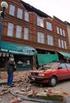 February 28 Earthquake: We got off easy State Geologist John Beaulieu Lucky may not be the first word that comes to mind after an earthquake that injured more than 200 and caused more than $1 billion damage,
ES Chapter 10 Review. Name: Class: Date: Multiple Choice Identify the choice that best completes the statement or answers the question.
 Name: Class: Date: ES Chapter 10 Review Multiple Choice Identify the choice that best completes the statement or answers the question. 1. Scientists used the pattern of alternating normal and reversed
Plate Tectonics PuzzleMap User Guide
 About this Product: Plate tectonics is a key standards-based topic taught in earth science classrooms throughout the United States. The purpose of this map is to help educators (teachers, museum tour guides,
Plate tectonics states that the Earth's crust and upper mantle are broken into sections, called plates.
 Notes on Plate Tectonics Plate tectonics states that the Earth's crust and upper mantle are broken into sections, called plates. These plates move around the mantle. Plates are composed of the crust and
Plate Tectonics: Big Ideas. Plate Tectonics. Plate Tectonics. The unifying concept of the Earth sciences.
 Plate Tectonics: Big Ideas Our understanding of Earth is continuously refined. Earth s systems are dynamic; they continually react to changing influences from geological, hydrological, physical, chemical,
Plate Tectonics. Introduction. Boundaries between crustal plates
 Plate Tectonics KEY WORDS: continental drift, seafloor spreading, plate tectonics, mid ocean ridge (MOR) system, spreading center, rise, divergent plate boundary, subduction zone, convergent plate boundary,
Rapid Changes in Earth s Surface
 TEKS investigate rapid changes in Earth s surface such as volcanic eruptions, earthquakes, and landslides Rapid Changes in Earth s Surface Constant Changes Earth s surface is constantly changing. Wind,
Plate Tectonics. Plate Tectonics The unifying concept of the Earth sciences. Continental Drift
 Plate Tectonics The unifying concept of the Earth sciences. The outer portion of the Earth is made up of about 20 distinct plates (~ 100 km thick), which move relative to each other This motion is what
Chapter 8: Plate Tectonics -- Multi-format Test
 Name: Class: Date: ID: A Chapter 8: Plate Tectonics -- Multi-format Test Modified True/False Indicate whether the statement is true or false. If false, change the identified word or phrase to make the
Investigation 6: What happens when plates collide?
 Tectonics Investigation 6: Teacher Guide Investigation 6: What happens when plates collide? In this activity, students will use the distribution of earthquakes and volcanoes in a Web GIS to learn about
EARTH SCIENCE ACTIVITY #1 Tsunami in a Bottle
 EARTH SCIENCE ACTIVITY #1 Tsunami in a Bottle Grades 3 and Up This activity is one of several in a basic curriculum designed to increase student knowledge about earthquake science and preparedness. The
11A Plate Tectonics. What is plate tectonics? Setting up. Materials
 11A Plate Tectonics What is plate tectonics? Earth s crust plus the upper mantle forms the lithosphere. Earth s lithosphere is broken in a number of different pieces. How these pieces move and interact
College of Science and Health ENVIRONMENTAL SCIENCE & GEOGRAPHY Course Outline
 College of Science and Health ENVIRONMENTAL SCIENCE & GEOGRAPHY Course Outline 1. TITLE OF COURSE AND COURSE NUMBER: General Geology ENV 115, 4 credits 2. DESCRIPTION OF THE COURSE: Includes the study
SIXTH GRADE PLATE TECTONICS 1 WEEK LESSON PLANS AND ACTIVITIES
 SIXTH GRADE PLATE TECTONICS 1 WEEK LESSON PLANS AND ACTIVITIES PLATE TECTONIC CYCLE OVERVIEW OF SIXTH GRADE VOLCANOES WEEK 1. PRE: Comparing the structure of different types of volcanoes. LAB: Plotting
Using Google Earth to Explore Plate Tectonics
 Using Google Earth to Explore Plate Tectonics Laurel Goodell, Department of Geosciences, Princeton University, Princeton, NJ 08544 [email protected] Inspired by, and borrows from, the GIS-based Exploring
OCEANOGRAPHY Vol.II Morphology of Ocean Floor and Plate Tectonics - Chengsung Wang MORPHOLOGY OF OCEAN FLOOR AND PLATE TECTONICS
 MORPHOLOGY OF OCEAN FLOOR AND PLATE TECTONICS Chengsung Wang National Taiwan Ocean University, Keelung 202, Taiwan, China Keywords: Morphology of sea floor, continental margins, mid-ocean ridges, deep-sea
Chapter 7 Earthquake Hazards
 Chapter 7 Earthquake Hazards by G.H. Girty, Department of Geological Sciences, San Diego State University Page 1 Introduction Any given earthquake produced by slip along a fault can produce a number of
CATACLYSMIC ERUPTIONS
 CATACLYSMIC ERUPTIONS The really big ones! This figure compares the size of some recent, well-known eruptions. Note how small the eruptions of Mount St. Helens and even Vesuvius are compared to Katmai,
Numerical Modeling Earthquake Effects On Sea Outfall Systems : Kadýköy Sea Outfall Case
 2 ND INTERNATIONAL CONFERENCE ON MARINE WASTE WATER DISCHARGES MWWD 2002 - I STANBUL SEPT. 16 20 Numerical Modeling Earthquake Effects On Sea Outfall Systems : Kadýköy Sea Outfall Case Prof.Dr. Sedat Kabdaþlý
The earthquake source
 Global seismology: The earthquake source Reading: Fowler p111-140 and Bolt Appendix G Earthquake location Earthquake focus: Latitude, longitude, depth Earthquake epicenter: Latitude, longitude Earthquakes
Step 2: Learn where the nearest divergent boundaries are located.
 What happens when plates diverge? Plates spread apart, or diverge, from each other at divergent boundaries. At these boundaries new ocean crust is added to the Earth s surface and ocean basins are created.
Name: Date: Class: Finding Epicenters and Measuring Magnitudes Worksheet
 Example Answers Name: Date: Class: Finding Epicenters and Measuring Magnitudes Worksheet Objective: To use seismic data and an interactive simulation to triangulate the location and measure the magnitude
Week 1. Week 2. Week 3
 Week 1 1. What US city has the largest population? 2. Where is Aachen? 3. What is the capitol of Florida? 4. What is the longest mountain range in Spain? 5. What countries border Equador? Week 2 1. What
( 1 ) Overview of Safety Measures ( 2 ) Overview of Measures for Attaining Greater Safety and Reliability
 Contents 1 Effort for New Regulatory Requirements ( 1 ) Overview of a Gist of New Regulatory Requirements in Nuclear Regulation Authority ( 2 ) Major Requirements of a Gist of New Regulatory Requirements
3D Visualization of Seismic Activity Associated with the Nazca and South American Plate Subduction Zone (Along Southwestern Chile) Using RockWorks
 3D Visualization of Seismic Activity Associated with the Nazca and South American Plate Subduction Zone (Along Southwestern Chile) Using RockWorks Table of Contents Figure 1: Top of Nazca plate relative
Presentations. Session 1. Slide 1. Earthquake Risk Reduction. 1- Concepts & Terminology
 Earthquake Risk Reduction Presentations Session 1 Slide 1 Earthquake Risk Reduction 1- Concepts & Terminology Welcome to the World Bank Institute s (WBI) Distance Learning (DL) course on Earthquake Risk
Study Guide Questions Earth Structure and Plate Tectonics
 Study Guide Questions Earth Structure and Plate Tectonics What evidence did Alfred Wegener present in 1912 to support the idea of continental drift? Why did most geologists at the time dismiss Wegener
Rocks and Plate Tectonics
 Name: Class: _ Date: _ Rocks and Plate Tectonics Multiple Choice Identify the choice that best completes the statement or answers the question. 1. What is a naturally occurring, solid mass of mineral or
The concepts developed in this standard include the following: Oceans cover about 70% of the surface of the Earth.
 Name Date Grade 5 SOL 5.6 Review Oceans Made by SOLpass - www.solpass.org [email protected] Reproduction is permitted for SOLpass subscribers only. The concepts developed in this standard include
Georgia Performance Standards Framework for Science Grade 6. Unit Organizer: Geology: Inside the Earth (Approximate Time: 7 Weeks)
 The following instructional plan is part of a GaDOE collection of Unit Frameworks, Performance Tasks, examples of Student Work, and Teacher Commentary. Many more GaDOE approved instructional plans are
Seismic Waves Practice
 1. Base your answer to the following question on the diagram below, which shows models of two types of earthquake waves. Model A best represents the motion of earthquake waves called 1) P-waves (compressional
FOURTH GRADE EARTHQUAKES 1 WEEK LESSON PLANS AND ACTIVITIES
 FOURTH GRADE EARTHQUAKES 1 WEEK LESSON PLANS AND ACTIVITIES PLATE TECTONIC CYCLE OVERVIEW OF FOURTH GRADE VOLCANOES WEEK 1. PRE: Comparing different structures of volcanoes. DURING: Modeling three types
Improved Warnings for Natural Hazards: A Prototype System for Southern California
 Improved Warnings for Natural Hazards: A Prototype System for Southern California Yehuda Bock Research Geodesist Scripps Institution of Oceanography University of California San Diego, La Jolla, Calif.
Plate Tectonics Chapter 2
 Plate Tectonics Chapter 2 Does not include complete lecture notes. Continental drift: An idea before its time Alfred Wegener First proposed his continental drift hypothesis in 1915 Published The Origin
Plotting Earthquakes LESSON
 13 LESSON Plotting Earthquakes INTRODUCTION On September 19, 1985, a strong earthquake occurred in Mexico City. The quake killed more than 9000 people and destroyed thousands of buildings. Two months later,
Exploring Our World with GIS Lesson Plans Engage
 Exploring Our World with GIS Lesson Plans Engage Title: Exploring Our Nation 20 minutes *Have students complete group work prior to going to the computer lab. 2.List of themes 3. Computer lab 4. Student
Inside Earth Chapter 3
 Name Hour Due Date Inside Earth Chapter Page 1 Volcanoes and Plate Tectonics Page 2 Volcanic Activity Page - Mapping Earthquakes and Volcanoes Page 4 Mapping Earthquakes and Volcanoes table Page 5 - Mapping
What causes Tides? If tidal forces were based only on mass, the Sun should have a tidegenerating
 What are Tides? Tides are very long-period waves that move through the oceans as a result of the gravitational attraction of the Moon and the Sun for the water in the oceans of the Earth. Tides start in
Module 11: The Cruise Ship Sector. Destination #3
 Module 11: The Cruise Ship Sector Destination #3 Cruise Destinations Welcome to your third destination. Use the following resource article to learn about the different oceans and time zones. Seen from
Earthquakes: Interesting Facts and F.A.Q.
 Earthquakes: Interesting Facts and F.A.Q. Earthquakes kill approximately 8,000 people each year and have caused an estimated 13 million deaths in the past 4,000 years. The moment magnitude scale (MMS)
Continental Drift, Sea Floor Spreading and Plate Tectonics
 Page 1 of 13 EENS 1110 Tulane University Physical Geology Prof. Stephen A. Nelson Continental Drift, Sea Floor Spreading and Plate Tectonics This page last updated on 26-Aug-2015 Plate Tectonics is a theory
NASA s World Wind Planetary Visualisation software identifies proposed site of ancient Ithaca
 NASA s World Wind Planetary Visualisation software identifies proposed site of ancient Ithaca Homer s description of ancient Ithaca now believed to be accurate Former island was furthest to the west all
Tsunami Inundation Maps
 1946 1964 Today Tomorrow Tsunami Inundation Maps For Emergency Response Planning Available at www.tsunami.ca.gov Multi-year project covers all low-lying populated coastal areas 20 counties and over 75
Earthquake Lab. A. Locate the Epicenter. Name: Lab Section:
 Earthquake Lab Name: Lab Section: The goal of this portion of the lab is to learn how recording of earthquakes seismograms are used to locate earthquakes, determine their magnitudes, and to understand
EARTHQUAKE MAGNITUDE
 EARTHQUAKE MAGNITUDE Earliest measure of earthquake size Dimensionless number measured various ways, including M L local magnitude m b body wave magnitude M s surface wave magnitude M w moment magnitude
Plate Tectonics Web-Quest
 Plate Tectonics Web-Quest Part I: Earth s Structure. Use the following link to find these answers: http://www.learner.org/interactives/dynamicearth/structure.html 1. Label the layers of Earth in the diagram
The correct answers are given below. Some talking points have been added for the teachers use.
 Natural Resources Canada 2011: Lesson Plan Grades 11 and 12 Landslide activity 5b: Landslides in Canada quiz Description: This is an independent study activity for grades 11 and 12. Students will read
PACIFIC CATASTROPHE RISK ASSESSMENT AND FINANCING INITIATIVE
 PACIFIC CATASTROPHE RISK ASSESSMENT AND FINANCING INITIATIVE NIUE SEPTEMBER 11 COUNTRY RISK PROFILE: NIUE Niue is expected to incur, on average,.9 million USD per year in losses due to earthquakes and
Earthquakes: Risk and Insurance Issues
 Page 1 of 8 HOT TOPICS & INSURANCE ISSUES Earthquakes: Risk and Insurance Issues THE TOPIC JULY 2003 An earthquake is a sudden and rapid shaking of the earth caused by the breaking and shifting of rock
Earth In Space Chapter 3
 Earth In Space Chapter 3 Shape of the Earth Ancient Greeks Earth casts a circular shadow on the moon during a lunar eclipse Shape of the Earth Ancient Greeks Ships were observed to disappear below the
Geohazards: Minimizing Risk, Maximizing Awareness The Role of the Insurance Industry
 Geohazards: Minimizing Risk, Maximizing Awareness The Role of the Insurance Industry Prof. Dr. Peter Hoeppe Head of Geo Risks Research Munich Re International Year of Planet Earth, Paris, 13 February 2008
Earthquakes. www.earthquakes.bgs.ac.uk
 Earthquakes www.earthquakes.bgs.ac.uk Introduction Earthquakes are among the most deadly natural hazards. There are around 100 earthquakes each year of a size that could cause serious damage. They strike
California Standards Grades 9 12 Boardworks 2009 Science Contents Standards Mapping
 California Standards Grades 912 Boardworks 2009 Science Contents Standards Mapping Earth Sciences Earth s Place in the Universe 1. Astronomy and planetary exploration reveal the solar system s structure,
Continents join together and split apart.
 KEY CONCEPT Continents change position over time. BEFORE, you learned Earth s main layers are the core, the mantle, and the crust The lithosphere and asthenosphere are the topmost layers of Earth The lithosphere
Seismographs. Lesson 7. Seismographs recording activity on Kilauea
 Seismographs Lesson 7 E arthquakes generate seismic waves that travel all around the world and can be detected by sensitive instruments called seismographs. The earliest instrument to detect earthquakes
Disaster Risk Reduction through people centered National Multi-hazard Early Warning System in the context of Maldives
 Disaster Risk Reduction through people centered National Multi-hazard Early Warning System in the context of Maldives Abdul Muhusin, Deputy Director Department of Meteorology, Maldives Fourth Technical