
Medical Record Documentation and Legal Aspects Appropriate to Nursing Assistants
|
|
|
- Emery Tyler
- 10 years ago
- Views:
Transcription
1 We hope you enjoy this course. Most folks print a copy of the test and circle the answers while reading through the course. You can then log into your account (if you created one), enter your answers online, and print your certificate. If you have not created an account go to this link: And click on the Take Free Course button. You will be taken through the steps to create an account. When you have created your account click on the My Account link. ( On that page you will see the link to take the test. Medical Record Documentation and Legal Aspects Appropriate to Nursing Assistants Introduction Learning to document in the proper way on a patient s medical record is absolutely vital if you want to have a successful career as a certified nursing assistant (CNA). It is also vital if you want to deliver good care to your patients. Hospitals, clinics, skilled nursing facilities, and other health care facilities can be very busy and hectic. There is a lot going on and the pace of the environment can be very fast. There is simply no way that good care could be delivered without a single, centralized place where the essential facts about each patient have been recorded. So for the patient to receive the best care possible, all of the information on the medical record must properly documented. The patient s medical record is the only place where all of the important information about that person can be found. It is also the place where health professionals communicate to each other about the patients and what has been done for them. The basic purpose of documentation is to produce a clear, concise, and accurate record that allows everyone involved in the care of a patient to know what has happened, what is planned, and what needs to be done. Documentation - proper documentation - is essential. Some people find documentation to be intimidating. But proper documentation is not difficult: it is simply a skill that must be learned and practiced. After time, documenting the correct way will become second nature, and you will instinctively know when to document, what to document, and how to document.

2 When the student has finished this module, he/she will be able to: 1. Identify the first and most important rule of medical documentation. 2. Identify three reasons why everything concerning a patient s care must be documented. 3. Identify three aspects of proper documentation. 4. Identify the four do s of proper documentation. 5. Identify the three don ts of proper documentation. 6. Identify a CNA note that is an example of poor documentation. 7. Identify a CNA note that is an example of good documentation. 8. Identify three things that a CNA may document about his/her patients. 9. Identify the proper way to document a note that is entered late. 10. Identify what is important to document when performing a therapeutic activity. The Basics of Documentation: If It Wasn t Documented, It Wasn t Done If it wasn t documented, it wasn t done. That phrase is one you might have heard before, and it is certainly not new. But it is the first and one of the most important rules of medical documentation. It is also one of the most crucial pieces of information you need to remember if you want to have a successful career as a CNA. All of the information about the patient - what is done for him or her, what the plan of care is, how the patient responded to this care, what needs to be done on his/her behalf, what the future plans for the patient are, etc. - must be documented. If it wasn t documented, it wasn t done. What does this rule mean? It means that all of the important information and events that pertain to patient care must be recorded on the patient s medical record, because if this information and those events are not recorded, no one is caring for the patient will know what has happened and patient care will suffer. Several examples that illustrate this concept are provided later in this section: these examples will clearly show you the importance of not documented, not done. This first rule of documentation - if it wasn t documented it wasn t done - is important and must be kept in mind. However, this simple rule can be a big source of confusion for some CNAs who are learning how to document. During the course of your working day as a CNA you will perform many important tasks, you will make many important observations, and you will discuss patient care with many other health care professionals. If all of these tasks, observations, and conversations are important then they all have to be documented. If the responsibility of documentation is looked at in that manner, documentation can seem like an impossible task because: 1) there would be a very large amount of information to document, and 2) how can you be sure you haven t forgotten to document something important? And what is considered important? This rule of documentation can make it seem as if you have to document everything. Not true. The phrase not not documented, not done is so often stressed because it reminds people to document what is important in terms of patient care. You do not have to include every last detail of everything you see, do, and say. The following examples illustrate this point.

3 Example #1: The patient you are caring for has an in-dwelling urinary catheter and catheter care is scheduled to be done once a day. You have been instructed in the proper way to do the procedure, and you have performed it many times before. After you have finished you document what you have done. If you took the idea of not documented, not done to an extreme your note might look like this: I entered the patient s room at 13:00 and advised him I was going to perform catheter care. I removed the bedding and lifted the patient s gown in order to expose the area. I examined the meatus and the skin around the area: I did not observe any redness, swelling, or drainage. I checked all of the catheter connections, and ensured that the catheter was firmly secured to the patient s leg and that there was no tension on the catheter tube that would affect or irritate its insertion site. The urinary collection bag was secured to the bed with two hooks, and it was approximately inches below the level of the bladder. There were no kinks or loops in the collection tube. The urine color was pale yellow; I did not observe any blood or sediment in the tube or the bag. I washed my hands using soap and water, scrubbing for 2 minutes. I dried with paper towels, and then put on disposable gloves. I washed the area around the insertion site of the catheter with soap and water and a gauze pad, moving from the inside to the outside in a circular manner. This took approximately two minutes, and the patient did not complain of pain or discomfort during the procedure. After discarding the gauze and the disposable gloves in a hazardous waste container, I repositioned the gown, replaced the bedding, and made sure the patient s call light could be reached. The procedure was completed at 13:10. Example #2: You are checking the temperature, blood pressure, pulse, and respirations of a patient. The blood pressure, pulse, and respirations are within normal limits and they are normal for the patient, but the temperature is F. The patient is awake, alert, and oriented, and he does not have any specific complaints. His skin color and temperature are normal and he is not diaphoretic. The vital signs are charted in the appropriate place, and you inform you supervisor of the patient s elevated body temperature. A note with a lot of unnecessary detail might read like this: I entered Mr. F s room at 12:00 to check his vital signs. I checked his pulse by palpating his left radial artery for 30 seconds and multiplying the result by two: the pulse rate was 80. After making sure that the patient had not had recently anything to eat or drink, I placed the thermometer probe under his tongue and held it in place until a reading was obtained: the temperature was F. Respiratory rate was obtained by counting the number of breaths for 30 seconds and multiplying times two: the respiratory rate was 20. The patient s skin color was normal, no cyanosis noted. The respiratory rhythm was regular and no respiratory accessory muscles were used. The blood pressure cuff was assessed to make sure it was the proper size, and the cuff was applied to the left arm with the leading edge approximately one inch above the brachial artery. The patient s arm was positioned at the level of the heart, and the blood pressure was measured: the blood pressure was 128/70. The patient was noted to be awake, alert, and oriented, his skin color and temperature were normal and no diaphoresis was noted. He had no specific complaints. I notified the nursing supervisor, Susan L., R.N., at 12:15 of the elevation of

4 body temperature, F, and of my other observations. Susan L. stated that she understood that the patient had an elevated body temperature. All of the information in those notes could be considered important because using proper technique when performing procedures, good infection control, etc. are critical parts of patient care. But those notes are very long: the first note is 249 words and the second is 224. And a lot of the information that the CNA included is not important in terms of communicating the vital facts about the patient to other staff members, and that is the purpose of documentation. The specific reasons why those are not good notes are: Patient preparation: Patient preparation before procedure is important. But you can t perform catheter care if the area is under the blankets and covered by a gown, so writing I removed the bedding and lifted the patient s gown in order to expose the area is not needed. Observations: Anyone who would be reading your note knows what to look for when performing catheter care, e.g., abnormalities around the insertion site, color and appearance of the urine, and the proper positioning of the collecting system. If you have been assigned to do catheter care, it can be assumed by other health care professionals that you know what is normal and what is abnormal, and you would write your note accordingly. Performance: Anyone reading your note can assume that you are an experienced CNA and you have been assigned to perform catheter care because you know how to do it. Because you are a CNA other medical professionals can also assume that you understand hand washing and hazardous waste disposal, so it is not necessary to document every single step of what you do when you are performing a procedure such as catheter care So when you are documenting, simply keep in mind why you are documenting and you will never be burdened by the issue of not documented, not done. The following examples show you a better way to write notes for the two situations that were just discussed. If you follow these examples, the documentation would take much less time and anyone reading the notes would have all of the information they need. Catheter care was performed at 13:00. The patient tolerated the procedure well. No abnormalities were noted at the catheter insertion site, nothing abnormal was noted in the urine, and all parts of the system were properly positioned. The patient s call light was left within reach. Mr. F s temperature at 12:00 was All other vital signs were normal. The patient had normal skin color and temperature, no diaphoresis noted, and the patient had no complaints. S.L, nursing supervisor, was notified at 12:15 of the patient s elevated body temperature.

5 Those notes are quick, simple and easy to understand, and complete: the first is 45 words and the second is 43. Everything that is important in terms of patient care has been included and nothing that is unessential is put in. WHY IS DOCUMENTATION IMPORTANT? THREE SPECIFIC REASONS The most important reason that documentation is important is to ensure good patient care. This was mentioned in the introduction, but it should be repeated here. The patient s medical record is the only place where all of the important information about that person can be found. The medical record is where health professionals communicate to each other about the patient s condition and what has been done for the patients. So the primary purpose of documentation is to produce a clear, concise, and accurate document that allows everyone involved in the care of a patient to know what has happened, what is planned, and what needs to be done. So documentation on the medical record helps ensure good patient care, that s clear, but there are specific reasons why this is true. Whenever you are documenting, keep the following points in mind. If you remember that documentation, good documentation, will avoid dangerous duplication and dangerous omissions and will help you avoid liability issues, your documentation will be complete. Three specific reasons why documentation is important: Dangerous duplication: If someone doesn t document that a medication has been given or someone doesn t document that a treatment or a therapy has been performed, it is possible that the medication could be given twice or the treatment or therapy could be repeated - and that could be dangerous. Example: You are assisting a patient for a walk of a specific distance down the hall as part of his post-operative rehabilitation after knee surgery. Midway through the walk, he becomes very weak and tired and despite your best efforts, falls to the floor, hitting his knee. The suture line breaks open. You find out later that another CNA, trying to be helpful, had gotten the patient up and walking just one hour ago but the other CNA had not documented the fact. Notice that the patient didn t mention to the CNA that someone had already gotten him out of bed just an hour ago. Remember: You cannot depend on the patient to tell you about duplication of efforts. Most of the time, the patients assume that the staff are doing their jobs correctly. Dangerous omissions: It can be just as serious to document something that hasn t been done. It may seem, at times, efficient to document something and then perform the task, but this is never correct. It is also very, very important that all of your observations are documented. The care that a patient receives will often depend on what you have seen. Example: You are assigned to irrigate a patient s PEG (Percutaneous endoscopic gastrostomy) tube. A PEG tube is a short, soft rubber tube that is inserted through the wall of the abdomen into the stomach. It is used to deliver food and medications to patients that cannot swallow. PEG tubes must be irrigated periodically with water or saline so that they do not become clogged. The CNA working the 7-3 shift before you decided to document that he

6 had irrigated the patient s PEG tube before he actually performed the task because he wanted to save time, but he then forgot to do the irrigation. You read the patient s medical record and you see that according to the CNA who worked the previous shift, the PEG tube was irrigated at 12:00. That s what was documented so you wait until 20:00 to perform the irrigation. However, at this point the PEG tube has not been irrigated for 16 hours. It is clogged, it can t be cleared, and it has to be removed and replaced. PEG tube removal and replacement is relatively simple. But the replacement should not have bee needed and because of this mistake the patient missed receiving her feedings and some of her scheduled medications. Liability: You might be a very good and conscientious caregiver, but if for some reason there is legal action involving a patient s care, the courts would be far more inclined to believe a written record than what you remember. If there is no documentation that something was done or there is no documentation that something has happened, the courts would be very likely to conclude that there is no proof and that you had not done what you say you had done. HOW TO DOCUMENT CORRECTLY Documenting correctly is not difficult. But it does require some training and some conscientious, consistent effort. Here are the three key aspects of proper documentation. Timeliness In a perfect world, you would be able to document everything right away or shortly afterwards. But your job as a CNA can get very, very busy, and it is not unusual for CNAs to wait many hours after an event to document what they have done and observed. Each workplace will have different rules pertaining to documentation, but if you find that you are documenting something hours after the fact, make a notation that clearly indicates you are making a late entry. Example: Late Entry, 18:00, 11/15/2009. Assisted patient in range of motions exercises of the hips and knees, left and right hips and knees, 10 flexions and extensions, at 15:00, 11/15/2009. However, the longer you wait between doing and documenting, the greater the risk that you will forget to document or you will forget something that is important to document. This last point is very important. Accuracy It seems obvious that accuracy is a very important part of good documentation. But it would surprise you to see how easy is to make mistakes in accuracy when documenting. It pays to always review your notes before you enter them in order to make sure they are correct and complete. Make sure that everything is spelled correctly, especially words that may sound alike but are actually very different. Make sure that if your note includes numbers or figures such as body temperature, pulse, the amount of urine emptied from a collection bag, etc. and that the numbers are correct. These points are quite simple, but making even a small mistake can have consequences. Example: You document that the

7 patient seemed to have pain in her left leg when you assisted her from the bed to the chair, but the pain was actually in her right leg. The physician examines the patient s left leg and concludes that there is nothing wrong. Example: You document that from 10:00 to 14:00 there was 25 cc of urine in the patient s collection bag, but you had meant to write 250 cc. In response to that the RN increases the infusion rate of the patient s IV and notifies the MD, who orders several unnecessary laboratory tests. Always review your notes when you have finished writing. Imagine a CNA who wrote a long, comprehensive, and very well done entry in a patient s chart. Everything in the note was done perfectly - except that the note was written on the wrong chart. Does that sound unlikely? It happens more often than you would imagine. Always review your notes when you have finished writing because it can be very easy to make mistakes or forget something. Accuracy is especially important when you are documenting what a patient says. It can be difficult to remember the word for word details of what someone told you, but if it is important, you should make a good faith effort to do so. The key here is to use your professional judgment. You cannot be expected to write down verbatim everything that was said. But assess the situation and determine what is most important and document those issues. Objectivity Be objective: It is very important to avoid documenting your opinions about what happened, what you observed, and what you did. Anything that you write down should be factual. What does it mean to be objective when you document? It means that anyone who was in your position would be able to see and note exactly what you saw and what you wrote down. Document what can be seen, measured, etc. Not only will being objective help the patients you are caring for, it can protect you, as well. Imagine if someone documented that they thought that a patient was intoxicated but did not provide any objective data to support this observation. Being objective also means that you do not want to be humorous, judgmental, or profane. Example: The CNA who was caring for a patient prior to you documented: Surgical dressing of incision site changed. Patient was whining and crying during the procedure. Dressing change completed without difficulty There are several reasons why this is bad documentation. First, the word whining is demeaning and it serves no purpose of patient care. Also, stating that someone is whining is a value judgment, not a fact. If someone perceives that patient is whining it is likely that the patient was experiencing discomfort or pain, and it is the responsibility of the CNA to find out if this is true. If there was some indication that the patient was experiencing pain or discomfort during a procedure, write down what you noticed that made you come to this conclusion. Try and have the patient tell you why he/she is having pain and how much pain is being experienced. Second, there is nothing in the note about the condition of the incision site or the presence or absence of any drainage, or whether or not there was blood or pus on the dressing.

8 Third, there is no documentation of where the surgical dressing is; the patient could have more than one. The right way to write a note documenting this care would be as follows: 13:00, 12/25/2009. Patient noted to be sweating, grimacing, and gripping bedclothes tightly during change of surgical dressing on right knee. When asked, patient stated that he was experiencing pain when surgical dressing was changed. Patient stated when asked that the pain was at a level of 7 on a scale of 1 to 10. There was redness and swelling that extended approximately 3 centimeters out from the incision on all sides. No drainage or blood was observed at the incision site or on the dressing. New dressing applied. John Doe, RN notified of patient s discomfort at 13:30. Jane Doe, CNA. Other aspects of documentation that are important include: Use approved abbreviations: Abbreviations are very useful. They save time and allow for clear and accurate communication. Any institution that you work in will have or should have a list of approved abbreviations, and those are the only one you should use. Never document for someone else: It may seem like a nice thing to do, especially if one of your co-workers is very busy. But you should only document what you saw or what you did. Never change what you have written: Electronics records are becoming the standard everywhere, but if you are still writing your notes on paper, never attempt to change a note after it has been written. If you have made a mistake, do not use erasers, do not use correction fluids, and do not cross out a note and write over it. Your institution should have a policy in place that can tell you how to correct a written mistake; ask your nurse manager or supervisor. Many times, it is considered acceptable to cross out the incorrect note with a single line, write Error immediately after the note, and then enter the date, the time, and your initials. If a note on a medical record has been altered, this can raise fears about the truthfulness of the documentation and the honesty of whoever has made the change. If there is legal action, it would be almost impossible to defend yourself against suspicions that you have not been honest with your documentation and that you have something to hide. Document your important conversations with other CNAs, nurses, physicians, and health care professionals: You may have observed something crucial about a patient you are caring for. Perhaps the patient told you that a certain medication was giving him uncomfortable side effects, or perhaps you noted that his temperature was elevated. Naturally, you would relay this information to a nurse or a physician. But is it enough that you simply told someone? No, it isn t. You should certainly mention important issues to the RN or the MD. However, remember the first rule of documentation: if it wasn t documented, it wasn t done, and this is especially important when it involves what you have said to someone else. Unfortunately, although it would be very unusual, it is not unknown for someone to deny that they were informed of a change in patient s condition when at a later date the patient s condition worsens. Or, that person may simply forget

9 what was said. It was mentioned before, but it can be difficult to remember the word for word details of what someone told you or what you said to that person. But if the conversation was important, you should make a good faith effort to do so and in those situations use your professional judgment when you are deciding what to document. That is a lot of information. However, after a little practice, good documentation becomes easy and is not terribly time-consuming. You can break down and simplify the process by remembering the four basics dos and three basic don ts of documentation Do be objective. Do be complete. Do be accurate. Do be timely Don t be subjective. Don t change an entry after it has been written. Don t document for someone else. WHAT WILL YOU BE DOCUMENTING? As a CNA, you will be spending a lot of time with the patients, perhaps more time than anyone else, so your documentation is very important. It has already been stressed that a good CNA will document everything that is important. But what exactly does that mean? This is a list of what you may be entering in a patient s chart. Level of consciousness Temperature, blood pressure, heart rate, and respiratory rate Fluid intake Urinary output Bowel elimination patterns Food intake Color and condition of the patient s skin Important things that the patient says or does Important conversations you have had with other members of the health care team Height and weight Therapeutic activities that you have performed. These could include range of motion exercises, assisting the patient to ambulate, application of cold compresses or hot packs, urinary catheter care, bandage changes, turning and positioning patients who are confined to bed, and many other activities. The patient s response to those therapeutic activities. GOOD DOCUMENTATION/BAD DOCUMENTATION: EXAMPLES Bad documentation: Got patient OOB this am. Patient seemed very unhappy; I don t know why. Walked short distance and patient was complaining. Returned to bed.

10 First, OOB (Typically meaning out of bed) may or may not be an approved abbreviation. Stating that the patient was unhappy without providing some evidence of this conclusion is incorrect and it is not objective. The CNA also made himself/herself look careless by admitting - through lack of documentation - that there was no attempt to find out why the patient was uncooperative. The distance and the amount of time the patient walked are not recorded, the patient s complaints are not documented (What did he say? What was he complaining of?), and there was no mention of the quality of the patient s gait. There is no documentation of when all of this happened, the note is not signed, and if someone was notified about the patient s complaints, what was reported and to whom it was reported can t be determined from the note. The note is not accurate, complete, or objective, Good documentation. 11:00, 12/25/2009. Assisted patient out of bed. Patient stated that he did not want to ambulate as he was tired and he was afraid to get out of bed so soon after his hip surgery. I advised patient that T.I.D. ambulation was ordered by his physician, and that he would not be expected to ambulate if it was too painful/tiring. Helped patient walk from entrance of room to end of hall and back several times, total time 10 minutes. During this time, patient complained again of feeling tired and of pain in his right hip. The patient reported the pain to be 3 on a scale of Offered patient the option of stopping ambulation, but he declined and stated the pain was tolerable and less than the pain experienced during ambulation the previous day. No abnormalities of gait were observed. The patient s blood pressure and pulse were checked immediately before and after ambulation: normal on both occasions. Surgical incision line was inspected before and after ambulation; no abnormalities noted. Returned patient to bed at 11:10. Advised Jane Doe, RN, of patient s fear of ambulation and his complaints of pain in right hip. Jane Doe, CNA. This note is accurate, complete, and objective. Bad documentation: PEG irrigation performed at 13:00. Approximately 300 cc was put through the tube. It does not appear as if the CNA from the previous shift had irrigated the tube. RN notified. Approximately? The problem with writing approximately when performing a procedure is obvious. PEG tube irrigation is not a procedure that requires an extremely high level of precision, but the amount that is instilled should be measured to the cc and this is simple to do. In addition, you would never irrigate a PEG tube with 300 cc. The CNA certainly meant to write 30 cc but added an extra zero and did not review the note before entering it. There is no documentation about the position of the PEG tube or what the skin around the PEG tube insertion looked like and this is always important to note. It is not known if the patient tolerated the procedure because this information is not included. The CNA wrote that the CNA who worked prior to her did not irrigate the PEG tube, but what is that observation based on? Finally, an RN was notified: Who was the RN, what was she/he told notified of, and when was that person notified? Good documentation: PEG irrigation performed at 13:00. The PEG tube was noted to be in the proper position, the skin and the area around the insertion site appeared normal.

11 30 cc of water instilled through the tube; there was a slight resistance to the instillation when the procedure was started. The patient appeared comfortable during the procedure and he had no complaints. Jane Doe, RN, notified at 13:20 of the difficulty in initiating the PEG tube irrigation. This not is accurate, complete, and objective.

Medical Record Documentation and Legal Aspects Appropriate to Nursing Assistants
 We hope you enjoy this course. Most folks print a copy of the test and circle the answers while reading through the course. You can then log into your account (if you created one), enter your answers online,
March 10, 2015 CONFERENCE CALL DOCUMENTATION FOR C.N.A.s Presented by Dwana Jackson, CNA, AIPP Quality Specialist
 March 10, 2015 CONFERENCE CALL DOCUMENTATION FOR C.N.A.s Presented by Dwana Jackson, CNA, AIPP Quality Specialist Good morning everyone and welcome to today s conference call, our topic today is documentation
Medical Record Documentation and Legal Aspects Appropriate to Nursing Assistants
 Medical Record Documentation and Legal Aspects Appropriate to Nursing Assistants Medical records are legal records that must be done in a very careful legal way. They must also be used in a legal way.
Nursing Record Documentation
 Nursing Record Documentation 1 Medical records are legal records that must be done in a very careful legal way. They must also be used in a legal way: tell us and all the other members of the health care
Caring for a Tenckhoff Catheter
 Caring for a Tenckhoff Catheter UHN A Patient s Guide What is a Pleural Effusion? There is a small space between the outside of your lung and the chest wall (ribs). This space is called the pleural space.
GOING HOME AFTER YOUR TAVR PROCEDURE
 GOING HOME AFTER YOUR TAVR PROCEDURE HENRY FORD HOSPITAL CENTER FOR STRUCTURAL HEART DISEASE GOING HOME After your TAVR procedure, you will need help when you go home. It is hard to predict how much help
Quality Measures for Long-stay Residents Percent of residents whose need for help with daily activities has increased.
 Quality Measures for Long-stay Residents Percent of residents whose need for help with daily activities has increased. This graph shows the percent of residents whose need for help doing basic daily tasks
Gallbladder Surgery with an Incision (Cholecystectomy)
 Gallbladder Surgery with an Incision (Cholecystectomy) It is normal to have questions about your surgery. This handout gives you information about what will happen to you before, during and after your
X-Plain Foley Catheter Male Reference Summary
 X-Plain Foley Catheter Male Reference Summary Introduction A Foley catheter is a tube that is put through the urinary opening and into your bladder to drain urine. Your doctor may have placed or may ask
Knee Arthroscopy Post-operative Instructions
 Amon T. Ferry, MD Orthopedic Surgery Sports Medicine Knee Arthroscopy Post-operative Instructions PLEASE READ ALL OF THESE INSTRUCTIONS CAREFULLY. THEY WILL ANSWER MOST OF YOUR QUESTIONS. 1. You may walk
Introduction A JP Drain is a soft tube and container used to drain fluids that build up under the skin after surgery.
 JP Drain Introduction A JP Drain is a soft tube and container used to drain fluids that build up under the skin after surgery. This reference summary explains what a JP Drain is and discusses how to take
How To Recover From A Surgical Wound From A Cast
 Care of Your Wounds After Amputation Surgery by Paddy Rossbach, RN Depending on the reason for your amputation and the state of your limb at the time of surgery, definitive closure of the wound may take
Wallingford Public Schools - HIGH SCHOOL COURSE OUTLINE
 Wallingford Public Schools - HIGH SCHOOL COURSE OUTLINE Course Title: Certified Nursing Assistant Course Number: A 8013 Department: Career and Technical Education Grade(s): 11-12 Level(s): Academic Credit:
Colon Cancer Surgery and Recovery. A Guide for Patients and Families
 Colon Cancer Surgery and Recovery A Guide for Patients and Families This Booklet You are receiving this booklet because you will be having surgery shortly. This booklet tells you what to do before, during,
URINARY CATHETER CARE
 URINARY CATHETER CARE INTRODUCTION Urinary catheter care is a very important skill, and it is a skill that many certified nursing assistants (CNAs) must know. Competence at providing urinary catheter care
Orthopaedic Spine Center. Anterior Cervical Discectomy and Fusion (ACDF) Normal Discs
 Orthopaedic Spine Center Graham Calvert MD James Woodall MD PhD Anterior Cervical Discectomy and Fusion (ACDF) Normal Discs The cervical spine consists of the bony vertebrae, discs, nerves and other structures.
You will be having surgery to remove a tumour(s) from your liver.
 Liver surgery You will be having surgery to remove a tumour(s) from your liver. This handout will help you learn about the surgery, how to prepare for surgery and your care after surgery. Surgery can be
Urinary Indwelling Catheter. The Urinary System
 Patient Education CARE AND TREATMENT Urinary Indwelling Catheter This information will help you care for a urinary indwelling catheter at home. It will answer many of your questions. Please ask your doctor
CARDIAC REHABILITATION Follow-up Options & Dismissal Instructions Open Heart Surgery
 CARDIAC REHABILITATION Follow-up Options & Dismissal Instructions Open Heart Surgery For patients of Jeffrey Kramer, MD As you re discharged from the hospital, you may have questions about your continuing
THERAPEUTIC USE OF HEAT AND COLD
 THERAPEUTIC USE OF HEAT AND COLD INTRODUCTION Heat and cold are simple and very effective therapeutic tools. They can be used locally or over the whole body, and the proper application of heat and cold
URINARY CATHETER INSERTION - STRAIGHT OR INDWELLING CATHETER
 URINARY CATHETER INSERTION - STRAIGHT OR INDWELLING CATHETER PURPOSE To obtain a sterile urine specimen. To facilitate emptying bladder. To relieve bladder distention. To irrigate bladder. To measure residual
CORONARY ARTERY BYPASS GRAFT & HEART VALVE SURGERY
 CORONARY ARTERY BYPASS GRAFT & HEART VALVE SURGERY www.cpmc.org/learning i learning about your health What to Expect During Your Hospital Stay 1 Our Team: Our cardiac surgery specialty team includes nurses,
BARD MEDICAL DIVISION UROLOGICAL DRAINAGE. Foley Catheter Care & Maintenance. Patient Education Guide
 BARD MEDICAL DIVISION Foley Catheter Care & Maintenance Patient Education Guide WHAT IS A FOLEY CATHETER? Because of your medical problem, your body is having trouble completely emptying your bladder of
How prostate cancer is diagnosed
 How prostate cancer is diagnosed This information is an extract from the booklet Having tests for prostate cancer. You may find the full booklet helpful. We can send you a free copy see page 7. Contents
PATIENT GUIDE. Care and Maintenance Drainage Frequency: Max. Drainage Volume: Dressing Option: Clinician s Signature: Every drainage Weekly
 PATIENT GUIDE Care and Maintenance Drainage Frequency: Max. Drainage Volume: Dressing Option: Every drainage Weekly Clinician s Signature: ACCESS SYSTEMS Pleural Space Insertion Site Cuff Exit Site Catheter
Status: Standard Procedure: specifies the procedures to be followed, only in exceptional circumstances should these not be followed
 Page 1 of 6 Status: Standard Procedure: specifies the procedures to be followed, only in exceptional circumstances should these not be followed Title: Standard Procedure for the Irrigating (flushing) of
X-Plain Preparing For Surgery Reference Summary
 X-Plain Preparing For Surgery Reference Summary Introduction More than 25 million surgical procedures are performed each year in the US. This reference summary will help you prepare for surgery. By understanding
HOW TO CARE FOR A PATIENT WITH DIABETES
 HOW TO CARE FOR A PATIENT WITH DIABETES INTRODUCTION Diabetes is one of the most common diseases in the United States, and diabetes is a disease that affects the way the body handles blood sugar. Approximately
Looking after your urinary catheter at home
 Looking after your urinary catheter at home Information for patients and carers Useful contacts to keep: Name and title of community nurse Single point of access (SPA) for community nursing 24 hour service
Biliary Drain. What is a biliary drain?
 Biliary Drain What is a biliary drain? A biliary drain is a tube to drain bile from your liver. It is put in by a doctor called an Interventional Radiologist. The tube or catheter is placed through your
Verbal Communication II
 Verbal Communication II Course Health Science Unit II Communication Essential Question How does the communication process affect health care delivery? TEKS 130.204 (c) 2A, 2B, 3B, 3C Prior Student Learning
DOCUMENTATION FOR CERTIFIED NURSING ASSISTANTS
 DOCUMENTATION FOR CERTIFIED NURSING ASSISTANTS Introduction Documentation for CNAs in our Center is an important aspect of providing care to our residents. Medical records are not only used as an important
Home Care for Your Nephrostomy Catheter
 Home Care for Your Nephrostomy Catheter This handout covers information about caring for your nephrostomy catheter right after placement and caring for it long term. If you have any questions, please call
Endovascular Abdominal Aortic Aneurysm Repair Surgery
 Endovascular Abdominal Aortic Aneurysm Repair Surgery You are scheduled for an admission to Cooper University Hospital for Endovascular Abdominal Aortic Aneurysm surgery (EVAR). Please read this handout,
PATIENT HANDBOOK AND JOURNAL POST SURGERY
 PATIENT HANDBOOK AND JOURNAL POST SURGERY POST ANESTHESIA CARE UNIT (PACU) After surgery you will be moved from the Operating Room directly to a special recovery room, called the Post Anesthesia Care Unit
PATIENT HANDBOOK AND JOURNAL DAY OF SURGERY
 PATIENT HANDBOOK AND JOURNAL DAY OF SURGERY PREPARING YOUR SKIN BEFORE SURGERY PRE-OP HIBICLENS BATHING INSTRUCTIONS: General Information: Because the skin is not sterile, it is important to make sure
Urinary Diversion: Ileovesicostomy/Ileal Loop/Colon Loop
 Urinary Diversion: Ileovesicostomy/Ileal Loop/Colon Loop Why do I need this surgery? A urinary diversion is a surgical procedure that is performed to allow urine to safely pass from the kidneys into a
Intermittent Self Catheterization for Males
 Intermittent Self Catheterization for Males CEAC 0371 January 2016 Intermittent Self Catheterization This involves inserting a catheter (small tube) into your bladder at regular intervals to help empty
Understand nurse aide skills needed to promote skin integrity.
 Unit B Resident Care Skills Essential Standard NA5.00 Understand nurse aide s role in providing residents hygiene, grooming, and skin care. Indicator Understand nurse aide skills needed to promote skin
Safety FIRST: Infection Prevention Tips
 Reading Hospital Safety FIRST: Infection Prevention Tips Reading Hospital is committed to providing high quality care to our patients. Your healthcare team does many things to help prevent infections.
Care for your child s Central Venous Catheter (CVC)
 Care for your child s Central Venous Catheter (CVC) This booklet is intended for general informational purposes only. You should consult your doctor for medical advice. Please call the clinic or your home
online version Understanding Indwelling Urinary Catheters and Drainage Systems Useful information When to call for help
 When to call for help This will depend on the individual situation, but usually help should be sought if any of the following occurs: 1. The catheter does not start to drain, despite trying the problem
A PATIENT S GUIDE TO CARDIAC CATHETERIZATION
 A PATIENT S GUIDE TO CARDIAC CATHETERIZATION The science of medicine. The compassion to heal. This teaching booklet is designed to introduce you to cardiac catheterization. In the following pages, we will
After care following insertion of a suprapubic catheter
 Other formats After care following insertion of a suprapubic catheter If you need this information in another format such as audio tape or computer disk, Braille, large print, high contrast, British Sign
NURSING ASSISTANT/NURSE AIDE Knowledge Competency Examination PRACTICE TEST. 2 Hours
 - 1 - NURSING ASSISTANT/NURSE AIDE Knowledge Competency Examination PRACTICE TEST 2 Hours Directions: This test contains 50 questions. Each question has four suggested answers, (A), (B), (C), and (D).
Advance Health Care Planning: Making Your Wishes Known
 Page 1 of 26 Advance Health Care Planning: Making Your Wishes Known Page 2 of 26 What s Inside Why Health Care Planning Is Important... 2 What You Can Do... 4 Work through the advance health care planning
All About Your Peripherally Inserted Central Catheter (PICC)
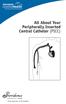 All About Your Peripherally Inserted Central Catheter (PICC) General Information Intravenous (IV) therapy is the delivery of fluid directly into a vein. An intravenous catheter is a hollow tube that is
INTRODUCTION TO POSITIONING. MODULE 3: Positioning and Carrying
 MODULE 3: Positioning and Carrying Blankets, pillows and towels, sandbags, carpet on the floor, a doll with floppy limbs that can be positioned i.e. not a hard plastic doll, display materials. Icebreaker
Why Document? LTC Resources LLC
 LTC Resources LLC LTC Resources LLC 2012 1 Proof that care was given GAPS or lack of follow-up leads to questions of creditability and or accuracy Must be legible LTC Documentation is unique Documentation
Surgical removal of fibroids through an abdominal incision-either up and down or bikini cut. The uterus and cervix are left in place.
 What is an abdominal myomectomy? Surgical removal of fibroids through an abdominal incision-either up and down or bikini cut. The uterus and cervix are left in place. When is this surgery used? Treatment
Excision of Vaginal Mesh
 What is excision of vaginal mesh? This procedure is done to remove mesh from the vagina. When is this surgery used? If mesh has eroded into the vagina, bladder, urethra, or bowel If there is pain associated
Location: Clinical Practice Manual
 Subject: Area: Classification: Relevant to: Bladder Management Clinical Practice All Clinical Staff Implementation Date: March 2001 Review Date: March 2004 Responsible for Review: Approved by: Distribution:
Contractor s Injury Management Toolbox RISK CONTROL
 Contractor s Injury Management Toolbox managing job site accidents and injuries RISK CONTROL Your Role in Workplace Safety As a superintendent or foreman, you play an important role in helping our company
Information for patients and nurses
 Information for patients and nurses Rocket IPC Pleural Catheter Indwelling Catheter Rocket Indwelling Pleural Catheter (IPC) Contents Contact Information...03 What s in the Rocket Dressing Pack and Bottle
Communicating Effectively with Healthcare Providers
 Communicating Effectively with Healthcare Providers Presented by: APS Healthcare Southwestern PA Health Care Quality Unit (APS HCQU) August 2011 cap Disclaimer Information or education provided by the
PATIENT URINARY CATHETER PASSPORT
 n PATIENT URINARY CATHETER PASSPORT A guide on how to look after your Catheter NHS Hertfordshire Patient Experience Team Charter House Parkway Welwyn Garden City Hertfordshire AL8 6JL Telephone: 01707
Going Home with a Urinary Catheter
 Going Home with a Urinary Catheter Doctor: Phone Number: About Your Catheter A urinary catheter is a small tube that goes through your urethra and into your bladder. This tube then drains the urine made
Percutaneous Nephrostomy. Care of your Nephrostomy. Department of Urology
 Percutaneous Nephrostomy Care of your Nephrostomy Department of Urology You may encounter some problems at home but these are usually easily overcome. Listed below are some questions patients commonly
PATIENT GUIDE. Care and Maintenance Drainage Frequency: Max. Drainage Volume: Dressing Option: Clinician s Signature: Every drainage Weekly
 PATIENT GUIDE Care and Maintenance Drainage Frequency: Max. Drainage Volume: Dressing Option: Every drainage Weekly Clinician s Signature: ACCESS SYSTEMS Pleural Space Insertion Site Cuff Exit Site Catheter
Section 4: Your Vascular Access. What is vascular access?
 Section 4: Your Vascular Access What is vascular access? What is a fistula? Taking care of a new fistula What is a graft? Taking care of a new graft What is a hemodialysis catheter? Taking care of a hemodialysis
Maintaining Proper Bowel Elimination
 Peak Development Resources, LLC P.O. Box 13267 Richmond, VA 23225 Phone: (804) 233-3707 Fax: (804) 233-3705 After reading the newsletter, the nursing assistant should be able to: 1. Describe the normal
After Your Gastrectomy
 After Your Gastrectomy UHN Information for patients and families Read this information to learn: what a gastrectomy is how to care for yourself what problems to look out for who to call if you have any
call 811 to get advice from a nurse, or have someone drive the patient to a hospital Emergency Department. Patients should NOT drive themselves.
 Taking Care at Home After Surgery This checklist is to help you and your support person know what to do after you go home following your surgery. If you are given instructions verbally or in writing by
How To Be A Nurse Assistant
 (4PM-7PM) MODULE 1 INTRODUCTION 3hrs. A- Role of a CNA B- Title 22 C- Requirements for Nurse Assistant certification D-Professionalism E- Ethics (7PM-7:30PM) BREAK DAILY NURSING ASSISTANT TRAINING PROGRAM
Recovery plan: radical cystectomy Information for patients
 Recovery plan: radical cystectomy Information for patients Help for you following a bereavement 5 This leaflet will help you know what to expect during your time with us. Please take some time to read
Total Knee Replacement
 Total Knee Replacement Contents Introduction Total Knee Replacement Preparing for surgery Pre-op visit Day of surgery After surgery (In Hospital) After surgery (In Rehab) Exercise Program and Physical
Recovery After Stroke: Bladder & Bowel Function
 Recovery After Stroke: Bladder & Bowel Function Problems with bladder and bowel function are common but distressing for stroke survivors. Going to the bathroom after suffering a stroke may be complicated
Top 5 Malpractice Claims Made Against Nursing Professionals
 Top 5 Malpractice Claims Made Against Nursing Professionals Chances are at some point in your career, you ll either: Have a claim whether frivolous or not--made against your professional services. You
Management of urinary catheters
 Information for patients and relatives This leaflet is available in other formats including large print, audio tape, CD and braille, and in languages other than English, upon request. Corp/326.2 (2012)
Certified Nurse Aide. 1. What type of programs are State Approved?
 Certified Nurse Aide 1.What type of programs are State Approved? 2.What is meant by "successfully completing" a program? 3. How long will my name remain on the Nurse Aide Registry? 4.What if I have not
Caring for Your PleurX Pleural Catheter
 Caring for Your PleurX Pleural Catheter A PleurX Pleural Catheter has been placed in your chest through a small incision in your skin into the pleural space (see picture below). This allows you to drain
Restorative Nursing Teleconference Script
 Slide 1 Slide 2 Slide 3 Maintaining independence in ADLs and mobility is very important to most of us. In fact, functional decline can lead to depression, withdrawal, social isolation, and complications
Home Care for Your Wound Drain
 PATIENT EDUCATION patienteducation.osumc.edu When you go home after surgery, you may have one or more drains in place to help your wounds heal. Hemovac, Jackson Pratt (JP) and Blake are common drains used
Emergency Room (ER) Visits: A Family Caregiver s Guide
 Family Caregiver Guide Emergency Room (ER) Visits: A Family Caregiver s Guide Your family member may someday have a medical emergency and need to go to a hospital Emergency Room (ER), which is also called
VAGINAL MESH FAQ. How do you decide who should get mesh as part of their repair?
 VAGINAL MESH FAQ How do you decide who should get mesh as part of their repair? Each patient with pelvic organ prolapse (POP) is considered individually. In younger women, women with an uncomplicated prolapse
PROCEDURE FOR CLEAN INTERMITTENT CATHETERIZATION MALE
 PROCEDURE FOR CLEAN INTERMITTENT CATHETERIZATION MALE 1. Wash hands. PROCEDURE POINTS TO REMEMBER 2. Assemble equipment. Water-soluble lubricant, such as K-Y Jelly, Lubrifax, Surgel Catheter, plastic or
Medicare Coverage of Skilled Nursing Facility Care
 Helping Older Persons With Legal & Long-Term Care Problems Medicare Coverage of Skilled Nursing Facility Care 1. When does Medicare cover nursing facility care? Skilled nursing facility (SNF) care is covered
HEALTH AND SOCIAL CARE E QUALIFICATIONS HE
 ARE HEALTH AND SOC H AND SOCIAL CARE H OCIAL CARE HEALTH A ARE HEALTH AND SOC ND SOCIAL CARE HEA E QUALIFICATIONS HE LTH AND EXEMPLAR SOCIAL CARE OCIAL CANDIDATE CARE HEALTH WORK A ARE HEALTH AND SOC UNIT
You and your doctor will talk about your condition and the treatment that is best for you.
 PATIENT EDUCATION patienteducation.osumc.edu It is normal to have questions about your surgery. This handout gives you information about what will happen to you before, during and after your surgery. If
To maintain a port of entry to venous flow when all available peripheral ports have failed.
 I. Purpose: To maintain a port of entry to venous flow when all available peripheral ports have failed. II. General Comments: Since its development, these catheters have been used with increasing frequency
X-Plain Subclavian Inserted Central Catheter (SICC Line) Reference Summary
 X-Plain Subclavian Inserted Central Catheter (SICC Line) Reference Summary Introduction A Subclavian Inserted Central Catheter, or subclavian line, is a long thin hollow tube inserted in a vein under the
Periurethral bulking agent for stress urinary incontinence (macroplastique)
 PLEASE PRINT WHOLE FORM DOUBLE SIDED ON YELLOW PAPER Patient Information to be retained by patient affix patient label Who is this leaflet for? This leaflet provides information about having an injection
Patient Information and Daily Programme for Patients Having Whipple s Surgery (Pancreatico duodenectomy)
 Patient Information and Daily Programme for Patients Having Whipple s Surgery (Pancreatico duodenectomy) Date of admission Date of surgery Expected Length of Stay in hospital We will aim to discharge you
WHAT CAN I DO WHEN I HURT MYSELF AT WORK?
 WHAT CAN I DO WHEN I HURT MYSELF AT WORK? This booklet is to help you when you are injured on the job 1 Name of WSIB Representative: Date of Injury: Supervisor: Witnesses: What happened (date and time,
Total Vaginal Hysterectomy
 What is a total vaginal hysterectomy? Is the removal of the uterus and cervix through the vagina. Removal of the ovaries and tubes depends on the patient. Why is this surgery used? To treat disease of
NORTH CAROLINA BOARD OF NURSING NURSE AIDE II TRAINING MODULE
 PART A: PREPARING FOR ADMINISTRATION OF IV FLUIDS All four parts of this module, including skills checklists must be successfully completed in order to complete this training module. This activity is a
Spinal Cord and Bladder Management Male: Intermittent Catheter
 Spinal Cord and Bladder Management Male: Intermittent Catheter The 5 parts of the urinary system work together to get rid of waste and make urine. Urine is made in your kidneys and travels down 2 thin
CARING FOR YOUR URINARY CATHETER GRAMPIANS REGIONAL CONTINENCE SERVICE. Author: GRCS Date: 20/06/09 Catalogue No: 712438
 CARING FOR YOUR URINARY CATHETER GRAMPIANS REGIONAL CONTINENCE SERVICE Author: GRCS Date: 20/06/09 Catalogue No: 712438 What is a urinary catheter? A urinary catheter is a hollow tube which drains urine
WACHS Allied Health Assistant Training Mini-Module Documentation
 WACHS Allied Health Assistant Training Mini-Module Documentation Contents The Mini-Module includes: Information related to the actual training content Activities to take away complete and discuss with
Hysterectomy Vaginal hysterectomy Abdominal hysterectomy
 Hysterectomy A hysterectomy is a surgery to remove a woman s uterus. The uterus is one of the organs of the female reproductive system and is about the size of a closed hand. You can no longer have children
VUMC Guidelines for Management of Indwelling Urinary Catheters. UC Access/ Maintenance
 VUMC Guidelines for Management of Indwelling Urinary Catheters UC Insertion Preparation & Procedure Indications for insertion and continued use of indwelling urinary catheters include: Urinary retention
Recto-vaginal Fistula Repair
 What is a recto-vaginal fistula repair? Rectovaginal fistula repair is a procedure in which the healthy tissue between the rectum and vagina is closed in multiple tissue layers. An incision is made either
Care of Your Hickman Catheter
 Care of Your Hickman Catheter Johns Hopkins Kimmel Cancer Center, Revised 7/11 Contents What is a Hickman Catheter? Page 3 Does the Catheter Limit My Activities? Page 4 How Do I Care for My Catheter? Page
State Education Nurse's Assistant Training Program Clinical Skills Performance Record Evaluation Checklist
 Unit: HOE Core/Overview of Human Body 1. Reads non digital thermometer in degrees Fahrenheit/Centigrade 2. Measures BP within 6 mm/hg. of instructor's reading 3. Writes three sets of vital signs a. BP
Information for men considering a male sling procedure
 Information for men considering a male sling procedure Delivering the best in care UHB is a no smoking Trust To see all of our current patient information leaflets please visit www.uhb.nhs.uk/patient-information-leaflets.htm
Name of procedure: Laparoscopic (key-hole) ovarian surgery. Left/ Right unilateral salpingo-oophorectomy* (removal of one fallopian tube and ovary)
 For staff use only: Patient Details: Surname: First names: Date of birth: Hospital no: Female: (Use hospital identification label) Gynaecology Patient agreement to treatment Name of procedure: Laparoscopic
Your Recovery After a Cesarean Delivery
 Your Recovery After a Cesarean Delivery It is normal to have many questions about your care after delivery. Cesarean delivery is surgery and your body needs time to heal and recover for the next 6 weeks,
Total Abdominal Hysterectomy
 What is a total abdominal hysterectomy? Is the removal of the uterus and cervix through an abdominal incision (either an up and down or bikini cut). Removal of the ovaries and tubes depends on the patient.
A Child s guide to Clean Intermittent Catheterization. Boys
 A Child s guide to Clean Intermittent Catheterization Boys Introduction Probably you have just heard that you have to learn to catheterize your bladder. Most children are worried, frightened or scared