
Care of Your Hickman Catheter
|
|
|
- Chastity Moody
- 10 years ago
- Views:
Transcription
1 Care of Your Hickman Catheter Johns Hopkins Kimmel Cancer Center, Revised 7/11
2 Contents What is a Hickman Catheter? Page 3 Does the Catheter Limit My Activities? Page 4 How Do I Care for My Catheter? Page 5 Flushing Your Catheter Page 6 Capping Your Catheter Page 8 Changing the Transparent Dressing Page 9 Changing the Gauze Dressing Identifying and Reporting Problems Catheter-associated Bloodstream Infections Page11 Page12 Page13 2
3 What is a Hickman Catheter? A Hickman is a long, purple tube placed into a large vein in your chest, just above the heart As part of the procedure to place the catheter, you may have a stitch in your lower neck or skin glue will be used. This is called the entrance site. The stitch stays in for 7 days. The catheter is tunneled under the skin and comes out in your upper chest area. This area is called the exit site. It also has stitches which will be left in for 30 days. The catheter has a cuff that attaches under the skin to help keep the catheter in place even after the stitches are taken out. Your catheter may have one, two or three lumens, depending on the type of treatment you need. This catheter can be used to give you medications, chemotherapy, or blood products, and can also be used to draw blood, so you will not have to be stuck with needles as often. It can also be used for injections of IV contrast dye for CT Scans. Your catheter can stay in place for as long as it is needed. 3
4 Does a Hickman Catheter Limit My Activities? You may need to change some of your activities because of the catheter. You may shower, but you must completely cover your dressing and connections with plastic wrap and tape or a dressing cover such as Aquaguard. Do not let your catheter go under water, in the tub or pool. If your dressing gets loose or soiled, it must be changed right away. Do not damage or pull on the catheter. If your catheter dangles, secure it by taping it up or attaching it to a chain. Exercise, sexual activity and light housekeeping are permitted as long as your catheter and dressing are secure. You may not vacuum or iron, play tennis, golf, bowl or lift weights while you have the catheter. Moving the arm on the same side of the catheter over and over again may damage the catheter or cause it to move out of the vein If you have any other questions about activities you may or may not do, talk with your doctor or nurse. 4
5 How Do I Care for My Catheter? You must learn to do the following tasks: 1. Flushing your catheter 2. Changing your catheter caps 3. Changing the dressing 4. Identifying and reporting problems **A home care company will deliver the supplies you will need to care for your catheter. The supplies sent may be slightly different from what is described below. A nurse will review this procedure with you. 5
6 Flushing Your Hickman Catheter To keep blood from clotting in the catheter, you must learn to flush the catheter. You will flush each lumen once a day with 5 cc s of heparin solution. Your homecare company will give you pre-filled heparin syringes for flushing your catheter. Pre-filled syringes do not have to be refrigerated. Procedure: 1. Wash your hands. 2. Scrub the cap (end) of the catheter with an alcohol pad very well (at least 10 times). 3. Remove cap from end of heparin flush syringe, then gently push and twist the syringe into the catheter cap. 6
7 4. Open the clamp on the catheter. 5. With slow and steady pressure, push the heparin solution into the catheter. If you meet resistance, do not force. Call your doctor or nurse Immediately! 6. Clamp the catheter while pushing in the last ½ cc of heparin solution. This prevents blood from backing up into your catheter. 7. Take off the syringe and put it in the trash. 7
8 Capping Your Catheter Your catheter cap should be changed every 7 days. Supplies needed: 1. New injection cap 2. Alcohol wipe 3. Masks Procedure: 1. Patient and caregiver put on masks. 2. Wash your hands. 3. Be sure your catheter is clamped. 4. Remove the old cap by rotating it counter clockwise. 5. Scrub the catheter end with an alcohol pad very well (at least ten times). 6. Replace with a new sterile injection cap, rotating it clockwise until it is tight (but not too tight.) Be careful to touch only the outside of the cap and not the inside part that goes into the catheter. 8
9 Changing the Transparent Dressing You must change your dressing every 7 days, or immediately if it becomes loose or soiled. You will be able to see through the dressing. You should look at your catheter site and touch it over the dressing every day. If you see redness, swelling, drainage or have tenderness when you press, call your doctor or nurse. (See page 12) Supplies needed: A dressing kit or individual supplies listed below: 1. Chloraprep stick or Tincture of Iodine Swabsticks 2. 1 transparent dressing 3. 1 package of skin prep or other skin protectant 4. 2 masks Procedure: 1. Wash hands. 2. Patient and caregiver put on masks. 3. Prepare supplies by opening all packages and leaving the supplies in their sterile wrappers on a clean table. 4. Remove the old dressing from the chest. 5. Wash hands again. 9
10 6. Open chloraprep or tincture of iodine stick. 7. Using a scrubbing motion, clean in a circle, starting at the catheter exit site and moving away from it. Never retrace your steps! 8. Let dry for 1 minute. Do not wave hands to dry the site. 9. Apply skin prep to the skin where the outer edge of the dressing will be. Allow to dry for 1 minute. 10. Remove the backing from the transparent dressing. 11. Apply the dressing over the catheter with the catheter exit site showing through the window. 12. Remove the paper strip and smooth out the edges. 13. Apply strip under the catheter. 10
11 14. If you have a dangling catheter, clip the catheter with the clip on your chain to keep it from pulling. You may also tape the catheter up or tuck it into your bra. Changing the Gauze Dressing You may be taught to use a gauze dressing if you have an infected catheter, drainage at the site or irritated skin. The dressing can be changed every other day if it does not get wet, loose or soiled. If the dressing gets wet, loose or soiled, it must be changed right away. You should look at your catheter site every time you change the dressing. If you see redness, swelling, drainage or the site is sore, call your doctor or nurse. (See page 12.) Please follow the same steps for changing the transparent dressing. 11
12 Identifying and Reporting Problems It is very important to watch for and report the following symptoms to your doctor or nurse immediately. 1. Fever greater than Shaking chills (rigors) after flushing your catheter. 3. Redness, tenderness, bleeding or drainage at your catheter site or along the tunnel. 4. Skin rash under the dressing. 5. Pain, swelling, or numbness in your arm or neck on the same side as the catheter. 6. Catheter cuff seen at the exit site. 7. Difficulty flushing the catheter. If this occurs, do not force, since this may cause the catheter to rupture. 8. Breaks, leaks or tears in your catheter. If this occurs: clamp the catheter between the damaged area and your body. Cover the catheter with a sterile 4x4 gauze pad and call your doctor or nurse immediately. 9. Your catheter may need to be removed if complications occur. My Doctor is Phone Number My Nurse is Phone Number 12
13 FAQs (frequently asked questions) about Catheter-Associated Bloodstream Infections (also known as Central Line-Associated Bloodstream Infections ) What is a catheter-associated bloodstream infection? A central line or central catheter is a tube that is placed into a patient s large vein, usually in the neck, chest, arm, or groin. The catheter is often used to draw blood, or give fluids or medications. It may be left in place for several weeks. A bloodstream infection can occur when bacteria or other germs travel down a central line and enter the blood. If you develop a catheter-associated bloodstream infection you may become ill with fevers and chills or the skin around the catheter may become sore and red. Can a catheter-related bloodstream infection be treated? A catheter-associated bloodstream infection is serious, but often can be successfully treated with antibiotics. The catheter might need to be removed if you develop an infection. What are some of the things that hospitals are doing to prevent catheter-associated bloodstream infections? To prevent catheter-associated bloodstream infections doctors and nurses will: Choose a vein where the catheter can be safely inserted and where the risk for infection is small. Clean their hands with soap and water or an alcohol-based hand rub before putting in the catheter. Wear a mask, cap, sterile gown, and sterile gloves when putting in the catheter to keep it sterile. The patient will be covered with a sterile sheet. Clean the patient s skin with an antiseptic cleanser before putting in the catheter. Clean their hands, wear gloves, and clean the catheter opening with an antiseptic solution before using the catheter to draw blood or give medications. Healthcare providers also clean their hands and wear gloves when changing the bandage that covers the area where the catheter enters the skin. Decide every day if the patient still needs to have the catheter. The catheter will be removed as soon as it is no longer needed. Carefully handle medications and fluids that are given through the catheter. What can I do to help prevent a catheter-associated bloodstream infection? Ask your doctors and nurses to explain why you need the catheter and how long you will have it. Ask your doctors and nurses if they will be using all of the prevention methods discussed above. Make sure that all doctors and nurses caring for you clean their hands with soap and water or an alcoholbased hand rub before and after caring for you. If the bandage comes off or becomes wet or dirty, tell your nurse or doctor immediately. Inform your nurse or doctor if the area around your catheter is sore or red. Do not let family and friends who visit touch the catheter or the tubing. 13
14 Make sure family and friends clean their hands with soap and water or an alcohol-based hand rub before and after visiting you. What do I need to do when I go home from the hospital? Some patients are sent home from the hospital with a catheter in order to continue their treatment. If you go home with a catheter, your doctors and nurses will explain everything you need to know about taking care of your catheter. Make sure you understand how to care for the catheter before leaving the hospital. For example, ask for instructions on showering or bathing with the catheter and how to change the catheter dressing. Make sure you know who to contact if you have questions or problems after you get home. Make sure you wash your hands with soap and water or an alcohol-based hand rub before handling your catheter. Watch for the signs and symptoms of catheter-associated bloodstream infection, such as soreness or redness at the catheter site or fever, and call your healthcare provider immediately if any occur. If you have additional questions, please ask your doctor or nurse. If you do not see your providers clean their hands, please ask them to do so. Co-sponsored by: SHEA, IDSA, AHA, APIC, CDC and JCAHO 14
HICKMAN Catheter Care with a Needleless Connector
 HICKMAN Catheter Care with a Needleless Connector Table of Contents Part 1 Learning about the HICKMAN Catheter... 2 Part 2 Caring for Your Hickman Catheter... 3 A. Preventing Infection... 3 B. Bathing...
Care for your child s Central Venous Catheter (CVC)
 Care for your child s Central Venous Catheter (CVC) This booklet is intended for general informational purposes only. You should consult your doctor for medical advice. Please call the clinic or your home
Tunneled Central Venous Catheter (CVC) Placement
 PATIENT EDUCATION patienteducation.osumc.edu Tunneled Central Venous Catheter (CVC) Placement A tunneled Central Venous Catheter (CVC) is a special type of intravenous (IV) line that is placed into a large
X-Plain Subclavian Inserted Central Catheter (SICC Line) Reference Summary
 X-Plain Subclavian Inserted Central Catheter (SICC Line) Reference Summary Introduction A Subclavian Inserted Central Catheter, or subclavian line, is a long thin hollow tube inserted in a vein under the
PICC Catheter for IV Therapy
 PICC Catheter for IV Therapy A Patient Guide for: PATIENT PICC A PICC is defined as a Peripherally Inserted Central Catheter. A PICC is a special IV Catheter. It is put in an arm vein and ends in a large
Safety FIRST: Infection Prevention Tips
 Reading Hospital Safety FIRST: Infection Prevention Tips Reading Hospital is committed to providing high quality care to our patients. Your healthcare team does many things to help prevent infections.
PICCs and Midline Catheters
 Patient Education PICCs and Midline Catheters Patient s guide to PICC (peripherally inserted central catheter) and midline catheters What are PICCs and midline catheters used for? Any medicine given over
PICC & Midline Catheters Patient Information Guide
 PICC & Midline Catheters Patient Information Guide medcompnet.com 1 table of contents Introduction 4 What is a PICC or Midline Catheter? 4 How is the PICC or Midline Catheter Inserted? 6 Catheter Care
Guy s, King s and St Thomas Cancer Centre The Cancer Outpatient Clinic Central venous catheter: Peripherally inserted central catheter
 Guy s, King s and St Thomas Cancer Centre The Cancer Outpatient Clinic Central venous catheter: Peripherally inserted central catheter This information leaflet aims to help answer some of the questions
PATIENT GUIDE. Care and Maintenance Drainage Frequency: Max. Drainage Volume: Dressing Option: Clinician s Signature: Every drainage Weekly
 PATIENT GUIDE Care and Maintenance Drainage Frequency: Max. Drainage Volume: Dressing Option: Every drainage Weekly Clinician s Signature: ACCESS SYSTEMS Pleural Space Insertion Site Cuff Exit Site Catheter
Section 6: Your Hemodialysis Catheter
 Section 6: Your Hemodialysis Catheter What you should know about your dialysis catheter How to change your catheter TEGO connectors Starting dialysis using a catheter End of dialysis using a catheter Changing
PATIENT GUIDE. Understand and care for your peripherally inserted central venous catheter (PICC). MEDICAL
 PATIENT GUIDE Understand and care for your peripherally inserted central venous catheter (PICC). MEDICAL Introduction The following information is presented as a guideline for your reference. The best
Peripherally Inserted Central Catheter (PICC) Patient Instructions
 Patient Care Services 300 Pasteur Drive Stanford, CA 94305 Peripherally Inserted Central Catheter (PICC) Patient Instructions A Peripherally Inserted Central Catheter (PICC) is a soft flexible tube inserted
Managing Your Non-Tunneled (Percutaneous) Catheter: PICC, SICC, and JCC. What is a PICC catheter?
 Managing Your Non-Tunneled The staff of the Procedure, Vascular Access, Conscious Sedation Service has written this information to explain your new PICC (peripherally inserted central catheter), SICC (subclavian
Central Venous Catheter (CVC) Sterile Dressing Change - The James
 PATIENT EDUCATION patienteducation.osumc.edu Central Venous Catheter (CVC) Sterile Dressing Change - The James A dressing protects your catheter site and helps reduce the risk of infection. You will need
Peripherally Inserted Central Catheter (PICC) for Outpatient
 Peripherally Inserted Central Catheter (PICC) for Outpatient Introduction A Peripherally Inserted Central Catheter, or PICC line, is a thin, long, soft plastic tube inserted into a vein of the arm. It
Central Line Care for Adults
 Central Line Care for Adults Table of Contents What is a Central Venous Catheter?... 2 Central Venous Catheter Placement: What to Expect... 2 Catheter Care at a Glance... 2 Fast Facts on Central Line Care:
To maintain a port of entry to venous flow when all available peripheral ports have failed.
 I. Purpose: To maintain a port of entry to venous flow when all available peripheral ports have failed. II. General Comments: Since its development, these catheters have been used with increasing frequency
Site Care of Your Central Venous Catheter Sterile
 Site Care of Your Central Venous Catheter Sterile Dressing Change Sterile Technique The skin surrounding your catheter s exit site must be kept clean, and a new sterile dressing should be applied on a
All About Your Peripherally Inserted Central Catheter (PICC)
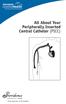 All About Your Peripherally Inserted Central Catheter (PICC) General Information Intravenous (IV) therapy is the delivery of fluid directly into a vein. An intravenous catheter is a hollow tube that is
Sterile Dressing Change with Tegaderm CHG for Central Venous Catheter (CVC)
 Sterile Dressing Change with Tegaderm CHG for Central Venous Catheter (CVC) The dressing protects your catheter site. It also helps prevent infection at the site. Keep your dressing clean and dry at all
Biliary Drain. What is a biliary drain?
 Biliary Drain What is a biliary drain? A biliary drain is a tube to drain bile from your liver. It is put in by a doctor called an Interventional Radiologist. The tube or catheter is placed through your
Understanding your Peripherally Inserted Central Catheter (PICC) Patient Information
 Understanding your Peripherally Inserted Central Catheter (PICC) Patient Information The Purpose of this Information Sheet This information sheet has been written by patients, members of the public and
PATIENT GUIDE. Care and Maintenance Drainage Frequency: Max. Drainage Volume: Dressing Option: Clinician s Signature: Every drainage Weekly
 PATIENT GUIDE Care and Maintenance Drainage Frequency: Max. Drainage Volume: Dressing Option: Every drainage Weekly Clinician s Signature: ACCESS SYSTEMS Pleural Space Insertion Site Cuff Exit Site Catheter
Peripherally Inserted Central Catheter
 Peripherally Inserted Central Catheter (PICC) by Patricia Griffin Kellicker, BSN En Español (Spanish Version) Definition A peripherally inserted central catheter is a long, thin tube that is inserted through
Changing Your Central Line Catheter Cap
 Changing Your Central Line Catheter Cap The catheter cap on each lumen of your central line needs to be changed once a week. A lumen is a small tube within your catheter. These same steps can be used for
How to Care for your Child s Indwelling Subcutaneous Catheter
 The Emily Center How to Care for your Child s Indwelling Subcutaneous Catheter Procedure/Treatment/Home Care Si usted desea esta información en español, por favor pídasela a su enfermero o doctor. #1054
Home Care for Your Nephrostomy Catheter
 Home Care for Your Nephrostomy Catheter This handout covers information about caring for your nephrostomy catheter right after placement and caring for it long term. If you have any questions, please call
CATHETER for Hemodialysis
 CATHETER for Hemodialysis What You Need to Know to Stay Healthy with a Catheter One treatment choice for kidney failure is hemodialysis (HD). HD removes wastes and excess fluid from your blood. Your lifeline
Peripherally Inserted Central Catheter (PICC)
 Peripherally Inserted Central Catheter (PICC) Disclaimer This is general information developed by The Ottawa Hospital. It is not intended to replace the advice of a qualified healthcare provider. Please
Central Venous Catheter Care For Haemodialysis
 Central Venous Catheter Care For Haemodialysis Information For Parents and Carers Haemodialysis Unit 01 878 4757 Main Hospital Number 01 878 4200 Central Venous Catheters We hope this booklet will help
Caring for Your PleurX Pleural Catheter
 Caring for Your PleurX Pleural Catheter A PleurX Pleural Catheter has been placed in your chest through a small incision in your skin into the pleural space (see picture below). This allows you to drain
Home Care for Your Wound Drain
 PATIENT EDUCATION patienteducation.osumc.edu When you go home after surgery, you may have one or more drains in place to help your wounds heal. Hemovac, Jackson Pratt (JP) and Blake are common drains used
Caring for a Tenckhoff Catheter
 Caring for a Tenckhoff Catheter UHN A Patient s Guide What is a Pleural Effusion? There is a small space between the outside of your lung and the chest wall (ribs). This space is called the pleural space.
PERIPHERALLY INSERTED CENTRAL CATHETERS (PICC) Fong So Kwan APN, Haematology unit Medical Department, QMH
 PERIPHERALLY INSERTED CENTRAL CATHETERS (PICC) Fong So Kwan APN, Haematology unit Medical Department, QMH 1 What is a PICC catheter? Primary vascular access device since their introduction in the mid-1970s,
Peripherally Inserted Central Venous Catheter (PICC) Invasive Devices Clinical Nurse Specialist Chief Nurse
 Peripherally Inserted Central Venous Catheter (PICC) Invasive Devices Clinical Nurse Specialist Chief Nurse This leaflet has been designed to give you important information about your condition / procedure,
Tunnelled haemodialysis catheter
 Liver, Renal & Surgery Tunnelled haemodialysis catheter Information for patients and carers This leaflet explains what a tunnelled haemodialysis catheter is and how it is put in. It also covers the risks
Vaxcel PICCs Valved and Non-Valved. A Patient s Guide
 Vaxcel PICCs Valved and Non-Valved A Patient s Guide Information about your Vaxcel PICC is available by calling the Navilyst Medical Vascular Access Information Line 800.513.6876 Vaxcel Peripherally Inserted
Page 1 of 10 MC1482 Peripherally-Inserted Central Catheter. Peripherally-Inserted Central Catheter (PICC)
 Page 1 of 10 MC1482 Peripherally-Inserted Central Catheter Peripherally-Inserted Central Catheter (PICC) Page 2 of 10 MC1482 Peripherally-Inserted Central Catheter Introduction A peripherally-inserted
call 811 to get advice from a nurse, or have someone drive the patient to a hospital Emergency Department. Patients should NOT drive themselves.
 Taking Care at Home After Surgery This checklist is to help you and your support person know what to do after you go home following your surgery. If you are given instructions verbally or in writing by
Care of your central venous catheter A guide for patients and their carers. We care, we discover, we teach
 Care of your central venous catheter A guide for patients and their carers We care, we discover, we teach This booklet contains information about central venous catheters (CVC). These are sometimes called
Information for patients and nurses
 Information for patients and nurses Rocket IPC Pleural Catheter Indwelling Catheter Rocket Indwelling Pleural Catheter (IPC) Contents Contact Information...03 What s in the Rocket Dressing Pack and Bottle
Appendix L: Accessing/Deaccessing Implanted Central Venous Access Port
 Effective Date: 03/01/2008 Page 1 of 5 Recommendations for Use Insertion Considerations Implanted Port Dressing Access/ Reaccess An implanted port is strongly recommended for patients in whom more than
Your Guide to Peritoneal Dialysis Module 3: Doing Peritoneal Dialysis at Home
 Your Guide to Peritoneal Dialysis Module 3: 6.0959 in Preparing to do PD One of the most important things about PD is to keep the dialysis area and anything that comes in contact with the PD equipment
Patient Information Guide Morpheus CT Peripherally Inserted Central Catheter
 Patient Information Guide Morpheus CT Peripherally Inserted Central Catheter IC 192 Rev C A measure of flexibility and strength. Table of Contents 1. Introduction 2. What is the Morpheus CT PICC? 3. What
X-Plain Foley Catheter Male Reference Summary
 X-Plain Foley Catheter Male Reference Summary Introduction A Foley catheter is a tube that is put through the urinary opening and into your bladder to drain urine. Your doctor may have placed or may ask
Care of your peripherally inserted central catheter
 Care of your peripherally inserted central catheter A guide for patients and their carers We care, we discover, we teach Contents What is a PICC?.... 1 How is it put in?.... 1 What are the benefits of
Introduction A JP Drain is a soft tube and container used to drain fluids that build up under the skin after surgery.
 JP Drain Introduction A JP Drain is a soft tube and container used to drain fluids that build up under the skin after surgery. This reference summary explains what a JP Drain is and discusses how to take
Community Nurse Referral Letter (Hickman Line Care)
 Community Nurse Referral Letter (Hickman Line Care) Name of nurse making the referral: Name Signature.. Date Ward.Tel 0845 1555 000 Ext. Dear Community Nurse The following patient requires care for a Hickman
The temporary haemodialysis catheter
 The temporary haemodialysis catheter Department of Renal Medicine Patient Information Leaflet Introduction The information in this booklet is for: People have renal failure and who require urgent haemodialysis.
How to safely collect blood samples from persons suspected to be infected with highly infectious blood-borne pathogens (e.g.
 How to safely collect blood samples from persons suspected to be infected with highly infectious blood-borne pathogens (e.g. Ebola) Step 1: Before entering patient room, assemble all equipment (1 st part)
Insertion of a Central Catheter (Hickman/Groshong Catheter)
 Insertion of a Central Catheter (Hickman/Groshong Catheter) Patient Information Introduction This booklet has been written to provide information to patients about to have a central catheter inserted in
Chest Port Port-a-cath
 Patient Education Port-a-cath This handout explains what a chest port is and what to expect when you have one. What is a chest port? Your doctor has asked us to insert a chest port (also called a port-acath)
How can you protect yourself from infections?
 How can you protect yourself from infections? Your Infection Prevention Guide www.esrdncc.org Table of Contents Preventing an infection is an important part of your kidney care...3 Things you can do...4
Discharge Information after a Coronary Angiogram or Coronary Angioplasty/ Stent Procedure
 Discharge Information after a Coronary Angiogram or Coronary Angioplasty/ Stent Procedure FORM # W-00500 June 2014 Discharge Information after a Coronary Angiogram or Coronary Angioplasty/ Stent Procedure
GOING HOME AFTER YOUR TAVR PROCEDURE
 GOING HOME AFTER YOUR TAVR PROCEDURE HENRY FORD HOSPITAL CENTER FOR STRUCTURAL HEART DISEASE GOING HOME After your TAVR procedure, you will need help when you go home. It is hard to predict how much help
Hemodialysis Access: What You Need to Know
 Hemodialysis Access: What You Need to Know Hemodialysis Access: What You Need To Know Whether you already get hemodialysis treatment, or you will need to start dialysis soon, this booklet will help you
Heart problems - What are the possible side effects of AVONEX? What is AVONEX? Who should not take AVONEX?
 MEDICATION GUIDE AVONEX Interferon beta-1a (Including appendix with instructions for using AVONEX Vials) Please read this guide carefully before you start to use AVONEX (a-vuh-necks) and each time your
Understanding Your Hemodialysis Access Options UNDERSTANDING YOUR HEMODIALYSIS ACCESS OPTIONS
 Understanding Your Hemodialysis Access Options UNDERSTANDING YOUR HEMODIALYSIS ACCESS OPTIONS What is a vascular access? A vascular access is a place on your body close to a vein and artery. This place
Section 4: Your Vascular Access. What is vascular access?
 Section 4: Your Vascular Access What is vascular access? What is a fistula? Taking care of a new fistula What is a graft? Taking care of a new graft What is a hemodialysis catheter? Taking care of a hemodialysis
Policies & Procedures. I.D. Number: 1073
 Policies & Procedures Title:: CENTRAL VENOUS CATHETERS INSERTION ASSISTING I.D. Number: 1073 Authorization [] Pharmacy Nursing Committee [] MAC Motion #: [x] SHR Nursing Practice Committee Source: Nursing
Interstitial Breast Brachytherapy
 Patient Education Questions? Your questions are important. Call your doctor or health care provider if you have questions or concerns. UWMC clinic staff are also available to help at any time. During normal
Going home with your Tunneled Catheter
 Going home with your Tunneled Catheter Your Tunneled Catheter was put in by on Interventional Radiologist Date Your Tunneled Catheter was put in at: McMaster University Medical Centre Hamilton General
Peripherally Inserted Central Catheter (PICC Line)
 Feedback We appreciate and encourage feedback. If you need advice or are concerned about any aspect of care or treatment please speak to a member of staff or contact the Patient Advice and Liaison Service
VUMC Guidelines for Management of Indwelling Urinary Catheters. UC Access/ Maintenance
 VUMC Guidelines for Management of Indwelling Urinary Catheters UC Insertion Preparation & Procedure Indications for insertion and continued use of indwelling urinary catheters include: Urinary retention
PICC/Midclavicular/Midline Catheter
 47 PICC/Midclavicular/Midline Catheter Introduction- PICC/ MCV/ Midline You have a PICC/Midclavicular/Midline (peripherally inserted) catheter. This catheter should make receiving I.V. medicines or solutions
Going Home with a Urinary Catheter
 Going Home with a Urinary Catheter Doctor: Phone Number: About Your Catheter A urinary catheter is a small tube that goes through your urethra and into your bladder. This tube then drains the urine made
INSTRUCTIONS FOR USE. Read this information before you start. Important things to know about your SmartJect autoinjector. Important things to remember
 INSTRUCTIONS FOR USE SIMPONI (SIM-po-nee) (golimumab) SmartJect autoinjector If your doctor decides that you or a caregiver may be able to give your injections of SIMPONI at home, you should receive training
Black Hills Healthcare System
 Black Hills Healthcare System Methicillin Resistant Staphylococcal Aureus (MRSA) Patient and Family Information What is MRSA? Staphylococcus Aureus, often referred to simply as staph, is a bacteria commonly
Tunnelled indwelling pleural catheter (TIPC)
 Tunnelled indwelling pleural catheter (TIPC) A patient s guide 1 What is a tunnelled indwelling pleural catheter? A tunnelled indwelling pleural catheter is a specially designed small tube to drain fluid
1-800-862-2731 Administration of Meropenem For Child
 1 Drug Name: _Meropenem 1-800-862-2731 Administration of Meropenem For Child Dosage: milligrams every hours over 5 minutes Key Points: FLUSHING: Meropenem Heparin flush 1. Always wash your hands with an
Atrium Pneumostat Chest Drain Valve. Discharge Instructions
 Atrium Pneumostat Chest Drain Valve Discharge Instructions Your Physician Name: Contact Number for Emergencies: Introduction Your physician has decided to change your chest drainage system to a smaller
How to care for a Midline Catheter
 How to care for a Midline Catheter Developed by the health care professionals of the IV Program with assistance from the Department of Learning and Development. All rights reserved. No part of this book
MRSA. Living with. Acknowledgements. (Methicillin-Resistant Staphylococcus aureus)
 How can I keep myself healthy? Hand washing and use of an alcohol-based hand sanitizer are the primary way to prevent acquiring or transmitting bacteria. If you get a cut or scrape, wash it well with soap
Flushing and Dressing a Peripherally Inserted Central Catheter (PICC Line)
 Flushing and Dressing a Peripherally Inserted Central Catheter (PICC Line) Patient Information Introduction This booklet has been written to provide information to patients with a Peripherally Inserted
Infection Prevention
 Infection Prevention Dear HSS Patient: The Hospital for Special Surgery is committed to patient safety and quality patient care and is proud to have achieved one of the lowest infection rates in New York
Flushing and Dressing a Peripherally Inserted Central Catheter (PICC Line): a Guide for Nurses
 Flushing and Dressing a Peripherally Inserted Central Catheter (PICC Line): a Guide for Nurses Information for Nurses Introduction This information is for community nursing staffs who have been asked to
Patient Information. PORT-A-CATH Implantable Venous Access Systems
 Patient Information PORT-A-CATH Implantable Venous Access Systems Your doctor has prescribed treatment that requires the frequent administration of medications or other fluids directly into your bloodstream
I-140 Venipuncture for Blood Specimen Collection
 I-140 Venipuncture for Blood Specimen Collection Purpose Obtain a blood specimen by venipuncture for laboratory analysis using aseptic technique. Applies To Registered Nurses Licensed Practical/Vocational
PERIPHERAL STEM CELL TRANSPLANT INTRODUCTION
 PERIPHERAL STEM CELL TRANSPLANT INTRODUCTION This booklet was designed to help you and the important people in your life understand the treatment of high dose chemotherapy with stem cell support: a procedure
Community Nurse Referral Letter (PICC Care)
 Community Nurse Referral Letter (PICC Care) Name of nurse making the referral: Name Signature.. Date Ward.Tel 0845 1555 000 Ext. Dear Community Nurse The following patient requires care for a PICC (Peripherally
VRE. Living with. Learning how to control the spread of Vancomycin-resistant enterococci (VRE)
 VRE Living with Learning how to control the spread of Vancomycin-resistant enterococci (VRE) CONTENTS IMPORTANT VRE is a serious infection that may become life-threatening if left untreated. If you or
What You Need to Know About Your Nephrostomy Tube
 What You Need to Know About Your Nephrostomy Tube Information for patients and families UHN Read this information to learn about: what a nephrostomy tube is and why you may need one how to prepare for
Policies & Procedures. ID Number: 1118
 Policies & Procedures Title: INTRAVENOUS AND/OR PERIPHERAL SALINE LOCK INSERTION AND MAINTENANCE ID Number: 1118 Authorization [X] SHR Nursing Practice Committee Source: Nursing Date Revised: September
Medications or therapeutic solutions may be injected directly into the bloodstream
 Intravenous Therapy Medications or therapeutic solutions may be injected directly into the bloodstream for immediate circulation and use by the body. State practice acts designate which health care professionals
Management of Catheters Infectious Diseases Working Party/Nurses Group
 Management of Catheters Infectious Diseases Working Party/Nurses Group Arno Mank RN PhD, Amsterdam (NL) www.ebmt.org London 09/04/2012 Content Background Management of CVC Types of CVC Care aspect of CVC
Living with MRSA. Things to remember about living with MRSA: This is really serious. I need to do something about this now!
 Things to remember about living with MRSA: 1. Wash your hands often. 2. Take care of yourself: Eat right, exercise, quit smoking, and avoid stress. 3. Take good care of your skin. 4. Keep skin infections
Gallbladder Surgery with an Incision (Cholecystectomy)
 Gallbladder Surgery with an Incision (Cholecystectomy) It is normal to have questions about your surgery. This handout gives you information about what will happen to you before, during and after your
Learning About MRSA. 6 How is MRSA treated? 7 When should I seek medical care?
 IMPORTANT MRSA is a serious infection that can become life-threatening if left untreated. If you or someone in your family has been diagnosed with MRSA, there are steps you need to take now to avoid spreading
How To Recover From A Surgical Wound From A Cast
 Care of Your Wounds After Amputation Surgery by Paddy Rossbach, RN Depending on the reason for your amputation and the state of your limb at the time of surgery, definitive closure of the wound may take
INJECTION TECHNIQUE. IVF NURSING OFFICE: (301) 400-2151 Darshana (301) 400-2146 Nicole
 IVF NURSING OFFICE: (301) 400-2151 Darshana (301) 400-2146 Nicole PLEASE NOTE: If you do not have medications for the next day s dose, you MUST go to the clinic that morning at 6:30 AM for more medications.
Ward 29 guide to the safe preparation and administration of intravenous (IV) antibiotics at home
 Ward 29 guide to the safe preparation and administration of intravenous (IV) antibiotics at home Contents Page Important contact numbers 1 General information on preparing and administering IV antibiotics
Having denervation of the renal arteries for treatment of high blood pressure
 Having denervation of the renal arteries for treatment of high blood pressure The aim of this information sheet is to help answer some of the questions you may have about having denervation of the renal
Central Venous Lines (CVP)
 2011 Central Venous Lines (CVP) Central Venous Line This pamphlet is about a central venous pressure (CVP) line and why it may be needed. We would like to encourage you to read this pamphlet. The nurses
Care of a Foley Catheter
 Care of a Foley Catheter A Foley catheter is a tube that is put into the bladder to drain urine out of the body. A Foley catheter can stay in the bladder for hours or weeks. Having the catheter put in
You have been sent home with. Suprapubic Catheter
 You have been sent home with Suprapubic Catheter 1 SUPRAPUBIC CATHETER 1.- What is a suprapubic catheter? 2.- What do you need on discharge. 3.- Basic care 4.- Choosing your bag and bag care 5.- Possible
MEDICATION GUIDE REBIF interferon beta-1a Injection for subcutaneous use
 MEDICATION GUIDE REBIF interferon beta-1a Injection for subcutaneous use Read this Medication Guide before you start using REBIF and each time you get a refill. There may be new information. The information
Spinal Injections. North American Spine Society Public Education Series
 Spinal Injections North American Spine Society Public Education Series What Is a Spinal Injection? Your doctor has suggested that you have a spinal injection to help reduce pain and improve function. This
Medication Guide Rebif (Re-bif) Interferon beta-1a (in-ter-feer-on beta-one-â)
 Medication Guide Rebif (Re-bif) Interferon beta-1a (in-ter-feer-on beta-one-â) Please read this leaflet carefully before you start to use Rebif and each time your prescription is refilled since there may
Instructions for Use HUMALOG KwikPen insulin lispro injection (rdna origin)
 1 Instructions for Use HUMALOG KwikPen insulin lispro injection (rdna origin) Read the Instructions for Use before you start taking HUMALOG and each time you get a refill. There may be new information.