
Gallbladder Surgery with an Incision (Cholecystectomy)
|
|
|
- Thomasine Gibbs
- 9 years ago
- Views:
Transcription

1 Gallbladder Surgery with an Incision (Cholecystectomy) It is normal to have questions about your surgery. This handout gives you information about what will happen to you before, during and after your surgery. If you still have questions, ask your nurse or doctor for more information. General Information about Surgery Before Your Surgery: Before your surgery, a nurse will ask you questions about your health and your surgery. These questions may be asked during pre-admission testing, in your hospital room, or in the Ambulatory Surgery Unit. Day of Your Surgery: On the day of your surgery, a nurse will talk with you either in the Ambulatory Surgery Unit or in your hospital room. Your vital signs that include blood pressure, pulse, temperature and breathing rate will be taken at this time. Blood tests will be done, if needed. The nurse may put a needle into your vein called an IV or Intravenous to give you fluid. Dentures or partial plates, contact lenses, eyeglasses, hearing aids, and any other prosthesis must be removed before going to surgery. Nail polish, make-up, jewelry, and hair clips also will be removed. Your family will be able to stay with you until you go to the Pre-operative Holding Area. The nurse will answer any questions and tell your family where to wait while you are in surgery. More on next page Learn more about your health care. Copyright November 1, The Ohio State University Wexner Medical Center - Upon request all patient education handouts are available in other formats for people with special hearing, vision and language needs, call (614)

2 Page 2 You will leave the Ambulatory Surgery Unit (ASU) or your hospital room on a cart. It is common to stop in the Pre-Operative Holding Area before going to surgery. While there, your anesthesiologist may talk with you. An IV will be started, if you do not already have one. Your hair will be covered with a paper hat, like the operating room staff wears. During Surgery: All staff in the operating room wears special scrub clothes, caps, and masks. You will notice that the room has bright lights and is quite cool. Many pieces of special equipment and tables are set up with supplies and instruments. A scrub nurse or operating room technician gets the instruments and supplies ready for your surgery. The staff will explain what will happen to you before they are done. A nurse will be there to greet you and check your identification (ID) bracelet. You will be asked about allergies. Then you will be made comfortable on the operating room table. A safety strap will be put over your knees so you stay on the table. You will be covered with an extra blanket if you are cold and your arms may be tucked in at your sides or put on an arm board. During your surgery you will be closely checked. Three leads used to monitor your heart will be put on your chest. They will be connected to a monitor that counts your heart rate. As the monitor counts your heart rate it makes a beeping noise. Your heart beat also may be seen on a screen. A small clip called a pulse oximeter is placed on your finger to measure your pulse and the amount of oxygen in your blood. The time it takes for your surgery is estimated. Your surgery may take a longer or shorter time than you and your family was told. If your surgery takes longer than you were told, it does not mean that anything is wrong. Your family will be told how you are doing. After your surgery is over, the surgeon or an assistant will call or come to the waiting area to talk to your family.

3 Page 3 After Surgery After your surgery you will be moved on a cart and taken to the Post Anesthesia Care Unit (PACU). As you come out of anesthesia, a PACU nurse will watch you closely and check your blood pressure and heart rate. Your pulse and the amount of oxygen in your blood will be checked. If you need oxygen after your anesthesia, you will feel a tube on your face. When you first wake, up you may feel cold and you may shiver. This is normal if you have had general anesthesia. There will be other patients and a lot of activity and noise in the PACU. The nurse will try to wake you up during your time in PACU. If you have pain, ask your nurse to give you pain medicine. When you are awake and your vital signs are normal, you will be taken to the Ambulatory Surgery Unit (ASU) or to your hospital room. Your vital signs, IV fluids and any drainage tubes and dressings will be checked. At this time, your family will be allowed to visit. Planning for Discharge Information on how to care for yourself at home and your medicines will be explained to you before you leave. Before you go home, you should ask your doctor or nurse when you may do the following activities. Write in the answers in the spaces provided. When may I: Climb stairs Lift Do housework Drive/ride in a car Take a shower / bath Have sex again Go back to work Go shopping Do dishes Do laundry Vacuum Mow grass Dig garden Weed garden Other

4 Page 4 Information about Cholecystectomy Cholecystectomy is the removal of the gallbladder through an incision in your abdomen (stomach area). There are two kinds of incisions your doctor may use. Sometimes the doctor will use a vertical (up and down) incision in the middle of your abdomen. Other times the doctor will use a crosswise incision on your upper right abdomen beneath your ribs. Absorbable stitches will be used inside your abdomen. The outside skin edges will be held together with staples or tape. A gauze dressing will cover your incision for a day or two after surgery. Your doctor will remove it and decide when the incision can be left uncovered. The nurses will check the incision for unusual bleeding, swelling, redness, or signs of infection. Routine Observation Your temperature, pulse, breathing and blood pressure will be checked often during your hospital stay. The nurses also will listen to sounds in your lungs and abdomen to be sure that function is returning to normal. Intravenous Catheter (IV) The IV placed in your hand or arm before surgery is used to give you fluids and antibiotics if you need them. The IV will be removed after you can drink enough liquids without feeling nauseated. Activity After surgery you should be as active as possible, both in and out of bed. While in bed you may turn any way that is comfortable. Lying in one position for a long time slows your recovery. We will help you change position in bed every 2 or 3 hours if you cannot do this by yourself. We also will help you get out of bed and walk the evening after your surgery. You can help yourself by being as independent as possible. The stitches

5 Page 5 holding your incision together are strong. You will not damage the surgery areas with normal moving, walking, and coughing. You will need to cough and breathe deeply 5 to 6 times every 1 to 2 hours while you are awake. This will reduce your risk of getting pneumonia. A breathing exerciser device can help you take deep breaths and cough. The nurse will show you how to use the device and will remind you to cough and deep breathe when you return to your room after surgery. Pain It is normal to have some pain around the area of surgery. However, you should be comfortable enough to move, walk, cough and deep breathe. Your doctor will order shots, pills, or both to help control your pain. Pain medicine can be given every 3 to 4 hours. The shots work faster and are often used the first 12 to 24 hours after surgery. Your nurse will help you decide whether to take the shots or the pills, if you have the choice and are unsure. Do not wait until the pain is severe before you ask for pain medicine. Pain medicine works best if you take it before the pain gets out of control. You may have some gas pain discomfort and bowel changes such as diarrhea or constipation for a few weeks while your stomach and intestines return to normal. Less activity, anesthesia and pain medicines cause your bowels to work more slowly. Walking helps to make your bowels work a little faster. We will ask you to walk in the hallway 3 to 4 times a day while you are in the hospital. At home you should slowly increase your walking and activity. This will help your bowels and other body functions return to normal more quickly. Food You will probably be able to eat ice and drink water and liquids when you return to your room after surgery. If you are not able to drink liquids, the doctor will decide when you can. The doctor will also decide when you may progress to solid food. If you feel nauseated, begin with ice and clear liquids and progress to regular food more slowly, eating small amounts. If the nausea is severe, you can have medicine to control it.

6 Page 6 Drains You may have a drain tube placed near your incision during surgery. There are two kinds your doctor may use. The first drain tube is a hemovac. It has flexible tubing that is placed under the skin to remove extra fluid and blood to speed healing. A container is placed on the outside end of the tube to provide some suction and collect the drainage. This container is emptied every 8 hours and the contents will be measured. Your doctor will decide when this drainage tube is no longer needed and can be removed. The second kind of drain tube is used if your surgery involved the bile duct. A T-shaped tube is placed in the bile duct to drain the bile while the duct heals. This tube is called a "T-tube" and you may hear the doctors and nurses talking about your T-tube. A bag is placed on the end of the tube to collect the bile. The bag will be emptied every 8 hours and the bile is measured. Sometimes this tube is removed in the hospital before you go home. However, it is common to go home with this tube still in place. If you go home with the T-tube, your nurse will show you how to take care of it. Discharge When you are ready to go home, your doctor will give you written discharge instructions. This instruction sheet will tell you about lifting and activity restrictions, medicines you need to take, and when to return to your doctor. Be sure to follow these instructions carefully. Wash carefully around your incision every day with soap and rinse with clean water. The skin around your incision may be a little red, like it is when you have a small cut. If the red area gets larger, swells, and feels warmer than the rest of your skin, then call your doctor. It is normal to have a little watery or dark bloody drainage from your incision for several days. Call your doctor if you notice a large increase in the amount of drainage or if it becomes thick and milky. If you think you may have an infection or you just do not feel right, take your temperature. Your temperature may be a little higher than normal for a few days. Call your doctor if your temperature reaches 101 degrees or is 100 degrees for 4-5 days. To promote healing at home return to your normal diet and become independent by taking care of yourself.

You and your doctor will talk about your condition and the treatment that is best for you.
 PATIENT EDUCATION patienteducation.osumc.edu It is normal to have questions about your surgery. This handout gives you information about what will happen to you before, during and after your surgery. If
You will be having surgery to remove a tumour(s) from your liver.
 Liver surgery You will be having surgery to remove a tumour(s) from your liver. This handout will help you learn about the surgery, how to prepare for surgery and your care after surgery. Surgery can be
Hysterectomy Vaginal hysterectomy Abdominal hysterectomy
 Hysterectomy A hysterectomy is a surgery to remove a woman s uterus. The uterus is one of the organs of the female reproductive system and is about the size of a closed hand. You can no longer have children
Colon Cancer Surgery and Recovery. A Guide for Patients and Families
 Colon Cancer Surgery and Recovery A Guide for Patients and Families This Booklet You are receiving this booklet because you will be having surgery shortly. This booklet tells you what to do before, during,
X-Plain Preparing For Surgery Reference Summary
 X-Plain Preparing For Surgery Reference Summary Introduction More than 25 million surgical procedures are performed each year in the US. This reference summary will help you prepare for surgery. By understanding
Elective Laparoscopic Cholecystectomy
 General Surgery Elective Laparoscopic Cholecystectomy This information aims to explain what will happen before, during and after your surgery to remove your gallbladder. It includes information about the
Your Recovery After a Cesarean Delivery
 Your Recovery After a Cesarean Delivery It is normal to have many questions about your care after delivery. Cesarean delivery is surgery and your body needs time to heal and recover for the next 6 weeks,
Laparoscopic Colectomy. What do I need to know about my laparoscopic colorectal surgery?
 Laparoscopic Colectomy What do I need to know about my laparoscopic colorectal surgery? Traditionally, colon & rectal surgery requires a large, abdominal and/or pelvic incision, which often requires a
PATIENT HANDBOOK AND JOURNAL DAY OF SURGERY
 PATIENT HANDBOOK AND JOURNAL DAY OF SURGERY PREPARING YOUR SKIN BEFORE SURGERY PRE-OP HIBICLENS BATHING INSTRUCTIONS: General Information: Because the skin is not sterile, it is important to make sure
Recto-vaginal Fistula Repair
 What is a recto-vaginal fistula repair? Rectovaginal fistula repair is a procedure in which the healthy tissue between the rectum and vagina is closed in multiple tissue layers. An incision is made either
Going home after an AV Fistula or AV Graft
 Going home after an AV Fistula or AV Graft TGH Information for patients and families During your hospital stay, your surgeon created an: AV Fistula AV Graft Read this booklet to learn: how to care for
Surgical removal of fibroids through an abdominal incision-either up and down or bikini cut. The uterus and cervix are left in place.
 What is an abdominal myomectomy? Surgical removal of fibroids through an abdominal incision-either up and down or bikini cut. The uterus and cervix are left in place. When is this surgery used? Treatment
After Your Gastrectomy
 After Your Gastrectomy UHN Information for patients and families Read this information to learn: what a gastrectomy is how to care for yourself what problems to look out for who to call if you have any
Total Abdominal Hysterectomy
 What is a total abdominal hysterectomy? Is the removal of the uterus and cervix through an abdominal incision (either an up and down or bikini cut). Removal of the ovaries and tubes depends on the patient.
Excision of Vaginal Mesh
 What is excision of vaginal mesh? This procedure is done to remove mesh from the vagina. When is this surgery used? If mesh has eroded into the vagina, bladder, urethra, or bowel If there is pain associated
Your Guide to Outpatient Surgery
 Your Guide to Outpatient Surgery An entire team of professionals will be involved in preparing you for your surgery. Welcome Memorial s mission is to provide you, the patient, with the highest quality
Endovascular Abdominal Aortic Aneurysm Repair Surgery
 Endovascular Abdominal Aortic Aneurysm Repair Surgery You are scheduled for an admission to Cooper University Hospital for Endovascular Abdominal Aortic Aneurysm surgery (EVAR). Please read this handout,
Peripheral Vascular Bypass Surgery
 Name: Peripheral Vascular Bypass Surgery You are about to have the blockages in your peripheral arteries repaired. This handout gives you information about your surgery, what to expect from surgery, how
Hysteroscopy. What is a hysteroscopy? When is this surgery used? How do I prepare for surgery?
 What is a hysteroscopy? This is a procedure where a doctor uses a thin tube with a tiny camera to look inside the uterus. There are no incisions. Saline solution is used to expand the uterus in order to
Preparing for your Surgery:
 Preparing for your Surgery: Information for Patients Undergoing a: UHN Minimally Invasive Radical Hysterectomy Possible removal of one or both ovaries and tubes Possible removal of pelvic lymph nodes Patient
Total Vaginal Hysterectomy with an Anterior and Posterior Repair
 Total Vaginal Hysterectomy with an Anterior and Posterior Repair What is a total vaginal hysterectomy with an anterior and posterior repair? Total vaginal hysterectomy is the removal of the uterus and
Total Vaginal Hysterectomy
 What is a total vaginal hysterectomy? Is the removal of the uterus and cervix through the vagina. Removal of the ovaries and tubes depends on the patient. Why is this surgery used? To treat disease of
After Your Abdominal Surgery
 UW MEDICINE PATIENT EDUCATION After Your Abdominal Surgery Self-care and follow-up You recently had abdominal surgery. This handout explains what to expect during your recovery. Please read these instructions
A Preop Nurse will attempt to call you to review your medical history and instructions.
 Pre-Operative Instructions A Preop Nurse will attempt to call you to review your medical history and instructions. What to bring to SDS: Identification and insurance information Arrival time: In order
Section 4: Your Vascular Access. What is vascular access?
 Section 4: Your Vascular Access What is vascular access? What is a fistula? Taking care of a new fistula What is a graft? Taking care of a new graft What is a hemodialysis catheter? Taking care of a hemodialysis
Biliary Drain. What is a biliary drain?
 Biliary Drain What is a biliary drain? A biliary drain is a tube to drain bile from your liver. It is put in by a doctor called an Interventional Radiologist. The tube or catheter is placed through your
Department of Surgery
 Thoracic Surgery After Your Lung Surgery Patient Education Discharge Information You have just had lung surgery. The following are definitions of terms you may hear in connection with your surgery: THORACOTOMY
PERIACETABULAR OSTEOTOMY SURGERY
 1 PERIACETABULAR OSTEOTOMY SURGERY It is important to us that all of our patients know what to expect before surgery, during their hospitalization and after surgery. Office Visits Planning begins with
Laparoscopic Bilateral Salpingo-Oophorectomy
 Laparoscopic Bilateral Salpingo-Oophorectomy What is a? This is a surgery where your doctor uses a thin, lighted camera and small surgical tool placed through a small (1/2 inch) incision usually in the
Laparoscopic Cholecystectomy
 Laparoscopic Cholecystectomy Gallbladder removal is one of the most commonly performed surgical procedures in the United States. Today,gallbladder surgery is performed laparoscopically. The medical name
Radical Hysterectomy and Pelvic Lymph Node Dissection
 Radical Hysterectomy and Pelvic Lymph Node Dissection Tena koutou katoa, Kia orana, Talofa lava, Malo e lelei, Fakaalofa lahi atu, Taloha Ni, Ni Sa Bula Vinaka, Greetings and Welcome to National Women's
Femoral artery bypass graft (Including femoral crossover graft)
 Femoral artery bypass graft (Including femoral crossover graft) Why do I need the operation? You have a blockage or narrowing of the arteries supplying blood to your leg. This reduces the blood flow to
Home Care for Your Wound Drain
 PATIENT EDUCATION patienteducation.osumc.edu When you go home after surgery, you may have one or more drains in place to help your wounds heal. Hemovac, Jackson Pratt (JP) and Blake are common drains used
DaVinci Robotic Hysterectomy
 UW MEDICINE PATIENT EDUCATION DaVinci Robotic Hysterectomy How to prepare This handout gives instructions to follow for patients who are scheduled for a DaVinci robotic hysterectomy. To learn more about
GreenLight Laser Therapy for Treating Benign Prostatic Hyperplasia (BPH)
 GreenLight Laser Therapy for Treating Benign Prostatic Hyperplasia (BPH) To learn about this procedure it helps to know these words: The prostate is the sexual gland that makes a fluid which helps sperm
CORONARY ARTERY BYPASS GRAFT & HEART VALVE SURGERY
 CORONARY ARTERY BYPASS GRAFT & HEART VALVE SURGERY www.cpmc.org/learning i learning about your health What to Expect During Your Hospital Stay 1 Our Team: Our cardiac surgery specialty team includes nurses,
Caring for a Tenckhoff Catheter
 Caring for a Tenckhoff Catheter UHN A Patient s Guide What is a Pleural Effusion? There is a small space between the outside of your lung and the chest wall (ribs). This space is called the pleural space.
Treating your abdominal aortic aneurysm by open repair (surgery)
 Patient information Abdominal aortic aneurysm open surgery Treating your abdominal aortic aneurysm by open repair (surgery) Introduction This leaflet tells you about open repair of abdominal aortic aneurysm,
POSTOPERATIVE INSTRUCTION FOR ANTERIOR/POSTERIOR LUMBAR SPINE FUSION
 www.southerarizonaspine.com POSTOPERATIVE INSTRUCTION FOR ANTERIOR/POSTERIOR LUMBAR SPINE FUSION This handout will review the care you need to follow once you are home. If you have any questions or concerns,
All About Your Peripherally Inserted Central Catheter (PICC)
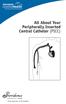 All About Your Peripherally Inserted Central Catheter (PICC) General Information Intravenous (IV) therapy is the delivery of fluid directly into a vein. An intravenous catheter is a hollow tube that is
After Your Gastric Bypass Surgery
 After Your Gastric Bypass Surgery UHN Information for patients and families Read this information to learn: what problems to look out for how to care for yourself at home about your follow-up appointment
Electroconvulsive Therapy ECT and Your Mental Health
 Electroconvulsive Therapy ECT and Your Mental Health Mental Health and Addictions Program St. Joseph s Healthcare Hamilton Charlton Campus 50 Charlton Avenue East Hamilton, Ontario 905-522-1155 ext. 33684
Laparoscopic Gallbladder Removal (Cholecystectomy) Patient Information from SAGES
 Laparoscopic Gallbladder Removal (Cholecystectomy) Patient Information from SAGES Gallbladder removal is one of the most commonly performed surgical procedures. Gallbladder removal surgery is usually performed
Laser of the Vulva. This is a surgery where your doctor will use a laser light to remove unhealthy tissue.
 What is laser of the vulva? This is a surgery where your doctor will use a laser light to remove unhealthy tissue. Why is this surgery used? To treat diseases of the vulva Vulvar Intraepithelial Neoplasia
Name of procedure: Laparoscopic (key-hole) ovarian surgery. Left/ Right unilateral salpingo-oophorectomy* (removal of one fallopian tube and ovary)
 For staff use only: Patient Details: Surname: First names: Date of birth: Hospital no: Female: (Use hospital identification label) Gynaecology Patient agreement to treatment Name of procedure: Laparoscopic
Lumbar or Thoracic Decompression and Fusion
 Lumbar or Thoracic Decompression and Fusion DO NOT TAKE ANY ASPIRIN PRODUCTS OR NON-STEROIDAL ANTI- INFLAMMATORY DRUGS (ie NSAIDs, Advil, Celebrex, Ibuprofen, Motrin, Naprosyn, Aleve, etc) FOR 2 WEEKS
Caring for Your PleurX Pleural Catheter
 Caring for Your PleurX Pleural Catheter A PleurX Pleural Catheter has been placed in your chest through a small incision in your skin into the pleural space (see picture below). This allows you to drain
Patient Information and Daily Programme for Patients Having Whipple s Surgery (Pancreatico duodenectomy)
 Patient Information and Daily Programme for Patients Having Whipple s Surgery (Pancreatico duodenectomy) Date of admission Date of surgery Expected Length of Stay in hospital We will aim to discharge you
Ulnar Nerve Decompression/Transposition
 Department of Neurosurgery Ulnar Nerve Decompression/Transposition What happens when you are in hospital page 2 Ulnar Nerve Decompression/Transposition This leaflet explains what to expect when you are
Enhanced recovery programme (ERP) for patients undergoing bowel surgery
 Enhanced recovery programme (ERP) for patients undergoing bowel surgery Information for patients, relatives and carers An enhanced recovery programme (ERP) has been established at Imperial College Healthcare
Pancreatoduodenectomy (Whipple s Procedure)
 Pancreatoduodenectomy (Whipple s Procedure) Your doctor has arranged to surgically remove part of your pancreas or Whipple s procedure. We have written this pamphlet to help you learn about your surgery
Laparoscopic Nephrectomy
 Laparoscopic Nephrectomy Information for Patients This leaflet explains: What is a Nephrectomy?... 2 Why do I need a nephrectomy?... 3 What are the risks and side effects of laparoscopic nephrectomy?...
ANESTHESIA. Anesthesia for Ambulatory Surgery
 ANESTHESIA & YOU Anesthesia for Ambulatory Surgery T oday the majority of patients who undergo surgery or diagnostic tests do not need to stay overnight in the hospital. In most cases, you will be well
Cataract Information for Patients
 Cataract Information for Patients http://www.gov.pe.ca/health and click on Wait Times tab Page 1 What is a Cataract? A cataract is a clouding of the eye s naturally clear lens. When the lens becomes cloudy,
A PATIENT S GUIDE TO CARDIAC CATHETERIZATION
 A PATIENT S GUIDE TO CARDIAC CATHETERIZATION The science of medicine. The compassion to heal. This teaching booklet is designed to introduce you to cardiac catheterization. In the following pages, we will
Tunneled Central Venous Catheter (CVC) Placement
 PATIENT EDUCATION patienteducation.osumc.edu Tunneled Central Venous Catheter (CVC) Placement A tunneled Central Venous Catheter (CVC) is a special type of intravenous (IV) line that is placed into a large
Peripherally Inserted Central Catheter (PICC) Patient Instructions
 Patient Care Services 300 Pasteur Drive Stanford, CA 94305 Peripherally Inserted Central Catheter (PICC) Patient Instructions A Peripherally Inserted Central Catheter (PICC) is a soft flexible tube inserted
Procedure Information Guide
 Procedure Information Guide Surgery to remove the pancreas (whipple's procedure) Brought to you in association with EIDO and endorsed by the The Royal College of Surgeons of England Discovery has made
PATIENT GUIDE. Care and Maintenance Drainage Frequency: Max. Drainage Volume: Dressing Option: Clinician s Signature: Every drainage Weekly
 PATIENT GUIDE Care and Maintenance Drainage Frequency: Max. Drainage Volume: Dressing Option: Every drainage Weekly Clinician s Signature: ACCESS SYSTEMS Pleural Space Insertion Site Cuff Exit Site Catheter
Breast Reduction Post-Operative Instructions
 Breast Reduction Post-Operative Instructions What are my post-operative instructions? Have someone drive you home after surgery and help you at home for 1-2 days. Get plenty of rest and follow a balanced
Subtotal Colectomy. Delivering the best in care. UHB is a no smoking Trust
 Subtotal Colectomy Delivering the best in care UHB is a no smoking Trust To see all of our current patient information leaflets please visit www.uhb.nhs.uk/patient-information-leaflets.htm This leaflet
Before Surgery You will likely be asked to see your family physician or an internal medicine doctor for a thorough medical evaluation.
 Anterior Hip Replacement - Before and After Surgery Your Hip Evaluation An orthopaedic surgeon specializes in problems affecting bones and joints. The surgeon will ask you many questions about your hip
Patient Information Leaflet Anal Fistula operation
 Patient Information Leaflet Anal Fistula operation SM07/04 Anal Fistula operation What is a fistula? An anal fistula is a track between the skin on the outside of the buttock/anal area and the anal canal
Safety FIRST: Infection Prevention Tips
 Reading Hospital Safety FIRST: Infection Prevention Tips Reading Hospital is committed to providing high quality care to our patients. Your healthcare team does many things to help prevent infections.
Chest Port Port-a-cath
 Patient Education Port-a-cath This handout explains what a chest port is and what to expect when you have one. What is a chest port? Your doctor has asked us to insert a chest port (also called a port-acath)
Home Care for Your Nephrostomy Catheter
 Home Care for Your Nephrostomy Catheter This handout covers information about caring for your nephrostomy catheter right after placement and caring for it long term. If you have any questions, please call
GOING HOME AFTER YOUR TAVR PROCEDURE
 GOING HOME AFTER YOUR TAVR PROCEDURE HENRY FORD HOSPITAL CENTER FOR STRUCTURAL HEART DISEASE GOING HOME After your TAVR procedure, you will need help when you go home. It is hard to predict how much help
Contents. Overview. Removing the womb (hysterectomy) Overview
 This information is an extract from the booklet Understanding womb (endometrial) cancer. You may find the full booklet helpful. We can send you a free copy see page 9. Overview Contents Overview Removing
Patients First. Roux-En-Y Gastric Bypass Surgery. If you have any questions, please ask your doctor or nurse. Patient Education About Your Surgery
 Patient Education About Your Surgery If you have any questions, please ask your doctor or nurse. Roux-En-Y Gastric Bypass Surgery This information will guide you through your gastric bypass surgery. It
Muskegon Surgical Associates, P.L.C. www.msapc.com
 GALLBLADDER SURGERY Muskegon Surgical Associates, P.L.C. www.msapc.com Mercy Drive Office 1316 Mercy Drive Muskegon, Michigan 49444 231-739-9461 1-888-874-5892 (Toll Free) Grand Haven Office 1445 Sheldon,
PATIENT HANDBOOK AND JOURNAL POST SURGERY
 PATIENT HANDBOOK AND JOURNAL POST SURGERY POST ANESTHESIA CARE UNIT (PACU) After surgery you will be moved from the Operating Room directly to a special recovery room, called the Post Anesthesia Care Unit
ADVICE TO PATIENT DUE TO HAVE MICRODISCECTOMY / SPINAL STENOSIS DECOMPRESSION. Under the Care of Mr M Paterson - 11 -
 ADVICE TO PATIENT DUE TO HAVE MICRODISCECTOMY / SPINAL STENOSIS DECOMPRESSION Under the Care of Mr M Paterson Acknowledgement: Drawings by Jean Paterson Perth Australia 2006 Brochure: R. Grubb Amended:
Laparoscopic Cholecystectomy
 Laparoscopic Cholecystectomy Removal of Gall Bladder Page 12 Patient Information Further Information We endeavour to provide an excellent service at all times, but should you have any concerns please,
ANTERIOR CERVICAL DECOMPRESSION AND FUSION
 ANTERIOR CERVICAL DECOMPRESSION AND FUSION NOTE: PLEASE DO NOT TAKE ANY NON-STEROIDAL ANTI-INFLAMMATORY DRUGS (NSAIDs like Advil, Celebrex, Ibuprofen, Motrin, Vioxx, etc) OR ASPIRIN PRODUCTS FOR 2 WEEKS
Before and After Your Cardioversion
 2013 Before and After Your Cardioversion Before and After Your Cardioversion Preparing for your cardioversion Your doctor has recommended cardioversion to treat your heart rhythm problem. This booklet
Varicose Vein Surgery
 Information for patients Varicose Vein Surgery Northern General Hospital You have been diagnosed as having varicose veins and your specialist has recommended varicose vein surgery. This leaflet explains
Peripherally Inserted Central Catheter (PICC)
 Peripherally Inserted Central Catheter (PICC) Disclaimer This is general information developed by The Ottawa Hospital. It is not intended to replace the advice of a qualified healthcare provider. Please
For patients of Crittenton Hospital Medical Center Surgery Guide
 For patients of Crittenton Hospital Medical Center Surgery Guide Dear Patient, Thank you for choosing Crittenton Hospital Medical Center for your upcoming procedure. We value your confi dence and will
Inpatient Surgery Information The Lady Minto Hospital 241 Eighth Street, Cochrane, Ontario P0L 1C0 Phone: 705-272-7200
 Inpatient Surgery Information The Lady Minto Hospital 241 Eighth Street, Cochrane, Ontario P0L 1C0 Phone: 705-272-7200 About Your Care You and your doctor have agreed that you need an operation. Staying
Understanding your Peripherally Inserted Central Catheter (PICC) Patient Information
 Understanding your Peripherally Inserted Central Catheter (PICC) Patient Information The Purpose of this Information Sheet This information sheet has been written by patients, members of the public and
Inguinal (Groin) Hernia Repair
 Information for patients Inguinal (Groin) Hernia Repair General Surgery Tel: 01473 712233 DMI ref: 11582-09.indd(RP) Issue 1: February 2010 The Ipswich Hospital NHS Trust, 2010. All rights reserved. Not
Biliary Stone Disease
 Biliary Stone Disease Delivering the best in care UHB is a no smoking Trust To see all of our current patient information leaflets please visit www.uhb.nhs.uk/patient-information-leaflets.htm You have
After care following insertion of a suprapubic catheter
 Other formats After care following insertion of a suprapubic catheter If you need this information in another format such as audio tape or computer disk, Braille, large print, high contrast, British Sign
Surgery for Stress Incontinence
 Directorate of Women s Services Surgery for Stress Incontinence Tension Free Vaginal Tape Information for Patients Direct dial number Ward 40 0191 282 5640 Stress Incontinence Stress incontinence is a
Guidelines for Surgical Patients
 Guidelines for Surgical Patients Guidelines for Surgical Patients We are pleased that you and your physician have selected us to provide your surgical care. Everyone associated with the hospital is dedicated
Intraperitoneal Chemotherapy
 Intraperitoneal Chemotherapy What is Intraperitoneal (IP) Chemotherapy? Intraperitoneal (IP) chemotherapy is a way to put some of your chemotherapy into your abdomen (also called the peritoneal cavity)
PATIENT GUIDE. Care and Maintenance Drainage Frequency: Max. Drainage Volume: Dressing Option: Clinician s Signature: Every drainage Weekly
 PATIENT GUIDE Care and Maintenance Drainage Frequency: Max. Drainage Volume: Dressing Option: Every drainage Weekly Clinician s Signature: ACCESS SYSTEMS Pleural Space Insertion Site Cuff Exit Site Catheter
Preoperative Education: LUMBAR SPINE SURGERY
 Preoperative Education: LUMBAR SPINE SURGERY 1 Dear Patient, In order to make your hospital stay as comfortable as possible, we have prepared this informational packet for you designed to outline and explain
Urinary Diversion: Ileovesicostomy/Ileal Loop/Colon Loop
 Urinary Diversion: Ileovesicostomy/Ileal Loop/Colon Loop Why do I need this surgery? A urinary diversion is a surgical procedure that is performed to allow urine to safely pass from the kidneys into a
Total laparoscopic hysterectomy bilateral salpingooophorectomy
 Total laparoscopic hysterectomy bilateral salpingooophorectomy We dedicate this book to all of the women who have entrusted their care to us. By allowing us to take part in their surgery and after care,
Percutaneous Abscess Drainage
 Scan for mobile link. Percutaneous Abscess Drainage An abscess is an infected fluid collection within the body. Percutaneous abscess drainage uses imaging guidance to place a thin needle through the skin
The science of medicine. The compassion to heal.
 A PATIENT S GUIDE TO ELECTROPHYSIOLOGY STUDIES OF THE HEART The science of medicine. The compassion to heal. This teaching booklet is designed to introduce you to electrophysiology studies of the heart.
Are any artificial parts used in the ACE Malone surgery?
 ACE Malone (Antegrade Continence Enema) What is the ACE Malone? The Antegrade Continence Enema (ACE) is a type of surgery designed for the child who has chronic bowel problems with bouts of constipation,
Care of Your Hickman Catheter
 Care of Your Hickman Catheter Johns Hopkins Kimmel Cancer Center, Revised 7/11 Contents What is a Hickman Catheter? Page 3 Does the Catheter Limit My Activities? Page 4 How Do I Care for My Catheter? Page
Discharge Information after a Coronary Angiogram or Coronary Angioplasty/ Stent Procedure
 Discharge Information after a Coronary Angiogram or Coronary Angioplasty/ Stent Procedure FORM # W-00500 June 2014 Discharge Information after a Coronary Angiogram or Coronary Angioplasty/ Stent Procedure
Going home with your Tunneled Catheter
 Going home with your Tunneled Catheter Your Tunneled Catheter was put in by on Interventional Radiologist Date Your Tunneled Catheter was put in at: McMaster University Medical Centre Hamilton General
Care for your child s Central Venous Catheter (CVC)
 Care for your child s Central Venous Catheter (CVC) This booklet is intended for general informational purposes only. You should consult your doctor for medical advice. Please call the clinic or your home