
Home Care for Your Wound Drain
|
|
|
- Ralph Grant
- 10 years ago
- Views:
Transcription
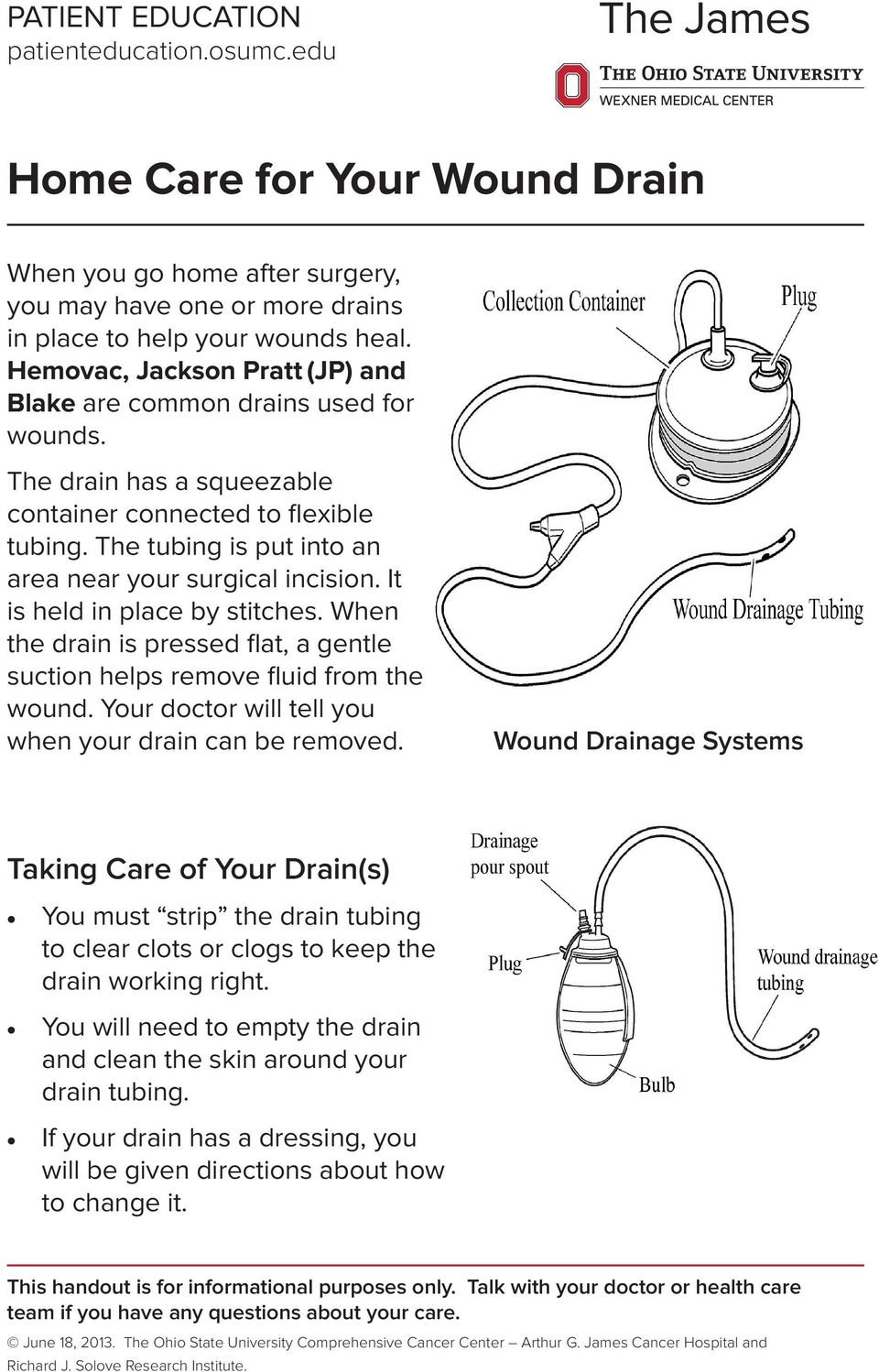
1 PATIENT EDUCATION patienteducation.osumc.edu When you go home after surgery, you may have one or more drains in place to help your wounds heal. Hemovac, Jackson Pratt (JP) and Blake are common drains used for wounds. The drain has a squeezable container connected to flexible tubing. The tubing is put into an area near your surgical incision. It is held in place by stitches. When the drain is pressed flat, a gentle suction helps remove fluid from the wound. Your doctor will tell you when your drain can be removed. Wound Drainage Systems Taking Care of Your Drain(s) You must strip the drain tubing to clear clots or clogs to keep the drain working right. You will need to empty the drain and clean the skin around your drain tubing. If your drain has a dressing, you will be given directions about how to change it. This handout is for informational purposes only. Talk with your doctor or health care team if you have any questions about your care. June 18, The Ohio State University Comprehensive Cancer Center Arthur G. James Cancer Hospital and Richard J. Solove Research Institute.
2 How to Strip the Drain Tubing 1. The drain tubing may get clots or clogs that may keep the fluid from draining. Before you empty and measure the fluid, you will need to clear the clots from the tubing each time. This is called stripping or milking the tubing. Follow these steps to clear the tubing. Wash your hands well with soap and warm water. Rinse and dry. 2. Using one hand, firmly hold the tubing near where it comes out of the skin. This will prevent the drain from being pulled out while you are stripping it. 3. Firmly pinch the tubing with your other hand, using your thumb and first (index) finger. Squeeze the tubing and slowly slide your fingers down the tubing toward the drain. Squeeze the tubing firm enough so it becomes flat. Do not use your fingernails as they may damage the tubing. 4. If you see a clot, you may stop and start to move the clot through the tubing. You can use an alcohol pad around the tubing to make it easier to slide your fingers down the tubing. 5. Stop if you are pulling on the tubing so much that it hurts. You do not want to pull the tubing so hard that you pull it out of the skin. 6. When you reach the drain, let go of the tubing and remove your hand from the area from where the tubing comes out of your skin. 7. Repeat if needed. How to Empty Your Drain Empty your drain in the morning and again in the evening. You should also empty the drain any time it is heavy with a lot of fluid. To empty the drain follow these steps. 1. Wash your hands well with soap and warm water. Rinse and dry. 2. Get a measuring cup and your Wound Drainage Record Sheet. Use a record sheet to write down the amount and color of fluid from the drain. You can use the record sheet at the end of this handout or make your own. 3. Unfasten the pin or clip that holds the drain to your clothing. 4. Open the plug on the drain. 5. Turn the drain upside down over the measuring cup and gently
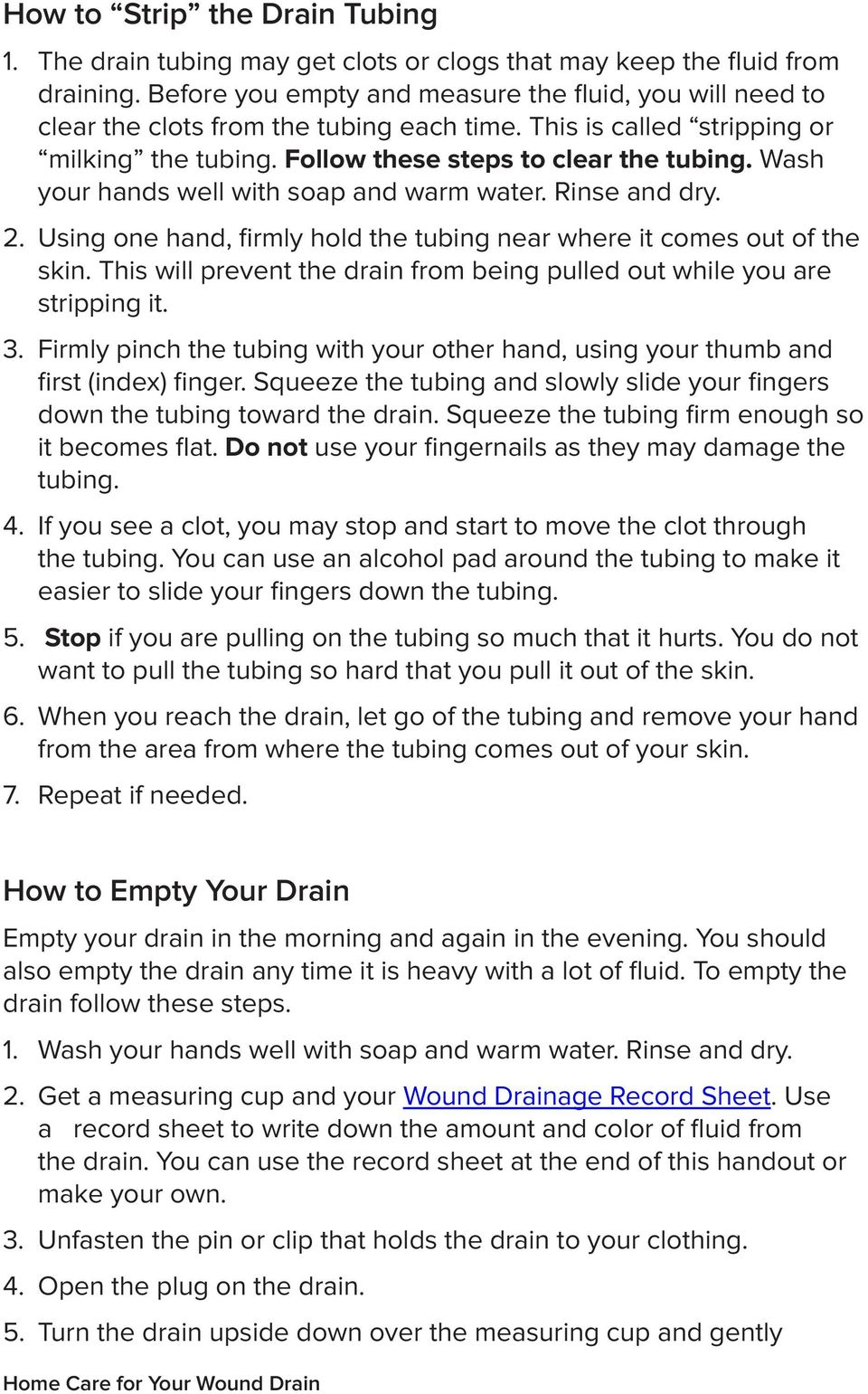
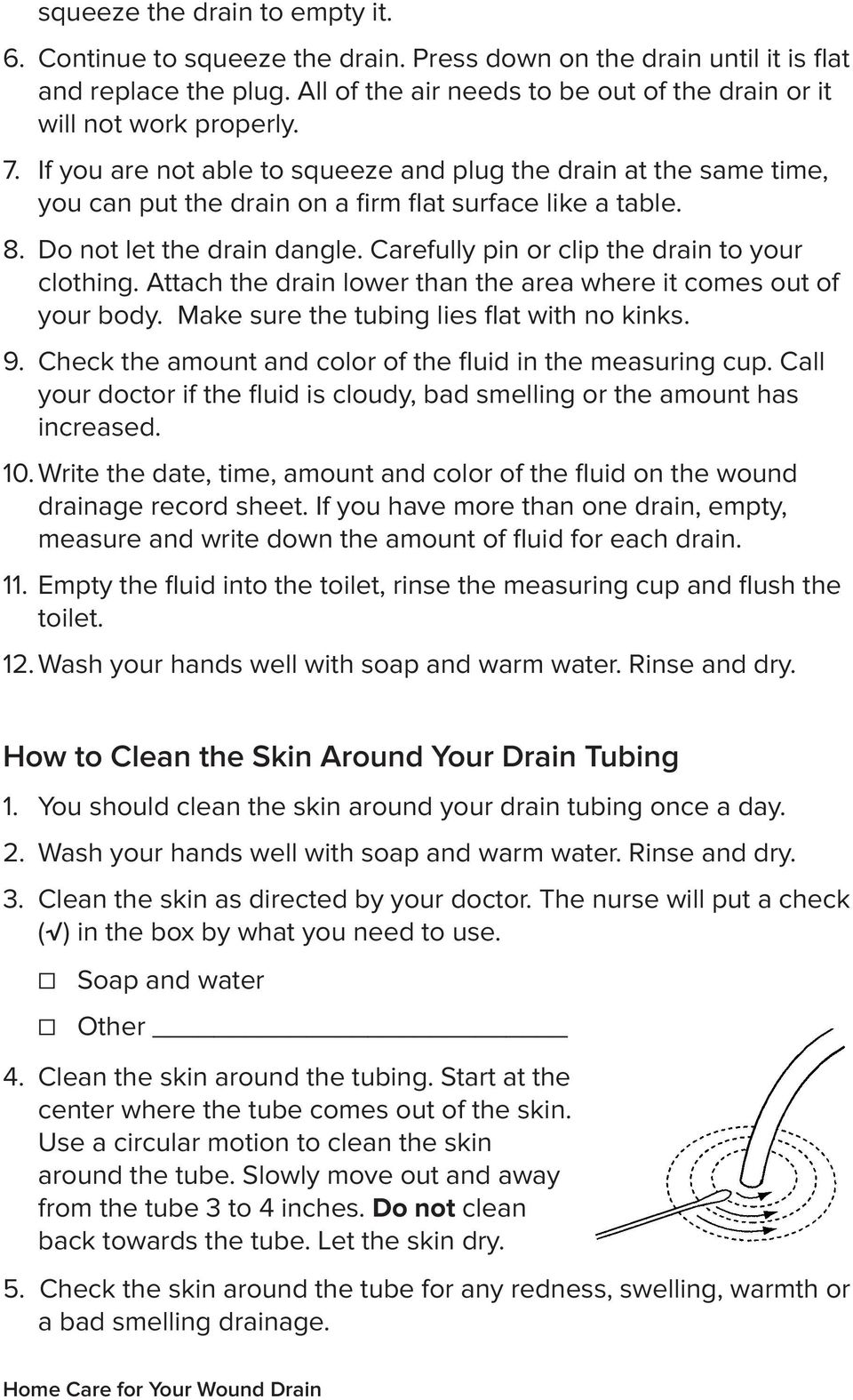
3 squeeze the drain to empty it. 6. Continue to squeeze the drain. Press down on the drain until it is flat and replace the plug. All of the air needs to be out of the drain or it will not work properly. 7. If you are not able to squeeze and plug the drain at the same time, you can put the drain on a firm flat surface like a table. 8. Do not let the drain dangle. Carefully pin or clip the drain to your clothing. Attach the drain lower than the area where it comes out of your body. Make sure the tubing lies flat with no kinks. 9. Check the amount and color of the fluid in the measuring cup. Call your doctor if the fluid is cloudy, bad smelling or the amount has increased. 10. Write the date, time, amount and color of the fluid on the wound drainage record sheet. If you have more than one drain, empty, measure and write down the amount of fluid for each drain. 11. Empty the fluid into the toilet, rinse the measuring cup and flush the toilet. 12. Wash your hands well with soap and warm water. Rinse and dry. How to Clean the Skin Around Your Drain Tubing 1. You should clean the skin around your drain tubing once a day. 2. Wash your hands well with soap and warm water. Rinse and dry. 3. Clean the skin as directed by your doctor. The nurse will put a check ( ) in the box by what you need to use. Soap and water Other 4. Clean the skin around the tubing. Start at the center where the tube comes out of the skin. Use a circular motion to clean the skin around the tube. Slowly move out and away from the tube 3 to 4 inches. Do not clean back towards the tube. Let the skin dry. 5. Check the skin around the tube for any redness, swelling, warmth or a bad smelling drainage.
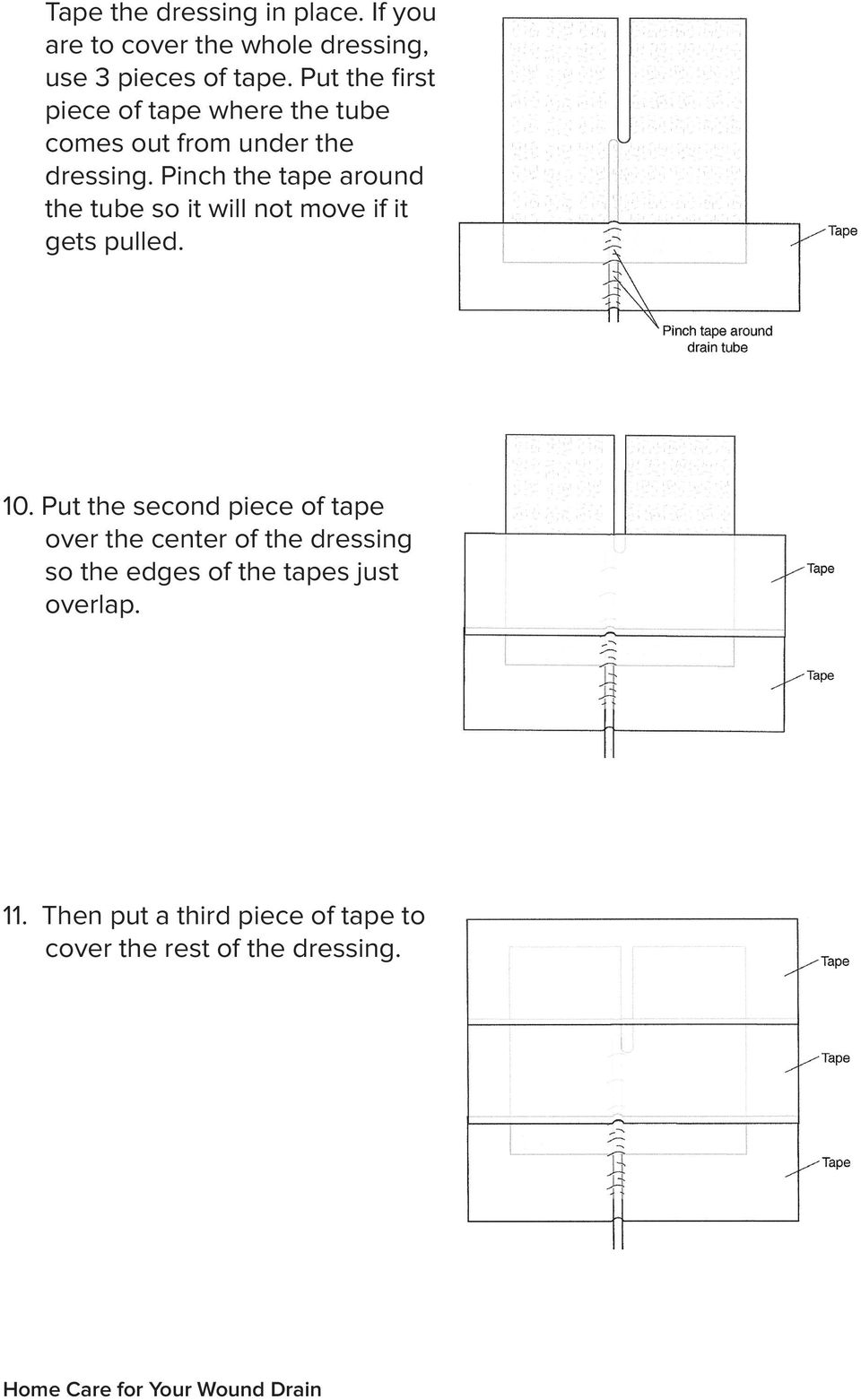
4 6. If you have more than one drain, clean the skin around each drain tube. 7. Wash your hands well with soap and warm water. Rinse and dry. How to Change the Dressing If you have a dressing, you need to change it once a day or if the dressing gets wet or dirty. Follow these directions for how to change the dressing: 1. Gather your supplies and set up a clean work area. 2. Wash your hands well with soap and warm water. Rinse and dry. 3. Loosen the tape and remove the old dressing. Be careful not to pull the drain out. Look at the dressing for any unusual or bad smelling drainage. Put the old dressing in a plastic bag and throw it away in the trash. 4. Wash your hands again with soap and warm water. Rinse and dry. 5. Check the skin around the tubing for any redness, swelling, warmth or bad smelling drainage. 6. Clean the skin around your tubing. Follow the instructions on page 3. How to Clean the Skin Around Your Drain Tubing 7. Use tape to secure the dressing. 8. Open the 4 x 4 split gauze dressing package and remove the gauze pad. Touch only the edges of the gauze pad. Put the gauze around the tube as shown in the picture. 9. If you are directed to use a second split gauze dressing, place it over the first gauze dressing. Place the second gauze to cover the tube as shown in the picture.

5 Tape the dressing in place. If you are to cover the whole dressing, use 3 pieces of tape. Put the first piece of tape where the tube comes out from under the dressing. Pinch the tape around the tube so it will not move if it gets pulled. 10. Put the second piece of tape over the center of the dressing so the edges of the tapes just overlap. 11. Then put a third piece of tape to cover the rest of the dressing.
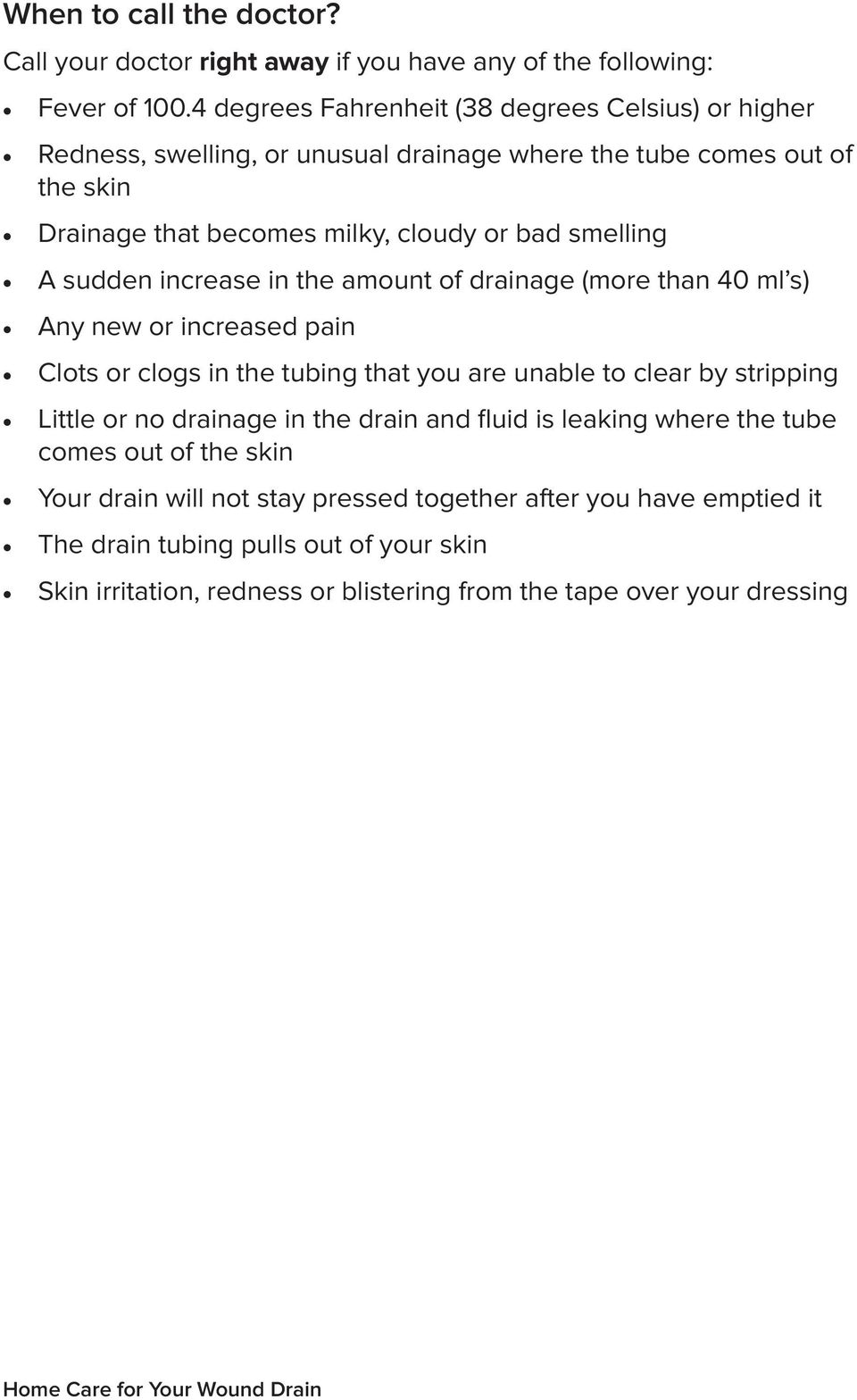
6 When to call the doctor? Call your doctor right away if you have any of the following: Fever of degrees Fahrenheit (38 degrees Celsius) or higher Redness, swelling, or unusual drainage where the tube comes out of the skin Drainage that becomes milky, cloudy or bad smelling A sudden increase in the amount of drainage (more than 40 ml s) Any new or increased pain Clots or clogs in the tubing that you are unable to clear by stripping Little or no drainage in the drain and fluid is leaking where the tube comes out of the skin Your drain will not stay pressed together after you have emptied it The drain tubing pulls out of your skin Skin irritation, redness or blistering from the tape over your dressing
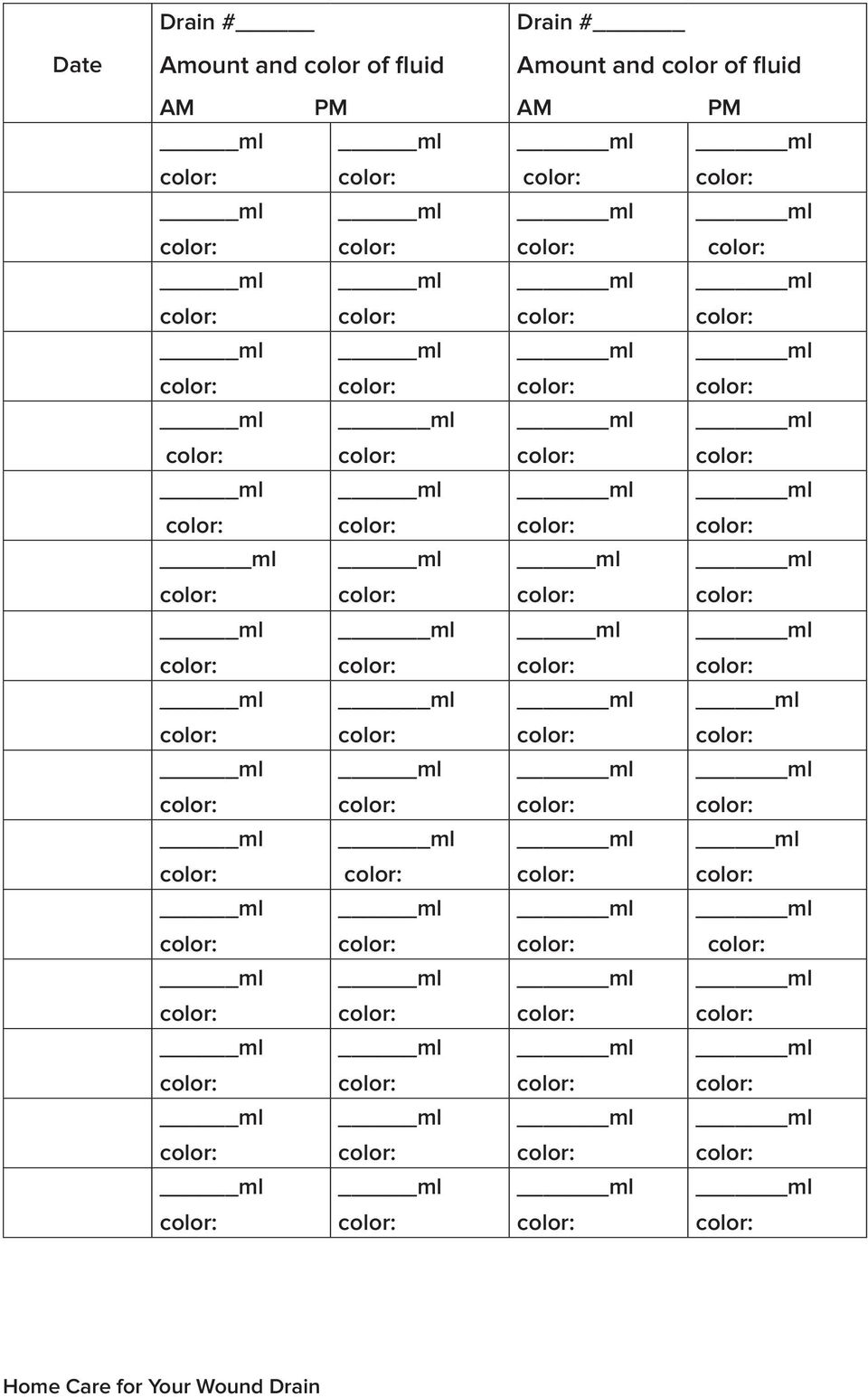
7 Wound Drainage Record Sheet Write in the date, time, amount and color of the fluid from each drain every time you empty a drain. Date Drain # Amount and color of fluid Drain # Amount and color of fluid AM PM AM PM

8 Date Drain # Amount and color of fluid Drain # Amount and color of fluid AM PM AM PM
Introduction A JP Drain is a soft tube and container used to drain fluids that build up under the skin after surgery.
 JP Drain Introduction A JP Drain is a soft tube and container used to drain fluids that build up under the skin after surgery. This reference summary explains what a JP Drain is and discusses how to take
PATIENT GUIDE. Care and Maintenance Drainage Frequency: Max. Drainage Volume: Dressing Option: Clinician s Signature: Every drainage Weekly
 PATIENT GUIDE Care and Maintenance Drainage Frequency: Max. Drainage Volume: Dressing Option: Every drainage Weekly Clinician s Signature: ACCESS SYSTEMS Pleural Space Insertion Site Cuff Exit Site Catheter
Central Venous Catheter (CVC) Sterile Dressing Change - The James
 PATIENT EDUCATION patienteducation.osumc.edu Central Venous Catheter (CVC) Sterile Dressing Change - The James A dressing protects your catheter site and helps reduce the risk of infection. You will need
Home Care for Your Nephrostomy Catheter
 Home Care for Your Nephrostomy Catheter This handout covers information about caring for your nephrostomy catheter right after placement and caring for it long term. If you have any questions, please call
Tunneled Central Venous Catheter (CVC) Placement
 PATIENT EDUCATION patienteducation.osumc.edu Tunneled Central Venous Catheter (CVC) Placement A tunneled Central Venous Catheter (CVC) is a special type of intravenous (IV) line that is placed into a large
PATIENT GUIDE. Care and Maintenance Drainage Frequency: Max. Drainage Volume: Dressing Option: Clinician s Signature: Every drainage Weekly
 PATIENT GUIDE Care and Maintenance Drainage Frequency: Max. Drainage Volume: Dressing Option: Every drainage Weekly Clinician s Signature: ACCESS SYSTEMS Pleural Space Insertion Site Cuff Exit Site Catheter
Caring for Your PleurX Pleural Catheter
 Caring for Your PleurX Pleural Catheter A PleurX Pleural Catheter has been placed in your chest through a small incision in your skin into the pleural space (see picture below). This allows you to drain
X-Plain Foley Catheter Male Reference Summary
 X-Plain Foley Catheter Male Reference Summary Introduction A Foley catheter is a tube that is put through the urinary opening and into your bladder to drain urine. Your doctor may have placed or may ask
Caring for a Tenckhoff Catheter
 Caring for a Tenckhoff Catheter UHN A Patient s Guide What is a Pleural Effusion? There is a small space between the outside of your lung and the chest wall (ribs). This space is called the pleural space.
Sterile Dressing Change with Tegaderm CHG for Central Venous Catheter (CVC)
 Sterile Dressing Change with Tegaderm CHG for Central Venous Catheter (CVC) The dressing protects your catheter site. It also helps prevent infection at the site. Keep your dressing clean and dry at all
Biliary Drain. What is a biliary drain?
 Biliary Drain What is a biliary drain? A biliary drain is a tube to drain bile from your liver. It is put in by a doctor called an Interventional Radiologist. The tube or catheter is placed through your
How to Care for your Child s Indwelling Subcutaneous Catheter
 The Emily Center How to Care for your Child s Indwelling Subcutaneous Catheter Procedure/Treatment/Home Care Si usted desea esta información en español, por favor pídasela a su enfermero o doctor. #1054
Care of Your Hickman Catheter
 Care of Your Hickman Catheter Johns Hopkins Kimmel Cancer Center, Revised 7/11 Contents What is a Hickman Catheter? Page 3 Does the Catheter Limit My Activities? Page 4 How Do I Care for My Catheter? Page
Safety FIRST: Infection Prevention Tips
 Reading Hospital Safety FIRST: Infection Prevention Tips Reading Hospital is committed to providing high quality care to our patients. Your healthcare team does many things to help prevent infections.
Going Home with a Urinary Catheter
 Going Home with a Urinary Catheter Doctor: Phone Number: About Your Catheter A urinary catheter is a small tube that goes through your urethra and into your bladder. This tube then drains the urine made
All About Your Peripherally Inserted Central Catheter (PICC)
 All About Your Peripherally Inserted Central Catheter (PICC) General Information Intravenous (IV) therapy is the delivery of fluid directly into a vein. An intravenous catheter is a hollow tube that is
Catheter Care How to Care for a Urinary Catheter
 Catheter Care How to Care for a Urinary Catheter Ensure patient/client is provided with any available product specific instructions along with this booklet. About Your Catheter Your urinary catheter allows
Information for patients and nurses
 Information for patients and nurses Rocket IPC Pleural Catheter Indwelling Catheter Rocket Indwelling Pleural Catheter (IPC) Contents Contact Information...03 What s in the Rocket Dressing Pack and Bottle
Care of a Foley Catheter
 Care of a Foley Catheter A Foley catheter is a tube that is put into the bladder to drain urine out of the body. A Foley catheter can stay in the bladder for hours or weeks. Having the catheter put in
Mixing Two Insulins. Insulin syringe Alcohol pad Wash your hands with warm water and soap. Dry your hands.
 Mixing Two Insulins Since your doctor has ordered 2 kinds of insulin that can be mixed, you need to learn how to mix the two insulins together in one syringe. This way you can give yourself one injection
Care for your child s Central Venous Catheter (CVC)
 Care for your child s Central Venous Catheter (CVC) This booklet is intended for general informational purposes only. You should consult your doctor for medical advice. Please call the clinic or your home
How To Recover From A Surgical Wound From A Cast
 Care of Your Wounds After Amputation Surgery by Paddy Rossbach, RN Depending on the reason for your amputation and the state of your limb at the time of surgery, definitive closure of the wound may take
Clean Intermittent Catheterization (CIC) For Males
 The Emily Center Clean Intermittent Catheterization (CIC) For Males Procedure/Treatment/Home Care Si usted desea esta información en español, por favor pídasela a su enfermero o doctor. #200 male patient
Clean Intermittent Catheterization (CIC) For Females What it is:
 The Emily Center Clean Intermittent Catherterization (CIC) for Females Procedure/Treatment/Home Care Si usted desea esta información en español, por favor pídasela a su enfermero o doctor. #200 female
call 811 to get advice from a nurse, or have someone drive the patient to a hospital Emergency Department. Patients should NOT drive themselves.
 Taking Care at Home After Surgery This checklist is to help you and your support person know what to do after you go home following your surgery. If you are given instructions verbally or in writing by
Atrium Pneumostat Chest Drain Valve. Discharge Instructions
 Atrium Pneumostat Chest Drain Valve Discharge Instructions Your Physician Name: Contact Number for Emergencies: Introduction Your physician has decided to change your chest drainage system to a smaller
Your Guide to Peritoneal Dialysis Module 3: Doing Peritoneal Dialysis at Home
 Your Guide to Peritoneal Dialysis Module 3: 6.0959 in Preparing to do PD One of the most important things about PD is to keep the dialysis area and anything that comes in contact with the PD equipment
Urinary Indwelling Catheter. The Urinary System
 Patient Education CARE AND TREATMENT Urinary Indwelling Catheter This information will help you care for a urinary indwelling catheter at home. It will answer many of your questions. Please ask your doctor
Gallbladder Surgery with an Incision (Cholecystectomy)
 Gallbladder Surgery with an Incision (Cholecystectomy) It is normal to have questions about your surgery. This handout gives you information about what will happen to you before, during and after your
Percutaneous Nephrostomy. Care of your Nephrostomy. Department of Urology
 Percutaneous Nephrostomy Care of your Nephrostomy Department of Urology You may encounter some problems at home but these are usually easily overcome. Listed below are some questions patients commonly
Site Care of Your Central Venous Catheter Sterile
 Site Care of Your Central Venous Catheter Sterile Dressing Change Sterile Technique The skin surrounding your catheter s exit site must be kept clean, and a new sterile dressing should be applied on a
PICCs and Midline Catheters
 Patient Education PICCs and Midline Catheters Patient s guide to PICC (peripherally inserted central catheter) and midline catheters What are PICCs and midline catheters used for? Any medicine given over
HICKMAN Catheter Care with a Needleless Connector
 HICKMAN Catheter Care with a Needleless Connector Table of Contents Part 1 Learning about the HICKMAN Catheter... 2 Part 2 Caring for Your Hickman Catheter... 3 A. Preventing Infection... 3 B. Bathing...
Peripherally Inserted Central Catheter (PICC) Patient Instructions
 Patient Care Services 300 Pasteur Drive Stanford, CA 94305 Peripherally Inserted Central Catheter (PICC) Patient Instructions A Peripherally Inserted Central Catheter (PICC) is a soft flexible tube inserted
You have been sent home with. Suprapubic Catheter
 You have been sent home with Suprapubic Catheter 1 SUPRAPUBIC CATHETER 1.- What is a suprapubic catheter? 2.- What do you need on discharge. 3.- Basic care 4.- Choosing your bag and bag care 5.- Possible
Urinary Catheter Care and Prostate Cancer Treatment
 Urinary Catheter Care and Prostate Cancer Treatment The following information is based on the general experiences of many prostate cancer patients. Your experience may be different. If you have any questions
BARD MEDICAL DIVISION UROLOGICAL DRAINAGE. Foley Catheter Care & Maintenance. Patient Education Guide
 BARD MEDICAL DIVISION Foley Catheter Care & Maintenance Patient Education Guide WHAT IS A FOLEY CATHETER? Because of your medical problem, your body is having trouble completely emptying your bladder of
How to Change a Foley Catheter Step-by-step instructions for the caregiver
 Patient Education How to Change a Foley Catheter Step-by-step instructions for the caregiver This handout gives stepby-step instructions for changing a Foley catheter, a tube in the bladder to drain urine.
Intermittent Self Catheterization for Males
 Intermittent Self Catheterization for Males CEAC 0371 January 2016 Intermittent Self Catheterization This involves inserting a catheter (small tube) into your bladder at regular intervals to help empty
You will be having surgery to remove a tumour(s) from your liver.
 Liver surgery You will be having surgery to remove a tumour(s) from your liver. This handout will help you learn about the surgery, how to prepare for surgery and your care after surgery. Surgery can be
GJ TUBE (GASTROJEJUNOSTOMY TUBE) Daily Care
 GJ TUBE (GASTROJEJUNOSTOMY TUBE) Daily Care Your child has a Picture 1 The GJ Tube inside the body. gastrojejunostomy (GJ) tube Disc (Picture 1). This set of tubes lets food or medicine go into either
Self-Catheterization after Bladder Surgery For Women
 Self-Catheterization after Bladder Surgery For Women This handout has been prepared to help you learn about self-catheterization after bladder surgery. Step-by-step instructions are given. Please write
What You Need to Know About Your Nephrostomy Tube
 What You Need to Know About Your Nephrostomy Tube Information for patients and families UHN Read this information to learn about: what a nephrostomy tube is and why you may need one how to prepare for
A Guide to Help You Manage Your Catheter and Drainage Bags
 A Guide to Help You Manage Your Catheter and Drainage Bags A catheter can make a difference to your health and quality of life. We understand that it can be a big adjustment for you. This information will
MRSA. Living with. Acknowledgements. (Methicillin-Resistant Staphylococcus aureus)
 How can I keep myself healthy? Hand washing and use of an alcohol-based hand sanitizer are the primary way to prevent acquiring or transmitting bacteria. If you get a cut or scrape, wash it well with soap
How many hours a day do you need to use the therapy? Introduction. How long will it take to improve your wound? What does PICO do? Will it be painful?
 Patient Information Introduction This patient handbook will provide you with important information while you are receiving negative pressure wound therapy (NPWT) from Smith & Nephew s PICO system. The
Intermittent Clean Catheterization for Women
 2014 Intermittent Clean Catheterization for Women Intermittent Clean Catheterization for Women What is intermittent catheterization? Intermittent catheterization is a way to drain urine (pee) from your
CARING FOR YOUR URINARY CATHETER GRAMPIANS REGIONAL CONTINENCE SERVICE. Author: GRCS Date: 20/06/09 Catalogue No: 712438
 CARING FOR YOUR URINARY CATHETER GRAMPIANS REGIONAL CONTINENCE SERVICE Author: GRCS Date: 20/06/09 Catalogue No: 712438 What is a urinary catheter? A urinary catheter is a hollow tube which drains urine
URINARY CATHETER INSERTION - STRAIGHT OR INDWELLING CATHETER
 URINARY CATHETER INSERTION - STRAIGHT OR INDWELLING CATHETER PURPOSE To obtain a sterile urine specimen. To facilitate emptying bladder. To relieve bladder distention. To irrigate bladder. To measure residual
Looking after your urinary catheter at home
 Looking after your urinary catheter at home Information for patients and carers Useful contacts to keep: Name and title of community nurse Single point of access (SPA) for community nursing 24 hour service
Section 6: Your Hemodialysis Catheter
 Section 6: Your Hemodialysis Catheter What you should know about your dialysis catheter How to change your catheter TEGO connectors Starting dialysis using a catheter End of dialysis using a catheter Changing
Lymphedema of the Head and Neck After Surgery or Radiation
 PATIENT EDUCATION patienteducation.osumc.edu Lymphedema of the Head and Neck After Surgery or Radiation The lymph system helps to get rid of waste products from your cells and helps your body fight infection.
INSTRUCTIONS FOR USE. Read this information before you start. Important things to know about your SmartJect autoinjector. Important things to remember
 INSTRUCTIONS FOR USE SIMPONI (SIM-po-nee) (golimumab) SmartJect autoinjector If your doctor decides that you or a caregiver may be able to give your injections of SIMPONI at home, you should receive training
Living with MRSA. Things to remember about living with MRSA: This is really serious. I need to do something about this now!
 Things to remember about living with MRSA: 1. Wash your hands often. 2. Take care of yourself: Eat right, exercise, quit smoking, and avoid stress. 3. Take good care of your skin. 4. Keep skin infections
Learning About MRSA. 6 How is MRSA treated? 7 When should I seek medical care?
 IMPORTANT MRSA is a serious infection that can become life-threatening if left untreated. If you or someone in your family has been diagnosed with MRSA, there are steps you need to take now to avoid spreading
Introduction. What does PICO do? How does PICO work?
 Patient Information Introduction This patient handbook will provide you with important information while you are receiving negative pressure wound therapy (NPWT) from Smith & Nephew s PICO system. The
Going home after an AV Fistula or AV Graft
 Going home after an AV Fistula or AV Graft TGH Information for patients and families During your hospital stay, your surgeon created an: AV Fistula AV Graft Read this booklet to learn: how to care for
You and your doctor will talk about your condition and the treatment that is best for you.
 PATIENT EDUCATION patienteducation.osumc.edu It is normal to have questions about your surgery. This handout gives you information about what will happen to you before, during and after your surgery. If
Managing Your Non-Tunneled (Percutaneous) Catheter: PICC, SICC, and JCC. What is a PICC catheter?
 Managing Your Non-Tunneled The staff of the Procedure, Vascular Access, Conscious Sedation Service has written this information to explain your new PICC (peripherally inserted central catheter), SICC (subclavian
Central Line Care for Adults
 Central Line Care for Adults Table of Contents What is a Central Venous Catheter?... 2 Central Venous Catheter Placement: What to Expect... 2 Catheter Care at a Glance... 2 Fast Facts on Central Line Care:
Abdominal Wall (Ventral, Incisional, Umbilical) Hernia Repair Postoperative Instructions
 Abdominal Wall (Ventral, Incisional, Umbilical) Hernia Repair Postoperative Instructions No lifting greater than 10 15 lbs for the first three weeks following your surgery. Walking around the house, office
PATIENT TEACHING GUIDE: Wound Care Handbook
 PATIENT TEACHING GUIDE: Wound Care Handbook PATIENT TEACHING GUIDE: WOUND CARE Design by Mariscal Design, Illustrations by Lysa Hawke. The Wound Care Self Care Guide was written and prepared by: Barbara
Your Recovery After a Cesarean Delivery
 Your Recovery After a Cesarean Delivery It is normal to have many questions about your care after delivery. Cesarean delivery is surgery and your body needs time to heal and recover for the next 6 weeks,
PATIENT GUIDE. Understand and care for your peripherally inserted central venous catheter (PICC). MEDICAL
 PATIENT GUIDE Understand and care for your peripherally inserted central venous catheter (PICC). MEDICAL Introduction The following information is presented as a guideline for your reference. The best
GOING HOME AFTER YOUR TAVR PROCEDURE
 GOING HOME AFTER YOUR TAVR PROCEDURE HENRY FORD HOSPITAL CENTER FOR STRUCTURAL HEART DISEASE GOING HOME After your TAVR procedure, you will need help when you go home. It is hard to predict how much help
To maintain a port of entry to venous flow when all available peripheral ports have failed.
 I. Purpose: To maintain a port of entry to venous flow when all available peripheral ports have failed. II. General Comments: Since its development, these catheters have been used with increasing frequency
A Child s guide to Clean Intermittent Catheterization. Boys
 A Child s guide to Clean Intermittent Catheterization Boys Introduction Probably you have just heard that you have to learn to catheterize your bladder. Most children are worried, frightened or scared
Total Hip Replacement Surgery Home Care Instructions
 Total Hip Replacement Surgery Home Care Instructions Surgery: Date: Doctor: This handout will review the care you need to follow once you are home. If you have any questions or concerns, please ask your
How to Care for Yourself after Lumbar Posterior Decompression
 How to Care for Yourself after Lumbar Posterior Decompression What is Lumbar Posterior Decompression? Lumbar Posterior Decomposition is the removal of part of or all of the bone that covers the back of
Section 4: Your Vascular Access. What is vascular access?
 Section 4: Your Vascular Access What is vascular access? What is a fistula? Taking care of a new fistula What is a graft? Taking care of a new graft What is a hemodialysis catheter? Taking care of a hemodialysis
INSTRUCTIONS FOR USE HUMIRA 40 MG/0.8 ML, 20 MG/0.4 ML AND 10 MG/0.2 ML SINGLE-USE PREFILLED SYRINGE
 INSTRUCTIONS FOR USE HUMIRA (Hu-MARE-ah) (adalimumab) 40 MG/0.8 ML, 20 MG/0.4 ML AND 10 MG/0.2 ML SINGLE-USE PREFILLED SYRINGE Do not try to inject HUMIRA yourself until you have been shown the right way
Wrapping the Leg to Control Lymphedema
 PATIENT EDUCATION patienteducation.osumc.edu Wrapping the Leg to Control Lymphedema These step-by-step instructions were created for you to use as a guide on how to wrap your leg. This wrapping method,
Spinal Cord and Bladder Management Male: Intermittent Catheter
 Spinal Cord and Bladder Management Male: Intermittent Catheter The 5 parts of the urinary system work together to get rid of waste and make urine. Urine is made in your kidneys and travels down 2 thin
Caring for a Hemovac Drain
 Caring for a Hemovac Drain 269 12. Raise side rail. Lower bed height and adjust head of bed to a comfortable position. 13. Remove additional PPE, if used. Perform hand hygiene. These promote patient safety.
Caring for Your Child s Gastrostomy Tube
 Caring for Your Child s Gastrostomy Tube Table of Contents What Is a Gastrostomy Tube (G-tube)?... 2 Types of Feeding Tubes... 3 Cleaning the Gastrostomy Site... 5 Gastrostomy Feedings... 7 Giving Medicines...
Intermittent Self-Catheterization. A Step by Step Guide for Men and Women
 Inside this book Intermittent Self-Catheterization A Step by Step Guide for Men and Women 1986 2005 St. Joseph s Healthcare Hamilton Hamilton, Ontario Contributors: Jennifer Skelly Paula Eyles Linda Hilts
After Your Gastrectomy
 After Your Gastrectomy UHN Information for patients and families Read this information to learn: what a gastrectomy is how to care for yourself what problems to look out for who to call if you have any
After care following insertion of a suprapubic catheter
 Other formats After care following insertion of a suprapubic catheter If you need this information in another format such as audio tape or computer disk, Braille, large print, high contrast, British Sign
Excision of Vaginal Mesh
 What is excision of vaginal mesh? This procedure is done to remove mesh from the vagina. When is this surgery used? If mesh has eroded into the vagina, bladder, urethra, or bowel If there is pain associated
Changing Your Central Line Catheter Cap
 Changing Your Central Line Catheter Cap The catheter cap on each lumen of your central line needs to be changed once a week. A lumen is a small tube within your catheter. These same steps can be used for
Percutaneous Abdominal or Pelvic Drain What to expect
 Patient Education Percutaneous Abdominal or Pelvic Drain What to expect This handout explains what percutaneous abdominal or pelvic drain is and what to expect when you have one. What is a percutaneous
Black Hills Healthcare System
 Black Hills Healthcare System Methicillin Resistant Staphylococcal Aureus (MRSA) Patient and Family Information What is MRSA? Staphylococcus Aureus, often referred to simply as staph, is a bacteria commonly
X-Plain Subclavian Inserted Central Catheter (SICC Line) Reference Summary
 X-Plain Subclavian Inserted Central Catheter (SICC Line) Reference Summary Introduction A Subclavian Inserted Central Catheter, or subclavian line, is a long thin hollow tube inserted in a vein under the
Going home with your Tunneled Catheter
 Going home with your Tunneled Catheter Your Tunneled Catheter was put in by on Interventional Radiologist Date Your Tunneled Catheter was put in at: McMaster University Medical Centre Hamilton General
Exercise and advice after breast cancer surgery
 Exercise and advice after breast cancer surgery Irving Building Physiotherapy All Rights Reserved 2015. Document for issue as handout. Role of the physiotherapist Exercises for the first week following
After Your Gastric Bypass Surgery
 After Your Gastric Bypass Surgery UHN Information for patients and families Read this information to learn: what problems to look out for how to care for yourself at home about your follow-up appointment
PROCEDURE FOR CLEAN INTERMITTENT CATHETERIZATION MALE
 PROCEDURE FOR CLEAN INTERMITTENT CATHETERIZATION MALE 1. Wash hands. PROCEDURE POINTS TO REMEMBER 2. Assemble equipment. Water-soluble lubricant, such as K-Y Jelly, Lubrifax, Surgel Catheter, plastic or
PICC & Midline Catheters Patient Information Guide
 PICC & Midline Catheters Patient Information Guide medcompnet.com 1 table of contents Introduction 4 What is a PICC or Midline Catheter? 4 How is the PICC or Midline Catheter Inserted? 6 Catheter Care
Exercise After Breast Surgery. Post Mastectomy Therapy
 Exercise After Breast Surgery Post Mastectomy Therapy Dear Patient, Breast cancer is a journey and you have made it this far successfully. This booklet will help you continue your journey to recovery.
Emergency Care for Patients of The James
 PATIENT EDUCATION patienteducation.osumc.edu Emergency Care for Patients of The James Emergency Care During and After Treatment Here are guidelines about when and how to report problems that you may have
How to care for a Midline Catheter
 How to care for a Midline Catheter Developed by the health care professionals of the IV Program with assistance from the Department of Learning and Development. All rights reserved. No part of this book
Self Catheterization Guide
 Self Catheterization Guide An introduction to intermittent self-catheterization Medical professionals have recommended that you selfcatheterize in order to completely empty your bladder. This prevents
RATIFIED BY NNPDG SEPTEMBER 2006 FOR REVIEW 2009
 NOTTINGHAM UNIVERSITY HOSPTIALS/RUSHCLIFFE PCT NURSING PRACTICE GUIDELINES GUIDELINES FOR CARE OF A PATIENT WITH A WOUND DRAINAGE SYSTEM CONTENTS PAGE Introduction and Types of Drains 1 Procedure for Applying
A Patient s guide to. pin site care. (Upper and lower limb external fixation) Limb Reconstruction Unit [email protected].
 A Patient s guide to pin site care (Upper and lower limb external fixation) Limb Reconstruction Unit [email protected] Introduction Before you leave hospital you will have been taught how
INSTRUCTIONS FOR USE HUMIRA 40 MG/0.8 ML SINGLE-USE PEN
 INSTRUCTIONS FOR USE HUMIRA (Hu-MARE-ah) (adalimumab) 40 MG/0.8 ML SINGLE-USE PEN Do not try to inject HUMIRA yourself until you have been shown the right way to give the injections and have read and understand
After Your Abdominal Surgery
 UW MEDICINE PATIENT EDUCATION After Your Abdominal Surgery Self-care and follow-up You recently had abdominal surgery. This handout explains what to expect during your recovery. Please read these instructions
Looking after your urinary catheter at home. An information guide
 TO PROVIDE THE VERY BEST CARE FOR EACH PATIENT ON EVERY OCCASION Looking after your urinary catheter at home An information guide Looking after your urinary catheter at home This leaflet is provided for
UW MEDICINE PATIENT EDUCATION. Using Insulin. Basic facts about insulin and self-injection. What is insulin? How does diabetes affect the body?
 UW MEDICINE PATIENT EDUCATION Using Insulin Basic facts about insulin and self-injection This handout explains what insulin is, the different types of insulin, how to store it, how to give an injection
Instructions for Use PROCRIT (PRO KRIT) (epoetin alfa)
 Instructions for Use PROCRIT (PROKRIT) (epoetin alfa) Use these Instructions for Use if you or your caregiver has been trained to give PROCRIT injections at home. Do not give yourself the injection unless
Protecting Myself from MRSA By Angela Ulferts RN, BSN
 Protecting Myself from MRSA By Angela Ulferts RN, BSN What is MRSA? MRSA stands for Methicillin-Resistant Staphylococcus Aureus. This is an infection that has been around for some time. But it has always