
HARVESTING AND WOOD TRANSPORT PLANNING WITH SNAP III PROGRAM (Scheduling and Network Analysis Program) IN A PINE PLANTATION IN SOUTHEAST BRAZIL 1
|
|
|
- Jodie Leonard
- 10 years ago
- Views:
Transcription
1 Harvesting and Wood Transport Planning with SNAP III HARVESTING AND WOOD TRANSPORT PLANNING WITH SNAP III PROGRAM (Scheduling and Network Analysis Program) IN A PINE PLANTATION IN SOUTHEAST BRAZIL 1 Eduardo da Silva Lopes 2, Carlos Cardoso Machado 3, Amaury Paulo de Souza 3 and Carlos Antonio Alvares Soares Ribeiro 3 ABSTRACT - The objective of this study was to verify the potential of SNAP III (Scheduling and Network Analysis Program) as a support tool for harvesting and wood transport planning in Brazil harvesting subsystem definition and establishment of a compatible route were assessed. Initially, machine operational and production costs were determined in seven subsystems for the study area, and quality indexes, construction and maintenance costs of forest roads were obtained and used as SNAP III program input data. The results showed, that three categories of forest road occurrence were observed in the study area: main, secondary and tertiary which, based on quality index, allowed a medium vehicle speed of about 41, 30 and 24 km/hours and a construction cost of about US$ 5,084.30, US$ 2, and US$ 1,650.00/km, respectively. The SNAP III program used as a support tool for the planning, was found to have a high potential tool in the harvesting and wood transport planning. The program was capable of defining efficiently, the harvesting subsystem on technical and economical basis, the best wood transport route and the forest road to be used in each period of the horizon planning. Key words: Harvesting, wood transport, planning and SNAP III program. PLANEJAMENTO DE COLHEITA E TRANSPORTE DE MADEIRA USANDO O PROGRAMA SNAP III (Scheduling and Network Analysis Program) EM UMA PLANTAÇÃO DE PINUS NO SUDESTE DO BRASIL RESUMO - O objetivo deste trabalho foi verificar a aplicabilidade do programa SNAP III (Scheduling and Network Analysis Program) como ferramenta de apoio no planejamento da colheita e do transporte florestal em condições brasileiras. Os aspectos avaliados foram a definição dos subsistemas de colheita e a determinação de uma rota compatível de transporte de madeira. Inicialmente, determinou-se o custo operacional e de produção das máquinas em sete subsistemas de colheita tecnicamente viáveis para a região de estudo, como também os índices de qualidade e de custos de construção e manutenção de estradas, os quais foram utilizados como dados de entrada no SNAP III. Posteriormente, verificou-se, através de um estudo de caso, a aplicabilidade do programa como ferramenta de apoio no planejamento da colheita e do transporte. De acordo com os resultados, constatouse que há três categorias de estradas de ocorrência na área de estudo: principal, secundária e terciária, as quais, com base no índice de qualidade encontrado, permitiram uma velocidade média do veículo de transporte de 41,0 30,3 e 24,3 km/hora e um custo de construção de US$ 5.084,30, US$ 2.275,28 e US$ 1.650,00/km, respectivamente. Quanto ao uso do SNAP III como ferramenta de apoio ao planejamento, o sistema mostrou-se com elevado potencial, podendo auxiliar no planejamento da colheita e do transporte. O programa foi capaz de definir com eficiência os subsistemas de colheita técnica e economicamente viável, a rota ótima de transporte e as estradas em uso em cada período do horizonte de planejamento. Palavras-chave: Colheita, transporte, planejamento e SNAP III. 1 Recebido para publicação em Aceito para publicação em Professor da UNICENTRO e ex-bolsista da FAPEMIG e CNPq. 3 Professor do Departamento de Engenharia Florestal da Universidade Federal de Viçosa UFV, Viçosa-MG. Sociedade de Investigações Florestais

2 832 LOPES, E.S. etal. 1. INTRODUCTION Wood harvesting is a very important activity within the forestry sector responsible for much of the final product cost and for many complex technical, economic, environmental and ergonomic factors which dynamically influence the operation. Thus planning has become essential to identify and control adverse developments beforehand. According to Machado (1984), planning is the most important step during harvest, as it combines all the possible systems and methods, recognizing the restrictions and ordering the available resources. Santos (1995) states that planning is adaptation to local conditions, an operations system that allows maximum use of machinery, increases productivity and reduces operational costs. For an efficient forest harvest it is essential to obtain improved quality, minimize environmental impacts, increase yield and reduce operational cost by using scientific planning methodology. Presently, only some Operational and Research and Geographic Information Systems (GIS) techniques have been used as support tools in solving some specific problems. However, computer systems are the most efficient planning alternatives Since Operation, Geographic Information System and Information Technology are used, many variables can be simultaneously controlled. Several programs used as tools in forestry planning were developed based on linear programming models (Clutter et al., 1992), such as the Timber RAM (Resource Allocation Model) developed for the USDA Forest Service and used in forest harvest program and the FORPLAN (Forest Planning) developed from Timber RAM, an important forest planning program in the United States. Other programs are currently available, including Implan, Magis, Spectrum, Teams, Stals-3 (Thompson, 1997) and Forplan (Johnson & Stidart, 1987). However, the most outstanding program is SNAP III (Scheduling and Network Analysis Program), developed by Professor John Sessions of Oregon State University, in partnership with the USDA Forest Service (Sessions & Sessions, 1992). SNAP III is a computer program used in harvest and transport planning which considers harvest systems, roads and transport, silvicultural treatments, land and water fauna adjacency restriction, economic analyses etc. The main objectives of this study were to verify, through a case study, the applicability of the SNAP III program as a planning tool for forest harvest and transport under Brazilian conditions, and to define technically and economically viable harvest subsystems and a compatible route for wood transport Study Region 2. MATERIAL AND METHODS This study was carried out with data from Duratex S. A., a Brazilian company that produces cut wood for Pallets, MDF and Flooring, situated in Agudos, São Paulo. The region is located between 22 o 15 and 22 o 30 S and 48 o 00 W. The mean altitude is 550 m with predominantly flat relief, CWA climate, mesothermic with dry winter and rainy summer, mean annual temperature of 21.9 o C and mean monthly precipitation of 123mm. The forest areas are composed of Pinus caribaea hondulensis and Pinus oocarpa, with a mean yield of 360 m 3 /ha. Clear cut at 12 years of age is the management system adopted Computer System Used SNAP III (Scheduling and Network Analysis Program), 3.19 version, was used as a support tool in forest harvest and transport planning. In this study, the most technically and economically suitable subsystems in each period were planned by analysis of the operational costs, maximum economic distance from extraction and qualitative and cost road analyses. Transport planning aimed to determine a compatible transport route by qualitative analyses of road costs Data Survey Data was obtained from polygons, harvest and roads of the study area, where SNAP III program, was applied Polygons and Roads Polygon data were obtained from digital maps and electronic spreadsheets, which contemplated identification, area, age volume and species. Road data included identification, width, grade, horizontal geometry and type of covering on the rolling track Forest harvest To supply reliable planning information, operational cost and machine production were estimated in seven
3 Harvesting and Wood Transport Planning with SNAP III technically potential harvest subsystems for the studied region, as well as the maximum economic extraction distance, as shown in Table 1. Table 1 Forest harvesting systems studied Quadro 1 Subsistemas de colheita florestal estudados Harvest Subsystem Machines Harvester CAT 320 BL Forwarder 6X6 14 t Slingshot CAT 320 BL Forwarder 6X6 14 t Harvester TJ 2628 Forwarder 6X6 14 t Slingshot CAT 320 BL Timber Hauler A25 Harvester CAT 320 BL Timber Hauler A25 Harvester TJ 2628 Timber Hauler A25 Feller-buncher CAT320 BL Skidder CAT 525 Slingshot CAT 320 BL Operation Felling Processing 2.4. SNAP III Processing and Data Entry Polygon and road data were entered in SNAP III program from digital maps supplied by the company, in the CAD Microstation SE. Since data should be entered in SNAP III from the Geographic Information System ArcInfo UNIX, they were previously converted to ArcInfo NT (8.01 version) for database editing and construction. The maps were then converted for the SNAP III program by Arc2SNAP, which composed of AMLs (ArcInfo programming language) and programs in C developed to ease the transfer the coverings of lines, polygons and the ArcoInfo UNIX attribute into the SNAP III format. Cost data on harvest and road subsystems, silvicultural treatments and demand were entered directly in to SNAP III using specific editors SNAP III Application Case Study The SNAP III program was used in this study as a planning tool in the study area considering the following situation: - Annual wood consumption: 35,680 m 3 of solid wood with bark; - Planning horizon: 12 years; The operational cost was calculated by the accounting method, which uses estimated and real values in the methodology by Miyata (1980), along with maintenance and staff payment costs used by MOREIRA (2000) and administration cost by Valverde (1995) Transport and Forest Roads Transport was planned by analyses of road networks. For this, the quality and cost attributes in each road category found in the study area were obtained: First Class Road (double lane with first class surface/covering), Second Class Road (two lane without metaling) and Third Class Road (single lane without finishing). The quality attribute was the operational speed performance of the transport vehicle, whose values were obtained by using the TransRoad program, developed by Machado (1991). Road construction costs were estimated by summing the costs of the activities involved in the construction, i.e., topographic survey, cleaning and leveling; draining and paving, while the maintenance costs were obtained by information from the market. - Silvicultural treatment: clear cut; - Maximum opening size in the harvest areas: 100 hectares. 3. RESULTS AND DISCUSSION 3.1. Forest Harvest Table 2 shows the total costs of the different harvest subsystems studied. Costs were similar among subsystems 1, 2 and 7, and subsystems 3, 4 and 5. Only subsystem 6 had very high costs, due to the operational cost of the Timberjack harvester and the VOLVO timber hauler. The maximum economic extraction distances for the machines in each one of the studied subsystems are shown. The forwarder and the skidder showed the least extraction distance, while the timber hauler showed the greatest extraction distance, since in this situation, extraction and main transport are simultaneously performed by the timber hauler.

4 834 LOPES, E.S. etal. Table 2 Forest harvest subsystem costs Quadro 2 Custos dos subsistemas de colheita florestal Subsystems Operations Felling/Processing Processing Total Costs (US$/m 3 ) Forest Roads Quality Attributes Table 4 shows road class with the respective transport vehicle speed for the three road categories in the study area, with values being later applied to all the road segments within each category for analysis. The forest road first class category has an excelent horizontal geometry, double line and very good surface; the forest road second class category has a good horizontal geometry, double line and very good surface; the forest road third class category has a poor horizontal geometry, single line and poor surface. The results show that the mean vehicle speed decreased proportionally with the quality standard of the roads, influenced the performance of the vehicles and contributed to an increase in transport costs Forest Road Construction and Maintenance Costs The construction costs were estimated for the three forest road categories found in the study area based on the activities and market information: construction and maintenance cost, respectively, first class (US$ 5,084.30/ km and US$ 1,404.50); second class (US$ 2, and US$ ) and third class (US$ 1, and US$ ). These values were later applied to all the road segments within each category for analysis. The main roads show higher construction and maintenance costs due to better construction standard, high traffic volume of heavy and extra-heavy vehicles and the need to be open to traffic throughout the year. On the other hand, the third class roads presented a lower cost due to their inferior construction standard and reduced traffic volume, requiring repairs only at critical points during the raning season Case Study using the SNAP III Program Forest Harvest The following data were considered to define the technically and economically viable harvest subsystems in each period: timber deposit localization, harvest costs, maximum economic extraction distances and road quality and cost parameters. The polygons to be harvested were defined along with their respective points of timber deposition and harvest subsystems, as illustrated in Figure 1. Observing this example, knots 6512, 6527 and 6530 were selected as possible timber deposit points in polygon 19, while subsystems 1, 2 and 3 were defined by the programs as being technically viable. After defining the technically viable harvest subsystems, the programs defined the one with the lowest cost. Table 3 shows the harvest subsystems defined by the program with the respective harvested volume and area worked in each period of the planning horizon. As it can be observed, the subsystems varied among the periods, but subsystems 2 (Slingshot + Forwarder) and 4 (Slingshot and Timber Hauler) were outstanding and chosen in all the periods. Subsystem 2 was selected because of its lower operational cost and technical viability for use in the smaller polygons due to its lower extraction distance. Subsystem 4 was more frequently
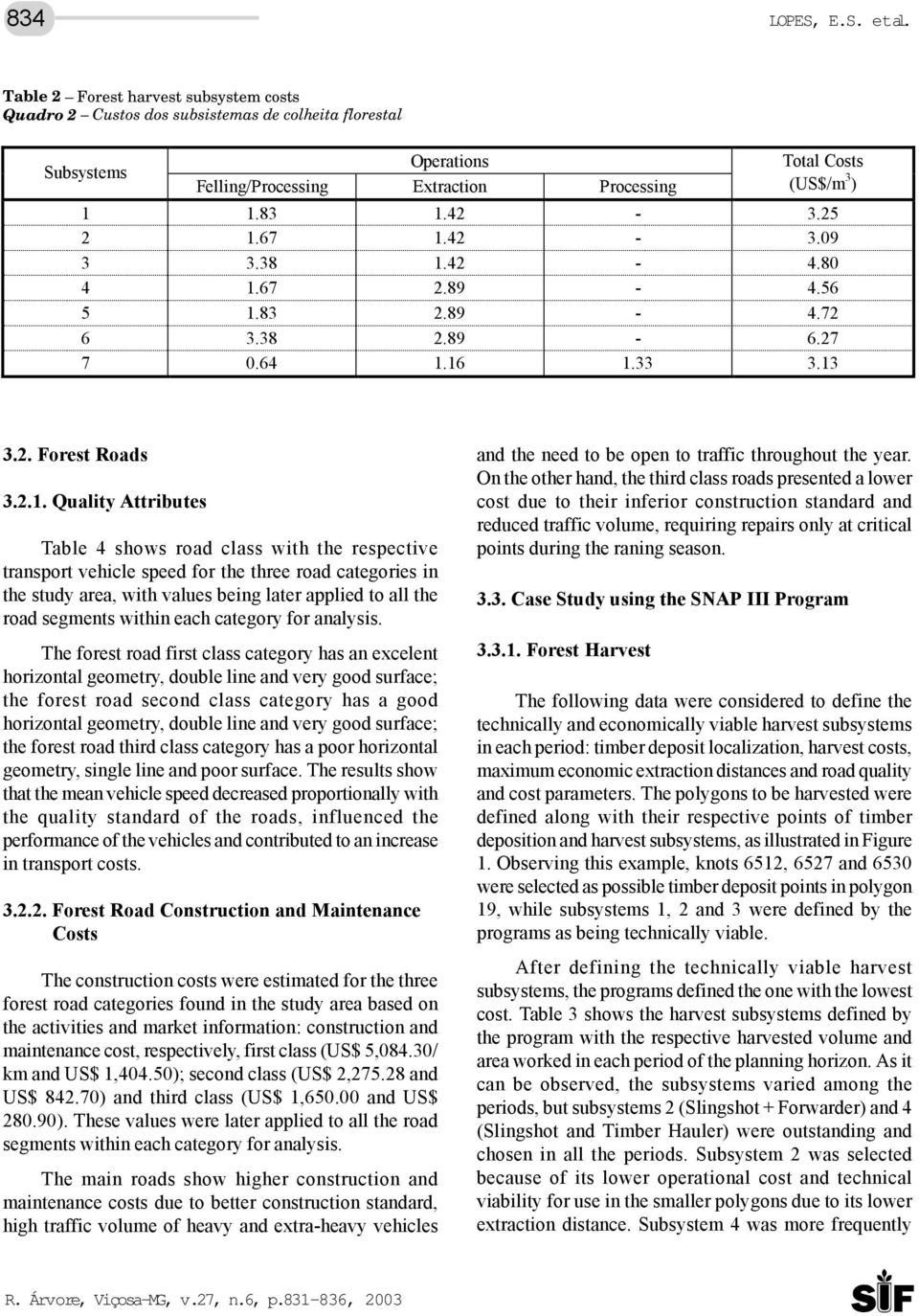
5 Harvesting and Wood Transport Planning with SNAP III Figure 1 Wood deposit localization in Polygon 19. Figura 1 Localização dos depósitos de madeira do polígono 19. Table 3 Forest harvest subsystems defined by SNAP III program Quadro 3 Subsistemas de colheita florestal definidos pelo programa SNAP III Period Harvest Subsystems Area Volume (nº) (ha) (m 3 ) , , , , , , , , , , , , , , , , , , , , , , used because of its lower operational cost among those with greater extraction distance, being, therefore, viable for extraction from large polygons. It should be pointed out that this information is important in operational planning decision making such as: defining and dimensioning felling teams, machines and equipment, allocation support teams; machine yield estimates, control process etc. Figure 2 shows part of the report on the harvested polygons and the roads in use during the first four periods of the planning horizon. This information was very important in harvest and transport planning, as it enables the allocation of machines and vehicles, felling team yields, machines, and equipment to predict transport vehicle performance and construction, conservation and assessment costs of the existing roads. 4. CONCLUSIONS SNAP III program showed high potential as a support tool in harvesting and wood transport planning under Brazilian conditions. SNAP III program was technically and economically efficient in defining harvest subsystems, helping in decisions such as: definition and dimensioning of the felling teams, machines and equipment; yield estimates, control process etc. SNAP III program allowed to determine a compatible transport route and the extension of roads in use, an important information in transport planning, since it allows to predict transport vehicle performance, make decisions on conservation of existing roads, displacement of service personnel, machines and vehicles. 5. REFERENCES BIBLIOGRAFIC CLUTTER, J. L. et al. Timber management: a quantitative approach. New York: Wiley, p. JOHNSON, K. N.; STUART, T. W. FORPLAN version 2: mathematical programmer s guide. [S.l.: s.n.], MACHADO, C. C. Planejamento e controle de custos na exploração florestal. Viçosa: Universidade Federal de Viçosa, p. MACHADO, C. C. TransRoad. Viçosa: Universidade Federal de Viçosa, (s.d).

6 836 LOPES, E.S. etal. MIYATA, E. S. Determining fixed and operating costs of logging equipament. [S.l.]: USDA Forest Service, p. (General Technical Report, NC-55). MOREIRA, F. M. T. Análise técnica e econômica de subsistemas de colheita de madeira de eucalipto em terceira rotação f. Dissertação (Mestrado em Ciência Florestal) Universidade Federal de Viçosa, Viçosa, SANTOS, S. L. M. Alocação ótima de máquinas na colheita de madeira f. Dissertação (Mestrado em Ciência Florestal) Universidade Federal de Viçosa, Viçosa, SESSIONS, J.; SESSIONS, J. B. Scheduling and network analysis program: user s guide. [ S.l.: s.n.t.], THOMPSON, T. L. Decision support systems for ecosystem management: an evaluation of existing systems. In: Rocky moutain research station. Fort Collins: Colorado, p VALVERDE, S. R. Análise técnica e econômica do sistema de colheita de árvores inteiras em povoamentos de eucalipto f. Dissertação (Mestrado em Ciência Florestal) Universidade Federal de Viçosa, Viçosa, 1995.

HYBRID INTELLIGENT SUITE FOR DECISION SUPPORT IN SUGARCANE HARVEST
 HYBRID INTELLIGENT SUITE FOR DECISION SUPPORT IN SUGARCANE HARVEST FLÁVIO ROSENDO DA SILVA OLIVEIRA 1 DIOGO FERREIRA PACHECO 2 FERNANDO BUARQUE DE LIMA NETO 3 ABSTRACT: This paper presents a hybrid approach
VOLUMETRIC AND ECONOMIC OPTIMAL ROTATIONS FOR FIREWOOD PRODUCTION OF Eucalyptus urophylla IN IPAMERI, STATE OF GOIAS
 VOLUMETRIC AND ECONOMIC OPTIMAL ROTATIONS FOR FIREWOOD PRODUCTION OF Eucalyptus urophylla IN IPAMERI, STATE OF GOIAS José Imaña-Encinas 1, Otacílio Antunes Santana 2, Christian Rainier Imaña 3 1 Eng. Florestal,
Use of Unmanned aerial vehicle images as a tool to evaluate stand uniformity in clonal Eucalyptus plantations
 Use of Unmanned aerial vehicle images as a tool to evaluate stand uniformity in clonal Eucalyptus plantations Ana Rosária Sclifó Zucon 1 Brandon Hawkes 2 Cristiane Camargo Zani de Lemos 3 Guilherme Zaghi
SUITABILITY OF RELATIVE HUMIDITY AS AN ESTIMATOR OF LEAF WETNESS DURATION
 SUITABILITY OF RELATIVE HUMIDITY AS AN ESTIMATOR OF LEAF WETNESS DURATION PAULO C. SENTELHAS 1, ANNA DALLA MARTA 2, SIMONE ORLANDINI 2, EDUARDO A. SANTOS 3, TERRY J. GILLESPIE 3, MARK L. GLEASON 4 1 Departamento
TEXTO PARA DISCUSSÃO N 265 ECONOMIC GROWTH, CONVERGENCE AND QUALITY OF HUMAN CAPITAL FORMATION SYSTEM. Luciano Nakabashi Lízia de Figueiredo
 TEXTO PARA DISCUSSÃO N 265 ECONOMIC GROWTH, CONVERGENCE AND QUALITY OF HUMAN CAPITAL FORMATION SYSTEM Luciano Nakabashi Lízia de Figueiredo Junho de 2005 Ficha catalográfica 330.34 N63e 2005 Nakabashi,
CRITICAL ANALYSIS OF LAYOUT CONCEPTS: FUNCTIONAL LAYOUT, CELL LAYOUT, PRODUCT LAYOUT, MODULAR LAYOUT, FRACTAL LAYOUT, SMALL FACTORY LAYOUT.
 CRITICAL ANALYSIS OF LAYOUT CONCEPTS: FUNCTIONAL LAYOUT, CELL LAYOUT, PRODUCT LAYOUT, MODULAR LAYOUT, FRACTAL LAYOUT, SMALL FACTORY LAYOUT. Alessandro Lucas da Silva (UNESP) [email protected] Edwin Cardoza
Lasers and Specturbility of Light Scattering Liquids - A Review
 Artigo Original Revista Brasileira de Física Médica.2011;5(1):57-62. Reproducibility of radiant energy measurements inside light scattering liquids Reprodutibilidade de medidas de energia radiante dentro
QUALITY KNOWLEDGE INTEGRATION: A BRAZILIAN COMPARISON ANALYSIS
 QUALITY KNOWLEDGE INTEGRATION: A BRAZILIAN COMPARISON ANALYSIS Úrsula Maruyama [email protected] CEFET/RJ, Departamento de Ensino e Administração (DEPEA) Av. Maracanã 229, Maracanã CEP 20.271-110
FORECASTING MODEL FOR THE PRODUCTION AND CONSUMPTION OF COTTON FIBER VERSUS POLYESTER
 1 FORECASTING MODEL FOR THE PRODUCTION AND CONSUMPTION OF COTTON FIBER VERSUS POLYESTER Elisa Mauro Gomes Otávio Lemos de Melo Celidonio Daniel Latorraca Ferreira Leandro Gustavo Alves Johnnattann Pimenta
TEACHING CALCULUS USING E-LEARNING IN A MOODLE PLATFORM
 TEACHING CALCULUS USING E-LEARNING IN A MOODLE PLATFORM Caridade C.M.R., Faulhaber M.C., Rosa P.M., Silva P.M., Baeta N.S. Coimbra Institute of Engineering [email protected]; [email protected]; [email protected];
Evaluation of the image quality in computed tomography: different phantoms
 Artigo Original Revista Brasileira de Física Médica.2011;5(1):67-72. Evaluation of the image quality in computed tomography: different phantoms Avaliação da qualidade de imagem na tomografia computadorizada:
OF THE COST OF THE POST-HARVEST PROCESSING OF COFFEE
 A decision support A DECISION system to aid SUPPORT the calculation... SYSTEM TO AID THE CALCULATION 439 OF THE COST OF THE POST-HARVEST PROCESSING OF COFFEE Rafael Vargas Mesquita dos Santos 1, Henrique
ENERGETIC EFFICIENCY OF AN AGRICULTURAL TRACTOR IN FUNCTION OF TIRE INFLATION PRESSURE
 ENERGETIC EFFICIENCY OF AN AGRICULTURAL TRACTOR IN FUNCTION OF TIRE INFLATION PRESSURE LEONARDO DE A. MONTEIRO 1, DANIEL ALBIERO 2, KLEBER P. LANÇAS 3, ANDRÉ V. BUENO 4, FABRICIO C. MASIERO 5 ABSTRACT:
Analyzing temporal and spatial dynamics of deforestation in the Amazon: a case study in the Calha Norte region, State of Pará, Brazil
 Anais XV Simpósio Brasileiro de Sensoriamento Remoto - SBSR, Curitiba, PR, Brasil, 30 de abril a 05 de maio de 2011, INPE p.2756 Analyzing temporal and spatial dynamics of deforestation in the Amazon:
Timber Harvesting and Long-distance Transportation of Roundwood 2014. Metsätehon tuloskalvosarja 7b/2015 Markus Strandström Metsäteho Oy
 Timber Harvesting and Long-distance Transportation of Roundwood 214 Metsätehon tuloskalvosarja 7b/215 Markus Strandström Metsäteho Oy About statistics Includes volumes and direct harvesting costs of timber
QUESTIONÁRIOS DE AVALIAÇÃO: QUE INFORMAÇÕES ELES REALMENTE NOS FORNECEM?
 QUESTIONÁRIOS DE AVALIAÇÃO: QUE INFORMAÇÕES ELES REALMENTE NOS FORNECEM? Grizendi, J. C. M [email protected] Universidade Estácio de Sá Av. Presidente João Goulart, 600 - Cruzeiro do Sul Juiz de Fora
How to change or transform a coordinate system into a map layer? The answer is in ArcMap.
 How to change or transform a coordinate system into a map layer? The answer is in ArcMap. Anabela Grifo (1,2) *, Albertina Ferreira (1,3) (1) Departamento de Ciências Agrárias e Ambiente Escola Superior
CRM: customer relationship management: o revolucionário marketing de relacionamento com o cliente P
 CRM: customer relationship management: o revolucionário marketing de relacionamento com o cliente Download: CRM: customer relationship management: o revolucionário marketing de relacionamento com o cliente
Evaluation of Forest Road Network Planning According to Environmental Criteria
 American-Eurasian J. Agric. & Environ. Sci., 9 (1): 91-97, 2010 ISSN 1818-6769 IDOSI Publications, 2010 Evaluation of Forest Road Network Planning According to Environmental Criteria Amir Hosian Firozan,
ESCOAMENTO DO AR EM ARMAZÉM GRANELEIRO DE GRANDE PORTE COM SISTEMA DE AERAÇÃO SIMULATION OF AIR FLOW IN LARGE AERATED GRAIN STORAGE
 ESCOAMENTO DO AR EM ARMAZÉM GRANELEIRO DE GRANDE PORTE COM SISTEMA DE AERAÇÃO Oleg Khatchatourian 1 Antonio Rodrigo Delepiane de Vit 2 João Carlos Cavalcanti da Silveira 3 Luciano Ferreira 4 RESUMO Foi
STUDENT, WELCOME TO VIÇOSA, WELCOME TO UFV! This is a basic guide for you do not feel lost with the procedures.
 STUDENT, WELCOME TO VIÇOSA, WELCOME TO UFV! This is a basic guide for you do not feel lost with the procedures. UNIVERSIDADE FEDERAL DE VIÇOSA Brazil: 26 states 5 administrative regions area: 8.514.877
FORMAÇÃO CONTINUADA DE PROFESSORES A DISTÂNCIA DISTANCE CONTINUING EDUCATION OF TEACHERS
 1 FORMAÇÃO CONTINUADA DE PROFESSORES A DISTÂNCIA DISTANCE CONTINUING EDUCATION OF TEACHERS 05/05/2008 Thiago Rozineli Fundação Hermínio Ometto UNIARARAS, [email protected] Marilena Souza Rosalen
FACTORS WHICH INFLUENCE COMPANIES IN FOREST MANAGEMENT DECISIONS
 292 Vol. 6 FACTORS WHICH INFLUENCE COMPANIES IN FOREST MANAGEMENT DECISIONS B. D. McCONCHIE J. G. Groome and Associates, Taupo, New Zealand ABSTRACT Factors which generally influence companies in making
ENVIRONMENT MANAGEMENT PLAN
 ENVIRONMENT MANAGEMENT PLAN Page 33 ENVIRONMENT MANAGEMENT PLAN BLACK TRAP 1.0. INTRODUCTION: The proposed M/s. Black Trap Mine of Govindbhai Karshanbhai Ram area at near Vill.Chuldi, Tal.Malia-Hatina,
THE APPLICATION OF STATISTICAL QUALITY CONTROL TOOLS TO MONITORING ETHANOL PROCESS PRODUCTION.
 1 XXXIII ENCONTRO NACIONAL DE ENGENHARIA DE PRODUCAO THE APPLICATION OF STATISTICAL QUALITY CONTROL TOOLS TO MONITORING ETHANOL PROCESS PRODUCTION. Juliana Keiko Sagawa (UFSCAR ) [email protected]
Forest Management Branch Directive
 SUSTAINABLE RESOURCE DEVELOPMENT Forest Management Branch Directive Subject Purpose Directive No. 2006-01 Date January 1, 2006 Offsite Timber Storage and Decked Timber at Harvest Site To provide Public
THE LABEL EFFECTS ON THE CONSUMER INSTANT COFFEE PERCEPTION
 THE LABEL EFFECTS ON THE CONSUMER INSTANT COFFEE PERCEPTION DELIZA, R. 1 ; MacFIE, H.J.H. 2 e HEDDERLEY, D. 3 1 EMBRAPA - Food Technology, Av. das Américas, 29501 CEP 23020-470 Rio de Janeiro-Brazil; ;
Application of the forest growth model 3PG to Eucalyptus globulus stands in the central region of Portugal
 Application of the forest growth model 3PG to Eucalyptus globulus stands in the central region of Portugal A. Amaral*, R. Salas **, F. Páscoa**, M. Tomé***, J. Tomé***, P. Soares*** * Superior School of
Scientific note: mass transfer coefficient in the drying of soybean meal
 Braz. J. Food Technol., v. 12, n. 2, p. 92-96, abr./jun. 2009 DOI: 10.4260/BJFT2009800900002 Nota científica: coeficiente de transferência de massa na secagem do farelo de soja Autores Authors Gianini
Finding a Sustainable Management Strategy for the Tongass National Forest Opportunities and Challenges
 Finding a Sustainable Management Strategy for the Tongass National Forest Opportunities and Challenges Prepared by D.R. Systems NW Inc. For the SouthEast Conference Defining Sustainability Successful Achievement
POCKWOCK - BOWATER WATERSHED STUDY
 Contents Location of Study & Treatments..... 1 Site Characteristics.............. 2 Forest Composition.............. 3 Roads.... 3 Harvesting Information........... 4 Literature Cited.................
An evaluation of the Brazilian business incubators innovation
 An evaluation of the Brazilian business incubators innovation UMA MENSURAÇÃO DA INOVAÇÃO NAS INCUBADORAS DE EMPRESAS BRASILEIRAS Jefferson de Souza Pinto Diego de Carvalho Moretti Rosley Anholon Faculdades
Assume you have 40 acres of forestland that was
 A l a b a m a A & M a n d A u b u r n U n i v e r s i t i e s ANR-1371 Basal Area: A Measure Made for Management Assume you have 40 acres of forestland that was recently assessed by a natural resource
ANALYSIS OF THE CPDLC REAL TIME CHARACTERISTICS AND THE MODE S DATA LINK CAPACITY
 ANALYSIS OF THE CPDLC REAL TIME CHARACTERISTICS AND THE MODE S DATA LINK CAPACITY Fernando de Oliveira Gil Lúcio Flávio Vismari João Batista Camargo Júnior Universidade de São Paulo Escola Politécnica
Units of Measure and Conversion Factors for Forest Products
 Units of Measure and Conversion Factors for Forest Products Bulletin #7103 Knowledge of the common units of wood measurement is important to people who are involved in marketing forest products. These
Strategic Planning in Universities from Pará, Brazil. Contributions to the Achievement of Institutional Objectives
 Scientific Papers (www.scientificpapers.org) Journal of Knowledge Management, Economics and Information Technology Strategic Planning in Universities from Pará, Brazil. Contributions to the Achievement
ENVIRONMENT MANAGEMENT PLAN
 ENVIRONMENT MANAGEMENT PLAN 1 [Type the company name] ENVIRONMENT MANAGEMENT PLAN LIMESTONE (BUILDING) 1.0. INTRODUCTION: The proposed M/s. Building Lime Stone Mine of Shree Jitubhai Parbatbhai Chudashma
of knowledge that is characteristic of the profession and is taught at professional schools. An important author in establishing this notion was
 Mathematics teacher education and professional development João Pedro da Ponte [email protected] Grupo de Investigação DIFMAT Centro de Investigação em Educação e Departamento de Educação Faculdade de Ciências
Linear programming applied to healthcare problems
 105 Linear programming applied to healthcare problems Programação linear aplicada a problemas da área de saúde* Frederico Rafael Moreira 1 ORIGINAL ARTICLE ABSTRACT Objective and Method: To present a mathematical
ENVIRONMENT MANAGEMENT PLAN
 ENVIRONMENT MANAGEMENT PLAN ENVIrONMENT MaNaGEMENT plan 1. INTRODUCTION: Shri Ratilal Ravji Solanki have a Blacktrap mining lease project for an area of 1.00.00 Ha located on Survey no. 984 paiki, Village:
Hydrocarbon reservoir modeling: comparison between theoretical and real petrophysical properties from the Namorado Field (Brazil) case study.
 ANNUAL MEETING MASTER OF PETROLEUM ENGINEERING Hydrocarbon reservoir modeling: comparison between theoretical and real petrophysical properties from the Namorado Field (Brazil) case study. Marcos Deguti
, ~ The ResourcesAgency. Dave McNamara
 ,a! California State of California Department of Forestry, ~ The ResourcesAgency - ~A' ~;::~Af;// ~/ ~~/1Y~~,\~'(.~~~~~ ~,~ F1rl WES7:RY ~~~~_.~~- note 1416 Ninth Street Sacramento, CA 95814 Phone 916-445-5571
Management system of an active genebank of common bean
 Management system of an active genebank of common bean Crop Breeding and Applied Biotechnology 10: 95-100, 2010 Brazilian Society of Plant Breeding. Printed in Brazil Management system of an active genebank
SCOPE OF DESIGN FOR PRODUCTION OF PARTITION WALLS AND FACADE COVERINGS
 SCOPE OF DESIGN FOR PRODUCTION OF PARTITION WALLS AND FACADE COVERINGS KAREN MANESCHI Arch., Master Candidate, Escola Politécnica USP, Construction Engineering Department University of São Paulo São Paulo
Public Funding and the Beginning of a New Era in Higher Education in Brazil
 80 Comparative & International Higher Education 5 (2013) Public Funding and the Beginning of a New Era in Higher Education in Brazil Danilo de Melo Costa a,* a Federal University of Minas Gerais, Brazil
Traffic Modeling in PLC Networks using a Markov Fluid Model with Autocorrelation Function Fitting 1
 TEMA Tend. Mat. Apl. Comput., 12, No. 3 (2011), 233-243. doi: 10.5540/tema.2011.012.03.0233 c Uma Publicação da Sociedade Brasileira de Matemática Aplicada e Computacional. Traffic Modeling in PLC Networks
Comparison of Logging Residue from Lump Sum and Log Scale Timber Sales James O. Howard and Donald J. DeMars
 United States Department of Agriculture Forest Service Pacific Northwest Forest and Range Experiment Station Research Paper PNW-337 May 1985 Comparison of Logging Residue from Lump Sum and Log Scale Timber
Risk management in scientific research:
 Risk management in scientific research: a proposal guided in Project Management Book of Knowledge and Failure Mode and Effects Analysis Pollyana Notargiacomo Mustaro Graduate Program in Electrical Engineering
A panorama of Brazil The country and the real estate market
 A panorama of Brazil The country and the real estate market Politic, economic and real estate development By Flavio Amary, Secovi-SP incoming president Real estate market opportunities By Joaquim Ribeiro,
Latin American Feedstocks
 Latin American Feedstocks Professor: Márcia Miguel Castro Ferreira. PhD Student: Magale Rambo. University of Campinas (UNICAMP), Institue of Chemistry, Labor for Theoretical and Applied Chemometrics LQTA
What is the Radiotherapy Quality Control Program (PQRT) of the National Cancer Institute Rio de Janeiro/Brazil?
 Congreso Internacional Conjunto Cancún 2004 LAS/ANS-SNM-SMSR/International Joint Meeting Cancun 2004 LAS/ANS-SNM-SMSR XV Congreso Anual de la SNM y XXII Reunión Anual de la SMSR/XV SNM Annual Meeting and
Queensland Parks and Wildlife Service PEST MANAGEMENT PLAN
 QPWS Pest Management Plan Queensland Parks and Wildlife Service PEST MANAGEMENT PLAN 2010-2015 A plan to meet obligations under the Land Protection (Pest and Stock Route Management) Act (2002) Version:
Continuing Medical Education Program: a credit system evaluation
 Original Article Continuing Medical Education Program: a credit system evaluation Programa de Educação Médica Continuada: avaliação de um sistema de créditos Claudio Schvartsman 1, Milton Glezer 2, Renato
Dissemination of environmental and socioeconomical information on the web using a model based on free tools
 7(1):71-76, jan/jun 2011 Copyright 2011 by Unisinos - doi: 10.4013/gaea.2011.71.05 Dissemination of environmental and socioeconomical information on the web using a model based on free tools Alessandro
Forest Management Plan Templates
 Forest Management Plan Templates The following templates as described in the Forestry Schemes Manual 2011 can be used in support of all scheme applications as described in the scheme documents 2014-2020
DISTANCE CONTINUING EDUCATION: LEARNING MANAGEMENT AND DIFFICULTIES FACED BY SCIENCE TEACHERS
 DISTANCE CONTINUING EDUCATION: LEARNING MANAGEMENT AND DIFFICULTIES FACED BY SCIENCE TEACHERS Paulo Sérgio Garcia, Nelio Bizzo Faculdade de Educação da Universidade de São Paulo e Núcleo de pesquisa EDEVO,
Reduced Impact Timber Harvesting SNR 534 2 Credits
 Instructor Loren Kellogg, PhD, CF Lematta Professor of Forest Engineering Oregon State University E-mail: [email protected] Phone: 541-737-2836 Reduced Impact Timber Harvesting SNR 534 2 Credits
HIGH SPATIAL RESOLUTION IMAGES - A NEW WAY TO BRAZILIAN'S CARTOGRAPHIC MAPPING
 CO-192 HIGH SPATIAL RESOLUTION IMAGES - A NEW WAY TO BRAZILIAN'S CARTOGRAPHIC MAPPING BIAS E., BAPTISTA G., BRITES R., RIBEIRO R. Universicidade de Brasíia, BRASILIA, BRAZIL ABSTRACT This paper aims, from
MCSD Azure Solutions Architect [Ativar Portugal] Sobre o curso. Metodologia. Microsoft - Percursos. Com certificação. Nível: Avançado Duração: 78h
![MCSD Azure Solutions Architect [Ativar Portugal] Sobre o curso. Metodologia. Microsoft - Percursos. Com certificação. Nível: Avançado Duração: 78h](/thumbs/35/17261285.jpg "MCSD Azure Solutions Architect [Ativar Portugal] Sobre o curso. Metodologia. Microsoft - Percursos. Com certificação. Nível: Avançado Duração: 78h") MCSD Azure Solutions Architect [Ativar Portugal] Microsoft - Percursos Com certificação Nível: Avançado Duração: 78h Sobre o curso A GALILEU integrou na sua oferta formativa, o Percurso de Formação e Certificação
MCSD Azure Solutions Architect [Ativar Portugal] Microsoft - Percursos Com certificação Nível: Avançado Duração: 78h Sobre o curso A GALILEU integrou na sua oferta formativa, o Percurso de Formação e Certificação
San Francisco Bay Margin Conservation Decision Support System (DSS)
 San Francisco Bay Margin Conservation Decision Support System (DSS) Presented by Brian Fulfrost1, MS David Thomson2, MS 1 Brian Fulfrost and Associates 2 San Francisco Bay Bird Observatory Transitional
Norwegian Forests. Policy and Resources
 Norwegian Forests Policy and Resources 21 Forestry in Norway Norway has long traditions in forestry and forest management, and for using wood in construction and as a source of energy. Sawn wood and round
corporate presentation santander 15th annual latin american ceo conference cancun January 2011
 corporate presentation santander 15th annual latin american ceo conference cancun January 2011 disclaimer This presentation may contain projections or other forward-looking statements related to masisa
Benchmarking secondary education in Brazil
 Benchmarking secondary education in Brazil Simon Schwartzman Instituto de Estudos do Trabalho e Sociedade IETS Academic achievement... 1 Student flow... 5 The missing factors - school differentiation and
PERCEPTIONS OF THE MANAGERS ABOUT THE APPLICATION - TREATY FOR
 ORIGINAL ARTICLE PERCEPTIONS OF THE MANAGERS ABOUT THE APPLICATION - TREATY FOR HEALTH PERCEPÇÕES DOS GESTORES SOBRE O APLICATIVO PACTO PELA SAÚDE PERCEPCIONES DE LOS GERENTES SOBRE LA APLICACIÓN - PACTO
Florida Building Code 2004 SECTION 1009 STAIRWAYS AND HANDRAILS
 Florida Building Code 2004 SECTION 1009 STAIRWAYS AND HANDRAILS 1009.1 Stairway width. The width of stairways shall be determined as specified in Section 1005.1, but such width shall not be less than 44