
CM6700 Matrix Switcher/Controller
|
|
|
- Marvin Alexander
- 10 years ago
- Views:
Transcription
1 CM6700 Matrix Switcher/Controller Installation/ Operation Manual C523M-H (6/05) Pelco 3500 Pelco Way Clovis, CA USA In North America and Canada: Tel (800) FAX (800) International Customers: Tel +1(559) FAX +1(559)

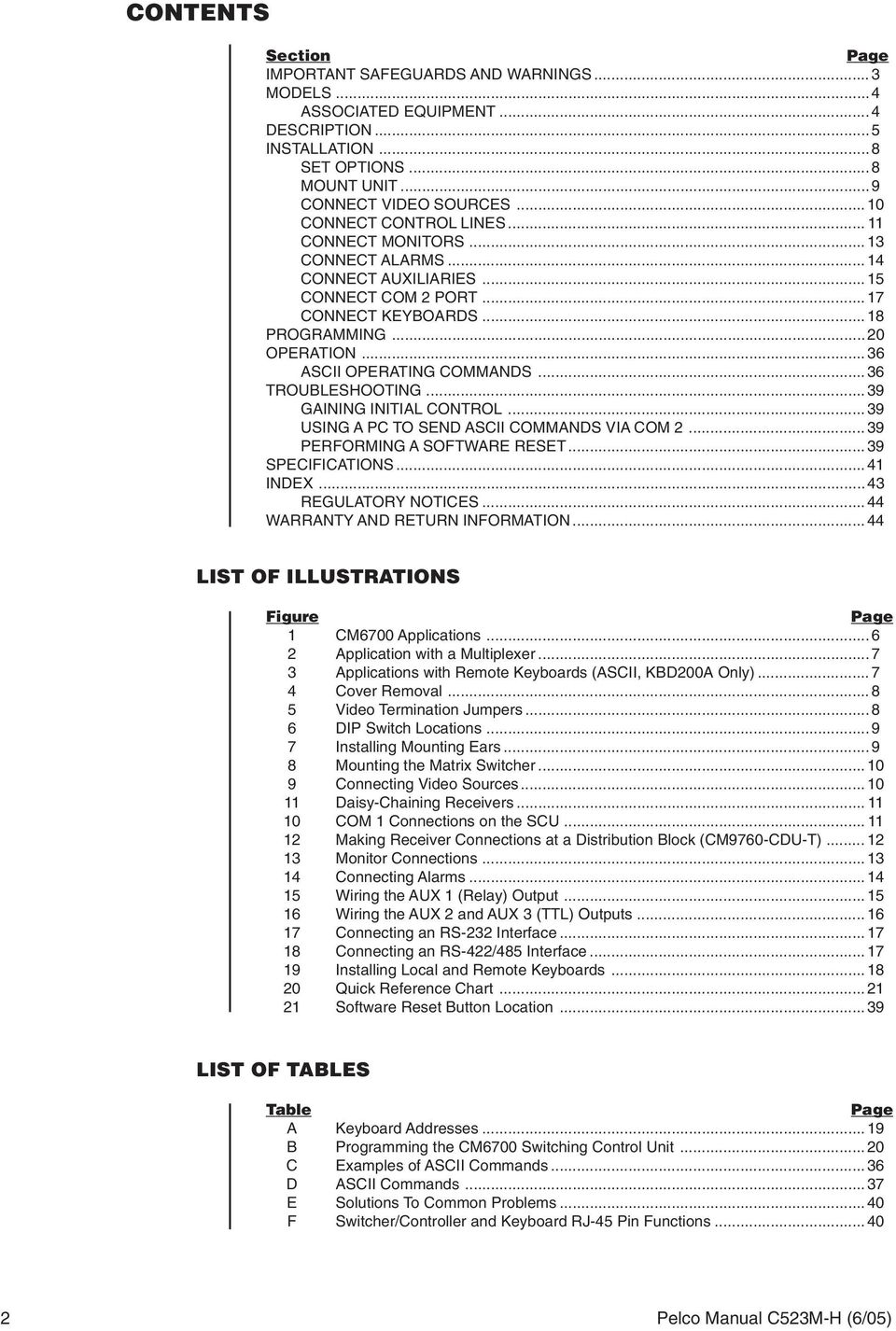
2 CONTENTS Section Page IMPORTANT SAFEGUARDS AND WARNINGS... 3 MODELS...4 ASSOCIATED EQUIPMENT...4 DESCRIPTION...5 INSTALLATION...8 SET OPTIONS...8 MOUNT UNIT...9 CONNECT VIDEO SOURCES...10 CONNECT CONTROL LINES CONNECT MONITORS CONNECT ALARMS CONNECT AUXILIARIES CONNECT COM 2 PORT CONNECT KEYBOARDS PROGRAMMING...20 OPERATION...36 ASCII OPERATING COMMANDS TROUBLESHOOTING GAINING INITIAL CONTROL USING A PC TO SEND ASCII COMMANDS VIA COM PERFORMING A SOFTWARE RESET SPECIFICATIONS INDEX...43 REGULATORY NOTICES WARRANTY AND INFORMATION LIST OF ILLUSTRATIONS Figure Page 1 CM6700 Applications Application with a Multiplexer Applications with Remote Keyboards (ASCII, KBD200A Only) Cover Removal Video Termination Jumpers DIP Switch Locations Installing Mounting Ears Mounting the Matrix Switcher Connecting Video Sources Daisy-Chaining Receivers COM 1 Connections on the SCU Making Receiver Connections at a Distribution Block (CM9760-CDU-T) Monitor Connections Connecting Alarms Wiring the AUX 1 (Relay) Output Wiring the AUX 2 and AUX 3 (TTL) Outputs Connecting an RS-232 Interface Connecting an RS-422/485 Interface Installing Local and Remote Keyboards Quick Reference Chart Software Reset Button Location LIST OF TABLES Table Page A Keyboard Addresses B Programming the CM6700 Switching Control Unit C Examples of ASCII Commands D ASCII Commands E Solutions To Common Problems F Switcher/Controller and Keyboard RJ-45 Pin Functions Pelco Manual C523M-H (6/05)
3 IMPORTANT SAFEGUARDS AND WARNINGS Prior to installation and use of this product, the following WARNINGS should be observed. 1. Installation and servicing should be done only by qualified service personnel and conform to all local codes. 2. This unit is designed for indoor use only and must not be installed where exposed to rain and moisture. 3. The installation method and materials should be capable of supporting four times the weight of the unit and equipment. 4. After replacement/repair of this unit s electrical components, conduct a resistance measurement between line and exposed parts to verify the exposed parts have not been connected to line circuitry. The product and/or manual may bear the following marks: This symbol indicates that dangerous voltage constituting a risk of electric shock is present within this unit. This symbol indicates that there are important operating and maintenance instructions in the literature accompanying this unit. CAUTION: RISK OF ELECTRIC SHOCK. DO NOT OPEN. Please thoroughly familiarize yourself with the information in this manual prior to installation and operation. REGULATORY NOTICES This equipment has been tested and found to comply with the limits of a Class A digital device, pursuant to part 15 of the FCC rules. These limits are designed to provide reasonable protection against harmful interference when the equipment is operated in a commercial environment. This equipment generates, uses, and can radiate radio frequency energy and, if not installed and used in accordance with the instruction manual, may cause harmful interference to radio communications. Operation of this equipment in a residential area is likely to cause harmful interference in which case the user will be required to correct the interference at his own expense. Pelco Manual C523M-H (6/05) 3
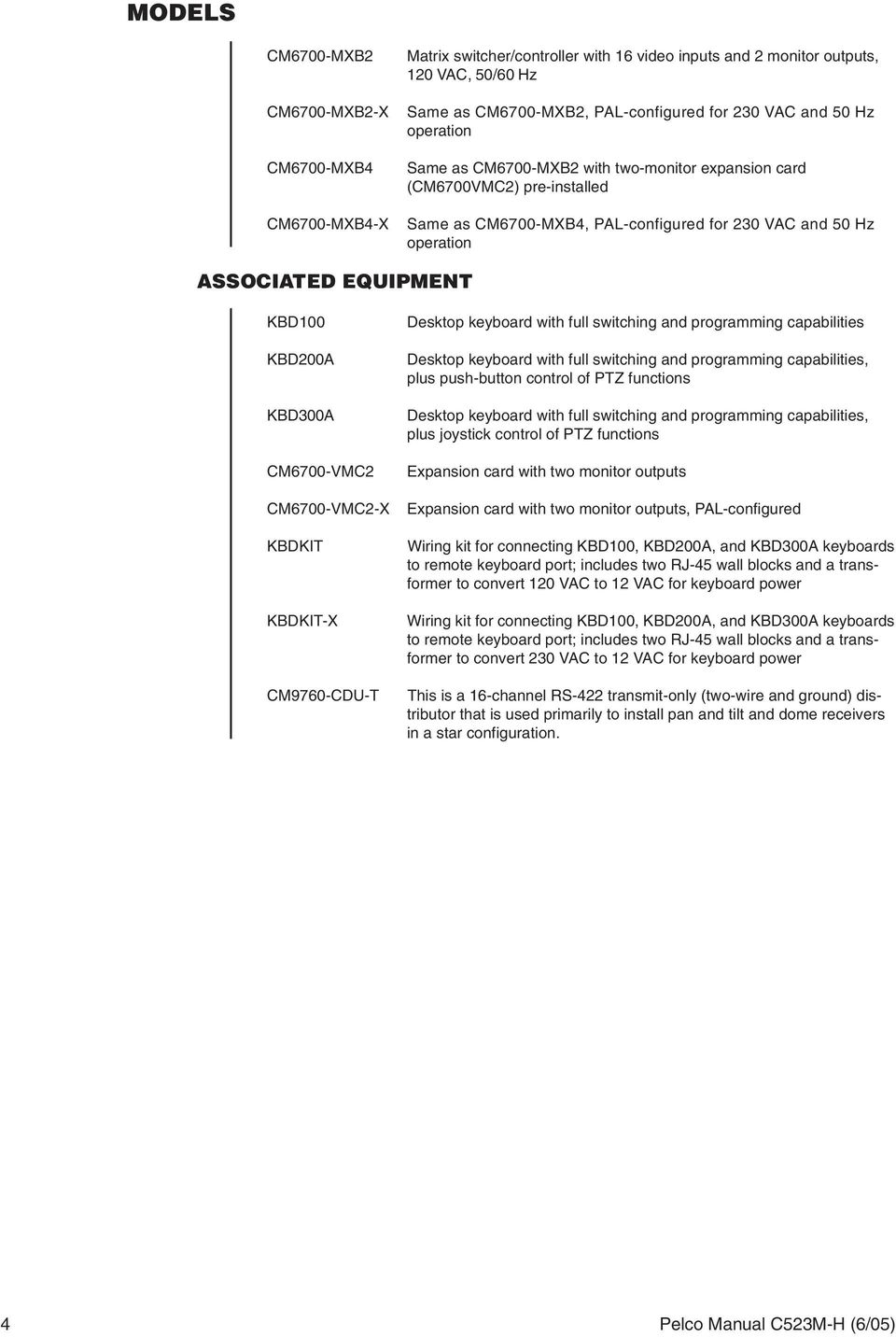
4 MODELS CM6700-MXB2 CM6700-MXB2-X CM6700-MXB4 CM6700-MXB4-X Matrix switcher/controller with 16 video inputs and 2 monitor outputs, 120 VAC, 50/60 Hz Same as CM6700-MXB2, PAL-configured for 230 VAC and 50 Hz operation Same as CM6700-MXB2 with two-monitor expansion card (CM6700VMC2) pre-installed Same as CM6700-MXB4, PAL-configured for 230 VAC and 50 Hz operation ASSOCIATED EQUIPMENT KBD100 KBD200A KBD300A CM6700-VMC2 CM6700-VMC2-X KBDKIT KBDKIT-X CM9760-CDU-T Desktop keyboard with full switching and programming capabilities Desktop keyboard with full switching and programming capabilities, plus push-button control of PTZ functions Desktop keyboard with full switching and programming capabilities, plus joystick control of PTZ functions Expansion card with two monitor outputs Expansion card with two monitor outputs, PAL-configured Wiring kit for connecting KBD100, KBD200A, and KBD300A keyboards to remote keyboard port; includes two RJ-45 wall blocks and a transformer to convert 120 VAC to 12 VAC for keyboard power Wiring kit for connecting KBD100, KBD200A, and KBD300A keyboards to remote keyboard port; includes two RJ-45 wall blocks and a transformer to convert 230 VAC to 12 VAC for keyboard power This is a 16-channel RS-422 transmit-only (two-wire and ground) distributor that is used primarily to install pan and tilt and dome receivers in a star configuration. 4 Pelco Manual C523M-H (6/05)
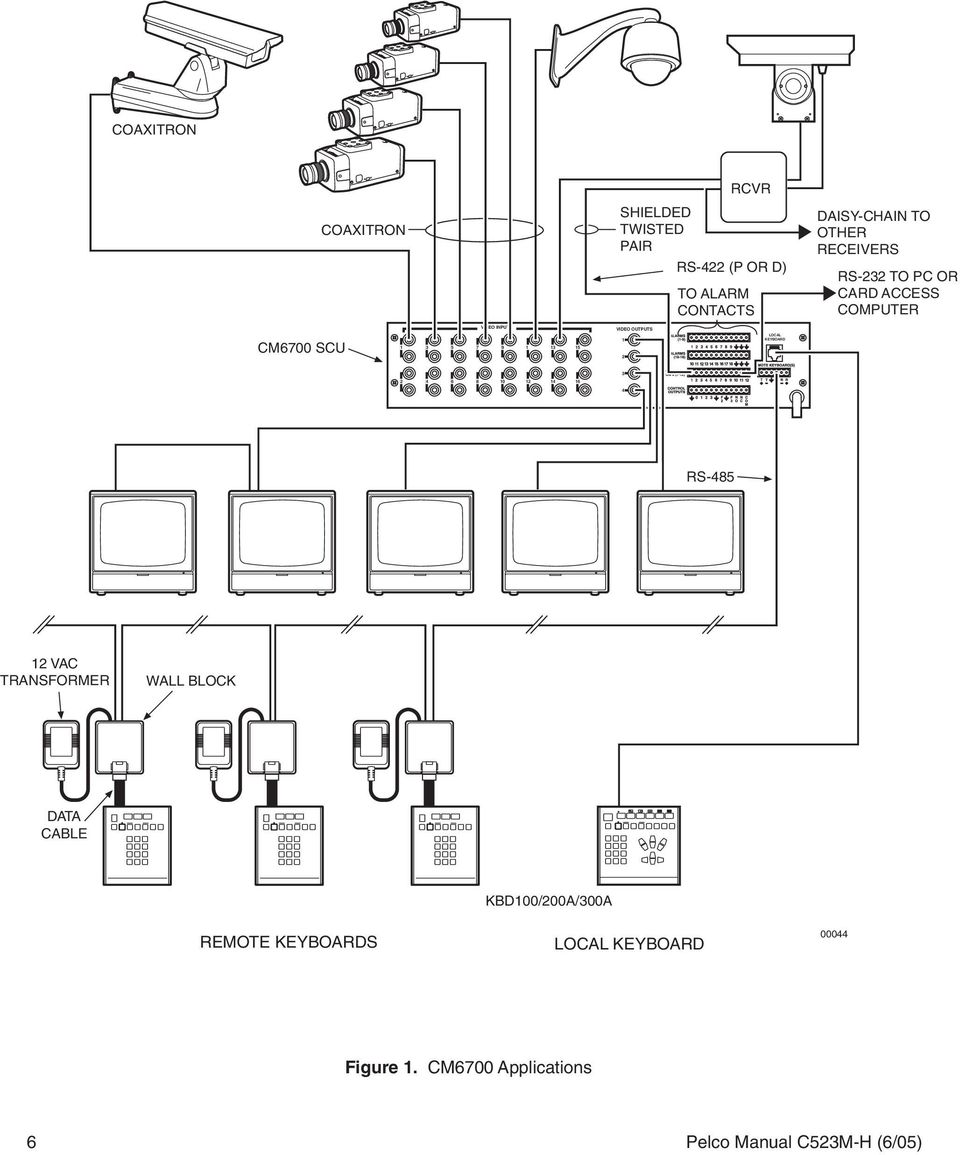
5 DESCRIPTION Pelco s CM6700 is a keyboard-controlled cross-point video matrix switcher/control unit (SCU) that allows you to route up to sixteen video images to as many as four monitors while controlling camera positions. Applications The CM6700 SCU can be controlled from a local or remote keyboard (refer to Figure 1), used with a multiplexer to display multiple camera views on a monitor (refer to Figure 2), and interfaced to a distant keyboard via dial-up telephone circuits through appropriate interface equipment (refer to Figure 3). The CM6700 features menu-driven, password-protected programming. The CM6700 can also be controlled from a personal computer using ASCII commands. Keyboards Camera positioning options can be programmed and controlled from a keyboard. Up to eight keyboards can be connected to the CM6700 SCU, allowing monitoring stations that share a common monitor to each have a keyboard. Four different keyboards are available to use with the CM6700 SCU, each with varying features and different costs. (Keyboard types can be mixed in a system See Associated Equipment.) Sequences, Presets, and Patterns Special programmed operations include sequences, presets and patterns. A sequence allows you to see a routine of 16 camera views on your monitor over and over again. The sequence can be operated automatically or manually. The order in which the views appear and the time each view remains can be programmed. A preset allows you to direct a pan/tilt/zoom (camera positioning system) to move to a certain position on command or as a result of an alarm. In addition to moving the camera, a descriptive title can appear on the screen. (Presets are not available with the KBD100 keyboard.) With a pattern you can program a camera positioning system to move around its viewing area in a repeating pattern. The number and time length of patterns varies with different positioning systems. (Patterns are not available with the KBD100 keyboard.) Alarm Inputs Eighteen alarm inputs are provided. These can be programmed to cause the display to switch automatically to the camera with the alarm and/or to operate one of three auxiliary outputs. Sixteen of the inputs are associated with individual cameras. Two of the inputs activate group camera sequences. Auxiliary Outputs Three auxiliary outputs are provided. One output is a relay and two are open collector (TTL) outputs. Auxiliary outputs are activated at the keyboard (except KBD100). Protocols The CM6700 works with Pelco s Coaxitron D, and P protocol receivers. Power, Mounting Methods The CM6700 SCU operates on 120 VAC or 230 VAC, depending on the model. The compact case mounts in 3-1/2 inches of vertical space in a 19-inch equipment bay or to a wall or table top. Pelco Manual C523M-H (6/05) 5

6 COAXITRON COAXITRON RCVR SHIELDED TWISTED PAIR RS-422 (P OR D) TO ALARM CONTACTS DAISY-CHAIN TO OTHER RECEIVERS RS-232 TO PC OR CARD ACCESS COMPUTER VIDEO INPUTS VIDEO OUTPUTS CM6700 SCU LOCAL KEYBOARD RS VAC TRANSFORMER WALL BLOCK DATA CABLE KBD100/200A/300A REMOTE KEYBOARDS LOCAL KEYBOARD Figure 1. CM6700 Applications 6 Pelco Manual C523M-H (6/05)
7 CAMERA VIDEO LOOPED VIDEO INPUTS VIDEO INPUTS MULTIPLEXER * VIDEO OUTPUTS 1 MULTIPLEXED VIDEO LOCAL KEYBOARD CM6700 SCU * MULTIPLEXER * ALTERNATE MULTIPLEXED VIDEO ROUTING THROUGH A CAMERA INPUT. KBD200A/300A Figure 2. Application with a Multiplexer VIDEO INPUTS VIDEO OUTPUTS 1 2 LOCAL KEYBOARD NOTE: ASCII DOES NOT SUPPORT PROGRAMMING FOT = FIBER OPTIC TERMINAL RS-422 FACILITY (FIBER OPTIC TERMINAL, ETC.) TO REMOTE KEYBOARD (ASCII) FOT (VIDEO+) CONTROL VIDEO FOT (VIDEO+) RS-232 FACILITY (PELCOVISION, ETC.) TO REMOTE KEYBOARD (ASCII) CONTROL KBD200A MONITOR TRANSMITTER RECEIVER KBD200A PSTN VIDEO Figure 3. Applications with Remote Keyboards (ASCII, KBD200A Only) MONITOR Pelco Manual C523M-H (6/05) 7
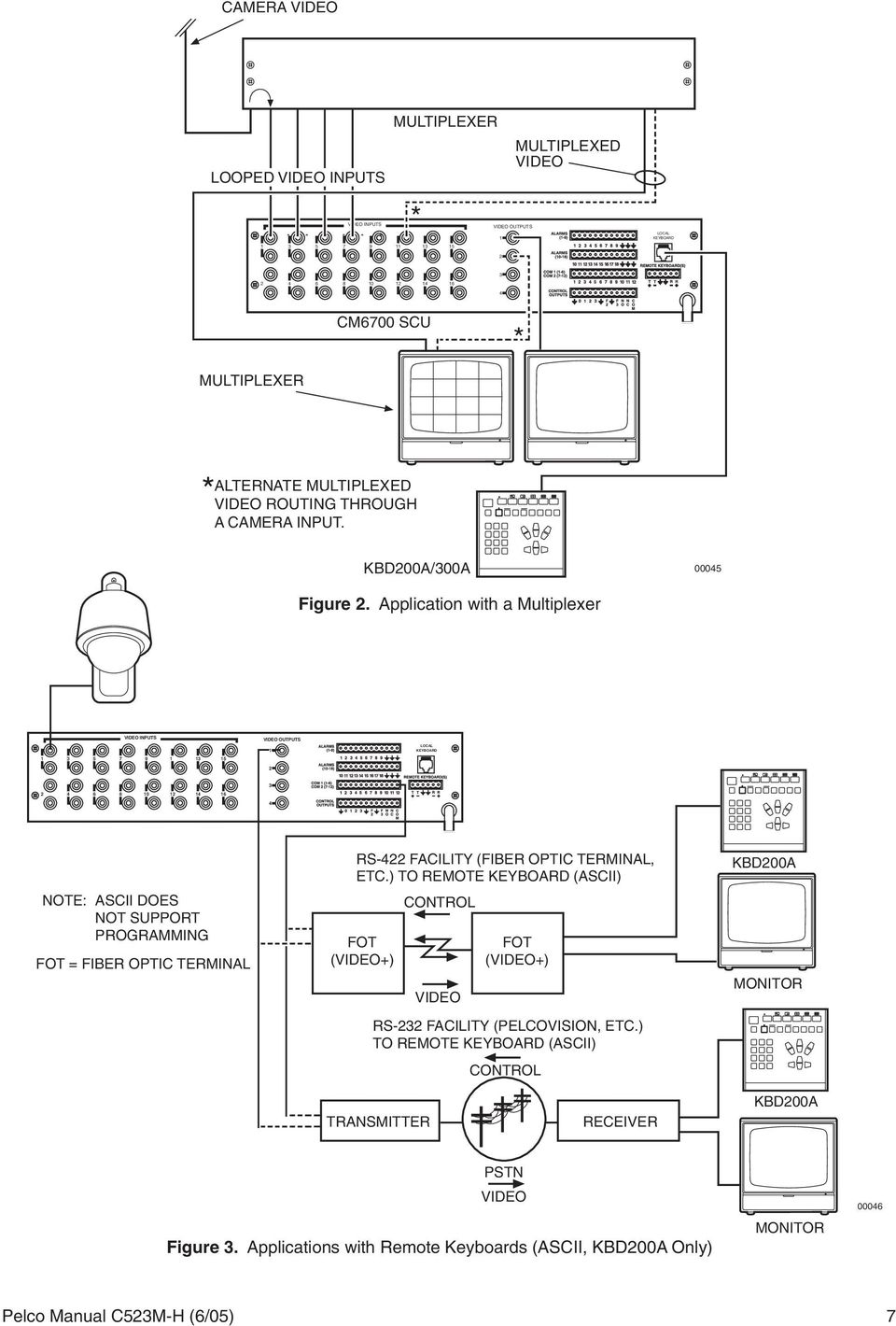
8 ON ON ON ON INSTALLATION 1 SET OPTIONS 1. Refer to Figure 4. Remove the cover. B REMOVE 6 SCREWS C LIFT COVER OFF A REMOVE 6 SCREWS Figure 4. Cover Removal Refer to Figure 5. Set jumpers according to your system requirements. JP1-JP16 are used to terminate the video input with a 75-ohm resistor or to unterminate the video (looping). The factory default has the jumper installed in the terminating position. If you are connecting only a camera to an input, leave the jumper in the terminating position. If you are looping the video to another device, move the jumper to the looped position, and terminate at the equipment connected to the looping output. 75-OHM TERMINATION JUMPER KEY TERMINATED LOOPED 75-OHM TERMINATION JUMPERS (ONE PER INPUT) BACK OF SCU JP1 JP16 NOTE: JUMPER JP1 CORRESPONDS TO VIDEO INPUT 1, JP2 TO VIDEO INPUT 2, ETC. Figure 5. Video Termination Jumpers 8 Pelco Manual C523M-H (6/05)
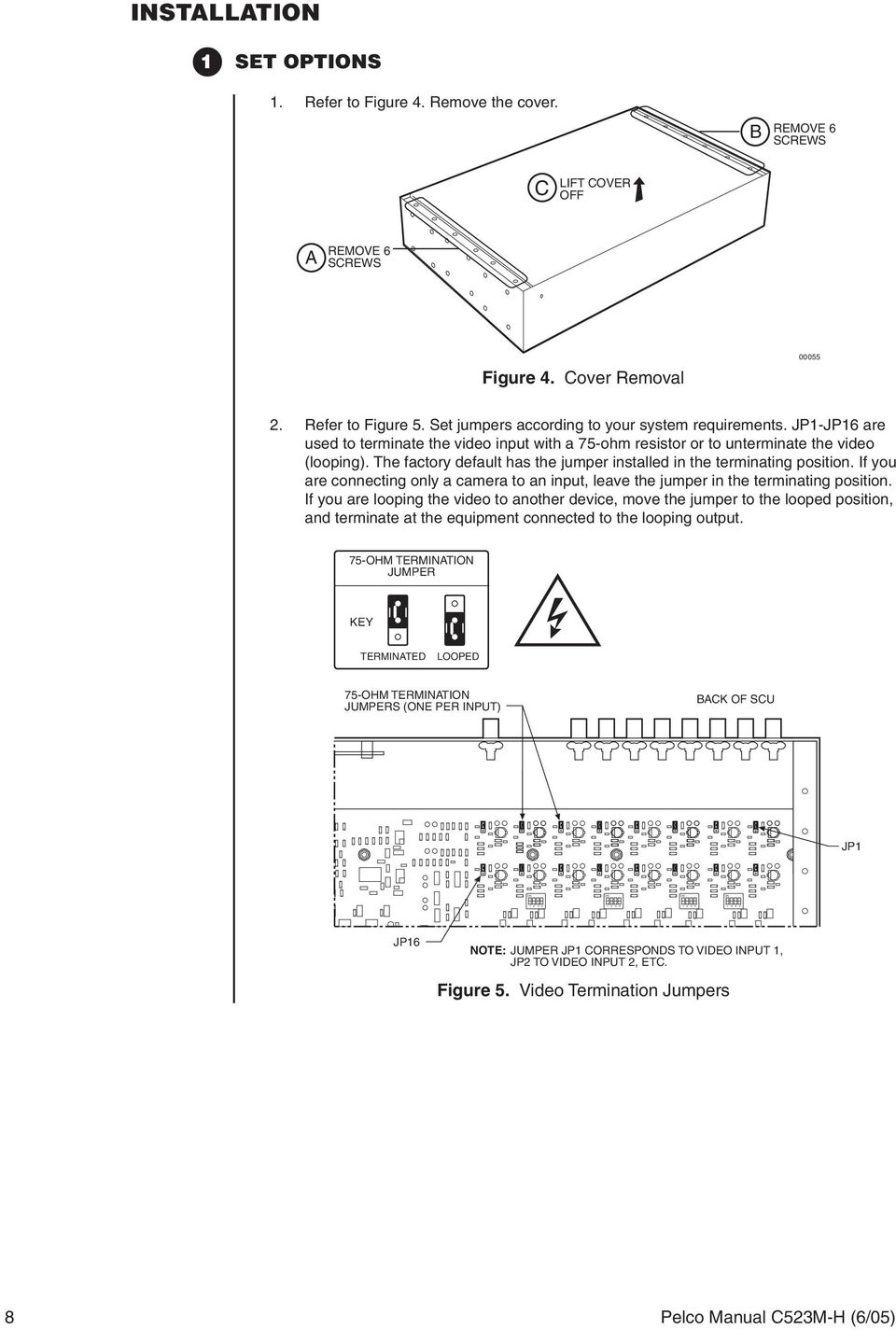
9 ON ON ON ON ON ON Refer to Figure 6. Set DIP switches. a. Communication port 2 is available for a PC or remote keyboard operating in ASCII mode. (Refer to ASCII Operating Commands.) Most PC applications require RS-232. A remote keyboard can require either RS-232 or RS-422, depending on the communications facility. To find out the required interface, check your PC serial port information or refer to your keyboard manual. Set DIP switch SW5 (COM 2) for RS-232 or RS-422, according to your system requirements. The SCU is configured at the factory for RS-422. b. DIP switches SW1, SW2, SW3 and SW4 are to remain in the factory default position (OFF). c. DIP switch SW6 (COM1) is to remain in factory default position (RS-422). SW6 DEFAULTS TO RS-422 3c POWER TERMINAL BLOCK FUSE HIGH VOLTAGE 3a SW5 & 6 DIP SWITCH SETTINGS RS-422/485 RS b KEY ON OFF TRANSFORMER Figure 6. DIP Switch Locations 4. Replace cover. 2 MOUNT UNIT 1. Select a suitable location for the SCU. It must be within 6 feet (1.8 m) of a suitable electrical outlet. Do not connect the power yet. 2. Refer to Figure 7. Position mounting ears on the sides of the SCU for the appropriate mounting. If the ears are not required, leave them off. POSITION BRACKETS FOR RACK MOUNTING (REAR) POSITION BRACKETS FOR UNDER-TABLE MOUNTING POSITION BRACKETS FOR FLUSH MOUNTING (WALL OR TABLE TOP) NOTE: EACH SCU COMES WITH 2 MOUNTING BRACKETS Figure 7. Installing Mounting Ears Pelco Manual C523M-H (6/05) 9
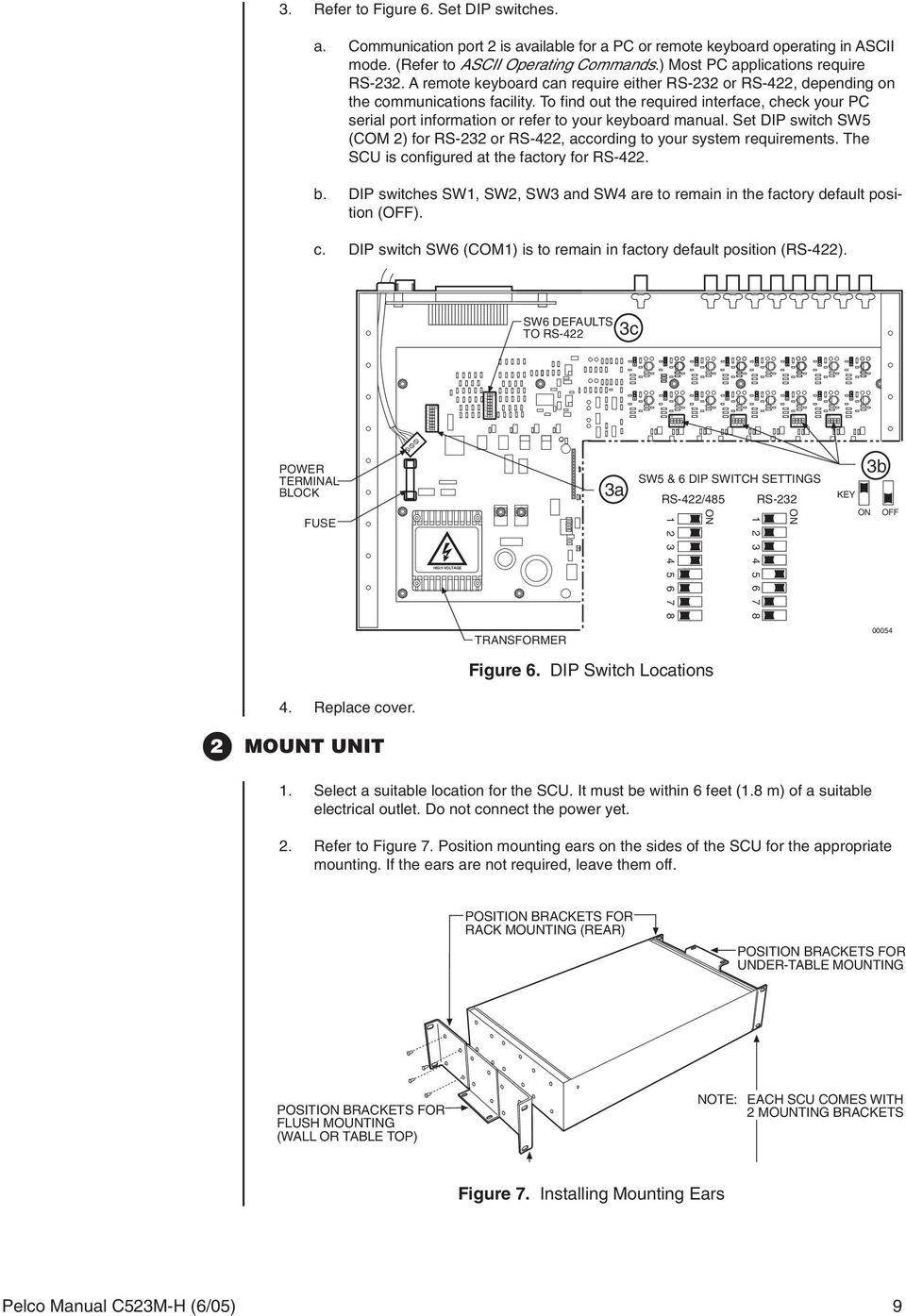
10 3. Refer to Figure 8. Use suitable hardware to mount the SCU an in equipment bay or against a flat surface, according to your installation requirements. MOUNT TO RACK OR SURFACE WITH 4 SCREWS Figure 8. Mounting the Matrix Switcher 3 CONNECT VIDEO SOURCES Refer to Figure 9. Connect video cables at the appropriate BNC receptacles on the back of the SCU. CAMERA 15 CAMERA 1 CM6700 SCU VIDEO INPUTS VIDEO OUTPUTS 1 ALARMS (1-9) LOCAL KEYBOARD ALARMS (10-18) REMOTE KEYBOARD(S) COM 1 (1-6) COM 2 ( 7-12) T T R R CONTROL OUTPUTS F 2 F 3 N O N C C O M LOOPING OUT Figure 9. Connecting Video Sources 10 Pelco Manual C523M-H (6/05)
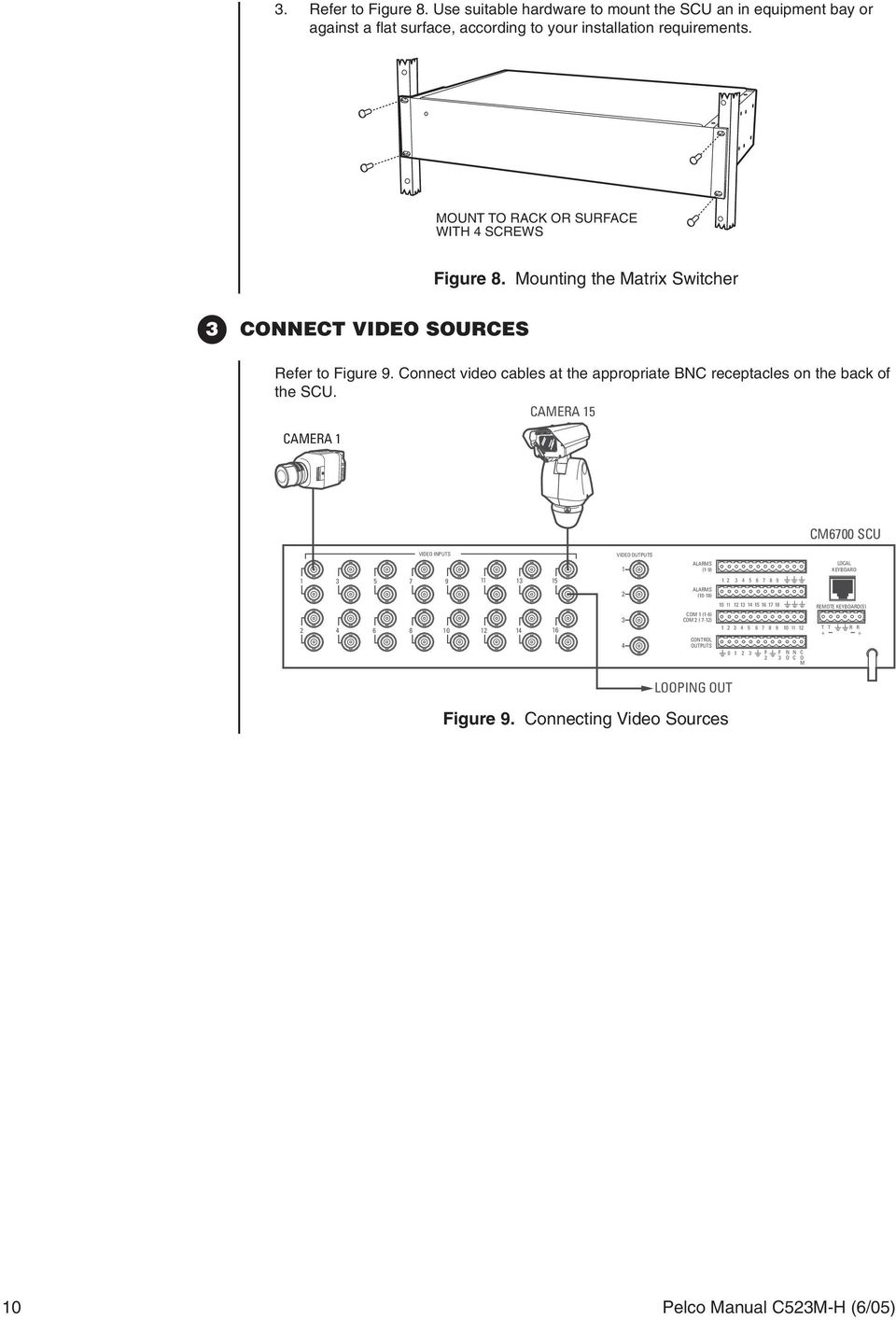
11 LOCAL KEYBOARD LOCAL KEYBOARD 4 CONNECT CONTROL LINES NOTE: If D or P protocol receivers are used, they must all be the same protocol. D and P protocol receivers cannot be mixed on the SCU s communication port. Coaxitron control may be used for some of your sources when either D or P protocol receivers are used. 1. Connect camera control lines to receivers. If your video sources are all controlled by Coaxitron, skip this section and go to step 5. If any of your video sources are using D or P protocol via RS-422 communications circuits, they will connect at COM 1 on the back of the SCU, as outlined below. 2. Refer to Figure 10. Connect control lines to COM 1 at the connector on the back of the SCU. COM 1 (1-6) COM 2 (7-12) 12-PIN PLUG-IN CONNECTOR VIDEO INPUTS VIDEO OUTPUTS NOTE: TO PROPERLY SHIELD DATA CABLE CONNECT GROUND ON ONE END ONLY CONNECT PINS 5 & 6 ONLY IF USING BI-DIRECTIONAL CONTROL COM 1 (1-6) RS-422 PIN ASSIGNMENTS PIN FUNCTION 1 T+ 2 T 3 (OPTIONAL) GND 4 NC 5 R 6 R+ TO RECEIVERS Figure 10. COM 1 Connections on the SCU Connect wiring to all receivers. NOTE: Unless you have receivers that are equipped for bi-directional control, you will only need to run two wires (TX+ and TX-) to each receiver. a. Daisy-chaining (going from one receiver to another) is recommended (refer to Figure 11) but not always possible. VIDEO INPUTS VIDEO OUTPUTS COM 1 (1-6) COM 2 (7-12) 12-PIN PLUG-IN CONNECTOR NOTE: TO PROPERLY SHIELD DATA CABLE CONNECT GROUND ON ONE END ONLY RECEIVER 2 RECEIVER 1 DAISY-CHAINING RX+ RX- RX+ RX- CONNECT PINS 5 & 6 ONLY FOR BI-DIRECTIONAL CONTROL TO SCU TO ADDITIONAL RECEIVERS Figure 11. Daisy-Chaining Receivers Pelco Manual C523M-H (6/05) 11

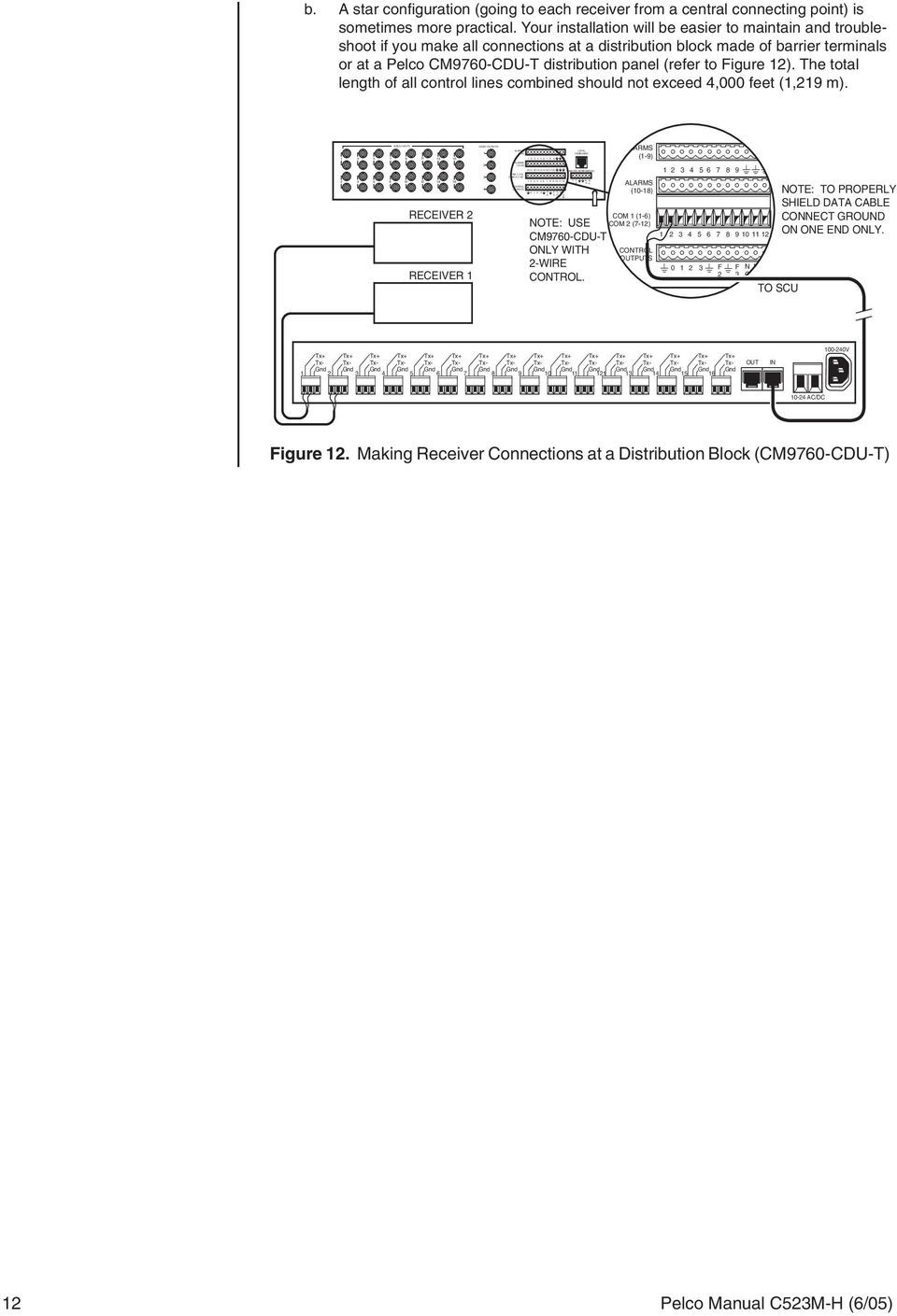
12 VIDEO INPUTS VIDEO OUTPUTS F 2 F N N C 3 O C O M REMOTE KEYBOARD(S) b. A star configuration (going to each receiver from a central connecting point) is sometimes more practical. Your installation will be easier to maintain and troubleshoot if you make all connections at a distribution block made of barrier terminals or at a Pelco CM9760-CDU-T distribution panel (refer to Figure 12). The total length of all control lines combined should not exceed 4,000 feet (1,219 m) RECEIVER 2 RECEIVER 1 ALARMS (1-9) ALARMS (10-18) COM 1 (1-6) COM 2 (7-12) CONTROL OUTPUTS LOCAL KEYBOARD T T R R + + NOTE: USE CM9760-CDU-T ONLY WITH 2-WIRE CONTROL. ALARMS (1-9) ALARMS (10-18) COM 1 (1-6) COM 2 (7-12) CONTROL OUTPUTS F 2 F 3 N O N C C O M LOCAL KEYBOARD NOTE: TO PROPERLY SHIELD DATA CABLE CONNECT GROUND ON ONE END ONLY. REMOTE KEYBOARD(S) TO SCU T T R R + + Tx+ Tx+ Tx+ Tx+ Tx+ Tx+ Tx+ Tx+ Tx+ Tx+ Tx+ Tx+ Tx+ Tx+ Tx+ Tx- Tx- Tx- Tx- Tx- Tx- Tx- Tx- Tx- Tx- Tx- Tx- Tx- Tx- Tx- Gnd Gnd Gnd Gnd Gnd Gnd Gnd Gnd Gnd Gnd Gnd Gnd Gnd Gnd Gnd Tx+ Tx- Gnd OUT IN V AC/DC Figure 12. Making Receiver Connections at a Distribution Block (CM9760-CDU-T) 12 Pelco Manual C523M-H (6/05)
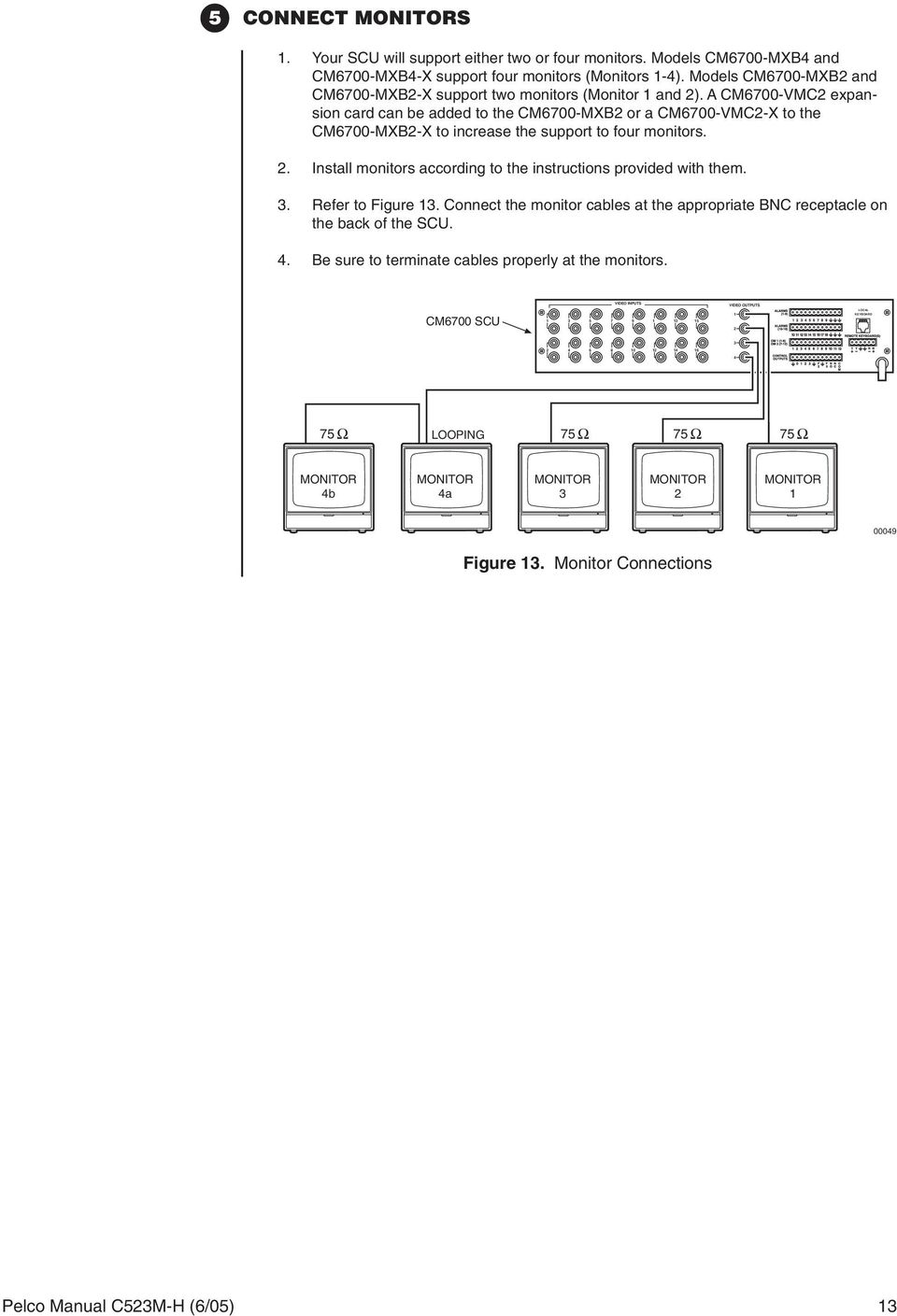
13 LOCAL KEYBOARD 5 CONNECT MONITORS 1. Your SCU will support either two or four monitors. Models CM6700-MXB4 and CM6700-MXB4-X support four monitors (Monitors 1-4). Models CM6700-MXB2 and CM6700-MXB2-X support two monitors (Monitor 1 and 2). A CM6700-VMC2 expansion card can be added to the CM6700-MXB2 or a CM6700-VMC2-X to the CM6700-MXB2-X to increase the support to four monitors. 2. Install monitors according to the instructions provided with them. 3. Refer to Figure 13. Connect the monitor cables at the appropriate BNC receptacle on the back of the SCU. 4. Be sure to terminate cables properly at the monitors. VIDEO INPUTS VIDEO OUTPUTS CM6700 SCU Ω LOOPING 75 Ω 75 Ω 75 Ω MONITOR 4b MONITOR 4a MONITOR 3 MONITOR 2 MONITOR Figure 13. Monitor Connections Pelco Manual C523M-H (6/05) 13
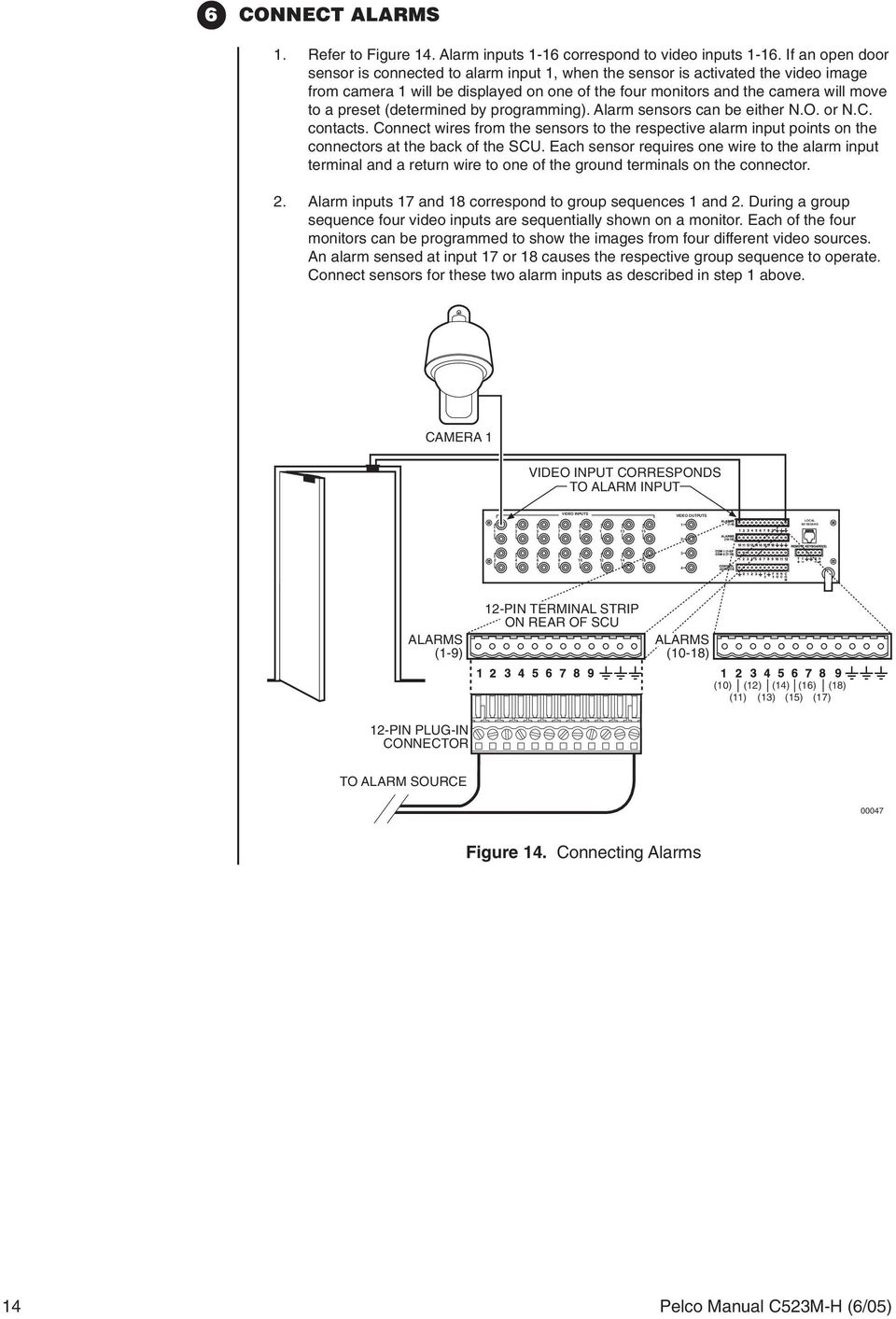
14 LOCAL KEYBOARD 6 CONNECT ALARMS 1. Refer to Figure 14. Alarm inputs 1-16 correspond to video inputs If an open door sensor is connected to alarm input 1, when the sensor is activated the video image from camera 1 will be displayed on one of the four monitors and the camera will move to a preset (determined by programming). Alarm sensors can be either N.O. or N.C. contacts. Connect wires from the sensors to the respective alarm input points on the connectors at the back of the SCU. Each sensor requires one wire to the alarm input terminal and a return wire to one of the ground terminals on the connector. 2. Alarm inputs 17 and 18 correspond to group sequences 1 and 2. During a group sequence four video inputs are sequentially shown on a monitor. Each of the four monitors can be programmed to show the images from four different video sources. An alarm sensed at input 17 or 18 causes the respective group sequence to operate. Connect sensors for these two alarm inputs as described in step 1 above. CAMERA 1 VIDEO INPUT CORRESPONDS TO ALARM INPUT VIDEO INPUTS VIDEO OUTPUTS ALARMS (1-9) 12-PIN TERMINAL STRIP ON REAR OF SCU ALARMS (10-18) (10) (12) (14) (16) (18) (11) (13) (15) (17) 12-PIN PLUG-IN CONNECTOR TO ALARM SOURCE Figure 14. Connecting Alarms 14 Pelco Manual C523M-H (6/05)
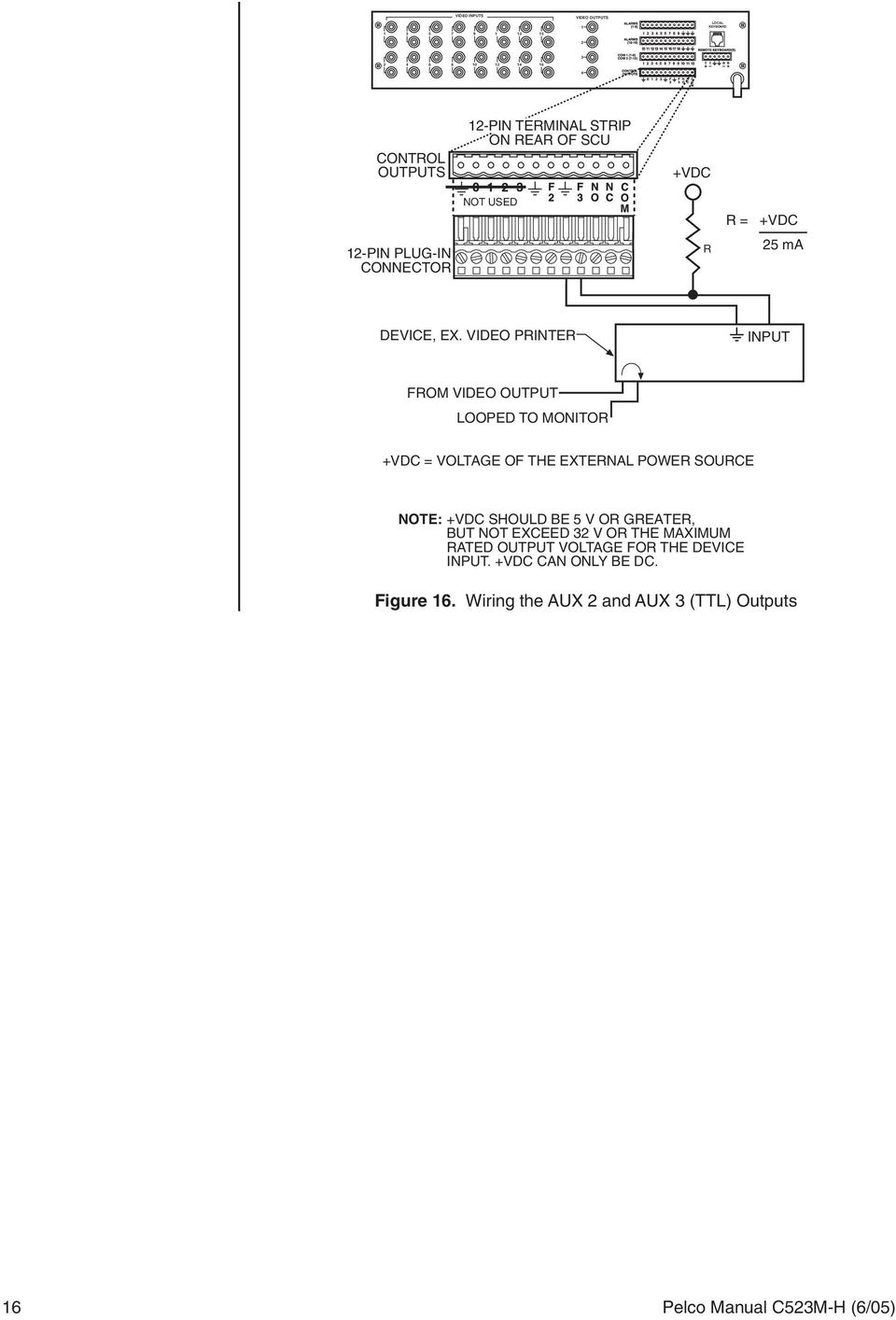
15 7 CONNECT AUXILIARIES The SCU provides three auxiliary (AUX) outputs for controlling VCRs and other devices. These outputs can be activated directly from a keyboard by using the F1, F2, and F3 function keys, or they can be activated by an alarm (determined by programming). Both relay contacts and TTL outputs are used. a. AUX 1 is a dry contact relay output. Refer to Figure 15 for wiring details. Terminal connections are provided for both normally open (N.O.) and normally closed (N.C.) contacts. Do not exceed the voltage and current ratings for the relay contacts. You will need to provide an external power source to operate your device. In most cases you will also need an external current limiting resistor. The formula for calculating the resistor value is given in Figure 15. b. AUX 2 and 3 are TTL open collector outputs. These outputs provide a path to ground to control the low voltage trigger inputs on many devices. They can control higher voltage control inputs via isolation relays. Refer to Figure 16 for wiring details. Do not exceed the voltage and current ratings for the TTL outputs. An external pull-up resistor is usually necessary. The formula for calculating the resistor value is given in Figure 16. VIDEO INPUTS VIDEO OUTPUTS 1 2 LOCAL KEYBOARD CONTROL OUTPUTS 12-PIN TERMINAL STRIP ON REAR OF SCU NOT USED F1 RELAY CONTACT RATINGS CURRENT VOLTAGE 1 A 30 VDC 0.3 A 11 VDC 0.5 A 125 VAC 12-PIN PLUG-IN CONNECTOR PIN 1 Io R EXTERNAL DEVICE Vo NOTE: Io MUST NOT EXCEED FI CURRENT RATING. +VPS MUST NOT EXCEED FI VOLTAGE RATING FOR THE ASSOCIATED FI CURRENT. VPS CAN BE AC OR DC. +VPS -VPS Io = OPERATING CURRENT OF THE EXTERNAL DEVICE. Vo = RATED OPERATING VOLTAGE OF THE EXTERNAL DEVICE. R = CURRENT LIMITING RESISTOR. +VPS = VOLTAGE OF THE EXTERNAL POWER SOURCE. -VPS = NEGATIVE, COMMON OR GROUND TERMINAL OF EXTERNAL POWER SOURCE. FORMULAS FOR R VALUES R (OHMS) = VPS - Vo Io P (WATTS) = (Io) 2 X R *WIRING FOR NORMALLY OPEN TYPE CONTACTS SHOWN. FOR NORMALLY CLOSED TYPE CONTACT, MOVE WIRE FROM THE NO TERMINAL TO THE NC TERMINAL Figure 15. Wiring the AUX 1 (Relay) Output Pelco Manual C523M-H (6/05) 15

16 LOCAL KEYBOARD VIDEO INPUTS VIDEO OUTPUTS CONTROL OUTPUTS 12-PIN TERMINAL STRIP ON REAR OF SCU +VDC NOT USED R = +VDC 12-PIN PLUG-IN CONNECTOR R 25 ma DEVICE, EX. VIDEO PRINTER INPUT FROM VIDEO OUTPUT LOOPED TO MONITOR +VDC = VOLTAGE OF THE EXTERNAL POWER SOURCE NOTE: +VDC SHOULD BE 5 V OR GREATER, BUT NOT EXCEED 32 V OR THE MAXIMUM RATED OUTPUT VOLTAGE FOR THE DEVICE INPUT. +VDC CAN ONLY BE DC. Figure 16. Wiring the AUX 2 and AUX 3 (TTL) Outputs 16 Pelco Manual C523M-H (6/05)
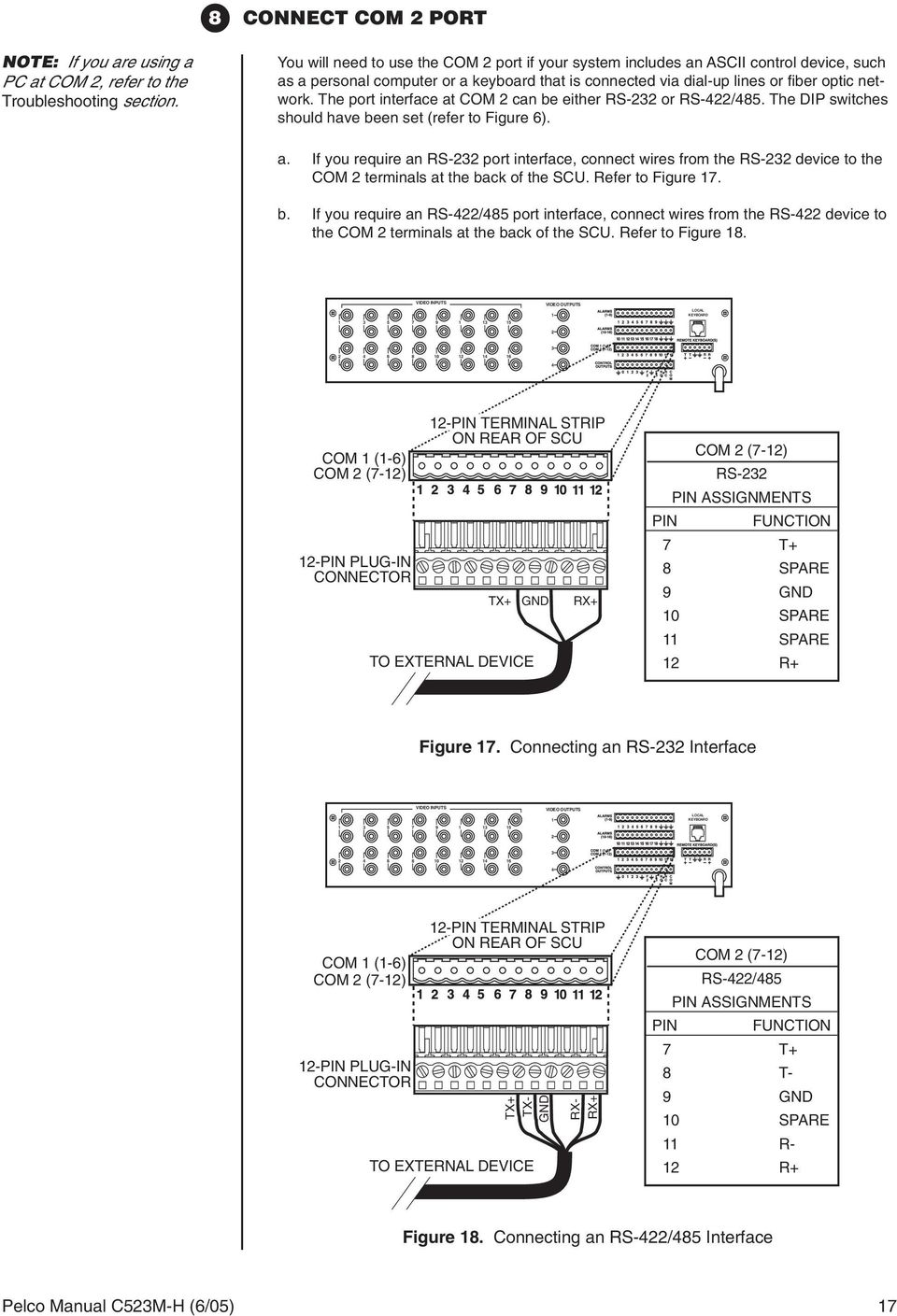
17 8 CONNECT COM 2 PORT NOTE: If you are using a PC at COM 2, refer to the Troubleshooting section. You will need to use the COM 2 port if your system includes an ASCII control device, such as a personal computer or a keyboard that is connected via dial-up lines or fiber optic network. The port interface at COM 2 can be either RS-232 or RS-422/485. The DIP switches should have been set (refer to Figure 6). a. If you require an RS-232 port interface, connect wires from the RS-232 device to the COM 2 terminals at the back of the SCU. Refer to Figure 17. b. If you require an RS-422/485 port interface, connect wires from the RS-422 device to the COM 2 terminals at the back of the SCU. Refer to Figure 18. VIDEO INPUTS VIDEO OUTPUTS 1 LOCAL KEYBOARD COM 1 (1-6) COM 2 (7-12) 12-PIN PLUG-IN CONNECTOR 12-PIN TERMINAL STRIP ON REAR OF SCU TO EXTERNAL DEVICE TX+ GND RX+ 10 COM 2 (7-12) RS-232 PIN ASSIGNMENTS PIN FUNCTION 7 T+ 8 SPARE 9 GND 10 SPARE 11 SPARE 12 R+ Figure 17. Connecting an RS-232 Interface VIDEO INPUTS VIDEO OUTPUTS 1 LOCAL KEYBOARD COM 1 (1-6) COM 2 (7-12) 12-PIN PLUG-IN CONNECTOR 12-PIN TERMINAL STRIP ON REAR OF SCU TX+ TX- GND TO EXTERNAL DEVICE RX- RX+ 10 COM 2 (7-12) RS-422/485 PIN ASSIGNMENTS PIN FUNCTION 7 T+ 8 T- 9 GND 10 SPARE 11 R- 12 R+ Figure 18. Connecting an RS-422/485 Interface Pelco Manual C523M-H (6/05) 17
18 9 CONNECT KEYBOARDS Pelco offers three keyboard models for use with the CM6700 matrix switcher. Complete installation instructions are provided with each keyboard. The most common connections are for local and remote keyboards. The procedures for installing local and remote keyboards are repeated here. Refer to the keyboard manual for the less common ASCII connection (KBD200A only). Do the following to install. Refer to Figure Local keyboard. Using the data cable that is supplied with the keyboard, plug one end into the RJ-45 connector on the rear of the keyboard and plug the other end into the LOCAL KEYBOARD port on the SCU. Set the keyboard DIP switch for the desired address for the local keyboard (refer to Table A). NOTE: A KBDKIT or KBDKIT-X is required to connect remote keyboards. The KBDKIT consists of two RJ-45 wall blocks and one 120 VAC to 12 VAC transformer. The KBDKIT-X is for 230 VAC. Use one wall block for each keyboard. If you are not installing any other keyboards, go to the Programming section. To install remote keyboards, complete steps Select a suitable location for each keyboard and wall block. Wall blocks must be within 6 feet (1.8 m) of a suitable electrical outlet. Do not mount the wall block yet. 3. Run wall block interconnect cable (user-supplied) from the SCU to the closest keyboard location, and then to the next nearest location, and the next, etc. Communication to the keyboards is RS-485. Maximum total cable distance for RS-485 communication over 24-gauge wire is 4,000 feet (1,219 m). Pelco recommends using shielded twisted pairs cable that meets or exceeds the basic requirements for EIA RS-485 applications. 4. Remove the wall block cover and make cable connections at each wall block. 5. At each wall block, wire the transformer to pins 3 and 4. Polarity is unimportant. 6. Replace the cover on the wall block. Secure the wall block to a suitable surface. A double-sided sticky pad is provided to mount the wall block. 7. Set the address switches for each keyboard according to Table A. CM6700 SCU LOCAL KEYBOARD KBD LOCAL KEYBOARD REMOTE KEYBOARD(S) 25-FOOT KEYBOARD DATA USER-SUPPLIED CABLE TO REMOTE KEYBOARDS WALL BLOCK TERMINALS 4 5 WALL BLOCK TERMINALS 4 5 GND TX- TX+ TO ADDITIONAL RX+ KEYBOARDS RX REMOTE KEYBOARD REMOTE KEYBOARD 12 VAC 25-FOOT KEYBOARD 12 VAC DATA CABLE 25-FOOT KEYBOARD DATA CABLE Figure 19. Installing Local and Remote Keyboards 18 Pelco Manual C523M-H (6/05)
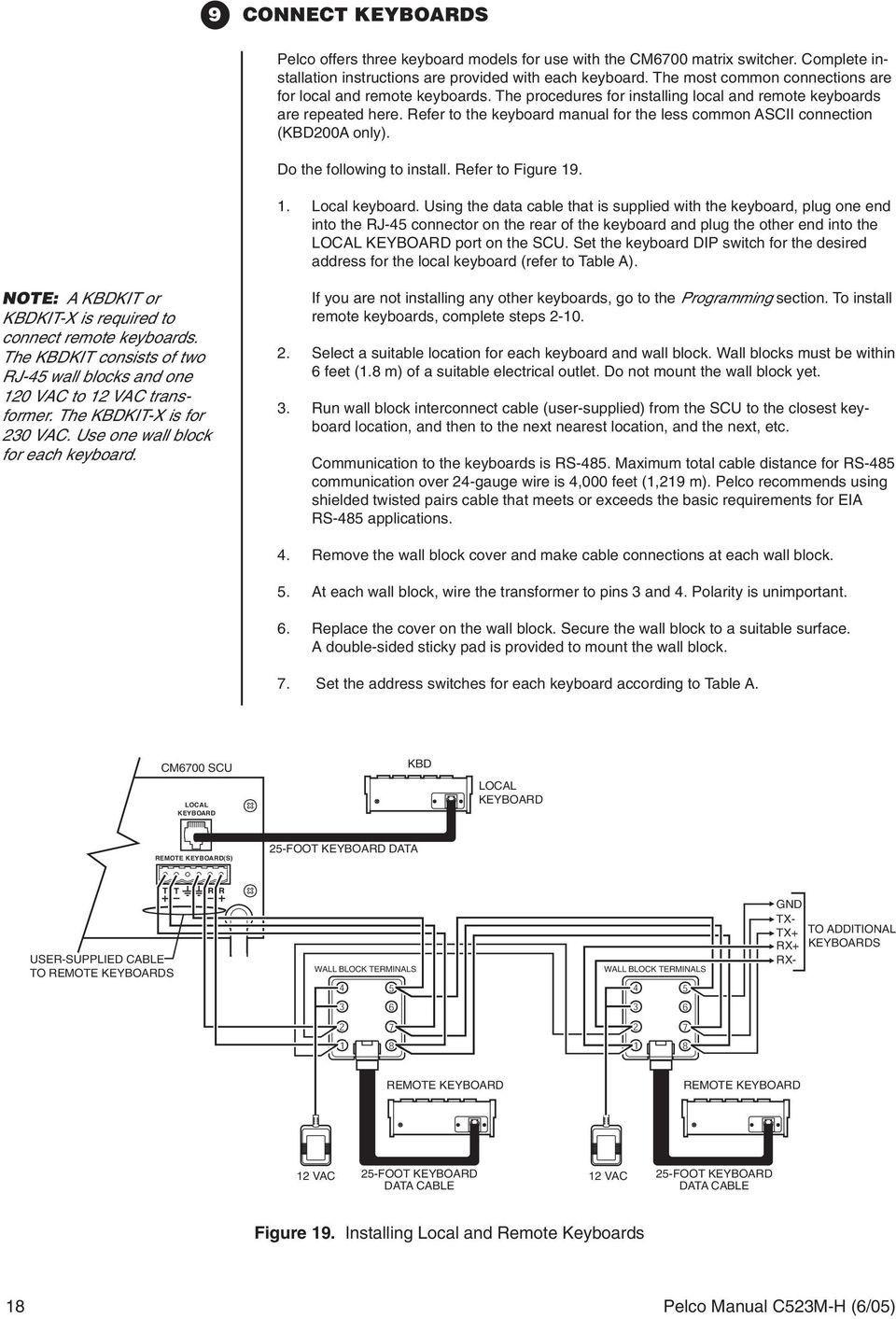
19 8. Plug in all keyboard data cables. 9. Plug the KBDKIT or KBDKIT-X transformers into a suitable outlet and apply power to the SCU. NOTE: You must re-initialize whenever power is cycled. 10. To initialize a keyboard, wait five seconds after power-up, enter the number for the monitor you are viewing (1-4) and press MON. Table A. Keyboard Addresses NOTE: Switch positions 5 through 8 appear on the KBD200A and KBD300A. Set 5, 7, and 8 OFF. Switch 6 enables (ON) or disables (OFF) turbo pan. NOTE: You can also use older KBD200 and KBD300 models with the CM6700. Keyboard Address Switch Settings OFF OFF OFF OFF 2 1 ON OFF OFF OFF 3 2 OFF ON OFF OFF 4 3 ON ON OFF OFF 5 4 OFF OFF ON OFF 6 5 ON OFF ON OFF 7 6 OFF ON ON OFF 8 7 ON ON ON OFF 9 8 OFF OFF OFF ON 10 9 ON OFF OFF ON OFF ON OFF ON ON ON OFF ON OFF OFF ON ON ON OFF ON ON OFF ON ON ON ON ON ON ON Pelco Manual C523M-H (6/05) 19
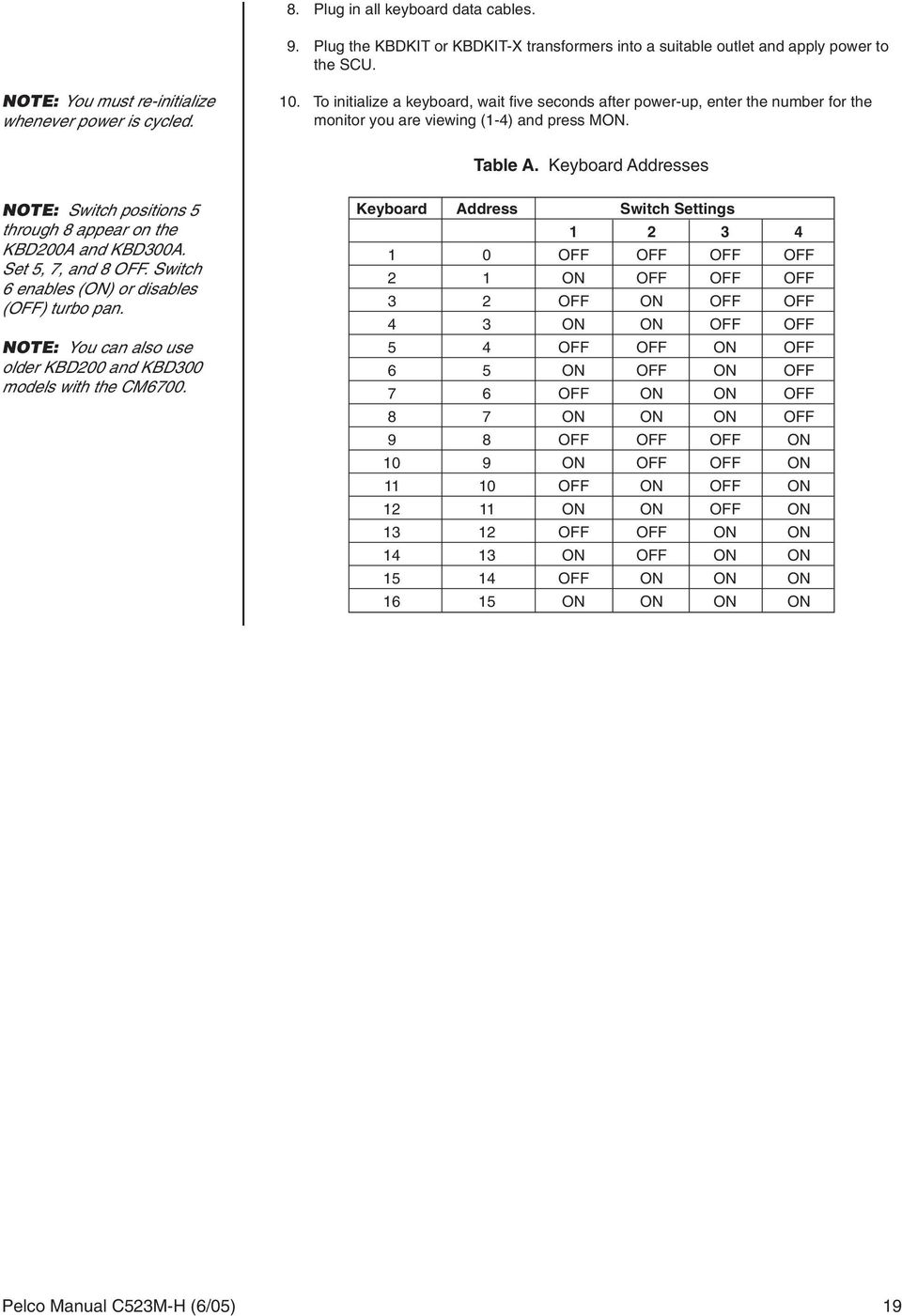
20 PROGRAMMING Programming allows you to assign titles for cameras, establish monitor group sequences, enable/disable alarms, establish access restrictions, set alarm options, set time and date, change password, and set auxiliary options. Refer to Figure 20. You program the CM6700 with the keyboard and a monitor. During programming, a menu appears on the monitor screen. Use the sequence and macro keys (KBD100), pan/tilt positioning keys (KBD200A), or the joystick (KBD300A) on your keyboard to navigate the menu. The F1 and F2 keys select (toggle) options and scroll through lists. Use the numerical keypad to enter numerical values. Programming the CM6700 SCU is described in Table B. Table B is arranged in the general order in which you should program your SCU, but also allows you to go into the programming mode at any time to change a particular item. If you do not wish to perform a step (for example, change password), just go to the next step. If you are familiar with programming the SCU, you can use Figure 20 by itself to quickly locate any program item. Permission is granted to copy Figure 20 if you wish to post it in a convenient location for quick reference. Table B. Programming the CM6700 Switching Control Unit Step 1 Function Action Result Enter Main Menu a. Press the PGM key. The Password screen appears. ENTER YOUR PASSWORD (Default is ) LANGUAGE: ENGLISH Select English. b. Make sure the language selection is English. c. Use the number keypad to enter the password default is (Pelco s toll-free phone number). Asterisks (*) appear on screen for each number you type. d. Press ACK. e. Go to another step or press 9 to exit. The Main Menu appears. MAIN MENU 1. CAMERAS 2. MONITORS 3. TIME/DATE 4. ALARMS 5. PORTS 6. AUXILIARIES 7. PASSWORD 8. ACCESS 9. EXIT (Continued on page 22) 20 Pelco Manual C523M-H (6/05)
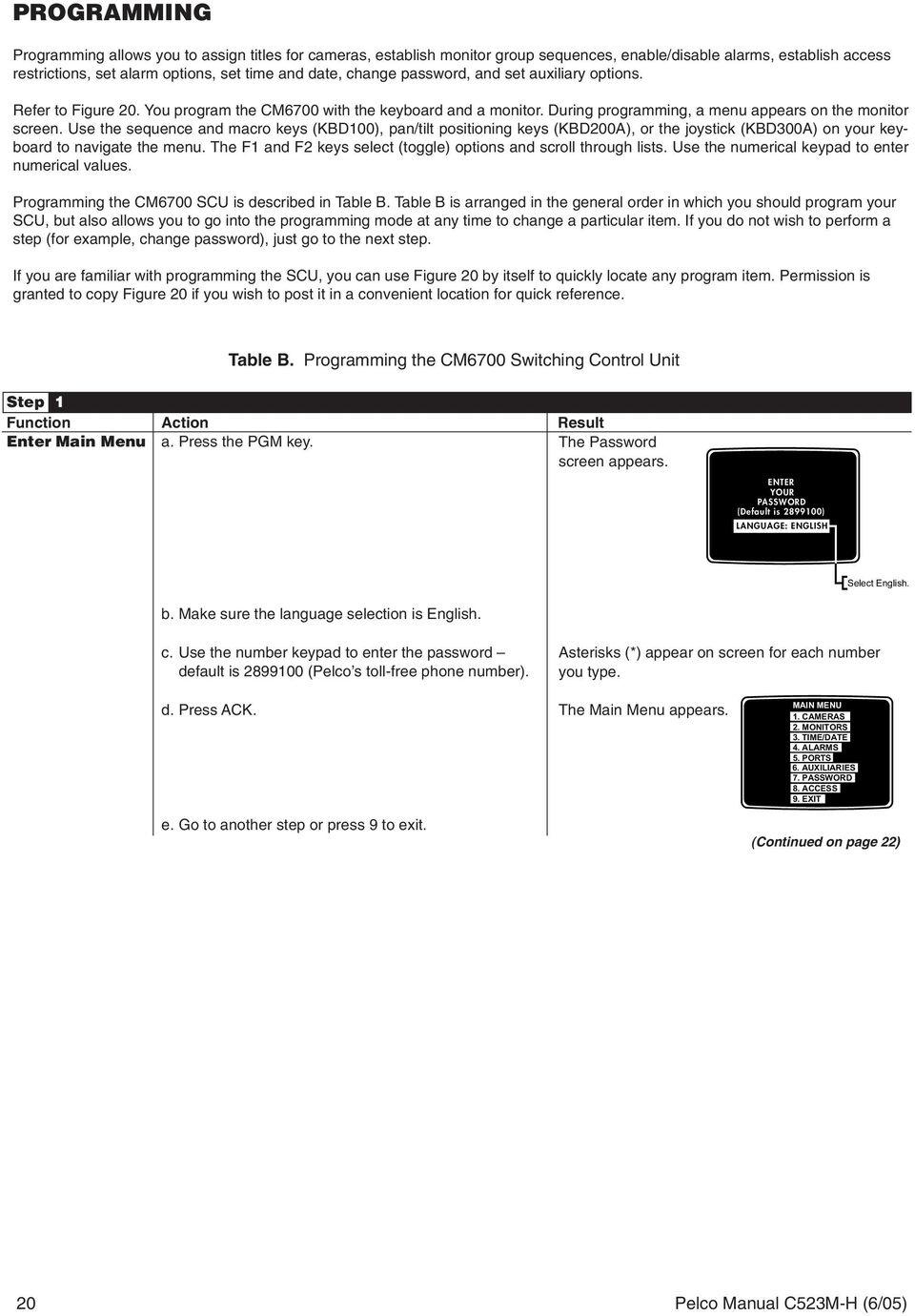
21 START CAMERA XX CAMERA TITLE CAM O1 RX TYPE: 422P Enter Camera #. Enter Camera Title (1-20 characters). Select Receiver Type (Std. Coaxitron, Ext. Coaxitron, 422D, or 422P). Keypad or Pan L/R MONITOR XX SEQUENCE MENU ENTRY 1-8 ENTRY 9-16 CAM DWL PRE CAM DWL PRE Enter Monitor #. Set Dwell time (1-99 sec) and Preset number for each camera in the 16-step sequence. Keypad Keypad NOTES: 1. Use your keyboard to perform all programming functions. 2. Flashing character shows your position in a field. 3. On the KBD100 and KBD200A use the keys to move around the screen. On the KBD300A use the joystick. PRESS PGM ENTER YOUR PASSWORD (Default is ) LANGUAGE: ENGLISH PRESS ACK MAIN MENU 1. CAMERAS 2. MONITORS 3. TIME/DATE 4. ALARMS 5. PORTS 6. AUXILIARIES 7. PASSWORD 8. ACCESS 9. EXIT TO NORMAL DISPLAY Select English. MONITOR XX ALARM TYPE: AUTO ALARM DWELL: 05 DISPLAY: * 1. CAMERA SEQUENCE 2. ALARM ENABLE 3. POSITION DISPLAY SET TIME/DATE DATE: TIME: 11:27:00 PM DISPLAY AS: STYLE: DD-MM-YY TYPE: 12 HOUR SET CLOCK SET ALARM INPUT 1. INPUT INPUT 17 AND 18 PORTS 1. COM PORT 1 2. COM PORT 2 SET AUXILIARY MENU AUX SOURCE MODE F1 ALM KEY F2 KBD -- F3 KBD LAT SET PASSWORD OLD PASSWORD ******* NEW PASSWORD ******* VERIFICATION ******* Enter Monitor # (1-4). Select Alarm Type (Off, Auto, Manual). Set Alarm Dwell (0-99 sec). Turn display On/Off. Keypad Keypad Enter Date (Note Style). Keypad Enter Time (Note Type). Keypad Select Style (MMM-DD-YY, DD-MM-YY, MM-DD-YY, DD-MMM-YY). Select Type (12 hour, 24 hour). Press PGM to cancel changes. Select Set Clock to accept changes. Enter Old Password. Enter New Password. Enter New Password again. or Pan L/R PG Pan right For each F# select auxiliary activation Source (Alarms defined for Monitor 1 or Keyboard). Select auxiliary output Mode (Off, Momentary, Latching, or Keyed). Keypad Keypad Keypad MONITOR XX ALARM ENABLE ALM SET ALM SET ALM SET DISPLAY SHOWING POSITION OF TEXT SET ALARM INPUT XX ALM ENABLE TYPE PRESET 1 -- NO NO NO NO NO NO NO NO 00 ALARM INPUT XX MACRO X ENABLE: -- TYPE: NO MON CAM1 CAM2 CAM3 CAM MACRO PRESET MENU COM 1 SET PORT PROTOCOL 422D BAUD RATE 2400 COM 2 SET PORT BAUD RATE 9600 PARITY Even STOP BITS 2 KBD TO MONITOR ACCESS KBD MONITOR PRESET ENABLE 1 Y Y Y Y Y 2 Y Y Y Y Y 3 Y Y Y Y Y 4 Y Y Y Y Y 5 Y Y Y Y Y 6 Y Y Y Y Y 7 Y Y Y Y Y 8 Y Y Y Y Y Enter Monitor #. Turn each alarm on/off (*/--). Move text around on the screen to place it in the desired location. Press ACK when done. Select 1-8 or Turn Alarm on/off (*/--). Select alarm source Type (NO, NC). Enter Preset to go to when alarm occurs. Select 17 or 18. Turn alarm on/off (*/--). Select alarm source Type (NO, NC). Assign 4 inputs for each monitor to sequence. Select Protocol (422D, 422P). Select Baud (1200, 2400, 4800, 9600). Select Baud (1200, 2400, 4800, 9600). Set Parity (None, Even, Odd). Set Stop Bits (1, 2). Enable/disable each keyboard's ability to control the monitors (Y/N). Enable/disable each keyboard's ability to program a preset (Y/N). Keypad Pan/Tilt ACK Keypad Keypad Pan L/R Pan L/R Pan L/R Pan L/R Pan L/R KBD100 KBD200A KBD300A PAN/TILT LEFT RIGHT UP DOWN PREV NEXT MACRO HOLD 4. To move right on this chart, move to the menu item and pan right or press the key for the number of the item. 5. To move left on this chart, move to and pan right. 6. To return to camera view from the Main Menu, press PGM. To return to camera view from any other screen press PGM twice. MACRO X PRESETS MON CAM1 CAM2 CAM3 CAM4 PRE PRE PRE PRE Assign Preset for each input in sequence. CM6700 PROGRAMMING QUICK REFERENCE CHART Keypad ACCESS 1. KEYBOARD TO MONITOR 2. MON TO CAMERA MON TO CAMERA MON TO CAMERA ACCESS MON CAMERA Y Y Y Y Y Y Y Y Y Y 2 Y Y Y Y Y Y Y Y Y Y 3 Y Y Y Y Y Y Y Y Y Y 4 Y Y Y Y Y Y Y Y Y Y Enable/disable each monitor's ability to display the image from each camera (Y/N). Figure 21. Quick Reference Chart Pelco Manual C523M-H (6/05) 21
22 Table B. Programming the CM6700 Switching Control Unit (Continued) Step 2 Function Action Result Change a. Enter the Main Menu. The Main Menu appears. Password NOTE: If you change the b. Press 7. password and then forget the new one, you will have to c. Type the existing password and press ACK. reset the system to the factory defaults. All system d. Type the new password and press ACK. programming will be lost. See the Troubleshooting section for the system reset procedure. e. Type the new password again and press ACK. The Set Password screen appears. The first asterisk (*) in the OLD PASSWORD field flashes. The first asterisk (*) in the NEW PASSWORD field flashes. If you make a mistake, you are prompted to try again. The first asterisk (*) in the VERIFICATION field flashes. The screen says NEW PASSWORD ACCEPTED. If you make a mistake, you will be notified that the new password does not match the verification password. After the new password is accepted, the Main Menu appears. f. Go to another step or press 9 to exit. SET PASSWORD OLD PASSWORD ******* NEW PASSWORD ******* VERIFICATION ******* Enter Old Password. Enter New Password. Enter New Password again. Keypad Keypad Keypad 22 Pelco Manual C523M-H (6/05)
23 Table B. Programming the CM6700 Switching Control Unit (Continued) Step 3 Function Action Result Program Cameras a. Enter the Main Menu. The Main Menu appears. Assign Camera b. Press 1. Titles: Up to 20 alpha or numeric characters can be assigned to help c. Enter the desired camera number (01-16) or pan left/right to show the desired camera number. identify on-screen video. This will d. Move down to highlight the CAMERA TITLE (CAM NN) field (the line below CAMERA TITLE). appear with camera number, time and date on the monitor. Select Receiver Protocol: Type of receiver communication you will use to control a camera s pan and tilt and lens (if applicable). Choose from Standard Coaxitron, Extended Coaxitron, Pelco D protocol or Pelco P protocol. NOTE: P and D protocols cannot be mixed in the same system. e. Use the F1 and F2 keys to scroll through the available characters. There are 26 upper case letters, 26 lower case letters and the numbers 0-9. f. When you find the character you want for the first position, pan right to the next position. g. Use F1 and F2 to find the second character. h. Pan right. i. Continue selecting characters until the title field is completed (up to 20 characters). j. To change any position s entry, pan left until the character flashes and use F1 and F2 to change it. k. When finished, move down to the RX TYPE field. The Camera NN screen appears. NN is the camera number. The camera number flashes. The selected number appears on screen. The first position in the CAMERA TITLE field flashes. The first position shows the character you are on. The second position in the CAMERA TITLE field flashes. The second position shows the character. The third position in the CAMERA TITLE field flashes. The CAMERA TITLE field shows the entire title. The new character flashes. The current protocol setting for the selected camera flashes. l. Use F1 and F2 to find the desired protocol. The selected protocol appears. m. To program another camera, go to step n. When you have finished programming cameras, go to step o. n. Move up to the CAMERA NN field and go back to step c to program another camera. When you have finished programming cameras, go to step o. o. Move down to and pan right to go back to the Main Menu. The Main Menu appears. p. Go to another step or press 9 to exit. CAMERA XX CAMERA TITLE CAM O1 RX TYPE: 422P Enter Camera #. Enter Camera Title (1-20 characters). Select Receiver Type (Std. Coaxitron, Ext. Coaxitron, 422D, or 422P). Keypad or Pan L/R Pelco Manual C523M-H (6/05) 23
24 Table B. Programming the CM6700 Switching Control Unit (Continued) Step 4 Function Action Result Program a. Enter the Main Menu. The Main Menu appears. Monitors Alarm Type: Manual must press ACK to reset. Auto alarm resets 10 seconds after alarm normalizes. Off no alarms shown. Alarm Dwell: 1 to 99 seconds time between display of multiple alarm screens. Character Display: On or off. Program Camera Sequences: Each monitor can have one 16-step sequence. Set dwell time and preset number for each camera. b. Press 2. c. Enter the desired monitor number (01-04) or pan left/ right to show the desired monitor number. d. Move down to highlight the ALARM TYPE: field. e. Use the F1 and F2 keys to find the desired alarm type. f. Move down to highlight the ALARM DWELL field. g. Use the keypad to enter the desired dwell time (1 to 99 seconds). h. Move down to highlight the DISPLAY field. i. Use F1 and F2 to toggle the character display on or off. j. Move down to the 1. CAMERA SEQUENCE field. k. Pan right. l. Use the position keys or joystick to move around the menu. Set Camera Number (1-16), Dwell Time (1-99 sec.) and Preset number for each camera in the sequence. Enter zeroes to skip a camera. The Monitor NN screen appears. NN is the monitor number. The monitor number flashes. The selected number appears on screen. The current alarm type for the selected monitor appears on screen. The selected alarm type appears. The current alarm dwell for the selected monitor appears on screen. The entered dwell time appears. The current status of character display appears. Asterisk (*) = on, dashes (--) = off. The 1. In the 1. CAMERA SEQUENCE field flashes. The Monitor NN Sequence Menu appears. The entered values appear. m. Move down to. n. Pan right. The R in flashes. The Monitor NN screen appears. (Continued on next page) MONITOR XX SEQUENCE MENU ENTRY 1-8 ENTRY 9-16 CAM DWL PRE CAM DWL PRE Enter Monitor #. Keypad Set Dwell time (1-99 sec) Keypad and Preset number for each camera in the 16-step sequence. MONITOR XX ALARM TYPE: AUTO ALARM DWELL: 05 DISPLAY: * 1. CAMERA SEQUENCE 2. ALARM ENABLE 3. POSITION DISPLAY MONITOR XX ALARM ENABLE ALM SET ALM SET ALM SET Enter Monitor # (1-4). Keypad Select Alarm Type (Off, Auto, Manual) Set Alarm Dwell (0-99 sec). Turn display On/Off. Keypad DISPLAY SHOWING POSITION OF TEXT Enter Monitor #. Turn each alarm on/off (*/--). Move text around on the screen to place it in the desired location. Press ACK when done. Keypad Pan/Tilt ACK 24 Pelco Manual C523M-H (6/05)
25 Table B. Programming the CM6700 Switching Control Unit (Continued) Step 4 (Continued) Function Action Result o. Move down to the 2. ALARM ENABLE field. The 2. in the 2. ALARM ENABLE field flashes. p. Pan right. q. Turn each alarm on or off. r. Move down to. s. Pan right. t. Move down to the 3. POSITION DISPLAY field. u. Pan right. v. Use the position keys or joystick to move the text to the desired position on the screen. w. Press the ACK button. The Monitor NN Alarm Enable screen appears. Asterisk (*) = on, dashes (--) = off. The R in flashes. The Monitor NN screen appears. The 3. in the 3. POSITION DISPLAY field flashes. The real-time camera display appears with superimposed text. The text moves one line or character position at a time. The Monitor NN screen appears. x. To program another monitor, go to step c. When you have finished programming monitors, go to step y. y. Move down to and pan right to go back to the Main Menu. The Main Menu appears. z. Go to another step or press 9 to exit. Pelco Manual C523M-H (6/05) 25
26 Table B. Programming the CM6700 Switching Control Unit (Continued) Step 5 Function Action Result Program a. Enter the Main Menu. The Main Menu appears. Time and Date Time and date is kept current in battery-backed RAM. Corrections can be made when necessary. The time and date displayed is the time in memory when the TIME/DATE field is selected. The new time will be set when you select the SET CLOCK field and pan right. NOTE: To abort time and date programming without changing the settings already in memory, press PGM. b. Press 3. The Set Time/Date screen appears. The MONTH Take note of the contents of the STYLE and TYPE field flashes. fields for the following procedure. The Style must be MMM-DD-YY and the Type must be 12 hour. If they are not, move down to the field and use the F1 and F2 keys to change them, then move back up to the first field. c. Use F1 and F2 to find the desired month. d. Pan right. e. Use the keypad to select the desired day. f. Pan right. g. Use the keypad to select the desired year. h. To change any position s entry, pan left until the character flashes and use the keypad or F1 and F2 to change it. i. Pan right and move down to TIME field. j. Use the keypad to select the desired hour. The selected month appears. The DAY field flashes. The selected day appears. The YEAR field flashes. The selected year appears. The HOUR field flashes. The selected hour appears. k. Pan right. l. Use the keypad to select the desired minute. m. Pan right. n. Use the keypad to select the desired second. o. Pan right. p. Use F1 and F2 to select the correct designator. q. Move down to the STYLE field. The MINUTE field flashes. The selected minute appears. The SECOND field flashes. The selected second appears. The AM/PM designator field flashes. The selected designator flashes. The STYLE field flashes. (Continued on next page) SET TIME/DATE DATE: TIME: 11:27:00 PM DISPLAY AS: STYLE: DD-MM-YY TYPE: 12 HOUR SET CLOCK Enter Date (Note Style). Keypad Enter Time (Note Type). Keypad Select Style (MMM-DD-YY, DD-MM-YY, MM-DD-YY, DD-MMM-YY). Select Type (12 hour, 24 hour). Press PGM to cancel changes. Select Set Clock to accept changes. or Pan L/R PG Pan right 26 Pelco Manual C523M-H (6/05)
27 Table B. Programming the CM6700 Switching Control Unit (Continued) Step 5 (Continued) Function Action Result r. Use F1 and F2 to select the desired style (DD-MM-YY, MM-DD-YY, DD-MMM-YY and MMM-DD-YY). The selected style flashes. s. Move down to the TYPE field. t. Use F1 and F2 to select the desired type (12 HOUR or 24 HOUR). u. Move down to the SET CLOCK field. v. Check all your entries. If any fields are incorrect, move to them, enter the corrections, and move back to the SET CLOCK field. w. When you are ready to set the time, mark time and pan right when the new time in the TIME field arrives. The TYPE field flashes. The selected type flashes. The SET CLOCK field flashes. The SET CLOCK field flashes. The clock begins running from the new time. The Main Menu appears. x. Go to another step or press 9 to exit. Pelco Manual C523M-H (6/05) 27
28 Table B. Programming the CM6700 Switching Control Unit (Continued) Step 6 Function Action Result Program a. Enter the Main Menu. The Main Menu appears. Alarms 1-16 b. Press 4. The Set Alarm Input screen appears. Alarms are programmed in two groups. The Group 1 (INPUT 1-16) number flashes. c. Pan right. d. Move down to the ALM ENABLE 1 field. e. Use the F1 and F2 keys to toggle the Alarm Enable field (* = ON, -- = OFF). If you selected OFF go to step k; otherwise, go to the next step. f. Pan right. g. Use the F1 and F2 keys to toggle the Alarm TYPE field (NO = normally open contacts, NC = normally closed contacts). h. Pan right. i. Use the keypad to select the desired preset (that the camera will assume when an alarm occurs) for this alarm number. j. Pan right. The Set Alarm Input 1-8 screen appears. 1-8 flashes. The entry in the ENABLE field flashes. The selected value flashes. The entry in the TYPE field flashes. The selected value flashes. The entry in the PRESET field flashes. The selected value flashes. The Alarm 1 ENABLE field flashes. k. To program another alarm, go to step l. When you have finished programming the alarms in this group, go to step m. l. Move down to the next ALM ENABLE field. Repeat steps e through k for the next alarm. The entry in the ENABLE field flashes. m. To program group 2 (INPUT 9-16), go to step n. When you have finished programming the alarms in group 2, go to step r. n. Move up to the Set Alarm Input 1-8 screen. (Continued on next page) The Set Alarm Input 1-8 screen appears. 1-8 flashes. Select 1-8 or SET ALARM INPUT 1. INPUT INPUT 17 AND 18 SET ALARM INPUT XX ALM ENABLE TYPE PRESET 1 -- NO NO NO NO NO NO NO NO 00 Turn Alarm on/off (*/--). Select alarm source Type (NO, NC). Enter Preset to go to Keypad when alarm occurs. 28 Pelco Manual C523M-H (6/05)
29 Table B. Programming the CM6700 Switching Control Unit (Continued) Step 6 (Continued) Function Action Result o. Pan right. The Set Alarm Input 9-16 screen appears flashes. The screen changes to show alarms p. Move down to the ALM ENABLE 9 field. The entry in the ENABLE field flashes. q. Repeat steps e through l for alarms 9 through 16. Then go to step r. r. Move down to. s. Pan right. The R in flashes. The Set Alarm Input screen appears. t. To program the macros (inputs 17 and 18), go to step 7c. u. Move down to and pan right to go back to the Main Menu. The Main Menu appears. v. Go to another step or press 9 to exit. Pelco Manual C523M-H (6/05) 29
30 Table B. Programming the CM6700 Switching Control Unit (Continued) Step 7 Function Action Result Program a. Enter the Main Menu. The Main Menu appears. Alarms 17 & 18 b. Press 4. The Set Alarm Input screen appears. Alarms are programmed in two groups. The Group 1 (INPUT 1-16) number flashes. c. Press 2. d. Move down to the ENABLE field. e. Use the F1 and F2 keys to toggle the Alarm Enable field (* = ON, -- = OFF). If you selected OFF go to step q. Otherwise go to the next step. f. Pan right. g. Use the F1 and F2 keys to toggle the Alarm TYPE field (NO = normally open contacts, NC = normally closed contacts). h. Move down to the MON1/CAM1 field in the Macro matrix. i. The entry indicates which camera will be displayed first on monitor number 1 when the Macro alarm is activated. Use the keypad to enter the desired camera number. j. Use the pan and tilt to move through the matrix and assign the cameras to the sequence for each monitor. If a monitor is not to be included in the sequence, enter all zeros. k. When you have completed all entries, move down to MACRO PRESET MENU. l. Pan right. m. The entry indicates which preset will be assumed by the MON1/CAM1 camera when the Macro alarm is activated. Use the keypad to enter the desired preset number. The Set Alarm Input 17 screen appears. The number 17 flashes. The entry in the ENABLE field flashes. The selected value flashes. The entry in the TYPE field flashes. The selected value flashes. The entry in the MON1/CAM1 field flashes. The entered value flashes. The selected value flashes. Each selected value flashes. The M in MACRO PRESET MENU flashes. The Macro 1 (or 2) Presets screen appears. The entry in the MON1/CAM1 field flashes. The entered value flashes. (Continued on next page) SET ALARM INPUT 1. INPUT INPUT 17 AND 18 ALARM INPUT XX MACRO X ENABLE: -- TYPE: NO MON CAM1 CAM2 CAM3 CAM MACRO PRESET MENU Select 17 or 18. Turn alarm on/off (*/--). Select alarm source Type (NO, NC). Assign 4 inputs for each monitor to sequence. Keypad MACRO X PRESETS MON CAM1 CAM2 CAM3 CAM4 PRE PRE PRE PRE Assign Preset Keypad for each input in sequence. 30 Pelco Manual C523M-H (6/05)
31 Table B. Programming the CM6700 Switching Control Unit (Continued) Step 7 (Continued) Function Action Result n. Use the sequence and macro keys (KBD100) or pan and tilt to move through the matrix and use the keypad to assign the presets for each MON/CAM entry. Each entered value flashes. o. When you have completed all entries, move down to. p. Pan right. q. To program Alarm Input 18, Macro 2, go to step r. To exit go to step t. r. Pan right. s. Repeat steps d through q for Alarm Input 18, Macro 2. t. Move down to the field at the bottom of the screen. u. Pan right. v. Move down to the field at the bottom of the screen. w. Pan right. The R in flashes. The Alarm Input 17 (or 18) Macro 1 (or 2) screen appears. The number 17 (or 18) flashes. The Alarm Input 18 Macro 2 screen appears. The number 18 flashes. The R in flashes. The Set Alarm Input screen appears. The R in flashes. The Main Menu appears. x. Go to another step or press 9 to exit. Pelco Manual C523M-H (6/05) 31
32 Table B. Programming the CM6700 Switching Control Unit (Continued) Step 8 Function Action Result Program a. Enter the Main Menu. The Main Menu appears. Com Ports b. Press 5. The Ports screen appears. Port number 1 flashes. c. To configure port 1, go to step d. To skip port 1 and configure port 2, go to step j. d. Pan right. e. Use the F1 and F2 keys to toggle the protocol field. f. Move down to the BAUD RATE field. g. Use F1 and F2 to select the desired baud rate. h. Move down to the field. i. Pan right. j. Move down to the COM 2 PORT field. k. Pan right. l. Use F1 and F2 to toggle baud rate field. m. Move down to the PARITY field. n. Use F1 and F2 to select the parity. o. Move down to the STOP BITS field. p. Use F1 and F2 to select the stop bits. q. Move down to the field. r. Pan right. s. Move down to the field. t. Pan right. The COM 1 Set Port screen appears. The entry in the PROTOCOL field flashes. The selected value flashes. The entry in the BAUD RATE field flashes. The selected value flashes. The R in flashes. The Ports screen appears. Port number 2 flashes. The COM 2 Set Port screen appears. The entry in the BAUD RATE field flashes. The selected value flashes. The entry in the PARITY field flashes. The selected value flashes. The entry in the STOP BITS field flashes. The selected value flashes. The R in flashes. The Ports screen appears. The R in flashes. The Main Menu appears. u. Go to another step or press 9 to exit. PORTS 1. COM PORT 1 2. COM PORT 2 COM 1 SET PORT PROTOCOL 422D BAUD RATE 2400 Select Protocol (422D, 422P). Select Baud (1200, 2400, 4800, 9600). Pan L/R Pan L/R COM 2 SET PORT BAUD RATE 9600 PARITY Even STOP BITS 2 Select Baud (1200, 2400, 4800, 9600). Set Parity (None, Even, Odd). Pan L/R Pan L/R Set Stop Bits (1, 2). Pan L/R 32 Pelco Manual C523M-H (6/05)
33 Table B. Programming the CM6700 Switching Control Unit (Continued) Step 9 Function Action Result Program Auxiliary Outputs a. Enter the Main Menu. The Main Menu appears. AUX F1, F2, and F3 b. Press 6. The Set Auxiliary Menu screen appears. The entry in the AUX F1 SOURCE field flashes. can be operated by an alarm* (ALM) or from the keyboard c. Use the F1 and F2 keys to select the source. The selected value flashes. (KBD). d. Pan right. The entry in the MODE field flashes. Mode can be off (--), on or off latching (LAT), momentary for 300 microseconds (MOM), or momentary for the time the key is held down (KEY). *Alarms as defined for Monitor 1. e. Use F1 and F2 to select the mode. f. Pan left and move down to the AUX F2 SOURCE field. g. Use F1 and F2 to select the source. h. Pan right. i. Use F1 and F2 to select the mode. j. Pan left and move down to the AUX F3 SOURCE field. k. Use F1 and F2 to select the source. l. Pan right. m. Use F1 and F2 to select the mode. n. Move down to the field. o. Pan right. p. Go to another step or press 9 to exit. The selected value flashes. The entry in the AUX F2 SOURCE field flashes. The selected value flashes. The entry in the MODE field flashes. The selected value flashes. The entry in the AUX F3 SOURCE field flashes. The selected value flashes. The entry in the MODE field flashes. The selected value flashes. The R in the field flashes. The Main Menu appears. SET AUXILIARY MENU AUX SOURCE MODE F1 ALM KEY F2 KBD -- F3 KBD LAT For each F# select auxiliary activation Source (Alarm or Keyboard). Select auxiliary output Mode (Off, Momentary, Latching, or Keyed). Pelco Manual C523M-H (6/05) 33
34 Table B. Programming the CM6700 Switching Control Unit (Continued) Step 10 Function Action Result Program Keyboard Access a. Enter the Main Menu. The Main Menu appears. Access determines b. Press 8. which keyboards have access to which monitors and c. Pan right. if presets can be programmed. d. Use the F1 and F2 keys to toggle the keyboard 1/ monitor 1 access entry. The Access screen appears. Access is programmed in three groups. The group 1 (Keyboard to Monitor) number flashes. The Keyboard to Monitor Access matrix screen appears. The entry for KBD 1/MONITOR 1 flashes. The selected value flashes. e. Use the sequence and macro keys (KBD100) or pan and tilt to move through the matrix. Use F1 and F2 to assign the desired value for each keyboard/ monitor combination and preset enable. f. When you have completed all entries, move down to. g. Pan right. The selected values flash. The R in the field flashes. The Access screen appears. h. To continue with Access programming, go to step c. Otherwise continue with the next step. i. Move down to the field. j. Pan right. The R in flashes. The Main Menu appears. k. Go to another step or press 9 to exit. ACCESS 1. KEYBOARD TO MONITOR 2. MON TO CAMERA MON TO CAMERA KBD TO MONITOR ACCESS KBD MONITOR PRESET ENABLE 1 Y Y Y Y Y 2 Y Y Y Y Y 3 Y Y Y Y Y 4 Y Y Y Y Y 5 Y Y Y Y Y 6 Y Y Y Y Y 7 Y Y Y Y Y 8 Y Y Y Y Y Enable/disable each keyboard's ability to control the monitors (Y/N). Enable/disable each keyboard's ability to program a preset (Y/N). 34 Pelco Manual C523M-H (6/05)
35 Table B. Programming the CM6700 Switching Control Unit (Continued) Step 11 Function Action Result Program a. Enter the Main Menu. The Main Menu appears. Camera Access b. Press 8. The Access screen appears. Access is programmed Access determines which camera images are shown on which monitors. c. Move down to the group 2 (MON TO CAMERA 1-10) field. in three groups. The group 1 (Keyboard to Monitor) number flashes. The group 2 number flashes. d. Pan right. e. Use the F1 and F2 keys to toggle the monitor 1/ camera 1 access entry. f. Use the sequence and macro keys (KBD100) or pan and tilt to move through the matrix. Use F1 and F2 to assign the desired value for each keyboard/ monitor combination. g. When you have completed all entries, move down to. h. Pan right. i. To program group 3 go to step j. Otherwise go to step l. The Monitor to Camera Access matrix screen appears. The entry for MON 1/CAMERA 1 flashes. The selected value flashes. The selected values flash. The R in the field flashes. The Access screen appears. The group 1 (Keyboard to Monitor) number flashes. The group 3 number flashes. j. Move down to the group 3 (MON TO CAMERA 11-16) field. k. Repeat steps d through i for group 3. l. Move down to the field. m. Pan right. The R in flashes. The Main Menu appears. n. Go to another step or press 9 to exit. ACCESS 1. KEYBOARD TO MONITOR 2. MON TO CAMERA MON TO CAMERA MON TO CAMERA ACCESS MON CAMERA Y Y Y Y Y Y Y Y Y Y 2 Y Y Y Y Y Y Y Y Y Y 3 Y Y Y Y Y Y Y Y Y Y 4 Y Y Y Y Y Y Y Y Y Y Enable/disable each monitor's ability to display the image from each camera (Y/N). Step 12 Function Action Result Program Refer to your keyboard manual. Presets, Patterns, and Zones Programming is completed. Pelco Manual C523M-H (6/05) 35
36 OPERATION The CM6700 can be operated with a KBD100, KBD200A, or KBD300A keyboard. It can also be operated from a PC with ASCII operating commands. Refer to your keyboard manual for keyboard operating instructions. ASCII OPERATING COMMANDS NOTE: If you are using a PC to send ASCII commands via COM 2, refer to the Troubleshooting section. ASCII protocol uses the ASCII character set to transmit and receive commands between a personal computer (PC) and the CM6700. The commands are readable but are not English. They control the pan and tilt mechanisms (fixed and variable speed), camera functions, auxiliary relays, and alarms. The ASCII protocol communicates in a standard asynchronous, byte-oriented protocol that includes: 1 start bit, 8 data bits, 1 parity bit (odd parity), and 1 stop bit. The communication rate is 9600 baud. A lowercase a ends each command. The ASCII translator acknowledges accepted commands with AKa and rejected commands with NA, the command that was rejected, and a lowercase a. If it does not recognize the command, it sends NAa. If the command requires a numeric value, enter the number first. Table C gives examples of ASCII commands. Table D lists all of the commands. Table C. Examples of ASCII Commands Functional Procedure Commands Result Select a pan and tilt device labeled 3Ma Switch camera # 16 to currently selected monitor 3. CAMERA # 16 and switch it to 16#a monitor # 3. Manipulate the pan and tilt device. 1Ma3#a Switch camera 3 to monitor 1. 5Ma2#a3\a Go to camera 2, preset 3, on monitor 5. 47Ra33Da Pan right at speed 47, tilt down at speed 33. sa Stop tilt down only. Switch a camera. 1Ma3#a Switch camera 3 to monitor 1. Call a preset. 5Ma2#a3\a Go to camera 2, preset 3, on monitor 5. Pan and tilt. 47Ra33Da Pan right at speed 47, tilt down at speed Pelco Manual C523M-H (6/05)
37 Table D. ASCII Commands Number ranges are enclosed in brackets do not enter the brackets. When you control a fixed speed pan and tilt, omit the speed information. Desired Action Command Result Select monitor [1-9999]Ma Calls a monitor to use for camera operation. Select camera [1-9999]#a Selects a camera to display on the current operating monitor. The NEXT Next camera +a key (+) and PREV key (-) commands switch to the next numbered Previous camera a camera in the system. Start a sequence [1-99]qa Starts the selected sequence going forward (incrementing camera forward Start a sequence [1-99]ba numbers) by pressing and holding the NEXT key for two seconds. Starts the selected sequence going backward (decrementing camera backward Hold a sequence ea numbers) by pressing and holding the PREV key for two seconds. Places the running sequence on hold, freezing the currently selected camera on the monitor. It lets you control the camera or switch. The sequence is still armed on the monitor, but inactive. Pan left [1-64]La Moves the currently selected pan and tilt device left or right at the speed Pan right [1-64]Ra indicated. If you omit the speed, some devices move at their default Stop pan left sa or ~La speed and others move at their slowest possible speed. Speed Stop pan right sa or ~Ra information has no effect on fixed speed devices. Tilt up [1-63]Ua Moves the currently selected pan and tilt device up or down at the speed Tilt down [1-63]Da indicated. If you omit the speed, some devices move at their default Stop tilt up sa or ~Ua speed and others move at their slowest possible speed. Speed Stop tilt down sa or ~Da information has no effect on fixed speed devices. Zoom telephoto Ta Makes the currently selected camera zoom in (close up view) or zoom Zoom wide Wa out (wide view). Stop zoom telephoto sa or ~Ta Stop zoom wide sa or ~Wa Focus near Na Changes the good focus range nearer or farther on the currently Focus far Fa selected camera. Stop focus near sa or ~Na Stop focus far sa or ~Fa Iris open Oa Opens (brighter image) or closes (darker image) the iris on the currently Iris close Ca selected camera. Stop iris open sa or ~Oa Stop iris close sa or ~Ca Stop all PTZ motion sa Stops all image motion (stops pan, tilt, zoom, focus, and iris). Does not stop a pattern. Record pattern [1-99]/a On receivers that do patterns, these commands let you record your Execute pattern [1-99]pa motions and operations (for a limited time) and then have the system End pattern [1-99]na repeat them. Go to preset position [1-99]\a Recalls a stored preset position. Set preset with a label la[string]!a [1-9999]^a Sets a preset location with an embedded label, where the ASCII string must be UPPERCASE characters. The [string] is an alphanumeric label up to 20 ASCII characters long and [1-9999] is the associated preset number. Auxiliary on Auxiliary off [1-9999]Aa [1-9999]Ba NOTE: All transmitted characters must be ASCII. Auxiliaries are relay outputs that can be controlled through the protocol. 1-8 operate auxiliaries at the camera (receiver) and 9-11 operate F1-F3 auxiliaries at the CM6700. (Continued on next page) Pelco Manual C523M-H (6/05) 37
38 Table D. ASCII Commands (Continued) Desired Action Command Result Start macro [1-99]Sa Starts the pre-programmed system group camera sequence (the Acknowledge alarm [1-9999]Ia CM6700 supports only two macros 1 and 2). Acknowledges an existing alarm. Send camera titles Ya[string1/ /string16]!a Sends a series of camera titles (up to 16) to a matrix switching system. Send one camera title [camera number (1-16)] Ya[camera title]!a The first string always corresponds to camera #1, then each subsequent string (separated by a slash) corresponds to the next higher camera number (ending with camera #16). You can choose to send fewer than 16 camera titles; be sure to end with ]!a. Valid characters in the string are A-Z, a-z, space, and 0-9 in ASCII representation. Strings are limited to 20 characters. Sends one camera title to the matrix switching system. Valid characters in the string are A-Z, a-z, space, and 0-9 in ASCII representation. Version va Strings are limited to 20 characters. Returns the device s version number. Set date and time ZaMM/DD/YY/HH:MM:SSa This mode of operation command sets the date and time. Since the date and time string might be confused with other commands, Za comes first. This puts the receiving device into a mode that can accept the specialized string. NOTE: All transmitted characters must be ASCII. 38 Pelco Manual C523M-H (6/05)
39 TROUBLESHOOTING GAINING INITIAL CONTROL If you are having problems gaining control of your system for the first time: 1. Confirm that everything is plugged in and has power. 2. Confirm that multiple keyboards have different DIP switch addresses. See the Switch Settings section. 3. Confirm that keyboard interconnect cable is wired correctly. See installation step 9 Connect Keyboards. 4. Be sure data cables have not been mixed up. See Figure Cycle (unplug and then plug in again) the data cable to the keyboard. 6. WAIT AT LEAST FIVE SECONDS. 7. Select a monitor. If you still cannot gain control of the system: 1. Confirm the wiring is correct and the user-supplied cable between wall jacks is appropriate for the application. 2. Confirm that when the keyboard data cable is cycled, the keyboard LED flashes momentarily (indicating power). If you still cannot gain control of the system, call Pelco s 24-hour technical support at or USING A PC TO SEND ASCII COMMANDS VIA COM 2 The CM6700 will ignore ASCII commands issued to the COM 2 port from an external device (such as a PC) if (1) the commands are issued manually from a PC, AND (2) a system keyboard is connected to the local keyboard port. The CM6700 will respond with the acknowledgement string (AK or NA), but it will not execute the commands. Under these conditions the CM6700 will execute the ASCII commands if they are issued as strings from a text file or programmed function key. The problem exists only if keying the characters in manually. Solution: Disconnect any system keyboard from the CM6700 if you are manually keying in ASCII commands from a PC, or 2) do not key ASCII characters in manually. Write command strings to text files and send the file. If using Terminal in Windows 3.1, program the function keys with complete command strings. PERFORMING A SOFTWARE RESET CAUTION: Resetting the software restores the system to default settings. All programming is lost. Press the Software Reset button on the front panel (refer to Figure 21). The button is recessed to prevent accidental operation. Use a small screwdriver, pencil tip, or similar probe to operate the switch. Hold the switch in for about five seconds, and then release. The switcher will go through a software clear cycle and reset back to defaults. Re-initialize keyboards by entering the monitor number and then pressing the MON key. RESET BUTTON ACCESS HOLE CM 6700 CM6700-MXB Matrix Switcher/Controller Made in USA Figure 21. Software Reset Button Location Pelco Manual C523M-H (6/05) 39
40 Table E. Solutions To Common Problems Problem CM6700 does not have power. You can see some cameras and not others from your location. The CM6700 does not respond to keyboard commands. Pressing the PGM key displays a P on the keyboard LED but the Password menu does not appear on the menu. Upon initial system startup, the alphanumeric monitor display is in the middle of the screen or is not seen. Keyboards do not function after installation and initial power-up. Previous system control has been lost. Remedy Make sure the power cord is plugged in. Check the fuse. Refer to Figure 6 for the fuse location. Confirm that the camera is properly connected and has power. The keyboard and monitor may have been denied access to the cameras. Confirm that the monitor the keyboard is addressing is the same as the monitor in front of you. Confirm that the keyboard transformer is plugged in and all electrical connections are in order. Confirm that the monitor the keyboard is addressing is the same as the monitor in front of you. Jumper JP17 on the motherboard is in the wrong position. Remove the cover and change JP17 to the opposite position. Instructions for switching video termination jumpers in the Set Options section are a similar process. Confirm that all wiring is correct and that keyboards have power and are connected. Confirm that all keyboards are addressed differently. First, try initializing the keyboard by entering the monitor number followed by pressing the MON key. If this does not restore control Second, try unplugging the data cable from the rear of the keyboard and then plugging it back in. Then re-initialize the keyboard. If this does not restore control Third, power down the CM6700, power back up, and then re-initialize keyboards. If this does not restore control Cannot gain keyboard and ASCII port PTZ control after another user has stopped controlling. The unit malfunctions and you cannot restore it to satisfactory operation. The keyboard transformer must be replaced. Fourth, perform a software reset (refer to Performing a Software Reset in this section). If this does not restore control, call Pelco at You must wait at least five seconds after a separate user has stopped before you can gain control. Perform a software reset (refer to Performing a Software Reset in this section). If a 12 VAC transformer is unavailable, you can use a 12 VDC transformer. Polarity is unimportant when wiring the transformer to the wall jack. Table F. Switcher/Controller and Keyboard RJ-45 Pin Functions Switcher/Controller Keyboards Pin Function Pin Function 1 RX+ 1 TX+ 2 RX- 2 TX VAC 3 12 VAC/DC 4 12 VAC 4 NON-POLAR 5 Ground 5 Ground 6 NC 6 NC 7 TX- 7 RX- 8 TX+ 8 RX+ NC = No connection 40 Pelco Manual C523M-H (6/05)
41 SPECIFICATIONS SWITCHING Programmable Switching Duration: User-defined between 1 and 99 seconds Programmable Number of Steps per Sequence: 16 Maximum Number of Sequences: 4 VIDEO INPUTS Number of inputs: 16 Type: 75-ohm, unbalanced, terminating or looping; jumper-selectable Level: 1 Vp-p Connector Type: Panel-mount BNC VIDEO OUTPUTS Number: Type: Level: Video Fail Detection Type: Action: Connector Type: 4 (maximum) 75-ohm, unbalanced 1 Vp-p Vertical sync detector Switch to back-up sync generator Panel-mount BNC VIDEO SPECIFICATIONS Bandwidth: Frequency Response: Gain: Differential Gain: Differential Phase: Tilt: Signal-to-Noise: DC Output: Cross Talk: 17 MHz Flat to 8 MHz, ±1.0 db to 15 MHz Unity (±1 db) 2% typical 0.2 typical 0.5% typical -55 db (peak-to-peak vs. RMS noise) Zero volts -50 db typical at 3.58 MHz CHARACTER GENERATOR Display: Program Menus: White with black border Raster background with white characters KEYBOARD INTERFACE Protocol: Keyboard Number of Ports: 1 Number of Independent Keyboards: 8 Data Rate: 9600 baud Connector Type: RJ-45, 8-pin modular (female) Cable Type (supplied): 6 feet (1.8 m), flat, unshielded (may be shielded) ALARM INTERFACE INPUTS Number of Inputs: 18 Connector Type: 12-pin screw terminal Sensing: Programmable, N.O./N.C. Pelco Manual C523M-H (6/05) 41
42 AUXILIARY OUTPUTS Number of Outputs: 3 Connector Type: 12-pin screw terminal Contact Configuration F1: Form C, 0.5 A at 125 VAC maximum F2 and F3: Open collector, 32 VDC at 25 ma maximum POWER SUPPLY Input Voltage: Power Consumption: Ambient Operating Temperature: Humidity: 120 VAC, 50/60 Hz or 230 VAC, 50 Hz 10 watts 20 to 120 F (-7 to 49 C) 10 90% noncondensing PHYSICAL SPECIFICATIONS Dimensions: Weight CM6700-MXB2: CM6700-MXB2-X: CM6700-MXB4: CM6700-MXB4-X: Rating: 17.0 (W) x 10.5 (D) x 3.5 (H) inches (43.18 x x 8.89 cm) 9.39 lb (4.26 kg) 9.47 lb (4.30 kg) lb (4.61 kg) lb (4.56 kg) Meets NEMA Type 1 standard (Design and product specifications subject to change without notice.) 42 Pelco Manual C523M-H (6/05)
43 INDEX A Alarm dwell 24 Alarm enable 28 Alarm inputs 5, 14 Alarm type 24 ASCII 5, 9, 17, 36 ASCII operating commands 36 Assign camera titles 23 AUX F1 15, 33 AUX F2 15, 33 AUX F3 15, 33 Auxiliary outputs 5, 15, 33 B Baud rate 32 C Character display 24 CM6700 installation 8 CM6700-MXB2 4, 13 CM6700-MXB2-X 4, 13 CM6700-MXB4 4, 13 CM6700-MXB4-X 4, 13 CM6700-VMC2 4, 13 CM6700-VMC2-X 4, 13 CM9760-RDU 4, 12 Coaxitron 5, 11 COM 2 17, 32 COM 2 port 17, 32 Connect alarms 14 Connect auxiliaries 15 Connect COM 2 port 17 Connect control lines 11 Connect keyboards 18 Connect monitors 13 Connect video sources 10 D D or P protocol 5, 11 Daisy-chaining 11 Description 5 DIP switches 9, 18 G Group sequences 5 J Jumpers 8 K KBD100 4 KBD200A 4 KBD300A 4 KBDKIT 4, 18 KBDKIT-X 4, 18 Keyboard addresses 19 Keyboards 5 L Local keyboard 18 Looping terminations 8 M Macro preset 30 Main menu 20 Mount unit 9 Multiplexer 5 O Open collector 5, 15 Operation 36 P P protocol 5, 11 Password default 20 Patterns 5 Personal computer 5, 17, 36 Presets 5 Program alarms 28, 30 Program auxiliary outputs 33 Program camera access 35 Program camera sequences 24 Program cameras 23 Program communication ports 32 Program keyboard access 34 Program monitors 24 Program time and date 26 Programming 20 Programming presets, patterns, and zones 35 Q Quick reference chart 21 R Regulatory notices 3 Relay 5 Relay output 15 Remote keyboards 18 Returns 44 RS-232 9, 17 RS-422 9, 11, 17 RS-422/ RS-485 cable distance 18 S Safeguards 3 Select receiver protocol 23 Sequences 5 Set options 8 Set time 26 Specifications 41 Star configuration 12 T Troubleshooting 39 TTL 5, 15 W Wall block 18 Warnings 3 Warranty 44 Pelco Manual C523M-H (6/05) 43
44 PRODUCT WARRANTY AND INFORMATION WARRANTY Pelco will repair or replace, without charge, any merchandise proved defective in material or workmanship for a period of one year after the date of shipment. Exceptions to this warranty are as noted below: Five years on FT/FR8000 Series fiber optic products. Three years on Genex Series products (multiplexers, server, and keyboard). Three years on Camclosure and fixed camera models, except the CC3701H-2, CC3701H-2X, CC3751H-2, CC3651H-2X, MC3651H-2, and MC3651H-2X camera models, which have a five-year warranty. Two years on standard motorized or fixed focal length lenses. Two years on Legacy, CM6700/CM6800/CM9700 Series matrix, and DF5/DF8 Series fixed dome products. Two years on Spectra, Esprit, ExSite, and PS20 scanners, including when used in continuous motion applications. Two years on Esprit and WW5700 Series window wiper (excluding wiper blades). Eighteen months on DX Series digital video recorders, NVR300 Series network video recorders, and Endura Series distributed network-based video products. One year (except video heads) on video cassette recorders (VCRs). Video heads will be covered for a period of six months. Six months on all pan and tilts, scanners or preset lenses used in continuous motion applications (that is, preset scan, tour and auto scan modes). Pelco will warrant all replacement parts and repairs for 90 days from the date of Pelco shipment. All goods requiring warranty repair shall be sent freight prepaid to Pelco, Clovis, California. Repairs made necessary by reason of misuse, alteration, normal wear, or accident are not covered under this warranty. Pelco assumes no risk and shall be subject to no liability for damages or loss resulting from the specific use or application made of the Products. Pelco s liability for any claim, whether based on breach of contract, negligence, infringement of any rights of any party or product liability, relating to the Products shall not exceed the price paid by the Dealer to Pelco for such Products. In no event will Pelco be liable for any special, incidental or consequential damages (including loss of use, loss of profit and claims of third parties) however caused, whether by the negligence of Pelco or otherwise. The above warranty provides the Dealer with specific legal rights. The Dealer may also have additional rights, which are subject to variation from state to state. If a warranty repair is required, the Dealer must contact Pelco at (800) or (559) to obtain a Repair Authorization number (RA), and provide the following information: 1. Model and serial number 2. Date of shipment, P.O. number, Sales Order number, or Pelco invoice number 3. Details of the defect or problem If there is a dispute regarding the warranty of a product which does not fall under the warranty conditions stated above, please include a written explanation with the product when returned. Method of return shipment shall be the same or equal to the method by which the item was received by Pelco. S In order to expedite parts returned to the factory for repair or credit, please call the factory at (800) or (559) to obtain an authorization number (CA number if returned for credit, and RA number if returned for repair). All merchandise returned for credit may be subject to a 20% restocking and refurbishing charge. Goods returned for repair or credit should be clearly identified with the assigned CA or RA number and freight should be prepaid. Ship to the appropriate address below. If you are located within the continental U.S., Alaska, Hawaii or Puerto Rico, send goods to: Service Department Pelco 3500 Pelco Way Clovis, CA If you are located outside the continental U.S., Alaska, Hawaii or Puerto Rico and are instructed to return goods to the USA, you may do one of the following: If the goods are to be sent by a COURIER SERVICE, send the goods to: Pelco 3500 Pelco Way Clovis, CA USA If the goods are to be sent by a FREIGHT FORWARDER, send the goods to: Pelco c/o Expeditors 473 Eccles Avenue South San Francisco, CA USA Phone: Fax: This equipment contains electrical or electronic components that must be recycled properly to comply with Directive 2002/96/EC of the European Union regarding the disposal of waste electrical and electronic equipment (WEEE). Contact your local dealer for procedures for recycling this equipment. REVISION HISTORY Manual # Date Comments C523M 6/97 Original version. C523M-A 10/97 Revised to add KBD300 keyboard information, update drawings, and expand troubleshooting section. C523M-B 4/98 Revised keyboard installation instructions as a result of hardware changes to rear panel. Changed manual pagination. C523M-C 9/98 Revised Section C523M-D 3/99 Corrected an error in Figure 6. Revised programming menus. Documented an option for programming patterns for Spectra. Added Section 5.8, Programming Zones, and renumbered subsequent sections. Revised Figures 31 and 32. C523M-E 6/99 Revised and reformatted entire manual. Added ASCII command information and some keyboard material. 9/99 Added a Spanish menus option to the Password screen. Revised the Set Alarm Input and Set Time/Date programming menus and the procedures for setting alarm inputs and the time and date. C523M-F 10/00 Revised and reformatted entire manual. C523M-G 11/01 Revised Table D to add additional ASCII stop commands for pan, tilt, zoom, focus, and iris functions. These additional commands, which begin with a tilde (~), also work with the CM9760. C523M-H 4/03 Removed KBD300V installation material. Added ASCII command to send one camera title. Added information in the Troubleshooting section that there is a five-second wait required when trying to gain ASCII PTZ port control after another user gives up control. 8/04 Removed agency logos and certifications; updated Warranty and Return information. 6/05 Corrected Figure 9, Connecting Video Sources. Pelco, the Pelco Logo, Camclosure, Esprit, Genex, Legacy, and Spectra are registered trademarks of Pelco. Endura and ExSite are trademarks of Pelco. Copyright 2005, Pelco. All rights reserved.
AC-115 Compact Networked Single Door Controller. Installation and User Manual
 AC-115 Compact Networked Single Controller Installation and User Manual December 2007 Table of Contents Table of Contents 1. Introduction...5 1.1 Key Features... 6 1.2 Technical Specifications... 7 2.
8 Channel Status Input Panel model SIP-8
 Description The Sine Systems model SIP-8 Status Input Panel is to be used with the RFC-1/B Remote Facilities Controller. It consists of a long PC board mounted on a 1.75 inch (1U) rack panel. The SIP-8
HEGS5300 CCTV Control Keyboard
 HEGS5300 CCTV Control Keyboard User Manual MXMU000933 July 2004 Rev. A ISSUE DATE REVISIONS A July 2004 Initial Release (PCN 1752). Rev. A ii MXMU000933 FCC COMPLIANCE STATEMENT INFORMATION TO THE USER:
TCP/IP MODULE CA-ETHR-A INSTALLATION MANUAL
 TCP/IP MODULE CA-ETHR-A INSTALLATION MANUAL w w w. c d v g r o u p. c o m CA-ETHR-A: TCP/IP Module Installation Manual Page Table of Contents Introduction...5 Hardware Components... 6 Technical Specifications...
Model 5511 Filler Controller User s Manual Version 1.1 October 2011
 Thompson Scale Company WEIGHING SYSTEMS & PACKAGING MACHINERY CONTROLS 2758 Bingle Road Houston, Texas 77055 Phone: 713/932-9071 Fax: 713/932-9379 www.thompsonscale.com Model 5511 Filler Controller User
Troubleshooting and Diagnostics
 Troubleshooting and Diagnostics The troubleshooting and diagnostics guide provides instructions to assist in tracking down the source of many basic controller installation problems. If there is a problem
MCR1900 Media Converter 19-Slot Chassis
 MCR1900 Media Converter 19-Slot Chassis Installation Guide Part #5500304-11 Copyright Statement This document must not be reproduced in any way whatsoever, either printed or electronically, without the
GV-Keyboard. User's Manual V2.0
 GV-Keyboard User's Manual V2.0 Before attempting to connect or operate this product, please read these instructions carefully and save this manual for future use. 2007 GeoVision, Inc. All rights reserved.
LDG DTS-4/4R Desktop Coaxial Switch / Remote
 LDG DTS-4/4R Desktop Coaxial Switch / Remote LDG Electronics 1445 Parran Road, PO Box 48 St. Leonard MD 20685-2903 USA Phone: 410-586-2177 Fax: 410-586-8475 [email protected] www.ldgelectronics.com
AXIS 291 1U Video Server Rack Installation Guide
 AXIS 291 1U Video Server Rack Installation Guide About This Document This document describes how to install Axis blade video servers in the AXIS 291 1U Video Server Rack. Updated versions of this document
PRO 5000 CPE 1D Quick Installation Guide
 PRO 5000 CPE 1D Quick Installation Guide Introduction This Quick Installation Guide covers the basic installation of the PRO 5000 CPE. For more information, refer to the relevant sections in the Product
EQUIPMENT SPECIFICATIONS
 EQUIPMENT SPECIFICATIONS IC-1600 Intelligent Controller The IC-1600 Intelligent Controller is a fully intelligent panel that has a complete database on board. It operates in conjunction with the Access
SDN INSTRUCTIONS 07/10, Ver 1.2. Somfy Digital Network (SDN) Installation and Programming
 Somfy Digital Network (SDN) Installation and Programming SSoomffyy SSyysst teemss IInncc.. 1 Table of Contents 1 General Information and Features... 3 1.1 ILT2 Motor... 3 1.2 SDN Switches... 4 1.3 ILT2
INSTALLATION GUIDE. Card Reader & Controller with KIM Swipe Reader for Solitaire 850 / 950 / 850L Learnlok PK2930
 INSTALLATION GUIDE Card Reader & Controller with KIM Swipe Reader for Solitaire 850 / 950 / 850L Learnlok PK2930 Card Reader and Controller Model 3.5 with KIM Swipe Reader Table of Contents 1. Features..................................
INSTRUCTION MANUAL. Installing the Software NO. XX134-24-00. NOTES Refer to XX134 REV. 510 SEC. 3
 INSTRUCTION MANUAL NOTES Refer to XX134 NO. XX134-24-00 REV. 510 Vicon Direct Control Software It is possible to control the SurveyorVFT or Surveyor -Mini camera dome from a PC using the Direct Control
How To Power A Power Control On An Ip40 (Ipl) With A Power Supply (Iplug) With An Ip20 Controller (Iphones) With Power Control (Power Control) With No Antenna) With The Ip20 (Power)
 MODEL NUMBER: ISC910-1-0-GB-XX ISC911-5-0-GB-XX IXP20 CONTROLLER SPECIFICATIONS Working Environment Plastic Housing... Power ImproX IXP20 Controller INSTALLATION MANUAL Designed to work in an indoor (dry)
MAKING MODERN LIVING POSSIBLE. AK-SC255 On-Site Installation Guide DANFOSS ELECTRONIC CONTROLS & SENSORS
 MAKING MODERN LIVING POSSIBLE AK-SC255 On-Site Installation Guide DANFOSS ELECTRONIC CONTROLS & SENSORS How to Use This Guide Read this Guide completely as you install and start up your new AK-SC 255 controller.
IP Box Camera ACM-5711. Ver. 081016. Hardware User s Manual
 IP Box Camera ACM-5711 Ver. 081016 Hardware User s Manual 0 0 PRECAUTIONS 1. Read these instructions All the safety and operating instructions should be read before the product is operated. 2. Heed all
Evolution Digital HD Set-Top Box Important Safety Instructions
 Evolution Digital HD Set-Top Box Important Safety Instructions 1. Read these instructions. 2. Keep these instructions. 3. Heed all warnings. 4. Follow all instructions. 5. Do not use this apparatus near
CAUTION RISK OF ELECTRIC SHOCK NO NOT OPEN
 Evolution Digital HD Set-Top Box Important Safety Instructions 1. Read these instructions. 2. Keep these instructions. 3. Heed all warnings. 4. Follow all instructions. 5. Do not use this apparatus near
LOXONE 12 Channel Amplifier
 LOXONE 12 Channel Amplifier Item no.: 200110 Thank you for purchasing the Loxone Twelve Channel Amplifier. The versatility of the Amplifier makes it the perfect choice for almost every type of custom multi-room
Advantium 2 Plus Alarm
 ADI 9510-B Advantium 2 Plus Alarm INSTALLATION AND OPERATING INSTRUCTIONS Carefully Read These Instructions Before Operating Carefully Read These Controls Corporation of America 1501 Harpers Road Virginia
Fire Fighter Phone System Installation Instructions
 Fire Fighter Phone System Installation Instructions Introduction This publication describes the installation procedure for the Fire Fighter s Phone on a 4100U or a 4100ES Fire Alarm Control Panel (FACP).
Accessory Packages for the Allegiant
 Video Accessory Packages for the Allegiant Accessory Packages for the Allegiant www.boschsecurity.com The Allegiant accessory products provide many optional features to the base Allegiant Video Switcher/
INSTALLATION GUIDE. www.security.soundstream.com FCC ID NOTICE
 AL.1 AUTO SECURITY SYSTEM INSTALLATION GUIDE www.security.soundstream.com FCC ID NOTICE This device complies with Part 15 of the FCC rules. Operation is subject to the following conditions: 1. This device
SCREENLOGIC INTERFACE WIRELESS CONNECTION KIT
 SCREENLOGIC INTERFACE WIRELESS CONNECTION KIT FOR INTELLITOUCH AND EASYTOUCH CONTROL SYSTEMS INSTALLATION GUIDE IMPORTANT SAFETY INSTRUCTIONS READ AND FOLLOW ALL INSTRUCTIONS SAVE THESE INSTRUCTIONS Technical
Programming and Using the Courier V.Everything Modem for Remote Operation of DDF6000
 Programming and Using the Courier V.Everything Modem for Remote Operation of DDF6000 1.0 Introduction A Technical Application Note from Doppler System July 5, 1999 Version 3.x of the DDF6000, running version
Firmware version: 1.10 Issue: 7 AUTODIALER GD30.2. Instruction Manual
 Firmware version: 1.10 Issue: 7 AUTODIALER GD30.2 Instruction Manual Firmware version: 2.0.1 Issue: 0.6 Version of the GPRS transmitters configurator: 1.3.6.3 Date of issue: 07.03.2012 TABLE OF CONTENTS
F2400 FOM II Series Fiber Optic Modem Technical Manual
 F2400 FOM II Series Fiber Optic Modem Technical Manual T1 Revision B Copyright April 2003 VERSITRON, Inc. 83 Albe Drive / Suite C Newark, DE 19702 www.versitron.com A030430283T PROPRIETARY DATA All data
Application/Connection Examples
 This Quick Start Guide is designed to familiarize the user with the connection and configuration of the DTS-305 DIN rail mounted single / 3 phase power & energy meter with RS-485 or TCP communications.
Smarthome SELECT Bluetooth Wireless Stereo Audio Receiver and Amplifier INTRODUCTION
 Smarthome SELECT Bluetooth Wireless Stereo Audio Receiver and Amplifier INTRODUCTION The Smarthome SELECT Bluetooth Wireless Stereo Audio Receiver and Amplifier is a multi-functional compact device. It
JNIOR. Overview. Get Connected. Get Results. JNIOR Model 310. JNIOR Model 312. JNIOR Model 314. JNIOR Model 410
 The INTEG is an Ethernet I/O (digital, analog) device that monitors and controls a small set of process signals. functions as both basic I/O for integration with another application or system AND as a
EDI Distributor Control Interface Wiring and Setup Instructions
 Universal I/O EDI Distributor Control Interface Wiring and Setup Instructions EDI UNIVERSAL I/O INTERFACE MODULE The only interface needed for EDI-V5 controls Network compatible with all older EDI controls
Office of Integrated Security Systems Longwood University Camera System Standards
 Office of Integrated Security Systems Longwood University Camera System Standards 1 GENERAL A. All equipment and materials used shall be standard components that are regularly manufactured and used in
TS510 & TS500. Installation & User Guide. Compatible Equipment
 Installation & User Guide Compatible Equipment TS510 REM - Remote Keypad 9040 - Loudspeaker DC54/58 - Digital Communicator SD1+ - Speech Dialler 496525 Issue A 1 of 10 TS510 and TS500 Overview Introduction
=============================== WARNING
 =============================== WARNING EXPLANATION OF GRAPHICAL SYMBOLS This symbol is intended to alert the user to the presence of unprotected dangerous voltage" within the product's enclosure that
Outdoor-Ready Box. Hardware Manual KCM-5211E, KCM-5311E KCM-5511, KCM-5611. Ver. 2014/10/15
 Outdoor-Ready Box Hardware Manual KCM-5211E, KCM-5311E KCM-5511, KCM-5611 Ver. 2014/10/15 Table of Contents Precautions 3 Safety Instructions... 4 Introduction 6 Package Contents... 6 Physical Description...
HCS-3300/3302/3304 USB Remote Programmable Laboratory Grade Switching Mode Power Supply
 1. INTRODUCTION HCS-3300/3302/3304 USB Remote Programmable Laboratory Grade Switching Mode Power Supply User Manual This family of efficient, upgraded SMPS with small form factor, auto cross over CV CC,
KTD-313 Data Converter. Installation Manual
 KTD-313 Data Converter Installation Manual Copyright Disclaimer Trademarks and patents Intended use FCC compliance Copyright 2006, GE Security Inc. All rights reserved. This document may not be copied
POS UNITS. Installation and user guide. Count, video recording and POS control unit ENGLISH
 ENGLISH POS UNITS Installation and user guide Count, video recording and POS control unit INDEX 1 FUNCTIONALITY... 2 2 GENERAL CONSIDERATIONS... 4 3 CAMERAS INSTALLATION... 5 3.1 CAMERA TYPES... 5 3.2
Vicon Flash Upgrade Software
 NOTES NO. REV. SEC. INSTRUCTION MANUAL Refer to XX134-11-00 1108 3 XX134 Vicon Flash Upgrade Software It is possible to upgrade software for the SurveyorVFT through a PC using the Flash Upgrade software.
DVR-4TL/8TL/16TL Setup Guide
 Package Content DVR-4TL/8TL/16TL Setup Guide Inspect the DVR s packaging. Make sure that the DVR-4TL/8TL/16TL is packed properly. Remove all items from the box and make sure it contains the following items.
LTM-1338B. Plus Communications Manual
 LTM-1338B Plus Communications Manual 2000. Best Power, Necedah, Wisconsin All rights reserved. Best Power The System Setup option from the Main Menu on the front panel is passwordprotected. The default
RACEAIR REMOTE PAGER SYSTEM
 Computech Systems, Inc. 301-884-5712 30071 Business Center Dr. Charlotte Hall, MD 20622 RACEAIR REMOTE PAGER SYSTEM TM Introduction: Computech s RaceAir Remote Competition Weather Station with the Data
Knowledge Base Article. Integrating ISONAS Access Control System with TagMaster LR-series RFID Readers
 Knowledge Base Article Integrating ISONAS Access Control System with TagMaster LR-series RFID Readers Copyright 2009-2012, ISONAS Security Systems All rights reserved Table of Contents 1: INTRODUCTION...
WEA-Base. User manual for load cell transmitters. UK WEA-Base User manual for load cell transmitters Version 3.2 UK
 WEA-Base User manual for load cell transmitters 1 Contents 1. Technical data... 3 2. Assembly... 4 2.1 Power supply... 4 2.2 Load cells... 4 2.3 RS-485... 4 2.4 Relays... 5 2.5 Digital input... 5 2.6 Analogue
MicroTech II McQuay Maverick II Rooftop Unit Controller BACnet Communication Module (MS/TP)
 Installation and Maintenance Manual IM 852 Group: Controls Part Number: IM 852 Date: June 2007 Supercedes: New MicroTech II McQuay Maverick II Rooftop Unit Controller BACnet Communication Module (MS/TP)
4-CH Video Server SED-2310Q. Ver. 061031. User s Manual
 4-CH Video Server SED-2310Q Ver. 061031 User s Manual 0 0 PRECAUTIONS 1. Read these instructions All the safety and operating instructions should be read before the product is operated. 2. Heed all warnings
VM0808H HDMI Matrix Switch RS-232 Control Tool V1.0.064 User Manual
 VM0808H HDMI Matrix Switch RS-232 Control Tool V1.0.064 User Manual www.aten.com FCC Information This is an FCC Class A product. In a domestic environment this product may cause radio interference in which
The GV-I/O Box 8 Ports provides 8 inputs and 8 relay outputs, and supports both DC and AC output voltages.
 GV-I/O Box 8 Ports The GV-I/O Box 8 Ports provides 8 inputs and 8 relay outputs, and supports both DC and AC output voltages. Key Features 8 inputs and 8 outputs are provided. Up to 9 pieces of GV-I/O
INSTALLATION/PROGRAMMING INSTRUCTIONS E4KP ENTRYCHECK
 Security Door Controls 3580 Willow Lane, Westlake Village, CA 91361-4921 (805) 494-0622 Fax: (805) 494-8861 www.sdcsecurity.com E-mail: [email protected] INSTALLATION/PROGRAMMING INSTRUCTIONS E4KP
WITURA CORPORATION SDN BHD
 WT 1010SA Stand Alone GSM Alarm System User Manual and Installation Instructions Version: 1.2 Updated: 4 JAN 2012 WITURA CORPORATION SDN BHD Stand Alone GSM Alarm System Instruction Manual 1 Introduction:
User Manual. Humidity-Temperature Chart Recorder. Model RH520
 User Manual Humidity-Temperature Chart Recorder Model RH520 Introduction Congratulations on your purchase of the Extech RH520 Temperature + Humidity Chart Recorder. The RH520 measures and displays Temperature,
NC-12 Modbus Application
 NC-12 Modbus Application NC-12 1 Table of Contents 1 Table of Contents... 2 2 Glossary... 3 SCADA...3 3 NC-12 Modbus in general... 3 4 Entire system... 4 4.1 PFC to PC connection alternatives...4 4.1.1
2100 POS System. 2100 User Guide
 2100 POS System 2100 User Guide Thank you for selecting UTC RETAIL s innovative Model 2100 Point of Sale solution! This guide is designed to acquaint you with the features and functionality of the 2100
Quick Installation. A Series of Intelligent Bar Code Reader with NeuroFuzzy Decoding. Quick Installation
 Quick Installation A Series of Intelligent Bar Code Reader with NeuroFuzzy Decoding This chapter intends to get your new FuzzyScan scanner working with your existing system within minutes. General instructions
LevelOne IFE-0500 4-Port PoE + 1-Port TP Industrial Fast Ethernet Switch User Manual
 LevelOne IFE-0500 4-Port PoE + 1-Port TP Industrial Fast Ethernet Switch User Manual Ver. 1.0.0-0711 1 FCC Warning This Equipment has been tested and found to comply with the limits for a Class-A digital
OWNERS MANUAL. Status Monitor. for Windows 95, 98, ME, NT 4, 2000 & XP. SIGNALCRAFTERS TECH, INC. www.signalcrafters.com
 OWNERS MANUAL Status Monitor for Windows 95, 98, ME, NT 4, 2000 & XP SIGNALCRAFTERS TECH, INC. www.signalcrafters.com 57 Eagle Rock Avenue, East Hanover, NJ 07936 Tel: 973-781-0880 or 800-523-5815 Fax:
VIDEO DOOR PHONE SYSTEM
 ENGLISH VIDEO DOOR PHONE SYSTEM USER MANUAL Manual covers IH-692 Master and IH-692 Slave Monitors PRECAUTIONS BEFORE INSTALLATION Connect this unit ONLY to other compatible units. Do not connect it to
Vicon Flash Upgrade Software
 INSTRUCTION MANUAL Notes Refer to XX134 NO. XX134-13-01 REV. 1212 Vicon Flash Upgrade Software It is possible to upgrade software for the SurveyorVFT and Surveyor -Mini Camera Domes through a PC using
focus TOuCh P10 FOR DISPLAYS: 55, 70 AND 82 ENgliSh V01.3-2014-7
 focus TOuCh P10 FOR DISPLAYS: 55, 70 AND 82 ENgliSh V01.3-2014-7 Thank you for purchasing our product. Please read this manual carefully before operation your set and retain it for future reference. FT55-P10
CONTROL SWITCHER User s Manual (Preliminary)
 CONTROL SWITCHER User s Manual (Preliminary) www.voodoolab.com Copyright 2010 by Digital Music Corporation. This publication is protected by copyright and all rights are reserved. Voodoo Lab, Control Switcher,
INTELLIGENT CONTROL MODULE SA-2000-II HARDWARE MANUAL. Access Technologies International, Inc.
 SA-2000-II HARDWARE MANUAL Access Technologies International, Inc. 1 Table of Contents 1. Introduction 3 2. Features 3 3. Specification 4 4. Identifying Supplied Parts 4 5. Panel Description 5 6. Connection
QUICK INSTALLATION GUIDE
 QUICK INSTALLATION GUIDE (v. 1.1) WARNING: This is a class A product. In a domestic environment this product may cause radio interference
ACU-1000 Manual Addendum Replacement of CPM-2 with CPM-4
 ACU-1000 Manual Addendum Replacement of CPM-2 with CPM-4 1 PURPOSE:... 1 2 CPM-4/CPM-2 COMPATIBILITY... 2 2.1 NETWORK CABLES... 2 2.2 FACTORY DEFAULT SETTINGS... 2 2.3 CHANGING THE RS-232 SERIAL PORT BAUD
IP Indoor High Speed Dome. CAM-6500 series. Ver. 070307. Quick Installation Guide
 IP Indoor High Speed Dome CAM-6500 series Ver. 070307 Quick Installation Guide 1 1 Getting Started 1.1 PACKAGE CONTENTS CAM-6500 series Warranty Card Software CD Power & A/V Cable LAN/WAN Cable Alarm Cable
T3 Mux M13 Multiplexer
 T3 Mux M13 Multiplexer User Manual [Type the abstract of the document here. The abstract is typically a short summary of the contents of the document. Type the abstract of the document here. The abstract
M68EVB908QL4 Development Board for Motorola MC68HC908QL4
 M68EVB908QL4 Development Board for Motorola MC68HC908QL4! Axiom Manufacturing 2813 Industrial Lane Garland, TX 75041 Email: [email protected] Web: http://www.axman.com! CONTENTS CAUTIONARY NOTES...3 TERMINOLOGY...3
User Manual IC-485AI 2002-09-27
 User Manual IC-485AI Note: This equipment has been tested and found to comply ith the limits for a Class A digital device pursuant to Part 15 of the FCC Rules. These limits are designed to provide reasonable
Setting Up the Cisco IP Phone
 CHAPTER 3 This chapter includes this following topics, which help you install the Cisco IP Phone on an IP telephony network: Before You Begin, page 3-1 Installing the Cisco IP Phone, page 3-6 Adjusting
BACnet Automation Interface Module (Network Version)
 Sense +V Tx Rx LAN LINK Over ARCNET KBaud BACnet Rx BACnet Tx Archive Valid Port S Tx Port S Rx Low Battery Network- Enhanced Access Default MSTP PTP = Download Required on Rnet and Port S IP Address IP
INSTALLATION MANUAL PC2525. Version 1.1
 INSTALLATION MANUAL PC2525 Version 1.1 TABLE OF CONTENTS FEATURES 1 SPECIFICATIONS 1 INSTALLATION 2 Mounting the Panel... 2 Mounting the Keypad... 2 Auxiliary Power Connection... 2 Bell/Siren Connection...
CAD-05 Kit GSM Auto Dialer. Owner s Manual
 CAD-05 Kit GSM Auto Dialer Owner s Manual CAD-05 Kit Manual.indd 1 Warnings: This device complies with Part 15 of the FCC rules, Operation of this device is subject to the following conditions: 1. This
HRG4, HRG8, HRG16 Performance DVRs Getting Started Guide
 HRG4, HRG8, HRG16 Performance DVRs Getting Started Guide Document 800-12006V2 Rev A 07/2012 This document describes the installation and operation procedures for the following Performance Series Honeywell
The GV-I/O Box 16 Ports provides 16 inputs and 16 relay outputs, and supports both DC and AC output voltages.
 GV-I/O Box 16 Ports The GV-I/O Box 16 Ports provides 16 inputs and 16 relay outputs, and supports both DC and AC output voltages. Key Features 16 inputs and 16 outputs are provided. Up to 9 pieces of GV-I/O
CAPTAIN 6. USER GUIDE System ver. 6.0. 6 Zones Intruder Alarm System. PIMA Electronic Systems Ltd. www.pima-alarms.com
 CAPTAIN 6 6 Zones Intruder Alarm System USER GUIDE System ver. 6.0 PIMA Electronic Systems Ltd. www.pima-alarms.com P/N 4410049, G2 XX en, Jan. 2010 2 CAPTAIN 6 User Guide SAFETY INSTRUCTIONS Your CAPTAIN-i
ScreenLogic Wireless Connection Kit. Installation Guide. pool/spa control system
 pool/spa control system ScreenLogic Wireless Connection Kit Installation Guide P/N 520663 - Rev B 8 Technical Support Contact Technical Support at: Sanford, North Carolina (8 A.M. to 5 P.M.) Phone: (800)
Daikin Magnitude TM Chiller Unit Controller BACnet Communication Module (MS/TP, IP, Ethernet)
 Installation and Maintenance Manual IM 963-1 Group: Controls Part Number: IM 963 Date: July 2010 Supercedes: IM 963 Daikin Magnitude TM Chiller Unit Controller BACnet Communication Module (MS/TP, IP, Ethernet)
Short Range Wireless Switch System Handheld 8 Installation and Operations Guide
 Phone: (866) 701-1146 Fax: (425) 216-7558 www.remotecontroltech.com Short Range Wireless Switch System Handheld 8 Installation and Operations Guide Introduction... 2 Before Installation... 2 Receiver Installation...
LEN s.r.l. Via S. Andrea di Rovereto 33 c.s. 16043 CHIAVARI (GE) Tel. +39 0185 318444 - Fax +39 0185 472835 mailto: [email protected] url: http//www.len.
 MA511 General Index 1 INTRODUCTION... 3 1.1 HARDWARE FEATURES:... 4 2 INTERFACE... 5 2.1 KEYBOARD... 6 2.2 POWER ON... 7 2.3 POWER OFF... 7 2.4 DETECTOR CONNECTION... 7 2.5 DETECTOR SUBSTITUTION...7 3
Secure Ethernet Gateway SEG-1 and SEG-M for IEI Access Systems Installation Manual
 Secure Ethernet Gateway SEG-1 and SEG-M for IEI Access Systems Installation Manual Section 1: Introduction SECURITY WARNING: New SEG's shipped after April 2008 will have Telnet setup option enabled by
SMS Alarm Messenger. Setup Software Guide. SMSPro_Setup. Revision 090210 [Version 2.2]
![SMS Alarm Messenger. Setup Software Guide. SMSPro_Setup. Revision 090210 [Version 2.2]](/thumbs/29/13662687.jpg "SMS Alarm Messenger. Setup Software Guide. SMSPro_Setup. Revision 090210 [Version 2.2]") SMS Alarm Messenger SMSPro_Setup Revision 090210 [Version 2.2] ~ 1 ~ Contents 1. How to setup SMS Alarm Messenger?... 3 2. Install the SMSPro_Setup software... 5 3. Connection Type... 6 4. Connection Port
SMS Alarm Messenger SMSPro_Setup Revision 090210 [Version 2.2] ~ 1 ~ Contents 1. How to setup SMS Alarm Messenger?... 3 2. Install the SMSPro_Setup software... 5 3. Connection Type... 6 4. Connection Port
DK40 Datasheet & Hardware manual Version 2
 DK40 Datasheet & Hardware manual Version 2 IPC@CHIP DK40 Evaluation module Beck IPC GmbH http://www.bcl.de page 1 of 11 Table of contents Table of contents... 2 Basic description... 3 Characteristics...
Industrial RS-232/ RS-422/ RS-485 over Ethernet Media Converter
 ICS-2 S15 Industrial RS-232/ RS-422/ RS-485 over Ethernet Media Converter Cost Effective Solution for RS-232 / RS-422 / RS-485 to Industrial Ethernet Application PLANET ICS-210x series Smart Media Converter
Vroom Hardware manual ver. 1.00 Code 114VROOHWE00. Vroom CANBUS USER INTERFACE WITH LCD GRAPHIC DISPLAY AND WITH TEMPERATURE AND HUMIDITY SENSOR
 Vroom CANBUS USER INTERFACE WITH LCD GRAPHIC DISPLAY AND WITH TEMPERATURE AND HUMIDITY SENSOR ENGLISH HARDWARE MANUAL ver. 1.00 CODE 114VROOHWE00 page 1 of 22 Important Important Read these instructions
PRODUCTIVITY THROUGH INNOVATION 600 CONTROL DIRECT DRIVE TECHNICAL/OPERATION MANUAL
 Rev. D PRODUCTIVITY THROUGH INNOVATION 600 CONTROL DIRECT DRIVE TECHNICAL/OPERATION MANUAL 10 BORIGHT AVENUE, KENILWORTH NEW JERSEY 07033 TELEPHONE: 800-524-0273 FAX: 908-686-9317 TABLE OF CONTENTS Page
RI-215A Operator s Manual. Part Number: 71-0045RK Revision 0 Released: 10/3/05
 RI-215A Operator s Manual Part Number: 71-0045RK Revision 0 Released: 10/3/05 Warranty RKI Instruments, Inc., warrants gas alarm equipment sold by us to be free from defects in materials and workmanship,
Technical Manual. For use with Caller ID signaling types: Belcore 202, British Telecom, & ETSI
 Technical Manual For use with Caller ID signaling types: Belcore 202, British Telecom, & ETSI Caller ID.com WHOZZ CALLING? POS 2 Caller ID Monitoring Unit Technical Manual For use with Caller ID signaling
Energy Communication Unit (ECU)
 Altenergy Power System Energy Communication Unit (ECU) Installation and User Manual (For ECU-3 V3.8) ALTENERGY POWER SYSTEM INC. All rights reserved TABLE OF CONTENTS 1.0 Introduction... 2 2.0 Installation...
Instruction Manual RCI-800-XXX. Remote Control Signal Interface
 Manufacturers of Process Controls and Instrumentation Instruction Manual Model: Function: Communication: Input: Output: Power: RCI-800-XXX Remote Control Signal Interface XXX=SER: RS-232/485 XXX=MDM Modem
8-Port HDMI Switch USER MANUAL VS0801H
 8-Port HDMI Switch USER MANUAL VS0801H FCC Information This equipment has been tested and found to comply with the limits for a Class B digital device, pursuant to Part 15 of the FCC Rules. These limits
PPM Users Manual Signature Software 01-12-00
 PPM Users Manual Signature Software 0-2-00 PPM User Manual /8/02 Software Versions: 0.0.27 Contents. Introduction 2 2. Parameters 3 2. Overload Limit...4 2.2 Relative Upper Limit...4 2.3 Relative Lower
www.sebury.com.cn Digital Keypad Use s Manual
 K3 K4 www.sebury.com.cn Digital Keypad Use s Manual Contents Introduction Introduction Specifications Intramural Interface Circuit 3 Mounting 3 Wiring 5 Power UP 7 Engineer Programming Mode 7 The K3/K4
Box Camera Series Hardware Manual
 Encoder Firmware V4.06.09 User s Manual Box Camera Series Hardware Manual D21 (D21F / D21V) D22 (D22F / D22V) E21 (E21F / E21V) E22 (E22F / E22V) E23, E24, E25 2013/08/27 Table of Contents Precautions...
Getting Started with IntelleView POS Administrator Software
 Getting Started with IntelleView POS Administrator Software Administrator s Guide for Software Version 1.2 About this Guide This administrator s guide explains how to start using your IntelleView POS (IntelleView)
MANUAL PC1000R [email protected]
 MANUAL PC1000R [email protected] Features The APart PC1000R is a professional multisource CD/USB/SD card music player, equipped with balanced and unbalanced analog outputs, coaxial and optical digital
How To Use A 1232 On A 1236 On A Computer Or A Cell Phone
 12-36-1000 Autodialler and Relay Telephone Interface 1.0 INTRODUCTION 12-36-1000 I/O Telephone Interface with AutoDialer The 12-36-1000 is a autodialer and telephone interface that can be used autonomously
Troubleshooting Tips Lifestyle SA-2 & SA-3 Amplifier. Troubleshooting Tips
 Troubleshooting Tips Lifestyle SA-2 & SA-3 Amplifier Refer to the Lifestyle SA-2 & SA-3 Amplifier service manuals, part number 271720 for schematics, PCB layouts and parts lists. Preventative Repair Measures
INDOOR MINI DOME CAMERA
 3x PTZ Series P3D-E48 P3ID17-E48 PT Series PD-E5343 PID17-E5343 3x Pan/Tilt/Zoom Indoor Mini Dome Camera 3x Pan/Tilt/Zoom Indoor Mini Dome Camera w/ 17 IR Pan/Tilt Indoor Mini Dome Camera w/ 4.3mm Lens
IP Matrix MVC-FIPM. Installation and Operating Manual
 IP Matrix MVC-FIPM en Installation and Operating Manual IP Matrix IP Matrix Table of Contents en 3 Table of Contents 1 Preface 5 1.1 About this Manual 5 1.2 Conventions in this Manual 5 1.3 Intended Use