
Doors and frames. Technical data manual 2015 rev. 8/17/15
|
|
|
- Melinda Marian Mitchell
- 10 years ago
- Views:
Transcription
1 Doors and frames Technical data manual 2015 rev. 8/17/15

2 Technical data manual Main table of contents NAVIGATE VIA: A) Rollover links in each TOC (each item below is a link), B) Bookmarks on the left, C) Searching using Ctrl+F (PC) or Cmd+F (Mac), or D) Entering page numbers in the toolbar. General information...3 Steelcraft frame and door nomenclature...12 Frames...21 Flush frames...25 F Series...25 FN Series 1 flush face MU Series multi-use...33 FE Series double egress...37 DE Series double egress...41 Drywall frames DW Series K Series Variations and options...53 Anchoring systems...79 Full flush doors...97 L Series SL Series Falcon SZ Series B Series T Series CE Series A14 Series Full glass entrance doors Variations and options incl. GRAINTECH Lights and louvers Flush door glass lights Embossed door glass lights A14 Series full glass entrance doors Louver prep Elevations Architectural sticks Typical elevations Storm resistant opening Hurricane resistant opening Tornado resistant opening systems Specialty products Stainless steel doors and frames Sound openings Hardware preparations Doors Locks Exit devices Inactive leaves Closers Hinges Frames Strikes Hinges Fire rated products Three sided frames Doors Transom and side lights and/or panels Fire window frames Smoke and draft control Performance and finishes Architectural Errors and omissions Every effort has been made to ensure the accuracy and completeness of this Steelcraft Technical Manual. The information herein is subject to some interpretation, and from time to time, the data sheets will be updated whenever it is deemed necessary as new tests are conducted, new products and technologies are introduced and as specifications are revised. For these reasons, and because of the nature and scope of the subject, Steelcraft and its employees can assume no responsibility or liability for the absolute accuracy of the material contained herein or its use. The information in this Technical Manual is subject to change without notice and does not represent a commitment on the part of Steelcraft. Contact information Please contact the Steelcraft Technical Service Department for information or, if you identify an error or an omission. Phone: (877) [email protected] Steelcraft Technical Data Manual Book Rev. 8/17/15; Page Rev. 8/17/15 1

3 Technical data manual This page intentionally left blank 2 Steelcraft Technical Data Manual Page Rev. 5/31/15

4 General information Table of contents (click below or use bookmarks) General information...5 Introduction...5 Standards...5 Dimensioning...5 Terminology...5 Literature...5 Errors and omissions...5 Technical publications...6 SDI...6 HMMA...8 ANSI...10 Handing procedures...11 Frame and door nomenclature Typical hardware locations...14 Doors and frames with 3 Hinges (1 1 2 Pair)...14 Doors and frames with 4 Hinges (2 Pair)...15 Doors and frames with 5 Hinges (2 1 2 Pair)...16 Dutch doors Comparative hinge and strike locations...18 Return to Main TOC Steelcraft Technical Data Manual Section Rev. 8/17/15; Page Rev. 7/31/14 3

5 General information This page intentionally left blank 4 Steelcraft Technical Data Manual Page Rev. 7/31/14 Section TOC Main TOC

6 General information Introduction Introduction After more than seven decades of quality, craftsmanship and service leadership, Steelcraft continues to be recognized as the world s leading manufacturer of steel doors and frames. Steelcraft manufactures the most complete line of steel doors and frames. These products are produced from the highest quality of commercial carbon steel or galvannealed steel as specified. Steelcraft frames are designed for virtually all types of wall construction. The flush frame is primarily intended for installation as part of the wall framing system(s), while the Drywall Frames are specifically designed for drywall construction. Steelcraft also offers the broadest line of labeled (Fire Rated) doors and frames for either Positive or Neutral fire test environments. Steelcraft continues to be very active in assisting building code officials in the adoption of more stringent and realistic codes for Fire Doors and Frames. The Steelcraft Architectural Stick System consists of standard frame components that are pre-engineered for assembly and fabrication by the local Steelcraft distributor. This allows for unlimited opportunities to meet the architectural and aesthetic needs of extensive window wall, store front and entrance units. Steelcraft is devoted to the manufacture, service and continuous improvement of steel doors, frames and their components. A measure of this commitment can be found in the great number of door and frame innovations that are now common in the industrypioneered, designed, developed, and in certain products, patented by Steelcraft. This Technical Manual is designed to provide Architects, Engineers, Specification Writers, End Users and Distributors with the necessary information to specify the correct Steelcraft product to meet the application and functional needs of the project. In addition to providing the industry with the highest quality of steel doors, frames and components, Steelcraft offers the widest selection of sizes, styles and designs to compliment virtually any architectural, aesthetic, security or safety requirement. Standards Steelcraft is a long-standing and very involved member of several training and industry organizations, which are also dedicated to the continual improvement of the Commercial Door and Frame Markets. Some of the major trade associations of which Steelcraft is an active member include: SDI Steel Door Institute HMMA Hollow Metal Manufacturers Association DHI The Door and Hardware Institute Dimensioning All dimensions shown in this manual are based on the imperial (feet and inches) dimensions system, with the equivalent metric (millimeters) shown in parentheses. Steelcraft has and does supply projects globally in both Imperial and Metric dimensioning. It is the responsibility of the architect, specifier and purchaser of the doors and frames to clearly indicate the dimensional system required to be met. With the multitude of building components interfacing with the door and frame installations, this is extremely critical and requires a clearly stated and understood dimensioning policy. Steelcraft Metric Policy Jobs ordered in metric dimensions will be supplied to the actual dimensions indicated on orders placed to Steelcraft. No dimensions will be considered nominal, unless they are clearly indicated and supported by a clearly stated metric dimensional standard. All critical, installation and functional tolerances will be in accordance with the industry tolerance published in and by the Steel Door Institute (SDI) and the Hollow Metal Manufacturers Association (HMMA). Terminology The terms covered in this manual are in accordance with those published by: SDI ANSI A250.7 Nomenclature for: Standard Steel Doors and Steel Frames HMMA Literature HMMA Glossary of Terms for Hollow Metal Doors and Frames Literature or standards referenced in this manual can be obtained directly from the publisher of that literature. To obtain any standard referenced in this manual, refer to the organizations listed. Downloadable documents may be obtained by connecting to the organization s website. ANSI American National Standards Institute ASTM American Society for Testing and Materials CSI Construction Specifications Institute DHI Door and Hardware Institute HMMA Hollow Metal Manufacturers Association Division of NAAMM NAAMM NFPA SDI UL WH National Association of Architectural Metal Manufacturers National Fire Protection Association Steel Door Institute Underwriters Laboratories, Inc. Warnock Hersey (Intertek ETL SEMKO) Errors and omissions Every effort has been made to ensure the accuracy and completeness of this Steelcraft Technical Manual. This manual is for use by qualified persons only. The information herein is subject to some interpretation, and from time to time, the data sheets will be updated whenever it is deemed necessary as new tests are conducted, new products and technologies are introduced and as specifications are revised. For these reasons, and because of the nature and scope of the subject, Steelcraft and its employees can assume no responsibility or liability for the absolute accuracy of the material contained herein or its use. The information in this Technical Manual is subject to change without notice and does not represent a commitment on the part of Steelcraft. Please contact the Steelcraft Technical Service Department if you identify an error or omissions. Main TOC Section TOC Steelcraft Technical Data Manual Page Rev. 7/31/14 5

7 General information: Technical publications SDI SDI Recommended Standard Door Type Nomenclature This document contains Standard door type nomenclature ranging from flush (Type F) to Dutch doors (Type D). The use of the Standard nomenclature contained in the document will greatly simplify architectural drawing takeoff process and will do much to avoid confusion and errors which result from misinterpretation of these details. SDI Recommended Selection and Usage Guide for Standard Steel Doors This document was developed to establish guide criteria for the selection and usage of standard steel doors in such building types as apartment, dormitory, hotel/motel, hospital/nursing home, industrial, office and school. SDI Hardware for Standard Steel Doors and Frames This document contains a listing of hardware from various hardware manufacturers that is compatible for use on standard steel doors and frames. It covers various types of locks, exit devices, closers, holders, hinges, roller latches, flush bolts, and electric strikes. SDI (R2000) Standard Steel Doors and Frames for Modular Masonry Construction This document contains information in respect to, as the title indicates, the installation of standard steel doors and frames in modular masonry construction. The basic module covered in the document as developed by the industry is 4. SDI Recommended Selection and Usage Guide for Standard Steel Doors, Frames and Accessories (A through H): SDI 111-A Recommended Standard Steel Door Frame Details Covers recommended steel door frame details as they are affected by common wall conditions. SDI 111-B Recommended Standard Details for Dutch Doors Standard dimensions for dutch doors. SDI 111-C Recommended Louver Details for Standard Steel Doors This document discusses, explains and details a variety of louver designs and size available for standard steel doors. SDI 111-D Recommended Door, Frame and Hardware Schedule for Standard Steel Doors and Frames Contains a suggested door, frame and hardware schedule form and defines handing. SDI 111-E Recommended Guidelines for The Use of Gasketing and Thresholds for Standard Steel Doors and Frames Contains details which represent the recommendations of the SDI in respect to weather-stripping of standard steel doors and frames. SDI Technical publications Listed here, and on the following page, are the current Technical publications available from the Steel Door Institute. All documents in this list are part of the SDI Fact File. Free downloads of these documents are available from SDI s Website: SDI 111-F Recommended Existing Wall Anchors for Standard Steel Doors and Frames A guide for architects to aid them in recognizing available options to the traditional sub buck detail which has been widely used in the past. It illustrates anchoring systems which are available in regular and labeled frames. SDI 111-G Recommended Standard Preparation for Double Type (Interconnected) Locks On Standard Steel Doors and Frames Dimensions for standard door and frame preparation for double type (interconnected) locks. SDI 111-H High Frequency Hinge Preparations for Frames Specifications for steel frames used in extremely high frequency or high use areas which need to be supplied with additional reinforcing to eliminate potential door sag. SDI Zinc-Coated (Galvanized/Galvannealed) Standard Steel Doors and Frames This document provides information regarding the galvanized sheet used in standard steel door and frame construction when a requirement for galvanized doors and frames is specified. SDI Standard Practice for Determining the Steady State Thermal Transmittance of Steel Door and Frame Assemblies This document establishes a minimum standard and a method of test for thermal effectiveness of steel door and frame assemblies under circumstances that might reasonably be considered normal field applications and conditions. SDI Manufacturing Tolerances Standard Steel Doors and Frames This document is intended to furnish users and prospective users of standard steel doors and frames with practical information regarding mortise and manufacturing tolerances for both doors and frames. SDI Basic Fire Door Requirements This document contains rules and other information in a condense simplified manner in respect to code requirements for the design and use of fire doors. 6 Steelcraft Technical Data Manual Page Rev. 7/31/14 Section TOC Main TOC

8 General information: Technical publications SDI SDI Installation and Troubleshooting Guide for Standard Steel Doors and Frames This document covers field installation problems most commonly experienced with standard steel door and frame installations. Most problems encountered are because of inappropriate application of the products and/or improper installation. SDI Maintenance of Standard Steel Doors and Frames This document is intended to serve as a general outline of maintenance activities needed for hollow metal doors and frames. SDI 127G-02 Environmental Considerations Relating to Factory Painted Steel Doors and Frames Industry Alerts - Environmental Considerations Relating to Factory Painted Steel Doors and Frames SDI 127H-02 Water Penetration Industry Alerts - Water Penetration SDI 127I-04 Grouting Frames in Drywall Industry Alerts - Grouting Frames in Drywall SDI 127J-04 Bituminous Back-Coating of Frames Industry Alerts - Bituminous Back-Coating of Frames SDI Guidelines for Acoustical Performance of Standard Steel Doors and Frames This document shall provide guidelines for the specifying, designing, installing, and adjusting of standard steel doors and frames in Sound Control applications. SDI Hinge and Strike Spacing A reference of standard locations used in the manufacture of steel door and frames by SDI member companies for a variety of door sizes. SDI 127 Series: Industry Alerts (A through J): SDI 127A-99 End Closure Location Industry Alerts - End Closure SDI 127B-99 Door Edge Cutouts Industry Alerts - Door Edge Cutouts SDI 127C-99 Frame Cutout Limits Industry Alerts - Frame Cutout Limits SDI 127D-99 Electric Strikes In Stud Walls Industry Alerts - Electric Strikes in Stud Walls SDI Electronic Hinge Preparations Practical information regarding an acceptable method for preparing frames for electric hinges. This document will allow frame manufacturers to provide frames prior to having knowledge of the specific electric hinge being used. SDI Accelerated Physical Endurance Test Procedure for Steel Doors, Frames and Frame Anchors This test procedure provides manufacturers with a method of quickly testing the performance of doors. Drywall Slip-On Frames This document illustrates step by step how to install Drywall Frames in less than 10 minutes. It also lists the many advantages of drywall slip-on frames. SDI 127E-01 Prime Painted Materials Alert Industry Alerts - Prime Painted Materials Alert SDI 127F-02 Butted Frames Rough Opening Sizes Industry Alerts - Butted Frames Rough Opening Sizes Main TOC Section TOC Steelcraft Technical Data Manual Page Rev. 4/30/08 7

9 General information: Technical publications HMMA HMMA Technical publications Listed here, and on the following page are the current Technical publications available from the Hollow Metal Manufacturers Association, a Division of the National Association of Architectural Metal Manufacturers. Free downloads of these documents are available from the HMMA/NAAMM Website: HMMA Introduction to Custom Hollow Metal It is the purpose of this manual to provide authoritative and unbiased technical information regarding the manufacture, design and use of custom hollow metal doors and frames. ANSI/NAAMM HMMA Glossary of Terms for Hollow Metal Doors and Frames Defines commonly used terms in connection with Hollow Metal Work as they specifically apply to hollow metal doors and frames. These terms may be defined differently by other industries. HMMA Manufacturing of Hollow Metal Doors and Frames This publication details the types of steel materials used and fabrication processes, including shearing, blanking, brake forming, limitations of break forming, welding and painting. HMMA Steel Tables Values of minimum steel thicknesses taken from the Underwriters Laboratories, Inc. publication for gauge number and equivalent thickness are shown. ASTM and ANSI do not list gauge numbers in their standards which was the standard of referral prior to HMMA Hollow Metal Doors This document reviews basic sizes, types, designs and construction of hollow metal doors. HMMA Hollow Metal Frames This document details various elevation types, profiles, assembly and anchoring of Knock-Down (KD) and welded 3-sided and multiple opening hollow metal frames. HMMA Hardware Selection for Hollow Metal Doors and Frames This publication is intended to acquaint the reader with commonly used door hardware that provides both aesthetic appeal and durable function. HMMA Hardware Locations for Hollow Metal Doors and Frames Recommended locations for hardware on Custom Hollow Metal doors differ from those established for Standard Hollow Metal doors principally with respect to hinges, knobs and strikes. HMMA Guide Specifications for Installation and Storage of Hollow Metal Doors and Frames A comprehensive review of the delivery, receiving, on-site storage and installation of Knock-Down (KD) and welded hollow metal frames and hanging of hollow metal doors. HMMA Fire Rated Hollow Metal Doors and Frames Data on current practices within the industry are presented with emphasis on the requirements of the National Fire Protection Association (NFPA) and Model Codes. Fire testing, listing, labeling and certification services are thoroughly covered. 8 Steelcraft Technical Data Manual Page Rev. 7/31/14 Section TOC Main TOC

10 General information: Technical publications HMMA ANSI/NAAMM HMMA Guide Specifications for Detention Security Hollow Metal Doors and Frames A CSI format specification intended as a guideline for the development of, and editing of job specifications for the application of specific job requirements related to Jails, Prisons, Detention Centers, and Secured Areas in Hospitals or Courthouses. HMMA Guide Specifications for Hollow Metal Doors and Frames A CSI format specification intended as a guideline for the development of, and editing of job specifications for the application of specific job requirements related to Apartment Buildings, Dormitories, Military Barracks, and Motels. HMMA Guide Specifications for Commercial Hollow Metal Doors and Frames A CSI format specification intended as a guideline for the development of, and editing of job specifications for the application of specific job requirements related to Schools, Hospitals, Industrial Buildings, Office Buildings, Hotels, Nursing Homes, Airports, and Convention Centers. ANSI/NAAMM HMMA Guide Specifications for Commercial Security Hollow Metal Doors and Frames A CSI format specification intended as a guideline for the development of, and editing of job specifications for the application of specific job requirements related to Exterior Doors to Schools, Warehouses, Industrial Buildings, or Strip Stores. ANSI/NAAMM HMMA Guide Specifications for Swinging Sound Control Hollow Metal Doors and Frames A CSI format specification intended as a guideline for the development of, and editing of job specifications for the application of specific job requirements related to Television, Radio, Recording and Sound Studios, Theaters, and Music Rooms. ANSI/NAAMM HMMA Guide Specifications for Stainless Steel Hollow Metal Doors and Frames A CSI format specification intended as a guideline for the development of, and editing of job specifications for the application of specific job requirements related to the use of Type 304 or 316 Stainless Steel for highly corrosive, moderately corrosive or aesthetic applications. ANSI/NAAMM HMMA Guide Specifications for Commercial Laminated Core Hollow Metal Doors and Frames This specification presents the 2004 CSI Format (for the new CSI location for hollow metal doors and frame products) Master Format 2004 Section and is intended as a guideline for the development of, and editing of job specifications for the application of specific job requirements related to commercial, laminated core, steel doors, and appropriate frame products Main TOC Section TOC Steelcraft Technical Data Manual Page Rev. 4/30/09 9

11 General information: Technical publications ANSI A Test Procedure and Acceptance Criteria for Factory Applied Finish Coatings for Steel Doors and Frames Prescribes the procedure to be followed in the selection of material, chemical preparation, painting, testing, and evaluation of factory applied finish painted steel surfaces for steel doors and frames. A Test Procedures and Accepted Criteria for Physical Endurance for Steel Doors, Frames, Frame Anchors and Hardware Reinforcing A standard method of testing the performance of a steel door mounted in a pressed steel or channel iron frame under condition that might be considered an accelerated field operating conditions. A Recommended Practice for Hardware Reinforcing on Standard Steel Doors and Frames Provides users of standard steel doors and frames with practical information regarding accepted design methods for reinforcing, and recommended practices for proper field preparation and installation of builders hardware. A (R-2002) Nomenclature for Standard Steel Doors and Steel Frames Detailed definitions of terms common to the Standard Steel Door and Steel Door Frame Industry. ANSI Technical publications Listed on this page are the current Technical publications available from the American National Standards Institute. Free downloads of these documents are available from SDI s Website: A (SDI-100) Recommended Specifications for Standard Steel Doors and Frames This specification for swinging steel doors and frames offers a number of choices in both regular and fire rated door and frame constructions. The user must select from the specification the specific grades of doors and frames that best apply to the project. This specification covers sizes, types, materials, general construction requirements and finishing of extra heavy duty steel doors, heavy duty steel doors, and standard duty steel doors, together with frames and accessories. They are intended to be standard items not subject to variations. A (R2004) Test Procedure and Acceptance Criteria for Prime Painted Steel Surfaces for Steel Doors and Frames Procedures for the selection of material, chemical preparation, painting, testing and evaluation of prime painted steel surfaces for steel doors and frames. A Recommended Erection Instructions for Steel Frames This document includes information in respect to storage of frames on the jobsite, grouting and back painting of frames and assembly of frames. It contains instructions in respect to bracing frames before wall construction and the installation of frames in masonry, steel stud wall construction, wood stud wall construction and drywall construction. A Testing and Rating of Severe Windstorm Resistant Components for Swinging Door Assemblies This standard provides procedures for testing and establishing load ratings (design load in pounds per square foot or pounds force) for components of exterior swinging door assemblies. It is the intent of this document to test the protection of openings during severe windstorm conditions, such as a hurricane, that produces sustained wind speeds or gusts in a range of 110 to 150 miles per hour as defined by ASCE It is not intended to simulate wind forces generated by tornadoes. 10 Steelcraft Technical Data Manual Page Rev. 7/31/14 Section TOC Main TOC

12 General information Handing procedures Handing procedures diagrams To determine the hand of a door, view the door from the outside (the side that hinges are on is the hand of the door). If the door swings away from the viewer, the hand is regular hand, i.e., right or left hand. If the door swings to the viewer, the door is reverse swing, i.e., right hand reverse swing or left hand reverse swing. All Steelcraft Doors and Frames are handed according to the following chart:: Right Hand Door (swing in) Right Hand Frame Left Hand Door (swing in) Left Hand Frame RH Lock K Inside Inside K LH Lock RH Strike Jamb Outside Key Side RH Hinge Jamb LH Hinge Jamb Outside Key Side LH Strike Jamb Right Hand Reverse Bevel Door (swing out) Left Hand Frame Left Hand Reverse Bevel Door (swing out) Right Hand Frame LH Strike Jamb Inside LH Hinge Jamb RH Hinge Jamb Inside RH Strike Jamb RHRB Lock K Outside Key Side Outside Key Side K LHRB Lock Pair of Doors LH Active (swing in) Double Door Frame LH Active Pair of Doors RH Active (swing in) Double Door Frame RH Active K Inside Inactive Inside Inactive K LH Hinge Jamb LH Lock LH Active Outside Key Side RH Astragal RH Hinge Jamb LH Hinge Jamb LH Astragal Outside Key Side RH Hinge Jamb RH Lock RH Active Pair of Doors LHRB Active (swing out) Double Door Frame RH Active Pair of Doors RHRB Active (swing out) Double Door Frame LH Active RH Hinge Jamb Inside LH Astragal LH Hinge Jamb RH Hinge Jamb Inside RH Astragal LH Hinge Jamb Outside Key Side K Inactive LHRB Lock LHRB Active RHRB Active RHRB Lock Inactive K Outside Key Side K - indicates Key side of the active door Main TOC Section TOC Steelcraft Technical Data Manual Page Rev. 10/15/14 11

13 General information: Steelcraft nomenclature Frames Frame nomenclature Steelcraft frames are described and marked with easy to follow product identification nomenclature. The markings identify the frames by frame series, gauge (decimal and metric), fire rating, door thickness, overall depth, door opening height/width, hardware preps, component and handing. The following is a brief guide to the nomenclature used by Steelcraft: F 16 UL 4 5 3/4 70 SJ R Notes: 1. The nomenclature designation shown on this page is for education, example and reference only. 2. Refer to the individual Technical Data Manual sheets to develop options related to the specific frame series. 3. Refer to the hardware section of this manual for preps and nomenclature not covered on this sheet. F 16 UL SJ R ASA STRIKE PREP ASA = (124mm) Strike With Lip CYL = (70 mm) Strike With Lip RPD = Rim Exit Device Reinf. VPD = Vertical Rod Exit Device Reinf. SPCL = Special Strike Application HANDING R = Right Hand L = Left Hand D = Double Door DR = Double Door, Right Hand Active DL = Double Door, Left Hand Active COMPONENT SJ = Strike Jamb HJ = Hinge Jamb HD = Head DOOR OPENING HEIGHT / WIDTH Designated In Feet and Inches 68 = 6 8 (2032 mm) 70 = 7 0 (2134 mm) 30 = 3 0 (914 mm) JAMB DEPTH 5-3/4 = In 1 8 (3 mm) Increments DOOR THICKNESS 4 = (45 mm) 8 = (35 mm) CO = Cased Open Frame Profile FIRE RATING UL = Underwriters Laboratories, Inc. WH = Warnock Hersey (Intertek ETL SEMKO) GAUGE OF STEEL 16 = 16 gauge [ (1.3 mm)] 14 = 14 gauge [ (1.7 mm)] 12 = 12 gauge [ (2.3 mm)] FRAME TYPE DE = Double Egress: 2 step jambs DW = Drywall (Adjustable Base Anchor) F = Flush 2 (51 mm) face FE = Double Egress: 3 step jambs FN = Flush 1 (25 mm) face FP = Paladin K = Drywall (Screw Base Anchor) MU = Multiple Use 2 (51 mm) face 12 Steelcraft Technical Data Manual Page Rev. 4/30/09 Section TOC Main TOC

14 General information: Steelcraft nomenclature Doors Door nomenclature Steelcraft doors are described and marked with easy to follow product identification nomenclature. The markings identify the doors by door series, gauge (decimal and metric), fire rating, door thickness, width, height, glass design, hand and lock preps. The following is a brief guide to the nomenclature used by Steelcraft: L 18 UL F R 61L L 18 UL F R 61L Notes: 1. The nomenclature designation shown on this page is for education, example and reference only. 2. Refer to the individual Technical Data Manual sheets to develop options related to the specific door series. 3. Refer to the hardware section of this manual for preps and nomenclature not covered on this sheet. 4. Refer to the lights and louvers section for additional information. LOCK PREP 161 = Cylindrical Knob (Bored) Lock Prep 61L = Cylindrical Lever (Bored) Lock Prep 86 = Mortise Lock Prep 86ED = Mortise Lock Edge Prep RPD = Rim Exit Device VRPD = Vertical Rod Exit Device SPCL = Special Lock Application HANDING R = Right Hand L = Left Hand RHR = Right Hand Reverse LHR = Left Hand Reverse DR = Double Door, Right Hand Active DL = Double Door, Left Hand Active DOOR TYPE F = Full Flush: No Light G = Half Glass Light V = Vision Light N = Narrow Light FG = Full Glass FG2 = Full Glass 2 Lights NOMINAL DOOR OPENING: HEIGHT Designated In Feet and Inches 68 = 6 8 (2032 mm) 70 = 7 0 (2134 mm) NOMINAL DOOR OPENING: WIDTH Designated In Feet and Inches 30 = 3 0 (914 mm) DOOR THICKNESS 4 = (45 mm) FIRE RATING UL = Underwriters Laboratories, Inc. WH = Warnock Hersey (Intertek ETL SEMKO) GAUGE (Thickness of Metal Face Panel) 20 = 20 gauge [ (0.8 mm)] 18 = 18 gauge [ (1.0 mm)] 16 = 16 gauge [ (1.3 mm)] 14 = 14 gauge [ (1.7 mm)] DOOR TYPE A = Full glass entrance door construction B = Steel stiffened door construction with edge seams CE = Embossed door construction with edge seams H = Hurricane door with edge seams HE = Hurricane door with embossed door panels L = Laminated door construction with edge seams PW = Paladin: tornado door construction with welded hinge and lock seams SL = Laminated door construction with edge seams, non-handed (square edge) SZ = Falcon non handed (square edge) laminated door T = Temperature Rise Rated door construction with edge seams TH = Temperature Rise Rated door with hurricane door construction LF/BF/CF/TF/HF = L, B, CE, T, or H Series with filled hinge and lock edge LW/BW/TW/HW = L, B, T, or H Series with welded hinge and lock edge Main TOC Section TOC Steelcraft Technical Data Manual Page Rev. 11/30/12 13

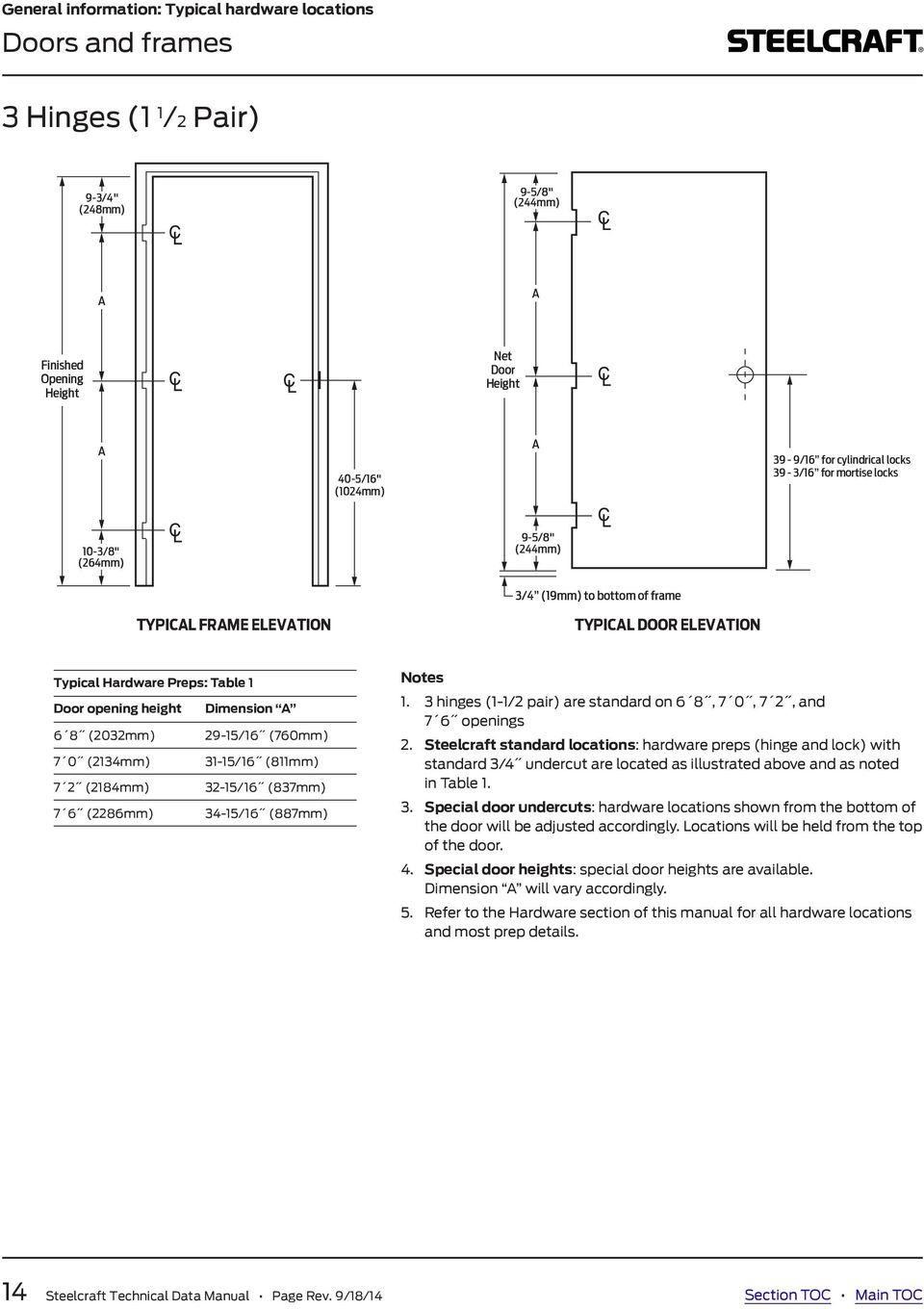
15 General information: Typical hardware locations Doors and frames 3 Hinges (1 1 2 Pair) 9-3/4" (248mm) 9-5/8" (244mm) A A Finished Opening Height Net Door Height A 40-5/16" (1024mm) A 39-9/16 for cylindrical locks 39-3/16 for mortise locks 10-3/8" (264mm) 9-5/8" (244mm) 3/4 (19mm) to bottom of frame TYPICAL FRAME ELEVATION TYPICAL DOOR ELEVATION Typical Hardware Preps: Table 1 Door opening height Dimension A 6 8 (2032mm) 29-15/16 (760mm) 7 0 (2134mm) 31-15/16 (811mm) 7 2 (2184mm) 32-15/16 (837mm) 7 6 (2286mm) 34-15/16 (887mm) Notes 1. 3 hinges (1-1/2 pair) are standard on 6 8, 7 0, 7 2, and 7 6 openings 2. Steelcraft standard locations: hardware preps (hinge and lock) with standard 3/4 undercut are located as illustrated above and as noted in Table Special door undercuts: hardware locations shown from the bottom of the door will be adjusted accordingly. Locations will be held from the top of the door. 4. Special door heights: special door heights are available. Dimension A will vary accordingly. 5. Refer to the Hardware section of this manual for all hardware locations and most prep details. 14 Steelcraft Technical Data Manual Page Rev. 9/18/14 Section TOC Main TOC
16 General information: Typical hardware locations Doors and frames 4 Hinges (2 Pair) 9-3/4" (248mm) 9-5/8" (244mm) B B Finished Opening Height B Net Door Height B B 40-5/16" (1024mm) B 39-9/16 for cylindrical locks 39-3/16 for mortise locks 9-5/8" (244mm) 3/4 (19mm) to bottom of frame TYPICAL FRAME ELEVATION TYPICAL DOOR ELEVATION Typical Hardware Preps: Table 2 Door opening height Dimension B 6 8 (2032mm) 19-61/64 (507mm) 7 0 (2134mm) 21-19/64 (541mm) 7 2 (2184mm) 21-61/64 (558mm) 7 6 (2286mm) 23-19/64 (592mm) 7 8 (2337mm) 23-61/64 (608mm) 7 10 (2388mm) 24-5/8 (625mm) 8 0 (2438mm) 25-19/64 (643mm) 8 2 (2489mm) 25-61/64 (659mm) 8 4 (2540mm) 26-5/8 (676mm) Notes 1. 4 hinges (2 pair) are standard on openings over 7 6 in height and up to and including 10 0 in height. 2. Steelcraft standard locations: hardware preps (hinge and lock) with standard 3/4 undercut are located as illustrated above and as noted in Table Special door undercuts: hardware locations shown from the bottom of the door will be adjusted accordingly. Locations will be held from the top of the door. 4. Special door heights: special door heights are available. Dimension B will vary accordingly. 5. Refer to the Hardware section of this manual for all hardware locations and most prep details. 8 6 (2591mm) 27-19/64 (693mm) 8 8 (2642mm) 27-61/64 (710mm) 8 10 (2692mm) 28-5/8 (727mm) 9 0 (2743mm) 29-19/64 (744mm) 9 2 (2794mm) 29-61/64 (761mm) 9 4 (2845m) 30-5/8 (778mm) 9 6 (2896mm) 31-19/64 (795mm) 9 8 (2946mm) 31-61/64 (812mm) 9 10 (2997mm) 32-5/8 (829mm) 10 0 (3048mm) 33-19/64 (846mm) Main TOC Section TOC Steelcraft Technical Data Manual Page Rev. 4/30/08 15

17 General information: Typical hardware locations Doors and frames 5 Hinges (2 1 2 Pair) 9-3/4" (248mm) 9-5/8" (244mm) C C C C Finished Opening Height Net Door Height C C C 40-5/16" C 39-9/16 for cylindrical locks 39-3/16 for mortise locks 3/4 (19mm) to bottom of frame TYPICAL FRAME ELEVATION TYPICAL DOOR ELEVATION Typical Hardware Preps: Table 3 Door opening height Dimension C 10 2 (3049mm) 25-15/32 (647mm) 10 4 (3154mm) 25-31/32 (660mm) 10 6 (3200mm) 26-15/32 (672mm) 10 8 (3251mm) 26-31/32 (685mm) (3302mm) 27-15/32 (698mm) 11 0 (3353mm) 27-31/32 (710mm) Notes 1. 5 hinges (2-1/2 pair) are standard on openings over 10 0 in height. 2. Steelcraft standard locations: hardware preps (hinge and lock) with standard 3/4 undercut are located as illustrated above and as noted in Table Special door undercuts: hardware locations shown from the bottom of the door will be adjusted accordingly. Locations will be held from the top of the door. 4. Special door heights: special door heights are available. Dimension C will vary accordingly. 5. Refer to the Hardware section of this manual for all hardware locations and most prep details. 16 Steelcraft Technical Data Manual Page Rev. 4/30/08 Section TOC Main TOC

18 General information: Typical hardware locations Doors Dutch 9-3/4" (248mm) 9-5/8" (244mm) D D E Finished Opening Height 19-7/16" (494mm) Net Door Height 9-5/8" (244mm) 9-5/8" (244mm) 3/16" (5mm) 23-7/8" (606mm) 36-5/8" (937mm) 23-7/8" (606mm) 35-7/8" (905mm) 10-3/8" (264mm) 9-5/8" (244mm) 43-1/8" (1095mm) 3/4 (19mm) to bottom of frame DUTCH DOOR ELEVATION Typical Hardware Preps: Table 4 Door opening height Dimension D Dimension E 6 8 (2032mm) 16-9/16 (421mm) 35-13/16 (910mm) 7 0 (2134mm) 20-9/16 (522mm) 39-13/16 (1011mm) 7 2 (2184mm) 22-9/16 (573mm) 41-13/16 (1062mm) Notes 1. 4 hinges (2 pair) are standard on dutch door openings. 2. Steelcraft standard locations: hardware preps (hinge and lock) with standard 3/4 undercut are located as illustrated above and as noted in Table Special door undercuts: hardware locations shown from the bottom of the door will be adjusted accordingly. Locations will be held from the top of the door. 4. Special door heights: special door heights are available. Dimensions D and E will vary accordingly. 5. Fire Rated dutch doors: additional locking hardware is required. Refer to the Fire Rated section of this manual. 6. Refer to the Hardware section of this manual for all hardware locations and most prep details. Main TOC Section TOC Steelcraft Technical Data Manual Page Rev. 4/30/08 17

19 General information: Comparative hinge and strike locations Doors and frames Comparative hinge and strike locations E H B Strike Location A Opening Height (D) Hinge Spacing (D) Hinge Spacing C G 3/4 (19mm) undercut Notes A. See page 19 for foot/inch Comparative Hinge and Strike Locations for 1-3/4 Doors and Frames with 4-1/2 x 4-1/2 Hinges. B. See page 20 for metric Comparative hinge and strike locations for 45mm Doors and Frames with 114mm x 114mm Hinges. C. Dimensions for hinge and strike locations of the SDI Manufacturers shown on pages 19 and 20 are to the centerline of the preparation. Frame Hinge J Door DOOR & FRAME BACKSETS K F = Frame Hinge Backset = Door Hinge Backset 1-3/4 (45mm) 18 Steelcraft Technical Data Manual Page Rev. 7/31/14 Section TOC Main TOC

20 General information: Comparative hinge and strike locations Doors and frames Comparative hinge and strike locations for Doors and frames with x hinges Manufacturer Steelcraft Amweld Ceco Curries Deansteel Mesker Pioneer Republic Security metal products A Height B Strike Centerline from floor 40-5/ / / / / / /16 C Bottom hinge Centerline from floor 10-5/ / /8 12-3/8 8-5/ / /4 12-1/4 12-1/4 12-1/8 12-1/4 12-1/4 12-1/4 12-1/4 12-1/4 10-1/4 12-1/4 12-1/4 12-1/4 12-1/4 12-5/ /4 12-1/4 12-1/4 D Frame Hinge spacing Centerline to centerline 29-15/ / / / / / / / / / / /4 32-1/4 33-1/4 24-7/8 25-1/2 30-1/4 32-1/4 33-1/4 24-7/8-24-3/4-24-7/8 25-1/2 30-1/4 32-1/4 33-1/4 25-1/2 25-1/2 30-1/4 32-1/4 33-1/ / /2 30-1/4 32-1/4 33-1/ / /2 30-1/4 32-1/4 33-1/ / /2 E Top hinge Centerline from underside of head 9-3/4 9-3/ /4 7-1/4 7-1/4 7-1/4 7-1/4 7-1/4 F Hinge backset 5/16 5/16 5/16 5/16 5/16 5/16 5/16 5/16 3/8 G Bottom hinge Centerline to door bottom 9-5/8 9-5/8 9-5/8 11-5/8 7-9/16 9-9/16 8-1/4 11-5/8 11-5/8 11-5/8 11-1/2 11-5/8 11-1/2 11-1/2 11-1/2 11-1/2 9-1/2 11-1/2 11-5/8 11-5/8 11-5/ / /8 11-1/2 11-1/2 H J Door Top hinge Inset (reveal) Centerline to top of door 9-5/8 1/8 9-5/8 8-7/8 7-1/8 7-1/8 7-1/8 7-1/8 7-1/8 7-1/8 1/16 1/8 1/8 1/8 1/8 3/32 1/8 1/16 K Hinge backset 1/4 3/16 1/4 1/4 1/4 1/4 7/32 1/4 1/4 All dimensions are current at the time of publication. Refer to SDI-129 for updated dimensions. Main TOC Section TOC Steelcraft Technical Data Manual Page Rev. 8/17/15 19

21 General information: Comparative hinge and strike locations Doors and frames Comparative hinge and strike locations for 45mm doors and frames with 114mm x 114mm hinges (metric dimensions) Manufacturer Steelcraft Amweld Ceco Curries Deansteel Mesker Pioneer Republic Security metal products A Height 2032mm 2134mm 2184mm 2388mm 2438mm 2032mm 2134mm 2184mm 2388mm 2438mm 2032mm 2134mm 2184mm 2388mm 2438mm 2032mm 2134mm 2184mm 2388mm 2438mm 2032mm 2134mm 2184mm 2388mm 2438mm 2032mm 2134mm 2184mm 2388mm 2438mm 2032mm 2134mm 2184mm 2388mm 2438mm 2032mm 2134mm 2184mm 2388mm 2438mm 2032mm 2134mm 2184mm 2388mm 2438mm B Strike Centerline from floor 1024mm 1024mm 1062mm 1016mm 1024mm 1024mm 965mm 1024mm 1024mm C Bottom hinge Centerline from floor 264mm 264mm 264mm 314mm 211mm 253mm 229mm 311mm 311mm 311mm 308mm 311mm 311mm 311mm 311mm 311mm 260mm 311mm 311mm 311mm 311mm 313mm 311mm 311mm 311mm D Frame Hinge spacing Centerline to centerline 760mm 811mm 837mm 625mm 643mm 760mm 811mm 811mm 643mm 643mm 787mm 838mm 864mm 643mm 660mm 768mm 819mm 845mm 632mm 648mm 768mm 819mm 845mm 632mm - 629mm 632mm 648mm 768mm 819mm 845mm 648mm 648mm 768mm 819mm 845mm 630mm 648mm 768mm 819mm 845mm 631mm 648mm 768mm 819mm 845mm 630mm 648mm E Top hinge Centerline from underside of head 248mm 248mm 229mm 184mm 184mm 184mm 184mm 184mm 184mm F Hinge backset 8mm 8mm 8mm 8mm 8mm 8mm 8mm 8mm 10mm G Bottom hinge Centerline to door bottom 244mm 244mm 244mm 295mm 192mm 243mm 210mm 295mm 295mm 295mm 292mm 295mm 292mm 292mm 292mm 292mm 241mm 292mm 295mm 295mm 295mm 297mm 295mm 292mm 292mm H J Door Top hinge Inset (reveal) Centerline to top of door 244mm 3.2mm 244mm 225mm 181mm 181mm 181mm 181mm 181mm 181mm 1.6mm 3.2mm 3.2mm 3.2mm 3.2mm 2.4mm 3.2mm 1.6mm K Hinge backset 6.4mm 4.7mm 6.4mm 6.4mm 6.4mm 6.4mm 5.6mm 6.4mm 6.4mm All dimensions are current at the time of publication. Refer to SDI-129 for updated dimensions. 20 Steelcraft Technical Data Manual Page Rev. 8/17/15 Section TOC Main TOC
22 Frames Table of contents (click below or use bookmarks) General information...23 Flush frames...25 F Series...25 FN Series 1 flush face MU Series multi-use...33 FE Series double egress...37 DE Series double egress...41 F and FN Series frame construction F FN Double rabbet F FN Single rabbet F FN Cased open MU Series frame construction Drywall frames DW Series MU MU MU K Series Variations and options...53 Double rabbet Narrow double Cased open Anchoring systems...79 FE and DE Series double egress frame construction Jambs Head Jambs Head FE Double egress DE Double egress DW and K Series frame construction DW K DW K DW Double rabbet Narrow Double rabbet Cased open Return to Main TOC Steelcraft Technical Data Manual Section Rev. 8/17/15; Page Rev. 5/31/15 21
23 Frames This page intentionally left blank 22 Steelcraft Technical Data Manual Page Rev. 7/31/14 Section TOC Main TOC
24 Frames General information General frame information Steelcraft framing systems are designed to fit virtually all construction requirements for commercial and institutional building applications. Their construction, durability and flexibility have been proven throughout the world in both operation and physical testing of all types. The F, FN, FE, DE, and MU Series frames are designed for installation as part of the wall framing sequence, and installed in interior and exterior applications. When installed, this frame series will either wrap or butt up against the wall construction. Anchoring will be either into the masonry wall, or to the stud wall framing systems. The DW and K Series frames are designed for interior application and for installation in rough openings after the wall is erected and finished. They can be installed in minutes and can be relocated without damage to the frame. When installed, this frame series will wrap the wall construction. Anchorage will be compression fit to the stud systems. Sizes and performance All framing systems are manufactured and supplied to meet the dimensional standards and performance levels as published in ANSI A (commonly referred to as SDI 100). Special size products are available to meet the unique construction, performance and aesthetic requirements of the Architectural community. Contact Steelcraft for those requirements. Usage and application To help simplify the use, selection and specification of Steelcraft framing systems, the following guidelines for base material selection can be used: Material gauge: the following material thicknesses are available: 16 gauge [0.053 (1.3mm)]: for Heavy Duty Commercial and Institutional applications with high use. 14 gauge [0.067 (1.7mm)]: for Extra Heavy Duty Commercial and Institutional applications with the potential of very high use. 12 gauge [0.093 (2.3mm)]: for Maximum Duty Commercial and Institutional applications with extremely high use. Material selection: in addition to the thickness of base material, the following base material types of metal are available: Commercial quality cold rolled steel conforming to ASTM specifications A1008, A568, and A569 is commonly used on interior openings. Galvannealed Steel conforming to ASTM specification A653 is recommended for use on exterior openings or for interior locations where high humidity is present. Steel frames Three sided steel frames are furnished in three pieces (two jambs and a head) which are anchored to the wall systems. The most common 3-sided frame components are: 1. Hinge jamb: vertical frame member on which the door is hinged. [For double doors (pairs), there are two hinge jambs and no strike jamb]. 2. Strike jamb: vertical frame member into which the door latches. [For double doors (pairs), there is no strike jamb, but there are two hinge jambs]. 3. Head: horizontal frame member which connects the jambs. How they are supplied The connecting corners of the 3-piece frame include precision factory die miters with interlocking tabs and corner clips. The corner miters are specially designed to insure a tight closed corner connection when assembled and installed properly. There are two methods of furnishing 3-sided frames to the job site: Knock Down (KD): Frames are supplied in 3 pieces for assembly prior to installation at the job site by the installing contractor. This is an economical method of supplying the frames, and at the job site, there is less space consumed in staging the products, easier job site movement of material, and, usually less damage to the frame prior to installation. Set-Up and welded: Prior to arriving at the job site, the 3-sided frame (with factory miters) is assembled (at the distributor s fabrication location, or by Steelcraft). The miters are welded (in accordance with ANSI A ), finished and supplied to the job site ready for installation. Welded frames are shipped to the job site with temporary shipping bars attached. The temporary shipping bars must be removed prior to installation. When installing frames, the temporary shipping bars must not be used as spreader bars or installation bracing. Job site storage Frames shall be stored under cover on 4 (101.6mm) wood sills, on the floor, in a manner to avoid contact with moisture, and to prevent rust and damage. Only use vented plastic or canvas. The use of no-vented materials, create a humidity chamber, which promotes blistering and corrosion. Assembled frames shall be stored in a vertical position, five (5) units maximum in a stack. Provide a 1/4 (6.3mm) space between the frames to provide air circulation. Installation Proper frame installation is critical for reliable door and hardware functionality. To insure proper fit, function and reliability, install all frames in accordance with ANSI A and HMMA 840. Main TOC Section TOC Steelcraft Technical Data Manual Page Rev. 4/30/09 23
25 Frames General information Profile terminology Typical Frame The frame profile has specific terminology related to each surface. Their jamb depth describes the frame size required. It is critical that the throat opening of the frame be compatible with the wall to which it will be attached. Head Double rabbet: standard profile Jamb Depth Stop Rabbet Soffit Rabbet Face Backbend Back Bend Returns Are Provided on MU, DW, and K Series Frames Throat Opening Backbend Profile variations Steel frames are supplied standard as double rabbet. To accommodate various application needs, the frame profile (in any frame series) can change. Some of the typical variations are as follows: Single rabbet: Jamb depths below 4-1/2 (114mm) are single rabbet due to the dimensional limitations of the profile. Some specifications will require single rabbet profiles on frames over 4-1/2 (114mm) in jamb depth. Profile as shown will vary on MU, DW, and K Series frames, refer to the appropriate data sheets. Cased open: Used for double acting doors (swinging in both directions), sliding doors, bi-fold doors or frames used to close-off an opening in a wall when a door is not required. Double egress: This is a frame specifically designed for cross corridor applications where traffic control is required. This frame is not available in the Drywall Series (DW and T) or Multi-Use Series (MU). Anchors Hinge Jamb Strike Jamb Frames must be anchored to the applicable wall construction. Wall construction at door openings must be of sufficient construction to support commercial or institutional grade steel doors and frames. Refer to the appropriate frame data sheets since anchor types will vary with frame constructions and noted in this manual. Basic guidelines is as follows: Flush frames: Base anchors: one located at the bottom of each jamb Jamb anchors: Locate anchors near each hinge location in both hinge and strike jambs. Transom frames require additional anchors above the top hinge. Head anchors: For wide frame openings usually over 60 in width, an anchor located in the center of the frame head is recommended Drywall frames: Base anchors: two (2) located at the bottom of each jamb Jamb anchors: Drywall frame includes an adjustable compression anchor near the top of each jamb 24 Steelcraft Technical Data Manual Page Rev. 5/31/15 Section TOC Main TOC
26 Flush frames F Series Features and benefits Steelcraft F Series flush frames offer the following unique features, which enhance long term functionality and durability: About the product F Series 3-sided flush frames are designed to meet requirements for light to maximum duty applications in both commercial and institutional buildings. They are installed in both interior and exterior locations, and in virtually all types of buildings and wall constructions. These frames are to be installed as part of the wall framing sequence. They can be specified and supplied as KD (knock-down) for field assembly prior to installation or welded for installation as a complete unit. Installation 1. Installation shall conform to the published Steelcraft installation instructions, ANSI A (formerly SDI 105) Recommended Erection Instructions for Steel Frames and HMMA Fire Rated Assemblies must be in accordance with NFPA Pamphlet 80. The Authority Having Jurisdiction is the final authority in issues related to the installation and use of installed Fire Rated Doors. 1. Die-mitered corner connections: Die-mitered corner connection at the head and jamb insure an attractive, tight and closed mitered connection. The miter includes 4 corner tabs designed with concealed connection eliminating the need for continuous profile welding. 2. Patented universal hinge preparations allow for easy field conversion from standard weight.134 (3.3mm) thick hinges to heavy weight.180 (4.7mm) hinges. 3. Adjustable base anchors allow for installation adjustment when the floor is not level. 4. Factory prepared for field installed silencers. 5. Factory applied baked on rust inhibiting primer in accordance with ANSI A (R2004). Specification compliance 1. Overall frame construction for the Steelcraft F Series flush frames meets the requirements of ANSI A (commonly referred to as SDI-100). 2. Hardware preparations and reinforcements are in accordance with ANSI A Locations are in accordance with ANSI/DHI A115. Fire ratings The F Series flush frames meet the broadest fire rating requirements. They are listed for installations requiring compliance to both neutral pressure testing (ASTM E152 and UL 10B) and positive pressure standards (UL 10C). Refer to the Fire Rated Section of this manual for particular listings. Applications F Series frames are typically installed in wall construction types as defined in the chart below: Frame applications Profile Steel thickness Wall construction Typical wall anchors F16 16 Gauge [0.053 (1.3mm)] Wood or steel stud Lock-in stud anchor F16 16 Gauge [0.053 (1.3mm)] Masonry Wire masonry F16 16 Gauge [0.053 (1.3mm)] Existing masonry Bolted through soffit F14 14 Gauge [0.067 (1.7mm)] Wood or steel stud Lock-in stud anchor F14 14 Gauge [0.067 (1.7mm)] Masonry Wire masonry F14 14 Gauge [0.067 (1.7mm)] Existing masonry Bolted through soffit F12 12 Gauge [0.093 (2.3mm)] Wood or steel stud Lock-in stud anchor F12 12 Gauge [0.093 (2.3mm)] Masonry Wire masonry F12 12 Gauge [0.093 (2.3mm)] Existing masonry Bolted through soffit Main TOC Section TOC Steelcraft Technical Data Manual Page Rev. 4/30/09 25
27 Flush frames F Series Elevation Standard Double Rabbet Frame 2 (50 mm) 2 (50 mm) Finished Opening Width 2 (50 mm) *1/2 (13 mm) 1-9/16 (40 mm) 9-3/4 (248 mm) HINGE Optional 14 gauge closer reinforcement Throat Opening Varies Jamb Depth Equal *1/2 (13 mm) 1-15/16 (49 mm) Finished Opening Height 2 (50 mm) 5/8 (16 mm) 3/4 (19 mm) for F12 Opening Width HINGE STRIKE Single Rabbet Frame *1/2 (13 mm) Varies Equal 40-5/16 (1024 mm) Throat Opening Jamb Depth 1-15/16 (49 mm) *1/2 (13 mm) HINGE 5/8 (16 mm) 10-3/8 (264 mm) 2 (50 mm) Opening Width * 7/16 (11mm) on 5-3/4 frame depth Frame sizing options Series Maximum opening size Jamb depth availability (profile) Standard profile dimensions (variations available) Corners Single Pair Single rabbet Double rabbet Face Stop Return Standard Minimum Maximum Minimum Maximum F x 11 0 (1524mm x 3353mm) F x 11 0 (2439mm x 3353mm) 3 (76mm) 20 (508mm) 4-1/2 (114mm) 20 (508mm) 2 (50mm) 5/8 (16mm) 1/2 * (13mm) DIE MITERED with four (4) concealed tabs interlocking head and jambs F x 8 0 (1 219mm x 2438mm) 8 0 x 8 0 (2438mm x 2438mm) N/A N/A 4-3/4 (121mm) 14-3/4 (375mm) 2 (50mm) 3/4 (19mm) 1/2 (13mm) Square cut for welded corners * Except 5-3/4 (146mm) depth, which is 7/16 (11mm) N/A - Not Available 12 gauge standard profile is equal rabbet 26 Steelcraft Technical Data Manual Page Rev. 7/31/14 Section TOC Main TOC
28 Flush frames F Series Universal Mortise Hinge Prep 4-7/8 Strike Prep (ASA) KD Corner Detail Welded Corner 4-1/2 Standard (114mm) 5 Optional (127mm) 4-7/8 (124mm) 7 Gauge Hinge Reinforcement General notes 1. Variations in jamb depths available in 1/8 (3mm) increments. 2. All F Series frames are supplied standard with masonry wire or lock-in jamb anchors and adjustable base anchors. Anchors are designed for maximum wall/frame engagement and installation flexibility. 3. F Series frames are to be installed as part of the wall framing sequence. 4. Depending on environmental and usage conditions the steel can be either cold rolled or galvannealed. Galvannealed steel is recommended for all exterior applications gauge flush frames, F12, are standard equal rabbet profiles with 3/4 stops. 6. For KD Corner and optional 4 Head, tabs in rabbeted area should be bent outward, not inward, during assembly (as shown). 7. F Series frames with 4 heads are mainly used in masonry applications when 2 face heads do not match course blocking. Optional 4 (102mm) Face Head Detail Frame options Corner connections Series Frame profile KD (Knock-down) SUA (Set-up & weld) 4 (102mm) heads Single rabbet Double rabbet Single rabbet Double rabbet Single rabbet Double rabbet F16 F14 Typically for walls less than 3-3/4 (95mm) thick. Minimum walls thickness 2 (51mm) Typically for walls less than 3-3/4 (95mm) thickness or greater 3 interlocking corner tabs per factory die-miter. See the KD Corner Detail 4 interlocking corner tabs per factory die-miter. See the KD Corner Detail Available when specified, and in accordance with ANSI A (SDI 100). Die-mitered for use with 2 (51mm) face double rabbet jambs. Available when specified for KD or SUA applications. F12 N/A N/A N/A Standard Saw Cut and welded, and in accordance with ANSI A (SDI 100) For use with 2 (51mm) face double rabbet jambs. N/A - Not Available Main TOC Section TOC Steelcraft Technical Data Manual Page Rev. 7/31/14 27
29 Flush frames F Series Wire Masonry Anchor Existing Wall Anchor Adjustable Base Anchor Attached with S.M. screws furnished 3/16 (5mm) dia. wire Maximum adjustment 1-3/8 (35mm) below frame Anchor for Wood Stud Partition Lock-in Anchor Anchoring and installation notes 1. F16 and F14 Series commercial and Institutional frames are supplied standard with masonry wire or lock-in jamb anchors and adjustable base anchors. Anchors are designed for maximum wall/frame engagement and installation flexibility. 2. For anchoring applications, refer to the Frames: Anchoring systems section of this manual. 3. Installation Caution Notice: Grouted frames: When temperature conditions necessitate an additive to be used in the mortar to prevent freezing, the contractor installing the frames must coat the inside of frames in the field with a corrosion resistant coating per SDI 105. When frames are to be grouted full, silencers must be field installed prior to grouting. Steel frames, including fire rated frames, do not require grouting. Grouting is not recommended for frames in drywall. 4. All fire rated frames must be installed in accordance with NFPA Pamphlet 80 and the Authority Having Jurisdiction. Framing applications Series Steel type Building type Opening Usage frequency 1 KD 4 Corner SUA 5 Corner Applications F16 Non-Galvannealed 2 Institutional and Commercial Galvannealed 3 Interior Mainly Exterior Heavy to extra heavy duty 3 3 Typical building conditions High humidity and/or weather exposure F14 Non-Galvannealed 2 Institutional and Interior Extra heavy to Typical building conditions Commercial maximum duty 3 3 Galvannealed 3 Mainly Exterior High humidity and/or weather exposure F12 Galvannealed 3 Institutional and Commercial Interior and exterior Maximum duty N/A 3 Maximum traffic building conditions High humidity and/or weather exposure 1 Usage frequency is based on ANSI A Commercial quality cold rolled steel 3 Reinforcements for galvannealed frames are also galvannealed 4 Knock-Down for field assembly prior to installation 5 Set-up and Welded for installation as a pre-welded unit 28 Steelcraft Technical Data Manual Page Rev. 4/30/09 Section TOC Main TOC
30 Flush frames FN Series 1 flush face Features and benefits Steelcraft FN Series 1 (25mm) flush face frames offer the following unique features, which enhance long term functionality and durability. Features can vary depending on the steel thickness of the frame: About the product FN Series 3-sided flush narrow 1 (25mm) face frames are designed to meet requirements for light to extra heavy duty applications in both commercial and institutional buildings where a slim face profile is required. They are installed in both interior and exterior locations, and in virtually all types of buildings and wall constructions. These frames are to be installed as part of the wall framing sequence. They can be specified and supplied as KD (knock-down) for field assembly prior to installation or welded for installation as a complete unit. Installation 1. Installation shall conform to the published Steelcraft installation instructions, ANSI A (formerly SDI 105) Recommended Erection Instructions for Steel Frames and HMMA Fire Rated Assemblies must be in accordance with NFPA Pamphlet 80. The Authority Having Jurisdiction is the final authority in issues related to the installation and use of installed Fire Rated Doors. 1. Narrow 1 (25mm) face provides a very slim appearance to the door opening. 2. Die-mitered corner connections Die-mitered corner connection at the head and jamb insure an attractive, tight and closed mitered connection. The miter includes 4 corner tabs designed with concealed connection eliminating the need for continuous profile welding. 3. Patented universal hinge preparations allow for easy field conversion from standard weight.134 (3.3mm) thick hinges to heavy weight.180 (4.7mm) hinges. 4. Factory prepared for field installed silencers. 5. Factory applied baked on rust inhibiting primer in accordance with ANSI A (R2004). Specification compliance 1. Overall frame construction for the Steelcraft FN18, FN16 and FN14 Series flush narrow 1 (25mm) face frames meets the requirements of ANSI A (commonly referred to as SDI-100). 2. Hardware preparations and reinforcements are in accordance with ANSI A Locations are in accordance with ANSI/DHI A115 unless otherwise stated. Fire ratings The FN Series flush narrow 1 (25mm) face frames meet the broadest fire rating requirements. They are listed for installations requiring compliance to both neutral pressure testing (ASTM E152 and UL 10B) and positive pressure standards (UL 10C). Refer to the Fire Rated section of this manual for particular listings. Applications FN Series 1 (25mm) flush face frames are designed to meet the aesthetic needs of a very slender face dimension, and still maintain the functionality of the conventional flush framing systems. The FN Series 1 (25mm) flush face frames are typically installed in wall construction types as defined in the chart below: Frame applications Profile Steel thickness Wall construction Typical wall anchors FN16 16 Gauge [0.053 (1.3mm)] Wood or steel stud Lock-in stud anchor FN16 16 Gauge [0.053 (1.3mm)] Masonry Wire masonry FN16 16 Gauge [0.053 (1.3mm)] Existing masonry Bolted through soffit FN14 14 Gauge [0.067 (1.7mm)] Wood or steel stud Lock-in stud anchor FN14 14 Gauge [0.067 (1.7mm)] Masonry Wire masonry FN14 14 Gauge [0.067 (1.7mm)] Existing masonry Bolted through soffit Main TOC Section TOC Steelcraft Technical Data Manual Page Rev. 4/30/09 29
31 Flush frames FN Series 1 flush face Elevation Standard Double Rabbet Frame 1 (25 mm) 1 (25 mm) Finished Opening Width 1 (25 mm) *1/2 (13 mm) 1-9/16 (40 mm) 9-3/4 (248 mm) Optional 14 gauge closer reinforcement HINGE Throat Opening Varies Jamb Depth Equal 1-15/16 (49 mm) *1/2 (13 mm) Finished Opening Height 1 (25 mm) 5/8 (16 mm) Opening Width HINGE STRIKE * 7/16 (11mm) on 5-3/4 frame depth Equal 40-5/16 (1024 mm) HINGE Note: FN Series 3 sided flush narrow 1 (25mm) face frames are available as double rabbet only. 10-3/8 (264 mm) Frame sizing options Series Maximum opening size Jamb depth availability (profile) Standard profile dimensions (variations available) Corners Single Pair Single rabbet Double rabbet Face Stop Returns Standard Minimum Maximum Minimum Maximum FN x 8 0 (1219mm x 2439mm) 8 0 x 8 0 (2439mm x 2439mm) N/A N/A 4-1/2 (114mm) 20 (508mm) 1 (25mm) 5/8 (16mm) 1/2 * (13mm) DIE MITERED with four (4) concealed tabs interlocking head and jambs FN x 8 0 (1219mm x 2439mm) 8 0 x 8 0 (2439mm x 2439mm) N/A N/A 4-1/2 (114mm) 20 (508mm) 1 (25mm) 5/8 (16mm) 1/2 * (13mm) DIE MITERED with four (4) concealed tabs interlocking head and jambs N/A = Not Available 30 Steelcraft Technical Data Manual Page Rev. 11/30/12 Section TOC Main TOC
32 Flush frames FN Series 1 flush face Universal Mortise Hinge Prep 4-7/8 (124mm) Strike Prep (ASA) KD Corner Detail Welded Corner 4-7/8 Standard (114mm) 5 Optional (127mm) 4-7/8 (124mm) 7 Gauge Hinge Reinforcement General notes 1. Variations in jamb depths available in 1/8 (3mm) increments. 2. All FN Series frames are supplied standard with masonry wire and weld-in base anchors. Anchors are designed for maximum wall/frame engagement and installation flexibility. 3. FN Series frames are to be installed as part of the framing sequence. 4. Depending on environmental and usage conditions, the steel can be either cold rolled or galvannealed. Galvannealed steel is recommended for all exterior applications. 5. For KD Corner, tabs in rabbeted area should be bent outward, not inward, during assembly. Frame options Series Frame profile Corner connections KD (Knock-down) SUA (Set-up & weld) Single rabbet Double rabbet Single rabbet Double rabbet Single rabbet Double rabbet FN16 N/A Typically for walls 3-3/4 (95mm) thickness or greater N/A 4 interlocking corner tabs per factory diemiter. See the KD Corner Detail N/A Available when specified, and in accordance with ANSI A (SDI 100) FN14 N/A Typically for walls 3-3/4 (95mm) thickness or greater N/A 4 interlocking corner tabs per factory diemiter. See the KD Corner Detail N/A Available when specified, and in accordance with ANSI A (SDI 100) N/A = Not Available Main TOC Section TOC Steelcraft Technical Data Manual Page Rev. 7/31/14 31
33 Flush frames FN Series 1 flush face Wire Masonry Anchor Existing Masonry Anchor Weld-In Base Anchor 3/16 (5mm) dia. wire Used in place of typical EMA on 1" face frames Anchoring and installation notes 1. FN16 Series narrow 1 (25mm) Face frames are supplied standard with masonry wire and weld-in base anchors. Anchors are designed for maximum wall/frame engagement and installation flexibility. 2. For anchoring applications, refer to the Frames: Anchoring systems section of this manual. 3. Installation caution notice: Grouted frames: When temperature conditions necessitate an additive to be used in the mortar to prevent freezing, the contractor installing the frames must coat the inside of the frames in the field with a corrosion resistant coating per SDI 105. When frames are to be grouted full, silencers must be field installed prior to grouting Steel frames, including fire rated frames, do not require grouting. Grouting is not recommended for frames in drywall. 4. Installation shall conform to the published Steelcraft installation instructions, SDI 105 Recommended Installation Instructions for Steel Frames. 5. All fire rated frames must be installed in accordance with NFPA Pamphlet 80 and the Authority Having Jurisdiction. Framing applications Series Steel type Building type Opening Usage frequency 1 KD 4 Corner SUA 5 Corner Applications FN16 Non-Galvannealed 2 Institutional and commercial Galvannealed 3 Interior Mainly exterior Heavy to extra heavy duty 3 3 Typical building conditions High humidity and/or weather exposure FN14 Non-Galvannealed 2 Institutional and Interior Extra heavy to Typical building conditions commercial maximum duty 3 3 Galvannealed 3 Mainly exterior High humidity and/or weather exposure 1 Usage frequency is based on ANSI A Commercial quality cold rolled steel 3 Reinforcements for galvannealed frames are also galvannealed 4 Knock-Down for field assembly prior to installation 5 Set-up and Welded for installation as a pre-welded unit 32 Steelcraft Technical Data Manual Page Rev. 7/31/14 Section TOC Main TOC
34 Flush frames MU Series multi-use Features and benefits Steelcraft MU Series multi-use flush frames offer the following unique features which enhance long-term functionality and durability. Features can vary depending on the steel thickness of the frame: 1. Die-mitered corner connections of the MU Series multi-use flush frame corners lock together once the frame is installed. The tab/lock design: a. prevents the head from rising b. keeps the head and jamb members in alignment c. keeps the miter tight d. includes wedge-lock corner clips. Screws are supplied to secure miter. About the product Steelcraft s MU Series multi-use flush frames are designed for light to extra heavy duty applications in both commercial and institutional buildings. They can be installed in both interior and exterior locations, and in virtually all types of buildings and wall constructions. They have a jamb profile similar to the DW frames, but are designed to be installed as part of the wall framing sequence. They can be specified and/or supplied as either KD (knock-down) for field assembly prior to installation, or welded for installation as a complete unit. Installation 1. Installation shall conform to the published Steelcraft installation instructions, ANSI A (formerly SDI 105) Recommended Erection Instructions for Steel Frames and HMMA Fire Rated Assemblies must be in accordance with NFPA Pamphlet 80. The Authority Having Jurisdiction is the final authority in issues related to the installation and use of installed Fire Rated Doors. 2. Patented universal hinge preparations allow for easy field conversion from standard weight.134 (3.3mm) thick hinges to heavy weight (4.7mm) hinges. 3. Adjustable base anchors allow for installation adjustment when the floor is not level. 4. Factory prepared for field installed silencers. 5. Factory applied baked-on rust inhibiting primer in accordance with ANSI A (R2004). Specification compliance 1. Overall frame construction for Steelcraft MU Series multiuse flush frames meet the requirements of ANSI A (SDI 100). 2. Hardware preparations and reinforcements are in accordance with ANSI A Locations are in accordance with ANSI/DHI A115 unless otherwise stated. Fire ratings MU Series multi-use flush frames meet the broadest fire rating requirements. They are listed for installations requiring compliance to both neutral pressure testing (ASTM E152 and UL 10B) and positive pressure standards (UL 10C). Refer to the Fire Rated Section of this manual for particular listings. Applications Steelcraft MU Series multi-use flush frames are typically installed in wall construction types as defined in the chart below: Frame applications Profile Steel thickness Wall construction Typical wall anchors MU16 16 Gauge [0.053 (1.3mm)] Wood or steel stud Lock-in stud anchor MU16 16 Gauge [0.053 (1.3mm)] Masonry Wire masonry MU16 16 Gauge [0.053 (1.3mm)] Existing Masonry Bolted through soffit MU14 14 Gauge [0.067 (1.7mm)] Wood or steel stud Lock-in stud anchor MU14 14 Gauge [0.067 (1.7mm)] Masonry Wire masonry MU14 14 Gauge [0.067 (1.7mm)] Existing masonry Bolted through soffit Main TOC Section TOC Steelcraft Technical Data Manual Page Rev. 7/31/14 33
35 Flush frames MU Series multi-use Elevation Standard Double Rabbet Frame 2 (50 mm) 2 (50 mm) Finished Opening Width 2 (50 mm) 1/2 (13 mm) 1-9/16 (40 mm) 9-3/4 (248 mm) HINGE Optional 14 gauge closer reinforcement Throat Opening Varies Jamb Depth Equal 1/2 (13 mm) 5/16 (8mm) 1-15/16 (49 mm) 5/8 (16 mm) Finished Opening Height 2 (50 mm) Opening Width HINGE STRIKE Narrow Double Rabbet Frame for frame depths 4-3/8 and narrower. 1/2 (13 mm) 9/16 Equal 40-5/16 (1024 mm) Throat Opening Varies Jamb Depth 10-3/8 (264 mm) HINGE 1/2 (13 mm) 1-15/16 (49 mm) 5/8 (16 mm) 2 (50 mm) Opening Width Frame sizing options Series Maximum opening size Jamb depth availability (profile) Single Pair Narrow double rabbet Minimum Maximum Minimum Maximum Standard profile dimensions (variations available) Corners Double rabbet Face Stop Returns Standard MU x 9 0 (1219mm x 2743mm) 8 0 x 9 0 (2439mm x 2743mm) 3-1/4 (83mm) 4-3/8 (111mm) 4-1/2 (114mm) 20 (508mm) 2 (51mm) 5/8 (16mm) 1/2 (13mm) DIE MITERED with interlocking Soffit tab MU x 9 0 (1219mm x 2743mm) 8 0 x 9 0 (2439mm x 2743mm) 3-1/4 (83mm) 4-3/8 (111mm) 4-1/2 (114mm) 20 (508mm) 2 (51mm) 5/8 (16mm) 1/2 (13mm) DIE MITERED with interlocking Soffit tab 34 Steelcraft Technical Data Manual Page Rev. 7/31/14 Section TOC Main TOC
36 Flush frames MU Series multi-use Universal Mortise Hinge Prep 4-7/8 (124mm) Strike Prep (ASA) KD Corner Detail Optional 4 (102mm) Head Detail 4-1/2 Standard (114mm) 5 Optional (127mm) 4-7/8 (124mm) 7 Gauge Hinge Reinforcement General notes 1. Variations in jamb depths available in 1/8 (3mm) increments. 2. All MU Series frames are supplied standard with masonry wire or lock-in jamb anchors and adjustable base anchors. Anchors are designed for maximum wall/frame engagement and installation flexibility. 3. MU Series frames are to be installed as part of the wall framing sequence. 4. Depending on environmental and usage conditions the steel can be either cold rolled or galvannealed. Galvannealed steel is recommended for all exterior applications. 5. MU Series with 4 heads are used mainly in masonry applications when 2 face heads do not match block coursing, or in drywall applications when installed in close proximity to a F Series or MU Series frame installed with a 4 head. Frame options Corner connections Series Frame profile KD (Knock-down) SUA (Set-up & weld) 4 (102mm) Heads Narrow double rabbet Double rabbet Single rabbet Double rabbet Single rabbet Double rabbet MU16 MU14 Typically for walls less than 3-3/4 (95mm) thick. Minimum walls thickness = 2 (51mm) Typically for walls less than 3-3/4 (95mm) thickness or greater Factory Die- Mitered, Soffit Tab included. Corner clip assembly screws required. Factory Die- Mitered, Soffit Tab included. Corner clip assembly screws required. Available when specified, and in accordance with ANSI A (SDI 100). Die-mitered for use with 2 (51mm) face jambs. Corner Clip assembly screws required. N/A - Not Available Main TOC Section TOC Steelcraft Technical Data Manual Page Rev. 7/31/14 35
37 Flush frames MU Series multi-use Wire Masonry Anchor Existing Masonry Anchor Adjustable Base Anchor Attached with S.M. screws (furnished) 3/16 (5 mm)dia. wire See Note #6 Maximum adjustment 1-3/8 (35mm) below frame Anchor for Stud Partition Lock-in anchor Anchoring and installation notes 1. MU16 Series Multi-use flush frames are supplied standard with masonry wire, or lock-in jamb anchors and adjustable base anchors. Anchors are designed for maximum wall/frame engagement, and installation flexibility. 2. For anchoring applications, refer to the Frames: Anchoring systems section of this manual. 3. Installation caution notice: Grouted frames: When temperature conditions necessitate an additive to be used in the mortar to prevent freezing, the contractor installing the frames must coat the inside of frames in the filed with a corrosion resistant coating per SDI 105. When frames are to be grouted full, silencers must be field installed prior to grouting. Steel frames, including fire rated frames, do not require grouting. Grouting is not recommended for frames in drywall. 4. Installation shall conform to the published Steelcraft installation instructions, SDI 105 Recommended Installation Instructions for Steel Frames. 5. All fire rated frames must be installed in accordance with NFPA Pamphlet 80 and the Authority Having Jurisdiction. 6. When using Standard Exiting Wall Anchors the anchor must be field modified (notched) to provide clearance for the backbend return. Framing applications Series Steel type Building type Opening Usage frequency 1 KD 4 Corner SUA 5 Corner Applications MU16 Non-Galvannealed 2 Institutional and Interior Heavy to extra Typical building conditions Commercial heavy duty 3 3 Galvannealed 3 Mainly Exterior High humidity and/or weather exposure MU14 Non-Galvannealed 2 Institutional and Interior Extra heavy to Typical building conditions Commercial maximum duty 3 3 Galvannealed 3 Mainly Exterior High humidity and/or weather exposure 1 Usage frequency is based on ANSI A Commercial quality carbon steel 3 Reinforcements for galvannealed frames are also galvannealed 4 Knock-Down for field assembly prior to installation 5 Set-up and Welded for installation as a pre-welded unit 36 Steelcraft Technical Data Manual Page Rev. 7/31/14 Section TOC Main TOC
38 Flush frames FE Series double egress Features and benefits Steelcraft FE Series double egress frames offer the following unique features, which enhance long term functionality and durability: About the product The FE Series double egress frames are designed to meet requirements for heavy to extra heavy duty applications in both commercial and institutional buildings. They are installed at interior locations, and in virtually all types of buildings and wall constructions. These frames can be specified and supplied as KD (knock-down) for field assembly prior to installation or welded for installation as a complete unit. If clear opening width for cross corridor applications is critical, refer to the DE Series Frame. Installation 1. Installation shall conform to the published Steelcraft installation instructions, ANSI A (formerly SDI 105) Recommended Erection Instructions for Steel Frames and HMMA Fire Rated Assemblies must be in accordance with NFPA Pamphlet 80. The Authority Having Jurisdiction is the final authority in issues related to the installation and use of installed Fire Rated Doors. The Authority Having Jurisdiction is the final authority in issues related to the installation and use of installed Fire Rated Doors. 1. Die-mitered corner connections Die-mitered corner connection at the head and jamb insure an attractive, tight and closed mitered connection. The miter includes 4 corner tabs designed with concealed connection eliminating the need for continuous profile welding. 2. Patented universal hinge preparations allow for easy field conversion from standard weight.134 (3.3mm) thick hinges to heavy weight.180 (4.7mm) hinges. 3. Factory prepared for field installed silencers. 4. Factory applied baked-on rust inhibiting primer in accordance with ANSI A (R2004). Specification compliance 1. Overall frame construction for the Steelcraft FE16 and FE14 Series double egress frames meet and exceed the requirements of ANSI A (commonly referred to as SDI-100). 2. Hardware preparations and reinforcements are in accordance with ANSI A Locations are in accordance with ANSI/DHI A115 unless otherwise stated. Fire ratings The FE Series double egress frames meet the broadest fire rating requirements. They are listed for installations requiring compliance to both neutral pressure testing (ASTM E152 and UL 10B) and positive pressure standards (UL 10C). Refer to the Fire Rated Section of this manual for particular listings. Applications FE Series double egress frames are typically installed in wall construction types as defined in the chart below: Frame applications Profile Steel thickness Wall construction Typical wall anchors FE16 16 Gauge [0.053 (1.3mm)] Wood or steel stud Weld-in stud anchor FE16 16 Gauge [0.053 (1.3mm)] Masonry Wire masonry FE16 16 Gauge [0.053 (1.3mm)] Existing masonry Bolted through door rabbet FE14 14 Gauge [0.067 (1.7mm)] Wood or steel stud Weld-in stud anchor FE14 14 Gauge [0.067 (1.7mm)] Masonry Wire masonry FE14 14 Gauge [0.067 (1.7mm)] Existing masonry Bolted through door rabbet Main TOC Section TOC Steelcraft Technical Data Manual Page Rev. 11/30/12 37
39 Flush frames FE Series double egress 2 (50 mm) 1-3/8 (35mm) 5/8 (16mm) Elevation Finished Opening Width 2-5/8 (67mm) Jamb Detail 2-5/8 (67 mm) 9-3/4 (248 mm) HINGE Optional 14 gauge [0.067 (1.7mm)] Closer Reinforcement 2-5/8 (67mm) *1/2 (13 mm) Equal Equal Throat Opening 1-15/16 (49 mm) Jamb Depth Finished Opening Height Equal HINGE *1/2 (13 mm) 1-3/8 (35 mm) 5/8 (16 mm) Equal 2 (50 mm) Finished Opening Width HINGE 10-3/8 (264 mm) Head Detail bottom of frame *1/2 (13 mm) Throat Opening *1/2 (13 mm) 2 (50 mm) 2-5/8 (67 mm) overall frame width finished opening width 5/8 (16 mm) Jamb Depth * 7/16 (11mm) on 5-3/4 frame depth Finished opening width (Door Opening Dimension) is the dimension from frame door rabbet to the opposite rabbet. Note: For FE and DE Series double egress frames is 1/8 (3.2 mm) undersized from the standard nominal opening width. Example: 6 0 (1829 mm) head = 71-7/8 net width in lieu of the standard 72. Frame sizing options Series Maximum opening size Jamb depth availability (profile) Standard profile dimensions (variations available) Corners Pair 3 step jambs x 2 step heads Face Stop Returns Standard Minimum Maximum FE x 10 0 (2439mm x 3048mm) 4-3/4 (121mm) Non-label 5-3/4 (146mm) Labeled 14 (356mm) 1-3/8 (35mm) on narrow side. 2-5/8 (67mm) on wide side. 5/8 (16mm) 1/2 * (13mm) DIE MITERED with four (4)concealed tabs interlocking head and jambs FE x 10 0 (2439mm x 3048mm) 4-3/4 (121mm) Non-label 5-3/4 (146mm) Labeled 14 (356mm) 1-3/8 (35mm) on narrow side. 2-5/8 (67mm) on wide side. 5/8 (16mm) 1/2 * (13mm) DIE MITERED with four (4)concealed tabs interlocking head and jambs *Except 5-3/4 (146mm) depth, which is 7/16 (11mm) 38 Steelcraft Technical Data Manual Page Rev. 5/31/15 Section TOC Main TOC
40 Flush frames FE Series double egress Universal Mortise Hinge Prep FE Series Double Egress KD Corner FE Series Double Egress Welded Corner Optional 4 (102mm) Face Head Detail 4-1/2 (114mm) Standard 5 (127mm) Optional 7 Gauge [0.167 (4.2mm)] Hinge Reinforcement General notes 1. Variations in jamb depths available in 1/8 (3mm) increments. 2. All FE Series frames are supplied standard with masonry and wire and weld-in base anchors. Anchors are designed for maximum wall/frame engagement and installation flexibility. Weld-in stud anchors are an optional add. 3. FE Series frames are to be installed as part of the wall framing sequence. 4. Depending on environmental and usage conditions, the steel can be either cold rolled or galvannealed. Galvannealed steel is recommended for all exterior applications. 5. Tabs in Rabbeted area should be bent outward, not inward, during assembly (as shown). 6. FE Series with 4 heads are used mainly in masonry applications when 2 face heads do not match block coursing. Frame options Corner connections 4 (102mm) Heads Series Frame profile KD (Knock-down) SUA (Set-up & weld) FE16 Typically for walls less than 3-3/4 (95mm) thickness or greater KD assembly, slots, and tabs, must be welded by distributor prior to installation. Available from Steelcraft when specified in accordance with ANSI A (SDI100) Available when specified. KD assembly, slots and tabs, must be welded prior to installation FE14 Typically for walls less than 3-3/4 (95mm) thickness or greater KD assembly, slots, and tabs, must be welded by distributor prior to installation. Available from Steelcraft when specified in accordance with ANSI A (SDI100) Available when specified. KD assembly, slots and tabs, must be welded prior to installation N/A - Not Available Main TOC Section TOC Steelcraft Technical Data Manual Page Rev. 7/31/14 39
41 Flush frames FE Series double egress Wire Masonry Anchor Existing Masonry Anchor Anchor for Steel Stud Partitions Anchoring and installation notes 1. FE Series double egress frames are supplied standard with masonry wire and fixed base anchors. Anchors are designed for maximum wall/frame engagement, and installation flexibility. Optional weld-in jamb anchors are available as an add. 2. For anchoring applications, refer to the Frames: Anchoring systems section of this manual. 3. Installation caution notice: Grouted frames: When temperature conditions necessitate an additive to be used in the mortar to prevent freezing, the contractor installing the frames must coat the inside of frames in the field with a corrosion resistant coating per SDI 105. When frames are to be grouted full, silencers must be field installed prior to grouting. Steel frames, including fire rated frames, do not require grouting. Grouting is not recommended for frames in drywall. 4. Special frame anchorage: Frame anchor details shown on this sheet are applicable To Formatuble Egress frames with 2 (50mm) faces. Anchor details will vary with frame profile changes. 5. Installation shall conform to the published Steelcraft installation instructions, SDI 105 Recommended Installation Instructions for Steel Frames. 6. All fire rated frames must be installed in accordance with NFPA Pamphlet 80 and the Authority Having Jurisdiction. Framing applications Series Steel type Building type Usage frequency 1 KD 4 Corner SUA 5 Corner Applications FE16 Non-Galvannealed 2 Institutional and Commercial Galvannealed 3 FE14 Non-Galvannealed 2 Institutional and Commercial Galvannealed 3 Heavy to extra heavy duty 3 3 Extra heavy to maximum duty 3 3 Typical building conditions High humidity and/or weather exposure Typical building conditions High humidity and/or weather exposure 1 Usage frequency is based on ANSI A Commercial quality carbon steel 3 Reinforcements for galvannealed frames are also galvannealed 4 Knock-Down for field assembly prior to installation 5 Set-up and Welded for installation as a pre-welded unit 40 Steelcraft Technical Data Manual Page Rev. 4/30/09 Section TOC Main TOC
42 Flush frames DE Series double egress Features and benefits Steelcraft DE Series double egress frames offer the following unique features, which enhance long term functionality and durability: About the product The DE Series double egress frames meet all the design parameters of conventional double egress frames and is specified when cross corridor openings have the additional requirements of maximized clear opening width. The unique design of the DE Series Frame allows for the use of swing clear hinges. This must be considered if your local building code has a minimum clear opening width requirement, typically 44. Installation 1. Installation shall conform to the published Steelcraft installation instructions, ANSI A (formerly SDI 105) Recommended Erection Instructions for Steel Frames and HMMA Fire Rated Assemblies must be in accordance with NFPA Pamphlet 80. The Authority Having Jurisdiction is the final authority in issues related to the installation and use of installed Fire Rated Doors. The Authority Having Jurisdiction is the final authority in issues related to the installation and use of installed Fire Rated Doors. 1. Die-mitered corner connection insures tight fit and assembly. Frame must be welded by prior to installation. 2. Patented universal hinge preparations allow for easy field conversion from standard weight.134 (3.3mm) thick hinges to heavy weight.180 (4.7mm) hinges. 3. Factory prepared for field installed silencers. 4. Factory applied baked-on rust inhibiting primer in accordance with ANSI A (R2004). 5. Unique design to meet clear width corridor applications. Specification compliance 1. Overall frame construction for the Steelcraft DE16 and DE14 Series double egress frames meet and exceed the requirements of ANSI A (commonly referred to as SDI-100). 2. Hardware preparations and reinforcements are in accordance with ANSI A Locations are in accordance with ANSI/DHI A115 unless otherwise stated. Fire ratings The DE Series double egress frames meet the broadest fire rating requirements. They are listed for installations requiring compliance to both neutral pressure testing (ASTM E152 and UL 10B) and positive pressure standards (UL 10C). Refer to the Fire Rated Section of this manual for particular listings. Applications DE Series double egress frames are typically Installed in wall construction types as defined in the chart below: Frame applications Profile Steel thickness Wall construction Typical wall anchors DE16 16 Gauge [0.053 (1.3mm)] Wood or steel stud Weld-in stud anchor DE16 16 Gauge [0.053 (1.3mm)] Masonry Wire masonry DE16 16 Gauge [0.053 (1.3mm)] Existing masonry Bolted through door rabbet DE14 14 Gauge [0.067 (1.7mm)] Wood or steel stud Weld-in stud anchor DE14 14 Gauge [0.067 (1.7mm)] Masonry Wire masonry DE14 14 Gauge [0.067 (1.7mm)] Existing masonry Bolted through door rabbet Main TOC Section TOC Steelcraft Technical Data Manual Page Rev. 7/31/14 41
43 Flush frames DE Series double egress 2 (50 mm) 2 (50 mm) Elevation 2-5/8 (67mm) Jamb Detail 9-3/4 (248 mm) Optional 14 gauge [0.067 (1.7mm)] Closer Reinforcement HINGE Finished Opening Width 2-5/8 (67mm) * 1/2 (13mm) Throat Opening 2-5/8 (67 mm) Jamb Depth Equal 1-15/16 (49 mm) Finished Opening Height HINGE * 1/2 (13mm) 2 (50 mm) 5/8 (16mm) Equal *1/2 (13 mm) Head Detail Throat Opening *1/2 (13 mm) 10-3/8 (264 mm) HINGE bottom of frame Corridor Width 2 (50mm) 5/8 (16mm) Jamb Depth 2-5/8 (67 mm) * 7/16 (11mm) on 5-3/4 frame depth Clear Corridor Width Finished opening width (Door Opening Dimension) Finished opening width (Door Opening Dimension) is the dimension from frame door rabbet to the opposite rabbet. Note: For FE and DE Series double egress frames is 1/8 (3.2 mm) undersized from the standard nominal opening width. Example: 6 0 (1829 mm) head = 71-7/8 net width in lieu of the standard 72. Frame sizing options Series Maximum opening size Jamb depth availability (profile) Standard profile dimensions (variations available) Corners Pair 2 step jambs x 2 step heads Face Stop Returns Standard Minimum Maximum DE x 10 0 (2439mm x 3048mm) 5-3/4 (146mm) Labeled or Non-label 14 (356mm) 2 (50mm) on narrow side. 2-5/8 (67mm) on wide side. 5/8 (16mm) 1/2 * (13mm) Must be welded prior to installation DE x 10 0 (2439mm x 3048mm) 5-3/4 (146mm) Labeled or Non-label 14 (356mm) 2 (50mm) on narrow side. 2-5/8 (67mm) on wide side. 5/8 (16mm) 1/2 * (13mm) Must be welded prior to installation *Except 5-3/4 (146mm) depth, which is 7/16 (11mm) 42 Steelcraft Technical Data Manual Page Rev. 8/17/15 Section TOC Main TOC
44 Flush frames DE Series double egress Universal Mortise Hinge Prep 4-1/2 (114mm) Standard 5 (127mm) Optional 7 Gauge [0.167 (4.2mm)] Hinge Reinforcement DE Series Double Egress Welded Corner Note: Together with the use of Swing-Clear type hinges, the DE Series double egress 2 Step hinge jambs will provide additional crosscorridor width between jambs: General notes 1. Variations in jamb depths available in 1/8 (3mm) increments. 2. Due to the configuration of narrow hinge jambs mating to wider heads, DE Series frames are supplied set-up and welded only. 3. All DE Series frames are supplied standard with masonry wire and weld-in base anchors. Anchors are designed for maximum wall/frame engagement and installation flexibility. Optional weld-in jamb anchors are available as an add. 4. DE Series frames are to be installed as part of the wall framing sequence. 5. Depending on environmental and usage conditions,the steel can be either cold rolled or galvannealed. 6. Tabs in rabbeted area should be bent outward, not inward, during assembly (as shown). removes the thickness of the door from the opening, even when at 90 changes the Pivot Point of the door can increase the clear opening width by 5-1/4 (133mm) Frame options Corner connections Series Frame profile KD (Knock-down) SUA (Set-up & weld) 4 (102mm) Heads DE16 Typically for walls 3-3/4 (95mm) thickness or greater NOT AVAILABLE FOR KD INSTALLATION Die-mitered corners, must be welded by distributor prior to installation Available from Steelcraft when specified in accordance with ANSI A (SDI100) Available when specified. Must be welded prior to installation DE14 Typically for walls 3-3/4 (95mm) thickness or greater NOT AVAILABLE FOR KD INSTALLATION Die-mitered corners, must be welded by distributor prior to installation Available from Steelcraft when specified in accordance with ANSI A (SDI100) Available when specified. Must be welded prior to installation Note: 1. Hinge Jambs for DE Series double egress frames are single rabbet sections and are a smaller jamb depth than the head. 2. The jamb depth of the hinge jambs is shown in the chart below. 3. ALWAYS ORDER DE Series frames BY THE FRAME DEPTH OF THE HEAD. Steelcraft will manufacture the jambs as required. Head Jamb Frame depth Throat opening Jamb depth Throat opening 5-3/4 (146mm) 4-7/8 1 (124mm 1 ) 3-27/32 (98mm) 2-31/32 (75mm) 6-3/4 (171mm) 5-3/4 (146mm) 4-11/32 (110mm) 3-11/32 (85mm) 7-3/4 (197mm) 6-3/4 (171mm) 4-27/32 (123mm) 3-27/32 (98mm) 8-3/4 (222mm) 7-3/4 (197mm) 5-11/32 (136mm) 4-11/32 (110mm) 15-3/4 (146mm) jamb depth frame has 7/16 (11mm) backbends. All others have 1/2 (13mm) backbends. Main TOC Section TOC Steelcraft Technical Data Manual Page Rev. 7/31/14 43
45 Flush frames DE Series double egress Wire Masonry Anchor Fixed Base Anchor for Steel Stud Partitions Anchoring and installation notes 1. DE Series double egress frames are supplied standard with masonry wire and fixed base anchors. Anchors are designed for maximum wall/frame engagement and installation flexibility. Optional weld-in jamb anchors are available as an add. 2. For anchoring applications, refer to the Frames: Anchoring systems section of this manual. 3. Installation caution notice: Grouted frames: When temperature conditions necessitate an additive to be used in the mortar to prevent freezing, the contractor installing the frames must coat the inside of frames in the field with a corrosion resistant coating per SDI 105. When frames are to be grouted full, silencers must be field installed prior to grouting. Steel frames, including fire rated frames, do not require grouting. Grouting is not recommended for frames in drywall. 4. Special frame anchorage: Frame anchor details shown on this sheet are applicable To Formatuble Egress frames with 2 (50mm) faces. Anchor details will vary with frame profile changes. 5. Installation shall conform to the published Steelcraft installation instructions, SDI 105 Recommended Installation Instructions for Steel Frames. 6. All fire rated frames must be installed in accordance with NFPA Pamphlet 80 and the Authority Having Jurisdiction. Framing applications Series Steel type Building type Usage frequency 1 KD 4 Corner SUA 4 Corner Applications DE16 Non-Galvannealed 2 Institutional and Commercial Galvannealed 3 Heavy to extra heavy duty N/A 3 Typical building conditions High humidity and/or weather exposure DE14 Non-Galvannealed 2 Institutional and Commercial Galvannealed 3 Extra heavy to maximum duty N/A 3 Typical building conditions High humidity and/or weather exposure 1 Usage frequency is based on ANSI A Commercial quality carbon steel 3 Reinforcements for galvannealed frames are also galvannealed 4 Knock-Down for field assembly prior to installation N/A = Not available 44 Steelcraft Technical Data Manual Page Rev. 4/30/09 Section TOC Main TOC
46 Drywall frames DW Series Features and benefits Steelcraft DW Series Drywall frames include unique features which enhance long-term functionality and durability: 1. Quick and flexible installation of Steelcraft s DW Series Drywall frames facilitates their installation in minutes and they can be relocated without damage to the frame. 2. Die-mitered corner connections of the DW Series Drywall Frame corners lock together once the frame is installed. The tab/lock design: a. prevents the head from rising b. keeps the head and jamb members in alignment c. keeps the miter tight d. includes wedge-lock corner clips. Screws are included to secure miter. About the product Steelcraft s DW Series Drywall frames are designed for light to heavy duty applications in both commercial and institutional buildings. They can be installed in rough openings after the wall has been constructed and finished. They are installed in virtually all types of buildings in all interior drywall partition locations using baseboards. To accommodate the installation of the DW Series frames on finished drywall construction, they are supplied with a KD (knock-down) corner for quick installation. Installation 1. Installation shall conform to the published Steelcraft installation instructions, ANSI A (formerly SDI 105) Recommended Erection Instructions for Steel Frames and HMMA Fire Rated Assemblies must be in accordance with NFPA Pamphlet 80. The Authority Having Jurisdiction is the final authority in issues related to the installation and use of installed Fire Rated Doors. 3. Adjustable base anchors an allow for attachment directly to the wall sill runner, and facilitates installation adjustment when the floor is not level. 4. Factory prepared for field installed silencers. 5. Factory applied baked-on rust inhibiting primer in accordance with ANSI A (R2004). Specification compliance 1. Overall frame construction for the Steelcraft DW Series Drywall frames meet and exceed the requirements of ANSI A (SDI-100). 2. Hardware preparations and reinforcements are in accordance with ANSI A Locations are in accordance with ANSI/DHI A115 unless otherwise stated. Fire ratings The DW Series Drywall frames meet the broadest fire rating requirements. They are listed for installations requiring compliance to both neutral pressure testing (ASTM E152 and UL 10B) and positive pressure standards (UL 10C). Refer to the Fire Rated Section of this manual for particular listings. Applications Steelcraft DW Series Drywall frames are typically Installed in wall construction types as defined in the chart below: Frame applications Profile Steel thickness Wall construction Typical wall anchors DW16 16 Gauge [0.053 (1.3mm)] Drywall partitions with wood or steel stud Compression jamb anchor(s) with adjustable Base Anchor Systems DW14 14 Gauge [0.067 (1.7mm)] Drywall partitions with wood or steel stud Compression jamb anchor(s) with adjustable Base Anchor Systems Main TOC Section TOC Steelcraft Technical Data Manual Page Rev. 7/31/14 45
47 Drywall frames DW Series Elevation Standard Double Rabbet Frame 2 (50 mm) 2 (50 mm) Finished Opening Width 2 (50 mm) 1/2 (13 mm) 1-9/16 (40 mm) 9-3/4 (248 mm) Optional 14 gauge closer reinforcement HINGE Throat Opening Varies Jamb Depth 5/16 (8mm) 1-15/16 (49 mm) Equal 1/2 (13 mm) 5/8 (16 mm) Finished Opening Height 2 (50 mm) Opening Width HINGE STRIKE Single Rabbet Frame 1/2 (13 mm) 9/16 Equal 40 5/16 (1024 mm) Throat Opening Varies Jamb Depth 5/16 (8mm) 1-15/16 (49 mm) HINGE 1/2 (13 mm) 10-3/8 (264 mm) 2 (50 mm) 5/8 (16 mm) Opening Width Frame sizing options Series Maximum opening size Jamb depth availability (profile) Standard profile dimensions (variations available) Corners Single Pair Single rabbet Double rabbet Face Stop Returns Standard Minimum Maximum Minimum Maximum DW x 9 0 (1219mm x 2743mm) 8 0 x 9 0 (2439mm x 2743mm) 3-1/4 (83mm) 4-3/8 (111mm) 4-1/2 (114mm) 14-3/4 (375mm) 2 (51mm) 5/8 (16mm) 1/2 (13mm) DIE MITERED Wedge Lock Corner with interlocking soffit tab DW x 9 0 (1219mm x 2743mm) 8 0 x 9 0 (2439mm x 2743mm) 3-1/4 (83mm) 4-3/8 (111mm) 4-1/2 (114mm) 14-3/4 (375mm) 2 (51mm) 5/8 (16mm) 1/2 (13mm) DIE MITERED Wedge Lock Corner with interlocking soffit tab 46 Steelcraft Technical Data Manual Page Rev. 5/31/15 Section TOC Main TOC
48 Drywall frames DW Series Mortise Hinge Prep (See Note #4) 4-7/8 (124mm) Strike Prep (ASA) KD Corner Detail Optional 4 (102mm) Face Head Detail 4-1/2 Standard (114mm) 5 Optional (127mm) 4-7/8 (124mm) 7 Gauge Hinge Reinforcement General notes 1. Variations in jamb depths available in 1/8 (3mm) increments. 2. All DW Series frames are supplied standard with field adjustable compression anchors located near the top of each jamb and adjustable base anchors with twist-in strap base anchors in each jamb. a. The compression anchor can be easily adjusted with a screw driver or power driver. b. The lock-in base anchor system is provided for attachment directly to the floor runner (sill) when using wall baseboards. 3. Depending on environmental and usage conditions, the steel used can be either cold rolled or galvannealed. Galvannealed steel is recommended in areas of high moisture. 4. DW Series frames are supplied standard with 4-1/2 standard duty hinge preps. Optional universal 4-1/2 or 5 hinge preps are available. 5. DW Series with 4 heads are used mainly when installed in close proximity to a F Series or MU Series frame installed with a 4 head. Frame options Corner connections Series Frame profile KD (Knock-down) SUA (Set-up & weld) DW16 DW14 Single rabbet Double rabbet Single rabbet Double rabbet Single rabbet Double rabbet Typically for walls less than 3-3/4 (95mm) thick. Minimum wall thickness = 2 (51mm) Typically for walls less than 3-3/4 (95mm) thickness or greater Factory Die-Mitered, Soffit Tab included. Corner clip assembly screws required on labeled frames. Factory Die-Mitered, Soffit Tab included. Corner clip assembly screws required on labeled frames. 4 (102mm) Heads N/A N/A Die-mitered for use with 2 (51mm) face jambs. Corner Clip assembly screws required. N/A - Not Available Main TOC Section TOC Steelcraft Technical Data Manual Page Rev.5/31/15 47
49 Drywall frames DW Series Jamb/Compression Anchor Adjustable Base Anchor Optional Security Anchor See Note #2 (below) See Note #2 (below) Located at strike height-see Note #3 (below) Anchoring and installation notes 1. DW16 Series Drywall frames are supplied standard with field adjustable compression anchors in each jamb and adjustable base anchors. DW Series frames are designed especially for use in installations using wall baseboards. 2. For anchoring applications, refer to the Frames: Anchoring systems section of this manual Masonry wall: Not recommended 3. Optional security anchor: Security anchors are recommended in frames over 8 0 (2438mm) high or in frames installed in areas where security is a priority. Locate the security anchor immediately above or below the strike reinforcements, and on both faces of the jamb. Anchors may be used in both the strike and hinge jamb. Also recommend to be used in the head of frames for pairs. 4. Grouting of the DW Series frames is not recommended. 5. Installation Caution Notice: After the frame pieces are slid over the wall, the frame is squared by adjusting the compression anchor screws located in the soffit of the jambs. Turning the screw clockwise will tighten the frame. Check to insure the opening is plumb. 6. Installation shall conform to the published Steelcraft installation instructions, SDI 105 Recommended Installation Instructions for Steel Frames. 7. All fire rated frames must be installed in accordance with NFPA Pamphlet 80 and the Authority Having Jurisdiction. Framing applications Series Steel type Building type Opening Usage frequency 1 KD 4 Corner SUA Corner Applications DW16 Non-Galvannealed 2 Institutional and Commercial Galvannealed 3 Interior Heavy to extra heavy duty 3 N/A Typical building conditions with base boards DW14 Non-Galvannealed 2 Institutional and Commercial Galvannealed 3 Interior Extra heavy to maximum duty 3 N/A Typical building conditions with base boards 1 Usage frequency is based on ANSI A Commercial quality carbon steel 3 Reinforcements for galvannealed frames are also galvannealed 4 Knock-Down for field assembly prior to installation N/A = Not available 48 Steelcraft Technical Data Manual Page Rev. 4/30/09 Section TOC Main TOC
50 Drywall frames K Series Features and benefits Steelcraft K Series Drywall frames include unique features which enhance long-term functionality and durability: 1. Quick and flexible installation of Steelcraft s K Series Drywall frames facilitates their installation in minutes and they can be relocated without damage to the frame. 2. Die-mitered corner connections of the K Series Drywall Frame corners lock together once the frame is installed. The tab/lock design: a. prevents the head from rising b. keeps the head and jamb members in alignment c. keeps the miter tight d. includes wedge-lock corner clips. Screws are supplied to secure miter. About the product Steelcraft s K Series Drywall frames are designed for light to heavy duty applications in both commercial and institutional buildings. They can be installed in rough openings after the wall has been constructed and finished. They are installed in virtually all types of buildings in all interior drywall partition locations not using baseboards. To accommodate the installation of the K Series Drywall frames on finished drywall construction, they are supplied with a KD (knock-down) corner for quick installation. Installation 1. Installation shall conform to the published Steelcraft installation instructions, ANSI A (formerly SDI 105) Recommended Erection Instructions for Steel Frames. 2. Fire Rated Assemblies must be in accordance with NFPA Pamphlet 80. The Authority Having Jurisdiction is the final authority in issues related to the installation and use of installed Fire Rated Doors. 3. Sill attachment is made through the face of the frame directly into the wall sill runner. The frame is supplied with factory countersunk holes for the screw attachment. 4. Factory prepared for field installed silencers. 5. Factory applied baked-on rust inhibiting primer in accordance with ANSI A (R2004). Specification compliance 1. Overall frame construction for Steelcraft K Series Drywall frames meet the requirements of ANSI A (SDI 100). 2. Hardware preparations and reinforcements are in accordance with ANSI A Locations are in accordance with ANSI/DHI A115 unless otherwise stated. Fire ratings The K Series Drywall frames meet the broadest fire rating requirements. They are listed for installations requiring compliance to both neutral pressure testing (ASTM E152 and UL 10B) and positive pressure standards (UL 10C). Refer to the Fire Rated Section of this manual for particular listings. Applications Steelcraft K Series Drywall frames are typically Installed in wall construction types as defined in the chart below: Frame applications Profile Steel thickness Wall construction Typical wall anchors K16 16 Gauge [0.053 (1.3mm)] Drywall partitions with wood or steel stud Compression jamb anchor(s) with factory countersunk holes for screw attachment directly to the wall sill runner K14 14 Gauge [0.067 (1.7mm)] Drywall partitions with wood or steel stud Compression jamb anchor(s) with factory countersunk holes for screw attachment directly to the wall sill runner Main TOC Section TOC Steelcraft Technical Data Manual Page Rev. 7/31/14 49
51 Drywall frames K Series Elevation Standard Double Rabbet Frame 2 (50 mm) 2 (50 mm) Finished Opening Width 2 (50 mm) 1/2 (13 mm) 1-9/16 (40 mm) 9-3/4 (248 mm) Optional 14 gauge closer reinforcement HINGE Throat Opening Varies Jamb Depth Equal 1/2 (13 mm) 5/16 (8mm) 1-15/16 (49 mm) 5/8 (16 mm) Finished Opening Height 2 (50 mm) Opening Width HINGE STRIKE Single Rabbet Frame 1/2 (13 mm) 9/16 Equal 40 5/16 (1024 mm) Throat Opening Varies Jamb Depth HINGE 1/2 (13 mm) 5/16 (8mm) 1-15/16 (49 mm) 10-3/8 (264 mm) 2 (50 mm) 5/8 (16 mm) Opening Width Frame sizing options Series Maximum opening size Jamb depth availability (profile) Standard profile dimensions (variations available) Corners Single Pair Single rabbet Double rabbet Face Stop Returns Standard Minimum Maximum Minimum Maximum K x 9 0 (1219mm x 2743mm) 8 0 x 9 0 (2439mm x 2743mm) 3-1/4 (83mm) 4-3/8 (111mm) 4-1/2 (114mm) 14-3/4 (375mm) 2 (51mm) 5/8 (16mm) 1/2 (13mm) DIE MITERED Wedge Lock Corner with interlocking soffit tab K x 9 0 (1219mm x 2743mm) 8 0 x 9 0 (2439mm x 2743mm) 3-1/4 (83mm) 4-3/8 (111mm) 4-1/2 (114mm) 14-3/4 (375mm) 2 (51mm) 5/8 (16mm) 1/2 (13mm) DIE MITERED Wedge Lock Corner with interlocking soffit tab 50 Steelcraft Technical Data Manual Page Rev. 5/31/15 Section TOC Main TOC
52 Drywall frames K Series Mortise Hinge Prep (See Note #4) 4-7/8 (124mm) Strike Prep (ASA) KD Corner Detail Optional 4 (102mm) Face Head Detail 4-1/2 Standard (114mm) 5 Optional (127mm) 4-7/8 (124mm) 7 Gauge Hinge Reinforcement General notes 1. Variations in jamb depths available in 1/8 (3mm) increments. 2. All K Series frames are supplied standard with field adjustable compression anchors located near the top of each jamb and factory countersunk holes for direct screw attachment to the wall runner. a. The compression anchor can be easily adjusted with a screw driver or power driver. b. A fastener [typically a drywall screw (by others)] is installed through the factory countersunk hole for attachment directly to the floor runner (sill) when not using wall baseboards. 3. Depending on environmental and usage conditions, the steel used can be either cold rolled or galvannealed. Galvannealed steel is recommended in areas of high moisture. 4. K Series frames are supplied standard with 4-1/2 standard duty hinge preps. Optional universal 4-1/2 or 5 hinge preps are available. 5. K Series with 4 heads are used mainly when installed in close proximity to a F Series or MU Series frame installed with a 4 head. Frame options Corner connections Series Frame profile KD (Knock-down) SUA (Set-up & weld) K16 K14 Single rabbet Double rabbet Single rabbet Double rabbet Single rabbet Double rabbet Typically for walls less than 3-3/4 (95mm) thick. Minimum walls thickness = 2 (51mm) Typically for walls less than 3-3/4 (95mm) thickness or greater Factory Die-Mitered, Soffit Tab included. Corner clip assembly screws required on labeled frames. Factory Die-Mitered, Soffit Tab included. Corner clip assembly screws required on labeled frames. 4 (102mm) Heads N/A N/A Die-mitered for use with 2 (51mm) face jambs. Corner Clip assembly screws required. N/A - Not Available Main TOC Section TOC Steelcraft Technical Data Manual Page Rev. 7/31/14 51
53 Drywall frames K Series Jamb/Compression Anchor Base Anchor Optional Security Anchor See Note #2 (below) #8 x 1-1/4 Phillips Flat Head Sheet Metal Screws (2 per jamb) Located at strike height See Note #3 (below) Anchoring and installation notes 1. K Series Drywall frames are supplied with field adjustable compression anchors in each jamb. The base of each jamb is anchored to the wall by installing screws through the factory prepared anchor holes. K Series frames are designed especially for use in applications not using base boards. 4. Grouting of the K Series frames is not recommended. 5. Installation shall conform to the published Steelcraft installation instructions, SDI 105 Recommended Installation Instructions for Steel Frames. 6. All fire rated frames must be installed in accordance with NFPA Pamphlet 80 and the Authority Having Jurisdiction. 2. For anchoring applications, refer to the Frames: Anchoring systems section of this manual. 3. Optional security anchor: Security anchors are recommended in frames over 8 0 (2438mm) high or in frames installed in areas where security is a priority. Locate the security anchor immediately above or below the strike reinforcements, and on both faces of the jamb. Anchors may be used in both the strike and hinge jamb. Also recommend to be used in the head of the frame for pairs. Framing applications Series Steel type Building type Opening Usage frequency 1 KD 4 Corner SUA Corner Applications K16 Non-Galvannealed 2 Institutional and Commercial Galvannealed 3 Interior Heavy to extra heavy duty 3 N/A Typical building conditions where base boards are not being used K14 Non-Galvannealed 2 Institutional and Commercial Galvannealed 3 Interior Extra heavy to maximum duty 3 N/A Typical building conditions where base boards are not being used 1 Usage frequency is based on ANSI A Commercial quality carbon steel 3 Reinforcements for galvannealed frames are also galvannealed 4 Knock-Down for field assembly prior to installation 52 Steelcraft Technical Data Manual Page Rev. 4/30/09 Section TOC Main TOC
54 Frames: Variations and options Table of contents (click below or use bookmarks) Profile variations Standard F Series double rabbeted F Series Heads: F Series...57 FE Series options FE Series double egress DE Series...60 DE Series double egress...61 Standard DW, K, and MU Series double rabbeted DW, K, and MU Series Head: DW, K, and MU Series Silencer preparations Dutch door Non-labeled Labeled...67 Communicating Communicating frames Hospital stops Terminated or sanitary steps Lead lined Clips...71 Rough buck...72 Rough buck frames...72 Applied stops...73 Applied stops...73 Hardware...74 High frequency hinge reinforcement F and FE Series...74 Thick doors...75 Over thru 3 thick...75 Weather seals...76 PS-074 Surface applied weatherstrip...76 Throat filler...77 Rigid vinyl...77 Kerf frames...78 Integral...78 Head reinforcement Gauge full width channel...70 Return to Main TOC Steelcraft Technical Data Manual Section Rev. 8/17/15; Page Rev. 5/31/15 53
55 Frames: Variations and options This page intentionally left blank 54 Steelcraft Technical Data Manual Page Rev. 7/31/14 Section TOC Main TOC
56 Frames: Variations and options Profile variations Standard F Series double rabbeted Standard Double Rabbet Frame KD Corner Detail *1/2 (13 mm) 1-9/16 (40 mm) Throat Opening Varies Jamb Depth 1-15/16 (49 mm) *1/2 (13 mm) 5/8 (16 mm) 2 (50 mm) Product: F Series unequal rabbet frames Gauge: Jamb depth: Face: *Backbend: Miter: 16 Ga. (1.3mm), 14 Ga. (1.7mm) 4-1/2 (121mm) min. thru 20 (508mm) in 1/8 (3.2mm) increments Standard 2 (50mm). Non-standard 1 (25.4mm) thru 4 (102mm) in 1/8 (3.2mm) increments 7/16 (11 mm) for 5-3/4 Frame depth 45 die miter with 4 interlocking tabs for welded Welded Corner Notes: 1. F Series (2 face) and FN Series (1 face) are available KD or welded. All other frames with custom face dimensions must be welded prior to installation. 2. Tabs in Rabbeted area should be bent outward, not inward, during assembly. Main TOC Section TOC Steelcraft Technical Data Manual Page Rev. 7/31/14 55
57 Frames: Variations and options Profile variations F Series frames Standard Double Equal Rabbet Frame Jamb Depth 1-15/16 (49 mm) Varies 1-15/16 (49 mm) Cased Open Frame 5/8 (16 mm) Jamb Depth Face Face Throat * 1/2 Opening * 1/2 (13 mm) (13 mm) * 1/2 (13 mm) Throat Opening * 1/2 (13 mm) Product: F Series equal rabbet frames Gauge: Jamb depth: Face: *Backbend: Miter: 16 Ga. (1.3mm), 14 Ga. (1.7mm) 4-7/8 (124mm) min. thru 20 (508mm) in 1/8 (3.2mm) increments Standard 2 (50mm). Non-standard 1 (25.4mm) thru 4 (102mm) in 1/8 (3.2mm) increments 7/16 (11 mm) for 5-3/4 Frame depth 45 die miter with 4 interlocking tabs for welded Product: F Series cased open frames Gauge: Jamb depth: Face: *Backbend: Miter: 16 Ga. (1.3mm), 14 Ga. (1.7mm) 3 (76mm) min. thru 20 (508mm) in 1/8 (3.2mm) increments Standard 2 (50mm). Non-standard 1 (25.4mm) thru 4 (102mm) in 1/8 (3.2mm) increments 7/16 (11 mm) for 5-3/4 Frame depth 45 die miter with 4 interlocking tabs for welded *1/2 (13 mm) Single Rabbet Frame Varies Jamb Depth Throat Opening 1-15/16 (49 mm) *1/2 (13 mm) 5/8 (16 mm) Face Product: F Series single rabbet frames Gauge: Jamb depth: Face: *Backbend: Miter: 16 Ga. (1.3mm), 14 Ga. (1.7mm) 3 (76mm) min. thru 20 (508mm) in 1/8 (3.2mm) increments Standard 2 (50mm). Non-standard 1 (25.4mm) thru 4 (102mm) in 1/8 (3.2mm) increments 7/16 (11 mm) for 5-3/4 Frame depth 45 die miter with 4 interlocking tabs for welded Notes: 1. F Series (2 and 1-1/2 face) and FN Series (1 face) are available KD or welded. All other frames with custom face dimensions must be welded prior to installation. 56 Steelcraft Technical Data Manual Page Rev. 11/30/12 Section TOC Main TOC
58 Frames: Variations and options Profile variations 4 Heads: F Series *1/2 (13 mm) Throat Opening *1/2 (13 mm) No. 8 x 2-1/2 (63.5mm) Phillips Bugle Head Screw 4 (102mm) 4 (50 mm) 5/8 (16 mm) 1-9/16 (40 mm) Varies 1-15/16 (49 mm) Jamb Depth 2 (51mm) Product: F16, F14 Profile variation: Unequal, equal cased open Jamb depth: 4-1/2 through 20 in 1/8 increments *Backbend: 7/16 (11 mm) for 5-3/4 Frame depth Miter: Die mitered, tabs vary with profile variations Notes: 1. Frames with 4 heads are used mainly in masonry applications when 2 face heads do not match block coursing. 2. Tabs in rabbeted area should be bent outward, not inward, during assembly (as shown). Main TOC Section TOC Steelcraft Technical Data Manual Page Rev. 7/31/14 57
59 Frames: Variations and options Profile variations FE Series frames options *1/2 (13 mm) Throat Opening *1/2 (13 mm) Head Detail 2 (50 mm) 2-5/8 (67 mm) KD Corner 5/8 (16 mm) Jamb Depth *1/2 (13 mm) 2-5/8 (67 mm) Jamb Detail Equal Throat Opening Jamb Depth 1-15/16 (49 mm) Equal *1/2 (13 mm) 1-3/8 (35 mm) 2 (50 mm) Face 5/8 (16 mm) Finished Opening Width Welded Corner Product: FE Series Conventional double egress frames Gauge: Jamb depth: Face: *Backbend: Miter: 16 Ga. (1.3mm), 14 Ga. (1.7mm) 4-3/4 (121mm) min. thru 14 (356mm) in 1/8 (3.2mm) increments Standard 2 (50mm). Non-standard 1 (25.4mm) thru 4 (102mm) in 1/8 (3.2mm) increments 7/16 (11 mm) for 5-3/4 Frame depth 45 die miter with 4 interlocking tabs or welded Notes: 1. Conventional FE Series double egress heads have a different profile from the jambs. Both heads and jambs are considered to have a 2 face. 2. Since the door is mounted on the centerline of the jamb depth, the 2 face of the jamb includes an 1-3/8 visible face and a 5/8 additional stop. 3. The door opening dimension of Steelcraft FE Series double egress frames is 1/8 undersized to insure proper door center clearances are maintained. Door widths must be adjusted accordingly when using wood or non-steelcraft doors. 4. Tabs in Rabbeted area should be bent outward, not inward, during assembly (as shown). 58 Steelcraft Technical Data Manual Page Rev. 7/31/14 Section TOC Main TOC
60 Frames: Variations and options Profile variations FE Series double egress frames Dim A Frame Depth Dim A Frame Depth Head Detail FE Series Jamb Detail FE Series Dim A = Jamb depth for both head and jamb Clear Corridor Width Finished Opening Width (Door Opening Dimension) Corridor Width Finished opening width (Door Opening Dimension) is the dimension from the frame door rabbet to the opposite rabbet. Note: FE and DE Series double egress frames are 1/8 (3.2 mm) undersized from the standard nominal opening width. Example: 6 0 (1829 mm) head = 71-7/8 net width in lieu of the standard 72. Clear Opening Width is the dimension between doors, measured from door face to door face, when both doors are open 90 degrees. Note: This dimension is critical for compliance with handicapped accessibility. Corridor Width is the actual dimension between walls in a corridor. Note: This dimension is critical in sizing the finished opening width (Door Opening Dimension) of the double egress frame. Application FE Series double egress frames are designed for use in cross corridor application where clear opening width is not of major concern. Conventional butt or continuous hinges are used. For applications where clear opening width is critical the DE Series double egress frame is recommended. Purpose FE Series double egress frames are used in cross corridor application for traffic and smoke control. Product availability This product option is available for the following Steelcraft frame Series: FE16 and FE14 in depths from 4-3/4 (121mm) to 14 (356mm). Main TOC Section TOC Steelcraft Technical Data Manual Page Rev. 11/30/08 59
61 Frames: Variations and options Profile variations DE Series frames 1/2 (13 mm) 2-5/8 (67 mm) DE Series Double Egress Welded Corner Throat Opening Jamb Detail Jamb Dimension 1-15/16 (49 mm) Dimension A head Dimension B jamb 1/2 (13 mm) 2 (50 mm) 5/8 (16mm) Frame depth 4-3/4 Jamb dimension 3-11/32 5-1/4 3-19/32 5-3/4 3-27/32 * 1/2 (13 mm ) Throat Opening * 1/2 (13 mm) 6-1/4 6-3/4 7-1/4 4-3/ / /32 2 (50 mm) Head Detail 2-5/8 (67 mm) 7-3/4 8-1/4 8-3/4 4-27/32 5-3/ /32 9-1/4 5-19/32 9-3/4 5-27/32 5/8 (16 mm) Frame Depth 10-1/4 10-3/4 6-3/ /32 Note: When ordering DE Series frames, Dimension A specifies the frame jamb depth. Product: DE Series double egress frames for clear width corridor applications Gauge: Jamb depth: Face: *Backbend: Miter: 6 Ga. (1.3mm), 14 Ga. (1.7mm) 4-3/4 (121mm) min. thru 14 (356mm) in 1/8 (3.2mm) increments Standard 2 (50mm). Non-standard 1 (25.4mm) thru 4 (102mm) in 1/8 (3.2mm) increments 7/16 (11 mm) for 5-3/4 Frame depth 45 die miter be welded prior to most installation Notes: 1. Face dimensions on the DE Series frames are 2 faces for on both heads and jambs. 2. Frame depth varies for head to jambs. This variation allows for larger clear opening widths for handicapped accessibility. Frame depth (head): This is the jamb depth of the head and is the size specified when ordering. Jamb dimension (jamb): This is the actual jamb depth of the vertical frame member. This dimension is not specified when ordering. Refer to table for additional clarification. 3. The door opening dimension of Steelcraft DE Series double egress frames is 1/8 undersized to insure proper door center clearances are maintained. Door widths must be adjusted accordingly when using wood or non-steelcraft doors. 4. Tabs in rabbeted area should be bent outward, not inward, during assembly (as shown). 60 Steelcraft Technical Data Manual Page Rev. 7/31/14 Section TOC Main TOC
62 Frames: Variations and options Profile variations DE Series double egress frames Corridor Width Clear Corridor Width Finished Opening Width (Door Opening Dimension) Finished opening width (Door Opening Dimension) is the dimension from the frame door rabbet to the opposite rabbet. Note: FE and DE Series double egress frames are 1/8 (3.2 mm) undersized from the standard nominal opening width. Example: 6 0 (1829 mm) head = 71-7/8 net width in lieu of the standard 72. Clear Opening Width is the dimension between doors, measured from door face to door face, when both doors are open 90 degrees. Note: this dimension is critical for compliance with handicapped accessibility. Corridor Width is the actual dimension between walls in a corridor. Note: this dimension is critical in sizing the finished opening width (Door Opening Dimension) of the double egress frame. Application DE Series double egress frames are designed for use in cross corridor application where clear opening width is of major concern. Swing clear hinges or pocket pivot hinges are used. For applications where clear opening width is not critical the FE Series double egress frame is recommended. Purpose DE Series double egress frames are used in cross corridor application for traffic and smoke control. Product Availability This product option is available for the following Steelcraft frame Series: DE16 and DE14 in depths from 4-3/4 (121mm) to 14 (356mm) Main TOC Section TOC Steelcraft Technical Data Manual Page Rev. 11/30/08 61
63 Frames: Variations and options Profile variations Standard DW, K, and MU Series double rabbeted frames Standard Double Rabbet Frame KD Corner Detail 1/2 (13 mm) 1-9/16 (40 mm) Throat Opening Varies Jamb Depth 1/2 (13 mm) 5/16 (8mm) 1-15/16 (49 mm) 5/8 (16 mm) 2 (50 mm) Product: DW, K, and MU Series Gauge: Jamb depth: Face: Miter: 6 Ga. (1.3mm), 14 Ga. (1.7mm) DW and K = 4-1/2 (114mm) thru 14-3/4 (375mm) in 1/8 increments MU = 4-3/4 (114mm) thru 20 (508mm) in 1/8 increments Standard 2 (50mm) 45 die miter with soffit tab and interlocking corner clip. Notes: 1. DW and K Series are installed KD. 2. MU Series can be installed KD or welded. 3. Equal rabbet frames are supplied when specified or in communicating frame applications (refer to page 68). 4. Cased open frames are used for double acting door or applied stop applications (refer to page 73). 5. Narrow double rabbet frames are used for jamb depths below 4-1/2. 6. KD Corner includes wedge-lock corner clips. Screws are supplied to secure miter. 62 Steelcraft Technical Data Manual Page Rev. 7/31/14 Section TOC Main TOC
64 Frames: Variations and options Profile variations DW, K, and MU Series frames Standard Double Equal Rabbet Frame Jamb Depth Cased Open Frame 1-15/16 (49 mm) Varies 1-15/16 (49 mm) 5/8 (16 mm) Jamb Depth 5/16 (8mm) Face 5/16 (8mm) 2 (50 mm) 1/2 (13 mm) Throat Opening 1/2 (13 mm) 1/2 (13 mm) Throat Opening 1/2 (13 mm) Product: DW, K, and MU Series equal rabbet frames Gauge: Jamb depth: Face: Miter: 16 Ga. (1.3mm), 14 Ga. (1.7mm) 4-7/8 (124mm) min. thru 14-3/4 (375mm) in 1/8 (3.2mm) increments Standard 2 (50mm) 45 die miter with soffit tab and interlocking corner clip. Product: DW, K, and MU Series cased open frames Gauge: Jamb depth: Face: Miter: 6 Ga. (1.3mm), 14 Ga. (1.7mm) 3-1/4 (133mm) min. thru 14-3/4 (375mm) in 1/8 (3.2mm) increments Standard 2 (50mm) 45 die miter with soffit tab and interlocking corner clip. 9/16 Single Rabbet Frame Varies Jamb Depth 1-15/16 (49 mm) 5/16 (8mm) 5/8 (16 mm) 2 (50 mm) Product: DW, K, and MU Series single rabbet frames Gauge: Jamb depth: Face: Miter: 6 Ga. (1.3mm), 14 Ga. (1.7mm) 3-1/4 (133mm) min. thru 4-3/8 (111mm) in 1/8 (3.2mm) increments Standard 2 (50mm) 45 die miter with soffit tab and interlocking corner clip. 1/2 (13 mm) Throat Opening 1/2 (13 mm) Notes: 1. DW and K Series are installed KD 2. MU Series can be installed KD or welded. 3. Equal rabbet frames are supplied when specified or in communicating frame applications (refer to page 68). 4. Cased open frames are used double acting door or applied stop applications (refer to page 73). 5. Single rabbet frames are used for jamb depths below 4-1/2. Main TOC Section TOC Steelcraft Technical Data Manual Page Rev. 12/31/09 63
65 Frames: Variations and options Profile variations 4 Head: DW, K, and MU Series frames 1/2 (13 mm) Throat Opening 1/2 (13 mm) Apply No. 8 x 2-1/2 (63.5mm) Phillips Bugle Head Screw 4 (50 mm) 5/8 (16 mm) 1-9/16 (40 mm) Varies 1-15/16 (49 mm) 4 (102mm) Jamb Depth 2 (51mm) Product: DW16, DW14, K16, K14, MU16, and MU14 Profile variation: Unequal, equal or single rabbet, cased open Jamb depth: 3-1/4 through 14-3/4 in 1/8 increments Notes: 1. MU Series frames with 4 heads are used mainly in masonry applications when 2 face heads do not match block coursing. 2. DW and K Series with 4 heads are used mainly, when installed in close proximity to a F Series or MU Series frame installed with a 4 head. 3. DW, KD, and MU corners includes wedge-lock corner clips. Screws are supplied to secure miter. 64 Steelcraft Technical Data Manual Page Rev. 7/31/14 Section TOC Main TOC
66 Frames: Variations and options Profile variations Silencer preparations Silencer Prep 9/32 (7mm) dia. hole for field installed silencer Product F, FN, FE, DE, MU, DW, and K Series frames both open and closed sections. Description: Frames are supplied factory prepared for field installed silencers (3 per strike jamb and/or 2 per double door head). Caution When frames are to be grout filled, it is the responsibility of the installing contractor to guard off the silencer holes. Exceptions Field applied self adhesive silencers are used on all mullions. Main TOC Section TOC Steelcraft Technical Data Manual Page Rev. 7/31/14 65
67 Frames: Variations and options Dutch doors Non-labeled Door opening height Dimension D 9-3/4 (248mm) 6 8 (2032mm) 16-9/16 (421mm) 7 0 (2134mm) 20-9/16 (522mm) 7 2 (2184mm) 22-9/16 (573mm) D Finished Opening Height 19-7/16 (494mm) 23-7/8 (606mm) 36-5/8 (937mm) 10-3/8 (264mm) Application Single Swing applications only: no double door configurations. Standard Dutch Door Frame Openings are prepared for: 4-1/2 (114mm) x 4-1/2 (114mm) universal hinge reinforcements, 1 pair per leaf. High Frequency Hinge Reinforcements are installed at the top hinge for each door leaf. One (1) ASA 4-7/8 (124mm) high ANSI A115.1 or 2 strike aligned for top and bottom leaf. Optional Strike Preparations for the Top Leaf include: One (1) ASA 2-3/4 (70mm) high ANSI A115.3 strike aligned for top and bottom leaf, or One (1) CYL 4-7/8 (124mm) high ANSI A115.1 or 2 strike or one (1) ASA 2-3/4 (70mm). Purpose Together with the use of a dutch door shelf, dutch doors can be viewed as an extension of nearby counter tops as well as allowing the passage of materials without opening the entire door leaf. Product availability This product option is available for the following Steelcraft frame Series: F16, F14, FN16, FN14, MU16, and MU14 in depths from 3-1/4 (83mm) to 20 (508mm). DW16, DW14, K16, and K14 in depths from 3-1/4 (83mm) to 14-3/4 (372mm). Refer to pages in the Door Section of this manual for information of applicable dutch doors. Sizes available from 2 0 (610mm) x 6 8 (2032mm) thru 4 0 (1219mm) x 8 0 (2438mm). 66 Steelcraft Technical Data Manual Page Rev. 11/30/12 Section TOC Main TOC
68 Frames: Variations and options Dutch doors Labeled Door opening height Dimension D 9-3/4 (248mm) 6 8 (2032mm) 16-9/16 (421mm) 7 0 (2134mm) 20-9/16 (522mm) 7 2 (2184mm) 22-9/16 (573mm) D Finished Opening Height 19-7/16 (494mm) 23-7/8 (606mm) 14-11/ /8 (937mm) Application Single Swing applications only: no double door configurations. Hinge preparations for standard dutch door frame openings include: 4-1/2 (114mm) x 4-1/2 (114mm) universal hinge reinforcements, 1 pair per leaf. High Frequency Hinge Reinforcements are installed at the top hinge for each door leaf. Optional Strike Preparations for the Top Leaf include: 10-3/8 (264mm) Labeled application Refer to pages in the Door Section of this manual for information of applicable dutch doors. Maximum 3 hour approval in sizes up to 4 0 x 7 2. Refer to the Fire Rated section of this manual for fire rated approvals. One (1) ASA 4-7/8 (124mm) high ANSI A115.1 or 2 strike aligned for top and bottom leaf, or One (1) CYL 2-3/4 (70mm) high ANSI A115.3 strike aligned for top and bottom leaf, or One (1) ASA 4-7/8 (124mm) high ANSI A115.1 or 2 strike or one (1) CYL 2-3/4 (70mm) high ANSI A115.3 strike aligned for the bottom leaf due to the latch bolt from the top leaf projecting into the strike preparation in the bottom leaf (see pages ). Frame head is equipped with a closer reinforcement. Sizes available from 2 0 (610mm) x 6 8 (2032mm) thru 4 0 (1219mm) x 7 2 (2184mm). Purpose Together with the use of a dutch door shelf, dutch doors can be viewed as an extension of nearby counter tops as well as allowing the passage of materials without opening the entire door leaf. Product availability This product option is available for the following Steelcraft labeled frame Series: F16 and F14 in depths from 3 (76mm) to 14 (356mm). MU16 and MU14 in depths from 3-1/4 (83mm) to 14 (356mm). Main TOC Section TOC Steelcraft Technical Data Manual Page Rev. 11/30/08 67
69 Frames: Variations and options Communicating Communicating frames 1-9/16 (40mm) or 1-15/16 (49mm) Rabbet 1-9/16 (40mm) or 1-15/16 (49mm) Rabbet Labeled application Maximum 3 hour approval in sizes up to 4 0 x 8 0 single doors or 8 0 x 8 0 pairs. Refer to the Fire Rated section of this manual for fire rated approvals. Application These Frames are prepared for hanging a door in each rabbet /16 (49mm) rabbets are prepared for 1-3/4 (45mm) doors. 2. The 1-9/16 (40mm) rabbets are prepared for 1-3/8 (35mm) doors /8 (35mm) x 1-3/4 (45mm) doors can be accommodated. These communicating frames are primarily used in the Hospitality Segment of building types to separate two (2) adjoining rooms. Purpose Communicating frames provide security for both adjoining rooms: each door is locked from the occupied side of each room. Product availability This frame option is available for the following Steelcraft Series of Frames: FN16, FN14, F16, F14, MU16, and MU 14 for Singles and Pairs. DW16, DW14, K16, and K14 for Single Swing only. Note: 1. When using DW and K Series Frames, doors are to be hinged on opposite jambs. 68 Steelcraft Technical Data Manual Page Rev. 7/31/14 Section TOC Main TOC
70 Frames: Variations and options Hospital stops Terminated or sanitary steps One-piece base anchor/ filler plate Single Rabbet Double Rabbet 45 Hospital Stops 90 Hospital Stops Single Rabbet Double Rabbet Double Rabbet Only 4, 5-1/2, or 6 4, 5-1/2, or 6 Note: Hospital stops are measured from the bottom of the frame to the bottom of the 45 stop miter. Application Frames with Hospital stops are primarily used in the health care segment where cleanliness is required. Frames with optional hospital stop preparations include stops which do not run the full height of the frame. The stop terminates above the floor line and is closed with a 45 or 90 angle. Purpose The stop terminating above the floor line allows for easier cleaning and minimizes the build-up of germs, bacteria and residue at the floor level of the door opening. Product Availability This frame option is available for the following Steelcraft Series Frames: Single Rabbet 45 only: F16 and F14 Double Rabbet 45 : FN16, FN14, F16, F14, DW16, DW14, K16, K14, MU16, and MU14 Double Rabbet 90 : FN16, FN14, F16, F14, DW16, DW14, K16, K14, MU16, and MU14 Weld-in base anchors are included as standard and not available without. F and MU Series frames come standard with weld-in one-piece base anchor/filler plates, which are not available as omit. Standard base anchors for DW and K Series will remain available Labeled application Maximum 3 hour approval in sizes up to 4 0 x 8 0 single doors or 8 0 x 8 0 pairs. Refer to the Fire Rated section of this manual for fire rated approvals Frames with hospital stop are available for smoke and draft applications. Only 4 Hospital stops with EMA anchored frames may be labeled. Main TOC Section TOC Steelcraft Technical Data Manual Page Rev. 7/31/14 69
71 Frames: Variations and options Head reinforcement 12 Gauge full width channel 16 (407mm) 2-1/2 (64mm) Continuous 12 Gauge (2.5mm) Reinforcement Application Continuous head reinforcement channels are used at the specifiers discretion to safe guard against head sag in door opening usually over 6 0 in width. The 12 gauge continuous head reinforcement is 1 (25mm) less in length than the nominal head size, i.e., a head for a 6 0 (1829mm) pair of doors would require a 71 (1803mm) long continuous head reinforcement: Welded into frame head Minimum 2 (50mm) face dimension Length, other than standard, must be specified Purpose When there is concern for the weight of overhead wall construction, or, when multiple surface applied hardware components are being used, this continuous steel channel has the ability to spread and transfer the load to the floor through the jambs while also providing the necessary strength and thickness for thread engaugement. Note: Hollow metal frames, with or without the optional continuous head reinforcement, are not designed as or intended to be a load bearing member of wall construction. Product availability This optional frame component is available for the following Steelcraft standard double rabbet profile Series frames: F16, F14, MU16, MU14, DW16, DW14, K16, and K14. Also available on standard FE or DE Series double egress frames 70 Steelcraft Technical Data Manual Page Rev. 11/30/12 Section TOC Main TOC
72 Frames: Variations and options Lead lined Clips (all lead lining supplied by owners) 7/8 (22mm) 7/8 (22mm) Clip Closed Insert lead under clips and hammer clips closed 1-15/16 (49mm) 1-15/16 (49mm) Form lead, as shown, to fit over guards. Open clips are provided for the installation of the lead Base Anchor Strap 9/16 (14mm) Cut lead to fit around base anchor strap Hammer flat Fit lead around these anchor strap an flatten for the installation of the base anchor. Tackwelds Heads of screws used in dimples holes may be filled and ground smooth. Floor to ceiling structural angle by others Weld frame to structural angles Attach frame directly to wood (or metal) studs with screws Standard Wire Masonry Anchor Application Purpose Lead lined frames are intended for use in the X-ray Room locations in Health Care facilities. Frames are supplied knock-down (KD). Frame preparation and installation of lead lining by others. Thickness of lead varies as required or specified for the type of equipment being used. Lead is located on the door side of the frame, covering the inside surfaces of the face, rabbet, stop and part, or all, of the soffit. Lead linings are to be overlapped at the miters of the frame. It is recommended that the installation of the lead be done by a local lead contractor who may also be installing lead in the walls, floor and ceiling of the room where the lead lined frame is being used. For masonry wire anchoring applications only with all others being subject to the authority having jurisdiction. Attachment clips are furnished for the installation of lead lining in frames used in X-Ray rooms. Product availability This product option is available for Steelcraft labeled or non-labeled F and MU Series Frames. Notes: 1. Lead supplied by others. 2. CAUTION: Any cutting of lead to fit around hardware reinforcements can cause leakage of X-Rays through the frame. 3. The doors, walls and other perimeter construction must also include integral lead lining. 4. Wire masonry anchors only (labeled and non-labeled) Main TOC Section TOC Steelcraft Technical Data Manual Page Rev. 5/31/15 71
73 Frames: Variations and options Rough buck Rough buck frames 14 Gauge [0.067 (1.7mm)] Rough Buck Holes field drilled in channel and wall. Fasteners by others. 14 Gauge [0.067 (1.7mm)] Rough Buck 16 Gauge [0.053 (1.3mm)] Frame Holes field drilled in Cabinet Frame and Rough Buck after Rough Buck installation. Existing Wall Typical Wall Detail 16 Gauge [0.053 (1.3mm)] Frame Fasteners by others. Frame must be welded. Application Rough Buck (Cabinet) frames are specialty frames that include a sub-channel (Rough Buck). The sub-channel is attached to an existing wall condition. The exposed steel (Cabinet Frame) is then attached to the sub-channel with fasteners provided by others. Product availability This frame option is available on special order only. It is a Non-Stock item. It is available as a non-labeled frame only. Rough Buck (Cabinet) frames are rarely used. They are usually installed in pre-cast existing masonry wall applications. Purpose Using this frame application allows contractors to install the Rough Buck relatively early in the construction cycle. The finished frame (Cabinet Frame) is then installed at a later date. 72 Steelcraft Technical Data Manual Page Rev. 4/30/08 Section TOC Main TOC
74 Frames: Variations and options Applied stops Applied stops Cased Open Frame Section Standard Template Hinge Preparation (at standard Steelcraft locations) Application Frames with applied stops are used in commercial and/ or institutional applications where sound control is a consideration. Frames configured as Cased Open sections can be prepared for standard template hinges at standard Steelcraft vertical locations. Applied stops, manufactured by others, can be attached to the center portion of the frame either as a hardware item, for safeguarding acoustical control, weatherstripping or for spring adjustable sealing. The field applied stop must provide a 1-9/16 (40mm) rabbet to accommodate a 1-3/8 (35mm) thick door, or a 1-15/16 (49mm) rabbet accommodating a 1-3/4 (45mm) thick door. Purpose Frames for applied stops provide versatility for the building owner to accommodate security, sound attenuation or weather protection using integrated sealing hardware. Product availability This frame option is available as non-labeled only for the following Steelcraft Series of frames: FN16, FN14, F16, F14, MU16 and MU 14, DW16, DW14, K16, and K14. Main TOC Section TOC Steelcraft Technical Data Manual Page Rev. 4/30/09 73
75 Frames: Variations and options Hardware High frequency hinge reinforcement F and FE Series 10 Gauge Auxiliary Hinge Reinforcement Arc Weld 3 Places Each Reinforcement 10 Gauge Auxiliary Hinge Reinforcement Plaster Guard Standard or Universal Hinge Reinforcement Plaster Guard Standard or Universal Hinge Reinforcement Arc Weld 3 Places Each Reinforcement Auxiliary Hinge Reinforcement 3HR0103P002-GL Auxiliary Hinge Reinforcement 3HR0102P001-GL Application Purpose High frequency hinge reinforcements are installed in frames located in high abuse areas of commercial and/or institutional facilities formed to match the contour of the frame, the 10 gauge (3mm) auxiliary hinge reinforcement is arc welded in 3 locations of the frame: The frame face The 7 gauge (4.7mm) hinge reinforcement (projection welded to the frame at the factory) The soffit section The auxiliary reinforcement is primarily applicable to the top hinge reinforcement of 4-1/2 (114mm) or 5 (127mm) hinge reinforcements, but may be used on other hinge locations when specified. The optional high frequency hinge reinforcement provides additional strength to the 4-1/2 (114mm) or 5 (127mm) hinge reinforcement specified for use in high abuse openings, including dutch doors, and doors with automatic operators. Product Availability High frequency hinge reinforcements are available factory installed, or, may be installed in the local Steelcraft distributor s fabrication shop and is applicable to all series of Steelcraft labeled and non-labeled steel frames. 74 Steelcraft Technical Data Manual Page Rev. 7/31/14 Section TOC Main TOC
76 Frames: Variations and options Thick doors Over thru 3 thick * 1/2 (13mm) Throat Opening * 1/2 (13mm) 2 (50mm) 5/8 (16mm) Door Thickness plus (3/16 (5mm) Varies 1-9/16 (40mm) Jamb Depth *Backbend: 7/16 (11 mm) for 5-3/4 Frame depth Application Door rabbet to be equal to the door thickness plus 3/16 (5mm) for clearances Backset on Hinge preparation must be specified: Regular Weight Heavy Weight Purpose To accommodate the varying thickness of Specialty doors requiring a standard frame profile. Product availability This special frame option is available for Labeled and Nonlabeled 16 gauge (1.3mm) and 14 gauge (1.7mm) Steelcraft F and FN Series frames. Backset on Strike preparation must be specified Frame must be welded Main TOC Section TOC Steelcraft Technical Data Manual Page Rev. 4/30/08 75
77 Frames: Variations and options Weather seals PS-074 Surface applied weatherstrip Approximately 1/16 lap Rigid Leg SECTION OF WEATHERSTRIP Flexible Leg Strike Jamb/Head Corner HEAD HINGE JAMB STRIKE JAMB ASTRAGAL Application The Weatherstrip is manufactured from a flexible, black plastic material (TPE) that is resistant to paint migration, impervious to fatigue and capable of withstanding extreme temperatures: Ideal temperature range to apply PS-074 Weatherstrip is 70 to 90 F (21 to 32 C). PS-074 should not be applied when the temperature is below 50 F (10 C) or above 100 F (38 C). Warranted shelf life of adhesive is 12 months when stored at 70 F (21 C) and 50% relative humidity. When tested in accordance with ASTM E-283 (air infiltration) and ASTM E-331 (water resistance) PS-074 Weatherstrip had an air infiltration rate of.074 cubic feet per minute, per lineal foot of crack, and, no water leakage. Purpose Steelcraft PS074 Weatherstrip, when applied to frames and overlapping astragals, will perform as an effective seal against adverse weather conditions. Product availability This product is available from factory inventory and can be applied to the full line of Steelcraft frames. Application to label frames is subject to the Authority Having Jurisdiction. 76 Steelcraft Technical Data Manual Page Rev. 4/30/08 Section TOC Main TOC
78 Frames: Variations and options Throat fillers Rigid vinyl Head Filler 1/2 (13mm) 1/2 (13mm) Typical Frame Section with 1 Throat Filler Throat Reduced by 1/8 (3mm) Jamb Filler Jamb Filler Double Face Tape Thick Leg Toward Inside of Throat Opening Typical Frame Section with 2 Throat Fillers Throat Reduced by 1/4 (6mm) Application The Steelcraft Throat filler is made of extruded rigid vinyl: Sections supplied with double faced tape applied to the inside lip for installation on frame backbends. Standard length of Throat filler sections is 87 (2210mm) to ensure continuous sections that accommodate heights up to 7 2 (2184mm). To be applied to the backbend(s) of frames after they have been installed on the wall: Jamb filler(s) are to be equal to the overall length of the jamb backbend. Head filler(s) are to be 1 (25mm) less than the overall length of the head backbend. Purpose When wall thickness is between 1/8 (3mm) to 1/4 (6mm) less than the frame throat dimension, Throat filler section(s) can be used to fill the gap, assuring the proper amount of grip required to complete the installation. Product Availability This optional frame component is available from factory inventory and is applicable to Steelcraft non-labeled DW and K Series frames. Main TOC Section TOC Steelcraft Technical Data Manual Page Rev. 4/30/08 77
79 Frames: Variations and options Kerf frames Integral * 1/2 (13mm) Throat Opening * 1/2 (13mm) Throat Opening * 1/2 (13mm) Throat Opening 5/16 (8mm) F Series Face MU, DW, and K Series Face 2 F Series 2-1/8 (54mm) Varies Jamb Depth 1-9/16 (40mm) 5/8 (16mm) 2-1/8 (54mm) Varies Jamb Depth 1-9/16 (40mm) 5/8 (16mm) 5/8 (16mm) 2-1/8 (54mm) Jamb Depth Varies Jamb Depth: /4 Jamb Depth: /4 Jamb Depth: 4-1/8 14-3/4 Gauge: 16 Ga. (1.3mm) Jamb Depth: F, MU, DW, and K Series: 5 (127mm) min. through 14-3/4 (375mm) for standard profile. F Series: 4-1/8 (105mm) min. through 14-3/4 (375mm) for single rabbet Note: EMA anchors require minimum jamb depth of 5-5/8 for standard profile frames. Face: Standard 2 (51mm) face head and jamb dimensions with 4 (102mm) face head optional on equal and unequal rabbet only. Miter: 45 die miter with soffit tab and interlocking corner clip. Opening Size: 8 0 x 8 0 (2439mm x 2439mm) maximum. Profile Options: 1-15/16 (49mm) or 1-9/16 (40mm) equal rabbet profiles or single rabbet profiles. *Backbend: 7/16 (11mm) for 5-3/4 frame jamb depth on F Series only. Application The Integral Kerf frame is intended for use in areas, interior or exterior, which require a further reduction in air flow from the door and frame. The kerf material is manufactured from a durable, UV-resistant, polyethylene cladding covering the urethane foam. The gasket material complies with UL 10C. They have also passed the water penetration test up to 34 mph per ASTM E-331. Frames are supplied knock-down as standard with gasket material shipped loose for insertion into frame by others. Replacement gasket material can be found in the Parts section of the price manual. Product availability This optional frame feature is available for the following Steelcraft frame series: Equal and unequal rabbet F16, MU16, DW16 and K16 Single rabbet F16 Labeled application Maximum 3 hour fire rating approval up to an 8 0 x 8 0 opening size. 78 Steelcraft Technical Data Manual Page Rev. 8/17/15 Section TOC Main TOC
80 Frames: Anchoring systems Table of contents (click below or use bookmarks) Flush Frames...81 F, FN, MU, FE, and DE Series Drywall Frames DW and K Series Anchor Details Wire masonry Masonry T Yoke & strap masonry Butterfly existing wall Hat spacer existing wall Tube & strap existing wall Universal stud Wood stud Wood stud...90 Closed steel stud...90 Flush steel stud Recessed steel stud...91 Field adjustable base Fixed base Compression jamb Security (optional) for DW and K Series Adjustable for DW Series Base for K Series Mullion base Sill section base Corner post base Closed steel stud anchor Adjustable base anchor Adjustable masonry anchor Wood stud anchor Open steel stud anchor Adjustable base anchor (DW Series) Compression anchor Base anchor (K Series) Optional security anchor (DW & K Series) Return to Main TOC Steelcraft Technical Data Manual Section Rev. 5/31/15; Page Rev. 7/31/14 79
81 Frames: Anchoring systems This page intentionally left blank 80 Steelcraft Technical Data Manual Page Rev. 7/31/14 Section TOC Main TOC
82 Frames: Anchoring systems Flush frames F, FN, MU, FE, and DE Series 3. Adjustable Base Anchors: Field attached (16 Ga.) base anchors provides direct attachment and adjustability for out of level base surface conditions. If frame is NOT to be set directly on the floor (slab) adjust base anchor UPWARD as required. 4. Special Frame Anchors: Anchor details and availability of lock-in anchors will vary with the following frame profile changes: Single Rabbet: all details will vary. Double Rabbet: weld-in anchors required over 9-1/2 jamb depth. FE and DE Series Double Egress Frames: Anchor details will vary due to frame and application conditions. Anchoring and installation notes 1. All Frames in this category are supplied standard with masonry wire or lock-in jamb anchors and adjustable base anchors. Anchors are designed for maximum wall/frame engagement and installation flexibility. 2. Anchoring Applications: Masonry Wall: Masonry wire anchors (3/16 [5mm] diameter) provide maximum engagements in mortar joints, and allow for full internal grouting during installation. The anchor is to be spread wider than the jamb depth and twisted into position. Adjustable base anchors are attached directly to the floor and adjusted. The wall is built around the anchored frame. Existing Masonry Walls: Specifically designed (18 Ga.) jamb anchors are used to add support for bolting the frame into the rough opening of an existing wall. Wood Stud Walls: Lock-in (18 Ga.) jamb anchors are designed to be attached to the wood studs of a rough opening. Steel Stud Walls: Lock-in (18 Ga.) jamb anchors are designed to be attached to the webbing of the closed steel studs which are built around the frame. Universal Stud Wall Anchors: Universal lock-in (18 Ga.) jamb anchors are designed for use in either wood or steel stud wall applications. Maximum jamb depth is 9-1/2. 5. Installation shall conform to the published Steelcraft installation instructions, ANSI A Recommended Erection Instructions for Steel Frames, and HMMA Installation Caution Notice: Grouted Frames: When temperature conditions necessitate an additive to be used in the plaster or mortar to prevent freezing, the contractor installing the frames must coat the inside of the frames in the field with a corrosion resistant coating per ANSI A Recommended Erection Instructions for Steel Frames. When frames are to be grouted full, silencers must be field installed prior to grouting. Steel frames, including fire rated frames, do not require grouting. Grouting is not recommended for frames in drywall. 7. All Fire Rated frames must be installed in accordance with NFPA Pamphlet 80 and the Authority Having Jurisdiction. Main TOC Section TOC Steelcraft Technical Data Manual Page Rev. 4/30/08 81
83 Frames: Anchoring systems Flush frames F, FN, MU, FE, and DE Series Standard Lock-In Jamb Anchors are supplied on standard F Series frames having 2 faces Masonry Wall Applications Wire Masonry Anchor Masonry T Anchor Existing Wall Anchor HINGE 3/16 (5mm) dia. wire Stud Wall Applications HINGE STRIKE Universal Stud Anchor Lock-In Anchor Anchor for Steel Stud Partition Lock-In Anchor Anchor for Wood Stud Partition Lock-In Anchor HINGE Adjustable Sill Anchors are provided as standard Attached with S.M. screws furnished Anchor Quantities: 3 per jamb through 7 6 height 4 per jamb over 7 6 to 12 0 height 1 adjustable base anchor per jamb Anchor Locations: Locate all anchors on hinge jamb as close to top of hinge reinforcement as possible. Locate anchors on strike jamb in the corresponding position as the hinge jamb. Maximum adjustment 1-3/8 (35mm) below bottom of frame Specialty Weld-In Jamb Anchors are supplied for custom frames and special wall applications when specified. Masonry Wall Application Stud Wall Anchors Sill Anchors Existing Wall Anchor Weld-In Tube &Strap Anchor for Special Profile Frames Weld-In Yoke Strap & Masonry Anchor Z Steel Stud Weld- In Anchor for Special Profile Frames Weld-In Wood Stud Anchor Weld-In Floor Anchor Weld-In Wood Stud Base Anchor 82 Steelcraft Technical Data Manual Page Rev. 4/30/08 Section TOC Main TOC
84 Frames: Anchoring systems Drywall frames DW and K Series Anchoring and installation notes 1. Drywall Frames are supplied standard with field adjustable compression anchors in each jamb and adjustable base anchors. DW Series Frames are designed especially for use in installations using wall baseboards. 2. Anchoring Applications: Masonry Wall: Not recommended. Wood and Steel Stud Walls: Adjustable compression anchors are factory located near the top of each jamb. These anchors can be easily adjusted with either a screw driver or power driver. Adjustable lock-in base anchors are provided for attachment directly to the wall floor (sill) runner. Optional Security Anchor: Security Stud Anchors are recommended in frames over 8 0 (2438mm) high or in frames installed in areas where security is a priority. Locate the Security Stud Anchor immediately above or below the strike reinforcements, and on both faces (secure and entrance sides) of the jamb. Security Stud Anchors may be used in both the strike and hinge jambs. They are also recommended to be used in the head of frames for pairs of doors. 3. Grouting of the DW and K Series Frames is not recommended. 4. Installation shall conform to the published Steelcraft installation instructions, ANSI A Recommended Erection Instructions for Steel Frames, and HMMA Installation Caution Notice: After the frame pieces have been installed over the wallboard, the frame is squared by adjusting the compression anchor screws located in the soffit of the jambs. Turning the screw in a clockwise direction will tighten the frame. DO NOT over tighten the compression anchors. Check to insure the opening is plumb. 6. All Fire Rated frames must be installed in accordance with NFPA Pamphlet 80 and the Authority Having Jurisdiction. Main TOC Section TOC Steelcraft Technical Data Manual Page Rev. 4/30/08 83
85 Frames: Anchoring systems Drywall frames DW and K Series Standard Field Adjustable Compression Jamb Anchors are supplied as standard for DW & K Series frames having 2 faces HINGE Stud Wall Applications (refer to page 93) Jamb/Compression Anchor (refer to page 93) HINGE STRIKE Optional Security Applications (refer to page 93) HINGE Anchor Quantities: 1 compression anchor per jamb through 9 depth 2 compression anchors per jamb for 9 depth and greater 2 twist-in strap base anchors per jamb Either Adjustable Sill Anchors or Counter Sunk Sill Anchor Holes are provided as standard Anchor Locations: Compression anchors are factory installed near the top of each jamb. The twist-in anchors are installed into the Base Anchor Attaching Strap that is factory installed at the bottom of each jamb. Anchor Options: Security Jamb Anchor See description on the previous page See details on Page 93 DW Series Adjustable Lock-in Base Anchor (refer to page 94) K Series Base Anchor (refer to page 94) 84 Steelcraft Technical Data Manual Page Rev. 7/31/14 Section TOC Main TOC
86 Frames: Anchoring systems Anchor details Wire masonry 1. Material: 3/16 (5mm) dia. wire 2. Supplied: Shipped loose for field installation 3. Applicable Frame Series: F, FN, MU, FE, and DE 4. Profile variations: SR: Single Rabbet DR: Double Rabbet (equal & unequal) CO: Cased Open NOTE: profile must have back bends 5. Frame depths: 3 through 14-3/4 6. Face variations: Fits all face variations 7. Frame attachment: Lock-in 8. Application: Ship loose to jobsite, field installed 9. Wall construction: Masonry block or brick 10. Fire label applications: UL/WH 3 hour max. 11. Base anchor: See page 92 for base anchor details Masonry T 1. Material: 18 Ga. Galvannealed Steel 2. Supplied: Shipped loose for field installation 3. Applicable Frame Series: F, FN, MU, FE, DE 4. Profile variations: SR: Single Rabbet DR: Double Rabbet (equal & unequal) CO: Cased Open NOTE: profile must have backbends 5. Frame depths: All frame depths Ordered specifically to fit frame depths 6. Face variations: Fits all face variations 7. Frame attachment: Lock-in 8. Application: Ship loose to jobsite, field installed 9. Wall construction: Masonry block or brick 10. Fire label applications: UL/WH 3 hour max. 11. Base anchor: See page 92 for base anchor details Main TOC Section TOC Steelcraft Technical Data Manual Page Rev. 4/30/08 85
87 Frames: Anchoring systems Anchor details Yoke & strap masonry 1. Material: 18 Ga. Galvannealed Steel 2. Supplied: Factory welded in prior to shipment 3. Applicable Frame Series: F, FN, MU, FE, DE 4. Profile variations: SR: Single Rabbet DR: Double Rabbet (equal & unequal) CO: Cased Open 5. Frame depths: All frame depths For frame depths over 12-3/4 2 anchors welded at each anchor location 6. Face variations: Fits all face variations Ordered specifically to fit face 7. Frame attachment: Arrives to jobsite welded into frame 8. Application: Factory welded 9. Wall construction: Masonry block or brick 10. Fire label applications: UL/WH 3 hour max. 11. Base anchor: See page 92 for base anchor details 86 Steelcraft Technical Data Manual Page Rev. 4/30/08 Section TOC Main TOC
88 Frames: Anchoring systems Anchor details Butterfly existing wall 1. Material: 18 Ga. Galvannealed Steel 2. Supplied: Shipped loose for field installation 3. Applicable Frame Series: F 4. Profile variations: SR: Single Rabbet DR: Double Rabbet (equal & unequal) CO: Cased Open NOTE: profile must have a backbend 5. Frame depths: 4-3/4 through 9-1/8 Adjustable Fits all depths up to 9-1/8 Single Rabbet up to 3-3/4" 6. Face variations: 2 face only. 7. Frame attachment: Lock-in or factory welded 8. Application: Ship loose to jobsite, field installed. When specified welded, arrives to jobsite welded into frame. 9. Wall construction: Masonry block, brick, existing or pre-cast 10. Fire label applications: UL/WH 3 hour max. 11. Base anchor: Additional butterfly anchor used as the base anchor Main TOC Section TOC Steelcraft Technical Data Manual Page Rev. 5/31/15 87
89 Frames: Anchoring systems Anchor details Hat spacer existing wall 1. Material: 16 Ga. Galvannealed Steel 2. Supplied: Welded in prior to shipment 3. Applicable Frame Series: F, FN, MU, FE, DE 4. Profile variations: SR: Single Rabbet DR: Double Rabbet (equal & unequal) CO: Cased Open NOTE: profile must have a backbend 5. Frame depths: All frame depths For frame depths over 9-1/4 2 anchors welded at each anchor location 6. Face variations: Fits all face variations 7. Frame attachment: Factory welded 8. Application: Arrives at jobsite welded into frame 9. Wall construction: Masonry block, brick, existing or pre-cast 10. Fire label applications: UL/WH 3 hour max. 11. Base anchor: Additional Hat Spacer anchor used as the base anchor Tube & strap existing wall 1. Material: 16 Ga. Galvannealed Steel 2. Supplied: Welded in prior to shipment 3. Applicable Frame Series: F, FN, MU, FE, DE 4. Profile variations: SR: Single Rabbet DR: Double Rabbet (equal & unequal) CO: Cased Open NOTE: profile must have a backbend 5. Frame depths: All frame depths For frame depths over 9-1/4 2 anchors welded at each anchor location 6. Face variations: Fits all face variations 7. Frame attachment: Factory welded 8. Application: Arrives at jobsite welded into frame 9. Wall construction: Masonry block, brick, existing or pre-cast 10. Fire label applications: UL/WH 3 hour max. 11. Base anchor: Additional Tube & Strap anchor used as the base anchor 88 Steelcraft Technical Data Manual Page Rev. 4/30/08 Section TOC Main TOC
90 Frames: Anchoring systems Anchor details Universal stud 1. Material: 18 Ga. Galvannealed Steel 2. Supplied: Shipped loose for field installation Lock-In Anchor 3. Applicable Frame Series: F, MU 4. Profile variations: DR: Double Rabbet (equal & unequal) CO: Cased Open NOTE: profile must have a backbend 5. Frame depths: 4-3/4, through 9-1/2 Ordered specifically to fit frame depths 6. Face variations: 2 only 7. Frame attachment: Lock-in 8. Application: Ship loose to jobsite, field installed 9. Wall construction: Wood stud or steel stud walls 10. Fire label applications: UL/WH 3 hour max. 11. Base anchor: Additional wood stud anchor used as the base anchor Wood stud 1. Material: 18 Ga. Galvannealed Steel 2. Supplied: Shipped loose for field installation Lock-In Anchor 3. Applicable Frame Series: F 4. Profile variations: DR: Double Rabbet (equal & unequal) CO: Cased Open NOTE: profile must have a backbend 5. Frame depths: 4-3/4, 5-3/4, 6-3/4, 7-3/4, 8-3/4 -non-adjustable 6. Face variations: 2 only 7. Frame attachment: Lock-in 8. Application: Ship loose to jobsite, field installed 9. Wall construction: Wood stud walls 10. Fire label applications: UL/WH 3 hour max. 11. Base anchor: Additional wood stud anchor used as the base anchor Main TOC Section TOC Steelcraft Technical Data Manual Page Rev. 4/30/08 89
91 Frames: Anchoring systems Anchor details Wood stud 1. Material: 16 Ga. Galvannealed Steel 2. Supplied: Welded in prior to shipment 3. Applicable Frame Series: F, FN, MU, FE, DE 4. Profile variations: DR: Double Rabbet (equal & unequal) CO: Cased Open NOTE: profile must have a return 5. Frame depths: All frame depths 6. Face variations: Fits all face variations Ordered specifically to fit face 7. Frame attachment: Must be welded to frame 8. Application: Arrives at jobsite welded into frame 9. Wall construction: Wood stud walls 10. Fire label applications: UL/WH 3 hour max. 11. Base anchor: Additional wood stud anchor used as the base anchor Closed steel stud 1. Material: 18 Ga. Galvannealed Steel 2. Supplied: Shipped loose for field installation Lock-In Anchor 3. Applicable Frame Series: F 4. Profile variations: DR: Double Rabbet (equal & unequal) CO: Cased Open NOTE: profile must have a return 5. Frame depths: 4-3/4, 5-3/4, 6-3/4, 7-3/4, 8-3/4 -non-adjustable 6. Face variations: 2 only 7. Frame attachment: Lock-in 8. Application: Ship loose to jobsite, field installed 9. Wall construction: Closed steel stud walls 10. Fire label applications: UL/WH 3 hour max. 11. Base anchor: See page 92 for base anchor details 90 Steelcraft Technical Data Manual Page Rev. 4/30/08 Section TOC Main TOC
92 Frames: Anchoring systems Anchor details Flush steel stud 1. Material: 16 Ga. Galvannealed Steel 2. Supplied: Welded in prior to shipment 3. Applicable Frame Series: F, FN, MU, FE, DE 4. Profile variations: SR: Single Rabbet DR: Double Rabbet (equal & unequal) CO: Cased Open NOTE: profile must have a return 5. Frame depths: All frame depths 6. Face variations: Fits all face variations Ordered specifically to fit face 7. Frame attachment: Must be welded to frame 8. Application: Arrives at jobsite welded into frame 9. Wall construction: Closed steel stud walls 10. Fire label applications: UL/WH 3 hour max. 11. Base anchor: See page 92 for base anchor details Recessed steel stud 1. Material: 16 Ga. Galvannealed Steel 2. Supplied: Welded in prior to shipment 3. Applicable Frame Series: F, FN, MU, FE, DE 4. Profile variations: SR: Single Rabbet DR: Double Rabbet (equal & unequal) CO: Cased Open NOTE: profile must have a return 5. Frame depths: All frame depths 6. Face variations: Fits all face variations Ordered specifically to fit face 7. Frame attachment: Must be welded to frame 8. Application: Arrives at jobsite welded into frame 9. Wall construction: Closed steel stud walls 10. Fire label applications: UL/WH 3 hour max. 11. Base anchor: See page 92 for base anchor details Main TOC Section TOC Steelcraft Technical Data Manual Page Rev. 4/30/08 91
93 Frames: Anchoring systems Anchor details Field adjustable base 1. Material: 16 Ga. Galvannealed Steel Attached with S.M. screws furnished Maximum adjustment 1-3/8 (35mm) below bottom of frame 2. Supplied: Shipped loose for field installation 3. Applicable Frame Series: F, MU 4. Profile variations: DR: Double Rabbet (equal & unequal) 5. Frame depths: All frame depths Ordered to specifically fit frame depths 6. Face variations: Fits all face variations 7. Frame attachment: Retaining clip is factory welded into each jamb. Adjustable anchor is field attached and adjusted during installation. 8. Application: Anchor angle ship loose to jobsite, field attached and adjusted. Adjustable base anchors are manufactured to fit the frame profile, depth and profile variations which must be specified when ordering this anchor. 9. Wall construction: Masonry block or brick, steel stud 10. Fire label applications: UL/WH 3 hour max. Fixed base 1. Material: 16 Ga. Galvannealed Steel 2. Supplied: Welded in prior to shipment 3. Applicable Frame Series: F, FN, MU, FE, DE 4. Profile variations: SR: Single Rabbet DR: Double Rabbet (equal & unequal) CO: Cased Open 5. Frame depths: All frame depths Ordered to specifically fit frame depths 6. Face variations: Fits all face variations 7. Frame attachment: Must be welded to frame 8. Application: Arrives at jobsite welded into frame 9. Wall construction: Masonry block or brick, steel stud 10. Fire label applications: UL/WH 3 hour max. 92 Steelcraft Technical Data Manual Page Rev. 4/30/08 Section TOC Main TOC
94 Frames: Anchoring systems Anchor details Compression jamb 1. Material: 16 Ga. Galvannealed Steel 2. Supplied: Factory welded in prior to shipment 3. Applicable Frame Series: DW, K 4. Profile variations: SR: Single Rabbet DR: Double Rabbet (equal & unequal) CO: Cased Open NOTE: profile must have a backbend 5. Frame depths: All DW & K frame depths For frame depths over 9, 2 anchors welded at each anchor location 6. Face variations: 2 face only 7. Frame attachment: Must be welded to frame 8. Application: Arrives at jobsite welded into frame 9. Wall construction: Wood or steel stud walls 10. Fire label applications: UL/WH 1-1/2 hour max. 11. Base anchor: See page 94 for sill anchor details Security anchor (optional) for DW and K Series 1. Material: 24 Ga. Galvannealed Steel 2. Supplied: Shipped loose for field installation 3. Applicable Frame Series: DW, K 4. Profile variations: SR: Single Rabbet DR: Double Rabbet (equal & unequal) CO: Cased Open NOTE: profile must have a backbend 5. Frame depths: All frame depths 6. Face variations: 2 face only 7. Frame attachment: Lock-in Security anchor is field installed in the strike jamb directly above or below the strike preparation. 8. Application: Ship loose to jobsite, field installed 9. Wall construction: Wood or steel stud walls 10. Fire label applications: UL/WH 1-1/2 hour max. Main TOC Section TOC Steelcraft Technical Data Manual Page Rev. 4/30/08 93
95 Frames: Anchoring systems Anchor details Adjustable base for DW Series 1. Material: 16 Ga. Galvannealed Steel 2. Supplied: Shipped loose for field installation 3. Applicable Frame Series: DW 4. Profile variations: SR: Single Rabbet DR: Double Rabbet (equal & unequal) CO: Cased Open NOTE: profile must have a backbend 5. Frame depths: All frame depths 6. Face variations: 2 face only 7. Frame attachment: Retaining clip is factory welded into each jamb. Adjustable anchor is field attached and adjusted during installation. 8. Application: Anchor angle ship loose to jobsite, field attached and adjusted. 9. Wall construction: Wood or steel stud walls 10. Fire label applications: UL/WH 1-1/2 hour max. Base for K Series Factory prepared holes: screws by others 1. Material: #8 Phillips Flat Head Sheet Metal Screws (2 per jamb). Supplied by others. 2. Supplied: Base of each jamb is factory prepared with a countersunk hole to accept a #8 Phillips Flat Head Screw. Supplied by others. 3. Applicable Frame Series: K 4. Profile variations: SR: Single Rabbet DR: Double Rabbet (equal & unequal) CO: Cased Open NOTE: profile must have a backbend 5. Frame depths: All frame depths 6. Face variations: Fits all face variations Ordered specifically to fit face 7. Frame attachment: Counter sunk holes pierced onto the face at the factory 8. Application: Field attached 9. Wall construction: Wood or steel stud walls 10. Fire label applications: UL/WH 1-1/2 hour max. 94 Steelcraft Technical Data Manual Page Rev. 4/30/08 Section TOC Main TOC
96 Frames: Anchoring systems Anchor details Mullion base 1. Material: 16 Ga. Galvannealed Steel 2. Supplied: Shipped loose for field installation 3. Applicable Frame Series: F Series Hollow Metal Mullions 4. Profile variations: SR: Single Rabbet DR: Double Rabbet (equal & unequal) 5. Frame depths: All frame depths 6. Face variations: Ordered specifically to fit face 7. Frame attachment: Anchor to floor, mullion slides over 8. Application: Ship loose to jobsite, field installed 9. Floor construction: All 10. Fire label applications: UL/WH 3 hour max. Sill section base 1. Material: 16 Ga. Galvannealed Steel 2. Supplied: Shipped loose for field installation 3. Applicable Frame Series: F, FN, 4. Profile variations: SR: Single Rabbet DR: Double Rabbet (equal & unequal) 5. Frame depths: All frame depths 6. Face variations: Fits all pace variations 7. Frame attachment: Anchor to floor, sill snaps on top 8. Application: Ship loose to jobsite, field installed 9. Floor construction: All 10. Fire label applications: UL/WH 3 hour max. Main TOC Section TOC Steelcraft Technical Data Manual Page Rev. 4/30/09 95
97 Frames: Anchoring systems Anchor details Corner post base 1. Material: 12 Ga. Galvanized Steel Corner Post Anchor (2- and 3-way posts) 2. Supplied: Shipped loose for field installation 3. Applicable Frame Series: Corner posts 4. Profile variations: DR: Double Rabbet (equal & unequal) 5. Frame depths: All frame depths 6. Face variations: Ordered specifically to fit face 7. Frame attachment: Attached to floor, corner post slides over 8. Application: Ship loose to jobsite, field installed 9. Floor construction: All Mullion base anchor 10. Fire label applications: UL/WH Approved Space equal to jamb depth minus 1/8 (3mm) Anchor dimension 96 Steelcraft Technical Data Manual Page Rev. 4/30/08 Section TOC Main TOC
98 Full flush doors Table of contents (click below or use bookmarks) General information Full flush doors L Series SL Series Falcon SZ Series B Series T Series CE Series A14 Series Full glass entrance doors Variations and options Return to Main TOC Steelcraft Technical Data Manual Section Rev. 5/31/15; Page Rev. 7/31/14 97
99 Full flush doors This page intentionally left blank 98 Steelcraft Technical Data Manual Page Rev. 7/31/14 Section TOC Main TOC
100 Full flush doors General information General door information Steelcraft full flush doors are designed for virtually all construction requirements in commercial building applications. Their construction, durability and flexibility have been proven throughout the world in both operation and physical testing of all types. Full flush door construction Laminated (L and SL Series): Honeycomb core doors are designed for installation in all types of building construction, for both interior and exterior applications. The continuously bonded cores and full height mechanically interlocked edge seams provide attractive, flat and very durable doors to the commercial construction industry. Many options are available in this product Series including edge construction, GRAINTECH woodgrain embossment, core variations. Steel Stiffened (B Series): These internally steel stiffened core doors are designed for installation in all types of building construction, for both interior and exterior applications. The internal steel stiffeners are welded to the face sheets. The full height mechanically interlocked edge seams provide attractive and very durable doors to the commercial construction industry. Edge construction options are available. Embossed (CE Series): The 6 and 8 panel embossed doors, with a polystyrene core, are designed for installation in all types of building construction for both interior and exterior applications. The crisp and deeply embossed panels create the appearance of hand carved doors. The continuously bonded cores and full height mechanically interlocked edge seams provide attractive, flat and very durable doors to the commercial construction industry. Temperature Rise (T Series): T Series doors are equipped with a mineral core and are designed for use in locations requiring a temperature rise rating. The use of this door series is usually dictated by the local building code. Steelcraft T Series doors carry a 250 F (121 C) temperature rise Listing. Edge construction options are available. Full glass entrance door construction Usage and application To help simplify the use, selection and specification of Steelcraft door products, the following guidelines for base material selection can be used: Material Gauge: the following base material thickness values were taken from the Underwriters Laboratories, Inc. publication for gauge number and equivalent thickness and describe the sheet steel products available from Steelcraft: 20 Gauge [0.032 (0.8mm)]: for Light Commercial applications with minimal use and abuse. 18 Gauge [0.042 (1.0mm)]: for Heavy Commercial and Institutional applications with high use. 16 Gauge [0.053 (1.3mm)]: for Extra Heavy Commercial and Institutional applications having the potential of very high use. 14 Gauge [0.067 (1.7mm)]: for Extra Heavy Commercial and Institutional applications with extremely high use. Material Selection: in addition to the thickness of base material, the following base material types of metal are available from Steelcraft: Cold Rolled Steel (CRS): conforming to ASTM A1008 and ASTM A568 recommended for interior opening with normal humidity exposure. Hot-Dip Galvannealed Steel: conforming to ASTM A924 and ASTM A653 recommended for exterior opening or interior openings with high humidity. Note: For recommendations on material and door types, refer to the product specification tables on pages of this manual. Installation Installation of all Steelcraft frames and doors shall conform to the published Steelcraft installation instructions, ANSI A (formerly SDI 105) Recommended Erection Instructions for Steel Frames and HMMA 840. All Fire Rated doors must be installed and maintained in accordance with the National Fire Protection Association Pamphlet 80, and/or the local Authority Having Jurisdiction. The A14 Series doors are specifically designed for entrances and applications requiring full glass designs. They are an attractive and very durable alternative to aluminum entrance doors. Sizes and performance All doors are manufactured and supplied to meet the dimensional standards and performance levels as published in ANSI A (SDI 100). Special size products are available to meet the unique construction, performance and aesthetic requirements of the architectural community. Contact Steelcraft for those requirements. Main TOC Section TOC Steelcraft Technical Data Manual Page Rev. 7/31/14 99
101 Full flush doors General information Job site storage Store doors under cover, in a dry area and in an upright position. All ferrous metal products should be stored where they will not be exposed to, or come in contact with water. This is particularly true of products such as doors, which have large flat surfaces on which water may collect if they are stacked horizontally. Only use vented plastic or canvas. The use of novented materials, create a humidity chamber, which promotes blistering and corrosion. 1/8" (3mm) 3/32" (2mm) Nominal Door Width Net Door Width 3/32" (2mm) Place no more than 5 doors in a group, with all material on planking or blocking at least 4 in. (100 mm) off the ground, 2 in. (50 mm) off a paved area or the floor slab. Provide a least 1/4 in. (6.4 mm) space (wood strip) between all units to permit air circulation. Construction notes 1. Doors are 1-3/4 (45mm) thick. 2. Hardware Preparations: to meet specifications, doors can be prepared for all commercial mortised hardware, and can be factory reinforced for surface applied hardware applications. 3. Top and bottom edges of all doors are closed with 14 gauge [0.067 (1.7mm)] welded channels. Exterior applications require the addition of top caps to protect against weather infiltration. 4. Optional edge seams are prepared prior to the application of factory, baked-on primer paint. 5. Standard hardware preparations, mortised and reinforced for the following: Universal Hinge Preps: 4-1/2 (114mm) patented preparation which allows for easy and quick field conversion from standard weight.134 (3.3mm) to heavy weight.180 (4.5mm) hinges. Locks: a multitude of standard lock preps are available. The most commonly used with a 4-7/8 (124mm) strike are 161, 61L and 86. Nominal Door Height Net Door Height 3/4" (19mm) To Bottom Of Frame Single door application Standard Operating Clearances (Installed in frame) Top (at the Head) = 1/8 (3mm) to bottom of head or transom panel; Hinge Side = 3/32 (2mm) to rabbet or jamb; Lock Side = 3/32 (2mm) to rabbet or jamb; Bottom (at the Floor) = 3/4 (19mm) to bottom of frame. 6. Glass Lights with Dezigner Trim: for doors with glazed cutouts, see the Lights and Louvers section of this Manual. 7. Louvers: for doors with attached louvers, see the Lights and Louvers section of this Manual. 100 Steelcraft Technical Data Manual Page Rev. 4/30/08 Section TOC Main TOC
102 Full flush doors General information Double door application Both leaves of double door elevations employ the same construction features as single swing and could include an optional overlapping astragal. 1/8" (3mm) Nominal Door Width Active Inactive 3/32" (2mm) 3/32" (2mm) Meeting Edges A 14 gauge [0.067 (1.7mm)] Z astragal is furnished loose for installation in the field by others. Overlapping astragal kits are available to convert an active leaf to an inactive leaf. When an astragal is not used, the width of the inactive leaf is increased 3/32 (2mm) when specified. Refer to pages for all standard astragal applications Nominal Door Height Net Door Height Hardware Preparations: the inactive leaf can be prepared for hardware as specified. 3/4" (19mm) See Meeting Edge Details Below Standard Operating Clearances (installed in frame) Head = 1/8 (3mm) to bottom of head or transom panel. Hinge Side = 3/32 (2mm) to rabbet on jamb. Meeting Edges = 3/32 (2mm) with or without astragal. For openings without an astragal, a wide inactive leaf is used. Bottom = 3/4 (19mm) to bottom of frame. Meeting edge details Refer to pages for all standard astragal applications Inactive Active Wide Inactive Active 3/32 (2mm) 3/16 (2mm) With Z Astragal (Typical) 3/32 (2mm) Without Astragal (Wide Inactive Leaf) Main TOC Section TOC Steelcraft Technical Data Manual Page Rev. 7/31/14 101
103 Full flush doors This page intentionally left blank 102 Steelcraft Technical Data Manual Page Rev. 7/31/14 Section TOC Main TOC
104 Full flush doors L Series Features and benefits Steelcraft s L Series doors offer the following standard unique features, which enhance long term performance and durability: 1. Core Systems that enhance the structural integrity of the door: Honeycomb (standard): 1 (25mm) cell kraft honeycomb configuration that increases structural integrity while reducing overall weight Polystyrene (optional): enhanced thermal performance Polyurethane (optional): extreme thermal performance 2. Full Height, Epoxy Filled Mechanical Interlock Edges provide structural support and stability the full height of the door edges. Available edge options: Visible Edge Seam (standard): full height, epoxy filled mechanical Interlocked edges Filled Seam: optional edge seam epoxy filled and finished smooth. Includes tack welds above and below edge cutouts for hinges, locks, etc. About the product The L20, L18, and L16 Series flush doors are designed to meet the architectural requirements for full flush doors. The L14 Series flush doors are designed to meet the architectural requirements for maximum duty full flush doors. Refer to the Architectural section for specifications and the selection and usage guide of the appropriate door constructions. This premium door construction combines the strength and dimensional stability of steel with the structural integrity of the laminate core. The continuous bonding of core to steel face sheets provides an attractive, flat door, free of face welding marks. Tests have proven that the L Series door has high resistance to impact damage, low thermal conductivity and high STC ratings. To meet application, specification and performance requirements, the L Series door offers a wide range of specifiable options including sizes, glass light designs and hardware (mechanical, pneumatic, electrical) preparations. L Series doors are 1-3/4 (45mm) thick. Installation 1. Installation shall conform to the published Steelcraft installation instructions, ANSI A (formerly SDI 105) Recommended Erection Instructions for Steel Frames and HMMA 840s. 2. Fire Rated Assemblies must be in accordance with NFPA Pamphlet 80. The Authority Having Jurisdiction is the final authority on issues related to the installation and use of installed Fire Rated Doors. Welded Edge Seam: optional edge seam welded with 1 (25mm) long weld, 6 (51mm) on center, epoxy filled between welds and finished smooth; available on L18, L16 and L14 doors. 3. Universal Hinge Preparations (patented) allow for easy field conversion from standard weight.134 (3.3mm) hinges to heavy weight.180 (4.7mm) hinges Gauge [0.067 (1.7mm)] Inverted Top and Bottom Channels provide stability and protection for the top and bottom edges from abuse. 5. Beveled Hinge and Lock Edges allow for tighter installation tolerances, ensure easier operation and eliminate binding and sticking. 6. Recessed Dezigner Glass Trim provides a clean, neat and flush finish with the door surface. 7. Factory Applied Baked-On Rust Inhibiting Primer paint in accordance with ANSI A Specification compliance 1. Door construction for Steelcraft L Series full flush doors meets the requirements of ANSI A (SDI 100). 2. Hardware preparations and reinforcements are in accordance with ANSI A Locations are in accordance with ANSI/DHI A115 unless otherwise stated. Fire ratings L Series doors meet the broadest fire rating requirements. They are listed for installations requiring compliance to both neutral pressure testing (ASTM E152 and UL-10B) and positive pressure standards (UL-10C). Main TOC Section TOC Steelcraft Technical Data Manual Page Rev. 4/30/08 103
105 Full flush doors L Series Rigid Honeycomb Standard Laminated Honeycomb Core 1 (25mm) cell, 99 pound Kraft honeycomb Honeycomb surfaces sanded for maximum adhesion Impregnated with phenolic resin (resists mildew and vermin) Laminated to both face sheets with contact adhesive Assembled door is run through high pressure pinch rollers, achieving ultimate bond Optional cores are polystyrene or polyurethane Optional Polystyrene Core 1 pound (453.6g) per ft 3 density slab Laminated to both face sheets with contact adhesive Labeled applications Optional Polyurethane Core 1.8 pound (816.5g) per ft 3 density slab Laminated to both face sheets with contact adhesive Non-Labeled applications 3/4 (19mm) Standard Premium Edge Construction Beveled hinge & lock edges Full height mechanical interlock with epoxy adhesive Visible edge seam standard Seamless edge optional Standard Rigid 14 Gauge End Channel Construction 14 gauge inverted galvannealed top & bottom channels Projection welded to both face sheets Optional 24 gauge galvannealed top caps Door application and usage Series Steel Thickness Opening Usage Frequency L20 20 Ga (0.8mm) Interior - Cold Rolled Steel Standard Duty Light Commercial applications with minimal use and abuse L20 20 Ga (0.8mm) Exterior - Galvannealed Steel L18 18 Ga (1.0mm) Interior - Cold Rolled Steel Heavy Duty Heavy Commercial & Institutional applications with high use L18 18 Ga (1.0mm) Exterior - Galvannealed Steel L16 16 Ga (1.3mm) Interior - Cold Rolled Steel Extra Heavy Duty Extra Heavy Commercial applications with potential of very high use L16 16 Ga (1.3mm) Exterior - Galvannealed Steel L14 14 Ga (1.7mm) Interior - Cold Rolled Steel Maximum Duty Extra Heavy Commercial applications with extremely high use L14 14 Ga (1.7mm) Exterior - Galvannealed Steel 104 Steelcraft Technical Data Manual Page Rev. 8/31/10 Section TOC Main TOC
106 Full flush doors L Series Standard hardware preparations Typical hardware applications shown. Refer to Hardware section for more details. Universal Mortise Hinge Prep 7 Gauge Universal hinge reinforcement 61L Lock 86 Lock Inactive Leaf ASA Strike Prep with Astragal attached Optional 14 Gauge Closer Reinforcement Standard: mortised and reinforced for: Patented Universal hinge preparations allow for easy field conversion from standard 4-1/2 (114mm) x.134 (3.3mm) standard weight hinges to 4-1/2 (114mm) x.180 (4.7mm) heavy weight hinges. Optional hinge preparation for 5 (127mm) x.146 (3.7mm) standard weight hinges or for 5 (127mm) x.190 (4.8mm) heavy weight hinges is also available. A multitude of standard lock preparations are available. The cylindrical 161, 61L and mortise 86 lock preps are the most commonly used active leaf preparations. The 4 7/8 (124mm) strike prep is the most commonly used inactive leaf preparation. Optional reinforcements for surface and concealed Closers are available. Special hardware applications are available. Door Sizes and ANSI A250.8 Conversions Steelcraft product selection for L Series doors has been matched to ANSI/SDI Level and Model designations. In accordance with ANSI A250.8, core material is not specific to the level or model designations. Core material selection is specified based on preference and application. Recommended minimum frame gauge also applies to the frequency of operation of the opening. ANSI A SDI 100 Edge Construction Maximum Sizes Series Level Model Description Options Single Pair Recommended Gauge of Frame Level 1: Light Commercial L Full Flush Visible 3-0 x x Gauge [0.042 (1.0mm)] LF20 2 Seamless Epoxy Filled 914mm x 2438mm 1829mm x 2438mm 16 Gauge [0.053 (1.3mm)] Level 2: Heavy Duty Commercial & Institutional L18 1 Full Flush Visible 4-0 x x 10-0 LF Seamless Epoxy Filled 1219mm x 3048mm 2438mm x 3048mm 16 Gauge [0.053 (1.3mm)] LW18 2 Seamless Welded Level 3: Extra Heavy Duty Commercial & Institutional L16 1 Full Flush Visible 4-0 x x Gauge [0.053 (1.3mm)] LF Seamless Epoxy Filled 1219mm x 3048mm 2438mm x 3048mm 14 Gauge [0.067 (1.7mm)] LW16 2 Seamless Welded Level 4: Maximum Duty Commercial & Institutional L14 1 Full Flush Visible 4-0 x x 10-0 LF Seamless Epoxy Filled 1219mm x 3048mm 2438mm x 3048mm 14 Gauge [0.067 (1.7mm)] LW14 2 Seamless Welded Main TOC Section TOC Steelcraft Technical Data Manual Page Rev. 4/30/08 105
107 Full flush doors L Series Door edge construction Optional Edge Seams available in the L Series doors: L: Standard feature includes visible edge seams with full height interlocked edges. LF: the mechanical edge seam is filled and finished prior to applying the factory primer. LW: the mechanical edge seam is welded and finished prior to applying the factory primer. Standard Visible Seamless L Series visible seam features Full height mechanical interlock Interlock filled with epoxy adhesive Visible edge seam Optional Seamless Edge LF Series Seam Filled Features Full height mechanical interlock Interlock filled with epoxy adhesive Edge seam is epoxy filled and finished No visible edge seam LW Series Seam Welded Features Full height mechanical interlock Edge seam is welded 1 (25mm) long, 6 (152mm) on center. No visible edge seam Glass light options (Refer to the Lights and Louvers section for further details and options) Dezigner Trim Standard for 1/4 Thick Glass Optional for 1/2 Thick Glass 1-1/4" (32 mm) 3/4" (19 mm) 3/8" (9 mm) Note: Glazing type and thickness vary per job requirements. Flush Mounted Steel Trim For 1 Thick Glass 1-1/4" (32 mm) Note: Louver size and type vary per requirements. 3/4" (19 mm) 1" (25 mm) Divider Muntins Are Not Available 106 Steelcraft Technical Data Manual Page Rev. 7/31/14 Section TOC Main TOC
108 Full flush doors SL Series Features and benefits Steelcraft s SL Series doors offer the following standard features, which enhance performance and durability: 1. Core Systems that enhance the structural integrity of the door: Honeycomb (standard): 1 (25mm) cell kraft honeycomb configuration that increases structural integrity while reducing overall weight Polystyrene (optional): enhanced thermal performance 2. Full Height, Epoxy Filled Mechanical Interlock Edges provide structural support and stability the full height of the door edges. 3. Standard Hinge Preparations for 4-1/2 (114mm) x.134 (3.3mm) standard weight or.180 (4.7mm) heavy weight hinges Gauge [0.067 (1.7mm)] Inverted Top and Bottom Channels provide stability and protection for the top and bottom edges from abuse. About the product The SL20 and SL18 Series Square Edge flush doors are designed to meet the architectural requirements for full flush doors. Refer to Section 11 (Architectural) for specifications and the selection and usage guide of the appropriate door constructions. This door construction combines the strength and dimensional stability of steel with the structural integrity of the laminate core. The continuous bonding of core to steel face sheets provides an attractive, flat door, free of face welding marks. Tests have proven that the construction employed has integral high resistance to impact damage, low thermal conductivity and high STC ratings. To meet application, specification and performance requirements, the SL Series door offers options including sizes, glass light designs and hardware preparations. 5. Square Hinge and Lock Edges allow for non-handed inventory control for local distribution. 6. Recessed Dezigner Glass Trim provides a clean, neat and flush finish with the door surface. 7. Factory Applied Baked-On Rust Inhibiting Primer paint in accordance with ANSI A (R2004). Specification compliance 1. Door construction for Steelcraft SL Series doors meets the requirements of ANSI A (SDI 100). 2. Hardware preparations and reinforcements are in accordance with ANSI A Locations are in accordance with ANSI/DHI A115 unless otherwise stated. Fire ratings SL Series doors meet the broadest fire rating requirements. They are listed for installations requiring compliance to both neutral pressure testing (ASTM E152 and UL-10B) and positive pressure standards (UL-10C). SL Series doors are 1-3/4 (45mm) thick, with Square Edges. Installation 1. Installation shall conform to the published Steelcraft installation instructions, ANSI A (formerly SDI 105) Recommended Erection Instructions for Steel Frames and HMMA Fire Rated Assemblies must be in accordance with NFPA Pamphlet 80. The Authority Having Jurisdiction is the final authority on issues related to the installation and use of installed Fire Rated Doors. Main TOC Section TOC Steelcraft Technical Data Manual Page Rev. 4/30/08 107
109 Full flush doors SL Series Rigid Honeycomb Standard Laminated Honeycomb Core 1 (25mm) cell, 99 pound Kraft honeycomb Honeycomb surfaces sanded for maximum adhesion Impregnated with phenolic resin (resists mildew and vermin) Laminated to both face sheets with contact adhesive Assembled door is run through high pressure pinch rollers, achieving ultimate bond Optional Polystyrene Core 1 pound (453.6g) per ft 3 density slab Laminated to both face sheets with contact adhesive Labeled applications 3/4 (19mm) Standard Premium Edge Construction Beveled hinge & lock edges Full height mechanical interlock with epoxy adhesive Visible edge seam standard Standard Rigid 14 Gauge End Channel Construction 14 gauge inverted galvannealed top & bottom channels Projection welded to both face sheets Optional 24 gauge galvannealed top caps Door application and usage Series Steel Thickness Opening Usage Frequency SL20 20 Ga (0.8mm) Interior: Cold Rolled Steel Standard Duty Light Commercial applications with minimal use and abuse SL20 20 Ga (0.8mm) Exterior: Galvannealed Steel SL18 18 Ga (1.0mm) Interior: Cold Rolled Steel Heavy Duty Heavy Commercial & Institutional applications with high use SL18 18 Ga (1.0mm) Exterior: Galvannealed Steel 108 Steelcraft Technical Data Manual Page Rev. 8/31/10 Section TOC Main TOC
110 Full flush doors SL Series Standard hardware preparations Typical hardware applications shown. Refer to Hardware section for more details. Mortise Hinge 7 Gauge hinge reinforcement, reversible hinge fillers supplied 161 Lock 61L Available Inactive Leaf ASA Strike Prep with Astragal attached Optional 14 Gauge Closer Reinforcement Standard: mortised and reinforced for Template hinge preparations for 4-1/2 x.134 standard weight hinges or for 4-1/2 x.180 heavy weight hinges. Butt hinge preparations are cut through for non-handed function; spacer plates are furnished for field installation and handing. The cylindrical 161, 61L and mortise 86 lock preps are the most commonly used active leaf preparations. The 4 7/8 (124mm) strike prep is the most commonly used inactive leaf preparation. Optional reinforcements for surface Closers are available. Limited hardware applications are available. Door Sizes and ANSI A250.8 Conversions Steelcraft product selection for SL Series doors has been matched to ANSI/SDI Level and Model designations. In accordance with ANSI A250.8, core material is not specific to the level or model designations. Core material selection is specified based on preference and application. Recommended minimum frame gauge also applies to the frequency of operation of the opening. ANSI A SDI 100 Edge Construction Maximum Sizes Series Level Model Description Options Single Pair Recommended Gauge of Frame Level 1: Light Commercial SL Full Flush Visible 3 0 x x Gauge [0.042 (1.0mm)] 914mm x 2438mm 1829mm x 2438mm 16 Gauge [0.053 (1.3mm)] Level 2: Heavy Duty Commercial & Institutional SL Full Flush Visible 4 0 x x mm x 2438mm 2438mm x 2438mm 16 Gauge [0.053 (1.3mm) Main TOC Section TOC Steelcraft Technical Data Manual Page Rev. 7/31/14 109
111 Full flush doors SL Series Door edge construction Optional Edge Seams available in the SL Series doors: SL: Standard feature includes visible edge seams with full height interlocked edges. Standard Visible Seamless SL Series visible seam features Full height mechanical interlock Interlock filled with epoxy adhesive Visible edge seam Glass light options (Refer to the Lights and Louvers section for further details) Dezigner Trim Standard for 1/4 Thick Glass Optional for 1/2 Thick Glass 1-1/4" (32 mm) 3/4" (19 mm) Note: Glazing type and thickness vary per job requirements. 3/8" (9 mm) Note: Louver size and type vary per requirements. 110 Steelcraft Technical Data Manual Page Rev. 7/31/14 Section TOC Main TOC
112 Full flush doors Falcon SZ Series Features and benefits Steelcraft s SZ Series doors offer the following standard features: 1. Core Systems that enhance the performance of the door: Honeycomb (standard): 1 (25mm) cell Kraft honeycomb. Polystyrene (optional): enhanced thermal performance gauge Face Sheets 3. Full Height, Visible Mechanical Interlock Edges provide support and stability the full height of the door edges. 4. Non-Handed for 4-1/2 (114mm) Hinge Preparations (.134 ) weight hinges (includes spacer plates which can be modified at install to accommodate heavyweight hinges) Gauge Inverted Top and Bottom Channels provide stability and protection for the top and bottom edges from abuse. About the product The SZ Series Square Edge flush doors are designed to meet requirements for commercial quality full flush steel doors. This commercial door construction combines both the rigid construction and dimensional stability of steel with the integrity of the laminate core. The continuous bonding of the core to steel face sheets provides an attractive, flat door, free of face welding marks. Recommended area for use: The SZ Series flush doors are recommended for commercial applications which are not required to comply with architectural specifications. This product is targeted at Distributor over the counter sales with walk-in Contractor trades requiring stock opening sizes and basic hardware configurations. Typically, the SZ Series door is applicable to the following commercial applications: Storage Room & closets. Retail entrance and back doors. Economy Hotel and Motel unit entrances. Falcon SZ Series doors are 1-3/4 (45mm) thick, with Square Edges. Installation 1. Installation instructions, ANSI A (formerly SDI 105) Recommended Erection Instructions for Steel Frames and HMMA Fire Rated Assemblies must be in accordance with NFPA Pamphlet 80. The Authority Having Jurisdiction is the final authority on issues related to the installation and use of installed Fire Rated Doors. 6. Closer Reinforcement 14 Gauge minimum on all doors. 7. Square Hinge and Lock Edges for non-handed inventory control for local distribution. 8. Factory Applied Rust Inhibiting Primer Specification compliance 1. Door construction for Steelcraft s Falcon SZ Series doors meets the requirements of ANSI A (SDI 100). 2. Hardware preparations and reinforcements are in accordance with ANSI A Locations are in accordance with ANSI/DHI A115 unless otherwise stated. Fire ratings Falcon SZ Series doors are listed for installations requiring compliance to negative pressure testing (ASTM E152 and UL-10B) and positive pressure standards (UL-10C). Doors are factory labeled with a Warnock Hersey 1-1/2 Hour (90 min) Mylar label. Doors can be modified under the UL Distributor Licensing programs. Options The Falcon SZ Series door sizing and option configurations are available only as noted in this TD Sheet or on the related Price Book pages. Commonly available configuration options are not available on the Falcon SZ Series doors including the options listed below. Factory installed glass lights. Factory cutouts for louver or glass lights. Hardware preparations or reinforcements other than those outlined in this TD Sheet or the related Price Pages. If configuration options are required, refer to the SL or L Series products. Main TOC Section TOC Steelcraft Technical Data Manual Page Rev. 5/31/15 111
113 Full flush doors Falcon SZ Series Door construction 1. Vertical edges (both hinge and lock) are square with a visible, epoxy filled mechanically interlocked, edge seam. 2. Top and bottom edges are closed with inverted 14 gauge top and bottom channels (top cap not included, see Parts ). 3. Doors are 1-3/4 (45mm) thick. No Bevel (Square) Square Square (Non-Handed) Edge Available: Mortised and reinforced: Available Core: Rigid Honeycomb 1 (25mm) cell, 99 pound Kraft honeycomb Honeycomb surfaces sanded for maximum adhesion Impregnated with phenolic resin (resists mildew and vermin) Laminated to both face sheets with contact adhesive Assembled door is run through high pressure pinch rollers, achieving ultimate bond Available Core: Polystyrene Core 1lb (433.6g) per ft 3 density slab. Laminated to both face sheets with contact adhesive. Assembled door is run through high pressure pinch rollers, achieving ultimate bond. Rigid Honeycomb Polystyrene Core Template hinge preparations for 4-1/2 (114mm) x.134 (3.3mm) standard weight hinges. Butt hinge preparations are cut through for non-handed function; spacer plates are furnished for field installation and handing. Lock preparations for mortise and cylindrical locks follow ANSI A115.1 for mortise preparations and A115.2 for cylindrical. Rim Exit Device preparation is reinforced on both hinge and lock side and located at 39-9/16 from bottom of door to center line of reinforcing. 61L Lock 161 Lock 86ED Lock RPD Non-Handed Mortise Hinge Prep Closer Reinf. 14 Ga. Door application and usage Series Steel Thickness Opening Usage Frequency SZ18 18 Ga (1.0mm) Interior: Cold Rolled Steel Heavy Duty Heavy Commercial & Institutional applications with high use SZ18 18 Ga (1.0mm) Exterior: Galvannealed Steel Door Sizes and ANSI A250.8 Conversions Steelcraft product selection for Falcon SZ Series doors has been matched to ANSI/SDI Level and Model designations. In accordance with ANSI A250.8, core material is not specific to the level or model designations. Core material selection is specified based on preference and application. Recommended minimum frame gauge also applies to the frequency of operation of the opening. ANSI A SDI 100 Edge Maximum Sizes Recommended Gauge Series Level Model Description Construction Single Pair of Frame Level 2: Heavy Duty Commercial 4 0 x x 7 0 SZ Full Flush Visible 16 gauge [0.053 (1.3mm)] (1219mm x 2134mm) (2438mm x 2134mm) Note: 1. The Falcon SZ Series must be ordered in single leaf configurations. An 86ED lock prep allows a distributor to supply a pair of doors with the appropriate Z Astragal. 112 Steelcraft Technical Data Manual Page Rev. 5/31/15 Section TOC Main TOC
114 Full flush doors B Series Features and benefits Steelcraft s B Series doors offer the following standard unique features, which enhance long term performance and durability: 1. Steel Stiffened core construction with welded 20 gauge hat section stiffeners. 2. Full Height, Epoxy Filled Mechanical Interlock Edges provide structural support and stability the full height of the door edges. Available edge options: Visible Edge Seam (standard): full height, epoxy filled mechanical Interlocked edges Filled Seam: optional edge seam epoxy filled and finished smooth. Includes tack welds above and below edge cutouts for hinges, locks, etc Welded Edge Seam: optional edge seam welded with 1 (25mm) long weld, 2 (51mm) on center, epoxy filled between welds and finished smooth; available on B18, B16, and B14 doors. 3. Universal Hinge Preparations (patented) allow for easy field conversion from standard weight.134 (3.3mm) hinges to heavy weight.180 (4.7mm) hinges. About the product Steelcraft B18, B16, and B14 Series flush doors are designed to meet the architectural requirements for full flush, steel stiffened doors. The door face sheets are supported by the internal steel stiffeners, which extend the full door width. The stiffeners are welded to (1) face sheet and bonded to the opposite panel. The B Series Door offers a wide range of specifiable options including sizes, glass light designs, optional edge constructions and hardware (mechanical, pneumatic, electrical) preparations. B Series doors are 1-3/4 (45mm) thick. THE USE OF HIGH GLOSS PAINT IS NOT RECOMMENDED. High gloss paint accentuates the visibility of all welds. Installation 1. Installation shall conform to the published Steelcraft installation instructions, ANSI A (formerly SDI 105) Recommended Erection Instructions for Steel Frames and HMMA Fire Rated Assemblies must be in accordance with NFPA Pamphlet 80. The Authority Having Jurisdiction is the final authority on issues related to the installation and use of installed Fire Rated Doors. 3. See Sound Openings section on page 243 for optional B-Door construction. 14 Gauge [0.067 (1.7mm)] Inverted Top and Bottom Channels provide stability and protection for the top and bottom edges from abuse. 4. Beveled Hinge and Lock Edges allow for tighter installation tolerances, ensure easier operation and eliminate binding and sticking. 5. Recessed Dezigner Glass Trim provides a clean, neat and flush finish with the door surface. 6. Factory Applied Baked-On Rust Inhibiting Primer paint in accordance with ANSI A (R2004). Specification compliance 1. Door construction for Steelcraft B Series full flush doors meets the requirements of ANSI A (SDI 100). 2. Hardware preparations and reinforcements are in accordance with ANSI A Locations are in accordance with ANSI/DHI A115 unless otherwise stated. Fire ratings B Series doors meet the broadest fire rating requirements. They are listed for installations requiring compliance to both neutral pressure testing (ASTM E152 and UL-10B) and positive pressure standards (UL-10C). Note 1: For optional B-Door construction with STC-Stiffened Core, see SPECIALTY PRODUCTS: SOUND OPENINGS section page 243. Main TOC Section TOC Steelcraft Technical Data Manual Page Rev. 7/31/14 113
115 Full flush doors B Series Core construction Steel Stiffeners with Fiberglass Insulation Steel Stiffeners with Fiberglass Insulation 20 Ga. Stiffener Standard B Series Core 20 gauge stiffeners Stiffeners welded to inside of (1) face sheet and bonded to the opposite face Vertical interior webs located 6 (152mm) apart Weld spacing 5 (152mm) on center along the full height of each stiffener Stiffener height extends full height of door thickness Areas between stiffeners filled with nominal 1 pound (453.6g) per ft 3 density fiberglass batt insulation For optional B-Door construction with STC-Stiffened Core, see SPECIALTY PRODUCTS: SOUND OPENINGS on page /4 (19mm) Standard Premium Edge Construction Beveled hinge & lock edges Full height mechanical interlock with epoxy adhesive Visible edge seam standard Seamless edge optional Standard Rigid 14 Gauge End Channel Construction 14 gauge inverted galvannealed top & bottom channels Projection welded to both face sheets Optional 24 gauge galvannealed top caps Door application and usage Series Steel Thickness Opening Usage Frequency B18 18 Ga (1.0mm) Interior: Cold Rolled Steel Heavy Duty Heavy Commercial & Institutional applications with high use B18 18 Ga (1.0mm) Exterior: Galvannealed Steel B16 16 Ga (1.3mm) Interior: Cold Rolled Steel Extra Heavy Duty Extra Heavy Commercial applications with potential of very high use B16 16 Ga (1.3mm) Exterior: Galvannealed Steel B14 14 Ga (1.7mm) Interior: Cold Rolled Steel Maximum Duty Extra Heavy Commercial applications with extremely high use B14 14 Ga (1.7mm) Exterior: Galvannealed Steel 114 Steelcraft Technical Data Manual Page Rev. 7/31/14 Section TOC Main TOC
116 Full flush doors B Series Standard hardware preparations Typical hardware applications shown. Refer to Hardware section for more details. Universal Mortise Hinge Prep 7 Gauge Universal hinge reinforcement 61L Lock 86 Lock Inactive Leaf ASA Strike Prep with Astragal attached Optional 14 Gauge Closer Reinforcement Standard: mortised and reinforced for: Patented Universal hinge preparations allow for easy field conversion from standard 4-1/2 x.134 standard weight hinges to 4-1/2 x.180 heavy weight hinges. Optional hinge preparation for 5 x.146 standard weight hinges or for 5 (127mm) x.190 (4.8mm) heavy weight hinges is also available. The cylindrical 161, 61L and mortise 86 lock preps are the most commonly used active leaf preparations. The 4-7/8 (124mm) strike prep is the most commonly used inactive leaf preparation. Optional reinforcements for surface and concealed Closers are available. Special hardware applications are available. Door Sizes and ANSI A250.8 Conversions Steelcraft product selection for B Series doors has been matched to ANSI/SDI Level and Model designations. In accordance with ANSI A250.8, core material is not specific to the level or model designations. Core material selection is specified based on preference and application. Recommended minimum frame gauge also applies to the frequency of operation of the opening. ANSI A SDI 100 Edge Construction Maximum Sizes Series Level Model Description Options Single Pair Recommended Gauge of Frame Level 2: Heavy Duty Commercial & Institutional B18 1 Full Flush Visible 4 0 x x 10 0 BF Seamless Epoxy Filled 1219mm x 3048mm 2438mm x 3048mm 16 Gauge [0.053 (1.3mm)] BW18 2 Seamless Welded Level 3: Extra Heavy Duty Commercial & Institutional B16 1 Full Flush Visible 4 0 x x Gauge [0.053 (1.3mm)] BF Seamless Epoxy Filled 1219mm x 3048mm 2438mm x 3048mm 14 Gauge [0.067 (1.7mm)] BW16 2 Seamless Welded Level 4: Maximum Duty Commercial & Institutional B14 1 Full Flush Visible 4 0 x x 10 0 BF Seamless Epoxy Filled 1219mm x 3048mm 2438mm x 3048mm 14 Gauge [0.067 (1.7mm)] BW14 2 Seamless Welded Main TOC Section TOC Steelcraft Technical Data Manual Page Rev. 7/31/14 115
117 Full flush doors B Series Door edge construction Vertical edges (both hinge and lock) are beveled 1/8 (3.2mm) in 2 (51mm) with a visible seam. Top and bottom edges are closed with inverted 14 gauge [0.067 (1.7mm)] welded channels. Exterior applications require the addition of top caps to protect against the weather Optional Edge Seams available in the B Series doors: BF: the mechanical edge seam is filled and finished prior to applying the factory primer. BW: the mechanical edge seam is welded and finished prior to applying the factory primer. Full flush B Series Visible Seam Features Full height mechanical interlock Interlock filled with epoxy adhesive Visible edge seam Seamless BF Series Seam Filled Features Full height mechanical interlock Interlock is tack welded and filled with epoxy adhesive Edge seam is epoxy filled and finished No visible edge seam BW Series Seam Welded Features Full height mechanical interlock Edge is seam welded 1 (25mm) long, (51-64mm) O.C. No visible edge seam Glass light options (Refer to the Lights and Louvers section for further details) Dezigner Trim Standard for 1/4 Thick Glass Optional for 1/2 Thick Glass 1-1/4" (32 mm) 3/4" (19 mm) 3/8" (9 mm) Note: Glazing type and thickness vary per job requirements. Flush Mounted Steel Trim For 1 Thick Glass 1-1/4" (32 mm) Note: Louver size and type vary per requirements. 3/4" (19 mm) 1" (25 mm) Divider Muntins Are Not Available 116 Steelcraft Technical Data Manual Page Rev. 7/31/14 Section TOC Main TOC
118 Full flush doors T Series Features and benefits Steelcraft s T Series doors offer the following standard unique features, which enhance long term performance and durability: 1. Mineral board core provides a 250 F (121 C) Temperature Rise rating or 450 C (232 C) at 30 minutes of test exposure, depending on hardware application. 2. Full Height, Epoxy Filled Mechanical Interlock Edges provide structural support and stability the full height of the door edges. Available edge options: Visible Edge Seam (standard): full height, epoxy filled mechanical Interlocked edges with tack welds Filled Seam: optional edge seam epoxy filled and finished smooth. Includes tack welds above and below edge cutouts for hinges, locks, etc Welded Edge Seam: optional edge seam welded with 1 (25mm) long weld, 2 (51mm) on center, epoxy filled between welds and finished smooth; available on T18, T16 and T14 doors. 3. Universal Hinge Preparations (patented) allow for easy field conversion from standard weight.134 (3.3mm) hinges to heavy weight.180 (4.7mm) hinges. About the product Steelcraft T20, T18, T16, and T14 Series flush doors are designed to meet the architectural requirements for Temperature Rise rated full flush doors. Refer to the Architectural section for specifications and the selection and usage guide of the appropriate door constructions. To meet application, specification and performance requirements, the T Series door offers a wide range of specifiable options including sizes, glass light designs, optional edge constructions and hardware (mechanical, pneumatic, electrical) preparations. T Series doors are 1-3/4 (45mm) thick. Installation 1. Installation shall conform to the published Steelcraft installation instructions, ANSI A (formerly SDI 105) Recommended Erection Instructions for Steel Frames and HMMA Fire Rated Assemblies must be in accordance with NFPA Pamphlet 80. The Authority Having Jurisdiction is the final authority on issues related to the installation and use of installed Fire Rated Doors Gauge [0.067 (1.7mm)] Inverted Top and Bottom Channels provide stability and protection for the top and bottom edges from abuse. 5. Beveled Hinge and Lock Edges allow for tighter installation tolerances, ensure easier operation and eliminate binding and sticking. 6. Recessed Dezigner Glass Trim provides a clean, neat and flush finish with the door surface. 7. Factory Applied Baked-On Rust Inhibiting Primer paint in accordance with ANSI A Specification compliance 1. Door construction for Steelcraft T Series full flush doors meets the requirements of ANSI A (SDI 100). 2. Hardware preparations and reinforcements are in accordance with ANSI A Locations are in accordance with ANSI/DHI A115 unless otherwise stated. Fire ratings T Series doors meet the broadest fire rating requirements. They are listed for installations requiring compliance to both neutral pressure testing (ASTM E152 and UL-10B) and positive pressure standards (UL-10C). Main TOC Section TOC Steelcraft Technical Data Manual Page Rev. 7/31/14 117
119 Full flush doors T Series Core construction Mineral Board Standard T Series Core Mineral Fiber board core 250 F (121 C) Temperature Rise rating single point locks exit hardware 450 F (218 C) Temperature Rise rating single point locks exit hardware doors prepared for INPACT exit devices pairs of doors with two (2) vertical rod exit devices (without astragal) Fire label ratings up to 3 hours Laminated to inside faces of both door panels with contact adhesive Standard Premium Edge Construction Beveled hinge & lock edges Full height mechanical interlock with epoxy adhesive Visible edge seam standard, with tack welds Seamless edge optional 3/4 (19mm) Standard Rigid 14 Gauge End Channel Construction 14 gauge inverted galvannealed top & bottom channels Projection welded to both face sheets Optional 24 gauge galvannealed top caps Door application and usage Series Steel Thickness Opening Usage Frequency T20 20 Ga (0.8mm) Interior: Cold Rolled Steel Standard Duty Light Commercial applications with minimal use and abuse T20 20 Ga (0.8mm) Exterior: Galvannealed Steel T18 18 Ga (1.0mm) Interior: Cold Rolled Steel Heavy Duty Heavy Commercial & Institutional applications with high use T18 18 Ga (1.0mm) Exterior: Galvannealed Steel T18 16 Ga (1.3mm) Interior: Cold Rolled Steel Extra Heavy Duty Extra Heavy Commercial applications with potential of very high use T18 16 Ga (1.3mm) Exterior: Galvannealed Steel T14 14 Ga (1.7mm) Interior: Cold Rolled Steel Maximum Duty Extra Heavy Commercial applications with extremely high use T14 14 Ga (1.7mm) Exterior: Galvannealed Steel 118 Steelcraft Technical Data Manual Page Rev. 7/31/14 Section TOC Main TOC
120 Full flush doors T Series Standard hardware preparations Typical hardware applications shown. Refer to Hardware section for more details. Universal Mortise Hinge 7 Gauge Universal hinge reinforcement 61L Lock 86 Lock Inactive Leaf: ASA Strike Optional 14 Gauge Closer Reinforcement Standard: mortised and reinforced for Patented Universal hinge preparations allow for easy field conversion from standard 4-1/2 x.134 standard weight hinges to 4-1/2 x.180 heavy weight hinges. Optional hinge preparation for 5 x.146 standard weight hinges or for 5 x.190 heavy weight hinge are also available. The cylindrical 161, 61L and mortise 86 lock preps are the most commonly used active leaf preparations. The 4 7/8 (124mm) strike prep is the most commonly used inactive leaf preparation. Optional reinforcements for surface and concealed Closers are available. Special hardware applications are available. Door Sizes and ANSI A250.8 Conversions Steelcraft product selection for T Series doors has been matched to ANS/SDI Level and Model designations. In accordance with ANSI A250.8, core material is not specific to the level or model designations. Core material selection is specified based on preference and application. Recommended minimum frame gauge also applies to the frequency of operation of the opening. ANSI A SDI 100 Edge Construction Maximum Sizes Series Level Model Description Options Single Pair Recommended Gauge of Frame Level 1: Light Commercial T Full Flush Visible 3 0 x x 8 0 TF20 2 Seamless Epoxy Filled 914mm x 2438mm 1829mm x 2438mm 16 Gauge [0.053 (1.3mm)] Level 2: Heavy Duty Commercial & Institutional T18 1 Full Flush Visible 4 0 x x 9 0 TF Seamless Epoxy Filled 1219mm x 2743mm 2438mm x 2743mm 16 Gauge [0.053 (1.3mm)] TW18 2 Seamless Welded Level 3: Extra Heavy Duty Commercial & Institutional T16 1 Full Flush Visible 4 0 x x Gauge [0.053 (1.3mm)] TF Seamless Epoxy Filled 1219mm x 2743mm 2438mm x 2743mm 14 Gauge [0.067 (1.7mm)] TW16 2 Seamless Welded Level 4: Maximum Duty Commercial & Institutional T14 1 Full Flush Visible 4 0 x x 9 0 TF Seamless Epoxy Filled 1219mm x 2743mm 2438mm x 2743mm 16 Gauge [0.053 (1.3mm)] TW14 2 Seamless Welded Main TOC Section TOC Steelcraft Technical Data Manual Page Rev. 7/31/14 119
121 Full flush doors T Series Door edge construction Optional Edge Seams available in the T Series doors: TF: the mechanical edge seam is tack welded filled and finished prior to applying the factory primer. TW: the mechanical edge seam is welded and finished prior to applying the factory primer. Full Flush T Series Visible Seam Features Full height mechanical interlock Interlock is tack welded and filled with epoxy adhesive Visible edge seam with tack welds Seamless TF Series Seam Filled Features Full height mechanical interlock Interlock is tack welded and filled with epoxy adhesive Edge seam is epoxy filled and finished No visible edge seam TW Series Seam Welded Features Full height mechanical interlock Edge seam is welded 1 (25mm) long, 6 (152mm) O.C. No visible edge seam Glass light options (Refer to the Lights and Louvers section for further details and options maximum 100 square inch of exposed glass) Dezigner Trim Standard for 1/4 Thick Glass Optional for 1/2 Thick Glass 1-1/4" (32 mm) 3/4" (19 mm) 3/8" (9 mm) Note: Glazing type and thickness vary per job requirements. Max. 100 square inch exposed. 120 Steelcraft Technical Data Manual Page Rev. 7/31/14 Section TOC Main TOC
122 Full flush doors CE Series Features and benefits Steelcraft s CE Series embossed panel doors offer the following standard unique features, which enhance long term performance and durability: 1. A-40 Galvannealed steel face sheets 2. Polystyrene Core provides enhanced thermal performance 3. Full Height, Epoxy Filled Mechanical Interlock Edges provide structural support and stability the full height of the door edges. Available edge options: Visible Edge Seam (standard): full height, epoxy filled mechanical Interlocked edges Filled Seam: optional edge seam epoxy filled and finished smooth. Includes tack welds above and below edge cutouts for hinges, locks, etc 4. Universal Hinge Preparations (patented) allow for easy field conversion from standard weight.134 (3.3mm) hinges to heavy weight.180 (4.7mm) hinges. About the product The CE, HD2, and HD2A Series embossed panel doors are designed to meet the architectural requirements for embossed panel doors. The door construction combines the features and benefits of polystyrene core laminated construction. Refer Architectural section for specifications and the selection and usage guide of the appropriate door constructions. This premium door construction combines the strength and dimensional stability of steel with the structural integrity of the laminate core. The continuous bonding of core to steel face sheets provides an attractive, flat door, free of face welding marks. To meet application, specification and performance requirements, the CE Series embossed panel doors offers a wide range of specifiable options including sizes, glass light designs and hardware (mechanical, pneumatic, electrical) preparations. CE Series doors are 1-3/4 (45mm) thick. Installation 1. Installation shall conform to the published Steelcraft installation instructions, ANSI A (formerly SDI 105) Recommended Erection Instructions for Steel Frames and HMMA Fire Rated Assemblies must be in accordance with NFPA Pamphlet 80. The Authority Having Jurisdiction is the final authority on issues related to the installation and use of installed Fire Rated Doors Gauge [0.067 (1.7mm)] Inverted Top and Bottom Channels provide stability and protection for the top and bottom edges from abuse. 6. Beveled Hinge and Lock Edges allow for tighter installation tolerances, ensure easier operation and eliminate binding and sticking. 7. Recessed Dezigner Glass Trim provides a clean, neat and flush finish with the door surface. 8. Factory Applied Baked-On Rust Inhibiting Primer paint in accordance with ANSI A Specification compliance 1. Door construction for Steelcraft CE Series embossed panel doors meets the requirements of ANSI A (SDI 100). 2. Hardware preparations and reinforcements are in accordance with ANSI A Locations are in accordance with ANSI/DHI A115 unless otherwise stated. 3. Door construction for the CE Series embossed panel doors meets ANSI A (ADA) requirements for minimum 10 (254mm) bottom rail height measured from the floor. Fire ratings CE Series embossed panel doors meet the broadest fire rating requirements. They are listed for installations requiring compliance to both neutral pressure testing (ASTM E152 and UL-10B) and positive pressure standards (UL-10C). Main TOC Section TOC Steelcraft Technical Data Manual Page Rev. 5/31/13 121
123 Full flush doors CE Series Laminated core Standard CE Series Core 1 pound (453.6g) per ft 3 density polystyrene slab Laminated to both face sheets with contact adhesive Assembled door is run through high pressure pinch rollers, achieving ultimate bond 3/4 (19mm) Standard Premium Edge Construction Beveled hinge & lock edges Full height mechanical interlock with epoxy adhesive Visible edge seam standard Seamless edge optional Standard Rigid 14 Gauge End Channel Construction 14 gauge inverted galvannealed top & bottom channels Projection welded to both face sheets Optional 24 gauge galvannealed top caps DOOR Door APPLICATION application AND USAGE and usage Series Steel Thickness Opening Usage Frequency CE20 20 Ga Standard Duty Light Commercial applications with minimal use and abuse (0.8mm) Interior or Exterior - CE18, HD18, HD2A18 18 Ga (1.0mm) Galvannealed Steel Heavy Duty Heavy Commercial & Institutional applications with high use CE16, HD16, HD2A16 16 Ga (1.3mm) Extra Heavy Duty Extra Heavy Commercial applications with potential of very high use 122 Steelcraft Technical Data Manual Page Rev. 7/31/14 Section TOC Main TOC
124 Full flush doors CE Series Standard hardware preparations Typical hardware applications shown. Refer to Hardware section for more details. Universal Mortise Hinge 7 Gauge Universal hinge reinforcement 61L Lock 86 Lock Inactive Leaf ASA Strike Prep with Astragal attached Optional 14 Gauge Closer Reinforcement Standard: mortised and reinforced for Patented Universal hinge preparations allow for easy field conversion from standard 4-1/2 x.134 standard weight hinges to 4-1/2 (114mm) x.180 heavy weight hinges. Optional hinge preparation for 5 x.146 standard weight hinges or for 5 (127mm) x.190 heavy weight hinges is also available. The cylindrical 161, 61L and mortise 86 lock preps are the most commonly used active leaf preparations. The 4 7/8 (124mm) strike prep is the most commonly used inactive leaf preparation Optional reinforcements for surface Closers are available. Special hardware applications are available. Door Sizes and ANSI A250.8 Conversions Steelcraft product selection for CE Series doors has been matched to ANSI/ISD Level and Model designations. In accordance with ANSI A250.8, core material is not specific to the level or model designations. Core material selection is specified based on preference and application. Recommended minimum frame gauge also applies to the frequency of operation of the opening. ANSI A SDI 100 Edge Maximum Sizes Construction 6 Panel Door Design 8 Panel Door Design Series Level Model Description Options Single Pair Single Pair Level 1: Light Commercial CE Full Flush Visible 3 0 x x x x 7 0 CE20 2 Seamless Epoxy Filled 914mm x 2438mm 1829mm x 2438mm 914mm x 2134mm 1829mm x 2134mm Level 2: Heavy Duty Commercial & Institutional CE Full Flush Visible 3 8 x x 7 0 Not Available Not Available HD218 2 Seamless Epoxy Filled 1118mm x 2134mm 2235mm x 2134mm HD2A18 Level 3: Extra Heavy Duty Commercial & Institutional CE Full Flush Visible 3 0 x x 8 0 Not Available Not Available HD216 2 Seamless Epoxy Filled 914mm x 2438mm 1829mm x 2438mm HD2A x x mm x 2134mm 2235mm x 2134mm Main TOC Section TOC Steelcraft Technical Data Manual Page Rev. 7/31/14 123
125 Full flush doors CE Series Door edge construction Optional Edge Seams available in the CE Series doors: CF: the mechanical edge seam is filled and finished prior to applying the factory primer. Beveled Edge with Full Height Mechanical Interlock Full Flush CE Series Visible Seam Features Full height mechanical interlock Interlock filled with epoxy adhesive Visible edge seam Seamless CF Series Seam Filled Features Full height mechanical interlock Interlock filled with epoxy adhesive Seam epoxy filled and finished No visible edge seam Embossed Pattern Designs Notes: 1. Standard door sizes are available as follows: Pattern Design Door Width Door Height 6 Panel 2 6, , , , , , , , Panel 2 8, , Refer to pages of this manual for all panel dimensions. 8 Panel 6 Panel HD2 HD2A 3. Availability of non standard door sizes is limited. Glass light options (Refer to the Lights and Louvers section for further details and options) Dezigner Trim Standard for 1/4 Thick Glass Optional for 1/2 Thick Glass 1-1/4" (32 mm) 3/4" (19 mm) 3/8" (9 mm) Flush Mounted Steel Trim For 1 Thick Glass 1-1/4" (32 mm) 3/4" (19 mm) 1" (25 mm) Note: Glazing type and thickness vary per job requirements. Divider Muntins Are Not Available 124 Steelcraft Technical Data Manual Page Rev. 7/31/14 Section TOC Main TOC
126 Full glass entrance doors A14 Series A14 Series full glass entrance doors Features and benefits Steelcraft s A14 Series doors offer the following standard unique features, which enhance long term performance and durability: 1. Honeycomb Core Systems that enhance the structural integrity of the door: About the product The A14 Series full glass entrance doors are designed to meet the architectural requirements for exterior entrance applications. Refer to Section 11 (Architectural) for specifications and the selection and usage guide of the appropriate door constructions. A14 Series doors are available for high frequency openings and entrances where large full glass (FG, FG2, and FG3) lights are required. This premium door construction combines the strength and dimensional stability of steel with the structural integrity of the laminate core with internal corner gussets to provide added strength and rigidity. To meet application, specification and performance requirements for entrance door applications, the A14 Series Door offers a wide range of specifiable options including sizes, glass light designs and hardware (mechanical, pneumatic, electrical) preparations. A14 Series doors are 1-3/4 (45mm) thick. Installation 1. Installation shall conform to the published Steelcraft installation instructions, ANSI A (formerly SDI 105) Recommended Erection Instructions for Steel Frames and HMMA Fire Rated Assemblies must be in accordance with NFPA Pamphlet 80. The Authority Having Jurisdiction is the final authority in issues related to the installation and use of installed Fire Rated Doors. 1 (25mm) cell kraft honeycomb configuration with internal corner gussets to provide added strength and rigidity. 2. Seamless edges with full height, epoxy filled with interlocked edges, provide structural support and stability the full height of the door edges. 3. Universal Hinge Preparations (patented) allow for easy field conversion from standard weight.134 (3.3mm) hinges to heavy weight.180 (4.7mm) hinges Gauge [0.067 (1.7mm)] Inverted Top and Bottom Channels provide stability and protection for the top and bottom edges from abuse. 5. Beveled Hinge and Lock Edges allow for tighter installation tolerances, ensure easier operation and eliminate binding and sticking. 6. Recessed Dezigner Glass Trim provides a clean, neat and flush finish with the door surface. 7. Factory Applied Baked-On Rust Inhibiting Primer paint in accordance with ANSI A Specification compliance 1. Door construction for Steelcraft A14 Series doors meets the requirements of ANSI A (SDI 100). 2. Hardware preparations and reinforcements are in accordance with ANSI A Locations are in accordance with ANSI/DHI A115 unless otherwise stated. Fire ratings A14 Series doors meet fire rating requirements. They are listed for installations requiring compliance to NFPA and UL-10C. Main TOC Section TOC Steelcraft Technical Data Manual Page Rev. 8/20/14 125
127 Full glass entrance doors A14 Series Standard Laminated Honeycomb Core with internal corner gussets 1 (25mm) cell, 99 pound Kraft honeycomb Honeycomb surfaces sanded for maximum adhesion Impregnated with phenolic resin (resists mildew and vermin) Laminated to both face sheets with contact adhesive Assembled door is run through high pressure pinch rollers, achieving ultimate bond A14 Series Seam Filled Features Full height mechanical interlock Interlock filled with epoxy adhesive Edge seam is epoxy filled and finished No visible edge seam 3/4 (19mm) Standard Rigid 14 Gauge End Channel Construction 14 gauge inverted galvannealed top & bottom channels Projection welded to both face sheets Optional 24 gauge galvannealed top caps DOOR Door APPLICATION application AND USAGE and usage Series Steel Thickness Opening Usage Frequency A14 14 Ga (1.7mm) Interior: Cold Rolled Steel Maximum Duty Extra Heavy Commercial applications with potential of very high use A14 14 Ga (1.7mm) Exterior: Galvannealed Steel 126 Steelcraft Technical Data Manual Page Rev. 7/31/14 Section TOC Main TOC
128 Full glass entrance doors A14 Series Standard hardware preparations Typical hardware applications shown. Refer to Hardware section for more details. Universal Mortise Hinge Prep 7 Gauge Universal hinge reinforcement 61L Lock 86 Lock Inactive Leaf ASA Strike Prep with Astragal attached 14 Gauge Closer Reinforcement Standard: mortised and reinforced for Patented Universal hinge preparations allow for easy field conversion from standard 4-1/2 (114mm) x.134 (3.3mm) standard weight hinges to 4-1/2 (114mm) x.180 (4.7mm) heavy weight hinges. Optional hinge preparation for 5 (127mm) x.146 (3.7mm) standard weight hinges or for 5 (127mm) x.190 (4.8mm) heavy weight hinges is also available. A multitude of standard lock preparations are available. The cylindrical 161, 61L and mortise 86 lock preps are the most commonly used active leaf preparations. The 4 7/8 (124mm) strike prep is the most commonly used inactive leaf preparation. Optional reinforcements for surface and concealed Closers are available. Special hardware applications are available. Door Sizes and ANSI A250.8 Conversions Steelcraft product selection for A Series Stile and Rail Doors has been matched to ANSI/SDI designations for Level and Model. Recommended minimum frame gauge also applies to the frequency of operation of the opening. ANSI A SDI 100 Edge Construction Maximum Sizes Series Level Model Description Options Single Pair Recommended Gauge of Frame Level 3: Extra Heavy Duty Commercial & Institutional A Seamless Epoxy Filled 4 0 x x mm x 2438mm 2438mm x 2438mm 14 Gauge [0.067 (1.7mm)] Main TOC Section TOC Steelcraft Technical Data Manual Page Rev. 4/30/08 127
129 Full glass entrance doors A14 Series Standard glass design options 6-13/16" (173mm) 6-13/16" (173mm) 6-13/16" (173mm) 6-13/16" (173mm) 6-13/16" (173mm) 6-13/16" (173mm) 6-1/4" (159mm) 6-1/4" (159mm) 6-1/4" (159mm) 6-1/2" (164mm) 6-1/2" (164mm) 6-1/2" (164mm) 39-1/4" (996mm) 11-1/4" (285mm) 11-1/4" (285mm) 11-1/4" (285mm) FG FG2 FG3 1. Dimensions shown are to the exposed glass sizes. Refer to the Lights section for cutout and glass sizes. 2. Standard Vertical Stiles (both hinge and lock) are 6-13/16 (173mm) wide to the finished edge opening of the glass light trim (6-1/64 from the door edge to the cutout of the glass light) and are beveled 1/8 (3.2mm) in 2 (51mm) with no visible seams. 3. Standard Top Rails are 6-1/4 (159mm) high and are closed with inverted 14 gauge [0.067 (1.7mm)] welded channels. Exterior applications require the addition of top caps to protect against the weather. 4. Standard Bottom Rails are 11-1/4 (285mm) high and are closed with inverted 14 gauge [0.067 (1.7mm)] welded channels. 5. Standard Intermediate Rails are 6-1/2 (164mm) high and are used to create the FG2 and FG3 designs. 6. Special glass sizes are available; however, the vertical stiles are always fixed at 6-13/16 wide regardless of the glass size. Glass light options (Refer to the Lights and Louvers section for further details and options Flush Mounted Steel Trim not available on 14GA doors) Dezigner Trim Standard for 1/4 Thick Glass Optional for 1/2 Thick Glass 1-1/4" (32 mm) 3/4" (19 mm) 3/8" (9 mm) 128 Steelcraft Technical Data Manual Page Rev. 8/25/14 Section TOC Main TOC
130 Doors: Variations and options Table of contents (click below or use bookmarks) Embossed CE Series panels panels (2 6 thru 2 8 widths) panels (2 10 thru 3 8 widths) HD2 panels (2 8 thru 3 8 widths) HD2A panels (2 8 thru 3 4 widths) Dutch doors Non-labeled Full shelf (non-labeled) Labeled Half shelf (labeled) Optional lock preparation Monorail preparation GRAINTECH Steel doors Hardware High frequency hinge preparation Aluminum door edge nosing Interviewer prep Peep slot with trim Mail slot preparation Astragal Z Astragal Applications Inactive leaf mounting Double egress mounting Active leaf mounting Hardware preparations Flat plate astragal Exposed fastening piece astragal Applications Hardware preparations Weather seals Top & bottom caps FAS-SEAL door bottom sweep Return to Main TOC Steelcraft Technical Data Manual Section Rev. 8/17/15; Page Rev. 5/31/15 129
131 Doors: Variations and options This page intentionally left blank 130 Steelcraft Technical Data Manual Page Rev. 7/31/14 Section TOC Main TOC
132 Doors: Variations and options Embossed CE Series 8 panels 4-1/8" (105mm) A 9-1/2" (241mm) B C Door widths A B / /32 E (TYP.) / /32 4-1/2" (114mm) TYP. Door heights C D E 6 8 * 3-7/8 9-3/ /8 11-3/4 13 * Note: Due to the 3-7/8 top rail dimension, the use of closers should be either avoided or be mounted with drop brackets on all 6 8 high embossed 8 Panel doors. D Purpose Embossed doors are specified when decorative door face sheets are architecturally required. The 8 panel embossed door design is a less popular design. Application Hotel, apartment or office entrance doors. Product availability This door option is available in the CE Series in either fire labeled or and non-labeled applications: 20 Gauge [0.032 (0.8mm) A-40 galvannealed steel] only Available in 1/16 (1.5mm) increments in width and height subject to the following: 2 8 (813mm) thru 3 0 (914mm) widths 6 8 (2032mm) thru 7 0 (2134mm) heights 8 Panel design (lights or louvers are not available). Main TOC Section TOC Steelcraft Technical Data Manual Page Rev. 8/25/14 131
133 Doors: Variations and options Embossed CE Series 6 panels (2 6 thru 2 8 door widths) A 2-15/16" (75mm) 9-1/16" (230mm) B C 7-1/16" (179mm) 4-9/16" (116mm) Door widths A B / /8 5-3/8 Note: The rail dimension A is narrower on the hinge side of doors narrower than 2 8 in nominal door width. E Door heights C D E 6 8 * 4-1/4 9-3/4 25-7/16 6-1/2" (165mm) 21-9/16" (548mm) /4 11-3/4 25-7/16 * Note: Due to the 4-1/4 top rail dimension, the use of closers should be either avoided or be mounted with drop brackets on all 6 8 high embossed 6 Panel doors. D 2'-6" (762mm) thru 2'-8" (813mm) widths Purpose Embossed doors are specified when decorative door face sheets are architecturally required. The 6 panel embossed door design is the most popular design. Application Hotel, apartment, office entrance doors or other applications as specified. Product availability This door option is available in the CE Series in either fire labeled or and non-labeled applications. 20, 18, or 16 Gauge. A-40 galvannealed steel. Available in 1/16 (1.5mm) increments in width and height subject to the following: 2 6 thru 2 8 widths 6 8 (2032mm) thru 7 0 (2134mm) heights 6 Panel design has limited lights available. Louvers are not available. 132 Steelcraft Technical Data Manual Page Rev. 8/17/15 Section TOC Main TOC
134 Doors: Variations and options Embossed CE Series 6 panels (2 10 thru 3 8 door widths) 4-15/16"(125mm) (5" (127mm) for 8'0" Doors) 9-1/16" (230mm) (5" (127mm) for 8'0" Doors) A B C 7-1/16" Typ. (13" for 8'0" Doors) 4-9/16" Typ. (6-9/16" for 8'0" Doors) E Door widths A B /8 5-3/ /8 6-3/ /8 7-3/ /8 8-3/ /8 9-3/ /8 10-3/8 Note: On all door widths 2 10 and wider, both rail dimensions A and B are equal unless specified differently. Door heights C D E F 6-1/2" Typ. (8-9/16" for 8'0" Doors) 6 8 * 4-1/4 9-3/4 25-7/ / /4 10-3/4 25-7/ / /4 11-3/4 25-7/ /16 F /4 9-3/4 27-1/2 25-1/2 2'-10" (864mm) thru 3'-0" (914mm) widths D * Notes: 1. Due to the 4-1/4 top rail dimension, the use of closers should be either avoided or be mounted with drop brackets on all 6 8 high embossed 8 Panel doors high 6 panel doors are available in only 2 10 and 3 0 door widths. Purpose Embossed doors are specified when decorative door face sheets are architecturally required. The 6 panel embossed door design is the most popular design. Application Hotel, apartment, office entrance doors or other applications as specified. Product availability This door option is available in the CE Series in either fire labeled or non-labeled applications: 20, 18 or 16 Gauge: up to and including 3 0 door widths 18 Gauge: 3 4 thru 3 8 door widths Available in 1/16 increments in width and height subject to the following: 2 10 thru 3 8 widths 6 8 thru 7 0 heights: all door widths noted above 8 0 available in 2 10 or 3 0 door widths 6 Panel design has limited lights available. Louvers are not available. Main TOC Section TOC Steelcraft Technical Data Manual Page Rev. 8/17/15 133
135 Doors: Variations and options Embossed CE Series HD2 panels (2 8 thru 3 8 door widths) A 23 B C Door widths A B / / / / / / / / /32 Note: On all doors widths 3 0 and wider, both rail dimensions D and E are equal unless specified differently. 6-1/2 Door heights C D 6 8 * 4-3/8 9-3/4 21-1/ /8 10-3/ /8 11-3/4 D * Note: Due to the 4-3/8 top rail dimension, the use of closers should be either avoided or be mounted with drop brackets on all 6 8 high embossed Panel doors. Purpose Embossed doors are specified when decorative door face sheets are architecturally required. Application Hotel, apartment, office entrance doors or other applications as specified. Product availability This door option is available in the CE Series in either fire labeled or non-labeled applications: 18 or 16 Gauge: Up to and including 3 8 door widths Available in 1/16 increments in width and height subject to the following: 2 8 (813mm) thru 3 0 (914mm) widths 6 8 (2032mm) thru 7 0 (2134mm) heights All door widths noted above HD2 panel designs do not have louver or light options available. 134 Steelcraft Technical Data Manual Page Rev. 10/4/14 Section TOC Main TOC
136 Doors: Variations and options Embossed CE Series HD2A panels (2 8 thru 3 4 door widths) A 23 B C Door widths A B / / / / /32 37 Note: On all doors widths 3 0 and wider, both rail dimensions D and E are equal unless specified differently. Door heights C D 6 8 * 4-3/8 9-3/4 6-1/ /8 10-3/ /8 11-3/4 21-1/2 * Note: Due to the 4-3/8 top rail dimension, the use of closers should be either avoided or be mounted with drop brackets on all 6 8 high embossed Panel doors. D Purpose Embossed doors are specified when decorative door face sheets are architecturally required. Application Hotel, apartment, office entrance doors or other applications as specified Product availability This door option is available in the CE Series in either fire labeled or non-labeled applications. 18 or 16 Gauge: Up to and including 3 4 door widths Available in 1/16 increments in width and height subject to the following: 2 8 thru 3 4 widths 6 8 thru 7 0 heights: all door widths noted above HD2A panel designs do not have louver or light options available. Main TOC Section TOC Steelcraft Technical Data Manual Page Rev. 5/31/15 135
137 Doors: Variations and options Dutch doors Non-labeled Nominal door Dim. A Dim. B Dim. C Nominal Door Size / / / / / /16 Next Door Width / / /16 9-5/8 Lock prep Dim. D Nominal Door Size Dim. A = Net Door Height Dim. B = Top Door Height Dim. C Hinge Spacing 9-5/8 9-5/8 3/16 7-1/4 For shelf detail, * see pp. 137, L, / /2 43-1/8 23-7/8 Dim. D Lock Location * 9-5/8 Finished floor surface Purpose The dutch door design incorporates two separate door leaves, hung one over the other, and mounted into a single swing opening. Both leaves can operate separately. The bottom leaf latches into the strike jamb of the frame. When specified, the lower leaf can include a dutch door shelf (see Dutch doors full shelf (non-labeled door) detail on page 137). Application Usually installed in storage room applications Hardware applications: Bottom leaf prepared for one (1) Government 161, 61L or Government 86 lock. Top leaf locking option: Standard: Surface applied bolt engaging bottom leaf Option: Government 161 lock preparation latching into strike jamb (application cont.) Option: Government 161 lock preparation latching into top of bottom leaf (see Dutch doors (labeled) on page 138). Top door leaf may be equipped with a 14 gauge closer reinforcement as an option Notes Sizes available from 2 0 (610mm) x 6 8 (2032mm) thru 4 0 (1219mm) x 7 2 (2184mm) Single Swing applications only: no double door configurations Glass lights are limited to one 100 square inch light in top leaf High Frequency Hinge Reinforcements are installed at the top hinge of each door leaf Product availability This product option is available on L and B Series doors. 136 Steelcraft Technical Data Manual Page Rev. 5/31/15 Section TOC Main TOC
138 Doors: Variations and options Dutch doors Full shelf (non-labeled) 12 (305mm) 1 (25mm) Top Door Leaf Attached to door in field Bottom Door Leaf 1-29/32 (48mm) Door Width Shelf 1-29/32 (48mm) Shelf to be filed to fit bevel of door field Bottom Door Leaf Application Non-labeled dutch doors applications. The 12 (305mm) wide 16 gauge full shelf and brackets for nonlabeled doors, or the 7 (178mm) wide half shelf and brackets (see Dutch doors (labeled) on page 138) is shipped loose from the factory and is to be field attached to the bottom door leaf with the supplied No. 10 x 3/4 (19mm) Bugle Head Sheet Metal Screws. Purpose Dutch door shelves are not supplied with dutch doors unless specified. When the top leaf is opened, the bottom leaf and shelf act as a counter that can be used for multiple uses. If the dutch door shelf (full or half shelf) is not used, the top of the bottom leaf specify a steel top cap installed. Product availability The full and half shelf can be used on Steelcraft L and B Series non-labeled doors. Shelves are furnished factory prime painted. Main TOC Section TOC Steelcraft Technical Data Manual Page Rev. 7/31/14 137
139 Doors: Variations and options Dutch doors Labeled Nominal door Dim. A Dim. B Dim. C Nominal Door Size / / / / / /16 Next Door Width / / /16 9-5/8 Lock prep Dim. D Nominal Door Size Dim. A = Net Door Height Dim. B = Top Door Height Dim. C Hinge Spacing 9-5/8 9-5/8 Closer Reinforcement 3/16 7-1/4 7-1/4 * Note: Top leaf must have a listed 161or 61L lock latching into either the strike jamb or the bottom leaf. Deadbolts, flushbolts, surface bolts or mortise 86 locks are not approved. For shelf detail, * see page L, / /2 43-1/8 23-7/8 9-5/8 Dim. D Lock Location * Note: Bottom leaf must have A listed 161, 61L, or 86 Lock latching into the strike jamb *Note: Astragal required on top leaf Finished floor surface Purpose Fire labeled dutch door design incorporates two separate door leaves, hung one over the other, and mounted into a single swing opening. Both leaves can operate separately. The bottom leaf must latch into the strike jamb of the frame. The top leaf must latch into either the strike jamb or into the top leaf. When specified, the lower leaf can include a dutch door half shelf (see Dutch Door Full Shelf, detail on page 137). Application Single Swing applications only: no double door configurations High Frequency Hinge Reinforcements are installed at the top hinge of each door leaf Labeled dutch door openings must have two (2) locks: Standard: Both locks latching into jambs Optional: 1. Top lock latching into top of bottom leaf 2. Bottom lock latching into jamb 3. See Dutch Door: Optional Lock Preparation on page 140 (application cont.) Top door leaf must be equipped with a closer reinforcement Maximum size for 3 Hour Fire Rating: 4 0 (1219mm) x 7 2 (2184mm) Limited to one 100 square inch light in top leaf only for 1-1/2 hour fire rating Product availability This product option is available for Steelcraft L and B Series steel stiffened doors. See the Fire rated products section for additional information. 138 Steelcraft Technical Data Manual Page Rev. 7/31/14 Section TOC Main TOC
140 Doors: Variations and options Dutch doors Half shelf (labeled) 1 (25mm) 7 (178mm) Top Door Leaf 2-1/8 (54mm) 1 (25mm) * Attached to door in field Bottom Door Leaf Door Width 1-29/32 (48mm) Half Shelf * Note Astragal is welded to the Top Door Leaf, or, as an alternate, can be field attached with Sheet Metal Screws. 1-29/32 (48mm) Shelf to be filed to fit bevel of door field Bottom Door Leaf Purpose Dutch door shelves are not supplied with dutch doors unless specified. When the top leaf is opened, the bottom leaf and shelf act as a counter. If the dutch door shelf (half shelf) is not used, it is recommended that the bottom leaf includes a steel top cap installed. Application Labeled and non-labled fire rated dutch door assemblies Product availability The half shelf can be used on Steelcraft L and B Series labeled or non-labeled doors. The shelf is furnished factory prime painted. The 7 wide (178mm) 16 gauge (1.3mm) half shelf and brackets for Labeled doors is shipped loose from the factory and is to be field attached to the bottom door leaf with the supplied No. 10 x 3/4 (19mm) Bugle Head Sheet Metal Screws. The astragal is factory welded to the top door leaf. Main TOC Section TOC Steelcraft Technical Data Manual Page Rev. 5/31/13 139
141 Doors: Variations and options Dutch doors Optional lock preparation Nominal door Dim. A Dim. B Dim. C / / /16 Nominal Door Size / / /16 Next Door Width / / /16 9-5/8 Lock prep Dim. D Nominal Door Size Dim. A = Net Door Height Dim. B = Top Door Height 43-1/8 Dim. C Hinge Spacing 9-5/8 9-5/8 23-7/8 9-5/8 3/16 See note 3 for knob to knob dimensions Closer Reinforcement 2-3/4 7-1/4 Dim. D Lock Location * * 61L, / /2 * Notes: 1. Top leaf must have a listed 161 for latching into bottom leaf 2. Bottom leaf must have 161, 61L or 86 lock latching into the strike jamb 3. Knob to knob location will vary depending on latching devices used /16" if 161 top leaf X 161 or 61L in bottom leaf /16" approx. if 161 in top leaf X 86 in bottom leaf 4. Astragal required on top leaf. 5. See Dutch doors full shelf (non-labeled door) detail on page 137. Finished floor surface Purpose In the interest of expedient transition through the path of the means of egress, a single lock operation of latch bolt retraction becomes paramount. By choosing this preparation, the only lock operation required to retract the latch bolt is found at the standard lock location on the bottom leaf. Application Labeled and non-labeld fire rated dutch door assemblies. Product availability This lock preparation is available on Steelcraft L and B Series Steel Stiffened doors for non-label, or for labeled openings up to 3 hour Fire Ratings. See the Fire Rated products section for additional information. This alternative lock preparation combination is Fire Rated up to 3 hours. The top leaf is limited to a Government 161 lock preparation. The bottom leaf may be prepared for a Government 86, 61L or 161 lock. The latch bolt of the lock in the top leaf projects into a cylindrical strike attached to the strike preparation in the top of the bottom leaf, eliminating one strike preparation in the jamb. This optional lock preparation must be specified when ordering. 140 Steelcraft Technical Data Manual Page Rev. 7/31/14 Section TOC Main TOC
142 Doors: Variations and options Monorail Preparation Optional Top Cap 8 (203mm) Maximum Width L and B Series Doors mm) Maximum Height 14 Gauge [0.067 (1.7mm)] Galvannealed MonoRail Closure Channel 1/16 (25.4mm) Purpose Product availability When the movement of heavy equipment or material is required between separated work areas of an industrial buildings, overhead monorails are employed to support and transport mechanically operated cranes. When specified, doors with monorail preparations are designed to accommodate the transfer equipment and perform as closures between these spaces. This door option is available for the following Steelcraft door Series: L and B Series full flush doors Application Industrial non-fire rated applications When specified preparation includes: 14 gauge (1.7mm) galvannealed Mono Rail Closure Channel is installed along cutout perimeter tack welded to the door faces projects 1/16 (1.6mm) beyond edge of vertical cutout of the L and B Series doors Optional top caps are positioned in the top of the door as required Main TOC Section TOC Steelcraft Technical Data Manual Page Rev. 5/31/13 141
143 Doors: Variations and options GRAINTECH Steel doors Clear Coat baked on for the ultimate in UV and graffiti resistance Dezigner Trim flush light kits, stained to match the door Multiple Finishes provide options for a variety of applications Purpose When a premium wood finish is desired, and the features and benefits of steel are required, Steelcraft s GRAINTECH products provide the flexibility your specification demands. Application The exclusive engraining and staining process employed simulates a wide variety of wood finishes, from the standards of Birch, Ash, Oak, Maple, Mahogany and Walnut to custom finish matching or primed only. GRAINTECH is ideal to use in Schools, Hospitals, Offices, Nursing Homes, Apartment Buildings, Dormitories, etc. Unlike veneered or solid wood doors, GRAINTECH is fully warranted for use on exterior openings, is less susceptible to damage, and will never warp, crack, peel or bow. Dezigner Trim Glass Lights used for glass light openings is likewise supplied in the finish matching the door. Product availability This product option is available in the following door constructions: CE Series E6 design only (18 and 16 gauge) HD2 and HD2A (18 and 16 gauge) H16 and HE16 Series L Series (18 and 16 gauge) T Series (18 and 16 gauge) Glass light options: GRAINTECH glass light options for L Series doors are V, N3, N4, N5, NL, G, FG, FG2 and FG3 GRAINTECH glass light options for CE Series doors E2G and E4TL See the Fire Rated Products section for application to Fire Rated doors. GRAINTECH colors chart. Colors may vary based on your monitor, printer, and settings. Request a physical GRAINTECH swatch for color matching. Custom colors are available. Birch Ash Oak Maple Mahogany Walnut 142 Steelcraft Technical Data Manual Page Rev. 8/17/15 Section TOC Main TOC
144 Doors: Variations and options Hardware High frequency hinge preparation 7 Gauge Hinge Reinforcement Projection Welded to Door A Panel 10 Gauge Auxiliary Hinge Reinforcement (Top Hinge Preparation Only) Spot Welded 10 Door Panel and 7 Gauge Hinge Reinforcement 10 Gauge Auxiliary Hinge Reinforcement Purpose The optional high frequency hinge reinforcement provides additional strength to the 4-1/2 (114mm) or 5 (127mm) hinge reinforcement specified for use in high abuse openings. Application The 10 gauge (3mm) auxiliary hinge reinforcement is spot welded to the top and bottom of the top hinge reinforcement in 2 locations of the door: Product availability High frequency hinge reinforcements are available factory installed only, and are applicable to all Series of Steelcraft labeled and non-labeled steel doors. The face of the door panel The 7 gauge (4.7mm) hinge reinforcement (projection welded to the door at the factory) Primarily applicable to the top hinge reinforcement of 4-1/2 (114mm) or 5 (127mm) hinge reinforcements the auxiliary reinforcement may be used on other hinge locations when specified. Main TOC Section TOC Steelcraft Technical Data Manual Page Rev. 5/31/13 143
145 Doors: Variations and options Hardware Aluminum door edge nosing Net Door Width + 7/16 7/16 Net Door Width Pivot or hinge edge Lock edge nosing optional 2 (51mm) 20 (508mm) O.C. 2 (51mm) Purpose Optional aluminum door edge nosing is recommended for use on double acting doors to minimize the operating clearance, between the door edge(s) and the jamb(s) of the frame. Application Door edge nosing, manufactured from extruded aluminum, is prime painted. Recommended application to hinge edge of doors equipped with Double Acting Center Hung Pivots, Double Acting Spring Hinges, Double Acting Floor Closers and Rescue Hardware to reduce the additional vertical edge clearances required. Some applications may require nosing to be applied to both the pivot/hinge and lock edges of the door. Door size and/or pivot/hinge location must be adjusted accordingly. (application cont.) The door edge nosing is placed over the door edge. A No. 4 x 1 oval head sheet metal screw is installed through a 3/16 (5mm) diameter hole to attach the unit to the door. Double acting doors are normally installed in cased open frames (frames that have no stops). However, smoke and fire can penetrate the clearance gap, creating a failure. No labeled applications. Product availability This door option is available for the L, B, CE, and A14 Series doors. 144 Steelcraft Technical Data Manual Page Rev. 7/31/14 Section TOC Main TOC
146 Doors: Variations and options Hardware Interviewer prep Equal Equal 60 (1524mm) 48 (1219mm) Finish Floor Purpose Interviewer preps are specified when vision through a door without the use of a window is required. Application Hotel room or apartment entrance doors. Product availability This door option is available for the L, SL, B, T, CE, and non-labeled H Series doors. The Interviewer preparation (Peep Hole) has a normal location centered on the door with various heights that depend on application. Two of the standard vertical locations are shown above. The maximum size preparation is a 3 diameter (76.2mm) hole. For fire rated applications, the viewer must also be fire rated. Maximum 3 4 diameter hole unless otherwise listed and by UL or ITS/WHI. Main TOC Section TOC Steelcraft Technical Data Manual Page Rev. 5/31/13 145
147 Doors: Variations and options Hardware Peep slot with trim 12 (304.8mm) View Slot 3/8 (9.5mm) 60 (1270mm) Finish Floor Purpose Certain building segments require functional, inconspicuous observation positions to enforce the safety and security regulations prescribed by the facility operating procedures. This optional viewing unit is factory installed. Application The Peep Slot with trim preparation has a recommended vertical location of 60 (1270mm) and is centered on the door. Customer specified heights that depend on application, are available. The cutout dimension is 13-1/2 (343mm) wide x 1-7/8 (48mm) high. The perimeter of the cutout is reinforced with a 18 gauge channel. The U-Channel trim finishes the viewing area dimension to 3/8 (9.5mm) high x 12 (304.8mm) wide. Product availability This preparation is available on Steelcraft L and B Series doors. 146 Steelcraft Technical Data Manual Page Rev. 7/31/14 Section TOC Main TOC
148 Doors: Variations and options Hardware Mail slot preparation 6 min. From Either Edge 12 min. Finished Floor Surface Typical Door Elevation Purpose Optional mail slots allow for the pass through of mail. They are usually located in the bottom of the door and are prepared in the bottom of the door when specified. Application The preparation must be placed within the minimum edge dimensions shown above. Customer must indicate the manufacturer, template number and model number of the unit to be installed in order to prepare the proper size opening. Product availability This preparation is available on Steelcraft L and CE Series doors. Main TOC Section TOC Steelcraft Technical Data Manual Page Rev. 5/31/13 147
149 Doors: Variations and options Z Astragal Applications Inactive Leaf Mounting Inactive Leaf 9/64 (3mm) 3/16 (5mm) Active Leaf Mounting Astragal application type and location as specified Active Leaf 9/64 (3mm) 3/16 (5mm) Double Egress Mounting Mounting Leaf Finished Floor Surface Z Astragal Applications Typical Double Door Elevation Purpose Astragals are used to close the gap between pairs of doors. The astragal seals the opening from weather, light, and in some cases, sound. Security requirements dictate the appropriate application. Application This astragal is normally supplied with pairs of Steelcraft doors. This is a handed product. Attachment is made to the inactive door leaf, with the sheet metal screws supplied. Shipped loose for field attachment. (application cont.) This astragal can be used on both rated fire doors and non-rated doors. Product availability This product option is available for Steelcraft L, SL, B, T, CE, H, HE, PW, and A14 Series doors. See the Fire Rated products section for application to Fire Rated doors. 148 Steelcraft Technical Data Manual Page Rev. 7/31/14 Section TOC Main TOC
150 Doors: Variations and options Z Astragal Inactive leaf mounting EXTERIOR SIDE Inactive Leaf 9/64 (3mm) 3/16 (5mm) 7/8 (22mm) INACTIVE LEAF Purpose Astragals are used to close the gap between pairs of doors. The astragal seals the opening from weather, light, and in some cases, sound. Security requirements dictate the appropriate application. Application This astragal is normally supplied with pairs of Steelcraft doors. This is a handed product; it has the same hand as the inactive door leaf. Attachment is made to the inactive door leaf, with the sheet metal screws supplied. (application cont.) Shipped loose for field attachment. Active Leaf Mounting or Double Egress Mounting, must be called-out separately on the order. The astragal is formed to match the bevel of the door. When mounted to an active leaf or double egress leaf, the astragal forming is reversed. This astragal can be used on both fire rated and non-rated doors. Product availability This product option is available for Steelcraft L, SL, B, T, H, HE, PW, and A14 Series doors. See the Fire Rated Products section for application to Fire Rated doors. Main TOC Section TOC Steelcraft Technical Data Manual Page Rev. 7/31/14 149
151 Doors: Variations and options Z Astragal Double egress mounting Mounting Leaf Mounting Leaf 7/8 (22mm) DOUBLE EGRESS Purpose Astragals are used to close the gap between pairs of doors. The astragal seals the opening from weather, light, and in some cases, sound. Security requirements dictate the appropriate application. Application Required on all three (3) Hour Rated Double Egress openings. Astragal must be ordered separately. This is a handed product; it has the same hand as the active leaf. The astragal is blank, with no hardware cutouts. Shipped loose for field attachment, with the sheet metal screws supplied. The astragal can be attached to either leaf as shown, as it does not impede operation. Can be used on pairs of doors with Vertical Rod Exit devices on both leaves. (application cont.) This astragal can also be used on 1-1/2 and 3/4 hour rated Double Egress openings although it is not required to meet the label requirements. This astragal can not be used on the active door leaf or inactive door leaf of a conventional pair of doors due to reverse forming and no hardware cutouts. Product availability This product option is available for Steelcraft L, SL, B, T, and CE Series doors. See the Fire Rated Products section for application to Fire Rated doors. 150 Steelcraft Technical Data Manual Page Rev. 5/31/13 Section TOC Main TOC
152 Doors: Variations and options Z Astragal Active leaf mounting EXTERIOR SIDE Active Leaf 9/64 (3mm) 3/16 (5mm) 7/8 (22mm) ACTIVE LEAF Purpose Astragals are used to close the gap between pairs of doors. The astragal seals the opening from weather, light, and in some cases, sound. Security requirements dictate the appropriate application. Product availability This product option is available for Steelcraft L, SL, B, T, CE, and A14 Series doors. See the Fire Rated Products Section for application to Fire Rated doors. Application This astragal requires a special call-out when ordered. This is a handed product; it has the same hand as the active door leaf Shipped loose for field attachment, with the sheet metal screws supplied This astragal can not be attached to an inactive door leaf or a double egress door because of the hardware cutouts The lock and strike type being used affects the astragal since cutouts are required for the lock front and strike lip. The notching for the strike lip is done in the field by others. The lock front must be shimmed to insure that the lock front seats flush with the astragal. This astragal can be used on both fire rated and non-rated doors. Main TOC Section TOC Steelcraft Technical Data Manual Page Rev. 7/31/14 151
153 Doors: Variations and options Z Astragal Hardware preparations Strike Preparation INACTIVE LEAF Lock Front & Strike Preparation ACTIVE LEAF Flush Bolt Preparation INACTIVE LEAF Purpose Astragals are used to close the gap between pairs of doors. The astragal seals the opening from weather, light, and in some cases, sound. Security requirements dictate the appropriate application. Hardware applications determine the appropriate preparation(s). Application Strike Preparations: This is the conventional strike preparation in an astragal mounted to the inactive leaf. The astragal has mounting tabs pierced from the base metal. The tabs are drilled and tapped for the screws supplied by the hardware manufacturer (with the strike). The type of strike being used must be specified. Lock Front & Strike Preparations: This is the type of cutout required for an astragal that is mounted to the active leaf. The cutouts are clearance holes for the lock front. The notch required for the strike lip is made in the field by others. The lock type being used must be specified. (application cont.) Flush Bolt Preparations: When mounted to the inactive leaf, the astragal is prepared at the top and the bottom for flush bolts (manual or automatic) when they are specified as the locking device for the inactive leaf. The preparation consists of tabs stamped out of the base metal. The tabs are drilled and tapped for the screws supplied by the flush bolt manufacturer. If surface bolts are used, this preparation is not required. Product availability These hardware preparations are available in all Steelcraft Z type astragals. 152 Steelcraft Technical Data Manual Page Rev. 7/31/14 Section TOC Main TOC
154 Doors: Variations and options Flat plate astragal Exposed fastening INSWING Active Leaf 3/4 (19mm) Notch by Others 1-1/2 (38mm) OUTSWING Active Leaf 3/4 (19mm) 1-1/2 (38mm) Purpose Astragals are used to close the gap between pairs of doors. The astragal seals the opening from weather, light, and in some cases, sound. Security requirements dictate the appropriate application. Product availability This product option is available for Steelcraft L, SL, B, T, CE, and A14 Series doors. See the Fire Rated Products Section for application to Fire Rated doors. Application Attached to the outside of the active leaf on swing-out doors Attached to the outside of the inactive leaf on swing-in doors The astragal is a 14 gauge (1.7mm) steel part; attached by using screws or by welding to the proper door leaf For this type of astragal, a wide inactive leaf is recommended When a conventional lock and strike are used, notching for the strike lip is performed in the field by others See Hardware Preparations section for strike, lock front and flush bolt preparation Main TOC Section TOC Steelcraft Technical Data Manual Page Rev. 7/31/14 153
155 Doors: Variations and options 2 piece astragal Applications Inactive Leaf Channel Active Leaf Active Leaf Astragal /32 (45mm) /16 (24mm) TYP. Application The 2 piece astragal is an alternate active leaf astragal. It allows for using the flushbolt and strike clearance holes on standard inactive leafs and providing an exterior bar type astragal. Purpose Astragals are used to close the gap between pairs of doors. The astragal seals the opening from weather, light, and in some cases, sound. Security requirements dictate the appropriate application. Application (application cont.) The 14 gauge galvanized channel section is mounted to the inactive leaf with the sheet metal screws supplied The 12 gauge (2.5mm) galvanized flat bar section is mounted to the pull side face of the door with the sheet metal screws provided This astragal can be used on both rated and non-rated doors. Product availability This product option is available for Steelcraft L, B, T, CE, and A14 Series doors. See the Fire Rated Products Section for application to Fire Rated doors. This is a handed product; it has the same hand as the inactive door leaf For this type of astragal, standard width inactive leaf is recommended Shipped loose for field attachment 154 Steelcraft Technical Data Manual Page Rev. 7/31/14 Section TOC Main TOC
156 Doors: Variations and options 2 piece astragal Hardware preparations Flushbolt Preparation Inactive Leaf Channel Strike Preparation Inactive Leaf Channel Strike Lip Preparation Active Leaf Astragal Purpose Astragals are used to close the gap between pairs of doors. The astragal seals the opening from weather, light, and in some cases, sound. Security requirements dictate the appropriate application. Hardware applications determine the appropriate preparation(s). Application Flush Bolt Preparations: When mounted to the inactive leaf, the astragal is prepared at the top and the bottom for flush bolts (manual or automatic) when they are specified as the locking device for the inactive leaf. The preparation consists of tabs stamped out of the base metal. The tabs are drilled and tapped for the screws supplied by the flush bolt manufacturer. If surface bolts are used, this preparation is not required. Strike Preparations: This is the conventional strike preparation in an astragal mounted to the inactive leaf. The astragal has mounting tabs pierced from the base metal. The tabs are drilled and tapped for the screws supplied by the hardware manufacturer (with the strike). The type of strike being used must be specified. Strike Lip Preparations: This is the type of cutout required for an astragal that is mounted to the active leaf. The notch required for the strike lip is made in the field by others. The lock type being used must be specified. Product availability These hardware preparations are available in all Steelcraft 2 piece astragals. Main TOC Section TOC Steelcraft Technical Data Manual Page Rev. 5/31/13 155
157 Doors: Variations and options Weather seals Top & bottom caps Screw-In Cap Section A-A 1 Equal Equal 1 A A Purpose When installed on exterior outswing doors, Top and/or Bottom Caps shield the recessed 14 gauge (1.7mm) galvannealed steel top and bottom closure channels from unwanted moisture penetration. If required, top caps may be sealed with caulk in the field by others. To prevent the build-up of moisture on the interior of the door, the bottom cap should never be caulked. Application The top and/or the bottom of doors can be closed by installing a 24 gauge [0.020 (0.5mm)] galvannealed Screw-In Cap (recommended application) with three (3) No. 8 x 1-1/2 flat head sheet metal screws. Product availability This option is available for the following Steelcraft Series doors: 20 ga. (0.8mm), 18 ga. (1.0mm), 16 ga. (1.3mm) and 14 ga. (1.7mm) L, B, CE, and T Series 20 ga. (0.8mm) and 18 ga. (1.0mm) SL Series 16 ga. (1.3mm) and 14 ga. (1.7mm) H Series 16 ga. (1.3mm) HE Series 14 ga. (1.7mm) A14 Series This option is available on Steelcraft L, SL, B, CE, H, HE, T, and A14 Series doors for non-label, or for labeled openings up to 3 hour Fire Ratings. Note: When top caps are applied to a fire labeled door with a continuous hinge prep or pocket pivots, the fire certification label is located underneath the cap. 156 Steelcraft Technical Data Manual Page Rev. 5/31/15 Section TOC Main TOC
158 Doors: Variations and options Weather seals FAS-SEAL door bottom sweep The combination of Steelcraft door, frame, PS074 Weatherstripping, and the FAS-SEAL door bottom meets the requirements of NFPA 105, Smoke Control Standard, for both warm, and ambient room temperatures. FAS-SEAL Door Bottom 3/4 (19mm) 1-1/4 (32mm) The ASTM E283 Air Infiltration Test was conducted on doors with and without a FAS-SEAL door bottom. A Non-weatherstripped frame with a 5/8 (16mm) high threshold was used. The results of these tests were: Without FAS-SEAL 8.77 CFM/FT #10 Sheet Metal Screw With FAS-SEAL 4.71 CFM/FT CFM/FT = Cubic Feet Per Minute Per Lineal Foot of Crack Tests were conducted by a nationally recognized test and research laboratory. Purpose The concealed double sealing sweep conforms to sill variances, providing an effective seal. The FAS-SEAL door bottom is made from a synthetic material that is impervious to the elements, is capable of withstanding extreme temperatures and is Fire Rated. Application FAS-SEAL door bottoms are installed to the bottom channel with No.10 x 3/4 Pan Head SMS Doors sized from 2 0 (610mm) wide to 3 0 (914mm) wide: apply 3 screws furnished through the 3 holes provided in the FAS-SEAL door bottom into the holes provided in the door bottom channel (application cont.) Doors sized from 3 4 (106mm) wide to 4 0 (1219mm) wide: Apply 4 screws furnished through the 4 holes provided in the FAS-SEAL door bottom into holes field drilled by others, or Apply 4 No. 10 x 3/4 self-drill and tap screws (by others) through the four holes provided in the FAS-SEAL door bottom into holes field drilled by others or by self-drill and tap screws Product availability Sweeps for doors 2 0 through 4 0 in width are available from factory inventory and are used on Steelcraft L, SL, B, T, TH, CE, H, HE, PW, and A14 Series doors. Main TOC Section TOC Steelcraft Technical Data Manual Page Rev. 7/31/14 157
159 Doors: Variations and options This page intentionally left blank 158 Steelcraft Technical Data Manual Page Rev. 7/31/14 Section TOC Main TOC
160 Lights and Louvers Table of contents (click below or use bookmarks) Glass lights general information Flush door glass lights Vision light: V L, SL, B, H, and T Series doors Narrow light: Variable sizes N and LNL L, SL, B, and H Series doors Narrow light: Fixed sizes N3, N4, and N L, SL, B, H, and T Series doors Half glass light: G L, SL, B, and H Series doors Full glass light: FG, FG2, FG L and H Series doors Special glass lights Von Duprin INPACT glass lights Embossed door glass lights CE and HE Series doors A14 Series full glass entrance doors Louver prep L, SL, B, A14, and H Series doors Return to Main TOC Steelcraft Technical Data Manual Section Rev. 5/31/15; Page Rev. 7/31/14 159
161 Lights and Louvers This page intentionally left blank 160 Steelcraft Technical Data Manual Page Rev. 7/31/14 Section TOC Main TOC
162 Lights and Louvers: Glass lights General information Glass LIGHTS and LOUVERS: Steelcraft doors can be specified and supplied with various glass options and louver cutouts depending on the architectural and applications needs. Full Flush Doors (L, SL, B, and T Series) F G V N4 N N3 LNL Full Flush Doors (L and A14 Series) N5 Embossed Panel Doors (CE Series) Door designs for full flush doors The glass configuration is referred to as the door design. Letter designations describe the glass light designs. A brief description of the standard glass light available: F: Flush door: designation for a door without any glass light installed. G: Half Glass door: designation for a door with a glass light located in the top half of the door face. The glass size will vary with the size of the door. However, for special sized doors, the next smaller glass size will be supplied. V: Vision Light door: designation for a door with a small square window located in the top of the door. The glass size will remain constant regardless of the door size. N: Narrow Light door: designation for a door with a long narrow light located along the lock edge of the door. The following variations in the Narrow light designs are available as standard: N Light: door prepared for a (187mm) wide glass light (exposed glass size) which varies in height depending on the door height. N3 Light: door prepared for a 3 (76mm) wide and 33 (838mm) high glass light (exposed glass size). N4 Light: door prepared for a 4 (102mm) wide and 25 (635mm) high glass light (exposed glass size). N5 Light: door prepared for a 5 (127mm) wide and 20 (508mm) high glass light (exposed glass size). LNL Light: door prepared for an (187mm) wide glass light (exposed glass size) which extends the majority of the door height, and varies in height depending on the door height. FG: Full Glass L Series doors: designation for L Series doors with a full view window, glass extending nearly the full door width and height. The following variations in Full Glass Light designs are available: FG Light: door prepared for a full view window extending nearly the full width and height of the door. FG2 Light: variation of the FG Light which includes a stationary horizontal mid-rail dividing the window into two (2) individual lights. FG3 Light: variation of the FG Light which includes two (2) stationary horizontal mid-rails, dividing the window into three (3) equal individual lights. FG FG2 FG3 E2G E4TL Door (light) designs for CE embossed doors Doors with glass cutouts specifically sized to fit into the CE Series embossed door. E2G: designation for a door with a half glass light located in the top half of the door and two embossed patterns in the bottom half. E4TL: designation for a door with dual vision lights located in the top section of the door and four embossed patterns in the lower section Door designs for full glass entrance doors The glass configuration is referred to as the door design. Letter designations describe the glass light designs. Refer to page 125 for unique A14 Series door construction. A brief description of the standard glass light available: FG: Full Glass A14 Series doors: designation for A14 Series doors with a full view window, glass extending nearly the full door width and height. The following variations in Full Glass Light designs are available: FG Light: door prepared for a full view window extending nearly the full width and height of the door. FG2 Light: variation of the FG Light which includes a stationary horizontal mid-rail dividing the window into two (2) individual lights. FG3 Light: variation of the FG Light which includes two (2) stationary horizontal mid-rails, dividing the window into three (3) equal individual lights. Note on Window Sizes and Designs: All door lights covered in this section are Steelcraft standards. Special light sizes and configurations are available when specified. For special size lights using Steelcraft trims, the glass cutting size is the Exposed Glass Size (EGS) plus 1-1/8. Refer to the following pages for specific details and dimensions of the various glass designs. Main TOC Section TOC Steelcraft Technical Data Manual Page Rev. 8/25/14 161
163 Lights and Louvers: Glass lights General information Glazing kit options Flush door glass kits include the following glass trim systems: Dezigner Trim is a unique and patented steel trim, recessed into the door face at the factory, providing a neat flush door surface designed to accommodate Standard 1/4 (6mm) thick glass and Optional 1/2 (13mm) thick insulated glass. Dezigner Trim (recessed) for 1/4 Glass (standard) Dezigner Trim for Distributor Prep & Install is shipped assembled with flush clips (no recess in the door face). This trim is the same as the factory installed Dezigner trim, but it rests on the surface of the door face, like conventional hollow metal doors. Dezigner Trim (for Distributor Prep) for 1/4 Glass (standard) Recessed Panel so Trim is Flush with Door Surface 1/4 Glass Flat Panel so Trim overlaps Door Surface 1/4 Glass Reinforcement Channel Dezigner Trim (recessed) for 1/2 Insulated Glass Dezigner Trim (for Distributor Prep) for 1/2 Insulated Glass Recessed Panel so Trim is Flush with Door Surface Flat Panel so Trim overlaps Door Surface 1/2 Glass 1/2 Glass Reinforcement Channel Flush Mounted Steel Trim sits in the recessed door face and is flush with the door surface. It is available for Standard 1/4 (6mm) thick glass as well as Optional 1 (25mm) thick insulated glass. Glazing beads are screw attached. Not available on 14GA doors. Flush Mounted Steel Trim for 1/4 Glass Overlapping Steel Trim sits tight on the door face and overlaps the door surface. This trim accommodates a wide range of sizes from 1/4 thru 1 thick insulated glass. Glass thickness must be specified. Glazing beads are screw attached. Overlapping Steel Trim for 1/4 THRU 5/8 Glass Recessed Panel so Trim is Flush with Door Surface 1/4 Glass Flat Panel so Trim overlaps Door Surface 1/4-5/8 Glass Reinforcement Channel Reinforcement Channel Glazing bead mounting location determined by glass thickness Flush Mounted Steel Trim for 1 Insulated Glass Overlapping Steel Trim for 3/4 THRU 1 Insulated Glass Recessed Panel so Trim is Flush with Door Surface 1 Glass Flat Panel so Trim overlaps Door Surface 3/4-1 Glass Reinforcement Channel Reinforcement Channel Note: Reinforcement Channels shown are used with labeled doors and all Full glass & H Series doors. Glazing bead mounting location determined by glass thickness 162 Steelcraft Technical Data Manual Page Rev. 7/31/14 Section TOC Main TOC
164 Lights and Louvers: Flush door glass lights L, SL, B, H, and T Series doors Vision light: V 9-3/8 * (238mm) 9-3/8 * (238mm) C L 62-1/4" (1581mm) * Dimensions shown are to the Exposed Glass Size 3/4 Undercut Vision light door design The V Light designation is for a door with a small square window located in the top of the door. The glass size will remain constant regardless of the door size, and the light location is held constant from the bottom of the door. Glazing bead system 1 4 (6mm) thick glass lights are available as standard with the Steelcraft Dezigner trim system for L, SL, B and T Series doors. 1 2 (13mm) thick insulated glass lights, are available as an option with the Steelcraft Dezigner trim system for insulated glass. 1/2 is standard on H Series doors. Insulated glass light thicker than 1 2 (13mm) are available as an option with specially designed overlapping steel trim. Ordering nomenclature The door ordering nomenclature is suffixed with the letter: V. Door series available Vision Light kits are available for the following door series in all of their standard options and gauges: L, SL, B, H, and T Series. Glass light sizes The following critical dimensions apply to the standard Steelcraft V Light (vision light) window designs: Exposed Glass Size = (238mm) square Glass Cutting Size = (270mm) square Door Cutout Size = 11 (279mm) square Glazing details 3/8 (9 mm) *Exposed Glass Glass Cutting Size Door Cutout Size Note: For fire rated applications using ceramic type glazing, consult the glass manufacturer s glazing instructions for glass, caulking and/or glazing tape requirements. Details will vary as required by glazing selections. Main TOC Section TOC Steelcraft Technical Data Manual Page Rev. 5/31/15 163
165 Lights and Louvers: Flush door glass lights L, SL, B, and H Series doors Narrow light: Variable sizes 7-3/8"* (187mm) 6-13/16" (173mm) 8-7/32" (209mm) 7-3/8"* (187mm) 6-13/16" (173mm) 8-7/32" (209mm) Variable narrow light door design Designation for a door with a long narrow light located along the lock edge of the door. The following variations in the Narrow Light designs are available as standard: A N Light: door prepared for a (191mm) wide glass light (exposed glass size) which varies in height with the door height. However, for special sized doors, the next smaller glass size will be supplied. B LNL Light: door prepared for a (191mm) wide glass light (exposed glass size) which extends the majority of the door height, and varies in height with the door height. Glazing bead system 40-5/16" (1024mm) 1 4 (6mm) thick glass lights are available as standard with the Steelcraft Dezigner trim system for L, SL, and B Series doors. 12-3/4" (324mm) 1 2 (13mm) thick insulated glass lights, are available as an option with the Steelcraft Dezigner trim system for insulated glass. 1/2 is standard on H Series doors. N *Dimensions are to Exposed Glass Size Glass light sizes LNL 3/4" Undercut 3/4" Undercut The following critical dimensions apply to the standard Steelcraft N and LNL Light window designs: Window widths N and LNL Exposed Glass Size = (191mm) Glass Cutting Size = (219mm) Door Cutout Size = 9 (229mm) Insulated glass lights thicker than 1 2 (13mm) are available as an option with specially designed overlapping steel trim. Ordering nomenclature The door ordering nomenclature is suffixed with the letter: N: (191mm) wide glass light (which varies in height with the door height). LNL: (191mm) wide glass light (which extends the majority of the door height). Door series available Narrow Light kits are available for the following door series in all of their standard options and gauges: L, SL, B, and H Series. Window heights Door heights (Dim A ) N EGS = / / GCS = / / DCS = / / Window heights Door heights (Dim B ) LNL EGS = GCS = 59-1/4 61-1/4 63-1/4 65-1/4 73-1/4 75-1/4 DCS = 59-21/ / / / / /32 Glazing details 3/8 (9 mm) *Exposed Glass Glass Cutting Size Door Cutout Size Note: For fire rated applications using ceramic type glazing, consult the glass manufacturer s glazing instructions for glass, caulking and/or glazing tape requirements. Details will vary as required by glazing selections. Note: For special size doors, the next smaller glass size will be used. The glass light location will be held from the bottom of the door. 164 Steelcraft Technical Data Manual Page Rev. 5/31/15 Section TOC Main TOC
166 Lights and Louvers: Flush door glass lights L, SL, B, H, and T Series doors Narrow light: Fixed sizes 5"* (127mm) 6-13/16" (173mm) 4"* (102mm) 6-13/16" (173mm) 3"* (76mm) 6-13/16" (173mm) Varies Varies Varies 20"* (508mm) 25"* (635mm) 33"* (838mm) 6'8" = 50-5/16" 7'0" & over = 52-5/16" 6'8" = 45-5/16" 7'0" & over = 47-5/16" 6'8" = 37-5/16" 7'0" = 41-5/16" 7'2" & over = 43-5/16" N5 N4 N3 3/4" Undercut Fixed narrow light door design Designation for a door with a long narrow light located along the lock edge of the door. The following variations in the Narrow Light designs are covered on this sheet, and are available as standard: N3 Light: door prepared for a 3 (76mm) wide and 33 (838mm) high glass light (exposed glass size). N4 Light: door prepared for a 4 (102mm) wide and 25 (635 mm) high glass light (exposed glass size). N5 Light: door prepared for a 5 (127mm) wide and 20 (508mm) high glass light (exposed glass size). Glazing bead system 1 4 (6mm) thick glass lights are available as standard with the Steelcraft Dezigner trim system for L, SL, B and T Series doors. 1 2 (13mm) thick insulated glass lights, are available as an option with the Steelcraft Dezigner Trim System for insulated glass. 1/2 is standard on H Series doors. Insulated glass lights thicker than 1 2 (13mm) are available as an option with specially designed overlapping steel trim. Ordering nomenclature The door ordering nomenclature is suffixed with the letter: N3: 3 (76mm) wide and 33 (838mm) high glass light (exposed glass size). N4: 4 (102mm) wide and 25 (635mm) high glass light (exposed glass size). N5: 5 (127mm) wide and 20 (508mm) high glass light (exposed glass size). 3/4" Undercut 3/4" Undercut *Dimensions are to Exposed Glass Size Door series available Narrow Light kits are available for the following door series in all of their standard options and gauges: L, SL, B, H, and T Series. Glass light sizes The following critical dimensions apply to the standard Steelcraft N3, N4, and N5 Light window designs: Glass designs N5 N4 N3 Window widths Exposed glass size Glass cutting size Door cutout size Window widths Exposed glass size Glass cutting size Door cutout size Glazing details 3/8 (9 mm) Exposed Glass Glass Cutting Size Door Cutout Size Note: For fire rated applications using ceramic type glazing, consult the glass manufacturer s glazing instructions for glass, caulking and/or glazing tape requirements. Details will vary as required by glazing selections. Main TOC Section TOC Steelcraft Technical Data Manual Page Rev. 5/31/15 165
167 Lights and Louvers: Flush door glass lights L, SL, B, and H Series doors Half glass light: G 6-13/16" (173mm) Dimension A Glass light sizes G 6-13/16" (173mm) 8-7/32" (209mm) Dimension B 40-5/16" (1024mm) to Bottom of Light 3/4" Undercut *Dimensions are shown to the Exposed Glass Size Half glass door lights Designation for a door with a glass light located in the top half of the door face. The glass size will vary with the size of the door. However, for special sized doors, the next smaller glass size will be supplied. Glazing bead system 1 4 (6mm) thick glass lights are available as standard with the Steelcraft Dezigner trim system for L, SL, and B Series doors. 1 2 (13mm) thick insulated glass lights, are available as an option with the Steelcraft Dezigner trim system for insulated glass. 1/2 is standard on H Series doors. Insulated glass lights thicker than 1 2 (13mm) are available as an option with specially designed overlapping steel trim. Ordering nomenclature The door ordering nomenclature is suffixed with the letter: G. Door series available Half Glass kits are available for the following door series in all of their standard options and gauges: L, SL, B, and H Series. The following critical dimensions apply to the standard Steelcraft G Light window designs: Window widths Door widths (Dim A ) EGS = 10-3/ / / / / / / / / / /16 GCS = 11-7/ / / / / / / / / / /16 DCS = 11-25/ / / / / / / / / / /32 Window heights Door heights (Dim B ) EGS = 30-1/2 32-1/2 34-1/2 36-1/2 44-1/2 46-1/2 GCS = 31-3/4 33-3/4 35-3/4 37-3/4 45-3/4 47-3/4 Note: EGS = Exposed Glass Size GCS = Glass Cutting Size DCS = Door Cutout Size DCS = 32-3/ / / / / /32 Glazing details Note: For fire rated applications using ceramic type glazing, consult the glass manufacturer s glazing instructions for glass, caulking and/or glazing tape requirements. Details will vary as required by glazing selections. 3/8 (9 mm) *Exposed Glass Glass Cutting Size Door Cutout Size 166 Steelcraft Technical Data Manual Page Rev. 5/31/15 Section TOC Main TOC
168 Lights and Louvers: Flush door glass lights L and H Series doors Full glass light: FG 6-13/16" (173mm) Dimension A 6-13/16" (173mm) 8-7/32" (209mm) Full glass (FG) door lights Designation for a door with a full vision glass light. The glass size will vary with the size of the door. Glazing bead system 1 4 (6mm) thick glass lights are available as standard with the Steelcraft Dezigner trim system for L Series doors. Dimension B 1 2 (13mm) thick insulated glass lights, are available as an option with the Steelcraft Dezigner trim system for insulated glass. 1/2 is standard on H Series doors. Insulated glass lights thicker than 1 2 (13mm) are available as an option with specially designed overlapping steel trim. Flush mounted steel trim not available on 14GA doors. Reinforcement Channels are used in all Full glass applications. Ordering nomenclature FG 12-3/4" (1024mm) to Bottom of Light 3/4" Undercut *Dimensions are shown to the Exposed Glass Size The door ordering nomenclature is suffixed with the letter: FG. Door series available Full Glass kits are available for the following door series in all of their standard options and gauges: L and H Series. Special size doors Standard policy for special size doors is the next smaller glass size will be supplied unless noted differently on the order. The following critical dimensions apply to the standard Steelcraft G Light window designs: The following critical dimensions apply to the standard Steelcraft FG Light window designs Window widths Door widths (Dim A ) EGS = 10-3/ / / / / / / / / / /16 GCS = 11-7/ / / / / / / / / / /16 DCS = 11-25/ / / / / / / / / / /32 Window heights Door heights (Dim B ) EGS = GCS = 59-1/4 61-1/4 63-1/4 65-1/4 73-1/4 75-1/4 DCS = 59-21/ / / / / /32 Note: For fire rated applications using ceramic type glazing, consult the glass manufacturer s glazing instructions for glass, caulking and/or glazing tape requirements. Details will vary as required by glazing selections. Note: EGS = Exposed Glass Size GCS = Glass Cutting Size DCS = Door Cutout Size Glazing details 3/8 (9 mm) *Exposed Glass Glass Cutting Size Door Cutout Size Main TOC Section TOC Steelcraft Technical Data Manual Page Rev. 5/31/15 167
169 Lights and Louvers: Flush door glass lights L and H Series doors Full glass with multiple lights: FG2 6-13/16" (173mm) Dimension A 6-13/16" (173mm) 8-7/32" (209mm) Full glass (FG2) door lights Designation for a door with two (2) glass lights each separated by an integral rail. Glass sizes will vary with the size of the door. Glazing bead system Dimension B 1 4 (6mm) thick glass lights are available as standard with the Steelcraft Dezigner trim system for L Series doors. 1 2 (13mm) thick insulated glass lights, are available as an option with the Steelcraft Dezigner trim system for insulated glass. 1/2 is standard on H Series doors. 7-1/2" (190mm) Insulated glass lights thicker than 1 2 (13mm) are available as an option with specially designed overlapping steel trim. Flush mounted steel trim not available on 14GA doors. See Note #1 Below Dimension C Reinforcement Channels are used in all Full glass applications. Ordering nomenclature FG2 *Dimensions are shown to the Exposed Glass Size 12-3/4" (1024mm) to Bottom of Light 3/4" Undercut The door ordering nomenclature is suffixed with the letter: FG2. Door series available Full Glass FG2 kits are available for the following door series in all of their standard options and gauges: L and H Series. Special size doors Standard policy for special size doors is the next smaller glass size will be supplied unless noted differently on the order. The following critical dimensions apply to the standard Steelcraft FG2 designs with multiple glass lights Window widths Door widths (Dim A ) EGS = 10-3/ / / / / / / / / / /16 GCS = 11-7/ / / / / / / / / / /16 DCS = 11-25/ / / / / / / / / / /32 Window heights Door heights (Dim B ) (Dim C ) All Doors EGS = 27-13/ / / / / / /32 Note: EGS = Exposed Glass Size GCS = Glass Cutting Size DCS = Door Cutout Size GCS = 29-1/ / / / / / /8 DCS = 29-13/ / / / / / /4 Notes: 1. For Flush door construction, the center rail of the FG2 glass lights vary with the door height. 2. If consistent rail heights are required, refer to page 173 and the A14 Series full glass entrance door construction. Note: For fire rated applications using ceramic type glazing, consult the glass manufacturer s glazing instructions for glass, caulking and/or glazing tape requirements. Details will vary as required by glazing selections Glazing details 3/8 (9 mm) *Exposed Glass Glass Cutting Size Door Cutout Size 168 Steelcraft Technical Data Manual Page Rev. 5/31/15 Section TOC Main TOC
170 Lights and Louvers: Flush door glass lights L and H Series doors Full glass with multiple lights: FG3 6-13/16" (173mm) Dimension A 6-13/16" (173mm) 8-7/32" (209mm) Full glass (FG3) door lights Designation for a door with three (3) glass lights each separated by an integral rail. Glass sizes will vary with the size of the door. Glazing bead system Dimension D 7-1/2" (190mm) Dimension D 1 4 (6mm) thick glass lights are available as standard with the Steelcraft Dezigner trim system for L Series doors. 1 2 (13mm) thick insulated glass lights, are available as an option with the Steelcraft Dezigner trim system for insulated glass. 1/2 is standard on H Series doors. 7-1/2" (190mm) Insulated glass lights thicker than 1 2 (13mm) are available as an option with specially designed overlapping steel trim. Flush mounted steel trim not available on 14GA doors. Dimension D Reinforcement Channels are used in all Full glass applications. 12-3/4" (1024mm) to Bottom of Light Ordering nomenclature The door ordering nomenclature is suffixed with the letter: FG3. FG3 3/4" Undercut *Dimensions are shown to the Exposed Glass Size Door series available Full Glass FG3 kits are available for the following door series in all of their standard options and gauges: L and H Series. Special size doors Standard policy for special size doors is the next smaller glass size will be supplied unless noted differently on the order. The following critical dimensions apply to the standard Steelcraft FG3 designs with multiple glass lights Window widths Door widths (Dim A ) EGS = 10-3/ / / / / / / / / / /16 GCS = 11-7/ / / / / / / / / / /16 DCS = 11-25/ / / / / / / / / / /32 Window heights Door heights (Dim D ) EGS = 14-5/ /8 16-5/ / /8 GCS = 15-1/ / /2 18-3/ /16 DCS = 15-7/8 17-3/ /8 18-9/ /16 Note: For fire rated applications using ceramic type glazing, consult the glass manufacturer s glazing instructions for glass, caulking and/or glazing tape requirements. Details will vary as required by glazing selections. Note: EGS = Exposed Glass Size GCS = Glass Cutting Size DCS = Door Cutout Size Glazing details 3/8 (9 mm) *Exposed Glass Glass Cutting Size Door Cutout Size Main TOC Section TOC Steelcraft Technical Data Manual Page Rev. 5/31/15 169
171 Lights and Louvers Special glass lights Von Duprin INPACT glass lights (mortise and concealed vertical rod) 6-13/16" (173mm) Varies* 6-13/16" (173mm) Optional details 8-7/32" (209mm) Varies* V N5 N4 4-1/4" (108mm) 41" (1041mm) 45-3/4" (1162mm) Glass lights Glass light cutouts are available in N4, N5 and V Light designs without modification. Other lights are available but have limited height due to the exit device preparation. Glazing bead system G (Modified) *Dimensions are shown to the Exposed Glass Size 3/4" Undercut 1 4 (6mm) thick glass lights are available as standard with the Steelcraft Dezigner Series trim system. 1 2 (13mm) thick insulated glass lights, are available as an option with the Steelcraft Dezigner Series trim system for insulated glass. Insulated glass lights thicker than 1 2 (13mm) are available as an option with specially designed overlapping steel trim. Glass light sizes The following dimensions outline the maximum glass heights available with the INPACT door preparation: Glazing details 3/8 (9 mm) Door heights* (Nominal) Maximum Exposed Glass Height 25-1/8 29-1/8 31-1/8 41-1/8 *To determine maximum glass light height for other sized doors, for exposed glass, subtract 54 (1372mm) from net door size. The following critical dimension applies to the standard Steelcraft light designs with INPACT preparation: *Exposed Glass Glass Cutting Size Door Cutout Size Note: For fire rated applications using ceramic type glazing, consult the glass manufacturer s glazing instructions for glass, caulking and/or glazing tape requirements. Details will vary as required by glazing selections. Glass Cutting Size = exposed glass size + 1-1/8 Door Cutout Size = exposed glass size Notes: 1. Consult code for ADA requirements on glass cutouts. 2. Refer to pages for specific INPACT device preparation requirements. 170 Steelcraft Technical Data Manual Page Rev. 8/25/14 Section TOC Main TOC
172 Lights and Louvers: Embossed door glass lights CE and HE Series doors Half glass light: Fixed sizes Varies Varies 6-5/8" 6-5/8" See Chart (143mm) (143mm) Varies* Varies* See Chart 4-5/8"" (118mm) Varies *Note: Due to the narrow top rail dimension, the use of closers should be either avoided or be mounted with drop brackets on all 6 8 high embossed 6 Panel doors. E2G Half Glass Light 3/4" Undercut *Dimensions are shown to the Exposed Glass Size Glass light sizes (for E2G) The following critical dimensions apply to the standard CE Half Glass and 9 Light window designs: Window Door widths widths 2 6 thru thru 3 8 EGS = 18-5/8 20-5/8 GCS = 19-3/4 21-3/4 DCS = 20-7/ /32 E4TL Glass light sizes (for E4TL) The following critical dimensions apply to the standard E6 (individual) dual vision light window design: Window Door widths Widths 2 6 thru 3 8 EGS = GCS = DCS = Window Door heights heights 6 8 & EGS = 34-5/8 46-1/4 GCS = 35-3/4 47-3/8 DCS = 36-7/ /32 Note: EGS = Exposed Glass Size GCS = Glass Cutting Size DCS = Door Cutout Size Glazing bead system 1 4 (6mm) thick glass lights are available as standard with the Steelcraft Dezigner trim system on CE Series doors. 1 2 (13mm) thick insulated glass lights, are available as an option with the trim system for insulated glass. 1/2 is standard on HE Series doors. Ordering nomenclature The door ordering nomenclature is suffixed with the letters E2G or E4TL. Door series available Light kits are available for the following door series in all of their standard options and gauges: CE, CF, and HE Series. Window Door heights heights 6 8, 7 0, & 8 0 EGS = GCS = DCS = Note: EGS = Exposed Glass Size GCS = Glass Cutting Size DCS = Door Cutout Size Glazing details 3/8 (9 mm) *Exposed Glass Glass Cutting Size Door Cutout Size Note: For fire rated applications using ceramic type glazing, consult the glass manufacturer s glazing instructions for glass, caulking and/or glazing tape requirements. Details will vary as required by glazing selections. Main TOC Section TOC Steelcraft Technical Data Manual Page Rev. 5/31/15 171
173 Lights and Louvers A14 Series full glass entrance doors Full glass light: FG Full glass (FG) door lights Designation for a door with a full vision glass light. The glass size will vary with the size of the door. Glazing bead system 6-13/16" (173mm) Dimension A 6-13/16" (173mm) 6-1/4" (159mm) 1 4 (6mm) thick glass lights are available as standard with the Steelcraft Dezigner trim system. 1 2 (13mm) thick insulated glass lights, are available as an option with the Steelcraft Dezigner trim system for insulated glass. Insulated glass lights thicker than 1 2 (13mm) are available as an option with specially designed overlapping steel trim. Dimension B Flush mounted steel trim not available on 14GA doors. Reinforcement Channels are used in all Full glass applications. Ordering nomenclature The door ordering nomenclature is suffixed with the letter: FG. Door series available Full Glass kits are available for the following door series in all of their standard options and gauges: A14 Series. Special size doors Special glass sizes are available; however, A14 vertical stiles are always fixed at 6-13/16 wide regardless of the glass size. FG 11-1/4" (284mm) to Bottom of Light 3/4" Undercut *Dimensions are shown to the Exposed Glass Size The following critical dimension apply to A14 Series FG Light window designs and are based on typical door sizes (special sizes available). *Check your acknowledgement for the recommended GCS (glass cutting size) as certain hinges and other hardware options can affect sizes. Window widths Door widths (Dim A ) EGS = 10-3/ / / / / / / / / / /16 GCS = 11-7/ / / / / / / / / / /16 DCS = 11-25/ / / / / / / / / / /32 Window heights Door heights (Dim B ) EGS = 61-1/2 63-1/2 65-1/2 67-1/2 75-1/2 77-1/2 Note: EGS = Exposed Glass Size GCS = Glass Cutting Size DCS = Door Cutout Size GCS = 62-23/ / / / / /4 DCS = 63-1/8 65-1/8 67-1/8 69-1/8 77-1/8 79-1/8 Glazing details Note: For fire rated applications using ceramic type glazing, consult the glass manufacturer s glazing instructions for glass, caulking and/or glazing tape requirements. Details will vary as required by glazing selections. 3/8 (9 mm) *Exposed Glass Glass Cutting Size Door Cutout Size 172 Steelcraft Technical Data Manual Page Rev. 8/25/14 Section TOC Main TOC
174 Lights and Louvers A14 Series full glass entrance doors Full glass with multiple lights: FG2 Full glass (FG2) door lights Designation for a door with two (2) glass lights each separated by an integral rail. Glass sizes will vary with the size of the door. Glazing bead system 6-13/16" (173mm) Dimension A 6-13/16" (173mm) 6-1/4" (159mm) 1 4 (6mm) thick glass lights are available as standard with the Steelcraft Dezigner trim system. 1 2 (13mm) thick insulated glass lights, are available as an option with the Steelcraft Dezigner trim system for insulated glass. Dimension B Insulated glass lights thicker than 1 2 (13mm) are available as an option with specially designed overlapping steel trim. Flush mounted steel trim not available on 14GA doors. 6-1/2" (164mm) Reinforcement Channels are used in all Full glass applications. Ordering nomenclature The door ordering nomenclature is suffixed with the letter: FG /4 See Note #1 Below Dimension C Door series available Full Glass FG2 kits are available for the following door series in all of their standard options and gauges: A14 Series. Special size doors Special glass sizes are available; however, A14 vertical stiles are always fixed at 6-13/16 wide regardless of the glass size. FG2 *Dimensions are shown to the Exposed Glass Size 11-1/4" (284mm) to Bottom of Light 3/4" Undercut The following critical dimension apply to A14 Series FG2 designs with multiple lights, based on typical door sizes (special sizes available). *Check your acknowledgement for the recommended GCS (glass cutting size) as certain hinges and other hardware options can affect sizes. Window widths Door widths (Dim A ) EGS = 10-3/ / / / / / / / / / /16 GCS = 11-7/ / / / / / / / / / /16 DCS = 11-25/ / / / / / / / / / /32 Window heights Door heights (Dim B ) (Dim C ) All Doors EGS = 30-9/ / / / / / /32 Note: EGS = Exposed Glass Size GCS = Glass Cutting Size DCS = Door Cutout Size GCS = 31-7/ / / / / / /8 DCS = 31-7/8 33-7/8 35-7/8 37-7/ / /8 26-1/4 Note #1: The center rail of the FG2 door is located 40 above the bottom of the frame (with a 3/4 door undercut). Glazing details Note: For fire rated applications using ceramic type glazing, consult the glass manufacturer s glazing instructions for glass, caulking and/or glazing tape requirements. Details will vary as required by glazing selections. 3/8 (9 mm) *Exposed Glass Glass Cutting Size Door Cutout Size Main TOC Section TOC Steelcraft Technical Data Manual Page Rev. 8/25/14 173
175 Lights and Louvers A14 Series full glass entrance doors Full glass with multiple lights: FG3 Full glass (FG3) door lights 6-13/16" (173mm) Dimension A 6-13/16" (173mm) Designation for a door with three (3) glass lights each separated by an integral rail. Glass sizes will vary with the size of the door. 6-1/4" (159mm) Glazing bead system Dimension B 1 4 (6mm) thick glass lights are available as standard with the Steelcraft Dezigner trim system. 1 2 (13mm) thick insulated glass lights, are available as an option with the Steelcraft Dezigner trim system for insulated glass. 6-1/2" (164mm) Dimension B Insulated glass lights thicker than 1 2 (13mm) are available as an option with specially designed overlapping steel trim. 6-1/2" (164mm) Flush mounted steel trim not available on 14GA doors. Reinforcement Channels are used in all Full glass applications. Dimension B Ordering nomenclature The door ordering nomenclature is suffixed with the letter: FG /4" (284mm) to Bottom of Light Door series available Full Glass FG3 kits are available for the following door series in all of their standard options and gauges: A14 Series. FG3 *Dimensions are shown to the Exposed Glass Size 3/4" Undercut Special size doors Special glass sizes are available; however, A14 vertical stiles are always fixed at 6-13/16 wide regardless of the glass size. The following critical dimension apply to A14 Series FG3 designs with multiple lights, based on typical door sizes (special sizes available). *Check your acknowledgement for the recommended GCS (glass cutting size) as certain hinges and other hardware options can affect sizes. The following critical dimensions apply to the A14 Series FG3 designs with multiple glass lights Window widths Door widths (Dim A ) EGS = 10-3/ / / / / / / / / / /16 GCS = 11-7/ / / / / / / / / / /16 DCS = 11-25/ / / / / / / / / / /32 Window heights Door heights (Dim B ) EGS = 16-3/ / / /16 GCS = 17-5/ / / /16 DCS = 17-11/ / / /32 Note: For fire rated applications using ceramic type glazing, consult the glass manufacturer s glazing instructions for glass, caulking and/or glazing tape requirements. Details will vary as required by glazing selections. Note: EGS = Exposed Glass Size GCS = Glass Cutting Size DCS = Door Cutout Size Glazing details 3/8 (9 mm) *Exposed Glass Glass Cutting Size Door Cutout Size 174 Steelcraft Technical Data Manual Page Rev. 8/25/14 Section TOC Main TOC
176 Lights and Louvers: Louver prep L, SL, B, A14, and H Series doors Louver prep: -L Optional details Varies 7-1/2" (159mm) (Cut out only. Louver supplied by others.) Varies F-L Bottom F-L Top F-L2 FG-L Louver (-L) door prep Designation for a door with one (1) or two (2) louver cutouts with or without installed reinforcement channels. Welded-in reinforcement channels are used on labeled applications or when specified on an order. (Cut out only. Louver supplied by others.) Varies 12" (305mm) to Bottom of Cutout Louver provided by others. Ordering nomenclature The door ordering nomenclature is suffixed with the letter: -L. Special size doors Standard policy for special size doors is the next smaller. Cutouts available Standard policy for special size doors is the next smaller. Labeled louvers See Fire rated section for approvals. Channels are used on all labeled door. Door panel Door series available Reinforcement channels 3/4" Undercut Louver cutouts are available for the following door series in all of their standard options and gauges: L, SL, B, A14, and H Series. Full louver cutouts with channels available in A14 Series doors only. Louvers are not available on CE, T, or PW Series. Reinforcement Channel Reinforcement flush with edge of cut out Cutout opening Note: For fire rated applications using ceramic type glazing, consult the louver manufacturer s glazing instructions for louver, caulking and/or glazing tape requirements. Details will vary as required by glazing selections. Main TOC Section TOC Steelcraft Technical Data Manual Page Rev. 7/31/14 175
177 Lights and Louvers This page intentionally left blank 176 Steelcraft Technical Data Manual Page Rev. 7/31/14 Section TOC Main TOC
178 Elevations Table of contents (click below or use bookmarks) General Information Architectural sticks TSF parts list Screw-in glazing beads Typical elevations Field joint/splice details Transom panels without transom bars Removable mullion and mullion splicing Jamb anchor applications Base anchor applications Return to Main TOC Steelcraft Technical Data Manual Section Rev. 5/31/15; Page Rev. 7/31/14 177
179 Elevations This page intentionally left blank 178 Steelcraft Technical Data Manual Page Rev. 7/31/14 Section TOC Main TOC
180 Elevations General information General frame information The Steelcraft Architectural Stick Systems are designed to fit virtually all construction requirements for commercial building applications. These frame assemblies are fabricated (cut and welded) from various framing components, to meet a wide range of architectural requirements based on aesthetics, functionality, and durability. These frames and their components are specifically designed to meet the high usage levels of all commercial and institutional buildings. This section of the manual is designed to give an overview of the flexibility available in the Steelcraft Architectural Stick Systems. For maximum flexibility and functionality, the perimeter framing (open sections which attach to the wall systems) is available in several frame series. Anchorage to the wall and floor may vary from the details shown in the applicable frame Specification Sheets. The Steelcraft Architectural Stick Systems are available in the following frame series: Flush Frames (F and FN Series): Available as transom light/panel, side light/panel, transom and side light/panel, borrowed lights and frames with corner enclosures. Drywall Frame (DW and K Series): Available only as borrowed lights. These frames are KD (knock down). Multi-Use Frames (MU Series): Available as transom light/panel, side light/panel, transom and side light/panel, borrowed lights and entrance frames with corner enclosures. Usage and application To help simplify the use, selection and specification of Steelcraft framing systems, the following guidelines for base material selection can be used: Material gauge: the following base material thickness are available: 16 gauge (1.3 mm): for Heavy Commercial and Institutional applications with high usage. 14 gauge (1.7 mm): for Extra-heavy Commercial and Institutional applications with potential of extremely high usage. Material selection: in addition to the thickness of base material, the following base material types of metal are available: Cold Rolled Steel (CRS) conforming to ASTM A1008 and ASTM A568 recommended for interior opening with normal humidity exposure. Hot-Dip Galvannealed Steel conforming to ASTM A924 and ASTM A653 recommended for exterior opening or interior openings with high humidity. Installation Installation of all Steelcraft Framing Systems shall conform to the published Steelcraft installation instructions, SDI 105 Recommended Installation Instructions for Steel Frames. All fire rated frames must be installed in accordance with NFPA Pamphlet 80, and/or the local Authority Having Jurisdiction. Glaze and seal all exterior elevations, or interior elevations subjected to high humidity exposure, in accordance with HMMA s Tech Note (HMMA820-TN03-07). Guidelines for Glazing Hollow Metal Transoms, Sidelights, and Windows. Main TOC Section TOC Steelcraft Technical Data Manual Page Rev. 4/30/08 179
181 Elevations General information Introduction Stick Sections, which are lengths of component frame material, are used to produce transom, transom & sidelight, sidelight and borrowed lights. The components are cut to length, notched and/or mitered, assembled and welded into an assembly to meet the requirements and specifications of the opening. The individual sections and the welded assembly can be fabricated at the factory or at the distributor s fabrication shop. This publication is designed to show the assembly flexibility, and the components along with general cutting and assembly details. Other details include methods of splicing (for a frame when it exceeds shipping limitations), and other miscellaneous details. General elevations information 1. Standard components are either open (anchoring into the wall), or closed (mullions and dividers) sections. 2. Components are available in 16 and 14 gauge nongalvannealed or optional galvannealed steel (except as noted otherwise). 3. Components are available as either single or double rabbet. For the purpose of simplicity, all details are shown as double rabbeted. 4. Hardware preparations and reinforcements are in accordance with ANSI A Locations are in accordance with ANSI/DHI A All sill sections (members attached to the floor) are recommended to be galvannealed steel. 6. Closed sections are shown for (95mm) jamb depth. 3 (76mm) jamb depth section has two-piece. 7. All frame open sections have standard 1/2 returns except MU Series and 5-3/4 jamb depth which have 7/16 returns. Double Rabbet OPEN SECTIONS Single Rabbet Jamb Depth Jamb Depth 1-9/16" (40mm) 1-15/16" (49mm) 1-15/16" (49mm ) *Varies * Glazing Bead *Varies * Glazing Bead 5/8" (16mm) 5/8" (16mm) Multi-Use frames only* 1", 2" or 4" (25, 50 or 102mm) 1", 2" or 4" (25, 50 or 102mm) Throat Opening 1/2" (13mm) 1/2" (13mm) (See Note 7) (See Note 7) *Varies with glass thickness Throat Opening 1/2" (13mm) 1/2" (13mm) (See Note 7) (See Note 7) Double Rabbet CLOSED SECTIONS Single Rabbet 1-9/16" (40mm) Jamb Depth 1-15/16" (49mm) Jamb Depth 1-15/16" (49mm) 5/8" (16mm) 5/8" (16mm) 1", 2" or 4" (25, 50 or 102mm) 1", 2" or 4" (25, 50 or 102mm) 5/8" (16mm) 5/8" (16mm) 180 Steelcraft Technical Data Manual Page Rev. 12/31/07 Section TOC Main TOC
182 Elevations General information Typical elevations Transom frames Door frame having a transom bar and glass, panel or louver above the door opening. The transom bar separates the door opening from the transom opening. The frame height will vary but normally extends to the ceiling above. Ceiling height frame Door frame without a transom bar and a panel mounted above the door. The panel is normally the same thickness and material as the door. The frame height will vary but normally extends to the ceiling. Transom sidelight frame Door frame with transom bars and mullions dividing the entire frame into door and glass or panel openings. The frame height will vary but normally extends to the ceiling above. Sidelight frame Door frame with glass openings attached to one or both sides of the door opening. The sidelight portion can be partial height of the door opening or extend the entire height of the door. The frame is only the door height. If the frame is greater than the door height the frame is defined as a transom sidelight frame. Borrowed light Four-sided frame without a door opening, prepared for glass installation in the field. The borrowed light can be designed for one or multiple pieces of glass. The frame can be located in the wall off the floor or sit on the floor and extend to the ceiling above. Main TOC Section TOC Steelcraft Technical Data Manual Page Rev. 4/30/08 181
183 Elevations This page intentionally left blank 182 Steelcraft Technical Data Manual Page Rev. 7/31/14 Section TOC Main TOC
184 Elevations: Standard components Architectural sticks TSF parts list Sticks are frame components used by the distributor to produce transom, transom/sidelight, sidelight and borrowed light frames. The components are cut to length, notched or mitered, assembled and welded into an assembly by the distributor to meet the requirements of the opening. Sticks are commonly identified as TSF (Transom Sidelight Frame) sections. Each component has a unique TSF number that identifies it from another section. The frame jamb depth and gauge of steel are also used in the identification and ordering since the TSF number is only a basic identification number. Stick components are available in 12 1 (open sections), 10 6 (closed sections) lengths and pre-sized lengths for 6 8, 7 0, 7 2 and 8 0 door heights. Sections can be blank (no cutouts), have strike or hinge preps to match doors and other three sided frames. See the exact TSF number for the hardware prep that is included. Single rabbet Double rabbet Part number Description Page Single Double Part Description Page rabbet rabbet number TSF-6 6'8" Double Hinge Mullion 186 TSF-33 7'2" Double Strike Mullion 186 TSF-7 6'8" Double Strike Mullion 186 TSF-34 R/L 7'2" Hinge & Strike Mullion 186 TSF-8 R/L 6'8" Hinge & Strike Mullion 186 TSF-35 R/L 7'2" Single Hinge Mullion 186 TSF-9 R/L 6'8" Single Hinge Mullion 186 TSF-36 R/L 7'2" Single Strike Mullion 186 TSF-10 R/L 6'8" Single Strike Mullion 186 TSF-39 R/L 7'2" End Hinge Jamb 12'1" 185 TSF-11 7'0" Double Hinge Mullion 186 TSF-40 Cased Open Section 12'1" 188 TSF-12 7'0" Double Strike Mullion 186 TSF-41 R/L Single Strike Mullion 10'6" (All heights) 185 TSF-13 R/L 7'0" Hinge & Strike Mullion 186 TSF-42 R/L 6'8" Single Hinge Mullion 10'6" 185 TSF-14 R/L 7'0" Single Hinge Mullion 186 TSF-43 R/L 7'0" Single Hinge Mullion 10'6" 185 TSF-15 R/L 7'0" Single Strike Mullion 186 TSF-44 R/L 7'2" Single Hinge Mullion 10'6" 185 TSF-16 Blank Mullion 2" Face 10'6" 188 TSF-44 R/L 6'8" Hinge & Strike Mullion 10'6" 185 TSF-20 7'0" Blank Mullion 186 TSF-46 R/L 7'0" Hinge & Strike Mullion 10'6" 185 TSF-21 Head or Sill 2" Face 12'1" 186 TSF-47 R/L 7'2" Hinge & Strike Mullion 10'6" 185 TSF-22 Filler with 5/8" Stop 12'1" 187 TSF-51 2 Way Corner Post Outside 10'6" 187 TSF-23 Head or Sill 4" Face 12'1" 188 TSF-24 R/L 6'8" End Hinge Jamb 12'1" 185 TSF-52 2 Way Corner Post Outside 10'6" 187 TSF-25 R/L TSF-26 R/L 7'0" End Hinge Jamb 12'1" End Strike Jamb 12'1" (All heights) TSF-53 3 Way Corner Post Outside 10'6" 187 TSF-27 R/L TSF-32 R/L Filler without Stop 12'1" 7'2" Double Hinge Mullion TSF-54 3 Way Corner Post Outside 10'6" 187 Main TOC Section TOC Steelcraft Technical Data Manual Page Rev. 7/31/14 183
185 Elevations: Standard components Architectural sticks TSF parts list Single rabbet Double rabbet Description Page Single Double Part Description Page rabbet rabbet number See TSF 93 TSF-56 6'8" Removable Mullion Double Strike 186 N/A TSF-102 See TSF 94 TSF-57 7'0" Removable Mullion Double Strike 186 N/A TSF-103 Un-assembled Transom Bar Side A 1 9 /16" 10'6" Un-assembled Transom Bar Side B 1 15 /16" 10'6" See TSF 96 TSF-58 7'2" Removable Mullion Double Strike 186 See TSF 98 TSF-59 8'0" Removable Mullion Double Strike 186 TSF-104 Flush Sill Section Galvannealed 8 1 /8" High 12'1" 188 TSF-80 8'0" Double Hinge Mullion 186 TSF-81 8'0" Double Strike Mullion 186 TSF-105 Flush Sill Section Galvannealed /8" High 12'1" TSF-82 R/L 8'0" Hinge & Strike Mullion 186 TSF-83 R/L 8'0" Single Hinge Mullion 186 TSF-106 Flush Sill Section Galvannealed 16 1 /8" High 12'1" 188 TSF-84 R/L 8'0" Single Strike Mullion 186 TSF-85 R/L 8'0" End Hinge Jamb 10'6" 185 N/A TSF-107 Recessed Sill Galvannealed 8 1 /8" Face x 1 9 /16" Deep 12'1" 188 TSF-86 8'0" Blank Mullion 186 TSF-87 R/L 8'0" Single Hinge Mullion 10'6" 185 N/A TSF-108 Recessed Sill Galvannealed 8 1 /8" Face x 1 15 /16" Deep 12'1" 188 TSF-88 R/L 8'0" Hinge & Strike Mullion 10'6" 185 N/A TSF-132 R/L Blank Partial Sidelite Mullion 40" Notch 10'6" 189 N/A TSF-89 Snap-in Filler with 5 /8" Stop 12'1" 187 N/A TSF-133 R/L Single Strike Partial Sidelite Mullion with 40" Notch 10'6" 189 See TSF-56 TSF-93 6'8" Removable Mullion 186 Double Strike N/A TSF-134 R/L Blank Partial Sidelite Mullion 40" Notch 7'0" 189 See TSF-5 TSF-94 7'0" Removable Mullion 186 Double Strike N/A TSF-135 R/L Single Strike Partial Sidelite Mullion 40" Notch 7'0" 189 MU Filler Plate N/A TSF-95 5 /8" Stop 12'1" 187 3GB0080P012 Screw-in Glazing Bead 5/8" x 10'0" 190 See TSF-58 7'2" Removable Mullion TSF-96 Double Strike 186 See TSF-59 8'0" Removable Mullion TSF-98 Double Strike 186 TSF-99 Blank Mullion 4" Face 10'6" Steelcraft Technical Data Manual Page Rev. 7/31/14 Section TOC Main TOC
186 Elevations: Standard components Architectural sticks End jambs and intermediate mullions: Right or left hand End jambs = 12 1 Length Mullions = 10 6 length End Hinge Jamb shown End Jambs: Right or left hand A. Description: 12 1 open frame section with square end cutoff. B. Nomenclature: Nominal Description Door Size TSF No. End Hinge Jamb TSF TSF TSF TSF-85 End Strike Jamb ASA Not shown 8 0 TSF-26 Notes: 1. Specify right or left hand when ordering. 2. Not available with transom bar notch. Double Rabbet Single Rabbet Intermediate mullions: Right or left hand A. Description: 10 6 closed frame section with square end cutoff. B. Nomenclature: Single Strike Mullion shown Nominal Description Door Size TSF No. Single Strike Mullion. ASA Strike prepped on one (1) rabbet. 7 2 Opposite rabbet blank 8 0 TSF-41 Single Hinge Mullion. 6 8 TSF-42 Hinges prepped on one 7 0 TSF-43 (1) rabbet. Opposite 7 2 TSF-44 rabbet blank. 8 0 TSF Hinges prepped on one (1) rabbet. ASA Strike prepped on opposite rabbet. 6 8 TSF TSF TSF TSF-88 Notes: Specify right or left hand when ordering. Double Rabbet Single Rabbet Main TOC Section TOC Steelcraft Technical Data Manual Page Rev. 4/30/08 185
187 Elevations: Standard components Architectural sticks Intermediate mullions: Right or left hand and removable mullion Intermediate mullions are sized to the specified nominal door height and notched for the frame head stop. Intermediate mullions: Right or left hand A. Description: Closed frame section with notched end cutoff, cut to door height shown. B. Nomenclature: Description Size TSF No. Double Strike Mullion. ASA Strikes prepped on both rabbet. 6 8 TSF TSF TSF TSF-80 Double Strike Mullion shown Double Hinge Mullion. Hinges prepped on both rabbet. 6 8 TSF TSF TSF TSF-81 Door Height Door Height Single Hinge Mullion. Hinges prepped on one (1) rabbet. Opposite rabbet blank. 6 8 TSF TSF TSF TSF-83 Single Strike Mullion. ASA Strike prepped on one (1) rabbet. Opposite rabbet blank. 6 8 TSF TSF TSF TSF-84 Double Rabbet Single Rabbet Hinges prepped on one (1) rabbet. ASA Strike prepped on opposite rabbet. 6 8 TSF TSF TSF TSF-82 Blank Mullion. No hardware preps. 7 0 TSF TSF-86 Notes: Specify right or left hand when ordering. Removable mullion A. Description: Closed frame section with double strike and with ends notched for installation into frame with mounting clips. B. Nomenclature: Description Size TSF No. Double Rabbet Mullion 6 8 TSF TSF TSF-58 ASA 8 0 TSF-59 Single Rabbet Mullion 6 8 TSF TSF TSF-96 ASA 8 0 TSF-98 Door Height Door Height Notes: 1. See Parts Price List to order mounting clips. 2. Single rabbet mullions can be used with double rabbet frames. 3. Refer to page 197 for installation details. Double Rabbet Single Rabbet 186 Steelcraft Technical Data Manual Page Rev. 4/30/08 Section TOC Main TOC
188 Elevations: Standard components Architectural sticks 10 6 Square end cut corner post and 12 1 Weld-in and snap-in filler plates Corner post A. Description: Corner post with square end cutoff B. Nomenclature: Description Size TSF No. 2 Way Corner Post 1-9/16 Outside Rabbet 10 6 TSF /16 Outside Rabbet 10 6 TSF Way Corner Post 1-9/16 Outside Rabbet 10 6 TSF /16 Outside Rabbet 10 6 TSF-54 2-Way Corner Closure 3-Way Corner Closure Filler plates: Weld-in and snap-in A. Description: filler plate for use in open sections with square end cutoff. B. Nomenclature: Description Size TSF No. Double Rabbet with Stop TSF-22 For use in F Series frames with 5/8 Stop 12 1 TSF-22 Without Stop 12 1 TSF-27 Snap-in with 5/8 Stop 12 1 TSF For use in MU Series 12 1 TSF-95 frames with 5/8 Stop Notes: 1. TSF-22, 27 and 95 are designed to be welded into throat opening of frame section. 2. TSF-89 snaps into the throat opening of the F Series frame. 3. See Parts Price List for additional snap-in filler clips. Single Rabbet with Stop TSF Filler Plate without Stop TSF-27 Snap-in Filler Plate with Stop TSF-89 Multi-use Filler Plate with Stop TSF-95 Main TOC Section TOC Steelcraft Technical Data Manual Page Rev. 7/31/14 187
189 Elevations: Standard components Architectural sticks 12 1 Head or sill sections and Flush and recessed sill sections Head or sill sections A. Description: open frame section with square end cutoff. B. Nomenclature: Description Size TSF No. Rabbetted F section 12 1 TSF-21 2 Face Rabbetted F section 12 1 TSF-23 4 Face Cased Open F section 12 1 TSF-40 2 Face Rabbetted MU section 12 1 TSF-21 2 Face With 2 Face Cased Opening With 2 Face Multi-use With 2 Face Notes: F Series rabbetted and cased open sections are available with 1 face. With 4 Face Sill sections A. Description: open frame section with square end cutoff. B. Nomenclature: Description Size TSF No. Double Rabbet 6 1/8 8 1/8 or 16 1/8 Double Rabbet 6 1/8 Face 12 1 TSF /8 Face 12 1 TSF /8 Face 12 1 TSF Single Rabbet Sill 8 1/8 Face x 1 15/16 Deep 12 1 TSF /8 8 1/8 or 16 1/8 Notes: 1. Sill sections are galvanized as standard. 2. Sill sections anchors are recommended for flush sill when length exceeds 5 0. Single Rabbet Steelcraft Technical Data Manual Page Rev. 12/31/09 Section TOC Main TOC
190 Elevations: Standard components Architectural sticks Partial sidelight mullion Partial sidelight mullion: Right and left hand A. Description: Closed frame section with a 40 notch in the bottom, forming an open section with the proper throat opening. End cutoff as noted below. See chart for lengths available. B. Nomenclature: Description TSF No. Overall End cutoff Length Blank mullions Stick length TSF Square 7 0 mullion TSF Notched Strike mullions Stick length w / ASA TSF Square 7 0 mullion w / ASA TSF Notched Hinge mullions 6 8 Hinge mullion TSF Notched 7 0 Hinge mullion TSF Notched Stick length w/ 6 8 TSF Square spacing Stick length w/ 7 0 TSF Square spacing Overall Length 40 Main TOC Section TOC Steelcraft Technical Data Manual Page Rev. 5/31/15 189
191 Elevations: Standard components Architectural sticks Screw-in glazing beads Screw-in Bead A. Description: 1 wide x 5/8 high x 10 0 long. 18 gauge galvannealed glazing bead with square end cutoff. Beads are dimpled for, and supplied with #8 x 1-1/4 oval head self drilling screws. B. Nomenclature: 3GB0080P012 Standard Bead Installation 1. Cut glazing bead to length required (Note: horizontal glazing beads run the full width of the openings and vertical glazing beads stop when they meet the horizontal beads). 2. Locate the bead from the stop as required. The normal location for 1/4 glass is 3/8. 3. Using the glazing bead as a template, install screws through the pre-punched holes as required. a. If an automatic screw gun driver is being used, the screws will drill the necessary hole in the frame section. b. If an automatic screw gun driver is not being used, drill a.149 diameter hole (number 25 drill) in the frame and install the screws. Glazing Groove 3/8 (standard) Bead Glazing Bead (3GB0080P012) Self-drilling Screw (Q-198) 190 Steelcraft Technical Data Manual Page Rev. 12/31/09 Section TOC Main TOC
192 Elevations Typical elevations Elevation 1: Transom and side panel or light assemblies See Detail 2 Typical Miter Joint (See Detail 1) Optional Butt Joint (See Note 7) Saw Miter (Shown) (Die Miter similar) Detail 1 Typical Corner Assembly See Detail 2 See Detail 3 Weld along face seams and grind smooth Weld along inside of miter and grind smooth on outside face. Tack weld the rabbets and soffit on inside at jambs. For saw-mitered tack weld rabbets and soffit on inside of jamb For die-miter, bend interlocking miter tabs Detail 2 Mullion Connection Notes: Transom and Side Panel/Light Assemblies are supplied in a multitude of elevation designs and sizes. The elevation and related details shown above are for reference. 1. The most common elevations used are with lights (windows). Glass can be of varying thickness which must be specified. 2. Perimeter jambs and head can be supplied either factory die mitered or saw mitered. Corner connections are usually supplied as welded (SUA). 3. Removable transom bars (above the door opening) can be supplied (when specified), to allow for passage of large equipment or objects through the door opening. If required, this feature must be specified, and the unit above the door would be a panel and not a light (glass). 4. Transom panels (above the door) are the same thickness as the door, and can be supplied (when specified) as: With Transom Bar (fixed or removable) as shown above. Without the Transom Bar (fixed or removable) for aesthetics or functionality. 5. Removable mullions (separating double doors) can be supplied (when specified), to allow for passage of large equipment or objects through the door opening. 6. All joints between meeting frame members are to be welded and finished in accordance with ANSI A If end jambs are specified as butt welded, frame must be installed in butted wall applications. Additional field notching by others will be required if the frame is installed in wrap wall applications. Weld along seam and grind smooth Detail 3 Sill Connection Weld at joint along face and grind smooth Main TOC Section TOC Steelcraft Technical Data Manual Page Rev. 4/30/08 191
193 Elevations Typical elevations Elevation 2: Partial side panel or light assemblies Detail 4 Closed Section (with partial side light option) Available in F & FN-Series only. As required Detail 4 See Note 3 Equal to jamb depth throat opening Detail 5 Throat Filler Option 1 or 2 (25 or 50mm) Notes: Partial Side Light Assemblies are supplied in a multitude of elevation designs and sizes. The elevation and related details shown above are for reference. Tack weld along the seam approximately 8 (203mm) on center and grind smooth. Fill seam as required with filler and grind smooth. 1. All notes shown on the previous page also apply to this type of elevation. 2. Since the side lights do not extend the full height of the mullion (which separate the door and transom area), care must be taken in fabricating the assembly. 3. Vertical mullions (separating the door and transom areas) must include provisions for glazing the sidelight unit, and can be accomplished in different ways: Closed section: this section offers the best appearance, but must be supplied with an open frame throat to accommodate the wall construction below the side light. Available in F and FN Series only. See detail 4. Throat opening filler plate: can be installed, welded and finished to provide a closed section in the partial sidelight area of the elevation. See detail 5. Double frame sections: can be utilized. For these elevations, the door frame and sidelight are one unit, but there is a visible seam separating the units. See detail 6. Tack weld along the seam approximately 8 (203mm) on center and grind smooth. Fill seam as required with filler and grind smooth. Detail 6 Double Frame Section Option 2 or 4 (50 or 102mm) 192 Steelcraft Technical Data Manual Page Rev. 4/30/08 Section TOC Main TOC
194 Elevations Typical elevations Field joint/splice details: Typical details Detail 7 Detail 7 Detail 7 Splice plate Detail 8 Detail 8 Detail 8 Detail 3 Detail 3 Notes: Field joint/splices of elevations are required when the assembly is to large to be fabricated in one piece. Some of the reasons for this practice are as follows: 1. Transportation limitations 2. Handling issues related to either the jobsite or during fabrication 3. Installation limitations FIELD JOINT/SPLICE DETAILS Detail 7 End Jamb Connection Detail 8 Mullion Connection Splice sleeve Splice clips Main TOC Section TOC Steelcraft Technical Data Manual Page Rev. 4/30/08 193
195 Elevations Typical elevations Field joint/splice details: Corridor and room enclosures Detail 9 Corridor and Room Enclosures Detail 9 Detail 9 Detail 10 Detail 9 Notes: Corridor and room enclosures are accomplished with the use of corner posts (a frame stick component), and field joint/ splices. The following notes apply. 1. All notes shown on the previous pages also apply to this type of elevation. 2. Corner posts are specially designed stick sections that allow for the connection of two Transom and Sidelight Elevations to be field joined to make a corner. 3. At this time, corner connections are not Fire Rated applications. Detail 9 Corner Post Connection Detail 10 Detail 10 Sill Connection Splice clips Splice clips 194 Steelcraft Technical Data Manual Page Rev. 4/30/08 Section TOC Main TOC
196 Elevations Typical elevations Transom panels without transom bars Notes: 1. Transom panels are shipped loose for installation by others. Screws for attachment are supplied by Steelcraft. 2. Transom panels are phosphatized and finished with one coat of baked-on primer. 16 Ga. Reinforcing Channel spotwelded to jamb Transom panels are individually wrapped in corrugated cardboard with wood stripping on vertical edges of package together with metal banding. 4. Labeled panels are available in L18 door type only. For fire ratings and size limitations, see the section of this manual. 3/16 Support Angle spotwelded to jamb. TYPICAL NON-LABEL FRAME Nominal Door Opening Plus 5/16 16 Ga. Reinforcing Channel spotwelded to head. A 16 Ga. Reinforcing spotwelded to jamb. B C 3/16 Support Angle spotwelded to jamb. TYPICAL LABEL FRAME Nominal Door Opening Plus 5/16 TYPICAL ELEVATION 16 Ga. Reinforcing Channel spotwelded to jamb. 16 Ga. Reinforcing Channel spotwelded to panel. 16 Ga. Reinforcing Channel spotwelded to panel. Honeycomb Core 16 Ga. Reinforcing Channel spotwelded to head. Honeycomb Core Honeycomb Core 14 Ga. Flat Astragal spotwelded to Transom Panel. 14 Ga. Flat Astragal spotwelded to Transom Panel. A TYPICAL JAMB SECTION B TYPICAL NON-LABEL SECTION C TYPICAL LABEL SECTION Main TOC Section TOC Steelcraft Technical Data Manual Page Rev. 4/30/08 195
197 Elevations Typical elevations Transom panels without transom bars Installation: 1. Place panel in frame below channels and support angle. 2. Slide panel toward top of frame over channels until panel bottoms are on support angle. 3. Center punch thru holes on bottom edge of panel of each corner. 4. Drill.199 diameter hole (No. 8 drill) at center punches in support angle. 5. Install No flat head thread cutting machine screws to secure panel in place. 16 Ga. Reinforcing Channel 3/16 Head and/or Jamb TYPICAL CHANNEL LOCATION NON-LABELED TRANSOM PANEL LABELED TRANSOM PANEL 16 Ga. Reinforcing Channel spotwelded to panel. Transom Panel 16 Ga. Reinforcing Channel spotwelded to jamb. 16 Ga. Reinforcing Channel spotwelded to panel. Transom Panel 16 Ga. Channel spotwelded to jamb and Head. Closer Reinf. (not shown) installed in all label panels 14 Ga. Flat Astragal spotwelded to Transom Panel. 14 Ga. Plate spotwelded to Panel. 3/16 Support Angle spotwelded to jamb. (1) No Flat Head Thread Cutting Machine Screws. 14 Ga. Flat Astragal spotwelded to Transom Panel. 14 Ga. Plate spotwelded to Panel. Jamb 3/16 Support Angle spotwelded to jamb. (2) No Flat Head Thread Cutting Machine Screws. 1/8 1/8 Panel Height (Nom. Opening Minus 1/8 ) 14 Ga. Flat Astragal welded on. (1-1/2 wide) Panel Height (Nom. Opening Minus 1/8 ) 14 Ga. Flat Astragal welded on. (1-1/2 wide) 1/8 1/8 Door Height Door Height 196 Steelcraft Technical Data Manual Page Rev. 4/30/08 Section TOC Main TOC
198 Elevations Typical elevations: Splicing head and jamb sections Removable mullion: Cutting, notching, and installation Sometimes it is necessary to splice jambs and/or heads to make a long section. Steelcraft recommends the following method of splicing. It is recommended that the splice always be located over the center of a vertical member. 1. Install splice channel into end of one section. Allow half of the splice channel to extend out of the section. 2. Weld the ends of the splice channel to the frame section. 3. Slide other frame section over the splice channel and weld to the channel. 4. Weld the face joint and grind smooth. Double Rabbet Splice Channel Single Rabbet Splice Channel Removable mullions: Double rabbet removable mullions can be made from TSF-16 or any intermediate strike mullion. The details shown illustrate the cutting and notching required to make the removable mullion. REMOVABLE MULLION INSTALLATION Double Rabbet Notch mullion as shown The mullion stiffener channel must be notched 13/16 deep at the bottom. See detail below. 1-15/16 rabbet 1-7/8 5/8 +1/32-0 Drill holes as shown. All other mounting holes will be match drilled at installation. 3/8.201 dia. hole No. 7 drill, 2 places 3/8 Sleeve 3AN0702P001 Angle Clip 3AN0703P001 Attach anchors to head and floor. Attach mullions to anchors (6 places) 1 13/16 15/64 5/8 Bottom Notch Detail Detail is shown reversed for clarity. 5/8 13/16 notch depth Single Rabbet Sleeve 3AN0704P001 Attach anchors to head and floor. Attach mullions to anchors (8 places) Note: Frame must be 2 wider than a standard frame for a pair of doors. Main TOC Section TOC Steelcraft Technical Data Manual Page Rev. 4/30/08 197
199 Elevations This page intentionally left blank 198 Steelcraft Technical Data Manual Page Rev. 7/31/14 Section TOC Main TOC
200 Elevations Installation details Jamb anchor applications Wire Anchor - Masonry Wall Existing Masonry Wall Anchor Double Rabbet Wire anchor can be used for jamb depths from 3 thru 14-3/4. Frame is dimpled for a 3/8-16 flat head machine screw in the center of the soffit. Dimples are located approximately 30 on center. The anchor is locked into position with the sleeve of the anchor fitting into the soffit area around the dimple. Single rabbet installation similar. Single Rabbet Wood or Steel Stud Anchor Lock anchor into place as shown. Locate anchors at the top of each hinge reinforcement and the corresponding locations of the strike side. Steel Stud Wood Stud Notes: 1. Installation shall conform to the published Steelcraft installation instructions, ANSI A (formerly SDI 105) Recommended Erection Instructions for Steel Frames. Fire Rated Assemblies must be in accordance with NFPA Pamphlet 80. The AHJ is the final authority in issues related to the installation and use of installed Fire Rated Doors. 2. Wall anchors are in accordance with the Specification Sheets applicable to the frame series used. 3. Base (for vertical members) and Sill Anchors (for members along the floor), must be fastened to the floor with expansion shell, or rawl plugs and machine screws (ram-setting, shells, plugs and ram setting is by others). Adjust frame so the head is level, vertical members are plumb, and tighten the adjustable base anchors. Main TOC Section TOC Steelcraft Technical Data Manual Page Rev. 4/30/08 199
201 Elevations Installation details Base anchor applications Jamb Base Anchor Sheet Metal Screws Sheet Metal Screws Mullion Base Anchor 1/2 Spot or tack weld the attaching plate to and flush with the bottom of the jamb. Attach the adjustable base anchor to the attaching plate with sheet metal screws supplied with the anchor. The anchor is fastened to the floor with expansion shields or rawl plugs and machine screws or by Ram-setting (shields, plugs and ram setting by others). Adjust frame so head is level and tighten the adjustable base anchor screws. Base anchors are attached to the floor at the locations required for the mullion. Be sure anchors are located at the exact locations of the vertical mullions. The frame is raised above the anchor and then lowered down on to the floor over the anchor. Sill Section Base Anchor Corner Post Anchor (2 and 3 Way Posts) Fastening procedure same as mullion base anchor. Mullion base anchors Anchors are recommended for sills that exceed 5 0 in length. Attach the anchor to the floor following directions shown for mullion base anchors. Space equal to jamb depth minus 1/8 Anchor dim. Notes: 1. Installation shall conform to the published Steelcraft installation instructions, ANSI A (formerly SDI 105) Recommended Erection Instructions for Steel Frames. Fire Rated Assemblies must be in accordance with NFPA Pamphlet 80. The AHJ is the final authority in issues related to the installation and use of installed Fire Rated Doors. 2. Wall anchors are in accordance with the Specification Sheets applicable to the frame series used. 3. Base (for vertical members) and Sill Anchors (for members along the floor), must be fastened to the floor with expansion shell, or rawl plugs and machine screws (ram-setting, shells, plugs and ram setting is by others). Adjust frame so the head is level, vertical members are plumb, and tighten the adjustable base anchors. 200 Steelcraft Technical Data Manual Page Rev. 7/31/14 Section TOC Main TOC
202 Storm resistant opening Table of contents (click below or use bookmarks) Hurricane resistant opening General information H16 and H14 Series flush doors HE16 Series embossed doors H16 and HEF16 Series embossed doors Hurricane resistant approvals Tornado resistant opening systems General information PW Series flush doors FP14 Series flush frames Tornado resistant approvals Return to Main TOC Steelcraft Technical Data Manual Section Rev. 5/31/15; Page Rev. 5/31/15 201
203 Storm resistant opening This page intentionally left blank 202 Steelcraft Technical Data Manual Page Rev. 7/31/14 Section TOC Main TOC
204 Storm resistant opening: Hurricane resistant opening General information Enhanced Hurricane Protection Area (EHPA): typically found in educational facilities, constructed in accordance with the State Requirements for Educational Facilities (SREF) and Florida Building Code. EHPA requirements include resistance to higher windload pressures and windborne debris impacts. Steelcraft H Series door assemblies have been tested and meet the requirements for EHPA. Refer to the Hurricane Resistant Approval pages of this manual for applicable products. Sizes and performance General information Steelcraft doors and frames are designed for virtually all construction requirements in commercial building applications. Their construction, durability and flexibility have been proven in both operation and physical testing of all types. Storm Resistance H and HE Series The Hurricane (H and HE Series) exterior doors are suitable for installation in all types of building construction, but are specifically designed to resist cyclic and static wind pressures, and windborne debris impact loads, as prescribed by the Florida Building Code. The continuously bonded cores and full height mechanically interlocked edge seams provide attractive, flat and very durable doors to the commercial construction industry. Many options are available in this product series including edge construction, core variations and finishes. Information on the Florida Building Code is available through the Florida Department of Community Affairs and the Florida Building Commission 2555 Shumard Oak Boulevard, Tallahassee, Florida ( Approvals and Geographic applications Steelcraft has conducted extensive testing on various product configurations to meet the severe storm applications related to coastal areas ex posed to the ravages of extreme high windstorm systems. Inland and Coastal storm regions are designated by FEMA and local codes. Products and approvals fall into the following categories: Inland Regions with less severe exposure to windstorm damage. Tests and approvals are based on structural uniform load methods. Several standard frame and door constructions have been successfully tested to meet the requirements for Inland Regions. Wind-Borne Debris (Coastal) Regions with severe exposure to storm damage. Tests and approvals are based on the Florida Building Code Test Protocols for High Velocity Hurricane Zone (HVHZ) TAS 201, TAS 202 & TAS 203. Steelcraft H Series door constructions have been tested and meet the requirements for Coastal Regions. All doors and frames are manufactured and supplied to meet the dimensional standards and performance levels as published in ANSI A (SDI 100). Special size products are available to meet the unique construction, performance and aesthetic requirements of the architectural community. Contact Steelcraft for those requirements. Usage and application To help simplify the use, selection and specification of Steelcraft storm resistant door products, the following guidelines for base material selection can be used: Material Gauge: the following base material thickness values were taken from the Underwriters Laboratories, Inc. publication for gauge number and equivalent thickness and describe the sheet steel products available from Steelcraft: H and HE Series doors: 16 Gauge [0.053 (1.3mm)] for Extra Heavy Commercial and Institutional applications having the potential of very high use. H Series doors: 14 Gauge [0.067 (1.7mm)] for Extra Heavy Commercial and Institutional applications with extremely high use. Material Selection: Galvannealed Steel: conforming to ASTM A924 and ASTM A653 is standard on all H and HE Series doors. Installation Installation of all Steelcraft frames and doors shall conform to the published Steelcraft installation instructions, ANSI A (formerly SDI 105) Recommended Erection Instructions for Steel Frames and HMMA 840. Installation of all H and HE Series doors must conform to corresponding Miami-Dade County Notice of Acceptance (NOA) and/or the Florida Building Code (FBC) statewide approval. All Fire Rated doors must be installed in accordance with the National Fire Protection Association Pamphlet 80 (NFPA 80), and/or the local Authority Having Jurisdiction. See page 205 under Design pressure ratings and hardware configurations for online resource links to the most current approvals. Main TOC Section TOC Steelcraft Technical Data Manual Page Rev. 9/15/14 203
205 Storm resistant opening This page intentionally left blank 204 Steelcraft Technical Data Manual Page Rev. 7/31/14 Section TOC Main TOC
206 Storm resistant opening: Hurricane resistant opening H16 and H14 Series flush doors About the product The H16 and H14 Series doors have been specifically designed and tested to meet the performance-based provisions of the Florida Building Code (FBC) while providing architects, designers and building owners with the broadest choices for their specific applications. Specifiable options include glass lights, transom and sidelights, louvers, exit hardware, cylindrical or mortise single point locks, as well as a variety of door core and edge construction options. All H Series doors have been tested to protocols TAS 201, 202 and 203, indicating their ability to withstand the missile impact, structural load and cyclic wind pressure tests prescribed by the Codes. Design pressure ratings and hardware configurations Design Pressure Ratings are based on ongoing testing for door, frame and hardware configurations. Applications are limited to the configurations tested. For up to date information, please reference the Steelcraft website at Online resources to access the most current hurricane resistant approvals: Miami-Dade: pc-search_app.asp Florida Building Code: pr_app_srch.aspx The Authority Having Jurisdiction is the final authority in issues related to the installation and use of any building products. Features and benefits Steelcraft s H Series doors offer the following standard unique features, which enhance long term performance and durability: 1. A-60 Galvannealed steel face sheets 2. Core Systems that enhance structural integrity: Honeycomb (Standard): 1 (25mm) cell kraft honeycomb configuration that increases structural integrity while reducing overall weight Polystyrene (optional): enhanced thermal performance Polyurethane (optional): extreme thermal performance Mineral Board (optional): rigid, temperature rise control Steel Stiffened (optional): welded hat section stiffeners 3. Full Height, Epoxy Filled Mechanical Interlock Edges provide structural support and stability the full height of the door edges. 4. Full Height Lock Side Reinforcement Channel ensures structural stability and locking hardware functionality under extreme pressure conditions. 5. Universal Hinge Preparations (patented) allow for easy field conversion from standard weight.134 (3.3mm) hinges to heavy weight.180 (4.7mm) hinges Gauge [0.067 (1.7mm)] Top and Bottom Channels provide stability and protection for the top and bottom edges from abuse. 7. 3/8 undercut is standard on all H Series doors, to accommodate hurricane code requirements. 8. Beveled Hinge and Lock Edges allow for tighter installation tolerances, ensure easier operation and eliminate binding and sticking. 9. Recessed Dezigner Glass Trim provides a clean, neat and flush finish with the door surface. 10. Screwed-in top caps provide additional weather protection to exclude water and debris from exterior outswing doors. 11. Factory Applied Baked-On Rust Inhibiting Primer paint in accordance with ANSI A (R2004). Specification compliance 1. Door construction for Steelcraft H Series full flush doors meets the requirements of ANSI A (SDI 100). 2. Hardware preparations and reinforcements are in accordance with ANSI A Locations are in accordance with ANSI/DHI A Florida Building Code test protocols TAS 201, TAS 202 & TAS 203. Florida building code label A Florida Building Code Label is applied to all H Series doors. An optional Miami-Dade County label is also available. Fire ratings Steelcraft H Series doors meet fire rating requirements. They are listed for installations requiring compliance to both neutral pressure testing UL-10B and positive pressure standard UL-10C. Main TOC Section TOC Steelcraft Technical Data Manual Page Rev. 7/31/14 205
207 Storm resistant opening: Hurricane resistant opening H16 and H14 Series flush doors Rigid Honeycomb Core Standard H Series Core 1 (25mm) cell, 99 pound Kraft honeycomb honeycomb surfaces sanded for maximum adhesion impregnated with phenolic resin (resists mildew and vermin) laminated to both face sheets with contact adhesive assembled door is run through high pressure pinch rollers, achieving ultimate bond Optional Polystyrene Core 1 pound (453.6g) per ft3 density slab laminated to both face sheets with contact adhesive Labeled applications Optional Polyurethane Core 1.8 pound (816.5g) per ft3 density slab laminated to both face sheets with contact adhesive Non-Labeled applications Optional Mineral Fiber Board Core 250 F (121 C) Temperature Rise rating Optional Steel Stiffened Core stiffeners welded to inside of face sheets located 6 (152.4mm) on center weld spacing 6 (152mm) maximum along the full height of each stiffener areas between stiffeners filled with 1 pound (453.6g) per ft3 density fiberglass batt STANDARD Edge Construction Beveled hinge & lock edges Full height mechanical interlock with adhesive Visible edge seam standard Seamless edge optional STANDARD Rigid 14 gauge End Channel Construction 14 gauge inverted galvannealed top & bottom channels Projection welded to both face sheets Standard 24 gauge galvannealed top caps Door Application application and and Usage usage Series Steel Thickness Opening Usage Frequency 1 H16 16 Ga (1.3 mm) Exterior: Galvannealed Steel Extra Heavy Duty H14 14 Ga (1.7 mm) Exterior: Galvannealed Steel Maximum Duty Extra Heavy Commercial & Institutional applications with potential of very high use Extra Heavy Commercial & Institutional applications with extremely high use 206 Steelcraft Technical Data Manual Page Rev. 5/31/15 Section TOC Main TOC
208 Storm resistant opening: Hurricane resistant opening H16, HF16, HW16, H14, HF14, and HW14 Series doors Standard hardware preparations Universal Mortise Hinge Prep 61L Lock Preparation Inactive Leaf: ASA Strike Preparation Optional 14 Gauge Closer Reinforcement Standard: mortised and reinforced for Patented Universal hinge preparations allow for easy field conversion from standard 4-1/2 (114mm) x.134 (3.3mm) standard weight hinges to 4-1/2 (114mm) x.180 (4.7mm) heavy weight hinges. Optional hinge preparation for 5 (127mm) x.146 (3.7mm) standard weight hinges or for 5 (127mm) x.190 (4.8mm) heavy weight hinges is also available. The cylindrical 161, 61L and mortise 86 lock preps are the most commonly used active leaf preparations. The 4-7/8 (124mm) strike prep is the most commonly used inactive leaf preparation. Optional reinforcements for surface closers are available. Door Sizes and ANSI A250.8 Conversions Steelcraft product selection for H Series doors has been matched to SDI designations for Level and Model. Recommended minimum frame gauge also applies to the frequency of operation of the opening. Door Sizes and and ANSI ANSI A250.8 A250.8 Conversions Conversions ANSI A SDI 100 Edge Maximum Sizes Series Construction Level Model Description Options Single Pair Recommended Gauge of Frame Level 3 - Extra Heavy Duty Commercial & Institutional H16 1 Full Flush Visible HF16 3 Epoxy Filled 2 Seamless HW16 Welded Level 4 - Maximum Duty Commercial & Institutional H14 1 Full Flush Visible HF14 4 Epoxy Filled 2 Seamless HW14 Welded 4 0 x x Gauge [0.067 (1.7mm)] 1219mm x 2438mm 2438mm x 2438mm 16 Gauge [0.053 (1.3mm)] 4 0 x x Gauge [0.067 (1.7mm)] 1219mm x 2438mm 2438mm x 2438mm 12 Gauge [0.093 (2.3mm)] Code Compliance Florida Building Code test protocols TAS 201, TAS 202 & TAS 203. A mylar Florida Building Code label is included as standard Optional mylar Miami-Dade County label Main TOC Section TOC Steelcraft Technical Data Manual Page Rev. 4/30/08 207
209 Storm resistant opening: Hurricane resistant opening H, HF, and HW Series doors Door edge construction Optional Edge Seams available in the L Series doors: H: Standard feature includes visible edge seams with full height interlocked edges. HF: The mechanical edge seam is filled and finished prior to applying the factory primer. HW: The mechanical edge seam is welded and finished prior to applying the factory primer. Standard visible seam H Series Visible Seam Features Full height mechanical interlock Interlock filled with epoxy adhesive Visible edge seam Optional seamless edges HF Series Seam Filled Features Full height mechanical interlock Interlock filled with epoxy adhesive Seam epoxy filled and finished No visible edge seam HW Series Seam Welded Features Full height mechanical interlock Edge seam welded 1 (25mm) long, 2 (51mm)on center. No visible edge seam Glass light options (Refer to the Lights section for further details and options) Dezigner Trim Standard for 1/2 Thick Glass Optional for 1/4 Thick Glass 1-1/4" (32 mm) 3/4" (19 mm) Note: Glazing type and thickness vary per job requirements. 3/8" (9 mm) Typical Optional Overlapping Steel Trim for Glass Over 1 4 to 5 8 or 3 4 to 1 Thick Varies *Exposed Glass Glass Cutting Size Door Cutout Size Divider Muntins Are Not Available Note: 1. Glazing material and methods of glazing are subject to approval by applicable authorities and may change without notice. Refer to the applicable product approvals. 2. Doors used in elevations must use 1/2 or 9/16 glass only per NOA. 208 Steelcraft Technical Data Manual Section TOC Main TOC
210 Storm resistant opening: Hurricane resistant opening HE16 Series embossed doors About the product The HE16 Series embossed panel doors have been specifically designed and tested to meet the performance-based provisions of the Florida Building Code (FBC) while providing architects, designers and building owners with the broadest choices for their specific applications. Specifiable options to meet application, specification and performance requirements include mechanical and electrical hardware preparations for exit hardware, cylindrical or mortise single point locks and double locks. No glass lights are allowable. All HE16 Series doors have been tested to protocols TAS 201, 202 and 203, indicating their ability to withstand the missile impact, structural load and cyclic wind pressure tests prescribed by the Codes. Design pressure ratings and hardware configurations Design Pressure Ratings are based on ongoing testing for door, frame and hardware configurations. Applications are limited to the configurations tested. For up to date information, please reference the Steelcraft website at Online resources to access the most current hurricane resistant approvals: Miami-Dade: pc-search_app.asp Florida Building Code: pr_app_srch.aspx The Authority Having Jurisdiction is the final authority in issues related to the installation and use of any building products. Features and benefits Steelcraft s HE16 Series doors offer the following standard unique features, which enhance long term performance and durability: 1. A-40 Galvannealed Steel face sheets. 2. Polystyrene Core (Standard): enhances the structural integrity of the door with enhanced thermal capabilities 3. Full Height, Epoxy Filled Mechanical Interlock Edges provide structural support and stability the full height of the door edges. 4. Full Height Lock Side Reinforcement Channel ensures structural stability and locking hardware functionality under extreme pressure conditions. 5. Universal Hinge Preparations (patented) allow for easy field conversion from standard weight.134 (3.3mm) hinges to heavy weight.180 (54.7mm) hinges Gauge [0.067 (1.7mm)] Inverted Top and Bottom Channels provide stability and protection for the top and bottom edges from abuse. 7. 3/8 undercut is standard on all H Series doors, to accommodate hurricane code requirements. 8. Beveled Hinge and Lock Edges allow for tighter installation tolerances, ensure easier operation and eliminate binding and sticking. 9. Screwed-in top caps provide additional weather protection to exclude water and debris from exterior outswing doors. 10. Factory Applied Baked-On Rust Inhibiting Primer paint in accordance with ANSI A (R2004). Specification compliance 1. Door construction for Steelcraft HE16 Series embossed panel doors meets the requirements of ANSI A (SDI 100). 2. Hardware preparations and reinforcements are in accordance with ANSI A Locations are in accordance with ANSI/DHI A Door construction for the HE16 Series embossed panel doors meets ANSI A (ADA) requirements for minimum 10 (254mm) bottom rail height measured from the floor. 4. Florida Building Code test protocols TAS 201, TAS 202 & TAS 203. Florida building code label A Florida Building Code Label is applied to all H Series doors. An optional Miami-Dade County label is also available. Fire ratings Steelcraft HE16 Series doors meet fire rating requirements. They are listed for installations requiring compliance to both neutral pressure testing UL-10B and positive pressure standard UL-10C. Main TOC Section TOC Steelcraft Technical Data Manual Page Rev. 7/31/14 209
211 Storm resistant opening: Hurricane resistant opening HE16 Series embossed doors Insulated Core 1 pound (453.6g) per ft3 density slab Preferred for extreme temperature variations Laminated to both face sheets with contact adhesive Assembled door is run through high pressure pinch rollers achieving ultimate bond Standard Edge Construction Beveled hinge & lock edges Full height mechanical interlock with adhesive Visible edge seam standard Seamless edge optional Standard Rigid 14 gauge End Channel Construction 14 gauge inverted galvannealed top & bottom channels Projection welded to both face sheets Standard 24 gauge galvannealed top caps Door Application application and and Usage usage Series Steel Thickness Opening Usage Frequency 1 HE16 16 Ga (1.3 mm) Exterior - Galvannealed Steel Extra Heavy Duty Extra Heavy Commercial & Institutional applications with potential of very high use 210 Steelcraft Technical Data Manual Page Rev. 8/25/14 Section TOC Main TOC
212 Storm resistant opening: Hurricane resistant opening HE16 and HEF16 Series embossed doors Standard hardware preparations Standard Mortise Hinge Prep 4-1/2 x.134 or 4-1/2 x L Lock Preparation Inactive Leaf: ASA Strike Preparation and Astragal Optional 14 Gauge [0.067 (1.7mm)] Closer Reinforcement Standard: mortised and reinforced for Patented Universal hinge preparations allow for easy field conversion from standard 4-1/2 (114mm) x.134 (3.3mm) standard weight hinges to 4-1/2 (114mm) x.180 (4.7mm) heavy weight hinges. Optional hinge preparation for 5 (127mm) x.146 (3.7mm) standard weight hinges or for 5 (127mm) x.190 (4.8mm) heavy weight hinges is also available. The cylindrical 161, 61L and mortise 86 lock preps are the most commonly used active leaf preparations. The 4-7/8 (124mm) strike prep is the most commonly used inactive leaf preparation. Optional reinforcements for surface closers are available. SDI Conversion Chart Steelcraft product selection for HE Series doors has been matched to SDI designations for Level and Model. Recommended minimum frame gauge also applies to the frequency of operation of the opening. Door Sizes sizes and and ANSI ANSI A250.8 A250.8 Conversions conversions ANSI A SDI 100 Edge Maximum Sizes Series Construction Level Model Description Options Single Pair Recommended Gauge of Frame Level 3 - Extra Heavy Duty Commercial & Institutional HE16 1 Full Flush Visible 3 0 x x Gauge [0.067 (1.7mm)] 3 HEF16 2 Seamless Epoxy Filled 914mm x 2438mm 1829mm x 2438mm 16 Gauge [0.053 (1.3mm)] Code Compliance Florida Building Code test protocols TAS 201, TAS 202 & TAS 203. A mylar Florida Building Code label is included as standard Optional mylar Miami-Dade County label Main TOC Section TOC Steelcraft Technical Data Manual Page Rev. 4/30/08 211
213 Storm resistant opening: Hurricane resistant opening HE16 and HEF16 Series embossed doors Door edge construction Optional Edge Seams available in the L Series doors: H: Standard feature includes visible edge seams with full height interlocked edges. HF: the mechanical edge seam is filled and finished prior to applying the factory primer. Standard visible seam HE Series Visible Seam Features Full height mechanical interlock Interlock filled with epoxy adhesive Visible edge seam Optional seamless edges HEF Series Seam Filled Features Full height mechanical interlock Interlock filled with epoxy adhesive Seam epoxy filled and finished No visible edge seam 212 Steelcraft Technical Data Manual Page Rev. 4/30/08 Section TOC Main TOC
214 EMERGENCY EXIT ONLY ALARM WILL SOUND ALARM WILL SOUND ALARM WILL SOUND Storm resistant opening: Hurricane resistant opening Hurricane resistant approvals Inland regions: Tested in accordance with ASTM E-330 Flush doors: Locking applications Maximum Door Size: Singles: 4 0 x 8 0 Pairs: 8 0 x 8 0 Door Design: Flush doors only Hardware Application: Active: Cylindrical or Mortise locks Inactive: IVES Surface or Flush Bolts Single Door Double Door LOCK Series LOCK Schlage Florida Design Door TYPE Mechanical Electronic Falcon Approval Pressure Series Cylindrical ND, AL, T, B, X, (Bored) A, S 5100 Z, S, H FL /- 50 PSF L, B, CE, T Mortise L9000 T, B, X, L Z, S, H FL /- 50 PSF L, B, CE, T Flush doors: Exit alarm applications Maximum Door Size: Singles: 4 0 x 8 0 Pairs are not available Hardware Application: 2670 GUARD-X Alarm Lock Door Design: Flush doors only Single Door Only EXIT EXIT Series Florida Design Door TYPE Von Duprin Monarch Approval Pressure Series Alarm 2670 GUARD-X No FL PSF L, B, Alarm Lock - 40 PSF CE, T Doors with glass lights: Exit alarm applications Maximum Door Size: Singles: 4 0 x 8 0 Pairs are not available Hardware Application: 2670 GUARD-X Alarm LockV EMERGENCY EXIT ONLY EMERGENCY EXIT ONLY Door Design: V or N3, N4 and N5 glass designs only Single Door Only EXIT EXIT Series Florida Design Door TYPE Von Duprin Monarch Approval Pressure Series Alarm 2670 GUARD-X No FL PSF L, B, Alarm Lock - 40 PSF CE, T Note: See page 205 or page 209 for online resource links to access the most current approvals. Main TOC Section TOC Steelcraft Technical Data Manual Page Rev. 7/31/14 213
215 Storm resistant opening: Hurricane resistant opening Hurricane resistant approvals Flush doors: Exit device applications (tested in accordance with ASTM E-330) Maximum Door Size: Singles: 4 0 x 8 0 Pairs: 8 0 x 8 0 Hardware Application: Exit Device As Noted Below Door Design: Flush doors only Single Door Double Door EXIT EXIT Series Florida Design Door TYPE Von Duprin Monarch Falcon Approval Pressure Series RIM 33A, 17-R, 18-R +/- 50 PSF 55, R, XX-R No FL10356 L, B, CE, T 22, No +50/-40 PSF 99/98 SVR 2227, 3327A, 3527A, 8827 No No 8827, 9927 No CVR 3347A, 3547A, 9447, 9847, V, 18-V, 19-V, XX-V FL /-40 PSF 24-V, 25-V +/- 50 PSF No No +/- 50 PSF L, B, CE, T No 17-C, 18-C, 19-C, XX-C 24-C, 25-C FL /- 60 PSF L, B, CE, T 5547 No No 3 POINT 9957 No +50/-40 PSF No FL10356 No 17-TPL, XX-TPL +/- 50 PSF Mortise 8875, 9475 No No + 50/ -45 PSF Single Door 9575, 9875, 9975 Only FL10356 No 17M, 18M, XX-M 24-M, 25-M +/- 50 PSF L, B, CE, T L, B, CE, T Note: See page 205 or page 209 for online resource links to access the most current approvals. 214 Steelcraft Technical Data Manual Page Rev. 8/26/14 Section TOC Main TOC
216 Storm resistant opening: Hurricane resistant opening Hurricane resistant approvals Inland regions: Tested in accordance with ASTM E-330 Doors with glass lights: Locking applications Single Door Single Door Double Door Double Door Hardware Application: Active: Cylindrical or Mortise locks Inactive: IVES Surface or Flush Bolts LOCK Series LOCK Schlage Florida Design Door TYPE Mechanical Electronic Falcon Approval Pressure Series Cylindrical ND, AL, T, B, X, (Bored) A, S No Z, S, H FL / -40 PSF L, B, CE, T Mortise L9000/9400 LV9000/9400 Maximum Door Size: Singles: 4 0 x 8 0 Pairs: 8 0 x 8 0 Door Design: FG, FG2, FG3, G,V, N, N3, N4, LNL glass designs only Approved Glass: Refer to the appropriate Florida Approval for glass and glazing types No M FL / -40 PSF L, B, CE, T Doors with glass lights: Exit device applications Maximum Door Size: Singles: 4 0 x 8 0 Pairs: 8 0 x 8 0 Hardware Application: RIM Exit Devices as noted below Door Design: FG, FG2, FG3, G,V, N, N3, N4, LNL glass designs only Approved Glass: Refer to the appropriate Florida Approval for glass and glazing types EXIT EXIT Series Florida Design Door TYPE Von Duprin Monarch Falcon Approval Pressure Series RIM 33A, 17-R, 18-R +/- 50 PSF 55, R, XX-R No FL10356 L, B, CE, T 22, No +50/-40 PSF 99/98 SVR 2227, 3327A, 3527A, 8827 No No +50/-40 PSF 8827, 9927 FL10356 No 17-V, 18-V, 24-V, 25-V +/- 50 PSF 19-V, XX-V CVR 3347A, 3547A, No No +/- 50 PSF 9447, 9847, 9947 L, B, CE, T No 17-C, 18-C, 24-C, 25-C FL10356 L, B, CE, T 19-C, XX-C +/- 60 PSF 5547 No No 3 POINT 9957 No +50/-40 PSF No FL10356 No 17-TPL, XX-TPL +/- 50 PSF Mortise 8875, 9475 No No + 50/-45 PSF Single Door 9575, 9875, 9975 Only FL10356 No 17M, 18M, XX-M 24-M, 25-M +/- 50 PSF L, B, CE, T L, B, CE, T Note: See page 205 or page 209 for online resource links to access the most current approvals. Main TOC Section TOC Steelcraft Technical Data Manual Page Rev. 8/26/14 215
217 EMERGENCY EXIT ONLY ALARM WILL SOUND Storm resistant opening: Hurricane resistant opening Hurricane resistant approvals Wind-born debris (coastal) regions Tested in accordance with Florida Building Code test: Protocols (TAS 201, TAS 202 & TAS 203) Large missile impact and ASTM E-330 applications Flush doors: Locking applications Maximum Door Size: Singles: 4 0 x 8 0 Pairs: 8 0 x 8 0 Hardware Application: Active: Cylindrical or Mortise locks Inactive: IVES Surface (360) Door Design: Flush doors only Single Door Double Door LOCK Series LOCK Schlage Miami-Dade Florida Design Door TYPE Mechanical Electronic Falcon NOA Approval Pressure Series Cylindrical (Bored) Single Door ND* 5100 T /- 75 PSF ND No No Double Door FL /- 65 PSF H, HE AL No No +/- 55 PSF Exp. 05/05/16 Mortise L M FL /- 75 PSF H, HE * - requires a 3/4 projection latch Flush doors: Exit alarm applications Maximum Door Size: Singles: 4 0 x 8 0 Pairs are not available Hardware Application: 2670 GUARD-X Alarm Lock Door Design: Flush doors only Single Door Only EXIT EXIT Series Miami-Dade Florida Design Door TYPE Von Duprin Monarch NOA Approval Pressure Series Alarm 2670 GUARD-X No FL /- 55 PSF H, HE Alarm Lock 05/05/16 Note: See page 205 or page 209 for online resource links to access the most current approvals. 216 Steelcraft Technical Data Manual Page Rev. 5/31/15 Section TOC Main TOC
218 Storm resistant opening: Hurricane resistant opening Hurricane resistant approvals Wind-born debris (coastal) regions Tested in accordance with Florida Building Code test: Protocols (TAS 201, TAS 202 & TAS 203) Large missile impact and ASTM E-330 applications Flush doors: Exit device applications Maximum Door Size: Singles: 4 0 x 8 0 Pairs: 8 0 x 8 0 Hardware Application: Exit device as noted below Door Design: Flush doors only Single Door Double Door EXIT EXIT Series Miami-Dade Florida Design Door TYPE Von Duprin Monarch Falcon NOA Approval Pressure Series RIM 99, 98 DL 18-R No FL /- 70 PSF H, HE RIM No No 25R Single Door FL /- 55 PSF H, HE SVR V FL /- 70 PSF H, HE CVR 9947-F 25-C Double Door FL /- 70 PSF H, HE 3-POINT 9957 No Exp. FL /- 70 PSF H, HE 05/05/2016 Mortise Single Door 8875 & 98/ M 25-M FL /- 70 PSF H, HE Only Enhanced Wind-Born Debris (Coastal) Regions Single Door +/- 100 PSF RIM XP98/99 No No FL12400 With Water H, HE Double Door Infiltration /- 75 PSF Exp. 05/05/16 Enhanced Wind-Born Debris (Coastal) Regions Single Door +/- 150 PSF SVR WS98/9927 No No FL14022 H, HE With Water Double Door Infiltration /- 75 PSF Exp. 05/05/16 Note: See page 205 or page 209 for online resource links to access the most current approvals. Main TOC Section TOC Steelcraft Technical Data Manual Page Rev. 5/31/15 217
219 Storm resistant opening: Hurricane resistant opening Hurricane resistant approvals Wind-born debris (coastal) regions Tested in accordance with Florida Building Code test: Protocols (TAS 201, TAS 202 & TAS 203) Large missile impact and ASTM E-330 applications Doors with glass lights: Locking applications Single Door Single Door Double Door Maximum Door Size: Singles: 3 0 x 7 0 Hardware Application: Cylindrical or Mortise locks Door Design: FG, FG2, FG3, G,V, N, N3, N4, LNL glass designs only Approved Glass: Refer to the appropriate Florida Approval for glass and glazing types Single Door LOCK Series LOCK Schlage Miami-Dade Florida Design Door TYPE Mechanical Electronic Falcon NOA Approval Pressure Series Cylindrical (Bored) D/ND/AD 5100, CO T Single Door FL /- 75 PSF H, HE Mortise L9000/9400 M Exp. 05/05/16 H, HE 5500, AD FL /- 75 PSF LV9000/9400 Doors with glass lights: Locking applications Maximum Door Size: Singles: 4 0 x 8 0 Pairs: 8 0 x 8 0 Hardware Application: Active: Cylindrical or Mortise locks Inactive: IVES Surface Bolts (360) Door Design: FG, FG2, FG3, G, V, N, N3, N4, LNL glass designs only Approved Glass: Refer to the appropriate Florida Approval for glass and glazing types LOCK Series LOCK Schlage Miami-Dade Florida Design Door TYPE Mechanical Electronic Falcon NOA Approval Pressure Series Cylindrical (Bored) D/ND/AD 5100, CO T Single Door FL /- 50 PSF H, HE Double Door Mortise L9000/ LV9000/ , AD M Exp. 05/05/16 FL /- 50 PSF H, HE Doors with glass lights: Exit alarm applications Maximum Door Size: Singles: 4 0 x 8 0 Hardware Application: 2670 Guard-X Alarm Lock Door Design: V, N3, N4, N5 glass designs only Approved Glass: Refer to the appropriate Florida Approval for glass and glazing types EXIT EXIT Series Miami-Dade Florida Design Door TYPE Von Duprin Monarch NOA Approval Pressure Series Single Door 2670 GUARD-X Alarm Alarm Lock No FL /- 55 PSF H, HE Exp. 05/05/16 Note: See page 205 or page 209 for online resource links to access the most current approvals. 218 Steelcraft Technical Data Manual Page Rev. 5/31/15 Section TOC Main TOC
220 Storm resistant opening: Hurricane resistant opening Hurricane resistant approvals Wind-born debris (coastal) regions Tested in accordance with Florida Building Code test: Protocols (TAS 201, TAS 202 & TAS 203) Large missile impact and ASTM E-330 applications Doors with glass lights: Exit device applications Single Door Double Door Maximum Door Size: Singles: 4 0 x 8 0 Pairs: 8 0 x 8 0 Hardware Application: Exit device as noted below Door Design: V, N3, N4, N5 Glass Designs only Approved Glass: Refer to the appropriate Florida Approval for glass and glazing types EXIT EXIT Series Miami-Dade Florida Design Door TYPE Von Duprin Falcon NOA Approval Pressure Series RIM XP98/99(F) No Single Door FL /- 100 PSF H, HE Exp. 05/05/16 RIM XP98/99(F) No Double Door FL /- 90 PSF H, HE Exp. 05/05/16 Doors with glass lights: Exit device applications Maximum Door Size: Singles: 3 0 x 7 0 Pairs: 6 0 x 7 0 Hardware Application: Exit device as noted below Door Design: FG, FG2, FG3, G, V, N, N3, N4, LNL Approved Glass: Refer to the appropriate Florida Approval for glass and glazing types Single Door Double Door EXIT EXIT Series Miami-Dade Florida Design Door TYPE Von Duprin Falcon NOA Approval Pressure Series RIM 98/99(F) No H, HE 88-F Single Door SVR 98/9927(F) (F)25-V H, HE Double Door FL /- 60 PSF CVR 98/9947(F) F-25-C H, HE 33/3547(F) Exp. 05/05/16 3-Point 98/9957(F) No H, HE Main TOC Section TOC Steelcraft Technical Data Manual Page Rev. 5/31/15 219
221 Storm resistant opening: Hurricane resistant opening Hurricane resistant approvals Wind-born debris (coastal) regions Tested in accordance with Florida Building Code test: Protocols (TAS 201, TAS 202 & TAS 203) Large missile impact and ASTM E-330 applications Doors with glass lights: Exit device applications Maximum Door Size: Singles: 4 0 x 8 0 Pairs: 8 0 x 8 0 Door Design: FG, FG2, FG3, G, V, N, N3, N4, LNL Approved Glass: Refer to the appropriate Florida Approval for glass and glazing types Single Door EXIT EXIT Series Miami-Dade Florida Design Door TYPE Von Duprin Falcon NOA Approval Pressure Series RIM 98/99(F) No Single Door H, HE Double Door FL /- 50 PSF Point 98/9957(F) No H, HE Exp. 05/05/ Steelcraft Technical Data Manual Page Rev. 5/31/15 Section TOC Main TOC
222 Storm resistant opening: Hurricane resistant opening Hurricane resistant approvals Wind-born debris (coastal) regions Tested in accordance with Florida Building Code test: Protocols (TAS 201, TAS 202 & TAS 203) Large missile impact and ASTM E-330 applications Doors with louvers: Locking applications Maximum Door Size: Singles: 4 0 x 8 0 Pairs: 8 0 x 8 0 Door Design: Louvered Doors Only Hardware Application: Active: Cylindrical or Mortise locks Inactive: IVES Surface or Flush Bolts Single Door Double Door LOCK Series LOCK Schlage Miami-Dade Florida Design Door TYPE Mechanical Electronic Falcon NOA Approval Pressure Series Single Door Cylindrical (Bored) D/ND No T FL1591-R2 +/- 60 PSF Exp. 11/13/18 H, HE Mortise L9000/9400 LV9000/9400 Double Door No M FL1591-R2 +/- 60 PSF H, HE Exp. 11/13/18 * Fire louver, max opening is 24 x 24 for ± 60 psf rating. Doors with louvers: Deadlocking applications Maximum Door Size: Singles: 4 0 x 8 0 Pairs are not available Hardware Application: Active: Deadlock Door Design: Louvered Doors Only Single Door LOCK Series LOCK Schlage Miami-Dade Florida Design Door TYPE Mechanical Electronic Falcon NOA Approval Pressure Series Deadlock B600, B700, B800 No D100, D200 Exp. 11/13/18 FL1591-R2 +/- 60 PSF H, HE Note: See page 205 or page 209 for online resource links to access the most current approvals. Main TOC Section TOC Steelcraft Technical Data Manual Page Rev. 5/31/15 221
223 Storm resistant opening: Hurricane resistant opening Hurricane resistant approvals Wind-born debris (coastal) regions Tested in accordance with Florida Building Code test: Protocols (TAS 201, TAS 202 & TAS 203) Large missile impact and ASTM E-330 applications Transom and side lights: Glass doors: Exit device applications Maximum Overall Frame Size: 10 8 x 9 6 Maximum Door Size: Singles: 3 0 x 7 0 Doubles: 6 0 x 7 0 Hardware Application: Von Duprin Exit Devices as Noted Below Single or Double Door Door Design: Glass doors only FG, FG2, FG3 Approved Glass: Refer to the appropriate Florida Approval for glass and glazing types EXIT EXIT Series Miami-Dade Florida Design Door TYPE Von Duprin Monarch NOA Approval Pressure Series RIM 99, 88 No FL1592 +/- 60 PSF H, HE SVR 9927 No Exp. 05/05/16 FL1592 +/- 60 PSF H, HE CVR 9947-F, No FL1592 +/- 60 PSF H, HE 3347F Borrowed light elevations Maximum Door Size: 14 8 x 10 2 Door Design: FG, FG2, FG3, G, V, N, N3, N4, LNL glass designs only Approved Glass: Refer to the appropriate NOA or Florida Approval for glass and glazing types Miami-Dade Florida Design Missile NOA Approval Pressure Impact Exp. 06/30/16 FL4622 +/- 60 PSF YES * When max height of 10 2 is designed the max width can not exceed 9 8. If width exceeds 9 8 then height cannot exceed 8 2. Note: See page 205 or page 209 for online resource links to access the most current approvals. 222 Steelcraft Technical Data Manual Page Rev. 5/31/15 Section TOC Main TOC
224 Storm resistant opening: Hurricane resistant opening Hurricane resistant approvals Extreme exposure: Wind-born debris regions Tested in accordance with Florida Building Code test: Protocols (TAS 201, TAS 202 & TAS 203) Large missile impact and ASTM E-330 applications Flush doors: locking applications Maximum Door Size: Singles: 3 0 x 7 0 Pairs are not available Hardware Application: Mortise locks Door Design: Flush doors only Single Door LOCK Series LOCK Schlage Miami-Dade Florida Design Door TYPE Mechanical Electronic Falcon NOA Approval Pressure Series In-Swing /- 170 PSF Stainless Mortise L9400 No M Steel Strike FL3905 Out-Swing H, HE /- 120 PSF Exp. 02/24/17 Standard Strike Note: See page 205 or page 209 for online resource links to access the most current approvals. Main TOC Section TOC Steelcraft Technical Data Manual Page Rev. 5/31/15 223
225 Storm resistant opening This page intentionally left blank 224 Steelcraft Technical Data Manual Page Rev. 7/31/14 Section TOC Main TOC
226 Storm resistant opening: Tornado resistant opening systems General information Sizes and performance All doors and frames are manufactured and supplied to meet the dimensional standards and performance levels as published in ANSI A (SDI 100). Special size products are available to meet the unique construction, performance and aesthetic requirements of the architectural community. Contact Steelcraft for those requirements. To help simplify the use, selection and specification of Steelcraft Storm Resistance door and frame products, the following guidelines for base material selection can be used: Material Gauge: the following base material thickness values were taken from the Underwriters Laboratories, Inc. publication for gauge number and equivalent thickness and describe the sheet steel products available from Steelcraft: General information The Paladin Series door systems are specifically designed and tested to conform to the Federal Emergency Management Agency (FEMA) 320 and 361 guidelines and ANSI ICC500 standards providing security and safety for tornado shelters and severe storm areas of refuge. The PW14 Paladin Series doors include unique internal steel stiffeners which are welded to the face sheets. The full height mechanically interlocked edge seams and rigid end closures are welded and provide attractive and very durable doors. The FP14 Paladin Series frames are designed for installation in either interior or exterior locations as a part of the wall framing process. Three sided steel frames are furnished in three pieces (two jambs and a head) which are anchored to the wall systems. How are frames supplied The connecting corners of the 3-piece frame include precision factory die miters and interlocking tabs and corner clips. The corner miters are specially designed to insure a tight closed corner connection when installed properly. There are two methods of furnishing 3-sided frames to the jobsite: Knock Down (KD): Frames are supplied in 3 pieces for assembly prior to installation at the jobsite by the installing contractor. Set-Up and Welded (SUA): Prior to arriving at the jobsite, the 3-sided frame (with factory miters) is assembled (at the distributor's fabrication location, or by Steelcraft). The miters are welded (in accordance with ANSI A ), finished and supplied to the jobsite ready for installation. SUA frames are shipped to the jobsite with temporary shipping bars attached. 14 Gauge [0.067 (1.7mm)] for Extra Heavy Commercial and Institutional applications with extremely high use. Material Selection: in addition to the thickness of base material, the following base material types of metal are available from Steelcraft: Galvannealed Steel: conforming to ASTM A924 and ASTM A653 recommended for exterior opening or interior openings with high humidity. Installation Installation of all Steelcraft frames and doors shall conform to the published Steelcraft installation instructions, ANSI A (formerly SDI 105) Recommended Erection Instructions for Steel Frames and HMMA 840. Installation of Paladin Systems must conform to corresponding UL opening requirements, in compliance with FEMA 361 and ANSI ICC500. All Fire Rated doors must be installed in accordance with the National Fire Protection Association Pamphlet 80 (NFPA 80), and/or the local Authority Having Jurisdiction. Note: The Paladin PW14 Series flush doors and FP14 Frame must be installed as a system. See page 225 under Design criteria and hardware configurations for online resource links to the most current approvals. Main TOC Section TOC Steelcraft Technical Data Manual Page Rev. 4/30/08 225
227 Storm resistant opening This page intentionally left blank 226 Steelcraft Technical Data Manual Page Rev. 7/31/14 Section TOC Main TOC
228 Storm resistant opening: Tornado resistant opening systems PW Series flush doors System features and benefits DOOR: PW14 Paladin Series Flush Door: 1. Steel Stiffened core construction with 18 Gauge (0.042 ) stiffeners welded to each face sheet. 2. Full Height, Epoxy Filled Mechanical Interlock Edges at lock and hinge edges with edge seams welded, filled and ground smooth provide structural support and stability the full height of the door. 3. Full Height Lock Side Reinforcement Channel ensures structural stability under extreme pressure conditions. 4. Universal Hinge Preparations (patented) allow for easy field conversion from standard weight.134 (3.3mm) hinges to heavy weight.180 (54.7mm) hinges Gauge (0.067 ) Inverted Top and Bottom Channels with additional 12 Gauge (0.093 ) flush channel. About the product The Paladin PW14 Series Flush doors and FP14 Frame have been specifically designed, tested and approved to withstand extreme wind-load and flying missile impact. Unique engineered designs combined with the durability of superior corrosive resistant steel make Steelcraft PW14 Paladin Series Flush doors an excellent solution for added building protection from severe weather. Specifiable options to meet application, specification and performance requirements include mechanical and electrical hardware preparations for exit hardware. No glass lights are allowed. The PW14 Paladin Door and FP14 Frame System has been designed and tested to address the requirements of FEMA 361/320 guidelines and ANSI ICC500 standards to protect the general public from the extreme effects of tornados. For compliance with the standards, the PW14 Paladin Door and FP14 Frame must be supplied as a system. Design criteria and hardware configurations Paladin Systems offer a range of hardware applications based on ongoing testing for door, frame and hardware configurations. Applications are limited to the configurations tested. For up to date information, please reference the Steelcraft website at Paladin Systems are designed and tested to withstand windborne debris impact of a 15 lbs missile travelling at 100 mph and a 250 mph design wind speed. Online resources to access the most current tornado resistant approvals: LISEXT/1FRAME/index.html Under UL Category code enter ZHLL, and select Schlage, Securitech or Von Duprin for approved latching hardware Under category ZHLA, select ZHLA.3 for single opening details, and ZHLA.4 for double opening details. The Authority Having Jurisdiction is the final authority in issues related to the installation and use of any building products. 6. Beveled Hinge and Lock Edges allow for tighter installation tolerances, ensure easier operation and eliminate binding and sticking. 7. Factory Applied Baked-On Rust Inhibiting Primer paint in accordance with ANSI A (R2004). 8. Standard A-60 Galvannealed Steel face sheets for superior corrosion resistance on exterior openings Specification compliance 1. Door construction for Steelcraft PW14 Paladin Series Flush doors meets the requirements of ANSI A (SDI 100). 2. Hardware preparations and reinforcements are in accordance with ANSI A Locations are in accordance with ANSI/DHI A115. FEMA compliance label Factory Label is applied to all PW14 Paladin Series Flush doors and FP14 Frame System. Fire ratings Steelcraft PW14 Paladin Series Flush doors meet the broadest fire rating requirements. They are listed for installations requiring compliance to both neutral pressure testing UL-10B and positive pressure standard UL-10C. Main TOC Section TOC Steelcraft Technical Data Manual Page Rev. 7/31/14 227
229 Storm resistant opening: Tornado resistant opening systems PW Series flush doors Lock Side Reinforcement Channel 12 gauge [0.093 (2.3mm)] Steel Stiffener 18 gauge [0.042 (1.0mm)] Polystyrene Batting Standard PW14 Paladin series core 18 gauge (0.042 ) Galvannealed Steel Stiffeners welded to each face sheet 1 pound per ft3 density insulation inserted between the steel stiffeners 12 gauge (0.093 ) reinforcement channel at the lock edge Standard 12 gauge [0.093 (2.3mm)] Galvannealed Top Channel Welded to inverted 14 gauge [0.067 (1.7mm)] Door Top Channel Premium edge construction: STANDARD Beveled hinge & lock edges Full height mechanical interlock with adhesive Seamless welded edge seam standard Lock edge with 12 gauge (0.093 ) channel Rigid End Channel Construction: STANDARD Top and bottom edges are closed with inverted 14 gauge (0.067 ) welded channels. Top channel includes an additional 12 gauge (0.093 ) flush top channel. Door Application application and and Usage usage Series Steel Thickness Opening Usage Frequency PW14 14 Ga (1.7 mm) Interior - Galvannealed Steel Maximum Duty Tornado resistance in accordance with Exterior - Galvannealed Steel FEMA 361 and ANSI ICC500 standards Door Sizes sizes and and ANSI ANSI A250.8 A250.8 Conversions conversions ANSI A SDI 100 Edge Maximum Sizes Series Construction Level Model Description Options Single Pair Recommended Gauge of Frame PW14 Not Applicable Welded 4 0 x x Gauge [0.067 (1.7mm)] 1219mm x 3150mm 2438mm x 3150mm 228 Steelcraft Technical Data Manual Page Rev. 5/31/09 Section TOC Main TOC
230 Storm resistant opening: Tornado resistant opening systems PW Series flush doors Universal Mortise Hinge Prep 4-1/2 (14mm) x.134 (3.3mm) or x.180 (4.7mm) or Optional 5 (127mm) x.146 (3.7mm) or x.190 (4.8mm) Inactive Leaf: ASA Strike Preparation and Astragal Standard 14 Gauge [0.067 (1.7mm)] Closer Reinforcement Standard: mortised and reinforced for Patented Universal hinge preparations allow for easy field conversion from standard 4-1/2 (114mm) x.134 (3.3mm) standard weight hinges to 4-1/2 (114mm) x.180 (4.7mm) heavy weight hinges. Optional hinge preparation for 5 (127mm) x.146 (3.7mm) standard weight hinges or for 5 (127mm) x.190 (4.8mm) heavy weight hinges is also available. Hardware configurations that are compliant with FEMA 361 are acceptable for use with the Paladin System. Mounting tabs for the ASA 4-7/8 (124mm) mortise strike are attached to the door edge for direct mounting; the astragal is cut-out only for the flush mounting of the strike to the door. There are no tabs attached to the astragal. Reinforcements for surface Closers are furnished as standard. Reinforcements for Surface Bolts are available. Meeting Edge Details for Pairs of PW14 Paladin Series doors Hardware Backset Inactive Leaf with ASA Strike Active Leaf Without Astragal 3/32 (2.4mm) 9/64 (3.6mm) 3/16 (4.8mm) Z Astragal Code Compliance FEMA 361/320 guidelines and ANSI ICC500 standards To protect the general public from extreme effects of tornados A mylar Paladin label is included as standard Main TOC Section TOC Steelcraft Technical Data Manual Page Rev. 5/31/09 229
231 Storm resistant opening This page intentionally left blank 230 Steelcraft Technical Data Manual Page Rev. 7/31/14 Section TOC Main TOC
232 Storm resistant opening: Tornado resistant opening systems FP14 Series flush frames Features and benefits Steelcraft FP14 Paladin Series flush frames offer the following unique features which enhance long term functionality and durability: Gauge A60 galvannealed steel for superior corrosion resistance on exterior openings. 2. Die-mitered corner connections at the head and jamb. Standard corners insure attractive, tight and closed miters. 3. Patented universal hinge preparations allow for easy field conversion from standard weight.134 (3.3mm) thick hinges to heavy weight.180 (4.7mm) hinges. 4. Adjustable base anchors allow for installation adjustment when the floor is not level. About the product The FP14 Paladin Series 3 Sided flush frames are designed to meet requirements of FEMA 361/320 guidelines and ANSI ICC500 standards to protect the general public from the extreme effects of tornados. These frames are available in 14 gauge [0.067 (1.7mm)] only. They are installed in both interior and exterior locations, and in virtually all types of buildings and wall constructions. These frames are to be installed as part of the wall framing sequence. They can be specified and supplied as KD (knock-down) for field assembly prior to installation or SUA (set-up and welded) for installation as a pre-welded unit. All FP14 Paladin Series frames include the ICC500 / FEMA 361/320 Label. Design criteria and hardware configurations Paladin Systems offer a range of hardware applications based on ongoing testing for door, frame and hardware configurations. Applications are limited to the configurations tested. For up to date information, please reference the Steelcraft website at Paladin Systems are designed and tested to withstand windborne debris impact of a 15 lbs missile travelling at 100 mph and a 250 mph design wind speed. Online resources to access the most current tornado resistant approvals: LISEXT/1FRAME/index.html Under UL Category code enter ZHLL, and select Schlage, Securitech or Von Duprin for approved latching hardware Under category ZHLA, select ZHLA.3 for single opening details, and ZHLA.4 for double opening details. The Authority Having Jurisdiction is the final authority in issues related to the installation and use of any building products. 5. Factory prepared for field installed silencers. 6. Factory applied baked on rust inhibiting Specification compliance 1. Overall frame construction for the Steelcraft FP14 Paladin Series flush frames meets the requirements of ANSI A (SDI -100). 2. Hardware preparations and reinforcements are in accordance with ANSI A Locations are in accordance with ANSI/DHI A115. Fire ratings The FP14 Paladin Series flush frames meet fire rating requirements. They are listed for installations requiring compliance to both neutral pressure testing UL 10B and positive pressure standard UL 10C. Refer to the Fire Rated Section of this manual for particular listings. Applications FP14 Paladin Series flush frames are typically installed in wall construction types as defined in the chart below: Frame Applications applications Profile Steel Thickness Wall Construction Typical Wall Anchors FP14 14 Gauge [0.067 (1.7mm)] Masonry Wire Masonry Existing Masonry* *Note: Frames in existing masonry wall constructions are not required to be grouted. Bolted Through Soffit Main TOC Section TOC Steelcraft Technical Data Manual Page Rev. 10/4/14 231
233 Storm resistant opening: Tornado resistant opening systems FP14 Series flush frames Elevation Standard Double Rabbet Frame 2 (50 mm) 2 (50 mm) Finished Opening Width 2 (50 mm) *1/2 (13 mm) 1-9/16 (40 mm) 9-3/4 (248 mm) HINGE Standard 14 gauge [0.067 (1.7mm)] closer reinforcement Throat Opening Varies Jamb Depth Equal *1/2 (13 mm) 1-15/16 (49 mm) Finished Opening Height 2 (50 mm) 5/8 (16 mm) Opening Width HINGE STRIKE Equal 3 4-5/16 (1024 mm) Note: FP14 Paladin Series Frame are available as double rabbet only. HINGE 10-3/8 (264 mm) Frame Sizing sizing Options options Maximum Opening Size Standard Profile Dimensions Jamb Depth Availability (Profile) (Variations Available) Corners Series Single Pair Single Rabbet Double Rabbet Face Stop Returns Standard Min Max Min Max Die Mitered with four (4) FP x x 9 0 N/A 5-3/4 10-3/4 2 5/8 1/2 * concealed (1219mm x 3150mm) (2438mm x 3150mm) (146mm) (274mm) (51mm) (16mm) (13mm) tabs interlocking head and jambs n/a = not available * except 5-3/4 (146mm) depth, which is 7/16 (11mm) 232 Steelcraft Technical Data Manual Page Rev. 7/31/14 Section TOC Main TOC
234 Storm resistant opening: Tornado resistant opening systems FP14 Series flush frames Universal Mortise Hinge Prep 4-7/8 Strike Prep (ASA) KD Corner Detail Welded Corner 4-1/2 Standard (114mm) 5 Optional (127mm) 4-7/8 (124mm) 7 Gauge Hinge Reinforcement General notes 1. Variations in jamb depths available in 1/8 (3mm) increments. 2. All FP Paladin Series Frames are supplied standard with masonry wire or lock-in jamb anchors and adjustable base anchors. Anchors are designed for maximum wall/frame engaugement and installation flexibility. 3. FP Paladin Series Frames are to be installed as part of the framing sequence. 4. All frames are supplied with a factory applied baked-on primer for ultimate field paint adhesion. 5. Steelcraft provides Galvannealed steel for both interior and exterior applications. Frame Door Sizes Options and ANSI A250.8 conversions Anchoring systems See Anchoring systems section in this manual for: Wire masonry anchors Existing wall anchors Adjustable base anchors Removable Mullion for use with 3-Point Exit Device or Multi-Point Deadlock Optional 4 (102mm) Face Head Detail Top Sleeve (Attached to the Frame Head) Silencer Prep Top Attaching Bracket (Attached to the Frame Head) Adhesive bumper available for field installed Frame Profile Corner Connections HD SUA (Set) (Knock-Down) (Up and Welded) Series Single Double Single Double Single Double 4 (182mm) Heads Rabbet Rabbet Rabbet Rabbet Rabbet Rabbet FP14 N/A Die-mitered for use Available when with 2 (51mm) face Typically for walls 4 tabs specified, and in double rabbet jambs. 4-3/4 (121mm) N/A per factory N/A accordance with Available when thick or greater die-miter ANSI A specified for KD or (SDI 100). SUA applications. Floor Sleeve Floor Bracket Framing applications Series Steel Type Building Type Opening KD 4 Corner SUA Corner Applications FP14 Non-Galvanneal Galvannealed Institutional and Commercial Mainly Interior Exterior if Specified X X Tornado Shelters in accordance with FEMA 361 or Safe Room Main TOC Section TOC Steelcraft Technical Data Manual Page Rev. 5/31/15 233
235 Storm resistant opening This page intentionally left blank 234 Steelcraft Technical Data Manual Page Rev. 7/31/14 Section TOC Main TOC
236 Storm resistant opening: Tornado resistant opening systems Tornado resistant approvals Openings with Von Duprin and Schlage hardware The Paladin Series door system (PW14 Series doors and FP14 Series frames) are available in compliance with FEMA 361 and ANSI ICC500 with factory attached UL listed or approved opening labels in the configurations shown below. Single Door Applications: 1. Maximum Door Opening Size = 4 0 wide x 8 0 high 2. Von Duprin 237 & WS98/9927 (two point latch) 3. Schlage LM9300 (three point latch) 4. Von Duprin WS98/9957 (three point latch) Double Door Applications: 1. Maximum Door Opening Size = 8 0 wide x 8 0 high 2. Von Duprin 237 & WS98/9927 (two point latch) 3. Schlage LM9300 (three point latch) Inactive must use IVES SB360 surface bolts Notes: 1. Steelcraft s Paladin Series door system is tested as a complete door frame and hardware system. Door, frame and anchors must be ordered from Steelcraft Latching hardware must be Von Duprin or Schlage 2. When specified, UL fire door labels are factory attached stating listings in accordance with UL10C Fire Resistance Ratings in the configurations shown below: Double out swing Single out swing Von Duprin Surface WS98/ point locking Not fire rated 4080 max opening Not shown 237 (Lever) Single in swing or outswing Von Duprin Surface WS98/ point locking active and inactive 8080 max. opening Rating 90 min. Not shown 237, 2 point locking active and inactive (Lever by lever) Pair in swing or outswing Inactive Inactive Inactive Active Active Active Concealed: Schlage LM point locking Rating 3 hours 4080 max opening Concealed: Schlage LM point locking 8080 max opening Inactive leaf must use IVES SB360 surface bolts with or without astragal Rating 3 hours Note: See page 227 or page 231 for online resource links to access the most current approvals. Main TOC Section TOC Steelcraft Technical Data Manual Page Rev. 5/31/15 235
237 Storm resistant opening: Tornado resistant opening systems Tornado resistant approvals Openings with Securitech hardware The Paladin Series door system (PW14 Series doors and FP14 Series frames) are available in compliance with FEMA 361 and ANSI ICC500 with factory attached labels in the configurations shown below. Single Door Applications: 1. Maximum Door Opening Size = 4 0 wide x 9 0 high 2. Hardware: 5300, 7300 or 8300 Series devices Single in swing or out swing Notes: 1. Steelcraft s Paladin Series door system is tested as a complete door frame and hardware system. Door, frame and anchors must be ordered from Steelcraft Exit device hardware must be Securitech, see hardware options below. 2. When specified, UL fire door labels are factory attached stating listings in accordance with UL10C Fire Resistance Ratings in the configurations shown below: Concealed: Securitech : #5300 or # point locking Not fire rated Single out swing Concealed: Securitech : #5300 or # point locking Not fire rated Single out swing only Surface: Securitech : # point locking Not fire rated Surface: Securitech : # point locking Fire rated: 3 hour: 4080 Max. Surface: Securitech : #8200SH 2 point locking Not fire rated Note: See page 227 or page 231 for online resource links to access the most current approvals. Concealed: Securitech : #5300 or #7300 with 3 point locking Not fire rated Securitech : # point locking Fire rated: 3 hour: 4080 Max. Concealed: Securitech : # point locking Not fire rated 236 Steelcraft Technical Data Manual Page Rev. 5/31/15 Section TOC Main TOC
238 Storm resistant opening: Tornado resistant opening systems Tornado resistant approvals Openings with Securitech hardware The Paladin Series door system (PW14 Series doors and FP14 Series frames) are available in compliance with FEMA 361 and ANSI ICC500 with factory attached labels in the configurations shown below. Double Door Applications: 1. Maximum Door Opening Size = 8 0 wide x 9 0 high 2. Hardware: 5300, 7300 or 8300 Series devices with IVES model # 360 surface bolt Double out swing: 3 point locks with astragal Notes: 1. Steelcraft s Paladin Series door system is tested as a complete door frame and hardware system. Door, frame and anchors must be ordered from Steelcraft Exit device hardware must be Securitech, see hardware options below. 2. When specified, UL fire door labels are factory attached stating listings in accordance with UL10C Fire Resistance Ratings in the configurations shown below: Inactive Active Inactive Active Concealed: Active: Securitech # 5300, 7300 or point locking Inactive: IVES # SB360 Not fire rated Surface: Active: Securitech # 5300, or point locking Inactive: IVES # SB360 Not fire rated Inactive Active Inactive Active Inactive Active Surface: Active: Securitech # point locking Inactive: IVES # SB360 Not fire rated Surface: Active: Securitech # point locking Inactive: IVES # SB360 Not fire rated Fire rated: 3 hour: 8080 Max Surface: Active: Securitech # point locking Inactive: IVES # SB360 Not fire rated Note: See page 227 or page 231 for online resource links to access the most current approvals. Main TOC Section TOC Steelcraft Technical Data Manual Page Rev. 5/31/15 237
239 Storm resistant opening: Tornado resistant opening systems Tornado resistant approvals Openings with Securitech hardware The Paladin Series door system (PW14 Series doors and FP14 Series frames) are available in compliance with FEMA 361 and ANSI ICC500 with factory attached labels in the configurations shown below. Double Door Applications: 1. Maximum Door Opening Size = 8 0 wide x 9 0 high 2. Hardware: 5300, 7300 or 8300 Series devices IVES model # 360 surface bolt. Notes: 1. Steelcraft s Paladin Series door system is tested as a complete door frame and hardware system. Door, frame and anchors must be ordered from Steelcraft Exit device hardware must be Securitech, see hardware options below. 2. When specified, UL fire door labels are factory attached stating listings in accordance with UL10C Fire Resistance Ratings in the configurations shown below: Double out swing: with center mullion Active Active Active Active Active Active Concealed: Active & inactive: Securitech # 7300 or point locking Inactive: IVES # SB360 Not fire rated Surface: Active & inactive: Securitech # 7300 or point locking Fire rated: 1-1/2 hour: 8080 Max Surface: Active: Securitech # 8200SH 2 point locking Inactive: IVES # SB360 Fire rated: 1-1/2 hour: 8080 Max Note: See page 227 or page 231 for online resource links to access the most current approvals. 238 Steelcraft Technical Data Manual Page Rev. 7/31/14 Section TOC Main TOC
240 Specialty products Table of contents (click below or use bookmarks) Stainless steel doors and frames General information Typical hardware locations Standard hardware preparations Sizes and performance Sound openings Return to Main TOC Steelcraft Technical Data Manual Section Rev. 5/31/15; Page Rev. 5/31/15 239
241 Specialty products This page intentionally left blank 240 Steelcraft Technical Data Manual Page Rev. 7/31/14 Section TOC Main TOC
242 Specialty products: Stainless steel doors and frames General information About the product Steelcraft Stainless Steel Doors (LS Series) and Frames (FS, KS & MS Series) are engineered to meet the architectural requirements for stainless steel doors and frames in building applications requiring exceptional corrosion resistance and/or high design appearance. This LS Series 1-3/4 door construction combine unique product features to withstand harsh environments while providing exceptional design. To meet application requirements, the door is available in single and double door sizes, with optional visions, louvers, fire ratings and a wide range of hardware preparations. Steelcraft Stainless steel doors and frames are Hurricane approved and models have been acoustically tested up to STC 51 (addition of vision light and/or doors swinging in pairs reduce the STC performance). Installation Installation shall conform to the published Steelcraft installation instructions, ANSI A (formerly SDI 105) Recommended Erection Instructions for Steel Frames and NAAMM-HMMA Specification compliance 1. Stainless steel astm a666 and astm a167; type 304 or type NAAMM-HMMA Guide Specifications for Stainless Steel Hollow Metal Doors and Frames 3. NAAMM-HMMA Guide Specifications for Hollow Metal Doors and Frames Installation shall conform to the published Steelcraft installation instructions, ANSI A (formerly SDI 105) Recommended Erection Instructions for Steel Frames and NAAMM-HMMA Features and benefits All Steelcraft's LS Series doors and FS, MS & KS Series frames are fabricated from 100% stainless steel both external and internal. Offered in two stainless steel alloys, 304 or 316, these Doors and frames provide excellent corrosion resistance, durability, performance, as well as a sleek aesthetic appearance. Performance Door: LS18 and LS16 Series: 1. Door Cores to suit various applications: Polystyrene, Honeycomb or Polyurethane Steel Stiffened available on quote basis 2. Gauge: 18 gauge and 16 gauge (standard) Heavier gauge available on a quote basis 3. Vertical Edge Seams: Seamless and Interlocking Edge. 4. Beveled Hinge and Lock Edges 5. Component Parts and Hardware Reinforcements Made of 100% Stainless Steel Frame: FS16, MS16, KS16 Series: 1. Gauge: 16 gauge (standard) Heavier gauge available on a quote basis 2. Component Parts, Reinforcements and Anchors: all made of 100% Stainless Steel. 3. Machine Mitered corners factory welded and refinished to match face trim with no visible seam. 4. Knock-Down (KD) frame options available. 5. Anchors: masonry T, wire anchors, metal stud, existing wall anchors. Ratings: actual tests conducted on stainless steel assemblies. 1. Fire-rated up to Class A (3 hour) 2. Sound-rated Door and Frame Assemblies up to STC 51 Seals not included 3. Hurricane approved (NOA Dade County Florida) Durability 1. Exceptional corrosion resistance: conforming to ASTM A666: Type 304 Alloy: typical corrosion resistance. Type 316 Alloy: heavy duty corrosion resistance. Fire ratings Steelcraft Stainless Steel Series doors and frames meet the broadest fire rating requirements. They are listed for installations requiring compliance to both neutral pressure testing (ASTM E152 and UL -10B) and positive pressure standards (UL-10C). Main TOC Section TOC Steelcraft Technical Data Manual Page Rev. 6/30/13 241
243 Specialty products: Stainless steel doors and frames Typical hardware locations Doors and frames with 3 hinges (1 1 2 pair) Nominal Door Width 1/8" (3mm) Net Door Width 1/8" (3mm) 9-3/4" (248mm) 9-5/8" (244mm) Table 1 Door opening height Dimension A A A 6 8 (2032mm) 29-15/16 (760mm) 7 0 (2134mm) 31-15/16 (811mm) 7 2 (2184mm) 32-15/16 (837mm) Finished Opening Height Net Door Height 7 6 (2286mm) 34-15/16 (887mm) A 40-5/16" (1024mm) A 39-9/16 for cylindrical locks 39-3/16 for mortise locks 10-3/8" (264mm) 9-5/8" (244mm) Standard door frame details 3/4 (19mm) to bottom of frame JAMB DETAIL CLOSER REINFORCEMENT CORNER PROFILE *1/2 (13 mm) 1-9/16 (40 mm) Throat Opening Varies Jamb Depth 1-15/16 (49 mm) *1/2 (13 mm) 5/8 (16 mm) STANDARD 2 (50 mm) STANDARD STANDARD - FACE WELDED HINGE PREPARATION 4-7/8" STRIKE PREP (ASA) HEAD DETAIL DUST BOX *1/2 (13 mm) 1-9/16 (40 mm) Throat Opening Varies Jamb Depth 4-7/8 (124mm) *1/2 (13 mm) 1-15/16 (49 mm) 5/8 (16 mm) STANDARD STANDARD 2" HEAD STANDARD 2 (50 mm) STANDARD 242 Steelcraft Technical Data Manual Page Rev. 7/31/14 Section TOC Main TOC
244 Specialty products: Stainless steel doors and frames Standard hardware preparations Typical hardware applications shown CYLINDRICAL LOCK PREP - #161 HINGE PREPARATION EXPOSED VERTICAL SEAM ALONG EDGE MORTISE LOCK PREP - #86 16 GA. St. Steel Top Reinf. Channel 14 GA. St. Steel Closer Reinf. 1/8" in 2" Bevel Polystyrene Core 16 GA. St. Steel Bottom Reinf. Channel STANDARD STANDARD STANDARD STANDARD STANDARD Hinges: Template hinge preparations for 4-1/2 or 5 standard weight or heavy weight butt hinge preparations. Continuous hinge preparations are full mortise reinforced. Locks: Cylindrical 161, 61 L and Mortise 86 lock preps are available for single door and active leaves. Templated hardware preps Exit devices preps are available as follows: Single/Active doors = Rim or Mortise Inactive leaves = Surface Vertical Rods Glass light options F G V N BL Vision Size (O-S minus 2-1/4") Order size Order size plus 3/4" Closers: Surface applied closer reinforcements standard in both doors and frames. Concealed closer preparations available as specified. Strikes: Strike preparations will accommodate specified locking hardware. Electric hardware: Electric Hinge preparations are available as specified. Electric lock preparations with conduit are available as specified. EPT (Electric Power Transfer) preps are available as specified. Astragals: Surface mounted: flat for active or inactive leaf Notes: 1. V-Light: Exposed glass size is true 10 x 10 located at Steelcraft standard location. 2. N3, N4 and N5 light: Exposed glass size and locations at Steelcraft standard dimensions. 3. NOT AVAILABLE WITH DEZIGNER TRIM. 4. Light kits are Anemostat LoPro design. 5. Vision lites on pairs must match. 6. Louvers can be installed upon request 7. Standard 1/4 glass, other available upon request. Glass Option Exposed Glass Size Glass Cutting Size V 10 x x 11 N3 3 x 33 4 x 34 N4 4 x 25 5 x 26 Glass size = Order size minus 1-1/4" N5 5 x 20 6 x 21 Main TOC Section TOC Steelcraft Technical Data Manual Page Rev. 7/31/14 243
245 Specialty products: Stainless steel doors and frames Sizes and performance Polyurethane U R Honeycomb Polystyrene U R General information Steelcraft Stainless Steel doors and frames are designed to fit virtually all construction requirements for commercial and institutional building applications. Doors and Frames are shipped separately. All stainless steel product is packaged with protective pad and crated in heavy wood containers. Proper installation of Door and Frame Systems is critical to insure proper performance. It is imperative that materials are inspected thoroughly for shipping damage. If damage has occurred en route, please note it on the bill of lading and shipping documents. Sizes and performance All stainless steel doors and frames are manufactured and supplied to meet the dimensional standards and performance levels as published in ANSI A (SDI 100). Custom options Special size products are available to meet the unique construction, performance and aesthetic requirements of the architectural community. Contact Customer Care for these requirements at: (ask for estimating) or [email protected] On-site storage Store doors under cover, in a dry area and in an upright position. All ferrous metal products should be stored where they will not be exposed to, or come in contact with water. This is particularly true of products such as doors, which have large flat surfaces on which water may collect if they are stacked horizontally. Do not use non-vented plastic or canvas. These materials create a humidity chamber, which promotes blistering and corrosion. Place no more than 5 doors in a group, with all material on planking or blocking at least 4 in. (100 mm) off the ground, 2 in. (50 mm) off a paved area or the floor slab. Provide a least 1/4 in. (6.4 mm) space (wood strip). Installation Installation of all Steelcraft frames and doors shall conform to the published Steelcraft installation instructions, ANSI A (formerly SDI 105) Recommended Erection Instructions for Steel Frames and HMMA 840. All Fire Rated doors must be installed and maintained in accordance with the National Fire Protection Association Pamphlet 80, and/or the local Authority Having Jurisdiction. 244 Steelcraft Technical Data Manual Page Rev. 6/30/13 Section TOC Main TOC
246 Specialty products: Sound openings Sound openings General information Doors are often used to block the passage of sound from one area to another. The sound rating of a door is expressed as Sound Transmission Class (STC). The higher the STC ratings, the better the performance. STC (Sound Transmission Classification) The Sound Transmission Class (STC) is a single-number rating of a material s or an assembly s ability to resist airborne sound transfer at the frequencies Hz. In general, a higher STC rating blocks more noise from transmitting through a door opening. The sound transmission loss performance is measured using ASTM E 90 Standard Test Method for Laboratory Measurement of Airborne Sound Transmission Loss of Building Partitions and Elements and calculated according to ASTM E 413 Classification for Rating Sound Insulation. The ASTM E90 test is conducted on a 3070 door and frame assembly in a laboratory. The assembly is built into a wall, dividing the sound-proof acoustical test room in to two sections. Sound is introduced into the source section of the room at different frequencies and the amount of sound, transmitted through the unit is recorded in decibels. A door assembly is given an STC rating per ASTM E413 by measuring its Transmission Loss over a range of 21 different frequencies between 50 and 5000 Hz. Measured Transmission Loss (number of blocked db) at each frequency gets rounded and adjusted with standardized coefficients. The STC rating is than calculated based on formula, when certain conditions of sound deficiencies have been met. STC Tested doors The following STC ratings have been achieved with standard Steelcraft door and frame products with the inclusion of gasket seals. Door Series Core STC Rating Gasket Notes B Series B14 B Series B18, 16 STC - Steel Stiffened STC - Steel Stiffened 44 1, 2, 3 & , 2, & 3 L Series L18, 16, 14 Honeycomb 35 1 & 3 L Series L18, 16, 14 Polystyrene 25 1 & 3 H Series H16, 14 Honeycomb 36 1 & 3 H Series H16, 14 Polystyrene 28 1 & 3 CE Series CE18, 16 Polystyrene 30 1 & 3 Gasket Notes (supplied by others): 1. Perimeter Seals: Zero #475 applies to the stop of the head and jambs. 2. Door bottom: Zero #367, surface applied. 3. Threshold: Zero #560 (non-ada). Zero #566 (ADA compliant). 4. Cushion Spring: Zero #119W. B Series STC - Stiffened Core Construction Products Steelcraft offers different types of door, frame and gaskets for the various STC ratings. The standard Steelcraft door (honeycomb, styrene or STC stiffened core) will provide a range of STC ratings. The gauge of the door does not normally affect the STC rating. The core and the gaskets used are the determining factors. The installation is also a critical factor in the performance. The gaskets must meet the face of the door and sill (floor), making a good seal. In addition any construction that passes from one area to another will also carry sound. As an example, heating and air conditioning ducts will carry sound from one area to another. Standard B Series core: 20 gauge stiffeners Stiffeners welded to inside of face sheets Vertical interior webs located 6 (152mm) apart Welded to face sheet 5 (127.6mm) on center Stiffeners welded to each other at the top and bottom Areas between stiffeners filled with nominal 1 pound (453.6g) per ft3 density fiberglass batt insulation Main TOC Section TOC Steelcraft Technical Data Manual Page Rev. 7/31/14 245
247 Specialty products: Sound openings Sound openings Hardware options Note: Hardware preps and internal reinforcements will vary due to acoustical requirements. Hinges: Template hinge preparations for 4-1/2 or 5 heavy weight butt hinges. Continuous hinge preparations available when specified. Locks: Cylindrical 161, 61L and Mortise 86 (sectional or escutcheon trim) lock preps are available for single door and active leaves. Exit devices preps are available as follows: Single doors = Rim or Mortise exit devices Inactive leaves = Surface Vertical Rods Closers: Surface applied closer reinforcements are available in both doors and frames Concealed closer preparations are not available Strikes: Strikes preparations will accommodate specified locking hardware. Electric hardware: Electric Hinge preparations are available as specified. Electric lock preparations with conduit are available as specified. EPT (Electric Power Transfer) preps are not available Sound transmission ratings Sound transmission classification (STC) ratings are a measurement of the amount of sound passing through a building product. To help understand the STC ratings, the following table compares the ratings of various building products: Product Description Doors Hollow core wood door 19 Doors Solid core wood door 26 Doors Solid core wood door (perfect seal) 28 Doors (2) Solid core wood doors 33 Doors Steel door with urethane core (perfect seal) 26 Doors L18 Honeycomb door (perfect seal) 35 Doors L18 Honeycomb door (PS074 Weatherstrip) 35 Glass (Glazed) 1/4 plate glass 26 Glass (Glazed) 1/8 insulated plate glass, 1/2 air space 32 Wall 6 concrete block 43 Wall 2 x 4 wood stud with 1/2 gypsum board 34 Wall 2 1/2 steel stud with (2) layers of 1/2 gypsum board each side STC 46 Application details The following door, frame and gasket details represent the standard products tested. Zero #560 for non-ada applications. Used with standard 3/4 undercut. Zero #566 for ADA applications - door requires special undercut. Typical Decibel 14-3/4 Max frame depth F16, F14, MU16 or MU14 Series Frames Example Threshold Sound measurements Zero #475 surface applied seal perimeter Zero #367 surface applied door bottom The following is a quick reference to the decibel ratings and hazardous time exposures of common sounds: 1 Lowest sound audible to the human ear 30 Lowest sound audible to the human ear 40 Living room, quiet office, bedroom away from traffic 50 Light traffic at a distance, refrigerator, gentle breeze 60 Air conditioner at 20 feet (6 meters), conversation,sewing machine 70 Busy traffic, office calculator, noisy restaurant. At the 70 decibel level, noise may begin to affect your hearing if you re exposed to it constantly. Typical Decibel Hazardous Zone 80 Subway, heavy city traffic, alarm clock at two feet, factory noise. These noises are dangerous if you are exposed to them for more than eight hours. 90 Truck traffic, noisy home appliances, shop tools, lawn mower. As loudness increases, the safe time exposure decreased; damage can occur in less than eight hours. 100 Chain saw, stereo headphone, pneumatic drill. Even two hours of exposure can be dangerous at 100dB; and with each 5 db increase, the safe time is cut in half. 120 Rock band concert in front of speakers, sandblasting, thunderclap. The danger is immediate; at 120 db exposure can injure your ears. 140 Gunshot blast, jet plane. Any length of exposure time is dangerous; noise at 140 db may cause actual pain in the ear. 180 Rocket launching pad. Without ear protection, noise at this level causes irreversible damage; hearing loss hearing is inevitable. 246 Steelcraft Technical Data Manual Page Rev. 7/31/14 Section TOC Main TOC
248 Hardware preparations Table of contents (click below or use bookmarks) General information Locations Hinging, locking and closing Hardware prep nomenclature Doors Frames Door preps Locks Lock prep & Lock prep L Lock prep Lock prep Lock prep commercial & institutional Exit devices Push/Pull prep Rim panic prep Vertical rod prep Special: Concealed vertical rod exit device prep Von Duprin INPACT Inactive leaves ASA Preps Flush bolts Surface bolts without astragal Closers Hinges Frame Preps Strikes ASA Strike prep CYL Strike prep Dead lock strike prep RPD Rim panic strike prep Surface vertical rod strike prep Universal flush bolt strike prep Surface closer prep Hinges Continuous hinge prep Miscellaneous EPT Power transfer prep Return to Main TOC Steelcraft Technical Data Manual Section Rev. 5/31/15; Page Rev. 5/31/15 247
249 Hardware preparations This page intentionally left blank 248 Steelcraft Technical Data Manual Page Rev. 7/31/14 Section TOC Main TOC
250 Hardware preparations General information General information All Steelcraft frames, doors and stick systems are routinely prepared for various types and grades of architectural hardware. The preparations for the specified hardware are in accordance with the hardware manufacturer s registered and/ or published template information. This section of the Steelcraft TD Manual is designed to help educate users of how Steelcraft products interface and function with the major architectural hardware products. It is also intended to be a frame and door supplement to the information published by the hardware manufacturer being used and/or specified. Hardware Architectural hardware items are any device, sensor or auxiliary item attached to a frame or door, which is either specified and/or required for the operation and functionality of the door assembly. The hardware attached to the frame and/or door can be purely mechanical, electrical (wired into the alarm and monitoring systems of the building) or pneumatic. The architect, specification writer and/or the purchaser of the door assembly specifies these hardware items. Hardware preparation types There are three (3) major types of hardware preparations to be considered. Mortised hardware: Any hardware device or item (including sensors) attached to the frame or door that requires a cutout and reinforcement be made prior to attaching the hardware item to the door and/or frame. Surface applied and reinforced hardware: Any hardware device or item (including sensors) attached to the frame or door which do not require a cutout be made prior to attaching the hardware item to the frame and/or door, however, the hardware manufacturer or specifier requires a reinforcement be built into the frame or door to support the attached piece of hardware or its function. Surface applied hardware: Any hardware device or item (including sensors) attached to the frame or door which does not require either a cutout or reinforcement to be made prior to attaching the hardware item to the frame and/or door. Hardware categories The architectural hardware attached to a door assembly, usually falls into one of the following device categories: Hinging: These devices perform the functions of suspending and swinging the door in the frame. Hinging systems are usually attached to the door edge and hinge jamb. The most commonly used hinging devices are: Butt hinges: mortised to both the door edge and hinge jamb Continuous hinges: surface applied and reinforced to the door edge and hinge jamb Pivots: mortised to both door edge and hinge jamb. Locking: These devices perform the functions of holding the door in a closed position by the means of a latch or lock bolt projecting from the door into a strike. The strike is located in either the frame or inactive leaf of a pair of doors. All of these devices are mortised into the door edge and the strike jamb. The most commonly used locking devices are: Latches and locks Deadlocks Exit devices (some are surface applied on the door face) Auxiliary locks Closing: These devices perform the functions of mechanically closing the door once it is opened, and are mainly categorized as: Surface closers: surface applied and reinforced on the door face and head of the frame. Concealed closers: mortised to both door top channel and head of the frame. Floor closers: mortised into the door bottom channel and attached into the floor. Protecting: These devices are designed to protect the frame and door against foreseen damage from abuse and function. They are mainly surface applied and internally reinforced only when specified. The most commonly used devices in this category are: Kick plates Push pull plates Coordinators Holders: may be concealed and reinforced when specified Stops: may be concealed and reinforced when specified Weather Sealing: These devices perform the functions of limiting weather, smoke and sound penetration through the operating clearances around the installed and operable door, frame and hardware assembly. These devices are mainly surface applied. The most commonly used devices in this category are: Perimeter weather seals: usually surface attached to the rabbet of the jambs and head Door bottoms: mortised into the bottom of the door, or surface applied to the bottom of the door face. Astragals: used in double door applications and surface attached to the edge of one of the doors. ANSI compliance Steelcraft hardware preparations and reinforcements are in accordance with ANSI A Locations are in accordance with ANSI/DHI A115. Main TOC Section TOC Steelcraft Technical Data Manual Page Rev. 4/30/08 249
251 Hardware preparations: Locations Hinging, locking, closing General information Steelcraft s hardware locations are the same from product to product. The ANSI A115.1 or ANSI A115.2 (4-7 8 [124mm] high) strike preparation is normally supplied on all frames prepared for (45mm) thick doors. The strike is located at centerline (1024mm) from the bottom of the frame. This strike locations allows the use of either the Mortise (ANSI A115.1) or Cylindrical (ANSI A115.2) locks. The (124mm) strike also allows the use of mortise exit devices. Specification compliance Steelcraft s hardware locations follow the standards established by the Steel Door Institute (SDI) and the Door and Hardware Institute (DHI). Fire ratings Fire ratings are not affected by hardware locations. The proper hardware must be used. Refer to the Fire Rated Section of the Steelcraft Spec Manual for hardware requirements. The ANSI A115.3 (2-3 4 [70mm] high) strike preparation is normally supplied on frames for (35mm) thick doors. The strike preparation is also located at centerline (1024mm) from the bottom of the frame. Locations Steelcraft s hinge locations are listed on the elevations shown on pages 249 and 250. All openings for (45mm) doors up to and including 7 6 (2286mm) in height have pair of hinges. Openings over 7 6 (2286mm) through 10 0 (3048mm) in height have 2 pair of hinges. Openings over 10 0 (3048mm) have pair of hinges. Other hardware locations are shown on the table below: Location on Frame Location on Door Hardware to centerline of prep to centerline of prep ANSI mortise lock (1024mm) (995mm) ANSI115.2 cylindrical (bored in) locks (1024mm) (1005mm) ANSI A115.6 preassembled locks (1024mm) (1005mm) Mortise exit devices See Note 1 See Note 1 Rim/vertical rod exit devices See Note 2 See Note 2 Deadlock 48 (1219mm) To accommodate strike Push plate Not available (1124mm) Pull plate Not available (1048mm) Combinations push & pull bars Not available (1048mm) Hospital latches (1024mm) (1005mm) Hospital arm pulls Not available (1124mm) Hinges See elevations See elevations Notes: 1. Standard location for single doors is to match the ANSI A115.1 strike location of (1024mm) from the bottom of the frame. Pairs of doors are located per template to insure the devices on both leaves align. 2. Rim and vertical rod exit devices are located per template. 3. Locations on frame are from bottom of frame. 4. Locations on door are from bottom of door (with the standard 3 4 undercut). 5. Locations are for openings over 5 0. Consult factory for under Steelcraft Technical Data Manual Page Rev. 7/31/14 Section TOC Main TOC
252 Hardware preparations: Locations Hinging, locking, closing Doors and frames with pair of hinges 9-3/4" (248mm) 9-5/8" (244mm) Table 1 Door opening height Dimension A 6 8 (2032mm) 29-15/16 (760mm) A A 7 0 (2134mm) 31-15/16 (811mm) Finished Opening Height Net Door Height 7 2 (2184mm) 7 6 (2286mm) 32-15/16 (837mm) 34-15/16 (887mm) A 40-5/16" (1024mm) 48" (1219mm) A 10-3/8" (264mm) 9-5/8" (244mm) 3/4 (19mm) to bottom of frame Doors and frames with 2 pairs of hinges 9-3/4" (248mm) 9-5/8" (244mm) Table 2 Door opening height Dimension B 6 8 (2032mm) 19-61/64 (507mm) B B 7 0 (2134mm) 21-19/64 (541mm) 7 2 (2184mm) 21-61/64 (558mm) 7 6 (2286mm) 23-19/64 (592mm) Finished Opening Height B Net Door Height B 7 10 (2388mm) 24-5/8 (625mm) 8 0 (2438mm) 25-19/64 (643mm) 8 6 (2591mm) 27-19/64 (693mm) 8 10 (2692mm) 28-5/8 (727mm) 9 0 (2743mm) 29-19/64 (744mm) B B 9 6 (2896mm) 31-19/64 (795mm) 9 10 (2997mm) 32-5/8 (829mm) 10-3/8" (264mm) 9-5/8" (244mm) 10 0 (3048mm) 33-19/64 (846mm) Notes: 1. Steelcraft standard hinge spacing for doors up to and including 7 6 (2286mm) high is pairs (3 hinges) as shown in Chart 1. Information shown in Table 2 is for reference when 4 hinges are specified for those door heights. 3/4 (19mm) to bottom of frame 2. Steelcraft standard for doors over 10 0 (3048mm) is pairs (5 hinges). See Table For special door heights, dimensions A and B will vary accordingly unless specified differently. Main TOC Section TOC Steelcraft Technical Data Manual Page Rev. 9/18/14 251
253 Hardware preparations: Locations Hinging, locking, closing Doors and frames with pairs of hinges 9-3/4" (248mm) 9-5/8" (244mm) Table 3 Door opening height Dimension C 10 2 (3049mm) 25-15/32 (647mm) C C C C 10 4 (3154mm) 25-31/32 (660mm) 10 6 (3200mm) 26-15/32 (672mm) 10 8 (3251mm) 26-31/32 (685mm) (3302mm) 27-15/32 (698mm) 11 0 (3353mm) 27-31/32 (710mm) Finished Opening Height Net Door Height C C C C 10-3/8" (264mm) 9-5/8" (244mm) 3/4 (19mm) to bottom of frame Note: Door diagram is for reference only -- max door height is 10 (varies with series). 252 Steelcraft Technical Data Manual Page Rev. 5/31/15 Section TOC Main TOC
254 Hardware preparations: Locations Hinging, locking, closing Dutch doors and frame 9-3/4" (248mm) 9-5/8" (244mm) D D E Finished Opening Height 19-7/16" (494mm) Net Door Height 9-5/8" (244mm) 9-5/8" (244mm) 3/16" (5mm) 23-7/8" (606mm) 36-5/8" (937mm) 23-7/8" (606mm) 35-7/8" (905mm) 10-3/8" (264mm) 9-5/8" (244mm) 43-1/8" (1095mm) 3/4 (19mm) to bottom of frame Table 4 Door opening height Dimension D Dimension E 6 8 (2032mm) 16-9/16 (421mm) 35-13/16 (910mm) 7 0 (2134mm) 20-9/16 (522mm) 39-13/16 (1011mm) 7 2 (2184mm) 22-9/16 (573mm) 41-13/16 (1062mm) Note: For Fire Rated Hardware requirements, refer to the Fire Rated Section. An additional listed latch is required in the top leaf. Main TOC Section TOC Steelcraft Technical Data Manual Page Rev. 7/31/14 253
255 Hardware preparations: Nomenclature Doors Door hardware prep nomenclature options Steelcraft ordering nomenclature is described in the General Section of this manual on page 12. The following information deals only with the nomenclature for ordering hardware preparations in Steelcraft doors. In addition to the guide shown on page 12, the following is a detailed list of hardware ordering codes which will be additional suffixes to the top line Steelcraft ordering nomenclature. Note: the last character in the top line nomenclature is the code for active lock as described below Top line door ordering nomenclature: L 18 UL F R 61L = Active lock code options: refer to options below Secondary nomenclature code examples: = Deadlock code options: refer to options on page 253 ASA = Inactive leaf code options: refer to options on page 254 CLOSER = Closer code options: refer to options on page = Hinge code options: refer to options on page 255 Door lock preparation designations Code Preparation description 160 Bored/Cyl Knobset: (1 x 2-1/4 front with 2-3/8 backset) per ANSI A Bored/Cyl Knobset: (1 x 2-1/4 front with 2-3/4 backset) per ANSI A ED Edge cutout only: (1 x 2-1/4 front) per ANSI A Bored/Cyl Knobset: (1-1/8 x 2-1/4 front with 2-3/4 backset) per ANSI A ED Edge cutout only: (1-1/8 x 2-1/4 front): per ANSI A EDR Edge cutout only: (1-1/8 x 2-1/4 front): per ANSI A115.2 with RPD reinforcements 161EDV Edge cutout only: (1-1/8 x 2-1/4 front): per ANSI A115.2 with VRPD reinforcements 161R Bored/Cyl Knobset: (1-1/8 x 2-1/4 front with 2-3/4 backset) per ANSI A115.2 with RPD reinforcements 161V Bored/Cyl Knobset: (1 -/8 x 2-1/4 front with 2-3/4 backset) per ANSI A115.2 with VRPD reinforcements 61L Bored/Cyl 2-3/4 backset for universal Leverset: (1-1/8 x 2-1/4 front with 2-3/4 backset) per ANSI A115.2 (3 1/2 minimum rose) 86 Mortise lock: (1-1/4 x 8 front with 2-3/4 backset) per ANSI A ED Edge cutout only: (1-1/4 x 8 front) Mortise lock per ANSI A EDR Edge cutout only: (1-1/4 x 8 front) Mortise lock per ANSI A115.1 with RPD reinforcements 86EDV Edge cutout only: (1-1/4 x 8 front) Mortise lock per ANSI A115.1) with VRPD reinforcements 86R Mortise lock for escutcheon trim: (1-1/4 x 8 front with 2-3/4 backset) per ANSI A115.1 with RPD reinforcements 86V Mortise lock for escutcheon trim: (1-1/4 x 8 front with 2-3/4 backset) per ANSI A115.1 with VRPD reinforcements RPD Internal Reinforced for surface Rim Panic Device VRPD Internal Reinforced for surface Vertical Rod Device BLANK Blank without prep or reinforcement. Must also be used to designate devices like deadlock only. Active lock is BLANK PP Internal Reinforcements for Push / Pull plates SPCL Special active lock prep per hardware manufacturer s template. Must also be used to designate devices like Concealed Vertical Rods, Mag Locks, etc. UNIT Unit lock prep Door lock preparation designations using catalog codes Code Preparation description L7F Schlage mortise lock: Refer to Steelcraft lock ordering catalog # 652 R7A Von Duprin Rim exit device: Refer to Steelcraft lock ordering catalog # 541 M4R Von Duprin Mortise exit device: Refer to Steelcraft lock ordering catalog # 556 SV2EW Von Duprin Vertical Rod exit device: Refer to Steelcraft lock ordering catalog # Steelcraft Technical Data Manual Page Rev. 7/31/14 Section TOC Main TOC
256 Hardware preparations: Nomenclature Doors Deadlock options Top line door ordering nomenclature: L 18 UL F R 61L = Active lock code options: refer to options on page 252 Secondary nomenclature code examples: = Deadlock Code Options: refer to options below ASA = Inactive leaf code options: refer to options on page 254 CLOSER = Closer code options: refer to options on page = Hinge code options: refer to options on page 255 Door deadlock preparation Code Preparation description Bored/Cyl: (1 x 2-1/4 front with 2-3/8 backset per ANSI 48 above bottom of frame Bored/Cyl: (1 x 2-1/4 front with 2-3/8 backset per ANSI 60 above bottom of frame 160-SP Bored/Cyl: (1 x 2-1/4 front with 2-3/8 backset per ANSI special location Bored/Cyl: (1 x 2-1/4 front with 2-3/4 backset per ANSI 48 above bottom of frame Bored/Cyl: (1 x 2-1/4 front with 2-3/4 backset per ANSI 60 above bottom of frame SP Bored/Cyl: (1 x 2-1/4 front with 2-3/4 backset per ANSI special location Bored/Cyl: (1-1/8 x 2-1/4 front with 2-3/4 backset per ANSI 48 above bottom of frame Bored/Cyl: (1-1/8 x 2-1/4 front with 2-3/4 backset per ANSI 60 above bottom of frame 161-SP 161ED ED ED-SP Bored/Cyl: (1-1/8 x 2-1/4 front with 2-3/4 backset per ANSI special location Edge cutout only: (1-1/8 x 2-1/4 front per ANSI 48 above bottom of frame Edge cutout only: (1-1/8 x 2-1/4 front per ANSI 60 above bottom of frame Edge cutout only: (1-1/8 x 2-1/4 front per ANSI special location Mortise lock: (1-1/4 x 8 front with 2-3/4 backset) per ANSI 48 above bottom of frame Mortise lock: (1-1/4 x 8 front with 2-3/4 backset) per ANSI 60 above bottom of frame 86-SP 86ED-48 86ED-60 86ED-SPL PP SPCL Mortise lock: (1-1/4 x 8 front with 2-3/4 backset) per ANSI special location Edge cutout only: (1-1/4 x 8 front) Mortise lock per ANSI 48 above bottom of frame Edge cutout only: (1-1/4 x 8 front) Mortise lock per ANSI 60 above bottom of frame Edge cutout only: (1-1/4 x 8 front) Mortise lock per ANSI special location Additional push/pull reinforcements Special Deadlock prep per hardware manufacturer s template. Must also be used to designate deadlocks not conforming to ANSI A115.1 or 2. Door lock preparation designations using catalog codes Code Preparation description D7J Schlage Deadlock: Refer to Steelcraft Deadlock ordering catalog # 535 Main TOC Section TOC Steelcraft Technical Data Manual Page Rev. 7/31/14 255
257 Hardware preparations: Nomenclature Doors Inactive leaf options Top line door ordering nomenclature: L 18 UL F R 61L = Active lock code options: refer to options on page 252 Secondary nomenclature code examples: = Deadlock Code Options: refer to options on page 253 ASA = Inactive Leaf Code Options: refer to options below CLOSER = Closer code options: refer to options on page = Hinge code options: refer to options on page 255 Door inactive leaf strike preparation Code Preparation description ASA 4-7/8 ASA with standard location per ANSI A115.2 ASA-48 ASA-60 ASAR ASA-SP ASAV BLANK CYL CYL-48 CYL-60 CYLR CYL-SP CYLV RPD SPCL VRPD 4-7/8 ASA with lip per ANSI 48 above bottom of frame 4-7/8 ASA with lip per ANSI 60 above bottom of frame 4-7/8 ASA with lip per ANSI A115.2and RPD reinforcements 4-7/8 ASA with lip per ANSI A115.2@ special location 4-7/8 ASA with lip per ANSI A115.2 and VRPD reinforcements No preparation or reinforcement 2-3/4 with lip per ANSI A115.2@ standard location 2-3/4 with lip per AaNSI A above bottom of frame 2-3/4 with lip per ANSI 60 above bottom of frame 2-3/4 with lip per ANSI A115.2and RPD reinforcements 2-3/4 with lip per ANSI A115.2@ special location 2-3/4 with lip per ANSI A115.2 and VRPD reinforcements Internal reinforced for surface Rim Panic Device Strike prep per template Internal Reinforced for surface Vertical Rod Device Door lock strike preparation designations using catalog codes Example: Schlage # strike in inactive leaf CodePreparation description DA3 (60 location) Refer to Steelcraft Deadlock ordering catalog # 535(page 15) NA3 (48 location) Refer to Steelcraft Deadlock ordering catalog # 535 (page 15) 256 Steelcraft Technical Data Manual Page Rev. 7/31/14 Section TOC Main TOC
258 Hardware preparations: Nomenclature Doors Closer and hinge options Top line door ordering nomenclature: L 18 UL F R 61L = Active lock code options: refer to options on page 252 Secondary nomenclature code examples: = Deadlock Code Options: refer to options on page 253 ASA = Inactive leaf code options: refer to options on page 254 CLOSER 5 = Closer Code Options: refer to options below = Hinge Code Options: refer to options below Door closer preparations Code CLOSER OMIT CLOSER FULL WIDTH FULL WIDTH T/B TOP / BOTTOM Preparation description Closer hinge side on both faces No closer reinforcement (labeled doors with spring hinges) Closer reinforced. full width both faces Closer reinforced full width both faces top & bottom of door Closer hinge side both faces and at top and bottom of door 12 Gauge CLOSER Closer hinge side both faces SPCL Special or concealed prep per template Door hinge preparations Code Preparation description 4-1/2 STD HINGE 4-1/2 template hinge prep for standard duty (.134 wt) hinge 4-1/2 UNIVERSAL 4-1/2 universal hinge prep for standard/heavy duty (.134/.180 wt) hinge field converted 4-1/2 OMIT HOLES 4-1/2 hinge prep without attaching holes 4 HINGES 5 UNIVERSAL BLANK HINGE BLANK HINGE W/EDGE REINF FOR CONTINUOUS HINGE BLANK HINGE W/FACE REINF FOR CONTINUOUS HINGE SURFACE BUTT HINGE REINF CONTINUOUS HINGE PER MANUFACTURERS PART NUMBER (UNDERSIZED PER TEMPLATE) 4 template hinge prep for standard duty (.134 wt) hinge 5 template hinge prep for standard duty (.134 wt) hinge No prep or reinforcement With internal edge reinforcement no edge preparations: Steelcraft s standard door width (WITH STANDARD 3/16 UNDERSIZE) Note: When ordering, downsize nominal door width accordingly. With internal face reinforcement no edge preparations: Steelcraft s standard door width (WITH CONTINUOUS HINGESTANDARD 3/16 UNDERSIZE) Note: when ordering, downsize nominal door width accordingly. SPCL Prep per template Internally reinforced for surface hinge per template Reinforcement and door sizing per hinge manufacturer s templates Main TOC Section TOC Steelcraft Technical Data Manual Page Rev. 7/31/14 257
259 Hardware preparations: Nomenclature Frames Strikes in strike jambs Top line door ordering nomenclature: F16 UL 4 5-3/4 70 SJ R ASA = Strike code options: refer to options below Secondary nomenclature code examples PA/RA = Reinforced for parallel and regular arm: refer to options on pages Frame strike preparation Code Preparation description ASA 4-7/8 ASA with lip standard location per ANSI A = Hinge Code Options: refer to options on page 259 ASA-48 ASA-60 ASA-SP BLANK CYL CYL-48 CYL-60 CYL-SP RPD SPCL SB FACE SB SOFFIT SPCL 4-7/8 ASA with lip per ANSI A above bottom of frame 4-7/8 ASA with lip per ANSI A above bottom of frame 4-7/8 ASA with lip per ANSI A115.2 special location above bottom of frame No preparation or reinforcement 2-3/4 with lip per ANSI A115.2 standard location 2-3/4 CYL with lip per ANSI A above bottom of frame 2-3/4 CYL with lip per ANSI A above bottom of frame 2-3/4 CYL with lip per ANSI A115.2 special location above bottom of frame Reinforced in the soffit for surface Rim Panic Device Strike prep per template Internally reinforced for surface bolt on face Internally reinforced for surface bolt in soffit Special flush bolt reinforcement per manufacturer s template (pairs or double doors) UNIVERSAL Universal Flush bolt strike per ANSI A115.4 Common frame strike preparation using catalog codes Code Preparation description S27 3 -/2 Deadlock strike 60 above bottom of frame S38 S40 S41 S43 S91 2-3/4 Deadlock strike 60 above bottom of frame 3-1/2 Deadlock strike 48 above bottom of frame 3 Deadlock strike 48 above bottom of frame 2-3/4 Deadlock strike 48 above bottom of frame 3 Deadlock strike 60 above bottom of frame 258 Steelcraft Technical Data Manual Page Rev. 7/31/14 Section TOC Main TOC
260 Hardware preparations: Nomenclature Frames Closer preps in single door frames Top line door ordering nomenclature: Secondary nomenclature code examples F16 UL 4 5-3/4 30 HD PA/RA = Reinforced for parallel and regular arm: refer to options below Frame closer preparations Code Preparation description CB Corner bracket reinforced: Single door frame 5 = Hinge Code Options: refer to page 259 CS CS C/L IN HEAD CS FULL WIDTH OMIT CLOSER PA PA C/L IN HEAD PA FULL WIDTH PA/RA PA/RA FULL RA RA C/L IN HEAD RA FULL WIDTH SPCL TJ TJ C/L IN HEAD TJ FULL WIDTH TJ/PA TJ/PA C/L HEAD TJ/PA FULL TJ/RA TJ/RA C/L HEAD TJ/RA FULL Closer sleeve reinforced: Single door frame Closer sleeve reinforced center of the double door opening Closer sleeve reinforced full width of head No closer reinforcement: used on labeled frames with spring hinges Reinforced in soffit for parallel arm application: Single door frame Reinforced in soffit for coordinator application: center of the double door opening Reinforced in soffit for coordinator application: reinforced full width of head Reinforced in soffit and face for both parallel and regular arm application: Single door frame Reinforced in soffit and face for both parallel and regular arm application: reinforced full width of head Reinforced in face for regular arm application: Single door frame Reinforced in face for regular arm application: center of the double door opening Reinforced in face for regular arm application: reinforced full width of head Special closer reinforcement per manufacturer s templates. Designation also used for Concealed Closers, Holders & Stops Reinforced for top jamb closer application: Single door frame Reinforced for top jamb closer application: center of the double door opening Reinforced for top jamb closer application: reinforced full width of head Reinforced for both top jamb and parallel arm closer application: Single door frame Reinforced for both top jamb and parallel arm closer application: center of the double door opening Reinforced for both top jamb and parallel arm closer application: reinforced full width of head Reinforced for both top jamb and regular arm closer application: Single door frame Reinforced for both top jamb and regular arm closer application: center of the double door opening Reinforced for both top jamb and regular arm closer application: reinforced full width of head Main TOC Section TOC Steelcraft Technical Data Manual Page Rev. 7/31/14 259
261 Hardware preparations: Nomenclature Frames Closer preps in double door frames Top line door ordering nomenclature: Secondary nomenclature code examples F16 UL 4 5 3/4 60 HD PA/RA = Reinforced for parallel and regular arm: refer to options below Frame closer preparation Code Preparation description 5 = Hinge Code Options: refer to page 259 CB ACTIVE SIDE Corner bracket reinforced: Double door opening, reinforce active only CB BOTH ENDS CS ACTIVE SIDE CS BOTH ENDS PA ACTIVE SIDE PA BOTH ENDS PA/RA ACTIVE Corner bracket reinforced: Double door opening, reinforce both openings Closer sleeve reinforced: Double door opening, reinforce active only Closer sleeve reinforced: Double door opening, reinforce both openings Reinforced in soffit for parallel arm application: Double door opening, reinforce active only Reinforced in soffit for parallel arm application: Double door opening, reinforce both openings Reinforced in soffit and face for both parallel and regular arm application: Double door opening, reinforce active only PA/RA BOTH ENDS Reinforced in soffit and face for both parallel and regular arm application: Double door opening, reinforce both openings PA/RA C/L HEAD RA ACTIVE SIDE RA BOTH ENDS TJ ACTIVE SIDE TJ BOTH ENDS TJ/PA ACTIVE TJ/PA BOTH ENDS TJ/RA ACTIVE TJ/RA BOTH ENDS Reinforced in soffit and face for both parallel and regular arm application: center of the double door opening Reinforced in face for regular arm application: Double door opening, reinforce active only Reinforced in face for regular arm application: Double door opening, reinforce both openings Reinforced for top jamb closer application: Double door opening, reinforce active only Reinforced for top jamb closer application: Double door opening, reinforce both openings Reinforced for both top jamb and parallel arm closer application: Double door opening, reinforce active only Reinforced for both top jamb and parallel arm closer application: Double door opening, reinforce both openings Reinforced for both top jamb and regular arm closer application: Double door opening, reinforce active only Reinforced for both top jamb and regular arm closer application: Double door opening, reinforce both openings 260 Steelcraft Technical Data Manual Page Rev. 7/31/14 Section TOC Main TOC
262 Hardware preparations: Nomenclature Frames Hinge preps in door frames Top line door ordering nomenclature: F16 UL 4 5-3/4 70 HJ Secondary nomenclature code examples PA/RA = Reinforced for parallel and regular arm: refer to options on pages 257 and 258 Frame hinge preparations Code Preparation description 5 UNIVERSAL = Hinge Code Options: refer to options below 3-1/2 STD WT 3-1/2 template hinge prep for standard duty (.123 wt) hinge for 1-3/8 door frames 4-1/2 HVY WT 4-1/2 template hinge prep for heavy duty (.180 wt) hinge 4-1/2 STD WT 4-1/2 template hinge prep for standard duty (.134 wt) hinge 4-1/2 UNIV FULL 4-1/2 universal hinge prep for standard/heavy duty (.134 /.180 wt) hinge: field converted. Reinforced full width of jamb 4-1/2 UNIVERSAL 4-1/2 universal hinge prep for standard/heavy duty (.134 /.180 wt) hinge: field converted 4 STD WT 4 template hinge prep for standard duty (.130 wt) hinge 5 UNIV FULL 5 universal hinge prep for standard/heavy duty (.145 /.190 wt) hinge: field converted. Reinforced full width of jamb 5 UNIVERSAL 5 HVY WT 5 STD WT BLANK HINGE CONT FACE REINF CONT FACE W/O CONT RABT REINF CONT RABT W/O CONT SPECIAL FULL SURFACE SPCL 5 universal hinge prep for standard/heavy duty (.145 /.190 wt) hinge: field converted 5 hinge prep for heavy duty (.190 wt) hinge 5 hinge prep for standard duty (.145 wt) hinge No preparation or reinforcement Continuous Hinge, surface mounted to the frame face: internally reinforced on face Continuous Hinge, surface mounted to the frame face: not internally reinforced Continuous Hinge, mounted to the frame rabbet: internally reinforced on rabbet Continuous Hinge, surface mounted to the frame rabbet: not internally reinforced Continuous Hinge, located and reinforced per manufacturer s template Reinforced for butt type hinge per size and template specified Hinge prep per template Main TOC Section TOC Steelcraft Technical Data Manual Page Rev. 7/31/14 261
263 Hardware preparations: Nomenclature Frames Miscellaneous preps in door frames Top line door ordering nomenclature: F16 UL 4 5-3/4 60 HD Secondary nomenclature code examples ASA = Inactive leaf code options: refer to options on page UNIVERSAL = Hinge Code Options: refer to options on page 259 FACE MOUNTED = Center reinforced for Cam action coordinator Frame coordinator preparation Code Preparation description FACE MOUNTED Coordinator (Cam action) reinforcement: face reinforced at center of frame head SOFFIT MOUNTED SPCL Coordinator (Soffit mounted) reinforcement: soffit reinforced full frame width Coordinator: reinforced per template Frame removable mullion preparations Code Preparation description DBL RABBET HM MULL PREP Removable mullion preparation for double rabbeted hollow metal mullion REM HDWE MULL REINF ONLY SGL RABBET HM MULL PREP Removable mullion reinforcement for double rabbeted hollow metal mullion Removable mullion preparation for single rabbeted hollow metal mullion 262 Steelcraft Technical Data Manual Page Rev. 7/31/14 Section TOC Main TOC
264 Hardware preparations: Door preps Locks 161 Lock prep For Bored/Cylindrical locksets conforming to ANSI A115.2 KNOB trim or deadlock applications 2-3/4 Backset 2-1/8 Dia. 2-1/4 2-1/4 1-1/8 1-1/8 161 for full lock prep Prep options: = 48 above bottom of frame = 60 above bottom of frame 161-SPL = special location 161R = with RPD reinforcements 161V = with VRPD reinforcement 161ED for edge prep only Prep options: 161ED-48 = 48 above bottom of frame 161ED-60 = 60 above bottom of frame 161ED-SPL = special location 161EDR = with RPD reinforcements 161EDV = with VRPD reinforcement 4-5/8 Lock reinforcement detail 16 gauge Projection welded Format Textor edge Extruded and tapped holes for lock front attachment 3-1/2 6-1/2 Main TOC Section TOC Steelcraft Technical Data Manual Page Rev. 11/30/08 263
265 Hardware preparations: Door preps Locks 160 & Lock prep For Bored/Cylindrical locksets conforming to ANSI A115.2 KNOB trim or deadlock applications Backset 2-1/8 Dia. 2-1/4 2-1/4 160 for 2-3/8 backset Prep options: 1 160ED for edge prep only Prep options: = 48 above bottom of frame 160ED-48 = 48 above bottom of frame = 60 above bottom of frame 160ED-60 = 60 above bottom of frame 160-SPL = special location 160ED-SPL = special location for 2-3/4 backset Prep options: = 48 above bottom of frame = 60 above bottom of frame 160-SPL = special location 4-5/8 3-1/2 6-1/2 Lock reinforcement detail 16 gauge Projection welded Format Text or edge Extruded and tapped holes for lock front attachment 264 Steelcraft Technical Data Manual Page Rev. 4/30/08 Section TOC Main TOC
266 Hardware preparations: Door preps Locks 61L Lock prep For Bored/Cylindrical locksets conforming to ANSI A LEVER trim or deadlock applications 2-3/4 Backset 4-5/8 3-1/2 2-1/4 6-1/2 1-1/8 61L for full lock prep Prep options: 61L-48 = 48 above bottom of frame 61L-60 = 60 above bottom of frame 61L-SPL = special location 61LR = with RPD reinforcements 61LV = with VRPD reinforcement Lock reinforcement detail 16 gauge Projection welded Format Textor edge Extruded and tapped holes for lock front attachment Note: for locks installed in this prep must include Rose (trim with minimum 3-7/16 diameters. 3-1/4 2-1/8 Main TOC Section TOC Steelcraft Technical Data Manual Page Rev. 4/30/08 265
267 Hardware preparations: Door preps Locks 86 Lock prep For Mortise locksets conforming to ANSI A115.1 Preparation for full escutcheon trim 1-1/2 7-3/ for full lock prep Prep options: 2-3/4 Backset 1-1/4 Front 86ED for edge prep only Prep options: 1-1/4 Front = 48 above bottom of frame 86ED-48 = 48 above bottom of frame = 60 above bottom of frame 86ED-60 = 60 above bottom of frame 86-SPL = special location 86ED-SPL = special location 86R = with RPD reinforcements 86DR = with RPD reinforcements 86RV = with VRPD reinforcement 86EDV = with VRPD reinforcement 4-3/4 9-1/2 11 Lock reinforcement detail 14 gauge Projection welded Format Textor edge Extruded and tapped holes for lock front attachment 266 Steelcraft Technical Data Manual Page Rev. 4/30/08 Section TOC Main TOC
268 Hardware preparations: Door preps Locks 86 Lock prep for commercial and institutional applications 7C6 Lock prep For Mortise locksets conforming to ANSI A115.1 Preparation for sectional trim per Steelcraft hardware catalogs Nomenclature varies with lock catalogue requirements Special lock prep Nomenclature SPECIAL designates templated hardware prep is required. Lock number and template number must be specified Varies as specified 4-3/4 Varies as specified 8 9-1/ /4 Backset 1-1/4 Front 7C6 for Schlage L9050, L9453, L9456, L9473, L9485 (RH/LH) 7C6 = Refer to Steelcraft Hardware Catalogs for all prep designations Lock reinforcement detail 14 gauge Projection welded Format Textor edge Extruded and tapped holes for lock front attachment Special Designation for sectional trim when ordered by manufacturers template numbers Main TOC Section TOC Steelcraft Technical Data Manual Page Rev. 4/30/08 267
269 Hardware preparations: Door preps Exit devices Push/Pull Prep For Push/Pull plate trim Hinge Side 4 (101mm) 17 (432mm) 42 (1068mm) Notes: 1. Push Pull reinforcements are 14 gauge steel. 2. Both faces are reinforced as shown. 268 Steelcraft Technical Data Manual Page Rev. 5/31/13 Section TOC Main TOC
270 Hardware preparations: Door preps Exit devices Rim panic prep For surface Rim Panic Devices Door Reinforcements Hinge Side Hinge Side 4-7/8 (124mm) 10 Typ. (254mm) 4-7/8 (124mm) 4-7/8 (124mm) 17 (432mm) 10 (254mm) 10 (254mm) Note #1 Note #2 RPD For Rim Panic Reinforcements only RPD variations Rim Panic reinforcements on hinge side with Standard lock prep and reinforcement Full lock prep options: 86R = 86 lock prep for full escutcheon trim 61LR = 61L lock prep for lever trim 160R = 160 lock prep for knob trim 161R = 161 lock prep for knob trim Edge only lock prep options: 86EDR = 86 lock prep with edge prep only 161EDR = 161 lock prep with edge prep only 160EDR = 160 lock prep with edge prep only Notes: 1. RPD variation preps include the primary (standard) lock prep as specifiedav 2. Primary lock ordering codes suffixed with the letter R (i.e. 86R, 86EDR) include additional exit reinforcements above and below the primary reinforcements 3. Reinforcement is made of 14 gauge material Main TOC Section TOC Steelcraft Technical Data Manual Page Rev. 7/31/14 269
271 Hardware preparations: Door preps Exit devices Vertical rod prep For surface Vertical Rod Panic Devices 1-1/4 (32mm) Hinge Side 1-1/4 (32mm) Hinge Side 4-7/8 (124mm) 4-7/8 (124mm) Note #1 17 (432mm) 10 (254mm) 10 (254mm) Note #2 40-3/4 (1035mm) 40-3/4 (1035mm) 3/4 Undercut 3/4 Undercut VRPD For Vertical Rod Panic Reinforcements only. Prep options are not available. VRPD variations Vertical Rod Panic reinforcements on hinge side with standard lock prep and reinforcement Full lock prep options: 86V = 86 lock prep for full escutcheon trim 61LV = 61L lock prep for lever trim 160V = 160 lock prep for knob trim 161V = 161 lock prep for knob trim Edge only lock prep options: 86EDV = 86 lock prep with edge prep only 161EDV = 161 lock prep with edge prep only 160EDV = 160 lock prep with edge prep only Notes: 1. VRPD variation preps include the primary (standard) lock prep as specified. 2. Primary lock ordering codes suffixed with the letter V (i.e. 86V, 86EDV) include additional exit reinforcements above and below the primary reinforcements 3. Prep is located to accommodate Steelcraft s standard 3/4 undercut. If special undercuts are required, it must be specified and prep location will be adjusted accordingly. 4. Reinforcement is made of 14 gauge material 270 Steelcraft Technical Data Manual Page Rev. 11/30/12 Section TOC Main TOC
272 Hardware preparations: Door preps Exit devices Special: Concealed vertical rod exit device prep Preparation concealed vertical rod devices 1-1/4 (32mm) Hinge Side 4-7/8 (124mm) 10 (254mm) 3/4 Undercut See note #4 Notes: 1. Concealed vertical rod preps are always ordered as SPECIAL, per manufacturer s templates. 2. Illustrated above are the typical internal reinforcing channels for L, B, CE, and T Series doors. 3. Top and bottom channel preparations vary per manufacturer s templates. 4. Prep is located to accommodate Steelcraft s standard 3/4 undercut. If special undercuts are required, it must be specified and prep location will be adjusted accordingly. Main TOC Section TOC Steelcraft Technical Data Manual Page Rev. 4/30/08 271
273 Hardware preparations: Door preps Exit devices Special: Von Duprin inpact (94/9547) concealed vertical rod integral exit device 2-3/4 (70mm) backset 1-1/4 (32mm) Hinge Side See Note #2 Mounting channel (16 Gauge) 38-7/8 (987mm) Mounting bracket (8 Gauge) Opening for vertical rod 3/4 Undercut See note #4 Notes: 1. Minimum nominal door width is Cross bar (prep) width: 24-1/16 for doors under 2 10 in nominal door width. 30-1/16 for doors 2 10 and over in nominal door width 3. Illustrated above are the typical internal reinforcing channels for L and T Series doors. 4. Prep is located to accommodate Steelcraft s standard 3/4 undercut. If special undercuts are required, it must be specified and prep location will be adjusted accordingly. 272 Steelcraft Technical Data Manual Page Rev. 5/31/09 Section TOC Main TOC
274 Hardware preparations: Door preps Exit devices Special: Von Duprin inpact (94/9575) mortise lock device Hinge Side 47-3/8 (1203mm) 38-7/8 (987mm) 30-1/16 (764mm) See Note Mounting channel (16 Gauge) Mounting bracket (8 Gauge) 3/4 Undercut See note #4 Notes: 1. Minimum nominal door width is Cross bar (prep) width: 24-1/16 for doors under 2 10 in nominal door width. 30-1/16 for door 2 10 and over in nominal door width 3. Illustrated above are the typical internal reinforcing channels for L and T Series doors. 4. Prep is located to accommodate Steelcraft s standard 3/4 undercut. If special undercuts are required, it must be specified and prep location will be adjusted accordingly. 5. Prep requires special strike location in frames. Main TOC Section TOC Steelcraft Technical Data Manual Page Rev. 5/31/09 273
275 Hardware preparations: Door preps Inactive leaves ASA Prep without astragal For 4-7/8 lip strike Preparation for full inactive leaf with astragal 4-7/8 3-3/8 Lip 39-9/16 (See Note 2) 7 5/8 Confirm ASA Strike Prep Detail 16 gauge reinforcement Elevation Detail with ASA Strike 3/4 Undercut Notes: 1. Prep is for fully mortised 4-7/8 ASA strike, commonly used on a wide inactive leaf. 2. Prep is located to accommodate Steelcraft s standard 3/4 undercut. If special undercuts are required, it must be specified and prep location will be adjusted accordingly. 274 Steelcraft Technical Data Manual Page Rev. 4/30/08 Section TOC Main TOC
276 Hardware preparations: Door preps Inactive leaves ASA Prep with astragal For 4-7/8 lip strike Preparation for full inactive leaf with astragal /16 Astragal attachment Detail Strike Prep Elevation Detail Notes: 1. Z Astragal is required. Prep is for fully mortised 4-7/8 ASA strike. Cut outs on the edge of the door are for clearance only. Astragals are shipped loose for field attachment. Attaching tabs for strike attachment are included on the astragal. 2. Center line of bottom prep is located 39-9/16 above the bottom edge of the door, unless otherwise specified 3. Prep is located to accommodate Steelcraft s standard 3/4 undercut. If special undercuts are required, it must be specified and prep location will be adjusted accordingly. 3-3/8 Lip Final Assembly Detail 4-7/8 Main TOC Section TOC Steelcraft Technical Data Manual Page Rev. 4/30/08 275
277 Hardware preparations: Door preps Inactive leaves Flush bolts with astragal Door leaf ordered as a separate inactive leaf not as a pair Cutouts for Flush bolts in inactive leafs For Flush Bolts (Manual or Automatic) conforming to ANSI A115.4 Hinge Side Hinge Side 1-1/4 x 7-1/4 edge cutout for flush bolts Refer to page /16 1-1/4 x 8 edge cutout for strike Refer to page 273 for 86ED Prep 3/4 Undercut Inactive leaf with astragal Note: option does not have a strike preparation on the edge Notes: 1. Astragals are shipped loose for field attachment. 2. Attaching tabs for flush bolts and strikes are included on the astragal. Cut outs on the edge of the door are for clearance only. 3. Details above, address inactive leafs when ordered as individual leafs. 4. When ordering double doors as pairs specify the primary lock and auxiliary locks on the active leaf. Primary Strike designations for the inactive leaf are not required, however strikes for auxiliary locks must be specified. Inactive leaf with astragal ASA Prep options: Strike for primary lock: ASA = 4-7/8 40-5/16 above bottom of frame CYL = 2-3/4 40-5/16 above bottom of frame BLANK = no prep but deadlock above SPECIAL = Special strike per manufacturer s template Strike for deadlock lock: ASA-48 = 4-7/8 48 above bottom of frame ASA-60 = 4-7/8 strike 60 above bottom of frame CYL-48 = 2-3/4 48 above bottom of frame CYL-60 = 2-3/4 strike 60 above bottom of frame SPECIAL-48 = 48 above bottom of frame SPECIAL-60 = 60 above bottom of frame Strike for both primary lock and deadlock lock: Specify nomenclature coded for both locks Example: ASA x ASA-60 = primary 40-5/16 and deadlock 60 above bottom of the frame 276 Steelcraft Technical Data Manual Page Rev. 4/30/08 Section TOC Main TOC
278 Hardware preparations: Door preps Inactive leaves Flush bolts with astragal (astragal attachment detail) Door leaf ordered as a separate inactive leaf not as a pair Preparation for Flush bolts and strikes in the inactive leaf and Astragal For Flush Bolts (Manual or Automatic) conforming to ANSI A115.4 (See Note 3) 1-1/4 Cutout 7-1/4 Cutout 6-3/4 (See Note 2) Astragal attachment Detail Flush bolt Elevation Detail Notes: 1. Z Astragal is required. Prep is for fully mortised Flush Bolts (manual or auto). Cut outs on the edge of the door are for clearance only. Astragals are shipped loose for field attachment Attaching tabs for Flush bolts attachment are included on the astragal. 2. Center line of bottom prep is located 12 above the bottom edge of the door, unless otherwise specified 3. Top prep location varies as specified. Standard location options are 12, 18, 24, 30 or 36 from the top edge of the door. Final Assembly Detail Details are subject to change without prior notice. Main TOC Section TOC Steelcraft Technical Data Manual Page Rev. 4/30/08 277
279 Hardware preparations: Door preps Inactive leaves Flush bolts without astragal Door leaf ordered as a separate inactive leaf not as a pair Cutouts for Flush bolts in inactive leafs For Flush Bolts (Manual or Automatic) conforming to ANSI A115.4 Flush bolt preps with attaching tabs typical Refer to page 277 for details 39-9/16 Strike prep with attaching tabs Refer to page 272 for details 3/4 Undercut Inactive leaf without astragal Note: option does not have a strike preparation on the edge Notes: 1. Flush bolt and strike preparations are fully mortised into the in active leaf door edge. 2. Details above, address inactive leafs when ordered as individual leafs. 3. When ordering double doors as pairs specify the primary lock and auxiliary locks on the active leaf. Primary Strike designations for the inactive leaf are not required, however strikes for auxiliary locks must be specified. Inactive leaf without astragal ASA Prep options: Strike for primary lock: ASA = 4-7/8 40-5/16 above bottom of frame CYL = 2-3/4 40-5/16 above bottom of frame BLANK = no prep but deadlock above SPECIAL = Special strike per manufacturer s template Strike for deadlock lock: ASA-48 = 4-7/8 48 above bottom of frame ASA-60 = 4-7/8 strike 60 above bottom of frame CYL-48 = 2-3/4 48 above bottom of frame CYL-60 = 2-3/4 strike 60 above bottom of frame SPECIAL-48 = 48 above bottom of frame SPECIAL-60 = 60 above bottom of frame Strike for both primary lock and deadlock lock: Specify nomenclature coded for both locks Example: ASA x ASA-60 = primary 40-5/16 and deadlock 60 above bottom of the frame 278 Steelcraft Technical Data Manual Page Rev. 4/30/08 Section TOC Main TOC
280 Hardware preparations: Door preps Inactive leaves Flush bolts without astragal (flush bolt prep detail) Used in a wide inactive leaf Door leaf ordered as a separate inactive leaf not as a pair Preparation for Flush bolts and strikes in inactive leaves For Flush Bolts (Manual or Automatic) conforming to ANSI A115.4 (See Note 3) 6-3/4 9 1 (See Note 2) Flush bolt Elevation Detail Flush bolt Prep Detail 16 gauge reinforcement Notes: 1. Prep is for fully mortised Flush Bolts (manual or auto) 2. Center line of bottom prep is located 12 above the bottom edge of the door, unless otherwise specified. 3. Top prep location varies as specified. Standard location options are 12, 18, 24, 30 or 36 from the top edge of the door. Main TOC Section TOC Steelcraft Technical Data Manual Page Rev. 4/30/08 279
281 Hardware preparations: Door preps Inactive leaves Surface bolts without astragal Door leaf ordered as a separate inactive leaf not as a pair Surface Bolt reinforcements in inactive leafs 4-3/4 8 Hinge Side Hinge Side 39-9/16 3/4 Undercut Inactive leaf without astragal Note: option does not have a strike preparation on the edge Notes: 1. Details above, address inactive leafs when ordered as individual leafs. 2. When ordering double doors as pairs specify the primary lock and auxiliary locks on the active leaf. Primary Strike designations for the inactive leaf are not required, however strikes for auxiliary locks must be specified. 3. Surface bolt reinforcement data: Reinforcements are 14 gauge steel Both faces are reinforced at the top and bottom on the lock edge Inactive leaf without astragal ASA Prep options: Strike for primary lock: ASA = 4-7/8 40-5/16 above bottom of frame CYL = 2-3/4 40-5/16 above bottom of frame BLANK = no prep but deadlock above SPECIAL = Special strike per manufacturer s template Strike for deadlock lock: ASA-48 = 4-7/8 48 above bottom of frame ASA-60 = 4-7/8 strike 60 above bottom of frame CYL-48 = 2-3/4 48 above bottom of frame CYL-60 = 2-3/4 strike 60 above bottom of frame SPECIAL-48 = 48 above bottom of frame SPECIAL-60 = 60 above bottom of frame Strike for both primary lock and deadlock lock: Specify nomenclature coded for both locks Example: ASA x ASA-60 = primary 40-5/16 and deadlock 60 above bottom of the frame 280 Steelcraft Technical Data Manual Page Rev. 4/30/08 Section TOC Main TOC
282 Hardware preparations: Door preps Closers Closer prep For Surface Closers Internally reinforced on both faces 20 (508mm) 3/4 (19mm) 6 (152mm) Hinge Side Hinge Side Hinge Side Standard Closer for surface closers Prep options: SPECIAL = special size reinforcement Notes: 1. All surface closer reinforcements are 14 gauge unless otherwise specified. 2. Reinforcement heights are as follows: 6 = all door designs except doors with G, LG or FG glass lights Top & Bottom Closer Prep options: Full Width Top & Bottom Shown TOP/BOTTOM = standard reinforcement at top and bottom FULL WIDTH = 14 gauge reinforcement full door width FULL WIDTH TB = 14 gauge reinforcement full door width at top and bottom /8 = doors with G, LG or FG glass lights 6 Closer Reinforcement Detail 14 gauge steel Main TOC Section TOC Steelcraft Technical Data Manual Page Rev. 4/30/08 281
283 Hardware preparations: Door preps Hinges Hinge prep For templated mortise hinges Internally reinforced with 7 gauge (.187 ) 1/4 Backset 1/4 Backset 4-1/ /2 Universal Hinge Detail 5 Universal Hinge Detail 1/4 Backset 4 Standard hinge prep elevation detail Hinge options: 4 Hinge Detail L20 & CE 20 Series Only When no hinge prep is specified door is prepped for 4-1/2 universal hinges: 5 HINGE = 5 Universal hinge: see below 4 HINGE = 4 standard duty template hinge Note: L20 & CE 20 Series only SPECIAL = Special hinge prep per template BLANK HINGE = No hinge preps, standard door width 9-3/ /4 4-1/2 & 5 Universal Hinge Detail 7 Gauge Reinforcement.187 thick 1-1/8 4 Hinge Detail Reinforcement.125 thick 282 Steelcraft Technical Data Manual Page Rev. 11/30/08 Section TOC Main TOC
284 Hardware preparations: Frame preps Strikes ASA Strike prep Typical Preparation Reinforcement 4-7/8 General information The ANSI A115.1 and ANSI A115.2 strikes are designed to function with the ANSI A115.1 and locks and mortise exit devices. Some mortise and bored-in deadlocks will function with these strikes. Description ANSI A115.1 and ANSI A115.2 strikes are (124mm) high and 11 4 (32 mm) wide. The centerline of the strike is located (1024 mm) from the bottom of the frame. This location will function with the ANSI. A115.1 and A115.2 locks and the mortise exit devices. The location for deadbolts must be adjusted (normally 48 [1219 mm] from the bottom of the frame) to match the deadlock being used. The centerline of the strike is located (24 mm) from the stop of the strike jamb. Template Lock manufacturers template should be reviewed carefully to insure the strike being used will function in the preparation. Although Steelcraft s preparation meets or exceeds the ANSI standard, some manufacturer s strikes may not fit properly in the cutout or provide enough lip extension. Specification compliance The ANSI A115.1 and ANSI A115.2 strike preparation meets or exceeds the requirements of the Steel Door Institute (SDI) and the Door and Hardware Institute (DHI). Fire ratings The ANSI A115.1 and ANSI A115.2 strikes can be used in fire rated frames with ratings from 20 minute to 3 hours. The normal lip on the strike is (32 mm). This allows the strike lip to extend beyond the frame face providing a guide for the latch bolt. The lip is omitted on deadlock strikes. Reinforcement The reinforcement used is a specially formed 16 gauge steel part and is projection welded to the door rabbet of the strike jamb. The reinforcement includes extruded attaching holes to provide adequate threads for the strike plate screws. The reinforcement includes a dust (mortar) box that is deep enough to receive the 1 (25 mm) throw latch bolt or deadbolt. Main TOC Section TOC Steelcraft Technical Data Manual Page Rev. 4/30/08 283
285 Hardware preparations: Frame preps Strikes CYL Strike prep Typical Preparation Reinforcement 2-3/4 General information The ANSI A115.3 strike is designed to function with the ANSI A115.2 and locks and bored-in deadlocks. Description ANSI A115.3 strike is (70mm) high and (28 mm) wide. The centerline of the strike is located (1024 mm) from the bottom of the frame. This location will function with the ANSI A115.2 and A115.3 locks. The location must be adjusted (normally 48 [1219 mm] from the bottom of the frame to match the deadlock being used. The centerline of the strike is located (24 mm) from the stop of the strike jamb The normal lip on the strike is (32 mm). This allows the strike lip to extend beyond the frame face providing a guide for the latch bolt. The lip is omitted on deadlock strikes. Reinforcement The reinforcement used is a 14 gauge steel part and is projection welded to the frame rabbet. The reinforcement includes extruded attaching holes to provides adequate threads for the strike plate screws. Template Lock manufacturers template should be reviewed carefully to insure the strike being used will function in the preparation. Although Steelcraft s preparation meets or exceeds the ANSI standard, some manufacturer s strikes may not fit properly in the cutout or provide enough lip extension. Specification compliance The ANSI A115.3 strike preparation meets or exceeds the requirements of the Steel Door Institute (SDI) and the Door and Hardware Institute (DHI). Fire ratings The ANSI A115.1 and ANSI A115.2 strikes can be used in fire rated frames with ratings from 20 minute to 3 hours. The reinforcement includes a dust (mortar) box welded to the reinforcement that is deep enough to receive the 1 (25 mm) throw latch bolt or deadbolt. 284 Steelcraft Technical Data Manual Page Rev. 4/30/08 Section TOC Main TOC
286 Hardware preparations: Frame preps Strikes Dead lock strike prep Typical Preparation Reinforcement 14 Gauge (1.7mm) Reinforcement General information Deadlock strikes are normally rectangular shaped non-lip type strikes that are designed to work with bored-in or mortise deadlocks. A lip strike can be used if the cutout for the deadbolt is located properly and is the correct size. Description The deadlock strike preparation is a rectangular shaped cutout in the door rabbet of the strike jamb. The centerline of the deadlock strike is located 48 (1219 mm) from the bottom of the frame and the door preparation adjusted to match the strike. Reinforcement The reinforcement used is a formed 14 gauge steel plate that is welded to the door rabbet of the strike jamb. The reinforcement provides adequate threads for the strike plate screws. In addition the reinforcement includes a dust (mortar) box that is deep enough to receive the 1 (25 mm) throw deadbolt. Template Deadlock strike manufacturer s template should be reviewed carefully for the preparation required in the frame. Specification compliance The deadlock strike preparation meets or exceeds the requirements of the Steel Door Institute (SDI) and the Door and Hardware Institute (DHI). Main TOC Section TOC Steelcraft Technical Data Manual Page Rev. 4/30/08 285
287 Hardware preparations: Frame preps Strikes RPD Rim panic strike prep 14 Gauge (1.7mm) Reinforcement 44-9/16" (1312mm) 8-1/2" (216mm) Bottom of frame General information Steelcraft s rim exit device strike preparation is designed to function with all rim exit devices. Description The preparation is designed to accept the surface mounted strike supplied by the exit device manufacturer. The strike jamb is reinforced only and all drilling and tapping is done in the field by others. The centerline of the preparation is located per the exit device manufacturer s template. Reinforcement The preparation consists of a 14 gauge steel plate (216 mm) long by minimum 2 (950 mm) wide, welded to the soffit of the strike jamb. A dust (mortar) guard is not provided. Template Exit device manufacturer s template should be reviewed. Specification compliance The rim exit device strike preparation meets or exceeds the requirements of the Steel Door Institute (SDI) and the Door vand Hardware Institute (DHI). Fire ratings RPD strikes are used in fire rated frames in conjunction with doors equipped with Rim Fire Exit Hardware, in ratings from 20 minute to 3 hours. 286 Steelcraft Technical Data Manual Page Rev. 4/30/08 Section TOC Main TOC
288 Hardware preparations: Frame preps Strikes Surface vertical rod strike prep 14 Gauge (1.7mm) Reinforcement Located in the Frame Head 14" (356mm) General information Steelcraft s vertical rod exit device strike preparation is designed to function with all vertical rod exit devices. Description The preparation is designed to accept the surface mounted strike supplied by the exit device manufacturer. The head of the frame is reinforced only and all drilling and tapping is done in the field by others. The preparation is located in the soffit area and in the center of the frame head. Reinforcement The preparation consists of a 14 gauge steel plate 14 (356 mm) long by 2 (50 mm) wide, welded to the soffit of the frame header. The plate is held to the door side of the jamb. A dust (mortar) box is not provided. Template Exit device manufacturers template should be reviewed carefully to insure the strike being used will function in the preparation. Specification compliance The vertical rod exit device strike preparation meets or exceeds the requirements of the Steel Door Institute (SDI) and the Door and Hardware Institute (DHI). Fire ratings Vertical Rod strikes are used in fire rated frames in conjunction with pairs of doors equipped with Surface Vertical Rod Fire Exit Hardware, in ratings from 20 minute to 3 hours. Main TOC Section TOC Steelcraft Technical Data Manual Page Rev. 4/30/08 287
289 Hardware preparations: Frame preps Strikes Universal flush bolt strike prep Universal Flush Bolt Strike Preparation Lock Reinforcement Strike Plate 14 Gauge (1.7mm) Reinforcement 26 Gauge (0.0mm) Dust Box General information Steelcraft s Universal flush bolt strike preparation is designed to be non-handed. The preparation includes a cutout, reinforcement and strike plate that will function with all ANSI flush bolts. Description The preparation includes a cutout located in the door rabbet of the frame header that is large enough to cover both right hand and left hand active openings. A reinforcing plate that is offset to accept a reversible strike/filler is welded into the door rabbet of the frame header. A prime painted strike/filler plate is supplied installed. To change hands it is necessary to remove the strike/filler plate and reinstall for the other hand using the same strike/filler plate and screws. Reinforcement Reinforcement: The preparation consists of a 14 gauge steel plate of such design to function properly with the flush bolt. The reinforcement is drilled and tapped at the factory. The reinforcements are welded to the door rabbet of the frame header. Template Flush bolt manufacturer s template should be reviewed carefully to insure the bolt being used will function in the preparation. Specification compliance The flush bolt strike preparation meets or exceeds the requirements of the Steel Door Institute (SDI) and the Door and Hardware Institute (DHI). Fire ratings Universal Flush Bolt strikes are used in fire rated frames in conjunction with pairs of doors equipped with inactive leaf flush bolts, in ratings from 20 minute to 3 hours. Notes: 1. The flush bolt strike/filler plate is prime painted and installed at the factory for right hand openings. 2. For left hand openings, remove the plate and reinstall as required. Strike Plate: Preparation includes a universal prime painted strike plate with attaching screws. A dust (mortar) box is provided. 288 Steelcraft Technical Data Manual Page Rev. 4/30/08 Section TOC Main TOC
290 Hardware preparations: Frame preps Closers Surface closer prep Regular Arm (RA) Closer Reinforcement 14 Gauge 1-1/2" x 14" (38mm x 356mm) Parallel Arm (PA) Closer Reinforcement 14 Gauge 2" x 14" (50mm x 356mm) 3" (76mm) Door 3" (76mm) Door Top Jamb (TJ) Closer Reinforcement 14 Gauge 1-1/2" x 14" (38mm x 356mm) 3" (76mm) Door General information The use of closer reinforcements allows for the surface mounting of a closer or holder on a frame. The extra material that is added to the inside of the frame head provides sufficient material for drilling and taping for the closer or holder mounting screws. Description The reinforcement is welded to the inside face or rabbet of the frame (depends on the closer or holder mounting method). The locations of the reinforcement for each mounting type are as follows: Regular arm closers are used on interior doors. The closer is mounted on the face of the door on the pull side of the opening. The closer arm is mounted to the face of the head member. Steelcraft identification: RA. Parallel arm closers are used on exterior and interior openings. The closer is mounted on the door face on the push side of the opening. The closer arm is mounted to the rabbet or the soffit of the head member. Steelcraft identification: PA. Top jamb mounted closers are used on interior and exterior openings. The closer is mounted on the head of the frame on the non-door head face on the push side of the opening. The closer arm is mounted to the door face. Steelcraft identification: TJ. The location of the individual reinforcement is such that the degree of opening or the size of the closer or holder does not affect the preparation. Reinforcements for surface mounted holders are similar to the PA mounting for a closer. The holder feet are attached to the soffit of the frame head. Reinforcement The reinforcement used in the frame is a 14 gauge (1.7mm) steel plate x 14 (48mm x 356mm) long. Specification compliance The closer preparation in both frames and doors meets or exceed the requirements of the Steel Door Institute (SDI) and the Door and Hardware Institute (DHI). Fire ratings Closer reinforcements are required in all fire rated products. If the reinforcement is omitted, a special marking is required (see Fire Rated Section for information). Note: Frames are not supplied with the closer or holder. Main TOC Section TOC Steelcraft Technical Data Manual Page Rev. 4/30/08 289
291 Hardware preparations: Frame preps Hinges Hinge prep 1-1/2" (38mm) 9-3/16" (233mm) 4-1/2"(114mm) or 5" (127mm) 5/16" (8mm) Backset 7 Gauge (4.7mm) Universal Hinge Reinforcement General information Standard (114mm) and optional 5 (127mm) butt hinges are normally used in 1-3/4 (45mm) doors. Either hinge will support doors up to 4 0 (1219mm) wide and 10 0 (3048mm) high (quantity will vary, refer to pages ). The preparation in the door and frame are described as the Universal preparation. This means the preparation will convert from a standard to a heavy weight hinge prep by removing the break-off spacer in the field. Description Both the standard 4-1/2 (114mm) and the optional 5 (127mm) hinges come in standard and heavy weight. 4-1/2 (114mm) = Standard.134 (3mm) Heavy.180 (5mm ) 5 (127mm) = Standard.140 (4mm) Heavy.190 (5mm) Hinges used must be the TEMPLATED Reinforcement The reinforcement used in the door and frame are 7 gauge (4.7mm) steel and are projection welded to the rabbet of the hinge jamb. The reinforcements include an auxiliary steel spacer. Leave the spacer in place and the standard weight hinge can be used. Remove the spacer and the heavy weight hinge can be used. Refer to the appropriate frame series to insure the patented universal hinge is available. Specification compliance Both the 4-1/2 (114mm) and 5 (127mm) hinge preparations meet or exceed the requirements of the Steel Door Institute (SDI). Fire ratings The 4-1/2 (114mm) or 5 (127mm) hinge can be used in fire rated products with ratings from 20 minute to 3 hours. 290 Steelcraft Technical Data Manual Page Rev. 4/30/08 Section TOC Main TOC
292 Hardware preparations: Frame preps Hinges Continuous hinge prep Full Mortise Half Surface Half Mortise Full Surface General information Continuous hinges are generally used on large heavy doors. They are also used when an opening is subjected to high frequency usage. Description The type of attachment to the door identifies continuous hinges. The attachment can be Full mortise (attached to the door edge and frame rabbet) Half surface (attached to the door face and frame rabbet) Half mortise (attached to the door edge and frame face) Full surface (attached to the door and frame faces) Attachment to the door and frame can be by sheet metal screws or machine screws. All holes are field drilled or field drilled and tapped. The clearance on the hinge side of the door is adjusted depending on the hinge template. Reinforcement When sheet metal screws are used, a reinforcement in both door and frame is not required. Using the hinge as a template or the template supplied, field drill the proper place on the door and frame for the screws and attach the hinge. When machine screws are used or when specified additional reinforcement for both the door and frame may be required. The reinforcement is 14 gauge steel, welded to the inside of the door or frame as required by the attachment. Using the hinge as a template, or the template supplied, field drill and tap the proper place on the door and frame for the machine screws and attach the hinge. Template Hinge manufacturer s information should be reviewed carefully to insure the correct attachment and that the hinge is capable of meeting the requirements of your opening. Fire ratings Fire rated continuous hinges are available for openings with ratings from 20 minutes to 3 hours. Check the hinge manufacturer s information on this requirement. Main TOC Section TOC Steelcraft Technical Data Manual Page Rev. 4/30/08 291
293 Hardware preparations: Frame preps Miscellaneous EPT Power transfer prep Typical Frame Preparation 16 Gauge (2.5mm) Reinforcements 9 General information Power transfers are used to provide wiring to a swinging door for electric locks, exit devices etc. Description Power Transfers are mortised into the door rabbet of the hinge jamb and into the hinge edges of the door. Reinforcement The reinforcements are 16 gauge steel plates welded to the jamb. The plate is drilled and tapped for the necessary mounting screws. A dust (mortar) box or junction box is included with this preparation. Fire ratings EPT Power Transfers are considered auxiliary hardware items and can be used on in ratings from 20 minute to 3 hours. 292 Steelcraft Technical Data Manual Page Rev. 4/30/08 Section TOC Main TOC
294 Fire rated products Table of contents (click below or use bookmarks) General information Three sided frames Approvals Profile variations Doors Approvals Transom and side lights and/or panels Approvals Fire window frames Approvals Smoke and draft control Return to Main TOC Steelcraft Technical Data Manual Section Rev. 5/31/15; Page Rev. 5/31/15 293
295 Fire rated products Table of contents (continued) 294 Steelcraft Technical Data Manual Page Rev. 7/31/14 Section TOC Main TOC
296 Fire rated products General information Glossary of abbreviations and acronyms used in this section Term AHJ - Authority Having Jurisdiction ANSI - American National Standards Institute DHI - Door and Hardware Institute FEH - Fire Exit Hardware (Exit devices which are listed for both fire and panic applications) FM - Factory Mutual IBC - International Building Code ITS/WHI - Intertek Testing Services / Warnock Hersey MPD - Mortise Panic Device NFPA - National Fire Protection Agency NFPA 80 - Nationally accepted standard for the use and installation of fire frames and doors RPD - Rim Panic Device SD - Steel Door Institute UL - Underwriters Laboratories VRPD - Vertical Rod Panic Device Hourly ratings Steel fire doors are rated by time (hours or minutes) that a door assembly can withstand exposure to fire test conditions. Hourly (minute) ratings are shown below: Hourly Ratings Description Door Wall 3 hour 4 hour Opening in walls separating buildings or dividing a building into fire areas. (180 minutes) 1-1/2 hour 2 hour Openings in enclosed or vertical communications through buildings. (90 minute) These could be stairwells or elevator shafts. 1 hour 1 hour Openings in corridors and room partitions dividing building into areas of occupancy. (60 minute) Historically, the 1 hour ratings have been wood door ratings. Steel doors are starting to be used in these openings depending on the AHJ. 3/4 hour 1 hour Openings in corridors and room partitions. (45 minute) 1-1/2 hour 2 hour Openings in walls where there is the potential of severe fire exposure from the exterior of the building. (90 minute) 3/4 hour 1 hour Openings in walls where there is the potential of moderate to light (45 minute) fire exposure from the exterior of the building. 20 minute 1 hour Openings in corridors where smoke and draft control is required. Fire door assemblies: Steelcraft fire rated doors, three sided frames, transom and/or sidelight frames and fire window frames are required to comply with building codes and the local AHJ. This section of the manual has been compiled as an aid to help understand the ratings of the door and frame products, and to provide a broad overview of the products Steelcraft offers to meet the increasingly stringent needs of the fire protection community. Main TOC Section TOC Steelcraft Technical Data Manual Page Rev. 11/30/08 295
297 Fire rated products General information Fire door assembly components Care should be taken in the selection of the components used in a fire door assembly. If any of the listed components are omitted, or if a non-rated component is substituted, the door assembly rating will be violated. Fire rated components (with the exception of the wall) are listed in the UL Certifications Directory or the IT/WHI Directory of Listed Products. Required Fire Door Assembly components are as follows: Listed frames: Frames are required to be labeled with the appropriate fire door frame label. The frame label carries an hourly rating, which is generally valid for any rating up to and including the rating on the label. Listed doors: Doors are required to be labeled with the appropriate fire door label. The fire door label carries an hourly rating. Doors can be labeled with a higher hourly rating than required, but, it is not acceptable to substitute a door with a lower hourly rating than required. Listed hardware: Most hardware components are also required to be labeled with the appropriate fire label. The location and type of label will vary with the device being used. The required minimum hardware components for a fire door assembly are as follows: Listed latch or locking device: may be single point locks, latches, fire exit devices or other listed devices. Approved hinge(s): may be butt hinges, pivots, continuous hinges or other approved hinge constructions. Hinges generally are not labeled. Listed closing device: may be surface mounted or concealed attachment to the door and frame. Fire rated wall: Wall construction must be fire rated as dictated by the building code and the AHJ. The AHJ (Authority Having Jurisdiction) The local AHJ must be the final authority in fire door assembly issues. Steelcraft Fire Doors and Fire Door Frames are produced under the listing programs of Underwriters Laboratories Incorporated (UL) Warnock Hersey (IT/WHI) and FM Global (FM). Installation Installation of all Steelcraft doors and frames shall conform to the published Steelcraft installation instructions, and ANSI/SDI A Recommended Installation Instructions for Steel Frames, ANSI A and HMMA 840. All fire rated frames must be installed in accordance with NFPA 80, and/or the local AHJ. Functions of fire door assemblies Fire Doors must serve four main functions: 1. Serve as a regular door at all times. 2. Provide ready egress from a fire area during a fire. 3. Inhibit the spread of fire and smoke throughout the building or to an adjacent building. 4. Protect life and property by reducing smoke hazards. When a fire starts, it is most important to evacuate the people safely from the building. After evacuation, the doors must serve as a fire and smoke barrier. It is a well known fact, that in a fire more people are killed by either smoke asphyxiation or by panic, than by the fire. The same length of protection from the fire is not required of all openings in buildings. The location in the building determines the length of time that the door must withstand a fire. It is the responsibility of the building code and the AHJ to indicate the type of Fire Doors Assemblies that are to be used at the required locations in a building. Fire rated steel frames and doors Manufacturers of steel frames and doors choose from several methods of classifying their product as Fire Doors. Municipalities, state governments, insurance regulations and building codes vary in the requirements for Fire Doors. Users of fire doors can specify the type of label that offers the desired fire protection. Regardless of the label chosen, serious consideration should be given to the company manufacturing the product and the performance expected. The National Fire Protection Association publishes NFPA Pamphlet 80, which is the generally accepted standard throughout the 296 Steelcraft Technical Data Manual Page Rev. 5/31/13 Section TOC Main TOC
298 Fire rated products General information United States for the installation of fire doors and windows. This standard is generally accepted by state fire code officials and municipal building officials. Some of the topics covered in NFPA Pamphlet 80 are: allowable glass area in doors for different locations and ratings maximum sizes for various kinds of fire doors latching device and hinge quantity dimensional requirements, as they relate to different ratings, sizes and types of fire door classifies a door or a frame only if it meets the following conditions It is the responsibility of the architect and/or specification writer to specify the proper materials for complete safety. They should be aware of the issues that constitute maximum safety in Fire Frames and Doors. All persons responsible for the design, installation and operation of any building involving people or valued property should insist upon the type of labeled door and frame that will afford the maximum fire protection. Listing agencies There are currently three (3) listing systems available from Steelcraft. 1. Underwriters Laboratories (UL) Fire Testing and Certification Program. UL is an independent agency with testing, listing, in-plant inspection, and labeling capabilities. The manufacturer's design has been accepted by UL (under their performance standard UL10C or UL9) which uses NFPA Pamphlet 80 as the basis for their decision. The door or frame is manufactured in accordance with the accepted design in the presence of a UL inspector. The product passes the UL10C or UL9 fire test conducted by UL. UL finds that the product meets the additional criteria (such as durability, stability, etc.) in addition to passing the fire test. It is subject to a continual follow-up service, including unannounced, in-plant inspections during the manufacturing process to be sure that the frames and doors continue to be made exactly the same as tested. 2. Intertek Testing Services / Warnock Hersey (ITS/WHI) Fire Testing and Certification Programs. ITS/WHI is an independent agency with testing, listing, in-plant inspection, and labeling capabilities. The manufacturer may, at their option, submit drawings of the product to be tested to ITS/WHI for review. If potential problem areas are noted ITS/WHI will notify the manufacturer of these so that he may consider design changes. IT/WHI personnel witness manufacturing of the product to be tested and verify components and assembly methods. The product is then tested by ITS/WHI to determine if it meets the stringent requirements of the fire door test standards. A factory follow-up inspection, listing and labeling agreement is issued. This agreement allows ITS/WHI to make unannounced in-plant inspections. 3. FM Global/Approvals follow-up certification programs. FM Global is an independent underwriting agency with listing, in-plant inspection, and labeling capabilities. Examine and test production samples Examine manufacturing facilities and audit quality control procedures. A factory follow-up inspection, listing and labeling agreement is issued. This agreement allows FM to make unannounced in-plant inspections. Doors, frames, and walls Frames and doors are normally rated at three-quarters of the rating of the walls. If the rating for the wall is 4 hours, the rating for the door and frame is generally 3 hours. If the rating for the wall is 2 hours, the rating for the door and frame would be 1 1/2 hours, etc. There are two current exceptions to this practice: 20 min. openings used for smoke control applications and 1-hour openings. Both used in 1-hour walls. The reason that door and frame assemblies are normally rated at 75% of the total ratings of the wall is that the actual fire testing program for walls is completely different than that of frames and doors and the requirements and acceptance criteria vary. It should also be noted that the severity of fire is generally considered to be less at a door opening than at a wall. Normally doorways are open for passage of pedestrians and walls have a tendency to have furniture and other items stored against them. Main TOC Section TOC Steelcraft Technical Data Manual Page Rev. 5/31/13 297
299 Fire rated products General information Steps to follow The following steps should be followed in specifying fire door requirements: 1. Investigate the appropriate building code(s). 2. Determine the fire resistance of the wall or partition in which the opening is to be located and select a door assembly (frame, door and hardware) having a proper fire-protection rating. The effectiveness of the entire assembly as a fire barrier may be destroyed if any component is omitted or one of substandard quality is used. 3. Make sure that fire doors, frames and hardware are produced under the auspices of a nationally recognized certification agency. 4. Insure products comply with the AHJ. 5. Insure products comply with NFPA 80. This pamphlet is the widely accepted standard for the use and installation of fire frames and doors. Fire testing Steel frames and doors have historically been subjected to full scale fire tests as a standard method for evaluating their performance and integrity relative to fire protection of property and life safety. Hollow metal doors were first submitted to Underwriters Laboratories for investigation and fire exposure testing in The agencies now associated with the testing, listing and labeling of products are two well known entities, Underwriters Laboratories and ITS/Warnock Hersey. While the agencies have remained a constant in the industry, the standards against which products are evaluated are undergoing significant changes. This document will provide an overview of the changes and describe how Steelcraft has positioned their product line in compliance with NFPA 252 and UL10C Positive Pressure Fire Tests of Door Assemblies or NFPA 257 and UL9 Fire Tests of Fire Window Assemblies.. Steelcraft frames and doors approved for positive pressure The products that conform to the positive pressure criteria (UL10 C) or NFPA252 are shown on the following sheets. These products also conform to the negative pressure test criteria (ASTM E152, UL10 B, etc.) and may be used in areas that do not require positive pressure fire frames and doors. Steelcraft products do not require the use of intumescent seals to comply with UL10 C or NFPA252. Guidelines & requirements All fire door applications are subject to product and component limitations and requirements. The following are general guidelines in the use and selection of fire rated assemblies and their components 1. Listed or approved fire door components are published and listed in Underwriters Laboratories Certifications Directory, the ITS/Warnock Hersey Directory of Listed Products or the online FM Approval Guide. 2. Only labeled doors and frames can be used in a fire rated opening. 3. Every labeled swing type fire door must include an approved self latching device, closing device and hinges. 4. Viewers must be listed in the Underwriters Laboratories Certifications Directory, the ITS/Warnock Hersey Directory of Listed Products or the online FM Approval Guide. 5. The actual fire rating of a Fire Door Assembly is the rating of the least rated component (door, frame or hardware) 6. Approved electronic monitoring devices can be used on fire doors. 7. The local AHJ is the final authority in application acceptance. Astragals 1. Astragals are required per the manufacturer s published listings. Astragals may not be required on double egress or other applications with 1-1/2 hour or less ratings. Refer to the appropriate listing pages in this section. 2. Astragals must be steel overlapping type. Weather stripping astragals rated for 3 hours (180 minutes) do not satisfy the astragal requirements for steel fire doors. 3. When astragals are used on pairs of doors equipped with fire exit hardware, a coordinator must be used to insure proper closing and latching sequence. 4. An astragal may be used on a pair of doors equipped with a mortise exit device on the active leaf and a vertical rod on the inactive leaf. 298 Steelcraft Technical Data Manual Page Rev. 5/31/13 Section TOC Main TOC
300 Fire rated products General information 5. An astragal can not be used on pairs of doors swinging in the same direction equipped with double vertical rods, since the astragal will prevent the operation of one of the door leaves. Since 3 hour (180 minute) rated openings require an astragal, double vertical rod applications can not be used in pairs swinging in the same direction. 6. Astragals can be either screw attached or welded to the appropriate door. 7. Astragals are not used on pairs of doors with an open back strike. Clearances All clearances must be in accordance with NFPA Pamphlet # 80. Closing devices 1. An approved closing device must be installed on every swinging fire door. Exception: The inactive leaf of mechanical equipment room doors may omit a closer. Verify acceptance with the local building code and the AHJ. 2. Fire doors must be internally reinforced for closing devices. Exceptions: Internal reinforcement is omitted if the closer is attached with sex bolts. Internal reinforcement is omitted if spring hinges are used. 3. Overhead stops may be used if they do not inhibit the door from closing and latching. 4. Door holder/release devices are permitted when acceptable to the AHJ. These fail-safe devices release the door in the event of fire. 5. Labeled opening may incorporate concealed closers and stops. Coordinators 1. A coordinator is required if an astragal or projecting latch bolt prevents the inactive door from closing before the active door. 2. A coordinator is not required if both leafs of a pair of doors closes and latches independently of each other. 3. When astragals are used on pairs of doors equipped with fire exit hardware, a coordinator must be used to insure proper closing and latching sequence. Dutch doors 1. The upper and lower leaf may latch into the frame or the upper leaf may latch into the lower leaf, which latches into the frame. 2. The opening must include a closing device located on the upper leaf, and a horizontal astragal which will coordinate the closing and latching of the bottom leaf. 3. A label is required on each leaf of a dutch door and one on the frame. Exit devices 1. Listed Fire Exit Hardware must be used. These exit devices are listed for both fire and panic applications. 2. The door size must not exceed the maximum listed size for the individual hardware manufacturers listing for the device being used. 3. Doors which are reinforced for Fire Exit Hardware must bear a label which states Fire Door to be Equipped with Fire Exit Hardware. 4. Vertical rod FEH may not be used on single doors. The exception would be a listed 3 point exit device. 5. Pairs of doors, swinging in the same direction, with vertical rod FEH on both leaves can not be used in 3 hour (180 minute) applications. 6. Rim FEH can not be installed with blade strikes in double door applications. 7. Rim FEH in pairs must include the use of a listed hardware mullion. Gasketing & edge seals 1. Only listed gasket material can be used. Refer to the UL Fire Resistive directory or the ITS/WHI Directory of Listed Products. 2. Smoke and draft control assemblies must include gaskets listed for smoke and draft control. 3. Steelcraft fire rated doors do not require the use of edge seal (intumescent) systems. Main TOC Section TOC Steelcraft Technical Data Manual Page Rev. 5/31/13 299
301 Fire rated products General information Glass & glazing 1. Only approved glass can be installed in a fire door assembly. Hinges 1. The proper quantity of hinges must be used. Based on NFPA Pamphlet 80: Doors up to 60 inches in height shall be provided with 2 hinges and an additional hinge for each additional 30 of door height or fraction there of. 2. Steelcraft doors over 96 inches may be prepared for.134 standard weight hinges. 3. Listed continuous hinges, electric hinges and pivots can be used on Steelcraft fire rated doors. 4. Doors with 4 hinges are limited to 20 gauge and a maximum door size of 3 0 x 7 0. Labels 1. Steelcraft doors and frames can be supplied with a variety of metal or Mylar fire labels, attached by permanent adhesive. Other methods of attachment have been welding, rivets or drive screws. 2. Labels are attached only at the factory or at an authorized labeled distributors shop. 3. All jobsite labeling must include a field (jobsite) inspection by the labeling agency and may require involvement of the AHJ. 4. Fire rated doors with continuous hinges have the fire label attached in the top channel of the door. Locks 1. The door size must not exceed the maximum listed size for the individual hardware manufacturers listing. 2. Dead locks may not be used on doors which are in a means of egress. Locks with deadbolts that are interconnected with latch bolts are retracted simultaneously when the latch bolt is retracted may be used with in a means of egress. 3. Deadbolts may be used on doors in addition to an active latch bolt on doors not in the means of egress, or as otherwise permitted by the AHJ. Louvers 1. Any listed automatic fusible link louver can be used on a Steelcraft labeled door. 2. Glass lights are not permitted in doors equipped with louvers. 3. Fire Exit Hardware can be used on doors equipped with a louver, but only where approved by code. 4. Fire ratings for doors equipped with a louver can be either 1-1/2 hour (90 minutes) 1-hour (60 minutes) or 3/4 hour (45 minutes). 5. Maximum listed louver size 24 x 24 (one louver per door) 6. Location in the door: Located in bottom half Minimum 12 from door bottom Minimum 5-1/2 from door edge to cutout. 7. Louvers cannot be installed in a means of egress and in: The upper half of the door 20 minute doors Smoke & draft opening 300 Steelcraft Technical Data Manual Page Rev. 5/31/13 Section TOC Main TOC
302 Fire rated products General information Latch throw 1. Single doors: 1/2 latch bolt throw for all door series, gauges and fire ratings. 2. Pairs of doors A Series = 5/8 B Series a. B18, B16 = 5/8 b. B14 = 5/8 For pairs of doors up to and including 1-1/2hour (90 minute) and 3/4 over 1-1/2 hour L Series: a. L20, L18, L16 = 5/8 up to 3 hours b. L14 = 5/8 For pairs of doors up to and including 1-1/2 hour (90 minute). 3/4 over 1-1/2 hour T Series = 3/4 Pairs of doors 1. The inactive leaf of doors must be provided with self-latching top and bottom bolts or automatic flush bolts or labeled two point latches. Manual flush bolts either mortised or surface may be used on doors to rooms not normally occupied by humans. 2. Double egress doors can only be provided with concealed or surface vertical rod FEH. 3. Open back strikes can be used on pairs of doors (L18/16/14, CE18/16, B18/16/14). Maximum height of 8 0 and a maximum 1-1/2 hour (90 minute) ratings. Astragals can not be used in this application. 4. Two doors in the same frame separated by a hollow metal mullion are considered to be two single doors applications. Protective plates & plant-ons 1. Protection plates or kick plates can be a maximum 48 x 48 in size and attached to both faces of a door (3 hour maximum fire rating). 2. Plant-ons can be used if covered by a manufacturer s listing service. Smoke & draft 1. All components used in a Smoke and Draft Control assembly must pass a 20 minute without hose stream test. 2. Only gaskets listed for smoke and draft control may be used on smoke and draft control assemblies. 3. Gaskets must be listed for the appropriate door type (hollow metal, wood, etc.). 4. Wood doors which do not have an integral intumescent seal in the door edge, may require an intumescent edge seal and draft control gasket attached to the frame. Review the wood door manufacturer s listing and requirements. Temperature rise doors 1. Steelcraft T Series doors prepared for single point latches, rim or mortise FEH are labeled for 250 F temperature rise and may be used in either 250 F or 450 F temperature rise location. 2. Doors prepared for vertical rod (CVR or SVR) or INPACT devices carry a 450 F temperature rise label and can only be installed in 450 F temperature rise location. Vision light requirements 1. Glass cannot be installed in exterior locations subject to severe fire exposure. 2. Any listed fire door vision kit can be used in a Steelcraft door. Vision kits should be listed for the appropriate door construction (hollow metal, wood, etc.) used. 3. Steelcraft vision kits are not approved for use in any other door manufacturers doors Main TOC Section TOC Steelcraft Technical Data Manual Page Rev. 12/31/09 301
303 Fire rated products Table of contents (continued) 302 Steelcraft Technical Data Manual Page Rev. 7/31/14 Section TOC Main TOC
304 Fire rated products: Three sided frames General information Three sided frames Typical Elevations Single Dutch Pair Removable Mullion Double Egress Multiple Opening Fire rated three sided frame The three sided frames covered in this section have been tested in accordance with UL10C and NFPA , and listed by either Underwriters Laboratories (UL), Warnock Hersey (IT/WHI) and FM Global (FM). The ratings and sizes available are shown on the following pages. Three sided frames are designed to be set on the floor and anchored to the wall construction. All frame anchoring must be in accordance with the installation instructions for the appropriate frame construction. Three sided frames configurations Labeled three (3) sided frames are available in the following configurations: Single opening: hinge jamb, strike jamb and head. Double opening: two hinge jambs and a head. Commonly referred to as pairs swinging in the same direction. Double swing with a mullion: two hinge jambs, a head and a mullion (stationary or removable). This opening configuration is actually considered as two single door openings. Double egress: a unique contoured frame (profiles) with two hinge jambs and a head. This opening configuration is used in corridor applications and consists of a pair of doors, each swinging in the opposite direction. Dutch doors: hinge jamb, strike jamb and head, used in storeroom applications. Multiple opening: a unique application having a combination of hinge and/or strike jambs, vertical mullions and head. Communicating openings: an application including a door(s) mounted in both rabbets, usually used in the hospitality markets and installed between adjoining rooms. Approved frame series Frames covered in this section are F, FN, FE, FP, FS, DE, DW, K, KS, MU and MS. Regardless of the frame series being used, all frames must be installed into a fire rated wall. Listing information covered All listings covered in this section are for reference and assistance in developing overall parameters of approvals. Several variables such as hardware, wall construction, installation and application will affect the fire ratings. Individual manufacturer s listings will take precedence. All listings shown in this section conform to the requirements of UL 10C & NFPA252 test requirements. Installation Installation of all Steelcraft framing systems shall conform to the published Steelcraft installation instructions, ANSI/SDI A Recommended Installation Instructions for Steel Frames and HMMA-840. All fire rated frames must be installed in accordance with NFPA Pamphlet 80, and/or the local AHJ. Details are subject to change without prior notice. Main TOC Section TOC Steelcraft Technical Data Manual Page Rev. 5/31/13 303
305 Fire rated products: Three sided frames Approvals Three sided frames for single door Maximum Wall Frame Series Rating Applications Series Jamb Depth Corner Listings Maximum Sizes (Door Openings) 3 HR Max Min. Max. KD Weld UL ITS/WH FM Masonry F16, F X X 4 0 x 4 0 x 4 0 x FS N.A. X Not Listed 4 0 x 8 0 Not Listed FN16, FN14 4-1/2 14 X X 4 0 x 4 0 x 4 0 x F12 4-3/4 14 N.A. X 4 0 x 4 0 x Not Listed MU16, MU4 3-1/2 14 X X 4 0 x x 9 0 Not Listed MS N.A. X Not Listed 4 0 x 8 0 Not Listed FP14 5-3/4 10-3/4 X X 4 0 x 8 0 Not Listed Not Listed Stud F16, F X X 4 0 x x 8 0 Not Listed FS N.A. X Not Listed 4 0 x 8 0 Not Listed F12 4-3/4 14 N.A. X 4 0 x x 8 0 Not Listed MU16, MU14 3-1/2 14 X X 4 0 x x 8 0 Not Listed MS N.A. X Not Listed 4 0 x 8 0 Not Listed 1-1/2 HR (90 Min) Max Stud F16, F X X 4 0 x 4 0 x 4 0 x FS N.A. X Not Listed 4 0 x 8 0 Not Listed F12 4-3/4 14 N.A. X 4 0 x 4 0 x Not Listed MU16, MU14 3-1/2 14 X X 4 0 x x 9 0 Not Listed MS N.A. X Not Listed 4 0 x 8 0 Not Listed DW16, DW14 3-1/2 14 X N.A. 4 0 x x 4 0 x K16, K14 3-1/2 14 X N.A. 4 0 x x x 8 0 KS X N.A. Not Listed 4 0 x 8 0 Not Listed F Series Frame Construction F F FN Notes: 1. Frames over 9 0 in height and installed in stud walls require the jamb anchors to be welded to the frame heads are approved for all applications. Double Rabbet MU Series Frame Construction MU Single Rabbet MU Double Rabbet Masonry Wall Applications Stud Wall (Drywall) Applications Double Rabbet Narrow Double Rabbet DW and K Series Frame Construction DW K Double Rabbet DW K Narrow Double Rabbet Minimum Hardware Requirements: Strike for single point latch Closer Approved hinges 304 Steelcraft Technical Data Manual Page Rev. 5/31/13 Section TOC Main TOC
306 Fire rated products: Three sided frames Approvals Three sided frames for double doors Maximun Wall Frame Series Listings Rating Applications Series Jamb Depth Corner Maximum Sizes (Door Openings) Min. Max. KD Weld UL ITS/WH FM 3 HR Max Masonry F16, F X X 8 0 x x x 8 0 FS N.A. X Not Listed 8 0 x 8 0 Not Listed FN16, FN14 4-1/2 14 X X 8 0 x x x 8 0 F12 4-3/4 14 N.A. X 8 0 x x 10 0 Not Listed MU16, MU4 3-1/2 14 X X 8 0 x x 9 0 Not Listed MS N.A. X Not Listed 8 0 x 8 0 Not Listed FP14 5-3/4 10-3/4 X X 8 0 x 8 0 Not Listed Not Listed Stud F16, F X X 8 0 x x 8 0 Not Listed FS N.A. X Not Listed 8 0 x 8 0 Not Listed F12 4-3/4 14 N.A. X 8 0 x x 8 0 Not Listed MU16, MU14 3-1/2 14 X X 8 0 x x 8 0 Not Listed MS N.A. X Not Listed 8 0 x 8 0 Not Listed 1-1/2 HR (90 Min) Max Stud F16, F X X 8 0 x x x 8 0 FS N.A. X Not Listed 8 0 x 8 0 Not Listed F12 4-3/4 14 N.A. X 8 0 x x 10 0 Not Listed MU16, MU14 3-1/2 14 X X 8 0 x x 9 0 Not Listed MS N.A. X Not Listed 8 0 x 8 0 Not Listed DW16, DW14 3-1/2 14 X N.A. 8 0 x x x 8 0 K16, K14 3-1/2 14 X N.A. 8 0 x x x 8 0 KS X N.A. Not Listed 8 0 x 8 0 Not Listed F Series Frame Construction F Double Rabbet F Single Rabbet FN Double Rabbet Masonry Wall Applications Stud Wall (Drywall) Applications MU Series Frame Construction MU MU Double Rabbet DW and K Series Frame Construction DW K Double Rabbet Narrow Double Rabbet DW K Narrow Double Rabbet Minimum Hardware Requirements: Strike(s) depending on application for either: 1. Flush, surface or automatic bolt in head 2. Vertical rod inactive or both leafs Closer(s) depending on hardware applications and AHJ 1. Active leaf 2. Both leafs Approved hinges Main TOC Section TOC Steelcraft Technical Data Manual Page Rev. 5/31/13 305
307 Fire rated products: Three sided frames Approvals Three sided frames for double doors with mullions Double doors with removable mullions are used at entrances to buildings, corridor and equipment room applications. There are 2 types of removable mullion applications: Removable hardware mullion: for Rim FEH on each leaf application. Mullion must be fire rated Removable hollow metal mullion: for either Rim or Mortise FEH or listed latching hardware applications (8 0 x 8 0 maximum). Frame Series Listings Maximum Wall Series Jamb Depth Corner Maximum Sizes Rating Applications (Door Opening) Min. Max. KD Weld UL ITS/WHI FM 3 Hr Masonry F16, F X X 8 0 x x x 8 0 Max FN16, FN14 4-1/2 14 X X 8 0 x x x 8 0 MU16, MU14 3-1/2 14 X X 8 0 x x 9 0 Not Listed FP14 5-3/4 10-3/4 N.A. X 8 0 x 8 0 Not Listed Not Listed Stud F16, F X X 8 0 x x 8 0 Not Listed MU16, MU14 3-1/2 14 N.A. X 8 0 x x 8 0 Not Listed 1-1/2 Hr Stud F16, F X X 8 0 x x x 8 0 (90 min) Max MU16, MU14 3-1/2 14 X X 8 0 x x 9 0 Not Listed Notes: 1. Frames over 9 0 in height and installed in stud walls require the jamb anchors to be welded to the frame heads are approved for all applications. 3. Three sided frame options for double doors: 1. Removable hardware mullion Maximum 3 hour rating. Check hardware manufacturer s listings for maximum ratings & height. 2. Removable Steelcraft Hollow metal mullion 2 face: only hour rating maximum, 8 0 maximum height Application for either FEH or listed latching hardware 3. Frames with fixed (welded) Steelcraft mullions are considered to be two (2) single door frames. 2 face minimum, 4 face maximum Maximum 3 hr. rating Masonry Wall Applications Stud Wall (Drywall) Applications F Series Frame Construction Removable Mullion F Double Rabbet MU Series Frame Construction F Single Rabbet FN Double Rabbet Minimum Hardware Requirements: Listed hardware mullion or Steelcraft hollow metal mullion Strike for both leafs Closer for both leafs Approved hinges MU Double Rabbet MU Narrow Double Rabbet 306 Steelcraft Technical Data Manual Page Rev. 5/31/13 Section TOC Main TOC
308 Fire rated products: Three sided frames Approvals Three sided frames for double egress Double Egress frames are designed to separate corridors into fire areas. The frame incorporates a pair of doors, which swing in opposite directions, without the use of a center mullion. Once the door and frame are installed, the doors line up in the center of the frame. FE Series Double Egress Frames: The jamb profile reduces the corridor width by (133mm). Swing clear hinges cannot be used with a standard FE Series frame. A special profile FE Series frame can accommodate swing clear hinges. DE Series Double Egress Frames: The DE Series frame is designed to maximize corridor clear opening width. The jamb profile accommodates the use of swing clear hinges which is a major consideration in areas where the code requires a minimum clear opening width in corridor applications. Frame Series Listings Maximum Wall Series Jamb Depth Corner Maximum Sizes Rating Applications (Door Opening) Min. Max. KD Weld UL ITS/WHI FM 3 Hr Masonry FE16, FE14 5-3/4 14 X X 8 0 x x 10 0 Not Listed Max DE16, DE14 5-3/4 14 N.A, X 8 0 x x 10 0 Not Listed (Notes #3,4) Stud FE16, FE14 5-3/4 14 X X 8 0 x x 8 0 Not Listed DE16, DE14 5-3/4 14 N.A. X 8 0 x x 8 0 Not Listed (Notes #3,4) 1-1/2 Hr Masonry/Stud FE16, FE14 5-3/4 14 X X 8 0 x x 10 0 Not Listed (90 min) Max DE16, DE14 5-3/4 14 N.A. X 8 0 x x 10 0 Not Listed Notes: Double Egress frame options 1. Frames over 9 0 in height and installed in stud walls require the jamb anchors to be welded to the frame. 2. Net head width is 1/8 narrower than standard double door frames. 3. Surface or concealed vertical rod FEH is the only approved latching hardware. 4. DE Series frame depth refers to the frame depth of the head section. 5. DE Series frames must be supplied welded 6. Mullions are not approved 7. 4 heads are approved for all applications. Masonry Wall Applications Stud Wall (Drywall) Applications FE and DE Series Double Egress Frame Construction Jambs Head FE Double Egress Head Jambs DE Double Egress Minimum Hardware Requirements: Vertical rod on both leaves Closers both leaves Approved hinges Main TOC Section TOC Steelcraft Technical Data Manual Page Rev. 5/31/13 307
309 Fire rated products: Three sided frames Approvals Three sided frames for multiple door openings Multiple opening frames include 3 or more doors in one frame and are usually used in corridor applications which lead to theater or arena locations. Frame Series Listings Maximum Wall Series Jamb Depth Corner Maximum Sizes Rating Applications (Overall frame Width & Height) Min. Max. KD Weld UL ITS/WHI FM 1-1/2 Hr Masonry/Stud F16, F14 4-3/4 14 N.A. X 12 8 x x 8 4 Not Listed (90 min) Max MU16, MU14 4-3/4 14 N.A. X 12 8 x x 8 4 Not Listed Masonry FN16, FN14 4-3/4 14 N.A. X 12 8 x x 8 4 Not Listed Notes: Three sided frame options for multiple door openings: 1. Frames must be welded 2. Hollow metal hinge mullions must be welded in place 3. Face dimensions: Jambs & head 4 maximum Mullion face dimensions = 2 minimum 4 maximum 4. Elevation options: Single doors 4 0 x 8 0 max door size Double doors (vertical mullion optional) 8 0 x 8 0 max door size doors must swing in same direction Frames can not include transoms or side lights or panels 5. 4 heads are approved for all applications. F Series and FN Series Frame Construction F F FN Masonry Wall Applications Minimum Hardware Requirements: Strike for each leafs Closer for each leafs Approved hinges Stud Wall (Drywall) Applications Double Rabbet Single Rabbet Double Rabbet MU Series Frame Construction MU MU Double Rabbet Elevation Variations Narrow Double Rabbet Single Door Applications Single and Double Door Applications Double Door Applications 308 Steelcraft Technical Data Manual Page Rev. 5/31/13 Section TOC Main TOC
310 Fire rated products: Three sided frames Approvals Three sided frames for dutch door frames Dutch door frames are designed for use with Steelcraft labeled dutch doors, and are used in storeroom areas. Maximun Rating Wall Applications Frame Series Listings Series Jamb Depth Corner Maximum Sizes (Door Openings) Min. Max. KD Weld UL ITS/WH FM 3 HR Max Masonry F16, F X X 4 0 x 7 2 Single 4 0 x 7 2 Single 4 0 x 7 2 Single FN16, FN14 4-1/2 14 X X 4 0 x 7 2 Single 4 0 x 7 2 Single 4 0 x 7 2 Single Stud F16,F X X 4 0 x 7 2 Single 4 0 x 7 2 Single 4 0 x 7 2 Single Masonry/Stud MU16, MU14 3-1/2 14 N.A. X 4 0 x 7 2 Single 4 0 x 7 2 Single Not Listed 1-1/2 HR (90 Min) Max Masonry/Stud MU16, MU14 3-1/2 14 X X 4 0 x x 7 2 Not Listed Notes: Three sided frame options for dutch doors: 1. Strike preparations are required for both the top and bottom leafs, unless the top leaf latches into the bottom leaf Face heads are approved for all applications F Series Frame Construction F F FN Double Rabbet Single Rabbet Double Rabbet Masonry Wall Applications Stud Wall (Drywall) Applications MU Series Frame Construction MU Double Rabbet MU Narrow Double Rabbet Minimum Hardware Requirements: Strike for top and bottom leaf (see note 1). Closers (top leaf) Approved hinges Main TOC Section TOC Steelcraft Technical Data Manual Page Rev. 9/30/13 309
311 Fire rated products: Three sided frames Approvals Three sided communicating frames Communicating openings: an application including a door(s) mounted in both rabbets, usually used in the Hospitality markets and installed between adjoining rooms. Maximum Rating Wall Applications Series Frame Series Jamb Depth Corner Listings Maximum Sizes (Door Openings) Min. Max. KD Weld UL ITS/WH FM 3 HR Max Masonry F16, F14 4-1/2 20 X X 4 0 x x x 8 0 FN16, FN14 4-1/2 14 X X 4 0 x x x 8 0 MU16, MU14 4-1/2 14 X X 4 0 x x 5 0 Not Listed Stud F16, F14 4-1/2 14 X X 4 0 x x x 8 0 MU16, MU14 4-1/2 14 N.A. X 4 0 x x 8 0 Not Listed 1-1/2 Hr (90 Min) Max Stud F16, F14 4-1/2 14 X X 4 0 x x x 8 0 MU16, MU14 4-1/2 14 X X 4 0 x x 9 0 Not Listed DW16, DW14 4-1/2 14 X N.A. 4 0 x x x 8 0 K16, K14 4-1/2 14 X N.A. 4 0 x x x 8 0 Notes: Three sided frame options for single doors: 1. Frames over 9 0 in height and installed in stud walls require the jamb anchors to be welded to the frame heads are approved for all applications. 3. The IBC currently allows for the omission of closers on communicating door assemblies in hotel/motel applications. 4. For DW & K Series, doors must be hung on opposite jambs. F Series Frame Construction F FN Masonry Wall Applications Stud Wall (Drywall) Applications Double Rabbet Double Rabbet MU Series Frame Construction MU Double Rabbet DW and K Series Frame Construction DW K Minimum Hardware Requirements: 1. Strike for single point latch 2. Closer (see note 2) 3. Approved hinges Double Rabbet 310 Steelcraft Technical Data Manual Page Rev. 5/31/13 Section TOC Main TOC
312 Fire rated products: Three sided frames Profile variations Frame profile variations The following frame profile variations or options may be specified on 3 sided frames and are approved as noted below by UL, ITS/WH and FM. For hourly ratings and approved opening sizes, refer to the appropriate frame applications pages of this manual. Frame Applications Profile Single swing Pairs Pairs with Double Multiple Dutch Variation Removable Egress Opening (Single swing) Mullion Hospital Stops F, FN, MU, F, FN, MU, N. A. N. A. F, MU F, MU DW, K DW, K Equal Rabbet F, FN, MU, F, FN, MU, F, FN, MU, N. A. F, MU F, MU DW, K DW, K, DW, K Lead Lined* F, MU F, MU N. A. N. A. N. A. N. A. *For masonry wire anchoring applications only with all others being subject to the authority having jurisdiction. F Series Frame Construction F Double Rabbet F Single Rabbet FN Double Rabbet MU Series Frame Construction MU Double Rabbet MU Narrow Double Rabbet DW and K Series Frame Construction DW K Double Rabbet DW K Narrow Double Rabbet Main TOC Section TOC Steelcraft Technical Data Manual Page Rev. 5/31/15 311
313 Fire rated products Table of contents (continued) 312 Steelcraft Technical Data Manual Page Rev. 5/31/13 Section TOC Main TOC
314 Fire rated products: Doors General information DOORS Doors Fire rated steel doors Doors covered in this section have been tested in accordance with NFPA252 & UL10c, and listed by either Underwriters Laboratories (UL), Warnock Hersey (IT/WHI) or FM (FM). The ratings and sizes available are shown on the following pages. Listed Steelcraft doors are for all commercial building applications. Variations in hardware and glass lights must be considered in the selection of the correct door construction. Lights Fire rated doors can be prepared for listed glass lights. The required hourly rating will dictate the approved glass lights available. (NOTE: Glass manufacturers listings and local/project-specific code requirements should be confirmed for each project. Maximum sizes will vary per rating/manufacturer.) Basic guidelines on glass are as follows: 3 hour Standard listed wire glass cannot be used. Firelite or other appropriately listed glass: FM maintains no glass with 3-hour rating. UL & ITS/WH allow one (1) light with 100 in 2 (.06 m2) maximum visible glass. Maximum visible width of 12 (305 mm), maximum height of 33 (838 mm). 1-1/2 hour Standard listed wire glass: one (1) light with 100 in 2 per door leaf max. Firelite or other appropriately listed glass: FM maintains one (1) light with 100 in 2 per door leaf max. UL & ITS/WH available up to 1850 in 2 max visible glass per light, max width 36, max height 54 (Dezigner trim max area is 1296 in 2 ). Multiple lights permitted: UL: provided each light does not exceed the 1850 in 2 maximum. ITS/WH: provided each light does not exceed the 1850 in 2 max: maximum combined glass area may not exceed the published maximum glass area listing of the glass manufacturer. 1 hour (UL or ITS/WH only) Standard listed wire glass: one (1) light with 100 in 2 per door leaf max. Firelite or other appropriately listed glass: Available up to 2700 in 2 max visible glass per light, max width 36, max height 78 (Dezigner trim max height 54, max area 1296 in 2 ) Multiple lights permitted 3/4 hour Standard listed wire glass: 1296 in 2 max visible glass per light, max width 36, max height 54. Multiple lights permitted, provided each light does not exceed the 1296 in 2 maximum. Firelite or other appropriately listed glass: FM maintains 1296 in 2 per door light max: multiple lights permitted, provided the 1296 in 2 maximum per light is not exceeded. UL & ITS/WH available up to 2700 in 2 max visible glass per light, max width 36, max height 78 (Dezigner trim max height 54, max area 1296 in 2 ). Multiple lights permitted. 20 minutes without hose stream test: (UL&ITS/WH only) Standard listed wire glass: 2700 in 2 max visible glass per light, max width 36, max height 78 (Dezigner trim max height 54, max area 1296 in 2 ). Louvers Fire rated door can be prepared for one listed fire rated louver located in the bottom half of the door. Doors with louvers can only be located in equipment and mechanical areas of the building. FM does not allow the use of louvers in fire rated doors. Basic guidelines on louvers for UL & ITS/WH are as follows: 3/4 hour, 1 hour and 1-1/2 hour listings. 24 x 24 maximum louver size Glass lights can not be used in conjunction with louvers Door viewers 1-1/2 hour maximum fire listings. 3/4 maximum hole size. 2 viewer preps maximum per door, minimum 12 apart. Main TOC Section TOC Steelcraft Technical Data Manual Page Rev. 5/31/13 313
315 Fire rated products: Doors General information Doors (continued) Approved door series Regardless of the door series being used, all doors must be installed with labeled hardware, and into labeled frames and firewalls. Door constructions covered in this section are listed below: A14 Series: full glass with beveled edges B Series: welded steel stiffened core with beveled edges CE Series: laminated core with beveled edges and panel embossed face sheets H & HE Series: specifically designed for hurricane code applications L Series: laminated core with beveled edges and either honeycomb or polystyrene cores PW Series: specifically designed for tornado code applications SL Series: laminated core with square edges and either honeycomb or polystyrene cores T Series: specially designed for maximum 250 F or 450 F temperature rise applications LS Series: laminated core with beveled edges and stainless steel face sheets Door light designs Fire rated doors are available in the following door designs: F = Flush door with no glass cutout. 3 hour maximum listing. V = Vision light with a nominal 100 in 2 located in the upper half of the door. 3 hour maximum listing with appropriately listed glass (UL & WH). 1-1/2 hour maximum listing (FM, or standard wire glass). N3, N4, N5 = Narrow light variations, which are 100 in 2 exposed glass area, and located at eye level, near the lock edge. 3 hour maximum listing with appropriately listed glass (UL & WH). 1-1/2 hour maximum listing (FM, or standard wire glass). N = Narrow light varies with the door height, exceeds 100 in 2 of exposed glass area, and is located near the lock edge. 1-1/2 hour maximum listing with appropriately listed glass (UL & WH). 3/4 hour maximum listing (FM, or standard wire glass). LNL = Long narrow light, exceeds 54 visible glass height. 1 hour maximum listing with appropriately listed glass (UL & WH). Fire rating not available with standard wire glass, or with FM label. G = Half glass light (size will vary with the door size) located in the upper half of the door. 1-1/2 hour maximum listing with appropriately listed glass (UL & WH). 3/4 hour maximum listing (FM, or standard wire glass). FG = Full glass light. 1 hour maximum listing on L, A14 & H Series doors. FG2 / FG3 = Full glass with multiple lights (size will vary with the door size). 1-1/2 hour maximum listing with appropriately listed glass (UL & WH: see notes on WH limitations on page 311). 3/4 hour maximum listing (FM, or standard wire glass). Door viewers = Must be fire rated construction. 1-1/2 hour maximum. 3/4 diameter hole maximum. Temperature rise ratings The Steelcraft doors are rated for temperature rise as follows: 250 F or 450 F temperature rise = L, B, CE, H, HE, SL, and A14 Series Listing information covered All listings covered in this section are for reference and assistance in developing overall parameters of approvals. Several variables such as glass lights, hardware, wall construction and application will affect the fire ratings. Individual manufacturer s listings will take precedence. Installation Installation of all Steelcraft doors shall conform to the published Steelcraft installation instructions, ANSI/SDI A Recommended Installation Instructions for Steel Frames and HMMA 840. All fire rated frames must be installed in accordance with NFPA Pamphlet 80, and/or the local AHJ. Note: When top caps are applied to a fire labeled door with a continuous hinge prep or pocket pivots, the fire certification label is located underneath the cap. Details are subject to change without prior notice. 314 Steelcraft Technical Data Manual Page Rev. 5/31/15 Section TOC Main TOC
316 Fire rated products: Doors Approvals Single doors with single point locks and latches Maximum Door Maximum Door Size Rating Series UL ITS/WHI FM 3 Hr L18, L x x x 8 0 Max L x x x 8 0 LS18, LS16 N/A 4 0 x 8 0 N/A B18, B x 10 0 N/A N/A T18, T16, T x 9 0 N/A 4 0 x 8 0 T x 8 0 N/A N/A SL x x 8 0 N/A B x 8 0 N/A N/A TH16, TH x 8 0 N/A N/A H16, H x 8 0 N/A N/A HE16 (E6) 3 0 x 8 0 N/A N/A CE18, CE16 (E6) 3 0 x 8 0 N/A N/A L x x 7 2 N/A SL x x 7 2 N/A CE18, CE16 (HD2, HD2A) 3 8 x 7 0 N/A N/A Minimum Hardware Requirements: Single point lock/latch Example: 161, 61L, 160, 160-4, 86, 86ED, 86 w/sectional trim Closer Approved hinges CE18* (E6) 3 8 x 7 0 N/A N/A HE16 (E6) 3 0 x 7 0 N/A N/A CE20 (E6) 3 0 x 7 0 N/A N/A CE18, CE16 (E6) 3 0 x 7 0 N/A N/A 1-1/2 Hr (90 min) Max L18, L x x x 8 0 B x 10 0 N/A N/A L x x 8 0 N/A SL x x 8 0 N/A CE20 (E6) 3 0 x 8 0 N/A N/A 1-1/2 Hr (90 min) Max A14 (FG2, FG3) 4 0 x 8 0 N/A N/A 1 Hr A14 (FG) 4 0 x 8 0 N/A N/A (60 min) Max Notes: 1. For maximum rating and glass size requirements refer to glass light information * 2. Embossed 6 panel CE18 series door design is available and listed up to and including 3 8 x 7 0 door size. All other CE Series doors designs are available as noted above. Details are subject to change without prior notice. Main TOC Section TOC Steelcraft Technical Data Manual Page Rev. 5/31/13 315
317 Fire rated products: Doors Approvals Single doors with fire exit hardware Maximum Door Maximum Door Size Rating Series UL ITS/WHI FM 3 Hr Max L18, L x x x 8 0 L x x x 8 0 B18, B x 10 0 N/A N/A T18, T16, T x 9 0 N/A 4 0 x 8 0 SL x x 8 0 N/A B x 8 0 N/A N/A TH16, TH x 8 0 N/A N/A H16, H x 8 0 N/A N/A T x 8 0 N/A N/A HE16 (E6) 3 0 x 8 0 N/A N/A CE18, CE16 (E6) 3 0 x 8 0 N/A N/A L x x 7 2 N/A SL x x 7 2 N/A HE16 (E6) 3 0 x 7 0 N/A N/A CE x 7 0 N/A N/A Minimum Hardware Requirements: RPD or MPD Fire Exit Hardware Closer Approved hinges CE18, CE16 (E6) 3 0 x 7 0 N/A N/A CE18 (E6) 3 8 x 7 0 N/A N/A LS 18, LS16 N/A 4 0 x 8 0 N/A CE18, CE16 (HD 2 & HD2A) 3 8 x 7 0 N/A N/A 1-1/2 Hr L18, L x x x 8 0 (90 min) Max B x 10 0 N/A N/A CE20 (E6) 3 0 x 8 0 N/A N/A 1-1/2 Hr (90 min) Max 1 Hr (60 min) Max A14, (FG2, FG3) 4 0 x 8 0 N/A N/A A14 (FG) 4 0 x 8 0 N/A N/A Notes: 1. For maximum rating and glass size requirements refer to glass light information Details are subject to change without prior notice. 316 Steelcraft Technical Data Manual Page Rev. 5/31/13 Section TOC Main TOC
318 Fire rated products: Doors Approvals Pairs with astragal: Swing in the same direction Active Leaf: single point lock or latch Inactive leaf: closed back strike and surface or flush bolts Coordinator required Maximum Door Maximum Door Size Rating Series UL ITS/WHI FM 3 Hr L18, L x x x 8 0 Max L x x x 8 0 SL x x 8 0 N/A B18, B16, B x 8 0 N/A N/A ASTRAGAL REQUIRED T18, T16, T x 9 0 N/A 8 0 x 8 0 TH16, TH x 8 0 N/A N/A H16, H x 8 0 N/A N/A T x 8 0 N/A N/A HE16 (E6) 6 0 x 8 0 N/A N/A CE18, CE16 (E6) 6 0 x 8 0 N/A N/A HE16 (E6) 6 0 x 7 0 N/A N/A CE16 (E6) 6 0 x 7 0 N/A N/A CE18 (E6) 7 4 x 7 0 N/A N/A CE18, CE16 (HD2, HD2A) 7 4 x 7 0 N/A N/A LS18, LS16 N/A 8 0 x 8 0 N/A 1-1/2 Hr B18, B16, B x 10 0 N/A N/A (90 minute) L18, L x x x 8 0 Max L x x x 8 0 L x x 7 2 N/A SL x x 7 2 N/A CE20 (E6) 6 0 x 7 0 N/A N/A 1-1/2 Hr (90 min) Max A14 (FG2, FG3) 8 0 x 8 0 N/A N/A 1 Hr A14 (FG) 8 0 x 8 0 N/A N/A (60 min) Max Astragal Required Minimum Hardware Requirements: Active leaf Single point lock/latch Example: 161, 61L, 160, 160-4, 86, 86ED, 86 w/sectional trim Closer Approved hinges Inactive leaf Closed back strike Auto flush bolts Approved hinges Closer Coordinator is required Note: flush bolt sets omit bottom bolt, using Fire Latch (pin), is acceptable per hardware manufacturer s listing approval. Notes: 1. For maximum rating and glass size requirements refer to glass light information Details are subject to change without prior notice. Main TOC Section TOC Steelcraft Technical Data Manual Page Rev. 5/31/13 317
319 Fire rated products: Doors Approvals Pairs without astragal: Swing in the same direction Active Leaf: single point lock or latch Inactive leaf: closed back strike and surface or flush bolts Coordinator required Maximum Door Maximum Door Size Rating Series UL ITS/WHI FM 1-1/2 Hr B18, B16, B x 8 0 N/A N/A (90 min) L18, L x x x 7 2 Max SL x x 7 2 N/A CE18 (E6) 7 4 x 7 0 N/A N/A CE16 (E6) 6 0 x 7 0 N/A N/A LS18, LS16 N/A 8 0 x 7 2 N/A CE18, CE16 (HD2, HD2A) 7 4 x 7 0 N/A N/A Notes: 1. For maximum rating and glass size requirements refer to glass light information Astragal not required Minimum Hardware Requirements: Active leaf Single point lock/latch Example: 161, 61L, 160, 160-4, 86, 86ED, 86 w/sectional trim Closer Approved hinges Inactive leaf Wide inactive leaf Closer Strike preparation Auto flush bolts Approved hinges Coordinator is required Note: flush bolt sets omit bottom bolt, using Fire Latch (pin), is acceptable per hardware manufacturer s listing approval. Details are subject to change without prior notice. 318 Steelcraft Technical Data Manual Page Rev. 5/31/13 Section TOC Main TOC
320 Fire rated products: Doors Approvals Pairs with astragal: Swing in the same direction Active Leaf: Mortise FEH Inactive leaf: Vertical Rod FEH, closed back strike Coordinator required Maximum Door Maximum Door Size Rating Series UL ITS/WHI FM 3 Hr L18, L x x x 8 0 Max L x x x 8 0 LS18, LS16 N/A 8 0 x 8 0 N/A B18, B16, B x 8 0 N/A N/A T18, T16, T x 9 0 N/A 8 0 x 8 0 CE18, CE16 (E6) 6 0 x 8 0 N/A N/A CE16 (E6) 6 0 x 7 0 N/A N/A CE18 (E6) 7 4 x 7 0 N/A N/A CE18, CE x 7 0 N/A N/A HD2, HD2A 1-1/2 Hr B18, B16, B x 10 0 N/A N/A (90 min) L18, L x x x 8 0 Max L x x x /2 Hr (90 min) Max 1 Hr (60 min) Max A14 (FG2, FG3) 8 0 x 8 0 N/A N/A A14 (FG) 8 0 x 8 0 N/A N/A Notes: 1. For maximum rating and glass size requirements refer to glass light information 2. Pairs for 3 hour rating, the Inactive leaf with Surface or Concealed Vertical rod must be top and bottom latching (NO LBR) 3. Pairs for 1-1/2 hour rating can be equipped with LBR devices if the hardware manufacture is approved for that application. 4. Mortise Fire Exit Devices x Closed back strike, w/surface or Flush Bolts. Flush Bolts sets omit bottom bolt, using Fire Latch (pin), is acceptable per hardware manufacturer s listing approval 5. Open back strike not permitted on this application Astragal Required Minimum hardware requirements: Active leaf Mortise FEH Closer Approved hinges Inactive leaf Surface or concealed vertical rod FEH. (LBR) Less Bottom Rod option is available based on hardware manufacturer s listing approval (1-1/2 hour maximum) Closer Approved hinges Coordinator is required Details are subject to change without prior notice. Main TOC Section TOC Steelcraft Technical Data Manual Page Rev. 5/31/13 319
321 Fire rated products: Doors Approvals Pairs without astragal: Swing in the same direction w/obs Active Leaf: Mortise FEH Inactive leaf: Vertical Rod FEH, OBS (open back strike) Maximum Door Maximum Door Size Rating Series UL ITS/WHI FM 1-1/2 Hr L18, L16, L x x x 7 2 (90 min) LS18, LS16 N/A 8 0 x 7 2 N/A Max SL x x 7 2 N/A B18, B16, B x 8 0 N/A N/A CE18 (E6) 7 4 x 7 0 N/A N/A CE18, CE16 (E6) 6 0 x 8 0 N/A N/A CE16 (E6) 6 0 x 7 0 N/A N/A OBS Open Back Strike CE18, CE16 HD2, HD2A 7 4 x 7 0 N/A N/A OBS Notes: 1. For maximum rating and glass size requirements refer to glass light information Without Astragal Minimum hardware requirements: Active leaf Mortise FEH Closer Approved hinges Inactive leaf (Wide Inactive Leaf) Surface or concealed vertical rod FEH. (LBR) Less Bottom Rod option is available based on hardware manufacturer s listing approval Open back strike preparation Closer Approved hinges Details are subject to change without prior notice. 320 Steelcraft Technical Data Manual Page Rev. 5/31/13 Section TOC Main TOC
322 Fire rated products: Doors Approvals Pairs without astragal: Swing in the same direction w/cbs Active Leaf: Mortise FEH Inactive leaf: Vertical Rod FEH, closed back strike (CBS) Coordinator Required Maximum Door Maximum Door Size Rating Series UL ITS/WHI FM 1-1/2 Hr L18, L16, L x 8 0 N/A 8 0 x 7 2 (90 min) SL x 8 0 N/A N/A Max B18, B16, B x 8 0 N/A N/A CE18, CE16 (E6) 6 0 x 8 0 N/A N/A CE16 (E6) 6 0 x 7 0 N/A N/A CE18 (E6) 7 4 x 7 0 N/A N/A CE18, CE16 (HD2 & HD2A) 7 4 x 7 0 N/A N/A OBS Closed Back Strike CBS Without Astragal Minimum hardware requirements: Active leaf Mortise FEH Closer Approved hinges Inactive leaf (Wide Inactive Leaf) Surface or concealed vertical rod FEH. Closed back strike preparation Closer Approved hinges (LBR) Less Bottom Rod option is available based on hardware manufacturer s listing approval Coordinator is required Details are subject to change without prior notice. Main TOC Section TOC Steelcraft Technical Data Manual Page Rev. 5/31/13 321
323 Fire rated products: Doors Approvals Pairs without astragal: Swing in the same direction Active Leaf: Vertical Rod FEH Inactive leaf: Vertical Rod FEH Maximum Door Maximum Door Size Rating Series UL ITS/WHI FM B18, B16, B x 10 0 N/A N/A 1-1/2 Hr (90 minute) L18, L x x x 8 0 Max L x 9 0 N/A N/A PW x 8 0 N/A N/A T18, T x 9 0 N/A 8 0 x 8 0 T x 9 0 N/A N/A SL x x 8 0 N/A TH x 8 0 N/A N/A H x 8 0 N/A N/A HE16 (E6) 6 0 x 8 0 N/A N/A CE18, CE16 (E6) 6 0 x 8 0 N/A N/A Astragal NOT allowed HE16 (E6) 6 0 x 7 0 N/A N/A 1-1/2 Hr (90 min) Max 1 Hr (60 min) Max CE16 (E6) 6 0 x 7 0 N/A N/A LS18, LS16 N/A 8 0 x 8 0 N/A CE18, CE x 7 0 N/A N/A (HD2 & HD2A) CE18 (E6) 7 4 x 7 0 N/A N/A A14 (FG2, FG3) 8 0 x 8 0 N/A N/A A14 (FG) 8 0 x 8 0 N/A N/A Notes: 1. Pairs of doors without an astragal are not listed or available for 3 hour applications. Astragals can not be used in this hardware application. 2. For maximum rating and glass size requirements refer to glass light information 3. Maximum 450 F degree on all temperature rise doors. 4. Paladin (PW14-Series) tornado resistant doors require Von Duprin WS9927(F) vertical rod FEH. LBR option is not available. Minimum Hardware Requirements: Active leaf Surface or concealed vertical rod FEH Closer Approved hinges Inactive leaf (Wide Inactive Leaf) Surface or concealed vertical rod FEH Closer Approved hinges (LBR) Less Bottom Rod option is available based on hardware manufacturer s listing approval. Details are subject to change without prior notice. 322 Steelcraft Technical Data Manual Page Rev. 5/31/13 Section TOC Main TOC
324 Fire rated products: Doors Approvals Pairs with removable hardware mullion: Swing in the same direction Rim FEH x Rim FEH Maximum Door Maximum Door Size Rating Series UL ITS/WHI FM 3 Hr L18, L x x x 8 0 Max L x x x 8 0 SL x x 8 0 N/A B18, B x 10 0 N/A N/A RHM Removable Hardware Mullion B x 8 0 N/A N/A H16, H x 8 0 N/A N/A T18, T16, T x 9 0 N/A 8 0 x 8 0 T x 8 0 N/A N/A CE18, CE16 (E6) 6 0 x 8 0 N/A N/A L x x 7 2 N/A SL x x 7 2 N/A HE16 (E6) 6 0 x 8 0 N/A N/A CE20, CE16 (E6) 6 0 x 7 0 N/A N/A LS18, LS16 N/A 8 0 x 8 0 N/A CE18, CE x 7 0 N/A N/A (HD2 & HD2A) CE18 (E6) 7 4 x 7 0 N/A N/A Removable Hardware Mullion Minimum Hardware Requirements: RPD, Rim FEH Closer Fire rated and listed removable hardware mullion Approved hinges 1-1/2 Hr (90 min) Max L18, L x x x 8 0 B x 10 0 N/A N/A 1-1/2 Hr (90 min) Max A14, (FG2, FG3) 8 0 x 8 0 N/A N/A 1 Hr (60 min) Max A14 (FG) 8 0 x 8 0 N/A N/A Notes: 1. Pairs of doors with removable mullions are treated and listed as 2 single doors 2. For maximum rating and glass size requirements refer to glass light information 3. Removable mullions must be listed. Maximum door size depends on the hardware manufacturer s approved and listed mullion height. Details are subject to change without prior notice. Main TOC Section TOC Steelcraft Technical Data Manual Page Rev. 5/31/13 323
325 Fire rated products: Doors Approvals Pairs with Steelcraft removable mullion: Swing in the same direction Applications: 1. Single point lock or latch x single point lock or latch 2. Mortise or Rim FEH x Mortise or Rim FEH Maximum Door Maximum Door Size Rating Series UL ITS/WHI FM 1-1/2 Hr L18, L x x x 8 0 (90 minute) LS18, LS16 N/A 4 0 x 8 0 N/A RSM Removable Steelcraft Mullion Max SL x x 8 0 N/A L x x x 8 0 B18, B16, B x 8 0 N/A N/A T x 8 0 N/A N/A T18, T16, T x 8 0 N/A 4 0 x 8 0 CE18, CE16 (E6) 3 0 x 8 0 N/A N/A CE20 (E6) 3 0 x 7 0 N/A N/A CE18 (E6) 3 8 x 7 0 N/A N/A CE18, CE x 7 0 N/A N/A HD2, HD2A L20 Sgl. Pt. Lock 3 0 x x 8 0 N/A L20 Rim/Mort Panic 3 0 x x 7 2 NzA 1-1/2 Hr A14 (90 min) Max (FG2, FG3) 4 0 x 8 0 N/A N/A Removable Steelcraft Mullion 1. SINGLE POINT LATCH Minimum Hardware requirements: Single point lock/latch Example:161, 61L, 160, 160-4, 86, 86ED, 86 w/sectional trim Closer Approved hinges 1 Hr A14 (FG) 4 0 x 8 0 N/A N/A (60 min) Max Notes: 1. Pairs of doors with removable mullions are treated and listed as 2 single doors. 2. Minimum rating and glass size requirements refer to glass light information 3. AN series available with Rim Fire Exit hardware only 4. Steelcraft single or double rabbet Hollow Metal Mullion RSM Removable Steelcraft Mullion Removable Steelcraft Mullion 2. RIM or MORTISE FEH Minimum Hardware requirements: Rim or Mortise FEH Example: RPD, 86EDR Listed FEH per manufacturers listings Closer Approved hinges Details are subject to change without prior notice. 324 Steelcraft Technical Data Manual Page Rev. 5/31/15 Section TOC Main TOC
326 Fire rated products: Doors Approvals Double egress pairs with astragal: Swing in opposite direction 1. Vertical Rod FEH 2. Vertical Rod FEH Maximum Door Maximum Door Size Rating Series UL ITS/WHI FM 3 Hr B18, B x 10 0 N/A N/A Max L18, L x x x 8 0 LS18, LS16 N/A 8 0 x 7 2 N/A ASTRAGAL REQUIRED SL x x 7 2 N/A B x 8 0 N/A N/A T18, T16, T x 9 0 N/A N/A 1-1/2 Hr B x 10 0 N/A N/A (90 min) L18, L x x x 8 0 Max L x 9 0 N/A N/A SL x x 8 0 N/A Notes: 1. For maximum rating and glass size requirements refer to glass light information 2. Less Bottom Rod (LBR) option is available based on MFG Hardware listing approval With Astragal Minimum Hardware Requirements: Surface or concealed vertical rod FEH Closers Approved hinges Details are subject to change without prior notice. Main TOC Section TOC Steelcraft Technical Data Manual Page Rev. 11/30/08 325
327 Fire rated products: Doors Approvals Double egress pairs without astragal: Swing in opposite direction Vertical Rod FEH Vertical Rod FEH Maximum Door Maximum Door Size Rating Series UL ITS/WHI FM 1-1/2 Hr L18, L x x x 8 0 (90 minute) LS18, LS16 N/A 8 0 x 8 0 N/A Max SL x x 8 0 N/A B18, B16, B x 8 0 N/A N/A Notes: 1. For maximum rating and glass size requirements refer to glass light information 2. (Less Bottom Rod LBR) option is available base on MFG Hardware listing approval Without Astragal Minimum Hardware requirements: Surface or concealed vertical rod FEH Closers Approved hinges Details are subject to change without prior notice. 326 Steelcraft Technical Data Manual Page Rev. 5/31/13 Section TOC Main TOC
328 Fire rated products: Doors Approvals Single dutch doors with single point locks & latches Maximum Door Maximum Door Size Rating Series UL ITS/WHI FM 3 Hr L18, L x x x 7 2 Max Notes: 1. Door construction with honeycomb or polystyrene cores. 2. Maximum exposed glass light 100 square inches for doors 1-1/2 hour rated or less. Limited to one light in top leaf. 3. Top leaf must have a listed cylindrical lock, latching into strike jamb or into bottom leaf. 4. Bottom leaf must have a listed cylindrical lock or mortise lock design. 5. Dutch door shelf is optional, approved for 1/2 shelf only. 6. Dutch Door can only be used in single door applications. No double door configurations. Horizontal Astragal on top leaf Top leaf latches into either strike jamb or bottom leaf Minimum Hardware Requirements: Top leaf Listed cylindrical lock or latch Closer Approved hinges Bottom leaf Listed lock or latch Details are subject to change without prior notice. Main TOC Section TOC Steelcraft Technical Data Manual Page Rev. 5/31/15 327
329 Fire rated products: Doors Approvals Single doors with fire rated louvers WITH SINGLE POINT LOCKS AND LATCHES Maximum Door Maximum Door Size Rating Series UL ITS/WHI FM 1-1/2 Hr B18, B16, B x 10 0 N/A N/A (90 minute), L18, L x x 10 0 N/A 1 Hr (60 minute) L x x 7 2 N/A OR SL x x 8 0 N/A 3/4 Hr (45 minute) L x x 8 0 N/A SL x x 8 0 N/A H16, H x 8 0 N/A N/A Notes: 1. L Door construction with honeycomb or polystyrene cores. 2. Louver must be a listed fusible link louver. 3. Louver must be located at the bottom of the door. Only one per door, maximum size 24 x Louvers permitted in 1-1/2, 1 or 3/4 hour rated doors only. 5. Doors can not include glass lights. 6. Minimum 12 from bottom of door to cut out. Minimum Hardware requirements: Single door Single point lock/latch Example -161, 61L, 160, 160-4, 86, 86ED Closer Approved hinges Details are subject to change without prior notice. 328 Steelcraft Technical Data Manual Page Rev. 5/31/15 Section TOC Main TOC
330 Fire rated products: Doors Approvals Pairs with fire rated louvers & astragal: Swing in same direction WITH SINGLE POINT LOCKS AND LATCHES Maximum Door Maximum Door Size Rating Series UL ITS/WHI FM 1-1/2 Hr B18, B16, B x 10 0 N/A N/A (90 minute), L18, L x x 10 0 N/A 1 Hr (60 minute) L x x 7 2 N/A OR SL x x 8 0 N/A 3/4 Hr L x x 7 2 N/A (45 minute) SL x x 7 2 N/A NOTES: 1. L Door construction with honeycomb or polystyrene cores. 2. Louver must be a listed fusible link louver. 3. Louver must be located at the bottom of the door. Only one per door, maximum size 24 x Pairs require an Astragal. 5. Louvers permitted in 1-1/2, 1 or 3/4 hour rated doors only. 6. Doors can not include glass lights. 7. Minimum 12 from bottom of door to cut out. 8. Flush Bolts sets omit bottom bolt, using Fire Latch (pin), is acceptable per hardware manufacturer s listing approval. Astragal Required Minimum Hardware requirements: Active leaf Single point lock/latch Closer Approved hinges Inactive leaf Strike preparation Flush, surface auto bolts Approved hinges Details are subject to change without prior notice. Main TOC Section TOC Steelcraft Technical Data Manual Page Rev. 5/31/15 329
331 Fire rated products Table of contents (continued) 330 Steelcraft Technical Data Manual Page Rev. 7/31/14 Section TOC Main TOC
332 Fire rated products: Transom and side lights and/or panels General information Transom and sidelight frame Typical Elevations Sidelight Frame Sidelight Frame Transom/Sidelight Frame Transom Frames with Bar Fire rated transom and sidelights The transom and sidelight frames covered in this section, have been tested in accordance with UL 10C, NFPA and listed by either Underwriters Laboratories (UL), Warnock Hersey (ITS/WHI) and FM Global (FM). The ratings and sizes available are shown on the following pages. Labeled transom and sidelight frames are welded prior to arriving at the jobsite and are available in the following configurations: Transom Light frame: A frame assembly which includes a fixed horizontal transom bar, and a light (window) directly above the door. The transom bar separates the door opening from the transom light. The door opening can be for: Single door latching into end jamb or window/panel mullion Two single doors with a center mullion Rim FEH latching into hardware manufacturer s mullion Lock/latch sets latching into hollow metal mullion Double (pair) door without a mullion & swinging in same direction Sidelight frame: A frame assembly which includes both a fixed vertical mullion bar, and a light (window) adjacent to one or both sides of the door. The mullion bar separates the door opening from the side light. The door opening can be for: Single door latching into end jamb or window/panel mullion Two single doors with a center mullion Rim FEH latching into hardware manufacturer s mullion Lock/latch sets latching into hollow metal mullion Double (pair) door without a mullion & swinging in same direction Transom and Sidelight frame: A frame assembly which includes a fixed horizontal transom bar, and a light directly above the door, and a fixed vertical mullion bar, and a light adjacent to one or both sides of the door. The door opening can be for: Single door latching into end jamb or window/panel mullion Two single doors with a center mullion Rim FEH latching into hardware manufacturer s mullion Lock/latch sets latching into hollow metal mullion Double (pair) door without a mullion & swinging in same direction Approved frame series Frames covered in this section are F and MU. Regardless of the frame series being used, all frames must be installed into a fire rated wall. Size limitations Transom and side light frames must be shipped as welded units. Frames may be field spliced. For splicing details, refer to the Elevation Section of this manual. Maximum width, height and ratings shown on the following pages. Listing information covered All listings covered in this section are for reference and assistance in developing overall parameters of approvals. Several variables such as hardware, wall construction and application will affect the fire ratings. Individual manufacturer s listings will take precedence. All listings shown on this section conform to UL 10C and NFPA 252. Installation Installation of all Steelcraft framing systems shall conform to the published Steelcraft installation instructions, ANSI/SDI A Recommended Installation Instructions for Steel Frames and ANSI A and HMMA 840. All fire rated frames and doors must be installed in accordance with NFPA Pamphlet 80, and/or the local AHJ. Main TOC Section TOC Steelcraft Technical Data Manual Page Rev. 11/30/08 331
333 Fire rated products: Transom and side lights and/or panels Approvals Transom sidelight frame with glass and/or 1 2 Steelcraft laminated steel panels Frame Information Listings Maximum Wall Jamb Depth Maximum Overall Frame Width & Height Rating Application Series Min. Max. UL ITS/WHI FM 1-1/2 Hr Masonry F16, F x x 12 2 N/A (90 min) Masonry MU16, MU14 3-1/ x x 12 2 N/A Max Stud F16, F14 3-3/ x x 12 2 N/A Stud MU16, MU14 3-3/ x x 12 2 N/A Notes: 1. All frames must be shipped as welded units. Frames can be field spliced. 2. Door opening: All frames can be prepared for use with a single or double door. Maximum single door size = 4 0 x Maximum double door size = Max. 8 0 x Double door can be with or without vertical mullion. Frame can have up to two single door openings or one pair door opening. Pair opening doors must swing in same direction. 3. Glazing requirements: All glass must be listed glazing material. 1/2 thick laminated panels with mineral board core. Panel sizes are as follows: a. Transom panels = 96 wide x 38 high b. Side panels = 38 wide x 96 high Glazing stop/bead requirements: a. Stop width minimum 7/16 or as required by glazing manufacturer. b. Stop height minimum 5/8 or as required by glazing manufacturer. c. Glazing bead minimum 18 gauge, or as required by glazing manufacturer. 4. Special profile may be necessary due to special thickness of glazing. 5. Frame profile variations: Perimeter (Head and Jambs) frame a. Masonry walls = minimum face 1 (FN) b. Stud walls = minimum face 1-1/4 c. Maximum face 4 masonry, steel or wood stud walls. Interior dividing members a. Members at door opening minimum face 1. b. Vertical maximum face 4-1/2 c. Horizontal maximum 8. Sill section Minimum Face 2, maximum 16-1/8 6. The use and installation of frames with 1-1/2 hour (90 minute) ratings are subject to the approval of the local AHJ. These assemblies are tested and listed in accordance with UL10C and NFPA 252. Fire-protection-rated glazing materials must be installed in these assemblies. These assemblies are not tested in accordance with ASTM E119 or UL 263 (Fire Tests of Building Construction and Materials) and use of Fire-resistance-rated glazing materials will not make the frame compliant with ASTM E119 or UL 263. Transom Frame / Sidelite Frame assemblies are tested and listed for fire protection in accordance with UL10C and NFPA 252. Where fire protection ratings are required, fire protection rated glazing shall be installed. The installation of fire resistance rated glazing does not qualify these assemblies for compliance with ASTM E119 or UL 263. The use and installation of transom sidelite frames are subject to approval of the AHJ. Typical Elevation Glass or Steel Panel Glass or Steel Panel Glass or Steel Panel Glass or Steel Panel Glass or Steel Panel Glass or Steel Panel Glass or Steel Panel Door Opening Dimension Masonry Walls Glass or Steel Panel Door Opening Dimension Drywall Partitions Glass or Steel Panel Glass or Steel Panel Glass or Steel Panel Glass or Steel Panel Glass or Steel Panel Glass or Steel Panel 332 Steelcraft Technical Data Manual Page Rev. 11/30/08 Section TOC Main TOC
334 Fire rated products: Transom and side lights and/or panels Approvals Transom sidelight frame with glass and/or Rated wood panels Frame Information Listings Maximum Wall Jamb Depth Maximum Overall Frame Width & Height Rating Application Series Min. Max. UL ITS/WHI FM 1-1/2 Hr Masonry F16, F14 4-3/4 12-3/ x x 12 2 N/A (90 min) Masonry MU16, MU14 4-3/4 12-3/ x x 12 2 N/A Max Stud F16, F14 4-3/4 12-3/ x x 12 2 N/A Stud MU16, MU14 4-3/4 12-3/ x x 12 2 N/A Notes: 1. All frames must be shipped as welded units. Frames can be field spliced. 2. Door opening: All frames can be prepared for use with a single or double door. Maximum single door size = 4 0 x Maximum double door size = Max. 8 0 x Double door can be with or without vertical mullion. Frame can have up to two single door openings or one pair door opening. Pair opening doors must swing in same direction. 3. Wood doors and panels: Maximum width, height, and rating based on wood door manufacturer s listing. 4. Glazing requirements: All glass must be listed glazing material. Glazing stop/bead requirements: a. Stop width minimum 7/16 or as required by glazing manufacturer. b. Stop height minimum 5/8 or as required by glazing manufacturer. c. Glazing bead minimum 18 gauge, or as required by glazing manufacturer. 5. Special profile may be necessary due to special thickness of glazing. 6. Frame profile variations: Perimeter (Head and Jambs) frame. a. Masonry walls = minimum face 1 (FN). b. Stud walls = minimum face 1-1/4. c. Maximum face 4 masonry, steel or wood stud walls. Interior dividing members. a. Members at door opening minimum face 1. b. Vertical maximum face 4-1/2. c. Horizontal maximum 8. Sill section Minimum face 2, maximum 16-1/8. 7. Wood panels can be used in conjunction with metal panels or glass. 8. Maximum jamb depth: 14 if any glass is installed. 12-3/4 if all wood panels. 9. The use and installation of frames with 1-1/2 hour (90 minute) ratings are subject to the approval of the local AHJ. These assemblies are tested and listed in accordance with UL10C and NFPA 252. Fire-protection-rated glazing materials must be installed in these assemblies. These assemblies are not tested in accordance with ASTM E119 or UL 263 (Fire Tests of Building Construction and Materials) and use of Fire-resistance-rated glazing materials will not make the frame compliant with ASTM E119 or UL 263. Transom Frame / Sidelite Frame assemblies are tested and listed for fire protection in accordance with UL10C and NFPA 252. Where fire protection ratings are required, fire protection rated glazing shall be installed. The installation of fire resistance rated glazing does not qualify these assemblies for compliance with ASTM E119 or UL 263. The use and installation of transom sidelite frames are subject to approval of the AHJ. Glass or Wood Panel Glass or Wood Panel Glass or Wood Panel Typical Elevation Glass or Wood Panel Glass or Wood Panel Glass or Wood Panel Glass or Wood Panel Glass or Wood Panel Glass or Wood Panel Glass or Wood Panel Door Opening Dimension Masonry Walls Glass or Wood Panel Door Opening Dimension Drywall Partitions Glass or Wood Panel Glass or Wood Panel Glass or Wood Panel Main TOC Section TOC Steelcraft Technical Data Manual Page Rev. 11/30/08 333
335 Fire rated products: Transom and side lights and/or panels Approvals Transom frame without transom bar (1 3 4 wood panel installations) Frame Information Listings Maximum Wall Jamb Depth Maximum Door and Panel Opening Width & Height Rating Application Series Min. Max. UL ITS/WHI FM 1-1/2 Hr Masonry F16, F14 4-3/4 12-3/4 4 0 x x 11 0 N/A (90 min) Masonry FN16, FN14 4-3/4 12-3/4 4 0 x x 11 0 N/A Max Masonry MU16, MU14 4-3/4 12-3/4 4 0 x x 11 0 N/A Stud F16, F14 4-3/4 12-3/4 4 0 x x 11 0 N/A Stud MU16, MU14 4-3/4 12-3/4 4 0 x x 11 0 N/A Notes: 1. Sizes may vary based on wood door manufacturer s listings. 2. F Series frames can be knocked down (KD) 3. MU Series must be shipped as welded units. 4. Maximum door size: Single doors = see wood door manufacturer s listing. Double doors = not approved Typical Elevation Wood Transom Panel Without Transom Bar 5. Panel requirements: 1-3/4 thick wood panel. Maximum panel size = 4 0 wide x 4 0 high. Wood panel installed with spring bolts requires reinforcing or frame preparations. 6. Frame profile variations: Perimeter (Head and Jambs) frame Masonry walls = minimum face 1 (FN) Stud walls = minimum face 1-1/4 Maximum face 4 masonry, steel or wood stud walls. 7. Hardware applications: Single door: follow standard label requirements. 8. Refer to wood panel manufacturer s listing for spring bolt attachment into the frame. Door Opening Dimension Masonry Walls Wood Transom Panel Without Transom Bar Door Opening Dimension Drywall Partitions See Note # 8 For Panel Attachment 334 Steelcraft Technical Data Manual Page Rev. 11/30/08 Section TOC Main TOC
336 Fire rated products: Transom and side lights and/or panels Approvals Transom frame without transom bar (1 3 4 Steelcraft steel panel installed) Frame Information Listings: Maximum Door and Panel Opening Width and Height Maximum Wall Jamb Depth UL & ITS/WHI FM Rating Application Series Min. Max. Single Doors Double Doors 3 Hr Masonry F16, F14 4-3/4 12-3/4 4 0 x x 11 2 N/A Max Masonry FN16, FN14 4-3/4 12-3/4 4 0 x x 11 2 N/A Masonry MU16, MU14 4-3/4 12-3/4 4 0 x x 11 2 N/A 1-1/2 Hr Stud F16, F14 4-3/4 12-3/4 4 0 x x 10 0 N/A (90 min) Stud MU16, MU14 4-3/4 12-3/4 4 0 x x 10 0 N/A Notes: 1. F Series frames can be knocked down(kd) 2. MU Series must be shipped as welded units. 3. Maximum door size: Single doors = 4080i Double doors = 8080 must swing in same direction 4. Panel requirements: 1-3/4 thick steel panel Maximum panel size: Single doors = 48 wide x 48 high Double doors = 96 wide x 48 high Typical Elevation 1-3/4 Steelcraft Steel Panel Without Transom Bard Flat Astragal Required 5. Frame profile variations: Perimeter (Head and Jambs) frame Masonry walls = minimum face 1 (FN) Stud walls = minimum face 1-1/4 Maximum face 4 masonry, steel or wood stud walls. Door Opening Dimension Masonry Walls 6. Hardware applications: Single door: follow standard label requirements. Double doors: limited to flush bolts x single point latch or Mortise FEH. 1-3/4 Steelcraft Steel Panel Without Transom Bard Flat Astragal Required Door Opening Dimension Drywall Partitions Main TOC Section TOC Steelcraft Technical Data Manual Page Rev. 5/09 335
337 Fire rated products Table of contents (continued) 336 Steelcraft Technical Data Manual Page Rev. 7/31/14 Section TOC Main TOC
338 Fire rated products: Fire window frames General information Window frames Typical Elevations Fire rated window frames The fire window (borrowed light) frames covered in this section, have been tested in accordance with NFPA 257, and UL9 and listed by either Underwriters Laboratories (UL), Warnock Hersey (IT/WHI) and FM Global (FM). The ratings and sizes available are shown on the following pages. Fire window frames are commonly referred to as Labeled Borrowed Light Frames, and can be installed in labeled masonry, wood and steel stud wall constructions. They are available in both single and multiple lights and in the following applications: Sitting on the floor: Frame is located on the floor and anchored to both the floor and adjacent wall structures Above the floor: Frame is located above the floor line and is anchored into the surrounding wall structure. The overall size of the fire window will vary with the type of wall construction it is installed in, and the location of the window in the wall. Generally, fire windows that sit on the floor can be of a larger size than those located above the floor and in the wall. Approved frame series Frames covered in this section are F, DW and MU Series. Regardless of the frame series being used, all frames must be installed into fire rated walls. Size limitations F and MU Series Fire Window frames with multiple lights must be shipped as welded units. Single glass pane F, MU and DW Series lights can be supplied KD (knock-down). Some frames may be field spliced. For splicing details, refer to the Elevation Section of this manual. Maximum width, height and ratings shown on the following pages Width and height dimensions as shown in this manual can not be reversed. Listing information covered All listings covered in this section are for reference and assistance in developing overall parameters of approvals. Several variables such as wall construction and application will affect the fire ratings. Individual manufacturer s listings will take precedence. Installation Installation of all Steelcraft framing systems shall conform to the published Steelcraft installation instructions, ANSI/SDI A and HMMA 840. All fire rated doors and frames must be installed in accordance with NFPA Pamphlet 80, and/or the local AHJ. All listings shown in this section conform to the requirements of NFPA 257, and UL9. F Series Frame Construction DW Series Frame Construction F F FN DW DW Double Rabbet Single Rabbet Double Rabbet Double Rabbet Single Rabbet MU Series Frame Construction MU MU Double Rabbet Single Rabbet Main TOC Section TOC Steelcraft Technical Data Manual Page Rev. 11/30/08 337
339 Fire rated products: Fire window frames Approvals Masonry walls: Fire window located on or above the floor Frame Information Listings Maximum Wall Jamb Depth Maximum Overall Frame Width & Height Rating Application Series Min. Max. UL ITS/WHI FM 1-1/2 Hr (90 min) Max Masonry Wall F16, F14, x x 12 0 N/A FN16, FN14 Masonry Wall MU16, MU14 3-1/ x x 12 0 N/A Notes: 1. All frames must be shipped as welded units, except single four sided frames with one light opening the maximum size depends on the glazing being used. 2. Glazing requirements: All glass must be listed glazing material. Glazing stop/bead requirements: a. Stop width minimum 7/16 or as required by glazing manufacturer. b. Stop height minimum 5/8 or as required by glazing manufacturer. c. Glazing bead minimum 18 gauge, or as required by glazing manufacturer. 3. Special profile may be necessary due to special thickness of glazing. 4. Frame profile variations: Perimeter (Head and Jambs) frame. a. Minimum face 1. b. Maximum face 4. Interior dividing members. a. Minimum face 1. b. Maximum face 4-1/2. c. Horizontal maximum 8. Typical Elevation Glass Glass Glass Glass Glass Glass Glass Glass Glass Finished Floor Located on the floor Sill section. a. Minimum face 2. b. Maximum face 16-1/8. Glass Glass Glass NOTE: The use and installation of fire window frames with 1-1/2 hour (90 minute) ratings are subject to the approval of the local AHJ. These assemblies are tested and listed in accordance with UL9 and NFPA 257. Fire-protection-rated glazing materials must be installed in these assemblies. These assemblies are not tested in accordance with ASTM E119 or UL 263 (Fire Tests of Building Construction and Materials) and use of Fire-resistancerated glazing materials will not make the frame compliant with ASTM E119 or UL 263. Fire Window assemblies are tested and listed for fire protection in accordance with UL9, and NFPA 257. Where fire protection ratings are required, fire protection rated glazing shall be installed. The installation of fire resistance rated glazing does not qualify these assemblies for compliance with ASTM E119 or UL 263. The use and installation of transom sidelite frames are subject to approval of the AHJ. Bottom of Frame Varies Finished Floor Glass Glass Glass Located above finished floor Details are subject to change without prior notice. 338 Steelcraft Technical Data Manual Page Rev. 11/30/08 Section TOC Main TOC
340 Fire rated products: Fire window frames Approvals Stud walls: Fire window located on the floor Frame Information Listings Maximum Wall Jamb Depth Maximum Overall Frame Width & Height Rating Application Series Min. Max. UL ITS/WHI FM 1-1/2 Hr Stud F16, F14 3-3/ x x 11 7 N/A (90 min) Max Stud MU16, MU14 3-3/ x x 11 7 N/A Notes: 1. All frames must be shipped as welded units, except single four sided frames with one light opening the maximum size depends on the glazing being used. 2. Glazing requirements: All glass must be listed glazing material. Glazing stop/bead requirements: a. Stop width minimum 7/16 or as required by glazing manufacturer. b. Stop height minimum 5/8 or as required by glazing manufacturer. c. Glazing bead minimum 18 gauge, or as required by glazing manufacturer.. Typical Elevation Drywall Partition Construction Glass Glass Glass 3. Special profile may be necessary due to special thickness of glazing. Glass Glass Glass 4. Frame profile variations: Perimeter (Head and Jambs) frame a. Minimum face 1-1/4. b. Maximum face 4. Interior dividing members a. Minimum face 1 b. Maximum face 4-1/2 c. Horizontal maximum 8 Glass Glass Glass Finished Floor Located on the floor Sill section a. Minimum face 2. b. Maximum face 18. NOTE: The use and installation of fire window frames with 1-1/2 hour (90 minute) ratings are subject to the approval of the local AHJ. These assemblies are tested and listed in accordance with UL9, and NFPA 257. Fire-protection-rated glazing materials must be installed in these assemblies. These assemblies are not tested in accordance with ASTM E119 or UL 263 (Fire Tests of Building Construction and Materials) and use of Fire-resistance-rated glazing materials will not make the frame compliant with ASTM E119 or UL 263. Fire Window assemblies are tested and listed for fire protection in accordance with UL9, and NFPA 257. Where fire protection ratings are required, fire protection rated glazing shall be installed. The installation of fire resistance rated glazing does not qualify these assemblies for compliance with ASTM E119 or UL 263. The use and installation of transom sidelite frames are subject to approval of the AHJ. Details are subject to change without prior notice. Main TOC Section TOC Steelcraft Technical Data Manual Page Rev. 11/30/08 339
341 Fire rated products: Fire window frames Approvals Masonry sill with stud walls: Fire window located off the floor Frame Information Listings Maximum Wall Jamb Depth Maximum Overall Frame Width & Height Rating Application Series Min. Max. UL ITS/WHI FM 1-1/2 Hr Stud F16, F14 4-1/ x x 11 7 N/A (90 min) Max Stud MU16, MU14 4-1/ x x 11 7 N/A Notes: 1. All frames must be shipped as welded units, except for single four sided frames with one light opening the maximum size depends on the glazing being used. All glass must be listed glazing material. Glazing stop/bead requirements: a. Stop width minimum 7/16 or as required by glazing manufacturer. b. Stop height minimum 5/8 or as required by glazing manufacturer. c. Glazing bead minimum 18 gauge, or as required by glazing manufacturer. 2. Special profile may be necessary due to special thickness of glazing. 3. Frame profile variations: Perimeter (Head and Jambs) frame a. Minimum face 1-1/4. b. Maximum face 4. Bottom of Frame Varies Typical Elevation Drywall Partition Construction Glass Glass Glass Glass Glass Glass Masonry Half Wall Construction Interior dividing members a. Minimum face 1 b. Maximum face 4-1/2 c. Horizontal maximum 8 Sill section a. Minimum face 2. b. Maximum face 16-1/8. Finished Floor Located above finished floor Drywall partition construction With Masonry half wall NOTE: The use and installation of fire window frames with 1-1/2 hour (90 minute) ratings are subject to the approval of the local AHJ. These assemblies are tested and listed in accordance with UL9, and NFPA 257. Fire-protection-rated glazing materials must be installed in these assemblies. These assemblies are not tested in accordance with ASTM E119 or UL 263 (Fire Tests of Building Construction and Materials) and use of Fire-resistance-rated glazing materials will not make the frame compliant with ASTM E119 or UL 263. Fire Window assemblies are tested and listed for fire protection in accordance with UL9, and NFPA 257. Where fire protection ratings are required, fire protection rated glazing shall be installed. The installation of fire resistance rated glazing does not qualify these assemblies for compliance with ASTM E119 or UL 263. The use and installation of transom sidelite frames are subject to approval of the AHJ. Details are subject to change without prior notice. 340 Steelcraft Technical Data Manual Page Rev. 11/30/08 Section TOC Main TOC
342 Fire rated products: Fire window frames Approvals Stud walls: Fire window located above the floor Frame Information Listings Maximum Wall Jamb Depth Maximum Overall Frame Width & Height Rating Application Series Min. Max. UL ITS/WHI FM 1-1/2 Hr Stud F16, F14 3-3/ x x 11 4 N/A (90 min) Max Stud MU16, MU14 3-3/ x x 11 4 N/A Notes: 1. All frames must be shipped as welded units, except for single four sided frames with one light Opening the maximum size depends on the glazing being used. 2. Glazing requirements: All glass must be listed glazing material. Glazing stop/bead requirements: a. Stop width minimum 7/16 or as required by glazing manufacturer. b. Stop height minimum 5/8 or as required by glazing manufacturer. c. Glazing bead minimum 18 gauge, or as required by glazing manufacturer. Bottom Special profile may be necessary due to special thickness of glazing. of Frame Frame profile variations: Perimeter (Head and Jambs) frame a. Minimum face 1-1/4 steel or wood stud walls. b. Maximum face 4 steel or wood stud walls. Interior dividing members a. Minimum face 1 b. Maximum face 4-1/2 c. Horizontal maximum 8 Sill section a. Minimum face 1-1/4. b. Maximum face 4. Varies Finished Floor Typical Elevation Glass Glass Glass Glass Glass Glass Drywall Partition Construction Located above finished floor Drywall partition construction NOTE: The use and installation of fire window frames with 1-1/2 hour (90 minute) ratings are subject to the approval of the local AHJ. These assemblies are tested and listed in accordance with UL9, and NFPA 257. Fire-protection-rated glazing materials must be installed in these assemblies. These assemblies are not tested in accordance with ASTM E119 or UL 263 (Fire Tests of Building Construction and Materials) and use of Fire-resistance-rated glazing materials will not make the frame compliant with ASTM E119 or UL 263. Fire Window assemblies are tested and listed for fire protection in accordance with UL9, and NFPA 257. Where fire protection ratings are required, fire protection rated glazing shall be installed. The installation of fire resistance rated glazing does not qualify these assemblies for compliance with ASTM E119 or UL 263. The use and installation of transom sidelite frames are subject to approval of the AHJ. Details are subject to change without prior notice. Main TOC Section TOC Steelcraft Technical Data Manual Page Rev. 11/30/08 341
343 Fire rated products: Fire window frames Approvals Stud walls: Fire window located above the floor DW Series Frame Information Listings UL, ITS/WHI and FM Maximum Wall Jamb Depth Maximum Rabbet to Rabbet Dimension Rating Application Series Min. Max. Width Height Max Visible Area FM 60 minutes or 45 Min.Stud (Std. listed glass) Stud DW16, DW14 3-1/ /4 78-1/ squ. inches N/A 45 min. (Std. Stud DW16, DW14 3-1/ /4 55-1/ squ. inches N/A listed wire glass) 20 min. without hose (Any listed glass) Stud DW16, DW14 3-1/ squ. inches N/A Notes: 1. All frames with one light opening (without mullion dividers) are with KD corner connections. 2. Glazing requirements: Typical Elevation Glazing stop/bead requirements: a. Stop width minimum 7/16 or as required by glazing manufacturer. b. Stop height minimum 5/8 or as required by glazing manufacturer. c. Glazing bead minimum 18 gauge, or as required by glazing manufacturer. Frame profile variations: Perimeter (Head and Jambs) frame a. Perimeter frame Minimum face 2 b. Perimeter frame Maximum face 2 Bottom of Frame Varies Finished Floor Glass Drywall Partition Construction Details are subject to change without prior notice. 342 Steelcraft Technical Data Manual Page Rev. 11/30/12 Section TOC Main TOC
344 Fire rated products Smoke and draft control Smoke and draft rated products Typical Frame Elevations All three (3) sided frame series and elevations shown in the Fire Rated Products section of this manual are approved for Smoke and Draft label applications. Typical Door Elevations Transom and Side Light Frames Fire Window (Borrowed Light) Frames Transom/Sidelight Frame elevations are listed for Smoke and Draft Control applications. Fire Window (Borrowed Light) Frame elevations are not required to be listed for Smoke and Draft Control applications. Doors and frames covered in this section have been tested or evaluated in accordance with UL 10C, and UL 1784 listed by either Underwriters Laboratories (UL) or Warnock Hersey. FM Global (FM) does not offer listings for Smoke and Draft rated products. The main components of a Smoke and Draft Rated assembly are: 1. Frame (steel fire rated) 2. Door (steel fire rated) 3. Hardware (fire rated and required) 4. Smoke Seals (fire/smoke control rated) 5. Fire Rated Wall Main TOC Section TOC Steelcraft Technical Data Manual Page Rev. 11/30/08 343
345 Fire rated products Smoke and draft control Smoke and draft rated doors and frames Frames (steel) Smoke and Draft Rated Assemblies must include a Fire Rated Door Frame. Three sided frames are designed to be set on the floor anchored to the wall construction. All frame anchoring must be in accordance with the installation instructions for the appropriate frame construction. Doors (steel) Smoke and Draft Rated Assemblies must include a Fire Rated Door. Steelcraft doors are listed for most commercial building applications. Variations in hardware and glass lights must be considered in the selection of the correct door construction. Smoke and Draft Rated doors can be prepared for glass lights. The required hourly rating will dictate the approved glass lights available. All glass used in fire rated doors must be listed glass, and be either 1/4 wire or other listed glazing material. Basic guidelines on glass are as follows: 3 hour: flush door, no glass. Exception: one (1) light with 100 square inches (.06 square meters) maximum of glass is permitted on 3 hour L, B, & T Series doors if Fire Light or other 3 hour listed glazing material is used. Maximum width of 12 (305 mm) or height of 33 (838mm). 1-1/2 hour: 100 sq. in. per door leaf max square inches (.84 square meters) maximum of glass is permitted on 1-1/2 hour L & B Series doors if Fire Light or other appropriately listed glazing material is used. Maximum width of 36 (914 mm) or height of 54 (1372mm). UL listed doors may have multiple lights, provided each light does not exceed 1296 square inches of exposed glass area. 3/4 hour: 1296 sq. in. per light with neither dimension exceeding 54, unless listed otherwise. Exception: 3/4 hour doors may have multiple lights provided the limits of 1296 square inches per light and 54 inches are not exceeded. 20 minute: 1296 sq. in. per light with neither dimension exceeding 54, unless listed otherwise. Doors with louvers are not listed for use in areas requiring Smoke and Draft Ratings. Hardware Hardware used on Smoke and Draft rated assemblies conform to the same requirements as a conventional fire rated door assembly. Gasketing Smoke and Draft Rated Assemblies must include the appropriate Fire/Smoke Rated Seals. Steelcraft frames: Must have a UL10C/UL1784 Listed/Classified gasketing applied to the frame head and jambs, installed in accordance with the gasketing manufacturer s installation instructions. Steelcraft doors: Recommend a UL10C/UL1784 Listed/Classified gasketing applied to the meeting stile edges of pairs of doors which do not include an astragal. Door bottom gasketing is not required unless required by the local authority having jurisdiction. Intumescent gasketing is not required for hollow metal doors installed in hollow metal frames. The clearance between the door and frame, meeting edges of pairs of doors, and the floor and the bottom of the door must meet the requirements specified in NFPA-80. Wood doors in steel frames: Refer to the wood door manufacturer s listing for gasketing required for their product to comply with UL10C/UL1784 listings. Fire rated wall The wall requirements for Smoke and Draft Control Assemblies are the same as conventional Fire Door Assemblies. Hourly ratings Smoke and Draft Rated Assemblies are mainly intended for use in 20 minute with out hose stream applications. Depending on building code requirements and the AHJ, they may be required in areas requiring 3/4, 1-1/2 or 3 hour listings. Approved products Frames: F, FN, DW, K, FE, DE, and MU Series Doors: L, B, CE, H, HE, SL, TH, T, and A14 Series. Listing information covered All listing covered in this section are for reference and assistance in developing overall parameters of approvals. Several variables such as hardware, wall construction and application will affect the fire ratings. Individual manufacturer s listing will take precedence. Installation Installation of all Steelcraft framing systems shall conform to the published Steelcraft installation instructions, ANSI/SDI A Recommended Installation Instructions for Steel Frames and HMMA 840. All fire rated frames must be installed in accordance with NFPA 80, and/or the Local AHJ. 344 Steelcraft Technical Data Manual Page Rev. 4/30/08 Section TOC Main TOC
346 Performance Table of contents (click below or use bookmarks) General information Physical endurance Cycle tests Twist tests Insulation factors Air infiltration Finishes Factory prime paint GRAINTECH stain Steelcraft finish paints Field paint procedures Air dry applications Field baked-on finishes Frame back coating Return to Main TOC Steelcraft Technical Data Manual Section Rev. 5/31/15; Page Rev. 5/31/15 345
347 Performance This page intentionally left blank 346 Steelcraft Technical Data Manual Page Rev. 7/31/14 Section TOC Main TOC
348 Performance General information General information The use of product specifications does not always give a true comparison of the products that are used in today's market place. As an example, one manufacturer may use a different reinforcement in a product which is not included in the product specification. The reinforcement although superior in design and function may be deemed unacceptable using a product specification. Established and recognized industry performance tests provide the truest method of comparing products. Performance test results give an accurate evaluation of the products being compared. Manufacturers do not write performance tests. Industry associations, testing laboratories and standard associations write them. Included are: Underwriters Laboratories Inc (UL) Intertek Testing Services / Warnock Hersery (ITS/WHI) National Fire Protection Association (NFPA) American Society for Testing and Materials (ASTM) Steel Door Institute (SDI) Door and Hardware Institute (DHI) In most cases after the performance test is written many people, groups and associations review the resulting performance specification before it becomes a recognized standard. As a result, the performance specification is accepted as the true measuring tool for products. Performance tests The pages included in this section describe the tests that have been conducted on the various Steelcraft products. Copies of the test report are available upon request through Steelcraft distributors. Errors and omissions Every effort has been made to insure the accuracy and completeness of the Steelcraft Spec Manual. This manual is for use by qualified persons only. The information herein is subject to some interpretation, and from time to time the Spec sheets will be updated whenever it is deemed necessary as new tests are conducted, new products are introduced and as specifications are revised. For these reasons and because of the nature and scope of the subject, the Steelcraft Manufacturing Company and its employees can assume no responsibility or liability for the absolute accuracy of the material contained herein or its use. The information in this Spec Manual is subject to change without notice and does not represent a commitment on the part of Steelcraft. Please contact the Steelcraft Technical Service Department if you identify an error or an omission. Contact Information: Phone: (877) [email protected] Main TOC Section TOC Steelcraft Technical Data Manual Page Rev. 7/31/14 347
349 Performance Physical endurance Cycle tests Door strength and durability is determined by either ANSI A250.4 or SDI Accelerated Physical Test Procedure for Steel Doors, Frames and Anchors (formerly ANSI A250.5 Accelerated Physical Endurance Test Procedure for Steel Doors, Frames and Frame Anchors). These performance standards include both cycle and twist test requirements. In both tests the door is subjected to stresses that exceed those found in typical applications. During and at the end of the test, the technician is looking for metal fatigue, weld breakage, panel separation, delaminating, reinforcement failure and any other failures that occur. ANSI/SDI A Recommended Specifications for Standard Steel Doors and Frames specifies the minimum number of cycles for doors: 20 gauge door...250,000 (Level C) 18 gauge door...500,000 (Level B) 16 and 14 gauge door... 1,000,000 (Level A) ANSI A250.4 The door is mounted in a frame and is pushed to an open position of 60 degrees. The door is then closed using a conventional door closer. Cycle Test: The cycle is repeated approximately 15 times per minute. The forces placed on the door in this test are determined by adjusting the closer speed. Twist Test: At intervals prescribed by the test procedure, three corners of the door are clamped in place and a prescribed load applied to the fourth corner. Steelcraft doors tested in accordance with A250.4 for extended life cycle. Door Series Cycles Tested Frame Series L18 5 million MU16 L16 5 million MU16 L14 3 million F16 B18 3 million F16 SDI (Previously ANSI A250.5) The door is mounted in a test fixture and is rapidly cycled (opened and closed) by an air cylinder, or by an arm connected to an electric motor through a cam mechanism. Cycle Test: The cycle is repeated a minimum of 60 cycles per minute. The closing forces applied to the door. Twist Test: At test intervals prescribed by the test procedure, three corners of the door are clamped in place and the fourth corner is twist tested. Steelcraft doors tested in accordance with SDI for extended life cycle. Door Series L18 Cycles Tested 10 million T18 250,000 This test simulates an actual door in operation. Steelcraft's L18 honeycomb core door was successfully tested in accordance with SDI for 10,000,000 cycles and 21 twist tests conducted at different intervals throughout the cycle test. Products tested: Door Model: L Test Results: After 10,000,000 cycles and 21 twist tests, the L-18 door demonstrated the following: Cycle Test: 1. Edge Condition: no visible signs of metal fatigue, cracking, or deformation along edges or channels 2. Hardware Preparations: no visible issues 3. Core condition: no notable issues 4. Panel condition: no de-lamination or weld damage Twist Test: Initial deflection at 300 lbs =.132 Initial residual deflection (0 lbs) =.002 After 10 million cycles max. deflection at 300 lbs =.528 After 10 million cycles residual deflection (0 lbs) =.0045 B16 3 million F16 CE18 2 million DW16 This test simulates a door in actual operation. Steelcraft s L Series door construction was successfully tested in accordance With ANSI/SDI A250.4 for 5,000,000 cycles and 103 twist tests conducted at specified intervals throughout the cycle test. All tests are UL certified. ANSI A Steelcraft Technical Data Manual Page Rev. 7/31/14 Section TOC Main TOC
350 Performance Physical endurance Twist tests ANSI A250.4 & SDI The twist test evaluates the door structure and clearly establishes the strength of the bonding or welding of the core material to the panels and the connection of the panels. The twist test is a required part of both ANSI and SDI The door is placed into a structural steel opening and clamped into place at three corners. The unclamped corner is subjected to a force applied in 30 pound increments until a total of 300 pounds of force is applied. The force is removed in the same 30 pound increments until all of the force is off the door. Measurements are taken at each 30 pound increment and at the 300 pound force. Additional measurements are taken at every 30 pound increment as the force is being removed. Five minutes after the force has been removed, a final reading is taken. This is the residual deflection the door has taken. Twist Test Fixture ANSI Door opening Cycles tested Test standard start of test 300 lbs load 1.25 max. See note #2 Deflection at Completion of test 300 lbs load 1.25 max. See note #2 Deflection at Completion of test Residual 0.25 max. See note #2 Total Number of twist test conducted L18 10 million SDI L16 5 million ANSI L14 5 million ANSI B18 3 million ANSI B16 3 million ANSI CE18 2 million ANSI Notes: 1. All tests are UL certified 2. Maximum deflection shown is the pass/fail criteria in accordance with ANSI A250.4 and SDI ANSI Door opening Cycles tested Test standard start of test 300 lbs load 1.25 max. See note #2 Deflection at Completion of test 300 lbs load 1.25 max. See note #2 Deflection at Completion of test Residual 0.25 max. See note #2 Total Number of twist test conducted L18 10 million SDI L16 5 million ANSI L14 5 million ANSI B18 3 million ANSI B16 3 million ANSI CE18 2 million ANSI Main TOC Section TOC Steelcraft Technical Data Manual Page Rev. 7/31/14 349
351 Performance Insulation factors General information Exterior doors are often used to block the transmission of temperature from one side to the other. Energy lost through a door opening is the result of both: Thermal transmission, through the door assembly, is stated as either the U-Factor or the R-Factor. These factors are covered on this page. Air infiltration, around the perimeter of the door, is stated as air leakage in CFM. This rating is covered on Page 2 of this sheet. Thermal tests Doors are tested in accordance with ASTM C1363 and SDI 113. The door assembly (or door only) is subjected to heat with the amount of loss measured. Honeycomb core doors provide insulation through the small air pockets created by the hexagonal cells. The insulation of the honeycomb core is far better than a solid core wood door, insulated glass and concrete block walls. Polystyrene and polyurethane core doors are recommended where extreme temperature variations are prevalent. Thermal factors The following terms are used to describe thermal transmission through building products: U-Factor: Overall co-efficient of heat transmission passage through a built-up panel section. Technically, it is heat transmission in BTU per hour per square foot per degree Fahrenheit of temperature difference from air to air for a complete panel sectional (the lower the U-factor, the better the insulation). R-Factor: Thermal resistance is a measure of ability to retard heat flow. R is an expression of the total resistance to heat flow through a complete panel section or construction assembly. R represents a value of the thermal resistance, per hour per square foot of a typical panel section. R is the numerical reciprocal of the U-factor (the higher the R, the higher the insulating value). K-Thermal: Conductivity (K) is the amount of heat that passes through a homogenous material one inch thick and one square foot in area per hour. Values of K are expressed in BTU per hour (the lower the K, the higher the insulating value). The K unit is for a single component material one inch thick and one square foot in area. Therefore, it does not apply to a thick door panel consisting of several materials. (Conductivity is not a method of measuring heat transmission through built up panels.) Thermal performance test results per SDI Door series Core Tests per ASTM C1363 U-Factor Tests per ASTM C1363 R-Factor B18 Series Steel Stiffeners B16 Series Steel Stiffeners L18 Series Honeycomb L18 Series Polystyrene L18 Series Polyurethane L16 Series Honeycomb L16 Series Polystyrene L16 Series Polyurethane CE18 Series Polystyrene H16 Series Honeycomb H16 Series Polystyrene A14 Series Honeycomb Note: Corrected to ASHRAE winter design with 15 mph wind outside, still air inside. Historical statement Historically, SDI 113 required thermal transmission testing in accordance with ASTM C236-89(1993) Standard Test Method for Steady-State Thermal Performance of Building Assemblies by Means of a Guarded Hot Box. In 2001ASTM C236-89(1993) was withdrawn as an ASTM standard. SDI was subsequently revised to require testing in accordance with ASTM C Standard Test Method for Thermal Performance of Building Materials and Envelope Assemblies by Means of a Hot Box Apparatus. This change in test methods results in significant changes in performance values which are not comparable between the current standard ASTM C1363 and the old standard ASTM C236. Architectural specifications must be carefully reviewed for compliance with the appropriate standard. 350 Steelcraft Technical Data Manual Page Rev. 4/30/08 Section TOC Main TOC
352 Performance Air infiltration General information Air infiltration is one of the major factors in energy loss in a building. Poorly weather-stripped doors will lose far more heat and/or air conditioning due to infiltration of outside air than those from transmission through the door. Air infiltration testing Tests were conducted in accordance with ASTM E to determine the air infiltration rate of a door and frame with and without weather stripping and door bottoms. Terminology The following terms are used to describe air infiltration around a door opening: CFM = Cubic Feet per Minute Air infiltration: a measurement of the air leakage around the perimeter of a door opening. Air infiltration test results per ASTM E Door opening Door series Frame series Tested door opening Air Infiltration (cfm/sq.ft) Weather stripping Gasket Door bottom Astragal Single Swing L, H, B, CE F, MU 4 0 x PS074 FAS-SEAL N/A Double Swing L, H, B, CE F, MU 8 0 x PS074 FAS-SEAL Z Astragal Main TOC Section TOC Steelcraft Technical Data Manual Page Rev. 4/30/08 351
353 Performance Finishes General Information Commercial steel frames and doors are designed to meet the requirements of ANSI/SDI A (R2008) (previously known as SDI 100), and must receive a factory applied primer. The applied primer must be tested and meet the passing criteria of A Test Procedure and Acceptance Criteria for Prime Painted Steel Doors and Frames. Factory pre-treatment (surface preparation) prior to prime paint Steel must be thoroughly cleaned and treated (phosphatized [also known as bonderize]) and a rust inhibiting primer applied. After fabrication the door panels or frame members are washed and de-greased though an automatic washing system. Phosphatizing is one of steps in this pretreatment process. Phosphatizing Phosphatizing makes it possible for paint to give the maximum protection to metal. There are two basic functions of phosphatizing: 1. Phosphatizing etches the metal and thereby provides an effective anchor for the paint. Bare metal surfaces allow only the minimum of paint adhesion. Phosphatized metal surface have an affinity for paint and keeps the paint from lifting off or peeling. 2. The phosphate coating is non-metallic and acts to keep out any moisture which might break the paint film and reach the base metal. A scratch on untreated metal breaks through the paint and allows rust to work back from the scratch and lifts the paint off. Phosphatizing prevents the creep of rust and restricts the damage to the scratch itself. When phosphatized metal is combined with Steelcraft's top quality baked-on, rust-inhibiting, prime paint, the maximum protection against rust has been achieved. Steelcraft primers All Steelcraft Frames, Doors and Architectural Stick components shall be cleaned, phosphatized and finished standard with one coat of factory baked-on, rust-inhibited primer in accordance with A Test Procedure and Acceptance Criteria for Prime Painted Steel Surfaces for Steel Doors and Frames. Primer paint testing The industry standard ANSI A Test Procedure and Acceptance Criteria for Prime Painted Steel Doors and Frames is comprised of the following paint surface tests: Salt spray testing in accordance with ASTM B Condensation testing (humidity) in accordance with ASTM D Impact test in accordance with ASTM D (2010)e1. Film adhesion test in accordance with ASTM D e2. Primer test results Steelcraft factory applied baked-on primers conform to the industry standard ANSI A with the following performance: Test Standard Hours Results Salt Spray ASTM B Passed Condensation ASTM D Passed Impact Test Gardner Direct 20 in. lbs. with 1 2 ball N.A. Passed Adhesion ASTM D e2 N.A. See Note 1 Notes: 1. 4B adhesion, which exceeds the test acceptance level of 3B. 2. Test procedure ANSI A is for factory primed steel doors and frames. To insure integrity of the prime painted coating, jobsite storage must be in accordance with sections 2 and 3 of this manual, ANSI/SDI A and HMMA Test procedure ANSI A is a performance standard for the factory prime applied to steel doors and frames. Film thickness of the primer is not mandated by this standard. 352 Steelcraft Technical Data Manual Page Rev. 7/31/14 Section TOC Main TOC
354 Performance Finishes GRAINTECH stain All doors and frames shall be cleaned, phosphatized and prime painted with one coat of baked-on prime paint capable of accepting an oil-based stain. The door shall be stained to simulate a ([specify one] Ash, Birch, Mahogany, Maple, Oak or Walnut) wood door. The finished stained product shall be protected with a clear top coat incorporating UV inhibitors. After finishing, the door shall be placed in a polybag and adequately wrapped to eliminate marring the surface finish during shipment and installation. The frame shall be field-stained to match the door after installation. The finished stained product shall be protected with a clear top coat incorporating UV inhibitors. Embossed (CE) doors shall be field stained to match the color selected. The finished product shall be protected with a clear top coat incorporating UV inhibitors. GRAINTECH stain testing The industry standard ANSI A (R2011) Test Procedure and Acceptance Criteria for Factory Applied Finish Painted Steel Surfaces for Doors and Frames is comprised of the following paint surface tests: Salt spray testing in accordance with ASTM B Condensation testing (humidity) in accordance with ASTM D Impact test ASTM D (2004) Film adhesion test in accordance with ASTM D GRAINTECH stain test results Steelcraft factory applied baked-on finishes conform to the industry standard ANSI A250.3 with the following performance: Test Standard Hours Results Salt Spray ASTM B Passed Condensation ASTM D Passed Impact Test ASTM D (2004) N.A. Passed Adhesion ASTM D N.A. N.A. Steelcraft finish paints All Steelcraft Doors are available as optional factory finish products. These products are cleaned, phosphatized and finished with a factory baked-on, rust-inhibitive finish paint in accordance with ANSI/SDIA (R2011) Test Procedure and Acceptance Criteria for Factory Applied Finish Steel Surfaces for Steel Doors and Frames. Gloss shall be 20 +/-5 F in accordance with ASTM Method Test D523 See Steelcraft Literature Downloads to reference the 16 available standard colors DataSheet/ pdf Special colors are available upon request Available for all door series and all standard door heights (see Steelcraft Price Manual) Available in CRS and Galvanealed A-60 Steel Frames not available with factory finish paint Finish paint testing The industry standard ANSI A (R2011) Test Procedure and Acceptance Criteria for Factory Applied Finish Painted Steel Surfaces for Doors and Frames is comprised of the following paint surface tests: Salt spray testing in accordance with ASTM B Condensation testing (humidity) in accordance with ASTM D Impact test ASTM D (2004) Film adhesion test in accordance with ASTM D Finish paint test results Steelcraft factory applied baked-on finishes conform to the industry standard ANSI A250.3 with the following performance: Test Standard Hours Results Salt Spray ASTM B Passed Condensation ASTM D Passed Impact Test ASTM D (2004) N.A. Passed Adhesion ASTM D N.A. N.A. Birch Ash Oak GRAINTECH colors chart. Colors may vary based on your monitor, printer, and settings. Request a physical GRAINTECH swatch for color matching. Custom colors are available. Standard Factory finish colors chart: Maple Mahogany Walnut Main TOC Section TOC Steelcraft Technical Data Manual Page Rev. 8/17/15 353
355 Performance Finishes Field paint procedures Steelcraft frames and doors are furnished with a high grade, low gloss, baked-on prime paint that provides the best possible protection against corrosion, abrasion and weather, and is an excellent base for finish paint. This is a primer and requires field finishing. If the primed surface is removed or damaged, the exposed metal must be reprimed with a suitable rust inhibitive primer before top coating with a latex finish paint. The application of the paint, using either a brush, roller or spray equipment, shall be in accordance with the paint manufacturer's recommendations. If spray equipment is used, consult with the paint supplier on recommendations for correct thinner or solvents. Do not use lacquer thinner or other solvents that may react on the primer coat. Air dry applications To obtain the best results, use the following procedures: 1. Avoid painting in extremely cold or damp weather. Suggested temperature range 50 F to 90 F. 2. Sand door and frame surfaces lightly with No. 300 or 320 emery cloth or steel wool. 3. Clean door and frame surfaces using a mild solvent such as mineral spirits or a mild citrus cleaner. Do not use strong cleaning agents, acids or lacquer thinner. 4. Dry door and frame surfaces. Do not use oiled or tack rags to dry door and frame surfaces. 5. Apply finish paint following manufacturer s recommendations. Field baked-on finishes To obtain the best results, use the following procedures: 1. Avoid painting in extremely cold or damp weather. Suggested temperature range 50 F to 90 F. 2. Sand door surfaces lightly with No. 300 or 320 emery cloth or steel wool. 3. Clean door surfaces using a mild solvent such as mineral spirits or a mild citrus cleaner. Do not use strong cleaning agents, acids or lacquer thinner. 4. Dry door surfaces. Do not use oiled or tack rags to dry door surfaces. 5. Apply finish paint following manufacturer's recommendations. 6. Bake frames and doors as specified by paint manufacturer and outlined below: Oven Temperatures: Frames F Or as specified by paint manufacturer Doors L (honeycomb), T, B, SL, and A14 Series F L (polyurethane), L, and SL (polystyrene) F CE doors F Products These field painting procedures apply to ALL Steelcraft products. Notes: 1. Latex paints may require, depending on atmospheric conditions, up to 30 days before the paint is fully cured. 2. To avoid rusting with latex topcoat paints, it is recommended to sand and re-prime with a rust inhibitive primer any areas where the factory applied primer has been removed or scratched through. 3. THE USE OF HIGH GLOSS PAINT IS NOT RECOMMENDED ON B SERIES. All internal steel stiffeners are welded to both face sheets. High gloss paint accentuates the visibility of all welds. 4. Steelcraft hollow metal doors and frames are factory painted providing finish integrity in accordance with test procedures ANSI A or ANSI A Jobsite storage and handling is critical. To insure integrity of the prime painted coating, jobsite storage must be in accordance with sections 2 and 3 of this manual, ANSI/SDI A and HMMA Steelcraft Technical Data Manual Page Rev. 7/31/14 Section TOC Main TOC
356 Performance Finishes Frame back coating (bituminous alternative) certification and benefits Steelcraft Frame Back Coating is UL certified up to 3-hours in fire rated masonry applications. The back coating is to be applied by distributors in their shop or in the field for the purpose of creating a secondary barrier to resist corrosion from moisture on the interior of frames (frame throats) prior to grouting masonry frames. We offer this coating in an aerosol spray can as well as (1) onegallon and (5) five gallon pails which can be applied by spraying or brushing. Steelcraft s Frame Back Coating is a bituminous alternative. It is a specially formulated, modified asphaltic emulsion with significant advantages over traditional bituminous coatings which can be hazardous, difficult to apply and messy. Benefits include the following: Non-flammable (UL certified up to 3-hours in fire-rated masonry applications) Virtually odorless VOC & HAPS Free Waterborne Safe Dries Quickly Excellent Adhesion Sprayable Won t easily rub off Technical information Composition: Waterborne Asphaltic Emulsion Coating (bituminous alternative) Solids: 57-63% Finish: Black, semi-gloss Flash Point: None (flash point is the lowest temperature at which the emulsion can vaporize to for an ignitable mixture in the air) Shelf life: 12 months Storage: Suggested Storage temperature 50 F to 130 F. DO NOT ALLOW BACK COATING EMULSION TO FREEZE. Odor: Minimal VOCs: None HAPS: None US DOT: Not Regulated Usage A quality corrosion-resistant coating should be applied to the Usage A quality corrosion-resistant coating should be applied to the interior of metal frames (frame throats) in circumstances where moisture might enter the frame, causing degradation of the frame. This is a particularly good practice when grouting frames with mortar in masonry applications. (Note grouting frames in drywall applications and using plaster-based grout is not recommended.) Some of the common circumstances for grouting are listed here: Stability for heavy or frequent usage Security to deter break-ins where the frame might be compromised Sound deadening To increase frame anchorage strength Industry guidelines recommend that the installer be responsible for grouting and any barrier coating required. Air dry application instructions To obtain the best results, use the following information: 1. Steelcraft factory applied primer should be in place (see page 350). Reapply as needed. Be sure primer is dry before applying back coating (normally minutes for water-based primers in ambient conditions); Use the thumb test (put full weight behind thumb against surface and twist 90 ). 2. Avoid applying back coating in extremely cold or damp weather: suggested temperature range is 50 F to 90 F. Best practice is to allow back coating and frame to warm to room temperature before applying. Agitate (shake/stir) prior to use. Water may be added to thin as needed, but care must be taken as this may change dry times, DFT (dry film thickness) and/or ability of coating to provide the proper corrosion resistance. 3. No scuffing is recommended when applying back coating over Steelcraft Primer. 4. Make sure the Surface is clean, dry and free of grease, rust and wax. Do not use strong cleaning agents, acids or lacquer thinner. Do not use oiled or tack rags to dry frame surfaces. 5. Mask off or protect areas from overspray, if necessary. 6. Apply frame back coating by spraying or brushing. 7. At installation, it is recommended to touch up areas of the frame with Steelcraft Primer and Back Coating in order to cover any bare metal on the inside of the frame to avoid corrosion. Reference (1) above. 8. Recommended application of coating is to spray or brush at 5-6 mils WFT (wet film thickness) for a cure to 3 mils DFT (dry film thickness). A minimum 2.5 mil DFT should be held to avoid performance issues and a maximum 5 mil DFT to avoid sagging. Results may vary depending upon specific application and conditions. 9. Allow to dry to touch/non tacky (10 minutes in ambient conditions) before applying a second coat, if necessary. 10. See product packaging for further recommendations. Technical support can be reached at , option 2, then option 5. Note: Information, recommendations and suggestions provided on this page may differ based on specific material, conditions and other variables. Main TOC Section TOC Steelcraft Technical Data Manual Page Rev. 7/31/14 355
357 Performance This page intentionally left blank 356 Steelcraft Technical Data Manual Page Rev. 7/31/14 Section TOC Main TOC
358 Architectural Table of contents (click below or use bookmarks) Specifications Section steel doors and frames Part 1: General Part 2: Products Part 3: Execution Selection and usage SDI selection and usage guide Cores Wall construction Green buildings construction: LEED certification Return to Main TOC Steelcraft Technical Data Manual Section Rev. 5/31/15; Page Rev. 5/31/15 357
359 Architectural This page intentionally left blank 358 Steelcraft Technical Data Manual Page Rev. 7/31/14 Section TOC Main TOC
360 Architectural: Specifications General information Types of specifications The published specifications most commonly used in the Door and Hardware Industry fall into four broad categories: Architectural specifications: These specifications are prepared by specification writers and published by individual architectural firms. These specifications are based on either historical preference or an Architectural and Industry Association such as the Construction Specification Institute (CSI), the Steel Door Institute (SDI) or the National Association of Metal Manufacturers (NAAMM). A Steelcraft reference guide specification, in the CSI format, can be found in this manual starting on the next page. Specifications Steelcraft doors, frames and stick systems are subject to compliance with specifications and information published by architects, specification writers, industry associations and regulatory agencies. Compliance with the architect s plans and specifications is expected, however, the accuracy, content and structure of the specification are critical to insure that the product construction and expected performance levels are achieved. Utmost experience and care should be taken in the preparation and submission of Architectural Specifications, to ensure that the proper product construction and performance is supplied to the purchaser. Privately written material specifications sometimes combine selective attributes and performance levels of various products. In the end, an improperly prepared Hollow Metal Specification may compromise the intended products construction and performance, and possibly compromise the integrity, and complicate the enforcement of the specifications and required products. Manufacturer s specifications: These specifications are published by the manufacturer of a product. The product s construction and performance levels are documented through tests conducted either privately or independently. Steelcraft product specifications are found in this manual starting on the next page. Industry/Trade association specifications: (Reference Standard) These specifications are developed and published by Industry Associations as a result of the input of all member companies. Steelcraft conforms to specification ANSI A , published by the Steel Door Institute (SDI). Performance and material specifications: These specifications will specify required results and will describe product life cycles with focus on the design criteria, assembly and performance of the components used in door and frame products, such as steel and paint. This section of the Technical Manual has been compiled to help understand the content and intent of the specifications used with the Steelcraft Steel Doors and Frames. Main TOC Section TOC Steelcraft Technical Data Manual Page Rev. 7/31/14 359
361 Architectural: Specifications Section steel doors and frames Part 1: General 1.01 Section includes A. Steel doors B. Steel frames C. Steel architectural stick systems 1.02 Related sections A. Section 08210: Wood Doors B. Section 08220: Plastic Doors C. Section 08710: Door Hardware D. Section 08800: Glazing E. Section 09900: Paints and Coatings F. Section 13710: Intrusion Detection: Security system G. Section 13800: Building Automation and Control: Building monitoring system H. Section 16123: Building Wire and Cable: Power supply to electric hardware devices 1.03 References It is the intent of this specification that all hollow metal and its application will comply or exceed the standards as listed. The latest published edition of each reference applies. A. ASTM: American Society for Testing and Materials 1. ASTM A 653/A 653M: Standard Specification for Steel Sheet, Zinc-Coated (Galvanized) or Zinc-Iron Alloy-Coated (Galvannealed) by the Hot-Dip Process. 2. ASTM A 924: Specification for General Requirements for Steel Sheet, Metallic Coated by the Hot Dip Process. 3. ASTM A 1008/A 1008M: Standard Specification for Steel, Sheet, Cold-Rolled, Carbon, High Strength Low-Alloy, High Strength Low Alloy with Improved Formability, Solution Hardened, and Bake Hardenable. 4. ASTM E 90: Laboratory Measurement of Airborne Sound Transmission Loss of Building Partitions. 5. ASTM E 413: Classification for Rating Sound Insulation. B. ANSI: American National Standards Institute 1. ANSI/DHI A 115: Specifications for Hardware Preparations in Standard Steel Doors and Frames. 2. ANSI A156.7: Hinge Template Dimensions. 3. ANSI A 250.3: Test Procedure and Acceptance Criteria for Factory Applied Finish Painted Steel Surfaces for Steel Doors and Frames. 4. ANSI A250.4: Test Procedure and Acceptance Criteria for Physical Endurance for Steel Doors and Hardware Reinforcing. 5. ANSI A 250.8: SDI-100 Recommended Specifications for Standard Steel Doors and Frames. 6. ANSI A : Test Procedure and Acceptance Criteria for Prime Painted Steel Surfaces for Steel Doors and Frames. 7. ANSI/SDI : Recommended Erection Instructions for Steel Frames 8. ANSI/DHI A 115.IG: Installation Guide for Doors and Hardware. C. SDI: Steel Door Institute 1. SDI 105: Recommended Erection Instructions for Steel frames. 2. SDI 111: Recommended Details and Guidelines for Standard Steel Doors and Frames and Accessories. 3. SDI 111-H: High Frequency Hinge Preparation 4. SDI 112: Zinc-Coated (Galvanized/Galvannealed) Standard Steel Doors and Frames. 5. SDI 117: Manufacturing Tolerances for Standard Steel Doors and Frames. 360 Steelcraft Technical Data Manual Page Rev. 1/31/11 Section TOC Main TOC
362 Architectural: Specifications Section steel doors and frames 6. SDI 118: Basic Fire Door Requirements. 7. SDI 122: Installation and Troubleshooting Guide for Standard Steel Doors and Frames. 8. SDI 124: Maintenance of Standard Steel Doors and Frames. D. NAAMM/HMMA: Hollow Metal Manufacturers Association 1. HMMA 840: Guide Specification for Installation and Storage of Hollow Metal Doors and Frames 2. HMMA 820 TN01-03: Grouting Hollow Metal Frames Spec Writer s Note: Delete the standards which are not applicable to your area. E. Building Code references 1. NFPA 80: Standard for Fire Doors and Other Opening Protectives. 2. NFPA 105: Standard for the Installation of Smoke Door Assemblies and Other Opening Protectives 3. NFPA 252: Standard Method of Fire Tests of Door Assemblies 4. ANSI/UL 10C: Standard for Safety for Positive Pressure Fire Tests of Door Assemblies 5. UL 1784: Air Leakage Tests of Door Assemblies 6. UL: Building Materials Directory; Underwriters Laboratories Inc. 7. WH: Certification Listings; Warnock Hersey International Inc. 8. Federal Emergency Management Agency (FEMA) 361 Guidelines 9. Miami Dade County test protocols PA 201, PA 202 and PA Florida Building Code test protocols TAS 201, TAS 202 and TAS Requirements of regulatory agencies A. Doors and frames to conform to applicable codes for fire ratings. It is the intent of this specification that all hardware and its application comply or exceed the standards for labeled openings. In case of conflict between types required for fire protection, furnish type required by NFPA and UL. 1. Interior vertical stairwell doors will carry a minimum 250 F (121 C) temperature rise rating in addition to the required fire rating Submittals A. Submit for review six (6) complete copies of the hollow metal shop drawings covering complete identification of items required for the project. Include manufacturer s names and identification of product. Included six (6) complete copies of catalog cuts and/or technical data sheets and any other data as may be required to show compliance with these specifications. 1. The data on the Shop Drawing will be complete with respect to quantities, dimensions, specified performance, and design criteria, materials and similar data to enable the Architect to review the information as required. B. Indicate frames configuration, anchor types and spacing, location of cutouts for hardware, reinforcement, to ensure doors and frames are properly prepared and coordinated to receive hardware. C. Indicate door elevations, internal reinforcement, closure method, and cutouts for glass lights and louvers. D. Submit manufacturer s installation instructions, including a copy of ANSI A as part of the shop drawing submittal. E. Shop drawings, product data, and samples to bear the Contractor s stamp verifying they have been coordinated and reviewed for completeness and compliance with the contract documents. F. Shop drawings submitted without the above requirements will be considered incomplete, will NOT be reviewed, and will be returned directly to the Contractor. G. Follow the same procedures for re-submittal as the initial submittal with the appropriate dates revised. Main TOC Section TOC Steelcraft Technical Data Manual Page Rev. 1/31/11 361
363 Architectural: Specifications Section steel doors and frames 1.06 Quality assurance A. Select a qualified hollow metal distributor, who is a direct account of the manufacturer of the products furnished. In addition that distributor must have in their regular employment an Architectural Hardware Consultant (AHC), a Certified Door Consultant (CDC) or an Architectural Openings Consultant (AOC), who will be available to consult with the Architect and Contractor regarding any matters affecting the door and frame opening. B. Furnish materials and work performed in conformity with the contract documents. C. Conform to requirements of the above reference standards. Submit test reports upon request by the Owner or Architect. D. Underwriters Laboratories and Warnock Hersey, labeled fire doors and frames: 1. Label fire doors and frames listed in accordance with Underwriters Laboratories standard UL10C, Positive Pressure Fire Tests of Door Assemblies and Uniform Building Code Standard 7-2, Fire Tests of Door Assemblies. 2. Construct and install doors and frames to comply with current issue of ANSI/NFPA Manufacture Underwriters Laboratories labeled doors and frames under the UL factory inspection program and in strict compliance to UL procedures, and provide the degree of fire protection, heat transmission and panic loading capability indicated by the opening class. 4. Manufacture Warnock Hersey labeled doors and frames to meet the specific requirements of that labeling agency s current procedure for the tested hourly rating designated and inspected by representatives of the labeling agency. 5. Affixed physical label or approved marking to fire doors and/or fire door frames, at an authorized facility as evidence of compliance with procedures of the labeling agency. Label embossment is not permitted. 6. Conform to applicable codes for fire ratings. It is the intent of this specification that hardware and its application comply or exceed the standards for labeled openings. In case of conflict between types required for fire protection, furnish type required by NFPA and UL. 7. Fire door assemblies in exit enclosures and exit passageways must have a maximum transmitted temperature end point of not more than 250 F (121 C) above ambient at the end of 30 minutes of the standard fire test exposure. Spec Writer s Note: Choose the appropriate Severe Storm Products where applicable. Delete this section if not applicable. E. Severe Storm Products: 1. Tornado Doors: Door Systems for Federal Emergency Management Agency (FEMA) community shelters and other areas of refuge meeting the design wind pressures and missile impact loads as detailed in the National Performance Criteria for Tornado Shelters as published by FEMA. 2. Hurricane Doors: Door systems required to comply with the Miami-Dade County Product Control Approval System or the Florida Building Code Approval System meeting the requirements of Miami-Dade County test protocols PA 201, PA 202, PA 203 and Florida Building Code test protocols TAS 201, TAS 202 and TAS 203. F. Manufacturer Qualifications: Member of the Steel Door Institute. G. Installer: Minimum five years documented experience installing products specified in this Section Delivery, storage, and handling A. Storage of Doors 1. Store doors vertically in a dry area, under proper cover. Place the units on at least 4 high wood sills on floors in a manner that will prevent rust and damage. Avoid use of non-vented plastic or canvas shelters, which create a humidity chamber and promote rusting. If the door becomes wet, or moisture appears, remove any protective wrapping immediately. Provide a 4 space between the doors to permit air circulation. Proper storage is required to meet the requirements of ANSI/SDI A and HMMA 840. B. Storage of Frames 1. Store frames in an upright position with heads uppermost under cover on 4 wood sills on floors in a manner that will prevent rust and damage. Do not use non-vented plastic or canvas shelters, which create a humidity chamber and promote rusting. Store assembled frames in a vertical position, five units maximum in a stack. Provide a 2 space between frames to permit air circulation. 2. Provide proper storage for doors and frames, to maintain the quality and integrity of the factory applied paint, and maintain the requirements of ANSI/SDI A and HMMA Sand, touch up and clean prime painted surfaces prior to finish painting in accordance with the manufacturer s instructions. 362 Steelcraft Technical Data Manual Page Rev. 1/31/11 Section TOC Main TOC
364 Architectural: Specifications Section steel doors and frames 1.08 Coordination 1. Coordinate Work with other directly affected sections involving manufacture or fabrication of internal cutouts and reinforcement for door hardware, electric devices and recessed items. 2. Coordinate work with frame opening construction, door and hardware installation. 3. Sequence installation to accommodate required door hardware. 4. Verify field dimensions for factory assembled frames prior to fabrication. Part 2: Products 2.01 Doors A. Construct exterior/interior doors to the designs and gauges as specified: Spec Writer s Note: Choose one of the appropriate steel thickness and type. 1. Exterior Doors: Hot-dip galvannealed steel, ASTM A 653, Class A60, 18 gauge [0.042 (1mm)], 16 gauge [0.053 (1.3mm)] or 4 gauge [0.067 (1.7mm)] hot dipped galvannealed steel, with closed tops. a. Include galvannealed components and internal reinforcements with galvannealed doors. b. Close tops of exterior swing-out doors to eliminate moisture penetration. Galvannealed steel top caps are permitted. 2. Interior Doors: Cold rolled steel, A 1008, 20 gauge [0.032 (.8mm)], 18 gauge [0.042 (1mm)], or 16 gauge [0.053 (1.3mm)] cold rolled or galvannealed steel. a. Include galvannealed components and internal reinforcements with galvannealed doors. Spec Writer s Note: GRAINTECH and finish paint are finish options. Delete these options when not applicable. 3. GRAINTECH factory finished doors indicated on door schedule as HMGT. 4. Factory prime painted doors indicated on door schedule as HM. 5. Hardware Reinforcements: a. Hinge reinforcements for full mortise hinges: minimum 7 gauge [0.180 (4.7mm)]. b. Lock reinforcements: minimum 16 gauge [0.053 (1.3mm)]. c. Closer reinforcements: minimum 14 gauge [0.067 (1.7mm)], 20 long. d. Galvannealed doors include galvanized hardware reinforcements. e. Projection welded hinge and lock reinforcements to the edge of the door. f. Provided adequate reinforcements for other hardware as required. B. Full Flush Type Doors Construction 1. Doors construction conforming to ANSI-A250.4 criteria and tested to 5,000,000 operating cycles. 2. Approved door core constructions: Spec Writer s Note: Choose one of the appropriate door core types. a. Honeycomb: Reinforced, stiffened, sound deadened and insulated with impregnated Kraft honeycomb core completely filling the inside of the doors and laminated to inside faces of both panels using contact adhesive applied to both panels and honeycomb core. b. Polystyrene: Reinforced, stiffened, sound deadened and insulated with a rigid polystyrene core bonded to the inside faces of both panels with contact adhesive. All Polystyrene doors are full width and height polystyrene core filled. c. Steel Stiffened: Vertically steel stiffeners and sound deadened with fiberglass batt insulation. Fabricate hat shaped stiffeners from 20 gauge [0.026 (0.6mm)] steel. Vertical interior webs located 6 (152mm) apart, welded to the inside of one face sheet and bonded to opposite face at 5 (127mm) on center. Fill areas between stiffeners with fiberglass. d. Temperature Rise Doors: Mineral fiber core material to comply with the 250 F (121 C) maximum temperature rise rating. Main TOC Section TOC Steelcraft Technical Data Manual Page Rev. 1/31/11 363
365 Architectural: Specifications Section steel doors and frames Spec Writer s Note: GRAINTECH is a finish options. Delete this section when not applicable. e. GRAINTECH Doors: Fabricated from steel that has an embossed wood grain pattern extending the full height and width of the door. Provide doors with continuous vertical mechanical inter-locking joints at lock and hinge edges with visible edge seams. The wood grain embossment minimum.005 deep. The wood grain face sheets must be cleaned, phosphatized and prime painted with a stain absorbing primer. Vertical edges must be stained using conventional stains to achieve a (select 1) [ash, birch, mahogany, maple, oak, walnut,] color. After staining, the door must be clear coated with UV inhibitors. Applied grain pattern or material will not be permitted 3. Vertical edge seams: Provide doors with continuous vertical mechanical inter-locking joints at lock and hinge edges with visible edge seams, or a one piece full height 14 gauge channel. Apply a continuous bead of structural epoxy in the internal vertical connection. Spec Writer s Note: Choose one of the appropriate door edges. Edges seam options: a. Filled Vertical Edges (F): Continuous vertical mechanical interlocking joint with internal epoxy seal; edge seams epoxy filled and ground smooth. b. Welded Vertical Edges (W): Continuous vertical mechanical interlocking joint; edge seams welded, epoxy filled, and ground smooth. 4. Bevel hinge and lock door edges 1/8 inch (3 mm) in 2 inches (50 mm). Square edges on hinge and/or lock stiles are not acceptable. 5. Reinforce top and bottom of doors with galvannealed 14 gauge, welded to both panels. Spec Writer s Note: Choose the appropriate Severe Storm Products where applicable. Delete this section when not applicable. C. Tornado Door Systems must comply with Federal Emergency Management Agency (FEMA) 361 Guidelines and provides the highest level of security and safety for tornado shelters and severe storm areas of refuge. 1. Face sheets: 14 gauge [0.067 (1.7mm)] hot-dipped galvannealed steel having an A60 zinc-iron alloy coating conforming to ASTM designations A653 and A Hinge and lock edges: include continuous vertical mechanical joints with edge seams welded, filled and ground smooth. 3. Bevel all hinge and lock door edges 1/8 inch (3 mm) in 2 inches (50 mm). Square edges on hinge and/or lock stiles are not acceptable 4. Galvannealed 14 gauge [0.067 (1.7mm)] top and bottom steel reinforcement channels projection welded to both face sheets on 4 inches (102 mm) centers. 5. Hinge reinforcements: minimum 7 gauge [0.167 (4.4mm)] galvanized steel, projection welded to the edge of the door. 6. Reinforce door faces with 18 gauge [0.042 (1.0mm)] vertical stiffeners manufactured from steel conforming to ASTM A653 and A924 and welded to each face sheet. 7. Reinforce lock stiles with full-height 12 gauge [0.093 (2.5mm)] channels. 8. Fire Rated doors: Provide door units bearing Labels for fire ratings required in locations indicated. D. Hurricane Doors: Designed to resist the cyclic pressures, static pressures and missile impact loads as detailed in the Miami-Dade County Product Control Approval System of the Florida Building Code Approval System and meets the requirements of Miami-Dade County test protocols PA 201, PA 202, PA 203 and Florida Building Code test protocols TAS 201, TAS 202 and TAS 203. E. Electrical Requirements: 1. General: Coordinate electrical requirements for doors and frames. Make provisions for installation of electrical items arranged so that wiring can be readily removed and replaced. 2. Doors with Electric Hinges: a. General: Furnish conduit raceway to permit wiring from electric door hardware. b. Hinge Locations: Provide electric hinge at intermediate or center location. Top or bottom electric hinge locations are not acceptable. c. Refer to for electrified hardware items. 364 Steelcraft Technical Data Manual Page Rev. 1/31/11 Section TOC Main TOC
366 Architectural: Specifications Section steel doors and frames 2.02 Door frames A. Construct exterior and metal door frames to the profiles, designs and gauges as specified. Spec Writer s Note: Choose one of the appropriate steel thickness and type. 1. Exterior Frames: Hot-dip galvannealed steel, ASTM A 653, Class A60, 16 gauge [0.053 (1.3mm)] or 14 gauge [0.067 (1.7mm)] hot dipped galvannealed steel. a. Include galvannealed components and internal reinforcements with galvannealed frames. 2. Interior Frames in Masonry: 16 gauge [0.053 (1.3mm)] cold rolled or galvannealed steel. a. Include galvannealed components and internal reinforcements with galvannealed. 3. Interior Frames in Drywall: 16 gauge [0.053 (1.3mm)] cold rolled frames. B. Flush Frames: knocked down for field assembly or set-up and arc-welded with temporary shipping bars. Factory die-mitered corner connections reinforced with four integral tabs to secure and interlock at jambs to head. Unless otherwise indicated, frame will have 2 faces and 5/8 stops. Frame depths per the architectural door schedule 1. Provide frames with a minimum of six wall anchors and two adjustable base anchors of manufacturer s standard design. C. Drywall Frames: same as flush frames, 16 gauge except: 1. Form frames with double return backbends to prevent cutting into drywall surface. Design knock down frames to be securely installed in the rough opening after wallboard is applied. a. Drywall frames: knocked down for field assembly. Factory die-mitered corner connections reinforced at miters, including soffit tabs to secure and interlock at jambs to head 2. Locate adjustable anchors in each jamb 4 from the top of the door opening to hold frame in rigid alignment. a. Provide security anchor at strike jambs on all frames 7 6 high and over. 3. Base anchor options: Spec Writer s Note: Choose one of the appropriate base anchoring systems. a. Weld-in base anchor attaching plate in each jamb for field installation of loose base anchors to allow proper anchoring at base of frame. b. Dimpled holes and face screw application. D. Prepare all frames to receive inserted type door silencers (3) per strike jamb on single doors, and (2) per head for pair of doors. Stick on silencers are not permitted. E. Frame Hardware Reinforcements: 1. Mortise hinge reinforcement: minimum 7 gauge [0.180 (4.7mm)]. a. Provide high frequency hinge reinforcement for top hinge on all exterior, cross corridor, and stairwell frames, in accordance with SDI 111-H, Example A Application, where full mortise hinges are specified. 2. Strike reinforcements: minimum 16 gauge [0.053 (1.3mm)] and prepared for an ANSI-A strike. 3. Closer reinforcement: minimum 14 gauge [0.067 (1.7mm)] steel. 4. Projection weld hinge and strike reinforcements to the door frame. 5. Provide metal plaster guards for all mortised cutouts. 6. Provide adequate reinforcements for other hardware as required. 7. Include galvanized hardware reinforcements in all galvannealed frames. F. Electrical Requirements: 1. General: Coordination all electrical requirements for doors and frames. Make provisions for installation of electrical items arranged so that wiring can be readily removed and replaced. a. Provide cutouts and reinforcements required for metal door frame to accept electric components. b. Frame with Electrical Hinges: Weld UL listed grout guard cover box welded over center hinge reinforcing. Top or bottom hinge locations are not permitted. Contractor to reference 3.01.D, for continuous hinges. c. Provide cutouts and reinforcements required to accept security system components. d. Refer to for electrified hardware items. Spec Writer s Note: Insert paragraph #2 when applicable monitoring switch may be required. 2. Provide mortar box, welded in head of door frame at exterior frames for future door contact switch provided by owner. Size, type, location and conduit requirements to be provided by owner. Main TOC Section TOC Steelcraft Technical Data Manual Page Rev. 1/31/11 365
367 Architectural: Specifications Section steel doors and frames 2.03 Construction of architectural stick components A. Fabricate architectural stick frame assemblies from standard frame components, fabricated from 14 gauge galvanized steel A60 for exterior, and 16 gauge cold rolled steel for interior. B. Construct architectural stick frame assemblies of standard frame components, fabricated as specified. Spec Writer s Note: Choose one of the appropriate steel thickness and type. 1. Exterior Frames: Hot-dip galvannealed steel, ASTM A 653, Class A60, 16 gauge [0.053 (1.3mm)] or 14 gauge [0.067 (1.7mm)] hot dipped galvannealed steel, with closed tops. a. Include galvannealed components and internal reinforcements with all galvannealed frames. 2. Interior Frames in Masonry: 16 gauge [0.053 (1.3mm)] cold rolled or galvannealed steel. a. Include galvannealed components and internal reinforcements with all galvannealed frames. C. Frame component requirements: 1. Prepare required sticks at door openings and frame assemblies for hardware as specified. 2. Fabricate frame assemblies from three basic components: a. Open Sections (perimeter members) identical in configuration to standard frames b. Closed sections (intermediate members) with identical jamb depth, face dimensions, and stops as open sections. c. Sill sections: Fabricated from galvanized steel, flush with both faces of adjacent vertical members. Cut individual components to length and notched to assure square joints and corners. 3. Welded and ground smooth joints and corners of the frame assembly at the intersecting faces of the sections. Externally welded face joints at meeting mullions or between mullions and other frame members on the face surfaces only. 4. Ship frame assemblies to the jobsite completely welded. Field joints will be permitted only with the size of the total assembly exceeds shipping limitations. 5. Field splice joins will be permitted when the fabricated frame assemblies if large openings are subject to shipping limitations. Oversized frames will be fabricated in sections designated for splicing in the field. Frames to be provided with joint reinforcements 14 gauge, 8 long. Field weld joint reinforcement inside and tack weld outside joint at both faces, grind, and finish smooth and uniform in appearance, after installation. 6. Pierced and dimpled glazing beads for use with manufacturers standard fasteners. 7. Provide necessary anchors for jambs, heads, and sills of assemblies. D. Verification of field dimensions as required. Frame fabrication will not begin until these dimensions have been verified, submitted, and approved Fabrication A. Face Welded Frames: 1. Continuous face weld the joint between the head and jamb faces along their length either internally or externally. Grind, prime paint, and finish smooth face joints with no visible face seams. 2. Externally weld, grind, prime paint, and finish smooth face joints at meeting mullions or between mullions and other frame members as per ANSI/SDI A Provide two temporary steel spreaders (welded to the jambs at each rabbet of door openings) on welded frames during shipment. Remove temporary steel spreaders prior to installation of the frame Finish A. Doors, frames and frame components are required to be cleaned, phosphatized, and finished with one coat of baked-on rust inhibiting prime paint in accordance with the ANSI/SDI A Test Procedures and Acceptance Criteria for Prime Painted Steel Surfaces for Steel Doors and Frames. 366 Steelcraft Technical Data Manual Page Rev. 1/31/11 Section TOC Main TOC
368 Architectural: Specifications Section steel doors and frames Part 3: Execution 3.1 Examination 3.01 Installation A. Install doors and frames in accordance with Steel Door Institute s recommended erection instructions for steel frames ANSI A B. Install label doors and frames in accordance with NFPA-80. C. Remove temporary steel spreaders prior to installation of frames. D. Set frames accurately in position; plumb, align and brace until permanent anchors are set. After wall construction is complete, remove temporary wood spreaders. 1. Field splice only at approved locations indicated on the shop drawings. Weld, grind, and finish as required to conceal evidence of splicing on exposed faces. E. Provide full height 3/8 to 1-1/2 strip of polystyrene insulation at frames requiring grouting where continuous hinges are specified. Apply the strip to the back of the frame, where the hinge is to be installed, to allow for field drilling or tapping. F. Where grouting is required in masonry, provide and install temporary bottom and intermediate wood spreaders to maintain proper width and avoid bowing or deforming of frame members. Refer to ANSI A , Standard. 1. Hollow Metal Frames to receive grouting comply with ANSI/SDI Standard A , 4.2.2, whereby grout will be mixed to provide a 4 maximum slump consistency and hand troweled into place. Do not use grout mixed to a thinner, pumpable consistency is not recommended and not be used. Refer to HMMA 820 TN01-03 Grouting Hollow Metal Frames G. Provide a vertical wood brace during grouting of frame at openings over 4 0 wider, to prevent sagging of frame header. H. Apply hardware in accordance with hardware manufacturers instructions and Section FINISH HARDWARE of these Specifications. Install all hardware with only factory provided fasteners. Adjust door installation to provide uniform clearance at head and jambs, to achieve maximum operational effectiveness and appearance Adjusting A. Final Adjustments: Adjust operating doors and hardware items just prior to final inspection and acceptance by the Owner and Architect. Leave work in complete and proper operating condition. Remove and replace defective work, including doors or frames that are damaged, bowed or otherwise unacceptable. B. Prime Coat Touch-Up: Immediately after erection, sand smooth any rusted or damaged areas of prime coat, and apply touch-up of compatible air-drying primer Protection A. Provide protective measures required throughout the construction period to ensure that door and frame units will be without damage or deterioration, other than normal weathering, at time of acceptance. Main TOC Section TOC Steelcraft Technical Data Manual Page Rev. 4/30/08 367
369 Architectural: Selections and usage SDI levels and models SDI selection and usage guide Steelcraft product selection and usage guides have been compiled as tools for preparing architectural specifications for Hollow Metal doors, frames and stick systems. The tables that follow show recommended Steelcraft doors and frames for a variety of entry locations and wall construction. Locate the entry way or wall requirements on the tables, then find the doors and frames most suitable to the application. Please refer to the appropriate catalogue section for detailed information about each door and frame. Recommended door usage Core/Construction Door style Honeycomb, Polystyrene, or Polyurethane Honeycomb Polystyrene Vertical steel stiffeners Mineral board Embossed Full glass entrance Recommended gauge of frame Level 1: Light commercial Model 1 full flush L20 SL20 SL20 T20 CE20 16 Gauge [0.053 (1.3mm)] or Model 2 seamless LF20 TF20 CF20 18 Gauge [0.042 (1.0mm)] Level 2: Heavy duty commercial Model 1 full flush L18 SL18 SL18 B18 T18 CE18 Model 2 seamless LF18 or LW18 BF18 or BW18 TF18 or TW18 CF18 16 Gauge [0.053 (1.3mm)] Level 3: Extra heavy duty commercial Model 1 full flush L16 B16 T16 CF16 Model 2 seamless LF16 or LW16 BF16 or BW16 TF16 or TW16 CF16 14 Gauge or 16 Gauge [0.053" (1.3mm)] Model 3 stile & rail A14 Level 4: Maximum duty commercial Model 1 full flush L14 B14 B14 Model 2 seamless LF14 or LW14 BF14 or BW14 TF14 or TW14 14 Gauge [0.067 (1.7mm] This table is based on ANSI A (SDI100). Recommended Specification for Standard Steel Doors and Frames. 368 Steelcraft Technical Data Manual Page Rev. 1/31/11 Section TOC Main TOC
370 Architectural: Selections and usage Door construction and design Door construction and design The following tables show recommended Steelcraft doors for a variety of entry locations. Simply locate the entry way requirements on the tables that follow, then find the doors most suitable for the specified usage. Please refer to the codes listed at right for a description of Door Construction Level and Door Design Nomenclature. 1. Door Construction Level: 1 = Light Commercial 20 F Series [0.032 (0.8mm)] 2 = Heavy Duty 18 F Series [0.042 (1.0mm)] 3 = Extra Heavy Duty 16 F Series [0.053 (1.3mm)] 4 = Maximum Duty 14 F Series [0.067 (1.7mm)] Apartment buildings Main entrance Unit entrance Stairwell 5 Bathroom Bedroom Interior rooms Closet Storage Laundry/Utility Garage/Parking 2. Door Design Nomenclature: F = Flush G = Half Glass V = Vision Light FG = Full Glass N = Narrow Lit 3. Recommended Fire Ratings are based on nationally published ratings The local Authority Having Jurisdiction must be suited with, to insure compliance with local building codes Hour Fire Door Assemblies are limited to use in locations separating two buildings. Depending on the size of any building covered in this selection guide, a 3 hour door may be required. 5. Temperature Rise Ratings may be required on stair tower doors. Consult the AHJ. Door construction level 1 Door design nomenclature 2 Recommended fire rating F G V FG N 3Hr 4 1-1/2 Hr 3/4 Hr 20 Min Hotels / Motels Main entrance Unit entrance Secondary entrance/exit Stairwell 5 Fire Exit Smoke Barrier (Double Egress) Bathroom Connecting rooms Closet Kitchen Office Storage/Utility Laundry Door construction level 1 Door design nomenclature 2 Recommended fire rating F G V FG N 3Hr 4 1-1/2 Hr 3/4 Hr 20 Min Main TOC Section TOC Steelcraft Technical Data Manual Page Rev. 4/30/08 369
371 Architectural: Selections and usage Door construction and design Door construction and design (continued) Health care facilities Main entrance Service entrance Stairwell 5 Corridor Bathroom Patient room Operating & Exam room Pharmacy Recreation & Lounges Closet Kitchen Door construction level 1 Door design nomenclature 2 Recommended fire rating F G V FG N 3Hr 4 1-1/2 Hr 3/4 Hr 20 Min Apartment buildings Door construction level 1 Door design nomenclature 2 Recommended fire rating F G V FG N 3Hr 4 1-1/2 Hr 3/4 Hr 20 Min Main entrance Unit entrance Stairwell 5 Bathroom Bedroom Closet Schools Main entrance Secondary entrance/exit Stairwell 5 Restroom Classroom Locker room Closet Cafeteria/Kitchen Door construction level 1 Door design nomenclature 2 Recommended fire rating F G V FG N 3Hr 4 1-1/2 Hr 3/4 Hr 20 Min 370 Steelcraft Technical Data Manual Page Rev. 4/30/08 Section TOC Main TOC
372 Architectural: Selections and usage Door construction and design Door construction and design tables (continued) Industrial/Offices Main entrance Secondary entrance Stairwell 5 Restroom Individual office Closet Door construction level 1 Door design nomenclature 2 Recommended fire rating F G V FG N 3Hr 4 1-1/2 Hr 3/4 Hr 20 Min Industrial/Manufacturing Main entrance Secondary entrance Restroom Cafeteria Equipment room Boiler room Parts crib Tool room Door construction level 1 Door design nomenclature 2 Recommended fire rating F G V FG N 3Hr 4 1-1/2 Hr 3/4 Hr 20 Min Industrial/Manufacturing Main entrance Secondary entrance Restroom Cafeteria Equipment room Boiler room Parts crib Tool room Door construction level 1 Door design nomenclature 2 Recommended fire rating F G V FG N 3Hr 4 1-1/2 Hr 3/4 Hr 20 Min Main TOC Section TOC Steelcraft Technical Data Manual Page Rev. 4/30/08 371
373 Architectural: Selections and usage Cores Cores 1. Honeycomb: 1 (25.4mm) Kraft honeycomb core is laminated to both face sheets with contact adhesive. The honeycomb is phenolic resin impregnated with edges sanded to insure ultimate lamination and performance. To further enhance the structural ability of the door, the honeycomb core material is subjected to several unique operations prior to assembly. If any of these operations are eliminated, the strength and durability of the door is compromised. 2. Polystyrene: for exterior applications in extreme weather conditions. 3. Polyurethane: for exterior applications in arctic weather conditions. This core is not available Fire Rated. 4. Steel Stiffened: 20 gauge [0.032 (0.8mm)] hat shaped steel stiffeners are welded to the inside face sheets as internal reinforcement. The stiffeners are located a maximum of 6 (152.4mm) on center and are welded to the face sheet on 4 (101.6mm) centers. The areas between the stiffeners are filled with fiberglass insulation. 5. Mineral Fiber: The mineral fiber core material is laminated to both face sheets with contact adhesive. This core provides a 250 F (121 C) Temperature Rise rating or 450 F (232 C) depending on hardware application. See Fire Rated products section for additional information. Door cores Standard/Optional core Edge construction Lock Edge features Hinge Series Honeycomb Polystyrene Polyurethane Steel stiffened Mineral fiber Visible seam Epoxy filled Welded 1/8 in 2 bevel Square 1/8 in 2 bevel Square A14 B CE H L PW SL T Standard Optional 372 Steelcraft Technical Data Manual Page Rev. 7/31/14 Section TOC Main TOC
374 Architectural: Selections and usage Wall construction F, FN, MU, FE, and DE Series flush frames The following table shows recommended Steelcraft frames for a variety of wall constructions. Locate the wall requirements on the table that follows, then find the frame most suitable for the specified usage. Flush (F, FN, MU, FE, and DE Series) frames Frame depth (size of frame to specify) Wall detail and type 4-3/4 (121mm) 5-3/4 (146mm) 6-3/4 (171mm) 7-3/4 (197mm) 8-3/4 (222mm) Wrap around concrete block 4 (101.6mm) masonry unit 6 (152.4mm) masonry unit 8 (203.2mm) masonry unit Butted masonry 6 (152.4mm) masonry unit 8 (203.2mm) masonry unit Cavity wall, 4 (101.6mm) masonry units Cavity wall, 6 (152.4mm) masonry units Concrete block and tile Cavity wall, 4 (101.6mm) masonry units 4 (101.6mm) masonry unit, brick veneer plater inside 4 (101.6mm) masonry unit, brick veneer Cavity wall, 4 (101.6mm) masonry unit, brick veneer Exisiting wall Poured concrete or contrete block Wood/steel stud walls 2 x 3 (50.8mm x 76.2mm) wood stud, 1/2 (12.7mm) wallboard ea. Closed steel stud, gypsum 2 x 4 (50.8mm x 76.2mm) wood stud gypsum 2 x 4 (50.8mm x 76.2mm) wood stud, brick veneer 2 x 4 (50.8mm x 76.2mm) wood stud, 5/8 (15.8mm) gypsum 2 x 4 (50.8mm x 76.2mm) wood stud, 1/2 (12.7mm) & 5/8 (15.8mm) gypsum both sides Notes: 1. Size of frame to specify will vary with stud size. 2. Frames can also be used in wall conditions other than those shown above. 3. Frames for these walls can be KD (knock-down) or SUA (set-up and welded). Main TOC Section TOC Steelcraft Technical Data Manual Page Rev. 4/30/08 373
375 Architectural: Selections and usage Wall construction DW and K Series drywall frames The following table shows recommended Steelcraft frames for a variety of steel and wood stud drywall wall constructions. Locate the wall requirements on the table that follows, then find the frame most suitable for the specified usage. Drywall (DW and K Series) frames Stud size Stud type Thickness Drywall Thickness wall Frame depth Size of frame to specify 1 Layer of gypsum board each side of the wall 1-5/8 (41.2mm) Steel 1/2 (12.7mm) 2-5/8 (66.6mm) 3-5/8 (92.0mm) 1-5/8 (41.2mm) Steel 5/8 (15.8mm) 2-7/8 (73.0mm) 3-7/8 (98.4mm) 2-1/2 (63.5mm) Wood or steel 1/2 (12.7mm) 3-1/2 (88.9mm) 4-1/2 (114.3mm) 2-1/2 (63.5mm) Wood or steel 5/8 (15.8mm) 3-3/4 (95.2mm) 4-3/4 (120.6mm) 2-1/2 (63.5mm) Wood or steel 3/4 (19.0mm) 4 (101.6mm) 5 (127.0mm) 3-1/2 (88.9mm) Wood 1/2 (12.7mm) 4-1/2 (114.3mm) 5-1/2 (139.7mm) 3-1/2 (88.9mm) Wood 5/8 (15.8mm) 4-3/4 (120.6mm) 5-3/4 (146.0mm) 3-5/8 (92.0mm) Steel 5/8 (15.8mm) 4-7/8 (123.8mm) 5-7/8 (149.2mm) 1 Layer of gypsum board one side of the wall 2-1/2 (63.5mm) Wood or steel 1/2 (12.7mm) 4 (101.6mm) 5 (127.0mm) 3-1/2 (88.9mm) Wood 1/2 (12.7mm) 5 (127.0mm) 6 (152.4mm) 2 Layers of gypsum board each side of the wall 2-1/2 (63.5mm) Wood or steel 5/8 (15.8mm) 5 (127.0mm) 6 (152.4mm) 3 Layers of gypsum board each side of the wall 3-5/8 (92.0mm) Steel 5/8 (15.8mm) 6-1/8 (155.5mm) 7-1/8 (180.9mm) 1-5/8 (41.2mm) Steel 1/2 (12.7mm) 4-5/8 (117.4mm) 5/8 (15.8mm) Notes: 1. Size of frame to specify will vary with stud size. 2. Frames can also be used in wall conditions other than those shown above. 3. Frames for these walls can be KD (knock-down) or SUA (set-up and welded). 374 Steelcraft Technical Data Manual Page Rev. 7/31/14 Section TOC Main TOC
376 Architectural: Green buildings construction LEED certification LEED program compliance: U.S. Green building council LEED-NC rating system version 2.2 Statement Recycled content MR Credit 4.1: Recycled content: 10% (post-consumer + 1/2 pre-consumer) 1 Point. Intent: increase demand for building products that incorporate recycled content materials, thereby reducing impacts resulting from extraction and processing of virgin materials. Requirements: use materials with recycled content such that the sum of post-consumer recycled content plus one-half of the pre-consumer content constitutes at least 10% (based on cost) of the total value of the materials in the project. The recycled content value of a material assembly shall be determined by weight. The recycled fraction of the assembly is then multiplied by the cost of assembly to determine the recycled content value. * Recycled content shall be defined in accordance with the international organization of standards document, ISO environmental labels and declarations self-declared environmental claims (type ii environmental labeling). Post-consumer material is defined as waste material generated by households or by commercial, industrial and institutional facilities in their role as end-users of the product, which can no longer be used for its intended purpose. Pre-consumer material is defined as material diverted from the waste stream during the manufacturing process. Excluded is reutilization of materials such as rework, regrind or scrap generated in a process and capable of being reclaimed within the same process that generated it. MR Credit 4.2: Recycled content: 20% (post-consumer + 1/2 pre-consumer). 1 Point in addition to MR Credit 4.1. Requirements: use materials with recycled content such that the sum of post-consumer recycled content plus one-half of the pre-consumer content constitutes an additional 10% beyond MR Credit 4.1 (Total of 20%, based on cost) of the total value of the materials in the project. U.S. Green building council: LEED-NC rating system version 2.2 Statement Regional material MR Credit 5.1: Regional materials: 10% extracted, processed, and manufactured regionally 1 Point. Intent: increase demand for building materials and products that are extracted and manufactured within the region, thereby supporting the use of indigenous resources and reducing the environmental impacts resulting from transportation. Requirements: use building materials or products that have been extracted, harvested or recovered, as well as manufactured, within 500 miles of the project site for a minimum of 10% (based on cost) of the total materials value. If only a fraction of a product or material is extracted/ harvested/recovered and manufactured locally, then only that percentage (by weight) shall contribute to the regional value. MR Credit 5.2: Regional materials: 20% extracted, processed & manufactured regionally. 1 Point in addition to MR Credit 5.1. Intent: increase demand for building materials and products that are extracted and manufactured within the region, thereby supporting the use of indigenous resources and reducing the environmental impacts resulting from transportation. Requirements: use building materials or products that have been extracted, harvested or recovered, as well as manufactured, within 500 miles of the project site for an additional 10% beyond MR Credit 5.1 (Total of 20%, based on cost) of the total materials value. If only a fraction of the material is extracted/harvested/recovered and manufactured locally, then only that percentage (by weight) shall contribute to the regional value. Information found in our LEED brochure outlines the Allegion brands and products that may support MR Credit 5.1 and MR Credit 5.2 depending on the location of the specific project being certified. Note: For our LEED brochure, go to search LEED to find current Recycle Content and Regional Material for LEED program compliance. Note: For our LEED brochure, go to search LEED to find current Recycle Content and Regional Material for LEED program compliance. Main TOC Section TOC Steelcraft Technical Data Manual Page Rev. 7/31/14 375
377 About Allegion Allegion (NYSE: ALLE) creates peace of mind by pioneering safety and security. As a $2 billion provider of security solutions for homes and businesses, Allegion employs more than 8,000 people and sells products in more than 120 countries across the world. Allegion comprises 27 global brands, including strategic brands CISA, Interflex, LCN, Schlage and Von Duprin. For more, visit Allegion , Rev. 8/17/15 allegion.com/us
BASIC FIRE DOOR REQUIREMENTS TECHNICAL DATA SHEET NO. 401
 BASIC FIRE DOOR REQUIREMENTS SHEET NO. 401 Fire door openings are classified by their locations in the building. The location determines the length of exposure protection required, based on the potential
DOORS HOLLOW METAL MANUAL NAAMM STANDARD NAAMM HMMA 810-09 METAL DOORS & FRAMES METAL. A Division of
 HOLLOW METAL MANUAL NAAMM STANDARD HMMA 810-09 8d NAAMM HMMA 810-09 METAL DOORS & FRAMES HOLLOW METAL DOORS 8d NAAMM HMMA 810-09 METAL DOORS & FRAMES A Division of HOLLOW METAL MANUFACTURERS A S S O C
n Three 4 x 4 butt hinges per door - prevents wracking and assures smooth positive operation n Heavy duty 16 gauge steel frame
 Weather Fin and bulb help keep bad weather outside and good air inside Windows: n Many light kits are available 1-LU 4 X 48 1-LE 16 X 16 1-LA 20 X 24 1-LI 20 X 24 1-B 22 X 36 1-LW 16 X 16 W/GRID 9-LB 22
HARDWARE LOCATIONS FOR HOLLOW METAL DOORS AND FRAMES
 HOLLOW METAL MANUAL NAAMM STANDARD HMMA 831-11 8d NAAMM HMMA 831-11 METAL DOORS & FRAMES HARDWARE LOCATIONS FOR HOLLOW METAL DOORS AND FRAMES 8d NAAMM HMMA 831-11 METAL DOORS & FRAMES A Division of HOLLOW
HMMA 810 HOLLOW METAL DOORS HOLLOW METAL MANUAL -87 NAAMM STANDARD FOURTH EDITION METAL DOORS & FRAMES NAAMM 2 NAAMM 2 METAL DOORS & FRAMES
 HOLLOW METAL MANUAL NAAMM STANDARD HMMA 810-87 8d METAL DOORS & FRAMES NAAMM 2 87 HOLLOW METAL HOLLOW METAL DOORS FOURTH EDITION NAAMM 2 87 8d METAL DOORS & FRAMES A Division of NATIONAL ASSOCIATION OF
FRAME PROFILE MASONRY METAL DOOR FRAME FLUSH MASONRY KD MITER CORNER JOINT. #8 Screw (MS002485) Required on all fire rated KD frames. Bend Tabs.
 FRAME PROFILE MASONRY FLUSH MASONRY KD MITER CORNER JOINT Bend Tabs Head #8 Screw (MS002485) Required on all fire rated KD frames Corner Assembly 2" (50.8) Head Jamb Head Break Away Corner Clip Spot Welds
DIVISION 8, METAL SOUND CONTROL DOOR ASSEMBLIES PART 1 GENERAL 1.1 RELATED DOCUMENTS
 DIVISION 8, METAL SOUND CONTROL DOOR ASSEMBLIES PART 1 GENERAL 1.1 RELATED DOCUMENTS Drawings and general provisions of the contract, including general and supplementary conditions and other Division 1
WHI 90-Minute Rated Veneered Door Frame Installation Instructions
 No. 940-03-10 INSTALLATION INSTRUCTIONS 90 MINUTE RATED VENEERED DOOR FRAME DOOR REQUIREMENTS: Consult the door manufacturer to make sure that the doors are qualified for the hardware to be installed,
Technical Data Honeycomb Door Leaf 8-1-99
 8--99 8-/8 8-7/8 B 8-/4 A A Dim. A Leaf Width B ELEVATION F DESIGN Vertical edge seams mechanically interlocked Square hinge and lock edges 4-/ x.4 full mortise hinge prep Gov. 60/6 cyl lock prep...prefix
Standard Steel Doors, Frames, Accessories and Related Components
 TECHNICAL DATA SERIES S D I 111-09 Recommended Details for Standard Steel Doors, Frames, Accessories and Related Components The information that follows represents the Standard Steel Door and Frame Industry's
Basic Fire Door Requirements
 TECHNICAL DATA SERIES S D I 118-01 Basic Fire Door Requirements 2001 Steel Door Institute STEEL DOOR INSTITUTE 30200 DETROIT ROAD - CLEVELAND, OHIO 44145 Technical Data Series SDI 118-2001 Basic Fire Door
K. D. FRAME ASSEMBLY FOR CLOSED STEEL STUD WALLS...Ins 10. FRAME INSTALLATION DETAILS FOR CLOSED STEEL STUD WALLS...Ins 11
 K. D. FRAME ASSEMBLY FOR MASONRY WALLS...........................Ins 2 FRAME INSTALLATION DETAILS FOR MASONRY WALLS......................Ins 3 INSTALLING EXISTING MASONRY WALL ANCHORS IN FRAME..................Ins
HMMA 830 HARDWARE SELECTION FOR HOLLOW METAL DOORS AND FRAMES HOLLOW METAL MANUAL -02 NAAMM STANDARD METAL DOORS & FRAMES NAAMM 01 NAAMM 01
 HOLLOW METAL MANUAL NAAMM STANDARD HMMA 830-02 METAL S & FRAMES 8d NAAMM 01 02 HARDWARE SELECTION FOR HOLLOW METAL S AND FRAMES NAAMM 01 02 8d METAL S & FRAMES A Division of HOLLOW METAL MANUFACTURERS
Steel Door Institute. Fire Rated Doors and Frames
 Steel Door Institute Fire Rated Doors and Frames 1 1. Nomenclature and Overview 2. Fire Rated Frames 3. SDI 118 4. Fire Rated Doors 5. Fire Rated Hardware 6. Specialty Products Table of Contents 2 Fire
Nomenclature for: Standard Steel Doors and Frames
 ANSI/SDI A250.7-1997 (R2002) Revision and Redesignation of ANSI/SDI A123.1-1989 Nomenclature for: Standard Steel Doors and Frames ANSI/SDI A250.7-1997 STEEL DOOR INSTITUTE SPONSOR Steel Door Institute
PART 1 GENERAL 1.1 SECTION INCLUDES
 J-1 Section 09110 Long Form Specification INTERIOR METAL STUD FRAMING This section includes lightweight, usually 0.036 inch (0.9 mm) thick or lighter, non-axial load bearing metal stud framing including
Subject: DKS Steel Door and Frames Systems, Inc., ITS / Warnock Hersey Procedural Specification, Certification, and Inspection.
 DKS Customers Interested Parties State and Local Authorities Subject: DKS Steel Door and Frames Systems, Inc., ITS / Warnock Hersey Procedural Specification, Certification, and Inspection. All DKS products
quality door and window systems for metal buildings
 quality door and window systems for metal buildings knock-down door systems Features and Benefits: Galvanized Doors and Frames Insulated Door Cores Textured Steel Door Faces Completely Reversible (non-handed
SECTION 08332 COILING COUNTER DOORS. Display hidden notes to specifier. (Don't know how? Click Here)
 SECTION 08332 COILING COUNTER DOORS Display hidden notes to specifier. (Don't know how? Click Here) PART 1 GENERAL 1.1 SECTION INCLUDES A. Coiling Metal Counter Doors. B. Coiling Counter Fire Doors. 1.2
DE Frame with C Series Sidelight
 TOOLS REQUIRED Tape measure 6' magnetic level 3' magnetic level Screw gun with clutch adjusted #2 phillips tip #3 phillips tip Screwdriver (used to adjust frame on will using oval slots) Pry Bar Powder
Steel Door Frame Installation in Steel Stud Construction
 Steel Door Frame Installation in Steel Stud Construction For use with the Steel Door Institute (SDI) video How to Install a Steel Door Frames in Steel Stud Construction This manual gives you step-by-step
A ROAD MAP FOR YOUR CODE, SMOKE BARRIER & SMOKE PARTITION REQUIREMENTS
 A ROAD MAP FOR YOUR CODE, SMOKE BARRIER & SMOKE PARTITION REQUIREMENTS International Code Council National Fire Protection Association Underwriters Laboratories Inc. 5203 Leesburg Pike, Suite 600 1 Batterymarch
SECTION 08360 SECTIONAL OVERHEAD DOORS 521 SERIES ALUMINUM SECTIONAL OVERHEAD DOORS
 SECTION 08360 SECTIONAL OVERHEAD DOORS 521 SERIES ALUMINUM SECTIONAL OVERHEAD DOORS Display hidden notes to specifier by using Tools / Options / View / Hidden Text. On newer versions of Microsoft Word
City of San Diego, CWP Guidelines
 PART 1 -- GENERAL SECTION 08520-1.1 WORK OF THIS SECTION City of San Diego, CWP Guidelines A. The WORK of this Section includes providing aluminum windows with frames, bracing, glazing attachments, screens,
DISTRIBUTOR TECH DATA
 Ceco Door Products DISTRIBUTOR TECH DATA Distributor Tech Data INDEX SECTION 11 - FRAMES, GENERAL Technical Information: Prime Paint Data.........................................................11-002
UL 580 TEST REPORT. Rendered to: ARMSTRONG WORLD INDUSTRIES. SERIES/MODEL: MW Vector PRODUCT TYPE: Ceiling System, 3' OC
 UL 580 TEST REPORT Rendered to: ARMSTRONG WORLD INDUSTRIES SERIES/MODEL: MW Vector PRODUCT TYPE: Ceiling System, 3' OC Report No.: Test Dates: 12/14/09 Through: 12/22/09 Report Date: 03/12/10 Expiration
Eggers meticulously-crafted door frames are rivaled only by their beauty, quality and lasting performance. Turning nature s beauty into works of art
 D O O R F R A M E S Eggers meticulously-crafted door frames are rivaled only by their beauty, quality and lasting performance. Turning nature s beauty into works of art D O O R F R A M E S Eggers Industries
Wood Sound Retardant Door Hardware Information Bulletin
 overly overly 574 West Otterman Street Greensburg, PA 15601 Toll Free: (800) 979-7300 Local: (724) 834-7300 Fax: (724) 830-2871 Email: [email protected] DOOR COMPANY Wood Sound Retardant Door Hardware
Stainless Steel Continuous Hinges
 Stainless Steel Continuous Hinges Hager heavy duty continuous hinges offer proven reliability that can stand up to the daily rigors of high-traffic, high-impact areas. They re designed and engineered to
Automatic Door Selection Guide
 Automatic Door Selection Guide AAADM 1300 Sumner Avenue Cleveland, OH 44115 P: 216-241-7333 F: 216-241-0105 [email protected] Automatic Door Selection Guide General: The members of AAADM manufacture an assortment
Fabrication Illustration Part No. Description Door Frame. P092 Mortised Butt Hinge P092D P092F (includes P2092 $ 48 $ 21 frame/door reinforcing)
 Custom Blank Entrances - Applied Hardware & Preps - Tubelite Standard Hardware Butt Hinges Pivots C2 Page 1 P092 Mortised Butt Hinge P092D P092F (includes P2092 $ 48 $ 21 frame/door reinforcing) P795S
SECTION 6. Glass Storefront Doors:
 SECTION 6 Glass Storefront Doors: Table of Contents 3070 Storefront Door System Description & Dimensions 6070 Storefront Door System Description & Dimensions Door Leaf Detail Optional 10 Bottom Rail Detail
DOOR COMPONENTS, INC Technical Data
 DOOR COMPONENTS, INC Technical Data DOOR COMPONENTS, INC 7980 Redwood Ave Fontana, CA 92336 Phone (909) 770 5700 Toll Free (866) 989 3667 Fax (909) 770 5722 www.doorcomponents.com INDEX FRAMES: PAGE #
STANDARD FOR NON-FIRE RATED ROLLING DOORS
 ANSI/DASMA 203-2004 AMERICAN NATIONAL STANDARD STANDARD FOR NON-FIRE RATED ROLLING DOORS Door & Access Systems Manufacturers Association, International Sponsor: 1300 Sumner Ave Cleveland, Ohio 44115-2851
Canvas Office Landscape Wall Strip Installation and Disassembly for Recycling Instructions
 Y Parts Included: Canvas Office Landscape Wall Strip Installation and Disassembly for Recycling Instructions Tools Required: Power Driver Drill Bit (Determined by fastener) Driver Bit (Determined by fastener)
An ASSA ABLOY Group brand. 4800LN Series. Interconnected Locks
 An ASSA ABLOY Group brand 4800LN Series Interconnected Locks performance meets style introduction The Yale 4800LN series interconnected locksets combine our key-in-lever locksets with the added safety
Auxiliary hardware & general information. Exit devices
 Auxiliary hardware & general information Exit devices Introduction Since pioneering the first exit device in 1908, Von Duprin life safety products have provided unparalleled quality, performance and flexibility
CLEAR-DIVISIONS CENTERFOLD
 CLEAR-DIVISIONS CENTERFOLD Introduction: The following three (3) part specification offers the Standard and Optional features for the CLEAR-DIVISIONS CENTERFOLD moveable The yellow highlighted areas in
Basic Technical Fundamentals of Builders Hardware Mortise, Bored and Auxiliary Locks
 Mortise, Bored and Auxiliary Locks Copyright 2002, 2009, Sargent Manufacturing Company, an ASSA ABLOY Group company. All rights reserved. Table of Contents Page SARGENT History...................................................
Installation Instructions and Ordering Information
 The Flush Finish Trimless Door Frame Installation Instructions and Ordering Information CLEAN LINES! The Flush Finish Door Jamb System Manufactured by STUDCO Building Systems Step 1 Verify if you are using
CLEAR-DIVISIONS VARIOFOLD
 CLEAR-DIVISIONS VARIOFOLD Introduction: The following three (3) part specification offers the Standard and Optional features for the CLEAR-DIVISIONS VARIOFOLD moveable The yellow highlighted areas in the
Narrow stile lock 1314
 3 2 4 6 6 1 3 2 4 4 5 3 2 4 3 5.... ( (. ). ) 11 12 5 3 5 4 8 1 6 20 8.5 6.5 19 Backset 15 3 5 2 1 5 2 5 5 0 8 9 2 8 1 1 21-1mm 12 8 24 1 6 8 1 ( 9 2 5 ) ) ). ) Narrow stile lock 1314 CE EN 12209 2 4 5
GYPSUM AREA SEPARATION FIREWALLS GA-620-2011
 GYPSUM AREA SEPARATION FIREWALLS GA-620-2011 GA-620-2011 Copyright 2011 Gypsum Association All rights reserved. Printed in U.S.A. Characteristics, properties, or performance of materials or systems herein
Installation S D I 122-99 TECHNICAL DATA SERIES. and Troubleshooting Guide. for Standard Steel Doors and Frames STEEL DOOR INSTITUTE
 TECHNICAL DATA SERIES S D I 122-99 Installation and Troubleshooting Guide for Standard Steel Doors and Frames STEEL DOOR INSTITUTE 30200 DETROIT ROAD - CLEVELAND, OHIO 44145 Table of Contents Improper
Door Hardware Lock Specifications
 Door Hardware Lock Specifications Directory Lock Type Page Exterior Mortise Lock Specifications... 2 2.5 Backset Mortise Locks Specification... 3 2.5 Backset Mortise Lock Functions (6301, 6310, 6315, 6318,
A D D E N D U M # 3 QUESTIONS FROM BIDDERS: DATE: November 5, 2012. All Bidders. Jenne dos Santos, CBI Consulting Inc. City of Chelsea, MA
 Page 1 of 10, Addendum No. 3 Temporary Garage Structure City of Chelsea, MA November 5, 2012 CBI Job No.: 12055-A A D D E N D U M # 3 DATE: November 5, 2012 TO: FROM: PROJECT: All Bidders Jenne dos Santos,
9300BC SERIES Light Commercial Door Closer
 Light Commercial Door Closer general information The 9300BC is a durable, economically priced door closer designed for commercial exterior and interior doors such as storefront and industrial applications.
EXPANSION BOLT ANCHOR:
 Stiles Steel Door + Window Systems Glossary of Terms Definitions of terms commonly used in connection with Hollow Metal work, defined as they apply specifically to hollow metal, may be defined differently
Basic Technical Fundamentals of Builders Hardware
 Basic Technical Fundamentals of Builders Hardware Mortise Locks Bored Locks Auxiliary Locks Inside Cover (blank) Table of Contents SARGENT History...4 Basic Name of Products...5, 6 Doors (A Brief Review)...7
Introduction...COMB-2 Design Considerations and Examples...COMB-3
 SECTION DIRECTORY General Information Introduction...COMB-2 Design Considerations and Examples...COMB-3 Combination Assembly Recommendations and Limitations Composite Configurations...COMB-4 Typical Sealant
Specifications for Standard Steel Doors and Frames (SDI-100)
 Revision of ANSI/SDI A250.8-2003 Specifications for Standard Steel Doors and Frames (SDI-100) ANSI/SDI A250.8-2014 SPONSOR Steel Door Institute Approved June 2, 2014 This page left intentionally blank.
Quality Building Products for over 50 Years
 Light Commercial Quality Building Products for over 50 Years Harvey Building Products is a leading manufacturer and distributor of high quality building products. We manufacture a complete line of superior
Advantage Pre-Assembled Doors & Frames
 Technical Data Series Revised: 28 February, 2012 Page 1 of 23 Table of Contents Article I. SECTION 1.01 SPECIFICATIONS... 3 (a) Door Specifications... 3 (b) Frame Specifications... 3 (c) Door and Frame
CONCEALED BEARING HINGES. StANLEy ARCHItECtuRAL HARDwARE
 CONCEALED BEARING HINGES StANLEy ARCHItECtuRAL HARDwARE STANLEY ARCHITECTURAL HARDWARE TABLE OF CONTENTS Page Table of contents...2 Company history...2 5 knuckle concealed bearing design...3 Full mortise
2.02. Specifications. General. Products. Execution. Offset Pivots P-694 Top and Bottom Pivots
 2.02 Standard Specifications General Entrances Description Furnish all necessary materials, labor and equipment for the complete installation of aluminum entrance doors, door frames and hardware as shown
MINNESOTA DEPARTMENT OF PUBLIC SAFETY State Fire Marshal Division STATEMENT OF POLICY. State Fire Marshal
 MINNESOTA DEPARTMENT OF PUBLIC SAFETY State Fire Marshal Division STATEMENT OF POLICY Policy #: Subject of Policy: INS-04 (2007) Escape Windows Revised and Approved By: Title: Jerry Rosendahl State Fire
MRI RF SHIELDING DESIGN
 MRI RF SHIELDING DESIGN Nelco s MRI RF Shielding is specifically designed for the MRI industry. Our engineers have developed a shielded enclosure made entirely of nonmagnetic materials that is unsurpassed
RACO Interior OfficeFronts. SolutionsII Typical Details. SolutionsII
 SolutionsII 1 SolutionsII Product Typical Overview Details I. GENERAL DESCRIPTION Work Included: Furnish all necessary materials, labor and equipment for the complete installation of interior aluminum
Glossary. 1/3 1/3 1/3 - Configuration of a vent-fixed-vent (xox) window in which the vents and fixed panel are equal sizes
 Glossary 1/3 1/3 1/3 - Configuration of a vent-fixed-vent (xox) window in which the vents and fixed panel are equal sizes 1/4 1/2 1/4 - Configuration of a vent-fixed-vent (xox) window in which the vents
C. Codes and References: Comply with the version year adopted by the Authority Having Jurisdiction.
 SECTION 081216 - INTERIOR ALUMINUM DOORS AND FRAMES PART 1 - GENERAL 1.1 RELATED DOCUMENTS A. Drawings and general provisions of the Contract, including General and Supplementary Conditions and Division
REDI-EXIT COMMERCIAL FIRE DOOR AND EXTERIOR DOOR KITS INSTALLATION GUIDELINES
 REDI-EXIT COMMERCIAL FIRE DOOR AND EXTERIOR DOOR KITS INSTALLATION GUIDELINES Tools Required Tape Measure Hammer Slotted Screw Driver #2 & #3 Philips Screw Driver 3-4 Foot Level 12 Pry Bar Cold Chisel
glass & Glazing Products
 glass & Glazing Products WallMaker Create an unlimited variety of bright, beautiful and secure interior environments with the easy-to-install Stylmark WallMaker glass wall system. This versatile system
Protecting Your Home from Wind Damage
 Protecting Your Home from Wind Damage During severe thunderstorms or hurricanes, homes may be damaged or destroyed by high winds. Debris flying through the air can break windows and doors, allowing high
FIRE/LIFE SAFETY CLOSERS/HOLDERS SERIES
 FIRE/LIFE SAFETY CLOSERS/HOLDERS SERIES PRODUCT SELECTION GUIDE SENTRONIC Series LCN closer/holders combine heavy duty closers with electrically controlled hold-open functions to control fire and smoke
Final inspections are completed by site visit only. Access to fenced yards shall be planned.
 ROOFING RESIDENTIAL BUILDING INSPECTIONS DEPARTMENT www.ci.blaine.mn.us This handout is intended only as a guide and is based in part on the 2015 Minnesota State Building Code, Blaine City ordinances,
SECTION 08 41 1 ALUMINUM FRAMED ENTRANCES and STOREFRONTS. System 402 Flush-Glazed Screw Spline Storefront
 PART 1 GENERAL 1.01 Work Included SECTION 08 41 1 ALUMINUM FRAMED ENTRANCES and STOREFRONTS System 402 Flush-Glazed Screw Spline Storefront A. Furnish and install aluminum architectural storefront system
PDQ HINGE SUGGESTED ARCHITECTURAL SPECIFICATIONS METICULOUSLY MANUFACTURED, THE PDQ HINGE IS AVAILABLE IN 3 BASE METALS: SPECIFICATIONS HINGE SERIES
 Commercial Hinges PDQ HINGES PDQ wants to be your total one source supplier of contract hardware materials. The introduction of a high quality PDQ hinge is another step in this direction. PDQ hinges are
VA25014B0516 VA CINCINNATI PROJECT NO. 539-328 INPATIENT BED TOWER ADDITION (4 TH AND 5 TH FLOORS) SECTION 09 29 00 GYPSUM BOARD
 SECTION 09 29 00 GYPSUM BOARD PART 1 - GENERAL 1.1 DESCRIPTION This section specifies installation and finishing of gypsum board, vapor retarder and air and moisture barrrier. 1.2 RELATED WORK A. Installation
LAYING BLOCK AND BRICK
 LAYING BLOCK AND BRICK Products highlighted in this section: SAKRETE Type N Mortar Mix SAKRETE Type S Mortar Mix Brick And Block Laying Basics The first step in building a brick or block wall is to construct
280+ Mortise Mounted Series Shear Locks Special Application Solution
 280+ Mortise Mounted Series Shear Locks Power Plus control module overcomes gaps of up to 1/4" Low Temperature Operation 280+ TRD Locknetics provides the industry s most complete selection of electromagnetic
Casement/Awning Window Parts Reference Catalog
 Casement/Awning Window Parts Reference Catalog (Includes Miscellaneous Parts for Eyebrow Casement and Garden Bay Windows) #1028654 (Revised 03/02) Weather Shield Mfg., Inc. Medford, WI 54451 715/748-2100
SOHOline and SOHO Slimline The SOHOline and SOHO Slimline offer a modular, sturdy and compact design
 SOHOline and SOHO Slimline The SOHOline and SOHO Slimline offer a modular, sturdy and compact design Ideal installation for; Offices Branch Offices Schools Computer Aided Classes Government Offices Hotels
Confort 26. Sliding Systems. Sapa Building System
 Confort 26 Sliding Systems Sapa Building System Confort 26 is Sapa s thermally insulated sliding system for windows and doors. Available as two- and three-rail solution. Among its features, there are
PHA 2000 PHB 3000 EXIT PAD
 PHA 2000 PHB 000 EXIT PAD Panic Hardware in Contur Design PHA 2000 PHB 000 EXIT PAD THE MODULAR PANIC HARDWARE-SSTEM IN CONTUR DESIGN Prior knowledge of how to open the escape door is not expected. DANGER
REPORT NUMBER: 100758576MID-001 ORIGINAL ISSUE DATE: JUNE 27, 2012
 TEST REPORT REPORT NUMBER: 100758576MID-001 ORIGINAL ISSUE DATE: JUNE 27, 2012 EVALUATION CENTER Intertek Testing Services NA Inc. 8431 Murphy Drive Middleton, WI 53562 RENDERED TO Fire Door Caulk LLC.
CLEAR-DIVISIONS APERTO
 CLEAR-DIVISIONS Introduction: The following three (3) part specification offers the Standard and Optional features for the CLEAR-DIVISIONS moveable glass wall system. The yellow highlighted areas in the
We urge you to read and follow the attached installation instructions. Failure to do so may void the warranty of this garden window unit.
 Important Information for New Construction Installations Attention Installer! We urge you to read and follow the attached installation instructions. Failure to do so may void the warranty of this garden
SECTION 15410 GROUND WATER STORAGE TANKS
 SECTION 15410 GROUND WATER STORAGE TANKS PART 1 GENERAL.01 SCOPE A. Section Includes Requirements for designing, fabricating, and erecting a welded steel ground storage tank..02 SYSTEM DESCRIPTION A. Design
James M. Pleasants Company
 James M. Pleasants Company SUBMITTAL DATA GAINESVILLE MECHANICAL DECEMBER 20, 2013 PROJECT: GSU: J-183 HUMANITIES LAW BLDG. QUOTE NO:12116 ENGINEER: STEVENS & WILKINSON GASKETED PLATE HEAT EXCHANGER Tag:
Drum Dispensing Stations
 Drum Dispensing Stations O Safely Dispense from 55 Gallon Drums over a Spill Compliant Sump. 1-2-and 4 drum models available Drums are securely held on racks by galvanized positioners Sump and frame constructed
Superform Products Ltd.
 TYPICAL CORNER REINFORCING NOTE : SEE ENGINEERED REBAR SCHEDULES SUPPLIED BY THE MANUFACTURER STEEL REINFORCEMENT WALL CORNER 90 Copyright 2012 Sept. 2012 5.1.1 Rebar Spacing 6" 12" Max. Load LB./FT. 2000
Sample Calculations...V-CR-12. Door and Window Typical Combinations... V-CR-12 Horizontal and Vertical Typical Combinations...
 SECTION DIRECTORY General Information Definitions...V-CR- Design Considerations...V-CR- Composite Configurations...V-CR-4 Design Considerations and Examples for Typical Window and Door Combinations...V-CR-5
Fire-Rated Doors and Hardware. A Guide to Field Inspection
 Fire-Rated Doors and Hardware A Guide to Field Inspection Foundation s Mission To promote secure and safe openings that enhance life safety Awareness To be a source of information through awareness campaign
March 14, 2007. Installation of Bay, Bow and Garden Windows
 March 14, 2007 Re: Installation of Bay, Bow and Garden Windows Attached are the Atrium Companies, Inc recommendation for the installation of bay, bow and garden windows. These instructions were developed
Installation Instructions
 Installation Instructions 1. Position the unit onto bridging packers. These keep the unit away from any water sitting inside the frame. 2. Centralise the unit within the frame and pack the edges with appropriate
Table of Contents. Western States RustWall Wall and Soffit Panels Installation, Flashings & Shop Drawing Detail Guide
 Western States RustWall Wall and Soffit Panels Installation, Flashings & Shop Drawing Detail Guide Table of Contents Section Page Section Page Notes to Designer /Installers.. 1 Fastener Placement and Selection.2-3
Sun Windows General Information Sun New Construction Window Installation Instructions
 Sun Windows General Information Section 1 G F H H H A. Apply Weather Resistive Barrier B. Apply Sill Flashing Tape C. Place Waterproof Sill Shims D. Caulk Back of Nail Fin Sides & Top, Set Window, Fasten
Roof Curbs, Extensions and Equipment Supports
 Roof s, Extensions and Equipment Supports December 2012 Roof Page s, Header Extensions and Equipment Supports Table of Contents Model GPI Standard and Optional Construction Features... 3 Model Number Code....
Type 1, 3, & 3R Enclosures
 Junction oxes Type 1 Screw over....................................................................... 50-53 Junction oxes Type 1 Hinge over........................................................................
T H E A A M A C E R T I F I C A T I O N P R O G R A M
 T H E A A M A C E R T I F I C A T I O N P R O G R A M AAMA STANDS FOR QUALITY Since 1962, AAMA Certification, the original third-party window performance program, has provided manufacturers with the means
WHI TEST REPORT #630-104800 FIRE RATED DOORS
 8000 Whitepine Rd. Richmond, VA 23237 Tel: 800-446-7325 Fax: 800-448-2908 E-mail: [email protected] WHI TEST REPORT #630-104800 FIRE RATED DOORS REPORT OF TEST OF GASKETING FOR RESISTANCE TO AIR
WINDOW PANNING AND TRIMS
 OCTOBER, 2010 PANNING AND TRIMS GENERAL INFORMATION 1 EXTERIOR PANNING Panning is primarily used to cover the perimeters of existing building openings prior to the installation of replacement windows.
STAYFLEX CORROSION CONTROL AND THERMAL INSULATION SYSTEM
 STAYFLEX CORROSION CONTROL AND THERMAL INSULATION SYSTEM Installed in Pre-engineered Steel Buildings Provides Lowest Cost Construction Method for CORROSIVE AND WET Environments PREFERRED SOLUTIONS, INC.
INSTALLATION INSTRUCTIONS
 door frames Engineered product systems INSTALLATION INSTRUCTIONS door frames MINIMALIST DOOR FRAME Fry Reglet Flush Door frames are designed for use with 3 5/8 studs with ½ drywall both sides (4 5/8 throat
Simplex 1000 Series. All Simplex Controls are less I.C. core. 1000 Series packed with both ASA and T strike.
 Kaba Mechanical Lock Price Book, May 1, 2015 Simplex 1000 Series All Simplex Controls are less I.C. core. 1000 Series packed with both ASA and T strike. KNOBS 26D 05 03 1011 Standard Access Control 450.50
DIVISION 08 70 00 HARDWARE FORMAT 1. Technical specifications content and numbering system shall be based on 2004 CSI MasterFormat.
 FORMAT 1. Technical specifications content and numbering system shall be based on 2004 CSI MasterFormat. BASIS OF DESIGN 1. APSU design standards shall not replace fully developed, project and market specific
4 Installation Requirements
 4 Installation Requirements 9 4.1 Code Reference The authority having jurisdiction should be referenced to determine what law, ordinance or code shall apply in the use of flexible duct. Ducts conforming