
COMP2000 Pilot Survey Raleigh-Durham-Chapel Hill, NC Metropolitan Statistical Area July August 1996
|
|
|
- David Ellis
- 10 years ago
- Views:
Transcription
1 COMP2000 Pilot Survey Raleigh-Durham-Chapel Hill, NC Metropolitan Statistical Area July August 1996 U.S. Department of Labor Robert B. Reich, Secretary Bureau of Labor Statistics Katharine G. Abraham, Commissioner January 1997 Bulletin

2 Raleigh-Durham-Chapel Hill, NC Metropolitan Statistical Area ii

3 Preface T his survey of occupational pay was conducted in July/August 1996 in the Raleigh-Durham-Chapel Hill, NC Metropolitan Statistical Area (MSA). The MSA includes the counties of Chatham, Durham, Franklin, Johnston, Orange, and Wake. Raleigh is the fifth area selected for a series of tests using a new way of identifying and classifying occupations within establishments. The revised data collection procedure introduces a new method for determining the level of duties and responsibilities of surveyed occupations. This method, called generic leveling, will replace the job classification system now used in the Occupational Compensation Survey program (OCS). An entirely new statistical program will replace the existing OCS program, Employment Cost Index, and Employee Benefit Survey series. The working title of the program is COMP2000. Hourly wage rates for various occupational classifications compose the bulk of the information contained in this bulletin. One table contains data on weekly wage rates. Tables showing the number of workers included in the wage data are also presented. The bulletin consists primarily of tables whose data are analyzed in the initial textual section. Also contained in this bulletin is information on the new COMP2000 program, a technical note describing survey procedures, and several appendixes with detailed information on occupational classifications and the generic leveling methodology. Survey data were collected and reviewed by Bureau of Labor Statistics (BLS) field economists under the direction of the Atlanta Regional Office. The Office of Compensation and Working Conditions, in cooperation with the Office of Field Operations and the Office of Technology and Survey Processing, in the BLS National Office was responsible for the survey design and data processing and analysis. Where to find more information For additional information regarding this survey, please contact the BLS Atlanta Regional Office at (404) You may also write to the Bureau of Labor Statistics at: Division of Compensation Data Analysis and Planning, 2 Massachusetts Avenue, NE, Washington, DC , or call (202) The data contained in this bulletin are also available on the Internet s World Wide Web through the BLS site: Data are in ASCII files containing the exact published table format. Electronic files for future surveys will contain positional columns of data in an ASCII file for easy manipulation as a data base or spreadsheet. A third format will be Portable Document Format that will contain the entire bulletin. Material in this bulletin is in the public domain and, with appropriate credit, may be reproduced without permission. This information will be made available to sensory impaired individuals upon request. Voice phone: (202) ; TDD phone: (202) ; TDD message referral phone: iii
4 Contents A New Compensation Survey... 1 Wages in the Raleigh-Durham-Chapel Hill, NC metropolitan area... 2 Appendixes: Tables: A. Technical note B. Occupational classifications C. Generic leveling criteria D. Evaluating your firm s jobs Hourly earnings for selected occupations Hourly earnings for selected occupations, full-time workers only Hourly earnings for selected occupations, part-time workers only Weekly earnings for selected white-collar occupations, full-time workers only Hourly earnings by occupational group and level Hourly earnings by occupational group and selected characteristic, all industries Hourly earnings by occupational group and selected characteristic, private Hourly earnings by occupational group and selected characteristic, State and Hourly earnings by occupational group and, private Hourly earnings by occupational group and, private, full-time workers only Hourly earnings by occupational group and, private, part-time workers only Hourly earnings by occupational group and establishment employment size, private Hourly earnings by occupational group and establishment employment size, private, full-time workers only Hourly earnings by occupational group and establishment employment size, private, part-time workers only Number of workers by occupation Number of workers by occupational group and level Number of workers by occupational group and selected characteristic Number of workers by occupational group and, private Number of workers by occupational group and establishment employment size, private Appendix tables: A1. Number of establishments studied by and establishment employment size A2. Relative standard errors of mean hourly earnings for selected occupations Page v

5 A New Compensation Survey T his bulletin represents the fifth test results of a new Bureau of Labor Statistics program called COMP2000. COMP2000 integrates three existing programs: the Occupational Compensation Survey (OCS), the Employment Cost Index (ECI), and the Employee Benefits Survey (EBS), into one comprehensive compensation program. Data from the new survey will be jointly collected from one common sample of establishments. The survey has several major goals: To make the most efficient use of available resources dollars, people, and technology; to minimize the burden of collection on respondents; and to provide a wide range of statistical outputs reflecting up-to-date economic and statistical concepts. The streamlining of programs and the addition of data will be phased in over time. At first, testing will concentrate on wage level data (such as contained in this bulletin) and the collection of demographic characteristics of workers (e.g., length of service). In Fall 1996, a new areabased sample was put into place that will allow for the collection of wage data based on the methods refined in the early tests. The larger metropolitan area collections will yield bulletins, similar to this one, which will replace the current Occupational Compensation Survey bulletins. Further testing of benefit data, wage trend data, and other compensation characteristics will begin within the next year. Based on test results, new collection procedures for these types of statistics will be developed. The new procedures will be implemented beginning in Eventually, wage data and benefit information collected from the sample will be used to produce compensation indexes and statistics on benefit provisions and incidence. These new series will supplant the current ECI and EBS programs. COMP2000 versus OCS The wage data in this bulletin differ from those in previous Occupational Compensation Survey bulletins by providing broader coverage of occupations and establishments within the survey area. The same holds for all future COMP2000 products. Occupations surveyed for this bulletin were selected using probability techniques from a list of all those present in each establishment. Previous OCS bulletins were limited to a preselected list of occupations, which represented a small subset of all occupations in the economy. Information in the new bulletin is published for a variety of occupation-based data. This new approach includes data on broad occupational classifications, such as white-collar workers, major occupational groups such as sales workers, and individual occupations such as cashiers. In tables containing job levels within occupational series, the levels are derived from generic standards that apply to all occupational groups. The job levels in the OCS bulletins were based on narrowly-defined descriptions that were not comparable across specific occupations. Occupational data in this bulletin are also tabulated for other classifications such as group, full-time versus part-time status, union versus nonunion status, and establishment employment size. Not all of these series were generated by the OCS program. Finally, the establishments surveyed in this bulletin were selected from among all private and State and establishments. Previous OCS samples were limited to establishments with 50 or more employees. The wider scope of the COMP2000 program means that virtually all workers in the Raleigh-Durham-Chapel Hill metropolitan statistical area are covered, excluding only private household and farm workers and employees of the Federal Government. 1
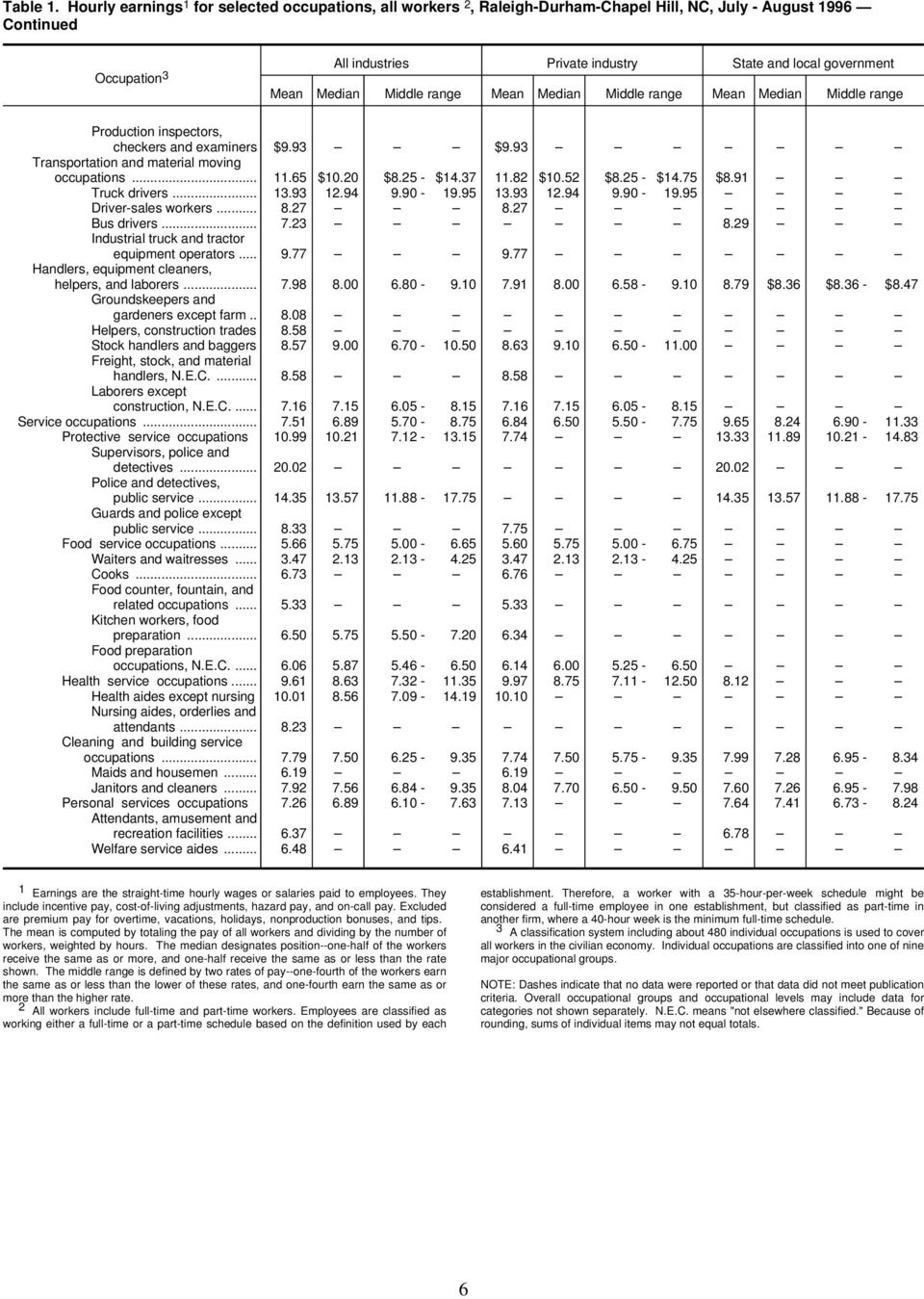
6 Wages in the Raleigh-Durham- Chapel Hill, NC metropolitan area S traight-time wages in the Raleigh-Durham-Chapel Hill, NC metropolitan area averaged $14.30 per hour during July/August, 1996 (table 1). White-collar workers had the highest average wage level, $17.26 per hour. Blue-collar workers averaged $11.51 per hour, while service workers had average earnings of $7.51 per hour. Within each of these occupational groups, average wages for individual occupations varied. For example, white-collar occupations included financial managers at $26.39 per hour, chemical technicians at $12.61 per hour, and sales counter clerks at $8.93 per hour. Among occupations in the blue-collar category, automobile mechanics averaged $16.77 per hour while bus drivers averaged $7.23 per hour. Finally, service workers included supervisors, police and detectives, at $20.02 and cooks at $6.73 per hour. Table 1 presents earnings data for 93 detailed occupations; data for other detailed occupations could not be reported separately due to concerns about the confidentiality of survey respondents. Chart 1. Average hourly wage rates by, Raleigh- Durham-Chapel Hill, NC, July-August 1996 Dollars per hour $ workers, about 83 percent of the Raleigh area labor force studied, averaged $14.10 per hour, while State and workers earned $15.29 per hour (chart 1). (All comparisons in this analysis cover hourly rates for both full- and part-time workers, unless otherwise noted.) Over three-quarters of State and workers were in white-collar jobs, with 40 percent in professional specialty and technical occupations (chart 2). About half of private sector employees were white-collar. In contrast, blue-collar workers made up only 9 percent of employees, while they made up 37 percent of private. Chart 2. Distribution of employment by occupational group, Raleigh-Durham-Chapel Hill, NC, July-August, 1996 Percent State and White-collar Blue-collar Service All industries State and Average wages for full-time workers in Raleigh were $14.98 per hour, compared with an average of $7.97 per hour for part-time workers (tables 2-3). Wages for the highest levels of work within major occupational groups usually were greater than for the lowest levels of work (table 5). This general pattern can vary somewhat depending on the mix of specific occupations 2

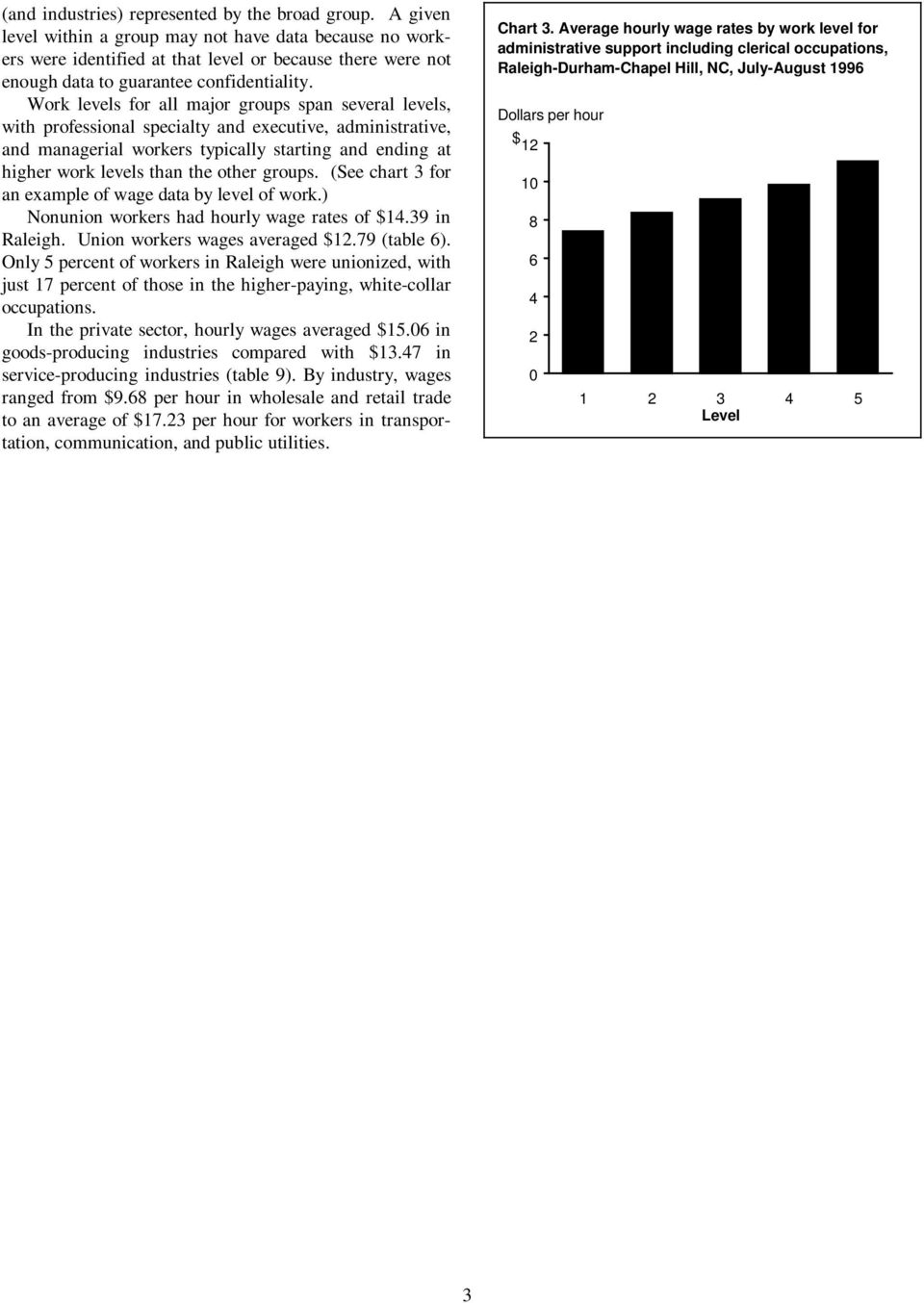
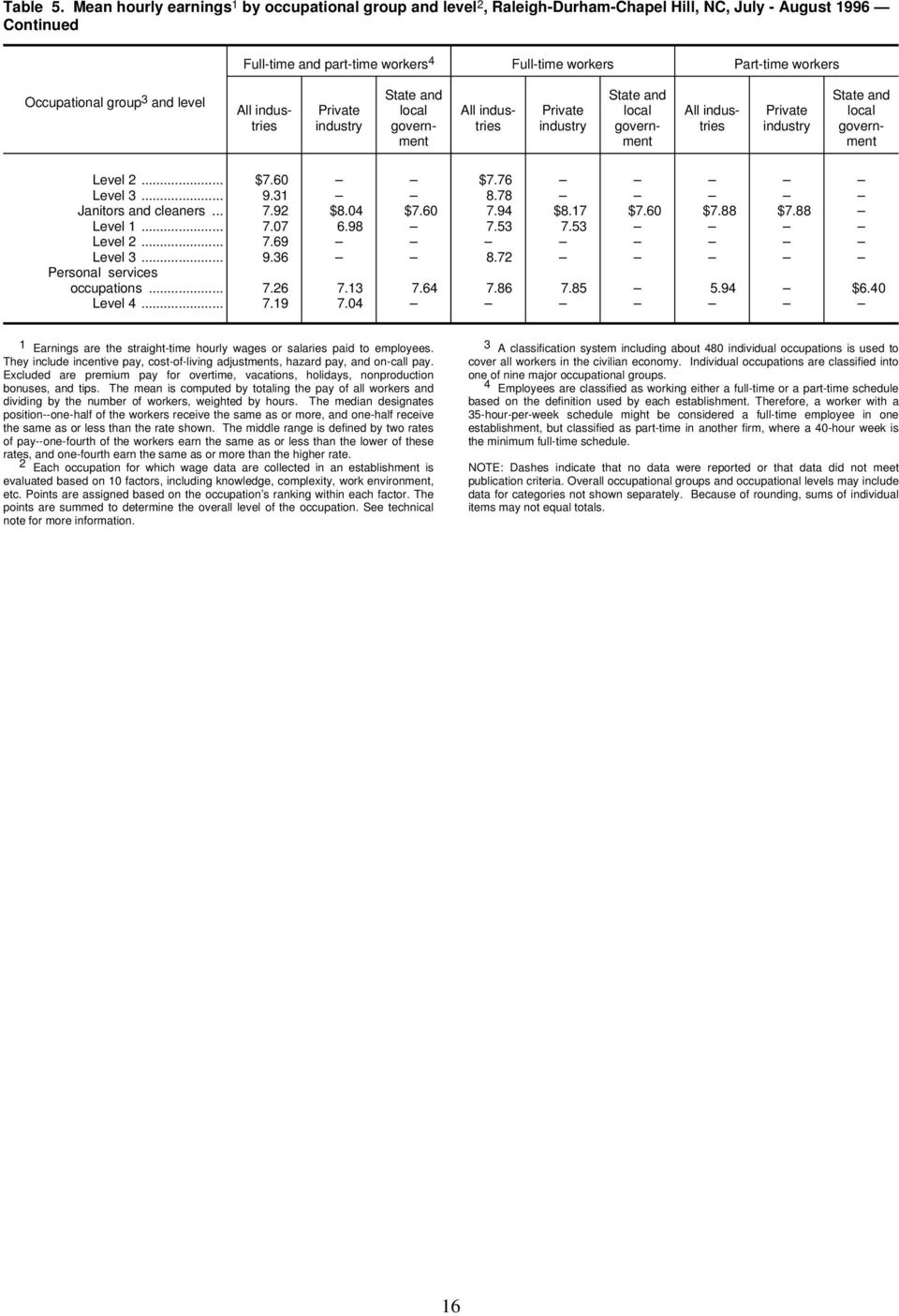
7 (and industries) represented by the broad group. A given level within a group may not have data because no workers were identified at that level or because there were not enough data to guarantee confidentiality. Work levels for all major groups span several levels, with professional specialty and executive, administrative, and managerial workers typically starting and ending at higher work levels than the other groups. (See chart 3 for an example of wage data by level of work.) Nonunion workers had hourly wage rates of $14.39 in Raleigh. Union workers wages averaged $12.79 (table 6). Only 5 percent of workers in Raleigh were unionized, with just 17 percent of those in the higher-paying, white-collar occupations. In the private sector, hourly wages averaged $15.06 in goods-producing industries compared with $13.47 in service-producing industries (table 9). By, wages ranged from $9.68 per hour in wholesale and retail trade to an average of $17.23 per hour for workers in transportation, communication, and public utilities. Chart 3. Average hourly wage rates by work level for administrative support including clerical occupations, Raleigh-Durham-Chapel Hill, NC, July-August 1996 Dollars per hour $ Level 3
8 Table 1. Hourly earnings 1 for selected occupations, all workers 2, Raleigh-Durham-Chapel Hill, NC, July - August 1996 Occupation 3 All industries State and Mean Median Middle range Mean Median Middle range Mean Median Middle range All workers... $14.30 $12.00 $ $17.00 $14.10 $12.00 $ $16.83 $15.29 $12.62 $ $18.04 All workers excluding sales White-collar occupations Professional specialty and technical occupations Professional specialty occupations Engineering occupations Civil engineers Electrical and electronic engineers Industrial engineers Engineers, N.E.C Computer systems analysts and scientists Operations and systems researchers and analysts Chemists, except biochemists Biological and life scientists Registered nurses Teachers Teachers, except college and university Secondary school teachers Vocational and educational counselors Librarians Economists Social workers Editors and reporters Technical occupations Clinical laboratory technologists and technicians Licensed practical nurses Health technologists and technicians, N.E.C Electrical and electronic technicians Drafters Chemical technicians Computer programmers Technical and related occupations, N.E.C Executive, administrative, and managerial occupations Administrators and officials, public administration Financial managers Personnel and labor relations managers Managers., marketing, advertising and public relations Administrators, education and related fields Managers, medicine and health Managers, food servicing and lodging establishments Managers, service organizations, N.E.C Managers and administrators, N.E.C Accountants and auditors Other financial officers See footnotes at end of table. 4

9 Table 1. Hourly earnings 1 for selected occupations, all workers 2, Raleigh-Durham-Chapel Hill, NC, July - August 1996 Continued Occupation 3 All industries State and Mean Median Middle range Mean Median Middle range Mean Median Middle range Personnel, training, and labor relations specialists... $17.91 $18.02 Purchasing agents and buyers, N.E.C Management related occupations, N.E.C $14.38 $ $ $14.04 $ $16.49 Sales occupations $11.00 Supervisors, sales occupations Sales occupations, other business services Sales representatives, mining, manufacturing, and wholesale Sales workers, other commodities Sales counter clerks Cashiers Administrative support including clerical occupations $9.75 $ $10.75 Supervisors, general office Computer operators Secretaries Typists Receptionists Order clerks Records clerks, N.E.C Bookkeepers, accounting and auditing clerks Traffic, shipping and receiving clerks Stock and inventory clerks Investigators and adjusters except insurance General office clerks Data entry keyers Administrative support occupations, N.E.C White-collar occupations excluding sales Blue-collar occupations Precision production, craft, and repair occupations Supervisors, mechanics and repairers Automobile mechanics Industrial machinery repairers Heating, air conditioning, and refrigeration mechanics Mechanics and repairers, N.E.C Carpenters Supervisors, production occupations Electrical and electronic equipment assemblers Inspectors, testers, and graders Machine operators, assemblers, and inspectors Packaging and filling machine operators Miscellaneous machine operators, N.E.C Assemblers See footnotes at end of table. 5

10 Table 1. Hourly earnings 1 for selected occupations, all workers 2, Raleigh-Durham-Chapel Hill, NC, July - August 1996 Continued Occupation 3 All industries State and Mean Median Middle range Mean Median Middle range Mean Median Middle range Production inspectors, checkers and examiners $9.93 $9.93 Transportation and material moving occupations $10.20 $ $ $10.52 $ $14.75 $8.91 Truck drivers Driver-sales workers Bus drivers Industrial truck and tractor equipment operators Handlers, equipment cleaners, helpers, and laborers $8.36 $ $8.47 Groundskeepers and gardeners except farm Helpers, construction trades 8.58 Stock handlers and baggers Freight, stock, and material handlers, N.E.C Laborers except construction, N.E.C Service occupations Protective service occupations Supervisors, police and detectives Police and detectives, public service Guards and police except public service Food service occupations Waiters and waitresses Cooks Food counter, fountain, and related occupations Kitchen workers, food preparation Food preparation occupations, N.E.C Health service occupations Health aides except nursing Nursing aides, orderlies and attendants Cleaning and building service occupations Maids and housemen Janitors and cleaners Personal services occupations Attendants, amusement and recreation facilities Welfare service aides Earnings are the straight-time hourly wages or salaries paid to employees. They include incentive pay, cost-of-living adjustments, hazard pay, and on-call pay. Excluded are premium pay for overtime, vacations, holidays, nonproduction bonuses, and tips. The mean is computed by totaling the pay of all workers and dividing by the number of workers, weighted by hours. The median designates position--one-half of the workers receive the same as or more, and one-half receive the same as or less than the rate shown. The middle range is defined by two rates of pay--one-fourth of the workers earn the same as or less than the lower of these rates, and one-fourth earn the same as or more than the higher rate. 2 All workers include full-time and part-time workers. Employees are classified as working either a full-time or a part-time schedule based on the definition used by each establishment. Therefore, a worker with a 35-hour-per-week schedule might be considered a full-time employee in one establishment, but classified as part-time in another firm, where a 40-hour week is the minimum full-time schedule. 3 A classification system including about 480 individual occupations is used to cover all workers in the civilian economy. Individual occupations are classified into one of nine major occupational groups. NOTE: Dashes indicate that no data were reported or that data did not meet publication criteria. Overall occupational groups and occupational levels may include data for categories not shown separately. N.E.C. means "not elsewhere classified." Because of rounding, sums of individual items may not equal totals. 6
11 Table 2. Hourly earnings 1 for selected occupations, full-time workers only 2, Raleigh-Durham-Chapel Hill, NC, July - August 1996 Occupation 3 All industries State and Mean Median Middle range Mean Median Middle range Mean Median Middle range All workers... $14.98 $12.50 $ $17.48 $14.88 $12.50 $ $17.26 $15.39 $12.72 $ $18.10 All workers excluding sales White-collar occupations Professional specialty and technical occupations Professional specialty occupations Engineering occupations Civil engineers Electrical and electronic engineers Industrial engineers Engineers, N.E.C Computer systems analysts and scientists Operations and systems researchers and analysts Chemists, except biochemists Biological and life scientists Registered nurses Teachers Teachers, except college and university Secondary school teachers Vocational and educational counselors Librarians Economists Social workers Editors and reporters Technical occupations Clinical laboratory technologists and technicians Health technologists and technicians, N.E.C Electrical and electronic technicians Drafters Chemical technicians Computer programmers Technical and related occupations, N.E.C Executive, administrative, and managerial occupations Administrators and officials, public administration Financial managers Personnel and labor relations managers Managers., marketing, advertising and public relations Administrators, education and related fields Managers, medicine and health Managers, food servicing and lodging establishments Managers, service organizations, N.E.C Managers and administrators, N.E.C Accountants and auditors Other financial officers See footnotes at end of table. 7
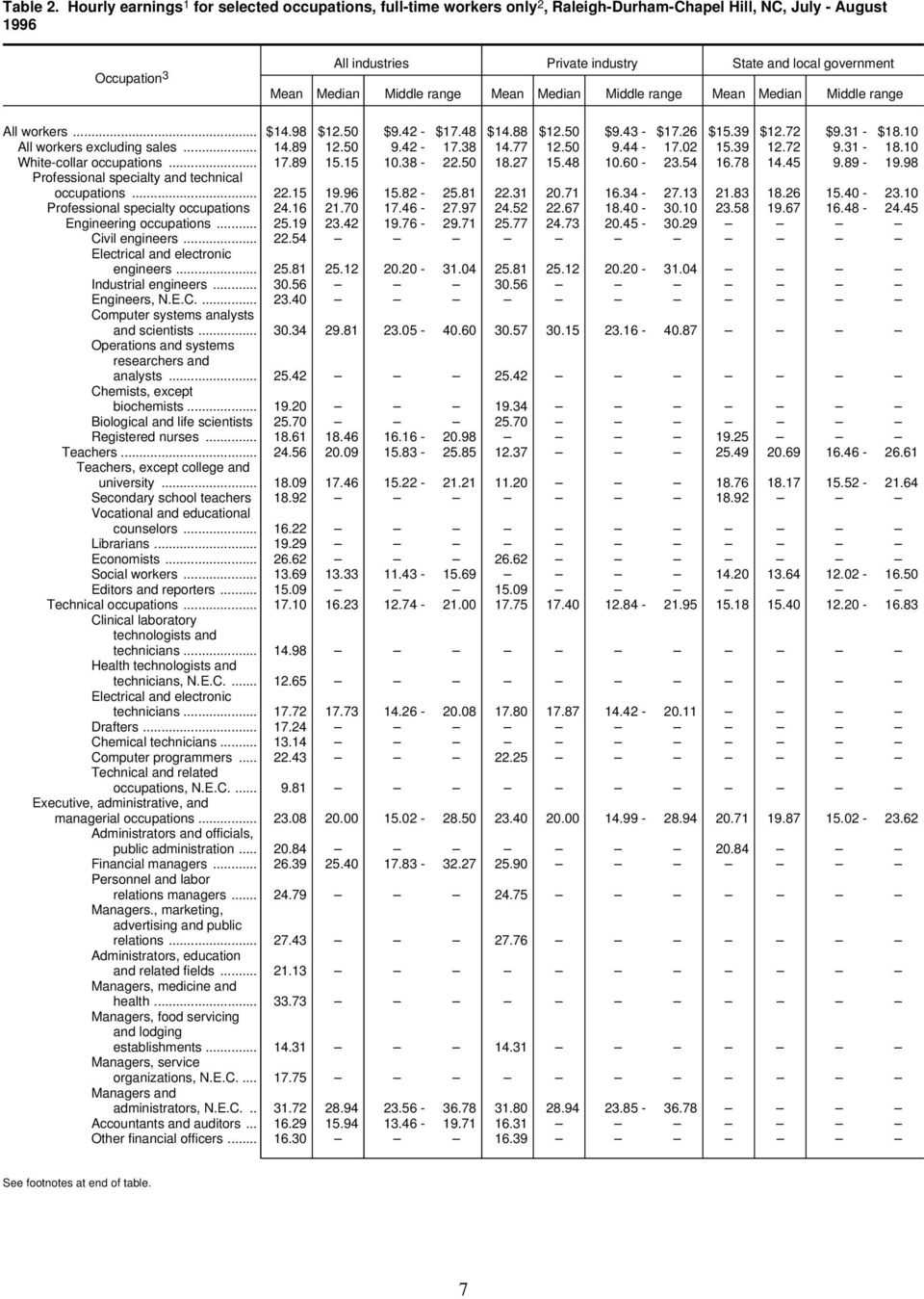
12 Table 2. Hourly earnings 1 for selected occupations, full-time workers only 2, Raleigh-Durham-Chapel Hill, NC, July - August 1996 Continued Occupation 3 All industries State and Mean Median Middle range Mean Median Middle range Mean Median Middle range Personnel, training, and labor relations specialists... $17.91 $18.02 Purchasing agents and buyers, N.E.C Management related occupations, N.E.C $14.38 $ $ $14.04 $ $16.49 Sales occupations Supervisors, sales occupations Sales occupations, other business services Sales representatives, mining, manufacturing, and wholesale Sales workers, other commodities Sales counter clerks Cashiers Administrative support including clerical occupations $10.03 $9.75 $ $10.75 Supervisors, general office Computer operators Secretaries Receptionists Order clerks Records clerks, N.E.C Bookkeepers, accounting and auditing clerks Traffic, shipping and receiving clerks Stock and inventory clerks Investigators and adjusters except insurance General office clerks Data entry keyers Administrative support occupations, N.E.C White-collar occupations excluding sales Blue-collar occupations Precision production, craft, and repair occupations Supervisors, mechanics and repairers Automobile mechanics Industrial machinery repairers Heating, air conditioning, and refrigeration mechanics Mechanics and repairers, N.E.C Carpenters Supervisors, production occupations Electrical and electronic equipment assemblers Inspectors, testers, and graders Machine operators, assemblers, and inspectors Packaging and filling machine operators Miscellaneous machine operators, N.E.C Assemblers Production inspectors, checkers and examiners See footnotes at end of table. 8

13 Table 2. Hourly earnings 1 for selected occupations, full-time workers only 2, Raleigh-Durham-Chapel Hill, NC, July - August 1996 Continued Occupation 3 All industries State and Mean Median Middle range Mean Median Middle range Mean Median Middle range Transportation and material moving occupations... $12.21 $10.75 $ $14.81 $12.24 $10.82 $ $14.85 Truck drivers Driver-sales workers Industrial truck and tractor equipment operators Handlers, equipment cleaners, helpers, and laborers $8.75 $8.36 $ $8.43 Groundskeepers and gardeners except farm Stock handlers and baggers Freight, stock, and material handlers, N.E.C Vehicle washers and equipment cleaners Laborers except construction, N.E.C Service occupations Protective service occupations Supervisors, police and detectives Police and detectives, public service Guards and police except public service Food service occupations Cooks Kitchen workers, food preparation Food preparation occupations, N.E.C Health service occupations Health aides except nursing Nursing aides, orderlies and attendants Cleaning and building service occupations Maids and housemen Janitors and cleaners Personal services occupations Welfare service aides Earnings are the straight-time hourly wages or salaries paid to employees. They include incentive pay, cost-of-living adjustments, hazard pay, and on-call pay. Excluded are premium pay for overtime, vacations, holidays, nonproduction bonuses, and tips. The mean is computed by totaling the pay of all workers and dividing by the number of workers, weighted by hours. The median designates position--one-half of the workers receive the same as or more, and one-half receive the same as or less than the rate shown. The middle range is defined by two rates of pay--one-fourth of the workers earn the same as or less than the lower of these rates, and one-fourth earn the same as or more than the higher rate. 2 Employees are classified as working either a full-time or a part-time schedule based on the definition used by each establishment. Therefore, a worker with a 35-hour-per-week schedule might be considered a full-time employee in one establishment, but classified as part-time in another firm, where a 40-hour week is the minimum full-time schedule. 3 A classification system including about 480 individual occupations is used to cover all workers in the civilian economy. Individual occupations are classified into one of nine major occupational groups. NOTE: Dashes indicate that no data were reported or that data did not meet publication criteria. Overall occupational groups and occupational levels may include data for categories not shown separately. N.E.C. means "not elsewhere classified." Because of rounding, sums of individual items may not equal totals. 9
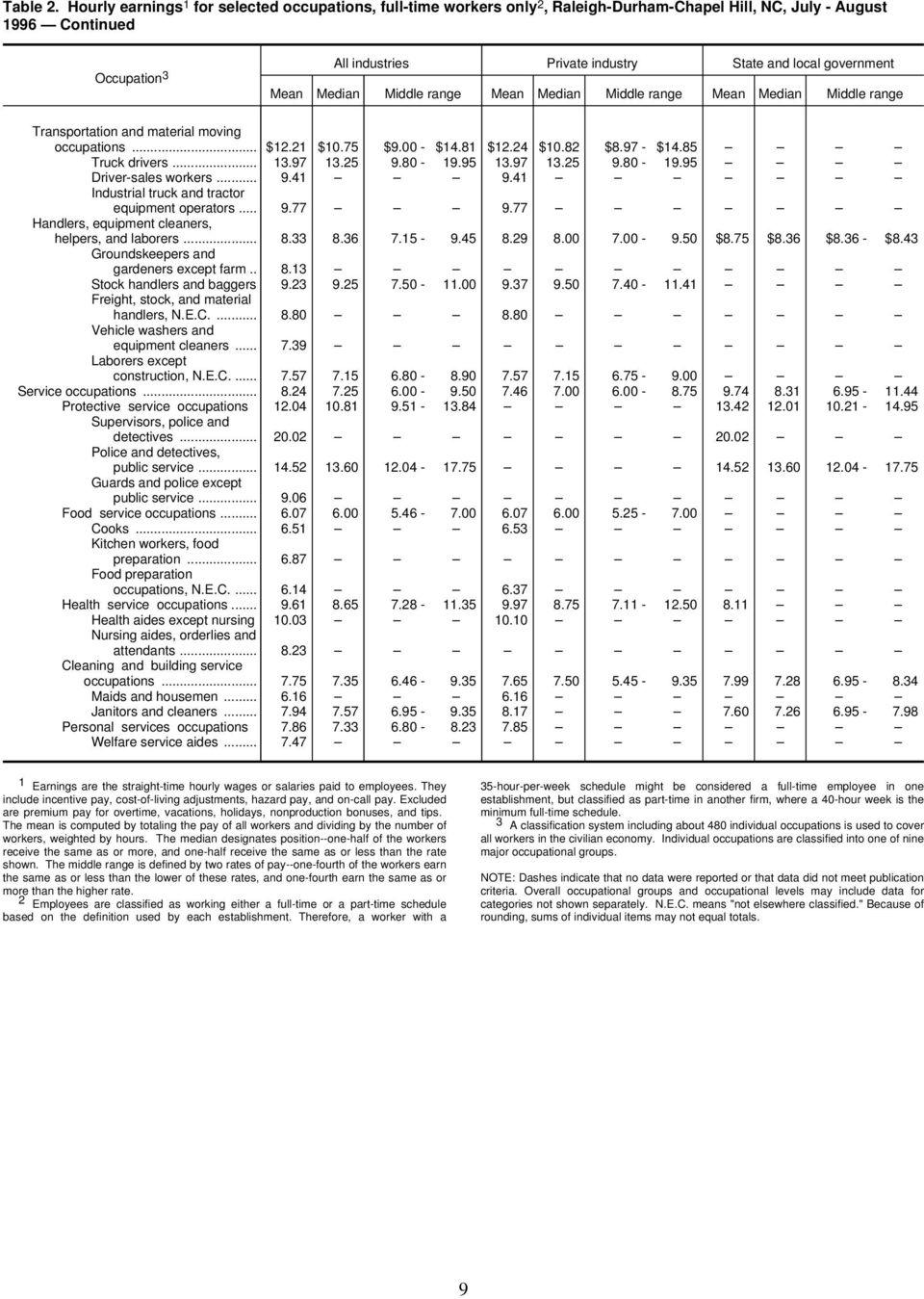
14 Table 3. Hourly earnings 1 for selected occupations, part-time workers only 2, Raleigh-Durham-Chapel Hill, NC, July - August 1996 Occupation 3 All industries State and Mean Median Middle range Mean Median Middle range Mean Median Middle range All workers... $7.97 $6.89 $ $8.63 $7.75 $6.65 $ $8.40 $11.90 $8.99 $ $16.18 All workers excluding sales White-collar occupations Professional specialty and technical occupations Professional specialty occupations Registered nurses Technical occupations Sales occupations Sales workers, other commodities Cashiers Administrative support including clerical occupations Bookkeepers, accounting and auditing clerks General office clerks White-collar occupations excluding sales Blue-collar occupations Transportation and material moving occupations Bus drivers Handlers, equipment cleaners, helpers, and laborers Stock handlers and baggers Laborers except construction, N.E.C Service occupations Protective service occupations 7.16 Food service occupations Waiters and waitresses Food counter, fountain, and related occupations Kitchen workers, food preparation Food preparation occupations, N.E.C Cleaning and building service occupations Janitors and cleaners Personal services occupations Attendants, amusement and recreation facilities Welfare service aides Earnings are the straight-time hourly wages or salaries paid to employees. They include incentive pay, cost-of-living adjustments, hazard pay, and on-call pay. Excluded are premium pay for overtime, vacations, holidays, nonproduction bonuses, and tips. The mean is computed by totaling the pay of all workers and dividing by the number of workers, weighted by hours. The median designates position--one-half of the workers receive the same as or more, and one-half receive the same as or less than the rate shown. The middle range is defined by two rates of pay--one-fourth of the workers earn the same as or less than the lower of these rates, and one-fourth earn the same as or more than the higher rate. 2 Employees are classified as working either a full-time or a part-time schedule based on the definition used by each establishment. Therefore, a worker with a 35-hour-per-week schedule might be considered a full-time employee in one establishment, but classified as part-time in another firm, where a 40-hour week is the minimum full-time schedule. 3 A classification system including about 480 individual occupations is used to cover all workers in the civilian economy. Individual occupations are classified into one of nine major occupational groups. NOTE: Dashes indicate that no data were reported or that data did not meet publication criteria. Overall occupational groups and occupational levels may include data for categories not shown separately. N.E.C. means "not elsewhere classified." Because of rounding, sums of individual items may not equal totals. 10
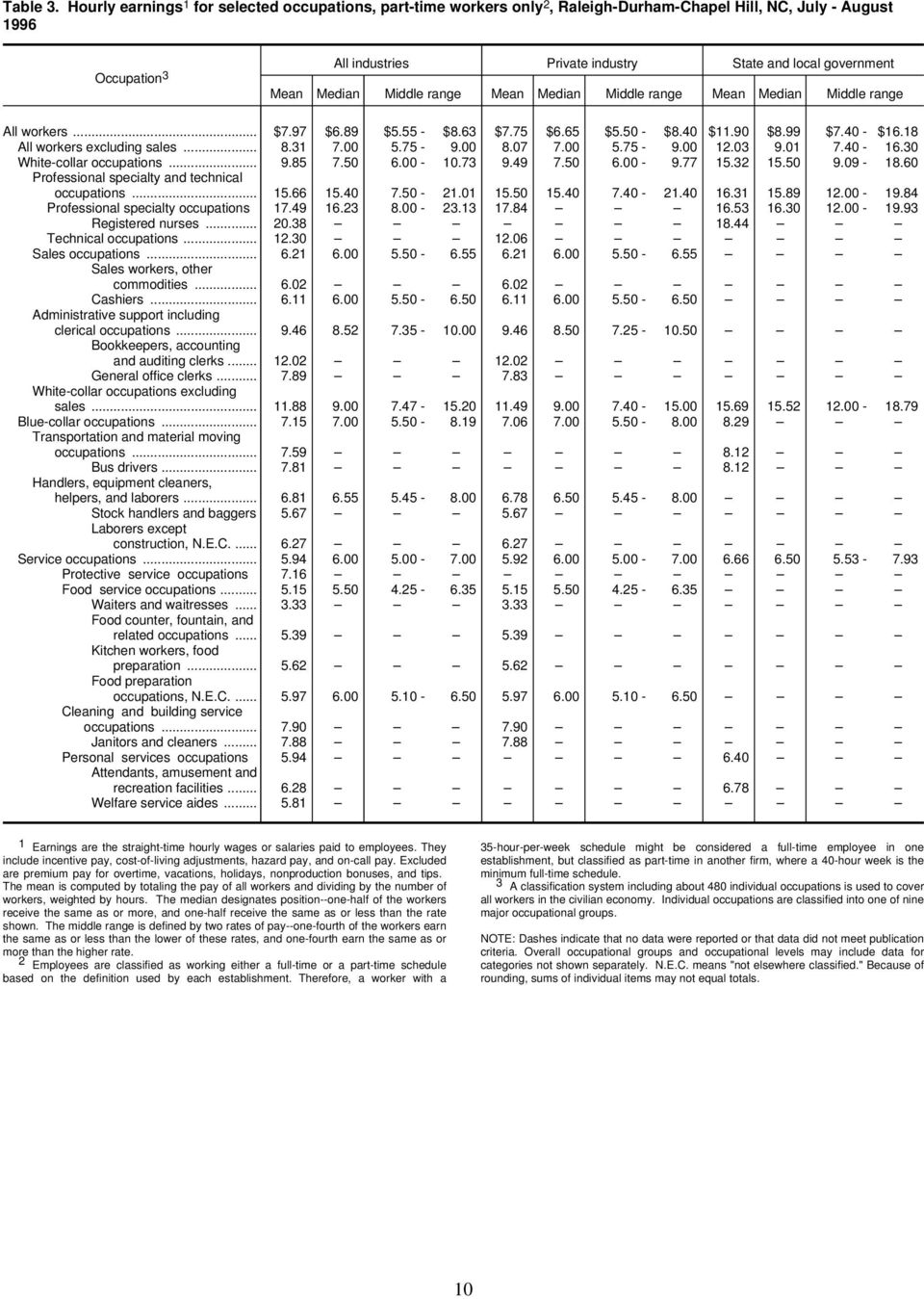
15 Table 4. Mean weekly earnings 1 and hours for selected white-collar occupations, full-time workers only 2, Raleigh-Durham-Chapel Hill, NC, July - August 1996 All industries State and Occupation 3 Mean weekly hours 4 Weekly earnings Mean Weekly earnings Mean Weekly earnings weekly weekly Mean Median hours 4 Mean Median hours 4 Mean Median White-collar occupations $714 $ $736 $ $651 $550 Professional specialty and technical occupations Professional specialty occupations Engineering occupations Civil engineers Electrical and electronic engineers Industrial engineers Engineers, N.E.C Computer systems analysts and scientists Operations and systems researchers and analysts Chemists, except biochemists Biological and life scientists Registered nurses Teachers Teachers, except college and university Secondary school teachers Vocational and educational counselors Librarians Economists Social workers Editors and reporters Technical occupations Clinical laboratory technologists and technicians Health technologists and technicians, N.E.C Electrical and electronic technicians Drafters Chemical technicians Computer programmers Technical and related occupations, N.E.C Executive, administrative, and managerial occupations Administrators and officials, public administration Financial managers Personnel and labor relations managers Managers., marketing, advertising and public relations Administrators, education and related fields Managers, medicine and health Managers, food servicing and lodging establishments Managers, service organizations, N.E.C Managers and administrators, N.E.C Accountants and auditors Other financial officers Personnel, training, and labor relations specialists Purchasing agents and buyers, N.E.C Management related occupations, N.E.C Sales occupations Supervisors, sales occupations See footnotes at end of table. 11

16 Table 4. Mean weekly earnings 1 and hours for selected white-collar occupations, full-time workers only 2, Raleigh-Durham-Chapel Hill, NC, July - August 1996 Continued All industries State and Occupation 3 Mean weekly hours 4 Weekly earnings Mean Weekly earnings Mean Weekly earnings weekly weekly Mean Median hours 4 Mean Median hours 4 Mean Median Sales occupations, other business services $ $939 Sales representatives, mining, manufacturing, and wholesale $ $654 Sales workers, other commodities Sales counter clerks Cashiers Administrative support including clerical occupations $395 $382 Supervisors, general office Computer operators Secretaries Receptionists Order clerks Records clerks, N.E.C Bookkeepers, accounting and auditing clerks Traffic, shipping and receiving clerks Stock and inventory clerks Investigators and adjusters except insurance General office clerks Data entry keyers Administrative support occupations, N.E.C White-collar occupations excluding sales Earnings are the straight-time weekly wages or salaries paid to employees. They include incentive pay, cost-of-living adjustments, hazard pay, and on-call pay. Excluded are premium pay for overtime, vacations, holidays, nonproduction bonuses, and tips. The mean is computed by totaling the pay of all workers and dividing by the number of workers, weighted by hours. The median designates position--one-half of the workers receive the same as or more, and one-half receive the same as or less than the rate shown. The middle range is defined by two rates of pay--one-fourth of the workers earn the same as or less than the lower of these rates, and one-fourth earn the same as or more than the higher rate. 2 Employees are classified as working either a full-time or a part-time schedule based on the definition used by each establishment. Therefore, a worker with a 35-hour-per-week schedule might be considered a full-time employee in one establishment, but classified as part-time in another firm, where a 40-hour week is the minimum full-time schedule. 3 A classification system including about 480 individual occupations is used to cover all workers in the civilian economy. Individual occupations are classified into one of nine major occupational groups. 4 Mean weekly hours are the hours an employee is scheduled to work in a week. NOTE: Dashes indicate that no data were reported or that data did not meet publication criteria. Overall occupational groups and occupational levels may include data for categories not shown separately. N.E.C. means "not elsewhere classified." Because of rounding, sums of individual items may not equal totals. 12
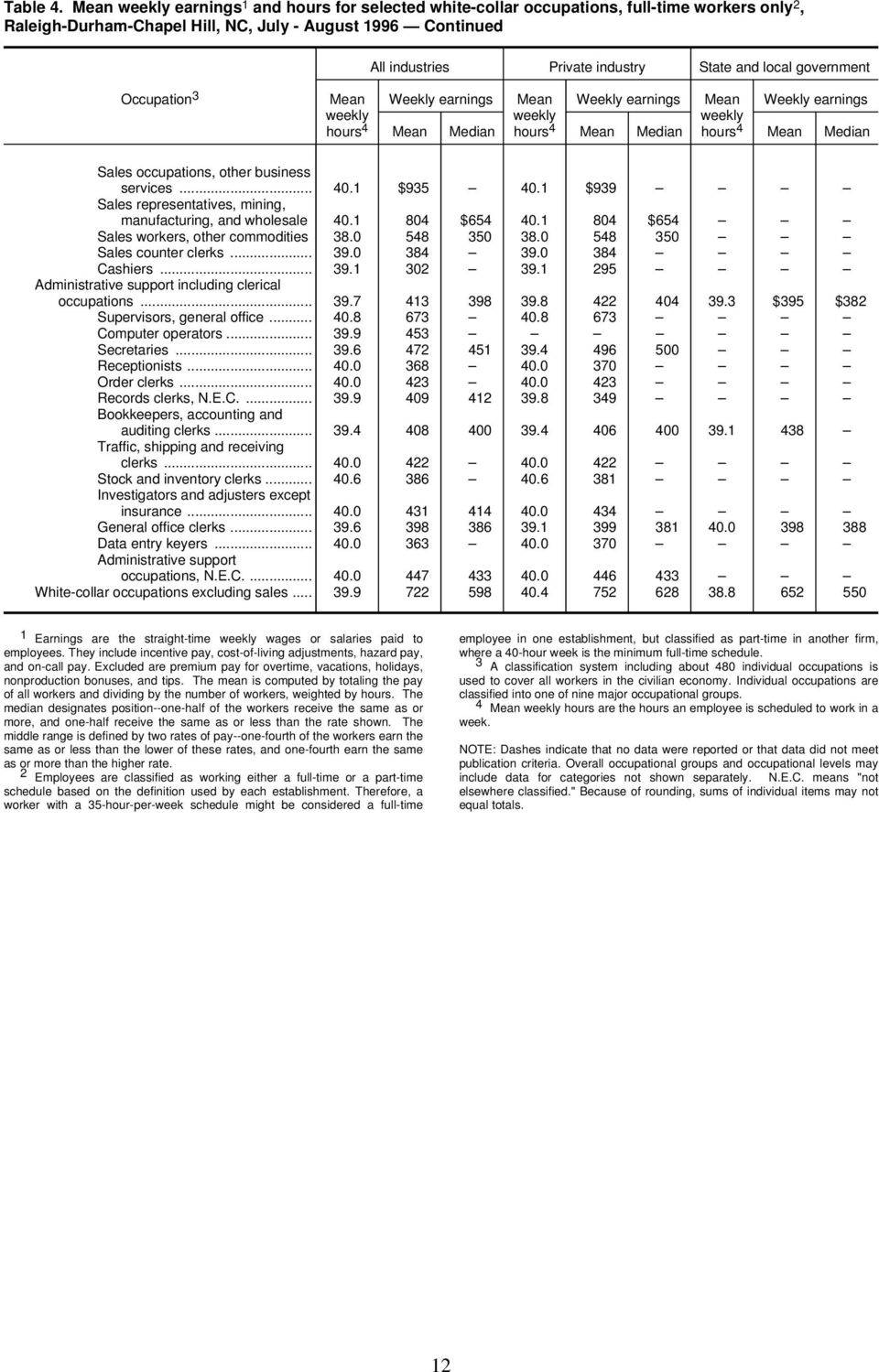
17 Table 5. Mean hourly earnings 1 by occupational group and level 2, Raleigh-Durham-Chapel Hill, NC, July - August 1996 Full-time and part-time workers 4 Full-time workers Part-time workers Occupational group 3 and level All industries State and All industries State and All industries State and White-collar occupations... $17.26 $17.42 $16.75 $17.89 $18.27 $16.78 $9.85 $9.49 $15.32 Professional specialty and technical occupations Professional specialty occupations Level Level Level Level Level Level Level Level Level Engineering occupations Level Level Level Level Electrical and electronic engineers Registered nurses Level Natural scientists Level Level Level Level Teachers Level Teachers, except college and university Level Technical occupations Level Level Level Level Level Level Electrical and electronic technicians Level Executive, administrative, and managerial occupations Level Level Level Level Level Level Level Level Level Level Level Executives, managers and administrators Level Level Level Level Level Level Level See footnotes at end of table. 13
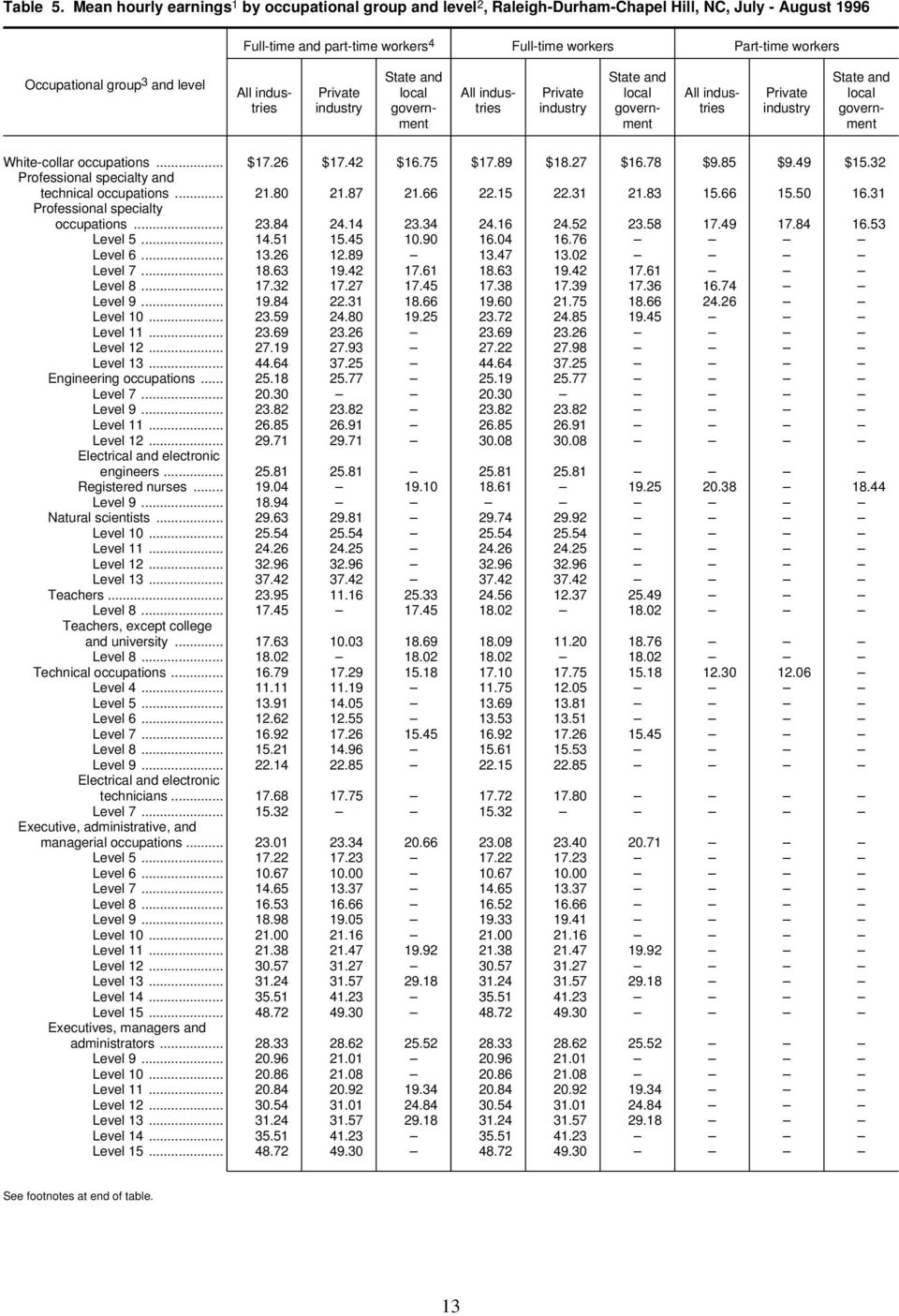
18 Table 5. Mean hourly earnings 1 by occupational group and level 2, Raleigh-Durham-Chapel Hill, NC, July - August 1996 Continued Full-time and part-time workers 4 Full-time workers Part-time workers Occupational group 3 and level All industries State and All industries State and All industries State and Managers and administrators, N.E.C.... $31.72 $31.80 $31.72 $31.80 Level Level Level Level Level Personnel, training, and labor relations specialists Sales occupations $ $6.21 $6.21 Level Level Level Level Level Level Level Level Level Level Cashiers Level Level Level Administrative support including clerical occupations $ Level Level Level Level Level Level Level Not able to be leveled Secretaries Level Level Level Order clerks Bookkeepers, accounting and auditing clerks Level Level Level General office clerks Level Level Level White-collar occupations excluding sales $15.69 Level Level Level Level Level Level Level Level Level Level Level Level Level See footnotes at end of table. 14

19 Table 5. Mean hourly earnings 1 by occupational group and level 2, Raleigh-Durham-Chapel Hill, NC, July - August 1996 Continued Full-time and part-time workers 4 Full-time workers Part-time workers Occupational group 3 and level All industries State and All industries State and All industries State and Level $35.54 $37.50 $35.54 $37.50 Level Not able to be leveled $8.99 $8.99 Blue-collar occupations $ $ $8.29 Precision production, craft, and repair occupations Level Level Level Level Level Level Machine operators, assemblers, and inspectors Level Level Level Level Level Level Level Transportation and material moving occupations Level Level Level Level Truck drivers Level Handlers, equipment cleaners, helpers, and laborers Level Level Level Level Service occupations Level Level Level Level Level Level Level Level Level Level Protective service occupations Level Level Level Level Guards and police except public service Food service occupations Level Level Level Level Health service occupations Nursing aides, orderlies and attendants Cleaning and building service occupations Level See footnotes at end of table. 15

20 Table 5. Mean hourly earnings 1 by occupational group and level 2, Raleigh-Durham-Chapel Hill, NC, July - August 1996 Continued Full-time and part-time workers 4 Full-time workers Part-time workers Occupational group 3 and level All industries State and All industries State and All industries State and Level 2... $7.60 $7.76 Level Janitors and cleaners $8.04 $ $8.17 $7.60 $7.88 $7.88 Level Level Level Personal services occupations $6.40 Level Earnings are the straight-time hourly wages or salaries paid to employees. They include incentive pay, cost-of-living adjustments, hazard pay, and on-call pay. Excluded are premium pay for overtime, vacations, holidays, nonproduction bonuses, and tips. The mean is computed by totaling the pay of all workers and dividing by the number of workers, weighted by hours. The median designates position--one-half of the workers receive the same as or more, and one-half receive the same as or less than the rate shown. The middle range is defined by two rates of pay--one-fourth of the workers earn the same as or less than the lower of these rates, and one-fourth earn the same as or more than the higher rate. 2 Each occupation for which wage data are collected in an establishment is evaluated based on 10 factors, including knowledge, complexity, work environment, etc. Points are assigned based on the occupation s ranking within each factor. The points are summed to determine the overall level of the occupation. See technical note for more information. 3 A classification system including about 480 individual occupations is used to cover all workers in the civilian economy. Individual occupations are classified into one of nine major occupational groups. 4 Employees are classified as working either a full-time or a part-time schedule based on the definition used by each establishment. Therefore, a worker with a 35-hour-per-week schedule might be considered a full-time employee in one establishment, but classified as part-time in another firm, where a 40-hour week is the minimum full-time schedule. NOTE: Dashes indicate that no data were reported or that data did not meet publication criteria. Overall occupational groups and occupational levels may include data for categories not shown separately. Because of rounding, sums of individual items may not equal totals. 16
21 Table 6. Mean hourly earnings 1 by occupational group and selected characteristic, all industries, Raleigh-Durham-Chapel Hill, NC, July - August 1996 Occupational group 2 Union 3 Nonunion 3 Full-time workers 4 Part-time workers 4 Time 5 Incentive 5 All workers... $12.79 $14.39 $14.98 $7.97 $14.18 $17.24 All workers excluding sales White-collar occupations Professional specialty and technical occupations Professional specialty occupations Technical occupations Executive, administrative, and managerial occupations Sales occupations Administrative support including clerical occupations White-collar excluding sales Blue-collar occupations Precision production, craft, and repair occupations Machine operators, assemblers, and inspectors Transportation and material moving occupations Handlers, equipment cleaners, helpers, and laborers Service occupations Earnings are the straight-time hourly wages or salaries paid to employees. They include incentive pay, cost-of-living adjustments, hazard pay, and on-call pay. Excluded are premium pay for overtime, vacations, holidays, nonproduction bonuses, and tips. The mean is computed by totaling the pay of all workers and dividing by the number of workers, weighted by hours. The median designates position--one-half of the workers receive the same as or more, and one-half receive the same as or less than the rate shown. The middle range is defined by two rates of pay--one-fourth of the workers earn the same as or less than the lower of these rates, and one-fourth earn the same as or more than the higher rate. 2 A classification system including about 480 individual occupations is used to cover all workers in the civilian economy. Individual occupations are classified into one of nine major occupational groups. 3 Union workers are those whose wages are determined through collective bargaining. 4 Employees are classified as working either a full-time or a part-time schedule based on the definition used by each establishment. Therefore, a worker with a 35-hour-per-week schedule might be considered a full-time employee in one establishment, but classified as part-time in another firm, where a 40-hour week is the minimum full-time schedule. 5 Time workers wages are based solely on hourly or weekly rates; incentive workers are those whose wages are at least partially based on productivity payments such as piece rates, commissions, and production bonuses. NOTE: Dashes indicate that no data were reported or that data did not meet publication criteria. Overall occupational groups and occupational levels may include data for categories not shown separately. Because of rounding, sums of individual items may not equal totals. 17
22 Table 7. Mean hourly earnings 1 by occupational group and selected characteristic, private, Raleigh-Durham-Chapel Hill, NC, July - August 1996 Occupational group 2 Union 3 Nonunion 3 Full-time workers 4 Part-time workers 4 Time 5 Incentive 5 All workers... $12.64 $14.19 $14.88 $7.75 $13.93 $17.24 All workers excluding sales White-collar occupations Professional specialty and technical occupations Professional specialty occupations Technical occupations Executive, administrative, and managerial occupations Sales occupations Administrative support including clerical occupations White-collar excluding sales Blue-collar occupations Precision production, craft, and repair occupations Machine operators, assemblers, and inspectors Transportation and material moving occupations Handlers, equipment cleaners, helpers, and laborers Service occupations Earnings are the straight-time hourly wages or salaries paid to employees. They include incentive pay, cost-of-living adjustments, hazard pay, and on-call pay. Excluded are premium pay for overtime, vacations, holidays, nonproduction bonuses, and tips. The mean is computed by totaling the pay of all workers and dividing by the number of workers, weighted by hours. The median designates position--one-half of the workers receive the same as or more, and one-half receive the same as or less than the rate shown. The middle range is defined by two rates of pay--one-fourth of the workers earn the same as or less than the lower of these rates, and one-fourth earn the same as or more than the higher rate. 2 A classification system including about 480 individual occupations is used to cover all workers in the civilian economy. Individual occupations are classified into one of nine major occupational groups. 3 Union workers are those whose wages are determined through collective bargaining. 4 Employees are classified as working either a full-time or a part-time schedule based on the definition used by each establishment. Therefore, a worker with a 35-hour-per-week schedule might be considered a full-time employee in one establishment, but classified as part-time in another firm, where a 40-hour week is the minimum full-time schedule. 5 Time workers wages are based solely on hourly or weekly rates; incentive workers are those whose wages are at least partially based on productivity payments such as piece rates, commissions, and production bonuses. NOTE: Dashes indicate that no data were reported or that data did not meet publication criteria. Overall occupational groups and occupational levels may include data for categories not shown separately. Because of rounding, sums of individual items may not equal totals. 18
23 Table 8. Hourly earnings 1 by occupational group by selected characteristics, State and, Raleigh-Durham-Chapel Hill, NC, July - August 1996 Occupational group 2 Nonunion 3 Full-time workers 4 Part-time workers 4 Time 5 All workers... $15.33 $15.39 $11.90 $15.29 White-collar occupations Professional specialty and technical occupations Professional specialty occupations Technical occupations Executive, administrative, and managerial occupations Sales occupations Administrative support including clerical occupations White-collar excluding sales Blue-collar occupations Precision production, craft, and repair occupations Transportation and material moving occupations Handlers, equipment cleaners, helpers, and laborers Service occupations Earnings are the straight-time hourly wages or salaries paid to employees. They include incentive pay, cost-of-living adjustments, hazard pay, and on-call pay. Excluded are premium pay for overtime, vacations, holidays, nonproduction bonuses, and tips. The mean is computed by totaling the pay of all workers and dividing by the number of workers, weighted by hours. The median designates position--one-half of the workers receive the same as or more, and one-half receive the same as or less than the rate shown. The middle range is defined by two rates of pay--one-fourth of the workers earn the same as or less than the lower of these rates, and one-fourth earn the same as or more than the higher rate. 2 A classification system including about 480 individual occupations is used to cover all workers in the civilian economy.individual occupations are classified into one of nine major occupational groups. 3 Union workers are those whose wages are determined through collective bargaining. 4 Employees are classified as working either a full-time or a part-time schedule based on the definition used by each establishment. Therefore, a worker with a 35-hour-per-week schedule might be considered a full-time employee in one establishment, but classified as part-time in another firm, where a 40-hour week is the minimum full-time schedule. 5 Time workers wages are based solely on hourly or weekly rates; incentive workers are those whose wages are at least partially based on productivity payments such as piece rates, commissions, and production bonuses. NOTE: Dashes indicate that no data were reported or that data did not meet publication criteria. Overall occupational groups and occupational levels may include data for categories not shown separately. Because of rounding, sums of individual items may not equal totals. 19
24 Table 9. Mean hourly earnings 1 by occupational group, private, all workers 2, Raleigh-Durham-Chapel Hill, NC, July - August 1996 Goods-producing industries 4 Service-producing industries 5 Occupational group 3 All private industries Total Total Construction Manufacturing Transportation and public utilities Wholesale and retail trade Finance, insurance, and real estate Services All workers... $14.10 $15.06 $17.12 $13.47 $17.23 $9.68 $14.04 $14.53 All workers excluding sales White-collar occupations $ Professional specialty and technical occupations Professional specialty occupations Technical occupations Executive, administrative, and managerial occupations Sales occupations Administrative support including clerical occupations White-collar excluding sales Blue-collar occupations Precision production, craft, and repair occupations Machine operators, assemblers, and inspectors Transportation and material moving occupations Handlers, equipment cleaners, helpers, and laborers Service occupations Earnings are the straight-time hourly wages or salaries paid to employees. They include incentive pay, cost-of-living adjustments, hazard pay, and on-call pay. Excluded are premium pay for overtime, vacations, holidays, nonproduction bonuses, and tips. The mean is computed by totaling the pay of all workers and dividing by the number of workers, weighted by hours. The median designates position--one-half of the workers receive the same as or more, and one-half receive the same as or less than the rate shown. The middle range is defined by two rates of pay--one-fourth of the workers earn the same as or less than the lower of these rates, and one-fourth earn the same as or more than the higher rate. 2 All workers include full-time and part-time workers. Employees are classified as working either a full-time or a part-time schedule based on the definition used by each establishment. Therefore, a worker with a 35-hour-per-week schedule might be considered a full-time employee in one establishment, but classified as part-time in another firm, where a 40-hour week is the minimum full-time schedule. 3 A classification system including about 480 individual occupations is used to cover all workers in the civilian economy. Individual occupations are classified into one of nine major occupational groups. 4 Goods-producing industries include mining, construction, and manufacturing. 5 Service-producing industries include transportation and public utilities; wholesale and retail trade; finance, insurance, and real estate; and services. NOTE: Dashes indicate that no data were reported or that data did not meet publication criteria. Overall occupational groups and occupational levels may include data for categories not shown separately. Because of rounding, sums of individual items may not equal totals. 20
25 Table 10. Mean hourly earnings 1 by occupational group, private, full-time workers only 2, Raleigh-Durham-Chapel Hill, NC, July - August 1996 Goods-producing industries 4 Service-producing industries 5 Occupational group 3 All private industries Total Total Construction Manufacturing Transportation and public utilities Wholesale and retail trade Finance, insurance, and real estate Services All workers... $14.88 $15.11 $17.18 $14.71 $18.01 $11.29 $14.31 $15.49 All workers excluding sales White-collar occupations $ Professional specialty and technical occupations Professional specialty occupations Technical occupations Executive, administrative, and managerial occupations Sales occupations Administrative support including clerical occupations White-collar excluding sales Blue-collar occupations Precision production, craft, and repair occupations Machine operators, assemblers, and inspectors Transportation and material moving occupations Handlers, equipment cleaners, helpers, and laborers Service occupations Earnings are the straight-time hourly wages or salaries paid to employees. They include incentive pay, cost-of-living adjustments, hazard pay, and on-call pay. Excluded are premium pay for overtime, vacations, holidays, nonproduction bonuses, and tips. The mean is computed by totaling the pay of all workers and dividing by the number of workers, weighted by hours. The median designates position--one-half of the workers receive the same as or more, and one-half receive the same as or less than the rate shown. The middle range is defined by two rates of pay--one-fourth of the workers earn the same as or less than the lower of these rates, and one-fourth earn the same as or more than the higher rate. 2 Employees are classified as working either a full-time or a part-time schedule based on the definition used by each establishment. Therefore, a worker with a 35-hour-per-week schedule might be considered a full-time employee in one establishment, but classified as part-time in another firm, where a 40-hour week is the minimum full-time schedule. 3 A classification system including about 480 individual occupations is used to cover all workers in the civilian economy. Individual occupations are classified into one of nine major occupational groups. 4 Goods-producing industries include mining, construction, and manufacturing. 5 Service-producing industries include transportation and public utilities; wholesale and retail trade; finance, insurance, and real estate; and services. NOTE: Dashes indicate that no data were reported or that data did not meet publication criteria. Overall occupation and occupational levels may include data for categories not shown separately. Because of rounding, sums of individual items may not equal totals. 21
26 Table 11. Mean hourly earnings 1 by occupational group, private, part-time workers only 2, Raleigh-Durham-Chapel Hill, NC, July - August 1996 Service-producing industries 5 Occupational group 3 All private industries Goodsproducing industries 4 Total Transportation and public utilities Wholesale and retail trade Finance, insurance, and real estate Services All workers... $7.75 $9.14 $7.71 $8.07 $5.73 $8.01 $9.87 All workers excluding sales White-collar occupations Professional specialty and technical occupations Professional specialty occupations Technical occupations Sales occupations Administrative support including clerical occupations White-collar excluding sales Blue-collar occupations Handlers, equipment cleaners, helpers, and laborers Service occupations Earnings are the straight-time hourly wages or salaries paid to employees. They include incentive pay, cost-of-living adjustments, hazard pay, and on-call pay. Excluded are premium pay for overtime, vacations, holidays, nonproduction bonuses, and tips. The mean is computed by totaling the pay of all workers and dividing by the number of workers, weighted by hours. The median designates position--one-half of the workers receive the same as or more, and one-half receive the same as or less than the rate shown. The middle range is defined by two rates of pay--one-fourth of the workers earn the same as or less than the lower of these rates, and one-fourth earn the same as or more than the higher rate. 2 Employees are classified as working either a full-time or a part-time schedule based on the definition used by each establishment. Therefore, a worker with a 35-hour-per-week schedule might be considered a full-time employee in one establishment, but classified as part-time in another firm, where a 40-hour week is the minimum full-time schedule. 3 A classification system including about 480 individual occupations is used to cover all workers in the civilian economy. Individual occupations are classified into one of nine major occupational groups. 4 Goods-producing industries include mining, construction, and manufacturing. 5 Service-producing industries include transportation and public utilities; wholesale and retail trade; finance, insurance, and real estate; and services. NOTE: Dashes indicate that no data were reported or that data did not meet publication criteria. Overall occupation and occupational levels may include data for categories not shown separately. Because of rounding, sums of individual items may not equal totals. 22
27 Table 12. Mean hourly earnings 1 by occupational group, private by establishment employment size, all workers 2, Raleigh-Durham-Chapel Hill, NC, July - August workers or more Occupational group 3 All workers 1-99 workers Total workers 500 workers or more All workers... $14.10 $11.98 $16.52 $15.01 $17.85 All workers excluding sales White-collar occupations Professional specialty and technical occupations Professional specialty occupations Technical occupations Executive, administrative, and managerial occupations Sales occupations Administrative support including clerical occupations White-collar excluding sales Blue-collar occupations Precision production, craft, and repair occupations Machine operators, assemblers, and inspectors Transportation and material moving occupations Handlers, equipment cleaners, helpers, and laborers Service occupations Earnings are the straight-time hourly wages or salaries paid to employees. They include incentive pay, cost-of-living adjustments, hazard pay, and on-call pay. Excluded are premium pay for overtime, vacations, holidays, nonproduction bonuses, and tips. The mean is computed by totaling the pay of all workers and dividing by the number of workers, weighted by hours. The median designates position--one-half of the workers receive the same as or more, and one-half receive the same as or less than the rate shown. The middle range is defined by two rates of pay--one-fourth of the workers earn the same as or less than the lower of these rates, and one-fourth earn the same as or more than the higher rate. 2 All workers include full-time and part-time workers. Employees are classified as working either a full-time or a part-time schedule based on the definition used by each establishment. Therefore, a worker with a 35-hour-per-week schedule might be considered a full-time employee in one establishment, but classified as part-time in another firm, where a 40-hour week is the minimum full-time schedule. 3 A classification system including about 480 individual occupations is used to cover all workers in the civilian economy. Individual occupations are classified into one of nine major occupational groups. NOTE: Dashes indicate that no data were reported or that data did not meet publication criteria. Overall occupation and occupational levels may include data for categories not shown separately. Because of rounding, sums of individual items may not equal totals. 23
28 Table 13. Mean hourly earnings 1 by occupational group, private by establishment employment size, full-time workers 2 only, Raleigh-Durham-Chapel Hill, NC, July - August workers or more Occupational group 3 All workers 1-99 workers Total workers 500 workers or more All workers... $14.88 $12.71 $17.21 $15.78 $18.43 All workers excluding sales White-collar occupations Professional specialty and technical occupations Professional specialty occupations Technical occupations Executive, administrative, and managerial occupations Sales occupations Administrative support including clerical occupations White-collar excluding sales Blue-collar occupations Precision production, craft, and repair occupations Machine operators, assemblers, and inspectors Transportation and material moving occupations Handlers, equipment cleaners, helpers, and laborers Service occupations Earnings are the straight-time hourly wages or salaries paid to employees. They include incentive pay, cost-of-living adjustments, hazard pay, and on-call pay. Excluded are premium pay for overtime, vacations, holidays, nonproduction bonuses, and tips. The mean is computed by totaling the pay of all workers and dividing by the number of workers, weighted by hours. The median designates position--one-half of the workers receive the same as or more, and one-half receive the same as or less than the rate shown. The middle range is defined by two rates of pay--one-fourth of the workers earn the same as or less than the lower of these rates, and one-fourth earn the same as or more than the higher rate. 2 Employees are classified as working either a full-time or a part-time schedule based on the definition used by each establishment. Therefore, a worker with a 35-hour-per-week schedule might be considered a full-time employee in one establishment, but classified as part-time in another firm, where a 40-hour week is the minimum full-time schedule. 3 A classification system including about 480 individual occupations is used to cover all workers in the civilian economy. Individual occupations are classified into one of nine major occupational groups. NOTE: Dashes indicate that no data were reported or that data did not meet publication criteria. Overall occupation and occupational levels may include data for categories not shown separately. Because of rounding, sums of individual items may not equal totals. 24
29 Table 14. Mean hourly earnings 1 by occupational group, private by establishment employment size, part-time workers 2 only, Raleigh-Durham-Chapel Hill, NC, July - August workers or more Occupational group 3 All workers 1-99 workers Total workers 500 workers or more All workers... $7.75 $7.46 $8.36 $7.67 $9.29 All workers excluding sales White-collar occupations Professional specialty and technical occupations Professional specialty occupations Technical occupations Sales occupations Administrative support including clerical occupations White-collar excluding sales Blue-collar occupations Handlers, equipment cleaners, helpers, and laborers Service occupations Earnings are the straight-time hourly wages or salaries paid to employees. They include incentive pay, cost-of-living adjustments, hazard pay, and on-call pay. Excluded are premium pay for overtime, vacations, holidays, nonproduction bonuses, and tips. The mean is computed by totaling the pay of all workers and dividing by the number of workers, weighted by hours. The median designates position--one-half of the workers receive the same as or more, and one-half receive the same as or less than the rate shown. The middle range is defined by two rates of pay--one-fourth of the workers earn the same as or less than the lower of these rates, and one-fourth earn the same as or more than the higher rate. 2 Employees are classified as working either a full-time or a part-time schedule based on the definition used by each establishment. Therefore, a worker with a 35-hour-per-week schedule might be considered a full-time employee in one establishment, but classified as part-time in another firm, where a 40-hour week is the minimum full-time schedule. 3 A classification system including about 480 individual occupations is used to cover all workers in the civilian economy. Individual occupations are classified into one of nine major occupational groups. NOTE: Dashes indicate that no data were reported or that data did not meet publication criteria. Overall occupation and occupational levels may include data for categories not shown separately. Because of rounding, sums of individual items may not equal totals. 25
30 Table 15. Number of workers 1 studied by occupation, Raleigh-Durham-Chapel Hill, NC, July - August 1996 Full-time and part-time workers Full-time workers Part-time workers Occupation 2 All industries State and All industries State and All industries State and All workers , ,124 90, , ,805 83,338 89,006 82,319 6,687 All workers excluding sales , ,200 89, , ,785 83,173 71,923 65,415 6,508 White-collar occupations , ,303 69, , ,151 65,671 42,099 38,151 3,947 Professional specialty and technical occupations ,064 65,413 35,651 90,213 57,851 32,362 10,851 7,562 3,289 Professional specialty occupations... 71,826 42,924 28,902 64,593 38,660 25,934 7,233 4,265 2,968 Engineering occupations... 11,839 10,414 11,676 10,252 Civil engineers... 2,558 2,558 Electrical and electronic engineers 5,935 5,935 5,935 5,935 Industrial engineers Engineers, N.E.C.... 1, Computer systems analysts and scientists... 10,580 10,307 10,477 10,204 Operations and systems researchers and analysts... 1,293 1,293 1,293 1,293 Chemists, except biochemists Biological and life scientists Registered nurses... 5,738 3,022 3,536 1,999 2,202 1,023 Teachers... 22,009 2,077 19,932 19,881 1,313 18,568 Teachers, except college and university... 15,759 1,864 13,895 14,709 1,172 13,537 Secondary school teachers... 1,822 1,822 1,822 1,822 Vocational and educational counselors... 1,082 1,082 Librarians... 2,218 2,218 Economists Social workers... 1,383 1,122 1,358 1,097 Editors and reporters... 1,265 1,265 1,071 1,071 Technical occupations... 29,238 22,489 6,749 25,620 19,192 6,428 3,618 3,297 Clinical laboratory technologists and technicians... 2,986 1,556 2,448 Licensed practical nurses... 2,557 Health technologists and technicians, N.E.C.... 2,779 1,639 Electrical and electronic technicians... 4,116 4,002 3,969 3,854 Drafters Chemical technicians Computer programmers... 7,536 6,509 7,536 6,509 Technical and related occupations, N.E.C.... 2,366 2,366 Executive, administrative, and managerial occupations... 50,587 44,250 6,337 50,110 43,973 6,137 Administrators and officials, public administration Financial managers... 4,105 2,954 4,105 2,954 Personnel and labor relations managers... 1,767 1,747 1,767 1,747 Managers., marketing, advertising and public relations... 2,217 2,132 2,217 2,132 Administrators, education and related fields Managers, medicine and health... 1,151 1,151 Managers, food servicing and lodging establishments... 1,430 1,430 1,430 1,430 Managers, service organizations, N.E.C Managers and administrators, N.E.C ,788 14,585 14,788 14,585 Accountants and auditors... 3,852 3, ,557 3,353 Other financial officers... 1,888 1,662 1,706 1,662 Personnel, training, and labor relations specialists... 3,016 1,848 3,016 1,848 See footnotes at end of table. 26
31 Table 15. Number of workers 1 studied by occupation, Raleigh-Durham-Chapel Hill, NC, July - August 1996 Continued Full-time and part-time workers Full-time workers Part-time workers Occupation 2 All industries State and All industries State and All industries State and Purchasing agents and buyers, N.E.C Management related occupations, N.E.C ,995 10,352 11,995 10,352 Sales occupations... 44,270 43, ,187 27,021 17,083 16,904 Supervisors, sales occupations... 1,490 1,450 1,490 1,450 Sales occupations, other business services... 4,699 4,657 4,699 4,657 Sales representatives, mining, manufacturing, and wholesale 4,728 4,728 4,728 4,728 Sales workers, other commodities 6,869 6,869 4,949 4,949 1,920 1,920 Sales counter clerks... 3,090 3,090 1,947 1,947 Cashiers... 10,241 9,978 2,053 1,970 8,188 8,009 Administrative support including clerical occupations... 94,999 67,715 27,284 81,312 54,306 27,006 13,687 13,409 Supervisors, general office... 2,210 2,210 1,517 1,517 Computer operators... 1,182 1,182 Secretaries... 8,329 4,998 6,823 3,491 Typists... 2,313 1,286 Receptionists... 3,847 3,589 3,112 2,853 Order clerks... 1,143 1, Records clerks, N.E.C.... 3,425 1,633 1,792 2,927 1,388 Bookkeepers, accounting and auditing clerks... 9,432 9, ,336 5, ,096 3,096 Traffic, shipping and receiving clerks... 1,465 1,465 1,465 1,465 Stock and inventory clerks... 2,766 2,699 2,493 2,426 Investigators and adjusters except insurance... 4,082 3,954 3,836 3,709 General office clerks... 20,302 8,943 11,359 18,577 7,244 11,333 1,725 1,699 Data entry keyers... 5,621 1,378 5,334 1,091 Administrative support occupations, N.E.C.... 6,827 6,645 6,684 6,503 White-collar occupations excluding sales , ,378 69, , ,131 65,505 25,015 21,248 3,768 Blue-collar occupations , ,966 8, , ,278 6,260 17,673 15,688 1,985 Precision production, craft, and repair occupations... 3,758 3,758 Supervisors, mechanics and repairers... 2,458 1,431 2,458 1,431 Automobile mechanics... 1, Industrial machinery repairers... 1,511 1,511 1,511 1,511 Heating, air conditioning, and refrigeration mechanics... 4,073 2,060 4,073 2,060 Mechanics and repairers, N.E.C... 2,209 2,044 2,209 2,044 Carpenters... 3,292 3,292 3,292 3,292 Supervisors, production occupations... 2,155 2,155 2,155 2,155 Electrical and electronic equipment assemblers... 3,255 3,255 3,255 3,255 Inspectors, testers, and graders Machine operators, assemblers, and inspectors... 27,836 27,564 26,074 25,802 Packaging and filling machine operators... 5,254 5,254 4,763 4,763 Miscellaneous machine operators, N.E.C.... 4,154 4,154 3,948 3,948 Assemblers... 4,990 4,990 4,486 4,486 Production inspectors, checkers and examiners Transportation and material moving occupations... 18,785 16,648 2,136 13,983 13,715 4,802 1,869 Truck drivers... 8,587 8,587 8,355 8,355 Driver-sales workers... 2,173 2,173 1,279 1,279 Bus drivers... 2,975 1,914 2,184 1,869 See footnotes at end of table. 27
32 Table 15. Number of workers 1 studied by occupation, Raleigh-Durham-Chapel Hill, NC, July - August 1996 Continued Full-time and part-time workers Full-time workers Part-time workers Occupation 2 All industries State and All industries State and All industries State and Industrial truck and tractor equipment operators... 1,151 1,151 1,151 1,151 Handlers, equipment cleaners, helpers, and laborers... 31,304 29,225 2,079 20,977 19,015 1,962 10,327 10,211 Groundskeepers and gardeners except farm... 2,561 2,324 Helpers, construction trades... 1,081 Stock handlers and baggers... 4,393 4,135 3,000 2,742 1,393 1,393 Freight, stock, and material handlers, N.E.C.... 5,661 5,661 2,392 2,392 Vehicle washers and equipment cleaners Laborers except construction, N.E.C.... 8,029 7,897 4,514 4,422 3,515 3,474 Service occupations... 64,018 51,855 12,163 34,784 23,376 11,408 29,235 28, Protective service occupations... 9,647 5,187 4,460 6,050 4,318 3,597 Supervisors, police and detectives Police and detectives, public service... 1,445 1,445 1,402 1,402 Guards and police except public service... 6,130 5,065 2,676 Food service occupations... 30,480 27,822 12,316 9,658 18,164 18,164 Waiters and waitresses... 6,432 6,432 5,249 5,249 Cooks... 2,577 2,538 1,874 1,834 Food counter, fountain, and related occupations... 2,846 2,846 1,836 1,836 Kitchen workers, food preparation 3,397 2,850 1,963 1,434 1,434 Food preparation occupations, N.E.C ,624 10,553 5,090 3,019 7,534 7,534 Health service occupations... 4,922 3,905 1,017 4,790 3, Health aides except nursing... 3,056 2,858 2,923 2,858 Nursing aides, orderlies and attendants... 1,524 1,524 Cleaning and building service occupations... 11,476 9,211 2,265 7,268 5,052 2,217 4,207 4,159 Maids and housemen... 1,935 1,935 1,813 1,813 Janitors and cleaners... 8,811 6,776 2,034 4,997 2,962 2,034 3,814 3,814 Personal services occupations... 7,494 5,730 1,763 4,360 3,029 3, Attendants, amusement and recreation facilities Welfare service aides... 3,455 3, ,474 1 Both full-time and part-time workers were included in the survey. Employees are classified as working either a full-time or a part-time schedule based on the definition used by each establishment. Therefore, a worker with a 35-hour-per-week schedule might be considered a full-time employee in one establishment, but classified as part-time in another establishment, where a 40-hour week is the minimum full-time schedule. 2 A classification system including about 480 individual occupations is used to cover all workers in the civilian economy. Individual occupations are classified into one of nine major occupational groups. NOTE: Dashes indicate that no data were reported or that data did not meet publication criteria. Overall occupation and occupational levels may include data for categories not shown separately. N.E.C. means "not elsewhere classified." Because of rounding, sums of individual items may not equal totals. 28
33 Table 16. Numbers of workers 1 by occupational group and level 2, Raleigh-Durham-Chapel Hill, NC, July - August 1996 Full-time and part-time workers Full-time workers Part-time workers Occupational group 3 and level All industries State and All industries State and All industries State and White-collar occupations , ,303 69, , ,151 65,671 42,099 38,151 3,947 Professional specialty and technical occupations ,064 65,413 35,651 90,213 57,851 32,362 10,851 7,562 3,289 Professional specialty occupations... 71,826 42,924 28,902 64,593 38,660 25,934 7,233 4,265 2,968 Level ,997 1, ,404 1,153 Level ,206 3,615 2,735 2,327 Level ,170 3,441 2,729 6,170 3,441 2,729 Level ,351 4,546 2,805 5,158 3,822 1,336 2,193 Level ,520 6,513 14,007 18,697 5,319 13,379 1,822 Level ,200 2, ,065 2, Level ,904 6,925 9,904 6,925 Level ,154 6,142 7,992 5,980 Level ,722 3,544 4,722 3,544 Engineering occupations... 11,839 10,414 11,676 10,252 Level ,401 2,401 Level ,549 2,549 2,549 2,549 Level ,605 1,587 1,605 1,587 Level ,418 1,418 1,256 1,256 Electrical and electronic engineers... 5,935 5,935 5,935 5,935 Registered nurses... 5,738 3,022 3,536 1,999 2,202 1,023 Level ,548 Natural scientists... 12,417 12,145 12,314 12,041 Level ,223 1,223 1,223 1,223 Level ,299 2,149 2,299 2,149 Level ,806 1,806 1,806 1,806 Level ,392 2,392 2,392 2,392 Teachers... 22,009 2,077 19,932 19,881 1,313 18,568 Level ,013 2,013 1,007 1,007 Teachers, except college and university... 15,759 1,864 13,895 14,709 1,172 13,537 Level ,007 1,007 1,007 1,007 Technical occupations... 29,238 22,489 6,749 25,620 19,192 6,428 3,618 3,297 Level ,597 1,338 1, Level ,256 3,656 3,342 2,850 Level ,546 3,297 2,679 2,537 Level ,938 3, ,938 3, Level ,898 3,371 4,371 2,844 Level ,294 4,385 6,187 4,385 Electrical and electronic technicians... 4,116 4,002 3,969 3,854 Level ,174 1,174 Executive, administrative, and managerial occupations... 50,587 44,250 6,337 50,110 43,973 6,137 Level ,656 2,615 2,656 2,615 Level ,011 1,762 2,011 1,762 Level ,899 2,625 3,899 2,625 Level ,203 8,495 10,020 8,495 Level ,833 5,632 5,538 5,355 Level ,333 3,149 3,333 3,149 Level ,953 6, ,953 6, Level ,305 6,586 7,305 6,586 Level ,370 2, ,370 2, Level ,368 1,324 2,368 1,324 Level ,155 3,020 3,155 3,020 Executives, managers and administrators... 27,626 24,978 2,648 27,626 24,978 2,648 Level ,212 2,169 2,212 2,169 Level ,331 2,146 2,331 2,146 Level ,876 5, ,876 5, Level ,407 5, ,407 5, Level ,370 2, ,370 2, Level ,368 1,324 2,368 1,324 Level ,155 3,020 3,155 3,020 See footnotes at end of table. 29
34 Table 16. Numbers of workers 1 by occupational group and level 2, Raleigh-Durham-Chapel Hill, NC, July - August 1996 Continued Full-time and part-time workers Full-time workers Part-time workers Occupational group 3 and level All industries State and All industries State and All industries State and Managers and administrators, N.E.C ,788 14,585 14,788 14,585 Level Level ,050 1,909 2,050 1,909 Level ,045 4,045 4,045 4,045 Level ,063 1,063 1,063 1,063 Level ,900 1,880 1,900 1,880 Personnel, training, and labor relations specialists... 3,016 1,848 3,016 1,848 Sales occupations... 44,270 43, ,187 27,021 17,083 16,904 Level ,082 3,082 2,068 2,068 Level ,001 4,955 4,577 4,532 Level ,276 2,212 6,065 Level ,151 6,109 2,879 2,837 3,272 3,272 Level ,435 4,085 Level ,736 2,694 2,239 2,197 Level ,317 3,298 3,062 3,043 Level ,834 1,813 1,834 1,813 Level ,323 3,323 3,323 3,323 Level ,455 4,455 Cashiers... 10,241 9,978 2,053 1,970 8,188 8,009 Level ,206 2,206 Level ,007 3,961 3,693 3,648 Level ,958 2,824 2,372 Administrative support including clerical occupations... 94,999 67,715 27,284 81,312 54,306 27,006 13,687 13,409 Level ,094 2,094 1,431 1,431 Level ,526 3,419 2,777 2, Level ,065 25,762 4,303 Level ,315 21,498 3,817 Level ,408 9, ,741 8, Level ,937 9,229 10,526 7,843 Level ,974 5,798 5,974 5,798 Not able to be leveled 1,447 1,447 Secretaries... 8,329 4,998 6,823 3,491 Level ,957 1,940 Level ,692 1,531 1,646 1,486 Level Order clerks... 1,143 1, Bookkeepers, accounting and auditing clerks... 9,432 9, ,336 5, ,096 3,096 Level Level ,582 3,396 2,667 2,481 Level ,469 1,469 1,262 1,262 General office clerks... 20,302 8,943 11,359 18,577 7,244 11,333 1,725 1,699 Level ,154 1,154 Level ,196 3,807 5,389 8,752 3,363 5,389 Level ,103 1,321 4,782 5, ,782 White-collar occupations excluding sales , ,378 69, , ,131 65,505 25,015 21,248 3,768 Level ,094 2,094 1,431 1,431 Level ,532 3,419 3,783 2, Level ,323 14,424 15,899 26,021 10,206 15,815 4,303 4,219 Level ,893 19,729 8,164 23,260 15,392 7,868 4,633 4,338 Level ,316 17,305 2,011 17,144 15,612 1,532 2,172 1,693 Level ,700 17,902 3,798 17,951 14,468 3,483 3,749 Level ,981 15,861 5,121 20,981 15,861 5,121 Level ,082 17,916 6,167 21,180 16,665 4,515 2,902 Level ,681 17,564 16,116 31,456 16,093 15,363 2,224 Level ,534 8, ,715 7, Level ,765 14,329 3,436 17,072 13,636 3,436 Level ,563 12,831 15,401 12,669 Level ,092 5,589 7,092 5,589 See footnotes at end of table. 30
35 Table 16. Numbers of workers 1 by occupational group and level 2, Raleigh-Durham-Chapel Hill, NC, July - August 1996 Continued Full-time and part-time workers Full-time workers Part-time workers Occupational group 3 and level All industries State and All industries State and All industries State and Level ,919 3,874 4,919 3,874 Level ,775 3,609 4,592 3,451 Not able to be leveled 2,400 2,301 1,761 1,662 Blue-collar occupations , ,966 8, , ,278 6,260 17,673 15,688 1,985 Precision production, craft, and repair occupations... 3,758 3,758 Level ,947 4,810 4,643 4,506 Level ,281 9,200 11,281 9,200 Level ,582 3,376 3,582 3,376 Level ,446 3,446 3,446 3,446 Level ,559 1,500 1,559 1,500 Level , , Machine operators, assemblers, and inspectors... 27,836 27,564 26,074 25,802 Level ,179 3,179 2,956 2,956 Level ,151 4,151 4,151 4,151 Level ,240 4,185 3,205 3,149 Level ,155 8,155 8,155 8,155 Level ,845 4,845 4,845 4,845 Level , , Level ,035 1,035 1,035 1,035 Transportation and material moving occupations... 18,785 16,648 2,136 13,983 13,715 4,802 1,869 Level ,224 2,992 2,413 2,413 Level ,817 2,226 1,911 1,911 Level ,195 1,989 1,917 1,757 Level ,344 4,344 4,344 4,344 Truck drivers... 8,587 8,587 8,355 8,355 Level ,263 3,263 3,263 3,263 Handlers, equipment cleaners, helpers, and laborers... 31,304 29,225 2,079 20,977 19,015 1,962 10,327 10,211 Level ,359 9,242 5,109 4,991 4,251 4,251 Level ,066 7,527 3,924 3,426 Level ,272 5,984 6,076 4,864 1,196 Level ,800 3,736 3,264 3,199 Service occupations... 64,018 51,855 12,163 34,784 23,376 11,408 29,235 28, Level ,627 16,927 9,793 7,193 9,835 9,734 Level ,384 6,703 1,681 5,488 3,947 1,541 2,896 2,756 Level ,163 13,078 1,085 5,382 4, ,781 8,668 Level ,664 8,627 1,037 4,363 3, ,301 5,076 Level ,070 1,969 1,528 1,427 Level ,399 1,698 2,850 1,325 Level ,169 2,288 2,976 2,288 Level , , Level , Level Protective service occupations... 9,647 5,187 4,460 6,050 4,318 3,597 Level Level ,080 2,080 2,080 2,080 Level Level Guards and police except public service... 6,130 5,065 2,676 Food service occupations... 30,480 27,822 12,316 9,658 18,164 18,164 Level ,624 10,612 5,638 3,625 6,987 6,987 Level ,797 4,797 2,422 2,422 2,375 2,375 Level ,060 6,522 1,950 1,412 5,110 5,110 Level ,348 4,241 1,231 1,123 3,117 3,117 Health service occupations 4,922 3,905 1,017 4,790 3, Nursing aides, orderlies and attendants... 1,524 1,524 Cleaning and building service occupations... 11,476 9,211 2,265 7,268 5,052 2,217 4,207 4,159 Level ,100 4,604 3,377 2,881 See footnotes at end of table. 31
36 Table 16. Numbers of workers 1 by occupational group and level 2, Raleigh-Durham-Chapel Hill, NC, July - August 1996 Continued Full-time and part-time workers Full-time workers Part-time workers Occupational group 3 and level All industries State and All industries State and All industries State and Level ,531 2,150 Level , Janitors and cleaners... 8,811 6,776 2,034 4,997 2,962 2,034 3,814 3,814 Level ,583 3,087 1,981 1,486 Level ,392 Level , Personal services occupations... 7,494 5,730 1,763 4,360 3,029 3, Level ,409 2,178 1 Both full-time and part-time workers were included in the survey. Employees are classified as working either a full-time or a part-time schedule based on the definition used by each establishment. Therefore, a worker with a 35-hour-per-week schedule might be considered a full-time employee in one establishment, but classified as part-time in another establishment, where a 40-hour week is the minimum full-time schedule. 2 Each occupation for which wage data are collected in an establishment is evaluated based on 10 factors, including knowledge, complexity, work environment, etc. Points are assigned based on the occupation s ranking within each factor. The points are summed to determine the overall level of the occupation. See technical note for more information. 3 A classification system including about 480 individual occupations is used to cover all workers in the civilian economy. Individual occupations are classified into one of nine major occupational groups. NOTE: Dashes indicate that no data were reported or that data did not meet publication criteria. Overall occupation and occupational levels may include data for categories not shown separately. Because of rounding, sums of individual items may not equal totals. 32
37 Table 17. Number of workers 1 by occupational group and selected characteristic, all industries, Raleigh-Durham-Chapel Hill, NC, July - August 1996 Occupational group 2 Union 3 Nonunion 3 Full-time workers Part-time workers Time 4 Incentive 4 All workers... 26, , ,144 89, ,966 21,184 All workers excluding sales... 26, , ,957 71, ,842 8,038 White-collar occupations... 4, , ,822 42, ,361 15,560 Professional specialty and technical occupations... 98,529 90,213 10, ,064 Professional specialty occupations... 70,703 64,593 7,233 71,826 Technical occupations... 27,826 25,620 3,618 29,238 Executive, administrative, and managerial occupations... 49,906 50,110 48,753 Sales occupations... 44,270 27,187 17,083 31,124 13,146 Administrative support including clerical occupations... 1,493 93,506 81,312 13,687 94,419 White-collar excluding sales... 4, , ,636 25, ,236 2,415 Blue-collar occupations... 21, , ,538 17, ,019 3,192 Precision production, craft, and repair occupations... 4,409 Machine operators, assemblers, and inspectors... 7,608 20,229 26,074 27,677 Transportation and material moving occupations... 16,205 13,983 4,802 17,602 Handlers, equipment cleaners, helpers, and laborers... 6,999 24,305 20,977 10,327 30,962 Service occupations... 63,380 34,784 29,235 61,586 2,432 1 Both full-time and part-time workers were included in the survey. Employees are classified as working either a full-time or a part-time schedule based on the definition used by each establishment. Therefore, a worker with a 35-hour-per-week schedule might be considered a full-time employee in one establishment, but classified as part-time in another establishment, where a 40-hour week is the minimum full-time schedule. 2 A classification system including about 480 individual occupations is used to cover all workers in the civilian economy. Individual occupations are classified into one of nine major occupational groups. 3 Union workers are those whose wages are determined through collective bargaining. 4 Time workers wages are based solely on hourly or weekly rates; incentive workers are those whose wages are at least partially based on productivity payments such as piece rates, commissions, and production bonuses. NOTE: Dashes indicate that no data were reported or that data did not meet publication criteria. Overall occupational groups and occupational levels may include data for categories not shown separately. Because of rounding, sums of individual items may not equal totals. 33
38 Table 18. Number of workers 1 by occupational group, private, Raleigh-Durham-Chapel Hill, NC, July - August 1996 Goods-producing industries 3 Service-producing industries 4 Occupational group 2 All private industries Total Total Construction Manufacturing Transportation and public utilities Wholesale and retail trade Finance, insurance, and real estate Services All workers , ,879 87, ,245 39,379 91,361 28, ,883 All workers excluding sales , ,851 84, ,348 36,762 62,708 26, ,367 White-collar occupations ,303 46,326 4,067 42, ,977 24,363 41,945 27,576 81,093 Professional specialty and technical occupations... 65,413 22,319 21,328 43,095 3,872 1,807 36,468 Professional specialty occupations... 42,924 15,555 15,023 27,370 2,201 1,319 23,148 Technical occupations... 22,489 6,764 6,305 15,725 13,321 Executive, administrative, and managerial occupations... 44,250 10,433 10,068 33,817 5,805 7,338 11,106 Sales occupations... 43,925 4,028 3,211 39,897 2,617 28,653 6,515 Administrative support including clerical occupations... 67,715 9,547 1,895 7,651 58,168 8,306 6,539 16,319 27,003 White-collar excluding sales ,378 42,298 3,250 39, ,080 21,747 13,292 25,464 74,577 Blue-collar occupations , ,889 44,775 53,077 15,015 23,107 14,521 Precision production, craft, and repair occupations... 12,341 14,481 5,085 5,746 3,286 Machine operators, assemblers, and inspectors... 27,564 22,507 22,507 5,057 3,925 Transportation and material moving occupations... 16,648 1,906 1,906 14,742 5,634 5,649 Handlers, equipment cleaners, helpers, and laborers... 29,225 10,429 2,408 8,021 18,796 10,865 3,919 Service occupations... 51,855 51,191 26,309 24,269 1 Both full-time and part-time workers were included in the survey. Employees are classified as working either a full-time or a part-time schedule based on the definition used by each establishment. Therefore, a worker with a 35-hour-per-week schedule might be considered a full-time employee in one establishment, but classified as part-time in another establishment, where a 40-hour week is the minimum full-time schedule. 2 A classification system including about 480 individual occupations is used to cover all workers in the civilian economy. Individual occupations are classified into one of nine major occupational groups. 3 Goods-producing industries include mining, construction, and manufacturing. 4 Service-producing industries include transportation and public utilities; wholesale and retail trade; finance, insurance, and real estate; and services. NOTE: Dashes indicate that no data were reported or that data did not meet publication criteria. Overall occupational groups and occupational levels may include data for categories not shown separately. Because of rounding, sums of individual items may not equal totals. 34
39 Table 19. Number of workers 1 by occupational group, private by establishment employment size, Raleigh-Durham-Chapel Hill, NC, July - August workers or more Occupational group 2 All workers 1-99 workers Total workers 500 workers or more All workers , , ,381 94, ,073 All workers excluding sales , , ,648 84,435 99,213 White-collar occupations , , ,705 50,783 67,922 Professional specialty and technical occupations... 65,413 20,044 45,369 15,673 29,696 Professional specialty occupations... 42,924 11,090 31,835 12,885 18,950 Technical occupations... 22,489 8,954 13,535 2,789 10,746 Executive, administrative, and managerial occupations... 44,250 15,077 29,174 9,072 20,102 Sales occupations... 43,925 31,192 12,733 9,873 2,860 Administrative support including clerical occupations... 67,715 36,286 31,429 16,166 15,263 White-collar excluding sales ,378 71, ,972 40,911 65,061 Blue-collar occupations , ,341 62,625 33,241 29,384 Precision production, craft, and repair occupations... 18,798 10,032 8,766 Machine operators, assemblers, and inspectors... 27,564 6,346 21,218 12,127 9,091 Transportation and material moving occupations... 16,648 9,486 7,162 5,237 Handlers, equipment cleaners, helpers, and laborers... 29,225 13,778 15,448 5,846 9,601 Service occupations... 51,855 36,805 15,051 10,283 4,767 1 Both full-time and part-time workers were included in the survey. Employees are classified as working either a full-time or a part-time schedule based on the definition used by each establishment. Therefore, a worker with a 35-hour-per-week schedule might be considered a full-time employee in one establishment, but classified as part-time in another establishment, where a 40-hour week is the minimum full-time schedule. 2 A classification system including about 480 individual occupations is used to cover all workers in the civilian economy. Individual occupations are classified into one of nine major occupational groups. NOTE: Dashes indicate that no data were reported or that data did not meet publication criteria. Overall occupation and occupational levels may include data for categories not shown separately. Because of rounding, sums of individual items may not equal totals. 35
40 Appendix A: Technical Note This section provides basic information on the procedures and concepts used to produce the data contained in this bulletin. It is divided into three parts: Planning for the survey; data collection; and processing and analyzing the data. While this section answers some questions commonly asked by data users, it is not a comprehensive description of all the steps required to produce the data. Planning for the survey The overall design of the survey, which was based on the type of data to be produced, had to be developed before data collection could begin. Sample design The sample design for this survey area was a two stage probability sample of detailed occupations. The first stage of sample selection was a probability-proportional-to-size sample of establishments. Use of this technique means that the larger an establishment s employment, the greater its chance of selection. Weights were applied to each establishment when the data were tabulated so that it represents similar units (by and employment size) in the economy which were not selected for collection. See Appendix Table 1 for a count of establishments in the survey by employment size. The second stage of sample selection, detailed below, was a probability sample of occupations within a sampled establishment. Survey scope This survey of the Raleigh-Durham-Chapel Hill, NC Metropolitan Statistical Area covered establishments employing workers 1 in goods-producing industries (mining, construction and manufacturing); serviceproducing industries (transportation, communications, electric, gas, and sanitary services; wholesale trade; retail trade; finance, insurance, and real estate; and services industries); and State and s. Agriculture, private households, and the Federal are excluded from the scope of the survey. For purposes of this survey an establishment was an economic unit which produces goods or services, a central administrative office, or an auxiliary unit providing support services to a company. For all industries in this survey and for State and s, the establishment was usually at a single physical location. Sampling frame The list of establishments from which the survey sample was selected (the sampling frame) was developed from the State unemployment insurance reports for the Raleigh-Durham-Chapel Hill, NC Metropolitan Statistical Area (March 1995). The sampling frame was reviewed prior to the survey and, when necessary, missing establishments were added. 1 If an establishment had at least one employee at the time data were collected, it was in-scope for the survey. In theory, any sampled establishment in the universe could have one or more employees when the data are actually collected. 36 Data collection Numerous procedures were developed for the actual collection of data from survey respondents. Occupational selection and classification Identification of the occupations for which wage data were to be collected was a multi-step process: 1. Probability-proportional-to-size selection of company jobs. 2. Classification of jobs into occupations based on the Census of Population system. 3. Characterization of jobs as full-time v. part-time, union v. nonunion, and time v. incentive. 4. Determination of the level of work of each job. For each occupation, wage data were collected only for those workers who met all the criteria identified in the last three steps. In step one, the company jobs to be sampled were selected at each establishment by the BLS field economist during a personal visit. A complete list of employees was used for sampling, with each selected worker representing a job within the establishment. As with the selection of establishments, the selection of a company job was based on probability proportional to its size in the establishment. The greater the number of people working in a job in the establishment, the greater its chance of selection.
41 The number of jobs collected in each establishment was based on an establishment s employment size as shown in the following schedule: Number of employees Number of selected jobs , NOTE: If the number of employees in an establishment was less than four, then the number of company jobs selected would be equal to the number of employees. The second step of the process entailed classifying the selected jobs into occupations based on their duties. The COMP2000 occupational classification system is based on the 1990 Census of Population. A selected company job may fall into any one of about 480 occupational classifications, from accountant to wood lathe operator. In cases where a job s duties overlapped two or more census classification codes, classification was based on the primary duty. Each occupational classification is an element of a broader classification known as a major occupational group (MOG). Occupations can fall into any of the following MOG s: Professional specialty and technical Executive, administrative, and managerial Sales Administrative support including clerical Precision production, craft, and repair Machine operators, assemblers, and inspectors Transportation and material moving Handlers, equipment cleaners, helpers, and laborers, Service occupations A complete list of all individual occupations, classified by the MOG to which they belong, is contained in Appendix B. In step three, certain other job characteristics of the chosen worker were identified. First, the worker was identified as holding either a full-time or part-time job, based on the establishment s definition of those terms. Then the worker was classified as having a time versus incentive job, depending on whether any part of pay was directly based on the actual production of the workers, rather than solely on hours worked. Finally, the worker was identified as being in a union job if: 1) a labor organization was recognized as the bargaining agent for 37 all workers in the occupation; 2) wage and salary rates were determined through collective bargaining or negotiations; and 3) settlement terms, which must include earnings provisions and may include benefit provisions, were embodied in a signed, mutually binding collective bargaining agreement. If these conditions were not met, the worker s job was classified as nonunion. Generic leveling through point factor analysis In the last step before wage data were collected, the work level of each selected job was determined using a generic leveling process. Generic leveling ranks and compares all occupations randomly selected in an establishment using the same criteria. This is a major departure from the method used in the past in the Bureau s Occupational Compensation Surveys which studied specifically defined occupations with leveling definitions unique to each occupation. For the Raleigh survey, the level of each occupation in an establishment was determined by an analysis of each of 10 leveling factors. Nine of these factors are drawn from the U.S. Government Office of Personnel Management s Factor Evaluation System, which is the underlying structure for evaluation of General Schedule Federal employees. The tenth factor, supervisory duties, is an attempt to account for the effect of supervisory duties. It is considered experimental. The 10 factors were: Knowledge Supervisory controls Guidelines Complexity Scope and effect Personal contacts Purpose of contacts Physical demands Work environment Supervisory duties Each factor contains a number of levels and each level has an associated written description and point value. The number and range of points differs among the factors. For each factor, an occupation was assigned a level based on which written description best matched the job. Within each occupation, the points for the 10 factors were recorded and totaled. The total determines the overall level of the occupation. A description of the levels for each factor is shown in Appendix C. Tabulations of levels of work for occupations in the survey follow the Federal s white-collar General Schedule. Point ranges for each of the 15 levels are shown in Appendix D. It also includes an example of a leveled job and a guide to help data users evaluate jobs in their firm.
42 In prior test surveys, wage data collected using the new generic leveling method were evaluated by BLS researchers using regression techniques. For each of the major occupational groups, wages were compared to the 10 generic level factors (and levels within those factors). The analysis showed that several of the generic level factors, most notably knowledge and supervisory controls, had strong explanatory power for wages. That is, as the levels within a given factor increased, the wages also increased. Detailed research continues in the area. The results of this research will be published by BLS in the future. Reference period The survey was collected in July through August For each establishment in the survey, the data reflect the establishment s practices on the day of collection. Earnings Earnings were defined as regular payments from the employer to the employee as compensation for straighttime hourly work, or for any salaried work performed. The following components were included as part of earnings: Incentive pay, including commissions, production bonuses, and piece rates, Cost-of-living allowances, Hazard pay, Payments of income deferred due to participation in a salary reduction plan, Deadhead pay, defined as pay given to transportation workers returning in a vehicle without freight or passengers, and On-call pay. The following forms of payments were not considered part of straight-time earnings: Shift differentials, defined as extra payment for working a schedule that varies from the norm, such as night or weekend work, Premium pay for overtime, holidays, and weekends, Bonuses not directly tied to production (e.g., Christmas bonuses, profit-sharing bonuses), Uniform and tool allowances, Free room and board, and Payments made by third parties (e.g., tips, bonuses given by manufacturers to department store salespeople, referral incentives in real estate). To calculate earnings per hour worked, data on work schedules were also collected. For hourly workers, scheduled hours worked per week were recorded. Because salaried workers often work beyond the assigned work 38 schedule, their typical number of hours actually worked was collected. Definition of terms Full-time worker. Any employee that the employer considers to be full time. Incentive worker. Any employee whose earnings are tied, at least in part, to commissions, piece rates, production bonuses, or other incentives based on production or sales. Level. A ranking of an occupation based on the requirements of the position. (See the description in the technical note and the example for more details on the leveling process.) Nonunion worker. An employee in an occupation not meeting the conditions for union coverage (see below). Part-time worker. Any employee that the employer considers to be part-time. Straight-time. Time worked at the standard rate of pay for the job. Time-based worker. Any employee whose earnings are tied to an hourly rate or salary, and not to a specific level of production. Union worker. Any employee is in a union occupation when all of the following conditions are met: A labor organization is recognized as the bargaining agent for all workers in the occupation. Wage and salary rates are determined through collective bargaining or negotiations. Settlement terms, which must include earnings provisions and may include benefit provisions, are embodied in a signed mutually binding collective bargaining agreement. Processing and Analyzing the Data Data were processed and analyzed at the Bureau s National office following collection. Weighting and nonresponse Sample weights were calculated for each establishment/occupation in the survey. These weights reflected the relative size of the occupation within the establishment and of the establishment within the sample universe. Weights were used to aggregate the individual establish-
43 ment/occupations into the various data series. Of the establishments surveyed, 18.4 percent refused to supply information. If data were not provided by a sample member, the weights of responding sample members in the same or similar cells were adjusted to account for the missing data. This technique assumes that the mean value of the nonrespondents equals the mean value of the respondents at some detailed cell level. Responding and nonresponding establishments were classified into these cells according to and employment size. Responding and nonresponding occupations within responding establishments were classified into cells which were additionally defined by major occupation group and job level. When a sampled occupation was considered a refusal and could not be classified into a major occupational group, nonresponse adjustments were made for that occupation in the service occupational group. Establishments which were determined to be out of business or outside the scope of the survey (5.3 percent of the total sample) had their weights changed to zero. If only partial data were given by a sample establishment or occupation, or data were missing, the response was treated as a refusal. Estimation Weights, adjusted for nonresponse, were multiplied by the wage rate of each establishment/occupation, which itself was the average wage of all workers in the occupation. The resulting products were aggregated and then divided by the sum of the weighted occupational employments to obtain the data series contained in the tables in the bulletin. Not all series that were calculated met the criteria for publication. Before any series was published, it was reviewed to make sure that the number of observations underlying it was sufficient. This review prevented publishing a series that could have revealed information about a specific establishment. Data reliability The data in this bulletin are estimates from a scientifically selected probability sample. There are two types of errors possible in an estimate based on a sample survey, sampling and nonsampling. Sampling errors occur because observations come only from a sample and not from an entire population. The sample used for this survey is one of a number of possible samples of the same size that could have been selected using the sample design. Estimates derived from the different samples would differ from each other. A measure of the variation among these differing estimates is called the standard error or sampling error. It indicates the precision with which an estimate from a particular sample approximates the average result of all possible samples. The relative standard error (RSE) is the standard error divided by the estimate. Appendix Table 2 contains RSE data for selected series in this bulletin. The standard error can be used to calculate a confidence interval around a sample estimate. For example, table 1 shows that mean hourly earnings for all workers was $14.30 per hour. Appendix Table 2 shows a standard error of 3.1 percent for this estimate. Thus, at the 95-percent level, the confidence interval for this estimate is $15.19 to $13.41 ($14.30 plus and minus 2 times 3.1 percent times $14.30). If all possible samples were selected to estimate the population value, the interval from each sample would include the true population value approximately 95 percent of the time. Nonsampling errors also affect survey results. They can stem from many sources, such as inability to obtain information for some establishments, difficulties with survey definitions, inability of the respondents to provide correct information, or mistakes in recording or coding the data obtained. A Technical Reinterview Program tested in Raleigh will be used in the development of a formal quality assessment process to help compute nonsampling error. Although they were not specifically measured, the nonsampling errors were expected to be minimal due to the high response rate, the extensive training of the field economists who gathered the survey data by personal visit, computer edits of the data, and detailed data review. 39
44 Table A1. Number of establishments studied by group and employment size, and number represented by group, Raleigh-Durham-Chapel Hill, NC, July - August 1996 Industry All workers Number of establishments studied Fewer than 100 workers Total 100 workers or more workers 500 workers or more Number of establishments represented by survey All industries ,812 Industry ,731 Goods-producing industries ,675 Manufacturing Construction ,177 Service-producing industries ,056 Tranportation and public utilities Wholesale and retail trade ,766 Finance, insurance and real estate ,179 Services ,429 State and Local NOTE: Dashes indicate that no data were reported. Overall and groups may include data for categories not shown separately. 40
45 Table A2. Relative standard errors of mean hourly earnings 1 for selected occupations, all workers 2, Raleigh-Durham-Chapel Hill, NC, July - August 1996 Occupation 3 All industries State and All workers % 3.5% 6.6% All workers excluding sales White-collar occupations Professional specialty and technical occupations Professional specialty occupations Engineering occupations Computer systems analysts and scientists Technical occupations Electrical and electronic technicians Executive, administrative, and managerial occupations Financial managers Managers and administrators, N.E.C Management related occupations, N.E.C Sales occupations Supervisors, sales occupations Sales representatives, mining, manufacturing, and wholesale Sales workers, other commodities Cashiers Administrative support including clerical occupations Secretaries Receptionists Bookkeepers, accounting and auditing clerks Stock and inventory clerks Investigators and adjusters except insurance General office clerks Administrative support occupations, N.E.C White-collar occupations excluding sales Blue-collar occupations Mechanics and repairers, N.E.C Machine operators, assemblers, and inspectors Miscellaneous machine operators, N.E.C Transportation and material moving occupations Truck drivers Handlers, equipment cleaners, helpers, and laborers Stock handlers and baggers Freight, stock, and material handlers, N.E.C Laborers except construction, N.E.C See footnotes at end of table. 41
46 Table A2. Relative standard errors of mean hourly earnings 1 for selected occupations, all workers 2, Raleigh-Durham-Chapel Hill, NC, July - August 1996 Continued Occupation 3 All industries State and Service occupations % 3.6% 7.9% Protective service occupations Food service occupations Waiters and waitresses Kitchen workers, food preparation Food preparation occupations, N.E.C Cleaning and building service occupations Janitors and cleaners Personal services occupations The relative standard error is the standard error expressed as a percent of the estimate. 2 All workers include full-time and part-time workers. Employees are classified as working either a full-time or a part-time schedule based on the definition used by each establishment. Therefore, a worker with a 35-hour-per-week schedule might be considered a full-time employee in one establishment, but classified as part-time in another firm, where a 40-hour week is the minimum full-time schedule. 3 A classification system including about 480 individual occupations is used to cover all workers in the civilian economy. Individual occupations are classified into one of nine major occupational groups. See the technical note for a complete listing of occupations. NOTE: Dashes indicate that no data were reported or that data did not meet publication criteria. Overall occupation and occupational levels may include data for categories not shown separately. N.E.C. means "not elsewhere classified." Because of rounding, sums of individual items may not equal totals. 42
47 Appendix B. Occupational Classifications NOTE: The four-digit code before each occupation title is used to classify it into one of three major groups. Whitecollar workers include those classified in Major groups A through D. Blue-collar workers include those classified in Major groups E through H. Service workers are classified in Major group K. Major group A: PROFESSIONAL AND TECHNICAL OCCUPATIONS PROFESSIONAL OCCUPATIONS ENGINEERS, ARCHITECTS, AND SURVEYORS A043 Architects A044-A059 Engineers A044 Aerospace Engineers A045 Metallurgical and Materials Engineers A046 Mining Engineers A047 Petroleum Engineers A048 Chemical Engineers A049 Nuclear Engineers A053 Civil Engineers A054 Agricultural Engineers A055 Electrical and Electronic Engineers A056 Industrial Engineers A057 Mechanical Engineers A058 Marine Engineers and Naval Architects A059 Engineers, n.e.c. 1 A063 Surveyors and Mapping Scientists MATHEMATICAL AND COMPUTER SCIENTISTS A064 Computer Systems Analysts and Scientists A065 Operations and Systems Researchers and Analysts A066 Actuaries A067 Statisticians A068 Mathematical Scientists, n.e.c. NATURAL SCIENTISTS 1 n.e.c. in an occupation title means not elsewhere classified. A069 Physicists and Astronomers A073 Chemists, Except Biochemists A074 Atmospheric and Space Scientists A075 Geologists and Geodesists A076 Physical Scientists, n.e.c. A077 Agricultural and Food Scientists A078 Biological and Life Scientists A079 Forestry and Conservation Scientists A083 Medical Scientists HEALTH DIAGNOSING OCCUPATIONS A084 Physicians A085 Dentists A086 Veterinarians A087 Optometrists A088 Podiatrists A089 Health Diagnosing Practitioners, n.e.c. HEALTH ASSESSMENT AND TREATING OCCUPATIONS A095 Registered Nurses A096 Pharmacists A097 Dietitians A098 Respiratory Therapists A099 Occupational Therapists A103 Physical Therapists A104 Speech Therapists A105 Therapists, n.e.c. A106 Physicians' Assistants TEACHERS 43
48 A Teachers, College and University A154 Earth, Environmental and Marine Science Teachers A114 Biological Science Teachers A115 Chemistry Teachers A116 Physics Teachers A117 Natural Science Teachers, n.e.c. A118 Psychology Teachers A119 Economics Teachers A123 History Teachers A124 Political Science Teachers A125 Sociology Teachers A126 Social Science Teachers, n.e.c. A127 Engineering Teachers A128 Mathematical Science Teachers A129 Computer Science Teachers A133 Medical Science Teachers A134 Health Specialties Teachers A135 Business, Commerce and Marketing Teachers A136 Agriculture and Forestry Teachers A137 Art, Drama, and Music Teachers A138 Physical Education Teachers A139 Education Teachers A143 English Teachers A144 Foreign Language Teachers A145 Law Teachers A146 Social Work Teachers A147 Theology Teachers A148 Trade and Industrial Teachers A149 Home Economics Teachers A153 Teachers, Post Secondary, n.e.c. A154 Post Secondary Teachers, Subject not specified A Teachers, except College and University A155 Prekindergarten and Kindergarten Teachers A156 Elementary School Teachers A157 Secondary School Teachers A158 Teachers, Special Education A159 Teachers, n.e.c. A160 Substitute Teachers A163 Vocational and Educational Counselors LIBRARIANS, ARCHIVISTS AND CURATORS A164 Librarians A165 Archivists and Curators SOCIAL SCIENTISTS AND URBAN PLANNERS A166 Economists A167 Psychologists A168 Sociologists A169 Social Scientists, n.e.c. A173 Urban Planners SOCIAL, RECREATION, AND RELIGIOUS WORKERS A174 Social Workers A175 Recreation Workers A176 Clergy A177 Religious Workers, n.e.c. LAWYERS AND JUDGES A178 Lawyers A179 Judges WRITERS, AUTHORS, ENTERTAINERS AND ATHLETES A183 Authors A184 Technical Writers A185 Designers A186 Musicians and Composers A187 Actors and Directors A188 Painters, Sculptors, Craft-Artists, and Artist Print-Makers A189 Photographers A193 Dancers A194 Artists, Performers, and Related Workers, n.e.c. A195 Editors and Reporters A197 Public Relations Specialists A198 Announcers A199 Athletes A999 Professional Occupations, n.e.c. TECHNICAL AND RELATED OCCUPATIONS HEALTH TECHNOLOGISTS AND TECHNICIANS A203 Clinical Laboratory Technologists and Technicians A204 Dental Hygienists A205 Health Record Technologists and Technicians A206 Radiologic Technicians A207 Licensed Practical Nurses A208 Health Technologists and Technicians, n.e.c. ENGINEERING AND RELATED TECHNOLOGISTS AND TECHNICIANS A213 Electrical and Electronic Technicians A214 Industrial Engineering Technicians A215 Mechanical Engineering Technicians A216 Engineering Technicians, n.e.c. A217 Drafters 44
49 A218 Surveying and Mapping Technicians SCIENCE TECHNICIANS A223 Biological Technicians A224 Chemical Technicians A225 Science Technicians, n.e.c. MISCELLANEOUS TECHNICIANS A226 Airplane Pilots and Navigators A227 Air Traffic Controllers A228 Broadcast Equipment Operators A229 Computer Programmers A233 Tool Programmers, Numerical Control A234 Legal Assistants A235 Technical and Related Occupations, n.e.c. Major group B: EXECUTIVE, ADMINISTRATIVE, AND MANAGERIAL OCCUPATIONS EXECUTIVES, MANAGERS, AND ADMINISTRATORS B003 Legislators B004 Chief Executives and General Administrators, Public Administration B005 Administrators and Officials, Public Administration B007 Financial Managers B008 Personnel and Labor Relations Managers B009 Purchasing Managers B013 Managers; Marketing, Advertising and Public Relations B014 Administrators, Education and Related Fields B015 Managers, Medicine and Health B016 Postmasters and Mail Superintendents B017 Managers, Food Serving and Lodging Establishments B018 Managers, Properties and Real Estate B019 Funeral Directors B021 Managers, Service Organizations, n.e.c. B022 Managers and Administrators, n.e.c. MANAGEMENT RELATED OCCUPATIONS B023 Accountants and Auditors B024 Underwriters B025 Other Financial Officers B026 Management Analysts B027 Personnel, Training, and Labor Relations Specialists B028 Purchasing Agents and Buyers, Farm Products B029 Buyers, Wholesale and Retail Trade, Except Farm Products B033 Purchasing Agents and Buyers, n.e.c. B034 Business and Promotion Agents B035 Construction Inspectors B036 Inspectors and Compliance Officers, Except Construction B037 Management Related Occupations, n.e.c. SALES OCCUPATIONS Major group C: C243 Supervisors: Sales Occupations FINANCE AND BUSINESS SERVICES, SALES REPRESENTATIVES C253 Insurance Sales Occupations C254 Real Estate Sales Occupations C255 Securities and Financial Services Sales Occupations C256 Advertising and Related Sales Occupations C257 Sales Occupations, Other Business Services SALES REPRESENTATIVES, COMMODITIES EXCEPT RETAIL C258 Sales Engineers C259 Sales Representatives; Mining, Manufacturing, and Wholesale RETAIL AND PERSONAL SERVICES SALES WORKERS C263 Sales Workers, Motor Vehicles and Boats C264 Sales Workers, Apparel C265 Sales Workers, Shoes C266 Sales Workers, Furniture and Home Furnishings C267 Sales Workers, Radio, TV, Hi-Fi, and Appliances C268 Sales Workers, Hardware and Building Supplies C269 Sales Workers, Parts C274 Sales Workers, Other Commodities C275 Sales Counter Clerks C276 Cashiers C277 Street and Door-To-Door Sales Workers C278 News Vendors SALES RELATED OCCUPATIONS C283 Demonstrators, Promoters, and Models, Sales C284 Auctioneers C285 Sales Support Occupations, n.e.c. 45
50 Major group D: ADMINISTRATIVE SUPPORT OCCUPATIONS, INCLUDING CLERICAL SUPERVISORS, CLERICAL AND ADMINISTRATIVE SUPPORT D303 Supervisors: General Office D304 Supervisors: Computer Equipment Operators D305 Supervisors: Financial Records Processing D306 Chief Communications Operators D307 Supervisors: Distribution, Scheduling, and Adjusting Clerks COMPUTER EQUIPMENT OPERATORS D308 Computer Operators D309 Peripheral Equipment Operators SECRETARIES, STENOGRAPHERS, AND TYPISTS D313 Secretaries D314 Stenographers D315 Typists INFORMATION CLERKS D316 Interviewers D317 Hotel Clerks D318 Transportation Ticket and Reservation Agents D319 Receptionists D323 Information Clerks, n.e.c. RECORDS PROCESSING CLERKS, EXCEPT FINANCIAL D325 Classified-Ad Clerks D326 Correspondence Clerks D327 Order Clerks D328 Personnel Clerks, Except Payroll and Timekeeping D329 Library Clerks D335 File Clerks D336 Records Clerks, n.e.c. FINANCIAL RECORDS PROCESSING CLERKS D337 Bookkeepers, Accounting and Auditing Clerks D338 Payroll and Timekeeping Clerks D339 Billing Clerks D343 Cost and Rate Clerks 46 D344 Billing, Posting, and Calculating Machine Operators DUPLICATING, MAIL, AND OTHER OFFICE MACHINE OPERATORS D345 Duplicating Machine Operators D346 Mail Preparing and Paper Handling Machine Operators D347 Office Machine Operators, n.e.c. COMMUNICATIONS EQUIPMENT OPERATORS D348 Telephone Operators D353 Communications Equipment Operators, n.e.c. MAIL AND MESSAGE DISTRIBUTING OCCUPATIONS D354 Postal Clerks, Except Mail Carriers D355 Mail Carriers, Postal Service D356 Mail Clerks, Except Postal Service D357 Messengers MATERIAL RECORDING, SCHEDULING, AND DISTRIBUTING CLERKS D359 Dispatchers D363 Production Coordinators D364 Traffic, Shipping, and Receiving Clerks D365 Stock and Inventory Clerks D366 Meter Readers D368 Weighers, Measurers, Checkers, and Samplers D373 Expeditors D374 Material Recording, Scheduling, and Distributing Clerks, n.e.c. ADJUSTERS AND INVESTIGATORS D375 Insurance Adjusters, Examiners, and Investigators D376 Investigators and Adjusters, Except Insurance D377 Eligibility Clerks, Social Welfare D378 Bill and Account Collectors MISCELLANEOUS ADMINISTRATIVE SUPPORT OCCUPATIONS D379 General Office Clerks D383 Bank Tellers D384 Proofreaders D385 Data Entry Keyers D386 Statistical Clerks D387 Teachers' Aides D389 Administrative Support Occupations, n.e.c.
51 Major group E: PRECISION PRODUCTION, CRAFT, AND REPAIR OCCUPATIONS MECHANICS AND REPAIRERS E503 Supervisors: Mechanics and Repairers E505 Automobile Mechanics E506 Automobile Mechanic Apprentices E507 Bus, Truck, and Stationary Engine Mechanics E508 Aircraft Engine Mechanics E509 Small Engine Repairers E514 Automobile Body and Related Repairers E515 Aircraft Mechanics, Except Engine E516 Heavy Equipment Mechanic E517 Farm Equipment Mechanics E518 Industrial Machinery Repairers E519 Machinery Maintenance Occupations E523 Electronic Repairers, Communications and Industrial Equipment E525 Data Processing Equipment Repairers E526 Household Appliance and Power Tool Repairers E527 Telephone Line Installers and Repairers E529 Telephone Installers and Repairers E534 Heating, Air Conditioning, and Refrigeration Mechanics E535 Camera, Watch, and Musical Instrument Repairers E536 Locksmiths and Safe Repairers E538 Office Machine Repairers E539 Mechanical Controls and Valve Repairers E543 Elevator Installers and Repairers E544 Millwrights E547 Mechanics and Repairers, n.e.c. SUPERVISORS, CONSTRUCTION TRADES E553 Supervisors: Brickmasons, Stonemasons, and Tilesetters E554 Supervisors: Carpenters and Related Workers E555 Supervisors: Electricians and Power Transmission Installers E556 Supervisors: Painters, Paperhangers, and Plasterers E557 Supervisors: Plumbers, Pipefitters, and Steamfitters E558 Supervisors: Construction Trades, n.e.c. CONSTRUCTION TRADES OCCUPATIONS E563 Brickmasons and Stonemasons E564 Brickmason and Stonemason Apprentices E565 Tile Setters, Hard and Soft E566 Carpet Installers E567 Carpenters E569 Carpenter Apprentices E573 Drywall Installers E575 Electricians E576 Electrician Apprentices E577 Electrical Power Installers and Repairers E579 Painters, Construction and Maintenance E583 Paperhangers E584 Plasterers E585 Plumbers, Pipefitters, and Steamfitters E587 Plumber, Pipefitter, and Steamfitter Apprentices E588 Concrete and Terrazzo Finishers E589 Glaziers E593 Insulation Workers E594 Paving, Surfacing, and Tamping Equipment Operators E595 Roofers E596 Sheetmetal Duct Installers E597 Structural Metal Workers E598 Drillers, Earth E599 Construction Trades, n.e.c. EXTRACTIVE OCCUPATIONS E613 Supervisors: Extractive Occupations E614 Drillers, Oil Well E615 Explosives Workers E616 Mining Machine Operators E617 Mining Occupations, n.e.c. PRECISION PRODUCTION OCCUPATIONS E628 Supervisors: Production Occupations PRECISION METAL WORKING OCCUPATIONS E634 Tool and Die Makers E635 Tool and Die Maker Apprentices E636 Precision Assemblers, Metal E637 Machinists E639 Machinist Apprentices E643 Boilermakers E644 Precision Grinders, Filers, and Tool Sharpeners E645 Patternmakers and Modelmakers, Metal E646 Layout Workers E647 Precious Stones and Metals Workers E649 Engravers, Metal E653 Sheet Metal Workers E654 Sheet Metal Worker Apprentices PRECISION WOODWORKING OCCUPATIONS E656 Patternmakers and Modelmakers, Wood E657 Cabinet Makers and Bench Carpenters E658 Furniture and Wood Finishers 47
52 PRECISION TEXTILE, APPAREL, AND FURNISHINGS MACHINE WORKERS E666 Dressmakers E667 Tailors E668 Upholsterers E669 Shoe Repairers PRECISION WORKERS, ASSORTED MATERIALS E675 Hand Molders and Shapers, Except Jewelers E676 Patternmakers, Layout Workers, and Cutters E677 Optical Goods Workers E678 Dental Laboratory and Medical Appliance Technicians E679 Bookbinders E683 Electrical and Electronic Equipment Assemblers E684 Miscellaneous Precision Workers, n.e.c. PRECISION FOOD PRODUCTION OCCUPATIONS E685 Precision Food Production Occupations, n.e.c. E686 Butchers and Meat Cutters E687 Bakers E688 Food Batchmakers PRECISION INSPECTORS, TESTERS, AND RELATED WORKERS E689 Inspectors, Testers, and Graders E690 Precision Inspectors, Testers, and Related Workers, n.e.c. E693 Adjusters and Calibrators PLANT AND SYSTEM OPERATORS E694 Water and Sewage Treatment Plant Operators E695 Power Plant Operators E696 Stationary Engineers E699 Miscellaneous Plant and System Operators, n.e.c. Major group F: MACHINE OPERATORS, ASSEMBLERS, AND INSPECTORS METALWORKING AND PLASTIC WORKING MACHINE OPERATORS F703 Lathe and Turning-Machine Set-Up Operators F704 Lathe and Turning-Machine Operators F705 Milling and Planing Machine Operators F706 Punching and Stamping Press Operators F707 Rolling Machine Operators 48 F708 Drilling and Boring Machine Operators F709 Grinding, Abrading, Buffing, and Polishing Machine Operators F713 Forging Machine Operators F714 Numerical Control Machine Operators F717 Fabricating Machine Operators, n.e.c. F719 Molding and Casting Machine Operators F723 Metal Plating Machine Operators F724 Heat Treating Equipment Operators WOODWORKING MACHINE OPERATORS F726 Wood Lathe, Routing, and Planing Machine Operators F727 Sawing Machine Operators F728 Shaping and Joining Machine Operators F729 Nailing and Tacking Machine Operators PRINTING MACHINE OPERATORS F734 Printing Press Operators F735 Photoengravers and Lithographers F736 Typesetters and Compositors TEXTILE, APPAREL, AND FURNISHINGS MACHINE OPERATORS F738 Winding and Twisting Machine Operators F739 Knitting, Looping, Taping, and Weaving Machine Operators F743 Textile Cutting Machine Operators F744 Textile Sewing Machine Operators F745 Shoe Machine Operators F747 Pressing Machine Operators F748 Laundering and Dry Cleaning Machine Operators MACHINE OPERATORS, ASSORTED MATERIALS F753 Cementing and Gluing Machine Operators F754 Packaging and Filling Machine Operators F755 Extruding and Forming Machine Operators F756 Mixing and Blending Machine Operators F757 Separating, Filtering, and Clarifying Machine Operators F758 Compressing and Compacting Machine Operators F759 Painting and Paint Spraying Machine Operators F763 Roasting and Baking Machine Operators, Food F764 Washing, Cleaning, and Pickling Machine Operators F765 Folding Machine Operators F766 Furnace, Kiln, and Oven Operators, Except Food F768 Crushing and Grinding Machine Operators
53 F769 Slicing and Cutting Machine Operators F773 Motion Picture Projectionists F774 Photographic Process Machine Operators F777 Miscellaneous Machine Operators, n.e.c. FABRICATORS, ASSEMBLERS, AND HAND WORKING OCCUPATIONS F783 Welders and Cutters F784 Solderers and Braziers F785 Assemblers F786 Hand Cutting and Trimming Occupations F787 Hand Molding, Casting, and Forming Occupations F789 Hand Painting, Coating, and Decorating Occupations F793 Hand Engraving and Printing Occupations F795 Miscellaneous Hand Working Occupations, n.e.c. PRODUCTION INSPECTORS, TESTERS, SAMPLERS, AND WEIGHERS F796 Production Inspectors, Checkers, and Examiners F797 Production Testers F798 Production Samplers and Weighers F799 Graders and Sorters, Except Agricultural F800 Hand Inspectors, n.e.c. Major group G: TRANSPORTATION AND MATERIAL MOVING OCCUPATIONS MOTOR VEHICLE OPERATORS G803 Supervisors: Motor Vehicle Operators G804 Truck Drivers G806 Driver-Sales Workers G808 Bus Drivers G809 Taxicab Drivers and Chauffeurs G813 Parking Lot Attendants G814 Motor Transportation Occupations, n.e.c. RAILROAD TRANSPORTATION OCCUPATIONS G823 Railroad Conductors and Yardmasters G824 Locomotive Operating Occupations G825 Railroad Brake, Signal, and Switch Operators G826 Rail Vehicle Operators, n.e.c. WATER TRANSPORTATION OCCUPATIONS G828 Ship Captains and Mates, Except Fishing Boats G829 Sailors and Deckhands G833 Marine Engineers G834 Bridge, Lock, and Lighthouse Tenders MATERIAL MOVING EQUIPMENT OPERATORS G843 Supervisors: Material Moving Equipment Operators G844 Operating Engineers G845 Longshore Equipment Operators G848 Hoist and Winch Operators G849 Crane and Tower Operators G853 Excavating and Loading Machine Operators G855 Grader, Dozer, and Scraper Operators G856 Industrial Truck and Tractor Equipment Operators G859 Miscellaneous Material Moving Equipment Operators, n.e.c. Major group H: HANDLERS, EQUIPMENT CLEANERS, HELPERS, AND LABORERS FARM, FISHING AND FORESTRY OCCUPATIONS - NONFARM SECTOR H483 Marine Life Cultivation Workers H484 Nursery Workers H485 Supervisors, Agriculture-Related Workers H486 Groundskeepers and Gardeners, Except Farm H487 Animal Caretakers, Except Farm H489 Inspectors, Agricultural Products H494 Supervisors, Forestry and Logging Workers H495 Forestry Workers, Except Logging H496 Timber Cutting and Logging Occupations H497 Captains and Other Officers, Fishing Vessels H498 Fishers, Hunters, and Trappers HELPERS, HANDLERS, AND LABORERS H864 Supervisors: Handlers, Equipment Cleaners, and Laborers, n.e.c. H865 Helpers, Mechanics and Repairers H866 Helpers, Construction Trades H867 Helpers, Surveyor H868 Helpers, Extractive Occupations H869 Construction Laborers H874 Production Helpers H875 Garbage Collectors H876 Stevedores H877 Stock Handlers and Baggers H878 Machine Feeders and Offbearers H883 Freight, Stock, and Material Handlers, n.e.c. H885 Garage and Service Station Related Occupations 49
54 H887 Vehicle Washers and Equipment Cleaners H888 Hand Packers and Packagers H889 Laborers, Except Construction, n.e.c. Major group K: SERVICE OCCUPATIONS, EXCEPT PRIVATE HOUSEHOLD PROTECTIVE SERVICE OCCUPATIONS K413 Supervisors: Firefighting and Fire Prevention Occupations K414 Supervisors: Police and Detectives K415 Supervisors: Guards K416 Fire Inspection and Fire Prevention Occupations K417 Firefighting Occupations K418 Police and Detectives, Public Service K423 Sheriffs, Bailiffs, and Other Law Enforcement Officers K424 Correctional Institution Officers K425 Crossing Guards K426 Guards and Police, Except Public Service K427 Protective Service Occupations, n.e.c. FOOD SERVICE OCCUPATIONS K433 Supervisors: Food Preparation and Service Occupations K434 Bartenders K435 Waiters and Waitresses K436 Cooks K438 Food Counter, Fountain, and Related Occupations K439 Kitchen Workers, Food Preparation K443 Waiters'/Waitresses' Assistants K444 Food Preparation Occupations, n.e.c. HEALTH SERVICE OCCUPATIONS K445 Dental Assistants K446 Health Aides, Except Nursing K447 Nursing Aides, Orderlies, and Attendants CLEANING AND BUILDING SERVICE OCCUPATIONS K448 Supervisors: Cleaning and Building Service Workers K449 Maids and Housemen K453 Janitors and Cleaners K454 Elevator Operators K455 Pest Control Occupations PERSONAL SERVICE OCCUPATIONS K456 Supervisors: Personal Service Occupations K457 Barbers K458 Hairdressers and Cosmetologists K459 Attendants, Amusement and Recreation Facilities K461 Guides K462 Ushers K463 Public Transportation Attendants K464 Baggage Porters and Bellhops K465 Welfare Service Aides K467 Early Childhood Teacher's Assistants K468 Child Care Workers, n.e.c. K469 Service Occupations, n.e.c. 50
55 Appendix C. Generic Leveling Criteria Below are the 10 criteria for generic leveling occupations. The description of each level within a factor is included. An example using these criteria for leveling a job follows in appendix D. Knowledge measures the nature and extent of information or facts which the workers must understand to do acceptable work (e.g., steps, procedures, practices, rules, policies, theories, principles, and concepts) and the nature and extent of the skills needed to apply those knowledges. To be used as a basis for selecting a level under this factor, a knowledge must be required and applied. 1. Knowledge of simple, routine, or repetitive tasks or operations which typically includes following step-by-step instructions and requires little or no previous training or experience; OR Skill to operate simple equipment or equipment which operates repetitively, requiring little or no previous training or experience; OR Equivalent knowledge and skill. 2. Knowledge of basic or commonly-used rules, procedures, or operations which typically requires some previous training or experience; OR Basic skill to operate equipment requiring some previous training or experience, such as keyboard equipment; OR Equivalent knowledge and skill. 3. Knowledge of a body of standardized rules, procedures, operations, good services, tools, or equipment requiring considerable training and experience to perform the full range of standard clerical assignments and resolve recurring problems; OR Skill, acquired through considerable training and experience, to operate and adjust varied equipment for purposes such as performing numerous standardized tests or operations; OR 51 Equivalent knowledge and skill. 4. Knowledge of an extensive body of rules, procedures, operations, products or services requiring extended training and experience to perform a wide variety of interrelated or nonstandard procedural assignments and resolve a wide range of problems; OR Practical knowledge of standard procedures in a technical field, requiring extended training or experience, to perform such work as: adapting equipment when this requires considering the functioning characteristics of equipment; interpreting results of tests based on previous experience and observations (rather than directly reading instruments or other measures); or extracting information from various sources when this requires considering the applicability of information and the characteristics and quality of the sources; OR Comprehensive knowledge of a blue-collar skill, usually acquired through a formal apprenticeship. OR Equivalent knowledge and skill. 5. Knowledge (such as would be acquired through a pertinent baccalaureate educational program or its equivalent in experience, training, or independent study) of basic principles, concepts, and methodology of a professional or administrative occupation, and skill in applying this knowledge in carrying out elementary assignments, operations, or procedures; OR In addition to the practical knowledge of standard procedures in Level 1-4, practical knowledge of technical methods to perform assignments such as carrying out limited projects which involves use of specialized, complicated techniques; OR Advanced knowledge of a blue-collar skill to solve unusually complex problems; OR Equivalent knowledge and skill.
56 6. Knowledge of the principles, concepts, and methodology of a professional or administrative occupation as described at Level 1-5 which has been either: (a) supplemented by skill gained through job experience to permit independent performance of recurring assignments, or (b) supplemented by expanded professional or administrative knowledge gained through relevant graduate study or experience, which has provided skill in carrying out assignments, operations, and procedures in the occupation which are significantly more difficult and complex than those covered by Level 1-5; OR Practical knowledge of a wide range of technical methods, principles, and practices similar to a narrow area of a professional field, and skill in applying this knowledge to such assignments as the design and planning of difficult, but well-precedented projects; OR Equivalent knowledge and skill. 7. Knowledge of a wide range of concepts, principles, and practices in a professional or administrative occupation, such as would be gained through extended graduate study or experience, and skill in applying this knowledge to difficult and complex work assignments; OR A comprehensive, intensive, practical knowledge of a technical field and skill in applying this knowledge to the development of new methods, approaches, or procedures; OR Equivalent knowledge and skill. 8. Mastery of a professional or administrative field to: Apply experimental theories and new developments to problems not susceptible to treatment by accepted methods; OR Make decisions or recommendations significantly changing, interpreting, or developing important public policies or programs; OR Equivalent knowledge or skill. 9. Mastery of a professional field to generate and develop new hypotheses and theories; OR Equivalent knowledge and skill. Supervision Received covers the nature and extent of direct or indirect controls exercised by the supervisor, the employee's responsibility and the review of completed work. Controls are exercised by the supervisor in the way assignments are made, instructions are given to the employee, priorities and deadlines are set, and objectives and boundaries are defined. Responsibility of the employee depends upon the extent to which the employee is expected to develop the sequence and timing of various aspects of the work, to modify or recommend modification of instructions, and to participate in establishing priorities and defining objectives. The degree of review of completed work depends upon the nature and extent of the review, e.g., close and detailed review of each phase of the assignment; detailed review of the finished assignment; spot-check of finished work for accuracy; or review only for adherence to policy. 1. For both one-of-a-kind and repetitive tasks the supervisor makes specific assignments that are accompanied by clear, detailed, and specific instructions. The employee works as instructed and consults with the supervisor as needed on all matters not specifically covered in the original instructions or guidelines. For all positions the work is closely controlled. For some positions, the control is through the structured nature of the work itself; for others, it may be controlled by the circumstances in which it is performed. In some situations, the supervisor maintains control through review of the work which may include checking progress or reviewing completed work for accuracy, adequacy, and adherence to instructions and established procedures. 2. The supervisor provides continuing or individual assignments by indicating generally what is to be done, limitations, quality and quantity expected, deadlines, and priority of assignments. The supervisor provides additional, specific instructions for new, difficult, or unusual assignments including suggested work methods or advice on source material available. The employee uses initiative in carrying out recurring assignments independently without specific instruction, but refers deviations, problems, and unfamiliar situations not covered by instructions to the supervisor for decision or help. The supervisor assures that finished work and methods used are technically accurate and in compliance with instructions or established procedures. Review of the work increases with more difficult assignments if the employee has not previously performed similar assignments. 52
57 3. The supervisor makes assignments by defining objectives, priorities, and deadlines; and assists employee with unusual situations which do not have clear precedents. The employee plans and carries out the successive steps and handles problems and deviations in the work assignment in accordance with instructions, policies, previous training, or accepted practices in the occupation. Completed work is usually evaluated for technical soundness, appropriateness, and conformity to policy and requirements. The methods used in arriving at the end results are not usually reviewed in detail. 4. The supervisor sets the overall objectives and resources available. The employee and supervisor, in consultation, develop the deadlines, projects, and work to be done. At this level, the employee, having developed expertise in the line of work, is responsible for planning and carrying out the assignment; resolving most of the conflicts which arise; coordinating the work with others as necessary; and interpreting policy on own initiative in terms of established objectives. In some assignments, the employee also determines the approach to be taken and the methodology to be used. The employee keeps the supervisor informed of progress, potentially controversial matters, or far-reaching implications. Completed work is reviewed only from an overall standpoint in terms of feasibility, compatibility with other work, or effectiveness in meeting requirements or expected results. 5. The supervisor provides administrative direction with assignments in terms of broadly defined missions or functions. The employee has responsibility for planning, designing, and carrying out programs, projects, studies, or other work independently. Results of the work are considered as technically authoritative and are normally accepted without significant change. If the work should be reviewed, the review concerns such matters as fulfillment of program objectives, effect of advice and influence of the overall program, or the contribution to the advancement of technology. Recommendations for new projects and alteration of objectives are usually evaluated for such considerations as availability of funds and other resources, broad program goals or priorities. Guidelines covers the nature of guidelines and the judgment needed to apply them. Guides used in General Schedule occupations include, for example: desk manuals, established procedures and policies, traditional practices, and reference materials such as dictionaries, style manuals, engineering handbooks, and the pharmacopoeia. Individual jobs in different occupations vary in the specificity, applicability and availability of the guidelines for performance of assignments. Consequently, the constraints and judgmental demands placed upon employees also vary. For example, the existence of specific instructions, procedures, and policies may limit the opportunity of the employee to make or recommend decisions or actions. However, in the absence of procedures or under broadly stated objectives, employees in some occupations may use considerable judgment in researching literature and developing new methods. Guidelines should not be confused with the knowledges described under Factor 1, Knowledge. Guidelines either provide reference data or impose certain constraints on the use of knowledges. For example, in the field of medical technology, for a particular diagnosis there may be three or four standardized tests set forth in a technical manual. A medical technologist is expected to know these diagnostic tests. However, in a given laboratory the policy may be to use only one of the tests; or the policy may state specifically under what conditions one or the other of these tests may be used. 1. Specific, detailed guidelines covering all important aspects of the assignment are provided to the employee. The employee works in strict adherence to the guidelines; deviations must be authorized by the supervisor. 2. Procedures for doing the work have been established and a number of specific guidelines are available. The number and similarity of guidelines and work situations requires the employee to use judgment in locating and selecting the most appropriate guidelines, references, and procedures for application, and in making minor deviations to adapt the guidelines in specific cases. At this level, the employee may also determine which of several 53
58 established alternatives to use. Situations to which the existing guidelines cannot be applied or significant proposed deviations from the guidelines are referred to the supervisor. 3. Guidelines are available, but are not completely applicable to the work or have gaps in specificity. The employee uses judgment in interpreting and adapting guidelines such as agency policies, regulations, precedents, and work directions for application to specific cases or problems. The employee analyzes results and recommends changes. 4. Administrative policies and precedents are applicable but are stated in general terms. Guidelines for performing the work are scarce or of limited use. The employee uses initiative and resourcefulness in deviating from traditional methods or researching trends and patterns to develop new methods, criteria, or proposed new policies. 5. Guidelines are broadly stated and nonspecific, e.g., broad policy statements and basic legislation which require extensive interpretation. The employee must use judgment and ingenuity in interpreting the intent of the guides that do exist and in developing applications to specific areas of work. Frequently, the employee is recognized as a technical authority in the development and interpretation of guidelines. Complexity covers the nature, number, variety, and intricacy of tasks, steps, processes, or methods in the work performed; the difficulty in identifying what needs to be done; and the difficulty and originality involved in performing the work. 1. The work consists of tasks that are clear-cut and directly related. There is little or no choice to be made in deciding what needs to be done. Actions to be taken or responses to be made are readily discernible. The work is quickly mastered. 2. The work consists of duties that involve related steps, processes, or methods. The decision regarding what needs to be done involves various choices requiring the employee to recognize the existence of and differences among a few easily recognizable situations. Actions to be taken or responses to be made differ in such things as the source of information, the kind of transactions or entries, or other differences of a factual nature. 3. The work includes various duties involving different and unrelated processes and methods. The decision regarding what needs to be done depends upon the analysis of the subject, phase, or issues involved in each assignment, and the chosen course of action may have to be selected from many alternatives. The work involves conditions and elements that must be identified and analyzed to discern interrelationships. 4. The work typically includes varied duties requiring many different and unrelated processes and methods such as those relating to well-established aspects of an administrative or professional field. Decisions regarding what needs to be done include the assessment of unusual circumstances, variations in approach, and incomplete or conflicting data. The work requires making many decisions concerning such things as the interpreting of considerable data, planning of the work, or refining the methods and techniques to be used. 5. The work includes varied duties requiring many different and unrelated processes and methods applied to a broad range of activities or substantial depth of analysis, typically for an administrative or professional field. Decisions regarding what needs to be done include major areas of uncertainty in approach, methodology, or interpretation and evaluation processes resulting from such elements as continuing changes in program, technological developments, unknown phenomena, or conflicting requirements. The work requires originating new techniques, establishing criteria, or developing new information. 6. The work consists of broad functions and processes of an administrative or professional field. Assignments are characterized by breadth and intensity of effort and involve several phases being pursued concurrently or sequentially with the support of others within or outside of the organization. Decisions regarding what needs to be done include largely undefined issues and elements, requiring extensive probing and analysis to determine the nature and scope of the problems. The work requires continuing efforts to establish concepts, theories, or programs, or to resolve unyielding problems. 54
59 Scope and Effect covers the relationship between the nature of the work, i.e., the purpose, breadth, and depth of the assignment, and the effect of work products or services both within and outside the organization. Effect measures such things as whether the work output facilitates the work of others, provides timely services of a personal nature, or impacts on the adequacy of research conclusions. The concept of effect alone does not provide sufficient information to properly understand and evaluate the impact of the position. The scope of the work completes the picture, allowing consistent evaluations. Only the effect of properly performed work is to be considered. 1. The work involves the performance of specific, routine operations that include a few separate tasks or procedures. The work product or service is required to facilitate the work of others; however, it has little impact beyond the immediate organizational unit or beyond the timely provision of limited services to others. 2. The work involves the execution of specific rules, regulations, or procedures and typically comprises a complete segment of an assignment or project of broader scope. The work product or service affects the accuracy, reliability, or acceptability of further processes or services. 3. The work involves treating a variety of conventional problems, questions, or situations in conformance with established criteria. The work product or service affects the design or operation of systems, programs, or equipment; the adequacy of such activities as field investigations, testing operations, or research conclusions; or the social, physical, and economic well being of persons. The programs are essential to the missions of the overall organization or affect large numbers of people on a long-term or continuing basis. Personal Contact includes face-to-face contacts and telephone and radio dialogue with persons not in the supervisory chain. (NOTE: Personal contacts with supervisors are covered under Factor 2, Supervision Received. Levels described under this factor are based on what is required to make the initial contact, the difficulty of communicating with those contacted, and the setting in which the contact takes place (e.g., the degree to which the employee and those contacted recognize their relative roles and authorities)). Above the lowest level, points should be credited under this factor only for contacts which are essential for successful performance of the work and which have a demonstrable impact on the difficulty and responsibility of the work performed. The relationship of Factors 6 (Personal Contacts) and 7 (Purpose of Contacts) presumes that the same contacts will be evaluated for both factors. Therefore, use the personal contacts which serve as the basis for the level selected for Factor 7 as the basis for selecting a level for Factor The personal contacts are with employees within the immediate organization, office, project, or work unit, and in related or support units; AND/OR The contacts are with members of the general public in very highly structured situations (e.g., the purpose of the contact and the question of with whom to deal are relatively clear). Typical of contacts at this level are purchases of admission tickets at a ticket window. 4. The work involves establishing criteria; formulating projects; assessing program effectiveness; or investigating or analyzing variety of unusual conditions, problems, or questions. The work product or service affects a wide range of establishment activities, major activities of industrial concerns, or the operation of other organizations. 5. The work involves isolating and defining unknown conditions, resolving critical problems, or developing new theories. The work product or service affects the work of other experts, the development of major aspects of administrative or scientific programs or missions, or the well-being of substantial numbers of people. 6. The work involves planning, developing, and carrying out vital administrative or scientific programs The personal contacts are with employees in the same overall organization, but outside the immediate organization. People contacted generally are engaged in different functions, missions, and kinds of work, e.g., representatives from various levels within the overall organizations such as headquarters, district offices, or offices, plants, stores, or other operating units in the immediate installation. AND/OR The contacts are with members of the general public, as individuals or groups, in a moderately structured setting (e.g., the contacts are generally established on a routine basis, usually at the employee's work place; the exact purpose of the contact may be unclear at first to one or more of the parties; and one or more of the parties may be uninformed concerning the role and authority of other participants). Typical of contacts at this level are those with persons seeking airline reservations or with job applicants at a job information center.
60 3. The personal contacts are with individuals or groups from outside the employing establishment in a moderately unstructured setting (e.g., the contacts are not established on a routine basis; the purpose and extent of each contact is different and the role and authority of each party is identified and developed during the course of the contact). Typical of contacts at this level are those with persons in their capacities as attorneys; contractors; or representatives of professional organizations, the news media, or public action groups. 4. The personal contacts are with high-ranking officials from outside the employing establishment at national or international levels in highly unstructured settings (e.g., contacts are characterized by problems such as: the officials may be relatively inaccessible; arrangements may have to be made for accompanying staff members; appointments may have to be made well in advance; each party may be very unclear as to the role and authority of the other; and each contact may be conducted under different ground rules). Typical of contacts at this level are those with presidents of large national or international firms, nationally recognized representatives of the news media, presidents of national unions, members of Congress, leading representatives of foreign s, state governors, or mayors of large cities. Purpose of Contacts ranges from factual exchanges of information to situations involving significant or controversial issues and differing viewpoints, goals, or objectives. The personal contacts which serve as the basis for the level selected for this factor must be the same as the contacts which are the basis for the level selected for Factor The purpose is to obtain, clarify, or give facts or information regardless of the nature of those facts, i.e., the facts or information may range from easily understood to highly technical. 2. The purpose is to plan, coordinate, or advise on work efforts or to resolve operating problems by influencing or motivating individuals or groups who are working toward mutual goals and who have basically cooperative attitudes. 3. The purpose is to influence, motivate, convince, or question persons or groups. Those contacted may be hesitant or skeptical, so the employee must be skillful in approaching the individual or group in order to obtain the desired response. OR The purpose is to interrogate or control persons or groups who may be fearful, uncooperative, or dangerous. Therefore, the employee must be skillful in approaching the individual or group in order to obtain the desired effect, such as, gaining compliance with established policies and regulations by persuasion or negotiation, or gaining information by establishing rapport with a suspicious informant. 4. The purpose is to justify, defend, negotiate, or settle matters involving significant or controversial issues. Work at this level usually involves active participation in conferences, meetings, hearings, or presentations involving problems or issues of considerable consequence or importance. The persons contacted typically have diverse viewpoints, goals, or objectives requiring the employee to achieve a common understanding of the problem and a satisfactory solution by convincing them, arriving at a compromise, or developing suitable alternatives. Physical Demands covers the requirements and physical demands placed on the employee by the work assignment. This includes physical characteristics and abilities (e.g., specific agility and dexterity requirements) and the physical exertion involved in the work (e.g., climbing, lifting, pushing, balancing, stooping, kneeling, crouching, crawling, or reaching). To some extent the frequency or intensity of physical exertion must also be considered, e.g., a job requiring prolonged standing involves more physical exertion than a job requiring intermittent standing. 1. The work is sedentary. Typically, the employee may sit comfortably to do the work. However, there may be some walking; standing; bending; carrying of light items such as papers, books, small parts; driving an automobile, etc. No special physical demands are required to perform the work. 2. The work requires some physical exertion such as long periods of standing; walking over rough, uneven, or rocky surfaces; recurring bending, crouching, stooping, stretching, reaching, or similar activities; recurring lifting of moderately heavy items such as typewriters and record boxes. The work may require specific, but common, physical characteristics and abilities such as above-average agility and dexterity. 3. The work requires considerable and strenuous physical exertion such as frequent climbing of tall ladders, lifting heavy objects over 50 pounds, crouching or crawling in restricted areas and defending oneself or others against physical attack. 56
61 Work Environment considers the risks and discomforts in the employee's physical surroundings or the nature of the work assignment and the safety regulations required. Although the use of safety precautions can practically eliminate a certain danger or discomfort, such situations typically place additional demands upon the employee in carrying out safety regulations and techniques. 1. The work environment involves everyday risks or discomforts which require normal safety precautions typical of such places as offices, meeting and training rooms, libraries, and residences or commercial vehicles, e.g., use of safe work practices with office equipment, avoidance of trips and falls, observance of fire regulations and traffic signals, etc. The work area is adequately lighted, heated, and ventilated. 2. The work involves moderate risks or discomforts which require special safety precautions, e.g., working around moving parts, carts, or machines; with contagious diseases or irritant chemicals; etc. Employees may be required to use protective clothing or gear such as masks, gowns, coats, boots, goggles, gloves, or shields. 3. The work environment involves high risks with exposure to potentially dangerous situations or unusual environmental stress which require a range of safety and other precautions, e.g., working at great heights under extreme outdoor weather conditions, subject to possible physical attack or mob conditions, or similar situations where conditions cannot be controlled. Supervisory Duties describes the level of supervisory responsibility for a position. 1. No supervisory responsibility. 2. A nonsupervisory position. Incumbent sets the pace of work for the group and shows other workers in the group how to perform assigned tasks. Commonly performs the same work as the group, in addition to lead duties. Can also be called group leader, team leader, or lead worker. 3. Directs staff through face to face meetings. Organizational structure is not complex and internal and administrative procedures are simple. Performing the same work as subordinates is not the principal duty. Typically, this is the first supervisory level. 4. Directs staff through intermediate supervisors. Internal procedures and administrative controls are formal. Organizational structure is complex and is divided into subordinate groups that may differ from each other as to subject matter and function. 5. Directs staff through two or more subordinate supervisory levels with several subdivisions at each level. Programs are usually inter-locked on a direct and continuing basis with other organizational segments, requiring constant attention to extensive formal coordination, clearances, and procedural controls. 57
62 Appendix D. Evaluating Your Firm s Jobs To compare data on their firm s jobs with statistics contained in this bulletin, data users need to be able to determine their jobs work levels. Using the example of a dental hygienist, this appendix will go through the procedure for determining the work level of a particular job. To determine the work level of a job, it must be evaluated using the generic leveling factors. With the information available, such as a written position description and other knowledge of the job, each factor must be reviewed. Comparing that information to the descriptions of each level within a factor as shown in Appendix C, the level best matching the job should be chosen and recorded. (Note that the number of levels varies by factor.) Generic leveling: an example Knowledge Hygienist must have a dental hygienist license which requires 2 years of schooling and passage of a technical exam. This is a mid-level hygienist job, which means a worker must have at least 3 years of experience. The procedures are essentially the same every day, such as cleaning teeth, checking gums, and taking x-rays. Level 4. Supervision received Most of the tasks are performed without supervision. For more complicated procedures, such as tooth filling, the dental hygienist assists the dentist. Level 2. Guidelines A hygienist knows which procedure to use for different dental problems. Unusual situations are handled after checking with the supervisor. Level 2. Level 2. Scope and effect In terms of process, the dentist s work follows the hygienist s. In terms of effect, the hygienist doing a thorough cleaning in preparation for the dentist s work allows the dentist to do a complete exam and properly treat the patient. Level 2. Personal contacts Patients come to the clinic or occasionally the hygienist will travel to perform work or give a talk at a school. Level 2. Purpose of contacts Most of hygienist s interaction is with patients; no planning or coordination work is involved. Level 1. Physical demands The work is sedentary. Level 1. Work environment Hygienist must take precautions not to be exposed to x- rays, punctures, etc. Level 2. Supervisory duties A dental hygienist at this level does not supervise anyone. Level 1. Complexity Each procedure performed leads to the next, for example, examining gums, scraping plaque, then cleaning teeth. 58 Assigning points Once the correct level has been identified within each factor, the points associated with each level are recorded. Summing the points for all factors gives the total points
63 for the job. Using the factors above and the table at the end of this section showing the points associated with each level within a factor, a sample worksheet was filled out for the dental hygienist position. Generic leveling worksheet Company job title: Dental Hygienist Factor Level Points Knowledge Supervision received Guidelines Complexity 2 75 Scope and effect 2 75 Personal contacts 2 25 Purpose of contacts 2 20 Physical demands 1 5 Work environment 2 20 Supervisory duties 1 0 Total Determining the work level The following chart takes the point total determined using the worksheet and converts it to an overall work level for the job. There are 15 work levels, based on those used to rank Federal civil service white-collar jobs, each identified by a point range. The 1,020 total points for the dental hygienist job puts it in level 5. Point ranges by work level Range of Generic Level Points Level Low High and up Comparing wages Once the work level has been identified for a job, wages for that job can be compared to wages for similar jobs at the same work level. BLS publishes hourly wage rates by work level within nine major occupational groups, which are combinations of similar individual occupations. The groups and work levels available vary by area. Employers can also use the data on work levels to compare different jobs in their establishment. Points associated with each factor level Factor Knowledge Supervision required X X X X Guidelines X X X X Complexity X X X Scope and effect X X X Personal contacts X X X X X Purpose of contacts X X X X X Physical demands X X X X X X W ork environm ent X X X X X X Supervisory duties X X X X Note: X indicates that a level is not associated with a given factor. For example, for physical demands, point levels 1, 2, and 3 are the only choices. 59
State of Arkansas Barber and Beauty Shops Survey August 1998
 State of Arkansas Barber and Beauty Shops Survey August 1998 U.S. Department of Labor Bureau of Labor Statistics June 1999 T his summary provides results of an August 1998 survey of occupational pay in
In Demand Jobs: US Projections, 2012-22. Richard Holden BLS Regional Commissioner San Diego, CA March 6, 2014
 In Demand Jobs: US Projections, 2012-22 Richard Holden BLS Regional Commissioner San Diego, CA March 6, 2014 Overview US Employment, California, and San Diego Industry employment Occupational employment
Fastest Growing Occupations
 Fastest Growing Occupations Coastal Counties Workforce, Inc. 14 Maine St Brunswick, Maine 04011 Economic Modeling Specialists International www.economicmodeling.com 1 Largest Occupations Occupation 2014
EMPLOYMENT PROJECTIONS 2012-2022
 For release 10:00 a.m. (EST) Thursday, December 19, 2013 USDL-13-2393 Technical information: (202) 691-5700 [email protected] www.bls.gov/emp Media contact: (202) 691-5902 [email protected] EMPLOYMENT
Fastest Growing Occupations 2008 2018
 Fastest Growing Occupations Fifty five percent of the top 20 fastest growing occupations pay over $15.00 an hour. Almost all of the top 20 fastest growing occupations require some type of education or
A Look at Supplemental Pay: Overtime Pay, Bonuses, and Shift Differentials
 A Look at Supplemental Pay: Overtime Pay, Bonuses, and Shift Differentials by John L. Bishow Bureau of Labor Statistics Originally Posted: March 25, 2009 For many occupations in the U.S. labor market,
Created by Deborah Coffey and Jarrod Maybury, Lakewood Local SD
 LESSON PLAN Created by Deborah Coffey and Jarrod Maybury, Lakewood Local SD Lesson Plan Title: Grade Level: DOG GONE JOB! 6 Career Development Key Topic(s): CAREER INFORMATION, ECONOMICS Concept/Topic
Occupations by Educational Attainment and Classification
 Occupations by Educational Attainment and Classification September 2006 Southern Alleghenies Workforce Investment Board 541 58 th Street Altoona, PA 16602 (814) 949-6507 Acknowledgements: The Occupations
Colorado Employment Outlook Summary
 Each year, thousands of Coloradans seek employment while others enroll in educational programs designed to prepare them for various occupations. Without information about future occupational and industry
Total employment in Minnesota is projected
 Minnesota Job Outlook to 2016 Total employment in Minnesota is projected to increase by 291,000 jobs between 2006 and 2016 reaching almost 3.3 million jobs by 2016 according to recently released 2006 2016
Annual Average Wage. 11 3011 80 $ 69,710 $ 33.51 $ 16.96 $ 21.91 $ 29.58 $ 41.85 $ 58.68 Computer and Information Systems Managers
 Area Occupation Title SOC Employment Annual Average Wage Hourly Average Wage 10th Percentile 25th Percentile Median (50th Percentile) 75th Percentile 90th Percentile All 00 0000 59,830 $ 38,330 $ 18.43
Top 25 occupations Counties
 Washington state and counties, February 2015 Counties Washington state Adams Asotin Benton Chelan Clallam Clark Columbia Cowlitz Douglas Ferry Franklin Garfield Grant Grays Harbor Island Jefferson King
Florida Workforce Trends and Demands STATE BOARD OF EDUCATION WORKFORCE WORKSHOP
 Florida Workforce Trends and Demands STATE BOARD OF EDUCATION WORKFORCE WORKSHOP Adrienne Johnston, Chief, Labor Market Statistics Florida Department of Economic Opportunity June 21, 2016 Florida s Labor
The Gender Wage Gap by Occupation 2014
 IWPR # C431 April 2015 The Gender Wage Gap by Occupation 2014 and by Race and Ethnicity Women s are lower than men s in nearly all s, whether they work in s predominantly done by women, s predominantly
Analyzing employers' costs
 Analyzing employers' costs for wages, salaries, and benefits Employment Index data now provide a breakdown of hourly costs incurred ; in March 1987, employee benefits accounted for more than one fourth
The Gender Wage Gap by Occupation
 IWPR #C350a Updated April 2012 The Gender Wage Gap by Occupation Women s are lower than men s in nearly all s, whether they work in s predominantly done by women, s predominantly done by men, or s with
The Gender Wage Gap by Occupation 2015
 IWPR #C440 April 2016 The Gender Wage Gap by Occupation 2015 and by Race and Ethnicity Women s median are lower than men s in nearly all s, whether they work in s predominantly done by women, s predominantly
Jan Saxhaug Regional Labor Market Analyst Labor Market Information Office
 Northeast Region Labor Market Trends Jan Saxhaug Regional Labor Market Analyst Labor Market Information Office Labor Market Information (LMI) Office LMI Office supports state workforce and economic development
2015 MACOMB/ST. CLAIR DEMAND OCCUPATIONS
 2015 MACOMB/ST. CLAIR DEMAND OCCUPATIONS PI 15-06 Attachment A To be listed as a demand occupation, the occupation must meet the growth criteria in the economic forecast region of Southeast Michigan. The
Experimental data set of occupations on proposed Education and Training classification system 9/30/2010. Current System
 Experimental data set of s on proposed Education and Training classification system 9/30/2010 Typical source of or or 11 3021 Computer and information systems managers or higher, plus work experience 0.6
Workforce Trends In and Occupational Forecasts For Northern Virginia, 2010-2020
 Workforce Trends In and Occupational Forecasts For Northern Virginia, - Prepared for The Northern Virginia Community College and The Fairfax County Chamber of Commerce by Stephen S. Fuller, PhD and Ellen
High Wage ($ / hour) Low Wage ($ / hour)
 THUNDER BAY REGION WAGE RATE INFORMATION Source: Labour Market Information Service Canada Online at: http://www.labourmarketinformation.ca/ NOC 0014 Category Average Wage ($ / hour) High Wage ($ / hour)
11-3011 Administrative Services Managers 11-3021 Computer and Information Systems Managers 11-3031.00 Financial Managers 11-3071 Transportation,
 Soc Code Job Title 11-3011 Administrative Services Managers 11-3021 Computer and Information Systems Managers 11-3031.00 Financial Managers 11-3071 Transportation, Storage, and Distribution Managers 11-9013
NAPCS Product List for 5613: Employment Services
 Industry Subject Area Working Group Code Trilateral Can Méx US Title Definition NAICS Industries Producing the Product 5613 1.1 X Permanent placement services Recruiting, selecting and referring candidates
Emerging Jobs and Changing Demands of the Workforce
 Emerging Jobs and Changing Demands of the Workforce Amar Mann Branch Chief and Supervisory Economist Economic Analysis and Information Divison Presented at CSU-East Bay November 19, 2014 Bureau of Labor
EMPLOYEE BENEFITS IN THE UNITED STATES MARCH 2015
 For release 10:00 a.m. (EDT) Friday, July 24, 2015 USDL-15-1432 Technical information: Media contact: (202) 691-6199 [email protected] www.bls.gov/ebs (202) 691-5902 [email protected] EMPLOYEE BENEFITS
Average Hourly Wages Occupation 10th percentile 25th percentile Median 75th percentile 90th percentile Total, all Occupations 8.03 9.74 13.87 21.
 Total, all Occupations 8.03 9.74 13.87 21.05 30.51 Management Occupations 17.81 23.98 33.09 44.86 (5)- Chief Executives 17.93 32.9 44.07 (5)- (5)- General and Operations Managers 21.64 27.42 34.76 44.79
paying jobs in manufacturing, telecommunications,
 8 Occupational Outlook Quarterly Fall 1999 ow many people would object to a raise in pay? Not many. Everyone agrees that high earnings are better than low earnings. Statistics show that high-earning workers
Industry and Workplace Knowledge and skills
 Business & Administration careers encompass planning, organizing, directing, and evaluating business functions essential to efficient and productive business operations. Business & Administration career
SCHEDULE B OCCUPATIONS
 SCHEDULE B OCCUPATIONS (1) Assemblers - Any assembler occupation with a specific vocational preparation (SVP) rating of 4 or less is on Schedule B. (2) Attendants, Parking Lot Parking-Lot Attendant (915.473-010)
Demand Occupations - Approved by Board 8.20.15 - for Distribution. Page 1 of 7
 11-1021 General & Operations Managers Includes Entrepreneurial Training. 11-3011 Administrative Services Managers 11-3021 Computer and Information Systems Managers 11-3031 Financial Managers 11-3051 Industrial
Choosing a Career: A Look at Employment Statistics. Student Activities: Choosing a Career: A Look at Employment Statistics
 Lynda R. Wiest College of Education University of Nevada, Reno October 2002 Choosing a Career: A Look at Employment Statistics Suggested Grade Levels: 7 and up Possible Subject Area(s): Occupational Education;
RANKING OCCUPATIONAL GROWTH DURING AND AFTER THE RECESSION IN THE NORTHERN TIER
 RANKING OCCUPATIONAL GROWTH DURING AND AFTER THE RECESSION IN THE NORTHERN TIER The previously released Top Jobs report identified s with the most growth potential in the Northern Tier by analyzing future
Wages in Profit and Nonprofit Hospitals and Universities
 Wages in and Hospitals and Universities by Karen P. Shahpoori and James Smith Bureau of Labor Statistics Originally Posted: June 29, 2005 Do for-profit establishments pay higher wages than nonprofit establishments?
Career Readiness in the United States 2015
 ACT Insights in Education & Work Career Readiness in the United States 2015 Mary LeFebvre Mary LeFebvre is a principal research scientist at ACT specializing in workforce research, policy evaluation, and
2015 CSSP Occupations List
 High-Wage-In-Demand Criteria and Expanatory Notes 1. High Demand means the occupation is expected to have at least 20 openings per year between 2012 and 2022. 3. Some occupations are not listed due to
Wage at 10th Percentile. 25th Percentile. Mean Occ Code Occupation Rate Type
 Median 75th 90th 110000 Management Occupations Hourly wage $39.19 $17.45 $24.70 $33.65 $45.82 $66.19 110000 Management Occupations Annual wage or salary $81,510 $36,290 $51,390 $69,990 $95,290 $137,670
ALTERNATIVE TITLES. Customs Manager brokerage manager commodities trading manager insurance claims service manager insurance manager legal manager
 Warehouse & Distribution MANAGEMENT Accounts Payable Supervisor accounts payable supervisor accounts receivable supervisor billing supervisor bookkeeping supervisor payroll supervisor supervisor of accounting
Labor Market Forecasts San Mateo County Community College District. Voorhees Group LLC October 2014
 Labor Market Forecasts San Mateo County Community College District Voorhees Group LLC October 2014 Overview The current status of labor markets in the Mid Peninsula region is highlighted by this report.
When choosing a career, jobseekers often
 When choosing a career, jobseekers often want to know which occupations offer the best prospects. Generally, occupations that have rapid job growth, many new jobs, or many job openings and good wages promise
Employee benefits are an important aspect
 Health and retirement benefits: data from two BLS surveys Both the household-based Current Population Survey and the establishment-based Employee Benefits Survey have strengths and limitations with respect
A Closer Look At Occupational Projections
 Bureau of Labor Market Information Division of Research and Statistics David A. Paterson, Governor Colleen C. Gardner, Commissioner A Closer Look At Occupational Projections New York State 2010 www.labor.state.ny.us
Exempt or Not Exempt? The Fair Labor Standards Act (FLSA)
 Exempt or Not Exempt? The Fair Labor Standards Act (FLSA) Background and Purpose The Fair Labor Standards Act (FLSA) is a U.S. Federal Law enacted in 1938 to prohibit employers from taking advantage of
St. Louis Region Labor Market Analysis
 St. Louis Region Labor Market Analysis The St. Louis Region is situated on the east of the State of Missouri and borders the State of Illinois. Included in the St. Louis Region are the counties of Franklin,
Immigrant Workers in the U.S. Labor Force
 Immigrant Workers in the U.S. Labor Force By Audrey Singer, March 15, 2012 Debates about illegal immigration, border security, skill levels of workers, unemployment, job growth and competition, and entrepreneurship
Tim O Neill Twin Cities Regional Analyst Labor Market Information Office
 Twin Cities Labor Market Trends Tim O Neill Twin Cities Regional Analyst Labor Market Information Office Labor Market Information (LMI) Office LMI Office supports state workforce and economic development
Development of an ECI excluding Workers Earning Incentive Pay. Anthony J. Barkume and Thomas G. Moehrle * U.S. Bureau of Labor Statistics
 Development of an ECI excluding Workers Earning Incentive Pay Anthony J. Barkume and Thomas G. Moehrle * U.S. Bureau of Labor Statistics NOTE: This paper has been prepared for presentation to the Federal
Research Report. Transportation/Logistics Industries Employment and Workforce. in San Bernardino and Riverside Counties
 Research Report Transportation/Logistics Industries Employment and Workforce in San Bernardino and Riverside Counties MAY 2011 This research report is a contribution of the following partners who worked
CITY OF LOS ANGELES. Detail of Positions and Salaries. Supplement to the 2005-06 Proposed Budget 2005-06
 CITY OF LOS ANGELES Detail of Positions and Salaries Supplement to the 2005-06 Proposed Budget 2005-06 Prepared by the City Administrative Officer - April 2005 DETAIL OF POSITIONS AND SALARIES 2005-06
MEAN WAGE MEDIAN WAGE ENTRY WAGE. Page 1 of 12
 00-0000 All Occupations $24.39 $11.52 $18.57 $30.37 13-2011 Accountants and Auditors $32.78 $25.52 $31.90 $38.36 11-3011 Administrative Services Managers $43.33 $34.50 $42.23 $52.47 25-3011 Adult Basic
2013 Regional Wage Survey GUIDE - Job Type/Family and Job Title Listings
 2013 Regional Wage Survey GUIDE - Job Type/Family and Job Title Listings The following is a list of job types or families you will be asked to choose from. It is important that you look through the job
Vigo County, Indiana Economic Overview
 Vigo County, Indiana Economic Overview October 2012 Prepared By: 1 Table of Contents Introduction 3 Demographic Perspective Table 1: Population Change 4 Table 2: Age Breakdown 4 Table 3: Educational Attainment
OCCUPATIONS INCLUDED IN THE ANALYSIS
 Appendix OCCUPATIONS INCLUDED IN THE ANALYSIS Table A.1 shows the occupations represented in each occupational group in the analysis presented in this report. The table lists the occupational groups (including
2015 Not-for-Profit Job Titles
 190000 Architect Construction 190500 Bricklayer - Apprentice Construction 190510 Bricklayer - Journeyperson Construction 190600 Carpenter - Apprentice Construction 190610 Carpenter - Journeyperson Construction
2012-2014. Workforce Insights. Logan County
 Workforce Insights Logan County 2012-2014 This overview report provides a snapshot of the local job market in Logan County. Considerations include healthy occupations (large, growing, and well-paying (livable
Black Career Coach Resume and Cover Letter Templates Available for Purchase
 Black Career Coach Resume and Cover Letter Templates Available for Purchase A&R Account Manager Accountant Accounts payable Actor Actuary Administrator Advertising Aeronautical Engineer Agile project manager
Total employment is projected to increase
 Occupational outlook: 2004 14 Occupational employment projections to 2014 in professional and related occupations and in service occupations is expected to increase the fastest of all occupations and add
NASA SUPPLEMENTAL CLASSIFICATION SYSTEM NON-AST SCHEMATIC
 2013 NASA SUPPLEMENTAL CLASSIFICATION SYSTEM NON-AST SCHEMATIC Office of Human Capital Management NASA June 2013 1 NASA 100 GROUP SCHEMATIC Trades and Labor positions: Includes positions found in the Federal
UNIVERSITY OF CENTRAL FLORIDA STAFF CLASSIFICATION TITLES
 UNIVERSITY OF CENTRAL FLORIDA STAFF CLASSIFICATION TITLES Below are the UCF staff classification titles grouped in job family order UCF Human Resources website: http://hr.ucf.edu Title (Job Code) Art Senior
Salaries of HIM Professionals
 Salaries of HIM Professionals DATA FOR DECISIONS: THE HIM WORKFORCE AND WORKPLACE Salaries of HIM Professionals This workforce research study is funded through AHIMA's Foundation of Research and Education
Starting a good career requires making preparations and wise
 Job outlook by education, Starting a good career requires making preparations and wise decisions decisions based, in part, on information about the job market. The U.S. Bureau of Labor Statistics (BLS)
Janitors in 2000: An Overview of NCS Data
 Janitors in 2000: An Overview of NCS Data by Laura Pfuntner Originally Posted: November 24, 2003 New data reveal that pay for janitors is influenced by the type of work performed and whether the job is
Vermont Occupational Projections
 Vermont al Projections 2016 Vermont Department of Labor Economic & Labor Market Information December 2008 Vermont al Projections 2016 This report was prepared by: Amy Hoskins, Research and Statistical
Summary Average annual openings
 Appendix A: Post-secondary opportunities in Ohio While many post-secondary plus occupations are projected to decline, there are some occupations that are projected to remain robust through 2018. This list
2014-15 Preliminary Florida Statewide Demand Occupations List (Attachment A)
 113011 HSHW Administrative Services Managers 1.64 398 48.99 30.02 4 Yes No 413011 Advertising Sales Agents 0.59 462 22.51 12.21 3 Yes No 493011 HSHW Aircraft Mechanics and Service Technicians 0.75 371
TAX INCREMENT FINANCING POLICY GUIDELINES AND APPLICATION TOWN OF GRAY MAINE Approved July 3, 2012
 TAX INCREMENT FINANCING POLICY GUIDELINES AND APPLICATION TOWN OF GRAY MAINE Approved July 3, 2012 INTRODUCTION The purpose of this policy is to outline standards and processes that the Town of Gray (the
Internet address: http://www.bls.gov/fls USDL: 04-2343
 Internet address: http://www.bls.gov/fls USDL: 04-2343 Technical information: (202) 691-5654 For Release: 10:00 A.M. EST Media contact: (202) 691-5902 Thursday, November 18, 2004 INTERNATIONAL COMPARISONS
Employer-sponsored long-term disability insurance
 Employer-sponsored long-term disability insurance Long-term disability insurance provides income for disabled workers until retirement or a specified age ; however, payments usually are offset by Social
Employment and Wages for Alberta Workers with a Post-Secondary Education
 Employment and Wages for Alberta Workers with a Post-Secondary Education Abstract Between 2013 and 2017, Alberta s economy is expected to add approximately 163,000 new jobs. 1 In addition, approximately
Job Perks: The Benefits of Employee Benefits
 August 2010 Labor Market Information Center South Dakota Department of Labor Job Perks: The Benefits of Employee Benefits From the August 2010 South Dakota e-labor Bulletin Having a job is one thing. But