
Administrators Guide. Wyse Winterm 3 series, Based on Microsoft Windows CE. Issue: PN: Rev. A
|
|
|
- Albert Perry
- 10 years ago
- Views:
Transcription
1 Administrators Guide Wyse Winterm 3 series, Based on Microsoft Windows CE Issue: PN: Rev. A
2 Copyright Notices 2006, Wyse Technology Inc. All rights reserved. This manual and the software and firmware described in it are copyrighted. You may not reproduce, transmit, transcribe, store in a retrieval system, or translate into any language or computer language, in any form or by any means, electronic, mechanical, magnetic, optical, chemical, manual or otherwise, any part of this publication without express written permission. End User License Agreement ( License ) A copy of the Wyse Technology End User License Agreement is included in the software and provided for your reference only. The License at as of the purchase date is the controlling licensing agreement. By copying, using, or installing the software or the product, you agree to be bound by those terms. Notice Regarding the MPEG-4 Visual Standard The software installed on this device may include MPEG-4 visual decoding technology. MPEG LA, L.L.C. requires the following notice: USE OF THIS PRODUCT IN ANY MANNER THAT COMPLIES WITH THE MPEG-4 VISUAL STANDARD IS PROHIBITED, EXCEPT FOR USE DIRECTLY RELATED TO (A) DATA OR INFORMATION (i) GENERATED BY AND OBTAINED WITHOUT CHARGE FROM A CONSUMER NOT THEREBY ENGAGED IN A BUSINESS ENTERPRISE, AND (ii) FOR PERSONAL USE ONLY; AND (B) OTHER USES SPECIFICALLY AND SEPARATELY LICENSED BY MPEG LA, L.L.C. If you have questions regarding this Notice, please contact MPEG LA, L.L.C., 250 Steele Street, Suite 300, Denver, Colorado 80206; Telephone ; FAX Trademarks Wyse, WY, and WyseWorks are registered trademarks, and the Wyse logo, Winterm logo, Wyse, Winterm, Wyse Expedian, and Alcatraz are trademarks of Wyse Technology Inc. Rapport is a registered trademark of Rapport Technologies Inc., a division of Wyse Technology. ICA is a registered trademark and MetaFrame is a trademark of Citrix Systems Inc. Microsoft and Windows are registered trademarks of Microsoft Corporation. All other products are trademarks and/or registered trademarks of their respective companies. Specifications subject to change without notice. Patents This product and/or associated software are protected by copyright, international treaties, and various patents, including the following U.S. patents: 6,836,885 and 5,918,039. Restricted Rights Legend You acknowledge that the Software is of U.S. origin. You agree to comply with all applicable international and national laws that apply to the Software, including the U.S. Export Administration Regulations, as well as end-user, end-use and country destination restrictions issued by U.S. and other governments. For additional information on exporting the Software, see Ordering Information For availability, pricing, and ordering information in the United States and Canada, call GET-WYSE ( ) or visit us at In all other countries, contact your sales representative. FCC Statement This equipment has been tested and found to comply with the limits for either Class A or Class B digital devices (refer to Thin Client Requirements Compliance ), pursuant to Part 15 of the FCC Rules. These limits are designed to provide reasonable protection against harmful interference in a residential installation. This equipment generates, uses, and can radiate radio frequency energy and, if not installed and used in accordance with the
3 instructions, may cause harmful interference to radio communications. However, there is no guarantee that interference will not occur in a particular installation. If this equipment does cause harmful interference to radio or television reception, which can be determined by turning the equipment off and on, the user is encouraged to try to correct the interference by one or more of the following measures: Reorient or relocate the receiving antenna. Increase the separation between the equipment and the receiver. Connect the equipment into an outlet on a circuit different from that to which the receiver is connected. Consult the dealer or an experienced radio/tv technician for help. Caution Changes or modifications not covered in this manual must be approved in writing by the manufacturer s Regulatory Engineering department. Changes or modifications made without written approval may void the user s authority to operate the equipment. Thin Client Requirements Compliance FCC Compliance Models x150se, 3650XE, SX0, and VX0 Thin Clients meet Class B requirements. IEC/EN Compliance3650XE, Models x150se, 3650XE, SX0, and VX0 Thin Clients meet Class B requirements. Canadian DOC Notices Refer to the previous section, Thin Client Requirements Compliance, to find out to which model Thin Client each of the statements below refers. Class A - This digital apparatus does not exceed the Class A limits for radio noise emissions from digital apparatus set out in the Radio Interference Regulations of the Canadian Department of Communications. Le présent appareil numérique n émet pas de bruits radioélectriques dépassant les limites applicables aux appareils numériques de la classe A prescrites dans le Réglement sur le brouillage radioélectrique édicté par le Ministère des Communications du Canada. Class B - This digital apparatus does not exceed the Class B limits for radio noise emissions from digital apparatus set out in the Radio Interference Regulations of the Canadian Department of Communications. Le présent appareil numérique n émet pas de bruits radioélectriques dépassant les limites applicables aux appareils numériques de la classe B prescrites dans le Réglement sur le brouillage radioélectrique édicté par le Ministère des Communications du Canada. IEC/EN Notice This product conforms to the requirements of IEC950 and EN This product conforms to requirements of EN55022 for Class A equipment or EN55022 for Class B equipment (refer to Thin Client Requirements Compliance ). Cable Notice The use of shielded I/O cables is required when connecting this equipment to any and all optional peripheral or host devices. Failure to do so may cause interference and violate FCC and international regulations for electromagnetic interference. Noise Suppressor A noise suppressor (ferrite bead) must be installed on the network cable of your Thin Client (except Model SX0). This installation is necessary to maintain compliance with U.S. FCC B limits and European CISPR B EN55022 Class B limits. The noise suppressor is supplied by the manufacturer and is packed in your Thin Client shipping carton.

4 Device Power Supply For use with external power supply included in the shipping carton, or a certified equivalent model supplied by the manufacturer. Model x150se Thin Clients For use with External Power Supply DVE Model DSA-0421S , or certified equivalent model supplied by the manufacturer, rated 12V/2.5A. Model 3650XE Thin Clients For use with External Power Supply Li Shin Model LSE0219B1280 or certified equivalent model supplied by the manufacturer, rated +12V/6.67A. Battery information: The 3650XE Thin Clients contain a replaceable battery. Warning There is a risk of explosion if the battery is replaced by an incorrect type. Always dispose of used batteries according to the instructions accompanying the battery. Model SX0 Thin Clients For use with External Power Supply DVE Model DSA-0421S , or certified equivalent model supplied by the manufacturer, rated 12V/2.5A. Model VX0 Thin Clients For Use with External Power Supply Model LSE9802A1255, or UL Listed Power Unit marked "Class 2" or "LPS" and rated for minimum 4.0A at 12 V DC. Battery Information: The VX0 Thin Client contains a battery replaceable by qualified service personnel only. Warning There is a risk of explosion if the battery is replaced by an incorrect type. Always dispose of used batteries according to the instructions accompanying the battery.

5 Contents 1 Introduction 1 About this Guide 1 Organization of this Guide 1 Wyse Technical Support 2 Related Online Resources Available at Wyse 2 2 Establishing a Server Environment 3 Setting-Up Access to the Enterprise Servers 3 Understanding the Network Services Used and Provided by the Thin Client 4 Using Dynamic Host Configuration Protocol (DHCP) 4 Using FTP File Servers 6 Using DNS 7 Configuring and Providing Line Printer Daemon (LPD) Services 7 Understanding Session Services 7 Configuring ICA Session Services 8 Configuring and Using the PNAgent 9 Configuring PNAgent Settings on the Web Interface Server 9 Configuring RDP Session Services 10 3 Configuring Basic Thin Client Settings 11 Setting Up the Thin Client for the First Time 11 Using the Setup Wizard 12 4 Managing Connections 15 Understanding the Connection Features 15 Using Multiple Sessions 15 Enabling AutoLogin 16 Enabling Single Button Connect for User Login 16 Enabling Failover 17 Starting Connections Automatically at Startup 18 Using the Desktop and Connection Manager to Manage Connections 18 Using the Administrator Desktop 18 Using the Administrator Connection Manager 20 5 Configuring Connections 21 Creating and Configuring Citrix ICA Client Connections 22 Adding a New ICA Connection 22 Editing an Existing ICA Connection 25 Creating and Configuring Dial-Up Client Connections 29 Adding a New Dial-up Connection 29 Configuring Remote Access Services for Dial-up Connections 31 Configuring Dialing Properties 33 Configuring Dial-up Device Properties 34 Configuring Dial-up TCP/IP Settings 35 Configuring Dial-up Security Settings 35 Editing an Existing Dial-up Connection 36
6 vi Contents Creating and Configuring Ericom PowerTerm Terminal Emulator Connections 36 Adding an Ericom PowerTerm Terminal Emulation Connection 36 Editing an Existing Ericom PowerTerm Terminal Emulation Connection 37 Creating and Configuring Internet Explorer Connections 37 Adding a New Internet Explorer Connection 37 Editing an Existing Internet Explorer Connection 38 Creating and Configuring Microsoft Remote Desktop Client Connections 38 Adding a New RDP Connection 38 Editing an Existing RDP Connection 42 Guidelines for Editing RDP Connections 43 Creating and Configuring PPPoE Connections 45 Adding a New PPPoE Connection 45 Editing an Existing PPPoE Connection 48 Creating and Configuring VPN (PPTP) Client Connections 48 Adding a New VPN (PPTP) Client Connection 48 Editing an Existing VPN (PPTP) Client Connection 51 6 Using the Control Panel 53 Using the Administrator Control Panel 53 Managing Add-ons 55 Managing Certificates 57 Creating and Configuring Client Printers 58 Adding a Printer Using the WBT Printer Wizard 58 Editing Printer Properties 61 Selecting a Thin Client Desktop Option 62 Configuring DHCP Options 62 Using Edgeport for Port Expansion 64 Elo Touch 64 ELO Touch USB 65 Configuring Global ICA Settings 65 Configuring ICA Performance 68 Configuring Internet Settings 69 Configuring JETCET PRINT Settings 72 Setting the Language Option 73 Configuring Port Settings 74 Configuring the Rapport Agent 75 Configuring Remote Shadow 76 Configuring Security and Managing User Accounts 77 Adding a User Account 80 Modifying a User Account 81 Deleting a User Account 81 Managing Networks Using SNMP 81 Using the System Information Features 84 Using Administrator Tools 86 Managing TSC Licenses 88 Upgrading Thin Client Software 88 Managing USB Storage Devices Using USB Access 89 7 System Administration 91 About Updating Software 91 Using Wyse Device Manager Software for Remote Administration and Upgrades 92 Configuring the Thin Client for Automatic DHCP Firmware Upgrades 92 Performing FTP Pull Firmware Upgrades 94 Figures 97

7 1 Introduction Wyse Winterm TM 3 series Thin Clients use Windows CE operating system. These thin clients provide access to applications, files, and network resources made available on machines hosting Citrix ICA and Microsoft RDP session services. Thin client emulation software is installed locally by default. Other locally installed software permits remote administration of the thin clients and provides local maintenance functions. Session and network services available on enterprise networks may be accessed through a direct Intranet connection, a dial-up server, or an ISP which provides access to the Internet and thus permits the thin client to connect to an enterprise VPN (virtual private network) server. About this Guide This guide is intended for administrators of the Wyse Winterm TM 3 series Thin Client. It provides information and detailed system configurations to help administrators design and manage a Wyse Winterm TM 3 series Thin Client environment. Organization of this Guide This guide is organized as follows: Chapter 2, "Establishing a Server Environment," contains information on the network architecture and enterprise server environment needed to provide network and session services for Wyse Winterm TM 3 series Thin Clients. It also includes information to help you to address important considerations when configuring access to the server environment and when configuring the services to be provided by the server environment. Chapter 3, "Configuring Basic Thin Client Settings," contains information on setting up the basic functions for thin client use. It includes instructions for setting up a new thin client and resetting a thin client to factory defaults. Chapter 4, "Managing Connections," describes important connection features available for you to use. It also provides instructions on using the administrator Desktop and Connection Manger to manage the connections and applications you make available to users. Chapter 5, "Configuring Connections," contains information and detailed instructions on setting up connections for selection and use by a thin client user. Chapter 6, "Using the Control Panel," provides guidelines on using the Control Panel to set-up thin client operating parameters and user accounts. Chapter 7, "System Administration," contains information and detailed instructions to help you manage your thin client environment through Wyse Device Manager Software, DHCP, and FTP.
8 2 Chapter 1 Wyse Technical Support To access Wyse technical resources, visit AskWyse.com. If you still have questions, you can submit your questions using the Wyse Support Request Form, or call Customer Support at WYSE (toll free in U.S. and Canada). Hours of operation are from 7:00 am to 7:00 pm CST, Monday through Friday. To access international support, visit Related Online Resources Available at Wyse Wyse Winterm TM 3 series Thin Client features can found in the Datasheet for your specific thin client model. Datasheets are available on the Wyse Web site at: If you need to upgrade your CE.NET operating system, contact Wyse Customer Support at: The Users Guide: Wyse Winterm TM 3 series, Based on Microsoft Windows CE is intended for users of the Wyse Winterm TM 3 series Thin Client. It provides detailed instructions on using the thin client to manage the connections and applications available to users from a network server. It is available at: The Add-on Administrators Guide: Wyse Winterm TM 3 series, Based on Microsoft Windows CE is intended for administrators of the Wyse Winterm TM 3 series Thin Client. It provides instructions on preparing for installing the Add-ons as well as obtaining and verifying the Add-ons for the Wyse Winterm TM 3 series Thin Client. It also provides detailed procedures for installing and removing the Add-ons. In addition, this guide provides the Add-ons for Wyse Winterm TM 3 series Thin Client ReadMe documentation. It is available at: The Local Smart Card Administrators Guide: Wyse Winterm TM 3 series, Based on Microsoft Windows CE is intended for administrators of the Wyse Winterm TM 3 series Thin Client. It provides instructions on preparing to install the Local Smart Card Add-on as well as instructions on obtaining and verifying the Add-on. It also provides detailed procedures for installing, removing, and using the Add-on. It is available at: Wyse Thin Computing Software is available on the Wyse Web site at:

9 2 Establishing a Server Environment This chapter contains information on the network architecture and enterprise server environment needed to provide network and session services for Wyse Winterm TM 3 series Thin Clients. It also includes information to help you to address important considerations when configuring access to the server environment and when configuring the services to be provided by the server environment. Setting-Up Access to the Enterprise Servers There are five basic methods of access to the enterprise server environment available to the thin client. Except for Ethernet Direct, all of the access methods require that some local settings be made on the thin client. These local settings are retained and are available for the next thin client system start. Activating these local settings and the defined connections can also be automated at thin client system start. Methods of access include: Ethernet Direct - This is a connection from the thin client Ethernet port directly to the enterprise intranet. No additional hardware is required. In this configuration all network services may be used, including the enterprise DHCP server. A DHCP server on the network can provide not only the thin client IP address, but also the location of the file server containing the software updates. For more information on DHCP, refer to "Using Dynamic Host Configuration Protocol (DHCP)" and "Configuring DHCP Options." Wireless Direct - A supported wireless adapter can be used to access the enterprise intranet. A wireless adapter uses short-range wide-band radio to communicate with a wireless access point. Typically, wireless access points are located at several locations in the enterprise within range of the wireless adapters and directly connected to the enterprise intranet. For more information on available wireless network devices and wireless Add-on support available from Wyse, refer to the Add-on Administrators Guide: Wyse Winterm TM 3 series, Based on Microsoft Windows CE. PPPoE - Thin client support for PPPoE is intended for devices which connect to the Internet directly from remote locations. The PPPoE Connection Wizard can be used and is available from the desktop or the Connection Manager to configure and invoke PPPoE connection to WAN. Once connected, all packets are through a PPP connection over Ethernet to the DSL modem. For more information on the PPPoE Connection Wizard, refer to "Creating and Configuring PPPoE Connections." Dial-up Modem - A dial-up modem can be used with the thin client to access a dial-up server. The dial-up server must be a Microsoft Remote Access Server or another server that supports industry-standard protocols. The dial-up server can provide either of the following methods of access to the enterprise intranet: Direct access - An enterprise dial-up server directly connects to the enterprise intranet. Indirect access - An Internet Service Provider (ISP) dial-up server simply provides access to the Internet, from which the thin client accesses an enterprise PPTP VPN server that connects to the enterprise intranet.
10 4 Chapter 2 VPN (PPTP) - PPTP (Point-to-Point Tunneling Protocol) is a network protocol that enables the secure transfer of data between a remote client (in this case the thin client) and an enterprise server environment by creating a virtual private network (VPN) across TCP/IP-based data networks such as the Internet. It provides a password-protected path through the enterprise firewall to the enterprise server environment in which the network and session services required by thin clients reside. An Internet Service Provider (ISP) must be available to provide access to the Internet. Any of the standard means of connecting to the ISP may be used, such as a dial-up modem, cable modem, and DSL modem. The connection to the ISP must be established first, before contacting the enterprise PPTP VPN server. This includes dial-up access as well as direct access through the cable modem and DSL modem paths. For more information on the VPN Connection Wizard, refer to "Creating and Configuring VPN (PPTP) Client Connections." Understanding the Network Services Used and Provided by the Thin Client Setting-up network services allows users to initiate connections to the enterprise servers providing ICA, RDP and other services. Network services used by the thin client include DHCP and FTP file services, DNS, and LPD. The thin client can act as an LPR client and use the LPD services provided by other nodes on the network. In addition, the thin client can act as an LPD server and provide print services to other nodes on the network. Using Dynamic Host Configuration Protocol (DHCP) A thin client is initially configured to obtain its IP address and network configurations from a DHCP server (new thin client or a thin client reset to default configurations). A DHCP server can also provide the IP address or DNS name of the FTP server and the FTP root-path location of the upgrade images for access through the DHCP upgrade process. Using DHCP to configure and upgrade thin clients saves you the time and effort needed to complete these processes locally on multiple thin clients. If a particular thin client is to function as an LPD print server, it should be assigned a fixed IP address. However, you can also guarantee that an LPD server will get the same IP address every time by making a reservation for that thin client in the DHCP server. In that way, you can preserve the stateless nature of the thin client and still guarantee a fixed address for the server. In fact, you can assign a symbolic name to the reservation address so that other thin clients can reference the LPD server by name rather than by static IP address (the symbolic name must be registered with a DNS server before other thin clients will be able to locate this LPD server). The thin client does not dynamically register its name and the DNS registration must be manual.

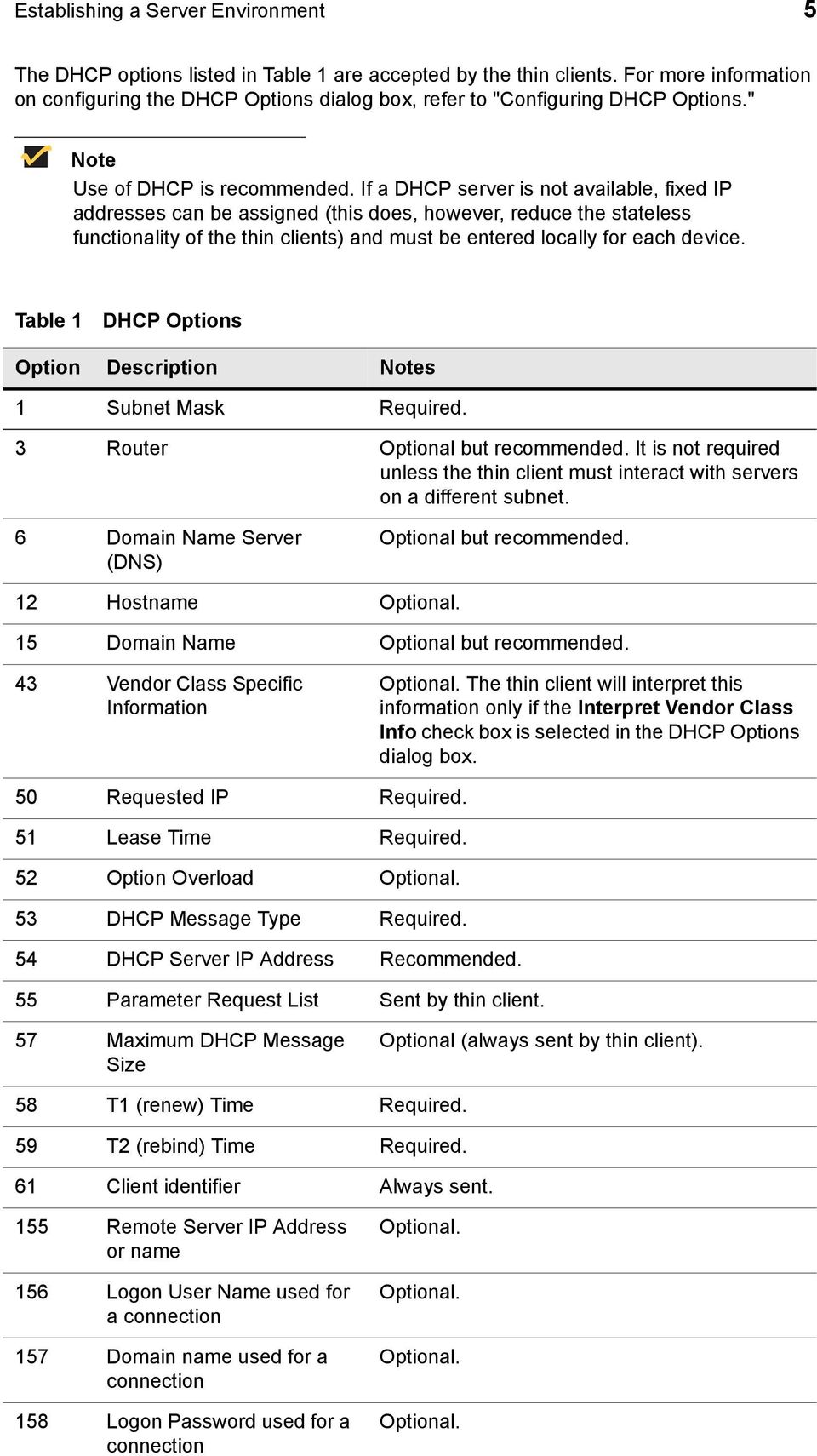
11 Establishing a Server Environment 5 The DHCP options listed in Table 1 are accepted by the thin clients. For more information on configuring the DHCP Options dialog box, refer to "Configuring DHCP Options." Use of DHCP is recommended. If a DHCP server is not available, fixed IP addresses can be assigned (this does, however, reduce the stateless functionality of the thin clients) and must be entered locally for each device. Table 1 DHCP Options Option Description s 1 Subnet Mask Required. 3 Router Optional but recommended. It is not required unless the thin client must interact with servers on a different subnet. 6 Domain Name Server (DNS) Optional but recommended. 12 Hostname Optional. 15 Domain Name Optional but recommended. 43 Vendor Class Specific Information Optional. The thin client will interpret this information only if the Interpret Vendor Class Info check box is selected in the DHCP Options dialog box. 50 Requested IP Required. 51 Lease Time Required. 52 Option Overload Optional. 53 DHCP Message Type Required. 54 DHCP Server IP Address Recommended. 55 Parameter Request List Sent by thin client. 57 Maximum DHCP Message Size Optional (always sent by thin client). 58 T1 (renew) Time Required. 59 T2 (rebind) Time Required. 61 Client identifier Always sent. 155 Remote Server IP Address or name 156 Logon User Name used for a connection 157 Domain name used for a connection 158 Logon Password used for a connection Optional. Optional. Optional. Optional.
12 6 Chapter 2 Table 1 DHCP Options, Continued Option Description s 159 Command Line for a connection 160 Working Directory for a connection Optional. Optional. 161 FTP server list Optional string. Can be either the name or the IP address of the FTP server where the updated thin client image is stored. If a name is given, the name must be resolvable by the DNS server(s) specified in Option Root path to the FTP files Optional string. 163 SNMP Trap server IP Address list Optional. 164 SNMP Set Community Optional. 165 RDP startup published applications Optional. 166 Terminal Emulation Mode Optional. 167 Terminal Emulation ID Optional. 168 Name of the server for the virtual port Optional. Using FTP File Servers Upgrade images used by the DHCP upgrade and FTP Pull Firmware upgrade processes are stored on the FTP server in a directory in the FTP root path (this server name and root-path directory must be made available to the thin client). If Automatic DHCP upgrades are used, these items must be entered in the server DHCP Options. The DHCP values to use are located in Table 1, "DHCP Options" and are configured in the DHCP Options dialog box (defaults are 161 and 162, respectively). The FTP server must provide anonymous log-on capability. For more information on the DHCP Options dialog box, refer to "Configuring DHCP Options." If FTP Pull Firmware upgrades are used, these items must be entered in the Upgrade dialog box on the thin client, along with the Login name and password (the default name and password are both anonymous). For more information on the FTP Pull Firmware upgrade process, refer to "Performing FTP Pull Firmware Upgrades." Params.ini, Bootstrap212.exe, and the Bin file along with the update firmware must be present on your FTP server to upgrade the thin client. Upgrade software packages can be obtained through Wyse customer support. When the thin client boots, it accesses the software update images from the FTP file server. The FTP file server and path to the update files are available through DHCP vendor options 161 and 162 (see "Using Dynamic Host Configuration Protocol (DHCP)").

13 Establishing a Server Environment 7 Using DNS Thin clients accept valid DNS names registered on a DNS server available to the enterprise intranet. The thin client will query a DNS server on the network for name to IP resolution. In most cases DNS is not required but may be used to allow hosts to be accessed by their registered DNS names rather than their IP addresses. Every Windows DNS server in Windows 2000 and later includes Dynamic DNS (DDNS) and every server registers dynamically with the DNS server. However, the thin client does not do dynamic registration and therefore, requires a static or non-variant IP address and manual DNS registration in order to provide LPD support by name (for example, in the case where the thin client is used as an LPD printer server). For DHCP entry of DNS domain and server location information, refer to "Using Dynamic Host Configuration Protocol (DHCP)." Configuring and Providing Line Printer Daemon (LPD) Services A thin client can be configured to provide Line Printer Daemon (LPD) services (making the thin client a printer server receiving print jobs from one or more clients and spooling these jobs to a designated physical port). The LPD server receives print jobs sent to a named line printer queue from the LPR client and prints them on the designated printer. For more information on LPD configuration, refer to the Users Guide: Wyse Winterm TM 3 series, Based on Microsoft Windows CE. A thin client can also be configured as an LPR client. LPR is a component of the Line Printer Daemon Protocol. LPR is a client sending a print job to a server. LPR works in conjunction with the Line Printer Daemon (LPD) server by assigning a print job to a named line printer queue managed by the LPD server. The LPD is a server receiving print tasks from one or more clients and spooling these jobs to a physical port. For more information on LPR configuration, refer to the Users Guide: Wyse Winterm TM 3 series, Based on Microsoft Windows CE. Understanding Session Services Thin-client session services are made available by servers hosting Citrix ICA and Microsoft RDP software products. Independent Computing Architecture (ICA) is a three-tier, server-based computing technology that separates the logic of an application from its user interface. The ICA client software installed on the thin client allows the user to interact with the application GUI, while all of the application processes are executed on the server. For information on configuring ICA, refer to "Configuring ICA Session Services." Using the ICA Program Neighborhood Agent (PNAgent) in conjunction with NFuse Classic or the Web Interface, you can integrate published resources with user desktops. Users access remote applications, desktops, and content by clicking icons on their Windows desktop or in the Start menu. The PNAgent includes the following functions: User authentication - The thin client presents user credentials to the MetaFrame XP server when users try to connect and, if configured to do so by you the administrator, every time users launch published resources. Application and content enumeration - The thin client presents users with their individual set of published resources. Application launching - The thin client is the local engine used to launch published applications.
14 8 Chapter 2 Desktop integration - The thin client integrates a user set of published resources with that user desktop. User preferences - The thin client validates and implements local user preferences. For more information on the configuring ICA session services, refer to "Configuring ICA Session Services." For more information on the PNAgent, refer to "Configuring and Using the PNAgent." The ICA server must be licensed from Citrix Systems, Inc. You must purchase enough client licenses to support the total concurrent thin client load placed on the Citrix server farm. A failure to connect when all client seats are occupied does not represent a failure of Wyse equipment. The ICA client software is installed on the thin client. Remote Desktop Protocol (RDP) is a network protocol that allows a thin client to communicate with the Terminal Server or Windows 2000/2003 Server with Terminal Services over the network. This protocol is based on the T.120 protocol suite, an international standard multi-channel conferencing protocol. The thin client supports RDP version 5.x. For information on configuring RDP, refer to "Configuring RDP Session Services." Configuring ICA Session Services ICA session services can be made available on the network using either of the following services: Windows 2000 or 2003 Server with Terminal Services and one of the following installed: Citrix MetaFrame XP Citrix Presentation Server Use the instructions accompanying these products to install them and make sessions and applications available to the thin clients sharing the server environment. If a Windows 2000 or 2003 Server is used, a Terminal Services Client Access License (TSCAL) server must also reside somewhere on the network. The server will grant a temporary (90-day) license on an individual device basis. Beyond the temporary (90-day) license, you must purchase TSCALs and install them on the TSCAL server (you will not be able to make a connection without a temporary or permanent license).

15 Establishing a Server Environment 9 Configuring and Using the PNAgent The Program Neighborhood Agent (PNAgent) allows users to connect (without using a Web browser) to a server running the Web interface and access all published applications in the server farm. Users do not have to manually configure a connection to each application as they do with the Connection Manager. The PNAgent also provides single sign-on. That is, when users logon at the start of a session, they do not need to use logon credentials again during that session (even if they connect to different applications). Use the following guidelines for configuring and using the PNAgent: Ensure that the configuration file on the server has suitable settings for users. Use the Program Neighborhood Agent Administration tool to check the default settings and change them if necessary. For procedures on configuring the settings on the server, refer to "Configuring PNAgent Settings on the Web Interface Server." Users who wish to connect using the PNAgent must then enable it on their thin client (users can also customize their settings). For procedures on enabling and customizing the PNAgent on the thin client, refer to the Users Guide: Wyse Winterm TM 3 series, Based on Microsoft Windows CE. Once users have the settings they require, they connect to the server, are prompted to authenticate, and are presented with a list of the available applications. Connections will be populated in the thin client Connection Manager (if the Standard Desktop UI option is selected) or to the user desktop (if the New Desktop option is selected). For information on selecting a desktop option, refer to "Selecting a Thin Client Desktop Option." Configuring PNAgent Settings on the Web Interface Server The PNAgent configuration settings are stored on the server in a file called Config.xml. Administrators can edit this file using the Program Neighborhood Administration tool (Admin tool), which provides an easy-to-use interface to the file parameters. Caution The settings in the configuration file are global. Therefore, the settings and any changes you make to them affect all users connecting to the file. You can modify the default settings for all users, and can allow or deny users the ability to do any of the following: Select their own options for an ICA connection. Change their connection to a different server URL. When a user enables the PNAgent on the thin client and connects to the server URL, the thin client reads the configuration data from the server. The settings configured using the Admin tool affect all users of this configuration file. The options and their settings are displayed in the thin client. To access the PNAgent Admin tool, connect to the following URL on the server running the Web interface: The PNAgent Admin tool enables you to specify: Which tabs users see in their Global ICA Client Settings dialog box - Users can see a maximum of two tabs in the Global ICA Client Settings dialog box. The Options tab (to select the preferences for a session) and Server tab (to select the server URL to which

16 10 Chapter 2 they want to connect). To hide or display a tab, use the Client Tab Control option in the PNAgent Admin tool to make the configurations. that to hide or display the Options tab, administrators must use Session Options within the Client Tab Control option. Server connections - To specify the URL to which users can connect, use the Server Settings option in the PNAdmin tool. Configuring RDP Session Services RDP session services can be made available on the network to allow you to connect remotely to a desktop computer running Microsoft Windows NT, Windows 2000, Windows 2003, and Windows XP Professional, or a server running Microsoft Windows NT Server 4.0, Terminal Server Edition. The Remote Desktop Protocol allows a thin client to execute Windows applications within a Windows graphical user interface (GUI) environment, even though they are actually being executed on the server Use the instructions accompanying these products to install them and make sessions and applications available to the thin clients sharing the server environment. If a Windows 2000 or 2003 Server is used, a Terminal Services Client Access License (TSCAL) server must also reside somewhere on the network. The server will grant a temporary (90-day) license on an individual device basis. Beyond the temporary (90-day) license, you must purchase TSCALs and install them on the TSCAL server (you will not be able to make a connection without a temporary or permanent license).
17 3 Configuring Basic Thin Client Settings This chapter contains information on setting up the basic functions for thin client use. It includes instructions for setting up a new thin client and resetting a thin client to factory defaults. The password for the BIOS is Fireport. Setting Up the Thin Client for the First Time The first time a new thin client (or a thin client reset to factory-defaults) starts, the thin client will log on automatically as an administrator (with no password required). You can use the Setup Wizard to configure the settings necessary for basic operation and access to the network resources needed for remote administration. For information on the Setup Wizard, refer to "Using the Setup Wizard." You must enable security for login requirements to be active, otherwise, the thin client automatically logs on as an administrator with no password required. For more information on enabling security, refer to "Configuring Security and Managing User Accounts." After basic configurations, you can continue thin client configurations either locally or remotely: Local Setup - Manually (by you as an administrator) on each thin client. Depending on the number of thin clients, this method can be time consuming as there are many configurations available for each individual thin client on the network. For more information on local configurations, refer to "Using the Desktop and Connection Manager to Manage Connections" and "Using the Control Panel." Remote Setup - By using Wyse Device Manager software (formally Rapport Remote Administration Software) or SNMP tools you can configure and manage thin clients remotely. Typically, a single thin client would be configured locally, and then the remote software tools would be used to extract the settings into a database for broadcast as an upgrade to other thin clients on the network. For information on remote administration and software upgrades, refer to "System Administration." For information on SNMP, refer to "Managing Networks Using SNMP."
18 12 Chapter 3 Using the Setup Wizard The Setup Wizard allows you to quickly configure basic thin client settings (so that the thin client is configured for network users and available for remote administration). Some wizard dialog boxes are informational and require no user input, while other dialog boxes prompt you for required information. To reset the thin client to factory defaults and then use the Setup Wizard to configure basic thin client settings, begin at step 1; to use the Setup Wizard to configure basic thin client settings on a new thin client first boot, begin at step 5: 1. Double-click System in the Control Panel to open the System Info dialog box. Figure 1 System Info dialog box - General tab 2. On the General tab, select the Reset the terminal to factory-default property settings check box to open the System Settings Change dialog box. 3. Click Yes to restart the thin client, and continue with the setup process. The Waiting for Network Services message appears while the thin client is starting and attempting to establish a network connection. If no network is connected or no DHCP server is available, the Setup Wizard cannot automatically configure the network configurations. In this case, you must manually configure the network and other properties. 4. After the countdown box appears, you can allow the countdown to continue to 0 (in which case the default settings are automatically selected for the thin client, the Setup Wizard completes, and the thin client restarts) or you can click Next before the countdown completes to open the Setup Wizard Desktop Area dialog box and begin making custom selections.

19 Configuring Basic Thin Client Settings 13 Figure 2 Setup Wizard - Desktop Area 5. Double-click an item in the Desktop Area dialog box and configure that item using the following guidelines: Client Printers - Use the procedures in "Creating and Configuring Client Printers." Display - Use the procedures in the Users Guide: Wyse Winterm TM 3 series, Based on Microsoft Windows CE. Keyboard - Use the procedures in the Users Guide: Wyse Winterm TM 3 series, Based on Microsoft Windows CE. Internet - Use the procedures in "Configuring Internet Settings." Network - Use the procedures in the Users Guide: Wyse Winterm TM 3 series, Based on Microsoft Windows CE. 6. After configuring the items you want and then clicking Next, a success message displays. Figure 3 Setup Wizard success message 7. Click Finish to apply the settings, close the Setup Wizard, and restart the thin client (the thin client will log on automatically with administrator privileges). After completing the wizard and restarting the thin client, the initial setup is complete. As discussed in "Setting Up the Thin Client for the First Time." any future changes to settings that were made using the Setup Wizard can be made locally or remotely.

20 14 Chapter 3 This page intentionally blank.

21 4 Managing Connections This chapter describes important connection features available for you to use. It also provides instructions on using the administrator Desktop and Connection Manger to manage (add, edit, and delete) the connections and applications you make available to users. Understanding the Connection Features How a user logs in and what they see after they log in, depends on your configurations. For example, a username and password may be required to log in to a thin client or the thin client may automatically log on when started. After logging in, a user may see the Connection Manager dialog box or the windows desktop (or if configured, an application or connection may be launched automatically). This section discusses: "Using Multiple Sessions" "Enabling AutoLogin" "Enabling Single Button Connect for User Login" "Enabling Failover" "Starting Connections Automatically at Startup" Using Multiple Sessions The Multiple Sessions feature allows the thin client to have multiple active connections. The number of active connections you can have depends on the: amount of RAM. types of connections open. number of connections configured. With the New Desktop (see "Selecting a Thin Client Desktop Option") you can also select Support launching multiple instances on new Desktop to enable support for opening multiple instances of one ICA or RDP connection (supported for published applications configured as a Seamless Windows Connection or PNAgent enabled sessions). Figure 4 Desktop Configuration
22 16 Chapter 4 Enabling AutoLogin The AutoLogin feature is an automatic login function that uses a countdown to login to the thin client (for example, 5 seconds). If you also want to automatically make a connection upon log-in, refer to "Enabling Single Button Connect for User Login." Figure 5 AutoLogin countdown To enable the AutoLogin feature, use the administrator Security dialog box as described in "Configuring Security and Managing User Accounts." Since AutoLogin is a global function, it does not matter what other functions are enabled. Enabling Single Button Connect for User Login The Single Button Connect feature is an automatic login function that uses the Connect command button to allow users to login to the thin client (and if configured, automatically makes a connection upon log-in). To enable Single Button Connect, use the administrator Security dialog box. as described in "Configuring Security and Managing User Accounts." Figure 6 Single Button Connect Single Button Connect: Logs a user into their thin client using the account to which AutoLogin is associated. Connects to the first connection in the Connections Name list of the Connection Manager (unless another connection in the list has been made with Autostart).
23 Managing Connections 17 Enabling Failover The Failover feature is a connection function that causes the thin client to ping the intended device (to determine whether or not the device is available) before making a connection to the device. Failover does not support Serial and PNAgent connections. Packet Internet Groper (Ping) is a network utility. It tests communication with nodes in a network by sending packets to each selected node. Ping then waits to receive the echo response from that selected node. If pinging the intended connection fails, the thin client pings each successive connection in the list. For each connection: If a ping is successful, the connection is made. If a ping is not successful, the thin client pings the next connection. A ping does not work on a serial connection. Failover will not continue after encountering a serial connection, but will launch the serial connection. If failover pings all the connections in the list and a connection is not made, the function stops and an error message displays. Failover skips IE connections. To enable the Failover feature, use the administrator Security dialog box as described in "Configuring Security and Managing User Accounts." If the Verbose check box is selected on the Security dialog box, the Failover Log Window displays when failover is finished. The Failover Log Window is a list of all the connections that were pinged. The list reports both successful and unsuccessful pings. Figure 7 Failover Log Window Failover is global and wholly automatic to the thin client. It will work regardless of what connection you are trying to make, or what type of account under which you are logged in.
24 18 Chapter 4 Starting Connections Automatically at Startup To start a connection automatically at thin client startup: 1. Complete one of the following: (Desktop only) Right-click on a connection and select Options. (Connection Manager only) Select a connection and click Startup. The Startup Options dialog box appears. Figure 8 Startup Options 2. Select the Automatically start the selected connection at startup check box. 3. Click OK. Using the Desktop and Connection Manager to Manage Connections Whether you are using the administrator Desktop (see "Using the Administrator Desktop") or the administrator Connection Manager (see "Using the Administrator Connection Manager"), only an administrator can add, edit, or delete connections. The Administrator Desktop (with icons and menus) can be used only if you selected the New Desktop option. If you selected the Standard Desktop UI option, the Administrator Connection Manager can be used. For information on selecting a desktop option, refer to "Selecting a Thin Client Desktop Option." Using the Administrator Desktop Wyse Winterm TM 3 series Thin Clients provide a windows interface option (New Desktop) in which you can open and manage multiple connections. The New Desktop option includes connections, applications, icons, a taskbar, a Start menu, and several related features. It allows you to easily create and manage connections and use the various applications and features available.
25 Managing Connections 19 Figure 9 Administrator Desktop example The Start menu allows quick and easy access to all programs and settings available, as well as shutting down the thin client. For example, to open the Control Panel window, click Start Settings Control Panel. For information about the administrator Control Panel, refer to "Using the Administrator Control Panel." Use the following guidelines: To start connections you can double-click an icon, right-click an icon and select Open, or use the Start menu. To start a Control Panel application, double-click the application icon. Desktop icons can easily be arranged by name, type, and so on by right-clicking on the desktop and using the menu provided. You can toggle between active connections using the taskbar (click on an open connection) or by using the Alt+Tab key combination (for details on these and other taskbar features, refer to the Users Guide: Wyse Winterm TM 3 series, Based on Microsoft Windows CE). To delete a connection, right-click on a connection, select Delete Connection, and confirm the deletion by clicking Yes. To add or edit a connection, refer to the following guidelines for the connection you want: "Creating and Configuring Citrix ICA Client Connections" "Creating and Configuring Dial-Up Client Connections" "Creating and Configuring Ericom PowerTerm Terminal Emulator Connections" "Creating and Configuring Internet Explorer Connections" "Creating and Configuring Microsoft Remote Desktop Client Connections" "Creating and Configuring PPPoE Connections" "Creating and Configuring VPN (PPTP) Client Connections"
26 20 Chapter 4 Using the Administrator Connection Manager The Connection Manager allows you to create and manage multiple connections, and use the various applications and features available. Figure 10 Administrator Connection Manager example Use the following guidelines: To start a connection, select a connection and click Connect (you can also double-click a connection in the list). To end a connection, select a connection and click End (End is enabled when one or more connections become active). To delete a connection, select a connection, click Delete, and confirm the deletion by clicking Yes. To open the Control panel, click Control Panel. For information about the administrator Control Panel, refer to "Using the Administrator Control Panel." Clicking Shut Down opens the Shutdown Window. Use this window to select the Logout, Shutdown the terminal, or Shutdown and Restart option you want. For information on adding and editing a connection, refer to the detailed procedures for the connection you want: "Creating and Configuring Citrix ICA Client Connections" "Creating and Configuring Dial-Up Client Connections" "Creating and Configuring Ericom PowerTerm Terminal Emulator Connections" "Creating and Configuring Internet Explorer Connections" "Creating and Configuring Microsoft Remote Desktop Client Connections" "Creating and Configuring PPPoE Connections" "Creating and Configuring VPN (PPTP) Client Connections"
27 5 Configuring Connections This chapter contains information and detailed instructions on setting up connections for selection and use by a thin client user. This section discusses: "Creating and Configuring Citrix ICA Client Connections" "Creating and Configuring Dial-Up Client Connections" "Creating and Configuring Ericom PowerTerm Terminal Emulator Connections" "Creating and Configuring Internet Explorer Connections" "Creating and Configuring Microsoft Remote Desktop Client Connections" "Creating and Configuring PPPoE Connections" "Creating and Configuring VPN (PPTP) Client Connections" Whether you are using the administrator Desktop (New Desktop option) or the administrator Connection Manager (Standard UI option), you will use the New Connection dialog box to add new connections. Figure 11 New Connection dialog box
28 22 Chapter 5 Creating and Configuring Citrix ICA Client Connections This section describes how you can create a new Citrix ICA Client connection definition (see "Adding a New ICA Connection"), edit an existing connection definition (see "Editing an Existing ICA Connection"), and delete a connection (right-click the connection, select Delete Connection, and confirm). Adding a New ICA Connection To add a connection: 1. Complete one of the following: (Desktop only) Right-click on the desktop and select Add Connection. (Connection Manager only) Click Add in the Connection Manager. 2. Select the Citrix ICA Client option from the drop-down list of the New Connection dialog box, and click OK to open the ICA Connection Wizard. Use Cancel, Next, Back, and Done as appropriate when navigating. Figure 12 ICA Connection Wizard 3. Select either the Server or Published Application option. The wizard prompts you to select a Citrix server from a list or to enter a server name. The server name entry can be an IP address or a valid DNS name. The list entries are created from browsing for servers on the network when the dialog box opens. The list can be updated by clicking on the Refresh command button. 4. Click Server Location to open the Server Location dialog box. Figure 13 ICA - Server Location
29 Configuring Connections Select and configure a server. A message displays when you click Default List. Depending on whether or not you want to replace the list, click Yes or No. 6. After configuring, click OK to close the Server Location and then click Next. Figure 14 ICA - Connection title 7. Enter the title that is to appear for the connection and click Next. Figure 15 ICA - Specify an Application 8. Specify an application (make the entries in the Command Line and Working Directory boxes required to launch an application when the server connection is made; leave the boxes empty if you want to view a server desktop) and click Next. Figure 16 ICA - Specify Logon Information
30 24 Chapter 5 9. Specify the logon information and click Next. The information in this dialog box may be required by the server before access is granted. If you use a Smart Card, select the Allow Smart Card logon check box. Figure 17 ICA - Select Window Options You can configure a new published application connection for seamless windows by selecting View in a separate window (Seamless Window). Figure 18 ICA - Select Window Options with Seamless Windows 10.Select the Window Colors options (a smaller color option results in faster network speed at the expense of display quality) and click Next. Figure 19 ICA - Options
31 Configuring Connections Select the options desired, and then click Next. Figure 20 ICA - Firewall Settings 12.Enter any necessary information in the Firewall Settings dialog box to go through an enterprise firewall or other security barrier, and then click Done to save the wizard entries and create the new connection. Editing an Existing ICA Connection To edit the connection: 1. Complete one of the following: (Desktop only) Right-click on the connection and select Edit Connection. (Connection Manager only) Select the connection and click Edit. 2. Use the following guidelines to make your modifications in the Edit Connection Details dialog box (be sure to click OK after making your modifications): Server Tab Use the Server tab to modify the server configuration settings for the server or published application. Figure 21 ICA Editing - Server tab
32 26 Chapter 5 Use Server Location to open and configure the Server Location dialog box. Figure 22 ICA Editing - Server Location Application Tab Use the Application tab to modify server configuration settings for published applications. Figure 23 ICA Editing - Application tab Logon Tab Use the Logon tab to modify the logon information for the server or published application. If you use a Smart Card, select the Allow Smart Card logon check box. Figure 24 ICA Editing - Logon tab
33 Configuring Connections 27 Window Tab Use the Window tab to modify the Window Colors option for the server or published application. Figure 25 ICA Editing - Window tab You can configure an existing published application connection for seamless windows by selecting View in a separate window (Seamless Window). Figure 26 ICA Editing - Window tab with Seamless Windows Options Tab Use the Options tab to modify the supported options for the server or published application. Figure 27 ICA Editing - Options tab
34 28 Chapter 5 Title Tab Use the Title tab to modify the title entered for the server or published application. Figure 28 ICA Editing - Title tab Firewall Settings Tab Use the Firewall Settings tab to modify the firewall settings for the server or published application. Figure 29 ICA Editing - Firewall Settings tab
35 Configuring Connections 29 Creating and Configuring Dial-Up Client Connections This section describes how you can create a new Dial-up Client connection definition (see "Adding a New Dial-up Connection"), and edit an existing connection definition (see "Editing an Existing Dial-up Connection"). Adding a New Dial-up Connection To add a connection: 1. Complete one of the following: (Desktop only) Right-click on the desktop and select Add Connection. (Connection Manager only) Click Add in the Connection Manager. 2. Select the Dial-up Client option from the drop-down list of the New Connection dialog box, and click OK to open the Dial-Up Configuration Wizard. Use Cancel, Next, Back, and Done as appropriate when navigating. Figure 30 Dial-up description 3. Enter the name that is to appear for the connection and click Next. The Dial-up invalid massage is displayed if Next is clicked with an empty description box or invalid characters (<>()[]//\.*?:, ) entered in the description box.
36 30 Chapter 5 Figure 31 Dial-up Settings 4. Enter the Dial-up settings by using the wizard command buttons to open and configure the various dialog boxes. Use the following guidelines: Serial Port - Use the list to select the access path to the dial-up server. Use Country Code and Area Code check box - If selected, enables you to enter these codes for use when dialing. Enable RAS Script check box and Script command button - Enables and configures Remote Access Services as discussed in "Configuring Remote Access Services for Dial-up Connections." Dialing Properties - Opens the Dialing Properties dialog box, allowing you to configure the dialing properties as discussed in "Configuring Dialing Properties." Configure - Opens the Device Properties dialog box, allowing you to configure the device properties as discussed in "Configuring Dial-up Device Properties." TCP/IP Settings - Opens the TCP/IP Settings dialog box, allowing you to configure the TCP/IP settings as discussed in "Configuring Dial-up TCP/IP Settings." Security - Opens the Security Settings dialog box, allowing you to configure the security settings as discussed in "Configuring Dial-up Security Settings." 5. After completing configurations, click Next. Figure 32 Dial-up Login 6. Enter the dial-up login information required to access the dial-up server.
37 Configuring Connections Select Always Prompt for Password if you want to require a password from the user when using a dial-up connection. 8. Select the connections that will automatically launch the dial-up connection settings you configured. The connection names are obtained from the list of available connections. 9. After completing the wizard click Finish. Configuring Remote Access Services for Dial-up Connections Remote Access Services (RAS) facilitates PPP communications between the thin client and other network protocols. RAS scripts automate actions that otherwise would be performed in text mode after dialing. Dial-up RAS scripts are enabled by selecting the Enable RAS Script check box in the Dial-up Wizard. To create and edit scripts, select the Enable RAS Script check box in the Dial-up Settings dialog box and click the Script command button to open the Script Name dialog box. The Script Name dialog box enables you to create a script under a new name, edit an existing script, or delete an existing script. Figure 33 Dial-up RAS - Script Name To delete a script, select it and click Delete. Clicking New opens the New Script Name dialog box. Figure 34 Dial-up RAS - New Script Name Enter the script name and click OK to open the RAS Script dialog box. You can also open and use the RAS Script dialog box to edit an existing script by selecting the script in the Script Name dialog box and clicking Edit.
38 32 Chapter 5 Figure 35 Dial-up RAS - RAS Script Use the following guidelines to configure the dialog box: Script Name box and Change command button - The Script Name box displays the name of the currently selected script. You can change the selection by clicking Change to open the Script Name dialog box, selecting another script, and clicking OK. Script area: Script text area - Lists the script input/output strings: Wait For - Displays strings received from the host. Respond With - Displays what the thin client sends in response to the Wait For string. New and Edit - Open the Edit Script Line dialog box. Use this dialog box to create a new line in the script or edit an existing (selected) line. The specific scripts are unique to each target system. Figure 36 Dial-up RAS - Edit Script Line Delete - To delete a line, select it and click Delete. You will be prompted to confirm the deletion of the line. Up and Down - Use these to move a selected line in the script up or down in the list. After configuring, be sure to click OK to save your settings and return to the Dial-Up Configuration Wizard.
39 Configuring Connections 33 Configuring Dialing Properties Clicking the Dialing Properties command button in the Dial-up Settings dialog box of the Dial-Up Configuration Wizard opens the Dialing Properties dialog box. Use this dialog box to configure the dialing settings indicated in the dialog box. Refer to the modem instruction manual for information to configure the Dialing Patterns area. Figure 37 Dial-up - Dialing Properties After configuring, be sure to click OK to save your settings and return to the Dial-Up Configuration Wizard.
40 34 Chapter 5 Configuring Dial-up Device Properties Clicking the Configure command button in the Dial-Up Configuration Wizard opens the Device Properties dialog box. Use this dialog box to configure the device properties for the Port Settings and Call Options tabs. After configuring, be sure to click OK to save your settings and return to the Dial-Up Configuration Wizard. Figure 38 Dial-up - Port Settings tab Figure 39 Dial-up - Call Options tab
41 Configuring Connections 35 Configuring Dial-up TCP/IP Settings Clicking the TCP/IP Settings command button in the Dial-Up Configuration Wizard opens the TCP/IP Settings dialog box. Use this dialog box to configure the TCP/IP settings. After configuring, be sure to click OK to save your settings and return to the Dial-Up Configuration Wizard. Figure 40 Dial-up - TCP/IP Settings Configuring Dial-up Security Settings Clicking the Security command button in the Dial-Up Configuration Wizard opens the Security Settings dialog box. Use this dialog box to configure the security settings. Select the Authentication and encryption policy option you want. You can click Unsave password to ensure that a user password is not stored locally for this connection. After configuring, be sure to click OK to save your settings and return to the Dial-Up Configuration Wizard. Figure 41 Dial-up - Security Settings
42 36 Chapter 5 Editing an Existing Dial-up Connection To edit the connection: 1. Complete one of the following: (Desktop only) Right-click on the connection and select Edit Connection. (Connection Manager only) Select the connection and click Edit. 2. Use the Dial-Up Configuration Wizard to make your modifications (use the guidelines in "Adding a New Dial-up Connection"). 3. Click OK to apply and save your settings. Creating and Configuring Ericom PowerTerm Terminal Emulator Connections PowerTerm WBT Terminal Emulator is used by the thin client for running legacy character-based applications on remote computers. You can set up a wide variety of connections that a user can open. The host computers are accessed through TCP/IP network, dial-up modem, or serial port. This section describes how you can create a new Ericom PowerTerm Terminal Emulator connection definition (see "Adding an Ericom PowerTerm Terminal Emulation Connection"), and edit an existing connection definition (see "Editing an Existing Ericom PowerTerm Terminal Emulation Connection"). Adding an Ericom PowerTerm Terminal Emulation Connection To add a connection: 1. Complete one of the following: (Desktop only) Right-click on the desktop and select Add Connection. (Connection Manager only) Click Add in the Connection Manager. 2. Select the Ericom PowerTerm Terminal Emulator option from the list in the New Connection dialog box, and click OK to open the PowerTerm Connection Properties dialog box. Figure 42 PowerTerm Connection Properties
43 Configuring Connections Use the PowerTerm Connections Properties dialog box to set up a wide variety of connections that a user can open. that availability of the boxes and options change according to your connection configuration selections. For complete information on configuring the dialog box, refer to the PowerTerm online documentation at: Editing an Existing Ericom PowerTerm Terminal Emulation Connection To edit the connection: 1. Complete one of the following: (Desktop only) Right-click on the connection and select Edit Connection. (Connection Manager only) Select the connection and click Edit. 2. Use the PowerTerm Connections Properties dialog box to make your modifications. 3. Click OK to apply and save your settings. Creating and Configuring Internet Explorer Connections This section describes how you can create a new Internet Explorer (IE) connection definition (see "Adding a New Internet Explorer Connection"), and edit an existing connection definition (see "Editing an Existing Internet Explorer Connection"). Adding a New Internet Explorer Connection To add a connection: 1. Complete one of the following: (Desktop only) Right-click on the desktop and select Add Connection. (Connection Manager only) Click Add in the Connection Manager. 2. Select the Internet Explorer option from the drop-down list of the New Connection dialog box, and click OK to open the Internet Explorer Setup dialog box. Internet Explorer requires a minimum of 32 MB of flash memory installed on the thin client. The application may not be factory-installed on some models because of competition for available memory by other installed applications. Contact Wyse for availability of Internet Explorer as an add-on. Figure 43 Internet Explorer Setup
44 38 Chapter 5 If the connection is to an NFuse server that provides ICA links within a Web page to allow ICA sessions to be launched from within a browser window, refer to "Understanding Session Services" for information concerning the NFuse server application setup for use with the thin clients. 3. Use the following guidelines to configure the Internet Explorer Setup dialog box: Title - Enter the title for the connection. Start Page - Enter the URL of the page that will open when Internet Explorer is launched. Search Page - Enter the URL of the page that contains the search engine that will be used when Search is clicked. Allow to ping Start site - If the server on which the start page is located is to be included in Failover, select the Allow to ping Start site check box. To help you decide if you should check this box, refer to "Enabling Failover." Kiosk - Select this box if the thin client is to be used as a kiosk with Internet Explorer as the application. Show Toolbar - Typically, you would use the IE toolbar for maintenance purposes, and then clear this check box to hide the toolbar for users and guests. Editing an Existing Internet Explorer Connection To edit the connection: 1. Complete one of the following: (Desktop only) Right-click on the connection and select Edit Connection. (Connection Manager only) Select the connection and click Edit. 2. Use the Internet Explorer Setup dialog box to make your modifications (use the guidelines in "Adding a New Internet Explorer Connection"). 3. Click OK to apply and save your settings. Creating and Configuring Microsoft Remote Desktop Client Connections This section describes how you can create a new Microsoft RDP Client connection definition (see "Adding a New RDP Connection"), and edit an existing connection definition (see "Editing an Existing RDP Connection"). Adding a New RDP Connection To add a connection: 1. Complete one of the following: (Desktop only) Right-click on the desktop and select Add Connection. (Connection Manager only) Click Add in the Connection Manager. 2. Select the Microsoft Remote Desktop Client option from the drop-down list of the New Connection dialog box, and click OK to open the Remote Desktop Connection Wizard. Use Cancel, Next, Back, and Done as appropriate when navigating.
45 Configuring Connections 39 Figure 44 RDP Connection wizard 3. Enter the name (31 characters maximum) and server (75 characters maximum) for the connection (the Server entry can be an IP address or a valid DNS name). 4. Select or clear Remember Server Name and click Next. If you want to be prompted for an RDP server name when the connection is launched (this is useful if you need to connect to different RDP servers and do not want to pre-configure multiple RDP connections) be sure to clear the Remember Server Name check box. Figure 45 RDP - Logon information 5. Select Automatic Logon box to enable the auto logon user authentication to the server, enter the Username (31 characters maximum), Password (16 characters maximum), and Domain (129 characters maximum), and then click Next. If you want users to enter the logon information when the connection is selected, leave this information blank and click Next.
46 40 Chapter 5 Figure 46 RDP - Program information 6. By default the Terminal Services connection opens at the Windows desktop. To automatically start a program, select Start the following program on connection, enter the Program path and file name, enter the folder in which to start when the RDP connection is established, and then click Next. If you want the connection to open at the Windows desktop and not automatically start a program, leave this information blank and click Next. Figure 47 RDP - Display information 7. Use the Remote Desktop Size slider to select the size of your remote desktop. Drag the slider all the way to the right to go full screen. 8. Select the color settings you want (settings on the remote computer might override this setting). 9. Select Display the connection bar when in full screen if you want the connection bar to show when in full screen mode (the Display the connection bar feature enables a user to easily minimize and maximize an RDP session), and then click Next.
47 Configuring Connections 41 Figure 48 RDP - Local resources information 10.Select the local resource features you want (during a remote session) using the following guidelines: Audio redirection - Allows server applications to redirect audio to the location you select. Apply Windows key combinations - Select one of the following options: In full screen desktops only - Selecting this option applies keyboard shortcuts to the remote desktop rather than the local desktop when the remote session is running in full screen mode. If the session is running in any other window size mode, keyboard shortcuts are applied to the local desktop rather than the remote desktop. On the remote desktop - Selecting this option applies keyboard shortcuts to the remote session rather than the local desktop. For example, pressing ALT+TAB switches between all the windows currently open on the remote desktop, excluding any windows open on the local desktop. On the local desktop - Selecting this option applies keyboard shortcuts to the local desktop rather than the remote desktop. For example, pressing ALT+TAB switches between all the windows currently open on the local desktop, including both local and remote windows. Printers - Local-printer redirection to allow server applications to print locally from the thin client while logged on to the remote computer. Serial ports - Local-port redirection so server applications can use parallel and COM ports of the thin client while logged on to the remote computer. Disk Drives - Local file redirection so server applications can use the file system of the thin client while logged on to the remote computer. 11. Click Next.
48 42 Chapter 5 Figure 49 RDP - Performance information 12.Select all of the performance features you want as described in the wizard, and then click Next. Select the type of network connection speed to optimize performance for your environment. Variable bandwidth allocation through client-side bitmap caching and optional compression for low-bandwidth connections, significantly improves performance over low-bandwidth connections. Figure 50 RDP - Success window 13.Click Finish to save the settings and exit the wizard. Editing an Existing RDP Connection To edit the connection: 1. Complete one of the following: (Desktop only) Right-click on the connection and select Edit Connection. (Connection Manager only) Select the connection and click Edit. 2. Use the Remote Desktop Connection dialog box to make your modifications (use the guidelines in "Guidelines for Editing RDP Connections"). 3. Click OK to apply and save your settings.
49 Configuring Connections 43 Guidelines for Editing RDP Connections Use the guidelines in this section and in "Adding a New RDP Connection" to configure the Remote Desktop Connection dialog box. General Tab Use the General tab to modify Connection and Automatic Logon configuration settings. Figure 51 RDP Editing - General tab Display Tab Use the Display tab to modify the Colors and Connection Bar feature configuration settings for the connection. Figure 52 RDP Editing - Display tab
50 44 Chapter 5 Local Resources Tab Use the Local Resources tab to modify the sound, keyboard, and local device configuration settings for the connection. Figure 53 RDP Editing - Local Resources tab Programs Tab Use the Programs tab to modify the Start a program configuration settings for the connection. Figure 54 RDP Editing - Programs tab
51 Configuring Connections 45 Experience Tab Use the Experience tab to modify the performance configuration settings for the connection. Figure 55 RDP Editing - Experience tab Creating and Configuring PPPoE Connections This section describes how you can create a new PPP over Ethernet (PPPoE) connection definition (see "Adding a New PPPoE Connection"), and edit an existing connection definition (see "Editing an Existing PPPoE Connection"). Adding a New PPPoE Connection To add a connection: 1. Complete one of the following: (Desktop only) Right-click on the desktop and select Add Connection. (Connection Manager only) Click Add in the Connection Manager. 2. Select the PPP over Ethernet (PPPoE) option from the drop-down list of the New Connection dialog box, and click OK to open the PPPoE Connection Wizard. Use Cancel, Next, Back, and Done as appropriate when navigating.
52 46 Chapter 5 Figure 56 PPPoE Connection Wizard 3. Enter a description for the PPPoE connection and click Next. Figure 57 PPPoE - Service Name 4. Enter a PPPoE Service Name or leave the box blank. You can use the TCP/IP Settings command button to open the TCP/IP Settings dialog box to further configure the settings required for PPPoE communications on this connection. Be sure to click OK after you complete this dialog box to return to the Service Name dialog box. Figure 58 PPPoE - TCP/IP Settings
53 Configuring Connections 47 You can use the Security Settings command button to open the Advanced Security Settings dialog box to further configure the settings. Be sure to click OK after you complete this dialog box to return to the Service Name dialog box. Figure 59 PPPoE - Advanced Security Settings 5. After you complete the Service Name dialog box, click Next. Figure 60 PPPoE - Login information 6. Enter the Login Information (User Name, Password, and Domain), select or clear the Always Prompt for Password check box to enable or disable password prompting for the connection, and click Next. 7. Click Finish to save the wizard entries and create the new connection. When this connection is opened by a user, all WAN packets go though a PPP connection over Ethernet to the modem.
54 48 Chapter 5 Editing an Existing PPPoE Connection To edit the connection: 1. Complete one of the following: (Desktop only) Right-click on the connection and select Edit Connection. (Connection Manager only) Select the connection and click Edit. 2. Use the PPPoE Connection Wizard to make your modifications (use the guidelines in "Adding a New PPPoE Connection"). 3. Click OK to apply and save your settings. Creating and Configuring VPN (PPTP) Client Connections This section describes how you can create a new VPN (PPTP) Client connection definition (see "Adding a New VPN (PPTP) Client Connection"), and edit an existing connection definition (see "Editing an Existing VPN (PPTP) Client Connection"). Adding a New VPN (PPTP) Client Connection To add a connection: 1. Complete one of the following: (Desktop only) Right-click on the desktop and select Add Connection. (Connection Manager only) Click Add in the Connection Manager. 2. Select the VPN (PPTP) Client option from the drop-down list of the New Connection dialog box, and click OK to open the VPN Connection Wizard. Use Cancel, Next, Back, and Done as appropriate when navigating. Figure 61 VPN Connection Wizard 3. Enter a description for the VPN connection and click Next.
55 Configuring Connections 49 Figure 62 VPN - Host name or IP address 4. Enter the Host name or IP address needed for communications with the enterprise PPTP server providing VPN services. You can use the TCP/IP Settings command button to open the TCP/IP Settings dialog box to further configure the settings required for VPN communications on this connection. Be sure to click OK after you complete this dialog box to return to the Host name or IP address dialog box. Figure 63 VPN - TCP/IP Settings You can use the Security Settings command button to open the Advanced Security Settings dialog box to further configure the settings required for VPN communications on this connection. Be sure to click OK after you complete this dialog box to return to the Host name or IP address dialog box. Use the following guidelines: Select the desired authentication and encryption policy in the Security Settings dialog box. Click Unsave Password in the Security Settings dialog box if a password has been saved for automatic login and you want to require the user to enter the password each time.
56 50 Chapter 5 Figure 64 VPN - Security Settings Click Settings to open the Advanced Security Settings dialog box, which allows further configuration of the security parameters. Figure 65 VPN - Advanced Security Settings 5. After you complete the Host name or IP address dialog box, click Next. Figure 66 VPN - Login information 6. Enter the login information required by the enterprise PPTP server (User Name, Password, and Domain), select or clear the Always Prompt for Password check box to enable or disable password prompting, and click Finish to save the settings.
57 Configuring Connections 51 Editing an Existing VPN (PPTP) Client Connection To edit the connection: 1. Complete one of the following: (Desktop only) Right-click on the connection and select Edit Connection. (Connection Manager only) Select the connection and click Edit. 2. Use the VPN Connection Wizard to make your modifications (use the guidelines in "Adding a New VPN (PPTP) Client Connection"). 3. Click OK to apply and save your settings.
58 52 Chapter 5 This page intentionally blank.
59 6 Using the Control Panel This chapter provides guidelines on using the Control Panel to set-up thin client operating parameters and user accounts. Using the Administrator Control Panel The administrator Control Panel contains tools for configuring the Add-ons and applications for use with the thin client. The Control Panel icons provide access to a complete set of thin client configuration utilities that extend beyond the initial thin client setup as described in "Setting Up the Thin Client for the First Time." These configuration utilities are used for local configuration or remote administration of settings and user preferences (thin client defaults for users). Depending on configuration, your Control Panel may include different icons than those shown in the example figure. Figure 67 Administrator Control Panel The following icon sections include information that is available only to administrators. For other Control Panel icon information available to qualified users and administrators, refer to the Users Guide: Wyse Winterm TM 3 series, Based on Microsoft Windows CE.
60 54 Chapter 6 This section includes information on the following: "Managing Add-ons" "Managing Certificates" "Creating and Configuring Client Printers" "Selecting a Thin Client Desktop Option" "Configuring DHCP Options" "Using Edgeport for Port Expansion" "Elo Touch" "ELO Touch USB" "Configuring Global ICA Settings" "Configuring ICA Performance" "Configuring Internet Settings" "Configuring JETCET PRINT Settings" "Setting the Language Option" "Configuring Port Settings" "Configuring the Rapport Agent" "Configuring Remote Shadow" "Configuring Security and Managing User Accounts" "Managing Networks Using SNMP" "Using the System Information Features" "Using Administrator Tools" "Managing TSC Licenses" "Upgrading Thin Client Software" "Managing USB Storage Devices Using USB Access"
61 Using the Control Panel 55 Managing Add-ons Double-clicking the Add-on icon in the administrator Control Panel opens the Add-on dialog box. Use this dialog box to determine if there is sufficient flash memory to install Add-ons or remove Add-ons. The thin client comes from the factory with a number of Add-ons (applications and peripheral drives) already installed. Add-ons may be installed and removed as needed. Add-ons are available from Wyse for free or for a licensing fee. After obtaining an Add-on be sure to store it on an FTP server that is accessible by the thin client as discussed in "Using FTP File Servers." For more information on Add-ons, refer to the Add-on Administrators Guide: Wyse Winterm TM 3 series, Based on Microsoft Windows CE. Using the Add-on Add/Remove Tab The Add/Remove tab lists the currently installed Add-ons, and allows you to add or remove Add-ons. Instructions for installing an Add-on accompanies the individual Add-on from Wyse. To remove an Add-on, select an Add-on, click Remove, and follow the instructions in the dialog box. You can upgrade several Add-ons consecutively from the Upgrade dialog box without the need to reboot after each Add-on installation. Rebooting is instead prompted upon closing of the Upgrade dialog box (back-to-back upgrading is not supported for Primer or Padded images). Figure 68 Add/Remove tab Clicking Add opens the Upgrade dialog box.
62 56 Chapter 6 Figure 69 Add-on - Upgrade dialog box For information on configuring the Upgrade dialog box, refer to "Upgrading Thin Client Software." Flash Memory Tab The Flash Memory tab displays information about available flash memory to determine if sufficient flash memory is available to install an Add-on. Figure 70 Add-on - Flash Memory tab
63 Using the Control Panel 57 Managing Certificates You can manually download new custom digital certificates through FTP into the thin client using the Wyse Certificates Add-on. Double-clicking the Certificates icon in the administrator Control Panel opens the Certificates dialog box. Use this dialog box to import and remove digital certificates, as well as view the details of installed digital certificates. The Wyse Certificates Add-on supports X.509 certificate structure and standard ASN.1 encoding. The digital certificates are installed in the thin client using Microsoft standard certificate APIs. As the digital certificate is installed, a copy is saved in the registry, and a copy is saved as a file on Flash to ensure functionality. With proper registry settings, certificates that reside in Flash can be imported into the certificate store automatically during boot up. In addition, the digital certificates can be used through the virtual channels of both ICA and RDP sessions. You can obtain digital certificates from a third-party Certificate Authority (CA) or create your own certificates using Microsoft Certificate Services on your server, and then ready the certificate for thin client import: 1. Verify which format of the certificate you require: DER encoded binary Base-64 encoded Cryptographic Message Syntax 2. Double-click on the Lock icon (located in the lower right hand corner of the taskbar). 3. Select the Details tab and select Copy to File. 4. Complete the wizard (be sure to select the proper format of the certificate you require). 5. Name the file and save it to your local desktop (the file should have a.cer extension). 6. Place the certificate into the FTP server directly under the root directory. To import a certificate into the thin client: 1. Log-in to the thin client. 2. Double-click the Certificates icon in the Control Panel to open the Certificates dialog box. Figure 71 Certificates 3. Click Import and enter the information required (for Server Directory use / for root). After you have successfully imported the certificate, the certificate displays in the Certificates dialog box pane (for example:
64 58 Chapter 6 Creating and Configuring Client Printers Double-clicking the Client Printers icon in the administrator Control Panel (or in the Setup Wizard) opens the Client Printers dialog box. This dialog box allows you to configure and edit local printers. The Client Printers dialog box contains an Add Printer icon and an icon for each (if any) configured printer. The thin client supports printing from an RDP server to a local printer. This section describes how you can create a new client printer for users (see "Adding a Printer Using the WBT Printer Wizard"), and edit an existing client printer (see "Editing Printer Properties"). Figure 72 Client Printers Adding a Printer Using the WBT Printer Wizard Configured printers can be added to the Client Printers utility by using the WBT Printer Wizard. To add a printer: 1. Double-click the Add Printer icon or select (highlight) the Add Printer icon and click Add to open the WBT Printer Wizard. Figure 73 Printer port
65 Using the Control Panel Select the port to which you want the printer connected and click Next. Figure 74 Printer model 3. Select the printer model (if the printer is not listed, select the User Defined check box), and click Next. Figure 75 Printer manufacturer If the printer is not listed and you selected the User Defined check box, you can enter the model and click Next. The model name must match the printer driver name shown on the server after installing the printer driver on the server. Otherwise, the RDP printer redirection to the thin client will fail.
66 60 Chapter 6 Figure 76 Printer name 4. Confirm the name for the printer (the box is populated with the name of the printer, however, as this is a friendly name you can change the name) and click Next. Figure 77 Printer default 5. If this is not the first printer you have configured, select whether or not to set this printer as the default printer, and click Next. Figure 78 Printer success window
67 Using the Control Panel Select whether or not to configure another printer, and click Next (if you select Yes and click Next, configure the printer using the guidelines in this section). Figure 79 Printer finish window 7. After you have completed the wizard, click Finish to apply the settings and exit the wizard. An icon appears in the Client Printers dialog box representing the configured printer. Editing Printer Properties Configured printers can be edited by using the Printer Properties dialog box. To edit a printer: 1. Double-click the printer icon in the Client Printers dialog box (or right-click the icon and select Properties) to open the Printer Properties dialog box. 2. Modify the printer properties you want. 3. Click OK. Figure 80 Editing Printer Properties
68 62 Chapter 6 Selecting a Thin Client Desktop Option Double-clicking the Desktop icon in the administrator Control Panel opens the Desktop Configuration dialog box. Use this dialog box to select the desired desktop user interface. With the New Desktop option you can also select Support launching multiple instances on new Desktop to enable support for opening multiple instances of one ICA or RDP connection (supported for published applications configured as Seamless Windows Connection or PNAgent enabled sessions). For information on the Standard Desktop UI, refer to "Using the Administrator Connection Manager." For information on the New Desktop, refer to "Using the Administrator Desktop." Figure 81 Desktop Configuration Configuring DHCP Options A DHCP connection is a connection that will use most of the DHCP option data obtained from the DHCP server. A connection can be either ICA, RDP, or terminal emulation. The option data is the DHCP option IDs populated as discussed in "Using Dynamic Host Configuration Protocol (DHCP)." This option data are the Common Option IDs, RDP Option IDs, and Terminal Emulation Option IDs groups which provide information such as Server address, user login name and password, command line, working directory, terminal ID, and so on. The local vs. DHCP rule still applies here when a connection is DHCP enabled. That is, DHCP information for this designated connection will always override the local settings as discussed in "Configuring Security and Managing User Accounts." Double-clicking the DHCP Options icon in the administrator Control Panel opens the DHCP Options dialog box. Use this dialog box to select the desired DHCP options. To change an option ID, type over the current number in the ID box you want. Specific numbers must match those set on the DHCP server. The values shown in the figure are the thin client default values. For DHCP option values, descriptions and notes, refer to Table 1, "DHCP Options."
69 Using the Control Panel 63 Figure 82 DHCP Options Use the following guidelines: The Common Option IDs area is used to set the DHCP values of the Remote Server, Logon user Name, Domain, Logon Password, Command Line, and Working Directory. The RDP Option ID area is used to set DHCP option value identifying the RDP startup published applications. The FTP Option IDs area is used to set the DHCP option values identifying the FTP location of the firmware upgrade image (for more information on firmware upgrades, refer to "System Administration"). The SNMP Option IDs area is used to set the DHCP option values identifying SNMP trap servers and set community name. (for more information on SNMP, refer to "Managing Networks Using SNMP"). The Terminal Emulation Option IDs area is used to set DHCP option values identifying the terminal emulation mode and terminal ID presented to the terminal server when a terminal emulation connection is established. Select the Send Vendor Class ID check box to enable sending DHCP Vendor Class Identifier. Enter your Vendor Class Identifier in the VID box. It should be a string with a maximum length of 50 characters. When Send Vendor Class ID is enabled and a VID string is specified, the DHCP client will send the VID string in DHCP option 60 in all DHCP discover and request packets upon subsequent reboots. Select the Interpret Vendor Class Info check box to enable interpreting DHCP Vendor Class information (once enabled, the DHCP client in the thin client will interpret the DHCP option values embedded in Option 43 sent by the DHCP server). Clicking Reset to Defaults, resets all supported option IDs to the default values.
70 64 Chapter 6 Using Edgeport for Port Expansion The Wyse Edgeport Add-on is provided with the thin client to provide driver support for Edgeport USB-to-serial and USB-to-parallel converters. Edgeport USB-to-serial and USB-to-parallel converters offer an easy Plug and Play solution for COM port expansion. An alternative to PCI cards, Edgeport connects through USB to a thin client or server, eliminating the need to open the chassis, reconfigure, and reboot. Double-clicking the Edgeport icon in the administrator Control Panel opens the Edgeport dialog box. The Edgeport dialog box lists the additional COM/Parallel ports made available by the connected Edgeport device. Use this dialog box to make your configurations. For more information on Edgeport, refer to the Edgeport documentation on the Inside Out Networks Web site at: Figure 83 Edgeport Elo Touch The Wyse ELO Touch Add-on is provided with the thin client to provide driver support for touch monitors over a Serial interface. When attached, ELO Touch monitors allow thin client users to make a selection by touching the monitor screen, rather than typing on a keyboard or pointing with a mouse. After a touch screen is attached through a standard Serial port, you can configure and calibrate the touch screen by using the ELO Touch icon in the Control Panel. Double-clicking the Elo Touch icon in the administrator Control Panel opens the ELO Touch Screen dialog box. Use this dialog box to select the serial port to which the touch screen is connected (required on some models), and to calibrate the touch screen (click Calibrate and follow the prompts). Figure 84 ELO Touch
71 Using the Control Panel 65 ELO Touch USB The Wyse ELO Touch USB Add-on is provided with the thin client to provide driver support for touch monitors over a USB interface. When attached, ELO Touch monitors allow thin client users to make a selection by touching the monitor screen, rather than typing on a keyboard or pointing with a mouse. After a touch screen is attached through a standard USB port, you can configure and calibrate the touch screen by using the ELO Touch USB icon in the Control Panel. Double-clicking the Elo Touch USB icon in the administrator Control Panel opens the ELO Calibration dialog box. Use this dialog box to calibrate the touch screen (click Calibrate and follow the prompts). Figure 85 ELO Touch USB Configuring Global ICA Settings Double-clicking the ICA icon in the administrator Control Panel opens the Global ICA Client Settings dialog box. Use this dialog box to configure Global ICA client settings. Keyboard Shortcuts Tab Hotkeys can be used during ICA sessions to invoke various functions. Some hotkeys control the behavior of ICA windows, while others emulate standard Windows hotkeys. Use the lists to select key combinations (defaults are shown) for the associated functions. An ICA session must be running for these hotkeys to function. Figure 86 Global ICA Settings - Keyboard Shortcuts tab
72 66 Chapter 6 Use the following guidelines: Connection Status - Displays an ICA connection status message. Close Session - Disconnects an ICA client from a server and closes the client window on the local desktop. When you use this hotkey, the open session continues to run on the server. If you do not want to leave the session running in a disconnected state, log off. ESC - Functions as the Esc (escape) key. CTRL-ALT-DEL - Opens the thin client Security dialog box. CTRL-ESC - On WinFrame servers, using this key sequence displays the Remote Task List. On MetaFrame servers, using this key sequence displays the Windows Start menu. ALT-ESC - Cycles the focus through the minimized icons. ALT-TAB - Cycles sequentially through applications that are open in a session. A window appears to display the applications as you cycle through them. ALT-BACKTAB - Cycles sequentially through applications that are open in a session, but in the opposite direction. ICA Preferences Tab Use the Preferences tab to configure various ICA preference settings. Figure 87 Global ICA Settings - Preferences tab Use the following guidelines: Serial Number - This is the serial number of your ICA Client software. This entry is only necessary when you are using the ICA Windows CE Client with a product such as WinFrame Host/Terminal, which requires each client to have a Citrix PC Client Pack serial number in order to connect to the server. If a serial number is required, you must enter it exactly as it appears on the Serial Number card. The Serial Number entry is not used by MetaFrame servers. Default Windows Colors - If the thin client Color Palette (located in the Display dialog box - opened from the Control Panel) is 256 colors, options for 16 or 256 colors are displayed. If is selected for the Color Quality, Thousands and Millions are displayed after restarting the thin client. The ICA server must be capable of supporting 16-bit color for the Thousands option to work properly or 24-bit color for the Millions option to work properly. If not, the thin client will display only 256 (8-bit) colors when Thousands or Millions options are selected. When using a PPTP or PPPoE connection, 16 color mode may provide faster performance. If the window options specified exceed the capabilities of the client hardware, the maximum size and color depth supported by the operating system are used. PNAgent - The PNAgent Enable check box allows you to enable the PNAgent and the PNAgent Settings command button. The PNAgent Settings command button opens the PNAgent Configuration dialog box to allow you to enter the Server URL (for more information on the PNAgent, refer to "Configuring and Using the PNAgent").
73 Using the Control Panel 67 The Force PNAgent on Reboot check box allows you to always enable the PNAgent on reboot of the thin client. Apply Windows key combinations - Select one of the following options: In full screen desktops only - Selecting this option applies keyboard shortcuts to the remote desktop rather than the local desktop when the remote session is running in full screen mode. If the session is running in any other window size mode, keyboard shortcuts are applied to the local desktop rather than the remote desktop. On the remote desktop - Selecting this option applies keyboard shortcuts to the remote session rather than the local desktop. For example, pressing ALT+TAB switches between all the windows currently open on the remote desktop, excluding any windows open on the local desktop. On the local desktop - Selecting this option applies keyboard shortcuts to the local desktop rather than the remote desktop. For example, pressing ALT+TAB switches between all the windows currently open on the local desktop, including both local and remote windows. ICA Server Location Tab Server location (also called server browsing) provides a method for a user to view a list of all Citrix servers on the network that have ICA connections configured, and a list of all published applications. The way in which server location works depends on which network protocol has been configured. Figure 88 Global ICA Settings - Server Location tab Use the following guidelines: Server Group - Select whether the servers entered in the Address List belong to your Primary, first backup (Backup 1), or second backup (Backup 2) group. Add - Opens the Add Server Address dialog box. The new server is added to the selected server group. If you check Use HTTP server location, you must enter the server address and port to use. Delete - Deletes the name or IP address of a server from the selected group. Rename Group - Opens the Rename Server Location Group dialog box. Default List - Use this command button to recall the server list.
74 68 Chapter 6 ICA Firewall Settings Tab Use the Firewall Settings tab to set up a Socket Secure (SOCKS) firewall. SOCKS is a protocol that sets up a proxy server between a thin client and a server. This proxy server then acts as a channel for communication between the thin client and the server. Figure 89 Global ICA Settings - Firewall Settings tab Use the following guidelines: Proxy - Select connection through direct (default), SOCKS, or Secure (HTTPS) proxy. Proxy Address and Port - Enter the address and port of the direct (default), SOCKS, or Secure (HTTPS) proxy server, if used. SSL/TLS Relay - Enter the address and port of the secure sockets layer (SSL) relay, if used. Use alternate address through firewalls - Select this check box to enable the use of an alternate IP address returned from an ICA master browser to go through firewalls. Configuring ICA Performance ICA Performance allows users to optimize the performance of ICA for a user specific environment. Double-clicking the ICA Performance icon in the administrator Control Panel opens the ICA Client Performance Settings dialog box. Use this dialog box to configure ICA client cache and delay performance values. Figure 90 ICA Client Performance Settings
75 Using the Control Panel 69 By default the settings that are enabled for an ICA user are the default settings provided by Citrix. You can clear the use default check box for an ICA setting you want to modify. The following set of registry settings can be modified using the ICA Client Performance Settings dialog box (be sure to clear the check box you want and use the following guidelines to set the sliders to the values you want): Use Citrix Default Windows Cache Value - The Windows Cache Value setting sets up the amount of cache taken up by an ICA connection. There is a speed benefit to larger cache sizes, depending heavily on what application/benchmark you run, but, in general, diminishing returns apply. This setting is controlled by the Windows Cache Slider. Use Citrix Default Bitmap Cache Value - The Bitmap Cache Value setting is used to set the size for Disk Cache. It sets the maximum disk space in bytes allowed or caching bitmaps. This setting is controlled by the Bitmap Cache Value Slider. Use Citrix Default Overscroll Adjustment Value - There are several situations in which the thin client can continue scrolling much longer than needed, such as when the user holds down the mouse button on the Microsoft Excel scroll bar. This over-scrolling effect can be reduced by setting the Overscroll Adjustment Value to values higher than 1. Higher settings reduce over scrolling more, but also slow scrolling in general, which is particularly noticeable in DOS windows. Depending on hardware speeds and the user requirements, values from 10 to 35 may be suitable. This setting is controlled by the Overscroll Adjustment Slider. Use Citrix Default Keyboard Delay Adjustment Value - Specifies a time interval, in milliseconds, during which keyboard input is collected before being sent to the Citrix server. Using too low a value in a LAN environment may cause a large number of small packets to be generated, which may affect network performance. This setting is controlled by the Keyboard Delay Adjustment Slider. Use Citrix Default Mouse Delay Adjustment Value - Specifies a time interval, in milliseconds, during which mouse input will be collected before being sent to the Citrix server. This setting is controlled by the Mouse Delay Adjustment Slider. Configuring Internet Settings Double-clicking the Internet icon in the administrator Control Panel opens the Internet Settings dialog box. Use this dialog box to configure browser parameter settings. General Tab The General tab allows you to configure general browser preferences. Figure 91 Internet - General tab Use the following guidelines: Start Page - Enter the URL of the Web page you want to automatically open when the browser is started. Search Page - Enter the URL of the page containing the search engine that you will be using.
76 70 Chapter 6 Cache Size (in KB) - Shows the amount of temporary storage set and available to the browser. Clear Cache and Clear History - Click these command buttons to clear these temporary storage areas. Font Size - Select a font size (Small, Normal, Large, or Very Large). Connection Tab The browser may access the Internet through a proxy server. The proxy server typically improves security by providing a firewall to filter and cache Web content. Use the Connection tab to enter the proxy server location, port used, and whether or not to by-pass the proxy server for local addresses (you can use the Advanced command button to enter the exceptions for Do not use proxy server for addresses beginning with). Figure 92 Internet - Connection tab Security Tab The Security tab allows you to select Internet security settings. To configure Sites and security Settings, select an icon, click Sites or Settings, and follow the prompts. Figure 93 Internet - Security tab
77 Using the Control Panel 71 Privacy Tab The Privacy tab allows you to configure browser cookie preferences (use the Default command button to restore the default privacy level; use the Advanced command button to configure the Advanced Privacy Settings; use the Sites command button to configure Per Site Privacy Actions). Figure 94 Internet - Privacy tab Advanced Tab The Advanced tab allows you to select various browser operating preferences. Figure 95 Internet - Advanced tab Popups Tab The Popups tab allows you to configure browser Popup Windows preferences (if you select Block popups, you can use the Exceptions and Advanced command buttons to further configure popup exceptions and filtering). Figure 96 Internet - Popups tab
78 72 Chapter 6 Configuring JETCET PRINT Settings Double-clicking the JETCET PRINT icon in the administrator Control Panel opens the JETCET PRINT Professional dialog box. Use this dialog box to configure JETCET utility settings that support local printing from a thin client. JETCET supports IE 4.0, IE 5.5, IE 6.0, ICA, and RDP. Figure 97 JETCET Print Professional Use the following guidelines: Default Printer - Displays a list of supported printers for selection as default. Manufacturer Model - Displays a list of models of the currently selected default printer. Serial Handshaking - Allows selection of Software or Hardware handshaking between the thin client and the printer (default is Software). Spooler area - Controls in this area are used to select print spooler options. Selecting Use Spooler (default is checked) enables the Hold Jobs check box and the spooler memory selection options. If you select Hold Jobs, the print jobs will be held in main memory until the check box is cleared. Display this Dialog While Printing - Select this check box if you want this dialog box to automatically open when printing. Properties - Opens the Printer Properties dialog box. Use this dialog box to configure IPP ports for the selected printer. Figure 98 JETCET - Printer Properties
79 Using the Control Panel 73 Internet Printing Protocol (IPP) is a protocol that supports remote printing in distributed environments. For example, IPP allows a user to print a document on a printer at another geographic location by choosing print options from a Web browser or by specifying an Internet URL. IPP provides users with the same printing controls and concepts that they use to print locally or to LAN-attached printers. IPP printing services can show the location of available printers, or allow users to inquire about printer capabilities and printer status. You can also choose printers interactively. The protocol supports installation, configuration, print job submission, and other management features, with appropriate security. Use the following guidelines: Enter the of the IP of IPP enabled printer and click Add Port to view the IPP Printer Port Added message. If the message is Invalid IPP Server, then the Printer is not IPP compatible and printing will not work. Be sure to click OK to save settings and close JETCET. If the thin client has two built-in COM ports, double-click Port in the Control Panel to open the Port Configuration dialog box and clear the Enable Port check box for COM2 (IPP uses dummy COM2 ports to communicate with clients like ICA or RDP). Double-click Client Printer in the Control Panel and configure the printer for COM2 (do not configure for network). Setting the Language Option Double-clicking the Languages icon in the administrator Control Panel opens the Language Options dialog box. Use this dialog box to select a User Interface Language option. Figure 99 Languages Options
80 74 Chapter 6 Configuring Port Settings Most applications that use COM ports provide a UI for port configuration. However, for cases without such a UI (for example, setting up a thin client printer connected to a serial port), the Port Configuration dialog box can be used. Double-clicking the Port icon in the administrator Control Panel opens the Port Configuration dialog box. Use this dialog box to enable and disable I/O ports currently present on the thin client. You can also configure COM ports to the desired settings. Figure 100 Port Configuration Click Configure to open and use the COM Port Settings dialog box if a COM port is selected in the Ports list and you need to configure the serial port parameters (change any values of interest and press ENTER. Click the window close button X to cancel any changes). Figure 101 COM Port Settings
81 Using the Control Panel 75 Configuring the Rapport Agent Wyse Device Manager (formally known as Rapport) software is a full-featured remote administration tool set available from Wyse Technology. The software accesses your thin client through the factory-installed Rapport Agent and Preboot Execution Environment (PXE) client utilities. For more information on Wyse Device Manager, refer to "Using Wyse Device Manager Software for Remote Administration and Upgrades." The Rapport Agent is a Wyse Device Manager component that resides in the thin client and interfaces with the Wyse Device Manager system to perform specific remote management tasks such as discovering devices, performing firmware and Add-on upgrades, and cloning registries from one device to another. For example, the Rapport Agent for a device periodically checks-in with Wyse Device Manager, and at check-in time, Wyse Device Manager re-discovers the device and its basic information. If there are pending updates for the device, Wyse Device Manager distributes the update when the device checks-in. Double-clicking the Rapport icon in the administrator Control Panel opens the Rapport Properties dialog box, Use this dialog box to configure the Rapport Agent residing on the thin client. Figure 102 Rapport Properties Use the following guidelines: IP address - Enter the IP address of the Wyse Device Manager server. If this is not entered the Rapport Agent will search for available Wyse Device Manager servers on the same subnet. If there are multiple Wyse Device Manager servers or the Wyse Device Manager server is on a different subnet than the thin client, you should enter the IP address of the desired Wyse Device Manager server. Port - Enter the TCP port number that the Wyse Device Manager server listens to. For information on obtaining Wyse Device Manager (formally Rapport), refer to "Using Wyse Device Manager Software for Remote Administration and Upgrades."
82 76 Chapter 6 Configuring Remote Shadow Wyse VNC (Remote Shadow) allows the remote system running the VNC Viewer to shadow a thin client and remotely interact with the user interface of the thin client. Double-clicking the Remote Shadow icon in the administrator Control Panel opens the Remote Shadow Setup dialog box. Use this dialog box to configure the Remote Shadow settings. Figure 103 Remote Shadow Setup Use the following guidelines: Password Enable - Select to enable password functionality where a user will need to enter a password before remotely shadowing a thin client. Password boxes - Enter the password in each password box. The Remote Shadow Server requires a password to permit Viewer connections. The password is encrypted for security and stored in the registry. Stop VNC or Start VNC - Start or Stop the Remote Shadow Server using the Stop VNC or Start VNC command button (the title of the command button changes depending on whether or not the Remote Shadow Server is running). Advanced - Click Advanced and configure the settings using the Advanced Setup dialog box. Figure 104 Remote Shadow - Advanced Setup Use the following guidelines: Launch On Startup - Select to have the Remote Shadow Server launch on Windows CE startup. Query On Accept/Reject Connection - Select to cause the server to display a dialog box giving the user a choice of whether or not to allow a Viewer connection. If this
83 Using the Control Panel 77 dialog box times out, the connection is allowed. Select the AutoAccept check box to allow an automatic connection within the time shown (in seconds). Enable Viewer Input - Select to allow the client VNC Viewer to use their keyboard and mouse on the remote thin client. Autoport Select - Select to allow for negotiation of the communication port automatically. When selected, Display Number is disabled. Viewer Cursor On - Select to allow the VNC Viewer to show the shape and position of the server cursor. When off (not checked) it will only show the local cursor position on the Viewer. Clear Viewer Cursor On to improve VNC performance. Display Number - Typically zero, this requires the VNC Viewer to view at a specific port offset. Info - Click Info to display the license information. The Remote Shadow icon does not expose the various polling configurations as you would see on the traditional Windows WinVNC server. These can be configured in the registry. The settings persist in the registry and are read by the Remote Shadow Server. Configuring Security and Managing User Accounts Double-clicking the Security icon in the administrator Control Panel opens the Security dialog box. Use this dialog box to control various thin client functions related to security and manage (create, modify, and delete) thin client user accounts. Figure 105 Security Use the following guidelines: Security Enable - When selected, requires users to log in before using a thin client. Screen Lock Enable - When selected, requires users to log in to the thin client again after using CTRL+ALT+DEL to lock the thin client or the screen lock is activated by the screen saver (for information on enabling the screen saver using the Display icon, refer to the Users Guide: Wyse Winterm TM 3 series, Based on Microsoft Windows CE).
84 78 Chapter 6 Failover Enable - Select to enable the Failover function. Failover allows the thin client to try the next connection in a list if a current connection attempt (ping) is unsuccessful. Enabling this function activates the Multiple Connect and Verbose check boxes. By default this function is disabled. For more information about Failover, refer to "Enabling Failover." Multiple Connect - Failover must be enabled before you can access this function. If Multiple Connect is selected, the thin client will attempt a connection to all servers listed starting from where the first connection is launched. PingBeforeConnect - When selected, the server is pinged before a connection is attempted to avoid wasting time waiting for failure responses. Verbose - When selected, a Failover Log Window is displayed reporting details about the connection process. AutoLogin Enable - When selected, enables the automatic login function that uses a countdown to login to the thin client (see "Enabling AutoLogin"). Selecting AutoLogin Enable enables Security automatically. User Name - Enabled when AutoLogin Enable is checked. Enter the User Name for automatic login. Single Button Connect - When selected, enables the automatic login function that uses the Connect command button to login to the thin client (see "Enabling Single Button Connect for User Login"). DHCP Connection Enable and Connection Name and Type - As discussed earlier, a DHCP connection is a connection that will use most of the DHCP option data obtained from the DHCP server. A connection can be either ICA, RDP, or terminal emulation. The option data is the DHCP option IDs populated as discussed in "Using Dynamic Host Configuration Protocol (DHCP)." This option data are the Common Option IDs, RDP Option IDs, and Terminal Emulation Option IDs groups which provide information such as Server address, user login name and password, command line, working directory, terminal ID, and so on as discussed in "Configuring DHCP Options." The local vs. DHCP rule still applies here when a connection is DHCP enabled (select DHCP Connection Enable). That is, DHCP information for this designated connection (selected from the Connection Name and Type list) will always override the local settings as described in "Configuring DHCP Options." When DHCP Connection Enable is disabled (default), the Connection Name and Type list is inaccessible (grayed out). This means that no connection in the system exists that uses the DHCP supplied information such as remote server IP address, remote user login name and password, remote application, working directory, and so on. Instead, each connection uses whatever static information that has been created locally on the thin client. However, when DHCP Connection Enable is enabled, the list shows all connections on the system that can be selected to use the DHCP supplied information instead of local static information when making a connection. The list displays the unique connection name along with its connection type. After a connection is associated, that connection will use the DHCP information on the next reboot. that only one connection in the system can be selected to use the DHCP information. Auto Fail Recovery - Select to enable an automatic re-connection attempt to this same connection in the case of a failed connection. Reset Hotkey Enable - Select to allow users to reset the thin client to factory defaults using the G-Key Reset feature. To reset the thin client to factory default settings, restart the thin client and continuously tap the G key during the restart process. G-key reset impacts all configuration items, including but not limited to both network configuration and connections defined locally on the thin client. Be aware that if you do not select and enable Reset Hotkey Enable the only method to reset the thin client to
85 Using the Control Panel 79 factory default settings will be to use the Reset the terminal to factory-default property settings check box in the System Info General tab. However, this check box is only accessible if the operating system can boot up successfully. Therefore, if there is an operating system boot up failure due to invalid settings, the thin client may require factory attention to recover it. User Accounts area - Lists all the operator accounts. Each listing includes the name, security privilege level, and whether or not auto start and auto login are enabled. Add User, Modify User and Delete User - Opens a User Account dialog box for adding, modifying or deleting a user account. For More information on user accounts, refer to "Adding a User Account", "Modifying a User Account", and "Deleting a User Account." Permissions - Opens the Permissions dialog box allowing you to configure the Control Panel for User-level and Guest-level operators (use the Restore Defaults command button to reset permissions to defaults. Figure 106 Security - Permissions
86 80 Chapter 6 Adding a User Account To add a user account, click Add User in the Security dialog box to open the Add User Account dialog box and configure the settings. Figure 107 Add User Account Use the following guidelines: Enable Password Change area: Select Enable Password Change to allow the operator to change the password by selecting this option at log on. Enter the User Name, Password, and Confirm Password. After the first administrative assignment of a password, the administrator can not change it; the password may be changed only by the operator at log on. The log on account will be disabled if the administrator attempts to change the password using this dialog box. Account Privilege area: Administrator, User, and Guest - Select the privilege level of the operator user account. For information about privilege levels, refer to the Users Guide: Wyse Winterm TM 3 series, Based on Microsoft Windows CE. Connections area - This group includes two lists and five associated command buttons: All available connections (which are created by you) appear in the left list by name and connection type. Use Assign to copy selected connections from the left list to the right list. These connections are then available for a user (for example, these connections appear in the Connection Manager list of connections when the operator logs on). Use Unassign to remove connections from the right list. Use Up and Down to arrange the order of the list. Ordering may be required if the Failover feature is operational and an attempted connection fails (for information on Failover, refer to "Enabling Failover." Toggle Autostart may be used to enable and disable the connection for automatic startup when the operator logs on.
87 Using the Control Panel 81 Modifying a User Account To modify a user account: 1. Select a user from the User Accounts list in the Security dialog box and click Modify User. 2. Use the Modify User Account dialog box to make your modifications (use the guidelines in "Adding a User Account"). 3. Click OK to apply and save your settings. Deleting a User Account To delete a user account: 1. Select a user from the User Accounts list in the Security dialog box. 2. Click Delete User to open the Delete User Account Confirmation dialog box. 3. Click Yes to confirm the deletion. Managing Networks Using SNMP The thin client can be managed through standard third-party Simple Network Management Protocol (SNMP) tools. SNMP, is a set of protocols for managing complex networks. SNMP works by sending messages, called Protocol Data Units (PDUs), to different parts of a network. SNMP-compliant devices (called agents) store data about themselves in Management Information Bases (MIBs) and return this data to the SNMP requesters. Double-clicking the SNMP icon in the administrator Control Panel opens the SNMP Network Administration dialog box. Use this dialog box to enter the parameters required for SNMP management. For information on remote administration and upgrading, refer to "System Administration." The Agent tab allows you to configure Agent preferences. Figure 108 SNMP - Agent tab
88 82 Chapter 6 Use the following guidelines: SNMP Upgrade Enable area - These controls contains a check box for enabling firmware update through SNMP, and boxes to enter the physical location of the thin client and the name of the contact person responsible for the thin client. Custom Fields area - Use these boxes to supply any supplemental information required by the SNMP manager. Traps area: Community Name - An SNMP community is a logical relationship between an SNMP agent and one or more SNMP managers. The community has a name, and all members of that community have the same access privileges. Select the Community Name that the thin client will participate in for SNMP management (the default community is public). Add Community - To add a community name to the Community Name list, click Add Community, enter the Community Name, and click OK. Figure 109 SNMP - Community name Remove Community - To remove a community name from the Community Name list, select a community, click Remove Community, and click OK. Trap Destinations area (Agents send unsolicited reports, called traps, back to the NMS when certain network activity occurs. These traps can spawn various types of events): Add - To add an NMS trap server to the Trap Destinations list, click Add, enter the IP address or Host name of the server to which the thin client will send traps, and click OK. Figure 110 SNMP - Host name or IP address Edit - To edit an NMS trap server in the Trap Destinations list, select an NMS trap server, click Edit, configure the settings, and click OK. Remove - To remove an NMS trap server from the Trap Destinations list, select an NMS trap server, click Remove, and click OK.
89 Using the Control Panel 83 The Security tab allows you to configure security preferences. Figure 111 SNMP - Security tab Use the following guidelines: Enable Authentication Failure Trap area allows the authentication failure trap to be enabled, and allows the configuration of rights to Accepted Community Names: Add - To add an Accepted Community Name to the Accepted Community Names list, click Add, type the Accepted Community Name, select a right from the Rights list, and click OK. Figure 112 SNMP - Community name and rights Edit - To edit an Accepted Community Name in the Accepted Community Names list, select an Accepted Community Name, click Edit, configure the settings, and click OK. Remove - To remove an Accepted Community Name from the Accepted Community Names list, select an Accepted Community Name, click Remove, and click OK. The SNMP packets options area allows selection of hosts from which SNMP packets can be accepted. You can globally authorize all hosts by selection Accept SNMP packets from any host or you can authorize only specific hosts appearing in the list
90 84 Chapter 6 by selecting Accept SNMP packets from these hosts. You can add, edit, and remove hosts from the list using the following guidelines: Add - To add a host to the Accept SNMP packets from these hosts list, click Add, type the host, and click OK. Figure 113 SNMP - Host name or IP address Edit - To edit a host in the Accept SNMP packets from these hosts list, select a host, click Edit, configure the settings, and click OK. Remove - To remove a host from the Accept SNMP packets from these hosts list, select a host, click Remove, and click OK. Using the System Information Features Double-clicking the System icon in the Control Panel opens the System Info dialog box. Use this dialog box to view information about the thin client, system, and thin client memory. You can also use this dialog box to allocate thin client memory and reset the thin client to factory defaults. This feature is not available to guest-level users. General Tab The General tab displays the manufacturer name, product information, installed memory, operating system version, copyright information, and so on. It also contains a check box that allows you to reset the thin client to factory defaults (the check box is active for administrators only). Figure 114 System Info - General tab
91 Using the Control Panel 85 You can reset the thin client to factory default settings by selecting the Reset the terminal to factory-default property settings check box (the System Settings Change message displays and you can confirm and follow the instructions provided to reset the thin client). Caution All prior changes to the factory default settings will be lost. Be prepared to restore settings either manually or through remote administration. System Info Tab The System Info tab displays the system information (including, the Network Settings, Hardware Number, Flash Memory information, and so on). Figure 115 System Info - System Info tab Memory Tab The Memory tab displays the memory allocated to run programs and for storage. Use the slider to allocate RAM to either Storage Memory or Program Memory, and click OK. Figure 116 System Info - Memory tab
92 86 Chapter 6 Using Administrator Tools Double-clicking the Tools icon in the administrator Control Panel opens the Tools window. This window contains the available administrator tools include Ping, Trace Route, and IP Config. Figure 117 Administrator Tools The network test tools Ping and Trace Route can be used for checking the integrity of the network connection. These tools can be accessed from the Tools window by double-clicking either the Ping or the TraceRt icon. The Ping dialog box executes the ping command and displays response messages. The Trace Route dialog box executes the tracert command and displays response messages. Ping The ping dialog box executes the Packet InterNet Groper (ping) diagnostic utility. Ping is a diagnostic tool that sends an echo request to a network host. The host parameter is either a valid host name or an IP address. If the host is operational and on the network, it responds to the echo request. By default, echo requests are sent four times. The ping utility sends one echo request per second and calculates round trip times and packet loss statistics. It also displays a brief summary upon completion of the calculation in the message area. Use the ping utility to: Determine the status of the network and various foreign hosts. Track and isolate hardware and software problems. Test and measure network latency. Determine the IP address of a host if only the hostname is known. Figure 118 Ping
93 Using the Control Panel 87 Trace Route The Trace Route dialog box executes the tracert diagnostic utility. The tracert utility traces the path from your thin client to a network host. The host parameter is either a valid host name or an IP address. Figure 119 Trace Route IP Config Double-clicking the IpConfig icon in the Tools window opens the IpConfig dialog box. Use this dialog box to view and select your network card (when needed, you can use the Release command button to release the DHCP IP Address, and then use the Renew command button to renew the DHCP IP Address). Figure 120 IP Config
94 88 Chapter 6 Managing TSC Licenses If a Windows 2000 or 2003 Server is used, a Terminal Services Client Access License (TSCAL) server must also reside somewhere on the network. The server will grant a temporary (90-day) license on an individual device basis. Beyond the temporary (90-day) license, you must purchase TSCALs and install them on the TSCAL server (you will not be able to make a connection without a temporary or permanent license). Double-clicking the TSC Licenses icon in the administrator Control Panel opens the Terminal Server Client Licenses dialog box. Use this dialog box to manage and view the information of licenses you have available (you can delete a selected license by clicking Delete). Figure 121 TSC Licenses Upgrading Thin Client Software Double-clicking the Upgrade icon in the administrator Control Panel opens the Upgrade dialog box. Use this dialog box to enter information required for Automatic DHCP and FTP Pull Upgrade methods. You can configure to have the DHCP server provide the location of the file server on which the upgrade image files are located or use the local entry of this location (for information on performing upgrades, refer to "About Updating Software"). Figure 122 Upgrading
95 Using the Control Panel 89 Managing USB Storage Devices Using USB Access Double-clicking the USB Access icon in the administrator Control Panel opens the USB Mass Storage Access dialog box. Use this dialog box to access supported USB Storage Devices (described as Mass Storage Devices) for use with the thin client. Figure 123 USB Mass Storage Access Wyse Mass Storage support includes the following features: USB device support - Supports USB devices (with supported file systems) which conform to the USB Mass Storage Specification. FAT and FAT32 File System support - File system support includes FAT and FAT32 file systems (devices with an NTFS file system are not supported). Devices must be pre-formatted to FAT32 or FAT. ICA server support - An attached device is presented on an ICA server as a local drive which can be used to store documents. For example, a user can use an attached Mass Storage Device within the ICA connection through Client drive A: in Windows Explorer as a drive. ICA Drive Mapping must be enabled. USB Floppy Drive, USB Pen Drive, USB Flash Key, USB CD-ROM, and USB Zip Drive support - Supports writing and reading operations on USB Floppy Drive, USB Pen Drive, USB Flash Key, and USB Zip Drive devices. Supports reading operations on USB CD-ROM.
96 90 Chapter 6 This page intentionally blank.
97 7 System Administration This chapter contains information and detailed instructions to help you manage your thin client environment through Wyse Device Manager Software, DHCP, and FTP. About Updating Software Updating thin client software can be done remotely using Wyse Device Manager Software (see "Using Wyse Device Manager Software for Remote Administration and Upgrades") or by using DHCP and FTP upgrade methods. Upgrade images used by the DHCP and FTP Pull upgrade processes are stored on the FTP server in a directory in the FTP path (this server name and path directory must be made available to the thin client). Double-clicking the Upgrade icon in the administrator Control Panel opens the Upgrade dialog box. You can use this dialog box to enter information required for Automatic DHCP (see "Configuring the Thin Client for Automatic DHCP Firmware Upgrades") and FTP Pull Upgrade methods ("Performing FTP Pull Firmware Upgrades"). If DHCP upgrading is used, the location of the upgrade images must be entered in the server DHCP options identified in the DHCP Options dialog box on the thin client (defaults are 161 and 162, respectively). The FTP server must provide anonymous log-on capability. For more information on DHCP Options, refer to "Configuring DHCP Options." For more information on DHCP upgrading, refer to "Configuring the Thin Client for Automatic DHCP Firmware Upgrades." If FTP Pull upgrading is used, items must be entered in the Upgrade dialog box on the thin client, along with the Login name and password (the default name and password are both anonymous). For more information on FTP Pull upgrading, refer to "Performing FTP Pull Firmware Upgrades." To update the Citrix ICA Client and the Microsoft RDP Client installed on the thin client, you must use the Wyse update procedures and mechanisms. Caution Upgrades to newer software versions preserve the thin client settings through the upgrade process. However, downgrades to older versions of software boot the thin client to the Setup Wizard, which requires that initial settings be re-established (for information on the Setup Wizard, refer to "Using the Setup Wizard").
98 92 Chapter 7 Using Wyse Device Manager Software for Remote Administration and Upgrades Wyse Device Manager (formally known as Rapport) software is a full-featured remote administration tool set available from Wyse Technology. The software accesses your thin client through the factory-installed Rapport Agent and Preboot Execution Environment (PXE) client utilities. PXE upgrade services and a Virtual Network Computing (VNC) Viewer are built into Wyse Device Manager software. Wyse Device Manager software allows the thin client administration functions (including firmware upgrades) to be performed without requiring an administrator to visit the individual thin client sites. For information on installing Wyse Device Manager software and configuring the server environment, refer to the Wyse Device Manager software documentation. Ordering information for Wyse Device Manager software is available on the Wyse Web site at: Wyse Device Manager software can also be used to do the following operations: Remote Reboot - Wyse thin clients can be rebooted remotely using the Wyse Device Manager administration software. Wake-On-LAN - Your power-connected thin client can also be turned on by the Wake-On-LAN feature. Using this feature within a single Ethernet subnet, an administrator can turn on the thin client connection by using a LAN message that the thin client recognizes. Configuring the Thin Client for Automatic DHCP Firmware Upgrades The software version is embedded in both the RAM and flash memory images. This version information is used to compare the images on the FTP server to the currently-loaded flash image on the thin client. After obtaining software updates from Wyse, you must place the software images on the FTP Server to allow the thin clients to automatically detect and self-install the new software (upon thin client system start). The server address and exact path to these files can be specified in DHCP Options 161 and 162 (if DHCP is not used, the path can be specified in the Upgrade dialog box). Each time a thin client boots, it checks the software images on the FTP file server, and if configured, automatically performs an update if a newer version is detected. The build number determines whether or not the update is different than the version currently installed on the thin client. The upgrade image and params.ini files must be available on the FTP file server for an upgrade to be performed. Caution Interrupting power during the update process can corrupt the FLASH on the thin client. Thin clients with corrupted FLASH must be shipped to Wyse for service.
99 System Administration 93 To configure the thin client for automatic DHCP firmware upgrades: 1. Open the Network Adapters Configuration dialog box by double-clicking the Network icon in the administrator Control Panel. Figure 124 Network Adapters Configuration 2. Select the applicable network adapter from the list, and select the Check Network on BOOT check box. 3. Click Properties to open the Settings dialog box for the selected adapter. Figure 125 IP Address tab 4. Select the Obtain an IP address via DHCP option on the IP Address tab and click OK. 5. Click OK to close the Network Adapters Configuration dialog box and return to the Control Panel. 6. Open the Upgrade dialog box by double-clicking the Upgrade icon in the administrator Control Panel. 7. Click the Automatic tab.
100 94 Chapter 7 Figure 126 Upgrade - Automatic tab 8. Select Allow Automatic Upgrade and select the Use FTP Information from DHCP Server option. 9. Close the Upgrade dialog box and the Control Panel, and then restart the thin client. The thin client will automatically upgrade the firmware during restart. Performing FTP Pull Firmware Upgrades FTP pull is an upgrade initiated from the thin client by the user. The location of the upgrade image on an FTP file server is entered locally at the thin client or obtained from the DHCP server. The thin client upgrades to this image as long as the image is compatible with the thin client. Params.ini, Bootstrap212.exe, and the Bin file along with the upgrade image must be present on your FTP server to upgrade the thin client. If the location of the upgrade image is supplied by the DHCP server, the thin client must be configured to use DHCP before performing an FTP Pull Upgrade. DHCP can be set up through the Network Adapters Configuration dialog box (for more information on setting up DHCP, refer to "Configuring the Thin Client for Automatic DHCP Firmware Upgrades." Caution Interrupting power during the update process can corrupt the FLASH on the thin client. Thin clients with corrupted FLASH must be shipped to Wyse for service.
101 System Administration 95 To perform an FTP pull upgrade: 1. Obtain the firmware or Add-on binary image (.bin) and associated parameters initialization file (params.ini) from Wyse and place them in a directory under your FTP home directory on a FTP server to which you have anonymous access permission enabled. 2. Log on to the thin client as administrator (this is done by default if no security has been set up), open the Upgrade dialog box by double-clicking on the Upgrade icon in the administrator Control Panel, and then click the Local tab. Figure 127 Upgrade - Local tab 3. Complete one of the following: If the DHCP server is to supply the location of the upgrade file, select the Use FTP Information From DHCP Server option. If the DHCP server is not supplying the location of the upgrade file, select the Use Local FTP Information option, enter the location of the upgrade files in Server Name (IP address or valid DNS name of the FTP file server) and Server Directory (FTP path to the upgrade files). Then enter the required FTP server login information in User ID (anonymous by default) and Password (anonymous by default). 4. Depending on whether or not you want to save the password information, select or clear Save Password. 5. Click Upgrade to start the transfer of the firmware or Add-on files to the thin client. Informative messages are displayed in the Status box during the transfer. When the process completes, a message appears prompting you to restart the thin client (you can also continue to add other Add-ons before you restart the thin client).
102 96 Chapter 7 This page intentionally blank.
103 Figures 1 System Info dialog box - General tab 12 2 Setup Wizard - Desktop Area 13 3 Setup Wizard success message 13 4 Desktop Configuration 15 5 AutoLogin countdown 16 6 Single Button Connect 16 7 Failover Log Window 17 8 Startup Options 18 9 Administrator Desktop example Administrator Connection Manager example New Connection dialog box ICA Connection Wizard ICA - Server Location ICA - Connection title ICA - Specify an Application ICA - Specify Logon Information ICA - Select Window Options ICA - Select Window Options with Seamless Windows ICA - Options ICA - Firewall Settings ICA Editing - Server tab ICA Editing - Server Location ICA Editing - Application tab ICA Editing - Logon tab ICA Editing - Window tab ICA Editing - Window tab with Seamless Windows ICA Editing - Options tab ICA Editing - Title tab ICA Editing - Firewall Settings tab Dial-up description Dial-up Settings Dial-up Login Dial-up RAS - Script Name Dial-up RAS - New Script Name Dial-up RAS - RAS Script Dial-up RAS - Edit Script Line Dial-up - Dialing Properties Dial-up - Port Settings tab Dial-up - Call Options tab Dial-up - TCP/IP Settings Dial-up - Security Settings PowerTerm Connection Properties Internet Explorer Setup RDP Connection wizard RDP - Logon information RDP - Program information RDP - Display information RDP - Local resources information RDP - Performance information RDP - Success window RDP Editing - General tab RDP Editing - Display tab 43
104 98 53 RDP Editing - Local Resources tab RDP Editing - Programs tab RDP Editing - Experience tab PPPoE Connection Wizard PPPoE - Service Name PPPoE - TCP/IP Settings PPPoE - Advanced Security Settings PPPoE - Login information VPN Connection Wizard VPN - Host name or IP address VPN - TCP/IP Settings VPN - Security Settings VPN - Advanced Security Settings VPN - Login information Administrator Control Panel Add/Remove tab Add-on - Upgrade dialog box Add-on - Flash Memory tab Certificates Client Printers Printer port Printer model Printer manufacturer Printer name Printer default Printer success window Printer finish window Editing Printer Properties Desktop Configuration DHCP Options Edgeport ELO Touch ELO Touch USB Global ICA Settings - Keyboard Shortcuts tab Global ICA Settings - Preferences tab Global ICA Settings - Server Location tab Global ICA Settings - Firewall Settings tab ICA Client Performance Settings Internet - General tab Internet - Connection tab Internet - Security tab Internet - Privacy tab Internet - Advanced tab Internet - Popups tab JETCET Print Professional JETCET - Printer Properties Languages Options Port Configuration COM Port Settings Rapport Properties Remote Shadow Setup Remote Shadow - Advanced Setup Security Security - Permissions 79
105 107 Add User Account SNMP - Agent tab SNMP - Community name SNMP - Host name or IP address SNMP - Security tab SNMP - Community name and rights SNMP - Host name or IP address System Info - General tab System Info - System Info tab System Info - Memory tab Administrator Tools Ping Trace Route IP Config TSC Licenses Upgrading USB Mass Storage Access Network Adapters Configuration IP Address tab Upgrade - Automatic tab Upgrade - Local tab 95 99
106 Administrators Guide Wyse Winterm TM 3 series, Based on Microsoft Windows CE Issue: Written and published by: Wyse Technology Inc., June 2006 Created using FrameMaker and Acrobat
Administrators Guide. Wyse Winterm 1 series, Based on Wyse Thin OS. Issue: 121906 PN: 883682-08 Rev. E
 Administrators Guide Wyse Winterm 1 series, Based on Wyse Thin OS Issue: 121906 PN: 883682-08 Rev. E Copyright Notices 2006, Wyse Technology Inc. All rights reserved. This manual and the software and firmware
Users Guide. Wyse Winterm 1 series, Based on Wyse Thin OS. Issue: 121906 PN: 883681-08 Rev. E
 Users Guide Wyse Winterm 1 series, Based on Wyse Thin OS Issue: 121906 PN: 883681-08 Rev. E Copyright Notices 2006, Wyse Technology Inc. All rights reserved. This manual and the software and firmware described
Installation Guide. Wyse VX0L and VX0LE Thin Clients 1-GB RAM Upgrade Option Kit. Issue: 022808 PN: 883884-07L Rev. A
 Installation Guide Wyse VX0L and VX0LE Thin Clients 1-GB RAM Upgrade Option Kit Issue: 022808 PN: 883884-07L Rev. A ii Copyright Notice 2008, Wyse Technology Inc. All rights reserved. This manual and the
Administrators Guide. Wyse ThinOS TM. Products: C10LE, S10, V10L, V10LE. Issue: 020810 PN: 883682-08 Rev. T
 Administrators Guide Wyse ThinOS TM Products: C10LE, S10, V10L, V10LE Issue: 020810 PN: 883682-08 Rev. T ii Copyright Notices 2010, Wyse Technology Inc. All rights reserved. This manual and the software
1.3 MEGAPIXEL WIRELESS NETWORK CAMERA SERIES
 1.3 MEGAPIXEL WIRELESS NETWORK CAMERA SERIES ADVANCED NETWORK SETUP Please read instructions thoroughly before operation and retain it for future reference. n812_813_network_v1.3 IMPORTANT SAFEGUARD All
Installation Guide. Wyse S Class Conversion to ThinOS. Wyse Simple Imager TM Release 2.0.2. Issue: 092611 PN: 883887-04L Rev. C
 Installation Guide Wyse S Class Conversion to ThinOS Wyse Simple Imager TM Release 2.0.2 Issue: 092611 PN: 883887-04L Rev. C Copyright Notices 2011, Wyse Technology Inc. All rights reserved. This manual
TL-PS310U Single USB 2.0 Port MFP and Storage Server
 TL-PS310U Single USB 2.0 Port MFP and Storage Server Rev: 2.0.0 1910010313 Contents Chapter 1 Introduction... 1 1.1 Product Overview...1 1.2 Network Management...1 1.3 Components and Features...1 1.4 Hardware
LabelWriter. Print Server. User Guide
 LabelWriter Print Server User Guide Copyright 2010 Sanford, L.P. All rights reserved. 08/10 No part of this document or the software may be reproduced or transmitted in any form or by any means or translated
Configure thin client settings locally
 This chapter contains information to help you set up your thin client hardware, look and feel, and system settings using the Control Center. Tip While it is not recommended to use dialog boxes for configuring
Broadband Router ESG-103. User s Guide
 Broadband Router ESG-103 User s Guide FCC Warning This equipment has been tested and found to comply with the limits for Class A & Class B digital device, pursuant to Part 15 of the FCC rules. These limits
Installation Guide. Wyse VX0LE Conversion to ThinOS. Wyse Simple Imager TM Release 2.0.2 Wyse Device Manager TM Release 4.8.5
 Installation Guide Wyse VX0LE Conversion to ThinOS Wyse Simple Imager TM Release 2.0.2 Wyse Device Manager TM Release 4.8.5 Issue: 070111 PN: 883887-05L Rev. B Copyright Notices 2011, Wyse Technology Inc.
Chapter 1 Configuring Basic Connectivity
 Chapter 1 Configuring Basic Connectivity This chapter describes the settings for your Internet connection and your wireless local area network (LAN) connection. When you perform the initial configuration
AirStation VPN Setup Guide WZR-RS-G54
 AirStation VPN Setup Guide WZR-RS-G54 WZR-RS-G54 Introduction The WZR-RS-G54 s VPN services allows users to securely access their home or office network from anywhere in the world. All services available
Cloud Traveler. Manual. Portable Wireless Router/Hotspot APP
 Manual FREE APP Tablet PC Portable Wireless Router/Hotspot 1. Extends the coverage of wireless networks 2. Wireless access to storage devices 3. High Power charger for Smartphones/Tablets 4. Can be controlled
Chapter 2 Preparing Your Network
 Chapter 2 Preparing Your Network This document describes how to prepare your network to connect to the Internet through a router and how to verify the readiness of your broadband Internet service from
Wireless Router Setup Manual
 Wireless Router Setup Manual NETGEAR, Inc. 4500 Great America Parkway Santa Clara, CA 95054 USA 208-10082-02 2006-04 2006 by NETGEAR, Inc. All rights reserved. Trademarks NETGEAR is a trademark of Netgear,
USB Mini Print Server PS121. Installation Guide
 USB Mini Print Server PS121 Installation Guide Introduction Thank you for purchasing a NETGEAR PS121 USB Mini Print Server. With this print server you can share your printer with all the computers in your
Diamond II v2.3 Service Pack 4 Installation Manual
 Diamond II v2.3 Service Pack 4 Installation Manual P/N 460987001B ISS 26APR11 Copyright Disclaimer Trademarks and patents Intended use Software license agreement FCC compliance Certification and compliance
User Manual. Onsight Management Suite Version 5.1. Another Innovation by Librestream
 User Manual Onsight Management Suite Version 5.1 Another Innovation by Librestream Doc #: 400075-06 May 2012 Information in this document is subject to change without notice. Reproduction in any manner
Chapter 1 Configuring Internet Connectivity
 Chapter 1 Configuring Internet Connectivity This chapter describes the settings for your Internet connection and your wireless local area network (LAN) connection. When you perform the initial configuration
mysensors mysensors Wireless Sensors and Ethernet Gateway Quick Start Guide Information to Users Inside the Box mysensors Ethernet Gateway Quick Start
 mysensors Information to Users mysensors Wireless Sensors and Ethernet Gateway Quick Start Guide This equipment has been tested and found to comply with the limits for a Class B digital devices, pursuant
CPEi 800/825 Series. User Manual. * Please see the Introduction Section
 CPEi 800/825 Series User Manual * Please see the Introduction Section Contents Introduction...iii Chapter 1: CPEi 800/825 User Guide Overview... 1-1 Powerful Features in a Single Unit... 1-2 Front of the
1. Hardware Installation
 4 Port 10/100M Internet Broadband Router with USB Printer server Quick Installation Guide #4824904AXZZ0 1. Hardware Installation A. System Requirement Before you getting started, make sure that you meet
Ethernet Radio Configuration Guide
 Ethernet Radio Configuration Guide for Gateway, Endpoint, and Repeater Radio Units April 20, 2015 Customer Service 1-866-294-5847 Baseline Inc. www.baselinesystems.com Phone 208-323-1634 FAX 208-323-1834
Installation Guide. Wyse C Class Conversion to WES7. Wyse USB Firmware Tool TM Release 1.10. Issue: 102910 PN: 883887-17L Rev. B
 Installation Guide Wyse C Class Conversion to WES7 Wyse USB Firmware Tool TM Release 1.10 Issue: 102910 PN: 883887-17L Rev. B Copyright Notices 2010, Wyse Technology Inc. All rights reserved. This manual
What is Bitdefender BOX?
 Quick Setup Guide What is Bitdefender BOX? Think about Bitdefender BOX like an antivirus for your network. It s a hardware device that sits next to your Wi-Fi router and protects all Internet connected
Universal Desktop User Guide
 IGEL Thin Clients Universal Desktop User Guide For IGEL Thin Clients with Microsoft TM Windows CE TM IGEL Technology GmbH IGEL Universal Desktop Windows CE 2 Important Information Copyright This publication
WLAN600 Wireless IP Phone Administrator s Guide
 WLAN600 Wireless IP Phone Administrator s Guide Trademark Acknowledgement All brand names are trademarks or registered trademarks of their respective companies. Disclaimer This document is supplied by
AG MacOS Standalone Array Client Administration Guide
 AG MacOS Standalone Array Client Administration Guide Copyright Statement Copyright Statement Copyright 2015 Array Networks, Inc., 1371 McCarthy Blvd, Milpitas, California 95035, USA. All rights reserved.
Wireless G Broadband quick install
 Wireless G Broadband Router quick install guide Model 503693 INT-503693-QIG-0608-02 Thank you for purchasing the INTELLINET NETWORK SOLUTIONS Wireless G Broadband Router, Model 503693. This quick install
Prestige 324. Prestige 324. Intelligent Broadband Sharing Gateway. Version 3.60 January 2003 Quick Start Guide
 Prestige 324 Intelligent Broadband Sharing Gateway Version 3.60 January 2003 Quick Start Guide 1 Introducing the Prestige The Prestige is a broadband sharing gateway with a built-in four-port 10/100 Mbps
VRC 7900/8900 Avalanche Enabler User s Manual
 VRC 7900/8900 Avalanche Enabler User s Manual WLE-VRC-20030702-02 Revised 7/2/03 ii Copyright 2003 by Wavelink Corporation All rights reserved. Wavelink Corporation 6985 South Union Park Avenue, Suite
Prestige 324 Quick Start Guide. Prestige 324. Intelligent Broadband Sharing Gateway. Version V3.61(JF.0) May 2004 Quick Start Guide
 Prestige 324 Intelligent Broadband Sharing Gateway Version V3.61(JF.0) May 2004 Quick Start Guide 1 1 Introducing the Prestige The Prestige is a broadband sharing gateway with a built-in four-port 10/100
Version 3.8. Installation Guide
 Version 3.8 Installation Guide Copyright 2007 Jetro Platforms, Ltd. All rights reserved. This document is being furnished by Jetro Platforms for information purposes only to licensed users of the Jetro
EPSON Network Image Express Card User s Guide
 Network Scan Server English EPSON Network Image Express Card User s Guide All rights reserved. No part of this publication may be reproduced, stored in a retrieval system, or transmitted in any form or
TW100-BRV204 VPN Firewall Router
 TW100-BRV204 VPN Firewall Router Cable/DSL Internet Access 4-Port Switching Hub User's Guide Table of Contents CHAPTER 1 INTRODUCTION... 1 TW100-BRV204 Features... 1 Package Contents... 3 Physical Details...
Broadband Router ALL1294B
 Broadband Router ALL1294B Broadband Internet Access 4-Port Switching Hub User's Guide Table of Contents CHAPTER 1 INTRODUCTION... 1 Broadband Router Features... 1 Package Contents... 3 Physical Details...
c. Securely insert the Ethernet cable from your cable or DSL modem into the Internet port (B) on the WGT634U. Broadband modem
 Start Here Follow these instructions to set up your router. Verify That Basic Requirements Are Met Assure that the following requirements are met: You have your broadband Internet service settings handy.
Prestige 202H Plus. Quick Start Guide. ISDN Internet Access Router. Version 3.40 12/2004
 Prestige 202H Plus ISDN Internet Access Router Quick Start Guide Version 3.40 12/2004 Table of Contents 1 Introducing the Prestige...3 2 Hardware Installation...4 2.1 Rear Panel...4 2.2 The Front Panel
Step-by-Step Guide for Creating and Testing Connection Manager Profiles in a Test Lab
 Step-by-Step Guide for Creating and Testing Connection Manager Profiles in a Test Lab Microsoft Corporation Published: May, 2005 Author: Microsoft Corporation Abstract This guide describes how to create
WLAN660 Wireless IP Phone Administrator s Guide
 FEDERAL COMMUNICATIONS COMMISSION This device complies with Part 15 of the FCC Rules. Operation is subject to the following two conditions: (1) this device may not cause harmful interference, and (2) this
How to setup PPTP VPN connection with DI-804HV or DI-808HV using Windows PPTP client
 How to setup PPTP VPN connection with DI-804HV or DI-808HV using Windows PPTP client Make sure your DI-804HV or DI-808HV is running firmware ver.1.40 August 12 or later. You can check firmware version
LevelOne. User Manual. FBR-1430 VPN Broadband Router, 1W 4L V1.0
 LevelOne FBR-1430 VPN Broadband Router, 1W 4L User Manual V1.0 Table of Contents CHAPTER 1 INTRODUCTION... 1 VPN BROADBAND ROUTER FEATURES... 1 Internet Access Features... 1 Advanced Internet Functions...
User Manual. PePWave Surf / Surf AP Indoor Series: Surf 200, E200, AP 200, AP 400. PePWave Mesh Connector Indoor Series: MC 200, E200, 400
 User Manual PePWave Surf / Surf AP Indoor Series: Surf 200, E200, AP 200, AP 400 PePWave Mesh Connector Indoor Series: MC 200, E200, 400 PePWave Surf AP Series: Surf AP 200-X, E200-X, 400-X PePWave Surf
Installation Guide 1-port USB 2.0 Print Server 1 GPSU21
 Installation Guide 1-port USB 2.0 Print Server 1 GPSU21 2 Welcome Thank you for purchasing this 1-port USB 2.0 Print Server that allows any networked computer to share a USB printer. It complies with USB
Chapter 2 Connecting the FVX538 to the Internet
 Chapter 2 Connecting the FVX538 to the Internet Typically, six steps are required to complete the basic connection of your firewall. Setting up VPN tunnels are covered in Chapter 5, Virtual Private Networking.
TW100-BRF114 Firewall Router. User's Guide. Cable/DSL Internet Access. 4-Port Switching Hub
 TW100-BRF114 Firewall Router Cable/DSL Internet Access 4-Port Switching Hub User's Guide Table of Contents CHAPTER 1 INTRODUCTION...1 TW100-BRF114 Features...1 Package Contents...3 Physical Details...
PLANET is a registered trademark of PLANET Technology Corp. All other trademarks belong to their respective owners.
 Trademarks Copyright PLANET Technology Corp. 2004 Contents subject to revise without prior notice. PLANET is a registered trademark of PLANET Technology Corp. All other trademarks belong to their respective
Router Setup Manual. NETGEAR, Inc. 4500 Great America Parkway Santa Clara, CA 95054 USA 208-10060-01 2006-03-17
 NETGEAR, Inc. 4500 Great America Parkway Santa Clara, CA 95054 USA 208-10060-01 2006-03-17 2006 by NETGEAR, Inc. All rights reserved. Trademarks NETGEAR is a trademark of Netgear, Inc. Microsoft, Windows,
WEB CONFIGURATION. Configuring and monitoring your VIP-101T from web browser. PLANET VIP-101T Web Configuration Guide
 WEB CONFIGURATION Configuring and monitoring your VIP-101T from web browser The VIP-101T integrates a web-based graphical user interface that can cover most configurations and machine status monitoring.
Broadband ADSL2+ Modem DM111PSPv2
 Broadband ADSL2+ Modem DM111PSPv2 User Manual 350 East Plumeria Drive San Jose, CA 95134 USA August 2011 202-10913-01 v1.0 2011 NETGEAR, Inc. All rights reserved No part of this publication may be reproduced,
IEEE 802.11b WLAN PC Card
 IEEE 802.11b WLAN PC Card User s Guide Version: 1.3 August 2001 Please install the Utility/Driver first before inserting the PCMCIA Card. FCC Class B Radio Frequency Interference Statement The manufacturer
Check Your Package Contents. CD-ROM containing Manual and Warranty
 This product can be set up using any current web browser, i.e., Internet Explorer 6 or Netscape Navigator 6.2.3. DVA-G3340S Wireless VoIP Router Before You Begin If you purchased this Router to share your
WatchGuard Mobile User VPN Guide
 WatchGuard Mobile User VPN Guide Mobile User VPN establishes a secure connection between an unsecured remote host and a protected network over an unsecured network using Internet Protocol Security (IPSec).
Congratulations on your HomePortal purchase. To install your HomePortal and configure your home network, follow these steps.
 Notice to Users 2003 2Wire, Inc. All rights reserved. This manual in whole or in part, may not be reproduced, translated, or reduced to any machine-readable form without prior written approval. 2WIRE PROVIDES
Aventail Connect Client with Smart Tunneling
 Aventail Connect Client with Smart Tunneling User s Guide Windows v8.7.0 1996-2006 Aventail Corporation. All rights reserved. Aventail, Aventail Cache Control, Aventail Connect, Aventail Connect Mobile,
your Gateway Windows network installationguide 802.11b wireless series Router model WBR-100 Configuring Installing
 your Gateway Windows network installationguide 802.11b wireless series Router model WBR-100 Installing Configuring Contents 1 Introduction...................................................... 1 Features...........................................................
TL-PS310U Single USB 2.0 Port MFP and Storage Server
 Single USB 2.0 Port MFP and Storage Server REV3.0.0 1910010947 COPYRIGHT & TRADEMARKS Specifications are subject to change without notice. is a registered trademark of TP-LINK TECHNOLOGIES CO., LTD. Other
This document is intended to make you familiar with the ServersCheck Monitoring Appliance
 ServersCheck Monitoring Appliance Quick Overview This document is intended to make you familiar with the ServersCheck Monitoring Appliance Although it is possible, we highly recommend not to install other
Installation Guide. Wyse R Class Conversion to Xenith Pro. Wyse USB Firmware Tool TM Release 1.18 Products: R10L, R50L, R90L, R90LW, R90L7
 Installation Guide Wyse R Class Conversion to Xenith Pro Wyse USB Firmware Tool TM Release 1.18 Products: R10L, R50L, R90L, R90LW, R90L7 Issue: 031213 PN: 883887-30L Rev. B Copyright Notices 2013, Wyse
DSL-G604T Wireless ADSL Router
 This product can be set up using any current web browser, i.e., Internet Explorer 6 or Netscape Navigator 6.2.3. DSL-G604T Wireless ADSL Router Before You Begin 1. If you purchased this Router to share
Product Description. Licenses Notice. Introduction TC-200
 User Manual TC-200 Introduction TC-200 Product Description The TC-200 provides the fastest Thin Client performance on the market, It runs embedded Linux, swing user interface, Citrix 6.3, Microsoft RDP
ZyWALL 5. Internet Security Appliance. Quick Start Guide Version 3.62 (XD.0) May 2004
 ZyWALL 5 Internet Security Appliance Quick Start Guide Version 3.62 (XD.0) May 2004 Introducing the ZyWALL The ZyWALL 5 is the ideal secure gateway for all data passing between the Internet and the LAN.
DVG-2101SP VoIP Telephone Adapter
 This product can be set up using any current web browser, i.e., Internet Explorer 6 or Netscape Navigator 6.2.3. DVG-2101SP VoIP Telephone Adapter Before You Begin 1. If you purchased this VoIP Telephone
BROADBAND FIREWALL ROUTER WITH 1-USB + 1-PARALLEL PRINT SERVER PORT
 BROADBAND FIREWALL ROUTER WITH 1-USB + 1-PARALLEL PRINT SERVER PORT USER S MANUAL V1.0 Trademarks Windows 95/98/Me and Windows NT/2000/XP are registered trademarks of Microsoft Corporation. All other brands
Addonics T E C H N O L O G I E S. NAS Adapter. Model: NASU2. 1.0 Key Features
 1.0 Key Features Addonics T E C H N O L O G I E S NAS Adapter Model: NASU2 User Manual Convert any USB 2.0 / 1.1 mass storage device into a Network Attached Storage device Great for adding Addonics Storage
Server & Workstation Installation of Client Profiles for Windows
 C ase Manag e m e n t by C l i e n t P rofiles Server & Workstation Installation of Client Profiles for Windows T E C H N O L O G Y F O R T H E B U S I N E S S O F L A W General Notes to Prepare for Installing
Building Networks For People. DIR-100 Ethernet Broadband Router User Manual
 Building Networks For People DIR-100 Ethernet Broadband Router User Manual CONTENTS About This User s Guide... iii Before You Start... iii Installation Notes... iv Installation Information... v INTRODUCTION...1
Prestige 314 Read Me First
 Prestige 314 Read Me First Console WAN 10M PORT Prestige Rear Panel Connections CONNECTION Use an RS-232 console cable. Use the cable that came with your broadband modem. LAN 10/100M Port Number COMPUTER
Legal Disclaimers. For C-UL Listed applications, the unit shall be installed in accordance with Part 1 of the Canadian Electrical Code.
 ACS5000 Networking Admin Interface Guide 1/21/2015 Legal Disclaimers Federal Communications Commission (FCC) Compliancy This equipment has been tested and found to comply with the limits for a Class B
Windows Domain Network Configuration Guide
 Windows Domain Network Configuration Guide Windows Domain Network Configuration Guide for CCC Pathways Copyright 2008 by CCC Information Services Inc. All rights reserved. No part of this publication may
Xcalibur Global Version 1.2 Installation Guide Document Version 3.0
 Xcalibur Global Version 1.2 Installation Guide Document Version 3.0 December 2010 COPYRIGHT NOTICE TRADEMARKS 2010 Chip PC Inc., Chip PC (Israel) Ltd., Chip PC (UK) Ltd., Chip PC GmbH All rights reserved.
2 Setting Up the Hardware for a Wired Ethernet Network... 13. 3 Setting Up the Software for an Ethernet Network... 21
 Contents 1 Networking Basics............................................... 1 Selecting a network connection........................................ 2 Wired Ethernet network...........................................
Iridium Extreme TM Satellite Phone. Data Services Manual
 Iridium Extreme TM Satellite Phone Data Services Manual Table of Contents 1 OVERVIEW... 1 2 HOW IT WORKS... 1 3 BEFORE INSTALLING... 2 4 USB DRIVER INSTALLATION... 3 5 MODEM INSTALLATION AND CONFIGURATION...
Multifunctional Broadband Router User Guide. Copyright Statement
 Copyright Statement is the registered trademark of Shenzhen Tenda Technology Co., Ltd. Other trademark or trade name mentioned herein are the trademark or registered trademark of above company. Copyright
Fiery EX4112/4127. Printing from Windows
 Fiery EX4112/4127 Printing from Windows 2008 Electronics for Imaging, Inc. The information in this publication is covered under Legal Notices for this product. 45083884 01 April 2009 CONTENTS 3 CONTENTS
Gateway Port Replicator User Guide
 Gateway Port Replicator User Guide Using the Port Replicator Identifying features Connecting and disconnecting the port replicator 1 Using the Port Replicator Top Power button Component Icon Description
How to Configure a DIR-120 Broadband Router
 CONTENTS About This User s Guide...iv Before You Start...iv Installation Notes...v Installation Information...vi INTRODUCTION... 1 Router Description and Operation...1 Front Panel...3 Rear Panel...4 CONNECTING
47611 GT4. Internet Gateway. Broadband Internet Access. 4-Port Switch. User's Manual
 47611 GT4 Internet Gateway Broadband Internet Access 4-Port Switch User's Manual Table of Contents CHAPTER 1 INTRODUCTION... 1 Internet GatewayFeatures... 1 Package Contents... 3 Physical Details... 4
Quick Installation Guide DAP-1360. Wireless N 300 Access Point & Router
 DAP-1360 Wireless N 300 Access Point & Router BEFORE YOU BEGIN Delivery Package Access point DAP-1360 Power adapter DC 12V Ethernet cable (CAT 5E) (brochure). If any of the items are missing, please contact
Installing the Microsoft Network Driver Interface
 Installing the Microsoft Network Driver Interface Overview This guide explains how to install the PictureTel Live200 Microsoft Network Driver Interface (NDIS) software you have downloaded from PictureTel's
GWA501 package contains: 1 Wireless-G Broadband Gateway 1 Power Adapter 1 Ethernet Cable 1 Manual CD 1 Quick Start Guide 1 Warranty/Registration Card
 Wireless-G Broadband Gateway GWA501 Quick Start Guide Read this guide thoroughly and follow the installation and operation procedures carefully to prevent any damage to the unit and/or any of the devices
Dell SupportAssist Version 2.0 for Dell OpenManage Essentials Quick Start Guide
 Dell SupportAssist Version 2.0 for Dell OpenManage Essentials Quick Start Guide Notes, Cautions, and Warnings NOTE: A NOTE indicates important information that helps you make better use of your computer.
Administrator s Guide
 Administrator s Guide Citrix Network Manager for MetaFrame XPe Version 1.0 Citrix Systems, Inc. Information in this document is subject to change without notice. Companies, names, and data used in examples
OfficeConnect Internet Firewall 25 Internet Firewall DMZ. QuickStart Guide (3C16770, 3C16771)
 OfficeConnect Internet Firewall 25 Internet Firewall DMZ QuickStart Guide (3C16770, 3C16771) Checking Package Contents Getting Started Thank you for purchasing the OfficeConnect Internet Firewall. The
PREFACE http://www.okiprintingsolutions.com 07108001 iss.01 -
 Network Guide PREFACE Every effort has been made to ensure that the information in this document is complete, accurate, and up-to-date. The manufacturer assumes no responsibility for the results of errors
Quick Start Guide. RV 120W Wireless-N VPN Firewall. Cisco Small Business
 Quick Start Guide Cisco Small Business RV 120W Wireless-N VPN Firewall Package Contents Wireless-N VPN Firewall Ethernet Cable Power Adapter Quick Start Guide Documentation and Software on CD-ROM Welcome
Chapter 15: Advanced Networks
 Chapter 15: Advanced Networks IT Essentials: PC Hardware and Software v4.0 1 Determine a Network Topology A site survey is a physical inspection of the building that will help determine a basic logical
Chapter 6 Using Network Monitoring Tools
 Chapter 6 Using Network Monitoring Tools This chapter describes how to use the maintenance features of your Wireless-G Router Model WGR614v9. You can access these features by selecting the items under
P-660HN-51. 802.11n Wireless ADSL2+ 4-port Gateway DEFAULT LOGIN DETAILS. Firmware Version 1.10 Edition 1, 9/2010. IP Address: http://192.168.1.
 P-660HN-51 802.11n Wireless ADSL2+ 4-port Gateway Firmware Version 1.10 Edition 1, 9/2010 DEFAULT LOGIN DETAILS IP Address: http://192.168.1.1 User Name: admin Password: 1234 www.zyxel.com Copyright 2010
Network Setup Guide. 1 Glossary. 2 Operation. 1.1 Static IP. 1.2 Point-to-Point Protocol over Ethernet (PPPoE)
 Network Setup Guide 1 Glossary 1.1 Static IP Computers are communicated and recognized by their own unique IP addresses over the Internet. Static IP provided by your ISP (Internet Service Provider) means
If you have questions or find errors in the guide, please, contact us under the following e-mail address:
 1. Introduction... 2 2. Remote Access via PPTP... 2 2.1. Configuration of the Astaro Security Gateway... 3 2.2. Configuration of the Remote Client...10 2.2.1. Astaro User Portal: Getting Configuration
While every effort was made to verify the following information, no warranty of accuracy or usability is expressed or implied.
 AG082411 Objective: How to set up a 3G connection using Static and Dynamic IP addressing Equipment: SITRANS RD500 Multitech rcell MTCBAH4EN2 modem PC with Ethernet card Internet explorer 6.0 or higher
Setup and Configuration Guide for Pathways Mobile Estimating
 Setup and Configuration Guide for Pathways Mobile Estimating Setup and Configuration Guide for Pathways Mobile Estimating Copyright 2008 by CCC Information Services Inc. All rights reserved. No part of
Xerox Multifunction Devices. Verify Device Settings via the Configuration Report
 Xerox Multifunction Devices Customer Tips March 15, 2007 This document applies to these Xerox products: X WC 4150 X WCP 32/40 X WCP 35/45/55 X WCP 65/75/90 X WCP 165/175 X WCP 232/238 X WCP 245/255 X WCP
Pre-lab and In-class Laboratory Exercise 10 (L10)
 ECE/CS 4984: Wireless Networks and Mobile Systems Pre-lab and In-class Laboratory Exercise 10 (L10) Part I Objectives and Lab Materials Objective The objectives of this lab are to: Familiarize students
Prestige 623R-T. Quick Start Guide. ADSL Dual-link Router. Version 3.40
 Prestige 623R-T ADSL Dual-link Router Quick Start Guide Version 3.40 February 2004 Introducing the Prestige The Prestige 623R-T ADSL Dual-link Router is the ideal all-in-one device for small networks connecting
Wireless Travel Mouse with 5-Buttons User Manual
 Wireless Travel Mouse with 5-Buttons User Manual Product Features 1. Radio frequency 27MHz wireless transmission 2. Use of 256 ID codes to prevent interference between several wireless mice being used
TOSHIBA GA-1310. Printing from Windows
 TOSHIBA GA-1310 Printing from Windows 2009 Electronics for Imaging, Inc. The information in this publication is covered under Legal Notices for this product. 45081979 04 February 2009 CONTENTS 3 CONTENTS