
KeyShot 6 What s New Guide 1.8. Table of Contents
|
|
|
- Dwain McDonald
- 10 years ago
- Views:
Transcription

1 What s New Guide


2 Table of Contents Table of Contents Introduction Product Updates KeyShot HD KeyShot Pro Feature Highlights Interior Lighting Materials on Labels First Person Mode Shift Lens Lock Scene Tree Items Move Tool Updates New Material Presets and Favorites New Material Types Occlusion Procedural Flexible Import Options Material Graph (Pro) Scripting Console (Pro) Geometry View (Pro) Geometry Editor (Pro) Multi-layer PSD (Pro) Copy to Scene Set (Pro) Save Active Scene Set (Pro) Real-time Region Rendering (Pro) Material Animation (Pro) Camera Path Animation (Pro) Pivot Point Object Axis (Pro) Depth of Field Animation (Pro) Zoom Animation (Pro) Panorama Camera Animation (Pro) Interior KeyShotVR (VR) Preserved Image Quality (VR) Responsive KeyShotVR (VR) Additional Features Notes on User Interface Changes

3 Introduction The new and improved features and enhancements in KeyShot 6 are distributed in four areas of focus: Improved Workflow Efficiency Lighting Presets, Real-Time Region Rendering, Copy to Scene Set, Save Active Scene Set, Multi-Layer PSD, Lock Scene Tree Items, Move Tool Updates. Greater Material Control Material Graph, Materials on Labels, Material Animation, Occlusion Procedural. Amazing New Capabilities Geometry View, Geometry Editor, Scripting Console, First Person View, Shift Lens. Powerful Feature Enhancements Flexible Import Options, Unlimited Rendering Resolution, Pro with Animation, Camera Path Animation, Pivot Point Objects, Zoom Animation, DOF Animation, Panorama Camera Animation, Interior KeyShotVR, Preserved Image Quality, Responsive KeyShotVR. Product Updates With KeyShot 6, new product and pricing changes have been made to open up more possibilities for users of both KeyShot HD and KeyShot Pro. The following changes are in effect with this release. KeyShot HD Now includes Unlimited Rendering Resolution Now every version of KeyShot has unlimited realtime and output rendering resolution! There are no longer any restrictions on resolution. From the Project, Image tab select from the resolution presets or enter any resolution value with the width and height input fields. This comes with no additional price increase to KeyShot HD. KeyShot Pro Now includes KeyShot Animation Every license of KeyShot Pro now includes KeyShot Animation! Users of KeyShot Pro can now enjoy adding, editing, and rendering all animation types. Animation will no longer be available as a separate add-on (previously $500) and there will be no additional price increase for KeyShot Pro. If you currently have KeyShot Animation as an add-on, you will be able to use it with KeyShot 6. If you wish to purchase KeyShot Animation, you will need to purchase or upgrade to KeyShot 6. Please contact Luxion at [email protected] for information on adding KeyShot Animation or about how this may affect your current licenses. Compare KeyShot features

4 Feature Highlights Interior Lighting KeyShot now has a new Interior lighting mode. This preset is part of the new Lighting tab in the Project window that contains Lighting Presets. Lighting Presets provide pre-configured settings for six different light modes, including: Performance - This setting disables light source materials and shadows with reduced bounces for the fastest performance possible. This is useful for scene setup and quick manipulation. Basic - This setting provides simple, direct lighting with shadows for basic scenes and fast performance. This is useful for rendering simple models illuminated by the environment. Product - This setting provides direct and indirect lighting with shadows. This is useful for products with transparent materials illuminated by the environment and local lighting. Interior - This setting features direct and indirect lighting with shadows that is optimized for interior illumination. This is intended for complex interior illumination with indirect lighting; although it can also be used to avoid noise created by local lights and provide more accurate sampling of HDRIs with very small and strong light sources such as Sun & Sky. Full Simulation - This setting features full simulation of all lighting effects and is intended for complex interior illumination with indirect lighting and caustics. Try using this preset when working with gemstones and jewelry that requires a higher number of ray bounces and caustics. Custom - This setting has user-defined settings and the ability to save and load presets. From the Project window, select the Lighting tab (or access via the Lighting drop-down on the main menu). Expand the Settings options and notice how the parameters change with each preset. If a parameter is manually adjusted, the preset will switch to Custom, which can be saved by clicking the add icon next to the drop-down. After a name is entered, this new custom preset will be added to the dropdown list where it will be saved. To delete a custom preset, simply select it from the drop-down and click the trash icon. Materials on Labels Materials and textures can now be applied to labels to enhance appearance and realism. Having this flexibility allows for a more accurate communication of labels and their true physical properties.

5 It is important to understand that materials on labels act as a blended material rather than a layered material. This means that a material with transparency (i.e. Xray) will create transparency through the parent material as well, not just through the label itself. When a label has been applied to a material, it will show up in the Labels tab of the material it is applied to. The label name now has a prefix based on the material type that is assigned to it. By default, a label will be assigned with the Plastic material type and will appear just as it would in KeyShot 5. Selecting a label from the list will display material properties, textures, and mapping parameters below. To adjust label mapping go to the Label Textures tab, select the diffuse/color texture thumbnail button and use the mapping controls found below. To change the label s material, select a different type from the Label Type drop-down. The available Label Properties and Label Textures parameters and options will update according to the type selected and behave just as material properties and textures do, with a few small differences. When an opacity map is applied to a label it will behave as an additional mask for the label texture and will not affect the blended parent material. If a parent material has a bump map applied and Bump under Label Textures is selected, there is now a new option for From Parent under the Texture Type drop-down that will allow the bump map that is assigned to the parent material s texture to be adopted. Alternatively, Apply Bump To Labels can be enabled in the parent material Textures tab when Bump is selected to apply the parent bump map to all labels assigned to that material. First Person Mode A First Person View (FPV) Camera with support for ground detection now provides a new way to move and explore a scene, useful for navigating through interior and architectural scenes. From the Camera menu select Enter First Person Mode. A heads-up display (HUD) will appear in the Real-time view with a legend for mouse controls, a value entry field for Eye height displayed in scene units, an option to Lock Eye Height, and an option to enable Collision Detection. The following mouse buttons control motion: Left Mouse Button (LMB) - Rotate Middle Mouse Button (MMB) - Pan Right Mouse Button (RMB) - Move Alt+RMB - Move to Position Activating Collision Detection will provide a realistic walkthrough that moves the camera up and down stairs, ramps, and other changes in elevation by calculating camera height to maintain a constant distance to the object currently under the camera. When the green check is selected, a new First Person Camera will be saved in the Camera list in the Camera tab.

6 Shift Lens KeyShot 6 now has a new Shift Lens setting with an Estimate Vertical Shift function that allows the verticals in a scene to be aligned with the click of a button, which is particularly useful for architectural and interior visualization. From the Project window, select the Camera tab and navigate to the Lens Settings section that contains the new option for Shift with settings for Vertical Shift and Horizontal Shift, as well as a button to Estimate Vertical Shift. Selecting Estimate Vertical Shift will use the current camera Inclination value to estimate the appropriate vertical shift value to align the verticals in a scene. Lock Scene Tree Items In addition to Cameras, there is now the ability to lock models, parts, and animations in the Scene Tree to prevent them from being modified. From the Project window, open the Scene tab. Right click on a model, part, animation, or camera and select Lock, which will display a lock icon in the rightmost column and gray out the respective show/hide checkbox. The right-click menu for models and parts provides an additional option to Hide and Lock, which will automatically hide the model or part and subsequently gray out the name indicating its state. To unlock an item simply right click and select Unlock. There are different benefits to locking an item depending on the type: Locking a top-level Model - This will subsequently lock all contained parts and animations to prevent the model and contained parts from being hidden/shown or transformed, Render Layers from being changed, Rounded Edges from being adjusted, and materials from being unlinked and edited to an extent. Material changes are prevented when dragging and dropping a material from the Library onto a model or part in the Scene Tree or Real-time view; however, a material can still be edited by double clicking on it in the Scene Tree or Real-time view. If a locked part shares a linked material with an unlocked part, the unlocked part s material will automatically become unlinked when it is assigned by drag-and-drop. Locking a Part - This will prevent all the same changes as models; however, the main benefit is that a hidden and locked part will remember its hidden state when its model level is hidden or shown. Locking an Animation - This will prevent all properties from being modified and will therefore show a grayed-out properties dialog in the Animation Timeline.

7 Move Tool Updates The Move Tool has now been improved with an easier-to-use widget along with the ability to pick a rotation Pivot, Snap to Pivot and Snap to Lower Object. The Move widget has been updated by flipping the direction of the scale handles and extending the translate arrows outside of the rotation handles, which now have gaps at the intersection points to reduce the likelihood of unintended actions. Open the Move Tool just as before and notice changes to the dialog including check boxes that enable/disable the Translate, Rotate, and Scale widgets. The Pivot option allows a pivot point to be set for rotation; simply click Pick to launch the Pivot Selection dialog. Select the desired part in the dialog or directly in the Real-time view and select Ok or Done to update the position of the Move widget. The Snap to Pivot option will automatically move the center of the model or part to the center of the Pivot. The Snap to Lower Object option will automatically move the bottom edge of the object s bounding box to the top edge of the bounding box of the part located below. Keep in mind that since the bounding box is what s being referenced, the results may not always be perfect. This feature works best when the two surfaces being snapped are parallel to each other. New Material Presets and Favorites KeyShot 6 comes with additional material presets and industry focused favorites to make scene setup even faster. A new Glass>Window folder contains pre-configured window materials for a range of glass types and appearances. Three new Favorites are available that provide a collection of materials, environments, colors, textures and backplates for Architectural, Jewelry and KeyShot Favorites. To use the new Window materials, go to the Library, Material tab and expand the Glass folder. Select the Window folder, then drag and drop a material onto a model. Alternatively, search for window in the Material tab search bar to see a selection of window materials. To view the new Favorites, in the Library window, select the Favorites tab. Three resource collections will appear in the pane and may be expanded to view the materials, environments, colors, textures and backplates within each. Favorites are stored in uniquely generated.xml files stored in the KeyShot Resources folder. New materials, environment and other resources may be added to a favorite by rightclicking on the resource and selecting Add to Favorite, then choosing an existing favorite or creating a new one.

8 New Material Types New material types have been added to KeyShot to provide more control over material properties and achieve more accurate results. The Material Types drop-down on the Material tab is now split into Basic, Advanced, Light Sources and Special material types. Advanced material types contain more settings for greater control over the material. New Material types include: Translucent (Advanced) - The new Translucent (Advanced) material type supports more texture channels than the Basic Translucent, including Surface Color, Subsurface Color, and Translucency. In addition, this new Translucent material now supports the projection of caustics for cases such as a translucent eyeball with a glass lens. This material behaved best when the object it is applied to is a single mesh body. Objects with multiple intersecting meshes work best with the Basic Translucent material. Plastic - The new Plastic material type is a simplified opaque plastic that does not have control of transparency parameters. Dielectric - The improved Dielectric material type has been optimized to better separate colors of the spectrum for a more accurate appearance of Dispersion. Gem - The improved Gem material type has also been optimized to better separate colors of the spectrum for a more accurate appearance of Dispersion. Double-click on a part in your scene to edit it s material. The material properties of the part will appear in the Project window. In the Material Type section, select a new material from the Material Type drop-down. The color of the part will be retained, but the properties will update to match that of the specific type of material. Adjust the settings as needed. Settings with arrows on the left designate settings that can be expanded to show additional options. Occlusion Procedural This new procedural texture type allows for the addition of proximity-based shading on a material. It can be used to accentuate or augment the self shadows cast on a material and, along with the Material Graph, to create interesting texture effects based on occluded and unoccluded areas. From the Project window, open the Material tab. Select the Textures tab and the Diffuse texture thumbnail button. From the Texture Type drop-down, select Occlusion under the 3D Textures header. Hover over a parameter to view its description.

9 Flexible Import Options For certain file types, KeyShot users have more flexible import options, including the removal of Size options with scene units automatically matched with the imported model. KeyShot Import also features new Materials and Structure options, including Group by Material and Separate Parts by Material. From the File menu, select Import to bring up the Import file dialog. Select the file to import and select Open. Depending on the file type, you will see new options for Materials and Structure. The following new options are available: Group by Object - Using this option will maintain hierarchy and model structure Group by Material - Using this option will ignore model structure and flatten hierarchy. Multiple objects with shared appearances or shaders applied in CAD will be combined into a single object. Separate Parts by Material - This option will prepend material names with their respective part name. Using this option with Group by Material will only combine objects with shared appearances or shaders within each part, rather than the entire assembly. Using this option with Group by Material will have no effect on hierarchy. Material Graph (Pro) Material editing is now more robust than ever before with the KeyShot 6 Material Graph. The Material Graph opens in a separate window and displays materials, textures, labels and more as nodes in a graph view to visualize connections and relationships within complex materials. The Material Graph can be accessed through the Project window Material tab by KeyShot Pro users only. Click the Material Graph button at the top of the dialog to launch the Material Graph window. There are five components of the Material Graph window: menu bar, Ribbon, Materials & Textures Library, Material Properties, and the Work Area. Menu Bar - The Material menu gives the option to create a New material; this will replace the working material and any textures with a basic diffuse material to start from scratch. Import allows the import of.mtl files created with KeyShot. Another way of importing is to simply drag and drop a material or texture directly from the KeyShot Library. Save to Library will save the working material to a specified folder in the KeyShot Library. Export will save an.mtl file to the specified location. The Nodes menu provides quick addition of Material, Texture, Animation, and Utility nodes to the work area. The View menu provides the Align Nodes command, which automatically arranges connected nodes in the work area, the Zoom to Fit, Zoom to 100%, and texture map preview options. A single node must be selected for the preview options to be available. The Window menu gives access to hide/show the Ribbon, Material Properties window and Materials & Textures library.

10 Ribbon - The Ribbon provides even quicker access to the same functions found in the menu bar with the addition of Duplicate and Delete selected nodes. The quick-access node action icons include default nodes for each category. The Material icon adds an Advanced Material node. The Texture icon adds a traditional texture map and opens the file browser window to select an image file. The Animation icon adds a Color Fade node. The Utility icon adds a Bump Add node. Additional buttons allow quick access for previewing texture maps and automatically arranging nodes. Materials & Textures Library - The Materials & Textures library contains an organized thumbnail display of all the same nodes found in the Nodes menu and the Work Area right-click menu. Material Properties - The Material Properties dialog shows the associated properties for the current node being edited. Double-clicking on a node, allows quick access to its Material Properties. While the settings for each material are the same as what you see in the Materials tab of the Project window, root and parent nodes will take on the properties of their child nodes. All textures will be synced with their siblings unless Sync is unchecked from the Material Properties of the texture. Work Area - The Work Area displays all nodes and connectors of materials, textures, labels, material animations and utilities. Right click in the work area for access to the same nodes as those found in the Nodes menu. Select a node by left clicking. Select multiple nodes by left clicking and holding Ctrl (CMD on Mac). Use the marquee selection to select a group of nodes by holding Shift while clicking and dragging. Right click on a selection of nodes to duplicate, delete, disable, cut or copy that selection. Zoom in or out of the Work Area using the middle mouse wheel and pan using the left mouse button. Nodes - Nodes are displayed as graphic boxes in the Work Area. Each node has different input and output channels depending on the type. Connections - Channel connections are made by clicking on an output channel and dragging and releasing directly onto an input channel or onto the node itself. When it is released onto the node, a context menu will show all the available channel options. When a connection is selected, a dashed box will surround it; right click to remove or disable the connection. A disabled connection will be displayed as a dashed line. Utility Nodes - There are several utility nodes that can be used to create a rich variety of effects. For example, Bump Add can add two bump maps and Color Composite can make a composite of two textures (nodes) that is much like layer compositing in most 2D painting programs. Previewing Texture Maps - To preview the color, alpha or bump of a texture map in the Realtime window, first select the Texture Node in the Material Graph. Next select Preview Color, Preview Alpha, or Preview Bump from the Material Graph, Ribbon bar. To remove the preview, click the ribbon button again. You can also use the hotkeys A for Preview Alpha, B for Preview Bump, and C for Preview Color.

11 Scripting Console (Pro) A wide range of KeyShot functionality is made available via scripting to unleash the power of automation and batch processing. Predefined scripts are found in the Scripts tab of the Scripting window, which includes easy-to-use scripts for batch rendering, encoding video and more, with complete functionality to create and save custom scripts. This includes camera control, lighting presets, materials and material templates, environment, background, backplates, rendering (images, animations, and VR) and opening/saving/importing files. Scripting in KeyShot Pro is implemented using Python 3.4 and is accessed via the Scripting Console (Window, Scripting Console) or from the Ribbon bar below the main menu. If the Ribbon is not visible go to, Window, Show Ribbon or press the R key. Scripts are loaded using the Scripting, Console command line, using the format keyshot -script <path to script> <optional script arguments,..>. Online scripting documentation is located at which also contains a quick start guide on how to use scripting. Scripts are located in the KeyShot Assets Folder, e.g. <install path>\keyshot 6\Scripts. To change this location, select Edit, Preferences, Folders and change the path for the Scripts folder. Scripts in the folder will be visible in the Scripts tab of the Scripting window. Two examples scripts include: Render Images Renders obj or geometry sequence into images. Renders a frame for each geometry file. How to use: Select script and press Run, which shows a dialog asking for input. Click the browse button and select the folder with the geometry (.obj) sequence. For input, type the extension of the geometry without the dot (obj). For output, type the extension of the image format without the dot (png). Input the width and height of the output images in pixels. Click OK to begin the process. Encode Video Encodes video using an image sequence over a specific range of frames. How to use: Select script and press Run, which shows a dialog asking for input. Click the browse button and select a folder with the image frames. For frame format, copy the name of the file, replacing the frame number with %d, e.g. my_new_animation.%d.jpg. Enter the start frame - the number in the name of the first image, e.g. 1 on my_new_animation.0001.jpg.

12 Enter the end frame - the number in the name of the last image, e.g. 60 on my_new_animation.0060.jpg. Enter FPS for the video. Enter the video name. Click OK to begin the process. Vector and matrix classes are made available in the luxmath module to help with doing calculations. They are named luxmath.vector and luxmath.matrix respectively. For more information on this, please see Creating a Script To create a script, select Create from the Scripts tab. Provide a name for the script and the author. If Python 3.4 is installed locally on the machine, then KeyShot will detect Python and all of the installed modules, such as NumPy, SciPy, PIL, etc., that can then be freely used for scripting in KeyShot (this can be disabled in the advanced preferences section). You may also import a script or edit an existing script using the corresponding buttons on the Scripts tab. Example use cases of scripting: Render and encode a fluid simulation of images to video. Batch process multiple files, like applying materials, environments, backplates, camera information etc., and render results to images, VR or video files. Automate workflow by using the -script CLI argument when starting up KeyShot for setting up default values and settings. Add more! Geometry View (Pro) KeyShot 6 now introduces an entirely new way to setup a scene by using the Geometry View window. This highly responsive secondary display of the Real-time view makes working in KeyShot even faster and more efficient than before. Some benefits of the Geometry View are as follows: Animations can be played back at a true 1:1 speed. A secondary camera can be used for easier positioning of physical lights in a scene. Scene transformations and composition setup are faster. Control of Camera Path Animations. From the Window menu select Show Geometry View or simply press the O key. This window can be left floating, or it can be docked on the left or right side of the Real-time view. The Geometry View Ribbon provides access to options to adjust the viewport. Select the desired Display Style options of Shaded, Flat, Shaded Wireframe, Wireframe, or Bounding Box. Choose a camera from the Camera drop-down from these available options Active, Perspective, or Orthographic. From the

13 ribbon, select a Display Orientation option of Front, Back, Left, Right, Top, or Bottom. The display of Ground Grid, Lights, Camera Paths, Pivots, and Camera Fov can be enabled by checking the respective box within the Geometry View Settings window. To change the background color click on the color swatch in the settings window. Enter the Geometry Editor by selecting a part with the Scene Tree open and clicking the Edit Geometry button. A benefit of the Geometry View is the visualization of cameras. Cameras are identified by a cubed shape model while Viewsets are identified by a sphere shaped model. The respective names are always shown for each camera and Viewset. When a camera or Viewset is selected it s field of view is shown as a wireframe projection. Geometry Editor (Pro) A new Geometry Editor brings the freedom of splitting surfaces, calculating vertex normals, separating individual surfaces and closing open boundaries directly inside of the KeyShot through an integrated Geometry View. Right click on a part in the Scene Tree or Real-time view and select Edit Geometry to launch the Geometry View and the Geometry Editor dialog. Tools in the Splitting tab allow for splitting bodies, separating individual surfaces, and merging. Tools in the Normals tab allow for evaluating vertex and face normals and for calculating vertex normals based on angle. Tools in the Closing tab allow for calculating, closing, and connecting boundary edges. Multi-layer PSD (Pro) When outputting rendered still images and Animation frames as PSD and PSD 32 Bit format, Render Passes and Render Layers will be included as individual layers contained in the Photoshop file. In the Render dialog, select Output from the sidebar. Select PSD or PSD 32 bit from the format selector drop-down. Enable Passes and/or Layers and check the Add to PSD box. When the file is opened in Photoshop, all passes and layers will be included. Copy to Scene Set (Pro) KeyShot 6 now provides the option to copy models and parts from one scene set to another. In the Project window Scene tree right-click on a part or model and select Copy to Scene Set. In the flyout menu chose to copy to the default Scene Set or any other existing Scene Set other than the one that is

14 currently active. This will copy the selected object so it exists in both Scene Sets. Keep in mind that the materials will not be linked on the object that is copied. Save Active Scene Set (Pro) The ability to save active Scene Sets allows them to be easily shared with users of KeyShot HD who do not have direct access to Scene Sets in a scene created with KeyShot Pro. Right-click the Scene Set you wish to share and select Make Scene Set Active, if not active already. From the File menu, select Save Active Scene Set... to launch the Save As dialog. This will save the active Scene Set as a separate.bip file. If the file is intended to be shared it is important to remember to save it as a KeyShot Package file (.ksp) so all scene assets are included. To do this the newly created.bip must be opened separately then saved as a.ksp. Real-time Region Rendering (Pro) KeyShot Pro users can now render any region of their scene in real-time. Only the region enclosed by the bounding box in the Real-time view will be rendered. This can greatly improve workflow efficiency when working with resource intensive scenes, as processing power is not wasted rendering areas outside of the region bounds. Use this feature while dialing in materials to see the areas res up faster than if displaying the entire Real-time view. From the Project window select the Image tab to find the Region section. Check the box to enable and resize the region bounds using the input values or by dragging the handles in the Real-time view. When Region is enabled in the Image tab, it is synced with the Region option in the Render Output dialog. Taking a Screenshot when Region is enabled will only output the area enclosed by the Region, with the rest of the image shown as a solid black color for easy selection and cropping in Photoshop. Material Animation (Pro) Color Fade and Number Fade animations now make it possible to quickly adjust material colors or settings, change materials opacity or fade lights, through the new Material Graph, eliminating the need to blend frames in post-production. Contained in the Material Graph, Materials & Textures library is the Animation folder that contains the Color Fade node and Number Fade node. These nodes can be used to animate the properties of the material being edited in the Material Graph. Simply make a connection from the animation node s output channel to the desired material or texture node s input channel. (Learn more about the Material Graph.)

15 Each animation that is added through the Material Graph will show up in the Animation, Timeline with its properties shown on the right-hand side when selected. Material properties that have animations applied to them will display an animation icon next to the disabled textbox. To enable this, remove the connector applied to the property in the Material Graph. Color Fade Animate a material or material texture map between two color, across a range of colors or change a material s opacity over a specific duration. The Color Fade animation may be applied to a material from the Material Graph or to a texture from the Material, Textures tab as a Texture Type on a Color, Specular or Opacity map. In the Material Graph, double-click or drag and drop the Color Fade animation to the work area. Select the Color Fade input connector and drag it to a material s input connector. Double-click on the Color Fade node to see and adjust its setting in the Materials Properties, Properties tab. In the Texture tab, double-click a material and select the Textures tab. Select the map to fade, then select Color Fade from the Texture Type drop-down menu. Double-click the color bar to add a new pin and double-click the pins to change the color. Set the Start, End, Duration and Motion ease under the Time Settings. The animation can be seen in the Animation Timeline. Adjust it as any other animation. Select Play to see the color fade animation. Number Fade Animate material or materials texture properties across a min and max range for a specific duration. In the Material Graph, double-click or drag and drop the Number Fade animation to the work area. Select the Number Fade input connector and drag it to a material s input connector. Doubleclick on the Number Fade node to see and adjust its setting in the Materials Properties, Properties tab. Camera Path Animation (Pro) KeyShot 6 opens up the ability to create incredibly dynamic camera motion with the new Camera Path Animation. With more control over the camera, smooth path-driven animations can be added in just a few clicks. Adjust the Real-time Viewer to the desired view for the camera starting point. From the Project window, navigate to the Scene tab. The Scene Tree contains the list of saved cameras. Right click on a saved camera and select Path to start creating the animation. The Camera Path dialogue box will appear with

16 the first camera position shown. Change the view and click the + above the camera position list. Continue to adjust the view and add points. Don t worry, you can update the path and camera location after the animation has been created. Hit OK. The camera path animation will be visible in the Animation Timeline. To view and edit the camera path, open the Geometry View icon from the Ribbon or select Window, Show Geometry View. The cameras (Control Points) and camera path will be visible. Left-click to select a camera. Right-click to show options to move, add or delete a Control Point. To move a Control Point, select a Camera, right-click and select Move Control Point. The Real-time Viewer will move to that Camera position. Zoom out slightly to see the Move Tool and adjust the Camera as needed. When finished select the green check. Pivot Point Object Axis (Pro) The Rotation Animation feature now provides the ability to use the Pivot Point object's local axis, allowing for greater flexibility and more dynamic rotations. When a Rotation Animation has been added to a scene, select it in the Animation Timeline to view its properties. Just as before, a custom Pivot Point can be picked in the Pivot Point options. To use the local axis of a custom Pivot Point, simply enable Pivot Point Object Axis and select Original Local for the Axis Orientation under the Rotation options. Depth of Field Animation (Pro) The new Depth of Field Camera Animation allows for the dynamic change of the camera s focus distance and F-stop values. From the Project window, navigate to the Scene tab. The Scene Tree contains the list of saved cameras. Right click on a saved camera and select Depth of Field to add the animation. Select where you want the focus to begin with the From Focus Distance slider or choose Select Point of Focus to pick a starting point. Select where you want the focus to end with the To Focus Distance slider or choose Select Point of Focus to pick an end point. Note: Adding this animation will enable the Depth of Field option under the Project, Camera, Lens Effects and saved with the camera being animated. The values entered in the Depth of Field Animation properties will also override the Depth of Field value under Lens Effects. Zoom Animation (Pro) The new Zoom Camera Animation allows for the dynamic change of the camera s field of view.

17 From the Project window, navigate to the Scene tab. The Scene Tree contains the list of saved cameras. Right click on a saved camera and select Zoom to animate. Select where you want the zoom to begin with the From Field of View slider. Select where you want the zoom to end with the To Field of View slider. Note: Adding this animation will override the Field of View setting under the Project, Camera, Lens Settings. Panorama Camera Animation (Pro) The new Panorama Camera Animation allows the creation of first-person, rotation animations using the camera itself as the rotation pivot. From the Project window, navigate to the Scene tab. The Scene Tree contains the list of saved cameras. Right click on any saved camera and select Panorama to add an animation to the Timeline. Simply set the desired degrees of rotation to control the Panorama. Use a positive value for left-to-right rotations and a negative value for right-to-left rotations. Interior KeyShotVR (VR) The new Interior KeyShotVR is essentially a look-around KeyShotVR that uses the camera itself as the rotation center. With this feature, in addition to the option to control Horizontal Environment Rotation, dynamic interior and look-around KeyShotVRs can be created to help visualize what a space feels like in first person. In the KeyShotVR Wizard or the KeyShotVR Render dialog, is the option to Pick KeyShotVR Rotation Center. Use Camera as the rotation center to enable the Interior KeyShotVR. Depending on the desired outcome, Horizontal Environment Rotation may also be enabled from the same dialog page. If the background is set to Lighting Environment, the Horizontal Environment Rotation should be enabled for the most realistic effect. Preserved Image Quality (VR) If zoom-in is enabled, the image quality will be preserved when zooming in by enlarging the rendered frame resolution accordingly. This is separate from the viewport resolution setting for each frame.

18 Responsive KeyShotVR (VR) A KeyShotVR is now responsive by default with improved embed capability. With this, the KeyShotVR automatically resizes to fit browser width. How it works After generating a KeyShotVR, the browser will open, showing the KeyShotVR with instructions for use on a website. After the KeyShotVR is uploaded to a website, it may be embedded on a webpage. To embed the VR, simply copy and paste the code provided into the html of the webpage. Ensure that the url in the iframe tag matches the location of the KeyShotVR file.

19 Additional Features Additional KeyShot 6.0 features Redo function The Redo function is located in the Edit menu or may be activated with Ctrl+Y on Windows or Command+Y on Mac. Save Reminder Notification - In Preferences, General, set a Save Reminder notification to display after a specified amount of time. LiveLinking Improvements - Models that are linked to the 3D modeling software through LiveLinking now updates Instances, i.e. Patterns, and Scene Sets. New PANTONE Colors - Updated PANTONE color library to include the new PANTONE+ Extended Gamut Coated. Comprehensive Tool Tips - Hover over a function or parameter to view that item s description. Add Camera/Viewset Buttons on Ribbon - Add Cameras and Viewsets directly from the Ribbon. Normal Projection for Textures - Use Normal Projection as the assigned mapping type for textures. Opacity Mapping Improvements - When an Opacity map is applied to a material, the Opacity Map Mode selector is activated in Material Properties under Texture & Label Control. Options for Alpha, Color (darker colors are more transparent) or Inverse Color (lighter colors are more transparent) are available. Cylindrical Mapping Improvements - Cylindrical maps now have the one-click option to fit X,Y,Z. Updated Render Dialog - The Render dialog now has a more efficient organization of items. The sidebar contains three items: Output, Options, and Queue. Resolution Presets - In the Project, Image tab, under Resolution, Presets drop-down, new Portrait resolution presets are available with the ability to create Custom resolutions. Scene Tree Filter and Search - From the Project, Scene tab, use the Show drop-down menu to filter what s being displayed in the Scene Tree. Choose from the options to display All, Parts only, Lights only, Animations only, and Render Layers only. This selection controls what is being filtered by the Search bar. Click the Search drop-down icon in the Search bar to see available options. Vignetting Color - Color selection is now available for Vignetting. From the Project window, select the Image tab to find the Effects accordion. Check the box to enable Effects to enable vignetting. Increase Vignetting Strength to the desired value. Click the Vignetting Color swatch to open the Color Selection dialog. Vignetting color is also available in the Render output window in the Effects accordion of the Adjustments panel.

20 Edit Label - Right-click on a label in the Real-time view and select Edit Label to display the corresponding label properties. Material List View - New list view mode in the Project, Material tab, below the Materials palette, shows all project materials in a list, sortable by name and type. Material Node View - New hierarchical view mode in the Project, Material tab, below the Materials palette, shows and provides quick access to nodes added through the Material Graph. Project Materials Filter - The Project, Materials tab which displays all scene materials at the bottom, can now be filtered By Scene Set or By Visibility. Save a viewset with each screenshot - A new checkbox in Edit, Preferences under General, Screenshot options to Save a viewset with each screenshot is available. IES Light Improvements - An IES light profile preset will now be set automatically when the Point Light IES Profile material type is selected, instead of requiring selection of an IES profile. Additionally, there are now more IES lights included in the Library. Lux Power Control - In addition to Watt and Lumen, there is now an option to control the Lux of an Area Light Diffuse or Point Light Diffuse material by selecting Lux from the Power dropdown. Lux is the measurement of Lumen per unit area. Real-Time Render Time and Samples - The Heads-up Display now shows how long the Real-time view has been rendering and how many samples it has used. SolidWorks Import - A new importer for SolidWorks files including SolidWorks 2016 files that allows the setting the tessellation and retrieving the NURBS geometry. Mesh geometry import remains available as an Cached geometry checkbox option in the Import dialog. ZPR Import - In addition to export, import of the 3D Systems ZPrinter (formerly ZCorp).ZPR format is now supported. PVZ Import - PTC Creo View import is now supported, along with import of.pvs,.ol,.ed,.edz and.c3di. Add Scene Sets to Render Queue (Pro) - In the Render dialog select Queue from the sidebar. There is now a button for Add Scene Sets that opens a dialog allowing the selection of one or more Scene Sets to be added to the Queue for processing. Compression for.hdz files (Pro) -.HDZ files saved from the HDRI Editor are now smaller in file size. Select Parts by Animation (Pro) - Right click on an animation in the timeline to Select Groups/Parts by Animation in the Scene Tree.

21 GUI License Manager for Mac (Pro Floating) - Easily setup and manage KeyShot Floating Licenses on Mac OS X through a configurator. Network Rendering Notification Service (NR) - This will inform the customer about expiring licenses (2 months before, 1 month before, and once a day during the last 2 weeks), and when a job has finished or failed. If any error occurs the admin will get an notification. Automatic Database Migration (NR) - The Configuration Wizard and Master program will automatically migrate the database to the newest version if needed (such as when moving from v4 or v5 to v6). Notes on User Interface Changes The Scene tab adds an additional filter drop-down for Parts, Lights, Animations and Render Layers. In the Scene tab, text searches now filter for matches in both Parts and Materials column by default. In the Material tab, the Save to Library button has been renamed to Add to Library. In the Material tab, the Material Type drop-down has been split into Basic, Advanced, Light Sources and Special material types. Advanced material types contain more settings for greater control over the material. In the Environment tab, the HDRI Editor is now accessed by a separate button below the Environment preview area. A Lighting menu and Lighting tab have been added between Environment and Camera. In the Camera tab, Add new camera and Add new viewset have been changed from a drop-down menu to two separate buttons and also added to the Ribbon menu. In the Camera tab, View Orientation has been renamed to Standard Views. Standard Views keyboard shortcuts are available with Ctrl + Alt On the Ribbon, the Camera and Scene Set buttons are now dropdowns that contain a list of saved Cameras and Scene Sets. The Settings menu and Settings tab is now called Image, retaining options for Resolution, and Adjustments for Brightness and Gamma. Resolution Presets are now grouped into Landscape, Portrait and Custom menus. Effects, including Bloom Intensity, Bloom Radius and Vignetting Strength has been moved (from the Camera tab) to the Image tab, adding an additional option for Vignetting Color. Performance and Quality options (originally under the Settings tab) have been replaced with Lighting Presets located on the Lighting tab/menu. Slider settings for Ray Bounces, Indirect Bounces and Shadow Quality along with checkboxes for Self Shadows, Global Illumination, Ground Illumination and Focused Caustics (originally under the Settings tab) are now located in the Lighting tab under Settings. The Render NURBS checkbox (originally under the Settings tab) is now located solely on the Ribbon and in the Render menu. The Motion Blur checkbox (originally under the Settings tab) is now located on the Animation Timeline toolbar between the Loop and Preview buttons. In the Render window, options for Region and Passes (originally in separate sections) are now included in the Output section.
22 In the Render window, the Quality section has been renamed to Options and now combines setting for both Mode and Quality. Open Network Queue (originally under Network) in now located in Options. Material Templates UI Update - The Material Templates window is now dockable and provides several new features including Search (by template name, material name, and part name) and the ability to add an author and description. Render Layers UI Update (Pro) - Render Layers are now easier to work with in KeyShot 6. In the Project window Scene tree select a part that you wish to assign to a layer and right-click. You will now see an option for Render Layers in the right-click menu. In the flyout menu select Add to New Layer or select an existing layer to assign it to. You can also add a selection to a layer by clicking the add layer icon under the Properties, Render Layer options or by checking the box of an existing layer. When an object is selected a check will identify which layer it is assigned to. By default, all objects are assigned to the Default layer. Right-click on any existing layer and choose Select Parts by Layer to highlight the parts in the scene tree.
Anime Studio Debut vs. Pro
 vs. Animation Length 2 minutes (3000 frames) Unlimited Motion Tracking 3 Points Unlimited Audio Tracks 2 Tracks Unlimited Video Tracks 1 Track Unlimited Physics No Yes Poser scene import No Yes 3D layer
Adobe Illustrator CS5 Part 1: Introduction to Illustrator
 CALIFORNIA STATE UNIVERSITY, LOS ANGELES INFORMATION TECHNOLOGY SERVICES Adobe Illustrator CS5 Part 1: Introduction to Illustrator Summer 2011, Version 1.0 Table of Contents Introduction...2 Downloading
PowerPoint 2007 Basics Website: http://etc.usf.edu/te/
 Website: http://etc.usf.edu/te/ PowerPoint is the presentation program included in the Microsoft Office suite. With PowerPoint, you can create engaging presentations that can be presented in person, online,
Adding Animation With Cinema 4D XL
 Step-by-Step Adding Animation With Cinema 4D XL This Step-by-Step Card covers the basics of using the animation features of Cinema 4D XL. Note: Before you start this Step-by-Step Card, you need to have
TABLE OF CONTENTS. INTRODUCTION... 5 Advance Concrete... 5 Where to find information?... 6 INSTALLATION... 7 STARTING ADVANCE CONCRETE...
 Starting Guide TABLE OF CONTENTS INTRODUCTION... 5 Advance Concrete... 5 Where to find information?... 6 INSTALLATION... 7 STARTING ADVANCE CONCRETE... 7 ADVANCE CONCRETE USER INTERFACE... 7 Other important
Intro to 3D Animation Using Blender
 Intro to 3D Animation Using Blender Class Instructor: Anthony Weathersby Class Objectives A primer in the areas of 3D modeling and materials An introduction to Blender and Blender s toolset Course Introduction
SimLab 3D PDF. Settings
 SimLab 3D PDF Settings 3D PDF Settings PDF Settings dialog enables the user to control the exported 3D PDF file(s), from SimLab Composer and other 3D SimLab plugins. In SimLab Composer the dialog can be
Lesson 7 - Creating Animation II
 Lesson 7 - Creating Animation II A. Motion-Tweened Animation With motion tweening, you can easily create motion effects for the objects in your Flash movies. Kites flying, balls bouncing, rocks rolling
HOW TO LINK AND PRESENT A 4D MODEL USING NAVISWORKS. Timo Hartmann [email protected]
 Technical Paper #1 HOW TO LINK AND PRESENT A 4D MODEL USING NAVISWORKS Timo Hartmann [email protected] COPYRIGHT 2009 VISICO Center, University of Twente [email protected] How to link and present
Maya 2014 Basic Animation & The Graph Editor
 Maya 2014 Basic Animation & The Graph Editor When you set a Keyframe (or Key), you assign a value to an object s attribute (for example, translate, rotate, scale, color) at a specific time. Most animation
2013 Getting Started Guide
 2013 Getting Started Guide The contents of this guide and accompanying exercises were originally created by Nemetschek Vectorworks, Inc. Vectorworks Fundamentals Getting Started Guide Created using: Vectorworks
Content Author's Reference and Cookbook
 Sitecore CMS 6.2 Content Author's Reference and Cookbook Rev. 091019 Sitecore CMS 6.2 Content Author's Reference and Cookbook A Conceptual Overview and Practical Guide to Using Sitecore Table of Contents
Working With Animation: Introduction to Flash
 Working With Animation: Introduction to Flash With Adobe Flash, you can create artwork and animations that add motion and visual interest to your Web pages. Flash movies can be interactive users can click
SiteBuilder 2.1 Manual
 SiteBuilder 2.1 Manual Copyright 2004 Yahoo! Inc. All rights reserved. Yahoo! SiteBuilder About This Guide With Yahoo! SiteBuilder, you can build a great web site without even knowing HTML. If you can
Basic Excel Handbook
 2 5 2 7 1 1 0 4 3 9 8 1 Basic Excel Handbook Version 3.6 May 6, 2008 Contents Contents... 1 Part I: Background Information...3 About This Handbook... 4 Excel Terminology... 5 Excel Terminology (cont.)...
Amazing renderings of 3D data... in minutes.
 Amazing renderings of 3D data... in minutes. What is it? KeyShot is a standalone 3D rendering and animation application for anyone with a need to quickly and easily create photo-realistic images of 3D
How To Write A Cq5 Authoring Manual On An Ubuntu Cq 5.2.2 (Windows) (Windows 5) (Mac) (Apple) (Amd) (Powerbook) (Html) (Web) (Font
 Adobe CQ5 Authoring Basics Print Manual SFU s Content Management System SFU IT Services CMS Team ABSTRACT A summary of CQ5 Authoring Basics including: Setup and Login, CQ Interface Tour, Versioning, Uploading
NDSU Technology Learning & Media Center
 1 NDSU Technology Learning & Media Center QBB 150C 231-5130 www.ndsu.edu/its/tlmc Creating a Large Format Poster (Plot) Using PowerPoint 2013 Posters should be designed and created in a manner that best
NVMS-1200. User Manual
 NVMS-1200 User Manual Contents 1 Software Introduction... 1 1.1 Summary... 1 1.2 Install and Uninstall... 1 1.2.1 Install the Software... 1 2 Login Software... 3 2.1 Login... 3 2.2 Control Panel Instruction...
Introduction to Autodesk Inventor for F1 in Schools
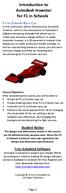 Introduction to Autodesk Inventor for F1 in Schools F1 in Schools Race Car In this course you will be introduced to Autodesk Inventor, which is the centerpiece of Autodesk s digital prototyping strategy
Vodafone Business Product Management Group. Hosted Services EasySiteWizard Pro 8 User Guide
 Vodafone Business Product Management Group Hosted Services EasySiteWizard Pro 8 User Guide Vodafone Group 2010 Other than as permitted by law, no part of this document may be reproduced, adapted, or distributed,
Pro/ENGINEER Wildfire 4.0 Basic Design
 Introduction Datum features are non-solid features used during the construction of other features. The most common datum features include planes, axes, coordinate systems, and curves. Datum features do
The Rocket Steam Locomotive - Animation
 Course: 3D Design Title: Rocket Steam Locomotive - Animation Blender: Version 2.6X Level: Beginning Author; Neal Hirsig ([email protected]) (May 2012) The Rocket Steam Locomotive - Animation In this tutorial
Appspace 5.X Reference Guide (Digital Signage) Updated on February 9, 2015
 Appspace 5.X Reference Guide (Digital Signage) Updated on February 9, 2015 1 TABLE OF CONTENTS 2 What is Appspace For Digital Signage... 4 3 Access Appspace... 4 4 Best Practices and Notes... 4 5 Appspace
LEGO Digital Designer 4.3 User Manual
 LEGO Digital Designer 4.3 User Manual The Readme file contains system requirements and the latest information about this software release. Please refer to it first if you encounter any problems. Contents
Graphic Design. Background: The part of an artwork that appears to be farthest from the viewer, or in the distance of the scene.
 Graphic Design Active Layer- When you create multi layers for your images the active layer, or the only one that will be affected by your actions, is the one with a blue background in your layers palette.
Creating Interactive PDF Forms
 Creating Interactive PDF Forms Using Adobe Acrobat X Pro Information Technology Services Outreach and Distance Learning Technologies Copyright 2012 KSU Department of Information Technology Services This
Autodesk Fusion 360: Assemblies. Overview
 Overview In this module you will learn how different components can be put together to create an assembly. We will use several tools in Fusion 360 to make sure that these assemblies are constrained appropriately
Blender Notes. Introduction to Digital Modelling and Animation in Design Blender Tutorial - week 9 The Game Engine
 Blender Notes Introduction to Digital Modelling and Animation in Design Blender Tutorial - week 9 The Game Engine The Blender Game Engine This week we will have an introduction to the Game Engine build
The main imovie window is divided into six major parts.
 The main imovie window is divided into six major parts. 1. Project Drag clips to the project area to create a timeline 2. Preview Window Displays a preview of your video 3. Toolbar Contains a variety of
HOW TO USE THIS GUIDE
 HOW TO USE THIS GUIDE This guide provides step-by-step instructions for each exercise. Anything that you are supposed to type or select is noted with various types and colors. WHEN YOU SEE THIS Click Help
Table of Contents Getting Started... Recording...11 Playing Back...14
 USER GUIDE Table of Contents Getting Started...4 Main Window Essentials...5 Operation Modes...7 Setup...8 Recording...11 Tracks... 11 > Track Names... 11 > Adding Tracks... 11 > Master Bus... 11 > Track
Welcome to CorelDRAW, a comprehensive vector-based drawing and graphic-design program for the graphics professional.
 Workspace tour Welcome to CorelDRAW, a comprehensive vector-based drawing and graphic-design program for the graphics professional. In this tutorial, you will become familiar with the terminology and workspace
Instructions for Creating a Poster for Arts and Humanities Research Day Using PowerPoint
 Instructions for Creating a Poster for Arts and Humanities Research Day Using PowerPoint While it is, of course, possible to create a Research Day poster using a graphics editing programme such as Adobe
Dear Candidate, Thank you, Adobe Education
 Dear Candidate, In preparation for the Graphic Design and Illustration certification exam, we ve put together a set of practice materials and example exam items for you to review. What you ll find in this
DWGSee Professional User Guide
 DWGSee Professional User Guide DWGSee is comprehensive software for viewing, printing, marking and sharing DWG files. It is fast, powerful and easy-to-use for every expert and beginners. Starting DWGSee
Project Setup and Data Management Tutorial
 Project Setup and Heavy Construction Edition Version 1.20 Corporate Office Trimble Navigation Limited Engineering and Construction Division 5475 Kellenburger Road Dayton, Ohio 45424-1099 U.S.A. Phone:
Creating Hyperlinks & Buttons InDesign CS6
 Creating Hyperlinks & Buttons Adobe DPS, InDesign CS6 1 Creating Hyperlinks & Buttons InDesign CS6 Hyperlinks panel overview You can create hyperlinks so that when you export to Adobe PDF or SWF in InDesign,
Excel 2007 Basic knowledge
 Ribbon menu The Ribbon menu system with tabs for various Excel commands. This Ribbon system replaces the traditional menus used with Excel 2003. Above the Ribbon in the upper-left corner is the Microsoft
Sweet Home 3D user's guide
 1 de 14 08/01/2013 13:08 Features Download Online Gallery Blog Documentation FAQ User's guide Video tutorial Developer's guides History Reviews Support 3D models Textures Translations Forum Report a bug
10.0-2. Finite Element Modeling
 What s New in FEMAP FEMAP 10.0 and 10.0.1 include enhancements and new features in: User Interface on page 3 Meshing on page 23 Mesh Associativity on page 33 Properties on page 33 Functions on page 35
Design document Goal Technology Description
 Design document Goal OpenOrienteering Mapper is a program to draw orienteering maps. It helps both in the surveying and the following final drawing task. Support for course setting is not a priority because
ArcGIS. Tips and Shortcuts. for Desktop
 ArcGIS Tips and Shortcuts for Desktop Map Navigation Refresh and redraw the display. F5 Suspend the map s drawing. F9 Zoom in and out. Center map. Roll the mouse wheel backward and forward. Hold down Ctrl
House Design Tutorial
 Chapter 2: House Design Tutorial This House Design Tutorial shows you how to get started on a design project. The tutorials that follow continue with the same plan. When we are finished, we will have created
SpaceClaim Introduction Training Session. A SpaceClaim Support Document
 SpaceClaim Introduction Training Session A SpaceClaim Support Document In this class we will walk through the basic tools used to create and modify models in SpaceClaim. Introduction We will focus on:
Maxwell Render 1.5 complete list of new and enhanced features
 Maxwell Render 1.5 complete list of new and enhanced features Multiprocessor Maxwell Render can exploit all of the processors available on your system and can make them work simultaneously on the same
TUTORIAL. Introduction to Adobe Fireworks CS4
 TUTORIAL October 2008 2008 Adobe Systems Incorporated. All rights reserved. If this tutorial is distributed with software that includes an end user agreement, this guide, as well as the software described
Understand the Sketcher workbench of CATIA V5.
 Chapter 1 Drawing Sketches in Learning Objectives the Sketcher Workbench-I After completing this chapter you will be able to: Understand the Sketcher workbench of CATIA V5. Start a new file in the Part
Adobe Certified Expert Program
 Adobe Certified Expert Program Product Proficiency Exam Bulletin Adobe Photoshop CS4 Exam # 9A0-094 ACE Certification Checklist The checklist below will help guide you through the process of obtaining
Floorplanner Drawing Manual
 Floorplanner Floorplanner Drawing Manual Drawing Manual Floorplanner lets you easily create interactive floorplans and publish them online. This manual explains the floorplanner drawing tool. For details
MICROSOFT OFFICE ACCESS 2007 - NEW FEATURES
 MICROSOFT OFFICE 2007 MICROSOFT OFFICE ACCESS 2007 - NEW FEATURES Exploring Access Creating and Working with Tables Finding and Filtering Data Working with Queries and Recordsets Working with Forms Working
SketchUp Instructions
 SketchUp Instructions Every architect needs to know how to use SketchUp! SketchUp is free from Google just Google it and download to your computer. You can do just about anything with it, but it is especially
Access 2007 Creating Forms Table of Contents
 Access 2007 Creating Forms Table of Contents CREATING FORMS IN ACCESS 2007... 3 UNDERSTAND LAYOUT VIEW AND DESIGN VIEW... 3 LAYOUT VIEW... 3 DESIGN VIEW... 3 UNDERSTAND CONTROLS... 4 BOUND CONTROL... 4
Microsoft Access 2010 handout
 Microsoft Access 2010 handout Access 2010 is a relational database program you can use to create and manage large quantities of data. You can use Access to manage anything from a home inventory to a giant
Overview of the Adobe Flash Professional CS6 workspace
 Overview of the Adobe Flash Professional CS6 workspace In this guide, you learn how to do the following: Identify the elements of the Adobe Flash Professional CS6 workspace Customize the layout of the
Logo Design Studio Pro Guide
 Logo Design Studio Pro Guide This guide is distributed with software that includes an end-user agreement, this guide, as well as the software described in it, is furnished under license and may be used
How To Create A View Frame In 3D
 12/4/2008-10:00 am - 11:30 am Room:Palazzo O-P (5th) The Secrets of Cutting Plan and Profile Sheets in AutoCAD Civil 3D Michelle Rasmussen - Application Engineer, IMAGINiT Technologies CV304-1P In this
Advanced Presentation Features and Animation
 There are three features that you should remember as you work within PowerPoint 2007: the Microsoft Office Button, the Quick Access Toolbar, and the Ribbon. The function of these features will be more
Custom Reporting System User Guide
 Citibank Custom Reporting System User Guide April 2012 Version 8.1.1 Transaction Services Citibank Custom Reporting System User Guide Table of Contents Table of Contents User Guide Overview...2 Subscribe
ACE: After Effects CC
 Adobe Training Services Exam Guide ACE: After Effects CC Adobe Training Services provides this exam guide to help prepare partners, customers, and consultants who are actively seeking accreditation as
Help. Contents Back >>
 Contents Back >> Customizing Opening the Control Panel Control Panel Features Tabs Control Panel Lists Control Panel Buttons Customizing Your Tools Pen and Airbrush Tabs 2D Mouse and 4D Mouse Tabs Customizing
Using Microsoft Picture Manager
 Using Microsoft Picture Manager Storing Your Photos It is suggested that a county store all photos for use in the County CMS program in the same folder for easy access. For the County CMS Web Project it
Introduction to Autodesk Inventor for F1 in Schools
 F1 in Schools race car Introduction to Autodesk Inventor for F1 in Schools In this course you will be introduced to Autodesk Inventor, which is the centerpiece of Autodesk s Digital Prototyping strategy
Microsoft Publisher 2010 What s New!
 Microsoft Publisher 2010 What s New! INTRODUCTION Microsoft Publisher 2010 is a desktop publishing program used to create professional looking publications and communication materials for print. A new
Thea Omni Light. Thea Spot Light. Light setup & Optimization
 Light setup In this tutorial we will learn how to setup lights inside Thea Studio and how to create mesh lights and optimize them for faster rendering with less noise. Let us have a look at the different
Table of Contents. I. Banner Design Studio Overview... 4. II. Banner Creation Methods... 6. III. User Interface... 8
 User s Manual Table of Contents I. Banner Design Studio Overview... 4 II. Banner Creation Methods... 6 a) Create Banners from scratch in 3 easy steps... 6 b) Create Banners from template in 3 Easy Steps...
Florence School District #1
 Florence School District #1 Training Module 2 Designing Lessons Designing Interactive SMART Board Lessons- Revised June 2009 1 Designing Interactive SMART Board Lessons Lesson activities need to be designed
Snagit 12. Snagit 12 Help. Version 12.4.1. August 2015 2015 TechSmith Corporation
 12 Version 12.4.1 August 2015 2015 TechSmith Corporation All rights reserved This manual, as well as the software described in it, is furnished under license and may be used or copied only in accordance
S M A R T D R A W U S E R G U I D E
 2015 S M A R T D R A W U S E R G U I D E Copyright 2015 By SmartDraw, LLC Contents Welcome to SmartDraw... 6 The Resources Section of SmartDraw.com... 7 Tech Support... 7 SmartHelp... 7 Chapter 1: Building
WP Popup Magic User Guide
 WP Popup Magic User Guide Plugin version 2.6+ Prepared by Scott Bernadot WP Popup Magic User Guide Page 1 Introduction Thank you so much for your purchase! We're excited to present you with the most magical
WBS Schedule Pro. User's Guide
 WBS Schedule Pro User's Guide Critical Tools, Inc. 2014 Table of Contents Overview of WBS Schedule Pro 7 What is WBS Schedule Pro? 7 What is a WBS chart? 9 What is a Network chart? 10 What's New in WBS
Figure 3.5: Exporting SWF Files
 Li kewhatyou see? Buyt hebookat t hefocalbookst or e Fl ash + Af t eref f ect s Chr i sjackson ISBN 9780240810317 Flash Video (FLV) contains only rasterized images, not vector art. FLV files can be output
Plotting: Customizing the Graph
 Plotting: Customizing the Graph Data Plots: General Tips Making a Data Plot Active Within a graph layer, only one data plot can be active. A data plot must be set active before you can use the Data Selector
Google Docs Basics Website: http://etc.usf.edu/te/
 Website: http://etc.usf.edu/te/ Google Docs is a free web-based office suite that allows you to store documents online so you can access them from any computer with an internet connection. With Google
Creating Drawings in Pro/ENGINEER
 6 Creating Drawings in Pro/ENGINEER This chapter shows you how to bring the cell phone models and the assembly you ve created into the Pro/ENGINEER Drawing mode to create a drawing. A mechanical drawing
How to Edit Your Website
 How to Edit Your Website A guide to using your Content Management System Overview 2 Accessing the CMS 2 Choosing Your Language 2 Resetting Your Password 3 Sites 4 Favorites 4 Pages 5 Creating Pages 5 Managing
Piktochart 101 Create your first infographic in 15 minutes
 Piktochart 101 Create your first infographic in 15 minutes TABLE OF CONTENTS 01 Getting Started 5 Steps to Creating Your First Infographic in 15 Minutes 1.1 Pick a Template 1.2 Click Create and Start Adding
Create A Collage Of Warped Photos
 Create A Collage Of Warped Photos In this Adobe Photoshop tutorial, we re going to learn how to create a collage of warped photos. Now, don t go letting your imagination run wild here. When I say warped,
TurboNest. What s New. Version 11.0. Released April 2014. Copyright 2014 Hypertherm, Inc. All rights reserved.
 TurboNest Version 11.0 2015 What s New Released April 2014 What s New in TurboNest 2015 (v11.0) 1 New Features and Enhancements The following enhancements are available in the TurboNest 11.0 release: Ribbon
Choose a topic from the left to get help for CmapTools.
 Using CmapTools Create a Cmap Add a Concept Create a Proposition from One Concept Create a Proposition from Existing Concepts Save a Cmap Open a Cmap Create a Folder Drag in Resources Import Resources
SMART Notebook 10 User s Guide. Linux Operating Systems
 SMART Notebook 10 User s Guide Linux Operating Systems Product Registration If you register your SMART product, we ll notify you of new features and software upgrades. Register online at www.smarttech.com/registration.
Chapter 23: Drafting in Worksheet View
 Chapter 23: Drafting in Worksheet View Worksheet View is a powerful, 2D production drafting module. Here you can find all of the drawing and editing tools needed to create fast, accurate, detailed working
2014 Simplify3D. Quick Start Guide
 Quick Start Guide Preparation Installing Simplify3D Software 3 The Configuration Assistant 4 The Interface Layout 5 3D Printing Workflow Import Process Settings Preview Print! Import 7 Process Settings
CATIA: Navigating the CATIA V5 environment. D. CHABLAT / S. CARO [email protected]
 CATIA: Navigating the CATIA V5 environment D. CHABLAT / S. CARO [email protected] Standard Screen Layout 5 4 6 7 1 2 3 8 9 10 11 12 13 14 15 D. Chablat / S. Caro -- Institut de Recherche
Internet Explorer 7. Getting Started The Internet Explorer Window. Tabs NEW! Working with the Tab Row. Microsoft QUICK Source
 Microsoft QUICK Source Internet Explorer 7 Getting Started The Internet Explorer Window u v w x y { Using the Command Bar The Command Bar contains shortcut buttons for Internet Explorer tools. To expand
Decision Support AITS University Administration. Web Intelligence Rich Client 4.1 User Guide
 Decision Support AITS University Administration Web Intelligence Rich Client 4.1 User Guide 2 P age Web Intelligence 4.1 User Guide Web Intelligence 4.1 User Guide Contents Getting Started in Web Intelligence
Adobe Dreamweaver CC 14 Tutorial
 Adobe Dreamweaver CC 14 Tutorial GETTING STARTED This tutorial focuses on the basic steps involved in creating an attractive, functional website. In using this tutorial you will learn to design a site
Digital Sentry DS ControlPoint
 O P E R A T I O N Digital Sentry DS ControlPoint C3674M-I (5/11) 2 C3674M-I (5/11) C3674M-I (5/11) 3 Contents Description...........................................................................................................
How To Change Your Site On Drupal Cloud On A Pcode On A Microsoft Powerstone On A Macbook Or Ipad (For Free) On A Freebie (For A Free Download) On An Ipad Or Ipa (For
 How-to Guide: MIT DLC Drupal Cloud Theme This guide will show you how to take your initial Drupal Cloud site... and turn it into something more like this, using the MIT DLC Drupal Cloud theme. See this
Unified Monitoring Portal Online Help Dashboard Designer
 Unified Monitoring Portal Online Help Dashboard Designer This PDF file contains content from the Unified Monitoring Portal (UMP) Online Help system. It is intended only to provide a printable version of
WebFOCUS BI Portal: S.I.M.P.L.E. as can be
 WebFOCUS BI Portal: S.I.M.P.L.E. as can be Author: Matthew Lerner Company: Information Builders Presentation Abstract: This hands-on session will introduce attendees to the new WebFOCUS BI Portal. We will
How To Run A Factory I/O On A Microsoft Gpu 2.5 (Sdk) On A Computer Or Microsoft Powerbook 2.3 (Powerpoint) On An Android Computer Or Macbook 2 (Powerstation) On
 User Guide November 19, 2014 Contents 3 Welcome 3 What Is FACTORY I/O 3 How Does It Work 4 I/O Drivers: Connecting To External Technologies 5 System Requirements 6 Run Mode And Edit Mode 7 Controls 8 Cameras
S M A R T D R A W U S E R G U I D E : F u n d a m e n t a l s f o r N e w U s e r s
 2016 S M A R T D R A W U S E R G U I D E : F u n d a m e n t a l s f o r N e w U s e r s TABLE OF CONTENTS Introduction... 5 Getting Started in SmartDraw... 6 Home Screen... 6 How to Search for a Template
Autodesk Fusion 360 Badge Guide: Design an F1 in Schools Trophy
 Autodesk Fusion 360 Badge Guide: Design an F1 in Schools Trophy Abstract: Gain basic understanding of creating 3D models in Fusion 360 by designing an F1 in Schools trophy. This badge may be claimed by
Sitecore InDesign Connector 1.1
 Sitecore Adaptive Print Studio Sitecore InDesign Connector 1.1 - User Manual, October 2, 2012 Sitecore InDesign Connector 1.1 User Manual Creating InDesign Documents with Sitecore CMS User Manual Page
Course: 3D Design Title: Deciduous Trees Blender: Version 2.6X Level: Beginning Author; Neal Hirsig ([email protected]) (June 2012) Deciduous Trees
 Course: 3D Design Title: Deciduous Trees Blender: Version 2.6X Level: Beginning Author; Neal Hirsig ([email protected]) (June 2012) Deciduous Trees In general, modeling trees is a long and somewhat tedious