
Panasonic Digital Business System - Operating Instructions March 1997 Issue 24. Panasonic Digital Business System Operating Instructions
|
|
|
- Melissa Whitehead
- 10 years ago
- Views:
Transcription
1 Panasonic Digital Business System Operating Instructions 1
2 Contents INTRODUCTION 7 IMPORTANT INFORMATION 9 TYPES OF EXTENSION 9 PROPRIETARY KEY TELEPHONES 9 EXTENSION FEATURES 10 KEY TELEPHONE FEATURES 10 LCD CONTRAST ADJUSTMENT 13 RINGING VOLUME 13 SPEAKER VOLUME 14 VBD RANGE OF HANDSETS AND CPC-EX PROCESSOR CARD 14 LINE VOLUME 15 FITTING THE DIRECTORY TRAY 16 MAKING AN OUTSIDE LINE CALL 17 USING A LINE KEY 17 DIRECT OUTSIDE LINE ACCESS 18 LINE GROUP DIALLING 19 PRIME LINE ACCESS 20 ISDN LINE 21 LINE KEY AND LIVE KEYPAD 22 MAKING AN INTERNAL CALL 23 CALLING ANOTHER EXTENSION 23 CALLING THE SYSTEM OPERATOR 24 OPERATOR CALL QUEUING 24 RECEIVING CALLS 25 INCOMING CALL RING PRIORITY 25 INTERCOM CALLS 25 OUTSIDE LINE CALLS 26 AUTO ANSWER 26 AUTO ANSWER NOT SET / EXTENSION NOT RINGING 26 CALL PICK UP 27 GROUP PICK UP 27 DIRECTED CALL PICK UP 28 HANDSFREE ANSWERBACK 28 GROUP RINGING 29 GROUP RINGING - CPC-EX V

3 HOLDING CALLS 32 SYSTEM HOLD 32 EXCLUSIVE HOLD 33 INTERCOM HOLD 33 BROKERS HOLD 34 EXTENSION PARK HOLD 35 OPERATOR PARK HOLD 36 CALL TRANSFER 37 SUPERVISED TRANSFER 37 UNSUPERVISED TRANSFER 38 SPECIAL KEYS 38 TRUNK TO TRUNK TRANSFER & CONFERENCE 38 TERMINATION OF TRUNK TO TRUNK CALLS 40 CONFERENCE CALLS 41 SLTS AND VB3011 CONSTRAINTS WHEN CONFERENCING 41 EXTERNAL CONFERENCE 42 INTERNAL CONFERENCE 42 BUSY OVERRIDE 43 PRIVACY RELEASE 43 WHEN YOU RECEIVE BUSY TONE 44 EXCHANGE LINE CAMP ON 45 CALL BACK MESSAGE 46 CALL WAITING 49 CALL WAITING WITH MESSAGE 50 VOICE ANNOUNCE 51 PAGING 52 CALL FORWARDING 55 CALL FORWARD FOR VOICE SYSTEMS 55 MESSAGE LAMPS 57 CALL FORWARD ID 57 SETTING CALL FORWARD IDENTIFICATION 58 SUPPRESSION OF CALL FORWARD INDICATION ON LCD AND BLF 58 SETTING CALL FORWARD 59 SETTING CALL FORWARD BY FF KEY 60 SETTING CALL FORWARD FOLLOW ME 61 CALL FORWARD TO AN OUTSIDE LINE 61 CANCELLING CALL FORWARD AND FOLLOW ME 63 3

4 OTHER SYSTEM FEATURES 64 ABSENCE MESSAGE 64 DO NOT DISTURB 65 HUNT GROUPS 66 MANAGER SECRETARY GROUPS 67 FLEXIBLE FUNCTION KEY PROGRAMMING 68 PERSONAL SPEED DIAL 72 STORING A PERSONAL SPEED DIAL 73 DIALLING A PERSONAL SPEED DIAL 74 SYSTEM SPEED DIALS 74 INTERNAL DTMF DIALLING FROM SYSTEM SPEED DIALS AND PERSONAL SPEED DIALS 75 CONFIRMING STORED DATA 76 PBX RECALL 77 FLASH 79 LAST NUMBER REDIAL 80 SAVE DIAL 81 DEDICATED LINE TO EXTENSION 82 OFF HOOK SIGNALLING 82 MUSIC ON HOLD 82 HOLD REMINDER 82 ALARM 83 INTERNAL DIAL TONE MUTE 85 DIRECT INWARD SYSTEM ACCESS 86 DISA BREAK OUT 86 LEAST COST ROUTING 86 CALL BARRING 87 STATION LOCK 87 HANDSETS 89 THE LARGE DISPAY HANDSET 89 THE VBD RANGE OF HANDSETS 90 BLF DSS 90 VOIC INTEGRATION USING THE LARGE DISPLAY HANDSET 91 OPTIONAL FEATURES 93 BACKGROUND MUSIC AND MUSIC ON HOLD 93 HEADSET CONNECTION 94 DOORPHONE INTERFACE 95 EXTERNAL PAGING 95 LOUD RINGING BELL 95 CALL LOGGING AND ACCOUNT CODE ENTRY 96 CALL CHARGE DATA DISPLAY 97 CALL LOGGING 97 CPC-EX CALL LOGGING 100 4

5 DASSII ISDN FEATURES ON DBS 103 SELECTING A CHANNEL 103 DIALLING 107 SPEED DIAL MEMORIES 108 STORING THE SEND COMMAND UNDER AN FF KEY 108 DIRECT DIAL IN 108 CALLING LINE IDENTIFICATION 109 CALLING LINE IDENTITY - NAME DISPLAY 109 CONFIRMING CALL CHARGE DATA 110 EURO ISDN AND ISDN FEATURE ENHANCEMENTS - CPC-EX V DDI ENHANCEMENTS - CPC-EX V VOICE ANNOUNCE UNIT 112 VAU EXTENSION PORTS 112 VAU MESSAGES 112 MESSAGE BACKUP 112 RECORDING AND CHANGING THE VAU MESSAGE(S) 112 RECORDING A VAU MESSAGE 113 CHANGING A VAU MESSAGE 113 CHECKING A VAU MESSAGE 114 ONE DIGIT DIALLING 115 STORING AN EXTENSION NUMBER FOR A ONE-DIGIT CODE 115 CANCELLING A ONE-DIGIT CODE 116 APPLICATIONS 117 OPERATOR FEATURES 118 DSS ATTACHMENT 118 OPERATOR BUSY OVERRIDE 120 NIGHT SERVICE 121 EXTENSION FEATURE CLEAR 122 SETTING EXTENSION LOCK CODES 123 SETTING EXTENSION CALL FORWARD IDENTIFICATION 124 SETTING EXTENSION CALL FORWARD 125 CANCELLING EXTENSION CALL FORWARD 126 STORING SYSTEM SPEED DIAL NUMBERS 127 INTERNAL DTMF DIALLING FROM SSDS AND PSDS 128 CHANGING TIME AND DATE 129 CALL TRAFFIC MONITORING 131 STORING ALPHANUMERIC CHARACTERS USING THE DSS 132 CHECKING EXTENSION PORT NUMBER 133 ASSIGNING NAMES TO EXTENSIONS 134 ASSIGNING SYSTEM SPEED DIAL NAMES 135 ASSIGNING EXTENSION PERSONAL SPEED DIAL NAMES 136 STORING ABSENCE MESSAGES 137 STORING TRUNK NAMES 138 5

6 STORING ALPHANUMERIC CHARACTERS WITHOUT A DSS 140 ASSIGNING EXTENSION NAMES WITHOUT A DSS 141 ASSIGNING NAMES TO SYSTEM SPEED DIALS WITHOUT A DSS 142 ASSIGNING NAMES TO PERSONAL SPEED DIALS 143 ASSIGNING TRUNK NAMES WITHOUT A DSS 144 ASSIGNING ABSENCE MESSAGES WITHOUT A DSS 145 APPENDIX A - ANALOGUE NETWORK DISCONNECT CLEAR SIGNALLING* 146 DIGITAL BUSINESS SYSTEM - QUICK REFERENCE OPERATING GUIDE 150 INDEX 153 6

7 Introduction The Digital Business System (DBS) range is a fully hybrid system allowing both digital key telephone and analogue telephone handsets. The DBS has a host of features to make it ideally suited to the needs of today s business user. Some are only available with certain configurations, others will require the addition of optional equipment or subscription to network services. The list includes: ISDN Connection E&M / AC15A Private Circuits Least Cost Routing Remote Programming Music On Hold External Paging Messaging DISA On Screen Help (LDS only) Call Barring There is a range of three cabinet sizes. DBS38, DBS68 and DBS90. These can be used individually or combined with a second DBS90 to give a range of systems DBS38, DBS68, DBS90, DBS128 (DBS90+DBS38), DBS158 (DBS90+DBS68) and DBS180 (DBS90+DBS90). There is also a choice of processors for the DBS, each offering a wide range of features and facilities. Each of the processor options can be used in any of the cabinet combinations. The feature range is enhanced when using the later CPC cards and where features are software dependant this is noted in the text. The main feature differences concern networking options and are outlined below. The CPC-B v4.2 The CPC-C v1.1 & 1.2 The CPC-EX v1.0 The CPC-EX v2.0 Offers E&M private circuits Offers ISDN connection via DASSII Offers E&M and AC15A private circuits and ISDN via DASSII Offers E&M, AC15A and ISDN via DASSII or Euro-ISDN The DBS overview section contains important information regarding the system and should also be read before using the system. Important This apparatus must be installed in accordance with BS6701 and general approval NS/G/23/L/ This is a condition of the approval. Any installation which does not comply with this condition will invalidate the approval of that particular installation. It is recommended that this system is covered by a maintenance contract issued by a maintainer holding BSI approval. When You Need Help In the event that you require assistance using your DBS system calls should be referred to the vendor of the system or the system maintainer. If a fault should develop with the equipment the call must be referred to the system maintainer who will then resolve the problem. Panasonic do not provide direct technical service and will refer customers to their maintainers for any on site engineering work required. Use the space below to record the number of the installer and maintainer. Installer Name Tel: Address Maintainer Name Tel: Address 7

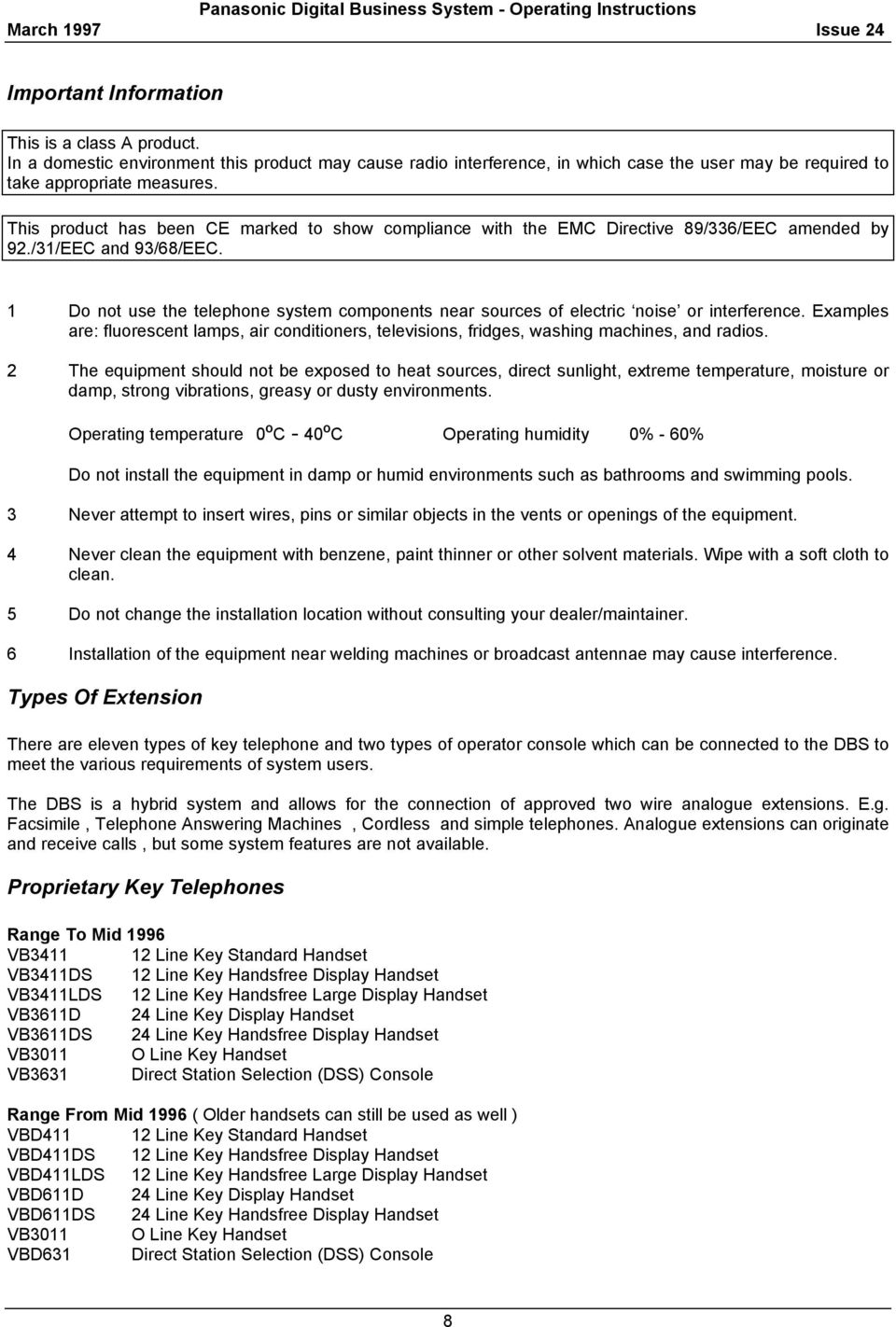
8 Important Information This is a class A product. In a domestic environment this product may cause radio interference, in which case the user may be required to take appropriate measures. This product has been CE marked to show compliance with the EMC Directive 89/336/EEC amended by 92./31/EEC and 93/68/EEC. 1 Do not use the telephone system components near sources of electric noise or interference. Examples are: fluorescent lamps, air conditioners, televisions, fridges, washing machines, and radios. 2 The equipment should not be exposed to heat sources, direct sunlight, extreme temperature, moisture or damp, strong vibrations, greasy or dusty environments. Operating temperature 0ºC - 40ºC Operating humidity 0% - 60% Do not install the equipment in damp or humid environments such as bathrooms and swimming pools. 3 Never attempt to insert wires, pins or similar objects in the vents or openings of the equipment. 4 Never clean the equipment with benzene, paint thinner or other solvent materials. Wipe with a soft cloth to clean. 5 Do not change the installation location without consulting your dealer/maintainer. 6 Installation of the equipment near welding machines or broadcast antennae may cause interference. Types Of Extension There are eleven types of key telephone and two types of operator console which can be connected to the DBS to meet the various requirements of system users. The DBS is a hybrid system and allows for the connection of approved two wire analogue extensions. E.g. Facsimile, Telephone Answering Machines, Cordless and simple telephones. Analogue extensions can originate and receive calls, but some system features are not available. Proprietary Key Telephones Range To Mid 1996 VB Line Key Standard Handset VB3411DS 12 Line Key Handsfree Display Handset VB3411LDS 12 Line Key Handsfree Large Display Handset VB3611D 24 Line Key Display Handset VB3611DS 24 Line Key Handsfree Display Handset VB3011 O Line Key Handset VB3631 Direct Station Selection (DSS) Console Range From Mid 1996 ( Older handsets can still be used as well ) VBD Line Key Standard Handset VBD411DS 12 Line Key Handsfree Display Handset VBD411LDS 12 Line Key Handsfree Large Display Handset VBD611D 24 Line Key Display Handset VBD611DS 24 Line Key Handsfree Display Handset VB3011 O Line Key Handset VBD631 Direct Station Selection (DSS) Console 8
9 Extension Features Key Telephone Features 9

10 Keys And Their Use No. Item Use / Effect 1 Speaker For ringing, tones and voice 2 Directory The tray holds an index sheet for the extensions and system speed dial memories ( not on VB3011 ) 3 HOLD Key Places internal and external calls on hold. Recovers internal and non appearing line calls from hold. 4 ON/OFF Key Switches the keyset on from standby, without having to lift the handset. The LED in the key will light when the keyset is ON. 5 REDIAL key Redials the last number dialled 6 MEMORY Key Used to access speed dialling memories 7 RECALL Key For programming some functions and transferring calls. 8 FLASH Key Used to end a call but keep the line to make a further call. 9 CONF Key For activation of conference function and confirmation of stored data 10 MIC Key Turns the built in microphone on or off 11 VOL Keys For setting incoming ring and speaker volume plus LCD display contrast 12 MESSAGE LED Lights when message waiting has been set or system is in power fail mode. 13 MIC LED Lights when internal MIC is on. 14 INT LED Lights when an internal call or non appearing exchange line call is received or made. It flashes when the call is put on hold. 15 DND/CF LED Lights when Do Not Disturb or Call Forward is set 16 FF Key These can be used as line keys or for certain system features 17 FF Key LED Lights when the key or feature is active. The LED is two colour Green / Red. 18 One Touch Key These keys provide direct access to the extension personal speed dial memories. They can hold telephone numbers or be used to access system features. 19 Display Shows time and date when the extension is idle. When in use it shows the number dialled, line used and duration of the call or extension called. the second line indicates the extension name and number or system feature in use. VB3411LDS These features are only available on the large display key telephone No. Item Use / Effect 20 MENU Key Returns to main menu display 21 NEXT Key Displays next screen 22 PREV Key Displays previous screen 23 One Touch Used to select the menu item next to the key in the display. Key 24 Large Display 7 Lines (1x16,1x15,5x16) LCD display VBD Range LINE Key VOLUME Key Message LED Live Keypad Off Hook Monitor MUTE Key These features are available using the VBD range of keysets released mid 1996 when used with the CPC-EX card Allows selection of a free line to dial out, using a single key The volume key is now a single rocking key for up and down adjustment of ringing and call monitor volumes. A large easily visible LED is used for message and ringing alerts The keypad can be used to enter a number to dial before pressing the LINE key A call can be relayed via the built in speaker, with one person using the handset, so others in the office can hear it, though they cannot reply unless a handsfree telephone is used in handsfree mode. Using the MUTE key the microphone in the handset can be turned off temporarily for private consultations with other staff. 10

11 LCD Contrast Adjustment The display contrast can be adjusted to any one of sixteen different levels. Press the # key or Press the VOL keys to adjust the contrast. - The display will darken when VOL down is pressed - The display will lighten when VOL up is pressed Ringing Volume The ringing volume can be adjusted using the VOL keys during ringing or by following the sequence below. When the extension is idle press the ON/OFF key Press RECALL Press # 9 - A test ringing tone sounds Adjust the tone using the VOL keys or Press ON/OFF to finish 11

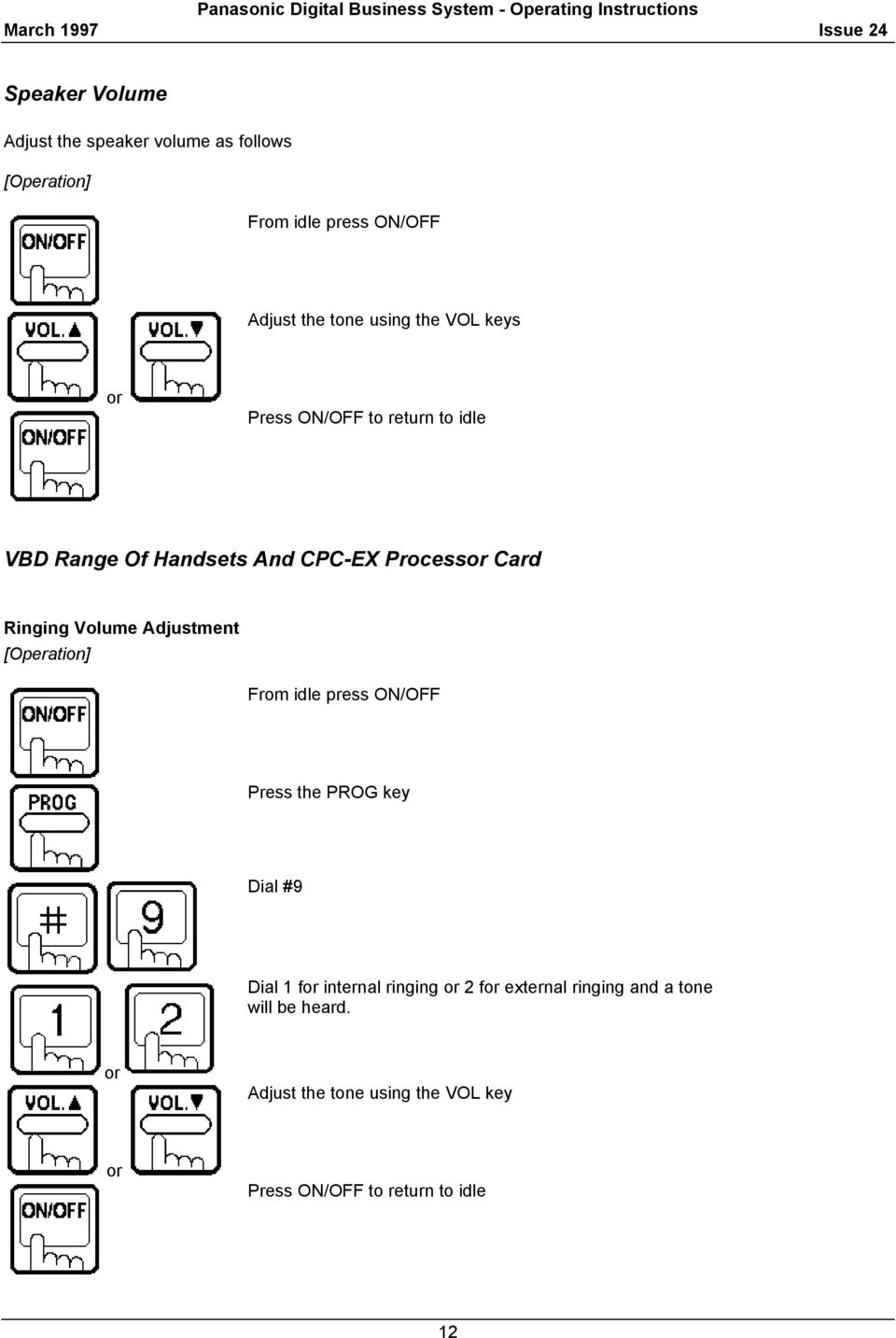
12 Speaker Volume Adjust the speaker volume as follows From idle press ON/OFF Adjust the tone using the VOL keys or Press ON/OFF to return to idle VBD Range Of Handsets And CPC-EX Processor Card Ringing Volume Adjustment From idle press ON/OFF Press the PROG key Dial #9 Dial 1 for internal ringing or 2 for external ringing and a tone will be heard. or Adjust the tone using the VOL key or Press ON/OFF to return to idle 12
13 Monitor Volume From idle press ON/OFF Press the PROG key Adjust the tone using the VOL key or Press ON/OFF to return to idle Line Volume From idle press ON/OFF Select a line Adjust the tone using the VOL key or Press ON/OFF to return to idle 13

14 Fitting The Directory Tray 14

15 Making An Outside Line Call Using A Line Key This method can only be used from a key telephone with line keys. The contents of the display are included for users of display key telephones. 1 Press a line key that is not lit - The FF key LED will blink green ( lines used by others will be red). - The display will show the number of the line selected - Listen for the outside dial tone 2 Dial the telephone number - The dialled number is shown in the display 3 Lift the handset and speak when the call is answered - Handsfree speech is possible if the extension is a handsfree keyset - The display will show the call duration or charge dependant upon system programming. 4 Hang up at the end of the call - If using handsfree press ON/OFF to hang up - The FF key LED will change from green to red and then go out - The display will return to time and date display 15

16 Direct Outside Line Access 1 Press ON/OFF - Intercom dial tone is heard from the speaker - ON/OFF LED will light 2 Dial 88 3 Dial the line number (01-48) - Listen for outside dial tone - Display shows the line number selected 4 Dial the telephone number 5 Lift the handset to talk when the call is answered - Speak into the microphone if a handsfree set is used 6 Re hook at the end of the call - Press the ON/OFF key if the call was handsfree Note: Only select lines which are connected to the system. If a busy line is selected busy tone will be heard. Not possible if a non-appearing line is on hold. Not possible during incoming call ringing. Not possible with an exclusive line on hold 16

17 Line Group Dialling Exchange lines on the DBS can be assigned to groups. There are seven groups accessed by 9, 811, 812, 813, 814, 815 and 816. The 9 group can be further divided into a maximum of 8 sub or tenant groups. Any line can belong to any combination of 9, ,but can only be assigned to one 9 tenant group. Line group access can be programmed into an unused FF key. In this case press the assigned FF key instead of steps 1 & 2. 1 Press ON/OFF - Intercom dial tone is heard from the speaker - ON/OFF LED will light 2 Dial the group number 9 or Listen for the outside dial tone from the speaker - The display shows the selected line number or 3 Dial the telephone number 4 Lift the handset and speak 5 Re hook at the end of the call 17

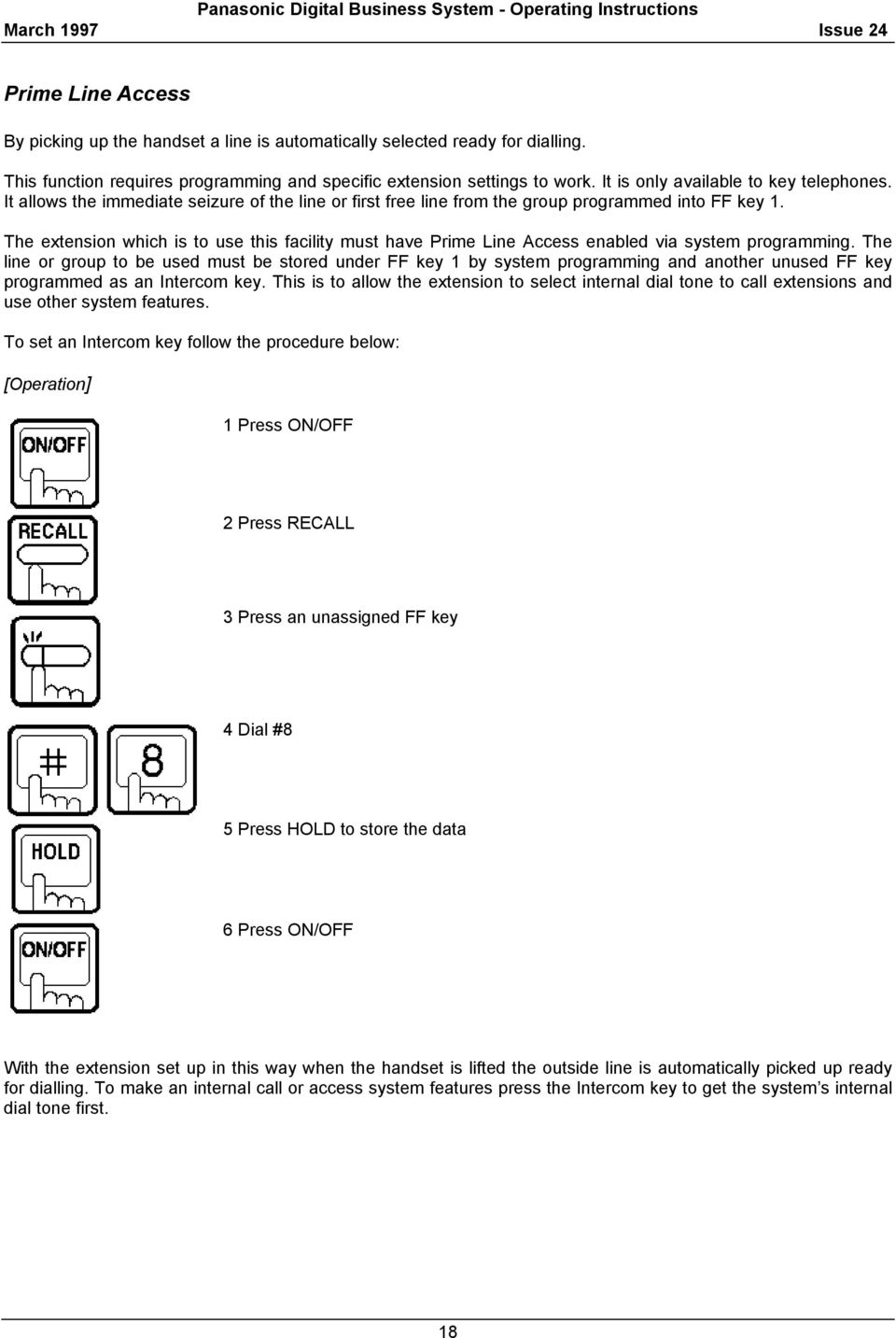
18 Prime Line Access By picking up the handset a line is automatically selected ready for dialling. This function requires programming and specific extension settings to work. It is only available to key telephones. It allows the immediate seizure of the line or first free line from the group programmed into FF key 1. The extension which is to use this facility must have Prime Line Access enabled via system programming. The line or group to be used must be stored under FF key 1 by system programming and another unused FF key programmed as an Intercom key. This is to allow the extension to select internal dial tone to call extensions and use other system features. To set an Intercom key follow the procedure below: 1 Press ON/OFF 2 Press RECALL 3 Press an unassigned FF key 4 Dial #8 5 Press HOLD to store the data 6 Press ON/OFF With the extension set up in this way when the handset is lifted the outside line is automatically picked up ready for dialling. To make an internal call or access system features press the Intercom key to get the system s internal dial tone first. 18
19 ISDN Line The DBS can be connected to the Integrated Services Digital Network for voice calls. The ISDN channels can be used in a similar way to the analogue lines. The use of these lines is shown below. See also ISDN Functions On DBS. The # following the dialled number is required when the en-block dialling method is used. If overlap dialling is used the # can be omitted. En-block dialling may be required by the ISDN service provider or the facilities used. 1 Press On / OFF or lift the handset 2 Select a channel in the same way as an analogue line: FF Key, 9, 81(1-6), 88(01-48) etc. 3 Dial the telephone number to be called 4 Press # to indicate the number is complete and instruct the system to send it to the network. This can be omitted when overlap dialling is used. Alternatively wait for the dial timer to elapse and the system to send it automatically 5 After answer speak. Dialling is the same as for a DBS with analogue lines with the addition of a send character # at the end of the digits to tell the DBS to send a call set up request to the network. If a send character is not added the system will wait for a pre-set timer to elapse before sending the digits dialled to the network. The timer is re-started each time a new digit is entered. The send character will prevent delay waiting for the timer to elapse. Note: Pulse dialling analogue SLTs must wait for the timer to elapse to send the digits because the # character cannot be sent using pulse dialling. 19

20 LINE Key And Live Keypad ( VBD range of handsets with CPC-EX processor ) The LINE key is a specially designated key for selecting a free exchange line, equivalent to dialling On/Off 9. Therefore for the LINE key to operate the extension must be a member of a dial 9 or tenant group. The LINE key setting is fixed and is not programmable. The VBD range of handsets, when used on the CPC-EX can be programmed to have a live keypad. This means that a number can be dialled before the handset is taken off hook and then dialled when the LINE key is pressed. Each digit must be dialled within 5 seconds of the preceding one or the register will clear and the handset return to the idle state. If an invalid key is entered the handset clears and returns to idle ( this can also be used as a quick way to clear an incorrectly dialled number before pressing the LINE key ). Live keypad is not available on the old CPC-B or CPC-C or the VB3xxx handsets. Dial 9 access (MC0) must be set up for this feature to operate. Live Keypad And LINE Key 1 Dial the number to call 2 When the number is complete press the LINE Key 3 After answer speak. LINE Key 1 Press the LINE key to select a line 2 Dial the number to call 3 After answer speak. 20

21 Making An Internal Call Calling Another Extension Extension numbers can be dialled directly to the system to establish a call to another extension. The call can be tone or voice depending upon system programming. A tone call will emit a series peep s from the receiving extension s speaker. A voice call will peep once and then connect the extension speaker to the calling extension so the caller can be heard. the calling mode, tone or voice can be changed by the caller by dialling a 1 following the extension number to toggle between the two. If the call is to an analogue telephone it will ring, the equivalent of a tone call. Voice calling mode is not available to analogue extensions. 1 Lift the handset or if the extension is a speakerphone press ON/OFF 2 Dial the destination extension number - To switch between voice and tone calling modes dial 1 - The INT LED Lights 3 Speak after the recipient answers 4 Hang up - The INT LED goes out 21
22 Calling The System Operator The system operator extension is connected to the first extension port on the system. It can be called from any other extension by dialling 0. 1 Lift the handset 2 Dial 0 3 On answer talk 4 Hang up Operator Call Queuing (CPC-EX processor only ) Internal callers dialling the operator using 0 will always receive ringing tone and will queue if the operator is busy. This facility is now standard and does not require any programming of the system. Internal calls from extensions, private wire or DISA will queue. Dialling the operator by extension number instead of 0 will not invoke the queuing function. There is no limit to the number of such calls that can queue. Queuing internal calls will not be subject to Operator Call Overflow and will not transfer if the overflow facility is configured. The order in which the queued calls are answered will be determined by the Incoming Ringing Priority set for the system. If external calls are given highest priority the internal calls will queue behind any incoming external calls; if internal calls are highest priority they will be queued in front of incoming external calls. In both cases the internal calls will be queued in the order they are received. If a second operator is set up, the internal calls will queue for both and ring through to the first one to become free. If Off Hook Signalling is set a call waiting tone will be sent. In Night Mode, dial 0 will queue to the designated night ring telephone. If no night ring telephone is set it will return busy tone. If the system mode changes between Day/Night or Night/Day whilst calls are queuing those calls will be unaffected and continue to queue until answered at the current extension. If 0 is stored under an FF key, the key will not operate as a BLF and cannot be used for operator pick up. Use an FF key with the operator extension number stored for operator BLF and pick up functions. Operator call queuing will not operate if: The operator extension is disconnected If the operator extension is in programming mode If the operator extension is in name setting mode 22
23 Receiving Calls Incoming Call Ring Priority ( CPC-EX processor ) The priority of incoming calls can be determined via programming. Either internal calls or external calls can be given highest priority and will override lower priority calls which may be ringing at an extension when they are received. If 2 calls of the same priority level are ringing they are answered on a first come first served basis, except DDI and DISA calls which will not camp on. External Priority Internal Priority High Low High Low Operator Internal Alarm Paging Internal Operator Alarm Paging Call Back DDI DDI Call Back External DISA DISA External Recall Recall Transfer Transfer Group calls Group calls Intercom Calls When a tone call is received or on an analogue telephone a single ring is heard, lift the handset to answer the call. If the extension is a digital handset with a display the name of the calling extension will appear in the display. 1 Lift the handset - On a key set the INT LED lights 23
24 Outside Line Calls Auto Answer When an extension set to auto answer rings the call can be answered simply lifting the handset. If there are several lines ringing the extension the longest ringing call is answered. This facility will also answer hold recall and transferred call ringing. Auto answer is set via system programming. 1 When the telephone rings lift the handset to answer. Auto Answer Not Set / Extension Not Ringing To answer a ringing call on an extension which is not set to auto answer or to answer a call from an extension which is not ringing. 1 Lift the handset 2 Press the line key which is slowly blinking red to answer the call - A rapid red flashing LED indicates a call on hold at another extension 24
25 Call Pick Up The DBS supports call pick up operations. Using these features calls ringing at other extensions can be picked up from extensions which were not ringing. There are two forms of call pick up, Group and Directed. Pick ups will not answer alarm calls or call back ringing. Group Pick Up Group pick up requires that the extensions be allocated into groups and the system told which type of groups to use for pick up via system programming. Group pick up can be set to operate on any one of the following group types, Hunt Groups, Paging Groups or Pick Up Groups. The decision as to which type to use is made at the time the system is installed. Changes to the type of group used or the members of any group require engineer reprogramming and cannot be performed by the user. If several calls are ringing to a group the lowest calling extension number or longest ringing line is answered first. An extension can only belong to one hunt group and one pick up group but can be a member of several paging groups. If pick up is via paging groups and an extension using this feature belongs to more than one paging group the system searches upwards from the lowest numbered paging group until it finds a call to answer or has searched all the groups. The group pick up command can be programmed under an FF or One Touch key. 1 Lift the handset 2 Dial the pick up code 70 3 Speak to the caller 4 Hang up 25
26 Directed Call Pick Up Directed pick up allows and extension to answer a call ringing at a known extension number. If several calls are ringing to the target extension the lowest calling extension number or longest ringing line is answered first. 1 Lift handset 2 Dial 7* 3 Dial the extension number of the extension to be answered 4 Speak to the caller 5 Hang up Handsfree Answerback This function is only available to digital extensions which have a MIC button. It allows the extension user to respond to voice calls without needing to lift the handset. To use this facility ensure that the MIC light on the key set is on. If it is not press the MIC button to light it. When a voice call is received the microphone in the base of the telephone will be activated and will allow handsfree spoken reply. Keep within three feet of the microphone and speak clearly for best effect. 26
27 Group Ringing The DBS can support upto 50 ringing groups of 8 members each, for ISDN DDI or analogue incoming lines. Group ringing will operate for the following types of incoming call: Internal Incoming Transferred Calls DISA Incoming E&M Incoming When calling a group from another extension the following features are barred and will return error tone to the caller: Message Call Waiting Call Back Override Off Hook Voice Announce Voice Calling ( All calls to groups are forced into tone call mode) Group ringing function will not operate in the following circumstances: Direct incoming call to a member extension Call Forward to a group cannot be set Hunt Groups cannot include ringing groups as members Hold Recall to a member extension ISDN DDI to a member extension Operator Reversion Paging Call Delayed Ringing Prime Line Transfer Recall DDI Reversion Call Back Alarm ringing If a member extension sets any of the following features it will be removed from the ringing group: Call Forward Absence Message Do Not Disturb Ringing for another call Off hook, monitor or handsfree in use Non appearing exchange line on hold SLT ring generator overload, if the extension is an SLT During programming of system or memories No extension number assigned to the port When a call is passed to a group ringing is presented and all idle extensions in the group ring. If an extension that was busy when the call arrived becomes idle before the call is answered it will not begin to ring. Calls can be transferred to a group from another extension, as soon as ringing is heard by hanging up. The group is searched for free extensions when the extension calls the group and again when the call is transferred before answer. If the group is busy and a forced transfer is performed the group will be continually searched until an extension becomes free or the reversion timer has elapsed. Multiple calls can be transferred to a busy group. 27
28 If the call is not answered before the recall or reversion timers have elapsed then the call will recall to the transferring extension. Group numbers cannot be assigned for use in hunt groups and manager secretary groups. If the group number is matched to an extension, the extension cannot be the destination of a Call Forward. If the matched extension sets a Call Forward the group ringing function will be disabled. Off hook signalling does not operate for group ringing calls. If the group number is assigned to an FF key or DSS key, at another extension, it will not light when the group is called and the call cannot be picked up using the key. Group Ringing - CPC-EX v2.1 Membership of the DDI / Ring Groups has been extended from the original 8 to 32 members with the introduction of the CPC-EX v2.1 software. A new Hunt Group type has also been added to the software for the exclusive use of DDI calls. There are an additional 16 DDI Hunt Groups allowing 16 members of each. Members can be extensions or DDI Ring Groups, and the hunting mode is circular, with no answer or busy searching. No follow on group or alternative hunting modes are supported. The existing Hunt Group operation is unchanged For DDI Ring Groups to be included in a Hunt Group they will require a virtual extension number to be assigned to reference them by. Extensions cannot be members of more than 1 DDI Hunt Group and cannot be included in a more than 1 Ring Group assigned to a DDI Hunt Group, but can be individually in the same DDI Hunt Group as a Ring Group in which it is also a member. Group membership conditions for normal Hunt Groups are unchanged. (see following example ) In this example: a) Cannot assign EXTN 300 to B, D and E b) Cannot assign GROUP 310 to A, B, D and E c) Cannot assign GROUP 320 to A, B, C and E d) Cannot assign GROUP 330 to A, B, C and D The original Hunt Group hunting takes precedence over the DDI Hunt Groups. If there are calls to A and C and 300 becomes idle, the call on A will have priority over the call to C. 28
29 Holding Calls The hold function allows the extension user to temporarily suspend a call. The other party will hear comfort tone ( a peep - peep every 5 seconds) or music on hold if installed. The extension user can then return to the call or transfer it to another extension. There are five types of hold on the DBS. System Hold Exclusive Hold Brokers Hold Extension Park Hold Operator Park Hold Analogue extensions cannot select system or exclusive hold modes. This is determined by system programming. Analogue extensions place a call on hold by pressing the RECALL key. If Automatic Exchange Line Hold is set via programming, when talking to an outside call, pressing another line key will place the first call on system hold and immediately present dial tone for a second call. This means that any other extension can retrieve the held call. Non appearing exchange lines are held and retrieved by pressing the HOLD key. The type of hold is the same as for analogue extensions which is determined via system programming. A call which has been left on hold will recall to the holding extension after a time determined by system programming. If the holding extension does not answer the call the call will revert to the operator extension unless the line used is assigned as a private line to the holding extension, when call reversion does not operate. System Hold System hold places the call on hold such that any extension can retrieve it. Other keysets will see a quickly flashing red LED for the held line, and can retrieve the call by pressing the line key or dialling the direct line access code 88 followed by the line number. To place a call on system hold 1 Press HOLD to place the call on system hold. - The line key LED will rapidly flash red. To retrieve a call from system hold 1 Press the line key with held call. - The LED will be rapidly flashing red. 29
30 Exclusive Hold Exclusive hold will place the call on hold, but will only allow the extension which placed the call on hold to recover it. 1 Press the line key the call is presented on to hold and retrieve the call - When putting the call on hold the key will flash green quickly and internal dial tone will be heard - When retrieving the call the key will stop flashing and remain lit. Intercom Hold Internal calls from other extensions can be held by pressing the HOLD key to hold and retrieve a call. Conference call, voice call, doorphone call and paging calls cannot be held. To hold an intercom call 1 Press HOLD - INT LED flashes - The held party will hear comfort tone of music on hold as configured. To retrieve a held intercom call 1 Press HOLD - INT LED stays lit 30
31 Brokers Hold Most commonly used for analogue extensions this feature will also work with key sets using non appearing exchange lines. System programming feature Call Brokering must be set to retrieve the held exchange line for this to operate. An extension on a non appearing exchange line call can hold the call using the HOLD key and make an internal call. It can then shuttle between the two using the HOLD key. Calls can be ended by hanging up without pressing HOLD, then returning to the second call and continuing as a normal call. 1 Press HOLD when talking to a non appearing exchange line 2 Dial the internal extension and wait for answer 3 Press HOLD to return to the original call - Further presses will shuttle between the calls 31
32 Extension Park Hold Park hold is used to hold a call, whose recipient s location is not known. Park hold differs from other forms of hold in that it can be retrieved by any extension who knows the extension number where the call was parked. The line number does not need to be known, nor does the retrieving extension need a line key for the call. After placing the call on park hold page the recipient and announce the parked call and extension number it is parked on, they can then retrieve it at any extension. If the call is not retrieved it will ring back after the time set in system programming. An extension can only have one parked call at one time. To park a call at an extension. 1 Press HOLD 2 Dial 82 To retrieve a parked call 1 Lift handset 2 Dial 83 park hold release 3 Dial the extension number where the call is parked 32
33 Operator Park Hold In a similar way to extension park hold the operator can park calls for retrieval by other extension users. The differences are that the operator has 10 park positions (0 to 9) which are shared between the two operator positions if a second operator is installed. The park hold positions are allocated to the second row down on the operators DSS console by default settings and are accessible to the operator directly by pressing the DSS FF keys. For the operator to place a call on park hold 1 From the operator press HOLD 2 Dial 82 followed by the park location 0-9 or 2 Or press the DSS key for the park location For an extension to retrieve the call 1 Lift the handset 2 Dial 84 operator park hold retrieve 3 Dial the park hold location
34 Call Transfer The DBS has two modes of call transfer which can be used to pass calls to other extensions within the system. These are supervised and unsupervised transfer. Supervised transfer involves calling the destination extension and waiting for the extension user to answer and announcing the call prior to transferring it. Unsupervised transfer sends the call to the extension regardless of whether the recipient answers or not. The ability of an extension to transfer calls and the type of transfer that can be used are specified via system programming. A transferred call which is not answered within a specified time will revert to the transferring extension. Supervised Transfer 1 Press HOLD to place the call on hold. 2 Dial the destination extension number 3 Announce the call when the destination extension answers 4 Hang up to transfer the call 34
35 Unsupervised Transfer 1 Press HOLD to place the call on hold. 2 Dial the destination extension number. 3 Hang up to transfer the call without waiting for an answer. Special Keys During the process of transferring the following keys have special actions. If the transferring extension presses RECALL it will force the transfer of the call on hold to the called extension without the need to replace the calling extensions handset. If the called extension presses the HOLD key it will seize the held call from the calling extension, terminate the call from the other extension and be connected directly to the previously held caller. If the transferring extension presses the CONF key when talking to the destination extension a conference call is created with both extension and called party all able to speak to each other. The transferring extension can then drop out, by hanging up and leave the destination extension and previously held caller talking to each other. Trunk To Trunk Transfer & Conference ( CPC-EX processor ) A call on hold at an extension can be transferred to an external number by the extension. With the call on hold a line is selected and the new number dialled, the call can then be transferred by going back on hook, pressing an FF Key assigned as a TRANSFER key ( store *6 under the key ) on the VB3xxx range of handsets or PROG on the VBDxxxx range of handsets, pressing an FF key programmed as a RELEASE key or RELEASE on the DSS, an FF key programmed as a TRANSFER key (*6) or using the new large display menu option. If the DBS is linked using a networking card an extension on system A can transfer calls to and between line system B by a similar method using on hook or RELEASE key transfer. Calls can also be transferred between lines by dropping out of a conference using the methods described above. A conference call can be initiated by holding a call, setting up a new call and then pressing the CONF key. When a call is conferenced in this way DTMF transmission to the lines during the call is disabled. If the extension making the call places the calls on hold both external parties are placed on hold and held separate form each other. 35
36 Programming is required to enable trunk to trunk functions. The options below for transferring the call will depend upon the programming of the system. 1 Press HOLD to place the call on hold. 2 Select a new line 3 Dial the destination number. Then 1 Press CONF to conference the two calls 2 Hang up to leave the conference and leave the two other parties connected. Or 1 On the VBD handsets press the PROG key or an FF key programmed as a transfer key 2 Hang up to connect calls without conferenceing them Or 1 Hang up to transfer the call without annoucing it. 36
37 Termination Of Trunk To Trunk Calls Trunk to trunk termination is initiated by either clear signal detection (CPC/DCT/CDT), timer or operator intervention. If clearing by clear signal detection is selected the timer option is disabled. The DBS will, however, clear any trunk to trunk call after 4 hours. Before clearing the call it will give a 3 beep warning 1 minute before and 5 beeps at 10 seconds before cutting off the call. The operator can cut off calls if on hook transfer is disabled. To do this the operator selects a busy line, breaks in by dialling 4,places the calls on hold with the HOLD key then selects each line in turn an clears it down by hanging up. The call logging record produced after a transfer will allocate the call to the extension which transferred the call. 37
38 Conference Calls A conference call is call involving more than two parties. The DBS provides four methods of conferencing calls. These are: External Conference Internal Conference Trunk To Trunk Conference Busy Override Privacy Release An external conference is a call involving two system extensions and an outside line call. An internal conference is a call involving three system extensions. Trunk To Trunk Conference is a conference call involving two exchange lines and one internal caller. All parties are cut off if the internal caller drops out of the conference. (See the previous section for the operation of trunk to trunk transfer and conference ) Busy Override requires system programming. Using it allows an extension to break into the call of another extension and force a conference call. The extensions must be in the same paging group other than group 0 and have been given the ability to make and receive break in. This programming must be performed by a qualified engineer. Busy override will not break into an existing conference call nor will it work if the originating extension is already in a conference. Privacy Release is an alternative method of creating an external conference by allowing another extension to pick up the same line and join in the call. An internal party to a conference call can drop out by hanging up or pressing the FLASH key. The DBS can support eight conference calls simultaneously and optionally via programming provide a conference splash tone to indicate a conference call is in progress. SLTs and VB3011 Constraints When Conferencing These are single line devices and as such cannot deal with calls involving more than one external line or channel. Whilst a two extension to single line call is possible, one extension to two lines or channels cannot be invoked by or for an SLT or VB3011 extension. 38
39 External Conference 1 During an internal call press HOLD to hold the call 2 Select an outside line 3 Dial the telephone number of the third party 4 After answer inform the called party that you are creating a conference call and press CONF. All three parties can now talk to each other. Internal Conference 1 During an internal call press HOLD to hold the call 2 Dial the extension number of the third party 3 After answer inform the called party that you are creating a conference call and press CONF. All three parties can now talk to each other. 39
40 Busy Override 1 Lift handset 2 Dial the extension number of a busy extension 3 Dial 4 to break into the call. Privacy Release From the extension on an outside call. 1 Press the CONF key and inform the other extension user which line you are using. The other party has 15 seconds to join the call. From the other extension 1 The other party selects the same line within 15 seconds to create a conference call. 40
41 When You Receive Busy Tone The DBS has a number of options available when the extension or line requested is busy these are: Exchange Line Camp On Call Back Message Call Waiting Call Waiting With Message Voice Announce Busy Override Exchange Line Camp On allows extension users to queue for busy exchange lines. When a line becomes free the system will call back to the extension and connect he line to it. Call Back Message sets a flag at the called extension which allows the busy extension to return the call at a later time. Four messages can be queued to an extension at one time. If the extension is called a second time and connected the feature is cancelled. If call forward is set the message is set on the destination extension to which the call forward is set. Display keysets can see on the display the number of messages set and can rotate the order of messages when replying. A call back message can be set at an unattended extension without calling the extension. Call Waiting will send a tone to the busy extension which can then respond by holding the call they are on and taking the call or continue the call and not accept the waiting call. Call waiting and voice announce can be answered by using a talk-back key. Call Waiting will not work if the target extension has set DND, is engaged in a conference call, is receiving an alert tone from another call waiting or is ringing. If the calling extension hangs up call waiting is cancelled. Call Waiting With Message allows the call waiting tone to be sent together with a text message which will appear in the screen of a digital display handset. Otherwise it operates in the same way as Call Waiting. The messages initially stored in the system are: Message Code Message 5 VISITOR HERE 6 NEED HELP 7 IMPORTANT 8 URGENT 9 EMERGENCY Voice Announce allows the calling extension user to speak to the called extension without the other party hearing. E.g. If an extension is on an outside line call the outside caller will not hear the announcement. Voice Announce can be answered by using the talk-back key. Busy Override will create a conference call, with all parties connected together. Talk-back is a function only available to digital keysets which can be programmed under an FF key which will allow single key answering of call waiting, call waiting with message or voice announce by holding the first call and connecting the extension to the waiting call. Further presses toggle between the two calls. 41
42 Exchange Line Camp On Setting 1 Press ON / OFF 2 Press the busy line key - Busy tone is heard 3 Dial 6 to camp on 4 Press ON / OFF When the ring back tone is heard 1 Lift the handset, listen for dial tone and dial - The ringback must be answered within 15 seconds or the feature is cancelled. - If the setting extension is busy on another call the ringback will wait for the extension to become free before ringing back. - If the extension is busy for more than 20 minutes the ringback feature is automatically cancelled. To cancel a camp on request 1 Press ON / OFF 2 Dial 76 call back cancel 3 Press ON / OFF 42
43 Call Back Message Setting a call back message - by calling the extension. 1 Press ON / OFF 2 Dial the extension number 3 When busy tone is heard dial 2 4 Press ON / OFF Setting a call back message - without calling the extension 1 Press ON / OFF 2 Dial 75 3 Dial the extension number where the message is to be set 4 Dial * to set the message 5 Press ON / OFF 43
44 Replying to a call back message 1 Lift the handset 2 Press the MEMORY key 3 Press the REDIAL key 4 Speak after answer Changing the order of messages (Display keysets only) 1 Press ON / OFF 2 Press CONF twice the message received last will be displayed - Repeat until the required message is shown 3 Press ON / OFF - Repeat from 1 until the required message is shown 44
45 Cancelling a call back form the called extension 1 Press ON / OFF 2 Press MEMORY 3 Press FLASH 4 Press ON / OFF Cancelling a call back message from the setting extension 1 Press ON / OFF 2 Dial 75 3 Dial the extension number where the message is set 4 Dial # to set the message 5 Press ON / OFF 45
46 Call Waiting Setting call waiting 1 Lift the handset 2 Dial the busy extension 3 When busy tone is heard dial 3 to send the call waiting signal - If the extension will accept call waiting the busy tone changes to ringing tone and the other extension will receive call waiting tone Answering call waiting 1 Disconnect the first call and lift the handset to be connected to the second caller or 2 Press the talk-back key - The first call is held and the second call is connected - Further presses toggle between the two calls - Talk-back is only available to digital keysets 46
47 Call Waiting With Message Setting call waiting with message 1 Lift the handset 2 Dial the busy extension - 3 When busy tone is heard dial 3 to send the call waiting signal - If the extension will accept call waiting the busy tone changes to ringing tone and the other extension will receive call waiting tone 4 Dial the message code (5-9) - Analogue extensions cannot sent code 8 since this is reserved for Transfer Answering call waiting with message 1 Disconnect the first call and lift the handset to be connected to the second caller or 2 Press the talk-back key - The first call is held and the second call is connected - Further presses toggle between the two calls - Talk-back is only available to digital keysets 47
48 Voice Announce Originating voice announce 1 Lift the handset 2 Dial the busy extension 3 When busy tone is heard dial 5 to make the announcement - After making the announcement either wait for an answer or hang up Answering voice announce 1 Press the talk-back key - The first call is held and the second call is connected - Further presses toggle between the two calls - Talk-back is only available to digital keysets Busy Override 1 Lift handset 2 Dial the extension number of a busy extension 3 Dial 4 to break into the call. - The same restrictions as busy override in the conference call section apply. 48
49 Paging The DBS supports paging announcements through the speakers of digital key sets and an optional external paging system. There are eight paging groups numbered 0 to 7 which can be used. The members of each group are programmed during installation, later changes should be referred to a suitably qualified engineer. Using this feature announcements can be made on a system wide basis or to specific groups of extensions. The paging call can be answered at any extension using the paging answer code. An optional external paging system can be connected to the system and associated with one of the paging groups. When that group is paged the announcement will also be broadcast over the external paging system. Only one extension can be paging at any one time using groups 1 to 7, however a page using group 0 will override the simultaneous paging of the other groups. Paging will not be heard at extensions which are busy or have Do Not Disturb (DND), call forwarding or an absence message set. There are two sets of codes to access the paging groups one set for analogue extensions and the other for digital keysets. 49
50 Making a paging call Analogue Digital Keysets 1 Lift handset 2 Dial the paging code - 6 for analogue extensions - #0 for digital keysets 3 Dial the paging group number ( 0-7 ) 4 Make the announcement 5 Wait for an answer or hang up 50
51 Answering a paging call Analogue Digital Keyset 1 Lift the handset 2 Dial the page pick up code - 69 for analogue extensions - ## for digital keysets 3 Speak to the paging party Setting and cancelling page do not disturb ( Digital keysets only) 1 Press ON / OFF 2 Dial 7# - The same sequence is used to set and cancel Page DND 3 Press ON / OFF 51
52 Call Forwarding The DBS allows calls to forwarded in the event an extension cannot or does not want to accept calls. The latest system software allows for four call forwarding conditions to be specified. These are: All Calls Busy Busy / No Answer No Answer (Software v4.0 onwards) Follow Me Call Forward To Outside Line ( CPC-EX processor ) Call Forward All Calls will send all calls to the extension to the designated alternative extension. This option can also be stored under an unused FF key in software v4.0 and higher so that the forward setting is single key press. Call Forward Busy will only forward calls the designated extension if the first extension is already busy. If the first extension is not busy when the call arrives it will ring and not be forwarded. Call Forward Busy / No Answer will forward calls if the extension is busy or does not answer after a pre-determined period of time. The no answer time is specified via system programming. Call Forward No Answer will only forward calls if the extension does not answer. If the extension is busy another incoming call will not be forwarded. This option is especially useful when forwarding to voic systems connected to the DBS. Call Forward Follow Me allows call forward all calls to be set at an extension from a separate extension. This feature allows user to remotely re-direct their calls to their current location. An extension which is the target of a call forward from the operator extension cannot set call forward. Calls cannot be forwarded to extensions which have themselves set call forward. All call forward settings are cancelled by the same code Call Forward For Voice Systems Version 4.0 and later software provides facilities for use when a voice processing system is attached to the DBS. These systems are attached via analogue card supported ports. Voice systems on the DBS can be configured in one of three ways: Automated Attendant (AA) Voic (VM) Combined AA/VM Calls ring into the voice system which then handles them in a similar way to a central operator eventually transferring them to a required extension. Calls received are routed to a specified user mailbox where the caller can leave a message. Has ports configured to do both of the AA and VM functions on a single system. In the system programming a specialised analogue port type can be set up for use with a voic or similar system. This will give the port special privileges and restrictions relevant to voic connection. The majority of these are hidden in the workings of the system and not visible to the users. They are concerned with call camp on and restriction of such features as DND and call forwarding. The change most relevant to the users is the ability for VM ports to receive the mailbox ID from extensions forwarded to them 52
53 The following commands are used to provide interaction with voice systems. Message Lamps A connected voice system will require the facility to set messages on extension phones. This is done using the following commands: 75 Ext. No. * To set a message 75 Ext. No. # To clear a message Message setting and cancelling must be controlled by the voice system to ensure messages are correctly set and cancelled. Note: The message lamp must be set and cancelled from the same voice system port. It is recommended that a single port on the connected voice system is allocated for this task, otherwise the lamps will not operate correctly. Call Forward ID System extensions can have a call forward ID set which will be automatically dialled when that extension call forwards to a VM port. Key sets can set their own, VB3011, VB3411 and analogue phones need the ID to be set from the operator extension (see page 99 - Operator Features). This ID is only sent to VM ports when a call is forwarded forwarding non VM ports will not receive it. The ID code can be upto 20 digits consisting of 0-9,*,# or Redial (to give a pause) Call forward is used to divert calls to the VM ports. In addition to the existing options there is also a no answer only option, and single FF key command option and operator setting option. The call forward command now becomes: 53
54 Setting Call Forward Identification This sets the DTMF sequence to be automatically dialled when forwarding to a voic port. It will not be sent if the extension forwards to any other type of port or extension. 1 Press ON / OFF 2 Press Recall 3 Press MEMORY 4 Dial * 5 Enter the ID to be used. Upto 20 Characters, see description text. 6 Press HOLD 7 Press ON / OFF Suppression Of Call Forward Indication On LCD and BLF With the introduction of version 4.1 and ISDN 1.1 software it is possible to suppress the display of call forward indication from the second line of a keyset LCD and green LED indication on BLF keys, when an extension sets call forward. This is useful when many users will be setting forward to voic and do not want these indications present. When suppressed the DND/CF LED on keysets will still be illuminated to indicate call forward status. This requires system programming by a qualified engineer. 54
55 Setting call forward 1 Press ON / OFF 2 Dial 72 the call forward command followed by the required option,, or 1 - All Calls 2 - Busy 3 - Busy / No Answer 5 - No Answer 3 Dial the destination extension number to receive the forwarded calls 4 Press ON / OFF - On a digital key set the DND/CF lamp will light - Analogue extensions will hear a broken dial tone when off hook 55
56 Setting call forward by FF key 1 Press ON / OFF 2 Press RECALL 3 Press the FF key to be used - The key must not currently be set as a line key 4 Dial *5 5 Dial the extension number to forward to 6 Press HOLD to store 7 Press ON / OFF - When the call forward FF key is pressed the call forward is set 56
57 Setting call forward follow me 1 Press ON / OFF 2 Dial 77 the follow me setting command 3 Dial the extension number to forward calls from 4 Dial the extension number to forward calls to 5 Press ON / OFF Call Forward To An Outside Line Call forward to an external number can be set by any extension ( except the operator ) which is not restricted via programming from doing so. The number to which calls are to be forwarded must be stored in the extension s own Personal Speed Dials or the System Speed Dials before setting up the forward function. ( please refer to the Operating Manual for details regarding storage of speed dial locations ) The speed dial location used must include line access using the CONF (0-6) option, where 0-6 are the line groups set up in the system programming. If an SLT or VB3011 handset is to be used then the line access group must be specified using the following sequence ( please refer to Storing Personal Speed Dials for more information ) 8 * (90-99) * (0-6) Telephone Number Recall PSD No. Line Group Once the speed dial location has been stored, Call Forward To An External Number can be set by: On/Off nn On/Off nn=00-89, or Where nn is the PSD or SSD location which holds the destination number. To cancel: On/Off 7 2 On/Off 57
58 This feature will not operate if the extension is receiving a call, has a call on hold, has not stored the selected memory location correctly or is barred from setting the feature by programming. It will cancel DND, Absence Messages, Follow Me settings and any other call forwards which have been set. It will be cancelled if any of these features is set after it. Should the speed dial location be cleared or altered whilst being used to direct a call forward the extension or extensions using it will revert to DND mode, cancelling call forward. When an external call forward is set the extension is removed from hunt groups, coverage groups, ring groups and DDI groups. When set the extension cannot be used to make of receive calls until the forward is cancelled. Multiple calls can be redirected by external call forward from a single extension. However be sure there is sufficient capacity at the destination number to handle many calls if multiple calls are to forwarded or the callers will get busy tone. The operator extension cannot set a call forward to an external number, even if internal call forward has been enabled. The types of call which will follow an external call forward, when allowed by programming are: Internal tone and voice calls Calls from the private wire (DC5) if breakout is set Transferred calls ISDN Personal DDI calls The following call types will ignore an external call forward and not get transferred to the external destination: Incoming ringing calls ( calls must be answered first and then transferred by another user ) All forms of Group call Paging calls Alarm calls Delayed ringing calls Private line calls Call back calls Call forward from another extension Recall All types of call reversion When call forward to external is set the extension s status is indicated in several ways. The DND/CF LED is lit, DSS keys for the extension will show green, SLTs and VB3011 will have a broken dial tone when taken off hook, display keysets will show FWD NNNN ( where NNNN is the memory used to forward ) on the second line of the display. When a call is forwarded the extension is making an external call. Call barring, tenant groups, LCR and call logging functions will all operate as normal, barring the call if the number is restricted to that extension. The call logging output will show, in addition to the line and time of the call, an F condition code and an E on the end of the extension number followed by the forwarding telephone number E.g.: F 200E
59 1 Press ON / OFF 2 Dial 72 the call forward command followed by the required option 3 Dial 4 to set external call forward 4 Dial the memory location number where the number to be dialled is stored. See the explanation above for the number storing requirements. 5 Press ON / OFF - On a digital key set the DND/CF lamp will light - Analogue extensions will hear a broken dial tone when off hook Cancelling call forward and follow me 1 Press ON / OFF 2 Dial 72 the call forward command at the transferring extension, but do not enter and extension number 3 Press ON / OFF 59
60 Other System Features Absence Message An unattended extension can set a text message, giving the reason for the user not being present, which will be sent to digital display keysets when they call it. The user can also set the return time. Non display and analogue extension will get ring back tone when they call the extension. Setting an absence message will cancel a DND or call forward function at the setting extension. There are five messages initially stored in the system plus five unstored locations. All ten can be modified by system programming or via the Operator extension.. Message Code Message Message Code Message 0 IN MEETING 5 ABSENCE MESSAGE 5 1 AT LUNCH 6 ABSENCE MESSAGE 6 2 OUT OF OFFICE 7 ABSENCE MESSAGE 7 3 HOLIDAY 8 ABSENCE MESSAGE 8 4 ANOTHER OFFICE 9 ABSENCE MESSAGE 9 Setting an absence message 1 Press ON / OFF 2 Dial 71 absence message setting command 3 Dial the message code ( 0-9 ) required 4 Dial in the return time ( ) - This step can be omitted if not required, unless the one touch menu option on the VB3411LDS keyset issued in which case entry is mandatory. 5 Press ON / OFF 60
61 Cancelling an absence message 1 Press ON / OFF 2 Dial 71 absence message setting command without any additional data 5 Press ON / OFF Do Not Disturb Do Not Disturb (DND) will prevent calls ringing the extension upon which it is set. Setting DND will cancel any previously set call forward or absence message. When set the DND/CF LED will light on a keyset and confirmation dial tone will be heard at analogue extensions. A call back request will override DND. The operator can also override this function. The first operator and extensions with private lines cannot set DND. The DND command is a toggle the first time it is issued DND is set, when issued a second time DND is cancelled. Setting and cancelling DND 1 Press ON / OFF 2 Dial 73 the DND command 3 Press ON / OFF 61
62 Hunt Groups Pre CPC-EX Processor The DBS provides sixteen hunt groups. each group can have a maximum of eight member extensions. An extension can only belong to one hunt group, however it is possible to forward calls to a further hunt group if all members of the first group are busy. There are two type of hunt group, Terminate and Circular. The settings and members for each group are set during system installation, changes must be referred to a suitably qualified engineer. Terminate Hunt Groups will only operate when calls are made to the first extension in the member list - the master extension. If the master extension is busy the system will search for the first idle extension and route the call to it. Calls to extensions other than the master extension will not hunt. Circular Hunt Groups will always hunt. A call to any member extension which is busy will search the member list sequentially until a free extension is found and the call can be routed. If an extension in a hunt group sets DND, call forward or absence message it is not handled as a member of a hunt group until the feature is cancelled. With CPC-EX Processor The hunt group facilities have been extended. The DBS will now support up to 24 hunt groups of up to 32 member extensions. Cyclic hunting and No Answer hunting ( ringing hunting ) are now available for internal call directed at hunt groups according to programming. Circular and terminate options are unchanged from earlier processor versions. Cyclic Hunting The first call will hunt from member 1 upwards until a free extension is located and ring there. The next call will begin to hunt from the member extension following the last one which received a cyclic hunt call, until a free extension is located, and so on for successive calls to the group. When the last member is reached hunting continues from member 1 and the cycle repeats. This will give an even call distribution across the members of the hunt group. To operate Cyclic Hunting the hunt group type must be set to cyclic and the first extension assigned to a virtual extension number ( i.e. An extension which is not installed or covered by spare extension card capacity) or a permanently busy extension and all calls directed to this first member extension. No Answer Hunting An internal call will ring on a member extension, and if unanswered will move onto the next extension and continue to do this until answered or transferred to a non No Answer Hunting group. No Answer hunting uses 2 new timers; a member no answer timer and a group no answer timer. This mode of hunting can be used with terminate, circular or cyclic hunt groups. An incoming call will ring for the duration of the member no answer timer and if unanswered, move on to the next member and restart the timer. This will continue for the duration of the group no answer timer. When the group no answer timer elapses the hunt will move onto the next designated hunt group and continue hunting according to the new group s settings. If the member no answer timer is set to 0, the busy hunting mode will be used ( the hunting mode used in software levels up to CPC-EX ). If all members are busy the call will wait at the extension it was directed to until the member no answer timer elapses at which point it will hunt again. 62
63 Manager Secretary Groups Manager secretary groups, also called call coverage groups, are a variation on hunt groups and call forwarding. There are sixteen manager secretary groups which can be configured via system programming at installation, further changes require reprogramming by a suitable qualified engineer. Each group consists of eight member extensions two secretary and six manager extensions. Not all positions in a group need be used. An extension can only belong to one coverage group or one hunt group. When a group is set up call coverage is activated by a manager extension setting call forward to a secretary extension. Calls for the manager are then answered by the secretary and can be passed, by the secretary to the manager. When the secretary passes a call to the manager when the extension is busy call waiting will be generated at the manager extension and the secretary extension will hear ringing tone. If the manager extension has set DND, no tone is generated and the secretary extension will receive busy tone. 63
64 Flexible Function Key Programming Functions which an extension user needs to use frequently can be stored under FF or one touch keys on the digital keysets. The FF keys which have been configured as line keys cannot be changed using this function. Clearing lines programmed under FF keys requires system programming by a qualified engineer. Other functions can changed and programmed by the user. An FF key can store a maximum of 4 digits, one touch keys can store up to 24 digits. each key press stored counts as a stored digit. If a new code is stored under a key the previous stored code is erased and the new code stored. To clear a key do not enter and code data, skip step 4 in the storage sequence. Steps marked with a star in the table show a function which cannot be wholly stored under an FF key as it exceeds 4 digits. The part enclosed in square brackets [ ] cannot be stored and must dialled manually when the function is invoked by pressing the key. To store a function under an FF or one touch key 1 Press ON / OFF 2 Press RECALL 3 Press FF or one touch key to stores data under 4 Dial the function code from the table on the next page - Omit this step to clear the data under a key 5 Press HOLD to store the data 6 Press ON / OFF 64
65 Functions which can be stored under FF keys. Function Code Notes Call System Operator 0 Internal Call NNNN Extn. No. (max 4 digits) Direct Exchange Line Access 88NN NN = Pooled Line Access 9 or 81N N = 1-6 Paging 6N or #0N N = 0-7 Paging Answer 69 or ## Call Park 82 Operator Park 82N N = 0-9 Do Not Disturb 73 Paging DND 7# Call FWD All Calls 721[NNNN] or *5NNNN NNNN = Extn. No. Call FWD Busy/No Ans. 722[NNNN] NNNN = Extn. No. Call FWD Busy 723[NNNN] NNNN = Extn. No. Call FWD No Answer 725[NNNN] NNNN = Extn. No. Call FWD Follow Me 77[NNNN][MMMM] From Ext. NNNN to MMMM Absence Message 71[N][hhmm] N = 0-9, hhmm = Alarm 78[hhmm] hhmm = time Extension Lock 74[CCCC] CCCC = unlock code Group Call Pick Up 70 Direct Call Pick Up 7*[NNNN] NNNN =- Extn. No. External Bell Pick Up 68 Account Code Entry 87[AC][#] AC=AcctCode(max 10 digits) Message Waiting Set 75[NNNN][#] NNNN = Extn. No. Message Waiting Cancel 75[NNNN][*] NNNN = Extn. No. Store Save Dial MEMORY MEMORY * Redial Save Dial Number MEMORY * Internal Dial Tone On/Off #50 Headset Mode On/Off #51 Background Music On/Off #53 Intercom Key #8 For Extn. Using Prime Line ISDN Send Key #9 ISDN v1.2 Software Answer Key *1 Release Key *2 Talk-Back Key *3 Answer call waiting FLASH Key *4 For large display keyset Call Forward All Calls *5 NNNN v4.0 on. NNNN = Ext No. System Speed Dial MEMORY NN NN = SSD Location Message Waiting Recall MEMORY REDIAL Message Waiting Cancel MEMORY FLASH Night Mode #52 Operator Extension Only MIC Key #2 VBD & CPC-EX Only MUTE Key #54 VBD & CPC-EX Only Transfer Key *6 VBD & CPC-EX Only 65
66 Personal Speed Dial Each extension has ten personal speed dial (PSD) memories available to it. On keysets these are associated with the one touch keys. They are memory location If a one touch key is used to store a feature this will occupy the memory space instead of a telephone number. each key will accept 24 digits. The method used to store personal speed dials is dependant upon the extension type. Digital extensions and analogue extensions each having their own codes. In addition to the digits 0-9 the following digit strings have special meanings when stored as part of personal speed dial. Digit String Meaning CONF N N = 0-6. Selects a line from the specified group is equivalent to dialling 9, 1 = 811 etc. This command is ignored if a line is selected before the PSD is used * Convert dialling from pulse to tone If tone dialling * is sent to line REDIAL Inserts a pause in the dialling Pause time is set via system programming MEMORY NN Dials the contents of the specified memory location. This allows one PSD to dial several other memory numbers together RECALL x..x # Inserts the account code x..x before dialling (max 10 digits) FF6 Dialled Number Display Restriction - is sent to the keyset display instead of the dialled number FLASH Digits between FLASH and the next # are treated as an account code MIC DTMF sending start, for internal DTMF dialling only If a display keyset is used and a name is assigned to a speed dial location this will be shown in the display. To set a name for a PSD refer to the Name Setting Without A DSS Console section 66
67 Storing a personal speed dial Analogue Digital Keyset 1 Press ON / OFF or lift the handset 2 Keysets dial RECALL MEMORY - Analogue extensions dial 8* 3 Dial the memory location number analogue extensions need to add a * to signal the location number is complete. 4 Dial the digits to be stored (max 24 digits) 5 Keysets press HOLD to store the number - Analogue extensions press RECALL 6 Press ON / OFF or hang up 67
68 Dialling a personal speed dial Analogue Digital Keyset 1 Digital Keyset 2 1 Press a line key on a keyset, lift the handset on an analogue 2 Enter the PSD command - Keysets can dial MEMORY followed by the PSD number or press the associated one touch key. - Analogue extensions dial 80 3 Following the MEMORY or 80 dial the PSD number ( ) 4 Speak when the call is answered System Speed Dials The DBS originally had 180 system speed dials (SSDs) divided into two sections, 1 and 2. The SSDs are stored at the operator extension. The new versions of software allow for the DBS to be configured for 2 x 90 SSD groups or 1 x 180 SSD group. This is set via programming and requires a power off/on reset to take effect and should only be changed by a qualified engineer. Changing this setting will not erase the contents of the SSDs. The SSD numbering changes dependant upon the mode selected. With 2 x 90 the SSD locations are numbered 00~89 in each group With 1 x 180 the SSD locations are numbered 100~189,200~289 They are dialled in the same way as PSDs but using the location numbers or 100~189 and 200 ~ 289 in step 3 above instead of See the Operator Features section for details about storing SSDs. 68
69 Internal DTMF Dialling From System Speed Dials And Personal Speed Dials Introduced with version 4.1 and ISDN 1.1 software, is the ability to send DTMF signals internally from System Speed Dials (SSDs) and Personal Speed Dials (PSDs) on the DBS. This will allow single key access to voic systems to be set up. To do this the destination extension is stored, followed by a DTMF send key and the DTMF to send. The DTMF can include 1-9,0,*,# and REDIAL (pause). The DTMF tones are 250ms mark / 250ms space and the pause time is the voic pause timer introduced in v4.0. When using a memory to send internal DTMF in this way the keypad of the extension is disabled until dialling is complete and if the extension is a display keyset the LCD is blank. The blank LCD will keep passwords secret. When dialling the tones can be audible or silent dependant upon system program setting. If the memory is sent during a conversation the contents will be DTMF dialled over the speech. Memories can be chained together provided that the total length of the combined memories does not exceed 24 digits. When an SSD is used in this manner it does not increment the SSD use counter which can be viewed from the operator extension, this counter is only for external calls. The facility can also be used over an E&M link, in which case the DTMF is sent after E&M answer is received and any stored pause ignored. This facility will operate to any extension. However if the extension is set to forward to voic it will not operate, thus avoiding a repeating loop to voic . The SSD or PSD can be stored via system programming, by keyset extensions or by the operator with DSS. The operator must store entries for SLTs. When storing from a keyset the DTMF sending key is MIC, from a DSS it is the 5th key from the left of the top row ( E ). The programming steps for storing SSDs and PSDs have not changed. The caller dialling the SSD or PSD can be prevented from hearing the DTMF by system programming. This must be done by a qualified engineer. 69
70 Confirming Stored Data Using a display keyset it is possible to confirm the settings of certain system features and parameters. Substitute the appropriate code from the table which follows in step 3 below. Where the port is needed this means the port number of the extension and not the extension number. When checking personal or system speed dials the # key will step onto the next location and * will step back to the preceding location. To check system data 1 Press ON / OFF 2 Press CONF 3 Dial the data check procedure - refer to the following table 4 Press ON / OFF 70
71 The following data can be checked using this method. denotes an operator extension only function, denotes an function where * an # can be used to scroll to other locations, denotes a function where # will move to the next location. Function Procedure Remarks System Speed Dial MEMORY NN NN = System Speed Dial Name MEMORY # NN NN = FF Key FF Key One Touch Key One Touch Key Redial Number REDIAL Save Dial MEMORY * Station Lock Code # 8 NNNN NNNN = Extn. No. Alarm Time 78 Own Port Number # 5 Extension Status NNNN NNNN = Extn. No. Extension Number # 5 NNN NNN = Extn. port number Remote Programming ID # 6 DISA ID # 7 Call Back Message CONF System Software Version * Number Of Outgoing Calls # 90 NN NN = Line number Number Of Incoming Calls # 91 NN NN = Line number SSD Usage # 92 NN NN = SSD location number Exchange Line Costs # 94 NN NN = Line number Extension Costs # 95 NNNN NNNN = Extn. number Absence Message * 8 NN NN = Message number Call Forward ID - Extension CONF # 1 Call Forward ID - Operator CONF # 2 NNN NNN = Extension number PBX Recall When the DBS is piggy-backed behind another PBX, when using a PBX extension line the host system s dial tone can be recalled using the RECALL key from keysets or RECALL 86 from an analogue extension. Return to PBX dial tone from a PBX extension/line call Analogue Digital Keyset 1 Press RECALL on a keyset - RECALL 86 from an analogue extension - PBX dial tone is sent to the extension 71
72 Flash Flash function is only available to digital keysets. When the FLASH key is pressed the current call is disconnected and the same line cleared and returned to the extension ready to dial out on another call. Other extensions see the line as busy during this procedure an d cannot access it. This is useful when the system is busy and the lines are engaged for long periods, once a line has been obtained it can be held onto until all planned calls have been made. The FLASH key can also be used to withdraw from a conference call. The VB3411LDS large display keyset does not have a FLASH key. However an FF key can be programmed as a flash key and used in the same way. 1 Press FLASH to disconnect the current call and re-seize the same line. To program FLASH on a large display keyset. 1 Press ON / OFF 2 Press RECALL 3 Press an unassigned FF key 4 dial *4 the FLASH key code 5 press HOLD to store the code 6 Press ON / OFF 72
73 Last Number Redial When pressed the REDIAL key will dial the last number dialled at the extension. If automatic flash on REDIAL is set it will disconnect a current call and re-seize the line. When pressed during internal dial tone it will seize the same line used to make the call as before, if the line is busy REDIAL will fail and a line should be selected before another attempt is made. The REDIAL key memory is 24 digits long for normal dialling. If the previous call was using multiple speed dials it will only redial the first five. 1 Select a line, or press ON / OFF 2 Press REDIAL 3 Speak when the call is answered 73
74 Save Dial This function is only available to digital keysets. When making an outside line call, where the recipient is busy, the dialled number can be saved in temporary memory location for redialling. Unlike the redial function this memory is retained until another number is stored in the same way by the extension. The memory is 24 digits long or will redial a maximum of 8 chained speed dials. When stored a number will overwrite any previously stored digits. 1 During the busy signal press MEMORY twice 2 Press * 3 Hang up Redialling a save dial number 1 Select a line 2 Press MEMORY and * to redial the saved number 3 Speak when call is answered 74
75 Pulse To Tone Dialling Conversion The DBS can dial to exchange lines in pulse (LD) or tone (DTMF) signalling modes. This is programmed during installation. If pulse dialling is used it may not be possible to access some network or dial up services as these require tone signalling. Therefore it is possible to temporarily change the dialling mode from pulse to tone for the duration of the current call. this is achieved by dialling a * in the string of dialled digits. The star is not dialled but digits following it are sent in tone dialling. If the system is already set for tone dialling a star is sent to the line. It is not possible to switch back to pulse dialling from tone dialling mode. 1 Dial * to switch from pulse to tone dialling Dedicated Line To Extension For keysets only. It is possible to dedicate a specific line to an extension for its exclusive use. Other extensions on the system are not able to access the line. The line is presented at the extension under an FF key and is used by the owning extension in the usual way. As a result of the exclusive user status the line will override DND, absence messages and call forwards set at the extension and ring to the owner extension. Un answered calls will remain at the extension and will not revert to the operator. Off Hook Signalling This feature must be enabled via system programming and is available only to digital keyset users. It allows a warning tone to be sent from the speaker of keysets when they are busy on a call, if a second call come in for the extension user. When enabled off hook signalling will not happen if the extension is in a conference call, has an intercom or non appearing exchange line call on hold or is ringing for an other incoming call. Music On Hold The DBS supports music on hold. An external optional music source can be attached to the DBS to play music to caller who are placed on hold and if required provide background music for the system users. When music on hold is installed any caller placed on hold will hear the music playing on the music on hold equipment. Hold Reminder A recall tone will sound at an extension which has placed a call on hold and not returned to it after the hold recall timer has expired. The hold recall timer duration is set via system programming and can only be altered by a suitably qualified engineer. The extension answers a hold recall by lifting the handset. If the extension does not answer the hold recall the call will revert to the operator unless the system is in night service or the call is on a dedicated line to the extension. 75
76 Alarm An extension can set up an alarm call to ring back at a specified time. When it rings the extension it will sound for 16 seconds before terminating. The extension answers the ring back by going off hook and hanging up. Only one alarm can be set per extension at one time. The alarm can be changed by setting a new time and cancelled by dialling 78, the alarm set code without any time data. If the setting extension is busy when the alarm falls due it will ring back when the extension next becomes free. On system software v4.0 or later the operator extension can set an alarm remotely for an extension. This facility is useful for situation where the DBS is installed in hotels. With operator set alarms a call logging record can be generated to shown when the alarm was set, weither it was cancelled, answered or ignored. Setting an alarm from an extension 1 Press ON / OFF or go off hook 2 Dial 78 the alarm command 3 Dial the alarm time hhmm, 4 digits in 24 hour time format 4 Press ON /OFF or go on hook Cancelling an alarm 1 Press ON / OFF or go off hook 2 Dial 78 3 Press ON / OFF or go on hook 76
77 Alarm setting from the operator ( requires v4.0 software or later ) 1 Press ON / OFF 2 Dial 78 3 Enter the alarm time hhmm, 4 digits in 24 hour format 4 Press # 5 Enter the extension number to set the alarm for 6 Press ON / OFF Cancelling the operator set alarm ( requires v4.0 software or later) 1 Press ON / OFF 2 Dial 78 3 Press # 4 Enter the extension number to cancel the alarm for 6 Press ON / OFF 77
78 Internal Dial Tone Mute An extension can mute the system internal dial tone (IDT) by following the steps below. The sequence is a toggle so the internal dial tone can be switched back on by repeating the process. 1 Press ON / OFF 2 Dial #50 3 Press ON / OFF 78
79 Direct Inward System Access Direct Inward System Access (DISA) is a function which allows outside caller who are familiar with the system to dial directly to an extension. DISA lines are set up via system programming. When the line rings it answers automatically and sends system internal dial tone to the caller, who can then tone dial the extension number they require. DISA requires at least one DTMF receiver card to be installed in the system. An ID code can be entered to restrict access to authorised users only. DISA will only allow an extension to be dialled and will no accept line access code for breaking out of the system. If the system is linked to another via the E&M card then DISA callers can dial across the link and access the remote systems functions. These may include break out depending upon the system configuration and programming. If a DISA call is unsuccessful it twill revert to the operator after 15 seconds. This will include call which have not received the DISA terminate signal, an option in software v3.1 and later and set by system programming. Maintainers can gain access to the system programming via a DISA line if the Remote Administration Interface (RAI) is fitted to the system. The * and # keys have the following meanings when used in DISA calls. When a caller on a DISA line dials * the call is routed directly to the operator extension. When the caller on a DISA line dials # one of the following will occur - Internal dial tone is returned to the caller to try another extension number - The DISA call is terminated and the system disconnects the line Early system software only offers the retry option, v3.1 and later can select the option to use via system programming. DISA Break Out ( CPC-EX processor ) DISA breakout allows an external caller to dial into the DBS and using a preset code break out on another line. To use this facility the code, called Transfer ID, must be stored and lines must be available to the dial 9 and tenant group chosen. There are 5 Transfer IDs that can be configured for the system. The operational sequence is: On Answer DISA ID 9 TRS ID Telephone Number The DISA ID is optional and is only used of the DBS is configured to use it. The TRS ID or Transfer ID is mandatory and must be set up to enable DISA breakout. Least Cost Routing The DBS supports seven indirect carriers in addition the direct carrier. It will then select, subject to programming, the cheapest route when a call is made. This is Least Cost Routing (LCR). It is configured by the installer via system programming. Once set up it operates automatically when call are made. 79
80 Call Barring The DBS supports 5 classes of call barring. These control the number types dialled by extensions. The restrictions range from emergency 999 and 112 call only to not restricted. These are configured during installation via system programming and can only be changed by a suitably qualified engineer. Once set up operation is automatic when calls are dialled. The operator extension can make a temporary change to an extensions call barring. Please refer to the Operator Features section for details. Station Lock Extension can have a lock code assigned to them which is used to restrict extension operation when the extension is left unattended. The lock codes are assigned by the operator extension. A separate lock code can be stored for each extension. Lock codes are 4 digit numbers. A locked extension can seize a line but cannot dial out unless the call barring when locked allows this ( system programming required), intercom calls are possible but speed dials cannot be set. When the handset of a locked extension is picked up broken dial tone is heard, confirming the lock status. If an incorrect code is entered to unlock the extension system busy tone is heard. If the operator has not assigned a lock code the extension cannot be locked. Locking an extension 1 Press ON / OFF or go off hook 2 Dial 74, the lock command 3 Press ON / OFF or go back on hook 80
81 Unlocking an extension 1 Press ON / OFF or go off hook 2 Dial 74, the lock command 3 Dial the lock code 4 Press ON / OFF or go back on hook 81
82 Handsets The Large Dispay Handset The large display keysets allow access to various functions and features. System programming allows the screen display to be automatically changed in response to the extension status. There are five one touch keys down each side of the display the function of which changes as the display changes. They are used to select the menu option alongside them in the LCD Screen. The display has seven lines. The first line is sixteen characters wide and is used to display information about call status as the extension is used. When idle it shows the date, day and time. The second line is fifteen characters wide using smaller matrices. It usually displays the extension name and number, but will also display information on other system functions when they are set. The Right most character is a special alarm symbol used to indicate a set alarm. The remaining five lines are all large sixteen character lines which display the menus and system prompts. When idle, unless programmed otherwise, the following five options are shown. Personal Dial System Dial Extension Function Guidance To navigate around the menus there are three special keys with the following functions. MENU NEXT PREV Pressing MENU at any time will return to the menu showing the five options above. If lost in the menu system this will return to the top level. Where a screen is more than five lines long the NEXT and PREV keys scroll down and up respectively one screen at a time. Personal Dial When PERSONAL DIAL is selected the stored personal speed dial names are displayed on the screen. System programming determines weither two columns of 5 one at each side of the screen is displayed or if the display is 1 column covering two screen. The NEXT And PREV keys will scroll the screen in the latter case. The one touch keys are used to select and dial the number stored next to it. Use the MENU key to return to the main menu. System Dial When SYSTEM DIAL is selected the SSD DIRECTORY is displayed. Press the one touch key next the first letter of the SSD to be dialled. The screen will shown the SSDs beginning with the selected letters, use NEXT and PREV to locate the precise one and the one touch next to it to dial. Return to the top level menu using the MENU key. Extension When EXTENSION is selected the EXT DIRECTORY is displayed. Press the one touch key next to the first letter of the extension name required. then use the NEXT and PREV keys to find the extension required and then the one touch next to it to dial the extension. 82
83 Function When FUNCTION is selected a menu of system functions is displayed. Use the NEXT and PREV keys to scroll the menu, use the one touch keys to operate the function. Use the MENU key to return to the main menu. Guidance When GUIDANCE is selected the names of system functions are displayed. Scroll using the NEXT and PREV keys to find the required function. When the one touch key next to a name is pressed the screen shows the steps required to use the function, but does not activate the function. Use the MENU key to return to the main menu. The VBD Range OF Handsets ( CPC-EX processor ) There are five VBD handsets. The new handset types can be set by programming or permitted to automatically detect when these new units are connected. These handsets offer increased functionality with the CPC-EX processor. In addition to the original models these new handsets offer: Live keypad Volume control for Incoming internal call ringing Incoming external call ringing Internal call monitor External call monitor Off hook monitor Handset mute Large LED for ringing and message indication LINE key MIC key now an FF key function The new extension model numbers are listed below: VBD3411 VBD3411DS VBD3611D VBD3611DS VBD34llLDS 12 Key standard 12 Key display speakerphone 24 Key display 24 Key display speakerphone 12 Key large display speakerphone BLF DSS ( CPC-EX processor ) The BLF DSS uses the DSS console ( VB3631 or VBD361 ) as an extended BLF unit which can be assigned to work with any non-operator key station. The BLF DSS will not operate in conjunction with the VB3011 or an SLT and any keyset can only have 1 BLF DSS unit associated with it. Up to four such BLF DSS units can be assigned for the system. This is in addition to the Operator positions which can still have 2 fully functioning DSS consoles at each of the two Operator positions as with previous software versions. When used as a keyset BLF DSS the console will operate only as a BLF. Single key transfer will operate, but extension pick up will not be supported. 83
84 Voic Integration Using The Large Display Handset The following illustrates how the Large Display handsets (and personal speed dials on other keysets) can be used to provide a more user friendly interface to voic systems by allocating voic functions to Personal Speed Dials and using the off hook display options. For the purposes of this illustration it is assumed that the latest versions of software (v4.1 / ISDN 1.2 / CPC- EX v1.0) are being used with a large display handset and the KXTVP150 voic system. If other keysets are being used the functions can be stored and accessed using the personal speed dial keys. If an alternative voic system is being used its equivalent commands will need to be substituted for the examples below. For details of storing speed dials and names please refer to the Operating Instructions. Set PSD: On/Off RECALL MEMORY(90-99) VM code HOLD On/Off (Old handset range) On/Off RECALL PSD Key VM code HOLD On/Off On/Off RECALL MEMORY(90-99) VM code HOLD On/Off (New handset range) On/Off PROG PSD Key VM code HOLD On/Off On/Off PROG MEMORY(90-99) VM code HOLD On/Off Set PSD Name:On/Off RECALL#1 MEMORY(90-99) Set name HOLD On/Off (Old handset range) On/Off RECALL#1 PSD Key Set name HOLD On/Off On/Off RECALL#1 MEMORY(90-99) Set name HOLD On/Off (New handset range) On/Off PROG #1 PSD Key Set name HOLD On/Off On/Off PROG #1 MEMORY(90-99) Set name HOLD On/Off To prepare the large display keyset turn off internal dial tone (#50) and program the idle display to main menu and the internal dial tone display for personal speed dial menu. Then set the PSD display mode to 2 columns of 5 names also via programming. This will display the PSD menu when the phone is taken off hook and the main menu when idle. Finally set the call forward to voic ID. With these setting made the keyset will display 10 personal speed dial names and allow access from the keys alongside the display when taken off hook. These PSDs can be configured to represent commonly used voic functions and thus present voic options to the user whenever they go off hook ( Note: if the PSDs are used for this then they are not available for normal PSD use). The most common voic commands are listed below for the KXTVP150 with suitable names which will fit the PSD display screen. Choose those you require and program them into your PSD locations. 84
85 After some instructions the voic will give voice prompts for user preferences. Items enclosed in [ ] brackets are optional and will only be required if the system configuration requires it. Command Suggested KXTVP150 / DBS Sequence To Store Name Call Forward To Voic VM On 725 VM-ext. Cancel Call Forward VM Off 72 Get Messages Get Msg VM-ext. MIC * mailbox-no. {Password #} Delete Message Del Msg 3 Transfer Message Trf Msg 7 Previous Message Prev 1 Next Message Next 2 Rewind Message RW Msg 5 Fast Forward Message FF Msg 6 Reply To Message Reply 4 Set Message Lamp Notification Lamp On VM-ext. MIC * mailbox-no [password #] 341 Set Dialout Notification Dialout VM-ext. MIC * mailbox-no [password #] 3422 Set Dial Out Number Set No VM-ext. MIC * mailbox-no [password #] Record Greeting Message Rec OGM VM-ext. MIC * mailbox-no [password #] 331 Speed Up Playback Speed 9 Scan Messages Scan # Exit Voic Quit **** Some example screen layouts are: Del Msg Trf Msg VM On Get Msg VM On VM Off Prev Next VM Off Del Msg Get Msg Del Msg RW Msg FF Msg Lamp On Trf Msg RW Msg FF Msg Rec Reply Dialout Set No Prev Next OGM Quit Get Msg Prev Next Speed Scan 85
86 Optional Features The features described here require additional optional equipment to be installed to work. Refer to the equipment supplier for details of equipment options. Background Music And Music On Hold An external music source can be connected to the DBS Music On Hold (MOH) port to provide music to be played to held calls and for background music. When installed the music is automatically played to held calls. Digital keysets can switch on Background Music (BGM) using the steps below. The step is a toggle so repeating it will turn off BGM. When BGM is active the music is played from the speaker on the base of the keyset. The volume can be controlled using the VOL keys. It is interrupted when the extension goes off hook or rings. 1 Press ON / OFF 2 Dial #53 3 Press ON / OFF 86
87 Headset Connection The following headset is currently approved for use with DBS keysets Clement Clarke International Ltd Airmed House Edinburgh Way Harlow Essex, CM20 2ED Tel: The headset is available from the manufacturer or their distributors. Any enquiries regarding compatibility must be made to the manufacturer or Panasonic, queries regarding prices must be made to the manufacturer or their distributors. The DBS has a headset mode for keysets which allows the headset to be switched by the ON / OFF key on the keyset base. In headset mode the keyset speaker is disabled except for call waiting and off hook signals The following toggling function is used to turn headset mode on and off. 1 Press ON / OFF 2 Dial #51 3 Press ON / OFF 87
88 Doorphone Interface The DBS doorphone interface supports up to two doorphone units and control for an associated door release. Callers from the doorphones ring to the system as an exchange lien call and is answered in the same way. The user answering the call can operate the associated release. Keyset users can trigger the release by dialling 1 when talking to the doorphone. Analogue extension need to hang up then pick up the line again and send the release code of 513 for doorphone A or 523 for doorphone B. External Paging When an external paging system is installed it is associated with one of the system paging groups. To use it page using the appropriate group number. To answer an external page, pick up any extension and dial Loud Ringing Bell The Loud Ringing Bell (LRB) is an external ringer triggered by pre-programmed exchange lines or an extension. To answer a call at a loud ringing bell, pick up any extension and dial. 88
89 Call Logging And Account Code Entry With a serial printer or call management system attached to the RS232 interface on the DBS call information can be collected for later analysis. The data output includes a field for an account code to be printed for each call made. An account code is a string of 1 to 10 digits which can optionally be entered and printed on the call logger to allow easy sorting and billing of customers. The system software v3.1 and later allows account code entry to be made mandatory for each call made. This is called Forced Account Coding. When forced account coding is used a call cannot be made without entering an account code. An account code can be entered before or during a call, unless forced account coding is used in which case it must be entered first. Account code entry before making a call 1 Press ON / OFF 2 Dial 87 or MEMORY HASH 3 Dial the account code, 1 to 10 digits 4 Dial # 5 Select a line 6 Dial the telephone number 89
90 Entering an account number during a call ( keysets only ) 1 During the conversation dial MEMORY * 2 Enter the account code, 1 to 10 digits 3 Dial # Call Charge Data Display When meter pulse detection cards are fitted to the DBS display keysets can display the cost of a call in progress. The rate per unit is set via system programming. The charge data is also printed out on the call logger. Note: Not all network carriers provide meter pulses. Calls on these networks will not give charge data. If the ISDN option is in use with Call Charge Indication enabled by the network provider the call charge data received at the end of each call will be sent to the call logger. Call Logging For call logging a capture device with an RS232C port is required. The simplest would be a serial printer, however more complex equipment can be connected in a similar way. Column titles can be printed out every 66 lines to head a new page or not printed. This is set in system programming. If no titles are printed each new page is headed by three blank lines. The call logging output has been modified as the DBS software was enhanced. The following descriptions start at the earliest software level and describe the subsequent changes. In the following descriptions - denotes a space, CR is a carriage return and LF is a line feed. CR LF--EXT.-COL--Start Durat Dial-Data Account.---Charge-CR LF CR LF 90
91 -(N)(N)NN--LL--DD--MM--HH:NN--h:mm.x-C-YYYYYYYYYYYYYYYYYYYYYYYY-AAAAAAAAAA CR LF (N)(N)NN Extension Number (right justified) C Condition code LL Line Number (01-48) D Disa DD Day (01-31) I Incoming Call MM Month (01-12) O Outgoing Call HH Hour (00-23) YYY..Y Dial data (Max 24 digits left justified) NN Minute (00-59) AAA..A Account code (Max 10 digits left justified) h Call duration (hours, 0-9) Call cost ( ) dd Call duration (minutes, 00-59) always unless meter pulse x Call duration (10 seconds, 0-5) detection used. v2.x Call Logging Output For versions 3.x software the call logging output was changed as shown below. The changes were the addition of seconds to the call duration field and new condition codes to indicate how calls are handled. When an incoming call is received the ring time before answer can be shown in the dial data field against condition code I. When an incoming call terminates before answer the ring time is shown in the duration field (hh:mm.ss) against condition code L. If all exchange lines are busy for more than 1 minute the length of time they are busy appears in the duration field (hh:mm.ss) against condition code B. -(N)(N)NN--LL--DD--MM--HH:NN--h:mm.ss-C-YYYYYYYYYYYYYYYYYYYYYYYY-AAAAAAAAAA CR LF (N)(N)NN Extension Number (right justified) C Condition code LL Line Number (01-48) D Disa DD Day (01-31) I Incoming Call MM Month (01-12) O Outgoing Call HH Hour (00-23) L Lost Call NN Minute (00-59) B All Lines Busy h Call duration (hours, 0-9) YYY..Y Dial data (Max 24 digits left justified) dd Call duration (minutes, 00-59) AAA..A Account code (Max 10 digits left justified) ss Call duration (seconds, 00-59) Call cost ( ) always unless meter pulse detection used. v3.x Call Logging Output With the introduction of version 4 software basic hotel features were added to the DBS and further additions made to the call logging output. These indicate alarm setting and cancelling for extensions by the operator, extension and exchange line costs and service data output. Examples of these new outputs are shown below. EXT..COL..Start...Durat...Dial-Data...Account...Charge 222..A :15..S Alarm set 222..A :15..C Alarm cancelled 222..A :15..A Alarm answered by E :15..N Alarm not answered Account.data.EXT.222.: Extension call charges Account.data.TRK03...: Exchange line call charges #222#123*00 Special service data v4.x Additional Output Examples 91
92 The introduction of version ISDN 1.0 added the following condition code options. Condition Code i o Z Meaning Incoming DASS II call Outgoing DASS II call Incoming DASS II DDI call Additional Condition Codes In Version ISDN 1.0 Software With version 4.1 and ISDN 1.1, the call logging output is updated to show which have been held or transferred. The new condition codes are shown below: Condition Code H T Meaning Call has been held and retrieved or recalled. The time field shows when the call was retrieved and the duration will shown how long it was held for. If the caller cleared when on hold the line number will be preceded by a *. Type of hold is not detected. Call has been transferred or held and retrieved or recalled at some point. This will print at the end of the call where the start time is the time it was transferred or retrieved and the duration is the time since it was transferred or retrieved. Additional Condition Codes In Versions 4.1 And ISDN 1.1 When determining the history of the call the extension number and line number data must also be compared. T will also be output if a conference call is initiated and the initiating extension drops out. Dialled data is repeated on all records for a call, the ringing time will appear on the first record only and the account code will print for each record until the call is transferred at which point it will clear. The call cost from meter pulse detection will be for the portion of the call covered by each individual record. DASS II call charge data will only be output when the call is finally cleared. 92
93 CPC-EX Call Logging A number of chnages to the call logging output were made with the introduction of the CPC-EX. These are outlined below. The field layout is the same as for previous versions, but the data options have been expanded. NNNN--LL--DD--MM--HH:NN--h:mm.ss-C-YYYYYYYYYYYYYYYYYYYYYYYY-AAAAAAAAAA NNNN nnnn Conn Nonn = Extension Number = Exchange Line (01-48) used when operating trunk to trunk = Private Circuit (01-12) used when breaking out from a private circuit LL = Exchange Line / Channel Number A = Attendant Performed An Alarm Operation For Indicated Extension E = Indicated Extension Performed An Alarm Operation DD MM HH:NN h:mm:ss = Day, Month and Time of the call = Duration Of The Call C I = Incoming Analogue Line Call i = Incoming ISDN Call O = Outgoing Analouge Line Call o = Outgoing ISDN Call Z = Incoming ISDN DDI Call H = Call Placed On Hold T = Call Tranferred Or Retrieved From Hold F = Call Externally Call Forwarded V = Operator Override Trunk To Trunk Connection/ Operator Trunk To Trunk Conference L = Incoming Call Which Rang Off Before Being Answered B = All Lines Busy - Duration Shows How Long All Lines Were Busy S = Alarm Set A = Alarm Answered N = Alarm Not Answered C = Alarm Cancelled yyyyyyyyyyyyyyyyyyyyyyyy yy.. yy = Dialled Number yy.. yya = ISDN Dialled Number Answered Byy.. yy = Number returned from ISDN as TLI is shown yy.. yyayyyyy = ISDN Dialled Number Answered With Following DTMF Diallng NNNNEyy.. yy = Extension NNNN External Forward To Number mm'ss = Ring Time In Minutes And Seconds a.ayy.. yy = Number Dialled Via Indirect Carrier With Access Code a.a x dd.. dd = DDI Number Received To Direct Call To Answer Point These indications can be combined in most combinations to a maximum field width of 24 AAAAAAAAAA PPP.PP = Account Code / DISA ID used for breakout = Call Cost Derived From Meter Pulses Or ISDN Call Charge Data 93
94 Sample Output From CPC-EX v1.x :37 0:00.06 F 206E :38 0:00.07 O :40 0:00.08 i 00' :42 0:00.04 i 00' :42 0:00.01 o A :42 0:00.14 H C :42 0:00.20 T A C :42 0:00.20 T C :41 0:01.16 Z 00' C :41 0:01.03 F 206E :43 0:00.09 o A :47 0:00.04 o A :48 0:00.02 I 00' :48 0:00.06 o A :48 0:00.17 H C :48 0:00.12 T A C :48 0:00.15 T :49 0:00.02 I 00' :49 0:00.02 o A C :50 0:00.18 Z 00' C :50 0:00.05 F 206E N :29 0:00.57 Z 00' N :32 0:00.11 o A N :33 0:00.10 O N :34 0:00.32 Z 00' N :35 0:00.04 O N :37 0: :37 0:00.55 F 2206E :38 0:00.03 V 2206E :38 0:00.02 T 2206E N :38 0:00.13 T 2206E :38 0:00.04 V 2206E :35 0:00.03 Z 00'03 x :35 0:00.04 Z 00'04 x :36 0:00.06 H x :36 0:00.05 T x :36 0:00.13 H x :36 0:00.04 T x :38 0:00.02 Z 00'27 x A :13 S 2206 A :13 S 2202 E A 2202 A :20 S 2206 E N 2202 A C 2202 A :20 S 2202 E C 94
95 Extention Account Data In addition to the call data the DBS can output cumulative accounting data for extensions, networks, DISA Ids and trunks. These outputs are initiated fronm the Operator extension, please see Operating Instructions - Operator Features for the command sequences. For cost data to be meaningful there must be either Call Charge Information on ISDN channels and/or meter pulses on the analogue lines and a charge per unit set va programming. Samples of these outputs are given below. Extension Account Data A record is printed for each extension 2200: : : : : : : : : : : : : : : : Network Account data A record is produced for each of the 12 DC5/AC15A circuits NET01: NET02: NET03: NET04: NET05: NET06: NET07: NET08: NET09: NET10: NET11: NET12: DISA ID Account data A record is printed for each of the five DISA ID codes DISA01: DISA02: DISA03: DISA04: DISA05: Single Extension Account Data Produces a single record for the specified extension. Account data EXT2202: Trunk Account data A record is printed for each of the possible 48 lines/channels. TRK01: TRK02: TRK03: TRK04: TRK05: TRK06: TRK07: TRK08: TRK41: TRK42: TRK43: TRK44: TRK45: TRK46: TRK47: TRK48:
96 DASSII ISDN Features On DBS This section describes the additional operations and use of the DBS when DASS II (Primary Rate ISDN / ISDN 30) equipment is installed. Selecting A Channel The DBS addresses a maximum of 48 analogue lines and digital channels. Where fitted analogue lines number from 1 upwards and the digital channels number from the top of the line number range downwards. See tables 1-6 below. Each line and channel can be selected directly by dialling 88 followed by the Trunk No. number from the left of the tables. Alternatively the DBS can be programmed by a qualified engineer to group lines and channels allowing group access codes to be used to select a line or channel for the specified group. The line and group access codes are the same as for the DBS without DASS II. 96
97 DBS 38 DBS 68 DBS 90 An. Lines An. Lines Analogue Lines Trunk No Trunk No Trunk No DBS Analogue Lines vs. Digital Channel Configurations 97
98 DBS 128 DBS 156 Trunk No Trunk No DBS Analogue Lines vs. Digital Channel Configurations 98
99 DBS 180 Trunk No DBS Analogue Lines vs. Digital Channel Configurations 99
100 Dialling Operation: 1 Press On / OFF or lift the handset 2 Select a channel in the same way as an analogue line: FF Key, 9, 81(1-6), 88(01-48) etc. 3 Dial the telephone number to be called 4 Press # to indicate the number is complete and instruct the system to send it to the network. Alternatively wait for the dial timer to elapse and the system to send it automatically 5 After answer speak. Dialling is the same as for a DBS with analogue lines with the addition of a send character # at the end of the digits to tell the DBS to send a call set up request to the network. If a send character is not added the system will wait for a pre-set timer to elapse before sending the digits dialled to the network. The timer is re-started each time a new digit is entered. The send character will prevent delay waiting for the timer to elapse. Note: Pulse dialling analogue SLTs must wait for the timer to elapse to send the digits because the # character cannot be sent using pulse dialling. This method is used because the DASS II network does not operate in the same way as the analogue network. With the analogue network the digits can be sent as they are dialled and the call is set up by the exchange which buffers them until there are sufficient to route the call. The DASS II network needs all the information to set up a call to be sent as a single package or instruction from the system. In this case the DBS must store the digits until it is instructed to send a call set up request to the network. If digits are entered after the send character or timer has elapsed they are stored and sent as tone dialling (DTMF) after the called party answers. 100
101 Speed Dial Memories System speed dials can be used over DASS II channels in the usual manner. The send character can be stored at the end of the speed dial or manually dialled after the memory has been dialled. If a # is stored in the middle of a speed dial memory all digits before the # are sent as a call request and subsequent digits sent as tone dialling (DTMF) after answer from the called party. Storing The Send Command Under An FF Key An unassigned FF Key can be programmed to be a send key and used instead of the send character. The FF key is programmed in the usual way storing the code #9 Operation: 1 Press On / Off 2 Press RECALL 3 Press The Unassigned FF Key 4 Enter the code #9 5 Press HOLD to store the code 6 Press On / Off to finish Direct Dial In The DBS will support Direct Dial In (DDI) from the DASS II network. The network sends the last few digits of the incoming call s number to the DBS which then uses this to route the call directly to a specified extension. All settings and configuration are engineer programmable and cannot be changed by the user. Once set up operation of the DDI function is automatically controlled by the system and its program settings. 101
102 Calling Line Identification The DBS supports Calling Line Identification (CLI) from the DASS II network. The network sends the calling party s number to the DBS. This can be displayed on the LCD of a keyset as the call is ringing, giving an indication of who is calling before the call is answered. All settings and configuration are engineer programmable and cannot be changed by the user. Once set up operation of the CLI function is automatically controlled by the system and its program settings. Calling Line Identity - Name Display ( CPC-EX processor ) On an incoming ISDN call with CLI enabled and rented from the network operator the DBS can check the CLI data against it s SSD memories. If it finds a match it can then display the SSD name instead of the CLI number. When ringing, the name will appear on the first line of the display and drop to the second line after answer. The incoming CLI must be an exact match including the STD code for the search to generate a name and the receiving keyset must be a display keyset. The following requirements must also be met: The CLI name must be programmed to display Names must be programmed for the SSDs CLI must be received from the network on ISDN calls When speaking on a call, or making a call, the name will appear on the second line of the display if names are set to appear and TLI is received from the network and matches an SSD or the number dialled matches an SSD. The following table indicates the display when an ISDN call is received under the various possible circumstances. Trunk Name Display OFF Trunk Name Display ON ISDN Call Type Normal DISA Personal DDI No CLI Sent Trunk No. DISA CLI Name OFF Incoming CLI Sent CLI No. DISA CLI Name OFF Incoming No CLI Sent CLI No. DISA CLI Name ON Incoming CLI Sent CLI Name ON No CLI Sent CLI Name Off CLI Sent CLI Name OFF No CLI Sent CLI Name ON CLI Sent CLI Name ON CLI Name Trunk Name CLI No. CLI No. CLI Name DISA Incoming DISA Incoming DISA Incoming DISA Incoming DISA Incoming Group DDI Personal DDI > ATT Trunk No. Trunk No. Extension & Trunk No. CLI No. CLI No. Extension & Trunk No. CLI No. CLI No. Extension & Trunk No. CLI Name CLI Name Extension & Trunk No. Trunk Name Trunk Name Extension & Trunk No. CLI No. CLI No. Extension & Trunk No. CLI No. CLI No. Extension & Trunk No. CLI Name CLI Name Extension & Trunk No. Group DDI > ATT Group Name & Trunk No. Group Name & Trunk No. Group Name & Trunk No. Group Name & Trunk No. Group Name & Trunk No. Group Name & Trunk No. Group Name & Trunk No. Group Name & Trunk No. 102
103 Confirming Call Charge Data At the end of each outgoing call information about the cost of the call is sent to the DBS. This is output to a call management system if installed. Additionally keysets with an LCD can call up the cost of the last call made on the DASS II network. This is replaced each time a new call is made. Operation: 1 Press On / Off 2 Press CONF 3 Dial #99 The charge for the last DASS II call is displayed on the LCD. The functionality of the DBS ISDN has been progressively increased with newer processors and software versions. These updates are described in the following paragraphs. The new facilities are used automatically once set up by the commissioning engineer and there are no new operation instructions required to be learned by the extension user. EURO ISDN And ISDN Feature Enhancements - CPC-EX v2.0 The CPC-EX v2 software provides the ability to connect to either DASSII or Q.931 ISDN protocols. In addition a second digital trunk card may be fitted to double cabinet DBS systems to give a full 48 ( maximum allowed by DBS ) channels split over two digital pipes. In this case both cards must be running the same ISDN protocol. Systems using DASSII with more than 30 channels will require a new DASII card with an additional Sync Unit connector in the master CCU. The second unit can be the existing DASSII card or a new card with the additional connector. All Euro ISDN cards are equipped with the extra connection. The Euro ISDN protocol supports Sub-addressing and 3.1Khz Audio calls in addition to the DDI and CLI facilities available with DASSII. Sub-addressing is a DISA like function over the digital network. Digits are dialled after the telephone number and these are passed to the receiving system and used to route the call internally. 3.1Khz Audio is a setting which allows calls requiring limited bandwidth ( modem and fax calls ) to only take up the minimum required bandwidth and not reserve system resources from calls which require the full channel bandwidth. The DDI routing has been extended to include a follow on extension option for each DDI on the system with the call reverting to the operator if both destinations are unanswered for any reason. 103
104 DDI Enhancements - CPC-EX v2.1 CPC-EX version 2.1 contains an range of enhancements to the DDI operation of the DBS combined with E-ISDN and DASSII. The new features are: Separate DDI table for Night Service Alternative DDI destinations in Day & Night modes for Busy or No Answer DDI Ring Group membership increased from 8 to 32 members DDI Hunt Group, DDI Ring Groups and extensions can be members DDI calls to the operator extension are now subject to overflow ringing DDI Night Service Table The DBS now includes a second DDI table for use in Night Service. The table duplicates the options available for Day Service and allows a separate DDI ringing scheme to be made operational out of hours. Calls directed to the operator telephone will be re-routed to the Night Ring Telephone in Night Service. When making calls the DDI sent to network will be the DDI from the table ( Day or Night ) in use at the time the call is made. Alternative DDI Destination - Busy / No Answer CPC-EX v2 introduced and alternative extension option to which a DDI call can be routed if the primary destination is busy. CPC-EX v2.1 enhances this option by allowing the alternative destination to be a group or extension. DDI Ring Group Membership Membership of the DDI Ring Groups has been extended from the original 8 to 32 members. DDI Hunt Group A new Hunt Group type has been added to the software for the exclusive use of DDI calls. There are and additional 16 DDI Hunt Groups allowing 16 members of each. Members can be extensions or DDI Ring Groups, and the hunting mode is circular, with no answer or busy searching. No follow on group or alternative hunting modes are supported. The existing Hunt Group operation is unchanged For DDI Ring Groups to be included in a Hunt Group they will require a virtual extension number to be assigned to reference them by. Extensions cannot be members of more than 1 DDI Hunt Group and cannot be included in a more than 1 Ring Group assigned to a DDI Hunt Group, but can be individually in the same DDI Hunt Group as a Ring Group in which it is also a member. Group membership conditions for normal Hunt Groups are unchanged. (see following example ) In this example: a) Cannot assign EXTN 300 to B, D and E b) Cannot assign GROUP 310 to A, B, D and E c) Cannot assign GROUP 320 to A, B, C and E d) Cannot assign GROUP 330 to A, B, C and D The original Hunt Group hunting takes precedence over the DDI Hunt Groups. If there are calls to A and C and 300 becomes idle, the call on A will have priority over the call to C. 104
105 Voice Announce Unit The Voice Announce Unit (VAU) uses recorded messages to answer a call, play a user recorded message offering options for routing the call to a specific department or extension, accept DTMF dialling of an extension number or menu option and then transfer the caller accordingly. The precise mode of operation is determined by the setting of DIP switches within the VAU. The VAU requires installation by a qualified engineer before recording the messages. System programming and hardware set-up are required before the VAU can be used. VAU Extension Ports When the two VAU extension ports are installed, each one is capable of answering a call and playing the caller a recorded message. These messages are recorded by the system user. A different message or messages can be recorded for each of the VAU ports. VAU Messages Two Messages (Up to 16 seconds each) If the VAU extension port is set for two 16-second messages, the first message, for example, may first announce the company name and then instruct the caller to enter an extension number to transfer the call. If a called extension does not answer, the second message prompts the caller to try a different extension number. If the extension is busy, the call will revert back to the unit and the second message will repeat, prompting the caller to try another extension number. (See your dealer for more information on Recall Timers.) If the second dialled extension is also busy or there is no answer, the procedure repeats itself until either an extension answers or the call is terminated by the caller. One Message (Up to 32 seconds) One 32-second recorded message acts will play on answer and repeat if the call reverts back to the VAU if the called extension is busy or does not answer. Message Backup The VAU contains a rechargeable battery which can store messages for 5 days in the event of power failure, after being charged for 48 hours. Charging begins when the VAU port 1 is connected to the phone system. Recording And Changing The VAU Message(s) You can record or change the VAU messages from another extension or by dialling in on an exchange line. Setting or changing a message from an exchange line requires a DTMF telephone. 105
106 Recording Or Changing A VAU Message Recording A VAU Message 1. Lift handset 2. Dial the VAU extension number. 3. After the VAU answers, enter [*][9][8] or 4. Enter [1] or [2] to set the first or second message. 5. Listen for a beep before you begin to speak. Record message through built-in microphone. 6. Replace handset on hook. Note 1 : If you dial the wrong number in step 3 above, the VAU will terminate the call Note 2 : For the second VAU circuit dial the extension number for VAU port 2 Changing A VAU Message Follow the procedure above. The new message will replace the old one. From An Exchange Line Using a DTMF telephone call into the VAU and follow the above from step 3 106
107 Checking a VAU message 1. Press [ON OFF]key. 2. Dial the VAU extension number. 3. After the VAU answers, enter [*][9][7] or 4. Enter [1] to listen to the first message or [2] to listen to the second message. 6. Press [ON OFF] Key. Note 1 : If you dial the wrong number in step 3 above, the VAU will terminate the call Note 2 : For the second VAU circuit dial the extension number for VAU port 2 From An Exchange Line From a DTMF phone call into the VAU and follow the procedure above from step 3 107
108 One Digit Dialling This feature allows a menu to be presented, and the appropriate extension dialled in response to a single dialled digit from the caller. Upto 10 extension numbers can be allocated to the digits 0-9. In default 0 will dial the operator extension. The VAU can be set for either one digit dialling or extension dialling by use of the DIP switches. This feature does not support FLASH, REDIAL(Pause) or MEMORY(System Speed Dial). Storing An Extension Number For A One-Digit Code 1. Press [ON OFF]key. 2. Dial the VAU extension number. 3. After the VAU answers, enter [*][9][9]. 4. Enter desired one-digit number 0 to Enter the extension number and [*]. 6. Press [ON OFF]key. Note 1: Code 0 is set to call the operator extension in default Note 2: When a one digit code is not entered 0 is assumed if that number is dialled by a caller.. Note 3 : If you dial the wrong number in step 3 above, the VAU will terminate the call. 108
109 Note 4: The following options can be stored in location 0 No. Code Stored Digits Action 0 *990 Extension NN(NN) [*] Transfer to the desired extension by dialling "0". [#] [#] [*] Terminate it by dialling "0". No-registration Call Operator by dialling "0" Note 5: Re-entering a number in a location will over write the previous contents. The table below is for recording the contents of each location. Number Code Extension 1 *991 2 *992 3 *993 4 *994 5 *995 6 *996 7 *997 8 *998 9 *999 0 *990 Cancelling A One-Digit Code 1. Press [ON OFF]key. 2. Dial the VAU extension number. 3. After the VAU answers enter [*][9][9]. 4. Enter desired one digit number 0 to 9 and [*] to be cancelled. 5 Press [ON OFF]key. 109
110 Applications Exchange Line Calls / Intercom Calls Calling An Extension Number By Using A One-Digit Code. 1. Lift the handset. 2. Dial the VAU extension number,. 3. After the VAU answers enter one-digit code for the stored extension. If there is no answer or if the extension is busy, the second message will play. Calling An Extension Number By Dialling Extension Number 1. Press [ON OFF]key. 2. Dial the VAU extension number,. 3. After the VAU answers, dial the extension number. If there is no answer or if the extension is busy, the second message will play. 110
111 Operator Features This section details those features and facilities which are only available to the system operator extension. The operator extension is the first extension on the system, and can be located by dialling 0 from another extension. The DBS can has the first operator extension set by default and this cannot be changed. The first extension on the system will always have operator privileges. If required the second extension can also be assigned as an operator extension. This is a system programming function. The second operator can also be used with a DSS console. When a second operator extension is assigned an extension dialling 0 to call the operator will automatically be sent to the second operator if the first one is busy. Incoming call are not affected by this setting. DSS Attachment Operator extensions can be use in conjunction with a special console called a Direct Station Selector (DSS). A maximum of two can be associated with an operator. The DSS is a bank of 72 FF keys which can be assigned system features which are then readily available to the operator. Usually these keys will be assigned as line keys and extension call keys. In this case when the line or extension is busy the key will light to indicate its status to the operator. The following table shows how the status is shown. Key Lamp OFF Solid RED Slow flashing RED Fast flashing RED Slow flashing GREEN Fast flashing GREEN Solid GREEN Meaning Idle, the line can be selected for dialling,the extension can be called. The line or extension is busy. The line is ringing. No meaning for extension keys. The line is on system hold at an extension. No meaning for extension keys The line is ringing at the operator console. No meaning for extensions The line is on system hold at the operator. No meaning for extensions. The extension has set DND, call forward or absence message. No meaning for lines. The operator can transfer incoming calls to an extension by pressing the extension DSS key and ether announcing the call or hanging up depending upon system programming. Internal calls cannot be transferred in this way and are terminated if a DSS key is pressed. In addition to the 72 FF keys there are two special keys ANSWER and RELEASE. To use the ANSWER key the operator must be set for off hook signalling. When on a call and the off hook signal sounds pressing the ANSWER key will place the first call on system hold and answer the second call in a single key press. The RELEASE key will terminate the current call. It has a similar effect to hanging up, but the handset does not need to be replaced back on hook. The DSS keys can be programmed by the operator to allow the DSS to be configured to specific requirements. When doing this the keys are treated in the same way as FF keys at extensions. Assigned line keys cannot be reassigned. Refer to the section on Assigning FF Keys for details. 111
112 The default key assignments for the DSS console are Row (top down) Default key assignments 1 Paging Groups 0-6, Night Service 2 Operator Park Holds Extensions Extensions Extensions Extensions Extensions Extensions Extensions
113 Operator Busy Override The operator can intrude into a conversation at a busy extension using the following step, provided the extension is not on a conference call. This feature can be dialled using system programming. It will also override DND at the extension. A warning tone is sent to the called party to indicate the override. 1 Press ON / OFF and dial the extension number or press the DSS key for the extension. 2 When busy tone is heard dial 4 3 Speak to the extension user 113
114 Night Service Night service or night mode activates an alternate ringing pattern for incoming calls and a specified extension to receive unanswered DISA and reverted calls. These options are set via system programming. Only the operator extension or extensions can invoke this feature If two operators are assigned there is an additional mode called MIDDLE MODE, which is where one operator has set night service, but the second is still in day service. In this case both operators have to set night service for the system to switch over. In middle mode the operator which set night service is busy to internal callers, these calls will be sent to the second operator. Incoming calls are not affected. If the second operator then sets night service the alternate ring pattern and extension are used by the system when routing incoming calls. If a DSS is installed night service can be invoked using the assigned DSS key. the manual version of the command is shown below. this is a toggle command and is used to set and cancel night service. 1 Press ON / OFF 2 Dial #52 - This is a toggle command entering it a second time cancels night service. 3 Press ON / OFF 114
115 Extension Feature Clear The operator can cancel certain extension set features. These are DND, call forward and absence messages. Extensions with one of these features set shows a green LED on the DSS, which will go out when the feature is cleared. Pressing ON / OFF after step 3 below will allow the set feature to be determined without clearing it. 1 Press ON / OFF 2 Press CONF 3 Dial the extension number - Dial the extension number, do not use the DSS key - The feature set is shown on the display - Press ON / OFF to leave the feature set 4 Press * to clear the feature 5 Press ON / OFF 115
116 Setting Extension Lock Codes The operator can set and check the extension lock codes for users of the system. Extensions cannot set lock mode unless a code has been assigned. To check the lock code for an extension follow the steps below to 4 then press ON / OFF. 1 Press ON / OFF 2 Press CONF 3 Dial #8 4 Dial the extension number -The current lock code is displayed on a display keyset - Press ON / OFF to leave the lock code unchanged 5 Enter the new lock code - Lock codes are 4 digits using the numbers Press HOLD to store the new lock code 7 Press ON / OFF 116
117 Setting Extension Call Forward Identification The operator can set the call forward ID for other extensions. The operator must set up the call forward ID for voice systems for extensions which are not equipped with display keytelephones. 1 Press ON / OFF 2 Press RECALL 3 Press MEMORY 4 Dial # 5 Dial the extension number whose ID is being set 6 Dial * 7 Dial the call forward ID - Maximum 20 characters - Allowed characters, 0 ~ 9,*,#,REDIAL (pause) 8 Press HOLD 9 Press ON / OFF 117
118 Setting Extension Call Forward The operator can set forward all call for any extension. 1 Press ON / OFF 2 Dial 77 3 Dial the extension number to forward 4 Dial the extension number to be forwarded to 5 Press ON / OFF 118
119 Cancelling Extension Call Forward The operator can cancel and extension call forward. 1 Press ON / OFF 2 Dial 77 3 Dial * 4 Dial the extension number to cancel forward at 5 Dial the extension number forwarded to 6 Press ON / OFF 119
120 Storing System Speed Dial Numbers System Speed Dial (SSD) numbers are stored by the operator. The DBS has two sets of SSDs referred to as side 1 and side 2. An extension can have access to one or other of these sides as decided by system programming. Once an SSD has been stored it is available to all extensions which have access to the side it resides in. When storing SSDs the following key sequences have special meanings. Sequence CONF N Important REDIAL FF6 MEMORY NN RECALL x..x # FLASH Meaning N = 0 to 6. Group 0 = dial 9, 1-6 = This command determines the line group to use when dialling the SSD. It must be entered before the number to dial. If a line is already selected it is ignored when the SSD is dialled. It is important to assign line group access in this way when analogue extensions are installed otherwise SSDs will not work with them. Inserts a pause in the dial stream. Pause time is determined by system programming. Blocks display of the numbers as dialled, for sensitive numbers. Dials the specified memory location as part of the dialled stream. Automatically enters the account code x..x (max 10 digits. Insert the flash function in the dial stream. 1 Press ON / OFF 2 Press RECALL 3 Press MEMORY 4 Dial the SSD side 1 or 2 5 Dial the location number Enter numbers to dial, prefix with special codes if required (see table) 7 Press HOLD to store 120
121 Internal DTMF Dialling From SSDs And PSDs It is now possible to send DTMF signals internally from SSDs and PSDs on the DBS. This will allow single key access to voic systems to be set up. To do this the destination extension is stored, followed by a DTMF send key and the DTMF to send. The DTMF can include 1-9,0,*,# and REDIAL (pause). The DTMF tones are 250ms mark / 250ms space and the pause time is the voic pause timer introduced in v4.0. When using a memory to send internal DTMF in this way the keypad of the extension is disabled until dialling is complete and if the extension is a display keyset the LCD is blank. The blank LCD will keep passwords secret. When dialling the tones can be audible or silent dependant upon system program setting. If the memory is sent during a conversation the contents will be DTMF dialled over the speech. Memories can be chained together provided that the total length of the combined memories does not exceed 24 digits. When an SSD is used in this manner it does not increment the SSD use counter which can be viewed from the operator extension, this counter is only for external calls. The facility can also be used over an E&M link, in which case the DTMF is sent after E&M answer is received and any stored pause ignored. This facility will operate to any extension. However if the extension is set to forward to voic it will not operate, thus avoiding a repeating loop to voic . The SSD or PSD can be stored via system programming, by keyset extensions or by the operator with DSS. The operator must store entries for SLTs. When storing from a keyset the DTMF sending key is MIC, from a DSS it is the 5th key from the left of the top row ( E ). The programming steps for storing SSDs and PSDs have not changed. The caller dialling the SSD or PSD can be prevented from hearing the DTMF tones by programming setting by a qualified engineer. 121
122 Changing Time And Date There are two command that affect the time and date settings on the system. The time and date are displayed on display keysets and call logging output. The first operation sets the time and date directly, the second adjusts the time and can be used to correct small time deviations. To set the time and date 1 Press ON / OFF 2 Press RECALL 3 Dial #3 4 Dial the time set string DDMMYYYYhhmm - DDMMYYY = Day (01-31) Month (01-12) Year - hhmm = Hours (00-23) Minutes (00-59) - E.g means 16th September :32 am 5 Press ON / OFF 122
123 Quick time adjustment 1 Press ON / OFF 2 Press RECALL 3 Dial #4 - If the minutes are between 00 and 05 they are set to 00 with no hour change - If the minutes are between 55 and 59 they are set to 00 and the hour incremented by 1 4 Press ON / OFF 123
124 Call Traffic Monitoring The operator has a range of functions which are used to examine accumulated system statistics regarding call usage by lines and extensions. When using DISA break out and call charging information is available (Meter Pulse Detection or ISDN Call Charge Information) the operator extension can be used to check the accumulated totals for each ID code. 1 Press ON / OFF 2 Press CONF 3 Dial # 4 Enter the code required - see table below 5 Press ON / OFF The code options are Code Meaning 90NN Displays the number of outgoing calls on line NN NN = Line number (01-48) 91NN Displays the number of incoming calls on line NN NN = Line number (01-48) 92SSD Displays the number of times the specified SSD has been used SSD = SSD number (00-89) 93 Clears count data in items 90,91 and 92 to 0 94NN Displays the cumulative call charges for line NN NN = Line Number (01-48). Meter pulse detection required. 95NNNN Displays the cumulative call charges for extension NNNN NNNN = Extension number. Meter pulse detection required. 96 Clear charge data for all lines and extensions 94 and 95 above to 0 97 Print all charge data on the call logger. Call logger required. 00 (1-5) (1-5) is the number of the DISA break out ID code to be checked. Ending with * will clear data to 0, or # will send the displayed data to the call logging output. 124
125 Storing Alphanumeric Characters Using The DSS The operator can use the DSS to enter alphanumeric characters for: Extension Names System Speed Dial Names Extension Personal Speed Dial Names Trunk Names (Software versions 4.1 & ISDN 1.1 or later) Absence Messages When being used to assign names the keys on the DSS have the following functions dependant upon the software and processor being used. A B C D E F G & H I J K L M N / O P Q R S T U ( V W X Y Z * # ) a b c d e f g h I j k l m n - o p q r s t u = v w x y z _ SP % :., < > BS $? VB-3631 DSS console with CPC-B and CPC-C to v1.2 K L A B C D E F O P Q R G H I J S T U V W X M N e f Y Z $ %? I j k l a b c d m n o p q r g h # = s t u v w x : / -. y z ; * ( ) < > BS SP _, VB-3631 DSS Console with CPC-C v1.3 or CPC-EX v1.x A B C D E F G H I J K L M N O P Q R S T U V W X Y Z $ %? a b c d e f g h I j k l m n o p q r s t u v w x y z ; * # = _, : / -. ( ) < > BS SP VB-D631 DSS Console with CPC-C v1.3 or CPC-EX v1.x BS : Back Space SP : Space RELEASE : To right ANSWER : To left 125
126 Checking Extension Port Number When assigning names to extensions the extension port number must be known. This can be found by the following operation Checking Extension Port Number. 1 Press ON / OFF 2 Press CONF 3 Press #5 4 Dial the port number ( ) -The assigned extension number is displayed on the screen - * and # can be used to move to the previous and next ports 5 Press ON / OFF 126
127 Assigning Names To Extensions 1 Press ON / OFF 2 Press RECALL 3 Dial ## - PROGRAM MODE is displayed 4 Press FF key 6 - NAME PROGRAM is displayed 5 Dial 1# 6 Dial the extension port number followed by a # 7 Enter the name using the DSS keys - Maximum 10 characters - Clear an existing name by pressing CONF 8 Press # to finish 9 Press ON / OFF 127
128 Assigning System Speed Dial Names 1 Press ON / OFF 2 Press RECALL 3 Dial ## - PROGRAM MODE is displayed 4 Press FF key 6 - NAME PROGRAM is displayed 5 Dial 2# 6 Dial the SSD side (1 or 2) and the location number (00-89) followed by a # 7 Enter the name using the DSS keys - Maximum 16 characters - Clear an existing name by pressing CONF 8 Press # to finish 9 Press ON / OFF 128
129 Assigning Extension Personal Speed Dial Names 1 Press ON / OFF 2 Press RECALL 3 Dial ## - PROGRAM MODE is displayed 4 Press FF key 6 - NAME PROGRAM is displayed 5 Dial 3# 6 Dial the extension port number followed by a # 7 Enter the PSD number (90-99) followed by a # 8 Enter the name using the DSS keys - Maximum 10 characters - Clear an existing name by pressing CONF 9 Press # to finish 10 Press ON / OFF 129
130 Storing Absence Messages 1 Press ON / OFF 2 Press RECALL 3 Dial ## - PROGRAM MODE is displayed 4 Press FF key 6 - NAME PROGRAM is displayed 5 Dial 4# 6 Dial the absence message number ( 0-9 ) followed by a # 7 Enter the name using the DSS keys - Maximum 15 characters - Clear an existing name by pressing CONF 8 Press # to finish 9 Press ON / OFF 130
131 Storing Trunk Names Line ports on the DBS can be assigned an alphanumeric name of upto 16 characters. When a name is assigned it will be displayed instead of the INCOMING nn message when a call is received. If the port is a DASS II channel with CLI in use the CLI will override the name display. The line name will be displayed in the following circumstances: Incoming call Incoming call redirected by Call Forward Incoming call redirected by Hunt Group DDI incoming call (if CLI not used) Delayed ringing of an incoming call Prime Line The line name will not be displayed under the following circumstances: Transferred call Hold Recall DISA incoming Call reversion Transfer Recall Call Back when free After answer Retrieved call from hold Outgoing call Held call E&M calls Call Logger will show the line number In these cases the line number will be displayed instead. 131
132 1 Press ON / OFF 2 Press RECALL 3 Dial *7 4 Dial the trunk number (01-48) 5 Enter the name using the DSS Keys 6 Press HOLD 7 Press ON / OFF 132
133 Storing Alphanumeric Characters Without A DSS Certain names can be stored without using the DSS console. These are: Extension Names System Speed Dial Names Personal Speed Dial Names Absence Messages (Software version 4.1 & ISDN 1.1 or later) Trunk Names (Software version 4.1 & ISDN 1.1 or later) When the following functions are used the characters are entered using multiple presses of the numeric keys on the handsets. The Table below shows which keys give access to which characters. Presses Key 1 space Q Z space q z 2 A B C a b c 3 D E F d e f 4 G H I g h i 5 J K L j k l 6 M N O m n o 7 P R S p r s 8 T U V t u v 9 W X Y w x y 0. :. :. : * * -? * -? # # /! # /! 133
134 Assigning Extension Names Without A DSS This operation can only be done by the operator. 1 Press ON / OFF 2 Press RECALL 3 Dial #2 4 Dial the extension port number as three digits ( ) 5 Dial the new name - see table - Maximum 10 characters. - Use REDIAL to store a character and move to the next position - Use MEMORY to delete a character and move to the previous position 6 Press HOLD to finish 7 Press ON / OFF 134
135 Assigning Names To System Speed Dials Without A DSS This can only be done from the operator phone. 1 Press ON / OFF 2 Press RECALL 3 Dial #1 4 Press MEMORY 5 Dial the SSD side and number 6 Dial the new name - see table - Maximum 16 characters. - Use REDIAL to store a character and move to the next position - Use MEMORY to delete a character and move to the previous position 7 Press HOLD to finish 8 Press ON / OFF 135
136 Assigning Names To Personal Speed Dials This is performed from the extension owning the personal speed dial. 1 Press ON / OFF 2 Press RECALL 3 Dial #1 4 Press MEMORY 5 Dial the PSD number ( ) 6 Dial the new name - see table - Maximum 16 characters. - Use REDIAL to store a character and move to the next position - Use MEMORY to delete a character and move to the previous position 7 Press HOLD to finish 8 Press ON / OFF 136
137 Assigning Trunk Names Without A DSS This can only be done from the operator phone. 1 Press ON / OFF 2 Press RECALL 3 Dial *7 4 Dial the trunk number (01-48) 5 Enter the name using the keypad - Use REDIAL to store a character and move to the next position - Use MEMORY to delete a character and move to the previous position 6 Press HOLD 7 Press ON / OFF 137
138 Assigning Absence Messages Without A DSS This can only be performed from the operator phone. 1 Press ON / OFF 2 Press RECALL 3 Dial *8 4 Dial the Absence Message number (0-9) 5 Enter the new message using the keypad - Use REDIAL to store a character and move to the next position - Use MEMORY to delete a character and move to the previous position - Maximum of 15 characters 6 Press HOLD 7 Press ON / OFF 138
139 Appendix A - Analogue Network Disconnect Clear Signalling* With the advent of systems which can connect trunk to trunk on the analogue network it is important that CPC signalling is understood by installation and maintenance engineers. This will allow a smoother installation or upgrade. These notes do not apply to ISDN lines where the signalling is taken care of by the D channels. CPC or calling party clearing is also known by the names Clear Disconnect or Disconnect Clear. In an ideal situation this is a period of zero current flow for between 100ms and 800ms dependant upon the network exchange settings. This is electrically equivalent to a short disconnection of the exchange line. The SBS and DBS can be programmed to see a CPC period of 50ms or more and use this to detect the end of an incoming call. See the appropriate Installation and Programming Manuals for details. Briefly for DBS FF2 1# (line)# 15# 1# Briefly for SBS Mode # 2# Trunk to trunk end type Mode 2 (01-04)20# 2# Incoming call end type Mode 2 (01-04)21# 2# Exchange line disconnect signal detection Mode 2 (01-04)22# 0# Break detection timer Breifly for KXT308 Breifly for KXT616 Breifly for KXT1232 Breifly for KXTD1232 Register 20 * SELECT enable MEMORY END Register 36 NEXT * SELECT enable MEMORY END Register 55 NEXT * 11 MEMORY END Register 92 NEXT * enable MEMORY END Register 405 NEXT * 12 MEMORY END Register 415 NEXT * SELECT enable MEMORY END 50ms is the minimum detection time to avoid erroneous clearing due to spurious line conditions. If required, longer detection times can be specified, but with this minimum setting any period of 50ms of zero current will clear the incoming call. Any longer setting at the network exchange is fine so in many cases the default setting 800ms can be left in place as the system needs only a 50ms block within this time. The diagrams following show the line voltages for the A and B wires on an incoming call to better show what occurs. 139
140 A Wire Voltages For An Incoming Call B Wire Voltages For An Incoming Call As can be seen from the graphs, both A and B wires are at -55v for 100ms ( or more depending upon network exchange settings) at which point there is no potential difference and hence no current flow. This may be more easily seen on the following diagram which combines the previous two. 140
141 Combined Graph Of A and B Wire Voltages Field measurements show that the voltage on cleardown is not constant. But rises exponentially towards the talking levels probably due to the exchange line impedance characteristics. Provided the A and B legs follow the same path there will be no current flow ( as there is no potential difference between the wires ) and CPC should still function. If there is a difference between the A and B legs then there will be current flow and hence unreliable or inoperative CPC. In such a case the problem is network related and not a system fault. The following graphs, based on the previous examples show these situations. Exponential Rise Equal On A And B - CPC Should Be OK 141
142 Exponential Rise Unequal On A and B - CPC Inoperable For outgoing calls there is no CPC (zero current) condition as the A and B legs are never of equal voltage as the equivalent combined graph shows. A And B Wire Voltages For An Outgoing Call * This information is the result of field testing and not based upon any written specification. My best efforts have failed to find a definitive official description of this feature. * CPC is not available on all exchange types - check with your network operator 142
143 Digital Business System - Quick Reference Operating Guide The following abbreviations are used in the table: IDT Internal Dial Tone LL Line Number (01-48) RNG Incoming Call Ringing NNNN Extension Number RBT Ring Back Tone xx.xx Dial Digits BT Busy Tone M See Remarks Column OL Exchange Line Call In Progress OI Intercom Call In Progress TC Tone Call VC Voice Call OHVA Off Hook Voice Announce PAG Paging Call Operation Function During Key Telephone Analogue SLT Remarks Direct Line Access IDT 88LL 88LL Line Group Access IDT 9 or 81M 9 or 81M M = 1-6 Auto Answer RNG Off hook Off hook SSD Storing Operator only IDT RECALL MEMORY M nn CONF (0-6) xx.xx HOLD M = side 1or2/nn= CONF(0-6) line group no. PSD Storing IDT RECALL one-touch xx.xx 8 * MM * xx.xx RECALL MM = HOLD or RECALL MEMORY MM xx.xx HOLD FF Key Storage IDT RECALL FF Key xxxx Max 4 digits Hold SSD Dialling IDT MEMORY MM 80MM MM = OL MEMORY MM PSD Dialling IDT One touch or MEMORY 80MM MM = MM OL One touch or MEMORY MM REDIAL IDT REDIAL 89 Use same line OL REDIAL With auto flash Save Dial Storage OL MEMORY MEMORY * Save Dialling OL MEMORY * With auto flash System Hold OL HOLD RECALL Programming dependant Exclusive Hold OL Line Key RECALL Programming dependant Intercom Hold OI HOLD RECALL Broker Hold OI / OL HOLD RECALL System Park Hold IDT 82 M M = 0-9 Extn. Park Hold IDT Ans. Sys. Park Hold IDT 84 M 84 M M = 0-9 Ans. Extn. Park Hold IDT 83 NNNN 83 NNNN Pulse / Tone Switch OL * * Tone SLT only Extension Calling IDT NNNN NNNN Extn. Calling Mode TC / VC 1 1 Programming can bar Operator Call IDT 0 0 Paging Call IDT #00 - #07 or Paging Meet Me Ans. PAG ## or Call Doorphone IDT Select Line Select Line Group Pick Up IDT Direct Pick Up IDT 7*NNNN 7*NNNN EPA Answer PAG Three Party Conf. OL CONF 7 Privacy Release OL CONF Un Supervised Trans RBT/BT RECALL or On Hook 8 or On Hook Programming can bar Supervised Transfer OI RECALL or On Hook On Hook Pick Up Svd Trans. OI HOLD RECALL 143
144 Operation Function During Key Telephone Analogue SLT Remarks Flash OL FLASH PBX Recall OL RECALL RECALL 86 Held Line Reseize IDT Line Key Recall Set Station Lock IDT 74 On Hook 74 On Hook Clear Station Lock IDT 74 CODE On Hook 74 CODE On Hook CODE = Lock Code Trunk Queuing BT 6 6 Cancel Trnk Queue IDT Busy Override BT 4 4 Programming Required Operator Override BT/RBT 4 Operator only Call Waiting BT 3 3 Call Waiting + Msg BT 3 M 3 M M = Message Number Intercom Call Back BT 6 On Hook 6 On Hook Off Hook Voice Ann. BT 5 5 Programming Required Talk Back OHVA Talk Back Key FF Setting Required Do Not Disturb IDT Toggles On And Off CFWD - All IDT 721 NNNN 721 NNNN CFWD - NoAns/Busy IDT 722 NNNN 722 NNNN CFWD - Busy IDT 723 NNNN 723 NNNN CFWD - No Answer IDT 725 NNNN 725 NNNN CFWD - Follow Me IDT 77 NNNN MMMM 77 NNNN MMMM From NNNN To MMMM CFWD - Cancel IDT Message Wait Set IL 2 or 75 NNNN * 2 or 75 NNNN * Msg Wait Cancel IDT 75 NNNN # 75 NNNN # Reply To Msg Wait IDT MEMORY REDIAL 791 Clear Message Wait IDT MEMORY FLASH 792 Set Absence Msg IDT 71 M hhmm 71 M hhmm M = Msg No. hhmm=time Cancel Absence Msg IDT 71 On Hook 71 On Hook Answerback MIC (MIC LED ON) Alarm Set IDT 78 hhmm hhmm = time Alarm Cancel IDT 78 Night Mode IDT #52 Operator Only, Toggle BGM IDT #53 Toggle On And Off Account Code Input IDT/OL MEMORY # xx.xx # 87 xx.xx # Headset Switching IDT #51 Dial Tone On/Off IDT #50 #50 KTS & Tone SLT only Monitor/BGM Volume IDT VOL Keys LCD Contrast IDT # VOL Keys Paging COS Change IDT #3N * or # Operator Only SSD Name Setting IDT RECALL #1 MEMORY M Operator Only,M=SSD PSD Name Setting IDT RECALL #1 MEMORY M M = PSD No. Ext Name Setting IDT RECALL #2 NNNN Operator Only Ext Lock Code Set IDT CONF #8 NNNN CODE HOLD Operator Only ISDN Send End Dial # # ISDN SW Required Trunk Name IDT RECALL *7 NN Name HOLD Operator Only Absence Message IDT RECALL *8 N Name Hold Operator Only Confirm Trunk Name IDT CONF *7 NN Operator Only Confirm Absence Msg IDT CONF *8 N Operator Only Call Forward ID IDT RECALL MEM * ID HOLD Display KTS Only Call Forward ID - Oper IDT RECALL MEM#NN*ID HOLD Operator Only, NN = Ext Call FWD - Oper Set IDT 77 NNN MMM NNN = From. MMM = Too Call FWD - Oper Clear IDT 77 * NNN MMM NNN = From, MMM = Too Read Software Level IDT CONF *37777 From a display keyset Extension Port No. IDT CONF #5* From a display keyset Oper.Feature Clear IDT CONF nnnn * nnnn - extn to clear Call FWD - External IDT 724 nn 724 nn CPC-EX Only 144
145 Index A Absence Message 4, 27, 61, 66, 72, 138, 140 Account 4, 66, 90, 91, 92, 95, 96, 140 Account Code 4, 66, 90, 140 Alarm 77 ANSWER key 111 Answering a paging call 51 Assigning Names To Extensions 127 Assigning System Speed Dial Names 128 Auto Answer 2, 24, 139 Automated Attendant 52 Automatic Exchange Line Hold 29 B Background Music 4, 66, 87 Barring 81 BLF DSS 84 Brokers Hold 3, 29, 31 Busy Override 3, 5, 38, 40, 41, 48, 113, 140 C Call Back Message 3, 41, 43, 72 call barring 81 Call Charge Data 91 call coverage groups 64 call forward 3, 5, 41, 52, 53, 54, 55, 56, 57, 59, 60, 61, 62, 63, 64, 111, 115, 117, 119 Call Forward All Calls 52, 66 Call Forward Busy 52 Call Forward Follow Me 52 Call Forward For Voice Systems 52 Call Forward ID 53 Call Forward Identification 54 Call Forward No Answer 52 Call Forward To Outside Line 52 Call Logging 4, 90, 91, 92, 94 Call Pick Up 2, 25, 26, 66 Call Traffic Monitoring 124 Call Waiting 3, 27, 41, 46, 47, 140 Calling Line Identification 103 Checking Extension Port Number 126 Circular Hunt Groups 63 Confirming Call Charge Data 104 Confirming Stored Data 71 Cyclic Hunting
146 D Dedicated Line To Extension 76 Direct Dial In 102 Direct Inward System Access 80 Direct Outside Line Access 16 Direct Station Selector 111 DISA breakout 80 Do Not Disturb 4, 10, 27, 49, 62, 66, 140 Doorphone Interface 89 DTMF Dialling From SSDs And PSDs 121 E Exchange Line Camp On 3, 41, 42 Exclusive Hold 3, 29, 30, 139 Extension Feature Clear 115 Extension Lock Codes 116 Extension Park Hold 3, 29, 32 External Conference 3, 38, 39 F FF key 3, 15, 17, 18, 28, 41, 52, 53, 56, 65, 73, 76, 102, 127, 128, 129, 130 Flash 73 Flexible Function Key Programming 65 G Group Pick Up 2, 25, 139 Group Ringing 2, 27 H Handsfree Answerback 2, 26 Headset Connection 88 Hold Reminder 76 Hunt Groups 4, 25, 27, 63 I Incoming Call Ring Priority 23 Intercom Calls 2, 23, 110 Intercom Hold 3, 30, 139 Intercom key 18 Internal Conference 3, 38, 39 Internal Dial Tone Mute 79 Internal DTMF Dialling From System Speed Dials And Personal Speed Dials 70 ISDN 2, 5, 7, 19, 27, 54, 66, 70, 91, 97, 125, 133,
147 L Large Display Keyset 83 Last Number Redial 74 LCD Contrast Adjustment 11 Least Cost Routing 80 Line Group Dialling 17 LINE key 10, 15, 20, 24, 29, 30, 32, 42, 56, 69, 84 Live Keypad 10, 20 Loud Ringing Bell 89 M Manager Secretary Groups 4, 64 message lamp 53 Message Lamps 3, 53 meter pulse detection 91 MIC Key 10, 66 Music On Hold 4, 7, 76, 87 MUTE Key 66 N Night Service 114 No Answer Hunting 63 O Off Hook Signalling 76 Operator Call Queuing 22 Operator Park Hold 3, 29, 33 Outside Line Calls 24 override 38, 48, 49, 62, 76, 113, 131 P page do not disturb 51 Paging 3, 4, 7, 25, 27, 49, 66, 89, 112, 139, 140 paging groups 25, 49, 89 PBX Recall 72 Personal Speed Dial 4, 5, 67, 125, 129, 133 Prime Line Access 18 Privacy Release 3, 38, 40, 139 Pulse To Tone Dialling Conversion 76 R RELEASE key 111 Remote Administration Interface 80 Ringing Volume
148 S Save Dial 75 Speaker Volume 12 Station Lock 81 Storing Absence Messages 130 Storing Alphanumeric Characters 5, 6, 125, 133 Storing System Speed Dial Numbers 120 Storing Trunk Names 131 Supervised transfer 34 System Hold 3, 29, 139 System Speed Dials 69 T Terminate Hunt Groups 63 Termination Of Trunk To Trunk Calls 37 Time And Date 122 tone call 21, 23, 27 Transfer Key 66 Trunk To Trunk Conference 38 Trunk To Trunk Transfer & Conference 35 U Unsupervised transfer 34, 35 V VBD Range OF Handsets 84 Voice Announce 3, 5, 27, 41, 48, 105, 139 Voice Announce Unit 105 voice call 21, 26, 30 Voic 52 Voic Integration
Operating Instructions KX-TA308
 Panasonic Telephone Systems Panasonic KX-TA308 Panasonic KX-TA616 www.voicesonic.com Phone: 877-289-2829 Panasonic KX-TA308, KXTA308, KX TA308, TA308, KX-TA616, KXTA616, KX TA616, TA616 Advanced Hybrid
Dialog 4220 Lite/Dialog 4222 Office
 Dialog 4220 Lite/Dialog 4222 Office System telephones for MD110 Communication System User Guide Flinders University Table of Contents Description 2 Incoming Calls... 10 Outgoing Calls... 12 During Calls
Hicom 300 optiset E standard optiset E advance / advance plus optiset E memory
 s Hicom 300 optiset E standard optiset E advance / advance plus optiset E memory 2 User Guide Introduction... 5 Executive / Secretary Features... 7 Dial Executive / Dial Secretary... 7 Answering Calls
Single Line Telephone User Guide
 Record of Revision Release Date Version Supersedes Description March 2008 Initial Release Initial Release Copyright 2006 We reserves the right to make changes in specifications at any time without notice.
CONNECTING YOUR BUSINESS WITH TOMORROW KX-TD
 CONNECTING YOUR BUSINESS WITH TOMORROW KX-TD Digital business telephone system range KX-TD range Digital super hybrid systems For today The Panasonic brand has been built upon years of manufacturing top
Quick Reference Guide
 Important Information Digital Proprietary Telephone Quick Reference Guide Model No. KX-T7665 When using the KX-T7665, keep the following conditions in mind. If there is any problem, unplug the extension
Introducing your Meridian Digital Telephone 1
 Contents Introducing your Meridian Digital Telephone 1 Meridian Digital Telephones 1 M3820 1 M3310 2 M3110 3 Selecting a position for your Meridian Digital Telephone 4 Parts of your Meridian Digital Telephone
Multiline Telephone User Guide
 NOTICE Note that when converting this document from its original format to a.pdf file, some minor font and format changes may occur. When viewing and printing this document, we cannot guarantee that your
Panasonic Digital Business System Programming Table Master Sheets
 Panasonic Digital Business System Programming Table Master Sheets This section contains blank sheets for use when recording the sytem programming of a DBS. The next page is an index to the contents of
Multiline Telephone User Guide
 NOTICE Note that when converting this document from its original format to a.pdf file, some minor font and format changes may occur causing slight variations from the original printed document. When viewing
Digital Business System 44-Series Key Telephones Please read these instructions completely before using this unit.
 STATION USER GUIDE Panasonic Digital Business System 44-Series Key Telephones Please read these instructions completely before using this unit. (Supports DBS 40/72/96 and 824 Systems) Section 755 Issued
Superkey Series Electronic Telephone Systems Features and Services Description
 Superkey Series Electronic Telephone Systems Features and Services Table of Contents Superkey Series Electronic Hybrid Telephone System SK-824 & SK-200 Features and Services Table Of Contents Advisory
Aspire. Automatic Call Distribution (ACD) Feature Handbook
 Aspire Automatic Call Distribution (ACD) Feature Handbook This manual has been developed by NEC Unified Solutions, Inc. It is intended for the use of its customers and service personnel, and should be
KX-T7735 KX-T7730 KX-T7720 KX-T7750
 Advanced H y b r i d S y s t e m KXTEB308 The telephone is your main source of communication your link to business partners, customers, friends, and even your family members both inside and outside the
DS-5000 Series. Keysets. Quick Reference Guide
 DS-5000 Series Keysets Quick Reference Guide This QUICK REFERENCE GUIDE provides the basic operation of your Samsung DS 5021D, DS 5014D and DS 5007S telephones.the DS 5007S operates the same as the DS
Quick Reference Guide
 Important Information Digital Proprietary Telephone Quick Reference Guide Model No. KX-T7665 When using the KX-T7665, keep the following conditions in mind. If there is any problem, unplug the extension
KEYSET (DIGITAL) TELEPHONE USER GUIDE FOR SAMSUNG DIGITAL COMMUNICATION SYSTEMS
 KEYSET (DIGITAL) TELEPHONE USER GUIDE FOR SAMSUNG DIGITAL COMMUNICATION SYSTEMS Phone: (07) 4931 0333 Fax: (07) 4922 5647 Email: [email protected] TABLE OF CONTENTS ABOUT THIS BOOK... 1 THINGS YOU
ACD Manual. Version 3.1 for SV8100 R8
 ACD Manual Version 3.1 for SV8100 R8 September 2012 Contents What is ACD?... 4 Setting up ACD for the First Time... 5 Using PC Pro Wizards... 5 Determining When Calls can be delivered to ACD Groups...
CONVERSip EP100 Digital Endpoint. User Guide
 CONVERSip EP100 Digital Endpoint User Guide TABLE OF CONTENTS OVERVIEW...15 1.2 Positioning Your EP100...22 1.3 Setting Display Contrast...23 1.4 Setting a Personal Ringing Tone...24 1.5 Setting Volume
SAMSUNG HANDSET USER GUIDE FOR DS-5007S / DS-5014S / DS-5038S / DS-5014D / DS-5021D ITP-5107 / ITP-5114D / ITP5121D
 SAMSUNG HANDSET USER GUIDE FOR DS-5007S / DS-5014S / DS-5038S / DS-5014D / DS-5021D ITP-5107 / ITP-5114D / ITP5121D FOR TECHNICAL TIPS PLEASE VISIT OUR WEBSITE www.prptelecom.co.uk 2 Table of Contents
Release Date Version Supersedes Description. June 2006 Initial Release Initial Release
 45p SLT User Guide Record of Revision Release Date Version Supersedes Description June 2006 Initial Release Initial Release Copyright XBLUE Networks, LLC 2006 XBLUE Networks reserves the right to make
di git al u se r guide
 di git al t e le ph o n e u se r guide Xen Digital Telephones 1 9 6 10 2 5 3 4 1 9 7 6 Xen Talk 8 line non display 10 11 2 5 10 1 9 11 7 6 3 4 Xen Exec 16 line display 2 3 5 Xen Professional 16 line display
DS 24D KEYSET USER GUIDE
 DS 24D KEYSET USER GUIDE SAMSUNG idcs 16 SYSTEM March 2005 Samsung Telecommunications America reserves the right without prior notice to revise information in this guide for any reason. Samsung Telecommunications
Part No.: GA68-00120A Printed in Korea
 Part No.: GA68-00120A Printed in Korea DS 24D/DS 24S KEYSET USER GUIDE SAMSUNG DCS SYSTEM AUGUST 2001 TABLE OF CONTENTS ABOUT THIS BOOK...1 THINGS YOU SHOULD KNOW...2 6 ASSEMBLING YOUR KEYSET...7 OUTSIDE
Quick Reference Book. Cisco 7940 & 7960 Series IP Phones. Business Feature Set T6000 Release 6.0 SCCP Protocol
 Quick Reference Book Cisco 7940 & 7960 Series IP Phones Business Feature Set T6000 Release 6.0 SCCP Protocol 2007 Red Gap Communications, Inc. All rights reserved. Revision 20070309 Important Phone Numbers
32 Switchboard User Guide
 Speed Dial Numbers # Telephone Number Telephone Destination Hymax Service Information When you require service from any Hymax Service Centre, please ensure that you supply as much information as possible
Multiline Telephone User Guide
 Notice Note that when converting this document from its original format to a.pdf file, some minor font and format changes may occur causing slight variations from the original printed document. When viewing
Welcome to BT Inspiration An introduction to your new BT Inspiration System and its documentation 6 Featurephone basics 7
 Contents PAGE Welcome to BT Inspiration An introduction to your new BT Inspiration System and its documentation 6 Featurephone basics 7 Your BT Inspiration Featurephone 7 Facility menus and scroll keys
Enterprise Edge Feature Programming Telephone Guide
 Enterprise Edge Feature Programming Telephone Guide 1999 Nortel Networks P0908510 Issue 02 Contents Chapter 1 Getting Started 11 Using this guide 11 Before you start 11 What you ll need to do programming
TABLE OF CONTENTS 816 AND 800 KEYSET USER GUIDE. GENERAL INFORMATION About This Book... 1 Keyset Diagrams... 2 3 Things You Should Know...
 TABLE OF CONTENTS 816 AND 800 KEYSET USER GUIDE PROSTAR 816 PLUS September 1996 GENERAL INFORMATION About This Book... 1 Keyset Diagrams... 2 3 Things You Should Know... 4 5 OUTSIDE CALLS Making a Call...
DIGITAL TELEPHONE USER GUIDE
 DIGITAL TELEPHONE USER GUIDE Release 3 and 4 COPYRIGHT 1992 TOSHIBA AMERICA INFORMATION SYSTEMS, INC. All rights reserved. No part of this manual may be reproduced in any form or by any means graphic,
OfficeSuite Mitel IP Phone User Reference Guide Release 4.1
 OfficeSuite Mitel IP Phone User Reference Guide Release 4.1 2004-2009 Broadview Networks & Natural Convergence Inc. All rights reserved. Table of Contents TABLE OF CONTENTS...I INTRODUCTION...4 WHAT'S
Advanced Hybrid System. User Manual KX-TA308. Model No. Please read this manual before connecting the Advanced Hybrid System.
 Advanced Hybrid System User Manual Model No. Please read this manual before connecting the Advanced Hybrid System. KX-TA308 Thank you for purchasing this Panasonic Telephone System. System Components Service
Advanced Hybrid System KX-TES824
 Advanced Hybrid System KXTES824 The Best Cost Effective Solution For All Your Communication Needs For voice conversation your telephone system is an integral part of your establishment and is your main
Advanced Hybrid System. User Manual. Model No. KX-TA624. Please read this manual before using the Advanced Hybrid System.
 Advanced Hybrid System User Manual Model No. KX-TA624 Please read this manual before using the Advanced Hybrid System. Thank you for purchasing this Panasonic Telephone System. System Components Service
DIGITAL TELEPHONE USER GUIDE
 DIGITAL TELEPHONE USER GUIDE Xen IPK II DIGITAL TELEPHONE User Guide Table of Contents Xen IPK II Digital Telephones............................2 Key Descriptions......................................3
D-Term ACD-IP User Guide
 D-Term ACD-IP User Guide Table of Contents Keys and Lamps... 2 Tones... 3 Making and Receiving Calls... 4 Hold... 5 Transfer... 6 Conference Calls... 6 ACD Functions... 7 Logon... 7 Work... 7 Call Recover...
GENERAL INFORMATION ANSWERING CALLS PLACING CALLS
 GENERAL INFORMATION THE FOLLOWING SHOULD BE CONSIDERED WHEN REVIEWING THIS User Guide: Instructions are provided for Electra Professional and Electra Elite telephones. When using an Electra Professional
Advanced Hybrid Systems KX-TEA308 KX-TES824
 Advanced Hybrid Systems KXTEA308 KXTES84 For voice conversation your telephone system is an integral part of your establishment and is your main tool of communication. It is your primary link to your business
Telephone Attributes (Characteristics) All Call Page Alphanumeric Display Attendant Positions
 User Telephone Features are features that the user must initiate and complete an action to activate or complete the feature. Examples of user actions include dialing an access code or pressing a button
ABOUT YOUR PHONE... 1 TIPS FOR YOUR COMFORT AND SAFETY... 2. Don't cradle the handset!... 2 Protect your hearing... 2 Adjusting the viewing angle...
 USER GUIDE Contents ABOUT YOUR PHONE... 1 TIPS FOR YOUR COMFORT AND SAFETY... 2 Don't cradle the handset!... 2 Protect your hearing... 2 Adjusting the viewing angle... 2 CUSTOMIZING YOUR PHONE... 4 Ringer
eircom advantage IP Professional phone user guide
 eircom advantage IP Professional phone user guide DM Specifications subject to change without notice. Facilities described may or may not be supported by your network. eircom advantage is the registered
NEC SV8100 Telephone System User Guide (for SV8100 12-button and 24-button phones)
 NEC SV8100 Telephone System User Guide (for SV8100 12-button and 24-button phones) KEYS AND BUTTONS ON YOUR PHONE Incoming Call/Message Waiting indicator light Flashes red quickly when a call is ringing
eircom advantage 4800 System Introduction
 eircom advantage 4800 System Introduction Specifications subject to change without notice. Facilities described may or may not be supported by your network. eircom advantage is the registered trademark
ultiline Telephone y User Guide NEC LEVEL II
 ultiline Telephone @ y User Guide NEC LEVEL II ELECTRA PROFESSIONAL TELEPHONES 8 Line Non Display 16 Line Display 16 Line Non Display with 20 DSS/BLF One Touch Keys 24 Line Display with 12 DSS/BLF One
NITSUKO DS01 TELEPHONE USER S GUIDE
 NITSUKO DS01 TELEPHONE USER S GUIDE 2003-2004 Version 1.1 TABLE OF CONTENTS PAGES INTRODUCTION TELEPHONE FEATURES. TELEPHONE SERVICES.. VOICE MAIL. TELEPHONE FREQUENTLY ASKED QUESTIONS (FAQs) ADVANCED
Four-Line Intercom Speakerphone 944
 1 USER S MANUAL Part 2 Four-Line Intercom Speakerphone 944 Please also read Part 1 Important Product Information AT&T and the globe symbol are registered trademarks of AT&T Corp. licensed to Advanced American
Advanced Hybrid System KX-TES824 KX-TEM824
 Advanced Hybrid System KXTES8 KXTEM8 The Best Solution For Your Communication Needs The telephone is your main source of communication your link to business partners, customers, friends, and even your
Panasonic Digital Business System - Programming Manual April 1997 Issue 15. Panasonic Digital Business System Programming Manual
 Panasonic Digital Business System Programming Manual 1 Contents HOW TO PROGRAM 3 OVERVIEW 3 PROGRAMMING METHOD 3 STORING ALPHA CHARACTERS IN THE MEMORY 5 EXAMPLE OF PROGRAMMING 6 LIST OF PROGRAMMING FEATURES
1. Primary Phone Line 2. Programmable Button Indicators 3. Soft Key Labels 4. Status Line 5. Call Activity Area 6. Phone Tab 7.
 CISCO IP 7975 Series QUICK REFRENCE 1. Programmable Buttons 2. Foot stand Button 3. Display Button 4. Messages Button 5. Directies Button 6. Help Button 7. Settings Button 8. Services Button 9. Volume
KX-TD connection diagram
 KX-TD connection diagram Application Software Ask for a brochure and/or quotation PanaStat (Call Management Software) Desktop Telephony Assistant (3rd Party CTI solution) Integrated Headsets Optional Features:
D-Term ACD-E User Guide
 D-Term ACD-E User Guide Table of Contents Keys and Lamps... 2 Tones... 3 Making and Receiving Calls... 4 Hold... 5 Transfer... 6 Conference Calls... 6 ACD Functions... 7 Logon... 7 Work... 7 Call Recover...
INTRODUCTION TO YOUR COMMANDER CONNECT SYSTEM...7 System description...7 System options...8 Commander Contact Details...8 USING THIS HANDBOOK...
 INTRODUCTION TO YOUR COMMANDER CONNECT SYSTEM...7 System description...7 System options...8 Commander Contact Details...8 USING THIS HANDBOOK...9 INTRODUCING THE KEYSTATIONS...10 Standard Keystation...10
Mitel 5000 Telephone System
 Mitel 5000 Telephone System Phone Keys & Key Descriptions The following telephone feature descriptions identify the keys on the key panel of your 8528 phone. Handset If you are using a headset or if you
AT&T MERLIN COMMUNICATIONS SYSTEM USER S GUIDE MODELS 206, 410 AND 820 WITH FEATURE PACKAGE 2
 AT&T MERLIN COMMUNICATIONS SYSTEM USER S GUIDE MODELS 206, 410 AND 820 WITH FEATURE PACKAGE 2 Table of Contents Page Page Available Features Key to Symbols Placing and Answering Calls Line Buttons and
User s Guide EKT-824
 User s Guide EKT-824 The Communiqué Telephone Station Table of Contents Introduction 3 About This Guide 3 The Basics Answering and Making Calls 4 Answering an External Call 4 Answering an Internal Call
Operating Instructions
 Panasonic DECT Digital Cordless Telephone System Operating Instructions Before operating this system, please read these instructions completely. THIS EQUIPMENT IS NOT DESIGNED FOR MAKING EMERGENCY TELEPHONY
CONNECTING YOUR BUSINESS WITH TOMORROW KX-TD. Digital business telephone system range
 CONNECTING YOUR BUSINESS WITH TOMORROW KX-TD Digital business telephone system range KX-TD range Digital super hybrid systems For today The Panasonic brand has been built upon years of manufacturing top
System Phone User Guide
 Conferencing Establishing a Conference Call Repeat for additional parties (Talk) Intelligent Hybrid System You can repeat this operation to add additional parties. You may be able to have
DP 5000 Series Telephone Button Overview.
 DP 5000 Series Telephone Button Overview. A. Status LED (message and ringing) B. LCD Display C. Softkeys D. Programmable Feature Buttons E. Message Waiting LED F. Microphone Mute Button G. Speaker Phone
Table of Contents. Mitel 3000 Getting Started Guide
 Get Started Guide Table of Contents GUIDE TO SYSTEM DOCUMENTATION...1...1 Phone Quick Reference Guide...1 Administrator s Manual...1 Broadband Module Manual...1 IP Phone Quick Reference Guide...1 Documentation
NEC SV8100 Telephone System User Guide (for SV8100 12-button and 24-button phones with CAP/PARK keys)
 NEC SV8100 Telephone System User Guide (for SV8100 12-button and 24-button phones with CAP/PARK keys) KEYS AND BUTTONS ON YOUR PHONE Incoming Call/Message Waiting indicator light Flashes red quickly when
User Manual. Advanced Hybrid System. Model No. KX-TA1232. Please read this manual before using the Advanced Hybrid System.
 A1232 ADVANCED HYBRID SYSTEM KX-TA1232 Panasonic Advanced Hybrid System User Manual Model No. KX-TA1232 Please read this manual before using the Advanced Hybrid System. Thank you for purchasing the Panasonic
Telephone Features User Guide. BCM50 2.0 Business Communications Manager
 Telephone Features User Guide BCM50 2.0 Business Communications Manager Document Status: Standard Document Version: 01.01 Part Code: NN40020-100 Date: September 2006 Telephone button icons Use this guide
IP Office 2402/5402 Phone User Guide
 2402/5402 Phone User Guide 15-601075 Issue 05a - (16 July 2009) 2009 AVAYA All Rights Reserved. Notice While reasonable efforts were made to ensure that the information in this document was complete and
Standard Telephone User Guide
 Standard Telephone User Guide STANDARD TELEPHONE USER GUIDE for OfficeServ 100, OfficeServ 500 and OfficeServ 7000 Series May 2009 Samsung Telecommunications America reserves the right without prior notice
SOUTHERN COMMUNICATIONS LTD
 SOUTHERN COMMUNICATIONS LTD NEC Aspire Telephone Systems Keystation Basic Training Notes (non-specific) Glebe Farm, Down Street, Dummer, Hampshire RG25 2AD Tel 08450 567765 www.southern-comms.co.uk Aspire
Telephone User Guide (3-digit Extensions) (337) 234-2828. Business phones that build business
 Telephone User Guide (3-digit Extensions) (337) 234-2828 Business phones that build business Volume Control To adjust Handset Volume During a call, press down Vol or Vol. When you hang up, volume returns
Business Communications Manager Telephone Feature Card
 Business Communications Manager Telephone Feature Card 2002 Nortel Networks P0993297 Issue 01 Buttons The Business Series Terminal (T-series) Feature button is a small globe icon. The M-series Feature
AT&T. PARTNER Plus/PARTNER II. Quick Reference for Use with MLS-Series Telephones. Communications System
 AT&T PARTNER Plus/PARTNER II Communications System Quick Reference for Use with MLS-Series Telephones Copyright 1994 AT&T All Rights Reserved Printed in U.S.A. 518-455-327 Issue 1 August 1994 MLS-34D,
Telephone User Guide NEC SV8100. Phone: 07 5478 2000 Fax: 07 5478 2611 172 Brisbane Road, Mooloolaba, Qld 4557 V5 19/10/10.
 Telephone User Guide NEC SV8100 Phone: 07 5478 2000 Fax: 07 5478 2611 172 Brisbane Road, Mooloolaba, Qld 4557 V5 19/10/10. Quick Reference Guide NEC SV8100 Function GREEN LED RED LED SOLID RED GREEN SLOW
DKT / IPT Telephone Quick Reference Guide STRATA. Business Telephones Helping You Communicate Better CIX/CTX
 DKT / IPT Telephone Quick Reference Guide STRATA CIX/CTX Business Telephones Helping You Communicate Better Introduction This quick reference guide applies to Toshiba DKT3200-series digital telephones
IP Office 4602/5602 Phone User Guide
 4602/5602 Phone User Guide 15-601076 Issue 04d - (12 December 2008) 2008 AVAYA All Rights Reserved. Notice While reasonable efforts were made to ensure that the information in this document was complete
DS-2100B KEYSET QUICK REFERENCE GUIDE
 SAMSUNG DS-2100B KEYSET QUICK REFERENCE GUIDE DS-2100B Keyset Speaker For hands-free operation and ringing Volume Control Keys Used to set independent levels for handset, speaker, ring and page volume
How To Use A Mitel 5340 Ip Phone
 silhouette Mitel IP Phone User Reference Guide Release 4.0 Final Contents Introduction...1 Setting your language...1 Setting your language for the web interface...1 Setting your language for the phone
Toshiba Business Phones Quick Reference Guide
 Toshiba Business Phones Quick Reference Guide Training Videos and User Guides are available online at www.cdcomm.net 1 Index. Phone Button Overview... 3 Making A Call... 4 Answering A Call... 4 Placing
Important Information
 Important Information Proprietary Telephones Quick Reference Guide Model KX-T7730 When using the KX-T7730, keep the following conditions in mind. If there is any problem, unplug the extension line and
User Guide for the Orchid Key Phones KP416 & KP832
 User Guide for the Orchid Key Phones KP416 & KP832 Contents Page Introduction 2 Setting Up 2 Setting Date & Time 2 Making & Answering Calls 2 Call Pick 3 Call Transfer 3 Calls On Hold 3 Caller Display
Mitel IP Phone User Reference Guide Release 5.0
 830 Parkview Drive North, El Segundo, CA 90245 Tel: 310 747 3232 Fax: 310 747 3233 WWW.UNIVOIP.COM OfficeConnect Mitel IP Phone User Reference Guide Release 5.0 Note: The information contained in this
How To Use A Cell Phone On A Cell (Cell Phone) On A Landline Phone On An Iphone Or Ipad Or Ipa (Cellphone)
 STANDARD TELEPHONE USER GUIDE idcs 500 DIGITAL COMMUNICATIONS SYSTEM November 2001 Samsung Telecommunications America reserves the right without prior notice to revise information in this guide for any
NEC SV-8100. Multiline Telephone User Guide All Digital and IP Phones w/um-8000 Voice Mail
 NEC SV-8100 Multiline Telephone User Guide All Digital and IP Phones w/um-8000 Voice Mail NEC SV-8100 - User Introduction for Display Phone TO TRANSFER A CALL DIRECTLY TO A MAILBOX: Press Transfer Dial
Multibutton Telephone Feature Handbook
 Multibutton Telephone Feature Handbook Your Multibutton Telephone Alphanumeric Display 92700-14 Ringer/Splash Tone Volume Control (Not available on all models) 302 STA 302 Soft Keys (Not available on all
OfficeSuite Cloud-Based Phone System Mitel IP Phone User Reference Guide Release 5.0 Final
 OfficeSuite Cloud-Based Phone System Mitel IP Phone User Reference Guide Release 5.0 Final Note: The information contained in this document is the property of Broadview Networks Inc. and is disclosed to
Quick Reference Guide
 Important Information Digital Proprietary Telephone Quick Reference Guide Model No. KX-T7668 When using the KX-T7668, keep the following conditions in mind. If there is any problem, unplug the extension
Cisco SPA 500 Series IP Phones
 Cisco SPA 500 Series IP Phones Cisco Small Business Pro SPA 500 Series IP Phones Models 502G, 504G, 508G, and 509G Cisco SPA 500 Series IP Phones User Guide 1 P age Table of Contents Getting Started...
NEAX 2000 IPS. D term SERIES I IP USER GUIDE
 NEAX 2000 IPS D term SERIES I D term IP USER GUIDE DIRECTORY EXIT LCD SOFT KEYS (4) CALL INDICATION LAMP DTR-16LD-1 (BK) TEL ITR-16LD-3 (BK) TEL FEATURE RECALL CONFERENCE REDIAL ANSWER HELP PROGRAMMABLE
NEC SV-8100 Multiline Telephone User Guide All Digital and IP Phones w/inmail Voice Mail
 Version 2.50G NEC SV-8100 Multiline Telephone User Guide All Digital and IP Phones w/inmail Voice Mail NEC SV-8100 - User Introduction for Display Phone TO TRANSFER A CALL DIRECTLY TO A MAILBOX: Press
Panasonic DECT KX-TGP600 User Guide for 8x8 PBX Service
 Panasonic DECT KX-TGP600 User Guide for 8x8 PBX Service August, 2015 Contents Basic Calling... 4 Calling by Dialing...4 Making an Intercom Call...4 Easy Dialing... 5 Making a Call Using the Redial List...5
Polycom 2-Line Desk Phone Quick Reference Guide
 Polycom 2-Line Desk Phone Quick Reference Guide ACC-1142 PUG Table of Contents INTRODUCTION TO YOUR POLYCOM 2-LINE DESK PHONE... 2 WELCOME... 2 DESK PHONE... 2 HOW TO USE YOUR POLYCOM 2-LINE DESK PHONE...
IP Office Basic Edition IP Office Basic Edition - Quick Mode 1400 Series Phone User Guide
 - Quick Mode 1400 Series Phone User Guide - Issue 6b - (23 November 2011) 2011 AVAYA All Rights Reserved. Notices While reasonable efforts have been made to ensure that the information in this document
DP5000-series Telephone Quick Reference Guide TOSHIBA. Business Telephones Helping You Communicate Better STRATA CIX
 TOSHIBA DP5000-series Telephone Quick Reference Guide STRATA CIX Business Telephones Helping You Communicate Better DP5000-Series Telephones A B D E F G I H K C J 10 Programmable Feature Buttons 9-Line
IP5000-series Telephone Quick Reference Guide TOSHIBA. Business Telephones Helping You Communicate Better STRATA CIX
 TOSHIBA IP5000-series Telephone Quick Reference Guide STRATA CIX TM Business Telephones Helping You Communicate Better IP5000-Series Telephones A B D E F G I H L K C J M 10 Programmable Feature Buttons
Get Started User Guide
 GUIDE TO SYSTEM DOCUMENTATION 2 Get Started Guide 2 Phone Quick Reference Guide 2 Detailed User Manual 2 Detailed Broadband Module Manual 2 BT VERSATILITY WIZARD User Manual 2 SYSTEM DESCRIPTION 3 System
2 Session buttons. 1 Phone Screen
 1 Phone Screen 2 Session buttons Shows information about your phone, including directory number (extension), call information (for example caller ID, icons for an active call or call on hold) and available
D-Term Series E User Guide
 D-Term Series E User Guide Table of Contents Keys and Lamps... 2 Tones... 3 Making and Receiving Calls... 4 Hold... 5 Transfer... 6 Conference Calls... 6 Soft Keys... 7 Feature Keys... 8 Speed Dial Keys...
Voice Response System (VRS)
 Voice Response System (VRS) Feature Availability Available (requires IntraMail license) - 16 Channels (shared with voice mail). Description The IntraMail daughter board provides the option for Voice Response
Meridian Digital Telephones
 Nortel Knowledge Network Meridian Digital Telephones M2006 M2008/M2008HF M2616 User Guide Enterprise Solutions Documentation While you are away from your desk: Call Forward 38 Contents Contents Introducing
silhouette Cloud-Based Phone System Mitel IP Phone User Reference Guide Release 5.0 Final
 silhouette Cloud-Based Phone System Mitel IP Phone User Reference Guide Release 5.0 Final Contents Introduction...1 Setting your language...1 Setting your language for the web interface...1 Setting your
M6320 Featurephone. User Guide
 M6320 Featurephone User Guide Introduction The M6320 Featurephone is a practical and convenient way to use a wide range of business telephone features, including Call Forward, Conference Calling, and Speed