
User Manual. Advanced Hybrid System. Model No. KX-TA1232. Please read this manual before using the Advanced Hybrid System.
|
|
|
- Winfred McBride
- 10 years ago
- Views:
Transcription
1 A1232 ADVANCED HYBRID SYSTEM KX-TA1232 Panasonic Advanced Hybrid System User Manual Model No. KX-TA1232 Please read this manual before using the Advanced Hybrid System.

2 Thank you for purchasing the Panasonic Telephone System. 2 User Manual
3 System Components System Components Model No. Description Service Unit KX-TA1232 Advanced Hybrid System (Main Unit) Telephone Optional Equipment User-supplied Equipment KX-T7130 KX-T7135 KX-T7020 KX-T7030 KX-T7050 KX-T7055 KX-T7040 Single Line Telephones Proprietary telephone with display Proprietary telephone with backlit display Proprietary telephone Proprietary telephone with display Proprietary telephone Proprietary telephone DSS Console SERIAL NO. (found on the bottom of the unit) DATE OF PURCHASE For your future reference NAME OF DEALER DEALER'S ADDRESS DEALER'S TEL. NO. User Manual 3

4 Attention Attention When using the KX-T7000 series, keep the following conditions in mind: If there is any trouble, unplug the extension line and connect a known working phone. If the known working phone operates properly, have the defective phone repaired by a specified Panasonic Factory Service Center. If the known working phone does not operate properly, check the Advanced Hybrid System and the internal extension wiring. Keep the unit away from heating appliances and electrical noise generating devices such as fluorescent lamps and motors. The unit should be kept free of dust, moisture and vibration, and should not be exposed to direct sunlight. Do not use benzine, thinner, or any abrasive powder to clean the cabinet. Wipe it with a soft cloth. Do not use any handset other than a Panasonic handset. When you ship the product Carefully pack and send it prepaid, adequately insured and preferably in the original carton. Attach a postage-paid letter, detailing the symptom, to the outside of the carton. DO NOT send the product to the Executive or Regional Sales offices. They are NOT equipped to make repairs. Product service Panasonic Factory Servicenters for this product are listed in the servicenter directory. Consult with your authorized Panasonic dealer for detailed instructions. WARNING TO PREVENT FIRE OR SHOCK HAZARD, DO NOT EXPOSE THIS PRODUCT TO RAIN OR ANY TYPE OF MOISTURE. Accessory Order Information Replacement parts and accessories are available through your local authorized parts distributor. For ordering accessories, call toll free: Part No. Picture Description Comment KX-J07W/B KX-J15W/B KX-J25W/B Handset cord cm (7 feet) cm (15 feet) 762 cm (25 feet) W:White B:Black 4 User Manual
5 Introduction Introduction Who Should Use This Manual This manual is designed for users of an Advanced Hybrid System, model number KX-TA1232. It is to be used after the system is installed and System Programming is completed. The focus is Proprietary Telephones (PTs); KX-T7020/KX-T7030/KX-T7130/KX-T7135/KX-T7050/ KX-T7055, DSS Console; KX-T7040, Single Line Telephones (SLTs) and their features. The step-by-step procedures required to activate each feature are discussed in detail. Illustrations of the KX-TA1232 system and the required System Programming are provided under separate cover in the Installation Manual and the Programming Guide. Construction of This Manual This manual consists of the following sections: (Section 1) PT Overview Provides configuration information on PTs. It provides an illustration of each telephone, identifies their feature buttons, supplies background information on these feature buttons, and provides initial settings. (Section 2) Station Programming Provides the steps required to assign features to PT flexible buttons and to the PT system. (Section 3) User Programming Provides the steps required to assign some features to the system. (Section 4) Station Features and Operation (PT/SLT) Provides background information on the PT/SLT features and lists the steps required to activate each feature. (Section 5) DSS Console Features Provides configuration information on the DSS Console. It gives background information on the DSS Console features and lists the steps required to activate each feature. (Section 6) Appendix Provides Display Examples, a Feature Number List, Tone List, and other information are explained in this section. (Section 7) Index Provides the important words and phrases to help you access the required information easily. Features and Capabilities KX-TA1232 systems is sophisticated and powerful system that satisfies just what you expect of an office communications system. Some of the remarkable features are listed below. Automatic Callback Busy (Camp-On) informs you when the selected outside line or the called party becomes idle. Call Log, Incoming ( Option) allows you to confirm the incoming outside call information on the display. You can also call back the caller by selecting one of the memorized numbers. This feature is available only for the KX-T7030, KX-T7130 and KX-T7135. User Manual 5
6 Introduction Conference, Unattended allows you to leave the conference and let the other two parties continue conversation when you are in a conference with two outside parties. You can also return to the conference. Data Line Security prohibits various tones, such as a call waiting tone or hold recall tone, from sounding at the extension in the data communication mode. It also blocks overriding by other extensions, such as Executive Busy Override. Doorphone and Door Opener ( Option) enables the conversation between you and a visitor at the door. You can also unlock the door a few seconds from your phone. Executive Busy Override allows you to enter into an existing conversation at an extension/ outside line. Full One-Touch Dialing allows you to have easy access to a desired party or system feature by pressing just one button. Message Waiting allows you to leave a message notification for another extension. The message waiting lamp (MESSAGE indicator) gives a visual indication that a message notification has been received. Even if the Message button is not provided or assigned, a special tone after going off-hook indicates that a message notification has been received. Paralleled Telephone Connection allows you to connect your PT in parallel with an SLT. Each telephone can have the same extension number so that you can use either telephone. VPS Integration ( Option) enables forwarding any incoming call to Voice Mail. Recording or Playing back the message(s) is also available. To use Voice Mail services, installing a Voice Processing System (VPS) is required. Terms used in the Descriptions Feature Numbers A feature number is an access code for various functions when programming or executing features using proprietary or single line telephones connected to the system. You can access available features by dialing the corresponding feature number (and additional number, if required). There are two types of feature numbers as follows: Flexible feature number Fixed feature number While fixed feature numbers cannot be changed, flexible feature numbers can be changed. Refer to the Features Guide for details. In this manual, the default numbers are used to describe each operation and illustration. Use the new programmed number if you have changed a flexible feature number. The lists of fixed numbers and default flexible feature numbers are shown in the Appendix. If you use a dial pulse (DP) type single line telephone (SLT); It is not possible to access features that have " " or "#" in their feature numbers. Tones Various tone types, such as a Confirmation tone, Dial tone, Call Waiting tone, etc. are explained in the Appendix. Display The display examples are in each operation step, if required. The display information list is in the Appendix for your convenience. 6 User Manual
7 Introduction Programming Guide References The related and required programming titles are noted for your reference in the Programming Guide. System Programming should be done by the extension which is connected to Jack number 01 or the System Manager. A KX-T7030, KX-T7130 and KX-T7135 can be used for this programming. Station Programming is individual programming at your own proprietary telephone (PT). You can customize the extension to your needs using any type of proprietary telephone. Features Guide References The related feature titles are noted for your reference in the Features Guide. User Manual References The related feature titles are noted for your reference in this manual. User Manual 7

8 Table of Contents Table of Contents 1 PT Overview 1.1 Configuration Configuration Location of Controls Feature Buttons Initial Settings LED Indication Station Programming 2.1 Station Programming Instructions Station Programming Instructions Station Programming Initial Settings Flexible Button Assignment Phantom Extension Ringing On/Off Set Self-Extension Number Confirmation (KX-T7030, KX-T7130 and KX-T7135 only) Station Programming Data Default Set User Programming 3.1 User Programming Instructions General Programming Instructions Programming Methods User Programming [000] Date and Time Set [001] System Speed Dialing Number Set [003] Extension Number Set [004] Extension Name Set [017] DISA User Codes Station Features and Operation (PT/SLT) 4.1 Before Operating Before Operating Basic Operations Making Calls Receiving Calls Station Features and Operation Absent Message Capability Account Code Entry Alternate Calling Ring / Voice Answering, Direct Outside Line [PT only] Automatic Callback Busy (Camp-On) Background Music (BGM) [PT only] Busy Station Signaling (BSS) Call Forwarding SUMMARY Call Forwarding All Calls Call Forwarding Busy User Manual

9 Table of Contents Call Forwarding No Answer Call Forwarding Busy / No Answer Call Forwarding to Outside Line Call Forwarding Follow Me Call Forwarding CANCEL Call Hold Call Hold, Exclusive [PT only] Call Hold Retrieve Call Information / Log, Incoming Call Log, Incoming [PT only] Call Log Lock, Incoming in the Personal Area [PT only] Call Park Call Pickup, Directed Call Pickup, Group Call Pickup, Outside Line Call Pickup Deny Call Splitting Call Transfer to Extension Call Transfer to Outside Line Call Waiting Call Waiting from Central Office Caller ID Call Waiting [PT only] Camp-On Transfer to Phantom Extension / Ring Group Conference Conference, Unattended [PT only] Data Line Security Direct Inward System Access (DISA) Do Not Disturb (DND) Do Not Disturb (DND) Override Doorphone Call Electronic Station Lockout Emergency Call Executive Busy Override Extension Executive Busy Override Outside Line [PT only] Executive Busy Override Deny External Feature Access Flash [PT only] Full One-Touch Dialing [PT only] Hands-free Answerback [PT only] Hands-free Operation [PT only] Intercom Calling Live Call Screening (LCS) [PT only] Lockout Log-In / Log-Out Message Waiting Microphone Mute [PT only] Night / Day (Lunch / Break) Service One-Touch Dialing [PT only] Operator Call User Manual 9

10 Table of Contents Outward Dialing, Line Access SUMMARY Paging SUMMARY Paging ANSWER Paging Deny [PT only] Paging and Transfer Paralleled Telephone Connection Personal Speed Dialing Phantom Extension Pickup Dialing (Hot Line) Privacy Release [PT only] Pulse to Tone Conversion Quick Dialing Redial, Last Number Redial, Saved Number [PT only] Room Monitor Secret Dialing [PT only] Station Program Clear System Speed Dialing Timed Reminder Toll Restriction Override SUMMARY Toll Restriction Override by Account Code Entry Toll Restriction Override for System Speed Dialing Trunk Answer From Any Station (TAFAS) Two-Way Recording into Voice Mail [PT only] Voice Mail Integration Voice Mail Transfer [PT only] Walking COS Operator / Manager Service Features Operator / Manager Service Features Background Music (BGM) External Call Log, Incoming in the Common Area CLEAR ALL Call Log Lock Control, Incoming in the Personal Area CANCEL Call Log Lock, Incoming in the Common Area Live Call Screening Password Control Outgoing Message (OGM) Remote Station Lock Control System Working Report The 301st Call Log, Incoming in the Common Area Treatment Timed Reminder, Remote (Wake-Up Call) DSS Console Features 5.1 Configuration Configuration Location of Controls Feature Buttons Station Programming Station Programming Instructions Extension Number Assignment One-Touch Dialing Assignment User Manual
![.. 205 4.3.72 Redial, Last Number... 206 4.3.73 Redial, Saved Number [PT only]... 207 4.3.74 Room Monitor... 208 4.3.75 Secret Dialing [PT only]... 211 4.3.76 Station Program Clear... 212 4.3.77 System Speed Dialing.](/docs-images/40/8171908/images/page_10.jpg ".. 213 4.3.78 Timed Reminder... 214 4.3.79 Toll Restriction Override SUMMARY... 217 4.3.80 Toll Restriction Override by Account Code Entry... 218 4.3.81 Toll Restriction Override for System Speed Dialing.")
11 Table of Contents One-Touch Access Assignment for System Features DSS Console Features Direct Station Dialing One-Touch Dialing One-Touch Access for System Features Call Transfer Appendix 6.1 Appendix Display Examples Feature Number List Tone List Troubleshooting Index User Manual 11
12 Table of Contents 12 User Manual

13 PT Overview Section 1 PT Overview Note: All illustrations used in the initial setting are based on model KX-T7130 / KX-T7135. User Manual 13

14 PT Overview 1.1 Configuration Configuration Panasonic Proprietary Telephones (PTs) are available to utilize various features of KX-TA1232 System, in addition to supporting basic telephone services (making and receiving calls). There are six PT models. KX-T7020 KX-T7030 KX-T7130 KX-T7135 KX-T7050 KX-T7055 Display None 16 char./line, 1-line LCD 16 char./line, 16 char./line, 1-line, 1-line LCD backlit LCD None None Speakerphone Yes Yes Yes Yes Monitor only Monitor only CO Buttons Programmable Feature Buttons Fixed Feature Buttons Refer to the "Fixed Buttons" in Feature Buttons 14 User Manual

15 PT Overview Location of Controls KX-T7020 MESSAGE Button FWD/DND Button CONF Button INTERCOM Button (Back View) See the diagram below. Programmable Feature Buttons Flexible CO Buttons REDIAL Button FLASH Button HOLD Button SP-PHONE Button TRANSFER Button PAUSE Button AUTO DIAL/STORE Button AUTO ANSWER/MUTE Button <Side View> MAX VOLUME MIN RINGER HANDSET VOLUME TO HANDSET HIGH Off LOW NORMAL HIGH Connects to a handset. HANDSET VOLUME Selector Adjusts the volume level of the handset. RINGER VOLUME Selector Adjusts the volume level of the ringer. VOLUME Control Adjusts the volume level of the speaker volume. <Back View> MEMORY TO EMSS SET PROGRAM Connects to the KX-TA1232 System. MEMORY Switch No Use User Manual 15

16 PT Overview KX-T7030 MESSAGE Button FWD/DND Button CONF Button INTERCOM Button (Back View) See the diagram below. Programmable Feature Buttons LCD (Liquid Crystal Display) Flexible CO Buttons <Side View> REDIAL Button FLASH Button HOLD Button SP-PHONE Button TRANSFER Button PAUSE Button AUTO DIAL/STORE Button AUTO ANSWER/MUTE Button MAX VOLUME MIN RINGER HANDSET VOLUME TO HANDSET/HEADSET HIGH Off LOW NORMAL HIGH Connects to a handset or headset. HANDSET VOLUME Selector Adjusts the volume level of the handset. RINGER VOLUME Selector Adjusts the volume level of the ringer. VOLUME Control Adjusts the volume level of the speaker volume. <Back View> CONTRAST MEMORY TO EMSS HIGH LOW MID HANDSET HEADSET SET PROGRAM Connects to the KX-TA1232 System. MEMORY Switch No Use HANDSET/HEADSET Selector Set to HANDSET. To connect the headset, set to HEADSET. CONTRAST Selector Adjusts the contrast of the Liquid Crystal Display. 16 User Manual

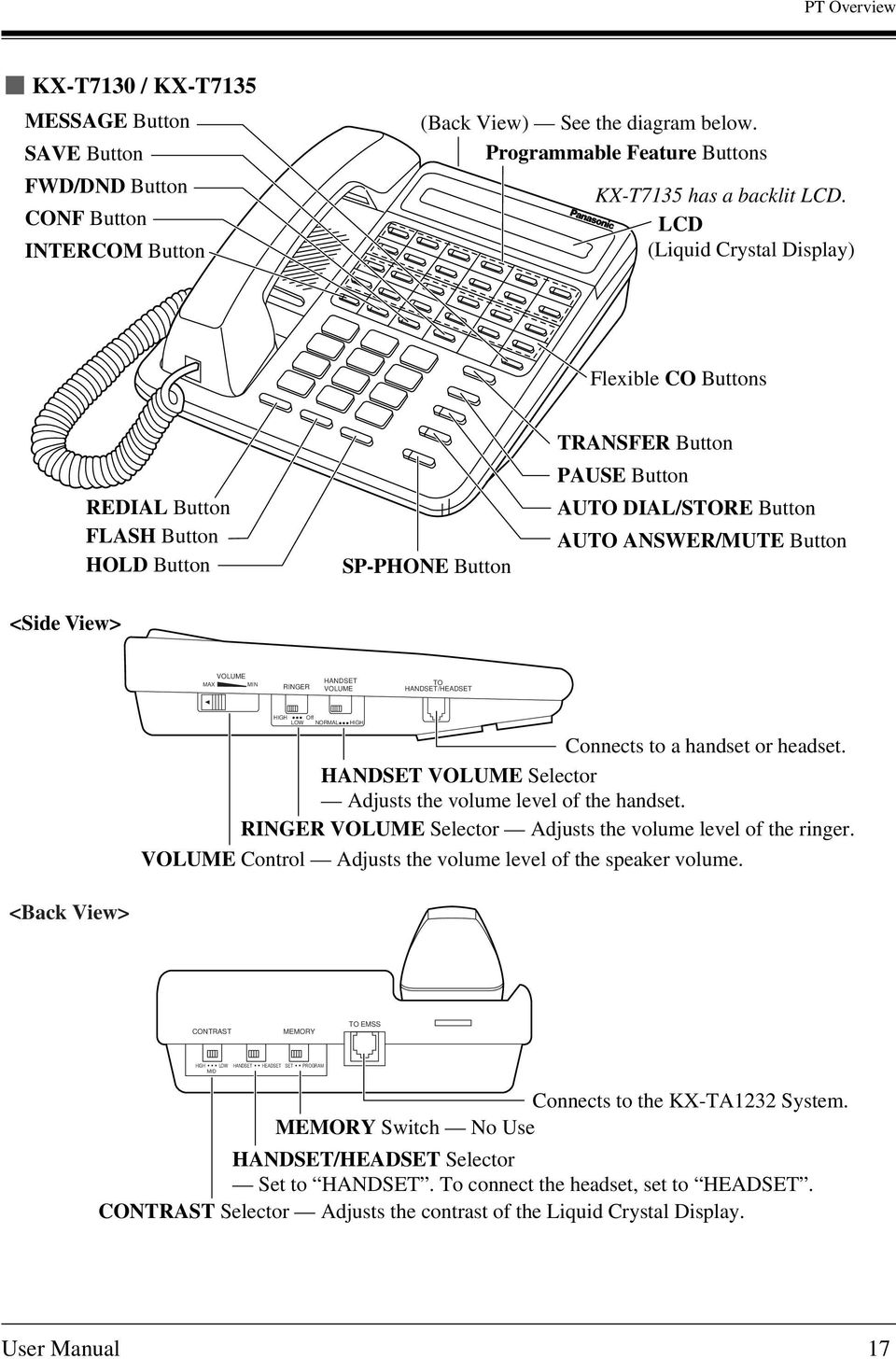
17 PT Overview KX-T7130 / KX-T7135 MESSAGE Button SAVE Button FWD/DND Button CONF Button INTERCOM Button (Back View) See the diagram below. Programmable Feature Buttons KX-T7135 has a backlit LCD. LCD (Liquid Crystal Display) Flexible CO Buttons REDIAL Button FLASH Button HOLD Button SP-PHONE Button TRANSFER Button PAUSE Button AUTO DIAL/STORE Button AUTO ANSWER/MUTE Button <Side View> MAX VOLUME MIN RINGER HANDSET VOLUME TO HANDSET/HEADSET HIGH Off LOW NORMAL HIGH Connects to a handset or headset. HANDSET VOLUME Selector Adjusts the volume level of the handset. RINGER VOLUME Selector Adjusts the volume level of the ringer. VOLUME Control Adjusts the volume level of the speaker volume. <Back View> CONTRAST MEMORY TO EMSS HIGH LOW MID HANDSET HEADSET SET PROGRAM Connects to the KX-TA1232 System. MEMORY Switch No Use HANDSET/HEADSET Selector Set to HANDSET. To connect the headset, set to HEADSET. CONTRAST Selector Adjusts the contrast of the Liquid Crystal Display. User Manual 17
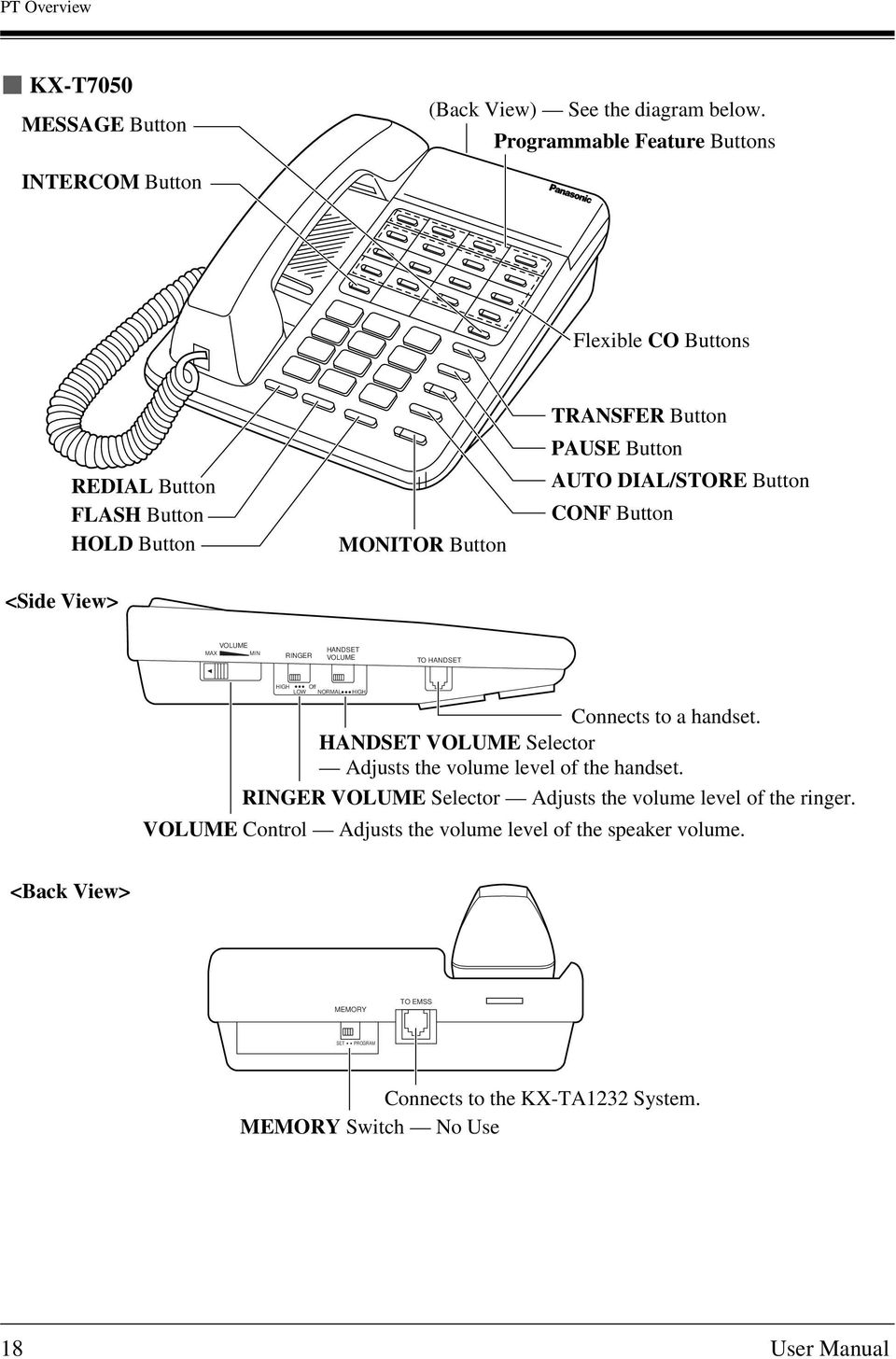
18 PT Overview KX-T7050 MESSAGE Button (Back View) See the diagram below. Programmable Feature Buttons INTERCOM Button Flexible CO Buttons REDIAL Button FLASH Button HOLD Button MONITOR Button TRANSFER Button PAUSE Button AUTO DIAL/STORE Button CONF Button <Side View> MAX VOLUME MIN RINGER HANDSET VOLUME TO HANDSET HIGH Off LOW NORMAL HIGH Connects to a handset. HANDSET VOLUME Selector Adjusts the volume level of the handset. RINGER VOLUME Selector Adjusts the volume level of the ringer. VOLUME Control Adjusts the volume level of the speaker volume. <Back View> MEMORY TO EMSS SET PROGRAM Connects to the KX-TA1232 System. MEMORY Switch No Use 18 User Manual
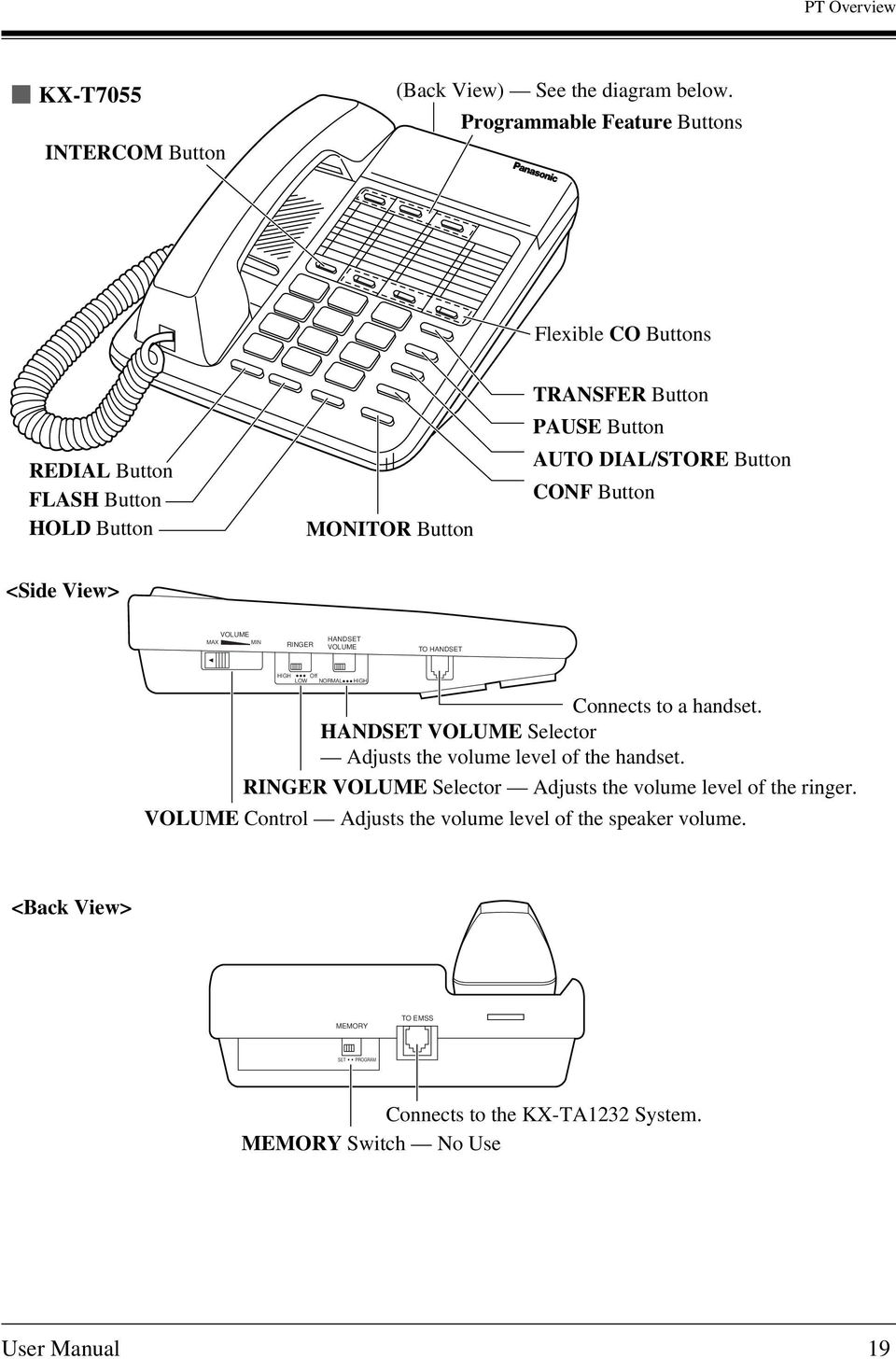
19 PT Overview KX-T7055 INTERCOM Button (Back View) See the diagram below. Programmable Feature Buttons Flexible CO Buttons REDIAL Button FLASH Button HOLD Button MONITOR Button TRANSFER Button PAUSE Button AUTO DIAL/STORE Button CONF Button <Side View> MAX VOLUME MIN RINGER HANDSET VOLUME TO HANDSET HIGH Off LOW NORMAL HIGH Connects to a handset. HANDSET VOLUME Selector Adjusts the volume level of the handset. RINGER VOLUME Selector Adjusts the volume level of the ringer. VOLUME Control Adjusts the volume level of the speaker volume. <Back View> MEMORY TO EMSS SET PROGRAM Connects to the KX-TA1232 System. MEMORY Switch No Use User Manual 19
20 PT Overview Feature Buttons Proprietary telephones (PTs) have the following types of Feature Buttons: Fixed Buttons Flexible Buttons Programmable Feature Buttons Fixed Buttons Fixed buttons have specific functions permanently assigned to them. These default function assignments cannot be changed. The following table lists the fixed buttons located on each PT model. Feature Button T7020 T7030 T7130 T7135 T7050 T7055 AUTO ANSWER/MUTE AUTO DIAL/STORE * CONF FLASH FWD/DND HOLD INTERCOM MESSAGE MONITOR * PAUSE REDIAL SAVE SP-PHONE TRANSFER " " indicates the button is available. * The button is not provided with an LED (Light Emitting Diode). 20 User Manual

21 PT Overview Usage AUTO ANSWER/MUTE Button Used for Hands-free answer back; or it turns the microphone off during a conversation. AUTO DIAL/STORE Button Used for System Speed Dialing or storing program changes. CONF (Conference) Button Used to establish a three-party conference. FLASH Button Sends an External Feature Access signal to the central office or host PBX to access their system features. If a PBX is not being used, this button can be used to disconnect the current call and start another call without hanging up. FWD/DND (Call Forwarding/Do Not Disturb) Button Used to program the Call Forwarding feature or set the Do Not Disturb (DND) feature. HOLD Button Used to place a call on hold. INTERCOM Button Used to make or receive extension calls. MESSAGE Button Used to leave a notification to a busy extension or call back the message notification sender. MONITOR Button Used for a hands-free dialing operation. PAUSE Button Inserts a pause in speed dial numbers or in other numbers. REDIAL Button Used for the Last Number Redial. SAVE Button Used for Saved Number Redialing. SP-PHONE (Speakerphone) Button Used for a hands-free speakerphone operation. TRANSFER Button Transfers a call to another extension or external destination. User Manual 21
22 PT Overview Flexible Buttons Flexible Buttons do not have specific features permanently assigned to them. Features are assigned to Flexible Buttons through System or Station Programming. "Flexible Button Assignment" is addressed in "Station Programming". The three types of Flexible Buttons are as follows: Flexible CO buttons (located on PT only) Flexible DSS buttons (located on DSS Console only) Programmable Feature (PF) buttons (located on PT and DSS Console) The following table outlines the features that can be assigned to the Flexible Buttons: Features to be assigned Single-CO Group-CO Loop-CO Caller ID Indication Personal Caller ID Selection Personal Caller ID Indication Common Caller ID Selection Common DSS (Direct Station Selection) Phantom Extension ONE-TOUCH (One-Touch Dialing) MESSAGE (Message Waiting) MESSAGE (Another/Phantom Extension) FWD/DND (Call Forwarding/Do Not Disturb) SAVE (Saved Number Redial) ACCOUNT (Account Code Entry) CONF (Conference) Voice Mail (VM) Transfer Log-In/Log-Out Two-Way Record* Button CO DSS PF 22 User Manual
23 PT Overview Button CO DSS PF Features to be assigned Two-Way Transfer* LCS (Live Call Screening)* LCS (Live Call Screening) Cancel* Night/Day (Lunch/Break) Service " " indicates that the feature is available. * Available when the Advanced Hybrid System is connected to a Proprietary Telephone capable Panasonic Voice Processing System (one that supports DPT Integration; e.g., KX-TVS50). Line Access Buttons The following three types of CO buttons can be used to seize an outside line when making a call. Single-CO (S-CO) button Group-CO (G-CO) button Loop-CO (L-CO) button Conditions A flexible CO button can be assigned as a Line Access Button (S-CO, G-CO or L-CO) in either System/Station Programming. Once a flexible CO button is assigned as a Line Access Button, it provides the line status condition by lighting patterns and green/red indication. Please refer to "LED Indication" in this section. You can set the G-CO and L-CO buttons on one telephone. Incoming and outgoing calls on the line are shown on the button in the following priority. S-CO > G-CO > L-CO Single-CO (S-CO) button An S-CO button is a outside line access button. This allows you to access a specific outside line by pressing an S-CO button. An incoming outside call can be directed to an S-CO button. Conditions The same outside line cannot be assigned to more than one S-CO button on a PT. It is possible to assign the same outside line to an S-CO button, a G-CO button and an L- CO button respectively. User Manual 23
24 PT Overview User Manual References Flexible Button Assignment Outward Dialing, Line Access SUMMARY Group-CO (G-CO) button To support efficient utilization of outside lines, a group of outside lines (outside line group) can be assigned to a CO button. This button is referred to as Group-CO (G-CO) button. Any incoming calls from any outside line in the same trunk group arrive at the G-CO button. To make an outside call, you can access an idle outside line in the trunk group by simply pressing the assigned G-CO button. Conditions It is possible to assign the same outside line to an S-CO button, a G-CO button, and an L- CO button. It is necessary to program the extension for making and/or receiving calls in outside line groups. When your extension is assigned as an incoming call destination for an outside line, you cannot receive any incoming outside calls unless a G-CO, L-CO or S-CO button associated with the outside line is assigned. User Manual References Flexible Button Assignment Outward Dialing, Line Access SUMMARY Loop-CO (L-CO) button All outside lines can be assigned to a flexible CO button on a proprietary telephone. The assigned button serves as an L-CO button. An incoming call on any outside line arrives at the L-CO button, unless there are S-CO or G-CO buttons associated with the line or unless the button is already in use. To make a outside call, you simply press the dedicated L-CO button. Pressing the L-CO button provides the same operation as dialing an automatic line access code. User Manual References Flexible Button Assignment Outward Dialing, Line Access SUMMARY 24 User Manual
25 PT Overview Initial Settings Display Contrast Adjustment (KX-T7030, KX-T7130 and KX-T7135 only) PT The CONTRAST selector is used to adjust the display contrast. CONTRAST HIGH LOW MID Adjust the CONTRAST lever to the desired setting (LOW/MID/HIGH). When using the headset (KX-T7030, KX-T7130 and KX-T7135 only) PT The Panasonic Advanced Hybrid System supports the use of a headset on a proprietary telephone (PT). When you use the headset (optional), you should switch the selection mode first. HANDSET HEADSET Adjust the HANDSET/HEADSET lever to HEADSET. Volume Control Handset Receiver/Headset/Ringer/Speaker Allows you to adjust the following volumes as required. Handset Receiver volume Headset volume Ringer volume Speaker volume To adjust the handset receiver volume PT HANDSET VOLUME NORMAL HIGH Adjust the HANDSET VOLUME lever to the desired setting (three levels from NORMAL to HIGH). User Manual 25
26 PT Overview PT You may also adjust the handset receiver volume during a conversation using the handset receiver. To adjust the headset volume Be sure the headset is connected. HANDSET VOLUME NORMAL HIGH Adjust the HANDSET VOLUME lever to the desired setting (three levels from NORMAL to HIGH). To adjust the ringer volume PT RINGER HIGH OFF LOW Adjust the RINGER Volume lever to the desired setting (OFF/LOW/HIGH). To adjust the speaker volume PT VOLUME MAX MIN Adjust the VOLUME Control lever to the desired setting (MAX to MIN). 26 User Manual
27 PT Overview LED Indication The Light Emitting Diode (LED) buttons indicate the line conditions with lighting patterns. Flashing light patterns Slow flashing (60 flash/min) Moderate flashing (120 flash/min) Rapid flashing (240 flash/min) 1 s LED Indication on the INTERCOM Button The table below shows the lighting patterns for intercom line conditions. INTERCOM button Off Green On Green slow flashing Green moderate flashing Green rapid flashing Intercom Line Condition Idle Intercom call / Conference established Intercom call hold Intercom call exclusive hold / Consultation hold Incoming intercom/doorphone call LED Indication on the CO Button The table below shows the lighting patterns for outside line conditions. CO Button Off Green On Green slow flashing Green moderate flashing Green rapid flashing Red On Red slow flashing Outside Line Condition Idle You are using the line. You have a held call. You have one of the following: (1) Exclusive hold, (2) Outside-to-Outside line call, or (3) Conference, Unattended Privacy Release possible* / Hold Recall / Incoming call Other-use / Log-out Other-hold* Items marked with "*" are only available on the Single-CO button. User Manual 27
28 PT Overview BLF on DSS Button The Busy Lamp Field (BLF) indicator button is red when the corresponding extension is busy. This is available for Direct Station Selection (DSS) buttons on a DSS console and for flexible CO buttons assigned as DSS buttons on proprietary telephones. LED Indication on the FWD/DND Button The table below shows the lighting patterns for the FWD/DND Button. System Programming [990] Area (09), Bit (4,3) 11 (default) When Call Forwarding (FWD) is set Red Slow Flashing Red On Red On Red Slow Flashing When Do Not Disturb (DND) is set Red On Red On Red Slow Flashing Red Slow Flashing Programming Guide Reference [990] System Additional Information 28 User Manual
29 Station Programming Section 2 Station Programming Note: All illustrations used in this section are based on model KX-T7130 / KX-T7135. User Manual 29
30 Station Programming 2.1 Station Programming Instructions Station Programming Instructions Station Programming allows you, the proprietary telephone (PT) users, to program certain features from your telephone individually. To program, you need to switch your telephone to the Station Programming mode. During programming mode, your telephone is in the busy condition to both inside and outside callers. If you want to make a normal call handling operation, you must finish the programming mode. Programming Mode Display When you enter into the Station Programming mode, the display shows the following message as the initial programming mode; PT PT-PGM Mode We recommend a PT with display for Station Programming to avoid mis-operation. The display also gives you helpful or stored data information related to your programming steps. In this section, we note the display example in the programming steps, if required. You can also refer to the "Display Examples" in the Appendix (Section 6). Entering Station Programming mode Be sure that the telephone is idle and on-hook. PAUSE 9 9 Press PAUSE. Dial 99. The STORE indicator lights. If 99 is not dialed within 5 seconds after the PAUSE button is pressed, the Station Programming mode is canceled. <PT Display Example> PT-PGM Mode -Initial programming display If there is no entry within one minute, the Station Programming mode is canceled and normal call handling mode resumes automatically. 30 User Manual
31 Station Programming Exiting Station Programming mode PT When the display shows the initial programming mode; PAUSE or Press PAUSE or lift the handset. To exit the Station Programming mode, press PAUSE. You are in the call handling mode. PT Confirming the assigned function data Be sure that you are in the Station Programming mode: Press [PAUSE] [9] [9]. program access number Enter the program access number. HOLD Press HOLD (END). The display shows the initial programming mode. Enter the program access number* as follows. - 1:Preferred Line Assignment - Outgoing - 2:Preferred Line Assignment - Incoming - 3:Full One-Touch Dialing Assignment - 4:Intercom Alert Assignment - 5:Call Waiting Tone Type Assignment - 6:Self-Extension Number Confirmation - 7:Live Call Screening Mode Set -81:Initial Display Selection -01:Remote Station Look Control (- Operator / Manager only) -02:Call Log Lock Control, Incoming (- Operator / Manager only) -03:Live Call Screening Password Control (- Operator / Manager only) - #:Station Programming Data Default Set The display shows the programmed data. <PT Display Example> When you press [5], the display shows: C.W. Tone1 (- The Call Waiting tone is currently programmed to Tone 1.) * A programming access number is required to program/confirm the function data by Station Programming. : Available when the Advanced Hybrid System is connected to a Proprietary Telephone capable Panasonic Voice Processing System (one that supports DPT Integration; e.g., KX-TVS50) To exit the Station Programming mode: Press [PAUSE] or lift the handset. If you wish to change the data, follow the programming procedure explained in this section. User Manual 31
32 Station Programming PT Confirming the assigned data on the Flexible button Be sure that you are in the Station Programming mode: Press [PAUSE] [9] [9]. HOLD Press the desired Flexible (CO, DSS, PF) button. Press HOLD (END). The display shows the current status. The display shows the initial programming mode. To exit Station Programming mode: Press [PAUSE] or lift the handset. If you wish to change the data, follow the programming procedure explained in this section. Clearing the data on the Flexible button Be sure that you are in the Station Programming mode: Press [PAUSE] [9] [9]. PT Press the desired Flexible (CO, DSS, PF) button that you wish to clear. 2 Dial 2. AUTO DIAL STORE Press STORE. The STORE indicator lights. The display shows the initial programming mode. To exit Station Programming mode: Press [PAUSE] or lift the handset. The lists on the following pages are the buttons and programming access numbers used for Station Programming. Detailed operating instructions are explained on each page in this section. 32 User Manual
33 Station Programming Station Programming [Flexible Button Assignment] PAUSE 9 9 CO DSS PF Phantom Phantom (Station Programming) 1 Direct Station Selection (DSS) Button 2 One-Touch Dialing Button 3 Message Waiting (MESSAGE) Button 4 FWD/DND Button 5 SAVE Button 6 Account Button Conference (CONF) Button Log-In / Log-Out Button Phantom Extension Button Night Button Voice Mail (VM) Transfer Button Two-Way Record Button Two-Way Transfer Button Live Call Screening (LCS) Button Live Call Screening (LCS) Cancel Button Caller ID Indication Personal Caller ID Selection Personal Caller ID Indication Common Caller ID Selection Common 97 0 Single-CO (S-CO) Button Loop-CO (L-CO) Button # Group-CO (G-CO) Button (Phantom Extension Ringing On/Off Set) PAUSE (Exit) : Available when the Advanced Hybrid System is connected to a Proprietary Telephone capable Panasonic Voice Processing System (one that supports DPT Integration; e.g., KX-TVS50). Note For details about the flexible buttons assignment, refer to Flexible Button Assignment. User Manual 33
34 Station Programming Station Programming [Function Assignment] PAUSE # 2 3 (Preferred Line Assignment - Outgoing) (Preferred Line Assignment - Incoming) (Full One-Touch Dialing Assignment) (Intercom Alert Assignment) (Call Waiting Tone Type Assignment) (Self-Extension Number Confirmation) (Live Call Screening Mode Set) (Initial Display Selection) (Remote Station Lock Control) - see "Operator / Manager Service Features" (Section 4.4) (Call Log Lock Control, Incoming in the Personal Area CANCEL) - see "Operator / Manager Service Features" (Section 4.4) (Live Call Screening Password Control) - see "Operator / Manager Service Features" (Section 4.4) (Station Programming Data Default Set) PAUSE (Exit) : Available when the Advanced Hybrid System is connected to a Proprietary Telephone capable Panasonic Voice Processing System (one that supports DPT Integration; e.g., KX-TVS50). Note For details about the function assignment, refer to 2.2 Station Programming. 34 User Manual
35 Station Programming 2.2 Station Programming Initial Settings The original setting are shown in bold letters in the shaded boxes. Find and mark your desired selections for programming. Be sure that you are in the Station Programming mode : Press [PAUSE] [9] [9]. PT To enter the programme mode To continue programming input Follow programming input. AUTO DIAL STORE Press STORE. The STORE indicator lights. The display shows the initial programming mode. Item Selection Programming Input No line 1 1 Preferred Line Assignment Outgoing Which line do you prefer to seize when you go off-hook to make calls? An idle outside line 1 2 A pre-assigned outside line 1 3 Outside line no. (01 12) The Intercom line 1 INTERCOM User Manual 35
36 Station Programming Item Selection Programming Input Preferred Line Assignment Incoming Which line do you prefer to seize when you go off-hook to receive calls? No line A ringing line A pre-assigned outside line Outside line no. (01 12) Full One-Touch Dialing Assignment Which way do you prefer to dial the One-Touch Dialing feature? Going Off-hook and then pressing the One-Touch Dialing button. Pressing the One-Touch Dialing button Intercom Alert Assignment Which way do you prefer to receive an intercom call? Ringing Directly the party's voice is heard without ringing Call Waiting Tone Type Assignment Do you prefer to distinguish the Call Waiting tone from an outside line and an intercom call? No. Use the same tone. (Call Waiting Tone 1) Yes. Use a different tone. (Call Waiting Tone 2) Live Call Screening Mode Set Which voice mail service do you prefer when a caller is recording a message in your mailbox? You can monitor the message through the telephone speaker. (Hands-free mode) Only an alert tone is heard. (Private mode) Initial Display Selection Caller ID Which display do you prefer when a call is received? Outside line name To exit the Station Programming mode: Press [PAUSE] or lift the handset. 36 User Manual
37 Station Programming Flexible Button Assignment Be sure that you are in the Station Programming mode: Press [PAUSE] [9] [9]. PT Press the desired Flexible (CO, DSS, PF) button. To continue programming input Follow programming input. AUTO DIAL STORE Press STORE. The STORE indicator lights. The display shows the initial programming mode. Button Programmable Button CO DSS PF Programming Input Direct Station Selection (DSS) 1 Extension no. One-Touch Dialing 2 Desired no.* 1 (max. 16 digits) MESSAGE (Own Extension) 3 FWD/DND (Forward/Do Not Disturb) 4 SAVE 5 Account CONF (Conference) Log-In/Log-Out Phantom Extension 7 2 Phantom extension no. Night/Day (Lunch/Break) 7 3 Voice Mail Transfer * 2 8 Voice mail extension no. Two-Way Record * 2 Two-Way Transfer * 2 Live Call Screening * 2 Live Call Screening Cancel * 2 Caller ID Indication Personal Caller ID Selection Personal Caller ID Indication Common Caller ID Selection Common Voice mail extension no. Voice mail extension no. Single-CO 0 Outside line no. (01 12) Loop-CO Group-CO Outside line group no. (1 8) To exit the Station Programming mode: Press [PAUSE] or lift the handset. User Manual 37
38 Station Programming Conditions * 1 " ", "#", FLASH, PAUSE, SECRET (INTERCOM) and (CONF) can also be stored. If you do not want to display the stored number, press the SECRET (INTERCOM) button before and after the numbers you wish to conceal. If you store an external party's number, you should first store a line access number (9, 81 to 88). If you need to enter an account code, you can enter the specified account code before the line access number. <Example> # 9 SECRET [ ] Account code feature no. Account code Account code delimiter Automatic line access number Phone number * 2 This button is used for the voice mail integration feature. To exit the mode at any time, lift the handset. 38 User Manual
39 Station Programming Phantom Extension Ringing On/Off Set Allows you to assign a ringing On/Off function on a Phantom button (default: On). Be sure that you are in the Station Programming mode: Press [PAUSE] [9] [9]. PT (Phantom) Press Phantom you wish to turn On/Off the ringing. Press the same Phantom again. The display shows the current status. <PT Display Example> Ring On 1 or 2 Dial 1or 2. -1: Ring Off -2: Ring On AUTO DIAL STORE Press STORE. The STORE indicator lights. The display shows the initial programming mode. To exit the Station Programming mode: Press [PAUSE] or lift the handset. User Manual 39
40 Station Programming Self-Extension Number Confirmation (KX-T7030, KX-T7130 and KX-T7135 only) Allows you to display your extension port physical number and extension number. Be sure that you are in the Station Programming mode: Press [PAUSE] [9] [9]. PT 6 Dial 6. HOLD Press HOLD (END). <PT Display Example> Jack01<=>EXT101 extension port physical number The display shows the initial programming mode. To exit the Station Programming mode: Press [PAUSE] or lift the handset. 40 User Manual
41 Station Programming Station Programming Data Default Set Allows you to return each of the following items assigned by Station Programming to their default settings. a) Call Waiting Tone Type Assignment (default: Tone 1) b) Full One-Touch Dialing Assignment (default: on) c) Initial Display Selection (default: Caller ID) d) Intercom Alert Assignment (default: Ring Call) e) Live Call Screen Mode Set (default: Hands-free) f) Preferred Line Preference Incoming (default: Ringing Line) g) Preferred Line Preference Outgoing (default: INTERCOM Line) Be sure that you are in the Station Programming mode: Press [PAUSE] [9] [9]. PT AUTO DIAL Dial #. STORE Press STORE. <PT Display Example> Clear Ready? The STORE indicator lights. The display shows the initial programming mode. To exit the Station Programming mode: Press [PAUSE] or lift the handset. User Manual 41
42 Station Programming 42 User Manual
43 User Programming Section 3 User Programming User Manual 43
44 User Programming 3.1 User Programming Instructions General Programming Instructions User Programming allows you, any extension user who knows the User Programming Password, to program the following system features from your telephone individually. [000] Date and Time Set [001] System Speed Dialing Number Set [003] Extension Number Set [004] Extension Name Set [005] Flexible CO Button Assignment [006] Operator / Manager Extension Assignment [007] DSS Console Port and Paired Telephone Assignment [008] Absent Messages [009] Quick Dial Number Set [014] VM Name Set [017] DISA User Codes To program, you need to switch your telephone to the User Programming mode. During the programming mode, your telephone is in a busy condition for outside callers. If you want to make a normal call operation, you must finish the programming mode. Default Setting This system has default factory settings. Any required changes can be written in the "Programming Tables". Required Telephone Set One of the following Proprietary Telephone (PT) sets with display is required for User Programming: Proprietary Telephone (PTs): KX-T7135, KX-T7130, KX-T7030. Using the Overlay A programming overlay is packed with the telephone at the factory. This overlay should be used at all times in the programming mode since the functions of the telephone keys change during programming. During Normal Operation (PAUSE) (SP-PHONE) (REDIAL) During Programming PAUSE NEXT PREV (PREVIOUS) 44 User Manual
45 User Programming During Normal Operation (AUTO ANSWER / MUTE) (FLASH) (TRANSFER) (FWD/DND) During Programming SELECT FLASH CLEAR (CONF) / (INTERCOM) (AUTO DIAL / STORE) (HOLD) SECRET STORE END SECRET / SECRET / CLEAR CLEAR PAUSE PAUSE STORE STORE AUTO SELECT AUTO SELECT PREV FLASH END NEXT PREV FLASH END NEXT KX-T7030 KX-T7130/KX-T7135 Before entering the user programming mode Before entering the user programming mode, confirm that: Your telephone is on-hook, and No calls are on hold at your telephone. Entering the user programming mode To enter the User Programming mode: Press PAUSE User Programming Password (default:1234) User Manual 45
46 User Programming The display shows the Initial Message: USR-PGM NO? Note If nothing is entered within five seconds after the PAUSE button is pressed, programming mode is canceled. During the programming mode, your extension is treated as a busy extension. Only one proprietary telephone can be in programming mode at any one time. The User Programming Password is not shown on the display for security reason. The password can be changed by System Programming. Programming Guide References [120] User Password In this section, programs [001] through [004] and [017] are explained. Please consult with your dealer when you need to change the following programs: [005] Flexible CO Button Assignment [006] Operator / Manager Extension Assignment [007] DSS Console Port and Paired Telephone Assignment [008] Absent Messages [009] Quick Dial Number Set [014] VM Name Set 46 User Manual
47 User Programming Programming Methods Advancing to the next stage When "USR-PGM NO? " is displayed, you can select one of the following: To go to program [000], press the NEXT button. To go to another program, enter the 3-digit program address. Storing your data Press STORE to store your data. The STORE indicator lights red and a confirmation tone sounds. * Confirmation tone (one beep) After pressing STORE, you will hear a beep. This informs you that storage has been completed successfully. * Confirmation tone (two beeps) This informs you that the parameter has already been stored. * Alarm tone (three beeps) If you hear this alarm, your entry is not valid. Making another selection within the same program address To go to the next selection, press NEXT. To go to the previous selection, press PREV. To make a specific selection, press SELECT and then enter the number. Accessing another program address a) While displaying the program address and title: To go to the next Larger program address: Press the or MESSAGE button. To go to the next Smaller program address: Press the or SECRET (INTERCOM) button. b) While programming: To go to a specific program address: Press END, then enter the program address. Returning to the operation mode 1. Lift the handset while in programming mode. 2. When the Initial Message: USR-PGM NO? is displayed, press the PAUSE button. (To display the Initial Message, press END.) User Manual 47
48 User Programming Entering Characters Each character can be entered by using the dial key pad or various buttons for storing names. Combination Table shows the combination of the keys and the number of times to press the SELECT (AUTO ANSWER/MUTE) button to enter each character. (The AUTO ANSWER/ MUTE button becomes the SELECT button when using the overlay.) To enter a character, find the key and number of times to press the SELECT button from the table. Press the corresponding key first, then press the SELECT button the required number of times. Combination Table Pressing SELECT (Times) Keys 1 1 Q q Z z!? 2 2 A a B b C c 3 3 D d E e F f 4 4 G g H h I i 5 5 J j K k L l 6 6 M m N n O o 7 7 P p Q q R r S s 8 8 T t U u V v 9 9 W w X x Y y Z z 0 0., : ; / + - = < > # # $ % ( ) <Example> See Combination Table. 1) Press 6 and then press the SELECT button once to enter "M". 2) Press 4 and then press the SELECT button six times to enter "i". 3) Press 5 and then press the SELECT button four times to enter "k". 4) Press 3 and then press the SELECT button four times to enter "e". Note To erase the last word (to backspace), press the CONF button. (The CONF button becomes the " " (backspace) key when using the overlay.) 48 User Manual
49 User Programming 3.2 User Programming [000] Date and Time Set Notice It is assumed that you have read Section 3.1 "User Programming Instructions". Description Sets the current date and time. Selection Year: 00 through 99 Month: Jan. through Dec. Day: 1 through 31 Day of the week: SUN / MON / TUE / WED / THU / FRI / SAT Hour: 1 through 12 Minute: 00 through 59 AM / PM Hour format: 12 or 24 Default '01 Jan. 1 MON 12:00 AM 12 User Manual 49
50 User Programming Programming Display PT <Date Setting> NEXT year Dial 000. Press NEXT. Enter the year Press. (last 2 digits). <PT Display> 000 DATE / TIME <PT Display Example> 01 Jan. 1 MON To change the current entry, press CLEAR and enter the new year. SELECT day SELECT Keep pressing SELECT until the desired month is displayed. Press. Enter the day (1 through 31). Press. Keep pressing SELECT until the desired day of the week is displayed. To change the current entry, press CLEAR and enter the new day. <Time Setting> STORE NEXT hour minute Press STORE. Press NEXT. Enter the hour (1 through 12). Press. Enter the minute (00 through 59). <PT Display Example> 12:00 AM 12 To change the current entry, press CLEAR and enter the new hour. To change the current entry, press CLEAR and enter the new minute. SELECT SELECT STORE END Press. Press SELECT for AM or PM. Press. Press SELECT for 12 or 24 (hour format). Press STORE. Press END. 50 User Manual
51 User Programming Conditions After changing an entry, you can press STORE. You do not have to perform the rest of the steps. To return to the previous field, press in steps 4 through 9 and steps 13 through 18. If you hear an alarm after pressing STORE, check that the date is valid. The clock starts immediately after the STORE button is pressed. You cannot leave an entry empty. Features Guide References Display, in Idle User Manual 51
52 User Programming [001] System Speed Dialing Number Set Description Used to program the System Speed Dialing numbers. These numbers are available for any extension user in the system. Selection Speed dial numbers: 000 through 499 Telephone number: 24 digits (max.) Default All speed dial numbers Not Stored 52 User Manual
53 User Programming Programming Display PT Dial 001. NEXT Press NEXT. speed dial no. Enter a speed dial number (000 through 499). <PT Display> 001 SYS SPD DIAL <PT Display> SPD Code? To enter speed dial number 000, you can also press NEXT. <PT Display Example> 000:Not Stored Repeat these steps <To continue:> [When SELECT is pressed] telephone no. STORE NEXT speed dial no. Enter a telephone number. Press STORE. PREV Enter the desired speed dial number (000 through 499). To delete the current entry, press CLEAR. To change the current entry, press CLEAR and enter the new number. SELECT Press NEXT or PREV or SELECT. <To end:> END Press END. Conditions Each speed dial number has a maximum of 24 digits. The valid characters are 0 through 9,, and # keys, and the FLASH, PAUSE, SECRET and " " (hyphen) buttons. To store the flash signal, press FLASH. Note: The Stored flash will only be effective during an established call. To store a hyphen, press the " " button. To store a pause, press PAUSE. (Refer to Pulse to Tone Conversion in the Features Guide) User Manual 53
54 User Programming To store a feature number to convert pulse signals to DTMF (Dual Tone Multi- Frequency) signals, press the and # keys. (Refer to Pulse to Tone Conversion in the Features Guide.) To prevent displaying of all or part of the number, press SECRET before and after the secret number, or your entry will not be stored. (Refer to Secret Dialing in the Features Guide.) If you are storing an external number, enter the line access code (default: 9, 81 through 88) before the number. When dialing, a pause is automatically inserted after the code. If you are storing an account code, enter the account code before the line access code. (Refer to Account Code Entry in the Features Guide) It is possible to store a number consisting of 25 digits or more by storing it in two speed dial numbers. The line access code should be stored in the first speed dial number. To access another speed dial number in step 3 through 6, press SELECT and start with step 3. To display parts of the number which have scrolled off the display, press or. User Manual References System Speed Dialing 54 User Manual
55 User Programming [003] Extension Number Set Description Assigns an extension number to each extension. Selection Jack number: 01 through 32 Extension Number: 2 through 4 digits Default Jack 01 through 32 = 101 through 132 User Manual 55
56 User Programming Programming Display PT NEXT jack no. Dial 003. Press NEXT. Enter a jack number. <PT Display> 003 EXT NUMBER <PT Display> Jack NO? To enter jack number 01, you can also press NEXT. <PT Display Example> #01:EXT101 Repeat these steps <To continue:> [When SELECT is pressed] extension no. STORE NEXT jack no. Enter the extension no. Press STORE. PREV Enter the desired jack number. To delete the current entry, press CLEAR. To change the current entry, press CLEAR and enter the new name. SELECT Press NEXT or PREV or SELECT. <To end:> END Press END. Conditions There is a maximum of 32 extension numbers. Each extension number can be two, three, or four digits, consisting of 0 through 9. The and # keys cannot be used. An extension number is invalid if the first or second digits do not match with the program [100] "Flexible Numbering, (01)-(16) 1st through 16th hundred extension blocks" setting. If one digit is assigned as the leading digit, some extensions have two digits and some have three digits. If two digits are assigned, some have three digits and some have four digits. A double entry or incompatible entry is invalid including the program [118] "Voice Mail Extension Number Assignment", [124] "Phantom Extension Number Assignment" and 56 User Manual
57 User Programming [813] "Floating Number Assignment". Valid entry examples are: 10 and 11; 10 and 110. Invalid entry examples are: 10 and 106. Program [004] "Extension Name Set" is used to name the extension numbers. User Manual References Intercom Calling User Manual 57
58 User Programming [004] Extension Name Set Description Assigns names to the extension numbers programmed in program [003] Extension Number Set. Selection Jack number: 01 through 32 Name: 10 characters (max.) Default All extension ports Not Stored 58 User Manual
59 User Programming Programming Display PT NEXT jack no. Dial 004. Press NEXT. Enter a jack number. <PT Display> 004 EXT NAME SET Repeat these steps <PT Display> Jack NO? To enter jack number 01, you can also press NEXT. <PT Display Example> #01:Not Stored <To continue:> [When SELECT is pressed] name STORE NEXT extension no. Enter a name. Press STORE. PREV Enter the desired extension number. To delete the current entry, press CLEAR. To change the current entry, press CLEAR and enter the new name. SELECT Press NEXT or PREV or SELECT. <To end:> END Press END. Conditions There is a maximum of 32 names. Each name has a maximum of 10 characters. For entering characters, see "Entering Characters" in Programming Methods. Program [003] Extension Number Set is used to assign extension numbers. User Manual References Intercom Calling User Manual 59
60 User Programming [017] DISA User Codes Description Assigns the Direct Inward System Access (DISA) User Codes and a Class of Service (COS) to each code. The code COS determines the toll restriction level of the DISA caller. Warning When you enable the Outside-Outside Line Call feature of DISA function, if a third party discovers the password (a DISA User Code) of the system, you have a risk that they will make illegal phone calls using your telephone line, and the cost may be charged to your account. In order to avoid this problem, we strongly recommend the following points: 1: Carefully maintain the secrecy of the password. 2: Specify a complicated password as long and random as you can make it. 3: Change the password frequently. Selection DISA user code number: 01 through 32 DISA user code: 4 through 10 digits COS number: 1 through 8 Default All DISA user code numbers - DISA user code=blank; COS number=8 60 User Manual
61 User Programming Programming Display PT NEXT DISA user code no. Dial 017. Press NEXT. Enter a DISA user code number (01-32). <PT Display> 017 USER CODES Repeat these steps <PT Display> User Code NO? To enter user code number 01, you can also press NEXT. <PT Display Example> 01: C:8 <To continue:> [When SELECT is pressed] DISA user code COS no. STORE NEXT DISA user code no. Enter a DISA user code (Blank or 4-10 digits). Press. Enter COS Press STORE. number (1-8). PREV Enter the desired DISA user code number. To delete the current entry, press CLEAR. To change the current entry, press CLEAR and enter the new name. SELECT Press NEXT or PREV or SELECT. <To end:> END Press END. Conditions This setting is required if Trunk (Outside line) Security mode is selected in program [809] DISA Security Type. Each code should be unique and composed of four through ten numerical digits, 0 through 9. User Manual References Direct Inward System Access (DISA) User Manual 61
62 User Programming 62 User Manual
63 Section 4 Station Features and Operation (PT/SLT) User Manual 63
64 4.1 Before Operating Before Operating What kind of telephone do you use? In this manual, you will find your way to operate the feature depending on the telephone you use. Please use the proper operation for your telephone. If you use a Panasonic proprietary telephone which has the special function button and/or the display, you will follow the operation with the button or display for easy access. If you use a Panasonic proprietary telephone which does not have the function button, you may change one of the unused buttons to another button. Refer to 2.2 Station Programming. A Panasonic proprietary telephone has the Light Emitting Diode (LED) button indicators, so you can see the line conditions by the lighting patterns. If "Idle Line Preference Outgoing", "No Line Preference Outgoing" or "Prime Line Preference (CO Line) Outgoing" is assigned on the extension, it is not possible to have access to any PT features after simply going off-hook. To access PT features, press the INTERCOM button after going off-hook. If you use single line devices such as a single line telephone or data terminal, you will follow the steps which enter the feature number. If you use a dial pulse (DP) type single line device which does not have the " " and "#" keys, it is impossible to access features that have " " or "#" in their feature numbers. When the "Pickup Dialing (Hot Line)" feature is set on your telephone, the dialing sequence should be done within a certain period of time (Pickup Dial Waiting Time default: 1 s) after lifting the handset. This time can be changed by System Programming. Note If your telephone is not noted in the operating step box (ex. only "PT" is noted), this means your telephone does not have the ability to execute that feature. If your telephone has the ability to perform several operations for one feature, you can select the method according to your needs. In this manual, the default feature numbers are used to describe each operation and illustration. Use the new programmed numbers if default feature numbers are changed by System Programming. For proprietary telephone operations, all button illustrations are based on the model KX- T User Manual
65 Description of Symbols Used In this section, many symbols are used. Most symbols do not need a description, but some symbols do. They are as follows. Lift the handset, or press the SP-PHONE or MONITOR button. (Off-hook) Replace the handset, or press the SP-PHONE or MONITOR button. (On-hook) Flash the hookswitch on a single line telephone. Tones which vary depending on the condition (Refer to Tone List). User Manual 65
66 4.2 Basic Operations Making Calls Intercom Calling Any Telephone You can make a call to another extension. extension no. or (DSS) Lift the handset or press Dial extension number. Press DSS. Talk. Hang up or press The INTERCOM indicator light turns green. Outward Dialing PT and SLT You can make a call to an outside party using one of the following line access methods. a) Line Access, Automatic (default: 9) b) Line Access, Individual (CO button) c) Line Access, Outside Line Group (default: 81 through 88) (CO) line access code For PT For SLT, PT phone no. Lift the handset or press For PT: Press CO assigned as Loop-CO / Group-CO / Single-CO. For SLT, PT: Dial the line access code (9 or 81 through 88). Dial tone Dial the phone number. Talk. Hang up or press The selected CO indicator light turns green. The display shows the phone number. 66 User Manual
67 Conditions <PT> There are four types of Line Preference for outgoing calls ( Idle Line/No Line/Prime Line/Prime INTERCOM Line). Each preference can be selected by Station or System Programming. With the KX-T7135, KX-T7130 or KX-T7030, you can execute the "Intercom Calling" feature to extensions by using the "Extension Dialing" display feature. Helpful hints for the Handsfree (speakerphone) operation are noted in the "Handsfree Operation" feature. User Manual References Initial Settings Hands-free Operation [PT only] Intercom Calling Outward Dialing, Line Access SUMMARY User Manual 67
68 4.2.2 Receiving Calls Any Telephone PT (CO) or INTERCOM Lift the handset or press SP-PHONE. Press a rapid flashing CO or INTERCOM. The CO or INTERCOM indicator light turns steady green. Conditions <PT> There are three types of Line Preference for incoming calls ( No Line/Prime Outside Line/Ringing Line). Each preference can be selected by Station Programming. Helpful hints for the Handsfree (speakerphone) operation are noted in the "Handsfree Operation" feature. Programming Guide References [400] Outside Line Connection Assignment [ ] DIL 1:N Extension and Delayed Ringing Day / Night User Manual References Initial Settings Answering, Direct Outside Line [PT only] Hands-free Operation [PT only] 68 User Manual
69 4.3 Station Features and Operation Absent Message Capability You can select one of nine pre-programmed Absent Messages (1-9) for your extension. The display PT users calling your extension see the message you select. Absent messages are used to inform the party calling to your extension of the reason for your absence. By default, Messages No. 1-6 are provided with default messages and the other three messages are left blank. User Manual 69
70 Any Telephone X Parameters Lift the handset or press Dial 750. Dial message number. (1 through 9) Dial parameters if required Confirmation tone and dial tone Hang up or press DISPLAY MESSAGE MESSAGE NO. PARAMETER Will Return Soon 1 None Gone Home 2 None At Ext %%% Back at %%:%%(time) Out Until %%/%% (month/day) extension no. Dial extension number. hour minute Enter hour (00 through 23) and minute (00 through 59). month day Enter month (01 through 12) and day (01 through 31). In a Meeting 6 None (Programmable) 7 (Programmable) 8 (Programmable) 9 Note Enter the desired value in the "%" space. You must make an entry in all of the %s using 0 through 9, "#" or " ". 70 User Manual
71 Any Telephone Canceling the absent message Lift the handset or press Dial Confirmation tone and dial tone Hang up or press <PT Display Example> Message Cancel Conditions All nine messages can be programmed either by User or System Programming. <display PT> The message you select is shown on the display of your PT whenever you go off-hook. Regarding Message 3; a) If the extension number you want to enter has more than the number of "%" characters, refer to System Programming to change the setting. b) If the extension number you want to enter has less than the number of "%" characters, fill the remaining "%" characters with "#" or " ". With the KX-T7135, KX-T7130 or KX-T7030, you can execute this feature using the display operation. Programming Guide References [008] Absent Messages User Manual 71
72 4.3.2 Account Code Entry PT and SLT An Account Code is used to identify outside calls for accounting and billing purposes. The account code is appended to the "Station Message Detail Recording (SMDR)" call record. For incoming outside calls, account code are not required. For outgoing outside calls, you may be required to enter an account code. Your Account Code Entry mode is set to one of the following three modes by System Programming. In "Verified - All Calls" mode You must always enter a system-registered account code to make an outside call. In "Verified - Toll Restriction Override" mode You can override the Toll Restriction imposed on your extension by entering a system-registered account code before making an outside call (Toll Restriction Override by Account Code Entry). In "Option" mode You may enter any account code. One mode is selected for each extension on a "Class of Service *1 " basis. Entering account codes before dialing (Account) 4 9 For PT For SLT, PT account code Lift the handset or press For PT: Press Account (flexible button). For SLT, PT: Dial 49. (CO) Dial tone 3* Enter an account code (10 digits max., 0...9). If you dial a feature number, you hear no tone. Dial #. You may dial 99 instead of "#". line access code phone no. Confirmation tone and dial tone Press CO or enter a line access code (9 or 81 through 88). Dial the phone number. *One of the dial tones. Refer to the "Tone List" in the Appendix. *1 Class of Service (COS) is used to define the features which are allowed for a group of extensions. For more details, please cousult with your dealer. 72 User Manual
73 Entering account codes during or after a conversation During a conversation or within 15 seconds after the other party hangs up; PT (Account) account code Press Account (flexible button). Enter an account code (10 digits max., 0...9). Dial #. The corresponding indicator light turns on. You can keep talking. You may dial 99 instead of "#". Conditions In Verified - All Calls mode, you must always enter a pre-assigned account code when making any of the following calls unless it has previously been stored in memory. a) Call Forwarding to Outside Line b) Manual Dialing (Selecting an outside line) c) One-Touch Dialing d) Personal Speed Dialing e) Pickup Dialing (Hot Line) f) Redial, Last Number g) Redial, Saved Number (PT only) h) System Speed Dialing In Option mode, it is possible to record a calling or called party's account code in the SMDR, during a conversation or within fifteen seconds after the other party hangs up. There is no need for an account code entry when receiving incoming calls. To clear and re-enter the account code, press " ". An account code can be up to 10 numeric digits (0 through 9). FLASH, PAUSE, etc. are not allowed. After entering an account code, the delimiter "#" or "99" must be entered. Memory Dialing An account code can be stored into Memory Dialing ("One-Touch Dialing", "System / Personal Speed Dialing" ). The sequence to enter an account code into Memory Dialing is: [Feature Number] [Account Code] [#] [Line Access Code] [Phone Number] or [Feature Number] [Account Code] [99] [Line Access Code] [Phone Number] User Manual 73
74 <PT> Pressing the Account button (flexible button) while entering an account code cancels the entry. If an entered account code does not match the pre-assigned account code, in the verifiedall calls mode or the verified-toll restriction override mode; a) When making an outside call, a reorder tone is returned. b) During a conversation, the code entry is accepted and the call is maintained (= Option mode). c) After a CPC signal *1 has been detected, the code entry is accepted (= Option mode). Account button The Account button can be used instead of dialing the feature number. It can be assigned to a flexible (CO, DSS, PF) button by Station, User or System Programming. <SLT> You cannot enter an account code during a call or while hearing a reorder tone. Flashing the hookswitch while entering an account code cancels the entry. Programming Guide References [105] Account Codes [508] Account Code Entry Mode [601] Class of Service Features Guide References Station Message Detail Recording (SMDR) User Manual References Flexible Button Assignment Toll Restriction Override by Account Code Entry *1 A Calling Party Control (CPC) signal is an on-hook indication sent from a CO line when the other end hangs up. You hear a reorder tone when then signal is detected. 74 User Manual
75 4.3.3 Alternate Calling Ring / Voice You can voice-announce your intercom call or have the called extension ring. When you make an intercom call by voice-announcement, the other party hears your voice over the built-in speaker of PT and can speak in the hands-free mode. Any Telephone Alternating (to Voice-Calling mode) If the extension you are calling is in Ring-Calling mode, you hear a ringback mode. Dial. Confirmation tone Voice-Calling mode is established. Any Telephone Alternating (to Ring-Calling mode) If the extension you are calling is in Voice-Calling mode, you hear a confirmation. Dial. Ringback tone Ring-Calling mode is established. Conditions Voice-signaling is not available in the following cases: if the other extension is an SLT. if the other extension is busy on another call. if another call is ringing on the other extension. One time switching You can switch the desired calling mode only once during a call. If the party you are calling is using a single line telephone (SLT), only Ring-Calling mode is available. User Manual 75
76 <PT> Mode Selection You can select either to be ring-signaled or voice-signaled by Station Programming (Intercom Alert Assignment). The default is Ring-Calling mode. User Manual References Initial Settings Hands-free Answerback [PT only] Intercom Calling 76 User Manual
77 4.3.4 Answering, Direct Outside Line [PT only] You can answer an outside call by pressing a flashing a CO button directly. You do not have to lift the handset or press the SP-PHONE/MONITOR button. PT To answer an incoming outside call (CO) Press CO which is flashing green or red rapidly. The indicator light turns green and a hands-free conversation is established. Conditions You can choose the desired line to answer when more than one call is ringing on your PT by this feature. There are three types of CO buttons: Group-CO (G-CO) button, Loop-CO (L-CO) button and Single-CO (S-CO) button. These can be assigned to flexible CO buttons by Station, User or System Programming. User Manual References Initial Settings Flexible Button Assignment Hands-free Operation [PT only] User Manual 77
78 4.3.5 Automatic Callback Busy (Camp-On) Allows you to set to receive callback ringing when the dialed line becomes idle. When you answer the callback ringing; For an extension: The called extension starts ringing without dialing. For an outside line: The line is seized. Setting Any Telephone If you hear a busy tone after making a call (intercom or outside); 6 Dial 6. Confirmation tone and reorder tone Hang up or press Wait for the Camp-On recall. <PT Display Example> Callback Extxxxx extension number Any Telephone Answering an intercom recall If you hear the telephone ringing; Lift the handset or press <PT Display Example> xxxx: Free extension number You hear a ringback tone and the other extension begins to ring automatically. 78 User Manual
79 Any Telephone Answering an outside line recall If you hear the telephone ringing; phone no. Lift the handset or press Dial tone Dial the phone number. <PT Display Example> COXX: Free outside line number Canceling Any Telephone 4 6 Lift the handset or press Dial 46. Confirmation tone and dial tone Hang up or press SP-PHONE/ MONITOR. Conditions If you do not answer the recall ringing within 10 seconds (four callback ring signals), this feature will be automatically canceled. If the called party becomes busy again after the callback ringing starts, the ringing stops but this feature will be executed again when the extension becomes free. User Manual 79
80 4.3.6 Background Music (BGM) [PT only] You can hear background music through the built-in speaker of your PT. An external music source, such as a radio, must be connected. The music stops whenever a call comes in or when you go off-hook. Setting / Canceling PT When the handset is on the cradle and the SP-PHONE/MONITOR button is off; 1 Dial 1. The display shows either one of the following for five seconds depending on whether BGM is on or off: <PT Display Example> BGM On or BGM Off Conditions Turning on/off You can turn on/off the BGM only when your PT is not in use. Programming Guide References [803] Music Source Use [990] System Additional Information 80 User Manual
81 4.3.7 Busy Station Signaling (BSS) You can prompt a busy extension (ringing or during a call) to answer your call. The other extension hears three beeps and knows that you are waiting. Any Telephone If you hear a busy tone after making an intercom call; 1 Dial 1. Wait for an answer and talk. Conditions To answer the signal from the calling extension, see Call Waiting. This feature is only available if the called extension has set the "Call Waiting" feature. Only the extensions which have enabled "Call Waiting" can receive Call Waiting tones. User Manual References Call Waiting User Manual 81
82 4.3.8 Call Forwarding SUMMARY Automatically transfers incoming calls to another extension or to an external destination. The following types are available: Type Call Forwarding All Calls Call Forwarding Busy Call Forwarding No Answer Call Forwarding Busy/No Answer Call Forwarding to Outside Line Call Forwarding Follow Me Description All incoming calls are forwarded to another extension. All incoming calls are forwarded to another extension when your extension is busy. All incoming calls are forwarded to another extension when you do not answer the call. All incoming calls are forwarded to another extension when you do not answer or when your extension is busy. All incoming calls are forwarded to an outside line. Allows you to set the "Call Forwarding All Calls" feature from another extension. Note You can also set Voice Mail as the forwarding destination. Refer to Integration. Voice Mail Conditions To cancel Call Forwarding features, refer to Call Forwarding CANCEL. Forwarded call is not forwarded furthermore Call Forwarding can only be extended to one target telephone. For example, extension A is forwarded to extension B, and extension B is forwarded to extension C. A call to extension A is forwarded to extension B, but the call would not be forwarded to extension C. Consequently, extension B is treated as the final destination of Call Forwarding. (Yes) Ext A Ext B (No) Ext C Setting a new "Call Forwarding" function (All Calls, Busy, Busy/No Answer, etc.) cancels any other "Call Forwarding" functions. Floating Station A floating station such as a DISA (Direct Inward System Access) or external pager cannot be programmed as a forwarding destination. 82 User Manual
83 Two extensions can set each other as the destination extension. In this case, an intercom call to the other party while he/she is absent will not be forwarded back to the original extension. Confirmation tone Confirmation tone 2 (two beeps) is sent when the previously programmed data is same as the new data. If it is not, confirmation tone 1 (one beep) is sent. Refer to the "Tone List" in the Appendix. You can call the original extension from the Call Forwarding destination extension. (Boss Secretary) <PT> Both the Call Forwarding and Do Not Disturb (DND) functions can be programmed at the same time, but either one of them can be activated at a time. You can enable or disable the Call Forwarding or Do Not Disturb (DND) function by pressing the FWD/DND button while on-hook. If you set both Call Forwarding and DND, alternating the mode is also available by pressing the FWD/DND button. In this case, pressing the button changes the setting as follows: DND FWD OFF The lighting patterns of the FWD/DND button are as follows: Off: Both functions are canceled. Red on : DND mode *1 Red flash : FWD mode *1 User Manual References Flexible Button Assignment Call Forwarding CANCEL Do Not Disturb (DND) Voice Mail Integration *1 This setting can changed by System Programming. User Manual 83
84 4.3.9 Call Forwarding All Calls All of calls coming to your extension are forwarded to the pre-assigned extension automatically. Setting PT and SLT FWD/DND For PT For SLT, PT 2 extension no. Lift the handset For PT: Press FWD/DND. or press For SLT, PT: Dial 710. Dial 2. Enter the destination extension number. Confirmation tone and dial tone You may press the flexible button assigned as the FWD/DND button instead. Hang up or press <PT Display Example> FWD(All) Extxxxx extension number where the call is to be forwarded The FWD/DND indicator light flashes red slowly. 84 User Manual
85 Call Forwarding Busy You can forward calls to another extension when your extension is busy. Setting PT and SLT FWD/DND For PT For SLT, PT 3 extension no. Lift the handset or press For PT: Press FWD/DND. For SLT, PT: Dial 710. Dial 3. Enter the destination extension number. Confirmation tone and dial tone You may press the flexible button assigned as the FWD/DND button instead. Hang up or press <PT Display Example> FWD(BSY) Extxxxx extension number where the call is to be forwarded The FWD/DND indicator light flashes red slowly. User Manual 85
86 Call Forwarding No Answer Your calls are forwarded to another extension when you do not answer the call within a predetermined time. Setting PT and SLT FWD/DND For PT For SLT, PT 4 extension no. Lift the handset or press For PT: Press FWD/DND. For SLT, PT: Dial 710. Dial 4. Enter the destination extension number. Confirmation tone and dial tone You may press the flexible button assigned as the FWD/DND button instead. Hang up or press <PT Display Example> FWD(NA) Extxxxx extension number where the call is to be forwarded The FWD/DND indicator light flashes red slowly. Conditions The number of rings before a call is forwarded can be changed for each extension with program "[619] Extension Call Forwarding No Answer Time". If "[619] Extension Call Forwarding No Answer Time" is not set, program "[202] Call Forwarding No Answer Time" will be used. Programming Guide References [202] Call Forwarding No Answer Time [619] Extension Call Forwarding No Answer Time 86 User Manual
87 Call Forwarding Busy / No Answer You can forward your calls to another extension when your extension is busy or you do not answer the call within a pre-determined time. Setting PT and SLT FWD/DND For PT For SLT, PT 5 extension no. Lift the handset For PT: Press FWD/DND. or press For SLT, PT: Dial 710. Dial 5. Enter the destination extension number. Confirmation tone and dial tone You may press the flexible button assigned as the FWD/DND button instead. Hang up or press <PT Display Example> FWD(B/NA)Extxxxx extension number where the call is to be forwarded The FWD/DND indicator light flashes red slowly. Conditions The number of rings before a call is forwarded can be changed for each extension with program "[619] Extension Call Forwarding No Answer Time". If "[619] Extension Call Forwarding No Answer Time" is not set, program "[202] Call Forwarding No Answer Time" will be used. Programming Guide References [202] Call Forwarding No Answer Time [619] Extension Call Forwarding No Answer Time User Manual 87
88 Call Forwarding to Outside Line PT and SLT You can forward all incoming calls to your extension to an outside party via a CO. The telephone number of the outside party must be pre-programmed. FWD/DND For PT For SLT, PT 6 line access code phone no. Lift the handset or press For PT: Press FWD/DND. For SLT, PT: Dial 710. Dial 6. Enter a line access code (9 or 81 through 88). Dial the phone number. Dial #. Confirmation tone and dial tone Hang up or press <PT Display Example> When you dial " ": FWD(CO) The FWD/DND indicator light flashes red slowly. Conditions Up to 16 digits (including a line access code) can be programmed. Valid digits are "0 through 9", " ". PAUSE (pausing time) can be stored by dialing. Class of Service Class of Service programming determines the extensions that can perform this feature. Outside-to-Outside Line Call If an incoming outside call is forwarded to an outside line, the "Outside-to-Outside Line Call Duration Time" is applied to the call and the line will be disconnected when it expires (default: 10 min). Programming Guide References [206] Outside-to-Outside Line Call Duration Time [504] Call Forwarding to Outside Line [601] Class of Service 88 User Manual
89 Call Forwarding Follow Me You can set the "Call Forwarding" feature from the destination extension. This is useful if you forget to set "Call Forwarding All Calls" before you leave your desk. Setting PT and SLT At the destination extension; FWD/DND For PT For SLT, PT 7 your extension no. Lift the handset or press For PT: Press FWD/DND. For SLT, PT: Dial 710. Dial 7. Dial your extension number. Confirmation tone and dial tone You may press the flexible button assigned as the FWD/DND button instead. Hang up or press <PT Display Example> FWD(From)Extxxxx your extension number The FWD/DND indicator light flashes red slowly at your extension. Conditions This feature can be canceled either at your own extension or at the destination extension. Class of Service Class of service programming determines the extensions that can perform this feature. Programming Guide References [991] COS Additional Information User Manual 89
90 Call Forwarding CANCEL PT and SLT There are two canceling methods for "Call Forwarding". The canceling method depends on the Call Forwarding type that is assigned. Canceling Call Forwarding at your (original) extension FWD/DND For PT For SLT, PT 0 Lift the handset or press For PT: Press FWD/DND. For SLT, PT: Dial 710. Dial 0. Confirmation tone and dial tone Hang up or press You may press the flexible button assigned as the FWD/DND button instead. <PT Display Example> FWD/DND Cancel The FWD/DND indicator light turns off. PT and SLT Canceling Call Forwarding at the destination extension "Follow Me (All Calls)" only FWD/DND For PT For SLT, PT 8 your extension no. Lift the handset or press For PT: Press FWD/DND. For SLT, PT: Dial 710. Dial 8. Dial your extension number. Confirmation tone and dial tone You may press the flexible button assigned as the FWD/DND button instead. <PT Display Example> FWD Cancel EXXXX your extension number. The FWD/DND indicator light on your own extension turns off. Hang up or press 90 User Manual
91 Call Hold Allows you to place an intercom or outside call on hold. While the call is on hold, you can make and receive other calls. To place a call on hold PT During a conversation; SLT During a conversation; HOLD 5 0 Press HOLD. Confirmation tone and dial tone Flash the hookswitch. Dial 50. You may replace the handset. The corresponding CO or INTERCOM indicator light flashes green slowly. Confirmation tone and dial tone You may replace the handset. Retrieving a call on hold PT At the holding extension; SLT At the holding extension; (CO) or INTERCOM 5 0 Press CO or INTERCOM which is flashing green slowly. Lift the handset. Dial 50. The CO or INTERCOM indicator light turns steady green. Conditions To retrieve a call on hold at another extension, refer to Call Hold Retrieve. Music on Hold "Music on Hold" is sent to the party on hold, if available. What if a call on hold is not retrieved? If a call on hold is not retrieved in a specified period of time (default: 60 s), Hold Recall (if the extension on-hook) or Hold Warning tone (if engaged in another call) rings the extension where the call is held. Refer to Tone List for details about Tone Patterns. User Manual 91
92 Automatic Disconnection If a call (outside, extension) placed on hold is not retrieved within 30 minutes, it is automatically disconnected. <PT> With outside calls, you can put multiple calls on hold. However, with intercom calls, you can put only one call on hold. Programming Guide References [200] Hold Recall Time Features Guide References Hold Recall User Manual References Call Hold Retrieve 92 User Manual
93 Call Hold, Exclusive [PT only] Allows you to prevent other extension users from retrieving your held call. A call put on exclusive hold can only be retrieved from the extension that placed it on hold. PT To place a call on exclusive hold During a conversation; HOLD Press HOLD. HOLD Press HOLD again. The CO or INTERCOM indicator light flashes green moderately. The current call is placed on exclusive hold. The CO or INTERCOM indicator light flashes green slowly. The current call is placed on hold. PT Retrieving a call on exclusive hold (CO) or INTERCOM Press the CO or INTERCOM which is on exclusive hold. The CO or INTERCOM indicator light turns steady green. You can talk to the held party again. Conditions What if a call on Exclusive Hold is not retrieved? If a call on Exclusive Hold is not retrieved in a specific period of time (default: 60 s), Hold Recall (if the extension is on-hook) or Hold Warning tone (if engaged in another call) rings the extension where the call is held. After this, the held call can be retrieved from any other extension. Refer to Tone List for details about Tone Patterns. Automatic Disconnection If a outside call placed on hold is not retrieved in 30 minutes, it is automatically disconnected. With outside calls, you can put multiple calls on exclusive hold. However, with intercom calls, you can put only one call on exclusive hold. Programming Guide References [200] Hold Recall Time User Manual 93
94 Features Guide References Hold Recall User Manual References Call Hold 94 User Manual
95 Call Hold Retrieve Allows you to retrieve a call that has been placed on hold at other extensions. Retrieving an outside call on hold Any Telephone At the other extension; 5 3 outside line no. Lift the handset or press Dial 53. Enter the held outside line number. (01-12) Confirmation tone (optional) PT At the other extension; (CO) Press CO whose indicator is flashing red slowly. The CO indicator light turns steady green. Retrieving an intercom call on hold Any Telephone At the other extension; 5 1 extension no. Lift the handset or press Dial 51. Dial the extension number at which a call is placed on hold. Confirmation tone (optional) Conditions Confirmation Tone A confirmation tone is sent to the extension user who retrieved the held call. Eliminating the tone is programmable. "Call Park" cannot be retrieved by this feature. User Manual 95
96 Programming Guide References [990] System Additional Information User Manual References Call Hold 96 User Manual
97 Call Information / Log, Incoming Provides you with the caller s telephone number and name simultaneously on the outside (CO) line assigned to receive Caller ID service *1 calls. If the call is not answered, the call information is automatically recorded. Display Operation ( for the KX-T7030/KX-T7130/KX-T7135) While receiving an incoming outside call, the display shows the caller s telephone number or name. If you want to see other information, press the Caller ID Selection button or press #. The display changes as follows: JOHN WHITE caller's name caller's telephone number CO 01:AB COMPANY CO number & name To call back 1. Lift the handset or press the SP-PHONE button. 2. Press the Caller ID Selection or FWD/DND button to see other information. The display changes as follows: JOHN WHITE caller's name caller's telephone number CO 01 0:01'52 CO number & call duration Conditions The Caller ID Indication button indicator light may turn on when an incoming outside call is not answered. Even if you answer a call, the call information can be recorded by pressing the Caller ID Indication button during the conversation. You can modify and call back the logged numbers. Refer to Call Log, Incoming [PT only]. A caller s name will not be displayed unless it is sent from the Central Office. However, the caller s name will be displayed when a caller s name is not sent from the Central Office but *1 The Caller ID service provides you with the caller s information, such as the name and telephone number, on the outside (CO) line assigned to receive Caller ID service calls. Refer to the Installation Manual. User Manual 97
98 the sent number matches one programmed in the system. A CO name will not displayed unless it has been assigned by System Programming. If "OUT OF AREA" is displayed, the call may be from out of the calling area. If "PRIVATE" is displayed, the caller chose not to reveal their information. Programming Guide References [005] Flexible CO Button Assignment [100] Flexible Numbering [110] Caller ID Code Set [111] Caller ID Name Set [406] Caller ID Assignment User Manual References Call Log, Incoming [PT only] Call Log Lock, Incoming in the Personal Area [PT only] Call Log Lock, Incoming in the Common Area 98 User Manual
99 Call Log, Incoming [PT only] PT If a call is not answered, the incoming outside call information from the Caller ID service *1 is automatically logged in the system and the Caller ID Indication button indicator lights. There are two kinds of call log areas available in the system. One is the personal area, which stores call logs for each extension. The other is the common area, which stores call logs for the system. A call comes directly to a certain extension is stored in the extension's personal area. A call for multiple extensions is stored in the common area. To check the caller's information stored in the personal area, you need to assign the Caller ID Indication Personal button. For common area, the Caller ID Indication Common button is necessary. Up to 20 calls can be logged in each personal area and up to 300 calls in the common area. When the call log in the personal area is full (20 calls are stored), you can select how the 21st call is treated. Either a new call can be disregarded or the new call can overwrite the oldest call that have been already confirmed (Default: Record the new call.). As for the common area, only the operator or manager can control this. (Refer to The 301st Call Log, Incoming in the Common Area Treatment.) Setting overwriting the call log in the personal area Lift the handset or press SP-PHONE. Dial 56. Dial 1. Confirmation tone and dial tone Hang up or press SP-PHONE. <PT Display Example> Incoming Log On PT Canceling overwriting the call log (Disregarding the 21st call) in the personal area Lift the handset or press SP-PHONE. Dial 56. Dial 0. Confirmation tone and dial tone Hang up or press SP-PHONE. <PT Display Example> Incoming Log Off *1 The Caller ID service provides you with a caller's information, such as his/her name and telephone number, on the CO line assigned to receive Caller ID service calls. Refer to "Caller ID Service" in the Features Guide for further information. User Manual 99
100 Confirming and calling back Display Operation ( for the KX-T7030/KX-T7130/KX-T7135) When the Caller ID Indication Personal button indicator is red, there are new calls logged in the personal area. When the Caller ID Indication Common button indicator is red, there are new calls logged in the common area. To confirm 1. Press the Caller ID Indication button to see the incoming call information. The new information that you have not confirmed will be displayed first. 001: You can confirm another caller's information by pressing the Caller ID Indication button again. After displaying all of the new information, the old information you have already confirmed will be displayed. 002: To modify the telephone number, use the button to erase and "0 to 9" to add numbers from the first digit. To clear the displayed information, press the TRANSFER button. To clear all logged call information in the common area, only the operator or manager can clear all logged call information. (Refer to Call Log, Incoming in the Common Area CLEAR ALL.) To return to the initial display, go off-hook and on-hook. Pressing the Caller ID Selection Personal button or # button provides you with further information about the party stored in the personal area. Pressing the Caller ID Selection Common button or # button provides you with further information about the party stored in the common area. The display changes as follows: <Example> If the information is stored in log 003, 003:BOB HANKS caller's name 003: caller's number Oct30 09:00PM 3 Number of calls date and time Only twelve digits (or characters) of caller's number (or name) can be displayed even though fifteen digits (or characters) of information may have been received. To scroll the display, press (the FWD/DND button). 100 User Manual
101 Confirming the number of logged calls PT In the Personal Area (CID-P S) Press Caller ID Selection Personal (flexible button) while on-hook. <PT Display Example> New:002 Old:003 The above information will be displayed for 3 seconds. In the Common Area (CID-C S) Press Caller ID Selection Common (flexible button) while on-hook. <PT Display Example> New:002 Old:003 The above information will be displayed for 3 seconds. PT Clearing all call logs in the personal area Lift the handset or press SP-PHONE. Dial Confirmation tone and dial tone Hang up or press SP-PHONE. <PT Display Example> CID Log Clear To call back 1. Confirm the displayed number you desired after pressing the Caller ID Indication button, and then lift the handset or press the SP-PHONE button. 003: Press the Caller ID Indication button. You may press a CO button first to select a specified outside (CO) line. The last displayed number is dialed. User Manual 101
102 Conditions When "Disregarding the 21st call in the personal area" has been set and 20 calls are logged, the Caller ID Selection Personal button indicator lights and informs you that no more calls can be logged. When "Overwriting the 21st call in the personal area" has been set and all of old information has been overwritten in the personal area, the Caller ID selection Personal button indicator lights and informs you that no more calls can be logged. System Programming determines who can check the caller's information stored in the common area. If nobody has assigned the Caller ID Indication Common button, a call directed to multiple extensions will be stored in an extension's personal area that is connected to the lowest jack number and the extension's Caller ID Indication Personal button indicator will light. If a Direct In Lines (DIL) 1 : 1 call is forwarded by Call Forwarding, the data will be logged at both the forwarding and forwarded extension. You can lock the display so that incoming call information is not shown on the display. (Refer to Call Log Lock, Incoming in the Personal Area [PT only].) If you modify the displayed telephone number, the new number will be memorized. Only operators or a manager can set or cancel overwriting the call log in the common area. Programming Guide References [100] Flexible Numbering [110] Caller ID Code Set [111] Caller ID Name Set [125] Area Code Assignment [126] Caller ID Modification for Local Call [127] Caller ID Modification for Long Distance Call [406] Caller ID Assignment [417] Outside Line Name Assignment [624] Common Area Call Log Check Assignment User Manual References Initial Settings Flexible Button Assignment Call Log Lock, Incoming in the Personal Area [PT only] Call Log, Incoming in the Common Area CLEAR ALL Call Log Lock, Incoming in the Common Area The 301st Call Log, Incoming in the Common Area Treatment 102 User Manual
103 Call Log Lock, Incoming in the Personal Area [PT only] Allows you to lock the display of your extension so that the "Call Log, Incoming" feature is not shown on the display, when you press the Caller ID Indication Personal button, if you do not want others to see the information stored in the personal area. Locking PT same code 5 7 lock code lock code Lift the handset or press SP-PHONE. Dial 57. Enter the 3-digit lock code (000 through 999) twice. Confirmation tone and dial tone Hang up or press SP-PHONE. <PT Display Example> Log Locked :XXX Lock code you dialed Unlocking PT 5 7 lock code Lift the handset or press SP-PHONE. Dial 57. Enter the same lock code you used to lock the extension. Confirmation tone and dial tone Hang up or press SP-PHONE. <PT Display Example> Unlocked Conditions Call Log Lock Control, Incoming in the Personal Area CANCEL The Manager or an Operator can unlock the call log display for any extension, if you forget your lock code (4.4.4 Call Log Lock Control, Incoming in the Personal Area CANCEL). Programming Guide References [100] Flexible Numbering [406] Caller ID Assignment User Manual 103
104 User Manual References Call Log, Incoming [PT only] Call Log Lock Control, Incoming in the Personal Area CANCEL Call Log Lock, Incoming in the Common Area 104 User Manual
105 Call Park Allows you to place a held call into a system parking area. You can be released from the parked call to perform other operations. The parked call can be retrieved from any extension. Up to ten calls can be parked. PT and SLT Parking a call During a conversation; TRANSFER For PT For SLT 5 2 parking zone no. For PT: Press TRANSFER. For SLT:Flash the hookswitch. Confirmation tone and dial tone Dial 52. Enter a parking zone number (0 through 9). Confirmation tone and dial tone <PT Display Example> Call. Parked at x Parking zone number (0 through 9) If you hear a busy tone, it indicates the specified parking zone is unavailable. <PT Display Example> Park at x N/A You can change the parking zone simply by entering the parking zone number while hearing the busy tone. User Manual 105
106 Any Telephone Retrieving a parked call Lift the handset or press 5 2 Dial 52. parking zone no. Enter a parking zone number (0 through 9) where the call is parked. Confirmation tone (optional) You can talk to the party. If there is no held call, you will hear a reorder tone. <PT Display Example> No Held Call Conditions Call Park Recall If a parked call is not retrieved in a specific period of time (default: 12 rings), "Call Park Recall" occurs. If a parked call is an outside call, it is possible to select whether "Call Park Recall" will go to the initiating extension or to Operator 1 by System Programming. If a parked call is an intercom call, "Call Park Recall" will return to the initiating extension. Automatic Disconnection If a parked call is not retrieved in 30 minutes, it is automatically disconnected. Confirmation Tone A confirmation tone is sent to the extension user who retrieved the parked call. Eliminating the tone is programmable. Programming Guide References [219] Call Park Recall Time [990] System Additional Information 106 User Manual
107 Call Pickup, Directed Allows you to answer an incoming call ringing at any other extension. Any Telephone 4 1 extension no. Lift the handset or press Dial 41. Dial the extension number where the call is ringing. Confirmation tone (optional) Talk. Conditions Doorphone calls can be picked up from extensions that are not programmed to answer doorphone calls. Confirmation tone A confirmation tone is audible when the call is picked up. Eliminating the tone is programmable. If you receive a call waiting tone during a conversation, you may ask a third party to pick up your second call by Directed Call Pickup. Programming Guide References [990] System Additional Information User Manual References Call Pickup Deny User Manual 107
108 Call Pickup, Group Allows you to answer a call that is ringing at another telephone within your extension group. Any Telephone 4 0 Lift the handset or press Dial 40. Confirmation tone (optional) Talk. Conditions Confirmation tone A confirmation tone is audible when the call is picked up. Eliminating the tone is programmable. You can pick up an incoming outside, intercom or doorphone call. Programming Guide References [602] Extension Group Assignment [990] System Additional Information Features Guide References Extension Group User Manual References Call Pickup Deny Call Waiting 108 User Manual
109 Call Pickup, Outside Line Allows you to answer an incoming outside call that is ringing at another extension. Any Telephone 4 Lift the handset or press Dial 4. Confirmation tone (optional) Talk. Conditions Confirmation Tone A confirmation tone is audible when the call is picked up. Eliminating the tone is programmable. Programming Guide References [990] System Additional Information User Manual References Call Pickup Deny Call Waiting User Manual 109
110 Call Pickup Deny Allows you to prevent another extension from picking up your calls with the "Call Pickup" feature. Any Telephone Setting / Canceling To set. To cancel. Lift the handset or press To set: Dial To cancel: Dial Confirmation tone and dial tone Hang up or press <PT Display Example> When setting: C.Pickup Deny When canceling: C.Pickup Allow User Manual References Call Pickup, Directed Call Pickup, Group Call Pickup, Outside Line 110 User Manual
111 Call Splitting PT Allows you to have two callers on a line and alternate between them. If a call comes in while you are already on the line, you can place the current call (1st call) on hold and have a conversation with the other party (2nd call). When you are engaged in the 2nd call (inside/outside), while placing the 1st call (inside/ outside) on hold temporarily (Consultation Hold *1 ) TRANSFER Press TRANSFER. You are connected to the 1st caller. Pressing the TRANSFER button alternates between two callers. SLT Flash the hookswitch. You are connected to the 1st caller. Flashing the switchhook alternates between two callers. When you are engaged in the 2nd call (inside), while placing the 1st call (inside) on (exclusive) hold PT Between two extensions; HOLD Press HOLD. Pressing the HOLD button alternates between two callers. When you are engaged in the 2nd call (inside/outside), while placing the 1st call (inside/ outside) on (exclusive) hold PT HOLD (CO) INTERCOM or Press HOLD. Press CO or INTERCOM. Repeating these operations (steps 1 and 2) alternates between two callers. Conditions This feature does not work during a doorphone call or paging. *1 Consultation Hold places a call on hold temporarily to transfer it or makes a Conference call or Call Splitting. User Manual 111
112 Features Guide References Consultation Hold User Manual References Call Hold Call Hold, Exclusive [PT only] 112 User Manual
113 Call Transfer to Extension PT and SLT Allows you to transfer the call you received to another extension. There are two ways. Screened Call Transfer: The destination confirms the transfer before you send it. Unscreened Call Transfer: The line is released after transferring the call without confirmation. Screened Call Transfer to Extension During a conversation; TRANSFER For PT For SLT extension no. For PT: Press TRANSFER. For SLT: Flash the hookswitch. Confirmation tone and dial tone Dial the destination extension number. Ringback tone Wait for an answer. Announce. Hang up or press SP-PHONE. The other party is placed on hold. The call is transferred. PT and SLT Unscreened Call Transfer to Extension During a conversation; TRANSFER For PT For SLT extension no. For PT: Press TRANSFER. For SLT: Flash the hookswitch. Confirmation tone and dial tone Dial the destination extension number. Ringback tone Hang up or press The other party is placed on hold. Ringing starts at the destination extension. The call is transferred. User Manual 113
114 Call Transfer using a DSS button Allows PT users to perform Screened or Unscreened Call Transfer by using a DSS button. There are two operations, depending on whether or not One-Touch Transfer *1 is set. PT When "One-Touch Transfer" mode is enabled: During a conversation; (DSS) Press DSS (flexible button). The other party is placed on hold and the destination extension is called immediately. PT When "One-Touch Transfer" mode is disabled: During a conversation; TRANSFER (DSS) Press TRANSFER. Press DSS (flexible button). Conditions Automatic Disconnection If there is no answer for 30 minutes after "Transfer Recall" starts, the line will be disconnected. If the destination extension does not answer the call within twelve rings (default), "Transfer Recall" occurs. If the transferred call is an outside call, it is possible to select whether Transfer Recall will go to the initiating extension or to Operator 1 by System Programming. *1 One-Touch Transfer allows you to hold an outside call and transfer it to an extension by pressing one key. This feature provides automatic hold and transfer, without pressing the TRANSFER button. System Programming is required to use this function. 114 User Manual
115 <PT> The destination extension shows the Caller ID and the extension number where the call was transferred from on the display. <Example> The Caller ID number " " is transferred from extension The priority of the display is: Caller ID name > Caller ID number > Outside line name > Blank (if none of these is assigned). A flexible CO button can be assigned as a DSS button. To use "One-Touch Transfer", System Programming is required. Pressing the FLASH button while dialing clears the display. Then you can enter the revised number. If you want to return to the held call, press the TRANSFER button or corresponding CO, INTERCOM button before the destination extension answers. When "Transfer Recall" occurs, the display shows: <Example> RCL: Ext 103 <SLT> If you want to return to the held call, flash the hookswitch before the destination extension answers. Programming Guide References [108] Automatic Hold by CO / DSS Button [201] Transfer Recall Time [990] System Additional Information User Manual References Call Park User Manual 115
116 Call Transfer to Outside Line You can transfer a call (intercom, outside) to an outside party via outside line. PT and SLT Screened Call Transfer During a conversation; TRANSFER For PT (CO) For SLT line access code phone no. For PT: Press TRANSFER. For SLT: Flash the hookswitch. The current call is placed on hold. Confirmation tone and dial tone Press CO or enter a line access code (9 or 81 through 88). Dial the phone number where calls will be transferred. Ringback tone Wait for an answer. Announce. Hang up or press SP-PHONE. The call is transferred. Conditions Class of Service Class of Service programming determines the extensions that can perform this feature. Outside-to-Outside Line Call If an outside call is transferred to an outside party, "outside-to-outside call" is established and the call duration is restricted by a system timer "Outside-to-Outside Line Call Duration Time (1-64 min)". Hold Recall tone Hold Recall tone is generated to the extension who transferred the call 50 seconds before the time-out. Hold Alarm tone Hold Alarm tone is generated to both outside parties 15 seconds before the time-out. The call is disconnected at the time-out unless the extension user (who transferred the call) joins the outside-to-outside call to establish a conference call. <PT> Pressing the FLASH button while dialing clears the display. Then you can enter the revised number. 116 User Manual
117 If you want to return to the held call, press the TRANSFER button or corresponding CO or INTERCOM button before the destination party answers. If you want to join the conversation after transferring the call or while hold recall tone is sent, press the corresponding CO button. A conference call is established. Programming Guide References [206] Outside-to-Outside Line Call Duration Time [503] Call Transfer to Outside Line [601] Class of Service Features Guide References Hold Recall User Manual 117
118 Call Waiting During a call, a Call Waiting tone informs you that there is another call waiting for you. You can answer the second call by disconnecting or placing the current call on hold. Setting Any Telephone Lift the handset or press Dial Confirmation tone and dial tone <PT Display Example> Call Waiting On Hang up or press Canceling Any Telephone Lift the handset or press Dial Confirmation tone and dial tone Hang up or press <PT Display Example> Call Waiting Off 118 User Manual
119 To talk to the new party by terminating the current call PT While hearing a Call Waiting tone; SLT While hearing a Call Waiting tone; (CO) or INTERCOM Press the flashing CO or INTERCOM. Talk to the new caller. Hang up. Lift the handset. Talk to the new caller. The current call is disconnected. The current call is disconnected. To talk to the new party by holding the current call PT While hearing the Call Waiting tone and the CO or INTERCOM indicator is flashing rapidly; HOLD (CO) or INTERCOM Press HOLD. Press the flashing CO or INTERCOM. Talk to the new caller. The current call is placed on hold. If both the current call and new call are extension calls, you will be connected to the new caller simply by pressing HOLD. SLT While hearing a Call Waiting tone; 5 0 Flash the hookswitch. Confirmation tone and dial tone Dial 50. Dial tone Hang up. Lift the handset. Talk to the new caller. The current call is placed on hold. Conditions The call waiting tone is generated when an outside call, a doorphone call is received, or when an extension caller executes Busy Station Signaling. Data Line Security Setting Data Line Security temporarily cancels Call Waiting which has been turned on by an extension user. User Manual 119
120 <PT> Call Waiting Tone Type Selection For PT users, two types of call waiting tones are provided to prevent them from missing the tone. You can change the desired Call Waiting tone for an incoming outside call and intercom call (Tone 1 and Tone 2). As for a doorphone call, Tone 1 is used as a Call Waiting tone (not changeable). User Manual References Initial Settings Busy Station Signaling (BSS) Data Line Security 120 User Manual
121 Call Waiting from Central Office During a conversation, a call waiting tone offered by the local Central Office signals your extension that there is another call waiting. You can answer the second call by placing the first call on hold. PT Using the FLASH button While hearing a Call Waiting tone through the handset; FLASH Press FLASH. The current call is placed on hold and you can talk to the second caller. SLT Using the feature number While hearing a Call Waiting tone through the handset; 6 Flash the hookswitch. Dial 6. The first party is placed on hold. You can talk to the second party. Conditions This is an optional telephone company service. For more information, consult the local telephone company. <PT> You can return to the original party by pressing the FLASH button again. <SLT> You can return to the original party by flashing the hookswitch and then dialing 6 again. User Manual 121
122 Caller ID Call Waiting [PT only] PT During a conversation, a Call Waiting tone offered by your Central Office informs you that there is a call waiting. If the Caller ID service provides you with a caller's information, such as the name and telephone number, the new caller's information will be displayed (flashing) on your extension (KX-T7030, KX-T7130 and KX-T7135 only) during the assigned time. You can answer the second call by disconnecting the first call or placing it on hold. To talk to the new party by holding the current call While talking to an external party FLASH FLASH Call Waiting tone Press FLASH. Press FLASH. You can talk to the new caller. You can return to the original caller. The new caller's information is displayed (flashing). <PT Display Example> JOHN WHITE PT To talk to the new party by terminating the current call While talking to an external party Call Waiting tone Hang up. Lift the handset. The new caller's information is displayed (flashing). <PT Display Example> JOHN WHITE Conditions You can program the new caller information display timer. If you do not press the FLASH button while the information is displayed (flashing), the display stops flashing. In this situation, the caller information is automatically recorded in your personal area and your Caller ID Indication Personal button indicator lights if the call has been directed to your extension. A call directed to multiple extensions (Direct In Lines [DIL] 1:N) is automatically recorded in the common area and all corresponding Caller ID Indication 122 User Manual
123 Common button indicators light. However in this case, if nobody has assigned the Caller ID Indication Common button, the call information is recorded in an extension's personal area that is connected to the lowest jack number and the extension's Caller ID Indication Personal button indicator lights. A contract with your Central Office may be required for the Caller Waiting service. Consult the Central Office for details. Programming Guide References [221] Caller ID Call Waiting Time [462] Caller ID Call Waiting Assignment User Manual References Call Information / Log, Incoming User Manual 123
124 Camp-On Transfer to Phantom Extension / Ring Group Allows you to transfer a call to busy phantom extensions or extensions in a Ring Group *1. The call is transferred when at least one extension becomes free. PT During a conversation; TRANSFER phantom extension no. or floating no. of ringing group. Press TRANSFER. Confirmation tone Dial tone Dial the destination phantom extension number. Dial the floating number of ringing group. Busy tone Hang up or press SLT During a conversation; phantom extension no. or floating no. of ringing group. Flash the hookswitch. Confirmation tone Dial tone Dial the destination phantom extension number. Dial the floating number of ringing group. Busy tone Hang up or press *1 A Ring Group is a station hunting type where all extensions in a ring group ring simultaneously by dialing the floating number of the extension group. For more details, please consult with your dealer. 124 User Manual
125 Conditions If the destination extension does not become free within twelve rings (default), "Transfer Recall" occurs. If the transferred call is an outside call, it is possible to select whether Transfer Recall will go to the initiating extension or to Operator 1 by System Programming. If there is no answer within thirty minutes after "Transfer Recall" starts, the line will be disconnected. <PT> If you misdial, press the FLASH button, and re-enter the number. <SLT> If you want to return to the held call, flash the hookswitch before the destination extension answers. Programming Guide References [201] Transfer Recall Time [990] System Additional Information Feature Guide References Ring Group User Manual References Phantom Extension User Manual 125
126 Conference PT During a two-party conversation, you can add a third party to make a three-party conference. The members of a conference on a line may be three extensions, one extension and two outside lines, or two extensions and one outside line. To establish a conference During a two-party conversation; CONF Press CONF. Confirmation tone and dial tone phone no. Dial the phone number of the third party. Talk to the third party. CONF Press CONF. Confirmation tone (optional) A three-party conference is now established. The CONF indicator light turns steady red. The corresponding CO or INTERCOM indicator light turns green. You must dial a line access code (9 or 81 through 88) as the first digit when calling an outside party. The current party is placed on hold. The CONF indicator light flashes red slowly. SLT During a two-party conversation; Flash the hookswitch. Confirmation tone and dial tone phone no. Dial the phone number of the third party. Talk to the third party. Flash the hookswitch. 3 Dial 3. Confirmation tone (optional) A three-party conference is now established. You must dial a line access code (9 or 81 through 88) as the first digit when calling an outside party. The other party is placed on hold. 126 User Manual
127 Any Telephone To leave the conference Hang up or press SP-PHONE. The other two parties may continue their conversation. If both other two parties are on outside lines, they will be disconnected. PT To terminate one party and talk to the other (CO) or INTERCOM Press the CO or INTERCOM of the party to remain connected. Confirmation tone (optional) Talk. Aconversation with the desired party is established and the other party is disconnected. This operation is available only when the extension user established the conference call by using two different line access buttons. (Not available when only one button is used.) To talk to the third party while holding the original party PT TRANSFER Press TRANSFER. Confirmation tone (optional) Talk to the third party. If both other two parties are extensions, the INTERCOM indicator light flashes green moderately. User Manual 127
128 SLT To talk to the original party while holding the third party Flash the switchhook. Confirmation tone (optional) Talk to the original party. To put both parties on hold PT HOLD Press HOLD. This feature is only available when at least one party is on an outside line. Conditions Up to six conference calls are allowed simultaneously. Executive Busy Override, Privacy Release A 3-party conference call is also established by Executive Busy Override or Privacy Release. Confirmation tone When a 2-party call is changed to a 3-party conference call or vice versa, a confirmation tone is sent to all three parties. Eliminating the tone is programmable. <PT> Pressing a CO button which is not in the conference, allows you to exit from the conference leaving the other two parties connected unless they both are on outside lines. If they both are on outside lines, they will be disconnected. You can return to the original party before the third party answers by pressing the TRANSFER button. <SLT> You can return to the original party before the third party answers by flashing the hookswitch. Programming Guide References [990] System Additional Information 128 User Manual
129 User Manual References Flexible Button Assignment Conference, Unattended [PT only] Executive Busy Override Extension Executive Busy Override Outside Line [PT only] Privacy Release [PT only] User Manual 129
130 Conference, Unattended [PT only] When you are in a conference with two outside parties, you can leave the three-party conference allowing the other two parties to continue their conversation. To establish an Unattended Conference PT During a conversation with two outside parties; CONF Press CONF to leave the conference. An outside-to-outside line call between the other two parties is established. PT To return to the conference (CO) Press CO flashing green moderately. PT To answer Hold Recall (To return to the conference on the line) While hearing Hold Recall; or (CO) Lift the handset or press SP-PHONE. Press CO button which is flashing rapidly. Conditions When an Unattended Conference is established, an alarm tone is sent to both outside parties fifteen seconds before the assigned duration time limit (default: 10 min). "Hold Recall" is activated to the extension that leaves the conference fifty seconds before the time out. The call is disconnected at the time out unless the extension returns to the conference. If you are off-hook and hear "Hold Recall" during the Unattended Conference mode, the display flashes "CO 02 & CO 03", for example, for five seconds at fifteen second intervals. Whether an extension is able to establish a "Conference, Unattended" depends on the "Class of Service *1 " assignment. 130 User Manual
131 Programming Guide References [206] Outside-to-Outside Line Call Duration Time [503] Call Transfer to Outside Line [601] Class of Service Features Guide References Hold Recall User Manual References Conference *1 Class of Service (COS) is used to define the features which are allowed for a group of extensions. Refer to "Class of Service (COS)" in the Features Guide. User Manual 131
132 Data Line Security Your extension is protected against interruptions from the "Call Waiting", "Hold Recall", and "Executive Busy Override" features. Data communication devices, such as computers and facsimiles, operate uninterrupted. Any Telephone Setting / Canceling To set. To cancel. Lift the handset or press To set: Dial To cancel: Dial Confirmation tone and dial tone Hang up or press <PT Display Example> When setting: Data Mode On When canceling: Data Mode Off Conditions Automatic Privacy Assigning Data Line Security always offers conversation privacy unless Privacy Release is executed. If one extension in a conversation has set Data Line Security, it applies to the both extensions. Features Guide References Hold Recall User Manual References Call Waiting Executive Busy Override Outside Line [PT only] Executive Busy Override Extension Privacy Release [PT only] 132 User Manual
133 Direct Inward System Access (DISA) Allows an outside caller to access specific system features as if the caller is an extension in the system. A DISA outgoing message is used to give outside callers assistance, such as listing the extension numbers in the system. The pre-assigned DISA user code may be necessary depending on the mode to have direct access to the features within the system. Warning for the Direct Inward System Access Users When you enable the Outside - Outside Line Call feature of Direct Inward System Access (DISA) function, if a third party discovers the password (a DISA User Code) of the system, you have a risk that they will make illegal phone calls using your telephone line, and the cost may be charged to your account. In order to avoid this problem, we strongly recommend the following points: 1: Carefully maintain the secrecy of the password. 2: Specify a complicated password as long and random as you can make it. 3: Change the password frequently. Calling an extension From Outside Telephone In Non Security Mode: DISA phone no. extension no. Dial the DISA phone number. Ringback tone DISA outgoing message Dial the extension number. Ringback tone You can dial the DISA AA(Automated Attendant) number instead. In All Security Mode: DISA phone no. DISA user code Dial the DISA phone number. Ringback tone DISA outgoing message Enter the pre-assigned DISA user code. Dial tone extension no. Dial the extension number. Ringback tone You can dial the DISA AA(Automated Attendant) number instead. User Manual 133
134 Calling an outside party From Outside Telephone In Non Security Mode: DISA phone no. line acccess code phone no. Dial the DISA phone number. Ringback tone DISA outgoing message Enter a line access code (9 or 81 through 88). Dial the phone number of the outside party. In Outside Line Security Mode: DISA phone no. line acccess code DISA user code phone no. Dial the DISA phone number. Ringback tone DISA outgoing message Enter a line access code (9 or 81 through 88). Enter the pre-assigned DISA user code. Dial the phone number of the outside party. In All Security Mode: DISA phone no. DISA user code line acccess code phone no. Dial the DISA phone number. Ringback tone DISA outgoing message Enter the pre-assigned DISA user code. Enter a line access code (9 or 81 through 88). Dial the phone number of the outside party. Extending the call duration while calling an outside line From Outside Telephone When you make a call to any outside line using the DISA feature, the line is disconnected after a preprogrammed time (default: 10 min). However, you can prolong your call by pressing a key. Your call is prolonged by a preprogrammed period of time (default: 3min). You prolong a call an infinite number of times by default (this can be limited to ten times). any key except " " Dial any key except " " after the warning tone. 134 User Manual
135 Re-try From Outside Telephone It is possible (by System Programming) to dial a different number during a conversation with an outside party or while hearing a ringback, reorder, or busy tone. desired no. Press. Dial the desired number. You hear a dial tone. If you dial " "while hearing a DISA outgoing message, dial tone, or after the DISA outgoing message, the call will be disconnected. You must dial a line access code (9 or 81 through 88) when calling an outside party. Conditions Calling an extension You can choose Non Security or All Security mode. In All Security mode, the caller must enter a pre-assigned DISA user code to make intercom calls. If the DISA call is not answered within a specified period of time, the system redirects it to the pre-determined IRNA destination. If IRNA destination is not programmed, the DISA call continues to ring at the first destination extension. Calling an outgoing outside line You can choose Non Security, Outside Line Security or All Security mode. In Outside Line Security mode, the caller must enter a pre-assigned DISA user code to make outside calls. In All Security mode, the caller must enter a pre-assigned DISA user code to make both outside and intercom calls. General If the caller does not dial any digits during and after the playback of DISA outgoing message, the system will direct him or her to the pre-determined destination (Intercept Routing). "Intercept Routing" is activated 5 seconds after (default) or immediately after the playback depending on System Programming. DISA User Code You can store up to 32 programmable DISA user codes. These codes can have four to ten digits, and they must be unique. You can assign a "Class of Service" number to each code. The "Class of Service" appended to the code denies the "Toll Restriction". You can change your DISA User Code at any time. Refer to [017] DISA User Codes. DISA User Code Entry Failure If the DISA caller fails to enter a valid DISA user code three times consecutively, the call will be disconnected. DISA built-in Automated Attendant Number This system supports up to ten programmable DISA built-in auto attendant numbers. User Manual 135
136 Each number must be one digit. The DISA built-in auto attendant number may be the same as the first digit of other numbers (extension number, Floating Number, etc.). To avoid confusion, the system waits for the second digit for a pre-programmed amount of time (default: 1 s). If the second digit is not dialed until the timer expires, the system assumes that the first digit is a DISA built-in auto attendant number. DISA Call Duration Extending the call duration can be enabled (from 1 to 7 minutes) or disabled by System Programming. The caller can extend the call duration up to 10 times, or as many times as the caller wants (no limit) depending on System Programming. Outside-to-Outside Line Call Duration When the "Outside-to-Outside Line Call Duration Time" expires, both lines are disconnected unless the caller re-tries or extends the time (default: 3 min), if available. A warning tone is sent at five second intervals to both parties, fifteen seconds before the time limit. Programming Guide References <To enable DISA feature> [017] DISA User Codes [ ] DIL 1:1 Extension Day / Night [809] DISA Security Type [813] Floating Number Assignment [815] DISA Built-in Auto Attendant [990] System Additional Information <To set DISA timer values> [202] Call Forwarding No Answer Time [206] Outside-to-Outside Line Call Duration Time [214] DISA Prolong Time [218] DISA AA Wait Time <To enable the Intercept Routing feature> [203] Intercept Time [ ] Intercept Extension Day / Night [990] System Additional Information Features Guide References Intercept Routing User Manual References [017] DISA User Codes Outgoing Message (OGM) 136 User Manual
137 Do Not Disturb (DND) PT and SLT Allows you to prevent other parties from disturbing you. Your extension will not receive intercom and outside calls. Setting / Canceling FWD/DND For PT For SLT, PT 0 1 To set. To cancel. Lift the handset or press For PT: Press FWD/DND. For SLT, PT: Dial 710. To set: Dial 1. To cancel: Dial 0. Confirmation tone and dial tone Hang up or press When setting, the FWD/DND indicator lights. <PT Display Example> Do Not Disturb When canceling, the FWD/DND indicator light turns off. <PT Display Example> FWD/DND Cancel Conditions DND also works for an incoming call from a doorphone. DND does not work for the following calls: Hold Recall Timed Reminder Alarm Tone Do Not Disturb Override An extension in DND mode can be called by other extension users who are allowed to override DND in their Class of Service. <PT> An extension user may have only one type of Call Forwarding / Do Not Disturb feature in effect at any time. If one of Call Forwarding/Do Not Disturb feature is assigned, another does not function but the assignment itself is preserved for future use. The extension user can choose either one by pressing the FWD/DND button while on-hook. In this case, pressing the button changes the settings as follows: DND FWD Off The lighting patterns of the FWD/DND button are as follows: Off : Both functions are canceled Red on : DND mode This setting can be changed Red flash : FWD mode by System Programming. User Manual 137
138 A PT user in DND mode can answer a call by pressing a flashing button which shows the arrival of the call. User Manual References Flexible Button Assignment Call Forwarding SUMMARY Do Not Disturb (DND) Override 138 User Manual
139 Do Not Disturb (DND) Override You can override the "Do Not Disturb (DND)" feature set on the other extension, if permitted by System Programming beforehand. Any Telephone If you hear Do Not Disturb (DND) tone after making an intercom call; 1 DND tone Dial 1. Wait for an answer and talk. <PT Display Example> 101: DND Conditions Class of Service Class of Service (COS) programming determines the extension that can perform this feature. If you hear a reorder tone after dialing 1, your extension is not permitted to execute "Do Not Disturb (DND) Override" feature by System Programming. What if a busy tone is heard after DND override? The other extension in DND mode is busy. In this case, you may perform the following features. Automatic Callback (Camp-on) Busy Station Signaling (BSS) Executive Busy Override Programming Guide References [507] Do Not Disturb Override [601] Class of Service User Manual References Do Not Disturb (DND) User Manual 139
140 Doorphone Call Doorphone Allows you to have a conversation with a visitor at your doorphone. You can also unlock the door from your telephone. Calling an extension from a doorphone operation for a visitor Press the Doorphone button for one second. Wait for an answer and talk. Any Telephone Answering a doorphone call When you hear the doorphone ring tone at the extension; Lift the handset or press Any Telephone Calling a doorphone 3 1 doorphone no. Lift the handset or press Dial 31. Enter a doorphone number (1 through 4). Confirmation tone Talk. <PT Display Example> Doorphone x doorphone number (1 through 4) 140 User Manual
141 Any Telephone To unlock the door from an assigned extension 5 5 door opener no. Lift the handset or press Dial 55. Enter a doorphone number (1 through 4). Confirmation tone Hang up or press PT The door is left unlocked for the preprogrammed amount of time (default: 5 s). <PT Display Example> Door 1 Open door opener number (1 through 4) To unlock the door while talking to the visitor at the doorphone from any extension 5 Dial 5. Confirmation tone Hang up or press The door is left unlocked for the preprogrammed amount of time (default: 5 s). <PT Display Example> Door 1 Open door opener number SLT 5 Flash the switchhook. Confirmation tone and dial tone Dial 5. Confirmation tone The door is left unlocked for the preprogrammed amount of time (default: 5 s). User Manual 141
142 Conditions An optional Doorphone / Door Opener Interface Card and a doorphone are necessary for this feature. Doorphone 1 and Doorphone 2 cannot receive calls simultaneously when one is in use, an extension user cannot have a conversation with the other. This is the same for Doorphone 3 and Doorphone 4. If you dial "5" again while the door is open, the door will stay open for another five seconds. Doorphone Call Destination It is necessary to program the extensions that can receive doorphone calls during day and night mode. What if a doorphone call is not answered? If not answered within 30 seconds, the call stops ringing and is canceled. You can change from 30 seconds to 15 seconds by System Programming. Unlocking the door opener During a doorphone call, any extension user can unlock the door opener (user-supplied) from their extensions by dialing "5" to let the visitor in. You cannot hold and transfer the doorphone call. The door can be unlocked by the following: 1) Extensions that are programmed to receive doorphone calls. 2) Any extension that is engaged in a doorphone call. The door opener will open the door, even if a doorphone is not installed. You can modify the door opener time through System Programming. <PT> While talking to a doorphone, you can unlock the door using the one-touch dialing button instead of dialing "5". In this case, "5" must be stored in the one-touch dialing button by Station or System Programming. Programming Guide References [ ] Doorphone Ringing Assignment Day / Night [820] Doorphone Ringing Time [990] System Additional Information User Manual References Flexible Button Assignment 142 User Manual
143 Electronic Station Lockout Allows you to lock your extension so that other users cannot make outgoing outside calls from your extension. Locking Any Telephone same code 7 7 lock code lock code Lift the handset or press Dial 77. Enter a 3-digit lock code (000 through 999) twice. Confirmation tone and dial tone Hang up or press <PT Display Example> Locked NO. : xxx lock code Unlocking Any Telephone 7 7 lock code Lift the handset or press Dial 77. Enter the same lock code you used to lock the extension. Confirmation tone and dial tone Hang up or press <PT Display Example> Unlocked Conditions How does this feature restrict the extension? This feature restricts the extension from making an outside call only. Other operations are not affected. Remote Station Lock Remote Station Lock Control overrides Electronic Station Lockout. If the Manager or an Operator sets Remote Station Lock on an extension that has already been locked by the extension user, the extension user cannot unlock it. <PT> If someone tries to make an outgoing outside call from a locked extension, he or she hears a reorder tone and "Restricted" is shown on the display. User Manual 143
144 <SLT> If another user tries to access an outside line from a looked extension, the user hears a reorder tone. User Manual References Remote Station Lock Control 144 User Manual
145 Emergency Call Allows you to dial out a pre-assigned emergency number after seizing an outside line regardless of the restrictions imposed on your extension. Up to 10 emergency dial numbers can be stored in the system. Dialing Any Telephone line access code emergency no. Lift the handset or press Dial the line access code (9 or 81 through 88). Dial tone Dial the emergency number. You may press a CO button instead. Conditions The emergency number "911" is already stored at the factory. System Programming is required to store other emergency numbers. An emergency call is allowed even in the following cases; in Account Code Verified (All Calls, Toll Restriction Override) mode in any toll restriction level in Electronic Station Lockout / Remote Station Lock If your telephone is connected to a host PBX, you must dial the host PBX line access code after dialing the line access code and it must be included as the first digit of the emergency no. Programming Guide References [334] Emergency Dial Number Set User Manual 145
146 Executive Busy Override Extension You can interrupt an existing extension call (either between two inside parties or between an outside party and an inside party) by dialing "2". This establishes a 3-party conference call. Any Telephone If you hear a busy tone after making an intercom call; 2 A three-party conference is now established. Dial 2. Confirmation tone (optional) Any Telephone To leave the conference Hang up or press SP-PHONE. The other two parties continue their conversation. PT To terminate one party and talk to the other (CO) or INTERCOM Press the CO or INTERCOM of the party to remain connected. Confirmation tone (optional) Conditions Class of Service Class of Service programming determines the extension that can perform this feature. This feature does not work when "Data Line Security" or "Executive Busy Override Deny" is set at either or both of the other parties. Executive Busy Override Deny It is possible for extension users (if allowed by Class of Service Programming) to prevent this feature from being executed by another extension user. Confirmation tone When a 2-party call is changed to a 3-party call and vice versa, a confirmation tone is sent to all three parties. This tone can be eliminated by System Programming. Terminate one party and talk to the other This feature can be performed only during conference with an outside party and inside party. 146 User Manual
147 Programming Guide References [505] Executive Busy Override [601] Class of Service [990] System Additional Information User Manual References Conference Data Line Security Executive Busy Override Deny User Manual 147
148 Executive Busy Override Outside Line [PT only] Allow you to connect to an existing outside call or add a third party to your existing conversation. PT Setting (CO) A three-party conference is now established. Lift the handset or press Press the red lit CO corresponding to the desired caller. Confirmation tone (optional) To leave the conference PT Hang up or press The other two parties continue their conversation. To terminate one party and talk to the other PT (CO) or INTERCOM Press CO or INTERCOM of the party to remain connected. Confirmation tone (optional) Conditions Executive Busy Override Deny Extension users can prevent this function from being executed by another extension user. Class of Service Class of Service programming determines the extension that can perform this feature. The pre-assigned extension users can interrupt an existing outside call even if access to that line is not allowed by System Programming. This feature does not work if Executive Busy Override Deny or Data Line Security is set at the extension engaged in the existing outside call. Confirmation tone When a 2-party call is changed to a 3-party call and vice versa, a confirmation tone is sent to all three parties. This tone can be eliminated by System Programming. 148 User Manual
149 Programming Guide References [505] Executive Busy Override [601] Class of Service [990] System Additional Information User Manual References Conference Data Line Security Executive Busy Override Deny User Manual 149
150 Executive Busy Override Deny Allows you to prevent other extension users from interrupting your telephone conversation. Any Telephone To set. To cancel. Lift the handset or press To set: Dial To cancel: Dial Confirmation tone and dial tone Hang up or press <PT Display Example> When setting: Busy Ovrde Deny When canceling: Busy Ovrde Allow Conditions Class of Service "Class of Service" programming determines the extensions that can perform this feature. Programming Guide References [506] Executive Busy Override Deny User Manual References Executive Busy Override Outside Line [PT only] Executive Busy Override Extension 150 User Manual
151 External Feature Access Allows you to access special features (e.g., Call Waiting) offered by a host PBX, Centrex or Central Office. This feature is effective only during an outside call. You can access the feature by using either the FLASH button or the feature number. PT Using the FLASH button During a conversation with an outside party; FLASH Press FLASH. code Enter the desired service code. The current call is placed on hold. PT and SLT Using the feature number During a conversation with an outside party; TRANSFER For PT For SLT 6 code For PT: Press TRANSFER. For SLT: Flash the hookswitch. Dial tone Dial 6. Enter the desired service code. The current call is placed on hold. Conditions Flash Time The flash time must be assigned as required by the Centrex, host PBX or outside line. <PT> Memory Dialing During outside calls, a FLASH stored in System Speed Dialing or One-Touch Dialing works as External Feature Access, not as Flash (Disconnect Signal). <SLT> This feature does not function, if an SLT has a call on Consultation Hold. Programming Guide References [413] Flash Time User Manual 151
152 [990] System Additional Information User Manual References Flash [PT only] 152 User Manual
153 Flash [PT only] You can disconnect the current call and make another call without hanging up. PT While hearing any tone, dialing, or talking; FLASH phone no. Press FLASH. Dial tone Dial the phone number. Conditions A disconnection signal must be selected by System Programming in order to execute this feature. Programming Guide References [414] Disconnect Time [990] System Additional Information User Manual References External Feature Access User Manual 153
154 Full One-Touch Dialing [PT only] The hands-free speakerphone is automatically activated. You can enter a phone number or access a system feature with the touch of a button. PT Press a flexible button assigned as One-Touch Dialing, Phantom, DSS, REDIAL,. or SAVE. The SP-PHONE indicator light turns red. The CO or INTERCOM indicator light turns green. Conditions DSS buttons on a DSS Console can also activate this feature. This feature must be initially assigned by Station Programming (Full One-Touch Dialing Assignment). User Manual References Initial Settings Flexible Button Assignment One-Touch Dialing [PT only] Phantom Extension Redial, Last Number Redial, Saved Number [PT only] 154 User Manual
155 Hands-free Answerback [PT only] You can answer an intercom call without lifting the handset. Setting PT When the SP-PHONE and the AUTO ANSWER/MUTE indicator are off; AUTO ANSWER MUTE Press AUTO ANSWER/MUTE. The AUTO ANSWER/MUTE indicator turns on. Canceling PT When the AUTO ANSWER/MUTE indicator is on; AUTO ANSWER MUTE Press AUTO ANSWER/MUTE. The AUTO ANSWER/MUTE indicator turns off. Conditions Ring/Voice Intercom Alerting Mode Override This feature overrides the "Alternate Calling Ring/Voice" feature. A hands-free conversation mode is established as soon as a confirmation tone is sent. This feature does not work for the following calls: Outside calls Doorphone calls When an outside call is transferred to your extension, this feature is overridden and a ringing tone is heard. This feature is not available for KX-T7050 and KX-T7055. User Manual References Alternate Calling Ring / Voice User Manual 155
156 Hands-free Operation [PT only] You can answer an intercom call without lifting the handset. PT Setting SP-PHONE Press SP-PHONE. The microphone and speaker are now activated and the hands-free operation is available. PT Switching from the handset to hands-free mode SP-PHONE Press SP-PHONE. Hang up. Do not replace the handset without pressing the SP-PHONE button first, or the line will be disconnected. PT Switching from hands-free to the handset mode Lift the handset. Conditions The hands-free mode is canceled if you do not start dialing within 10 seconds. The KX-T7050 and KX-T7055 have a MONITOR button instead of a SP-PHONE button. It can be used for hands-free dialing, etc., but not for a hands-free conversation. You can enable hands-free mode by pressing a CO or INTERCOM button without going off-hook. When "Full One-Touch Dialing" is enabled, pressing a One-Touch Dialing, DSS, Phantom, REDIAL or SAVE button provides the hands-free mode. 156 User Manual
157 Helpful hints Use this unit in a quiet room for best performance. If the other party has difficulty hearing you, decrease the volume. If you and the other party speak at the same time, parts of your conversation will be lost. To avoid this, speak alternately. User Manual References Full One-Touch Dialing [PT only] User Manual 157
158 Intercom Calling You can make a call to another extension user within the system or a tenant. Any Telephone Using the handset extension no. Lift the handset. Dial the extension number. Talk. Hang up. PT Using the Speakerphone SP-PHONE or INTERCOM extension no. SP-PHONE Press SP-PHONE or INTERCOM. Dial the extension number. Talk. Press SP-PHONE. Using a DSS (Direct Station Selection) button PT (DSS) Lift the handset or press Press DSS (flexible button). Talk. Hang up or press Conditions Extension Number Assignment Extension numbers are assigned to all extensions according to [003] Extension Number Set in the Programming Guide. Call Progress Tone After dialing an extension number, you will hear one of the following tones: Ringback tone: Indicates the destination extension is being called. Confirmation tone: Indicates you can perform voice calling (e.g., Paging). Busy tone: Indicates the destination extension is busy. Do Not Disturb (DND) tone: Indicates the destination extension has set the "Do Not Disturb (DND)" feature. <PT> You can assign a DSS button on a proprietary telephone (PT) or DSS Console by Station, User or System Programming. Extension names can be given to all extensions by User or System Programming. An extension number and a name, if programmed, are shown on the display PT during an intercom call. 158 User Manual
159 Programming Guide References [003] Extension Number Set [004] Extension Name Set User Manual References Flexible Button Assignment [003] Extension Number Set [004] Extension Name Set User Manual 159
160 Live Call Screening (LCS) [PT only] *1 When you have set a Voice Mail extension as the Call Forwarding destination and have activated the LCS feature, you can monitor a message while a caller is leaving the message in your mailbox. If desired, you can answer the call while monitoring. There are two methods available. In both modes, if you are currently having a conversation, you will hear a Call Waiting tone. Hands-free mode: You can monitor a message automatically through the telephone speaker at the same time. Private mode: You will hear an alert tone while the caller is leaving a message. Preparation Activating the LCS mode (System Programming) Assigning the LCS button (Station/System Programming) Selecting the mode, Hands-free or Private (Station Programming) Setting the Password (Feature Number/System Programming) Setting the LCS feature *1 Available when the Advanced Hybrid System is connected to a Proprietary Telephone capable Panasonic Voice Processing System (one that supports DPT Integration; e.g., KX-TVS50). 160 User Manual
161 Flowchart of the Live Call Screening (LCS) Feature To set LCS on Press LCS button. Enter the password. To cancel LCS Press LCS button. Handsfree Mode During a conversation (Call Waiting Tone) To monitor (No operation) Hang up* 1 To monitor Press SP-PHONE/ MONITOR, or LCS button. Private Mode (Alert Tone) Lift the handset. To stop the alert tone Press the LCS cancel button. To stop monitoring Press FLASH or the LCS Cancel button. To answer the call Press the LCS or the SP-PHONE button. Lift the handset. To stop monitoring Press FLASH or the LCS Cancel button. Hang up. 1 * : To hold the current call, press the HOLD button. To return to the held call, press the CO button whose indicator light flashes green slowly. The shaded areas are for the Handsfree operation. Setting the password PT password password password Lift the handset or press Dial 799. Enter the 3-digit password (000 through 999) twice. Confirmation tone and dial tone Hang up or press <PT Display Example> Password :XXX password Note In order to change the password, cancel the current password and then set a new password. User Manual 161
162 PT Canceling the password password Lift the handset or press Dial 799. Enter the same password you used to set. Confirmation tone and dial tone Hang up or press <PT Display Example> Password Cancel Setting Live Call Screening PT When the telephone is idle and on-hook; (LCS) Press LCS (flexible button). In the Hands-free mode; <PT Display Example> Live Call Screen In the Private mode; <PT Display Example> If a caller ID call is received at your extension, the display will show the caller's telephone number: In all other cases, the display will show: Live Call Screen password Enter the password. The LCS indicator light turns on. Canceling Live Call Screening PT When the telephone is idle and on-hook; (LCS) Press LCS (flexible button). The LCS indicator light turns off. 162 User Manual
163 In the Hands-free mode; When callers are connected to your voice mailbox, the message recording is monitored automatically through your extension speaker. While monitoring in the Hands-free mode, the LCS indicator light flashes green slowly. Having a conversation with a party PT or Lift the handset or press (LCS) Press LCS (flexible button). The LCS indicator light turns red from flashing green slowly. In Keep Recording mode, the Two-Way Record indicator turns on. Pressing the Two-Way Record button cancel the recording and the light turns off. PT Stopping the monitoring FLASH or (LCS Cancel) Press FLASH or LCS Cancel (flexible button). The LCS indicator light turns red from flashing green slowly. PT In the Private mode; When callers are connected to your voice mailbox, an alert tone is sent. The LCS indicator light flashes green rapidly when a caller is connected to your voice mailbox. (When using a single line telephone, which is connected with a proprietary telephone in parallel, you hear ringing.) Stopping the alert tone FLASH or (LCS Cancel) Press FLASH orlive Call Screening Cancel button. The LCS indicator light turns red from flashing green rapidly The alert tone stops. User Manual 163
164 PT Monitoring the recording message or (LCS) or INTERCOM Lift the handset or press Press the flashing LCS (flexible button). Press INTERCOM. The LCS indicator light flashes green slowly. To stop monitoring, lift the handset. The FLASH button or the LCS Cancel button can also be used to stop monitoring. The LCS indicator light turns red from flashing green slowly. PT Having a conversation with a party or (LCS) Lift the handset or press Press the flashing LCS (flexible button). The LCS indicator light turns red from flashing green slowly. In Keep Recording mode, the Two-Way Record indicator lights. During a conversation with another party; When the extension user is having a conversation, a call waiting tone is sent. The LCS indicator light flashes green rapidly. PT - If you want to terminate the current call Monitoring Hang up or press Lift the handset or press An alarm tone is sent. Monitoring Starts. 164 User Manual
165 Having a conversation with a party PT or (LCS) Lift the handset or press Press the flashing LCS (flexible button). - If you want to hold the current call Monitoring PT HOLD Press HOLD. Hang up or press Lift the handset or press An alarm tone is sent. Monitoring Starts. Having a conversation with the party PT (LCS) or Press the flashing LCS (flexible button). Lift the handset or press Conditions The LCS indicator shows the feature status as follows. Red (steady) : The Live Call Screening mode is on. Off : The Live Call Screening mode is off. Flashing green slowly : Live Call Screening is acting. *1 Flashing green rapidly : Alarm tone is ringing in the Private mode. *1 The Two-Way Record indicator shows the feature status as follows. On : Recording the conversation Off : Not recording *1 The DSS button indicator lights red steady while Live Call Screening is active. User Manual 165
166 During Keep Recording mode, if you want to stop recording the conversation, press the Two-Way Recording button. An incoming call via a voice mail service can be monitored by the LCS feature while the caller is leaving a message in your mailbox even when you have not set a Voice Mail extension as the Call Forwarding destination. Call Waiting If the extension user is busy on a call when a caller begins to leave a message, a call waiting tone is sent (if programmed beforehand). The extension user can put the current call on hold before accessing LCS. LCS button/lcs Cancel button A flexible CO and DSS button can be assigned as an LCS/LCS Cancel button. LCS Password Clear To prevent unauthorized monitoring, a 3-digit password must be set by the extension user. If the user forgets their password, it can be cleared by the Manager extension or an Operator. Programming Guide References [610] Live Call Screening Recording Mode Assignment User Manual References Initial Settings Flexible Button Assignment Voice Mail Integration Live Call Screening Password Control 166 User Manual
167 Lockout If one party in a conversation goes on-hook, they both are disconnected from the speech path automatically. A reorder tone is sent to the off-hook party before it is disconnected. No operation is necessary. User Manual 167
168 Log-In / Log-Out Allows you to assign the Log-In mode or Log-Out mode within a hunting or ring group. When in the Log-Out mode, you can leave the group temporarily, preventing hunting calls from being sent to your extension. The lightning patterns of the Log-In / Log-Out button and status are as follows. Off : Log-In mode Red : Log-Out mode PT Log-In / Log-Out (Using the Log-In / Log-Out button) (Log-In/Log-Out) Lift the handset or press Press Log-In/Log-Out (flexible button). Confirmation tone and dial tone Hang up or press The Log-In/Log-Out indicator light turns off in Log-In mode or turns steady red in Log-Out mode. 168 User Manual
169 Any Telephone Log-In / Log-Out (Using the feature number) To Log-In. To Log-Out. Lift the handset or press For Log-In mode: Dial 451. For Log-Out mode: Dial 450. Confirmation tone and dial tone Hang up or press <PT Display Example> Log-in or Log-out Conditions By default, all extensions in the group are in "Log-In" mode. When extensions are logged out, calls directed to the above mentioned group do not come in on their extension. However, calls directed to their individual extension (extension call, DIL 1:1, DIL 1:N, etc.) still ring at their extension. <PT> Log-In/Log-Out button The Log-In/Log-Out button can be assigned to a flexible CO button. Programming Guide References [990] System Additional Information Features Guide References Station Hunting Ring Group User Manual References Flexible Button Assignment User Manual 169
170 Message Waiting When the called extension or phantom extension is busy or does not answer your call, you can leave a notification so that the called party may call you back. As a message receiver, the MESSAGE button light and an indication tone which you will hear when going off-hook let you know that a call has been received. If you receive notification, you can call back the original party with a simple operation. If required, you can assign a Flexible CO button as the Another Extension Message Waiting button or the Phantom Extension Message Waiting button by program "[005] Flexible CO Button Assignment". For details, consult your dealer or manager. Setting Any Telephone extension no. or phantom extension no. Lift the handset or press Dial 701. Dial the extension number or the phantom extension number where you left a message notification. Confirmation tone and dial tone Hang up or press PT If the called extension or phantom extension is busy or does not answer; MESSAGE Press MESSAGE. Confirmation tone and dial tone Hang up or press 170 User Manual
171 Canceling Any Telephone extension no. or phantom extension no. Lift the handset or press Dial 700. Dial the extension number or the phantom extension number where you left a message notification. Confirmation tone and dial tone. Hang up or press Display PT Checking and Selecting a message notification by the receiver If there is any message notification, the message waiting lamp, another extension message waiting lamp or phantom extension message waiting lamp (MESSAGE indicator) light will be on. When the telephone is idle and on-hook; MESSAGE or MESSAGE (Another Extension Message Waiting) Press MESSAGE button, Another Extension Message Waiting button or the Phantom Extension Message Waiting button repeatedly until the desired message appears. The message notifications you received are shown on the display in the order they were received. <PT Display Example> When Tony at extension 123 left a message notification: 123:Tony or MESSAGE (Phantom Extension Message Waiting) PT Calling back the message notification sender MESSAGE or MESSAGE (Another Extension Message Waiting) or MESSAGE (Phantom Extension Message Waiting) Lift the handset or press Dial tone 4*, when a message has been received at your extension. If there are more than one message notification left on your extension, you can choose the desired message sender (display PT only). Press MESSAGE button, Another Extension Message Waiting button or the Phantom Extension Message Waiting button. Talk. The message notification is cleared after the conversation. * One of the dial tones. Refer to the "Tone List" in the Appendix (Section 6). User Manual 171
172 Any Telephone Lift the handset or press Dial tone 4*, when a message has been received at your extension. Dial 702. Talk. The message notification is cleared after the conversation. * One of the dial tones. Refer to the "Tone List" in the Appendix (Section 6). PT Clearing all message notifications left on your extension your extension no. Lift the handset or press Dial tone 4*, when a message has been received at your extension. Dial 700. Dial your extension number. Hang up or press All message notifications are cleared. * One of the dial tones. Refer to the "Tone List" in the Appendix (Section 6). Conditions The system supports a maximum of 128 simultaneous messages. Except these, up to 128 phantom messages can be recorded. If you try to set the 129th message, you will hear a reorder tone. Callback Order If multiple message notifications are left at your extension, callback is executed in the order received. If you select a specific message to call back, callback is executed in the order received, starting with the one selected. VPS Integration If VPS Integration is employed, a VM extension informs an extension that a message is left in his/her mailbox by turning on the MESSAGE lamp. The extension user can listen to the message in the mailbox simply by pressing the red lit MESSAGE lamp. 172 User Manual
173 Even if the MESSAGE buttons are neither provided nor assigned, dial tone 4 *1 after going off-hook informs you if a message has been received at your extension. For single line telephone users, a special ring tone can be provided as notification. Programming Guide References [005] Flexible CO Button Assignment User Manual References Flexible Button Assignment *1 One of the dial tones. User Manual 173
174 Microphone Mute [PT only] During a conversation in the hands-free mode, you can turn off your PT's microphone so that you can consult privately with others in the room. When you activate Microphone Mute, you can still listen to your caller's voice but your caller cannot hear your voice. Setting PT During a conversation in the hands-free mode; AUTO ANSWER MUTE Press AUTO ANSWER/MUTE. The AUTO ANSWER/MUTE indicator light flashes red slowly. Canceling PT When microphone mute is established; AUTO ANSWER MUTE Press AUTO ANSWER/MUTE. The AUTO ANSWER/MUTE indicator light turns off. Conditions This feature is only available during a hands-free conversation. This feature is not available for KX-T7050 and KX-T User Manual
175 Night / Day (Lunch / Break) Service This system supports both the night and day modes of operation. The day mode includes the lunch and break modes. The system operation for originating and receiving calls can be changed depending on the mode. You can transfer received outside calls to assigned extension groups while in the lunch or break mode. Toll restriction calls can be programmed to prevent unauthorized toll calls at night. The Day/Lunch/Break/Night modes can be switched manually at any desired time by a pre-assigned extension user, operator or manager. If the Night/Day button is assigned, its lighting patterns and status are as follows: Off: Day/Lunch/Break mode Red: Night mode PT Switching Day/Night mode (Night/Day button operation) (Night/Day) Lift the handset or press Press Night/Day (flexible button). Confirmation tone and dial tone Hang up or press The status of Night/Day indicator. Day mode Night mode Off On (Red) The display shows the current mode. Any Telephone Switching Day/Night modes (Feature number operation) Day Mode Night Mode Lift the handset or press Dial Lunch Mode Break Mode Confirmation tone Hang up or press Enter the desired mode number (0 to 3). The display shows the current mode. User Manual 175
176 Display PT Confirming the current mode When the telephone is idle; Press #. The display shows the current mode for three seconds. Conditions The following items have separate day and night programming. a) Outgoing Permitted Outside Line Assignment b) Direct In Lines (DIL) c) Doorphone Ringing Assignment d) Extension Ringing Assignment e) Ringing, Delayed f) Toll Restriction Level g) Intercept Routing In the lunch/break mode, only the DIL 1:1 destination of [ ] is effective; if it is not assigned, DIL 1:1 (Day)/DIL 1:N (Day) perform in the day mode as usual. Using feature numbers, you can go from day mode to any other mode. However, from night mode, you can only go to day mode. Class of Service Class of Service programming determines the extensions that can perform this feature. The Day/Lunch/Break/Night mode is automatically switched at a predetermined time (default: 9:00 a.m. for all days of the week; 12:00 p.m 12:59 p.m for lunch; 3:00 p.m 3:29 p.m for break; 5:00 p.m. for all nights of the week) if automatic switching mode is selected in System Programming. <PT> A flexible CO and DSS button can be assigned as the Night/Day button. Programming Guide References [101] Day / Night Service Switching Mode [102] Day / Night Service Starting Time [150] Lunch Service Starting / Ending Time [151] Break Service Starting / Ending Time [ ] DIL 1:1 Lunch / Break Group [510] Night Service Access 176 User Manual
177 [620] Lunch / Break Group Assignment Features Guide References Direct In Lines (DIL) Intercept Routing Outside Line Connection Assignment Outgoing Ringing, Delayed Toll Restriction User Manual Reference Flexible Button Assignment Doorphone Call User Manual 177
178 One-Touch Dialing [PT only] Allows you to make a call (intercom or outside) or access a system feature with the touch of a button. This is done by storing an extension number, telephone number or feature number (up to 16 digits) in a One-Touch Dialing button. PT Dialing (CO) (One-Touch) Lift the handset or press Press CO, if required. Press One-Touch Dialing (Flexible button). Conditions One-Touch Dialing button can be programmed by Station, User or System Programming. If you store the telephone number of an outside party, a line access code (9, or 81 through 88) must be stored as the leading digit. You may press a CO button to select a desired outside line directly before pressing the One- Touch Dialing button. Combination dialing Speed Dialing, One-Touch Dialing, manual dialing, Last Number Redial and Saved Number Redial can be used in a combination. Storing more than 16 digits number It is possible to store a number consisting of 17 digits or more by dividing it and storing it in two One-Touch Dialing buttons. In this case, an outside line access code should be stored in the first button. Full One-Touch Dialing If "Full One-Touch Dialing" is enabled by Station Programming, you can press the One- Touch Dialing button directly without going off-hook. User Manual References Flexible Button Assignment Full One-Touch Dialing [PT only] 178 User Manual
179 Operator Call Allows you to call an operator within the system. Two extensions can be assigned as Operator 1 and 2. Any Telephone 0 Lift the handset or press Dial 0. Conditions If no operator is assigned, this feature is not available and you will hear a reorder tone after dialing the feature number. The call is routed to Operator 1 first. If Operator 1 is busy, then it is routed to Operator 2. Through System Programming, it is possible to change the routing so that Operator 1 and Operator 2 are called simultaneously when the operator is called. Programming Guide References [990] System Additional Information User Manual 179
180 Outward Dialing, Line Access SUMMARY A CO line can be accessed in the following ways. <PT users> Line Access, Automatic Line Access, Outside Line Group Line Access, Individual Dial the feature number (9). or Press a Loop-CO (L-CO) button Dial the feature number (8) and an outside line group (1-8). or Press a Group-CO (G-CO) button. Press a Single-CO (S-CO) button. <SLT users> Line Access, Automatic Dial the feature number (9). Line Access, Outside Line Group Dial the feature number (8) and an outside line group number (1-8). Conditions The CO button assignment on your telephone can be re-arranged as required. Refer to Flexible Button Assignment. After dialing the feature number or pressing the CO button, you will hear one of the following tones: Dial tone : Indicates an idle outside line is accessed. COXX is shown on the display. (xx: outside line number) Busy tone : Indicates the selected outside line is busy. CO in use is shown on the display. Reorder tone : 1) Indicates the outside line you have attempted to access is not assigned. CO Not Assigned is shown on the display. 2) Indicates access to outside lines is denied. Restricted is shown on the display. Restricted may show on the display or if you hear a reorder tone, the call is restricted for one of the following reasons. 180 User Manual
181 The extension has been locked by the owner (Electronic Station Lockout) or the operator / manager (Remote Station Lock Control). The extension is restricted by the account code mode, "Verified - All Calls" or "Verified - Toll Restriction Override". The extension is restricted from making toll calls (Toll Restriction). Programming Guide References [103] Automatic Access Outside Line Assignment [400] Outside Line Connection Assignment [ ] Outgoing Permitted Outside Line Assignment Day / Night Features Guide References Toll Restriction User Manual References Flexible Button Assignment Account Code Entry Executive Busy Override Outside Line [PT only] Remote Station Lock Control Line Access, Automatic Allows you to select an available outside line automatically. PT and SLT (CO) 9 For PT For SLT, PT phone no. Lift the handset or press For PT: Press CO assigned as Loop-CO. For SLT, PT: Dial 9. Dial tone Dial the phone number. Talk. Hang up or press The selected CO indicator light turns green. The display shows the phone number. Conditions You may press the L-CO button directly without first going off-hook. User Manual 181
182 Line Access, Individual [PT only] You can get an idle outside line for making a call by simply pressing a CO button (Single-CO) directly. PT (CO) phone no. Lift the handset or press Press CO assigned as single-co. Dial tone Dial the phone number. Talk. Hang up or press The CO indicator light turns green. The display shows the phone number. Conditions You may press the CO button directly without first going off-hook. Line Access, Outside Line Group Allows you to select an idle outside line within a designated trunk group. Through programming, outside lines can be divided into eight line groups. PT and SLT (CO) For PT 8 outside line group no. For SLT, PT phone no. Lift the handset or press For PT: Press CO assigned as Group-CO. For SLT, PT: Dial 8 and the outside line group number (1 through 8). Dial tone Dial the phone number. Talk. The display shows the phone number. Hang up or press SP-PHONE/ MONITOR. The selected CO indicator light turns green. Conditions You may press the G-CO button directly without first going off hook. 182 User Manual
183 Paging SUMMARY Allows you to make a voice announcement to several people at the same time. Your message is announced over the built-in speakers of proprietary telephones (PT) and/or external speakers (External Pagers). The paged person can answer your page from a nearby telephone. There are three types of paging as shown below. You can select the appropriate type according to your needs. Type Paging All Paging External Paging Group Description Paging through both the built-in speakers of PTs and external pagers. Paging through all of the external pagers simultaneously. Paging to a specific external pager. Paging to all paging groups simultaneously. Paging to a particular group of extensions through the builtin speakers of PTs. Conditions To answer the page, refer to Paging ANSWER. The paged extension users hear a confirmation tone before the voice announcement. A confirmation tone from external pagers (External Pager Confirmation Tone) is audible at the paged side, before the voice announcement. Eliminating the tone is programmable. A confirmation tone is sent to extension before making the voice announcement. Eliminating the tone is programmable by System Programming. <PT> To deny receiving the page, refer to Paging Deny [PT only]. Programming Guide References [602] Extension Group Assignment [805] External Pager Confirmation Tone [990] System Additional Information User Manual References Paging ANSWER Paging Deny [PT only] User Manual 183
184 Paging All Allows you to make a voice announcement to all extensions. Your message is announced over the built-in speakers of the proprietary telephones (PT) and external pagers. Any Telephone 3 2 or 3 3 Lift the handset or press Dial 32 or 33. Confirmation tone Announce. Wait for Talk. (Optional) an answer. <PT Display Example> All Call Page Paging External Allows you to make a voice announcement over external pagers. To access all external pagers Any Telephone Lift the handset or press Dial 320. Confirmation tone (optional) Announce. Wait for an answer. Talk. <PT Display Example> Extrnl Page All 184 User Manual
185 Any Telephone To access a particular pager 3 2 external pager no. Lift the handset or press Dial 32. Dial external pager number (1 through 2). Confirmation tone (optional) Announce. Wait for an answer. Talk. <PT Display Example> Extrnl Page X external pager number Conditions If the designated pager is in use, a busy tone is heard. The paging priorities are as follows: a) TAFAS (Trunk Answer From Any Station) b) Paging External c) Background Music (BGM) External If a higher priority page is requested when a lower priority page is active, the higher priority overrides the lower one. User Manual References Background Music (BGM) External Trunk Answer From Any Station (TAFAS) User Manual 185
186 Paging Group You can make a paging announcement by selecting a particular paging group. You can select a maximum of 8 paging groups simultaneously. The announcement can only be heard through the built-in speakers of PTs. Any Telephone To access all paging groups (1-8) simultaneously Lift the handset or press Dial 330. Confirmation tone (optional) Announce. Wait for an answer. Talk. <PT Display Example> Group Page All Any Telephone To access a particular paging group 3 3 paging group no. Lift the handset or press Dial 33. Enter the paging group number (1 through 8). Confirmation tone (optional) Announce. Wait for an answer. Talk. <PT Display Example> Group Page X paging group number (1 through 8) Conditions There is a maximum of eight extension groups. "Paging Group" to different groups can performed simultaneously. The "Paging Group" feature overrides Do Not Disturb (DND) at an extension. 186 User Manual
187 Paging ANSWER Allows you to answer an announced page at any extension within the system. Any Telephone Answering a page sent through a built-in speaker 4 3 Lift the handset or press Dial 43. Confirmation tone (optional) Talk. Any Telephone Answering a page sent through a particular external pager 4 2 external pager no. Lift the handset or press Dial 42. Dial external pager number (1 through 2). Confirmation tone (optional) Talk. Conditions Only extensions within the paged group can answer "Paging Group". A confirmation tone is audible when the page is answered. Eliminating the tone is programmable by System Programming. Programming Guide References [990] System Additional Information User Manual 187
188 Paging Deny [PT only] Allows you to deny receiving paging announcement through the built-in speakers of your telephone. PT Setting Lift the handset or press Dial Confirmation tone Hang up or press <PT Display Example> Paging Deny On Canceling PT Lift the handset or press Dial Confirmation tone Hang up or press <PT Display Example> Paging Deny Off 188 User Manual
189 Paging and Transfer You can transfer a call after making a paging announcement via Paging All, Paging External, or Paging Group. Using Paging All PT and SLT During a conversation; TRANSFER For PT 3 2 or For SLT 3 3 For PT: Press TRANSFER. For SLT: Flash the hookswitch. Dial tone Dial 32 or 33. Confirmation tone (optional) Announce. The other party is placed on consultation hold. Wait for an answer. Confirmation tone (optional) Hang up or press The held party and the paged extension are connected and can start a conversation. User Manual 189
190 Using Paging External: to all external pagers PT and SLT During a conversation; TRANSFER For PT For SLT For PT: Press TRANSFER. For SLT: Flash the hookswitch. Dial tone Dial 320. Confirmation tone (optional) Announce. The other party is placed on consultation hold. Wait for an answer. Confirmation tone (optional) Hang up or press The held party and paged extension are connected and can start a conversation. Using Paging External: to a particular external pager Any Telephone During a conversation; TRANSFER For PT For SLT 3 2 external pager no. For PT: Press TRANSFER. For SLT: Flash the hookswitch. Dial tone Dial 32. Dial external pager number ( 1 through 2). Confirmation tone (optional) The other party is placed on consultation hold. Announce. Wait for an answer. Confirmation tone (optional) Hang up or press The held party and paged extension are connected and can start a conversation. 190 User Manual
191 Using Paging Group: to all paging groups PT and SLT During a conversation; TRANSFER For PT For SLT For PT: Press TRANSFER. For SLT: Flash the hookswitch. Dial tone Dial 330. Confirmation tone (optional) The other party is placed on consultation hold. Announce. Wait for an answer. Confirmation tone (optional) Hang up or press SP-PHONE. PT and SLT The held party and the paged extension are connected and can start a conversation. Using Paging Group: to a particular paging group During a conversation; TRANSFER For PT For SLT 3 3 paging group no. For PT: Press TRANSFER. For SLT: Flash the hookswitch. Dial tone Dial 33. Enter a paging group number (1 through 8). Confirmation tone (optional) The other party is placed on consultation hold. Announce. Wait for an answer. Confirmation tone (optional) Hang up or press SP-PHONE. The held party and the paged extension are connected and can start a conversation. User Manual 191
192 Conditions A confirmation tone is audible before making the voice announcement. Eliminating the tone is programmable. Programming Guide References [602] Extension Group Assignment [805] External Pager Confirmation Tone [990] System Additional Information 192 User Manual
193 Paralleled Telephone Connection A Proprietary Telephone (PT) can be connected in parallel with a single line telephone (SLT). This feature allows you to enable or disable SLT ringing. When a parallel connection is made, either telephone can be used. PT To enable / disable SLT ringing Ring No Ring Lift the handset or press Dial 39. For Ring mode: Dial 1. For No Ring mode: Dial 0. Confirmation tone (optional) Hang up or press SP-PHONE. <PT Display Example> Parallel On Parallel Off (when enabling) (when disabling) Conditions The default is "Parallel Off (No ring)". The PT can be used to perform normal operations whether or not the SLT is set to ring. When receiving a call: If SLT ringing is enabled, then both the PT and the SLT will ring except when the PT is in "Hands-free Answerback" mode or Voice-Calling mode with the "Alternate Calling Ring/Voice" feature. If SLT ringing is disabled, then the PT rings but the SLT does not. However, the SLT can answer the call. When the SLT is in use, the display and the indicators of the PT will work in the same way as if the PT is in use. While the PT is receiving a call from a doorphone, the paired SLT will not ring. User Manual References Alternate Calling Ring / Voice Hands-free Answerback [PT only] User Manual 193
194 Personal Speed Dialing Any Telephone Allows you to store up to 10 speed dial numbers at your extension. These numbers are available for your extension only. Storing the phone number 3 0 personal speed dial no. desired no. Lift the handset Dial 30. or press Enter the personal speed dial number (0 through 9). Enter the Dial #. desired number. Confirmation tone and dial tone Hang up or press Dialing Any Telephone Lift the handset or press 3 Dial 3. personal speed dial no. Enter the personal speed dial number (0 through 9). Conditions You can store an extension number, a telephone number, or a feature number up to 16 digits. Valid digits are "0 through 9", " " and PAUSE button. For SLT users, PAUSE (pausing time) can be stored by dialing. To store the telephone number of an outside party, the line access code (9 or 81 through 88) must be stored as the leading digit. "Personal Speed Dialing" can be followed by manual dialing to supplement the dialed digits. <PT> One-Touch Dialing A PT user may make a call with One-Touch Dialing button, instead of Personal Speed Dialing. 194 User Manual
195 User Manual References Flexible Button Assignment User Manual 195
196 Phantom Extension PT Allows you to route calls to a phantom extension. The call arrives at the extension who has the corresponding Phantom button. A flexible CO button can be assigned as the Phantom button. The lighting patterns of Phantom button and status are as follows. Off : Idle Red : You are calling a phantom extension. Flashing green rapidly : Incoming call To call a phantom extension While the Phantom button indicator light is off; (Phantom) or phantom extension no. Press Phantom (flexible button). Dial the phantom extension number. You may dial the phantom extension number instead. The Phantom indicator light turns red (steady). SLT phantom extension no. Lift the handset. Dial the phantom extension number. Talk. 196 User Manual
197 PT To transfer a call to a phantom extension (Screened Call Transfer) During a conversation; TRANSFER (Phantom) Press TRANSFER. Confirmation tone Dial tone Press Phantom (flexible button). Ringback tone The other party is placed on consultation hold. You may dial the phantom extension number instead. Wait for an answer. Announce. Hang up or press The call is transferred. SLT During a conversation; phantom extension no. Flash the switchhook. Confirmation tone Dial tone Dial the destination phantom extension number. Ringback tone The other party is placed on consultation hold. Wait for an answer. Announce. Hang up. The call is transferred. User Manual 197
198 PT To transfer a call to a phantom extension (Unscreened Call Transfer) During a conversation; TRANSFER (Phantom) Press TRANSFER. Confirmation tone Dial tone Press Phantom (flexible button). Ringback tone Hang up or press The other party is placed on hold. consultation hold. Ringing starts at the destination extension. The call is transferred. SLT During a conversation; phantom extension no. Flash the switchhook. Confirmation tone Dial tone Dial the destination phantom Ringback tone Hang up. extension number. The other party is placed on hold. consultation hold. Ringing starts at the destination extension. PT To answer a phantom extension call While the Phantom button indicator light is flashing green; (Phantom) Press Phantom (flexible button). 198 User Manual
199 Conditions A phantom number must be assigned by System Programming before assigning the Phantom Extension button by Station Programming or System Programming. If several extensions have the same phantom extension number, they will ring simultaneously. A maximum of 128 phantom numbers can be assigned by System Programming. The Phantom button cannot be used for feature settings such as "Call Forwarding". It is programmable not to ring the extension when a call is received at a phantom extension by Station Programming. Phantom Extension button on a DSS Console: Allows the operator to transfer a call to a phantom extension by the Phantom Extension button on the DSS Console. Programming Guide References [005] Flexible CO Button Assignment [124] Phantom Extension Number Assignment User Manual References Flexible Button Assignment Phantom Extension Ringing On/Off Set User Manual 199
200 Pickup Dialing (Hot Line) You can make a call to the pre-programmed party simply by going off-hook. Any Telephone Programming the phone number phone no. Lift the handset or press Dial 742. Enter the phone number. Dial #. Confirmation tone and dial tone Hang up or press You must dial a line access code (9 or 81 through 88) as the first digit when storing an outside phone number. Any Telephone Setting / Canceling To set. To cancel. Lift the handset or press To set: Dial 741. To cancel: Dial 740. Confirmation tone and dial tone Hang up or press Dialing Any Telephone Lift the handset or press Wait for an answer. Talk. Conditions This feature does not work if you go off-hook to answer an incoming call or retrieve a call on hold (Consultation Hold). Up to 16 digits, consisting of "0 through 9" and " ", can be stored. "#" cannot be stored. Valid digits are "0 through 9", " " and PAUSE button. For SLT users, PAUSE (pausing time) can be stored by dialing. During the waiting time after going off-hook, you can dial another party and override this feature. This waiting time (between going off-hook and connecting with the called line) can be changed by System Programming. (Default: 1 s) 200 User Manual
201 Programming Guide References [204] Pickup Dial Waiting Time User Manual 201
202 Privacy Release [PT only] PT Allows you to establish a three-party conference call while connected to an existing call. Setting During a conversation with an outside party, to allow another extension to join the conversation; -at your extension (CO) -at the other extension (CO) Press the corresponding CO. Press the flashing CO within five seconds. Confirmation tone (optional) The corresponding CO indicator light flashes green rapidly. A three-party conference is now established. To leave the conference PT Hang up or press The other two parties may continue their conversation. PT To terminate one party and talk to the other (CO) or INTERCOM Press CO or INTERCOM of the desired party. 202 User Manual
203 Conditions The CO button pressed to join the conversation needs to be assigned as a Single-CO (S-CO) button. After the user presses the CO button, the CO indicator light of the other extension flashes rapidly for only 5 seconds. Pressing the CO button again gives you an additional 5 seconds. This feature overrides "Data Line Security" and "Executive Busy Override Deny". When a two-party call is changed to a three-party call and vice versa, a confirmation tone is sent to all three parties. Eliminating the tone is programmable. Programming Guide References [990] System Additional Information User Manual References Flexible Button Assignment Conference Data Line Security Executive Busy Override Deny User Manual 203
204 Pulse to Tone Conversion You can change the dialing mode from Pulse to Tone temporarily to access services such as computer telephone services, Voice Mail, etc., that require a tone. phone no. (Pulse mode) Dial the phone number (Pulse mode). Dial #. desired no. (Tone mode) Dial the desired number (Tone mode). Conditions You cannot change the dialing mode from Tone to Pulse. 204 User Manual
205 Quick Dialing Allows you to make a quick dial call by dialing a pre-assigned quick dial number. For example, Quick Dialing is convenient for room service calls in a hotel. Dialing Any Telephone quick dial no. Lift the handset or press Dial the quick dial number. Conditions Up to eight quick dial numbers can be stored by System Programming. You must assign a feature number in program [100] Flexible Numbering in the programming Guide first and then a quick dial number in program [009] Quick Dial Number Set in the Programming Guide in order for Quick Dial to be effective. Quick Dialing is convenient for frequently dialed phone numbers. Programming Guide References [009] Quick Dial Number Set [100] Flexible Numbering User Manual 205
206 Redial, Last Number Automatically saves the last outside call number you dialed so that you can make a call to the same party later with a simple operation. PT SLT REDIAL Lift the handset or press Press REDIAL. Lift the handset. Dial #. Conditions Up to 24 digits can be stored and redialed; this does not include an outside line access code. " ", "#", "PAUSE", and "INTERCOM" (for secret dialing) are counted as one digit. The memorized telephone number is replaced by a new one if at least one digit sent to an outside line is dialed. Dialing an outside line access code alone does not change the memorized number. <PT> If you hear a busy tone when attempting to redial, select another line and press the REDIAL button. <SLT> If you hear a busy tone when attempting to redial, select another line and dial "#". 206 User Manual
207 Redial, Saved Number [PT only] Allows you to store a telephone number during the conversation, so that you can redial the same party later with a simple operation. The saved number can be redialed until another number is stored. PT Storing During a conversation or while hearing a busy tone; AUTO DIAL (SAVE) STORE Press STORE. Press SAVE (flexible button). Dialing PT (SAVE) Lift the handset or press Press SAVE (flexible button). Conditions Up to 24 digits can be stored and redialed; excluding a line access code. " ", "#", "PAUSE", and "INTERCOM" (for secret dialing) are counted as one digit. SAVE button A flexible button can be assigned as the SAVE button by Station, User or System Programming. User Manual References Flexible Button Assignment User Manual 207
208 Room Monitor PT Allows you to monitor a room through a proprietary telephone with an AUTO ANSWER/ MUTE button. The proprietary telephone you want to monitor should be prepared for monitoring beforehand. You can also monitor through a doorphone. You can use a proprietary telephone with an AUTO ANSWER/MUTE button and single line telephone with a MUTE button for monitoring. Setting a monitored PT At the monitored telephone Lift the handset or press SP-PHONE Dial Confirmation tone Hang up or press SP-PHONE. AUTO ANSWER MUTE Press AUTO ANSWER/MUTE. <PT Display Example> Room Monitor On The AUTO ANSWER/MUTE button indicator is flashing. PT and SLT Monitoring SP-PHONE AUTO ANSWER MUTE MUTE For PT For SLT extension no. Room monitoring starts. For PT: Press SP-PHONE and then AUTO ANSWER/MUTE. For SLT: Lift the handset and press MUTE. Enter the monitored extension number. PT Talking with a person in the monitored room AUTO ANSWER MUTE or Press AUTO ANSWER/MUTE or lift the handset. Talk. 208 User Manual
209 PT Canceling a monitor temporarily At the monitored telephone AUTO ANSWER MUTE Press AUTO ANSWER/MUTE. The AUTO ANSWER/MUTE button indicator turns off. PT Canceling At the monitored telephone Lift the handset or press SP-PHONE. Dial Confirmation tone Hang up or press SP-PHONE. <PT Display Example> Room Monitor Off PT and SLT Monitoring through a doorphone SP-PHONE AUTO ANSWER MUTE MUTE For PT For SLT 3 1 doorphone no. Monitoring starts. For PT: Press SP-PHONE and then AUTO ANSWER/MUTE. For SLT: Lift the handset and press MUTE. Dial 31. Enter the monitored doorphone number (1 through 4). Conditions The doorphone access tone can be disabled by System Programming. <PT> The access tone will not be sent to the monitored PT. The paging access tone will also not be sent to the monitored PT. System Programming is required to monitor through a PT. This feature is not available for the KX-T7050 and KX-T7055. User Manual 209
210 Programming Guide References [625] Room Monitor Assignment [819] Doorphone Access Tone Selection 210 User Manual
211 Secret Dialing [PT only] Allows you to conceal all or part(s) of a "System Speed Dialing" or "One-Touch Dialing" number assigned to a flexible button on your PT and DSS console which normally appears on the display. PT When storing the phone number; INTERCOM Press INTERCOM before and after the part you wish to conceal. <PT Display Example> 9-1-[123]... "123" is not shown on the display when you dial. Conditions The secret code, "[" or "]" (pressing the INTERCOM button), are counted as one digit. You can conceal one or more parts of a telephone number. If the phone number "9-1-[123] " has been stored, the display shows the following when the call is made: The concealed part will be printed out by Station Message Detail Recording (SMDR). Programming Guide References [001] System Speed Dialing Number Set User Manual References Flexible Button Assignment [001] System Speed Dialing Number Set One-Touch Dialing [PT only] Personal Speed Dialing System Speed Dialing User Manual 211
212 Station Program Clear Allows you to reset the following station features to the default settings. (a) (b) (c) (d) (e) (f) (g) (h) (i) (j) (k) (l) (m) (n) (o) (p) (q) Absent Message Capability (The message set on your extension) Automatic Callback Busy (Camp-On) Background Music that has been turned on* Call Forwarding Call Log, Incoming Call Pickup Deny Call Waiting Data Line Security Do Not Disturb (DND) Executive Busy Override Deny Log-In / Log-Out Message Waiting (All messages that have been left on your extension by other extension users) Paging Deny* Paralleled Telephone Connection* Pickup Dialing (Hot Line) (The stored telephone number will be removed) Room Monitor Timed Reminder *: PT only Any Telephone Clearing the current feature settings Lift the handset or press Dial 790. Confirmation tone and dial tone Hang up or press <PT Display Example> Ext Data Clear 212 User Manual
213 System Speed Dialing Allows you to make a call using speed dial numbers programmed previously. This system supports five hundred speed dial numbers which are available to all extension users. PT and SLT AUTO DIAL STORE For PT For SLT system speed dial no. Lift the handset or press For PT: Press AUTO DIAL/STORE. For SLT: Dial. Enter the system speed dial number (000 through 499). The AUTO DIAL/STORE indicator lights. No tone is heard. The AUTO DIAL/STORE indicator light turns off. Conditions System Speed Dial numbers must be stored either by the User (Manager) or System Programming. It is possible to cancel toll restriction with this feature (Toll Restriction Override for System Speed Dialing). In this case, System Programming is necessary. <PT> "Speed Dialing", "One-Touch Dialing", "Redial, Last Number/Saved Number" and manual dialing can be used together. Continuous use of a speed dial number is possible, if the number is divided when stored. <Example> If the number is divided and stored in System Speed Dial numbers 001 and 002; Press: [AUTO DIAL/STORE] [0] [0] [1] [AUTO DIAL/STORE] [0] [0] [2] The dialed number appears on the display. You may press a CO button to select a desired outside line before pressing the AUTO DIAL/STORE button. Programming Guide References [001] System Speed Dialing Number Set User Manual References [001] System Speed Dialing Number Set Toll Restriction Override for System Speed Dialing User Manual 213
214 Timed Reminder Allows you to set your extension to sound an alarm once or daily at a preset time. Each telephone can be set to generate an alarm tone at a preset time as a reminder. When this feature is set, an alarm tone will ring for 30 seconds (default) at the programmed time. Wake-Up Call If a voice message is recorded beforehand, wake-up message is heard instead of an alarm tone when an extension user goes off-hook. This feature can be activated only once or everyday at a specified time. Setting Any Telephone hour minute Lift the handset or press Dial 761. Enter the hour (01 through 12). Enter the minute (00 through 59). 0 or 1 0 or 1 For AM: Dial 0. For PM: Dial 1. For a one time alarm* 1 : Dial 0. For a daily alarm* 2 : Dial 1. Confirmation tone and dial tone Hang up or press 1 An alarm will be heard at the preset time and then the setting is cleared. 2 An alarm will be heard daily at the preset time until the setting is changed or canceled. Canceling Any Telephone Lift the handset or press Dial 760. Confirmation tone and dial tone Hang up or press <PT Display Example> Alarm Cancelled 214 User Manual
215 Display PT Checking the setting time Lift the handset or press SP-PHONE. Dial 762. Dial tone Hang up or press SP-PHONE. If "10:10 AM" has been set: <PT Display Example> Alarm 10:10AM one time or Alarm 10:10AM daily Any Telephone Stopping the alarm Lift the handset. Pressing any key also stops the alarm (PT only). Conditions System Time The system clock must be set before the alarm is set. Timed Reminder message can be recorded by the Manager or an Operator. ("Outgoing Message (OGM)"). When the alarm is heard, you can hear the message by going off-hook, if it has been recorded. You hear an intermittent tone (dial tone 3) instead of the message in the following cases: a) A DISA Card is not equipped. b) All DISA ports are busy or OUS (Out-of-Service). If other extension user calls your extension when the alarm is sounding, he or she will hear a busy tone. If you receive an incoming outside call during the alarm, the ringing starts after the alarm stops. If you are having a conversation at the time the alarm is set to sound, the alarm starts after the conversation. User Manual 215
216 Station Message Detail Recording (SMDR) SMDR automatically records the detailed Timed Reminder information (data, time, extension number, start/no answer). It is programmable by System Programming to print out when the Timed Reminder starts and the alarm is not answered. Setting a new time clears the preset time. Timed Reminder Ringing Time The alarm continues for a specified period of time (default: 30 s). This period of time can be changed by System Programming. <PT> If an alarm time has not been set, the display shows the following: Alarm Not Stored Programming Guide References [000] Date and Time Set [215] Outgoing Message Time [217] Timed Reminder Alarm Ring Time [990] System Additional Information User Manual References [000] Date and Time Set Outgoing Message (OGM) 216 User Manual
217 Toll Restriction Override SUMMARY There are two types of toll restriction override: Toll Restriction Override by Account Code Entry Toll Restriction Override for System Speed Dialing User Manual 217
218 Toll Restriction Override by Account Code Entry Allows you to temporarily override toll restriction and make a toll call from a toll-restricted telephone. You can carry out this feature by entering an appropriate account code before dialing the telephone number. For operation procedure, refer to Account Code Entry. Conditions This feature changes the toll restriction level to level 2. This can be used by extension users assigned to restriction levels 3 through 8. Levels 1 and 2 can not be changed. A "Class of Service" which is assigned to the "Account Code Entry Verified - Toll Restriction Override" mode permits the class members to override their toll restrictions. Up to 128 account codes can be programmed for the Verified mode. If you do not enter an account code or you enter an invalid account code, standard toll restriction is in effect. Programming Guide References [105] Account Codes [500]-[501] Toll Restriction Level Day / Night [508] Account Code Entry Mode [601] Class of Service Features Guide References Toll Restriction User Manual References Flexible Button Assignment Account Code Entry 218 User Manual
219 Toll Restriction Override for System Speed Dialing Allows you to cancel toll restriction in "System Speed Dialing". Normally, calls originated by "System Speed Dialing" are restricted depending on the extension's toll restriction level. Once this option is set, it permits all extension users to make "System Speed Dialing" calls with no restrictions. You can override toll restriction for "System Speed Dialing" through System Programming. Programming Guide References [300] TRS Override for System Speed Dialing Features Guide References Toll Restriction User Manual References System Speed Dialing User Manual 219
220 Trunk Answer From Any Station (TAFAS) Allows you to answer an incoming outside call, paged through an external pager, from any extension. Any Telephone While hearing a tone from the external pager; 4 2 external pager no. Lift the handset or press Dial 42. Enter an external pager number (1 through 2). Confirmation tone (optional) You are connected to the ringing line and can talk to the caller. Conditions TAFAS can be used in the following cases: a) The floating number *1 of an external pager is assigned as the Direct in Lines (DIL) 1:1 destination. In this case all of the incoming calls on the specified line will be signaled. b) A DISA (Direct Inward System Access) caller dials the floating number of an external pager. c) The floating number of an external pager is assigned as the Intercept Routing destination. In this case incoming calls redirected to the destination will be signaled. Confirmation Tone A confirmation tone is sent to the extension user before being connected to the caller. Eliminating the tone is programmable. Programming Guide References [ ] DIL 1:1 Extension Day / Night [ ] Intercept Extension Day / Night [813] Floating Number Assignment [990] System Additional Information Features Guide References Floating Station *1 A Floating Number (FN) is a virtual extension number which appears to be an extension. Refer to "Floating Station" in the Features Guide. 220 User Manual
221 Two-Way Recording into Voice Mail *1 [PT only] Allows you to record a conversation into your mailbox or the desired mailbox. Recording into your mailbox PT During a conversation; (Two-Way-Rec) Press Two-Way Record (flexible button). The Two-Way Record indicator light turns red. PT Stopping recording (Two-Way-Rec) Press Two-Way Record (flexible button) again. The Two-Way Record indicator light turns off. *1 Available when the Advanced Hybrid System is connected to a Proprietary Telephone capable Panasonic Voice Processing System (one that supports DPT Integration; e.g., KX-TVS50). User Manual 221
222 Recording into the mailbox of another extension PT During a conversation; (Two-Way-Tran) extension no. or phantom extension no. or (DSS) Press Two-Way Transfer (flexible button). Dial the extension number, the phantom extension number or press DSS (flexible button) where you left a message notification. The Two-Way Transfer indicator light turns red. PT Stopping recording (Two-Way-Tran) Press Two-Way Transfer(flexible button). The Two-Way Transfer indicator light turns off. Conditions A flexible CO and DSS button can be assigned as a Two-Way Record button or a Two-Way Transfer button. Pressing the Two-Way Record button sends an alarm tone, if no idle voice mail port exists. Pressing the Two-Way Transfer button followed by an extension number sends an alarm tone, if no idle voice mail port exists. When you record Two-way telephone conversations, you should inform the other party that the conversation is being recorded. Two-Way Recording into Phantom mailbox: Allows you to record a conversation into the Phantom mailbox by entering the phantom extension number after pressing the Two-way Transfer button. The Phantom Message Waiting indicator light turns on. It will turn off after one of the phantom extension users listens to the recorded conversation. User Manual References Flexible Button Assignment 222 User Manual
223 Voice Mail Integration PT and SLT Allows you to have your calls forwarded to your Voice Processing System mailbox. If your telephone has a MESSAGE button, the button light turns on and lets you know you have messages. Even if you do not have a MESSAGE button, you will hear a special tone when going off-hook. Setting Call Forwarding destination to Voice Mail Lift the handset or press FWD/DND For SLT, PT For PT: Press FWD/DND. For SLT, PT: Dial 710. You may press the flexible button assigned as the FWD/DND button instead. For PT FWD no. Dial the FWD number. FWD-All Calls : Dial 2. FWD-Busy : Dial 3. FWD-No Answer : Dial 4. FWD-Busy No Answer : Dial 5. Voice Mail extension no. Dial Voice Mail extension number. Confirmation tone and dial tone Hang up or press <PT Display Example> FWD(All) Extxxxx VM extension number Calls directed to your extension are automatically forwarded to your mailbox. Callers can leave messages in your mailbox, according to the Voice Mail guidance. User Manual 223
224 PT and SLT Canceling FWD/DND For PT For SLT, PT 0 Lift the handset or press For PT: Press FWD/DND. For SLT, PT: Dial 710. Dial 0. Confirmation tone Hang up or press and dial tone You may press the flexible button assigned as the FWD/DND button instead. <PT Display Example> FWD/DND Cancel Listening to a stored message You can listen to the messages stored in your mailbox easily. There are two operations to play back messages. PT Using the Message Waiting (MESSAGE) button If there is a message in the mailbox, the MESSAGE indicator light is on. MESSAGE Lift the handset or press Press MESSAGE. You can listen to the stored message. Any Telephone Manual dialing Voice Mail extension no. Lift the handset or press Enter the Voice Mail extension number. You can listen to the stored message by following the Voice Mail guidance. 224 User Manual
225 Conditions Outside callers can leave their messages in your mailbox. When an incoming outside call arrives, the Operator answers the call and transfers it to your extension. And... If you set the "Call Forwarding" function whose destination is Voice Mail; The call will be forwarded to Voice Mail automatically. If you do not set the "Call Forwarding" function; The Operator will retrieve the call. Then the Operator transfers the call to Voice Mail with Voice Mail Transfer button. Voice Mail can be assigned as the destination of the following features. a) Call Forwarding All Calls b) Call Forwarding Busy c) Call Forwarding No Answer d) Call Forwarding Busy/No Answer e) Intercept Routing <PT> A flexible button can be assigned as the MESSAGE or FWD/DND button. User Manual References Flexible Button Assignment Call Forwarding SUMMARY Voice Mail Transfer [PT only] User Manual 225
226 Voice Mail Transfer [PT only] You can transfer the calls to the Voice Processing System so that callers can leave their messages in a desired extension mailbox. When you transfer the call to the designated extension; If the extension has set the "Call Forwarding" function whose destination is Voice Mail; The call will be forwarded to Voice Mail. If the extension has not set the "Call Forwarding" function; You can retrieve the call and then transfer the call to Voice Mail by One-Touch. PT If the call returns to you; (VM Transfer) extension no. or phantom extension no. or (DSS) Press Voice Mail (VM) Transfer (flexible button). Dial the extension number or the phantom extension number or press DSS (flexible button) where you left a message notification. The call will be forwarded to the Voice Mail. The caller can leave the message according to the Voice Mail guidance. Conditions A flexible button can be assigned as the Voice Mail (VM) Transfer button. Voice Mail Transfer to Phantom Mailbox: Allows you to transfer received outside calls to the Phantom Mailbox by entering the phantom extension number after pressing the Voice Mail Transfer button. The Phantom Message Waiting indicator light turns on. It will turn off after one of the phantom extension users listens to the stored message. User Manual References Flexible Button Assignment Voice Mail Integration 226 User Manual
227 Walking COS Allows you to use your calling privileges (Class of Service) at another extension. You may override restrictions which may be set at the extension. Any Telephone Making a call At another extension; 4 7 Walking COS password extension no. Lift the handset or press Dial 47. Enter the Walking COS password (4 through 7 digits). Dial your extension number. <PT Display Example> Set COS of Exxxx your extension number phone no. Confirmation tone and dial tone Dial the phone number. Hang up or press SP-PHONE/MONITOR You must dial a line access code (9 or 81 through 88) or press the CO button. The COS level of the extension returns to the original level. Conditions Class of Service (COS) programming is used to define the features which are allowed for a group of extensions. Each extension is assigned a COS number. The programmable items are as follows: a) Outgoing call restriction level (Day mode / Night mode) 1 through 8 b) Restriction of an outside call duration c) Transfer a call to an outside party d) Forward a call to an outside party e) Executive Busy Override f) Executive Busy Override Deny g) Override Do Not Disturb of the called extension User Manual 227
228 h) Account Code Entry operation verified all calls / verified to toll restriction override / option i) Access the Night Service j) The number of allowed dialing digits during an outside call Programming Guide References [121] Walking COS Password [601] Class of Service Features Guide References Class of Service (COS) 228 User Manual
229 4.4 Operator / Manager Service Features Operator / Manager Service Features The system supports up to two operators and one manager. An extension assigned as the Manager or an Operator by System Programming has the ability to perform the following special features: a) Background Music (BGM) External b) Call Log, Incoming in the Common Area CLEAR ALL c) Call Log Lock Control, Incoming in the Personal Area CANCEL d) Call Log Lock, Incoming in the Common Area e) Live Call Screening Password Control *1 f) Outgoing Message (OGM) g) Remote Station Lock Control h) Switching the day / night mode manually (Refer to page 175). i) System Working Report j) The 301st Call Log, Incoming in the Common Area Treatment k) Timed Reminder, Remote (Wake-Up Call) Programming Guide References [006] Operator / Manager Extension Assignment *1 Available when the Advanced Hybrid System is connected to a Proprietary Telephone capable Panasonic Voice Processing System (one that supports DPT Integration; e.g., KX-TVS50). User Manual 229
230 4.4.2 Background Music (BGM) External Allows the Manager and the Operators to broadcast background music (BGM) in the office through the external pagers. Any Telephone Setting / Canceling 3 5 Lift the handset or press Dial 35. Confirmation tone Hang up or press The display shows either one of the following depending on whether the BGM is on or off. <PT Display Example> External BGM On BGM is on or External BGM Off BGM is off Conditions To make BGM-External possible, you must enable BGM and select a music source in [803] Music Source Use (System Programming). External Pager Priority Priority of access to external pager is: (1) TAFAS; (2) Paging; (3) BGM Higher priorities will override the BGM. The default is "External BGM Off". Programming Guide References [803] Music Source Use [804] External Pager BGM [990] System Additional Information User Manual References Background Music (BGM) [PT only] 230 User Manual
231 4.4.3 Call Log, Incoming in the Common Area CLEAR ALL The operator or manager can clear all call information stored in the common area. PT Setting Lift the handset or press SP-PHONE. Dial Hang up or press SP-PHONE. <PT Display Example> CID Log Clear Conditions This operation is not available while someone is checking a call information stored in the common area. User Manual 231
232 4.4.4 Call Log Lock Control, Incoming in the Personal Area CANCEL The Manager and the Operators can cancel the "Call Log Lock, Incoming in the Personal Area" feature set at any other extension. PT Programming PAUSE extension no. or Press PAUSE. Dial 99. Dial 02. Dial the extension number or. - extension number:to clear one extension - :to clear all extensions You are in the Station Programming mode: <PT Display Example> PT PGM Mode <PT Display Example> EXT No? <PT Display Example> 1234:Unlock? AUTO DIAL PAUSE STORE Press STORE. Press PAUSE to exit the Station Programming mode. The STORE indicator lights. Conditions If the extension user forgets their preset password, they can ask the Manager or an Operator to clear the password. User Manual References Call Log Lock, Incoming in the Personal Area [PT only] 232 User Manual
233 4.4.5 Call Log Lock, Incoming in the Common Area The operator or manager can lock the displays of extensions so that the "Call Log, Incoming" feature is not shown on the displays when the Caller ID Indication Common button is pressed. It prevents others from seeing the information stored in the common area. Locking PT same code 5 7 lock code lock code Lift the handset or press SP-PHONE. Dial 57. Enter the 3-digit lock code (000 through 999) twice. Confirmation tone and dial tone Hang up or press SP-PHONE. <PT Display Example> Log Locked :XXX Lock code you dialed Unlocking PT 5 7 lock code Lift the handset or press SP-PHONE. Dial 57. Enter the same lock code you used to lock the extension. Confirmation tone and dial tone Hang up or press SP-PHONE. <PT Display Example> Unlocked Conditions Call Log Lock Control, Incoming in the Common Area CANCEL If the Manager or an Operator forgets the lock code, refer to Call Log Lock Control, Incoming in the Personal Area CANCEL. Programming Guide References [100] Flexible Numbering [406] Caller ID Assignment User Manual 233
234 User Manual References Call Log, Incoming [PT only] Call Log Lock, Incoming in the Personal Area [PT only] 234 User Manual
235 4.4.6 Live Call Screening Password Control *1 The Manager and the Operators can clear the Live Call Screening password of any extension. PT Programming PAUSE Press PAUSE. Dial 99. Dial 03. You are in the Station Programming mode: <PT Display Example> <PT Display Example> EXT No? PT PGM Mode extension no. or AUTO DIAL STORE PAUSE Dial the extension number or. - extension number:to clear one extension - :to clear all extensions Press STORE. Press PAUSE or lift the handset to exit the Station Programming mode. <PT Display Example> 1234:Cancel? The STORE indicator lights. Conditions If the extension user forgets their pre-set password, they can ask the Manager or an Operator to clear the password. User Manual References Live Call Screening (LCS) [PT only] *1 Available when the Advanced Hybrid System is connected to a Proprietary Telephone capable Panasonic Voice Processing System (one that supports DPT Integration; e.g., KX-TVS50). User Manual 235
236 4.4.7 Outgoing Message (OGM) The Manager and the Operators can record and play back outgoing voice messages. The following three types of outgoing messages can be recorded. DISA message: This message is played when an outside caller accesses the system via DISA line. There are two different DISA messages. Timed Reminder (wake-up) message: This message is used in Timed Reminder. When answering the Timed Reminder alarm (often used as a wake-up call), the extension user will hear this message. There is only one Timed Reminder message. 236 User Manual
237 Any Telephone Recording a message OGM no. Lift the handset or press Dial 361. Enter OGM number (1 through 3). Confirmation tone <PT Display Example> OGM 2 Rec.:00 Time counter (seconds) OGM number selected (1 through 3) The STORE indicator light flashes red slowly Recording starts after the confirmation tone. AUTO DIAL Record a message. STORE Press STORE or wait until a maximum recording time has elapsed. Confirmation tone The recording is stopped and STORE indicator light turns steady red. The recorded message will be played back automatically. <PT Display Example> OGM 2 Play:28 AUTO DIAL STORE Press STORE or wait until playback is finished Confirmation tone Hang up or press The STORE indicator light turns off. User Manual 237
238 Any Telephone Playing back a message OGM no. Lift the handset or press Dial 362. Enter OGM number (1 through 3). Confirmation tone AUTO DIAL STORE Press STORE or wait until playback is finished. Confirmation tone <PT Display Example> OGM 1 Play:28 Time counter (seconds) The STORE indicator lights. The message is played back and the counter starts. The STORE indicator light turns off. Conditions OGM Type 1: for DISA Message 1 2: for DISA Message 2 3: for Timed Reminder Message 4: No Use You can select a maximum recording time of 0/16/32/64 seconds for each message (Outgoing Message Time). The total length must be under sixty four seconds. Programming Guide References [215] Outgoing Message Time User Manual References Direct Inward System Access (DISA) Timed Reminder 238 User Manual
239 4.4.8 Remote Station Lock Control PT The Manager and the Operators can remotely lock or unlock any extension. To lock an extension, you can select to lock outside calls or intercom calls. Programming PAUSE extension no. or Press PAUSE. Dial 99. Dial 01. Dial the extension number or. - extension number:to clear one extension - :to clear all extensions You enter into the Station Programming mode. <PT Display Example> PT-PGM Mode <PT Display Example> EXT No? 1 or 2 or 3 Dial 1 or 2 or : to unlock -2 : to lock outside calls -3 : to lock intercom calls (except operator calls) AUTO DIAL STORE Press STORE. PAUSE Press PAUSE or lift the handset to exit the Station Programming mode. <PT Display Example> The STORE indicator lights. 1234:CO Lock Conditions This feature supersedes the "Electronic Station Lockout" feature. If "Electronic Station Lockout" has already been set by the extension user and this feature is set, the extension user cannot cancel the lock. Only the Manager and the Operators can cancel the lock. "Operator Call" is always available from any extension whether it is locked or not. User Manual References Electronic Station Lockout User Manual 239
240 4.4.9 System Working Report Any Telephone The operator or manager can print or clear the system working report. For details about the recorded contents, please consult with your dealer or Lift the handset or press SP-PHONE /MONITOR. Dial 794. Dial 1 or 0. 1: to print out the data 0: to clear the data Confirmation tone and dial tone Hang up or press SP-PHONE /MONITOR. <PT Display Example> SWR Data Dump SWR Data Clear 1: to print out 0: to clear Conditions A printer connected to the Serial Interface (RS-232C) connector can be used to print the recorded data. If the recorded data is cleared, new data will be recorded. Features Guide References System Working Report 240 User Manual
241 The 301st Call Log, Incoming in the Common Area Treatment When the call log is full in the common area (300 calls are stored), you can select how the 301st call is treated. Either a new call can be disregarded or the new call can overwrite the oldest call that has been already confirmed (Default: Record the new call.). PT Overwriting the call log in the common area Lift the handset or press SP-PHONE. Dial 56. Dial 3. Confirmation tone and dial tone Hang up or press SP-PHONE. <PT Display Example> Incoming Log On PT Disregarding the 301st call in the common area Lift the handset or press SP-PHONE. Dial 56. Dial 2. Confirmation tone and dial tone Hang up or press SP-PHONE. <PT Display Example> Incoming Log Off Conditions When "Disregarding the 301st call in the common area" has been set and 300 calls are logged or all of the old information has been overwritten, the Caller ID Selection Common button indicator lights and informs you that no more calls can be logged. When "Overwriting the 301st call in the common area" has been set and all of old information has been overwritten in the common area, the Caller ID selection Common button indicator lights and informs you that no more calls can be logged. User Manual 241
242 User Manual References Call Log, Incoming [PT only] 242 User Manual
243 Timed Reminder, Remote (Wake-Up Call) The Manager and the Operators can remotely set or cancel the Timed Reminder to the desired extension. Setting Any Telephone 7 1 extension no. or (DSS) hour Lift the handset or press Dial 7 1. Dial the desired extension number or press DSS. Enter the hour (01 through 12). minute 0 or 1 0 or 1 Enter the minute (00 through 59). For AM: Dial 0. For PM: Dial 1. For a one time alarm* 1 : Dial 0. For a daily alarm* 2 : Dial 1. Confirmation tone and dial tone * 1 You hear an alarm ringing at the preset time and then the setting is cleared. * 2 You hear an alarm ringing daily at the preset time until the setting is changed or canceled. <PT Display Example> Hang up or press Alarm 01:00AM only one time Alarm 01:00AM daily Canceling Any Telephone 7 0 extension no. or (DSS) Lift the handset or press Dial 7 0. Dial the desired extension number or press DSS on which you have set the Timed Reminder. Confirmation tone and dial tone Hang up or press <PT Display Example> Alarm Cancelled User Manual 243
244 Checking the time setting Display PT 7 2 extension no. or (DSS) Lift the handset or press SP-PHONE. Dial 7 2. Dial the desired extension number or press DSS on which you have set the Timed Reminder. Hang up or press SP-PHONE. <PT Display Example> If "10:10" has been set, the display shows; Alarm 10:10AM or Alarm 10:10AM only one time daily If time setting is not stored. Alarm Not Stored Conditions The system clock must be set correctly beforehand. There is no limit to the number of the extensions who can set the Timed Reminder at the same time. Only the latest time setting is valid at the extension whether it was set by the extension user (Timed Reminder) or by the Manager extension or an Operator (Timed Reminder, Remote). Station Message Detail Recording (SMDR) SMDR automatically records the detailed Timed Reminder information (date, time, extension number, start/no answer). It is programmable to be printed out when the Timed Reminder starts and the alarm is not answered. Refer to "Station Message Detail Recording (SMDR)" in the Features Guide for further information. Programming Guide References [000] Date and Time Set [217] Timed Reminder Alarm Ring Time [990] System Additional Information User Manual References Timed Reminder 244 User Manual
245 DSS Console Features Section 5 DSS Console Features Note: All illustrations of the PT (paired telephone) used in these operating instructions are based on model KX- T7130 / KX-T7135. User Manual 245
246 DSS Console Features 5.1 Configuration Configuration With a Directed Station Selection (DSS) Console, you can make or transfer calls and access system features with the touch of a button. The DSS Console must be connected to the Panasonic Advanced Hybrid System and paired with a PT. System Programming is required to designate the jack number of the paired PT. With a paired telephone, you can carry out the following operations using the DSS Console: Direct access to an extension (Direct Station Dialing) Quick access to an outside party (One-Touch Dialing) Quick access to a system feature (One-Touch Access for System Features) Easy transfer to an extension (Call Transfer) The above functions are enabled simply by pressing buttons on the console which are preprogrammed as function buttons through Station Programming. Panasonic KX-T series DSS Console is categorized as follows: KX-T7040 DSS Console (32-DSS buttons, 16-PF buttons) Conditions The DSS Console and the PT should be placed side by side on your desk. A single line telephone cannot be utilized in conjunction with the DSS Console. For System Programming, please consult with your dealer. Programming Guide References [007] DSS Console Port and Paired Telephone Assignment 246 User Manual
247 DSS Console Features Location of Controls DSS Buttons with a Busy Lamp Field (BLF) (01 throgh 32): These are used to access extensions. The BLF indicates the busy or idle status of each extension in the system. These buttons can also be changed to other feature buttons. PF (Programmable Features) Buttons (01 throgh 16): These buttons are provided with no default settings. With a paired telephone, you can program the buttons as other feature buttons. <Back View> TO EMSS Connects to the KX-TA1232 System. User Manual 247
248 DSS Console Features Feature Buttons A DSS Console has the following types of Feature Buttons: DSS Buttons with Busy Lamp Field (BLF) Used to access extensions. The BLF indicates the busy or idle status of each extension in the system. These buttons can also be changed to other function buttons. PF (Programmable Feature) Buttons These buttons are provided with no default settings. With a paired telephone, you can program the buttons as other function buttons. 248 User Manual
249 DSS Console Features 5.2 Station Programming Station Programming Instructions PF buttons are provided with no default settings, while each DSS button has a default setting as follows. DSS 01-32: extension numbers (DSS 33-66: not stored). To meet your various needs, DSS buttons can be changed to other function buttons. Every DSS or PF button can be assigned to another extension number, telephone number or feature number through Station Programming. Conditions DSS buttons and PF buttons can be changed to any of the following feature buttons through Station Programming: Features to be assigned Another DSS (Direct Station Selection) Phantom Extension ONE-TOUCH (One-Touch Dialing) MESSAGE (Message Waiting) FWD/DND (Call Forwarding/Do Not Disturb) SAVE (Saved Number Redial) ACCOUNT (Account Code Entry) CONF (Conference) Voice Mail (VM) Transfer Two-Way Record* Two-Way Transfer* LCS (Live Call Screening)* LCS (Live Call Screening) Cancel* Night/Day (Lunch/Break) Service Button DSS PF User Manual 249
250 DSS Console Features * Available when the Advanced Hybrid System is connected to a Proprietary Telephone capable Panasonic Voice Processing System (one that supports DPT Integration; e.g., KX-TVS50). " " indicates that the feature is available. When the STORE button is pressed after programming, you will hear beep tones as follows. One beep: The entry is changed from one that was stored previously. Two beeps: The entry is the same as on stored previously. Programming Guide References [007] DSS Console Port and Paired Telephone Assignment User Manual References Flexible Button Assignment 250 User Manual
251 DSS Console Features Extension Number Assignment You can assign the desired extension number to a DSS button. Be sure that you are in the Station Programming mode: Press [PAUSE] [9] [9]. PT and DSS Console [DSS Console] [Paired telephone] [Paired telephone] [Paired telephone] (DSS) 1 extension no. AUTO DIAL STORE Press the desired DSS button. Dial 1. Enter the desired extension number. Press STORE. <PT Display Example> EXT The STORE indicator lights. The display shows the initial programming mode. <PT Display Example> EXT xxxx (-xxxx:extension number) To erase an incorrect entry, press the TRANSFER (CLEAR) button. (The TRANSFER button becomes the CLEAR button in the Station Programming mode.) To exit the Station Programming mode: Press [PAUSE] or lift the handset. User Manual 251
252 DSS Console Features One-Touch Dialing Assignment You can assign a DSS or PF button as a One-Touch Dialing button. The number can be an extension number or a telephone number. Up to 16 digits can be stored into each memory location. Be sure that you are in the Station Programming mode: Press [PAUSE] [9] [9]. PT and DSS Console [DSS Console] [Paired telephone] [Paired telephone] [Paired telephone] (DSS) or (PF) 2 desired no. AUTO DIAL STORE Press the desired DSS or PF button. Dial 2. Enter the desired number (extension number, phone number, etc.). Press STORE. Up to 16 digits can be stored. When you assign an outside phone number, you must enter a line access code first. To erase an incorrect entry, press the TRANSFER (CLEAR) button. (The TRANSFER button becomes the CLEAR button in the Station Programming mode.) The STORE indicator lights. The display shows the initial programming mode. To exit the Station Programming mode: Press [PAUSE] or lift the handset. 252 User Manual
253 DSS Console Features One-Touch Access Assignment for System Features You can assign the desired feature number to a DSS or PF button. Be sure that you are in the Station Programming mode: Press [PAUSE] [9] [9]. PT and DSS Console [DSS Console] [Paired telephone] [Paired telephone] [Paired telephone] (DSS) or (PF) 2 feature no. AUTO DIAL STORE Press the desired DSSor PFbutton. Dial 2. Enter the desired feature number. Press STORE. Up to 16 digits can be stored. For example, if you wish to gain access to the "Paging-All" feature, enter the feature number 330. To erase an incorrect entry, press the TRANSFER (CLEAR) button. (The TRANSFER button becomes the CLEAR button in the Station Programming mode.) The STORE indicator lights. The display shows the initial programming mode. To exit the Station Programming mode: Press [PAUSE] or lift the handset. User Manual 253
254 DSS Console Features 5.3 DSS Console Features Direct Station Dialing An extension can be called and accessed, simply by pressing a DSS button. The BLF shows if the extension is busy. PT and DSS Console [Paired telephone] [DSS Console] (DSS) Lift the handset or press Press the desired DSS button. 254 User Manual
255 DSS Console Features One-Touch Dialing The stored number is dialed automatically by pressing a programmed DSS or PF button. PT and DSS Console [Paired telephone] [DSS Console] (DSS) or (PF) Lift the handset or press SP-PHONE/NOMITOR. Press the desired DSS or PF button. User Manual 255
256 DSS Console Features One-Touch Access for System Features You can access system features by pressing a programmed DSS or PF button. PT and DSS Console [Paired telephone] [DSS Console] (DSS) or (PF) Lift the handset or press SP-PHONE/NOMITOR. Press the desired DSS or PF button. 256 User Manual
257 DSS Console Features Call Transfer A call can be transferred to an extension by using the DSS button. PT and DSS Console During a conversation; [Paired telephone] TRANSFER [DSS Console] (DSS) Press TRANSFER. Press the desired DSS button. One-Touch Transfer An outside call can be transferred to an extension with an One-Touch operation. The One-Touch Transfer function must be set through System Programming. PT and DSS Console During a conversation; [DSS Console] (DSS) Press the desired DSS button. The other party is placed on hold and the destination extension is called immediately. Programming Guide References [108] Automatic Hold by CO / DSS Button User Manual 257
258 DSS Console Features 258 User Manual
259 Appendix Section 6 Appendix User Manual 259
260 Appendix 6.1 Appendix Display Examples The following explains the displays in more detail. Display Set Time & Date FRI JAN01 12:00A Description Factory setting. Shown on the manager's display only. The current date and time are not set. Pressing " " while on-hook alternates between this display and the self extension number and name display. 123: Make or receive an intercom call, name is not assigned. 123:Tony Viola Make or receive an intercom call; name is assigned. Make or receive an intercom call after the call is transferred; name is assigned. Confirm key programming on the DSS or MESSAGE button. 123 CO02: Called by an outside line after a call is transferred. 234: Busy Destination extension is busy. Destination extension is busy after the call is transferred. 456: DND Destination extension is set to "Do Not Disturb (DND)". 567: Free Called by "Camp-On" (intercom recall) Called by an outside line with the Caller ID *1 -number. Panasonic PP12345& Called by an outside line, with the Caller ID*-number. Confirm key programming on the REDIAL, SAVE, or One-Touch Dialing button. 456: DND Destination extension is set to "Do Not Disturb (DND)" after the call is transferred. Account Confirm key programming on the Account button. Alarm 10:15AM Complete to set or called by "Timed Reminder" (one-time mode). Confirm "Timed Reminder" programming. Alarm 10:15AM Complete to set or called by "Timed Reminder" (everyday mode). Confirm "Timed Reminder" programming. Alarm Cancelled Cancel "Timed Reminder". 260 User Manual
261 Appendix Display Alarm Not Stored All Call Page Confirm "Timed Reminder" programming when it is not stored. Access to "Paging All". Description At Ext 123 Absent Message 3. Back at 11:00 Absent Message 4. BGM On BGM Off Break Mode Busy Busy Ovrde Allow Busy Ovrde Deny C.Pickup Allow C.Pickup Deny Callback Ext1234 Callback CO01 Callback TRG 1 Start BGM. Stop BGM. Complete to set "Break Mode". Resource is busy. Cancel "Executive Busy Override Deny". Complete to set "Executive Busy Override Deny". Cancel "Call Pickup Deny". Complete to set "Call Pickup Deny". Complete to set "Camp-On". Complete to set "Camp-On". Complete to set "Camp-On". Callback CO * Complete to set "Camp-On" when there is no idle outside line. Call Parked at 1 Call Waiting Off Call Waiting on CID Log Clear CO 01 CO01: Complete to set "Call Park". Cancel "Call Waiting". Complete to set "Call Waiting". Clear all logs. Idle outside line is captured. Called by an outside line. CO 01 0:01'15 Duration time of incoming outside call. CO 01 & CO 02 Conference with two outside lines. Called by hold recall. "Conference, Unattended" CO 03: Free Called by "Camp-On" (Outside line recall). CO 02:AB COMPANY Conference CO in Use CO Not Assigned Received an outside call with a Caller ID; the outside line number and the outside line name are assigned. Confirm key programming on the Conference button. The selected outside line is busy. The desired outside line is restricted (not assigned). User Manual 261
262 Appendix Display Data Mode Off Data Mode On Day Mode Do Not Disturb Door 1 Open Doorphone 1 E123 & CO 01 E123 & E234 Enter ACCNT Code Ext Data Clear External BGM Off External BGM On Extrnl Page All Cancel "Data Line Security". Complete to set "Data Line Security". Day mode status. (Cancel Night mode.) "Night Service" Confirm key programming on the FWD/DND button. Complete to set "Do Not Disturb (DND)". Complete to open the door. Make or receive a doorphone call. Conference with an extension and CO line. Conference with two extensions. Pressing Account Button. "Account Code Entry" Description Execute "Station Feature Clear". Stop BGM through external pager. "Background Music (BGM) External" Start BGM through external pager. "Background Music (BGM) External" Access to "Paging External" (- to all external pagers). Extrnl Page 1 Access to "Paging Externa" (- to a specific external pagers). FWD(ALL) Ext123 FWD(B/NA)Ext100 FWD(BSY) Ext234 FWD(CO) FWD(From)Ext123 FWD(NA)Ext345 FWD Cancel E123 FWD/DND Cancel Complete to set "Call Forwarding All Calls". Confirm key programming on the FWD/DND button. Complete to set "Call Forwarding Busy/No Answer". Confirm key programming on the FWD/DND button. Complete to set "Call Forwarding Busy". Confirm key programming on the FWD/DND button. Complete to set "Call Forwarding to Outside Line". Confirm key programming on the FWD/DND button. Complete to set "Call Forwarding Follow Me". Complete to set "Call Forwarding No Answer". Confirm key programming on the FWD/DND button. Cancel "Call Forwarding Follow Me (All Calls)" at another extension. Cancel "Call Forwarding" or "Do Not Disturb (DND)". 262 User Manual
263 Appendix Display Description Gone Home Absent Message 2. Group Page 1 Group Page All Access to "Paging Group" (- to a particular paging group). Access to "Paging Group" (- to all paging groups). In a Meeting Absent Message 6. Incoming Log Off Incoming Log On Locked NO. :123 Log Locked :123 Lunch Mode Message Cancel MW at Ext 1234 MW Not Accepted MW Cancel:E1234 MW Cancelled Cancel "Incoming Call Log". Complete to set "Incoming Call Log". Complete to set "Electronic Station Lockout". Complete to set "Call Log Lock, Incoming". Complete to set "Lunch Mode". Cancel Absent Message. Complete to set "Message Waiting". Not complete to set "Message Waiting". Cancel "Message Waiting" of desired extension. Cancel one's own "Message Waiting". New:002 Old:003 Confirm the number of logged calls. Night Mode No Held Call No Incoming Call Not Valid Night mode status. (Cancel Day mode.) "Night Service" There is no held call when retrieving call on hold or parked call. There is no incoming call when trying to pick up the call. Illegal operation. OGM 1 Play:28 When playing back the OGM. OGM 1 Rec:12 When recording back the OGM. Out Until 12/12 Absent Message 5. Paging Deny Off Paging Deny On Parallel Off Parallel On Park at 0 N/A PT-PGM Mode RCL:Tony Viola Cancel "Paging DENY". Complete to set "Paging DENY". Cancel "Paralleled Telephone Connection". Complete to set "Paralleled Telephone Connection". Not complete to set "Call Park". Entered the Station Programming mode. Called by transfer recall, with name. "Call Transfer" User Manual 263
264 Appendix Display RCL:Ext 1234 Restricted Room Monitor Off Room Monitor On Transfer to CO Unlocked Called by transfer recall, without name. "Call Transfer" An outgoing call is restricted. Cancel "Room Monitor". Description Complete to set "Room Monitor". The destination extension is set "Call Forwarding to Outside Line". Cancel "Call Log Lock, Incoming". Cancel "Electronic Station Lockout". Will Return Soon Absent Message 1. *1 Provides you with a caller's information, such as his/her name and telephone number, on the outside line assigned to receive Caller ID service calls. This requires a subscription for caller identification services. For more details, please consult with your dealer. Examples in Station Programming mode Display Account CID-C Indication CID-P Indication CID-C Selection CID-P Selection C.W. Tone1 Clear Ready? CO-01 Conference 140:CO Lock 140:ICM Lock 140:Unlock Ext-123 FWD/DND Hands-free:Off Description Account button is assigned. The Caller ID Indication Common button is assigned. The Caller ID Indication Personal button is assigned. The Caller ID Selection Common button is assigned. The Caller ID Selection Personal button is assigned. Select Call Waiting tone. Available to clear Station Programming data. Single-CO (S-CO) button is assigned. Conference (CONF) button is assigned. Complete to lock the outside calls of other extension. "Remote Station Lock Control". Complete to lock the intercom calls of other extension. "Remote Station Lock Control". Cancel "Remote Station Lock Control". DSS button is assigned. FWD/DND button is assigned. Disable "Full One-Touch Dialing" mode. 264 User Manual
265 Appendix Display Hands-free:On Jack04 <=> EXT104 Loop-CO Message Waiting MW-123 NIGHT Not Stored Description Enable "Full One-Touch Dialing" mode. Confirm jack number and extension number. Loop-CO (L-CO) button is assigned. Message Waiting (MESSAGE) button is assigned. The Another Extension Message Waiting button is assigned. Night/Day button is assigned. No programming is assigned. Pref.In :CO-02 Select "Prime Line (Outside Line) Preference Incoming". Pref.In :NO Pref.In :Ring Select "No Line Preference Incoming". Select "Ring Line Preference Incoming". Pref.Out:CO-02 Select "Prime Line (Outside Line) Preference Outgoing". Pref.Out:ICM Select "Prime Line (INTERCOM) Preference Outgoing". Pref.Out:Idle Pref.Out:No Save Tone Call TRK GRP-3 VTR-101 Voice Call Select "Idle Line Preference Outgoing". Select "No Line Preference Outgoing". SAVE button is assigned. Select Ring-Calling mode. Group-CO (G-CO) button is assigned. Voice Mail (VM) Transfer button is assigned. Select Voice-Calling mode One-Touch Dialing button is assigned. Conditions If the displayed characters exceed sixteen digits, "&" is shown at the right-hand edge. The duration time display is only shown when you make or receive an outside call. Count start time for outgoing calls can be programmed as desired. When you confirm key programming, be sure to press a button while on-hook. If the "Full One-Touch Dialing" feature is set, dialing mode will start when pressing PF (Programmable Feature), DSS (Direct Station Selection), SAVE or REDIAL button. User Manual 265
266 Appendix Feature Number List Numbers listed below are the initial factory settings (default value). There are flexible feature numbers and fixed feature numbers. To change the flexible feature numbers, System Programming is required. For programming instructions, please consult with dealer. Some Additional Required Digits are different depending on the mode of the Advanced Hybrid System your telephone is connected to. Flexible Feature Numbers Feature Default Additional Digits 1st hundred block extension 1 0-9, st hundred block extension 2 0-9, st through 16th hundred block extension 0-9, block Absent Message capability set/cancel /0 Account Code Entry 49 Account code + # (99) Automatic Callback Busy (Camp-On) cancel 46 Background Music (BGM) External on/off 35 Call Forwarding set/cancel /0 Call Forwarding Follow Me set/cancel 710 7/8 Call Hold 50 Call Hold, Retrieve outside call Call Hold, Retrieve intercom call 51 extension no. Call Log Incoming clear personal / common 590 1/2 Call Log Incoming overwrite / disregard personal common 56 1/0 3/2 Call Log Lock Incoming lock twice Call Log Lock Incoming Unlock (same lock code) Call Park/Call Park Retrieve Call Pickup, Directed 41 EXTN. (extension no.) Call Pickup, Group 40 Call Pickup, Outside Line 4 Call Pickup Deny set/cancel 720 1/0 Call Waiting set/cancel 731 1/0 Data Line Security set/cancel 730 1/0 266 User Manual
267 Appendix Flexible Feature Numbers Feature Default Additional Digits Do Not Disturb (DND) set/cancel 710 1/0 Doorphone Call calling / door open 31 / Electronic Station Lockout set twice Electronic Station Lockout cancel Executive Busy Override Deny set/cancel 733 1/0 External Feature Access 6 Live Call Screening (LCS) Password set twice Live Call Screening (LCS) Password cancel Log-In/Log-Out 45 1/0 Message Waiting set/cancel 70 1+extension no. / 0+extension no. Message Waiting call back 70 2 Night Service (Day / Night / Lunch / Break) Operator Call 0 Outgoing Message (OGM) recording/playback 36 1+OGM No. (1-4) / 2+OGM No. (1-4) Outward Dialing Line Access, Automatic 9 Outward Dialing Outside Line Group Paging All 32 / 33 Paging Deny set / cancel 721 1/0 Paging External all 32 0 Paging External particular Paging External Answer/TAFAS Answer Paging Group all / particular 33 0/1-8 Paging Group Answer 43 Paralleled Telephone Connection set/cancel 39 1/0 Personal Speed Dialing Personal Speed Dialing programming 30 (0-9)+phone no. +# Pickup Dialing (Hot Line) assign/set/cancel 74 2+phone no. +#/1/0 Redial, Last Number (for SLT) # Room Monitor set / cancel 734 1/0 Room Monitor through a doorphone 31 Station Program clear 790 User Manual 267
268 Appendix Flexible Feature Numbers Feature Default Additional Digits System Speed Dialing (for SLT) System Working Report print out / clear 794 1/0 Timed Reminder set 76 1+hhmm *1 +(0/1)+(0/1) Timed Reminder cancel/confirm 76 0/2 Timed Reminder, Remote set 7 1+extension no. +hhmm *1 +(0/1)+(0/1) Timed Reminder, Remote cancel/confirm 7 0+extension no. /2+extension no. Walking COS set 47 Walking COS password+your extension no. *1 hhmm hh: hour(01-12) mm: minute(00-59) Fixed Feature Numbers Feature While a busy tone is heard: Automatic Callback Busy (Camp-On) Busy Station Signaling (BSS) Executive Busy Override While Do Not Disturb tone is heard: Do Not Disturb (DND) Override During calling or talking: Account Code Delimiter Alternate Calling Ring/Voice Conference Door open Pulse to Tone Conversion When the telephone is on-hook: Background Music (BGM) on/off Day/Night mode display Date and Time display/self-extension Number and name display switching Default #/ # 1 # Conditions Extension numbers can be three or four digits in length. Any number can be set as the leading first or second digit. Flexible feature numbers can only be dialed while a dial tone is heard. 268 User Manual
269 Appendix When " " or "#" are included in a feature number, it will not be possible for users with dial pulse (DP) telephones to access the feature. Programming Guide References [003] Extension Number Set [100] Flexible Numbering User Manual References [003] Extension Number Set User Manual 269
270 Appendix Tone List <TONE> 1 s Confirmation Tone 1 Confirmation Tone 2 Confirmation Tone 3 Confirmation Tone 4 Dial Tone 1 Dial Tone 2 Dial Tone 3 Dial Tone 4 Busy Tone Reorder Tone Ringback Tone 1 Ringback Tone 2 Do Not Disturb (DND) Tone Outside-to-Outside Line Call Limit Warning Tone 270 User Manual
271 Appendix <TONE> 15 s Call Waiting Tone 1 Call Waiting Tone 2 (outside line) 5 s Call Waiting Tone 2 (intercom) 15 s Hold Recall <RING TONE> 1 s Outside Calls / Outside Call Hold Recall Intercom Calls / Intercom Hold Recall Timed Reminder Callback Ringing (Camp-on Recall) User Manual 271
272 Appendix Troubleshooting If a power failure should occur... Your System enables conversations between specific outside lines and extensions (Power Failure Transfer), and supports system data backup. Power Failure Transfer Specific extensions are automatically connected straight to specific outside lines. This provides outside line conversations between the pre-assigned extensions and outside lines: Outside line 01 is connected to extension jack number 01. Outside line 03 is connected to extension jack number 09. Outside line 09 is connected to extension jack number 17. All other conversations are disconnected during a power failure. Proprietary telephones (PTs) cannot be used during a power failure. SLTs can work in the event of a power failure. When power is restored after a power failure, your system automatically restarts operation, maintaining as much of the previous system data as possible. Problem Probable Cause Possible Solution Nothing is heard in the handsfree mode. The "Headset" mode is selected. The unit does not ring. The outside number is not programmed. The Ringer Volume is set to "OFF". The display flashes the following message: Set Time & Date The system internal clock does not work properly. When the headset is not used, set the mode to "Handset". Refer to "1.1.4 Initial Settings". For programming outside numbers, refer to the Installation Manual. Increase the Ringer Volume. Refer to "1.1.4 Initial Settings". Consult with an authorized Panasonic Factory Service Center. THU JAN01 12:00A 272 User Manual
273 Index Section 7 Index 273
274 Index A Absent Message Capability 69 Accessory 4 ACCOUNT 22, 249 Account Code Entry 72 Advanced Hybrid System 4, 5 Alternate Calling - Ring / Voice 75 Another DSS 249 Answering, Direct Outside Line 77 AUTO ANSWER 20 AUTO DIAL 20 Automatic Callback Busy (Camp-On) 78 Automatic Disconnection 92, 93, 106, 114 Automatic Privacy 132 B Background Music (BGM) 80, 230 Busy Station Signaling (BSS) 81 Busy tone 158 C Call Forwarding 82 Call Forwarding - All Calls 84 Call Forwarding - Busy 85 Call Forwarding - Busy / No Answer 87 Call Forwarding - CANCEL 90 Call Forwarding - Follow Me 89 Call Forwarding - No Answer 86 Call Forwarding - to Outside Line 88 Call Hold 91 Call Hold Retrieve 95 Call Hold, Exclusive 93 Call Information / Log, Incoming 97 Call Log Lock Control, Incoming in the Personal Area - CANCEL 103, 232, 233 Call Log Lock, Incoming in the Common Area 233 Call Log Lock, Incoming in the Personal Area 103 Call Log, Incoming 99 Call Log, Incoming in the Common Area - CLEAR ALL 231 Call Park 105 Call Park Recall 106 Call Pickup Deny 110 Call Pickup, Directed 107 Call Pickup, Group 108 Call Pickup, Outside Line 109 Call Splitting 111 Call Transfer 257 Call Transfer - to Extension 113 Call Transfer - to Outside Line 116 Call Waiting 118, 166 Call Waiting from Central Office 121 Call Waiting Tone Type Assignment 36 Call Waiting Tone Type Selection 120 Callback Order 172 Caller ID Call Waiting 122 Caller ID Indication - Common 22 Caller ID Indication - Personal 22 Caller ID Selection - Common 22 Caller ID Selection - Personal 22 Caller ID service 97 Camp-On Transfer to Phantom Extension / Ring Group 124 Class of Service 60, 88, 89, 116, 139, 146, 148, 150, 227 CLEAR 45 CONF 20, 22, 249 Conference 126 Conference, Unattended 130 Configuration 14, 246 Confirmation tone 158 Consultation Hold 200 D Data Line Security 119, 132, 146, 148, 203 Date and Time Set 49 Direct Inward System Access (DISA) 133 Direct Station Dialing 254 DISA built-in Automated Attendant 136 DISA User Code Entry Failure 135 DISA User Codes 60, 135 Display Contrast Adjustment 25 Display Examples 260 Do Not Disturb (DND) 137 Do Not Disturb (DND) Override 137, 139 Do Not Disturb (DND) tone 158 Door Opener 142 Doorphone Call 140 DSS 22 DSS Console 246 DTMF (Dual Tone Multi-Frequency) signal 54 E Electronic Station Lockout 143 Emergency Call 145 END 45 Entering Characters 48 Executive Busy Override 128 Executive Busy Override - Extension 146 Executive Busy Override - Outside Line 148 Executive Busy Override Deny 146, 148, 150, 203 Extension Name Set 58 Extension Number Assignment 158, 251 Extension Number Set 55 External Feature Access 151 External Pager Priority 230 F Feature Buttons 20,
275 Index Feature Number List 266 Fixed Buttons 20 FLASH 20, 38, 45, 121 Flash 153 Flash Time 151 Flexible Button Assignment 33, 37 Flexible Buttons 22 Floating Station 82 Full One-Touch Dialing 154, 178 Full One-Touch Dialing Assignment 36, 154 Function Assignment 34 FWD/DND 20, 22, 249 G Group-CO 22 H Hands-free Answerback 155 Hands-free mode 160 Hands-free Operation 156 HOLD 20 I Initial Display Selection 36 Initial Settings 25, 35 INTERCOM 20 Intercom Alert Assignment 36, 76 Intercom Calling 158 L LCS (Live Call Screening) 23, 249 LCS (Live Call Screening) Cancel 23, 249 LCS Password 166 LED Indication 27 Line Access, Automatic 180 Line Access, Individual 180 Line Access, Outside Line Group 180 Live Call Screening (LCS) 160 Live Call Screening Mode Set 36 Live Call Screening Password Control 235 Location 15, 247 Lockout 167 Log-In / Log-Out 22, 168 Loop-CO 22 M Making Calls 66 Memory Dialing 73, 151 MESSAGE 20, 22, 249 Message Waiting 170 Microphone Mute 174 MONITOR 20 Music on Hold 91 MUTE 20 N NEXT 44 Night / Day (Lunch / Break) Service 23, 175, 249 O One time switching 75 ONE-TOUCH 22, 249 One-Touch Access Assignment for System Features 253 One-Touch Access for System Features 256 One-Touch Dialing 178, 255 One-Touch Dialing Assignment 252 One-Touch Transfer 257 Operator / Manager Service Features 229 Operator Call 179 Outgoing Message (OGM) 236 Outside-to-Outside Line Call 88, 116, 136 Outward Dialing, Line Access 180 Overlay 44 P Paging 183 Paging - All 183 Paging - ANSWER 187 Paging - Deny 188 Paging - External 183 Paging - Group 183 Paging and Transfer 189 Paralleled Telephone Connection 193 PAUSE 20, 38, 44 Personal Speed Dialing 194 Phantom 22, 249 Phantom Extension 196 Phantom Extension Ringing 39 Pickup Dialing (Hot Line) 200 Power Failure Transfer 272 Preferred Line Assignment 35 PREV 44 Privacy Release 128, 202 Private mode 160 Programming Methods 47 Programming Mode 30 Proprietary Telephone 5 Pulse to Tone Conversion 204 Q Quick Dialing 205 R Receiving Calls 68 REDIAL 20 Redial, Last Number 206 Redial, Saved Number 207 Remote Station Lock
276 Index Remote Station Lock Control 239 Ring/Voice Intercom Alerting Mode Override 155 Ringback tone 158 Room Monitor 208 S SAVE 20, 22, 249 Screened Call Transfer 113, 116, 197 SECRET 38, 45 Secret Dialing 211 SELECT 45 Self-Extension Number Confirmation 40 Serial Interface (RS-232C) 240 Single Line Telephone 5 Single-CO 22 SP-PHONE 20 Station Message Detail Recording (SMDR) 216, 244 Station Program Clear 212 Station Programming 30 Station Programming Data Default Set 41 STORE 20, 45 System Speed Dialing 213 System Speed Dialing Number Set 52 System Working Report 240 Volume Control 25 VPS Integration 172 W Wake-Up Call 214, 243 Walking COS 227 T The 301st Call Log, Incoming in the Common Area Treatment 241 Timed Reminder 214 Timed Reminder, Remote 243 Toll Restriction Override 217 Toll Restriction Override by Account Code Entry 218 Toll Restriction Override for System Speed Dialing 219 Tone List 270 TRANSFER 20 Troubleshooting 272 Trunk Answer From Any Station (TAFAS) 220 Two-Way Record 22, 249 Two-Way Recording into Phantom mailbox 222 Two-Way Recording into Voice Mail 221 Two-Way Transfer 23, 249 U Unscreened Call Transfer 113, 198 User Programming 44 User Programming Password 45 V Voice Mail (VM) Transfer 22, 226, 249 Voice Mail Integration 223 Voice Mail Transfer to Phantom Mailbox
277 Index 277
278 Index 278
279 Index 279
280 Panasonic Consumer Electronics Company, Division of Matsushita Electric Corporation of America One Panasonic Way, Secaucus, New Jersey Panasonic Sales Company ( PSC ), Division of Matsushita Electric of Puerto Rico, Inc. Ave. 65 de Infantería, Km. 9.5, San Gabriel Industrial Park, Carolina, Puerto Rico Copyright: This manual is copyrighted by Kyushu Matsushita Electric Co., Ltd. (KME). Under the applicable copyright laws, this manual may not be reproduced in any form, in whole or part, without the prior written consent of KME and its licensee. C 2001 Kyushu Matsushita Electric Co., Ltd. All Rights Reserved. Printed in the United Kingdom PSQX2424ZA KA0401HK0
Advanced Hybrid System. User Manual. Model No. KX-TA624. Please read this manual before using the Advanced Hybrid System.
 Advanced Hybrid System User Manual Model No. KX-TA624 Please read this manual before using the Advanced Hybrid System. Thank you for purchasing this Panasonic Telephone System. System Components Service
KX-TD816. Digital Super Hybrid System. Model KX-TD1232. Please read this manual before using Digital Super Hybrid System. D816 User Manual D1232
 D1232 DIGITAL SUPER HYBRID SYSTEM Digital Super Hybrid System D816 DIGITAL SUPER HYBRID SYSTEM User Manual Panasonic Panasonic Please read this manual before using Digital Super Hybrid System. KX-TD816
Operating Instructions KX-TA308
 Panasonic Telephone Systems Panasonic KX-TA308 Panasonic KX-TA616 www.voicesonic.com Phone: 877-289-2829 Panasonic KX-TA308, KXTA308, KX TA308, TA308, KX-TA616, KXTA616, KX TA616, TA616 Advanced Hybrid
Advanced Hybrid System. User Manual KX-TA308. Model No. Please read this manual before connecting the Advanced Hybrid System.
 Advanced Hybrid System User Manual Model No. Please read this manual before connecting the Advanced Hybrid System. KX-TA308 Thank you for purchasing this Panasonic Telephone System. System Components Service
KX-TD816. Digital Super Hybrid System. Model KX-TD1232. Please read this manual before using the Digital Super Hybrid System. D816 Features Guide
 D1232 DIGITAL SUPER HYBRID SYSTEM Digital Super Hybrid System D816 DIGITAL SUPER HYBRID SYSTEM Features Guide Panasonic Panasonic Please read this manual before using the Digital Super Hybrid System. KX-TD816
Important Information
 Important Information Proprietary Telephones Quick Reference Guide Model KX-T7730 When using the KX-T7730, keep the following conditions in mind. If there is any problem, unplug the extension line and
User Guide. Digital Proprietary Telephone. Model No. KX-T7667. Please read this guide before using and save for future reference.
 Digital Proprietary Telephone User Guide Model No. KX-T7667 Please read this guide before using and save for future reference. Document Version: 6- Features List (ICD Group) Outside Line button Off-hook
Quick Reference Guide
 Important Information Digital Proprietary Telephone Quick Reference Guide Model No. KX-T7665 When using the KX-T7665, keep the following conditions in mind. If there is any problem, unplug the extension
Quick Reference Guide
 Important Information Digital Proprietary Telephone Quick Reference Guide Model No. KX-T7665 When using the KX-T7665, keep the following conditions in mind. If there is any problem, unplug the extension
Quick Reference Guide
 Important Information Digital Proprietary Telephones Quick Reference Guide Model KX-T7625 KX-T763 KX-T7633 KX-T7636 When using the KX-T76 series, keep the following conditions in mind. If there is any
KX-TA824. Operating Manual. Advanced Hybrid System. Model No.
 Advanced Hybrid System Operating Manual Model No. KX-TA824 Thank you for purchasing a Panasonic Advanced Hybrid System. Please read this manual carefully before using this product and save this manual
Quick Reference Guide
 Panasonic Telephone Systems Panasonic KX-T7667 Digital Proprietary Telephone Quick Reference Guide Important Information www.voicesonic.com Phone: 877-89-89 Panasonic KX-T7667, Panasonic KXT7667, KX T7667,
User Manual KX-TES824 KX-TEM824
 Advanced Hybrid System Model User Manual KX-TES824 KX-TEM824 Thank you for purchasing a Panasonic Advanced Hybrid System. Please read this manual carefully before using this product and save this manual
User Manual. Panasonic TVA/TDA Voicemail & System. TeleData, Inc. Business Telephone & Data Solutions. TeleData, Inc.
 TeleData, Inc. User Manual Business Telephone & Data Solutions TeleData, Inc. 42 W. Wilden Goshen, IN 46528 www.teledata-inc.com Panasonic TVA/TDA Voicemail & System Phone: 574-533-699 Fax: 574-533-7588
KX-TD816. Digital Super Hybrid System. Model KX-TD1232. Please read this manual before using the Digital Super Hybrid System. D816 Programming Guide
 D1232 DIGITAL SUPER HYBRID SYSTEM Digital Super Hybrid System D816 DIGITAL SUPER HYBRID SYSTEM Guide Panasonic Panasonic Please read this manual before using the Digital Super Hybrid System. KX-TD816 Model
KX-T7735 KX-T7730 KX-T7720 KX-T7750
 Advanced H y b r i d S y s t e m KXTEB308 The telephone is your main source of communication your link to business partners, customers, friends, and even your family members both inside and outside the
Quick Reference Guide
 Important Information Quick Reference Guide Model No. KX-T7710 When using the KX-T7710, keep the following conditions in mind. If there is any problem, unplug the extension line and connect a known working
User Manual KX-TES824
 Advanced Hybrid System User Manual KX-TES824 Model KX-TEM824 Thank you for purchasing a Panasonic Advanced Hybrid System. Please read this manual carefully before using this product and save this manual
Panasonic KX-TA824, KXTA824, KX TA824, KX-TA82483, KX-TA82481, KX-TA82470, KX-TA82461, KX-TA82491, KX-TA82492, KX-TA82493
 Panasonic KX-TA824 www.voicesonic.com Phone: 877-289-2829 Advanced Hybrid System Programming Manual Model No. KX-TA824 Panasonic KX-TA824, KXTA824, KX TA824, KX-TA82483, KX-TA82481, KX-TA82470, KX-TA82461,
Quick Reference Guide
 Important Information Digital Proprietary Telephone Quick Reference Guide Model No. KX-T7668 When using the KX-T7668, keep the following conditions in mind. If there is any problem, unplug the extension
KX-TA824. Operating Manual. Advanced Hybrid System. Model No.
 Advanced Hybrid System Operating Manual Model No. KX-TA824 Thank you for purchasing a Panasonic Advanced Hybrid System. Please read this manual carefully before using this product and save this manual
KX-TA824. Programming Manual. Advanced Hybrid System. Model No.
 Advanced Hybrid System Programming Manual Model No. KX-TA824 Thank you for purchasing a Panasonic Advanced Hybrid System. Please read this manual carefully before using this product and save this manual
Advanced Hybrid Systems KX-TEA308 KX-TES824
 Advanced Hybrid Systems KXTEA308 KXTES84 For voice conversation your telephone system is an integral part of your establishment and is your main tool of communication. It is your primary link to your business
Advanced Hybrid System KX-TES824 KX-TEM824
 Advanced Hybrid System KXTES8 KXTEM8 The Best Solution For Your Communication Needs The telephone is your main source of communication your link to business partners, customers, friends, and even your
Quick Reference Guide
 Important Information Quick Reference Guide Model Proprietary Telephones KX-T7720/KX-T7730 KX-T7731/KX-T7735 KX-T7736/KX-T7750 When you ship the product: Carefully pack and send it prepaid, adequately
Advanced Hybrid System KX-TES824
 Advanced Hybrid System KXTES824 The Best Cost Effective Solution For All Your Communication Needs For voice conversation your telephone system is an integral part of your establishment and is your main
Additional Operating Instructions for KX-T7400 Series and Added and Changed Features for the Operating Instructions
 Digital Super Hybrid System Additional Operating Instructions for KX-T7400 Series and Added and Changed Features for the Operating Instructions This manual provides a special information about the KX-T7400
Quick Reference Guide
 Quick Reference Guide Model No. KX-T7710 Attention When using the KX-T7710, keep the following conditions in mind. If there is any problem, unplug the extension line and connect a known working phone.
Feature Guide KX-TES824
 Advanced Hybrid System Feature Guide KX-TES824 Model KX-TEM824 Thank you for purchasing a Panasonic Advanced Hybrid System. Please read this manual carefully before using this product and save this manual
TABLE OF CONTENTS 816 AND 800 KEYSET USER GUIDE. GENERAL INFORMATION About This Book... 1 Keyset Diagrams... 2 3 Things You Should Know...
 TABLE OF CONTENTS 816 AND 800 KEYSET USER GUIDE PROSTAR 816 PLUS September 1996 GENERAL INFORMATION About This Book... 1 Keyset Diagrams... 2 3 Things You Should Know... 4 5 OUTSIDE CALLS Making a Call...
Panasonic Business Telephone and Voice Mail Systems. User Guide
 Panasonic Business Telephone and Voice Mail Systems User Guide Location of Controls Panasonic Telephone System Telephone Set 2 Explanation of Controls PAUSE: Used to insert a pause when storing a telephone
Operating Instructions
 FLASH/ RECALL HOLD KX-T7636 Digital Proprietary Telephones for Hybrid IP PBX Operating Instructions Model No. KX-T7625 KX-T7630 KX-T7633 KX-T7636 CONF FWD/DND PAUSE INTERCOM AUTO ANSWER AUTO DIAL 2 MUTE
Feature Guide KX-TES824 KX-TEM824. Advanced Hybrid System. Model
 Advanced Hybrid System Feature Guide Model KX-TES824 KX-TEM824 Thank you for purchasing a Panasonic Advanced Hybrid System. Please read this manual carefully before using this product and save this manual
Operating Instructions
 *PSQX1652YA 99.3.16 6:10 PM Page 1 Digital Proprietary Telephones for Digital Super Hybrid Systems Operating Instructions Model KX-T7420 KX-T7425 KX-T7431 KX-T7433 KX-T7436 KX-T7436 Please read this manual
Feature Manual KX-TAW848. Advanced Hybrid & Wireless PBX. Panasonic Telephone Systems. Panasonic KX-TAW848, KX TAW848, KXTAW848, TAW848
 Panasonic Telephone Systems KX-TAW848 www.voicesonic.com Phone 877-289-2829 Advanced Hybrid & Wireless PBX Feature Manual Panasonic KX-TAW848, KX TAW848, KXTAW848, TAW848 Thank you for purchasing a Panasonic
Programming Guide KX-TD816CE
 D816 DIGITAL SUPER HYBRID SYSTEM Panasonic D1232 DIGITAL SUPER HYBRID SYSTEM Panasonic Digital Super Hybrid System Programming Guide KX-TD816CE Model KX-TD1232CE Please read this manual before using the
Advanced Hybrid System KX-TA624. Installation Manual Addendum for KX-T77 and KX-T73 Series
 Advanced Hybrid System KX-TA624 Installation Manual Addendum for KX-T77 and KX-T73 Series This Installation Manual Addendum provides the additional information for the KX-T77 and KX- T73 Series Telephones
User Manual. Hybrid IP-PBX. Model No. KX-TDA50
 Hybrid IP-PBX User Manual Model No. KX-TDA50 Thank you for purchasing the Panasonic Hybrid IP-PBX, KX-TDA50. Please read this manual carefully before using this product and save this manual for future
SAMSUNG HANDSET USER GUIDE FOR DS-5007S / DS-5014S / DS-5038S / DS-5014D / DS-5021D ITP-5107 / ITP-5114D / ITP5121D
 SAMSUNG HANDSET USER GUIDE FOR DS-5007S / DS-5014S / DS-5038S / DS-5014D / DS-5021D ITP-5107 / ITP-5114D / ITP5121D FOR TECHNICAL TIPS PLEASE VISIT OUR WEBSITE www.prptelecom.co.uk 2 Table of Contents
Panasonic. Proprietary Telephone for Electronic Modular Switching System MODEL NO. KX-17030. Illustrated Model: White 1
 Panasonic Proprietary Telephone for Electronic Modular Switching System MODEL NO. KX-17030 Illustrated Model: White 1 KX-T7030 is compatible with all of the Panasonic Electronic Modular Switching Systems
Panasonic DECT KX-TGP600 User Guide for 8x8 PBX Service
 Panasonic DECT KX-TGP600 User Guide for 8x8 PBX Service August, 2015 Contents Basic Calling... 4 Calling by Dialing...4 Making an Intercom Call...4 Easy Dialing... 5 Making a Call Using the Redial List...5
KX-TD500. Digital Super Hybrid System Features Guide Panasonic KX-TD500, KXTD500, KX TD500, TD500 3DQDVRQLF 7HOHSKRQH 6\VWHPV
 3DQDVRQLF 7HOHSKRQH 6\VWHPV KX-TD500 www.voicesonic.com Phone: 877-289-2829 DIGITA L SUPER HYBR ID SYSTE M RUN OFF LINE ALARM Digital Super Hybrid System Features Guide Panasonic KX-TD500, KXTD500, KX
KX-TD500. Features Guide. Digital Super Hybrid System. Model No.
 DIGITA L SUPER HYBR ID SYSTE M RUN OFF LINE ALARM Digital Super Hybrid System Features Guide Model No. KX-TD500 Please read this manual before connecting the Digital Super Hybrid System and save this manual
Multiline Telephone User Guide
 Notice Note that when converting this document from its original format to a.pdf file, some minor font and format changes may occur causing slight variations from the original printed document. When viewing
KX-TD816E/KX-TD1232E. Digital Super Hybrid System. Please read this manual before connecting the Digital Super Hybrid System. MODEL.
 D1232 DIGITAL SUPER HYBRID SYSTEM Digital Super Hybrid System D816 DIGITAL SUPER HYBRID SYSTE M User Manual MODEL Panaso nic Panaso nic KX-TD816E/KX-TD1232E Please read this manual before connecting the
How To Use A Panasonic Telephone With A Navigator Key/Jog Dial And A Display On A Poncha Phone
 Hybrid IP-PBX User Manual KX-TDA100 Model KX-TDA200 Thank you for purchasing the Panasonic Hybrid IP-PBX, KX-TDA100/KX-TDA200. Please read this manual carefully before using this product and save this
Important Information
 Important Information Digital Proprietary Telephones Quick Reference Guide Model KX-T7625E/KX-T7630E KX-T7633E/KX-T7636E When using the KX-T7600 series, keep the following conditions in mind. If there
How To Use The Panasonic Tda30-100-200 Training Guide
 Training Guide Index Page 1: Page 2: Page 3: Page 4: Page 5: Page 6: Page 7: Page 8: Page 9: Page 10: Page 11: Page 12: Page 13: Procedure on System Programming via Handset To Exit programming System Programming
User Manual KX-TDA100 KX-TDA200
 Model Hybrid IP-PBX User Manual KX-TDA100 KX-TDA200 Thank you for purchasing a Panasonic Hybrid IP-PBX. Please read this manual carefully before using this product and save this manual for future use.
Introducing the Panasonic TD500
 Introducing the Panasonic TD500 Designed for the medium to large organisation. The TD500 is a fully featured, Digital PABX, that is affordable, expandable, and built with the quality you have come to expect
DS 24D KEYSET USER GUIDE
 DS 24D KEYSET USER GUIDE SAMSUNG idcs 16 SYSTEM March 2005 Samsung Telecommunications America reserves the right without prior notice to revise information in this guide for any reason. Samsung Telecommunications
KX-TAW848. Advanced Hybrid Wired/Wireless Telephone System
 KX-TAW848 Advanced Hybrid Wired/Wireless Telephone System System Overview The KX-TAW848, designed specifically for upscale home applications and small business environments, offers a modular design that
Digital Proprietary Telephones
 Digital Proprietary Telephones Quick Ref erence er G uide uid MODELS KX-DT343 KX-DT346 LTD KT-DT300 Q_R_Guide_EN_FA.indd 1 7/14/09 8:50:39 AM Important Information Digital Proprietary Telephones
NEC SV-8100. Multiline Telephone User Guide All Digital and IP Phones w/um-8000 Voice Mail
 NEC SV-8100 Multiline Telephone User Guide All Digital and IP Phones w/um-8000 Voice Mail NEC SV-8100 - User Introduction for Display Phone TO TRANSFER A CALL DIRECTLY TO A MAILBOX: Press Transfer Dial
How To Use A Cell Phone On A Cellphone On A Kx-Tvm Series 2 (Kx) (Kox-Tvp) ( Kx) Series 2.5 (Kuk) Series (Kq) Series 1
 Model No. KX-DT321 Thank you for purchasing a Digital Proprietary Telephone (DPT). Please read this manual carefully before using this product and save this manual for future use. For more details, please
KX-TDA15. User Manual. Hybrid IP-PBX. Model No.
 Model No. Hybrid IP-PBX User Manual KX-TDA15 Thank you for purchasing a Panasonic Hybrid IP-PBX. Please read this manual carefully before using this product and save this manual for future use. PSMPR Software
NEC SV-8100 Multiline Telephone User Guide All Digital and IP Phones w/inmail Voice Mail
 Version 2.50G NEC SV-8100 Multiline Telephone User Guide All Digital and IP Phones w/inmail Voice Mail NEC SV-8100 - User Introduction for Display Phone TO TRANSFER A CALL DIRECTLY TO A MAILBOX: Press
BCT Communication Systems Inc.
 BCT Communication Systems Inc. Basic Operating Instructions For the Panasonic PBX Telephone System Making Calls To an Extension: 1. Lift the handset of your telephone 2. Press the INTERCOM key 3. Dial
KX-TA824. Advanced Hybrid Telephone System
 KX-TA824 Advanced Hybrid Telephone System b u s i n e s s The Panasonic KX-TA824 Advanced Hybrid Telephone System is expressly designed to streamline office communications by organizing your phone lines
Digital Business System 44-Series Key Telephones Please read these instructions completely before using this unit.
 STATION USER GUIDE Panasonic Digital Business System 44-Series Key Telephones Please read these instructions completely before using this unit. (Supports DBS 40/72/96 and 824 Systems) Section 755 Issued
KX-TD7695. Operating Instructions. DECT 6.0 Portable Station. Model No.
 Operating Instructions DECT 6.0 Portable Station Model No. KX-TD7695 Thank you for purchasing a Panasonic DECT 6.0 Portable Station. Please read this manual carefully before using this product and save
di git al u se r guide
 di git al t e le ph o n e u se r guide Xen Digital Telephones 1 9 6 10 2 5 3 4 1 9 7 6 Xen Talk 8 line non display 10 11 2 5 10 1 9 11 7 6 3 4 Xen Exec 16 line display 2 3 5 Xen Professional 16 line display
Part No.: GA68-00120A Printed in Korea
 Part No.: GA68-00120A Printed in Korea DS 24D/DS 24S KEYSET USER GUIDE SAMSUNG DCS SYSTEM AUGUST 2001 TABLE OF CONTENTS ABOUT THIS BOOK...1 THINGS YOU SHOULD KNOW...2 6 ASSEMBLING YOUR KEYSET...7 OUTSIDE
User s Guide EKT-824
 User s Guide EKT-824 The Communiqué Telephone Station Table of Contents Introduction 3 About This Guide 3 The Basics Answering and Making Calls 4 Answering an External Call 4 Answering an Internal Call
TABLE OF CONTENTS TABLE OF CONTENTS. 1. Introduction:
 TABLE OF CONTENTS TABLE OF CONTENTS 1. Introduction: General... 4 Telephone Layout... 4 Key Definitions... 5 IP Telephone Log In/Out Hot Desking... 16 Speed Dial Programming Personal or Station... 17 Speed
DIGITAL SUPER HYBRID TELEPHONE SYSTEM KX-TD308. XDP extra Device Port. Caller ID Display. Voice Mail Integration. Toll Restriction
 DIGITAL SUPER HYBRID TELEPHONE SYSTEM KX-TD308 XDP extra Device Port Caller ID Display Voice Mail Integration Toll Restriction KX-TD308 The Adaptable Digital Solution for Your Small Business or Home Office
ultiline Telephone y User Guide NEC LEVEL II
 ultiline Telephone @ y User Guide NEC LEVEL II ELECTRA PROFESSIONAL TELEPHONES 8 Line Non Display 16 Line Display 16 Line Non Display with 20 DSS/BLF One Touch Keys 24 Line Display with 12 DSS/BLF One
ABOUT YOUR PHONE... 1 TIPS FOR YOUR COMFORT AND SAFETY... 2. Don't cradle the handset!... 2 Protect your hearing... 2 Adjusting the viewing angle...
 USER GUIDE Contents ABOUT YOUR PHONE... 1 TIPS FOR YOUR COMFORT AND SAFETY... 2 Don't cradle the handset!... 2 Protect your hearing... 2 Adjusting the viewing angle... 2 CUSTOMIZING YOUR PHONE... 4 Ringer
Quick Reference Guide Digital Proprietary Telephone
 Quick Reference Guide Digital Proprietary Telephone Model No. KX-DT321 Thank you for purchasing a Digital Proprietary Telephone (DPT). Please read this manual carefully before using this product and save
PANASONIC Speaker Phone Easa-Phone Model No. KX-T2315
 PANASONIC Speaker Phone Easa-Phone Model No. KX-T2315 For product service Panasonic Service centers are listed in the service center directory. Call 1-800-545-2672 for the location of an authorized service
GENERAL INFORMATION ANSWERING CALLS PLACING CALLS
 GENERAL INFORMATION THE FOLLOWING SHOULD BE CONSIDERED WHEN REVIEWING THIS User Guide: Instructions are provided for Electra Professional and Electra Elite telephones. When using an Electra Professional
OfficeSuite Mitel IP Phone User Reference Guide Release 4.1
 OfficeSuite Mitel IP Phone User Reference Guide Release 4.1 2004-2009 Broadview Networks & Natural Convergence Inc. All rights reserved. Table of Contents TABLE OF CONTENTS...I INTRODUCTION...4 WHAT'S
DS-5000 Series. Keysets. Quick Reference Guide
 DS-5000 Series Keysets Quick Reference Guide This QUICK REFERENCE GUIDE provides the basic operation of your Samsung DS 5021D, DS 5014D and DS 5007S telephones.the DS 5007S operates the same as the DS
KEYSET (DIGITAL) TELEPHONE USER GUIDE FOR SAMSUNG DIGITAL COMMUNICATION SYSTEMS
 KEYSET (DIGITAL) TELEPHONE USER GUIDE FOR SAMSUNG DIGITAL COMMUNICATION SYSTEMS Phone: (07) 4931 0333 Fax: (07) 4922 5647 Email: [email protected] TABLE OF CONTENTS ABOUT THIS BOOK... 1 THINGS YOU
DIGITAL TELEPHONE USER GUIDE
 DIGITAL TELEPHONE USER GUIDE Release 3 and 4 COPYRIGHT 1992 TOSHIBA AMERICA INFORMATION SYSTEMS, INC. All rights reserved. No part of this manual may be reproduced in any form or by any means graphic,
TELEPHONE SYSTEM F.A.Q.
 TELEPHONE SYSTEM F.A.Q. Using the Overlay A programming overlay is packed with the telephone at the factory. This overlay should be used at all times while in programming mode since the functions of the
KX-TA824. Advanced Hybrid Telephone System
 KX-TA824 Advanced Hybrid Telephone System r e s i d e n t i a l The Panasonic KX-TA824 Advanced Hybrid System is expressly designed to maximize home communications in your home. With its wide array of
OfficeSuite Cloud-Based Phone System Mitel IP Phone User Reference Guide Release 5.0 Final
 OfficeSuite Cloud-Based Phone System Mitel IP Phone User Reference Guide Release 5.0 Final Note: The information contained in this document is the property of Broadview Networks Inc. and is disclosed to
AT&T. PARTNER Plus/PARTNER II. Quick Reference for Use with MLS-Series Telephones. Communications System
 AT&T PARTNER Plus/PARTNER II Communications System Quick Reference for Use with MLS-Series Telephones Copyright 1994 AT&T All Rights Reserved Printed in U.S.A. 518-455-327 Issue 1 August 1994 MLS-34D,
KX-TD500. Digital Super Hybrid Telephone System
 KX-TD500 Digital Super Hybrid Telephone System The flexible telephone system for your growing business. Panasonic is leading the way in today s diverse marketplace by implementing the latest advances in
Mitel IP Phone User Reference Guide Release 5.0
 830 Parkview Drive North, El Segundo, CA 90245 Tel: 310 747 3232 Fax: 310 747 3233 WWW.UNIVOIP.COM OfficeConnect Mitel IP Phone User Reference Guide Release 5.0 Note: The information contained in this
Personal Speed Dial Numbers
 Personal Speed Dial Numbers To dial a Personal Speed Dial number: Press [ Feature ] followed by the Dial Code. See panel 4 for programming instructions. Your system may also be programmed with System Speed
Mitel 5000 Telephone System
 Mitel 5000 Telephone System Phone Keys & Key Descriptions The following telephone feature descriptions identify the keys on the key panel of your 8528 phone. Handset If you are using a headset or if you
How To Use A Ppanasonic Cell Phone With A Cell Phone From A Cellphone From Alexa (Panasonic) For A Long Distance Phone From An Older Model (Panoramos) For An Extra Money (Panamontani
 INTERCOM PLEASE READ BEFORE USE AND SAVE. Integrated Telephone System Operating Instructions Model No. KX-TS8B KX-TS8W Pulse-or-tone dialing capability KX-TS8W LINE Caller ID Compatible Panasonic World
DIGITAL TELEPHONE USER GUIDE
 DIGITAL TELEPHONE USER GUIDE Xen IPK II DIGITAL TELEPHONE User Guide Table of Contents Xen IPK II Digital Telephones............................2 Key Descriptions......................................3
PN 58009805, Rev A 3300 ICP 6.1
 USER GUIDE PN 58009805, Rev A 3300 ICP 6.1 Contents ABOUT YOUR PHONE 1 Elements of Your Phone 4 Selecting Menu Options 7 Using Your IP Phone in Remote Mode 7 About Feature Access Codes 7 For Users on Resilient
Manager s Manual KX-TVM50 KX-TVM200. Voice Processing System. Model No.
 Manager s Manual Voice Processing System Model No. KX-TVM50 KX-TVM200 Thank you for purchasing a Panasonic Voice Processing System. Please read this manual carefully before using this product and save
32 Switchboard User Guide
 Speed Dial Numbers # Telephone Number Telephone Destination Hymax Service Information When you require service from any Hymax Service Centre, please ensure that you supply as much information as possible
NITSUKO DS01 TELEPHONE USER S GUIDE
 NITSUKO DS01 TELEPHONE USER S GUIDE 2003-2004 Version 1.1 TABLE OF CONTENTS PAGES INTRODUCTION TELEPHONE FEATURES. TELEPHONE SERVICES.. VOICE MAIL. TELEPHONE FREQUENTLY ASKED QUESTIONS (FAQs) ADVANCED
Inter-Tel Eclipse 2. Associate Display and Basic Digital Phone. User s Guide
 Associate Display Phone 560.4200 Basic Digital Phone 560.4100 Inter-Tel Eclipse 2 Associate Display and Basic Digital Phone User s Guide Page 1 of 23 Feature Key Functions Press IC or CALL OUTGOING Unlit
Four-Line Intercom Speakerphone 964
 1 USER S MANUAL Part 2 Four-Line Intercom Speakerphone 964 2000 Advanced American Telephones. All rights reserved. Printed in Indonesia. 850002940 Issue 1AT&T 6/00 Please also read Part 1 Important Product
silhouette Cloud-Based Phone System Mitel IP Phone User Reference Guide Release 5.0 Final
 silhouette Cloud-Based Phone System Mitel IP Phone User Reference Guide Release 5.0 Final Contents Introduction...1 Setting your language...1 Setting your language for the web interface...1 Setting your
Four-Line Intercom Speakerphone 944
 1 USER S MANUAL Part 2 Four-Line Intercom Speakerphone 944 Please also read Part 1 Important Product Information AT&T and the globe symbol are registered trademarks of AT&T Corp. licensed to Advanced American
How To Use A Mitel 5340 Ip Phone
 silhouette Mitel IP Phone User Reference Guide Release 4.0 Final Contents Introduction...1 Setting your language...1 Setting your language for the web interface...1 Setting your language for the phone
Ipiphony Phone System. User Manual. 1 P a g e
 Ipiphony Phone System User Manual 1 P a g e About this Guide This guide explains how to use the basic features of your new Aastra phones. Not all features listed are available by default. Contact your
NEAX 2000 IPS. D term SERIES I IP USER GUIDE
 NEAX 2000 IPS D term SERIES I D term IP USER GUIDE DIRECTORY EXIT LCD SOFT KEYS (4) CALL INDICATION LAMP DTR-16LD-1 (BK) TEL ITR-16LD-3 (BK) TEL FEATURE RECALL CONFERENCE REDIAL ANSWER HELP PROGRAMMABLE
Quick Reference Book. Cisco 7940 & 7960 Series IP Phones. Business Feature Set T6000 Release 6.0 SCCP Protocol
 Quick Reference Book Cisco 7940 & 7960 Series IP Phones Business Feature Set T6000 Release 6.0 SCCP Protocol 2007 Red Gap Communications, Inc. All rights reserved. Revision 20070309 Important Phone Numbers
TABLE: The 2420 Telephone Components
 2420 Telephone TABLE: The 2420 Telephone Components 1. Display, Call Appearance and Feature buttons: Call Appearance Keys allow the user to handle multiple calls and the display shows call information.
idcs KEYSET USER GUIDE
 idcs KEYSET USER GUIDE SAMSUNG idcs 500 SYSTEM November 2001 Samsung Telecommunications America reserves the right without prior notice to revise information in this guide for any reason. Samsung Telecommunications
Don't cradle the handset! 8 Protect your hearing 9 Adjust the viewing angle 9
 USER GUIDE 3300 ICP 7.0 Contents ABOUT YOUR PHONE 1 Elements of Your Phone 4 Selecting Menu Options 7 Using Your IP Phone in Remote Mode 7 About Feature Access Codes 7 For Users on Resilient 3300 ICP Systems