
WS-833 WS-832 WS-831 DIGITAL VOICE RECORDER USER MANUAL. Getting started. Recording. Playback. FM radio. Menu. Use with a PC.
|
|
|
- Rosanna Floyd
- 10 years ago
- Views:
Transcription
1 DIGITAL VOICE RECORDER WS-833 WS-832 WS-831 Getting started Recording Playback FM radio Menu Use with a PC Other information USER MANUAL Thank you for purchasing an Olympus digital voice recorder. Please read these instructions for information about using the product correctly and safely. Keep the instructions handy for future reference. To ensure successful recording, we recommend that you test the record function and volume before use.

2 Table of contents 2 Names of parts... 4 Recorder... 4 Display Getting started Setup... 8 Inserting the battery... 9 Turn the power ON... 9 Setting the inserted battery Setting the date/time Charging the battery...11 Charging the battery by connecting to a PC s USB connector Charging the battery by connecting to an AC adapter with a USB connection (model A514; optional) Batteries...15 Inserting/removing a microsd card...17 Inserting a microsd card Removing a microsd card Preventing accidental operation...19 Setting HOLD mode Releasing HOLD mode Turning the power OFF...20 Turning the power OFF [Home] screen operations...21 Selecting the mode Folders...23 Folders for voice recordings Folders for music playback Selecting folders and files Recording Recording...26 Basic recording procedure Pausing/resuming recording Quickly checking a recording Monitoring while recording Recording with an external microphone...30 Recording with an external microphone Recording from another connected device...31 Recording audio from another device with this recorder Recording audio from this recorder with another device Changing the recording scene [Rec Scene]...32 Changing the recording scene Playback Playback...34 Basic playback procedure Playback through the earphones Fast-forwarding Rewinding Skipping to the beginning of a file Changing the playback speed/tone (voice changer*) ABC repeat playback Index marks/temp marks...43 Writing an index mark/temp mark Erasing an index mark/temp mark Calendar Search function...44 Using the Calendar Search function to search for a file Selecting preset playback settings template [Play Scene]...45 Selecting a preset playback settings template Erasing files/folders...46 Erasing files Erasing a folder FM radio (WS-833 model only) Before using the FM radio function...48 Presetting radio stations automatically...49 Presetting a local radio station [By scanning] Listening to FM radio...51 Listening to FM radio Selecting the reception mode Adding preset radio stations...53 Adding a radio station received manually as a preset station [Set manually] Deleting preset radio stations...55 Deleting an unneeded preset radio station Recording FM radio...56 Recording FM radio Menu Setting menu items...58 Basic operation File menu [File Menu]...61 Extracting the speaking portions of files of spoken-word content [Voice Detect]... 61

3 Table of contents Preventing accidental file erasure [File Lock] Sorting files [Sort by] Moving/copying files [Move/Copy] Dividing files [File Divide] Displaying file or folder information [Property] Recording menu [Rec Menu]...63 Selecting the recording sensitivity [Rec Level] Setting the recording mode [Rec Mode] Selecting microphone directivity [Zoom Mic] Reducing noise during recording [Low Cut Filter] Voice-activated recording function [VCVA] Voice sync recording function [V-Sync. Rec] Playback menu [Play Menu]...69 Skipping non-voice portions during playback [Voice Playback] Alternating repeatedly between normal and muted playback [Shadowing] Reducing noise during playback [Noise Cancel] Adjusting low volume portions during playback [Voice Balancer]...70 Emphasizing voice more clearly [Voice Filter] Selecting playback modes [Play Mode] Changing music sound quality [Equalizer] Setting a skip space [Skip Space] Setting a preset playback settings template [Play Scene] LCD/Sound menu [LCD/Sound Menu]...75 Setting the backlight [Backlight] Adjusting the contrast [Contrast] Setting the LED indicator light [LED] Turning beeping sound ON/OFF [Beep] Changing the display language [Language] Selecting the speaker output [Speaker] Device menu [Device Menu]...77 Selecting the recording media [Memory Select] Setting power save mode [Power Save] Setting the battery in use [Battery] Setting the date/time [Time & Date] Setting the USB connection [USB Settings] Restoring the default settings [Reset Settings] Formatting a recording media [Format] Checking recording media information [Memory Info.] Checking voice recorder information [System Info.] FM menu [FM Menu]...81 Selecting the recording sound quality [Rec Mode] Presetting a radio station [Set stations] Setting scanning sensitivity [Scan Level] Selecting the FM radio output [Output] Extracting the speaking portions of files of spoken-word content [Voice Detect]...82 Extracting the speaking portions of files of spoken-word content [Voice Detect] Moving/copying files [Move/Copy]...84 Moving/copying files [Move/Copy] Dividing files [File Divide]...87 Dividing a file [File Divide] Setting the USB connection [USB Settings]...89 Setting the USB connection [USB Settings] Formatting recording media [Format]...91 Formatting a recording media [Format] Use with a PC PC operating environment...93 PC connection/disconnection...95 Connecting the voice recorder to a PC Disconnecting the voice recorder from a PC Loading a file to a PC...97 Usage as external memory of the PC Other information Alarm message list...99 Troubleshooting Recorder care Accessories (optional) Copyright and trademark information Safety precautions Specifications
![.. 64 Selecting microphone directivity [Zoom Mic]... 64 Reducing noise during recording [Low Cut Filter]... 65 Voice-activated recording function [VCVA]... 65 Voice sync recording function [V-Sync.](/docs-images/40/13361690/images/page_3.jpg "Rec]... 67 Playback menu [Play Menu]...69 Skipping non-voice portions during playback [Voice Playback]... 69 Alternating repeatedly between normal and muted playback [Shadowing].")
4 Names of parts Recorder 1 Names of parts 8 9 0! ) ( * # $ % ^ w q = 4 1 Built-in stereo microphone (L) 2 Built-in stereo microphone (R) 3 LED indicator light (LED) 4 MU/SCE button 5 F2 button 6 Built-in speaker 7 Strap hole 8 EAR (earphone) jack 9 MIC (microphone) jack 0 Display! F1 + button # REC (record) ( s) button $ 9 button % button ^ LIST button & ERASE button * `OK button ( 0 button ) STOP ( 4) button - Battery/card cover = POWER/HOLD switch q USB connector slide lever w USB connector/usb connector cover (retractable)

5 Names of parts Display 4 [Recorder] mode 4 5 Folder list display File list display File display # $ Names of parts 1 Recording media indicator [l]: Internal memory [m]: microsd card 2 Current folder name 3 Battery indicator 4 Folder name 5 Function button guide display 6 File name [ ]: Playback indicator [ ]: Voice Detect * 7 Folder indicator, recording format indicator and file lock indicator 8 Voice recorder status indicator [ ]: Recording indicator [ ]: Recording pause indicator [ ]: Stop indicator [ ]: Playback indicator [ ]: Fast forward indicator [ ]: Fast rewind indicator [ ]: Fast playback indicator [ ]: Slow playback indicator [ ]: Modified tone playback indicator * (High) [ ]: Modified tone playback indicator * (Low) 9 Speaker muting indicator ( ) and voice playback indicator * ( ) 0 Current file number in folder/total number of recorded files in folder! Elapsed recording time or playback Remaining memory bar indicator or playback position bar indicator # Possible recording time remaining or file length $ Level meter or recording date/ time * WS-833 and WS-832 models only 5
![Playback indicator [ ]: Voice Detect * 7 Folder indicator, recording format indicator and file lock indicator 8 Voice recorder status indicator [ ]: Recording indicator [ ]: Recording pause indicator](/docs-images/40/13361690/images/page_5.jpg "[ ]: Stop indicator [ ]: Playback indicator [ ]: Fast forward indicator [ ]: Fast rewind indicator [ ]: Fast playback indicator [ ]: Slow playback indicator [ ]: Modified tone playback indicator *")
6 Names of parts Display 4 [ Music] mode Names of parts 4 5 List display 1List display 2File display ! # 9 $ 0 5 When folder contains files and folders When folder contains only files 6 1 Recording media indicator [l]: Internal memory [m]: microsd card 2 Current folder name 3 Battery indicator 4 Folder name or file name 5 Function button guide display 6 File name [ ] Playback indicator 7 Folder indicator, speaker muting indicator ( ) and file lock ( ) 8 Voice recorder status indicator [ ]: Playback indicator [ ]: Stop indicator [ ]: Fast forward indicator [ ]: Fast rewind indicator [ ]: Fast playback indicator [ ]: Slow playback indicator [ ]: Modified tone playback indicator * (High) [ ]: Modified tone playback indicator * (Low) 9 Music title 0 Artist name! Current file number in folder/total number of recorded files in Elapsed playback time # Playback position bar indicator $ File length * WS-833 and WS-832 models only
![Folder name or file name 5 Function button guide display 6 File name [ ] Playback indicator 7 Folder indicator, speaker muting indicator ( ) and file lock ( ) 8 Voice recorder status indicator [ ]:](/docs-images/40/13361690/images/page_6.jpg "Playback indicator [ ]: Stop indicator [ ]: Fast forward indicator [ ]: Fast rewind indicator [ ]: Fast playback indicator [ ]: Slow playback indicator [ ]: Modified tone playback indicator * (High)")
7 Names of parts Display 4 [FM Radio] mode WS-833 model only Radio reception display Recording format indicator 0 Elapsed recording time! Possible recording time TIP Pressing and holding the STOP ( 4) button while the voice recorder is in stop mode displays the [Time & date] and [Remain] (amount of possible recording time remaining) settings. If the current date/time is set incorrectly, see Setting the date/time [Time & Date] ( P.78). Names of parts Radio recording display ! 1 Recording media indicator 2 Battery indicator 3 Preset number being received 4 Radio frequency being received 5 Radio frequency bar indicator 6 Function button guide display 7 Folder indicator 8 Voice recorder status indicator [ ]: Recording indicator [ ]: Recording pause indicator Indicator display area Meanings of indicators shown in indicator display area (same for all modes) [ ]: Rec Level [ ]: VCVA [ ]: V-Sync. Rec [ ]: Equalizer [ ]: Low Cut Filter [ ]: Zoom Mic *1 [ ]: Noise Cancel [ ]: Voice Balancer *2 Voice Filter *3 [ ] [ ] [ ]: Play Mode *1 WS-833 model only *2 WS-833 and WS-832 models only *3 WS-831 model only 7
![settings. If the current date/time is set incorrectly, see Setting the date/time [Time & Date] ( P.78). Names of parts Radio recording display 1 2 3 4 7 8 6 9 0!](/docs-images/40/13361690/images/page_7.jpg "1 Recording media indicator 2 Battery indicator 3 Preset number being received 4 Radio frequency being received 5 Radio frequency bar indicator 6 Function button guide display 7 Folder indicator 8")
8 Getting started 1 Setup Setup After unpacking the voice recorder, follow the steps below to have it ready for use. Getting Insert the battery started 1 3 Getting started 2 3 Getting started 3 3 Getting started 4 Turn the power ON Select the battery setting Select the battery setting to match the inserted battery. Select the setting for a nickel-metal hydride rechargeable battery or the setting for an alkaline battery. Setting the date/time Set the voice recorder s clock for use with file management. Remove the screen protector on the display. 8

9 Setup Inserting the battery Before using the voice recorder, insert the battery in the battery compartment of the voice recorder. 1 Slide open the battery/card cover while lightly pressing down on it. Turn the power ON 1 While the voice recorder is turned off, slide the POWER/HOLD switch in the direction of the arrow. 1 Setup POWER/HOLD switch 2 Insert a AAA battery, making sure its positive and negative terminals are placed correctly. Slide the battery/card cover completely closed. Insert the battery s negative terminal first 9

10 Setup 1 Setup Setting the inserted battery 1 Press the +/ button to select the type of battery you inserted. Battery type Setting the date/time 1 Press the 9 or 0 button to select the item to set. [Ni-MH] ( ) Select if you inserted an Olympus nickel-metal hydride rechargeable battery (model BR404). [Alkaline] ( ) Select if you inserted an alkaline battery. 2 Press the `OK button to finalize the setting. 2 Press the +/ button to change the number. To change the setting of another item, press the 9 or 0 button to move the blinking cursor, then press the + or button to change the number. 3 Press the `OK button to finalize the setting. 10 See Setting the date/time if a time display with a blinking cursor on the hour appears in the display after setting the battery. TIP You can press the `OK button during the setting procedure to set the items entered so far and start the clock. You can change the clock display format. See Setting the date/time [Time & Date] ( P.78) for the procedure.

11 Charging the battery Charging the battery by connecting to a PC s USB connector WS-833 and WS-832 models only Before connecting the USB connector, release HOLD mode ( P.19). 1 Start the PC. 2 Slide the USB connector slide lever in the direction of the arrow. 3 After making sure the voice recorder is stopped, connect the USB connector to a USB port on a PC. 4 Press the `OK button to start charging the battery. 1 Charging the battery The USB connector extends out. The USB connector cover is stored inside the voice recorder. When [Battery] ( P.77) is set to [Ni-MH], [Press OK to start charging] appears on the display. Press the `OK button while this message is blinking. 11

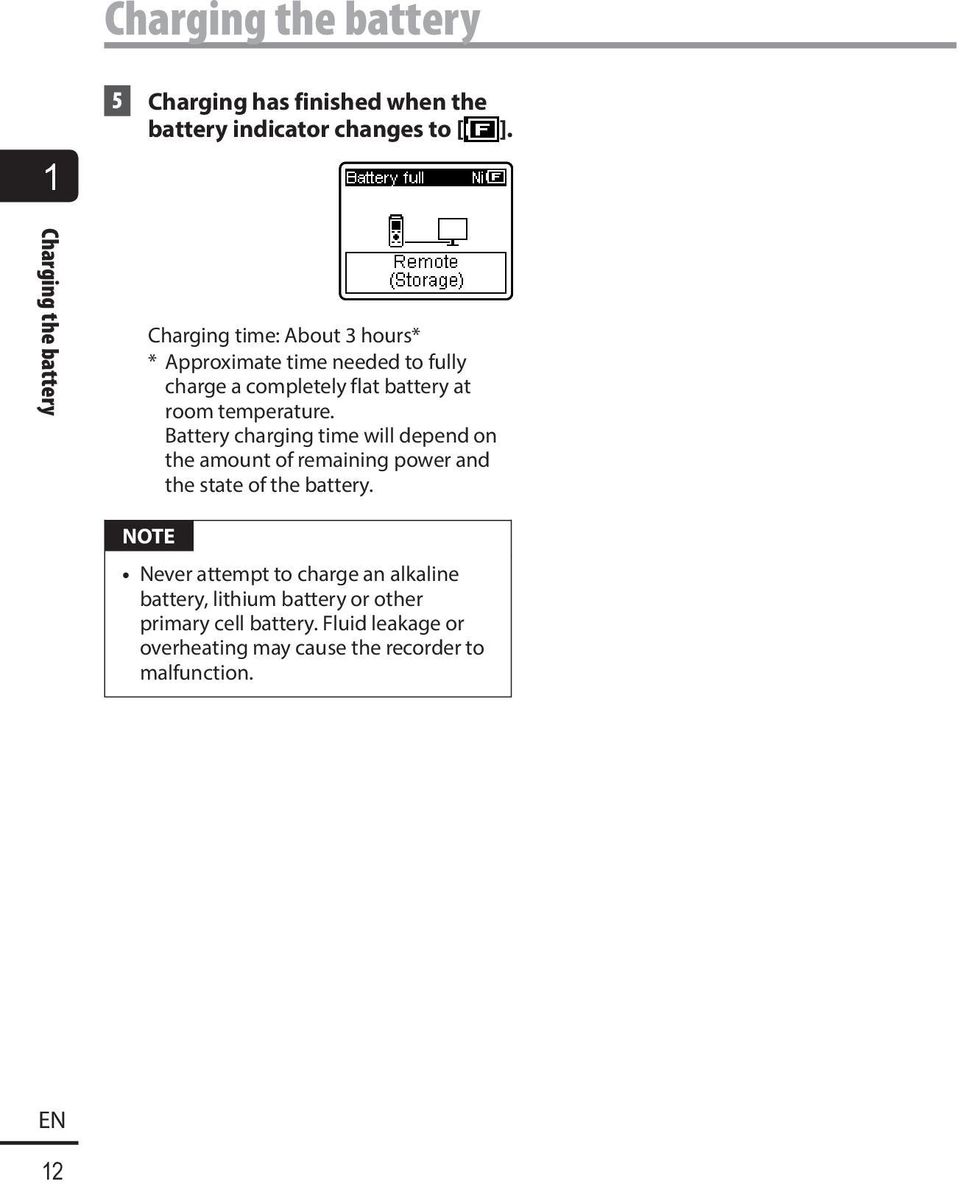
12 Charging the battery 1 5 Charging has finished when the battery indicator changes to [ ]. Charging the battery Charging time: About 3 hours* * Approximate time needed to fully charge a completely flat battery at room temperature. Battery charging time will depend on the amount of remaining power and the state of the battery. Never attempt to charge an alkaline battery, lithium battery or other primary cell battery. Fluid leakage or overheating may cause the recorder to malfunction. 12
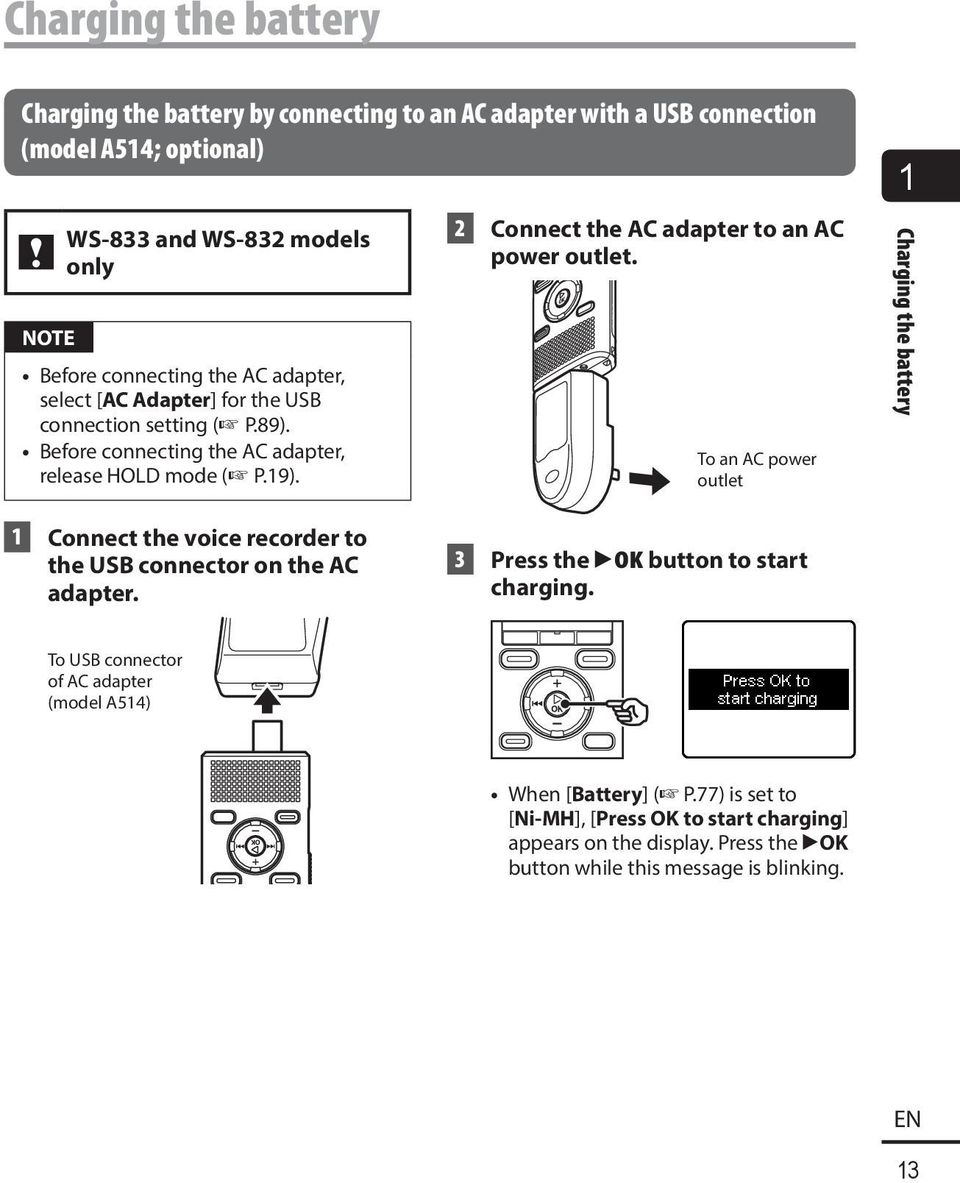
13 Charging the battery Charging the battery by connecting to an AC adapter with a USB connection (model A514; optional) WS-833 and WS-832 models only Before connecting the AC adapter, select [AC Adapter] for the USB connection setting ( P.89). Before connecting the AC adapter, release HOLD mode ( P.19). 2 Connect the AC adapter to an AC power outlet. To an AC power outlet 1 Charging the battery 1 Connect the voice recorder to the USB connector on the AC adapter. 3 Press the `OK button to start charging. To USB connector of AC adapter (model A514) When [Battery] ( P.77) is set to [Ni-MH], [Press OK to start charging] appears on the display. Press the `OK button while this message is blinking. 13
14 1 Charging the battery 14 Charging the battery 4 Charging is finished when [Battery full] appears. When charged with the power turned off When charged with the power turned on Displayed when the battery is fully charged Use only the Olympus USB connecting AC adapter model provided (A514). The power of the PC must be ON to charge the battery using the USB connector. You cannot charge the battery when the power of the PC is OFF, or the PC is in standby, sleep or auto power OFF mode. Do not use a USB hub when charging the battery by connecting to the PC. Before charging the battery, insert the rechargeable battery provided and set [Battery] to [Ni-MH]. You cannot charge the battery if [ ] *1 or [ ] *2 is blinking. Charge the battery in an ambient temperature of between 5 and 35 C (41 and 95 F). *1 [ ] Ambient temperature is too low. *2 [ ] Ambient temperature is too high If battery life has become noticeably short on a full charge, replace the battery with a new one. Insert the USB connector securely all the way. Operation will not be normal if the connection is not made properly. Use the USB extension cable provided if needed (only for WS-833 model). Use only a compatible Olympus USB extension cable. Operation is not guaranteed if a battery from another manufacturer is used. Only use the Olympus USB extension cable with the voice recorder and never use if a product from another manufacturer is used. To charge the battery with [USB Settings] set to [Composite], set [USB Connection] to [Optional] before connecting the USB cable. When you select [AC Adapter] for the [USB Connection] you can charge the battery ( P.89).

15 Batteries Rechargeable batteries Read the information below carefully when using a nickel-metal hydride rechargeable battery (model BR404). 4 Discharging Rechargeable batteries discharge naturally when not in use. Be sure to charge the battery before use. 4 Operating temperature Rechargeable batteries are chemical-based products. Their performance can vary even when used within the recommended operating temperature range. This variation is normal. 4 Recommended temperature ranges When powering voice recorder: 0 to 42 C (32 to F) When being charged: 5 to 35 C (41 to 95 F) During long-term storage: -20 to 30 C (-4 to 86 F) Use of a rechargeable battery outside the temperature ranges above may result in drops in battery performance or life. When not using the voice recorder for an extended period, remove the rechargeable battery before storage to prevent fluid leakage or rust. Due to the nature of nickel-metal hydride rechargeable batteries, new batteries and batteries not used for an extended period (one month or more) may not charge completely. The battery should become fully charged after charging and discharging the battery up to three times. Always dispose rechargeable batteries in the legally prescribed manner. Before disposing rechargeable batteries that are not fully discharged, take steps to prevent shorting such as insulating their terminals with tape. For users in Germany Olympus has an agreement with the GRS (Joint Battery Disposal Association) in Germany to ensure environmentally-friendly battery disposal. Battery indicator As the battery loses its remaining charge, the battery indicator on the display changes as follows: [ ] indicates there is little remaining battery charge. Charge the battery or replace it with a fresh one. When the battery has run out, [ ] and [Battery low] appear, and operation stops. 1 Batteries 15

16 1 Batteries Batteries Battery precautions The voice recorder does not support manganese batteries. Always turn power off before replacing the battery. Files may be damaged if the battery is removed while the voice recorder is recording or performing an operation such as erasing a file. You may need to reset the date/time if the battery is removed from the voice recorder for over one minute, or if the battery is quickly removed and replaced. See Setting the date/time [Time & Date] ( P.78) for the procedure. When not using the voice recorder for an extended period, always remove the battery before storage. When replacing the battery, use an AAA alkaline dry cell battery or an Olympus nickel-metal hydride rechargeable battery (model BR404). When buying rechargeable batteries, always select model BR404 nickel-metal hydride rechargeable batteries. Operation is not guaranteed. If a battery from another manufacturer is used. Even if the battery indicator is [ ], playback with the built-in speaker at some volumes may result in a drop in battery output voltage, causing the voice recorder to reset. Lower the volume in this case. The continuous battery usage time is reduced when using a microsd card ( P.113). The continuous battery usage time will vary depending on the performance of the battery in use ( P.113). The continuous battery usage time of a nickel-metal hydride rechargeable battery that has been used repeatedly will be reduced due to battery degradation ( P.113). The [Battery] screen appears automatically after you have replaced the battery. You can also use a menu operation to display this screen and set the battery ( P.77). 16

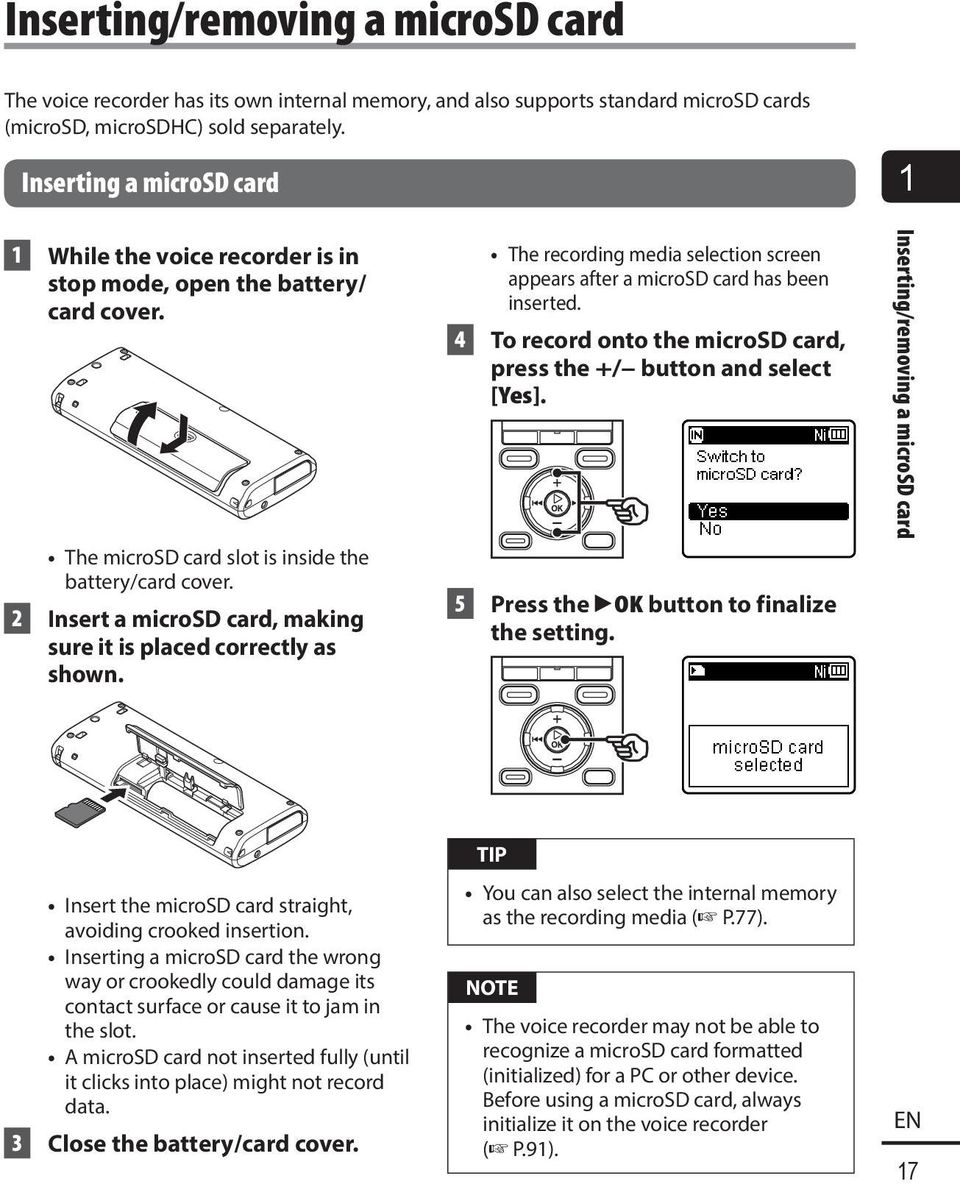
17 Inserting/removing a microsd card The voice recorder has its own internal memory, and also supports standard microsd cards (microsd, microsdhc) sold separately. Inserting a microsd card 1 1 While the voice recorder is in stop mode, open the battery/ card cover. The microsd card slot is inside the battery/card cover. 2 Insert a microsd card, making sure it is placed correctly as shown. The recording media selection screen appears after a microsd card has been inserted. 4 To record onto the microsd card, press the +/ button and select [Yes]. 5 Press the `OK button to finalize the setting. Inserting/removing a microsd card Insert the microsd card straight, avoiding crooked insertion. Inserting a microsd card the wrong way or crookedly could damage its contact surface or cause it to jam in the slot. A microsd card not inserted fully (until it clicks into place) might not record data. 3 Close the battery/card cover. TIP You can also select the internal memory as the recording media ( P.77). The voice recorder may not be able to recognize a microsd card formatted (initialized) for a PC or other device. Before using a microsd card, always initialize it on the voice recorder ( P.91). 17
18 Inserting/removing a microsd card Removing a microsd card 1 Inserting/removing a microsd card 1 While the voice recorder is in stop mode, open the battery/ card cover. 2 Release the microsd card by pressing it inward, then letting it slowly return. The microsd card moves outward and stops. Pull the microsd card out with your fingertips. [Internal memory selected] is displayed after removing a microsd card if [Memory Select] was set to [microsd card]. MicroSD cards may pop out forcefully on removal if you flick or release your finger too quickly after pressing the card in. Depending on the card s manufacturer and type, some microsd cards and microsdhc cards may not be fully compatible with the voice recorder and not be recognized properly. For microsd card compatibility under Olympus verification, please contact our customer support at: Note that our customer support will provide information on microsd card manufacturers and card types for which Olympus has verified operation, but will not guarantee it's performance. Also note that some cards may no longer be recognized correctly by the voice recorder in case card manufacturer changes card specifications. Read the operating instructions provided with the card when using a microsd card. If a microsd card is not recognized by the voice recorder, try removing and reinserting the card to have the voice recorder attempt recognition again. Processing speed may be low for some microsd card types. Processing performance may also be reduced by writing or deleting data repeatedly from a microsd card. In this case, reinitialize the card ( P.91) Close the battery/card cover.
![[Internal memory selected] is displayed after removing a microsd card if [Memory Select] was set to [microsd card].](/docs-images/40/13361690/images/page_18.jpg "MicroSD cards may pop out forcefully on removal if you flick or release your finger too quickly after pressing the card in.")
19 Preventing accidental operation Setting the voice recorder to HOLD mode maintains the current operation and disables button operations. HOLD mode is a handy feature for preventing unintentional operation from accidental button presses when the voice recorder is carried in a bag or pocket. It is also useful for preventing the voice recorder being accidentally stopped during recording. Setting HOLD mode 1 Slide the POWER/HOLD switch to the [HOLD] position. Releasing HOLD mode 1 Slide the POWER/HOLD switch to position A shown below. 1 Preventing accidental operation [Hold] appears in the display, and the recorder enters HOLD mode. When any button is pressed during HOLD mode, [Hold] appears in the display for 2 seconds. No other operation is performed. Setting HOLD mode during voice recorder playback (or recording) continues the playback (or recording) operation and prevents any other operation from being performed (the voice recorder stops when playback ends, or recording stops when there is no more available memory). 19
![It is also useful for preventing the voice recorder being accidentally stopped during recording. Setting HOLD mode 1 Slide the POWER/HOLD switch to the [HOLD] position.](/docs-images/40/13361690/images/page_19.jpg "Releasing HOLD mode 1 Slide the POWER/HOLD switch to position A shown below. 1 Preventing accidental operation [Hold] appears in the display, and the recorder enters HOLD mode.")
20 Turning the power OFF Turning the power OFF 1 Turning the power OFF Existing data, mode settings and the clock setting are saved when the power is turned OFF. 1 Slide the POWER/HOLD switch in the direction of the arrow for at least half a second. Power Save mode When the voice recorder has been stopped for at least 10 minutes (default setting) after power ON, the display disappears and the voice recorder automatically enters the Power Save mode ( P.77). Pressing any button releases the Power Save mode. The playback stop position at power OFF is stored in memory. TIP Turning the power OFF whenever the voice recorder is not in use minimizes battery consumption. 20

21 [Home] screen operations Selecting the mode In addition to its recording function, the voice recorder also provides music player and FM radio* functions. Choose the application you want by selecting one of the voice recorder s modes. * WS-833 model only 1 Press the F1 (HOME) button to display the [Home] screen. 3 Press the `OK button. 1 [Home] screen operations For WS-833 model For WS-832 and WS-831 models 2 Press the +/, 9 or 0, button to select the desired mode. In WS-832 and WS-831 models, you can only use the 9 or 0 button to select modes. 21
22 [Home] screen operations When [Recorder] is selected 1 [Home] screen operations The voice recorder enters [Recorder] mode. Audio can be recorded with the built-in microphone. Files recorded with the microphone or from the FM radio* can also be played back ( P.26, P.34). When [Music] is selected The voice recorder enters [Music] mode. In this mode you can play music files transferred to the voice recorder ( P.34). When [Calendar Search] is selected The voice recorder enters [Calendar Search] mode. In this mode you can search for files by specifying the recording date ( P.44). When [FM Radio]* is selected The voice recorder enters [FM Radio] mode. In this mode you can listen to FM radio ( P.48, P.51). * WS-833 model only 22
23 Folders In addition to its own internal memory, the voice recorder can also use microsd cards as a data recording media. Sound files, music files and content files stored on either media are saved in folders arranged in a tree structure. You can specify any playback sequence for the music files in the [Recorder] and [Music] folder ( P.61). 1 Folders for voice recordings Sound files recorded by the voice recorder are saved in the folders labeled [Folder A] to [Folder E] in the [Recorder] folder. Home Select the mode in the [Home] screen. Folders for music playback When music files created using Windows Media Player are transferred to the voice recorder, folders are created automatically for them within the folder for music playback, using the hierarchical structure shown below. Folders Recorder Home Folder A Music First level Artist 01 Second level Album 01 Each folder can store up to 200 files. Folder B Folder C Folder D Folder E Recordings made with the microphone are saved here. Folder File Each folder can store up to 200 files. FM Radio Recordings from the radio are saved here (WS-833 model only). Files and folders placed directly within the [Recorder] folder (not within one of the sub-folders) are not displayed by the voice recorder. Up to 300* folders can be created within the [Music] folder (including a [Music] folder itself). * Up to 130 folders for WS-831 model. The voice recorder can only recognize two folder sublevels. 23
24 Selecting folders and files 1 You can select a different folder while the voice recorder is in stopped or playing a file. See Folders ( P.23) for a description of the voice recorder s hierarchical folder structure. [Home] screen Folders for voice recordings Selecting folders and files Example: WS-833 model Folder list display Folders for music playback File list display File display Folder list display When [Music] mode is selected File list display File display 24 Forward: `OK button Each press of the `OK button opens the currently selected folder or file in the list, moving forward to the next (lower) level in the folder hierarchy. When a list is displayed, you can perform the same function by pressing the 9 button. Back: LIST button Each press of the LIST button moves back to the previous (higher) level in the folder hierarchy. When a list is displayed, you can perform the same function by pressing the 0 button. TIP When navigating through a folder hierarchy, you can press and hold the LIST button to return to the file display.
25 Selecting folders and files +/ button Used to select a folder or file. [Home] screen Used to select the voice recorder mode ( P.21). List display Displays the folders and files recorded in the voice recorder. Pressing the F2 (FOLDER) button changes the display to the list display of the next folder. File display Displays the information of the selected file. 1 Selecting folders and files 25
26 Recording Recording 2 Recording The voice recorder has five folders ([&] to [*]) in which recorded files can be saved. These folders provide a handy way to sort recordings into separate categories (such as business and leisure). Basic recording procedure 1 Press the +/, 0 or 9 button in the [Home] screen and select [Recorder], then press the `OK button ( P.21). 2 Select the folder to save the recording in ( P.24). Each new voice recording file is saved in the selected folder. 3 Point the built-in microphone in the direction of the sound to record. 4 Press the REC ( s) button to start recording. a b c d e a Rec Mode b Elapsed recording time c Remaining memory bar indicator d Remaining possible recording time e Level meter (changes according to recording volume and recording function setting) The LED indicator light lights, and [K] appears in the display. 5 Press the STOP ( 4) button when you want to stop recording. f f File length [L] appears in the display. 26
27 Recording Sound files recorded with the voice recorder are automatically given a file name in the format below _0001.WMA Date recorded Indicates the year, month and day the recording was made. 2 File number Appended file numbers are consecutive regardless of whether the recording media has been switched. 3 Extension A file extension indicating the recording format the file was recorded in by the voice recorder. Linear PCM format:.wav * MP3 format:.mp3 WMA format:.wma * WS-833 and WS-832 models only TIP [Rec Mode] must be set with the voice recorder stopped ( P.81). Pressing the REC ( s) button while [Recorder] is selected on the [Home] screen will allow you to start recording. The recorded file will be saved to [Folder A]. WS-833 model only You can record radio broadcasts by selecting [FM Radio] mode ( P.56). You can adjust the recording level manually to match your application ( P.63). To prevent the beginning of the recording being cut off, start recording after the LED indicator light has lit or mode indicator has appeared in the display. When the remaining possible recording time is 60 seconds, the LED indicator light starts flashing. It flashes more rapidly as the remaining time decreases (at the 30- and 10-second points). When [Folder full] appears, no more recording can be done. To record more, you will need to select a different folder or delete unneeded files ( P.46). If [Memory full] appears, the voice recorder has no more available memory space. You will need to delete unneeded files to record more ( P.46). When using a microsd card in the voice recorder, be sure the desired recording media setting ([Internal memory] or [microsd card]) has been selected ( P.77). If a folder other than folders & to * is selected when the REC ( s) button is pressed, the blinking message [Cannot record in this folder] appears. Redo the recording operation after selecting one of folders & to *. It s recommended to initialize the recording media before making an important recording. Processing performance may be reduced when data has been repeatedly written to or deleted from the recording media. Please initialize the recording media in this case ( P.91). 2 Recording 27
28 Recording 2 Recording linear PCM format files of over 2 GB WS-833 and WS-832 models only Pausing/resuming recording 1 Press the REC ( s) button during recording. Recording When recording a linear PCM format file, recording will continue even after the file size exceeds 2 GB. The data is divided and saved in separate files of up to 2 GB. The files are processed as multiple files during playback. After recording 200 files which exceed 2GB recording stops. Recording pauses, and the [ ] indicator appears in the display along with the blinking message [Rec pause]. Recording is stopped automatically after being paused for at least 60 minutes. 2 Press the REC ( s) button again while recording is paused. Recording resumes from the position it was paused at. Quickly checking a recording 28 1 Press the `OK button during recording. [ ] appears in the display. Recording ends, and the file just recorded is played. WS-833 model only When this operation is done while recording in [FM Radio] mode, [Recorder] mode is automatically selected and the file just recorded will be played.
29 Recording Monitoring while recording You can monitor the recording as you are making it by listening on the earphone plugged into the voice recorder s EAR jack. Use the +/ button to adjust the recording monitor volume. 1 Connect the earphones to the voice recorder s EAR jack. To EAR jack Changing the volume will not affect the recording level. To avoid unpleasantly loud sound, set the volume to [00] before plugging in the earphone. To prevent feedback, do not place the earphone near the microphone while recording. Recording settings Various recording settings are available, letting you tailor recording to different recording conditions. [Rec Level] Sets the recording sensitivity. ( P.63) [Rec Mode] *1 ( P.64) [Zoom Mic] *2 ( P.64) [Low Cut Filter] ( P.65) [VCVA] ( P.65) [V-Sync. Rec] ( P.67) [Rec Scene] ( P.32) Sets the recording sound quality. Sets the built-in stereo microphone s directivity. Reduces humming sounds from equipment such as air-conditioners or projectors. Sets the trigger level for voice-activated recording (VCVA). Sets the trigger level for voice-synchronized recording. Used to select one of multiple preregistered templates of recording settings. When selected, each template enters several settings tailored to a particular recording location or condition all in a single operation. *1 When [FM Radio] mode is set, [Rec Mode] is fixed at one of the settings below (WS-833 model only). [MP3 256 kbps] [MP3 128 kbps] *2 WS-833 model only 2 Recording 29
30 Recording with an external microphone Recording with an external microphone 2 Recording with an external microphone You can record audio input using an external microphone or other device connected to the voice recorder s microphone jack. Do not plug or unplug devices into voice recorder jacks while recording. 1 Connect an external microphone to the voice recorder s MIC jack. To MIC jack Connecting an external microphone to the voice recorder s MIC jack disables the built-in microphone. Microphones with plug-in power supplies can be used. When [Rec Mode] is set to stereo, recording with an external mono microphone records on the left channel only ( P.64). When [Rec Mode] is set to mono, only the input from the left channel microphone is recorded when using an external stereo microphone ( P.64). 2 Start recording. See Recording ( P.26) for descriptions of recording operations. TIP See Accessories (optional) ( P.105) for the compatible external microphones. 30
31 Recording from another connected device Recording audio from another device with this recorder Audio can be recorded when you have connected the audio output terminal (earphone jack) of another device and the MIC jack of the recorder using the connecting cord KA333 (optional) for dubbing. To MIC jack To audio output terminal of other device When recording from a connected external device, perform a test recording and adjust the output level of the connected device as needed. Recording audio from this recorder with another device Audio from this recorder can be recorded to another device by connecting the audio input terminal (microphone jack) of the other device and the EAR jack of this recorder using the connecting cord KA333 (optional). To EAR jack To audio input terminal of other device Adjusting playback sound quality settings on the voice recorder affects the audio output signals output from the EAR jack ( P.69 to P.73). 2 Recording from another connected device 31
32 Changing the recording scene [Rec Scene] Changing the recording scene 2 The voice recorder has preregistered templates of optimum settings tailored to various recording applications such as lectures and dictation. When selecting one of these templates you can enter several settings recommended for your recording application all in a single operation. Changing the recording scene [Rec Scene] 1 While the voice recorder is in stop mode, press and hold the MU/ SCE button. 2 Press the `OK button. TIP You can press the 9 button to display the settings of the selected template. Press the 0 button to return to the [Rec Scene] screen. 4 Press the `OK button to finalize the setting. 5 Press the STOP ( 4) button to exit the selection screen. 3 Press the +/ button to select the desired recording application. Rec Scene Press and hold the STOP ( 4) button when the recorder is stopped to check setting indicators meanings. 32 Recording menu settings cannot be changed when a [Rec Scene] selection has been made. To use these functions, you must select [Off] for the [Rec Scene] setting.
33 Changing the recording scene [Rec Scene] Preregistered [Rec Scene] settings [Lecture] [Dictation] [Rec Level] [High] [Rec Mode] [MP3 128 kbps] [Zoom Mic]* [+6] [Low Cut Filter] [On] [VCVA] [Off] [V-Sync. Rec] [Off] [Conference] [Rec Level] [Middle] [Rec Mode] [MP3 128 kbps] [Zoom Mic]* [Off] [Low Cut Filter] [On] [VCVA] [Off] [V-Sync. Rec] [Off] [Meeting] [Rec Level] [Middle] [Rec Mode] [MP3 128 kbps] [Zoom Mic]* [Off] [Low Cut Filter] [Off] [VCVA] [Off] [V-Sync. Rec] [Off] [Rec Level] [Rec Mode] [Zoom Mic]* [Low Cut Filter] [VCVA] [V-Sync. Rec] [DNS] [Rec Level] [Rec Mode] [Zoom Mic]* [Low Cut Filter] [VCVA] [V-Sync. Rec] * WS-833 model only [Low] [MP3 128 kbps] [Off] [On] [Off] [Off] [Low] [MP3 128 kbps] [Off] [Off] [Off] [Off] 2 Changing the recording scene [Rec Scene] 33
34 Playback Playback In addition to files recorded by the voice recorder, you can also play files in WAV*, MP3 and WMA format transferred from a PC. * WS-833 and WS-832 models only 3 Playback 34 Basic playback procedure 1 Select the file to play from the folder containing it ( P.24). TIP Files are saved in the locations below. Files recorded with the built-in microphone: [Recorder] folders (folders & to *) Files recorded from the radio: [Recorder] folder ([FM Radio] * folder) Music files transferred from a PC: [Music] folder * WS-833 model only 2 Press the `OK button to start playback. a b c d e a Recording media indicator, file name and folder indicator b Elapsed playback time c Playback position bar indicator d File length e Recording date/time [ ] appears in the display. 3 Press the +/ button to adjust the volume to the desired level. The volume can be adjusted to a setting between [00] to [30]. The higher the number, the louder the volume. 4 Press the STOP ( 4) button to stop playback. [L] appears in the display. The file being played stops right away. The resume function automatically stores the playback stop position in memory. The position is retained even if the power is turned OFF. The next time the power is turned ON, playback can be resumed from the stop position stored in the memory.
35 Playback Playback settings You can select various file playback methods tailored to different applications and tastes. *1 *3 [Voice Playback] ( P.69) [Shadowing] ( P.69) [Noise Cancel] *3 ( P.70) *1 *3 [Voice Balancer] ( P.70) *2 *3 [Voice Filter] ( P.71) [Play Mode] ( P.71) [Equalizer] *4 ( P.73) [Skip Space] ( P.73) [Play Scene] ( P.74) Only plays voice portions of a recorded audio file. Plays segments of files, alternating repeatedly between playback and silence. A setting that makes recorded voices more discernable when muffled by projector noise or similar sounds. Compensates low-volume portions of recorded audio files during playback. Cuts low- and highfrequency components, emphasizing voices for greater clarity. Selecting from among three playback modes. Adjusts the quality of sound as desired. A handy function for quickly moving the playback position, and playing short segments repeatedly. Selecting a package of settings recommended for your recording application in a single operation. Improves operability. *1 WS-833 and WS-832 models only *2 WS-831 model only *3 Function active only in [Recorder] mode. *4 Function active only in [Music] mode. Playback through the earphones You can connect the earphones to the voice recorder s EAR jack and listen to playback through them. 1 Connect the earphones to the voice recorder s EAR jack. To EAR jack 2 Press the `OK button to start playback. TIP There will be no sound from the speaker when the earphones are connected. To avoid unpleasantly loud sound, set the volume to [00] before plugging in the earphone. Avoid excessive volume when listening to playback through the earphones. It may cause hearing damage or loss. 3 Playback 35
36 Playback Fast-forwarding Rewinding 3 Playback Fast-forwarding while the voice recorder is in stop mode Rewinding while the voice recorder is in stop mode 36 1 With the voice recorder stopped, press and hold the 9 button. [ß] appears in the display. Fast-forwarding stops when you release the 9 button. Press the `OK button to start playback from the current position. Fast-forwarding during playback 1 Press and hold the 9 button during playback. Playback starts from the current position when you release the 9 button. If an index mark or temp mark in the file is reached, fast-forwarding stops at the mark ( P.43). Fast-forwarding stops when the end of the file is reached. Press and hold the 9 button again to fast-forward from the beginning of the next file. 1 With the voice recorder stopped, press and hold the 0 button. [ ] appears in the display. Rewinding stops when you release the 0 button. Press the `OK button to start playback from the current position. Rewinding during playback 1 Press and hold the 0 button during playback. Playback starts from the current position when you release the 0 button. If an index mark or temp mark in the file is reached, rewinding stops at the mark ( P.43). Rewinding stops when the beginning of the file is reached. Press and hold the 0 button again to rewind from the end of the previous file.
37 Playback Skipping to the beginning of a file Skipping to the beginning of the next file 1 Press the 9 button while the voice recorder is in stop mode, or during playback. Skipping to the beginning of the current file 1 Press the 0 button while the voice recorder is in stop mode, or during playback. Skipping to the beginning of the previous file 1 Press the 0 button when the playback position is the beginning of the file. To skip to the beginning of the previous file during playback, press the 0 button twice consecutively. If an index mark or temp mark is reached when skipping to the beginning of a file during playback, playback starts from the position of the mark. When skipping to the beginning of a file while the voice recorder is in stop mode, the mark is ignored ( P.43). If a setting other than [File Skip] is set for [Skip Space], playback starts after the set amount of time has been skipped backwards or forwards. Playback does not skip to the beginning of the file. 3 Playback 37
38 Playback 3 Playback Music files If a music file transferred to the voice recorder is unplayable, check that its sampling rate, bit count and bit rate values are within the supported ranges. The sampling rate, bit count and bit rate combinations supported for music file playback by the voice recorder are shown below. File format Sampling rate WAV format* 44.1 khz 16 bits Bit count/ bit rate Changing the playback speed/tone (voice changer*) You can change the playback speed and audio tone*. Changing the playback speed is handy for speeding up conference presentations, or for slowing down parts difficult to discern when learning a language. * WS-833 and WS-832 models only 1 Press the `OK button during playback. MP3 format WMA format MPEG 1 Layer 3: 32 khz, 44.1 khz, 48 khz MPEG 2 Layer 3: 16 khz, khz, 24 khz 8 khz, 11 khz, 16 khz, 22 khz, 32 khz, 44.1 khz, 48 khz 8 to 320 kbps 5 to 320 kbps 2 Press the +/, 9 or 0 button. * WS-833 and WS-832 models only MP3 files with variable bit rates (bit rates converted variably in a single file) may not play normally. Linear PCM-format WAV files are the only WAV files the voice recorder can play. Playback of other WAV files is not supported. Even if the file formats is compatible for playback on this recorder, the recorder does not support every encoder. 9 or 0 button: Adjust the playback speed. +/ button: Adjust the audio tone* (voice changer). * WS-833 and WS-832 models only 38
39 Playback 3 Press the `OK button. Playback speed/ tone indicator Fast playback restrictions Depending on their sampling frequency and bit rate, some files may not play normally. In this case, you will need to reduce the playback speed. TIP When speech is still difficult to discern after changing the playback speed, changing the tone may help. When the speed/tone changing function and [Play Scene] function have both been selected, the [Play Scene] setting takes precedence. The [Play Scene] settings cannot be changed ( P.74). When changing the playback speed/ tone, playback operations such as stopping playback, skipping to the beginning of a file, and writing index marks/temp marks are the same as during standard playback. 3 Playback Altered playback speed/tone settings are retained even after power OFF. Changing the playback speed and tone will make the battery deplete more quickly. The function below cannot be used when changing the playback speed/ tone. [Noise Cancel] ( P.70) 39
40 Playback ABC repeat playback 3 Playback The voice recorder has a function that lets you repeat the playback of a portion (segment) of the file being played. In addition to the A-B repeat function available from previous models, the segment to repeat can be changed during repeat playback. There is also a shadowing playback function handy for language learning that can be used during ABC repeat playback. The [Shadowing] setting must be set to [On] before you can use the shadowing playback function ( P.69). ABC repeat playback 5 These steps can be repeated to re-specify a new segment to be played back repeatedly up to the end of the file. 1 Select a file for ABC repeat playback, and start playback. 2 Press the F1 (ABC) button when playback reaches the desired start position for ABC repeat playback Select the starting point for repeat playback (A) during playback. 2 When the ending point (B) is selected, repeat playback starts. 3 When the starting point for repeat playback (A) is canceled during repeat playback, the ending point of the segment (B) becomes the new starting point and playback continues. 4 When the ending point (C) is selected, repeat playback starts again. If [Shadowing] has been set, the [ ] or [ ] indicator appears.
41 Playback ABC repeat playback TIP You can change the playback speed ( P.38), and fast-forward/ rewind ( P.36) when the [B] indicator is blinking. If playback reaches the end of the file when the [B] indicator is blinking, the end of the file is treated as the segment end position, and repeat playback starts. Specifying new starting/ending points 4 Press the F1 (CANCEL A) button during ABC repeat playback. 3 Playback 3 Press the F1 (SET B) button again when playback reaches the desired end position for ABC repeat playback. Segment A-B is set, and ABC repeat playback starts. If [Shadowing] has been set, the repeat segment is played with the volume muted or lowered after it has been played at the usual volume. These operations are repeated until canceled. Stopping ABC repeat playback: Go to Step ] Specifying new starting/ending points: Go to Step [ Segment A-B is canceled. [ ] becomes the new start position, and playback continues. You can change the playback speed ( P.38), and fast-forward/rewind ( P.36). The shadowing playback function is disabled. 41
42 Playback ABC repeat playback 5 Press the F1 (SET C) button at the desired end position for ABC repeat playback. Canceling ABC repeat playback 1 Press the F2 (CNCL ABC) button. 3 Playback Segment B-C is set, and ABC repeat playback starts. The shadowing playback function is enabled. TIP You can repeat Steps 4 and 5 as needed to change the repeat segment as desired. 6 Press the STOP ( 4) button. If pressed when ABC repeat playback is stopped, cancels ABC repeat playback. If pressed during ABC repeat playback, cancels the playback segment setting for the function, and continues standard playback. If you change the file or switch to different display screen, ABC repeat playback is canceled. Playback stops. The playback segment specified for this function is retained. 42 You cannot change the end position of a repeat playback segment to a position before the start position. You cannot write index marks or temp marks during ABC repeat playback ( P.43).
43 Index marks/temp marks Writing an index mark or temp mark in a file enables you to quickly access desired position in the file with the same operations used for fast-forwarding, rewinding or skipping to the start of a file. Index marks can only be written in files created with Olympus voice recorders. For files created with other devices, you can temporarily store desired positions in the memory using temp marks. Writing an index mark/temp mark 1 When the desired position has been reached press the F2 (INDEX) button to write an index mark or temp mark. Erasing an index mark/temp mark 1 Select a file that contains index mark/temp mark you want to erase and start playback. 2 Use the 9 or 0 button to select the index mark/temp mark you want to erase. 3 Index marks/temp marks Temp marks are temporary markings. They are automatically erased when you select a different file, transfer the file to a PC, or move the file on a PC. You can write up to 99 index marks/temp marks in a single file. The message [No more can be set] appears if you attempt to write more than 99 marks. You cannot write or erase index marks/temp marks in files that have been locked by the file lock function ( P.61). 3 When the number of the index mark/temp mark to erase is being shown (for about 2 seconds) in the display, press the ERASE button. Any subsequent index marks/temp marks in the file are automatically renumbered. 43
44 Calendar Search function Using the Calendar Search function to search for a file You can search for voice files by specifying a recording date. If you have forgotten in which folder a file has been saved, this feature lets you access it quickly by entering its recording date. 3 Calendar Search function 44 1 Press the F1 (HOME) button to display the [Home] screen. 2 Press the +/, 9 or 0 button to select [ Calendar Search]. On WS-832 or WS-831 model, use the 9 or 0 button to select [Calendar Search]. 3 Press the `OK button. 4 Press the +/, 9 or 0 button to select the desired date. a Number of files saved (recorded) on selected date b Today s date c Date file was recorded d Selected date a b c d Dates on which files were saved are underlined. 9 or 0 button: Move to the previous/next date. Press and hold to skip to the next date on which a file was recorded. +/ button: Move to the previous/next week. F1, F2 button: Move to the previous/next month. Press the STOP ( 4) button to cancel the setting and return to the [Home] screen. 5 Press the `OK button. 6 Press the +/ button to select the desired file. 7 Press the `OK button to start playback. You can only search for files saved in the folders for voice recording ([&] to [*] and [FM Radio]* folders). * WS-833 model only
45 Selecting preset playback settings template [Play Scene] Selecting a preset playback settings template This voice recorder has 2 preregistered template [Transcription] and [Language study], with optimum settings tailored to such playback scenes. Selecting one of these templates lets you enter several settings recommended for your recording application all in a single operation. See Setting a preset playback settings template for how to set playback settings packages ( P.74). 1 While the voice recorder is in stop mode or playing a file, press and hold the MU/SCE button. If you pressed the MU/SCE button during playback, go to Step [. 2 Press the +/ button to select [Play Scene]. 4 Press the +/ button to select the desired preset playback settings package. 5 Press the `OK button to finalize the setting. 3 Selecting preset playback settings template [Play Scene] 3 Press the `OK button. TIP If you selected a preset playback settings template while the voice recorder is in stop mode, press the STOP ( 4) button to exit the menu screen. 45
46 Erasing files/folders This section describes how to erase a single unneeded file from a folder, erase all the files in the current folder at once, or erase a selected folder. Erasing files 3 Erasing files/folders 1 Select the file you want to erase ( P.24). 2 When the file display screen appears, press the ERASE button while the voice recorder is in stop mode. 4 Press the `OK button. 5 Press the + button to select [Start]. The voice recorder returns to the stopped mode if no operation is performed for 8 seconds. 3 Press the +/ button to select [All in folder] or [One file]. 6 Press the `OK button. [All in folder]: Erases all the files saved in the same folder as the selected file. [One file]: Erases only the selected file. [Erasing!] appears in the display, and the erasing process starts. [Erased] appears when the process has finished. 46
47 Erasing files/folders Erasing a folder 1 Select the folder you want to erase ( P.24). 2 In the folder display screen, press the ERASE button while the voice recorder is in stop mode. The voice recorder returns to the stopped mode if no operation is performed for 8 seconds. 3 Press the + button to select [Start]. 4 Press the `OK button. [Erasing!] appears in the display, and the erasing process starts. [Erased] appears when the process has finished. Files cannot be restored after being erased, so please check carefully before erasing a file. When there is a microsd in the voice recorder, be sure to check whether the recording media being erased is [Internal memory] or [microsd card] ( P.77). Locked files and read-only files cannot be erased ( P.61). The voice recorder s default [Recorder] folders ([FolderA] to [FolderE], and [FM Radio]* folder) and [Music] folder cannot be erased. * WS-833 model only [Music] folder subfolders other than the [Music] can be erased. Files unrecognizable to the voice recorder will not be erased, nor will folders containing these files. The voice recorder must be connected to a PC to erase these files and folders. Before erasing a file or folder, charge or replace the battery to ensure it will not run out before the process has finished. Erasing processes can take over 10 seconds to complete. To prevent the risk of damage to data, never attempt to perform any of the following processes before an erasing process has finished : 1 Disconnecting the AC adapter 2 Removing the battery 3 Removing the microsd card (if the recording media has been set to [microsd card]). 3 Erasing files/folders 47
48 FM radio (WS-833 model only) Before using the FM radio function Radio signal reception quality varies substantially depending on where you are using the radio. Poor reception can often be improved by adjusting the antenna position or orientation, or moving to a more accessible location for the signal such as a near window. 4 Before using the FM radio function The supplied earphones function as an FM antenna. If the earphones are not connected, the message [Insert earphone] appears, and FM radio can not be received. To EAR jack FM radio cannot be received when you are beyond a radio station s broadcasting range or when the signal is blocked by mountains or other topographical obstructions. Even when within broadcasting range, you may not be able to receive radio broadcasts in locations prone to signal reception difficulty (such as within tunnels, underpasses, office buildings, apartment buildings and building shadows). Do not use a mobile phone, PC, TV or other electrical appliance near the voice recorder when using it to listen to the radio. Such product may cause noise. Using the voice recorder with a connected AC adapter (such as model A514) will generate noise. Always use batteries for the FM radio function. 48 TIP You may not be able to receive FM radio when indoors or in the shadow of a building. Reception may be improved by moving near a window when indoors, or by moving out of building shadows.
49 Presetting radio stations automatically Presetting a local radio station [By scanning] Follow the steps below to preset the frequency of an FM radio station you can receive in your area. 1 Connect the earphones to the voice recorder s EAR jack. 2 Press the F1 (HOME) button to display the [Home] screen. 3 Press the +/, 9 or 0 button to select [FM Radio]. 4 Press the `OK button. 5 Press the MU/SCE button. 7 Press the +/ button to select [ Set stations]. 8 Press the `OK button. 9 Press the +/ button to select [By scanning]. 4 Presetting radio stations automatically 6 Press the `OK button to move the cursor to the desired setting item. 10 Press the `OK button. 49
50 Presetting radio stations automatically Presetting a local radio station [By scanning] 4 Presetting radio stations automatically 11 Press the +/ button to select [Start]. 12 Press the `OK button. When [Set by scanning completed] appears, the operation is finished. TIP Preset numbers are sorted automatically by frequency. Up to 30 radio stations can be preset. The message [Preset Full] appears if you attempt to preset more than 30 stations. 50
51 Listening to FM radio Listening to FM radio Follow the steps below to listen to stereo FM radio on the voice recorder. 1 Set FM radio mode by performing Steps 1 to 4 of the procedure given in Presetting radio stations automatically ( P.49). 2 Press the 9 or 0 button to select a radio station. 3 Press the +/ button to adjust the volume to the desired level. 4 TIP By selecting the frequency mode and manually adjusting the frequency, you may sometimes be able to receive a radio station that was not detected by the automatic preset operation ( P.52). You can add a received radio station to the preset stations ( P.53). To stop listening to FM radio, press the F1 (HOME) button to return to the [Home] screen. You can listen to the radio through the voice recorder s built-in speaker with the earphones still connected ( P.81). The volume can be adjusted to a setting between [00] and [30]. The higher the number, the louder the volume. FM radio settings The FM radio function includes features for automatically presetting radio stations, and for setting the scan sensitivity used during auto reception. [Set stations] ( P.49) [Scan Level] ( P.81) [Output] ( P.81) Used to search for local radio stations and preset received stations in a list. Sets the scan sensitivity during auto reception. Used to select whether to listen to FM radio through the earphones or speaker. Listening to FM radio 51
52 Listening to FM radio Selecting the reception mode Different reception modes can be selected to match different reception conditions. If the radio station you want to listen to has a signal too weak to be detected by the automatic preset process, you can select manual reception to adjust the radio frequency manually. 4 Listening to FM radio 1 Set FM radio mode by performing Steps 1 to 4 of the procedure given in Presetting radio stations automatically ( P.49). 2 Press the F2 button to select the desired reception mode. TIP When a radio station has been preset ( P.49), the voice recorder switches between preset mode and frequency mode each time you press the F2 button. You cannot select preset mode if no radio stations have been preset. Preset mode Pressing the 9 or 0 button lets you select preset radio stations (by preset number). a Preset number a 3 Press the 9 or 0 button to change the reception mode. b Frequency mode (auto reception/manual reception) 52 Press the 9 or 0 button to adjust the FM radio frequency being received (manual reception). Press and hold the 9 or 0 button to scan to the next radio station found (auto reception). b Frequency being received When the frequency of a non-preset radio station is being received, pressing the F2 button switches to the preset station nearest in frequency to the current frequency. Reducing the sensitivity used for scanning can sometimes enable reception of stations difficult to receive due to interference or other problems ( P.81).
53 Adding preset radio stations Adding a radio station received manually as a preset station [Set manually] Follow the steps below to add a radio station received in frequency mode as a preset radio station. 1 Set FM radio mode by performing Steps 1 to 4 of the procedure given in Presetting radio stations automatically ( P.49). 2 Press the F2 button to set frequency mode. 3 Press the 9 or 0 button to select the radio station you want to preset. 4 Press the MU/SCE button. 6 Press the +/ button to select [ Set stations]. 7 Press the `OK button. 8 Press the +/ button to select [Set manually]. 4 Adding preset radio stations 5 Press the `OK button to move the cursor to the desired setting item. 9 Press the `OK button. 53
54 Adding preset radio stations Adding a radio station received manually as a preset station [Set manually] 10 Press the +/ button to select [Save preset]. 4 Adding preset radio stations 11 Press the `OK button. When the message [Preset (number) saved] appears, the procedure is finished. TIP Up to 30 radio stations can be preset. The message [Preset Full] appears if you attempt to preset more than 30 stations. Preset numbers are sorted automatically by frequency. 54
55 Deleting preset radio stations Deleting an unneeded preset radio station 1 Set FM radio mode by performing Steps 1 to 4 of the procedure given in Presetting radio stations automatically ( P.49). 2 Press the F2 button to set preset mode. 3 Press the 9 or 0 button to select the preset number of the radio station you want to delete. 4 Press the ERASE button. 5 Press the +/ button to select [Erase preset]. 6 Press the `OK button. When the message [Preset (number) erased] appears, the procedure is finished. 4 Deleting preset radio stations TIP Preset numbers are sorted automatically by frequency. 55
56 Recording FM radio Recording FM radio Even when FM radio reception is clear, noise may enter after starting to record in certain reception environments. To avoid such a problem, perform a test recording beforehand. Try to record in a location with good radio reception. 4 Recording FM radio Recording is disabled when [Output] in the [FM Menu] menu is set to [Speaker]. Set this item to [Earphone] before starting recording ( P.81). 1 Set FM radio mode by performing Steps 1 to 4 of the procedure given in Presetting radio stations automatically ( P.49). 2 Press the 9 or 0 button to select the radio station you want to record from. 3 Press the REC ( s) button to start recording. a b c d a Preset number being received b Radio frequency being received c Indicator of folder where file will be saved and Recording format indicator d Elapsed recording time and Possible recording time remaining The LED indicator light lights, and [K] appears in the display. 4 Press the STOP ( 4) button when you want to stop recording. The recorded file is saved automatically in the [FM Radio] subfolder in the [Recorder] folder. 56
57 Recording FM radio Recording FM radio TIP Files recorded from FM radio have FM appended to the beginning of the file name assigned at the time of recording ( P.27). FM130715_0007.MP3 Date: (July 15, 2013) When recording FM radio, always connect the earphones to the EAR jack. 4 Recording FM radio 57
58 Menu Setting menu items Basic operation Menu items are arranged by tabs, letting you quickly set desired items by selecting a tab and then moving to the desired item within the tab. Follow the steps below to set a menu item. 5 1 During recording/playback or while the voice recorder is in stop mode, press the MU/SCE button. 3 Press the `OK button to move the cursor to the desired setting item. Setting menu items TIP Some menus contain items that can be set during recording/ playback ( P.60). You can also use the 9 button to perform this operation. 4 Press the +/ button to select the desired setting item. 2 Press the +/ button to select the tab containing the item you want to set. 58 Moving the cursor from one tab to another switches the displayed menu screen.
59 Setting menu items Basic operation 5 Press the `OK button. 8 Press the STOP ( 4) button to exit the menu screen. The setting of the selected item is displayed. You can also use the 9 button to perform this operation. 6 Press the +/ button to change the setting. 7 Press the `OK button to finalize the setting. When the menu screen is displayed during recording or playback, press the MU/SCE button to return to the previous screen without ending recording/playback. For menu settings done while the voice recorder is in stop mode, the voice recorder exits the menu and returns to the stopped mode if no operation is performed for 3 minutes. The selected setting item is not changed in this case. For menu settings done during recording/playback, the voice recorder exits the menu if no operation is performed for 8 seconds. 5 Setting menu items A message indicating the setting has been entered appears. You can cancel the setting and return to the previous screen by pressing the 0 button instead of the `OK button. 59
60 Setting menu items Basic operation 4 Menu items that can be set during recording Rec Level Zoom Mic *1 Low Cut Filter VCVA Backlight LED 5 Setting menu items 4 Menu items that can be set during Playback Property Noise Cancel *2 Voice Balancer *2*3 Voice Filter *2*4 Play Mode Equalizer *5 Skip Space Backlight LED 4 Menu items that can be set while listening to the radio (WS-833 model only) Rec Mode *6 Set stations *6 Scan Level *6 Backlight LED Output *6 *1 WS-833 model only *2 Function active only in [Recorder] mode. *3 WS-833 and WS-832 models only *4 WS-831 model only *5 Function active only in [Music] mode. *6 Cannot be selected while recording from the radio. 60
61 File menu [File Menu] Extracting the speaking portions of files of spoken-word content [Voice Detect] The [Voice Detect] function extracts the speaking portions of a file of spoken-word content recorded by the voice recorder. See Extracting speaking portions of files of spoken-word content [Voice Detect] ( P.82) for more information. WS-833 and WS-832 models only Preventing accidental file erasure [File Lock] The file lock feature lets you lock important files to prevent them being accidentally erased. Once locked, a file is not erased even if the operation for erasing all the files in its folder is performed ( P.46). 1 Select the file you want to lock ( P.24). [Lock]: File is locked. [Unlock]: File lock is canceled. Sorting files [Sort by] You can change the playback order of the files in a folder. 1 Press the +/ button to select [File name], [Date ascending] or [Date descending]. [File name]: Automatically sorts the files by file name. [Date ascending]: Automatically sorts the files by date (recording date/time) from oldest to newest files. [Date descending]: Automatically sorts the files by date (recording date/time) from newest to oldest files. 2 Press the +/ button to select [Recorder] or [Music]. [Recorder]: Sorts all the files in the [Recorder] folder (including the files in the [FM Radio]* folder). [Music]: Sorts all the files in the [Music] folder. * WS-833 model only When [File name] is selected, files are listed in order of file name based on the first 20 characters of each name. 5 File menu [File Menu] 61
62 File menu [File Menu] 5 File menu [File Menu] Moving/copying files [Move/Copy] Files saved in the internal memory or on a microsd card can be moved or copied within memory. See Moving/copying files [Move/Copy] ( P.84) for the procedure. WS-833 and WS-832 models only Dividing files [File Divide] Large files or files with long recording times can be divided for easier management and editing. See Dividing a file [File Divide] ( P.87) for the procedure. Displaying file or folder information [Property] You can display the information of a file or folder from a menu screen. File information 1 Press the +/ button to switch the screen. Information is displayed for the items [Name], [Date], [Size], [Bit Rate] *1, [Artist] *2 and [Album] *2. *1 If you selected a linear PCM-format file, the [Bit Rate] item displays the sampling frequency and bit count. *2 If the file has no tag information, [UNKNOWN_ARTIST] and [UNKNOWN_ALBUM] are displayed. Folder information 1 Press the +/ button to switch the screen. Information is displayed for the items [Name], [File] (the number of files) and [Folder] (the number of folders). The [Folder] item is not displayed in [Recorder] mode. Displayed numbers of files do not include files in formats that are unrecognizable to the voice recorder. 62
63 Recording menu [Rec Menu] Selecting the recording sensitivity [Rec Level] You can change the recording level (sensitivity) as needed for your recording application. [High]: The highest recording sensitivity. Suited to recording lectures, large conferences and other applications with distant or quiet sound sources. [Middle]: Suited to recording discussions and small-group meetings. [Low]: The lowest recording sensitivity. Suited to recording dictation. [Manual]*: Lets you set the recording sensitivity manually, to any of 30 levels. * WS-833 model only TIP To record the speaker s voice clearly, set [Rec Level] to [Low], and place the voice recorder s built-in microphone near the speaker s mouth (5 to10 cm away). Adjusting the recording level WS-833 model only 1 Adjust the recording level by pressing the 9 or 0 button during recording or when recording is paused. Increasing the [Rec Level] number increases the recording level and extends the level meter indicator position. Setting the voice recorder to [Manual] disables the limiter function. If [OV] is displayed, the recorded audio will be distorted. Adjust the recording level so that [OV] is not displayed. 5 Recording menu [Rec Menu] When [Rec Level] is set to [High], [Middle] or [Low], the recording level is adjusted automatically. Excessively loud sound input may generate noise regardless of whether [Rec Level] is set to [High], [Middle] or [Low]. 63
64 Recording menu [Rec Menu] 5 Recording menu [Rec Menu] Setting the recording mode [Rec Mode] You can prioritize sound quality or recording time. Select the recording mode that best matches your recording application. [ PCM 44.1 khz] *1 [ MP3 256 kbps] *1 [MP3 192 kbps] *2 [MP3 128 kbps] [ WMA 32 kbps mono] *3 [WMA 8 kbps mono] *3 *1 WS-833 and WS-832 models only *2 WS-831 model only *3 Mono recording TIP Sound quality increases as the recording rate value increases. Setting a higher recording rate increases file size. Check that you have enough remaining memory before recording. To record conferences and presentations clearly, it is recommended to set [Rec Mode] setting to [MP3 128kbps] or above. When [Rec Mode] is set to stereo, recording with a connected mono microphone records on the left channel only. Selecting microphone directivity [Zoom Mic] The voice recorder s built-in stereo microphone provides directivity ranging from broad-coverage stereo recording to highly directional recording. WS-833 model only 1 Press the +/ button to adjust the built-in stereo microphone s directivity. The + button increases directivity. The button enables recordings with broader-coverage stereo. Reducing directivity and broadening the sound pickup range gives recordings more of a stereo effect. The setting can be adjusted to between [ 3] and [+6]. 64
65 Recording menu [Rec Menu] Selecting microphone directivity [Zoom Mic] Zoom mic function High directivity Low directivity Narrow sound pickup range Broad sound pickup range The [Zoom Mic] function has been set so as to optimize its performance when it is used with the voice recorder s builtin stereo microphone. Note that normal recording may no longer be possible when using a separately purchased microphone or when recording from another device using a connecting cord. Using the [Zoom Mic] function will make the battery deplete more quickly. Reducing noise during recording [Low Cut Filter] The voice recorder s low cut filter function lets you make recordings that reduce humming sounds from air-conditioners or low-frequency sounds from equipment such as projectors. [On]: Turns the low cut filter ON. [Off]: Turns the low cut filter OFF. Voice-activated recording function [VCVA] The voice-activated recording function (VCVA) automatically starts recording when a sound louder than a preset voice activation level is detected, and automatically pauses recording when the sound volume level falls. Use this function to automatically omit unneeded quiet segments when recording (such as long silences during conferences), saving memory. [On]: Turns VCVA ON. You can adjust the voice activation level used for VCVA ( P.66). [Off]: Turns VCVA OFF. Restores standard recording. 5 Recording menu [Rec Menu] 65
66 Recording menu [Rec Menu] 5 Recording menu [Rec Menu] Adjusting the voice activation level for voice-activated recording 1 Press the REC ( s) button to start recording. Recording pauses automatically about 1 second after the input sound becomes quieter than the set activation sensitivity. The blinking message [Standby] appears in the display. The LED indicator light becomes lit when recording is activated and flashes when recording is paused. 2 Press the 9 or 0 button to adjust the voice activation level. a Voice activation level (moves left/ right to match set level) b Level meter (changes in proportion to recording sound volume) The setting can be adjusted to between [01] and [23]. a b TIP Increasing the setting number increases the VCVA activation sensitivity, enabling quieter sounds to activate the start of recording. Adjust the VCVA voice activation level to suit the recording conditions (to cope with high levels of surrounding noise or the like). To avoid recording mistake, it s recommended to perform a test recording beforehand to adjust the voice activation level. WS-833 model only: To change the recording level ( P.63) during VCVA recording in [Manual], press the F1 button. The voice recorder changes to recording level adjustment mode. Press the F1 button again to return to voice activation level adjustment mode. The following function is disabled when using the [VCVA] function: [V-Sync. Rec] ( P.67) 66
67 Recording menu [Rec Menu] Voice sync recording function [V-Sync. Rec] The voice sync recording function automatically starts recording when a sound louder than a preset voice sync recording level (detection level) is detected, and automatically stops recording when the sound volume level decreases. When copying music from another device connected to the voice recorder, use the voice sync recording function to detect the silent intervals between music tracks and save each track as a separate file. Adjusting the voice sync level for voice sync recording 1 Press the REC ( s) button to prepare for recording. 2 Press the 9 or 0 button to adjust the voice sync level. 5 [1 sec.], [2 sec.], [3 sec.], [5 sec.]: Set the detection time. The voice recorder enters standby mode when the input (recording level) is below the preset level for at least the set detection time. [Off]: Recording is done normally. Voice sync level (moves left/right to match set level) The voice sync level can be adjusted to a setting between [01] and [23]. Increasing the setting number increases the activation sensitivity, enabling quieter sounds to activate the start of recording. Recording menu [Rec Menu] TIP WS-833 model only To change the recording level ( P.63) during voice sync level adjustment in [Manual], press the F1 button. The voice recorder changes to recording level adjustment mode. Press the F1 button again to return to voice sync level adjustment mode. 67
68 Recording menu [Rec Menu] 3 Press the REC ( s) button again. The blinking message [Standby] appears in the display, and the LED indicator light flashes. Recording starts automatically if the input is louder than the voice sync level. 5 Recording menu [Rec Menu] TIP The voice recorder automatically ends recording and returns to recording standby mode when the input sound has been below the voice sync level for at least the set detection time. Each time the voice recorder enters standby mode, the current file is closed. Recording continues in a new file the next time sound is detected. Press the STOP ( 4) button to end a voice sync recording session. The following function is disabled when using the [V-Sync. Rec] function: [VCVA] ( P.65) 68
69 Playback menu [Play Menu] Skipping non-voice portions during playback [Voice Playback] The [Voice Playback] function lets you only play the speaking portions of a recorded file of spoken-word content. WS-833 and WS-832 models only The speaking portions of the file must be extracted beforehand ( P.82). [On]: Automatically skips the non-voice portions of the file and plays only the speaking portions. [Off]: The voice playback function is disabled. The [Voice Playback] function is only enabled in [Recorder] mode. Alternating repeatedly between normal and muted playback [Shadowing] The voice recorder s shadowing playback function plays a repeat segment set for the ABC repeat playback function ( P.40) first at normal volume (for listening practice when learning a foreign language), and then a second time at muted or low volume (for speaking practice). These two operations are repeated in alternation. This function is handy for use in language learning. [Silent]: Plays the repeat segment with the volume muted (silent) after playing it once at normal volume. [Small volume]: Plays the repeat segment at low volume after playing it once at normal volume. [Off]: Disables the shadowing playback function. Shadowing playback only works with ABC repeat playback ( P.40). 5 Playback menu [Play Menu] 69
70 Playback menu [Play Menu] 5 Playback menu [Play Menu] Reducing noise during playback [Noise Cancel] Use the [Noise Cancel] function to reduce noise when a recorded voice is difficult to discern. [High][Low]: Reduces surrounding noise, producing higher sound-quality playback. [Off]: The noise cancel function is disabled. [Noise Cancel] is only enabled in [Recorder] mode. Using the [Noise Cancel] function will make the battery deplete more quickly. The following function is disabled when using the [Noise Cancel] function: Modified speed/tone* during playback ( P.38) * WS-833 and WS-832 models only Adjusting low volume portions during playback [Voice Balancer] The [Voice Balancer] function adjusts lowvolume portions of recorded audio files to make them louder. Use it to make quiet parts of conversations or other recorded audio louder and clearer. The function can be used on files saved in the audio recording folders ([&] to [*]). WS-833 and WS-832 models only [On]: Adjusts low-volume portions of audio files during playback, making them louder. [Off]: The voice balancer function is disabled. [Voice Balancer] is only enabled in [Recorder] mode. Using the [Voice Balancer] function will make the battery deplete more quickly. When the [Voice Balancer] function and [Play Scene] function have both been selected, the [Play Scene] setting takes precedence. The [Play Scene] settings cannot be changed ( P.74). 70
71 Playback menu [Play Menu] Emphasizing voice more clearly [Voice Filter] Selecting playback modes [Play Mode] During normal playback or fast/slow playback, the voice filter function cuts low- and high-frequency range tone and emphasizes voices, making them more clearly audible. WS-831 model only [On]: Turns on the voice filter function. [Off]: Turns the voice filter function OFF. [Voice Filter] is only enabled in [Recorder] mode. Using the [Voice Filter] function will make the battery deplete more quickly. When the [Voice Filter] function and [Play Scene] function have both been selected, the [Play Scene] setting takes precedence. The [Play Scene] settings cannot be changed ( P.74). Several playback modes are available for different listening styles. 1 Press the +/ button to select [Recorder] or [Music]. When [Recorder] was selected 2 Press the +/ button to select [File] or [Folder]. [File]: Stops playback after the current file has been played. [Folder]: Plays all the files in the current folder consecutively, stopping playback after the last file in the folder is played. When [Music] was selected 2 Press the +/ button to select [Playback range], [Repeat] or [Random]. [Playback range]: Lets you specify a range of files for playback. [Repeat]: Repeatedly plays the files in the set range. [Random]: Plays the files in the set range at random. 5 Playback menu [Play Menu] 71
72 Playback menu [Play Menu] 5 Playback menu [Play Menu] 3 Press the +/ button to select a setting. When [Playback range] was selected: [File], [Folder], [All]: Specify the range of files for playback. When [Repeat] or [Random] was selected: [On]: The files in the specified playback range are played repeatedly or at random. [Off]: Cancels repeat playback and random playback. When [Playback range] is set to [File], [End] blinks in the display for 2 seconds after the last file in the folder has been played, then playback stops at the start position of the last file. When [Playback range] is set to [Folder], [End] blinks in the display for 2 seconds after the last file in the folder has been played, then playback stops at the start position of the first file in the folder. When [Playback range] is set to [All], after the last file in the current folder has been played, the first file in the next folder is being played. When playback reaches the end of the last file in the voice recorder, [End] blinks in the display for 2 seconds, then playback stops at the start position of the first file in the voice recorder. 72
73 Playback menu [Play Menu] Changing music sound quality [Equalizer] The voice recorder s equalizer settings can be changed to change music sound quality as desired. When [User] was selected 1 Press the 9 button. 2 Press the 9 or 0 button to select a frequency band. You can set different levels for the [60 Hz], [250 Hz], [1 khz], [4 khz] and [12 khz] frequency bands. 3 Press the +/ button to set a level. Levels can be set to values between [ 6] and [+6], in 1 db increments. Increasing a level setting emphasizes the corresponding frequency band. To change another frequency band, repeat Steps 2 and 3. [Equalizer] is only enabled in [Music] mode. Setting a skip space [Skip Space] The [Skip Space] function lets you skip a preset amount forward (forward skip) or backward (reverse skip) in a file during playback. It is handy for quickly moving the playback position, or for repeated playback of a short segment. 1 Press the +/ button to select [Forward Skip] or [Reverse Skip]. [Forward Skip]: Starts playback after moving the playback position forward by the set amount. [Reverse Skip]: Starts playback after moving the playback position backward by the set amount. 2 Press the +/ button to select a setting. When [Forward Skip] was selected: [File Skip], [10 sec. Skip], [30 sec. Skip], [1 min. Skip], [5 min. Skip], [10 min. Skip] When [Reverse Skip] was selected: [File Skip], [1 sec. Skip] to [3 sec. Skip], [5 sec. Skip], [10 sec. Skip], [30 sec. Skip], [1 min. Skip], [5 min. Skip] 5 Playback menu [Play Menu] 73
74 Playback menu [Play Menu] 5 Playback menu [Play Menu] Forward/reverse skip operations over a skip space that contains an index mark/ temp mark or the starting position of a file will stop at that mark or at the start position. Forward/reverse skip playback 1 Press the `OK button to start playback. 2 Press the 9 or 0 button during playback. Playback starts after skipping forward or backward by the set amount. Setting a preset playback settings template [Play Scene] The voice recorder has 2 preregistered templates, [Transcription] and [Language study], with optimum settings tailored to such playback scenes. With one single step you can select one of these templates to enter several settings recommended for your recording application. [Transcription] [STOP ( 4)] [Auto Back (3 sec)] [9 (CUE)] [x3.5 Play Back] *1 [x2.0 Play Back] *2 [0 (REV)] [Reviewing] [9 (SKIP)] [10 sec. Skip] [0 (SKIP)] [3 sec. Skip] [Voice Balancer] *1 ([Voice Filter] *2 ) [On] [Language study]: Changes the operations assigned to the voice recorder s buttons to operations tailored to language learning. [Language study] [STOP ( 4)] [Stop] [9 (CUE)] [x2.5 Play Back] *1 [x2.0 Play Back] *2 [0 (REV)] [Reviewing] [9 (SKIP)] [10 sec. Skip] [0 (SKIP)] [3 sec. Skip] [Voice Balancer] *1 ([Voice Filter] *2 ) [Off] *1 WS-833 and WS-832 models only *2 WS-831 model only TIP You can press the 9 button to display the selected template setting. Press the 0 button to return to the [Play Scene] screen. 74 [Transcription]: Is a handy setting when creating a written record by transcribing an audio file of spoken-word content such as a conference or interview recording. Changes the operations assigned to the voice recorder s buttons to operations tailored to transcription.
75 LCD/Sound menu [LCD/Sound Menu] Setting the backlight [Backlight] The display backlights are switched on for a preset amount of time when a button operation is performed. [5 sec.], [10 sec.], [30 sec.], [1 min.]: Set the amount of time that the backlight stays lit. [Off]: Disables the backlight. Setting the LED indicator light [LED] You can set the LED indicator light to not become lit. [On]: LED indicator light is switched on. [Off]: LED indicator light stays off. 5 Adjusting the contrast [Contrast] You can adjust the contrast of the display to 12 different levels. The setting can be adjusted to between [01] to [12]. Turning beeping sound ON/OFF [Beep] The voice recorder makes beeping sounds when buttons are pressed, or to warn in case of operation errors. You can select whether the voice recorder makes these beeping sounds. [On]: Enables beeping sounds. [Off]: Disables beeping sounds. LCD/Sound menu [LCD/Sound Menu] 75
76 LCD/Sound menu [LCD/Sound Menu] 5 LCD/Sound menu [LCD/Sound Menu] Changing the display language [Language] You can select the language used in the voice recorder s displays. [Čeština], [Dansk], [Deutsch], [English], [Español], [Français], [Italiano], [Nederlands], [Polski], [Русский], [Svenska], [ 簡 体 中 ], [ 繁 體 中 ]. TIP The language selections vary depending on where the voice recorder was purchased. Selecting the speaker output [Speaker] You can set the built-in speaker to be ON or OFF when the earphones are not connected. When set to [Off], sound will not be output from the speaker even if the earphones are accidentally disconnected. Use this setting to prevent possible embarrassment on public transport. [On]: The voice recorder s playback sound is output from the earphones when the earphones are connected, or from the built-in speaker when the earphones are not connected. [Off]: The voice recorder s playback sound is not output from the built-in speaker even if the earphones are disconnected. WS-833 model only The setting for this function only applies to file playback. To set how speaker output is handled when listening to FM radio, see the description of the [Output] item in the [FM Menu] menu ( P.81). 76
77 Device menu [Device Menu] Selecting the recording media [Memory Select] When there is a microsd card in the voice recorder, you can select whether to record on the internal memory or on the microsd card ( P.17). [Internal memory]: Records on the internal memory on the voice recorder. [microsd card]: Records on the microsd card. Setting the battery in use [Battery] Set the battery type to match the battery you are using. [Ni-MH] ( ): Select this setting when using an Olympus Ni-MH rechargeable battery (model BR404). [Alkaline] ( ): Select this setting when using an alkaline dry cell battery. 5 Setting power save mode [Power Save] The voice recorder turns OFF automatically when a preset amount of time has elapsed with the voice recorder stopped after power ON. Device menu [Device Menu] [5 min.], [10 min.], [30 min.], [1 hr.]: Select the desired amount of time. [Off]: Disables power save mode. Note that leaving the voice recorder ON will quickly deplete the battery. 77
78 Device menu [Device Menu] 5 Device menu [Device Menu] Setting the date/time [Time & Date] Set the date and time beforehand to enable easier management of recorded files. If the current date and time are not correct, set them using the procedure below. 1 Press the 9 or 0 button to select the desired setting item. 2 Press the +/ button to change the number. To change the setting of another item, press the 9 or 0 button to move the blinking cursor, then press the + or button to change the number. 3 Press the `OK button to finalize the setting. TIP When setting the hour or minute, each time you press the F2 button the display changes between the AM/PM and 24-hour clock formats. Example: 10:38 PM 10:38 PM 22:38 (default format) When setting the year, month or date, each time you press the F2 button the display order used for the date changes. Example: March 24, M 24D 2013Y (default format) 24D 3M 2013Y 2013Y 3M 24D Even if the voice recorder is not used for a long period of time, when the battery is used up, the date and time must be re-entered. 78
79 Device menu [Device Menu] Setting the USB connection [USB Settings] The [PC] setting lets you connect the voice recorder to a PC to transfer files. The [AC Adapter] setting lets you connect the voice recorder to a USB-connection AC adapter (model A514; optional) to charge the rechargeable battery. You can change the USB class setting as required by different USB applications. See Setting the USB connection [USB Settings] ( P.89) for the procedure. Restoring the default settings [Reset Settings] The [Reset Settings] function restores all the voice recorder s functions to their initial (factory default) settings. Time setting and file number will remain the same. 1 Press the + button to select [Start]. Rec Menu: Rec Level: Middle Rec Mode: MP3 128 kbps Zoom Mic *1 : Off Low Cut Filter: Off VCVA: Off V-Sync Rec: Off Rec Scene: Off Play Menu: Voice Playback *2*3 : Off Shadowing: Off Noise Cancel *3 : Off Voice Balancer *2*3 : Off Voice Filter *3 *4 : Off Play Mode: Recorder: Playback range / File Music: Playback range / Folder Repeat / Off Random / Off Equalizer *5 : Off Skip Space: Forward Skip: File Skip Reverse Skip: File Skip Play Scene: Off 5 Device menu [Device Menu] 79
80 Device menu [Device Menu] 5 Device menu [Device Menu] LCD/Sound Menu: Backlight: 10 sec. Contrast: Level 06 LED: On Beep: On Language: English Speaker: On Device Menu: Memory Select: Internal memory Power Save: 10 min. Battery: Ni-MH *2 Alkaline *4 USB Settings: USB Connection: PC USB Class: Storage Class FM Menu *1 : Rec Mode: MP3 128 kbps Scan level: High Output: Earphone *1 WS-833 model only *2 WS-833 and WS-832 models only *3 Function active only in [Recorder] mode. *4 WS-831 model only *5 Function active only in [Music] mode. Formatting a recording media [Format] Checking recording media information [Memory Info.] You can display the capacity and remaining memory space of the recording media from a menu screen. Some recording media memory capacity is used as a management area, so the actual usable capacity will always be slightly less than the displayed capacity. Checking voice recorder information [System Info.] You can display voice recorder information from a menu screen. The voice recorder s [Model], [Version] (system version) and [Serial No.] information is displayed. 80 Formatting a recording media erases all existing files saved on it. Be sure to transfer all important files to a PC before formatting. See Formatting recording media [Format] ( P.91) for the procedure.
81 FM menu [ FM Menu] WS-833 model only Selecting the recording sound quality [Rec Mode] This setting cannot be changed while recording from FM radio. [MP3 256 kbps] [MP3 128 kbps] Presetting a radio station [Set stations] You can preset radio stations to make them easier to select ( P.49, P.53). Setting scanning sensitivity [Scan Level] Selecting the FM radio output [Output] You can select whether the sound of the FM radio is output from the earphones or built-in speaker. This setting cannot be changed while recording from the radio. [Earphone]: Always outputs the radio sound from the earphones. The radio sound is not output from the built-in speaker if the earphones are disconnected. [Speaker]: Always outputs the radio sound from the built-in speaker. The radio sound is not output from the earphones even if they are connected. The setting for this function only applies to the radio sound. To set how speaker output is handled for file playback, see the description of the [Speaker] item in the [LCD/Sound Menu] ( P.76). 5 FM menu [FM Menu] You can select the scan sensitivity used during auto reception. This setting cannot be changed while recording from the radio. [High]: Scans for radio stations with high sensitivity. Use this setting under normal circumstances. [Low]: Scans for radio stations with low sensitivity. Try using this setting when there are problems such as interference between radio stations. 81
82 Extracting the speaking portions of files of spoken-word content [Voice Detect] Extracting the speaking portions of files of spoken-word content [Voice Detect] The [Voice Detect] function extracts the speaking portions of a file of spoken-word content recorded by the voice recorder. WS-833 and WS-832 models only 6 Press the `OK button. 5 Extracting the speaking portions of files of spoken-word content [Voice Detect] The [Voice Detect] function can only be used in [Recorder] mode. 1 Select the folder containing the desired file ( P.24). 2 Press the MU/SCE button while the voice recorder is in stop mode. 3 Press the `OK button to move the cursor into the list of setting items. 4 Press the `OK button. 5 Press the +/ button to select the desired file in which you want to detect voice. The progress of the operation is shown as a percentage in the display. [Voice Detection completed] appears when the process has finished. TIP When the voice detection process has finished, the [Voice Playback] item in the [Play Menu] is set to [On] ( P.69). 82
83 Extracting the speaking portions of files of spoken-word content [Voice Detect] Extracting the speaking portions of files of spoken-word content [Voice Detect] The message [No file] appears if you select a folder that doesn t contain a saved file. You must select a folder containing a file before you can perform the process. The voice recorder may not be able to properly extract non-silent portions from files of non-spoken word content such as recorded musical performances. The voice recorder may not be able to properly extract speaking portions when they were low in volume when recorded (level meter readout of -12 db or less), or due to surrounding noise. The time needed for the extraction process will increase in proportion to the size of the recorded file. Before starting extraction, it s recommended to charge or replace the battery to ensure it will not run out before the process has finished. 5 Extracting the speaking portions of files of spoken-word content [Voice Detect] 83
84 Moving/copying files [Move/Copy] Moving/copying files [Move/Copy] Files saved in the internal memory or on a microsd card can be moved or copied within memory. 6 Press the +/ button to select the desired file movement/copying method. WS-833 and WS-832 models only 5 Moving/copying files [Move/Copy] 1 Before performing the move/ copy operation, first select the folder containing the file you want to move or copy ( P.24). 2 Press the MU/SCE button while the voice recorder is in stop mode. 3 Press the `OK button to move the cursor into the list of setting items. 4 Press the +/ button to select [Move/Copy]. 5 Press the `OK button. [Move to memory]: Moves one or more files saved in the internal memory or inserted microsd card to a different folder in the internal memory. [Copy to memory]: Copies one or more files saved in the internal memory or inserted microsd card to a different folder in the internal memory. [Move to microsd]: Moves one or more files saved in the internal memory or inserted microsd card to a different folder in the microsd card. [Copy to microsd]: Copies one or more files saved in the internal memory or inserted microsd card to a different folder in the microsd card. 7 Press the `OK button. 84
85 Moving/copying files [Move/Copy] Moving/copying files [Move/Copy] 8 Press the +/ button to select the number of files to move or copy. When [One file] was selected 1 Press the +/ button to select the file to move or copy, then press the `OK button. [One file]: Selects only the specified file [Selected files]: Lets you select multiple files. [All files]: Selects all the files in the folder. 9 Press the `OK button to continue to the next setting. When [Selected files] was selected 1 Press the +/ button to select a file to move or copy, then press the `OK button. TIP You can deselect a previously selected file by selecting it and pressing the `OK button again. 5 Moving/copying files [Move/Copy] 2 Repeat Step 1 to select all the files you want to move or copy, then press the F2 button. 85
86 Moving/copying files [Move/Copy] Moving/copying files [Move/Copy] 5 Moving/copying files [Move/Copy] When [All files] was selected All the files in the current folder are selected automatically, and the display switches to the [Destination] screen. 10 Press the +/, 9 or 0 button to select the folder to move or copy the files to. 11 Press the F2 button. The progress of the operation is shown as a percentage in the display. [File move completed] or [File copy completed] appears when the process has finished. TIP Locked files ( P.61) remain locked after being moved or copied. Files cannot be copied if there is insufficient remaining memory. Files cannot be moved or copied if there are over 200 files. To prevent the risk of data damage, never remove the battery while moving or copying a file. Files cannot be moved or copied within the same folder. When a file moving or copying process is canceled before completion, the files that completed the process will have been moved or copied, and process is canceled for the other files. Files with DRM cannot be moved or copied. Files cannot be moved or copied directly within the [Recorder] folder. Instead, select one of the subfolders within the [Recorder] folder: Folders & to *, or the [FM Radio]* folder. * WS-833 model only 86
87 Dividing files [File Divide] Dividing a file [File Divide] Large files or files with long recording times can be divided for easier management and editing. 6 Press the + button to select [Start]. Only MP3-format and PCM-format* files recorded on the voice recorder can be divided. * WS-833 and WS-832 models only 1 Play the file to divide, and stop playback at the desired division point. Press and hold the 9 or 0 button to fast-forward/rewind. Writing an index mark/temp mark at the division point beforehand is handy. 2 Press the MU/SCE button while the voice recorder is in stop mode. 3 Press the `OK button to move the cursor into the list of setting items. 4 Press the +/ button to select [File Divide]. 5 Press the `OK button. 7 Press the `OK button. [Dividing!] appears in the display, and the file dividing process starts. [File divide completed] appears when the process has finished. 8 Press the STOP ( 4) button to exit the menu screen. 5 Dividing files [File Divide] 87
88 Dividing files [File Divide] Dividing a file [File Divide] TIP After dividing a file, the first half of the file is given the name File name_1 and the second half File name_2. 5 Dividing files [File Divide] [File Divide] can be performed only when the file list is displayed. Files cannot be divided if there are 200 files in the folder. Locked files ( P.61) cannot be divided. It may not be possible to divide some MP3 or PCM files with extremely short recording times. To prevent the risk of data damage, never remove the battery while dividing a file. 88
89 Setting the USB connection [USB Settings] Setting the USB connection [USB Settings] The [PC] setting lets you connect the voice recorder to a PC to transfer files. The [AC Adapter] setting lets you connect the voice recorder to a USB-connection AC adapter (model A514; optional) to charge the rechargeable battery. You can change the USB class setting as required by different USB applications. 1 While the voice recorder is in stop mode, press and hold the MU/ SCE button. 2 Press the +/ button to select the [Device Menu] tab. 3 Press the `OK button to move the cursor into the list of setting items. 4 Press the +/ button to select [USB Settings]. 5 Press the `OK button. 6 Press the +/ button to select [USB Connection] or [USB Class]. [USB Connection]: Used to set connection to a PC. [USB Class]: Used to set the USB class. 7 Press the `OK button. When [USB Connection] was selected Go to Step \ When [USB Class] was selected Go to Step Å TIP If the voice recorder is not recognized by the PC as an external memory device, select [Storage Class] for [USB Class]. If [AC Adapter] is selected for [USB Connection], the voice recorder will not be recognized if connected to a PC. 5 Setting the USB connection [USB Settings] 89
90 Setting the USB connection [USB Settings] Setting the USB connection [USB Settings] When [USB Connection] was selected 8 Press the +/ button to select a setting. When [USB Class] was selected 10 Press the +/ button to select a setting. 5 Setting the USB connection [USB Settings] [PC]: Select to connect the voice recorder to a PC. The voice recorder will be connected as a storage or composite device. [AC Adapter]: Select to charge the rechargeable battery from a PC, or to connect the voice recorder to an AC adapter (model A514; optional). [Optional]: Select to confirm the connection method whenever making a USB connection. 9 Press the `OK button, and go to Step Î. [Storage Class]: Select to have the voice recorder recognized as an external memory device by a connected PC. [Composite]: Select to have the voice recorder recognized as an external memory device by a connected PC, and to use the voice recorder as a USB speaker/ microphone. 11 Press the `OK button, and go to Step Î. 12 Press the STOP ( 4) button to exit the menu screen. 90
91 Formatting recording media [Format] Formatting a recording media [Format] Formatting a recording media erases all existing files saved on it. Be sure to transfer all important files to a PC before formatting. 1 While the voice recorder is in stop mode, press and hold the MU/ SCE button. 9 Press the `OK button. 2 Press the +/ button to select the [Device Menu] tab. 3 Press the `OK button to move the cursor into the list of setting items. 4 Press the +/ button to select [Format]. 5 Press the `OK button. 6 Press the +/ button to select the recording media to be formatted. 7 Press the `OK button. 8 Press the + button to select [Start]. 10 Press the + button to select [Start] again. 11 Press the `OK button. [Formatting!] appears, and formatting starts. [Format done] appears when the process has finished. TIP To reset all the voice recorder s settings to their default values, use the [Reset Settings] operation ( P.79). 5 Formatting recording media [Format] 91
92 Formatting recording media [Format] Formatting a recording media [Format] 5 Formatting recording media [Format] Never format the voice recorder from a PC. Formatting erases all the existing data, including locked files and read-only files. If there is a microsd card in the voice recorder, make sure [Internal memory] or [microsd card] has been correctly selected as the recording media to erase ( P.77). Before formatting, charge or replace the battery to ensure it will not run out before the process has finished. The formatting process can sometimes take over 10 seconds to complete. To prevent the risk of damage to data, never attempt to perform any of the following processes before a formatting process has finished: 1 Disconnecting the USB-connection AC adapter 2 Removing the battery 3 Removing the microsd card (if the recording media has been set to [microsd card]) Even when formatting or erasing ( P.46) is performed, only the file management information of the internal memory and/or microsd card is updated and the recorded data is not completely erased. When disposing of a microsd card, be sure to destroy the card, format the card and record silence until the recording time runs out, or perform a similar operation in order to prevent the leakage of personal information. 92
93 Use with a PC Connecting the voice recorder to a PC lets you: Play WMA-, MP3- and WAV*-format language-learning content and music files loaded on a PC using Windows Media Player or itunes. * WS-833 and WS-832 models only As well as a voice recorder and music player, you can use this device as a PC s external memory device to save or read data from the PC ( P.98). PC operating environment Windows Operating system Microsoft Windows XP/Vista/7/8 standard installation PC Windows PC with at least one available USB port Macintosh Operating system Mac OS X 10.5 to 10.8 standard installation PC Apple Macintosh series PC with at least one available USB port 6 PC operating environment The requirements shown are the operating environments needed for using a USB connection to save files recorded by the voice recorder on a PC. Even when the requirements for the operating environment are satisfied, updated versions, multiboot environments, self-modified PCs and other compatible machines will not be covered under the operational warranty. 93
94 PC operating environment PC connection precautions 6 When uploading or downloading a file to or from the voice recorder, data transfer will continue as long as the voice recorder s LED indicator light is flashing, even if the PC data communication screen disappears. Never disconnect the USB connector before data communication has finished. Always use the procedure on P.96 to disconnect the USB connector. Data may not be transferred correctly if you disconnect the connector before the drive has stopped. Do not format (initialize) the voice recorder s drive from a PC. Formatting done from a PC will not be done correctly. Use the voice recorder s [Format] menu for formatting ( P.91). Voice recorder folders or files that are moved or renamed in a Windows or Macintosh file management screen may be reordered or become unrecognizable. Note that it will still be possible to read and write data on the voice recorder after setting the attribute of the voice recorder s drive to Read only on a PC. To prevent nearby electronic devices being affected by noise, disconnect the external microphone and earphones when connecting the voice recorder to a PC. PC operating environment 94
95 PC connection/disconnection Connecting the voice recorder to a PC 1 Start the PC. 2 Slide the USB connector slide lever in the direction of the arrow. The USB connector extends out. The USB connector cover is stored inside the voice recorder. 3 After making sure the voice recorder is in stop mode, connect its USB connector to a USB port on the PC. [Remote (Storage)] appears in the voice recorder s display when the USB connector is connected. The voice recorder will not connect to the PC if [AC Adapter] was selected for the voice recorder s [USB Connection] setting. Select [PC] for the [USB Connection] setting ( P.89). TIP Windows: The voice recorder is recognized and displayed in the [My Computer] folder with the model name as the drive name. If there is a microsd card in the voice recorder, it can be used as the [Removable Disk ]. Macintosh: The voice recorder is recognized and displayed on the desktop with the model name as the drive name. If there is a microsd card in the voice recorder, [Untitled] is displayed. For information on the PC s USB port, see the PC s user manual. Use the USB extension cable provided if needed (only for WS-833 model). The voice recorder must not be in HOLD mode. Insert the USB connector securely all the way. Operation will not be normal if the connection is not made properly. Connecting the voice recorder through a USB hub may result in unstable operation. Do not use a USB hub if operation is unstable. Use only a compatible Olympus USB extension cable. Operation is not guaranteed if another manufacturer s cable is used. Only use the Olympus USB extension cable with the voice recorder and never use it with another manufacture s products. 6 PC connection/disconnection 95
96 PC connection/disconnection Disconnecting the voice recorder from a PC Windows 1 On the task bar at the bottomright of the screen, click [ ] and select [Safely remove USB Mass Storage Device]. Macintosh 1 Drag-and-drop the removable disk icon for the voice recorder shown on the desktop to the trash can icon. 6 PC connection/disconnection The letter used to identify the drive will vary according to your PC. When the window indicating it is safe to remove hardware appears, close the window. 2 Check that the voice recorder s LED indicator light is off before disconnecting the voice recorder from the PC. 2 Check that the voice recorder s LED indicator light is off before disconnecting the voice recorder from the PC. To prevent the risk of data damage, never disconnect the voice recorder from the USB port while the LED indicator light is flashing. 96
97 Loading a file to a PC The voice recorder s five audio recording folders are displayed on the PC as [FOLDER_A], [FOLDER_B], [FOLDER_C], [FOLDER_D] and [FOLDER_E]. Recorded audio files are displayed within these folders (for WS-833 model only, recordings from FM radio are saved in a folder labeled [FLD_FM]). You can copy voice recorder files to any folder on the PC. 4 Voice recorder drive name and folder names on the PC Internal memory microsd card Drive name Folder names Drive name Folder names WS-833 *1 RECORDER MUSIC FOLDER_A FOLDER_B FOLDER_C FOLDER_D FOLDER_E FLD_FM *2 Removable disk Windows Untitled Macintosh RECORDER MUSIC FOLDER_A FOLDER_B FOLDER_C FOLDER_D FOLDER_E FLD_FM *2 6 *1 Recognized/displayed by voice recorder drive name *2 WS-833 model only Loading a file to a PC To prevent the risk of data damage, never disconnect the voice recorder from the USB port while the LED indicator light is flashing. WMA-format files cannot be played in the standard Macintosh operating system. 97
98 Usage as external memory of the PC Connecting the voice recorder to a PC lets you transfer voice recorder data to save in the PC, and vice-versa. 6 Usage as external memory of the PC Windows 1 Connect the voice recorder to the PC ( P.95). 2 Open Windows Explorer. When you open [My Computer], the voice recorder is recognized and displayed with the model name as the drive name. 3 Click on the folder labeled with your voice recorder s model name. 4 Copy the desired data to the PC. 5 Disconnect the voice recorder from the PC ( P.96). Macintosh 1 Connect the voice recorder to the PC ( P.95). When the voice recorder is connected to the Macintosh operating system, it is recognized and displayed on the desktop with the model name as the drive name. 2 Double-click the removable disk icon labeled with your voice recorder s model name. 3 Copy the desired data to the PC. 4 Disconnect the voice recorder from the PC ( P.96). During data communication, [Busy] appears in the voice recorder s display and the LED indicator light flashes. To prevent the risk of data damage, never disconnect the voice recorder from the USB port while the LED indicator light is flashing. 98
99 Alarm message list Message Meaning Action required Battery low Other information The remaining battery power is low. Replace or charge the battery ( P.9, P.11). File locked An attempt was made to erase a locked file. You must unlock the file before you can erase it ( P.61). Cannot record in this folder No more can be set Folder full Memory error An attempt was made to record when not in [Recorder] mode. WS-833 model only An attempt was made to record in the [FM Radio] folder. The maximum number of index marks (99) have been written in the file. The maximum number of temp marks (99) have been written in the file. The maximum number of files (200) have been saved in the folder. An internal memory error occurred. Before recording, select [Recorder] mode and one of the folders from [Folder A] to [Folder E] ( P.21, P.24). Before recording, select one of the folders from [Folder A] to [Folder E] ( P.23, P.24). Erase unneeded index marks ( P.43). Erase unneeded temp marks ( P.43). Erase unneeded files ( P.46). Contact the Olympus Customer Support Center ( back cover). 7 Alarm message list Card error The microsd card was not recognized correctly. Remove and reinsert the microsd card ( P.17, P.18). Illegally copied file The music file was copied illegally. Erase the music file ( P.46). Memory full There is no remaining memory. Erase unneeded files ( P.46). 99
100 Alarm message list Message Meaning Action required No file There are no files in the folder. Select another folder ( P.23, P.24). Format error A formatting problem occurred. Format the memory again ( P.91). Can t create the system file. Connect to PC and erase unnecessary file The voice recorder is unable to create a management file due to low remaining memory. Connect the voice recorder to a PC and erase unneeded files. Cannot play this file The file s format is not supported. Select a file that can be played by the voice recorder ( P.38). Select a file No file has been selected. You must select a file before you can perform the operation ( P.23, P.24). Same folder can t be moved (copied) An attempt was made to move (copy) a file to the same folder. Select another folder. 7 Some files can t be moved (copied) A file with the same name as a file being moved (copied) exists in the destination folder. Select another file. Alarm message list This file can t be divided. Insert earphone An attempt was made to divide a file that is not an MP3- or WAVformat file recorded by the voice recorder. WS-833 model only Earphones that function as an antenna for listening to FM radio are not inserted. Select another file. Select FM radio mode after inserting the earphone. 100
101 Troubleshooting Problem Possible cause Solution The display is blank. The battery is not inserted properly. The remaining battery power is low. Check that the positive and negative terminals of the battery are placed correctly ( P.9). Replace or charge the battery ( P.9, P.11). The power is OFF. Turn the power ON ( P.9). Unable to operate the voice recorder The remaining battery power is low. The power is OFF. The voice recorder is in HOLD mode. Replace or charge the battery ( P.9, P.11). Turn the power ON ( P.9). Release HOLD mode ( P.19). There is no remaining memory. Erase unneeded files ( P.46). Unable to record The maximum number of recordable files has been reached. WS-833 model only Select another folder ( P.23, P.24). 7 Playback is inaudible. [Speaker] has been selected for [Output] in the [FM Menu]. The earphones are connected to the EAR jack. [Off] has been selected for [Speaker]. Select [Earphone] for [Output] ( P.81). To output the playback through the builtin speaker, disconnect the earphones. To output the playback through the built-in speaker, select [On] for [Speaker] ( P.76). Troubleshooting The volume is set to [00]. Adjust the volume ( P.34). The recording is too quiet. A low recording level has been set. The output level of the connected external device may be too low. WS-833 model only Redo recording after setting the recording level to [High] or [Middle] ( P.63). Adjust the output level of the external device. The recording level hasn t been adjusted. Redo recording after adjusting the recording level ( P.63). 101
102 Troubleshooting Problem Possible cause Solution Audio file sound is distorted. WS-833 model only The recording level hasn t been adjusted. The voice recorder s recording level, or the output level of the connected external device may be too high. The connected external microphone is a mono microphone. Redo recording after adjusting the recording level ( P.63). If the problem continues after adjusting the voice recorder s recording level ( P.63), adjust the output level of the external device. Sound recorded by a connected external mono microphone is recorded on the left channel only. An audio file is not recorded in stereo. [Rec Mode] is set to a mono recording format. WS-833 model only A positive (+) value has been selected for [ Zoom Mic]. Set [Rec Mode] to a stereo recording format ( P.64). Select [Off] for [Zoom Mic] ( P.64). 7 Troubleshooting Missing audio file Noise during playback The file was recorded in a different folder. Objects brushed against the voice recorder while recording. The voice recorder was placed near a mobile phone or fluorescent light during recording or playback. WS-833 and WS-832 models only Select another folder ( P.23, P.24). - Redo the operation with the voice recorder in a different location. Non-voice portions are not skipped during playback. The [Voice Detect ] process has not been performed. [Off] has been selected for [Voice Playback]. Use the [Voice Detect] function to extract the speaking portions ( P.82). Select [On] for [Voice Playback] ( P.69). Unable to erase a file The file is locked. The file is a read-only file. You must unlock the file before you can erase it ( P.61). Unlock the file, or undo the read-only setting on a PC. Unable to erase a folder The folder contains a file that the voice recorder cannot recognize. Connect the voice recorder to a PC to erase the folder ( P.95). 102
103 Troubleshooting Problem Possible cause Solution Noise when monitoring a recording Unable to write index marks/temp marks Unable to listen to FM radio Unable to charge the battery The PC is unable to recognize the voice recorder. Button operations are abnormal. Feedback is being caused. The maximum number of marks (99) has been reached. The file is locked. The file is a read-only file. WS-833 model only The earphones are not connected to the EAR jack. [Earphone] has been selected for [Output]. WS-833 and WS-832 models only [Alkaline] has been selected for [Battery]. The `OK button was not pressed. [Composite] has been selected for [USB Class]. [AC Adapter] has been selected for [USB Connection]. [Transcription] or [Language study] has been selected for [Play Scene]. Connecting a speaker with a built-in amplifier may cause feedback during recording. Using the earphones to monitor recording is recommended. Adjust the recording setup such as by moving the earphones and microphone farther apart, or ensuring the microphone is not facing the earphones. Erase unneeded marks ( P.43). Unlock the file ( P.61). Unlock the file, or undo the read-only setting on a PC. The earphones provided also function as an antenna. Connect the earphones when listening to the radio. To output the sound through the built-in speaker, select [Speaker] for [Output] ( P.81). To use the rechargeable battery provided, select [Ni-MH] for [Battery]. Do not use the rechargeable battery at higher/lower temperatures than the recommended range ( P.10, P.15, P.77). Press the `OK button as directed in the confirmation screen shown when connecting the USB connector. Select [Storage Class] for [USB Class] ( P.89). Select [PC] for [USB Connection] ( P.89). Select [Off] for [Play Scene] ( P.45, P.74). 7 Troubleshooting 103
104 Recorder care s Exterior Wipe gently with a soft cloth. If the recorder is very dirty, soak the cloth in mild soapy water and wring well. Wipe the recorder with the damp cloth and then wipe it with a dry cloth. s Monitor Wipe gently with a soft cloth. Do not use benzene, alcohol or other strong solvents, or chemical cleaning cloths. 7 Recorder care 104
105 Accessories (optional) Accessories for Olympus voice recorders can be purchased directly from the Online Shop on the Olympus website. Availability of accessories differs depending on the country. ME51SW stereo microphone Has a large-diameter built-in microphone for sensitive stereo recording. ME30W two-channel microphone (omnidirectional) An omnidirectional microphone pair with a low-noise design ideal for recording in lecture halls or other large venues. The left and right microphones can be placed up to about 5 meters apart. ME31 compact gun microphone (unidirectional) A directional gun microphone handy for outdoor recording of wild birds singing and other highly directional applications. The metal body provides a highly rigid body. ME34 compact zoom microphone (unidirectional) Comes with an integrated tripod ideal for table placement when recording events from a distance, such as conferences or lectures. ME33 boundary microphone A microphone for recording conferences that enables connection of up to three left- and three right-channel units. Cascade connection enables the left/ right channel connections to be extended up to about 12 meters, to capture sound from a broad range. ME52W mono microphone (unidirectional) Designed to record sound from a distance while minimizing the impact of surrounding noise. ME15 mono tie clip microphone (omnidirectional) A small, unobtrusive microphone that comes with a tie-clip. TP8 telephone pickup microphone An earphone microphone that can be worn in the ear during phone calls. Clearly captures voices and conversations during phone calls. BR404 nickel-metal hydride AAA rechargeable battery A high-efficiency, long-lasting rechargeable battery. A514 USB-connection AC adapter A USB-connected AC adapter that provides 5-volt DC output. ( VAC, 50/60 Hz) KA333 connecting cord A resistive connection cord with stereo mini-plugs (3.5 mm diameter) on both ends. Used to connect the earphone jack output to the line input when recording. Comes with plug adapters (PA331/ PA231) that adapt to mono mini plugs (3.5 mm diameter) or mono mini mini plugs (2.5 mm diameter). KP19 USB connection cable 7 Accessories (optional) 105
106 Copyright and trademark information The information in this document is subject to change in future without prior notice. Contact Olympus Customer Support Center for the latest product names, model numbers and other information. Voice recorder displays and product illustrations shown in this manual may differ from the actual product. While every precaution has been taken to ensure the accuracy of the information in this manual, errors may occasionally arise. Any questions or concerns regarding doubtful information, or possible errors or omissions should be directed to the Olympus Customer Support Center. Olympus Corporation and Olympus Imaging Corp. are the copyright holders of this manual. Copyright law prohibits unauthorized reproduction of this manual, or unauthorized distribution of reproductions thereof. Note that Olympus will assume no liability in the event of damages, lost earnings, or any claims from third parties resulting from improper use of the product. 7 Copyright and trademark information Trademarks and registered trademarks IBM and PC/AT are trademarks or registered trademarks of International Business Machines Corporation. Microsoft, Windows and Windows Media are registered trademarks of Microsoft Corporation. microsd and microsdhc are trademarks of the SD Card Association. Macintosh and itunes are trademarks of Apple Inc. The product uses MP3 audio coding technology licensed from Fraunhofer IIS and Thomson. The product uses noise-canceling technology licensed from NEC Corporation. The product uses voice activity detection technology licensed from NTT Electronics Corporation. The product uses directivity control technology licensed from Kyoei Engineering Corporation. All other brand or product names in this manual are the trademarks or registered trademarks of their respective owners. 106
107 Safety precautions Before using the voice recorder, read this manual to ensure correct and safe operation. After reading this manual, be sure to keep it on hand for ready reference whenever needed. Important safety precautions Important safety precautions in this manual are accompanied by the symbol and labels below. Always follow these precautions to prevent harming yourself or others, or causing damage to property. The meaning of each precaution type is given below. f DANGER A precaution about an imminent danger that is expected to result in death or serious injury if equipment is handed incorrectly. f WARNING A precaution about a situation that is expected to potentially result in death or serious injury if equipment is handled incorrectly. f CAUTION A precaution about a situation that is expected to potentially result in injury, or is expected to result only in property damage, if equipment is handled incorrectly. Voice recorder safety precautions f WARNING s Do not use the voice recorder in an atmosphere that might contain flammable or explosive gases. It may cause fire or explosion. s Do not attempt to disassemble, repair or modify the voice recorder. It may cause electric shock or injury. s Do not operate the voice recorder while operating a vehicle (such as a bicycle, motorcycle or car). It may cause traffic accidents. s Do not leave the voice recorder in a location accessible to an infant or child. Pay attention when using the voice recorder near an infant or child, taking care not to leave it unattended. Infants and children are unable to understand voice recorder safety precautions, and are at risk of accidents such as: Strangulation caused by accidental entanglement of the earphone cord around the neck. Operation errors resulting in injury or electric shock. s Use microsd/microsdhc memory cards only. Never place other types of cards in the voice recorder. If another card type is placed in the voice recorder by accident, do not try to pull it out by force. Contact an Olympus repair center or service center. 7 Safety precautions 107
108 7 Safety precautions Safety precautions s If the voice recorder is dropped in water or, if water, metal or combustible foreign matter gets inside: 1 Remove the battery immediately. 2 Contact your place of purchase or an Olympus service center for repair. Continued use may result in fire or electric shock. s Do not use the voice recorder or use it only as directed in airplanes, hospitals or other locations where use of electronic devices is restricted. s Stop using the voice recorder if you notice unusual odor, noise, or smoke coming from it. It may cause fire or burns. Remove the battery immediately, taking care not to burn yourself. Contact your place of purchase or an Olympus repair center or service center. (Do not touch the battery with bare hands when removing it. Remove the battery outdoors, and away from flammable objects.) s When carrying the voice recorder by its strap, take care to prevent it becoming caught on other items. f CAUTION s Do not raise the volume before performing an operation. Hearing damage or loss may result. Batteries f DANGER s Do not place the battery near ignition sources. s Do not incinerate, heat or disassemble the battery. Do not short-circuit the battery s positive and negative electrodes. It may cause fire, ruptures, combustion or overheating. s Do not solder connections directly onto the battery. Do not deform, modify or disassemble the battery. s Do not connect the battery s positive and negative terminals. It may cause overheating, electric shock or fire. s When carrying or storing the battery, always place it in the case and protect its terminals. Do not carry or store the battery together with precious metal items such as key rings. It may cause overheating, electric shock or fire. s Do not connect the battery directly to a power outlet or car cigarette lighter. s Do not use or leave the battery in a hot location such as in direct sunlight, inside a vehicle on a hot day, or near a room heater. It may cause fire, burns or injuries from leaking, overheating or ruptures. 108
109 Safety precautions f WARNING s Do not touch or hold the battery with wet hands. It may cause electric shock or malfunctions. s Do not use a battery with a scratched or damaged case. It may cause ruptures or overheating. s Do not insert the battery with its positive/negative terminals in the opposite direction. It may cause leaking, overheating, combustion or ruptures. Do not use a battery with a torn casing seal (insulating covering). Always remove the battery when the voice recorder will not be used for an long period. When disposing used batteries, insulate their contacts with tape and discard them as general waste in the manner prescribed by the local authority. Remove the battery from the voice recorder as soon as the battery becomes unusable. It may cause leakage. s Battery fluid in the eyes may cause blindness. If battery fluid gets in eyes, do not rub the eyes. Instead, rinse them thoroughly with tap water or other clean water right away. Go to doctor immediately. s Do not attempt to recharge alkaline, lithium or any other non-rechargeable batteries. s Keep the battery out of the reach of infants and children. The battery could be swallowed by an infant or child. If swallowed, go to doctor immediately. s If you notice abnormal sound, heat, burning odor or smoke from the voice recorder during use: 1 Remove the battery immediately, taking care not to injure yourself. 2 Have the voice recorder repaired by your place of purchase or an Olympus service center. Continued use may result in fire or burns. s Do not submerge the battery in freshwater or saltwater, or allow its terminals to become wet. s Discontinue use of the battery if it develops a problem such as leaking, discoloration or deformation. s Stop charging the rechargeable battery if charging has not finished after the specified amount of charging time. s Battery fluid on clothing or skin may damage the skin, so rinse the battery fluid off right away with tap water or other clean water. f CAUTION s Do not throw the battery around, or subject it to strong shocks. s Always charge the rechargeable battery before use when using it for the first time or if it has not been used for a long time. s Rechargeable batteries have a limited life. When the recorders operating time becomes shorter after recharging under the specified condition, please consider that battery is expired and replace it with a new one. 7 Safety precautions 109
110 7 Safety precautions 110 Safety precautions Disposing the rechargeable battery s Recycling batteries helps saving resources. When disposing a used battery, always cover its terminals and observe local laws and regulations. Operating precautions Do not leave the voice recorder in hot or humid locations such as in direct sunlight inside a vehicle, or on a beach during summer. Do not store the voice recorder in humid or dusty locations. If the voice recorder becomes wet or damp, wipe off the moisture right away with a dry cloth. Contact with salt water should be particularly avoided. Do not place the voice recorder on top of or near a TV, refrigerator or other electrical appliance. Prevent sand or mud from getting on the voice recorder. It may cause product not to be repairable. Do not subject the voice recorder to intense vibrations or shocks. Do not use the voice recorder in humid locations. Placing a magnetic card (such as a bank cash card) near the speaker or earphones may cause errors in the data stored on the magnetic card. <Radio reception precaution> Reception quality will vary greatly depending on where the radio is being used. If the reception is poor, try moving the voice recorder near a window and away from electric appliances such as mobile phones, TVs or fluorescent lights. <Data loss precautions> Recorded content in the internal memory and microsd card may be destroyed or lost due to reasons such as operating errors, device failure or repair. Also, when content is saved in the memory for long period of time or is used repeatedly, operations such as writing to, reading from, or erasing of contents may not be possible. Making a backup of important recorded information and saving it on a PC s hard disk or other recording media is recommended. Note that Olympus will assume no liability for damages or lost earnings resulting from recorded data damage or loss, regardless of the nature or cause thereof. <Recorded file precautions> Note that Olympus will assume no liability for recorded files being erased or becoming unplayable due to voice recorder or PC failure. Recording of copyrighted material is permitted when the recording is for your personal use only. Any other type of use without the permission of the copyright owner is prohibited by copyright law. <Voice recorder and microsd cards disposal precautions> Even when formatting ( P.91) or erasing ( P.46) are performed, only the file management information of the internal memory and/or microsd card is updated and the recorded data is not completely erased. When disposing of the voice recorder or a microsd card, be sure to destroy it, format and record silence until the recording time runs out, or perform a similar operation in order to prevent the leakage of personal information.
111 Specifications General items 4 Recording formats Linear PCM (pulse-code modulation) format (WS-833 and WS-832 models only) MP3 (MPEG-1 Audio Layer 3) format WMA (Windows Media Audio) format 4 Sampling frequency Linear PCM format 44.1 khz/16 bits * khz MP3 format 256 kbps * khz 192 kbps * khz 128 kbps 44.1 khz WMA format 32 kbps 44.1 khz 8 kbps 8 khz *1 WS-833 and WS-832 models only *2 WS-831 model only 4 Maximum working output 150 mw (8 Ω speaker) 4 Maximum earphone output â 150 mv (conforms to ) 4 Wide band characteristic earphone output 75 mv â (conforms to ) 4 Recording media * Internal NAND flash memory WS-833 model: 8 GB; WS-832 model: 4 GB; WS-831 model: 2 GB microsd card (Supports card capacities ranging from 2 to 32 GB.) * Some recording media memory capacity is used as a management area, so the actual usable capacity will always be slightly less than the displayed capacity. 4 Speaker Built-in 18 mm diameter round dynamic speaker 4 MIC jack 3.5 mm diameter; Impedance: 2 kω 4 EAR jack 3.5 mm diameter; Impedance: 8 Ω minimum 4 Power source Standard voltage: 1.5 V Battery: One AAA dry cell battery (model LR03), or one Olympus nickel-metal hydride rechargeable battery External power supply: USB-connection AC adapter (model A514; 5 VDC) 4 External dimensions mm (Not including largest projection) 4 Weight 54 g (including battery) 4 Operating temperature 0 to 42 C (32 to F) 4 Receivable radio frequency range FM radio: 87.5 to MHz 7 Specifications 111
112 Specifications Frequency response 4 When recording from MIC jack Linear PCM format 44.1 khz/16 bits *1 40 Hz to 21 khz MP3 format 256 kbps *1 40 Hz to 20 khz 192 kbps *2 40 Hz to 19 khz 128 kbps 40 Hz to 17 khz WMA format 32 kbps 40 Hz to 13 khz 8 kbps 40 Hz to 3 khz 7 Specifications *1 WS-833 and WS-832 models only *2 WS-831 model only 4 When recording with built-in stereo microphone 70 Hz to 20 khz (frequency response upper limit is set by recording mode during MP3/WMA-format recording) 4 During playback 20 Hz to 20 khz 112
113 Specifications Battery life The figures below are guideline values. 4 When recording with built-in stereo microphone (using internal memory) Recording mode Alkaline dry cell battery Nickel-metal hydride rechargeable battery Linear PCM format 44.1 khz/16 bits* 20 hours (approx.) 15 hours (approx.) MP3 format 128 kbps 27 hours (approx.) 21 hours (approx.) WMA format 32 kbps 32 hours (approx.) 24 hours (approx.) 8 kbps 37 hours (approx.) 28 hours (approx.) 4 During audio file playback (all playback modes) During speaker playback Recording mode Alkaline dry cell battery Nickel-metal hydride rechargeable battery Linear PCM format 44.1 khz/16 bits* 19 hours (approx.) 15 hours (approx.) MP3 format 128 kbps 21 hours (approx.) 17 hours (approx.) WMA format 32 kbps 21 hours (approx.) 17 hours (approx.) 8 kbps 24 hours (approx.) 20 hours (approx.) During earphone playback Recording mode Alkaline dry cell battery Nickel-metal hydride rechargeable battery Linear PCM format 44.1 khz/16 bits* 22 hours (approx.) 17 hours (approx.) MP3 format 128 kbps 29 hours (approx.) 21 hours (approx.) WMA format 32 kbps 30 hours (approx.) 22 hours (approx.) 8 kbps 30 hours (approx.) 22 hours (approx.) 7 Specifications * WS-833 and WS-832 models only 4 During FM radio mode (using internal memory; WS-833 model only) During earphone playback Voice recorder status Alkaline dry cell Nickel-metal hydride battery rechargeable battery Receiving FM radio 12 hours (approx.) 11 hours (approx.) Recording FM radio (MP3 format 128 kbps) 8 hours (approx.) 8 hours (approx.) 113
114 Specifications The battery life figures shown here were determined using an Olympus test method. Actual battery life figures will vary greatly according to the battery used and usage conditions. Battery life will be shorter when using a nickel-metal hydride rechargeable battery that has been used repeatedly. Battery life will be shorter when using a microsd card. Changing the playback speed and tone, or using the [Zoom Mic], [Noise Cancel], [Voice Balancer] and [Voice Filter] functions may affect the battery life. 7 Specifications Recording time The figures below are guideline values. 4 Linear PCM format 4 MP3 format Internal memory microsd card Recording media Recording mode 44.1 khz/16 bits Internal memory WS-833 model (8 GB) 11 hours, 30 minutes (approx.) WS-832 model (4 GB) 5 hours, 45 minutes (approx.) 32 GB 48 hours (approx.) microsd card 16 GB 23 hours, 30 minutes (approx.) 8 GB 11 hours, 30 minutes (approx.) - Recording mode 256 kbps 192 kbps 128 kbps WS-833 model (8 GB) 65 hours (approx.) hours (approx.) WS-832 model 32 hours, 30 minutes (4 GB) (approx.) 65 hours (approx.) WS-831 model 21 hours, 30 minutes - 32 hours (approx.) (2 GB) (approx.) 32 GB 265 hours (approx.) 353 hours (approx.) 530 hours (approx.) 16 GB 132 hours (approx.) 176 hours (approx.) 264 hours (approx.) 8 GB 66 hours (approx.) 88 hours (approx.) 132 hours (approx.) Recording media 114
115 Specifications 4 WMA format Internal memory microsd card Recording media Recording mode 32 kbps 8 kbps WS-833 model (8 GB) 505 hours (approx.) 1980 hours (approx.) WS-832 model (4 GB) 257 hours (approx.) 1000 hours (approx.) WS-831 model (2 GB) 126 hours (approx.) 493 hours (approx.) 32 GB 2070 hours (approx.) 8100 hours (approx.) 16 GB 1030 hours (approx.) 4030 hours (approx.) 8 GB 515 hours (approx.) 2010 hours (approx.) Actual available recording times may be shorter than the figures shown here when making short recordings repeatedly (Equipment displays of available/elapsed recording times should be considered guideline values). Available recording time will also vary due to differences in the available memory capacity of different microsd cards. 7 Specifications 115
116 7 Specifications Specifications Maximum recording time per file The maximum file size is limited to about 4 GB in the WMA and MP3 formats, and to about 2 GB in the linear PCM (WAV) format. Regardless of the amount of remaining memory, the maximum recording time per file is restricted to the following values: 4 Linear PCM format Recording mode Recording time 3 hours, 20 minutes 44.1 khz/16 bits *1 (approx.) 4 MP3 format Recording mode Recording time 37 hours, 10 minutes 256 kbps *1 (approx.) 49 hours, 30 minutes 192 kbps *2 (approx.) 74 hours, 30 minutes 128 kbps (approx.) 4 WMA format Recording mode 32 kbps 8 kbps Recording time 26 hours, 40 minutes (approx.) 148 hours, 40 minutes (approx.) *1 WS-833 and WS-832 models only *2 WS-831 model only Number of music tracks (songs) that can be recorded The figures below are guideline values. WS-833 model (8 GB) WS-832 model (4 GB) WS-831 model (2 GB) 1,950 tracks (approx.) 950 tracks (approx.) 450 tracks (approx.) (At 128 kbps, 4 minutes per track) 116 Note that voice recorder specifications and appearance are subject to change without prior notice for performance improvements or other upgrading.
117 For customers in Europe: The CE mark indicates that this product complies with the European requirements for safety, health, environment and customer protection. This symbol [crossed-out wheeled bin WEEE Annex IV] indicates separate collection of waste electrical and electronic equipment in the EU countries. Please do not throw the equipment into the domestic refuse. Please use the return and collection systems available in your country for the disposal of this product. Applicable Product: WS-833/WS-832/WS-831 This symbol [crossed-out wheeled bin Directive 2006/66/EC Annex II] indicates separate collection of waste batteries in the EU countries. Please do not throw the batteries into the domestic refuse. Please use the return and collection systems available in your country for the disposal of the waste batteries.
118 OLYMPUS IMAGING CORP Ishikawa-machi, Hachioji-shi, Tokyo , Japan. Premises: Goods delivery: Letters: OLYMPUS EUROPA SE & CO. KG Consumer Product Division Wendenstrasse 14-18, Hamburg, Germany. Tel. : / Fax Modul H, Willi-Bleicher Str. 36, Düren, Germany. Postfach , Hamburg, Germany. European Technical Customer Support: Please visit our homepage or call our TOLL FREE NUMBER*: for Austria, Belgium, Czech Republic, Denmark, Finland, France, Germany, Luxemburg, Netherlands, Norway, Poland, Portugal, Russia, Spain, Sweden, Switzerland, United Kingdom. * Please note some (mobile) phone services / provider do not permit access or request an additional prefix to +800 numbers. For all not listed European Countries and in case that you can't get connected to the above mentioned number please make use of the following CHARGED NUMBER: OLYMPUS IMAGING AUSTRALIA PTY LTD. Ground Floor, 82 Waterloo Road, Macquarie Park NSW 2113, Australia PO Box 1991 Macquarie Centre NSW 2113 Tel: Customer Service Centres: Australia Olympus Imaging Australia Pty Ltd. Tel: Fax: New Zealand Dictation Distributors Ltd. Tel: Fax: BD AP1308
VN-722PC VN-721PC DIGITAL VOICE RECORDER USER MANUAL. Getting started. Recording. Playback. Menu. Use with a PC. Other information
 DIGITAL VOICE RECORDER VN-722PC VN-721PC Getting started Recording Playback Menu Use with a PC Other information 1 2 3 4 5 6 USER MANUAL Register your product on www.olympus-consumer.com/ register and
DM-901 DIGITAL VOICE RECORDER USER MANUAL. Getting started. Recording. Playback. Schedule. Menu. Wi-Fi Function. Use with a PC.
 DIGITAL VOICE RECORDER DM-901 USER MANUAL Getting started Recording Playback Schedule Menu Wi-Fi Function Use with a PC Other information 1 2 3 4 5 6 7 8 Thank you for purchasing an Olympus digital voice
VN-733PC VN-732PC VN-731PC
 DIGITAL VOICE RECORDER VN-733PC VN-732PC VN-731PC Getting started Recording Playback Menu Use with a PC Other information 1 2 3 4 5 6 USER MANUAL Thank you for purchasing an Olympus digital voice recorder.
VN-741PC DIGITAL VOICE RECORDER USER MANUAL. Getting started. Recording. Playback. Menu. Use with a PC. Other information
 DIGITAL VOICE RECORDER VN-741PC Getting started Recording Playback Menu Use with a PC Other information 1 2 3 4 5 6 USER MANUAL Thank you for purchasing an Olympus digital voice recorder. Please read these
Controls. LCD Display. Tuning Up Time Set and Station Scan
 PR-D8 GB Revision 3 1 1 2 4 5 7 9 10 12 14 16 18 20 22 24 25 26 27 29 31 33 35 36 37 38 Controls Stereo Built-in Microphone (Left Channel) LCD Display Stereo Built-in Microphone (Right channel) Power/Auto
Register your product and get support at www.philips.com/welcome LFH0645 LFH0648. EN User manual
 Register your product and get support at www.philips.com/welcome LFH0645 LFH0648 EN User manual Table of contents 1 Welcome 3 Product highlights 3 2 Important 4 Safety 4 Hearing safety 4 Disposal of your
Quick Start Guide Olympus WS-110 Digital Recorder
 Quick Start Guide Olympus WS-110 Digital Recorder Overview The Olympus WS-110 digital recorder is designed for users to easily record high quality audio. The slim, light-weight design of the WS-110 is
Quick Connection and Setup Guide
 3-300-262-13(1) Read this first Quick Connection and Setup Guide Quick start guide to main features GB HDD Network Audio System NAS-SC55PKE 2008 Sony Corporation Printed in Malaysia Table of Contents Checking
Table of Contents. System Requirement of MP3 Player:... 4. Connection and Downloading... 7. Downloading DRM10 Files... 8.
 Table of Contents Instructions... 1 Precautions... 2 System requirements... 4 System Requirement of MP3 Player:... 4 Introduction... 5 Features... 5 Charging the Battery... 6 Connection and Downloading...
D01231720A DR-05. Linear PCM Recorder REFERENCE MANUAL
 D01231720A DR-05 Linear PCM Recorder REFERENCE MANUAL Table of Contents 1 Introduction...6 Features... 6 Conventions used in this manual... 8 2 Names and Functions of Parts...9 Top panel... 9 Front panel...
Linear PCM Recorder PCM-M10/PCM-M10P
 4-156-541-81(1) Linear PCM Recorder Operating Instructions Getting Started Basic Operations Other Recording Operations Other Playback Operations Editing Tracks About the Menu Function Utilizing Your Computer
DSB-100 Portable Premium Bluetooth Speaker Owner s Manual
 . DSB-100 Portable Premium Bluetooth Speaker Owner s Manual You can print more than one page of a PDF onto a single sheet of paper. 1 Index Preparation Unpacking 3 Overview 4 Sound Quality 4 Design 4 Operation
Portable MP3 Player User's Guide
 MP3-128 LCD MP3-256 LCD MP3-512 LCD Portable MP3 Player User's Guide Safety Introduction Installing the MP3 Player Transfer data to and from the MP3 Player Listening to your WMA/MP3 music MP3 Player Controls
DR-1 Portable Digital Recorder OWNER'S MANUAL
 » D01019610A DR-1 Portable Digital Recorder OWNER'S MANUAL Contents 1 Introduction... 3 Main functions... 3 Supplied accessories... 3 Recycling the rechargeable battery... 3 Notes about this manual...
THE NEW GENERATION IN TECHNOLOGY. NI-3103A Alarm Clock w/fm Radio ipod & iphone Docking. Operating Instructions
 THE NEW GENERATION IN TECHNOLOGY NI-3103A Alarm Clock w/fm Radio ipod & iphone Docking Operating Instructions Table of Contents Important Safeguards... 3 Parts... 6 Controls... 6 To Set Up... 7 ipod/iphone
Contents. 5. Navigating the Software Menus 25 The Basics 25 Diagrams of Top Level Sub Menus 27. 6. Tips and Troubleshooting 34
 Contents 1. Quick Start 1 Features 1 What You Need to Begin 2 Installing the Battery 2 The Basic Controls 3 Play Music 5 Listen to the FM Radio 7 Voice recording 8 Headphone/Earphone 9 2. Playing Music
Marantz PMD660 Digital Recorder Guide
 Marantz PMD660 Digital Recorder Guide August 2005 Set Up Inserting a Compact Flash Card The PMD660 records onto CF or Compact Flash Cards. To insert a CF card: 1. Open the CF Card Door on the front side
H203D 中文 GB Version 1
 H203D 中 GB文 Version 1 Contents Installing batteries... 4 Using the AC adapter (not supplied)... 5 Setting the clock... 6-7 Updating your radio - DAB... 8 Selecting a station - DAB... 9 Secondary services
DR-83 90-Minute Digital Recorder
 DR-83 90-Minute Digital Recorder Owner s Manual Please read before using this equipment. ˆ Contents Features... 5 Preparation... 7 Installing Batteries... 7 Setting the Clock... 8 Connecting Earphones...
IC Recorder. Operating Instructions ICD-PX312 4-267-065-11(2) Getting Started. Basic Operations. Other Recording Operations. Other Playback Operations
 4-267-065-11(2) IC Recorder Operating Instructions Getting Started Basic Operations Other Recording Operations Other Playback Operations Editing Files About the Menu Function Utilizing Your Computer Additional
Controls (front) 1. Loudspeaker 2. Light button 3. Band button 4. Auto tune button 5. Alarm button 6. LCD display
 GB Contents Controls... 2-4 Mains operation... 5 Operating your radio... 6 Selecting a station DAB... 7 Display modes DAB... 8 Finding new stations - DAB... 9 Secondary services DAB... 9 Manual tuning
Kanguru Micro MP3 PRO USB2.0 User s Manual
 Kanguru Micro MP3 PRO USB2.0 User s Manual MP3/WMA Player + Digital Voice Recorder FM Tuner + USB Flash Drive Copyright 2005, All Rights Reserved. This manual applies to 1.1 or later versions of the Kanguru
PART 1. Using USB Mixer with a Computer
 PART 1. Using USB Mixer with a Computer Universal Serial Bus Mixers The USB mixer is equipped with either one or two USB ports that allow you to play and record audio directly from your computer! Just
User Manual I1010Q16DCZ
 User Manual I1010Q16DCZ Explanation, Note and Warning *Explanation: important information, which can help you better use your tablet PC. *Note: indicates that not observing the content may result in hardware
Digital Radio/DAB+/FM RDS digital clock radio with dual alarm Operating instruction
 381SE1D-A Digital Radio/DAB+/FM RDS digital clock radio with dual alarm Operating instruction GB Contents Controls... 2-3 Using the clock radio for the first time... 4 Operating your clock radio... 5 Selecting
MA715 MP3/MP4 Digital Audio/Video Player Instruction Manual
 MA715 MP3/MP4 Digital Audio/Video Player Instruction Manual 1. WELCOME Thank you for purchasing our Digital Media Player. This uniquely designed device combines an MP3 Player, Video Player and removable
MVS - Mini Video Speaker
 MVS - Mini Video Speaker Mini Clock Radio Night Vision Hidden Camera User Manual Spy Tec www.spytecinc.com GETTING STARTED Components Features Powering Up the Device Micro SD Memory Card for Data Storage
INSTRUCTION MANUAL All-In-One GSM Home Alarm System SB-SP7200-GSM
 INSTRUCTION MANUAL All-In-One GSM Home Alarm System SB-SP7200-GSM Revised: August 28, 2014 PRODUCT REFERENCE MOUNTING ACCESSORIES PIR / MOTION DETECTION UNIT MAIN UNIT POWER ADAPTER MOUNTING ACCESSORIES
IC Recorder. Operating Instructions ICD-PX312/PX312F 4-267-067-12(1) Getting Started. Basic Operations. Other Recording Operations
 4-267-067-12(1) IC Recorder Operating Instructions Getting Started Basic Operations Other Recording Operations Other Playback Operations Editing Files Listening to the FM Radio About the Menu Function
3-IN-1 DIGITAL MUSIC PLAYER
 3-IN-1 DIGITAL MUSIC PLAYER 1 Gateway digital music player 3-IN-1 DIGITAL MUSIC PLAYER Contents Preparing to Use Features 6 Package content 6 Product overview 7 LCD Panel 7 Button function table 8 Using
ATS-505. GB Version 1
 ATS-505 GB Version 1 Control Locations Power/Sleep Power On/off/Alarm off/sleep function Display Switch between radio frequency and time while radio is power on Mode Mode set up (please see below mode
2GB MP3 Player USER GUIDE
 DO NOT FORMAT UNIT under FAT. 2GB MP3 Player USER GUIDE Jazwares, Inc. 2010 CONTENTS Please read the instructions along with the MP3 Player carefully before you use it, so that you can operate it conveniently.
INSTRUCTIONS Please read all instructions carefully before using
 Car Multimedia System XM-2DTSB79 AUX IR MIC RESET USB INSTRUCTIONS Please read all instructions carefully before using Touch calibration If touch calibration error occurs, you can adjust the touch coordinate
Operation Manual for Users
 Operation Manual for Users Model No.: FLTAMFMRCD!!!!!!!!!! ATTENTION!!!!!!!!!! THE RESET BUTTON MUST BE PRESSED TO ENSURE PROPER OPERATION. SEE INSTRUCTION MANUAL Table of Contents Table of Contents ---------------------------------------------------------------------------------------------
Retro Style Turntable With CD/Radio/USB/SD/MP3/WMA and Vinyl-to-MP3 Encoding
 Retro Style Turntable With CD/Radio/USB/SD/MP3/WMA and Vinyl-to-MP3 Encoding PTCD8U INSTRUCTION MANUAL LOCATION OF CONTROLS 1) DUST COVER 2) DIAL POINTER 3) LEFT SPEAKER 4) LCD DISPLAY 5) FM STEREO LED
D01167420A. TASCAM PCM Recorder. iphone/ipad/ipod touch Application USER'S GUIDE
 D01167420A TASCAM PCM Recorder iphone/ipad/ipod touch Application USER'S GUIDE Contents Introduction...3 Trademarks... 3 What's in the Main Window...4 What's in the Settings Window...6 The Sharing Window...7
1.5 Video MP3 Player / FM Radio and micro SD Card Slot
 FM SCAN RADIO V10M10_IM_EN_12272006 1.5 Video MP3 Player / FM Radio and micro SD Card Slot Instruction Manual JX-MP222 / 224 Please read this manual carefully before operating and save it for future reference.
IC Recorder. Operating Instructions ICD-UX512/UX513F 4-196-549-11(1) Getting Started. Basic Operations. Other Recording Operations
 4-196-549-11(1) IC Recorder Operating Instructions Getting Started Basic Operations Other Recording Operations Other Playback Operations Editing Files Listening to the FM Radio About the Menu Function
DIGITAL VOICE RECORDER DS-5500 INSTRUCTION MANUAL
 DIGITAL VOICE RECORDER DS-5500 INSTRUCTION MANUAL Thank you for purchasing an Olympus Digital Voice Recorder. Please read these instructions for information about using the product correctly and safely.
MP3/WMA Player + Digital Voice Recorder + USB Flash Drive
 Kanguru Micro MP3 PRO USB2.0 User s Manual MP3/WMA Player + Digital Voice Recorder + USB Flash Drive Copyright 2004, All Rights Reserved. This manual applies to 1.1 or later versions of the Kanguru Micro
Models: CS6449/CS6449-2/ CS6449-3. User s manual. w w w.v t e c h c a n a d a. c o m
 Models: CS6449/CS6449-2/ CS6449-3 User s manual w w w.v t e c h c a n a d a. c o m Congratulations on purchasing your new VTech product. Before using this telephone, please read Important safety instructions
Fit Clip Plus Portable Media Player
 Fit Clip Plus Portable Media Player User Guide BL 8GB Thank you for purchasing a Fit Clip Plus Portable Media Player! To get the most out of your Fit Clip Plus, please read this entire user guide carefully.
M707Z M808Z M1010Z Digital Photo Frame Owner s Manual
 M707Z M808Z M1010Z Digital Photo Frame Owner s Manual Thank you for purchasing a Micca product. Should you need any assistance, please contact our technical support before returning the product to the
Konexx USB Phone 2 PC Products. White Paper
 Products Version 4.5 White Paper 9265 Activity Road Phone: (858) 537-5010 Suite 101 San Diego, CA 92126 Fax : (858) 537-5020 Table of Contents INTRODUCTION...1 SOFTWARE...1 BASIC EDITION...1 ADVANCED EDITION...2
(2012 10 24) manual_tocomsat duo LITE.indd 20-1 2012-10-24 7:44:57
 (2012 10 24) manual_tocomsat duo LITE.indd 20-1 2012-10-24 7:44:57 TABLE OF CONTENTS Table of Contents Table of Contents Safety Warning General Information Package Contents & Features Front Panel Rear
2.4 GHz Dual Handset Cordless Telephone Answering System 2255 with Caller ID/Call Waiting
 USER S MANUAL Part 2 2.4 GHz Dual Handset Cordless Telephone Answering System 2255 with Caller ID/Call Waiting Please also read Part 1 Important Product Information AT&T and the globe symbol are registered
MANUAL PC1000R [email protected]
 MANUAL PC1000R [email protected] Features The APart PC1000R is a professional multisource CD/USB/SD card music player, equipped with balanced and unbalanced analog outputs, coaxial and optical digital
AV-E701/AV-E701L e-book Reader User s Manual v01
 AV-E701/AV-E701L e-book Reader User s Manual v01 Introduction Thank you for purchasing this EBook Reader. This manual contains important safety information and operation instructions, so please read all
DAR-101. GB Version 1
 DAR-101 Version 1 Table of contents Important security notice... 2-3 Introduction... 4 Controls and connections... 5-9 Battery operation... 10 Using the AC adaptor / Charging the batteries... 11 Setting
Single Day Alarm Clock with. Bluetooth and USB Play-through
 Single Day Alarm Clock with Bluetooth and USB Play-through MODEL : BSC 200 READ THIS INSTRUCTION MANUAL BEFORE OPERATING THE APPLIANCE. SAVE THIS MANUAL FOR FUTURE REFERENCE. TABLE OF CONTENTS IMPORTANT
DAB Radio. Instruction Manual L55DAB10
 DAB Radio Instruction Manual L55DAB10 L55DAB10_IB_110810_Zell.indd 1 L55DAB10_IB_110810_Zell.indd 2 Contents Unpacking...5 Product Overview...6 Top View... 6 Rear View... 6 Power Source...7 Battery Power...
Operation Guide NWZ-A845 / A846. Contents. Table of. Home. Menu Index. Click! You can directly jump. Transferring Music
 Click! You can directly jump Transferring Music Transferring Videos/Photos/Podcasts Troubleshooting Operation Guide NWZ-A845 / A846 2009 Sony Corporation 4-164-613-11(1) Note Depending on the country/region
user manual It is important to read this user manual prior to using your new product for the first time.
 user manual Thank you for purchasing an Acoustic Research product. We pride ourselves on the quality and reliability of all our electronic products. For service or repairing, please contact the authorized
Get started. Issue 1
 Get started Issue 1 2008 Nokia. All rights reserved. Nokia, Nokia Connecting People, Nseries, N85, Navi, and Nokia Care are trademarks or registered trademarks of Nokia Corporation. Other product and company
MP3/WMA/REC/USB. 2 Operation instructions. The box: 1. Mp3 player 1pc 2. Stereo earphone. 1pc 3. Manual.. 1pc
 MP3/WMA/REC/USB Before connecting, operating or adjusting this product please read these instructions completely. Please save this manual. The player characteristics Supports MP3 and WMA music format Supports
Transcription Module Easy Start Guide
 Transcription Module Easy Start Guide 1. Open the Transcription Module a. Double-Click on the Transcription Module icon on your desktop. b. Start Menu\Programs\Olympus DSS Player Pro\Transcription Module.
Your Phone This section introduces you to the hardware of the device.
 Your Phone This section introduces you to the hardware of the device. No. Items Functions 1 Earphone jack 2 Strap hole 3 LED / Speaker Use a headset for hands-free conversation or listening to music. It
Movie Cube N150H. User s Manual
 Movie Cube N150H User s Manual (v1.0) TABLE OF CONTENTS 1. Main Features... 4 1.1 Front panel... 4 1.2 Back panel... 4 2. Remote Control... 5 3. Welcome Page... 6 4. Installation Guide... 6 5. Program...
Motorola C12A. Digital Cordless Telephone with Digital Answering Machine. For C1211A, C1212A, C1213A and C1214A
 Digital Cordless Telephone with Digital Answering Machine Motorola C12A For C1211A, C1212A, C1213A and C1214A Warning: Charge the handset for 24 hours before use. Welcome... to your new Motorola C12A Digital
GLOBE CRUISER TM AH-NCW500. On-Ear Headphones / Wireless Headphones. Owner s Manual
 GLOBE CRUISER TM AH-NCW00 On-Ear Headphones / Wireless Headphones Owner s Manual Getting started Thank you for purchasing your Denon Globe Cruiser headphones. Denon s engineers have taken great care to
VOICE & MUSIC DM-20 DM-10 ONLINE INSTRUCTIONS
 VOICE & MUSIC DM-0 DM-0 ONLINE INSTRUCTIONS Thank you for purchasing an Olympus Digital Voice Recorder. Please read these instructions for information about using the product correctly and safely. Keep
D01238020C DR-44WL. Linear PCM Recorder REFERENCE MANUAL
 D01238020C DR-44WL Linear PCM Recorder REFERENCE MANUAL Contents 1 Introduction... 4 Features...4 Conventions used in this manual...4 About SD cards...5 Precautions...5 2 Names and functions of parts...
DIGITAL VOICE RECORDER DS-2400 INSTRUCTIONS
 DIGITAL VOICE RECORDER DS-400 INSTRUCTIONS EN INSTRUCTIONS Thank you for purchasing an Olympus Digital Voice Recorder. Please read these instructions for information about using the product correctly and
Quick start guide E5827 5.8 GHz corded/cordless telephone/answering system with caller ID/ call waiting
 Quick start guide E5827 5.8 GHz corded/cordless telephone/answering system with caller ID/ call waiting Battery installation & charging After installing the battery, you may be able to make or receive
Video Baby Monitor System. User Guide
 Video Baby Monitor System User Guide What s inside Welcome!... 2 Getting started... 3 Tour of the system... 7 Everyday use...13 Cameras... 14 Motion/Alerts... 18 Recording... 21 Playing Back Pictures and
DAB / FM RDS / SD Digital Radio Recorder with PausePlus
 ROBERTS Enjoy Listening DAB / FM RDS / SD Digital Radio Recorder with PausePlus Please read this manual before use Contents Controls... 2-3 Battery operation...4 Using the AC adaptor...5 Operating your
Operating Instructions
 PLEASE READ BEFORE USE AND SAVE. Integrated Telephone System Model No. KX-T7FXW Pulse-or-tone dialing capability Operating Instructions Preparation Basic Operation Advanced Operation Useful Information
How To Use A Ppanasonic Cell Phone With A Cell Phone From A Cellphone From Alexa (Panasonic) For A Long Distance Phone From An Older Model (Panoramos) For An Extra Money (Panamontani
 INTERCOM PLEASE READ BEFORE USE AND SAVE. Integrated Telephone System Operating Instructions Model No. KX-TS8B KX-TS8W Pulse-or-tone dialing capability KX-TS8W LINE Caller ID Compatible Panasonic World
Operation Manual 2014 ZOOM CORPORATION. Reproduction or reprinting of this manual in whole or in part by any means without permission is prohibited.
 Operation Manual 2014 ZOOM CORPORATION Reproduction or reprinting of this manual in whole or in part by any means without permission is prohibited. Safety and usage precautions Safety and usage precautions
User s manual. ML17929 Two-line corded telephone with caller ID/call waiting
 User s manual ML17929 Two-line corded telephone with caller ID/call waiting Congratulations on purchasing your new AT&T product. Before using this AT&T product, please read Important safety information
DIGITAL VOICE RECORDER PRODUCT INFORMATION RESOURCE GUIDE Publication: Version 1.0 May 2003
 DIGITAL VOICE RECORDER PRODUCT INFORMATION RESOURCE GUIDE Publication: Version 1.0 May 2003 This document was written to provide answers to many common questions that individuals may have about the Sony
Mini Hi-Fi Component System
 3-860-707-14(1) Mini Hi-Fi Component System Operating Instructions Owner s Record The model and serial numbers are located on the rear panel. Record the serial number in the space provided below. Refer
Table of Contents. 16 Technical Support System Requirements. Included in the Box General Controls Playback Features Care Charging
 Instruction Manual Table of Contents 01 02 02 03 04 Included in the Box General Controls Playback Features Care Charging 05 06 07 08 09 10 10 10 Uploading Songs Supported Audio Files Manual Drag and Drop
Konftel 300W Quick Reference Guide
 Conference phones for every situation Konftel 300W Quick Reference Guide ENGLISH Description The Konftel 300W is a bat tery-driven wireless conference phone that can be connected to DECT systems, mobile
User s Manual. Digital Music Player TS8GMP330W/P/K
 User s Manual Digital Music Player TS8GMP330W/P/K Table of Contents Introduction... 5 Package Contents... 5 Features... 7 System Requirements... 7 Safety Precautions... 8 General Use...8 Backing up Data...8
Magic Wand Portable Scanner
 Magic Wand Portable Scanner PDS-ST470-VP User Manual Table of Contents 1. Key Features... 3 2. Functional Parts... 3 3. Explanation of the Status Icons... 5 4. Using the Scanner... 5 4.1. Charging up the
Four-Line Intercom Speakerphone 944
 1 USER S MANUAL Part 2 Four-Line Intercom Speakerphone 944 Please also read Part 1 Important Product Information AT&T and the globe symbol are registered trademarks of AT&T Corp. licensed to Advanced American
Compaq ipaq Personal Mini-CD Player PM-1. User Guide
 Compaq ipaq Personal Mini-CD Player PM-1 User Guide Notice 2001 Compaq Computer Corporation COMPAQ and the Compaq logo registered in U.S. Patent and Trademark Office. ipaq is a trademark of Compaq Information
Nokia Bluetooth Headset BH-604 User Guide
 Nokia Bluetooth Headset BH-604 User Guide Issue 1 EN DECLARATION OF CONFORMITY Hereby, NOKIA CORPORATION declares that this HS-96W product is in compliance with the essential requirements and other relevant
Reminder: Thank you for selecting our product. In order to ensure correct operation, please read this manual carefully.
 Reminder: Thank you for selecting our product. In order to ensure correct operation, please read this manual carefully. 1. Instruction (1) We try to ensure the correctness and completeness of this manual,
10 Magni Tablet User Guide
 10 Magni Tablet User Guide MODEL NUMBER: Wireless Mobile Internet Tablet Powered by SYTAB10ST Top View Front View Bottom View Side View SYTAB10ST Getting to Know Your New Tablet: MINI Micro SD Micro SD
AV-E702T e-book Reader with Touch Screen User s Manual V1.1.15
 AV-E702T e-book Reader with Touch Screen User s Manual V1.1.15 Introduction Thank you for purchasing this EBook Reader. This manual contains important safety information and operation instructions, so
Quick start guide. CL84109/CL84209/CL84309 DECT 6.0 corded/cordless telephone/answering system with caller ID/call waiting
 Quick start guide CL84109/CL84209/CL84309 DECT 6.0 corded/cordless telephone/answering system with caller ID/call waiting Installation You must install and charge the battery before using the telephone.
MOTO. Quick Start Guide
 MOTO 9h Quick Start Guide welcome Technology promised to make things easier... but then it gave you more to do phone calls, e-mails, music, photos, videos, the Internet, and more. It s time to take back
Wrist Audio Player Link Soft for Macintosh. User s Guide
 Wrist Audio Player Link Soft for Macintosh User s Guide Trademarks Macintosh and Mac OS are registered trademarks of Apple Computer Inc. All other product, service and company names mentioned herein may
Audio-Technica AT-LP60-USB, AT-LP120-USB, AT-LP240-USB & AT-LP1240-USB Turntables. Software Guide
 Audio-Technica AT-LP60-USB, AT-LP120-USB, AT-LP240-USB & AT-LP1240-USB Turntables Software Guide Audio-Technica USB Turntables Contents A note about software... 2 System requirements... 2 Installing Audacity
2006 Sony Corporation Printed in Malaysia 2-678-175-13 (1) Quick Start Guide NW-E002F / E003F / E005F / E002 / E003 / E005
 2006 Sony Corporation Printed in Malaysia 2-678-175-13 (1) Quick Start Guide NW-E002F / E003F / E005F / E002 / E003 / E005 Table of Contents Owner s Record The model and serial numbers are located on the
User s Manual. w w w. v t e c h p h o n e s. c o m. Model: ia5874, ia5876, ia5877
 User s Manual w w w. v t e c h p h o n e s. c o m Model: ia5874, ia5876, ia5877 Table of Contents GETTING STARTED................... 4 Before You Begin..................... 4 Parts Check List:...................
PJ-673 Mobile Printer USER S GUIDE
 USER S GUIDE PJ-673 Mobile Printer Before using this printer, be sure to read this Users Guide. We suggest that you keep this manual in a handy place for future reference. Version 0 ENG Introduction 0
Mini Video Speaker. Model: MVS01. User s Manual
 Mini Video Speaker Model: MVS01 User s Manual Thank you for purchasing our MVS series mini video speakers! This product with vogue small appearance and simple operation has so many multi-practical functions,
Contents Contents Contents Overview Charging your headset Wearing the headset Powering on the headset Connecting your headset for dictation
 1 Contents Contents Contents 2 Overview 3 Charging your headset 4 Wearing the headset 4 Powering on the headset 4 Connecting your headset for dictation 5 The adapter 5 Adjusting your computer's audio settings
User Manual. ver. 1.3EN
 User Manual ver. 1.EN 2 Table of Contents Thanks for purchasing COWON. We always strive for your complete satisfaction of our product. This manual contains user guide, cautions and other useful information
Automatic Telephone Dialer TD-101(W)
 Automatic Telephone Dialer TD-101(W) The TD-101 is an automatic dialing device which can transmit prerecorded information via the telephone line. The dialer can send two different 10 second voice messages
PORTABLE ALARM CLOCK. Dual Alarm. FM Radio. Wake-up Sounds. USB Phone Charger G-1CR
 G-BUZZ PORTABLE ALARM CLOCK Dual Alarm FM Radio Wake-up Sounds USB Phone Charger G-1CR Welcome Alarm clocks can be boring. Get ready to shake things up with your new G-BUZZ. Slap the snooze for more ZZZ
DAB1001. Wireless Digital Radio Interface. Installation & User Guide
 DAB1001 Wireless Digital Radio Interface Installation & User Guide Contents Contents... 2 Introduction... 3 Contents of Package... 4 Installation... 5 Product Overview... 5 Installation Procedure... 5