
The Insurance Competency Framework A CENTURY OF PROFESSIONALISM
|
|
|
- Sheryl Morris
- 10 years ago
- Views:
Transcription
1 The Insurance Competency Framework A CENTURY OF PROFESSIONALISM

2 Contents User guide...3 Technical competencies...9 Insurance principles and practice...10 Insurance products and services...11 Legal knowledge...12 Compliance and operational risk knowledge...13 Assessing and transferring risk...14 Claims knowledge...15 Underwriting and pricing the risk...16 Business competencies...17 Company and market knowledge...18 Understanding the customer...19 Communication skills...20 Management of information...21 Planning and organising...22 People management...23 Negotiation and persuasion skills...24 Specialist underwriting competencies...25 Risk perception and assessment...26 Pricing the risk...27 Underwriting process...28 Underwriting management...29 Specialist intermediary competencies...30 The role and responsibilities of intermediaries...31 Negotiation and placement of risks...32 Intermediary operations...33 Claims handling...34 Specialist claims competencies...35 Claims notification and investigation...36 Claims settlement...37 Claims management

3 User guide 3
4 User guide What is a Competency Framework? Competency may be defined as the knowledge and skills that individuals must have to perform effectively at work. A competency framework, therefore, is a structure that sets out and defines each individual competency (such as product knowledge or communication skills) required by individuals, across the job roles within an organisation. In this sense a competency framework is about trying to set an objective minimum acceptable benchmark of performance. Once established the competency framework can be used to identify knowledge and skills gaps for both the individual and the employer. However, competency can also embrace those knowledge and skills that individuals must acquire to perform effectively. A competency framework can, therefore, also support professional development pathways. By defining different levels of competency linked to job roles, individuals and their managers can identify the knowledge and skills which they need to progress both within their current role and to other roles within the organisation. When designing a competency framework it is important that this reflects the culture and business objectives of the organisation. It can then be at the heart of driving organisational success. By taking time to identify essential competencies against which to measure performance, organisations can feel confident of placing their people in the areas of the business where they can be most effective. The CII Insurance Competency Framework The CII s Insurance Competency Framework has been developed to provide an effective and externally benchmarked tool, which can be used to define the minimum levels of competence required across a wide variety of roles and job descriptions. This is particularly important in the context of a regulatory environment, where employees are required to demonstrate that they are competent for the work they do and maintain and develop this competence. The CII s Insurance Competency Framework is a generic framework which can support a wide range of business operations providing insurance services, both in the UK and globally. It provides a comprehensive guide to the knowledge and skills which may be needed for different job roles. The framework is designed to be used as a guide for organisations wishing to develop their own bespoke competency framework. It offers a matrix approach, whereby employers can select those elements which are relevant to the job roles in their own organisation. The CII s Insurance Competency Framework has been developed with employers, employees and market representatives to provide a standard and reference guide for the Industry. The framework is designed to be used primarily by employers, but can also provide high level competency guidance for individuals for key job roles and career pathways. By demonstrating clear levels of progression, the framework allows individuals to identify job profiles. This can facilitate the planning of future personal development, which can be used to continue building successful careers in the insurance industry. The CII s Insurance Competency Framework sits at the heart of CII and the CII Faculties and helps to drive the development of new products and services. It is intended that in the longer term the Insurance Competency Framework will identify available CII learning solutions and examination units to support the attainment and maintenance of the specified competence levels. By using the Insurance Competency Framework to support the development of their own company specific models, employers will be promoting both personal development and professional standards, which can contribute to the delivery of improved customer service and business results. 4

5 User guide How does it work? The CII s Insurance Competency Framework is structured around competencies, rather than job roles, resulting in a flexible framework and reducing the potential for confusion resulting from the wide variations in job roles and terminology used across the industry. Employers can select the competencies that are relevant to the job roles within their organisation. The Competencies Specialist claims competencies The structure reflects: core areas of knowledge and skills required for all roles within insurance, such as legal, regulatory and the insurance principles the Competencies specialised knowledge and skills needed for roles in the three key functional areas of underwriting, intermediaries and claims Specialist Competencies The competencies are generically worded so that they: can be applied to job roles anywhere in the world. For example, the competencies refer to the regulator rather than the UK s regulator the FCA Competencies Technical and Business remain current even when specifics change, such as legislation and regulatory requirements. For example, the competencies refer to Financial Crime legislation rather than specific Money Laundering Regulations can be applied in the context of specific job roles within individual organisations. For example, the competencies refer to relevant legislation which impacts on the cover provided, rather than the UK Health and Safety at Work Act. Examples of how the generic wordings may apply are given in italics in the individual competencies. Specialist underwriting competencies The Competencies consist of: Technical Business There are three Specialist Competencies: Underwriting Claims Intermediaries Specialist intermediary competencies 5

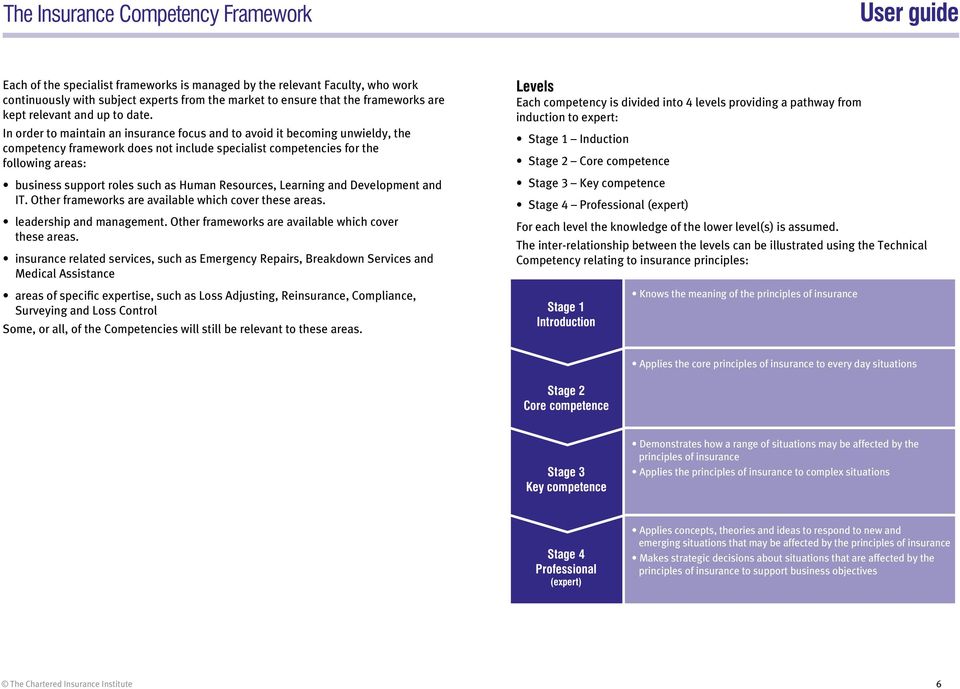
6 User guide Each of the specialist frameworks is managed by the relevant Faculty, who work continuously with subject experts from the market to ensure that the frameworks are kept relevant and up to date. In order to maintain an insurance focus and to avoid it becoming unwieldy, the competency framework does not include specialist competencies for the following areas: business support roles such as Human Resources, Learning and Development and IT. Other frameworks are available which cover these areas. leadership and management. Other frameworks are available which cover these areas. insurance related services, such as Emergency Repairs, Breakdown Services and Medical Assistance areas of specific expertise, such as Loss Adjusting, Reinsurance, Compliance, Surveying and Loss Control Some, or all, of the Competencies will still be relevant to these areas. Levels Each competency is divided into 4 levels providing a pathway from induction to expert: Stage 1 Induction Stage 2 Core competence Stage 3 Key competence Stage 4 Professional (expert) For each level the knowledge of the lower level(s) is assumed. The inter-relationship between the levels can be illustrated using the Technical Competency relating to insurance principles: Stage 1 Introduction Knows the meaning of the principles of insurance Applies the core principles of insurance to every day situations Stage 2 Core competence Stage 3 Key competence Demonstrates how a range of situations may be affected by the principles of insurance Applies the principles of insurance to complex situations Stage 4 Professional (expert) Applies concepts, theories and ideas to respond to new and emerging situations that may be affected by the principles of insurance Makes strategic decisions about situations that are affected by the principles of insurance to support business objectives 6
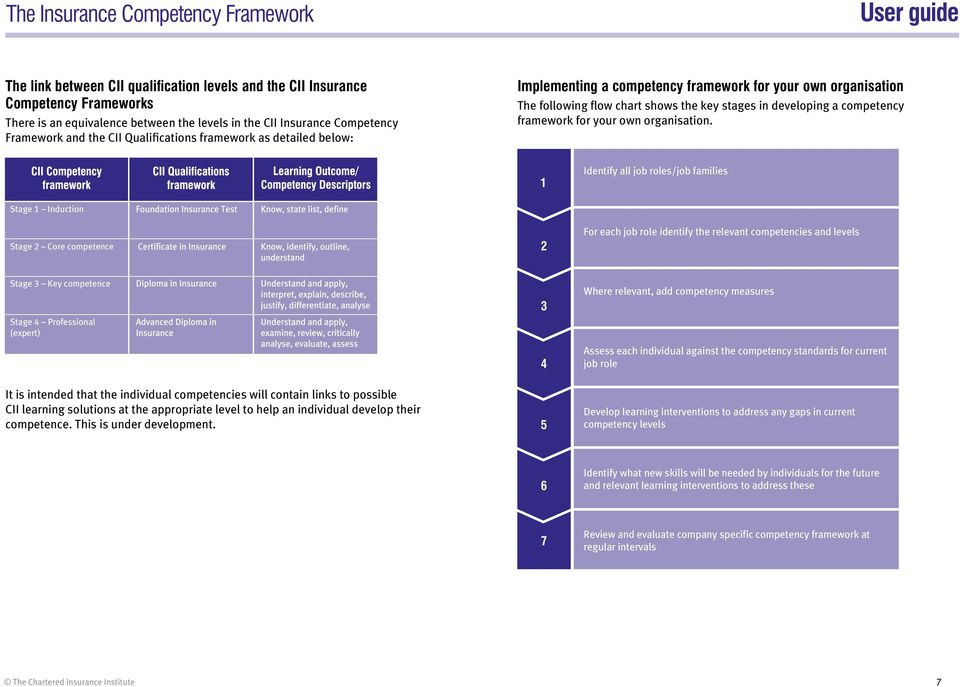
7 User guide The link between CII qualification levels and the CII Insurance Competency Frameworks There is an equivalence between the levels in the CII Insurance Competency Framework and the CII Qualifications framework as detailed below: Implementing a competency framework for your own organisation The following flow chart shows the key stages in developing a competency framework for your own organisation. 1 Identify all job roles/job families Stage 1 Induction Stage 2 Core competence 2 For each job role identify the relevant competencies and levels Stage 3 Key competence Stage 4 Professional (expert) It is intended that the individual competencies will contain links to possible CII learning solutions at the appropriate level to help an individual develop their competence. CII Competency This is under development. CII Qualifications Learning outcome/ framework framework competency descriptors Stage 1 Induction Stage 2 Core competence Foundation Insurance Test Certificate in Insurance Know, state list, define Know, identify, outline, understand Where relevant, add competency measures Assess each individual against the competency standards for current job role Develop learning interventions to address any gaps in current competency levels Identify what new skills will be needed by individuals for the future and relevant learning interventions to address these Stage 3 Key competence Diploma in Insurance Understand and apply, interpret, explain, describe, justify, differentiate, analyse 7 Review and evaluate company specific competency framework at regular intervals Stage 4 Professional (expert) Advanced Diploma in Insurance Understand and apply, examine, review, critically analyse, evaluate, assess 7
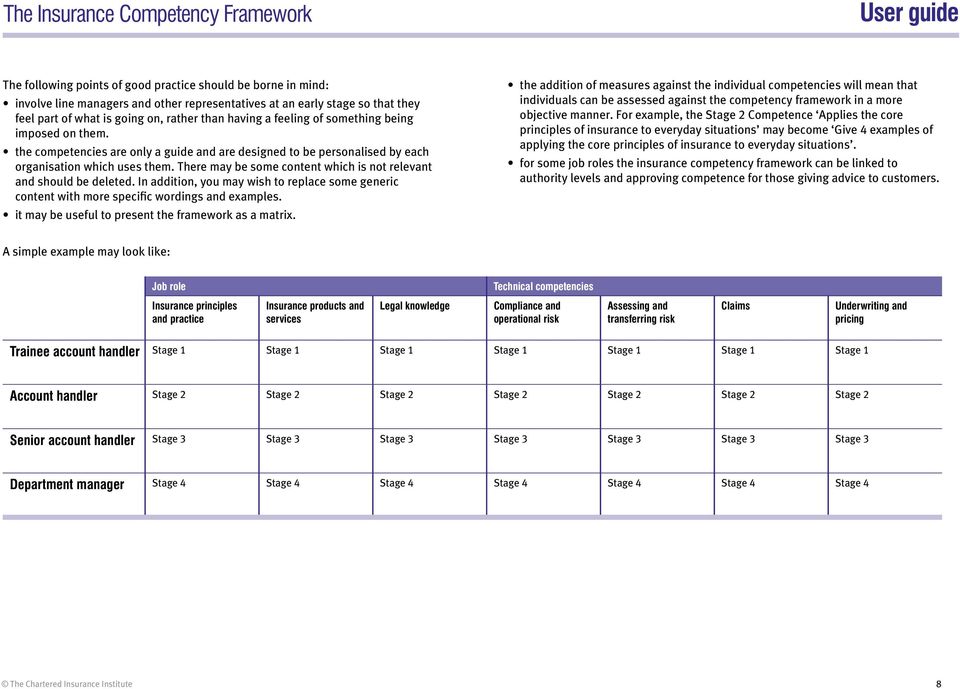
8 User guide The following points of good practice should be borne in mind: involve line managers and other representatives at an early stage so that they feel part of what is going on, rather than having a feeling of something being imposed on them. the competencies are only a guide and are designed to be personalised by each organisation which uses them. There may be some content which is not relevant and should be deleted. In addition, you may wish to replace some generic content with more specific wordings and examples. it may be useful to present the framework as a matrix. the addition of measures against the individual competencies will mean that individuals can be assessed against the competency framework in a more objective manner. For example, the Stage 2 Competence Applies the core principles of insurance to everyday situations may become Give 4 examples of applying the core principles of insurance to everyday situations. for some job roles the insurance competency framework can be linked to authority levels and approving competence for those giving advice to customers. A simple example may look like: Job role Technical competencies Insurance principles and practice Insurance products and services Legal knowledge Compliance and operational risk Assessing and transferring risk Claims Underwriting and pricing Trainee account handler Stage 1 Stage 1 Stage 1 Stage 1 Stage 1 Stage 1 Stage 1 Account handler Stage 2 Stage 2 Stage 2 Stage 2 Stage 2 Stage 2 Stage 2 Senior account handler Stage 3 Stage 3 Stage 3 Stage 3 Stage 3 Stage 3 Stage 3 Department manager Stage 4 Stage 4 Stage 4 Stage 4 Stage 4 Stage 4 Stage 4 8
9 Technical competencies 9

10 Technical competencies 1. Insurance principles and practice This competency is about an individual s knowledge and understanding of the core principles of insurance and how this is applied on a day to day basis. Knows the meaning of the principles of insurance, such as utmost good faith, insurable interest, indemnity, contribution, subrogation and proximate cause Knows the difference between fundamental and particular risks Demonstrates an understanding of homogenous risks and the operation of the insurance pool difference between insurance and assurance. Applies the core principles of insurance to everyday situations (e.g. advising on the scope of policy cover, identifying potential claims and arranging insurance that meets customer needs). Demonstrates an understanding of how a range of situations may be affected by the principles of insurance Applies the principles of insurance to complex situations (e.g. a policyholder s failure to notify relevant information about changes to a risk or a change in a policyholder s circumstances, major events such as extreme adverse weather, earthquake or terrorism). Applies concepts, theories and ideas to respond to new and emerging situations that may be affected by the principles of insurance (e.g. in relation to underwriting of new and emerging risks, environment and society changes, the handling of the impact of natural hazards and epidemics) Makes strategic decisions about situations that are affected by the principles of insurance to support business objectives. 10

11 Technical competencies 2. Insurance products and services This competency is about an individual s knowledge and understanding of the range of insurance products and services available in the market and how that knowledge can be used to meet client needs. The term services refers to non insurance benefits, such as help lines, authorised repairs and suppliers, uninsured loss recovery and risk control advice. These are often, but not always, provided as an add-on to specific types of policies. Knows the cover provided by different types of insurance (e.g. liability insurance, motor and property insurance) Knows the meaning of common policy terms and conditions (such as excesses and exclusions) Knows the features that can affect the underwriting and pricing of insurance products Knows the range of non insurance services which are available. Demonstrates an understanding of standard policy wordings, extensions and limitations Identifies which types of insurance products and services are appropriate to a limited range of contexts/situations (e.g. the purchase of a new home or setting up a business) Knows the reasons for applying specific terms, exclusions, conditions and warranties to a policy. Able to explain why a range of everyday situations would not be covered by a policy (e.g. due to an excluded peril or breach of policy condition by a policyholder) Identifies and resolves dual insurance issues (e.g. the overlap between travel and household insurance) Demonstrates an awareness of competitors comparable products and services and their pricing. Demonstrates an in-depth understanding of both standard and non standard policy wordings, extensions and limitations Analyses and evaluates which insurance products and services could meet complex client needs (e.g. multi and international locations, high risk rated activities or a customer with an adverse claims history) Identifies when to alter policy terms and the impact of doing so (e.g. exclusions or excesses). Evaluates the changes required to insurance products and services in response to changes in consumer expectations, company strategy, legislation, regulations and ethical standards environmental and societal changes; and the impact of improved technology (e.g. the use of smart app phones) Uses specialist knowledge of insurance products and services to meet complex client needs. 11

12 Technical competencies 3. Legal knowledge This competency is about an individual s knowledge and understanding of the different types of law and the potential impact on their role, including: the law of torts contract law the law of agency statute law. Knows which laws can affect insurance practice (e.g., Financial Crime (including Anti- Money Laundering) legislation, Bribery and anti-corruption legislation and, in the UK, the Data Protection Act and Consumer Credit Act) Knows how insurance can meet a specific legal liability (e.g. in the UK compulsory third party motor insurance to meet Road Traffic Act liabilities and compulsory Employers Liability insurance) Able to list the requirements for a valid insurance contract (e.g. offer and acceptance, consideration, legality and capacity) Demonstrates an understanding of what is meant by the law of torts and how legal liabilities arise in the context of insurance (e.g. negligence, nuisance and trespass). Applies knowledge of what is needed for an insurance contract to be legally valid in a range of everyday situations Able to explain the relevance of the Law of Agency to insurance and how this can affect the relationship with a customer difference between civil and criminal law and the associated legal processes, cost implications and appeals procedures difference between litigation against customers and own organisation Able to explain how relevant legislation impacts upon the cover provided (e.g. Health & Safety legislation requirements for Engineering & Liability insurance and the Hotel Proprietors Act). Identifies and assesses potential legal liability for a situation and recognises which specific insurance products will address the potential liability (e.g. public liability, products liability and professional indemnity insurance) Assesses whether organisational processes and procedures and those that follow them are compliant with legal requirements (e.g. Financial Crime legislation and, in the UK, the Data Protection Act and the Equality Act). Analyses the impact of new or changing legislation and legal practice on policy cover, legal liability and insurance practice and procedures (e.g. EU legislation on underwriting and pricing by gender) Makes recommendations to reduce the potential liability of insurers in given situations (e.g. imposing financial limits/terms on policy scope and/ or arranging reinsurance). 12

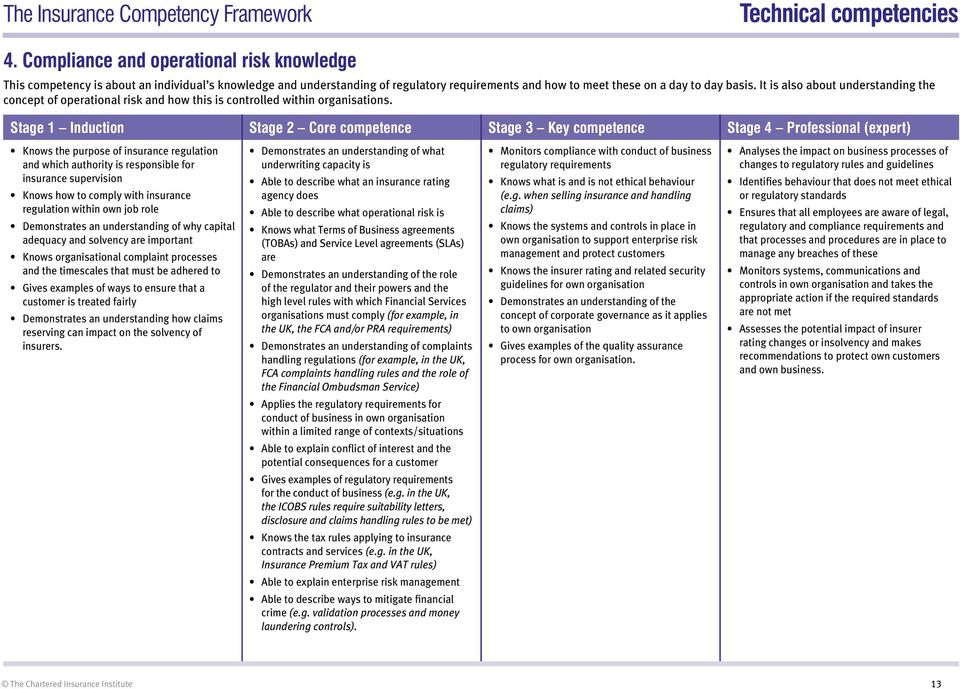
13 Technical competencies 4. Compliance and operational risk knowledge This competency is about an individual s knowledge and understanding of regulatory requirements and how to meet these on a day to day basis. It is also about understanding the concept of operational risk and how this is controlled within organisations. Knows the purpose of insurance regulation and which authority is responsible for insurance supervision Knows how to comply with insurance regulation within own job role Demonstrates an understanding of why capital adequacy and solvency are important Knows organisational complaint processes and the timescales that must be adhered to Gives examples of ways to ensure that a customer is treated fairly Demonstrates an understanding how claims reserving can impact on the solvency of insurers. Demonstrates an understanding of what underwriting capacity is Able to describe what an insurance rating agency does Able to describe what operational risk is Knows what Terms of Business agreements (TOBAs) and Service Level agreements (SLAs) are role of the regulator and their powers and the high level rules with which Financial Services organisations must comply (for example, in the UK, the FCA and/or PRA requirements) Demonstrates an understanding of complaints handling regulations (for example, in the UK, FCA complaints handling rules and the role of the Financial Ombudsman Service) Applies the regulatory requirements for conduct of business in own organisation within a limited range of contexts/situations Able to explain conflict of interest and the potential consequences for a customer Gives examples of regulatory requirements for the conduct of business (e.g. in the UK, the ICOBS rules require suitability letters, disclosure and claims handling rules to be met) Knows the tax rules applying to insurance contracts and services (e.g. in the UK, Insurance Premium Tax and VAT rules) Able to explain enterprise risk management Able to describe ways to mitigate financial crime (e.g. validation processes and money laundering controls). Monitors compliance with conduct of business regulatory requirements Knows what is and is not ethical behaviour (e.g. when selling insurance and handling claims) Knows the systems and controls in place in own organisation to support enterprise risk management and protect customers Knows the insurer rating and related security guidelines for own organisation concept of corporate governance as it applies to own organisation Gives examples of the quality assurance process for own organisation. Analyses the impact on business processes of changes to regulatory rules and guidelines Identifies behaviour that does not meet ethical or regulatory standards Ensures that all employees are aware of legal, regulatory and compliance requirements and that processes and procedures are in place to manage any breaches of these Monitors systems, communications and controls in own organisation and takes the appropriate action if the required standards are not met Assesses the potential impact of insurer rating changes or insolvency and makes recommendations to protect own customers and own business. 13
14 Technical competencies 5. Assessing and transferring risk (only applicable to those whose main role is not underwriting) This competency is relevant to those whose main role is not underwriting (for example, brokers and claims handlers), but who nonetheless may require some knowledge and understanding of how risks are assessed and transferred. There are separate specialist underwriting competencies for those whose main role is underwriting. Knows the core principles of underwriting in relation to the transfer of risk (e.g. the insurance pool, material facts, perils and hazards and the premium) Able to describe the structure and interrelationships of the insurance market in relation to the transfer of risk (e.g. the role of insurers, intermediaries and reinsurers) Demonstrates an understanding of different risk profiles (e.g. higher risk situations and businesses). Able to explain how the core principles of underwriting apply to everyday situations (e.g. able to identify a material fact and explain how this could affect the insurance cover) Able to explain why a particular condition applies to a risk (e.g. why a customer has an exclusion or a higher excess) Able to explain the purpose and types of reinsurance and when they are used (e.g. facultative and treaty) Knows what accumulation risk is and why it is important that an organisation knows what their accumulation risk is role and importance of risk control and risk improvements. Knows how reinsurance and other risk transfer options are arranged and what impact the risk profile, accumulation risk and company authority limits can have on reinsurance arrangements Knows how risks are assessed using calculations such as estimated maximum loss (EML), maximum probable loss (MPL) Able to explain what a captive is and how it is used Knows the ways in which accumulation risk can be managed (e.g. catastrophe cover for hurricane or earthquake). Knows how exposure figures are analysed and the potential implications for an insurer (e.g. across a class of business/territory) Able to explain the importance of monitoring authority limits to ensure a consistent approach Knows how limits of existing risk exposure and modelling techniques are assessed and evaluated Knows how appropriate products and approaches to managing risk exposure are identified (e.g. for individual customers or areas of the business) impact of complex technical scenarios and the effect of specific risk transfer solutions on an insurer (e.g. alternative risk transfer on an account). 14

15 Technical competencies 6. Claims knowledge (only applicable to those whose main role is not claims handling/management) This competency is relevant to those whose main role is not claims handling/management (for example, brokers and underwriters), but who nonetheless may require some knowledge and understanding of how claims are handled and managed. There are separate specialist claims competencies for those whose main role is claims handling/management. Knows the core principles of insurance that apply to claims processing (e.g. proximate cause, indemnity, subrogation, contribution and the application of average) Knows the key information required to process a claim and why this is needed (e.g. date of claim in relation to policy cover dates) Able to describe the stages of the claims process and the roles of the parties involved (e.g. the role of a loss adjuster, claims service providers). Knows how to identify whether a policy is in force and the next steps in processing a claim notification Knows which exclusions and policy conditions are standard and which are non standard on a policy Able to explain the ways that fraud may be committed by customers and knows common fraud indicators Able to explain how the principles of insurance apply to different types of straightforward claims (e.g. indemnity, subrogation and contribution) Knows the reason for claims reserving and the implications of inaccurate reserving (e.g. under or over reserving). Knows how claims are managed based on set parameters and authority levels (e.g. by class of business, type of claim, below a set financial limit) Knows how a claim is assessed to identify if it requires specialist handling and the resultant claims management process (e.g. fraud suspicions, a large loss) Knows how claims reserving techniques are used and how to assess whether a claim reserve is accurate. Knows how the claims notification, investigation and settlement process is managed for a large and/or complex claim Able to explain the importance and purpose of the negotiation and arbitration process in relation to claims management Knows the importance of the claims reserving process being fit for purpose and the potential implications for an insurer (e.g. inaccurate reserving) Able to identify the impact on claims handling following changes to underwriting policy, products or cover and make recommendations to support the business objectives. 15

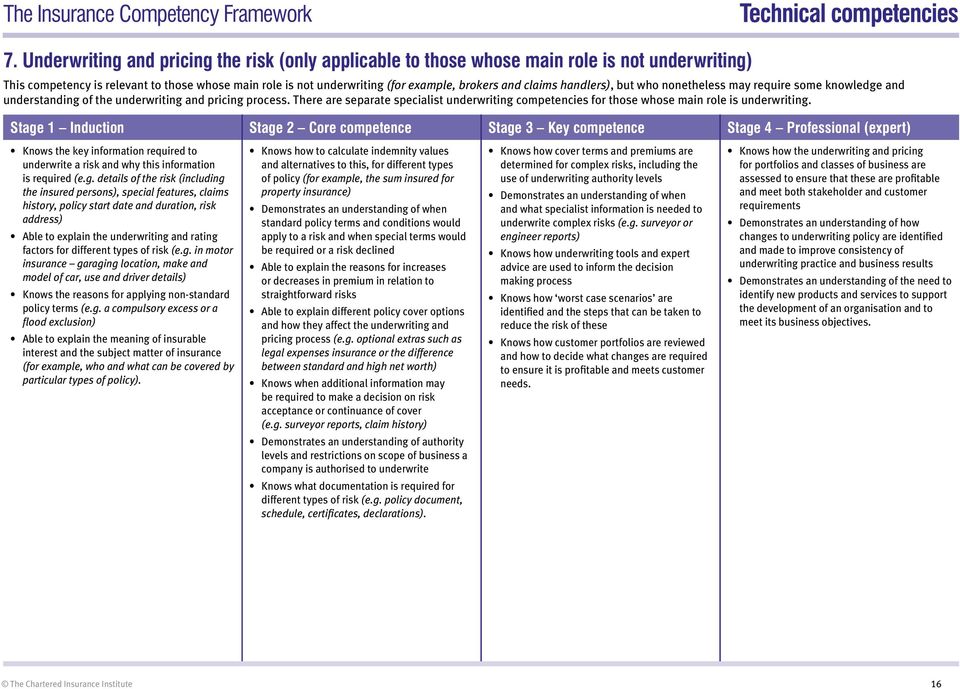
16 Technical competencies 7. Underwriting and pricing the risk (only applicable to those whose main role is not underwriting) This competency is relevant to those whose main role is not underwriting (for example, brokers and claims handlers), but who nonetheless may require some knowledge and understanding of the underwriting and pricing process. There are separate specialist underwriting competencies for those whose main role is underwriting. Knows the key information required to underwrite a risk and why this information is required (e.g. details of the risk (including the insured persons), special features, claims history, policy start date and duration, risk address) Able to explain the underwriting and rating factors for different types of risk (e.g. in motor insurance garaging location, make and model of car, use and driver details) Knows the reasons for applying non-standard policy terms (e.g. a compulsory excess or a flood exclusion) Able to explain the meaning of insurable interest and the subject matter of insurance (for example, who and what can be covered by particular types of policy). Knows how to calculate indemnity values and alternatives to this, for different types of policy (for example, the sum insured for property insurance) Demonstrates an understanding of when standard policy terms and conditions would apply to a risk and when special terms would be required or a risk declined Able to explain the reasons for increases or decreases in premium in relation to straightforward risks Able to explain different policy cover options and how they affect the underwriting and pricing process (e.g. optional extras such as legal expenses insurance or the difference between standard and high net worth) Knows when additional information may be required to make a decision on risk acceptance or continuance of cover (e.g. surveyor reports, claim history) Demonstrates an understanding of authority levels and restrictions on scope of business a company is authorised to underwrite Knows what documentation is required for different types of risk (e.g. policy document, schedule, certificates, declarations). Knows how cover terms and premiums are determined for complex risks, including the use of underwriting authority levels Demonstrates an understanding of when and what specialist information is needed to underwrite complex risks (e.g. surveyor or engineer reports) Knows how underwriting tools and expert advice are used to inform the decision making process Knows how worst case scenarios are identified and the steps that can be taken to reduce the risk of these Knows how customer portfolios are reviewed and how to decide what changes are required to ensure it is profitable and meets customer needs. Knows how the underwriting and pricing for portfolios and classes of business are assessed to ensure that these are profitable and meet both stakeholder and customer requirements Demonstrates an understanding of how changes to underwriting policy are identified and made to improve consistency of underwriting practice and business results need to identify new products and services to support the development of an organisation and to meet its business objectives. 16
17 Business competencies 17
18 Business competencies 1. Company and market knowledge This competency is about an individual s knowledge and understanding of: their own organisation the wider insurance market place and how this is applied on day-to-day basis. Knows the overall structure of the insurance market and the location of the company within this structure Knows the processes, procedures and documentation common to that part of the market, which are relevant to own job role Knows the organisational structure of the company and how this supports its business activities Knows the company business, goals and mission statement Knows the company values and ethos Able to state how own role fits into the overall business operations and how it interacts with other areas of the business Able to list the key factors which can increase or reduce profit for the company company s key business objectives and how own role contributes to these Knows the meaning of Key Performance Indicators and Service Level Agreements Able to identify direct competitors in the market place. Applies knowledge of the market structure and its processes, procedures and documentation within a limited range of contexts/situations company s key business objectives and how own role contributes to these Knows the Key Performance Indicators and/or Service Level Agreements which apply to own role and works in accordance with these Works collaboratively with teams outside own function in order to achieve key business objectives Able to identify the external factors which can affect company results Able to list the company s main competitors and explain why they are competitors Demonstrates an understanding of and can identify media content relating to own organisation that may have a reputational impact and knows the correct escalation route through which to channel information. Applies knowledge of the market structure and its processes, procedures and documentation in a range of complex and/or unfamiliar situations Acts as a role model to others for conducting business in accordance with the company ethos and values and in an ethical manner Differentiates between the company s short, medium and long term business objectives Demonstrates an understanding of own and company performance data and applies this knowledge to contribute positively to achievement of key business objectives Proactively identifies potential threats and opportunities to the business and make appropriate recommendations impact of changes in the insurance market, including regulatory and legislative changes and modifies working practices accordingly Identifies and proposes business process improvements. Anticipates how the business may be affected by external changes (for example, regulatory and legislative changes, economic trends, market developments and social and demographic changes) and reviews business objectives and/or working practices accordingly Demonstrates an understanding of how to manage business ethics and any conflicts that may arise Assesses the impact of competitor strategy on the company s business and market position and uses this knowledge to contribute to organisational strategy Evaluates trends in company performance data and identifies the products and approaches required to achieve key business objectives Sets and monitors Key Performance Indicators and/or Service Level Agreements relevant to achieving key business objectives Represents own sector internally and own organisation externally to develop networks and positively influence the company s position within the market place. 18

19 Business competencies 2. Understanding the customer This competency is about the importance of an individual knowing about and understanding their customers in order to best meet their needs. It recognises that customers can be both within and external to an organisation. Knows the meaning of internal and external customers Knows what a complaint is and when it should be referred Knows the importance of understanding the customer when giving information or advice Knows the importance of positive customer experiences in developing good relationships Able to list the factors affecting the attraction and retention of customers Knows what good customer service looks like Demonstrates an understanding of why customers complain and the impact of complaints on the business Knows the ways in which relationships with customers can be improved and how their expectations can be managed Able to state the importance of customer feedback. issues and concerns which affect both internal and external customers and applies that knowledge to develop and maintain positive customer relationships Gathers information about the customer and uses this effectively to meet their needs need to balance the requirements of both the customer and the organisation and able to apply that knowledge to everyday situations Acts as a role model in providing excellent customer service through understanding the customer factors that can cause conflict with customers and the ways in which conflict can be diffused Gathers customer feedback and communicates this to others impact of own actions on the customer relationship and identifies opportunities to improve the customer relationship. Manages customer expectations effectively need to balance the requirements of both the customer and the organisation and able to apply that knowledge to a range of more complex situations Able to explain how positive and negative customer experiences can impact other areas of the business Analyses customer feedback to decide which should be acted on and uses this to improve relationships with customers Takes action to improve the reliability of customer service based on specific customer feedback Supports colleagues so that they are empowered to resolve customer issues within organisation guidelines. Analyses the customer base to ensure that the products and services offered by the company continue to meet their needs Challenges existing processes and procedures to improve the customer experience Develops and enhances customer relationships at all levels both within the company and with external customers customer service standards and culture of the company and ensures their delivery within own area of responsibility Undertakes a route cause analysis of customer complaints and takes appropriate corrective action to prevent recurrence Pro-actively seek customer feedback using both new and existing tools and follows up on this feedback through the correct channels Analyses and evaluates patterns in customer feedback to identify where customer service and customer loyalty can be improved Diffuses conflict with customers effectively, including situations referred by colleagues. 19

20 Business competencies 3. Communication skills This competency is about an individual understanding the importance of communicating effectively and being able to select and use the most appropriate means of communication from a range of methods and styles. importance of good communication and the negative effects of poor communication Able to list the different methods of communication and when they would be used Knows the principles for communicating effectively verbally, in writing and electronically Knows the importance of exchanging information and resources with colleagues Knows the company standards and procedures for communicating with others. Communicates effectively verbally, in writing and electronically with colleagues and customers using everyday methods of communication (e.g. letters, , the telephone and web chat) Presents information clearly, concisely and accurately in accordance with company standards barriers to good communication and how these can be overcome Identifies and uses the best method of communication in a variety of everyday situations Uses listening and questioning techniques effectively to gather information and to check the other party s understanding Provides clear information to other team members and more senior colleagues as required, to support their communication with others. Uses communication skills in a thorough and effective manner to manage own area of responsibility Determines the essential and desirable content of communications with others (including conflict resolution) Demonstrates an understanding of how non-verbal communication skills can affect business relationships and is able to use these effectively Presents information accurately and effectively using more complex communication methods, such as reports and presentations Conducts effective meetings, maintaining documented records of agreed actions, detailing owners and timescales need to justify decisions to others and to communicate clearly the reasons for these Identifies the target audience for communications and resources Adapts communications and resources to take account of the target audience, including less experienced colleagues. Demonstrates advanced communication skills to enhance the business function Critically reviews documents produced by self and others for accuracy, clarity and content Uses communication skills to make recommendations and to influence company strategy Demonstrates an ability to communicate accurately and effectively both internally and externally at all levels Provides a rationale for business decisions at operational and/or strategic level and to communicate this to others. Delivers formal reporting as required by the business Ensures processes are in place both to gather input from and to disseminate information to employees and to take the action when needed. 20

21 Business competencies 4. Management of information This competency is about how to gather, analyse, manage and store information effectively and securely. Knows how to understand information Knows how to keep accurate and complete records of communications and business transactions in accordance with company procedures significance of gathering sufficient information for the findings of any analysis to be valid importance of and knows how to maintain the confidentiality and security of information Knows how bespoke in house IT systems are used to record and store information. Understands straightforward information and reaches conclusions in a variety of everyday situations Provides data to others at intervals as required by job role and on an ad-hoc basis, to support key decision making processes of more senior colleagues Keeps accurate and complete records of communications and business transactions in accordance with company procedures Keeps information confidential and secure and understands the implications of not doing this Uses bespoke in house IT systems to record and store information accurately and effectively. Establishes and maintains data and information records which are sufficient for own purposes and which meet company, legal and regulatory requirements implications of not keeping accurate and complete records for both the company and its customers Understand both internal and external data and evaluates how to use this effectively within own job role Obtains, interprets and analyses relevant data and reaches conclusions in a range of complex and/or unfamiliar situations Uses both bespoke in house IT systems and common external software to gather, analyse and store information accurately and effectively. Develops and uses appropriate internal and external software packages to obtain and analyse management information Obtains and analyses relevant data to reach conclusions in support of recommendations for change at operational and/or strategic level Uses data analysis to assess the impact of past decisions at operational and/or strategic level Evaluates trends in data and uses data for business reporting and to produce forecasts Critically evaluates analysis of information produced by others Contributes to the development of organisational strategy for file management. 21
22 Business competencies 5. Planning and organising This competency is about the importance of planning and organising and of team working for business requirements, targets and timescales to be met. Knows the importance of planning and prioritising personal workload and diary to meet business requirements, targets and timescales Able to list the tools and techniques which can be used to plan and organise time and work more effectively Knows about the factors that may impact on personal workload Knows how planning and organising own work links to work objectives of the team as a whole. Plans, prioritises and organises own time and work to meet business requirements, targets and timescales Identifies when plans may not be met and to communicate this to those who are affected Provides assistance to colleagues to help to meet business objectives Identifies and obtains the resources and equipment needed to complete personal workload Suggests ideas and innovative solutions improve business efficiency and achievement of business objectives. Effectively and proactively plans, prioritises and organises caseloads in a way which allows for unexpected events and interruptions Makes decisions which take account of and balance the impact on the business, customer expectations, regulatory requirements and commercial considerations Monitors the progress of work against business objectives and revises plans where necessary Delegates tasks effectively in order to meet business objectives Analyses existing ways of planning and organising work to find more efficient ways of working. Provides vision and direction in planning, prioritising and organising work and resources at an operational and/or strategic level Sets individual performance objectives which reflect the skills and experience of individual team members Anticipates and manages the impact of change Anticipates, evaluates and develops plans to deal with unexpected contingencies which may impact on the achievement of business objectives Leads the team successfully through difficulties and challenges to meet business objectives Critically analyses ways of working and makes recommendations for change at an operational and/or strategic level Takes responsibility for the delivery of the timely output of work within area of responsibility, generating a sense of urgency where necessary. 22
23 Business competencies 6. People management This competency is about how individuals manage those who report to them in order to: ensure compliance with company and legal requirements support the development of team members to enhance their contribution to the organisation Knows terms and conditions of employment and rights and responsibilities at work Knows reporting lines in relation to own job role. Explains and demonstrates systems and procedures relating to own job role to others, including new colleagues Accurately communicates and records shift patterns, holiday requests and absences in line with company procedures. Demonstrates an understanding of the difference between leadership and management Effectively manages and supervises those who report to you in line with company policies and procedures, including those who are achieving personal work objectives and those who are under performing Follows human resource policy and processes for issue escalation Shares own knowledge and experience to support others to achieve personal and business objectives Explains and demonstrates systems and procedures relating to own job role to others, including providing mentoring support to less experienced colleagues Monitors the work of others and provides timely and constructive feedback, giving praise where appropriate Coaches colleagues through technical referrals and decisions, and proactively identifies training and development needs Contributes to the development and delivery of training interventions for others. Operates performance management systems and processes effectively Knows where to obtain information and advice to support people management Motivates and inspires others to achieve business objectives through own example and by recognising achievement Uses own expert knowledge to support others to achieve personal and business objectives Uses the skills and experience of individual team members effectively to deliver business objectives at an operational and/or strategic level Evaluates the skills and knowledge of those who report to you to identify training and development needs and to find appropriate solutions Maintains appropriate records of training and development needs, including a documented personal development plan process Develops, implements and monitors appropriate reward and recognition schemes Critically analyses the skills and knowledge required to deliver business objectives in relation to talent management and succession planning and to develop plans to address any gaps Challenges existing policies and procedures for managing people to ensure they continue to meet the operational and/or strategic needs of the business Analyses and understands the reasons behind absence levels and put corrective actions in place Obtains and maintains the resources needed to meet business objectives. 23
24 Business competencies 7. Negotiation and persuasion skills This competency is about the ability to be proactive in negotiation, where this is required within the job role, in order to achieve cost effective solutions to situations. Knows the principles of effective negotiation, if this is required within job role Able to state the information required to make effective decisions. Negotiates in a timely manner to provide cost effective solutions for the company and its customers within a range of everyday situations Negotiates effectively within own authority limits using a range of negotiation styles Anticipates objections and develops effective responses Emphasises positive messages and key benefits Takes a pro-active but pragmatic approach to negotiation Makes sound decisions based on the available information within a range of everyday situations Identifies parameters to work within following a compromise or concession agreement. Demonstrates an understanding of and is able to apply the skills and tactical awareness necessary to achieve effectual negotiations Negotiates in a timely manner to provide cost effective solutions for the company and its customers within a range of more complex and/or unfamiliar situations Uses a range of strategies to achieve desirable outcomes Makes sound decisions based on the available information, own experience and consideration of all possible outcomes within a range of more complex and/or unfamiliar situations. Negotiates and influences effectively at all levels, both internally and externally, to achieve operational and/or strategic objectives Critically analyses and evaluates all available information and possible outcomes when making decisions at operational and/or strategic level impact that negotiation and decision making practice has on company performance Evaluates existing policies and procedures for negotiation and decision making and makes positive contributions to its development and implementation. 24
25 Specialist underwriting competencies (applicable only to those whose main role is underwriting. The technical core competencies cover the roles of those whose main role is not underwriting, but who nonetheless may require some knowledge and understanding of how risks are assessed and priced) 25
26 Specialist underwriting competencies 1. Risk perception and assessment This competency is about knowledge and understanding of the information gathering process, the factors that affect the acceptance and underwriting of risks and how these are applied on a day-to-day basis. Knows why material facts are important in assessing risk. Can give examples particular to own business area Able to explain why the duty of disclosure is important for underwriting, when and to whom it applies Knows why perils and hazards are important in assessing risk. Can give examples to illustrate this Knows own organisation s process for obtaining material facts Knows own organisation s policy for risk classification for own business area Knows own organisation s acceptance and underwriting criteria for own business area Demonstrates an understanding of how to identify risks that do not meet own organisation s underwriting criteria and the options available in relation to these Knows which types of risks are not acceptable and why Able to define common underwriting terminology (eg. risk, underwriting criteria, capacity, risk perception and acceptance). Knows and applies organisational underwriting philosophy Identifies and assesses risks that are considered both standard and non-standard following own organisation s underwriting procedures Acts within own authority levels and follows own organisation s referral process for risks which fall outside these authority limits Identifies any additional information that may be required to make a decision on acceptance or continuance of a risk Able to give examples of external factors that may give rise to a change in underwriting policy (eg. PEST factors, legislation and litigation, pandemics, industry trends) Identifies and assesses the underwriting criteria and risk classification for risks in own business area within a limited range of contexts and situations Knows the benefit of liaison with the claims function and the significance of claims information, including claims reserves, for underwriting concept of exposure and the importance of identifying exposure to both single and accumulation risks (eg. concurrent events, multiple locations and cross sector) significance of risk control and risk improvement for the underwriting of a risk issues that may arise when assessing risks in other territories/states Identifies potential non disclosure or misrepresentation when assessing a risk and makes recommendations for acceptance or declinature. Knows the capacity and scope of business that own organisation/business area is authorised to write and how this links to the overall organisational underwriting strategy and business objectives role of the external specialist in the underwriting process and identifies when they should be appointed Evaluates the risk exposure and determines the acceptance criteria and risk classifications for risks in a range of complex or unfamiliar situations Uses specialist reports, statistical reports and underwriting tools to make underwriting decisions in range of complex and/or unfamiliar situations Identifies worst case scenarios and steps that can be taken to minimise the risk for own organisation and the customer Utilises policy terms and conditions when determining underwriting criteria to minimise risk to the organisation in own business area Determines whether reinsurance is required for a risk to be acceptable and checks that this is available in accordance with organisation guidelines Knows what a realistic disaster scenario is and can explain how actuarial modelling can assist in underwriting and pricing risks. Analyses options available and makes appropriate and effective underwriting decisions with reference to the law, regulations and other relevant factors Assesses and evaluates the potential impact on own business area of unexpected contingencies and ensures that the underwriting strategy takes account of these in order to minimise the impact on the business Analyses data on aggregation exposures and identifies action necessary to minimise any adverse impact on the underwriting account for own business area Identifies capacity options and makes recommendations for each business class to enhance capacity available for risks in own business area Manages and monitors acceptance and underwriting authority levels for own area of the business Participates in reinsurance treaty negotiation and treaty management on behalf of own business area. 26
27 Specialist underwriting competencies 2. Pricing the risk This competence is about knowledge and understanding of the factors that affect the pricing of risks and the ability to apply these on a day-to-day basis Knows how a premium is calculated for classes of business being underwritten (eg. by applying a premium rate to a premium base, flat premiums or based on burning costs) Knows why different rates are applied to different types of risks Knows the factors that can affect the premium rate for an individual risk significance of the claims loss ratio for the pricing of a risk Able to describe the role of the actuary in underwriting pricing reasons for premium loadings and discounts and the reasons for these for own area of work. Identifies data sources which can be used for pricing decisions Knows the factors that can affect pricing (eg. intermediary remuneration, investment income, tax, return on capital, planned profitability) and can explain why these impact on pricing strategy Prices risks correctly within own authority limit following organisational policies and procedures in a limited range of contexts and situations Knows the implications for own organisation s business objectives, including profit margins, if risks are inaccurately priced Knows what measures of profitability are used within own business area. different statistical methods and risk premium models that can be used to establish the risk price Prices risks correctly within own authority limit following organisational policies and procedures for a range of complex risks potential impact of pricing discounts, incentives and elasticity of supply and demand on portfolios of business/own business area market factors that can affect pricing for own business area (eg. distribution channels, competition, organisation s growth/ profit strategy, regulation, reinsurance costs and branding) Knows the implications of capital and solvency requirements for the pricing of risk Identifies the impact of rating changes on own class of business and suggests ways to mitigate any adverse impact on the business. Evaluates the potential impact on underwriting income and profitability of changes in pricing factors for own area of business potential impact of retrospective rating on the business Works with actuaries and stakeholders to ensure an accurate pricing policy which links to business objectives for own area of business Evaluates and adapts pricing strategy in response to changes in the market cycle and other external factors Inputs into cross product growth, pricing of new products and profitability strategies. 27
28 Specialist underwriting competencies 3. Underwriting process This competency is about the knowledge and understanding of the organisation s underwriting processes and procedures which is needed for new risks, alterations, renewals and/or cancellations to be processed in an accurate and timely manner. Knows the organisational policies and procedures for the issue of quotations and what information must be provided for own business area Knows the key pieces of information needed to process a new application, renewal, cancellation and/or an alteration to an existing risk for the class of business being underwritten Identifies and obtains any further information which is required Knows the organisational policies and procedures for processing a new application, renewal, cancellation and/or an alteration to an existing risk for the class of business being underwritten Knows own organisation s procedures for the referral of risks to stakeholders Demonstrates an understanding of how binders and delegated authority schemes can affect the underwriting process within own business area Knows the scope of cover, including policy extensions, limitations and exclusions for the class of business being underwritten Knows what documents must be issued for the classes of business being underwritten (eg. cover notes, policies and certificates) Knows the organisational policies and procedures for the issue of documentation Knows the significance of the premium payment and the ways in which premiums can be paid Knows own authority limits and own organisation s referral process. Provides complete and accurate quotations for straightforward risks Identifies and assesses the information provided in relation to the processing of new and existing risks in a limited range of contexts or situations Identifies and obtains any missing information Follows own organisation s guidelines for referral of risks to stakeholders Follows organisational policies and procedures for the processing of new and existing risks in a limited range of contexts or situations Identifies, investigates and resolves any issues that arise Processes risks in line with authority limits and adheres to organisational referral procedures Knows the organisational processes and procedures for discouraging, detecting and handling actual or potentially fraudulent situations significance of law and jurisdiction for the classes of business being underwritten Knows the policyholder s rights for the class of business being processed significance of fully defining insurance contract terms (eg. insured, sum insured and limit of indemnity) Knows the structure of an insurance policy and policy schedule Arranges for the issue of accurate documentation in a timely manner for the classes of business being underwritten, incorporating any relevant extensions and/or limitations to cover Identifies special requirements for class of business being handled and process these according to organisation s own guidelines. Processes complex risks within own authority limits and in accordance with organisational policies and procedures Demonstrates an understanding of how legislation and regulations impact on the processing of new and existing risks and the issue of associated documentation (eg. in the UK, Consumer Protection Act and Unfair Contract Terms Act) Monitors the operation of delegated authority agreements, binding authorities and/or scheme arrangements to ensure that organisational underwriting procedures and policy wordings are being followed Demonstrates a detailed understanding of complex policy wordings, extensions and/or limitations and their interpretation and application Applies variations in policy wordings, terms and conditions applicable to complex risks and can explain the significance of these Assesses the reinsurance requirements for the classes of business being processed and complies with reinsurance notification and settlement procedures Analyses monitoring data in relation to own class of business and suggests improvements to the processing of new and/or existing risks for own business area. Determines and reviews the policies and procedures for the processing of new and existing risks in own area of business in line with own organisation s strategy Identifies underwriting process improvements and implements these in line with organisational strategy and market agreements Manages reinsurance facilities in accordance with organisation policy, settlement procedures and international/local agreements Monitors and reviews the company referral process in relation to the processing of new and existing risks. 28
29 Specialist underwriting competencies 4. Underwriting management This competency is about knowledge and understanding of the factors that affect the performance of an underwriting portfolio and how risk exposure can be monitored and controlled. Knows the basic features of add on services (eg. helplines, authorised repairers and uninsured recovery services) Knows the meaning of relevant terms, such as underwriting cycle, underwriting portfolio market cycle reinsurance cycle and what impact these can have on a portfolio of business role of reinsurance and when it is used Knows the meaning of risk accumulation and aggregation and the impact these can have on a portfolio of business. Knows when binding authorities and line slips are used for own area of business and the potential benefits and risks associated with these significance of reserving policy for the underwriting of a portfolio of business Knows the benefits of add on services for the customer and the organisation and how they can affect the performance of an underwriting portfolio Demonstrates an awareness of the data that indicates how an underwriting portfolio is performing for own area of business Demonstrates an understanding of what an organisation can do to support spread of risk Knows the importance of underwriting authority limits and how they can be used to manage an underwriting portfolio. Knows organisational policies and procedures for carrying out audits and participates in these in relation to own area of business Knows the data and methods used to monitor underwriting performance for own class of business Identifies trends in claims costs and their potential impact on underwriting performance for own class of business types of allowances and adjustments to underwriting income made when assessing performance (eg. pipeline premiums and IBNR (incurred but not reported) claims) Knows how the types of reinsurance used for own class of business can be used to protect the underwriting portfolio Knows the significance of brand profile, marketing and distribution for developing portfolios of business Demonstrates a clear understanding of the internal factors that can affect underwriting capability (eg. resource, specialist knowledge and data systems) Knows the impact of product mix on portfolio underwriting Manages suppliers and monitors service level agreements to ensure organisational standards are met. Ensures authority limits and underwriting controls are used effectively to manage exposure for own business area Monitors and manages the maintenance and growth of a balanced portfolio for own business area Assesses, through monitoring and evaluation, whether underwriting standards are being met and make recommendations for improvement Recommends measures to reduce the impact of the market/underwriting cycle on own business area Monitors and manages delegated authority and scheme relationships to protect the risk portfolio and control risk exposures Evaluates outsourcing and identifies any changes required to protect the risk portfolio and control risk exposures Analyses underwriting management data and identifies and takes action in relation to potential issues (eg. by liaising with stakeholders such as actuaries, intermediaries and claims services). 29
30 Specialist intermediary competencies (applicable to those who work for any type of intermediary) 30
31 User guide 1. The role and responsibilities of intermediaries This competency is about knowledge and understanding of the role and responsibilities of the intermediary in relation to both their client and product providers. role of an intermediary in meeting client needs different types of intermediary and the service they provide Able to describe the distribution channels used by customers to buy insurance for classes of business being handled and how this relates to own organisation Knows the purpose and content of Terms of Business and Service Level Agreements used by own organisation and how these meet regulatory requirements Knows the difference between giving advice and giving information Knows own organisation s guidelines for giving information or advice to customers Able to describe the intermediary s duties when acting as an agent of the customer Able to describe the intermediary s duties when acting as an agent of the product provider Knows the different ways in which intermediaries are remunerated. Identifies the different types of intermediary services available in own market and knows how their product and service offering differs from own organisation offering Knows the responsibilities that an intermediary has when selecting a product provider Knows the issues which should be taken into account when selecting product providers for straightforward risks and follows organisational policies and procedures in relation to these Able to describe the different stages of the insurance service and sales process Knows the different ways in which intermediaries are remunerated. Knows the potential conflicts of interest for different types of intermediary remuneration (eg. commission, fees, bonuses, profit share agreements) Able to describe the role and responsibilities of the intermediary at each stage of the annual client service cycle Knows the issues which should be taken into account when selecting product providers to place business for complex risks and follows organisational policies and procedures in relation to these Knows the role of the intermediary in the event of insurer failure or an insurer discontinuing a line of business and follows organisational procedures in relation to this Knows the role of the insurance intermediary in the risk management process. Analyses product provider results and ratings in order to make recommendations that are mutually beneficial for clients and own organisation Identifies and anticipates changes to product ranges and market requirements and recommends appropriate action requirements for insurance broking accounts and the need for segregation and identification of client money Evaluates the role of service level agreements in providing client satisfaction Monitors actions taken by own organisation in the event of an insurer failure or an insurer discontinuing a line of business to ensure client needs continue to be met Makes recommendations for the annual client service cycle, including what it should contain and what is considered best practice Evaluates the advantages and disadvantages of electronic trading and utilises this to the best advantage of own area of business Evaluates the different forms of intermediary remuneration and when these should be used within own area of business. 31
32 User guide 2. Negotiation and placement of risks This competency is about the knowledge and understanding of the information needed to place risks and how these are applied on a day to day basis. Knows the importance of the intermediary assessing the needs of a client Able to identify customer requirements and to identify which products from own organisation s offering could support the customer Knows the organisational policies and procedures for the issue of quotations and what information is needed by product providers for own business area Knows the possible consequences of not giving customers accurate and up to date information Able to describe own role and how this can support customer demands and needs Demonstrates an understanding of how the services provided by own organisation can fulfil the customer requirement Knows the scope of cover, including policy extensions, limitations and exclusions for the classes of business being handled Knows the organisational policies and procedures for the placement of risks and confirmation of cover to clients. Obtains the customer information needed by product providers to provide insurance quotations to meet customer needs for straightforward new and/or existing risks Evaluates information provided by customers to identify own organisation products and services which best meet both the real and perceived needs of customers Provides quotations for straightforward risks, communicating the key features, benefits, limitations and exclusions of products to customers Follows organisational policies and procedures and works within own authority limits to place insurance cover to meet customer requirements in a limited range of contexts or situations Follows own organisation s procedures for the referral of risks to stakeholders Identifies the action required and responds within organisation guidelines to customer requests for changes to their insurance arrangements for straightforward risks Knows the impact of different policy wordings, terms and conditions on the customer s scope of cover Demonstrates an understanding of how binders and delegated authority schemes can be used to place risks within own business area. Able to analyse customer situations with complex demands and needs and identify product and service solutions to meet their needs Prepares accurate and complete market presentations to obtain quotations for complex risks Interprets customer claims history, identifies trends and patterns and makes recommendations to product providers to control the risk presented Optimises solutions for customers through knowledge of product ranges, product providers, market requirements and client needs Provides accurate and complete information to customers regarding proposed insurance arrangements for complex risks, identifying the potential advantages and disadvantages for the customer Explains to the customer any policy terms and conditions (eg. policy conditions and warranties, risk improvements requirements and co-insurance clauses) Knows the importance and implications of surveys in the negotiation and placement of risks Identifies premium savings for customers through risk management options and/or changes to policy cover, terms and conditions Follows organisational policies and procedures and works within own authority limits to place insurance cover to meet customer requirements for complex risks Monitors the operation of delegated authority agreements, binding authorities and or scheme arrangements to ensure that prescribed procedures are being followed. Provides comprehensive guidance to customers who have complex requirements, including risk transfer and risk mitigation options Understands the process of programme design and its importance in meeting complex client needs (eg. global insurance programmes and captives) Designs insurance programmes to meet client requirements Assesses customers future needs and service requirements within own area of business and proactively responds to these Analyses options available for customer portfolios and confidently makes recommendations, in accordance with legal and regulatory requirements and organisational policy, to the benefit of the customer Identifies instances and the causes of errors and omissions and takes action to prevent a recurrence of these. 32
33 User guide 3. Intermediary operations This competency is about the knowledge and understanding of the organisations processes and procedures which is needed for new risks, alterations and/or cancellations to be processed in an accurate and timely manner. Knows the key pieces of information needed to process a new application, renewal, cancellation and/or alteration to an existing risk for own area of the business Identifies any further information which is required Knows the organisational policies and procedures for processing a new application, renewal, cancellation and/or an alteration to an existing risk for own area of the business Knows what information and documents must be issued for the classes of business being handled (eg. cover notes, policies and certificates) role of the intermediary in the issue of policy wordings Knows the organisational policies and procedures (including timescales) for the issue of documentation Knows the significance of the premium payment and the different premium payment options available to customers Knows own authority limits and own organisation s referral process. Identifies and assesses the information provided in relation to the processing of new and existing risks in a limited range of contexts or situations Identifies and obtains any missing information Follows own organisation s guidelines for referral of risks to stakeholders Follows organisational policies and procedures for the processing of new and existing risks in a limited range of contexts or situations Identifies, investigates and resolves any issues that arise Processes risks in line with authority limits and adheres to organisational referral procedures Processes premium payment correctly term contract certainty and the significance of this for intermediaries Ensures policy and other required documentation (eg. confirmation of cover, risk registers and key facts documents) are issued to customers in an accurate and timely manner for straightforward risks Knows how binders and delegated authority schemes operate and follows the operational rules and requirements in relation to these. Processes complex risks within own authority limits and in accordance with organisational policies and procedures Demonstrates a detailed understanding of complex policy wordings, extensions and/or limitations and their interpretation and application can explain the significance of these Identifies the key considerations to be addressed in the negotiation and drafting of policy wordings Ensures policy and other required documentation (eg. confirmation of cover, risk registers and key facts documents) are issued to customers in an accurate and timely manner for complex risks Analyses monitoring data in relation to own class of business and suggests improvements to the processing of new and/or existing risks for own business area Monitors the operation of delegated authority agreements, binding authorities and/or scheme arrangements to ensure that prescribed procedures are being followed Evaluates and reviews the performance of a customer portfolio and makes appropriate recommendations. Determines and reviews the policies and procedures for the processing of new and existing risks in own area of business in line with own organisation s strategy Identifies process improvements and implements these in line with organisational strategy and market agreements Monitors and reviews the company referral process in relation to the processing of new and existing risks Acts as a referral point for potential operational issues within own organisation. 33
34 User guide 4. Claims handling This competency is about the knowledge and understanding of the processes and procedures for processing claims by an intermediary and the application of this knowledge on a day-to-day basis. Knows the key pieces of information required when a claim is first notified for the classes of business being handled and the reasons for these Knows the policyholder s duties when notifying a claim Lists the requirements for a valid claim Identifies whether further information is required Demonstrates an understanding of how to identify claims that are not covered and the process for advising the claimant Knows own organisation s processes and procedures for processing claims specialists who may be involved in the claims process Knows own organisation s guidelines for referral of claims to stakeholders Demonstrates an understanding of how the handling of third party claims differs from the management of first party claims. Obtains the key information needed to notify straightforward claims to product providers for own area of business Resolves gaps in the key information provided for the class of business being handled Handles straightforward claims in line with organisational policies and procedures and own authority limits and adheres to organisational referral procedures Follows own organisation s guidelines for referral of claims to stakeholders Provides policyholders with regular updates on the progress of their claims Identifies, investigates and resolves any issues relating to claims being handled in line with organisational policies and procedures Follows organisational policies and procedures where specialists are involved in investigating a claim Advises clients when straightforward claims are settled and issues settlement cheques when appropriate Demonstrates an understanding of mechanisms available for resolving claims settlement disputes (eg. arbitration and mediation) and when these are used Demonstrates an understanding of how claims are handled under binders and delegated authority schemes. Assesses both the customer and product provider requirements in relation to complex claims and supports the progress of claims to the mutual benefit of all stakeholders Handles complex claims in line with authority limits and adheres to organisational referral procedures Demonstrates an understanding of how different policy wordings impact on the claims handling process Interprets policy wordings and conditions to determine the validity of complex claims and advises the claimant accordingly Knows the decisions to be made at different stages in the life of a claim and their potential impact for the class of business being handled Identifies, investigates and resolves any issues relating to complex claims in line with organisational policies and procedures Negotiates the settlement of complex claims to the client s best advantage Advises clients when complex claims are settled and issues settlement cheques when appropriate Identifies and advises the client of the prescribed or most appropriate mechanism for resolving claims settlement disputes Monitors the operation of delegated authority agreements, binding authorities and/or scheme arrangements to ensure that prescribed claims handling procedures are being followed. Determines and reviews the process for handling claims for own area of business in line with own organisation s strategy Identifies claims handling process improvements and implements these in line with organisational strategy and market agreements Manages complex claims in accordance with organisational policies and procedures Analyses the options available for handling complex claims and makes appropriate and effective claims handling decisions with reference to the law, regulations and other relevant factors Manages and monitors the claims referral process for own area of business Acts as a subject matter expert on claims handling within own organisation. 34
35 Specialist claims competencies (applicable only to those whose main role is claims handling/management. The technical core competencies cover the roles of those whose main role is not claims handling/management, but who nonetheless may require some knowledge and understanding of the claims process. These competencies are suitable for those who work for an insurer or another organisation with delegated authority to handle claims on behalf of an insurer. The specialist intermediary competencies cover those who handle and manage claims on behalf of an intermediary) 35
36 Specialist claims competencies 1. Claims notification and investigation This competency is about the knowledge and understanding of the claims notification process, how claims are validated and investigated and the application of this knowledge on a day to day basis. Knows the key pieces of information required when a claim is first notified for the classes of business being handled and the reasons for these Knows the policyholder s duties when notifying a claim Lists the requirements for a valid claim Identifies whether further information is required Demonstrates an understanding of how to identify claims that are not covered and the process for notifying the claimant Demonstrates an understanding of general market claims handling process and how own organisation s procedures differ Knows own organisation s processes and procedures for investigating claims and the specialists who may be involved in this process Knows own organisation s guidelines for referral of claims to stakeholders (eg. early identification of large losses for underwriters and coinsurers) Demonstrates an understanding of how the handling of third party claims differs from the management of first party claims. Obtains the key information needed to notify straightforward claims for own area of business Knows how claims notification information is used in the claims handling process for own area of business Identifies and resolves gaps in the key information provided for the class of business being handled Identifies potential non disclosures and misrepresentation and follows organisational procedures to deal with these situations Handles straightforward claims in line with authority limits and adheres to organisational referral procedures Knows and applies own organisation s reserving philosophy to claims being handled Follows own organisation s guidelines for referral of claims to stakeholders (eg. early identification of large losses for underwriters and coinsurers) Identifies, investigates and resolves any issues relating to claims being handled in line with organisational policies and procedures Identifies when a specialist is needed to investigate a claim and follows organisational policies and procedures for appointing these. Handles complex claims in line with authority limits and adheres to organisational referral procedures Assesses the deficiencies in the claims data collected and identifies how to ensure an efficient handling process when the information cannot be obtained Identifies potential non disclosure or misrepresentation and applies the relevant legal principles in the investigation of them different stages during the life of any claim Knows the decisions to be made at different stages in the life of a claim and their potential impact on the claim for the class of business being handled Identifies, investigates and resolves any issues relating to complex claims in line with organisational policies and procedures Knows the factors which make up claims reserves for complex first party and third party claims and sets reserves appropriately and accurately Demonstrates an understanding of how different policy wordings impact on the claims reserving process Handles policyholder litigation and breach of contract situations Interprets policy wordings and conditions to determine the validity of complex claims importance of contract certainty and how it impacts the claims process Identifies where reinsurance is in force for particular claims and complies with reinsurance notification procedures. Determines and reviews the process for notifying and investigating claims for own area of business in line with own organisation s strategy Identifies claims handling process improvements and implements these in line with organisational strategy and market agreements Manages complex claims in accordance with organisational policies and procedures Analyses the options available for handling complex claims and makes appropriate and effective claims handling decisions with reference to the law, regulations and other relevant factors Manages and monitors the claims referral process for own area of business Acts as a subject matter expert on claims handling within own organisation Identifies issues in relation to particular claims or overall trends and escalates in line with organisational policies and procedures Manages reinsurance facilities in relation to the claims notification and investigation process. 36
37 Specialist claims competencies 2. Claims settlement This competency is about the knowledge and understanding needed to agree quantum and settle claims, identifying any opportunities for recoveries and its application on a day-to-day basis. Knows the information needed to make a claims settlement decision and who can make this decision within own organisation for the class of business handled Knows the meaning of the common claims settlement terminology (eg. assessment of quantum, salvage, recovery and average) claims settlement process importance of maintaining accurate and up to date claims reserves Knows own organisation s procedures for settling claims options for the claimants who are not satisfied with their claims handling experience Knows the options available for settling claims and when they are used significance of proximate cause in claims settlement decisions Knows how excesses, deductibles and franchises operate in relation to the claims settlement process. Identifies the most appropriate method of settling claims in line with organisational policies and procedures within own area of business Settles straightforward claims in line with authority limits and adheres to organisational referral procedures Creates and reviews reserves in line with market and organisational reserving policy Identifies the legal principles that may affect the claims settlement decision and takes the appropriate action (eg. contribution, subrogation and proximate cause) Knows and follows the market agreements that affect claims settlement Demonstrates an understanding of mechanisms available for resolving claims settlement disputes (eg. arbitration and mediation) and when these are used Notifies stakeholders of claims settlement decisions. Settles complex claims in line with authority limits and adheres to organisational referral procedures Able to negotiate and agree settlement at no more than maximum identified figure need for market claims handling agreements and liaison with other agreement parties and follows organisational guidelines relating to these Evaluates the factors that make up claims reserves, including expert fees and ensures accurate reserves are maintained Evaluates the options available to pursue subrogation and recovery rights and takes action accordingly Identifies and utilises the prescribed or most appropriate mechanism for resolving claims settlement disputes Identifies where reinsurance is in force for particular claims and complies with reinsurance settlement procedures. Manages the settlement of complex claims in accordance with organisational policies and procedures Determines and reviews the process for settling claims for own area of business in line with own organisation s strategy Identifies claims settlement process improvements and implements these in line with organisational strategy and market agreements Analyses the options available for settling complex claims and makes appropriate and effective claims handling decisions with reference to the law, regulations and other relevant factors Evaluates and applies international claims settlement requirements and agreements to the claims settlement process Develops approaches and procedures to ensure successful claims recoveries Evaluates claims settlement figures and makes recommendations on the organisation s reserving philosophy to ensure that it remains accurate and appropriate Acts as a subject matter expert on claims settlement within own organisation Manages reinsurance facilities in relation to the claims settlement process. 37
38 Specialist claims competencies 3. Claims management This competency is about being able to manage the handling of individual and portfolios of claims cost effectively, minimising claims leakage, and meeting organisational and customer claims service standards. Knows the various types of dispute resolution process that exist Demonstrates an understanding of what is meant by claims leakage and the different ways in which it can occur Knows own organisation s claims service management principles and procedures Knows own organisation s complaints handling process and complaints referral procedure Able to list external suppliers who may be involved in the claims management process and to describe their role (eg. disaster recovery firms, solicitors, loss adjusters and surveyors) Able to define fraud and to list the main indicators including any particular to the classes of business being handled. Knows the organisational processes and procedures for discouraging, detecting and handling actual or potentially fraudulent claims Knows organisational procedures for the appointment of experts/suppliers. Manages the claims handling process for straightforward claims within own authority limits to achieve timely settlement and minimise leakage Selects and appoints external experts following own organisation s procedures and authority levels Demonstrates an understanding of relevant protocols, market agreements and regulatory requirements that impact on the way claims are managed own area of business Identifies any claims which are potentially fraudulent and follows organisational procedures for dealing with these Meets customer claims service standards customers Works within the parameters of any service standards or service level agreements with other claims management service organisations (eg. outsourcers and third party administrators) Identifies and manages potential conflicts of interest in line with organisational policies and procedures. Manages the claims handling process for complex claims within own authority limits to achieve timely settlement and minimise leakage Analyses specialist expert reports and make effective claims management decisions based on these Identifies and makes recommendations for improvements to the efficiency of the claims management process within own area of business Identifies and monitors claims leakage in own area of business and makes recommendations for improvement. Assesses and implements improvements in the claims handling process to control fraud and other forms of claims leakage Evaluates market and competitor initiatives and action in relation to claims issues relevant to own area of business and makes changes to organisational working practices accordingly (eg. control of fraud and non disclosure) Manages external suppliers and panel member relationships to ensure that they meet organisational requirements Evaluates outsourcing and delegated authority arrangements and identifies any changes required Analyses claims management data, identifies potential issues and liaises with stakeholders to address these issues Assesses, through monitoring and evaluation, whether customer claims service standards are being met and makes recommendations for improvement Makes recommendations in relation to own organisation s cost control strategy for claims management Knows and can implement the organisation s catastrophe management strategy Implements quality assurance checks and audits, providing feedback from them and acting on the results Identifies and highlights claims which may attract adverse publicity or set legal precedents and escalates these in accordance with organisational procedures. 38
39 2013 THE CHARTERED INSURANCE INSTITUTE, CII and the CII logo are registered trade marks of The Chartered Insurance Institute. Ref: CII ICF001 December 2013 C13J_8582
Attribute 1: COMMUNICATION
 The positive are intended for use as a guide only and are not exhaustive. Not ALL will be applicable to ALL roles within a grade and in some cases may be appropriate to a Attribute 1: COMMUNICATION Level
National Occupational Standards. Compliance
 National Occupational Standards Compliance NOTES ABOUT NATIONAL OCCUPATIONAL STANDARDS What are National Occupational Standards, and why should you use them? National Occupational Standards (NOS) are statements
D 1. Working with people Develop productive working relationships with colleagues. Unit Summary. effective performance.
 1 Develop productive working relationships with colleagues Unit Summary What is the unit about? This unit is about developing working relationships with colleagues, within your own organisation and within
Customer Service. Level 3 Diploma in Customer Service (QCF) 2014 Skills CFA Level 3 Diploma in Customer Service (QCF) Page 1
 Customer Service Level 3 Diploma in Customer Service (QCF) 2014 Level 3 Diploma in Customer Service (QCF) Page 1 Level 3 Diploma in Customer Service (combined qualification) Qualification Title Credit
Middlesbrough Manager Competency Framework. Behaviours Business Skills Middlesbrough Manager
 Middlesbrough Manager Competency Framework + = Behaviours Business Skills Middlesbrough Manager Middlesbrough Manager Competency Framework Background Middlesbrough Council is going through significant
IPDS. Green Book Employees. An Integrated Performance Management, Pay and Grading System. Technical 2. Making West Midlands Safer. www.wmfs.
 An Integrated Performance Management, Pay and Grading System Technical 2 Making West Midlands Safer Prevention Protection Response www.wmfs.net Role Profile Role Title Technical 2 Role Ref T2 Overall Purpose
Introduction to Insurance. Foundations of General Insurance. Regulation and Compliance. Personal Lines. Commercial Lines. Specialisms.
 Guide to Content I F R P C S W Introduction to Insurance Foundations of General Insurance Regulation and Compliance Personal Lines Commercial Lines Specialisms The Workplace Assess is a web based system,
DGI04 Liability Insurance Underwriting
 DGI04 Liability Insurance Underwriting Module Description: This module aims to provide the candidate with the knowledge and skills in commercial liability insurance operations. It deals with the legal
UIBL TOBA. United Insurance Brokers Ltd. Terms of Business Agreement
 TOBA United Insurance Brokers Ltd Terms of Business Agreement 1. Introduction and business service United Insurance Brokers Ltd () is an independent international insurance and reinsurance (1) Lloyd s
Business Administration. Level 3 Diploma in Business Administration (QCF) 2014 Skills CFA Level 3 Diploma in Business Administration (QCF) Page 1
 Business Administration Level 3 Diploma in Business Administration (QCF) 2014 Level 3 Diploma in Business Administration (QCF) Page 1 Level 3 Diploma in Business Administration (combined qualification)
Relationship Manager (Banking) Assessment Plan
 1. Introduction and Overview Relationship Manager (Banking) Assessment Plan The Relationship Manager (Banking) is an apprenticeship that takes 3-4 years to complete and is at a Level 6. It forms a key
Care Providers Protecting your organisation, supporting its success. Risk Management Insurance Employee Benefits Investment Management
 Care Providers Protecting your organisation, supporting its success Risk Management Insurance Employee Benefits Investment Management Care providers are there to help those in need. But who helps the care
Purpose of this Assessor Guide 3 Units in this Assessor Guide 3 Instructions to Assessor 3 Safety 3 Australian Qualifications Framework 4
 BSB07: Business Services Training Package Table of Contents Purpose of this 3 Units in this 3 Instructions to Assessor 3 Safety 3 Australian Qualifications Framework 4 Employability Skills 5 Mapping of
Sub-section Content. 1 Formalities - Post title: Risk Consultant - Reports to: Head of Group Risk - Division: xxx - Location: xxx
 Sub-section Content 1 Formalities - Post title: Risk Consultant - Reports to: Head of Group Risk - Division: xxx - Location: xxx 2 Job Purpose - To support the implementation of an Enterprise Risk Management
CareNZ Job Description GENERAL MANAGER HUMAN RESOURCES
 CareNZ Job Description GENERAL MANAGER HUMAN RESOURCES Responsible to: Responsible for: Chief Executive HR and Payroll Administrator HR Interns and Volunteers Dimensions Location of work Other information
Management. Level 3 Diploma in Management (QCF) 2014 Skills CFA Level 3 Diploma in Management (QCF) Page 1
 Management Level 3 Diploma in Management (QCF) 2014 Skills CFA Level 3 Diploma in Management (QCF) Page 1 Level 3 Diploma in Management (combined qualification) Qualification Title Credit Value 55 Level
ROLE PROFILE. Performance Consultant (Fixed Term) Assistant Director for Human Resources
 ROLE PROFILE Job Title Reports to Service area No. of staff responsible for Budget responsibility ( ) Performance Consultant (Fixed Term) Assistant Director for Human Resources HR 0 None Purpose of Job
FNS41512 Certificate IV in Life Insurance
 FNS41512 Certificate IV in Life Insurance Release 2 FNS41512 Certificate IV in Life Insurance Modification History Release Release 2 Release 1 Comments This version released with FNS10 Financial Services
Terms of business agreement - Commercial clients
 Terms of business agreement - Commercial clients Please read this document carefully. It sets out the terms on which Finch Insurance Brokers Ltd agree to act for clients and contains details of our responsibilities
Qualification Outline
 Qualification Outline Certificate IV in Project Management Practice BSB41513 Get it done. Get it done well Web: www.kneedeep.com.au/certification.html Phone: +61 8 7127 4885 Email: [email protected]
Job Description. BRANCH Integrated Services GRADE JM2
 DIRECTORATE People and Communities JOB TITLE Consultant Social Work Practitioner Job Description BRANCH Integrated Services GRADE JM2 SECTION Community Family Service Main Purpose of the Job To operate
Requirements made under the Intermediaries Byelaw
 Chapter 2 Requirements made under the Intermediaries Byelaw Section 1 Delegated Underwriting Registers of coverholders and registered binding authorities Part B of the Intermediaries Byelaw Format and
INSURANCE ACT 2008 CORPORATE GOVERNANCE CODE OF PRACTICE FOR REGULATED INSURANCE ENTITIES
 SD 0880/10 INSURANCE ACT 2008 CORPORATE GOVERNANCE CODE OF PRACTICE FOR REGULATED INSURANCE ENTITIES Laid before Tynwald 16 November 2010 Coming into operation 1 October 2010 The Supervisor, after consulting
JOB DESCRIPTION. Contract Management and Business Intelligence
 JOB DESCRIPTION DIRECTORATE: DEPARTMENT: JOB TITLE: Contract Management and Business Intelligence Business Intelligence Business Insight Manager BAND: 7 BASE: REPORTS TO: Various Business Intelligence
Performance objectives
 Performance objectives are benchmarks of effective performance that describe the types of work activities students and affiliates will be involved in as trainee accountants. They also outline the values
Human Services Quality Framework. User Guide
 Human Services Quality Framework User Guide Purpose The purpose of the user guide is to assist in interpreting and applying the Human Services Quality Standards and associated indicators across all service
COURSE INFORMATION BSB61015 Advanced Diploma of Leadership and Management
 COURSE INFORMATION BSB61015 Advanced Diploma of Leadership and Management What is the Australian Qualifications Framework? The Australian Qualifications Framework (AQF) establishes the quality of Australian
Central Services. Business Support Service JOB DESCRIPTION
 Central Services Business Support Service JOB DESCRIPTION POST: GRADE: Grade: Band 12 RESPONSIBLE TO: A Head of Business Support STAFF MANAGED: Team Leaders. In some instance, a Business Support Manager
Complaints Standard. for Suppliers. Categorised as Basic (B or F)
 Complaints Standard for Suppliers Categorised as Basic (B or F) (UK version) Contents Introduction 3 Definitions 3 1. Process, Procedures and Controls 5 2. Regulatory Standards 7 3. Employees 7 4. Publicising
September 2008. Claims Guideline
 September 2008 Claims Guideline CLAIMS GUIDELINE Table of Contents 1 INTRODUCTION... 1 2 PURPOSE OF THE GUIDELINE... 1 3 DEFINITIONS... 2 MARKET CONDUCT 4 GENERAL REQUIREMENTS... 3 5 CLAIMS NOTIFICATION...
Employability Skills Summary
 s Summary Monday, 22 November 2010 10:55 AM Version 1.2 s Summary Page 2 Table of Contents BSB10107 Certificate I in Business... 3 BSB20107 Certificate II in Business... 4 BSB30107 Certificate III in Business...
January 2016. Brand and Campaigns Executive: Information for Candidates
 January 2016 Brand and Campaigns Executive: Information for Candidates Thank you for expressing interest in the role of Brand and Campaigns Executive. We have compiled this information pack to tell you
the Defence Leadership framework
 the Defence Leadership framework Growing Leaders at all Levels Professionalism Loyalty Integrity Courage Innovation Teamwork Foreword One of the founding elements of Building Force 2030, as outlined in
The integrated leadership system. ILS support tools. Leadership pathway: Individual profile APS6
 The integrated leadership system ILS support tools Leadership pathway: Individual profile APS6 APS 6 profile Supports strategic direction Achieves results Supports productive working relationships Displays
Nursing & Midwifery Learning Disability Liaison Nurse Acute Services Band 7 subject to job evaluation. Trustwide
 PLYMOUTH HOSPITALS NHS TRUST JOB DESCRIPTION Job Group: Job Title: Existing Grade: Directorate/Division: Unit: E.g., Department, Area, District Location: Reports to: Accountable to: Job Description last
3.6. Please also note, unless your policy confirms otherwise, the rights under your policy may only be pursued in an English court.
 Terms of business agreement - commercial customers M & N Insurance Service Limited Authorised and regulated by the Financial Conduct Authority No: 305837. Registered Office: 248 Hendon Way London NW4 3NL
Delivering excellence in insurance claims-handling. A response to AIRMIC s best practice guide
 Delivering excellence in insurance claims-handling A response to AIRMIC s best practice guide Content 01 Client charter 02 Our core values 03 Culture & philosophy 04 Communication 05 People 07 Infrastructure
ASSOCIATION OF PERSONAL INJURY LAWYERS SCOTLAND Standard of competence for Litigators
 ASSOCIATION OF PERSONAL INJURY LAWYERS SCOTLAND Standard of competence for Litigators INTRODUCTION Standards of occupational competence Standards of occupational competence are widely used in many fields
Charities & Not for Profit Protecting your organisation, supporting its success. Risk Management Insurance Employee Benefits Investment Management
 Charities & Not for Profit Protecting your organisation, supporting its success Risk Management Insurance Employee Benefits Investment Management Charities are there to help those in need. But who helps
GUIDELINES ON RISK MANAGEMENT AND INTERNAL CONTROLS FOR INSURANCE AND REINSURANCE COMPANIES
 20 th February, 2013 To Insurance Companies Reinsurance Companies GUIDELINES ON RISK MANAGEMENT AND INTERNAL CONTROLS FOR INSURANCE AND REINSURANCE COMPANIES These guidelines on Risk Management and Internal
Management, Leadership and People Development Skills
 Management, Leadership and People Development Skills Who are these courses for? Appropriate if: You Have Been Undertaking A Supervisory Role You Have Recently Been Promoted Or Appointed To A First Line
1. Understand the nature of the group risk market 2. 2. Understand the nature and purpose of the different types of employee benefits 3
 Group risk At the end of this unit, candidates should understand the: nature and purpose of employee benefits; main elements of the State benefits system in the UK; legislative and regulatory context in
People Management Skills Program & Financial Education Management Program Formal Recognition Pathway Information Booklet and Application Process
 People Management Skills Program & Financial Education Management Program Formal Recognition Pathway Information Booklet and Application Process Page 1 of 15 Contents Introduction to the PMSP & FMEP Recognition
Britannia Additional Insurances Terms of Business Agreement
 Britannia Additional Insurances Terms of Business Agreement MAY 2014 Introduction This terms of business agreement (the Agreement ) sets out the nature and scope of the insurance mediation services The
SPECIMEN COURSEWORK ASSIGNMENT AND ANSWER
 SPECIMEN COURSEWORK ASSIGNMENT AND ANSWER 820 (Advanced Claims) The following is a specimen coursework assignment question and answer. It provides a guide as to the style and format of coursework questions
Catherine Booth College: School for Learning & Development. The Salvation Army Capability Framework: Generic Matrix
 Catherine Booth College: School for Learning & Development The Salvation Army Capability Framework: Generic Matrix V3.0 Sep 2014 Contents ATTRIBUTES... 5 SERVICE USER PERSPECTIVE... 6 TEAM PERSPECTIVE...
Customer Service. Level 2 Diploma in Customer Service (QCF) 2014 Skills CFA Level 2 Diploma in Customer Service (QCF) Page 1
 Customer Service Level 2 Diploma in Customer Service (QCF) 2014 Level 2 Diploma in Customer Service (QCF) Page 1 Level 2 Diploma in Customer Service (combined qualification) Qualification Title Credit
A L L B R I G H T B I S H O P R O W L E Y L I M I T E D T E R M S OF B U S I N E S S
 GENERAL POINTS A L L B R I G H T B I S H O P R O W L E Y L I M I T E D T E R M S OF B U S I N E S S 1. Allbright Bishop Rowley Limited (or ABR) is a General insurance broker based at 2-3 The Courtyard,
JE PANEL/BENCHMARKING REF NO: 867/4 EVALUATION DATE:
 1. JOB TITLE Job Title: Project Manager (Transport Infrastructure) Reports to: Design Programme Manager Service: Highways and Transport Environment & Infrastructure Date: November 2014 2. JOB PURPOSE To
NEW ENTRANT PROFESSIONAL CERTIFICATE IN INSURANCE (APA) PROFESSIONAL DIPLOMA IN INSURANCE (CIP) SECURE YOUR REGULATORY LICENSE
 NEW ENTRANT PROFESSIONAL CERTIFICATE IN INSURANCE (APA) PROFESSIONAL DIPLOMA IN INSURANCE (CIP) SECURE YOUR REGULATORY LICENSE IF YOU RE WORKING IN AN ACCREDITED ROLE OR SPECIFIED FUNCTION FOR THE FIRST
January 2016. Communications Manager: Information for Candidates
 January 2016 Communications Manager: Information for Candidates Thank you for expressing interest in the role of Communications Manager. We have compiled this information pack to tell you more about The
Role Profile. Leasehold Co-ordinator (LSE) - Career Ladder: Customer Services. - Level: Level 4. - Function: Leasehold
 Role Profile Role Title: Directorate: Department: Team: Leasehold Co-ordinator (LSE) Resident Services Local Services Regional Role Identifiers: - Career Ladder: Customer Services - Level: Level 4 - Function:
School business management competency framework
 Professional development Schools School business management competency framework A guide to continuous professional development for SBMs Foreword National Association of School Business Management The
TERMS OF BUSINESS AGREEMENT
 Insurance and Reinsurance Brokers Iris Insurance Brokers Ltd 7 th Floor, New London House 6 London Street, London, EC3R 7LP United Kingdom. Tel: +44 (0)20 3178 7872 Fax: +44 (0)1702 431 644 Email: [email protected]
Delivering Excellence in Insurance Claims Handling
 Delivering Excellence in Insurance Claims Handling Guide to Best Practice Delivering Excellence in Insurance Claims Handling Contents Page 1. Introduction 1 2. Executive Summary 2 3. Components of Best
The ICMCI CMC Competence Framework - Overview
 This CMC Competence Framework specifies the cluster of related abilities, commitments, knowledge, and skills that a management consultant should demonstrate in practice in order to successfully complete
Hume Community Housing Association MARKETING COMMUNICATIONS SPECIALIST
 Position Title: Reports To: Marketing Communications Specialist CEO initially Department: Business Services Direct Reports: NA Location: Fairfield or Parramatta Position Purpose: This position is responsible
Transparency, disclosure and conflicts of interest in the commercial insurance market
 Transparency, disclosure and conflicts of interest in the commercial insurance market SECTION 1 INTRODUCTION 1.1 The Financial Services Authority s (FSA) increased emphasis on disclosure, transparency
Hospitality manager apprenticeship standard
 Hospitality s work across a huge variety of organisations including bars, restaurants, cafés, conference centres, banqueting venues, hotels and contract caterers. These s generally specialise in a particular
Sub-section Content. 1 Preliminaries - Post title: Head of Group Insurance - Reports to: Director of Risk - Location: xxx
 Sub-section Content 1 Preliminaries - Post title: Head of Group Insurance - Reports to: irector of Risk - Location: xxx 2 Job Purpose - efine, propose and implement a global insurance purchasing strategy.
Bodily Injury Thematic Review
 2015 Bodily Injury Thematic Review ii Central Bank of Ireland Insurance Directorate 2015 BODILY INJURY THEMATIC REVIEW 1 Introduction 1.1 Overview and Context 4 1.2 Summary of Findings 5 1.3 Observations
Quality Standard Customer Service Complaints Handling
 Quality Standard Customer Service Complaints Handling Version 1 Date:- 2 nd December 2010 Page 1 Contents INTRODUCTION 4 OVERVIEW OF THE COMPLAINTS STANDARD 5 FRAMEWORK 6 MANDATORY SECTIONS 7 SECTION 1
Job Description. Industry business analyst. Salary Band: Purpose of Job
 Job Description Job Title: Industry business analyst Division/Company: Industry Policy/Payments UK Reporting To: Director of Industry Policy Salary and: C Purpose of Job To provide thought leadership and
LINCOLNSHIRE COUNTY COUNCIL COMPETENCY FRAMEWORK
 LINCOLNSHIRE COUNTY COUNCIL COMPETENCY FRAMEWORK The behaviours, skills and knowledge needed to meet the objectives of the organisation PURPOSE OF THE FRAMEWORK The Framework defines the competencies required
Relationship Manager (Banking) Assessment Plan
 Relationship Manager (Banking) Assessment Plan ST0184/AP03 1. Introduction and Overview The Relationship Manager (Banking) is an apprenticeship that takes 3-4 years to complete and is at a Level 6. It
SCHEDULE 3 Generalist Claims 2015
 SCHEDULE 3 Generalist Claims 2015 Nominal Insurer And Schedule 3 (Claims) Page: 1 of 23 Contents Overview... 3 1. Scope of Services... 4 1.1 Claims Services... 4 1.2 Claims Process... 5 1.3 Assessment
Senior Financial Manager - Reporting Skills
 Islamic Relief Worldwide Financial Business Partner BASE LOCATION: REPORTING TO: LINE MANAGEMENT RESPONSIBILITIES: London, UK Senior Financial Accounting manager None PURPOSE OF DIVISION: The Finance and
Management and Leadership. Level 5 NVQ Diploma in Management and Leadership (QCF)
 Management and Leadership Level 5 NVQ Diploma in Management and Leadership (QCF) 2014 Skills CFA Level 5 NVQ Diploma in Management and Leadership (QCF) Page 1 Level 5 NVQ Diploma in Management and Leadership
TRAINING PACKAGE FOR CORRECTIONAL SERVICES. National Competency Standards
 TRAINING PACKAGE FOR CORRECTIONAL SERVICES National Competency Standards The Role of National Competency Standards National Competency Standards are essential to the implementation of the Training Package.
Managing General Agents (MGAs) Guideline
 Managing General Agents (MGAs) Guideline JUNE 2013 DRAFT FOR COMMENT BC AUTHORIZED LIFE INSURERS www.fic.gov.bc.ca PURPOSE This draft guideline outlines best practices that the Financial Institutions Commission
Certificate III in Government PSP30112 Description
 Certificate III in Government PSP30112 Description This generalist qualification covers entry-level competencies for a career in the public sector, with a particular focus on meeting the ethical and legislative
People and Business Division comprises four directorates: Investment Services, Information Services, Customer Experience and People and Performance.
 Role Statement TITLE OF POSITION: CLASSIFICATION LEVEL: Regulatory Compliance Officer OPS4 Organisation Overview The Department of Planning, Transport and Infrastructure (DPTI) serves the South Australian
POSITION DESCRIPTION
 POSITION DESCRIPTION Position Title Business Unit : Relationship Manager : Corporate Client Services Reports to (Position) : General Manager Corporate Client Services Physical Location : Auckland Date
Apprenticeship Standard for Paralegal (Level 3) Assessment Plan
 Apprenticeship Standard for Paralegal (Level 3) Assessment Plan INTRODUCTION This assessment plan has been designed by a range of law firms and legal departments with experience in employing paralegals.
Personal Development Competency Project Professional Services. A 3-part guide for managers and staff
 Personal Development Competency Project Professional Services A 3-part guide for managers and staff Contents The competencies 3 Background and introduction to the competencies 3 The competencies referenced
ASSOCIATION OF PERSONAL INJURY LAWYERS Standard of competence for Portal Claims Handlers
 ASSOCIATION OF PERSONAL INJURY LAWYERS Standard of competence for Portal Claims Handlers INTRODUCTION Standards of occupational competence Standards of occupational competence are widely used in many fields
www.startrescue.co.uk 01
 INTRODUCTION This policy summary provides key information about the Uninsured Loss Recovery Policy, which you should read. For full terms and conditions of the policy please refer to the policy document
Procurement Capability Standards
 IPAA PROFESSIONAL CAPABILITIES PROJECT Procurement Capability Standards Definition Professional Role Procurement is the process of acquiring goods and/or services. It can include: identifying a procurement
APES 320 Quality Control for Firms
 APES 320 Quality Control for Firms APES 320 Quality Control for Firms is based on International Standard on Quality Control (ISQC 1) (as published in the Handbook of International Auditing, Assurance,
Corporate Insurance Solutions Ltd BUSINESS INSURANCE CONSULTANTS
 Terms of Business This Agreement is between You our client or potential client and Corporate Insurance Solutions Ltd and applies to all work that we carry out on your behalf. Corporate Insurance Solutions
NGN Behavioural Competencies
 NGN Behavioural Competencies July 2012 Change and Improvement Embraces, drives and advocates change and improvement, demonstrating a commitment to keep people engaged. Sets a culture that values diversity
Qualification Outline
 Qualification Outline Diploma of Business BSB50207 Get it done. Get it done well Web: www.kneedeep.com.au/certification.html Phone: +61 8 7127 4885 Email: [email protected] Address: Suite 203, Level
Achieve. Performance objectives
 Achieve Performance objectives Performance objectives are benchmarks of effective performance that describe the types of work activities students and affiliates will be involved in as trainee accountants.
Berry Insurance Brokers
 Berry Insurance Brokers Terms of Business - Personal Insurance F Berry (Leyland) Ltd trading as Berry Insurance Brokers,149 Towngate, Leyland, Preston, Lancashire, PR25 2LH is an independent broker. We
Salary Range: Hours Per Week: 37 Flexi Monday to Friday Reference No: S136-15 Closing Date: 4.00pm on Friday 19 June 2015
 Job Title: Salary Range: Location: Department: Permanent / Temporary: Police Forensic Specialist 18,933 to 34,098 per annum (LC5-9) Progression arrangements apply Lancashire Constabulary Headquarters Scientific
SAFETY and HEALTH MANAGEMENT STANDARDS
 SAFETY and HEALTH STANDARDS The Verve Energy Occupational Safety and Health Management Standards have been designed to: Meet the Recognised Industry Practices & Standards and AS/NZS 4801 Table of Contents
Part E: Contract management
 Overview Part A: Strategic assessment Part B1: Business case developing the business case Part B2: Business case procurement options Part B3: Business case funding and financing options Part C: Project