
Part E: Contract management
|
|
|
- Evan Leonard
- 10 years ago
- Views:
Transcription
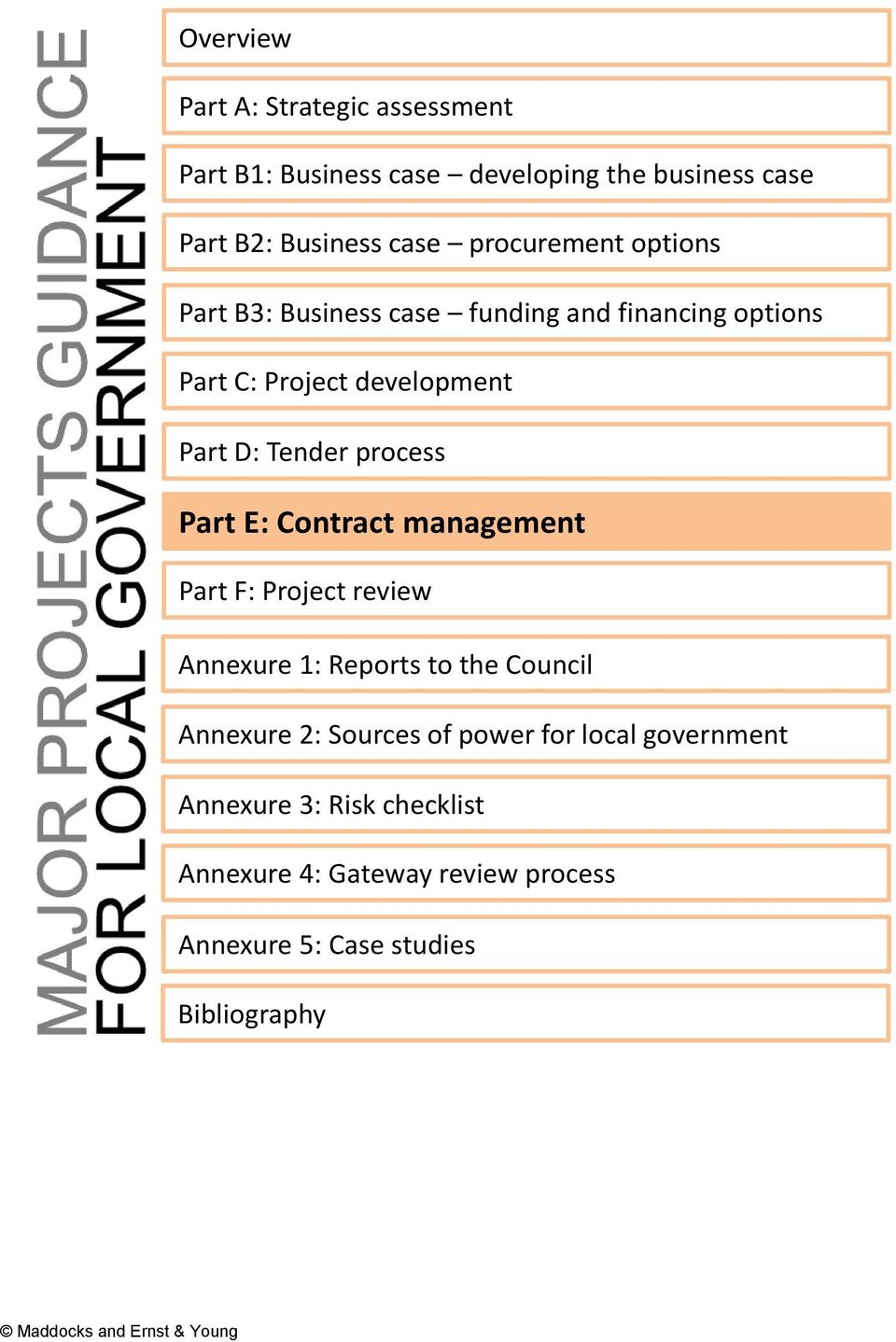
1 Overview Part A: Strategic assessment Part B1: Business case developing the business case Part B2: Business case procurement options Part B3: Business case funding and financing options Part C: Project development Part D: Tender process Part E: Contract management Part F: Project review Annexure 1: Reports to the Council Annexure 2: Sources of power for local government Annexure 3: Risk checklist Annexure 4: Gateway review process Annexure 5: Case studies Bibliography Maddocks and Ernst & Young
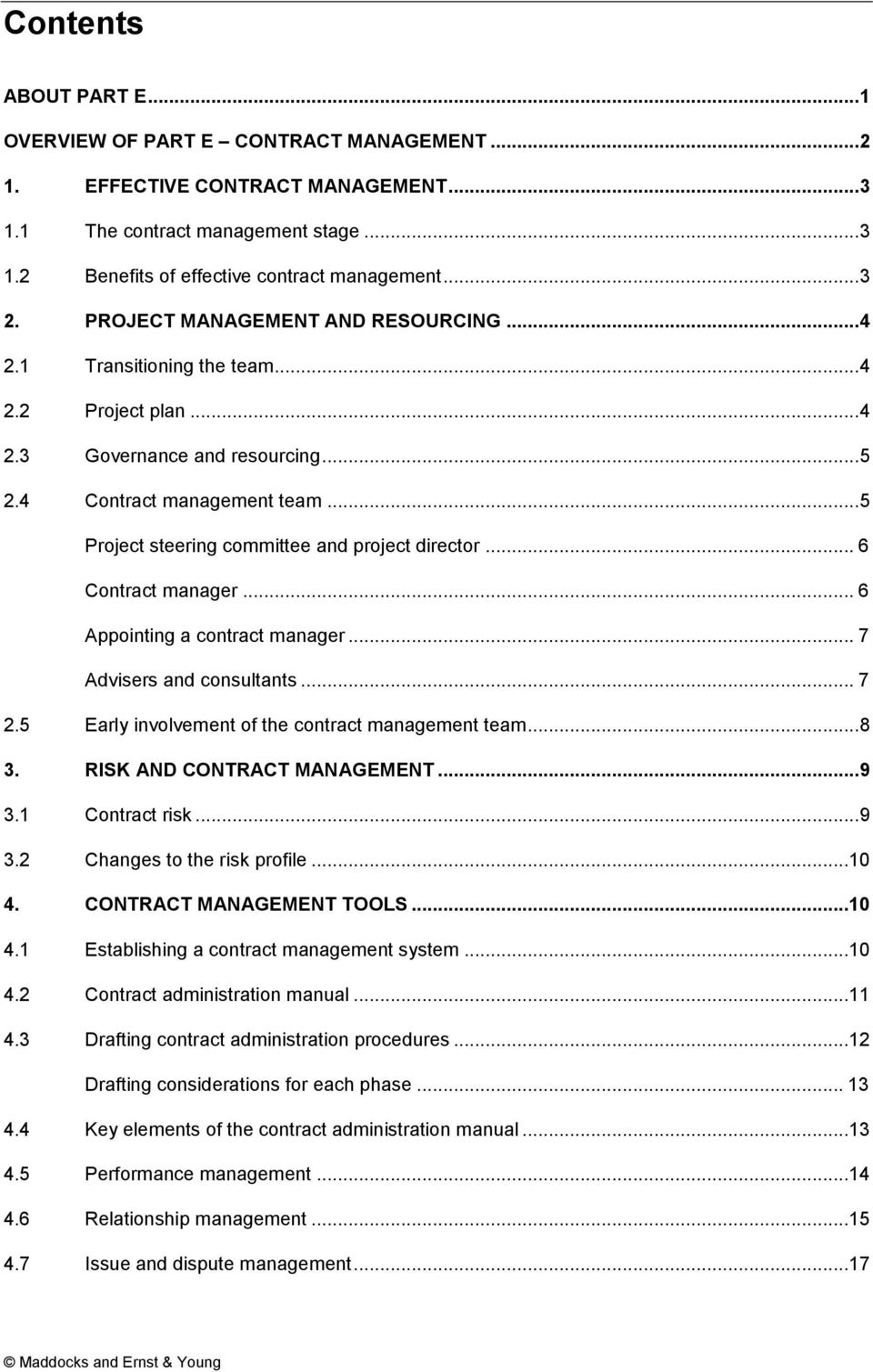
2 Contents ABOUT PART E... 1 OVERVIEW OF PART E CONTRACT MANAGEMENT EFFECTIVE CONTRACT MANAGEMENT The contract management stage Benefits of effective contract management PROJECT MANAGEMENT AND RESOURCING Transitioning the team Project plan Governance and resourcing Contract management team... 5 Project steering committee and project director... 6 Contract manager... 6 Appointing a contract manager... 7 Advisers and consultants Early involvement of the contract management team RISK AND CONTRACT MANAGEMENT Contract risk Changes to the risk profile CONTRACT MANAGEMENT TOOLS Establishing a contract management system Contract administration manual Drafting contract administration procedures...12 Drafting considerations for each phase Key elements of the contract administration manual Performance management Relationship management Issue and dispute management...17 Maddocks and Ernst & Young
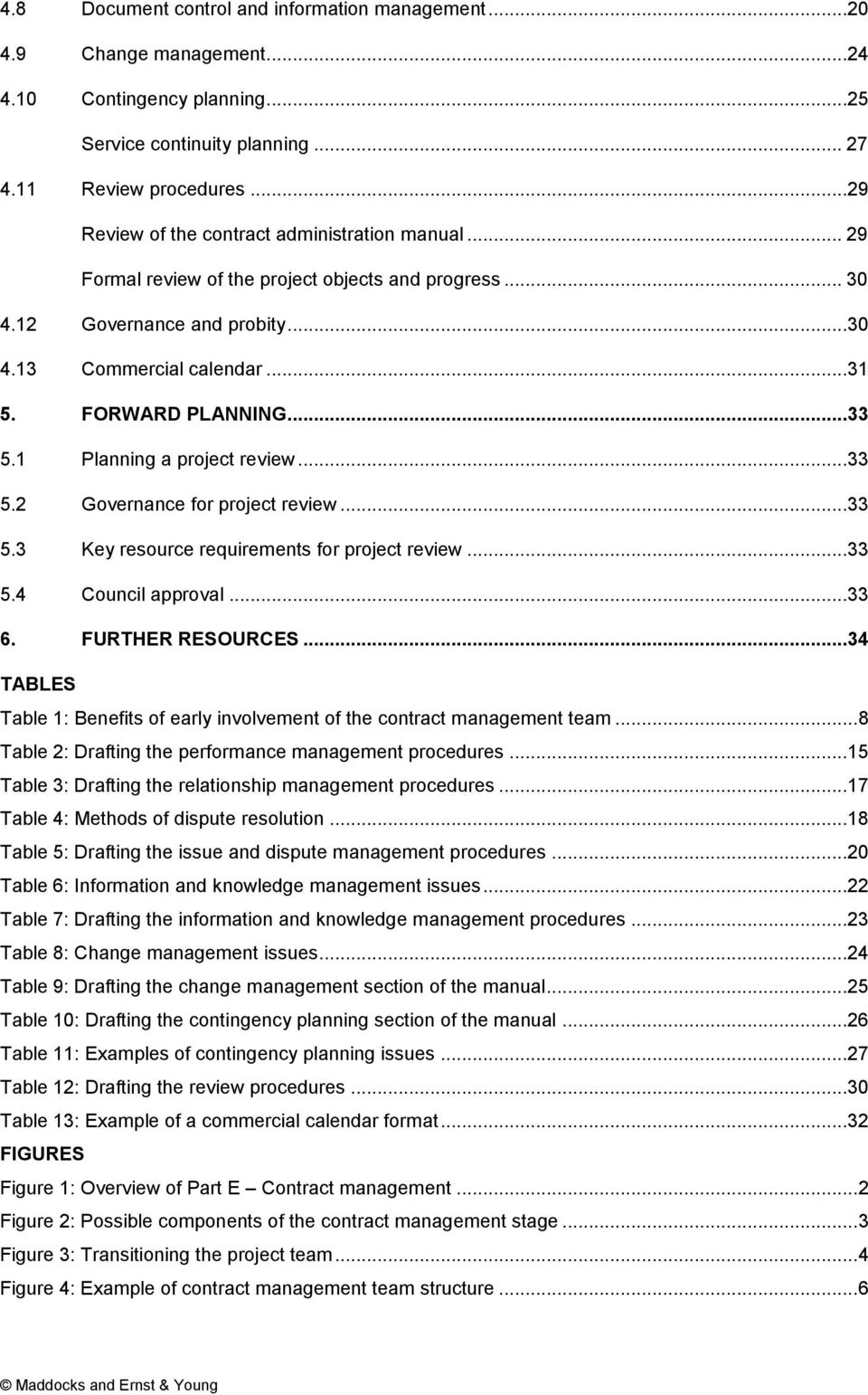
3 4.8 Document control and information management Change management Contingency planning...25 Service continuity planning Review procedures...29 Review of the contract administration manual Formal review of the project objects and progress Governance and probity Commercial calendar FORWARD PLANNING Planning a project review Governance for project review Key resource requirements for project review Council approval FURTHER RESOURCES...34 TABLES Table 1: Benefits of early involvement of the contract management team... 8 Table 2: Drafting the performance management procedures...15 Table 3: Drafting the relationship management procedures...17 Table 4: Methods of dispute resolution...18 Table 5: Drafting the issue and dispute management procedures...20 Table 6: Information and knowledge management issues...22 Table 7: Drafting the information and knowledge management procedures...23 Table 8: Change management issues...24 Table 9: Drafting the change management section of the manual...25 Table 10: Drafting the contingency planning section of the manual...26 Table 11: Examples of contingency planning issues...27 Table 12: Drafting the review procedures...30 Table 13: Example of a commercial calendar format...32 FIGURES Figure 1: Overview of Part E Contract management... 2 Figure 2: Possible components of the contract management stage... 3 Figure 3: Transitioning the project team... 4 Figure 4: Example of contract management team structure... 6 Maddocks and Ernst & Young
4 Figure 5: Contract management team early involvement... 9 Figure 6: Information gathering process...12 Figure 7: Principles of good relationship management...16 Maddocks and Ernst & Young
5 About Part E Part E provides guidance on the contract management process for the construction and operational phases of the project. The framework suggested aims to enhance the Council's ability to achieve the most effective and efficient delivery of the project and to maintain a productive relationship with key contractors. Key objectives of the contract management stage The key objectives for the project team during the contract management stage are to: develop and implement a contract administration manual for the construction and operational phases establish and implement a commercial calendar for the construction and operational phases obtain Council approval to carry out a project review as well as expenditure of Council funds (within a budget allocation) for such purposes obtain Council approval for the appointment of external advisers or consultants for the project review stage (if required). Key documents in the contract management stage During the contract management stage, the project team will prepare the following key documents: Project plan: an updated implementation plan for the construction and operational phases of the project. (See section 2.2, Project plan). Governance plan: a detailed plan showing the roles and responsibilities of the proposed contract management team. (See section 2.3, Governance and resourcing). Resourcing plan: a detailed plan showing the resources required for the contract management stage including Council staff, external advisers and budget allocation. (See section 2.3, Governance and resourcing). Contract administration manual: A tool developed specifically for the project outlining the contract administration procedures for the construction and operational phases of the project. (See section 4.2, Contract administration manual). Commercial calendar: a tool setting out the critical dates for implementing the procedures in the contract administration manual. (See section 4.13, Commercial calendar). Council report: a report to the Council seeking its formal approval to conduct a review of the project. This report should be supported by a high level governance plan and resource plan for the project review stage. (See section 5, Forward planning). Maddocks and Ernst & Young page 1
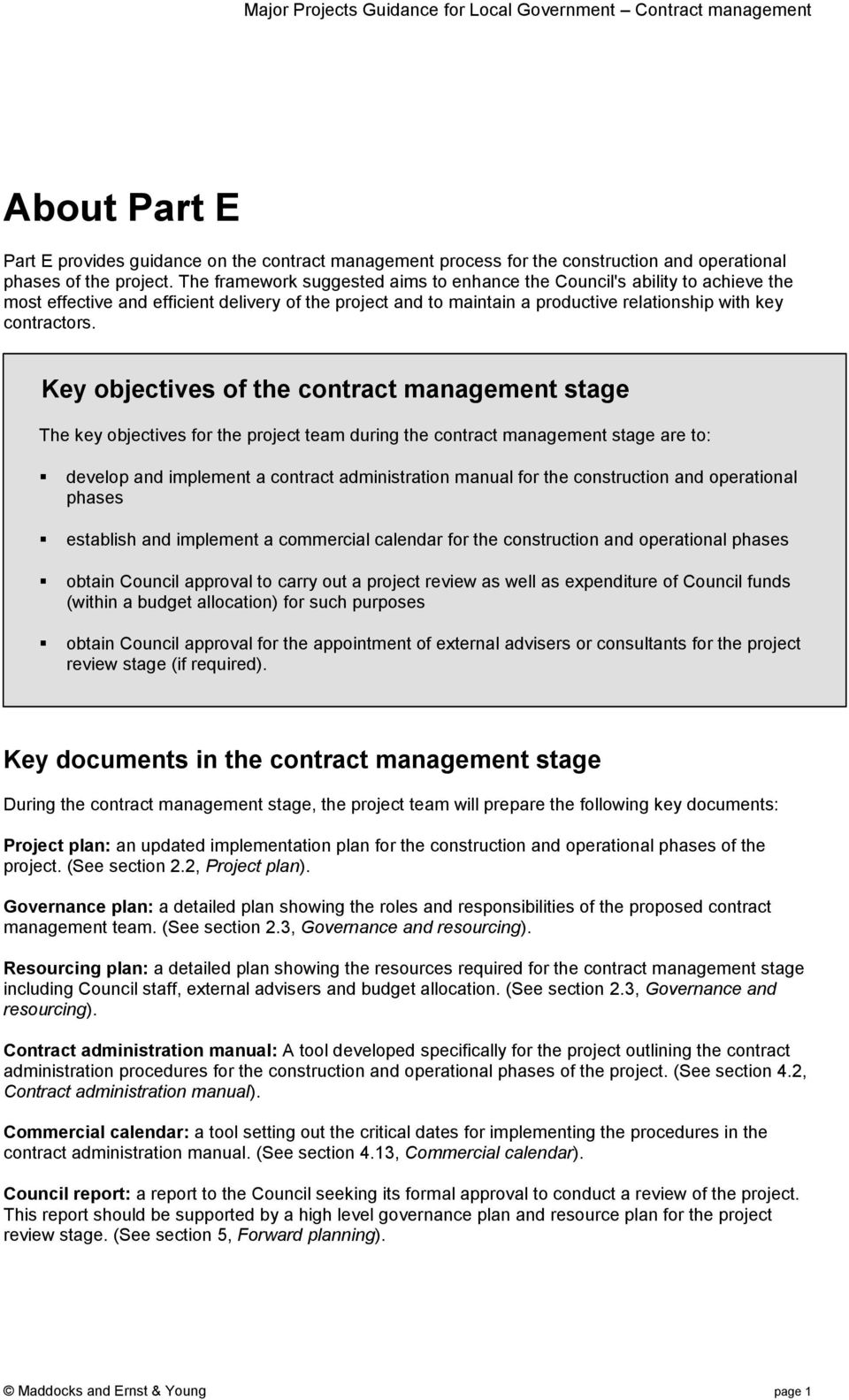
6 Overview of Part E Contract management Figure 1: Overview of Part E Contract management Section 1 Effective contract management The components of the contract management stage and the benefits of effective contract management are discussed in section 1. Section 2 Project management and resourcing The project management and resourcing considerations for this stage are presented in section 2, including considerations for transitioning the procurement team to the contract management team and transitioning the construction phase contract management team to the team for the operational phase. Section 3 Risk Section 3 highlights the key contract risks and discusses how the risk profile of the project may change over the life of the project. Section 4 Contract management tools Section 4 provides guidance on establishing a contract management system and presents contract management tools which may assist the project team in this stage the contract administration manual and the commercial calendar. Section 5 Forward planning The Council may wish to conduct a formal project review. The timing and initial planning considerations for such a review are set out in section 5. Maddocks and Ernst & Young page 2
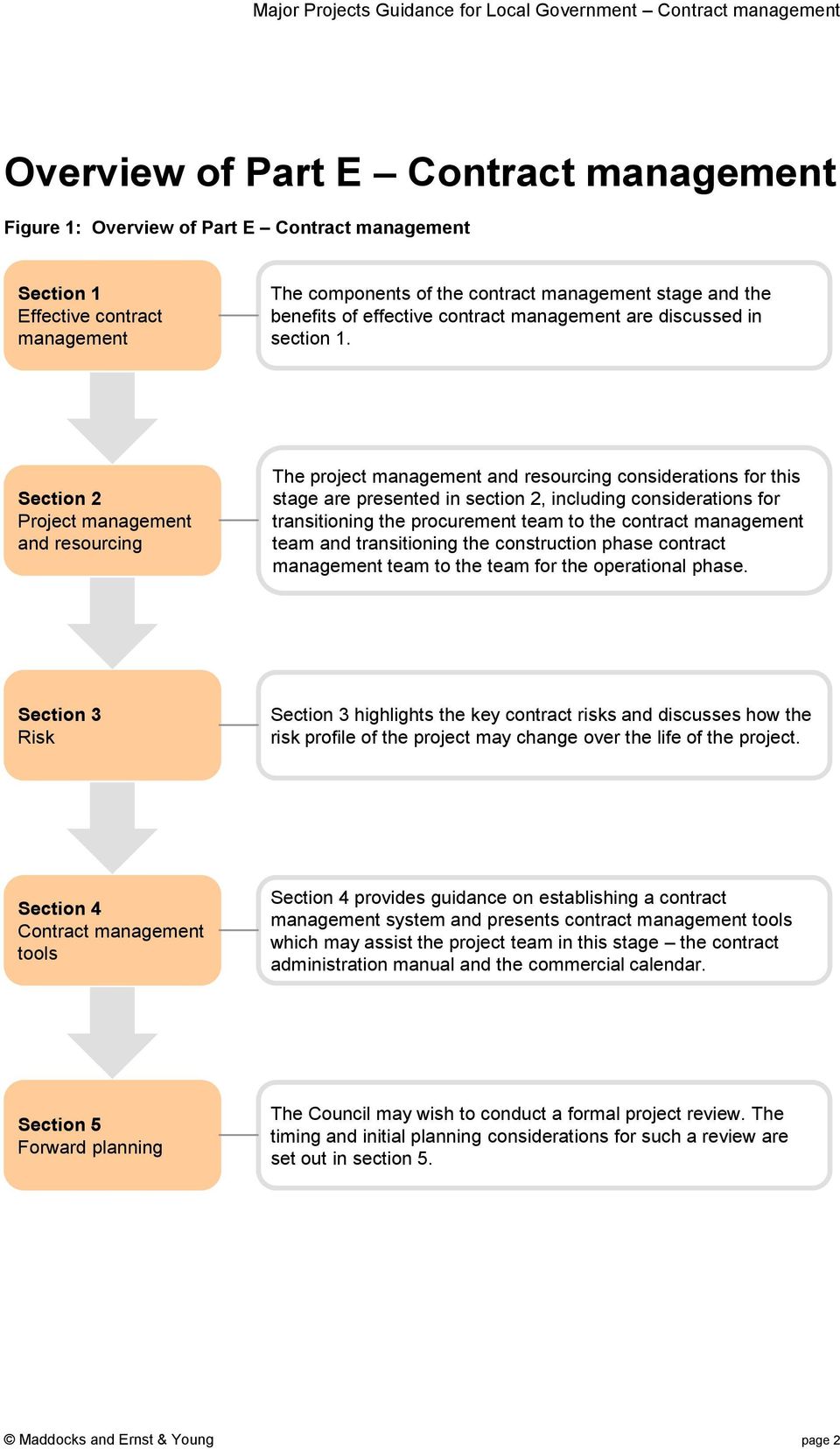
7 1. Effective contract management 1.1 The contract management stage Following the execution of the project documents, the project moves to the full implementation or project delivery stage. In this Major Projects Guidance, the contract management stage refers generally to the period immediately after contract award through to expiration or termination of the central project delivery agreements. This may include one or more of the phases illustrated in Figure 2. Figure 2: Possible components of the contract management stage Contract management Award of contract Project development phase Construction phase Operations phase Expiry or termination of key project delivery agreements The phases comprising the contract management stage of a project depend largely on the nature of the project and the procurement model selected. For example, the contract management stage of a DBFO or PPP procurement will involve project development, construction and operational phases under the project agreements. By contrast, under an alliance model the contract management stage will begin with a detailed project planning process before moving into the construction phase, and is likely to include an operations phase managed by an in-house project team at the Council rather than the alliance participants. The contract management stage of a construct only procurement may only include the construction of an asset, with the project design development component being absorbed into the project planning activities, and post construction maintenance activities being absorbed into the wider asset maintenance program of the Council (which will not form part of the contract management process described in this part). 1 Although a number of the procurement options do not include an operations or maintenance phase as such, the project itself may include a service delivery or operational component which will be delivered by the Council or a separate specialist contractor. For some major projects this phase may be best facilitated by a dedicated project team, rather than being absorbed into the wider operations and maintenance programs of the Council. (This will have been identified in the project development stage of the project). In such cases, the guidance in this Part E will apply equally to those operational activities. Regardless of the particular components of the construction management stage the objectives are similar to enhance the Council's ability to deliver the project and achieve the project objectives. 1.2 Benefits of effective contract management Contract management is designed to assist the parties to meet their contractual obligations under the project delivery agreements, and to provide a framework for dealing with events or issues that have not be anticipated by the contract. 1 In the remaining sections of this Part E references to the 'construction phase' generally include any project planning or design development which the contractor is required to undertake under the key project delivery agreements. Maddocks and Ernst & Young page 3
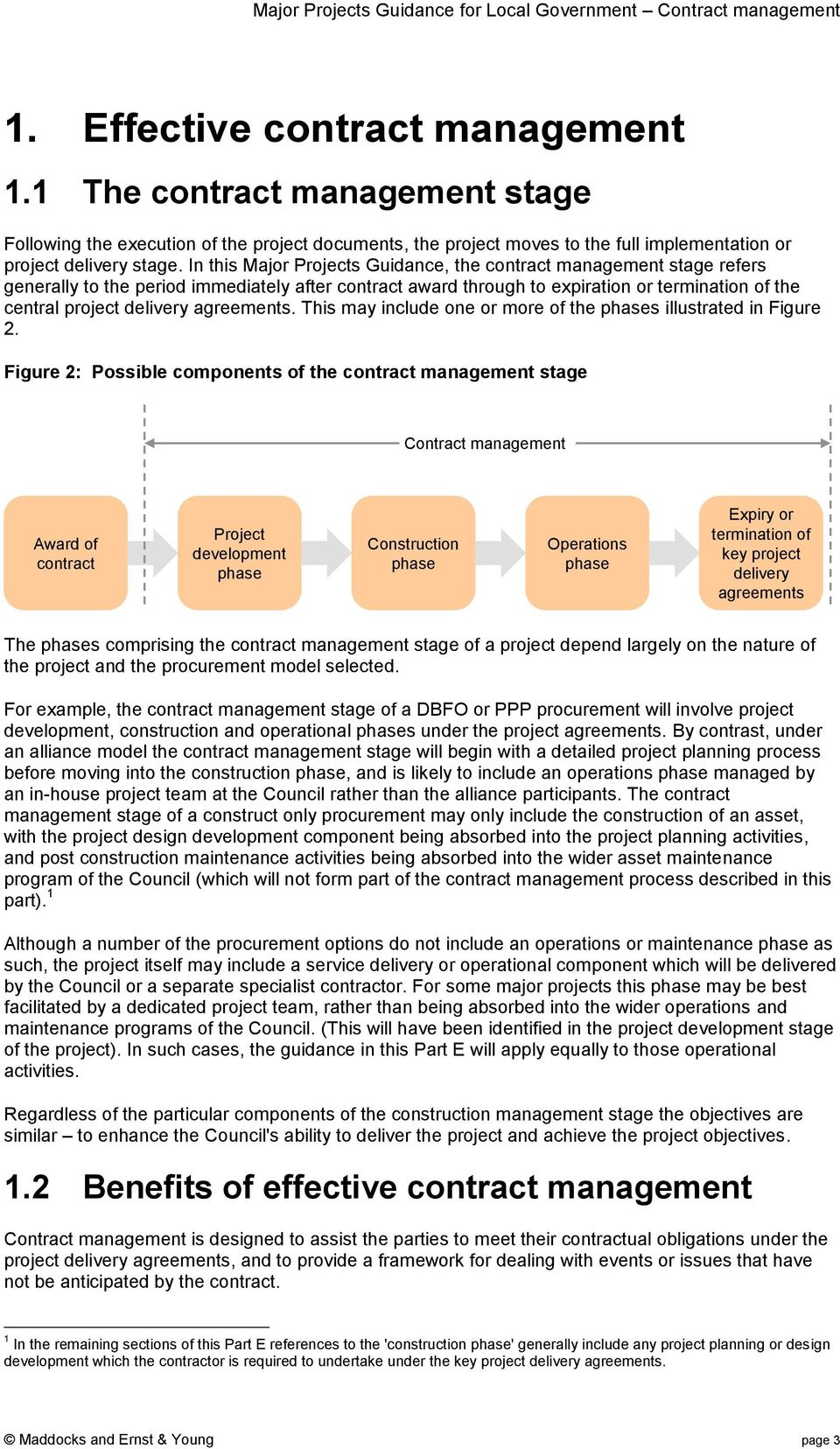
8 Effective contract management is key to assisting the Council in: achieving value for money for the project facilitating project progress in accordance with the anticipated timetable meeting its own contractual obligations monitoring the performance of the contractor maintaining good relationships and communication with the contractor handling and resolving issues or disputes which may arise maintaining the agreed allocation of risk managing and mitigating risks. 2. Project management and resourcing 2.1 Transitioning the team Upon contract award, the Council's responsibility for risk management is transferred from the procurement team to the contract management team. The contract management team for the construction phase will have been established during the project development stage and documented in the governance plan and the resourcing plan. Figure 3: Transitioning the project team Procurement team Construction phase contract management team Operational phase contract management team The Council will need to have a process in place to identify and transition relevant information and documentation held by the procurement team to the contract management team. This process should be developed in the context of the project plan, governance plan and resourcing plan created for the contract management stage. Where the project includes an operational phase, a further transition process will need to be in place to manage the transfer of information and documentation from the construction phase contract management team to the operational phase contract management team. From the outset of the contract management stage, a high level transition process (construction to operations) should be documented in the resourcing plan (as a minimum) and should be finalised before the operational phase commences. 2.2 Project plan At the beginning of the project management stage, the contract management team should review the project plan to ensure that the plan is up to date. Any material departures from the project plan which were negotiated in the executed project agreements, including the technical documents, should be reflected as appropriate in the project plan. This might include changes to the delivery timetable, scope of works, staging of the project etc. Maddocks and Ernst & Young page 4
9 2.3 Governance and resourcing A detailed governance plan and resourcing plan for the contract management stage should have been established during the project development stage prior to contract award. One of the initial tasks for the contract management team is to review these plans to ensure that the plans: reflect the governance arrangements documented in the project agreements (for example, changes may have been negotiated in the project agreements to the composition of the project control group for the construction phase) are updated to take into account staff changes at the Council, and any changes to the advisers or consultants appointed for the project (including changes to key personnel at those advisers/consultants where relevant) mirror relevant changes to the project plan as a result of the negotiation of the project agreements that have an impact on resourcing requirements, for example changes to the delivery timetable, scope of works, staging of the project etc. The resourcing plan should set out the composition of the full contract management team. The following section provides further guidance on establishing the contract management team. Although this needs to be in place prior to contract award, this guidance is included in Part E as it may also be relevant during the contract management stage, particularly for projects with a lengthy construction phase or projects which include an operational component. 2.4 Contract management team Effective contract management requires the appointment of a dedicated and experienced contract management team to implement the procedures set out in the contract administration manual. The contract management stage is complex and involves a number of specialist skill sets. As such, the quality of the contract management team is critical to successful project delivery. The composition of the contract management team will largely depend on the following factors: complexity and scale of project the procurement method used the particular expertise required given the nature of the project and the components of the contract management stage for that project. (See section 1.1, The contract management stage). An example of a typical contract management structure for a major local government project is presented in Figure 4. Maddocks and Ernst & Young page 5
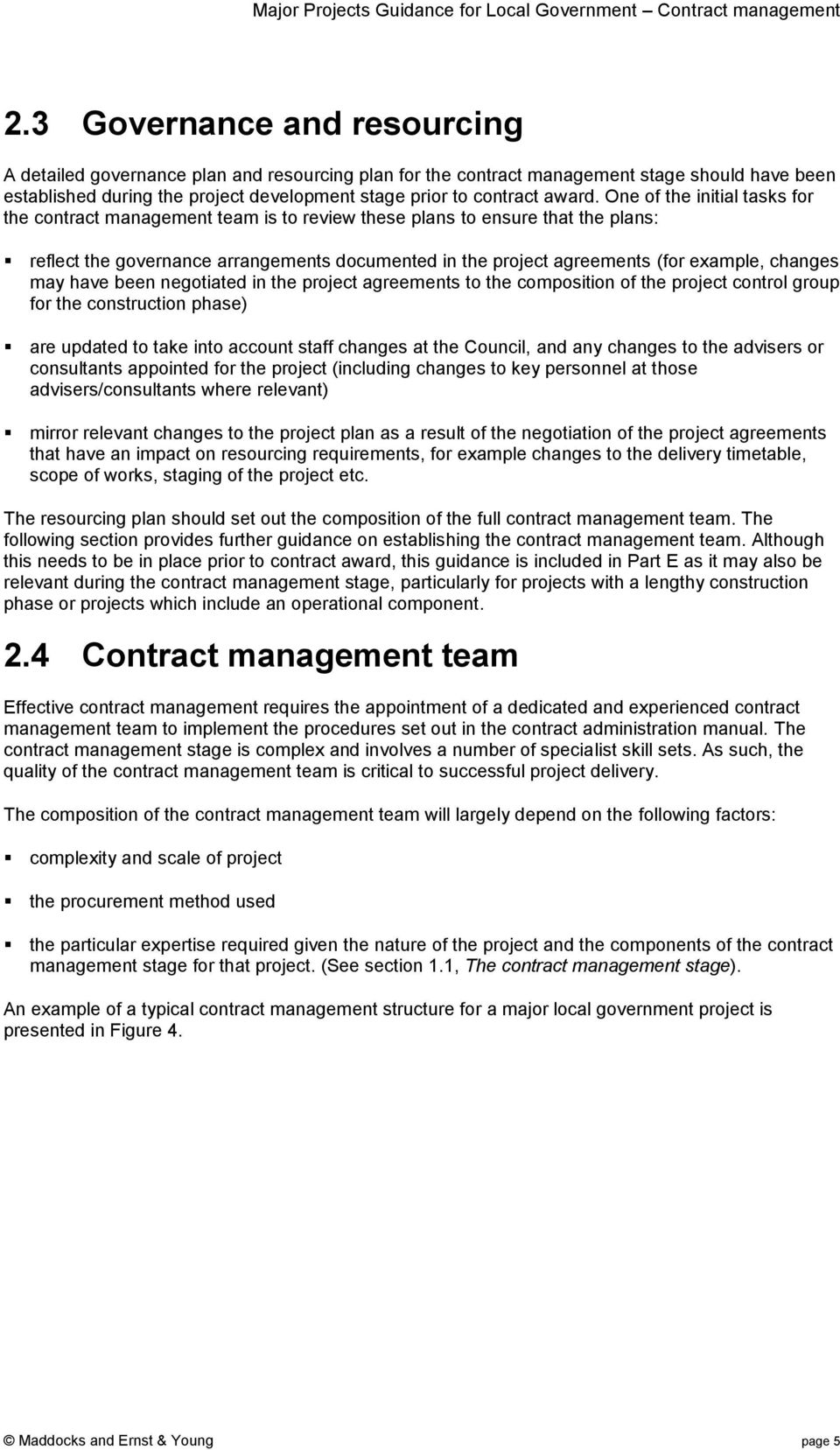
10 Figure 4: Example of contract management team structure 2 Council Project steering committee Probity auditor / advisor Project director Communications manager / advisor Superintendent/ Independent certifier Project manager Commercial manager Legal advisor Financial / commercial adviser Technical manager Architectural / engineering consultants Planning Quantity surveyor Other technical advisors Operational manager Monitoring service delivery against KPIs Project steering committee and project director Ideally, the project steering committee and project director will remain unchanged from earlier stages of the project to provide continuity and enhance knowledge transfer from the project development and tender process stages. During the contract management stage, the key role of the project steering committee is to provide high level oversight of project delivery activities. The project director is responsible for the overall delivery of the project including the overall strategy and stakeholder relations. Refer to section 6 of Part A, Project governance, for a general overview of these and other key governance roles for a major local government project. Contract manager The contract manager role requires specialist skills and a specialist contract manager may need to be appointed for the delivery of the project. The contract manager is responsible for the overall day to day running of the project for the duration of the construction management stage. 2 Elements of Figure 4 have been adapted from the National PPP Guidelines, Volume 2: Practitioners' Guide, p 36. Maddocks and Ernst & Young page 6
11 A different contract manager may be required for each of the construction and operational phases of the project, again depending on the nature of the project and the particular skills required for each of those stages. The roles of project director and contract manager require different skill sets and expertise and therefore the roles are usually carried out by different individuals. However, depending on the size of the project and the particular skills of the project director, the Council may combine the project director and contract manager roles where one individual is deemed to have the necessary skills to perform both roles. Where separate appointments are made, the Council should involve the contract manager in the procurement process at the earliest opportunity if possible. The following sections assume a separate contract manager is appointed for the project. Appointing a contract manager The Council should appoint a contract manager who is suitably qualified, with experience in managing complex contracts and monitoring performance on major infrastructure projects of a similar nature, scale and risk profile to the project. Contract manager skills and attributes When appointing the contract manager for the project, the Council should consider the following skills and attributes: relevant contract management skills and expertise leadership and team management skills in a multi-disciplinary environment understanding of the process for delegation and reporting at the Council knowledge of both private and public sector business drivers, corporate governance and local government accounting principles effective communication and relationship management skills with the contract management team, the Council, contractors, users of the assets or services and the wider community performance and contract monitoring experience good organisational, time management and budget management skills a realistic and flexible approach to potential changes and risks. It may be necessary for the Council to provide the contract manager with initial and ongoing training to ensure they are able to fulfil the duties required of their role. Advisers and consultants As with previous stages of the project, it is likely that the project team will be comprised of internal Council staff and external advisers and consultants, particularly for specialist adviser roles (see Figure 4 for some examples of these roles). There are advantages in maintaining continuity of external appointments over the lifecycle of the project, including continuity of relationships, a deeper understanding of the project and knowledge Maddocks and Ernst & Young page 7
12 retention. There may also be cost benefits as the process of transferring knowledge between advisers may result in increased costs. Further guidance on the appointment of advisers is provided in section 2.7 of Part C, Resourcing plan the project team. 2.5 Early involvement of the contract management team There are a number of benefits to the Council involving the contract management team early in the procurement process. These are summarised in Table 1. Table 1: Benefits of early involvement of the contract management team Smooth transitions The contract manager can offer valuable assistance in creating a process to ensure a smooth transition between the phases of procurement, construction and operation. Early engagement minimises any disruptions to project continuity as responsibility is transferred from the procurement team to the contract management team. Valuable assistance The contract management team can assist in the development of pragmatic performance monitoring systems and reporting procedures. It can also contribute knowledge and experience to the allocation of risk and the drafting and negotiation of other contractual provisions. Good relationships The introduction of the contract management team early in the process enables the establishment of a closer working relationship with the contractor. Greater knowledge Involvement in the procurement process provides the contract management team with a stronger understanding of: the Council's requirements for the project the contract documentation risks or issues likely to arise during the contract term the elements agreed upon between the Council and the contractor during contract negotiations the contractor's methodologies. The level of involvement of the contract management team at the project development and procurement stages will differ between projects, however as a minimum, the contract manager should be given the opportunity to observe the process and have access to members of the procurement team. It is the responsibility of the project director to facilitate the appropriate level of access and involvement. Many of the benefits in Table 1 can be obtained by ensuring some continuity of staff and advisers or consultants across the project development, tender process and project delivery stages. Maddocks and Ernst & Young page 8
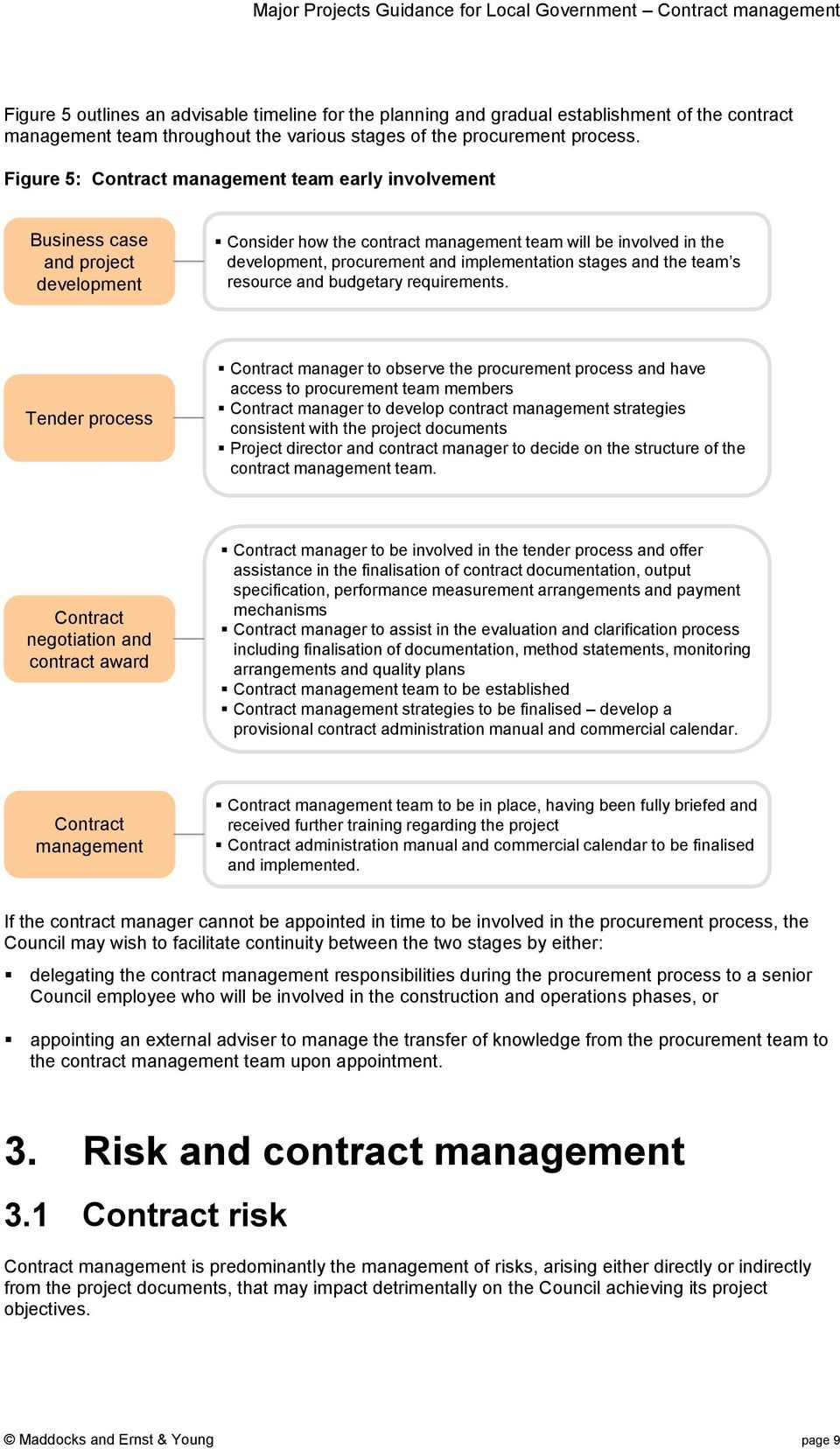
13 Figure 5 outlines an advisable timeline for the planning and gradual establishment of the contract management team throughout the various stages of the procurement process. Figure 5: Contract management team early involvement Business case and project development Consider how the contract management team will be involved in the development, procurement and implementation stages and the team s resource and budgetary requirements. Tender process Contract manager to observe the procurement process and have access to procurement team members Contract manager to develop contract management strategies consistent with the project documents Project director and contract manager to decide on the structure of the contract management team. Contract negotiation and contract award Contract manager to be involved in the tender process and offer assistance in the finalisation of contract documentation, output specification, performance measurement arrangements and payment mechanisms Contract manager to assist in the evaluation and clarification process including finalisation of documentation, method statements, monitoring arrangements and quality plans Contract management team to be established Contract management strategies to be finalised develop a provisional contract administration manual and commercial calendar. Contract management Contract management team to be in place, having been fully briefed and received further training regarding the project Contract administration manual and commercial calendar to be finalised and implemented. If the contract manager cannot be appointed in time to be involved in the procurement process, the Council may wish to facilitate continuity between the two stages by either: delegating the contract management responsibilities during the procurement process to a senior Council employee who will be involved in the construction and operations phases, or appointing an external adviser to manage the transfer of knowledge from the procurement team to the contract management team upon appointment. 3. Risk and contract management 3.1 Contract risk Contract management is predominantly the management of risks, arising either directly or indirectly from the project documents, that may impact detrimentally on the Council achieving its project objectives. Maddocks and Ernst & Young page 9
14 Risk arising at the contract management stage is commonly referred to as contract risk. Contract risk born by the Council includes: project risks identified at the strategic assessment, business case and project development stages of the project (and not allocated to the contractor) risks allocated to the Council under the project documents or by law unidentified risks that have not been allocated to either party under the project documents risks materialising that have been allocated to the contractor but which the contractor has not been able to mitigate or manage, resulting in the Council inadvertently 'taking back' the risks risks arising from the Council not meeting its responsibilities under the contract (arising from failure to comply with contract obligations or poor contract management). 3.2 Changes to the risk profile The risk profile of the parties will change over the life of the contract. Therefore, the Council should continually review the project documents and contract management tools to ensure they remain relevant and current, and update or amend them as appropriate. Reasons for a change to the parties' risk profile may include: the maturing of the parties relationship over the course of the contract term the completion and commencement of the various stages of the project, such as the construction and operations phases the surfacing of various project risks, such as a change in legislation, technology obsolescence, and a change in community need the availability of insurance a change in the level of performance security (such as bonds or guarantees). As previously outlined in section 5.6 of Part C, Assessing project risk, risks in relation to the project need to be identified, assessed and managed. This approach is also suitable for, and should be applied in relation to, contract risk. 4. Contract management tools 4.1 Establishing a contract management system In order to undertake effective contract management, the contract management team needs to establish a contract management system that is relevant and appropriate for the project. This will require appropriate contract management tools to be developed. There are many tools and processes available to assist the Council to develop the contract management system. In the Major Projects Guidance two tools are recommended: the contract administration manual the commercial calendar. Maddocks and Ernst & Young page 10

15 4.2 Contract administration manual The contract management team should prepare the contract administration manual, together with assistance from the procurement team and the probity adviser, where necessary or practical. The manual should set out all the contract management procedures established by the Council for the purposes of administering the project. The foundations for the contract management system will have been established in the project documents, including the allocation of identified risks, reporting obligations, and a dispute management process. In some cases the actual procedures will be documented in the project agreements, for example the reporting obligations from contractor to the Council. Other procedures will be consequential upon procedures documented in the project agreements, for example the contract management manual may set out how to disseminate the reports and other information from the contractor to relevant people within the Council to enable relevant decisions to be made to progress the project. In order to develop the contract management procedures that need to be incorporated into the manual, the Council will be required to determine its obligations and liabilities. This includesthe contractor's obligations and liabilities, and other circumstances that may give rise to contract risk. This process will require the contract management team to conduct a thorough review of the project documents and any other information related to the project, and assess the related and/or anticipated contract risk. This information gathering exercise is the same as the process suggested for developing the commercial framework set out in section 5.2 of Part C, What is the commercial framework? and is illustrated in Figure 6. Maddocks and Ernst & Young page 11
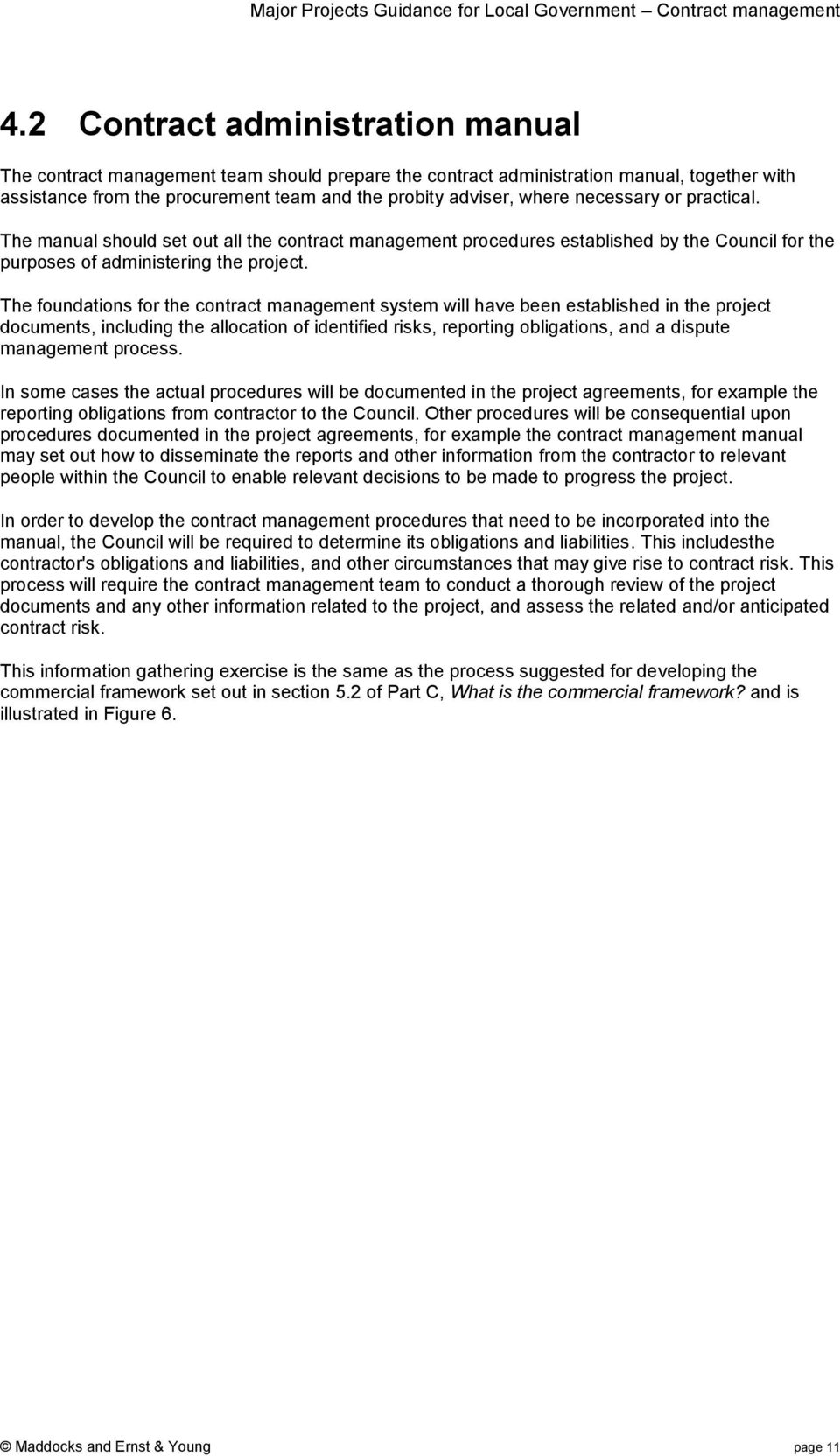
16 Figure 6: Information gathering process 3 Planning the contract management strategies that need to be put in place. Determines the For the purposes of: understanding the legislative, regulatory and commercial context of the project understanding the objectives of each of the parties to the contract identifying and assessing contract risks the Council may be exposed to that impact upon the achievement of the project objectives or value for money assessment identifying and assessing management and mitigation strategies to control such contract risks. Information to be gathered. In order to Sources of information: Council s business case analysis and allocation of risk by the procurement team and contractor contract documents procurement team experience of the Council s past projects and similar projects undertaken by other Councils relevant legislative and regulatory framework organisation structure and financial status of all parties to the contract examination of the project site. Analyse the information for the purpose of refining, updating or renewing the contract management strategies in relation to current or anticipated risks, taking into account legislative, regulatory and commercial considerations. This assists the contract management team to identify and manage contract risks. Recording of information in a risk matrix or register including: a description of the risk the probability of the risk arising risk management and mitigation strategies to be implemented should the risk arise records to be updated regularly and incorporated in the contract administration manual. As noted earlier, the risk profile for the parties will change throughout the contract term. For this reason, a review and assessment of project information and the appropriateness of the procedures should be performed on a regular basis during the contract administration stage. 4.3 Drafting contract administration procedures The procedures in the contract administration manual need to be sufficiently detailed to establish clear processes for the contract management team to follow, particularly as members of the team may change over the contract term. Each procedure should identify: What action is to be taken? (For example, monitoring the performance of an obligation by the contractor, monitoring the contractor's risk mitigation steps, or the performance of an obligation of the Council). Who is responsible for carrying out the action? 3 Elements of this diagram have been adapted from the Partnerships Victoria Guidance Material, Chapter 5: Contract Management Guidance (June 2003). Maddocks and Ernst & Young page 12
17 When should the action be taken? Why does the action need to be taken? What are the objectives? How will the action be undertaken? What is the procedure or process? What resources are available? Are any delegations or authorisations required? The consequences that trigger the implementation of the procedure for example, a contractor s failure to perform or default and associated contingency plans, dispute resolution and issue management procedures. The project s context with regard to the legal and commercial environment, the content of the project documents and the objectives of each of the parties individually and for the project. Drafting considerations for each phase Although the principles for developing contract management procedures are general to the contract management stage, the specific procedures and the likely contract management issues encountered will largely depend on the relevant phase of the project construction or operational. The issues that need to be taken into account when drafting procedures relating to the construction phase will differ from the operations phase for the following reasons: during the construction phase the contractor's duties are continually changing as the contractor progresses to meet its final objective of constructing the asset in accordance with the project document specifications. However, in the operations phase the contractor's duties remain relatively constant, given that these are usually ongoing service provision requirements in accordance with a specification that usually relates to the entire operations phase the achievement of outputs for the construction phase are generally easier to objectively verify through testing processes and inspections, whereas the achievement of outputs for the operations phase can often be difficult to measure without clearly defined key performance indicators from a broader perspective, the Council will retain responsibility for the delivery of core services to the community and therefore compliance with the service specification is critical to the Council not only for the purposes of achieving a successful project and to demonstrate value for money, but also for adhering to its wider legislative and community obligations the outputs for the construction phase are unlikely to change materially from the point of contract execution to practical completion, however the operations phase will typically span a lengthy period of time. During this period, community need in relation to the services may increase, dwindle or change. Therefore, the project documents will require sufficient flexibility to respond to such changes and appropriate contract management strategies need to put in place for this purpose. 4.4 Key elements of the contract administration manual The contract management system will differ from project to project, depending on the anticipated risks and issues that may need to be managed during the contract term. Generally however, the Council will be required to develop procedures to address the follow key issues: performance management relationship management dispute and issue management Maddocks and Ernst & Young page 13

18 change management contingency planning record keeping review process governance. A more detailed explanation of each of these elements is set out in the following sections, including an overview of the contract management issues, references to potentially relevant project documents and considerations to take into account when drafting the relevant procedures for incorporation into the contract administration manual. Some procedures are relevant to more than one section. Where this occurs, the procedures are noted in each of the relevant sections. 4.5 Performance management Performance management involves regularly assessing the performance of the contractor against the requirements or obligations imposed in the project agreements. A performance management procedure needs to be developed to enable this to occur continuously throughout the contract management stage. Key to this element is to regularly assess the contractor's performance for the purposes of determining whether: the contractor is meeting its obligations under the contract the project continues to demonstrate value for money the project is sustainable for the contract term, which may involve monitoring the contractor's: financial performance management performance service performance compliance with output specifications and assessment against key performance indicators. Once developed, the performance assessment procedure, performance measures and reporting requirements should be regularly reviewed to ensure they are appropriate for the commercial environment as well as the risk profile of the parties at the time of assessment. As part of these reviews, relevant new information or changed circumstances should also be incorporated. Another aspect of performance management involves monitoring the financial health of the contractor. This should be carried out on a regular basis during the contract management stage. A procedure for monitoring the financial health of the contractor is an important risk management tool, which may give the Council early warning of the insolvency of the contractor and the contractor's inability to deliver the project works or services under the project agreements. Table 2 sets out the performance management procedures, which may be required for the project and the possible sources of information from the project documents relevant to those procedures. Maddocks and Ernst & Young page 14

19 Table 2: Drafting the performance management procedures Example sources of information from the project documents Council requirements, scope of works, performance specification, scope of services key performance indicators and/or key performance outputs requirements for the contractor to undertake market testing or user abatement regime penalties or reduction in service fee linked to failure to meet performance standards incentives provided for innovative or outstanding service delivery procedure provided to manage poor performance procedure for service disruption through no fault of the contractor, such as alternative facilities for continuity of service provision in the event the facilities are unavailable circumstances where contractor is entitled to relief from the provision of the contract requirements remedies available to the Council for contractor poor performance. Procedures to be documented A procedure for the assessment of the contractor's performance detailing: who undertakes the assessment on behalf of the Council and the time frame within which it must be conducted what tools are to be used in the assessment, and if there is any guidance or best practice that needs to be followed the consequences for poor performance by the contractor, and the steps the Council may need to consider undertaking in the event of poor performance, for example communication with the community/service users internal reporting requirements of the assessor what reports need to be prepared, who they are to be prepared for, the content for the reports, and whether attendance at Council meetings is required. A procedure for the assessment of the contractor's financial 'health' or creditworthiness detailing: who undertakes the assessment on behalf of the Council and the time frame within which it must be conducted tools or sources of information to be used in determining financial capacity or health of the contractor method of reporting the findings and to whom the report should be submitted. 4.6 Relationship management Relationship management procedures are developed to maintain a constructive working relationship between the parties, assisting them to: pre-empt the impact of contract risks and identify risk management solutions at an early stage build confidence in contracting with each other/each other's sector enhance the contractor's interest, where relevant, in long term investment in the project (for example, the contractor investing in long term staffing strategies) reduce project costs and maximise efficiency which may increase the profitability of the project Maddocks and Ernst & Young page 15

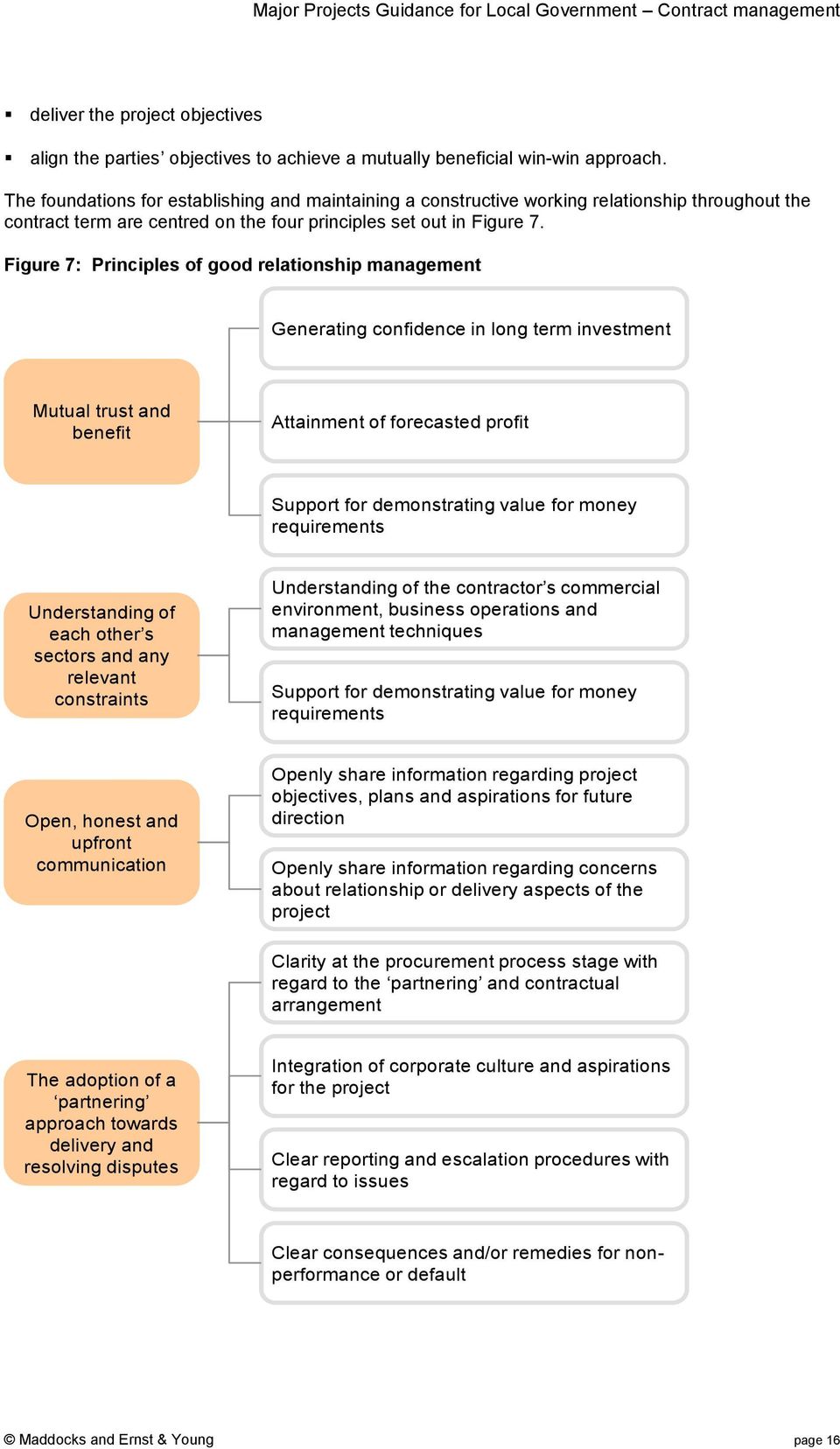
20 deliver the project objectives align the parties objectives to achieve a mutually beneficial win-win approach. The foundations for establishing and maintaining a constructive working relationship throughout the contract term are centred on the four principles set out in Figure 7. Figure 7: Principles of good relationship management Generating confidence in long term investment Mutual trust and benefit Attainment of forecasted profit Support for demonstrating value for money requirements Understanding of each other s sectors and any relevant constraints Understanding of the contractor s commercial environment, business operations and management techniques Support for demonstrating value for money requirements Open, honest and upfront communication Openly share information regarding project objectives, plans and aspirations for future direction Openly share information regarding concerns about relationship or delivery aspects of the project Clarity at the procurement process stage with regard to the partnering and contractual arrangement The adoption of a partnering approach towards delivery and resolving disputes Integration of corporate culture and aspirations for the project Clear reporting and escalation procedures with regard to issues Clear consequences and/or remedies for nonperformance or default Maddocks and Ernst & Young page 16
21 Table 3 sets out the relationship management procedures that may be required for the project and possible sources of information from the project documents relevant to those procedures. Table 3: Drafting the relationship management procedures Example sources of information from the project documents requirements regarding the project control group (or similar the Council/contractor oversight group) dispute resolution procedures requirements regarding the risk register, and the procedure for its review and update complaints procedure. Procedures to be documented Procedures that address the following issues may need to be included: exchange and sharing of information where it is conducive to the progress and/or management of the project for the purposes of the parties adopting a collaborative approach regular relationship assessment to monitor changes over time, and assess the effectiveness of communication, exchange of information, governance and management structures 4.7 Issue and dispute management induction procedures and other necessary training and support, and access to resources as required appointment of the Council representatives to the project control group the Council should ensure that the nominated representative/s have the appropriate skill, experience and level of authority to enable them to make a valuable contribution to the group the dissemination and management of information stemming from project group meetings, contractor reports, test results and inspections, stakeholder issues, user issues and complaints procedure for managing the risk register including who is responsible for developing, reviewing and updating the register, and procedures for managing risks noted on the register which may include the management of contingency events development, update and review of the project complaints procedure nomination of the Council representatives to deal with disputes and issues. The aim of issue and dispute management is to minimise the number of issues and disputes arising, and to assist in achieving an effective and speedy resolution. The key to good issue and dispute management is to put in place ongoing formal and informal communication channels and resolution procedures. When issues and disputes arise there are a number of avenues which may be available to the Council under the project agreements. Some of the common methods are set out in Table 4. Maddocks and Ernst & Young page 17
22 Table 4: Methods of dispute resolution Joint project review forums establishing joint project review forums or a relationship management committee composed of staff from the Council and the contractor is a good way of maintaining regular contact between the parties and strengthening their relationship regular forums ensure issues can be identified and addressed quickly, and encourage joint solutions. Such forums may be provided for in the contract or established at a later point. Negotiation informal discussion between those involved in the dispute or their managers quickest and least costly method the relevant Council representatives must ensure that negotiations and/or outcomes do not contravene any contractual, legal or policy requirements the aim is to achieve effective resolution to the satisfaction of both parties to minimise the potential for the dispute to arise again. Escalation where negotiations have been unsuccessful, the Council and contractor appoint senior employees of each organisation, or a dispute panel to resolve the dispute senior employee/panel appointed should have knowledge of the project and be well placed to view the dispute in its broader context and predict the possible consequences of proposed solutions it is important to clearly outline the nature of the issues involved, the reasons for the dispute and any suggested solutions escalation procedures may allow for a dispute to be raised to successive levels of seniority on an agreed timescale where this procedure is enshrined in a project agreements, the agreement will note whether a decision at this level is binding or non-binding (generally it will be non-binding unless the agreement reached is documented in a formal agreement/deed or an amendment of the project agreement) in the case of a dispute panel, the procedure should specify the members, quorum, meeting procedures and voting rights the assistance of specialist or technical advisers may be required. Mediation independent person (mediator) assists the Council and the contractor to negotiate and resolve their dispute the mediator helps to identify issues and possible options Maddocks and Ernst & Young page 18
23 Table 4: Methods of dispute resolution this method requires attendance at meetings facilitated by the mediator the mediator does not impose a decision, but helps to identify issues and possible options ideally the Council and contractor will reach a compromise with the mediator's assistance the Institute of Arbitrators and Mediators Australia holds a list of registered mediators this process is likely to be quicker, less formal and less costly than arbitration or court proceedings unlike court proceedings, the mediation process is confidential and not open to the public. Independent expert determination this is similar to mediation however the independent expert possess expertise in the subject matter of the dispute this method is particularly suitable for determining disputes over technical issues or technical aspects of a complex dispute. Arbitration a formal process in which the Council and the contractor in dispute present their case to an independent third person (the arbitrator) the decision of the arbitrator is usually binding (unless otherwise agreed) this method is useful where less formal methods of dispute resolution have failed this is an adversarial procedure with the possibility that neither party will be satisfied with the outcome, and it may be costly and time consuming the parties' ability to initiate arbitration proceedings may be limited under the project documents legal advice should be obtained prior to commencing arbitration proceedings unlike court proceedings, the arbitration process is confidential and not open to the public. Litigation litigation is the process of seeking redress through the courts or contesting a lawsuit where the parties have failed to resolve a dispute using less formal dispute resolution procedures, or where a decision (for instance of a mediator or an independent expert) is not binding on the parties, the Council may need to consider whether to proceed to litigation litigation can be expensive and time consuming and generally advisable only when other avenues of dispute resolution have not been successful or are not available the parties' ability to issue proceedings may be limited under the project documents legal advice should be obtained prior to commencing litigation. Maddocks and Ernst & Young page 19
24 The Council is encouraged, where possible, to pursue informal resolution prior to undertaking formal resolution which is usually more adversarial, and may damage its long term working relationship with the contractor. However, there may be instances where it is not appropriate for the parties to embark upon informal resolution procedures initially, and where the use of formal resolution is more appropriate. Table 5 sets out the issue and dispute management procedures, which may be required for the project. It also outlines possible sources of information from the project documents relevant to those procedures. Table 5: Drafting the issue and dispute management procedures Example sources of information from the project documents Project documents usually contain detailed procedures for dispute resolution, and may or may not contain provisions dealing with issue management. Where issue management is not covered in the project documents (or where the procedure lacks detail) this needs to be covered in the contract administration manual. Project documents may contain information on: levels/escalation of resolution procedures the permitted dispute resolution procedures time periods in which those procedures must be commenced whether the decisions resulting from procedures are binding or non-binding whether contractual obligations continue usually parties are obliged to continue to comply with their contractual obligations during the period for resolution of the issue/dispute Procedures to be documented An issue and dispute management procedure that details: the creation of an issue and disputes register and a procedure for maintaining and updating it notification procedures where issues and disputes arises and what further action must be taken and by whom a process for the resolution of the issues which may include: raising the issue at project control group meetings developing a rectification/action plan external facilitation for resolution. the circumstances that give rise to a right of termination. the party that needs to pay the costs incurred in resolving the dispute. 4.8 Document control and information management The purpose of a document and information management process is to: establish protocols around the collection, storage and availability of documents and information in relation to the project to ensure that members of the project team are aware of freedom of information, confidentiality and security issues Maddocks and Ernst & Young page 20
25 to facilitate the transference of skills and knowledge between the parties, and internally within the Council. The protocol should outline how certain documents and information should be handled and by which party. The efficient organisation of all documentation relevant to the project will assist the Council to effectively manage the project. The types of documents and information the project team may be responsible for handling, and which might be covered by the document and information protocol over the life of the project, include the following: contact details of the parties and members of the procurement team and contract management team meeting schedules and minutes of meetings technical reports, test results and inspection reports specifications and performance requirements payment claims and payment certificates legal documents including the project agreements, the finance agreements, funding agreements, land title documents, permits and other regulatory approvals, licenses etc. notices issued under the project agreements and finance agreements certificates of insurance and insurance polies and related notices delegation register gifts and hospitality register conflicts of interest register advice and other reports complaints Council reports and approvals correspondence. A procedure for the storage and preservation of relevant information should ensure that: relevant staff are able to easily identify and locate information the information stored is relevant and accurate legislative and policy requirements are satisfied regarding the information held, access to that information, confidentiality considerations and storage of information double handling of information is avoided or minimised information and knowledge is transferred internally, between the Council and contractor or between stakeholders at appropriate times in the appropriate form. Maddocks and Ernst & Young page 21
26 Where co-operation of the contractor is required, information and knowledge management obligations can only be properly enforced where they have been enshrined into the contract. An effective information and knowledge management strategy should address the issues outlined in Table 6. Table 6: Information and knowledge management issues Information gathering and knowledge exchange What information is required? What relevant information and knowledge does the Council already possess? How will additional information be acquired and by whom? Who owns and controls the acquired information? Recording and storing information How will non-written information, such as verbal communication, be recorded? How and where will information be stored and maintained? What methods will be put in place to assist with later retrieval of this information? For instance, identification systems, barcoding and attaching metadata to electronically stored information. What are the probity requirements for recording and storing the information and how will these be met? Distributing and sharing information and knowledge What purpose is the information and knowledge likely to serve during the various stages of the project? How will the information be accessed and by whom? Will the Council need to access information in the possession of the contractor? If so, how and when? How will information be shared amongst members of the contract management team? What internal and external information management provisions and policies should be adhered to? What information will the Council need to share with the contractor or stakeholders? How and in what form? Monitoring and disposing of information How, how often and by whom should information be monitored over the life of the project for accuracy, consistency and currency? How will information be disposed of? What knowledge and information will need to be delivered to the Council on termination, step-in or expiry of the project? Table 7 sets out the information and knowledge management procedures that may be required for the project and possible sources of information from the project documents relevant to those procedures. Maddocks and Ernst & Young page 22
27 Table 7: Drafting the information and knowledge management procedures Example sources of information from the project documents confidentiality provisions intellectual property provisions reporting requirements provisions regarding project control group or site meetings (and the minutes of those meetings) arrangements regarding test results and inspection reports provisions relating to on-site documents. Procedures to be documented A procedure for the storage and preservation of documents to ensure that: relevant staff are able to easily identify and locate information there are clear requirements as to the classification of new information requirements regarding storage of information are specified requirements regarding circulation of information are stipulated access rights are clearly specified and comply with confidentiality obligations (who has access to what information) the information stored is relevant, up to date and accurate the procedures for storing and accessing information satisfy legislative and policy requirements double handling of information is avoided or minimised the information and knowledge is transferred internally, between the Council and contractor or between stakeholders at appropriate times in the appropriate form. A freedom of information procedure should satisfy freedom of information law principles in the event of a third party request for information relating to the project. The Council must ensure the contract management team is aware of how freedom of information legislation affects its information management obligations. An intellectual property procedure detailing: the intellectual property relating to the contract in the Council's possession the nature of the intellectual property and the legal principles which apply to its protection deriving from legislation, common law or the contract the development and maintenance of an intellectual property register requirements for the safe storage and protection of intellectual property, with restricted access where necessary. Maddocks and Ernst & Young page 23
28 4.9 Change management The purpose of a change management procedure is to manage those change events which arise during the contract term that may or may not have been planned for, but which require appropriate management in order to mitigate increase costs or other consequences flowing from the event. In this section, 'change' refers to amendments to the terms of the contract or significant variations to the works, but does not apply to minor works variations that can be managed solely in accordance with the terms of the contract. The Council should carefully analyse any proposed response to a change event to ensure that the Council does not inadvertently take back a risk originally allocated to the contractor. If amendments to the project document result in a change to the risk allocation, the Council should ensure that the contract price remains aligned or is adjusted in line with the adjusted risk profile. Table 8 presents key considerations in the change management process. Table 8: Change management issues Requesting a change to request a change: the Council must have the power to do so under the contract or the contractor must agree to the change the staff member requesting the change must have the authority to do so on behalf of the Council. requesting a change to the contract is a significant action and change requests should be submitted through the contract manager or project director. Analysing a change request the Council should review the impact of the proposed change on the contract and consider all possible options the Council should prepare a report highlighting the costs and benefits likely to flow from the proposed change. Authorising a change changes may have to be authorised by someone other than the person who requested it legislative, regulatory or policy requirements may affect the granting of authorisation. Implementing a change the Council and contractor should decide how and when the change is to be implemented and how to prioritise the change for major changes the Council and contractor should develop an implementation plan, which should then be included in the contract administration manual if testing is possible and appropriate, proposed changes should first be tested to iron out any implementation difficulties or cease implementation if no longer desirable changes to output specifications may require further changes, for instance, to performance measures or other contract management tools. Maddocks and Ernst & Young page 24
29 Table 8: Change management issues Documenting a change any changes, and correspondence relating to those changes should be documented and stored in accordance with the information and knowledge strategy and the terms of the contract the project documents and contract administration manual should be updated to reflect any changes as agreed between the parties. Table 9 sets out the change management procedures, which may be required for the project and possible sources of information from the project documents relevant to those procedures. Table 9: Drafting the change management section of the manual Example sources of information from the project documents variations procedure (to the design, works or services) provisions regarding the transition from construction phase to operational phase exit strategy detailing the handover of the works and/or services at the end of the term procedure for amending the project documents. Procedures to be documented in the contract administration manual procedure regarding the transition from the procurement team to the contract management team procedure regarding the transition from the contract management team to the operations team (if applicable) procedure setting out the Council's takeover procedure for the services following the end of the contract term or termination of the project documents procedure setting out the calculation method for adjustments to the contract sum/service fee to enable the Council to make an initial assessment of proposed changes to works/services stakeholder consultation procedure setting out the circumstances in which stakeholders impacted by a proposed change to works/services should be consulted and how feedback will be managed Contingency planning The purpose of a contingency plan is to reduce the impact that a risk event has on the project by planning ahead for particular events that may arise. It also establishes a procedure by which the parties can agree on a relevant contingency plan quickly as and when it may be required. A key element of contingency planning is the allocation of contingency funds to the project to avoid the project being derailed where certain risks materialise. Contingency events include events that disrupt the construction of the asset or operation of the project: insolvency of the contractor or key supplier force majeure events such as flooding, cyclone, earthquake or other 'acts of God' Maddocks and Ernst & Young page 25
30 changes in law which impact on the project materially different ground conditions to those anticipated industrial action demand for the service being higher or lower than forecast events of default by the contractor. Contingency plans should be clearly expressed, succinct and easily accessible by those who may need to invoke them at short notice. The plans should also be developed to take into account that the occurrence of a particular event may require the implementation of more than one contingency plan. An appropriate level of contingency funds should be allocated to the project and procedures should be established regarding the use of those funds. Table 10 sets out the contingency planning procedures which may be required for the project and possible sources of information from the project documents relevant to those procedures. Table 10: Drafting the contingency planning section of the manual Example sources of information from the project documents 'force majeure' provisions defective works provisions provisions regarding failure to meet KPIs or deliver services and the abatement regime (if relevant) breach of contract provisions events that are considered default events and the consequences of these arising, for example termination, procedure for an action or rectification plan, step in rights step-in rights for the Council or project financiers. Procedures to be documented in the contract administration manual Contingency planning falls into three categories: Service continuity planning to minimise the impact of any interruption to the provision of services and restore critical service functions. This may involve two aspects: business continuity planning to minimise the impact of any interruption, for example service provision from alternative facilities, services to be provided by a neighbouring Council, invoking emergency procurement procedures, etc. disaster recovery planning, which sets out the procedure for the restoration of services following an interruption. Step-in planning - providing the Council with the opportunity to step in to the role of the contractor in certain circumstances Default planning - to prepare the Council in the event of a contractor default. Each of the procedures above should identify: who implements the plan who needs to be notified (stakeholders) when the plan is to be implemented? what information is distributed and how regularly? Maddocks and Ernst & Young page 26
31 Table 10: Drafting the contingency planning section of the manual Example sources of information from the project documents Procedures to be documented in the contract administration manual the roles and responsibilities of Council employees in responding to the contingency event funding arrangement in the event that the Council steps in and completes the works or provides services in lieu of contractor communications by the Council to service users or the wider community in the event of contingency event. The particular type of contingency plan required needs to be determined on a project by project basis. Table 11 provides some examples of the issues that may need to be addressed for each category of contingency plan referred to in Table 10. Table 11: Examples of contingency planning issues Service continuity planning determine the potential events that may trigger activation of the business continuity plan decide on the immediate actions to be taken in response to a contingency event interrupting the provision of services confirm the services that must be continued or tasks executed in the event that particular contingency events materialise develop a contingency plan specifying how the services or tasks will continue to be delivered/executed under a range of contingency events prioritise services, and where necessary, the various components of the services to be addressed under the business continuity plan specify the deadlines and service level targets for stabilising or restoring critical components of the services, and where necessary, communicate this information to stakeholders identify those who have a role in the activation and/or implementation of the business continuity plan, clearly establish their responsibilities and ensure those identified are aware of their role and have the necessary delegated authority to execute their tasks identify the resources required for the actioning of the business continuity plan create a communication protocol within the business continuity plan detailing communications within the Council, between the Council and the contractor, and with the community and stakeholders indicate who has access to the business continuity plan (including all those with a role under the plan). Maddocks and Ernst & Young page 27
32 Table 11: Examples of contingency planning issues Disaster recovery planning Disaster recovery planning works in tandem with business continuity planning, and provides for the urgent restoration of priority services. determine which services need to be restored and the prioritisation of such services indicate the concessions that may need to be made with regard to service specifications and performance requirements following a disaster event ensure the contractor develops and maintains its own service continuity plan, in response to the project document requirements. The Council and the contractor should be familiar with one another's plans and ensure that there are no inconsistencies or 'doubling up'. Step-in planning Following certain contingency events, the Council may have a contractual right under the project documents to step in to take temporary control of the contractor's facilities and complete the construction works or provide the contracted services. This may occur as a result of a force majeure event arising or a contractor default (including the insolvency of the contractor). identify the trigger event giving the Council the right to choose to exercise step-in rights select others, such as project financiers, who have step-in rights and the trigger events that would give rise to exercising those rights. Where the trigger events for the Council and others are the same, the priority of those step-in rights must be clearly identified incorporate the contractual process the Council must undertake prior to exercising its step-in rights, such as notification requirements under the construction contract and the financing agreements (if relevant) specify the limitations on the Council's step-in rights and the actions it is authorised to undertake determine those within the Council authorised to issue notices and take other action in connection with exercising step-in rights, and the procedure for how they undertake the tasks required. Do they have the relevant delegated authority? outline the requirements for third party consents or notification, for example from land owners, occupiers, subcontractors, suppliers, etc. pinpoint the risks, obligations and liabilities associated with the Council stepping in, and whether the risks are insurable identify the tax consequences decide on the procurement issues relating to re-tendering the project in circumstances where the Council has stepped in establish the step-out rights consider when such rights may/must be exercised, whether the contractor is to assume the obligations the Council signed up to during the step-in period document who pays for the costs incurred during the step-in period. Maddocks and Ernst & Young page 28
33 Table 11: Examples of contingency planning issues Default planning The project documents will generally provide for remedies, penalties and consequences in the event of a contractor default. Depending on the nature of the default and the working relationship between the Council and the contractor, the Council may choose to waive its right to seek remedies. The Council should ensure that any such waiver is exercised without prejudice to any other rights the Council may have under the contract either currently or in the future and should seek legal advice with regard to exercising a waiver of rights. identify the default events establish the contractual consequences of a default event, for example notice to show cause, termination, financial penalty, etc. identify the cure periods for the default ascertain the roles and responsibilities of the Council staff involved in default planning determine what resources are available for the implementation of the default plan outline what information is required to implement the default plan create a communication protocol where there is an event of default, and the message to convey to service users and the time for delivery of such messages to stakeholder/the community establish the procedure for exiting from the default plan consider the application of a duty of good faith on the Council's behalf before implementing the default plan Review procedures Review of the contract administration manual The contract administration manual should be reviewed and updated regularly during the contract management stage based on any changes to the original contractual arrangements either as agreed between the parties, as required in law, as a result of a change in the parties' commercial environment, or as a result of the lessons learned during the contract term. Analysis and review of the contract administration manual will be based on the knowledge and information gathered up to the time of review. It is therefore essential that all information is kept up to date and further information is sought where necessary. When reviewing the contract management procedures, the contract management team should consider the following: whether new risks have emerged or existing risks have changed whether the original risk allocation remains in place and whether it is still appropriate whether the assumptions underlying the contract management tools and processes remain relevant Maddocks and Ernst & Young page 29
34 whether the resources at the Council's disposal are adequate to deal with risks which may materialise what lessons have been learned, for instance if tools have been utilised how effective they proved and whether they could be improved. Formal review of the project objects and progress During the contract administration stage, the contract management team should prepare regular and detailed reports to the Council regarding the project. Based on the information provided, the Council should undertake a formal review of the project objectives from time to time to assess whether the critical success factors identified in relation to each of the project objectives are being met or are likely to be met. The progress of the project against the program and budget and the appropriateness of the performance standards (if relevant) should also be reviewed on a regular basis to determine whether the project is progressing as planned. The Council should carefully consider significant departures from the project s objectives, program and budget. It may be necessary to initiate a variation of the project documents to better ensure the achievement of the project objectives. Table 12 sets out the review procedures which may be required for the project and possible sources of information from the project documents relevant to those procedures. Table 12: Drafting the review procedures Example sources of information from the project documents written amendments to the project contracts or other project documents any written waiver or release variations to the works or services directed under the project documents. Procedures to be documented Procedures for reviewing and updating the contract administration manual for the following circumstances: in the event of a significant amendment to the project documents, project objectives or circumstances affecting the project periodic review process Governance and probity It is critical for the purposes of administering the contract that those involved in the administration either directly (that is the contract management team members) or indirectly (such as Council officers required to carry out a duty under a prescribed contract administration procedure): understand their role and responsibilities in relation to administering the contract have access to any relevant related information, and are available and capable of fulfilling the duties required of them, within any specified time frame this may require them to ensure that they are delegated appropriate authority have clear and effective reporting procedures in place. This should be covered in the governance plan and resourcing plan for the project (see section 2, Project management and resourcing). These plans should be incorporated into the contract management manual and a procedure included for reviewing or updating the plans during the contract administration stage. Maddocks and Ernst & Young page 30
35 In addition, the contract administration manual should include: delegation procedures relating to: maintaining an up-to-date delegations register seeking and implementing instruments of delegation where appropriate to enable the contract management team to deliver the project and comply with the obligations of the Council under the project agreements procedure for administering the compliance program procedure for managing gifts and hospitality register procedure for administering the probity plan Commercial calendar The contract administration manual is best administered with the aid of a commercial calendar that diarises critical dates for the implementation of the contract management procedures set out within. Many of the procedures will require the Council to carry out tasks to be repeated on a periodic basis. Careful organisation of the timing for these tasks will need to be undertaken by the contract management team and communicated to the relevant member of the team or officer within the Council for execution. Commercial calendars can be developed electronically, setting up a series of reminder alerts to action particular tasks. Products designed for this purpose are available to assist the Council with the development of its commercial calendar. Alternatively, the Council may choose to use the IT facilities available in-house (such as the in-house electronic calendar) or where appropriate use a hard copy calendar. Examples of events that could be included in a commercial calendar include: provision of scheduled plans and manuals performance reports payment claim and certification dates audits provision of budgets/financial statements due date for reports to the Council benchmarking dates contract extension/expiry date. An example of a simple commercial calendar is presented in Table 13. Maddocks and Ernst & Young page 31
36 Table 13: Example of a commercial calendar format Estimated timing Event Description Timing description Responsible entity Project documentation reference Annual events Event 1 Event 2 Semi-annual events Event 1 Event 2 Quarterly events Event 1 Event 2 Monthly events Event 1 Event 2 Other key dates Event 1 Event 2 Maddocks and Ernst & Young page 32
37 5. Forward planning 5.1 Planning a project review The Council or the contract management team may wish to undertake a post implementation project review. Specific guidance on project reviews is provided in Part F, Project review. A project review can take the form of a one-off review or can be part of a larger ongoing monitoring and assessment process. The approach adopted will depend on the nature of the project being reviewed. The timing for a project review needs to be determined on a project by project basis. A project review is usually carried out when a project has reached the operational stage and a sufficient amount of time has elapsed to identify the anticipated benefits. A period of around 12 months of service should provide adequate time to demonstrate performance against service delivery requirements. 5.2 Governance for project review Where the contract management team intends to seek the approval of the Council to conduct a project review, draft amendments to the governance plan should be prepared (to the extent necessary) to take into account the project review process. This may not require very significant amendments given that for many projects the project review will occur during the operational phase and a robust governance structure should be in place covering that phase. The key elements of a governance plan are discussed in section 6.4 of Part A Governance plan. 5.3 Key resource requirements for project review The contract management team will need to identify the key resources which will be required for the project review. See section 4.11, Review procedures. The expertise required will vary depending on the nature of the project and the extent of the project review. A draft section of the resourcing plan covering the proposed project review should be prepared. 5.4 Council approval It is likely that the approval of the Council will be required to conduct a project review, including a budget allocation and, if necessary, approval for the appointment of external advisers or consultants. A report to the Council should be prepared for this purpose, outlining: the scope of the review proposed budget and timetable any major consultancy appointments or delegations sought. The draft changes to the governance plan and the draft section of the resourcing plan covering the project review stage should also be attached to the report. For general guidance on preparing reports to the Council see section 7.3 of Part A, Council reports and Annexure 1, Reports to the Council. Maddocks and Ernst & Young page 33
38 6. Further resources Victoria Victorian Local Government Best Practice Procurement Guidelines, Department of Planning and Community Development (2013). Guidance Material: Contract Management Guide, Partnerships Victoria (June 2003). Probity Policy and Guidelines, Victorian Government Purchasing Board. New South Wales Council Procurement and Contract Management Practices Contracts for Consultancy and Professional Services, Division of Local Government, Department of Premier & Cabinet (Circulars to Councils) (25 November 2011). Queensland Managing and Monitoring Suppliers' Performance, Better Purchasing Guide, Queensland Government, Department of Housing and Public Works (September 2008). Queensland Purchasing: Better Purchasing Guide: Ethics, Probity and Accountability in Procurement, Department of Public Works, Crime and Misconduct Commission (October 2006). South Australia Contract Management; Discussion Paper, Local Government Association of South Australia. (November 2009). LGA Procurement Handbook, Local Government Association of South Australia (September 2012). Northern Territory Procurement Directions: Procurement Direction PO12 Policy Series: Contract Management, Northern Territory Government (1 July 2012), pp Tasmania Code for Tenders and Contracts (draft), Local Government Association Tasmania (June 2005). General Rethinking Service Delivery, Volume Five: Making the Partnership a Success Strategic Partnering Taskforce, Office of the Deputy Prime Minister, United Kingdom (February 2004). Maddocks and Ernst & Young page 34
Part B1: Business case developing the business case
 Overview Part A: Strategic assessment Part B1: Business case developing the business case Part B2: Business case procurement options Part B3: Business case funding and financing options Part C: Project
Part One: Introduction to Partnerships Victoria contract management... 1
 June 2003 The diverse nature of Partnerships Victoria projects requires a diverse range of contract management strategies to manage a wide variety of risks that differ in likelihood and severity from one
UNSOLICITED PROPOSALS
 UNSOLICITED PROPOSALS GUIDE FOR SUBMISSION AND ASSESSMENT January 2012 CONTENTS 1 PREMIER S STATEMENT 3 2 INTRODUCTION 3 3 GUIDING PRINCIPLES 5 3.1 OPTIMISE OUTCOMES 5 3.2 ASSESSMENT CRITERIA 5 3.3 PROBITY
Procurement guidance Managing and monitoring suppliers performance
 Procurement guidance Managing and monitoring suppliers performance Procurement guidance: Managing and monitoring suppliers performance Page 2 of 16 Table of contents Table of contents... 2 Purpose of the
PROJECT MANAGEMENT FRAMEWORK
 PROJECT MANAGEMENT FRAMEWORK DOCUMENT INFORMATION DOCUMENT TYPE: DOCUMENT STATUS: POLICY OWNER POSITION: INTERNAL COMMITTEE ENDORSEMENT: APPROVED BY: Strategic document Approved Executive Assistant to
RDTL Procurement Best Practice Guide 7: Managing Contracts. RDTL MINISTRY OF FINANCE Procurement Service BEST PRACTICE GUIDE 7: MANAGING CONTRACTS
 RDTL MINISTRY OF FINANCE Procurement Service BEST PRACTICE GUIDE 7: MANAGING CONTRACTS 1 RDTL Procurement Guidelines The Procurement Legal Regime Decree Law sets out new procurement processes which must
CONTRACT MANAGEMENT FRAMEWORK
 CONTRACT MANAGEMENT FRAMEWORK August 2010 Page 1 of 20 Table of contents 1 Introduction to the CMF... 3 1.1 Purpose and scope of the CMF... 3 1.2 Importance of contract management... 4 1.3 Managing contracts...
Procurement Capability Standards
 IPAA PROFESSIONAL CAPABILITIES PROJECT Procurement Capability Standards Definition Professional Role Procurement is the process of acquiring goods and/or services. It can include: identifying a procurement
Contract and Vendor Management Guide
 Contents 1. Guidelines for managing contracts and vendors... 2 1.1. Purpose and scope... 2 1.2. Introduction... 2 2. Contract and Vendor Management 2.1. Levels of management/segmentation... 3 2.2. Supplier
CONTRACT MANAGEMENT POLICY
 CONTRACT MANAGEMENT POLICY Section Finance Approval Date 25/08/2014 Approved by Directorate Next Review Aug 2016 Responsibility Chief Operating Officer Key Evaluation Question 6 PURPOSE The purpose of
BEST PRACTICE GUIDE 6: ESTABLISHING CONTRACTS. RDTL MINISTRY OF FINANCE Procurement Service
 RDTL MINISTRY OF FINANCE Procurement Service BEST PRACTICE GUIDE 6: ESTABLISHING CONTRACTS 1 RDTL Procurement Guidelines The Procurement Legal Regime Decree Law sets out new procurement processes which
Project Assessment Framework Establish service capability
 Project Assessment Framework Establish service capability July 2015 Component of the Project Assessment Framework (PAF) This document forms part of the Project Assessment Framework, as outlined below.
Contract Management Guideline
 www.spb.sa.gov.au Contract Management Guideline Version 3.2 Date Issued January 2014 Review Date January 2014 Principal Contact State Procurement Board Telephone 8226 5001 Contents Overview... 3 Contract
Customer Responsiveness Strategy
 Customer Responsiveness Strategy Dated 23 June 2006. Telstra Corporation Limited (ABN 33 051 775 556) ( Telstra ) Disclaimer This Customer Responsiveness Strategy is being published in furtherance of Telstra
1.1 An initial request to enter into a contractual arrangement may be initiated by either Massey University or another party (Other Party).
 CONTRACT MANAGEMENT PROCEDURE Section Risk Management Contact Risk Manager Last Review February 2013 Next Review February 2016 Approval Not required Procedures Contract Initiation Request Mandatory Guidance
60 Day Expert Determination Structured to Meet the Commercial Expectations of Business Management
 60 Day Expert Determination Structured to Meet the Commercial Expectations of Business Management By Charles O Neil FCIArb and Dr. Michael Hammes Published in Arbitration Journal April 2011 (Chartered
Operations. Group Standard. Business Operations process forms the core of all our business activities
 Standard Operations Business Operations process forms the core of all our business activities SMS-GS-O1 Operations December 2014 v1.1 Serco Public Document Details Document Details erence SMS GS-O1: Operations
Outsourcing. Knowledge Summary
 Knowledge Summary Outsourcing P&SM professionals should have the knowledge and skills required to manage the outsourcing process and to advise colleagues of the most appropriate solution to obtain best
Network Rail Infrastructure Projects Joint Relationship Management Plan
 Network Rail Infrastructure Projects Joint Relationship Management Plan Project Title Project Number [ ] [ ] Revision: Date: Description: Author [ ] Approved on behalf of Network Rail Approved on behalf
UoD IT Job Description
 UoD IT Job Description Role: Projects Portfolio Manager HERA Grade: 8 Responsible to: Director of IT Accountable for: Day to day leadership of team members and assigned workload Key Relationships: Management
CONCODE Guide to contract strategies for construction projects in the NHS STATUS IN WALES ARCHIVED
 CONCODE Guide to contract strategies for construction projects in the NHS 1995 STATUS IN WALES ARCHIVED For queries on the status of this document contact [email protected] or telephone 029 2031 5512
INTRODUCTION. The Merlin Principles. The Elements of each Principle
 0 INTRODUCTION The development of the Merlin Standard has been progressed as a joint exercise between the Department for Work and Pensions (DWP) and its providers operating in the Welfare to Work (W2W)
Policy and Procedure for Claims Management
 Policy and Procedure for Claims Management RESPONSIBLE DIRECTOR: COMMUNICATIONS, PUBLIC ENGAGEMENT AND HUMAN RESOURCES EFFECTIVE FROM: 08/07/10 REVIEW DATE: 01/04/11 To be read in conjunction with: Complaints
Best Practice in Design of Public-Private Partnerships (PPPs) for Social Infrastructure, particularly in Health Care and Education
 EMAIL [email protected] WEB www.fosterinfrastructure.com Best Practice in Design of Public-Private Partnerships (PPPs) for Social Infrastructure, particularly in Health Care and Education
A PRACTICAL GUIDE TO SUCCESSFUL CONTRACT MANAGEMENT
 A PRACTICAL GUIDE TO SUCCESSFUL CONTRACT MANAGEMENT December 2009 Technology and Outsourcing Group CONTENTS 1. PURPOSE OF THIS GUIDE...1 2. INTRODUCTION...2 3. MANAGEMENT OF CONTRACT START UP...5 4. ADMINISTRATION
Smart Meters Programme Schedule 2.5. (Security Management Plan) (CSP South version)
 Smart Meters Programme Schedule 2.5 (Security Management Plan) (CSP South version) Schedule 2.5 (Security Management Plan) (CSP South version) Amendment History Version Date Author Status v.1 Signature
Managing Outsourcing Arrangements
 Guidance Note GGN 221.1 Managing Outsourcing Arrangements 1. This Guidance Note provides further detail on the requirements for managing material outsourcing arrangements (refer Prudential Standard GPS
Procurement of Goods, Services and Works Policy
 Procurement of Goods, Services and Works Policy Policy CP083 Prepared Reviewed Approved Date Council Minute No. Procurement Unit SMT Council April 2016 2016/0074 Trim File: 18/02/01 To be reviewed: March
Australian National Audit Office. Report on Results of a Performance Audit of Contract Management Arrangements within the ANAO
 Australian National Audit Office Report on Results of a Performance Audit of Contract Management Arrangements within the ANAO Commonwealth of Australia 2002 ISBN 0 642 80678 0 10 December 2002 Dear Mr
Outsourcing. Definitions. Outsourcing Strategy. Potential Advantages of an Outsourced Service. Procurement Process
 CIPS takes the view that the outsourcing of services to specialist providers can often lead to better quality of services and increased value for money. Purchasing and supply management professionals should
1. Evolution of infrastructure procurement in NSW. 2. Market consultation and outcomes. 3. Response and implementation. 4. Project Deed Evolution
 Reducing Bid Costs for Outcome-Based Procurements in NSW Infrastructure and Structured Finance Unit: Partnering to Create Partnerships December 2015 1. Evolution of infrastructure procurement in NSW 2.
One Government Contract Management Framework. September 2014
 One Government Contract Framework September 2014 One Government Contract Framework Table of contents 1 Introduction... 4 2 Purpose... 4 3 Scope... 5 3.1 Contract management planning starts before a contract
Procurement Strategy and Contract Selection
 GUIDELINE Capital Works Management Framework Procurement Strategy and Contract Selection The suite of Capital Works Management Framework documents is available online www.hpw.qld.gov.au: The Capital Works
Asset Protection Agreement Templates - Customer Explanatory Notes. Explanatory Notes on Asset Protection Agreement
 Asset Protection Agreement Templates - Customer Explanatory Notes Explanatory Notes on Asset Protection Agreement Clause Heading Background The Asset Protection Agreement is intended for use where the
-17 2015 OUTSOURCING POLICY
 Outsourcing Policy TABLE OF CONTENTS EXECUTIVE SUMMARY... 3 Aim & Introduction... 3 POLICY PARAMETERS... 4 Key Terms... 4 Outsourcing Agreement Requirements... 5 MATERIAL OUTSOURCING AGREEMENTS... 6 Board
Align Technology. Data Protection Binding Corporate Rules Processor Policy. 2014 Align Technology, Inc. All rights reserved.
 Align Technology Data Protection Binding Corporate Rules Processor Policy Confidential Contents INTRODUCTION TO THIS POLICY 3 PART I: BACKGROUND AND ACTIONS 4 PART II: PROCESSOR OBLIGATIONS 6 PART III:
Capital Works Management Framework
 POLICY DOCUMENT Capital Works Management Framework Policy for managing risks in the planning and delivery of Queensland Government building projects Department of Public Works The concept of the asset
Please read and sign the following. This is to confirm you have received and read all of the. Client ID: EDS <<ClientID>> Version 2.5.
 Terms and Conditions of Business Please read and sign the following. This is to confirm you have received and read all of the Terms and Conditions of Business. Client ID: EDS Version 2.5.7
PSPPROC506A Plan to manage a contract
 PSPPROC506A Plan to manage a contract Revision Number: 2 PSPPROC506A Plan to manage a contract Modification History PSPPROC506A Release 2: PSPPROC506A Release 1: Unit Descriptor Layout adjusted. No changes
Mitchell Shire Council
 ATTACHMENT Mitchell Shire Council Ordinary Council Meeting CONTRACT MANAGEMENT POLICY AND TENDERING POLICY Contract Management Policy 25 March 2013 Attachment 1 Pages 12 CORPORATE SERVICES DOCUMENT NUMBER
LGRF. Procurement Probity Plan. July 2012
 LGRF July 2012 When to develop a : A probity plan is best used for any procurement of medium complexity and size and above. A probity plan can be implemented without use of a probity advisor/auditor. Description
Preparation of a Rail Safety Management System Guideline
 Preparation of a Rail Safety Management System Guideline Page 1 of 99 Version History Version No. Approved by Date approved Review date 1 By 20 January 2014 Guideline for Preparation of a Safety Management
AIPM PROFESSIONAL COMPETENCY STANDARDS FOR PROJECT MANAGEMENT PART B CERTIFIED PRACTISING PROJECT PRACTITIONER (CPPP)
 AIPM PROFESSIONAL COMPETENCY STANDARDS FOR PROJECT MANAGEMENT PART B CERTIFIED PRACTISING PROJECT PRACTITIONER (CPPP) Copyright: Australian Institute of Project Management Document Information Document
Insurer audit manual
 Insurer audit manual Disclaimer This publication may contain work health and safety and workers compensation information. It may include some of your obligations under the various legislations that WorkCover
Contract Management Framework
 Contract Management Framework Contents Purpose and Scope... 2 The Contract... 2 The importance of the Contract... 2 Contract Management... 3 The Toolkits... 4 Outline of establishing a Contract Management
Application of King III Corporate Governance Principles
 APPLICATION of KING III CORPORATE GOVERNANCE PRINCIPLES 2013 Application of Corporate Governance Principles This table is a useful reference to each of the principles and how, in broad terms, they have
Board Charter. HCF Life Insurance Company Pty Ltd (ACN 001 831 250) (the Company )
 Board Charter HCF Life Insurance Company Pty Ltd (ACN 001 831 250) (the Company ) Board approval date: 27 October 2015 Contents 1. Introduction and Purpose of this Charter...1 2. Role of the Board...1
SCHEDULE 16. Exit Plan. sets out the strategy to be followed on the termination (including Partial Termination) or expiry of this Agreement; and
 SCHEDULE 16 Exit Plan 1. Scope 1.1 This schedule: (A) sets out the strategy to be followed on the termination (including Partial Termination) or expiry of this Agreement; and requires the Service Provider
Checklist for a Coordination Agreement for Coordinated Calls (Option 2)
 Checklist for a Coordination Agreement for Coordinated Calls (Option 2) 01/04/08 Note There are two different types of coordinated calls: one where the result is a joint project, i.e. the third country
Code of Practice. for Inspecting and Certifying Buildings and Works. Building Control Regulations 2014
 for Inspecting and Certifying Buildings and Works Building Control Regulations 2014 February, 2014 Table of Contents 1. Introduction 1 1.1 Status and Purpose of Code 1 1.2 Overview of Code 1 1.3 Application
Graduate Project Engineer
 Position Information Package Graduate Project Engineer POSITION NUMBER: R15/16.15 APPLICATIONS CLOSE: 5:00pm Friday 2 nd October 2015 POSITION INFORMATION Salary: $52 344 - $60 501 (Band 5) Hours: Location:
Lexcel England and Wales v6 Standard for in-house legal departments Excellence in legal practice management and client care
 www.lawsociety.org.uk/lexcel Lexcel England and Wales v6 Standard for in-house legal departments Excellence in legal practice management and client care Lexcel England and Wales v6 Contents About Lexcel...
Private Health Insurance Code of Conduct
 Private Health Insurance Code of Conduct July 2014: Version 5 CONTENTS PART A: GENERAL 1 1. INTRODUCTION 1 1.1 Introduction 1 1.2 Compliance 1 2. OUR COMMITMENT UNDER THE CODE 2 3. PRIVATE HEALTH INSURANCE
6.0 Procurement procedure 1 Infrastructure
 Page 6-1 6.0 Procurement procedure 1 Infrastructure 6.1 Overview Introduction Procurement procedure 1 Infrastructure consists of four parts: guidelines for understanding the strategic context for the procurement
PERSONAL ALERT SYSTEMS REBATE SCHEME PROVIDER PANER DEED
 DATED DAY OF 2015 PERSONAL ALERT SYSTEMS REBATE SCHEME PROVIDER PANER DEED between MINISTER FOR COMMUNITIES AND SOCIAL INCLUSION - and - [INSERT PARTY NAME] ACN [INSERT] Page 1 of 1 TABLE OF CONTENTS BACKGROUND...
PROJECT AGREEMENT FOR INDEPENDENT PUBLIC SCHOOLS INITIATIVE
 PROJECT AGREEMENT FOR INDEPENDENT PUBLIC SCHOOLS INITIATIVE An agreement between: - the Commonwealth of Australia; and - the State of South Australia. This project will increase the autonomy of government
CONTRACT MANAGEMENT POLICY POLICY ADOPTED BY COUNCIL ON???? AT ITEM C.????
 CONTRACT MANAGEMENT POLICY POLICY ADOPTED BY COUNCIL ON???? AT ITEM C.???? 1 1. PRE-AMBLE All transactions undertaken by the Cape Winelands District Municipality involves a contract whether explicitly
Policy and Procedure for Handling and Learning from Feedback, Comments, Concerns and Complaints
 Policy and Procedure for Handling and Learning from Feedback, Comments, Concerns and Complaints Author: Shona Welton, Head of Patient Affairs Responsible Lead Executive Director: Endorsing Body: Governance
CLIENT / PROJECT MANAGER AGREEMENT
 Authorship of this work is claimed by The Association of Construction Project Managers and any unauthorised reproduction constitutes an infringement in terms of the Copyright Act No 98 of 1978. CLIENT
Financial Management Framework >> Overview Diagram
 June 2012 The State of Queensland (Queensland Treasury) June 2012 Except where otherwise noted you are free to copy, communicate and adapt this work, as long as you attribute the authors. This document
QUALITY ASSURANCE GUIDE FOR GREEN BUILDING RATING TOOLS
 World Green Building Council Rating Tools Task Group: QUALITY ASSURANCE GUIDE FOR GREEN BUILDING RATING TOOLS Version 1.0 _ 2013 /(DRAFT_01 /Sept_13) INTRODUCTION This guide has been developed as a part
Managing General Agents (MGAs) Guideline
 Managing General Agents (MGAs) Guideline JUNE 2013 DRAFT FOR COMMENT BC AUTHORIZED LIFE INSURERS www.fic.gov.bc.ca PURPOSE This draft guideline outlines best practices that the Financial Institutions Commission
Procurement, Contracting and Contract Management Policy
 Procurement, Contracting and Contract Management Policy Corporate policy 8.4 Responsible Officer: Group Manager Accounting and Taxation Policy Custodian: Chief Finance Officer Division: Finance and Resources
September 2008. Claims Guideline
 September 2008 Claims Guideline CLAIMS GUIDELINE Table of Contents 1 INTRODUCTION... 1 2 PURPOSE OF THE GUIDELINE... 1 3 DEFINITIONS... 2 MARKET CONDUCT 4 GENERAL REQUIREMENTS... 3 5 CLAIMS NOTIFICATION...
Australian Charities and Not-for-profits Commission: Regulatory Approach Statement
 Australian Charities and Not-for-profits Commission: Regulatory Approach Statement This statement sets out the regulatory approach of the Australian Charities and Not-for-profits Commission (ACNC). It
Human Services Quality Framework. User Guide
 Human Services Quality Framework User Guide Purpose The purpose of the user guide is to assist in interpreting and applying the Human Services Quality Standards and associated indicators across all service
aaca NCSA 01 The National Competency Standards in Architecture aaca Architects Accreditation Council of Australia PO Box 236 Civic Square ACT 2608
 aaca NCSA 01 The National Competency Standards in Architecture aaca Architects Accreditation Council of Australia PO Box 236 Civic Square ACT 2608 NCSA 01 Competency Based Assessment in Architecture THE
Motor Vehicle Insurance. and. Repair Industry. Code of Conduct
 . Motor Vehicle Insurance and Repair Industry Code of Conduct Revised March 2011 MOTOR VEHICLE INSURANCE AND REPAIR INDUSTRY CODE OF CONDUCT 1 TABLE OF CONTENTS PREAMBLE... 3 1. PRINCIPLES OF THE CODE...
Application of King III Corporate Governance Principles
 Application of Corporate Governance Principles Application of Corporate Governance Principles This table is a useful reference to each of the principles and how, in broad terms, they have been applied
Complaints Standard. for Suppliers. Categorised as Basic (B or F)
 Complaints Standard for Suppliers Categorised as Basic (B or F) (UK version) Contents Introduction 3 Definitions 3 1. Process, Procedures and Controls 5 2. Regulatory Standards 7 3. Employees 7 4. Publicising
Mandatory Provident Fund Schemes Authority COMPLIANCE STANDARDS FOR MPF APPROVED TRUSTEES. First Edition July 2005. Hong Kong
 Mandatory Provident Fund Schemes Authority COMPLIANCE STANDARDS FOR MPF APPROVED TRUSTEES First Edition July 2005 Hong Kong Contents Glossary...2 Introduction to Standards...4 Interpretation Section...6
Social impact assessment. Guideline to preparing a social impact management plan
 Social impact assessment Guideline to preparing a social impact management plan September 2010 Looking forward. Delivering now. The Department of Infrastructure and Planning leads a coordinated Queensland
Developing a Public-Private Partnership Framework: Policies and PPP Units
 Note 4 May 2012 Developing a Public-Private Partnership Framework: Policies and PPP Units This note is the fourth in a series of notes on developing a comprehensive policy, legal, and institution framework
Align Technology. Data Protection Binding Corporate Rules Controller Policy. 2014 Align Technology, Inc. All rights reserved.
 Align Technology Data Protection Binding Corporate Rules Controller Policy Contents INTRODUCTION 3 PART I: BACKGROUND AND ACTIONS 4 PART II: CONTROLLER OBLIGATIONS 6 PART III: APPENDICES 13 2 P a g e INTRODUCTION
Insurance Regulatory Authority
 Insurance Regulatory Authority MARKET CONDUCT GUIDELINES FOR INSURANCE INTERMEDIARIES JUNE 2011 THE INSURANCE ACT (CAP 487) MARKET CONDUCT GUIDELINES FOR INSURANCE INTERMEDIARIES TABLE OF CONTENTS 1.0
3D Online Education Initiative
 3D Online Education Initiative Date: July 2013 Contents 1. 3D Online Education initiative... 4 1.1 Introduction... 4 1.2 Outline of the 3D Online Education initiative... 4 1.2.1 Summary of initiative...
BOARD CHARTER Link Administration Holdings Limited ("Company") ABN 27 120 964 098
 1. Role of the Board BOARD CHARTER Link Administration Holdings Limited ("Company") ABN 27 120 964 098 This Board Charter sets out the principles for the operation of the board of directors of the Company
BRACKNELL FOREST COUNCIL ADULT SOCIAL CARE & HEALTH DEBT RECOVERY POLICY & PROCEDURES
 BRACKNELL FOREST COUNCIL ADULT SOCIAL CARE & HEALTH DEBT RECOVERY POLICY & PROCEDURES POLICY DOCUMENT Table of Contents 1. Definitions and Abbreviations... 3 2. Legal Status... 4 3. Principles for Debt
Appendix A. Call-off Terms and Conditions for the Provision of Services
 Appendix A Call-off Terms and Conditions for the Provision of Services Where an Order Form is issued by the Authority that refers to the Framework Agreement, the Contract is made between the Authority
(INDIVIDUALS ONLY) IndContPkge Version: 1.7 Updated: 18 Jul. 03
 INDEPENDENT CONTRACTOR PACKAGE (INDIVIDUALS ONLY) IndContPkge Version: 1.7 Updated: 18 Jul. 03 Contents Preface 2 Checklist 3 Helpful Hints 4 Frequently Asked Questions 5 Agreement with an Independent
INSURANCE ACT 2008 CORPORATE GOVERNANCE CODE OF PRACTICE FOR REGULATED INSURANCE ENTITIES
 SD 0880/10 INSURANCE ACT 2008 CORPORATE GOVERNANCE CODE OF PRACTICE FOR REGULATED INSURANCE ENTITIES Laid before Tynwald 16 November 2010 Coming into operation 1 October 2010 The Supervisor, after consulting
ADDRESSING SPECIFIC ISSUES IN TAX
 Chapter 8 ADDRESSING SPECIFIC ISSUES IN TAX ADMINISTRATION Problems identified in previous chapters have often shown up as part of the operation of the tax administration. The pressure created on the operation
Construction Management Standards of Practice
 Construction Management Standards of Practice 2010 Edition Advancing Professional Construction/ Program Management Worldwide. 7926 Jones Branch Drive, Suite 800 McLean, VA 22102-3303 USA 703.356.2622 703.356.6388
Securing Information in an Outsourcing Environment (Guidance for Critical Infrastructure Providers) Executive Overview Supplement.
 Securing Information in an Outsourcing Environment (Guidance for Critical Infrastructure Providers) Executive Overview Supplement June 2011 DISCLAIMER: This document is intended as a general guide only.
NATIONAL COMPETENCY STANDARDS FOR QUANTITY SURVEYORS - CONSTRUCTION ECONOMISTS
 NATIONAL COMPETENCY STANDARDS FOR QUANTITY SURVEYORS - CONSTRUCTION ECONOMISTS THE AUSTRALIAN INSTITUTE OF QUANTITY SURVEYORS THE AUSTRALIAN INSTITUTE OF QUANTITY SURVEYORS NATIONAL COMPETENCY STANDARDS
Advisory Note - October 2005. Disclosure and management of conflict of interest for advisers
 Advisory Note - October 2005 Disclosure and management of conflict of interest for advisers The Secretary Department of Treasury and Finance 1 Treasury Place, Melbourne Victoria 3002 Australia Telephone:
CHECKLIST ISO/IEC 17021:2011 Conformity Assessment Requirements for Bodies Providing Audit and Certification of Management Systems
 Date(s) of Evaluation: CHECKLIST ISO/IEC 17021:2011 Conformity Assessment Requirements for Bodies Providing Audit and Certification of Management Systems Assessor(s) & Observer(s): Organization: Area/Field
SMS0045 Construction Health and Safety Policy and Procedures
 SMS0045 Construction Health and Safety Policy and Procedures March 2015 Version 8 Please note that for projects utilising a CDM Co-ordinator under the transitional arrangements of CDM 2015 (between 6 April
www.lawsociety.org.uk/lexcel Lexcel England and Wales v6 Standard for legal practices Excellence in legal practice management and client care
 www.lawsociety.org.uk/lexcel Lexcel England and Wales v6 Standard for legal practices Excellence in legal practice management and client care Lexcel England and Wales v6 Contents About Lexcel... 3 Glossary
Quick Guide: Meeting ISO 55001 Requirements for Asset Management
 Supplement to the IIMM 2011 Quick Guide: Meeting ISO 55001 Requirements for Asset Management Using the International Infrastructure Management Manual (IIMM) ISO 55001: What is required IIMM: How to get
NEWMAN UNIVERSITY DISCIPLINARY POLICY AND PROCEDURE
 1. Scope and Purpose NEWMAN UNIVERSITY DISCIPLINARY POLICY AND PROCEDURE 1.1 Newman University [hereafter referred to as the University] recognises disciplinary rules and procedures are necessary for the
BEST PRACTICE GUIDELINES FOR CONTRACTING OUT GOVERNMENT SERVICES
 PUMA POLICY BRIEF BEST PRACTICE GUIDELINES FOR CONTRACTING OUT GOVERNMENT SERVICES Contracting out government services is one of the principal markettype mechanisms applied in OECD Member countries. Its
VET (WA) Ministerial Corporation Purchase of Training Services Process Terms and Conditions
 VET (WA) Ministerial Corporation Purchase of Training Services Process Terms and Conditions NOVEMBER 2013 EDITION TABLE OF CONTENTS 2. RESPONDENT S PARTICIPATION IN THE PROCUREMENT PROCESS 7 3. GENERAL...
Chartered Architectural Technologists: Client information for domestic projects
 Chartered Architectural Technologists: Client information for domestic projects 1 Contents Section 0. (Pg. 1) Section 1. (Pg. 2) Section 2. (Pg. 3) Section 3. (Pg. 5) Section 4. (Pg. 9) Section 5. (Pg.
Submission to the Australian Government Attorney-General s Department, the Honourable Robert McClelland MP
 Submission to the Australian Government Attorney-General s Department, the Honourable Robert McClelland MP Reform of Commonwealth legal service purchasing proposals 6 June 2008 Public Interest Law Clearing
SCHEDULE 10. Contract Management and Reporting. the Management Information and reporting requirements,
 SCHEDULE 10 Contract Management and Reporting 1. Scope 1.1 This schedule sets out: contract management procedures; and the Management Information and reporting requirements, with which the Service Provider
The NHS Foundation Trust Code of Governance
 The NHS Foundation Trust Code of Governance www.monitor-nhsft.gov.uk The NHS Foundation Trust Code of Governance 1 Contents 1 Introduction 4 1.1 Why is there a code of governance for NHS foundation trusts?
Board Charter. May 2014
 May 2014 Document History and Version Control Document History Document Title: Board Charter Document Type: Charter Owner: Board [Company Secretary] Description of content: Corporate Governance practices
TERMS & CONDITIONS FULLY MANAGED SERVICE
 TERMS & CONDITIONS FULLY MANAGED SERVICE For the purpose of this agreement the following definitions will apply:- Keywest Estate Agents Ltd shall be known as The Agent... shall be known as The Owner..