
Information furnished in conformity with the Convention on Registration of Objects Launched into Outer Space
|
|
|
- Dortha Barnett
- 10 years ago
- Views:
Transcription
1 United Nations ST/SG/SER.E/510 Secretariat Distr.: General 11 April 2007 Original: English Committee on the Peaceful Uses of Outer Space Information furnished in conformity with the Convention on Registration of Objects Launched into Outer Space Note verbale dated 20 March 2007 from the Permanent Mission of Japan to the United Nations (Vienna) addressed to the Secretary-General The Permanent Mission of Japan to the United Nations (Vienna) presents its compliments to the Secretary-General of the United Nations and, in accordance with article IV of the Convention on Registration of Objects Launched into Outer Space (General Assembly resolution 3235 (XXIX), annex), has the honour to transmit information concerning the launching of the Japanese satellites Daichi, Himawari-7, Akari, Cute APD, JCSAT-9, JCSAT-10, Hinode, HIT-SAT and Kiku-VIII (see annex). V (E) * *
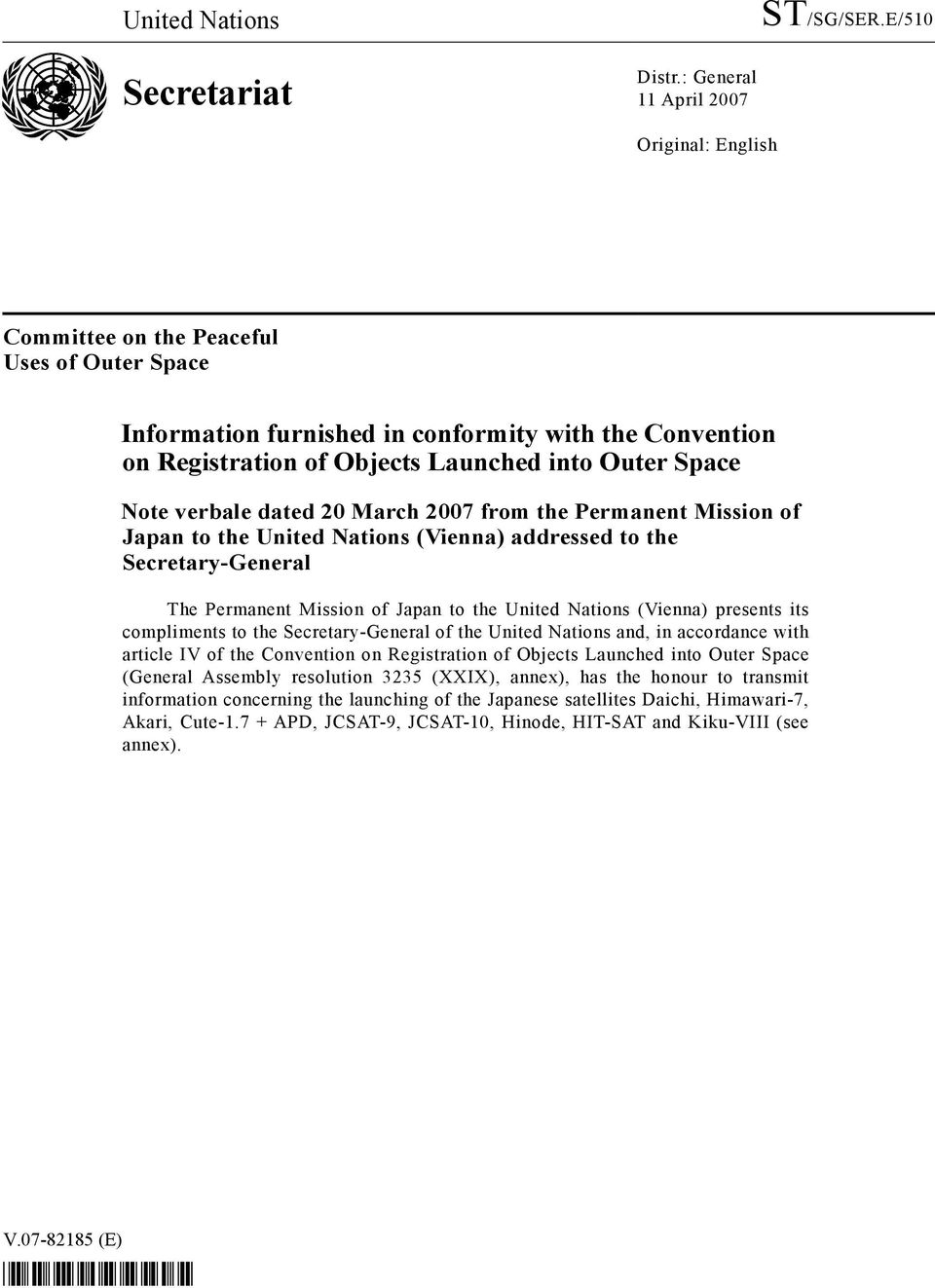
2 Annex Registration data for space objects launched by Japan * A. Advanced Land Observing Satellite (ALOS) Daichi 1. Name of flight object: Advanced Land Observing Satellite (ALOS) Daichi 2. Designation: A 4. Date and time of launch: 24 January 2006 at 0133 GMT 5. Location of launch: Tanegashima Space Center, 6. Basic orbital parameters (as at 15 May 2006): (a) Nodal period: 98 minutes (b) Inclination: 98.2 degrees (c) Apogee: kilometres (d) Perigee: kilometres 7. General function: Obtain data useful for topography and land use, as well as land information to produce global 1:25,000 scale maps 8. Launch vehicle: H-IIA Launch Vehicle F8 (H-IIA-F8) B. Multi-Functional Transport Satellite (MTSAT-2) Himawari-7 1. Name of flight object: Multi-Functional Transport Satellite (MTSAT-2) Himawari-7 2. Designation: A 4. Date and time of launch: 18 February 2006 at 0627 GMT 5. Location of launch: Tanegashima Space Center, 6. Basic orbital parameters (as at 28 February 2006): (a) Nodal period: 1,436 minutes (b) Inclination: degrees (c) Apogee: 35,797 kilometres * The registration data are reproduced in the form in which they were received. 2

3 (d) Perigee: 35,775 kilometres 7. General function: Aeronautical and meteorological services 8. Launch vehicle: H-IIA Launch Vehicle F9 (H-IIA-F9) C. Infrared Astronomy Satellite (ASTRO-F) Akari 1. Name of flight object: 21st Scientific Spacecraft, Infrared Astronomy Satellite (ASTRO-F) Akari 2. Designation: A 4. Date and time of launch: 21 February 2006 at 2128 GMT 6. Basic orbital parameters (as at 22 February 2006): (a) Nodal period: 95 minutes (b) Inclination: 98.2 degrees (c) Apogee: 733 kilometres (d) Perigee: 304 kilometres 7. General function: Obtain data to study the evolution of galaxies and the formation processes of stars and planetary systems 8. Launch vehicle: M-V Launch Vehicle F8 (M-V-8) D. Cute APD 1. Name of flight object: Pico-Satellite Cute APD of the Tokyo Institute of Technology 2. Designation: C 4. Date and time of launch: 21 February 2006 at 2128 GMT 3
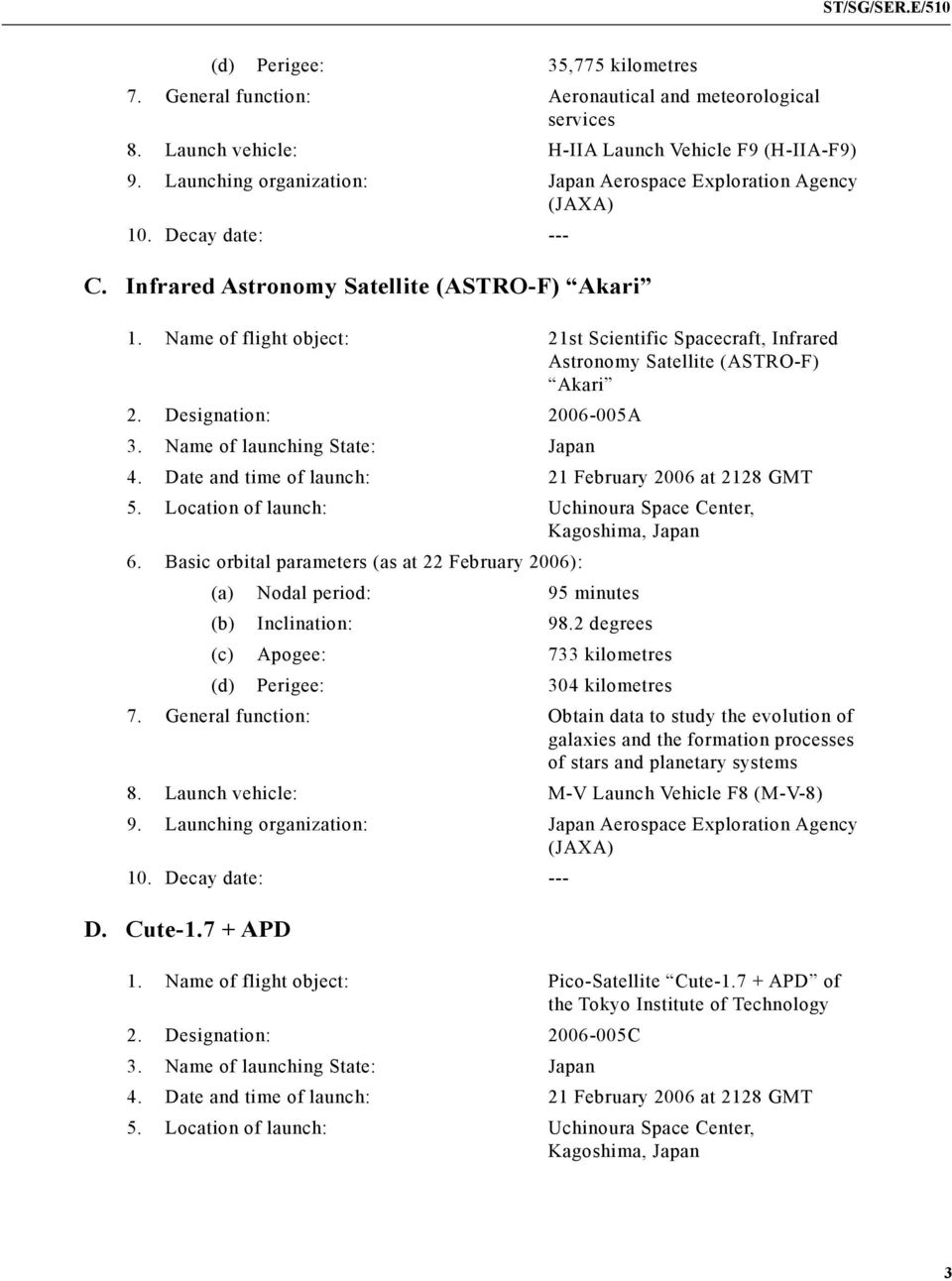
4 6. Basic orbital parameters (as at 20 April 2006): (a) Nodal period: minutes (b) Inclination: degrees (c) Apogee: 696 kilometres (d) Perigee: 300 kilometres 7. General function: Verify pico-satellite bus technology and conduct amateur radio frequency transmission experiment 8. Launch vehicle: M-V Launch Vehicle F8 (M-V-8) E. JCSAT-9 1. Name of flight object: JCSAT-9 2. Designation: A 4. Date and time of launch: 12 April 2006 at 2330 GMT 5. Location of launch: 154 degrees West longitude on equator 6. Basic orbital parameters (as at 8 June 2006): (a) Nodal period: 1,436 minutes (b) Inclination: degrees (c) Apogee: 35,794 kilometres (d) Perigee: 35,785 kilometres 7. General function: Domestic and international telecommunications 8. Launch vehicle: Zenit-3SL 9. Launching organization: Sea Launch F. JCSAT Name of flight object: JCSAT Designation: A 3. Name of launching States: Japan (France) 4. Date and time of launch: 11 August 2006 at 2215 GMT 5. Location of launch: Guiana Space Centre, Kourou, French Guiana 4

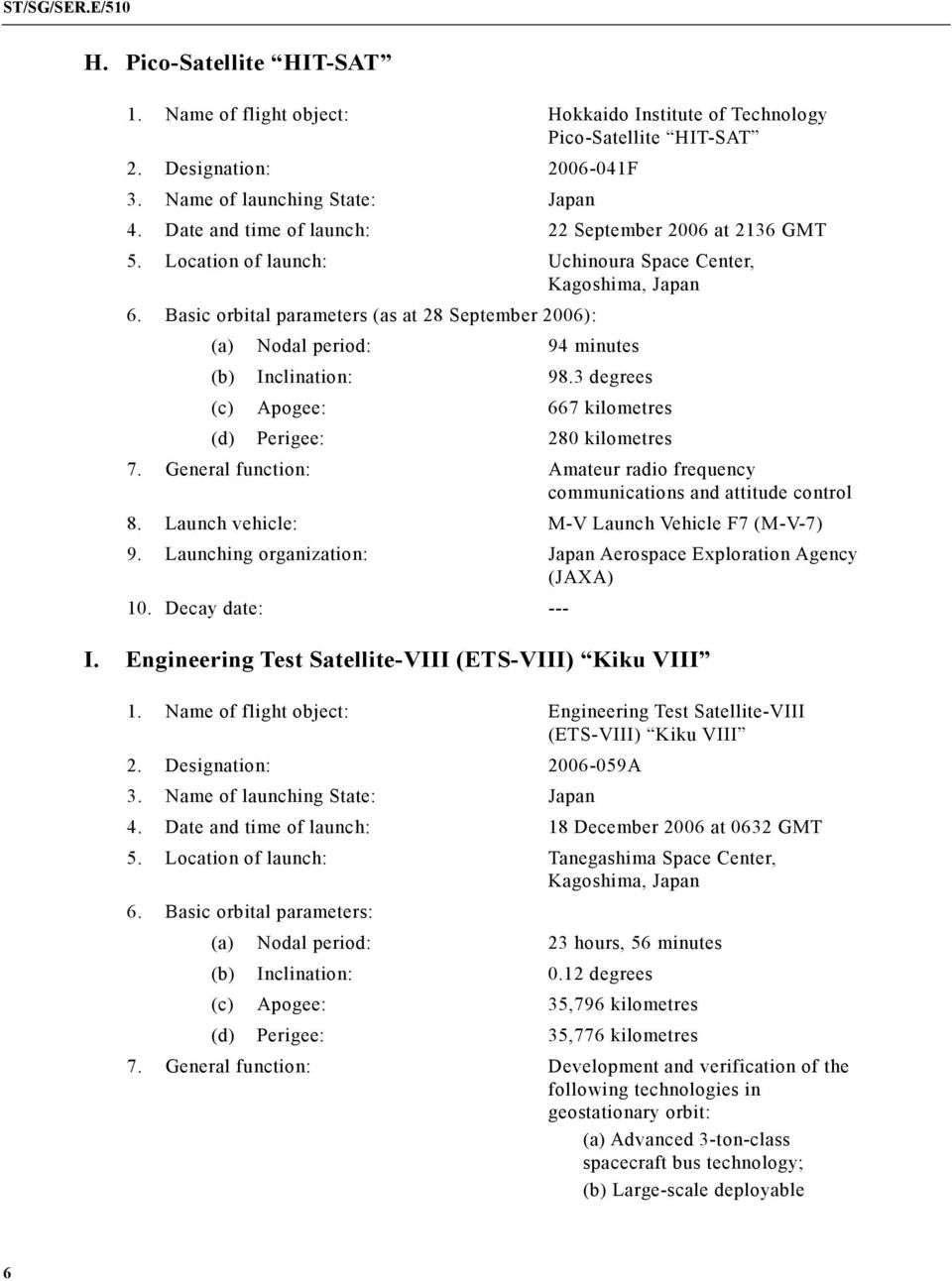
5 6. Basic orbital parameters (as at 25 September 2006): (a) Nodal period: 1,436 minutes (b) Inclination: degrees (c) Apogee: 35,788 kilometres (d) Perigee: 35,785 kilometres 7. General function: Domestic and international telecommunications and domestic broadcasting 8. Launch vehicle: Ariane 5 ECA 9. Launching organization: Arianespace G. Solar Physics Satellite (SOLAR-B) Hinode 1. Name of flight object: Solar Physics Satellite (SOLAR-B) Hinode 2. Designation: A 4. Date and time of launch: 22 September 2006 at 2136 GMT 6. Basic orbital parameters (as at 23 September 2006): (a) Nodal period: 105 minutes (b) Inclination: 98.3 degrees (c) Apogee: 686 kilometres (d) Perigee: 280 kilometres 7. General function: Obtain data for solar physics observations with three advanced telescopes operating in the visible, X-ray and extreme ultraviolet wavebands; elucidation of fundamental matters in the field of cosmic particle physics 8. Launch vehicle: M-V Launch Vehicle F7 (M-V-7) 5

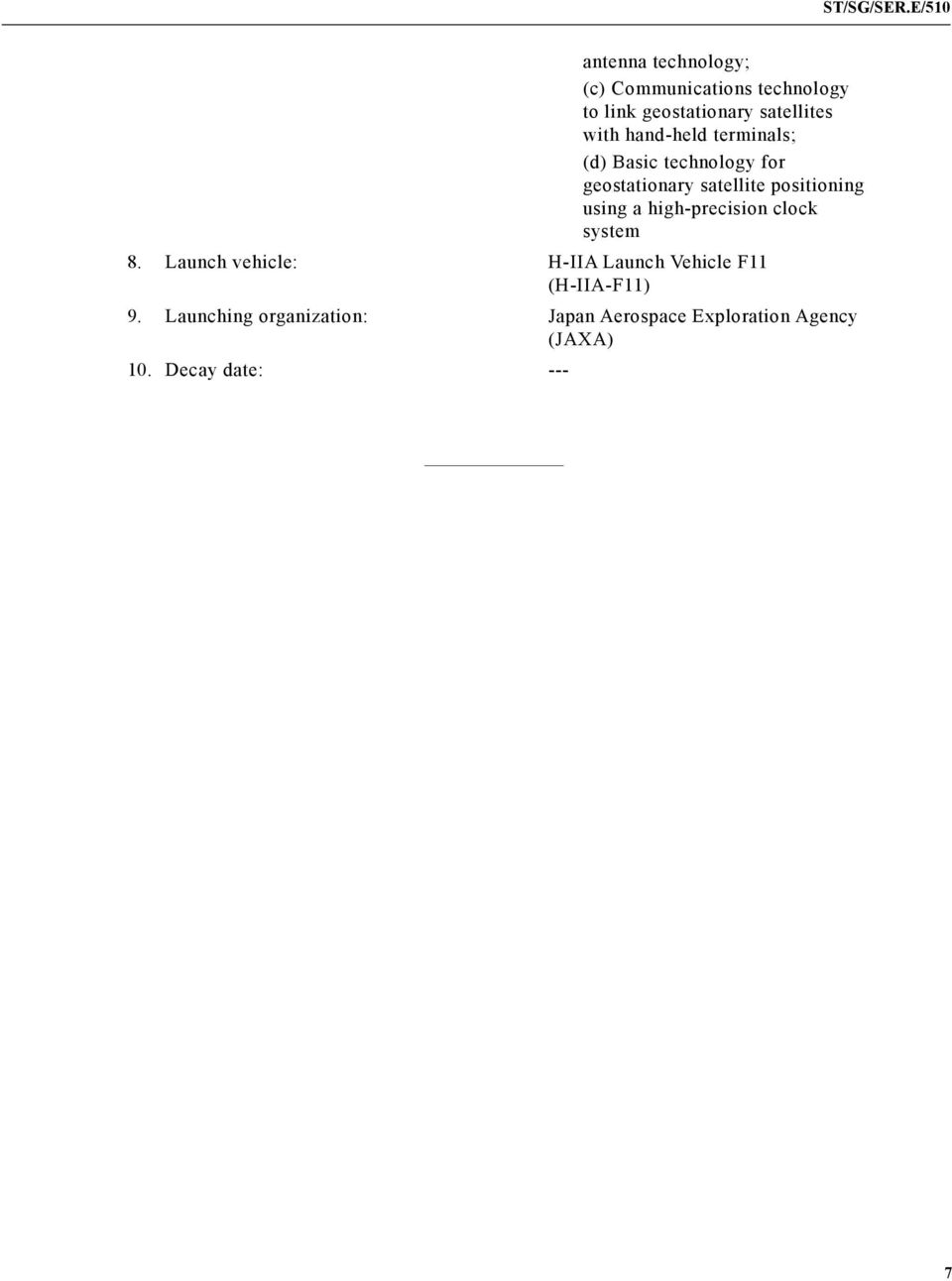
6 H. Pico-Satellite HIT-SAT 1. Name of flight object: Hokkaido Institute of Technology Pico-Satellite HIT-SAT 2. Designation: F 4. Date and time of launch: 22 September 2006 at 2136 GMT 6. Basic orbital parameters (as at 28 September 2006): (a) Nodal period: 94 minutes (b) Inclination: 98.3 degrees (c) Apogee: 667 kilometres (d) Perigee: 280 kilometres 7. General function: Amateur radio frequency communications and attitude control 8. Launch vehicle: M-V Launch Vehicle F7 (M-V-7) I. Engineering Test Satellite-VIII (ETS-VIII) Kiku VIII 1. Name of flight object: Engineering Test Satellite-VIII (ETS-VIII) Kiku VIII 2. Designation: A 4. Date and time of launch: 18 December 2006 at 0632 GMT 5. Location of launch: Tanegashima Space Center, 6. Basic orbital parameters: (a) Nodal period: 23 hours, 56 minutes (b) Inclination: 0.12 degrees (c) Apogee: 35,796 kilometres (d) Perigee: 35,776 kilometres 7. General function: Development and verification of the following technologies in geostationary orbit: (a) Advanced 3-ton-class spacecraft bus technology; (b) Large-scale deployable 6
7 antenna technology; (c) Communications technology to link geostationary satellites with hand-held terminals; (d) Basic technology for geostationary satellite positioning using a high-precision clock system 8. Launch vehicle: H-IIA Launch Vehicle F11 (H-IIA-F11) 7
PRESENTATION SPACE MISSIONS
 GENERAL PRESENTATION SPACE MISSIONS CONTENTS 1. Who we are 2. What we do 3. Space main areas 4. Space missions Page 2 WHO WE ARE GENERAL Multinational conglomerate founded in 1984 Private capital Offices
Japanese Space Industry s Efforts regarding Long-term Sustainability of Space Activities. 14 Feb 2013. The Society of Japanese Aerospace Companies
 Japanese Space Industry s Efforts regarding Long-term Sustainability of Space Activities 14 Feb 2013 The Society of Japanese Aerospace Companies (SJAC) 1 SJAC(The Society of Japanese Aerospace Companies)
Korean Space Law 2014. 11. Dr. Joon Lee Korea Aerospace Research Institute. www.kari.re.kr
 Korean Space Law 2014. 11 Dr. Joon Lee Korea Aerospace Research Institute Contents 1. Introduction to Korean Space Law 2. Space Object Registration 3. Launcher Regulations 4. Space Accident Inquiry 5.
The National Strategy, Current Activities for Space Technology Development and Application
 14-18 November 2011, Putrajaya, Malaysia The National Strategy, Current Activities for Space Technology Development and Application Lai Anh Khoi Space Technology Institute, VAST, Vietnam Bief History Space
UNITED NATIONS TREATIES AND PRINCIPLES ON OUTER SPACE
 UNITED NATIONS TREATIES AND PRINCIPLES ON OUTER SPACE ST/SPACE/11 UNITED NATIONS TREATIES AND PRINCIPLES ON OUTER SPACE Text of treaties and principles governing the activities of States in the exploration
MSAS current status. Japan Civil Aviation Bureau S TSAT A ATELLITE-BASED S UGMENTATION. MTSAT Satellite-based Augmentation System
 MSAS current status Japan Civil Aviation Bureau Civil Aviation Bureau Ministry of Land, Infrastructure and Transport 1 Contents Overview of MSAS MSAS Status Process for MSAS Commissioning Results of OT&E
The European Space Agency
 3 Agreement between the Government of Australia and the European Space Agency for a Co-operative Space Vehicle Tracking Program Done at Cape Town on 5 October 2011 Introduction 3.1 The Agreement between
Artificial Satellites Earth & Sky
 Artificial Satellites Earth & Sky Name: Introduction In this lab, you will have the opportunity to find out when satellites may be visible from the RPI campus, and if any are visible during the activity,
A forum to discuss Global Navigation Satellite Systems (GNSS) to benefit people around the world
 A forum to discuss Global Navigation Satellite Systems (GNSS) to benefit people around the world The International Committee on Global Navigation Satellite Systems (ICG) The United Nations General Assembly
United Nations Treaties
 UNITED NATIONS OFFICE FOR OUTER SPACE AFFAIRS United Nations Treaties and Principles on Outer Space and related General Assembly resolutions UNITED NATIONS UNITED NATIONS TREATIES AND PRINCIPLES ON OUTER
KIZUNA (WINDS) (Wideband InterNetworking engineering test and Demonstration Satellite) (Launched by H-IIA F14)
 KIZUNA (WINDS) (Wideband InterNetworking engineering test and Demonstration Satellite) (Launched by H-IIA F14) WINDS Project Team, Office of Space Applications Japan Aerospace Exploration Agency Objectives
Satellite technology
 Satellite technology Overview What is a satellite? The key elements of orbital position Satellite manufacturers and design The components of a satellite: payload and bus Digital versus analogue How do
APOPHIS 2029 A UNIQUE MISSION OPPORTUNITY
 APOPHIS 2029 A UNIQUE MISSION OPPORTUNITY Jean-Yves Prado CNES Toulouse - France Presentation Outline APOPHIS reminder The April 2029 flyby Mission objectives Sequence of events Launch Orbit transfer Relative
California Standards Grades 9 12 Boardworks 2009 Science Contents Standards Mapping
 California Standards Grades 912 Boardworks 2009 Science Contents Standards Mapping Earth Sciences Earth s Place in the Universe 1. Astronomy and planetary exploration reveal the solar system s structure,
International coordination for continuity and interoperability: a CGMS perspective
 International coordination for continuity and interoperability: a CGMS perspective Peng Zhang, CGMS WG-III Co-Chair NSMC/CMA In Cooperation with Suzanne Hilding, CGMS WG-III Co-Chair OPPA/NESDIS/NOAA 1
Satellite launches for Japan and Australia
 Satellite launches for Japan and Australia For its fourth launch of the year, Arianespace will orbit two communications satellites: JCSAT-12, built by Lockheed Martin Commercial Space Systems for the Japanese
NATIONAL TABLE OF FREQUENCY ALLOCATIONS
 State Commission on Radio Frequencies of the Republic of Moldova NATIONAL TABLE OF FREQUENCY ALLOCATIONS Adopted by Decision of the State Commission on Radio Frequencies of the Republic of Moldova no.
How To Get A Signal From Samoa
 1 Government of Samoa Office of the Regulator Private Bag, Apia, Samoa NATIONAL FREQUENCY ALLOCATION TABLE (This document is part of the National Spectrum Plan) Prepare by the Office of the Regulator 2
Chang e-3 s Progress and Achievement 2/2014
 Chang e-3 s Progress and Achievement 2/2014 Main content 1. Chinese Lunar Exploration Program 2. Chang e-3 s Progress 3. Chang e-3 s Achievement Chinese Lunar Exploration Program Phase I Orbital missions
A DUAL LAUNCH FOR INTERNET AND WEATHER SATELLITES
 A DUAL LAUNCH FOR INTERNET AND WEATHER SATELLITES Arianespace will orbit two satellites on its third Ariane 5 launch of the year: the dedicated Internet satellite EchoStar XVII for the American operator
Mobile Communications: Satellite Systems
 Mobile Communications: Satellite Systems Mobile Communication: Satellite Systems - Jochen Schiller http://www.jochenschiller.de 1 History of satellite communication 1945 Arthur C. Clarke publishes an essay
THE EUROPEAN TABLE OF FREQUENCY ALLOCATIONS AND UTILISATIONS IN THE FREQUENCY RANGE 9 khz to 3000 GHz
 ERC REPORT 25 Electronic Communications Committee (ECC) within the Conference of Postal and Telecommunications Administrations (CEPT) THE EUROPEAN TABLE OF FREQUENCY ALLOCATIONS AND UTILISATIONS IN THE
State of the Satellite Industry Report
 State of the Satellite Industry Report June 2012 Sponsored by the Prepared by Futron Corporation SIA Member Companies as of June 2012 2 Study Overview Based on year-end 2011 annual statistics from key
TWO TELECOMMUNICATIONS SATELLITES READY FOR LAUNCH
 TWO TELECOMMUNICATIONS SATELLITES READY FOR LAUNCH Arianespace will orbit two telecommunications satellites on its sixth Ariane 5 launch of the year: Eutelsat 21B for the European operator Eutelsat, and
ESRIN Its Development and Role
 r bulletin 99 september 1999 ESRIN Its Development and Role R. Franciosi ESRIN Site Management Services Department, ESA Directorate of Administration, ESRIN, Frascati, Italy The Establishment s main activities
GENSO. A Global Educational Network for Satellite Operations
 GENSO A Global Educational Network for Satellite Operations A Typical Student Space Segment Satellite in Low-Earth Orbit, often Sun Synchronous, Low-power transmitters, Standard communications protocols
THE EUROPEAN TABLE OF FREQUENCY ALLOCATIONS AND APPLICATIONS IN THE FREQUENCY RANGE 8.3 khz to 3000 GHz (ECA TABLE)
 Electronic Communications Committee (ECC) within the European Conference of Postal and Telecommunications Administrations (CEPT) THE EUROPEAN TABLE OF FREQUENCY ALLOCATIONS AND APPLICATIONS IN THE FREQUENCY
Indian Diplomacy At Work
 Indian Diplomacy At Work 50 YEARS OF INDO-FRENCH SPACE CO-OPERATION BRINGING BENEFITS TO MANKIND 50 YEARS OF INDO-FRENCH SPACE CO-OPERATION Bringing Benefits to Mankind A time-tested partnership India
Nanosat 4 Competition
 Nanosat 4 Competition NMSUSat2 Team New Mexico State University College of Engineering Presented by Jeremy Bruggemann Topics Competition Overview Mission Overview Design Concept Tests and Analyses Hardware
UK Allocations by Frequency Range
 UK Allocations by Not Allocated Radionavigation Broadcasting Aeronautical Radionavigation Maritime Radionavigation Mobile Land Mobile Radiolocation Amateur Aeronautical Mobile (OR) Aeronautical Mobile
Visualizing Wireless Transfer of Power: Proposal for A Five-Nation Demonstration by 2020. ISDC2012: Washington DC, May 26, 2012
 Visualizing Wireless Transfer of Power: Proposal for A Five-Nation Demonstration by 2020 Don Flournoy Ohio University Brendan Dessanti & Narayanan Komerath Georgia Institute of Technology ISDC2012: Washington
Development of a Sun Synchronous. Conjunctions
 Development of a Sun Synchronous Zoning Architecture to Minimize Conjunctions Kevin Shortt Brian Weeden Secure World Foundation www.secureworldfoundation.org Overview Current Situation in Sun synchronous
Ensuring the Preparedness of Users: NOAA Satellites GOES R, JPSS Laura K. Furgione
 Ensuring the Preparedness of Users: NOAA Satellites GOES R, JPSS Laura K. Furgione U.S. Permanent Representative with the WMO Deputy Director, NOAA s s National Weather Service WMO Executive Council 65
June VV 05. Sentinel-2A LOGOTYPE COMPLET (SYMBOLE ET TYPOGRAPHIE) 294C
 LOGOTYPE TONS MONOCHROME 294C June 2015 VV 05 LOGOTYPE COMPLET (SYMBOLE ET TYPOGRAPHIE) FIFTH VEGA LAUNCH FROM THE GUIANA SPACE CENTER, AT THE SERVICE OF EUROPE'S COPERNICUS PROGRAM On the fifth Vega mission
Small Satellites: Chances and Challenges
 Small Satellites: Chances and Challenges 29 th March 2014 Do small satellites need insurance Cécile Gaubert Head of Legal and Claims Aviation and Space Dept - Marsh SAS Summary Summary 1. Introduction
1. Introduction. FER-Zagreb, Satellite communication systems 2011/12
 1. Introduction Topics History Characteristics of satellite communications Frequencies Application 1 History Arthur C. Clark suggested in 1945. Earth coverage with 3 geostationary satellites. On 4th of
Mobile Communications Chapter 5: Satellite Systems
 History of satellite communication Mobile Communications Chapter 5: Satellite Systems History Basics Orbits LEO, MEO, GEO Examples Handover, Routing 1945 Arthur C. Clarke publishes an essay about Extra
CONSTRUCTING A CONSTELLATION OF 6U SOLAR POWER CUBE SATELLITES
 CONSTRUCTING A CONSTELLATION OF 6U SOLAR POWER CUBE SATELLITES Authors: Corey Bergsrud 1, Jeremy Straub 2, Matthew Clausing 3, Johnathan McClure 1, and Sima Noghanian 1. 1 Department of Electrical Engineering,
GHANA NATIONAL FREQUENCY ALLOCATION TABLE 2013
 GHANA NATIONAL FREQUENCY ALLOCATION TABLE 2013 Table of Contents INTRODUCTION... 3 TERMS AND DEFINITIONS... 4 STRUCTURE OF THE NATIONAL TABLE OF FREQUENCY ALLOCATIONS... 10 TABLE OF FREQUENCY ALLOCATION...
How To Write A National Radio Plan
 NATIONAL FREQUENCY PLAN IN THE KINGDOM OF SAUDI ARABIA CONTENTS ARTICLE 1: TERMS ARTICLE:2 STRUCTURE OF THE NATIONAL FREQUENCY PLAN 1. Description of the National Table 2 Categories of Services 3 Spectrum
A DUAL LAUNCH FOR MOBILE COMMUNICATIONS AND METEOROLOGY SATELLITES
 A DUAL LAUNCH FOR MOBILE COMMUNICATIONS AND METEOROLOGY SATELLITES Arianespace will orbit two satellites on its third Ariane 5 launch of the year: the Alphasat mobile communications satellite for operator
IAC-08-B3.3.04 PROPOSAL FOR MODIFICATION OF ISS. Japan,Tokyo http://www.soranokai.jp/
 IAC-08-B3.3.04 PROPOSAL FOR MODIFICATION OF ISS Fujio.NAKANO 1, Tomifumi.GODAI 2 1 Space Policy Think-tank [SORANOKAI] 2 Space Policy Think-tank[SORANOKAI] Japan,Tokyo http://www.soranokai.jp/ E-mail 1
A Taxonomy for Space Curricula
 A Taxonomy for Space Curricula Arthur W. Draut, Ph.D. College of Aviation Embry-Riddle Aeronautical University Abstract Many universities have added courses and curricula related to satellites and space.
COLLATED QUESTIONS: ELECTROMAGNETIC RADIATION
 COLLATED QUESTIONS: ELECTROMAGNETIC RADIATION 2011(2): WAVES Doppler radar can determine the speed and direction of a moving car. Pulses of extremely high frequency radio waves are sent out in a narrow
TABLE OF RADIO FREQUENCY ALLOCATIONS THE REPUBLIC OF CHINA
 TABLE OF RADIO FREQUENCY ALLOCATIONS OF THE Directorate General of Telecommunications Ministry of Transportation and Communications December 19, 2005 revised 1 Regulation: The table of radio frequency
An Open Source Flight Management System For CubeSats. Andrew Santangelo sci_zone www.sci-zone.com
 An Open Source Flight Management System For CubeSats Andrew Santangelo sci_zone www.sci-zone.com Overview Motivation & Background QuickSAT/VMS - key features Architecture Communications Screen Shots Road
A long time ago, people looked
 Supercool Space Tools! By Linda Hermans-Killam A long time ago, people looked into the dark night sky and wondered about the stars, meteors, comets and planets they saw. The only tools they had to study
CSSAR Space Science Cooperation
 CSSAR Space Science Cooperation WANG Shuzhi Center for Space Science and Applied Research Chinese Academy of Science(CSSAR) Table of Contents Brief History of CSSAR International Cooperation CAS Strategic
Space Weather Research and Forecasting in CRL, Japan
 Space Weather Research and Forecasting in CRL, Japan Maki Akioka Hiraiso Solar Observatory Communications Research Laboratory Contact [email protected] 1 Contents of Presentation 1.Space Weather Observation
VIETNAM ACADEMY OF SCIENCE AND TECHNOLOGY VIETNAM NATIONAL SATELLITE CENTER CUBESAT PICO DRAGON. Presenter Name: Do Xuan Phong
 VIETNAM ACADEMY OF SCIENCE AND TECHNOLOGY VIETNAM NATIONAL SATELLITE CENTER CUBESAT PICO DRAGON Presenter Name: Do Xuan Phong Co-authors: Vu Viet Phuong, Truong Xuan Hung, Le Xuan Huy, Bui Nam Duong, Do
A launch for science. Follow the launch live on the internet broadband at www.arianespace.com (starting 20 minutes before lift-off)
 A launch for science For its second launch of the year, Arianespace will orbit two scientific satellites for the European Space Agency: the Herschel space telescope and the Planck scientific observatory.
2-1-5 Space Radiation Effect on Satellites
 2-1-5 Space Radiation Effect on Satellites Solar activity and space environment is considered as fundamental and important factors for space system design and operation. Space and solar radiation is widely
THE EUROPEAN TABLE OF FREQUENCY ALLOCATIONS AND UTILISATIONS COVERING THE FREQUENCY RANGE 9 khz TO 275 GHz
 European Radiocommunications Committee (ERC) within the European Conference of Postal and Telecommunications Administrations (CEPT) THE EUROPEAN TABLE OF FREQUENCY ALLOCATIONS AND UTILISATIONS COVERING
BR Workshop on the efficient use of the spectrum/orbit resource (Geneva, 6 May 2009)
 BR Workshop on the efficient use of the spectrum/orbit resource (Geneva, 6 May 2009) Spectrum inefficiencies resulting from the claimed use of steerable beams, multiple beams or large coverage area beams
DEVELOPMENT OF AN ARCHITECTURE OF SUN-SYNCHRONOUS ORBITAL SLOTS TO MINIMIZE CONJUNCTIONS. Brian Weeden Secure World Foundation
 DEVELOPMENT OF AN ARCHITECTURE OF SUN-SYNCHRONOUS ORBITAL SLOTS TO MINIMIZE CONJUNCTIONS Brian Weeden Secure World Foundation Sun-synchronous orbit (SSO) satellites serve many important functions, primarily
CHAPTER VII. Distress and safety communications 1
 CHAPTER VII Distress and safety communications 1 1 C.VII For the purposes of this Chapter, distress and safety communications include distress, urgency and safety calls and messages. RR30-1 ARTICLE 30
ORBITAL RECOVERY S RESPONSIVE COMMERCIAL SPACE TUG FOR LIFE EXTENSION MISSIONS
 AIAA 2 nd Responsive Space Conference AIAA-RS2 2004-3004 ORBITAL RECOVERY S RESPONSIVE COMMERCIAL SPACE TUG FOR LIFE EXTENSION MISSIONS Dennis Ray Wingo, Orbital Recovery Corporation Orbital Recovery Limited
A Fractionated Space Weather Base at L 5 using CubeSats & Solar Sails
 A Fractionated Space Weather Base at L 5 using CubeSats & Solar Sails Paulett C. Liewer, Andrew T. Klesh, Martin W. Lo, Neil Murphy, Robert L. Staehle, Vassilis Angelopoulos, Jet Propulsion Laboratory,
Second International Symposium on Advanced Radio Technologies Boulder Co, September 8-10, 1999
 Second International Symposium on Advanced Radio Technologies Boulder Co, September 8-10, 1999 Overview of Satellite Communications Tim Pratt Center for Wireless Telecommunications Virginia Tech History
Mobile Communications Chapter 5: Satellite Systems
 Mobile Communications Chapter 5: Satellite Systems History Basics Localization Handover Routing Systems History of satellite communication 1945 Arthur C. Clarke publishes an essay about Extra Terrestrial
Hong Kong Table of Frequency Allocations. January 2016 Office of the Communications Authority
 Hong Kong Table of Frequency Allocations January 2016 Office of the Communications Authority Preface This handbook contains the table of frequency allocations in accordance with the Region 3 allocations
Mobile Computing. Chapter 5: Satellite Systems
 Mobile Computing Chapter 5: Satellite Systems Prof. Sang-Jo Yoo History of satellite communication 1945 Arthur C. Clarke publishes an essay about Extra Terrestrial Relays 1957 First satellite SPUTNIK by
The 35th COSPAR Assembly
 The 35th COSPAR Assembly A Record-Breaking Success Jean-Paul Paillé* Directorate of External Relations, ESA, Paris Coordinating and promoting space research at worldwide level and regularly providing open
A science class experience that is out of this world. Robert Benkoczi, PhD Optimization Research Group University of Lethbridge
 A science class experience that is out of this world Robert Benkoczi, PhD Optimization Research Group University of Lethbridge SWATCA 2015 Summary Optimization Research Group Funcube project and reception
RS platforms. Fabio Dell Acqua - Gruppo di Telerilevamento
 RS platforms Platform vs. instrument Sensor Platform Instrument The remote sensor can be ideally represented as an instrument carried by a platform Platforms Remote Sensing: Ground-based air-borne space-borne
UNITED STATES OF AMERICA
 TREATIES AND OTHER INTERNATIONAL ACTS SERIES 12-306 SPACE COOPERATION Solar Orbiter Mission Memorandum of Understanding Between the UNITED STATES OF AMERICA and the EUROPEAN SPACE AGENCY Signed at Paris
Clouds and the Energy Cycle
 August 1999 NF-207 The Earth Science Enterprise Series These articles discuss Earth's many dynamic processes and their interactions Clouds and the Energy Cycle he study of clouds, where they occur, and
Analysis on the Long-term Orbital Evolution and Maintenance of KOMPSAT-2
 Analysis on the Long-term Orbital Evolution and Maintenance of KOMPSAT-2 Ok-Chul Jung 1 Korea Aerospace Research Institute (KARI), 45 Eoeun-dong, Daejeon, South Korea, 305-333 Jung-Hoon Shin 2 Korea Advanced
a Brief Background DEFINITION
 GNSS FOR AVIATION a Brief Background ANC informal briefing DEFINITION GNSS: A worldwide position and time determination ti system that t includes one or more satellite constellations, aircraft receivers
2. Orbits. FER-Zagreb, Satellite communication systems 2011/12
 2. Orbits Topics Orbit types Kepler and Newton laws Coverage area Influence of Earth 1 Orbit types According to inclination angle Equatorial Polar Inclinational orbit According to shape Circular orbit
ब त र य जन एव समन वय स कन ध
 Department of Telecommunications Ministry of Communications & Information Technology Government of India ब त र य जन एव समन वय स कन ध Wireless Planning and Coordination Wing We should not depend on others
How Do You Make a Weather Satellite?
 NATIONAL OCEANIC AND ATMOSPHERIC ADMINISTRATION U.S. DEPARTMENT OF COMMERCE How Do You Make a Weather Satellite? This booklet was adapted from the original work by Ed Koenig I'm a weather forecaster. I
State of the Satellite Industry Report June 2013
 State of the Satellite Industry Report June 2013 Sponsored by the Prepared by The Satellite Industry Association: 18 Years as the Voice of the U.S. Satellite Industry SIA MEMBER COMPANIES 2 Study Overview
ShindaiSat : A Visible Light Communication Experimental Micro-Satellite
 ShindaiSat : A Visible Light Communication Experimental Micro-Satellite Atsushi Nakajima, Nobutada Sako, Masato Kamemura, Yuuki Wakayama, Arata Fukuzawa, Hironori Sugiyama and Naoki Okada Graduate School
SATELLITE LAUNCHES FOR ASIA AND INDIA
 SATELLITE LAUNCHES FOR ASIA AND INDIA Arianespace will orbit two communications satellites on its third launch of the year: ST-2 for the operator ST-2 Satellite Ventures Pte Ltd., a joint venture of Singapore
5. Satellite Systems. History of Satellite Communications
 5. Satellite Systems History and Orbits Routing, Localization, and Hand-over Systems 2005 Burkhard Stiller and Jochen Schiller FU Berlin M5 1 History of Satellite Communications 1945 Arthur C. Clarke about
Space Export Controls Update
 Space Export Controls Update Since Delivering the 1248 Report to Congress - April 2012 Congress added language into the FY13 National Defense Authorization Act that gave the President the authority to
Radio-frequency channel arrangements for fixed wireless system operating in the 10.0-10.68 GHz band
 Recommendation ITU-R F.747-1 (03/2012) Radio-frequency channel arrangements for fixed wireless system operating in the 10.0-10.68 GHz band F Series Fixed service ii Rec. ITU-R F.747-1 Foreword The role
SHARING BETWEEN TERRESTRIAL FLIGHT TELEPHONE SYSTEM (TFTS) AND RADIO ASTRONOMY IN THE 1.6 GHz BAND. Paris, May 1992
 European Radiocommunications Committee (ERC) within the European Conference of Postal and Telecommunications Administrations (CEPT) SHARING BETWEEN TERRESTRIAL FLIGHT TELEPHONE SYSTEM (TFTS) AND RADIO
Best of the Solar System
 Best of the Solar System Topic Area: Solar system, planets and moons Purpose: Introduce students to planetary research and familiarize them with the planets and their features. Key Questions: What are
Satellite Communications
 Satellite Communications Department of Electrical Engineering Faculty of Engineering Chiangmai University Origin of Satellite Communications Arthur C. Clark (1945) British Science fiction writer propose
Western Washington Amateur Relay Association
 WWARA BAND PLANS NOTE: This document has exactly the same content as the Western Washington Amateur Relay Association Coordination Policies (Adopted June 3, 2004) but is easier to read. It was written
Automated Spacecraft Scheduling The ASTER Example
 Automated Spacecraft Scheduling The ASTER Example Ron Cohen [email protected] Ground System Architectures Workshop 2002 Jet Propulsion Laboratory The Concept Scheduling by software instead of
Materials: Internet connection and browser for displaying the lesson; Reading Guide (appended at the end of this lesson plan).
 Multiwavelength Astronomy: The History of X-ray Astronomy, by Herbert Friedman http://ecuip.lib.uchicago.edu/multiwavelength-astronomy/x-ray/history/index.html Subject(s): Astronomy/Space Science Grade(s)
A DUAL LAUNCH FOR COMMUNICATIONS AND BROADCASTING SERVICES
 A DUAL LAUNCH FOR COMMUNICATIONS AND BROADCASTING SERVICES Arianespace will orbit two communications and broadcast satellites on its fifth launch of the year: Arabsat 5C for the operator Arabsat and SES-2
The European Satellite Navigation Programmes EGNOS and Galileo
 The European Satellite Navigation Programmes EGNOS and Galileo Olivier Crop European GNSS Agency (GSA) Paris, 17 March 2014 20 March, 2014 The European GNSS Programmes 2 Basics of Satellite Navigation
INTER AMERICAN CONVENTION ON THE ELIMINATION OF ALL FORMS OF DISCRIMINATION AGAINST PERSONS WITH DISABILITIES
 INTER AMERICAN CONVENTION ON THE ELIMINATION OF ALL FORMS OF DISCRIMINATION AGAINST PERSONS WITH DISABILITIES (Adopted at Guatemala City, Guatemala at the twenty ninth regular session of the General Assembly
TOPO Trajectory Operations Officer
 ISS Live! was developed at NASA s Johnson Space Center (JSC) under NASA Contracts NNJ14RA02C and NNJ11HA14C wherein the U.S. Government retains certain rights. Console Handbook TOPO Trajectory Operations
2. Typology of space value chain actors
 Toulouse Space Show 2012 : IISL/IAA Space Law and Policy Symposium Session 1a : Towards effective sustainability for outer space activities ECONOMICAL SUSTAINABILITY OF THE SPACE VALUE CHAIN : ROLE OF
Clear Sky Radiance (CSR) Product from MTSAT-1R. UESAWA Daisaku* Abstract
 Clear Sky Radiance (CSR) Product from MTSAT-1R UESAWA Daisaku* Abstract The Meteorological Satellite Center (MSC) has developed a Clear Sky Radiance (CSR) product from MTSAT-1R and has been disseminating
SCADE Suite in Space Applications
 SCADE Suite in Space Applications at EADS David Lesens 09/10/2008 Overview Introduction Historical use of SCADE at EADS Astrium ST Why using SCADE? The Automatic Transfer Vehicle (ATV) M51 and Vega R&T