
"Essential Mathematics & Statistics for Science" by Dr G Currell & Dr A A Dowman (John Wiley & Sons) Answers to In-Text Questions
|
|
|
- Martina Stewart
- 10 years ago
- Views:
Transcription
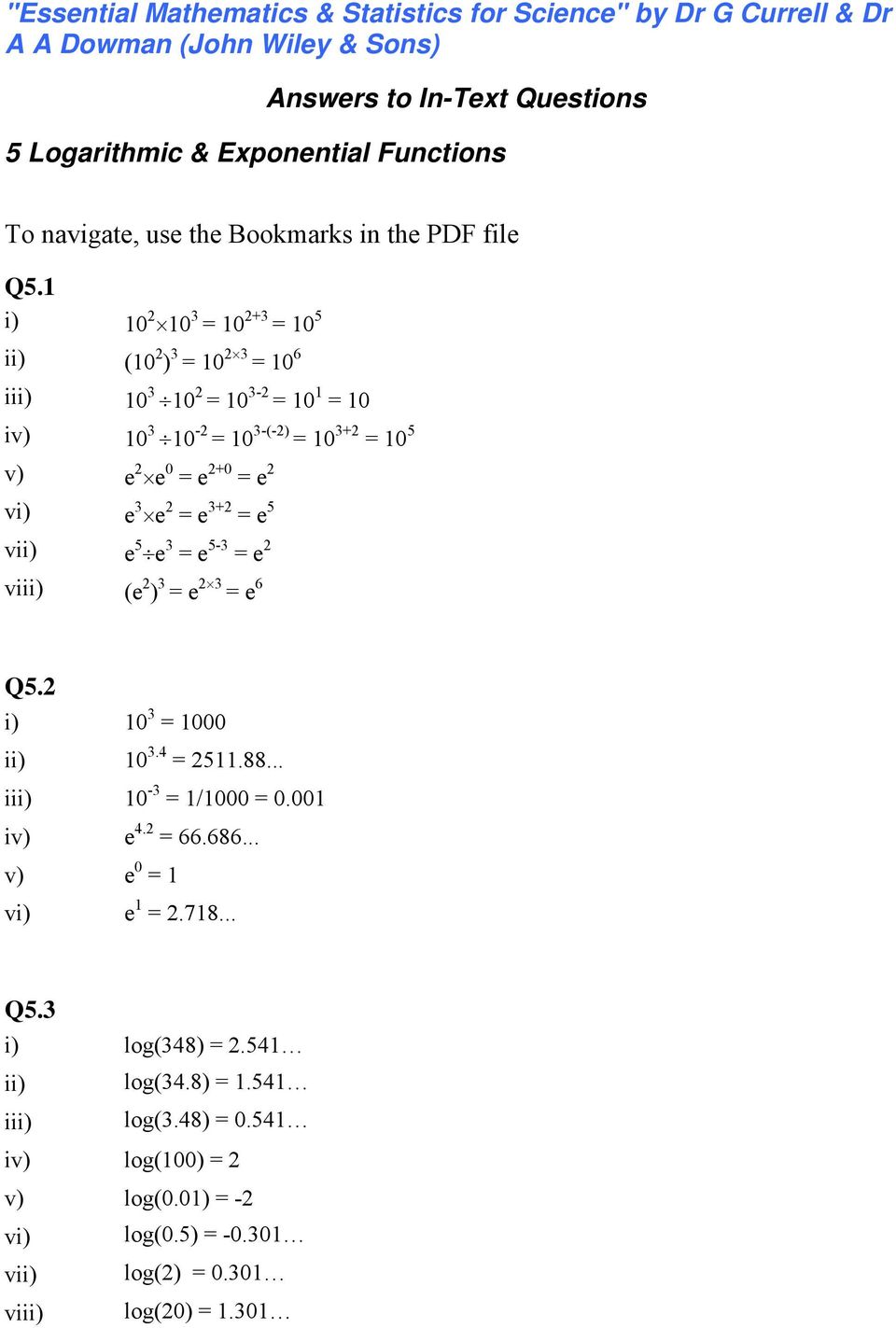
1 "Essential Mathematics & Statistics for Science" by Dr G Currell & Dr A A Dowman (John Wiley & Sons) Answers to In-Text Questions 5 Logarithmic & Exponential Functions To navigate, use the Bookmarks in the PDF file Q5.1 i) = = 10 5 ii) (10 2 ) 3 = = 10 6 iii) = = 10 1 = 10 iv) = 10 3-(-2) = = 10 5 v) e 2 e 0 = e 2+0 = e 2 vi) e 3 e 2 = e 3+2 = e 5 vii) e 5 e 3 = e 5-3 = e 2 viii) (e 2 ) 3 = e 2 3 = e 6 Q5.2 i) 10 3 = 1000 ii) = iii) 10-3 = 1/1000 = iv) e 4.2 = v) e 0 = 1 vi) e 1 = Q5.3 i) log(348) = ii) log(34.8) = iii) log(3.48) = iv) log(100) = 2 v) log(0.01) = -2 vi) log(0.5) = vii) log(2) = viii) log(20) = 1.301
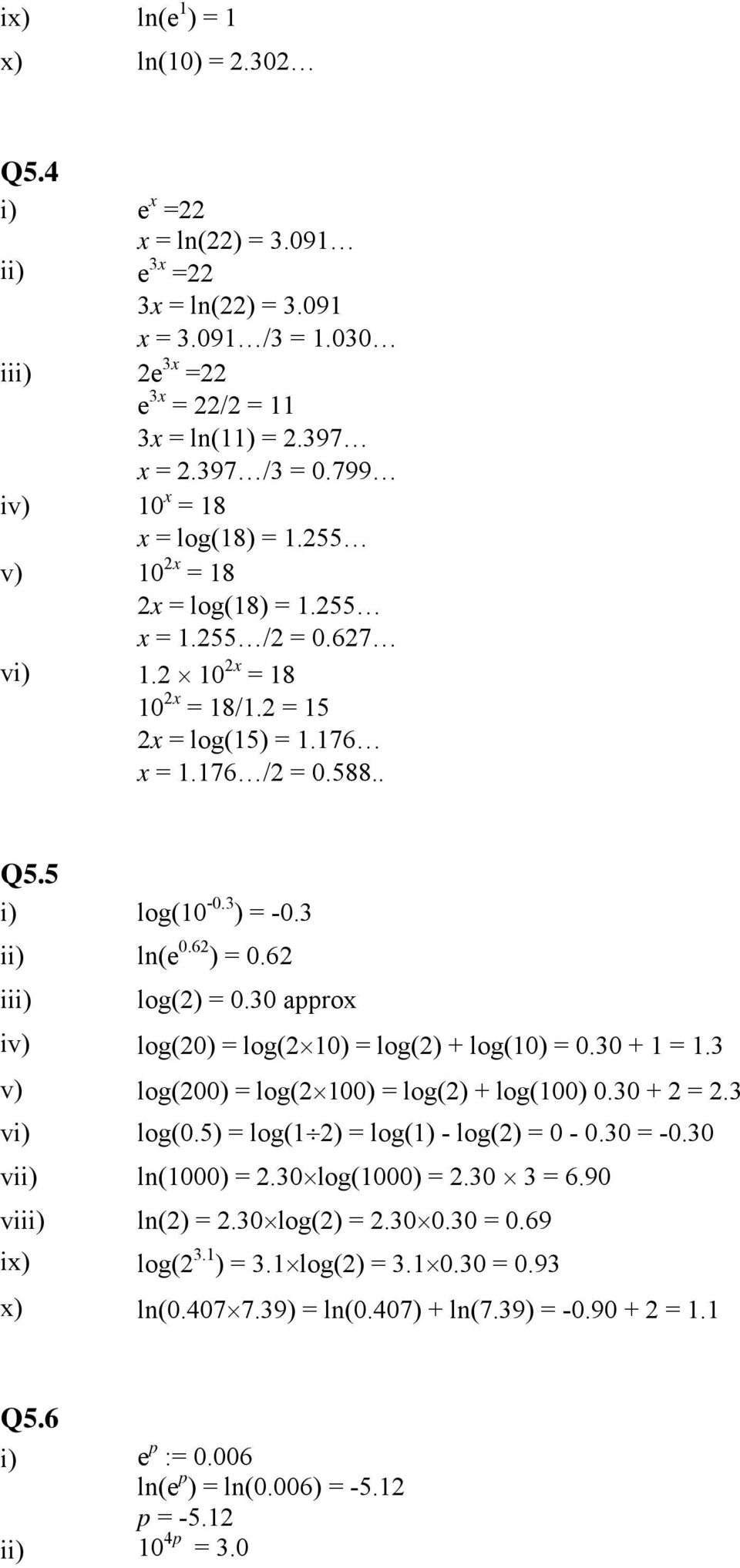
2 ix) ln(e 1 ) = 1 x) ln(10) = Q5.4 i) e x =22 x = ln(22) = ii) e 3x =22 3x = ln(22) = x = /3 = iii) 2e 3x =22 e 3x = 22/2 = 11 3x = ln(11) = x = /3 = iv) 10 x = 18 x = log(18) = v) 10 2x = 18 2x = log(18) = x = /2 = vi) x = x = 18/1.2 = 15 2x = log(15) = x = /2 = Q5.5 i) log( ) = -0.3 ii) ln(e 0.62 ) = 0.62 iii) log(2) = 0.30 approx iv) log(20) = log(2 10) = log(2) + log(10) = = 1.3 v) log(200) = log(2 100) = log(2) + log(100) = 2.3 vi) log(0.5) = log(1 2) = log(1) - log(2) = = vii) ln(1000) = 2.30 log(1000) = = 6.90 viii) ln(2) = 2.30 log(2) = = 0.69 ix) log(2 3.1 ) = 3.1 log(2) = = 0.93 x) ln( ) = ln(0.407) + ln(7.39) = = 1.1 Q5.6 i) e p := ln(e p ) = ln(0.006) = p = ii) 10 4p = 3.0
3 log(10 4p ) = 4p = log(3.0) 4p = p = iii) e -2p = ln(e -2p ) = -2p = ln(0.006) = p = 5.12/2 = 2.56 iv) 10-4p = 33.0 log(10-4p ) = -4 plog(10) = -4p 1 = log(33) p = -log(33)/4 = / 4 = v) 4 p = 33 log(33) = log(4 p ) = p log(4) 0.602p = 1.52 p = 2.52 vi) 0.2 p = 0.3 take log or ln in this case p log (0.2) = log(0.3) p = log(0.3)/ log (0.2) = / = Q5.7 Initial loudness = 70dB i) Doubling power density adds 3dB to loudness. New value = 73dB ii) Increasing by 8 (= 2 3 ) adds 3 3dB = 9dB. New value = 79dB iii) Increasing by 100: difference = 10 log(p 1 /P 2 ) = 10 log(100) = 10 2 = 20 New value = = 90dB iv) Halving reduces the loudness by 3dB ( see (i)) New value = 67dB v) See (ii) subtract 9dB. New value = 61dB vi) See (iii). Subtract 20dB. New value = 50dB. Q5.8 i) Difference in [H+] between pure water and strong base = ( ) - ( ) = ii) Difference in [H+] between strong acid and pure water = ( ) - ( ) = iii) No iv) Ratio of [H+] between pure water and strong base = ( )/( ) = v) Ratio of [H+] between strong acid and pure water = ( )/( ) = vi) Yes for this example of strong acid and base vii) Difference in ph between pure water and strong base = 7 13 = -6 viii) Difference in ph between strong acid and pure water = 1 7 = -6 ix) Yes for this example of strong acid and base

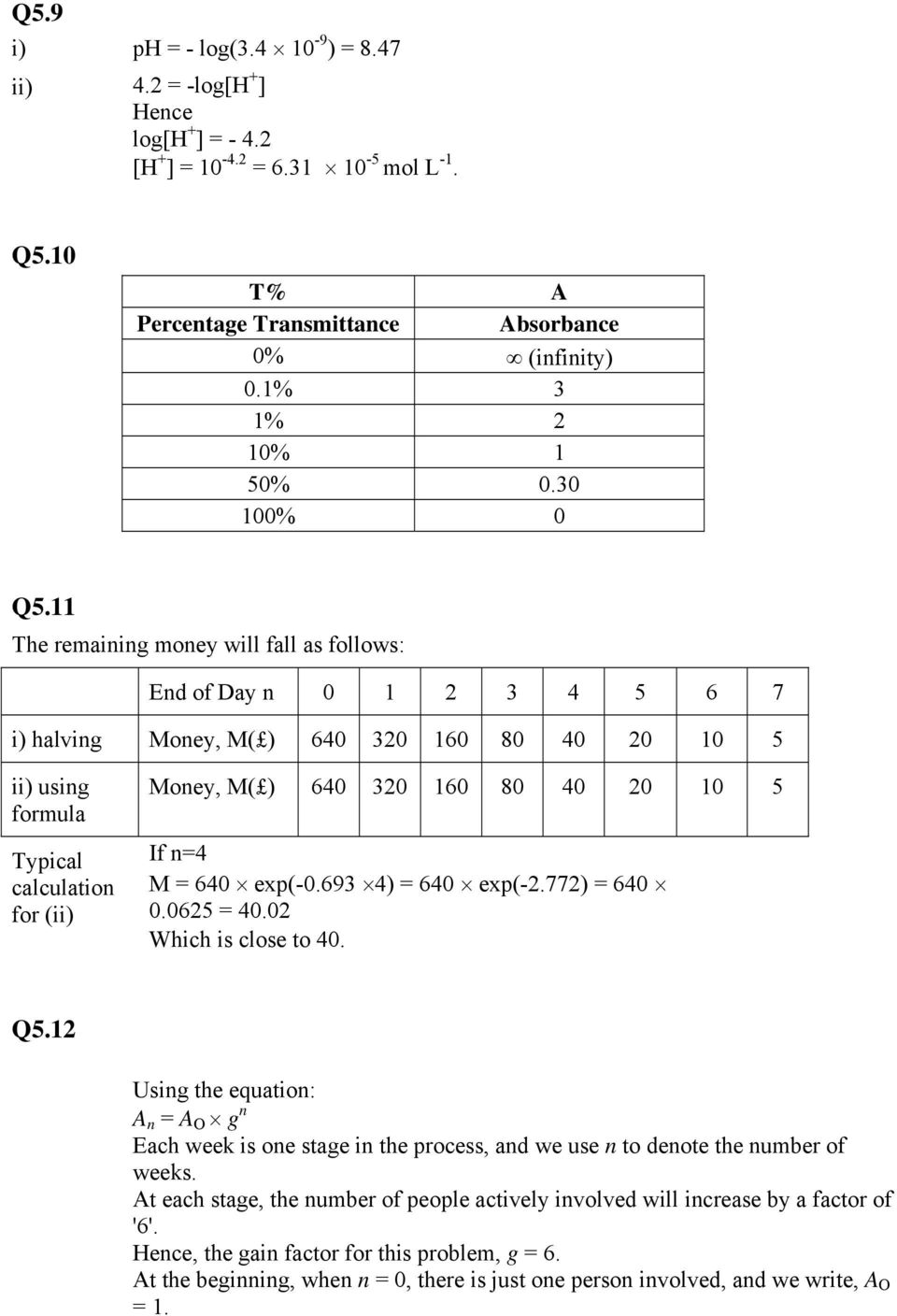
4 Q5.9 i) ph = - log( ) = 8.47 ii) 4.2 = -log[h + ] Hence log[h + ] = [H + ] = = mol L -1. Q5.10 T% A Percentage Transmittance Absorbance 0% (infinity) 0.1% 3 1% 2 10% 1 50% % 0 Q5.11 The remaining money will fall as follows: End of Day n i) halving Money, M( ) ii) using formula Typical calculation for (ii) Money, M( ) If n=4 M = 640 exp( ) = 640 exp(-2.772) = = Which is close to 40. Q5.12 Using the equation: A n = A O g n Each week is one stage in the process, and we use n to denote the number of weeks. At each stage, the number of people actively involved will increase by a factor of '6'. Hence, the gain factor for this problem, g = 6. At the beginning, when n = 0, there is just one person involved, and we write, A O = 1.
5 Hence our equation becomes: A n = 1 6 n To solve the problem we need to find the value of n such that A n The first step is to solve the following equation for n = 6 n Taking logs of both sides (see 5.1 Mathematics of e, log & ln): log( ) = log(6 n ) 7.30 = n log(6) = n Hence: n = 7.30 / = 9.4 weeks Thus we can see that by the end of 10 weeks, at least one third of the UK population would be involved - assuming of course that the chain is not broken (which thankfully it always is!). Q5.13 i) A period of 2 hours is equivalent to 5 'half-lives', where one half-life, T, = 0.4. The initial population will drop by 50% for each half-life. Population after 5 half-lives = = ii) iii) g = 0.5 is equivalent to a 50% drop for each period. The equation becomes: A n = (0.5) n For a time, t = 2.2 hours, n = t/t = 2.2 / 0.4 = 5.5. Evaluating the equation, gives A n = (0.5) 5.5 = Q5.14 i) If t = 25 days, N 25 = 3500 exp( ) = 3500 exp(0.5)= = 5771 ii) If t = 50 days, N 50 = 3500 exp( ) = 3500 exp(1)= = 9514 iii) If t = 75 days, N 75 = 3500 exp( ) = 3500 exp(1.5)= = Q5.15 Using the equation: N t = N O g t Each week is one stage in the process, and we use t to denote the number of weeks. At each stage, the number of people actively involved will increase by a factor of '1.1'. Hence, the gain factor for this problem, g = 1.1. At the beginning, when t = 0, g 0 = 1 and N 0 = 100.

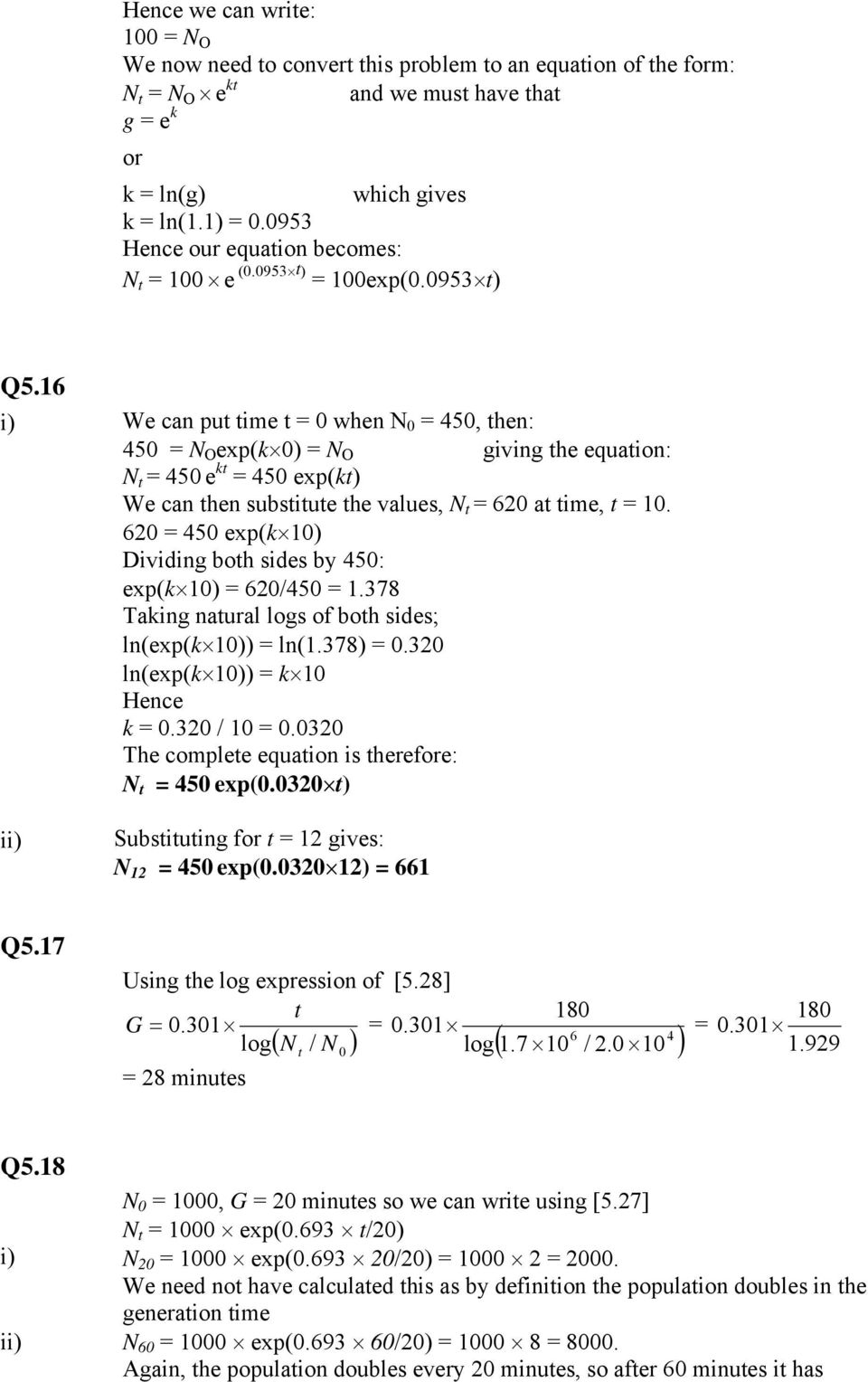
6 Hence we can write: 100 = N O We now need to convert this problem to an equation of the form: N t = N O e kt and we must have that g = e k or k = ln(g) which gives k = ln(1.1) = Hence our equation becomes: N t = 100 e ( t) = 100exp( t) Q5.16 i) We can put time t = 0 when N 0 = 450, then: 450 = N O exp(k 0) = N O giving the equation: N t = 450 e kt = 450 exp(kt) We can then substitute the values, N t = 620 at time, t = = 450 exp(k 10) Dividing both sides by 450: exp(k 10) = 620/450 = Taking natural logs of both sides; ln(exp(k 10)) = ln(1.378) = ln(exp(k 10)) = k 10 Hence k = / 10 = The complete equation is therefore: N t = 450 exp( t) ii) Substituting for t = 12 gives: N 12 = 450 exp( ) = 661 Q5.17 Using the log expression of [5.28] t 180 G = = log N / N log / = 28 minutes ( ) t 0 4 ( ) = Q5.18 N 0 = 1000, G = 20 minutes so we can write using [5.27] N t = 1000 exp(0.693 t/20) i) N 20 = 1000 exp( /20) = = We need not have calculated this as by definition the population doubles in the generation time ii) N 60 = 1000 exp( /20) = = Again, the population doubles every 20 minutes, so after 60 minutes it has
7 doubled 3 times, = 8 times increase. iii) N 10 = 1000 exp( /20) = = iv) N 45 = 1000 exp( /20) = = Q5.19 i) 3 days = 1 half-life. Fraction left = 1/2 = 0.5 ii) 6 days = 2 half-life. Fraction left = = 0.25 = 1/4 iii) 9 days = 3 half-life. Fraction left = = = 1/8 Q5.20 We will use the equation: A t = A O exp( t/t) We need to calculate the proportion of remaining activity, (A t / A O ), where (A t / A O ) =exp(-0.693t/t) We know that, after t = 26 hours: (A 26 / A O ) = 1/10 = 0.1 Hence we can write 0.1 = exp( /T) = exp( / T) To solve this equation, we take natural logs of both sides: ln(0.1) = ln(exp( / T)) giving = / T Hence, the half-life, T, is given by T = / = hours Q5.21 We will use the equation: A t = A O exp(-t/τ) where A will represent the charge on the capacitor. The proportion of remaining charge, (A t / A O ), after time, t, will be given by (A t / A O ) = exp(-t/τ) We know that (A t / A O ) = 1% = 0.01 τ = CR = = Hence we can write 0.01 = exp{-t/( )} To solve this equation, we take natural logs of both sides: ln(0.01) = ln(exp{-t/( )}) giving = -t/( ) Hence, the time, t, is given by t = = s = 15.2 ms Q5.22 i) See also In-Text questions, Other Files QE5
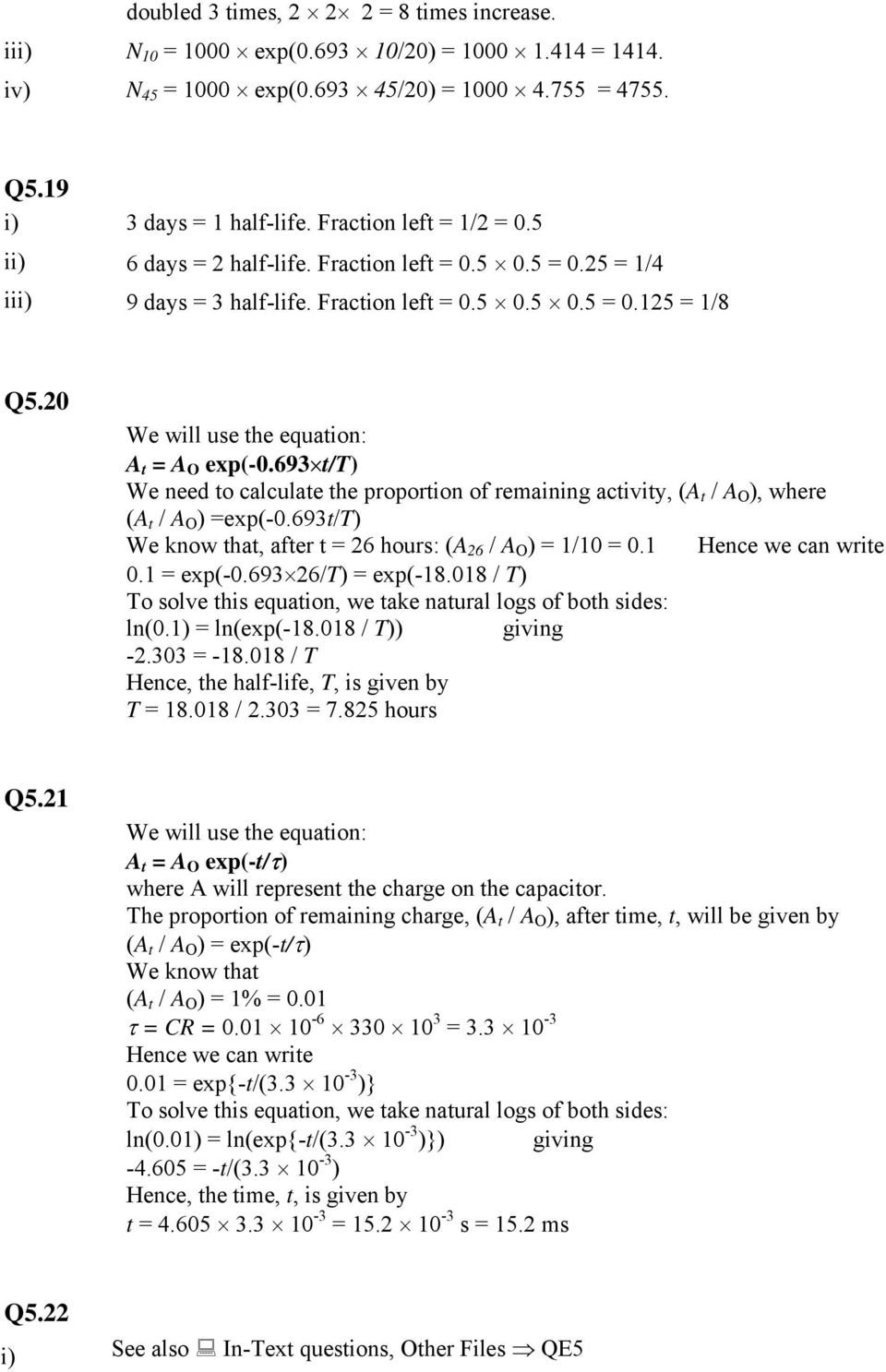
8 Using the equation: V = V 0 {1-exp(-t/T)} with T = 1.5, and V 0 = 10 values for V are calculated for values of t as below, and a graph drawn. t V V t 4 ii) Reading from graph for t = T = 1.5 gives V 6.5 so V/V t = T = 3.0 gives V 8.5 so V/V iii) Substituting into the equation for : t = T = 1.5 gives V = 6.32 so V/V and t = 2T = 3.0 gives V = 8.65 so V/V
CHAPTER FIVE. Solutions for Section 5.1. Skill Refresher. Exercises
 CHAPTER FIVE 5.1 SOLUTIONS 265 Solutions for Section 5.1 Skill Refresher S1. Since 1,000,000 = 10 6, we have x = 6. S2. Since 0.01 = 10 2, we have t = 2. S3. Since e 3 = ( e 3) 1/2 = e 3/2, we have z =
Solving Exponential Equations
 Solving Exponential Equations Deciding How to Solve Exponential Equations When asked to solve an exponential equation such as x + 6 = or x = 18, the first thing we need to do is to decide which way is
Schneps, Leila; Colmez, Coralie. Math on Trial : How Numbers Get Used and Abused in the Courtroom. New York, NY, USA: Basic Books, 2013. p i.
 New York, NY, USA: Basic Books, 2013. p i. http://site.ebrary.com/lib/mcgill/doc?id=10665296&ppg=2 New York, NY, USA: Basic Books, 2013. p ii. http://site.ebrary.com/lib/mcgill/doc?id=10665296&ppg=3 New
Chemical Kinetics. Reaction Rate: The change in the concentration of a reactant or a product with time (M/s). Reactant Products A B
 Reaction Rates: Chemical Kinetics Reaction Rate: The change in the concentration of a reactant or a product with time (M/s). Reactant Products A B change in number of moles of B Average rate = change in
How To Understand Algebraic Equations
 Please use the resources below to review mathematical concepts found in chemistry. 1. Many Online videos by MiraCosta Professor Julie Harland: www.yourmathgal.com 2. Text references in red/burgundy and
Algebra I Credit Recovery
 Algebra I Credit Recovery COURSE DESCRIPTION: The purpose of this course is to allow the student to gain mastery in working with and evaluating mathematical expressions, equations, graphs, and other topics,
UNIT AUTHOR: Elizabeth Hume, Colonial Heights High School, Colonial Heights City Schools
 Money & Finance I. UNIT OVERVIEW & PURPOSE: The purpose of this unit is for students to learn how savings accounts, annuities, loans, and credit cards work. All students need a basic understanding of how
Section 1. Logarithms
 Worksheet 2.7 Logarithms and Exponentials Section 1 Logarithms The mathematics of logarithms and exponentials occurs naturally in many branches of science. It is very important in solving problems related
6.4 Logarithmic Equations and Inequalities
 6.4 Logarithmic Equations and Inequalities 459 6.4 Logarithmic Equations and Inequalities In Section 6.3 we solved equations and inequalities involving exponential functions using one of two basic strategies.
Solving Compound Interest Problems
 Solving Compound Interest Problems What is Compound Interest? If you walk into a bank and open up a savings account you will earn interest on the money you deposit in the bank. If the interest is calculated
LINEAR EQUATIONS IN TWO VARIABLES
 66 MATHEMATICS CHAPTER 4 LINEAR EQUATIONS IN TWO VARIABLES The principal use of the Analytic Art is to bring Mathematical Problems to Equations and to exhibit those Equations in the most simple terms that
Pre-Session Review. Part 2: Mathematics of Finance
 Pre-Session Review Part 2: Mathematics of Finance For this section you will need a calculator with logarithmic and exponential function keys (such as log, ln, and x y ) D. Exponential and Logarithmic Functions
Reaction Rates and Chemical Kinetics. Factors Affecting Reaction Rate [O 2. CHAPTER 13 Page 1
 CHAPTER 13 Page 1 Reaction Rates and Chemical Kinetics Several factors affect the rate at which a reaction occurs. Some reactions are instantaneous while others are extremely slow. Whether a commercial
Tutorial on Using Excel Solver to Analyze Spin-Lattice Relaxation Time Data
 Tutorial on Using Excel Solver to Analyze Spin-Lattice Relaxation Time Data In the measurement of the Spin-Lattice Relaxation time T 1, a 180 o pulse is followed after a delay time of t with a 90 o pulse,
Logarithmic and Exponential Equations
 11.5 Logarithmic and Exponential Equations 11.5 OBJECTIVES 1. Solve a logarithmic equation 2. Solve an exponential equation 3. Solve an application involving an exponential equation Much of the importance
MBA Jump Start Program
 MBA Jump Start Program Module 2: Mathematics Thomas Gilbert Mathematics Module Online Appendix: Basic Mathematical Concepts 2 1 The Number Spectrum Generally we depict numbers increasing from left to right
Precalculus Orientation and FAQ
 Precalculus Orientation and FAQ MATH 1011 (Precalculus) is a four hour 3 credit course that prepares a student for Calculus. Topics covered include linear, quadratic, polynomial, rational, exponential,
Solutions to Exercises, Section 4.5
 Instructor s Solutions Manual, Section 4.5 Exercise 1 Solutions to Exercises, Section 4.5 1. How much would an initial amount of $2000, compounded continuously at 6% annual interest, become after 25 years?
Linear Equations and Inequalities
 Linear Equations and Inequalities Section 1.1 Prof. Wodarz Math 109 - Fall 2008 Contents 1 Linear Equations 2 1.1 Standard Form of a Linear Equation................ 2 1.2 Solving Linear Equations......................
4 Annuities and Loans
 4 Annuities and Loans 4.1 Introduction In previous section, we discussed different methods for crediting interest, and we claimed that compound interest is the correct way to credit interest. This section
Background Information on Exponentials and Logarithms
 Background Information on Eponentials and Logarithms Since the treatment of the decay of radioactive nuclei is inetricably linked to the mathematics of eponentials and logarithms, it is important that
Autumn 1 Maths Overview. Year groups Week 1 Week 2 Week 3 Week 4 Week 5 Week 6 Week 7 1 Number and place value. Counting. 2 Sequences and place value.
 Autumn 1 Maths Overview. Year groups Week 1 Week 2 Week 3 Week 4 Week 5 Week 6 Week 7 1 Number and place Counting. 2 Sequences and place Number facts and counting. Money and time. Length, position and
ACCUPLACER Arithmetic & Elementary Algebra Study Guide
 ACCUPLACER Arithmetic & Elementary Algebra Study Guide Acknowledgments We would like to thank Aims Community College for allowing us to use their ACCUPLACER Study Guides as well as Aims Community College
Fractions to decimals
 Worksheet.4 Fractions and Decimals Section Fractions to decimals The most common method of converting fractions to decimals is to use a calculator. A fraction represents a division so is another way of
S-Parameters and Related Quantities Sam Wetterlin 10/20/09
 S-Parameters and Related Quantities Sam Wetterlin 10/20/09 Basic Concept of S-Parameters S-Parameters are a type of network parameter, based on the concept of scattering. The more familiar network parameters
8.7 Exponential Growth and Decay
 Section 8.7 Exponential Growth and Decay 847 8.7 Exponential Growth and Decay Exponential Growth Models Recalling the investigations in Section 8.3, we started by developing a formula for discrete compound
QUADRATIC, EXPONENTIAL AND LOGARITHMIC FUNCTIONS
 QUADRATIC, EXPONENTIAL AND LOGARITHMIC FUNCTIONS Content 1. Parabolas... 1 1.1. Top of a parabola... 2 1.2. Orientation of a parabola... 2 1.3. Intercept of a parabola... 3 1.4. Roots (or zeros) of a parabola...
MATH 31B: MIDTERM 1 REVIEW. 1. Inverses. yx 3y = 1. x = 1 + 3y y 4( 1) + 32 = 1
 MATH 3B: MIDTERM REVIEW JOE HUGHES. Inverses. Let f() = 3. Find the inverse g() for f. Solution: Setting y = ( 3) and solving for gives and g() = +3. y 3y = = + 3y y. Let f() = 4 + 3. Find a domain on
1. What do you think is the definition of an acid? Of a base?
 Concepts of ph Why? The level of acidity or basicity affects many important biological and environmental processes: enzymes function effectively only in narrowly defined ranges of ph; blood ph in part
AS COMPETITION PAPER 2007 SOLUTIONS
 AS COMPETITION PAPER 2007 Total Mark/50 SOLUTIONS Section A: Multiple Choice 1. C 2. D 3. B 4. B 5. B 6. A 7. A 8. C 1 Section B: Written Answer Question 9. A mass M is attached to the end of a horizontal
College Algebra. George Voutsadakis 1. LSSU Math 111. Lake Superior State University. 1 Mathematics and Computer Science
 College Algebra George Voutsadakis 1 1 Mathematics and Computer Science Lake Superior State University LSSU Math 111 George Voutsadakis (LSSU) College Algebra December 2014 1 / 91 Outline 1 Exponential
3.2 LOGARITHMIC FUNCTIONS AND THEIR GRAPHS. Copyright Cengage Learning. All rights reserved.
 3.2 LOGARITHMIC FUNCTIONS AND THEIR GRAPHS Copyright Cengage Learning. All rights reserved. What You Should Learn Recognize and evaluate logarithmic functions with base a. Graph logarithmic functions.
Review of Fundamental Mathematics
 Review of Fundamental Mathematics As explained in the Preface and in Chapter 1 of your textbook, managerial economics applies microeconomic theory to business decision making. The decision-making tools
Math Placement Test Study Guide. 2. The test consists entirely of multiple choice questions, each with five choices.
 Math Placement Test Study Guide General Characteristics of the Test 1. All items are to be completed by all students. The items are roughly ordered from elementary to advanced. The expectation is that

Eðlisfræði 2, vor 2007
 [ Assignment View ] [ Print ] Eðlisfræði 2, vor 2007 30. Inductance Assignment is due at 2:00am on Wednesday, March 14, 2007 Credit for problems submitted late will decrease to 0% after the deadline has
Section 4.5 Exponential and Logarithmic Equations
 Section 4.5 Exponential and Logarithmic Equations Exponential Equations An exponential equation is one in which the variable occurs in the exponent. EXAMPLE: Solve the equation x = 7. Solution 1: We have
Module M1.5 Exponential and logarithmic functions
 F L E X I B L E L E A R N I N G A P P R O A C H T O P H Y S I C S Module M.5 Opening items. Module introduction.2 Fast track questions. Ready to study? 2 Exponential functions 2. Exponential growth and
IB Maths SL Sequence and Series Practice Problems Mr. W Name
 IB Maths SL Sequence and Series Practice Problems Mr. W Name Remember to show all necessary reasoning! Separate paper is probably best. 3b 3d is optional! 1. In an arithmetic sequence, u 1 = and u 3 =
9.2 Summation Notation
 9. Summation Notation 66 9. Summation Notation In the previous section, we introduced sequences and now we shall present notation and theorems concerning the sum of terms of a sequence. We begin with a
Math 120 Final Exam Practice Problems, Form: A
 Math 120 Final Exam Practice Problems, Form: A Name: While every attempt was made to be complete in the types of problems given below, we make no guarantees about the completeness of the problems. Specifically,
Financial Mathematics for Actuaries. Chapter 1 Interest Accumulation and Time Value of Money
 Financial Mathematics for Actuaries Chapter 1 Interest Accumulation and Time Value of Money 1 Learning Objectives 1. Basic principles in calculation of interest accumulation 2. Simple and compound interest
REVIEW SHEETS INTRODUCTORY PHYSICAL SCIENCE MATH 52
 REVIEW SHEETS INTRODUCTORY PHYSICAL SCIENCE MATH 52 A Summary of Concepts Needed to be Successful in Mathematics The following sheets list the key concepts which are taught in the specified math course.
MATH 34A REVIEW FOR MIDTERM 2, WINTER 2012. 1. Lines. (1) Find the equation of the line passing through (2,-1) and (-2,9). y = 5
 MATH 34A REVIEW FOR MIDTERM 2, WINTER 2012 ANSWERS 1. Lines (1) Find the equation of the line passing through (2,-1) and (-2,9). y = 5 2 x + 4. (2) Find the equation of the line which meets the x-axis
The Basics of Interest Theory
 Contents Preface 3 The Basics of Interest Theory 9 1 The Meaning of Interest................................... 10 2 Accumulation and Amount Functions............................ 14 3 Effective Interest
Homework # 3 Solutions
 Homework # 3 Solutions February, 200 Solution (2.3.5). Noting that and ( + 3 x) x 8 = + 3 x) by Equation (2.3.) x 8 x 8 = + 3 8 by Equations (2.3.7) and (2.3.0) =3 x 8 6x2 + x 3 ) = 2 + 6x 2 + x 3 x 8
SOLVING EQUATIONS WITH EXCEL
 SOLVING EQUATIONS WITH EXCEL Excel and Lotus software are equipped with functions that allow the user to identify the root of an equation. By root, we mean the values of x such that a given equation cancels
Section 1.4. Difference Equations
 Difference Equations to Differential Equations Section 1.4 Difference Equations At this point almost all of our sequences have had explicit formulas for their terms. That is, we have looked mainly at sequences
Using simulation to calculate the NPV of a project
 Using simulation to calculate the NPV of a project Marius Holtan Onward Inc. 5/31/2002 Monte Carlo simulation is fast becoming the technology of choice for evaluating and analyzing assets, be it pure financial
Differential Equations
 40 CHAPTER 15 Differential Equations In many natural conditions the rate at which the amount of an object changes is directly proportional to the amount of the object itself. For example: 1) The marginal
Chapter 7 Outline Math 236 Spring 2001
 Chapter 7 Outline Math 236 Spring 2001 Note 1: Be sure to read the Disclaimer on Chapter Outlines! I cannot be responsible for misfortunes that may happen to you if you do not. Note 2: Section 7.9 will
Dimensional Analysis and Exponential Models
 MAT 42 College Mathematics Module XP Dimensional Analysis and Exponential Models Terri Miller revised December 3, 200. Dimensional Analysis The purpose of this section is to convert between various types
Algebra 2 Unit 8 (Chapter 7) CALCULATORS ARE NOT ALLOWED
 Algebra Unit 8 (Chapter 7) CALCULATORS ARE NOT ALLOWED. Graph eponential functions. (Sections 7., 7.) Worksheet 6. Solve eponential growth and eponential decay problems. (Sections 7., 7.) Worksheet 8.
PURSUITS IN MATHEMATICS often produce elementary functions as solutions that need to be
 Fast Approximation of the Tangent, Hyperbolic Tangent, Exponential and Logarithmic Functions 2007 Ron Doerfler http://www.myreckonings.com June 27, 2007 Abstract There are some of us who enjoy using our
Mathematics Review for MS Finance Students
 Mathematics Review for MS Finance Students Anthony M. Marino Department of Finance and Business Economics Marshall School of Business Lecture 1: Introductory Material Sets The Real Number System Functions,
Dimensional Analysis; Exponential and Logarithmic Growth/Decay
 MAT 42 College Mathematics Module #5 Dimensional Analysis; Exponential and Logarithmic Growth/Decay Terri Miller Spring 2009 revised November 7, 2009. Dimensional Analysis The purpose of this section is
Microeconomic Theory: Basic Math Concepts
 Microeconomic Theory: Basic Math Concepts Matt Van Essen University of Alabama Van Essen (U of A) Basic Math Concepts 1 / 66 Basic Math Concepts In this lecture we will review some basic mathematical concepts
Solutions to Midterm #1 Practice Problems
 MAT Fall 0 Solutions to Midterm # Practice Problems. Below is the graph of a function y = r(). y = r() Sketch graphs of the following functions: (a) y = r( 3) (b) y = r( ) 3 (c) y = r() + (d) y = r( +
Inverse Functions and Logarithms
 Section 3. Inverse Functions and Logarithms 1 Kiryl Tsishchanka Inverse Functions and Logarithms DEFINITION: A function f is called a one-to-one function if it never takes on the same value twice; that
a. all of the above b. none of the above c. B, C, D, and F d. C, D, F e. C only f. C and F
 FINAL REVIEW WORKSHEET COLLEGE ALGEBRA Chapter 1. 1. Given the following equations, which are functions? (A) y 2 = 1 x 2 (B) y = 9 (C) y = x 3 5x (D) 5x + 2y = 10 (E) y = ± 1 2x (F) y = 3 x + 5 a. all
Experiment 6 ~ Joule Heating of a Resistor
 Experiment 6 ~ Joule Heating of a Resistor Introduction: The power P absorbed in an electrical resistor of resistance R, current I, and voltage V is given by P = I 2 R = V 2 /R = VI. Despite the fact that
Ratios and Proportional Relationships Set 1: Ratio, Proportion, and Scale... 1 Set 2: Proportional Relationships... 8
 Table of Contents Introduction...v Standards Correlations... viii Materials List... x... 1 Set 2: Proportional Relationships... 8 The Number System Set 1: Integers and Absolute Value... 15 Set 2: Comparing
Lecture 3 : The Natural Exponential Function: f(x) = exp(x) = e x. y = exp(x) if and only if x = ln(y)
 Lecture 3 : The Natural Exponential Function: f(x) = exp(x) = Last day, we saw that the function f(x) = ln x is one-to-one, with domain (, ) and range (, ). We can conclude that f(x) has an inverse function
Exponential Functions. Exponential Functions and Their Graphs. Example 2. Example 1. Example 3. Graphs of Exponential Functions 9/17/2014
 Eponential Functions Eponential Functions and Their Graphs Precalculus.1 Eample 1 Use a calculator to evaluate each function at the indicated value of. a) f ( ) 8 = Eample In the same coordinate place,
MPE Review Section III: Logarithmic & Exponential Functions
 MPE Review Section III: Logarithmic & Eponential Functions FUNCTIONS AND GRAPHS To specify a function y f (, one must give a collection of numbers D, called the domain of the function, and a procedure
The Effects of Drying Air Temperature and Humidity on the Drying Kinetics of Seaweed
 The Effects of Drying Air Temperature and Humidity on the Drying Kinetics of Seaweed A. Fudholi, M. Y. Othman, M. H. Ruslan, M. Yahya, A. Zaharim and K. Sopian Abstract A Low Temperature and Humidity Chamber
Section 4-7 Exponential and Logarithmic Equations. Solving an Exponential Equation. log 2. 3 2 log 5. log 2 1.4406
 314 4 INVERSE FUNCTIONS; EXPONENTIAL AND LOGARITHMIC FUNCTIONS Section 4-7 Exponential and Logarithmic Equations Exponential Equations Logarithmic Equations Change of Base Equations involving exponential
MATHEMATICS OF FINANCE AND INVESTMENT
 MATHEMATICS OF FINANCE AND INVESTMENT G. I. FALIN Department of Probability Theory Faculty of Mechanics & Mathematics Moscow State Lomonosov University Moscow 119992 [email protected] 2 G.I.Falin. Mathematics
Solution. Let us write s for the policy year. Then the mortality rate during year s is q 30+s 1. q 30+s 1
 Solutions to the May 213 Course MLC Examination by Krzysztof Ostaszewski, http://wwwkrzysionet, krzysio@krzysionet Copyright 213 by Krzysztof Ostaszewski All rights reserved No reproduction in any form
Linear Equations ! 25 30 35$ & " 350 150% & " 11,750 12,750 13,750% MATHEMATICS LEARNING SERVICE Centre for Learning and Professional Development
 MathsTrack (NOTE Feb 2013: This is the old version of MathsTrack. New books will be created during 2013 and 2014) Topic 4 Module 9 Introduction Systems of to Matrices Linear Equations Income = Tickets!
Examples of Functions
 Examples of Functions In this document is provided examples of a variety of functions. The purpose is to convince the beginning student that functions are something quite different than polynomial equations.
Statistics in Retail Finance. Chapter 6: Behavioural models
 Statistics in Retail Finance 1 Overview > So far we have focussed mainly on application scorecards. In this chapter we shall look at behavioural models. We shall cover the following topics:- Behavioural
COURSE SYLLABUS -----------------------------------------------------------------------------------
 Last Reviewed by: Leslie Wurst Date Approved: Date Revised: Fall 2012 COURSE SYLLABUS Syllabus for: MATH 1010 Math for General Studies Former Course and Title: Former Quarter Course(s): Mat 1260 Contemporary
4.6 Exponential and Logarithmic Equations (Part I)
 4.6 Eponential and Logarithmic Equations (Part I) In this section you will learn to: solve eponential equations using like ases solve eponential equations using logarithms solve logarithmic equations using
Accurately and Efficiently Measuring Individual Account Credit Risk On Existing Portfolios
 Accurately and Efficiently Measuring Individual Account Credit Risk On Existing Portfolios By: Michael Banasiak & By: Daniel Tantum, Ph.D. What Are Statistical Based Behavior Scoring Models And How Are
Spectrophotometry and the Beer-Lambert Law: An Important Analytical Technique in Chemistry
 Spectrophotometry and the Beer-Lambert Law: An Important Analytical Technique in Chemistry Jon H. Hardesty, PhD and Bassam Attili, PhD Collin College Department of Chemistry Introduction: In the last lab
ACCOUNTING RATIOS I. MODULE - 6A Analysis of Financial Statements. Accounting Ratios - I. Notes
 MODULE - 6A Accounting Ratios - I 8 ACCOUNTING RATIOS I In the previous lesson, you have learnt the relationship between various items of the financial statements. You have also learnt various tools of
Equations. #1-10 Solve for the variable. Inequalities. 1. Solve the inequality: 2 5 7. 2. Solve the inequality: 4 0
 College Algebra Review Problems for Final Exam Equations #1-10 Solve for the variable 1. 2 1 4 = 0 6. 2 8 7 2. 2 5 3 7. = 3. 3 9 4 21 8. 3 6 9 18 4. 6 27 0 9. 1 + log 3 4 5. 10. 19 0 Inequalities 1. Solve
Spectrophotometric Determination of the pka of Bromothymol Blue
 Spectrophotometric Determination of the pka of Bromothymol Blue INRODUCION cidbase indicators are compounds that are simply weak acids (or bases) that exhibit different colors depending on whether they
EDEXCEL NATIONAL CERTIFICATE/DIPLOMA UNIT 5 - ELECTRICAL AND ELECTRONIC PRINCIPLES NQF LEVEL 3 OUTCOME 4 - ALTERNATING CURRENT
 EDEXCEL NATIONAL CERTIFICATE/DIPLOMA UNIT 5 - ELECTRICAL AND ELECTRONIC PRINCIPLES NQF LEVEL 3 OUTCOME 4 - ALTERNATING CURRENT 4 Understand single-phase alternating current (ac) theory Single phase AC
CAPITAL STRUCTURE [Chapter 15 and Chapter 16]
![CAPITAL STRUCTURE [Chapter 15 and Chapter 16]](/thumbs/34/17057255.jpg "CAPITAL STRUCTURE [Chapter 15 and Chapter 16]") Capital Structure [CHAP. 15 & 16] -1 CAPITAL STRUCTURE [Chapter 15 and Chapter 16] CONTENTS I. Introduction II. Capital Structure & Firm Value WITHOUT Taxes III. Capital Structure & Firm Value WITH Corporate
Capital Structure [CHAP. 15 & 16] -1 CAPITAL STRUCTURE [Chapter 15 and Chapter 16] CONTENTS I. Introduction II. Capital Structure & Firm Value WITHOUT Taxes III. Capital Structure & Firm Value WITH Corporate
HW 10. = 3.3 GPa (483,000 psi)
 HW 10 Problem 15.1 Elastic modulus and tensile strength of poly(methyl methacrylate) at room temperature [20 C (68 F)]. Compare these with the corresponding values in Table 15.1. Figure 15.3 is accurate;
Math 115 HW #8 Solutions
 Math 115 HW #8 Solutions 1 The function with the given graph is a solution of one of the following differential equations Decide which is the correct equation and justify your answer a) y = 1 + xy b) y
Guided Study Program in System Dynamics System Dynamics in Education Project System Dynamics Group MIT Sloan School of Management 1
 Guided Study Program in System Dynamics System Dynamics in Education Project System Dynamics Group MIT Sloan School of Management 1 Solutions to Assignment #4 Wednesday, October 21, 1998 Reading Assignment:
Mathematics Placement Examination (MPE)
 Practice Problems for Mathematics Placement Eamination (MPE) Revised August, 04 When you come to New Meico State University, you may be asked to take the Mathematics Placement Eamination (MPE) Your inital
EL CAMINO COLLEGE COURSE OUTLINE OF RECORD. Grading Method: Letter Credit/No Credit Both No Grade
 EL CAMINO COLLEGE COURSE OUTLINE OF RECORD I. COURSE DESCRIPTION Course Title and Number: Mathematics 43 Descriptive Title: Extended Elementary Algebra, Part II Discipline: Mathematics Division: Mathematical
3 More on Accumulation and Discount Functions
 3 More on Accumulation and Discount Functions 3.1 Introduction In previous section, we used 1.03) # of years as the accumulation factor. This section looks at other accumulation factors, including various
The time value of money: Part II
 The time value of money: Part II A reading prepared by Pamela Peterson Drake O U T L I E 1. Introduction 2. Annuities 3. Determining the unknown interest rate 4. Determining the number of compounding periods
Number Sense and Operations
 Number Sense and Operations representing as they: 6.N.1 6.N.2 6.N.3 6.N.4 6.N.5 6.N.6 6.N.7 6.N.8 6.N.9 6.N.10 6.N.11 6.N.12 6.N.13. 6.N.14 6.N.15 Demonstrate an understanding of positive integer exponents
averages simple arithmetic average (arithmetic mean) 28 29 weighted average (weighted arithmetic mean) 32 33
 537 A accumulated value 298 future value of a constant-growth annuity future value of a deferred annuity 409 future value of a general annuity due 371 future value of an ordinary general annuity 360 future
Math 370/408, Spring 2008 Prof. A.J. Hildebrand. Actuarial Exam Practice Problem Set 3 Solutions
 Math 37/48, Spring 28 Prof. A.J. Hildebrand Actuarial Exam Practice Problem Set 3 Solutions About this problem set: These are problems from Course /P actuarial exams that I have collected over the years,
Mechanical Principles
 Unit 4: Mechanical Principles Unit code: F/60/450 QCF level: 5 Credit value: 5 OUTCOME 3 POWER TRANSMISSION TUTORIAL BELT DRIVES 3 Power Transmission Belt drives: flat and v-section belts; limiting coefficient
LINEAR INEQUALITIES. Mathematics is the art of saying many things in many different ways. MAXWELL
 Chapter 6 LINEAR INEQUALITIES 6.1 Introduction Mathematics is the art of saying many things in many different ways. MAXWELL In earlier classes, we have studied equations in one variable and two variables
Simplify the rational expression. Find all numbers that must be excluded from the domain of the simplified rational expression.
 MAC 1105 Final Review Simplify the rational expression. Find all numbers that must be excluded from the domain of the simplified rational expression. 1) 8x 2-49x + 6 x - 6 A) 1, x 6 B) 8x - 1, x 6 x -
Glencoe. correlated to SOUTH CAROLINA MATH CURRICULUM STANDARDS GRADE 6 3-3, 5-8 8-4, 8-7 1-6, 4-9
 Glencoe correlated to SOUTH CAROLINA MATH CURRICULUM STANDARDS GRADE 6 STANDARDS 6-8 Number and Operations (NO) Standard I. Understand numbers, ways of representing numbers, relationships among numbers,
Prentice Hall: Middle School Math, Course 1 2002 Correlated to: New York Mathematics Learning Standards (Intermediate)
 New York Mathematics Learning Standards (Intermediate) Mathematical Reasoning Key Idea: Students use MATHEMATICAL REASONING to analyze mathematical situations, make conjectures, gather evidence, and construct
Matrix Calculations: Applications of Eigenvalues and Eigenvectors; Inner Products
 Matrix Calculations: Applications of Eigenvalues and Eigenvectors; Inner Products H. Geuvers Institute for Computing and Information Sciences Intelligent Systems Version: spring 2015 H. Geuvers Version:
Evaluating Trading Systems By John Ehlers and Ric Way
 Evaluating Trading Systems By John Ehlers and Ric Way INTRODUCTION What is the best way to evaluate the performance of a trading system? Conventional wisdom holds that the best way is to examine the system
Indiana State Core Curriculum Standards updated 2009 Algebra I
 Indiana State Core Curriculum Standards updated 2009 Algebra I Strand Description Boardworks High School Algebra presentations Operations With Real Numbers Linear Equations and A1.1 Students simplify and