
Task Group on Warewashing Equipment Teleconference Meeting Summary. July 27, 2011
|
|
|
- Hubert Lester
- 10 years ago
- Views:
Transcription
1 Participants Joel Hipp (Hobart Corp), Moe Gendy (Champion Ind.), Wes Nelson & Jeff Ellingson (EcoLab), Tony Gagliardi (Consultant Public Health), Chris Winkler (Jackson MSC, Inc), John Hockaday & Kirk Northcutt (Auto-Chlor) & April Gravelle (Manitoba Health), Todd Stephens (South Carolina Department of Health), Russ Payzant (American Dish Service), & Mike Kohler & Lorna Badman (NSF). Action Items: 1. W. Nelson will check on the alkalinity issue and report 2. J. Hipp will contact FDA to determine if they have specific organisms in mind or if the comment is more general in nature. 3. J. Hipp will reach out to the FDA to determine how they will move forward with the Food Code. 4. J. Hipp will communicate with the FDA to determine a day the FDA can participate on a teleconference. 5. M. Kohler & J. Hipp will develop language for open tanks. Discussion J. Hipp welcomed everyone. L. Badman read the anti-trust statement and took roll call. The TG reviewed the May 4, 2011 summary and no modifications recommended. Soil Load Test W. Nelson informed the TG that the testing is currently being conducted. The testing should be complete within the next 4 6 weeks. A report or information will be given to the TG for review. The food soil in ASTM D is being used. It was noted that a 2009 version is available. EcoLab will evaluate the differences between the 2 tests and make modification accordingly. A note will be included in the report on whether the test differs. The TG agreed with the approach being used. The following variable are being varied: detergent concentration ( ppm); food soil concentration ( ppm) 4 or 5 points in the range are being selected; rinse flow rates standard rate and less than the standard rate; and evaluating glasses (NSF soil removal test is being used) for passing results. EcoLab will check on the alkalinity of detergent. Reduced minimum temperature 1

2 L. Badman researched the history of the temperature requirements in NSF 3 with very little rationale for the temperatures chosen. The TG decided to discuss the FDA s concerns. NOTE Below are the FDA s statements (in italics) and the TG s response to the FDA s statements (in bold). Food Code - FDA has concerns with removing or modifying temperature limits. They may be more comfortable with adding an interpretation. An exception to a rule may be another option they consider. The FDA will need to determine the best way to modify the temperature limits whether it be an exemption, an interpretation or some other option. They would like to see the TG consider potential impacts on all machines in Standard 3. The modification will only affect hot water machines, which have varying temperatures. All high temperature machines (under counter, conveyor, rackless conveyor machines etc) need to pass the 3600 HUE test. NSF test uses the buttermilk which reacts differently at different temperatures. High temperatures will help to break down soil such as fats and oils. When dual sanitizing machines are tested for soil removal, only the low temperature version is tested, not the high temperature. If the low temperature mode passes, it is not likely to fail with a reduced, high temperature version. They are concerned that this will reduce the level of protection. Are performance tests alone enough protection? A 3600 HUE is required no matter of the temperature. If temperatures are higher than they need to be, a safety factor is built into the machine but this is not mandatory. Some machines might be passing today at F but may not pass at 150 F. The performance test is still the same. J. Hipp does not believe this is a health risk. A lower temperature might miss a level of organism reduction. Some organisms require a higher temperature to kill. Indicator organisms might not be inactivated at lower temperature. The HUE is cumulative. A kill chart demonstrates the higher the temperature the better the kill. The Standard currently allows a one 2

3 temperature machine final rinse at 165 F. The decision needs to be based on scientific data. Organisms may have changed. J. Hipp will contact FDA to determine if they have specific organisms in mind or if the comment is more general in nature. It was suggested that research be conducted to find out where organisms have caused an illness relating to dirty dishes. It is difficult to link illness to dishes. Food borne illness is under reported. There are no examples that dirty dishes make someone sick, contaminated food can be linked. The TG should ask what constitutes a good standard. Are there some things that are necessary and some that are not? The Standard is good and by lowering the temperature it is believed it will not change. The machine needs to be marked appropriately and pass the requirements in the Standard. This will help to maintain consumer protection. The performance test is the benchmark. Reason statements are included in the Standard when balloting. An informational Annex could be added to the Standard explaining why the modifications were made. NSF 3 was a specification document (time and temperature) not a performance Standard. The Standard changed in the 1990s. A good standard constitutes if the minimum requirements are enforced on the certified equipment and serves all the stakeholders involved. This is a big step. The TG agreed. It will be a big change, especially for regulators. What is the history behind the minimum temperature requirements? The TG has previously discussed this topic. With the potential of taking away a level of protection, should something be added as an enhancement? J. Hipp doesn t believe any enhancements are needed. The 3600 HUE (less is required for pasteurization) creates a built in enhancement (safety factor). What is 3

4 being gained at a higher temperature? A higher requirement should be needed for milk since milk is for human consumption. A food borne outbreak has not been traced back to dishes. The 3600 HUE is still required. The request is based on lower temperatures. It appears the TG needs to be negotiating. If a requirement is removed then one has to be added. This should be based on science and not negotiations. Machines are not one that needs to be higher maintenance. Owners do not place importance on maintaining the machines. It takes constant supervision to maintain the temperature. Restaurants have been closed due to issues with the machines. The machine is not operating if the machine is not at temperature. Enforcement is taken based on field test. If all the machines were at F a burden would be removed for those involved. The goal is to save energy not flexibility on the field. Will the reduction in tank temperatures affect the washability test? Many machines are dual sanitizing machines and the washability test is done at the lowest temperature mode ( F). A high temp machine ( F) taken to a lower temperature ( F) will not have an issue. The regulatory community has concerns regarding the theory of reducing the requirements whereas the industry does not. It was suggested the temperature achieved in the field was 160 F. It was suggested to create a pamphlet on testing warewashing for the regulatory community. The State of Michigan has a copy of pamphlet. The pamphlet still exists and is available through NSF. M. Kohler will look into having it posted on the NSF website. J. Hipp will reach out to the FDA to determine how they will move forward with the Food Code. It was suggested that the temperatures be reduced and not eliminated. Lowering the temperature minimum would serve everyone. The new temperature would need to be based in science. The TG was reminded that the surface of the wares is lower than the minimum temperature required at the manifold. J. Hipp will communicate with the FDA to determine a day they can participate on a teleconference. 4

5 Open Holding tanks T. Stephens submitted an issue paper regarding open holding tanks (see FE ). This design has been used in Europe and is starting to be sold in the US. These machines have a holding tank. These tanks contain rinse water. The top of the tanks are not covered. Contamination from debris, mold, insects and/or vermin is the concern. The tanks cannot be visually inspected and not accessible for anyone other than a service person. T. Stephens would like the open to be readily accessible without the use of tools. A perforated screen cover would work. The operator needs to be able to maintain the tank. The open reservoir on top of the machine needs to be accessible. There is an opening at the back of the tank. If a tank can be purged, no vermin can get in, T. Stephens would be happy with that solution. Water could be held in the tanks for several months like shut down or break. A drain in tank would allow the tank to be emptied. A screen cover, perforated cover or a hatch cover over the opening. With an air gap, the screen itself could prevent the flow. If something accumulates inside the air gap, the air gap could be foiled. The tank is open to the air. If the air gap fails there could be contamination. Some TG members could not see this being an issue. Anything on a dishwasher that is not wiped down is going to get dirty. There are particles in the air. These particles could get on the air gap. The goal is to minimize contamination. The air gap needs to be accessible for cleaning. A hatch is more viable because the operator can clean. General requirements could be added such as: The final water reservoir shall have a drain, be readily accessible and easily cleanable and have a cover. It was suggested that instructions could be included in the installation and instruction manual for cleaning these tanks. This design is uncommon and the operator might not know it needs to be cleaned. A picture of this type of unit will be distributed prior to the next meeting. M. Kohler & J. Hipp will work together to develop the language. The next teleconference will be scheduled when the action items have been completed. 5

Cleaning and Sanitation
 CLEANING AND SANITATION Cleaning and Sanitation GORDON FOOD SERVICE Training Updated February 2011 Purpose Objectives To provide information needed to practice good cleaning and sanitizing methods in the
CLEANING AND SANITIZING
 CLEANING AND SANITIZING Cleaning and sanitizing procedures must be part of the standard operating procedures that make up your food safety program. Improperly cleaned and sanitized surfaces allow harmful
Sanitizing the Kitchen
 Sanitizing the Kitchen Lesson 11 Overview Sanitizing the Kitchen Time 30 minutes Purpose To explain how to properly clean and sanitize the kitchen Objectives At the conclusion of this lesson, employees
SOUTH CAROLINA. Downloaded January 2011
 SOUTH CAROLINA Downloaded January 2011 1401. General (II) B. When meals are catered to a facility, such meals shall be obtained from a meal service establishment graded by the Department, pursuant to R.61
FACT SHEET. Users That Must Take Particular Precautions During A Boil Advisory
 FACT SHEET Users That Must Take Particular Precautions During A Boil Advisory a) Commercial Establishments (Restaurants, Hotels, Convenience Stores, etc.) - All water that is to be provided directly to
The machine and bulk milk tank cleaning process
 The machine and bulk milk tank cleaning process The cleanliness of the milking system and the dairy is a critical determinant of milk quality. The New Zealand Food Safety Authority has strict guidelines
CITY OF GOLDEN DEPARTMENT OF PUBLIC WORKS, ENVIRONMENTAL SERVICES DIVISION
 CITY OF GOLDEN DEPARTMENT OF PUBLIC WORKS, ENVIRONMENTAL SERVICES DIVISION Grease, So What's the Problem? Does your facility produce grease? All commercial cooking facilities generate Fats, Oil, and Grease
Low risk includes facilities that sell or give away non potentially hazardous food in original manufacturer packaging and do not offer samples.
 Planning, Building &Environmental Services 1195 Third Street, Suite 210 Napa, CA 94559 www.co.napa.ca.us Main: (707) 253-4471 Fax: (707) 253-4545 PERMIT APPLICATION AND REQUIREMENTS FOR FOOD VENDORS AT
Chapter 7 Equipment and Utensil Cleaning and Sanitization
 Chapter 7 Equipment and Utensil Cleaning and Sanitization The importance of proper cleaning can be appreciated when one realizes that contaminated equipment (equipment and utensils which are not clean)
1.2 How Does FOG Affect You?. 2 1.3 The City of Huntington Beach FOG Control Program.. 2
 Contents SECTION 1.0 What is FOG?.... 2 1.2 How Does FOG Affect You?. 2 1.3 The City of Huntington Beach FOG Control Program.. 2 SECTION 2.0 HOW TO ACHIEVE COMPLIANCE WITH THE FOOD SERVICE ESTABLISMENT
STANDARD OPERATING PROCEDURE S (SOP S) FOR HAZARDOUS ANALYSIS CRITICAL CONTROL POINT (HACCP) PLANS
 STANDARD OPERATING PROCEDURE S (SOP S) FOR HAZARDOUS ANALYSIS CRITICAL CONTROL POINT (HACCP) PLANS RECEIVING: All food must be from approved sources. Foods must be wholesome and not adulterated. No home-prepared
1 HOUR SAN CE CBDM Approved. Food Protection Connection. Active. by Melissa Vaccaro, MS, CHO. Managerial Control. Nutrition & Foodservice Edge
 Food Protection Connection 1 HOUR SAN CE CBDM Approved Active by Melissa Vaccaro, MS, CHO Managerial Control A HACCP Approach 12 Answers to FPC Review Questions CDMs who answer the FPC Review Questions
How to Use Water Safely in Your Food Establishment During a Boil Water Advisory
 How to Use Water Safely in Your Food Establishment During a Boil Water Advisory Food service establishments are allowed to operate during the boil water advisory as long as the conditions outlined below
Emergency Guideline for Food Facilities during Boil Water Advisory or Other Public Notices
 Emergency Guideline for Food Facilities during Boil Water Advisory or Other Public Notices Water supply warnings are generally required when water suppliers need to provide consumers with immediate and
02.11 Food and Nutrition Services
 02.11 Purpose Audience To assure proper and safe food handling, storage, and preparation. All Department of employees. Personnel The following guidelines shall be used to monitor proper and safe food handling,
Food Surface Sanitizing
 Module 14 Overview: Food Surface Sanitizing TRAINER: Read this page ahead of time to prepare for teaching the module. PARTICIPANTS WILL: 1. Understand the importance of food surface CLEANING and SANITIZING.
conductivity emulsification saponification wetting peptizing dispersion rinsability controlling mineral deposits Sequestration chelation
 ENVH 441 FOOD PROTECTION DETERGENTS AND SANITIZERS Cleaning and sanitizing must both occur for dishware to be safe. These are accomplished by use of a (1) detergent to clean utensil surfaces (remove the
SAFE HEALTHY CHILDREN A Health and Safety Manual for Childcare Providers
 TABLE OF CONTENTS Chapter 7: Food Storage and Preparation Safe Food: Food Storage and Preparation 7.1 Requirements of the Day Nurseries Act... 7.2 Recommendations of the Medical Officer of Health... 7.2
Subsection 4.1.6 Cleaning And Sanitizing for Licensed Group Child Care Homes, Licensed Child Care Centers and License-Exempt Child Care Facilities
 Page 1 of 6 CLEANING AND SANITIZING All items requiring sanitizing shall be washed, rinsed and sanitized with approved agents, methods and concentrations. [19 CSR 30-60.090 (1) (B), (5) (A), 19 CSR 30-62.082
Beverage Industry Sanitation Program
 Beverage Industry Sanitation Program Proper sanitation in food processing facilities is critical to ensure the production of wholesome, quality products for your customers and a safe environment for your
Table of Contents. Introduction... 1. Personal Hygiene... 2. Temperature Control... 5. Cross-contamination... 6. Cleaning and Sanitizing...
 Table of Contents Introduction... 1 Food Handler Certification Program... 1 Personal Hygiene... 2 Temperature Control... 5 Cross-contamination... 6 Cleaning and Sanitizing... 6 Dishwashing... 7 Food Storage...
Chapter 8 Water and Sewage Systems
 Chapter 8 Water and Sewage Systems Proper sanitary controls pertaining to the water supply system and sewage and liquid waste disposal systems are necessary in all types of food establishments to prevent
Prevent Blockages in the Sanitary Sewer System
 FATS, OILS & GREASE - BMPs The following Best Management Practices (BMPs) tables are listed below: Prevent blockages in the Sanitary Sewer System Properly Maintain Grease Traps and Interceptors to Prevent
Moving to a hospital or skilled nursing facility
 H Moving to a hospital or skilled nursing facility What to expect when you have MRSA (Methicillin-resistant Staphylococcus aureus) A booklet for patients, residents, family members, and caregivers About
Homeowners and Home Buyers Guide to Wells and Private Sewage Systems
 Homeowners and Home Buyers Guide to Wells and Private Sewage Systems What every homeowner should know about living with a well and a private sewage system. YOUR ENVIRONMENTAL SYSTEMS Out of sight out of
MOBILE FOOD A GUIDE TO PERMITTING IN ALBUQUERQUE
 MOBILE FOOD A GUIDE TO PERMITTING IN ALBUQUERQUE PAVE THE WAY FOR SUCCESS WHAT YOU NEED TO KNOW TO PERMIT AND OPERATE A MOBILE FOOD UNIT IN ALBUQERQUE. PERMITS AND FEES Mobile food units are required to
FMI Listeria Action Plan for Retail Delis
 FMI Listeria Action Plan for Retail Delis November 2012 Listeria control at retail is an ongoing challenge. FMI and our members are committed to finding ways to control the growth and if possible, eliminate
CLEAN UP FOR VOMITING & DIARRHEAL EVENT IN RETAIL FOOD FACILITIES
 CLEAN UP FOR VOMITING & DIARRHEAL EVENT IN RETAIL FOOD FACILITIES GENERAL INFORMATION Noroviruses are a group of viruses that cause gastroenteritis [gas-trō-en-ter-ī-tis] in people. Gastroenteritis is
GUIDELINES. for COTTAGE INDUSTRY INVOLVED in HOME FOOD PRODUCTION
 GUIDELINES for COTTAGE INDUSTRY INVOLVED in HOME FOOD PRODUCTION ENVIRONMENTAL HEALTH PO Box 2000, 16 Garfield Street Charlottetown, PEI CIA 7N8 Tel: 368-4970 / Fax: 368-6468 These guidelines have been
Boil Water Advisory. For Commercial/Public Facilities. Boil Water Advisory Factsheet #3
 Boil Water Advisory Factsheet #3 Boil Water Advisory For Commercial/Public Facilities How to operate a commercial/ public facility under a boil water advisory Boil water advisories are issued when a municipal,
CYTOTOXIC PRECAUTIONS A GUIDE FOR PATIENTS & FAMILIES
 Perth and Smiths Falls District Hospital Attention: Manager, Quality 60 Cornelia Street, West Smiths Falls, Ontario K7A 2H9 CYTOTOXIC PRECAUTIONS A GUIDE FOR PATIENTS & FAMILIES This guide has been prepared
FOOD ESTABLISHMENT GUIDE FOR DESIGN, INSTALLATION, AND CONSTRUCTION RECOMMENDATIONS
 FOOD ESTABLISHMENT GUIDE FOR DESIGN, INSTALLATION, AND CONSTRUCTION RECOMMENDATIONS PART 9 - HOT WATER SUPPLY REQUIREMENTS The hot water supply shall be sufficient to satisfy the continuous and peak hot
Address of food business: 17-27 Orford Place, Norwich, NR1 3QA Date of Inspection: 25 September 2014 Date of revisit: 8 th April 2015
 Public Protection (food & safety) Food Premises Inspection Report Name of Business: Pizza Hut Address of food business: 17-27 Orford Place, Norwich, NR1 3QA Date of Inspection: 25 September 2014 Date of
Chapter 5 Water, Plumbing, and Waste
 Chapter 5 Water, Plumbing, and Waste Parts 5-1 WATER 5-2 PLUMBING SYSTEM 5-3 MOBILE WATER TANK AND MOBILE FOOD ESTABLISHMENT WATER TANK 5-4 SEWAGE, OTHER LIQUID WASTE, AND RAINWATER 5-5 REFUSE, RECYCLABLES,
Oil Sight Glass BENEFITS
 8 L-4090 Schroeder es provide maintenance and lubrication management professionals a complete and immediate visual oil analysis. Constructed of durable cast acrylic, they withstand most petroleum products
TEMPORARY EVENT APPLICATION
 www.camdencounty.com TEMPORARY EVENT APPLICATION Dear Special Event Participant: Enclosed is a copy of the Requirements for Temporary Food Service Operation and Special Event Fact Sheet. To obtain approval
CLEANING AND SANITIZING
 CLEANING AND SANITIZING Cleaning and Sanitizing I. CLEANING 2 TYPES OF CLEANING COMPOUNDS 2 PROPERTIES OF A CLEANER 2 FACTORS THAT AFFECT CLEANING EFFICIENCY 2 CLEANING OPERATION 3 II. SANITIZING 4 HEAT
Guideline on Emergency Action Plans for Food Establishments: Sewage Backup
 Guideline on Emergency Action Plans for Food Establishments: Sewage Backup A sewage backup refers to the overflow of sewage from equipment or plumbing facilities within a food establishment. A sewage backup
Replacing a toner cartridge. Removing a toner cartridge. Printing. Using color. Paper handling. Maintenance. Troubleshooting. Administration.
 Your printer monitors the toner level of your toner cartridges. When the toner is getting low, the printer displays 88 Toner Low. This message indicates it is time for you to replace one or more
Food Protection Services
 Food Protection Services dairy processing plants Guidelines For the Cleaning of Dairy Plant Processing Equipment TABLE OF CONTENTS PART I...1 INTRODUCTION... 2 PART II GENERAL PRINCIPLES OF CLEANING AND
Standard Hydraulic Piping Flushing Procedure
 Page 1 of 6 1.0 Scope This procedure covers the minimum technical requirements for cleaning and flushing of Hydraulic and Piping, and related accessories. 2.0 Introduction In hydraulic fluid power systems,
Food Regulations in Alberta
 Outline Food Regulations in Alberta Nyall Hislop, M.Sc.,CPHI(C) Senior Advisor, Safe Food Presented: March 3, 2011 An introduction to Alberta s Food Regulation Who needs a permit? Highlight key aspects
New or Remodeled Food Service Establishment Checklist**
 ToTo Protect and Promote the Health and the Environment of the People of Kittitas County New or Remodeled Food Service Establishment Checklist** **Some items may not be required for limited food service
Maricopa County. Food Code References for Produce. Receiving. Storage
 Maricopa County Environmental Services Department 1001 N. Central. Avenue Suite 300 Phoenix, AZ 85004 esd.maricopa.gov Food for Produce This guidance document was developed for food establishments interested
Denver's Fine Foods 1014 Conception Bay Hwy., Kelligrews, NL. FOOD PREMISES INSPECTION REPORT for Non-Compliant Critical / Non-Critical Items
 / Items Jul 30, 2015 201- Hands Cleaned and Properly Washed Improper handwashing practices observed during inspection Lighting in storage room are not properly 703 - Food handlers properly attired Food
Prometric Inc.- Food Protection Manager Certification Program
 Approved Food Safety Programs The American National Standards Institute (ANSI) oversees the creation, modification, and proper use of thousands of guidelines that impact businesses of virtually every imaginable
Increasing Productivity and Reducing Costs with CIP Optimization
 Gamajet Cleaning Systems, Inc. Exton, Pennsylvania April 2012 Increasing Productivity and Reducing Costs with CIP Optimization Abstract: Case studies on the benefits of CIP optimization and rotary impingement
Requirements for Special Event Food Vendors
 Niagara Region PUBLIC HEALTH Requirements for Special Event Food Vendors Please be advised that it is the responsibility of each Special Event Food Vendor to be aware of and in full compliance with the
MISSISSIPPI. Downloaded January 2011
 MISSISSIPPI Downloaded January 2011 101.08 Dietitian. The term dietitian shall mean a person who is licensed as a dietitian in the State of Mississippi, or a Registered Dietitian exempted from licensure
Sanitary Food Preparation & Safe Food Handling
 70 Feeding Infants 10 Sanitary Food Preparation & Safe Food Handling Babies are more susceptible to bacteria than older children, and unsanitary food conditions can cause serious infections. General cleanliness,
Guidelines for the Use of Sanitizers and Disinfectants
 Guidelines for the Use of Sanitizers and Disinfectants Changhwa Hwang, Ph.D Biological Safety Specialist [email protected] (312) 996-6873 Leo M. Njongmeta, Ph.D.,RBP Senior Biological Safety Specialist [email protected]
Grease Trap Maintenance, Procedures and Cleaning Logs
 SAWS Grease Reduction Program Grease Trap Maintenance, Procedures and Cleaning Logs Don t Feed the Grease Monster Best Management Practices for Commercial Food and Restaurant Facilities Train kitchen staff
Good Hygiene Practices for Catering at Outdoor Events
 Good Hygiene Practices for Catering at Outdoor Events The following pages of advice are based on the requirements of Regulation (EC) 852/2004 on the Hygiene of Foodstuffs The Food Hygiene (England) Regulations
Clean-Up in Aisle 5. Noroviruses are a group of viruses that cause FOOD PROTECTION CONNECTION
 FOOD PROTECTION CONNECTION 1 HOUR SAN Clean-Up in Aisle 5 by Melissa Vaccaro, MS, CHO Noroviruses are a group of viruses that cause acute gastroenteritis in humans. You may hear people refer to this as
SQFI Guidance RE: 2.8.3 Allergen Cleaning and Sanitation Practices
 1. INTRODUCTION SQFI Guidance The SQF Institute provides updates to expand on the meaning of the SQF Code, and provide further guidance on the important issues addressed in the SQF Code. The management
Home comfort: water heating
 Home comfort: water heating Water heating usage Hot water. It s one of those luxuries we give little thought to until we run out. This information is provided to help you get the most value and comfort
Important Information for Vendors at Temporary Events
 Important Information for Vendors at Temporary Events As a food vendor, you are responsible for ensuring that your operation complies with the Colorado Retail Food Establishment Rules and Regulations.
TEMPORARY FOOD ESTABLISHMENT EVENT APPLICATION
 CONSOLIDATED HUMAN SERVICES Health Department Environmental Health TEMPORARY FOOD ESTABLISHMENT EVENT APPLICATION This application must be submitted to Onslow County Health Department at least fifteen
Increasing Participation in Employee Engagement Survey Feedback Meetings
 Increasing Participation in Employee Engagement Survey Feedback Meetings Dr. Chris Reilly, Ph.D., & Lyndsay B. Wrensen, M.S. [email protected], [email protected] www.sperduto.com 404.577.1178
PMO Inspection - HACCP Audit Comparison Table
 Plant Listing Procedures PMO Inspection - HACCP Audit Comparison Table Inspection Based Milk May be done immediately. Frequency is a minimum of once every 2 years FDA Certified State Rating Officer (SRO)
Hygiene Standards for all Food Businesses
 Hygiene Standards for all Food Businesses Food hygiene laws are not simply a list of rules. They are intended to let food business operators assess the risks to food safety in their business and apply
Environmental Management of Staph and MRSA in Community Settings July 2008
 Page 1 of 7 Environmental Management of Staph and MRSA in Community Settings July 2008 Questions addressed on this page What are Staph and MRSA? How is Staph and MRSA spread? What is the role of the environment
Living healthy with MRSA
 Stamford Health System Having MRSA means what? Living healthy with MRSA Discharge information for patients and families WASHING YOUR HANDS IS THE KEY!!! Staph aureus is a bacteria that lives on your skin
Hygiene and Infection. Control advice in the home
 Introduction The Infection Control Department Mid-Western Regional Hospital, Ennis, wrote this booklet with Clare Primary Community and Continuing Care and C-Diff Patients and Families Group. This booklet
EAST CAROLINA UNIVERSITY INFECTION CONTROL POLICY. Methicillin-resistant Staph aureus: Management in the Outpatient Setting
 EAST CAROLINA UNIVERSITY INFECTION CONTROL POLICY Methicillin-resistant Staph aureus: Management in the Outpatient Setting Date Originated: Date Reviewed: Date Approved: Page 1 of Approved by: Department
WWW.STOPTHECLOG.COM WHY A FATS, OILS AND GREASE PROGRAM. Employee Food Service Establishment Information Sheet INTRODUCTION
 Employee Food Service Establishment Information Sheet WHY A FATS, OILS AND GREASE PROGRAM Fats, oils and grease (FOG) cause serious problems in the sewer system. FOG sticks to the walls of the pipes when
City of Bakersfield Public Works Department Sewer System Management Plan December 2014
 City of Bakersfield Public Works Department Sewer System Management Plan December 2014 C:\Users\hmayberry\Desktop\SEWER SYSTEM MANAGEMENT PLAN 2014.doc 1 Sewer System Management Plan Index: Section 1 Goals
Cholera Prevention and Control: Introduction and Community Engagement. Module 1
 Cholera Prevention and Control: Introduction and Community Engagement Module 1 Introduction This guide instructs how to prevent cholera illnesses and deaths in your communities. These slides and modules
City of Clare Grease and Sand Interceptor Policy
 City of Clare Grease and Sand Interceptor Policy A. Purpose It is the duty of the City of Clare to prevent the excessive introduction of grease, oil and sand into the sewer system and wastewater treatment
Water Storage Tanks. (Cisterns) Drinking water and your health. Water Hauling. Rainwater Collection. Construction Material
 Drinking water and your health Water Storage Tanks (Cisterns) This fact sheet is intended to be a general reference for cistern users. For detailed information on cistern construction and material standards,
Dukes of Hazard Activity Time:
 Dukes of Hazard Activity Time: TEACHERS: Read Populution and Water Source Protection on page 80 of Peel Water Story book. Objectives: Students will: Identify household hazardous waste (HHW) materials around
SYMPLICITY ALL PRODUCTS
 LAUNDRY/WAREWASH Clean Safe Simple SYMPLICITY ALL PRODUCTS C A T A L O G LAUNDRY - DETERGENTS/BREAKS BREAK 100 Alkaline Builder 47078-00 / 47077-00 47055-00 Liquid concentrated economical, saves money.
8 plumbing. plumbing. 2010 PulteGroup, Inc. All Rights Reserved.
 8 90 2010 PulteGroup, Inc. All Rights Reserved. drains All the water you use leaves the home through a drain. Maintaining drains prevents clogging, overflows, water damage, and other problems. care and
Lead and Copper Corrosion Control in New Construction [Project #4164]
![Lead and Copper Corrosion Control in New Construction [Project #4164]](/thumbs/39/20397527.jpg "Lead and Copper Corrosion Control in New Construction [Project #4164]") Lead and Copper Corrosion Control in New Construction [Project #4164] ORDER NUMBER: 4164 DATE AVAILABLE: March 2011 PRINCIPAL INVESTIGATORS: Marc Edwards, Jeffrey Parks, Allian Griffin, Meredith Raetz,
Lead and Copper Corrosion Control in New Construction [Project #4164] ORDER NUMBER: 4164 DATE AVAILABLE: March 2011 PRINCIPAL INVESTIGATORS: Marc Edwards, Jeffrey Parks, Allian Griffin, Meredith Raetz,
Ch. 147 ENVIRONMENTAL SERVICES 28 CHAPTER 147. ENVIRONMENTAL SERVICES GENERAL PROVISIONS ENVIRONMENTAL SERVICES DEPARTMENTS INFECTION CONTROL
 Ch. 147 ENVIRONMENTAL SERVICES 28 CHAPTER 147. ENVIRONMENTAL SERVICES GENERAL PROVISIONS Sec. 147.1. Principle. 147.2. Maintenance of safety and sanitation. ENVIRONMENTAL SERVICES DEPARTMENTS 147.11. Principle.
TARRANT COUNTY PUBLIC HEALTH DEPARTMENT 817-321-4960 fax 817-321-4961 FOOD ESTABLISHMENT REVIEW APPLICATION
 TARRANT COUNTY PUBLIC HEALTH DEPARTMENT 817-321-4960 fax 817-321-4961 FOOD ESTABLISHMENT REVIEW APPLICATION Date: NEW REMODEL Name of Establishment: Category: Restaurant Institution Daycare Retail Market
Care and use guide. Contents. a handy solution made easy. www.getbluelab.com. page
 Care and use guide Contents page Features Quick guide Before use To operate Important - ph pen probe care 4 Cleaning 5 Battery replacement 5 Hydration 6 Calibration 6 Error messages 7 Troubleshooting guide
AIR CONDITIONING MAINTENANCE
 AIR CONDITIONING MAINTENANCE THE AIR CONDITIONING MAINTENANCE CHALLENGE Periodical air conditioning system maintenance must follow few but mandatory guidelines: Assuring that systems are free from any
Preventing and Responding to a Fuel or Oil Spill. Recommended Practices
 Preventing and Responding to a Fuel or Oil Spill The best way to reduce the possibility of a fuel or oil spill is to take preventative steps to minimize the chance that a spill will occur. Preventative
BASEMENT FLOODING. Prevention Guide for. Homeowners
 BASEMENT FLOODING Prevention Guide for Homeowners 1 Did You Know? Floods are the most common hazards in Canada. Water damage is a common cause of loss for homeowner insurance. A heavy rainfall can result
REQUIREMENTS FOR TRADE SHOWS
 REQUIREMENTS FOR TRADE SHOWS All Trade Show Booth operators who give out food samples must be approved before the event and licensed by Regina Qu Appelle Health Region prior to opening. Food sold for immediate
ACO Cleaning principles for drainage
 Cleaning procedures ACO Cleaning principles for drainage Page Introduction 3 Principles of cleaning 4 Cleaning procedures ACO cleaning principles for drainage Cleaning chemicals 5 Manual cleaning of drainage
CONTAMINANT REMOVAL FROM CENTRIFUGAL SYSTEMS
 CONTAMINANT REMOVAL FROM CENTRIFUGAL SYSTEMS BULLETIN 240-10-3 June 2004 Supersedes June 1983 Many centrifugal systems get little maintenance. As a result they operate with the refrigerant highly contaminated
Food Safety Guide for Family Day Care Educators
 Food Safety Guide for Family Day Care Educators Department of Health and Human Services About this Guide This Guide is designed to help Family Day Care (FDC) Educators make safe and healthy meals for the
COMPACT LABEL APPLIER
 COMPACT LABEL APPLIER MODEL CLAS-1LR CLAS-1RL ML-44227 ML-44228 701 S. RIDGE AVENUE TROY, OHIO 45374-0001 937 332-3000 www.hobartcorp.com FORM 35552 (February 2014) TABLE OF CONTENTS GENERAL... 3 INSTALLATION...
Workbook for Developing an Active Food Safety Management System
 Workbook for Developing an Active Food Safety Management System A food safety management system will help to minimize the risk of foodborne illness in your food service establishment. It includes all the
SINKS / DISHMACHINES. Food Preparation Sink
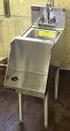 ENVIRONMENTAL HEALTH DIVISION 2120 Diamond Blvd., Suite 200 Concord, CA 94520 Phone: (925) 692-2500 Fax: (925) 692-2505 www.cchealth.org/eh/ SINKS / DISHMACHINES Food Preparation Sink A separate stainless
PREVENTING GROUNDWATER POLLUTION: SECONDARY CONTAINMENT
 PREVENTING GROUNDWATER POLLUTION: SECONDARY CONTAINMENT PREVENTING GROUNDWATER POLLUTION IS EVERYONE S JOB! Even if our drinking water comes from rivers, lakes, or reservoirs, we need to be mindful of
PR 50 Frymaster Universal Holding Cabinet (UHC)
 PREP EQUIPMENT PR 50 Frymaster Universal Holding Cabinet (UHC) Models UHCP2, UHCP4, UHCPN4 Daily maintenance tasks PR 50 D1 Clean UHC Monthly maintenance tasks PR 50 M1 Calibrate UHC Annual maintenance
GUIDELINE FOR THE DESIGN, CONSTRUCTION AND RECONSTRUCTION OF A FOOD HANDLING ESTABLISHMENT
 GUIDELINE FOR THE DESIGN, CONSTRUCTION AND RECONSTRUCTION OF A FOOD HANDLING ESTABLISHMENT This guideline provides general information to anyone proposing to construct a new food handling establishment,
FLOOR MATERIALS FOR RETAIL FOOD FACILITIES
 FLOOR MATERIALS FOR RETAIL FOOD FACILITIES General Appropriate floor, wall, and ceiling finishes promote good sanitation. Sanitation is an important component of public health protection. Disease outbreaks
Properly maintaining your septic system will help reduce the. It s Your Septic System. Homeowner s Guide. Here s How to Take Care of It
 Homeowner s Guide for Maintenance and Care of On-Site Sewage Systems It s Your Septic System Here s How to Take Care of It Properly maintaining your septic system will help reduce the possibility of health
RFP No. 09/030RF SY 2009-10
 Mfg DISH MACHINE PRODUCTS - clude and Identify "GREEN" items. 1 Mfg Item Product Dish machine Detergent, Solid in hard and soft water. Auto-Chlor Auto-Chlor 784 Auto-Chlor Kleen Duty Plus 4/8 $82.40 -
PLEASE READ ALL INSTRUCTIONS BEFORE USE AND SAVE A COPY FOR FUTURE REFERENCE!
 PLEASE READ ALL INSTRUCTIONS BEFORE USE AND SAVE A COPY FOR FUTURE REFERENCE! 1. Read all instructions carefully before using the machine. 2. Do not touch hot surfaces. Use handles or knobs. The lid and
Precautionary Boil Water Notices: Frequently Asked Questions
 Precautionary Boil Water Notices: Frequently Asked Questions QUICK TIPS: Boil Water For: Drinking Brushing Teeth Washing fruits & vegetables Preparing food Mixing baby formula Making ice Giving water to