
STANDARD OPERATING PROCEDURE S (SOP S) FOR HAZARDOUS ANALYSIS CRITICAL CONTROL POINT (HACCP) PLANS
|
|
|
- Elaine Walsh
- 9 years ago
- Views:
Transcription
1 STANDARD OPERATING PROCEDURE S (SOP S) FOR HAZARDOUS ANALYSIS CRITICAL CONTROL POINT (HACCP) PLANS RECEIVING: All food must be from approved sources. Foods must be wholesome and not adulterated. No home-prepared foods can be present in a food service facility. Severely dented, rusty, or swollen cans must be rejected. All meats and poultry must be USDA inspected. All eggs must be from USDA registered flocks. All shellfish must be from FDA approved harvesters and must be provided with shell stock tags. The shellstock tags and egg records must be maintained on site for 90 days. Inspect incoming product for package integrity. Measure product temperature to ensure the product has been received at a compliant temperature. Pasteurized crab meat and vacuum packed meats with no preservatives must be refrigerated at 38 F or below. All other refrigerated product must be 41 F or below and frozen product must be fully frozen upon delivery. Inspect shellfish and other seafood products for freshness. Reject delivery or discard product if criteria is not met. Supervisor visually observes that employees are inspecting incoming product for package integrity and that temperature monitoring is being conducted if necessary. 1

2 STORAGE: Frozen products must be fully frozen. Pasteurized crab meat and vacuum packed meats with no preservatives must be refrigerated at 38 F or below. All other refrigerated products must be stored at 41 F or below. Store raw refrigerated animal food products separate from refrigerated ready-to-eat foods. If stored on same set of shelves, raw animal foods must be stored below ready-to-eat foods. Foods must be stored only in designated areas. Protected foods must be stored a minimum of 6 inches above the floor; exposed food must be stored at least 18 inches above the floor. While the facility is in operation, check temperature of refrigeration and freezer units a minimum of every 4 hours. If a storage freezer is not working properly, move foods to freezer unit capable of maintaining frozen foods. If frozen product has begun to thaw, move to refrigerated unit maintaining 41 F or below and cook within 72 hours. If a refrigerator is not maintaining 41 F or below, and if the product was out of temperature for a verifiable time of less than 4 hours then move the product to a unit properly maintaining 41 F or below. If the product temperature was above 41 F for an unverifiable time or longer than 4 hours then discard the product. Review temperature logs of storage units if available. If temperature logs are not utilized, the supervisor will visually observe that unit temperatures are monitored by employees and corrective actions are taken when warranted. 2

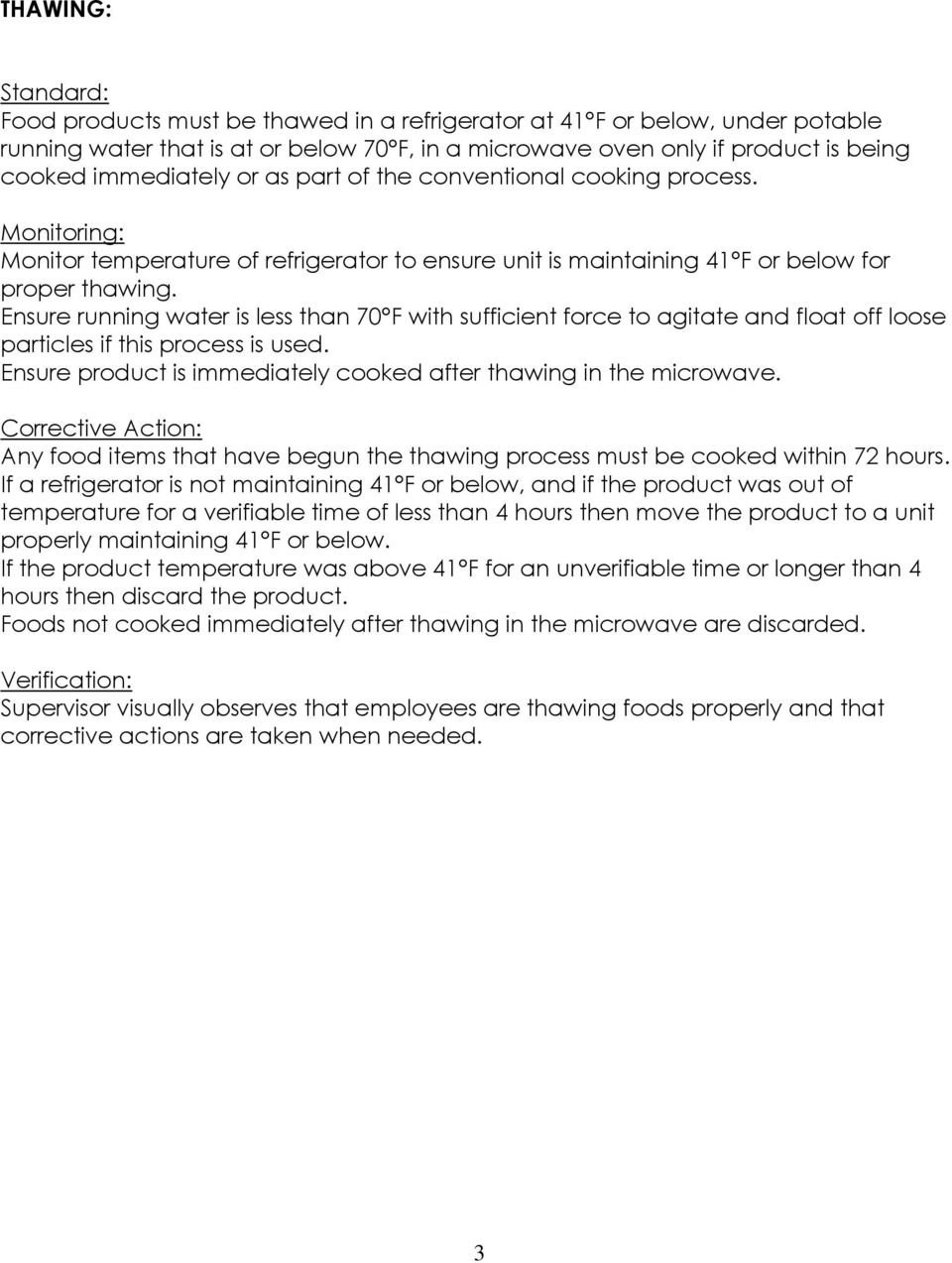
3 THAWING: Food products must be thawed in a refrigerator at 41 F or below, under potable running water that is at or below 70 F, in a microwave oven only if product is being cooked immediately or as part of the conventional cooking process. Monitor temperature of refrigerator to ensure unit is maintaining 41 F or below for proper thawing. Ensure running water is less than 70 F with sufficient force to agitate and float off loose particles if this process is used. Ensure product is immediately cooked after thawing in the microwave. Any food items that have begun the thawing process must be cooked within 72 hours. If a refrigerator is not maintaining 41 F or below, and if the product was out of temperature for a verifiable time of less than 4 hours then move the product to a unit properly maintaining 41 F or below. If the product temperature was above 41 F for an unverifiable time or longer than 4 hours then discard the product. Foods not cooked immediately after thawing in the microwave are discarded. Supervisor visually observes that employees are thawing foods properly and that corrective actions are taken when needed. 3
4 PREPERATION/PROCESSING/ASSEMBLING: Food workers prevent contact of exposed, ready-to-eat food with their bare hands by using gloves or utensils such as tongs or deli paper. Cross contamination is prevented by not allowing contact between ready-to-eat and raw foods. Utensils used in food preparation are clean and sanitized. Fruits and vegetables are free of dirt, etc. prior to processing. The time that potentially hazardous items are removed from temperature control for processes such as portioning, slicing and mixing must be minimized. All raw fruits and vegetables are washed thoroughly to remove soil and other contaminants before cutting, cooking, or serving. Managers will ensure employees are properly utilizing gloves or other approved method when handling ready-to-eat foods. Ensure that the time that potentially hazardous foods are out of temperature control for preparation is minimized. Any food items contaminated by bare hands, unclean utensils, etc. are discarded. Discard product if out of temperature control for an extended period of time for preparation. Supervisor visually observes that proper techniques are being utilized during food preparation and ensures that corrective actions are being taken when monitoring procedures are not met. 4

5 COOKING: All potentially hazardous foods must be cooked to the following proper minimum internal temperature for 15 seconds unless otherwise noted: Pork; Ham 145 F Comminuted fish/meats 155 F Ground Beef 155 F Roast Beef 130 F for 121 minutes for immediate service Poultry; Stuffing; Stuffed Meat 165 F Shelled Eggs 155 F Shelled Eggs 145 F for immediate service Ready to eat commercially processed foods 135 F All others not specified 145 F Certain foods may be cooked to order for immediate service upon customer request, provided that a consumer advisory is provided and process is approved in the HACCP plan. A consumer advisory is provided on the menu or in another approved form when an animal food, such as beef, eggs, fish, lamb, pork, poultry, or shellfish, is served raw or undercooked. The HACCP plan must specify that raw or undercooked items are offered and must include method of customer notification. Advisory must state consuming raw or undercooked animal foods may increase your risk of contracting a foodborne illness, especially if you have certain medical conditions. Internal product temperatures will be checked using a calibrated stem thermometer. Product will continue to cook until proper temperatures are reached. Review cooking temperature logs. If cooking logs are not utilized, the supervisor must visually observe that temperatures are taken at the proper times and if unsatisfactory, food is returned to the cooking equipment until the required time and temperature standards are met. Supervisors must also verify that thermometers are properly calibrated. 5

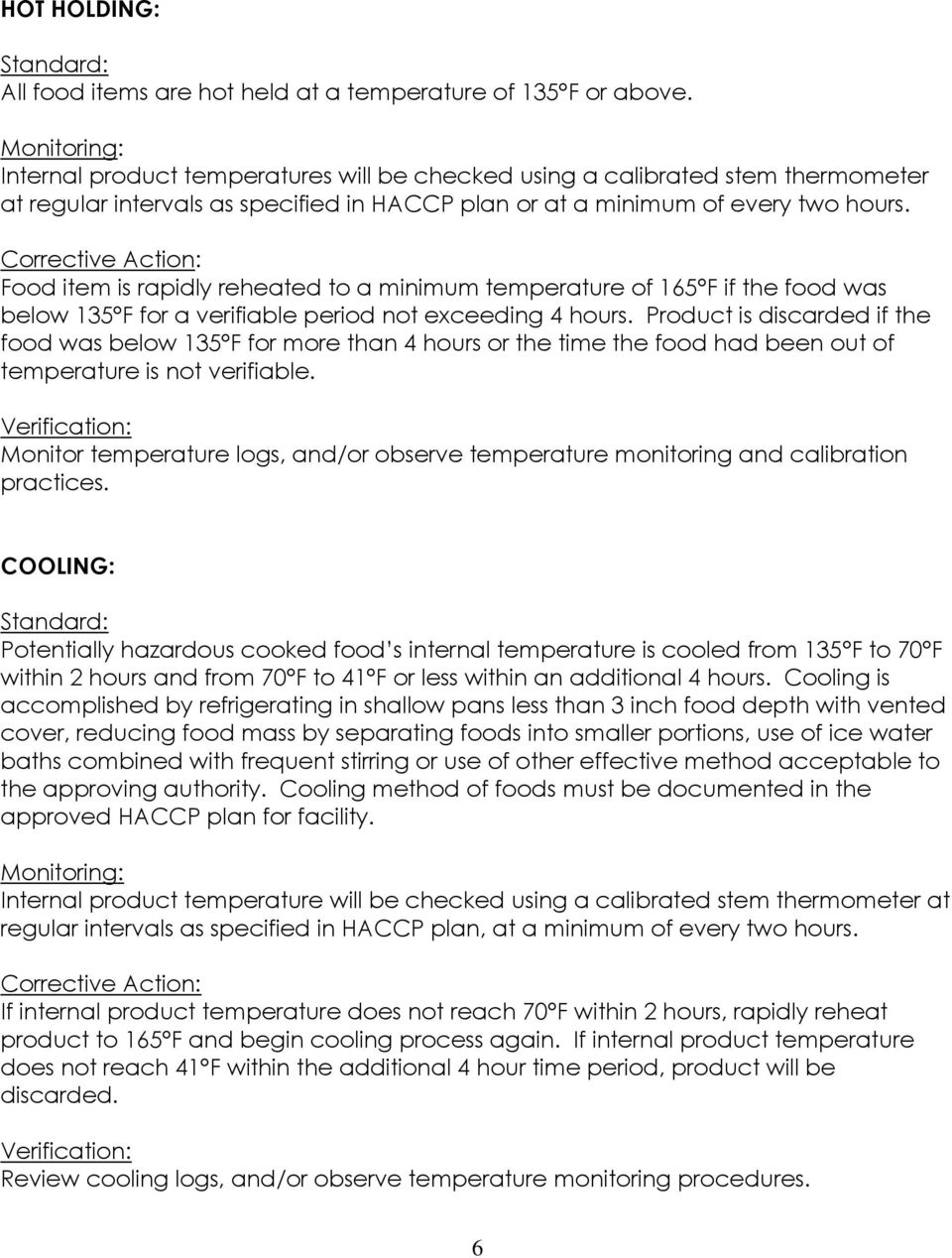
6 HOT HOLDING: All food items are hot held at a temperature of 135 F or above. Internal product temperatures will be checked using a calibrated stem thermometer at regular intervals as specified in HACCP plan or at a minimum of every two hours. Food item is rapidly reheated to a minimum temperature of 165 F if the food was below 135 F for a verifiable period not exceeding 4 hours. Product is discarded if the food was below 135 F for more than 4 hours or the time the food had been out of temperature is not verifiable. Monitor temperature logs, and/or observe temperature monitoring and calibration practices. COOLING: Potentially hazardous cooked food s internal temperature is cooled from 135 F to 70 F within 2 hours and from 70 F to 41 F or less within an additional 4 hours. Cooling is accomplished by refrigerating in shallow pans less than 3 inch food depth with vented cover, reducing food mass by separating foods into smaller portions, use of ice water baths combined with frequent stirring or use of other effective method acceptable to the approving authority. Cooling method of foods must be documented in the approved HACCP plan for facility. Internal product temperature will be checked using a calibrated stem thermometer at regular intervals as specified in HACCP plan, at a minimum of every two hours. If internal product temperature does not reach 70 F within 2 hours, rapidly reheat product to 165 F and begin cooling process again. If internal product temperature does not reach 41 F within the additional 4 hour time period, product will be discarded. Review cooling logs, and/or observe temperature monitoring procedures. 6
7 REHEATING: Potentially hazardous foods that have been cooked, cooled, and refrigerated are reheated to an internal temperature of 165 F or above within 2 hours. Ready to eat foods taken from a commercially processed, hermetically sealed container or from an intact package from a food processing plant that is inspected by a food regulatory authority is reheated to a minimum of 135 F. Internal product temperature will be checked using a calibrated stem thermometer at regular intervals as specified in HACCP plan. Product will be discarded if it fails to reach 165 F within 2 hours. Monitor temperature logs, and/or observe temperature monitoring and calibration practices. 7

8 HAND WASHING: Hand washing must be performed prior to the start of handling foods and after eating, drinking, smoking, sneezing, coughing, using the restroom, handling soiled equipment or utensils, and handling raw animal products. Hands must be washed for a minimum of twenty seconds while utilizing soap and warm water. Hands must be dried with paper towels, hand dryer or other approved method. DISHWASHING: Dishes, utensils and equipment must be flushed of all debris, then washed with hot soapy water in the first compartment, rinsed in hot clear water in the second compartment, and sanitized in the third compartment. The time and strength will be dependant on the type of sanitizer utilized. Chemical test strips must be provided to ensure the proper sanitizer strength is utilized. Dishes, utensils and equipment must air dry prior to stacking and putting away. WIPING CLOTHS: If wiping cloths are to be utilized, they must be stored in a container of sanitizer solution between uses. If utilizing chlorine, the sanitizer strength must maintain a minimum of 50 ppm. Any debris on the cloth must be disposed of in the garbage, prior to placing the cloth into the sanitizer solution. 8

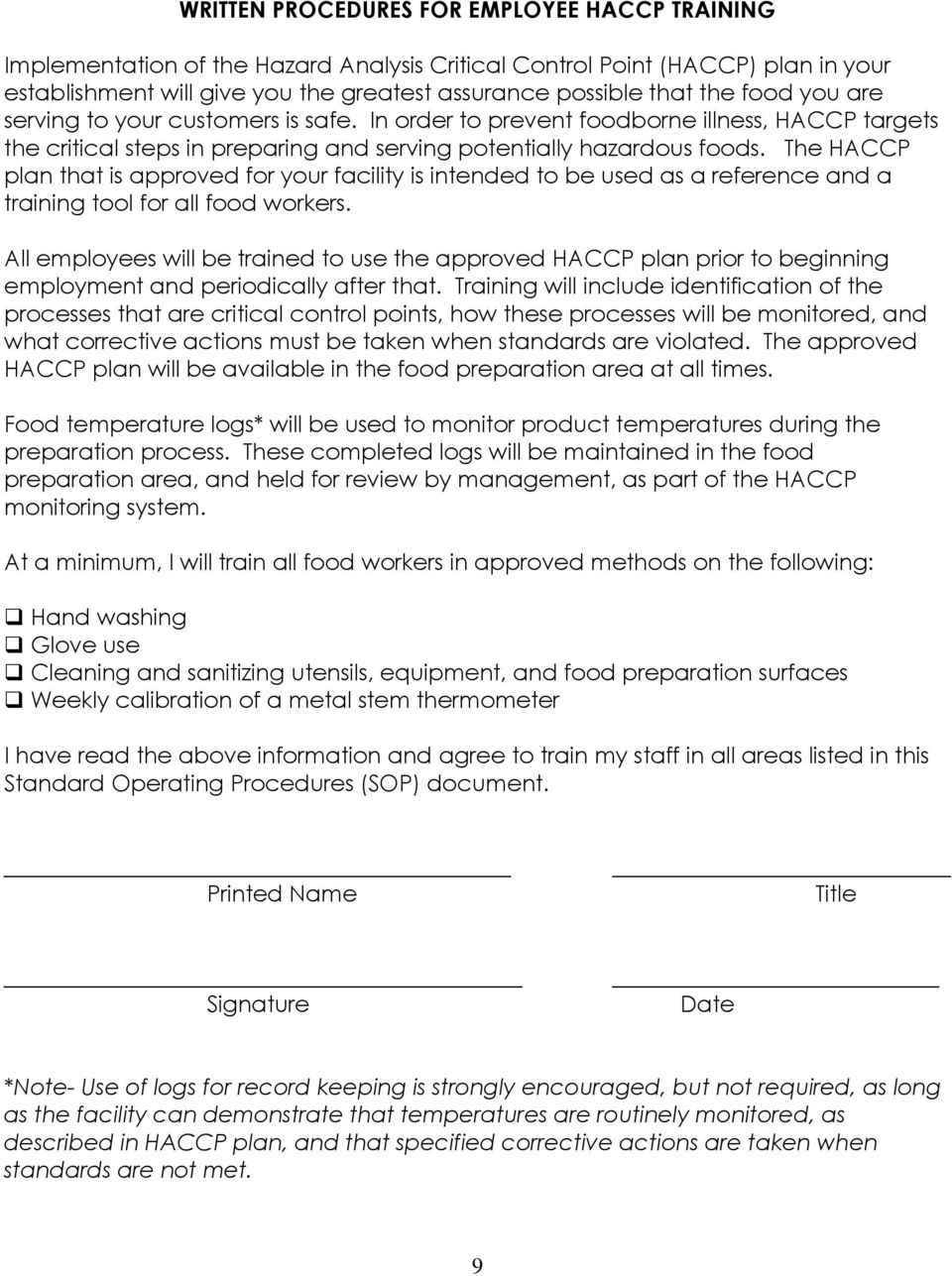
9 WRITTEN PROCEDURES FOR EMPLOYEE HACCP TRAINING Implementation of the Hazard Analysis Critical Control Point (HACCP) plan in your establishment will give you the greatest assurance possible that the food you are serving to your customers is safe. In order to prevent foodborne illness, HACCP targets the critical steps in preparing and serving potentially hazardous foods. The HACCP plan that is approved for your facility is intended to be used as a reference and a training tool for all food workers. All employees will be trained to use the approved HACCP plan prior to beginning employment and periodically after that. Training will include identification of the processes that are critical control points, how these processes will be monitored, and what corrective actions must be taken when standards are violated. The approved HACCP plan will be available in the food preparation area at all times. Food temperature logs* will be used to monitor product temperatures during the preparation process. These completed logs will be maintained in the food preparation area, and held for review by management, as part of the HACCP monitoring system. At a minimum, I will train all food workers in approved methods on the following: Hand washing Glove use Cleaning and sanitizing utensils, equipment, and food preparation surfaces Weekly calibration of a metal stem thermometer I have read the above information and agree to train my staff in all areas listed in this Standard Operating Procedures (SOP) document. Printed Name Title Signature Date *Note- Use of logs for record keeping is strongly encouraged, but not required, as long as the facility can demonstrate that temperatures are routinely monitored, as described in HACCP plan, and that specified corrective actions are taken when standards are not met. 9
HACCP Plan Designing a HACCP Plan for Your Facility. Calvert County Health Department Division of Environmental Health
 HACCP Plan Designing a HACCP Plan for Your Facility Calvert County Health Department Division of Environmental Health What is a HACCP Plan? HACCP stands for Hazard Analysis Critical Control Point. It is
Requirements for Temporary Food Establishments
 Requirements for Temporary Food Establishments Public Health-Madison and Dane County Environmental Health Division 2701 International Lane, Suite 204 Madison, WI 53704 (608) 243-0330 6/8/09 Requirements
REQUIREMENTS FOR TRADE SHOWS
 REQUIREMENTS FOR TRADE SHOWS All Trade Show Booth operators who give out food samples must be approved before the event and licensed by Regina Qu Appelle Health Region prior to opening. Food sold for immediate
Important Information for Vendors at Temporary Events
 Important Information for Vendors at Temporary Events As a food vendor, you are responsible for ensuring that your operation complies with the Colorado Retail Food Establishment Rules and Regulations.
Table of Contents. Introduction... 1. Personal Hygiene... 2. Temperature Control... 5. Cross-contamination... 6. Cleaning and Sanitizing...
 Table of Contents Introduction... 1 Food Handler Certification Program... 1 Personal Hygiene... 2 Temperature Control... 5 Cross-contamination... 6 Cleaning and Sanitizing... 6 Dishwashing... 7 Food Storage...
02.11 Food and Nutrition Services
 02.11 Purpose Audience To assure proper and safe food handling, storage, and preparation. All Department of employees. Personnel The following guidelines shall be used to monitor proper and safe food handling,
Volume RESTAURANT X. 123 Main Street, Phoenix, Arizona. Food Safety Manual
 Volume 1 RESTAURANT X 123 Main Street, Phoenix, Arizona Food Safety Manual RESTAURANT X Food Safety Training Manual Note to New Author Thank you for your interest and your enthusiasm in developing your
Workbook for Developing an Active Food Safety Management System
 Workbook for Developing an Active Food Safety Management System A food safety management system will help to minimize the risk of foodborne illness in your food service establishment. It includes all the
Template for Review and Update of the Child Nutrition Food Safety Plan i
 Taking Care of Business: Food Safety and Finance for School Foodservice Template for Review and Update of the Child Nutrition Food Safety Plan Our Town District Child Nutrition Food Safety Plan City, Mississippi
Food Safety Evaluation Checklist. Directions
 Food Safety Checklist The following self-assessment can help you find food safety gaps in your operation. It can also help you put food safety systems, such as active managerial control, into place. This
General food hygiene rules
 General food hygiene rules Why food hygiene is important? Good food hygiene is essential to ensure that the food you and your family eats is safe. Poor hygiene procedures in your home can put you at risk.
Maricopa County. Food Code References for Produce. Receiving. Storage
 Maricopa County Environmental Services Department 1001 N. Central. Avenue Suite 300 Phoenix, AZ 85004 esd.maricopa.gov Food for Produce This guidance document was developed for food establishments interested
CRITICAL VIOLATION RISK FACTORS
 Food Service Establishment Inspection Establishment Name: Address: 2104 OLD LEXINGTON ROAD City: WINSTON SALEM State: NC Zip: 27103 Permittee: JOSE & MILCIADES SORTO Mailing Address: 2104 OLD LEXINGTON
SAFE HEALTHY CHILDREN A Health and Safety Manual for Childcare Providers
 TABLE OF CONTENTS Chapter 7: Food Storage and Preparation Safe Food: Food Storage and Preparation 7.1 Requirements of the Day Nurseries Act... 7.2 Recommendations of the Medical Officer of Health... 7.2
Name of Business. Record 1- Approved Food Suppliers List
 Record 1- Approved Food Suppliers List Supplier No. Details of Supplier (Name, address, contact details) Product Description Approved Supplier Date approved Corrective Action Reject suppliers that do not
ASI 691 Prinicples of HACCP 1
 Prerequisite Programs: GMP s, SOP s, SSOP s HACCP Does Not Stand Alone Must be built on existing food safety programs Prerequisite Programs Definition of Prerequisite Programs- Procedures, including Good
Emergency Guideline for Food Facilities during Boil Water Advisory or Other Public Notices
 Emergency Guideline for Food Facilities during Boil Water Advisory or Other Public Notices Water supply warnings are generally required when water suppliers need to provide consumers with immediate and
Requirements for Special Event Food Vendors
 Niagara Region PUBLIC HEALTH Requirements for Special Event Food Vendors Please be advised that it is the responsibility of each Special Event Food Vendor to be aware of and in full compliance with the
Keep It Healthy! Food Safety Employee Guide
 Keep It Healthy! Food Safety Employee Guide Your Guide to Preventing Foodborne Illness Food Protection Program 450 W State St Boise, ID 83720-0036 www.foodsafety.idaho.gov *The information provided in
VENDOR APPLICATION FOR TEMPORARY FOOD EVENTS
 VENDOR APPLICATION FOR TEMPORARY FOOD EVENTS All vendors must complete and submit to Event Coordinator for each event in the Tri-County area. If no menu and no equipment change are occurring from one event
TEMPORARY FOOD EVENT
 Serving the Counties of Clarke, Frederick, Page, Shenandoah, Warren, and the City of Winchester TEMPORARY FOOD EVENT For Event Coordinators and Temporary Food Event Participants including anyone who wishes
Iowa State University Food Sales or Service Agreement
 Food Sales or Service Agreement (1) Read this agreement and make note of all topics that pertain to your organization s event. (2) Complete pages 1-3 and submit to the at least one week prior to your event.
TRAINER: Read this page ahead of time to prepare for teaching the module.
 Module 7 Overview: Safe Cooking TRAINER: Read this page ahead of time to prepare for teaching the module. PARTICIPANTS WILL: 1. Describe potential hazards of eating food that has not been safely cooked.
TEMPORARY EVENT APPLICATION
 www.camdencounty.com TEMPORARY EVENT APPLICATION Dear Special Event Participant: Enclosed is a copy of the Requirements for Temporary Food Service Operation and Special Event Fact Sheet. To obtain approval
Food Surface Sanitizing
 Module 14 Overview: Food Surface Sanitizing TRAINER: Read this page ahead of time to prepare for teaching the module. PARTICIPANTS WILL: 1. Understand the importance of food surface CLEANING and SANITIZING.
Home Food Safety Myths and Facts for Consumers. The Partnership for Food Safety Education
 10 Home Food Safety Myths and Facts for Consumers The Partnership for Food Safety Education 2014 For more Home Food Safety Mythbusters go to www.fightbac.org Myth #1 Freezing foods kills harmful bacteria
Candidate Study Guide for the Illinois Food Service Sanitation Manager Examinations
 Candidate Study Guide for the Illinois Food Service Sanitation Manager Examinations This information is intended to help you prepare for the Illinois Food Service Sanitation Manager Examinations. Part
Sanitary Food Preparation & Safe Food Handling
 70 Feeding Infants 10 Sanitary Food Preparation & Safe Food Handling Babies are more susceptible to bacteria than older children, and unsanitary food conditions can cause serious infections. General cleanliness,
Practice Test. Practice Tests and Answer Keys. Circle the best answer to each question below. Be sure to answer all 40 questions.
 Practice Tests and Answer Keys Practice Test Name Date Circle the best answer to each question below. Be sure to answer all 40 questions. 1 Why are infants and young children at higher risk for getting
Food Safety Manual for the Food Service Worker
 Food Safety Manual for the Food Service Worker (Revised March 2013) Portsmouth Health Department Acknowledgments Maricopa County Food Protection Program Environmental Health Services Division of Seattle
FACILITIES DESIGN ASSESSMENT AND PERMITTING QUESTIONNAIRE: (For use by all food risk categories 1-3 or higher)
 FACILITIES DESIGN ASSESSMENT AND PERMITTING QUESTIONNAIRE: (For use by all food risk categories 1-3 or higher) TO BE COMPLETED BY THE OWNER/OPERATOR AND SUBMITTED TO THE SNHD ENVIRONMENTAL HEALTH DIVISION
Region of Waterloo Public Health SPECIAL EVENTS. Food Vendor Requirements
 Region of Waterloo Public Health SPECIAL EVENTS Food Vendor Requirements Date: Dear Food Vendor: Region of Waterloo Public Health (ROWPH) has been notified that you will be selling, serving food and/or
Temporary Food Service
 Public Health Inspection Services Community Health Head Office Frontier Mall 11427 Railway Ave. East NORTH BATTLEFORD, SK. S9A 1E9 Tel: (306)446-6400 Fax: (306)446-6018 Temporary Food Service Food Vendor
Food Safety and Sanitation Manual
 Food Safety and Sanitation Manual Health Care Agency Environmental Health Services A food safety and sanitation manual for food facility operators and their employees doing business in Orange County Our
Guidance for School Food Authorities: Developing a School Food Safety Program Based on the Process Approach to HACCP Principles
 Guidance for School Food Authorities: Developing a School Food Safety Program Based on the Process Approach to HACCP Principles United States Department of Agriculture Food and Nutrition Service June 2005
Food Safety Manual for the Food Service Worker
 Food Safety Manual for the Food Service Worker (Revised December 2006) TESTING SITES & HOURS OF OPERATION All offices are opened Monday - Friday, excluding major holidays Central Regional Office 1645 E.
TEMPORARY FOOD FACILITY PERMIT APPLICATION
 COUNTY OF LAKE HEALTH SERVICES DEPARTMENT Division of Environmental Health 922 Bevins Court, Lakeport, CA 95453-9739 Telephone 707/ 263-1164 FAX: 263-1681 TEMPORARY FOOD FACILITY PERMIT APPLICATION Failure
TEMPORARY FOOD EVENT PERMIT PACKET INSTRUCTIONS TO FOOD VENDORS
 TEMPORARY FOOD EVENT PERMIT PACKET INSTRUCTIONS TO FOOD VENDORS BACKGROUND Temporary food events have been responsible for causing major food borne disease outbreaks due to improper temperature control,
FMI Listeria Action Plan for Retail Delis
 FMI Listeria Action Plan for Retail Delis November 2012 Listeria control at retail is an ongoing challenge. FMI and our members are committed to finding ways to control the growth and if possible, eliminate
GUIDELINES. for COTTAGE INDUSTRY INVOLVED in HOME FOOD PRODUCTION
 GUIDELINES for COTTAGE INDUSTRY INVOLVED in HOME FOOD PRODUCTION ENVIRONMENTAL HEALTH PO Box 2000, 16 Garfield Street Charlottetown, PEI CIA 7N8 Tel: 368-4970 / Fax: 368-6468 These guidelines have been
FOOD POISONING. Information Leaflet. Your Health. Our Priority. Infection Prevention Stepping Hill Hospital
 FOOD POISONING Information Leaflet Your Health. Our Priority. Page 2 of 5 What is Food Poisoning? Food poisoning is an illness that occurs after eating or drinking anything that is contaminated. Usually
Food Safety Manual for the Food Service Worker
 Food Safety Manual for the Food Service Worker (Revised September 2007) TESTING SITES & HOURS OF OPERATION All offices are open Monday - Friday, excluding major holidays Central Regional Office 1645 E.
at Home Food Safety Your guide to safe food handling Food safety is a key concern to us - this brochure is brought to you by: turkeyfarmersofcanada.
 Food safety is a key concern to us - this brochure is brought to you by: turkeyfarmersofcanada.ca 1-888-245-8180 or ehfc.ca 1-888-248-beef or beefinfo.org chicken.ca canfightbac.org eggs.ca More questions
Don t let food make you sick:
 * Although America has some of the safest food in the world, an average of one in six Americans has some type of food borne illness each year. When you are immune suppressed, it is even easier for you
TRAINER: Read this page ahead of time to prepare for teaching the module.
 Module 8 Overview: Reheating TRAINER: Read this page ahead of time to prepare for teaching the module. PARTICIPANTS WILL: 1. Understand the importance of thoroughly reheating leftovers. 2. Know the time
Guidance for School Food Authorities: Developing a School Food Safety Program Based on the Process Approach to HACCP Principles
 Guidance for School Food Authorities: Developing a School Food Safety Program Based on the Process Approach to HACCP Principles United States Department of Agriculture Food and Nutrition Service June 2005
a. Be responsible for orientation, training, scheduling and supervision of dietary employees on all shifts; (1-1-88)
 107.DIETARY SERVICE. 01. Dietary Supervision. A qualified food service supervisor shall be designated by the administrator to be in charge of the dietary department. This person shall: (1-1- a. Be responsible
Guideline on Emergency Action Plans for Food Establishments: Sewage Backup
 Guideline on Emergency Action Plans for Food Establishments: Sewage Backup A sewage backup refers to the overflow of sewage from equipment or plumbing facilities within a food establishment. A sewage backup
Practice Test. 1. Which of the following statements is true? After touching raw ground beef, it is important to:
 Practice Test This test shows you what you might see on the food handler certification test. You can use the book to look up the answers. The certification test is made up of 32 questions and you will
Preventing Cross-Contamination
 Preventing Cross-Contamination After completing this chapter, you will be able to identify: Food that may have been contaminated during receiving How to prevent cross-contamination when storing, prepping,
HACCP-Based Standard Operating Procedures. National Food Service Management Institute The University of Mississippi NFSMI Item Number ET63-05(Print)
 HACCP-Based Standard Operating Procedures National Food Service Management Institute The University of Mississippi NFSMI Item Number ET63-05(Print) 2005 This project has been funded at least in part with
Food Safety at Temporary Events
 Food Safety at Temporary Events Church suppers, street fairs, civic celebrations and other similar events call for food service vendors to be set up out-of-doors or in locations where keeping foods safe
Food safety checklist How well does your food business rate?
 FOOD SAFETY RATING GUIDE Food safety checklist How well does your food business rate? Under Council s Eat Safe Brisbane food safety rating scheme, all licensed food businesses within Brisbane will be issued
Developing a school food safety plan based on HACCP system. (for school lunch box caterers)
 Developing a school food safety plan based on HACCP system (for school lunch box caterers) (I) Background/Introduction To further reduce food waste and disposable containers, the Government launched a
Instructions for Completing the Electronic ENP Meal Monitoring form
 Instructions for Completing the Electronic ENP Meal Monitoring form General Information: The ENP Meal Monitoring form is available on the PDA website. The monitoring form can be printed and completed manually
FOOD ESTABLISHMENT INSPECTION REPORT
 Kent County Health Department 700 Fuller Ave. NE Grand Rapids, MI 49503-1996 (616) 632-6900 FOOD ESTABLISHMENT INSPECTION REPORT Based on an evaluation this day, the items marked below are violations of
Receiving and Storage
 Receiving and Storage Lesson 10 Overview Receiving and Storage Time 30 minutes Purpose To explain the relationship between receiving, food storage, and food safety Objectives At the conclusion of this
Department of Resource Management 675 TEXAS STREET, SUITE 5500 FAIRFIELD, CALIFORNIA 94533 (707) 784-6765 Fax (707) 784-4805
 Department of Resource Management 675 TEXAS STREET, SUITE 5500 FAIRFIELD, CALIFORNIA 94533 (707) 784-6765 Fax (707) 784-4805 2011 SPECIAL EVENT FOOD VENDOR APPLICATION DUE 30 DAYS BEFORE THE EVENT OFFICIAL
TEMPORARY FOOD ESTABLISHMENT EVENT APPLICATION
 CONSOLIDATED HUMAN SERVICES Health Department Environmental Health TEMPORARY FOOD ESTABLISHMENT EVENT APPLICATION This application must be submitted to Onslow County Health Department at least fifteen
SOUTH CAROLINA. Downloaded January 2011
 SOUTH CAROLINA Downloaded January 2011 1401. General (II) B. When meals are catered to a facility, such meals shall be obtained from a meal service establishment graded by the Department, pursuant to R.61
Food delivery & storage
 screen 1 Food delivery & storage 7. Rubbish bags in the way of deliveries This screen shows a delivery scene with a number of potential hazards to food safety. As a starting point students are encouraged
What are the rules with Reduced Oxygen Packaging (aka Vacuum Packing)?
 Tillamook County Tillamook County Health Department Our Mission... To protect and promote the health of all people in Tillamook County. What are the rules with Reduced Oxygen Packaging (aka Vacuum Packing)?
Subsection 4.1.6 Cleaning And Sanitizing for Licensed Group Child Care Homes, Licensed Child Care Centers and License-Exempt Child Care Facilities
 Page 1 of 6 CLEANING AND SANITIZING All items requiring sanitizing shall be washed, rinsed and sanitized with approved agents, methods and concentrations. [19 CSR 30-60.090 (1) (B), (5) (A), 19 CSR 30-62.082
The Safe Food Handler ServSafe Starters
 The Safe Food Handler ServSafe Starters 1 What causes foodborne illness? Food from unsafe source Inadequate cooking Improper holding temperature Contaminated equipment Poor personal hygiene Foodborne illness
Safe Storage of Raw Animal Foods
 Module 13 Overview: Safe Storage of Raw Animal Foods TRAINER: Read this page ahead of time to prepare for teaching the module. PARTICIPANTS WILL: 1. Define CROSS-CONTAMINATION. 2. Identify RAW ANIMAL FOODS.
Food Safety Guide for Family Day Care Educators
 Food Safety Guide for Family Day Care Educators Department of Health and Human Services About this Guide This Guide is designed to help Family Day Care (FDC) Educators make safe and healthy meals for the
HOW TO RESPOND WHEN DISASTER STRIKES.. FIRE POWER OUTAGE WATER DAMAGE ( TO ADD TEMPORARY WATER INTERRUPTION)
 HOW TO RESPOND WHEN DISASTER STRIKES.. FIRE POWER OUTAGE WATER DAMAGE ( TO ADD TEMPORARY WATER INTERRUPTION) FIRE Determining the extent of fire and smoke damage is very difficult. Look for the following
Food Safety. Your Self-Training Manual. Oregon Health Authority. Foodborne Illness Prevention Program
 Food Safety Your Self-Training Manual Oregon Health Authority Foodborne Illness Prevention Program Why Read This Book?... 1 Food Handler Card... 1 Training Required... 1 Reciprocity and Equivalency...
Loudoun County Health Department P.O. Box 7000 1 Harrison Street Southeast Leesburg VA 20177-7000 Temporary Food Guidelines and Information Packet
 Loudoun County Health Department P.O. Box 7000 1 Harrison Street Southeast Leesburg VA 20177-7000 Temporary Food Guidelines and Information Packet Temporary Food Coordinator: Tamara Shellenberger E-Mail:
The Professional Food Handlers Guide. (In compliance with new Australian Food Safety Standards)
 The Professional Food Handlers Guide. (In compliance with new Australian Food Safety Standards) H Y GIENIC SOLUTIO N S This booklet is designed by Kimberly-Clark to assist you and your staff in achieving
Food Handler Basic Course Study Guide
 www.efoodcard.com Food Industry Training Food Handler Basic Course Study Guide Table of Contents Why Read This Manual?...1 Food Handler Card...1 Training Required...1 Reciprocity and Equivalency...1 How
HYGIENE IN THE GALLEY
 HYGIENE IN THE GALLEY - good advice for self-assessment aboard Guidance for company and ship s management and galley crew Good hygiene is thinking twice about things when cooking for others. To limit the
EMERGENCY ACTION PLAN CONTAMINATED WATER SUPPLY (BIOLOGICAL)
 NEW HAMPSHIRE DEPARTMENT OF HEALTH AND HUMAN SERVICES DIVISION OF PUBLIC HEALTH SERVICES FOOD PROTECTION SECTION EMERGENCY ACTION PLAN CONTAMINATED WATER SUPPLY (BIOLOGICAL) For the purpose of this Emergency
MOBILE FOOD A GUIDE TO PERMITTING IN ALBUQUERQUE
 MOBILE FOOD A GUIDE TO PERMITTING IN ALBUQUERQUE PAVE THE WAY FOR SUCCESS WHAT YOU NEED TO KNOW TO PERMIT AND OPERATE A MOBILE FOOD UNIT IN ALBUQERQUE. PERMITS AND FEES Mobile food units are required to
Food Safety Guidelines for Onsite Feeding Locations, Food Shelves and Food Banks
 Food Safety Guidelines for Onsite Feeding Locations, Food Shelves and Food Banks Produced By: State and Local Public Health Agencies and Community Food Providers Table of Contents Introduction... 1 Definitions...
MOBILE RETAIL FOOD ESTABLISHMENT APPLICATION SEASONAL ANNUAL TEMPORARY/SPECIAL EVENT
 Date Received: Application must be submitted at least 10 business days prior to proposed operation. MOBILE RETAIL FOOD ESTABLISHMENT APPLICATION SEASONAL ANNUAL TEMPORARY/SPECIAL EVENT PART 1 TO BE COMPLETED
Food Handler s Manual
 Food Handler s Manual A training handbook for Riverside County Food Handlers County of Riverside Department of Environmental Health www.rivcoeh.org 1 Table of Contents Introduction.... 1 Foodborne Illness...
FOOD HYGIENE & KITCHEN SAFETY
 FOOD HYGIENE & KITCHEN SAFETY [These are as collated for use at Union Baptist Church. We acknowledge the excellent work done by the Galashiels Presbytery in preparing the original document from which much
Temporary Event VENDOR Guidelines
 Temporary Event VENDOR Guidelines Dear Event Food Vendor: Please be aware of the following requirements: VENDORS In order to participate in a Temporary Food Event you will need to complete the following
Good Hygiene Practices for Catering at Outdoor Events
 Good Hygiene Practices for Catering at Outdoor Events The following pages of advice are based on the requirements of Regulation (EC) 852/2004 on the Hygiene of Foodstuffs The Food Hygiene (England) Regulations
Food Service Operation/Retail Food Establishment Plan Review Application
 CHRISTOPHER S. SMITH, RS, MA HEALTH COMMISSIONER DAVID BEYERS, MD MEDICAL DIRECTOR CITY OF PORTSMOUTH HEALTH DEPARTMENT 605 WASHINGTON STREET PORTSMOUTH, OH 45662 BOARD MEMBERS JIM KALB, PRESIDENT TIMOTHY
4. HOUSE RULES TEMPERATURE CONTROL
 4. HOUSE RULES TEMPERATURE CONTROL The House Rules Section contains 9 sub-sections each of which covers a particular subject of food safety management. Every House Rule sub-section begins with guidance
POLICY 11 Food Safety
 11.1 Introduction The Food Premises Regulation 1 made under the Health Act 2 has been amended to exempt small assisted living residences (no more than six residents), which would otherwise be used as single-family
Arefrigerator is one of the most important pieces of equipment in the kitchen for keeping foods safe. These
 United States Department of Agriculture Food Safety and Inspection Service Food Safety Information USDA Photo Refrigeration and Food Safety Arefrigerator is one of the most important pieces of equipment
MA Department of Public Health
 Emergency Guideline for Food Establishments During Boil Water Order What food establishments are affected? As of 5/1/10, all food establishments including restaurants, supermarkets, caterers, food service
HACCP Food Safety Quality Assurance Manual Adapted with permission from the City of Ottawa Public Health & Long Term Care Branch
 HACCP Food Safety Quality Assurance Manual Adapted with permission from the City of Ottawa Public Health & Long Term Care Branch HPD FS(FS)4-09/2007 jb Table of Contents Page General Definitions 2 Management
Food Safety is in Your Hands! Alejandra Menjivar Community Nutrition Educator & Alejandra Navarro Community Nutrition Educator
 Food Safety is in Your Hands! Alejandra Menjivar Community Nutrition Educator & Alejandra Navarro Community Nutrition Educator Today s Class Food Safety is Important Good Personal Hygiene Receiving and
FOOD SAFETY MANAGEMENT SYSTEM Based on the principles of Hazard Analysis Critical Control Points (HACCP)
 Adult Services FOOD SAFETY MANAGEMENT SYSTEM Based on the principles of Hazard Analysis Critical Control Points (HACCP) for use in ENTER NAME OF residential, nursing or day care centre CONTENTS Page 1.0
Food manager certification/recertification training Food manager orientation of food safety programs Preparation for food management employment
 NEHA 720 South Colorado Boulevard, Suite 1000-N Denver, Colorado 80246-1926 Tel (303) 756-9090 ext. 340 Fax (303) 691-9490 Email [email protected] Web www.nehatraining.org Two-Day Syllabus NEHA
Chapter 7 Equipment and Utensil Cleaning and Sanitization
 Chapter 7 Equipment and Utensil Cleaning and Sanitization The importance of proper cleaning can be appreciated when one realizes that contaminated equipment (equipment and utensils which are not clean)
Mobile Food Vending Units
 Mobile Food Vending Units FOOD HANDLING PERMIT Before starting the operation of a mobile food vending unit, outside of a special event, the operator must hold a valid food handling permit issued by Alberta
Approved by Commissioner: LATEST REVISION: June 28, 2013
 POLICY TITLE: FOOD SERVICE MANAGEMENT, GENERAL PAGE 1 OF 13 POLICY NUMBER: 11.6 CHAPTER 11: FOOD SERVICE STATE of MAINE DEPARTMENT OF CORRECTIONS Division of Juvenile Services Approved by Commissioner:
Industry Best Practices for Holding Tested Products
 Industry Best Practices for Holding Tested Products Coordinated By: American Association of Meat Processors American Meat Institute Food Products Association National Chicken Council National Meat Association
Daily Temperature Chart Instructions
 Daily Chart Instructions It s a MUST DO -- Taking & recording food eratures with an accurate stem thermometer is a critical element to insuring your restaurant, your employees, and your chain are serving
Preparing Food at Home advice and legal requirements www.eastbourne.gov.uk/homecatering
 Preparing Food at Home advice and legal requirements www.eastbourne.gov.uk/homecatering Introduction This advice is aimed at people preparing food for others beside their immediate family either: a) on