
A RDT-Based Interconnection Network for Scalable Network-on-Chip Designs
|
|
|
- Gordon Skinner
- 10 years ago
- Views:
Transcription
1 A RDT-Based Interconnection Network for Scalable Network-on-Chip Designs ang u, Mei ang, ulu ang, and ingtao Jiang Dept. of Computer Science Nankai University Tianjing, , China Dept. of Electrical & Computer Engineering University of Nevada, Las Vegas Las Vegas, NV 89154, USA {meiyang, Abstract The interconnection network plays an important role in the performance and energy consumption of a Networkon-Chip (NoC) system. In this paper, we propose a RDT(2,2,1)/α-based interconnection network for NoC designs. RDT(2,2,1)/α is constructed by recursively overlaying 2-D diagonal meshes (torus). The number of layers needed for routing the links in RDT(2,2,1)/α is shown to be bounded at 6, which is feasible to be implemented with current and future VLSI technologies. With the innovative diagonal structure and its simple rank assignment, RDT(2,2,1)/α possesses the following features: recursive structure, smaller diameter and average distance, embedded mesh/torus topology, a constant node degree of 8, and robust routing schemes. These features make RDT(2,2,1)/α a promising solution for the interconnection network of NoC designs satisfying the requirements for scalability, energyefficiency, customizability, and fault-tolerance. Key words: Network-on-Chip, interconnection network, torus, scalability, routing 1. Introduction As shown on the International Technology Roadmap for Semiconductors (ITRS) [6], high-performance microprocessors are expected to contain up to one billion transistors by the year 2007 and over four billion transistors by This rapid advance in VLSI technologies will soon make it possible to integrate a large number of processing units interconnected through communication network on a single chip. The high performance and energy-efficiency brought by the distributed architecture make system-on-chip (SoC) designs promising for challenging design problems in the telecommunications, multimedia, and consumer electronic domains [1]. As a new paradigm of SoC, with a communicationcentric design style, Network-on-Chip (NoC) [1] was proposed to meet the distinctive challenges of providing functionally correct, reliable operation of interacting SoC components. A NoC system is composed of a large number of processing units communicating to other units across the interconnection network. Packets travel through the network by passing one or more hops between the source and destination tiles. The design of a NoC system must address the following four problems. Scalability: In a NoC system, the interconnection network plays an important role in providing scalability to accommodate larger number of transistors and alleviate design productivity gap [4]. On-chip networks will likely use networks with lower dimensionality to keep wire lengths short [5]. However, the scalability of current proposed solutions, including honeycomb structure [3], 2-D mesh [8], and butterfly fat tree structure [9], is either insufficient or unexplored. Energy-efficiency: As pointed out in [4], a significant amount of power of a NoC system is consumed by its interconnection network. As a result, when designing a NoC system, power needs to be treated as a major design constraint [4]. Customizability: The customization levels can be categorized in architectural, protocol, QoS [7][9][11], and hardware/software issues [4]. It is desirable to provide customizable NoC design in order to find the best compromise between the performance and the major design constraints, such as power and area, for a specific application. Fault-tolerance: The processing units and communication links are subject to failures. It is highly desirable to have a NoC design which can provide certain protection for system under node or link failures. To address the aforementioned problems, we propose an interconnection network design for NoC based on the Recursive Diagonal Torus (RDT) structure [14], which was originally proposed to connect massively parallel computers. An RDT structure is constructed by recursively overlaying 2-D diagonal meshes (torus). RDT(n, R, m) is a class of RDT in which each node has links to form base torus (rank-0) and m upper tori (the maximum rank is R) with the cardinal number n. In this

2 study, we particularly consider RDT(2,2,1)/α, one type of RDT with a special rank assignment. We show that the RDT(2,2,1)/α has the following advantages: 1) high scalability due to its recursive structure, 2) low power consumption due to its smaller diameter and average distance, 3) architectural customizability with its embedded mesh/torus topology, 4) fault-tolerance capability with a constant node degree of 8 and robust routing schemes. These features make RDT(2,2,1)/α a promising solution for the interconnection network of an NoC design. The advanced features of RDT(2,2,1)/α are attributed to the innovative diagonal structure [14] and its simple rank assignment. The diagonal routing inside the RDT(2,2,1)/α is feasible with the emergence of the - architecture [12]. In this paper, we show that the number of layers needed for laying out RDT(2,2,1)/α is bounded at 6, which is feasible with current and future VLSI technologies [6]. The rest of the paper is organized as follows. Section 2 provides a brief introduction of the RDT(2,2,1)/α structure. Section 3 presents the study of the number of layers needed for laying out RDT(2,2,1)/α. Section 4 discusses the properties of a RDT(2,2,1)/α-based interconnection network. Section 5 summarizes the paper. 2. The RDT(2,2,1)/α Structure 2.1 Definitions of the RDT Definition 1 (Base Torus). The base torus is a twodimensional square array of nodes, each of which is numbered with a two-dimensional number as follows: (0, 0) (1, 0) (2, 0) (N-1, 0) (0, 1) (1, 1) (2, 1) (N-1, 1) (0, 2) (1, 2) (2, 2) (N-1, 2) (0, N-1) (1, N-1) (2, N-1) (N-1, N-1) where N = n k and both n and k are natural numbers. The torus network is formed with four links between node(x, y) and its neighboring four nodes: (mod(x±1, N), y) and (x, mod(y±1, N)). This base torus is also called rank-0 torus. On the rank-0 torus, a new torus-like network (rank-1 torus) is formed by adding four links between node (x, y) and nodes (x±n, y±n). The direction of the new toruslike network is at an angle of 45 degrees to the original torus. On the rank-1 torus, another torus-like network (rank-2 torus) can be formed by adding four links in the same manner. Similarly, a rank-(r+1) torus can be formed upon rank-r torus. Definition 2 (RDT(n, R, m)). RDT(n, R, m) is a class of networks in which each node has links to form base torus (rank-0) and m upper tori (the maximum rank is R) with the cardinal number n. According to this definition, the degree of the RDT(n, R, m) is 4(m+1) [14]. Definition 3 (Perfect RDT). A network in which every node has links to form all possible upper rank tori (i.e. RDT(n, R, R)) is called a perfect RDT (PRDT(n, R)), where n is the cardinal number, and R is the maximum rank. We refer a perfect torus as one that contains all links and no two links overlap. An independent torus on rank-i is one that does not have links to other tori on rank-i. One of the upper rank torus is assigned to each node in the RDT(n, R, m) after n, R, and m are set. Thus, the structure of the RDT(n, R, m) also varies with different assignments for upper rank tori to each node. This assignment is called torus assignment. 2.2 The RDT(2,2,1)/α structure In this paper, we consider a simple RDT structure, RDT(2, 2, 1)/α with its torus assignment shown in Fig. 1. In this assignment, each node has eight links, four for the base (rank-0) torus and four for rank-1 or rank-2 tori. Fig. 1 only shows part of these links. Figure 1. Torus assignment for the RDT(2,2,1)/α. According to Theorem 1 of [14], with the cardinal number n=2, eight independent rank-1 tori can be formed on the base torus, and eight independent rank-2 tori can be formed on each rank-1 torus. Hence, in total, there are 8 rank-1 tori and 64 rank-2 tori in RDT(2,2,1)/α. As a perfect torus needs minimum 16 (4x4) nodes, a perfect RDT(2,2,1)/α consists of at least 64x16=1024 (32x32) nodes.

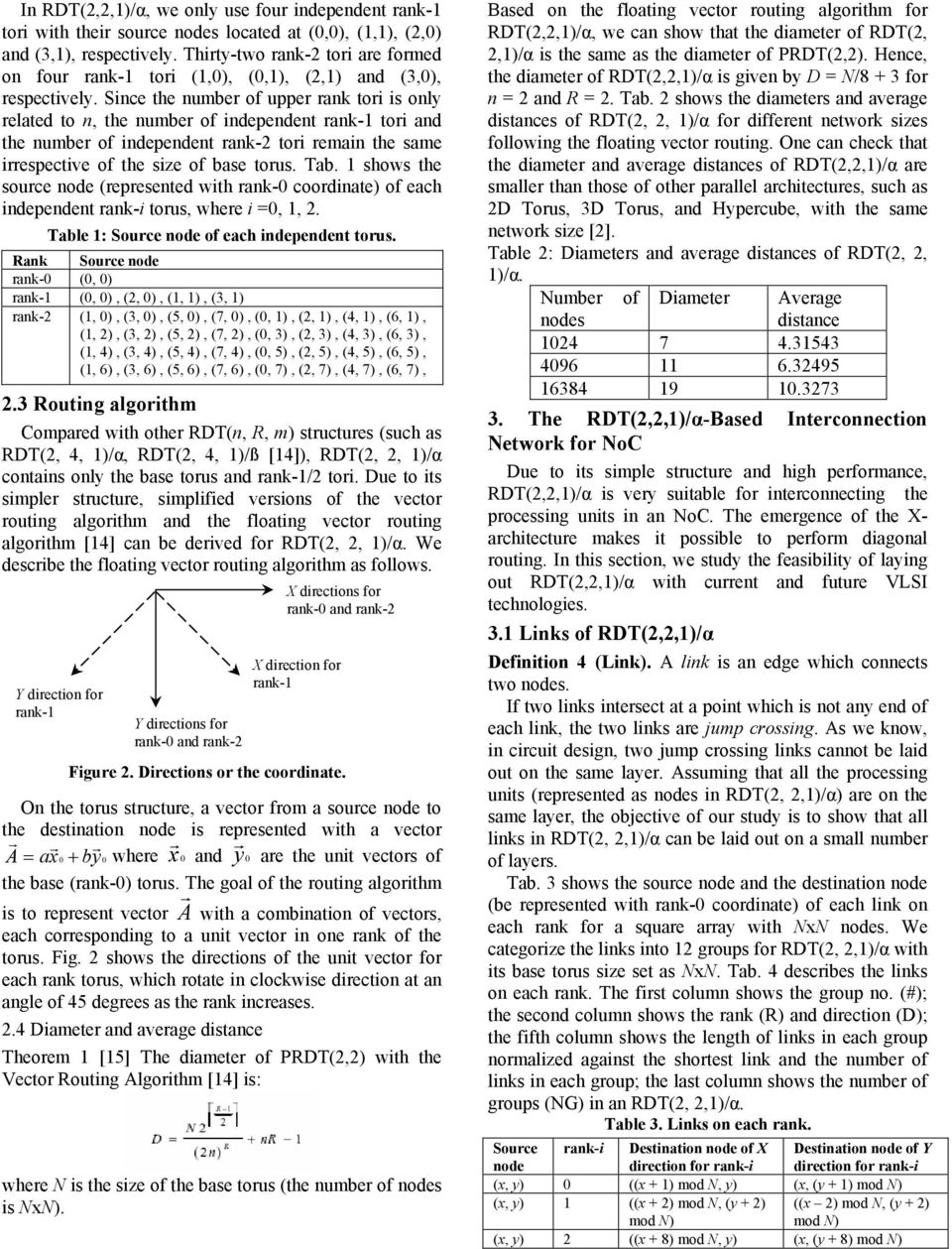
3 In RDT(2,2,1)/α, we only use four independent rank-1 tori with their source nodes located at (0,0), (1,1), (2,0) and (3,1), respectively. Thirty-two rank-2 tori are formed on four rank-1 tori (1,0), (0,1), (2,1) and (3,0), respectively. Since the number of upper rank tori is only related to n, the number of independent rank-1 tori and the number of independent rank-2 tori remain the same irrespective of the size of base torus. Tab. 1 shows the source node (represented with rank-0 coordinate) of each independent rank-i torus, where i =0, 1, 2. Table 1: Source node of each independent torus. Rank Source node rank-0 (0, 0) rank-1 (0, 0), (2, 0), (1, 1), (3, 1) rank-2 (1, 0), (3, 0), (5, 0), (7, 0), (0, 1), (2, 1), (4, 1), (6, 1), (1, 2), (3, 2), (5, 2), (7, 2), (0, 3), (2, 3), (4, 3), (6, 3), (1, 4), (3, 4), (5, 4), (7, 4), (0, 5), (2, 5), (4, 5), (6, 5), (1, 6), (3, 6), (5, 6), (7, 6), (0, 7), (2, 7), (4, 7), (6, 7), 2.3 Routing algorithm Compared with other RDT(n, R, m) structures (such as RDT(2, 4, 1)/α, RDT(2, 4, 1)/ß [14]), RDT(2, 2, 1)/α contains only the base torus and rank-1/2 tori. Due to its simpler structure, simplified versions of the vector routing algorithm and the floating vector routing algorithm [14] can be derived for RDT(2, 2, 1)/α. We describe the floating vector routing algorithm as follows. direction for rank-1 directions for rank-0 and rank-2 directions for rank-0 and rank-2 direction for rank-1 Figure 2. Directions or the coordinate. On the torus structure, a vector from a source node to the destination node is represented with a vector r r r A = ax 0 + by 0 where x r 0 and y r 0 are the unit vectors of the base (rank-0) torus. The goal of the routing algorithm is to represent vector A r with a combination of vectors, each corresponding to a unit vector in one rank of the torus. Fig. 2 shows the directions of the unit vector for each rank torus, which rotate in clockwise direction at an angle of 45 degrees as the rank increases. 2.4 Diameter and average distance Theorem 1 [15] The diameter of PRDT(2,2) with the Vector Routing Algorithm [14] is: where N is the size of the base torus (the number of nodes is NxN). Based on the floating vector routing algorithm for RDT(2,2,1)/α, we can show that the diameter of RDT(2, 2,1)/α is the same as the diameter of PRDT(2,2). Hence, the diameter of RDT(2,2,1)/α is given by D = N/8 + 3 for n = 2 and R = 2. Tab. 2 shows the diameters and average distances of RDT(2, 2, 1)/α for different network sizes following the floating vector routing. One can check that the diameter and average distances of RDT(2,2,1)/α are smaller than those of other parallel architectures, such as 2D Torus, 3D Torus, and Hypercube, with the same network size [2]. Table 2: Diameters and average distances of RDT(2, 2, 1)/α. Number of Diameter Average nodes distance The RDT(2,2,1)/α-Based Interconnection Network for NoC Due to its simple structure and high performance, RDT(2,2,1)/α is very suitable for interconnecting the processing units in an NoC. The emergence of the - architecture makes it possible to perform diagonal routing. In this section, we study the feasibility of laying out RDT(2,2,1)/α with current and future VLSI technologies. 3.1 Links of RDT(2,2,1)/α Definition 4 (Link). A link is an edge which connects two nodes. If two links intersect at a point which is not any end of each link, the two links are jump crossing. As we know, in circuit design, two jump crossing links cannot be laid out on the same layer. Assuming that all the processing units (represented as nodes in RDT(2, 2,1)/α) are on the same layer, the objective of our study is to show that all links in RDT(2, 2,1)/α can be laid out on a small number of layers. Tab. 3 shows the source node and the destination node (be represented with rank-0 coordinate) of each link on each rank for a square array with NxN nodes. We categorize the links into 12 groups for RDT(2, 2,1)/α with its base torus size set as NxN. Tab. 4 describes the links on each rank. The first column shows the group no. (#); the second column shows the rank (R) and direction (D); the fifth column shows the length of links in each group normalized against the shortest link and the number of links in each group; the last column shows the number of groups (NG) in an RDT(2, 2,1)/α. Table 3. Links on each rank. Source node rank-i Destination node of direction for rank-i Destination node of direction for rank-i (x, y) 0 ((x + 1) mod N, y) (x, (y + 1) mod N) (x, y) 1 ((x + + 2) mod N) ((x + 2) mod N) (x, y) 2 ((x + 8) mod N, y) (x, (y + 8) mod N)
4 # R D Table 4. Description of links. Source nodes of each Linking Links NG independent torus method Len. Num. of Links (0, 0) (x, y) ((x+ 1 N - 1 N 1) mod N, y) N (0, 0) (x, y) (x, 1 N - 1 N (y+1) mod n) N (0,0), (2,1), (1,1), (3,1) (x, y) ((x N -2 N/4 ( N 2) ) mod n) 2 (0,0), (2,1), (1,1), (3,1) (x, y) ((x + N 2 (N- Links between (i, N-2) and (i+2,0), where i=0, + 2) mod n) 2,, N-4 and links between (i, N-1) and (i+2,1), where i=1, 3,, N-3. (0,0), (2,1), (1,1), (3,1) Links between (N-2, i) and (0, i+2), where i=0, 2,, N-4 and links between (N-1, i) and (1, i+2), where i=1, 3,, N-3. (0, 0), (2, 0), (1, 1), (3, 1) (0, 0), (2, 0), (1, 1), (3, 1) Links between (i, N-2) and (i-2,0), where i=2, 4,, N-2 and links between (i, N-1) and (i- 2,1), where i=3, 5,, N-1. (x, y) ((x + + 2) mod n) (x, y) ((x + 2) mod n) (x, y) ((x + 2) mod n) (0, 0), (2, 0), (1, 1), (3, (x, y) ((x 1) Links between (N-2, i) + 2) mod n) and (0, i-2), where i=4, 6,, N-2. A set of links linking nodes (N-1, i) and (1, i-2), where i=3, 5,, N-1. (1,0), (3,0), (0,1), (2,1), (x, y) ((x + (1,2), (3,2), (0,3), (2,3), (1,4), (3,4), (0,5), (2,5), (1,6), (3,6), (0,7), (2,7) (5,0), (7,0), (4,1), (6,1), (x, y) ((x + (5,2), (7,2), (4,3), (6,3), (5,4), (7,4), (4,5), (6,5), (5,6), (7,6), (4,7), (6,7) (0,1), (0,3), (1,0), (1,2), (2,1), (2,3), (3,0), (3,2), (4,1), (4,3), (5,0), (5,2), (6,1), (6,3), (7,0), (7,2) N 2 (N- 2 2 N -2 N/4 ( N 2) N 2 (N- N 2 (N- 8 (N/8-1)*2 N/2 8) mod N, y) (N/8-1)*2 N/2 8) mod N, y) 24 2 (x, y) (x, (y + 8) mod N) 8 (N/8-1)* (0,5), (0,7), (1,4), (1,6), (x, y) (x, (y 8 (N/8-1)*2 N/2 N/2 (2,5), (2,7), (3,4), (3,6), (4,5), (4,7), (5,4), (5,6), (6,5), (6,7), (7,4), (7,6) + 8) mod N) 24 2 For clarity, Fig. 3 shows the links used in each group for RDT(2, 2,1)/α with base torus N=32 (i.e., 32x32= 1024 nodes). # Links 1 The same links are used in 32 rows. 5 The links of row-0 and row-1 are shown. The links of even rows and odd rows are the same as those of row-0 and row-1 respectively. 8 The links of row-0 (even rows) and row-1 (odd rows) are shown. 9 The links of row-0 (even rows) and row-1 (odd rows) are shown. 10 The links of row-0 (even rows) and row-1 (odd rows) are shown. 3 6 The links of row-0 (even rows) and row-1 (odd rows) are shown. Links from node (n-2, n-2) to node (0, 0) and from node (n-1, n-1) to node (1, 1), where n=32. The links of row-0 (even rows) and row-1 (odd rows) are shown. Links from node (0, n-2) to node (n-2, 0) and from node (1, n-1) to node (n-1, 1), where n=32.

5 # Links # Links # Links # Links # Links out RDT(2,2,1)/α is 6. The same The links of column-0 and column-1 from left to right in links are each group are shown. The links of even columns are the used in 32 same as that of column-0. The links of odd rows are the columns. same as that of column-1. Figure 3. The links described in Table 4 with N= Layers of RDT(2,2,1)/α From Fig. 3, it can be seen that links on different directions are deemed to be jump crossing. According to the direction of these links, we can classify the groups in Fig. 3 into four sets. Set 1 (Horizontal): Groups 1, 5, 8, 9, and 10 Set 2 (Vertical): Groups 2, 4, 7, 11, and 12 Set 3 (45 degree): Group 3 Set 4 (135 degree): Group 6 The links in groups 5, 9, 4 and 11 are jump crossing with the links in groups 8, 10, 7 and 12, respectively. So set 1 has to be divided into 2 sub-sets: Set 1-1: Groups 1, 5, and 9 Set 1-2: Groups 8 and 10. Set 2 is also divided into 2 sub-sets: Set 2-1: Groups 2, 4, and 11 Set 2-2: Groups 7 and 12. As a result, the routing of RDT(2,2,1)/α needs 6 layers: Layer 1: 1, 5, 9 Layer 2: 8, 10 Layer 3: 2, 4, 11 Layer 4: 7, 12 Layer 5: 3 Layer 6: 6 Fig. 4 shows the links at each layer of an RDT(2,2,1)/α with its base torus size N=32. Now we show 6 layers are also necessary for laying all links without any concern for jump crossing. Layer 1 cannot be combined with any other layer since links in group 1 are jump crossing with links in groups 8, 11, 12, 3, and 6, respectively. Similarly, we can show that layer 2 to layer 6 cannot be combined with the other five layers for the problem of jump crossing links otherwise would be incurred. Hence, we have the following theorem. Theorem 2: The least number of layers needed for laying (a) Links on layer 1. (b) Links on layer 2. (c) Links on layer 3. (d) Links on layer 4. (e) Links on layer 5.

6 (f) Links on layer 6. Figure 4. The links on each layer of RDT(2,2,1)/α with base torus size N=32. With current and future VLSI technologies [6], 6 or more layers are available for signal routing. Tab. 5 summarizes the length of lines on each layer of the layout. Table 5: Total length of links on each layer. Layer Total length of N = N= N= links N 2-3N/2+32 3M 50M 805M 2 N 2 +N/2+32 1M 16M 268M 3 3N 2-3N/2+32 3M 50M 805M 4 N 2 +N/2+32 1M 16M 268M 5 2 N N- 1M 23M 379M N N- 1M 23M 379M Properties of the RDT(2,2,1)/α-Based Interconnection Network The RDT(2,2,1)/α based interconnection network has the following properties. Property 1: it is highly scalable. This property follows from definition of RDT(2,2,1)/α and the method of link grouping in RDT(2,2,1)/α. It is worthy to point out that the number of independent tori and the number of link groups of RDT(2,2,1)/α are not changing with the size of the network. The method of link grouping is easy to follow since it considers both the rank and the direction that each link falls into. Property 2: the energy consumption due to communication tends to be low as a direct result of its small diameter and average distance (as shown in Table 1). As one can see from Table 5, the total length of lines on each layer tends to be balanced. Property 3: RDT(2,2,1)/α can be easily customized to simpler structure with the embedded torus/mesh topology. Property 4: with the degree of 8 and robust routing scheme, RDT(2,2,1)/α provides fault tolerance inherently. 5. Summary In this paper, we proposed a RDT(2,2,1)/α-based interconnection network for scalable NoC designs. We first introduced the RDT(2,2,1)/α structure which is constructed by overlaying 2-D diagonal meshes (torus). RDT(2,2,1)/α has a constant node degree of 8, and small diameter and average distance. With a special rank assignment, RDT(2,2,1)/α has simpler structure and routing scheme than other RDT structures, making it suitable for interconnecting processor units for NoC designs. We show that the interconnection network based on RDT(2,2,1)/α can be laid out with 6 layers, which is feasible with current VLSI technologies. Future study topics include the algorithm and compiler design for the RDT(2,2,1)/α-based NoC designs and the reconfigurability of RDT(2,2,1)/α structure. References [1] L. Benini and G.D. Micheli, Networks on chips: a new SoC paradigm, IEEE Computer, pp , Jan [2] Q. Fan,. ang, A. Funahashi, and H. Amamo A torus assignment for an interconnection network recursive diagonal torus, in Proc. I- SPAN, 1999, pp [3] A. Hemani, A. Jantsch, S. Kumar, A. Postula, J. Oberg, M. Millberg, and D. Lindqvist, Network on chip: an architecture for billion transistor era, in Proc. IEEE NorChip Conf., [4] J. Henkel, W. Wolf, and S. Chakradhar, On-chip networks: a scalable, communication-centric embedded system design paradigm, in Proc. 17th Int l Conf. VLSI Design, 2004, pp [5] K. Hwang and Z. u, Scalable parallel computing: technology, architecture, programming, New ork: McGraw-Hill, [6] ITRS, International Technology Roadmap for Semiconductors, Update [7] A. Jantsch and H. Tenhunen, Networks on Chip, Kluwer Academic Publishers, 2003, pp [8] S. Kumar, A. Jantsch, J.P. Soinnen, M. Forsell, M. Millberg, J. Oberg, K. Tiensyrja, and A. Hemani, A network on chip architecture and design methodology, in Proc. IEEE Symp. VLSI, 2002, pp [9] G.D. Micheli, Reliable communication in systems on chip, in Proc. DAC, 2004, pp. 77. [10] P.P. Pande, C. Grecu, A. Ivanov, and R. Saleh, Design of a switch for network on chip applications, in Proc. ISCAS, 2003, pp [11] P. Vellanki, N. Banerjee, and K. Chatha, Quality-of-service and error control techniques for network-on-chip architectures, in Proc. 14th ACM Great Lake Symp. VLSI, 2004, pp [12] Architecture Description, Available at: [13]. ang and H. Amano, Message transfer algorithms on the recursive diagonal torus, IEICE Trans. Information and Systems, vol. E79-D, no.2, pp , Feb [14]. ang, A. Funahashi, A. Jouraku, H. Nishi, H. Amano, and T. Sueyoshi, Recursive diagonal torus: an interconnection network for massively parallel computers, IEEE Trans. Parallel and Distributed Systems, vol. 12, no. 7, pp , Jul [15]. u and. ang, The variety of structure s effect on the characteristics of the RDT, in Proc. the 6th World Multi- Conference on Systemics, Cybernetics and Informatics (SCI), 2002, vol., pp

Topological Properties
 Advanced Computer Architecture Topological Properties Routing Distance: Number of links on route Node degree: Number of channels per node Network diameter: Longest minimum routing distance between any
Hyper Node Torus: A New Interconnection Network for High Speed Packet Processors
 2011 International Symposium on Computer Networks and Distributed Systems (CNDS), February 23-24, 2011 Hyper Node Torus: A New Interconnection Network for High Speed Packet Processors Atefeh Khosravi,
Architectural Level Power Consumption of Network on Chip. Presenter: YUAN Zheng
 Architectural Level Power Consumption of Network Presenter: YUAN Zheng Why Architectural Low Power Design? High-speed and large volume communication among different parts on a chip Problem: Power consumption
System Interconnect Architectures. Goals and Analysis. Network Properties and Routing. Terminology - 2. Terminology - 1
 System Interconnect Architectures CSCI 8150 Advanced Computer Architecture Hwang, Chapter 2 Program and Network Properties 2.4 System Interconnect Architectures Direct networks for static connections Indirect
Design and Implementation of an On-Chip Permutation Network for Multiprocessor System-On-Chip
 Design and Implementation of an On-Chip Permutation Network for Multiprocessor System-On-Chip Manjunath E 1, Dhana Selvi D 2 M.Tech Student [DE], Dept. of ECE, CMRIT, AECS Layout, Bangalore, Karnataka,
Optimizing Configuration and Application Mapping for MPSoC Architectures
 Optimizing Configuration and Application Mapping for MPSoC Architectures École Polytechnique de Montréal, Canada Email : [email protected] 1 Multi-Processor Systems on Chip (MPSoC) Design Trends
Switched Interconnect for System-on-a-Chip Designs
 witched Interconnect for ystem-on-a-chip Designs Abstract Daniel iklund and Dake Liu Dept. of Physics and Measurement Technology Linköping University -581 83 Linköping {danwi,dake}@ifm.liu.se ith the increased
Novel Hierarchical Interconnection Networks for High-Performance Multicomputer Systems
 JOURNAL OF INFORMATION SCIENCE AND ENGINEERING 20, 1213-1229 (2004) Short Paper Novel Hierarchical Interconnection Networks for High-Performance Multicomputer Systems GENE EU JAN, YUAN-SHIN HWANG *, MING-BO
Introduction to Exploration and Optimization of Multiprocessor Embedded Architectures based on Networks On-Chip
 Introduction to Exploration and Optimization of Multiprocessor Embedded Architectures based on Networks On-Chip Cristina SILVANO [email protected] Politecnico di Milano, Milano (Italy) Talk Outline
Scalability and Classifications
 Scalability and Classifications 1 Types of Parallel Computers MIMD and SIMD classifications shared and distributed memory multicomputers distributed shared memory computers 2 Network Topologies static
International Journal of Advanced Research in Computer Science and Software Engineering
 Volume 2, Issue 9, September 2012 ISSN: 2277 128X International Journal of Advanced Research in Computer Science and Software Engineering Research Paper Available online at: www.ijarcsse.com An Experimental
Real-time Processor Interconnection Network for FPGA-based Multiprocessor System-on-Chip (MPSoC)
 Real-time Processor Interconnection Network for FPGA-based Multiprocessor System-on-Chip (MPSoC) Stefan Aust, Harald Richter Department of Computer Science Clausthal University of Technology Julius-Albert-Str.
Components: Interconnect Page 1 of 18
 Components: Interconnect Page 1 of 18 PE to PE interconnect: The most expensive supercomputer component Possible implementations: FULL INTERCONNECTION: The ideal Usually not attainable Each PE has a direct
Design and Implementation of an On-Chip timing based Permutation Network for Multiprocessor system on Chip
 Design and Implementation of an On-Chip timing based Permutation Network for Multiprocessor system on Chip Ms Lavanya Thunuguntla 1, Saritha Sapa 2 1 Associate Professor, Department of ECE, HITAM, Telangana
Fault-Tolerant Routing Algorithm for BSN-Hypercube Using Unsafety Vectors
 Journal of omputational Information Systems 7:2 (2011) 623-630 Available at http://www.jofcis.com Fault-Tolerant Routing Algorithm for BSN-Hypercube Using Unsafety Vectors Wenhong WEI 1,, Yong LI 2 1 School
Multistage Interconnection Network for MPSoC: Performances study and prototyping on FPGA
 Multistage Interconnection Network for MPSoC: Performances study and prototyping on FPGA B. Neji 1, Y. Aydi 2, R. Ben-atitallah 3,S. Meftaly 4, M. Abid 5, J-L. Dykeyser 6 1 CES, National engineering School
A Fast Path Recovery Mechanism for MPLS Networks
 A Fast Path Recovery Mechanism for MPLS Networks Jenhui Chen, Chung-Ching Chiou, and Shih-Lin Wu Department of Computer Science and Information Engineering Chang Gung University, Taoyuan, Taiwan, R.O.C.
QUALITY OF SERVICE METRICS FOR DATA TRANSMISSION IN MESH TOPOLOGIES
 QUALITY OF SERVICE METRICS FOR DATA TRANSMISSION IN MESH TOPOLOGIES SWATHI NANDURI * ZAHOOR-UL-HUQ * Master of Technology, Associate Professor, G. Pulla Reddy Engineering College, G. Pulla Reddy Engineering
3D On-chip Data Center Networks Using Circuit Switches and Packet Switches
 3D On-chip Data Center Networks Using Circuit Switches and Packet Switches Takahide Ikeda Yuichi Ohsita, and Masayuki Murata Graduate School of Information Science and Technology, Osaka University Osaka,
Interconnection Networks Programmierung Paralleler und Verteilter Systeme (PPV)
 Interconnection Networks Programmierung Paralleler und Verteilter Systeme (PPV) Sommer 2015 Frank Feinbube, M.Sc., Felix Eberhardt, M.Sc., Prof. Dr. Andreas Polze Interconnection Networks 2 SIMD systems
Fault Tolerance in the Block-Shift Network
 IEEE TRANSACTIONS ON RELIABILITY, VOL. 50, NO. 1, MARCH 2001 85 Fault Tolerance in the Block-Shift Network Yi Pan, Member, IEEE Abstract The Block Shift Network (BSN) is a new topology for interconnection
Interconnection Network Design
 Interconnection Network Design Vida Vukašinović 1 Introduction Parallel computer networks are interesting topic, but they are also difficult to understand in an overall sense. The topological structure
A CDMA Based Scalable Hierarchical Architecture for Network- On-Chip
 www.ijcsi.org 241 A CDMA Based Scalable Hierarchical Architecture for Network- On-Chip Ahmed A. El Badry 1 and Mohamed A. Abd El Ghany 2 1 Communications Engineering Dept., German University in Cairo,
Tolerating Multiple Faults in Multistage Interconnection Networks with Minimal Extra Stages
 998 IEEE TRANSACTIONS ON COMPUTERS, VOL. 49, NO. 9, SEPTEMBER 2000 Tolerating Multiple Faults in Multistage Interconnection Networks with Minimal Extra Stages Chenggong Charles Fan, Student Member, IEEE,
Towards a Design Space Exploration Methodology for System-on-Chip
 BULGARIAN ACADEMY OF SCIENCES CYBERNETICS AND INFORMATION TECHNOLOGIES Volume 14, No 1 Sofia 2014 Print ISSN: 1311-9702; Online ISSN: 1314-4081 DOI: 10.2478/cait-2014-0008 Towards a Design Space Exploration
Simulation and Evaluation for a Network on Chip Architecture Using Ns-2
 Simulation and Evaluation for a Network on Chip Architecture Using Ns-2 Yi-Ran Sun, Shashi Kumar, Axel Jantsch the Lab of Electronics and Computer Systems (LECS), the Department of Microelectronics & Information
Lecture 18: Interconnection Networks. CMU 15-418: Parallel Computer Architecture and Programming (Spring 2012)
 Lecture 18: Interconnection Networks CMU 15-418: Parallel Computer Architecture and Programming (Spring 2012) Announcements Project deadlines: - Mon, April 2: project proposal: 1-2 page writeup - Fri,
How To Provide Qos Based Routing In The Internet
 CHAPTER 2 QoS ROUTING AND ITS ROLE IN QOS PARADIGM 22 QoS ROUTING AND ITS ROLE IN QOS PARADIGM 2.1 INTRODUCTION As the main emphasis of the present research work is on achieving QoS in routing, hence this
A Generic Network Interface Architecture for a Networked Processor Array (NePA)
 A Generic Network Interface Architecture for a Networked Processor Array (NePA) Seung Eun Lee, Jun Ho Bahn, Yoon Seok Yang, and Nader Bagherzadeh EECS @ University of California, Irvine Outline Introduction
Power Reduction Techniques in the SoC Clock Network. Clock Power
 Power Reduction Techniques in the SoC Network Low Power Design for SoCs ASIC Tutorial SoC.1 Power Why clock power is important/large» Generally the signal with the highest frequency» Typically drives a
Extending Platform-Based Design to Network on Chip Systems
 Extending Platform-Based Design to Network on Chip Systems Juha-Pekka Soininen 1, Axel Jantsch 2, Martti Forsell 1, Antti Pelkonen 1, Jari Kreku 1, and Shashi Kumar 2 1 VTT Electronics (Technical Research
Design of a Feasible On-Chip Interconnection Network for a Chip Multiprocessor (CMP)
 19th International Symposium on Computer Architecture and High Performance Computing Design of a Feasible On-Chip Interconnection Network for a Chip Multiprocessor (CMP) Seung Eun Lee, Jun Ho Bahn, and
Interconnection Networks. Interconnection Networks. Interconnection networks are used everywhere!
 Interconnection Networks Interconnection Networks Interconnection networks are used everywhere! Supercomputers connecting the processors Routers connecting the ports can consider a router as a parallel
Lecture 23: Interconnection Networks. Topics: communication latency, centralized and decentralized switches (Appendix E)
 Lecture 23: Interconnection Networks Topics: communication latency, centralized and decentralized switches (Appendix E) 1 Topologies Internet topologies are not very regular they grew incrementally Supercomputers
ESE566 REPORT3. Design Methodologies for Core-based System-on-Chip HUA TANG OVIDIU CARNU
 ESE566 REPORT3 Design Methodologies for Core-based System-on-Chip HUA TANG OVIDIU CARNU Nov 19th, 2002 ABSTRACT: In this report, we discuss several recent published papers on design methodologies of core-based
An Efficient Fault Tolerance Model for Path Recovery in MPLS Networks
 An Efficient Fault Tolerance Model for Path Recovery in MPLS Networks Arunkumar C K M.Tech student, Dept. of ECE, Dayananda Sagar College of Engineering, VTU, Banglore, India ABSTRACT: Increasing demand
Scaling 10Gb/s Clustering at Wire-Speed
 Scaling 10Gb/s Clustering at Wire-Speed InfiniBand offers cost-effective wire-speed scaling with deterministic performance Mellanox Technologies Inc. 2900 Stender Way, Santa Clara, CA 95054 Tel: 408-970-3400
MAXIMIZING RESTORABLE THROUGHPUT IN MPLS NETWORKS
 MAXIMIZING RESTORABLE THROUGHPUT IN MPLS NETWORKS 1 M.LAKSHMI, 2 N.LAKSHMI 1 Assitant Professor, Dept.of.Computer science, MCC college.pattukottai. 2 Research Scholar, Dept.of.Computer science, MCC college.pattukottai.
Why the Network Matters
 Week 2, Lecture 2 Copyright 2009 by W. Feng. Based on material from Matthew Sottile. So Far Overview of Multicore Systems Why Memory Matters Memory Architectures Emerging Chip Multiprocessors (CMP) Increasing
Quality of Service Routing Network and Performance Evaluation*
 Quality of Service Routing Network and Performance Evaluation* Shen Lin, Cui Yong, Xu Ming-wei, and Xu Ke Department of Computer Science, Tsinghua University, Beijing, P.R.China, 100084 {shenlin, cy, xmw,
Performance of networks containing both MaxNet and SumNet links
 Performance of networks containing both MaxNet and SumNet links Lachlan L. H. Andrew and Bartek P. Wydrowski Abstract Both MaxNet and SumNet are distributed congestion control architectures suitable for
COMP 422, Lecture 3: Physical Organization & Communication Costs in Parallel Machines (Sections 2.4 & 2.5 of textbook)
 COMP 422, Lecture 3: Physical Organization & Communication Costs in Parallel Machines (Sections 2.4 & 2.5 of textbook) Vivek Sarkar Department of Computer Science Rice University [email protected] COMP
AN EFFICIENT STRATEGY OF AGGREGATE SECURE DATA TRANSMISSION
 INTERNATIONAL JOURNAL OF REVIEWS ON RECENT ELECTRONICS AND COMPUTER SCIENCE AN EFFICIENT STRATEGY OF AGGREGATE SECURE DATA TRANSMISSION K.Anusha 1, K.Sudha 2 1 M.Tech Student, Dept of CSE, Aurora's Technological
DEPARTMENT OF ELECTRONICS AND COMMUNICATION ENGINEERING NATIONAL INSTITUTE OF TECHNOLOGY ROURKELA EFFICIENT ROUTER DESIGN FOR NETWORK ON CHIP
 DEPARTMENT OF ELECTRONICS AND COMMUNICATION ENGINEERING NATIONAL INSTITUTE OF TECHNOLOGY ROURKELA EFFICIENT ROUTER DESIGN FOR NETWORK ON CHIP SWAPNA S 2013 EFFICIENT ROUTER DESIGN FOR NETWORK ON CHIP A
Annotation to the assignments and the solution sheet. Note the following points
 Computer rchitecture 2 / dvanced Computer rchitecture Seite: 1 nnotation to the assignments and the solution sheet This is a multiple choice examination, that means: Solution approaches are not assessed
CONTROL LEVEL NETWORK RESILIENCY USING RING TOPOLOGIES. Joseph C. Lee, Product Manager Jessica Forguites, Product Specialist
 CONTROL LEVEL NETWORK RESILIENCY Written by: Joseph C. Lee, Product Manager Jessica Forguites, Product Specialist DANGER 65 65 65 65 65 65 65 65 EtherNet/IP 1 3 4 5 6 LINK 1 LINK MOD NET 15 14 13 1 11
Consecutive Geographic Multicasting Protocol in Large-Scale Wireless Sensor Networks
 21st Annual IEEE International Symposium on Personal, Indoor and Mobile Radio Communications Consecutive Geographic Multicasting Protocol in Large-Scale Wireless Sensor Networks Jeongcheol Lee, Euisin
QoSIP: A QoS Aware IP Routing Protocol for Multimedia Data
 QoSIP: A QoS Aware IP Routing Protocol for Multimedia Data Md. Golam Shagadul Amin Talukder and Al-Mukaddim Khan Pathan* Department of Computer Science and Engineering, Metropolitan University, Sylhet,
How To Fix Out Of Focus And Blur Images With A Dynamic Template Matching Algorithm
 IJSTE - International Journal of Science Technology & Engineering Volume 1 Issue 10 April 2015 ISSN (online): 2349-784X Image Estimation Algorithm for Out of Focus and Blur Images to Retrieve the Barcode
Load Balancing in Structured Peer to Peer Systems
 Load Balancing in Structured Peer to Peer Systems DR.K.P.KALIYAMURTHIE 1, D.PARAMESWARI 2 Professor and Head, Dept. of IT, Bharath University, Chennai-600 073 1 Asst. Prof. (SG), Dept. of Computer Applications,
Load Balancing in Structured Peer to Peer Systems
 Load Balancing in Structured Peer to Peer Systems Dr.K.P.Kaliyamurthie 1, D.Parameswari 2 1.Professor and Head, Dept. of IT, Bharath University, Chennai-600 073. 2.Asst. Prof.(SG), Dept. of Computer Applications,
Interconnection Network
 Interconnection Network Recap: Generic Parallel Architecture A generic modern multiprocessor Network Mem Communication assist (CA) $ P Node: processor(s), memory system, plus communication assist Network
Design and Analysis of Parallel AES Encryption and Decryption Algorithm for Multi Processor Arrays
 IOSR Journal of VLSI and Signal Processing (IOSR-JVSP) Volume 5, Issue, Ver. III (Jan - Feb. 205), PP 0- e-issn: 239 4200, p-issn No. : 239 497 www.iosrjournals.org Design and Analysis of Parallel AES
Distributed Computing over Communication Networks: Topology. (with an excursion to P2P)
 Distributed Computing over Communication Networks: Topology (with an excursion to P2P) Some administrative comments... There will be a Skript for this part of the lecture. (Same as slides, except for today...
Data Center Network Topologies: FatTree
 Data Center Network Topologies: FatTree Hakim Weatherspoon Assistant Professor, Dept of Computer Science CS 5413: High Performance Systems and Networking September 22, 2014 Slides used and adapted judiciously
Recovery Modeling in MPLS Networks
 Proceedings of the Int. Conf. on Computer and Communication Engineering, ICCCE 06 Vol. I, 9-11 May 2006, Kuala Lumpur, Malaysia Recovery Modeling in MPLS Networks Wajdi Al-Khateeb 1, Sufyan Al-Irhayim
MULTISTAGE INTERCONNECTION NETWORKS: A TRANSITION TO OPTICAL
 MULTISTAGE INTERCONNECTION NETWORKS: A TRANSITION TO OPTICAL Sandeep Kumar 1, Arpit Kumar 2 1 Sekhawati Engg. College, Dundlod, Dist. - Jhunjhunu (Raj.), [email protected], 2 KIIT, Gurgaon (HR.), Abstract
International journal of Engineering Research-Online A Peer Reviewed International Journal Articles available online http://www.ijoer.
 RESEARCH ARTICLE ISSN: 2321-7758 GLOBAL LOAD DISTRIBUTION USING SKIP GRAPH, BATON AND CHORD J.K.JEEVITHA, B.KARTHIKA* Information Technology,PSNA College of Engineering & Technology, Dindigul, India Article
A Hybrid Electrical and Optical Networking Topology of Data Center for Big Data Network
 ASEE 2014 Zone I Conference, April 3-5, 2014, University of Bridgeport, Bridgpeort, CT, USA A Hybrid Electrical and Optical Networking Topology of Data Center for Big Data Network Mohammad Naimur Rahman
COST MINIMIZATION OF RUNNING MAPREDUCE ACROSS GEOGRAPHICALLY DISTRIBUTED DATA CENTERS
 COST MINIMIZATION OF RUNNING MAPREDUCE ACROSS GEOGRAPHICALLY DISTRIBUTED DATA CENTERS Ms. T. Cowsalya PG Scholar, SVS College of Engineering, Coimbatore, Tamilnadu, India Dr. S. Senthamarai Kannan Assistant
Secure Physical-layer Key Generation Protocol and Key Encoding in Wireless Communications
 IEEE Globecom Workshop on Heterogeneous, Multi-hop Wireless and Mobile Networks Secure Physical-layer ey Generation Protocol and ey Encoding in Wireless Communications Apirath Limmanee and Werner Henkel
On-Chip Interconnection Networks Low-Power Interconnect
 On-Chip Interconnection Networks Low-Power Interconnect William J. Dally Computer Systems Laboratory Stanford University ISLPED August 27, 2007 ISLPED: 1 Aug 27, 2007 Outline Demand for On-Chip Networks
Secured Data Transmissions In Manet Using Neighbor Position Verfication Protocol
 www.ijecs.in International Journal Of Engineering And Computer Science ISSN:2319-7242 Volume 3 Issue3 March, 2014 Page No. 5067-5071 Secured Data Transmissions In Manet Using Neighbor Position Verfication
Hardware Implementation of Improved Adaptive NoC Router with Flit Flow History based Load Balancing Selection Strategy
 Hardware Implementation of Improved Adaptive NoC Rer with Flit Flow History based Load Balancing Selection Strategy Parag Parandkar 1, Sumant Katiyal 2, Geetesh Kwatra 3 1,3 Research Scholar, School of
EFFICIENT DETECTION IN DDOS ATTACK FOR TOPOLOGY GRAPH DEPENDENT PERFORMANCE IN PPM LARGE SCALE IPTRACEBACK
 EFFICIENT DETECTION IN DDOS ATTACK FOR TOPOLOGY GRAPH DEPENDENT PERFORMANCE IN PPM LARGE SCALE IPTRACEBACK S.Abarna 1, R.Padmapriya 2 1 Mphil Scholar, 2 Assistant Professor, Department of Computer Science,
CURTAIL THE EXPENDITURE OF BIG DATA PROCESSING USING MIXED INTEGER NON-LINEAR PROGRAMMING
 Journal homepage: http://www.journalijar.com INTERNATIONAL JOURNAL OF ADVANCED RESEARCH RESEARCH ARTICLE CURTAIL THE EXPENDITURE OF BIG DATA PROCESSING USING MIXED INTEGER NON-LINEAR PROGRAMMING R.Kohila
Interconnection Networks
 Advanced Computer Architecture (0630561) Lecture 15 Interconnection Networks Prof. Kasim M. Al-Aubidy Computer Eng. Dept. Interconnection Networks: Multiprocessors INs can be classified based on: 1. Mode
Academic Course Description
 Academic Course Description Course (catalog) description: IP cores and application specific design is becoming the order of the day. Because of usefulness of this for both VLSI and embedded students this
International Journal of Emerging Technologies in Computational and Applied Sciences (IJETCAS) www.iasir.net
 International Association of Scientific Innovation and Research (IASIR) (An Association Unifying the Sciences, Engineering, and Applied Research) International Journal of Emerging Technologies in Computational
Multiple Layer Traffic Engineering in NTT Network Service
 Multi-layer traffic engineering in photonic-gmpls-router networks Naoaki Yamanaka, Masaru Katayama, Kohei Shiomoto, Eiji Oki and Nobuaki Matsuura * NTT Network Innovation Laboratories * NTT Network Service
AN OVERVIEW OF QUALITY OF SERVICE COMPUTER NETWORK
 Abstract AN OVERVIEW OF QUALITY OF SERVICE COMPUTER NETWORK Mrs. Amandeep Kaur, Assistant Professor, Department of Computer Application, Apeejay Institute of Management, Ramamandi, Jalandhar-144001, Punjab,
Load Balanced Optical-Network-Unit (ONU) Placement Algorithm in Wireless-Optical Broadband Access Networks
 Load Balanced Optical-Network-Unit (ONU Placement Algorithm in Wireless-Optical Broadband Access Networks Bing Li, Yejun Liu, and Lei Guo Abstract With the broadband services increasing, such as video
International Journal of Computer Science Trends and Technology (IJCST) Volume 3 Issue 3, May-June 2015
 RESEARCH ARTICLE OPEN ACCESS Ensuring Reliability and High Availability in Cloud by Employing a Fault Tolerance Enabled Load Balancing Algorithm G.Gayathri [1], N.Prabakaran [2] Department of Computer
CONSTRAINT RANDOM VERIFICATION OF NETWORK ROUTER FOR SYSTEM ON CHIP APPLICATION
 CONSTRAINT RANDOM VERIFICATION OF NETWORK ROUTER FOR SYSTEM ON CHIP APPLICATION T.S Ghouse Basha 1, P. Santhamma 2, S. Santhi 3 1 Associate Professor & Head, Department Electronic & Communication Engineering,
Research Article ISSN 2277 9140 Copyright by the authors - Licensee IJACIT- Under Creative Commons license 3.0
 INTERNATIONAL JOURNAL OF ADVANCES IN COMPUTING AND INFORMATION TECHNOLOGY An international, online, open access, peer reviewed journal Volume 2 Issue 2 April 2013 Research Article ISSN 2277 9140 Copyright
Generalized DCell Structure for Load-Balanced Data Center Networks
 Generalized DCell Structure for Load-Balanced Data Center Networks Markus Kliegl, Jason Lee,JunLi, Xinchao Zhang, Chuanxiong Guo,DavidRincón Swarthmore College, Duke University, Fudan University, Shanghai
Hardware Task Scheduling and Placement in Operating Systems for Dynamically Reconfigurable SoC
 Hardware Task Scheduling and Placement in Operating Systems for Dynamically Reconfigurable SoC Yuan-Hsiu Chen and Pao-Ann Hsiung National Chung Cheng University, Chiayi, Taiwan 621, ROC. [email protected]
AN EVENT-BASED NETWORK-ON-CHIP MONITORING SERVICE
 AN EVENT-BASED NETWOK-ON-CH MOTOING SEVICE Calin Ciordas Twan Basten Andrei ădulescu Kees Goossens Jef van Meerbergen Eindhoven University of Technology, Eindhoven, The Netherlands hilips esearch Laboratories,
Efficient Interconnect Design with Novel Repeater Insertion for Low Power Applications
 Efficient Interconnect Design with Novel Repeater Insertion for Low Power Applications TRIPTI SHARMA, K. G. SHARMA, B. P. SINGH, NEHA ARORA Electronics & Communication Department MITS Deemed University,
Real-Time (Paradigms) (51)
 Real-Time (Paradigms) (51) 5. Real-Time Communication Data flow (communication) in embedded systems : Sensor --> Controller Controller --> Actor Controller --> Display Controller Controller Major
A New Fault Tolerant Routing Algorithm For GMPLS/MPLS Networks
 A New Fault Tolerant Routing Algorithm For GMPLS/MPLS Networks Mohammad HossienYaghmae Computer Department, Faculty of Engineering, Ferdowsi University of Mashhad, Mashhad, Iran [email protected]
SDN and Data Center Networks
 SDN and Data Center Networks 10/9/2013 1 The Rise of SDN The Current Internet and Ethernet Network Technology is based on Autonomous Principle to form a Robust and Fault Tolerant Global Network (Distributed)
Data Center Network Structure using Hybrid Optoelectronic Routers
 Data Center Network Structure using Hybrid Optoelectronic Routers Yuichi Ohsita, and Masayuki Murata Graduate School of Information Science and Technology, Osaka University Osaka, Japan {y-ohsita, murata}@ist.osaka-u.ac.jp
Static-Noise-Margin Analysis of Conventional 6T SRAM Cell at 45nm Technology
 Static-Noise-Margin Analysis of Conventional 6T SRAM Cell at 45nm Technology Nahid Rahman Department of electronics and communication FET-MITS (Deemed university), Lakshmangarh, India B. P. Singh Department