
Instruction manual. ph Transmitter 2100 e
|
|
|
- Emil Bryce Bradley
- 10 years ago
- Views:
Transcription
1 Instruction manual ph Transmitter 2100 e
2 Warranty Defects occurring within 1 year from delivery date shall be remedied free of charge at our plant (carriage and insurance paid by sender). Subject to change without notice Return of products under warranty Please contact METTLER TOLEDO s Customer Service Dept. before returning a defective device. Ship the cleaned device to the address you have been given. If the device has been in contact with process fluids, it must be decontaminated/disinfected before shipment. In that case, please attach a corresponding certificate, for the health and safety of our service personnel. Disposal (Directive 2002/96/EC of January 27, 2003) Please observe the applicable local or national regulations concerning the disposal of waste electrical and electronic equipment. Mettler-Toledo GmbH, Process Analytics, Industrie Nord, CH-8902 Urdorf, Tel. +41 (01) Fax +41 (01) Subject to technical changes. Mettler-Toledo GmbH, 09/04. Printed in Germany.
3 Contents Safety information Intended use Trademarks EC Declaration of Conformity Overview of ph Transmitter 2100 e Assembly Package contents Mounting plan Pipe mounting, panel mounting Installation and connection Information on installation, terminal assignments Division 2 wiring Connecting the VP cable, VP cable assignment Typical wirings ph Typical wirings ORP Protective wiring of relay outputs User interface and display Operation: Keypad Safety features Sensocheck, Sensoface sensor monitoring GainCheck device self test Automatic device self-test Hold mode To activate the Hold mode from outside Alarm Mode codes Configuration Menu structure of configuration Overview of configuration steps Output Output Temperature compensation Calibration mode Alarm settings Limit function
4 Contents Controller Control of rinsing probe and calibration probes Parameter set 1/ Default settings of parameter sets Parameter set, individual settings Calibration ph calibration Zero adjustment Automatic calibration with Calimatic Manual calibration Data entry of premeasured electrodes Product calibration ORP calibration Temperature probe adjustment Measurement Diagnostics functions Controller functions PID controller Pulse length / pulse frequency controller Connecting a rinsing system Operation with automatic cleaning system Error messages (error codes) Error messages (during calibration) Operating states Sensoface Appendix Specifications Explosion protection Warnings and notes to ensure safe operating Control Drawing CSA Buffer tables Glossary Index ph 2100 e
5 Safety information Be sure to read and observe the following instructions! The device has been designed using state of the art technologies and it complies with the applicable safety regulations. When operating the device, certain conditions may nevertheless lead to danger for the operator or damage to the device. Caution! Commissioning may only be carried out by trained experts. Whenever it is likely that protection has been impaired, the device shall be made inoperative and secured against unintended operation. The protection is likely to be impaired if, for example: the device shows visible damage the device fails to perform the intended measurements after prolonged storage at temperatures above 70 C after severe transport stresses Before recommissioning the device, a professional routine test in accordance with EN must be performed. This test should be carried out by the manufacturer. Caution! Before commissioning it must be proved that the device may be connected with other equipment. 5
6 Intended use The Model ph 2100 e is used for ph/mv, ORP, and temperature measurement in industry, environment, food processing and sewage treatment. The rugged molded enclosure can be fixed into a control panel or mounted on a wall or at a post. The protective hood provides additional protection against direct weather exposure and mechanical damage. The Transmitter can be easily replaced and it accepts commercially available electrodes with a nominal zero point at ph 7 and ISFET electrodes. Trademarks The following names are registered trademarks. For practical reasons they are shown without trademark symbol in this manual. EasyClean InPro 6 ph 2100 e
7 EC Declaration of Conformity 7
8 8 ph 2100 e
9 Overview of ph Transmitter 2100 e Glass electrode Reference electrode 1 2 ph / mv / temp input Output Output 1 - Output 1/2 Auxiliary electrode 3 Output Output 2 RTD E R1 12 Relay 1 RTD D 13 Relay 1/2 Shield ISFET +3V ISFET -3V C 4 5 ±3 V for ISFET sensor R2 Alarm Clean Relay 2 Alarm Alarm Clean HOLD HOLD/ CONTROL CONTROL Hold input Control input Power Clean Power Power 9
10 Assembly Package contents Check the shipment for transport damage and completeness. The package should contain: Front unit Lower case Bag containing small parts Instruction manual Specific test report Jumper (2 pieces) 2 Washer (1 piece), for conduit mounting: Place washer between enclosure and nut 3 Cable ties (3 pieces) 4 Hinge pin (1 piece), insertable from either side 5 Enclosure screws (4 pieces) Fig.: Assembling the enclosure 6 Sealing inserts (1 piece) 7 Rubber reducer (1 piece) 8 Cable glands (3 pieces) 9 Filler plugs (3 pieces) 10 Hexagon nuts (5 pieces) 11 Sealing plugs (2 pieces), for sealing in case of wall mounting 10 ph 2100 e
11 Mounting plan , Cable gland (3 pieces) 2 Breakthroughs for cable gland or conduit 1/2, dia 21.5 mm (2 breakthroughs) Conduits not included! 3 Breakthroughs for pipe mounting (4 breakthroughs) 4 Breakthroughs for wall mounting (2 breakthroughs) 4 Fig.: Mounting plan 11
12 Pipe mounting, panel mounting Protective hood (if required) 2 Hose clamps with worm gear drive to DIN 3017 (2 pieces) 3 Pipe-mount plate (1 piece) 4 For vertical or horizontal posts or pipes 5 Self-tapping screws (4 pieces) Fig.: Pipe-mount kit Fig.: Protective hood for wall and pipe mounting 12 ph 2100 e
13 max Screws (4 pieces) 2 Gasket (1 piece) 3 Control panel 4 Span pieces (4 pieces) 5 Threaded sleeves (4 pieces) Fig.: Panel-mount kit 13
14 Installation and connection Information on installation Caution! Installation may only be carried out by trained experts in accordance with this instruction manual and as per applicable local and national codes. Be sure to observe the technical specifications and input ratings. Be sure not to notch the conductor when stripping the insulation. Before connecting the device to the power supply, make sure that its voltage lies within the range 20.5 to 253 V AC/DC. When commissioning, a complete configuration must be carried out by the system administrator. The terminals are suitable for single wires and flexible leads up to 2.5 mm 2 (AWG 14). Warning! Additional safety precautions have to be taken for applications in hazardous locations to CSA (CLI DIV2 GPA,B,C,D T4, Ex na IIC T4)! (See Pg 111.) Terminal assignments Fig.: Terminal assignments ph 2100 e 14 ph 2100 e
15 ESD shield covering the signal inputs (Screw off for assembly) Note: The cable shield must end under the ESD shield. (Cut lines if required) 2 Terminals for temperature probe and outer shield 3 Terminals for electrode 4 Connection of power supply Fig.: Information on installation, rear side of device Division 2 wiring The connections to the Transmitter must be installed in accordance with the National Electric Code (ANSI- NFPA 70) Division 2 hazardous (classified) location non-incendive wiring techniques. 15
16 Connecting the VP cable Connecting the sensor to the VP cable Note: Cable lengths > 20 m can worsen the response during ph measurement. Be sure to observe the sensor instruction manual. 16 ph 2100 e
17 VP cable assignment A transparent B red Glass electrode Ref. electrode C gray T3 D blue Aux. electrode E white T1 F green S green/yellow T2 Outer shield C = 220 nf T1/T2= Temperature probe for 2-wire connection T1 = Additional connection for temperature probe (3-wire connection) 17
18 Typical wirings Example 1: ph measurement with monitoring of glass electrode Connection with VP cable Sensor connections ph 2100 e yellow/green Cable green white red transparent Temperature probe Combination ph electrode 18 ph 2100 e
19 19
20 Typical wirings Example 2: ph measurement with monitoring of glass and reference electrode Connection with VP cable Sensor connections ph 2100 e yellow/green Cable green white blue red transparent Temperature probe Combination ph electrode 20 ph 2100 e
21 Example 3: ph measurement with monitoring of glass electrode Sensor connections ph 2100 e Cable Reference electrode Glass/sensing electrode Temperature probe Combination ph electrode 21
22 Typical wirings Example 4: ph measurement with monitoring of glass and reference electrode Sensor connections ph 2100 e Reference electrode Glass/sensing electr. Equipotential bonding electrode Temperature probe Combination ph electrode 22 ph 2100 e
23 Example 5: ph measurement with InPro3300 ISFET electrode (For details see ISFET/Preamp Manual) gray white green (-) brown (+) Sensor connections ph 2100 e yellow yellow/green pink InPro3300 ISFET sensor 23
24 ORP wirings Example 6: ORP measurement without monitoring of reference electrode Sensor connections ph 2100 e Cable Reference electrode Sensing electrode Temperature probe ORP electrode 24 ph 2100 e
25 Example 7: ORP measurement with monitoring of reference electrode Sensor connections ph 2100 e Reference electrode Sensing electrode Cable Temperature probe ORP electrode 25
26 Protective wiring of switching outputs Protective wiring of switching contacts Relay contacts are subjected to electrical erosion. Especially with inductive and capacitive loads, the service life of the contacts will be reduced. For suppression of sparks and arcing, components such as RC combinations, nonlinear resistors, series resistors and diodes should be used. Typical AC applications with inductive load Load 2 RC combination, e.g. RIFA PMR 209 Typical RC combinations for 230 V AC: Capacitor 0.1µF / 630V, Resistor 100 Ohms / 1 W 3 Contact 26 ph 2100 e
27 Typical protective wiring measures A: DC application with inductive load B: AC/DC applications with capacitive load C: Connection of incandescent lamps A1 Inductive load A2 Free-wheeling diode, e.g. 1N4007 (Observe polarity) A3 Contact B1 Capacitive load B2 Resistor, e.g. 8 Ohms/1 W at 24 V / 0.3 A B3 Contact C1 Incandescent lamp, max 60 W / 230 V, 30 W / 115 V C3 Contact Warning! Make sure that the maximum ratings of the relay contacts are not exceeded even during switching! 27
28 User interface and display User interface 1 Display 2 Mode indicators (no keys), from left to right: - Measuring mode - Calibration mode - Alarm - Wash contact - Configuration mode 3 Keypad 4 Coding 5 Rating plate 6 Model designation 7 Alarm LED 28 ph 2100 e
29 Display Mode code entry 2 Display of measured variable* 3 Temperature 4 Current output 5 Limit values 6 Alarm 7 Sensocheck 8 Calibration 9 Interval/response time 10 Wash contact 11 Measurement symbols 12 Proceed with enter 13 Bar for identifying the device status, above mode indicators, from left to right: - Measuring mode - Calibration mode - Alarm - Wash contact - Configuration mode Lower display 15 Manual temp indicator 16 Hold mode active 17 Waiting time running 18 Electrode data 19 Main display 20 Sensoface * Not in use 29
30 Operation: Keypad Start, end calibration Start, end configuration Select digit position (selected position flashes) Edit digit Calibration: Continue in program sequence Configuration: Confirm entries, next configuration step Measuring mode: Display output current Cal Info, display of asymmetry potential and slope Error Info, display last error message + Start GainCheck device self-test 30 ph 2100 e
31 Safety features Sensocheck, Sensoface sensor monitoring Sensocheck continuously monitors the sensor and wirings. Sensocheck can be switched off (Configuration, Pg 59). Sensoface provides information on the electrode condition. The asymmetry potential (zero), slope and response time during calibration are evaluated. The three Sensoface indicators provide the user with information about wear and required maintenance of the sensor. GainCheck device self test A display test is carried out, the software version is displayed and the memory and measured value transfer are checked. Start GainCheck device self-test: + Automatic device self-test The automatic device self-test checks the memory and measured-value transfer. It runs automatically in the background at fixed intervals. 31
32 Safety features Hold mode Display: The Hold mode is a safety state during configuration and calibration. Output current is frozen (Last) or set to a fixed value (Fix). Alarm and limit contacts are disabled. If the calibration or configuration mode is exited, the Transmitter remains in the Hold mode for safety reasons. This prevents undesirable reactions of the connected peripherals due to incorrect configuration or calibration. The measured value and HOLD are displayed alternately. The Transmitter only returns to measuring mode after enter is pressed and 20 seconds have passed. Configuration mode is also exited automatically 20 minutes after the last keystroke (timeout). The Transmitter returns to measuring mode. Timeout is not active during calibration. Behavior of output signal: LAST: The output current is frozen at its last value. (Advisable for quick configuration changes.) The process should not change decisively during configuration/calibration. Changes are not noticed with this setting! FIX: The output current is set to a value that is noticeably different from the process value in order to signal the control system that the Transmitter is being worked at. For configuration, see Pg 47, ph 2100 e
33 To activate the Hold mode from outside The Hold mode can be activated from outside by sending a signal to the Hold input (e.g. from the process control system). Hold 6 Power supply V AC/DC input 7 ph 2100 e Process control system (PCS) Hold active Hold inactive V AC/DC V AC/DC Alarm The alarm delay is configurable. In the case of an error message, the alarm LED lights or flashes. Error messages can also be signaled by a 22 ma output current. The alarm contact is activated by alarm and power failure, cf Pg 58. The alarm LED on the front panel can be configured as follows: HOLD off: Alarm: LED flashing HOLD on: Alarm: LED on. HOLD: LED flashing. (see Configuration, Pg 59). 33
34 34 ph 2100 e
35 Mode codes The mode codes allow fast access to the functions. Calibration Key + Code Description Cal Info Display of asymmetry potential and slope Zero adjustment (ISFET) Adjusting zero point (ISFET sensor only) Calibration Adjustment of asymmetry potential and slope (electrode) Product calibration Adjustment of asymmetry potential (product) Temp probe adjustment Configuration Key + Code Description Error Info Display last error and erase Configuring Sensor monitor Display of uncorrected electrode potential (mv) Parameter set 1/2 Switchover Current source 1 Output current 1 specified Current source 2 Output current 2 specified Relay test Manual test of contacts Manual controller Manual specification of controller output 35
36 Configuration In the Configuration mode you set the device parameters. Activate Activate with conf Hold During configuration the Transmitter remains in the Hold mode. Input errors End HOLD icon Enter mode code 1200 Edit parameter with and, confirm/continue with enter. (End with conf, then enter.) During configuration the Transmitter remains in the Hold mode for reasons of safety. The output current is frozen (at its last value or at a preset fixed value, depending on the configuration), limit and alarm contacts are inactive. The controller is in the configured state, Sensoface is off, mode indicator Configuration is on. Red LED flashes when HOLD ON has been set. The configuration parameters are checked during the input. In the case of an incorrect input Err is displayed for approx. 3 s. The incorrect parameters cannot be stored. Input must be repeated. End with conf. The measured value and Hold are displayed alternately, enter flashes. End Hold mode with enter. The display shows the measured value. The output current remains frozen for another 20 s (HOLD icon on, hourglass flashes). 36 ph 2100 e
37 Menu structure of configuration The configuration steps are assigned to different menu groups. With the arrow keys you can jump between the individual menu groups. Each menu group contains menu items for setting the parameters. Pressing enter opens a menu item. The values are edited using the arrow keys. Pressing enter confirms/stores the settings. Return to measurement: Press conf. Select menu group Menu group Code Display Select menu item Output 1 o1. Menu item 1 Menu item 2 Menu item... Output 2 o2. Temperature compensation tc. Calibration mode CA. Alarm settings AL. Relay / Controller Rinsing and calibration probes rl. Pb. Previous menu group: 37
38 Overview of configuration steps Code Menu Selection / Default out1 Output 1 o1. Select measured variable Select electrode type Select current range Enter current start Enter current end ph / ORP (GLAS EL / FEt EL ) 0-20 ma / 4-20 ma xxxx xxxx Time constant of output filter xxxx SEC 22 ma signal in the case of error ON / OFF Signal behavior during HOLD Last / Fix Enter fixed value xxx.x ma out2 Output 2 o2. Select temperature unit C / F Select temperature probe Pt100/Pt1000/NTC30/NTC8.55 Select current range 0-20 ma / 4-20 ma Enter current start xxx.x Enter current end xxx.x Time constant of output filter xxxx SEC 22 ma signal in the case of temp error ON / OFF Signal behavior during HOLD Last / Fix Enter fixed value xxx.x ma tc. Temperature compensation tc. Temp detection during meas Auto/man (man: xxx.x C) Temp detection during cal Auto/man (man: xxx.x C) Enter TC process medium xx.xx %/K CAL Calibration mode CA. Select calibration mode BUF/MAN/DAT Enter cal timer interval xxxx h 38 ph 2100 e
39 Code Menu Selection / Default ALrt Alarm settings AL. Select Sensocheck ON / OFF Enter alarm delay xxxx s LED in HOLD mode ON / OFF rlay Relay 1/2: Limit values, controller rl. Select limit function / controller LiMIT / CtROL L1. Select contact function Lo / Hi Select contact response N/O / N/C Enter switching point xxxx Enter hysteresis xxxx Enter delay xxxx SEC L2. Select contact function Lo / Hi Select contact response N/O / N/C Enter switching point xxxx Enter hysteresis xxxx Enter delay xxxx SEC Ct. Enter controller setpoint xxxx Enter neutral zone xxxx (P) Controller gain KP xxxx % (I) Reset time TR xxxx SEC (D) Rate time TD xxxx SEC Controller PLC / PFC PLC: Pulse length xxxx SEC PFC: Pulse frequency xxxx /min Select HOLD behavior Y Last / Y Off PrbE Rinsing and cleaning probes Pb. Select cleaning / calibration probe EASYCLN / rinse rinse Rinsing interval xxx.x h Rinse duration xxxx SEC Contact response N/O / N/C EASYCLN Cleaning interval xxx.x h Calibration interval xxx.x h Lock cleaning / calibration interval ON / OFF 39
40 Configuration Output 1 Select type of electrode. Measurement procedure. Menu group Code Display Select menu item Output 1 o1. Select measured variable Select electrode type Select 0-20 / 4-20 ma Enter current start Enter current end Set output filter 22 ma in the case of error Hold mode End: Press conf, then enter 40 ph 2100 e
41 code Display Action Choices o1. Select configuration (Press conf.) After correct input a welcome text is displayed for approx. 3 s Enter mode code 1200 (Select position with key and edit number with key. When the display reads 1200, press enter to confirm.) The Transmitter is in HOLD mode. (HOLD icon is on. Red LED flashes when HOLD ON has been set.) Select measured variable ph/orp Select with key Proceed with enter Only with ph selected: Select electrode type: Glass electrode ISFET electrode Select with key Proceed with enter ph/orp Glass (FEt EL) Note: Characters represented in gray are flashing and can be edited. 41
42 Configuration Output 1 Output current range. Current start. Current end. Menu group Code Display Select menu item Output 1 o1. Select measured variable Select electrode type Select 0-20 / 4-20 ma Enter current start Enter current end Set output filter 22 ma in the case of error Hold mode End: Press conf, then enter 42 ph 2100 e
43 Code Display Action Choices o1. Set output current range Select with key Proceed with enter 4-20 ma (0-20 ma) Current start Enter lower end of scale, depending on measured variable selected (ph or ORP) Select with key, edit number with key, proceed with enter Current end Enter upper end of scale, depending on measured variable selected (ph or ORP) Select with key, edit number with key, proceed with enter ph -2 to 16 (-1500 mv to +1500mV, mv to +1999mV) ph -2 to 16 (-1500 mv to +1500mV, mv to +1999mV) Assignment of measured values: Current start and current end Example 1: Range ph 0 14 Example 2: Range ph 5 7 Advantage: Higher resolution in range of interest [ph] 14 [ph] Output current 20 [ma] 5 4 Output current 20 [ma] 43
44 Configuration Output 1 Time constant of output filter. Menu group Code Output 1 o1. Display Select menu item Select measured variable Select electrode type Select 0-20 / 4-20 ma Enter current start Enter current end Set output filter 22 ma in the case of error Hold mode End: Press conf, then enter 44 ph 2100 e
45 Code Display Action Choices o1. Time constant of output filter Default setting: 0 s (inactive). To specify a time constant: Select with key, edit number with key, proceed with enter 0000 SEC (0000 to 0120 SEC) Time constant of output filter To smoothen the current output, a low-pass filter with adjustable filter time constant can be switched on. When there is a jump at the input (100 %), the output level is 63 % after the time constant has been reached. The time constant can be set from 0 to 120 s. If the time constant is set to 0 s, the current output follows the input. Note: The filter only acts on the current output, not on the display, the limit values, or the controller! Time constant 0 to 120 s 45
46 Configuration Output 1 Output current during Error and HOLD. Menu group Code Display Select menu item Output 1 o1. Select measured variable Select electrode type Select 0-20 / 4-20 ma Enter current start Enter current end Set output filter 22 ma in the case of error Hold mode End: Press conf, then enter 46 ph 2100 e
47 Code Display Action Choices o1. 22 ma signal for error message Select with key Proceed with enter Output signal during HOLD LAST: During HOLD the last measured value is maintained at the output. FIX: During HOLD a value (to be entered) is maintained at the output. Select with key Proceed with enter Only with FIX selected: Enter current which is to flow at the output during HOLD Select position with key and edit number with key Proceed with enter OFF (ON) LAST (FIX) ma (000.0 to ma) Output signal during HOLD: Output current [ma] 21 Output signal HOLD Setting FIX = 21.0 ma Output signal HOLD Setting LAST 4 HOLD active HOLD active 47
48 Configuration Output 2 Temperature unit and probe. Output current. Menu group Code Display Select menu item Output 2 o2. Select C/ F Select temp probe Select 0-20 / 4-20 ma Enter current start Enter current end Set output filter 22 ma for temp error Hold mode End: Press conf, then enter 48 ph 2100 e
49 Code Display Action Choices o2. Specify temperature unit Select with key Proceed with enter Select temperature probe Select with key Proceed with enter Set output current range Select with key Proceed with enter C ( F) Pt 100 (PT1000, NTC30, NTC8.55) 4-20 ma (0-20 ma) Current start: Enter lower end of scale. Select with key, edit number with key, proceed with enter Current end: Enter upper end of scale. Select with key, edit number with key, proceed with enter Process temperature: Current start and current end C (xxx.x C) C (xxx.x C) Example 1: Range 0 to 100 C [ C] 100 Process temperature Example 2: Range 50 to 70 C. Advantage: Higher resolution in range of interest [ C] 70 Process temperature 0 4 Output current 20 [ma] 50 4 Output current 20 [ma] 49
50 Configuration Output 2 Time constant of output filter. Menu group Code Display Select menu item Output 2 o2. Select C/ F Select temp probe Select 0-20 / 4-20 ma Enter current start Enter current end Set output filter 22 ma for temp error Hold mode End: Press conf, then enter 50 ph 2100 e
51 Code Display Action Choices o2. Time constant of output filter Default setting: 0 s (inactive). To specify a time constant: Select with key, edit number with key, proceed with enter 0 SEC ( SEC) Time constant of output filter To smoothen the current output 2, a low-pass filter with adjustable filter time constant can be switched on. When there is a jump at the input (100 %), the output level is 63 % after the time constant has been reached. The time constant can be set from 0 to 120 s. If the time constant is set to 0 s (default), the current output follows the input. Note: The filter only acts on the current output, not on the display! Time constant 0 to 120 s 51
52 Configuration Output 2 Temperature error. Output current during HOLD. Menu group Code Display Select menu item Output 2 o2. Select C/ F Select temp probe Select 0-20 / 4-20 ma Enter current start Enter current end Set output filter 22 ma for temp error Hold mode End: Press conf, then enter 52 ph 2100 e
53 Code Display Action Choices o2. 22 ma signal for error message Select with key. Proceed with enter Output signal during HOLD LAST: During HOLD the last measured value is maintained at the output. FIX: During HOLD a value (to be entered) is maintained at the output. Select with key. Proceed with enter Only with FIX selected: Enter current which is to flow at the output during HOLD. Select position with key and edit number with key. Proceed with enter OFF (ON) LAST (FIX) ma (000.0 to ma) Output signal during HOLD: Output current [ma] 21 Output signal HOLD Setting FIX = 21.0 ma Output signal HOLD Setting LAST 4 HOLD active HOLD active 53
54 Configuration Temperature compensation Temp detection for meas/cal. TC process medium Menu group Code Display Select menu item Temperature compensation tc. Temp during measurement Temp during calibration Enter TC process medium End: Press conf, then enter 54 ph 2100 e
55 Code Display Action Choices tc. Select temp detection during measurement (AUTO/MAN) AUTO: Temp detection with temperature probe MAN: Manual temp input Select with key Proceed with enter Only with manual temp detection selected (MAN) Enter temperature. Select position with key and edit number with key. Proceed with enter Select temp detection during calibration (Auto/MAN) Select with key Proceed with enter Only with manual temp detection selected (MAN) Enter temperature. Select position with key and edit number with key. Proceed with enter AUT (MAN) 25.0 C (xxx.x C) AUT (MAN) 25.0 C (xxx.x C) For ph measurement only: Enter temperature compensation of process medium Select position with key and edit number with key. Proceed with enter %/K (xx.xx %/K) 55
56 Configuration Calibration mode Menu group Code Display Select menu item Calibration mode CA. Calibration mode Cal timer interval End: Press conf, then enter 56 ph 2100 e
57 Code Display Action Choices CA. For ph measurement only: Select calibration mode BUF: Calibration with Calimatic automatic buffer selection. To do so, you must select your buffer set: -01- BUF: Mettler-Toledo -02- BUF: Merck Titrisols, Riedel Fixanals -03- BUF: Ciba (94) -04- BUF: NIST technical buffers -05- BUF: NIST standard buffers -06- BUF: HACH buffers -07- BUF: WTW technical buffers MAN: Calibration with manual buffer entry -O1-BUF (-02-BUF/ -03-BUF/ -04-BUF/ -05-BUF/ -06-BUF/ -07-BUF/ MAN/ DAT) DAT: Entry of asymmetry potential and slope of premeasured electrodes Select with key Proceed with enter Enter calibration interval: Entry of time interval within which the Transmitter is to be calibrated. With a time interval of 0000 hrs the calibration timer is not active. Select with key, edit number with key, proceed with enter 0000 h (0000 to 9999 h) 57
58 Configuration Alarm settings Menu group Code Display Select menu item Alarm settings AL. Select Sensocheck Delay LED in HOLD mode End: Press conf, then enter Alarm Alarm contact The alarm contact is closed during normal operation (N/C). It opens in the case of alarm or power outage. As a result, a failure message is provided even in the case of line breakage (fail-safe behavior). For contact ratings, see Specifications. Error messages can also be signaled by a 22 ma output current ( see Pg 47, 53, 94). The operating behavior of the alarm contact is shown on Pg 98. The alarm delay acts on the LED, the 22 ma signal and the alarm contact. 58 ph 2100 e
59 Code Display Action Choices AL. Select Sensocheck (continuous monitoring of glass and reference electrode) Select with key Proceed with enter ON / OFF Alarm delay Select with key, edit number with key, proceed with enter LED in HOLD mode Select with key Proceed with enter 0010 SEC ( SEC) ON / OFF Alarm HOLD LED HOLD:ON on flashes LED HOLD:OFF flashes off 59
60 Configuration Limit function Relay 1 Menu group Code Display Select menu item Relay / Controller rl. L1. Contact function Contact response Enter switching point Enter hysteresis Delay L2. Relay 2 menu group Ct. Controller menu group End: Press conf, then enter 60 ph 2100 e
61 Code Display Action Choices rl. Use of relays: Limit function (LiMIT) Controller (CtROL) Select with key Proceed with enter Note: Selecting CtROL leads to Controller menu group Ct. LiMIT (CtROL) L1. For Limit 1 function, see Pg 63. Select with key Proceed with enter Limit 1 contact response N/C: normally closed contact N/O: normally open contact Select with key Proceed with enter Limit 1 switching point Select with key, edit number with key, proceed with enter Limit 1 hysteresis Select with key, edit number with key, proceed with enter Limit 1 delay The contact is activated with delay (deactivated without delay) Select with key, edit number with key, proceed with enter Lo (Hi) N/C (N/O) ph (xx.xx ph / xxxx mv) ph (xx.xx ph / xxxx mv) 0010 SEC (0000 to 9999 SEC) 61
62 Configuration Limit function Relay 2 Menu group Code Display Select menu item Relay / Controller rl. L1. Relay 1 menu group L2. Contact function Contact response Enter switching point Enter hysteresis Delay Ct. Controller menu group End: Press conf, then enter 62 ph 2100 e
63 Code Display Action Choices L2. Select Limit 2, see Fig. below. Hi Select with key (Lo) Proceed with enter Limit 2 contact response N/C: normally closed contact N/O: normally open contact Select with key Proceed with enter N/C (N/O) Limit 2 switching point Select with key, edit number with key, proceed with enter ph (xx.xx ph / xxxx mv) Limit 2 hysteresis Select with key, edit number with key, proceed with enter Limit 2 delay The contact is activated with delay (deactivated without delay) Select with key, edit number with key, proceed with enter ph (xx.xx ph / xxxx mv) 0010 SEC (0000 to 9999 SEC) Limit Lo Hysteresis + Switching point Signal Limit Hi Switching point Hysteresis - Signal Contact 1 0 Contact
64 Configuration Controller (for description see Pg 90 and the following) Setpoint. Neutral zone Menu group Code Display Select menu item Relay / Controller rl. L1. Relay 1 menu group L2. Relay 2 menu group Ct. Controller setpoint Enter neutral zone (P) Controller gain (I) Reset time T R D) Rate time TD Pulse length/pulse frequency PLC: Pulse length PFC: Pulse frequency HOLD behavior End: Press conf, then enter 64 ph 2100 e
65 Code Display Action Choices Ct. Setpoint Select with key, edit number with key, proceed with enter Neutral zone (dead band) Select with key, edit number with key, proceed with enter Controller: Proportional action Select with key, edit number with key, proceed with enter Controller: Integral (reset time): Select with key, edit number with key, proceed with enter Controller: Derivative (rate time) Select with key, edit number with key, proceed with enter. Pulse length /Pulse frequency Select with key Proceed with enter PLC: Pulse length Select with key, edit number with key, proceed with enter PFC: Pulse frequency Select with key, edit number with key, proceed with enter Behavior during HOLD Select with key Proceed with enter ph (xx.xx ph / xxxx mv) ph (xx.xx ph / xxxx mv) 0100 % (0010 to 9999 %) 0000 SEC (xxxx SEC) 0000 SEC (xxxx SEC) PLC (PFC) 0010 SEC (0001 to 0600 SEC) 0060/min (0001 to 0180 /min) Y Last (Y Off) 65
66 Configuration Control of rinsing and calibration probes Menu group Code Display Select menu item Rinsing and calibration probes Pb. Rinsing/calibration probe Rinsing interval Rinse duration Contact response Cleaning interval Calibration interval Code Display Action (rinsing probe) Selection Pb. Control of: Rinsing probe (rinse) Calibration probe (EasyClean) Select with key Proceed with enter Rinsing interval Select with key, edit number with key, proceed with enter Rinse duration Select with key, edit number with key, proceed with enter Contact type Select with key Proceed with enter rinse (EASYCLN) EASYCLN: see opposite page h (xxx.x h) 0060 SEC (0000 to 1999 SEC) N/C (N/O) 66 ph 2100 e
67 Code Display Action (calibration probe) Selection Pb. Calibration probe (EasyClean) Select with key Proceed with enter EASYCLN (rinse) Cleaning interval (EasyClean only) Select with key, edit number with key, proceed with enter Calibration interval (EasyClean only) Select with key, edit number with key, proceed with enter Lock cleaning (calibration) interval* On: The Transmitter only starts a cleaning (calibration) interval if the measured value lies within the tolerated range (Limit Lo/Limit Hi) h (xxx.x h) h (xxx.x h) Off (On) * Lock cleaning (calibration) interval function: ph The Transmitter only starts a Locked cleaning (calibration) interval if the Limit Hi measured value lies within the tolerated range (Limit Lo/Limit Hi). Limit Lo (For limit setting, refer to Pages 61, Locked 63) t 67
68 Parameter set 1/2 Display Action Remark Switch between parameter sets Press conf key, enter code 7654 Select with key, edit number with key, proceed with enter Wrong settings change the measurement properties! If an invalid code is entered, the Transmitter returns to measuring mode. Welcome text is displayed for approx. 3 sec Select parameter set 1 or 2. Select with key Proceed with enter Since the complete device configuration is changed in one step, there is a security prompt (No/Yes). When pressing enter directly, the selection is not stored. 68 ph 2100 e
69 Default settings of parameter sets Two complete parameter sets are stored in the EEPROM. As delivered, the two sets are identical but can be edited. Note: Fill in your configuration data on the following pages. Code. Parameter Default setting Code. Parameter Default setting o1. ph/orp unit ph o1. Electrode type GLAS o1. 0/4-20 ma 4-20 ma o1. Current start ph o1. Current end ph o1. Filter time 0 s o1. 22mA signal OFF o1. Hold behavior Last o1. Fix current ma o2. Unit C / F C o2. Temp probe Pt 100 o2. 0/4...20mA 4-20 ma o2. Current start C o2. Current end C o2. Filter time 0 s o2. 22mA signal OFF o2. Hold behavior Last o2. Fix current ma tc. TC measurement Auto tc. Measuring temp C tc. TC calibration Auto tc. Calibration temp C tc. TC medium %/K CA. Cal solution -01-BUF CA. Cal interval 0000 h AL. Sensocheck OFF AL. Alarm delay 0010 s AL. LED Hold off rl. Relay function Limit L1. Contact function Lo L1. Contact response N/C L1. Switching point ph L1. Hysteresis ph L1. Delay 0010 s L2. Contact function Hi L2. Contact response N/C L2. Switching point ph L2. Hysteresis ph L2. Delay 0010 s Ct. Setpoint ph Ct. Neutral zone ph Ct. P action 0100 % Ct. I action 0000 s Ct. D action 0000 s Ct. PLC/PFC controller PLC Ct. Pulse length 0010 s Ct. Pulse frequency 0060 /min Ct. Hold behavior Last Pb. EasyCLN/Rinse rinse Pb. Rinsing interval h Pb. Rinse duration 0060 s Pb. Contact type N/C Pb. Cleaning interval h Pb. Calibration interval h Pb. Lock interval Off 69
70 Parameter set user settings Code. Parameter Setting o1. ph/orp unit o1. Electrode type o1. 0/4-20 ma o1. Current start o1. Current end o1. Filter time o1. 22mA signal o1. Hold behavior o1. Fix current o2. Unit C / F o2. Temp probe o2. 0/4...20mA o2. Current start o2. Current end o2. Filter time o2. 22mA signal o2. Hold behavior o2. Fix current tc. TC measurement tc. Measuring temp tc. TC calibration tc. TC medium CA. Cal solution CA. Cal interval AL. Sensocheck AL. Alarm delay AL. LED Hold 70 ph 2100 e
71 Code. Parameter Setting rl. Relay function L1. Contact function L1. Contact response L1. Switching point L1. Hysteresis L1. Delay L2. Contact function L2. Contact response L2. Switching point L2. Hysteresis L2. Delay Ct. Setpoint Ct. Neutral zone Ct. P action Ct. I action Ct. D action Ct. PLC/PFC controller Ct. Pulse length Ct. Pulse frequency Ct. Hold behavior Pb. EasyCLN/Rinse Pb. Rinsing interval Pb. Rinse duration Pb. Contact type Pb. Cleaning interval Pb. Calibration interval Pb. Lock interval 71
72 Calibration Calibration adjusts the device to the electrode. Activate Activate with cal Enter mode code: 1100 Select with key, edit number with key, proceed with enter (End with cal, then enter.) Hold During calibration the Transmitter remains in the Hold mode. Input errors HOLD icon During calibration the Transmitter remains in the Hold mode for reasons of safety. Output current is frozen (last value or preset fixed value, depending on configuration), limit and alarm contacts are inactive. The controller is in the configured state, Sensoface is off, mode indicator Configuration is on. Red LED flashes when HOLD ON has been set. The calibration parameters are checked during the input. In the case of an incorrect input Err is displayed for approx. 3 sec. The incorrect parameters cannot be stored. Input must be repeated. End End with cal. The measured value and Hold are displayed alternately, enter flashes. Press enter to end the Hold mode. The measured value is displayed. The output current remains frozen for another 20 sec (HOLD icon on, hourglass flashes). 72 ph 2100 e
73 ph calibration Calibration is used to adapt the device to the individual electrode characteristics, namely asymmetry potential and slope. Calibration can be performed with Calimatic automatic buffer recognition, with manual buffer input, by entering premeasured electrode data, or by sampling the product. When using ISFET electrodes, you must adjust the zero point first. Then you can conduct either a one or a two-point calibration. Caution All calibration procedures must be performed by trained personnel. Incorrectly set parameters may go unnoticed, but change the measuring properties. The response time of the electrode and temperature probe is considerably reduced if the electrode is first moved about in the buffer solution and then held still. The Transmitter can only operate properly when the buffer solutions used correspond to the configured set. Other buffer solutions, even those with the same nominal values, may demonstrate a different temperature behavior. This leads to measurement errors. When using ISFET electrodes or electrodes with differing nominal zero the nominal zero point must be adjusted each time a new electrode is connected. This is important if you want to obtain reliable Sensoface messages. The Sensoface messages issued during all further calibrations are based on this basic calibration. 73
74 Zero adjustment (ISFET) Allows use of electrodes with differing nominal zero (ph only) Display Action Remark Press cal key, enter code 1001 Select with key, edit number with key, proceed with enter The Transmitter is in the Hold mode. If an invalid code is entered, the device returns to measuring mode. Ready for calibration The CAL and enter icons are flashing. Display (3 s) Immerse electrode in a ph 7.00 buffer. Enter the temperature-corrected ph value in the range 6.50 to 7.50 using the arrow keys (see buffer table). Confirm with enter. If the zero offset of the electrode is too large (> ± 200 mv), the CAL ERR error message is generated. In that case the electrode cannot be calibrated. Stability check: The measured mv value is displayed. The hourglass icon is flashing. Note: Stability check can be stopped (by pressing cal). However, this reduces calibration accuracy. 74 ph 2100 e
75 Display Action Remark At the end of the adjustment procedure the zero offset [mv] (based on 25 C) of the electrode is displayed. Proceed with enter. Security prompt. Display of ph value (alternately with Hold) and temperature, enter flashes, Sensoface is active. Place electrode in process. Press enter to end the zero point adjustment. This is not the final calibration value! Asymmetry potential and slope must be determined with a complete 2-point calibration (cal 1100) (see following pages). After end of calibration, the outputs remain in Hold mode for approx. 20 sec. Information on zero adjustment After having adjusted the nominal zero point, be sure to calibrate the electrode following one of the procedures as described on the next pages: Automatic calibration with Calimatic Manual calibration Data entry of premeasured electrodes 75
76 Automatic calibration with Calimatic (BUF -xx-) Temperature detection automatic or manual The Transmitter can only operate properly when the buffer solutions used correspond to the configured set. Other buffer solutions, even those with the same nominal values, may demonstrate a different temperature behavior. This leads to measurement errors. Display Action Remark Press cal key, enter code Select with key, edit number with key, proceed with enter If an invalid code is entered, the Transmitter returns to measuring mode. Remove the electrode and temperature probe, clean them and immerse them in the first buffer solution (in any order). When Manual temp detection has been configured, enter value in the secondary display using the arrow keys. Start with enter. Transmitter in Hold mode, measured value frozen. Sensoface inactive. Buffer recognition While the hourglass icon flashes, the electrode and temperature probe remain in the first buffer solution. Buffer recognition terminated, the nominal buffer value is displayed. The response time of the electrode and temperature probe is considerably reduced if the electrode is first moved about in the buffer solution and then held still. 76 ph 2100 e
77 Display Action Remark Stability check: The measured mv value is displayed. To abort stability check: Press cal. (accuracy reduced) Calibration with the first buffer is terminated. Remove the electrode and temp probe from the first buffer solution and rinse them thoroughly. One-point calibration: End with cal. Slope [%] and asymmetry potential [mv] of the electrode are displayed. Proceed with enter. Two-point calibration: Immerse electrode and temperature probe in the second buffer solution. Start with enter. Retract electrode and temp probe out of second buffer, rinse off, re-install. Repeat calibration: cal, End calibration: enter. For one-point calibration only: The calibration process runs again as for the first buffer. Slope and asymmetry potential of electrode (related to 25 C) are displayed. ph value and Hold are displayed alternately. Sensoface active, enter flashes. End with enter. Hold is deactivated after 20 s. Security prompt. 77
78 Manual calibration Temperature detection automatic or manual For calibration with manual buffer specification, you must enter the ph value of the buffer solution used in the Transmitter for the proper temperature. This presetting enables calibration with any desired buffer solution. The MAN calibration mode and the type of temperature detection are selected in the configuration mode. Display Action Remark Press cal key, enter code 1100 Select with key, edit number with key, proceed with enter If an invalid code is entered, the Transmitter returns to measuring mode. Remove the electrode and temperature probe, clean them and immerse them in the first buffer solution (in any order). When Manual temp detection has been configured, enter value in the secondary display using the arrow keys. Start with enter. Transmitter in Hold mode, measured value frozen. Sensoface inactive. Enter the ph value of your buffer solution for the proper temperature. While the hourglass icon flashes, the electrode and temperature probe remain in the first buffer solution. The response time of the electrode and temperature probe is considerably reduced if the electrode is first moved about in the buffer solution and then held still. 78 ph 2100 e
79 Display Action Remark Stability check: The measured mv value is displayed. Calibration with the first buffer is terminated. Remove the electrode and temp probe from the first buffer solution and rinse them thoroughly. One-point calibration: End with cal. Slope [%] and asymmetry potential [mv] of the electrode are displayed. Proceed with enter. To abort stability check: Press cal. (accuracy reduced) For one-point calibration only: Two-point calibration: Immerse electrode and temperature probe in the second buffer solution. Enter the ph value of the second buffer solution. Start with enter. Retract electrode and temp probe out of second buffer, rinse off, re-install. Repeat calibration: cal, End calibration: enter. ph value and Hold are displayed alternately. Sensoface active, enter flashes. End with enter. Hold is deactivated after 20 s. The calibration process runs again as for the first buffer. Slope and asymmetry potential of electrode (related to 25 C) are displayed. Security prompt. 79
80 Data entry of premeasured electrodes You can directly enter the values for slope and asymmetry potential of an electrode. The values must be known, e.g. determined beforehand in the laboratory. The DAT calibration mode must be preset in the configuration mode. Display Action Remark Press cal key, enter code 1100 Select with key, edit number with key, proceed with enter Ready for calibration Start with enter. If an invalid code is entered, the Transmitter returns to measuring mode. Transmitter in Hold mode, measured value frozen. Sensoface inactive. Enter asymmetry potential [mv]. Select with, edit number with, proceed with enter Enter slope [%]. Select with, edit number with, proceed with enter The Transmitter displays the new slope and asymmetry potential (at 25 C). Proceed with enter. ph value and Hold are displayed alternately. Sensoface active, enter flashes. End with enter. Hold is deactivated after 20 s. Security prompt. 80 ph 2100 e
81 Converting slope [%] to slope [mv/ph] at 25 C: % mv/ph Converting asymmetry potential in electrode zero point: ZERO = 7 - V AS [mv] S [mv / ph] ZERO V AS S Electrode zero point Asymmetry potential Slope 81
82 Product calibration Calibration by sampling During product calibration the electrode remains in the process. The measurement process is only interrupted briefly. Procedure: During sampling the currently measured value is stored in the Transmitter. The Transmitter immediately returns to measuring mode. The calibration mode indicator flashes and reminds you that calibration has not been terminated. The sample is measured in the lab or directly on the site using a portable meter. To ensure an exact calibration, the sample temperature should correspond to the measured process temperature. The sample value is then entered in the Transmitter. From the difference between the stored measured value and entered sample value, the Transmitter calculates the new asymmetry potential (one-point calibration). If the sample is invalid, you can take over the value stored during sampling. In that case the old calibration values are stored. Afterwards, you can start a new product calibration. Display Action Remark Product calibration, step 1: Press cal key, enter code 1105 (Select with key, edit number with key, proceed with enter If an invalid code is entered, the Transmitter returns to measuring mode. Take sample and store value. Proceed with enter Now the sample can be measured in the lab. 82 ph 2100 e
83 Display Action Remark Measuring mode: From the flashing CAL mode indicator you see that sample calibration has not been terminated. Product calibration, step 2: When the sample value has been determined, call up the product calibration once more (cal, code 1105). While the sample value is determined, the Transmitter is in measuring mode. Display (approx. 3 sec) Enter lab value. The new asymmetry potential is calculated. Display of slope and new asymmetry potential (related to 25 C). End calibration with enter. New calibration: Press cal. The measured value is shown in the main display alternately with Hold ; Sensoface active, enter flashes. End with enter. After end of calibration, the outputs remain in Hold mode for approx. 20 sec. 83
84 ORP calibration ORP calibration standardizes the electrode potential to the reference system used. The electrode potential is determined using a redox buffer solution. The desired value for the reference electrode is entered in the Transmitter for the proper temperature. ORP calibration mode is automatically preset when ORP measurement is configured. mv ORP =mv meas + mv mv ORP = displayed ORP mv meas = direct electrode potential mv = delta value, calculated during calibration Temperature dependence of commonly used reference systems Temperature [ C] Ag/AgCl/KCl 1 mol/l [ mv] Ag/AgCl/KCl 3 mol/l [ mv] Thalamid [ mv] Mercury sulfate [ mv] ph 2100 e
85 Display Action Remark Activate calibration (Press cal). Enter mode code Select with key, edit number with key, proceed with enter Remove the electrode and temperature probe, clean them and immerse them in the redox buffer. Enter desired value for redox buffer. (Secondary display: Electrode potential displayed for approx. 6 s.) Select with key, edit number with key, proceed with enter. Display of electrode data (delta value) Proceed with enter. Rinse electrode and temperature probe and reinstall them. If an invalid code is entered, the Transmitter returns to measuring mode. Display (approx. 3 sec) The Transmitter is in Hold mode. After approx. 6 sec the secondary display shows the measured temperature. Zero and enter icons are flashing, Sensoface is active. The measured ORP value [mv] is shown in the main display alternately with Hold, Sensoface active, enter flashes. End with enter. After end of calibration, the outputs remain in Hold mode for approx. 20 sec. 85
86 Temperature probe adjustment Display Action Remark Activate calibration (Press cal, enter m,ode code 1015) Select with key, edit number with key, proceed with enter Measure the temperature of the process medium using an external thermometer Enter measured temperature value. Select with key, edit number with key, proceed with enter End adjustment with enter. HOLD will be deactivated after 20 sec. Wrong settings change the measurement properties! If an invalid code is entered, the Transmitter returns to measuring mode. The Transmitter is in Hold mode. Default: Current value of secondary display. Measurement Display Remark In the measuring mode the main display shows the configured process variable (ph or ORP [mv]), the secondary display shows the temperature. During calibration you can return to measuring mode by pressing the cal, during configuration by pressing conf. (Waiting time for meas. value stabilization approx. 20 s). 86 ph 2100 e
87 Diagnostics functions Display Remark Display of output currents Press enter while in measuring mode. The current at output 1 is shown in the main display, the current at output 2 in the secondary display. After 5 sec the Transmitter returns to measuring mode. Display of calibration data (Cal Info) Press cal while in measuring mode and enter code The slope is shown in the main display, the asymmetry potential in the secondary display. After 20 sec the Transmitter returns to measuring mode (immediate return at pressing cal). Display of electrode potential (Sensor monitor) Press conf while in measuring mode and enter code The (uncompensated) electrode potential is shown in the main display, the measuring temperature in the secondary display. Press enter to return to measurement. Display of last error message (Error Info) Press conf while in measuring mode and enter code The last error message is displayed for approx. 20 sec. After that the message will be deleted (immediate return to measurement at pressing enter). 87
88 Diagnostics functions These functions are used for testing the connected peripherals. Display Action / Remarks Specify current at output 1 Press conf, enter code 5555 The current indicated in the main display for output 1 can be edited. Select with key, edit number with key, proceed with enter The actually measured current is shown in the secondary display. The Transmitter is in Hold mode. Press conf, then enter to return to measurement (Hold remains active for another 20 sec). Specify current at output 2 Press conf, enter code 5556 The current indicated in the main display for output 2 can be edited. Select with key, edit number with key, proceed with enter. The actually measured current is shown in the secondary display. The Transmitter is in Hold mode. Press conf, then enter to return to measurement. (Hold remains active for another 20 sec). 88 Select a relay Test 0/1 Return to measurement Relay test (manual test of contacts) Press conf, enter code 5557 The relays are frozen. This state is indicated in the display. The 4 digits in the display correspond to the 4 relays (as on terminal plate): 1 st digit: R1 2 nd digit: R2 3 rd digit: AL 4 th digit: CLN Function test using arrow keys see left column. When exiting the function (enter), the relays are set corresponding to the measured value. ph 2100 e
89 Display Controller characteristic +100 % Controller output Action / Remarks Controller test (manual specification of controller output) Press conf, enter code 5559 After function activation Ctrl is displayed for approx. 3 sec. With controller turned off, OFF is displayed in addition, then return to measuring mode. The function is used to start up control loops or check the actuators. For bumpless changeover to automatic operation (exiting this function), configure an I-action component (reset time). Setpoint -100 % The arrows indicate which relay (valve) is active: Relay 2 active (Meas. value > setpoint) Specify value: Select with key, edit number with key, proceed with enter The Transmitter is in Hold mode. Press enter to return to measurement (Hold remains active for another 20 sec). Controller output -100 to 0 %: Relay 2 active Relay 1 active (Meas. value < setpoint) Controller output 0 to +100 %: Relay 1 active Momentary controller output (adjusted value has not been stored yet) 89
90 Controller functions PID controller P controller Application in integrating systems (e.g. closed tank, batch processes). PI controller Application in non-integrating systems (e.g. drains). PID controller The additional derivative action compensates for measurement peaks. Controller characteristic Relay % Controller output Y p [%] Neutral zone Y p =0 Setpoint ph Relay % Note: In Hold mode the controller output acts as configured (Y = const. or Y = 0). 90 ph 2100 e
91 Controller equations Controller output Y = 1 Y P + T R Y P dt + T D dy P dt P action I action D action Proportional action Y P Y P = Setpoint - Meas. value Constant * K C with: Y P Proportional action T R Reset time [s] T D Rate time [s] K C Controller gain [%] Constant 5 (for ph) 500 mv (for ORP) Neutral zone (Y=0) Tolerated deviation from setpoint. The setting 1pH, for example, permits a deviation of ± 0.5 ph from the desired value without activating the controller. Proportional action (Gradient K C [%]) 100 % K C = 500 % K C = 200 % Controller output Y K C = 100 % 50 % K C = 50 % X w 1 / (100) 2 / (200) 3 / (300) 4 / (400) 5 / (500) Deviation (Process variables: ph / (mv)) 91
92 Controller functions Pulse length / pulse frequency controller Pulse length controller (PLC) The pulse length controller is used to operate a valve as an actuator. It switches the contact on for a time that depends on the controller output. The period is constant. A minimum ON time of 0.5 sec is maintained even if the controller output takes corresponding values. Output signal (switching contact)of pulse length controller ON time (Y = 20 %) ON time (Y = 80 %) Pulse length Pulse frequency controller (PFC) The pulse frequency controller is used to operate a frequencycontrolled actuator. It varies the frequency with which the contacts are switched on. The maximum pulse frequency [pulses/ min] can be defined. It depends on the actuator. The contact ON time is constant. It is automatically calculated from the user-defined maximum pulse frequency. Output signal (switching contact) of pulse frequency controller ON time Pulse frequency (Y = 20%) Pulse frequency (Y = 80%) 92 ph 2100 e
93 Connecting a rinsing system The Clean contact can be used to connect a simple splash cleaning system. Rinse duration and rinsing interval are defined during configuration (Pg 66). e.g. splash cleaning / EasyClean Clean Power supply Operation with automatic cleaning system EasyClean is a separate automatic cleaning system. The cleaning cycle is activated according to the cleaning interval defined during configuration (Pg 67). Also see EasyClean Manual. Clean EasyClean Control
94 Error messages (Error Codes) Error ERR 01 Display Problem Possible causes Measured value flashes ph electrode Electrode defective Too little electrolyte in electrode Electrode not connected Break in electrode cable Incorrect electrode connected Measured ph value < -2 or > 16 Measured ORP value < mv or > 1999 mv Alarm contact Red LED Out 1 (22 ma) Out 2 (22 ma) x x x ERR 02 Measured value flashes Redox electrode Electrode defective Electrode not connected Break in electrode cable Incorrect electrode connected Electrode potential < mv Electrode potential > 1500 mv x x x ERR 98 Conf flashes System error Configuration or calibration data defective; completely reconfigure and recalibrate the device. Memory error in device program x x x x ERR 99 FAIL flashes Factory settings EEPROM or RAM defective This error message only occurs in the case of a complete defect. The Transmitter must be repaired and recalibrated at the factory. x x x x 94 ph 2100 e
95 Errors ERR 03 Symbol (flashing) Problem Possible causes Temperature probe Open or short circuit Temperature range exceeded Alarm contact Red LED Out 1 (22 ma) Out 2 (22 ma) x x x x ERR 11 ERR 12 ERR 13 ERR 21 ERR 22 ERR 23 ERR 41 ERR 42 ERR 33 ERR 34 Current output 1 Current below 0 (3.8) ma Current output 1 Current above 20.5 ma Current output 1 Current span too small / too large Current output 2 Current below 0 (3.8) ma Current output 2 Current above 20.5 ma Current output 2 Current span too small / too large Rinsing probe: Communication Calibration error Sensocheck: Glass electrode Reference electrode Zero error, Sensoface active, see Pg 100 x x x x x x x x x x x x x x x x x x x x x x x x x Sensoface active Slope error, Sensoface active, see Pg 100 Response time exceeded, Sensoface active, see Pg 100 Cal interval expired, Sensoface active, see Pg
96 Error messages (during calibration) Symbol flashes: Problem Possible causes Asymmetry potential out of range (±60 mv) Electrode worn out Buffer solution contaminated Buffer does not belong to configured buffer set Temperature probe not immersed in buffer solution (for automatic temp compensation) Wrong buffer temperature selected (for manual temperature specification) Nominal electrode zero point ph 7 Electrode slope out of range ( %) Electrode worn out Buffer solution contaminated Buffer does not belong to configured buffer set Temperature probe not immersed in buffer solution (for automatic temp compensation) Wrong buffer temperature set (for manual temperature specification) Electrode used has different nominal slope Problems during recognition of the buffer solution Same or similar buffer solution was used for both calibration steps Buffer solution used does not belong to buffer set currently configured in the device 96 ph 2100 e
97 Symbol flashes: Problem Possible causes Problems during recognition of the buffer solution (continued) During manual calibration the buffer solutions were not used in the specified order Buffer solutions contaminated Wrong buffer temperature set (for manual temperature specification) Electrode defective Electrode not connected Electrode cable defective Calibration was canceled after approx. 2 min because the electrode drift was too large. Electrode defective Electrode dirty No electrolyte in the electrode Electrode cable insufficiently shielded or defective Strong electric fields influence the measurement Major temperature fluctuation of the buffer solution No buffer solution or extremely diluted 97
98 Operating states Operating state Out 1 Out 2 Rel.1/2 Controller Rel.1/2 Limit value Cleaning contact Alarm contact LED Time out Measurement Cal Info (cal) s Error Info (conf) s Calibration (cal) 1100 Temp adjustment (cal) 1015 Explanation: active as configured (Last/Fix or Last/Off) LED flashes during HOLD (configurable) 98 ph 2100 e
99 Operating state Out 1 Out 2 Rel.1/2 Controller Rel.1/2 Limit value Cleaning contact Alarm contact LED Time out Product calibration Step 1 (cal) 1105 Step 2 (cal) 1105 Configuration (conf) min Parameter set 1/2 (conf) min Sensor monitor (conf) min Current source 1 (conf) min Current source 2 (conf) min Relay test (conf) min Manual controller (conf) min Rinsing function HOLD input 99
100 Sensoface (Sensocheck must have been activated during configuration.) The smiley in the display (Sensoface) alerts for electrode problems (defective sensor, defective cable, maintenance required). The permitted calibration ranges and the conditions for a friendly, neutral, or sad Sensoface are summarized in the following chart. Additional icons refer to the error cause. Sensocheck Continuously monitors the electrodes and wires for short circuits or open circuits. Critical values make the Sensoface sad and the corresponding icon flashes: The Sensocheck message is also output as error message Err 33. The alarm contact is active, the red LED is lighted, output current 1 is set to 22 ma (when configured correspondingly). Sensocheck can be switched off during configuration (then Sensoface is also disabled). Exception: After a calibration the friendly Smiley is always displayed for confirmation. Note The worsening of a Sensoface criterion leads to the devaluation of the Sensoface indicator (Smiley becomes sad ). An improvement of the Sensoface indicator can only take place after calibration or removal of am electrode defect. 100 ph 2100 e
101 Display Problem Asymmetry potential and slope Status Asymmetry potential (zero) and slope of the electrode are still okay, However, the electrode should be replaced soon. Asymmetry potential (zero point) and/or slope of the electrode have reached values which no longer ensure proper calibration. Replace the electrode. Calibration timer Over 80 % of the calibration interval has already past. The calibration interval has been exceeded. Electrode defective Check the electrode and its connections (also see error messages Err 33 and Err 34, Page 95). 101
102 102 ph 2100 e
103 Appendix Product line and accessories Devices Order No. ph Transmitter 2100 e Mounting accessories Pipe-mount kit Panel-mount kit Protective hood Sensors Mettler-Toledo GmbH, Process Analytics offers a wide range of ph and ORP electrodes and ISFET sensors for the following fields of applications: - Chemical process industry - Pharmaceutical industry - Food and beverage industry - Water/waste-water For more information concerning our sensors and housings program, please refer to 103
104 Specifications ph/mv input Input for ph or ORP electrodes or ISFET sensors Measurement range to mv Display range ph value to ORP to mv Glass electrode input 1) Input resistance > 0.5 x Ohms Input current < 2 x A Reference electrode input 1) Input resistance > 1 x Ohms Input current < 1 x A Meas. error 1,2,3) ph value < 0,02 mv value < 1 mv Electrode standardization ph *) ph calibration Operating modes BUF Buffer sets Calibration with automatic buffer recognition Calimatic: -01- Mettler-Toledo 2.00/4.01/7.00/ Merck/Riedel de Haen 2.00/4.00/7.00/9.00/ Ciba (94) 2.06/4.00/7.00/ NIST technical 1.68/4.00/7.00/10.01/ NIST standard 1.680/4.008/6.865/ HACH 4.00/7.00/ WTW technical buffers 2.00/4.01/7.00/10.00 MAN Calibration with manual entry of individual buffer values DAT Data entry of premeasured electrodes 104 ph 2100 e
105 Zero point adjustment Max. calibration range Sensor standardization ORP *) Max. calibration range Cal timer Sensocheck Sensoface ±200 mv Asymmetry potential: ±60 mv Slope: 80 to 103 % (47.5 to 61 mv/ph) ORP calibration -700 to +700 mv 0000 to 9999 h Automatic monitoring of glass and reference electrode (can be disabled) Provides information on the electrode condition. Evaluation of zero/slope, response, calibration interval, Sensocheck Temperature input *) Pt100 / Pt1000 / NTC 30 kohms / NTC 8.55 kohms 2-wire connection, adjustable Measurement range Pt 100/Pt 1000: to C (-4 to +392 F) NTC 30 kohms to C (-4 to +302 F) NTC 8.55 kohms to C (+14 to +266 F) Adjustment range 10 K Resolution 0.1 C / 1 F Meas. error 1,2,3) < 0.5 K (< 1 K for Pt100; <1K for NTC >100 C) Temp compensation of process medium Linear to %/K (reference temp 25 C) 105
106 Specifications HOLD input Galv. separated (OPTO coupler) Function Switches device to HOLD mode Switching voltage 0 to 2 V (AC/DC) inactive 10 to 30 V (AC/DC) active CONTROL input Galv. separated (OPTO coupler) Function Control input for automatic cleaning/ calibration system Switching voltage 0 to 2 V (AC/DC) inactive 10 to 30 V (AC/DC) active Output 1 Measured variable *) Overrange *) Output filter *) Meas. error 1) Start/end of scale Adm. span 0/4 to 20 ma, max. 10 V, floating (galv. connected to output 2) ph or mv value 22 ma in the case of error messages Low-pass, filter time constant 0 to 120 s < 0.3 % current value ma As desired within range for ph or mv ph 2.00 to / 200 to 3000 mv Output 2 0/4 to 20 ma, max. 10 V, floating (galv. connected to output 1) Process variable Temperature Overrange *) 22 ma in the case of temp error messages Output filter *) Low-pass, filter time constant 0 to 120 s Meas. error 1) < 0.3 % current value ma Start/end of scale *) 20 to 200 C / -4 to 392 F Adm. span 20 to 220 K (36 to 396 F) Power output Alarm contact Contact ratings Contact response Alarm delay for operating an ISFET adapter +3 V (V 0 = 2.9 to 3.1 V / R i = 360 Ω 3 V (V 0 = -4.8 to 3.,7 V / R i = 360 Ω Relay contact, floating AC< 250 V / < 3 A / < 750 VA DC< 30 V / < 3 A / < 90 W N/C (fail-safe type) 0000 to 0600 s 106 ph 2100 e
107 Limit values Contact ratings Contact response *) Delay *) Switching points *) Hysteresis *) Output via relay contacts R1, R2 Contacts R1, R2 floating, but inter-connected AC< 250 V / < 3 A / < 750 VA DC< 30 V / < 3 A / < 90 W N/C or N/O 0000 to 9999 s As desired within range to ph units / 0000 to 0500 mv PID process controller Output via relay contacts R1, R2 (see limit values) (Relay R1 base valve, relay R2 acid valve) Setpoint specification *) ph to / to mv Neutral zone *) ph to / 0000 to 0500 mv Proportional action *) Controller gain K C : % Integral action *) Reset time T R : s (0000 s = no integral action) Derivative action *) Rate time T D : s (0000 s = no derivative action) Controller type *) Pulse length controller or pulse frequency controller Pulse period *) 0001 to 0600 s, min. ON time 0.5 s (pulse length controller) Max. pulse frequency *) 0001 to 0180 min-1 (pulse frequency controller) Cleaning function *) Contact ratings Contact response *) Rinsing interval *) Cleaning time *) Calibration interval *) Cleaning interval *) Relay contact, floating for controlling a simple rinsing system or an automatic cleaning system AC< 250 V / < 3 A / < 750 VA DC< 30 V / < 3 A / < 90 W N/C or N/O to h (000.0 h = cleaning function switched off) 0000 to 1999 s to h to h 107
108 Specifications Display Main display Secondary display Sensoface Mode indicators Alarm indication LC display, 7-segment with icons Character height 17 mm, unit symbols 10 mm Character height 10 mm, unit symbols 7 mm 3 status indicators (friendly, neutral, sad Smiley) 5 status bars: meas, cal, alarm, cleaning, config 18 further icons for configuration and messages Red LED in case of alarm or HOLD, user defined Keypad 5 keys: [cal] [conf] [ ] [ ] [enter] Service functions Current source Current specifiable for output 1 and 2 (00.00 to 22.00mA) Manual controller Controller output entered directly (start of control process) Device self-test Automatic memory test (RAM, FLASH, EEPROM) Display test Display of all segments Last Error Display of last error occurred Sensor monitor Display of direct, uncorrected sensor signal (electrode) Relay test Manual control of the four switching contacts Parameter sets *) Data retention Two selectable parameter sets for different applications Parameters and calibration data > 10 years (EEPROM) 108 ph 2100 e
109 Protection against Protective separation of all extra-low-voltage circuits against electrical shock mains by double insulation as per EN Power supply 24 (-15%) to 230 V AC/DC (+10%); approx. 5 VA, 2.5 W AC: 45 to 65 Hz; Overvoltage category II, Class II Nominal operating conditions Ambient temperature -20 to +55 C Transport/Storage temp -20 to +70 C Relative humidity 10 to 95 % not condensing Power supply 24 (-15%) to 230 V AC/DC (+10%) Frequency for AC 45 to 65 Hz EMC EN Emitted interference Class B (residential environment) Class A for mains supply > 60 V DC Immunity to interference Industrial environment Explosion protection FM: NI Class I Div 2 Group A, B, C & D, T4 Ta = 55 C; Type 2 NI Class I Zone 2 Group IIC, T4 Ta = 55 C; Type 2 CSA: Class I Div 2 Groups A, B, C and D, T4 Ex na IIC T4 Enclosure Molded enclosure made of PBT (polybutylene terephtalate) Color Bluish gray RAL 7031 Assembly Wall mounting Pipe mounting: dia 40 to 60 mm, 30 to 45 mm Panel mounting, cutout to DIN Sealed against panel Dimensions H 144 mm, B 144 mm, T 105 mm Ingress protection IP 65 / NEMA 4X Cable glands 3 breakthroughs for cable glands M20x1.5 2 breakthroughs for NPT 1/2 or Rigid Metallic Conduit Weight Approx. 1 kg *) User-defined 1) To IEC 746 Part 1, at nominal operating conditions 2) ± 1 count 3) Plus sensor error 109
110 Explosion protection 110 ph 2100 e
111 Warnings and notes to ensure safe operation Warning: Warning: Warning: Do not disconnect equipment unless power has been switched off. Clean only with antistatic moistened cloth. Substitution of components may impair suitability for hazardous locations. The equipment shall be installed and protected from mechanical impact and ultraviolet (UV) sources. Clean only with a moistened antistatic cloth as potential electrostatic hazard may exist. Service equipment only with conductive clothing, footwear and personal grounding devices to prevent electrostatic accumulation. Internal grounding provisions shall be provided for field wiring. Bonding between conduit shall be provided during installation, and all exposed non-current carrying metallic parts shall be bonded and grounded. Installation in a Class I, Division 2 or Class I, Zone 2 hazardous location shall be in accordance with the Canadian Electrical Code (CEC Part 1) Section 18 Division 2 wiring methods. The equipment shall have a switch or circuit breaker in the building installation (that is in close proximity to the equipment) that is marked as the disconnect switch. The enclosure Type 2 is only for indoor use. The mains supply voltage fluctuations should not exceed -15/+10 percent of the nominal supply voltage. Do not use the equipment in a manner not specified in this documentation. Caution: Use supply wires suitable for 30 C above ambient and rated at least 250 V. Caution: Use signal wires suitable for at least 250 V. SPECIAL INSTRUCTIONS FOR FIELD REPRESENTATIVES None 111
112 112 ph 2100 e
113 113
114 114 ph 2100 e
115 115
116 116 ph 2100 e Buffer tables -01- Mettler-Toledo technical buffers C ph
117 Merck Titrisols, Riedel Fixanals C ph
118 Buffer tables -03- Ciba (94) buffers Nominal values: 2.06, 4.00, 7.00, C ph * * * * * * * * * * * * * * * * * Extrapolated 118 ph 2100 e
119 Technical buffers to NIST C ph * * * * * * * * * * * * * * * * * Extrapolated
120 Buffer tables -05- NIST standard buffers NIST standard (DIN : ) Note: The ph(s) values of the individual charges of the secondary reference materials are documented in a certificate of an accredited laboratory. This certificate is supplied with the respective buffer materials. Only these ph(s) values shall be used as standard values for the secondary reference buffer materials. Correspondingly, this standard does not include a table with standard ph values for practical use. The table above ony provides examples of ph(ps) values for orientation. 120 ph 2100 e
121 -06- HACH buffers Nominal value: 4.00, 7.00, C ph * 4.09 * 4.09 * 4.09 * 4.09 * 4.09 * 4.09 * * Values complemented * 6.99 * 6.99 * 6.99 * 6.99 * 6.99 * 6.99 * * 9.76 * 9.76 * 9.76 * 9.76 * 9.76 * 9.76 * Buffer values up to 60 C as specified by Bergmann & Beving Process AB. 121
122 122 ph 2100 e -07- WTW buffers C ph Buffer tables
123 Glossary Asymmetry potential Buffer set Buffer solution Calibration Calimatic Combination electrode Electrode slope The voltage which a ph electrode provides at a ph of 7. The asymmetry potential is different for each electrode and changes with age and wear. Contains selected buffer solutions which can be used for automatic calibration with the Calimatic. The buffer set must be selected prior to the first calibration. Solution with an exactly defined ph value for calibrating a ph meter. Adjustment of the ph meter to the current electrode characteristics. The asymmetry potential and slope are adjusted. You can conduct either a one or a twopoint calibration. With one-point calibration only the asymmetry potential (zero point) is adjusted. Automatic buffer recognition. Before the first calibration, the buffer set used must be activated once. The patented Calimatic then automatically recognizes the buffer solutions used during calibration. Combination of glass and reference electrode in one body. Is indicated in % of the theoretical slope (59.2 mv/ph at 25 C). The electrode slope is different for every electrode and changes with age and wear. 123
124 Glossary Electrode zero point GainCheck ISFET Mode code One-point calibration ph electrode system See asymmetry potential Device self-test which runs automatically in the background at fixed intervals. The memory and measured-value transmission are checked. You can also start the GainCheck manually. Then a display test is also conducted and the software version displayed. ISFET combination ph electrodes consist of an ISFET measuring electrode, a reference electrode, and a temperature probe. Please refer to ISFET manual for additional information. Preset four-digit number to select certain modes. Calibration with which only the asymmetry potential (zero point) is taken into account. The previous slope value is retained. Only one buffer solution is required for a onepoint calibration. A ph electrode system consists of a glass and a reference electrode. If they are combined in one body, they are referred to as combination electrode. 124 ph 2100 e
125 Response time Time from the start of a calibration step to the stabilization of the electrode potential. Sensocheck Sensocheck continuously monitors the glass and reference electrodes. The resulting information is indicated by the Sensoface smileys. Sensocheck can be switched off. Sensoface Provides information on the electrode condition. The zero point, slope, and response time are evaluated. In addition, the Sensocheck information is indicated. Slope Two-point calibration See Electrode slope Calibration with which the electrode asymmetry potential (zero point) and slope are determined. Two buffer solutions are required for two-point calibration. Zero point See asymmetry potential Zero point adjustment Basic adjustment of the ISFET electrode to ensure reliable Sensoface information. 125
126 Index 22 ma for error message , 53 A Accessories Alarm settings Alarm contact , 106 Alarm delay Alarm LED Operating state Assembly Asymmetry potential, display of Automatic cleaning system Automatic device self-test B Buffer tables C Cal Info , 87 Calibration Automatic calibration Data entry of premeasured electrodes Manual calibration Mode selection ORP calibration Zero adjustment Calibration interval , 67 Calimatic Certificate of Compliance Cleaning interval Cleaning system Configuration Menu structure Configuration steps Configuration: Alarm settings Alarm delay ph 2100 e
127 LED in HOLD mode Configuration: Calibration mode Calibration timer Configuration: Controller Configuration: Limit function Settings for relay Settings for relay Use of relays Configuration: Output Measurement procedure Output current during error Output signal during HOLD Select measured variable Time constant of output filter Type of electrode Configuration: Output Output current during HOLD Output current range Temperature error Temperature probe Temperature unit Time constant of output filter Configuration: Rinsing and calibration probes Configuration: Temperature compensation Temp detection during measurement Temperature compensation of process medium Connection VP cable Control drawing Controller Configuration Controller equations
128 Index Current output Low-pass filter Range selection Current output Low-pass filter Range selection Current source mode D Diagnostics functions Controller test Display of calibration data Display of electrode potential Display of last error message Display of output currents Relay test (manual test of contacts) Specify output current Dimension drawings Display Disposal Division 2 wiring E EasyClean Configuration EC Declaration of Conformity Electrode monitoring , 100 Electrode potential, display of Electrode type selection Err Error Codes Error Info , 87 Error messages Calibration error messages Display last message ph 2100 e
129 Explosion protection G Glossary H Hold mode External activation LED in HOLD mode Output signal for HOLD , 53 I Installation Intended use ISFET electrode Configuration Connection Zero adjustment K Keypad L LED in HOLD mode Limit function (LiMIT) M Measured variable, Selection of Measuring mode Mode codes Mounting plan N Neutral zone , 91 O Operating states ORP measurement ORP calibration Typical wirings
130 Index Output current range , 49, 94 Output currents, display of Output filter , 51 Output signal for HOLD Overview P Package contents Panel mounting Panel-mount kit , 103 Parameter set - user settings Parameter set 1/2 (Defaults) ph calibration PID controller Pipe mounting Pipe-mount kit , 103 Process temperature range Product calibration Product line and accessories Protective hood , 103 Protective wiring Pulse frequency controller (PFC) Configuration Pulse length controller (PLC) Configuration R Relay Relay Relay test Rinse duration Rinsing interval Rinsing system ph 2100 e
131 S Safety functions Safety information Explosion protection, CSA Installation Self test Sensocheck , 59, 100 ON/OFF Sensoface , 100 Sensor monitor Specifications T Temperature measurement AUTO/MAN Temperature probe adjustment Temperature probe selection Temperature range Temperature unit Terminal assignments Time constant of output filter , 51 Trademarks Typical wirings ph measurement with ISFET electrode ph measurement, general VP connection U User interface V VP cable W Warranty Z Zero point adjustment
132 Subject to technical changes. Mettler-Toledo GmbH, Process Analytics 07/05 Printed in Switzerland Mettler-Toledo GmbH, Process Analytics Industrie Nord, CH-8902 Urdorf, Switzerland Phone , Fax TA MTE Software version: 1.x
Communication Module Protos MS 3400-160
 Communication Module Protos MS 3400-160 Communication Unit for Memosens Sensors MEMO SENS Latest Product Information: www.knick.de Warranty Defects occurring within 3 years from delivery date shall be
Operating manual. ph 7310 ph 7310P. Printermodul. ph 7310P. ph 7310. ph meter
 Operating manual ph 7310 ph 7310P Printermodul ph 7310P ph 7310 ph meter ba75929e02 10/2011 ph 7310 Copyright Weilheim 2011, WTW GmbH Reproduction in whole - or even in part - is prohibited without the
User Guide. ExStik TM ph (PH100 & PH110) and ORP (RE300) Waterproof Series Pens. Patent Pending
 User Guide ExStik TM ph (PH100 & PH110) and ORP (RE300) Waterproof Series Pens Patent Pending Getting Started Remove the cap from the bottom of the ExStik TM to expose the electrode bulb and reference
GREISINGER electronic GmbH
 T38.0.0X.6C-03 CO2 - Transmitter Operating Manual GT10 - CO2-1R GREISINGER electronic GmbH D - 93128 Regenstauf, Hans-Sachs-Straße 26 Tel.: +49 9402 / 9383-0, Fax: +49 9402 / 9383-33, email: [email protected]
Manual K 100 PR K 100 W PR. Measuring and control instruments for ph and ORP measurements. 7.02 ph 25.0 C S1 S2 Auto. 7.02 ph 25.
 Manual K 100 PR K 100 W PR Measuring and control instruments for ph and ORP measurements 702 ph 250 C S1 S2 Auto 702 ph 250 C S1 S2 Auto Dr A Kuntze Gutes Wasser mit System Dr A Kuntze GmbH Robert-Bosch-Str
FLOW CALCULATOR INSTRUCTION MANUAL MESURES BAMOPHOX 759 26-06-2007 759 M1 02 E MES FLOW CALCULATOR 759-02/1
 BAMOPHOX 759 E - M FLOW CALCULATOR INSTRUCTION MANUAL MESURES 22, Rue de la Voie des Bans - Z.I. de la Gare - 95100 ARGENTEUIL Tél : (33) 01 30 25 83 20 - Web : www.bamo.fr Fax : (33) 01 34 10 16 05 -
Operating manual. ph 3310 6.093 HOLD AR 25.0 C. Menu 15.11.2008 08:37. ph meter. ba75802e02 12/2008
 08:37 USB output Operating manual ph 3310 ph HOLD AR 6.093 25.0 C Menu 15.11.2008 ph meter ba75802e02 12/2008 ph 3310 Accuracy when going to press The use of advanced technology and the high quality standard
ExStik TM ph Waterproof Meters
 User Guide ExStik TM ph Waterproof Meters Models PH100 & PH110 Patent Pending ExStik TM Description Front Panel Controls 1. Battery compartment cap 2. LCD Display 3. MODE / HOLD button 4. CAL / RECALL
INSTALLATION GUIDE. Card Reader & Controller with KIM Swipe Reader for Solitaire 850 / 950 / 850L Learnlok PK2930
 INSTALLATION GUIDE Card Reader & Controller with KIM Swipe Reader for Solitaire 850 / 950 / 850L Learnlok PK2930 Card Reader and Controller Model 3.5 with KIM Swipe Reader Table of Contents 1. Features..................................
Ground Resistance Clamp On Tester
 USER MANUAL Ground Resistance Clamp On Tester MODEL 382357 Introduction Congratulations on your purchase of Extech s 382357 Ground Resistance Tester. This Clamp on device allows the user to measure ground
Digital inductive conductivity transmitter
 Digital inductive conductivity transmitter Optimal solution for conductivity measurements in difficult fluids (polluted, dirty,...) PEEK/PPA version for CIP applications Large range of process connections
ph 200 ph-/redox-/temperature Meter Operating instructions
 ph 200 ph-/redox-/temperature Meter Operating instructions 2 Table of Contents Page 1. Scope of delivery...4 2. System description...4 3. Connections...5 4. Display...7 5. Keypad...7 6. Start up...8 7.
Multi-Protocol decoder 76 200 with Load regulation
 Multi-Protocol decoder 76 2 with Load regulation For locomotives with universal motors on digital layouts operating in the DCC and Motorola data format. Features 76 2 Load regulated multi-protocol decoder
Input signal Maximum Range Accuracy. Thermocouple E -50 to 700 C (-58 to 1832 F) ±1 C
 F4 Process Controller Installation and Operation Guide SAFETY ALERTS The symbols below are used on the equipment and throughout this document to draw the user s attention to important operational and safety
UM-X Field display for continous level sensors
 Technical Documentation Field display for continous level sensors 10/2007 Edition: 1 Item No.: 207120 FAFNIR GmbH Bahrenfelder Str. 19 D-22765 Hamburg Telephone: +49 (0)40-39 82 07-0 Fax: +49 (0)40-3 90
How To Control A Power Supply With A Mini Transmitter And Switch (Power Supply)
 transmitter (2 wire) / switch for continuous or On/Off Control Indication, monitoring, transmitting and continuous or On/Off control in one device Output signal 4...20 ma, 2-wire for continuous control
ph-meter 1140 and ph-meter 1140-X Instruction manual
 ph-meter 1140 and ph-meter 1140-X Instruction manual Mettler-Toledo GmbH Process, Postfach, 8902 Urdorf, Switzerland Phone: +41 (1) 736 22 11 Telefax: +41 (1) 736 26 36 Warranty Defects occurring within
DORMA MODEL PS-406BB POWER SUPPLY INSTALLATION INSTRUCTIONS
 Features: INSTALLATION Install in accordance with NFPA 70. DORMA MODEL PS-406BB POWER SUPPLY INSTALLATION INSTRUCTIONS Up to 1.95 Amps Load Capacity Class 2 Rated Outputs Overload, Over Voltage, and Short
Duct Humidity Transmitter
 SDC-H Duct Humidity Transmitter Features Replaceable sensor element Humidity measurement for air ducts Minimum and maximum value memory 0 0V, 0 0mA or 0V, 4 0mA measuring signals selectable with jumpers
Operating Instructions
 Operating Instructions Control unit Ex p > Contents 1 Contents 1 Contents...2 2 General Information...2 3 General Safety Instructions...3 4 Designated Use...4 5 Technical Data...4 6 Transport, Storage
Electronic Pressure Switch EDS 300
 Electronic Pressure Switch EDS 300 User manual Page 2 of 16 Content 1. Functions of the EDS 300...3 2. Mounting...3 3. Operating keys on the membrane keypad...4 4. Digital display...4 5. Output function...5
Electronic Pressure Switch EDS 3000
 For Your Information Electronic Pressure Switch EDS 3000 User Manual Revision: November 01, 2002 1. EDS 3000 Functions The EDS 3000 unit offers the following functions: Display pressure in psi, MPa, or
Advantium 2 Plus Alarm
 ADI 9510-B Advantium 2 Plus Alarm INSTALLATION AND OPERATING INSTRUCTIONS Carefully Read These Instructions Before Operating Carefully Read These Controls Corporation of America 1501 Harpers Road Virginia
User's Guide. Integrating Sound Level Datalogger. Model 407780. Introduction
 User's Guide 99 Washington Street Melrose, MA 02176 Phone 781-665-1400 Toll Free 1-800-517-8431 Visit us at www.testequipmentdepot.com Back to the Extech 407780 Product Page Integrating Sound Level Datalogger
TABLE 1: Wiring Terminals. Connect to... 1C 1H 2C 2H 1H1C 2H1C 2H2C 3H2C
 Installation TURN OFF POWER TO THE SYSTEM AT THE MAIN POWER PANEL TO AVOID ELECTRICAL SHOCK. Installation should be carried out by an electrician or a qualified technician. 1.1 Find a Location for the
DMP 331. Industrial Pressure Transmitter for Low Pressure. Stainless Steel Sensor
 DMP Industrial Pressure Transmitter for Low Pressure Stainless Steel Sensor accuracy according to IEC 60770: standard: 0.5 % FSO option: 0.5 / 0. % FSO from 0... 00 mbar up to 0... 40 bar Output signals
RI-215A Operator s Manual. Part Number: 71-0045RK Revision 0 Released: 10/3/05
 RI-215A Operator s Manual Part Number: 71-0045RK Revision 0 Released: 10/3/05 Warranty RKI Instruments, Inc., warrants gas alarm equipment sold by us to be free from defects in materials and workmanship,
DALI RC BASIC SO. Control unit Operating instructions
 DALI RC BASIC SO Control unit Operating instructions Contents Safety... 4 General instructions 4 Safety instructions 4 Description... 5 Purpose and application 5 Function 5 Light control 5 Brightness
HERZ-Thermal Actuators
 HERZ-Thermal Actuators Data Sheet 7708-7990, Issue 1011 Dimensions in mm 1 7710 00 1 7710 01 1 7711 18 1 7710 80 1 7710 81 1 7711 80 1 7711 81 1 7990 00 1 7980 00 1 7708 11 1 7708 10 1 7708 23 1 7709 01
 ABLOY DA60 SWING DOOR OPERATOR Installation and commissioning manual Abloy Oy An ASSA ABLOY Group company APPROVALS / STANDARDS Low Voltage directive 7//EEC as amended by the directive 9/68/EEC EMC directive
General Purpose ph/orp Sensors
 General Purpose ph/orp Sensors Product Data Sheet LIQ_PDS_3900 / Rev. F December 2014 General Purpose ph/orp Sensors SMART preamplifier-stores calibration and other data. Extended sensor life provided
OPERATION MANUAL. Pen type, separate electrode SOIL PH METER Model : PH-220S
 Pen type, separate electrode SOIL PH METER Model : PH-220S Your purchase of this SOIL PH METER marks a step forward for you into the field of precision measurement. Although this METER is a complex and
www.sebury.com.cn Digital Keypad Use s Manual
 K3 K4 www.sebury.com.cn Digital Keypad Use s Manual Contents Introduction Introduction Specifications Intramural Interface Circuit 3 Mounting 3 Wiring 5 Power UP 7 Engineer Programming Mode 7 The K3/K4
User Manual. Humidity-Temperature Chart Recorder. Model RH520
 User Manual Humidity-Temperature Chart Recorder Model RH520 Introduction Congratulations on your purchase of the Extech RH520 Temperature + Humidity Chart Recorder. The RH520 measures and displays Temperature,
NL708 (XWA11V) Walk-In Temp / Door /Alarm / Light Module
 NL708 (XWA11V) Walk-In Temp / Door /Alarm / Light Module 1. General Description 1 2. General Warnings 1 3. Interface 2 4. Temp Alarms Setting 3 5. Programming 3 6. Light Management 4 7. Installation and
AC-115 Compact Networked Single Door Controller. Installation and User Manual
 AC-115 Compact Networked Single Controller Installation and User Manual December 2007 Table of Contents Table of Contents 1. Introduction...5 1.1 Key Features... 6 1.2 Technical Specifications... 7 2.
Subminiature Load Cell Model 8417
 w Technical Product Information Subminiature Load Cell 1. Introduction... 2 2. Preparing for use... 2 2.1 Unpacking... 2 2.2 Using the instrument for the first time... 2 2.3 Grounding and potential connection...
Model 5511 Filler Controller User s Manual Version 1.1 October 2011
 Thompson Scale Company WEIGHING SYSTEMS & PACKAGING MACHINERY CONTROLS 2758 Bingle Road Houston, Texas 77055 Phone: 713/932-9071 Fax: 713/932-9379 www.thompsonscale.com Model 5511 Filler Controller User
Water Leak Detection System
 Water Leak Detection System Installation and Operating Manual 505-334-5865 ph 505-334-5867 fax www.rodisystems.com email:[email protected] 936 Highway 516 Aztec, NM 87410-2828 Manual Revisions and Copyright
User Guide IM/AX4PH Rev. O. AX416, AX436, AX460, AX466 & AX468 Single and dual input analyzers for ph/redox (ORP)
 User Guide IM/AX4PH Rev. O Single and dual input analyzers for ph/redox (ORP) The Company We are an established world force in the design and manufacture of measurement products for industrial process
Operation Manual Transmitter ph M300
 Transmitter ph M300 V20 1 Operation Manual Transmitter ph M300 Transmitter ph M300 52 121 304 Transmitter ph M300 V20 2 Revision History 1.0 Initial Version 24.10.2006, CR 1.1 Adjusted Screen shots to
Modular I/O System Analog and Digital Interface Modules
 OPERATING INSTRUCTIONS Modular I/O System Analog and Digital Interface Modules Installation Operation Maintenance Document Information Document ID Title: Operating Instructions Modular I/O System Part
ALARM ANNUNCIATOR ME - 3010 INSTRUCTION MANUAL
 ALARM ANNUNCIATOR ME - 3010 INSTRUCTION MANUAL INTRODUCTION... 2.. TECHNICAL DATA... 3 ACCESSORIES... 5. INSTALLATION... 7 OPERATION... 12. TECHNICAL INFORMATION... 13 MAINTENANCE... 14. CONFIGURATIONS...
MOUNTING AND OPERATING INSTRUCTIONS
 MOUNTING AND OPERATING INSTRUCTIONS CF 51/55 1. Delivery CF 51/55-1 calculator with battery (optionally with mains power supply) - 1 wall mounting bracket - package with material for sealing, screws, wall
PID Microprocessor temperature controllers CTD43 - CTD46 - CTH46
 PID Microprocessor temperature controllers CTD43 - CTD46 - CTH46 Display 1. Red measurement display (or the set point for CTD 43 by pressing, indicated by a flashing decimal point). 2. Green display of
Technical data. General specifications. Indicators/operating means. 30 Hz Multiplex operation 30 Hz / n, n = number of sensors, n 5
 Model Number Single head system Features Parameterization interface for the application-specific adjustment of the sensor setting via the service program ULTRA 000 programmable switch outputs Hysteresis
713 Open Channel Flowmeter and Transmitter. All-in-one package for open channel flow measurement.
 and Transmitter All-in-one package for open channel flow measurement. 3.1 NEW Class 1, Division 1 Approved Sensor As our products are continuously improved, we reserve the right to make any change in the
S4000TH HART. HART Communication Manual
 HART Communication Manual The information and technical data disclosed in this document may be used and disseminated only for the purposes and to the extent specifically authorized in writing by General
AUTODIALLER / QUICKDIALLER - SA132
 AUTODIALLER / QUICKDIALLER - SA132 INSTRUCTION LEAFLET ENGLISH www.thermomax-group.com CONTENTS 1 SETUP AT A GLANCE... 2 2 FOREWORD....... 3 3 INSTALLATION...... 4 4 KEYPAD AND INDICATORS...... 5 SETTING
Ground Resistance Clamp-On Tester
 User s Manual Ground Resistance Clamp-On Tester MODEL 382357 Warranty EXTECH INSTRUMENTS CORPORATION (a FLIR company) warrants the basic instrument to be free of defects in parts and workmanship for one
4-Channel Thermometer / Datalogger
 USER GUIDE 4-Channel Thermometer / Datalogger RTD and Thermocouple Inputs Model SDL200 Introduction Congratulations on your purchase of the Extech SDL200 Thermometer, an SD Logger Series meter. This meter
Adjustment functions for both span and shift have been incorporated
 SENSORS FOR SERIES LED Type Wafer Alignment Sensor FX-0-F FT-F9 FD-F7 EX-F70/F60 M SH-7 FD-L4 M-DW The use of a safe LED light beam now allows for high precision detection with a resolution of 0!m (.8
GSM AD05 Slave GSM Auto Dialer- Instruction Manual
 GSM AD05 Slave GSM Auto Dialer- Instruction Manual Please read these instructions before you start the installation Features LCD display Programmable 9 x 32 digit phone numbers for each trigger. 10 second
TEMON 8-C. Doc. N MO-0370-ING TEMPERATURE MONITOR DEVICE TYPE TEMON 8-C OPERATION MANUAL. Microener - Copyright 2010 FW 2.2 Date 01.12.2008 Rev.
 TEMPERATURE MONITOR DEVICE TYPE TEMON 8-C OPERATION MANUAL Microener - Copyright 2010 FW 2.2 Date 01.12.2008 Rev. 0 1. Generality 3 2. Introduction 3 3. Accessories and Options 3 4. Installation 3 5. Connection
Operating Instructions
 Operating Instructions Cable Glands Ex d and Ex e with Compound > Contents 1 Contents 1 Contents...2 2 General Information...2 3 General Safety Information...3 4 Designated Use...4 5 Technical Data...4
Transmitter Interface Program
 Transmitter Interface Program Operational Manual Version 3.0.4 1 Overview The transmitter interface software allows you to adjust configuration settings of your Max solid state transmitters. The following
Retractable Housings. InTrac 781 / 784 Versatile and Rugged For the Toughest Process Conditions INGOLD
 INGOLD Leading Process Analytics Retractable Housings InTrac Retractable Sensor Housings for Harsh Applications Wide Range of Options Intelligent Sensor Locking System Highly Efficient Sensor Cleaning
T7560A,B,C Digital Wall Module
 T7560A,B,C Digital Wall Module HONEYWELL EXCEL 5000 OPEN SYSTEM BEFORE INSTALLATION All wiring must comply with local electrical codes and ordinances or as specified on installation wiring diagrams. Digital
Streaming Potential System (SPT1000, SPD1000)
 Streaming Potential System (SPT1000, SPD1000) User's Manual Sentrol Systems, Inc. 3949 Cotswold Dr. SW, Lilburn, GA 30047-2371 Tel: 770-564-1541, Fax: 770-564-8605 www.sentrolsystems.com Since the streaming
Short Form Catalogue. Alarm Systems. Reliable Supervision and Control
 Short Form Catalogue Alarm Systems Reliable Supervision and Control Alarm Monitors and Indicators The SELCO product range includes a number of alarm monitors and indicator panels for use in numerous applications.
Model 3051 Pressure Transmitter with HART Protocol
 Model 3051 Pressure Transmitter with HART Protocol Start Step 1: Mount the Transmitter Step 2: Consider Housing Rotation Step 3: Set the Jumpers Step 4: Connect the Wiring and Power Up Step 5: Configure
OPERATING MANUAL. ba77053d01 02/2014 6.093 25.0 C. 15.02.2014 08:37 USB output. Multi 3320 METER FOR 2 SENSORS (PH/ORP/D.O./COND)
 15.02.2014 08:37 USB output ph OPERATING MANUAL ba77053d01 02/2014 6.093 25.0 C 3320 Multi 3320 METER FOR 2 SENSORS (PH/ORP/D.O./COND) Multi 3320 For the most recent version of the manual, please visit
ABB i-bus EIB / KNX Analogue Input AE/S 4.2
 Product Manual ABB i-bus EIB / KNX Analogue Input AE/S 4.2 Intelligent Installation Systems This manual describes the functionality of Analogue Input AE/S 4.2. Subject to changes and errors excepted. Exclusion
Solid Core and Split Core Adjustable Current Status Switches CSS-O, CSS-C; CSP-O, CSP-C
 Solid Core and Split Core Adjustable Current Status Switches CSS-O, CSS-C; CSP-O, CSP-C DESCRIPTION FEATURES PRODUCT DATA Very low operating trip points LED status indication Integral DIN rail mounting
T-100-R Installation Guide
 T-100-R Installation Guide Table of Contents Page 2 Overview T-100-R Z-Wave Thermostat 3-4 Installation HVAC System Setup 6 Installer Settings Menu Items 7-9 Installer Settings Summary 10-11 Wiring Standard
How To Program An Autodialer
 GJD HYL005 GSM Autodialer Instruction Manual Please read these instructions before you start the installation Features: LCD display. Programmable 9 x 32 digit phone numbers for each trigger. 10 second
Recommended Tools and Supplies: Small Flat Blade Screwdriver, 35mm x 7.5mm DIN Rail. Qwik Install
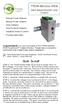 TPDIN-Monitor-WEB Web Based Monitor and Control Remote Power Stations Backup Power Systems Solar Systems Wind Powered Systems Industrial Sense & Control Process Automation Congratulations! on your purchase
VP23, 3-way proportional pressure control valves Seat valve with μp-driven pressure control
 VP, -way proportional pressure control valves > > Port size: G/... G/ > > All-digital control electronics > > Variable pressure control > > Optional actuation via fieldbus (separate datasheet on request)
Pro Logic Version 4.10. Diagnostics Manual
 Pro Logic Version 4.10 Diagnostics Manual Turbo Cell & Control Electronics 2009 Hayward Industries Table of Contents Important safety instructions Pg. 1 No Cell Power 1 & No Cell Power 2 Pg. 2 No Cell
INSTRUCTION MANUAL. Universal sensor switching module 230 V version with Housing
 Technical changes reserved Fon +49 771 83160 Fax +49 771 831650 [email protected] bb-sensors.com 1 / 17 Contents 1. General dangers and precautions 3 1.1. Instructions regarding documentation 3 1.2.
Firmware version: 1.10 Issue: 7 AUTODIALER GD30.2. Instruction Manual
 Firmware version: 1.10 Issue: 7 AUTODIALER GD30.2 Instruction Manual Firmware version: 2.0.1 Issue: 0.6 Version of the GPRS transmitters configurator: 1.3.6.3 Date of issue: 07.03.2012 TABLE OF CONTENTS
Multi-Protocol decoder 76 400
 Multi-Protocol decoder 76 For locomotives with DC motors on digital layouts operating in the DCC- and Motorola data format. Features Regulated multi-protocol decoder for DCC and Motorola Suitable for DC
GSM HOME SECURITY SYSTEM
 Cell /Mobile phone home security system GSM HOME SECURITY SYSTEM Model : GSM-120 TABLE OF CONTENTS 1. FEATURES... 1 2. APPLICATION... 2 3. SPECIFICATIONS... 3 4. FRONT PANEL & LAYOUT DESCRIPTION...6 5.
AUTOMATIC TRANSFER SWITCH CONTROL UNIT OPERATOR S MANUAL
 ATS-220 AUTOMATIC TRANSFER SWITCH CONTROL UNIT OPERATOR S MANUAL For Use in 208 to 240 Volts Single and 3 Phase ATS Systems With 110Volt AC or DC Control Motors and selenoids 4501 NW 27 ave Miami FL 33142
TLK 48 MICROPROCESSOR-BASED DIGITAL ELECTRONIC REGULATOR
 TLK 48 MICROPROCESSOR-BASED DIGITAL ELECTRONIC REGULATOR TECHNICAL DATA CARATTERISTICHE MECCANICHE Housing Self-extinguishing plastic, UL 94 V0 Dimensions 48x48 mm DIN depth 98 mm Weight 225 g approx.
OXIGENO DISUELTO. Dissolved Oxygen. Install & forget. Sistema autolimpiable. Autoclean system
 Sistema autolimpiable Dissolved Oxygen Autoclean system Applications: - water treatment - activated sludge - de-nitrification - fish pond Install & forget For special applications, the D.O monitor can
e-ask electronic Access Security Keyless-entry
 e-ask electronic Access Security Keyless-entry e-fob Keyless-entry entry System Full-Function Function Installation Manual FCC ID: TV2EFOB1 (UM20 ~ 22793-02) Table of Contents Introduction... 1 e-fob Operation
INSTRUCTION MANUAL. SIGNAL AMPLIFIER 4-20 ma
 INSTRUCTION MANUAL SIGNAL AMPLIFIER 4-20 ma 0305 260 IMPORTANT USER INFORMATION IMPORTANT USER INFORMATION Reading this entire manual is recommended for full understanding of the use of this product Should
Series 7500 Torque Sensor
 Properties PTO (Power Take-Off) shaft with integrated torque and angle measurement Non-contact measurement system, high robustness Plug & Play solution, no additional electronics required Performance Measurement
REGTRONIC OPERATING INSTRUCTIONS
 REGTRONIC OPERATING INSTRUCTIONS 1.FEATURES Electrical connection: M12 8-pin connector Preset pressure range 0.05-10 bar with possible full scale regulation. 10 100 mbar adjustable deadband Supply pressure:
BROOKFIELD MODEL VTE250 ELECTRIC VISCOSEL PROCESS VISCOMETER. Installation, Operation, and Maintenance Instructions. Manual No.
 BROOKFIELD MODEL VTE250 ELECTRIC VISCOSEL PROCESS VISCOMETER Installation, Operation, and Maintenance Instructions Manual No. M06-512 SPECIALISTS IN THE MEASUREMENT AND CONTROL OF VISCOSITY BROOKFIELD
Solenoid Valve Island Type 3965
 Solenoid Valve Island Type 365 for the control of pneumatic actuators General The Type 365 Solenoid Valve Island is a compact solution for the centralized control of pneumatic actuators in chemical and
Wireless Home Security Alarm System AM 500
 Wireless Home Security Alarm System AM 500 12 MONTH GUARANTEE Installation & Operating Instructions INTRODUCTION The AM500 is a simple self-contained alarm system. It protects the home by sounding a siren
Microprocessor Home Security System
 numbers of sensor s activations in the zone and after which activations the zone will be discarded (ignored). On every system s arming the counter is cleared in self. 6.3.11. 2 - Triger Timer - enter a
Getting started with
 PART NO. CMA113 MADE IN CHINA 1. Measuring CAT II 2. Max. voltage 250V ~ 3. Max. current 71 Amp Getting started with Electricity consumption monitoring single phase for homes and some smaller light commercial
MAKING MODERN LIVING POSSIBLE. living connect. Installation and User Guide. Danfoss heating
 MAKING MORN LIVING POSSIBLE Danfoss heating living connect Installation and User Guide Contents 1.0 System overview... 3 2.0 Overview of display and control buttons... 3 3.0 Installation - step by step...
Keysight N4877A Clock Data Recovery and Demultiplexer 1:2
 Keysight N4877A Clock Data Recovery and Demultiplexer 1:2 Getting Started Getting Started with the Keysight N4877A Clock Data Recovery and Demultiplexer 1:2 You only need a few minutes to get started
Technical Note Series
 Technical Note Series SKIN CONDUCTANCE SENSOR (SA9309M) S TN0 0 0 8-0 0 S k i n C o n d u c t a n c e S e n s o r Page 2 IMPORTANT OPERATION INFORMATION WARNING Type BF Equipment Internally powered equipment
Pressure monitoring equipment for oil-sf 6. bushings, type GOEK
 Pressure monitoring equipment for oil-sf 6 bushings, type GOEK Installation and maintenance guide 5693 827-6 en, Rev. 3, 2002-01-30 This document must not be copied without our written permission, and
T0118 T2118 T3118. Instruction Manual
 Programmable indoor transmitter of temperature T0118 Programmable indoor transmitter of atmospheric pressure T2118 Programmable indoor transmitter of temperature, relative humidity and other derived humidity
Power Supply and Indicator Unit Type 5024-1. Fig. 1 Type 5024-1. Mounting and Operating Instructions EB 9539 EN
 Power Supply and Indicator Unit Type 5024-1 Fig. 1 Type 5024-1 Mounting and Operating Instructions EB 9539 EN Edition October 2003 Application 1 Application The Type 5024-1 Power Supply and Indicator Unit
S300 Series Dust Monitors
 S301 DustGuard S303 Trend Monitor S304 Emission Monitor S305 Stack Monitor Intrinsically Safe (ATEX) Dust Monitors Split Architecture (Remote)Models Data Logging Software S300 Series Dust Monitors Dust
Kit 106. 50 Watt Audio Amplifier
 Kit 106 50 Watt Audio Amplifier T his kit is based on an amazing IC amplifier module from ST Electronics, the TDA7294 It is intended for use as a high quality audio class AB amplifier in hi-fi applications
Toroidal Conductivity Sensor
 Instruction Sheet PN 51A-/rev.C June 2012 Toroidal Conductivity Sensor For additional information, please visit our website at www.emersonprocess.com/rosemountanalytical.com SPECIFICATIONS Wetted Materials:
Operating manual. ph 7110. ph meter
 Operating manual ph 7110 ph meter ba75925e02 12/2011 ph 7110 Copyright Weilheim 2011, WTW GmbH Reproduction in whole - or even in part - is prohibited without the express written permission of WTW GmbH,
PTU Series Transducer Digital Display Indicator User s Manual
 PTU Series Transducer Digital Display Indicator User s Manual The Swagelok PTU series digital display indicator is available to mount directly to the Swagelok PTU series transducer to provide local indication
HP ProLiant DL380 G6 Carrier-Grade Server Read Before Install
 HP ProLiant DL380 G6 Carrier-Grade Server Read Before Install Carrier-Grade Instructions HP Part Number: AM275-9001A Published: July 2012 Edition: 3 Copyright 2009, 2012 Hewlett-Packard Development Company,
Wiser Panel Meter, Model Number WISERCTPM200 Installer s Guide
 Instruction Bulletin EAV85226 08/2014 Wiser Panel Meter, Model Number WISERCTPM200 Installer s Guide Retain for future use. Product Description Kit Contents The Wiser Panel Meter is for use in energy management
NELSON VOLTAGE MONITOR INSTALLATION & PROGRAMMING MANUAL
 NELSON VOLTAGE MONITOR INSTALLATION & PROGRAMMING MANUAL CONTENTS GENERAL INFORMATION...3 INSTALLATION...3 FIELD WIRING...4 PROGRAMMING...4 Circuit Monitor Options...5 Power Frequency...5 Alarm Silence
EXLUX ECOLUX C-LUX LIGHTING. Explosion Protected Fluorescent Lighting Fixtures for Hazardous and Corrosive Applications
 EXLUX ECOLUX C-LUX LIGHTING 6000 6008 6400 6408 6600 6608 6500 Explosion Protected Fluorescent Lighting Fixtures for Hazardous and Corrosive Applications Features: Electronic Ballasts For Fluorescent Bipin