
TESTING AND ANALYSIS OF SURVIVABILITY OF SHAPED-CHARGES IN BULLET IMPACT CONDITIONS
|
|
|
- Anissa West
- 10 years ago
- Views:
Transcription
1 TESTING AND ANALYSIS OF SURVIVABILITY OF SHAPED-CHARGES IN BULLET IMPACT CONDITIONS T. Yarom, R. Ceder, S. Miller, M. Rav-Hon RAFAEL, MANOR - Propulsion & Explosive Systems Division I S R A E L ABSTRACT Shaped charges subjected to bullet impact test may react in various types of reactions, starting from full detonation to charge disintegration only. The type of reaction depends on the explosive composition, the charge dimensions, and bullet hit point. Bullet Impact tests show that even relatively sensitive pressed explosives can pass the BI test in a specific charge geometry. In order to predict the reaction type in BI conditions, we need to understand the bullet penetration process, and then to investigate the complex phenomenon of detonation. The approach adopted here was to observe the pressure profile and the P 2 dt criterion of the explosive at several points along the bullet path. The explosive was treated as an inert material. A simplified 2-D model was developed using the AUTODYN code. The basic model consists of a steel bullet hitting a 100 mm diameter cylindrical target of PBX The bullet and the target were mapped using Lagrangian and Eulerian grids respectively, while the interaction between the two was enabled using AUTODYN's Euler-Lagrange coupling processor. The modeling was supported by a series of single bullet impact tests using our LX-07 and PBXN-110. The bullet was aimed at various points of the charge. The results vary from no-reaction to full detonation. The paper provides an insight into the phenomenon of bullet impact to unconfined explosive charges. The initiation phenomenon should be further investigated to predict the explosive response in bullet impact conditions. 1. INTRODUCTION Shaped charges traditionally contain high quality pressed explosives to achieve high performance. In the last decade, attempts have been made to load shaped charges with less sensitive [3] and low-cost explosives including cure-cast explosives. The advantage of using cure-cast explosives for this application is IM and low cost. Cure-cast explosives may also be advantagous in tandem warheads where the main charge needs to withstand the precursor detonation impact. The explosive in a typical shaped charge is either lighty confined or even unconfined. Since the Bullet Impact test is one of the important IM tests, the survivability of a shaped charge in such test is an important issue to investigate. Due to the light confinement, a shaped charge will, probably, pass the Fast and Slow Cookoff but will have difficulties in withstanding the Fragment Impact. The Sympathetic Detonation is a system/ packaging issue in both cases. 1

2 Preliminary Bullet Impact tests of pressed and cure-cast shaped charges show that the reaction type varies from full detonation to a charge disintegration only. The type of reaction depends not only on the explosive composition but also on the charge dimensions, geometry and bullet hit point and direction. In some tests even relatively sensitive pressed explosives may pass the Bullet Impact test in certain geometries and hit points. Also the explosive liner interaction during the bullet penetration is an issue that should be addressed. The paper is a preliminary study of the explosive behavior during bullet penetration. The approach adopted here is to treat the explosive as an inert material and to observe the pressure profiles along the bullet path, and then to use the simplified P 2 dt shock initiation criterion [2][4][5]. A simplified 2-D model was developed using the AUTODYN code. The basic model consists of a steel bullet, a 100mm diameter cylindrical target of PBX The "liner section" of the shaped charge is modeled by addition of a thin copper plate at the end of the explosive cylinder. The bullet and the target were mapped using Lagrangian and Eulerian grids respectively, while the interaction between the two was enabled using AUTODYNE's Euler-lagrange coupling processor. The modeling was supported by a series of single bullet impact tests that were conducted using the our LX-07 and PBXN-110 explosives. The basic charge was an unconfined 100 mm diameter charge. The bullet was aimed at several distinct points as shown in Figure 1. Smaller and larger charges were also tested, as described in detail in Section 2. The results varied from no-reaction through burning to full detonation. The paper presents the tests and their results in comparison to the simulations and preliminary analysis. 2. BULLET IMPACT TESTS AND RESULTS The generic charges, defined for this program represent the typical dimensions of antitank missile warheads. Three generic warheads, shown in Figure 1, were defined. The basic charge (Figure 1a) is 100 mm in diameter. The generic smaller charge, shown in Figure 1b, represents a typical precursor, and the larger charge, shown in Figure 1c, represent larger missile shaped charges. Figure 1 also provides the bullet hitting points and directions as conducted in the tests. A series of tests, described in Table 1, have been ferformed to examine the different parameters: explosive composition, charge dimensions and the effect of the copper liner. These three parameters were also simulated and analyzed later. Two explosive composition were tested: the Israeli LX-07 (90% HMX) and the Israeli cure-cast PBXN-110 (88% HMX) designated PX-80. Both compositions are used for shaped charges. A single bullet at velocity of about 880 m/s hit the charges at points and directions shown in Figure 1. Table 1 summarizes the tests and results. The 100mm charge is referred as "standard", and the others as "small' and "large" respectively. The table also provides the length of the explosive along the bullet path. 2

3 (a) (b) (c) Figure 1: Shaped-charges testing configurations 3

4 Test No. Charge Type Explosive Type Bullet Hit Location 1 Standard LX-07 Explosive 2 Standard LX-07 Explosive 3 Standard LX-07 Liner Section 4 Standard LX-07 Liner Section 5 Small LX-07 Explosive 6 Small LX-07 Explosive 7 Standard PBXN-110 Explosive 8 Standard PBXN-110 Explosive 9 Large PBXN-110 Explosive Explosive Length Results 100 Full Detonation 100 Full Detonation 25 Disintegration* 25 Disintegration* 25 Disintegration* 25 Disintegration* 100 Disintegration* 100 Burning 150 Burning * Disintegration consists of throwing particles within allowed radius, Most of the explosive recovered intact. Table 1: Bullet Impact tests and results The full detonation reaction in Tests 1 and 2 (identical tests) were expected since LX- 07 does not withstand the bullet impact at 100mm explosive length. Observing the results of Test 3 (Figure 2) we can see that most of the explosive was recovered and no aggressive reaction occurred. Simmilar results were observed in Tests 4, 5 and 6. In Tests 3 through 6 the explosive length was shorter than in the first two tests, and a totally different reaction has been observed. This shows us that the boundaries of the bullet path plays an important role in the explosive reaction, as will be analyzed in the next section. The PBXN-110 is known for its insensitivity in Bullet Impact conditions. Test 7, whose post test view is shown in Figure 3, show that no reaction occurred, and we could observe the bullet path along the explosive. In Test 8, which was identical to Test 7 we got a burning reaction. From the PBXN-110 tests, especially Test 9, we can conclude that no reaction higher than burning would occur in standard unconfined PBXN-110 in single Bullet Impact tests. 4

5 BI Test Figure 2: Post test view of Test 3 Figure 3: Post test view of Test 7 5

6 3. SIMULATIONS AND ANALYSIS The bullet penetration process was simulated using the AUTODYN code. For simplification we use a 2-D axsisymmetric model to observe the pressure profile (pressure vs. time) inside the explosive along the bullet path. The cylinder diameter in all the simulasions was 100mm. Figure 4 shows the three points at which the bullet was aimed and the simplified models used for each case. Three locations were selected: explosive center, top of the liner and liner center. In the 2-D model the explosive was modeled as a cylinder of the relevant length and the liner was a copper plate attached to the explosive charge. A rigid steel bullet was used, its initial velocity was 880 m/s. The bullet and the target were mapped using lagrangian and Eulerian grids respectively, while the interaction between the two was enabled using AUTODYN s Euler-Lagrange coupling proccesor. The basic explosive for the simulation was PBX Figure 5 shows the bullet pentration when aimed at the liner center (Case 3) and the resulting pressures after 2.9 Microseconds. As mentioned before, our approach was to observe the pressure profiles inside the explosive along the bullet path and to use the P 2 dt shock initiation criterion [3] as a simplified criterion for detonation. To this end, we define several points along the explosive centerline (see Figure 6), and obtain their pressure data as illustrated in Figure 7. In Figure 8 we summarize the P 2 dt values along the bullet path for the three mentioned cases. The figure also describes the initiation threshold value for PBX-9404, as found from the literature [5]. The effect of the liner on the pressure inside the explosive was simulated and presented in Figure 9. Here we can observe the P 2 dt values of Case 3 with and without the addition of 2mm copper liner. Analysis Observing the P 2 dt values of Figure 8, we can see that in Case 1, where the bullet penetrated 100 mm of explosive we find a long line inside the explosive which was subjected to high P 2 dt values ( Gpa 2 -µs). In Case 3, where the rarefaction waves from the boundary appears significantly earlier, the P 2 dt values are lower and appear earlier along the path. The initiation threshold value for PBX-9404, as found from the literature [5], is 5.8 Gpa 2 -µs. It is interesting to watch that value, which lies exactly between Case 1 and 3. The experimental data, summarized in Table 1, match the simulation since in Case 1 we got full detonation while only disintegration occurred in Case 3. The effect of the copper liner can be easily observed in Figure 9, where the liner has been removed fron the 25 mm long cylinder of exlosive. As shown, the graphs are very similar with a slight increase values in the liner case. This increase in the pressure values is a result of the reflected shock waves from the copper plate. In the typical dimensions of explosive/copper liner as shown in the simulations we can conclude that the copper has only a slight effect on the results. Although we used simplified 2-D model, basic explosive and a simple initiation criterion, we got interesting and meaningful information on the explosive behavior and the important parameters that play a role in the penetration and initiation phenomenon. This approach should be further investigated by incorporating a detailed initiation model in the simulations improving the simulations (3-D), explosive data and more advanced initiation criteria. 6

7 Figure 4: 2-D simplified modeling of bullet impact Figure 5: Bullet penetration after 2.9 microseconds (Case 3 liner center) 7

8 Figure 6: Definition of points along bullet path (Case 3 liner center) Figure 7: Pressure profiles along bullet path (Case 3 liner center) 8

9 Figure 8: P 2 dt values along bullet path (three cases) Figure 9: P 2 dt values along bullet path (Case 3 with and without liner) 9

10 3. SUMMARY AND CONCLUSIONS A series of single Bullet Impact tests of shaped charges have been conducted. The testing parameters were: explosive composition (pressed and cure-cast explosives), charge dimensions, and bullet aiming points. The work was supported with simpified 2-D modeling using AUTODYN code, where the explosive was treated as an inert material and P 2 dt was observed along the bullet path. Tests and simulations show that the charge dimensions and geometry play a major role in the explosive response. Small charges may pass the bullet impact even when loaded with relatively sensitive explosives. The P 2 dt criterion was found usefull in getting insight to the bullet impact conditions. In order to predict the explosive response in bullet impact conditions, initiation phenomenon should be further investigated using more advanced initiation models and geometric modeling (3-D). 4. REFERENCES 1. Dobratz, B.M., and Crawford, P.C., LLNL Explosives Handbook, LLNL Laboratory, University of california, Livermore, CA Howe, P., Frey, R., Taylor, B. and Boyle, V., Shock initiation and the critical energy concept, Sixth Detonation SymposiumAugust Montesi, L.J., and Alexander, K.E., Developmet of the high performance metal acceleratiing explosive, PBXW-11, Proc. Of ADPA Insensitive Munition Symposium, San- Diego, CA, March ( shaped charges of insensitive explosives) 4. Walker, F.E., and Wasley, R.J., Critical energy for shock initiation of heterogenous explosves, Explosivstoffe, 17, Zukas, J.A., and Walters, W.P., Explosive effects and applications, Springer- Verlag, New York, Inc

Figure 1 EMTAP 42 Tube Test - Electrically Heated
 Cook-off testing of pressed PBXs Philip Cheese, Nathan White, Tom Reeves (UK MOD, Defence Equipment and Support), Tony Rowlands (Chemring UK) Chris Stennett (Defence Academy of the UK) Introduction The
High Performance Castable CL-20 Explosive
 High Performance Castable CL-20 Explosive Prepared For 2004 IM/EM Technical Symposium November 15-17, 2004 San Francisco, CA Robert L Hatch OUTLINE Background and Objectives Theoretical Performance Processing
Shaped Charge Jet Characterization and Initiation Test Configuration for IM Threat Testing
 University of Nebraska - Lincoln DigitalCommons@University of Nebraska - Lincoln US Army Research US Department of Defense 1-1-2013 Shaped Charge Jet Characterization and Initiation Test Configuration
CHAPTER 4 4 NUMERICAL ANALYSIS
 41 CHAPTER 4 4 NUMERICAL ANALYSIS Simulation is a powerful tool that engineers use to predict the result of a phenomenon or to simulate the working situation in which a part or machine will perform in
The Numerical Simulation of High Explosives using AUTODYN-2D & 3D
 Explo 98, Institute of Explosive Engineers 4 th Biannual Symposium, September 1998 The Numerical Simulation of High Explosives using AUTODYN-2D & 3D G E Fairlie Century Dynamics Ltd., Dynamics House, Hurst
A COMBINED EXPERIMENTAL/NUMERICAL METHODOLOGY TO ASSESS THE SENSITIVITY OF PBX's (*)
 A COMBINED EXPERIMENTAL/NUMERICAL METHODOLOGY TO ASSESS THE SENSITIVITY OF PBX's (*) Philippe Chabin, Pierre Brunet, Serge Lécume SNPE Propulsion Centre de Recherches du Bouchet BP 2 97 VertlePetit France
Modeling Fragmentation Performance of Insensitive Explosive Fragmentation Munitions
 2009 Insensitive Munitions and Energetic Materials Technology Symposium, Tucson, Arizona 11-14 May 2009 Modeling Fragmentation Performance of Insensitive Explosive Fragmentation Munitions V. M. Gold and
SOME EXAMPLES OF ENERGETIC MATERIAL MODELLING WITH LSDYNA
 SOME EXAMPLES OF ENERGETIC MATERIAL MODELLING WITH LSDYNA Michel QUIDOT SNPE Propulsion Centre de Recherches du Bouchet BP 2 91710 Vert Le Petit France Email : [email protected] ABSTRACT : SNPE is using
SIESMIC SLOSHING IN CYLINDRICAL TANKS WITH FLEXIBLE BAFFLES
 SIESMIC SLOSHING IN CYLINDRICAL TANKS WITH FLEXIBLE BAFFLES Kayahan AKGUL 1, Yasin M. FAHJAN 2, Zuhal OZDEMIR 3 and Mhamed SOULI 4 ABSTRACT Sloshing has been one of the major concerns for engineers in
Explosives Safety Initial Training. Course # 5.01 Rev. 08041-TO
 Explosives Safety Initial Training Course # 5.01 Rev. 08041-TO Terminal Objective: Identify safe practices for work on or around explosives in accordance with the DOE Explosives Safety Manual, DOE M 440.1-1A,
CFD SIMULATION OF SDHW STORAGE TANK WITH AND WITHOUT HEATER
 International Journal of Advancements in Research & Technology, Volume 1, Issue2, July-2012 1 CFD SIMULATION OF SDHW STORAGE TANK WITH AND WITHOUT HEATER ABSTRACT (1) Mr. Mainak Bhaumik M.E. (Thermal Engg.)
Mine & IED Roller Solutions Route Clearance, Anti-Tank, Dismounted, Area Clearance
 Mine & IED Roller Solutions Route Clearance, Anti-Tank, Dismounted, Area Clearance Mine & IED Rollers RCR-A Route Clearance Roller Advanced RCR-B Route Clearance Roller Basic Dismounted Protection Roller
INJECTION MOLDING COOLING TIME REDUCTION AND THERMAL STRESS ANALYSIS
 INJECTION MOLDING COOLING TIME REDUCTION AND THERMAL STRESS ANALYSIS Tom Kimerling University of Massachusetts, Amherst MIE 605 Finite Element Analysis Spring 2002 ABSTRACT A FEA transient thermal structural
Determination of detonation velocity and pressure for MCX-6100
 FFI-rapport 2015/02323 Determination of detonation velocity and pressure for MCX-6100 Gunnar Ove Nevstad Forsvarets FFI forskningsinstitutt Norwegian Defence Research Establishment FFI-rapport 2015/02323
NUMERICAL MODELLING OF PIEZOCONE PENETRATION IN CLAY
 NUMERICAL MODELLING OF PIEZOCONE PENETRATION IN CLAY Ilaria Giusti University of Pisa [email protected] Andrew J. Whittle Massachusetts Institute of Technology [email protected] Abstract This paper
A.17. OXIDIZING PROPERTIES (SOLIDS)
 A.17. OXIDIZING PROPERTIES (SOLIDS) 1. METHOD 1.1. INTRODUCTION It is useful to have preliminary information on any potentially explosive properties of the substance before performing this test. This test
The Influence of Aerodynamics on the Design of High-Performance Road Vehicles
 The Influence of Aerodynamics on the Design of High-Performance Road Vehicles Guido Buresti Department of Aerospace Engineering University of Pisa (Italy) 1 CONTENTS ELEMENTS OF AERODYNAMICS AERODYNAMICS
Modeling and Simulations of Cavitating and Bubbly Flows
 Muon Collider/Neutrino Factory Collaboration Meeting Riverside, California, January 27-31, 2004 Modeling and Simulations of Cavitating and Bubbly Flows Roman Samulyak Tianshi Lu, Yarema Prykarpatskyy Center
Presentation of the BOFORS 3P and System Concept. BOFORS 40/57 mm 3P. - Remotely Controlled Turret System. - Bushmaster IV integration
 Presentation of the BOFORS 3P and System Concept 98 40/48B SLPPRJ 90 LK 17398001 - BOFORS 40/57 mm 3P - Remotely Controlled Turret System - Bushmaster IV integration Mr Michael Borén Product Director,
EXPERIMENTAL AND NUMERICAL ANALYSIS OF THE COLLAR PRODUCTION ON THE PIERCED FLAT SHEET METAL USING LASER FORMING PROCESS
 JOURNAL OF CURRENT RESEARCH IN SCIENCE (ISSN 2322-5009) CODEN (USA): JCRSDJ 2014, Vol. 2, No. 2, pp:277-284 Available at www.jcrs010.com ORIGINAL ARTICLE EXPERIMENTAL AND NUMERICAL ANALYSIS OF THE COLLAR
Euler-Euler and Euler-Lagrange Modeling of Wood Gasification in Fluidized Beds
 Euler-Euler and Euler-Lagrange Modeling of Wood Gasification in Fluidized Beds Michael Oevermann Stephan Gerber Frank Behrendt Berlin Institute of Technology Faculty III: School of Process Sciences and
Solid shape molding is not desired in injection molding due to following reasons.
 PLASTICS PART DESIGN and MOULDABILITY Injection molding is popular manufacturing method because of its high-speed production capability. Performance of plastics part is limited by its properties which
DEPARTMENT OF DEFENSE TEST METHOD STANDARD
 INCH-POUND 11 December 2001 SUPERSEDING MIL-STD-1751(USAF) 20 August 1982 DEPARTMENT OF DEFENSE TEST METHOD STANDARD SAFETY AND PERFORMANCE TESTS FOR THE QUALIFICATION OF EXPLOSIVES (HIGH EXPLOSIVES, PROPELLANTS,
Design of a Universal Robot End-effector for Straight-line Pick-up Motion
 Session Design of a Universal Robot End-effector for Straight-line Pick-up Motion Gene Y. Liao Gregory J. Koshurba Wayne State University Abstract This paper describes a capstone design project in developing
TOW WEAPON SYSTEM. DISTRIBUTION STATEMENT A. Approved for public release; distribution is unlimited. Any Warfighter Anywhere All the Time
 TOW WEAPON SYSTEM TUBE-LAUNCHED, OPTICALLY-TRACKED, WIRELESS-GUIDED (TOW) FAMILY OF MISSILES IMPROVED TARGET ACQUISITION SYSTEM (ITAS) Close Combat Weapon Systems Project Office DISTRIBUTION STATEMENT
Hazard Assessment Testing of the SM-3 Block IA Missile
 Hazard Assessment Testing of the SM-3 Block IA Missile Presentation for the NDIA Gun and Missile Systems Conference 25 April 2007 Dave Houchins Dahlgren Division, Naval Surface Warfare Center Test & Evaluation
A Fuzzy System Approach of Feed Rate Determination for CNC Milling
 A Fuzzy System Approach of Determination for CNC Milling Zhibin Miao Department of Mechanical and Electrical Engineering Heilongjiang Institute of Technology Harbin, China e-mail:[email protected]
NUMERICAL ANALYSIS OF A HORIZONTALLY CURVED BRIDGE MODEL
 10NCEE Tenth U.S. National Conference on Earthquake Engineering Frontiers of Earthquake Engineering July 21-25, 2014 Anchorage, Alaska NUMERICAL ANALYSIS OF A HORIZONTALLY CURVED BRIDGE MODEL K. Kinoshita
Numerical Simulation of CPT Tip Resistance in Layered Soil
 Numerical Simulation of CPT Tip Resistance in Layered Soil M.M. Ahmadi, Assistant Professor, [email protected] Dept. of Civil Engineering, Sharif University of Technology, Tehran, Iran Abstract The paper
Physical Mechanisms of DDT in an Array of PBX 9501 Cylinders Initiation Mechanisms of DDT
 1 Physical Mechanisms of DDT in an Array of PBX 9501 Cylinders Initiation Mechanisms of DDT Jacqueline Beckvermit, Todd Harman, Charles Wight, Martin Berzins UUSCI-2016-001 Scientific Computing and Imaging
Rock Bolt Condition Monitoring Using Ultrasonic Guided Waves
 Rock Bolt Condition Monitoring Using Ultrasonic Guided Waves Bennie Buys Department of Mechanical and Aeronautical Engineering University of Pretoria Introduction Rock Bolts and their associated problems
FEM analysis of the forming process of automotive suspension springs
 FEM analysis of the forming process of automotive suspension springs Berti G. and Monti M. University of Padua, DTG, Stradella San Nicola 3, I-36100 Vicenza (Italy) [email protected], [email protected].
Simulation of Mobile Phone Antenna Performance
 Tough technical requirements are being put on handsets. Mobile phones have to deal with an ever increasing number of services, while at the same time the cost of the systems is being reduced. RD in the
Deployment of a Self-expanding Stent in an Artery
 Deployment of a Self-expanding Stent in an Artery Santosh Prabhu*, Chris Feezor*, Andy Denison*, Nuno Rebelo** and Mouhsine Serrar** * Guidant Corporation 3200 Lakeside Drive Santa Clara, CA 95054 and
Technology of EHIS (stamping) applied to the automotive parts production
 Laboratory of Applied Mathematics and Mechanics Technology of EHIS (stamping) applied to the automotive parts production Churilova Maria, Saint-Petersburg State Polytechnical University Department of Applied
Impact Resistance of Guards on Grinding Machines
 International Journal of Occupational Safety and Ergonomics (JOSE) 211, Vol. 17, No. 4, 411 421 Impact Resistance of Guards on Grinding Machines Detlef Mewes Olaf Mewes Institut für Arbeitsschutz der Deutschen
Photonic Hydrophones based on Coated Fiber Bragg Gratings
 Photonic Hydrophones based on Coated Fiber Bragg Gratings M. Pisco, M. Moccia, M. Consales, V. Galdi, A. Cutolo, A. Cusano Optoelectronics Division, Engineering Department, University of Sannio, Benevento,
SAFE A HEAD. Structural analysis and Finite Element simulation of an innovative ski helmet. Prof. Petrone Nicola Eng.
 SAFE A HEAD Structural analysis and Finite Element simulation of an innovative ski helmet Prof. Petrone Nicola Eng. Cherubina Enrico Goal Development of an innovative ski helmet on the basis of analyses
WAVELET ANALYSIS BASED ULTRASONIC NONDESTRUCTIVE TESTING OF POLYMER BONDED EXPLOSIVE
 WAVELET ANALYSIS BASED ULTRASONIC NONDESTRUCTIVE TESTING OF POLYMER BONDED EXPLOSIVE Weibin Zhang, Yong Tian, Zhanfeng Yang, Liling Wang Institute of Chemical Materials, China Academy of Engineering Physics,
High Rate, Low Temperature Testing and Modeling of Water Ice for High Speed Ballistic Probes
 High Rate, Low Temperature Testing and Modeling of Water Ice for High Speed Ballistic Probes Dr. Lee W. Kohlman and Dr. J. Michael Pereira NASA Glenn Research Center Dr. Vikas Prakash and Dr. Bo Li Case
Off-line Model Simplification for Interactive Rigid Body Dynamics Simulations Satyandra K. Gupta University of Maryland, College Park
 NSF GRANT # 0727380 NSF PROGRAM NAME: Engineering Design Off-line Model Simplification for Interactive Rigid Body Dynamics Simulations Satyandra K. Gupta University of Maryland, College Park Atul Thakur
ScienceDirect. The Numerical Analysis of the Joint of the Steel Beam to the Timber Girder
 Available online at www.sciencedirect.com ScienceDirect Procedia Engineering 91 (2014 ) 160 164 XXIII R-S-P seminar, Theoretical Foundation of Civil Engineering (23RSP) (TFoCE 2014) The Numerical Analysis
ELECTRIC FIELD LINES AND EQUIPOTENTIAL SURFACES
 ELECTRIC FIELD LINES AND EQUIPOTENTIAL SURFACES The purpose of this lab session is to experimentally investigate the relation between electric field lines of force and equipotential surfaces in two dimensions.
STATNAMIC : Pile Load Testing Equipment
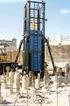 STATNAMIC : Pile Load Testing Equipment Today's taller buildings, heavier loads, and increased construction costs require the use of large-diameter, drilled pier foundation systems. As such, the demand
A LAMINAR FLOW ELEMENT WITH A LINEAR PRESSURE DROP VERSUS VOLUMETRIC FLOW. 1998 ASME Fluids Engineering Division Summer Meeting
 TELEDYNE HASTINGS TECHNICAL PAPERS INSTRUMENTS A LAMINAR FLOW ELEMENT WITH A LINEAR PRESSURE DROP VERSUS VOLUMETRIC FLOW Proceedings of FEDSM 98: June -5, 998, Washington, DC FEDSM98 49 ABSTRACT The pressure
Long term prediction of marble erosion for the conservation of the statue of David of Michelangelo
 Long term prediction of marble erosion for the conservation of the statue of David of Michelangelo Visitors represents a major vector of air pollutants The statue need protection from the pollutants deposition
Reactive burn models and ignition & growth concept
 EPJ Web of Conferences 10, 00003 (2010) DOI: 10.1051/epjconf/20101000003 c Owned by the authors, published by EDP Sciences, 2010 Reactive burn models and ignition & growth concept R. Menikoff a and M.S.
The entire document shall be read and understood before proceeding with a test. ISTA 3B 2013 - Page 1 of 35
 Packaged-Products for Less-Than-Truckload (LTL) Shipment ISTA 3 Series General Simulation Performance Test PROCEDURE VERSION DATE Last TECHNICAL Change: NOVEMBER 2012 Last EDITORIAL Change: JANUARY 2013
Load Balancing Of Parallel Monte Carlo Transport Calculations
 Load Balancing Of Parallel Monte Carlo Transport Calculations R.J. Procassini, M. J. O Brien and J.M. Taylor Lawrence Livermore National Laboratory, P. O. Box 808, Livermore, CA 9551 The performance of
XI / PHYSICS FLUIDS IN MOTION 11/PA
 Viscosity It is the property of a liquid due to which it flows in the form of layers and each layer opposes the motion of its adjacent layer. Cause of viscosity Consider two neighboring liquid layers A
The Acid Digestion Process (ADP) for Disposal of Sea Dumped Munitions
 The Acid Digestion Process (ADP) for Disposal of Sea Dumped Munitions Presented by Mr. Dennis Wynne Co-authors: Mr. Ed Groth and Mr. Chris Livingston Battelle Memorial Institute 1 Outline of Briefing Background
MASTER DEGREE PROJECT
 MASTER DEGREE PROJECT Finite Element Analysis of a Washing Machine Cylinder Thesis in Applied Mechanics one year Master Degree Program Performed : Spring term, 2010 Level Author Supervisor s Examiner :
HYBRID ROCKET TECHNOLOGY IN THE FRAME OF THE ITALIAN HYPROB PROGRAM
 8 th European Symposium on Aerothermodynamics for space vehicles HYBRID ROCKET TECHNOLOGY IN THE FRAME OF THE ITALIAN HYPROB PROGRAM M. Di Clemente, R. Votta, G. Ranuzzi, F. Ferrigno March 4, 2015 Outline
MODEL-SIZED AND FULL-SCALE DYNAMIC PENETRATION TESTS ON DAMPING CONCRETE
 MODEL-SIZED AND FULL-SCALE DYNAMIC PENETRATION TESTS ON DAMPING CONCRETE Robert Scheidemann, Eva-Maria Kasparek, Karsten Müller, Bernhard Droste, Holger Völzke BAM Federal Institute for Materials Research
Strip Flatness Prediction in a 4 High Tandem Mill Using a Dynamic Model.
 Strip Flatness Prediction in a 4 High Tandem Mill Using a Dynamic Model. M. A. Bello-Gomez 1, M. P. Guerrero-Mata 1, L. A. Leduc Lezama 1, T. P. Berber- Solano 1, L. Nieves 2, F. Gonzalez 2, H. R. Siller
The Technical Archer. Austin Wargo
 The Technical Archer Austin Wargo May 14, 2010 Abstract A mathematical model of the interactions between a long bow and an arrow. The model uses the Euler-Lagrange formula, and is based off conservation
NEW DEVELOPMENTS AND IMPORTANT CONSIDERATIONS FOR STANDARD PENETRATION TESTING FOR LIQUEFACTION EVALUATIONS. Jeffrey A Farrar M.S.
 NEW DEVELOPMENTS AND IMPORTANT CONSIDERATIONS FOR STANDARD PENETRATION TESTING FOR LIQUEFACTION EVALUATIONS Jeffrey A Farrar M.S., P E 1 ABSTRACT Standard Penetration Tests (SPT) are often used for evaluating
FLUID FLOW STREAMLINE LAMINAR FLOW TURBULENT FLOW REYNOLDS NUMBER
 VISUAL PHYSICS School of Physics University of Sydney Australia FLUID FLOW STREAMLINE LAMINAR FLOW TURBULENT FLOW REYNOLDS NUMBER? What type of fluid flow is observed? The above pictures show how the effect
MSIAC L-150 Self-Audit Procedure Report Edition 1
 MSIAC L-150 Self-Audit Procedure Report Edition 1 Bofors Test Center 2012 UNCLASSIFIED 1 Copyright Saab Bofors Test Center AB Table of contents Information about the test organization 3 Date of the report
Phenomenological aspects of a modified fragmentation of the ground material
 Phenomenological aspects of a modified fragmentation of the ground material Lucjan Dabrowski, Mieczyslaw Marciniak Warsaw University of Technology, Warsaw, Poland Summary: The main point of this paper
Explosive Engineering as an Academic Program
 NEMC October 2015 Explosive Engineering as an Academic Program Graduate Certificates Engineering Mechanics Enterprise Resource Planning Entrepreneurship & Technological Innovation Explosives Engineering
DOE Peer Review September 2012 Ed Chiao, CEO
 DOE Peer Review September 2012 Ed Chiao, CEO Amber Kinetics: Our Flywheel History Stanford University Start-up launched in 2009, Stanford University Cleantech Entrepreneurship class Lawrence Livermore
INTERNATIONAL HOCKEY FEDERATION PERFORMANCE REQUIREMENTS AND TEST PROCEDURES FOR HOCKEY BALLS. Published: April 1999
 INTERNATIONAL HOCKEY FEDERATION PERFORMANCE REQUIREMENTS AND TEST PROCEDURES FOR HOCKEY BALLS Published: April 1999 CONTENTS 1 Introduction 2 Test Procedures General 3 Standards and Specific Test Procedures
Finite Element Analysis for Acoustic Behavior of a Refrigeration Compressor
 Finite Element Analysis for Acoustic Behavior of a Refrigeration Compressor Swapan Kumar Nandi Tata Consultancy Services GEDC, 185 LR, Chennai 600086, India Abstract When structures in contact with a fluid
Crash Analysis of Car Cross Member Bumper Beam
 Crash Analysis of Car Cross Member Bumper Beam G.Yedukondalu Asst. Professor K L University Guntur Dt.-522502, India [email protected] Dr. A. Srinath UGC Research Awardee Professor Mechanical
Numerical modelling of shear connection between concrete slab and sheeting deck
 7th fib International PhD Symposium in Civil Engineering 2008 September 10-13, Universität Stuttgart, Germany Numerical modelling of shear connection between concrete slab and sheeting deck Noémi Seres
CONSTITUTIVE MODEL FOR BOROSILICATE GLASS AND APPLICATION TO LONG-ROD PENETRATION
 23 RD INTERNATIONAL SYMPOSIUM ON BALLISTICS TARRAGONA, SPAIN 16-20 APRIL 2007 CONSTITUTIVE MODEL FOR BOROSILICATE GLASS AND APPLICATION TO LONG-ROD PENETRATION Sidney Chocron, Charles E. Anderson, Jr.,
VALIDATION, MODELING, AND SCALE-UP OF CHEMICAL LOOPING COMBUSTION WITH OXYGEN UNCOUPLING
 VALIDATION, MODELING, AND SCALE-UP OF CHEMICAL LOOPING COMBUSTION WITH OXYGEN UNCOUPLING A research program funded by the University of Wyoming School of Energy Resources Executive Summary Principal Investigator:
New design of a pressure vessel subjected to blast loads
 New design of a pressure vessel subjected to blast loads L.Cousin, P.Evrard CEA, DAM, DIF, F91297 Arpajon, France Abstract: A new design of containment vessel has been proposed to conduct confined detonation
Modeling of Blast-Loaded Steel Cables
 Modeling of Blast-Loaded Steel Cables John M. H. Puryear, PE, Protection Engineering Consultants, Austin, TX, USA Matt Barsotti, Protection Engineering Consultants, Austin, TX, USA David J. Stevens, PhD,
Dimensional Analysis, hydraulic similitude and model investigation. Dr. Sanghamitra Kundu
 Dimensional Analysis, hydraulic similitude and model investigation Dr. Sanghamitra Kundu Introduction Although many practical engineering problems involving fluid mechanics can be solved by using the equations
Dynamic Load Balancing of Parallel Monte Carlo Transport Calculations
 Dynamic Load Balancing of Parallel Monte Carlo Transport Calculations Richard Procassini, Matthew O'Brien and Janine Taylor Lawrence Livermore National Laboratory Joint Russian-American Five-Laboratory
Numerical Analysis of Independent Wire Strand Core (IWSC) Wire Rope
 Numerical Analysis of Independent Wire Strand Core (IWSC) Wire Rope Rakesh Sidharthan 1 Gnanavel B K 2 Assistant professor Mechanical, Department Professor, Mechanical Department, Gojan engineering college,
Detector Effect in Microwave Gunn Diode Oscillator with Lowfrequency Oscillator Circuit in Bias Circuit
 Detector Effect in Microwave Gunn Diode Oscillator with Lowfrequency Oscillator Circuit in Bias Circuit Dmitry Usanov, Alexander Skripal #, Alexander Avdeev +, Andrey Babayan @ In the paper features of
Lap Fillet Weld Calculations and FEA Techniques
 Lap Fillet Weld Calculations and FEA Techniques By: MS.ME Ahmad A. Abbas Sr. Analysis Engineer [email protected] www.advancedcae.com Sunday, July 11, 2010 Advanced CAE All contents Copyright
Self-piercing riveting
 Self-piercing riveting Andre Stühmeyer, CAD-FEM GmbH Germany Self-piercing riveting Overview The self piercing riveting process FE analysis of the joining process Large deformation Material failure 2D
A Contribution to Expert Decision-based Virtual Product Development
 A Contribution to Expert Decision-based Virtual Product Development László Horváth, Imre J. Rudas Institute of Intelligent Engineering Systems, John von Neumann Faculty of Informatics, Óbuda University,
CRASH ANALYSIS OF AN IMPACT ATTENUATOR FOR RACING CAR IN SANDWICH MATERIAL
 F2008-SC-016 CRASH ANALYSIS OF AN IMPACT ATTENUATOR FOR RACING CAR IN SANDWICH MATERIAL Boria, Simonetta *, Forasassi, Giuseppe Department of Mechanical, Nuclear and Production Engineering, University
Safety issues of hydrogen in vehicles Frano Barbir Energy Partners 1501 Northpoint Pkwy, #102 West Palm Beach, FL 33407, U.S.A.
 Safety issues of hydrogen in vehicles Frano Barbir Energy Partners 1501 Northpoint Pkwy, #102 West Palm Beach, FL 33407, U.S.A. Properties of hydrogen Hydrogen is an odorless, colorless gas. With molecular
Research Article Dynamic Mechanical Properties and Constitutive Relation of an Aluminized Polymer Bonded Explosive at Low Temperatures
 Shock and Vibration, Article ID 91813, 6 pages http://dx.doi.org/1.11/214/91813 Research Article Dynamic Mechanical Properties and Constitutive Relation of an Aluminized Polymer Bonded Explosive at Low
The Influence of Aerodynamics on the Design of High-Performance Road Vehicles
 The Influence of Aerodynamics on the Design of High-Performance Road Vehicles Guido Buresti Department of Aerospace Engineering University of Pisa (Italy) 1 CONTENTS ELEMENTS OF AERODYNAMICS AERODYNAMICS
Plates and Shells: Theory and Computation - 4D9 - Dr Fehmi Cirak (fc286@) Office: Inglis building mezzanine level (INO 31)
 Plates and Shells: Theory and Computation - 4D9 - Dr Fehmi Cirak (fc286@) Office: Inglis building mezzanine level (INO 31) Outline -1-! This part of the module consists of seven lectures and will focus
Economic Mass Producible Mirror Panels for Solar Concentrators
 Abstract G, G. Burgess, K. Lovegrove and A. Luzzi Centre for Sustainable Energy Systems Australian National University, Canberra 2 Australia E-mail: [email protected] The Centre for Sustainable Energy
Tyfo Fibrwrap Blast Panels. Prefabricated Blast Wall System
 Tyfo Fibrwrap Blast Panels Prefabricated Blast Wall System Tyfo Fibrwrap Blast Panels Prefabricated Blast Wall System DESCRIPTION Tyfo Fibrwrap Blast Panels are prefabricated composite walls comprised
A STRATEGIC PLANNER FOR ROBOT EXCAVATION' by Humberto Romero-Lois, Research Assistant, Department of Civil Engineering
 A STRATEGIC PLANNER FOR ROBOT EXCAVATION' by Humberto Romero-Lois, Research Assistant, Department of Civil Engineering Chris Hendrickson, Professor, Department of Civil Engineering, and Irving Oppenheim,
Fracture and strain rate behavior of airplane fuselage materials under blast loading
 EPJ Web of Conferences 6, 6 42017 (2010) DOI:10.1051/epjconf/20100642017 Owned by the authors, published by EDP Sciences, 2010 Fracture and strain rate behavior of airplane fuselage materials under blast
Bourns Resistive Products
 Bourns Resistive Products Diverse Requirements Drive Innovations to Pulse Resistors Introduction Countless circuits depend on the protection provided by one of the most fundamental types of passive components:
Sampling and preparation of heterogeneous waste fuels?
 Sampling and preparation of heterogeneous waste fuels? Is it possible to accomplish a representative and relevant composition data? Evalena Wikström, Lennart Gustavsson and Jolanta Franke Aim of the project
Flow Assurance & Operability
 Flow Assurance & Operability Erosion due to sand production Date Business Name Overview 1. What causes erosion? 2. Sand production and transport 3. Sand management 4. Instrumentation / monitoring of sand
3D Printed Injection Molding Tool ("PIMT") Guide. Objet Ltd.
 3D Printed Injection Molding Tool ("PIMT") Guide Objet Ltd. 2 Injection molding is a high speed, automated and versatile process that can produce high precision complex three dimensional parts from a fraction
AN INVESTIGATION INTO THE USEFULNESS OF THE ISOCS MATHEMATICAL EFFICIENCY CALIBRATION FOR LARGE RECTANGULAR 3 x5 x16 NAI DETECTORS
 AN INVESTIGATION INTO THE USEFULNESS OF THE ISOCS MATHEMATICAL EFFICIENCY CALIBRATION FOR LARGE RECTANGULAR 3 x5 x16 NAI DETECTORS Frazier L. Bronson CHP Canberra Industries, Inc. 800 Research Parkway,
A Passive RFID Implant for Soft Tissue Trauma Monitoring
 A Passive RFID Implant for Soft Tissue Trauma Monitoring J.M. Rigelsford and C. J. Davenport Department of Electronic & Electrical Engineering, The University of Sheffield, Sheffield, S1 3JD, UK Background
Guideline. Date: 12.06.2013
 Guideline Detailed definition and clarification of open points in the aerodynamic requirements of TSI HS RST 2008 and TSI CR LOC&PAS 2011 in 4.2.6.2.1 passengers on platform, 4.2.6.2.2 workers at the track