
|
|
|
- Dominick Caldwell
- 10 years ago
- Views:
Transcription
1

2

3

4

5
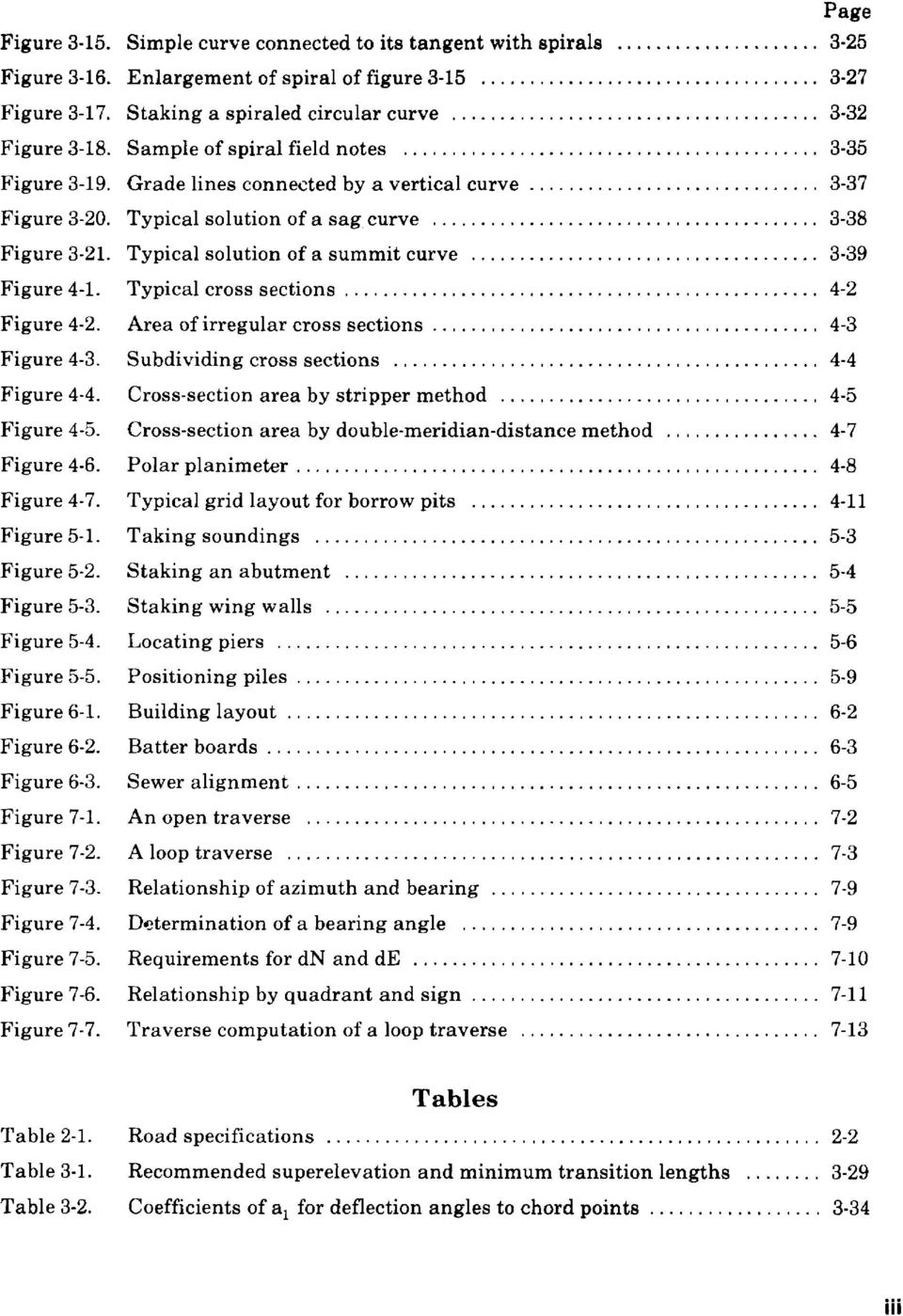
6
7
8 DUTIES OF THE CONSTRUCTION SURVEYOR In support of construction activities, the surveyor obtains the reconnaissance and preliminary data which are necessary at the planning stage. During the construction phase, the surveyor supports the effort as needed. Typical duties of the construction surveyor include Determining distances, areas, and angles. Establishing reference points for both horizontal and vertical control. Setting stakes or otherwise marking lines, grades, and principal points. Determining profiles of the ground along given lines (centerlines and/or crosssection lines) to provide data for cuts, fills, and earthwork volumes. CHAPTER 1 SURVEY OBJECTIVES ACCURACY OF SURVEYS The precision of measurements varies with the type of work and the purpose of a survey. Location surveys require more accuracy than reconnaissance surveys, and the erection of structural steel requires greater precision in measurement than the initial grading of a roadbed. The officer or NCO in charge of a project usually determines the degree of accuracy. The surveyor makes a practical analysis and chooses appropriate methods and procedures for each type of measurement. The surveyor must consider the allowable time, the tactical situation, the capabilities of construction forces, and the current conditions. The best surveyor is the one who runs a survey to the order of precision which is required by the job with a minimum of time, not the one who insists on extreme precision at all times. Preparing large-scale topographic maps using plane table or transit-stadia data to provide information for drainage and site design. Laying out structures, culverts, and bridge lines. Determining the vertical and horizontal placement of utilities. Surveyors must always be on the alert for probable cumulative or systematic errors, which could be the result of maladjustment or calibration of equipment or error-producing practices. Laying out the foundations for certain types of machinery and establishing angular limits for fire on training ranges are examples of conditions which might demand a high degree of precision from the surveyor. 1-1

9 For the most part, the construction surveyor will not have to work to the most precise limits of the equipment. However, the surveyor should recognize the limits of the validity in the results. The surveyor cannot expect resultant data to have a greater degree of accuracy than that of the least precise measurement involved. The surveyor must analyze both angular and linear measurements, which are a part of the survey problem, in order to maintain comparable precision throughout. FIELD NOTES The quality and character of the surveyor s field notes are as important as the use of instruments. The comprehensiveness, neatness, and reliability of the surveyor s field notes measure ability. Numerical data, sketches, and explanatory notes must be so clear that they can be interpreted in only one way, the correct way. Office entries, such as computed or corrected values, should be clearly distinguishable from original material. This is often done by making office entries in red ink. Some good rules to follow in taking field notes are Use a sharp, hard pencil (4H preferred). Do not crowd the data entered. Use additional pages. Keep sketches plain and uncluttered. Record numerical values so they always indicate the degree of precision to which a measurement is taken. For example, rod readings taken to the nearest 0.01 foot should be recorded as 5.30 feet, not as 5.3 feet. Use explanatory notes to supplement numerical data and sketches. These notes often replace sketches and are usually placed on the right-hand page on the same line as the numerical data they explain. Follow the basic note-keeping rules covered in TM METRIC SYSTEM The military surveyor may work from data based upon the metric system of measurement or convert data into metric equivalents. Tables A-13 and A-14 in appendix A provide metric conversions. 1-2

10 CHAPTER 2 ROAD SURVEYING Section I. RECONNAISSANCE SURVEY PREPARATION AND SCOPE The reconnaissance survey is an extensive study of an entire area that might be used for a road or airfield. Its purpose is to eliminate those routes or sites which are impractical or unfeasible and to identify the more promising routes or sites. Existing maps and aerial photographs may be of great help. Contour maps show the terrain features and the relief of an area. Aerial photographs show up-to-date planimetric details. The reconnaissance survey must include all possible routes and sites. The reconnaissance survey report should summarize all the collected information, including a description of each route or site, a conclusion on the economy of its use, and, where possible, appropriate maps and aerial photographs. Design Design and military characteristics should be considered during the reconnaissance survey. Keep in mind that future operations may require an expanded road net. A study of the route plans and specifications is necessary. If these are unavailable, use the following as guides. Locate portions of the new road along or over existing roads, railroads, or trails, whenever possible. Locate the road on high-bearing-strength soil that is stable and easily drained, avoiding swamps, marshes, and organic soil. Locate the road along ridges and streamlines, keeping drainage structures to a minimum. Keep the grade well above the high waterline when following a stream. Select a route as near to sources of material as practical, and locate the road along contour lines to avoid unnecessary earth work. Locate the road on the sunny side of hills and canyons, and on that side of the canyon wall where the inclination of the strata tends to support the road rather than cause the road to slide into the canyon. Locate roads in forward combat zones so that they are concealed and protected from enemy fire. This may at times conflict with engineering considerations. Select locations which conserve engineer assets, avoiding rockwork and excessive clearing. Avoid sharp curves and locations which involve bridging. 2-1

11 Roadway Criteria To insure satisfactory results, study the built. If these are not available, use the engineering specifications of the road to be information provided in table

12 COLLECTION OF DATA Upon completion, the reconnaissance survey should support the routes surveyed and provide a basis of study showing the advantages and disadvantages of all routes reconnoitered. Typical data collected in a reconnaissance survey are Sketches of all routes reconnoitered. Reports of feasible routes. Data on clearing and grubbing. The number of stream crossings involving bridge spans exceeding 20 feet or 6 meters. The approximate number of culverts and spans less than 20 feet or 6 meters. Descriptions and sizes of marsh areas and other natural obstacles. Unusual grade and alignment problems encountered. Anticipated effects of landslides, melting snow, and rainfall. Soil conditions and stream and substrata conditions at proposed bridge sites. Discrepancies noted in maps or aerial photographs. Availability of local materials, equipment, transportation facilities, and labor. Photographs or sketches of reference points, control points, structure sites, terrain obstacles, and any unusual conditions. USE OF MAPS The procurement of maps is a very important phase of the reconnaissance. The surveyor should locate and use all existing maps, including up-to-date aerial photographs of the area to be reconnoitered. Large scale topographic maps are desirable because they depict the terrain in the greatest detail. The maps, with overlays, serve as worksheets for plotting trial alignments and approximate grades and distances. The surveyor begins a map study by marking the limiting boundaries and specified terminals directly on the map. Between boundaries and specified terminals, the surveyor observes the existing routes, ridge lines, water courses, mountain gaps, and similar control features. The surveyor must also look for terrain which will allow moderate grades, simplicity of alignment, and a balance between cut and fill. After closer inspection, the routes that appear to fit the situation are classified. As further study shows disadvantages of each route, the surveyor lowers the classification. The routes to be further reconnoitered in the field are marked using pencils of different colors to denote priority or preference. Taking advantage of the existing terrain conditions to keep excavation to a minimum, the surveyor determines grades, estimates the amount of clearing to be done on each route, and marks stream crossings and marsh areas for possible fords, bridges, or culvert crossings. Section II. PRELIMINARY SURVEY PREPARATION AND SCOPE The preliminary survey is a detailed study of posed route, establishes levels, records topoa route tentatively selected on the basis of graphy, and plots results. It also determines reconnaissance survey information and recom- the final location from this plot or preliminary mendations. It runs a traverse along a pro- map. The size and scope of the project will 2-3

13 determine the nature and depth of the preliminary survey for most military construction. PERSONNEL The survey effort establishes a traverse with control and reference points, or it may expand to include leveling and topographic detail. Normally, obtaining the traverse, leveling, and topographic data are separate survey efforts, but this does not preclude combining them to make the most efficient use of personnel and equipment. Traverse Party The traverse party establishes the traverse line along the proposed route by setting and referencing control points, measuring distances, numbering stations, and establishing points of intersection. The party also makes the necessary ties to an existing control, if available or required. When no control is available, the party may assign a starting value for control purposes which can later be tied to a control point established by geodetic surveyors. Level Party The level party establishes benchmarks and determines the elevation of selected points along the route to provide control for future surveys, such as the preparation of a topographic map or profile and cross-section leveling. The level party takes rod readings and records elevations to the nearest 0.01 foot or meter. It sets the benchmarks in a place well out of the area of construction and marks them in such a way that they will remain in place throughout the whole project. If there is no established vertical control point available, establish an arbitrary elevation that may be tied to a vertical control point later. An assigned value for an arbitrary elevation must be large enough to avoid negative elevations at any point on the project. Topographic Party The topographic party secures enough relief and planimetric detail within the prescribed area to locate any obstacles and allow preparation of rough profiles and cross sections. Computations made from the data determine the final location. The instruments and personnel combinations used vary with survey purpose, terrain, and available time. A transit-stadia party, plane table party, or combination of both may be used. Transit-Stadia Party. The transitstadia party is effective in open country where comparatively long, clear sights can be obtained without excessive brush cutting. Plane Table Party. The plane table party is used where terrain is irregular. For short route surveys, the procedure is much the same as in the transit-stadia method, except that the fieldwork and the drawing of the map are carried on simultaneously. Section III. FINAL LOCATION SURVEY PREPARATION AND SCOPE The centerline may vary from the paper location due to objects or conditions that were not previously considered. The final center- line determines all the construction lines. The surveyor marks the stations, runs the levels, and sets the grades. Prior to the final location survey, office studies consisting of the preparation of a map from preliminary survey data, projection of a tentative alignment and profile, and preliminary estimates of quantities and costs are made and used as guidance for the final location phase. The instrument party carefully establishes the final location in the field using the paper location prepared from the preliminary survey. The surveyor should not make any changes without the authority of the officer-in-charge. RUNNING THE CENTERLINE 2-4

14 The centerline starts at station The surveyor numbers the stations consecutively and sets them at the full 100-foot or 30-meter stations. The surveyor also sets stakes at important points along the centerline. These may be culvert locations, road intersections, beginnings and ends of curves, or breaks in the grade. When measurements are made in feet, these stations are numbered from the last full station (+00). They are called plus stations. A station numbered would be feet away from station 4+00 and feet from the beginning of the project. When using the metric system, the total distance from the beginning of the project would be meters and would be numbered REFERENCE STAKES Referencing of stations is described in TM The control points established by the location survey determine the construction layout. Therefore, these points must be carefully referenced. The surveyor should set the control point references far enough from the construction to avoid disturbance. PROFILE AND CROSS SECTIONS After the centerline of the road, including the horizontal curves, has been staked, the next step in the road layout is the determination of elevations along the centerline and laterally across the road. The surveyor performs these operations, known as profile leveling and cross-section leveling, as separate operations but at the same time as the elevation of points along a centerline or other fixed lines. The interval usually coincides with the station interval, but shorter intervals may be necessary due to abrupt changes in terrain. The plotting of centerline elevations is known as a profile. From this profile, the design engineer determines the grade of the road. The cross-section elevations make it possible to plot views of the road across the road at right angles. These plotted cross sections determine the volume of earthwork to be moved. The surveyor establishes the crosssection lines at regular stations, at any plus station, and at intermediate breaks in the ground and lays out the short crosslines by eye and long crosslines at a 90-degree angle to the centerline with an instrument. All elevations at abrupt changes or breaks in the ground are measured with a rod and level, and distances from the centerline are measured with a tape. In rough country, the surveyor uses the hand level to obtain cross sections if the centerline elevations have been determined using the engineer level. Section IV. CONSTRUCTION LAYOUT SURVEY PREPARATION AND SCOPE The construction layout is an instrument survey. It provides the alignment, grades, and locations which guide the construction operations. The construction operations include clearing, grubbing, stripping, drainage, rough grading, finish grading, and surfacing. The command must keep the surveyors sufficiently ahead of the construction activity in both time and distance to guarantee uninterrupted progress of the construction effort. Note the following suggested distances. Keep centerline established 1,500 feet or 450 meters ahead of clearing and grubbing. Keep rough grade established and slope stakes set 1,000 feet or 300 meters ahead of stripping and rough grading. Set stakes to exact grade, 500 feet or 150 meters ahead of finish grading and surfacing. 2-5

15 ALIGNMENT The surveyor must place the alignment markers ahead of the crews engaged in the various phases of construction. The surveyor may do a hasty alignment, marked by flags and rods, suitable for guiding the clearing and grubbing operations. However, a deliberate location of the centerline is necessary for the final grading and surfacing operations. The surveyor marks the curves and minor structures concurrently with the layout of the centerline. Major structures such as tunnels and bridges involve a site survey. The general demarcation of the site boundaries is carried on with the establishment of the route alignment. The layout of the site proper is a separate survey. SETTING GRADE STAKES Grade stakes indicate the exact grade elevation to the construction force. The surveyor consults the construction plans to determine the exact elevation of the subgrade and the distance from the centerline to the edges of the shoulder. Preliminary Subgrade Stakes The surveyor sets preliminary subgrade stakes on the centerline and other grade lines, as required. First, the surveyor determines the amount of cut or fill required at the centerline station. The amount of cut or fill is equal to the grade rod minus the ground rod. The grade rod is equal to the height of instrument minus the subgrade elevation at the station. The ground rod is the foresight reading at the station. If the result of this computation is a positive value, it indicates the amount of cut required. If it is negative, it indicates the amount of fill. For example, given a height of instrument (HI) of feet, a subgrade elevation of feet, and a ground rod reading of 3.1 feet, the grade rod = feet = +6.9 and cut or fill = = +3.8, indicating a cut of 3.8 feet. The surveyor records the result in the field notes and on the back of the grade stake as C3 8 (figure 2-1, example a). Sometimes, it is necessary to mark stakes to the nearest whole or half foot to assist the earthmoving crew. In the example given, the surveyor would measure up 0.2 foot on the stake and mark it as in figure 2-1, example b. If at this stake a fill of 3.8 feet was required, the surveyor would measure up 0.3 foot and mark the stake as in figure 2-1, example c. Figure 2-1, example d, shows a case where the actual subgrade alignment could be marked on the stake. The number under the cut or fill represents the distance the stake is from the road centerline. The surveyor normally makes rod readings and computations to the nearest 0.1 foot or 0.01 meter. During rough grading operations, the construction crew determines the grades for the edges of the traveled way, roadbed, and ditch lines. However, if the road is to be superelevated or is in rough terrain, the survey crew must provide stakes for all grade lines. These would include the centerline, the edge of the traveled way, the edges of the roadbed, and possibly, the centerline of the ditches. The surveyor sets those stakes by measuring the appropriate distance off the centerline and determines the amount of cut or fill as outlined. The surveyor offsets the stakes along the traveled way, roadbed, and ditches to avoid their being destroyed during grading operations. The construction foreman, not the surveyor, makes the decision as to how many and where grade stakes are required. Final Grade Stakes Once the rough grading is completed, the surveyor sets the final grade stakes (blue tops). The elevation of the final grade is determined and the value of the grade rod reading is computed. The surveyor uses a rod target to set the grade rod reading on the rod. The rod is held on the top of the stake. The stake is driven into the ground until the horizontal crosshair bisects the target and the top of the stake is at final grade. The surveyor marks the top of the stake with a blue lumber crayon to distinguish it from other stakes. 2-6

16 The surveyor should provide blue tops on all grade lines. However, the final decision as to what stakes are required lies with the construction foreman. To set final grade, the surveyor normally makes rod readings and computations to 0.01 foot or meter. Special Cases Where grade stakes cannot be driven, as in hard coral or rock areas, the surveyor must use ingenuity to set and preserve grade markings under existing conditions. Often, such markings are made on the rock itself with a chisel or a lumber crayon. SETTING SLOPE STAKES Slope stakes indicate the intersection of cut or fill slopes with the natural groundline. They indicate the earthwork limits on each side of the centerline. Level Section When the ground is level transversely to the centerline of the road, the cut or fill at the slope stake will be the same as at the center, except for the addition of the crown. On fill sections, the distance from the center stake to the slope stake is determined by multiplying the center cut by the ratio of the slope (for example, horizontal distance to vertical distance) of the side slopes and adding one half the width of the roadbed. On cut sections, the surveyor can find the distance from the center stake to the slope stake by multiplying the ratio of slope by the center cut and adding the distance from the centerline to the outside edge of the ditch. In either case, if the ground is level, the slope stake on the right side of the road will be the same distance from the centerline as the one on the left side of the road. On superelevated sections, the surveyor must add the widening factor to determine the distance from the centerline to the slope stake. This is because the widening factor is not the same for both sides of the road, and the slope stakes will not be the same distance from the centerline. 2-7

17 Transversely Sloping Ground When the ground is not level transversely, the cut or fill will be different for various points depending upon their distance from the centerline. The surveyor must determine the point, on each side of the centerline, whose distance from the center is equal to the cut or fill at that point multiplied by the slope ratio and added to one half the roadbed width for fills, and the slope ratio multiplied by the distance from the centerline to the outside of the ditches for cuts. A trial and error method must be used. The surveyor will soon attain proficiency in approximating the correct position of the slope stake, and the number of trials can generally be reduced to two or three. The surveyor will mark the cut or fill on the slope stake and record it in the notebook as the numerator of a fraction whose denominator is the distance out from the centerline. Threelevel, five-level, and irregular sections present this problem. Figures 2-2 through 2-5 illustrate the procedure involved in setting slope stakes on sloping ground for three typical cases. Cut Section The cut section in figure 2-2 has the level set up with an HI of feet. The subgrade elevation at this centerline station is set at feet for a 23-foot roadbed with 1.5:1 side slopes, 4-foot shoulders, and 7-foot ditches. The grade rod is the difference between these two elevations or = feet. The rodman now holds the rod on the ground at the foot of the center grade stake and obtains a reading of 6.3 feet, a ground rod. The recorder subtracts 6.3 from the grade rod of 15.8, which gives +9.5 feet or a center cut of 9.5 feet. On slope stakes, the cut or fill and the distance out from the centerline are written facing the center of the road. The backs of the slope stakes show the station and the slope ratio to be used. The recorder estimates the trial distance by multiplying the cut at the centerline (9.5) by the slope ratio (1.5) and adding the distance from the centerline to the outside edge of the ditch (22.5). 9.5 x = 36.8 (to the nearest tenth of a foot) 2-8

18 The rodman now moves to the right at right angles to the centerline the trial distance (36.8 feet). The rod is held at A and a reading of 9.1 is obtained, which, when subtracted from the grade rod of 15.8, gives a cut of 6.7 feet. The recorder then computes what the distance from the centerline to A should be. This is done by multiplying the cut of 6.7 by the slope ratio and adding one half the roadbed width, which gives 32.6 feet. However, the distance to A was measured as 36.8 feet instead of 32.6, so the position at A is too far from the centerline. Another trial is made by moving the rod to 32.6 feet from the centerline (B), where a reading of 8.9 is made. The cut at B is now = +6.9, and the calculated distance from the center is 6.9 x = 32.8 feet. The distance actually measured is 32.8 feet. Therefore, B is the correct location of the slope stake and is marked C6 9. Since moving the rod one or two tenths of a foot would not materially change its reading, greater accuracy is unnecessary. After a few trials, the rodman locates the slope stake on the left in a similar manner. The instrumentman verifies the figures by computation. When placed in the ground, the stakes will appear as in figure 2-3. Fill Section (HI Above Grade Elevation) Figure 2-4 illustrates a fill with the HI of the problem is +2.8; the rod reading at the center level set up above the subgrade elevation of stake is 6.5; and the difference is = -3.7 the 31-foot roadbed. In this case, the grade feet. The minus sign indicates a center fill. rod will always be less, numerically, than rod The rodman finds the positions of the slope readings on the ground. The grade rod in this stakes by trial, as previously explained. 2-9

19 Fill Section (HI Below Grade Elevation) Figure 2-5 illustrates a fill with the HI of the level below the grade elevation of the future roadbed. Therefore, the grade rod has a negative value. Adding the negative ground rod to the negative grade rod will give a greater negative value for the fill. For example, at the center stake, the fill equals (-2.40 meters) + (-2.35 meters) or meters. Otherwise, this case is similar to the preceding ones. CULVERT LOCATION To establish the layout of a site such as a culvert, the surveyor locates the intersection of the roadway centerline and a line defining the direction of the culvert. Generally, culverts are designed to conform with natural drainage lines. The surveyor places stakes to mark the inlet and outlet points, and any cut or fill, if needed, is marked on them. The construction plans for the site are carefully followed, and the alignment and grade stakes are set on the centerlines beyond the work area. Thus, any line stake which is disturbed or destroyed during the work can be replaced easily. The surveyor should also set a benchmark near the site, but outside of the work area, to reestablish grades. Figure 2-6 shows atypical layout for a culvert site. Circumstances or practical considerations may dictate that certain types of surveys will be eliminated or combined. For example, the location and construction surveys may be run simultaneously. (Refer to TM ) DRAINAGE The construction of drainage facilities is an important part of any project. The surveyor must anticipate drainage problems and gather enough field data to indicate the best design and location for needed drainage structures. (Refer to TM ) 2-10

20 2-11

21 The problem of adequate drainage is important to the location, design, and construction of almost any type of military installation. Proper drainage is of primary importance with respect to the operational requirements and the desired useful life of an installation. Inadequate drainage causes most road and airfield failures. The surveyor must see that these and similar facilities are well drained to function efficiently during inclement weather. Temporary drainage during construction operations cannot be ignored since it is vital to prevent construction delays due to standing water or saturated working areas. Proper drainage is an essential part of road construction. Poor drainage results in mud, washouts, and heaves, all of which are expensive in terms of delays and repairs to both roads and vehicles. 2-12
22 CHAPTER 3 CURVES Section I. SIMPLE HORIZONTAL CURVES CURVE POINTS By studying TM 5-232, the surveyor learns to locate points using angles and distances. In construction surveying, the surveyor must often establish the line of a curve for road layout or some other construction. The surveyor can establish curves of short radius, usually less than one tape length, by holding one end of the tape at the center of the circle and swinging the tape in an arc, marking as many points as desired. As the radius and length of curve increases, the tape becomes impractical, and the surveyor must use other methods. Measured angles and straight line distances are usually picked to locate selected points, known as stations, on the circumference of the arc. TYPES OF HORIZONTAL CURVES A curve may be simple, compound, reverse, or spiral (figure 3-l). Compound and reverse curves are treated as a combination of two or more simple curves, whereas the spiral curve is based on a varying radius. Simple The simple curve is an arc of a circle. It is the most commonly used. The radius of the circle determines the sharpness or flatness of the curve. The larger the radius, the flatter the curve. Compound Surveyors often have to use a compound curve because of the terrain. This curve normally consists of two simple curves curving in the same direction and joined together. 3-1
23 Reverse A reverse curve consists of two simple curves joined together but curving in opposite directions. For safety reasons, the surveyor should not use this curve unless absolutely necessary. Spiral The spiral is a curve with varying radius used on railroads and somemodern highways. It provides a transition from the tangent to a simple curve or between simple curves in a compound curve. STATIONING On route surveys, the surveyor numbers the stations forward from the beginning of the project. For example, 0+00 indicates the beginning of the project. The would indicate a point 1,552,96 feet from the beginning. A full station is 100 feet or 30 meters, making and full stations. A plus station indicates a point between full stations. ( is a plus station.) When using the metric system, the surveyor does not use the plus system of numbering stations. The station number simply becomes the distance from the beginning of the project. ELEMENTS OF A SIMPLE CURVE Figure 3-2 shows the elements of a simple curve. They are described as follows, and their abbreviations are given in parentheses. Point of Intersection (PI) The point of intersection marks the point where the back and forward tangents intersect. The surveyor indicates it one of the stations on the preliminary traverse. Intersecting Angle (I) The intersecting angle is the deflection angle at the PI. The surveyor either computes its value from the preliminary traverse station angles or measures it in the field. Radius (R) The radius is the radius of the circle of which the curve is an arc. Point of Curvature (PC) The point of curvature is the point where the circular curve begins. The back tangent is tangent to the curve at this point. Point of Tangency (PT) The point of tangency is the end of the curve. The forward tangent is tangent to the curve at this point. 3-2
24 Length of Curve (L) The length of curve is the distance from the PC to the PT measured along the curve. Tangent Distance (T) The tangent distance is the distance along the tangents from the PI to the PC or PT. These distances are equal on a simple curve. Central Angle The central angle is the angle formed by two radii drawn from the center of the circle (0) to the PC and PT. The central angle is equal in value to the I angle. Long Chord (LC) The long chord is the chord from the PC to the PT. External Distance (E) The external distance is the distance from the PI to the midpoint of the curve. The external distance bisects the interior angle at the PI. Middle Ordinate (M) The middle ordinate is the distance from the midpoint of the curve to the midpoint of the long chord. The extension of the middle ordinate bisects the central angle. 3-3
25 Degree of Curve (D) The degree of curve defines the sharpness or flatness of the curve (figure 3-3). There are two definitions commonly in use for degree of curve, the arc definition and the chord definition. As the degree of curve increases, the radius decreases. It should be noted that for a given intersecting angle or central angle, when using the arc definition, all the elements of the curve are inversely proportioned to the degree of curve. This definition is primarily used by civilian engineers in highway construction. English system. Substituting D = length of arc = 100 feet, we obtain 1 0 and Therefore, R = 36,000 divided by R = 5, ft Metric system. In the metric system, using a meter length of arc and substituting D = 1, we obtain Arc definition. The arc definition states that the degree of curve (D) is the angle formed by two radii drawn from the center of the circle (point O, figure 3-3) to the ends of an arc 100 feet or meters long. In this definition, the degree of curve and radius are inversely proportional using the following formula: Therefore, R = 10,972.8 divided by R = 1, m Chord definition. The chord definition states that the degree of curve is the angle formed by two radii drawn from the center of the circle (point O, figure 3-3) to the ends of a chord 100 feet or meters long. The radius is computed by the following formula: 3-4
26 The radius and the degree of curve are not inversely proportional even though, as in the arc definition, the larger the degree of curve the sharper the curve and the shorter the radius. The chord definition is used primarily on railroads in civilian practice and for both roads and railroads by the military. English system. Substituting D = 1 0 and given Sin ½ 1 = R = 50ft or 50 Sin ½ D R = 5, ft Metric system. Using a chord meters long, the surveyor computes R by the formula R= m Substituting D = 1 and given Sin ½ 1 0 = , solve for R as follows: Chords On curves with long radii, it is impractical to stake the curve by locating the center of the circle and swinging the arc with a tape. The surveyor lays these curves out by staking the ends of a series of chords (figure 3-4). Since the ends of the chords lie on the circumference of the curve, the surveyor defines the arc in the field. The length of the chords varies with the degree of curve. To reduce the discrepancy between the arc distance and chord distance, the surveyor uses the following chord lengths: 3-5
27 SIMPLE CURVE FORMULAS The following formulas are used in the M= R (l-cos ½ I) computation of a simple curve. All of the formulas, except those noted, apply to both LC = 2 R (Sin½ I) the arc and chord definitions. In the following formulas, C equals the chord length and d equals the deflection angle. All the formulas are exact for the arc definition and approximate for the chord definition. This formula gives an answer in degrees.,3048 in the metric system. The answer will be in minutes. L is the distance around the arc for the arc definition, or the distance along the chords for the chord definition. SOLUTION OF A SIMPLE CURVE To solve a simple curve, the surveyor must know three elements. The first two are the PI station value and the I angle. The third is the degree of curve, which is given in the project specifications or computed using one of the elements limited by the terrain (see section II). The surveyor normally determines the PI and I angle on the preliminary traverse for the road. This may also be done by triangulation when the PI is inaccessible. Chord Definition The six-place natural trigonometric functions from table A-1 were used in the example. When a calculator is used to obtain the trigonometric functions, the results may vary slightly. Assume that the following is known: PI = 18+00, I = 45, and D =
28 Chord Definition (Feet) Chords. Since the degree of curve is 15 degrees, the chord length is 25 feet. The surveyor customarily places the first stake after the PC at a plus station divisible by the chord length. The surveyor stakes the centerline of the road at intervals of 10,25,50 or 100 feet between curves. Thus, the level party is not confused when profile levels are run on the centerline. The first stake after the PC for this curve will be at station Therefore, the first chord length or subchord is 8.67 feet. Similarly, there will be a subchord at the end of the curve from station to the PT. This subchord will be 16,33 feet. The surveyor designates the subchord at the beginning, C 1, an d at the end, C 2 (figure 3-2). Deflection Angles. After the subchords have been determined, the surveyor computes the deflection angles using the formulas on page 3-6. Technically, the formulas for the arc definitions are not exact for the chord definition. However, when a one-minute instrument is used to stake the curve, the surveyor may use them for either definition. The deflection angles are d = 0.3 CD d std = 0.3 x 25 x 15 = or d 1 = 0.3X 8.67X 15 = d 2 = 0.3 x x 15 = or The number of full chords is computed by subtracting the first plus station divisible by the chord length from the last plus station divisible by the chord length and dividing the difference by the standard (std) chord length. Thus, we have ( )-25 equals 11 full chords. Since there are 11 chords of 25 feet, the sum of the deflection angles for 25- foot chords is 11 x = The sum of d 1, d 2, and the deflections for the full chords is d 1 = = d std = Total The surveyor should note that the total of the deflection angles is equal to one half of the I angle. If the total deflection does not equal one half of I, a mistake has been made in the calculations. After the total deflection has been decided, the surveyor determines the angles for each station on the curve. In this step, they are rounded off to the smallest reading of the instrument to be used in the field. For this problem, the surveyor must assume that a one-minute instrument is to be used. The curve station deflection angles are listed on page
29 Special Cases. The curve that was just surveyor must change the minutes in each solved had an I angle and degree of curve angle to a decimal part of a degree, or D = whose values were whole degrees. When the I , I = To obtain the required angle and degree of curve consist of degrees accuracy, the surveyor should convert values and minutes, the procedure in solving the to five decimal places. curve does not change, but the surveyor must take care in substituting these values into the formulas for length and deflection angles. An alternate method for computing the length For example, if I = and D = 5 37, the is to convert the I angle and degree of curve to 3-8
30 minutes; thus, = 2,535 minutes and 5 37 = 337 minutes. Substituting into the length formula gives L = 2,535 x 100 = feet. 337 This method gives an exact result. If the surveyor converts the minutes to a decimal part of a degree to the nearest five places, the same result is obtained. Since the total of the deflection angles should be one half of the I angle, a problem arises when the I angle contains an odd number of minutes and the instrument used is a oneminute instrument. Since the surveyor normally stakes the PT prior to running the curve, the total deflection will be a check on the PT. Therefore, the surveyor should compute to the nearest 0.5 degree. If the total deflection checks to the nearest minute in the field, it can be considered correct. Curve Tables The surveyor can simplify the computation of simple curves by using tables. Table A-5 lists long chords, middle ordinates, externals, and tangents for a l-degree curve with a radius of 5,730 feet for various angles of intersection. Table A-6 lists the tangent, external distance corrections (chord definition) for various angles of intersection and degrees of curve. Arc Definition. Since the degree of curve by arc definition is inversely proportional to the other functions of the curve, the values for a one-degree curve are divided by the degree of curve to obtain the element desired. For example, table A-5 lists the tangent distance and external distance for an I angle of 75 degrees to be 4,396.7 feet and 1,492,5 feet, respectively. Dividing by 15 degrees, the degree of curve, the surveyor obtains a tangent distance of feet and an external distance of feet. Chord Definition. To convert these values to the chord definition, the surveyor uses the values in table A-5. From table A-6, a correction of 0.83 feet is obtained for the tangent distance and for the external distance, 0.29 feet. The surveyor adds the corrections to the tangent distance and external distance obtained from table A-5. This gives a tangent distance of feet and an external distance of feet for the chord definition. After the tangent and external distances are extracted from the tables, the surveyor computes the remainder of the curve. COMPARISON OF ARC AND CHORD DEFINITIONS Misunderstandings occur between surveyors in the field concerning the arc and chord definitions. It must be remembered that one definition is no better than the other. Different Elements Two different circles are involved in comparing two curves with the same degree of curve. The difference is that one is computed by the arc definition and the other by the chord definition. Since the two curves have different radii, the other elements are also different. 5,730-Foot Definition Some engineers prefer to use a value of 5,730 feet for the radius of a l-degree curve, and the arc definition formulas. When compared with the pure arc method using 5,729.58, the 5,730 method produces discrepancies of less than one part in 10,000 parts. This is much better than the accuracy of the measurements made in the field and is acceptable in all but the most extreme cases. Table A-5 is based on this definition. CURVE LAYOUT The following is the procedure to lay out a curve using a one-minute instrument with a horizontal circle that reads to the right. The values are the same as those used to demonstrate the solution of a simple curve (pages 3-6 through 3-8). 3-9
31 Setting PC and PT With the instrument at the PI, the instrumentman sights on the preceding PI and keeps the head tapeman on line while the tangent distance is measured. A stake is set on line and marked to show the PC and its station value. The instrumentman now points the instrument on the forward PI, and the tangent distance is measured to set and mark a stake for the PT. Laying Out Curve from PC The procedure for laying out a curve from the PC is described as follows. Note that the procedure varies depending on whether the road curves to the left or to the right. Road Curves to Right. The instrument is set up at the PC with the horizontal circle at 0 00 on the PI. (1) The angle to the PT is measured if the PT can be seen. This angle will equal one half of the I angle if the PC and PT are located properly. (2) Without touching the lower motion, the first deflection angle, d 1 (0 39 ), is set on the horizontal circle. The instrumentman keeps the head tapeman on line while the first subchord distance, C 1 (8.67 feet), is measured from the PC to set and mark station (3) The instrumentman now sets the second deflection angle, d 1 + d std (2 32 ), on the horizontal circle. The tapemen measure the standard chord (25 feet) from the previously set station (16+50) while the instrument man keeps the head tapeman on line to set station (4) The succeeding stations are staked out in the same manner. If the work is done correctly, the last deflection angle will point on the PT, and the last distance will be the subchord length, C 2 (16.33 feet), to the PT. Road Curves to Left. As in the procedures noted, the instrument occupies the PC and is set at 0 00 pointing on the PI. (1) The angle is measured to the PT, if possible, and subtracted from 360 degrees. The result will equal one half the I angle if the PC and PT are positioned properly. (2) The first deflection, d l (0 39 ), is subtracted from 360 degrees, and the remainder is set on the horizontal circle. The first subchord, C l (8.67 feet), is measured from the PC, and a stake is set on line and marked for station (3) The remaining stations are set by continuing to subtract their deflection angles from 360 degrees and setting the results on the horizontal circles. The chord distances are measured from the previously set station. (4) The last station set before the PT should be C 2 (16.33 feet from the PT), and its deflection should equal the angle measured in (1) above plus the last deflection, d 2 (1 14 ). Laying Out Curve from Intermediate Setup When it is impossible to stake the entire curve from the PC, the surveyor must use an adaptation of the above procedure. (1) Stake out as many stations from the PC as possible. (2) Move the instrument forward to any station on the curve. (3) Pick another station already in place, and set the deflection angle for that station on the horizontal circle. Sight that station with the instruments telescope in the reverse position. (4) Plunge the telescope, and set the remaining stations as if the instrument was set over the PC. 3-10
32 Laying Out Curve from PT If a setup on the curve has been made and it is still impossible to set all the remaining stations due to some obstruction, the surveyor can back in the remainder of the curve from the PT. Although this procedure has been set up as a method to avoid obstructions, it is widely used for laying out curves. When using the backing in method, the surveyor sets approximately one half the curve stations from the PC and the remainder from the PT. With this method, any error in the curve is in its center where it is less noticeable. Road Curves to Right. Occupy the PT, and sight the PI with one half of the I angle on the horizontal circle. The instrument is now oriented so that if the PC is sighted, the instrument will read The remaining stations can be set by using their deflections and chord distances from the PC or in their reverse order from the PT. Road Curves to Left. Occupy the PT and sight the PI with 360 degrees minus one half of the I angle on the horizontal circle. The instrument should read 0 00 if the PC is sighted. Set the remaining stations by using their deflections and chord distances as if computed from the PC or by computing the deflections in reverse order from the PT. CHORD CORRECTIONS Frequently, the surveyor must lay out curves more precisely than is possible by using the chord lengths previously described. To eliminate the discrepancy between chord and arc lengths, the chords must be corrected using the values taken from the nomography in table A-11. This gives the corrections to be applied if the curve was computed by the arc definition. Table A-10 gives the corrections to be applied if the curve was computed by the chord definition. The surveyor should recall that the length of a curve computed by the chord definition was the length along the chords. Figure 3-5 illustrates the example given in table A-9. The chord distance from station to station is 100 feet. The nominal length of the subchords is 50 feet. INTERMEDIATE STAKE If the surveyor desires to place a stake at station 18+50, a correction must be applied to the chords, since the distance from through to is greater than the chord from to Therefore, a correction must be applied to the subchords to keep station feet from In figure 3-5, if the chord length is nominally 50 feet, then the correction is 0.19 feet. The chord distance from to and to would be
33 Section II. OBSTACLES TO CURVE LOCATION TERRAIN RESTRICTIONS To solve a simple curve, the surveyor must (1) Mark two intervisible points A and B, one know three parts. Normally, these will be the on each of the tangents, so that line AB (a PI, I angle, and degree of curve. Sometimes, random line connecting the tangents) however, the terrain features limit the size of will clear the obstruction. various elements of the curve. If this happens, the surveyor must determine the degree of (2) Measure angles a and b by setting up at curve from the limiting factor. both A and B. Inaccessible PI (3) Measure the distance AB. Under certain conditions, it may be impossible or impractical to occupy the PI. In (4) Compute inaccessible distances AV and this case, the surveyor locates the curve BV as follows: elements by using the following steps (figure I = a + b 3-6). 3-12
34 (5) (2) Determine the tangent distance from the PI to the PC on the basis of the degree of curve or other given limiting factor. (6) Locate the PC at a distance T minus AV from the point A and the PT at distance T minus BV from point B. (7) Proceed with the curve computation and layout. Inaccessible PC When the PC is inaccessible, as illustrated in figure 3-7, and both the PI and PT are set and readily accessible, the surveyor must establish the location of an offset station at the PC. (1) Place the instrument on the PT and back the curve in as far as possible. (3) Select one of the stations (for example, P ) on the curve, so that a line PQ, parallel to the tangent line AV, will clear the obstacle at the PC. Compute and record the length of line PW so that point W is on the tangent line AV and line PW is perpendicular to the tangent. The length of line PW = R (l - Cos d p ), where dp is that portion of the central angle subtended by AP and equal to two times the deflection angle of P. (4) Establish point W on the tangent line by setting the instrument at the PI and laying off angle V (V = I). This sights the instrument along the tangent 3-13
35 AV. Swing a tape using the computed (9) Set an offset PC at point Y by measuring length of line PW and the line of sight to from point Q toward point P a distance set point W. equal to the station of the PC minus station S. To set the PC after the obstacle (5) Measure and record the length of line VW has been removed, place the instrument along the tangent. at point Y, backsight point Q, lay off a (6)Place the instrument at point P. Backsight 90-degree angle and a distance from Y to point W and lay off a 90-degree angle to the PC equal to line PW and QS. Carefully sight along line PQ, parallel to AV. set reference points for points Q, S, Y, and W to insure points are available to set the (7) Measure along this line of sight to a point PC after clearing and construction have Q beyond the obstacle. Set point Q, and begun. record the distance PQ. Inaccessible PT (8) Place the instrument at point Q, backsight When the PT is inaccessible, as illustrated in P, and lay off a 90-degree angle to sight figure 3-8, and both the PI and PC are readily along line QS. Measure, along this line of accessible, the surveyor must establish an sight, a distance QS equals PW, and set point S. Note that the station number of point S = PI - (line VW + line PQ). 3-14
36 offset station at the PT using the method for inaccessible PC with the following exceptions. (1)Letter the curve so that point A is at the PT instead of the PC (see figure 3-8). (2)Lay the curve in as far as possible from the PC instead of the PT. (3) Angle d p is the angle at the center of the curve between point P and the PT, which is equal to two times the difference between the deflection at P and one half of I. Follow the steps for inaccessible PC to set lines PQ and QS. Note that the station at point S equals the computed station value of PT plus YQ. (4) Use station S to number the stations of the alignment ahead. Obstacle on Curve Some curves have obstacles large enough to interfere with the line of sight and taping. Normally, only a few stations are affected. The surveyor should not waste too much time on preliminary work. Figure 3-9 illustrates a method of bypassing an obstacle on a curve. (1) Set the instrument over the PC with the horizontal circle at , and sight on the PI. Check I/2 from the PI to the PT, if possible. (2)Set as many stations on the curve as possible before the obstacle, point b. (3) Set the instrument over the PT with the plates at the value of I/2. Sight on the PI. 3-15
37 (4) Back in as many stations as possible (2) Measure line y, the distance from the PI to beyond the obstacle, point e. the fixed point. (5) After the obstacle is removed, the obstructed stations c and d can be set. CURVE THROUGH FIXED POINT Because of topographic features or other obstacles, the surveyor may find it necessary to determine the radius of a curve which will pass through or avoid a fixed point and connect two given tangents. This may be accomplished as follows (figure 3-10): (3) Compute angles c, b, and a in triangle COP. c = 90 - (d + I/2) To find angle b, first solve for angle e Sin e = Sin c Cos I/2 Angle b = angle e a = (b + c) (1) Given the PI and the I angle from the (4) Compute the radius of the desired curve preliminary traverse, place the instrument on the PI and measure angle d, using the formula so that angle d is the angle between the fixed point and the tangent line that lies on the same side of the curve as the fixed point. 3-16
38 (5) Compute the degree of curve to five decimal places, using the following formulas: (arc method) D = 5, ft/r D = 1, meters/r (chord method) Sin D = 2 (50 feet/r) Sin D = 2 (15.24 meters/r) (6) Compute the remaining elements of the curve and the deflection angles, and stake the curve. LIMITING FACTORS In some cases, the surveyor may have to use elements other than the radius as the limiting factor in determining the size of the curve. These are usually the tangent T, external E, or middle ordinate M. When any limiting factor is given, it will usually be presented in the form of T equals some value x, x. In any case, the first step is to determine the radius using one of the following formulas: Given: Tangent; then R = T/(Tan ½I) External; then R = E/[(l/Cos ½I) - 1] Middle Ordinate; then R = M/(l - Cos ½I) The surveyor next determines D. If the limiting factor is presented in the form T equals some value x, the surveyor must compute D, hold to five decimal places, and compute the remainder of the curve. If the limiting factor is presented as then D is rounded down to the nearest ½ degree. For example, if E 50 feet, the surveyor would round down to the nearest ½ degree, recompute E, and compute the rest of the curve data using the rounded value of D, The new value of E will be equal to or greater than 50 feet. If the limiting factor is the D is rounded is to the nearest ½ degree. For example, if M 45 feet, then D would be rounded up to the nearest ½ degree, M would be recomputed, and the rest of the curve data computed using the rounded value of D. The new value of M will be equal to or less than 45 feet. The surveyor may also use the values from table B-5 to compute the value of D. This is done by dividing the tabulated value of tangent, external, or middle ordinate for a l-degree curve by the given value of the limiting factor. For example, given a limiting tangent T 45 feet and I = 20 20, the T for a l-degree curve from table B-5 is 1,027.6 and D = 1,027.6/45.00 = Rounded up to the nearest half degree, D = 23. Use this rounded value to recompute D, T and the rest of the curve data. Section III. COMPOUND AND REVERSE CURVES COMPOUND CURVES A compound curve is two or more simple curves which have different centers, bend in the same direction, lie on the same side of their common tangent, and connect to form a continuous arc. The point where the two curves connect (namely, the point at which the PT of the first curve equals the PC of the second curve) is referred to as the point of compound curvature (PCC). Since their tangent lengths vary, compound curves fit the topography much better than simple curves. These curves easily adapt to mountainous terrain or areas cut by large, winding rivers. However, since compound curves are more hazardous than simple curves, they should never be used where a simple curve will do. 3-17
39 Compound Curve Data The computation of compound curves presents two basic problems. The first is where the compound curve is to be laid out between two successive PIs on the preliminary traverse. The second is where the curve is to be laid in between two successive tangents on the preliminary traverse. (See figure 3-11.) Compound Curve between Successive PIs. The calculations and procedure for laying out a compound curve between successive PIs are outlined in the following steps. This procedure is illustrated in figure 3-11a. (11) Compute the PI of the second curve. Since (1) Determine the PI of the first curve at the PCC is at the same station as the PT point A from field data or previous of the first curve, then PI 2 = PT 1 + T 2. computations. (12) Compute the remaining data and de- (2) Obtain I 1, I 2, and distance AB from the flection angles for the second curve, and field data. lay in the curves. (3) (4) (5) Compute T 1, the tangent of the first curve. (6) (7) Determine the value of D 1, the D for the first curve. This may be computed from a limiting factor based on a scaled value from the road plan or furnished by the project engineer. Compute R 1, the radius of the first curve as shown on pages 3-6 through 3-8. T 1 = R 1 (Tan ½ I) Compute T 2, the tangent of the second curve. T 2 = AB - T 1 Compute R 2, the radius of the second curve. R 2 = T 2 Tan ½ I (8) Compute D 2 for the second curve. Since (9) (l0) the tangent for the second curve must be held exact, the value of D 2 must be carried to five decimal places. Compare D 1 and D 2. They should not differ by more than 3 degrees, If they vary by more than 3 degrees, the surveyor should consider changing the configuration of the curve. If the two Ds are acceptable, then compute the remaining data and deflection angles for the first curve. Compound Curve between Successive Tangents. The following steps explain the laying out of a compound curve between successive tangents. This procedure is illustrated in figure 3-llb. (1) (2) Determine the PI and I angle from the field data and/or previous computations. Determine the value of I 1 and distance AB. The surveyor may do this by field measurements or by scaling the distance and angle from the plan and profile sheet. (3) Compute angle C. C = I (4) Compute I 2. I2=180-(I l +C) (5) Compute line AC. AC = AB Sin I2 Sin C 3-18
40 3-19
41 (6) Compute line BC. BC = AB Sin I 1 Sin C (7) (8) (9) (l0) Compute the station of PI 1. PI 1 = PI - AC Determine D 1 and compute R 1 and T 1 for the first curve as described on pages 3-6 through 3-8. Compute T 2 and R 2 as described on pages 3-6 through 3-8. Compute D 2 according to the formulas on pages 3-6 through 3-8. (11) Compute the station at PC. PC 1 = PI - (AC + T 1 ) (12) Compute the remaining curve data and deflection angles for the first curve. (13) Compute PI 2. (14) Compute the remaining curve data and deflection angles for the second curve, and stake out the curves. Staking Compound Curves Care must be taken when staking a curve in the field. Two procedures for staking compound curves are described. Compound Curve between Successive PIs. Stake the first curve as described on pages 3-10 and (1) Verify the PCC and PT 2 by placing the instrument on the PCC, sighting on PI 2, and laying off I 2 /2. The resulting line-ofsight should intercept PT 2. (2) Stake the second curve in the same manner as the first. Compound Curve between Successive Tangents. Place the instrument at the PI and sight along the back tangent. (1) (2) (3) (4) (5) (6) (7) Lay out a distance AC from the PI along the back tangent, and set PI 1. Continue along the back tangent from PI 2 a distance T 1, and set PC 1. Sight along the forward tangent with the instrument still at the PI. Lay out a distance BC from the PI along the forward tangent, and set PI 2. Continue along the forward tangent from PI a distance T 2, and set PT 2. Check the location of PI 1 and PI 2 by either measuring the distance between the two PIs and comparing the measured distance to the computed length of line AB, or by placing the instrument at PI 1, sighting the PI, and laying off I 1. The resulting line-of-sight should intercept PI 2. Stake the curves as outlined on pages 3-10 and REVERSE CURVES A reverse curve is composed of two or more simple curves turning in opposite directions. Their points of intersection lie on opposite ends of a common tangent, and the PT of the first curve is coincident with the PC of the second. This point is called the point of reverse curvature (PRC). Reverse curves are useful when laying out such things as pipelines, flumes, and levees. The surveyor may also use them on low-speed roads and railroads. They cannot be used on high-speed roads or railroads since they cannot be properly superelevated at the PRC. They are sometimes used on canals, but only with extreme caution, since they make the 3-20
42 canal difficult to navigate and contribute to erosion. Reverse Curve Data The computation of reverse curves presents three basic problems. The first is where the reverse curve is to be laid out between two successive PIs. (See figure 3-12.) In this case, the surveyor performs the computations in exactly the same manner as a compound curve between successive PIs. The second is where the curve is to be laid out so it connects two parallel tangents (figure 3-13). The third problem is where the reverse curve is to be laid out so that it connects diverging tangents (figure 3-14). 3-21
43 Connecting Parallel Tangents Figure 3-13 illustrates a reverse curve connecting two parallel tangents. The PC and PT are located as follows. (1) Measure p, the perpendicular distance between tangents. (2) Locate the PRC and measure m 1 and m 2. (If conditions permit, the PRC can be at the midpoint between the two tangents. This will reduce computation, since both arcs will be identical.) (3) Determine R 1. (4) Compute I 1. (5) R 2,I 2,andL 2 are determined in the same way as R 1, I 1, and L 1. If the PRC is to be the midpoint, the values for arc 2 will be the same as for arc 1. (6) Stake each of the arcs the same as a simple curve. If necessary, the surveyor can easily determine other curve components. For example, the surveyor needs a reverse curve to connect two parallel tangents. No obstructions exist so it can be made up of two equal arcs. The degree of curve for both must be 5. The surveyor measures the distance p and finds it to be feet. m 1 = m 2 and L 1 = L 2 R 1 = R2 and I 1 = I
44 (7) The PC and PT are located by measuring off L 1 and L 2. Connecting Diverging Tangents The connection of two diverging tangents by a reverse curve is illustrated in figure Due to possible obstruction or topographic consideration, one simple curve could not be used between the tangents. The PT has been moved back beyond the PI. However, the I angle still exists as in a simple curve. The controlling dimensions in this curve are the distance T s to locate the PT and the values of R 1 and R 2, which are computed from the specified degree of curve for each arc. (1) Measure I at the PI. (2) Measure T s to locate the PT where the curve is to join tangent. In some cases, the as the point the forward PT position will be specified, but T s must still be measured for the computations. (3) Perform the following calculations: Determine R 1 and R 2. If practical, have R 1 equal R 2. Angle s = 180-(90+I)=90-I m = T s (Tan I) L = T s Cos I angle e = I 1 (by similar triangles) 3-23
45 angle f = I 1 (by similar triangles) therefore, I 2 = I + I 1 degrees. The PT location is specified and the T s is measured as 550 feet. n = (R 2 - m) Sin e p = (R 2 - m) Cos e Determine g by establishing the value of I 1. Knowing Cos I 1, determine Sin I 1. (4) Measure T L from the PI to locate the PC. (5) Stake arc 1 to PRC from PC. (6) Set instrument at the PT and verify the PRC (invert the telescope, sight on PI, plunge, and turn angle I 2 /2). (7) Stake arc 2 to the PRC from PT. For example, in figure 3-14, a reverse curve is to connect two diverging tangents with both arcs having a 5-degree curve. The surveyor locates the PI and measures the I angle as 41 The PC is located by measuring T L. The curve is staked using 5-degree curve computations. Section IV. TRANSITION SPIRALS SPIRAL CURVES In engineering construction, the surveyor often inserts a transition curve, also known as a spiral curve, between a circular curve and the tangent to that curve. The spiral is a curve of varying radius used to gradually increase the curvature of a road or railroad. Spiral curves are used primarily to reduce skidding and steering difficulties by gradual transition between straight-line and turning motion, and/or to provide a method for adequately superelevating curves. The spiral curve is designed to provide for a gradual superelevation of the outer pavement edge of the road to counteract the centrifugal force of vehicles as they pass. The best spiral curve is one in which the superelevation increases uniformly with the length of the spiral from the TS or the point where the spiral curve leaves the tangent. The curvature of a spiral must increase uniformly from its beginning to its end. At 3-24
46 the beginning, where it leaves the tangent, its curvature is zero; at the end, where it joins the circular curve, it has the same degree of curvature as the circular curve it intercepts. Theory of A.R.E.A. 10-Chord Spiral The spiral of the American Railway Engineering Association, known as the A.R.E.A. spiral, retains nearly all the characteristics of the cubic spiral. In the cubic spiral, the lengths have been considered as measured along the spiral curve itself, but measurements in the field must be taken by chords. Recognizing this fact, in the A.R.E.A. spiral the length of spiral is measured by 10 equal chords, so that the theoretical curve is brought into harmony with field practice. This 10-chord spiral closely approximates the cubic spiral. Basically, the two curves coincide up to the point where degrees. The exact formulas for this A.R.E.A. 10- chord spiral, when does not exeed 45 degrees, are given on pages 3-27 and Spiral Elements Figures 3-15 and 3-16 show the notations applied to elements of a simple circular curve with spirals connecting it to the tangents. TS = the point of change from tangent to spiral 3-25
47 SC = the point of change from spiral to circular curve CS = the point of change from circular curve to spiral ST = the point of change from spiral to tangent SS = the point of change from one spiral to another (not shown in figure 3-15 or figure 3-16) The symbols PC and PT, TS and ST, and SC and CS become transposed when the direction of stationing is changed. a = the angle between the tangent at the TS and the chord from the TS to any point on the spiral A = the angle between the tangent at the TS and the chord from the TS to the SC b = the angle at any point on the spiral between the tangent at that point and the chord from the TS B = the angle at the SC between the chord from the TS and the tangent at the SC c = the chord from any point on the spiral to the TS C = the chord from the TS to the SC d = the degree of curve at any point on the spiral D = the degree of curve of the circular arc f = the angle between any chord of the spiral (calculated when necessary) and the tangent through the TS I = the angle of the deflection between initial and final tangents; the total central angle of the circular curve and spirals k = the increase in degree of curve per station on the spiral L = the length of the spiral in feet from the TS to any given point on the spiral L s = the length of the spiral in feet from the TS to the SC, measured in 10 equal chords o = the ordinate of the offsetted PC; the distance between the tangent and a parallel tangent to the offsetted curve r = the radius of the osculating circle at any given point of the spiral R = the radius of the central circular curve s = the length of the spiral in stations from the TS to any given point S = the length of the spiral in stations from the TS to the SC u = the distance on the tangent from the TS to the intersection with a tangent through any given point on the spiral U = the distance on the tangent from the TS to the intersection with a tangent through the SC; the longer spiral tangent v = the distance on the tangent through any given point from that point to the intersection with the tangent through the TS V = the distance on the tangent through the SC from the SC to the intersection with the tangent through the TS; the shorter spiral tangent x = the tangent distance from the TS to any point on the spiral X = the tangent distance from the TS to the SC y = the tangent offset of any point on the spiral Y = the tangent offset of the SC Z = the tangent distance from the TS to the offsetted PC (Z = X/2, approximately) 3-26
48 T s = the tangent distance of the spiraled curve; distance from TS to PI, the point of intersection of tangents E s = the external distance of the offsetted curve Spiral Formulas The following formulas are for the exact determination of the functions of the 10- chord spiral when the central angle does not exceed 45 degrees. These are suitable for the compilation of tables and for accurate fieldwork. 3-27
49 any degree of curvature and design speed is obtained from the the relationship L s = 1.6V 3 /R, in which L s is the minimum spiral length in feet, V is the design speed in miles per hour, and R is the radius of curvature of the simple curve. This equation is not mathematically exact but an approximation based on years of observation and road tests. Empirical Formulas For use in the field, the following formulas are sufficiently accurate for practical purposes when does not exceed 15 degrees. a = A = (degrees) (degrees) a = 10 ks 2 (minutes) S = 10 ks 2 (minutes) Spiral Lengths Different factors must be taken into account when calculating spiral lengths for highway and railroad layout. Highways. Spirals applied to highway layout must be long enough to permit the effects of centrifugal force to be adequately compensated for by proper superelevation. The minimum transition spiral length for Table 3-1 is compiled from the above equation for multiples of 50 feet. When spirals are inserted between the arcs of a compound curve, use L s = 1.6V 3 /R a. R a represents the radius of a curve of a degree equal to the difference in degrees of curvature of the circular arcs. Railroads Spirals applied to railroad layout must be long enough to permit an increase in superelevation not exceeding 1 ¼ inches per second for the maximum speed of train operation. The minimum length is determined from the equation L s = 1.17 EV. E is the full theoretical superelevation of the curve in inches, V is the speed in miles per hour, and L s is the spiral length in feet. This length of spiral provides the best riding conditions by maintaining the desired relationship between the amount of superelevation and the degree of curvature. The degree of curvature increases uniformly throughout the length of the spiral. The same equation is used to compute the length of a spiral between the arcs of a compound curve. In such a case, E is the difference between the superelevations of the two circular arcs. SPIRAL CALCULATIONS Spiral elements are readily computed from the formulas given on pages 3-25 and To use these formulas, certain data must be known. These data are normally obtained from location plans or by field measurements. The following when D, V, PI D = 4 I = computations are for a spiral station, and I are known. 3-28
50 Determining L s (1) Assuming that this is a highway spiral, use either the equation on page 3-28 or table 3-1. (2) From page 3-28, (2) From table 3-1, when D = 4 and V = 60 mph, the value for Ls is 250 feet. Determining 3-29
51 (2) I = = A=5 D=4 (3) L, = x 100 = ft 4 Determining Chord Length Determining Z (l) Z = X - (R Sin A) (2) From table A-9 we see that X = x L s X = x 250 X = ft R = 1, ft Sin 5 = (3) Z = (1,432.69X ) Z = ft Determining T s (l) T s = (R + o) Tan(½ I) + Z (2) From the previous steps, R = 1, feet, o = 1.81 feet, and Z = feet. (3) Tan 1.Tan = Tan '= (4) T s = (1, ) ( ) T s = ft Determining Length of the Circular Arc (L a ) L (1) Chord length = s 10 (2) Chord length=250 ft 10 Determining Station Values With the data above, the curve points are calculated as follows: Station PI = Station TS = = T s Station TS = ()() = L, Station SC = = L a Station CS = ()() = L s Station ST = ,83 Determining Deflection Angles One of the principal characteristics of the spiral is that the deflection angles vary as the square of the distance along the curve. a.. L A L s From this equation, the following relationships are obtained: a 1 =(1) 2 A, a 2 =4a 1, a 3 = 9a,=16a 1,...a 9 = (l0) 2 81a 1, and a 10 = 100a 1 = A. The deflection angles to the various points on the spiral from the TS or ST are a 1, a 2, a 3... a 9 and a 10. Using these relationships, the deflection angles for the spirals and the circular arc are 3-30
52 computed for the example spiral curve. Page 3-27 states that 3-31
53 SPIRAL CURVE LAYOUT The following is the procedure to lay out a spiral curve, using a one-minute instrument with a horizontal circle that reads to the right. Figure 3-17 illustrates this procedure. Setting TS and ST With the instrument at the PI, the instrumentman sights along the back tangent and keeps the head tapeman on line while the tangent distance (T s ) is measured. A stake is 3-32
54 set on line and marked to show the TS and its station value. The instrumentman now sights along the forward tangent to measure and set the ST. (3) The remaining circular arc stations are set by subtracting their deflection angles from 360 degrees and measuring the corresponding chord distance from the previously set station. Laying Out First Spiral from TS to SC Set up the instrument at the TS, pointing on the PI, with 0 00 on the horizontal circle. (1) (2) (3) Check the angle to the ST, if possible. The angle should equal one half of the I angle if the TS and ST are located properly. The first deflection (a 1 / ) is subtracted from 360 degrees, and the remainder is set on the horizontal circle. Measure the standard spiral chord length (25 feet) from the TS, and set the first spiral station ( ) on line. The remaining spiral stations are set by subtracting their deflection angles from 360 degrees and measuring 25 feet from the previously set station. Laying Out Circular Arc from SC to CS Set up the instrument at the SC with a value of A minus A ( = 3 20 ) on the horizontal circle. Sight the TS with the instrument telescope in the reverse position. (1) (2) Plunge the telescope. Rotate the telescope until 0 00 is read on the horizontal circle. The instrument is now sighted along the tangent to the circular arc at the SC. The first deflection (d l /0 24 ) is subtracted from 360 degrees, and the remainder is set on the horizontal circle. The first subchord (c 1 / feet) is measured from the SC, and a stake is set on line and marked for station Laying Out Second Spiral from ST to CS Set up the instrument at the ST, pointing on the PI, with 0 00 on the horizontal circle. (1) (2) Check the angle to the CS. The angle should equal 1 40 if the CS is located properly. Set the spiral stations using their deflection angles in reverse order and the standard spiral chord length (25 feet). Correct any error encountered by adjusting the circular arc chords from the SC to the CS. Intermediate Setup When the instrument must be moved to an intermediate point on the spiral, the deflection angles computed from the TS cannot be used for the remainder of the spiral. In this respect, a spiral differs from a circular curve. Calculating Deflection Angles Following are the procedures for calculating the deflection angles and staking the spiral. Example: D = 4 Ls = 250 ft (for highways) V =60 mph I = Point 5 = intermediate point (1) (2) Calculate the deflection angles for the first five points These angles are: a 1 = 0 01, a 2 =0 0 04, a 3 =0 0 09, a 4 =0 16, and a 5 = The deflection angles for points 6, 7,8,9, and 10, with the instrument at point 5, are 3-33
55 calculated with the use of table 3-2. Table 3-2 is read as follows: with the instrument at any point, coefficients are obtained which, when multiplied by a 1, give the deflection angles to the other points of the spiral. Therefore, with the instrument at point 5, the coefficients for points 6,7,8,9, and 10 are 16, 34, 54, 76, and 100, respectively. Multiply these coefficients by a 1 to obtain the deflection angles. These angles are a6 = 16a 1 =0 16, a 7 = 34a 1 =0034, a 8 = 54a 1 = 0 54, a 9 = 76a 1 = 1 16, and a 10 = 100a 1 = (3) Table 3-2 is also used to orient the instrument over point 5 with a backsight on the TS. The angular value from point 5 to point zero (TS) equals the coefficient from table 3-2 times a 1. This angle equals 50a 1 = Staking. Stake the first five points according to the procedure shown on page Check point 5 by repetition to insure accuracy. Set up the instrument over point 5. Set the horizontal circle at the angular value determined above. With the telescope inverted, sight on the TS (point zero). Plunge the telescope, and stake the remainder of the curve (points 6, 7, 8, 9, and 10) by subtracting the deflection angles from 360 degrees. 3-34
56 Field Notes for Spirals. Figure 3-18 shows a typical page of data recorded for the layout of a spiral. The data were obtained from the calculations shown on page Section V. VERTICAL CURVES FUNCTION AND TYPES When two grade lines intersect, there is a vertical change of direction. To insure safe and comfortable travel, the surveyor rounds off the intersection by inserting a vertical parabolic curve. The parabolic curve provides a gradual direction change from one grade to the next. A vertical curve connecting a descending grade with an ascending grade, or with one descending less sharply, is called a sag or invert curve. An ascending grade followed by a descending grade, or one ascending less sharply, is joined by a summit or overt curve. COMPUTATIONS In order to achieve a smooth change of direction when laying out vertical curves, the grade must be brought up through a series of elevations. The surveyor normally determines elevation for vertical curves for the beginning (point of vertical curvature or PVC), the end (point of vertical tangency or PVT), and all full stations. At times, the surveyor may desire additional points, but this will depend on construction requirements. Length of Curve The elevations are vertical offsets to the tangent (straightline design grade) 3-35
57 elevations. Grades G 1 and G 2 are given as percentages of rise for 100 feet of horizontal distance. The surveyor identifies grades as plus or minus, depending on whether they are ascending or descending in the direction of the survey. The length of the vertical curve (L) is the horizontal distance (in 100-foot stations) from PVC to PVT. Usually, the curve extends ½ L stations on each side of the point of vertical intersection (PVI) and is most conveniently divided into full station increments. A sag curve is illustrated in figure The surveyor can derive the curve data as follows (with BV and CV being the grade lines to be connected). Determine values of G 1 and G 2, the original grades. To arrive at the minimum curve length (L) in stations, divide the algebraic difference of G 1 and G 2 (AG) by the rate of change (r), which is normally included in the design criteria. When the rate of change (r) is not given, use the following formulas to compute L: (Summit Curve) If L does not come out to a whole number of stations from this formula, it is usually extended to the nearest whole number. Note that this reduces the rate of change. Thus, L = 4.8 stations would be extended to 5 stations, and the value of r computed from r = These formulas are for road design only. The surveyor must use different formulas for railroad and airfield design. Station Interval Once the length of curve is determined, the surveyor selects an appropriate station interval (SI). The first factor to be considered is the terrain. The rougher the terrain, the smaller the station interval. The second consideration is to select an interval which will place a station at the center of the curve with the same number of stations on both sides of the curve. For example, a 300-foot curve could not be staked at 100-foot intervals but could be staked at 10-, 25-, 30-, 50-, or 75-foot intervals. The surveyor often uses the same intervals as those recommended for horizontal curves, that is 10, 25, 50, and 100 feet. Since the PVI is the only fixed station, the next step is to compute the station value of the PVC, PVT, and all stations on the curve. PVC = PVI - L/2 PVT = PVI + L/2 Other stations are determined by starting at the PVI, adding the SI, and continuing until the PVT is reached. Tangent Elevations Compute tangent elevations PVC, PVT, and all stations along the curve. Since the PVI is the fixed point on the tangents, the surveyor computes the station elevations as follows: Elev PVC = Elev PVI + (-1 x L/2 x G 1 ) Elev PVT = Elev PVI + (L/2 x G 2 ) The surveyor may find the elevation of the stations along the back tangent as follows: Elev of sta = Elev of PVC + (distance from the PVC x G 1 ). The elevation of the stations along the forward tangent is found as follows: Elev of sta = Elev of PVI + (distance from the PVI x G 2 ) Vertical Maximum The parabola bisects a line joining the PVI and the midpoint of the chord drawn between the PVC and PVT. In figure 3-19, line VE = 3-36
58 DE and is referred to as the vertical maximum (Vm). The value of Vm is computed as follows: (L= length in 100-foot stations. In a 600-foot curve, L = 6.) Vm = L/8 (G 2 - G 1 ) or In practice, the surveyor should compute the value of Vm using both formulas, since working both provides a check on the Vm, the elevation of the PVC, and the elevation of the PVT. Vertical Offset. The value of the vertical offset is the distance between the tangent line and the road grade. This value varies as the square of the distance from the PVC or PVT and is computed using the formula: Vertical Offset = (Distance) 2 x Vm A parabolic curve presents a mirror image. This means that the second half of the curve is identical to the first half, and the offsets are the same for both sides of the curve. Station Elevation. Next, the surveyor computes the elevation of the road grade at each of the stations along the curve. The elevation of the curve at any station is equal to the tangent elevation at that station plus or minus the vertical offset for that station, The sign of the offset depends upon the sign of Vm (plus for a sag curve and minus for a summit curve). First and Second Differences. As a final step, the surveyor determines the values of the first and second differences. The first differences are the differences in elevation between successive stations along the curve, namely, the elevation of the second station minus the elevation of the first station, the elevation of the third station minus the elevation of the second, and so on. The second differences are the differences between the differences in elevation (the first differences), and they are computed in the same sequence as the first differences. The surveyor must take great care to observe and record the algebraic sign of both the first and second differences. The second differences provide a check on the rate of change 3-37
59 per station along the curve and a check on the computations. The second differences should all be equal. However, they may vary by one or two in the last decimal place due to rounding off in the computations. When this happens, they should form a pattern. If they vary too much and/or do not form a pattern, the surveyor has made an error in the computation. Example: A vertical curve connects grade lines G 1 and G 2 (figure 3-19). The maximum allowable slope (r) is 2.5 percent. Grades G 1 and G 2 are found to be -10 and +5. The vertical offsets for each station are computed as in figure The first and second differences are determined as a check. Figure 3-21 illustrates the solution of a summit curve with offsets for 50-foot intervals. High and Low Points The surveyor uses the high or low point of a vertical curve to determine the direction and amount of runoff, in the case of summit curves, and to locate the low point for drainage. When the tangent grades are equal, the high or low point will be at the center of the curve. When the tangent grades are both plus, the low point is at the PVC and the high point at the PVT. When both tangent grades are minus, the high point is at the PVC and the low point at the PVT. When unequal plus and 3-38
60 minus tangent grades are encountered, the Example: From the curve in figure 3-21, G 1 = + high or low point will fall on the side of the 3.2%, G 2 = - 1.6% L = 4 (400). Since G 2 is the curve that has the flatter gradient. flatter gradient, the high point will fall Horizontal Distance. The surveyor between the PVI and the PVT. determines the distance (x, expressed in stations) between the PVC or PVT and the high or low point by the following formula: G is the flatter of the two gradients and L is the number of curve stations. Vertical Distance. The surveyor computes the difference in elevation (y) between the PVC or PVT and the high or low point by the formula 3-39
61 CHAPTER 4 EARTHWORK Section I. PLANNING OF EARTHWORK OPERATIONS IMPORTANCE In road, railroad, and airfield construction, the movement of large volumes of earth (earthwork) is one of the most important construction operations. It requires a great amount of engineering effort. The planning, scheduling, and supervising of earthwork operations are of major importance in obtaining an efficiently operated construction project. TO plan a schedule, the quantities of clearing, grubbing, and stripping, as well as the quantities and positions of cuts and fills, must be known. Then, the most efficient type and number of pieces of earthmoving equipment can be chosen, the proper number of personnel assigned, and the appropriate time allotted. Earthwork computations involve the calculation of volumes or quantities, the determination of final grades, the balancing of cuts and fills, and the planning of the most economical haul of material. The surveyor uses field notes and established grade to plot the cross sections at regular stations and at any plus stations which may have been established at critical intermediate points. The line representing the existing ground surface and those lines representing the proposed cut or fill enclose cross-section areas. The surveyor uses these areas and the measured distances along the centerline to compute earthwork volumes. CROSS SECTIONS The cross section used in earthwork computations is a vertical section. It is perpendicular to the centerline at full and plus stations and represents the boundaries 4-1
62 of a proposed or existing cut or fill. Typical cross sections for a roadbed are illustrated in figure 4-1. The determination of cross-section areas is simplified when the sections are plotted on cross-section paper. This is usually done to the same vertical and horizontal scale, standard practice being 1 inch equals 10 feet. However, if the vertical cut or fill is small in comparison with the width, the surveyor may use an exaggerated vertical scale to gain additional precision in plotting such sections. The surveyor must take care, however, when computing areas of this type of plotted section that the proper area is obtained. For example, a 1 inch equals 10 foot scale, both vertical and 4-2
63 horizontal, yields 100 square feet, but 1 inch equals 10 foot horizontal and 1 inch equals 2 foot vertical yields only 20 square feet. An exaggerated vertical scale is used in figure 4-2 to illustrate a five-level section. The side slopes of a cross section are expressed by a ratio of horizontal distance to vertical distance. A 1 ½:1 side slope indicates a slope extending 1 ½ feet horizontally per foot of vertical rise or fall. Slopes may be inclined more or less sharply than this, such as 3:1, 2:1, or 1:1. The surveyor usually determines the slope by the design specifications based on the stability of the soil in cut or fill. However, the need for economy in construction operations must often be considered. For example, cut slopes may be flattened more than is required by soil characteristics solely to produce enough material for a nearby fill. This practice is more economical than operating a borrow pit to obtain this material. AREA COMPUTATION The surveyor can determnecross-section areas for construction earthwork volumes by one of the following methods: the counting squares method, the geometric method (geometry of trapezoids and triangles), the stripper method, or the double-meridiandistance method. The stripper and counting- Section II. AREAS the-squares methods are simple and given approximate results, while the other methods give results as accurate as the cross-section field data will permit. Standard practice requires that cut and fill areas of a cross section, where both occur simultaneously, be determined separately. 4-3
64 Counting-Squares Method To make a hasty approximation of a crosssection area plotted on cross-section paper, count the number of squares enclosed by the boundary lines of the section. Then multiply the total number of counted squares by the number of square feet represented by a single square. For example, the cross section in figure 4-2 encloses approximately 350 1/10-inch squares or 3.5 l-inch squares. The scales of the cross section indicate that one 1/l0-inch square represents 1 foot horizontally and 6 inches vertically, or one half of a square foot in area. Therefore, the approximate area of the cross section is 350 divided by 2 equals 175 square feet. Using the l-inch square, which represents 10 feet horizontally and 5 feet vertically or 50 square feet in area, the crosssection area is approximately 3.5 x 50 = 175 square feet. Geometric Method To compute the area of a cross section by the geometric method, sometimes called the trapezoidal method, subdivide the area into simple geometrical figures, calculate each area according to its geometry, and total the results. There is no set rule for performing the subdivisions. The computer selects those subdivisions which will produce the most direct and accurate results. Figure 4-3a illustrates the subdivision of a typical threelevel section into five triangles. Figure 4-3b illustrates the subdivision of a five-level section into two triangles and two trapezoids. The following computations apply to the geometric method in figure 4-2. Basic formulas are as follows. A = area; b, b l, and b 2 = the lengths of the bases; and h = the perpendicular distance, or height, between parallel bases for a trapezoid and from base to vertex for a triangle. square feet 2A of triangle AJK = 5.7 x 4.0 = 22.8 = 2A of triangle ABJ = 5.2 ( ) A of trapezoid BCIJ = 9.3 ( ) = A of trapezoid CDHI = 15.0 ( ;= A of trapezoid DEGH = 4.8 ( )= A of triangle EFG = 1.5 x 4.5 = 6.8 Total (double area of AFHK) = Area of the cross section = = Note that the computation is simplified by adding all the numerical products for triangles and trapezoids together and then dividing the total by 2. The dashed line, AJ, is added to subdivide quadrilateral ABJK into two triangles, AJK and ABJ. Stripper Method To determine the area of a plotted cross section by strip measurements, subdivide the area into strips by vertical lines spaced at regular intervals. Measure the total length of these lines by cumulatively marking the length of each line along the edge of a stripper made of paper or plastic. Then, multiply the cumulative total of the average base lengths by the width of the strip. Regular 4-4
65 intervals of 3, 5, or 10 feet, depending upon given to the horizontal and vertical scales of the roughness of the ground, give satisfactory the cross section. The procedure is illustrated results for strip widths. Due regard must be in figure
66 The stripper shown is 5 squares wide by 60 squares long. Its zero index is placed at the intersection of the ground and side-slope line of the section. The stripper is moved an interval of 5 squares to the right with zero reading at the bottom. It is then moved another 5 squares to the right with the previous top reading (2.5) now adjacent to the bottom line. The stripper is again moved 5 squares to the right for another interval with the previous top reading (6.0) adjacent to the bottom line. This process of moving 5 squares to the right and bringing the top reading to the bottom line is continued until the stripper reaches the right edge of the cross section with a final reading of Multiply this last reading (53.0) by the strip width used (5) to get the number of squares in the section (265.0). To find the area of the cross section in square feet, multiply the number of squares by the area in square feet of one square. Double-Meridian- Distance Method The double-meridian-distance (DMD) method gives a more precise value for a cross-section area than the stripper method. It does, however, involve more effort and time. It is essential that the elevations (latitudes) and the distance from the centerline (departures) of all points on the cross section be known. The method is based on the theory that the area of a right triangle equals one half of the product of the two sides. Since latitudes and departures are at right angles to each other, the area bounded by the distance, the latitude, and the departure is a right angle. The surveyor can determine this area by taking one half of the product of the latitude and the departure. However, depending on its location, the triangle may add to or subtract from the total area of the irregular figure. To avoid determining a plus or minus area for each triangle, a slight refinement is made. The departure is added twice. It is first added when determining the DMD of the course and second, when determining the next course s DMD. Multiplying the DMD of each course by its latitude results in twice the area, but the sign of this product illustrates whether the area adds to or subtracts from the figure area. A step-by-step procedure to work out a DMD area is given below and illustrated in figure 4-5. (1) (2) Select the far left station (D) as the first point and D-E as the first course to avoid negative areas in the DMD. (3) (4) (5) (6) (7) Compute and departures. record all the latitudes and The DMD of the first course equals the departure of the course itself, 4.0. The DMD of any other course (E-F) equals the DMD of the preceding course (D-E) plus the departure of the preceding course (D-E) and the departure of the course (E- F) itself or ,0 = For the next course (F-I), the same procedure is followed. Add together the DMD of the preceding course, the departure of the preceding course, and the departure of the course itself, or = The DMD of the last course is numerically equal to its departure but with the opposite sign (+14.0). Multiply each DMD value by its latitude. Positive products are entered under north double areas and negative products under south double areas. The sum of all north double areas minus the sum of all the south double areas, DISREGARDING THE SIGNS, equals twice the cross-section areas. Divide this double area by 2 to get the true crosssection area. 4-6
67 4-7
68 AREA BY PLANIMETER The surveyor uses a polar planimeter to measure the area of a plotted figure. There are two types of planimeters. One has a fixed scale, and one has an adjustable scale. Basically, the surveyor uses both in the same way, with the exception that the fixed scale cannot be adjusted to yield a 1:1 ratio when tracing areas. Operation The planimeter (figure 4-6) touches the paper at four points: the anchor point (B), the tracing point (A), the drum (C), and the support wheel (G). The adjustable tracing arm (E) is graduated to permit adjustment to the scale of the plotted figure. This adjustment provides a direct ratio between the area traced by the tracing point and the revolutions of the roller. The scale screws, Fl, F2, and F3, are used to accomplish the proper adjustment of the tracing arm scale. Proper scale settings are provided with each instrument. If the scale setting provided yields an area that is too large, the scale reading must be increased and vice versa. enables a single unit (ones) reading. The disk (D) is attached to the drum by a worm gear, counting the number of drum revolutions and giving the thousands reading. The surveyor must first read the disk for thousands, then the drum for hundreds and tens, and finally, the vernier for single units (ones). As the planimeter encircles the area to be measured, the drum (C) revolves and records the answer in tens and hundreds. A vernier (M) is mounted adjacent to the drum and 4-8
69 Procedures The following are rules for using a planimeter, Always measure cut and fill areas separately. Check the accuracy of the planimeter as a measuring device to guard against errors due to temperature changes and other noncompensating factors. A simple method of testing its consistency of operation is to trace an area of 1 square inch with the arm set for a 1:1 ratio. The disk, drum, and vernier combined should read for this area. Before measuring a specific area, determine the scale of the plot and set the adjustable arm of the planimeter according to the chart in the planimeter case. Check the setting by carefully tracing a known area, such as five large squares on the cross-section paper, and verifying the reading on the disk, drum, and vernier. If the reading is inconsistent with the known area, readjust the arm settings until a satisfactory reading is obtained. To measure an area, set the anchor point of the adjusted planimeter at a convenient position outside the plotted area; place the tracing point on a selected point on the perimeter of the cross section; take an initial reading from the disk, drum, and vernier; continue tracing the perimeter clockwise, keeping the tracing point carefully on the line being followed; and when the tracing point closes on the initial point, again take a reading from the disk, drum, and vernier. The difference between the initial reading and the final reading gives a value proportional to the area being traced. Make two independent measurements of the area to insure accurate results. Make the second measurement with the tracing point placed at a point on the opposite side of the first measurement. This procedure gives two compensating readings. The mean of these readings is more accurate than either one individually. To measure plotted areas larger than the capacity of the planimeter, divide the areas into sections and measure each separately. Section III. EARTH AND ROCK EXCAVATION CLASSES OF EXCAVATED MATERIAL Excavated material is usually classified as common excavation, loose rock, and solid rock. Although classifying excavation material is not a survey function, the surveyor must differentiate among the different types so excavation records will match the construction work. When performing surveys to determine quantities of excavated materials, the surveyor must record common excavation, loose-rock excavation, and solidrock excavation data separately in the field notes. Common excavation involves the moving of earth or of earth with detached boulders less than one-half cubic yard in volume. Looserock excavation involves the moving of consolidated materials which have been loosened without blasting with picks, bars, or simple air and mechanical devices. Solidrock excavation involves the moving of rock from solid beds or the breaking up of boulders measuring 1 cubic yard or more by means of explosives. 4-9
70 BORROW PITS When there is an imbalance in the volume of cuts and fills in construction projects, it is often necessary to borrow the required fill dirt from borrow pits outside the construction limits but near the fill site. Any time the haul distance between the last available dirt and the fill site becomes too far, it is cheaper to establish a borrow pit. Under some circumstances, it is not necessary to survey borrow pits. However, it is often necessary to buy the fill dirt. The surveyor must determine how much earth was removed from the borrow pit. This can be done by establishing a grid over the area to be excavated. The grid can beat any convenient interval (for example, 10-, 25-, 50-, or 100-foot squares). Once the grid is staked, the surveyor can determine the elevation of each grid corner by leveling. The volume of earth that has been removed can be computed at any time by reestablishing the grid corners and determining their new elevation. The surveyor does this by subtracting the average elevation of the grid corners after excavation from the average elevation of the same grid corners before excavation and multiplying the difference by the number of square feet in the grid square. When laying out the grid, the surveyor must lay out two baselines parallel to two adjacent sides of the grid for use in reestablishing the grid. The surveyor should place them far enough outside the area of excavation to avoid destruction but close enough to be convenient. (See figure 4-7.) The surveyor should treat waste areas or dumps where excess material is deposited in the same manner as borrow pits, with the exception that the volume to be measured is the volume deposited, not excavated. 4-10
71 4-11
72 SURVEYS Bridge surveying is necessary to locate a site, obtain information for design, and furnish lines and grades for construction. A reconnaissance survey is made at all possible sites. A preliminary survey is made at the best site to establish horizontal and vertical control and to obtain information for the bridge design and construction planning. A location survey is made to lay out the bridge according to the bridge plans. During the actual construction, the surveyor establishes any additional lines and grades required by the construction foreman. The accuracy of measurements and the number and type of survey markers vary with the degree of precision demanded and the type of construction. Variations may range from hand-level and sketchboard work for a tactical bridge to precise measurements for a prefabricated steel bridge. RECONNAISSANCE Tentative bridge sites are selected by reconnaissance and the more promising ones are reconnoitered in detail. The selection of a CHAPTER 5 BRIDGE SURVEYING Section I. LOCATION bridge site is governed by both tactical and technical considerations. Tactical requirements fix the general area for the bridge site. Technical requirements fix the exact location and may sometimes eliminate sites that are tactically acceptable. For permanent construction, technical considerations govern the bridge location. Access Roads Maps or prepared overlays show existing roads and the distances of railheads from the bridge site. Descriptive symbols indicate the width, condition, and types of roads. The surveyor draws sketches of approach roads to be constructed on overlays and includes them in the reconnaissance report. Bridge Length The surveyor determines the length of the bridge crossing to estimate the materials required for construction. Depending on the distance and equipment available, the surveyor measures this distance with a tape, an electronic measuring device, or by stadia method. 5-1
73 Banks The surveyor reports on the character and shape of the riverbanks. This includes the amount and type of vegetation; the slope, height, and composition of the banks; and pertinent dimensions of any natural dikes. The surveyor selects tentative abutment positions and measures the size and location of any usable abutments or piers for possible use in the proposed construction. Character of the Flow The surveyor determines stream velocity by timing a floating object over a measured course. High-water levels are determined by noting drift and marks on vegetation or piers, questioning local inhabitants, and consulting tide tables and local flood records. Character of the River Bottom The surveyor observes the character of the river bottom for each site and reports information on the design of intermediate supports. If a floating bridge is to be constructed, the surveyor determines the character of the river bottom so the holding power of anchors can be estimated. Profile The surveyor profiles the streambed or gap to facilitate the design of intermediate supports. The profile interval is measured by a tape or cable stretched horizontally across the stream or gap or by the instrument-stadia method. Vertical measurements for the profile are referenced to the horizontal tape, cable, or water surface. For floating bridges, profiles are required only for setting trestles near the shores. Local Materials The surveyor estimates and records quantities of local materials such as standing timber, sand and gravel beds, and available cement, water, and lumber. SOUNDINGS A survey is made to determine the relief of the bottom of the stream along the centerline and along lines on each side of the centerline. The surveyor must make soundings and determine the depth of each sounding in relation to the datum used for vertical control. Location The location of each sounding is referenced to control stations onshore. The design engineer specifies the distance from the centerline and intervals between soundings. Unless otherwise specified, intervals between soundings are 25 feet for a fairly uniform streambed and 10 feet for an irregular streambed. For more accurate location of soundings, the surveyor should use the intersection method. This would include setting instruments on the ends of a baseline on shore and reading simultaneous angles. Procedures Figure 5-1 shows one method of taking soundings. The instrument is set up over C and sighted on F. A sounding boat travels on the range line, CF, from the far shore toward the near shore. The instrumentman signals the sounding crew until they are online at the proper distance as measured by tape or stadia. The sounding crew proceeds along the centerline, CF, taking readings at the specified intervals. In shallow water, direct rod readings can be taken for profile elevations by setting the instrument near the river s edge. In deeper rivers, the depth of water is measured directly from the boat, using the most suitable measuring device. The surveyor records the data obtained by the sounding and ground crews in order to provide a complete set of profile notes for the construction design. To establish profiles on each side of the centerline, stakes are set at a specified distance from the centerline at B, D, E, and G. Using the same procedure as for the centerline soundings, the surveyor sets up the instrument at B, then at D, and sights on E and G, respectively. FOUNDATION INVESTIGATION Data on foundation investigations serve as the basis for determining bearing capacities 5-2
74 FM and substructure design. Subsurface investigations are made by borings, test pits, trenches, and field tests. The surveyor must often make measurements incident to these investigations. The surveyor s duties include referencing boreholes and test pits to nearby instrument stations and recording elevations of strata encountered at the various sites. These data are used in preparing a profile illustrating subsurface conditions. 5-3
75 Section II. BRIDGE SITE LAYOUT ABUTMENTS Construction plans show whether the abutments are pile-bent or crib-bent. The surveyor checks the layout after excavation and before any concrete is poured. The surveyor must also check abutment elevations and, in the case of concrete, establish lines for setting forms. Care must be taken to stake abutments according to the construction plans. The distance between abutments must be within steel fabrication limits, especially for prefabricated sections. The surveyor then ties abutment stakes to a horizontal control system. The survey procedure for setting an abutment at right angles to the bridge centerline is illustrated in figure 5-2. The foundation, ABCD, is shown in the plan. AB is the face, 5-4
76 and points J and K are established near the site on the centerline of the bridge. The staking is done as follows: (1) (2) (3) Set the instrument at point H (station ). Sight on point J. Invert the instrument and use a tape to locate point F. Turn 90-degree angles and use a tape to locate points C and D. Move the instrument to point F (station ), sight on H, and turn 90-degree angles to locate points A and B. Locate points E and G in line with points A and B, respectively, and use as horizontal control points. WING WALLS The procedure for laying out wing walls is merely an extension of the layout of an abutment. The surveyor sets the instrument at B (figure 5-3), sights on G, and turns the wing angle. Points L and M are located at any convenient distance along this line. The surveyor sets the instrument at A and locates points N and O. Since points A and B may be lost or damaged during construction, the surveyor locates two points (L and M; N and O) on the line of sight of the front of each wing wall. To relocate point A, the instrument is set at point O and sighted through point N. The surveyor may also locate point A by setting the instrument up on N, sighting on O, and inverting. 5-5
77 PIERS After the centerline of the bridge is established, the surveyor locates the piers by taping. If taping is impractical, they can be located by triangulation. The surveyor sets stakes establishing the centerline (C and E) on each side of theriver. The surveyor lays out CD and EF approximately at right angles to the centerline as shown in figure 5-4. For well-proportioned triangles, the length of the baselines should equal at least one-half CE. 5-6
78 To locate piers at A and B, the surveyor should follow these steps. (1)Establish and carefully reference baselines CD and EF. (2)Measure the length of each baseline commensurate with the required precision of line CE. (3) Measure all angles of the triangles CDE and EFC. (4) Compute the distance CE from the triangle CDE and check it against the same distance computed from the triangle EFC. The difference in computed length must be within the prescribed limits of error. (5) Compute angles BDC, ADC, BFE, and AFE. (Since A and B are located by the construction plans, it is possible to determine their distance from C and E.) (6) Draw a triangulation diagram, showing computed angles and distances and measured angles and distances. (7) Turn computed angles BDC, ADC, BFE, and AFE. (8)Set targets DA and DB on the far shore and FB and FA on the near shore, so that the intersecting lines can be reestablished without turning angles. Carefully reference these points. (9)Use two instruments to position crib piers. They will occupy two points such as F and D simultaneously. The intersection of sights FA and DA locates the pier A. The difference in computed length must be within the prescribed limits of error. PILES The surveyor positions piles, records piledriving data, and marks piles for cutoff as specified by the construction plans. 5-7
79 Figure 5-5 shows points A and B established as a reference line 10 feet from the centerline of the bridge. A wire rope is stretched between these points with a piece of tape or a cable clip marking each pile-bent position, such as C and D. The surveyor can locate the upstream pile, pile number 1, by measuring the offset (4 feet) from the line AB at C. A template, designed to space the piles properly (3 feet in the figure) and nailed to pile number 1 after the pile is driven, is then floated into position. The surveyor positions the rest of the piles using the template. If it is impractical to stretch a cable to the far shore, the surveyor sets up an instrument at some convenient distance from the centerline of the bridge and positions the template by sighting on a mark located the same distance from the centerline of the template. The surveyor determines the distance of the template from the shore, either by angle measuring or taping. During driving, the surveyor must keep a complete record of the following: Location and number of piles. Dimensions. Kind of wood. Total penetration. Average drop of hammer. Average penetration under last five blows. Penetration under last blow. Amount of cutoff. Elevations are marked on the two end piles. Two 3- by 12-inch planks are nailed to guide the saw in cutting piles to the specified height. 5-8
80 5-9
81 OBJECTIVES The objectives of surveying for building construction are to lay out the proposed structure according to prepared plans and to mark the controlling points of the structure in the manner that is most useful to the construction forces. This marking consists of indicating the corners of the building and other horizontal and vertical positions by means of stakes, batter boards with string lines, drill holes, cut-and-fill notations, and similar conventional methods. The actual layout of the building is usually preceded by some form of reconnaissance and location survey. The following procedures are typical of major building projects: Performing reconnaissance (aerial, map, and ground). CHAPTER 6 SITE LAYOUT Section I. BUILDING LAYOUT Selecting site (paper and instrument). Establishing control (horizontal and vertical). Taking topography (plane table or transit stadia). ORIENTATION The building and its foundation are positioned according to the controlling dimensions and references appearing on prepared plans. The dimensions and references include the overall length and width of the structure, distances to road centerlines and to other structures, measurements within the structure itself, and miscellaneous determinations concerning the approaches and rights-of-way. 6-1
82 LAYOUT OF A SIMPLE BUILDING The plans for construction of a building give the location and elevation of the work relative to existing utilities and survey control marks. The dimensions of the building are part of the necessary data for establishing line and grade. Figure 6-1 illustrates atypical building layout using the following steps. (1) Establish baseline AB and locate CD by measurement. (2) At point C, turn 90 degrees from B and locate corner stakes E and F by measurement. (3) Locate points H and G from point D in the same way. (4) Check diagonals (EH and FG) by the formula c (where c is the diagonal and a and b, the two sides). (5) Install batter boards. (6) Establish line and grade. The surveyor locates the corners of the building and determines the elevation of its foundation by carrying forward elevations from a benchmark, or other point of known elevation, to the foundation. To mark the general location, the surveyor sets stakes or slats. These will guide the initial excavation and rough grading. However, the stakes will 6-2
83 be disturbed or destroyed during this work, and somemore suitable marks must be placed to continue the construction. These suitable marks are called batter boards. The surveyor uses these temporary devices to mark the outline and grade of the structure and any special construction inside or outside. Placement Batter boards of two 2- by 4-inch stakes driven into the ground and a crosspiece of 1- by 6-inch lumber naled to each stake. The surveyor drives the stakes about 3 to 4 feet away from the building line so they will not be disturbed by the construction but will be far enough apart to straddle the line to be marked. Note that in figure 6-2 only three stakes, one of them being a common post for two directions, are driven on outside corners. The length of the stakes is determined by the required gradeline. They must be long enough to accept the 1- by 6-inch crosspiece to mark the grade. The surveyor cuts the 1- by 6-inch crosspiece long enough to join both stakes and nails it firmly to them after the grade has ben established. The top of the crosspiece becomes the mark fromwhich the grade will be measured. Use of Instrument. The surveyor sets all batter boards for one structure to the same grade or level line. An instrument is used to locate the building lines and mark them on the top edge of the crosspiece. A nail is driven at each of these marked points. A cord stretched over the top edge of two batter boards and held against the nails defines the building line and grade elevation. Use of Cord. Sometimes, an instrument is not available for marking the building line on the batter boards. If the corner stakes have not been disturbed, the surveyor can transfer the building line to the batter boards by stretching a cord over the batter boards and using plumb bobs held over the corner stakes. The surveyor moves the cord on each batter board until it just touches both plumb bob strings, marks the position of the cords, and drives in the nails. Procedures The surveyor sets and marks the batter boards as follows: (1) After the corner stakes are laid out, drive 2- by 4-inch stakes 3 to 4 feet outside of 6-3
84 each corner. These are selected to bring all crosspieces to the same elevation. (2) The surveyor marks these stakes at the grade of the top of the foundation or at some whole number of inches or feet above or below the top of the foundation. Use a level to mark the same grade or elevation on all stakes. (3) (4) (5) Nail 1- by 6-inch boards to the stakes to the top edge of the boards and flush with the grade marks. Mark the distance in crayon on these boards. Locate the prolongation of the building lines on the batter boards by using an instrument or a line and plumb bob. Drive nails into the top edges of the batter boards to mark the building line. INTERIOR TRANSFER OF LINE AND GRADE Occasionally, it is necessary to transfer lines and grades from outside to inside a building and to the upper stories for establishing wall faces, floor levels, and columns or for setting machinery precisely. The surveyor does this by traversing and leveling. Location The surveyor locates instrument stations outside of the building to establish a line that, when extended, will intersect the building at a window or doorway. The instrument is set on the station farthest from the building and sighted on the point nearest the building. The surveyor transfers the line to the building by sighting the instrument on a plumb bob held in an upper-story window. From this point, the line is extended in any direction inside the building by setting up on the point and using the outside stations as a backsight. The line is prolonged by double centering. Because of the short sights used, the surveyor may accurately set an angle that is to be turned to clear an obstruction and then measure by repetition. Direct Leveling To transfer vertical control into a building, the surveyor uses direct leveling, if possible. For elevation transfer to an upper story, a steel tape is suspended with a weight attached to the lower or zero end. To insure accuracy, the weight should approximately equal the normal tension of the fully supported tape minus one half of the weight of the suspended portion of the tape. A level is set up on the first floor, and a reading is taken on the suspended tape. Another reading is taken on the tape with a level set on the upper floor. This gives data from which the HI of the instrument on the upper floor are computed. A rod is now held on some point on the upper floor to be used as a benchmark and its elevation determined. The surveyor may also establish elevations on the second floor by using the rod upside down (often called an inverted rod) and marking the elevation on a wall. Section II. UTILITIES LAYOUT DRAINAGE Utilities drainage refers to the sewer systems of the disposal point. The area to be drained for surface water and liquid waste. The design includes the installation and any area around and location of a drainage or storm sewer it that will drain into the installation. The system will depend upon the size and intensity of the rainfall in inches per hour is topography of the area to be drained, the based on records of past storms. The runoff intensity of rainfall expected, the runoff characteristics are determined by the type of characteristics of the area, and the location soil and ground cover. 6-4
85 DESIGN AND LOCATION Using the factors mentioned and the best available topographic map of the area, the surveyor designs and locates the sewer lines on paper. Once the paper location is accomplished, the centerline of the ditch is staked and profile levels run. The profile and grade lines are plotted and cut stakes set. After the trench is dug, batter boards are set for the alignment of pipes and placement of manholes or drop inlets. The surveyor usually places batter boards for sewer alignment at intervals of 10 to 25 feet and sets them on edge across the trench (figure 6-3). Then the surveyor determines the interval between batter boards, the station number, and the elevation of the sewer grade at each batter board. The term sewer grade is interchangeable with such other terms as invert grade, pipe grade, flow line, and grade line elevation. They all mean the same thing, the elevation of the low point on the inside circumference of the pipe. All sewer lines are designed with this elevation as the controlling factor. The surveyor must set all grade marks on the batter manholes at invert grade. boards between two successive the same distance above the Battens The surveyor nails battens (small pieces of wood) to the batter boards to indicate sewer alignment. All battens are set vertically on the same side of the batter boards, with the same edges directly over the centerline of the sewer. As work progresses, the surveyor must check the alignment of these battens frequently. This is done by sighting past the edges marking the centerline. Any batten that has been moved or disturbed will be visible immediately. Sighting Cords The surveyor uses a sighting cord stretched parallel to the centerline of the sewer at a uniform distance above the invert grade to transfer line and grade into the trench. After computing the invert elevation, the surveyor adds an even number of feet to establish the elevation of the cord at each batter board. This position is marked on the centerline edge of each batten by a nail. The sighting 6-5
86 cord is fastened to the battens at these nails and this establishes the alignment of the sewer. The centerline is directly below the cord, and the sewer invert grade is at the selected distance below the cord. Grade Transfer To transfer the grade, usually in feet or feet and inches, from the sighting cord to the pipe, the surveyor uses a rod or stick called a grade pole, with a mark at a distance from the foot piece equal to the distance between the sighting cord and the invert grade (figure 6-3). The foot piece is placed on the invert of the pipe, and the rod plumb is held. The pipe end is then raised or lowered until the mark on the grade pole is on a horizontal line with the cord. A plumb line is held lightly against the cord and the pipe shifted sideways until its crown is directly below the point of the plumb bob. The grade pole is again placed in position, held plumb, and its mark checked against the cord. 6-6
87 CHAPTER 7 TRAVERSE Section I. SELECTION OF TRAVERSE DEFINITION A traverse is a series of straight lines called traverse legs. The surveyor uses them to connect a series of selected points called traverse stations (TS). The surveyor makes distance and angle measurements and uses them to compute the relative positions of the traverse stations on some system of coordinates. STARTING CONTROL Since the purpose of a traverse is to locate points relative to each other on a common grid, the surveyor needs certain elements of starting data, such as the coordinates of a starting point and an azimuth to an azimuth mark. There are several ways in which the starting data can be obtained, and the surveyor should make an effort to use the best data available to begin a traverse. The different variations in starting control are grouped into several general categories. Known Control Available Survey control is available in the form of existing stations with the station data published in a trigonometric list, or higher headquarters may establish the station and provide the station data. The surveyor obtains the azimuth to an azimuth mark (starting direction) by referring to a trigonometric list or computing from known coordinates. Maps Available When survey control is not available in the area, the surveyor must assume the coordinate of the starting station. The assumed data approximates the correct coordinate as closely as possible to facilitate operations. When a map of the area is available, the approximate coordinate of the starting station is scaled from the map. (For survey purposes, starting data scaled from a map are considered to be assumed data.) The surveyor determines the starting direction by scaling it from the map. No Maps Available When neither survey control nor maps are available, the coordinate of the starting point is assumed. The surveyor determines the starting direction by the most accurate means available. 7-1
88 TYPES OF TRAVERSE Construction surveying makes use of two basic types of traverse open traverse and closed traverse. Open Traverse An open traverse (figure 7-1) originates at a starting station, proceeds to its destination, and ends at a station whose relative position is not previously known. The open traverse is the least desirable type of traverse because it provides no check on fieldwork or starting data. For this reason, the planning of a traverse always provides for closure of the traverse. Traverses are closed in all cases where time permits. Closed Traverse A closed traverse starts at a point and ends at the same point or at a point whose relative position is known. The surveyor adjusts the measurements by computations to minimize the effect of accidental errors made in the measurements. Large errors are corrected. Traverse closed on starting point. A traverse which starts at a given point, proceeds to its destination, and returns to the starting point without crossing itself in the process is referred to as a loop traverse (figure 7-2). The surveyor uses this type of traverse to provide control of a tract or parcel boundary, and data for the area computation within the boundary. This type of traverse is also used if there is little or no existing control in the area and only the relative position of the points is required. A loop traverse starts and ends on a station of assumed coordinates and azimuth without affecting the computations, area, or relative position of the stations. If, however, the coordinates must be tied to an existing grid system, the traverse starts from a known station and azimuth on that system. While the loop traverse provides some check upon the fieldwork and computations, it does not provide for a check of starting data or insure detection of all the systematic errors that may occur in the survey. Traverse closed on second known point. A traverse closed on a second known point begins at a point of known coordinates, moves through the required point(s), and terminates at a second point of known coordinates. The surveyor prefers this type of traverse because it provides a check on the fieldwork, computations, and starting data. It also provides a basis for comparison to determine the overall accuracy of the work. 7-2
89 FIELDWORK In a traverse, three stations are considered to be of immediate significance. Surveyors refer to these stations as the rear station, the occupied station, and the forward station. The rear station is the station from which the surveyors performing the traverse have just moved or a point to which the azimuth is known. The occupied station is the station at which the party is located and over which the instrument is set. The immediate destination of the party is the forward station or the next station in succession. Horizontal Angles Always measure horizontal angles at the occupied station by sighting the instrument at the rear station and measuring the clockwise angles to the forward station. To Section II. FIELD SURVEY measure horizontal angles, make instrument pointings to the lowest visible point of the target which marks the rear and forward stations. Distance Measure the distance in a straight line between the occupied station and the forward station. Use horizontal taping procedures or electronic distance measuring equipment. TRAVERSE STATIONS The surveyor selects sites for traverse stations as the traverse progresses. The surveyor locates the stations in such a way that at any one station both the rear and forward stations are visible. 7-3
90 Selection of Stations If the distance is measured with tape, the line between stations must be free of obstacles for the taping team. The surveyor should keep the number of stations in a traverse to a minimum to reduce the accumulation of instrumental errors and the amount of computing required. Short traverse legs require the establishment and use of a greater number of stations and may cause excessive errors in azimuth because small errors in centering the instrument, in station marking equipment, and in instrument pointings are magnified and absorbed in the azimuth closure as errors in angle measurement. Station Markers Traverse station markers are usually 2- by 2-inch wooden stakes, 6 inches or more in length. The surveyor drives these stakes, called hubs, flush with the ground. The center of the top of the hub is marked with a surveyor s tack or with an X to designate the exact point of reference for angular and linear measurements. To assist in recovering the station, the surveyor drives a reference (witness) stake into the ground so that it slopes toward the station. The surveyor must write the identification of the station on the reference stake with a lumber crayon or china marking pencil or on a tag attached to the stake. Signal cloth may also be tied to the reference stake to further assist in identifying or recovering the station. Station Signals A signal must be erected over survey stations to provide a sighting point for the instrument operator and to serve as a reference for tape alignment by the taping team. The most commonly used signal is the range pole. When measuring angles, the surveyor places the tapered point of the range pole on the station mark and uses a rod level to make the pole vertical for observations. The surveyor should check the verticality of the pole by verifying that the bubble remains centered at other points on the range pole. The range pole is maintained in a vertical position throughout the observation period either by use of a range pole tripod or by someone holding the pole. To prevent the measurement of angles to the wrong point, the surveyor places the range pole in a vertical position only when it is being used to mark a survey station. ORGANIZATION OF TRAVERSE PARTY The number of personnel available to perform survey operations depends on the unit s Table of Organization and Equipment (TOE). The organization of these people into a traverse party and the duties assigned to each member will depend on the unit s Standing Operating Procedure (SOP). The organization and duties of traverse party members are based on the functional requirements of the traverse. Chief of the Party The chief of the party selects and marks the locations for the traverse stations and supervises the work of the other members of the party. The chief of the party also assists in the reconnaissance and planning of the survey. Instrument Operator The instrument operator measures the horizontal angles at each traverse station. Recorder The recorder keeps the field notes (see appendix B) for the party in a field notebook, and records the angles measured by the instrument operator, the distances measured by the tapeman, and all other data pertaining to the survey. The recorder is usually the party member designated to check the taped distances by pacing between traverse stations. Tapemen Two tapemen measure the distance from one traverse station to the next. 7-4
91 Rodman The rodman assists the chief of the party in marking the traverse stations, removes the target from the rear station when signaled by the instrument operator, and moves the target forward to the next traverse station. Variations The number of party members maybe reduced by combining the positions of party chief, instrument operator, and recorder. It is possible that one of the tapemen may double as a rodman, but it is best to have two tapemen and a separate rodman. It is possible to reduce the number of personnel in a traverse party, but there should be two tapemen and a separate rodman. Section III. COMPUTATIONS AZIMUTH COMPUTATION The azimuth of a line is defined as the horizontal angle, measured clockwise, from a base direction to the line in question. Depending upon the starting data and the desired results, the base direction used will be grid north. In extreme circumstances, the starting azimuth may even be a magnetic azimuth. In order for a traverse to be computed, the surveyor determines an azimuth for each leg of the traverse (figure 7-2). The surveyor must determine an azimuth for each leg of the traverse. The azimuth for each succeeding leg of the traverse is determined by adding the value of the measured angle at the occupied station to the azimuth from the occupied station to the rear station. The example which follows illustrates this procedure. It should be noted that on occupation of each successive station, the first step is to compute the back azimuth of the preceding traverse leg (the azimuth from the occupied station to the rear station). 7-5
92 Example Given: Azimuth from station A to azimuth mark (Az) Angle azimuth mark-a-b Angle A-B-C Angle B-C-A Angle C-A-azimuth mark Required: All leg azimuths Solution 7-6
93 AZIMUTH ADJUSTMENT The surveyor must determine the need for adjustment before beginning final coordinate computations. If the angular error of closure falls within computed allowable error, the surveyor may adjust the azimuths of the traverse. Allowable Angular Error (AE) The allowable angular error is determined by the formula AE = 1 or 20" per station. whichever is less, where N is the number of traverse stations. If azimuth error does not fall within allowable error, the surveyor must reobserve the station angles of the traverse in the field. In the example given, N equals 3. Therefore, 60 seconds is the allowable error. Azimuth Corrections Prior to determining a correction, the surveyor computes the actual error. The azimuth error is obtained by subtracting the computed closing azimuth from the known closing azimuth. This subtraction provides the angular error with the appropriate sign. By reversing this sign, the azimuth correction with the appropriate sign is obtained. For example, the azimuth from point A to an azimuth mark is The closing azimuth of a traverse to the same azimuth mark is determined to be This falls within allowable limits, so the surveyor may compute the error and correction as follows: Azimuth error Azimuth correction = computed azimuth - known azimuth = = =
94 Application of Azimuth Corrections Since traverse adjustment is based on the assumption that errors present have accumulated gradually and systematically throughout the traverse, the azimuth correction is applied accordingly. The correction is distributed equally among the angles of the traverse with any remainder distributed to the larger angles. For example, assume that the traverse for which the azimuth correction was determined consists of three traverse legs and four angles. Station A B c A (closing) 5 19 Measured Angle The azimuth correction is divided by the total number of angles. (In this case, = 15 per angle.) Each of the four angles is increased by 15 seconds. Station Measured Azimuth Adjusted Angle Correction Angle A B c A Action After Adjustment After the angles are adjusted, the surveyor computes adjusted azimuth of each leg of the traverse by using the starting azimuth and the adjusted angles at each traverse station. The surveyor should compute the adjusted azimuth throughout the entire traverse and check against the correct azimuth to the closing azimuth mark before beginning any further traverse computations. AZIMUTH-BEARING ANGLE RELATIONSHIP Since the functions (sine, cosine, tangent, and so on) of the azimuth and the bearing are numerically the same, the surveyor may use either one to compute the traverse. The choice of which is to be used will depend upon the computer and the equipment available. Azimuth and Bearing If a calculator with angular functions is available, the use of the azimuth would obviously be easier, since it eliminates the need to compute the bearing. If such a calculator is not available and the functions must be determined from tables, it is necessary to compute the bearing angles since the tabulation of functions is normally published for angles of O degrees to 90 degrees. The bearing of a line is the acute angle (angle less than 90 degrees) formed by the line in question and the northsouth line through the occupied point. Figure 7-3 illustrates the relationship between the azimuth of a line and its bearing. Quadrants The manner in which bearing angles are computed from a given azimuth depends on the quadrant in which the azimuth lies. Figure 7-4 shows the four quadrants and their relationship to each other. When the azimuth is in the first quadrant, O degrees to 90 degrees, the bearing is equal to the azimuth. When the azimuth is in the second quadrant, 90 degrees to 180 degrees, the bearing is equal to 180 degrees minus the azimuth. When the azimuth is in the third quadrant, 180 degrees to 270 degrees, the bearing is equal to the azimuth minus 180 degrees. When the azimuth is in the fourth quadrant, 270 degrees to 360 degrees, the bearing is equal to 360 degrees minus the azimuth. Since the numerical values of the bearings repeat in each quadrant, the surveyor must label them and indicate into which quadrant they fall. This is done by indicating whether the bearing angle is measured from the north or south line and whether it is east or west of that line. For example, a line with an azimuth of falls in the fourth or northwest quadrant and its bearing is N W. 7-8
95 7-9
96 COORDINATE COMPUTATIONS If the coordinate of a point and the azimuth and distance from that point to a second point are known, the surveyor can compute the coordinate of the second point. In figure 7-5, the coordinate of station A is known and the coordinate of B is to be determined. The azimuth and distance from station A to B are determined by measuring the horizontal angle from the azimuth mark to station B and the distance from station A to B. The grid casting and northing lines through both stations are shown. Since the grid is a rectangular system and the casting and northing lines form right angles at the point of intersection, the computation of the difference in northing (side dn) and difference in casting (side de) employs the formulas for the computation of a right triangle. The distance from A to B is the hypotenuse of the triangle, and the bearing angle (azimuth) is the known angle. The following formulas are used to compute dn and de: dn = Cos Azimuth x Distance de = Sin Azimuth x Distance In figure 7-5, the traverse leg falls in the first (northeast) quadrant since the value of the casting increases as the line goes east, and the value of the northing increases as it goes north. Both the de and dn are positive and are added to the casting and northing of station A to obtain the coordinate of station B. If the surveyor uses a calculator with trigonometric functions to compute the traverse, the azimuth is entered directly and the machine provides the correct sign of the function and the dn and de. If the functions are taken from tables, the computer provides the sign of the function by inspection. All lines going north have positive dns; south lines have negative. Lines going east have positive des; west lines have negative. Figure 7-6 illustrates the relationship of quadrant to sign. 7-10
97 DETERMINATION OF dn AND de In figure 7-7 (page 7-13), the azimuth from A-B is and the distance is dn = Cos X dn = X = de = Sin x de = X = The azimuth from B-C is and the distance is (note SE quadrant). dn = Cos X dn = X = de = Sin x de = X = The azimuth from C-A is , and the distance is (note NW quadrant). dn = Cos X dn = X = de = Sin x de = X = ACCURACY AND SPECIFICATIONS The overall accuracy of a traverse depends on the equipment and methods used in the measurements, the accuracy achieved, and the accuracy of the starting and closing data. An accuracy ratio of 1:5,000 is normally sought in construction surveying. In obtaining horizontal distances, an accuracy of at least 0.02 foot per 100 feet must be obtained. When using a one-minute instrument, the surveyor turns the horizontal angles once in each position, namely, one direct and one indirect, with angular closure of 20 seconds per station or 1 whichever is less. Linear Error To determine the acceptability of a traverse, the surveyor must compute the linear error of closure and the allowable error or the accuracy ratio or both. The first step in either case is to determine the linear error in dn and de. In the case of a loop traverse, the algebraic sum of the dns should equal zero. Any discrepancy is the linear error in dn. The same is true for des. Linear Error dn (en) = Linear Error de (ee) = The surveyor computes the linear error of closure (el) using the Pythagorean theorum. 7-11
98 Allowable Error The surveyor then computes the allowable error (AE) using the appropriate accuracy ratio (1/5,000 or 1/3,000) and the total length of the traverse. COORDINATE ADJUSTMENT The surveyor makes the adjustment of the traverse using the compass rule. The compass rule says that, for any leg of the traverse, the correction to be given to the dn or de is to the total correction for dn or de as the length of the leg is to the total length of the traverse. The total correction for dn or de is numerically equal to the en or ee, but with the opposite sign. Formulas In figure 7-7, the dn is and the de is and the total corrections are and +0.05, respectively. Note the following formulas: dn Correction per station = Total dn Correction x Distance to Station Length of Traverse Compare this to the linear error of closure. If the AE is greater than the el, the traverse is good and can be adjusted. If it is not good, it must be rerun. Ratio of Accuracy The ratio of accuracy provides a method of determining the traverse accuracy and comparing it to established standards. The ratio of accuracy is the ratio of the el to the total length of the traverse, after it is reduced to a common ratio and rounded down. For the first leg in the traverse in figure 7-7, the corrections are computed as follows: If the accuracy ratio does not fall within allowable limits, the traverse must be rerun. It is very possible that the distances as measured are correct and that the error can be attributed to large, compensating angular errors. Loop Traverse When adjusting a loop traverse, the surveyor applies the correction to the dns and des prior to computing the coordinates. The total correction must equal the total error. Sometimes, due to round off, the total 7-12
99 correction will not equal the total error. If this happens and the difference is one, reduce the correction to the shortest line or increase the longest line. When the error is greater than one, you may arbitrarily reduce/increase the corrections until the total correction equals the total error. The coordinate of the previous station ±dn± correction equals the coordinate of the next station. From figure 7-7, you compute as follows: When adjusting a traverse that starts and ends on two different stations, the surveyor computes the coordinates before the error is determined. In this case, the correction per leg is determined in the same manner as shown, but the correction is applied directly to the coordinates. The correction to be applied after the first leg is equal to the correction computed for the first leg. The correction to be applied after the second leg is equal to the correction for the first leg plus the correction computed for the second leg. The correction for the third leg equals the first correction plus the second correction plus the correction computed for the third leg and so on throughout the traverse. The last correction must be equal to the total correction required. 7-13
100 APPENDIX A TABLES LIST OF FIGURES AND TABLES A-1
101 A-2
102 A-3
103 A-4
104 A-5
105 A-6
106 FM 5-23 A-7
107 A-8
108 A-9
109 A-10
110 A-11
111 A-12 FM 5-233
112 A-13
113 A-14 FM 5-233
114 A-15
115 A-16 FM 5-233
116 A-17
117 A-18 FM 5-233
118 A-19
119 A-20
120 A-21
121 A-22
122 FM 5-23 A-23
123 A-24
124 A-25
125 A-26 FM 5-233
126 A-27
127 A-28
128 A-29
129 A-30 FM 5-233
130 A-31
131 A-32 FM 5-233
132 A-33
133 A-34
134 A-35
135 A-36
136 A-37
137 A-38 FM 5-233
138 A-39
139 A-40 FM 5-233
140 A-41
141 A-42 FM 5-233
142 FM 5-23 A-43
143 A-44
144 A-45
145 A-46 FM 5-233
146 A-47
147 A-48 FM 5-233
148 A-49
149 A-50 FM 5-233
150 A-51
151 A-52
152 A-53
153 A-54 FM 5-233
154 A-56
155 A-56 FM 5-233
156 A-57
157 A-58 FM 5-233
158 A-59
159 A-60
160 A-61
161 A-62 FM 5-233
162 A-63
163 Functions of a 1 Curve. The long chords, mid-ordinates, externals, and tangent distances of this table are for a curve of 5730 feet radius. To find the corresponding functions of any other curve, divide the tabular values by the degree of curve. Values obtained from this table can be converted to the metric system by multiplying by A-64
164 A-65
165 A-66 FM 5-233
166 A-67
167 A-68
168 A-69
169 A-70
170 A-71
171 A-72 FM 5-233
172 A-73
173 A-74
174 A-75
175 A-76 FM 5-233
176 A-77
177 A-78
178 A-79
179 A-80
180 A-81
181 A-82
182 A-83
183 A-84 FM 5-233
184 A-85
185 A-86
186 A-87
187 A-88 FM 5-233
188 A-89
189 A-90 FM 5-233
190 A-91
191 A-92
192 A-93
193 A-94
194 To find the square root or cube root of number greater than 1,000, find the nearest number in the column of squares or cubes and take the corresponding number in the first column. The number thus found is correct for the number of figures it contains. To find various roots: For the fourth root, take the square root of the square root. For the sixth root, take the square root of the cube root or vice versa. Higher roots, whose indices can be factored into 2s and 3s, maybe obtained in a similar manner. A-95
195 A-96
196 A-97
197 A-98 FM 5-233
198 A-99
199 A-100
200 FM A-101
201 A-102
202 A-103
203 A-104
204 A-105
205 A-106
206 A-107
207 A-108 FM 5-233
208 A-109
209 A-110 FM 5-233
210 A-111
211 A-112
212 To use the table, look in the middle column for the temperature reading you have. If the reading you have is in degrees Centigrade, read the Fahrenheit equivalent in the right-hand column. If the reading you have is in degrees Fahrenheit, read the Centigrade equivalent in the left-hand column. A-113
213 A-114
214 A-115
215 A-116
216 A-117
217 A-118 FM 5-233
218 A-119
219 A-120
220 A-121
221 APPENDIX B SAMPLE NOTES (CONSTRUCTION SURVEY) LIST OF FIGURES INTRODUCTION Keeping good notes is not only an art, it is a science as well. Notes must not only be legible, but also correct and meaningful. You must decide, before you go into the field, how you want to run your survey and how to record your observations. You must also decide which information you must record in order to make your notes meaningful. Keep in mind that extraneous entries in your notes can do just as much harm as omission of pertinent data. Before making any entry in your notebook, make certain that the entry, sketch, or remark is necessary and wil contribute to the completeness of the notes. On the following pages are samples of notes which the construction surveyor may be required to keep. They are only samples of how they may be kept, not of how they must be kept. When assigned to a unit in the field, you will determine what to record and how to do it. Most of the time, the chief of the party will prescribe how notes on the project are to be kept. Above all, decide on your notekeeping procedures and format before you go out on your survey. Your headings, members of party, instrument identification, and weatherman all be entered before you leave for the field. B-1
222 LABELING AND MAILING PROCEDURES The surveyor normally fills out the mailing label in front of the notebook to the unit conducting the project(s) (figure B-l). B-2
223 The front page is to be filled out as required by the unit (figure B-2). B-3
224 SURVEY NOTES The backsight (BS) and foresight (FS) distances are determined by stadia and should be balanced. A page check (PC) is made (figure B-3) for each page. REMEMBER: Page checks only check the accuracy of your mathematics, not the accuracy of the survey. B-4
225 The error of closure (EC) is equal to the computed elevation minus the starting or fixed elevation. For total correction (TC), change the sign of the EC. The allowable error (AE) maybe given in the project specifications. The following formulas can be used when the BS and FS distances are balanced as near as possible. For normal construction work AE = ft miles or + 24mm kilometers Third order (figure B-4) AE = ft miles or + 12mm kilometers Elevations for fixed points are adjusted by dividing the TC by the total distance and multiplying the result by the distance from the beginning station to the station being adjusted. This value is then algebraically added to the station s computed elevation. B-5
226 This set of horizontal taping notes (figure B-5) shows the proper way to record distances between points. The lines are taped in both the forward (FWD) and backward (BKWD) direction. The difference between the forward and backward total distances equals the error of closure (EC). The allowable error (AE) is computed by dividing the mean distance (MEAN) by 5,000. Do not round the AE up. This AE will give an accuracy ratio of 1 in 5,000 or third order accuracy. The AE must equal or exceed the EC for the taping to be acceptable. B-6
227 The station angles in figure B-6 were first measured with the instrument s telescope in the direct (D) position. The angle is then doubled by measuring it again with the telescope in the reverse (R) position. The mean angle (MEAN) is found by dividing the R value by 2. The mean angle must be within ± 30 seconds of the D value. The total of the mean angles should equal N-2(180 degrees); N is the number of station angles within the loop traverse. When using a one-minute instrument, an error of ± 30 seconds per station angle is acceptable. The distances recorded were obtained by a separate survey and copied here for completeness. B-7
228 The station angle in figure B-7 was measured as described on the preceding page. The explement angle is similarly measured and meaned, thus closing the horizon. Note: When the explement angle was measured in direct (D), its value exceeded 180 degrees. To compute the MEAN first, add 360 degrees to the reverse (R) value and divide the result by 2. Any mean angle must be within ± 30 seconds of its D value. The total of both MEAN angles for a station must be within ± 30 seconds of 360 degrees to be acceptable. B-8
229 Figure B-8 shows deflection angles. When the direct (D) value for direction exceeds 180 degrees The deflection angle is computed by subtracting the D value from 360 degrees. The difference is a left deflection angle and is preceded by the letter L. The mean deflection angle is computed by subtracting the reverse (R) value from 360 degrees and dividing the difference by 2. The mean deflection angle is also preceded by the letter L. When the direct (D) value for direction is less than 180 degrees The deflection angle is the same as the D value and is preceded by the R for right deflection angle. The mean deflection angle is computed by dividing the reverse (R) value by 2. The mean deflection angle is also preceded by the letter R. Deflection angles never exceed 180 degrees. Any mean deflection angle must be with ±30 seconds of its D value. The distances (DIST) were B-9
230 The rod intercept (RI) is the difference between the top and bottom stadia crosshairs. The rod correction (RC) is the value of the center crosshair rod reading. Figure B-9 shows notes for RI and RC. Product (PROD) is determined by multiplying the RI by the difference in elevation value extracted from table A-2 using the vertical angle as the argument. For level shots, the PROD is zero. The PROD can also be computed using the formula: PROD = (RI x 100) ½ Sin 2 Vertical Angle. The PROD has the opposite sign of the vertical angle when backlighting and the same sign when foresighting. Difference in elevation (DE) is determined by algebraically adding the RC to the PROD. Height of instrument is determined by making a level backsight to a point and adding the RC to the point s known elevation or by determining the vertical angle and the RC, computing the PROD and the DE, then algebraically adding the DE to the known elevation. Zenith distance (ZD) is the angular value between zenith and the RC. Vertical angle (VERT ANGLE) is the angular value between a level line of sight and the RC. Its value and sign are determined by subtracting 270 degrees from the ZD. Horizontal angle (HORIZ ANGLE) is the angle from a beginning reference point to the observed point. Horizontal distance (DIST) is determined for level shots by multiplying the RI by 100. For inclined shots, multiply the RI times the horizontal distance value from table A-2 using the vertical angle as the argument. The DIST can also be computed using the formula: Horizontal Distance = (RI x 100) Cos 2 Vertical Angle. ELEV is the elevation of the station. When not given, it is determined by algebraically adding the DE to the HI. Remarks (RMKS) is used to give a brief description of the occupied or observed station. B-l0
231 Correct horizontal distance (CORR H DIST) is determined by multiplying the H SCALE by the RI (figure B-10). Horizontal scale (H SCALE) is read directly on the alidade. Rod intercept (RI) is the difference between the top and bottom crosshairs. Vertical scale (V SCALE) is read directly on the alidade. Product (PROD ±) is determined by subtracting 50 from the V-SCALE reading and multiplying the result by the RI. Rod correction (RC) is the value of the center crosshair rod reading. The RC is always negative when foresighting. Difference in elevation (DE) is determined by algebraically adding the (PROD ±) to the RC. Height of instrument (HI) can be determined by measuring the DE above the occupied station or by making a level backsight to station of known elevation. The RC is positive when backlighting. Elevation (ELEV) is the elevation of the station. When not given, it is determined by algebraically adding the DE to the HI. Remarks (RMKS) is used to give a brief description of the occupied or observed station. B-11
232 Profile and cross-sectional level notes (figure B-11) are best recorded from the bottom of the page up. This method will align the direction of the survey with the notes. The right page shows the elevations of ground shots and their distance from the road centerline. Ground Elevation Rod Reading Distance from Centerline 50 The ground elevation is determined by subtracting the rod reading from the HI. The distance from the centerline is measured with a tape. B-12
233 Slope stake notes (figure B-12) are best recorded from the bottom of the page up. This method aligns the direction of the survey with the notes. Grade elevations are normally given in the construction drawings. The grade rod values are determined by subtracting the grade elevation from the HI. The three-part entries on the right page show the amount of cut (C) or fill (F), the ground rod reading, and the distance of the slope stake from the road centerline. A detailed method of setting slope stakes can be found in chapter 2. B-13
234 The right deflection angles (R DEFL) (figure B-13) were extracted from the curve computations (chapter 3). When a road curves to the left, the left deflection angles (L DEFL) are determined by subtracting the R DEFL from 360 degrees. The R DEFL are used to back-in a left curve from the point of tangency (PT). When a curve is to the right, the L DEFL need not be computed. B-14
235 The building corner numbers in the sketch must agree with the corner numbers on the left page. In this example, (figure B-14) the building foundation is required to be 1.5 feet above the ground at the highest corner. The batter board elevation (BATTER ELEV) is determined by adding 1.5 feet to the ground elevation (ELEV) of the highest corner. The difference between the BATTER ELEV and the HI equals the grade rod. When a batter board elevation is given, the ground shots are not necessary. The grade rod equals the HI minus the given batter board elevation. B-15
236 The stations in figure B-15 were foresighted on top of their offset stakes. The invert elevations (INVERT ELEV) were computed using the manhole (M.H.) invert elevation at 0+00 and the percent of the slope. The elevation (ELEV) of a station minus the INVERT ELEV equals the amount of CUT at the offset station. The CUT is rounded down to the nearest whole or half foot for the adjusted cut (ADJ CUT). The ADJ CUT assists the construction crew when digging the ditch. The difference between the CUT and ADJ CUT is the distance measured down and marked on the offset stakes. The ADJ CUT value and the offset distance (OFFSET DIST) is also marked on the offset stakes facing the sewer line. The station values are marked on the opposite side (figure B-16 and figure B-17 on page B-18). B-16
237 B-17
238 B-18
ROAD SURVEYING Section I. RECONNAISSANCE SURVEY PREPARATION AND SCOPE
 CHAPTER 2 ROAD SURVEYING Section I. RECONNAISSANCE SURVEY PREPARATION AND SCOPE The reconnaissance survey is an extensive study of an entire area that might be used for a road or airfield. Its purpose
CURVES Section I. SIMPLE HORIZONTAL CURVES
 CHAPTER 3 CURVES Section I. SIMPLE HORIZONTAL CURVES CURVE POINTS By studying TM 5-232, the surveyor learns to locate points using angles and distances. In construction surveying, the surveyor must often
www.passpe.com Surveying for California Civil PE License Dr. Shahin A. Mansour, PE Chapter 10 Horizontal, Spiral and Vertical Curves
 www.passpe.com Surveying for California Civil PE License Dr. Shahin A. Mansour, PE Chapter 0 Horizontal, Spiral and Vertical Curves Topics to be covered Types of Horizontal Curves Deflection Angles, Chord
GEOMETRIC DESIGN CIVL 3161
 GEOMETRIC DESIGN CIVL 3161 Reading Assignment: p. 45-72 (4 th ed.) p.45-75 (previous ed.) in Mannering textbook. Geometric design of highway facilities deals with the proportion of physical elements of
CHAPTER 7 TRAVERSE Section I. SELECTION OF TRAVERSE DEFINITION
 CHAPTER 7 TRAVERSE Section I. SELECTION OF TRAVERSE DEFINITION A traverse is a series of straight lines called traverse legs. The surveyor uses them to connect a series of selected points called traverse
CHAPTER 9 SURVEYING TERMS AND ABBREVIATIONS
 CHAPTER 9 SURVEYING TERMS AND ABBREVIATIONS Surveying Terms 9-2 Standard Abbreviations 9-6 9-1 A) SURVEYING TERMS Accuracy - The degree of conformity with a standard, or the degree of perfection attained
CHAPTER 4 EARTHWORK. Section I. PLANNING OF EARTHWORK OPERATIONS
 CHAPTER 4 EARTHWORK Section I. PLANNING OF EARTHWORK OPERATIONS IMPORTANCE In road, railroad, and airfield construction, the movement of large volumes of earth (earthwork) is one of the most important
HORIZONTAL CURVES. What They Are And How To Deal With Them
 HORIZONTAL CURVES What They Are And How To Deal With Them 2 HORIZONTAL CURVE TERMINOLOGY Symbol Terminology Equation LC Long Chord 2R sin 2 R Radius OA = OB = OC L Length of Curve L = 0.0174533 R T Tangent
INDEX. SR NO NAME OF THE PRACTICALS Page No. Measuring the bearing of traverse lines, calculation of included angles and check.
 INDEX SR NO NAME OF THE PRACTICALS Page No 1 Measuring the bearing of traverse lines, calculation of included angles and check. 1 2 To study the essential parts of dumpy level & reduction of levels 3 To
Elev. A = 200.05, Elev. B = 325.25, horizontal distance = 1625 feet a. 7.7 b..077 c. 12.98 d. 1.28
 1. If the percent grade is 7.25 % and the horizontal length of grade is 1625 feet, what is the change in elevation? a. 117.81 feet b. 1178.13 feet c. 11.78 feet d. 1.17 feet 2. In surveying, the distance
LONGITUDINAL PROFILE COMPLETION
 LONGITUDINAL PROFILE COMPLETION Course of the trench bottom determine using drawn cross-sections plot (refer to fig. 0630) according to the stationing direction: right-sided... dotted line left-sided...
MINIMUM STANDARDS OF ACCURACY, CONTENT AND CERTIFICATION FOR SURVEYS AND MAPS ARTICLE I. TYPES OF SURVEYS
 MINIMUM STANDARDS OF ACCURACY, CONTENT AND CERTIFICATION FOR SURVEYS AND MAPS ARTICLE I. TYPES OF SURVEYS Current with material published in Conn.L.J. through 5/13/08 Sec. 20-300b-1. General There are
Road Rehabilitation and Reconstruction Using AutoCAD Civil 3D
 Road Rehabilitation and Reconstruction Using AutoCAD Civil 3D Contents Introduction... 3 Introduction to Corridor Targets... 3 Surface Targets... 4 Width and Offset Targets... 5 Elevation or Slope Targets...
NSPS SURVEY TECHNICIAN CERTIFICATION PROGRAM LEVEL III SAMPLE EXAMINATION QUESTIONS
 NSPS SURVEY TECHNICIAN CERTIFICATION PROGRAM LEVEL III SAMPLE EXAMINATION QUESTIONS NATIONAL SOCIETY OF PROFESSIONAL SURVEYORS October 2007 This booklet has been prepared to provide an example of what
720 Contour Grading. General. References. Resources. Definitions
 720 Contour Grading General Contour grading directs water to a desired point, prevents erosion, provides noise deflection, provides visual fit of the facility into the landscape, and protects desirable
TRAFFIC ACCIDENT STUDY GUIDE 2010
 TRAFFIC ACCIDENT STUDY GUIDE 2010 SECTION SEVEN This study guide is designed to provide the law enforcement Explorer with basic principles. The guide is not all inclusive, and does not delineate specific
Survey Field Note Standards
 OREGON DEPARTMENT OF TRANSPORTATION 200 Hawthorne Avenue S.E. Suite B250 Salem, OR 97310 (503) 986-3103 Ron Singh, PLS Chief of Surveys (503) 986-3033 Survey Technical Advisory Committee David Artman,
FUNDAMENTALS OF LANDSCAPE TECHNOLOGY GSD Harvard University Graduate School of Design Department of Landscape Architecture Fall 2006
 FUNDAMENTALS OF LANDSCAPE TECHNOLOGY GSD Harvard University Graduate School of Design Department of Landscape Architecture Fall 2006 6106/ M2 BASICS OF GRADING AND SURVEYING Laura Solano, Lecturer Name
Storm Drainage Systems 11.9-1
 Storm Drainage Systems 11.9-1 11.9 Gutter Flow Calculations 11.9.1 Introduction Gutter flow calculations are necessary in order to relate the quantity of flow (Q) in the curbed channel to the spread of
Solutions to Exercises, Section 5.1
 Instructor s Solutions Manual, Section 5.1 Exercise 1 Solutions to Exercises, Section 5.1 1. Find all numbers t such that ( 1 3,t) is a point on the unit circle. For ( 1 3,t)to be a point on the unit circle
State of Illinois Department Of Transportation CONSTRUCTION INSPECTOR S CHECKLIST FOR STORM SEWERS
 State of Illinois Department Of Transportation CONSTRUCTION INSPECTOR S CHECKLIST FOR STORM SEWERS While its use is not required, this checklist has been prepared to provide the field inspector a summary
Geometric Design 4.1 GEOMETRIC CROSS SECTION
 CHAPTER 4 Geometric Design Geometric design for transportation facilities includes the design of geometric cross sections, horizontal alignment, vertical alignment, intersections, and various design details.
Chapter 5: Working with contours
 Introduction Contoured topographic maps contain a vast amount of information about the three-dimensional geometry of the land surface and the purpose of this chapter is to consider some of the ways in
SUPPLEMENTAL SPECIFICATIONS CROSS SLOPE VERIFICATION:
 September 22, 2009 Updated November 16, 2009 SUPPLEMENTAL SPECIFICATIONS CROSS SLOPE VERIFICATION: 1. DESCRIPTION: The cross slopes of the roadway are to be constructed as detailed in the plans and within
In mathematics, there are four attainment targets: using and applying mathematics; number and algebra; shape, space and measures, and handling data.
 MATHEMATICS: THE LEVEL DESCRIPTIONS In mathematics, there are four attainment targets: using and applying mathematics; number and algebra; shape, space and measures, and handling data. Attainment target
TOPOGRAPHICAL SURVEY REPORT - PART OF L.R No. 7413/11 Done on February 2015 at International Union for Conservation of Nature (IUCN) Eastern African
 TOPOGRAPHICAL SURVEY REPORT - PART OF L.R No. 7413/11 Done on February 2015 at International Union for Conservation of Nature (IUCN) Eastern African Regional Office 01 CHAPTER ONE Checklist Page 2 of 8
Objectives After completing this section, you should be able to:
 Chapter 5 Section 1 Lesson Angle Measure Objectives After completing this section, you should be able to: Use the most common conventions to position and measure angles on the plane. Demonstrate an understanding
3 LEVELLING & SURVEYING
 3 LEVELLING & SURVEYING 3.1 General The primary reference at water-level recording stations is a set of stable bench-marks, installed in locations where their level should not change. Upon initial set-up
CHAPTER 3 PROJECT CONTROL
 CHAPTER 3 PROJECT CONTROL Marking Survey Control Points 3-2 Horizontal Control 3-2 Vertical Control 3-3 Preconstruction Bench Marks 3-3 Bench Mark Levels 3-3 Bench Mark Check Levels 3-5 Total Station Leveling
The Mathematics of Highway Design
 The Mathematics of Highway Design Scenario As a new graduate you have gained employment as a graduate engineer working for a major contractor that employs 2000 staff and has an annual turnover of 600m.
The checklist utilized by the Authority will be similar to that which is shown below. Project Name: Location: Consulting Engineering Firm:
 Page 1 of 6 Section 1. PURPOSE This policy is an Engineering checklist of the Local Review Program for sanitary sewer improvement projects by the Bedford Regional Water Authority ( Authority ). Section
PROCEDURAL AND TECHNICAL STANDARDS For The Practice of Land Surveying In The State of Rhode Island And Providence Plantations
 PROCEDURAL AND TECHNICAL STANDARDS For The Practice of Land Surveying In The State of Rhode Island And Providence Plantations Prepared By The Rhode Island Society of Professional Land Surveyors Inc. and
Slope Density. Appendix F F-1 STATEMENT OF PURPOSE DISCUSSION OF SLOPE
 Appendix F Slope Density F-1 STATEMENT OF PURPOSE This document has been prepared with the intent of acquainting the general reader with the slope-density approach to determining the intensity of residential
Technical Drawing Specifications Resource A guide to support VCE Visual Communication Design study design 2013-17
 A guide to support VCE Visual Communication Design study design 2013-17 1 Contents INTRODUCTION The Australian Standards (AS) Key knowledge and skills THREE-DIMENSIONAL DRAWING PARALINE DRAWING Isometric
Parallel and Perpendicular. We show a small box in one of the angles to show that the lines are perpendicular.
 CONDENSED L E S S O N. Parallel and Perpendicular In this lesson you will learn the meaning of parallel and perpendicular discover how the slopes of parallel and perpendicular lines are related use slopes
Appendix 4-C. Open Channel Theory
 4-C-1 Appendix 4-C Open Channel Theory 4-C-2 Appendix 4.C - Table of Contents 4.C.1 Open Channel Flow Theory 4-C-3 4.C.2 Concepts 4-C-3 4.C.2.1 Specific Energy 4-C-3 4.C.2.2 Velocity Distribution Coefficient
Model Virginia Map Accuracy Standards Guideline
 Commonwealth of Virginia Model Virginia Map Accuracy Standards Guideline Virginia Information Technologies Agency (VITA) Publication Version Control Publication Version Control: It is the user's responsibility
Road Construction. Production Study. AccuGrade GPS & ATS Systems. MALAGA Demonstration & Learning Center
 AccuGrade GPS & ATS Systems Road Construction Production Study MALAGA Demonstration & Learning Center December 2006 2 TABLE OF CONTENTS ABSTRACT... 4 1 INTRODUCTION... 5 PERSONNEL... 6 EQUIPMENT... 6 2
Chapter Forty-seven. RURAL TWO-LANE/MULTILANE STATE HIGHWAYS (New Construction/Reconstruction) BUREAU OF DESIGN AND ENVIRONMENT MANUAL
 Chapter Forty-seven RURAL TWO-LANE/MULTILANE STATE HIGHWAYS (New Construction/Reconstruction) BUREAU OF DESIGN AND ENVIRONMENT MANUAL Illinois RURAL TWO-LANE/MULTILANE STATE HIGHWAYS December 2009 2 Illinois
Paul Deutsch. NDDOT Office of Project Development Conference November 9, 2010
 Paul Deutsch NDDOT Office of Project Development Conference November 9, 2010 What is a Horizontal Curve? Provides a transition between two tangent lengths of roadway. PI PC PT PC (Point of Curvature at
Solving Simultaneous Equations and Matrices
 Solving Simultaneous Equations and Matrices The following represents a systematic investigation for the steps used to solve two simultaneous linear equations in two unknowns. The motivation for considering
What is a Horizontal Curve?
 Paul Deutsch What is a Horizontal Curve? Provides a transition between two tangent lengths of roadway. PI PC PT PC (Point of Curvature at beginning of curve) PI (Point of Intersection of tangents) PT (Point
Chapter 9. Steady Flow in Open channels
 Chapter 9 Steady Flow in Open channels Objectives Be able to define uniform open channel flow Solve uniform open channel flow using the Manning Equation 9.1 Uniform Flow in Open Channel Open-channel flows
Anamorphic Projection Photographic Techniques for setting up 3D Chalk Paintings
 Anamorphic Projection Photographic Techniques for setting up 3D Chalk Paintings By Wayne and Cheryl Renshaw. Although it is centuries old, the art of street painting has been going through a resurgence.
MATHS LEVEL DESCRIPTORS
 MATHS LEVEL DESCRIPTORS Number Level 3 Understand the place value of numbers up to thousands. Order numbers up to 9999. Round numbers to the nearest 10 or 100. Understand the number line below zero, and
OD1641 PRINCIPLES OF DRAFTING AND SHOP DRAWINGS
 SUBCOURSE OD1641 EDITION 8 PRINCIPLES OF DRAFTING AND SHOP DRAWINGS US ARMY REPAIR SHOP TECHNICIAN WARRANT OFFICER ADVANCED CORRESPONDENCE COURSE MOS/SKILL LEVEL: 441A PRINCIPLES OF DRAFTING AND SHOP
SECTION 5: SANITARY SEWER SYSTEM DESIGN
 SECTION 5: SANITARY SEWER SYSTEM DESIGN 5.01 GENERAL Sanitary sewer improvements shall be designed to serve the ultimate level of City development as defined in the General Plan and the Wastewater Facilities
Curriculum Map by Block Geometry Mapping for Math Block Testing 2007-2008. August 20 to August 24 Review concepts from previous grades.
 Curriculum Map by Geometry Mapping for Math Testing 2007-2008 Pre- s 1 August 20 to August 24 Review concepts from previous grades. August 27 to September 28 (Assessment to be completed by September 28)
Brevard County Public Works Finance and Contracts Administration
 Brevard County Public Works Finance and Contracts Administration Public Works Survey & Mapping Division Review Check Sheet for Land Acquisition, Drainage, Roadway and Pedway Expansion, Asbuilts, Maintenance
AutoCAD Civil 3D 2008
 AutoCAD Civil 3D 2008 Pump It Up All the Way to the Last Sheet! Dave Young S4-2 Course Summary: Pressure pipes such as water and force mains are simple to design. But when it comes to putting them on paper,
Number Sense and Operations
 Number Sense and Operations representing as they: 6.N.1 6.N.2 6.N.3 6.N.4 6.N.5 6.N.6 6.N.7 6.N.8 6.N.9 6.N.10 6.N.11 6.N.12 6.N.13. 6.N.14 6.N.15 Demonstrate an understanding of positive integer exponents
13.4 THE CROSS PRODUCT
 710 Chapter Thirteen A FUNDAMENTAL TOOL: VECTORS 62. Use the following steps and the results of Problems 59 60 to show (without trigonometry) that the geometric and algebraic definitions of the dot product
of surface, 569-571, 576-577, 578-581 of triangle, 548 Associative Property of addition, 12, 331 of multiplication, 18, 433
 Absolute Value and arithmetic, 730-733 defined, 730 Acute angle, 477 Acute triangle, 497 Addend, 12 Addition associative property of, (see Commutative Property) carrying in, 11, 92 commutative property
Exhibit A Scope of Work
 Exhibit A Scope of Work The agreement for S.P. 3116-142 (T.H. 169-Cross Range Expressway) includes final design plans for a 1.55 mile length of a 2 lane to 4 lane expansion project located 0.66 miles SW
ELEMENTS OF SURVEYING FOR CADASTRAL MAPPING
 ELEMENTS OF SURVEYING FOR CADASTRAL MAPPING Chapter 4 2015 Cadastral Mapping Manual 4-0 Elements of Surveying and Mapping Utah's system of land surveying is the rectangular survey system as set forth on
How To Improve Safety
 Collision Diagrams Collision diagrams are used to display and identify similar accident patterns. They provide information on the type and number of accidents; including conditions such as time of day,
Construction Survey Procedures
 Chapter 15 Construction Survey Procedures 15-01 General In performing construction surveying, preparation is a major part of the operation. Study the contract plans, special provisions, Standard Plans,
Biggar High School Mathematics Department. National 5 Learning Intentions & Success Criteria: Assessing My Progress
 Biggar High School Mathematics Department National 5 Learning Intentions & Success Criteria: Assessing My Progress Expressions & Formulae Topic Learning Intention Success Criteria I understand this Approximation
DRAFTING MANUAL. Gears (Bevel and Hypoid) Drafting Practice
 Page 1 1.0 General This section provides the basis for uniformity in engineering gears drawings and their technical data for gears with intersecting axes (bevel gears), and nonparallel, nonintersecting
For Environmental Health Science Students. Surveying. Wuttiet Tafesse, Tesfaye Gobena. Haramaya University
 LECTURE NOTES For Environmental Health Science Students Surveying Wuttiet Tafesse, Tesfaye Gobena Haramaya University In collaboration with the Ethiopia Public Health Training Initiative, The Carter Center,
ENGINEERING DESIGN GUIDELINES. for SUBDIVISIONS OR COMMERCIAL DEVELOPMENTS
 ENGINEERING DESIGN GUIDELINES for SUBDIVISIONS OR COMMERCIAL DEVELOPMENTS City of Birmingham Department of Planning, Engineering and Permits Engineering Division Office of the City Engineer 2008 TABLE
SECTION 5 DRAFTING STANDARDS
 SECTION 5 DRAFTING STANDARDS 1 SECTION FIVE TABLE OF CONTENTS Description Page TABLE OF CONTENTS... 5-2 GENERAL... 5-3 DRAFTING STANDARDS... 5-5 DRAFTING MINIMUM REQUIREMENTS HANDOUT... 5-8 2 GENERAL 1.
INDIANA DEPARTMENT OF TRANSPORTATION OFFICE OF MATERIALS MANAGEMENT. MEASUREMENT OF RETRO-REFLECTIVE PAVEMENT MARKING MATERIALS ITM No.
 Revised 3/14/14 INDIANA DEPARTMENT OF TRANSPORTATION OFFICE OF MATERIALS MANAGEMENT MEASUREMENT OF RETRO-REFLECTIVE PAVEMENT MARKING MATERIALS ITM No. 931-14T 1.0 SCOPE. 1.1 This test method covers the
1161.01 CONFORMITY WITH PLANS; DRAINAGE.
 CHAPTER 1161 Subdivision Requirements 1161.01 Conformity with plans; drainage 1161.07 Easements 1161.02 Trees 1161.08 Streets 1161.03 Subdivision name 1161.09 Blocks 1161.04 Street names 1161.10 Lots 1161.05
Module 8 Surveying and Setting Out
 Module 8 Contents: page 8.1 Selecting the Road Alignment 1 8.2 Instruments and Surveying Aids 10 8.3 Setting Out Horizontal Alignment 20 8.4 Setting Out Vertical Alignment 25 8.5 Setting Out Cross Sections
Review of Fundamental Mathematics
 Review of Fundamental Mathematics As explained in the Preface and in Chapter 1 of your textbook, managerial economics applies microeconomic theory to business decision making. The decision-making tools
Tangent Properties. Line m is a tangent to circle O. Point T is the point of tangency.
 CONDENSED LESSON 6.1 Tangent Properties In this lesson you will Review terms associated with circles Discover how a tangent to a circle and the radius to the point of tangency are related Make a conjecture
13. Write the decimal approximation of 9,000,001 9,000,000, rounded to three significant
 æ If 3 + 4 = x, then x = 2 gold bar is a rectangular solid measuring 2 3 4 It is melted down, and three equal cubes are constructed from this gold What is the length of a side of each cube? 3 What is the
How do you compare numbers? On a number line, larger numbers are to the right and smaller numbers are to the left.
 The verbal answers to all of the following questions should be memorized before completion of pre-algebra. Answers that are not memorized will hinder your ability to succeed in algebra 1. Number Basics
Assessment Anchors and Eligible Content
 M07.A-N The Number System M07.A-N.1 M07.A-N.1.1 DESCRIPTOR Assessment Anchors and Eligible Content Aligned to the Grade 7 Pennsylvania Core Standards Reporting Category Apply and extend previous understandings
What are the place values to the left of the decimal point and their associated powers of ten?
 The verbal answers to all of the following questions should be memorized before completion of algebra. Answers that are not memorized will hinder your ability to succeed in geometry and algebra. (Everything
Circle Name: Radius: Diameter: Chord: Secant:
 12.1: Tangent Lines Congruent Circles: circles that have the same radius length Diagram of Examples Center of Circle: Circle Name: Radius: Diameter: Chord: Secant: Tangent to A Circle: a line in the plane
Section 2.4 Law of Sines and Cosines
 Section.4 Law of Sines and osines Oblique Triangle A triangle that is not a right triangle, either acute or obtuse. The measures of the three sides and the three angles of a triangle can be found if at
IV. INDUSTRIAL TRACK DESIGN
 IV. INDUSTRIAL TRACK DESIGN 4.01 GENERAL The following sections govern the criteria to be used in the designing of industry tracks served, or to be served, by the Railway Company. Any deviation from these
CITY OF VAUGHAN SCHEDULE O LOT GRADING DESIGN FOR RESIDENTIAL DEVELOPMENT
 Page 1 CITY OF VAUGHAN SCHEDULE O LOT GRADING DESIGN FOR RESIDENTIAL DEVELOPMENT CIVIC CENTRE 2141 MAJOR MACKENZIE DRIVE MAPLE ONTARIO L6A 1T1 905-832-2281 Page 2 SECTION 1 - GENERAL OBJECTIVES To provide
Travel Time. Computation of travel time and time of concentration. Factors affecting time of concentration. Surface roughness
 3 Chapter 3 of Concentration and Travel Time Time of Concentration and Travel Time Travel time ( T t ) is the time it takes water to travel from one location to another in a watershed. T t is a component
Grade 7 & 8 Math Circles Circles, Circles, Circles March 19/20, 2013
 Faculty of Mathematics Waterloo, Ontario N2L 3G Introduction Grade 7 & 8 Math Circles Circles, Circles, Circles March 9/20, 203 The circle is a very important shape. In fact of all shapes, the circle is
The process components and related data characteristics addressed in this document are:
 TM Tech Notes Certainty 3D November 1, 2012 To: General Release From: Ted Knaak Certainty 3D, LLC Re: Structural Wall Monitoring (#1017) rev: A Introduction TopoDOT offers several tools designed specifically
CHAPTER 3 STORM DRAINAGE SYSTEMS
 CHAPTER 3 STORM DRAINAGE SYSTEMS 3.7 Storm Drains 3.7.1 Introduction After the tentative locations of inlets, drain pipes, and outfalls with tail-waters have been determined and the inlets sized, the next
Site Development Information Worksheet for single family residential development
 Site Development Information Worksheet for single family residential development Project description: Address: Owner Name: Phone No. Date Signature & phone number of Individual who Completed this Worksheet
Illinois State Standards Alignments Grades Three through Eleven
 Illinois State Standards Alignments Grades Three through Eleven Trademark of Renaissance Learning, Inc., and its subsidiaries, registered, common law, or pending registration in the United States and other
Solutions to old Exam 1 problems
 Solutions to old Exam 1 problems Hi students! I am putting this old version of my review for the first midterm review, place and time to be announced. Check for updates on the web site as to which sections
Higher Education Math Placement
 Higher Education Math Placement Placement Assessment Problem Types 1. Whole Numbers, Fractions, and Decimals 1.1 Operations with Whole Numbers Addition with carry Subtraction with borrowing Multiplication
Name: Class: Date: Multiple Choice Identify the choice that best completes the statement or answers the question.
 Name: Class: Date: ID: A Q3 Geometry Review Multiple Choice Identify the choice that best completes the statement or answers the question. Graph the image of each figure under a translation by the given
FDOT Roadway Design and 3D Modeling
 State of Florida Department of Transportation FDOT Roadway Design and 3D Modeling CE-11-0138, CE-11-0139, and CE-11-0140 User Training Manual October 30, 2014 ENGINEERING / CADD SYSTEMS OFFICE TALLAHASSEE,
NCDOT MAPPING GUIDELINES FOR PLANNING AND DESIGN ACTIVITIES MAPPING PRODUCTS FOR ROADWAY DESIGN AND PDEA STEPS FOR REQUESTING MAPPING PRODUCTS
 NCDOT MAPPING GUIDELINES FOR PLANNING AND DESIGN ACTIVITIES MAPPING PRODUCTS FOR ROADWAY DESIGN AND PDEA STEPS FOR REQUESTING MAPPING PRODUCTS DESIGN TYPE DEFINITIONS YEARLY MAPPING NEEDS REQUEST DESCRIPTION
INITIAL SITE INSPECTION OF MOTORCYCLE COLLISIONS WITH ROADSIDE OBJECTS IN NEW JERSEY
 INITIAL SITE INSPECTION OF MOTORCYCLE COLLISIONS WITH ROADSIDE OBJECTS IN NEW JERSEY Allison Daniello Ben Powell Nicholas Schaeffer Aaliyah McClinton Yusuf Mehta Rowan University United States Kimberly
STATE OF ALASKA DEPARTMENT OF NATURAL RESOURCES DIVISION OF MINING, LAND AND WATER. GENERAL SURVEY INSTRUCTIONS EASEMENTS Authority 11 AAC 53
 STATE OF ALASKA DEPARTMENT OF NATURAL RESOURCES DIVISION OF MINING, LAND AND WATER GENERAL SURVEY INSTRUCTIONS EASEMENTS Authority 11 AAC 53 These instructions define the survey and platting criteria unique
CHAPTER 7 DEAD RECKONING
 CHAPTER 7 DEAD RECKONING DEFINITION AND PURPOSE 700. Definition and Use Dead reckoning is the process of determining one s present position by projecting course(s) and speed(s) from a known past position,
Map Patterns and Finding the Strike and Dip from a Mapped Outcrop of a Planar Surface
 Map Patterns and Finding the Strike and Dip from a Mapped Outcrop of a Planar Surface Topographic maps represent the complex curves of earth s surface with contour lines that represent the intersection
2.0 BASIC CONCEPTS OF OPEN CHANNEL FLOW MEASUREMENT
 2.0 BASIC CONCEPTS OF OPEN CHANNEL FLOW MEASUREMENT Open channel flow is defined as flow in any channel where the liquid flows with a free surface. Open channel flow is not under pressure; gravity is the
Total Program's Units
 Associate Degree Program Department of Civil and Architectural Technology Major : Survey Technology First Semester NO 5 6 Code SRV 0 SRV 0 SRV 0 ENG 0 MTH 7 CMT 0 Course Title Land survey Survey drawing
GUIDELINES FOR UTILITY INSTALLATIONS Part 1 - Wire Lines and Communications Cables
 Engineering Department SEPTEMBER, 2007 GUIDELINES FOR UTILITY INSTALLATIONS Part 1 - Wire Lines and Communications Cables General Requirements This section applies to all public and private utilities,
STATE CONTROL SURVEY SPECIFICATIONS FOR PRIMARY CONTROL SURVEYS. Now Obsolete
 STATE CONTROL SURVEY SPECIFICATIONS FOR PRIMARY CONTROL SURVEYS Now Obsolete Caution: This document has been prepared by scanning the original Specifications for Primary Control Surveys - 1984 and using
INTRODUCTION TO ERRORS AND ERROR ANALYSIS
 INTRODUCTION TO ERRORS AND ERROR ANALYSIS To many students and to the public in general, an error is something they have done wrong. However, in science, the word error means the uncertainty which accompanies
Math 0980 Chapter Objectives. Chapter 1: Introduction to Algebra: The Integers.
 Math 0980 Chapter Objectives Chapter 1: Introduction to Algebra: The Integers. 1. Identify the place value of a digit. 2. Write a number in words or digits. 3. Write positive and negative numbers used
Trenching and Excavation Safety
 1.0 ACTIVITY DESCRIPTION 1.1 This document provides basic safety guidelines related to excavation and trenching in pipeline construction activities. These guidelines are applicable to the locating, marking
CHAPTER 2 HYDRAULICS OF SEWERS
 CHAPTER 2 HYDRAULICS OF SEWERS SANITARY SEWERS The hydraulic design procedure for sewers requires: 1. Determination of Sewer System Type 2. Determination of Design Flow 3. Selection of Pipe Size 4. Determination
Lesson 1: Introducing Circles
 IRLES N VOLUME Lesson 1: Introducing ircles ommon ore Georgia Performance Standards M9 12.G..1 M9 12.G..2 Essential Questions 1. Why are all circles similar? 2. What are the relationships among inscribed
(Refer Slide Time: 01.26)
 Discrete Mathematical Structures Dr. Kamala Krithivasan Department of Computer Science and Engineering Indian Institute of Technology, Madras Lecture # 27 Pigeonhole Principle In the next few lectures