
Chapter. Personal Development
|
|
|
- Marybeth McGee
- 10 years ago
- Views:
Transcription
1 Chapter 9 267

2 268 Chapter 9 These different yet complementary subjects all aim to help students understand and put into practice values such as commitment, solidarity, equality, dignity, and respect for themselves, others and the environment. Although their first mission is to provide instruction, schools must nonetheless see to students overall development. Schools are therefore interested in all the different dimensions of human experience, i.e. the motor, affective, social and intellectual dimensions as well as the moral, spiritual or religious dimension. Each school subject contributes in its own way to the development of one or more of these dimensions, which are evident in all spheres of human activity. The subjects included in the subject area Physical Education and Health, Moral Education, Catholic Moral and Religious Instruction and Protestant Moral and Religious Education are more particularly concerned with the physical, affective, moral, social and/or spiritual dimensions in addition to students cognitive development. They focus on the individual s relationship with self, others and the environment. Each of these subjects contributes to students development in its own specific way. In Physical Education and Health, students learn movement skills, alone or in interaction with others, and gradually learn to take charge of their own health and well-being. In Moral Education, Catholic Religious and Moral Instruction and Protestant Moral and Religious Education, students develop a sense of morality by examining values, constructing a moral frame of reference and learning to resolve moral dilemmas. In fact, these three programs feature the same competency, to take an enlightened position on situations involving a moral issue, which is also echoed in parts of the Physical Education and Health program. Beyond their differences, these subjects promote a number of common learnings. All, in their own way, help students find answers to the questions raised by their need to develop as individuals while being respectful of society around them. These different yet complementary subjects all aim to help students understand and put into practice values such as commitment, solidarity, equality, dignity, and respect for themselves, others and the environment. These common learnings foster the development of a sense of personal and social responsibility, and prepare students for autonomous, responsible citizenship.

3 COMMON LEARNINGS IN THE PERSONAL DEVELOPMENT SUBJECT AREA To improve own self-esteem Figure 16 To develop a sense of self-responsibility for all aspects of personal development To become familiar with the values needed for life in society To develop competencies that will allow action and interaction with others in a positive, healthy and effective manner 269

4 Photo: Alain Désilets 9.1 Physical Education and Health 271

5 Physical Education and Health 272 Introduction As students refine their movement skills and improve their capacity to interact with others, they will be able to observe the impact of physical activity on their lifestyle habits and will be led to adopt a healthy, active lifestyle. A look at how modern societies have evolved quickly reveals that lifestyles are becoming increasingly sedentary. The leisure activities available to young people today are such that they engage in physical activity and in social interaction for only a little amount of their time. Ever more numerous and appealing forms of leisure such as television, video games and computers are taking up more and more of their daily lives and enticing them to adopt inactive lifestyles. One of the challenges faced by schools is to find ways of encouraging young people to make physical activity part of their daily lives again and thus break a pattern that is detrimental to their motor development, social life, health, and physical and mental well-being, in short, to their personal integrity. Physical education has traditionally focused on movement skills and the development of physical efficiency, based on the assumption that, as students mastered motor skills, they would naturally take up all kinds of physical activities. Alarming findings on young Quebeckers lifestyles indicate that we must aim beyond physical efficiency if our goal is to have students adopt a healthy, active lifestyle. It is from this perspective that the new Physical Education and Health program aims to help students not only to develop motor efficiency and psychosocial skills, but also to acquire the knowledges, attitudes and behaviours they will need to manage their health and well-being wisely. Encouraging students to engage in physical activity daily and to adopt healthy lifestyle habits is not up to physical education and health teachers alone. Rather, this responsibility is shared by all school staff, parents and the community. The purpose of this program is to help students gain a sense of self-responsibility for their fitness and health by allowing them to develop a repertoire of movement skills, a repertoire of cognitive strategies, a knowledge base in the subject, behaviours consistent with safety and ethical rules, the critical sense they need to manage their health wisely, and positive attitudes in their relationships with others when participating in physical activities. Students construct their own learnings by participating in a wide range of cooperative, individual, expressive, collective, outdoor, fitness and similar activities. The intent of this program is also to enable students to adapt to the requirements of modern life. They will, for example, learn to seek out opportunities for participation in physical activity in their immediate environment, to prevent dangerous situations associated with participation in physical activity and to develop a critical stance with respect to the body images portrayed in the media. They will also become aware of cultural differences and of their impact on lifestyle habits and participation in physical activity.

6 The Physical Education and Health program consists of three interrelated competencies: to perform movement skills in different physical activity settings, to interact with others in different physical activity settings, and to adopt a healthy, active lifestyle. The first two are complementary: when students develop the second competency, they draw on the first competency since, when interacting with others in different physical activity settings, they must necessarily perform movement skills. The third competency is based on the first two. As students refine their movement skills and improve their capacity to interact with others, they will be able to observe the impact of physical activity on their lifestyle habits and will be led to adopt a healthy, active lifestyle. Figure 17 Physical Education and Health Physical Education and Health 273

7 Physical Education and Health 274 COMPETENCY 1 TO PERFORM MOVEMENT SKILLS IN DIFFERENT PHYSICAL ACTIVITY SETTINGS Focus of the Competency MEANING OF THE COMPETENCY CONTEXT FOR LEARNING DEVELOPMENTAL PROFILE The performance of movement skills involves action, sensation, self-expression, movement, coordination and control. The role of schools in this connection is to make students more aware of these aspects as they learn to control their bodies, and to enable students to manage these aspects in a more systematic, deliberate way. Students develop this competency by understanding and applying the principles associated with balance and coordination and by performing, in different settings, sequences of movement skills, simultaneous movement skills, and movement skills adapted to various elements of the physical environment. Learning activities must allow students to become more aware of their bodies and of the physical environment, and enable them to move with confidence and to act safely in all circumstances. The learning situations are based on various means of action: cyclical activities, single-skill activities, technical/artistic activities, or skill, rhythmic or expressive activities. They are presented in order of increasing complexity, by varying the type and number of movement skills to be performed and the constraints associated with the physical environment, e.g. objects, implements, obstacles, targets, the type of surface, the space available and the time allowed. The learning situations must also take into account the factors that apply to physical activity in Québec, e.g. the seasons, the weather and the geographical diversity of the land. Throughout elementary school, students learn to analyze the constraints inherent in learning situations in greater depth. As they progress in their learning, they gain a better understanding of the principles involved in the performance of movement skills and demonstrate greater control when performing movement skills in different physical activity settings. They show greater judgment in selecting the information on the basis of which they will make appropriate and safe choices as to the movement skills they should perform. They learn to evaluate their process and results in an increasingly structured fashion and make connections between what they learn in the classroom and how it can be applied in school, family or community settings. CONNECTIONS TO CROSS-CURRICULAR COMPETENCIES Depending on the constraints of the particular context of each learning situation, students may need to call on various intellectual, methodological, or personal and social competencies in order to perform or adapt movement skills. For example, the cognitive strategies students apply to problems in performing movement skills require that they use information from various sources, solve problems, exercise critical judgment and define themselves as individuals.

8 Key Features of the Competency Evaluation Criteria To analyze a situation in light of the requirements of the context To evaluate own process and results End-of-Cycle Outcomes TO PERFORM MOVEMENT SKILLS IN DIFFERENT PHYSICAL ACTIVITY SETTINGS To choose appropriate movement skills To perform movement skills as called for by the situation Justification of own choice of movement skills Performance of sequences of movement skills Performance of simultaneous movement skills Identification of desirable improvements or elements that are worth keeping Identification of possible opportunities for the transfer of learning Legend:* ➊ Cycle One ➋ Cycle Two ➌ Cycle Three * This legend also applies to the Evaluation Criteria for other competencies and to the sections entitled Essential Knowledges and Suggestions for Using Information and Communications Technologies. CYCLE ONE Students identify possible movement skills in light of the instructions given, the goal pursued and the physical environment. They choose movement skills and justify their choices. They perform sequences of locomotor, nonlocomotor and object manipulation skills. They evaluate their process on the basis of their achievements and difficulties. CYCLE TWO Students identify possible movement skills taking into account their capacity to apply the principles of balance and coordination. They choose movement skills and justify their choices. They perform movement sequences and simultaneous locomotor, nonlocomotor, and object and implement manipulation skills. They evaluate their process and identify desirable improvements or elements that are worth keeping with a view to applying their learnings in the same activity. CYCLE THREE Students identify possible movement skills and their consequences. They choose movement skills and justify their choices. They adapt movement sequences and simultaneous locomotor, nonlocomotor, and object and implement manipulation skills to new constraints or new activities. They evaluate their process and identify other activities in the Physical Education and Health course to which they could transfer their new learnings. Physical Education and Health 275

9 Physical Education and Health 276 Essential Knowledges LEARNINGS Concepts related to the body Parts of the body (head, trunk, upper limbs, lower limbs, segments, etc.) Position of the body and of body parts in space (left, right, in front, behind, beside, diagonally, etc.) ➊ ➊ Kinesthetic feedback from the body (moving, stationary, hot, cold, pain, etc.) ➊ ➋ ➌ Time and space concepts Concepts of space, reference points, direction (small, big, left, right, front, back, across, in relation to, inside, outside, etc.) Concepts of time, speed and distance (second, minute, day, week, month, fast, slow, faster, slower, closer, farther, etc.) ➊ ➊ Principles of balance The number of body parts in contact with the floor or surface ➊ ➋ The position of the body parts used for support ➊ ➋ The surface used for support ➊ ➋ The position of the centre of gravity ➊ ➋ The relative position of the body segments ➊ ➋ Principles of coordination Dissociation (use of body segments singly or in isolation) ➊ ➋ Linking of movements ➊ ➋ Flow in the performance of movement skills ➊ ➋

10 LEARNINGS (cont.) Types of support On feet, on hands ➊ Types of grips Pronation, supination, mixed, crossed, leg hook ➊ ➋ Vocabulary related to the equipment used Characteristics of implements, objects, apparatus, etc. ➊ ➋ MOTOR SKILLS Types of skills Locomotor skills: walking, running, jumping, crawling, galloping, hopping, skipping, twirling, climbing up, climbing over, climbing down, crossing, going around, etc. ➊ ➋ ➌ Nonlocomotor skills: turning, pivoting, pirouetting, adopting postures, stretched, arched, tucked, piked, etc. ➊ ➋ ➌ Manipulation skills: handling (dribbling, juggling), projecting (throwing, hitting), receiving (catching, blocking, deflecting), etc. ➊ ➋ ➌ MEANS OF ACTION Types of activities Technical/artistic activities (rhythmic gymnastics, artistic gymnastics, acrobatic gymnastics, etc.) ➊ ➋ ➌ Cyclical activities (snowshoeing, cycling, walking, running, swimming, cross-country skiing, etc.) ➊ ➋ ➌ Single-skill activities (throwing, jumping, etc.) ➊ ➋ ➌ Skill activities (juggling, precision throwing, etc.) ➊ ➋ ➌ Rhythmic and expressive activities (aerobics, mime, etc.) ➊ ➋ ➌ Physical Education and Health 277

11 Physical Education and Health 278 COMPETENCY 2 TO INTERACT WITH OTHERS IN DIFFERENT PHYSICAL ACTIVITY SETTINGS Focus of the Competency MEANING OF THE COMPETENCY Participating in physical activities with others requires a number of skills and resources beyond the mastery of movements or strategies. Although such mastery is a basic condition for participation in any kind of physical activity with others, it does not cover the full scope of what is intended here. The competency to interact with others involves a process whereby students develop various plans of action to adapt their movements or actions in relation to those of others, to synchronize their movements or actions in relation to those of others, and to communicate with each other. Students also learn to work in a team, to demonstrate ethical behaviour with respect to winning or losing, and to perform a joint task. Students are likely to encounter similar situations in their daily lives. Through them, they develop social skills and ethical judgment conducive to human and harmonious relations. CONNECTIONS TO CROSS-CURRICULAR COMPETENCIES Students are required to solve the problems inherent in each situation, to use information from various sources, to demonstrate critical judgment and to define themselves as individuals. When interacting with others, they must be able to cooperate and communicate with them. CONTEXT FOR LEARNING The learning situations are based on various means of action: group or cooperative activities and combat or duelling activities. The situations are presented in order of increasing complexity, by varying the action rules to be applied, the constraints associated with the physical environment (such as objects, implements, targets, the space available and the time allowed) and those associated with the social environment (such as the number of partners, the number of opponents and the roles to be played). The learning situations must also take into account the factors that apply to physical activity in Québec, e.g. the seasons, the weather and the geographical diversity of the land. DEVELOPMENTAL PROFILE Throughout elementary school, students learn to develop plans of action and to design strategies in order to perform movement skills in interaction with their peers in different physical activity settings. As they progress in their learning, students take into account the greater number of constraints associated with more and more complex situations requiring an increasing number of interactions. They develop a sense of cooperation and choose strategies and modes of communication that reflect their concern for fostering interaction with their peers. They observe ethical rules. They display ever greater autonomy in taking responsibility for their own process. They learn to evaluate their process and results in an increasingly structured fashion and make connections between what they learn in the classroom and how they can apply it in school, sports or community settings. Depending on the constraints of the particular context of each learning situation, students may need to call on various cross-curricular competencies in order to perform, adapt or synchronize movements or actions with peers.

12 Key Features of the Competency To cooperate in developing a plan of action TO INTERACT WITH OTHERS IN DIFFERENT PHYSICAL ACTIVITY SETTINGS To evaluate the implementation of a plan of action To participate in implementing a plan of action Evaluation Criteria Active participation in developing the plan of action Adaptation of movements or actions to the situation Adaptation of verbal or nonverbal communication to the situation Behaviour consistent with ethical rules Identification of desirable improvements Identification of strategies that are transferable to other situations End-of-Cycle Outcomes CYCLE ONE Students plan cooperation strategies with a peer, taking into account the roles to be played, the constraints of the physical environment, and the goal pursued. They explain the ethical rules relevant to the task. They apply the strategies and the ethical rules. With their partner, they evaluate their process in terms of their achievements and difficulties. CYCLE TWO Students plan cooperation and opposition strategies with one or more peers, taking into account their own achievements and difficulties and those of their partner(s). They explain the ethical rules relevant to the task. They apply the strategies and the ethical rules. They verbally or nonverbally communicate a message as called for by the situation. They evaluate their process and participate in efforts to find effective strategies. They readjust their plan of action based on this evaluation. CYCLE THREE Students plan cooperation and opposition strategies with several peers, taking into account both their partners and their opponents achievements and difficulties, and the experience gained through prior activities. They adapt their movements or actions as called for by the unforeseeable aspects of the situation, taking into account the strategies outlined in the plan of action. They apply ethical rules. They evaluate their process and identify strategies that are transferable to other situations. Physical Education and Health 279

13 Physical Education and Health 280 Essential Knowledges LEARNINGS Principles of communication Being understood by the person with whom one is interacting ➊ ➋ ➌ Sending out misleading signals (feinting) ➋ ➌ Being receptive to others messages ➊ ➋ ➌ Methods of communication Sound signals, touch, visual signals, verbal cues ➋ ➌ Principles of synchronization Movements or actions performed in the right place at the right time ➋ ➌ -Throwing an object (hitting a moving target) ➋ ➌ - Receiving an object (moving toward the point where the object will fall, catching the object) ➋ ➌ Movements or actions performed according to different synchronization modes in relation to another person or other persons ➋ ➌ - Simultaneous ➋ ➌ - Successive ➋ ➌ - Alternating ➋ ➌ - Overlapping ➋ ➌ Roles Offence ➋ ➌ Defence ➋ ➌ Team captain or leader ➋ ➌ Carrier ➋ ➌ Noncarrier ➋ ➌ Position (forward, back, goaltender, etc.) ➋ ➌ Support roles (referee, scorekeeper, goal judge, etc.) ➋ ➌ STRATEGIES Action rules in combat activities Using the space available ➋ ➌ Encircling opponent(s) ➋ ➌ Throwing opponent(s) off-balance ➋ ➌ Blocking opponent(s) ➋ ➌ Feinting ➋ ➌ Reacting to movements or actions of opponent(s) ➋ ➌ Action rules in duelling activities Recovering ➋ ➌ Catching opponent(s) wrongfooted ➋ ➌ Feinting ➋ ➌ Using the space available ➋ ➌

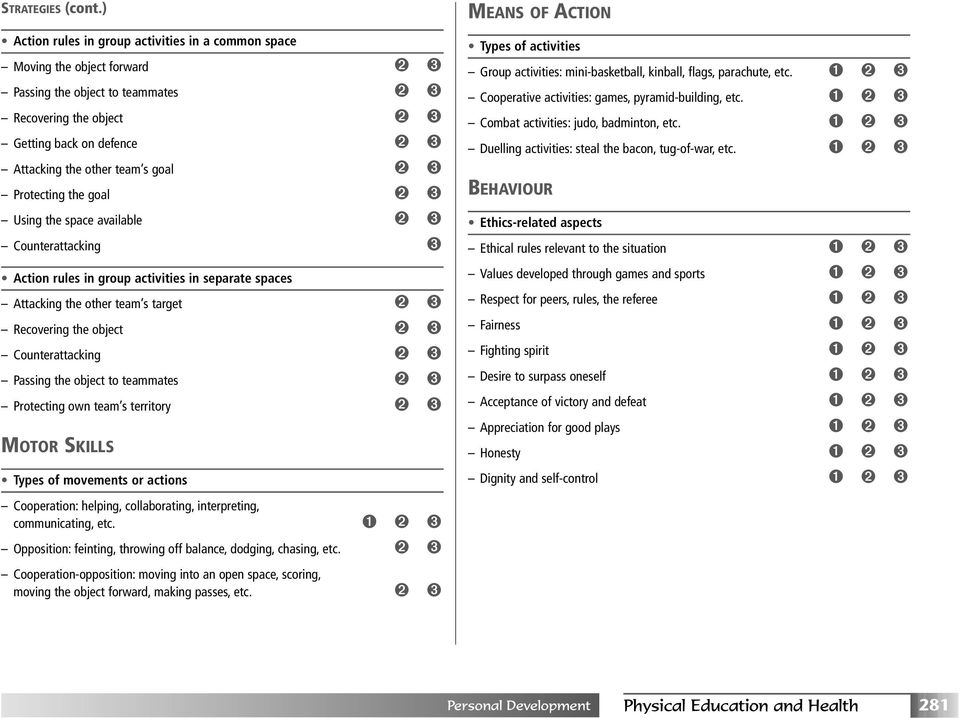
14 STRATEGIES (cont.) Action rules in group activities in a common space Moving the object forward ➋ ➌ Passing the object to teammates ➋ ➌ Recovering the object ➋ ➌ Getting back on defence ➋ ➌ Attacking the other team s goal ➋ ➌ Protecting the goal ➋ ➌ Using the space available ➋ ➌ Counterattacking ➌ Action rules in group activities in separate spaces Attacking the other team s target ➋ ➌ Recovering the object ➋ ➌ Counterattacking ➋ ➌ Passing the object to teammates ➋ ➌ Protecting own team s territory ➋ ➌ MOTOR SKILLS Types of movements or actions MEANS OF ACTION Types of activities Group activities: mini-basketball, kinball, flags, parachute, etc. ➊ ➋ ➌ Cooperative activities: games, pyramid-building, etc. ➊ ➋ ➌ Combat activities: judo, badminton, etc. ➊ ➋ ➌ Duelling activities: steal the bacon, tug-of-war, etc. ➊ ➋ ➌ BEHAVIOUR Ethics-related aspects Ethical rules relevant to the situation ➊ ➋ ➌ Values developed through games and sports ➊ ➋ ➌ Respect for peers, rules, the referee ➊ ➋ ➌ Fairness ➊ ➋ ➌ Fighting spirit ➊ ➋ ➌ Desire to surpass oneself ➊ ➋ ➌ Acceptance of victory and defeat ➊ ➋ ➌ Appreciation for good plays ➊ ➋ ➌ Honesty ➊ ➋ ➌ Dignity and self-control ➊ ➋ ➌ Cooperation: helping, collaborating, interpreting, communicating, etc. ➊ ➋ ➌ Opposition: feinting, throwing off balance, dodging, chasing, etc. ➋ ➌ Cooperation-opposition: moving into an open space, scoring, moving the object forward, making passes, etc. ➋ ➌ Physical Education and Health 281
15 Physical Education and Health 282 COMPETENCY 3 TO ADOPT A HEALTHY, ACTIVE LIFESTYLE Focus of the Competency MEANING OF THE COMPETENCY CONTEXT FOR LEARNING DEVELOPMENTAL PROFILE Regular physical activity has long been recognized as one of the factors conducive to good health. Students seem unconcerned by health-related problems or by the longterm benefits of a healthy, active lifestyle, hence the importance of helping them to develop the resources that will enable them to take responsibility for their own health and be active throughout their lives. Students will adopt a healthy, active lifestyle to the extent that they are aware of the factors likely to affect their lifestyle habits in a positive or negative way. Students demonstrate a healthy, active lifestyle through regular physical activity and through their capacity to assess the impact of their actions on their health and make consequent choices. CONNECTIONS TO CROSS-CURRICULAR COMPETENCIES In adopting healthy lifestyle habits, students deploy several cross-curricular competencies. More specifically, they exhibit intellectual competencies in that they must use appropriate information and exercise critical judgment in order to make well-informed choices. They also display personal and social competencies, as the adoption of healthy lifestyle habits is closely tied to personal identity and relationships with others. Students develop this competency by engaging in physical activities in a school, family or community setting and by participating in discussion. The learning situations proposed in physical education and health class are based on the contexts for learning outlined above under the first two competencies. Situations drawing on opportunities or events outside the school setting should not, however, be excluded. The homeroom teacher and other members of the school team are encouraged to support students in their learning. Students should be given the opportunity to continue in their other subjects and in complementary activities the critical examination undertaken in physical education and health class, where only those knowledges directly related to physical education and health are covered. More general knowledges are covered in activities related to the broad area of learning called Health and Well-Being. Throughout elementary school, students gradually internalize the process involved in adopting or changing lifestyle habits related to their health and well-being (personal hygiene, relaxation, personal safety, and so on). By the end of elementary school, they have acquired or consolidated certain habits, including regular participation in physical activity. The more students develop this competency, the better they are equipped to take advantage of opportunities to transfer the learning acquired in school to other settings and to safely engage in different types of physical activities on their own.

16 Key Features of the Competency To analyze the impact of some personal lifestyle habits on own health and well-being To assess the results of the plan TO ADOPT A HEALTHY, ACTIVE LIFESTYLE To develop a plan in order to change some personal lifestyle habits To carry out a plan in order to change some personal lifestyle habits Evaluation Criteria Explanation of the impact of personal lifestyle habits on own health and well-being Preparation of a plan for participation in physical activity Interpretation of the results of own strategy for changing personal lifestyle habits Identification of desirable improvements or elements that are worth keeping End-of-Cycle Outcomes CYCLE ONE Students explain the concept of lifestyle habits and health. They try different types of physical activities, varying their duration and intensity. They evaluate their process in terms of their achievements and difficulties. CYCLE TWO Students identify different strategies they can use to change their lifestyle habits. They recognize which of their habits are conducive to health and well-being and which are detrimental. With the teacher s support, they choose a physical activity and plan how they will engage in this activity on a regular basis. They also plan how they will change another of their lifestyle habits. They interpret their results and identify desirable improvements or elements that are worth keeping. CYCLE THREE Students make connections between their lifestyle habits and their effects on their health and well-being. They exercise critical judgment with respect to opinions and to information about various topics related to health and well-being. They plan their participation in physical activity and the strategy they will use to change one of their lifestyle habits. After evaluating their process and results, they identify desirable improvements or elements that are worth keeping. Physical Education and Health 283

17 Physical Education and Health 284 Essential Knowledges LEARNINGS LIFESTYLE HABITS Regular physical activity Psychological benefits -Positive emotions ➋ ➌ - Mental relaxation ➋ ➌ - Maintenance or improvement of concentration ➋ ➌ Physiological benefits - Effects on growth ➋ ➌ - Improvement of capacity to recover ➋ ➌ Social benefits - Improvement of interpersonal relations or maintenance of harmonious interpersonal relations ➋ ➌ Safe participation in physical activity Proper use of equipment ➊ ➋ ➌ Appropriate clothing ➊ ➋ ➌ Exercises with a high injury risk ➊ ➋ ➌ Behaviours to adopt in potentially dangerous situations ➊ ➋ ➌ Proper set-up and storage of equipment ➊ ➋ ➌ Safety rules to observe in different settings ➊ ➋ ➌ Stages of physical activity (warm-up, performance, cool-down) ➊ ➋ ➌ Pacing ➌ Fitness Flexibility ➊ ➋ ➌ Posture ➊ ➋ ➌ Cardiovascular endurance ➌ Strength ➌ Personal hygiene related to physical activity ➌ Relaxation ➊ ➋ ➌ Stress management ➌ EFFECTS OF A SEDENTARY LIFESTYLE Weight ➌ Flexibility ➌ Muscle mass ➌ Etc. ANATOMY AND PHYSIOLOGY OF THE HUMAN BODY Anatomy: bones, muscles, heart, lungs, joints ➊ Physiology: cardiovascular system, respiratory system, muscular system, the body s response to exercise ➋ ➌

18 Cultural References For all three competencies ➊ ➋ ➌ The gear and equipment used in physical education and how it has changed over time The lifestyle habits of family members, friends, Quebeckers in general Changes in the physical activity habits of family members, friends, Quebeckers in general Major events in the news in connection with physical education and health Exhibitions (e.g. hall of fame) Types of recreational activities Readings (e.g. books, newspapers, magazines) Architecture (e.g. Olympic stadium) Sports here and elsewhere Sports events (e.g. Olympics, national, provincial or regional amateur athletic games, sports events held as part of carnivals) Objects of everyday life Heritage objects (e.g. skis from 1960, snowshoes used by Amerindians) Values that determine behaviours (e.g. lifestyle habits, leisure habits) Types of clothing (for different seasons, in different countries, for different sports) Suggestions for Using Information and Communications Technologies Through various learning situations, in cooperation with the homeroom teacher and the physical education and health teacher, students explore and use different technologies to acquire learnings in connection with school subjects and personal interests. Using CD-ROMs, software and Web browsers to explore themes related to physical education and health ➋ ➌ Using software to create and develop physical activity schedules ➋ ➌ Using software to keep a food journal over a given period of time ➊ ➋ ➌ Using software to keep a log of self-evaluation results in physical education and health class ➌ Using software demonstrating techniques ➋ ➌ Physical Education and Health 285

PHYSICAL EDUCATION A. PROGRAM RATIONALE AND PHILOSOPHY
 PHYSICAL EDUCATION A. PROGRAM RATIONALE AND PHILOSOPHY The aim of the Kindergarten to Grade 12 physical education program is to enable individuals to develop the knowledge, skills and attitudes necessary
GRADE ONE. End of 1st 9 Weeks. Initial Evaluation. Scoring: Not attempted 0 points Attempted 1 point Performs most 2 points Mastery 3 points
 GRADE ONE Date 1. Demonstrate jumping and landing skills by using one- and two-foot take-off methods, balancing at varying levels on multiple body parts, and forming bridges using different body parts.
One Stop Shop For Educators. Georgia Performance Standards Framework for Physical Education
 PEK.1: Demonstrates competency in motor skills and movement patterns needed to perform a variety of activities. Description: Students will experience all locomotor movement patterns (e.g., hop, jump, and
Content Map For PHYSICAL EDUCATION
 Content Strand: Health-Related Fitness Activities 3-PE-1 Perform, sit-ups, shuttle run, v-sit, pull ups/flexed arm hang, mile run/walk. 3-PE-2 Perform walking, jogging, aerobic dancing activities and fitness
One Stop Shop For Educators. Georgia Performance Standards Framework for Physical Education
 PE3.1: Demonstrates competency in motor skills and movement patterns needed to perform a variety of physical activities. Description: Students demonstrate mature form in all locomotor and non-locomotor
CHORLTON HIGH SCHOOL: CURRICULUM YEAR 8 PE
 ELE 2 Days: ELE 4 Days CHORLTON HIGH SCHOOL: CURRICULUM Year 8 Autumn 1 Autumn 2 Spring 1 Spring 2 Summer 1 Summer 2 Subject First 2 weeks will involve Athletics testing LAPs: LAPs: Content LAPs: Continue
Subchapter B. Middle School
 Chapter 116. Texas Essential Knowledge and Skills for Physical Education Subchapter B. Middle School Statutory Authority: The provisions of this Subchapter B issued under the Texas Education Code, 28.002,
5TH GRADE FITNESS STUDY GUIDE
 PHYSICAL EDUCATION 5 TH GRADE FITNESS STUDY GUIDE PART I. Revised 5-13 DIRECTIONS: Review the following terms and concepts. Do not try to memorize the definitions, rather think about and understand: 1)
DOMINICAN INTERNATIONAL SCHOOL. Physical Education
 DOMINICAN INTERNATIONAL SCHOOL Physical Education Elementary School Grade 3-5 S.Y. 2015~2016 Grade Level: 3-5 Teacher: Julie Chiu Email: [email protected] Course Description The activities and topics
Archery: Coaching Young Athletes. Developing Fundamental Movement Skills
 Archery: Coaching Young Athletes Developing Fundamental Movement Skills Make a long term commitment Long Term Athlete Development Long Term Athlete Development (LTAD) is a strategy for helping youngsters
What is Physical Fitness?
 What is Physical Fitness? Physical fitness is made up of two components: Skill-related fitness and Health related fitness. Skill related fitness items are factors, which relate to the possibility of you
Physical Education is Critical to a Complete Education
 Physical Education is Critical to a Complete Education A Position Paper from the National Association for Sport and Physical Education Overview Physical education plays a critical role in educating the
HAREWOOD JUNIOR SCHOOL KEY SKILLS P.E
 HAREWOOD JUNIOR SCHOOL KEY SKILLS P.E Purpose of study A high-quality physical education curriculum inspires all pupils to succeed and excel in competitive sport and other physically-demanding activities.
Holly Hill Methodist/Church of England (Aided) Infant and Nursery School. Vision
 Holly Hill Methodist/Church of England (Aided) Infant and Nursery School Physical Education Policy, January 2015 (Miss Allen, Physical Education Coordinator) Vision Physical Education (PE) at Holly Hill
Standard 1 Students demonstrate the motor skills and movement patterns needed to perform a variety of physical activities.
 Grade Three Third grade is a pivotal time in the development of students movement skills. Third graders who demonstrate and understand the proper form for locomotor and nonlocomotor skills now shift their
In structured sports programs, participation and enjoyment should be emphasized rather than competition and winning.
 Preschool Children The California Department of Health Services Physical Activity for Children, Youth, and Adults All preschool children should participate every in a form of physical activity appropriate
Educational Innovation
 Educational Innovation July, 2013 Dear Educators, On behalf of all of MCESA, we are excited that you are using our content specific assessments in your school or district. We sincerely hope that the assessments
PE Long Term Plan Boys Year 7
 Boys Year 7 Autumn 1 Half Term Baseline/fitness aerobics, circuits, boxercise, bums and tums, walking and cross country. stretching techniques and Learners to take part in a range of activities, (invasion
CONCEPT CONTENT HEALTH & PHYSICAL EDUCATON CONTENT CONCEPTS
 HEALTH & PHYSICAL EDUCATON CONTENT CONCEPT 1 Students will demonstrate knowledge and competent skills in a variety of movements, physical activities and sports. CONCEPT 2 Students will achieve and maintain
North Carolina Essential Standards Physical Education. (MS) Motor Skills
 Note on Numbering: example PE.K.MS.1.1 indicates Kindergarten Motor Skills 1 and Clarifying Objective 1. Note: MS = Motor Skills, MC = Movement Concepts, HF = Health-Related Fitness, PR = Personal/Social
Physical Education 6 th Grade
 Physical Education 6 th Grade Grade 6 Physical and Health Education is focused on the acquisition of basic movement patterns and motor skills as they relate to physical fitness. Students will be exposed
Content Outline for MTTC Test Review
 Content Outline for MTTC Test Review Concepts and Strategies of Physical Education Components of health-related physical fitness, the F.I.T.T. principle, and methods for applying these components. o What
Physical Education Curriculum Framework
 1 PHYSICAL EDUCATION PHILOSOPHY/RATIONALE AND THE CURRICULUM GUIDE Philosophy/Rationale In schools, we believe and understand that each person is created in God s image as unique and loveable. As independent
Short Course. Physical Education. Specification for Junior Cycle
 Short Course Physical Education for June 2014 Contents Page 3 Introduction to junior cycle Page 4 Rationale Page 5 Aim Page 6 Links Page 8 Course overview Page 9 Expectations for students 10 Strand 1:
Content Standard 1: 5-8 Benchmark 1: 5-8 Benchmark 2:
 Physical Education Grades 5-8 Content Standard 1: Demonstrates competency in many movement forms and proficiency in a few movement forms. Students will: 5-8 Benchmark 1: Demonstrate proficiency in combining
Kindergarten Physical Education Scope and Sequence
 Kindergarten Physical Education Scope and Sequence Participate in daily activities that require physical exertion for short periods of time. Recognize physiological signs of moderate physical activity,
Health and wellbeing 1 Experiences and outcomes
 Health and wellbeing 1 Experiences and outcomes Learning in health and wellbeing ensures that children and young people develop the knowledge and understanding, skills, capabilities and attributes which
PHYSICAL EDUCATION IM 36
 PHYSICAL EDUCATION IM 36 IM SYLLABUS (2014) SYLLABUS 1 Physical Education IM 36 (Available in September) Syllabus 1 Paper (2hrs 30mins) & Practical (30mins) Introduction This syllabus provides candidates
The Tasmanian Curriculum
 The Tasmanian Curriculum Health and wellbeing K 10 syllabus and support materials Department of Education Contents Overview 5 What is Health and wellbeing? 5 Why study Health and wellbeing? 6 Further
HADDONFIELD PUBLIC SCHOOLS Curriculum Map for Physical Education, Grade Five
 Curriculum Map for Physical Education, Grade Five Targeted Standard(s): NJCCCS 2.5 Strands A-D; 2.6 1 st Trimester Enduring Understandings : -Knowledge of health and physical education concepts and skill
North Stainley Primary School. Policy for PE. The importance of Physical Education to the curriculum
 North Stainley Primary School Policy for PE The importance of Physical Education to the curriculum Physical Education (P.E.) develops pupils' physical competence and confidence, and their ability to use
9 th Grade Physical Education Unpacked Content
 This document is designed to help North Carolina educators teach the Essential Standards (Standard Course of Study). NCDPI staff are continually updating and improving these tools to better serve teachers.
Learning Outcomes Framework
 Learning Outcomes Framework April 2003 Physical Education Grades Primary 6 Learning Outcomes Framework Physical Education Grades Primary 6 GRADE PRIMARY Grade Primary Knowing demonstrate an understanding
INTRODUCTION. The benefits of having standards for physical education
 Standards - What are they? INTRODUCTION Standards are statements that define what students should know and be able to do upon completion of specific levels of instruction. Standards serve as a gauge for
THE BADMINTON ASSOCIATION OF ENGLAND MISSION STATEMENT
 THE BADMINTON ASSOCIATION OF ENGLAND MISSION STATEMENT Badminton is an Olympic Sport It is played by groups, families and individuals of all ages and it provides a healthy, lifelong sport activity that
Pulmonary Rehabilitation Program - Home Exercise Program
 Pulmonary Rehabilitation Program - Home Exercise Program Getting Started Regular exercise should be a part of life for everyone. Exercise improves the body's tolerance to activity and work, and strengthens
Parachute Play. 1 week PE 1.1, 1.2, 1.3, 1.6. Objectives Methods Resources Assessment
 1. demonstrate the proper grip-hold on the parachute. 2. execute proper form of the basic skills. 3. name and perform basic routines to music 4. perform directional changes and hands off moves. 5. use
Daily Physical Activity
 Daily Physical Activity Kindergarten to Grade 12 Program Guide (Updated 2011) Ministry of Education Contents Introduction... 5 Requirements... 5 Responsibilities of Boards of Education/School Authorities...
NATIONAL STANDARDS Lesson 1: Healthy Me!
 NATIONAL STANDARDS ers HEALTH EDUCATION STANDARDS (GRADES 3-5) Source: National Health Education Standards, Achieving Excellence, Second Edition (2007), Joint Committee on National Health Education Standards
Grade Band Overview by Standard and Organizers
 physical education Grade Band Overview by Standard and Organizers 87 Standard 1 Demonstrates competency in motor skills and movement patterns needed to perform a variety of physical Standard 2 Demonstrates
TExES I Texas Examinations of Educator Standards. Preparation Manual. 158 Physical Education EC 12
 TExES I Texas Examinations of Educator Standards Preparation Manual 158 Physical Education EC 12 Copyright 2006 by the Texas Education Agency (TEA). All rights reserved. The Texas Education Agency logo
One Stop Shop For Educators. Georgia Performance Standards Framework for Physical Education
 PEHS.1: Demonstrates competency in motor skills and movement patterns needed to perform a variety of physical activities. Description: Students in grades 9 12 will demonstrate the ability to participate
Tri-District Physical Education Grade K - 12 Curriculum
 Tri-District Physical Education Grade K - 12 Curriculum 2013 Mr. Patrick Fletcher Superintendent River Dell Regional Schools Ms. Lorraine Brooks Principal River Dell High School Mr. Richard Freedman Principal
Player Development Guideline U11 & U12 Boys and Girls Soccer. www.marlboroyouthsoccer.org
 Player Development Guideline U11 & U12 Boys and Girls Soccer www.marlboroyouthsoccer.org Marlboro Youth Soccer Overview 2 Marlboro Youth Soccer Mission Marlboro Youth Soccer (MYS) is dedicated to providing
St Joseph s Catholic Primary School
 St Joseph s Catholic Primary School CRC Article 29(goals of education) Education must develop every child s personality, talents and abilities to the full. It must encourage the child s respect for human
2014-2015 Curriculum Blueprint Grade: 6/7 Course: M/J Comprehensive P.E. 6 th and 7 th Grade Unit 1: Safety and Fitness
 Unit 1: Safety and Fitness 15 days 1 Heat exhaustion, heat stroke, dehydration, frostbite, warm up, cool down, aerobic, anaerobic, resting heart rate, target heart rate, cardiovascular fitness, strength,
1.1.1 To include: Body language - facial expressions, gestures, eye contact and posture
 Unit 415 Delivering Personal Training Sessions Recommended Guided Learning Hours: 58 Credit value 9 QCF Unit Number J/600/9053 1. Understand how to instruct exercise during personal training sessions 1.1
Kindergarten Elementary Physical Education Curriculum Moon Area School District. Month August/September
 Month August/September Unit: Rules & Procedures/Safety/Low organized Games If we have a question what do we do? Classroom Rules and procedures for Where is our assigned seat? What is personal space? When
HOW CAN PHYSICAL EDUCATION SUPPORT THE NATIONAL LITERACY STRATEGY?
 HOW CAN PHYSICAL EDUCATION SUPPORT THE NATIONAL LITERACY STRATEGY? All pupils have an entitlement to the whole curriculum and the key to this is the development of competent language and literacy skills.
Standards for Certification in Early Childhood Education [26.110-26.270]
![Standards for Certification in Early Childhood Education [26.110-26.270]](/thumbs/24/3436110.jpg "Standards for Certification in Early Childhood Education [26.110-26.270]") I.B. SPECIFIC TEACHING FIELDS Standards for Certification in Early Childhood Education [26.110-26.270] STANDARD 1 Curriculum The competent early childhood teacher understands and demonstrates the central
I.B. SPECIFIC TEACHING FIELDS Standards for Certification in Early Childhood Education [26.110-26.270] STANDARD 1 Curriculum The competent early childhood teacher understands and demonstrates the central
Year 6 Expectations in PE
 Year 6 Expectations in PE Invasion Games use different techniques for passing, controlling, dribbling and shooting the ball in games apply basic principles of team play to keep possession of the ball use
4.4 Early Detection Guidelines
 4.4.2.2 Assessment for Identified Concerns 4.4.2.2.6 How Children Develop 9-10 Year Olds The following section outlines the major developmental milestones for nine to ten year old children. Six areas of
Indiana Content Standards for Educators PHYSICAL EDUCATION
 Indiana Content for Educators PHYSICAL EDUCATION Physical education teachers are expected to have understanding of the knowledge and skills needed for this educator license, and to use that knowledge to
SLOs for PE Division- Active Only
 SLOs for PE Division- Active Only Dept - (PE) Athletics (Hybrid) Athletics_SSLO_1 All student-athletes will develop and file an educational plan relevant to their academic and athletic goals by the end
Fundamental Movement Skills:
 Fundamental Movement Skills: FMS Tools for Schools Brett Thompson About Us Founded in 1933, Physical and Health Education Canada (PHE Canada) is a national advocacy leader for the healthy growth and development
How To Teach Your Children To Be Healthy
 PHYSICAL EDUCATION/HEALTH COURSES PHYSICAL EDUCATION/HEALTH KINDERGARTEN GRADE 2 The Kindergarten through Grade 2 Physical Education program is designed to develop a positive attitude in children toward
High School Physical Education Curriculum. Table of Contents... - 1 - High School Physical Education Program...- 7 -
 High School Physical Education Curriculum TABLE OF CONTENTS Table of Contents... - 1 - High School Physical Education Program...- 7 - Adaptive Physical Education: Course Descriptions and Benchmark Numbers...-
Physical Education: Content Knowledge
 Test at a Glance Test Name Physical Education: Content Knowledge Test Code 0091 Time 2 hours Number of Questions 120 Format Multiple-choice questions Approximate Approximate Content Categories Number of
ABSTRACT AUTHOR. A 3-step learning and performance strategy for the 100 metres start. By Ronnie Lidor, Dapeng Chen
 A 3-step learning and performance strategy for the 100 metres start By Ronnie Lidor, Dapeng Chen by IAAF 18:1; 29-34 2003 A 3-step learning and performance strategy to be applied before the start of the
This booklet provides additional information to support all quality physical education in the primary school. Definitions and
 Physical Education Supporting high quality physical education in the primary school Learning and Teaching Scotland Supporting high quality physical education in the primary school Introduction This booklet
DIVISION OF EXERCISE AND SPORTS SCIENCE Clay Biggs, Chair EXERCISE AND SPORTS SCIENCE -69- Goals of the Exercise and Sports Science Department
 DIVISION OF EXERCISE AND SPORTS SCIENCE Clay Biggs, Chair The Division of Exercise and Sports Science is comprised of departments which study various aspects of human physical activity related to sports
HUPF (HUPF) Courses. 2015-2016 Prairie View A & M University 1
 2015-2016 Prairie View A & M University 1 HUPF (HUPF) Courses HUPF 1011 Swimming I: 1 semester hour. HUPF 1012 Sports Skills I: 2 semester hours. Theory and application of fundamental skills in flag and
Curriculum Guide for Physical Education Parent Guide
 Curriculum Guide for Physical Education Parent Guide District Mission The South Brunswick School District will prepare students to be lifelong learners, critical thinkers, effective communicators and wise
YEAR 7 PE ASSESSMENT
 YR 7 P SSSSMNT INVSION GMS g Football, Rugby, Netball NT GMS g Tennis, adminton, Volleyball STRIKING N FILING g ricket, Rounders, Softball STHTIS g Gymnastics, ance, Trampolining GR Need to bring appropriate
Physical Education: Content Knowledge (0091/5091) Test at a Glance. About This Test
 Test at a Glance Test Name Physical Education: Content Knowledge Test Code 0091 5091 Time 2 hours 2 hours Number of Questions 120 multiple-choice questions 120 multiple-choice questions Format Multiple-choice
U-10 The Learning to Train Stage
 U-10 The Learning to Train Stage The Start of Us The learning to train stage covers ages 8 to 12 [Table 8]. The objective is to learn all of the fundamental soccer skills, building overall sports skills.
Copyright AC Ramskill (AcademyCoach83) October 2007
 Copyright AC Ramskill (AcademyCoach83) October 2007 All Rights reserved no part of this publication maybe reproduced, transmitted or utilized in any form or by any means, electronic, mechanical photocopying
Demonstrate knowledge of movement concepts, principles, and strategies as they apply to learning and performance of physical activities.
 Standard 1: Standard 2: Standard 3: Standard 4: Standard 5: California Physical Education Content Standards Grade 5 Demonstrate motor skills and movement patterns needed to perform a variety of physical
Lead-Deadwood Physical Education Curriculum Kindergarten-Second Grade
 Lead-Deadwood Physical Education Curriculum - Standard 1: The physically literate individual demonstrates proficiency in a variety of motor skills and movement patterns. S1.E1 Performs locomotor skills
This chapter presents
 Chapter 8 Aerobic Fitness Programs T This chapter presents programs for three levels of aerobic fitness: a starter program for low fit or previously sedentary individuals (fitness under 35 ml/kg min);
Slips, Trips and Falls. Awareness Month. February 2005. Slips, Trips and Falls
 THE SCHOOL DISTRICT OF PITTSBURGH Slips, Trips and Falls Awareness Month Joint Labor / Management Safety Committee Please open the attachment for additional information that will answer safety questions
A1 Reasons for taking part in activity. A2 Health, fitness, exercise and performance
 Centre No. Paper Reference (complete below) Candidate No. / Surname Signature Initials Paper Reference 1827/01 Edexcel GCSE Physical Education End Of Unit Test SECTION 1: FITNESS A1 Reasons for taking
Exercise Principles and Guidelines for Persons with Cerebral Palsy and Neuromuscular Disorders
 Exercise Principles and Guidelines for Persons with Cerebral Palsy and Neuromuscular Disorders INTRODUCTION: Health and well being are the result of many factors: Physical activity is one of these factors.
Fit for Flight. Developing a Personal Fitness Program
 Fit for Flight Developing a Personal Fitness Program The purpose of this brochure is to provide you with basic guidelines for developing a balanced physical fitness program and customizing a workout to
UNIT 1. WARM-UP GAMES
 UNIT 1. WARM-UP GAMES TIMING: 5 HOURS AIMS. To get to know each other in class. To know specific vocabulary for PE classes. To form and collaborate in small groups. To play different roles on games. To
Physical Education, Wellness, and Safety Education Courses
 Physical Education, Wellness, and Safety Education Courses Health related fitness is the focus of the Eastview High School physical education curriculum. Eastview's Physical Education department is making
Domain Title: Life Skills
 Domain Title: Life Skills Introduction The relevance of life skills in the context of prevocational education is already well established. It is a very essential aspect of education in the Mauritian context,
National Physical Education Standards and Minnesota Benchmarks
 National Physical Education Standards and Minnesota Benchmarks Examples of STANDARDS, BENCHMARKS, and ACTIVITIES in Physical Education Kindergarten through Grade 10 organized by grade level This document
Preparing for the Washington State Criminal Justice Training Commission Physical Ability Test
 Preparing for the Washington State Criminal Justice Training Commission Physical Ability Test Whereas many training routines can be used to improve performance in the Physical Ability Test (PAT), participants
Health and PE. Smyth County Schools Curriculum Map Grade:9 Subject:PE
 Standards Dev. 03/2008 1 Grade:9 Subject:PE 1st Quarter 9.1a: Apply competencies in all locomotor, non-locomotor, and manipulative skills to appropriate game/sport, dance, and recreational activities 9.2a:
2010 Saskatchewan Curriculum. Physical Education
 2010 Saskatchewan Curriculum Physical Education 1 Physical Education 1 ISBN 978-1-926631-68-4 1. Physical education and training (Elementary school) - Saskatchewan - Curricula. 2. Competency-based education
Subchapter C. High School
 Chapter 116. Texas Essential Knowledge and Skills for Physical Education Subchapter C. High School Statutory Authority: The provisions of this Subchapter C issued under the Texas Education Code, 28.002,
YMCA Basketball Games and Skill Drills for 3 5 Year Olds
 YMCA Basketball Games and s for 3 5 Year Olds Tips ( s) Variations Page 2 Dribbling Game 10 Players will learn that they must be able to dribble to attack the basket (target) to score in basketball. The
Physical Education and LTAD
 Physical Education and LTAD Strengthening the link Glenn Young Surrey School District Context Surrey School District, SD36 100 elementary schools, 19 secondary schools, 5 learning centers 69145 students,
Quality for All and All for Quality
 Quality for All and All for Quality The motto above, Quality for All and All for Quality, was designed to represent all we stand for and value. It is the essence of our mission statement which itself encompasses
California Subject Examinations for Teachers
 CSET California Subject Examinations for Teachers TEST GUIDE PHYSICAL EDUCATION SUBTEST I Subtest Description This document contains the Physical Education subject matter requirements arranged according
PHYSICAL EDUCATION. Assessment at a Glance. Early and Middle Childhood. Choosing the Right Certificate. Reviewing the Standards
 Early and Middle Childhood PHYSICAL EDUCATION Choosing the Right Certificate Reviewing the Standards Demonstrating Your Teaching Practice and Content Knowledge Understanding the National Board Scoring
COACHING GUIDE. Preparing Athletes for Competition
 COACHING GUIDE Preparing Athletes for Competition Table of Contents Table of Contents Psychological Considerations Anxiety and Stress Management Winning and Losing Handling Grief Taking Athletes to Competition
Québec Education Program
 Québec Education Program Secondary Education Update May 2008 13-0023-051-A Attached you will find three documents, which replace the corresponding sections in the current edition of the. SECONDARY CYCLE
This very important area is often the least understood or completely ignored by some coaches when designing a fitness program for their athletes.
 This very important area is often the least understood or completely ignored by some coaches when designing a fitness program for their athletes. An understanding of the various energy systems of our body
What is Sport Psychology?
 What is Sport Psychology? The application of psychological theory and methods to the study of behavior resulting from or directly related to involvement in sport and physical activity. Examining the psychological