
CheckMark Payroll. User s Manual
|
|
|
- Allyson Lyons
- 10 years ago
- Views:
Transcription
1 CheckMark Payroll User s Manual
2 Information in this manual is subject to change without notice. This manual ( Manual or Documentation ) and the software ( Software ) described in it are copyrighted, with all rights reserved. By using this Manual and accompanying Software, you, the end user, agree to the terms set forth in the License Agreement. Copyright Under the copyright laws, this Manual or the Software may not be copied, in whole or in part, without the express consent of CheckMark Inc ( CheckMark Inc ), except in the normal use of the Software or to make a backup copy of the Software for your own use. The same proprietary and copyright notices must be affixed to any permitted copies as were affixed to the original. This exception does not allow copies to be made for others, whether or not sold, but all of the material purchased (with all backup copies) may be sold or given to another person. Under the law, copying includes translating into another language or format. Federal copyright law prohibits you from copying the written materials accompanying the Software without first obtaining our permission. You may not alter, modify or adapt the Software or Documentation. In addition, you may not translate, decompile, disassemble or reverse engineer the Software. You also may not create any derivative works based on this Software or Documentation. A derivative work is defined as a translation or other form in which the Software may be recast, transformed or adapted. Limited Warranty on Media and Replacement If you discover a physical defect in the Manual or in the media with which the Software is distributed, CheckMark Inc will replace the media or Manual at no charge to you, provided you return the item to be replaced with proof of purchase to CheckMark Inc or a CheckMark Inc dealer during the 60-day period after you purchased the Software. All implied warranties on the media and Manuals, including implied warranties of merchantability and fitness for a particular purpose, are limited in duration to 60 days from the date of original retail purchase of this product. EVEN THOUGH CHECKMARK INC HAS TESTED THE SOFTWARE AND REVIEWED THE DOCUMENTATION, CHECKMARK INC MAKES NO WARRANTY OR REPRESENTATION, EITHER EXPRESS OR IMPLIED, WITH RESPECT TO THE SOFTWARE, ITS QUALITY, PER- FORMANCE, MERCHANTABILITY, OR FITNESS FOR A PARTICULAR PURPOSE. AS A RE- SULT, THIS SOFTWARE IS SOLD AS IS, AND YOU THE PURCHASER ARE ASSUMING THE ENTIRE RISK AS TO ITS QUALITY AND PERFORMANCE. IN NO EVENT WILL CHECK- MARK INC BE LIABLE FOR DIRECT, INDIRECT, SPECIAL, INCIDENTAL, OR CONSEQUEN- TIAL DAMAGES RESULTING FROM ANY DEFECT IN THE SOFTWARE OR ITS DOCUMENTATION, EVEN IF ADVISED OF THE POSSIBILITY OF SUCH DAMAGES. The Warranty and remedies set forth above are exclusive and in lieu of all others, oral or written, express or implied. No CheckMark Inc dealer, agent, Consultant, or employee is authorized to make any modification, extension, or addition to this warranty. Some states do not allow the exclusion or limitation of implied warranties or liability for incidental or consequential damages, so the above limitation or exclusion may not apply to you. This warranty gives you specific legal rights, and you may also have other rights which vary from state to state. Trademarks CheckMark Inc and MultiLedger are registered trademarks of CheckMark Inc All other references are trademarks of their respective owners CheckMark Inc pdf rev 10/11
3 Table of Contents i

4 ii Part 1 Getting Started 1 System Requirements 1 Software Updates 2 How to Get More Help 2 Support Plans 3 Before Contacting Support/Other Resources 3 Contact CheckMark Inc 4 Chapter 1 Installation and Basic Use 5 Installing CheckMark Payroll 5 Macintosh Install 5 Windows Install 5 Command Center 6 Open Company 6 Delete Company 7 Database Manager 7 Create New Database 8 Add Database to List 8 Rename Database 9 Remove From List 10 Switch to Database 10 Exiting CheckMark Payroll 11 Tips for Navigating Windows Within Payroll 11 Making Selections in a List Box 11 Using Drop-Down Lists 13 Chapter 2 Sample Company 15 Starting CheckMark Payroll for Windows and Opening the Sample Company 15 Starting CheckMark Payroll for Macintosh and Opening the Sample Company 16

5 iii Part 2 Setting Up a Company 17 Some things to consider before starting: 17 Steps to Setting Up a Company 18 Chapter 3 Creating a New Company 19 Creating a New Company File on Windows 19 Creating a New Company File on Macintosh 20 Copying From an Existing Payroll Company 21 Converting Old Company Files 23 Chapter 4 Company Information 29 Setting Up Company Information 29 Items in the Company Information Window 30 Chapter 5 Setting Up Departments 31 Setting Up Departments 31 Modify Departments 32 Deleting Departments 32 Chapter 6 Federal Tax Values 33 Setting Up Federal Tax Values 33 Chapter 7 State Tax Values 35 Setting Up State Tax Values and SUTA Values 35 Adding Pre-defined State Taxes to Your Company 36 Setting Up Your State ID and SUTA Values 37 Chapter 8 Local Tax Values 39 Setting Up Local Tax Values 39 Creating a New Local Tax Category 39 Adding Pre-Defined Local Taxes to Your Company 41 Setting Up CASDI for California Employees 42

6 iv Chapter 9 Setting Up Hour Categories 45 Adding a Pre-Defined Hour Category to Your Company 46 Creating a New Hour Category 47 Modifying an Hour Category 48 Deleting an Hour Category 48 Chapter 10 Setting Up Additional Income 49 Adding Pre-Defined Additional Income Categories to Your Company 50 Creating a New Additional Income Category 51 Modifying an Additional Income Category 52 Deleting an Additional Income Category 53 Items in the Additional Income Window 54 Calculation Methods 54 Other Options 55 Tip Income Options 55 Exempt From Options 56 W-2 Options 57 Chapter 11 Setting Up Deductions 59 Adding Pre-Defined Deduction Categories to Your Company 60 Creating a New Deduction Category 61 Modifying a Deduction Category 62 Deleting a Deduction Category 62 Items in the Deductions Window 63 Calculation Methods 63 Deduction Limit Options 64 Employer Match Options 65 Deduct Before Options 65 W-2 Box Selections 66 Chapter 12 Setting Up Employees 67 Using the Employee View Tabs 67 How to Set Up an Employee 68 Setting Up a New Employee 68 Saving an Employee s Setup 69 Deleting an Employee 70 Setting Up Employee Personal Information 71 Fields in the Employee Personal View Tab 71

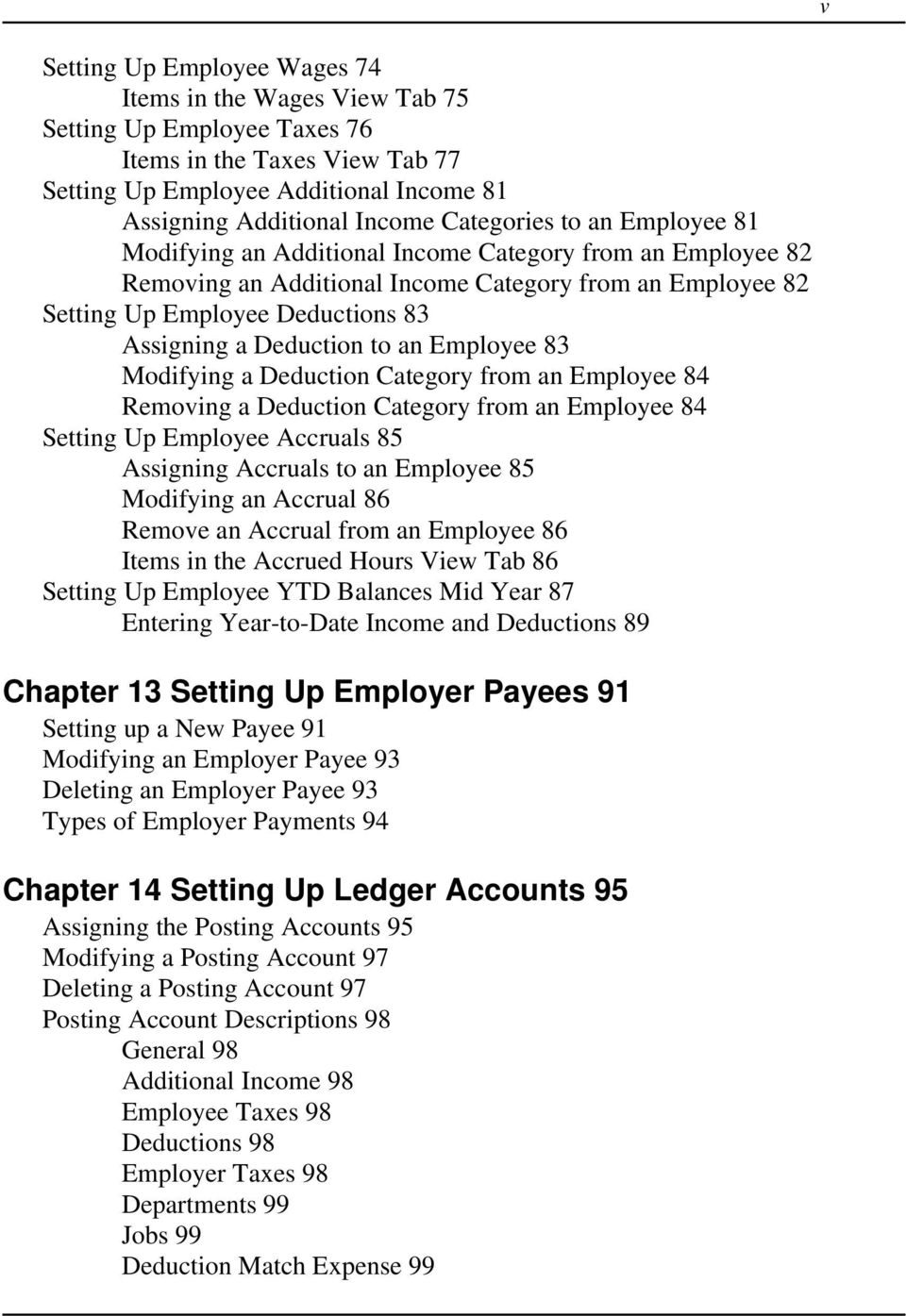
7 Setting Up Employee Wages 74 Items in the Wages View Tab 75 Setting Up Employee Taxes 76 Items in the Taxes View Tab 77 Setting Up Employee Additional Income 81 Assigning Additional Income Categories to an Employee 81 Modifying an Additional Income Category from an Employee 82 Removing an Additional Income Category from an Employee 82 Setting Up Employee Deductions 83 Assigning a Deduction to an Employee 83 Modifying a Deduction Category from an Employee 84 Removing a Deduction Category from an Employee 84 Setting Up Employee Accruals 85 Assigning Accruals to an Employee 85 Modifying an Accrual 86 Remove an Accrual from an Employee 86 Items in the Accrued Hours View Tab 86 Setting Up Employee YTD Balances Mid Year 87 Entering Year-to-Date Income and Deductions 89 Chapter 13 Setting Up Employer Payees 91 Setting up a New Payee 91 Modifying an Employer Payee 93 Deleting an Employer Payee 93 Types of Employer Payments 94 Chapter 14 Setting Up Ledger Accounts 95 Assigning the Posting Accounts 95 Modifying a Posting Account 97 Deleting a Posting Account 97 Posting Account Descriptions 98 General 98 Additional Income 98 Employee Taxes 98 Deductions 98 Employer Taxes 98 Departments 99 Jobs 99 Deduction Match Expense 99 v
8 vi Chapter 15 Importing and Exporting 101 Import Employee Information 101 To import employee information: 101 Export Employee Information 104 To export employee information: 104 Export Employee Information into CheckMark Forms To export employee information: 106

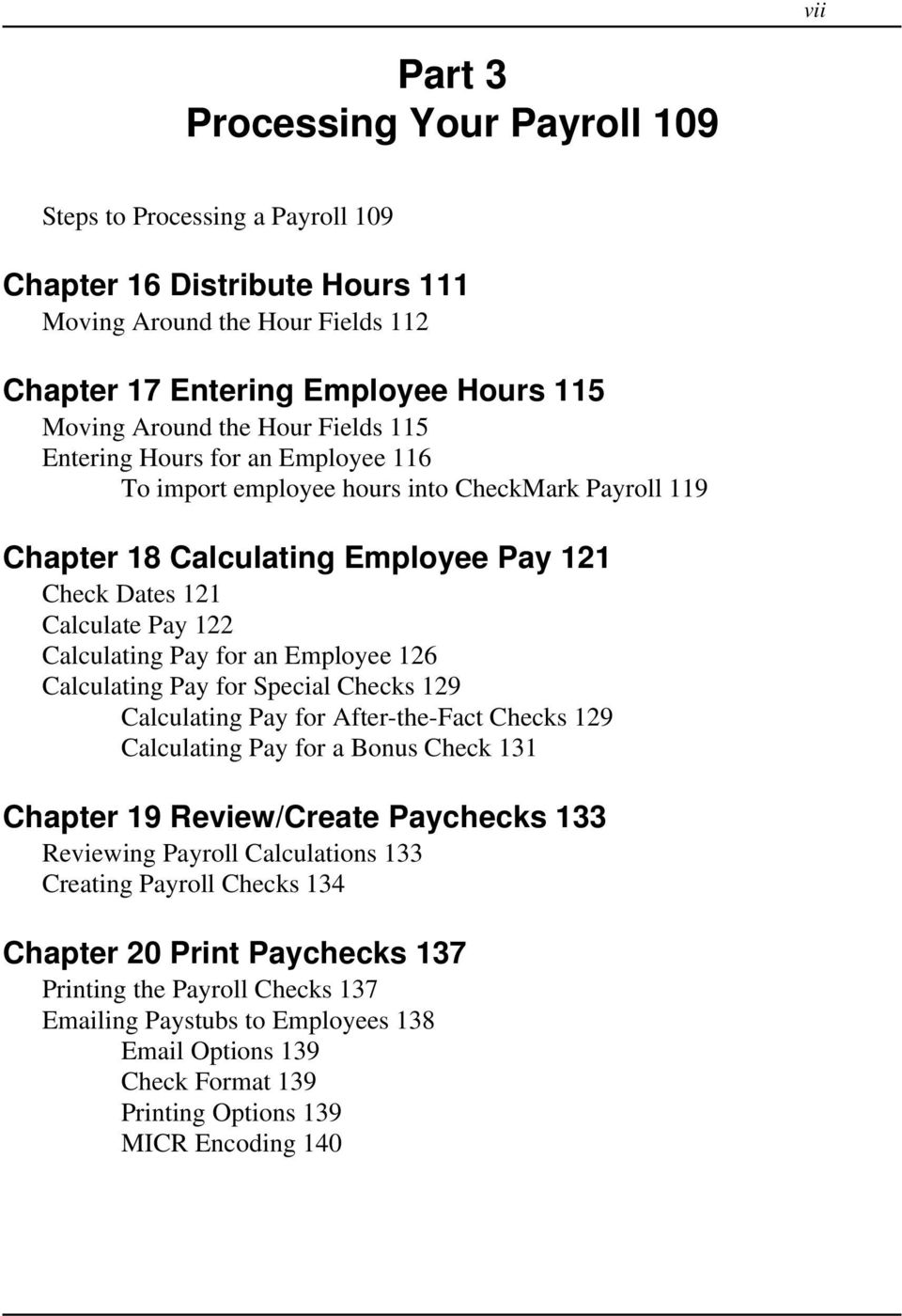
9 vii Part 3 Processing Your Payroll 109 Steps to Processing a Payroll 109 Chapter 16 Distribute Hours 111 Moving Around the Hour Fields 112 Chapter 17 Entering Employee Hours 115 Moving Around the Hour Fields 115 Entering Hours for an Employee 116 To import employee hours into CheckMark Payroll 119 Chapter 18 Calculating Employee Pay 121 Check Dates 121 Calculate Pay 122 Calculating Pay for an Employee 126 Calculating Pay for Special Checks 129 Calculating Pay for After-the-Fact Checks 129 Calculating Pay for a Bonus Check 131 Chapter 19 Review/Create Paychecks 133 Reviewing Payroll Calculations 133 Creating Payroll Checks 134 Chapter 20 Print Paychecks 137 Printing the Payroll Checks 137 ing Paystubs to Employees 138 Options 139 Check Format 139 Printing Options 139 MICR Encoding 140
10 viii Chapter 21 Modifying Paychecks 143 Modifying Payroll Checks 143 Modifying a Check Number 144 Modifying Period Start and End Dates 145 Voiding a Check 145 Deleting a Check 145 Chapter 22 Allocate to Dept/Job 147 Allocating Wages After Paychecks are Created 147 Re-allocating Hours for Hourly Employees 147 Allocating Wages and Taxes for Salaried Employees 149 Deleting Allocations 150 Chapter 23 Create Payments 151 Creating Employer Payments 151 Chapter 24 Print Payments 153 Printing Employer Payment Checks 153 Chapter 25 Modify Payments 155 Modifying Employer Payment Checks 155 Modifying the Check Number or Date for an Employer Check 156 Voiding an Employer Check 156 Deleting an Employer Check 157 Chapter 26 Posting Payroll Information to MultiLedger 159 Posting Employee Checks to MultiLedger 159 Set up Ledger Accounts in CheckMark Payroll 159 Review Posting Summary 159 Posting to MultiLedger 160 Posting Employer Checks to MultiLedger 162 Set up Ledger Accounts in CheckMark Payroll 162 Review Posting Summary 162 Posting to MultiLedger 162

11 ix Part 4 Reports 165 Using the Report Windows 165 Using CheckMark Payroll s Tool Bar with Reports 165 Using the Find Command with Reports 166 Copy and Paste Report Information 167 Chapter 27 Employee Information 169 Types of Employee Information Reports 169 Creating Employee Information Reports 169 Chapter 28 Employee Earnings 171 Types of Employee Earnings Reports 171 Creating Employee Earnings Reports 172 Chapter 29 Employee Paychecks 173 Types of Employee Paycheck Reports 173 Employee Checks Report Options 174 Posting File Formats 174 Creating Employee Paycheck Reports 176 Chapter 30 Departments/Jobs 177 Types of Department Job Reports 177 Creating Department/Job Reports 177 Chapter 31 Federal Taxes 179 Types of Federal Tax Reports 180 Creating 941 Reports 181 Creating 943 Reports 183 Creating 944 Reports 185 What can cause an amount to appear on the Adjustment for Fractions line? 186 Reporting of Third-Party Sick Pay 187 Form 940 Annual Report 187 Form 941 Quarterly report or Form 944 Annual report 187

12 x Chapter FUTA Tax 189 Types of 940 FUTA Tax Reports 190 Creating 940 Reports 190 Fields on the Chapter 33 State Taxes 193 Creating SUTA Taxes Reports 193 Creating State Withholding Reports 194 Creating California DE-9 Form for Printing 195 Creating California DE-9 XML File 196 Creating California DE-9C MMREF File 197 Creating New York MMREF File 199 Chapter 34 Local Taxes 201 Creating Local Taxes Reports 201 Chapter 35 Income and Deductions 203 Types of Income and Deduction Reports 203 Creating Income and Deduction Reports 204 Chapter 36 Employer Payments 205 Types Employer Payments Reports 205 Posting File Formats 205 Creating Employer Payments Reports 207 Chapter 37 W-2 & W-3 Statements 209 Types of W-2/W-3 Reports 209 Creating W-2 and W-3 Reports 210 Withholding for Two States 210 Verify Company Information 210 Dependent Care Benefits - Box Non-Qualified Plans - Box Deductions Appearing in W-2 Boxes 12a - 12d 211 Box 13 Check Boxes 211 Box 14 Other 212 Box Furnishing Copies B, C, and 2 to Employees 212

13 Printing on Blank, Perforated W-2s and W-3s 213 Printing the W-3 Form 214 Printing on Preprinted W-2s and W-3s 215 Third-Party Sick Pay Reporting on the W-2 and W-3 Statements 217 Creating Electronically Filed Reports 217 Saving Federal and State Electronic Information in the EFW2 Format 218 Chapter 38 Customizing Checks and Reports 221 Formatting Checks, W-2s, and W-3s 221 Resetting the Default 222 xi

14 xii Part 5 Customizing and Maintaining CheckMark Payroll 223 Chapter 39 Setting Preferences 225 Payroll Preferences 225 Selecting the Print Font 227 Chapter 40 Protecting Your Files 229 Backing Up Your Company Files 229 Suggestions for Backing Up 229 Making a Backup on Windows 229 Making a Backup on Macintosh 231 Restoring Backup Database on Windows 232 Restoring Backup Database on Macintosh 234 Setting Up a Password 237 Chapter 41 Starting a New Year 239 Starting a New Year 239 Appendix A Direct Deposit 241 Using CheckMark Payroll for ACH Direct Deposit 241 Set Up Employees for ACH Direct Deposit 241 Set Up ACH Direct Deposit Information 242 Fields on the ACH Direct Deposit Window 243 Using CheckMark Payroll for Web Direct Deposit 244 Designate Employees for Web Direct Deposit 244 Create an Export File for Web Direct Deposit 245 Using CheckMark Payroll for ACH NPC Direct Deposit 245 Designate Employees for ACH NPC Direct Deposit 245 Create an Export File for ACH NPC Direct Deposit 246
15 Index 247 xiii

16 xiv

17 Part 1 Getting Started System Requirements 1 System Requirements CheckMark Payroll is an automated payroll software program designed for the small to medium sized business to calculate and print payroll. This program will process hourly and salaried pay rates and tracks regular, overtime, double-time, sick and vacation hours. CheckMark Payroll will calculate Federal and State withholding as well as other taxes that may not necessarily be set up for you upon installation depending on your locale. Use CheckMark Payroll to define deductions, additional incomes, calculate and create checks, generate tax liability reports and print W-2s, W-3s, Form 940, 941, 943 and 944 reports. Before jumping into the set up of your company payroll, please read through the manual. General set up and payroll procedures are covered as well as how you can receive additional support directly from CheckMark, Inc. CheckMark Payroll can be installed on a computer running either Macintosh or Windows operating systems. The software is a singleuser application and not designed for multiple user access of the data files. DO NOT install the application program on a server, but locally on the user s computer hard drive even if you save the data on a server. Users will need to have a personal computer running an operating system of either Windows XP Service Pack 3 or higher, or Macintosh OS X 10.5 or higher. Along with a compatible printer, the latest version of Adobe Reader is also required to properly print certain forms from the program. You can download a free copy of Adobe Reader from Adobe s website at Whichever computer you choose, a fundamental knowledge of the operating system is essential. For more information about the basics and navigation of your operating system, see the user manual that came with your computer.

18 2 Software Updates Each year the program is issued with the latest Federal and State withholding tax information as well as added features. Program patches are released as needed throughout the year for the current version of the software. Patches are available online at Hard copy CDs can be purchased by calling the sales department at Renewal notices are sent out each year, generally late summer to early fall, announcing the next update. Updates must be purchased each year to receive support and the ability to install patches for changes including withholding tables and reports that occur throughout the year. How to Get More Help This manual covers general Payroll set up, calculation and reporting. There may be items that are specific to your company that are not addressed here except in general terms. For these times, CheckMark Software, Inc. offers additional support for users that wish to purchase a support plan. New Users are entitled to 60 days or 90 minutes of free support, whichever comes first, from the date of purchase. Free support for updates and patches is not available but included with a support plan. Only registered users can receive technical support so please, take a moment and read the License Agreement, fill it out the Registration Card and send it in. Support is offered via internet submission, , fax or telephone. Whenever you contact support, have your customer number OR product registration number available. It is important that you are at your computer with CheckMark Payroll running when speaking with support to best resolve your question/problem.
19 Support Plans 3 Support Plans CheckMark Software offers several additional support plans to meet your needs: Priority Support 12 months or 300 minutes, whichever comes first, with an 800 phone number exclusively for priority support customers and immediate assistance. Essential Support 12 months or 90 minutes, whichever comes first. Phone support with this option is handled with a call back system. Support by the minute $3/minute with a $30 minimum charge per call. Before Contacting Support/Other Resources Check For Latest Version Payroll Manual Online Knowledge Base Online Tutorials Users with internet access can check to be sure that they are up-to-date as often as they wish by selecting Check for Latest Version under Help in the program. If you wish the program to check this for you every time it is launched, select the Preference to Check for Latest Version on Launch. If necessary, download and install the latest update (may require purchase if not using the current year version). Users can access the Payroll Manual from the Help menu while in the CheckMark Payroll program. An updated manual is installed with each upgrade. Users with internet access can check the online data base for answers to common questions. Access to the KnowledgeBase can be obtained by going to the Help menu and selecting CheckMark KnowledgeBase. You can also access the KnowledgeBase directly from the CheckMark website at These short movies are valuable for new users and seasoned pros alike. Each topic is easy to understand as you are taken step-by-step through features and procedures. You can access the tutorials under the Help menu in the program or by going to the CheckMark website at
20 4 Contact CheckMark Inc Suggestions Our program continues to improve with the input of our users. If you wish to see a feature considered for possible implementation into the Payroll program, please send us your suggestions Sales or [email protected] Support or [email protected] Customer Service or [email protected] Fax Address - CheckMark Inc. 724 Whalers Way, Bldg H Ste 101 Fort Collins, CO 80525

21 Installing CheckMark Payroll 5 Chapter 1 Installation and Basic Use Installing CheckMark Payroll Macintosh Install 1 Close all programs including disabling of anti-virus software. 2 Insert the CheckMark Payroll CD-ROM into your computer s drive. 3 When the CD icon appears on the Desktop, open by double-clicking on it and double-click the CheckMark Payroll installer. 4 Follow the on-screen instructions to complete installation. The default install location on the hard drive for CheckMark Payroll is: Macintosh HD\Applications\CheckMark\Payroll\(year)\CheckMark Payroll. Users can install the program in any location, however, it is recommended to install the program on the local drive in the default location. Note The (year) folder represents the current calendar year. Each new year, a new folder pertaining to that year will be created. Windows Install 1 Close all programs including disabling of anti-virus software. 2 Insert the CheckMark Payroll CD-ROM into your computer s drive. 3 The installer will start automatically. If the installer does not start automatically after a minute, click your Start menu and then select Run. Type in the path and filename in the Run box. That would be the drive name, colon (:), backslash(\), filename. For example: D:\setup. Then click OK. 4 Follow the on-screen instructions to complete installation. The default install location on the hard drive is C:\Program Files\CheckMark\Payroll\(year)\pay.exe. It is recommended to install the program on the local hard drive in the default location.
22 6 Chapter 1 Installation and Basic Use Note The (year) folder represents the current calendar year. Each new year, a new folder pertaining to that year will be created. Note CheckMark Payroll for Windows should not be installed on a file server. Install the application onto the local hard drive of any computer in your company that will need to access payroll files. Then save your company database to a file server. If you choose to save your data files on a server, you need to map your network drive. Each operating system handles this differently. For more information, see the documentation that came with your operating system. Keep in mind, the payroll application is still a single user program. Only one user should access the database at a time. Command Center Note When you open up CheckMark Payroll, the Command Center appears on the screen. The Command Center is divided into three sections: Setup, Payroll and Reports. To use the Command Center, simply click the button of the window you wish to open. If no company is open, the Command Center will appear with buttons greyed out and inactive. When a company is open, the Command Center buttons will appear bold and the payroll year, company name and path location to the company data set will appear in the lower left portion of the Command Center. Not all menu commands are represented on the Command Center. Some dialogs, such as those under the File menu, can only be accessed using the pull-down menus or CTRL key (Windows) or COMMAND key (Macintosh) shortcuts from the keyboard. Open Company This command allows the user to choose the specific company in the database the data is saved in. Once the program is launched, go under the File menu and choose Open Company. Select the payroll company to open and click Open Company. If you want to open a different company, go back to the File menu, select Open Company and choose the payroll company you want to open.
23 Delete Company 7 Delete Company You can also choose to delete a company from the database list by going under the File menu and selecting Delete Company. Select the company you wish to delete and click the Delete Company button. If you delete a set of files in this way, they cannot be recovered without a previously saved backup archive. Database Manager In addition to the Default Payroll Company Database, you can create multiple databases. Each database can contain multiple companies. The Database Manager option allows you to Create New Database, Add Database to List, Rename Database, Remove From List, and Switch to Database. To open up a different database, go under the File menu and choose Database Manager.
24 8 Chapter 1 Installation and Basic Use Create New Database This option allows you to save a new database in any location you wish. You can create multiple companies in each database. 1 Go under the File menu and select Database Manager. 2 Click the Create New Database button. 3 Enter a Database Name and Payroll Year. Click the Browse button to select a new location to save the database. 4 Click Create Database to save the new database. Add Database to List This button allows you to add an already existing database to the list. If you copied over a database from another computer and the Database Manager does not list this database, you can choose Add Database to List and browse to that location to update the Database Manager s list. 1 Go under the File menu and select Database Manager. 2 Click the Add Database button. 3 An open dialogue box appears. Browse to the location where the database is saved.
25 Database Manager 9 4 Select the database and click Open. The database is added to the list in the Database Manager. Rename Database This option allows you to rename the database. It is recommended you use only alpha-numeric characters. 1 Go under the File menu and select Database Manager. 2 Click the Rename Database button. A pop up screen appears. 3 Enter the new name and click Rename Database to Save.
26 10 Chapter 1 Installation and Basic Use Remove From List This option allows you to remove a database from the list. Please note, this only removes the listing in the Database Manager. It does not delete the database file from the saved location. To delete a database, you will need to manually deleted the database (.db) file from your hard drive or saved location. 1 Go under the File menu and select Database Manager. 2 Click the Remove Database button. A warning message appears. 3 Click Yes to remove the database from the Database Manager list. You add the database again at anytime by using the Add Database command. Switch to Database This option allows you to choose a different database and open it up to view all saved payroll companies in that particular database. 1 Go under the File menu and select Database Manager. 2 Highlight the new database you want to open and click the Switch to Database button.
27 Exiting CheckMark Payroll Exiting CheckMark Payroll 3 The new database is now open and all companies set up in this database are available under the Open Company command under the File menu. To exit or quit CheckMark Payroll: Choose Exit from the File menu (Windows) Choose Quit from the CheckMark Payroll menu (Mac) Tips for Navigating Windows Within Payroll You can enter information in any order you like by clicking in each field s edit box. To move the cursor from one field to the next field, you could click in the field box. However, often the quickest way to move the cursor to another field is to press the following keys on your keyboard: Keystroke Result TAB SHIFT+TAB (While holding down the SHIFT key, press TAB) Next field or control Previous field or control Making Selections in a List Box While using CheckMark Payroll, you often select items from a list box. You can make your selections in the following ways:
28 12 Chapter 1 Installation and Basic Use In most list boxes, you can choose a consecutive range of items by holding down the SHIFT key while clicking the first and last desired items in the list. For example, here is a consecutive range of checks selected on the Print Paychecks window: In most list boxes, you can also select a consecutive range of items in a list by dragging through the list to highlight the desired items. Simply select the first item in the selection and, while holding down the mouse button, move the mouse pointer through the list. To deselect an item in a list, position your mouse pointer over the selected item and click the mouse button. To retain other selections in the list while deselecting an item, hold down the CTRL key (Windows) or COMMAND key ( ) (Mac) while clicking the item. In some lists, you can make non-consecutive selections by holding down the CTRL key (Windows) or COMMAND key ( ) (Mac) while clicking the desired items in the list. The example below shows a non-consecutive range of checks selected:
29 Tips for Navigating Windows Within Payroll Using Drop-Down Lists Drop-down lists make data entry fast and easy. When you click the down arrow button in a drop-down list, a list of choices appears: CheckMark Payroll offers you several ways to quickly find an item in a drop-down list. Use your mouse to select the item. Drag up or down through the list and select a name when it scrolls into view. Type the first character of the item. This automatically selects the first occurrence of the character at the beginning of an item name. On Windows, typing the character again will select the next item that starts with that character. Press the UP ARROW or DOWN ARROW keys on your keyboard to move through the list. After the item you want is highlighted, press Enter to enter the item into the field.
30 14 Chapter 1 Installation and Basic Use
31 Starting CheckMark Payroll for Windows and Opening the Sample Company 15 Chapter 2 Sample Company Starting CheckMark Payroll for Windows and Opening the Sample Company The following steps show you how to start CheckMark Payroll for Windows and open a sample company file called PRSample.pr0. If you would rather start setting up your own company right away, see Chapter 3 Creating a New Company on page Launch CheckMark Payroll by clicking the shortcut on the desktop or from the Start menu. 2 Choose Open Company from the File menu. 3 Select the PR Sample Co, Inc and click Open Company. 4 The PR Sample Co, Inc is now open and all buttons are active on the command screen. Note Do not enter your own company data in the PR Sample Co, Inc. You should create a new company if you plan to process payroll for your own company.
32 16 Chapter 2 Sample Company Starting CheckMark Payroll for Macintosh and Opening the Sample Company The following steps show you how to start CheckMark Payroll for Macintosh and open a sample company file called PR Sample Co, Inc. If you would rather start setting up your own company right away, go to Creating a New Company File on Macintosh on page Double-click the alias on the dock or desktop. You can also launch Payroll by opening the folder where CheckMark Payroll was installed and doubleclicking on the CheckMark Payroll icon. 2 Select Open Company from the File menu. 3 Select the PR Sample Co, Inc then click Open Company. 4 The PR Sample Co, Inc is now open and all buttons are active on the command screen. Note Do not enter your own company data in the PR Sample Co, Inc. You should create a new company if you plan to process payroll for your own company.
33 Part 2 Setting Up a Company 17 Setup of your company s payroll data set is key to ease of use and accuracy in your calculation and reporting. Read through the chapters ahead and evaluate each item to determine which items will be essential to your company setup. Depending on your company s needs, not all windows in CheckMark Payroll may be used. It is recommended that you follow the setup chapters in order so that all necessary items are available when setting up Employees, Employer Payees and Ledger Accounts. Some things to consider before starting: Do you have an accounting program you wish to post payroll to and how do you wish the payroll to post? By department? By MultiLedger Job? Are there special taxes in your local area that you need to verify the setup? How are they reported to the taxing entity? Do I have all the documents I need to setup a company; ID numbers, SUTA rate, Employee W-4 forms?
34 18 Steps to Setting Up a Company The following is a checklist that you can follow for setting up your company. Steps for Creating a New Company Payroll Screen Create a New Company file Go to File menu, New Company Setup Company Information and select Payroll Year Company Information Setup Departments (optional) Departments Add the appropriate state tax tables and parameters to your company Enter the State ID and SUTA % for each state in which you process a payroll State Tax Values State Tax Values Setup Local taxes (optional) Local Tax Values Setup Hour Categories (optional) Hour Categories Setup Additional Income items (optional) Additional Income Setup Deduction items (optional). Deductions Setup Employee information Employees Setup Employer Payees (optional) Employer Payees Setup Ledger Accounts (optional) Ledger Accounts
35 Creating a New Company File on Windows 19 Chapter 3 Creating a New Company This chapter shows you how to create a new company file and enter basic company information. The information below is for creating a new company on Windows. To create a new company on Mac, see Creating a New Company File on Macintosh on page 20. Creating a New Company File on Windows 1 Double click the Payroll shortcut on the Desktop or click the Start menu, select Programs, then select CheckMark Payroll from the CheckMark Payroll group. 2 Choose New Company from the File menu. An alert asking if you want to copy setup data from an existing company appears. Note If this is a first-time setup, you wouldn t have an existing CheckMark Payroll company to copy. The sample company that is provided contains example information only and it is not recommended for copying setup information. If you want to copy setup information from an existing CheckMark Payroll company, see Copying From an Existing Payroll Company on page Click No. 4 Begin entering the Company Information. Once you ve enter the basic Company Information, click Save and close the window. All buttons should now be active on the Command Screen.
36 20 Chapter 3 Creating a New Company Creating a New Company File on Macintosh 1 Double-click the CheckMark Payroll alias in the dock or on your Desktop or double-click the CheckMark Payroll icon located in the install folder that was installed on your hard drive.. 2 Choose New Company from the File menu. An alert asking if you want to copy setup data from an existing company appears. Important If you want to copy setup information from an existing CheckMark Payroll company, see Copying From an Existing Payroll Company on page 21.Typically, you would not copy setup information from the sample company provided. 3 Click No. 4 Begin entering the Company Information. Once you ve enter the basic Company Information, click Save and close the window. All buttons should now be active on the Command Screen.
37 Creating a New Company File on Macintosh 21 Copying From an Existing Payroll Company When you create a new Payroll Company, you have the option to copy certain setup data from an existing CheckMark Payroll company. You can copy Income and Deduction Categories, Departments, Hour Descriptions, Tax Tables, and Ledger Accounts. Important You can also import employee information. For more information on importing employee information, see Import Employee Information on page Click the Start menu, select Programs, then select CheckMark Payroll from the CheckMark Payroll group or click the shortcut on the desktop. 2 Choose New Company from the File menu. An alert asking if you want to copy setup data from an existing company appears. Note The Default Payroll Company Database will be used to save your company information. If you wish to use a different database or rename the database, see Database Manager on page 7. 3 Click Yes. An Open dialog box appears.
38 22 Chapter 3 Creating a New Company : Note Typically, you would not copy setup information from the PR Sample Co, Inc. since it contains only example information. 4 Select the company you wish to copy information from. Once that company is selected, click the New Company button. 5 Begin setting up your Company Information in the Company Information window.
39 Converting Old Company Files Converting Old Company Files 23 In Payroll version 8.2 and higher, a database is used to store all company and employee information. Multiple companies can be stored in one database or multiple databases can be created for each company. This section describes how to use the Payroll Company Conversion Wizard if you re opening data from Payroll versions prior to Make sure all old Payroll files are closed. Launch the Payroll Company Conversion Wizard application. A Welcome screen appears with details on the conversion process and the new database that will be created. You can Print these details by choosing the Print button in the upper right hand corner. Click Next to continue. 2 Choose the company you want to convert. This screen lists the old company files that are ready to be converted. If your company is not listed you may either choose the Add Company to List or Find Companies button.
40 24 Chapter 3 Creating a New Company Choosing the Add Company to List button opens a dialogue box for you to browse to and select the location where you saved the old payroll files. The Find Companies button searches your hard drive and network drives for all available payroll files that can be converted. Once the company list is populated, select the company you want to convert. You may only convert one company at a time. Click Next to continue. Note If there s an asterisk (*) by the company s name, this company has already been converted. 3 Choose a Database for Saving Once you ve chosen a payroll company to convert, you ll have the option of saving the data into the provided Default Payroll Company Database or creating one of your own.
41 Converting Old Company Files 25 The location of the Default Payroll Company Database is: Windows: C:\CheckMark\Payroll\2011\Default_Payroll_Company_Database_2001.db Macintosh: HD/CheckMark/Payroll/2011/Default_Payroll_Company_Database_2011.db Note You can change the name of the Default_Payroll_Company_Database_2011.db after the convert is finished. Create a New Database 1. To create your own database and/or save a database in a new location, choose the Create New Database button. 2. Enter a name for the new database. 3. Change the Year if necessary. If necessary, change the default location where you want to save the database by choosing the Browse button. 4. Click Create to Save the new database. The new database should now be included in the list of databases to choose from for the final Confirm and Convert stage.
42 26 Chapter 3 Creating a New Company 4 Confirm and Convert After you have selected the database you want to convert your data into, click the Next button. Verify that all information and save location is correct. If changes are needed, hit the Back button.
43 5 Click the Confirm and Convert button. Converting Old Company Files 27 6 Once the conversion is complete and the green complete screen is displayed, you may either choose to Convert Another Company or Close. You may now proceed to open the newly created files in the new database with Payroll version 8.2 or higher. For instruction on Opening your Payroll company, see Open Company on page 6.
44 28 Chapter 3 Creating a New Company
45 Setting Up Company Information 29 Chapter 4 Company Information Setting Up Company Information Use the Company Information window to enter your starting payroll year and basic company information, such as your company s name, address, and federal employer identification number. 1 Click Company Information in the Command Center. 2 Enter your company s name and press TAB to move to the next field. 3 Complete all necessary fields and click Save. Note Press SHIFT - TAB (hold down the SHIFT key and press TAB) to move the cursor to the previous field and highlight any previously entered information.
46 30 Chapter 4 Company Information Company Name Trade Name Use on Checks & Reports Address Lines 1 & 2 City, State, Zip Note Phone Federal ID Password Payroll Year Items in the Company Information Window Enter your company s legal name. Enter your company s Trade Name, if any. Check this box if you want the Trade Name you entered to be used on checks and reports. If this box is not checked, CheckMark Payroll will use your Company Name on checks and reports. Enter your company s street address, city, your state s two-letter postal abbreviation, and zip code. Only Address 1 information prints on Forms 940, 941, 944, and W-2/ W-3s; the information in Address 2 will not print on these reports. Enter your company s telephone number, including area code. Enter your federal employer identification number. This number prints on 940, 941, 944 and W-2/W-3s reports. Enter up to 40 characters for a password if you want to restrict access to your company s files. The password is not case sensitive. For example, an upper case T is treated the same as a lower case t. For more details, see Setting Up a Password on page 237. The payroll year you enter appears on checks and reports and limits the check dates you can enter. CheckMark Payroll works with one year of data at a time. The current year is automatically entered based on the year the database is in. To modify the year, you must create a new database to change it to an earlier year. However, you can advance it to the next year with the New Year command. For details, see Starting a New Year on page 239
47 Setting Up Departments 31 Chapter 5 Setting Up Departments CheckMark Payroll will accommodate up to 99 departments for your company s payroll distribution. Once defined on the Departments window, you can assign a default department to an employee and/or define the particular departments that an employee s wages will be distributed to on the Employees, Distribute Hours or Allocate Dept/ Jobs windows. CheckMark Payroll allows you to create new departments, modify or delete existing departments. Note: Tenant Pro Users Departments in CheckMark Payroll are Properties in Tenant Pro. Your Department list MUST match the Property ID report from Tenant Pro in order to post from CheckMark Payroll into Tenant Pro. See your Tenant Pro manual for more information. Setting Up Departments 1 Click Departments in the Command Center.
48 32 Chapter 5 Setting Up Departments 2 Click New. Modify Departments 3 Enter a name for the department in the edit box, and click OK. Department names can be up to 17 characters. 1 Select Departments on the Command Center. 2 Select the department from the list. 3 Modify the department name in the edit box. 4 Click Save. Deleting Departments You can delete a department provided it is not assigned to any employees and has not been used on any existing checks. To delete a department: 1 Click Departments in the Command Center. 2 Select the department from the list. 3 Click Delete. An alert appears asking you to verify that you wish to delete the department. 4 Click Yes to delete the department.
49 Setting Up Federal Tax Values 33 Chapter 6 Federal Tax Values Important While CheckMark Software attempts to maintain up-to-date and accurate tax information, we cannot be responsible for changes or discrepancies in tax values. Please check your Circular E, Employer s Tax Guide or state or local tax publication if you are in doubt as to the accuracy of any tax value. CheckMark has an annual tax update to make sure you are kept up to date on all the latest tax changes and software changes. See the flyer that came with your CheckMark Payroll package or check our web site, for more information on updating. Users of the current year s version should check online for updates and download available patches to make sure they re always up to date. For details about this, see Software Updates on page 2. Setting Up Federal Tax Values When you create a new company, or advance an existing company to a New Year, the following federal tax tables and parameters are already set up: Federal Single Federal Married Annual W/H Allowance FUTA (Federal Unemployment Tax Act) Social Security Medicare Note FUTA rate includes the credit of 5.4% for payment of SUTA taxes to your state. If your state is a credit reduction state, the rate may need to be modified. You assign the appropriate federal table to each employee on the Employees window. see Setting Up Employee Taxes on page 76. CheckMark Payroll uses the annual percentage method to calculate Federal withholding. To verify the tax tables that your company is using for calculation: 1 Select Federal Tax Values under Setup on the Command Center.
50 34 Chapter 6 Federal Tax Values 2 Select the radio button next to the desired table to view. 3 Click the Tax Table button. To reload the Federal withholding tables and tax parameters in the company data files: 1 Select Federal Tax Values under Setup on the Command Center. 2 Click the Load year Values button. 3 When prompted to replace existing values, click OK.
51 Setting Up State Tax Values and SUTA Values 35 Chapter 7 State Tax Values Setting Up State Tax Values and SUTA Values Important: While CheckMark Software Inc attempts to maintain upto-date and accurate tax information, we cannot be responsible for changes or discrepancies in tax values. There may also be additional taxes for your specific state that will need to be setup and maintained by you. Please check your state s current tax publication if you are in doubt as to the accuracy of any tax value. State taxes, along with the employee s earnings and withholding allowances, determine how much state tax is withheld from an employee s check. Even if your state doesn t have a tax table, you still need to add your state to the State Taxes list, so you can enter your state ID and State Unemployment Tax Authority (SUTA %). After a state tax has been added to your company, you can assign it to an employee on the Employees window. see Setting Up Employee Taxes on page 76.
52 36 Chapter 7 State Tax Values Adding Pre-defined State Taxes to Your Company CheckMark Payroll accommodates up to 30 state tax tables in your State Taxes list. Each employee can be assigned one SUTA and one withholding state. If you don t see the state tax that you need, you can create a new one with the New button. see Creating a New State Tax Table on page Click State Tax Values under Setup in the Command Center. 2 Click Load Latest Table... 3 Select one or more states from the list. 4 Click OK. Select a state by clicking it in the list or by typing the first letter of its name. If you need to select more than one table, drag through the list to highlight the desired names. To select non-consecutive states, hold down the CTRL (Windows) key or Command ( ) key (Macintosh) and click the desired names.
53 Setting Up State Tax Values and SUTA Values 37 Note When possible, the Exemption Total or Tax Credit total, if applicable for the selected state(s), is calculated for you. If the parameters for this calculation cannot be calculated within the program, you will receive a an alert advising you to see the information available by clicking the Additional Web Information button. This button is a link that will launch a page on CheckMark s website that contains details on manual calculators, as well as other information about your state taxes. An internet connection is required. If you do not have an internet connection, information is available in your state tax guide. Setting Up Your State ID and SUTA Values After you ve added the appropriate states to your company, do the following: 1 Select a state from the State Taxes list. If you don t see the state you need, add it with the Load Latest Tables...button. 2 Click in the State ID edit box, and enter your state employer identification number. This is the State ID that prints on W-2s. Then press TAB.
54 38 Chapter 7 State Tax Values 3 Enter your SUTA % and press TAB. This is the rate you pay as an employer that has been given to you by your state and is based on an experience rating. If the state has presented this number as a rate rather than a percentage, convert it to a percentage by moving the decimal point two places to the right. For example, the rate of.004 should be entered as.4 in the SUTA % edit box. 4 Verify that the value shown for the Max SUTA Wages is correct. The Max SUTA Wages amount for the selected state is automatically entered; however, you should use your state tax guide or your company s state unemployment report to verify that it s correct. Note Assigning the State ID, SUTA %, and Max SUTA Wages for a state tax table automatically assigns those values to all tables for that state. 5 Click Save in the upper left hand corner. If you are processing a multistate payroll, repeat steps 1 5 for each state.
55 Chapter 8 Local Tax Values Setting Up Local Tax Values Setting Up Local Tax Values 39 Important: While CheckMark Software Inc attempts to maintain upto-date and accurate tax information, we cannot be responsible for changes or discrepancies in tax values. There may also be additional taxes for your locality that will need to be setup and maintained by you. Please check your locality s current tax publication if you are in doubt as to the accuracy of any tax value. If necessary, local taxes can be configured for your company. The local tax tables, along with the employee s earnings, and the number of withholding allowances (if necessary), determine how much local tax is withheld from an employee s check. CheckMark Payroll accommodates up to 10 local tax tables, but each employee can be assigned only one. After a local tax has been added to your company, you can assign it to an employee on the Employees window. see Setting Up Employee Taxes on page 76.. Note If you have more than one local tax per employee, you can also set up a local tax as a deduction. For instructions on setting up deductions see Creating a New Deduction Category on page 61 Creating a New Local Tax Category You can add a new Local tax category if the local tax is a Fixed % or Fixed Amount. Note You cannot create a new Local Tax that uses a tax table for calculation. 1 Click Local Tax Values in the Command Center. 2 Click the New button at the top of the screen. 3 Enter a name for the new Local Tax.
56 40 Chapter 8 Local Tax Values 4 The new Local Tax should now be added to the list of taxes available. Highlight the new Local Tax and set up the appropriate calculation parameters. 5 Click Save. For assigning a local tax to the employee(s), see Local Taxes on page 80.
57 Setting Up Local Tax Values 41 Adding Pre-Defined Local Taxes to Your Company 1 Click Local Tax Values in the Command Center. 2 Click Load Latest... 3 Select one or more local taxes from the list. Select a local tax by clicking its name in the list or drag to select consecutive tax names. To select non-consecutive local taxes, hold down the CTRL (Windows) key or Command ( ) key (Macintosh) and click the desired names.
58 42 Chapter 8 Local Tax Values 4 Click OK. Setting Up CASDI for California Employees California s State Disability Insurance (CASDI) should be set up as a Fixed %. For example, CASDI for 2009 is defined as 1.1% with an Annual Wages limit of $90, Please verify the current rates with EDD or visit the website at Note You can also set up CASDI as a Deduction Category. For more information, see Creating a New Deduction Category on page 61
59 Chapter 9 Setting Up Hour Categories Use the Hour Categories window to set up the types of hours that your company uses to calculate pay for hourly employees. You can also set up accrued hour categories, such as sick and vacation. You can define up to eight hour categories for your company; all of which can be used for any employee. 45 Important You should carefully choose the order of the hour categories in the Hour Categories list because it determines the order of their appearance on the Distribute Hours and Enter Hours windows. Setting up hour categories according to their frequency of use with the most used hour category first is recommended. Once you ve created at least one set of payroll checks or set up beginning year-to-date balances with the YTD view mode on the Employees window, you should not change the order, delete or modify the names since this could adversely affect these balances. CheckMark Payroll comes with several pre-defined hour categories. Click the Add from List button in the Hour Categories window for a complete list. You can add a pre-defined hour category to your company, and then use it as is or change its definition.
60 46 Chapter 9 Setting Up Hour Categories Adding a Pre-Defined Hour Category to Your Company 1 Click Hour Categories in the Command Center. 2 Click Add from List. 3 Select one or more hour categories from the list 4 Click OK.
61 Creating a New Hour Category 1 Click New. Creating a New Hour Category 47 If you need an hour category that isn t pre-defined in CheckMark Payroll, use the New button to create a new one. 2 Enter a name, up to eight characters, for the hour category and click OK. 3 Define the new hour category. 4 Click Save. Employee Hourly Rate: Use this drop-down list to select whether Hour Rate 1, 2, 3, or 4 should be used for the hour category. The hourly rate is assigned to each employee on the Employees window. Multiplier: Use this drop-down list to select the multiplier (1, 1.5, 2, 0.5) by which an employee s hourly rate should be multiplied. For example: Regular would be defined as Hour Rate 1 x 1. Overtime would be defined as Hour Rate 1 x 1.5. Employee Brian makes $8/ hour. Regular hours would be paid at $8/hour (1 x $8) and overtime at $12/hour (1.5 x $8). Use in Calculations Based on Hours Worked: Check this option if the hours in this category should be included for income and deduction calculations based on Fixed Amount/Hour Worked. An example would be Labor & Industry taxes in the state of Washington. You should also check this option if you plan on accruing hours such as vacation or sick based on hours worked. For example, you wish to accrue vacation on regular hours worked. Check this option on Regular so that each hour worked by those employees would accrue vacation on them at the rate set on the Employee window.
62 48 Chapter 9 Setting Up Hour Categories Modifying an Hour Category Once you have created at least one check or setup YTD balances on the Employee window, modifying an hour category is NOT recommended since it could adversely affect balances. 1 Select Hour Categories under Setup on the Command Center. 2 Select the hour category from the Hour Categories list. 3 Use the Employee Hourly Rate and Multiplier drop-down lists to change the hour category s definition. 4 Click Save. Deleting an Hour Category Important You can delete an hour category as long as there are no employee checks or employee year-to-date balances associated with it. Once you ve created at least one set of payroll checks or set up beginning year-to-date balances with the YTD view mode on the Employees window, you should not change the order, delete or modify the names since this could adversely affect these balances. 1 Select the hour category from the Hour Categories list. 2 Click Delete. 3 Click Yes. CheckMark Payroll asks you to verify that you want to delete the hour category.
63 Chapter 10 Setting Up Additional Income The Additional Income window allows you to set up the types of income, such as mileage or tips, that your company uses in addition to a salary or hourly wages to calculate an employee s pay. You can set up your own or add pre-defined categories which can be modified if need be. 49 Note You can assign ledger accounts to each Additional Income category for transferring or posting Additional Income amounts to an accounting system. See Chapter 14 Setting Up Ledger Accounts on page 95. You can add up to twenty Additional Income categories for your company and assign up to four per employee. Once set up on the Additional Income window, a category can be assigned to an employee on the Employees window. See Setting Up Employee Additional Income on page 81. Important Do not delete any Additional Income categories once the first check for the year has been created. The only time a category should be deleted is after the New Year file has been created, but before any checks have been created. Important Do not change the tax status on any Additional Income category once the first check of the year has been created. To make a change to the tax set up mid year, stop the category from being applied by simply modifying the amount/rate to zero. Then create a new category with the correct tax set up to be applied.
64 50 Chapter 10 Setting Up Additional Income Adding Pre-Defined Additional Income Categories to Your Company Important Pre-defined incomes are setup using general tax guidelines. Verify the tax setup with current tax laws including your state and/or locality. You can modify any pre-defined income. 1 Select Additional Income under Setup on the Command Center. 2 Click Add from List... 3 Select one or more categories from the list.
65 Creating a New Additional Income Category 51 4 Click OK. Creating a New Additional Income Category If you need an Additional Income category that s not pre-defined, use the New button to create a new one. Note When adding a new income (not applicable for Variable calculation) or modifying a rate or amount, you will be prompted to Change Amount/Rate for all employees assigned this income category? when you click Save. If this is a new income category setup, selecting either Yes or No will have no effect. If you modify an existing income category: - Clicking Yes overrides any specific amount entered on the Employees window to the amount/rate entered and saved on the additional Income window. - Clicking No leaves the specific amount entered on the Employees window. 1 Select Additional Income under Setup on the Command Center. 2 Click New.
66 52 Chapter 10 Setting Up Additional Income 3 Enter a name, up to 12 characters long, for the category and click OK. 4 Select the calculation method for the Additional Income category. See Calculation Methods on page Define the Additional Income parameters. For more information on what each parameter means, See Items in the Additional Income Window on page 54. Tip If the rate/amount of the Additional Income is the same for ALL employees - enter the rate/amount in the edit box on this window. Then, that amount will be entered on the Calculate Pay window for all employees you assign the Additional Income to on the Employees window. If the rate/amount of the Additional Income is different for each employee - enter zeros on this window. Then, modify the rate/amount on the Employee window when you assign the income to the employee. 6 Click Save when you have finished defining the category. Modifying an Additional Income Category Important Do not change the tax status on any Additional Income category once the first check of the year has been created. To make a change to the tax set up mid year, stop the category from being applied by simply modifying the amount/rate to zero. Then create a new category with the correct tax set up to be applied. 1 Select Additional Income under Setup on the Command Center. 2 Select the category from the Additional Income list.
67 Deleting an Additional Income Category 53 3 Make the necessary changes to the category s definition. 4 Click Save. 5 When modifying a rate or amount, you will be prompted to change for all employees. Select yes or no. Yes No Clicking Yes overrides any specific amount entered in the Employee Set Up window under the employees Income Tab screen Clicking No leaves the specific amount in the Employee Set Up window under the employees Income Tab screen as previously entered 1 Example 1: You update the amount of mileage reimbursement from.445 cents/mile to.565 cents/mile in the Additional Income window and click Save. When prompted to Change Amount/Rate, clicking Yes will update all employees that have the mileage category assigned and update those values regardless of what value was entered previously. 2 Example 2: You set up a category for commissions based on percent of sales. Each employee this applies to might have their own specific amount. When saving this category, selecting No upon this Change Amount/Rate screen, all values entered in the Employee Set Up screen under the Income tab will remain and each person will continue to have specific amounts. Note If no employees have this category assigned to them in the Employee Set Up window, selecting Yes or No will have no effect Deleting an Additional Income Category You can delete an Additional Income category as long as there aren t any employee checks or year-to-date balances associated with it and it is not assigned to any employees. Important Do not delete any Additional Income categories once the first check for the year has been created. The only time a category should be deleted is after the New Year file has been created, but before any checks have been created.
68 54 Chapter 10 Setting Up Additional Income 1 Select Additional Income under Setup on the Command Center. 2 Select the category from the Additional Income list. 3 Click Delete. CheckMark Payroll asks you to verify that you want to delete the Additional Income category. 4 Click Yes to delete the category. Items in the Additional Income Window Variable Amount Fixed Amount per Pay Period, Hour Worked, or 1st Check of Month Fixed % of Sales Apply to Wages Calculation Methods Amount paid to an employee varies with each pay period. If this option is selected, the amount that appears on the Calculate Pay window will always be 0.00 until you override and enter the amount of the additional income. Select Fixed Amount per Pay Period if the amount paid to an employee is the same each pay period. Select Fixed Amount per Hour Worked, if the amount paid to an employee is multiplied by the number of hours worked that pay period. Hour Categories defined with Use in Calculations Based on Hours Worked are used in this calculation. Select Fixed Amount per 1st Check of Month if the amount paid to an employee is the same each month. The amount will be added to the first paycheck created for the month. There are two ways to handle a Fixed Amount income category: Select Fixed % of Sales if the Additional Income should be calculated as a fixed percentage of an employee s total sales, such as a commission. The value entered here should be a percent, not a decimal value. For example, a decimal value of.015 should be entered as 1.5. With option Fixed % of Sales selected, select Apply to Wage check box if the Additional Income should be calculated as a fixed percentage of an employee s total wages. The value entered should be a percent, not a decimal value. For example a decimal rate of.015 should be entered as 1.5. There are two ways to handle a Fixed % of Sales or Fixed % of Wages income category: If the Fixed % is the same for all employees: You can enter the rate/amount in the edit box on this window. This amount will then be entered automatically on the Calculate Pay window for all employees who are set up to receive this Additional Income.
69 Items in the Additional Income Window 55 Mileage Amount per Mile Piecework Rate Omit from Net Include in Wages for Dept/Job Posting Important Allocated Tip Reported Tip If the Fixed % is the different for each employee: You can modify the amount for each employee on the Income tab of the Employee Setup window. For more information, see Setting Up Employee Additional Income on page 81. Select Mileage Amount/Mile if the Additional Income should be calculated on the number of miles an employee drives. Once you ve assigned the category to an employee, you can enter the number of miles on the Calculate Pay window. Select Piecework Rate if the Additional Income should be calculated on a rate an employee receives for a quantity you enter. Once you ve assigned the category to an employee, you will enter the number of pieces on the Calculate Pay window. Other Options Check this option if the income category should only be added to an employee s wages for taxing purposes but not included in the net of the employee s check. An example where this would be used is Reported Tips. Incomes with this selected will not post into your accounting program. Check this option if the income category amount should be included in the Department or Job wage distribution when posting to your accounting program. Tip Income Options You can check either Allocated Tip or Reported Tip but not both. When either Reported Tip or Allocated Tip is checked, other checkboxes, such as Tax Status options, are automatically set. However, you should verify these settings according to current tax laws. Check Allocated Tip if the income should not be included in net pay nor subject to any employee withholding taxes. The Allocated Tip amount will appear in the Allocated Tips box of the employee s W-2 at year end. Check Reported Tip if the income should not be included in net pay, but is subject to Social Security and Medicare, federal, state, and local withholding taxes. Reported tips are also subject to employer taxes.
70 56 Chapter 10 Setting Up Additional Income Federal Tax Social Security Medicare FUTA State Tax SUTA Local Tax Exempt From Options By checking the appropriate options, you can classify an Additional Income category as exempt from any combination of the following taxes: See your Circular E, Employer s Tax Guide, state or local tax guide to determine the correct handling of individual income items. While all Additional Income categories will appear as part of Gross Wages, how they are reported on reports such as Form 941, State Wages Summary or W-2 Statements is determined by your setup here. Check Federal Tax if the income should be exempt from Federal Withholding tax. Check Social Security if the income should be exempt from Social Security Withholding. Check Medicare if the income should be exempt from Medicare Withholding. Check FUTA if the income should be exempt from Federal Unemployment tax. Check State Tax if the income should be exempt from State Withholding tax. Check SUTA if the income should be exempt from State Unemployment tax. Check Local Tax if the income should be exempt from Local Withholding tax. Deduction (%) Check Deduction (%) if the income should not have a Fixed % Deduction item applied to it. For example, you may not want to take a 401(k) deduction out of a bonus. Setting this up in CheckMark Payroll is a two-step process. The following instructions explain how: Step 1 Set up the Additional Income Item 1 Highlight an Additional Income item in the list. You can also click Add from List to add an Additional Income item, or click New to create one from scratch. 2 Check the Deduction (%) option in the Exempt From list. 3 If necessary, continue setting up the Additional Income item. Then, when you're finished, click Save. 4 Close the window. Step 2 Set up the Deduction Item 1 Click Deductions in the Command Center. 2 Highlight an existing Fixed % Deduction item in the list.
71 Box 10-Dependent Care Benefits Items in the Additional Income Window 57 You can also click Add from List to add a Deduction item, or click New to create one from scratch. 3 Choose Wages-Exempt Income from the Apply to drop-down list. 4 If necessary, continue setting up the Deduction item. Then, when you're finished, click Save. 5 Close the window. See your Circular E, Employer s Tax Guide or state tax guide to determine the correct handling of individual income items. W-2 Options Check this option if you want the Additional Income amount to print in Box 10, Dependent Care Benefits, on the W-2. Box 11 Sec 457 Box 12 Box 12 Code Box 14-Other Check this option if you want the Additional Income amount to print in Box 11, Non-Qualified Deferred Compensation, on the W-2. Check this option if you have selected Box 11 and the non-qualified deferred compensation is a section 457(b) plan. Check this option if you want the Additional Income s code and amount to print in Box 12 of the W-2 Statement. A Code must also be entered when this is selected. Refer to the Instructions for Form W-2 from the IRS for the code to be entered here. Codes are entered as capital letters. Enter the one-letter code using a capital letter. Refer to the Instructions for Form W-2 section of the IRS publication Federal Employment Tax Forms for guidelines about what codes to use for Box 12. Check this option if you want the Additional Income category s amount and description to be included in Box 14 on the W-2 form.
72 58 Chapter 10 Setting Up Additional Income
73 Chapter 11 Setting Up Deductions Use the Deductions window to setup deductions from employee s pay in addition to setting up tax categories. Depending on your location, deductions can be setup for special tax categories required to be withheld. CheckMark Payroll allows you to add pre-defined deductions, create new deductions, modify existing deductions or delete deductions not being used in the Deduction list. Pre-defined deductions can be modified once they are in the Deduction list. 59 Note You can assign ledger accounts to each Deduction category for transferring or posting Deduction amounts to an accounting system. See Chapter 14 Setting Up Ledger Accounts on page 95. You can define up to thirty Deduction categories for your company and assign up to eight per employee. Important DO NOT delete any Deduction categories once the first check for the year has been created. The only time a category should be deleted is after the New Year file has been created, but before any checks have been created. DO NOT change the tax status on any Deduction category once the first check of the year has been created. To make a change to the tax set up mid year, stop the category from being applied by simply modifying the amount/rate to zero. Then create a new category with the correct tax set up to be applied.
74 60 Chapter 11 Setting Up Deductions Adding Pre-Defined Deduction Categories to Your Company 1 Select Deductions under Setup in the Command Center. 2 Click Add from List... 3 Select one or more categories from the list. 4 Click OK.
75 Creating a New Deduction Category 61 Important Pre-defined Deductions are setup using general tax guidelines. Verify the tax setup with current tax laws including your state and/or locality. You can modify any pre-defined deduction. Creating a New Deduction Category If you need a Deduction category that s not pre-defined, use the New button to create a new one. 1 Select Deductions under Setup on the Command Center. 2 Click New. 3 Enter a name for the category, up to 12 characters, and click OK. 4 Define the Deduction parameters. For further description of each parameter see Items in the Deductions Window on page Click Save when you ve finished defining the category. 6 You will be prompted to change selected items for all employees assigned this deduction. Click OK. Change All pop up message: For each checkbox marked, the number entered in the Employee Setup under the Deductions tab will be overridden to the number set in this screen.
76 62 Chapter 11 Setting Up Deductions Modifying a Deduction Category Example: A 401(k) annual deduction limit has changed for the payroll year and you modify the limit amount and hit the Save button. When the Change All pop up box comes up, select the Limit Amount checkbox the click OK. You will only have to modify any employee with a different limit amount rather than, most likely, the majority of employees. Important Do not change the tax status on any Deduction category once the first check of the year has been created. To make a change to the tax set up mid year, stop the category from being applied by simply modifying the amount/rate to zero. Then create a new category with the correct tax set up to be applied. 1 Select Deductions under Setup on the Command Center. 2 Select the category from the Deduction list. 3 Make the necessary changes to the category s definition. 4 Click Save. 5 You will be prompted if the deduction values (Rate/Amount, Limit Amount, or Employer Match Amount) should apply to all employees assigned the deduction. Select the appropriate check boxes and click OK to make changes for all employees using the deduction. Deleting a Deduction Category You can delete a Deduction category as long as there are no employee checks or year-to-date balances associated with it and it is not assigned to any employees. Important Do not delete any Deduction categories once the first check for the year has been created. The only time a category should be deleted is after the New Year file has been created, but before any checks have been created. 1 Select Deductions under Setup on the Command Center. 2 Select the category from the Deduction list. 3 Click Delete. CheckMark Payroll asks you to verify that you want to delete the Deduction category. 4 Click Yes to delete the category.
77 Items in the Deductions Window 63 Items in the Deductions Window Variable Amount Fixed Amount per Pay Period, Hour Worked, or 1st Check of Month Fixed % Calculation Methods Select Variable Amount if the Deduction amount for an employee varies with each pay period. If this option is selected, the amount that appears on the Calculate Pay window will always be 0.00 until you override and enter the amount of the deduction. Select Fixed Amount per Pay Period if the deduction amount is the same each pay period. Select Fixed Amount per Hour Worked if the amount deducted from an employee is multiplied by the number of hours worked of that pay period. Hour categories defined with the option to Use in Calculations Based on Hours Worked are used in this calculation. Select Fixed Amount per 1st Check of Month if the deduction amount is the same each month. The income will be deducted from the first paycheck created for the month. There are two ways to handle a Fixed Amount deduction category: If the Fixed Amount is the same for all employees: You can enter the amount in the edit box on this window. This amount will be entered automatically on the Calculate Pay window for all employees who are assigned this deduction. If the Fixed Amount is the different for each employee: You enter 0.00 here and modify the rate/amount for each employee on the Deduction tab of the Employee Setup window. For more information on this, see Setting Up Employee Deductions on page 83. Select Fixed % if the amount deducted from an employee is calculated as a percentage of their wages. You can have this Fixed % be deducted from total wages, federal withholding wages, state withholding wages, Wages-Exempt Income, or SUTA wages by selecting the appropriate option from the Apply to: drop down list. The value entered here should be a percent, not a decimal value. For example, a decimal value of.015 should be entered as 1.5. There are two ways to handle a Fixed % deduction category: If the Fixed % is the same for all employees: You can enter the amount in the edit box on this window. This amount will be entered automatically on the Calculate Pay window for all employees who are assigned this deduction. If the Fixed % is the different for each employee:
78 64 Chapter 11 Setting Up Deductions Enter 0.00 here and modify the rate/amount for each employee on the Deductions tab of the Employee Setup window. For more information on this, see Setting Up Employee Deductions on page 83. Limit Type Note Deduction Limit Options You can set the Limit Type for a deduction defined as Fixed Amount (per Pay Period, 1st Check of Month, or Hour Worked) or Fixed % by selecting the appropriate Limit Type from the pop-up list. You can choose a deduction limit type of Annual Wages, Loan Amount, Annual Deduction Amount, Pay Period, or Monthly. As with the calculation methods in the last section, if the limit amount is the same for all employees, enter the amount in this screen. If it is a different amount for each employee, insert 0.00 in this screen and modify the deduction limit amount in the Employee Setup under the Deduction tab. If you choose Annual Wages as the Limit Type, the deduction will be taken out of the employee s pay each pay period until the employee s annual wages meet or exceed the amount you enter in the edit box or the limit setup in the Deduction tab of the Employee Setup. If you choose Loan Amount as the Limit Type, the deduction will be taken out of the employee s pay each pay period until the loan amount you enter in the edit box is reached. If you choose Annual Deduction Amount as the Limit Type, the deduction will be taken out of the employee s pay until the annual deduction limit you enter in the edit box is reached. If you choose Pay Period as the Limit Type, the deduction will be taken out of the employee s pay up to the maximum deduction limit for the pay period. If you choose Monthly as the Limit Type, the deduction will be taken out of the employee s wages for each paycheck of the month until the deduction limit you enter in the edit box is reached for the month.
79 Items in the Deductions Window 65 Employer Match Type Amount/Rate Wage Limit Match if No Employee Deduction Employer Match Options You can set the matching type for a deduction by selecting either Fixed Amount, Fixed %, or Hour Worked from the drop down list. Enter the amount or rate for the employer match. If you have Fixed Amount or Hour Worked selected as the Employer Match Type, the amount you enter in the Amount/Rate edit box is treated as a dollar amount. If you have Fixed % selected as the Employer Match Type, the amount you enter in the Amount/Rate edit box is treated as a percentage of the employees wages. The rate entered can be modified for each employee in the Deductions tab in Employee Setup. If necessary, enter the employee wage at which the employer match should stop calculating. This cannot be entered or overridden in the Employee Setup. Use this box if a deduction has no employee portion, but should still have an employer portion. An example of using this box is for California s ETT, Employer Training Tax. ETT does not have an employee deduction, but does have a Fixed % the employer contributes, so the Match if no Employee Deduction box should be checked. Deduct Before Options By checking the appropriate options, a deduction will be deducted before the following taxes: Federal Tax Social Security Medicare FUTA State Tax SUTA Local Tax See your Circular E, Employer s Tax Guide or state tax guide to determine the correct handling of individual deduction items.
80 66 Chapter 11 Setting Up Deductions Box 10 - Dependent Care Benefits Box 12 W-2 Box Selections You should refer to the Instructions for Form W-2 section of the IRS publication Federal Employment Tax Forms for guidelines about where deductions and codes should print on W-2s. Checking causes the year-to-date total for the dependent care benefits deduction to appear in Box 10 of an employee s W-2. Checking causes the deduction s code and amount to be included in Box 12 on a W-2 form. Box 12 - Code Check this option if you wish the Deduction amount to print in Box 12 of the W-2. A Code must also be entered when this is selected. Refer to the Instructions for Form W-2 from the IRS for the code to be entered here. Codes are entered as capital letters. Box 14 - Other Box Local Tax Checking causes the deduction s name and amount to be included in Box 14 on a W-2 form. Check this option if you wish the Deduction and description to print in Boxes Local Tax. Wages reported in box 18 are YTD wages even if the deduction was created and assigned mid-year.
81 Using the Employee View Tabs 67 Chapter 12 Setting Up Employees The items you assign to individual employees will have been set up previously in the prior sections. If you have not setup all items you will need, for example deductions, additional incomes, etc., set those up prior to setting up the employees. CheckMark Payroll does NOT limit the number of employees in your company. The number of employees in the employee list is displayed in the Number of Employees: field. Using the Employee View Tabs View tabs allow you to quickly access different information about an employee. Personal Wages Viewing different information about your employees is as easy as clicking the appropriate tab. Use this view tab to enter information such as name, address, social security number, employee #, and default department. Use this view tab to set up wage information, such as salary or hourly rate, pay frequency, hire/terminate dates, last raise date, and department/job distribution percentages.
82 68 Chapter 12 Setting Up Employees Taxes Income Deductions Accrued Hours YTD Use this view tab to set up an employee s W-4 options, advance EIC payments, and federal, state, and local tax withholdings. Use this view tab to assign up to four Additional Income categories to an employee. Use this view tab to assign up to eight Deduction categories to an employee. Use this view tab to assign up to three accrued hour categories, such as sick or vacation, for an employee. Employees can earn a set amount by month, year, hour worked or pay period. Use this view tab to enter an employee s beginning year-to-date balances for wages, Additional Income categories, Deduction categories, and taxes, if necessary. For more information, see Setting Up Employee YTD Balances Mid Year on page 87. How to Set Up an Employee Since the employee list is available in all view tabs, you can set up your employees in one of three ways: Set up all your employees within the same view tab and then select the next view tab. Important SUTA State must be selected for each employee before saving employee information or a default SUTA State will be assigned to the employee. The default state will be the state you have setup in the Company Information window. If you don t have a state setup in Company Information, the default will be the first state listed in the State Taxes Setup. If you don t have any states setup in the State Taxes Setup, you will not be able to save any information in the Employee Setup other than Personal Information. Setting Up a New Employee Set up an employee completely within all the view tabs and then start setting up the next employee. Import employees personal or wage information from another software program. For more information on importing employee information, see Import Employee Information on page 101 You can start setting up a new employee from within any of the view tabs on the Employees window. 1 Select Employees in the Command Center.
83 Saving an Employee s Setup 69 2 Click New in the tool bar. 3 Enter the employee s first name and press TAB. 4 Enter the employee s last name and click OK or press ENTER. Warning Punctuation marks such as a comma (,) in an employee s name for items such as suffixes can cause errors when posting payroll information into certain accounting programs. Saving an Employee s Setup The employee s name is added to the employee list. You can either continue setting up the employee in the current view mode, or you can change to another view mode. Click Save to update the employee s record when you ve finished setting up an employee. Click Save when you re finished updating an employee. If no SUTA State is selected, an alert appears reminding you that a SUTA State has not been selected and a default SUTA State will be assigned to the employee
84 70 Chapter 12 Setting Up Employees Note You will not be able to setup your employees until your company state tax tables are setup. Deleting an Employee Note You can mark a terminated employee as inactive by checking the Inactive checkbox on the Personal view tab. When you start the new year, employees marked as Inactive are automatically deleted. You can delete an employee as long as there aren t any year-to-date balances associated with the employee. To delete an employee, do the following: 1 Select Employees from the Command Center. 2 Select the Personal view tab. 3 Select the employee from the employee list. 4 Click Delete. CheckMark Payroll asks you to verify that you want to delete the employee. 5 Click Yes to delete the employee.
85 Setting Up Employee Personal Information Setting Up Employee Personal Information 71 1 Select the Personal view tab on the Employees window. 2 Select an employee from the employee list. If you are setting up a new employee, click New in the tool bar. 3 Enter the personal information for employee. 4 Click another view tab after you ve finished entering the employee s personal information to continue setting up the employee, or click Save, after assigning a SUTA State on the Taxes View Tab. First Name Last Name Address Lines 1 Address Line 2 City State & Zip Fields in the Employee Personal View Tab For a new employee, click the New button in the tool bar to enter the employee s first name, up to 15 characters. For a new employee, click the New button in the tool bar to enter the employee s last name, up to 20 characters. The address that you enter (including City, State, and Zip) will appear on the employee s paychecks and W-2s. This is the employee s delivery address. Address Line 2 will accommodate up to 30 characters. If both Address Line 1 and Address Line 2 are filled in, both lines will print on employee checks and reports. Enter the employee s city up to 25 characters. Enter the 2-letter postal code for the state and the 5-digit ZIP code. The ZIP code field can also accommodate the 4-digit extension.
86 72 Chapter 12 Setting Up Employees Social Security Number Address Phone Number Birth Date Employee # Department Inactive (Deleted when Creating New Year) Enter the employee s social security number. You must include the hyphens. Enter the employee s address to send the employee s paycheck stub to them electronically.you can enter up to 40 characters. Enter the employee s phone number, including an area code. Enter the employee s birth date in the MM/DD/YY format. However, you do not need to enter any leading zeros. For example, enter March 7, 1960 as 3/7/60. The employee number must be greater than 0 and can accommodate up to 6 digits. If assigned, an employee s number will print on the check stub. Tip: In states such as CA that don t allow the full social security number to print, you can have the last 4 digits print or use a unique employee number. You can use the last 4 digits of the social security number as the employee number and this will print on the paycheck stub under the employee name. Use the Suppress SS# Print option located in the Print Paychecks screen to completely suppress the Social Security number. For information on sorting employee lists and reports by employee number, see Chapter 21, Setting Preferences. The department assigned here will determine which department heading the employee will appear under in lists and reports. Employee wages will default to this department for posting and department reports. Choose this option for employees that no longer work but have YTD balances. Inactive employees (such as terminated employees) appear after active employees in employee lists and reports and are marked by an asterisk (*) preceding their names. You can print W-2s for inactive employees and inactive employees are included in the employee count for W-3s when in the previous year. When you start the new year, all inactive employees are automatically deleted from your new year company files.
87 Setting Up Employee Personal Information 73 Direct Deposit Prenote Checking/Savings Routing #1 Account #1 Routing #2 Account #2 Amount Direct Deposit Paycheck Setup these options if you wish to use either ACH Direct Deposit through your own financial institution or Web Direct Deposit through National Payment Corporation. For more information, see Using CheckMark Payroll for ACH Direct Deposit on page 241. Check this option for employees set up for either Direct Deposit with your own financial institution or for Web Direct Deposit through National Payment Corporation. You should contact your financial institution for more information on getting set up for direct deposit. Once you are set up with your financial institution, see Using CheckMark Payroll for ACH Direct Deposit on page 241. For more information on signing up for Web Direct Deposit, please contact National Payment Corporation at Check this option if the employee is joining an existing direct deposit program. Prenote is used to test that the routing and account information go through the electronic banking system without problems. Prenoting an employee will zero their direct deposit check, but you are able to print a check for the employee on the Print Paychecks window. Select either Checking or Savings on the drop-down list depending on the type of account the employee is depositing into. If the employee is depositing into 2 accounts, this will need to be set on each account. Enter the 9-digit routing number for the employee s account. If the employee is depositing into 2 accounts, this is the routing number to the account that the remainder of the paycheck will be deposited. Account #2 has a specified amount entered. Enter the account number for the direct deposit. Up to 16 digits are accommodated in this field. Enter the 9-digit routing number for the employee s account. Enter the account number for the employee s account. Enter the amount that is to be deposited in the second account. The remainder of the paycheck will be direct deposited into Account #1.
88 74 Chapter 12 Setting Up Employees Setting Up Employee Wages 1 Select the Wages view tab on the Employees window. 2 Select an employee from the employee list if one is not already selected. 3 Enter the amount of salary that the employee receives each pay period in the Salary per Pay Period edit box if the employee is salaried. 4 Enter the amount per hour in the Hour Rate 1 edit box if the employee is paid by the hour. An employee can be paid up to four different hourly rates. These hourly rates, along with the hour categories set up on the Hour Categories window, are used to calculate wages for hourly employees. For details about hour categories, see Chapter 9 Setting Up Hour Categories on page 45. Note Don t enter hourly rates, such as overtime or double-time, since these are defined on the Hour Categories window. 5 Select how often the employee is paid from the Pay Frequency drop-down list. 6 Continue entering employment information, such as the employee s hire date, last raise date, and department/job distribution percentages. 7 Click another view mode to continue setting up the employee or click Save after you ve finished entering the employee s wage information and assigning a SUTA State on the Taxes View Tab.
89 Setting Up Employee Wages 75 Salary per Pay Period Hour Rate 1, 2, 3 & 4 Pay Frequency Hire Date Last Raise Date Termination Date Comments Department/Job Distribution % Items in the Wages View Tab If the employee is paid a salary, enter the amount that the employee receives each pay period. If the employee is paid by the hour, enter the amount per hour in the edit box. You don t have to enter.00 for whole dollar rates. Hour Categories and Hour Rate 1-4 calculate together to determine gross wages for an hourly employee. Hour Categories are set up on the Hour Categories window. Use this drop-down list to choose how often the employee is paid. You can choose Daily, Weekly, Bi-Weekly (every two weeks), Semi- Monthly (twice a month), Monthly, Quarterly, Semi-Annually (twice a year) and Annually. Enter the date that the employee was hired. Enter the date that the employee last received a raise. Enter the date that the employee s employment ended. Use this text area for recording comments (such as dates of pay raises or prior pay rates) about the employee. You can distribute an employee s pay to as many as five departments or MultiLedger Jobs by percentages. Percentages are automatically assigned based on the number of departments or Jobs assigned. For example, if two departments are assigned, the distribution percentage is 50% for each department. If the percentages are incorrect, you can click Modify Percentages and enter the correct values. The sum of the percentages must equal 100%. Percentage distributions will not sort your employee list, this is based on the default department assigned on the Personal Tab. This distribution, however, does override the default department assigned on the Personal tab.
90 76 Chapter 12 Setting Up Employees Setting Up Employee Taxes 1 Select the Taxes view tab on the Employees window. 2 Select an employee from the employee list if one is not already selected. 3 Select the appropriate federal tax table for the employee from the Federal Tax Table drop-down list. 4 Enter the number of federal allowances that the employee is claiming. You can also withhold additional federal withholding per paycheck as a dollar amount or as a percentage of wages. 5 Select the state for SUTA reporting from the SUTA State drop-down list. 6 Select the appropriate state tax table for the employee from the State Tax Table drop-down list. Important Even if you do payroll in a state with no state withholding, such as Texas, you still need to assign both the SUTA State and State Table to every employee for correct quarterly wage reports. SUTA State must be selected for each employee before saving employee information or a default SUTA State will be assigned to the employee.
91 Setting Up Employee Taxes 77 Note For more information on state taxes, click the Additional Web Information button. This will open a page on CheckMark s website. An internet connection is required. Federal Table 7 Enter the number of state allowances that the employee is claiming. For most states, after the cursor leaves the State Allowances field, CheckMark Payroll automatically calculates the Exemption or Tax Credit Totals. You can also withhold an additional amount per paycheck as a dollar amount or as a percentage of wages. 8 Check any appropriate W-2 Options for the employee. 9 Check any appropriate Exempt From options for the employee. 10 If the employee qualifies for the HIRE Act, mark the Qualified checkbox. 11 If the employee is an agricultural employee, mark the Agricultural (943) checkbox. 12 Select a local tax for the employee from the Local Tax drop-down list if necessary. 13 Enter the number of local allowances that the employee is claiming if needed. For some local taxes, after the cursor leaves the Local Allowances field, CheckMark Payroll automatically calculates the Exemption or Tax Credit Totals. 14 Select another view mode to continue setting up the employee or click Save after you ve finished entering the employee s tax information, including the SUTA State. Items in the Taxes View Tab Federal Taxes Use the drop-down list to select the appropriate federal tax table for the employee that coincided with the status claimed on the W-4. If Exempt is selected, federal tax will not be withheld when the employee s pay is calculated. W-4 Allowances Enter the number of allowances claimed on the employee s Form W-4. Additional W/H If you want to withhold additional federal withholding for the employee (beyond the calculated amounts), enter the additional amount that you want to withhold per pay period. You can also enter the amount as a percentage of wages if the % checkbox is checked.
92 78 Chapter 12 Setting Up Employees SUTA State Important State Table Allowances Exemption and Tax Credit Total Important Additional W/H State Taxes Use the drop-down list to select the appropriate state for SUTA reporting. The states that appear are those that have been added to the company with the State Taxes window. SUTA State must be selected for each employee before saving employee information or a default SUTA State will be assigned to the employee. Use the drop-down list to select the appropriate state tax table for the employee. The tables that appear in the list are those that have been added on the State Taxes window. If None is selected, state tax will not be withheld when the employee s pay is calculated and employee information will not appear on the state wage reports or W-2 reports including the EFW2 State File. Note: If your employee is exempt from state withholding but you need to report employee s wages, DO NOT leave the State Table as None. Create a state table on the State Taxes window under Setup of zero. For example: You have an employee that is exempt from state w/h and you are in MD. You can create a table and call it something such as MD- Exempt. Select this table on the Employees setup screen. Enter the number of state allowances that the employee is claiming (usually, this is the number of federal allowances claimed on the employee s Form W-4, Employee s Withholding Allowance Certificate). CheckMark Payroll uses this number, when possible, to calculate the Exemption Total or Tax Credit Total for a selected state tax table. When possible, the Exemption Total or Tax Credit Total is calculated for you and placed in the correct edit box. The total equals the annual exemption or tax credit amount for the selected table times the number of state allowances entered for State Allowances. This is not applicable for all states and there are some states where this information must be manually calculated and entered. In the State Taxes window when selecting your state, the program will give a message for those states telling you to manually calculate and enter the figure in the Employee Set Up. More details are available by opening up the State Taxes window and selecting the Additional Web Information button. An internet connection is required to use the Additional Web Information button. Exemption Total does not refer to the number of allowances claimed by an employee. The number of state allowances claimed by an employee should be entered in the State Allowances edit box. If you want to withhold additional state withholding for the employee (beyond the calculated amounts), enter the additional amount that you
93 Setting Up Employee Taxes 79 want to withhold each pay period. You can also enter the amount as a percentage of wages if the % checkbox is checked. Retirement Plan Statutory Employee Sick Pay Soc. Sec. Medicare FUTA SUTA W-2 Options You should use a Circular E, Employer s Tax Guide to verify the requirements for the following W-2 options. If Retirement Plan is checked, an x will be printed in the appropriate box on the employee s W-2 Statement. If Statutory Employee is checked, an x will be printed in the appropriate box on the employee s W-2 Statement. If Sick Pay is checked, an x will be printed in the appropriate box on the employee s W-2 Statement. Exempt From Options You should use a Circular E, Employer s Tax Guide to verify the requirements for the following federal withholding options. Check the Soc. Sec. Exempt option if an employee is exempt from Social Security. Check the Medicare Exempt option if an employee is exempt from Medicare. Check the FUTA Exempt checkbox if the employee is exempt from Federal unemployment tax. Check the SUTA Exempt checkbox if the employee is exempt from State unemployment tax.
94 80 Chapter 12 Setting Up Employees Local Allowances Exemption and Tax Credit Total Note Local Taxes Use the drop-down list to select the appropriate local tax for the employee. The taxes that appear in the list are those that have been set up on the Local Taxes window under Setup. If None is selected, local tax will not be withheld when the employee s pay is calculated and employee earnings will not appear on the local taxes report. Enter the number of local allowances that the employee is claiming. This amount should be calculated and entered into the correct box depending on how the local tax has been setup. Many local taxes are fixed amounts or percentages of wages and not all fields are necessarily applicable to your local tax. This is dependent upon how the local tax has been setup on the Local Taxes window under Setup.
95 Setting Up Employee Additional Income Setting Up Employee Additional Income 81 Use the Additional Income view tab to set up income other than salary or hourly wages for your employees. Before an Additional Income category can be assigned to an employee, it must be set up on the Additional Income window. For more information on setting up Additional Income categories, see Chapter 10 Setting Up Additional Income on page 49. Assigning Additional Income Categories to an Employee You can assign a maximum of four Additional Income categories to each employee. 1 Select the Income view tab on the Employees window. 2 Select an employee from the employee list if one is not already selected. 3 Select the Additional Income category for the employee from the Company Categories list. The categories that appear in the Company Categories list are those that were set up with the Additional Income window. 4 Click Assign. Tip You can also double-click an Additional Income category to assign it to an employee.
96 82 Chapter 12 Setting Up Employees Select the category assigned to the employee and click Modify to modify a category s values. Modify the rate/amount in the edit box and click OK. The value for a Variable Amount Additional Income category is entered when you calculate the employee s pay on the Calculate Pay window. 5 Click another view tab to continue setting up the employee or click Save after you have finished setting up Additional Income for this employee. Modifying an Additional Income Category from an Employee You can change the amount of an existing Income category if it s not setup as V-Variable. This amount is entered when you calculate the employee s pay on the Calculate Pay screen. 1 Highlight the employee you want to adjust. 2 Select the Additional Income category from the list of incomes already assigned to an employee. 3 Click Modify and adjust the rate/amount. 4 Click OK. Removing an Additional Income Category from an Employee You can remove an Additional Income from an employee as long as the employee does not have any income associated with it. The only time to remove an Income category from an employee is after you have started a new year, but before you have created a payroll in the new year. To stop the category from being applied mid year, simply modify the amount/rate to zero in the Employee set up. 1 Select the Additional Income category from the Employee s Additional Income list. 2 Click Remove. 3 Click Save.
97 Setting Up Employee Deductions Setting Up Employee Deductions 83 In addition to tax deductions, you can set up Deduction categories for an employee. Assigning a Deduction to an Employee You can assign a maximum of eight Deduction categories to each employee. Before a Deduction category can be assigned to an Employee, it must be set up on the Deductions window. For more information on setting up deductions, see Chapter 11 Setting Up Deductions on page Select the Deductions view tab on the Employees window. 2 Select an employee from the employee list if one is not already selected. 3 Select the Deduction category for the employee from the Company Categories list. The categories that appear in the Company Categories list are those that were set up with the Deductions window. 4 Click Assign. Tip You can also double-click a Deduction category to assign it to an employee. Select the category assigned to the employee and click Modify to change a category s values. Modify the rate/amount, limit, or employer match in the edit box and click OK.
98 84 Chapter 12 Setting Up Employees The value for a Variable Amount Deduction is entered when you calculate the employee s pay on the Calculate Pay window. 5 Click another view tab after you ve finished assigning deductions to this employee to continue setting up the employee or click Save. Modifying a Deduction Category from an Employee You can change the amount of an existing Deduction category if it s not setup as V-Variable. This amount is entered when you calculate the employee s pay on the Calculate Pay screen. 1 Highlight the employee you want to adjust. 2 Select the Deduction category from the list of incomes already assigned to an employee. 3 Click Modify and adjust the rate/amount, limit (if applicable) and match (if applicable). 4 Click OK. Removing a Deduction Category from an Employee You can remove a Deduction category from an employee as long as the employee doesn t have any paychecks associated with it. The only time to remove an Deduction category from an employee is after you have started a new year, but before you have created a payroll in the new year. To stop the category from being applied mid year, simply modify the amount/rate to zero in the Employee set up. 1 Select the Deduction from the Employee s Deduction list. 2 Click Remove. 3 Click Save. Note If you want to zero out a deduction for just one paycheck, you can use the Disable Deductions feature in the Calculate Pay window instead of changing it in the employee setup, Disable Calculation on page 124.
99 Setting Up Employee Accruals Setting Up Employee Accruals 85 CheckMark Payroll accommodates up to three accrued hours per employee. Accrued Hours are hour categories where you track hours earned and used for each employee such as vacation or sick. Assigning Accruals to an Employee 1 Select the Accrued Hours view tab on the Employees window.. 2 Select an employee from the employee list if one is not already selected. 3 Select the hour category for the employee from the Company Categories list. The categories that appear in the Company Categories list are those that were set up with the Hour Categories window. 4 Click Assign. Tip You can also double-click an hour category to assign it to an employee. 5 Define the accrued hour category. 6 Repeat steps 3 5 for each accrued hour category for the employee. 7 Click another view tab after you ve finished setting up the accrued hours for this employee to continue setting up the employee or click Save.
100 86 Chapter 12 Setting Up Employees Current Accrued Hours Earn a Maximum of Hours Start Receiving Earn Hours Per Modifying an Accrual You can modify an existing accrual assigned to an employee. 1 Select the employee from the list. 2 Highlight the accrual you want to modify. 3 Change the status of the accrual information. 4 Click Save. Remove an Accrual from an Employee 1 Highlight the employee from the list. 2 Select the hour category from the Employee Hours Accrual list. 3 Select Remove. Month Year Items in the Accrued Hours View Tab Enter the number of accrued hours that the employee has already accumulated. Check this option and enter the limit for the number of accrued hours that an employee can accumulate. Enter a date the employee should start accruing hours. If not date is entered, the employee will start accruing hours on the next paycheck. Enter the number of hours the employee should had added onto their Current Accrued Hours based on the frequency selected in the Per drop down list. Choose from Month, Year, Hour Worked, or Pay Period. If you choose Month, the employee will receive the number of accrued hours entered in the edit box on the first paycheck of each month. The employee will start receiving the accrued hours on the first paycheck after the date entered in the Start Receiving box. If no date is entered, the employee will start receiving the accrued hours on the next paycheck. If you choose Year, the employee will receive the number of accrued hours entered in the edit box at one time. The employee will start receiving the accrued hours on the first paycheck after the date entered in the Start Receiving box. A Start Receiving date in the current payroll year is required.
101 Setting Up Employee YTD Balances Mid Year 87 Hour Worked Pay Period If you choose Hour Worked, the employee will receive the number of hours entered in the edit box per hour worked. You can also limit the maximum hours that are used to determine the earned hours for each pay period. The employee will start receiving the accrued hours on the first pay period dated after the date in the Start Receiving box. If no date is entered, the employee will start receiving the accrued hours on the next paycheck. If you choose Hour Worked as the accrual calculation method, you should select the Use in Calculations Based on Hours Worked option on the Hour Categories window for each Hour Category that should be included in the accrual. For example, let s say that you have two hour categories defined as Regular and Vacation and you would like Vacation to accrue at a rate of.025 hours for every hour worked. You should check the Use in Calculations Based on Hours Worked option for the Hour Category Regular in order for the Regular hours to be included in the Vacation accrual. If you choose Pay Period, the employee will receive the number of accrued hours entered in the box each paycheck. The employee will start receiving the accrued hours on the first paycheck after the date entered in Start Receiving. If no date is entered in the Start receiving date box, the employee will start receiving the accrued hours on the next paycheck. Setting Up Employee YTD Balances Mid Year Depending on when you process your first payroll with CheckMark Payroll, you might need to set up year-to-date balances for your employees income and deductions. You don t need to enter year-to-date balances if: The first payroll you process with CheckMark Payroll is the first payroll of the year. You are using CheckMark Payroll to process the first payroll for a new business. You aren t using CheckMark Payroll for keeping employee records. By carefully setting up your employees year-to-date balances and entering after-the-fact paychecks from the current quarter, you can help ensure accurate records for reports, such as 941s and W-2s. Here s a brief overview of what to do:
102 88 Chapter 12 Setting Up Employees Note YTD balance figures in the Employee Set Up tab affect annual reports. Quarterly reports are calculated on the actual paychecks created in CheckMark Payroll. YTD balances are needed for accurate calculation of taxes with an annual wage limit such as SS, FUTA and SUTA taxes. 1 Enter starting balances as of the last completed quarter in the current year. For example, if you are going to process your first payroll with CheckMark Payroll on August 16th, enter the starting balances as of June 30th. 2 Calculate and Save after-the-fact paychecks that were issued in the current quarter. After-the-fact paychecks are paychecks that were issued prior to using CheckMark Payroll. Again, if you are going to process your first payroll with CheckMark Payroll on August 16th, enter after-the-fact paychecks issued between July 1st and August 15th. For details, see Calculating Pay for After-the-Fact Checks on page 129. If you are going to process your first payroll with CheckMark Payroll at the beginning of a quarter, you don t have any after-the-fact paychecks in the current quarter. 3 Create the after-the-fact payroll checks in CheckMark Payroll. Paycheck calculations do not affect an employee s record until you create the paycheck in CheckMark Payroll. For details, see Creating Payroll Checks on page 134.
103 Setting Up Employee YTD Balances Mid Year 89 Entering Year-to-Date Income and Deductions 1 Select the YTD view tab on the Employees window. 2 Select an employee from the employee list if one is not already selected. 3 For a salaried employee, enter the employee s year-to-date salary as of the last completed quarter in the Salary edit box. 4 Fort an hourly employee, click the Hours Detail button and enter the yearto-date hours and amounts for each hour category as of the last completed quarter. Tip If you don t want to enter the year-to-date amounts in for each hour category, you could enter the total amount in the Salary edit box.
104 90 Chapter 12 Setting Up Employees Note When setting up, you don t have to enter year-to-date hours to calculate the value shown for Amount on the YTD Totals view tab. 5 Click Save to close the Hours Detail window and update the Hours and Amount fields on the YTD view tab. 6 Enter the year-to-date amounts for the Additional Income categories. The Additional Income categories that appear are those that were assigned to the employee in the Additional Income view tab. 7 Enter the year-to-date amounts for the Deduction categories. The Deduction categories that appear are those that were assigned to the employee in the Deductions view tab. Note The Additional Income or Deduction categories will not show in the YTD tab unless the Save button has been selected for the employee. If the categories do not show up in the YTD tab, click Save, then re-select the employee from the list. 8 Enter the year-to-date amounts for each tax category. The state and locality names that appear are those that were set up for the employee with the Taxes view tab. 9 Click Save or select another view tab and continue setting up the employee when you ve finished entering the year-to-date balances.
105 Setting up a New Payee 91 Chapter 13 Setting Up Employer Payees Setting up a New Payee This chapter shows you how to set up the payees for employer payments, such as Federal, State and Local taxes as well as other employee deductions. Setting up and using employer payees is optional as using this feature in CheckMark Payroll in no way affects any report in the program. You can pay multiple items to the same payee, but the payee will need to be setup separately in the list, once for each item. You can combine up to 5 items on an employer payment check with the exceptions of 940 and 941 payments.for more information, see Creating Employer Payments on page 151 CheckMark Payroll allows you to add new payees, modify payees and delete payees as long as there are no payment checks associated with the payee in the current year. 1 Click Employer Payees in the Command Center. 2 Click New.
106 92 Chapter 13 Setting Up Employer Payees 3 Enter the name of the payee that will receive the payment and click OK. 4 Click Save after you ve finished setting up the Payee Information and Type of Payment. After you ve set up an employer payee, you can use the Create Payments to calculate the amount of the payment. For details, Creating Employer Payments on page 151. Note Punctuation marks such as a comma (,) or period (.) in a payee s name and address can cause errors when posting payment information into certain accounting programs. Address Line 1 Address line 2 City State ZIP Reference/ID # Federal Tax Payee Information Address Line 1 will accommodate up to 30 characters. It is recommended that you use postal service guidelines when entering address information Address line 2 will accommodate up to 30 characters. Enter the employee s city. City will accommodate up to 25 characters. Enter the 2-letter postal abbreviation for your employee s state. Enter the 5-digit ZIP code, plus 4-digit extension. Enter account #, identification #, federal or state ID number to print on the payment check. Reference/ID # will accommodate up to 17 characters. Type of Payment Federal withholding, Social Security and Medicare taxes. 940 Tax - FUTA Federal unemployment tax. State Withholding The drop-down displays the states that are available in the State Taxes list. Select the state(s) that you withhold taxes in. A separate payee must be setup for each state in your list.
107 Modifying an Employer Payee 93 Local Withholding SUTA Employee Deduction The drop-down list displays local taxes that are available on the Local Taxes list. Select the local tax that you withhold taxes for. A separate payee must be setup for each local tax in your list. The drop-down displays the states that are available in the State Taxes list. SUTA refers to the state unemployment tax. A separate payee must be setup for each state in your list. The drop-down list displays deductions that are on the Deduction list. A separate payee must be setup for each deduction in your list. Modifying an Employer Payee 1 Open Employer Payees on the Command Center. 2 Select the name from the Payee list. 3 Modify the information for the payee. 4 Click Save. Deleting an Employer Payee You can delete a payee as long as no checks in the current year are associated with the payee. 1 Open Employer Payees on the Command Center. 2 Select the name from the Payee list. 3 Click Delete in the tool bar. 4 Click OK. An alert appears asking you to verify that you want to delete the payee.
108 94 Chapter 13 Setting Up Employer Payees Types of Employer Payments Federal Tax Here are the types of employer payments that you can set up. This refers to the deposit that you make for federal income tax withheld, Social Security, and Medicare taxes. 940 Tax - FUTA This refers to the deposit that you make for the Federal unemployment tax (FUTA). State Withholding Local Withholding SUTA Employee Deduction The drop-down list shows the states that were added to your company on the State Taxes window. If you don t see the state you need, you can add the state to your company using the State Taxes window. For details, see Setting Up State Tax Values and SUTA Values on page 35 The drop-down list shows the local taxes that have been added to your company. If you don t see the local tax that you need, you can add the local tax to your company using the Local Taxes window. For details, see Setting Up Local Tax Values on page 39 This refers to the deposit that you make for the state unemployment tax. The drop-down list shows the states that were added to your company on the State Taxes window. This refers to the deposits that you make for employee deductions, such as United Way or Health Insurance. The drop-down list shows your company s Deduction categories that were added on the Deductions Setup window.
109 Assigning the Posting Accounts 95 Chapter 14 Setting Up Ledger Accounts This chapter shows you how to set up accounts that allow you to post your payroll to an accounting program. If you won t be posting your payroll to an accounting program, or your accounting program doesn t use account numbers, you don t need to set up ledger accounts. However, you might find ledger accounts useful on Posting Summary reports to manually transfer your payroll data to an accounting system. You can assign accounts to the following payroll categories: General, such as the cash account for employee paychecks Additional Income, such as tips or mileage Employee Taxes, such as federal, state, and local withholding and Social Security and Medicare Deductions, such as 401(k) plans or health insurance Employer Taxes, such as employer portions of Social Security and Medicare, FUTA, and SUTA Department wages and tax expense Assigning the Posting Accounts Job wages and tax expense (can be used only with CheckMark s MultiLedger) Items displayed under the Payroll Categories radio buttons are directly affected by the setup on other windows on the Command Center. 1 Open Ledger Accounts in the Command Center.
110 96 Chapter 14 Setting Up Ledger Accounts 2 Select an option under Payroll Categories. After selecting the payroll category, items associated with the category appear in the Items list: 3 Select an item from the Items list box. 4 Click Modify Account... Tip You can also double-click an item to open the Modify Account Number dialog. 5 Enter an account for the selected item and click OK. Accounts can be up to 16 alpha-numeric characters.
111 6 Repeat steps 3 5 for each item in the payroll category. Modifying a Posting Account 97 7 Click Save after you have finished entering the accounts in a payroll category. Modifying a Posting Account Repeat steps for 2 7 for each payroll category. 1 Select an option under Payroll Categories. 2 Select an item from the Items list. 3 Click Modify Account. 4 Modify the account number in the edit box and click OK. 5 Repeat steps 2 4 for each account in the payroll category. 6 Click Save after you ve finished modifying accounts in the payroll category. 7 Repeat steps 1 6 for each payroll category. Deleting a Posting Account 1 Select an option under Payroll Categories. 2 Select an item from the Items list. 3 Click Modify Account. 4 Press the DELETE key on your keyboard. 5 Click OK. 6 Repeat steps 3 5 for each account in the payroll category. 7 Click Save after you ve finished deleting accounts in the payroll category. 8 Repeat steps 1 7 for each payroll category.
112 98 Chapter 14 Setting Up Ledger Accounts Posting Account Descriptions Cash Account Wages EIC Federal Social Security Medicare Cash Account Social Security Liability Social Security Expense Medicare Liability Medicare Expense FUTA Liability FUTA Expense SUTA Liability General The cash account from which payroll checks are paid. An expense account for gross wages. An expense account for Earned Income Credit. Additional Income The Additional Income items that appear in the list are those that were set up on the Additional Income window. You can assign an account to each item, typically an expense account. Employee Taxes A liability account for employee federal taxes withheld. A liability account for the Social Security tax withheld. A liability account for the Medicare tax withheld. Liability accounts for employee state and local taxes withheld also appear in the list. Deductions The Deduction items that appear in the list are those that were set up on the Deductions window. You can assign an account to each item, typically a liability account. Employer Taxes The cash account from which employer expenses and liabilities are paid. A liability account for the employer portion of Social Security. An expense account for the employer portion of Social Security. A liability account for the employer portion of Medicare. An expense account for the employer portion of Medicare. A liability account for employer federal unemployment tax. An expense account employer federal unemployment tax. A liability account for State Unemployment appears for each state.
113 Posting Account Descriptions 99 SUTA Expense Wages Tax Expense Note An expense account for State Unemployment appears for each state. Departments An expense account for department wages. An expense account for department taxes for employer portions of Social Security and Medicare, FUTA, and SUTA. Department or job wage and tax expense accounts override general wage expense and employer tax expense accounts. Note If department or jobs are setup, the employer taxes will not be posted by tax expense, but by department/job liability and will be broken out by tax for the entire payroll. Jobs Note Wages Tax Expense Note Use this option if you distribute employee wages to jobs in MultiLedger. An expense account for job(s) wages. An expense account for job(s) taxes for employer portions of Social Security and Medicare, FUTA, and SUTA. Department or job wage and tax expense accounts override general wage expense & employer tax expense accounts. Expense Deduction Match Expense An expense account for the employer deduction expense, that is not broken out by department/job expense, for deductions set up with an employer matching amount or percentage.
114 100 Chapter 14 Setting Up Ledger Accounts
115 Import Employee Information 101 Chapter 15 Importing and Exporting Import Employee Information This chapter shows you how to import and export employee information. For information on importing hours, see Chapter 13. You can import employee personal and wage information into your CheckMark Payroll company. The employee information that you import must be in a text file, with tabs between fields and a return after each employee record. Note Before importing information into your payroll company, you should make a backup of your company files. To import employee information: 1 Choose Import from the File menu. The following window appears:
116 102 Chapter 15 Importing and Exporting 2 Copy each field that you want to import in the order that it appears in the text file. Highlight the field in the Available Fields list, then click Copy. You can also double click a field in the Available Fields list to copy it to the Selected Fields list. The only required fields for importing are Last Name and First Name. To copy all fields in the order that they appear in the Available Fields list to the Selected Fields list, click the Copy All button. Since there are no field names in a text file, you should carefully determine the order that you want to import the data. As you copy each field, it appears in the Selected Fields list on the right: To remove a field from the Selected Fields list, highlight the field and click Remove. You can also double click a field in the Selected Fields list to remove it. Fields below the removed field will automatically move up in the Selected Fields list. 3 (optional) Click Save if you want to save the order that the fields appear in the Selected Fields list for future importing. 4 After selecting the appropriate fields for the Selected Fields list, click Import.
117 Import Employee Information 103 An Open dialog appears: 5 Select the appropriate text file to import and click Open. The Import Preview window appears: This window allows you to see the Selected Fields list with the contents of the selected text file by record. This can help you find any trouble spots before you actually import the data. You can click the Next Employee button to see more information in the text file.
118 104 Chapter 15 Importing and Exporting 6 (optional) Check the Replace Existing Employees checkbox if you want the information in the text file to replace existing employee information in your company. 7 When you re finished previewing the text file, click Import to read the information into your company. Note If you intend to import employee hours, in the Enter Hours window, and use employee name as part of your import parameter(s), exporting employee names from your time clock program and importing into CheckMark Payroll is one way of assuring that they are identical and avoid errors. Or you can export employee names from CheckMark Payroll and import into your timeclock program if the program allows. Export Employee Information You can export employee information to a text file, allowing you to import the information into other programs or into another CheckMark Payroll company. To export employee information: 1 Choose Export from the File menu. 2 Select the employee names you want to export. To select a consecutive or non-consecutive series of employees, see Making Selections in a List Box on page 11. If no employee names are highlighted, information for all employees will be exported. Copy each field that you want to export in the order that you want it to appear in the text file. Highlight the field in the Available Fields list, then click Copy. You can also double click a field in the Available Fields list to copy it to the Selected Fields list. To copy all fields in the order that they appear in the Available Fields list to the Selected Fields list, click the Copy All button. Note If your intent is to export employee information for import into another CheckMark Payroll company, take note that there are more fields available for exporting than there are for importing.
119 Export Employee Information 105 Since there are no field names in a text file, you should carefully determine the order that you want to export the data. As you copy each field, it appears in the Selected Fields list on the right: To remove a field from the Selected Fields list, highlight the field and click Remove. You can also double click a field in the Selected Fields list to remove it. Fields below the removed field will automatically move up in the Selected Fields list. 3 (optional) Click Save if you want to save the order that the fields appear in the Selected Fields list for future exporting. 4 Click Export.
120 106 Chapter 15 Importing and Exporting A Save As dialog appears: 5 Enter a name for the text file, choose where you want to save the text file, then click Save. The extension.txt is automatically added to the file name. Export Employee Information into CheckMark Forms 1099 CheckMark Payroll allows you to export employee information into the CheckMark Forms 1099 application. To learn more about the CheckMark Forms 1099 software, please call our sales department at or visit our website at To export employee information: 1 Choose Export from the File menu. 2 Select the employee names you want to export. To select a consecutive or non-consecutive series of employees, see Making Selections in a List Box on page 11. If no employee names are highlighted, information for all employees will be exported. Note: If the recipients to be imported are using different types of 1099 forms, you should create multiple export files for each type of form. Example, one export file for 1099 MISC, one file for 1099 INT, etc.
121 Export Employee Information into CheckMark Forms Click the Export to 1099 button. A Save As dialog appears. 4 Enter a name for the text file, choose where you want to save the text file, then click Save. The extension.txt is automatically added to the file name 5 The file is now ready to be imported into the CheckMark Forms 1099 application.
122 108 Chapter 15 Importing and Exporting
123 Steps to Processing a Payroll 109 Part 3 Processing Your Payroll Steps to Processing a Payroll Optional 1 Optional 2 Optional 4 Optional 6 Optional 7 Optional 8 Now that you have everything setup, it is time to process payroll. Almost all the windows under Payroll on the Command Center are optional with the exception of Calculate Pay. You are able to calculate and create a pay check all within the Calculate Pay window. CheckMark Payroll does not require that you print a pay check to affect employee YTD balances or payroll reports.you only have to create a check. Enter or Import employee hours. or Distribute Hours by Department or Job. 3 Calculate Pay. Review pay calculations. 5 Create paychecks. Allocate Wages or Re-allocate Hours to Departments or Jobs. Print paychecks. Modify paychecks.
124 110
125 Chapter 16 Distribute Hours 111 To distribute hours by department or MultiLedger Job, use the Distribute Hours window on the Command Center. Hours distributed on the Distribute Hours window cannot be edited on the Calculate Pay window. If you need to edit an employee s hours, you will need to return to the Distribute Hours window. 1 Open the Distribute Hours window on the Command Center. 2 The default is to distribute hours by Department. If you are paying by MultiLedger job, select the Job radio button. 3 Select an employee in the list and enter the number of hours for the department/job and click the TAB key. Hourly employees are indicated by a greater than symbol (>). 4 Select the Hour Category that coincides with the hours you just entered. Click OK or press ENTER. 5 Select the Department/Job that coincides with the hours you just entered and click OK or press ENTER.
126 112 Chapter 16 Distribute Hours Note If you selected Job when you entered the window and jobs have not been previously loaded during this payroll session, you will be prompted to select and open the MultiLedger company job list that you wish to use during this payroll session. 6 Continue with the selected employee until distribution is complete. Click Save. 7 Repeat steps 3-6 for each employee. Note The Hour Categories and Department lists that appear while distributing hours are the Hour Categories and Departments that were setup on their respective windows on the Command Center. If you do not see an Hour Category or Department, you will need to set those up in the appropriate window. Moving Around the Hour Fields You can use your mouse to highlight any field by simply clicking the field, or you can press the following keys on your keyboard: Keystroke TAB or RIGHT ARROW SHIFT + TAB or LEFT ARROW ENTER (WIN)/RETURN (MAC) or DOWN ARROW SHIFT + ENTER(WIN)/RETURN (MAC) or UP ARROW CTRL(WIN)/COMMAND (MAC) + ENTER Result Next hour field to the right Next hour field to the left Next hour field below Next hour field above First hour field for next employee below A total column will show you total hours per employee and total hours entered for the period. Note You can also allocate wages to Departments or Jobs after checks have been created. For more information, see Allocating Wages After Paychecks are Created on page 147 Important If you ve changed any hours for an employee whose calculated pay has already been saved, CheckMark Payroll will automatically undo the saved calculation. You must recalculate the employee s pay with the new hours on the Calculate Pay window.
127 Moving Around the Hour Fields 113 Important Hours distributed on Distribute Hours cannot be edited on the Calculate Pay window. If you need to edit the hours, you must close the Calculate Pay window and edit the hours in Distribute Hours.
128 114 Chapter 16 Distribute Hours
129 Moving Around the Hour Fields 115 Chapter 17 Entering Employee Hours This chapter shows you how to enter the number of hours employees use for such hour categories as regular, overtime, sick, and vacation. You can also import hours from third party program using a tabdelimited text file. Note If you open this window and do not see your employee list or header columns, you have not setup Hour Categories for your company. You must first set up Hour Categories. For more information on setting up Hour Categories, see Chapter 9 Setting Up Hour Categories on page 45 Moving Around the Hour Fields You can use your mouse to highlight any field by simply clicking the field, or you can press the following keys on your keyboard: Keystroke TAB or RIGHT ARROW SHIFT + TAB or LEFT ARROW ENTER (WIN)/RETURN (MAC) or DOWN ARROW SHIFT + ENTER(WIN)/RETURN (MAC) or UP ARROW CTRL(WIN)/COMMAND (MAC) + ENTER Result Next hour field to the right Next hour field to the left Next hour field below Next hour field above First hour field for next employee below
130 116 Chapter 17 Entering Employee Hours Entering Hours for an Employee 1 Click Enter Hours in the Command Center. A total column will show you total hours per employee and total hours entered for the period. 2 Select an hour category for an employee. Hourly employees are indicated by a greater than symbol (>). The hour categories that were set up with the Hour Categories window appear across the top of the hour fields. These categories appear in the order that you set them up in the Hour Categories window. Note To show hourly employees first in the list, check the Sort Hourly Employees First When Entering Hours option on the Preferences window. 3 Enter the number of hours for the category. Numbers to the right of the decimal point are treated as hundredths of an hour. For example, enter for an employee who worked thirty hours and forty-five minutes. For detailed information on the decimal equivalent to how many minutes an employee worked see Coversion Chart: Number of Minutes and Decimal Equivalent on page Continue entering employee hours.
131 Fill Down Column Retain Hours for Next Pay Period Entering Hours for an Employee Click Save in the tool bar after you ve finished entering employee hours for the pay period. After the hours are saved, they can be used for pay calculations on the Calculate Pay window. You can quickly enter the same number of hours, such as eight hours of holiday pay, for each employee. First, select the first hour field under Holiday. Next, enter 8 and click the Fill Down Column button. A message appears asking if you want to replace values for all cells; click Yes. Starting with the currently selected employee, each value in the column is replaced with 8. If you want the same number of hours for each employee to automatically appear for the next pay period, check the Retain Hours for Next Pay Period option. Important Importing Employee Hours Important If you ve changed any hours for an employee whose calculated pay has already been saved, CheckMark Payroll will automatically undo the saved calculation. You must recalculate the employee s pay with the new hours on the Calculate Pay window. CheckMark Payroll can import hours from a spreadsheet or timeclock program, as long as the hours have been saved in a tab-delimited text file format. The hours you import should be total hours for the pay period. The order of the hours in the text file must match the order in which they appear on the Enter Hours window. If an employee does not have any hours for a particular hour category, you still need to separate the categories by a tab or enter a zero (0). The text file must have a TAB between each field and a RETURN at the end of each employee record. Hours can have up to two places to the right and three places to the left of the decimal point (000.00). You cannot import hours directly to Jobs or Departments, but you can allocate the pay to the appropriate Jobs or Departments after you have created a paycheck. For more information, see, Allocating Wages After Paychecks are Created on page 147. You can choose to import hours by the following match. Employee Name - Employees in your text file are saved in alphabetical order with the last name first, first name and then employee hours for each hour category. Social Security # - Employees in your text file are saved by Social Security Number followed by hours for each hour category. Employee Name and Social Security # - Employees in your text file
132 118 Chapter 17 Entering Employee Hours are saved in alphabetical order with last name, first name, Social Security Number followed by the hours for each hour category. Here is an example of an acceptable text file format, if the Employee Name option is selected: Browne[TAB]Jennifer[TAB]32[TAB]2[TAB]3.25[TAB]8[TAB]40[RETURN] Wilcox[TAB]James[TAB]40[]3.5[TAB][TAB][TAB]40[RETURN] Coversion Chart: Number of Minutes and Decimal Equivalent
133 Entering Hours for an Employee 119 To import employee hours into CheckMark Payroll 1 Click Enter Hours in the Command Center. 2 Select the appropriate Import Hours using the following match option. You can choose Employee Name, Social Security #, or Employee Name & Social Security #. 3 Click the Import Hours button. 4 Select the appropriate text file to import, then click Open. Note If an employee s information appears in the text file, but is not found in CheckMark Payroll, a message appears telling you that the employee could not be found. Click OK to continue importing or click Cancel to stop the import process. 5 After the employees hours have imported, click Save.
134 120 Chapter 17 Entering Employee Hours
135 Check Dates 121 Chapter 18 Calculating Employee Pay This chapter shows you how to calculate the pay for employee paychecks and special checks, such as bonuses and after-the-fact paychecks. CheckMark Payroll can calculate the pay for one employee at a time or all employees for any combination of pay frequencies at one time. After you ve entered employee hours with the Enter Hours or Distribute Hours window (you can also enter hours on the Calculate Pay window), the next step is to have CheckMark Payroll calculate employee wages, additional income and deduction amounts, taxes, and net pay for the current pay period. Check Dates When you first open the Calculate Pay screen, you will receive the Check Dates window. You need to enter the Check Date, Period Start and Period End dates. Use the DOWN ARROW buttons to the right of the Check Date, Period Start and Period End fields to use the popup calendars. Click on the date of the calendar window for the date to fill in the appropriate field. When the dates are filled in, Click OK to continue entering the Calculate Pay window. Dates entered in the Check Dates window are displayed on the Calculate Pay window while you are calculating your employee paychecks. Next Period This button will calculate Check Date, Period Start and Period End based on the pay frequency set on the first employee in the employee list and dates currently being displayed.
136 122 Chapter 18 Calculating Employee Pay Calculate Pay Once you are in the Calculate Pay window, you will see all employees in your employee list displayed on the right side of the screen. Employee names displayed in black indicate that there is no calculation saved for that employee. If the employee name is displayed in green with a $ on the left side, there is a saved calculation for that employee. If that calculation is not correct, or needs to be modified, you must first Undo the saved calculation. Make any changes to the payroll on the Calculate Pay window by clicking the box with the field you need to modify and insert the change. Save changes and review the calculation on the Review/Create Paychecks window. Edit Hours Select Edit Hours if you need to adjust the number of hours or wage per hour for the pay period. Hours entered on the Enter Hours window can be edited directly in Calculate Pay, but if hours were entered in Distribute Hours, you will need to edit hours on the Distribute Hours window. An employee name must be selected before this option is available. Changing the hourly rate on the Edit Hours window affects only the current calculation and does not change the employee s hourly rate for future pay calculations.
137 Calculate Pay 123 Edit Income Select Edit Income if you need to enter information for an additional income that is setup to calculate based on further information, such as mileage, commission, piecework or tips. An employee name must be selected before this option is available. Import Income Select Import Income if you wish to import the additional incomes for your employees using a tab-delimited text file. An example is listed below for two employees. One employee, Jennifer Brown, has additional Commission and the other, James Wilcox, has additional Piecework and Mileage. Brown[TAB]Jennifer[TAB]Commission[TAB] [RETURN] Wilcox[TAB]James[TAB]Piecework[TAB]127.5[TAB]Mileage[TAB]105. 9[RETURN]
138 124 Chapter 18 Calculating Employee Pay Disable Calculation Numbers that are imported in this way will be used in calculations setup on the Additional Income window or as the number used as additional income in the payroll calculation. These numbers can be modified, if necessary under the Edit Income option. Select this option is you wish a deduction to be turned off for this payroll, for hour accrual to not accrue on this check or to disable all the calculations when entering checks such as after-the-fact payroll checks. Items selected in this window will affect all calculations made while you are in the Calculate Pay window. To deselect any or all of the options in this window, close Calculate Pay and re-enter the window. Select any or all deductions that you do NOT wish to calculate on this paycheck. For example, when calculating special checks such as bonus checks, you may not wish for items such as health insurance or 401(k) to be deducted. Select those items from the list then click OK. Disable Hour Accrual - Select this option if you are doing a special check and do not wish employee accruals to calculate on this check. An example is an employee that has accrual based on a per pay period basis and you are calculating a bonus check in addition to a regular paycheck on the same check date. Disable All Calculations - Select this option if you wish to manually enter all of the employee income, tax and deduction fields such is the case when entering after-the-fact checks.
139 Calculate Pay 125 Note Calculate All An employee s Social Security and Medicare withholding are exact computations based on values shown for Federal Tax Parameters on the Federal Taxes Setup window and should NOT be manually changed for an individual check. There are, however, times when this is necessary specifically when entering after-the-fact checks since items already distributed MUST be matched exactly. CheckMark Payroll will warn you that these items do not match the calculated value, even when Disable Calculations is selected, BUT will allow the change to be saved. Select this option if you wish to have CheckMark Payroll calculate all employees in the pay period at one time based on your company and employee setup. When you select this option, a list of possible pay frequencies appears. Select any or all pay frequencies that you wish to calculate pay. All frequencies enabled are those that appear and have been assigned to employees on the Wages tab of the Employees window. Save Undo Select this option after you have finished editing the employee s pay calculation. Select this option if you wish to undo an employee s saved calculation. CheckMark Payroll deletes the saved calculation and removes the $ from the employee s name turning from green to black again. If you select Undo with no employee name selected from the employee list, ALL calculations that have been saved will be deleted.
140 126 Chapter 18 Calculating Employee Pay Create Check Select this option if you wish to create the employees paycheck directly in this window and not on the Review/Create Paychecks window. CheckMark Payroll will not affect employee YTD balances or create reports without creating an employee paycheck. Once the check or direct deposit number is entered, click Create. Calculating Pay for an Employee 1 Click Calculate Pay in the Command Center. 2 Enter the check date for this payroll and press TAB. 3 Enter the pay period start date and pay period ending date and click OK. Note To make date entry more accurate, you can select the down arrows next to Check Date, Period Start, and Period End date fields to reveal a calendar. Then, simply click the date on the calendar to fill in the appropriate date field. You can also use the Next Period advance button to move ahead one pay period at a time. The Next Period button will calculate check date, period start and end dates based on the pay frequency set on the first employee in the employee list and dates currently being displayed.
141 Calculating Pay for an Employee 127 The Calculate Pay Window appears. 4 Select an employee from the Employees list.
142 128 Chapter 18 Calculating Employee Pay Important An employee s Social Security and Medicare withholding are exact computations based on values shown for Federal Tax Parameters on the Federal Taxes window and typically should not be manually changed for an individual check. CheckMark Payroll calculates the tax withholding amounts using a percentage method, which is more accurate than manual calculations based on the bracket method used in the Circular E, Employers Tax Guide or state tax guide. You might find small differences (up to one or two dollars for federal or state withholding) between manual calculations and CheckMark Payroll s calculations. You don t need to be concerned about these minor differences. The employee s net pay is shown at the bottom of the window. 5 Make any necessary changes to the wages shown for the employee. To enter or modify hours for the employee, click the Edit Hours button. Note Hours entered in the Distribute Hours screen cannot be modified on the Calculate Pay screen. Close the Calculate Pay screen and modify in the Distribute Hours screen. Hours shown for salaried employees do not affect the wage calculations unless the employee has also been set up with hourly pay rates. 6 Make any necessary changes to the Additional Income amounts. Don t forget to enter amounts for any Variable Amount Additional Income for this pay period. Whenever a taxable Additional Income amount is changed, CheckMark Payroll recalculates the appropriate taxes and net pay when the cursor leaves the edit box or the calculated pay is saved. 7 Make any necessary changes to Deduction amounts. Don t forget to enter amounts for any Variable Amount Deductions for this pay period. Whenever a pre-tax Deduction amount is changed, CheckMark Payroll recalculates the appropriate taxes and net pay when the cursor leaves the edit box or the calculated pay is saved.
143 Calculating Pay for Special Checks 129 Important Do not enter negative amounts to account for mistakes made in prior payrolls. Example, if you over paid or over deducted someone on the prior payroll, don t enter a negative amount to compensate for the over deduction or payment. This will adversely affect the tax reporting. You should create a new Deduction or Additional Income category to properly handle the misappropriated amount. 8 Click Save after you ve finished editing the employee s pay calculations. Employees whose calculated pay has been saved are shown in green and prefaced with a dollar sign ($): You can verify these calculations on the Review/Create Paychecks window before creating the paychecks. For details, see Reviewing Payroll Calculations on page 133. After calculating employee pay, you can create the paychecks with the Review/Create Paychecks window. For details, see Creating Payroll Checks on page 134. Note CheckMark Payroll does not add the calculated pay to employee records until you create the paychecks. Calculating Pay for Special Checks You can use the Calculate Pay window to calculate the pay for special checks, such as after-the-fact or bonus checks. Calculating Pay for After-the-Fact Checks After-the-fact paychecks are paychecks that were issued in the current quarter prior to using CheckMark Payroll. If you have started using CheckMark Payroll mid-year and have used another program or service for previous payrolls, any check in the current quarter needs to be calculated and created in order to get accurate quarterly reports. If you want CheckMark Payroll to keep accurate records for quarterly reports, such as 941s and state reports, you should record these paychecks.
144 130 Chapter 18 Calculating Employee Pay CheckMark Payroll automatically calculates net pay based on the amounts you enter for Wages, Additional Income, Deductions, and Taxes. 1 Click Calculate Pay in the Command Center. 2 Enter the check date from the original paycheck and press TAB. 3 Enter the period start date and period ending date from the original paychecks and click OK. 4 The Calculate Pay window appears. 5 Select Disable Deductions and choose the Disable All Calculations check box. 6 Select an employee from the list.
145 Calculating Pay for Special Checks Enter the check amounts from the employee s paycheck in the appropriate fields. If you don t want to enter the hours to calculate the wages for hourly employees, you can enter the amount in the Salary edit box. Note Social Security and Medicare are exact computations based on values entered for Federal Tax Parameters on the Federal Taxes window. If you enter Social Security and Medicare amounts that differ from what the federal tax parameters calculate, CheckMark Payroll warns you that Social Security and Medicare are not correct. Typically you would override the amount to reflect what was actually paid, but you should know that the difference will appear in the Fractions of Cents line on the 941. For more information, see Types of Federal Tax Reports on page Click Save after you have finished filling in the paycheck amounts. Employees whose calculated pay has been saved are shown in green and prefaced with a dollar sign ($). Important Do not forget to use the Review/Create Paychecks window to create the paycheck since CheckMark Payroll updates employee records after the paycheck is created. Use the same check number that was originally disbursed for accuracy. For details, see Creating Payroll Checks on page 134. Calculating Pay for a Bonus Check Before calculating a bonus check, the bonus should have been set up for employees as an additional income category. For details, see Adding Pre-Defined Additional Income Categories to Your Company on page 50 To calculate the pay for a bonus check, do the following: 1 Click Calculate Pay in the Command Center. 2 Enter the date for the bonus check and press TAB. 3 Enter the period start and period ending date and Click OK. 4 Click Disable Calculations and select any deductions that don t apply to this bonus. Note: It may be necessary to select the Disable Accrual check box while on the Disable Calculations window. If you accrue hours such as vacation on a per pay period basis and you are doing a regular paycheck with a bonus check on the same check date, this check box will prevent accruals to occur twice, once for each check created.
146 132 Chapter 18 Calculating Employee Pay 5 Select an employee from the list. 6 If necessary zero out the salary and/or saved hours. 7 Enter the bonus amount in the edit box for the Additional Income category that was set up for the bonus and press TAB. 8 Change the amounts shown for federal, state, or local taxes if necessary. 9 Click Save. For guidelines about how much federal tax should be withheld, consult the Supplemental Wages section in your Circular E, Employer s Tax Guide. For guidelines about how much state or local tax should be withheld, consult your state or local tax guides. Employees whose calculated pay has been saved are shown in green and prefaced with a dollar sign ($). 10 Repeat steps 4 8 for each employee who is receiving a bonus for the pay period.
147 Chapter 19 Review/Create Paychecks Reviewing Payroll Calculations Reviewing Payroll Calculations 133 After you ve calculated the pay for the pay period on the Calculate Pay window, use the Review/Create Paychecks window to check saved calculations for your employees and create paychecks. Once paychecks are created, CheckMark Payroll updates employee records with the new paycheck information. 1 Click Review/Create Paychecks in the Command Center. 2 Select one or more employees from the list. If no names are highlighted, all employees listed will be reported. You can select a consecutive or non-consecutive series of employees.
148 134 Chapter 19 Review/Create Paychecks Note Only those employees whose pay has been calculated and saved on the Calculate Pay window appear in the list. If you don t see the employee you want, go to the Calculate Pay window and make sure that the employee s calculated pay has been saved. Employees with calculated pay are shown in green and prefaced by a dollar sign ($) on the Calculate Pay window. If any information is incorrect, you must return to the Calculate Pay screen and make the changes. For more information on calculating pay, see Calculate Pay on page Click View or Print. Creating Payroll Checks You can create one paycheck at a time or all of them at the same time. 1 Click Review/Create Paychecks in the Command Center. 2 Select one or more employees from the list. If no names are highlighted, paychecks for all employees listed will be created. You can select a consecutive or non-consecutive series of employees.
149 Creating Payroll Checks 135 Note Only those employees whose calculated pay has been saved on the Calculate Pay window appear in the list. If you don t see the employee you want, go to the Calculate Pay window and make sure that the employee s pay has been saved. Employees whose pay has been saved are shown in green and prefaced by a dollar sign ($) on the Calculate Pay window. 3 Change the Next Check # or Next Direct Deposit #, if necessary. When creating multiple checks, CheckMark Payroll consecutively assigns check numbers starting with the check number entered. Pay calculations for employees set up with Direct Deposit are consecutively numbered starting with the direct deposit number entered. Keeping Check # and Direct Deposit # numbering systems different allows for easier identification of what items print on which stock when printing. Note Review Calculations is displaying/printing the calculation saved at the time it is viewed/printed. Calculations can still be modified and do not affect employee YTD totals until the paycheck is created. There are no company totals in Review Calculations. 4 Click Create. Creating checks updates the year-to-date totals to include the current check calculations. The employee names for which paychecks have been created no longer appear in the list since the paycheck s calculation data has been used. You can print the check with the Print Paychecks window. Once created, a paycheck s calculations cannot be changed. However, you can use the Modify Paychecks window to modify the check number, delete or void the check.
150 136 Chapter 19 Review/Create Paychecks
151 Chapter 20 Print Paychecks Printing the Payroll Checks Printing the Payroll Checks 137 After you ve created the paychecks, you can print them with the Print Paychecks window. Printing paychecks is an optional step because it s not necessary for posting check information to the employee s earnings records. Paychecks can be printed or reprinted. Reprinting a paycheck doesn t affect employee records. In the list, checks that have already been printed have an asterisk (*) after the check number. You can select the print font and size for printing checks on the Select Print Font window located under the File menu. 1 Click Print Paychecks in the Command Center. 2 Select the check date for the checks that you want to display in the list. 3 Select one or more checks from the list. If no checks are highlighted, all checks listed will be printed.
152 138 Chapter 20 Print Paychecks Note If you have some employees set up for ACH or Web Direct Deposit, you should make sure they are not selected. Otherwise, you will print actual checks for them unnecessarily. You can always print their check information on blank paper, separate from the check run. Or select the button to a stub to those employees. 4 Select and set any necessary , format and print options and click Print. ing Paystubs to Employees If one or more checks jam in your printer, you can reprint the check with a new check number. For details, see Modifying Payroll Checks on page 143. You may wish to send paystubs to employees via , especially employees who participate in direct deposit. 1 Open Print Paychecks from the Command Center. 2 Select check date(s). 3 Select check or series of checks from list. 4 Review the different Printing Options and Options. Select or change as needed. 5 Click the button. An alert will appear for any paystub you try and send where no address is entered in the employee setup window. The alert will include the employee s last name. Windows: Uses Messaging Application Program Interface (MAPI) that is a part of the Windows operating system. This feature may require additional setup in your program. This feature does not necessarily interface with an internet based program. Macintosh: ing paystubs will only work with the Apple Mail program.to set Mail as the default mail program first launch the Mail program. Under the Mail menu, select Preferences. On the General tab, select the Mail program as the default. Close the Preferences window.
153 ing Paystubs to Employees 139 Send Without Prompt Include Non Direct Deposit Default Options If you would like to have the sent automatically without having to select the Send button in your program for each employee, select this option. (Windows users may require some preference selection in your program.) Allows you to paystub information to employees not set up as direct deposit employees. Check Format Select this option if you use pre-printed laser checks that have the check positioned in the middle third of the page. Stubs are positioned top and bottom. Check at Top Check at Middle Check at Bottom Select this option if you use a laser check that has the check positioned in the top third of the page, but you would like to align the printing fields on the check to coincide with pre-printed positions OR your check stock is blank and your are printing all fields on the check. Select this option if you use a laser check that has the check positioned in the middle third of the page, but you would like to align the printing fields on the check to coincide with a pre-printed position OR your check stock is blank and you are printing all fields on the check. Select this option if you use a laser check that has the check positioned in the bottom third of the page, but you would like to align the printing fields on the check to coincide with a pre-printed position OR your check stock is blank and you are printing all fields on the check. Edit... Print 2nd Check Stub Print Metafile (Win) or Print PDF/PICT File (Mac) This option is only available when Custom - Check in Middle or Custom - Check at Top is selected. Click this button to access the printing fields and be able to adjust their position and/or enable or disable the fields from printing. For details, see Formatting Checks, W-2s, and W-3s on page 221. Printing Options If Print 2nd Check Stub is checked, a second stub will be printed on the bottom third of an 8 1/2 by 11 inch laser check. If Print Metafile or Print PDF/PICT File is checked, an Open dialog will appear when you print checks that allows you to select a Metafile or PDF/PICT to print along with the check
154 140 Chapter 20 Print Paychecks Note: Windows Metafiles and Mac PICT files are graphic files created outside the Payroll program using a graphics/drawing type program. These files can be created by you to add items to your checks such as company logos or special messages. Mac will also read/print a PDF file. When selected, the Metafile or PDF/PICT file will print on all checks selected. Suppress Check Stub Frame Suppress SS# Suppress Accrued Hours Company Info on Stub If Suppress Check Stub Frame is checked, the frame around the check stub that normally prints will be omitted. If Suppress SS# is checked, employees Social Security numbers will not print on the check stub. If Suppress Accrued Hours is checked, the accrued Hours Available and YTD Used hours will not print on the check stub. If Company Info on Stub is checked, your company s name, address, city, state, zip and phone number from the Company Information window will appear across the top of the check stub. Note: If check box Use on reports and checks on the Company Information screen is selected, the Trade Name will print on the check stub. Print Blank Check Fields If Print Blank Check Fields is checked, Pay, To the Order of, Amount, and Authorized Signature field labels on blank check stock used for MICR encoding will print. Available with middle check layout only. MICR Encoding CheckMark Payroll will print the MICR Encoding information on blank check stock. To enable MICR printing, you must select the print MICR checkbox and fill in the appropriate bank information fields. Note The MICR encoding will not print on checks for employees who are
155 marked to receive direct deposit. ing Paystubs to Employees 141 Bank Routing # Company Account# Bank Name, Bank Address, Bank City State, Zip Fractional Routing # Note This is a nine digit number to identify your bank. It is usually the first nine digits at the bottom on a pre-printed check. This is your company account number at the bank. This field will accommodate up to 15 digits. This is the information that identifies your bank. Almost all checks have a fraction at the top right side of the check. Some do not. The fraction is shown as a hyphenated numerator (top) over a three to four digit denominator (bottom. This number is also called a Non-MICR ACH#. In most cases, the MICR software automatically prints the symbols. Manually enter the symbols as: Enter a D (capital D) to type a MICR hyphen: DS Enter a C (capital C) to type this symbol: C Enter an A (capital A) to type this symbol: A
156 142 Chapter 20 Print Paychecks
157 Modifying Payroll Checks 143 Chapter 21 Modifying Paychecks Modifying Payroll Checks Once paychecks have been created, you can use the Modify Paychecks window to modify check numbers, modify and void check numbers, change period start and end dates, void or delete employee paychecks. When you open the Modify Paychecks window, checks already created in CheckMark Payroll are listed on the left with the coordinating check date selected. By default, the last check date created is the date selected when entering the window. To see details of an individual check, select the check on the left and details will be displayed on the right side under Check Details. Once selected, a check s calculations appear in Check Details. Items displayed in this part of the screen cannot be modified. If more than one check is selected, nothing will be displayed in Check Details.
158 144 Chapter 21 Modifying Paychecks Modifying a Check Number 1 Click Modify Paychecks in the Command Center. 2 Select the check date for the check(s) that you want to display in the list. 3 Select one or more checks to modify. You can select a consecutive range of checks from the list. 4 Enter the new starting check number in the Check # edit box, then click Modify. Note An alert will appear if duplicate check numbers are entered in the current list. Note If you selected a range of checks, they will all be renumbered consecutively. If the checkbox for Direct Deposit is checked, make sure you use the numbering sequence for your Direct Deposit checks. If you need to print this check on check stock, de-select t5he check box, change the Check # displayed in the Check # box and then select Modify. When prompted, select whether you wish to save the direct deposit number as a void item in your list.
159 Modifying Payroll Checks 145 Note An alert appears asking if you want to retain existing check number as Void before renumbering. Modifying Period Start and End Dates 1 Click Modify Paychecks in the Command Center. 2 Select the check date for the check(s) that you want to display in the list. 3 Select one or more checks to modify. You can select a consecutive range of checks from the list. 4 Enter the new Period Start and/or Period End dates in the Date(s) edit box, then click Modify. Note If a check date was entered incorrectly, you must delete checks with incorrect date and then re-enter the paycheck with correct check date. Voiding a Check You can void an employee s paycheck, which retains the check number, replaces the employee s name with Void, and subtracts the check amounts from the employee s year-to-date balances. 1 Select the check date for the check(s) that you want to display in the list. 2 Select one or more checks to void. 3 Click Void. 4 Click Yes. You can select a consecutive range of checks from the list. An alert appears asking if you want to mark the check(s) as void. Note There is not a general ledger in CheckMark Payroll. Voided paychecks may still need to be recorded in your accounting program as certain programs will not allow for posting of a $0.00 item. Deleting a Check Deleting a check removes all information associated with the check and subtracts the values from the employee s year-to-date balances. 1 Select the check date for the check(s) that you want to display in the list. 2 Select one or more checks to delete. You can select a consecutive series of checks from the list.
160 146 Chapter 21 Modifying Paychecks 3 Click Delete. 4 Click Yes. An alert appears asking if you want to remove the amounts from the employee s YTD balances. Note If you Void or Delete a check for an employee after another check has been created for that same employee, you will receive an alert warning that the limits for Social Security, SUTA and FUTA could be adversely affected.
161 Allocating Wages After Paychecks are Created 147 Chapter 22 Allocate to Dept/Job Allocating Wages After Paychecks are Created You can use the Allocate to Depts/Jobs window to allocate an employee s wages and employer taxes to more than one Department or MultiLedger Job after a check has been created. You can also use the Allocate to Depts/Jobs window to re-allocate an employee s hours that were allocated using the Distribute Hours window. If you re-allocate hours for hourly employees on this window, the employee s wages are re-allocated automatically as well. Please note that re-allocating hours for salaried employees does not automatically allocate their wages by department or job. Re-allocating Hours for Hourly Employees If you created a check for an employee after entering hours by Department or Job on the Distribute Hours window, you can reallocate those hours to Departments or Jobs on the Allocate to Depts/ Jobs window without having to delete the check and recalculate pay for that employee. 1 Click Allocate to Depts/Jobs in the Command Center. 2 Select Department or Job. 3 Select the appropriate check date from the Check Dates list. 4 Select the appropriate check from the list on the left. Checks that have already been allocated to Departments or Job on the Distribute Hours window are prefaced with an asterisk (*). A window similar to the following appears
162 148 Chapter 22 Allocate to Dept/Job : 5 Select the hours you want to change, enter the correct hours for each Department or Job, then press TAB. 6 If Department is selected, a list of Departments appears. If Job is selected, an Open File dialog appears when you tab to the Job number field. Locate the MultiLedger company containing the Jobs you wish to use, then click Open.
163 Allocating Wages After Paychecks are Created 149 You may have to change folders in the dialog box to locate the MultiLedger company. The MultiLedger company you select must be closed in order for the Jobs to be loaded into your Payroll company. 7 When you are finished re-allocating hours, press TAB to leave the last field, then click Save. When you re-allocate hours, the employee s wages are re-allocated automatically too. Allocating Wages and Taxes for Salaried Employees You can allocate a salaried employee s wages and employer taxes to Departments or MultiLedger Jobs using the Allocate to Depts/Jobs window after a check has been created. 1 Click Allocate to Depts/Jobs in the Command Center. 2 Select Department or Job. 3 Select the appropriate check date from the Check Dates list. 4 Select the appropriate check from the list on the left. Checks that have already been allocated to Departments or Jobs are prefaced with an asterisk (*). If the check has been allocated already, you ll need to select the amount to be re-allocated. If the check has not been allocated, the amount appears in the edit box.
164 150 Chapter 22 Allocate to Dept/Job If you are allocating by Department, skip to step 5. If you are allocating by MultiLedger Job, and you have not already loaded the jobs into your Payroll company, an Open File dialog appears. You may have to change folders in the dialog box to locate the MultiLedger company. The MultiLedger company you select must be closed in order for the Jobs to be loaded into your Payroll company. Click Open to load the Jobs into your Payroll company. 5 Enter the wage amount that you want to allocate to a Department or Job, then press TAB. Important The Wage amount that appears consists of salary wages only, and does not include any Additional Income amounts, unless the Additional Income category is set up with the Include with Wages for Dept/Job Posting option checked. If you are editing an existing allocation, you can select the desired line of allocation for editing, then enter the correct wage amount. To delete a line of allocation, select the line, then click Delete Line. You will need to re-allocate the remaining wages amounts. 6 Select the Department or Job from the list and click OK. 7 When the remaining wages amount is zero, click Save. Deleting Allocations 1 Click Allocate to Depts/Jobs in the Command Center. 2 Select the appropriate check date from the Check Dates list. 3 Click Undo. Checks that have already been allocated to Departments or Jobs are prefaced with an asterisk (*). The check will no longer have an asterisk next to it indicating that it no longer has allocated amounts.
165 Chapter 23 Create Payments Creating Employer Payments 151 After an employer payee is setup on the Employer Payees window and at least one paycheck has been created, you can calculate the amount of liability based on a single check date or range of check dates and create payment checks on the Create Payments window. CheckMark Payroll allows you to override the amount of liability by selecting the amount box and changing the amount you wish to submit on the payment check. Calculations are based on the paychecks created for the check date(s) selected. You can select up to 5 payee categories at one time, but types Fed and 940 payments have to be made as individual checks and cannot be combined with each other or any other liability payment. Important Creating payment check in the CheckMark Payroll program in no way affects your employer reports. Creating Employer Payments 1 Click Create Payments in the Command Center. 2 Select the date or range of dates for the employer payment calculation from the Check Dates list.
166 152 Chapter 23 Create Payments 3 Select the Payee(s) for the payment from the Payees list. You can select up to five different payees per check by dragging through the list for consecutive selections, or using the CTRL key (Windows) or Command ( ) key (Mac) for a non-consecutive selections. If you don t see the payees you want in the list, they haven t been set up on the Employer Payees window. For details, see Chapter 13 Setting Up Employer Payees on page 91 Note You cannot combine 941 and 940 payments. 4 Click Calc Amount. The calculated amount appears in the edit box. Note You can override the calculated amount shown for the payment by editing the value in the Amount edit box. However, if you override the calculated amount on this window, it will not change any reports, as they are based solely on paychecks created. Once calculated, an employer payment s calculations appear in the middle box. You cannot edit the calculation details. The calculation details for State W/H do not appear, only the amount due. 5 Verify the check number and date and change if necessary. Check numbers can be up to 8 numbers in length. Letters and other characters entered will be truncated. 6 Click Create Check. Important Employer Payments can only be created with a check date in the current payroll year.
167 Chapter 24 Print Payments Printing Employer Payment Checks Printing Employer Payment Checks 153 After you ve created the employer checks, you can print them with the Print Payments window. Printing checks is optional because it s not necessary for employer check reports. Checks can be printed or reprinted. Reprinting a check doesn t affect employer check reports. In the list, checks that have already been printed have an asterisk (*) after the check number. You can select the print font for printing checks on the Select Print Font window located under the File menu. Note Formatting and printing options for payments are based on format and printing options set in Print Paychecks including the MICR encoding. 1 Click Print Payments in the Command Center. 2 Select the month for the checks that you want to display in the list. 3 Select one or more checks from the list. If no checks are highlighted, all checks listed will be printed. You can select a consecutive or non-consecutive series of checks. 4 Make sure you ve loaded checks (or blank paper) into your printer. 5 Click Print.
168 154 Chapter 24 Print Payments Tip To verify the print alignment on your specific printer, print a check on a blank piece of paper. Then hold a blank check underneath the printed check values to test the alignment.
169 Modifying Employer Payment Checks 155 Chapter 25 Modify Payments Modifying Employer Payment Checks Check Number Check Date The Modify Payments window allows you to modify check numbers, change dates, void or delete employer payment checks. When you open the Modify Payments window, payments already created in CheckMark Payroll are listed on the left with the month of the last payment selected. The Check Number field displays the number of the items selected. If more than one item has been selected, the check number displayed will coincide with the first item in the list selected. If a group has been selected, all checks will be renumbered consecutively. When prompted, select whether you wish to save the old check number(s) as void in your list. The Check Date field displays the dates entered on the Check Dates window when you entered the Calculate Pay window. You can change the month and day, but the year must coincide with the payroll year displayed on the Company Information window. Important: You cannot modify the Check Date of a paycheck. If the Check Date was entered incorrectly, you will need to delete the checks with the incorrect Check Date and re-enter the paycheck with the correct check date.
170 156 Chapter 25 Modify Payments Modifying the Check Number or Date for an Employer Check 1 Click Modify Payments in the Command Center. 2 Select the month for the check that you want to display. 3 Select the check that you want to modify from the list. 4 Modify the check number or check date in the edit boxes. 5 Click Modify. Voiding an Employer Check Voiding an employer check retains the check number, replaces the payee s name with Void, and subtracts the amounts from the employee s YTD balances. 1 Select the month for the check that you want to display. 2 Select the check from the list.
171 3 Click Void. 4 Click Yes. Modifying Employer Payment Checks 157 An alert appears asking if you want to mark the check as void. Deleting an Employer Check Deleting removes all information associated with the selected check and subtracts the amounts from the employee s YTD balances. 1 Select the month for the check that you want to display. 2 Select the check from the list. 3 Click Delete. 4 Click Yes. An alert appears asking if you want to delete the check. Note If you Void or Delete a check for an employee after another check has been created for that same employee, you will receive an alert warning that the limits for Social Security, SUTA and FUTA could be adversely affected.
172 158 Chapter 25 Modify Payments
173 Chapter 26 Posting Payroll Information to MultiLedger Posting Employee Checks to MultiLedger 159 This chapter shows you how to post employee check and employer payment information to CheckMark s MultiLedger accounting package. Posting Employee Checks to MultiLedger Employee check information from CheckMark Payroll can be posted to MultiLedger by following these instructions. Paychecks post to MultiLedger as two general journal entries. Set up Ledger Accounts in CheckMark Payroll Before posting to MultiLedger, you should assign account numbers to payroll categories in CheckMark Payroll. 1 In CheckMark Payroll, click Ledger Accounts in the Command Center. 2 Assign MultiLedger account numbers to all applicable Payroll Categories. For more information on setting up Ledger Accounts, see Chapter 14 Setting Up Ledger Accounts on page 95 Review Posting Summary After you have calculated payroll and created checks in CheckMark Payroll, you should review the Posting Summary to make sure the information is correct before you post to MultiLedger. 3 In CheckMark Payroll, click Employee Paychecks in the Command Center, then select Posting Summary. 4 Select the appropriate Check Date(s). 5 Highlight the checks that you want to review from the list on the left. If no checks are highlighted, information for all checks will be reported.
174 160 Chapter 26 Posting Payroll Information to MultiLedger 6 Click View or Print. The Posting Summary report shows check information in a summarized format. The net for each check is shown, along with totals for wages, income, taxes, and deductions. Employer payroll taxes are shown as an entry at the bottom of the report. These are accrued tax liabilities and total expense for Social Security, Medicare, FUTA, and SUTA. 7 Verify that all ledger accounts are assigned correctly. Posting to MultiLedger 8 Make sure you have your MultiLedger company files open. 9 In CheckMark Payroll, click Employee Paychecks in the Command Center if you haven t already. 10 Select the appropriate Check Date(s). 11 Select CheckMark from the Format drop-down list. 12 Highlight the checks that you want to post to MultiLedger from the list on the left. If no checks are highlighted, all checks will be posted/sent to MultiLedger to be posted. 13 If you distribute wages or hours to jobs, you should check the Include Jobs in Post Summary option. 14 Check the Mark Posted Checks option. That way, checks that have been posted to MultiLedger will be marked with an "x". Using this feature does not prevent posting again if you delete the general journal entries in MultiLedger. 15 Verify that the Checks Reference #, Taxes Reference #, Checks Posting Date, and Taxes Posting Date are correct.
175 Posting Employee Checks to MultiLedger 161 You can use these edit boxes to enter reference numbers and posting dates for checks posted to MultiLedger. The default name for the Checks Reference # is "PR" followed by the date of the first unmarked check in the list. The default name for the Taxes Reference # is "ET" followed by the date of the first unmarked check in the list. For information on marking checks that have been posted to MultiLedger, see step 13 above. The default date for the Checks Posting Date and Taxes Posting Date is the date of the first unmarked check in the list. If necessary, you can change the information in these edit boxes. Note If you need to post payroll checks that have the same date as checks you've already posted, you should change the Checks Reference # and Taxes Reference #. Otherwise, you will receive an error message and the posting will fail, as MultiLedger cannot accept entries with both the same reference number and same date. 16 Click Post to MultiLedger. When the posting is complete, a message appears, "Post command sent to MultiLedger". The checks will be posted to the general journal in MultiLedger. 17 Click OK. Voided checks will also post over to MultiLedger as 0.00 in the general journal entry and appear as 0.00 in the bank reconciliation window. Note When you receive the message that the posting has been sent, it does not necessarily mean that the posting was successful. The posting process sends information from CheckMark Payroll to MultiLedger, but does not send information from MultiLedger back to CheckMark Payroll. You should check the General Journal in MultiLedger to make sure the PR and ET entries were sent correctly. You should see two entries in the General Journal in MultiLedger. A PR-[date] entry for employee paychecks and an ET-[date] entry for employer taxes.
176 162 Chapter 26 Posting Payroll Information to MultiLedger Posting Employer Checks to MultiLedger Employer payment checks from CheckMark Payroll can be posted to MultiLedger by following these instructions. Employer Payments post to MultiLedger s Disbursements journal. Set up Ledger Accounts in CheckMark Payroll Before posting to MultiLedger, you should assign account numbers to payroll categories in CheckMark Payroll. 1 In CheckMark Payroll, click Ledger Accounts in the Command Center. 2 Assign MultiLedger account numbers to all applicable Payroll Categories. Review Posting Summary After you have created employer payment checks in CheckMark Payroll, you should review the Posting Summary to make sure the information is correct before you post to MultiLedger. 3 In CheckMark Payroll, click Employer Payments in the Command Center, then select Posting Summary. 4 Select the month. 5 Highlight the checks that you want to review from the list on the left. If no checks are highlighted, information for all checks will be reported. 6 Click View or Print. 7 Verify that all ledger accounts are assigned correctly. Posting to MultiLedger 8 Make sure you have your MultiLedger company files open. 9 In CheckMark Payroll, click Employer Payments in the Command Center if you haven t already. 10 Select the month or series of months. 11 Highlight the checks that you want to post to MultiLedger from the list on the left. If no checks are highlighted, all checks will be posted/sent to be posted to MultiLedger. 12 Select CheckMark from the Format pull-down menu.
177 13 Click Post to MultiLedger. 14 Click OK. Posting Employer Checks to MultiLedger 163 If a vendor does not exist in MultiLedger, you will be asked to add the vendor. When the posting is complete, a message appears, "Post command sent to MultiLedger". The checks will be posted to the Disbursements Journal in MultiLedger. Note When you receive the message that posting has been sent, it does not necessarily mean that the posting was successful. The posting process sends information from CheckMark Payroll to MultiLedger, but does not send information from MultiLedger back to CheckMark Payroll. You should check the Disbursements Journal in MultiLedger to make sure the checks were sent correctly.
178 164 Chapter 26 Posting Payroll Information to MultiLedger
179 Using the Report Windows 165 Part 4 Reports Using the Report Windows CheckMark Payroll offers a variety of reporting options. Most reports can be viewed on screen, printed, saved as a text or.xls file. This brief section shows you how to use the tool bar on the report windows and how to look for items in lists and on-screen reports with the Find command. Using CheckMark Payroll s Tool Bar with Reports When you click View, the report appears on your screen. You can then use the Find command under the Edit menu to look for specific items on the report. To close an on-screen report, choose Close from the window s Control menu or click the close box in the corner of the report window. When you click Print, a Print dialog appears. Select the print options that you want, and click Print. When you click Text File, a Save dialog appears. Enter a name for the text file and choose a directory in which to save it. Then, click Save. When you click XLS File, a Save dialog appears. Change the name of the.xls file if you want and click Save. It is recommend that you use the import function, instead of just opening, the.xls file into a spreadsheet program. This can provide better formatting.
180 166 Using the Find Command with Reports Some on-screen reports allow you to use the Find and Find Again commands under the Edit menu. You can search for anything that can be entered from your keyboard, such as check numbers, names, or amounts. You can also use the Find and Find Again commands for screens that list your employee list such as the Employee Set Up screen or the Employee Earnings window. When you choose Find from the Edit menu, the following window appears: Enter the characters that you want to search for and click Find. The report line containing those characters is highlighted. The Find command is not case sensitive. Find Again looks for the next occurrence of the last characters entered in the Find edit box. Note If the report is long enough to create a scroll bar along the right hand side of the report, you can scroll down using your mouse s scroll wheel.
181 Using the Report Windows 167 Copy and Paste Report Information For each report, you can use the View command button to view the information. Using your mouse, you can highlight all or any specific information listed in the report and Copy that information to your computers clipboard. You can then open up any word processing or spreadsheet program and Paste the information into that system for further modification. This can be helpful if you want to create a report on specific information in a report instead of exporting all the information as a.txt or.xls file. Example of Employee s Information Copy and Paste 1 Open up the Employee Information report screen. Select the Personal Information option and click View. 2 Using your mouse, highlight the information you want to Copy by holding down the mouse button and dragging the cursor until all content is highlighted.
182 168 3 Go under the Edit menu at the top of the screen and select Copy. 4 Open up a word processor or spreadsheet program and use the Paste function in that program to insert the information.
183 Types of Employee Information Reports 169 Chapter 27 Employee Information Types of Employee Information Reports Personal Information Wage Information Tax Information Income/Deduction Information The Personal Information report shows the employee personal data, including name, address, phone number, Social Security number, birth date, employee number, employment status, address and default department. The Wage Information report shows the employee s salary or hourly rates, pay frequency, hire date, last raise date, termination date, accrued hours available, and department/job distribution percentages, and direct deposit if marked. The Tax Information report shows the tax set up for the employee including, W-2 options, selected federal, state, SUTA state, local tables, and more. The Income/Deduction Information report shows the Additional Income and Deduction categories and their associated definitions that have been set up for the selected employees. Creating Employee Information Reports 1 Click Employee Information in the Command Center.
184 170 Chapter 27 Employee Information 2 Select the employee or employees for the report. You can select a consecutive or non-consecutive series of employees from the list by dragging through the list or using the CTRL key (Windows) or Command ( ) key (Mac). If no employee names are highlighted, all employees will be reported. 3 Select the type of report. 4 Click View, Print, Text File or XLS File.
185 Types of Employee Earnings Reports 171 Chapter 28 Employee Earnings Types of Employee Earnings Reports Earnings Register Hours Register Check Summary Check Details For the range of check dates selected, the Earnings Register report shows the employee s selected check period along with YTD income, deductions, taxes, and net pay, as well as any employer matching amounts. Totals for the company are listed at the end of the report. You can see this report arranged by department by selecting the By Department checkbox. For the range of check dates selected, the Hours Register report shows the employee s selected check period and year-to-date hours for hour categories as well as accrued hours available. You can also get an Hours Register report that contains only Hours Worked. Simply check the Hours Worked Only box. This report is helpful in filling out worker s compensation reports or SUTA reports in states where this information is required. The Check Summary report shows an employee s income, taxes, deductions, and net, vacation and sick pay for each check in the selected check dates. Totals for all categories are also shown by employee. The Check Details report shows income, tax amounts, deductions, total tax amounts, total deductions, and net pay by check for each selected employee for the selected check dates. Totals for selected employees are listed at the end of the report.
186 172 Chapter 28 Employee Earnings Creating Employee Earnings Reports 1 Click Employee Earnings in the Command Center. 2 Select the employee or employees for the report. You can select a consecutive or non-consecutive series of employees from the list by dragging through the list or by using the CTRL key (Windows) or COMMAND ( ) key (Mac). If no employee names are highlighted, all employees will be reported. 3 Select the type of report. 4 Choose one or more check dates. You can select a consecutive series of check dates from the list by dragging through the list. For details, see Making Selections in a List Box on page 11 5 Click View, Print, Text File or XLS File.
187 Types of Employee Paycheck Reports 173 Chapter 29 Employee Paychecks Types of Employee Paycheck Reports Check Register Posting Summary ACH Direct Deposit Web Direct Deposit ACH NPC Direct Deposit The Employee Check Register report shows check data for the selected check dates, including number of hours, hourly rates, income, deductions, net pay, and department/job distribution percentages and amounts. Company totals are shown at the bottom of the report, including 941 liability and the number of checks in the selected period. The Posting Summary report shows check information in a summarized format and can be used to create manual journal entries in your accounting system. (You can also save the posting summary information as a text file that can be imported into an accounting program.) The net for each check is shown, along with totals for wages, income, taxes, and deductions. Ledger accounts are also shown with their associated amounts. If you have ledger accounts set up for department or job wages and taxes, then the ledger accounts and amounts for each department or job are shown. The total debits and credits are shown on the last two lines. CheckMark Software allows you to utilize direct deposit for your employees through your financial institution. Payroll creates an ACH file that you can submit directly to your bank. For more information on setting up CheckMark Payroll for Direct Deposit, see Using CheckMark Payroll for ACH Direct Deposit on page 241. The ACH Direct Deposit text file contains only checks created for employees who are set up as Direct Deposit employees on the Personal tab of the Employees window. You can export a file for use with National Payment Corporation s Web Direct Deposit. For more information on Web Direct Deposit, see Using CheckMark Payroll for Web Direct Deposit on page 244. The Web Direct Deposit text file contains only checks for employees who are set up as Direct Deposit employees on the Personal tab of the Employees window. You can export a file for use with National Payment Corporation s Direct Deposit. For more information on ACH NPC Direct Deposit, see Using CheckMark Payroll for ACH NPC Direct Deposit on page 245. The ACH NPC Direct Deposit text file contains only checks for employees who are set up as Direct Deposit employees on the Personal tab of the Employees window.
188 174 Chapter 29 Employee Paychecks Include Jobs in Post Summary Mark Posted Checks Use Employee # Checks Reference #, Taxes Reference #, Checks Posting Date, Taxes Posting Date Quicken (QIF) Peachtree 2.0 Peachtree 3.0 Employee Checks Report Options If you distribute wages or hours to MultiLedger Jobs, you should check this box before posting to MultiLedger. For more information on posting to MultiLedger, see Chapter 26 Posting Payroll Information to MultiLedger on page 159 If you post paychecks to one of the accounting packages listed in the Format menu, you can check this box so that each time you post paychecks, they will be marked with an x. If using Web Direct Deposit and you would rather use an employee ID number instead of the Social Security number, you can mark this checkbox. You must also set up to use Employee ID # on National Payment Corporation s Web Direct Deposit set up page. For more information on using Web Direct Deposit, see Using CheckMark Payroll for Web Direct Deposit on page 244. These boxes are for posting information to Multiledger. For more information on using these boxes, see Chapter 26 Posting Payroll Information to MultiLedger on page 159 Posting File Formats You can export posting information to Intuit s Quicken. Select the Quicken (QIF) option and click Text File. Enter Bank Account Name and whether you want to print checks from Quicken. A Save dialog appears. Enter a name for the text file and choose a directory in which to save it. Then, click Save. QuickBooks (IIF) You can export posting information to Intuit s QuickBooks program. Select the QuickBooks Format option and click Text File. Enter Bank Account Name and whether you want to print checks from QuickBooks. A Save dialog appears. Enter a name for the text file and choose a directory in which to save it. Then, click Save. (Windows only) You can export posting information to Peachtree Accounting for Windows, version 2.0. Select the Peachtree 2.0 Format option and click Text File. A Save dialog appears. Enter a name for the text file and choose a directory in which to save it. Then, click Save. (Windows only) You can export posting information to Peachtree Accounting for Windows, version 3.0. Select the Peachtree 3.0 Format option and click Text File. A Save dialog appears. Enter a name for the text file and choose a directory in which to save it. Then, click Save.
189 Peachtree 3.5, 5.0 M.Y.O.B. Big Business CheckMark Rakefet DBA Software Types of Employee Paycheck Reports 175 (Windows only) You can export posting information to Peachtree Accounting for Windows, version 3.5 or 5.0. Select the Peachtree 3.5, 5.0 Format option and click Text File. A Save dialog appears. Enter a name for the text file and choose a directory in which to save it. Then, click Save. You can export posting information to Best!Ware s M.Y.O.B. Select the M.Y.O.B. Format option and click Text File. A Save dialog appears. Enter a name for the text file and choose a directory in which to save it. Then, click Save. You can export posting information to Big Business. Select the Big Business Format option and click Text File. A Save dialog appears. Enter a name for the text file and choose a directory in which to save it. Then, click Save. You can post information to CheckMark s MultiLedger program. For more details about exporting to CheckMark s MultiLedger, see Chapter 26 Posting Payroll Information to MultiLedger on page 159. (Windows only) You can export posting information to Rakefet. Select the RAKEFET Format option and click Text File. A Save dialog appears. Enter a name for the text file and choose a directory in which to save it. Then, click Save. (Windows only) You can export posting information to DBA Software. Select the DBA SOFTWARE Format option and click Text File. A Save As dialog appears. Enter a name for the text file and choose a directory in which to save it. Then, click Save. POS/OE 4 You can export posting information to POS/OE 4. Select the POS/OE 4 Format option and click Text File. A Save dialog appears. Enter a name for the text file and choose a directory in which to save it. Then, click Save. Connected You can export posting information to Connected accounting. Select the Connected Format option and click Text File. A Save dialog appears. Enter a name for the text file and choose a directory in which to save it. Then, click Save.
190 176 Chapter 29 Employee Paychecks Creating Employee Paycheck Reports 1 Click Employee Paychecks in the Command Center. 2 Select one or more consecutive check dates for the report. You can select a consecutive or non-consecutive series of checks from the list. If no checks are highlighted, all employee checks will be reported. 3 Select the type of report. 4 Click View, Print, Text File or XLS File.
191 Types of Department Job Reports 177 Chapter 30 Departments/Jobs Types of Department Job Reports Wages & Hours Check Summary Creating Department/Job Reports This report shows wages and number of hours for each department or job for each income category, including salary, all hour categories, and other income amounts. Totals for wages and hours for the selected report range appear after each department/job, and company totals appear at the end of the report. This report shows detail for each department s or job s expense for wages and employer taxes (employer portions of Social Security, Medicare, FUTA, and SUTA). Details include employee name, check date, check number, hours, wages and employer taxes. Totals for wage expense and employer tax expense for the selected report range appear after each department/job, and company totals appear at the end of the report 1 Click Departments/Jobs in the Command Center.
192 178 Chapter 30 Departments/Jobs 2 Select either the Departments or Jobs radio button. If you selected Departments, proceed to step 3. If you selected Jobs, an open dialog appears. Locate your MultiLedger company, then click Open. The Jobs from the MultiLedger company appear in the list. 3 Select the departments or jobs for the report. You can select a consecutive or non-consecutive series of departments or jobs from the list. If no departments or jobs names are highlighted, all departments or jobs will be reported. 4 Select one or more consecutive check dates for the report. 5 Select the type of report. You can select either Wages & Hours or Check Summary for the report. 6 Click View, Print, Text File or XLS File..
193 179 Chapter 31 Federal Taxes You can print forms 941, 943 and 944 from the Federal Taxes window along with a Tax Summary report. Note The latest version of Adobe Acrobat Reader must be installed and set as the default.pdf application on your system to print forms 941, 943 and 944 from CheckMark Payroll. Setting an Application as the Default Program Mac OS X Users: You set the default in the Get Info screen on any.pdf file you have on your computer. Select any.pdf file and then go under the File menu to Get Info. Under the Open With section, select the Adobe Reader program and then select the box that will have wording similar to use the application to open all documents like this. The wording may vary depending on which version of OS X you are using. You may also have to set the actual files to open with Adobe Reader. CheckMark Payroll creates.pdf and.fdf files when printing forms such as 940, 941, 943 and 944. These files are generated in the folder where you save your data files. Select these files and assign Adobe Reader as the default program to open correctly. Refer to your operating system s owner s manual for more detail about setting defaults. Windows XP: CheckMark Payroll creates.pdf and.fdf files when printing forms such as 940, 941, 943 and 944. These files are generated in the folder where you save your data files. Browse to the folder where you save your data files. Right-click on f941.pdf (or the.fdf file) and select the Open With option. If necessary, Browse and select the Adobe Reader program on your computers hard drive. Select the check box to always use selected program to open this kind of file (exact wording may vary depending on your Windows version) then click OK. Refer to your operating system s owner s manual for more information. Windows Vista or Windows 7: Open the Control Panel and/or select Default Programs. Choose Associate file type or protocol with a program. Scroll down to.fdf in the list. If necessary, select, choose program and browse for Adobe Reader. Repeat steps for.pdf file extension. Close. Refer to your operating system s owner s manual for more information.
194 180 Chapter 31 Federal Taxes Types of Federal Tax Reports Tax Summary The Tax Summary report shows tax information, including employee names, total wages and tips, federal withholding, Advance EIC, Social Security wages, Social Security tips, and Medicare wages and tips for the selected quarter or current payroll year. You can use this tax data for filling out the Federal 941 form or use the annual report for filing form 943 or 944. Each type of withholding is summarized and the total taxes due are shown after the employee list. An amount shown for Adjustment for Fractions will print on line 7a of the 941 (6a on Form 944) report in the Fractions of Cents field. An amount on the Adjustment for Fractions line is usually due to Social Security and Medicare rounding and is typically less than one dollar. If the amount is larger, a warning will come up and you should research the cause. For more information, see What can cause an amount to appear on the Adjustment for Fractions line? on page 186. The second half of the report is the Employer s Record of Federal Tax Liability. This section shows tax liability information based on actual payroll checks that have been created for the quarter only. If you view the annual Tax Summary report, this part of the report gives monthly liabilities. State Withholding amounts, as well as the number of employees for each month of the quarter are shown at the bottom of each quarterly tax summary report. Form 941 Form 944 Choose this option to print the 941 on plain paper. Choose this option to print the 944 on plain paper.
195 Creating 941 Reports Creating 941 Reports 181 The Federal Taxes window prints the Form 941, Employer s Quarterly Federal Tax Return form and gives you information that s useful for filling out the form manually. 1 Click Federal Taxes under Reports in the Command Center. 2 Enter the 2 letter state postal code where you make your deposits or MU if you make deposits in multiple states. 3 If necessary, enter information for Third-party designee and/or For paid preparers only (optional). 4 Select the quarter for which you are reporting. 5 Select the Form 941 Report Option. 6 Click Print. A pop up window appears.
196 182 Chapter 31 Federal Taxes Note Be sure to change the amount in the Line 11 Total Deposits field, if different than the program calculation. If you change the Total Deposit to a number $0.40 higher or lower than the program calculation, the difference will show in fractions of cents (line 7a 941, or 6a 944). If the difference is more than $0.40, it will show as either a balance due (line 12) or an overpayment (line 13). 7 Fill in all appropriate fields. When finished, click OK. The filled in Form will open in Acrobat Reader. If necessary, modify/edit any field in Acrobat Reader, save the file if you wish, and/or print out pages from Acrobat Reader. Changes made to Form 941 in the Adobe Reader program are not reflected in Payroll.
197 Creating 943 Reports Creating 943 Reports 183 The Federal Taxes window prints the Form 943, Employer s Annual Federal Tax Return for Agricultural Employees and gives you information that s useful for filling out the form manually. 1 Click Federal Taxes under Reports in the Command Center. 2 If necessary, enter information for Third-party designee and/or For paid preparers only (optional). 3 Select the Form 943 Report Option. 4 Click Print. A pop up window appears.
198 184 Chapter 31 Federal Taxes 5 Fill in or change all appropriate fields if needed. 6 Click Ok. The filled in Form will open in Acrobat Reader. If necessary, modify/ edit any field in Acrobat Reader, save the file if you wish, and/or print out pages from Acrobat Reader. Changes made in Adobe Reader are not reflected in Payroll.
199 Creating 944 Reports Creating 944 Reports 185 The Federal Taxes window prints the Form 944, Employer s Annual Federal Tax Return and gives you information that s useful for filling out the form manually. 1 Click Federal Taxes under Reports in the Command Center. 2 Enter the two letter state postal code where you make your deposits or MU if you make deposits in multiple states. 3 If necessary, enter information for Third-party designee and/or For paid preparers only (optional). 4 Select the Form 944 Report Option. 5 Click Print. A popup window appears.
200 186 Chapter 31 Federal Taxes 6 Click Ok. If applicable, enter amounts into the fields corresponding to: 10. Total deposits for the year, including overpayment from prior year 11a. COBRA Premium Assistance Payments 11b. Number of Individuals The filled in Form will open in Acrobat Reader. If necessary, modify/ edit any field in Acrobat Reader, save the file if you wish, and/or print out pages from Acrobat Reader. Changes made in Adobe Reader are not reflected in Payroll. What can cause an amount to appear on the Adjustment for Fractions line? Any amount on the Adjustment for Fractions line on the Tax Summary report will be printed on Line 7a of the 941 on the Fractions of Cents field or 6a, Current Year s Adjustments, of the 944. If the amount is under one dollar, the difference is probably due to rounding and is nothing to be concerned about. If the amount is large, however, you should research the discrepancy. Amounts of more than one dollar can be caused by the following: After checks have been created, a deduction or income category defined as exempt has been re-defined as non-exempt. Or a deduction or income item defined as non-exempt has been re-defined as exempt. Social Security or Medicare amounts have been manually adjusted on the Calculate Pay window to override the calculated amounts. These amounts are exact calculations and should not be manually adjusted. An employee who was marked as Exempt from Social Security and/or Medicare was changed to Non-exempt. Or an employee who was set up as Non-exempt from Social Security and/or Medicare was changed to Exempt. If you change the Total Deposit to a number $0.40 higher or lower than the program calculation, the difference will show in fractions of cents (line 7a 941). If the difference is more than $0.40, it will show as either a balance due (line 12) or an overpayment (line 13).
201 Reporting of Third-Party Sick Pay Reporting of Third-Party Sick Pay 187 Since no checks have been calculated and created in the CheckMark Payroll program for employees receiving third-party sick pay, their wages are not included in reports such as the Form 941, Form 944 and W-2/W-3 statements. Information regarding sick pay and federal reporting also applies to state reports. For more information about how your state requires reporting of third-party sick pay, see your state instructions or contact your state for more information. The information included here is for employers where the liability has been transferred to the employer and no optional rules for W-2 have been implemented. For more details about reporting sick pay with special rules, see IRS Publication 15A. Form 940 Annual Report Include all wages paid to each employee, including third-party sick pay paid to any employee during the year on your annual Form 940 up to the maximum wages. Wages entered in the Employee window YTD tab are included when calculating Form 940 annual report. These wages will not show on the quarterly breakdown report unless you modify YTD totals for each employee prior to printing the report for 940 deposits. Form 941 Quarterly report or Form 944 Annual report Third-party sick pay must be reported on the Form 941 quarterly report (Form 944 annual report) of wages. You will need to report both the employer and the employee parts for both Social Security tax (up to the maximum wages) and Medicare tax for sick pay on lines 5a and 5c of the Form 941 (lines 4a and 4c of Form 944). On line 7b of the Form 941 (line 6a of Form 944) you will need to show a negative adjustment for the employee portion of the Social Security and Medicare taxes withheld from sick pay by the third-party payer. You will also need to report federal withholding wages on line 2. There is more information in Publication 15, Publication 15A or 941 instructions at
202 188 Chapter 31 Federal Taxes Steps for Form 941 (Form 944) reporting in Payroll 1 Open Federal Taxes on the Command Center. 2 Select Form 941 or Form 944 and applicable quarter or annual. 3 If necessary, fill in Third-Party Designee information and/or Paid Preparer information and state abbreviation. 4 Select Print, a setup screen opens. Enter Social Security and Medicare amount withheld by third-party as a negative number in edit box 7b. (See Publication 15A at for more information about reporting Third-Party Sick Pay) Adjust amount of deposits on line 11 for the quarter if you have already deposited the employer amount of the Social Security and Medicare taxes. Click OK. The form opens in the Adobe Reader program. 5 Modify line 2, federal withholding wages to include sick pay. 6 DO NOT modify line 3 to include federal withholding withheld by thirdparty on sick pay wages. This will be reconciled later on the W-3 statement. 7 Modify lines 5a and 5c (on Form 944, lines 4a and 4c) to include sick pay wages paid by third-party payer. Include sick pay wages on line 5a (4a on Form 944) up to the Social Security maximum taxable wages for the year. Note Modifications made in the Adobe Reader fill-in form will not automatically carry through the form. Adjust calculations through the end of all pages of the form. If necessary, you will also need to adjust deposits recorded on page 2 of Form 941 (also Form 944) if you are a monthly depositor for employer portions of Social Security and Medicare taxes that were reported to you by the third-party payer. 8 If you are a semi-weekly depositor, you will need to make adjustments for any deposits made on the Schedule B. Note Calculations made in the Adobe Reader program do not automatically calculate through the form. Be sure to make any necessary adjustments to calculations throughout all pages.
203 189 Chapter FUTA Tax CheckMark Payroll can produce form 940 as well as a wage summary and quarterly liability report. Note A newer version of Adobe Acrobat Reader must be installed and set as the default.pdf application on your system to print form 940 from CheckMark Payroll. Setting an Application as the Default Program Mac OS X Users: You set the default in the Get Info screen on any.pdf file you have on your computer. Select any.pdf file and then go under the File menu to Get Info. Under the Open With section, select the Adobe Reader program and then select the box that will have wording similar to use the application to open all documents like this. The wording may vary depending on which version of OS X you are using. You may also have to set the actual files to open with Adobe Reader. CheckMark Payroll creates.pdf and.fdf files when printing forms such as 940, 941, and 944. These files are generated in the folder where you save your data files. Select these files and assign Adobe Reader as the default program to open correctly. Refer to your operating system s owner s manual for more detail about setting defaults. Windows XP: CheckMark Payroll creates.pdf and.fdf files when printing forms such as 940, 941, and 944. These files are generated in the folder where you save your data files. Browse to the folder where you save your data files. Right-click on f941.pdf (or the.fdf file) and select the Open With option. If necessary, Browse and select the Adobe Reader program on your computers hard drive. Select the check box to always use selected program to open this kind of file (exact wording may vary depending on your Windows version) then click OK. Refer to your operating system s owner s manual for more information. Windows Vista or Windows 7: Open the Control Panel and select Default Programs. Choose Associate file type or protocol with a program. Scroll down to.fdf in the list. If necessary, select, choose program and browse for Adobe Reader. Repeat steps for.pdf file extension. Close. Refer to your operating system s owner s manual for more information.
204 190 Chapter FUTA Tax Types of 940 FUTA Tax Reports Wage Summary Quarterly Liability Form 940 Creating 940 Reports This report shows the total annual wages, wages exempt from FUTA, wages over the annual limit, and total taxable wages by employee. This report shows total taxable wages per quarter by employee. In addition, this report shows total FUTA liability per quarter. Choose this option to print the Form 940 on plain paper. The 940 FUTA Taxes window prints the Form 940, Employers Annual Federal Unemployment (FUTA) Tax Return and gives you information that is useful for filling out the return manually. 1 Click 940 FUTA Tax in the Command Center. 2 Select Form 940 Report Option. 3 Fill in necessary information in the 940 FUTA Tax Window as appropriate for your report. For more information see Fields on the 940 on page Click Print. The filled in form will open in Acrobat Reader.If necessary, modify/edit any field in Acrobat Reader, save the file if you wish, and/or print out pages from Acrobat Reader. Changes made in Adobe Reader are not reflected in Payroll.
205 1a Part 6-Third-party Designee Part 8: For paid preparers only (optional) Fields on the 940 Creating 940 Reports 191 Mark this box if you pay unemployment tax (SUTA) in only 1 state. Also, fill in the two (2) letter postal abbreviation in the box to indicate which state you pay the unemployment taxes in. If box 1a is not selected, CheckMark Payroll will automatically mark box 1b on Form 940 indicating that you pay unemployment taxes to more than one (1) state. You are then required to fill in Part 1 Schedule A (940) and submit with your Form 940. Schedule A (940) is not printable from CheckMark Payroll directly so you will need to download from irs.gov (press link above), or fill in this form that was sent to you by the IRS in the mail. 2 If you have paid unemployment in a credit reduction state, you will need to select the checkbox here. If you select this check box, you will need to fill in Schedule A (940) and fill in Part 2. Additionally, the amount from line 3 of Schedule A (940) Part 2 will need to be entered for line 11 on this screen. The US Dept of Labor determines credit reduction states. These are states that have not repaid the federal government for unemployment benefits paid. If your state is a credit reduction state, you will need to pay additional FUTA tax when filing your Form Check this box if all FUTA wages were exempt from state unemployment (SUTA). If line 9 is selected, lines 10 and 11 do NOT apply. 10 Enter the amount to print on Line 10 if some of the FUTA wages you paid were excluded from state unemployment or if you paid any state unemployment tax (SUTA) late. This amount is from line 7 of the worksheet included in the Form 940 instructions. 11 Enter an amount to print on Line 11 if a credit reduction applies. This amount is from Schedule A, Part II, line Enter an amount to print on Line 13 for your FUTA tax deposited for the year. Enter information that will print in the appropriate section on the 940 if you use a third-party designee. Enter information here that will print in the appropriate section on the 940 if you are a paid preparer. If line 12 is greater than $500, CheckMark Payroll will automatically fill in Part 5 lines on Form 940. Part 7, date will be filled in by CheckMark Payroll based on the system date of your computer.
206 192 Chapter FUTA Tax FUTA Exempt Payments Overpayment Check all boxes that apply to print on Line 4 (4a-4e). If there is an overpayment on Line 15, select whether it is to Apply to next return or Send a refund.
207 Chapter 33 State Taxes Creating SUTA Taxes Reports Creating SUTA Taxes Reports 193 The State Taxes window allows you to produce a SUTA report, wage summary, California DE-6 Form and the MMREF file for NY and CA DE-6. The SUTA report shows wages exempt from SUTA (state unemployment), wages subject to SUTA, wages in excess of the SUTA maximum, and SUTA taxable wages. It also shows your SUTA rate, SUTA tax amount, number of employees per month and number of employees in the pay period including the 12th of the month for each month of the quarter. 1 Click State Taxes in the Command Center. 2 Select one or more states for the SUTA report. You can select a consecutive or non-consecutive series of states from the list. If no states are highlighted, all states will be reported. 3 Make sure that the SUTA radio button is selected. 4 Select the quarter for which you are reporting, or select Annual.
208 194 Chapter 33 State Taxes 5 Select the Sort Employees by option. If Last Name is selected, the report will be organized by employees last name. If Social Security # is selected, the report will be organized by employees Social Security Number. 6 Click View, Print, or Text File. Note You can omit social security number for employees on all reports by selecting Omit SS# on Reports in the Preferences option located under the File menu. For information on setting preferences see Chapter 39 Setting Preferences on page 225 Creating State Withholding Reports The Wage Summary report shows the employee s Social Security number, employee name, total wages, wages subject to state withholding, and state withholding by employee for the selected quarter, with a subtotal after each state. 1 Click State Taxes in the Command Center. 2 Select one or more states for the Wage Summary report. You can select a consecutive or non-consecutive series of states from the list.
209 Creating California DE-9 Form for Printing 195 If no states are highlighted, all states will be reported. 3 Select the Wage Summary radio button. 4 Select the quarter for which you are reporting, or select Annual. A list of check dates appears for the selected quarter. Check dates in the quarter are selected by default. If wage reporting for less than the full quarter is required, select the desired range of check dates. 5 Select the Sort Employees By option. If Last Name is selected, the report will be organized by employees last name. If Social Security # is selected, the report will be organized by employees Social Security Number. 6 Click View, Print, or Text File. Note You can omit the Social Security number from these reports by choosing Omit SS# on Reports in the Preferences section under the File menu. Creating California DE-9 Form for Printing You can print a DE 9 form for filing with the EDD directly from CheckMark Payroll. To print the DE-9 Form, do the following: 1 Click State Taxes in the Command Center. 2 Select the CA DE-9 Form option and select the desired Period option. 3 Select CA in the States list. 4 Click Print. A popup window appears.
210 196 Chapter 33 State Taxes 5 Fill in all appropriate fields and click OK. Note Even if the Preference to Omit SS# on Reports is selected under the File menu, the Social Security number for each employee will still appear when printing this report. Creating California DE-9 XML File Employers who are set up with California s EDD to file their Quarterly Wage and Withholding Reports electronically, can save a file from CheckMark Payroll to submit to the EDD in the DE-9 XML format. For more information on submitting the DE-9 XML information electronically, contact the EDD. To save the report as an XML file, do the following: 1 Click State Taxes in the Command Center. 2 Select the CA DE-9 XML option and the desired Period. 3 Select CA in the States list. 4 Click Text File. The following dialog appears:
211 Creating California DE-9C MMREF File Fill in all appropriate fields and click OK. 6 A Save As dialog box opens. Chose a save location and click Save. Creating California DE-9C MMREF File Employers who are set up with California s EDD to file their Quarterly Wage and Withholding Reports electronically, can save a file from CheckMark Payroll to submit to the EDD in the DE-9C MMREF format. For more information on submitting the DE-9C MMREF information electronically, contact the EDD. To save the report as an MMREF file, do the following: 1 Click State Taxes in the Command Center. 2 Select the CA DE-9C MMREF option and the Period. 3 Select CA in the States list. 4 Click Text File. The following dialog appears:
212 198 Chapter 33 State Taxes 5 Fill in all appropriate fields and click OK. 6 A Save As dialog box opens. Chose a save location and click Save.
213 Creating New York MMREF File Creating New York MMREF File 199 CheckMark Payroll can create the New Work MMREF file. New York requires submission of the test file with notification that the test was certified and successfully processed. Contact the New York State Department of Tax and Finance for complete filing instruction. Additional information is included in NY Publication 911 available 1 Click State Taxes in the Command Center. 2 Select the NY MMREF option in the drop down menu under the Report section. 3 Select NY in the States list and choose what Quarter you want to save from the Period section (annual option not available). 4 Click the Text File button and choose the location where you want to save the file. The file is named MMREF by default. Note Even if the Preference to Omit SS# on Reports is selected under the File menu, the Social Security number for each employee will still appear when printing this report. 5 Enter the appropriate information for your company in the edit boxes, then click OK. If you are filing the MMREF file on behalf of another company, you can enter your own information in Submitter fields. Otherwise, CheckMark Payroll will use the Federal ID, Company, and Address information from the Company Information window.
214 200 Chapter 33 State Taxes A Save dialog appears. The file is named MMREF by default. 6 Choose where you want to save it. 7 Contact the EDD for complete instructions on filing. Note Even if the Preference to Omit SS# on Reports is selected under the File menu, the Social Security number will still be included in the MMREF file.
215 Chapter 34 Local Taxes Creating Local Taxes Reports Creating Local Taxes Reports 201 This report shows the employee social security number, employee name, wages exempt from local taxes, total wages, wages subject to local tax and amount of the local tax withheld. There are totals by local tax at the bottom of the report. 1 Click Local Taxes in the Command Center. 2 Select one or more local taxes for the report. You can select a consecutive or non-consecutive series of local taxes from the list. If no local taxes are highlighted, all taxes will be reported. 3 Select one or more check dates for the report. You can select a consecutive series of check dates from the list. 4 Click View, Print, or Text File. Note You can omit the Social Security number from these reports by choosing Omit SS# on Reports in the Preferences section under the File menu.
216 202 Chapter 34 Local Taxes
217 Types of Income and Deduction Reports 203 Chapter 35 Income and Deductions Types of Income and Deduction Reports Deduction Detail Income Detail Deduction Summary Income Summary The Deduction Detail reports shows the deduction name, employee SSN, employee name, employee deduction amount and employer match amount for individual checks, along with the total for each deduction. The Income Detail report shows income name, employee social security number, employee name, check number, check date and total amount of income. The Deduction Summary report shows the deduction name, employee SSN, employee name, deduction amount, match and total for the selected period. The Income Summary report shows the income name, employee social security number, employee name, income amount for selected period and total for the selected period. Note To suppress the Social Security number from the report, go to the File menu and select Preferences. Choose the Omit SS# on Reports option.
218 204 Chapter 35 Income and Deductions Creating Income and Deduction Reports 1 Click Income & Deductions in the Command Center. 2 Select either the Deduction or Income radio button. 3 Select one or more items for the report. You can select a consecutive or non-consecutive series of Incomes or Deductions from the list. If no categories are highlighted, all categories will be reported. 4 Select either the Detail or Summary radio button. 5 Select one or more consecutive check dates for the report. 6 Click View, Print, or Text File.
219 Types Employer Payments Reports 205 Chapter 36 Employer Payments Types Employer Payments Reports Check Register Posting Summary Quicken (QIF) The Check Register report shows check data for the selected month, including check number, check date, payee, payment description, and the check amount. The Posting Summary report shows check information in a summarized format and can be used to create manual journal entries in your accounting system. (You can also save the posting summary information as a text file that can be imported into an accounting program.) Ledger accounts are shown with their associated amounts. The total debits and credits are shown on the last two lines. Posting File Formats You can export posting information to Intuit s Quicken. Select the Quicken (QIF) option and click Text File. A Save dialog appears. Enter a name for the text file and choose a directory in which to save it. Then, click Save. For Quicken 2005 for Windows and higher users: CheckMark Payroll creates a QIF file for importing into Quicken. Quicken will no longer accept QIF importing directly into a bank/checking account; it will only accept Open Financial Exchange (OFX) file formats used for downloading information directly from the internet. This file format is not available in CheckMark Payroll.
220 206 Chapter 36 Employer Payments QuickBooks (IIF) Peachtree 2.0 Peachtree 3.0 Peachtree 3.5, 5.0 M.Y.O.B. Big Business You can export posting information to Intuit s QuickBooks. Select the QuickBooks (IIF) Format option and click Text File. A Save dialog appears. Enter a name for the text file and choose a directory in which to save it. Then, click Save. CheckMark Payroll creates an Informational Interchange Format (IIF) file for importing checks into QuickBooks. The posting file format includes account names and account types to post all payroll information into the general ledger. The accounts named in the file are based on the set up of your payroll company in CheckMark Payroll. If these accounts DO NOT exist in your QuickBooks chart of accounts list, QuickBooks by default, will create the accounts upon import. Inserting ledger accounts into the Payroll program will not override the accounts created in the IIF file. We suggest that before importing payroll the first time you make a backup of your QuickBooks data. After successfully importing payroll into QuickBooks, carefully look through the transaction(s) imported and also evaluate the changes, if any, to your chart of accounts. If you do not wish these changes to occur, restore your QuickBooks backup and manually post your payroll data to QuickBooks. (Windows only) You can export posting information to Peachtree Accounting for Windows, version 2.0. Select the Peachtree 2.0 Format option and click Text File. A Save dialog appears. Enter a name for the text file and choose a directory in which to save it. Then, click Save. (Windows only) You can export posting information to Peachtree Accounting for Windows, version 3.0. Select the Peachtree 3.0 Format option and click Text File. A Save dialog appears. Enter a name for the text file and choose a directory in which to save it. Then, click Save. (Windows only) You can export posting information to Peachtree Accounting for Windows, version 3.5 and 5.0. Select the Peachtree 3.5, 5.0 Format option and click Text File. A Save dialog appears. Enter a name for the text file and choose a directory in which to save it. Then, click Save. You can export posting information to Bestware s M.Y.O.B. Select the M.Y.O.B. Format option and click Text File. A Save dialog appears. Enter a name for the text file and choose a directory in which to save it. Then, click Save. You can export posting information to Big Business. Select the Big Business Format option and click Text File. A Save dialog appears. Enter a name for the text file and choose a directory in which to save it. Then, click Save.
221 CheckMark Rakefet DBA Software Creating Employer Payments Reports 207 You can post information to CheckMark s MultiLedger. For more information on posting to MultiLedger see Posting Employer Checks to MultiLedger on page 162 (Windows only) You can export posting information to Rakefet. Select the RAKEFET Format option and click Text File. A Save As dialog appears. Enter a name for the text file and choose a directory in which to save it. Then, click Save. (Windows only) You can export posting information to DBA Software. Select the DBA SOFTWARE Format option and click Text File. A Save dialog appears. Enter a name for the text file and choose a directory in which to save it. Then, click Save. POS/OE 4 You can export posting information to POS/OE 4. Select the POS/OE 4 Format option and click Text File. A Save dialog appears. Enter a name for the text file and choose a directory in which to save it. Then, click Save. Connected You can export posting information to Connected accounting. Select the Connected Format option and click Text File. A Save dialog appears. Enter a name for the text file and choose a directory in which to save it. Then, click Save. Creating Employer Payments Reports 1 Click Employer Payments in the Command Center.
222 208 Chapter 36 Employer Payments 2 Select the month(s) for the report. 3 Select the checks for the report. You can select a consecutive or non-consecutive series of checks from the list. If no checks are highlighted, all employer checks will be reported. 4 Select the type of report. 5 Click View, Print, or Text File.
223 Types of W-2/W-3 Reports 209 Chapter 37 W-2 & W-3 Statements Types of W-2/W-3 Reports W-2 on Blank Paper Select from this drop-down list, according to the following guidelines: W-2 on Preprinted Forms 4-up Employee All Copies- This is for printing employee Copies B, C, and 2 on 4-up blank, perforated paper. 2-up Employer Copy A- This is for printing employer Copy A on 2 plain paper. 2-up Employer Copy 1- This is for printing employer Copy 1 on 2-up blank, perforated paper. 2-up Employer Copy D- This is for printing employer Copy D on 2- up blank, perforated paper. 2-up Employee Copy B- This is for printing employee Copy B on 2- up blank, perforated paper. 2-up Employee Copy C- This is for printing employee Copy C on 2- up blank, perforated paper. 2-up Employee Copy 2- This is for printing employee Copy 2 on 2-up blank, perforated paper. This is for printing employee and employer W-2s on preprinted W-2s. W-3 on Plain Paper Select this option for printing on a W-3 form on plain paper (minimum 20 lb. weight). W-3 on Preprinted Form EFW2 File Select this option if you are printing on a preprinted W-3. Select this option if you are required to file electronically with the Social Security Administration or your state. Note Not all states are supported using the EFW2 method.
224 210 Chapter 37 W-2 & W-3 Statements Creating W-2 and W-3 Reports The W2 & W3 Statements window allows you to print W-2 and W-3 information on blank perforated sheets or pre-printed forms. You can also save your W-2/W-3 information in the EFW2 file format for electronic filing. Withholding for Two States CheckMark Payroll will print State wages and State withholding for up to two states as long as you have not started mid-year or edited YTD totals on Employee Setup. If an employee has income in two states, at least one state needs to have at least $0.01 withheld for the program to recognize both states. If you have withheld for more than two states, you need to prepare multiple W-2s. This can be accomplished by setting up a new employee for each state requiring wages and withholding. Verify Company Information Before printing W-2s, you should verify your company name, address and Federal ID are correctly entered on the Company Information window. Your State ID can be verified by selecting State Taxes under the Setup menu. Select each state table from the State Taxes section and verify the State ID.
225 Creating W-2 and W-3 Reports 211 Dependent Care Benefits - Box 10 If you have a dependent care assistance program (section 129 or section 125 cafeteria plan), the expenses paid or fair market value of those services should be shown in Box 10. Check the applicable box in Additional Income or Deduction setup. Non-Qualified Plans - Box 11 This box shows distributions to an employee from a non-qualified plan, or deferrals under a non-qualified plan, that became taxable for social security or medicare taxes during the year, but were for services in a prior year. Check this box under the Additional Income set up screen. Also in the Additional Income set up, mark the check box if plan is a Section 457(b) plan. Deductions Appearing in W-2 Boxes 12a - 12d Certain deductions should be listed in Box 12 with their appropriate letter code. Refer to the IRS publication Instructions for Form W-2 for a reference guide of Box 12 Codes. The code D that is associated with the 401(k) contribution does not have any bearing on the position in box 12 that the information prints. From the IRS W-2/W-3 instructions: Box 12-Codes. Complete and code this box.note that the codes do not relate to where they should be entered for boxes 12a-12d on Form W-2. If you wish more explanation regarding printing of your W-2 information, there is a copy of the W-2/W-3 instructions in.pdf format located in the IRS forms folder inside the Payroll folder on the hard drive of your computer, or you can download a copy from the IRS website at Box 13 Check Boxes On the Employee Setup window, under the Taxes tab, check the box Statutory Employee for employees whose earnings are subject to social security and Medicare taxes but not subject to Federal income tax withholding. There are workers who are independent contractors under the common-law rules but are treated by statute as employees. These are called statutory employees. See Pub. 15-A for details.
226 212 Chapter 37 W-2 & W-3 Statements Check the box Retirement plan if the employee was an active participant (for any part of the year) in any of the following retirement or annuity plans: 401(a), 401(k), 403(a), 403(b), 408(k) (SEP), 408(p) (SIMPLE), 501(c)(18), or a plan for Federal, state, or local government employees. Do not check this box for contributions made to a nonqualified or section 457(b) plan. Check the box Sick Pay if any employee received sick pay benefits during the year from a third party. Box 14 Other Box 14 can be used for information (Income or Deduction items) that you wish to identify for your employees. Examples include state disability insurance taxes withheld, union dues, uniform payments, health insurance premiums deducted, nontaxable income, educational assistance payments, or a clergy s parsonage allowance and utilities. Check the Box 14 W-2 Options in the Setup window for the Additional Income or Deduction you wish to report. On the W-3 in Box 14, employers that had employees with Federal withholding by a third party payer will show amount withheld on sick pay of all employees this applies to. This amount is also included as part of the total in box 2 for the W-3. This amount must be reported in both places. Box 15 Box 15 shows State/State ID#. If you withhold in more than one state, there will be an X showing in this box and no state ID entered. An X will appear on the W-3 in box 15 if you withhold for more than one state in a single payroll company. Furnishing Copies B, C, and 2 to Employees Furnish copies B, C, and 2 of Form W-2 to your employees, generally, by January 31st. You will meet the furnish requirement if the form is properly addressed and mailed on or before the due date. If employment ends before December 31st, you may furnish copies to the employee at any time after employment ends, but no later than January 31st. If an employee asks for Form W-2, give him or her the completed copies within 30 days of the request or within 30 days of the final wage payment, whichever is later. If you terminate a business or are unable to furnish W-2s by the due date, see the IRS Instructions for Forms W-2 and W-3.
227 Creating W-2 and W-3 Reports 213 Printing on Blank, Perforated W-2s and W-3s Note A laser or high quality printer is needed for printing W-2/W-3s on blank paper. 1 Click W-2 & W-3 Statements in the Command Center. 2 Select the employees from the list. You can select a consecutive or non-consecutive set of employees in the list. For a non-consecutive series of employees, hold down the Ctrl (Windows) key or Command ( ) key (Mac) while clicking individual employees in the list. If no employees are selected, W-2s for all employees will be printed. Note Employees with no wages paid in the calendar year will not be reported nor have a W-2 printed. 3 Load your printer s paper tray with 4-up perforated blank sheets. Note 4-up perforated blank sheets are used to print the employee W-2 copies. You may want to select one employee to print a sample 4-up perforated blank sheet first before printing all your employees to make sure that the sheets are loaded into your printer correctly. 4 Make sure the W-2 on Plain Paper radio button is selected and 4-up Employee All Copies is selected in the drop-down list. 5 Click Print. Note You can also print Employee Copies B, C and 2 on 2-up perforated paper by selecting the desired item in the drop down menu. 2-up perforated blank sheets print two different employees per page. 6 After you have printed the employee W-2 copies on the 4-up perforated blank sheets, load the 2-up perforated blank sheets into your printer's paper tray. 2-up perforated blank sheets print two different employees per page and are used for employer W-2 copies D and 1. 7 (for 4-part, 6-part, & 8-part W-2s) Select the W-2 on Plain Paper radio button then select 2-up Employer Copy 1 from the drop-down list. 8 Click Print.
228 214 Chapter 37 W-2 & W-3 Statements 9 (for 6-part & 8-part W-2s) When Copy 1 is done printing, select 2-up Employer Copy D from the drop-down list. 10 Click Print. 11 (for 8-part W-2s) When Copy D is done printing, select 2-up Employer Copy 1 from the drop-down list. 12 Click Print. Note If you are filing using EFW2 you do not need to complete steps 13-15, as you do not need to submit Copy A. For more information on EFW2, see Saving Federal and State Electronic Information in the EFW2 Format on page (for 4-part, 6-part & 8-part W-2s) Load your printer's paper tray with plain paper*. 14 Select 2-up Employer Copy A from the drop-down list. 15 Click Print. Printing the W-3 Form 1 Make sure your printer's paper tray is loaded with plain paper*. 2 Select the W3 on plain paper radio button. 3 Click the EFW2/W3 Setup button. 4 Enter your company's contact, phone, fax, and information in the fields. 5 Click OK. 6 Click Print. Note * Plain Paper: Use to print the W-2 Federal Copy A and W-3 Transmittal Copy. Red printed copies are no longer required for these two forms. CheckMark does not sell Plain Paper. You can use the 20 lb. white paper found in most offices for copiers or printers. Important To print W-2s and W-3 on blank perforated paper, the most current version of CheckMark Payroll must be installed to be assured that the format being printed is acceptable for submission. If you are running an older version, the pre-printed forms option is available. Pre-printed forms for prior years can be obtained from the IRS.
229 Creating W-2 and W-3 Reports 215 Printing on Preprinted W-2s and W-3s Important Print a Sample W-2 and W-3 Before you print the W-3 and W-2s for all of your employees, you should print a sample W-2 and a sample W-3 on blank paper to make sure that the alignment is correct, and that the amounts are printing in the correct boxes. Each type of printer will print slightly different, and you may need to adjust the fields for your specific printer. If the alignment is incorrect, see the section below, Fixing Alignment Problems. Resetting the Default You can reset the default on the pre-printed W-2 or W-3 form by going into the W-2 & W-3 Statements window, clicking on either the W-2 on preprinted forms or W-3 on preprinted form option, hold down the Shift key on the key board and click the Edit Format button. Fixing Alignment Problems If the alignment on the sample W-2 or sample W-3 you printed above is incorrect, follow these steps: 1 Click W-2 & W-3 Statements in the Command Center. 2 Select the W-2 on preprinted forms or W-3 on preprinted form radio button, then click Edit Format. The Format window appears. 3 Move the field or fields that need adjustment. For more information on repositioning fields on the Format window, see Formatting Checks, W-2s, and W-3s on page 221 Printing W-2s with a Laser or Ink-jet Printer 1 Click W-2 & W-3 Statements in the Command Center. 2 Select the employees from the list. You can select a consecutive set of employees. If no employees are selected, W-2s for all employees will be printed. 3 Load your printer s paper tray with the appropriate set of forms. Laser and ink-jet printers can t print on multiple-part forms. You need to print each set of forms individually. For example, if you are printing 4-Part Laser forms, you would load the set of Copy As into the paper tray and print Copy A for all of your employees. Then, when Copy A is finished, you would load the set of Copy Bs into the paper tray and print Copy B for all of your employees. Then you would repeat this process with Copy C and Copy D. 4 Select the W-2 on preprinted forms radio button.
230 216 Chapter 37 W-2 & W-3 Statements 5 Click Print. 6 Repeat steps 3 5 for each set of forms. Printing W-2s with a Dot Matrix Printer 1 Click W-2 & W-3 Statements in the Command Center. 2 Select the employees for the W-2s. You can select a consecutive set of employees. If no employee names are highlighted, all employees will be reported. 3 Load your printer s paper tray with the appropriate set of forms. Dot matrix printers are impact printers and can print multiple copies at once. W-2 forms for dot matrix printers come as Twin Sets. One set is the employee set and the other is the employer set. You will make two passes through your printer. 4 Select the W-2 on preprinted forms radio button. 5 Click Print. A Windows Print dialog appears. Select All for the Print Range. Set the Print Quality to the appropriate dpi and set the number of Copies to 1. 6 Load the other set of W-2s into the printer and print them the same way as the first set. Printing on the Form W-3 1 Load the pre-printed W-3 form into your printer. 2 Select the W3 on preprinted form radio button. 3 Click the EFW2/W3 Setup button. 4 Enter your company's contact, phone, fax, and information in the fields. 5 Click OK. 6 Check the Preprinted W-3 checkbox. 7 Click Print.
231 Third-Party Sick Pay Reporting on the W-2 and W-3 Statements 217 Third-Party Sick Pay Reporting on the W-2 and W-3 Statements 1 Select Additional Income on the Command Center window. 2 Select New. Enter a description of the income such as Sick Pay. You are limited to 12 characters. Set the Calculation Method as Variable. Close Additional Income window. 3 Select Employees on the Command Center window. 4 Select an employee from the list on the right and then select the Taxes tab at the top. 5 Mark check box for the W-2 box 13 Sick Pay. 6 Select Income tab. Under Company Categories select Sick Pay then Assign and Save. 7 Reselect the same employee from the list and the YTD tab. In the box labeled Sick Pay modify the amount from 0.00 to gross wages paid by third-party payer. Also, modify Social Security and Medicare amounts to amount shown plus the amount withheld by third-party payer. If necessary, enter the amount of federal withholding withheld on sick pay in the box labeled 3rd Party Federal W/H. Save. 8 Repeat steps 3-7 for all employees paid sick pay by a third-party payer. 9 Select W-2/W-3 Statements on the Command Center window. 10 Print W-2 s and W-3 statements. For more information on printing W-2s and W-3s see Creating W-2 and W-3 Reports on page 210 Creating Electronically Filed Reports You can save a file from CheckMark Payroll that you can use to submit W-2 information to the SSA electronically in the EFW2 format. For more information on submitting W-2 information electronically, see the Social Security Administration (SSA) publication about Electronic Filing (EFW2) online at CheckMark Payroll also allows you to save State information for filing electronically. For a list of available states, click the pull-down list next to the EFW2 File button.
232 218 Chapter 37 W-2 & W-3 Statements Saving Federal and State Electronic Information in the EFW2 Format Before you save the information as a file, you should verify some information for your company and your employees. Generally, if you ve already printed W-2s for your employees and all of the information is correct, you can save the information as a file. You should make sure that: Your company name, address, and Federal and State ID numbers are correct on the Company Information and State Taxes windows. Each employee should have a valid 9-digit Social Security Number. Any deferred compensation or pension plans have been set up correctly in CheckMark Payroll and correctly assigned to the employees. For more information, see Chapters 7, 8, and 9. When you re ready to save the electronic file information in the EFW2 format, do the following: 1 Click W-2 & W-3 Statements in the Command Center. 2 Select the EFW2 File radio button. 3 Select Federal or your state from the pull-down list. Note Some state require <CR><LF> between each record in order to file electronically. If necessary, select check box Add CR/LF to EFW2 before creating your state s EFW2 file. For more information, check with your state or see your states website. 4 Click the EFW2/W3 Setup button.
233 Creating Electronically Filed Reports Enter the correct data for your company, then click OK. If you are filing the EFW2 file on behalf of another company, you can enter your own Submitter information in the Submitter EIN, Submitter Company, Submitter Address, City, State, and Zip fields. Otherwise, CheckMark Payroll will use the Federal ID, Company, and Address information from the Company Information window. 6 Click Text File. A Save dialog appears. The default name for the file is W2REPORT.TXT. Do not change this name unless your state requires a different file name. 7 Choose the directory in which you want to save the text file. 8 Click Save. Follow the instructions in the SSA publication about Electronic Filing (EFW2) or your state publication for complete instructions on filing. Note For Federal Filing: After saving the W2REPORT.TXT text file, you should run the Social Security Administration s software, AccuWage, to make sure that the information is correct before submitting the file. For more information on AccuWage, see employer/accuwage/index.html. Available for Windows computers only.
234 220 Chapter 37 W-2 & W-3 Statements
235 Formatting Checks, W-2s, and W-3s 221 Chapter 38 Customizing Checks and Reports Formatting Checks, W-2s, and W-3s You can reposition items that print on checks, or pre-printed W-2s, and W-3s to align printing for your particular printer or form. 1 Click the Edit (Win) or Edit Check Format (Mac) button on the appropriate window. To format employee paychecks and employer payment checks, use the Print Paychecks window. To format W-2s and W-3s, use the W-2 & W-3 Statements window. A format window appears that allows you to reposition the fields. For example, clicking the Edit button (Win) associated with the Custom Check Format area on the Print Paychecks window opens the following window: Use this Format window to position the fields that print on checks. Employer checks use the field positions set up for employee paychecks.
236 222 Chapter 38 Customizing Checks and Reports Resetting the Default 2 Drag the print fields to their new positions. To move a single field to a new position, position your mouse pointer over the field, hold your mouse button down and move your mouse in the direction of the new position. You can also use the directional arrows on your keyboard to move the selected field. To select a group of print fields, hold down the SHIFT key while clicking individual fields or drag over the fields until all the desired items are at least partially contained within the box. The selected fields should be highlighted. Holding down the SHIFT key and moving one field will move the entire group. To restrict movements to vertical positioning, hold down the ALT key (Windows) or OPTION key (Mac) while moving dragging the field or fields. To restrict movements to horizontal positioning, hold down the CTRL key (Windows) or Command ( ) key (Mac) while dragging the field or fields. To prevent a field from printing, double-click the field or select the field and press the space bar. The field s name will become red. To reenable the field for printing, double-click the field again or select the field and press the space bar. Its name will become black. 3 When you ve finished repositioning the print fields, close the window. 4 Click Yes to save the format changes. You can reset the default format placement for checks and W-2/W-3 reports. Checks To reset the default check format, open the Print Paychecks window. Click either the Custom-Check in Middle or Custom-Check on Top option. Hold down the Shift key on the keyboard and click the Edit... button. W-2 and W-3 You can reset the default on the pre-printed W-2 or W-3 form by going into the W-2 & W-3 Statements window, clicking on either the W-2 on preprinted forms or W-3 on preprinted form option, hold down the Shift key on the key board and click the Edit Format button.
237 Part 5 Customizing and Maintaining CheckMark Payroll 223 In Part 5, you ll find out how to do the following: Position print fields to format checks, W-2s, and W-3s Set preferences and select the print font for reports Back up your company files Restore a backup of your company files Set up a password Find Payroll data files Start a new year
238 224
239 Payroll Preferences 225 Chapter 39 Setting Preferences Payroll Preferences This chapter shows you how to set CheckMark Payroll preferences and select the font for printing. You can use the Preferences window under the File menu to set various CheckMark Payroll options. 1 Choose Preferences from the File menu. Sort Hourly Employees First When Entering Hours Sort Employee List by Employee Number 2 Check or uncheck the preferences. 3 When you have finished setting the preferences, close the window, then click Yes when prompted to save changes. Preferences When checked, CheckMark Payroll shows hourly employees first in the employee list on the Enter Hours window. When checked, the employee number will appear before the employee name. Lists and reports will be sorted by employee number.
240 226 Chapter 39 Setting Preferences Sort Employee List by Department Note Open Last Company on Launch Use <ENTER> to move between Fields Show Page Setup before Printing Automatically Backup Database when Closing Use Company Specific W2/W3/Check Formats Save Window Placement Omit SS# on Reports When checked, the Department assigned on the Personal view tab (on the Employees window) will appear above employee names (employees will be listed alphabetically within the department), and employee lists and reports will be sorted by department. If both the Sort Employee List by Employee Number and Sort Employee List by Department options are checked, employee lists and reports will be sorted by department first, then by employee number within each department. Employees with no department or employee number assigned will appear alphabetically at the top of the list. When checked, the last used Payroll company will open automatically when you launch CheckMark Payroll. (Windows only) When checked, the ENTER key on your keyboard will have the same function as the TAB key to move between fields. (Macintosh only) When checked, a Page Setup dialog will appear each time you print from Payroll. This option is predefined to automatically make backups. Select this option if you keep separate formats for each separate company. If this option is not checked, one format will be used for all companies within the database. When checked, if you resize or reposition windows within the payroll program, the new sizes and positions are saved. When checked, employee social security numbers will not appear on any reports except W-2 reporting and the California DE-6.
241 Selecting the Print Font Selecting the Print Font 227 You use the Select Print Font window under the File menu to select the font for printing checks and reports. 1 Choose Select Print Font from the File menu. 2 Select the font, font style, and font size. 3 Click OK. The fonts listed are the fonts installed in your system. You can use fonts sizes from 8 to 14 points with CheckMark Payroll. To install or remove fonts, see your computer s owner s guide.
242 228 Chapter 39 Setting Preferences
243 Backing Up Your Company Files 229 Chapter 40 Protecting Your Files Backing Up Your Company Files This chapter shows you how to protect your company files by backing them up, setting up a password and helping you locate payroll files. There are two types of people: those who back up their company files and those who wish they had. Backing up your company files is not only prudent, but it s easy to do on a regular basis. CheckMark Payroll makes an automatic backup of the database everytime you quit out of the software. This backup is saved in the _Backups folder located in the default database location. The default database backup location is: Windows - C:\CheckMark\Payroll\ year \_Backups Mac - HD/CheckMark/Payroll/ year /_Backups Important We cannot stress enough the importance of making frequent backups of your company files. Backups are sometimes the only way restore data that is lost due to a crash or power failure. CheckMark highly recommends you make additional backups on a flash drive or CD that are not stored on the same computer as payroll in case of computer failure. Making a Backup on Windows Suggestions for Backing Up We suggest that you back up your company data files after each pay period. You can use the Create Backup... to create your own backups. You should back up to a disk other than the drive that contains the original company files, such as a server, another hard drive, a CD, or a flash drive. 1 Choose Create Backup... from the File menu. A
244 230 Chapter 40 Protecting Your Files Use the pop-up menu and list below to choose where you want to save the backup.. The default name for your backup is an auto generated name from the software. You can change this name if you want. 2 The default name for the archive is auto generated by the software. You can change the name of the backup archive, but you cannot change the file type. 3 Choose where you want to save the backup archive. 4 Click Save. Be sure to pay attention to where you save the backup. You may want to change the folder using the pull-down menu and list below. You can save the backup archive anywhere, such as on your hard drive, an external drive, a flash drive or burn to a CD ROM. When the backup is complete you will receive a message showing the location where the backup database was saved.
245 Making a Backup on Macintosh 231 Making a Backup on Macintosh 1 Choose Create Backup... from the File menu.. The default name for your backup is an auto generated name from the software. You can change this name if you want. Use the pop-up menu to choose where you want to save the backup. You can even backup to a CD or flash drive 2 The default name [Auto-Generated Name] appears in the Save As: box. You can change the name of the backup archive. 3 Choose where you want to save the backup archive. 4 Click Save. Be sure to pay attention to where you save the backup. You may want to change the folder using the pull-down menu and list below. You can save the backup archive anywhere, such as on your hard drive, an external drive, a flash drive or burn to a CD ROM. When the backup is complete you will receive a message showing the location where the backup database was saved.
246 232 Chapter 40 Protecting Your Files Restoring Backup Database on Windows Important If you try to double click the.db backup file to open, you will most likely get the message that it can t find an application to open. The.db files must be opened using the Restore Backup... command as described below before they can be opened. 1 Launch the Payroll program. 2 Choose Restore Backup from the File menu. An Open dialog appears. 3 Locate the backup.db archive using the dialog box. If you backed up your company files on a CD, flash drive, or other external media you should insert it now. Use the Look in pop-up menu and list below to locate the backup archive. Note Payroll makes automatic backups of the database each time you quit out of the program. These are saved in the _Backups folder. You may have to use the pop-up menu and list to locate the.db backup archive saved using the Create Backup... command, then click Open
247 Restoring Backup Database on Windows 233 Note If your backups are stored on a CD, it may be necessary to copy and paste the backup file to your computer before restoring the archive. 4 Click Open. A warning message appears about overwriting all data in the current database. Important Unless your intent is to replace your current database with the restored backup, you should avoid continuing with the restore. Restoring the backup.db will replace the current database along with all set up companies within that database. If you do not want to replace the entire database and all set up companies, you can add the database for viewing using the Database Manager command. For information on using the Database Manager, see Database Manager on page 7. Note If you try and restore a backup database that is not the same database as the current database, you ll receive a warning message about overwriting the data. Do Not click Yes if you do not want to overwrite the current database and all set up companies in that database. To view a backup database without overwrighting the current database, you can add the database to open in the Database Manager. For information on using the Database Manager, see Database Manager on page 7. 5 Click Yes to restore the backup database.
248 234 Chapter 40 Protecting Your Files 6 Click OK to begin working in the restored database. Restoring Backup Database on Macintosh Important If you try to double click the.db backup file to open, you will most likely get the message that it can t find an application to open or the file will be try to be opened in the wrong application. The.db files must be opened using the Restore Backup... command as described below before they can be opened. 1 Launch the Payroll program. 2 Choose Restore Backup from the File menu. An Open dialog appears. 3 Locate the backup.db archive using the dialog box. If you backed up your company files on a CD, flash drive, or other external media you should insert it now. Use the Look in pop-up menu and list below to locate the backup archive. Note Payroll makes automatic backups of the database each time you quit out of the program. These are saved in the _Backups folder.
249 You may have to use the pop-up menu and list to locate the.db backup archive saved using the Create Backup... command, then click Open Restoring Backup Database on Macintosh 235
250 236 Chapter 40 Protecting Your Files Note If your backups are stored on a CD, it may be necessary to copy and paste the backup file to your computer before restoring the archive. 4 Click Open. A warning message appears about overwriting all data in the current database. Important Unless your intent is to replace your current database with the restored backup, you should avoid continuing with the restore. Restoring the backup.db will replace the current database along with all set up companies within that database. If you do not want to replace the entire database and all set up companies, you can add the database for viewing using the Database Manager command. For information on using the Database Manager, see Database Manager on page 7. Note If you try and restore a backup database that is not the same database as the current database, you ll receive a warning message about overwriting the data. Do Not click Yes if you do not want to overwrite the current database and all set up companies in that database. To view a backup database without overwrighting the current database, you can add the database to open in the Database Manager. For information on using the Database Manager, see Database Manager on page 7.
251 5 Click Yes to restore the backup database. 6 Click OK to begin working in the restored database. Setting Up a Password 237 Setting Up a Password You can set up a password to restrict access to your company files. The password is not case sensitive. For example, an upper case T is treated the same as a lower case t. 1 Click Company Information in the Command Center. 2 In the Password edit box, enter a password up to 40 characters long. 3 Close the window and save changes when prompted. When you open the company, you will be prompted for the password. Enter the password and click OK. As you enter the password, the characters in the edit box appear as asterisks (*) to prevent the password from being seen by others.
252 238 Chapter 40 Protecting Your Files
253 Starting a New Year 239 Chapter 41 Starting a New Year Starting a New Year The New Year command automatically advances your payroll to next year and retains your previous payroll files for easy access. When you start a new year for a company, the following happens: The payroll year is incremented to the next year for all companies in the current database. A new database is created of the current database for the new year. The new year database is saved in the same location as the current database. You can access prior year databases under the Database Manager located under the File menu. All employee and employer checks are cleared. All employee earnings are zeroed. All employees marked as Inactive in the Employee setup screen are deleted. Checks for the new year can be entered. 1 Choose New Year 20XX from the File menu. An alert appears to let you know you are starting a new year. 2 Click OK. An alert appears describing what happens when the New Year process is completed
254 240 Chapter 41 Starting a New Year. 3 Click OK. 4 An alert appears telling you that you are ready to process payroll in the new year. Click OK to proceed. Before you create employee or employer checks in the New Year, you can do the following: Change the hour categories order in Setup. Delete Additional Income or Deduction categories that are no longer used. Delete employer payees that are no longer used. Important Make Frequent Backups. Because there is always a risk of computer failure, it s highly recommended that you make frequent backups to an external device (See Backing Up Your Company Files on page 229.). Keep Your Payroll Current. Install any updates or patches that are available.
255 Using CheckMark Payroll for ACH Direct Deposit 241 Appendix A Direct Deposit CheckMark Payroll allows you to utilize direct deposit for your employees through your financial institution using ACH Direct Deposit or through National Payment Corporation using Web Direct Deposit. Using CheckMark Payroll for ACH Direct Deposit CheckMark Software allows you to utilize direct deposit for your employees through your financial institution. Payroll creates an ACH file that you can submit directly to your bank. Tip CheckMark Payroll also handles Web Direct Deposit via the internet through National Payment Corporation. For more information on getting set up for Web Direct Deposit, please contact National Payment Corporation at For more information, see Using CheckMark Payroll for Web Direct Deposit on page 244. Before setting up information in CheckMark Payroll, you should contact your financial institution to see if they allow for direct deposit to employee accounts using the ACH format. Your bank will give you specific instructions and information you need to set up CheckMark Payroll for direct deposit. After you have contacted your bank, follow these instructions to set up information in CheckMark Payroll: Set Up Employees for ACH Direct Deposit 1 Click Employees in the Command Center. 2 Select an employee from the list on the right. 3 Check Direct Deposit, then select Checking or Savings. Select Checking if the employee wants his/her wages to be deposited in a checking account or select Savings if the employee wants his/her wages to be deposited in a savings account. 4 Enter the employee s nine-digit routing number for his/her bank in the Routing #1 field. This number is 9 digits. 5 Enter the employee s account number for his/her bank in the Account #1 field. This number can be up to 17 digits.
256 242 Appendix A Direct Deposit 6 If the employee is depositing into two accounts, enter the routing number of the second account into Routing #2 field. 7 Select whether this account is a Checking or Savings account. 8 Enter the account number of the second account into the Account #2 field. 9 Enter the amount to be deposited into the second account into the Amount field. 10 If necessary, check Prenote. Prenote is typically only selected the first time that the employee paycheck is created for direct deposit. When your bank notifies you that the deposit went through correctly, you will deselect the Prenote option and click Save. Note If you re using ACH Direct Deposit for the first time, you don t need to check the Prenote box for employees. Instead, use the Prenote checkbox in the Direct Deposit setup window under the Employee Paychecks window. Set Up ACH Direct Deposit Information After you have set up employees for direct deposit as described earlier in this section, then processed payroll and created checks, you are ready to create the ACH file for submission to your bank. 1 Click Employee Paychecks in the Command Center. 2 Select ACH Direct Deposit. 3 Select one or more check dates. The only checks that will be included in the ACH file are those for employees who are set up as Direct Deposit employees on the Personal tab of the Employees setup window. 4 Click Text File. The following window appears:
257 Using CheckMark Payroll for ACH Direct Deposit 243 Your bank or ACH provider should supply you with the information for this window. For more information about the Direct Deposit fields, see Fields on the ACH Direct Deposit Window on page Once the information is entered, click OK. After you have entered this information the first time it will be saved for future use. The only information you may have to edit each time is the Effective Date. A Save dialog appears. The file is named Deposit by default. If your bank requires a different file name, you can change it. 6 Choose where you want to save the file, then click Save. Check with your bank for information on submitting the deposit file that was created. Originator Name Originator Routing # Fields on the ACH Direct Deposit Window This is usually your company name, but you should contact your bank to make sure of the exact name to enter. This field is limited to 23 characters. This is the nine-digit routing number of your bank, and is printed at the bottom of your checks. This field can accommodate up to ten characters.
258 244 Appendix A Direct Deposit Destination Name Destination Routing # Company ID Entry Description Discretionary Data Account Number Effective Date File ID Modifier Balanced File Prenote Omit SS# This is the name of the institution receiving the ACH file. This field is limited to 23 characters. Your bank should provide you with this information. This is the nine-digit routing number of the institution that will receive the ACH file. Your bank should provide you with this information. This is the ID number that identifies your company during the transaction. Check with your bank for the correct ID number to enter. This field can accommodate up to ten characters. This entry will appear on employee s bank statement when his pay is posted to his account. This field is limited to 10 characters. Examples for this include PAYROLL, DIRECT PAY, or DIRDEPOSIT. This is for information your bank may have asked you to insert in your ACH file. Limited to 20 characters or 16 if all letters are capitalized. This is the offsetting account number used in a balanced file. If your bank requires a balanced file, enter the necessary account number in this field. This field allows 17 numbers. This is the date you would like the transaction to take place. Typically it is one to two banking days after you have posted your ACH file. Your bank should let you know what the lead time is for the deposit. The default value is an A. Increment to "B", "C", and so on for additional files sent on the same day, if you are instructed to do so by your bank. If your bank requires a balanced file, place a checkmark in this box. If necessary, check Prenote. This option zeroes out all records. Prenote is typically only selected the first time that your company submits an ACH direct deposit. When your bank notifies you that the deposit was processed correctly, you will no longer need to check Prenote. This option omits the social security number on the ACH direct deposit file. Using CheckMark Payroll for Web Direct Deposit National Payment Corporation can use either the Web Direct deposit option or the ACH NPC Direct Deposit option. Contact National Payment Corporation for details on which format to use at Designate Employees for Web Direct Deposit 1 Click Employees in the Command Center.
259 Using CheckMark Payroll for ACH NPC Direct Deposit Select an employee who receives Web Direct Deposit from the list on the right. 3 Check the Direct Deposit check box. Click Save. 4 Repeat steps 2-3 for each employee who receives direct deposit. Create an Export File for Web Direct Deposit After you have set up employees for direct deposit as described earlier in this section, then processed payroll and created checks, you are ready to create the Web Direct Deposit file for submission to National Payment. 1 Click Employee Paychecks in the Command Center. 2 Select one or more check dates. 3 Select the Web Direct Deposit radio button. 4 If desired, select the Use Employee # checkbox to use the employee s ID number instead of the Social Security number. You must have the Employee Number set up with National Payment Corp. to use this option. 5 Click Text File. A save dialogue appears. The file is named Web Direct Deposit by default. You can change the file name if necessary. 6 Choose where you want to save the file, then click Save. Be sure to remember where you saved the text file, as you will need it to import into the National Payment website. Using CheckMark Payroll for ACH NPC Direct Deposit National Payment Corporation can use either the Web Direct deposit option or the ACH NPC Direct Deposit option. Contact National Payment Corporation for details on which format to use at Designate Employees for ACH NPC Direct Deposit 1 Click Employees in the Command Center. 2 Select an employee who receives ACH NPC Direct Deposit from the list on the right. 3 Check the Direct Deposit check box. Click Save. 4 Repeat steps 2-3 for each employee who receives direct deposit.
260 246 Appendix A Direct Deposit Create an Export File for ACH NPC Direct Deposit After you have set up employees for direct deposit as described earlier in this section, then processed payroll and created checks, you are ready to create the ACH NPC Direct Deposit file for submission to National Payment. 1 Click Employee Paychecks in the Command Center. 2 Select one or more check dates. 3 Select the ACH NPC Direct Deposit radio button. 4 If desired, select the Use Employee # checkbox to use the employee s ID number instead of the Social Security number. You must have the Employee Number set up with National Payment Corp. to use this option. 5 Click Text File. A save dialogue appears. The file is named Deposit.txt by default. You can change the file name if necessary. 6 Choose where you want to save the file, then click Save. Be sure to remember where you saved the text file, as you will need it to import into the National Payment website.
261 Index 247 Numerics 940 Taxes reports adjusting field positions for printing 221 reports Taxes Report Taxes Report 185 A Account numbers additional income categories 98 deduction match expense 99 deleting 97 departments 99 employee taxes 98 employer taxes 98 general 98 jobs 99 setting up 95 Accrued hours view tab 85 ACH Direct Deposit fields on the ACH Direct Deposit window 243 set up employees for 241 set up information 242 using CheckMark Payroll for 241 Adding a new employee 68 additional income categories to your company 50 deduction categories to your company 60 hour categories to your company 46 state taxes to your company 36 Additional income calculation methods 54 creating a new category 51 exempt from options 56 modifying 52 pre-defined list of 50 removing from an employee 82 setting up 49 setting up for employees 81 tip income options 55 view tab 81 window 49 After-the-fact checks calculating pay 129 Allocate re-allocating hours 147 wages for salaried employees 149 Allocated tip, setting up 55 B Backing up 229 restoring a backup archive 232, 234 suggestions for 229 using the backup company command 229 Big Business exporting employee checks to 175, 206 Bonus check calculating pay 131 C Calculate employer payments window 151 Calculate Pay window 121
262 248 Calculating pay after-the-fact checks 129 bonus check 131 for an employee 126 undoing a saved calculation 125 Calculation methods for additional income 54 for deductions 63 Check register report 173 Checks after-the-fact 129 bonus 131 creating employer payments 151 paychecks 134 deleting employer checks 157 paychecks 145 modifying employer checks 155 paychecks 143 printing adjusting fields 221 font and size 227 paychecks 137 reprinting employer checks 153 paychecks 137 voiding employer checks 156 Code for box 13 on W-2 57, 66 Comments 75 Company creating a new 19 Company information window 29 Company name on checks, reports, and W-2s 30 Copy copy and paste from reports 167 setup info from existing company 21 Create paychecks window 134 Creating a new company 19, 20, 21 D Database Manager 7 DBA Software exporting employee checks to 175, 207 Deductions 59 creating new categories 60 deduct before options 65 deduction limit options 65 deleting a category 62 modifying a category 62 pre-defined 60 reports 203 setting up 59 setting up for employees 83 Deductions register report 210 Deductions view tab 83 Deductions window 59 Deleting additional income category 53 company 7 departments 32 employees 70 employer checks 157 employer payee 93 hour category 48 paychecks 145 posting accounts 97 Departments deleting 32 entering hours by 111 setting up 31 Direct Deposit see ACH Direct Deposit see Web Direct Deposit Drop-down lists using 13
263 249 E Earnings register report 171 Edit menu turn off calculations 124 Employee allocating wages and taxes for salaried employees 149 re-allocating hours for 147 Employee check reports 176 Employee earnings reports 172 Employees additional withholding 78 additional withholding per check 77 assigning federal tax table 77 direct deposit 73 entering federal allowances 77 entering salary 75 entering state allowances 78 exemption and tax credit 78 exporting 104 FUTA Exempt option 79 FUTA exempt option 79 hour rates 75 how to set up 68 importing 101 inactive 72 Medicare exempt option 79 pay frequency 75 reports checks 176 earnings 172 information 169 saving setup 69 selecting state tax table 78 selecting SUTA State 78 setting up accruals 85 setting up accruals for 85 setting up deductions 83 setting up new 68 setting up taxes 76 setting up wages 74 setting up y-t-d balances 87 Social Security exempt option 79 W-2 options 79 Employer payees deleting 93 modifying 93 setting up 91 Employer payees window 91 Employer payments calculating 151 printing checks 153 types of 94 Enter hours window 115 Exporting employee info to CheckMark Forms employee information 104 Exporting checks. See Posting F Federal identificaton number 30 Federal Tax Values setting up 33 Find and find again commands 166 Fixed % deduction 63 Fixed % of sales additional income 54 Fixed amount additional income 54 deduction 63 Font for printing 227 H Hardware requirements 5 Hire date 75 Hour categories deleting 48 modifying 48 pre-defined 45 window 45
264 250 Hours entering 115 entering on Calculate Pay window 122 fill down a column of 117 re-allocating 147 retaining for next pay period 117 Hours register report 171 I Importing employee information 101 Inactive (delete at new year) option 72 Include with wages option 55 Income/Deduction information report 169 Installing CheckMark Payroll 5 J Jobs entering hours by 111 L Last raise date 75 Ledger accounts for payroll posting 159 view mode 95 List box selecting a consecutive range of items 11 selecting non-consecutive items 12 Local tax allowances 80 table 80 Local Tax Values adding pre-defined 39 Local withholding report 201 M M.Y.O.B. exporting employee checks to 175 exporting employer checks to 206 Magnetic Media report 217 Mileage amount per mile additional income 55 Modify a saved pay calculation 125 Modify employer checks window 155 Modify paychecks window 143 Modifying additional income categories 52 deduction categories 62 employer checks 155 employer payees 93 hour categories 48 paychecks 143 posting accounts 97 Modifying a saved calculation 129 MultiLedger exporting employee checks to 175 exporting employer checks to 207 posting payroll into 159 N New company copying info from existing company 21 New employee, setting up a 68 O Omit from net option 55 Open sample company 15, 16 Open company command 23 Open last company on launch option 226 P Password 30, 237 Payroll Company Conversion Wizard 23
265 251 Payroll year closing the year 239 starting 30 Peachtree exporting employee checks to 174, 175, 206, 207 exporting employer checks to 206 Personal information report 169 Personal information view tab 71 Piecework rate additional income 55 POS/OE 4 exporting employee checks to 175, 207 Posting summary report 173 Posting to MultiLedger 159 Preferences 225 Print employer payments window 153 Print paychecks window 137 Printing employer payments 153 on 941 form 180 paychecks 137 reports 165 selecting font and size 227 W-2s on a dot matix printer 216 on a laser or ink-jet printer 215 on blank, perforated paper 213 W-3s on a preprinted form 216 on plain paper 214 Q Quarterly liability report 190 QuickBooks exporting employee checks to 174 exporting employer checks to 206 Quicken exporting employee checks to 174 exporting employer checks to 205 R Rakefet exporting employee checks to 175, 207 Reported tip 55 Reports copy and paste information 167 deduction detail 203 deduction summary 203 printing 165 saving as text files 165 tax local withholding 201 using the Find command 166 using the tool bar 165 viewing on screen 165 Reprinting employer checks 153 Reprinting paychecks 137 Restoring a backup archive 232, 234 Review pay calculations window 133 Reviewing pay calculations 133 S Sample company opening 15, 16 Setting up additional income categories 49 deduction categories 59 departments 31 employees 67 employer payees 91 federal taxes 33 hour categories 45 in mid-year 87 ledger accounts 95 local taxes 39
266 252 Setting up a company steps 18 Sick hours setting up for employees 85 Sort employee list by department option 226 Sort employee list by employee number option 225 Sort hourly employees first when entering hours option 225 Starting a new year 239 Starting CheckMark Payroll from the Program Manager 15 State Tax Values setting up 35 State taxes adding pre-definined state tables 36 State withholding report 194 SUTA maximum wages 38 percentage 38 SUTA taxes report 193 T Tax information report 169 Tax tables federal assigning to employees 77 state adding pre-defined 36 assigning to employees 78 Taxes local tax table 80 Taxes view tab 76 Template, setting up employee 68 Termination date 75 Text files, saving reports as 165 Tool bar using with reports 165 Turn off calculations 124 U Undoing a saved pay calculation 125 V Vacation hours setting up for employees 85 Variable amount additional income 54, 63 other deduction 63 View tabs Voiding employer checks 156 paycheck 145 W W-2 Statements adjusting fields for printing 221 allocated tips box 55 box 10 - dependent care benefits 66 box 12 - code, additional income 57 box 12 - code, deductions 66 box 13 - retirement plan, statutory employee 79 box 14 - other, additional income 57 box 14 - other, deductions 66 printing blank, perforated paper 213 dot matrix 216 laser or ink-jet printer 215 preprinted W-2s and W-3s 215 W-2/W-3 statement reports 210 W-3 information report 209 W-3 Statements printing on a preprinted form 216 on plain paper 214 W-3 information report 209 Wage Information report 169 Wage summary report 180, 190 Wages
267 253 allocating 149 setting up employee 74 Wages view tab 74 Web Direct Deposit 244 create an export file for 245 designate employees for 244 using CheckMark Payroll for 244 Windows posting employee payroll checks to MultiLedger 159 posting employer checks to MultiLedger 162 X XLS files, saving reports as 165 Y Year Start New Year 239 Year-to-date balances entering income and deductions for 89
TimeValue Software Due Date Tracking and Task Management Software
 User s Guide TM TimeValue Software Due Date Tracking and Task Management Software File In Time Software User s Guide Copyright TimeValue Software, Inc. (a California Corporation) 1992-2010. All rights
FOR WINDOWS FILE SERVERS
 Quest ChangeAuditor FOR WINDOWS FILE SERVERS 5.1 User Guide Copyright Quest Software, Inc. 2010. All rights reserved. This guide contains proprietary information protected by copyright. The software described
All rights reserved. Banyon Data Systems, Inc. 350 W Burnsville Parkway Burnsville, Minnesota 55337 (800) 229-1130. www.banyon.com
 Banyon Data Systems Payroll Software Version 10 All rights reserved by Banyon Data Systems, Inc. 350 W Burnsville Parkway Burnsville, Minnesota 55337 (800) 229-1130 www.banyon.com 1 2 TABLE OF CONTENTS
If you re reading this appendix, you ve probably decided to use Intuit s Basic or
 Running Payroll with an Intuit Payroll Service APPENDIX D If you re reading this appendix, you ve probably decided to use Intuit s Basic or Enhanced Payroll service. (Pages 416 417 of QuickBooks 2015:
CLIENT BOOKKEEPING SOLUTION PAYCHECK. Getting Started. version 2007.x.x
 CLIENT BOOKKEEPING SOLUTION PAYCHECK Getting Started version 2007.x.x TL 20744 (06/08/09) Copyright Information Text copyright 1997 2009 by Thomson Reuters/Tax & Accounting. All rights reserved. Video
End of Year - Payroll
 End of Year - Payroll AccountEdge Pro AccountEdge Network Edition AccountEdge Pro for Windows Acclivity LLC Website: accountedge.com Acclivity Group LLC 2014 All rights reserved. Disclaimer Information
Year 2009: Sage BusinessWorks Year End Tips Guide
 Year 2009: Sage BusinessWorks Year End Tips Guide Table of Contents Topic Page Section 1: General Information...2 Web Site Assistance...2 Help!...2 Back Up Data...2 Adjusting Entries...3 Prior or Future
Integrated Accounting System for Mac OS X and Windows
 Integrated Accounting System for Mac OS X and Windows Program version: 6.2 110111 2011 HansaWorld Ireland Limited, Dublin, Ireland Preface Books by HansaWorld is a powerful accounting system for the Mac
Customer Appointment Manager
 Customer Appointment Manager Getting Started Guide Standard & Pro Editions This page is intentionally blank. ii License Agreement Software License Agreement PLEASE READ THIS DOCUMENT CAREFULLY BEFORE USING
Year 2013: Sage BusinessWorks Year End Tips Guide
 Year 2013: Sage BusinessWorks Year End Tips Guide Table of Contents Topic Page Year 2013: Sage BusinessWorks Year End Tips Guide... 1 Table of Contents... 1 Year 2013: Year End Tips for Sage BusinessWorks...
If you re reading this appendix, you ve probably decided to use Intuit s Basic or
 Running Payroll with an Intuit Payroll Service APPENDIX D If you re reading this appendix, you ve probably decided to use Intuit s Basic or Enhanced Payroll service. (Page 419 of QuickBooks 2016: The Missing
VERITAS NetBackup 6.0
 VERITAS NetBackup 6.0 Backup, Archive, and Restore Getting Started Guide for UNIX, Windows, and Linux N15278C September 2005 Disclaimer The information contained in this publication is subject to change
efiling and Reporting for Sage ERP MAS 90 and 200
 Product: Sage ERP MAS 90 and MAS 200 Description This document contains a detailed overview of Sage ERP MAS 90 and 200's Tax efiling and Reporting feature in v4.3 and above. The state and federal payroll
How To Write Tvalue Amortization Software
 TimeValue Software Amortization Software Version 5 User s Guide s o f t w a r e User's Guide TimeValue Software Amortization Software Version 5 ii s o f t w a r e ii TValue Amortization Software, Version
AFN-SchoolStoreManagerGuide-032703
 032703 2003 Blackbaud, Inc. This publication, or any part thereof, may not be reproduced or transmitted in any form or by any means, electronic, or mechanical, including photocopying, recording, storage
Sage DacEasy. Payroll User s Guide
 Sage DacEasy 2012 Payroll User s Guide Sage DacEasy Payroll Copyright Information in this document is subject to change without notice. Company names and data used in examples herein are fictitious unless
Results CRM 2012 User Manual
 Results CRM 2012 User Manual A Guide to Using Results CRM Standard, Results CRM Plus, & Results CRM Business Suite Table of Contents Installation Instructions... 1 Single User & Evaluation Installation
CLIENT BOOKKEEPING SOLUTION. Tutorial. version 2007.x.x
 CLIENT BOOKKEEPING SOLUTION Tutorial version 2007.x.x TL 22537 (06/09/09) Copyright Information Text copyright 1997-2009 by Thomson Reuters/Tax & Accounting. All rights reserved. Video display images copyright
CONVERSION GUIDE EasyACCT Write-Up to Accounting CS
 CONVERSION GUIDE Write-Up to Accounting CS Introduction... 1 Conversion program overview... 1 Processing steps required for each client prior to running the conversion program... 2 Converting the client
Ver. 4.10 USERS MANUAL
 Ver. 4.10 USERS MANUAL First Edition Riteapprove SE User Document v4.10 Copyright 2010 by S. Ten Nines California LLC. All rights reserved. No part of this guide may be reproduced in any way or by any
2002 Blackbaud, Inc. This publication, or any part thereof, may not be reproduced or transmitted in any form or by any means, electronic, or
 041902 2002 Blackbaud, Inc. This publication, or any part thereof, may not be reproduced or transmitted in any form or by any means, electronic, or mechanical, including photocopying, recording, storage
Payco, Inc. Evolution and Employee Portal. Payco Services, Inc.., 2013. 1 Home
 Payco, Inc. Evolution and Employee Portal Payco Services, Inc.., 2013 1 Table of Contents Payco Services, Inc.., 2013 Table of Contents Installing Evolution... 4 Commonly Used Buttons... 5 Employee Information...
Symantec Backup Exec TM 11d for Windows Servers. Quick Installation Guide
 Symantec Backup Exec TM 11d for Windows Servers Quick Installation Guide September 2006 Symantec Legal Notice Copyright 2006 Symantec Corporation. All rights reserved. Symantec, Backup Exec, and the Symantec
VERITAS Backup Exec TM 10.0 for Windows Servers
 VERITAS Backup Exec TM 10.0 for Windows Servers Quick Installation Guide N134418 July 2004 Disclaimer The information contained in this publication is subject to change without notice. VERITAS Software
Bank Reconciliation WalkThrough
 Bank Reconciliation WalkThrough Write-Up CS version 2008.x.x TL 18915 (04/25/08) Copyright Information Text copyright 1998-2008 by Thomson Tax & Accounting. All rights reserved. Video display images copyright
Champion Controller to Red Wing Payroll Migration Instructions
 Champion Controller to Red Wing Payroll Migration Instructions Before you convert your data and run Red Wing Payroll you need to have a good working knowledge of the Red Wing Payroll application. Only
Micropay Professional Payroll Year End 2009 User Guide
 Micropay Professional Payroll Year End 2009 User Guide This guide is designed to help you to complete the Sage Micropay Professional Payroll Year End 2009 process. If you find that you're having trouble
LabelWriter. Print Server. User Guide
 LabelWriter Print Server User Guide Copyright 2010 Sanford, L.P. All rights reserved. 08/10 No part of this document or the software may be reproduced or transmitted in any form or by any means or translated
Microsoft Dynamics GP. U.S. Payroll
 Microsoft Dynamics GP U.S. Payroll Copyright Copyright 2010 Microsoft. All rights reserved. Limitation of liability This document is provided as-is. Information and views expressed in this document, including
SC-T35/SC-T45/SC-T46/SC-T47 ViewSonic Device Manager User Guide
 SC-T35/SC-T45/SC-T46/SC-T47 ViewSonic Device Manager User Guide Copyright and Trademark Statements 2014 ViewSonic Computer Corp. All rights reserved. This document contains proprietary information that
Dell Statistica 13.0. Statistica Enterprise Installation Instructions
 Dell Statistica 13.0 2015 Dell Inc. ALL RIGHTS RESERVED. This guide contains proprietary information protected by copyright. The software described in this guide is furnished under a software license or
/ WMS / LITE INDUSTRIAL)
 Acknowledgements Trademark Information COREflex Software Microsoft, Windows, Windows NT/ 2000/ XP, and Access are registered trademarks of Microsoft Corporation. Quickbooks is a registered trademark of
Resource Online User Guide JUNE 2013
 Resource Online User Guide JUNE 2013 CHASE PAYMENTECH SOLUTIONS MAKES NO WARRANTY OF ANY KIND, EITHER EXPRESSED OR IMPLIED, WITH REGARD TO THIS MATERIAL, INCLUDING, BUT NOT LIMITED TO, THE IMPLIED WARRANTIES
Blackbaud FundWare Accounts Receivable Guide VOLUME 1 SETTING UP ACCOUNTS RECEIVABLE
 Blackbaud FundWare Accounts Receivable Guide VOLUME 1 SETTING UP ACCOUNTS RECEIVABLE VERSION 7.50, JULY 2008 Blackbaud FundWare Accounts Receivable Guide Volume 1 USER GUIDE HISTORY Date Changes June 2000
Personal Call Manager User Guide. BCM Business Communications Manager
 Personal Call Manager User Guide BCM Business Communications Manager Document Status: Standard Document Version: 04.01 Document Number: NN40010-104 Date: August 2008 Copyright Nortel Networks 2005 2008
Horizon Debt Collect. User s and Administrator s Guide
 Horizon Debt Collect User s and Administrator s Guide Microsoft, Windows, Windows NT, Windows 2000, Windows XP, and SQL Server are registered trademarks of Microsoft Corporation. Sybase is a registered
How To Set Up Total Recall Web On A Microsoft Memorybook 2.5.2.2 (For A Microtron)
 Total Recall Web Web Module Manual and Customer Quick Reference Guides COPYRIGHT NOTICE Copyright 1994-2009 by DHS Associates, Inc. All Rights Reserved. All TOTAL RECALL, TOTAL RECALL SQL, TOTAL RECALL
Clickfree Software User Guide
 Clickfree Software User Guide Last Revised: Nov 2, 2011 Clickfree_backup_software_user_guide_v1.0 Clickfree and the Clickfree logo are trademarks or registered trademarks of Storage Appliance Corporation.
In the same spirit, our QuickBooks 2008 Software Installation Guide has been completely revised as well.
 QuickBooks 2008 Software Installation Guide Welcome 3/25/09; Ver. IMD-2.1 This guide is designed to support users installing QuickBooks: Pro or Premier 2008 financial accounting software, especially in
Sample- for evaluation purposes only! Advanced Outlook. TeachUcomp, Inc. A Presentation of TeachUcomp Incorporated. Copyright TeachUcomp, Inc.
 A Presentation of TeachUcomp Incorporated. Copyright TeachUcomp, Inc. 2012 Advanced Outlook TeachUcomp, Inc. it s all about you Copyright: TeachUcomp, Inc. Phone: (877) 925-8080 Web: http://www.teachucomp.com
Hosting Users Guide 2011
 Hosting Users Guide 2011 eofficemgr technology support for small business Celebrating a decade of providing innovative cloud computing services to small business. Table of Contents Overview... 3 Configure
Quest ChangeAuditor 5.1 FOR ACTIVE DIRECTORY. User Guide
 Quest ChangeAuditor FOR ACTIVE DIRECTORY 5.1 User Guide Copyright Quest Software, Inc. 2010. All rights reserved. This guide contains proprietary information protected by copyright. The software described
DME-N Network Driver Installation Guide for M7CL/LS9/DSP5D
 DME-N Network Driver Installation Guide for M7CL/LS9/DSP5D ATTENTION SOFTWARE LICENSE AGREEMENT PLEASE READ THIS SOFTWARE LICENSE AGREEMENT ( AGREEMENT ) CAREFULLY BEFORE USING THIS SOFTWARE. YOU ARE ONLY
Dell Statistica Document Management System (SDMS) Installation Instructions
 Dell Statistica Document Management System (SDMS) Installation Instructions 2015 Dell Inc. ALL RIGHTS RESERVED. This guide contains proprietary information protected by copyright. The software described
A Presentation of TeachUcomp Incorporated. Copyright TeachUcomp, Inc. 2013. Mastering Outlook Made Easy for Lawyers CPE Edition v.2.
 A Presentation of TeachUcomp Incorporated. Copyright TeachUcomp, Inc. 2013 Mastering Outlook Made Easy for Lawyers CPE Edition v.2.0 TeachUcomp, Inc. it s all about you Copyright: Copyright 2013 by TeachUcomp,
VERITAS Backup Exec 9.1 for Windows Servers Quick Installation Guide
 VERITAS Backup Exec 9.1 for Windows Servers Quick Installation Guide N109548 Disclaimer The information contained in this publication is subject to change without notice. VERITAS Software Corporation makes
HART INSTALLATION GUIDE
 HART INSTALLATION GUIDE VERSION 1.0 JULY 01, 2014 Page 1 of 23 Table of Content Introduction... 3 Hardware/Software Specifications... 3 Software Downloads... 3 Installation Guide General Overview... 5
Attix5 Pro Server Edition
 Attix5 Pro Server Edition V7.0.2 User Manual for Mac OS X Your guide to protecting data with Attix5 Pro Server Edition. Copyright notice and proprietary information All rights reserved. Attix5, 2013 Trademarks
Computer Link Software
 Computer Link Software Important Information Except as otherwise expressly stated in the License that accompanies a program, Texas Instruments makes no warranty, either express or implied, including but
NETWORK PRINT MONITOR User Guide
 NETWORK PRINT MONITOR User Guide Legal Notes Unauthorized reproduction of all or part of this guide is prohibited. The information in this guide is subject to change without notice. We cannot be held liable
BSDI Advanced Fitness & Wellness Software
 BSDI Advanced Fitness & Wellness Software 6 Kellie Ct. Califon, NJ 07830 http://www.bsdi.cc SOFTWARE BACKUP/RESTORE INSTRUCTION SHEET This document will outline the steps necessary to take configure the
Import Filter Editor User s Guide
 Reference Manager Windows Version Import Filter Editor User s Guide April 7, 1999 Research Information Systems COPYRIGHT NOTICE This software product and accompanying documentation is copyrighted and all
NDA-30141 ISSUE 1 STOCK # 200893. CallCenterWorX-Enterprise IMX MAT Quick Reference Guide MAY, 2000. NEC America, Inc.
 NDA-30141 ISSUE 1 STOCK # 200893 CallCenterWorX-Enterprise IMX MAT Quick Reference Guide MAY, 2000 NEC America, Inc. LIABILITY DISCLAIMER NEC America, Inc. reserves the right to change the specifications,
Multicurrency Bank Reconciliation 9.0
 Multicurrency Bank Reconciliation 9.0 An application for Microsoft Dynamics ΤΜ GP 9.0 Furthering your success through innovative business solutions Copyright Manual copyright 2006 Encore Business Solutions,
Centran Version 4 Getting Started Guide KABA MAS. Table Of Contents
 Page 1 Centran Version 4 Getting Started Guide KABA MAS Kaba Mas Welcome Kaba Mas, part of the world-wide Kaba group, is the world's leading manufacturer and supplier of high security, electronic safe
CLIENT BOOKKEEPING SOLUTION CHECKWRITER. Getting Started. version 2007.x.x
 CLIENT BOOKKEEPING SOLUTION CHECKWRITER Getting Started version 2007.x.x TL 20743 (06/08/09) Copyright Information Text copyright 1997 2009 by Thomson Reuters/Tax & Accounting. All rights reserved. Video
Attix5 Pro. Your guide to protecting data with Attix5 Pro Desktop & Laptop Edition. V6.0 User Manual for Mac OS X
 Attix5 Pro Your guide to protecting data with Attix5 Pro Desktop & Laptop Edition V6.0 User Manual for Mac OS X Copyright Notice and Proprietary Information All rights reserved. Attix5, 2011 Trademarks
PCLaw 11.0. Administration Guide
 PCLaw 11.0 Administration Guide About this guide This guide provides a list of tasks for installing PCLaw Practice Management Software. If you need additional information, refer to the PCLaw Support Center.
Sage HRMS 2014 Sage HRMS Payroll Getting Started Guide. October 2013
 Sage HRMS 2014 Sage HRMS Payroll Getting Started Guide October 2013 This is a publication of Sage Software, Inc. Document version: October 18, 2013 Copyright 2013. Sage Software, Inc. All rights reserved.
Legal Notes. Regarding Trademarks. 2012 KYOCERA Document Solutions Inc.
 Legal Notes Unauthorized reproduction of all or part of this guide is prohibited. The information in this guide is subject to change without notice. We cannot be held liable for any problems arising from
ACCOUNTING CS PAYROLL. WalkThrough. version 2015.x.x
 ACCOUNTING CS PAYROLL WalkThrough version 2015.x.x TL 29048 (05/14/15) Copyright Information Text copyright 2009 2015 by Thomson Reuters. All rights reserved. Video display images copyright 2009 2015 by
Software Installation and Creating a New Company
 Chapter 1 Software Installation and Creating a New Company OBJECTIVES: 1 System Requirements 2 Software Installation 3 Starting QuickBooks and Creating a New Company 4 Backing up Company Data 5 QuickBooks
PenSoft Business Solutions. Quick Start Guide
 2015 PenSoft Business Solutions Quick Start Guide Table of Contents Install the Software 1 Install the software and access the program. Company 1 Enter basic identification information, set tax rates,
Launch Create Store. Import Orders Enter Orders Manually Process Orders. Note: Ctrl+click on a number to jump to that topic.
 Order Manager Version 5 QUICK START GUIDE Updated 1/6/11 About the Quick Start Guide This Quick Start Guide is designed to help users get started with the Order Manager as rapidly as possible. Although
FEDEX DESKTOP CUSTOMER TOOLS USER GUIDE
 FEDEX DESKTOP CUSTOMER TOOLS USER GUIDE Revision No. 2.1 Last Revised August 2, 2011 Copyright 2011, FedEx. All rights reserved. No portion of this document may be copied, displayed, reproduced or used
Microsoft Dynamics GP. Audit Trails
 Microsoft Dynamics GP Audit Trails Copyright Copyright 2007 Microsoft Corporation. All rights reserved. Complying with all applicable copyright laws is the responsibility of the user. Without limiting
Most of your tasks in Windows XP will involve working with information
 OFFICE 1 File Management Files and Folders Most of your tasks in Windows XP will involve working with information stored on your computer. This material briefly explains how information is stored in Windows
Computer Link Guidebook
 Computer Link Guidebook This guidebook applies to TI-Nspire software version 4.2. To obtain the latest version of the documentation, go to education.ti.com/guides. Important Information Except as otherwise
QuickBooks. Payroll. Getting Started Guide
 QuickBooks Payroll Getting Started Guide Copyright Copyright 2012 Intuit Inc. All rights reserved. STATEMENTS IN THIS DOCUMENT REGARDING THIRD-PARTY STANDARDS OR SOFTWARE ARE BASED ON INFORMATION MADE
FrontDesk Installation And Configuration
 Chapter 2 FrontDesk Installation And Configuration FrontDesk v4.1.25 FrontDesk Software Install Online Software Activation Installing State Related Databases Setting up a Workstation Internet Transfer
OptionsLink Utility Guide Version 5.1
 OptionsLink Utility Guide Version 5.1 OptionsLink Utility Guide Trademarks The software described in this manual is furnished under the license agreement included in the software package. The software
Software Application Tutorial
 Software Application Tutorial Copyright 2005, Software Application Training Unit, West Chester University. No Portion of this document may be reproduced without the written permission of the authors. For
Escrow Accounting WORKBOOK
 Escrow Accounting WORKBOOK DoubleTime Escrow Accounting Workbook Copyright 2012. All rights reserved. DB Version 6.0 Unless otherwise noted, the companies, names, and other data used in the examples are
Banyon Data Systems BDS BACKUP VAULT
 Banyon Data Systems BDS BACKUP VAULT 2 BDS BACKUP VAULT INSTALLATION / SETUP Thank you for your purchase of the BDS Backup Vault program. This program is designed to protect each of your entities installed
VERITAS NetBackup 6.0 for Microsoft Exchange Server
 VERITAS NetBackup 6.0 for Microsoft Exchange Server System Administrator s Guide for Windows N152688 September 2005 Disclaimer The information contained in this publication is subject to change without
Setting Up Monthly Reporter
 Setting Up Monthly Reporter April 11, 2014 I. HOW IT WORKS A QUICK OVERVIEW A. AuditWare Development Company maintains a powerful, sophisticated server on which a portion of memory is assigned to each
Lotus Notes Client Version 8.5 Reference Guide
 Lotus Notes Client Version 8.5 Reference Guide rev. 11/19/2009 1 Lotus Notes Client Version 8.5 Reference Guide Accessing the Lotus Notes Client From your desktop, double click the Lotus Notes icon. Logging
M a r k B o o k C Y, M a r k B o o k A M, v e r s i o n, e d i t i o n. MarkBook for Windows on a Mac 1
 M a r k B o o k C Y, M a r k B o o k A M, v e r s i o n, e d i t i o n MarkBook for Windows on a Mac 1 Installation/Use on an Apple Macintosh Computer Ordinarily, a Mac computer cannot run Windows software.
Tabs3, PracticeMaster, and the pinwheel symbol ( trademarks of Software Technology, Inc. Portions copyright Microsoft Corporation
 Tabs3 Trust Accounting Software Reseller/User Tutorial Version 16 for November 2011 Sample Data Copyright 1983-2013 Software Technology, Inc. 1621 Cushman Drive Lincoln, NE 68512 (402) 423-1440 http://www.tabs3.com
Mercy s Remote Access Instructions
 Mercy s Remote Access Instructions ~~~~~~~~~~~~~~ Section A Windows 2000 / XP ~~~~~~~~~~~~~~ I. Install Meditech............................... A1 II. Install VPN Client............................. A3
Lexis Back Office - Payroll. Getting Started
 Lexis Back Office - Payroll Getting Started ADP's Trademarks The ADP Logo is a registered trademark of ADP of North America. Third-Party Trademarks LexisNexis, Lexis, and the Knowledge Burst logo are registered
DocuPrint C3290 FS Features Setup Guide
 DocuPrint C3290 FS Features Setup Guide Adobe and PostScript are trademarks of Adobe Systems Incorporated in the United States and/or other countries. Apple, Bonjour, ColorSync, EtherTalk, Macintosh, and
Kaspersky Password Manager USER GUIDE
 Kaspersky Password Manager USER GUIDE Dear User! Thank you for choosing our product. We hope that this documentation helps you in your work and provides answers you may need. Any type of reproduction or
Setup and Configuration Guide for Pathways Mobile Estimating
 Setup and Configuration Guide for Pathways Mobile Estimating Setup and Configuration Guide for Pathways Mobile Estimating Copyright 2008 by CCC Information Services Inc. All rights reserved. No part of
3 Setting up Databases on a Microsoft SQL 7.0 Server
 3 Setting up Databases on a Microsoft SQL 7.0 Server Overview of the Installation Process To set up GoldMine properly, you must follow a sequence of steps to install GoldMine s program files, and the other
INSTALL/UPGRADE GUIDE: Amicus Small Firm Accounting
 INSTALL/UPGRADE GUIDE: Amicus Small Firm Accounting Contents Basics...2 Single-User Install...4 Multi-User Network Install...5 Getting Started (first time install)...7 Updating Templates (if upgrading)...9
QUICK START GUIDE. Draft twice the documents in half the time starting now.
 QUICK START GUIDE Draft twice the documents in half the time starting now. WELCOME TO PRODOC Thank you for choosing ProDoc, your forms solution to save time and money, reduce errors, and better serve your
Welcome to Bridgit @ CSU The Software Used To Data Conference.
 Welcome to Bridgit @ CSU The Software Used To Data Conference. Overview SMART Bridgit software is a client/server application that lets you share programs and information with anyone, anywhere in the world.
BPA Restaurant Professional Payroll System
 BPA Restaurant Professional Payroll System TABLE OF CONTENTS Summary... 4 Uploading Federal Tax Tables... 5 Defining Employees with Payroll Parameters... 6 Adding Employees To BPA... 7 Page 1... 7 Page
SOS Suite Installation Guide
 SOS Suite Installation Guide rev. 8/31/2010 Contents Overview Upgrading from SOS 2009 and Older Pre-Installation Recommendations Network Installations System Requirements Preparing for Installation Installing
Installation, Setup, & Uninstall Guide Virtual TimeClock 15 Network Edition for Mac
 Virtual TimeClock Installation, Setup, & Uninstall Guide Virtual TimeClock 15 Network Edition for Mac Overview This guide will help you quickly install, configure, and if needed, uninstall Virtual TimeClock
ATB Write-Up to Creative Solutions Accounting Conversion Guide
 ATB Write-Up to Creative Solutions Accounting Conversion Guide The ATB-CSA Conversion Wizard and the Utilities / Data Conversion / ATB command in Creative Solutions Accounting (CSA) are provided to convert
PCLaw Administration Guide. Version 13.0
 PCLaw Administration Guide Version 13.0. Copyright and Trademark LexisNexis, Lexis, and the Knowledge Burst logo are registered trademarks of Reed Elsevier Properties Inc., used under license. PCLaw is
Introduction to dobe Acrobat XI Pro
 Introduction to dobe Acrobat XI Pro Introduction to Adobe Acrobat XI Pro is licensed under the Creative Commons Attribution-NonCommercial-NoDerivatives 4.0 International License. To view a copy of this
Ajera 7 Installation Guide
 Ajera 7 Installation Guide Ajera 7 Installation Guide NOTICE This documentation and the Axium software programs may only be used in accordance with the accompanying Axium Software License and Services