
Cla-Val. Service Training Manual and Trouble Shooting Guide. Simple solutions plus learning with a purpose
|
|
|
- Alyson Bradford
- 10 years ago
- Views:
Transcription
1 Cla-Val Service Training Manual and Trouble Shooting Guide Simple solutions plus learning with a purpose

2 Please contact us... We are here to help! HOME OFFICE: P.O.Box 325 Newport Beach, CA Phone: (949) Fax: (949) WESTERN REGION: 626 Sterling Avenue,Suite F Riverside,CA Phone: (95) Fax: (95) [email protected] SOUTHERN REGION: 4520 Old Katy Road #05 Houston, TX Phone: (28) Fax: (28) [email protected] NORTHERN REGION: P.O.Box 863 Elgin, IL Willard Avenue Elgin, IL 6020 Phone: (847) Fax: (847) [email protected] CLA-VAL CANADA: 4687 Christie Drive Beamsville, Ontario Canada LOR B4 Phone: (905) Fax: (905) [email protected] CLA-VAL EUROPE: Chemin des Mésanges CH-032 Romanel/Lausanne Switzerland Phone: Fax: [email protected] CLA-VAL UK: Dainton House, Goods Station Road GB -Tunbridge Wells Kent TN 2 DH England Phone: Fax: [email protected] CLA-VAL FRANCE Porte du Grand Lyon ZAC du Champ du Périer FR Neyron Phone: Fax: [email protected] EASTERN REGION: 69 Richmond Highway, Suite 444 Alexandria, VA Phone: (703) Fax: (703) [email protected] Always remember the entire Cla-Val Technical Support Team is only a telephone call away. Insist on Quality... Insist on Cla-Val! 2 CV STM (R-/07)

3 Cla-Val Training Manual & Trouble Shooting Guide Simple Solutions Plus Learning with a Purpose Introduction Solutions and Purpose: The objective of this manual is to provide simple solutions to simple problems and provide product knowledge to assist in smooth and reliable operation and maintenance of your Cla-Val Automatic Control Valves. This training manual will provide you with the knowledge you will need to do a more effective job in maintaining the Cla-Val Automatic Control Valves that are under your care. This manual will also supply you with simple solutions for troubleshooting and for diagnosing rare problems which you may encounter. Training Manual Outline: Section - Main Valves Hytrol 00-0 Hytrol 00-0KO Anti-Cavitation Valve Powertrol Powercheck Hycheck Reduced Port Roll Seal Section 2- Control Components Pilots Components Section 3- Applications Series 40- Flow Limiting Series 50-Pressure Relief and Sustaining Series 60-Pump Control Series 90-Pressure Reducing Series 20/420-Level Control (Float type) Series 30- Solenoid Control Series 20- Altitude Control Section 5- Trouble Shooting Guide General Main Valves Series 40- Flow Limiting Series 50-Pressure relief and sustaining Series 60-Pump Control Series 90-Pressure Reducing Series 20/420-Level Control ( Float type) Series 30- Solenoid Control Series 20- Altitude Control Section 6- Technical Support Basic Hydraulics Conversions Cavitation Section 4- Startup Main Valves Series 40- Flow Limiting Series 50-Pressure relief and sustaining Series 60-Pump Control Series 90-Pressure Reducing Series 20/420-Level Control (Float type) Series 30- Solenoid Control Series 20- Altitude Control 3

4 4
5 T a b l e o f C o n t e n t s Introduction i Main Valves Section Trouble Shooting/Service Section 5 Hytrol KO Anti-Cavitation Trim Powertrol Powercheck Hycheck Series Roll Seal Control Components Section 2 General 5- Rate of Flow 40 Series 5-2 Pressure Relief 50 Series 5-3 Pump Control Valves 60 Series 5-4 Pressure Reducing 90 Series 5-5 Float Valves 24 Series 5-6 Solenoid Operated 30 Series 5-7 Altitude Valves 20 Series 5-8 Main Valves 00-0 Hytrol 5-9 Pilots Controls 2- Accessories 2-2 Applications Section 3 Rate of Flow 40 Series 3- Pressure Relief 50 Series 3-2 Pump Control Valves 60 Series 3-3 Pressure Reducing 90 Series 3-4 Float Valves 20/420 Series 3-5 Solenoid Operated 30 Series 3-6 Altitude Valves 20 Series 3-7 Reference Section 6 Basic Hydraulics 6- Conversions 6-2 Control Valve Cavitation 6-3 Causes and Prevention Startup/Adjustments Section 4 Rate of Flow 40 Series 4- Pressure Relief 50 Series 4-2 Pump Control Valves 60 Series 4-3 Pressure Reducing 90 Series 4-4 Float Valves 20/420 Series 4-5 Solenoid Operated 30 Series 4-6 Altitude Valves 20 Series 4-7 5

6 6
7 Section Valves Model Section Hytrol KO Anti-Cavitation Powertrol Powercheck Hycheck Series Roll Seal

8 8
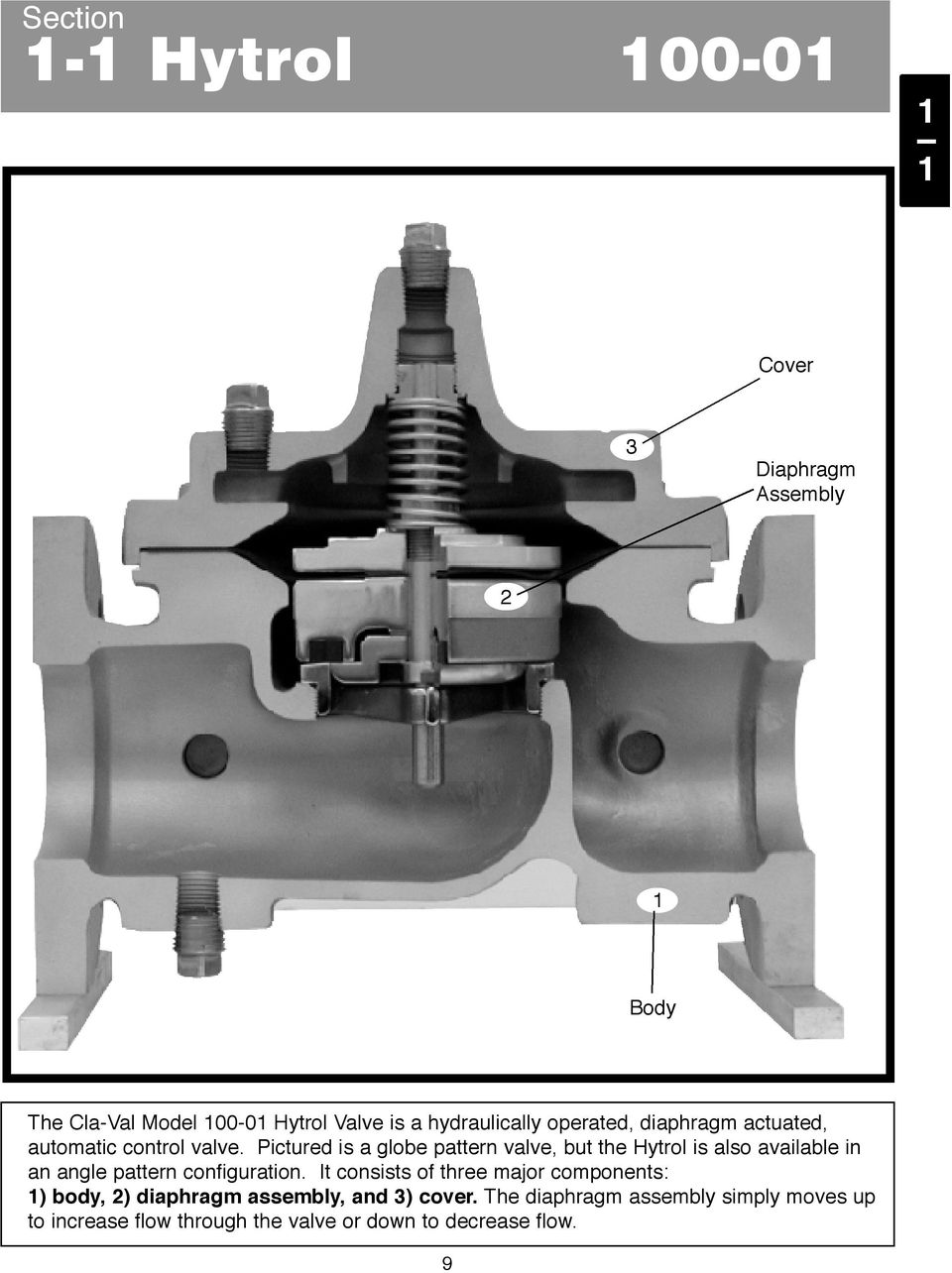
9 Section - Hytrol 00-0 Cover 3 Diaphragm Assembly 2 Body The Cla-Val Model 00-0 Hytrol Valve is a hydraulically operated, diaphragm actuated, automatic control valve. Pictured is a globe pattern valve, but the Hytrol is also available in an angle pattern configuration. It consists of three major components: ) body, 2) diaphragm assembly, and 3) cover. The diaphragm assembly simply moves up to increase flow through the valve or down to decrease flow. 9
10 0 0-0 Hytrol Valve 0

11 Principle of Operation 00-0 Closed Valve When pressure from the valve inlet is applied to the cover chamber, the valve closes drip-tight. FLOW Throttling Valve The valve holds any intermediate position when operating pressures are equal above and below the diaphragm. A Cla-Val Modulating Pilot Control will allow the valve to automatically compensate for line pressure changes. FLOW Open Valve When pressure in the cover chamber is relieved to a zone of lower pressure, the line pressure at the valve inlet opens the valve, allowing full flow. FLOW

12 Hytrol 00-0 A Hydraulic actuator is built into every Hytrol. A diaphragm isolates the control or cover chamber. Putting high pressure into the cover chamber closes the valve while relieving pressure from the cover chamber opens the valve. The term diaphragm actuated globe valve is also used to describe a Hytrol. Water is typically the fluid that powers the valve open or closed and that is why the term hydraulically operated is also used to refer to the Hytrol. The term Automatic Control Valve is also used to describe most of Cla-Val s product lines. In most cases when piloted the Cla-Val Hytrol becomes a fully automatic self-contained valve. There is no need for operator input to tell the valve how to respond. Operating Principle The operating principle for both the globe and angle pattern valves is exactly the same. When no pressure is in the valve, the spring and the weight of the diaphragm assembly hold the valve closed. When placed in the pipeline and pressure is applied to valve inlet and with the cover vented to atmosphere or downstream the valve opens. If inlet pressure is piped into the cover chamber, the valve closes tightly. Example: In a valve with an effective diaphragm area of 0 square inches, and a line pressure of 00 pounds per square inch; with the cover vented to atmosphere, there would be 0 X 00 or 000 pounds tending to open the valve. When the 00 pounds per square inch is piped into the cover chamber, the closing force would be 0 X00 or 000 pounds tending to close the valve. In this particular valve the seat area would be 6 square inches. Since the 00 pounds per square inch is acting upward across this area, there would be 6 X 00 or 600 pounds tending to open the valve. The difference between 000 and 600 or 400 pounds would be the force pushing the rubber disc against the seat to cause the valve to close tightly. 2

13 Hytrol 00-0 Diaphragm Actuation The operation of the Hytrol Valve is called "diaphragm actuation of a globe valve." This simply means that pressure acting across the surface of the diaphragm results in a force which causes the valve either to open or to close depending on which direction the pressure is acting. When the pressure is acting downward in the cover chamber, the valve closes. When the pressure is relieved from the cover chamber, and line pressure is then acting upward the valve opens. Advantages of the Globe valve design The globe valve design offers many advantages over other designs. Piston style valves, ball valves, butterfly valves, plug valves, and gate valves are sometimes considered for some of the same applications. Drip tight shut off The Hytrol modified globe design automatically compensates for wear on the rubber disc. The closing force of the diaphragm operation presses the disc tightly against the seat at low and high pressure differentials. The closing force is greater than the opening force, which is opening the valve. Most other valves designs do not have the same mechanical advantage. 3
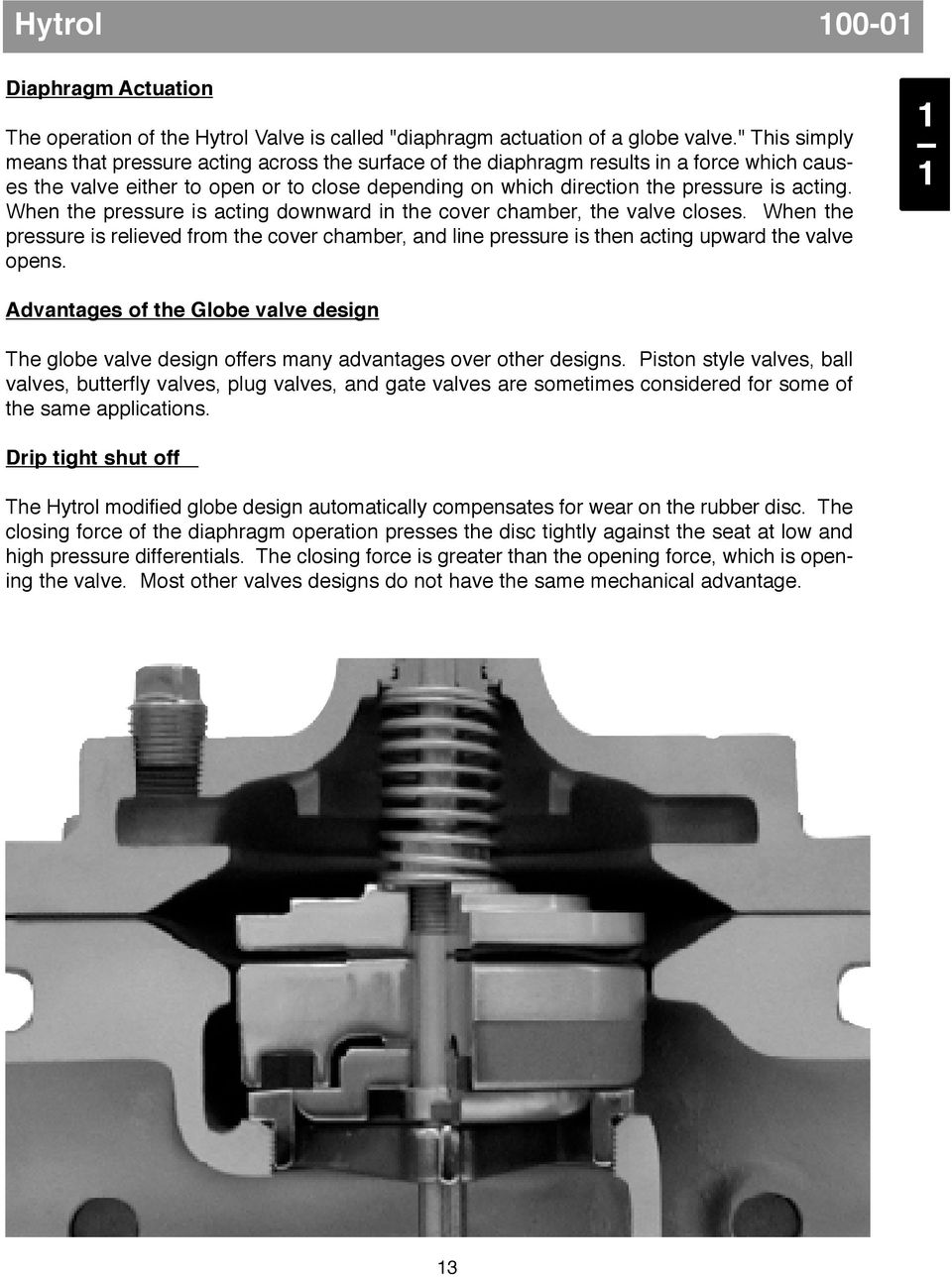
14 Hytrol 00-0 Normally Open Valve The Hytrol Valve is considered "normally open" because the line pressure opens it when operating pressure is released from the diaphragm. The Hytrol Valve will then close when operating pressure is applied above the diaphragm. Normal Flow The direction of the flow through most Cla-Val Hytrols is against the valve disc during the closing stroke. This direction is called "normal flow", or it is also termed "flow-under-the-disc." This has the advantage of cushioning the closing, thereby helping to prevent any closing shock. Bridge wall indicator cast into valve body. Bridge wall indicator cast into valve body. N o r m a l F l o w R e v e r s e F l o w Reverse Flow When the Cla-Val Hytrol valve is turned around so the flow is "over-the-disc" it is said to be installed in "reverse flow." This direction of flow is used when specifications require a valve to close when a diaphragm wears out. Most types of fueling valves must meet this requirement, and are installed in reverse flow. 4

15 Hytrol 00-0 Pilot Operation All that is required to make the valve open or close is to arrange some kind of pilot control system to apply pressure to the cover when the valve needs to close, or relieve that pressure when the valve needs to open. Such a system is called a "pilot control system". The use of such a system to control the Cla-Val hytrol valves gives rise to the term "pilot operated" because the valve depends upon some form of pilot control system to make it work. Later chapters will focus on the details of pilot control, both how and why they work. No Packing Glands The Cla-Val hytrol has no packing glands, consequently no leakage problem. The diaphragm actuator is an integral part of the valve and there is no packing gland friction so there is very little drag or hysteresis, which can mean better control. Breakaway Friction The Cla-Val hytrol globe style valve has virtually no break-away friction which could cause it to jump off of the seat. When water is relieved from the cover chamber the valve opens very smoothly. The other types of valves have high friction forces to overcome to break the valve away from the seat, resulting in higher actuating forces to get the valve open. External Linkage The Cla-Val hytrol requires no external linkages. Fluid pressure is the operating medium and simple but reliable pilot controls are used. Other types of valves require wiring for the electric actuator or sometimes an the entire hydraulic oil system for an external actuator. 5

16 Valve Capacity 00-0 The flow capacity of a control valve is usually expressed in terms of the valves Cv. Cv is the amount of water in gallons that will pass through a given valve in one minute with a psi pressure drop. Cv values are established by flow testing the valve. So a 3" Cla-Val hytrol has a Cv of 5 will pass 5 gallons per minute with a psi pressure drop. The following chart shows both the Cv and the K factor data for each valve Functional Data Model 00-0 *Estimated Valve Size C V Factor Equivalent Length of Pipe K Factor Globe Pattern Angle Pattern Globe Pattern Angle Pattern Liquid Displaced from Cover Chamber When Valve Opens Inches mm Gal./Min. (gpm.) Litres/Sec. (l/s.) Gal./Min. (gpm.) * 3060* 4200* Litres/Sec. (l/s.) Feet (ft.) Meters (m.) Feet (ft.) * 238* 247* Meters (m.) Globe Pattern Angle Pattern Fl. Oz U.S. Gal ml Litres Volume Of Water Displaced The above chart also shows the volume of water displaced as the valve goes from the closed position to full open. Each time the valve cycles the fixed volume of water will be expelled thru the pilot system from the cover chamber to atmosphere. This information may be useful for various applications. 6

17 Flow Charts 00-0 The head loss that could be anticipated across a wide-open valve is charted for a 6" valve. While the following chart looks much more complicated it is read the same way. 7

18 Hytrol Options 00-0 Low Temperature Diaphragm - suffix KA This single ply diaphragm uses Buna-N Synthetic Rubber, formulated for low temperature applications to -65 F. Operating pressures in excess of 25 psi are not recommended. Vi t o n Rubber Parts - suffix KB Optional diaphragm, disc and O-ring fabricated with Vi t o n (fluorocarbon) synthetic rubber. Vi t o n is well suited for use with mineral acids, salt solutions, chlorinated hydrocarbons, and petroleum oils; and is primarily used in high temperature applications up to 250 F. Do not use with epoxy coatings above 75 F. Epoxy Coating - suffix KC A F D A and NSF-6 approved fusion bonded epoxy coating for use with cast iron, ductile iron or steel valves. This coating is resistant to various water conditions, certain acids, chemicals, solvents and alkalies. Epoxy coatings are applied in accordance with AW WA coating specifications C Do not use with temperatures above 75 F. Dura-Kleen Self-cleaning Stem suffix KD (Can replace standard stem) The Dura-Kleen stem is designed to protect the valve from deposits that build up on a normal stem. The Dura-Kleen stem is recommended for valve in continuous operation were differential pressures are greater than 20 psid (2" and larger sizes). D e l r i n Sleeved Stem - suffix KG (Can replace standard stem) The Delrin sleeved stem is designed for applications where water supplies contain dissolved minerals which can form deposits that build up on the valve stem and hamper valve operation. Scale buildup will not adhere to the Delrin sleeve stem. Delrin sleeved stems are not recommended for valves in continuous operation where differential pressures are in excess of 80 psid (2" and larger s i z e s ). Heavy Spring - suffix KH The heavy spring option is used in applications where there is low differential pressure across the valve, and the additional spring force is needed to help the valve close. This option is best suited for valves used in on-off (non-modulating) service. Anti-Cavitation Tr i m - suffix KO Anti-Cavitation Trim components consist of a stainless steel radial slotted disc guide and seat. This system is used when high differentials are present across the valve. Water Treatment Clearance - suffix KW This additional clearance option is beneficial in applications where water treatment compounds can interfere with the closing of the valve. The smaller outside diameter disc guide provides more clearance between the disc guide and the valve seat. This option is best suited for valves used in on-off (non-modulating) service. 8
19 Material of Construction 00-0 The Hytrol is available in many different alloys for various applications. Currently the Cla-Val foundry pours 45 different alloys. Below are the more common materials that are available. Materials Components Body & Cover Available Sizes Disc Retainer & Diaphragm Washer Trim: Disc Guide, Seat & Cover Bearing Disc Diaphragm Stem, Nut & Spring Ductile Iron Cast Steel Bronze Stainless Steel Aluminum " - 36" /2" - 24" 3/8" - 6" /2" - 6" /2" - 6", 24" Cast Iron Cast Steel Bronze Stainless Steel Aluminum Bronze is Standard Stainless Steel is optional. Buna-N Rubber Nylon Reinforced Buna-N Rubber Stainless Steel Optional Material Stainless Steel is standard. BRONZE (RED BRASS) VALVE BRONZE (U.S.N.) MONEL ALUMINUM CAST IRON CAST IRON DUCTILE IRON CAST STEEL CAST STEEL (U.S.N.) 303 STAINLESS STEEL 36 STAINLESS STEEL CAST IRON 420 STAINLESS STEEL MANGANESE BRONZE G BRONZE VALVE BRONZE (COMM) 304 STAINLESS STEEL OUNCE METAL 40 STAINLESS STEEL CAST STEEL LEADED SEMI-RED BRASS DUCTILE IRON ALUMINUM (DIE CASTING) DUCTILE IRON DUCTILE IRON INCONEL 7-4PH STAINLESS STEEL ALUMINUM 303 STAINLESS STEEL ALUMINUM DUCTILE IRON CAST IRON CAST STEEL ALUMINUM BRONZE CAST STEEL COPPER-NICKEL CAST STEEL 304L STAINLESS STEEL SUPER DUPLEX S. STEEL 36L STAINLESS STEEL SUPER AUSTENITIC STAINLESS STEEL R MONEL DUPLEX S. STEEL ASTM B62 MIL-B-654 QQ-N-288 COMP B A356-T6/ASTM B26 ASTM A48 CL 30 (3" AND SMALLER) ASTM A48 CL 40 (4" AND LARGER) ASTM A ASTM A26 GR WCB MIL-S CL B ASTM A743-CF-6FA ASTM A743-CF-8M ASTM A26 CL B ASTM A743-CA40 MIL-B-6522 CL ASTM B584 ALLOY C90500 ASTM B6 ASTM A743-CF-8 ASTM QQ-C-390 ALLOY B5 ASTM A352 GRADE LC3 ASTM A352 GRADE LC3 CLASS 23 ASTM A QQ-A-59 ALLOY NO. 380 MIL-C ASTM A ASTM A494 ALLOY CY40 7-4PH PER AMS 5355 (INVESTMENT CAST) A356T6 (INVESTMENT CAST) ASTM A743-CF-6F (TUV ONLY) A356-T6/ASTM B26 (TUV ONLY) ASTM A (TUV ONLY) ASTM A48 CL40 (4" & LARGER) ASTM A26 GR WCB (TUV ONLY) ASTM B48 ALLOY C95800 ASTM A27 (60-30) B369 ALLOY C96400 ASTM A352 LCB ASTM A-743-GR-CF3 UNS S3254 ASTM A-743-GR-CF3M UNS J93404 (ASTM A890 GR. 5A) ASTM A494 M3OC UNS S

20 End Connections 00-0 The Hytrol is available in either the standard globe pattern or an angle pattern. Only the valve body is different, everything else is identical. The Angle pattern valve is typically used as a piping preference. Many times it is more convenient to use the angle pattern. The angle pattern valve is less restricted than the globe pattern valve so it has a lower head loss across it, which means that in most applications it will flow more with less pressure drop. Screwed Ends - Globe Flanged Ends - Globe Flanged Ends - Angle Grooved Ends Pattern Globe Angle Screwed 3/8" - 3" /2" - 3" Flanged /2" - 36" 2" - 6" Grooved End /2" - 6" 2" - 4" Both the standard globe pattern Hytrol valve and the angle pattern Hytrol are available in screwed, 50#, or 300# end connections. Screwed valve end connections are the most economical and the lightest weight. The screwed end connection valves are rated to 400 psi. The Ductile Iron Hytrol with 50# flanges is rated for a maximum operating pressure of 250 psi, while the Ductile Iron 300# flanged Hytrol is rated for 400 psi maximum operating pressure. Pressure Ratings (Recommended Maximum Pressure - psi) Valve Body & Cover Flanged Pressure Class ANSI Grade Material Standards* 50 lb. 300 lb. Threaded End** Details Grooved End ASTM A536 Ductile Iron B ASTM A26-WCB Cast Steel B ASTM B62 Bronze B ASTM A743 Stainless Steel B A356-T6 Aluminum B Note: *ANSI standards are for flange dimensions only. Flanged valves are available faced but not drilled. **End Details machined to ANSI B2. specifications. 20

21 Dimensions 00-0 Dimensions Model 00-0 *40mm Size Only 00-0 (Globe) 00-0 (Angle) 00-0 Grooved (Globe) 00-0 Grooved (Angle) Valve Size (Inches) A Threaded AA 50 ANSI 8.50* AAA 300 ANSI 9.00* AAAA Grooved End B Dia C Max CC Max. Grooved End D Threaded DD 50 ANSI 4.00* DDD 300 ANSI 4.25* DDDD Grooved End E EE Grooved End F 50 ANSI FF 300 ANSI G Threaded GG 50 ANSI 4.00* GGG 300 ANSI 4.25* GGGG Grooved End H NPT Body Tapping J NPT Cover Center Plug K NPT Cover Tapping Valve Stem Internal Thread UNF Stem Travel Approx. Ship Wt. Lbs Cla-Val Control Valves operate with maximum efficiency when mounted in horizontal piping with the main valve cover UP, however, other positions are acceptable. Due to c omponent size and weight of 8 inch and larger valves, installation with cover UP is advisable. We recommend isolation valves be installed on inlet and outlet for maintenance. Adequate space above and around the valve for service personnel should be considered essential. A regular maintenance program should be established based on the specific application data. However, we recommend a thorough inspection be done at least once a year. Consult factory for specific recommendations. 2 * 2 " Size Only Valve Size (mm) A Threaded AA 50 ANSI 26* AAA 300 ANSI 229* AAAA Grooved End B Dia C Max CC Max. Grooved End D Threaded DD 50 ANSI 02* DDD 300 ANSI 08* DDDD Grooved End E EE Grooved End F 50 ANSI FF 300 ANSI G Threaded GG 50 ANSI 02* GGG 300 ANSI 02* GGGG Grooved End H NPT Body Tapping J NPT Cover Center Plug K NPT Cover Tapping Valve Stem Internal Thread UNF Stem Travel Approx. Ship Wt. Kgs
22 INSTALLATION / OPERATION / MAINTENANCE 00-0 M O D E L Hytrol Valve Description The CIa-VaI Model 00-0 Hytrol Valve is a main valve for CIa-VaI Automatic Control Valves. It is a hydraulically operated, diaphragm-actuated, globe or angle pattern valve. This valve consists of three major components; body, diaphragm assembly, and cover. The diaphragm assembly is the only moving part. The diaphragm assembly uses a diaphragm of nylon fabric bonded with synthetic rubber. A synthetic rubber disc, contained on three and one half sides by a disc retainer and disc guide, forms a seal with the valve seat when pressure is applied above the diaphragm. The diaphragm assembly forms a sealed chamber in the upper portion of the valve, separating operating pressure from line pressure. Installation. Before valve is installed, pipe lines should be flushed of all chips, scale and foreign matter. 2. It is recommended that either gate or block valves be installed on both ends of the 00-0 Hytrol Valve to facilitate isoiating the valve for preventive maintenance and repairs. 3. Place the valve in the line with flow through the valve in the direction indicated on the inlet nameplate (See Flow Direction Section). 4. Allow sufficient room around valve to make adjustments and for disassembly. 5. CIa- VaI 00-0 Hytrol Valves operate with maximum e ff i c i en c y when mounted in horizontal piping with the cover UP, h o w ever, other positions are acceptable. Due to size and weight of the cover and internal components of 8 inch and πlarger valves, installation with the cover UP is advisable. This makes internal parts readily accessible for periodic inspection. 6. If a pilot control system is installed on the 00-0 Hytrol Valve, use care to prevent damage. If it is necessary to remove fittings or components, be sure they are kept clean and replaced exactly as they were. 7. After the valve is installed and the system is first pressurized, vent air from the cover chamber and pilot system tubing by loosening fittings at all high points. Principles of Operation Three Way Pilot Control Three Way Pilot Control Restriction Modulating Control Tight Closing Operation When pressure from the valve inlet (or an equivalent independent operating pressure) is applied to the diaphragm chamber the valve closes drip-tight. Full Open Operation When pressure in diaphragm chamber is relieved to a zone of lower pressure (usually atmosphere) the line pressure (5 psi Min.) at the valve inlet opens the valve. Modulating Action Valve modulates when diaphragm pressure is held at an intermediate point between inlet and discharge pressure. With the use of a Cla-Val. "modulating control," which reacts to line pressure changes, the pressure above the diaphragm is varied, allowing the valve to throttle and compensate for the change. 22
23 Flow Direction The flow through the 00-0 Hytrol Valve can be in one of two directions. When flow is up-and-over the seat, it is in normal flow and the valve will fail in the open position. When flow is overthe seat-and down, it is in reverse flow and the valve will fail in the closed position. There are no permanent flow arrow markings. The valve must be installed according to nameplate data. Normal Flow BRIDGEWALL INDICATOR (cast into side of valve body) Reverse Flow Recommended Tools. Three pressure gauges with ranges suitable to the installation to be put at Hytrol inlet, outlet and cover connections. 2. Cla-Val Model X0 Valve Position Indicator. This provides visual indication of valve position without disassembly of valve. 3. Other items are: suitable hand tools such as screwdrivers, wrenches, etc. soft jawed (brass or aluminum) vise, 400 grit wet or dry sandpaper and water for cleaning. Troubleshooting The following troubleshooting information deals strictly with the Model 00-0 Hytrol Valve. This assumes that all other components of the pilot control system have been checked out and are in proper working condition (See appropriate sections in Technical Manual for complete valve). All trouble shooting is possible without removing the valve from the line or removing the cover. It is highly recommended to permanently install a Model X0 Valve Position Indicator and three gauges in unused Hytrol inlet, outlet and cover connections. SYMPTOM PROBABLE CAUSE REMEDY Fails to Close Fails to Open Closed isolation valves in control system, or in main line. Lack of cover chamber pressure. Diaphragm damaged (See Diaphragm Check). Diaphragm assembly inoperative. Corrosion or excessive scale build up on valve stem (See Freedom of Movement Check). Mechanical obstruction. Object lodged in valve. (See Freedom of Movement Check) Worn disc (See Tight Sealing Check). Badly scored seat (See Tight Sealing Check). Closed upstream and/or downstream isolation valves in main line. Insufficient line pressure. Open Isolation valves. Check upstream pressure, pilot system, strainer, tubing, isolation valves, or needle valves for obstruction. Replace diaphragm. Clean and polish stem. Inspect and replace any damaged or badly eroded part. Remove obstruction. Replace disc. Replace seat. Open valves. Check upstream pressure (Minimum 5 psi flowing line pressure differential). Diaphragm assembly inoperative. Corrosion or excessive buildup on valve stem (See Freedom of Movement Check). Diaphragm damaged (For valves in "reverse flow" only). Clean and polish stem. Inspect and replace any damaged or badly eroded part. Replace diaphragm. After checking out probable causes and remedies, the following three checks can be used to diagnose the nature of the problem before maintenance is started. They must be done in the order shown. Three Checks The 00-0 Hytrol Valve has only one moving part (the diaphragm and disc assembly). So, there are only three major types of problems to be considered. First: Valve is stuck - that is, the diaphragm assembly is not free to move through a full stroke either from open to close or vice versa. Second: Valve is free to move and can t close because of a worn out diaphragm. Third: Valve leaks even though it is free to move and the diaphragm isn t leaking. CAUTION: Care should be taken when doing the trouble shooting checks on the 00-0 Hytrol Valve. These checks do require the valve to open fully. This will either allow a high flow rate through the valve, or the downstream pressure will quickly increase to the inlet pressure. In some cases, this can be very harmful. Where this is the case, and there are no block valves in the sys - tem to protect the downstream piping, it should be realized that the valve cannot be serviced under pressure. Steps should be taken to remedy this situation before proceeding any further. 23
24 Diaphragm Check (# ). Shut off pressure to the Hytrol Valve by slowly closing upstream and downstream isolation valves. SEE CAUTION. 2. Disconnect or close all pilot control lines to the valve cover and leave only one fitting in highest point of cover open to atmosphere. 3.With the cover vented to atmosphere, slowly open upstream isolation valve to allow some pressure into the Hytrol Valve body. Observe the open cover tapping for signs of continuous flow. It is not necessary to fully open isolating valve. Volume in cover chamber capacity chart will be displaced as valve moves to open position. Allow sufficient time for diaphragm assembly to shift positions. If there is no continuous flow, you can be quite certain the diaphragm is sound and the diaphragm assembly is tight. If the fluid appears to flow continuously this is a good reason to believe the diaphragm is either damaged or it is loose on the stem. In either case, this is sufficient cause to remove the valve cover and investigate the leakage. (See Maintenance Section for procedure.) COVER CHAMBER CAPACITY (Liquid Volume displaced when valve opens) Valve size (inches) Displacement Gallons Liters / / / Freedom of Movement Check (#2) 4. Determining the Hytrol Valve s freedom of movement can be done by one of two methods. 5. For most valves it can be done after completing Diaphragm Check (Steps, 2, and 3). SEE CAUTION. At the end of step 3 the valve should be fully open. 6. If the valve has a Cla-Val X0 Position Indicator, observe the indicator to see that the valve opens wide. Mark the point of maximum opening. 7. Re-connect enough of the control system to permit the application of inlet pressure to the cover. Open pilot system isolation valve so pressure flows from the inlet into the cover. 8. While pressure is building up in the cover, the valve should close smoothly. There is a hesitation in every Hytrol Valve closure, which can be mistaken for a mechanical bind. The stem will appear to stop moving very briefly before going to the closed position. This slight pause is caused by the diaphragm flexing at a particular point in the valve s travel and is not caused by a mechanical bind. 9. When closed, a mark should be made on the X0 Valve position indicator corresponding to the closed position. The distance between the two marks should be approximately the stem travel shown in chart. STEM TRAVEL (Fully Open to Fully Closed) Valve Size (inches) Travel (inches) Inches MM Inches MM / / / If the stroke is different than that shown in stem travel chart this is a good reason to believe something is mechanically restricting the stroke of the valve at one end of its travel. If the flow does not stop through the valve when in the indicated closed position, the obstruction probably is between the disc and the seat. If the flow does stop, then the obstruction is more likely in the cover. In either case, the cover must be removed, and the obstruction located and removed. The stem should also be checked for scale buildup. (See Maintenance, section for procedure.). For valves 6 and smaller, the Hytrol Valve s freedom of movement check can also be done after all pressure is removed from the valve. SEE CAUTION. After closing inlet and outlet isolation valve and bleeding pressure from the valve, check that the cover chamber and the body are temporarily vented to atmosphere. Insert fabricated tool into threaded hole in top of valve stem, and lift the diaphragm assembly manually. Note any roughness. The diaphragm assembly should move smoothly throughout entire valve stroke. The tool is fabricated from rod that is threaded on one end to fit valve stem and has a T bar handle of some kind on the other end for easy gripping. (See chart in Step 4 of Disassembly Section.) 2. Place marks on this diaphragm assembly lifting tool when the valve is closed and when manually positioned open. The distance between the two marks should be approximately the stem travel shown in stem travel chart. If the stroke is different than that shown, there is a good reason to believe something is mechanically restricting the stroke of the valve. The cover must be removed, and the obstruction located and removed. The stem should also be checked for scale build-up. (See Maintenance Section for procedure.) Tight Sealing Check (#3) 3. Test for seat leakage after completing checks # & #2 (Steps to 2). SEE CAUTION. Close the isolation valve downstream of the Hytrol Valve. Apply inlet pressure to the cover of the valve, wait until it closes. Install a pressure gauge between the two closed valves using one of the two ports in the outlet side of the Hytrol. Watch the pressure gauge. If the pressure begins to climb, then either the downstream isolation valve is permitting pressure to creep back, or the Hytrol is allowing pressure to go through it. Usually the pressure at the Hytrol inlet will be higher than on the isolation valve discharge, so if the pressure goes up to the inlet pressure, you can be sure the Hytrol is leaking. Install another gauge downstream of isolating valve. If the pressure between the valves only goes up to the pressure on the isolation valve discharge, the Hytrol Valve is holding tight, and it was just the isolation valve leaking. 24
25 Maintenance Preventative Maintenance The Cla-Val Co. Model 00-0 Hytrol Valve requires no lubrication or packing and a minimum of maintenance. However, a periodic inspection schedule should be established to determine how the operating conditions of the system are affecting the valve. The effect of these actions must be determined by inspection. Disassembly Inspection or maintenance can be accomplished without removing the valve from the line. Repair kits with new diaphragm and disc are recommended to be on hand before work begins. WARNING: Maintenance personnel can be injured and equipment damaged if disassembly is attempted with pressure in the valve. SEE CAUTION.. Close upstream and downstream isolation valves and independent operating pressure when used to shut off all pressure to the valve. 2. Loosen tube fittings in the pilot system to remove pressure from valve body and cover chamber. After pressure has been released from the valve, use care to remove the controls and tubing. Note and sketch position of tubing and controls for re-assembly. The schematic in front of the Technical Manual can be used as a guide when reassembling pilot system. 3. Remove cover nuts and remove cover. If the valve has been in service for any length of time, chances are the cover will have to be loosened by driving upward along the edge of the cover with a dull cold chisel. On 6 and smaller valves block and tackle or a power hoist can be used to lift valve cover by inserting proper size eye bolt in place of the center cover plug. on 8 and larger valves there are 4 holes (5/8 size) where jacking screws and/or eye bolts may be inserted for lifting purposes. Pull cover straight up to keep from damaging the integral seat bearing and stem. COVER CENTER PLUG SIZE Valve Size Thread Size (NPT) /4" /2" /4" 2" 3" /2" 4" 6" 3/4" 8" 0" " 2" /4" 4" /2" 6" 2" 24" 2" Remove the diaphragm and disc assembly from the valve body. With smaller valves this can be accomplished by hand by pulling straight up on the stem so as not to damage the seat bearing. On large valves, an eye bolt of proper size can be installed in the stem and the diaphragm assembly can be then lifted with a block and tackle or power hoist. Take care not to damage the stem or bearings. The valve won't work if these are damaged. VALVE STEM THREAD SIZE Valve Size Thread Size (UNF Internal) /4" 2 /2" " 4" /4 28 6" 4" 3/8 24 6" / " 3/4-6 36" 3/ The next item to remove is the stem nut. Examine the stem threads above the nut for signs of mineral deposits or corrosion. If the threads are not clean, use a wire brush to remove as much of the residue as possible. Attach a good fitting wrench to the nut and give it a sharp rap rather than a steady pull. Usually several blows are sufficient to loosen the nut for further removal. On the smaller valves, the entire diaphragm assembly can be held by the stem in a vise equipped with soft brass jaws before removing the stem nut. The use of a pipe wrench or a vise without soft brass jaws scars the fine finish on the stem. No amount of careful dressing can restore the stem to its original condition. Damage to the finish of the stem can cause the stem to bind in the bearings and the valve will not open or close. 6. After the stem nut has been removed, the diaphragm assembly breaks down into its component parts. Removal of the disc from the disc retainer can be a problem if the valve has been in service for a long time. Using two screwdrivers inserted along the outside edge of the disc usually will accomplish its removal. Care should be taken to preserve the spacer washers in water, particularly if no new ones are available for re-assembly. 7. The only part left in the valve body is the seat which ordinarily does not require removal. Careful cleaning and polishing of inside and outside surfaces with 400 wet/dry sandpaper will usually restore the seat s sharp edge. If, however, it is badly worn and replacement is necessary, it can be easily removed. Seats in valve sizes /4 through 6 are threaded into the valve body. They can be removed with accessory X09 Seat Removing Tool available from the factory. On 8 and larger valves, the seat is held in place by flat head machine screws. Use a tight-fitting, long shank screwdriver to prevent damage to seat screws. If upon removal of the screws the seat cannot be lifted out, it will be necessary to use a piece of angle or channel iron with a hole drilled in the center. Place it across the body so a long stud can be inserted through the center hole in the seat and the hole in the angle iron. By tightening the nut a uniform upward force is exerted on the seat for removal. NOTE: Do not lift up on the end of the angle iron as this may force the integral bearing out of alignment, causing the stem to bind. 25
26 Lime Deposits One of the easiest ways to remove lime deposits from the valve stem or other metal parts is to dip them in a 5-percent muramic acid solution just long enough for the deposit to dissolve. This will remove most of the common types of deposits. CAUTlON: USE EXTREME CARE WHEN HANDLING ACID. Rinse parts in water before handling. If the deposit is not removed by acid, then a fine grit (400) wet or dry sandpaper can be used with water. Inspection of Parts After the valve has been disassembled, each part should be examined carefully for signs of wear, corrosion, or any other abnormal condition. Usually, it is a good idea to replace the rubber parts (diaphragm and disc) unless they are free of signs of wear. These are available in a repair kit. Any other parts which appear doubtful should be replaced. WHEN ORDERING PARTS, BE SURE TO GIVE COMPLETE NAMEPLATE DATA, ITEM NUMBER AND DESCRIPTION. NOTE: If a new disc isn t available, the existing disc can be turned over, exposing the unused surface for contact with the seat. The disc should be replaced as soon as practical. Reassembly. Reassembly is the reverse of the disassembly procedure. If a new disc has been installed, it may require a different number of spacer washers to obtain the right amount of grip on the disc. When the diaphragm assembly has been tightened to a point where the diaphragm cannot be twisted, the disc should be compressed very slightly by the disc guide. Excessive compression should be avoided. Use just enough spacer washers to hold the disc firmly without noticeable compression. 2. MAKE SURE THE STEM NUT IS VERY TIGHT. Attach a good fitting wrench to the nut and give it a sharp rap rather than a steady pull. Usually several blows are sufficient to tighten the stem nut for final tightening. Failure to do so could allow the diaphragm to pull loose and tear when subjected to pressure. 3. Carefully install the diaphragm assembly by lowering the stem through the seat bearing. Take care not to damage the stem or bearing. Line up the diaphragm holes with the stud or bolt holes on the body. on larger valves with studs, it may be necessary to hold the diaphragm assembly up part way while putting the diaphragm over the studs. 4. Put spring in place and replace cover. Make sure diaphragm is Iying smooth under the cover. 5. Tighten cover nuts firmly using a cross-over pattern until all nuts are tight. 6. Test Hytrol Valve before re-installing pilot valve system. Test Procedure After Valve Assembly There are a few simple tests which can be made in the field to make sure the Hytrol Valve has been assembled properly. Do these before installing pilot system and returning valve to service. These are similar to the three troubleshooting tests.. Check the diaphragm assembly for freedom of movement after all pressure is removed from the valve. SEE CAUTlON. Insert fabricated tool into threaded hole in top of valve stem, and lift the diaphragm assembly manually. Note any roughness, sticking or grabbing. The diaphragm assembly should move smoothly throughout entire valve stroke. The tool is fabricated from rod that is threaded on one end to fit valve stem (See chart in Step 4 of Disassembly section.) and has a T Bar handle of some kind on the other end for easy gripping. Place marks on this diaphragm assembly lifting tool when the valve is closed and when manually positioned open. The distance between the two marks should be approximately the stem travel shown in stem travel chart (See Freedom of Movement Check section). If the stroke is different than that shown, there is a good reason to believe something is mechanically restricting the stroke of the valve. The cover must be removed, the obstruction located and removed (See Maintenance Section for procedure). Due to the weight of the diaphragm assembly this procedure is not possible on valves 8 and larger. on these valves, the same determination can be made by carefully introducing a low pressure-less than five psi) into the valve body with the cover vented. SEE CAUTION. Looking in cover center hole see the diaphragm assembly lift easily without hesitation, and then settle back easily when the pressure is removed. 2. To check the valve for drip-tight closure, a line should be connected from the inlet to the cover, and pressure applied at the inlet of the valve. If properly assembled, the valve should hold tight with as low as ten PSI at the inlet. See Tight Sealing Check section.) 3. With the line connected from the inlet to the cover, apply full working pressure to the inlet. Check all around the cover for any leaks. Re-tighten cover nuts if necessary to stop leaks past the diaphragm. 4. Remove pressure, then re-install the pilot system and tubing exactly as it was prior to removal. Bleed air from all high points. 5. Follow steps under Start-Up and Adjustment Section in Technical Manual for returning complete valve back to service. 26
27 TOP VIEW 4 PARTS LIST Item Description. Pipe Plug 2. Drive Screws (for nameplate) 3. Hex Nut (8 and larger) 4. Stud (8 and larger) 5. Cover Bearing 6. Cover 7. Stem Nut 8. Diaphragm Washer 9. Diaphragm 0. Spacer Washers. Disc Guide 2. Disc Retainer 3. Disc 4. Stem 5. Seat 6. Body 7. Spring 22. Flat Head Screws (8" and larger) 23. Seat O-Ring 24. Hex head Bolt ( /4" thru 6") 25. Nameplate 26. Upper Spring Washer (Epoxy coated valves only) 27. Lower Spring Washer (Epoxy coated valves only) 28. Cover Bearing Housing (6" only) 29. Cover O-Ring (6 " only) 30. Hex Bolt (6" only) 3. Pipe Cap (6" only) /4" - 6" SEAT DETAIL 8" - 6" SEAT DETAIL 6" COVER DETAIL 27 N-00-0 (R-5/05)
28 28
29 Section -2 Hytrol 00-0KO Powertrol ANTI-CAVITATION The Cla-Val Model 00-0KO Anti-Cavitation Hytrol Valve is designed for applications where there is a high potential for damage from cavitation. Specify this valve series for a wide variety of control valve applications having pressure differentials up to 300 PSID or for relief valves having atmospheric discharge up to 50 PSID. The 00-0KO Hytrol main valve provides optimum internal pressure control through a unique anti-cavitation trim (patent-pending) design. Constructed of 36 Stainless Steel, the seat and disc guide trim components feature dual interlocked sleeves containing radial slots that deflect internal flow to impinge upon itself in the center of the flow path, harmlessly dissipating the potential cavitation damage. This unique design also lessens the possibility of fouling if large particles in the water are present due to the large flow path of the radial slots. The 00-0KO Hytrol is the basic valve used in Cla-Val Automatic Control Valves for high differential applications requiring remote control, pressure regulation, solenoid operation, rate of flow control, or liquid level control. The Anti-Cavitation Trim components can be retrofitted to existing valves if the application indicates an appropriate need. Please see 00-0 maintenance instructions. 2 Cover Body 3 Diaphragm Assembly 2 4 Seat 00-0KO 29
30 0 0-0 K O A n t i - C a v i t a t i o n Hytrol Valve 30
31 Principle of Operation 00-0KO 2 Closed Valve When pressure from the valve inlet is applied to the cover chamber, the valve closes drip-tight. FLOW Throttling Valve The valve holds any intermediate position when operating pressures are equal above and below the diaphragm. A Cla- Val Modulating Pilot Control will allow the valve to automatically compensate for line pressure changes. FLOW Open Valve When pressure in the cover chamber is relieved to a zone of lower pressure, the line pressure at the valve inlet opens the valve, allowing full flow. FLOW 3
32 Specifications Pattern Globe Angle Grooved End Size 2" - 24" 2" - 6" 2" - 8" Pressure Ratings (Recommended Maximum Pressure - psi) Valve Body & Cover Grade Material Pressure Class Flanged ANSI End** 50 lb. 300 lb. Standards* Threaded Details ASTM A536 Ductile Iron B ASTM A26-WCB Cast Steel B ASTM B62 Bronze B Note: * ANSI standards are for flange dimensions only. Flanged valves are available faced but not drilled. ** End Details machined to ANSI B2. specifications. Operating Temp. Range Materials Fluids -40 to 80 F Component Model 00-0KO APPROVED (4" - 24") Standard Material Combinations Body & Cover Ductile Iron Cast Steel Bronze Available Sizes 2" - 24" 2" - 6" 2" 6" Disc Retainer & Diaphragm Washer Cast Iron Cast Steel Bronze Trim: Disc Guide, Seat & Cover Bearing Stainless Steel is Standard Disc Buna-N Rubber Diaphragm Nylon Reinforced Buna-N Rubber Stem, Nut & Spring Stainless Steel For material options not listed consult factory. Cla-Val manufactures valves in more than 50 different alloys (Globe) 00-0 (Angle) 00-0 Grooved (Globe) 00-0 Grooved (Angle) Valve Size (Inches) (mm) A Threaded A AA 50 ANSI AA AAA 300 ANSI AAA AAAA Grooved End AAAA B Dia B C Max C CC Max CC D Threaded D DD 50 ANSI DD DDD 300 ANSI DDD DDDD Grooved End DDDD E E EE Grooved End EE F 50 ANSI F FF 300 ANSI FF G Threaded G GG 50 ANSI GG GGG 300 ANSI GGG GGGG Grooved End GGGG H NPT Body Tapping H NPT Functional Data Note: Consult Factory on 0",2", 6" angle pattern J NPT Cover Center Plug J NPT K NPT Cover Tapping K NPT Valve Stem Internal Thread UNF Stem Thread Stem Travel StemTr Approx. Ship Wt. Lbs Wt.Kgs Cla-Val Control Valves with KO ANTI-CAVITATION Trim operate with maximum efficiency when mounted in horizontal piping with the main valve cover Up. We recommend isolation valves be installed on inlet and outlet for maintenance. Adequate space above and around the valve for service pe r s o n n e l should be considered essential. A regular maintenance program should be established based on the specific application data. However, we recommend a thorough inspection be done at least once a year. Consult factory for specific recommendations. Inches Valve Size mm C V Globe Gal./Min. (gpm.) Pattern Litres/Sec. (l/s.) Factor Angle Gal./Min. (gpm.) Pattern Litres/Sec. (l/s.) Equivalent Globe Feet (ft.) Pattern Meters (m.) Length of Pipe Angle Feet (ft.) Pattern Meters (m.) K Factor Globe Pattern Angle Pattern Liquid Displaced from Cover U.S. Gal Chamber When Valve Opens Litres For assistance in selecting appropriate valve options or valves manufactured with special design requirements, please contact our Regional Sales Office or Factory. 32 Model 00-0KO
33 Model 00-0KO Flow Chart 2 Notes: On Operating Differential. For atmospheric discharge, the maximum inlet pressure cannot exceed 50 psi. 2. For pressure differentials greater than 300 psi the maximum flow velocity should not exceed 8 ft/sec. 3. Flow velocities greater than 25 ft/sec are not recommended. 4. Recommended minimum flow velocity is ft/sec. 5. Consult factory for conditions exceeding these recommendations. 33
34 00-0KO Hytrol Main Valve with Anti-Cavitation Trim Purchase Specifications Function The valve shall be hydraulically operated, single diaphragm actuated, globe pattern. The valve shall consist of three major components: the body with seat installed, the cover with bearing installed, and the diaphragm assembly. The diaphragm assembly shall be the only moving part and shall form a sealed chamber in the upper portion of the valve, separating operating pressure from line pressure. Packing glands and/or stuffing boxes are not permitted and there shall be no pistons operating the main valve or pilot controls. Ductile Iron is standard, other materials shall be available. No fabrication or welding shall be used in the manufacturing process. Description The anti-cavitation features of the seat and disc guide detail shall have flow slots equally spaced around their perimeters. The seat slots shall be orientated around the perimeter of the seat so that fluid entering the valve shall flow through the seat slot detail such that the fluid flow converges in the center chamber of the seat allowing potential cavitation to dissipate. The disc guide slots shall be positioned around the perimeter of the disc guide, configured and oriented in an angular direction so that fluid flow exiting through the slots is diverted away from direct impact into pressure boundary surfaces. Flow exiting the disc guide slots is directed in an angular path to increase the distance between the slot geometry and pressure boundary surfaces. If cavitation conditions exist, the increased distance between the slots and pressure boundary surfaces minimizes the potential for damage by allowing the cavitation bubbles to dissipate before they come in contact with pressure boundary surfaces. A n t i - c a v- itation characteristics shall be controlled by the described slotted seat and disc guide components. The disc guide shall slide in the seat and allow controlled flow through the seat slots into the central seat chamber where flow shall continue from the seat chamber and exit through the angularly oriented slots of the disc guide. The seat and disc guide features used together shall provide anti-cavitation characteristics suitable for applications where a large controlled pressure drop is desired. The flexible, non-wicking, FDA approved diaphragm shall consist of nylon fabric bonded with synthetic rubber compatible with the operating fluid. The diaphragm must withstand a Mullins burst test of a minimum of 600 psi per layer of nylon fabric and shall be cycle tested 00,000 times to insure longevity. The diaphragm shall be fully supported in the valve body and cover by machined surfaces which support no less than one-half of the total surface area of the diaphragm in either the fully open or fully closed position. The valve seat in six inch and smaller size valves shall be threaded into the body. Valve seat in eight inch and larger size valves shall be retained by flat head machine screws for ease of maintenance. The seat shall be of the solid, one-piece design and shall have a minimum of a five degree taper on the seating surface for positive drip-tight shut-off. Pressed-in bearings and/or multi-piece seats shall not be permitted. To insure proper alignment of the valve stem, the valve body and cover shall be machined with a locating lip. No "pinned" covers to the valve body shall be permitted. All necessary repairs and/or modifications other than replacement of the main valve body shall be possible without removing the valve from the pipeline. The valve manufacturer shall warrant the valve to be free of defects in material and workmanship for a period of three years from date of shipment, provided the valve is installed and used in accordance with all applicable instructions. The valve manufacturer shall be able to supply a complete line of equipment from 4" through 48" sizes and a complete selection of complementary equipment. Material Specification Valve Size: Main Valve Body and Cover: Main Valve Trim: End Detail: Pressure Rating: Temperature Range: Coating: Desired Options: Application Information Inlet/Outlet Pressures: Flow Rate: Pipe Diameter: Function (i.e. - Pressure Reducing, Pressure Relief, etc.): This valve shall be a C l a - Val Model No. 00-0KO Hytrol Main Valve with Anti-Cavitation Trim as manufactured by Cla-Val, Newport Beach, CA Note: Add this Hytrol Anti-Cavitation Trim Purchase Specification to main valve specification for control valves where there is a high potential for cavitation damage. Please contact our Regional Sales Offices or Factory for assistance. The Anti-Cavitation Trim components can be retrofitted to existing Hytrol valves if the application indicates an appropriate need. Please consult factory for details. Represented By: E-00-0KO (R--07) 34
35 Section -3 Powertrol Powertrol The Cla-Val Model is a hydraulically operated, diaphragm actuated, globe, or angle pattern valve. It consists of four major components: body, intermediate chamber, diaphragm assembly, and cover. The diaphragm assembly is the only moving part. The diaphragm assembly which is guided top and center by a precision machined stem, utilizes a nonwicking diaphragm of nylon fabric bonded with synthetic rubber. The diaphragm forms a seal between the cover chamber and intermediate chamber. A synthetic rubber disc retained on 3 /2 sides forms a drip-tight seal with the seat when pressure is applied above the diaphragm. As pressure above the diaphragm is relieved and pressure is applied below the diaphragm, the valve opens wide for full flow. The rate of closing or opening can be controlled by modulating flow into or out of the diaphragm chambers. 3 The Model is recommended where independent operating pressure is desired. Available in various materials and in a full range of sizes, with either screwed or flanged ends, its applications are many and varied. Cover Power Unit Tapped Body
36 Principle of Operation Closed Valve When pressure below the diaphragm is relieved and operating pressure is applied to the cover chamber, the valve closes drip-tight. FLOW Throttling Valve The valve holds any intermediate position when operating pressure is equal above and below the diaphragm. A Cla-Val four-way pilot control with "lock" position can maintain this balance by stopping flow in the pilot control system. FLOW Open Valve When operating pressure below the diaphragm is applied and operating pressure is relieved from the cover chamber to atmosphere, the valve is held open, allowing full flow. FLOW 36
37 Valve Capacity The flow capacity of a control valve is usually expressed in terms of the valves Cv. Cv is the amount of water in gallons that will pass through a given valve in one minute with a psi pressure drop. Cv values are established by flow testing the valve. So a 3" Cla-Val hytrol has a Cv of 5 will pass 5 gallons per minute with a psi pressure drop. 3 The following chart shows both the Cv and the K factor data for each valve Functional Data Model *Estimated Valve Size C V Factor Equivalent Length of Pipe K Factor Globe Pattern Angle Pattern Globe Pattern Angle Pattern Liquid Displaced from Cover Chamber When Valve Opens Inches mm Gal./Min. (gpm.) Litres/Sec. (l/s.) Gal./Min. (gpm.) * 3060* 4200* Litres/Sec. (l/s.) Feet (ft.) Meters (m.) Feet (ft.) * 238* 247* Meters (m.) Globe Pattern Angle Pattern Fl. Oz U.S. Gal ml Litres Volume Of Water Displaced The above chart also shows the volume of water displaced as the valve goes from the closed position to full open. Each time the valve cycles the fixed volume of water will be expelled thru the pilot system from the cover chamber to atmosphere. This information may be useful for various applications. 37
38 Flow Chart Model Flow Chart (Based on normal flow through a wide open valve) Material of Construction The is available in many different alloys for various applications. Currently the Cla-Val foundry pours 45 different alloys. The more common materials are shown on page 9. Materials Body & Cover Available Sizes Disc Retainer & Diaphragm Washer Trim: Disc Guide, Seat & Cover Bearing Disc Components Diaphragm Stem, Nut & Spring Material Optional Ductile Iron Cast Steel Bronze Stainless Steel Aluminum " - 24" " - 24" /2" - 6" /2" - 6" /2" - 6" Cast Iron Cast Steel Bronze Stainless Steel Aluminum Bronze is Standard Stainless Steel is optional. Stainless Steel is standard. Buna-N Rubber Nylon Reinforced Buna-N Rubber Stainless Steel 38
39 Options Epoxy Coating - suffix KC A FDA and NSF-6 approved fusion bonded epoxy coating for use with cast iron, ductile iron or steel valves. This coating is resistant to various water conditions, certain acids, chemicals, solvents and alkalies. Epoxy coatings are applied in accordance with AWWA coating specifications C Do not use with temperatures above 75 F. Viton Rubber Parts - suffix KB Optional diaphragm, disc and o-ring fabricated with Viton (fluorocarbon) synthetic rubber. Viton is well suited for use with mineral acids, salt solutions, chlorinated hydrocarbons, and petroleum oils; and is primarily used in high temperature applications up to 250 F. Do not use with epoxy coatings above 75 F. 3 Heavy Spring - suffix KH The heavy spring option is used in applications where there is low differential pressure across the valve, and the additional spring force is needed to help the valve close. Low Temperature Diaphragm - suffix KA This single ply diaphragm uses Buna-N Synthetic Rubber, formulated for low temperature applications to -65 F. Operating pressures in excess of 25 psi are not recommended. 39
40 End Connections The Powertrol is available in either the standard globe pattern or an angle pattern. Only the valve body i s d i fferent, everything else is identical. The Angle pattern valve is typically used as a piping preference. Many times it is more convenient to use the angle pattern. The angle pattern valve is less restricted than the globe pattern valve so it has a lower head loss across it, which means that in most applications it will flow more. 2-/2" Globe, Screwed 4" Globe, Flanged 4" Angle, Flanged Pattern Globe Angle Screwed 3/8" - 3" /2" - 3" Flanged /2" - 24" /2"- 6" Both the standard globe pattern Powertrol valve and the angle pattern Powertrol are available in screwed, 50#, or 300# end connections. Screwed valve end connections are the most economical and the lightest weight. The screwed end connection valves are rated to 400 psi. The Ductile Iron Powertrol with 50# flanges is rated for a maximum operating pressure of 250 psi, while the Ductile Iron 300# flanged Powertrol is rated for 400 psi maximum operating pressure. Pressure Ratings (Recommended Maximum Pressure - psi) Valve Body & Cover Pressure Class Flanged ANSI Grade Material Standards* 50 lb. 300 lb. Screwed End** Details ASTM A536 Ductile Iron B ASTM A26-WCB Cast Steel B ASTM B62 Bronze B ASTM A743 Stainless Steel B T6 Aluminum B Note: *ANSI standards are for flange dimensions only. Flanged valves are available faced but not drilled. **End Details machined to ANSI B2. specifications. 40
41 Dimensions Dimensions Model (Globe) (Angle) 3 Valve Size (Inches) A Threaded AA 50 ANSI 8.50* AAA 300 ANSI 9.00* B Dia C Max D Threaded DD 50 ANSI DDD 300 ANSI E F 50 ANSI FF 300 ANSI G Threaded GG 50 ANSI GGG 300 ANSI H NPT Body Tapping J NPT Cover Center Plug K NPT Cover Tapping Valve Stem Internal Thread UNF Stem Travel Approx. Ship Wt. Lbs *40mm Size Only * 2 " Size Only Valve Size (mm) A Threaded AA 50 ANSI 26* AAA 300 ANSI 229* B Dia C Max D Threaded DD 50 ANSI DDD 300 ANSI E F 50 ANSI FF 300 ANSI G Threaded GG 50 ANSI GGG 300 ANSI H NPT Body Tapping J NPT Cover Center Plug K NPT Cover Tapping Valve Stem Internal Thread UNF Stem Travel Approx. Ship Wt. Kgs Cla-Val Control Valves operate with maximum efficiency when mounted in horizontal piping with the main valve cover UP, however, other positions are acceptable. Due to component size and weight of 8 inch and larger valves, installation with cover UP is advisable. We recommend isolation valves be installed on inlet and outlet for maintenance. Adequate space above and around the valve for service personnel should be considered essential. A regular maintenance program should be established based on the specific application data. However, we recommend a thorough inspection be done at least once a year. Consult factory for specific recommendations. 4
42 42
43 Section -4 Powercheck Powercheck The Cla-Val Model Powercheck Valve is a hydraulically operated diaphragm valve with a built-in check feature to prevent return flow. Available in globe or angle pattern, it consists of four major components: body, intermediate chamber, diaphragm assembly, and cover. The diaphragm assembly is the only moving part. The diaphragm assembly is guided top and center by a precision machined stem and utilizes a non-wicking diaphragm of nylon fabric bonded with synthetic rubber. A synthetic rubber disc retained on three and one half sides forms a drip-tight seal with the seat when pressure is applied above the diaphragm. When pressure above the diaphragm is relieved, the valve opens wide. The rate of closing or opening can be controlled by modulating flow into or out of the diaphragm chambers. When a pressure reversal occurs the valve will immediately close, preventing reverse flow thru the valve. The split stem design will allow the disc retainer assembly to check closed regardless of the position of the diaphragm. 4 Cover Tapped Power Unit Body Spring thru 0"
44 Principle of Operation Closed Valve When pressure below the diaphragm is relieved and operating pressure is applied to the cover c h a m b e r, the valve closes d r i p - t i g h t. FLOW Check Valve When a static condition or pressure reversal occurs, the split stem design allows the valve to instantly check closed. Return flow is prevented regardless of the diaphragm's position. FLOW Open Valve When operating pressure below the diaphragm is applied and pressure is relieved from the cover chamber to atmosphere, the valve is held open allowing full flow. FLOW 44
45 Valve Capacity The flow capacity of a control valve is usually expressed in terms of the valves Cv. Cv is the amount of water in gallons that will pass through a given valve in one minute with a psi pressure drop. Cv values are established by flow testing the valve. So a 3" Cla-Val hytrol has a Cv of 5 will pass 5 gallons per minute with a psi pressure drop. 4 The following chart shows both the Cv and the K factor data for each valve Functional Data Model *Estimated Valve Size C V Factor Equivalent Length of Pipe K Factor Liquid Displaced from Cover Chamber When Valve Opens Inches mm Globe Gal./Min. (gpm.) Pattern Litres/Sec. (l/s.) Angle Gal./Min. (gpm.) * 3060* 4200* Pattern Litres/Sec. (l/s.) Globe Feet (ft.) Pattern Meters (m.) Angle Feet (ft.) * 238* 247* Pattern Meters (m.) Globe Pattern Angle Pattern Fl. Oz U.S. Gal ml Litres Volume Of Water Displaced The above chart also shows the volume of water displaced as the valve goes from the closed position to full open. Each time the valve cycles the fixed volume of water will be expelled thru the pilot system from the cover chamber to atmosphere. This information may be useful for various applications. 45
46 Flow Chart Model flow chart. The solid lines are flow valves based on a wide open valve. The dotted lines are flow values based on a based or a wide opened valve. The dotted lines are flow valves. The start of the solid lines is the estimated pressure drop required to achieve a full open calculation. Material of Construction The is available in many different alloys for various applications. Currently the Cla-Val foundry pours 45 different alloys. The more common materials are shown on page 9. Materials Body & Cover Available Sizes Disc Retainer & Diaphragm Washer Trim: Disc Guide, Seat & Cover Bearing Disc Components Diaphragm Stem, Nut & Spring Material Optional Ductile Iron Cast Steel Bronze Stainless Steel Aluminum 2 /2" - 6" 2 /2" - 6" 2 /2" - 6" 2 /2" - 6" 2 /2" - 6" Cast Iron Cast Steel Bronze Stainless Steel Aluminum Bronze is Standard Stainless Steel is optional. Stainless Steel is standard. Buna-N Rubber Nylon Reinforced Buna-N Rubber Stainless Steel 46
47 Options Epoxy Coating - suffix KC A FDA and NSF-6 approved fusion bonded epoxy coating for use with cast iron, ductile iron or steel valves. This coating is resistant to various water conditions, certain acids, chemicals, solvents and alkalies. Epoxy coatings are applied in accordance with AWWA coating specifications C Do not use with temperatures above 75 F. Viton Rubber Parts - suffix KB Optional diaphragm, disc and o-ring fabricated with Viton (Flourolcarbon)synthetic rubber. Viton is well suited for use with mineral acids, salt solutions, chlorinated hydrocarbons, and petroleum oils; and is primarily used in high temperature applications up to 250 F. Do not use with epoxy coatings above 75 F. 4 Heavy Spring - suffix KH The heavy spring option is used in applications where there is low differential pressure across the valve, and the additional spring force is needed to help the valve close. This option is best suited for valves used in on-off (non-modulating) service. Low Temperature Diaphragm - suffix KA This single ply diaphragm uses Buna-N Synthetic Rubber, formulated for low temperature applications to -65 F. Operating pressures in excess of 25 psi are not recommended. 47
48 End Connections The Powercheck is available in either the standard globe pattern or an angle pattern. Only the valve body is different, everything else is identical. The Angle pattern valve is typically used as a piping preference. Many times it is more convenient to use the angle pattern. The angle pattern valve is less restricted than the globe pattern valve so it has a lower head loss across it, which means that in most applications it will flow more. 2 /2" Globe, Screwed 4" Globe, Flanged 4" Angle, Flanged Pattern Globe Angle Screwed /2" - 3" Flanged 2 /2" - 6" 2 /2" - 6" Both the standard globe pattern Powercheck valve and the angle pattern Powercheck are available in screwed,50#, or 300# end connections. Screwed valve end connections are the most economical and the lightest weight. The screwed end connection valves are rated to 400 psi. The Ductile Iron Powercheck with 50# flanges is rated for a maximum operating pressure of 250 psi, while the Ductile Iron 300# flanged Powercheck is rated for 400 psi maximum operating pressure. Pressure Ratings (Recommended Maximum Pressure - psi) Valve Body & Cover Pressure Class Flanged ANSI Grade Material Standards* 50 lb. 300 lb. Screwed End** Details ASTM A536 Ductile Iron B ASTM A26-WCB Cast Steel B ASTM B62 Bronze B ASTM A743 Stainless Steel B T6 Aluminum B Note: *ANSI standards are for flange dimensions only. Flanged valves are available faced but not drilled. **End Details machined to ANSI B2. specifications. 48
49 Dimensions Dimensions Model (Globe) (Angle) Valve Size (Inches) A Threaded AA 50 ANSI AAA 300 ANSI B Dia C Max D Threaded DD 50 ANSI DDD 300 ANSI E F 50 ANSI FF 300 ANSI G Threaded GG 50 ANSI GGG 300 ANSI H NPT Body Tapping J NPT Cover Center Plug K NPT Cover Tapping Valve Stem Internal Thread UNF Stem Travel Approx. Ship Wt. Lbs Valve Size (mm) A Threaded AA 50 ANSI AAA 300 ANSI B Dia C Max D Threaded DD 50 ANSI DDD 300 ANSI E F 50 ANSI FF 300 ANSI G Threaded 02 4 GG 50 ANSI GGG 300 ANSI H NPT Body Tapping J NPT Cover Center Plug K NPT Cover Tapping Valve Stem Internal Thread UNF Stem Travel Approx. Ship Wt. Kgs Cla-Val Control Valves operate with maximum efficiency when mounted in horizontal piping with the main valve cover UP, however, other positions are acceptable. Due to component size and weight of 8 inch and larger valves, installation with cover UP is advisable. We recommend isolation valves be installed on inlet and outlet for maintenance. Adequate space above and around the valve for service personnel should be considered essential. A regular maintenance program should be established based on the specific application data. However, we recommend a thorough inspection be done at least once a year. Consult factory for specific recommendations. 4 49
50 50
51 Section -5 Hy-Check Hy-Check The Cla-Val Model Hy-Check Valve is a hydraulically operated diaphragm valve with a built-in check feature to prevent return flow. Available in globe or angle pattern, it consists of a body, cover and diaphragm assembly. The diaphragm assembly which is guided top and bottom by a precision machined stem is the only moving part. A synthetic rubber disc retained on three and one half sides forms a drip-tight seal with the renewable seat when operating pressure is applied above the non-wicking diaphragm. When pressure above the diaphragm is relieved, the valve opens wide. The rate of closing or opening can be controlled by modulating the flow into or out of the cover chamber. When a pressure reversal occurs the split stem will immediately allow the disc retainer assembly to check closed regardless of the position of the diaphragm. The Model is used on system applications such as remote control, pressure regulation, solenoid control, etc.; wherever a positive check feature is necessary to prevent reverse flow. Its packless construction and simplicity of design minimizes maintenance and assures a long dependable service life. 5 Diaphragm Assembly Cover Body
52 Principle of Operation Closed Valve When pressure from the valve inlet is applied to the cover chamber, the valve closes drip-tight. FLOW Check Valve When a static condition or pressure reversal occurs, the split stem design allows the valve to instantly check closed. Return flow is prevented regardless of the diaphragm's position. FLOW Open Valve When pressure in the cover chamber is relieved to atmosphere, the line pressure at the valve inlet opens the valve, allowing full flow. FLOW 52
53 Valve Capacity The flow capacity of a control valve is usually expressed in terms of the valves Cv. Cv is the amount of water in gallons that will pass through a given valve in one minute with a psi pressure drop. Cv values are established by flow testing the valve. So a 4" Cla-Val hytrol has a Cv of 200 will pass 200 gallons per minute with a psi pressure drop. The following chart shows both the Cv and the K factor data for each valve 5 Functional Data Model Valve Size C V Factor Equivalent Length of Pipe K Factor *Estimated Globe Pattern Angle Pattern Globe Pattern Angle Pattern Liquid Displaced from Cover Chamber When Valve Opens Inches 2 2 / mm Gal./Min. (gpm.) Litres/Sec. (l/s.) Gal./Min. (gpm.) * 3060* 4200* Litres/Sec. (l/s.) Feet (ft.) Meters (m.) Feet (ft.) * 238* 247* Meters (m.) Globe Pattern Angle Pattern Fl. Oz U.S. Gal ml Litres Volume Of Water Displaced The above chart also shows the volume of water displaced as the valve goes from the closed position to full open. Each time the valve cycles the fixed volume of water will be expelled thru the pilot system from the cover chamber to atmosphere. This information may be useful for various applications. 53
54 Flow Chart Model flow chart. The solid lines are flow valves based on a wide open valve. The dotted lines are flow values based on a based or a wide opened valve. The dotted lines are flow valves. The start of the solid lines is the estimated pressure drop required to achieve a full open calculation. Material of Construction The is available in many different alloys for various applications. Currently the Cla-Val foundry pours 45 different alloys. The more common materials are shown on page 9. Materials Body & Cover Available Sizes Disc Retainer & Diaphragm Washer Trim: Disc Guide, Seat & Cover Bearing Disc Components Diaphragm Stem, Nut & Spring Material Optional Ductile Iron Cast Steel Bronze Stainless Steel Aluminum 2" - 6" 2" - 6" 2" - 6" 2" - 6" 2" - 6" Cast Iron Cast Steel Bronze Stainless Steel Aluminum Bronze is Standard Stainless Steel is optional. Stainless Steel is standard. Buna-N Rubber Nylon Reinforced Buna-N Rubber Stainless Steel 54
55 Options Epoxy Coating - suffix KC A FDA and NSF-6 approved fusion bonded epoxy coating for use with cast iron, ductile iron or steel valves. This coating is resistant to various water conditions, certain acids, chemicals, solvents and alkalies. Epoxy coatings are applied in accordance with AWWA coating specifications C Do not use with temperatures above 75 F. Viton Rubber Parts - suffix KB Optional diaphragm, disc and O-ring fabricated with Viton synthetic rubber. Viton is well suited for use with mineral acids, salt solutions, chlorinated hydrocarbons, and petroleum oils; and is primarily used in high temperature applications up to 250 F. Do not use with epoxy coatings above 75 F. Heavy Spring - suffix KH The heavy spring option is used in applications where there is low differential pressure across the valve, and the additional spring force is needed to help the valve close. This option is best suited for valves used in on-off (non-modulating) service. 5 Low Temperature Diaphragm - suffix KA This single ply diaphragm uses Buna-N Synthetic Rubber, formulated for low temperature applications to -65 F. Operating pressures in excess of 25 psi are not recommended. 55
56 End Connections The Hy-Check is available in either the standard globe pattern or an angle pattern. Only the valve body is different, everything else is identical. The Angle pattern valve is typically used as a piping preference. Many times it is more convenient to use the angle pattern. The angle pattern valve is less restricted than the globe pattern valve so it has a lower head loss across it, which means that in most applications it will flow more. Hycheck valve should be installed with cover up for proper operation of the check feature. 4" Globe, Flanged 4" Angle, Flanged 2" Globe, Flanged 6" Globe, Flanged Pattern Globe Angle Screwed Flanged 4" - 6" 4" - 6" Both the standard globe pattern Hy-Check valve and the angle pattern Hy-Check are available in screwed, 50#, or 300# end connections. The Ductile Iron Hy-Check with 50# flanges is rated for a maximum operating pressure of 250 psi, while the Ductile Iron 300# flanged Hy-Check is rated for 400 psi maximum operating pressure. Pressure Ratings (Recommended Maximum Pressure - psi) Valve Body & Cover Pressure Class Flanged ANSI Grade Material Standards* 50 lb. 300 lb. Screwed End** Details ASTM A536 Ductile Iron B ASTM A26-WCB Cast Steel B ASTM B62 Bronze B ASTM A743 Stainless Steel B T6 Aluminum B Note: *ANSI standards are for flange dimensions only. Flanged valves are available faced but not drilled. **End Details machined to ANSI B2. specifications. 56
57 Dimensions (Globe) (Angle) Valve Size (Inches) 2 2 / A 50 ANSI AA 300 ANSI B Dia C Max D 50 ANSI DD 300 ANSI E F 50 ANSI FF 300 ANSI G 50 ANSI GG 300 ANSI H NPT Body Tapping J NPT Cover Center Plug K NPT Cover Tapping Valve Stem Internal Thread UNF Stem Travel Approx. Ship Wt. Lbs Valve Size (mm) A 50 ANSI AA 300 ANSI B Dia C Max D 50 ANSI DD 300 ANSI E F 50 ANSI FF 300 ANSI G 50 ANSI GG 300 ANSI H NPT Body Tapping J NPT Cover Center Plug K NPT Cover Tapping Valve Stem Internal Thread UNF Stem Travel Approx. Ship Wt. Kgs Service Cla-Val Control Valves operate with maximum efficiency when mounted in horizontal piping with the main valve cover UP, however, other positions are acceptable. Due to component size and weight of 8 inch and larger valves, installation with cover UP is advisable. We recommend isolation valves be installed on inlet and outlet for maintenance. Adequate space above and around the valve for service personnel should be considered essential. A regular maintenance program should be established based on the specific application data. However, we recommend a thorough inspection be done at least once a year. Consult factory for specific recommendations. 57
58 58
59 Section Series Series Valve The Cla-Val Model Hytrol Valve is a hydraulically operated, diaphragm actuated, globe or angle pattern valve. It consists of three major components: body, diaphragm assembly and cover. The diaphragm assembly is the only moving part. The diaphragm assembly is guided top and bottom by a precision machined stem which utilizes a non-wicking diaphragm of nylon fabric bonded with synthetic rubber. A resilient synthetic rubber disc, retained on three and one-half sides by a disc retainer, forms a drip-tight seal with the renewable seat when pressure is applied above the diaphragm. The reduced cavitation characteristics of the Hytrol Valve is the basis for the Cla-Val 600 Series. The rugged simplicity of design and packless construction assure a long life of dependable, trouble-free operation. It's smooth flow passages and fully guided disc and diaphragm assembly assure optimum control when used in piping systems requiring remote control, pressure regulation, solenoid operation, rate of flow control or check valve operation. Available in various materials and in a wide range of sizes. It's applications are unlimited. Cover 6 Diaphragm Assembly Body
60 Principle of Operation Closed Valve When pressure from the valve inlet is applied to the cover chamber, the valve closes drip-tight. FLOW Throttling Valve The valve holds any intermediate position when operating pressures are equal above and below the diaphragm. A Cla-Val Modulating" Pilot Control will allow the valve to automatically compensate for line pressure changes. FLOW Open Valve When pressure in the cover chamber is relieved to a zone of lower pressure, the line pressure at the valve inlet opens the valve, allowing full flow. FLOW 60
61 00-20 M O D E L 600 Series Hytrol Valve In 987, Cla-Val introduced the Model Hytrol as the basic main valve for the 600 Series of automatic control valves. To identify all new valves using the Hytrol, an existing catalog number is modified. Making a 600 Series catalog number is simply done by using a "6" in front of the two digit catalog numbers or replacing the "2" with a "6" in three digit catalog numbers. Current schematics reflect both catalog numbers together separated by a slash (i.e /690-0, 58-02/658-02, 20-0/60-0, etc). Since these two valves 'share' the same catalog number and schematic, they provide the same function in a system. The only difference between the two valves is the relative capacity of the two main valve series. The 00-0 Hytrol is the basic main valve for Cla-Val automatic control valves. This valve is the current version of the Clayton Hytrol valve design originated in 936. The 00-0 Hytrol is designed as a full flow area valve. This means that the inlet, seat and outlet openings are the same size. Thus, the pressure drop is kept to a minimum for this globe style design. The Hytrol valve has all of the basic features and advantages of the original 00-0 Hytrol. Only one part has been Basic Main Valve Sizes Comparison changed - the body. It is designed with different Globe Pattern Valves size inlet, seat and outlet Flange Size (inch) Seat Size openings. The (600 Series) Hytrol has inlet and outlet flanges one valve size larger than the seat opening size. This results in what is sometimes called a ''reduced port' main valve. For example, a 4" valve has a 3" seat. Note: valve size is always determined by the flange size. The following chart compares 4 4 the 00-0 and the main valves Angle Pattern Valves Flange Size (inch) Seat Size (600 Series) The Hytrol is available only in ductile iron, 50 and 300 pressure class, and Bronze trim standard. Available extra cost main valve options include stainless steel trim, epoxy coating, Delrin sleeved stem, and high temperature rubber parts. All four basic main valves have a 600 Series version available with all of the same benefits and size relationships. The following chart shows the relationship of Cla-Val main valve catalog numbers. Cla-Val Main Valves Catalog Number Catalog Name Circa 936 Current 600 Series Hytrol 00 (Angle =200) Powertrol 00P & 00PA Powercheck 00PC & 00PCA Hycheck
62 Applications for the 600 Series Valves The 600 Series valves are a supplement to the 00-0 type control valves and not their replacement. The is intended for many applications where a reduced port main valve will improve modulating control. For example, a pressure reducing valve's size is often incorrectly determined by the size of the pipeline regardless of the flow capacity of the control valve. If a 00-0 based pressure reducing valve (90-0) is selected at pipeline size then the maximum flow of the system is often substantially lower than the capacity of the valve, which can lead to control problems at lower flow rates. Proper sizing of the pressure reducing valve usually leads to a smaller than line size valve due to the ability of the control valve to handle larger flows than pipeline flows. For e x a m p l e, is the version of the 90-0 pressure reducing valve. The relative flow capacity of the 600 series valve is 'in between' the capacity rating of two adjacent standard sized valves. This valve offers the designer a valve that can be pipeline sized and yet has capacity to handle maximum system flow requirements without being oversized. Pipeline size reducers are no longer necessary, which lowers installation costs. Application of the 600 series valves for modulating service (such as pressure reducing, pressure sustaining, etc.) is ideal. Application of the 600 series valves for ON-OFF service (such as booster pump control, altitude level control, etc.) should be carefully reviewed due to the higher head loss characteristics than the full ported valves. Careful analysis of the specific valve application requirements is needed to make the best valve recommendation. Contact Cla-Val's field sales personnel for assistance. 62
63 Valve Capacity The flow capacity of a control valve is usually expressed in terms of the valves Cv. Cv is the amount of water in gallons that will pass through a given valve in one minute with a psi pressure drop. Cv values are established by flow testing the valve. So a 3" Cla-Val hytrol has a Cv of 62 will pass 62 gallons per minute with a psi pressure drop. The following chart shows both the Cv and the K factor data for each valve Functional Data Model *Estimated Valve Size C V Factor Equivalent Length of Pipe K Factor Globe Pattern Angle Pattern Globe Pattern Angle Pattern Liquid Displaced from Cover Chamber When Valve Opens Volume Of Water Displaced Inches mm Gal./Min. (gpm.) * 3400* * Litres/Sec. (l/s.) Gal./Min. (gpm.) Litres/Sec. (l/s.) Feet (ft.) Meters (m.) Feet (ft.) Meters (m.) Globe Pattern Angle Pattern Fl. Oz U.S. Gal ml Litres The above chart also shows the volume of water displaced as the valve goes from the closed position to full open. Each time the valve cycles the fixed volume of water will be expelled thru the pilot system from the cover chamber to atmosphere. This information may be useful for various applications. 63
64 Flow Chart Model flow chart. The solid lines are flow valves based on a wide open valve. The dotted lines are flow values based on a based or a wide opened valve. The dotted lines are flow valves. The start of the solid lines is the estimated pressure drop required to achieve a full open calculation. Material of Construction The Hytrol is available in many different alloys for various applications. Currently the Cla-Val foundry pours 45 different alloys. The more common materials are shown on page 9. Materials Body & Cover Available Sizes Disc Retainer & Diaphragm Washer Trim: Disc Guide, Seat & Cover Bearing Disc Components Diaphragm Stem, Nut & Spring Material Optional Ductile Iron Cast Steel Bronze Stainless Steel Aluminum 3" - 30" 3" - 30" 3" - 6" 3" - 6" 3" - 6" Cast Iron Cast Steel Bronze Stainless Steel Aluminum Bronze is Standard Stainless Steel is optional. Stainless Steel is standard. Buna-N Rubber Nylon Reinforced Buna-N Rubber Stainless Steel 64
65 Options Epoxy Coating - suffix KC A FDA and NSF-6 approved fusion bonded epoxy coating for use with cast iron, ductile iron or steel valves. This coating is resistant to various water conditions, certain acids, chemicals, solvents and alkalies. Epoxy coatings are applied in accordance with AW WA coating specifications C Do not use with temperatures above 75 F. Delrin Sleeved Stem - suffix KG The Delrin sleeved stem is designed for applications where water supplies contain dissolved minerals which can form deposits that build up on the valve stem and hamper valve operation. Scale buildup will not adhere to the Delrin sleeve stem. Delrin sleeved stems are not recommended for valves in continuous operation where differential pressures are in excess of 80 psi (2" and larger Hytrol valves). Dura-Kleen Self-cleaning Stem suffix KD The Dura-Kleen stem is designed to protect the valve from deposits that build up on a normal stem. The Dura-Kleen stem does not have the differential limits of the Delrin stem. Water Treatment Clearance - suffix KW This additional clearance is beneficial in applications where water treatment compounds can interfere with the closing of the valve. The smaller outside diameter disc guide provides more clearance between the disc guide and the valve seat. This option is best suited for valves used in on-off (non-modulating) service. 6 Viton Rubber Parts - suffix KB Optional diaphragm, disc and O-ring fabricated with Viton synthetic rubber. Viton is well suited for use with mineral acids, salt solutions, chlorinated hydrocarbons, and petroleum oils; and is primarily used in high temperature applications up to 250 F. Do not use with epoxy coatings above 75 F. Heavy Spring - suffix KH The heavy spring option is used in applications where there is low differential pressure across the valve, and the additional spring force is needed to help the valve close. This option is best suited for valves used in on-off (non-modulating) service. Low Temperature Diaphragm - suffix KA This single ply diaphragm uses Buna-N Synthetic Rubber, formulated for low temperature applications to -65 F. Operating pressures in excess of 25 psi are not recommended. 65
66 End Connections The Hytrol is available in either the standard globe pattern or an angle pattern. Only the valve body is different, everything else is identical. The Angle pattern valve is typically used as a piping preference. Many times it is more convenient to use the angle pattern. The angle pattern valve is less restricted than the globe pattern valve so it has a lower head loss across it, which means that in most applications it will flow more. 3" Globe, Flanged 6" Globe, Flanged 6" Angle, Flanged Pattern Globe Angle Flanged 3" - 30" 4" - 8" Both the standard globe pattern Hytrol valve and the angle pattern Hytrol are available in 50# or 300# flanged end connections. The Ductile Iron Hytrol with 50# flanges is rated for a maximum operating pressure of 250 psi, while the Ductile Iron 300# flanged Hytrol is rated for 400 psi maximum operating pressure. Pressure Ratings (Recommended Maximum Pressure - psi) Valve Body & Cover Pressure Class Flanged ANSI Grade Material Standards* 50 lb. 300 lb. Screwed End** Details ASTM A536 Ductile Iron B ASTM A26-WCB Cast Steel B ASTM B62 Bronze B ASTM A743 Stainless Steel B T6 Aluminum B Note: *ANSI standards are for flange dimensions only. Flanged valves are available faced but not drilled. **End Details machined to ANSI B2. specifications. 66
67 Dimensions (Globe) (Angle) Valve Size (Inches) A 50 ANSI AA 300 ANSI B Dia C Max D 50 ANSI DD 300 ANSI E 50 ANSI EE 300 ANSI F 50 ANSI FF 300 ANSI H NPT Body Tapping J NPT Cover Center Plug K NPT Cover Tapping Valve Stem Internal Thread UNF Stem Travel Approx. Ship Wt. Lbs Valve Size (Inches) A 50 ANSI AA 300 ANSI B Dia C Max D 50 ANSI DD 300 ANSI E 50 ANSI EE 300 ANSI F 50 ANSI FF 300 ANSI H NPT Body Tapping J NPT Cover Center Plug K NPT Cover Tapping Valve Stem Internal Thread UNF Stem Travel Approx. Ship Wt. Lbs For assistance in selecting appropriate valve options or valves manufactured with special design requirements, please contact our Regional Sales Office or Factory. Service and Installation Cla-Val Control Valves operate with maximum efficiency when mounted in horizontal piping with the main valve cover UP, however, other positions are acceptable. Due to component size and weight of 0 inch and larger valves, installation with cover UP is advisable. We recommend isolation valves be installed on inlet and outlet for maintenance. Adequate space above and around the valve for service personnel should be considered essential. A regular maintenance program should be established based on the specific application data. However, we recommend a thorough inspection be done at least once a year. Consult factory for specific recommendations. 67
68 68
69 Section 700 Series Roll Seal Valve Roll Seal Valve The Cla-Val Model Roll Seal valve is a hydraulically operated valve used to control liquid flow by means of a flexible control element: the liner. The basic valve consists of only two parts: a one piece, investment cast body and an elastomeric liner. The valve body is constructed with internal ribs and slots forming a grillwork which surrounds the liner to provide support. A n o r mally closed type valve is formed by the installed liner which covers the grillwork and seats against the raised seating surface in the valve body. Upstream pressure actuates the valve to produce valve opening by rolling the liner off the seating surface and the slotted grillwork. The valve is actuated by upstream pressure as the loading pressure (pressure supplied to the control chamber) is varied by an external pilot control system. A typical pilot control system used to operate the Model valve c onsists of a restriction and a suitable pilot connected to the valve. Wafer Flange
70 Principle of Operation Closed Valve Upstream pressure is introduced to the control chamber (the chamber formed behind the liner) of the Cla-Val Model Roll Seal valve through the control piping and restrictor. When the pilot is closed, full inlet pressure is supplied to the control chamber, thus balancing the force developed by inlet pressure acting on the upstream face on the liner. Under these c o nditions, the liner remains in the fully closed position. Since the operating pressure in the control chamber is greater than the outlet pressure, an additional closing force is d ev eloped across the liner, pressing the liner against the surrounding slotted grillwork area and seating surface. Throttling Valve As loading pressure is lowered slightly below inlet pressure, the central portion of the liner is forced to invert and come to rest against the tip of the control chamber cavity. Reducing the loading pressure further (but still higher than outlet pressure) causes the liner to drape over the cone shaped portion of the control chamber cavity. This action causes the outer section of the liner to roll off the seating surface and a portion of the grillwork to partially open the valve. Wide Open Valve The valve is fully opened when loading pressure is sufficiently reduced to allow the liner to roll back completely and expose the full slot area. Restoring loading pressure reverses the liner rolling action to return the liner to the fully closed position. 70
71 Design Specification Sizes: 2, 3, 4, and 6 inch wafer style 6, 8, 0, and 2 inch flanged 6, 8, 0, 2 inch Victaulic Ends End Detail Wafer: Fits ANSI B6.5 class 25,50, 250, and 300 flanges End Detail Flanged: ANSI B6.5 class 50 (fits class 25) or ANSI B6.5 class 300 (fits class 250) End Detail Victaulic : Fits standard steel pipe Operating Pressure: 720 psi maximum Victaulic Ends psi max. Maximum Differential: 50 psid continuous, 225 psid intermittent* Reverse Pressure: 25 psid maximum Temperature Range: 32 to 60 degrees F* Flange Operating Pressure: Class psi maximum Class psi maximum Class psi maximum Class psi maximum Victaulic Ends Rating: 300 psi maximum *Standard natural rubber 65 durometer in water service. Temperature range depends on liner material. Higher differential pressure ratings available. For other than standard ANSI flanges consult factory Din drilling available on all sizes Dimensions (00-42 Main Valve) Valve Size (Inches) A B BB C CC D (ANSI 50) D (ANSI 300) E (Ports) NPT Approx. Wt. (50 lbs.) Approx. Wt. (300 lbs.) Max. Continuous Flow (gpm) Valve Size (mm for ANSI) A B BB C CC D (ANSI 50) D (ANSI 300) E (Ports) NPT Approx. kg. (50 lbs.) Approx. kg. (50 lbs.)with Studs & Nuts Approx. kg. (300 lbs.) Approx. kg. (300 lbs.)with Studs & Nuts Max. Continuous Flow (l/s.) NSF Approved 2" thru 2" When Ordering Please Specify: Performance Specification Capacity: See Technical Data Sheet C f Factor: 0.9 Cavitation: See Technical Data Sheet Rangeability: 500: Bearing Friction: No friction from slip-type bearings Material Specification Body: 36L Stainless Steel Flanges: (Slip on) Carbon Steel/Clear Cad. Plated** Bolt Kit: Carbon Steel/Zinc Plated Liner: Natural Rubber, 65 duro (standard) Viton, EPDM, Nitrile, Silicone (available) Liner Retainer: 36 Stainless Steel Optional Materials Escoloy 45D Duplex Stainless Steel Super Duplex Stainless Steel Nickel Aluminum Bronze Titanium. Catalog No Valve Size 3. Fluid Being Handled 4. Fluid Temperature Range 5. Inlet Pressure Range 6. Outlet Pressure Range 7. Maximum Differential Pressure 8. Minimum Differential Pressure 9. Maximum Flow Rate Represented By: 7 E (R-5/05) 7
72 MODEL 700 Series Capacity Information Valve Sizing Coefficient - Cv A very useful expression often used in determining the head loss and/or flow rate capacity of control valves is the C v factor. Commonly referred to as the flow coefficient or valve sizing coefficient, this empirically determined factor describes the flow capacity of a valve. The C v factor is defined as the number of U.S. gallons per minute of water (at 60 F flowing temperature) discharged through a flow restriction with a head loss of one psi. In the case of a control valve, the C v value is normally stated for the valve in the fully open position. For conditions other than full open, (i.e. modulating valves), contact Cla-Val Technical Services. Cla-Val 700 Series Valves - Full Open Cv Factors Valve Size 2" 3" 4" 6" 8" 0" 2" Cv Factor Liquid Flow Equation The basic flow to pressure drop relationship for liquid service is expressed by the formula: However, the above stated relationship only remains valid if the flowing conditions are both turbulent (non-viscous) and non-cavitating. Fortunately, these conditions are the most common encountered in liquid flow applications. In those cases where viscous or cavitating () flow conditions are possible, consult factory for guidance in selection of valve size. Example: Where: Q = C v P or Q = C v P x G Q = Flow rate in U.S. gallons per minute (GPM). C v = Valve sizing coefficient. P = Head loss across valve in psi. G = Specific gravity of liquid at flowing temperature referred to water (.0) at standard conditions (60 F). Determine the maximum flow rate capability of a 4" Cla-Val Roll Seal valve in fresh water service with an upstream pressure of 90 psi and downstream pressure of 77 psi. From table, a 4" Cla-Val 700 Series valve has a full open C v factor of 28; hence: Q = 28 3 x or 72 = 28 (3.6) = 462 GPM () Note: For further information on cavitation, see technical data sheet "RS-Cavitation". G
73 Specific Gravity Correction Table Specific Gravity "G" Correction Factor G To obtain flow capacity of a liquid other than water (specific gravity of.00), multiply water flow capacity obtained by the appropriate specific gravity correction factor. 7 NOTE: The flow rate vs. head loss data presented here is based on a fully open valve condition. The maximum recommended velocity is 20 ft./sec. Maximum Continuous Flow (U.S. GPM) Valve Size Maximum Continuous Flow 2" 3" 4" 6" 8" 0" 2" N-RS-Capacity (R-5/05) 73
74 MODEL 700 Series Cavitation Information Cavitation When control valves are used on higher pressure drop applications with liquids, the possibility of incurring cavitation and its detrimental effects should be considered. Cavitation may be briefly defined as the formation of vapor bubbles in the low pressure regions of a flowing liquid, accompanied by the subsequent collapse of these bubbles when they enter a higher pressure region. The flow of liquid through a control valve meets the criteria for establishing cavitation. As liquid flows through the throttling section of a control valve, its velocity must increase, resulting in a corresponding decrease in static pressure. If the pressure falls below the vapor pressure of the liquid, vapor bubbles are formed. Once beyond the throttling section, the fluid stream then expands into the larger flow area downstream, with a reduction in stream velocity and increase or "recovery" in static pressure. If the recovered static pressure exceeds the vapor pressure, the vapor bubbles collapse rapidly thereby creating severe shock waves in the flow stream. Dependent upon the extent of cavitation developed, its effects can range from a mild hissing sound with little or no resu lti n g equipment damage to a highly noisy installation and severe physical damage to the valve and downstream piping. Cavitation Influenced by Pressure Recovery Not all control valves will cavitate at the same pressure drop conditions. This is attributable to the individual "pressure recovery" characteristics of the valve. Specifically, the degree of pressure recovered downstream of the throttling section. An expression relating the tendency of a valve to recover pressure is the Critical Flow factor C f. Valves with low C f factors will exhibit high pressure recovery whereas those with C f factors close to unity produce little recovery. Hence a valve with a C f rating of 0.9 will be more cavitation resistant than one with a C f of 0.6. Cavitation Prediction The Critical Flow factor may be used to determine the maximum pressure drop a valve may be subjected to without experiencing cavitation damage as computed from the following formula: Where: P max. = C f2 (P - F f P v ) P max. = Maximum allowable pressure drop, psi C f = Critical flow factor, dimensionless P = Inlet pressure (Absolute), psia P v = Vapor pressure of liquid at inlet temperature, psia F f = Liquid critical pressure ratio factor, dimensionless For most water applications a value of 0.96 may be assigned for the F f factor. Hence: P max. = C f2 (P P v ) 74
75 Cla-Val Valve Cavitation Chart for water applications The cavitation zone is the calculated conditions when cavitation can occur. Cavitation can be mild with no damage to extreme with possible damage to the downstream piping and/or the valve N-RS-Cavitation (R-5/05)
76 INSTALLATION / OPERATION / MAINTENANCE 700 Series Liner Installation Liner Retainer Removal 2"-2" Sizes The 2" and 3" liner retainer is secured to the valve with an Allen screw. Loosen the Allen screw, pull the locking pin back towards center of retainer, and remove the retainer from valve. To install, insert the retainer, (do not block inlet feed hole), push locking pin into position and tighten Allen screw. The 4"-2" liner retainers are secured with a snap ring. Remove the snap ring and retainer. To install, insert retainer and install snap ring into the groove of valve. Be sure snap ring is completely inserted into groove. Liner Removal 2"-2" Sizes The tool used for removal should be free of sharp edges to prevent damage to the liner, the valve body seat or control chamber surfaces. A motorcycle tire iron or similar tool works well. 2. Insert the tool between the liner and the valve body as deeply as possible. 2. Using the seat edge as a fulcrum, rock the end of the tool away from the valve in a manner to pull the liner bead out of the body. Grasp the liner and remove from the valve body. Liner Installation 2", 3", 4" Sizes Thoroughly clean out the interior of the valve body control chamber cavity. 3 4 Liberally apply glycerine inside the control chamber cavity and around the seal bead area of the liner. DO NOT USE ANY HYDROCARBON OR SILICONE BASED LUBRICANTS ON LINERS AS THESE COMPOUNDS CAN SEVERELY ATTACK THE LINER MATERIAL. 3. Fold the liner as shown and install into the valve body control chamber as deeply as possible. 4. Continuing to force the liner into the control chamber cavity, again fold the liner as shown to insert the liner seal bead section under the valve body seat surface. 5. Work the folded section of the liner into place by pushing against the folded area to slide the seal bead down the conical face of the control chamber. 5 6 Liner Seating Instructions 2", 3", 4" Sizes After installing the liner, it must be seated over the manifold ring in the valve body. The objective of this seating procedure is to place the inside lip of the liner over the outside lip of the manifold ring. 6. 4" valve with liner installed. 7. Pinch, pull and knead the liner 360 around to seat the liner on the manifold ring Using a dull tool or hammer handle, pry the outer part of the liner towards the center to help "seat" the liner. 9. Now push the liner down into the valve, holding your hand on the depressed liner, seal off the loading port with your finger. 0. Remove your hand from liner and continue holding your finger over the loading port. If liner is seated, it will be held in the open position as long as your finger is over the loading port. When you release your finger, the liner will pop-up. If not seated, repeat with Step 7. Install liner retainer into body
77 Liner Installation 6", 8", 0", 2" sizes. Tools required: Bottle of drugstore glycerine, 30" crowbar, double headed plastic hammer with 4" handle, rubber mallet and large flat blade screwdriver. 2. Liberally wipe glycerine on the inside of the valve and on the outer edge of the liner. Fold liner in half and insert into valve body. 3. Push liner in as far as possible forcing it out side ways Place the crowbar at the upper 25% point of the liner. Take your other hand and push on nose of liner to bend the liner over the crowbar. The less material folded over, the easier it will go into the valve. If too much is folded over, it will be difficult to complete liner installation. 5. Continue bending liner nose down into the valve. Use your hands and/or hammer handle to continue forcing it down into valve. It is important to keep the "V" of the bend near the 25% point. If it goes over the center, The liner won't go in, and it will be necessary to start over at Step Use the hammer to force the liner down and out into the valve body. 7. Use the hammer handle for the final insertion. Sometimes it is helpful to beat on the liner with the hammer for the final step. 8. To seat the liner on the manifold ring use the hammer handle to push down on the liner near bore of valve inlet and pry handle and liner towards the center. Continue this prying action for 360 around the liner for proper seating. 9. To test for liner seating, push down on the center of liner and close the loading port shut-off isolation valve, or block it with your hand. When you release your hand from the liner, it should remain in the down position until the loading port is opened If liner appears seated, open loading port isolation valve and liner should pop-up to the closed position. Repeat Steps 6-0 if liner is not seated. 7 8 When the liner is fully seated, the inside diameter of the liner will be seated over the outside diameter of the manifold ring. The manifold ring is a raised circular ridge at the bottom of the open cavity which provides for even distribution of the fluid coming in and going out the loading port. Install liner retainer into body. 9 0 N-RS Liner Installation (R-5/05) 77
78 Automatic Control Valves LINER MATERIAL APPLICATION/COMPATIBILITY GUIDE MATERIAL FAVORABLE APPLICATION AVOID MAX TEMP. NR65 Cold Water Ozone 40 F Natural Rubber Warm Water Oils S7 Low Pressure Water Oils 85 F Silicone Air Concentrated Acids Ozone Dilute Sodium Hydroxide High Temperature Silicone Lubricants E7 Chlorine Mineral Oils & Solvents F Ethylene Propylene Ozone Aromatic Hydrocarbons Hydrogen Peroxide (to 0% concentration) Formaldehyde (to 50% concentration) Animal & Vegetable Oils N7 High P Ozone Nitrile Oils Keytones Hydrocarbons Esters Aldehydes Chlorinated & Nitro Hydrocarbons V7 Deionized Water Keytones Viton Hot Water Low Molecular Weight Hydrogen Peroxide Esters (to 90% concentration) Nitro-Hydrocarbons Formaldehyde (to 40% concentration) H65 Bromine Esters Hypalon Ozone Keytones Chlorinated Aromatic & Nitro Hydrocarbons This information is provided as a general guide to applicability and does not constitute a recommendation by the Cla-Val The project engineer or customer should determine actual compatibility of material to fluids other than cold water. 78 N-RS Compatibility Guide (R-(5/05))
79 INSTALLATION / OPERATION / MAINTENANCE 700 SERIES Repair Kits The Cla-Val 700 Series valve repair kit is the only recommended spare part. The valve series is highly reliable due to fewer parts to create problems. Valve repair kits are recommended over individual liner sales. Kits offer all essentials for easy installation to include: liner, lubricant, liner retainer hardware, and instructions. REPAIR KIT PART NUMBERS: Natural Rubber 65 Durometer EPDM 70 Durometer Nitrile 70 Durometer Silicone 70 Durometer Viton 70 Durometer 2" 3" 4" 6" 8" 0" 2" R20050A R200502A R200503J R200504G R200505A R200506A R200507K R200220J R G R E R C R K R H R F R200230G R E R C R A R H R F R D R20040F R200402D R200403B R200404K R200405G R200406E R200407C R20020A R200202J R G R200204E R200205A R200206K R200207H Natural Rubber 65 Durometer EPDM 70 Durometer Nitrile 70 Durometer Silicone 70 Durometer Viton 70 Durometer LINER PART NUMBERS: 2" 3" 4" 6" 8" 0" 2" R94000 R9400 R94020 R94030 R94040 R94050 R94060 R R94006 R R R R R R R94007 R R R R R R R94003 R R R R R R R94005 R R R R R When ordering, please give complete nameplate data of the valve and/or control being repaired. MINIMUM ORDER CHARGE APPLIES. N-750B-4KG RSRK (R-5/05) 79
80 80
81 Section 2 Model Pilot Controls Section CRD Pressure Reducing 2- CRA Reducing Pilot with 2- Remote Sensing CRL Relief Pilot (55F & 55L) 2- CDHS-8 Differential Pilot 2- CDS6 Altitude Control 2- CFI-C Float Control 2- CFC2 External Float Control 2- CFM2 Modulating Float Control 2- CSM Solenoid Control 2- CV Speed Control 2- Pilot Regulator Spring Color Chart 2- Model Accessories Section X42N-2 Strainer & Needle 2-2 Valve Assembly X43 Y Strainer 2-2 X44A Strainer and Orifice 2-2 Assembly X46 Strainer 2-2 X47A Ejector 2-2 X52E Orifice Plate Assembly 2-2 X58C Restriction Assembly 2-2 X0 Position Indicator 2-2 X02 Flow Limiting Assembly 2-2 X03 Spring Lift 2-2 X05L Limit Switch Assembly 2-2 X7C/D Position Transmitter 2-2 8
82 Pilot Controls CRD Cla-Val Reducing Pilot The CRD is a Normally Open pilot and will shift to close on rise in outlet pressure. The CRD pilot is used for most pressure reducing applications. CRD Normally Open Shifts to closed on rise in sensed pressure Adjustment Ranges 2-30, 5-75, psi Maximum Working Pressure 400 PSI CRD CRD IN OUT Schematic Symbol CRD 90-0/
83 INSTALLATION / OPERATION / MAINTENANCE M O D E L CRD Pressure Reducing Control SYMPTOM PROBABLE CAUSE REMEDY Fails to open when deliver pressure lowers No spring compression Damaged spring Spring guide (8) is not in place Yoke dragging on inlet nozzle Spring compressed solid Tighten adjusting screw Disassemble and replace Assemble properly Disassemble and reassemble properly (refer to Reassembly) Back off adjusting screw DESCRIPTION The Cla-Val Model CRD Pressure Reducing Control automatically reduces a higher inlet pressure to a lower outlet pressure. It is a direct acting, spring loaded, diaphragm type control that operates hydraulically or pneumatically. It may be used as a self-contained valve or as a pilot control for a Cla- Val main valve. It will hold a constant downstream pressure within very close pressure limits. OPERATION The CRD Pressure Reducing Control is normally held open by the force of the compression spring above the diaphragm; and delivery pressure acts on the underside of the diaphragm. Flow through the valve responds to changes in downstream demand to maintain a pressure. INSTALLATION The CRD Pressure Reducing Control may be installed in any position. There is one inlet port and two outlets, for either straight or angle installation. The second outlet port can be used for a gage connection. A flow arrow is marked on the body casting. ADJUSTMENT PROCEDURE The CRD Pressure Reducing Control can be adjusted to provide a delivery pressure range as specified on the nameplate. Pressure adjustment is made by turning the adjustment screw to vary the spring pressure on the diaphragm. The greater the compression on the spring the higher the pressure setting.. Turn the adjustment screw in (clockwise) to increase delivery pressure. 2. Turn the adjustment screw out (counter-clockwise) to decrease the delivery pressure. 3. When pressure adjustment is completed tighten jam nut on adjusting screw and replace protective cap. 4. When this control is used, as a pilot control on a Cla-Val main valve, the adjustment should be made under flowing conditions. The flow rate is not critical, but generally should be somewhat lower than normal in order to provide an inlet pressure several psi higher than the desired setting The approximate minimum flow rates given in the table are for the main valve on which the CRD is installed. Valve Size Minimum Flow GPM /4" -3" 4"-8" 0"-6" Fails to close when delivery pressure rises Leakage from cover vent hole MAINTENANCE Mechanical obstruction Worn disc Yoke dragging on inlet nozzle Damaged diaphragm Loose diaphragm nut Disassemble and reassemble properly (refer to Reassembly) Disassemble remove and replace disc retainer assembly Disassemble and reassemble properly (refer to Reassembly) Disassemble and replace Remove cover and tighten nut Disassembly To disassemble follow the sequence of the item numbers assigned to parts in the sectional illustration. Reassembly Reassembly is the reverse of disassembly. Caution: must be taken to avoid having the yoke (7) drag on the inlet nozzle of the body (8). Follow this procedure:. Place yoke (7) in body and screw the disc retainer assembly (6) until it bottoms. 2. Install gasket (4) and spring (9) for 2-30 and psi range onto plug (3) and fasten into body. Disc retainer must enter guide hole in plug as it is assembled. Screw the plug in by hand. Use wrench to tighten only. 3. Place diaphragm (2) diaphragm washer () and belleville washer (20) on yoke. Screw on hex nut (0). 4. Hold the diaphragm so that the screw holes in the diaphragm and body align. Tighten diaphragm nut with a wrench. At the final tightening release the diaphragm and permit it to rotate 5 to 0. The diaphragm holes should now be properly aligned with the body holes. To check for proper alignment proceed as follows: Rotate diaphragm clockwise and counterclockwise as far as possible. Diaphragm screw holes should rotate equal distance on either side of body screw holes ±/8". Repeat assembly procedure until diaphragm and yoke are properly aligned. There must be no contact between yoke and body nozzle during its normal movement. To simulate this movement hold body and diaphragm holes aligned. Move yoke to open and closed positions. There must be no evidence of contact or dragging. 5. Install spring (9) with spring guide (8). 6. Install cover (5), adjusting screw (2) and nut (3), then cap () N-CRD (R-5/05)
84 PARTS LIST CRD Pressure Reducing Control *SUGGESTED REPAIR PARTS Item Description Material Part Number List Price Size (inch) Stock Number When ordering parts specify: All nameplate data Item Description Item number Adjustment Range psi Ft of Water 3/ A / J / K / C / H Factory Set Pressure PSI per Turn psi psi psi psi psi 27.0 *Approximate-Final Adjustment should be with a pressure gauge and with flow. Cap PL 67628J 2 Adjusting Screw BRS 78820D 3 Jam Nut (3/8-6) SS J 4* Machine Screw (Fil.Hd.) 8 Req'd B 5 Cover BRS C2544K 6 Nameplate Screw SS 67999D 7 Nameplate BRS C002200G 8 Spring Guide H 9 Spring (5-75 psi) CHR/VAN 7884B Spring (2-6.5 psi) SS 82575C Spring (2-30 psi) SS 8594E Spring (20-05 psi) CHR/VAN H Spring ( psi) CHR/VAN 7885J 0 Hex Nut D Diaphragm Washer G 2 Diaphragm NBR C6936D 3 Plug, Body BRS V5653A 4* Gasket Fiber 4074F 5 Plug BRS F 6* Disc Retainer Assy. (5-75 psi) BZ/Rub C5256H Disc Retainer Assy. (2-30 psi) BZ/Rub C5255K Disc Retainer Assy. (20-05 psi) BZ/Rub H Disc Retainer Assy. ( psi) BZ/Rub C5256H 7 Yoke VBZ V695H 8 Body & /4" Seat Assy BR/SS G 9* Bucking Spring (2-30 psi) 302 V0558G 20 Belleville Washer STL E * Repair Kit (No Bucking Spring) Buna -N K * Repair Kit (with Bucking Spring) Buna -N 97000D 84 PL-CRD (R-2/06)
85 Pilot Controls CRA Cla-Val Reducing Pilot with a remote sensing port The CRA is similar to a CRD but it also has an extra feature; it has a remote sense port. The CRA is a Normally Open pilot and will shift to close on rise in pressure. The CRA pilot is used for pressure reducing applications where a remote pressure needs to be sensed. CRA Normally Open Shifts to close on rise in sensed pressure. Adjustment Ranges 2-35, 5-75, psi Maximum Working Pressure 400 PSI CRA CRA IN OUT Schematic Symbol 2 CRA
86 DESCRIPTION The CRA Pressure Reducing Control automatically reduces a higher inlet pressure to a lower outlet pressure. It is a direct acting, spring loaded, diaphragm type valve that operates hydraulically or pneumatically and is designed to sense pressure from a remote point. It may be used as a selfcontained valve or as a pilot control for a Cla-Val main valve. It will hold a constant downstream pressure at the remote sensing point within very close pressure limits. OPERATION The CRA Pressure Reducing Control is normally held open by the force of the compression spring above the diaphragm; delivery pressure acts on the underside of the diaphragm. Flow through the valve responds to changes in pressure at the the sensing point. INSTALLATION The CRA Pressure Reducing Control may be installed in any position. There is one inlet port and two outlets, for either straight or angle installation. The second outlet port can be used for a gauge connection. A flow arrow is marked on the body casting. ADJUSTMENT PROCEDURE The CRA Pressure Reducing Control can be adjusted to provide a delivery pressure range as specified on the nameplate. Pressure adjustment is made by turning the adjustment screw to vary the spring pressure on the diaphragm. The greater the compression on the spring the higher the pressure setting.. Turn the adjustment screw in (clockwise) to increase delivery pressure. 2. Turn the adjustment screw out (counter-clockwise) to decrease the delivery pressure. When pressure adjustment is completed, tighten jam nut on adjustment screw and replace protective cap. Flow rates are not critical during pressure setting. The approximate min - imum flow rates given in the table are for the main valve on which the CRA is installed. Valve Size /4"-3" 4"-8" 0"-6" Minimum Flow GPM MAINTENANCE Disassembly To disassemble follow the sequence of the item numbers assigned to parts in the sectional illustration. Reassembly Reassembly is the reverse of disassembly. Caution must be taken to avoid having the yoke (7) drag on the inlet nozzle of the body (8). Follow this procedure:. Place yoke (7) in body and screw the disc retainer assembly (6) until it bottoms. 2. Install gasket (4) and spring (9) for 2-30 psi range onto plug (3) and screw into body. Disc retainer must enter guide hole in plug as it is assembled. Screw the plug in by hand. Use wrench to tighten only. 3. Place gasket (25) and powertrol body (2) on yoke extension (7). Refer to sectional view for proper reassembly of (2) onto body (8). 4. Place lower diaphragm washer (24), "O" ring (22), diaphragm (2), upper diaphragm washer (), and belleville washer (20) on yoke extension (7). Screw on diaphragm nut (0) finger tight. 5. Place two machine screws (4) through (2) (25) and screw into body (8). Do not include the diaphragm (2) in this operation. This holds parts aligned for next step, and allows the diaphragm to move and be properly located during tightening of nut (0). 6. Hold the diaphragm so that screw holes in the diaphragm (2) INSTALLATION / OPERATION / MAINTENANCE SYMPTOM PROBABLE CAUSE REMEDY Fails to open when pressure lowers No spring compression Mineral buildup on yoke extension (7) Damaged spring Spring guide (8) is not in place Yoke dragging on inlet nozzle Fails to close when Back Spring compressed delivery pressure rises Leakage from cover vent hole Mineral deposit on yoke extension (7) Mechanical obstruction Worn disc M O D E L Yoke dragging on inlet nozzle Damaged diaphragm (2) Loose diaphragm nut (0) CRA REMOTE SENSING TYPE Pressure Reducing Control and powertrol body (2) align. Tighten diaphragm nut (0) with a wrench. At the final tightening release the diaphragm and permit it to rotate approximately 5 to 0. The diaphragm holes should now be properly aligned with the body holes. To check for proper alignment proceed as follows: Rotate diaphragm clockwise and counterclockwise as far as possible. Diaphragm screw holes should rotate equal distance on either side of powertrol body screw holes ±/8". Repeat assembly procedure until diaphragm and yoke are properly aligned. There must be no contact between yoke and body nozzle during its normal opening and closing movement. To simulate this movement hold powertrol body and diaphragm holes aligned. Move yoke to open and closed positions. There must be no evidence of contact or dragging. 7. Remove machine screws per step Install spring (9) with spring guide (8) on top of spring. 9. Install cover (5) using eight machine screws (4). 0. Replace adjusting screw (2) and nut (3), then cap (). Tighten adjusting screw Disassemble and clean part, Replace "O" rings (22) and (23). Disassemble and replace. Disassemble and place guide (8) on top of spring (9). Disassembled and reassemble use procedure. off adjusting screw Disassemble and clean part. Replace "o" rings (22) and (23). Disassemble and remove obstruction Disassemble, remove and replace disc retainer assembly. (6) Refer to paragraph 6 Disassemble and replace Remove cover and tighten nut 86 N-CRA (R-5/05)
87 PARTS LIST CRA REMOTE SENSING TYPE Pressure Reducing Control When ordering parts specify: All nameplate data Description Item number SIZE (inch) STOCK NUMBER SEAT DIA ADJ. RANGE (psi) 3/ D / / B / / G / Factory set pressure: PSI*per turn psi psi @ 0 psi 3.0 * Approximate - Final adjustment should be made with a pressure gauge and with flow. ITEM DESCRIPTION MATERIAL PART NUMBER LIST PRICE 2 3 4* * 3 4* 5 6* 7 8 9* * 23* * * Cap Adjusting Screw Jam Nut, 3/8 6 Machine Screw 0-32 x -/4"(Fil.Hd.) (8 required) Cover Nameplate Screw Nameplate Spring Guide Spring (5-75 psi) ( psi) (2-30 psi) Hex Nut 5/6-8 Diaphragm Washer (upper) Diaphragm Plug, Body Gasket Plug, 3/8 NPT Disc Retainer Assy (5-75 psi & psi) Disc Retainer Assy (2-30 psi) Yoke Body & Seat Assy, Seat only /4" Bucking Spring (Required with 2-30 psi) Belleville Washer Powertrol Body O-Ring O-Ring Diaphragm Washer (lower) Gasket Repair Kit (no Bucking Spring) Item 9 Repair Kit (with Bucking Spring) Item 9 PL BRS 303 SS BRS SS BRS 302 CHR VAN CHR VAN SS NBR BRS FIB BRS BR/RUB BR/RUB VBZ BS 302 STL BRS NBR NBR BRS NBC Buna -N Buna -N 67628J 78820D J A C2544K 67999D C00220G 788H 7884B 7885B 8594E 7883D 789G C6936D V5653A 4074F F C5256H C5255K C799A J VO E C3388A 00708J 00746J C804J D K 97000D 2 * Suggested Repair Parts 87 PL-CRA (R-/06)
88 Pilot Controls CRL Cla-Val Relief Pilot The Cla-Val CRL pilot is a Normally Closed pilot that shifts to Open on rise in sensed pressure. The CRL is used for most pressure relief or pressure sustaining applications. Normally Closed - Shifts to open on rise in sensed pressure CRL Adjustment Ranges 0-75, , psi Contact Cla-Val for higher ranges Maximum Working Pressure 400 PSI CRL CRL IN OUT Schematic Symbol CRL 50-0/
89 INSTALLATION / OPERATION / MAINTENANCE M O D E L CRL Pressure Relief Control DESCRIPTION The CRL Pressure Relief Control is a direct acting, spring loaded, diaphragm type relief valve. It may be used as a self-contained valve or as a pilot control for a Cla-Val Main valve. It opens and closes within very close pressure limits. INSTALLATION The CRL Pressure Relief Control may be installed in any position. The control body (7) has one inlet and one outlet port with a side pipe plug (24) at each port. These plugs are used for control connections or gauge applications. The inlet in the power unit body (6) is the sensing line port. A flow arrow is marked on the body casting. OPERATION The CRL Pressure Relief Control is normally held closed by the force of the compression spring above the diaphragm; control pressure is applied under the diaphragm. When the controlling pressure exceeds the spring setting, the disc is lifted off its seat, permitting flow through the control. When controlling pressure drops below spring setting, the spring returns the control to its normally closed position. ADJUSTMENT PROCEDURE The CRL Pressure Relief Control can be adjusted to provide a relief setting at any point within the range found on the nameplate. Pressure adjustment is made by turning the adjustment screw (9) to vary the spring pressure on the diaphragm. Turning the adjustment screw clockwise increases the pressure required to open the valve. Counterclockwise decreases the pressure required to open the valve. When pressure adjustments are complete the jam nut (0) should be tightened and the protective cap () replaced. If there is a problem of tampering, lock wire holes have been provided in cap and cover. Wire the cap to cover and secure with lead seal. DISASSEMBLY The CRL Pressure Relief Control does not need to be removed from the line for disassembly. Make sure that pressure shut down is accompanied prior to disassembly. If the CRL is removed from the line for disassembly be sure to use a soft jawed vise to hold body during work. Refer to Parts List Drawing for Item Numbers.. Remove cap (), loosen jam nut (0) and turn adjusting screw counterclockwise until spring tension is relieved. 2. Remove the eight screws (4) holding the cover (3) and powerunit body (6). Hold the cover and powerunit together and place on a suitable work surface. See NOTE under REASSEMBLY. 3. Remove the cover (3) from powerunit body (6). The spring (2) and two spring guides (). 4. Remove nut (3) from stem (9) and slide off the belleville washer (4), the upper diaphragm washer (5) and the diaphragm (6). 5. Pull the stem (9) with the disc retainer assembly (2) through the bottom of powerunit. The lower diaphragm washer (7) will slide off of stem top. 6. Remove jam nut (23) and disc retainer assembly (2) from stem. Use soft jawed pliers or vise to hold stem. The polished surface of stem must not be scored or scratched. 7. The seat (22) need not be removed unless it is damaged. If removal is necessary use proper size socket wrench and turn counterclockwise. Note: Some models have an integral seat in the body (7). INSPECTION Inspect all parts for damage, or evidence of cross threading. Check diaphragm and disc retainer assembly for tears, abrasions or other da m- age. Check all metal parts for damage, corrosion or excessive wear. REPAIR AND REPLACEMENT Minor nicks and scratches may be polished out using 400 grit wet or dry sandpaper fine emery or crocus cloth. Replace all O-rings and any damaged parts. When ordering replacement parts, be sure to specify parts list item number and all nameplate data. REASSEMBLY In general, reassembly is the reverse of disassembly. However, the following steps should be observed:. Lubricate the O-Ring (8) with a small amount of a good grade of waterproof grease, (Dow Corning 44 medium grade or equal). Use grease sparingly and install O-ring in powerunit body (6). 2. Install stem (9) in powerunit body (6). Use a rotating motion with minimum pressure to let stem pass through O-ring. Do Not Cut O-Ring. 3. Install O-ring (5) at top of stem (9). Place lower diaphragm washer (7) on the stem with the serrated side up. Position diaphragm (6), upper diaphragm washer (5), with serration down, and belleville washer (4) with concave side down. 4. Position powerunit body (6) as shown on parts list drawing (top view). 5. Continue reassembly as outlined in disassembly steps through 3. Note: Item (4) Screw will have a quantity of 8 for the 0-75 and psi design and a quantity of 4 for the psi design. Item (25) Screw is used on the psi design only. Install item (25), before item (4) for preload of item (2) spring. SYMPTOM PROBABLE CAUSE REMEDY Fails to open. Fails to open with spring compression removed. Leakage from cover vent hole when controlling pressure is applied. Fails to close. Fails to close with spring compressed. Controlling pressure too low. Mechanical obstruction, corrosion, scale build-up on stem. Diaphragm Damage Loose diaphragm assembly. No spring compression. Mechanical obstruction. Back off adjusting screw until valve opens. Disassemble, locate,and remove obstruction, scale. Disassembly replace damaged diaphragm. Tighten upper diaphragm washer. Re-set pressure adjustment. Disassemble, locate and remove obstruction N-CRL (R-8/05)
90 PARTS LIST CRL /2" & 3/4" PRESSURE RELIEF CONTROL Body with integral Seat SIZE /2" /2" /2" 3/4" 3/4" 3/4" SPRING RANGE 0-75 PSI PSI PSI 0-75 PSI PSI PSI PART NUMBER E C D K H E For PSI Contact Factory CRL RANGE PSI APPROX. INCREASE FOR EACH CLOCK- WISE TURN OF ADJUSTING SCREW 0 to PSI 20 to PSI 00 to PSI When ordering parts please specify:. All Nameplate Data 2. Item Part Number 3. Item Description Item Description Material Part Number Part Number Part Number A 2 3 4* 5* 6 7 8* * 7 8* 9 20* 2* * Cap Cap 00 to 300 psi Design Nameplate Cover Screw Fil.Hd.0-32 x.88 0-Ring Body, Powerunit /2" Body 3/4" Body 0-Ring, Seat Screw, Adjusting Nut Hex (Locking) Guide, Spring Spring, Nut, Stem, Upper Washer, Belleville Washer, Diaphragm (upper) Diaphragm Washer, Diaphragm (lower) 0-Ring, Stem Stem 0-Ring, Body Retainer Assembly, Disc Seat Nut, hex, Stem, Lower Pipe Plug Screw Fil.Hd, 0-32 x 2.25 (Qty 4 on psi) FACTORY SET POINT REPAIR KIT* Plastic Plastic Brass Bronze 303 SS Rubber Bronze Bronze Bronze Rubber Brass 303 SS 303 SS CHR/VAN Bronze Steel 303 SS Rubber 303 SS Rubber 303 SS Rubber 303 SS 303 SS Bronze Bronze 303 SS J 25760D -- C2544K E 00902H D C7928K C9083B 0078H 78820D J 788H 7884B 73034B E 789G C505B 4587B 00746J F 00767E C8964D 6287A G C E 50 PSI A J 25760D -- C2544K E 00902H D C7928K C9083B 0078H 78820D J 788H 7885J 73034B E 789G C505B 4587B 00746J F 00767E C8964D 6287A G C E 60 PSI A D 25760D E E 00902H D C7928K C9083B 0078H 78820D J 63030J 63020A 73034B E 789G C505B 4587B 00746J F 00767E C8964D 6287A G C E 00 PSI A 90 PL-CRL (R-2/05)
91 Pilot Controls Section 2-55F Cla-Val Relief Pilot with external mounted sense line The Cla-Val 55F pilot is a Normally Closed pilot that shifts to Open on rise in sensed pressure. It is like the CRL but has an extra feature; sense tubing is connected from the inlet of the pilot to the sensing port of the pilot. The 55F is often used as a stand-alone direct acting pressure relief valve. Normally Closed - Shifts to open on rise in sensed pressure 55F/55L Adjustment Ranges 0-75,20-200, psi 55F/55L Maximum Working Pressure 400 PSI 55F IN OUT Schematic Symbol Typical Applications Fire Protection System Service Using the Model 55L in a fire protection system or other closed type system, prevents pressure build-up whenever line pressure exceeds the setting of the spring. The valve will relieve excess pressure to atmosphere preventing damage to the distribution network. 2 9
92 MODELS CRL & 55F Pressure Relief Valves Direct Acting - Precise Pressure Control Positive Dependable Opening Drip Tight Closure No Packing Glands or Stuffing Boxes Sensitive to Small Pressure Variations The Cla-Val Model CRL and 55F Pressure Relief Valves are direct-acting, spring loaded, diaphragm type relief valves. Often used as pilot controls for Cla-Val Hytrol valves, they can also be used as self-contained pressure relief valves. These valves may be installed in any position and open and close within very close pressure limits. The Model CRL and 55F are normally held closed by the force of the compression spring above the diaphragm. Control pressure is applied under the diaphragm. When the controlling pressure exceeds the spring setting, the disc is lifted off its seat, permitting flow through the control. When control pressure drops below the spring setting, the spring forces the control back to its normally closed position. The controlling pressure is applied to the chamber beneath the diaphragm through an external tube on the Model 55F and a sensing port on the CRL. Pressure adjustment is simply a matter of turning the adjusting screw to vary the spring pressure on the diaphragm. The CRL & 55F are available in three pressure ranges: 0 to 75 psi, 20 to 200 psi, and 00 to 300 psi. To prevent tampering, the adjustment cap can be wire sealed by using the lock wire holes provided in the cap and cover. Note: Also Available in Seawater Service Material Dimensions (In Inches) 55F Model 92
93 MODEL 55L UL Listed Factory Mutual Approved Pressure Relief Valve Direct Acting - Precise Pressure Control Positive Dependable Opening Drip Tight Closure No Packing Glands or Stuffing Boxes Sensitive to Small Pressure Variations The Cla-Val Model 55L (UL Listed FM approved) Pressure Relief Valve is a direct-acting, spring loaded, diaphragm type relief valve. The valve may be installed in any position and will open and close within very close pressure limits. The Model 55L is normally held closed by the force of the compression spring above the diaphragm. When the controlling pressure applied under the diaphragm exceeds the spring setting, the disc is lifted off its seat, permitting flow through the control. When control pressure drops below the spring setting, the spring forces the control back to its normally closed position. The controlling pressure is applied to the chamber beneath the diaphragm through an external tube on the 55L. Pressure adjustment is simply a matter of turning the adjusting screw to vary the spring load on the diaphragm. The 55L is available in two pressure ranges; 0 to 75 psi, 20 to 200 psi. To prevent tampering, the adjustment cap can be wire sealed by using the lock wire holes provided in the cap and cover. Note: Also Available in Seawater Service Material Typical Applications Fire Protection System Service Using the Model 55L in a fire protection system or other closed type system, prevents pressure build-up whenever line pressure exceeds the setting of the spring. The valve will relieve excess pressure to atmosphere preventing damage to the distribution network. 2 93
94 Specifications S i z e Temperature Range M a t e r i a l s /2" & 3/4" T h r e a d e d Wa t e r, Air: to 80 F Max. Body & Cover: Cast Bronze ASTM B62 Cast Aluminum 356-T6 Stainless Steel ASTM A 743 C 7-67 A Tr i m : Brass & Stainless Steel 303 R u b b e r : B u n a - N Synthetic Rubber CRL & 55F Approximate Increase Range For Each Clockwise Turn PSI Of Adjusting Screw 0 to psi 20 to psi 00 to psi CRL Basic Valve Dimensions (In Inches) Pressure Ratings Other Materials Cast Bronze 400 psi Max. Cast Aluminum 275 psi Max. Stainless steel 400 psi Max. Available on special order Adjustment Ranges 0 t o 75 psi 20 t o 200 psi 0 0 t o 300 psi Flow Loss Chart (Full Open Valve) Valve Size C v Factor Flow of Water - gpm /2" /4" to 75 and 20 to 200 psi Design 00 to 300 psi Design OPTIONAL X40 SECURITY CAP Controlled Security for Pilot Control Adjustment Long Life Stainless Steel Construction X40- Locking Security Cap Tamper-Resistant Design X40 Customer Supplied Padlock X40- Key and Six Pin Cylinder Lock Supplied Note: See E-X40 Locking Security Cap When Ordering, Please Specify. Catalog No. CRL & 55F 2. Valve Size 3. Adjustment Range Desired 4. Optional Materials 5.Optional Security Cap Represented By: E-CRL/55F (R-6/06) 94
95 Pilot Controls CDHS-8 Differential Control Valve is a normally open, spring loaded, diaphragm type valve that operates hydraulically and is designed to close on a rising differential pressure. When used as a pilot control with Cla-Val Valves, it acts as a flow limiting control. CDHS8 Normally Closed - Shifts to open on rise in sensed pressure Adjustment Ranges psi differential CDHS8 CDHS8 IN OUT Schematic Symbol Sensing Line 2 CDHS8 40-0/
96 INSTALLATION / OPERATION / MAINTENANCE M O D E L CDHS-8 3/8" Differential Control DESCRIPTION The Cla-Val CDHS-8 Differential Control Valve is a normally open, spring loaded, diaphragm type valve that operates hydraulically and is designed to close on a rising differential pressure. When used as a pilot control with Cla-Val Valves, it acts as a flow limiting control. INSTALLATION The Differential Control may be installed in any position. There is one in l e t port and two outlet ports in the body for either straight or angle ins t a l l a t i o n. The outlet port senses the high pressure or inlet to the differential p r o d u c i n g device. One of the outlet ports can be used for a gauge connection. The port above the diaphragm (located in the control cover) is used to sense the low pressure or outlet side of the differential producing device. A flow arrow is marked on the body casting. OPERATION The Differential Control is normally held open by the compression spring and the sensing pressure above the diaphragm. When the rate of flow through the main valve increases, the sensing pressure above the diaphragm of the control decreases and the higher pressure at the outlet port closes the control; which, in turn, closes the main valve. When the rate of flow through the main valve decreases, the sensing pressure above the diaphragm increases. This opens the control and in turn opens the main valve. This action causes the main valve to modulate, limiting the flow rate to the setting of the control. ADJUSTMENT The Differential Control Valve can be adjusted to limit the rate of flow as specified on the data plate. Rate of flow adjustment is made by turning the adjustment screw to vary the spring pressure on the diaphragm. The greater the compression on the spring the higher the flow rate.. Turn the adjustment screw in (clockwise) to increase flow rate. 2. Turn the adjustment screw out (counterclockwise) to decrease flow rate. DISASSEMBLY The Differential Control Valve should be removed from the Hytrol Valve assembly. Make sure that pressure shutdown is accomplished prior to disconnecting assembly. During disassembly inspect all threads for damage or evidence of cross-threading. NOTE: A bench vice equipped with soft brass jaws should be used to hold the valve body during disassembly and reassembly. DO NOT t i ghten vice jaws more than enough to hold unit firmly. Excessive pressure may spring or crack casting. Remove adjusting screw cap (6). 2. Loosen lock nut on adjusting stem assembly (9) and turn adjusting screw counterclockwise to relieve tension on spring. 3. Remove bottom plug (8) and gasket (6). 4. Remove disc retainer assembly (5) and inspect sealing surface for damage or wear. Replace if necessary. 5 Remove 8 screws (2) and carefully Iift off cover (2) spring guide (0) and spring (3) can now be removed. 6. Remove diaphragm assembly. 7. Remove diaphragm nut (7) and diaphragm washer (4). 8. Remove diaphragm (3), inspect for damage and replace if necessary. 9. Inspect all parts for damage, corrosion, wear, foreign particles, and cleanliness. 0. Repair minor nicks and scratches, these may be polished out using a fine grade of emery or crocus cloth. REASSEMBLY Prior to reassembly replace all parts which are damaged or worn. When ordering replacement parts be sure to specify item, part number, and all nameplate data.. Place diaphragm (3) on top of yoke () place diaphragm washer (4) over diaphragm with rounded edges down or next to diaphragm. Screw on diaphragm nut (7) with the spring guide shoulder in up position. The nut is not tightened at this time. 2. Align diaphragm flange holes with and folding diaphragm as shown. Tighten diaphragm nut, retaining alignment shown. 3. Place yoke assembly in body () and screw the disc retainer assembly (5) in until it bottoms. 4. Screw in plug (8). NOTE: The yoke arms can be viewed through the 3/8" NPT high pressure sensing outlet. There should be even spacing between the yoke arms and the 3/8' NPT inlet boss seat assembly. There must be no drag or friction between these parts. If there is drag, repeat step Align diaphragm flange holes with the body holes and position spring and spring guide (3) (0). 6. Replace cover (2) and secure with 8 screws (2). 7. Remove plug (8) and turn adjusting screw clockwise until the disc retainer assembly moves down. 8. Replace gasket (6) and plug (8). 9. Replace cap (6). SERVICE SUGGESTIONS SYMPTOM PROBABLE CAUSE REMEDY FAILS TO OPEN FAILS TO CLOSE CONTROLLING DIFFERENTIAL NOT CHANGING CHECK WITH GAUGE OR MANOMETERS DIAPHRAGM ASSEMBLY STUCK DISASSEMBLE AND FREE CLOSED NO SPRING COMPRESSION FOREIGN OBJECT UNDER DISC RETAINER INSUFFICIENT CONTROLLING DIFFERENTIAL FOREIGN OBJECT UNDER DISC DISASSEMBLE AND REMOVE INCREASE DIFFERENTIAL DISASSEMBLE AND REMOVE DISPHRAGM ASSEMBLY STUCK DISASSEMBLE AND FREE OPEN DAMAGED DIAPHRAGM SPRING COMPRESSED SOLID SCREW IN ADJUSTING STEM DISASSEMBLE AND REPLACE BACK OFF ADJUSTING STEM N-CDHS-8 (R- /06) 96
97 PARTS LIST CDHS-8 3/8" Differential Control MATERIAL: BRONZE BODY STAINLESS TRIM BODY SIZE SEAT SIZE STOCK NUMBER 3/8" / /8" / * *Same as 6807 except cover at 90 Repair Parts Kits* Part Number Standard Buna-N K High Temp. Viton G ITEM DESCRIPTION MATERIALS PART NUMBER LIST PRICE Body & Seat Assembly BFR/SS G 2 Cover BRZ C6657F * 3 Diaphragm Buna N C6936JD 4 Diaphragm Washer BRS C803A * * 5 Disc Retainer Assembly BRS/RB C5256H 6 Gasket FIB 4074F 7 Diaphragm Nut BRS V59C 8 Plug, Body BRZ V5653A 9 Adj. Stem Assembly BZ/SS C2002J 2 * 0 Spring Guide 303 C50B Yoke BRZ V695H 2 Mach. Screw Fil. Hd. (8) SS B 3 Spring 36SS 36773A 4 Nameplate BRS C00220G 5 Nameplate Screw 6 Cap, Adj. Screw PLS D 97 PL-CDHS-8 (R-5/05)
98 Pilot Controls Section 2 - CDS6 Assembly Drawing Altitude Range 5-40 Ft Ft Ft 0-60 Ft Ft CDS6 CDS6 Altitude Pilot Control is a spring-loaded, three-way, diaphragm-actuated control that provides high-level shutoff for Cla-Val 20 Series Altitude Control Valves. The CDS6 controls the high water level in a reservoir or tank without the need for floats or other devices. CDS6 Connection to tank Spring Ranges 5-40 Ft Ft Ft 0-60 Ft Ft
99 INSTALLATION / OPERATION / MAINTENANCE M O D E L CDS6 ALTITUDE CONTROL INTRODUCTION The Cla-Val Model CDS6 Altitude Control is a spring loaded, 3-way, diaphragm-actuated control that provides high-level shut-off for Cla-Val Altitude Control Valves. It remotely senses pressure in the reservoir or tank. There are five altitude ranges available, 5 to 40 feet, 30 to 80 feet, 70 to 20 feet, 0 to 60 feet and 50 to 200 feet. The spring adjusting nut can be set to stop flow into the reservoir within these ranges. INSTALLATION The CDS6 Altitude Pilot Control is normally supplied mounted on a Cla-Val 20 Series Altitude Valve which should be installed in a horizontal run of pipe with the main valve cover up. Two line block valves are recommended for valve servicing. If the CDS6 is mounted from the main valve by a few feet, then it must be installed with adjustment springs up for ease of adjustment and servicing. Consult factory for recommendations. After the Cla-Val 20 Series Altitude Valve is installed in the pipeline close to the reservoir, install the required remote sensing line from the CDS6 to the reservoir or tank. The sensing line allows the CDS6 to sense the static pressure head of the reservoir. The sensing line should not be installed in the flowing line between the valve and the reservoir or into turbulent flow area. These locations do not reflect the true static head of the reservoir. The remote sensing line should be 3/4" or larger copper tubing or Schedule 40 PVC pipe. Galvanized pipe is not recommended. The sensing line should slope (minimum 2 degrees) upward from the CDS6 toward the reservoir to self -purge air out of the line. The sensing line should have no high points to entrap air. A shutoff valve at the reservoir connection is recommended. For above ground reservoirs, the connecting point for the sensing line should be a minimum of 2" to 8" above reservoir bottom (if filling from bottom) or at fill pipe connection (if filling from side). Minimum high-level set-point adjustment is approximately five feet above the remote sensing point of connection. CDS6 STOCK NUMBER 2" SIZE F H K B D CDS6 STOCK NUMBER 2 /2" SIZE & LARGER E G J A D ALTITUDE RANGE (FT H20) NUMBER OF SPRINGS OPERATION, START-UP AND ADJUSTMENT When the reservoir pressure (head) is lower than the set point of the spring on the CDS6 Altitude Control ports "" and "D" are interconnected. This relieves the main valve cover pressure to atmosphere. Line pressure then opens the main valve to start filling the reservoir. Reservoir sensing pressure increases as the liquid level rises in the reservoir. When the sensing pressure increases to the set point of the CDS6 control spring, the control shifts interconnecting port "S" and port "". This pressurizes the main valve cover chamber and the main valve closes. By turning the adjusting nut the liquid level shutoff point will be changed. Turn the adjusting nut clockwise to raise the liquid level shutoff point; counterclockwise to lower the liquid level shutoff point. Follow the general operation and start-up instructions regarding purging air from the valve control system. MAINTENANCE AND INSPECTION Under normal operating conditions the CDS6 Altitude Control will be trouble free. There is a visual check possible to determine if there is damage to the diaphragm in the control. The Lower Cover/Pilot (a) is vented to atmosphere by means of a small hole in the wall of the casting. If water is discharging out of this opening, the diaphragm should be inspected for damage. One other visual check and indication of a problem is continuous discharge from the drain port ("D") at the bottom of the CDS PSI CHANGE PER TURN ALTITUDE CHANGE PER TURN The volume of drained water will vary according to the valve size. Continuous draining after main valve has fully opened will indicate a problem. Refer to the service suggestions to check for probable causes and remedies. DISASSEMBLY During preventive maintenance or service to the CDS6 Altitude Control, all pressure to the control must be shutoff. The CK2 shutoff isolation valves in the main valve control lines should be closed before starting disassembly. Main valves 4" and larger have CK2 isolation valves installed, however main valves smaller than 4" normally do not, therefore requiring closure of shutoff valves in the main line at the valve inlet and outlet. The shutoff isolation valve or valve in the sensing line to the reservoir must also be closed. WARNING: Failure to shutoff and release pressure prior to any disassembly can result in serious damage to equipment or injury to personnel.. Disconnect tubing at the CDS6 Altitude Control. 2. Remove two mounting caps screws and two lock washers. 3. Remove CDS6 Altitude Control from main valve to work bench or clean area. Parts must be kept clean. DISASSEMBLY OF UPPER SPRING SECTION. Unscrew adjusting nut (4) from upper stem (5). NOTE: Count the number of turns required to remove the nut (4), record this information for reference when reassembling. The CDS6 Altitude Control can then be approximately reset for the same reservoir liquid level shut-off point. 2. Remove the thrust washer (3), swivel retainer (2) and spring retainers if applicable. 3. Remove Spring(s) (6), bellows (7) and set-screw (8) 4. Remove twelve hex nuts (33), and twelve bolts (32), and set mounting bracket (29) aside. Note: Assembly contains two (of twelve) longer bolts which are used for the mounting bracket. 2 99
100 5. Remove upper cover (3) from lower assembly, and push stem assembly through. 6. Remove diaphragm washer nut (2), diaphragm nut washer (6) and diaphragm (4) 7. Separate upper stem from diaphragm washer by removing stem retaining pin. () 8. Inspect all parts for damage, wear and mineral deposits. Check O-ring (0) for wear, inspect and remove any deposit in O-ring area. Also inspect diaphragm for wear or cracks. Clean parts thoroughly and replace damaged parts as necessary. If, upon disassembly, sand and silt are found in the CDS6 Altitude Control, every effort must be made to eliminate this problem. Filters, or relocating the reservoir sensing line may be required if deposits are found in the sensing chamber of the control. REASSEMBLY OF UPPER SPRING ASSEMBLY. Reassembly is in general, the reverse of disassembly. NOTE: A light coating of Dow Corning 33 grease, or equivalent, should be applied to CDS6 Altitude Control stems (5), before reassembly. 2. When replacing adjusting nut (4) tighten the same number of turns as referred to in note in paragraph () of "Disassembly Of Upper Spring Section". DISASSEMBLY OF LOWER PILOT VALVE SECTION. Disassemble control per steps through 5 in "Disassembly of upper section", to work on lower (pilot) cover (7) 2. Remove lower stem (2) spring (9) and retaining ring (8) as an assembly, inspect stem for damage. 3. Remove Poppet guide (28) and o-ring (27) from lower cover (7). 4. Remove Poppet (22-) and poppet spring (26) and inspect poppet and disc for damage. 5. Remove Strainer screen (25) 6. Remove seat (24), Note: be sure not to nick or ding exposed sealing surface. To prevent binding and damage, use a wood dowel to evenly tap out the seat from TOP of lower cover (area from which lower stem was removed). 7. Inspect all parts for damage, wear and mineral deposits. If there has been discharge from vent hole, remove o-ring (20) from lower cover (7) and poppet guide (28). Inspect o-rings for wear or damage and o-ring groove for material build-up. Clean and/or replace as necessary. Inspect seat (24) and disc poppet assembly (22) for wear or damage. If poppet and/or disc are damaged they must be replaced as an assembly (item 22). Otherwise clean and polish surfaces of moving parts with 600 wet/dry sandpaper. Also clean strainer screen (25) of any deposits REASSEMBLY OF LOWER PILOT VALVE SECTION. Reassembly is in general, the reversal of disassembly. Note: A light coating of Dow Corning 33 grease, or equivalent should be applied to all o-rings and moving part surfaces (20,2,22-23 and 27). 2. Lay lower cover (7) on its top (do not damage serrated surface), insert the seat (24) with o-ring (23) in lower (pilot) cover with finger. Use a wood dowel to push the seat in fully with hand pressure ONLY. Note: damage to the seat can compromise the sealing ability of the control, and careful efforts must be applied on reassembly of this component. 3. Insert strainer (25). 4. Install poppet guide, o-ring, spring and poppet assembly. (See Note # for greasing) 5. Thread and securely fasten poppet guide assembly into lower cover (recommended in/lbs.) 6. Turnover lower cover, and assemble as an assembly lower stem (2) retainer (8) and spring (9) into lower cover, being careful not damage o-ring (20). COMPLETING ASSEMBLY. Reassembly of twelve nuts (33) and bolts (32) should be torqued to in/lbs. Note: assembly contains two longer bolts (item 32) for the support bracket. These two bolts are to be assembled with bracket (29) on the two larger support flats located on the lower cover located 90 degrees from common/supply ports. 3. Install CDS6 Altitude Control assembly on main valve. 4. Replace tube lines and fittings exactly as removed. SERVICE SUGGESTIONS UPPER (SPRING) SECTION SYMPTOM PROBABLE CAUSE REMEDY Vent leaks in Diaphragm (4) damaged Replace diaphragm lower cover (7) Diaphragm nut (2) loose Tighten nut (2) O-ring (20) damaged Replace O-ring (20) Leakage past stem O-ring (0) damaged Replace O-ring stem (5) Stem (5) move- *Sand or silt in sensing Remove foreign matter ment restricted chamber above from sensing chamber or erratic diaphragm Sensing line clogged Clean line Sensing line valve closed Open valve fully Sensing line sagging or Straighten and bent collecting sediment support sensing line to reservoir Sensing line has high Straighten sensing line. point trapping air in Must slope upward the line from altitude control to the reservoir SERVICE SUGGESTIONS *NOTE: if this problem occurs, a sand trap should be installed in the sensing line, or the line moved to a point on the reservoir where sand or silt cannot enter this line. LOWER (PILOT VALVE) SECTION SYMPTOM PROBABLE CAUSE REMEDY Vent in lower O-ring (20) worn or Replace O-ring (20) cover (7) leaks damaged. See Upper Spring Section service suggestion Flow from supply Clogged strainer screen (25) Remove screen and port to clean valve cover port Silt packed in seat (24) Clear area of blockage restricted and lower stem (2) Continuous Seat (24) damaged Inspect and replace drain leak. Main valve closed Disc in poppet assembly Inspect and replace (22) damaged poppet assembly (22) Foreign object between Remove object disc and seat (24) O-ring (20) in poppet guide (28) damaged Replace O-ring Continuous Main valve Service main drain leak. diaphragm worn valve. Replace Main valve or stem nut loose diaphragm or open tighten stem nut 00 N-CDS6 (R-5/05)
101 Technical Bulletin CDS6 Improvements April Recently, our Engineering Department redesigned a few internal parts of the CDS6 Pilot Control used on 20 Series Altitude Valves. These new parts improve its sensitivity at high differential pressures and allow it to work with inlet supply pressures up to 300 psi (previous maximum recommended pressure was 50 psi). The new control is identified as CDS6A and new part numbers are assigned to distinguish it from the original CDS6. Adjustment ranges remain the same. New parts inside the CDS6A are a) stem seals, b) disc and poppet assembly, c) lower stem, d) lower cover, e) poppet guide, and f) poppet spring. The CDS6A uses new low-friction seals on the lower stem and the disc and poppet assembly. Also, the new stem and poppet have a special lowfriction nickel-teflon coating and are dimensionally interchangeable with CDS6 parts. The new lower cover and poppet guide have larger internal dimensions for the new seals and are not interchangeable with CDS6 parts. Also, the poppet spring has a heavier load and is not interchangeable. All other parts remain the same. All bills of material for top assemblies using the CDS6 have been changed to the new control. It will take some time for us to change assembly drawings and deplete existing parts before we begin using the CDS6A. We plan to finalize the change during first quarter of A new CDS6A repair kit is p/n C and will not work with existing CDS6 controls. The repair kit will include instructions and tools to install new stem seals. When servicing existing CDS6 controls the current repair kit p/n 20930A should be used. A modification kit consisting of all new parts and instructions is p/n G. Field modification is recommended only for installations where it is determined to be necessary. Range (ft) size p/n size p/n _" & larger K 2" & smaller E _" & larger J 2" & smaller D _" & larger H 2" & smaller C _" & larger G 2" & smaller B _" & larger F 2" & smaller J 2 0
102 NEW CDS6A PARTS ARE ABOVE NUMBERED ITEMS. A) All other parts are the same as current CDS6 parts. B) Two new low-friction U-Seals, Item, will not fit into O-ring grooves of CDS6 lower cover and poppet guide. The machined groove dimensions are different between the O-ring version and the new U-seal version parts. New Lower Cover, Item 5, and Poppet Guide, Item 7, have proper dimensions for U-Seal. C) Lower Stem, Item 2, and Poppet, Item 3, are dimensionally interchangeable with CDS6 parts that are now obsolete. These new parts have a special low-friction coating which may enhance CDS6 performance. D) Poppet Spring, Item 6, has a heavier load rating and is not interchangeable with CDS6 poppet spring. Sensitivity will be greater than a 2" differential, if used in CDS6 controls. 02
103 CF-C CF-C Float Control is a float-actuated multiport pilot control which provides non-modulating, two-position, on-off operation. It is used primarily to operate remotely located Cla-Val valves requiring three-way or four-way pilot valve operation for level control. Control can be remotely located. CF-C CF-C CF-C Schematic Symbol 2 CF-C 24-0/
104 CF Series CF Series Float Controls Initial Adjustment CF Series Float Controls 04 INSTALLATION / OPERATION / MAINTENANCE Check installation to be sure that liquid surface is not subject to wind or currents, if so, a stilling well should be installed around the float and rod assembly. A short section of 8" pipe (PVC) mounted vertically in the tank around the float and rod is suggested.. See parts sheet (other side of this sheet) for proper assembly of the float rod, float, and stop collars and for threading into the Link Assembly of the CF-C. 2. Balance the Float Rod Assembly. This compensates for the buoyancy of the float rod in the water. Temporarily remove float by removing float rod and float from the link assembly. Remove float from float rod, reinstall rod assembly (leave stop collars on float rod) back into link assembly. Adjust counterweight on rod to balance the weight of the float rod assembly less the float. Loosen setscrew on counterweight and move weight in or out round rod remains horizontal without shifting. Tighten setscrew. Check by pushing up or down on float rod assembly and seeing that entire assembly returns to balanced position. Replace float between the stop collars. The counterweight size changes as float rod is lengthened. Consult factory for more information. 3. Set Float High Level Shut-Off. Move float rod to "up" position. Adjust the upper stop collar on the float rod assembly approximately three inches above the desire high water level. Move float rod to "down" position. Adjust the lower stop collar on the float rod assembly approximately three inches below the desired low water level. Tighten collar set screws. 4. If the closing level is too high, allowing tank to overflow, then the top stop collar on the float rod should be lowered. If the opening level is too low, then the bottom stop collar should be raised. If the counterweight has been properly adjusted the float will move freely on the float rod, without causing the pilot arm to raise or lower, until the float actually contacts one of the stop collars. 5. For reference: with a new control and supply pressure less than 40 psi the maximum level differential available will be: 8 to 20 inches with PVC float and rod assembly and 48 to 50 inches with Stainless Steel or Brass float and rod assembly. Installation Data The float control is mounted above the high water level in the tank. The valve is installed in the line leading to the tank and is connected to the float control pilot by tubing. (Min. 3/8" tubing) When line pressure is used to operate the valve, tubing connections are made from the float control pilot to the valve cover, and also to the inlet side of the valve. An X43 Y Strainer or X46 Flow Clean Strainer must be installed in the inlet side of the valve. The control may be installed at any elevation above the valve, providing that the flowing line pressure in psi is equal to, or greater than, the vertical distance in feet between the valve and the float control. An independent source of air or water may be used to operate the valve. The pressure from this independent source must constantly be equal to or greater than pressure at the valve inlet. The independent source is connected to the float control pilot in place of the supply line connected to the inlet side of the valve. If the Model 00-0 under the control of the CF-C is 8" or larger, auxiliary Hytrols may be required. Consult factory for details. N O T E : Note: We recommend protecting Float Control tubing and valve from freezing temperatures. A stilling well (Min. 8" I.D.) must be provided around the float if the liquid su r f a c e is subject to turbulence, ripples or wind.
105 PARTS LIST CF-C Float Control OPERATION FLOAT POSITION PORT PORT 2 Up Pressure Drain Down Drain Pressure Optional Stainless Steel Float ITEM DESCRIPTION Link Assembly 2 Cotter Pins (2 req'd) 3 Float Rod Assembly (2 ft. ) FLOAT ROD ASSY. BREAKDOWN ITEMS Upper Float Rod ( ft.) Upper Float Rod (2 ft.) 5 Stud (Req. for connecting upper and lower rods and one for each extension rod) 6 Extension Float Rod ( ft.) Extension Float Rod (2 ft.) 7 Stop Collar (2 req'd) 8 Set Screw ( ea. stop collar) 9 Lower Float Rod ( ft.) Lower Float Rod (2 ft.) 0 Float Ball (Standard Plastic) 0 SS Float Ball (Optional Stainless Steel) Base and Mounting Plate 2 Pilot Valve Assembly CF-Cl 3 Machine Screw 6/32 x /2" (6 req'd.) 4 Hex Nut 6/32 (6 req) 5 Counter Balance Bracket Assy. 6 Machine Screw 0/32 x 9/6" (4 req'd.) 7 Hex Nut 0/32 (4 req'd.) 8 Counterweight (varies with rod length, includes set screw) 9 Pilot & Bracket Assembly CF-Cl COUNTERWEIGHT NOT INCLUDED When ordering parts, please specify: All nameplate data Description Item Number 05 N- CF-C (R-8/05)
106 Pilot Controls Section 2 - CFC2 Float Control is a float-actuated multiport pilot control which provides non-modulating, two-position, on-off operation. It is used primarily to operate remotely located Cla-Val Main Valves requiring three-way or four-way pilot valve operation. CFC2 CFC2 CFC2 Schematic Symbol CFC2 06
107 MODEL CFC2 Float Control For Closed Tanks Accurate Liquid Level Control Fully Hydraulic Operation Simple Design, Easy Maintenance No Lubrication Necessary No Gears, No Mechanical Linkage Between Valve and Control The Cla-Val Model CFC2 Float Control is a float-actuated multiport pilot control which provides non-modulating, two-position, on-off operation. It is used primarily to operate remotely located Cla-Va l Valves requiring three-way or four-way pilot valve operation. Designed for use in closed tanks, this control operates on a minimum level change of approximately ". Maximum level change of 5 / 2" is needed for full capacity. Note: We recommend protecting the control tubing and valve from freezing temperatures. Specifications Dimensions (In Inches) Control Piping C o n n e c t i o n s R e s e r v o i r C o n n e c t i o n s Pressure Rating Te m p e r a t u r e R a t i n g / 8" NPT " NPT psi Water: to 80 F. M a t e r i a l s In contact with operating fluid: Brass, stainless steel, monel, with B u n a - N S e a l s Float chamber: Cast Iron Pilot valve housing: B r o n z e Materials in contact with operating fluid: Brass, Stainless Steel, Monel with B u n a - N S e a l s Float ball: Stainless Steel Float arm: B r a s s Other material available: Cast steel or aluminum chamber and pilot valve housing. A l l stainless steel Level Differential Approximately " minimum required to change pilot valve operation. 5 5 / 6" required to develop full capacity. Operating Fluids Clean liquids or gases compatible with specified materials. Shipping We i g h t 2 Lbs. 2 07
108 Installation Data The float control is mounted at the high water level in the tank. The remote Cla-Val valve is installed in the line leading to the tank and is connected to the float control pilot by tubing. (Min. 3 8" for valves 6" and smaller, 3 4" or larger for valves 8" or larger.) When line pressure is used to operate the valve, tubing connections are made from the float control pilot to the valve cover, and also to the inlet side of the valve. An X46 Flow Clean Strainer must be installed in the inlet side of the valve. The control may be installed at any elevation above the valve, providing that the flowing line pressure in psi is equal to, or greater than, the vertical distance in feet between the valve and the float control. An independent source of air or water may be used to operate the valve. The pressure from this independent source must constantly be equal to or greater than pressure at the valve inlet. The independent source is connected to the float control pilot in place of the supply line connected to the inlet side of the valve. If the Model 00-0 under the control of the CFC2 is 8" or larger, auxiliary Hytrols may be required. Consult factory for details. Note: We recommend protecting the control tubing and valve from freezing temperatures. For Controlling Hytrol Valve Float Up Closes Va l v e Float Down Closes Va l v e When Ordering, Please S p e c i f y. Catalog No. CFC2-C 2. Size and type of Valve to be c o n t r o l l e d. 3. Materials if different from standard 4. Specify gravity of fluid if other than w a t e r. For Controlling Powertrol Valves Float Up Closes Valve Float Up Opens Valve For Controlling Two Valves Simultaneously Operation Float Position Valve Valve 2 UP CLOSED OPEN DOWN OPEN CLOSED Represented By: E-CFC2 (R-5/05) 08
109 PARTS LIST C F C 2 M O D E L Float Chamber Control Description Float Ball *Gasket Cap Screws 3/8-6 x 7/8 Body Float Arm Pipe Nipple /4"x/2" npr Material Stainless Steel Neoprene Steel Cad. Plated Iron Bronze/Stainless Steel 2 09
110 M o d e l PARTS LIST C F C 2 Pilot & Housing Assembly For Float Chamber Control OBSOLETE REFERENCE ONLY PILOT & HOUSING ASSEMBLY (BRONZE W/STAINLESS STEEL) ITEM *2 *3 *4 *5 6 7 * * Repair Kit Parts DESCRIPTION Machine Screw, Rd. Hd., 6/32 x ", 6 Required Distributor for C426- Distributor for C-2035 Distributor for C-249- Gasket Disc Assembly Spring Pin, Lock Stem Assembly O" Ring Washer Washer, Thrust Arm, Float Housing MATERIAL Brass S.S. S.S. S.S. Buna-N S.S. S.S. S.S. S.S. Brass - S.S. Buna-N Brass Brass Brass Bronze 0 PL-CFC2 (R-5/05)
111 Technical Bulletin CFC2-A-3 Float Chamber Control CONVERSION (also CFC2-A2-3 Float Chamber Control) This control is obsolete and is replaced by the CFC2-C Float Chamber Control. The diff e r e n c e s between these controls are few. Refer to E-CFC2-C data sheet. A. The pilot housing assembly is now installed on the float chamber so that the distributor is on the right of the vertical centerline of the control. The word "top" is cast into the pilot housing flange. There is an "O" ring seal between the pilot housing and the float chamber instead of earlier flat gasket. B. The disc and distributor are the same as those of the CF-C Float Pilot Control. C. The CFC2-C has 4 ports. "Supply" is found on the housing. "Port ", "Port 2" and "Drain" are located and marked on the Distributor. Port 2 is for special applications and will have a pipe plug in it. "Supply" port on the distributor is not used and has an Allen socket plug in it.. When service is required for the CFC2-A-3 (or CFC2-A2-3) Control, then conversion to CFC2-C is recommended. 2. For converting to the current design control, use Repair Parts Kit for the CFC2-C control. Order Kit P/N E (in standard materials). Also, use this kit for maintenance or servicing the CFC2-C control after conversion. This kit includes new disc, distributor, O rings, gasket, spring and screws. Spare Parts Kit P/N E had only 'O' ring, gasket and spring and is obsolete and no longer available. 3. The new CFC2-C pilot housing flange seal is redesigned from a flat gasket to a groove for an 'O' ring seal with the chamber. This 'O' ring is in repair parts kit. The flat gasket is still available, order part number C3580C, it is also in the kit. 4. Be sure to install parts so that the pilot housing is mounted with the distributor located to the right of the vertical centerline of the control. Pilot tubing and connections will have to be relocated when converting The repair kit comes with a /8" hex-head pipe plug to be installed in pilot port 2. This will give the ON-OFF operation from Port the same as the previous CFC2-A. By removing this plug from Port 2 and installing in Port, the operation of the control becomes that of the previous CFC2-A2. By not installing the plug, the operation becomes that of the previous CFC2-C. Also, there is a /8" Allen socket pipe plug to be installed in the "S" supply port on the distributor. Once installed THIS PLUG SHOULD NOT BE REMOVED. Supply pressure is to be connected to the supply port on the pilot housing of the control.
112 Pilot Identification CFM2 Modulating Float Control is a precision-lapped, rotary-disc, plate-type valve directly operated by the movement of a float ball. It is designed to control a Cla-Val Hytrol Main valve to maintain level in liquid storage tanks. CFM2 CFM2 CFM2 Schematic Symbol 29-0/
113 DESCRIPTION The Type CFM2 Float Control is a precision-lapped, rotary-disc, platetype valve directly operated by the movement of a float ball. It is designed to control a Cla-Val Hytrol Main valve to maintain level in liquid storage tanks. OPERATION Any change in the level of the storage tank is detected instantly by the ball of the Float Control mounted inside the tank. The float ball is attached to a lever arm which transmits a turning motion to the valve disc as the float rises and falls. INSTALLATION / OPERATION / MAINTENANCE M O D E L CFM2 Modulating Float Control INSPECTION Inspect all threads for damage or evidence of cross-threading. Check float ball for crushing and punctures. Check spring for visible distortion, cracks and breaks. Inspect distributor and valve disc for clogged holes. REPAIR AND REPLACEMENT Replace O-Ring packing and distributor gasket each time valve is overhauled. Replace float ball if at all crushed or punctured. Minor nicks and scratches may be polished out using a fine grade of emery or crocus cloth. Replace all parts which are defective, and any which create the slightest doubt that they may not afford completely satisfactory operation. Use inspections outlined above as a guide. Lapping of disc and distributor in the field is not recommended because of the difficulties involved in getting perfectly flat surfaces. If repair is need on either of these parts, replace the control with a spare, and return defective unit to Cla-Val for repair. REASSEMBLY Replace valve disc in the position previously marked to obtain proper flow pattern through holes. TEST PROCEDURE Attach a source of pressure (air or water) to "inlet" port and check for tight sealing when float is "up". In the closed position, the holes in the valve disc do not meet with the holes in the distributor, and completely prevent all flow through the Float Control. In the half-open or modulating position, the holes in the valve disc only partially coincide with the holes in the distributor, permitting a restricted flow through the Float Control. In the open position, the holes in the valve disc line up completely with the holes in the distributor permitting full flow through the Float Control. INSTALLATION The Float Control can be installed to be either fully closed or fully open when float is in the "up" position. Normal applications require the Control to be installed so that it is in the closed position when the float ball is raised. 2 DISASSEMBLY Follow the sequence of item numbers assigned to the parts in the cross-sectional illustration for recommended order of disassembly. Mark parts so they may be reassembled in their proper position. CLEANING Wash all parts with cleaning solvent, Federal specification P-S-66, or approved equivalent. Dry with compressed air, or a clean, lint-free cloth. Protect parts from damage and dust until reassembled. ITEM DESCRIPTION QTY PART NO. FLOAT 2 ARM EXTENSION NIPPLE 3 LOCK PIN 4 SCREW -RD HD MACHINE 6 5 DISTRIBUTOR 6 GASKET DISC ASSEMBLY 7 DISC 8 SKIRT 9 SPRING STEM ASSEMBLY 0 DRIVER STEM 2 THRUST WASHER 3 O-RING PACKING 4 FLOAT ARM 5 HOUSING 3 N-CFM2 (R-5/05)
114 PARTS LIST CFM2 Modulating Float Control SIZE DESCRIPTION /2" W/COPPER FLOAT BALL, BRASS ARM AND BRASS ARM EXTENSION /2" W/S.S. FLOAT BALL, ARM & ARM EXTENSION Item Description Item Description Float Ball 7 & 8* Disc Assembly (7-Disc / 8-Skirt) * Arm Extension /4" Dia. X 5" Long Lock Pin Machine Screw, Fil. Hd x 5/8 (6 Req d) Distributor 9* 0 & 2 3* 4 Spring Stem Assembly (0-Driver) (-Stem) Thrust Washer 0" Ring 3855-B Float Arm 6* Gasket 5 Housing Permanently Joined Assembly 4 PL-CFM2 (R-5/05)
115 Pilot Identification CSM- Solenoid Control with Manual Operator is a direct-acting solenoid valve for use in four-way, three-way, and interceptor service. It is a continuous duty type which assures positive and dependable operation over the entire pressure range. Cla-Val can refurbish into new condition when needed. CSM CSM CSM Schematic Symbol 2 CSM- 60-/660-5
116 MODEL CSM- Solenoid Control with Manual Operator Positive Operation Through Full Pressure Range Both Manual and Electrical Operation Coil is Protected Against Foreign Matter by Sealtight Gasket Cover Moving Parts of Solenoid are Cushioned Modular Pilot Assembly Provides for Easy Replacement and Minimum Down Time The Cla-Val CSM- is a direct-acting solenoid valve for use in four-way, three-way, and interceptor service. It is a continuous duty type which assures positive and dependable operation over the entire pressure range. The valve is positioned to direct pressure into pre-determined flow patterns by means of the solenoid and connecting linkage. The valve is a rotary disc, plate type, lapped for drip tight operation. The control is designed for manual as well as electric operation. 6
117 Operation The Cla-Val Co. CSM- Solenoid Control meets varied service requirements depending upon the flow pattern used. Catalog number SUFFIXES are used to designate specific flow patterns. Other variations are available on special order. When Ordering, Please Specify. Catalog No. CSM- 2. Include suffix of desired type of service Four-way or Interceptor 3. Voltage and Hertz Power Consumption Volts Amperes Volts Amperes Coil (DC) Holding Pull In (AC 60 Hz) Holding Inrush Resistance (ohms) Volts Amperes Coil (AC 50 Hz) Holding Inrush Resistance (ohms) Purchase Specifications The control shall include a continuous duty direct acting solenoid, and shall be designed for both manual and electrical operation. The valve shall be integral, of a rotary disc, plate type, and shall be actuated by the solenoid through a linkage. The control shall be similar in all respects to the CSM- Solenoid Control as manufactured by Cla-Val., Newport Beach, California. Service Specifications Solenoid Enclosure General Purpose, NEMA Type 3 Size (Fluid Connection) /4" NPT Supply Port and /8" NPT Connector Ports Operating Media Water, air, gas (compatible with materials) Coil Insulation Class A (molded) Operating Pressure 300 psi maximum working pressure Temperature Water to 50 maximum Materials (Fluid Contacts) *Other materials available - consult factory. Bronze, Stainless Steel and Monel* Aluminum Body Stainless Steel Trim 2 Represented By: E-CSM- (R-8/05) 7
118 PARTS LIST CSM- Solenoid Control ITEM DESCRIPTION Mounting Bracket 5 Mechanical Parts Assy. 5-2 Housing 5-3 Spring 5-4 Guide 5-5 Side Housing 5-6 Cap Screw /4' 5-7 Lever Arm 5-8 Lever Screw 5-9 Stem assy. (Solenoid) 5-0 Distributor Gasket 5- Machine Screw, RDH (6/32 x /4-6 req'd.) 5-2 Distributor (CSM-A2-2) 5-3 Disc Assy. 5-4 Spring (Disc Assy.) 5-5 Thrust Washer 5-6 "O"- Ring 5-7 Stem Assy. (Pilot) 6 Spacer Gasket (A.C. only) ITEM DESCRIPTION 7 Solenoid Assy. (See table other side) 8 Cover (A.C. only) 9 Manual operator assy 9- Housing, Manual Operator 9-2 Plunger 9-3 Pin, groove-3/8" 9-4 "O"- Ring 9-5 Spring, Manual Operator 9-6 Gasket, Manual Operator 0 Machine Screw Fil. Hd. (A.C. Only 0/32 x 5/8-4 req'd.) (4 req'd.) Lockwasher 2 Machine Screw Fil. Hd. (D.C. Only) 0/32 x 7/6 (4 required) 3 Lockwasher 4 Coil only: (See table other side) 5 Nameplate 6 Hex Nut, Jam -4 UNS When ordering parts, please specify: All Nameplate Data Description Recommended Spare Parts Item Number Material 8
119 Components Identification Section 2 - CV-Speed control is used to control opening or closing speed. The CV allows restricted flow in one direction and restricted flow in the opposite direction. To be cleaned up sample only. CV End Connection 3/8 male NPT and 3/8" Female NPT Bronze or Stainless Steel body/ stainless steel trim. Maximum working Pressure 400 PSI CV CV Schematic Symbol 2 9
120 INSTALLATION / OPERATION / MAINTENANCE MODEL CV Flow Control DISASSEMBLY Follow the sequence of the item numbers assigned to the parts in the cross sectional illustration for recommended order of disassembly. Use a scriber, or similar sharp-pointed tool to remove O-ring from the stem. INSPECTION Inspect all threads for damage or evidence of crossthreading. Check mating surface of seat and valve disc for excessive scoring or embedded foreign particles. Check spring for visible distortion, cracks and breaks. Inspect all parts for damage, corrosion and cleanliness. DESCRIPTION The Cla-Val Model CV Flow Control is a simply-designed, spring-loaded check valve. Rate of flow is full flow in one direction and restricted in other direction. Flow is adjustable in the restricted direction. It is intended for use in conjunction with a pilot control system on a Cla-Val Automatic Control Valve. OPERATION The CV Flow Control permits full flow from port A to B, and restricted flow in the reverse direction. Flow from port A to B lifts the disc from seat, permitting full flow. Flow in the reverse direction seats the disc, causing fluid to pass through the clearance between the stem and the disc. This clearance can be increased, thereby increasing the restricted flow, by screwing the stem out, or counter-clockwise. Turning the stem in, or clockwise reduces the clearance between the stem and the disc, thereby reducing the restricted flow. INSTALLATION Install the CV Flow Control as shown in the valve schematic All connections must be tight to prevent leakage. CLEANING After disassembly and inspection, cleaning of the parts can begin. Water service usually will produce mineral or lime deposits on metal parts in contact with water. These deposits can be cleaned by dipping the parts in a 5-percent muramic acid solution just long enough for deposits to dissolve. This will remove most of the common types of deposits. Caution: use extreme care when handling acid. If the deposit is not removed by acid, then a fine grit (400) wet or dry sandpaper can be used with water. Rinse parts in water before handling. An appropriate solvent can clean parts used in fueling service. Dry with compressed air or a clean, lint-free cloth. Protect from damage and dust until reassembled. REPAIR AND REPLACEMENT Minor nicks and scratches may be polished out using a fine grade of emery or crocus cloth; replace parts if scratches cannot be removed. Replace O-ring packing and gasket each time CV Flow Control is overhauled. Replace all parts which are defective. Replace any parts which create the slightest doubt that they will not afford completely satisfactory operation. Use Inspection steps as a guide. REASSEMBLY Reassembly is the reverse of disassembly; no special tools are required. TEST PROCEDURE No testing of the flow Control is required prior to reassembly to the pilot control system on Cla-Val Main Valve. 20 N-CV (R-5/05)
121 PARTS LIST CV 3/8" Flow Control When ordering parts, please specify: Number Stamped on Side Description (CV Flow Control) Part Description Material ITEM DESCRIPTION QUAN. Cap (SS only) 2 Nut, Jam 3 Seat 4 Gasket 5 Disc 6 Spring 7 Ring, Retaining 8 Stem 9 O-Ring 0 Housing 2 2 PL-CV (R-5/05)
122 *This drawing is the property of CLA-VAL and same and copies made thereof, if any, shall be returned to it upon demand. Delivery and disclosure hereof are made solely upon condition that the same shall not be used, copied ore reproduced, nor shall the subject here of be disclosed in any manner to anyone for any purpose, except as herein authorized, without prior approval of CLA-VAL. Whether or not the equipment or information shown hereon is patented or otherwise protected, full title and copyrights if any, in and to this drawing and/or information delivered or submitted are fully reserved by CLA-VAL. CLA-VAL Regulator Spring Color Coding Chart THE FOLLOWING CONTROL & SPRING P/N#'S WERE REMOVED, 32656B, 3554K, 4459G, V65695B, & V5695B. ADDED CRL-3, CRL-5A, CRA, CRA-0A, CHANGED SPRING RANGES TO MATCH CURRENT CONTROLS. P.O. Box 325 Newport Beach, CA Phone: Fax: Website cla-val.com Copyright Cla-Val 200 Printed in USA Specifications subject to change without notice. PL-477 AF (R-4/200) 22 PARTS LIST Dwg#477 WIRE SIZE SPRING NUMBER COLOR WIRE MATERIAL CATALOG NUMBER PSI RANGE *PSI PER TURN.080 DIA. C0492D BLUE S.S. CDB CRL-5A DIA C -- S.S. CRD CRD-0A DIA. 8594E -- S.S. CRD CRD-0A DIA. V5654J GREEN CHR VAN CRL-5A CRD DIA F NATURAL S.S. CDB-7 CRL-5A CRL DIA. V5695B YELLOW MUSIC WIRE.207 DIA. C24B CAD PLT MUSIC WIRE.225 DIA. V655A RED MUSIC WIRE.5 X B RED CHR VAN.8 X J GREEN CHR VAN.225 X A CAD PLT CHR VAN.440 X H CAD PLT STEEL E BLACK 36 SST CDB-7 CRL-5A CRL-3 CDB-7 CRL-3 CRL-5A CDB-7 CRL-3 CRL-5A CRL CRD CRD-0A CRL CRD CRD-0A CRL CRL-5A CRA-8 CRD-22 CRL-4A CRD CRL WIRE SIZE SPRING NUMBER COLOR WIRE MATERIAL CATALOG NUMBER FEET RANGE *FEET PER TURN.080 DIA. C0492D BLUE S.S. CRA CRD B EPOXY CHROME SILICON CDS-5 SPRING COATED DIA. 2 SPRING SPRING SPRING 5 SPRING DIA. V5097A SS CVC DIA. *THESE FIGURES ARE ONLY APPROXIMATE. FINAL ADJUSTMENTS SHOULD BE MADE WITH A PRESSURE GAGE H SPRING 2 SPRING 3 SPRING 4 SPRING 5 SPRING EPOXY COATED CHROME SILICON CDS-6A
123 Accessories Identification Section 2-2 X42N-2 Strainer and Needle Valve Assembly X42N-2 X42N-2 X42N-2 Schematic Symbol X43- Y-Strainer is used to keep solids out of the pilot system. The standard is 40 mesh (Note other materials available) X43 Available in /4" - 3/4" female NPT Bronze body, brass plug, stainless steel screen Maximum Working Pressure 400 psi X43 X43 Schematic Symbol X44A Strainer and Orifice Assembly X44A X44A X44A 2 2 Schematic Symbol 23
124 Accessories Identification Section 2-2 X46 Strainer is designed to prevent passage of foreign particles larger than.05". It is especially effective against such contaminant as algae, mud, scale, wood pulp, moss, and root fibers. X46 X46 X46 Schematic Symbol X47A Ejector X47A Ejector is a compact, precision fitting, incorporating a primary and a secondary jet, designed to create a low-pressure area at the suction port. X47A X47A X47A Schematic Symbol X52E Orifice Plate Assembly X52E Orifice Plate Assembly is typically used with Cla-Val flow control valves. The orifice plate is an essential component used to generate a specific predictable pressure drop in the system. X52E X52E X52E Schematic Symbol 24
125 Accessories Identification Section 2-2 X58C Restriction A s s e m b l y is composed of a modified standard (45 degree flare) tube connector with a precision delrin orifice fitting installed. X58C X58C X58C Schematic Symbol X0 Valve Position Indicator - is very helpful in troubleshooting X0 X0 X0 Schematic Symbol X02 Flow Limiting Assemblies regulates flow through Cla-Val Automatic Valves from full flow to shut-off. These adjustable assemblies control flow by limiting the amount of the valve opening. Limited to 6" & smaller. X02 X02 X Schematic Symbol 25
126 Accessories Identification Section 2-2 X03 Spring Lift X03 X03 X03 Schematic Symbol X05LCW Limit Switch Assemblies X 0 5 L Limit Switch Assembly is a rugged, dependable and positive acting switch assembly actuated by the opening or closing of a Cla-Val control valve on which it is mounted. X05LCW X05LCW X05LCW Schematic Symbol X05L2W Limit Switch Assemblies X05L2 Limit Switch Assembly is a rugged, dependable and positive acting switch assembly actuated by the opening or closing of a Cla-Val control valve on which it is mounted. X05L2 X05L2 X05L2 Schematic Symbol 26
127 Accessories Identification Section 2-2 X7C Valve Position Transmitter is an accurate monitor of valve position. Through an industry standard 4-20 ma output, the X7C delivers the level of accuracy required for computer control valve systems (SCADA type). X7C X7C X7C Schematic Symbol X7D Valve Position Transmitter is an accurate monitor of valve position. Through an industry standard 4-20 ma output, the X7D delivers the accuracy required for computer control valve systems (SCADA type). X7D X7D X7D Schematic Symbol
128 X42N-2 Strainer and Needle Valve Assembly When ordering parts, please specify: All nameplate data Item Number Description PARTS LIST Size Stock Number 3/8" x 3/8" 68372C ITEM DESCRIPTION MATERIAL PART NO Jam Nut Hex Bonnet "O" Ring Bonnet Stem "O" Ring Stem Plug Pipe /4 Strainer Plug "O" Ring Plug Screen Body Plug Pipe /8 Plug Pipe 3/8 Sil Brz S.S. Syn Rub S.S. Syn Rub Bre. 303 NBR Monel Rd Brs Brass Brass 28 PL- X42N-2 (R-5/05)
129 PARTS LIST X43 Strainer ITEM DESCRIPTION MATERIAL Pipe Plug Steel 2 Strainer Plug Brass 3 Gasket Copper 4 Screen SST 5 Body Brass No parts available. Rreplacement assembly only. Standard 60 mesh pilot system strainer for fluid service. SIZE STOCK NUMBER 3/8 x 3/ J PL- X43 (R-2/06)
130 X44A Strainer and Orifice Assembly BRONZE BODY DELRIN ORIFICE PARTS LIST /8 NPT 3/8 NPT 3/4 3/4 3 3/ When ordering parts, please specify: 7/8 4 3/8 NPT All Nameplate Data Item Number Description Recommended Spare Parts Inlet Outlet 8 2 /4 MAX. 7 6 ITEM DESCRIPTION MATERIAL QTY. Body Red Brs. 2 Plug, Top Brass 3 "O" Ring, Plug Top Syn. Rub. 4 Screen Monel 5 Orifice Plug Delrin 6 Plug, Pipe Brass 7 Strainer Plug S.S. 8 "O" Ring, Strainer Plug Syn. Rub. CLA-VAL P.O. Box 325 Newport Beach, CA Phone: Fax: [email protected] Website cla-val.com Copyright Cla-Val 200 Printed in USA Specifications subject to change without notice. P-X44A (R-4/200) 30
131 INSTALLATION / OPERATION / MAINTENANCE Self Scrubbing Cleaning Action Straight Type or Angle Type M O D E L X46 Flow Clean Strainer X46B Angle X46A Straight The Cla-Val Model X46 Strainer is designed to prevent passage of foreign particles larger than.05". It is especially effective against such contaminant as algae, mud, scale, wood pulp, moss, and root fibers. There is a model for every Cla-Val. valve. The X46 Flow Clean strainer operates on a velocity principle utilizing the circular "air foil" section to make it self cleaning. Impingement of particles is on the "leading edge" only. The low pressure area on the downstream side of the screen prevents foreign particles from clogging the screen. There is also a scouring action, due to eddy currents, which keeps most of the screen area clean. Dimensions (In Inches) X46B X46 Angle Type B (In Inches) B(NPT) C(SAE) D E H I /8 /4-3/8 5/8 7/8 /4 /4 /4-3/4 3/4 3/8 3/8 /4 2 7/8 /2 3/8 3/8-7/8 7/8 /2 /2 3/8 2-3/8 -/4 5/8 X46A When Ordering, Please Specify: X46A Straight Type A (In Inches) A (NPT) B (NPT) D E F G I / 8 / 8-3 / 4 3 / 4 / 2 / 2 / 4 / 4 / / 4 3 / 4 3 / 4 3 / 8 3 / 8 3 / / 2 7 / 8 7 / 8 / 2 3 / 8 / / 2 - / 4 / 2 7 / 8 3 / 4 / 2 / / 4 - / 8 3 / 4 3 / 8 3 / / 8 2 / 2 7 / 8 3 / 4 3 / / 2 7 / 8 3 / / / 4 / 2-3 / 8 7 / / / 4 - / 4-3 / 4 7 / 8 Catalog Number X46 Straight Type or Angle Type / / / 4 / 2-3 / 8 7 / 8 Size Inserted Into and Size Connection Materials INSTALLATION The strainer is designed for use in conjunction with a Cla-Val Main Valve, but can be installed in any piping system where there is a moving fluid stream to keep it clean. When it is used with the Cla-Val Valve, it is threaded into the upstream body port provided for it on the side of the valve. It projects through the side of the Main Valve into the flow stream. All liquid shunted to the pilot control system and to the cover chamber of the Main Valve passes through the X46 Flow Clean Strainer. INSPECTION Inspect internal and external threads for damage or evidence of cross-threading. Check inner and outer screens for clogging, embedded foreign particles, breaks, cracks, corrosion, fatigue, and other signs of damage. DISASSEMBLY Do not attempt to remove the screens from the strainer housing. CLEANING After inspection, cleaning of the X46 can begin. Water service usually will produce mineral or lime deposits on metal parts in contact with water. These deposits can be cleaned by dipping X46 in a 5-percent muriatic acid solution just long enough for deposit to dissolve. This will remove most of the common types of deposits. Caution: use extreme care when handling acid. If the deposit is not removed by acid, then a fine grit (400) wet or dry sandpaper can be used with water. Rinse parts in water before handling. An appropriate solvent can clean parts used in fueling service. Dry with compressed air or a clean, lint-free cloth. Protect from damage and dust until reassembled. REPLACEMENT If there is any sign of damage, or if there is the slightest doubt that the Model X46 Flow Clean Strainer may not afford completely satisfactory operation, replace it. Use Inspection steps as a guide. Neither inner screen, outer screen, nor housing is furnished as a replacement part. Replace Model X46 Flow Clean Strainer as a complete unit. When ordering replacement Flow-Clean Strainers, it is important to determine pipe size of the tapped hole into which the strainer will be inserted (refer to column A or F), and the size of the external connection (refer to column B or G) N-X46 (R-5/05)
132 INSTALLATION / OPERATION / MAINTENANCE M O D E L X47A Ejector DISASSEMBLY Do not attempt to remove primary or secondary jets from X47A Ejector housing. INSPECTION Inspect port threads for damage or evidence of cross-threading. Check primary and secondary jets for clogging or embedded foreign particles. Check for breaks, cracks, fatigue, and other signs of damage. DESCRIPTION The Cla-Val Model X47A Ejector is a compact, precision fitting, incorporating a primary and a secondary jet, designed to create a low-pressure area at the suction port. OPERATION The X47A Ejector is designed for use in a pilot control system on a Cla- Val Main Valve. Pressure is applied to the inlet port (A). As the fluid passes through the center portion of the X47A Ejector, the high velocity entrains particles of fluid from suction port (B), which results in a reduced pressure at this port. In actual operation, the pressure port (A) is connected to the upstream side of the Main Valve; the discharge port (C) is connected to the Pilot Control; and the suction port (B) is connected to the cover chamber of the Main Valve. Fluid line pressure enters at the inlet port (A). When the Pilot Control is closed, no flow occurs through the X47A Ejector, and full line pressure is directed into the Main Valve cover chamber, closing the Main Valve tight. As the Pilot Control opens, and flow through the X47A Ejector begins, pressure at the suction port (B) decreases until the Main Valve is permitted to open. Further changes in the flow rate resulting from opening and closing of the Pilot Control produce corresponding changes in the flow through the Main Valve. CLEANING After inspection, cleaning of the X47A can begin. Water service usually will produce mineral or lime deposits on metal parts in contact with water. These deposits can be cleaned by dipping the X47A in a 5-percent muriatic acid solution just long enough for deposits to dissolve. This will remove most of the common types of deposits Caution: use extreme care when handling acid. If the deposit is not removed by acid, then a fine grit (400) or dry sandpaper can be used with water. Rinse parts in water before handling. An appropriate solvent can clean parts used in fueling service. Dry with compressed air or a clean, lint-free cloth. Protect from damage and dust until reassembled. REPLACEMENT If there is any sign of damage, or if there is the slightest doubt that the X47A Ejector may not afford completely satisfactory operation, replace it. Use Inspection steps as a guide. Neither the primary jet, secondary jet, or bare housing is furnished as a replacement part. Replace X47A Ejector as a complete unit. 32 N-X47A (R-/06)
133 MODEL X52E Orifice Plate Assembly Wafer Design Fits ANSI 25, 50, 250, 300 Optional Materials Available Easy to use size Selection Chart The Cla-Val Model X52E Orifice Plate Assembly is typically used with Cla-Val flow control valves. The orifice plate is an essential component used to generate a specific, predictable pressure drop in the system. The X52E uses a wafer design holder which offers a compact lightweight assembly that is easy to install. The X52E has a Chamfered "Inlet" side so even after installation, correct orientation can be easily verified. The orifice plate portion of the assembly is made of 302 stainless steel with other materials options also available. The plate is machined to a reco m m e n ded "square edge". The plate holder portion of the assembly is Ductile Iron standard. Fusion-bonded epoxy coating is an option. The holder may be made of other materials. Selecting an orifice plate bore size is made by using charts provided. We recommend installation of this assembly with the sensing port to the side of the pipeline to prevent air pockets and obstructions in the sensing line. Installation adjacent to a butterfly valve is not recommended as the orifice plate assembly may interfere with the opening of this type of valve. Dimensions NOMINAL PIPE SIZE (inches) Diameter of Flange Diameter of Raised Face "A" Dim from CL to top of boss Diameter of Bolt Circle (B.C.D.) Lb. Number of Bolts Radius of Bolt Holes Lb. Diameter of Bolt Circle Number of Bolts
134 Sizing An Orifice Plate Bore. In determining a bore size, the nominal flow rate (or range of flow) and the pipe size in which the orifice plate assembly will be installed must be known. 2. Sizing a bore for: A constant flow rate: Select the sizing chart that matches pipe size and locate the flow rate under the nominal column which is closest to required flow; select the corresponding bore size dimension. Example: A 6" pipe with a desired constant flow of 700 gpm. Using the 6" chart, the closest flow in the nominal column is 670 gpm which has a corresponding bore size of 3.80". Bore Flow gpm Size Min Max Nominal A flow range: Select the sizing chart that matches pipe size and locate required flow range between the minimum and maximum limits of an orifice bore. Frequently the flow range will fit between more than one bore size. To resolve this, decide the flow rate that system will be operated at most frequently. Locate the flow which is closest to this under the nominal flow column, and select the corresponding bore size dimension. Example: A 6" pipe with a flow range of gpm. Using the 6" chart, more than one bore size can accommodate this range. The most frequent flow rate will be 500 gpm. Using the nominal flow column, the closest flow is 520 gpm which has a corresponding bore size of 3.40" 6" Valve/Pipe Size 6" Valve/Pipe Size Bore Flow gpm Size Min Max Nominal Orifice Plate Bore Chart 2"* Valve/Pipe Size Bore Flow gpm Size Min Max Nominal " Valve/Pipe Size Bore Flow gpm Size Min Max Nominal *For /2" bore information please consult the factory 34
135 Bore 3" Valve/Pipe Size 4" Valve/Pipe Size Flow gpm Size Min Max Nominal Bore Flow gpm Size Min Max Nominal Bore 6" Valve/Pipe Size Flow gpm Size Min Max Nominal Bore 8" Valve/Pipe Size Flow gpm Size Min Max Nominal Bore 0" Valve/Pipe Size Flow gpm Size Min Max Nominal Bore 2" Valve/Pipe Size Flow gpm Size Min Max Nominal
136 Bore Bore Bore 4" Valve/Pipe Size 6" Valve/Pipe Size Flow gpm Size Min Max Nominal " Valve/Pipe Size Flow gpm Size Min Max Nominal " Valve/Pipe Size Flow gpm Size Min Max Nominal Bore Bore Flow gpm Size Min Max Nominal Bore 20" Valve/Pipe Size Flow gpm Size Min Max Nominal " Valve/Pipe Size Flow gpm Size Min Max Nominal Represented By: E-X52E (R-2/06) 36
137 X-52 Series Orifice Assemblies The X52 Series Orifice Assembly consists of a calibrated, precision-machined orifice plate and flange holder. It is typically supplied with 40 Series valves. Flange holder material is same as main valve body. The /8" thick orifice plate (X55A) is made of 303 Stainless Steel with 36 Stainless Steel optional. Small screws hold the orifice plate into the holder (at approximately half the thickness of holder) on X52B and X52D- assemblies. The orifice plate is staked in place (at inlet side) on X52A- and X52E assemblies. The X52 is assembled prior to epoxy coating when an epoxy coated main valve is specified (orifice bore is masked). Pressure class (25/50 or 250/300) must be specified for proper fit in pipeline. X52E is a wafer style redesign of the X52A- and is suitable for 50 and 300 class flanges. Cat. No. Dwg. Sensing Holes Thickness Comments X52E One /4" NPT " NEW wafer style assembly. for downstream Replaces X52A-(after Jan 200). sensing Suitable for 50 and 300 class flanges. Used with CDHS-8 pilot Intended for downstream of valve. X52A One /4" NPT Current assembly. Replaced old 2 for downstream " sensing hole assembly when we sensing changed pilot from CDHS-2 to CDHS-8. (circa mid 970's) Intended for downstream of valve. X52B 424 Two /8" NPT for 3/4" Obsolete. For AF valves and sensing DP available in aluminum or steel only. Used with CDHS-2 pilot. Intended for upstream of valve. X52D Two /8" NPT for /2" Current assembly. sensing DP Used with CDHS-2 pilot. -One /2" NPT for Intended for upstream of valve. pilot supply X55A is catalog number for orifice plate used in X52 assemblies. Typically used for replacement in existing holders or for installation in customer supplied flange holder. X55B is catalog number for paddle type orifice plate installed between two pipe flanges. Paddle handle is stamped with bore size. For flow control applications, two pipeline tap connections for pilot valve sensing must be customer supplied. When used for cavitation control it is typically mounted downstream of control valve. Pressure class (25/50 or 250/300) must be specified for proper fit in pipeline
138 INSTALLATION / OPERATION / MAINTENANCE M O D E L X58C Restriction Assembly Description The Cla-Val Model X58C Restriction Assembly is composed of a modified standard (45 degree flare) tube connector with a precision delrin orifice fitting installed. Flow direction is from tube to pipe connections. Orifice size color code is stained onto brass tube connector wrench flats. The X58C is installed as a part of pilot control systems on Cla-Val Valves. N.P.T. Restriction Orifice Wrench Flats (Color Stained) Note: No replacement parts available - to be sold as complete assembly only. When ordering please specify: Valve size, Stock Number 38 N-X58C (R-5/05)
139 X58C Pilot System Orifice Restriction Fittings SUITABLE FOR 3" AND SMALLER VALVES (BLUE) Size TxNPT Orifice Mat l Part Number 3/8" x 3/8" 3/8" x 3/8" 3/8" x 3/8" 3/8" x 3/8" 3/8" x 3/8" 3/8" x 3/8" 3/8" x 3/8".094 (3/32).094 (3/32).094 (3/32).094 (3/32).062 (/6).062 (/6).062 (/6) BP BS TP TS BP BS TP 68565B (std) D E (SWS) J 46946A 64672K J SUITABLE FOR 4" AND LARGER VALVES (RED) Size TxNPT Orifice Mat l Part Number 3/8" x 3/8" 3/8" x 3/8" 3/8" x 3/8" 3/8" x 3/8" 3/8" x 3/8".25 (/8).25 (/8).25 (/8).25 (/8).88 (3/6) BP BS TP TS BP 64673H (std) F G (SWS) G 43302K Made from Tube Connector (Male Tube x Male NPT) Material CODE st letter = fitting, 2nd letter = orifice insert B = Brass P = Delrin Plastic S = 303 Stainless Steel T = 36 Stainless Steel Parker fitting NOTE: High Differential Pressure (00+dpsi) over time can cause Delrin orifice to extrude or copper tubing to erode. Usually recommend upgrade to Stainless Steel
140 PARTS LIST X-0 Valve Position Indicator COMPLETE X0- BRONZE SIZE STOCK NO. /4 - /2 C282A 2 C8972G 2 /2 C2607E 3 C2609A A J 8 C858F 0 C987A D C D ITEM DESCRIPTION MATERIAL Vent Valve Brass 2 Housing Brass 3 *Gasket (2 Required) Buna-N 4 *Sight Tube Pyrex 5 Adapter Brass 6 Busing Brass 7 Stem Brass 8 Stem Adapter Brass * Repair Kit Parts When ordering parts, please specify: All Nameplate data Item Number Description Material Part Number 40 PL- X0 (R-5/05)
141 MODEL X02 Flow Limiting Assembly & Pilot System Components Automatic Operation Corrosion Resistant No Lubrication Easy Adjustment Easy Maintenance The Cla-Val Model X02 Flow Limiting Assemblies regulate flow through Cla-Val Automatic Valves from full flow to shut-off. These adjustable assemblies control flow by limiting the amount of the valve opening. The X02A and X02D maintain a pressure seal during adjustment by means of an internal O" Ring. X02A X02B X02D The X02B is pressure sealed by means of an external resilient washer, compressed when the Jam Nut is tightened, after a d j u s t m e n t. X02A X02B Model 50-0 X02D Specifications Pressure Ratings: Valves /2" through 3"...50 psi maximum Valves 4" and 6"...00 psi maximum Valves 8"...30 psi maximum Valves 0"...20 psi maximum Materials: Body (all models)...brass Stem X02A Stainless Steel X02B...Brass X02D...Brass 2 2 When Ordering, Please Specify When ordering please specify the following information:. Flow Limiting Assembly Catalog Number 2. Valve Catalog Number 3. Valve Size 4 E-X02 (R-5/05)
142 INSTALLATION / OPERATION / MAINTENANCE M O D E L X03 Spring Lift DESCRIPTION The Spring Lift Assembly is externally mounted on the Clayton valve cover, and houses an extension stem and a compression spring. The upper nd of the extension stem is threaded to provide spring tension adjustment, the lower end is attached to the valve stem. OPERATION The Spring Lift Assembly is designed to assure a wide open valve position. This is a normal position when there is no pressure in the main valve cover chamber, under static and during certain flowing conditions. An independent source of operating pressure generally will be required when low line pressure exists. ADJUSTMENT CAUTION The Spring Lift Assembly will pull the valve open should the Independent Operating Pressure Fail. Consult factory for complete details. Normally, the tension on the spring should be great enough to hold the valve wide open when the system is not in use. This adjustment can be made before the valve is installed. If the valve is installed. If the valve is in the system, remove all pressure before proceeding. (Refer to P-X03 sectional view).. Remove cap and nipple Lift the spring lift stem 6 manually. If any upward travel is evident, increase spring tension until no upward travel is felt. If no upward travel is felt it can be assumed the adjustment has been made. However, to insure that too much tension has not been applied previously, decrease the spring tension until an upward travel can be felt when pulling on the spring stem; then carefully increase the spring tension until the upward travel has been removed. To increase spring tension:. Loosen jam nut Turn lower adjusting nut clockwise until proper tension is obtained. 3. Tighten jam nut Replace nipple 2 and cap. To decrease jam nut 3.. Loosen jam nut Turn lower adjusting nut counter-clockwise until proper spring tension is obtained. 3. Tighten jam nut Replace nipple 2 and cap. 42 N-X03 (R-/07)
143 PARTS LIST X03 Spring Lift CAUTION The Spring Lift Assembly will pull the valve open should the Independent Operating Pressure Fail. Consult factory for complete details. When ordering parts, please specify: All nameplate data Item Number Description Material Part Number PARTS LIST DIMENSIONS ITEM NO DESCRIPTION Pipe Cap Nipple Nut Spring Guide Spring Stem Body Pipe Bushing Gasket Cap Screw Valve Size - Inches /2-3/4 - /2 2-2 / Dimension A PL- X03 (R-5/05)
144 MODEL X05L X05L2 Limit Switch Assemblies UL Listed Switches Positive Action Rugged and Dependable Weather Proof or Explosion Proof Easy To Adjust The Cla-Val Model X05L/X05L2 Limit Switch Assembly is a rugged, dependable and positive acting switch assembly actuated by the opening or closing of a Cla-Val control valve on which it is mounted. The single pole, double throw micro switch can be connected either to open or to close an electrical circuit when actuated. By loosening the allen screw on the actuating collar and raising or lowering the collar on the stem, the X05L is easily adjusted to signal that the valve has fully reached the desired position (open or closed). Switch only Installation Single Pole Double Throw Switch Double Pole Double Throw Switch Switches shown in unactivated position.. Remove plug in top of valve cover. 2. Screw actuating stem into main valve stem. 3. Slip adapter down over stem and screw into place on valve cover. 4. Attach micro switch housing and bracket to adapter with jam nut. 5. Bring electrical supply circuit into unit through the /2" tapping in micro switch housing. 6. Adjust switch collars. (Set collar to trip switch after valve is positioned fully open or fully closed) Actuating Collar Adjustment Minimum Setting When adjusting actuating collar for proper switch action, a clearance of at least /6" (/8" for 24" valve) must be provided between the collar and the bushing gland nut when valve is in the fully closed position. Annunciator Alarm Typical Application Used for any electrical operation which can be performed by either opening or closing a switch; such as alarm systems, process control, pump control, motor starting or stopping, etc. Readily attached to most Cla-Val Valves. 44
145 Dimensions (In Inches) VALVE /4" & 2" & SIZE /2" 2/2" 3" 4" 6" 8" 0" 2" 4" 6" 20" 24" 30 Dim "A" Dim "B" C (NPT) /4 /2 /2 3/4 3/4 /4 / Specifications Materials: Electrical: Aluminum switch housing Steel bracket and brass adapter Stainless steel stem /2" Conduit connection Switch Type: SPDT UL, File No. E2252, CSA Certified, File No. LR57325 Weather proof NEMA,3,4, and3 Switch Rating: Switch Options: UL/CSA rating: L96 5 amp. 25, 250, or 480 volts AC /2 amp. 25 volts DC /4 amp. 250 volts DC DPDT switches available on request UL/CSA Rating: L59, 0 amps Explosion proof micro switches are NEMA,7, and 9 UL Listed, File No. E4274 and CSA Certified, File No. LR57324: Class I, Group C and D and Class II, Group E, F and G. When Ordering, Please Specify. Valve Size 6. Amperes and Voltage, AC or DC 2. Catalog Number from Table Below 7. Actuating Position (Valve Open or Closed) 3. All Valve Name Plate Data 4. Select Single or Double Pole Switch 5. Explosion Proof or Weather Proof Type Enclosure CATALOG ACTUATION SWITCH NO. POSITION ENCLOSURE X05LCW Valve Weather Proof Closed X05LCX Valve Explosion Proof Closed X05LOW Valve Weather Proof Open X05LOX Valve Explosion Proof Open X05L2W Dual Weather Proof X05L2X Dual Explosion Proof 2 2 Represented By: E-X05L/X05L2 (R-0/05) 45
146 PARTS LIST X05L Limit Switch Assembly When ordering parts, please specify: Item Number Description Part Number 46 PL- X05L (R-5/05)
147 X05L Series Adjustment Procedure Applies to ALL X05L, X0C, X7C and X7D Series Assemblies Bleed Air Procedure When bleeding air out of valve cover chamber, loosen small bleed screw on Adapter (it is found on one of the large wrench flats) enough to allow air to slowly bleed from the valve cover. Do not take screw out. When a steady flow of water occurs retighten screw. If X05L does not have bleed screw (before 998) then use the following procedure. First, lower valve pressure below 60 psi. Loosen gland-bushing enough to allow air to slowly bleed through the threads. Do not unscrew gland-bushing too far, this will dislodge the sealing O-ring. When the gland-bushing is retightened, it can easily damage the O-ring. When a steady flow of water occurs, slowly retighten gland-bushing by hand only till no water comes out. With wrench, tighten only one-half turn or until snug. Do NOT over tighten. If water continues to leak, then the O-ring is damaged and needs to be replaced (Part number 0095E). INITIAL ADJUSTMENT For X05LCW, X05LCX, X7DLCW and X7DLCX Assemblies:. Valve must be in fully CLOSED position. 2. Adjust "roller arm" so that the wheel is close to but not touching the vertical valve actuating stem. The arm should be angled downward towards the stem. 3. Place collar on stem above wheel. Move collar down until it pushes roller away from actuating stem enough to activate switch. You should be able to hear the "click" of the switch when this occurs. Without moving collar, tighten its screw to fasten it in this position on the actuating stem. The collar should trip the switch just before the valve is fully closed. 4. A minimum gap is required of /6" (/8" for 24" valves) between the collar and the glandbushing when the valve is in the closed position. The disc in the diaphragm assembly compresses when the main valve is pressurized in the closed position. This causes the actuating collar to move closer to the gland-bushing. If sufficient spacing is not provided, the force generated causes the swivel to break and the roll pin to shear off. When this occurs, the actuating stem should be replaced
148 INSTALLATION / OPERATION / MAINTENANCE M O D E L X7C Valve Position Transmitter DESCRIPTION The Model X7C Valve Position Transmitter is designed to provide analog signal (4-20 ma, 2 wire) output of valve position for Cla-Va l Main Valves. A stem extension is fitted to the main valve stem with the position transmitter mechanically linked to it. The valve stem is mechanically linked to the electronics for an output signal that is in direct proportion to valve position. Optional limit switches (2 S P D T or 2 DPDT) are provided on the Model X7CLS for signaling when valve has reached fully open or closed position. Provisions are made for bleeding air from valve cover through a small bleed screw and washer located on one wrench flat of adapter. INSTALLATION Normally, the X7C is supplied mounted on the Cla-Val main valve. If X 7C has not been installed at factory, then install stem, a d a p t e r, mounting bracket and transmitter (in order) as shown on drawing Necessary field setting of the X7C requires some adjustment to the position of the transmitter relative to the stem and the spool, so you may need to loosen transmitter on the bracket. Refer to Drawing No OPERATION The signal from the position sensing linkage mechanism is converted to a two-wire 4 to 20 ma current output appearing at the output terminals. The voltage compliance range is 2.5 to 40 Volts DC. Initial resistance will range from 975 ohms at transmitter full over travel (Valve open) to 500 ohms at transmitter free position (Valve closed) Wiring Orient transmitter and bracket to conduit. Loosen jam nut holding transmitter and bracket to adapter for connecting transmitter to field wiring conduit. Tighten jam nut after connection is made. A f t e r unthreading housing from transmitter connect wires to OUTPUT screw terminals. DO NOT USE HOUSING AS WIRING PULLBOX. Use good field wiring practices for low voltage DC analog instrumentation wiring (suggest 8-gage multistrand wire minimum). Avoid potential ground loops. See drawing for typical wiring connections. Calibration of transmitter should be done with a temporary hookup of test equipment before final wiring connections are made. The enclosure is NEMA rated, 3, 4, 4X, 6, 6P, 7, 9, and 3. Appropriate measures should be taken to avoid internal condensation. CALIBRATION. When properly adjusted, the transmitter arm TO TA L arc of travel, as valve moves from full closed to full open will be approximately 60 to 70 degrees. Thus, the transmitter-actuating arm will be horizontal when the valve is halfway open (approximately 30 degrees up and 30 degrees down). At valve closed position the transmitter will have a 4 ma output and at fully open position the transmitter will have a 20 ma output. 2. You will need the following tools to calibrate and align the X 7 C : A.) A small flat blade screwdriver to fit the span and null potentionmeters. B.) A ruler for measuring location of transmitter arm and valve actuating stem and spool. C.) A 4-20 ma calibration/tester or multiamp-tester/meter or some means of measuring the 4-20 ma transmitter output, D.) A small (9/64 inch) hexagon key wrench to fit the transmitter adjustable roller arm, E.) A small (3/32 inch) hexagon key wrench to fit the spool setscrew, F.) Hand tools to tighten X7C assembly after calibration is complete. IMPORTANT CAUTION: The transmitter does not have over travel stops. Use care to insure that rotary travel does not exceed 80 degrees from "center" (free) position in either direction during start up and operation. Damage to the transmitter could occur. 3. Make preliminary mechanical settings (Refer to Drawing No. 6767). Be sure that the valve is in the fully closed position. See Technical Manual for main valve for information on this. Be sure that line isolation or block valves are closed. Be sure that the Function Switch in the transmitter is in the CW" position. 4. Adjust bracket and transmitter to preliminary centerline distance C" for valve size. See Table. This is distance between valve actuating stem centerline (actuates vertically up and down) and transmitter actuating arm pivot centerline (rotates vertically up and down). Install spool on actuating stem. 5. Position the actuating arm. With valve in closed position, loosen setscrews on spool and actuating arm. First, completely loosen actuating arm adjusting screw to allow the knurled shaft of the transmitter to return to "center" (free) position. Then, adjust actuating arm in or out on the knurled shaft so that the actuating arm roller is making good contact with the lower lip of the spool and does not contact the center of the spool. The actuating arm should be about 30 degrees down from pivot horizontal centerline. 48
149 After loosening the setscrew, move the spool by hand (up and down) to check that the roller and spool are in alignment throughout entire valve stroke. The actuating arm should not be moved more than 30 degrees up or down from horizontal centerline of knurled shaft. The centerline of the roller should not be past the lower lip or rim of the spool at any valve position. You may have to adjust the length of the actuating arm when doing this. You will feel the spring restoring force of the transmitter as you do this step. This restoring force allows the roller to maintain contact with the lower lip of the spool throughout the entire valve stroke. The spool must now be adjusted into place by moving the spool slightly (approximately /4") upward to engage this spring force. Tighten spool setscrew when the actuating arm is angled about 30 degrees downward. 6. Remove transmitter cover and temporarily connect calibration wiring equipment (milliamp meter and power supply or portable instrumentation calibrator/tester to transmitter screw terminals.). Refer to calibration equipment and adjust potentiometer marked NULL" until the meter reads 4 ma. A clockwise turn increases output. Use care in adjusting the potentiometer by not pressing in on the adjusting stem while turning the screwdriver. This will affect the reading. ALTERNATE METHOD: Loosen setscrew on spool and adjust until its centerline is lined up with centerline of transmitter actuating arm pivot centerline (actuating stem and actuating arm should be at 90 degrees to each other). Mark top and bottom of spool location on stem at this halfway position. Determine valve stroke by multiplying.28 times the valve seat diameter. Measure half the valve stroke down from bottom of the spool and mark the stem. Move the spool down until the bottom of the spool is aligned with the new mark on the stem. Tighten the spool setscrew. Loosen the screw that holds roller arm in place and move roller arm end into spool. Adjust location of transmitter on bracket so that roller is in place inside spool and slightly touching the bottom lip or rim of spool. The transmitter spring restoring force helps locate the roller on the lower lip of the spool throughout the entire valve stroke. The roller arm should be at an angle of between 30 and 40 degrees below the horizontal centerline of the pivot arm. 7. For the most accurate calibration it is necessary to open valve fully. CAUTION: This will either allow a high flow rate through the valve, or the downstream pressure will quickly increase to the inlet pressure. In some cases, this can be very harmful. Where this is the case, and there are no block valves in the system to protect the downstream piping, it should be realized that steps should be taken to remedy this situation before proceeding further. Normally, block valves are to be used to protect downstream piping while the valve is in the open position. Close downstream block valve. Vent cover chamber to atmosphere. Slightly open inlet block valve. Allow valve to open while fluid is vented from cover chamber. When flow stops valve is in the fully open position. Note: continuous leakage from cover chamber could mean additional troubleshooting of the main valve or pilot system must be done. Refer to calibration equipment (see Step 6) and adjust potentiometer marked SPAN" until the meter reads 20 ma. A clockwise turn increases output. Use care in adjusting the potentiometer by not pressing in on the adjusting stem while turning the screwdriver. This can affect the reading. ALTERNATE METHOD: If it is not possible to cycle valve position without damage, then with valve remaining in the valve closed" position loosen the spool piece setscrew and slide spool upward to the original halfway marks on the stem. Adjust the SPAN potentiometer until the meter reads 2 ma. Slide the spool piece down until the meter reads 4 ma and tighten setscrew on spool. This method is less accurate than fully cycling valve but will work. 9. There is some interplay between:.) The span and null settings, 2.) The 4 to 20 ma signal and, 3.) The actual valve open and closed positions. Repeat steps above. Cycle valve from open to closed positions and check settings as necessary to achieve desired valve position signal accuracy. 0. Remove all calibration equipment and attach permanent wiring. Recheck wiring and output signals at remote location. See Wiring section. Reinstall housing on transmitter. Recheck and tighten all fasteners. Bleed air from main valve cover through small bleed screw and washer located on one wrench flat of adapter. ADJUSTING OPTIONAL LIMIT SWITCHES These switches are supplied with X7CLS models and are factory set to operate at valve closed position.. Lift cam follower arm. 2. Move cam wheel axially to disengage teeth on wheel from teeth on shaft disc. 3. Turn cam wheel to desired position. Turning in direction of shaft rotation advances operate point. Pretravel d e c r e a s e s a n d over travel thereby increases. Each notch on the cam wheel represents an operating point change of 7 degrees 20 seconds arc. The symbols on the cam wheel simplify changing rotation from clock wise to counterclockwise to center neutral, or vice versa. The switch operates on clockwise and counterclockwise rotation, the pointer on the cam follower lines up with symbol [ l\ ] or symbol [ /l ] on the cam wheel. Maximum pretravel of 5 degrees occurs when symbol [ /l ] lines up. Maximum pretravel of 80 degrees occurs when symbol [ l\ ] lines up. Operation is in the direction of the inclined surface of the symbol when [ l\ ] or [ /l ] lines up with the pointer on the cam follower. 4. When cam wheel has been rotated to desired location, release cam wheel to engage with mating shaft disc. 5. Release cam follower arm With valve in fully open position, inspect position of spool and roller arm. Actuating arm roller should be making good contact with the lower lip or rim of the spool and the centerline of the roller should not be past the lower lip or rim of the spool (see Step 5). Adjust if necessary. 49
150 MAINTENANCE The X7C and X7CLS are constructed of durable materials which normally requiring no lubrication or periodic maintenance. The two O rings (2) (p/n 0095E) in the adapter (5) that seal against the stainless steel actuating stem () will need replacement if signs of leakage at the stem occur. CW For replacement circuit board use p/n A. When installing a new circuit board be sure that the small black and white plastic beari n g piece connecting the X7C main shaft to the circuit board mounted potentiometer shaft remains in the transmitter housing. It is not part of the replacement circuit board. CCW Span Trimmer Potentiometer Null Trimmer Potentiometer + Output Terminals Function Switch Use CW Position Right position:cw Output increases with clockwise rotation of shaft (viewed from front). REFERENCE: Valve Size (inch) 00 Series /4 & /2 2 2 / Series & 24 C Dim. (inch) Figure 2. Rear View with Cover Removed Typical Wiring Connections: Left position:ccw Output increases with counter-clockwise rotation of shaft (viewed from front). SPECIFICATIONS: Voltage compliance range: 2.5 to 40 VDC Maximum load resistance: V Supply RL Max. = 20 ma Current signal output: 4-20mA Span: Adjustable from 5 to 90 of angular rotation Null: 4 ma position may be set at any angular position R L 2 is current monitoring instrumentation load 50 N-X7C (R-5/05)
151 5 2 2
152 INSTALLATION / OPERATION / MAINTENANCE M O D E L X7D Valve Position Transmitter DESCRIPTION The Cla-Val Model X7D Valve Position Transmitter is designed to p r o v i d e analog signal (4-20 ma, 2 wire) output of valve position for Cla-Va l Main Valves. A stem extension is fitted to the main valve stem with the position transmitter mechanically linked to it. The valve stem is mechanically linked to the electronics for an output signal that is in direct proportion to valve position. Provisions are made for bleeding air from valve cover through a small bleed screw and washer located on adapter. INSTALLATION Normally, the X7D is supplied mounted on the Cla-Val main valve. If X 7D has not been installed at factory, then install stem, a d a p t e r, mounting bracket with transmitter (in that order) as shown on drawing No OPERATION The signal from the position sensing linkage mechanism is converted to a two-wire 4 to 20 ma current output appearing at the output terminals. The excitation voltage ranges from 2 to 35 Volts DC. The minimum supply voltage is a function of total loop resistance. It may be calculated using the formula: V(min) = (0.02 x Load Resistance) + 2 VDC WIRING Loosen jam nut holding transmitter and bracket to adapter when connecting transmitter to field wiring. Tighten jam nut after connections and adjustments are made. Use good field wiring practices for low voltage DC analog instrumentation wiring (suggest minimum of 8-gauge multistrand wire). Avoid potential ground loops. Calibration of transmitter should be done with a temporary hookup of test equipment before final wiring connections are made. Units with NEMA 6, IP-68 enclosures have permanently attached 8' shielded cable leads. Use Red wire for positive and Black wire for negative. Units before Feb have NEMA 6 enclosure with MS302E- 4S-6PAmphenol plug and socket for attaching leads. Use "A" contact for positive and "B" contact for negative. For best noise immunity, use twisted pair shielded cable to connect field wiring to the transmitter. The shield of the cable should be open at the transducer and grounded at the other end. Units with permanently attached cable are supplied with shield open inside transmitter. CALIBRATION. When properly adjusted, the transmitter will have the valve closed position within 0% to 30% of total transmitter range and the valve open position within 80% to 00% of total transmitter range. At valve closed position the transmitter will have a 4 ma output and at fully open position the transmitter will have a 20 ma output. IMPORTANT CAUTION: The transmitter wire rope mechanism is spring loaded to retract and can be damaged by a sudden release of the wire rope. Use care to insure that it is returned to the transmitter very slowly during start up and operation. This damage may not be covered by warranty. 2. You will need the following tools to calibrate and align the X 7 D : A.) A small flat blade screwdriver (.05 Max. width x.023" max. thickness) with non-metallic handle to fit the span and null potentiometer B.) A 4-20 ma calibration/tester or multiamp-tester/meter or some means of measuring the 4-20 ma transmitter output C.) Hand tools to adjust and tighten X7D assembly during calibration 3. Preliminary mechanical settings. (Refer to Drawing No ) Be sure that the valve is in the fully closed position. See Technical Manual for the main valve for information on this. Check that line isolation or block valves are closed. Adjust Nut Coupler (9) up or down on stem until gap between wire rope end and transmitter housing is according to table (below). The Hex Coupler (0) is used to tighten nut coupler to stem. A minimum gap is required, see Reference Table. (Refer to Drawing No ) Long threaded end of Hex Coupler (0) has two hex nuts () for adjusting position of end of wire rope directly over the opening in the top of the transmitter. Use one hex nut on each side of the wire rope end. Wire rope should go vertically up and down without noticeable angle from vertical. 4. Temporarily connect calibration equipment (milliamp meter and power supply or portable instrumentation tester) to transmitter wiring. Calculate total loop resistance to determine minimum load r e s i s t o r. See O P E R AT I O N section. Remove two calibration cover screws found on housing end. 52
153 Refer to calibration equipment and adjust transmitter potentiometer marked NULL until the meter reads 4 ma. A clockwise turn increases output. Use care in adjusting the potentiometer while turning the screwdriver. 5. For the most accurate calibration it is necessary to open valve fully. CAUTION: This will either allow a high flow rate through the valve, or the downstream pressure will quickly increase to the inlet pressure. In some cases, this can be very harmful. Where this is the case, and there are no block valves in the system to protect the downstream piping, it should be realized that steps should be taken to remedy this situation before proceeding further. N o r m a l l y, block valves are to be used to protect downstream piping while the valve is in the open position. Close downstream block valve. Vent cover chamber to atmosphere. Slightly open inlet block valve. Allow valve to open while fluid is vented from cover chamber. When flow stops valve is in the fully open position. Note: continuous leakage from cover chamber could mean additional troubleshooting of the main valve or pilot system must be done. 6. With valve in fully open position, inspect position of wire rope and nut coupler. (See Step 3). Adjust if necessary. Refer to calibration equipment (see Step 4) and adjust potentiometer marked SPAN until the meter reads 20 ma. A clockwise turn increases output. Use care in adjusting the potentiometer while turning the screwdriver. 7. There is some interplay between:.) the span and null settings, 2.) the 4 to 20 ma signal and, 3.) the actual valve open and closed positions. Repeat steps 4-6 above. Cycle valve from open to closed positions and check settings as necessary to achieve desired valve p o s i t i o n signal accuracy. 8. Remove all calibration equipment and attach permanent wiring. Recheck wiring and output signals at remote location. See Wiring section. Reinstall two cover screws on housing. Recheck and tighten all fasteners. Bleed air from main valve cover through small bleed screw and washer located on one wrench flat of adapter. MAINTENANCE The X7D is constructed of durable materials which normally requiring no lubrication or periodic maintenance. The two O rings (2) (p/n 0095E) in the adapter (5) that seal against the stainless steel actuating stem () will need replacement if signs of leakage at the stem occur. Coupler gap is set with valve in fully closed position. This establishes the minimum mechanical position for 4 ma output. ADJUSTMENT: Zero and span adjustments allow setting the 4 ma position (valve closed) within 0% to 30% of total transmitter range and setting the 20 ma position (valve fully open) within 80% to 00% of total transmitter range. X7D Part Number F F A A A A A A A A A K J Valve Size (inch) 00-0 /4 /2 2 2 / N/A 20 & 24 N/A Valve Stem Travel (inch) GAP" Coupler Setting GAP (inch) 3/6" 3/6" /8" /6" /6" 9/6" 3/6" 7/6" /8" 5/6" 9/6" 3/6" 2 /4" Transmitter Total Range " " " " " 2" 2" 3" 3" 4" 5" 5" 0" N-X7D (R-5/05)
154 54
155 Section 3 Application Series Section Rate of Flow 40 Series 3- Pressure Relief 50 Series 3-2 Pump Control Valves 60 Series 3-3 Pressure Reducing 90 Series 3-4 Float Valves 20/420 Series 3-5 Solenoid Operated 30 Series 3-6 Valves Altitude Valves 20 Series
156 56
157 Section 3-40 Series Rate Flow Control Valve Pressure Sensing Line Model 40-0/640-0 The Cla-Val Model 40-0/640-0 Rate of Flow Control Valve prevents excessive flow by limiting flow to a preselected maximum rate regardless of changing line pressure. It is a hydraulically operated, pilot controlled, diaphragm valve. The pilot control responds to the differential pressure produced across an orifice plate installed downstream of the valve. Accurate control is assured as very small changes in the controlling differential pressure produce immediate corrective action of the main valve. Flow rate adjustments are made by turning an adjusting screw on the pilot control /640-0 Rate of Flow Control The 40-0/640-0 is typically installed where water supply to a system must be limited to a pre-set maximum flow rate. The valve is easily set to maintain the maximum allowable flow rate. 57
158 Cla-Val Model 43-0 Typical Application Pressure Sensing Line 43-0/643-0 Combination Rate of Flow Controller & solenoid Shut-off Valve Model 43-0/643-0 The Cla-Val Model 43-0/643-0 C o m b i n a t i o n Rate of Flow Controller and Solenoid Shuto ff Valve limits the maximum flow rate regardless of changing line pressure. It is a hydraulically operated, pilot controlled, diaphragm valve. The pilot control is actuated by the differential pressure produced across an orifice plate installed downstream of the valve. Accurate control is assured as very small changes in the controlling differential pressure produce immediate corrective action of the main valve. A solenoid control is provided to intercept the operation of the differential control and close the main valve. The Model 43-0/643-0 includes a orifice plate with a holder that should be installed one to five pipe diameters downstream of the main valve. If the check feature option is added and a pressure reversal occurs, the downstream pressure is admitted into the main valve cover chamber and the valve closes to prevent return flow. The 43-0/643-0 is typically installed where water supply to a system must be limited to a pre-set maximum flow rate at certain times of day. The valve is easily set to maintain the maximum allowable flow rate and is to open or close on an electrical signal. 58
159 Cla-Val Model 49-0 Typical Application Pressure Sensing Line 49-0/649-0 Combination rate of Flow & Pressure Reducing Valve Model 49-0/649-0 The Cla-Val Model 49-0/649-0 Rate of Flow and Pressure Reducing Valve automatically reduces a higher inlet pressure to a steady lower downstream pressure regardless of changing flow rate and/or varying inlet pressure, as long as the flow rate is below a preset maximum. It also prevents excessive flow by limiting flow to a preselected maximum rate. This valve is a hydraulically operated, pilot controlled diaphragm valve. The pilot system includes a direct acting pressure reducing pilot and a rate of flow differential control. The pressure reducing pilot is responsive to slight variations in downstream pressure and immediately controls the main valve to maintain the desired line pressure. The rate of flow control responds to the differential pressure produced across an orifice plate in the main line. Accurate control is assured as very small changes in the controlling differential pressure produce immediate corrective action by the main valve. 3 Installed where water supply to a system must be limited to a preset flow to prevent lowering the supply pressure. Easily set to maintain the maximum allowable flow rate. 59
160 Cla-Val Model Typical Application 340-0/ Electronic Actuated Rate of Flow Control Valve Model 340-0/ The Cla-Val Model 340-0/ E l e c t r o n i c Actuated Rate of Flow Control Valve combines the precise control of field proven Cla-Val hydraulic pilots and the convenience and versatility of remote set point control. The Model 340-0/ control valve prevents excessive flow by limiting flow to a preselected maximum rate regardless of changing line pressure. It is a hydraulically operated, pilot controlled, diaphragm actuated control valve. The pilot control responds to the differential pressure produced across an orifice plate or other differential producing devices installed downstream of the valve. Accurate control is assured as very small changes in the c o n t r olling differential pressure produce immediate corrective action of the main valve. The pilot control, consisting of a hydraulic pilot and integral controller accepts a set point and compares it with the flow or internal position potentiometer signal and makes incremental adjustments to modulate the valve to a set point. This valve is designed to be used with supervisory control systems having an isolated remote analog set point output and a process variable flow transmitter input. The 340-0/ is typically installed in systems requiring remote set point changes of flow rates. It is also an effective solution for lowering costs associated with confined space requirements by eliminating the need for entry into valve structure for set point adjustment and system information. Additional Pilot Controls, hydraulic and/or electronic, can be easily added to perform multiple control functions to fit exact system requirements. 60
161 Cla-Val Model Typical Application Model 349-0/ The Cla-Val Model 349-0/ Electronic Actuated Rate of Flow and Pressure Reducing Control Valve combines the precise control of field proven Cla-Va l hydraulic pilots and the convenience and versatility of remote set point control. T h e Model 349-0/ control valve automa t- ically reduces a higher inlet pressure to a steady lower downstream pressure regardless of changing flow rate and/or varying inlet pressure, as long as the flow rate is below a preset maximum. It also prevents excessive flow by limiting flow to a remotely set maximum rate / Electronic Actuated Rate of Flow and Pressure Reducing Valve This valve is designed to be used with supervisory control systems having an isolated remote analog set point output and a process variable flow transmitter input. The 349-0/ is typically installed in systems requiring remote set point changes of flow rates. It is also an effective solution for lowering costs associated with confined space requirements by e l iminating the need for entry into valve structure for set point adjustment and system information. Additional Pilot Controls, hydraulic and/or electronic, can be easily added to perform multiple control functions to fit exact system requirements. 6
162 Section Series Pressure Relief Valve 50-0/650-0 Pressure Relief, Pressure Sustaining Va l v e Model 50-0/650-0 The Cla-Val Model 50-0/650-0 Pressure Relief Valve is a hydraulically operated, pilotcontrolled, modulating valve designed to maintain constant upstream pressure within close limits. This valve can be used for pressure relief, pressure sustaining, back pressure, or unloading functions in a by-pass s y s t e m. In operation, the valve is actuated by line pressure through a pilot control system, opening fast to maintain steady line pressure but closing gradually to prevent surges. Operation is completely automatic and pressure settings may be easily changed. If the optional check feature D is added, and a pressure reversal occurs, the valve closes to prevent return flow. The 50-0/650-0To provide protection for the system against high pressure surges when pumps are shut down, this fast opening slow closing relief valve dissipates the excess pressure. 62
163 Cla-Val Model Typical Application 52-03/ Pressure Relief & Surge Anticipator Valve Model 52-03/ The Cla-Va Model 52-03/ Surge Anticipator Valve is indispensible for protecting pumps, pumping equipment and all applicable pipelines from dangerous pressure surges caused by rapid changes of flow velocity within a pipeline. When pumping systems are started and stopped gradually, harmful surges do not o c c u r. However, should a power failure take place, the abrupt stopping of the pump can cause dangerous surges in the system which could result in severe equipment damage. Power failure to a pump will usually result in a down surge in pressure, followed by an up surge in pressure. The surge control valve opens on the initial low pressure wave, diverting the returning high pressure wave from the system.*in effect, the valve has anticipated the returning high pressure wave and is open to dissipate the damage causing surge. The valve will then close slowly without generating any 3 2 The 52-03/ discharges to atmosphere from a tee in the pump discharge header. The valve anticipates surges caused by power failure as well as acting as a standard over pressure relief valve. 63
164 Cla-Val Model 58-0 Typical Application 58-0/658-0 Combination Back Pressure and Solenoid Shut-Off Valve Model 58-0/658-0 The Cla-Val Model 58-0/658-0 valve performs two separate functions. It maintains a constant back pressure by discharging excess pressure downstream and when the solenoid is activated the valve closes drip tight. In operation, the valve is actuated by hydraulic line pressure through the pilot control system. When inlet pressure is greater than the control setting, the valve opens. When inlet pressure is equal to the control setting, the pilot modulates the valve maintaining the preselected back pressure. When inlet pressure is less than the control setting, the pilot system closes the valve drip tight. Changing the pressure setting simply involves turning an adjusting screw on the pilot control. The 58-0/658-0 A frequent application of this valve is to maintain minimum back pressure in the system while supplying water to a reservoir. The electrode in the storage tank activates the solenoid shutoff feature when the tank reaches a pre-set level. 64
165 Cla-Val Model Typical Application 350-0/ Electronic Actuated Pressure Sustaining Control Valve Model 350-0/ The Cla-Val Model 350-0/ Electronic Actuated Pressure Sustaining Control Valve combines the precise control of field proven Cla-Val hydraulic pilots and the convenience and versatility of remote set point control. The Model 350-0/ control valve is a hydraulically operated, pilot controlled, modulating valve designed to maintain constant upstream pressure within close limits. This valve can be used for pressure sustaining, back pressure, or unloading functions in a by-pass system. The pilot control, consisting of a hydraulic pilot and integral controller, accepts a set point and compares it with a pressure or internal potentiometer signal and makes incremental adjustments to modulate the valve to a set point. 3 2 The valve is designed to be used with supervisory control systems having a isolated remote analog set point output and a process variable upstream pressure input. When installed in a line between an upper zone and a lower area of demand, the valve acts to maintain desired upstream pressure to prevent robbing of the upper zone. Water in excess of pressure setting flows to area of demand, control is smooth, and pressure r egulation is positive. It is also an effective solution for lowering costs associated with confined space requirements by eliminating need for entry into valve structure for set point adjustments and system information. 65
166 Cla-Val Model Typical Application / Electronic Actuated Differential Relief Pressure Control Valve Model / The Cla-Val Model / E l e c t r o n i c Actuated Differential Relief Pressure Control Valve combines the precise control of a field proven Cla-Val hydraulic pilot and the convenience and versatility of remote set point control. The Model / Control Valve is a hydraulically operated, pilot controlled, modulating valve. It is designed to maintain a constant pressure differential between any two pressure points in a system where the closing of the valve directly causes the differential pressure to increase. The valve tends to open on an increase in differential pressure and close on a decrease in differential pressure. The pilot control, consisting of a hydraulic pilot and integral controller, accepts a set point and compares it with a differential pressure or internal potentiometer position signal and makes incremental adjustments to modulate the valve to a set point. The valve is designed to be used with supervisory control systems having an isolated remote analog set point output and a process variable system differential pressure input. On a chill water circulating closed-loop system the / D i fferential Pressure Relief Valve is installed between loop supply and return lines to maintain a constant differential across the loop. The loop differential pressure remains constant regardless of the loop demand changes thereby increasing cooling system eff i c i e n c y. It is also an effective solution for lowering costs associated with confined space requirements by eliminating need for entry into valve structure for set point adjustment and system information. Additional Pilot Controls, hydraulic and/or electronic, can be easily added to perform multiple control functions to fit exact system requirements. 66
167 Section 3-3 Pump Control Valve 60 Series 60-/660- Booster Pump Control Valve Model 60-/660- The Cla-Val Model 60-/660- Booster Pump Control Valve is a pilot-operated valve designed for installation on the discharge of booster pumps to eliminate pipeline surges caused by the starting and stopping of the pump. The pump starts against a closed valve. When the pump is started, the solenoid control is energized and the valve begins to open slowly, gradually increasing line pressure to full pumping head. When the pump is signaled to shut-off, the solenoid control is de-energized and the valve begins to close slowly, gradually reducing flow while the pump continues to run. When the valve is closed, a limit switch assembly, which serves as an electrical interlock between the valve and the pump, releases the pump starter and the pump stops. 3 3 Wiring Diagram is Included Install Model 60-/660- valve as shown. Flexible conduit should be used for electrical connections to the solenoid control and the limit switch. A Model 52-03/ Surge Anticipator Valve is recommended for power failure protection. 67
168 Cla-Val Model 60-9 Typical Application 60-9/660-9 Booster Pump Control Valve Model 60-9/660-9 The Cla-Val Model 60-9/660-9 Pump Control Valve is a pilot-operated valve designed for installation on the discharge of booster pumps to eliminate pipeline surges caused by the starting and stopping of the pump. The pump starts against a closed valve. When the pump is started, the solenoid control is energized and the valve begins to open slowly, gradually increasing line pressure to full pumping head. When the pump is signaled to shut-off, the solenoid control is de-energized and the valve begins to close slowly, gradually reducing flow while the pump continues to run. When the valve is closed, a limit switch assembl y, which serves as an electrical interlock between the valve and the pump, releases the pump starter and the p ump stops. Install Model 60-9/660-9 valve as shown. Flexible conduit should be used for electrical connections to the solenoid control and the limit switch. A Model 52-03/ Surge Anticipator Valve is recommended for power failure protection. 68
169 Cla-Val Model 60-3 Typical Application 60-3/660-3 Booster Pump Control Valve Model 60-3/660-3 The Cla-Val Model 60-3/660-3 Booster Pump Control valve is a pilot-operated valve designed for installation on the discharge of booster pumps to eliminate pipeline surges caused by the starting and stopping of the pump. The pump starts against a closed valve. When the pump is started, the solenoid control is energized and the valve begins to open slowly, gradually increasing line pressure to full pumping head. When the pump is signaled to shut-off, the solenoid control is de-energized and the valve begins to close slowly, gradually reducing flow while the pump continues to run. When the valve is closed, a limit switch assembly, which serves as an electrical interlock between the valve and the pump, releases the pump starter and the pump stops. 3 3 Install Model 60-3/660-3 valve as shown. Flexible conduit should be used for electrical connections to the solenoid control and the limit switch. A Model 52-03/ Surge Anticipator Valve is recommended for power failure protection. Designed for multiple pump applications. 69
170 Cla-Val Model Typical Application 60-73/ Booster Pump Control Valve Model 60-73/ The Cla-Val Model 60-73/ Booster Pump Control Valve is a pilot-operated valve designed for installation on the discharge of booster pumps to eliminate pipeline surges caused by the starting and stopping of the pump. The pump starts against a closed valve. When the pump is started, the solenoid control is energized and the valve begins to open slowly, gradually increasing line pressure to full pumping head. When the pump is signaled to shut-off, the solenoid control is de-energized and the valve begins to close slowly, gradually reducing flow while the pump continues to run. When the valve is closed, a limit switch assembly, which serves as an electrical interlock between the valve and the pump, releases the pump starter and the pump stops. Install Model 60-73/ valve as shown. Flexible conduit should be used for electrical connections to the solenoid control and the limit switch. A Model 52-03/ Surge Anticipator Valve is recommended for power failure protection. 70
171 Cla-Val Model 6-02 Typical Application Model 6-02/66-02 The Cla-Val Model 6-02/66-02 Deep Well Pump Control Valve is designed to protect pipelines from surges caused by the starting and stopping of deep well pumps. This is a hydraulically operated diaphragm valve which is controlled by a solenoid pilot valve. Separate adjustable flow control valves in the pilot system regulate the opening and closing rates. A limit switch on the valve stem serves as an electrical interlock between the valve and the pump motor. 6-02/66-02 Deep Well Pump Control Valve 3 3 Install Model 6-02/66-02 valve as shown. Use a minimum of /2" tubing to connect operating pressure connection of the valve to the system side of check valve. Flexible conduit should be used for electrical connections to the solenoid control and the limit switch assembly. A M o d e l 52-03/ Surge Anticipator is recommended for power failure and surge protection. 7
172 Section Series Pressure Reducing Valve Model 90-0/690-0 The Cla-Val Model 90-0/690-0 Pressure Reducing Valve automatically reduces a higher inlet pressure to a steady lower downstream pressure regardless of changing flow rate or varying inlet pressure. This valve is an accurate, pilot-operated regulator capable of holding downstream pressure to a pre-determined, adjustable set point. When downstream pressure exceeds the pressure setting of the control pilot the pilot valve closes which then forces the main valve to close drip tight. 90-0/690-0 Pressure Reducing Valve Typical pressure reducing valve station using two Series 90-0 valves in parallel to handle wide range flow rates. The larger Model 90-0 valve takes care of peak loads and smaller 90-0 handles low flows. The low flow valve is usually set 5 psi higher than the larger valve. 72
173 Cla-Val Model 90-0D Typical Application Model 90-0D/690-0D The check feature is added to prevent flow from outlet to inlet if the inlet pressure should fall below the outlet pressure. The check feature is designated by the suffix D. When a check feature is added, and a pressure reversal occurs, the downstream pressure is forced into the main valve cover chamber closing the valve preventing return flow. 90-0D/690-0D Pressure Reducing with Check Valve 3 4 The 90-0D Combination Pressure Reducing and Check Valve is installed downstream of a pump where a constant system pressure is required. The check feature is to prevent reverse flow through the pump and to hold system pressure when the pump is off. 73
174 Cla-Val Model 92-0 Typical Application Model 92-0/ /692-0 Pressure Reducing and Sustaining Valve The Cla-Val Model 92-0/692-0 Combination Pressure Reducing and Pressure Sustaining Valve maintains a constant downstream pressure regardless of fluctuating demand and, in addition, it sustains the upstream pressure to a predetermined minimum. The pressure reducing control responds to slight variation in downstream pressure and immediately repositions the main valve to maintain the desired downstream pressure. The pressure sustaining control is normally held open by the upstream pressure. but closes should the pressure drop to the sustaining pilot set point. This in turn closes the main valve to sustain the desired upstream pressure. If a check feature is added, and a p r e ssure reversal occurs, the d o wn s t r e am pressure is forced into the main valve cover chamber and the valve closes to prevent return flow. A typical application for a Combination Pressure Reducing and Pressure Sustaining Valve is to automatically reduce pressure for the downstream distribution network and sustain a minimum pressure in the high pressure main regardless of distribution demand. 74
175 Cla-Val Model 93-0 Typical Application 93-0/693-0 Pressure Reducing with Solenoid Model 93-0/693-0 The Model 93-0/693-0 Combination Pressure Reducing and Solenoid Shutoff Valve automatically reduces higher inlet pressure to a steady lower downstream pressure regardless of changing flow rate and/or varying inlet pressure. The 93-0/ is an ac curat e, p i l o t - o p erated regulator capable of holding downstream pressure to a pre - determined delivery pressure. When downstream pressure exceeds the p r essure setting of the control pilot, the pilot valve closes causing the main valve to close drip-tight. A solenoid control is provided to override the operation of the pressure reducing control and close the main valve. This valve is furnished either normally open (de-energized to open), or normally closed (energized to open). Pressure setting adjustment is made with single adjusting screw. 3 4 A typical application for this valve is reducing high transmission line pressures to lower distribution system levels, while opening and closing on command. The solenoid control feature can be activated by an electrical signal from a timer or from a control room. 75
176 Cla-Val Model Typical Application 90-48/ Pressure Reducing with low flow by-pass Model 90-48/ The Cla-Val Model 90-48/ Pressure Reducing Valve with Low Flow By-Pass automatically reduces a higher inlet pressure to a steady lower downstream pressure regardless of changing flow rate. The low flow by-pass capability is achieved by using the Cla-Va l Model 990 Balanced Direct Acting Pressure Reducing Valve as an integral part of the main valve. By doing this, space is saved and installation and maintenance become much easier. The pressure reducing valve is hydraulically operated and controlled by a Cla-Val CRD pilot control, which senses pressure at the main valve outlet. An increase in outlet pressure forces the CRD pilot control to close and a decrease in outlet pressure opens the control. This causes the main valve cover pressure to v a r y, modulating the main valve and thereby maintaining constant outlet pressure. The Model 990 low flow pressure reducing bypass is preset to a higher pressure than the CRD pilot control. The 990 responds to pressure changes from the main valve outlet. When the CRD closes, the Model 990 remains open allowing water to flow through, by-passing the main valve. The 990 closes when the flow decreases and the downstream pressure reaches its set point. This valve has the flexibility to be installed in a distribution system where the demand varies over a wide range. This frequently occurs in industrial, residential, educational, high-rise buildings and other applications. Another important feature of the valve is its space efficient configuration, allowing easy installation and maintenance. 76
177 Cla-Val Model Typical Application 390-0/ Pressure Reducing with Solenoid Model 390-0/ The Cla-Val Model 390-0/ Electronic Actuated Pressure Reducing Control Valve combines the precise control of field proven Cla-Val hydraulic pilots and the convenience and versatility of remote setpoint control. The Cla-Va l Model Pressure Reducing Valve automatically reduces a higher inlet pressure to a steady lower downstream pressure regardless of changing flow rate and/or varying inlet pressure. T h i s valve is an accurate, pilot-operated regulator capable of holding downstream pressure to a pre-determined limit. The pilot control, consisting of a hydraulic pilot and integral controller, accepts a setpoint and compares it with a p r e s- sure or internal potentiometer position signal and makes incremental adjustments to modulate the valve to a setpoint. Adjustable solid state limit switches eliminate over ranging. In the event of a power or transmitter failure, the CRD-30 pilot remains in hydraulic control virtually assuring system stability under changing conditions. If check feature ( D ) is added, and pressure reversal occurs, the valve closes to prevent return flow. 3 4 The valve is designed to be used with supervisory control systems having an isolated remote analog set point output and a process variable downstream pressure input. It is also an effective solution for lowering costs associated with confined space requirements by eliminating need for entry into valve structure for set point adjustment and system information. Additional Pilot Control, hydraulic and/or electronic, can be easily added to perform multiple control functions to fit exact system requirements. 77
178 Cla-Val Model Typical Application 90-44/ Pressure Reducing Valve with Venturi or Orifice Plate Set point Offset Model 90-44/ The Cla-Val Model 90-44/ is a pressure reducing valve with an orifice plate or venturi tube downstream of the valve. T h e venturi, or orifice plate, is used to create a pressure drop, which lowers the sensed pressure to the pilot as the system demand increases. The result of lowering the pilot sensed pressure is to automatically increase the pressure immediately downstream of the orifice plate, which compensates for system loss. The pilot system will automatically provide a lower pressure downstream of the orifice plate as the flow rate decreases. While the pressure immediately downstream of the orifice plate varies with flow, the system pressure at a point downstream remains more constant. An orifice plate is the most economical device for creating the required pressure drop. However, a venturi should be considered when pressure recovery is the primary f a c t o r. Pressure recovery is much better downstream of a venturi tube than downstream of an orifice plate. The is very simple to maintain and operate. It requires no p o w e r. The valve can be used to conserve water by lowering the system pressure during low demand periods. The set point will be increased as the flow rate increases. The venturi lowers the pilot sensing pressure at higher flow rates which increases the downstream pressure. This provides a more constant pressure at the system critical point. 78
179 Section /420 Series Float Valves 24-0/624-0 Float Valve Model 24-0/624-0 The Cla-Val Model 24-0/624-0 Float Valve is a non-modulating valve which accurately controls the liquid level in tanks. This valve is designed to open fully when the liquid level reaches a preset low point and close drip tight when the level reaches a preset high point. This is a hydraulically operated, diaphragm valve with the pilot control and float mechanism mounted on the cover of the main valve. The float positions the pilot control to close the valve when the float contacts the upper stop. The high and low liquid levels are adjusted by positioning the stop collars on the float rod. The difference between high and low levels can be adjusted to as little as one inch, or to as much as 8 inches. 3 5 The Model 24-0/624-0 Float Valve is commonly mounted above the high water level in a tank. Globe pattern valves are supplied standard with the float control mounted on the cover as illustrated, with a horizontal discharge. Angle valves are configured to discharge downward. Note: We recommend protecting tubing and valve from freezing temperatures. 79
180 Cla-Val Model Typical Application 24-02/ Float Valve Model 24-02/ The Cla-Val Model 24-02/ Float Valve is a non-modulating valve which accurately controls the liquid level in tanks. This valve is designed to open fully when the liquid level reaches a preset low point, and close drip tight when the level reaches a preset high point. This is a hydraulically operated, diaphragm valve with the pilot control and float mechanism mounted on the cover of the main valve. The float positions the pilot control to close the valve when the float contacts the upper stop. The high and low liquid levels are adjusted by positioning the stop collars on the float rod. The difference between high and low levels can be adjusted to as little as one inch, or to as much as 8 inches. Level settings can be as much as -/2 feet below the valve.the float mechanism may be located remotely from the main valve. See the technical data sheet on Model CF-C Float Control for additional information. The Model 24-02/ Float Valve is commonly mounted above the high water level in a tank. Globe pattern valves are supplied standard with the float control mounted on the right side of the cover as illustrated, with a horizontal discharge. Angle valves are configured to discharge downward. Note: We recommend protecting tubing and valve from freezing temperatures. 80
181 Cla-Val Model 29-0 Typical Application 29-0/629-0 Float Valve Model 29-0/629-0 The Cla-Val Model 29-0/629-0 Float Valve maintains a relatively constant level in storage tanks and reservoirs by admitting flow into the tank in direct proportion to the flow out of the tank. It is a hydraulically operated, pilot controlled, diaphragm valve. The rotary disc type float operated pilot control is installed at the high liquid level in the reservoir and is connected via tubing or pipe to the main valve. As the liquid level changes, the float control proportionally opens or closes the main valve, keeping the liquid level nearly constant. If the check feature option is added and a pressure reversal occurs, the downstream pressure is admitted into the main valve cover chamber and the valve closes to prevent return flow. 3 5 Install valve and control as shown in the diagram above. The float control should be located in a still liquid surface. If it is necessary to install the float control in a stilling well to reduce wave action. Mount the control on the connecting piping with the outlet port at the desired high water level. 8
182 Cla-Val Model Typical Application 427-0/627-0 Modulating Float Valve Model 427-0/627-0 The Cla-Val Model 427-0/627-0 Float Valve modulates to maintain a constant liquid level in a storage tank by compensating for variations in supply or demand. It can be installed to control either the flow into or out of the tank by either Closing on a rising level or Opening on a rising level. This valve is a hydraulically-operated, pilot controlled diaphragm valve. The Pilot Control System consists of a Variable Orifice Pilot Control mounted on the valve cover, and a Remote Mounted Float Control. A slight change in liquid level moves the float control. This action varies the pressure in the valve cover, causing the main valve to seek a new position. The Variable Orifice Pilot tracks the valve movement, automatically regulating the flow into the cover until the valve attains a position that is in direct relation to the position of the float control. The valve may be installed in any position. The Remote Float Control may be mounted at any convenient location above the liquid level. Float rods are available in lengths from 2' to 2' in two-foot increments. A stilling well (8 min. diameter) should be provided around the float if the liquid surface is subject to turbulence, ripples or wind. 82
183 Cla-Val Model Typical Application Model 428-0/628-0 The Cla-Val Model 428-0/628-0 Float Valve modulates to maintain a constant liquid level in a storage tank by compensating for variations in supply or demand. It can be installed to control the flow into or out of the tank by either closing on a rising level or opening on a rising level. This valve is a hydraulically-operated, pilot-controlled diaphragm valve /628-0 Modulating Float Valve The Pilot Control System consists of an integral variable orifice in the main valve cover and a remotely mounted float control. A slight change in liquid level moves the float control. This action varies the pressure in the valve cover, causing the main valve to seek a new position. The integral variable orifice automatically regulates the flow into the cover chamber until the valve reaches a position that is in direct relation to the position of the float control. 3 5 The valve may be installed in any position. The Remote Float Control may be mounted at any convenient location above the liquid level. Float rods are available in lengths from 2' to 2' in one-foot increments. A stilling well (8" min. diameter) should be provided around the float if the liquid surface is subject to turbulence, ripples or wind. 83
184 Section 3-6 Solenoid Control 30 Series Valves Model 3-0/63-0 The Cla-Val Series 3/63 Electronic Control Valves are designed specifically for applications where control of the valve with electrical signals is preferred. It is a hy d r a u l i- cally operated, pilot controlled, diaphragm valve. The solenoid pilot controls are actuated by electrical signals from the optional 3VC- Electronic Va l ve Controller. The solenoid pilots either add or relieve line pressure from the cover chamber of the valve, causing it to open or close as directed by the electronic controller. 3-0/63-0 Electronic Control Valves 3VC- Electronic Valve Controller The Model 3-0/63-0 Electronic Control Valve is typically installed in a pipeline with an electronic signal transmitter and the Model 3VC- Electronic Valve Controller. This system can be designed to control flow, pressure, tank level or valve position. The 3VC- Electronic Valve Controller enables remote computer control over valve operations. 84
185 Cla-Val Model 36-0 Typical Application Model 36-0/636-0 The Cla-Val Model 36-0/636-0 Solenoid Control Valve is an on-off control valve which either opens or closes upon receiving an electrical signal to the solenoid pilot control. This valve consists of a Hytrol main valve and a three-way solenoid valve which alternately applies pressure to or relieves pressure from the diaphragm chamber of the main valve. It is furnished either normally open (de-energize solenoid to open) or normally closed (energize solenoid to open). 36-0/636-0 Solenoid Control Valve 3 6 Industrial uses for the solenoid control valve are many and include accurate control of process water for batching, mixing, washing, blending or other on-off type uses. 85
186 Cla-Val Model Typical Application Model 36-03/ The Cla-Val Model 36-03/ Solenoid Control Valve is an on-off control valve which either opens fully or closes drip tight upon receiving an electrical signal to the solenoid pilot control. This valve consists of a Hytrol main valve, a three way solenoid and a high capacity three way pilot valve. The solenoid control operates the three way valve which alternately applies pressure to or relieves pressure from the diaphragm chamber of the main valve. It is furnished either normally open (de-energize solenoid to open) or normally closed (energize solenoid to open) / Solenoid Control Valve High Capacity Pilot Systems for Larger Valves and Rapid Operation Industrial uses for the solenoid control valve are many and include accurate control of process water for batching, mixing, washing, blending or other on-off type uses. 86
187 Cla-Val Model Typical Application 36-46/ Booster Pump Control Valve Model 36-46/ The Cla-Val Model 36-46/ Booster Pump Control Valve is designed for installation on the discharge of booster pumps to eliminate pipeline surges caused by the starting and stopping of the pump. The booster pump starts against a closed valve. The main solenoid control of this pilot operated valve is energized when the pump starts. The valve begins to open slowly, gradually increasing line pressure to full pumping head. When the pump is signaled to shut-off, the main solenoid control is deenergized and the valve begins to close slowly, gradually reducing flow while the pump continues to run. When the valve is in the closed position, a limit switch assembly, which serves as an electrical interlock between the valve and the pump, releases the pump starter and the pump stops. The limit switch assembly is adjustable over the entire valve travel. Pilot system includes power failure solenoid to accelerate valve closure during power outage. 3 6 Install Model 36-46/ valve as shown. Flexible conduit should be used for electrical connections to the solenoid controls and the limit switch. The recommended Cla-Val PC- pump control panel sequences the pump and control valve during all modes of operation. A Cla-Val Model 52-03/ Surge Anticipator Valve is recommended for power failure protection. 87
188 Section Series Altitude Valves 20-0/60-0 Altitude Valve for One-Way Flow Model 20-0/60-0 The Cla-Val Model 20-0/60-0 A l t i t u d e Valve controls the high water level in reservoirs without the need for floats or other devices. It is a non-throttling valve that remains fully open until the shut-off point is reached. This valve is designed for one-way flow only. This valve is hydraulically operated and pilot controlled. The pilot control operates on the d i fferential in forces between a spring load and the water level in the reservoir. T h e desired high water level is set by adjusting the spring force. The pilot control measures the reservoir head through a customer supplied sensing line* connected directly to the r e se r v o i r. Used on reservoirs where the water is withdrawn through a separate line or through a bypass equipped with a check valve. The valve opens to refill the reservoir when the water lowers below the shutoff level. For more information see data sheet E-CDS6 88
189 Cla-Val Model Typical Application Model 20-02/60-02 The Cla-Val Model 20-02/60-02 Altitude Valve controls the high water level in reservoirs without the need for floats or other devices. It is a non-throttling valve that remains fully open until the shut-off point is reached. This valve closes at the high water level, and for return flow, delays its opening until the pressure at the valve inlet lowers to a pre-set adjustable pressure of one to seven pounds /60-02 For Two-Way Flow with Delayed Opening This valve is hydraulically operated and pilot controlled. The pilot control operates on the differential in forces between a spring load and the water level in the reservoir. When the force of the spring is overcome by the force of the reservoir head, the pilot closes the main valve. The desired high water level is set by adjusting the spring force. The pilot control measures the reservoir head through a customer supplied sensing line* connected directly to the reservoir. 3 7 Used on reservoirs where water is supplied and withdrawn through the altitude valve. The valve closes at the high water level. When pressure at the valve inlet lowers to the desired opening point, the pilot control opens the main valve for return flow to the system. The return flow pressure setting is adjustable to 6 psi below the shutoff pressure. 89
190 Cla-Val Model Typical Application 20-03/60-03 Altitude Valve For One-Way Flow with Delayed Opening Model 20-03/60-03 The Cla-Val Model 20-03/60-03 A l t i t u d e Valve controls the high water level in reservoirs without the need for floats or other devices. It is a non-throttling valve that remains fully open until the shut-off point is reached. This valve closes at a high water level. Water is withdrawn from the reservoir through a separate discharge line or through a check valve located in a by-pass line around the altitude valve. The valve delays opening until the water in the reservoir lowers to a desired level. The low level is adjustable from to 5 feet from the high water shutoff point. This valve is hydraulically operated and pilot controlled. The pilot control operates on the d i fferential in forces between a spring load and the water level in the reservoir. When the force of the spring is overcome by the force of the reservoir head, the pilot closes the main valve. The desired high water level is set by adjusting the spring force. The pilot control measures the reservoir head through a customer supplied sensing line* connected directly to the reservoir. Used on reservoirs where water is withdrawn from the reservoir through a separate line. When the water level lowers to the desired opening point, the pilot control opens the main valve to refill the reservoir. The difference between the high level shutoff and the low level opening is adjustable between a minimum of one and a maximum of 5 feet. For more information see data sheet E-CDS6 90
191 Cla-Val Model 20-6 Typical Application Model 20-6/60-6 The Cla-Val Model 20-6/60-6 A l t i t u d e Valve controls the high water level in reservoirs without the need for floats or other devices. It is a non-throttling valve that remains fully open until the shut off point is reached. This valve closes at a high water level, and opens for return flow when the pressure at the valve inlet is less than the reservoir pressure. 20-6/60-6 Altitude Valve For Two-Way flow This valve is hydraulically operated and pilot controlled. The pilot control operates on the d i fferential in forces between a spring load and the water level in the reservoir. When the force of the spring is overcome by the force of the reservoir head, the pilot closes the main valve. The desired high water level is set by adjusting the spring force. The pilot control measures the reservoir head through a customer supplied sensing line* connected directly to the reservoir. 3 7 Used on reservoirs where water is withdrawn through the Altitude Valve. The valve closes at the high water level and opens for return flow when the pressure at the valve inlet lowers below the reservoir pressure. 9
192 92
193 Section 4 Application Series Section Rate of Flow 40 Series 4- Pressure Relief 50 Series 4-2 Pump Control Valves 60 Series 4-3 Pressure Reducing 90 Series 4-4 Float Valves 20/420 Series 4-5 Solenoid Operated 30 Series 4-6 Altitude Valves 20 Series
194 94
195 Section 4- Rate Of Flow 40 Series Start-up and Adjustments Schematic Diagram Item D e s c r i p t i o n Hytrol (Main Va l v e ) 2 X58C Restricting Fitting 3 CDHS8 Differential Control 4 X52E Orifice Plate A s s e m b l y Optional Features 40-0/640-0 Rate of Flow Control Item A B C D S Y D e s c r i p t i o n X 46 A Flow Clean Strainer CK2 Isolation Va l v e CV Flow Control (Closing) Check Valves with Isolation valve CV Flow Control (Opening) X43 "Y" Strainer Rate of Flow Start-up and Adjustment Instructions 40-0/ Install pressure gauges at main valve inlet/outlet. P lace gauges in unused body tappings. Downs t r e a m gauge can be installed in unused 3/8" CDH S - 8 Differential Control (item # 3) body tapping. In addition a flow meter is required to set the rate of flow through the valve. 2. Install X0 Valve Position Indicator in center cover tapping of main valve (if available). line it will be necessary to loosen the cover bolts between 0 o'clock and 2 o'clock to vent air from main valve cover (Limit vertical installation to valves 6" and smaller). Tighten pipe plug or cover bolts after all air is removed. Caution: only loosen pipe plug or cover bolts enough to allow the air trapped in the cover to escape. Loosen tubing nuts in high points in pilot system to remove air from the pilot control system. Tighten tube nuts after all air is removed. 3. Make sure low pressure sensing line (not supplied by Cla-Val) is connected to the low pressure sensing port on the X52A- Orifice Plate Assembly (item # 4) from cover of CDHS-8 Differential Control (item # 3). Orifice plate assembly should be -5 pipe diameters downstream of main valve. 4. Open all isolation valves in pilot system (valves 4" and larger). Remove pilot caps and loosen all jam nuts. 5. Adjust CV flow controls (opening/closing speeds) if included in pilot system. Turn control clockwise until closed then back out three turns to start. 6. Open inlet isolation valve slowly to pressurize main valve. 7. Bleed air from main valve cover by loosening pipe plug in center of main valve cover or X0 Va l v e position Indicator housing. If valve is installed in vertical 8. Open downstream isolation valve and establish a flow in the system. 9. Slowly adjust the CDHS-8 Differential Control (item # 3) observing the flow rate via the meter until the desired flow rate is achieved (clockwise to increase setting or counter-clockwise to decrease setting). Adjust CV flow controls until desired valve opening or closing speeds are obtained. Adjust opening rate so that valve opens slowly to desired flow rate and does not over shoot setting. Adjust closing rate so valve does not cause excessive system pressure surging upon closing. 0. All valve adjustments are now set. Lockup all jam nuts to retain settings. Replace all pilot caps. 4 95
196 Combination Rate of Flow Controller & Solenoid Shut-off Valve Schematic Diagram Item D e s c r i p t i o n Hytrol (Main Va l v e ) 2 X58C Restriction Fitting Hytrol (Reverse Flow) 4 CDHS8 Differential Control 5 CS3 Solenoid Control 6 X52E Orifice Plate A s s e m b l y 43-0/643-0 Optional Features 43-0/643-0 Combination Rate of Flow Controller & Solenoid Shut-off Valve Item A B C D v a l v e H S Y D e s c r i p t i o n X 46 A Flow Clean Strainer CK2 Isolation Va l v e CV Flow Control (Closing) Check Valves with Isolation Solenoid Drain to A t m o s p h e r e CV Flow Control (Opening) X43 Y Strainer Combination Rate of Flow Controller & Solenoid Shut-off Valve and Adjustment Instructions. Install pressure gauges at main valve inlet/outlet. Place gauges in unused body tappings. Downstream gauge can be installed in the unused 3/8" CDHS-8 Differential Control (item # 3) body tapping. In addition a flow meter is require to set the rate of flow through the valve. 2. Install X0 Valve Position Indicator in center cover tapping of main valve (if available). 3. Open all isolation valves in pilot system (valves 4" and larger). Remove pilot caps and loosen all jam nuts. 4. Make sure low pressure sensing line (not supplied by Cla-Val) is connected to the low pressure sensing port on the X52A- Orifice Plate Assembly (item # 6) from the cover of the CDHS-8 Differential Control (item # 4). Orifice plate assembly should be -5 pipe diameters downstream of main valve. 5. Adjust CV flow controls (opening/closing speeds) if included in pilot system. Turn control clockwise until closed then back out three turns to start. 6. Locate the CS3 Solenoid Control (item # 5) in the pilot system. Make sure proper voltage is supplied to the coil. If the unit is equipped with a manual operator make sure it is backed all the way out counter-clockwise (rotating the red thumb screw clockwise simulates energization of the coil). Solenoid can be supplied energized to open main valve or de-energized to open main valve. You can determine the valve operation in two ways: A. Energized to open main valve supply pressure comes to port # 3 on CS3 solenoid (item #5), port # is connected to the cover of the 3/8" auxiliary hytrol (item # 3), and port # 2 is vented to atmosphere (catalog number suffix H) or to the downstream side of the valve standard. Also check the Asco Solenoid catalog number 8320G36 normally open. B. De-energized to open main valve supply pressure comes to port # 2 on CS3 solenoid (item # 5), port # is connected to the cover of the 3/8" auxiliary hytrol (item # 3), and port # 3 is vented to atmosphere (catalog number suffix H) or to the downstream side of the valve standard. Also check the ASCO Solenoid catalog number 8320G32 normally closed. 7. Open inlet isolation valve slowly to pressurize main valve. 8. Bleed air from main valve cover by loosening pipe plug in center of main valve cover or X0 Valve position Indicator housing. If valve is installed in a vertical line it will be necessary to loosen the cover bolts between 0 o'clock and 2 o'clock to vent air from main valve cover (Limit vertical installation to valves 6" and smaller). Tighten pipe plug or cover bolts after all air is removed. Caution: only loosen pipe plug or cover bolts enough to allow the air trapped in the cover to escape. Loosen tubing nuts in high points in pilot system to remove air from the pilot control system. Tighten tube nuts after all air is removed /643-0
197 Combination Rate of Flow Controller & Solenoid Shut-off Valve 43-0/ Open downstream isolation valve and establish a flow in the system. To accomplish this the CS3 solenoid (item #5) must be electrically energized to open the main valve under command of the CDHS-8 Differential Control (item # 4) in valves so equipped. If the valve is de-energized to open no electrical power is required to open the main valve. In valves so equipped if the CS3 solenoid (item #5) is energized the main valve closes. The porting sequence for the CS3 solenoid (energized to open or de-energized to open) appears in the valve schematic. Always check the effect in the system before starting. 0. Slowly adjust the CDHS-8 Differential Control observing the flow rate via the meter until the desired flow rate is achieved (clockwise to increase setting or counter-clockwise to decrease setting). Adjust CV flow controls until the desired valve opening or closing speeds are obtained. Adjust the opening rate so that valve opens slowly to the desired flow rate and does not over shoot the setting. Adjust closing rate so the valve does not cause excessive system surging upon closing.. All valve adjustments are now set. Lockup all jam nuts to retain settings. Replace all pilot caps. 2. To close the main valve on solenoids energized to open remove electrical power from the solenoid. This will connect ports 3 & on the solenoid directing inlet pressure into the cover of the 3/8" auxiliary hytrol closing it. This will in turn direct inlet pressure into the cover of the main valve closing it. 3. To close the main valve on solenoids de-energized to open apply electrical power to the solenoid. This will connect ports 2 & on the solenoid directing inlet pressure into the cover of the 3/8" auxiliary hytrol closing it. This will in turn direct inlet pressure into the cover of the main valve closing it. 4 97
198 Combination Rate of Flow & Pressure Reducing Valve Schematic Diagram Item D e s c r i p t i o n Hytrol (Main Va l v e ) 2 X 58 A Restriction Fitting 3 C R A Pressure Reducing Control 4 X52E Orifice Plate A s s e m b l y 5 CDHS8 Differential Control 49-0/649-0 Optional Features 49-0/649-0 Combination Rate of Flow & Pressure Reducing Valve Item A B C D S Y D e s c r i p t i o n X 46 A Flow Clean Strainer CK2 Isolation Va l v e CV Flow Control (Closing) Check Valves with Isolation valve CV Flow Control (Opening) X43 "Y" Strainer Combination Rate of Flow & Pressure Reducing Valve Start-up and Adjustment Instructions. Install pressure gauges at main valve inlet/outlet. Place gauges in unused body tappings. Downstream gauge can be installed in unused 3/8" CDHS-8 Differential Control (item # 3) body tapping. In addition a flow meter is required to set the rate of flow through the valve. 2. Install X0 Valve Position Indicator in center cover tapping of main valve (if available). 3. Open all isolation valves in pilot system (valves 4" and larger). Remove pilot caps and loosen all jam nuts. 4. Observe the setting on the CRA Pressure Reducing Control (item #3). There is a tag attached to the pilot cover with the factory setting. If the pilot has a 5-75 PSI spring range each 360 degree turn in/out changes the setting 9 PSI. The PSI spring range has a 27 PSI change for each 360 degree turn in/out. Alter the factory setting (turn adjustment clockwise/counterclockwise) until the set point of the control is close to the required setting. This setting is approximate and may have to be changed once the valve is pressurized. Actual pressure settings must be made under a flowing condition. 5. Adjust CV flow controls (opening/closing speeds) if included in pilot system. Turn control clockwise until closed then back out three turns to start. 6. Make sure low pressure sensing line (not supplied by Cla-Val) is connected to the low pressure sensing port on the X52A- Orifice Plate Assembly (item # 4) from the cover of the CDHS-8 Differential Control (item # 5). Orifice plate assembly should be -5 pipe diameters downstream of main valve. 7. Open inlet isolation valve slowly to pressurize main valve. 8. Bleed air from main valve cover by loosening pipe plug in center of main valve cover or X0 Valve position Indicator housing. If valve is installed in vertical line it will be necessary to loosen the cover bolts between 0 o'clock and 2 o'clock to vent air from main valve cover (Limit vertical installation to valves 6" and smaller.) Tighten pipe plug or cover bolts after all air is removed. Caution: only loosen pipe plug or cover bolts enough to allow the air trapped in the cover to escape. Loosen tubing nuts in high points in pilot system to remove air from the pilot control system. Tighten tube nuts after all air is removed. 9. Open downstream isolation valve and establish a low flow in the system. Refer to minimum flow requirements for each valve size to set CRA Pressure Reducing Control. Always check the effect in the system before starting. 98 Size /4- /2" 2" 2 /2" 3" 4" 6" 8" 0" 2" 4" 6" 24" Minimum Flow (gpm) /649-0
199 Combination Rate of Flow & Pressure Reducing Valve 49-0/ Slowly adjust the CRA Pressure Reducing Control (item #3) observing the down stream pressure gauge until the desired pressure is achieved (clockwise to increase setting or counter-clockwise to decrease setting). Adjust CV flow controls until desired valve opening or closing speeds are obtained. Adjust opening rate so that valve opens slowly to desired outlet pressure and does not over shoot setting. Adjust closing rate so valve does not cause excessive system pressure surging upon closing.. Next adjust CDHS-8 Differential Control until desired flow rate is achieved. Observe flow meter d uring adjustment (clockwise to increase flow rate and counter-clockwise to decrease flow rate). The adjustment range on the control is inches of water. This is the only spring range supplied for this pilot. In most cases the orifice bore supplied in the orifice plate assembly is sized to produce a minimum of 00 inches of differential at the rated flow. 2. All valve adjustments are now set. Lockup all jam nuts to retain settings. Replace all pilot caps. 4 99
200 Section 4-2 Pressure Relief 50 Series Start-up and Adjustments Schematic Diagram Item D e s c r i p t i o n Hytrol (Main Valve) 2 X42N-2 Strainer & Needle Valve 3 CRL Pressure Relief Control 50-0/650-0 Pressure Relief, Pressure Sustaining Valve Optional Features Item D e s c r i p t i o n B D F H S CK2 Isolation Valve Check Valves with Isolation valve Remote Pilot Sensing Drain to Atmosphere CV Speed Control (Opening) Pressure Relief, Pressure Sustaining Valve Start-up and Adjustment Instructions 50-0/ Install pressure gauge at main valve inlet. Place gauge in unused inlet body tapping. 2. Install X0 Valve Position Indicator in center cover tapping of main valve (If available). 3. Open all isolation valves in pilot system ( valves 4" and larger). Remove pilot caps and loosen all jam nuts. 4. Adjust needle valve in X42N-2 (Item # 2). Open needle valve /4 turn to start. Do not close needle valve all the way or main valve will not close. The needle valve may require further adjustment depending on valve size. 5. Close the CRL Pressure Relief Control (Item # 3) all the way by turning the adjustment clockwise. Observe the setting on the control. There is a tag attached to the pilot cover with the factory setting. If the pilot has a 0-75 PSI spring range each 360 degree turn in/out changes the setting 9 PSI. The PSI spring range has a 27 PSI change for each 360 degree turn in/out. Increase the factory setting (turn adjustment clockwise) until the set point of the control is at least 20 PSI above the normal system operating pressure. This setting is approximate and may have to be increased once the valve is pressurized. 6. Open inlet isolation valve slowly to pressurize main valve. If relief valve begins to open adjust CRL Pressure Relief Control clockwise until valve closes. 7. Bleed air from main valve cover by loosening pipe plug in center of main valve cover or X0 Valve Position Indicator housing. If valve is installed in a vertical line it will be necessary to loosen the cover bolts between 0 o'clock and 2 o'clock to vent air from main valve cover. Tighten pipe plug or cover bolts after all air is removed. Caution: only loosen pipe plug or cover bolts enough to allow the air trapped in the cover to escape. Loosen tubing nuts in high points in pilot system to remove air from the pilot control system. Tighten tube nuts after all air is removed. It may be necessary to loosen several screws on the cover of the CRL Pressure Relief Control (item # 3) to completely exhaust air from the control. This depends on the orientation of the control in the pilot system. 8. Raise normal system operating pressure 0 PSI under a flowing condition. Always check the effect in the system before starting. Slowly adjust the CRL Pressure Relief Control (item # 3) counter-clockwise to allow the main valve to just begin to open then stop. turn CRL adjustment clockwise until main valve closes. Lower system pressure to its normal flowing setting. Pressure relief valve is now set approximately 0 PSI above normal operating pressure. Using the above procedure the relief valve can be set at any pressure above normal system operating pressure. 9. Raise the system pressure to test the relief valve set point and opening speed. The relief valve is designed to open quickly and close slowly. If the o pening speed requires adjustment change setting on needle valve of X42N-2. Turn needle valve clockwise to increase opening speed response and counterclockwise to decrease opening speed response. 200
201 Pressure Relief, Pressure Sustaining Valve 50-0/ All valve adjustments are now set. Lockup all jam nuts to retain settings. Replace all pilot caps. Note: The 50-0/650-0 Pressure Relief Valve can also be used as a pressure sustaining or back pressure control valve. There are no modifications required to the main valve or pilot control system to use this valve in a pressure sustaining or back pressure application. However the adjustment procedure is different. Refer to items,2,&3 to start the adjustment procedure. Then:. Adjust needle valve in X42n-2 (item # 2). Open needle valve /2 turn to start. Do not close needle valve all the way or main valve will not close. The needle valve may require further adjustment depending on valve size. 2. Observe the setting on the CRL Pressure Relief Control (item # 3). There is a tag attached to the pilot cover with the factory setting. If the pilot has a 5-75 PSI spring range each 360 degree turn in/out changes the setting 9 PSI. The PSI spring range has a 27 PSI change for each 360 degree turn in/out. Using this information adjust the pilot control setting to the desired back pressure. This setting is approximate and may have to be changed under a flowing condition. 5. Open the down stream isolation valve and establish a flow in the system. Always check the effect in the system before starting. 6. Slowly adjust the CRL Pressure Relief Control (item #3) observing the inlet pressure gauge until the desired back pressure is achieved. 7. All valve adjustments are now set. Lock up all jam nuts to retain settings. Replace all pilot caps. Note: The 50-0/650-0 control valve uses the X42N-2 Strainer and Needle Valve A s s e m b l y. The strainer screen in this assembly has a small surface area. This screen can clog up quickly especially on the start up of a new system. When the screen clogs up the valve malfunctions due to loss of the supply pressure to the pilot control system. Check the screen periodically Open inlet isolation valve slowly to pressurize main valve. 4. Bleed air from main valve cover by loosening the pipe plug in the center of the main valve cover or X0 Valve Position Indicator housing. If valve is installed in a vertical line it will be necessary to loosen the cover bolts between 0 o'clock and 2 o'clock to vent air from the main valve cover. Tighten pipe plug or cover bolts after all air is removed. Caution: only loosen pipe plug or cover bolts enough to allow the air trapped in the cover to escape. Loosen tubing nuts in high points to remove air from the pilot control system. Tighten tube nuts after all air is removed. It may be necessary to loosen several screws on the cover of CRL Pressure Relief Control ( item # 3) to completely exhaust air from the control. This depends on the orientation of the control in the pilot system. 20
202 Fire Pump Relief Valve 50B-4KG-/2050B-4KG Schematic Diagram Item D e s c r i p t i o n Hytrol (Main Valve) 2 CRL Pressure Relief Control 3 X44A Strainer & Orifice Assembly Check Valve 5 Pressure Gauge 6 X46A Flow Clean Strainer 50B-4KG-/2050B-4KG- Fire Pump Relief Valve Fire Pump Relief Valve Start-up and Adjustment Instructions. Install pressure gauge at main valve inlet. Place gauge in unused inlet body tapping of main valve. 2. Install X0C Valve Position Indicator in center cover tapping of main valve (If available). 3. Remove pilot cap and loosen jam nut on CRL Pressure Relief Control (item # 2). 4. Observe the setting on the control. There is a tag attached to the pilot cover with the factory setting. The PSI spring range has a 28 PSI change for each 360 degree turn in/out. The PSI spring range has an 8 PSI change for each 360 degree turn in/out. Change the factory setting (turn adjustment clockwise to increase setting or counter-clockwise to decrease setting) until the required set point of the control is obtained. This setting is approximate and the final pilot control setting must be made under a flowing condition. 5. On centrifical pump systems, open an isolation valve in the system and slowly pressurize the valve using the pump suction pressure only. For vertical t urbine pump systems the pump must be started to supply pressure to the relief valve. 6. Bleed air from main valve cover by loosening the pipe plug in the center of main valve cover or the bushing gland on the X0C Valve Position Indicator. If valve is installed in a vertical line it will be necessary to loosen the cover bolts between 0 o'clock and 2 o'clock to vent air from main valve cover. Tighten pipe plug, cover bolts, or bushing gland after all air is removed. Caution: only loosen pipe plug, cover bolts or bushing gland enough to allow the air trapped in the cover to escape. Loosen tubing nuts in high points in pilot system to remove air from the pilot control system. Tighten tube nuts after all air is removed. It may be necessary to loosen several screws on the cover of 50B-4KG-/2050B-4KG- the CRL Pressure Relief Control (item # 2) to completely exhaust air from the control. This depends on the orientation of the control in the pilot system. Please note that for vertical turbine pump systems the air bleeding procedure can only be performed when the pump is running and there is flow through the valve. Always check the effect in the system before starting. 7. Start the pump and observe the flow through the valve with the system sight cone and X0C valve p osition indicator. On vertical turbine pump systems perform the air bleeding procedure at this time before adjusting the pilot control. Adjust the relief valve inlet pressure by changing the setting on the CRL Pressure Relief Control (item # 2) and observing the inlet pressure gauge. Make setting changes slowly. Turn the a d j ustment clockwise to increase the inlet pressure and counter-clockwise to decrease the inlet pressure. The 50B-4KG- Fire Pump Relief Valve is designed to open quickly and close slowly. The valve pilot control system includes a check valve (item # 4) and a pressure gauge in the valve cover (item # 5). When cover p r essure is higher then inlet pressure, the check valve (item # 4) closes. This maintains the higher pressure in the main valve cover chamber keeping the main valve closed. The cover pressure gauge (item # 5) should always indicate a positive pressure even when the valve is closed. 8. The valve adjustment is now set. Lockup the jam nut on the CRL Pressure Relief Control (item # 2)to retain the setting and replace the pilot cap. Turn off the pump after the initial test is complete. Note: Periodic cleaning of the strainer screen in the X44A Strainer & Orifice assembly (item #3) is recommended. 202
203 Combination Back Pressure & Solenoid Shut-Off Valve Schematic Diagram Item D e s c r i p t i o n Hytrol (Main Va l v e ) 2 X42N-3 Strainer & Needle Va l v e 3 C R L Pressure Relief Control 4 CS3 Solenoid Control Hytrol (Reverse Flow) 58-0/ /658-0 Combination Back Pressure & Solenoid Shut-off Valve Optional Features Item D e s c r i p t i o n B S h u t o ff Isolates Pilot System D Check Valves with Isolation valve F Remote Pilot Sensing H Drain to A t m o s p h e r e S CV Speed Control (Opening) 4 2 Combination Back Pressure & Solenoid Shut-Off Valve Start-up and Adjustment Instructions 58-0/ Install pressure gauges at main valve inlet/outlet. Place gauges in unused body tappings. 2. Install X0 Valve Position Indicator in center cover tapping of main valve (if available). 3. Open all isolation valves in pilot system (valves 4" and larger). Remove pilot caps and loosen all jam nuts. 4. Observe the setting on the CRL Pressure Relief Control (item # 3). There is a tag attached to the pilot cover with the factory setting. If the pilot has a 0-75 PSI spring range each 360 degree turn in/out changes the setting 8.5 PSI. The PSI spring range has a 28 PSI change for each 360 degree turn in/out. Alter the factory setting (turn adjustment clockwise/counter-clockwise) until the set point of the control is close to the required se t t i n g. This setting is approximate and may have to be changed once the valve is pressurized. Actual pressure settings must be made under a flowing condition. 5. Adjust CV flow control (opening speed) if included in pilot system. Turn control clockwise until closed then back out three turns to start. 6. Adjust X42N-3 Needle Valve and Strainer Assembly (item # 2). Loosen jam nut and close needle valve all the way clockwise. Then back out /2 turn to start. Needle valve may require further adjustment depending on valve size. 7. Locate the CS3 Solenoid Control (item # 4) in the pilot system. Make sure proper voltage is supplied to the coil. If the unit is equipped with a manual operator make sure it is backed all the way out counter-clockwise (rotating the red thumb screw clockwise simulates energization of the coil.) Solenoid can be supplied energized to open main valve or de-energized to open main valve. You can determine the valve operation in two ways: A) Energized to open main valve supply pressure comes to port # 3 on solenoid, port # is connected to the cover of the 3/8" auxiliary hytrol (item # 5), and port # 2 is vented to atmosphere (catalog number suffix H. or to the downstream side of the valve standard. Also check the ASCO Solenoid catalog number 8320G36 normally open. B. De-energized to open main valve supply pressure comes to port # 2 on CS3 solenoid (item # 5), port # is connected to the cover of the 3/8" auxiliary hytrol (item # 5), and port # 3 is vented to atmosphere (catalog number suffix H) or to the downstream side of the valve standard. Also check the ASCO Solenoid catalog number 8320G32 normally closed. 8. Open inlet isolation valve slowly to pressurize main valve. 9. Bleed air from main valve cover by loosening pipe plug in center of main valve cover or X0 Valve position Indicator housing. If valve is installed in a vertical line it will be necessary to loosen the cover bolts between 0 o'clock and 2 o'clock to vent air from main valve cover (Limit vertical installations of valves to 6" and smaller). Tighten pipe plug or cover bolts after all air is removed. Caution: only loosen pipe plug or cover bolts enough to allow the air trapped in the cover to escape. Loosen tubing nuts in high points in pilot system to remove air from the pilot control system. Tighten tube nuts after all air is removed. 0. Open downstream isolation valve and establish a low flow in the system. To accomplish this the CS3 solenoid (item # 5) must be electrically energized to open the main valve under command of the CRL Pressure Relief Control (item #3) in valves so equipped. If the valve is de-energized to open no electrical power is required to open the main valve. In valves so equipped if the CS3 solenoid (item #4) is energized the main valve closes.the porting sequence for the CS3 solenoid (energized to open or deenergized to open appears in the valve schematic) Refer to minimum flow requirements for each valve size. Always check the eff e c t in the system before starting.. All valve adjustments are now set. Lock all jam nuts to retain settings. Replace all pilot caps. 2. To close the main valve on solenoids energized to open remove electrical power from the solenoid. This will connect ports 3 & on the solenoid directing inlet pressure into the cover of the main valve closing it. To close the main valve on solenoid de-energized to open apply electrical power to the solenoid. This will connect ports 2 & on the solenoid directing inlet pressure into the cover of the 3/8" auxilliary hytrol (item #5) closing it. This will inturn direct inlet pressure into the cover of the main valve closing it. Refer to valve schematic for location of pilot controls. 203
204 Section 4-3 Pump Control Valve 60 Series Start-up and Adjustments Schematic Diagram Item D e s c r i p t i o n Powercheck (Main Va l v e ) 2 CV Flow Control 3 C S M -A2-2 Solenoid Control 4 X05LCW Switch A s s e m b l y 5 CVS- Shuttle Va l v e Optional Features Item D e s c r i p t i o n A X 46 A Flow Clean Strainer B CK2 Isolation Va l v e Y X43 "Y" Strainer 60-/660- Booster Pump Control Valve Booster Pump Control Valve Start-up and Adjustment Instructions 60-/660-. Install pressure gauges at main valve inlet/outlet using main valve body tappings. 2. Open all isolation valves in pilot system (valves 4" and larger). 3. Adjust CV Flow Controls (opening speed item 2B/closing speed item 2A) in pilot system. Turn control clockwise until closed then back out three turns to start. 4. Adjust X05 Micro Switch (item # 4) collar on actuating stem. Loosen collar set screws and slide collar along stem until it contacts micro switch arm roller. Slide collar to push back micro switch arm to open switch. You will hear a click indicating the switch is open. Tighten set screws in collar at this point. 5. Locate the CSM- Solenoid Control (item #3) in the pilot system. Make sure proper voltage is supplied to the coil. Make sure the plunger style manual operator is not engaged. Rotate the plunger clockwise and push down at the same time to activate the manual operator feature. This simulates energization of the coil. The manual operator will lock in this position. Rotate the manual operator counter-clockwise and the spring load in the coil will return the plunger to its original or up" position. 7. Bleed air from main valve cover by loosening packing gland nut on the X05 Micro Switch Assembly. (item # 4) Tighten packing gland nut after all air is removed. Caution: only loosen packing gland nut enough to allow the air trapped in the cover to escape. Loosen tubing nuts in high points in pilot system to remove air from the pilot control system. Tighten tube nuts after all air is removed. 8. Open upstream isolation valve and start the pump to establish a flow and open the valve. To accomplish this the CSM- solenoid (item # 3) must be electrically energized to open the valve. As the valve opens the collar on the actuating stem of the micro switch (item #4) travels upward, away from the micro switch arm. This closes the micro switch and locks the pump starter circuit on line. Always check the effect in the system before starting. 9. Observe the opening rate of the valve and adjust the CV opening speed control (item # 2B) to prevent the pump starting surge from being transmitted into the system. Turning the adjustment clockwise decreases the valve opening speed. Turning the adjustment counter-clockwise increases the valve opening speed. 6. Open outlet isolation valve slowly to pressurize the main valve. 204
205 Booster Pump Control Valve 60-/ Engage the pump stopping sequence. The pump should continue to run and the CSM- solenoid (item# 3) should de-energize. This initiates the closing cycle of he valve. Observe the closing rate of the valve and adjust the CV closing speed control (item # 2A.) to prevent the pump stopping surge from being transmitted into the system. Turning the adjustment clockwise decreases the closing rate. Turning the adjustment counter-clockwise increases the closing rate. As the valve closes the actuating stem collar moves toward the micro switch (item # 4) opening it and stopping the pump.. All valve adjustments are now set. Lockup all jam nuts to retain settings. Refer to the valve schematic for location of pilot controls. Wiring Diagram Auto-Off-Hand = Selector Switch CR = Relay, DPST Normally Open 2CR = Relay, DPST Normally Open 3CR = Relay, TPST Normally Open SW = Switch, Remote Start,Automatic SW 2 = Switch, SPDT, Valve Limit Switch Connect to N.C. Terminal PVS = Pilot Valve Solenoid M = Pump Motor Starter Suitable for 60 & 6 Series Valves 4 3 Note: SW 2 and PVS supplied by Cla-Val. All other electrical items supplied by customer. SW 2 is included in the X05L switch assembly which is mounted on the pump control valve cover. 205
206 Booster Pump Control Valve 60-3/660-3 Schematic Diagram Item D e s c r i p t i o n Hycheck (Main Va l v e ) 2 02C-3H Three Way Hytrol 3 CS3SM Solenoid Control 4 X05LCW Switch A s s e m b l y 5 CDC Disk Check Va l v e 6 CDC/CSC Check Va l v e 7 C N A Angle Va l v e 8 CK2 Isolation Va l v e 60-3/660-3 Booster Pump Control Valve Item A B Y D e s c r i p t i o n X 46 A Flow Clean Strainer CK2 Isolation Va l v e X43 "Y" Strainer Booster Pump Control Valve Start-up and Adjustment Instructions 60-3/ Install pressure gauges at main valve inlet/outlet using main valve body tappings. 2. Open all isolation valves in pilot system. 3. Adjust CNA Angle valve (opening speed item # 7B/closing speed item # 7A) in pilot system. Turn control clockwise until closed then back out three turns to start. Do not leave these controls closed all the way or the valve will not open or close. 4. Adjust X05 Micro Switch (item # 4) collar on actuating stem. Loosen collar set screws and slide collar along stem until it contacts micro switch arm roller. Slide c ollar to push back micro switch arm to open switch. You will hear a click indicating the switch is open. Tighten set screws in collar at this point. 5. Locate the CS3SM Solenoid Control (item # 3) in the pilot system. Make sure proper voltage is supplied to the coil. Make sure the manual operator is not engaged. Rotate the red thumb screw all the way out counter-clockwise to disengage the manual operator feature. Rotating the red thumb screw clockwise simulates energization of the coil. 6. Open outlet isolation valve slowly to pressurize the main valve. 7. Bleed air from main valve cover by loosening packing gland nut on the X05 Micro Switch Assembly. (item # 4) Tighten packing gland nut after all air is removed. Caution: only loosen packing gland nut enough to allow the air trapped in the cover to es c a p e. Loosen tubing nuts in high points in pilot system to remove air from the pilot control system. Tighten tube nuts after all air is removed. 8. Open upstream isolation valve and start the pump to establish a flow and open the valve. To accomplish this the CS3SM solenoid (item # 3) must be electrically energized to open the valve. As the valve opens the collar on the actuating stem of the micro switch (item #4) travels upward, away from the micro switch arm. This closes the micro switch and locks the pump starter circuit on line. Always check the effect in the system before starting. 9. Observe the opening rate of the valve and adjust the CNA angle valve opening speed control (item # 7B) to prevent the pump starting surge from being transmitted into the system. Turning the adjustment clockwise decreases the valve opening speed. Turning the adjustment counter-clockwise increases the valve opening speed. 0. Engage the pump stopping sequence. The pump should continue to run and the CS3SM solenoid (item# 3) should de-energize. This initiates the closing cycle of he valve. Observe the closing rate of the valve and adjust the CNA angle valve closing speed control (item # 7A) to prevent the pump stopping surge from being transmitted into the system. Turning the adjustment clockwise decreases the closing rate. Turning the adjustment counter-clockwise increases the closing rate. As the valve closes the actuating stem collar moves toward the micro switch (item # 4) opening it and stopping the pump.. All valve adjustments are now set. Lockup all jam nuts to retain settings. 206
207 Pump Control Valve 6-02/66-02 Schematic Diagram Item D e s c r i p t i o n Powertrol (Main Va l v e ) 2 C S M -A2-2 Solenoid Control 3 CV Flow Control 4 X05LOW Switch A s s e m b l y 5 CK2 Isolation Va l v e 6 X43 "Y" Strainer 7 U n i o n 6-02/66-02 Pump Control Valve Pump Control Valve Start-up and Adjustment Instructions. Install pressure gauge at main valve inlet using main valve body tapping. 2. Open isolation valve in pilot system. 3. Adjust CV Flow Controls (opening speed item 3A/closing speed item 3B) in pilot system. Turn control clockwise until closed then back out three turns to start. 4. Adjust X05 Micro Switch (item # 4) collar on actuating stem. Loosen collar set screws and slide collar along stem until it contacts micro switch arm roller. Slide collar to push back micro switch arm to open switch. You will hear a click indicating the switch is open. Tighten set screws in collar at this point. 6-02/66-02 will open. When the valve is completely open the air can be vented from the main valve power section by loosening the tubing nut by the closing speed control (item # 3B). Tighten tube nut after all air is vented. Always check the effect in the system before starting. 7. Start the pump to establish a flow through the va l v e. The CSM- solenoid (item # 2) must be electrically energized to close the valve. As the valve closes the collar on the actuating stem of the micro switch (item # 4) travels downward, away from the micro switch arm. This closes the micro switch and locks the pump starter circuit on line. Always check the effect in the system before starting Locate the CSM- Solenoid Control (item # 2) in the pilot system. Make sure proper voltage is supplied to the coil. Make sure the plunger style manual operator is not engaged. Rotate the plunger clockwise and push down at the same time to activate the manual operator feature. This simulates energization of the coil. The manual operator will lock in this position. Rotate the manual operator counter-clockwise and the spring load in the coil will return the plunger to its o r iginal or normal position. 6. This valve is held open by the static system pressure. To bleed the air from the main valve cover, power section, and pilot system turn the manual operator on the CSM- Solenoid Control (item # 2) as indicated in paragraph # 5 to close the valve. When the valve is completely closed bleed the air from the main valve cover by loosening packing gland nut on the X05 Micro Switch Assembly. (item # 4) Tighten packing gland nut after all air is removed. Caution: only loosen packing gland nut enough to allow the air trapped in the cover to escape. Loosen tubing nuts in high points in pilot system to remove air from the pilot control s ystem. Tighten tube nuts after all air is removed. Return the manual operator on the CSM- Solenoid Control (item # 2) to its normal position and the valve Observe the closing rate of the valve and adjust the CV closing speed control (item # 3B) to prevent the pump starting surge from being transmitted into the system. Turning the adjustment clockwise decreases the valve opening speed. Turning the adjustment counter-clockwise increases the valve opening speed. 9. Engage the pump stopping sequence. The pump should continue to run and the CSM- solenoid (item# 2) should de-energize. This initiates the opening cycle of the valve. Observe the opening rate of the valve and adjust the CV opening speed control (item # 3A) to prevent the pump stopping surge from being transmitted into the system. Turning the adjustment clockwise decreases the opening rate. Turning the adjustment counter-clockwise increases the opening rate. As the valve opens the actuating stem collar moves toward the micro switch (item # 4) opening it and stopping the pump. 0. All valve adjustments are now set. Lockup all jam nuts to retain settings. Refer to the valve schematic for location of pilot controls.
208 Section 4-4 Pressure Reducing Valve 90 Series Schematic Diagram Item D e s c r i p t i o n Hytrol (Main Va l v e ) 2 X58 Restriction Fitting 3 CRD Pressure Reducing Control Start-up and Adjustments 90-0/690-0 Pressure Reducing Valve Optional Features Item D e s c r i p t i o n A X46A Flow Clean Strainer B CK2 Isolation Valve C CV Flow Control (Closing)* D Check Valves with Isolation valve S CV Flow Control (Opening) Y X43 "Y" Strainer *The closing speed control (optional) on this valve should always be open at least three (3) turns off its seat. Pressure Reducing Valve Start-up and Adjustment Instructions 90-0/ Install pressure gauges at main valve inlet and outlet. Place gauges in unused body tappings. Downstream gauge can be installed in unused 3/8" CRD Pressure Reducing Control (item # 3) body tapping. 2. Install X0 Valve Position Indicator in center cover tapping of main valve (if available). 3. Open all isolation valves in pilot system (valves 4" and larger). Remove pilot caps and loosen all jam nuts. 4. Observe the setting on the CRD Pressure Reducing Control (item #3). There is a tag attached to the pilot cover with the factory setting. If the pilot has a 5-75 PSI spring range each 360 degree turn in/out changes the setting 9 PSI. The PSI spring range has a 27 PSI change for each 360 degree turn in/out. Alter the factory setting (turn a d j u stment clockwise/counter-clockwise) until the set point of the control is close to the required setting. This setting is approximate and may have to be changed once the valve is pressurized. Actual pressure settings must be made under a flowing condition. 5. Adjust CV flow controls (opening/closing speeds) if included in pilot system. Turn control clockwise until closed then back out three turns to start. CV opening speed included as standard equipment on valves 3" and smaller. 6. Open inlet isolation valve slowly to pressurize main valve. 7. Bleed air from main valve cover by loosening pipe plug in center of main valve cover or X0 Valve position Indicator housing. If valve is installed in vertical line it will be necessary to loosen the cover bolts between 0 o'clock and 2 o'clock to vent air from main valve cover. Tighten pipe plug or cover bolts after all air is removed. Caution: only loosen pipe plug or cover bolts enough to allow the air trapped in the cover to escape. Loosen tubing nuts in high points in pilot system to remove air from the pilot control system. Tighten tube nuts after all air is removed. 8. Open downstream isolation valve and establish a lo w flow in the system. Refer to minimum flow requirements for each valve size Always check the effect in the system before starting. 9. Slowly adjust the CRD Pressure Reducing Control (item # 3) observing the down stream pressure gauge until the desired pressure is achieved (clockwise to increase setting or counter-clockwise to decrease setting). Adjust CV flow controls until desired valve opening or closing speeds are obtained. Adjust opening rate so that valve opens slowly to desired outlet pressure and does not over shoot setting. Adjust c l osing rate so valve does not cause excessive system pressure surging upon closing. 0. All valve adjustments are now set. Lockup all jam nuts to retain settings. Replace all pilot caps. Size /4- /2" 2" 2 /2" 3" 4" 6" 8" 0" 2" 4" 6" 24" Minimum Flow (gpm)
209 Pressure Reducing Valve 90-48/ Schematic Diagram Item D e s c r i p t i o n Hytrol (Main Va l v e ) 2 X 47 A E j e c t o r 3 CRD Pressure Reducing Control 4 CRD40 Pressure Reducing Control 5 CK2 Isolation Valve Optional Features Item D e s c r i p t i o n A X46A Flow Clean Strainer 90-48/ B CK2 Isolation Valve Pressure Reducing Valve with C CV Flow Control (Closing)* Low Flow By-Pass D Check Valves with Isolation valve S CV Flow Control (Opening) Y X43 "Y" Strainer Pressure Reducing Valve Start-up and Adjustment Instructions. Install pressure gauges at main valve inlet/outlet. Place gauges in unused body tappings. Downstream gauge can be installed in unused 3/8" CRD40 Pressure Reducing Control (item # 3) body tapping. 2. Install X0 Valve Position Indicator in center cover tapping of main valve (if available). 3. Open all isolation valves in pilot system (valves 4" and larger). Remove pilot caps and loosen all jam nuts / Slowly adjust the CRD Pressure Reducing Control (3) observing the down stream pressure gauge until the desired pressure is achieved (clockwise to increase setting or counter-clockwise to decrease setting). Adjust CV flow controls until desired valve opening or closing speeds are obtained. Adjust opening rate so that valve opens slowly to desired outlet pressure and does not over shoot setting. Adjust closing rate so valve does not cause excessive system pressure surging upon closing Observe the settings on the CRD Pressure Reducing Control (3) and CRD40 (4). There is a tag attached to the pilot cover with the factory setting. If the CRD has a 5-75 PSI spring range each 360 degree turn in/out changes the setting 9 PSI. The PSI spring range has a 27 PSI change for each 360 degree turn in/out. You can alter the factory setting (turn adjustment clockwise/counter-clockwise) using this information until the set point of the control is close to the required setting. This setting is approximate and may have to be changed once the valve is pressurized. Actual pressure settings must be made under a flowing condition. 5. Adjust CV flow controls (opening/closing speeds) if included in pilot system. Turn control clockwise until closed then back out three turns to start. CV opening speed included as standard equipment on valves 3" and smaller. 6. Open inlet isolation valve slowly to pressurize main valve. 7. Bleed air from main valve cover by loosening pipe plug in center of main valve cover or X0 Valve position Indicator housing. If valve is installed in vertical line it will be necessary to loosen the cover bolts between 0 o'clock and 2 o'clock to vent air from main valve cover. Tighten pipe plug or cover bolts after all air is removed. Caution: only loosen pipe plug or cover bolts enough to allow the air trapped in the cover to escape. Loosen tubing nuts in high points in pilot system to remove air from the pilot control system. Tighten tube nuts after all air is removed. 0. Next adjust the CRD40 Pressure Reducing Control (4). This is the low flow bypass. This control must be set 5 PSI higher then the CRD Pressure Reducing Control (3). Use the CK2 isolation valves in the pilot system to isolate each pressure reducing pilot before attempting to adjust the control. The capacity of the low flow bypass is very small (4-5 gpm). So lower the system flow to with in these limits before setting the low flow bypass. Example: If the system pressure is to be maintained at 40 PSI set the low flow bypass CRD40 (4) at 40 PSI and set the CRD (3) at 35 PSI. Set CRD (3) first, then set CRD40 (4) second.. All valve adjustments are now set. Lockup all jam nuts to retain settings. Replace all pilot caps. Size /4- /2" 2" 2 /2" 3" 4" 6" 8" Minimum Flow (gpm) Open downstream isolation valve and establish a low flow in the system. Refer to minimum flow requirements for each valve size. Always check the effect in the system before starting. 209
210 Combination Pressure Reducing Sustaining & Pressure Sustaining 92-0/692-0 Schematic Diagram Item D e s c r i p t i o n Hytrol (Main Va l v e ) 2 X 44 A Strainer & Orifice 3 CRD Pressure Reducing Control 4 C R L Pressure Relief Control 5 CV Flow Control (Opening) 92-0/692-0 Combination Pressure Reducing Sustaining & Pressure Sustaining Valve Optional Features Item D e s c r i p t i o n B CK2 Isolation Va l v e C CV Flow Control (Closing)* D Check Valves With Isolation valve F Remote Pilot Sensing Combination Pressure Reducing & Pressure Sustaining Start-up and Adjustment Instructions. Install pressure gauges upstream/downstream of valve. Place inlet gauge in unused main valve body inlet tapping. Downstream gauge can be placed in unused 3/8" CRD body tapping in pilot system. 2. Open all isolation valves in pilot system. Isolation valves included in pilot systems on 4" and larger valves standard (4 CK2 Isolation Valves To t a l ). Remove all pilot caps and loosen all jam nuts. 3. Adjust CV Opening Speed Control (Item # 5). Turn adjusting screw clockwise until its all the way in. Back out adjustment 3 full turns to start. 4. Back out adjustment on the CRL Back pressure Control (Item # 4) all the way. 5. Observe setting on CRD Pressure Reducing Control (Item # 3). There is a tag attached to the pilot cover with the factory setting. You can change the pressure setting by using the following information. If the CRD has a 5-75 PSI spring range each 360 degree turn in or out changes the setting 9 PSI. The PSI spring range has a 27 PSI change for each 360 degree turn in or out. You can approximate the downstream pressure by changing the factory setting using this information. Actual pressure settings must be made under a flowing condition. 6. Open inlet and outlet system isolation valves slowly to pressurize valve. Make sure downstream pressure stays within system limits. 7. Bleed air from main valve cover and high points in pilot system. Tighten nut after all air is removed. Loosen tubing nuts in high points in pilot system to remove air from the pilot control system. Tighten tube nuts after all air is removed. 92-0/ Establish a low flow in the system. Adjust CV Opening Speed Control clockwise to decrease ope n- ing rate and counter-clockwise to increase opening rate. A slow valve opening rate will prevent the pump starting surge from being transmitted into the system. 9. Adjust CRD Pressure Reducing Control to provide desired outlet pressure. A clockwise adjustment increases outlet pressure and a counter-clockwise adjustment decreases outlet pressure. 0. Establish the maximum flow rate for this system. Turn on the maximum number of sprinklers the pump is designed to handle. Then slowly adjust the CRL Back pressure Control clockwise until the outlet pressure drops off 3-5 PSI then stop. Next slowly turn CRL adjustment counter-clockwise until outlet pressure returns to normal. Then stop setting is complete.. All valve adjustments are now set. Lockup all jam nuts to retain settings. Replace all pilot caps. Vary flow rates in system to make sure valve is set properly. 20
211 Pressure Reducing Valve & Solenoid 93-0/693-0 Schematic Diagram Item D e s c r i p t i o n Hytrol (Main Va l v e ) 2 X58C Restriction A s s e m b l y 3 CRD Pressure Reducing Control Hytrol (Reverse Flow) 5 CS3 Solenoid Control 93-0/693-0 Pressure Reducing Valve & Solenoid Shut-off Optional Features Item A B C D H S Y D e s c r i p t i o n X46A Flow Clean Strainer CK2 Isolation Valve CV Flow Control (Closing)* Check Valves with Isolation valve Solenoid Drain To Atmosphere CV Flow Control (Opening) X43 "Y" Strainer *The closing speed control (optional) on this valve should always be open at least three (3) turns off its seat. Pressure Reducing Valve & Solenoid Shut-Off Start-up and Adjustment Instructions. Install pressure gauges at main valve inlet and outlet. Place gauges in unused body tappings. Downstream gauge can be installed in the unused 3/8" CRD Pressure Reducing Control (item # 3) body tapping. 2. Install X0 Valve Position Indicator in center cover tapping of main valve (if available). 3. Open all isolation valves in pilot system (valves 4" and larger). Remove pilot caps and loosen all jam nuts. 93-0/693-0.Solenoid can be supplied energized to open main valve or de-energized to open main valve. You can determine the valve operation in two ways: A. Energized to open main valve supply pressure comes to port # 3 on solenoid, port # is connected to the cover of the 3/8" auxiliary hytrol (item # 4), and po r t #2 is vented to atmosphere (catalog number suffix H. or to the downstream side of the valve standard. Also check the Asco Solenoid catalog number 8320G36 normally open Observe the setting on the CRD Pressure Reducing Control (item # 3). There is a tag attached to the pilot cover with the factory setting. If the pilot has a 5-75 PSI spring range each 360 degree turn in/out changes the setting 9 PSI. The PSI spring range has a 27 PSI change for each 360 degree turn in/out. Alter the factory setting (turn adjustment clockwise/counter-clockwise) until the setpoint of the control is close to the required setting. This setting is approx i m ate and should have to be changed once the valve is pressurized. Actual pressure settings must be made under a flowing condition. 5. Adjust CV flow controls (opening/closing speeds) if included in pilot system. Turn control clockwise until closed then back out three turns to start. CV opening speed included as standard equipment on valves 3" and smaller. 6. Locate the CS3 Solenoid Control (item # 5) in the pilot system. Make sure proper voltage is supplied to the coil. If the unit is equipped with a manual operator make sure it is backed all the way out counter-clockwise (rotating the red thumb screw clockwise simulates energization of the coil.) B. De-energized to open main valve supply pressure comes to port # 2 on CS3 solenoid (item # 5), port # is connected to the cover of the 3/8" auxiliary hytrol (item #4), and port # 3 is vented to atmosphere (catalog number suffix H) or to the downstream side of the valve standard. Also check the ASCO Solenoid catalog number 8320G32 normally closed. 7. Open inlet isolation valve slowly to pressurize main valve. 8. Bleed air from main valve cover by loosening pipe plug in center of main valve cover or X0 Valve position Indicator housing. If valve is installed in a vertical line it will be necessary to loosen the cover bolts between 0 o'clock and 2 o'clock to vent air from main valve cover. Tighten pipe plug or cover bolts after all air is removed. Caution: only loosen pipe plug or cover bolts enough to allow the air trapped in the cover to escape. Loosen tubing nuts in high points in pilot system to remove air from the pilot control system. Tighten tube nuts after all air is removed. 2
212 Pressure Reducing Valve & Solenoid 93-0/ Open downstream isolation valve and establish a low flow in the system. To accomplish this the CS3 solenoid (item # 5) must be electrically energized to open the main valve under command of the CRD Pressure Reducing Control (item # 3) in valves so equipped. If the valve is de-energized to open no electrical power is required to open the main valve. In valves so equipped if the CS3 solenoid (item # 5 ) is energized the main valve closes. The porting sequence for the CS3 solenoid (energized to open or de-energized to open appears in the valve schematic) Refer to minimum flow requirements for each valve size. Always check the effect in the system before starting..) All valve adjustments are now set. Lockup all jam nuts to retain settings. Replace all pilot caps. 2. To close the main valve on solenoids energized to open remove electrical power from the solenoid. This will connect ports 3 & on the solenoid directing inlet pressure into the cover of the 3/8" auxiliary hytrol closing it. This will in turn direct inlet pressure into the cover of the main valve closing it. To close the main valve on solenoids de-energized to open apply electrical power to the solenoid. This will connect ports 2 & on the solenoid directing inlet pressure into the cover of the 3/8" auxiliary hytrol closing it. This will in turn direct inlet pressure into the cover of the main valve closing it. Size /4- /2" 2" 2 /2" 3" 4" 6" 8" 0" 2" 4" 6" 24" Minimum Flow (gpm) Slowly adjust the CRD Pressure Reducing Control observing the down stream pressure gauge until the desired pressure is achieved (clockwise to incr e a s e setting or counter-clockwise to decrease se t t i n g ).Adjust CV flow controls until the desired valve opening or closing speeds are obtained. Adjust the opening rate so that valve opens slowly to the desired outlet pressure and does not over shoot the setting. Adjust closing rate so the valve does not cause excessive system pressure surging upon closing. 22
213 Section /420 Series Float Valves Start-up and Adjustments Schematic Diagram Item D e s c r i p t i o n Hytrol (Main Va l v e ) 2 CF-C Float Control 24-0/624-0 Float Valve Optional Features Item D e s c r i p t i o n A X 46 A Flow Clean Strainer B CK2 Isolation Va l v e C CV Flow Control (Closing) F Independent Operating Pressure S CV Flow Control (Opening) Y X43 "Y" Strainer Float Valve Start-up and Adjustment Instructions 24-0/ Install pressure gauge at main valve inlet. 2. Install X0 Valve Position Indicator in center cover tapping of main valve (if available). 3. Open all isolation valves in pilot system (valves 4" and larger). 4. Adjust CV flow controls (opening/closing speeds) if included in pilot system. Turn control clockwise until closed then back out three turns to start. 5. Balance the CF-C Float Control (item #2) by removing the float rod and float from the control. Remove the float from the float rod and leave on the stop collars. Reinstall the float rod on the CF-C Float Control. Loosen set screw on counterweight and move weight in or out until float control is balanced. Tighten set screw. Push down on the float rod assembly and make sure the control returns to its balanced p osition. When balancing is achieved reinstall the float. Set the stop collars the required distance apart. Several different counterweights are available. Use counter weight: P/N V006903J (standard) V6230G V623E Float Rod Length 2 Feet 3-6 Feet 7-2 Feet Do not exceed 2 feet of float rod. A stilling well (8" minimum diameter) should be provided for the float to minimize the effects of turbulence, ripples or wind. 6. Open inlet isolation valve slowly to establish flow through main valve. Most float valve applications only have one inlet isolation valve because they discharge directly to atmosphere. 7. Bleed air from main valve cover by loosening pipe plug in center of main valve cover or X0 Valve position Indicator housing. If valve is installed in vertical line it will be necessary to loosen the cover bolts between 0 o'clock and 2 o'clock to vent air from main valve cover. Tighten pipe plug or cover bolts after all air is removed. Caution: only loosen pipe plug or cover bolts enough to allow the air trapped in the cover to escape. Loosen tubing nuts in high points in pilot system to remove air from the pilot control system. Tighten tube nuts after all air is removed. 8. All valve adjustments are now set. Lockup all jam nuts to retain settings
214 Modulating Float Valve 428-0/628-0 Schematic Diagram Item D e s c r i p t i o n Hytrol Main Va l v e 2 CFM-9 Float Control 3 CK2 Isolation Va l v e 428-0/628-0 Modulating Float Valve Optional Features Item D e s c r i p t i o n A X 46 A Flow Clean Strainer D Check Valves with Isolation valve F Independent Operating Pressure Y X43 Y" Strainer Modulating Float Valve Start-up and Adjustment Instructions main valve should be installed in a horizontal pipe, cover up. Install pressure gauge at main valve i n l e t. 2. The CFM-9 Float Control must be installed in an accessible location at any elevation above the valve providing that the amount of flowing line pressure in PSI is equal to or greater then the vertical distance in feet between the valve and the float control. 3. The float control discharge must be piped back to the main valve outlet port. Both lines connecting the valve and the float control (not supplied by Cla-Val) must be large enough to minimize pressure drop under maximum flow conditions. Use 3/4" I.D. pipe up to 20 feet and " pipe to 30 feet. Do not exceed 30 feet in any one run of pipe and try to minimize the number of elbows used. 4. Install pressure gauge at main valve inlet. 5. Open all isolation CK2 valves in pilot system (valves 4" and larger). P/N V006903J (standard) V6230G V623E Do not exceed 2 feet of float rod. A stilling well (8" minimum diameter) should be provided for the float to minimize the effects of turbulence, ripples or wind. 7. Open inlet isolation valve slowly to establish flow through main valve. Most float valve applications only have one inlet isolation valve because they discharge directly to atmosphere. 8. Bleed air from main valve cover by loosening tube nut on the pilot control line from main valve inlet. Loosen tubing nuts in high points in pilot system to remove air from the pilot control system. Tighten tube nuts after all air is removed. 9. All valve adjustments are now set /628-0 Float Rod Length 2 Feet 3-6 Feet 7-2 Feet 6. Balance the CFM-9 Float Control (item #2) by removing the float rod and float from the control. Remove the float from the float rod and leave on the stop collars. Reinstall the float rod on the CFM-9 Float Control. Loosen set screw on counterweight and move weight in or out until float control is balanced. Tighten set screw. Push down on the float rod assembly and make sure the control returns to its balanced p osition. When balancing is achieved reinstall the float. For best performance, lock the stop collars on either side of the float. Several different counterweights are available. Use counter weight: 24
215 Section 4-6 Solenoid Control 36 Series Valves Start-up and Adjustments Schematic Diagram Item D e s c r i p t i o n Hytrol (Main Va l v e ) 2 CS3 Solenoid Control 36-0/636-0 Solenoid Control Valve Optional Features Item D e s c r i p t i o n A X 46 A Flow Clean Strainer B CK2 Isolation Va l v e C C N A Closing Speed Control D Check Valves with Isolation valve S C N A Needle Va l v e Y X43 "Y" Strainer Solenoid Control Valve Start-up and Adjustment Instructions 36-0/ Install pressure gauges at main valve inlet/outlet using main valve body tappings. 2. Install X0 Valve Position Indicator in center cover tapping of main valve (if available). 3. Open all isolation valves in pilot system (valves 4" and larger). 8. Bleed air from main valve cover by loosening pipe plug in center of main valve cover or X0 Valve position Indicator housing. If valve is installed in a vertical line it will be nec- 25 essary to loosen the cover bolts between 0 o'clock and 2 o'clock to vent air from main valve cover (Limit vertical installations to valves 6" and smaller). Tighten pipe plug or cover bolts after all air is removed. Caution: only loosen pipe plug or cover bolts enough to allow the air trapped in the cover to escape. Loosen tubing nuts in high points in pilot system to remove air from the pilot control system. Tighten tube nuts after all air is removed. 5. Adjust CNA speed controls (opening/closing speeds) if included in pilot system. Turn control clockwise until closed then back out three turns to start. 6. Locate the CS3 Solenoid Control (item # 2) in the pilot system. Make sure proper voltage is supplied to the coil. If the unit is equipped with a manual operator make sure it is backed all the way out counter-clockwise (rotating the red thumb screw clockwise simulates energization of the coil). Solenoid can be supplied energized to open main valve or de-energized to open main valve. You can determine the valve operation in two ways: A. Energized to open main valve supply pressure comes to port # 3 on solenoid, port # is connected to the cover of the main valve (item #), and port # 2 is vented to atmosphere (catalog number Suffix "H") or to the downstream side of the valve standard. Also check the ASCO Solenoid catalog number 8320G36 normally open. B. De-energized to open main valve supply pressure comes to port # 2 on CS3 solenoid (item # 2), port # is connected to the cover of the main valve (item # ), and port # 3 is vented to atmosphere (catalog number Suffix "H") or to the downstream side of the valve standard. Also check the ASCO Solenoid catalog number 8320G32 normally closed. 7. Open inlet isolation valve slowly to pressurize the main valve. 9. Open downstream isolation valve and establish a flow in the system. To accomplish this the CS3 solenoid (item # 2) must be electrically energized to open the main valve in valves so equipped. If the valve is de-energized to open no electrical power is required to open the main valve. In valves so equipped if the CS3 solenoid (item # 2 ) is energized the main valve closes. The porting sequence for the CS3 solenoid (energized to open or de-energized to open appears in the valve schematic) Always check the effect in the system before starting. 0. Adjust CNA speed controls until the desired valve opening or closing speeds are obtained. Adjust the opening rate so that valve opens slowly (Turning counter-clockwise increases valve opening speed/ Turning clockwise decreases valve opening speed). Adjust closing rate so the valve does not cause excessive system pressure surging upon closing (Turning counter-clockwise increases valve closing rate and turning clockwise decreases valve closing rate).. All valve adjustments are now set. Lockup all jam nuts to retain settings. 2. To close the main valve on solenoids energized to open remove electrical power from the solenoid. This will connect ports 3 & on the solenoid directing inlet pressure into the cover of the main valve closing it. To close the main valve on solenoids de-energized to open apply electrical power to the solenoid. This will connect ports 2 & on the solenoid directing inlet pressure into the cover of the main valve closing it. 4 6
216 Solenoid Control Valve Schematic Diagram Item D e s c r i p t i o n Hytrol (Main Va l v e ) 2 CS3 Solenoid Control 3 02C-3H T h r e e - Way Va l v e 4 C N A Needle Valve (Closing) 36-03/ / Solenoid Control Valve Optional Features Item D e s c r i p t i o n A X46 Flow Clean Strainer B CK2 Isolation Va l v e D Check Valves With Isolation valve F Independent Operating Pressure H Atmospheric Drain S C N A Needle Valve (Opening) Y X43 "Y" Strainer Solenoid Control Valve Start-up and Adjustment Instructions. Install pressure gauges at main valve inlet/outlet using main valve body tappings. 2. Install X0 Valve Position Indicator in center cover tapping of main valve (if available). 3. Open all isolation valves in pilot system (valves 4" and larger). 5. Adjust CNA speed controls (opening/closing speeds) if included in pilot system. Turn control clockwise until closed then back out three turns to start. 6. Locate the CS3 Solenoid Control (item #2) in the pilot system. Make sure proper voltage is supplied to the coil. If the unit is equipped with a manual operator make sure it is backed all the way out counter-clockwise (Rotating the red thumb screw clockwise simulates energization of the coil). Solenoid can be supplied energized to open main valve or de-energized to open main valve. You can determine the valve operation in two ways: A. Energized to open main valve supply pressure comes to port # 3 on solenoid, port # is connected to the cover of the /2" 02C-3H three way valve (item # 3), and port # 2 is vented to atmosphere (catalog number Suffix "H") or to the downstream side of the valve standard. Also check the ASCO Solenoid catalog number 8320G36 normally open. B. De-energized to open main valve supply pressure comes to port # 2 on CS3 solenoid (item # 2), port # is connected to the cover of the /2" 02C-3H three way valve (item # 3), and port # 3 is vented to atmosphere (catalog number Suffix "H") or to the downstream side of the valve standard. Also check the ASCO Solenoid catalog number 8320G32 normally closed. 7. Open inlet isolation valve slowly to pressurize the main valve / Bleed air from main valve cover by loosening pipe plug in center of main valve cover or X0 Valve position Indicator housing. If valve is installed in a vertical line it will be necessary to loosen the cover bolts between 0 o'clock and 2 o'clock to vent air from main valve cover (Limit vertical installations to valves 6" and smaller). Tighten pipe plug or cover bolts after all air is removed. Caution: only loosen pipe plug or cover bolts enough to allow the air trapped in the cover to escape. Loosen tubing nuts in high points in pilot system to remove air from the pilot control system. Tighten tube nuts after all air is removed. 9. Open downstream isolation valve and establish a flow in the system. To accomplish this the CS3 solenoid (item # 2) must be electrically energized to open the main valve in valves so equipped. If the valve is de-energized to open no electrical power is required to open the main valve. In valves so equipped if the CS3 solenoid (item # 2 ) is energized the main valve closes. The porting sequence for the CS3 solenoid (energized to open or de-energized to open appears in the valve schematic) Always check the effect in the system before starting. 0. Adjust CNA speed controls until the desired valve opening or closing speeds are obtained. Adjust the opening rate so that valve opens slowly (Turning counter-clockwise increases valve opening speed/ Turning clockwise decreases valve opening speed). Adjust closing rate so the valve does not cause excessive system pressure surging upon closing (Turning counter-clockwise increases valve closing rate and turning clockwise decreases valve closing rate).. All valve adjustments are now set. Lockup all jam nuts to retain settings. 2. To close the main valve on solenoids energized to open remove electrical power from the solenoid. This will connect ports 3 & on the solenoid directing inlet pressure into the cover of the main valve closing it. To close the main valve on solenoids de-energized to open apply electrical power to the solenoid. This will connect ports 2 & on the solenoid directing inlet pressure into the cover of the main valve closing it. 26
217 Section Series Altitude Valves Start-up and Adjustments 20-0/60-0 Altitude Valve for One-Way Flow Schematic Diagram Item D e s c r i p t i o n Hytrol (Main Va l v e ) 2 CDS6 Altitude Control 3 X0 Valve Position Indicator 4 Bell Reducer 5 CV Flow Control (Closing) Optional Features Item A B D F H S Y D e s c r i p t i o n X 46 A Flow Clean Strainer CK2 Isolation Va l v e Check Valve with Isolation valve Independent Operating Pressure Dry Drain CV Flow Control (Opening) X43 "Y" Strainer Altitude Valve for One-Way Flow Start-up and Adjustment Instructions 20-0/60-0. Install pressure gauges at main valve inlet and o utlet using the inlet /outlet body tappings on the main valve. 2. The CDS6 Altitude Control (item # 2) sensing line (not supplied by Cla-Val) should run from the pilot control directly to the storage tank. This way the pilot control senses the static height of the liquid in the tank directly. Accurate and consistent valve performance is achieved with this approach. 3. Open all isolation valves in pilot system (valves 4" and larger) and loosen all pilot control jam nuts. 4. Observe the adjustment on the CDS6 Altitude Control (item #2). There is a tag attached to the pilot with the factory setting. There are 5 spring ranges available with this pilot control: Springs Range 5-40 Feet Feet Feet Feet Feet Using this information you can change the factory s etting to approximate the shut-off height of the valve. This setting is not exact and may have to be corrected under actual conditions. 5. Adjust CV flow controls (opening/closing speeds) if included in pilot system. Turn control clockwise until closed then back out three turns to start. CV closing speed included as standard equipment on all altitude valves. 6. Open inlet isolation valve slowly to pressurize main valve. 7. Bleed air from main valve cover by loosening pipe plug in center of X0 Valve Position Indicator housing (standard on all altitude valves). Tighten pipe plug after all air is removed. Caution: only loosen pipe plug enough to allow the air trapped in the cover to escape. Loosen tubing nuts in high points in pilot system to remove air from the pilot control system. Tighten tube nuts after all air is removed. 8. Open downstream isolation valve and establish a flow to the tank (Always check the effect in the system before starting). It may be necessary to increase the setting on the CDS6 Altitude Control to allow the valve to open. The water in the cover of the valve will discharge to atmosphere through the altitude control (unless supplied with dry drain feature Suffix "H"). The volume of water will depend on the valve size: Make provision for
218 Altitude Valve 20-0/60-0 this discharge to be handled safely. Size 2" 2 /2" 3" 4" 6" 8" 0" 2" 4" 6" 24" Cover Capacity As the water level rises to the shutoff point in the tank slowly adjust the CDS6 Altitude Control ( i tem # 2) until the valve starts to close when the desired level is achieved (clockwise to increase water level or counter-clockwise to decrease water level). Adjust CV flow controls until desired valve opening or closing speeds are obtained. Adjust opening rate so that valve opens slowly (turn clockwise to decrease valve opening rate and counter-clockwise to increase valve opening rate). Adjust closing rate so valve does not cau s e excessive system pressure surging upon closing (Turn clockwise to decrease valve closing rate and counter-clockwise to increase valve closing rate). 0. All valve adjustments are now set. Lockup all jam nuts to retain settings. 28
219 Section 5 Application Series Section General Identify What Valve You Have 5- Rate of Flow 40 Series 5-2 Pressure Relief 50 Series 5-3 Pump Control 60 Series 5-4 Pressure Reducing 90 Series 5-5 Float Valves 24 Series 5-6 Solenoid Operated 36 Series 5-7 Valves Altitude Valves 20 Series 5-8 Main Valves 00-0 Hytrol
220 220
221 Section 5- General Information How do I identify the valve I have? When asking about one of our valves that is already in your system and is working or not working the first thing you need to do is to identify the valve you have. The following suggestions will help. Cla-Val control valves consist of two basic elements: the main valve and its pilot control system. We identify the valve assembly by the catalog number information stamped on a small brass nametag. You will find the nametag on the top of the inlet flange of 4" and larger valves and on the side of the main valve on 3" and smaller valves. The pilot controls often have their own nametag, and if they don't, they are identified as a part of the complete valve nametag information. We use raised cast-in letters on the main valve body to identify it alone without any pilot system. To help you identify your valve accurately, we should have all of the nameplate data, including:.) Valve size, 2.) Valve catalog number, 3.) Valve part number, and 4.) Valve Date Code (two letters). To see what our nameplates look like, click our website, "cla-val.com", then click on "Electronic Catalog", then "More about Cla-Val automatic control valves", then "Valve Identification". When the nameplate is not readable, then get as close an approximation as possible. Sometimes buffing the brass nameplate with steel wool and using a flashlight across the stampings can help make them readable. If the nameplate is missing, then we can help you identify the valve by other means. Is it possible to send photos (close-ups of the valve and controls)? Any descriptive information you can supply (measurements, poems, etc) to help us identify your valve would be useful. A complete description of the valve's function in the system with flow and pressure information often can help. You may need a copy of the Installation-Operation-Maintenance Manual for your valve. It contains operating data, repair kit part numbers and maintenance information on all valve components. The manual is based on the valve catalog number from the valve nameplate. Visit our web site, " to obtain our standard Technical Manuals or to locate the nearest regional sales office. If you are not located in the domestic U.S., then our export sales department at the home office can help you. 5 22
222 Section 5-2 Trouble Shooting 40 Series Rate of Flow SERVICE SUGGESTIONS SYMPTOM Main valve won t open Main valve won t close POSSIBLE CAUSE Orifice plate assembly and/or orifice sensing line clogged Adjustment below desired set point Control line shutoff valve to cover or main outlet closed Pilot valve stuck closed Mineral deposits or foreign matter under disc retainer assembly Main valve stuck closed Mineral buildup on stem Stem damaged Pilot adjustment above desired set point Pilot control diaphragm nut loose or diaphragm leaks (damaged) Clogged restriction assembly Control line shutoff valve from inlet to restriction closed CV Flow control closed or clogged Pilot control disc worn or nicked Clogged Flow Clean Strainer Worn Diaphragm SOLUTIONS Remove sensing line and clean orifice port Clean or replace line Readjust control Open shutoff valve Remove bottom plug and disc retainer assembly clean or replace Disassemble main valve clean parts and/or replace damaged parts Readjust control Disassemble tighten nut or replace diaphragm Remove and clean or replace Open shutoff valve and readjust Disassembled and clean Remove disc retainer assembly and replace Remove and clean Remove and replace 222
223 Section 5-3 Trouble Shooting 50 Series Pressure Relief & Sustaining SERVICE SUGGESTIONS SYMPTOM PROBABLE CAUSE REMEDY Main valve Inlet pressure below setting of Reset pilot valve. If change won't open pilot valve in setting is from tampering, seal cap with wire and lead seal Pilot valve stuck closed Mineral Disassemble control and clean deposit or foreign material between disc retainer and power unit body Pilot valve diaphragm ruptured or Disassemble and replace diaphragm nut loose. Water coming diaphragm Tighten nut out of the vent hole in cover Main valve stuck closed Disassemble main valve, clean Mineral buildup on stem Stem damaged parts and/or replace damaged part. Check downstream and cover CK2 isolation valves are open Main valve Inlet pressure above setting of Reset pilot valve won't close pilot valve Clogged needle valve or strainer Disassemble and clean Pilot valve stuck open. Mineral Disassemble and clean deposit or foreign material under disc retainer or under diaphragm assembly Main valve stuck open. Mineral Disassemble and clean buildup on stem. Foreign material between seat and disc assembly Worn diaphragm Remove and replace Valve leaks Pilot valve disc worn out Disassemble and replace Continuously Main valve disc worn or small Disassemble and replace pin hole in main valve diaphragm Set point too close to inlet pressure Reset CRL Pilot
224 Section 5-4 Trouble Shooting 60 Series Pump Control Valves SYMPTOM SERVICE SUGGESTIONS POSSIBLE CAUSE TEST PROCEDURE REMEDY Valve fails to close. Stem stuck in open position. Vent power unit chamber. Apply pressure to cover chamber. Valve should close. Disassemble,examine all internal parts for cause of the sticking condition and clean off scale deposits. Worn diaphragm or loose upper stem nut. Apply pressure in power unit chamber and vent cover. Continuous flow from cover indicates this trouble. Disassemble and replace diaphragm or tighten the valve stem nut. Foreign object on valve seat. Valve opens okay, but only closes part way. Try operating valve a few times. This might dislodge the object. If this fails, disassemble and remove the obstruction. Pressure not being released from power unit chamber. Make sure pressure is being released by opening a fitting into the chamber. It valve then closes, refer to remedy. Check control system. Tube line or nipple might be plugged up. Operating pressure not getting into valve cover. Use pressure gauge or loosen cover plug to check for pressure. Clean tubing or pipe fittings into cover chamber. Open CK2 Isolation valves in control lines. Valve fails to open. Insufficient line pressure. Stem stuck in Closed or semiopen position. Check line pressure. Vent cover. Apply pressure to power unit chamber. Establish line pressure. Disassemble, examine all internal parts for cause of the sticking problem, and clean off scale deposits. Valve closes but leakage occurs. Worn diaphragm or loose upper stem nut. Apply pressure in power unit chamber and vent cover. Continuous flow from cover indicates this problem. Disassemble and replace diaphragm or tighten valve stem nut. Foreign object on top of disc retainer. Valve closed okay but won't open all the way. Try operating valve a few times. This might dislodge the object It this tails, disassemble and remove the obstruction. Pressure not being released from cover chamber. Open a fitting or remove a plug from cover chamber. It cover chamber vents and valve opens, see remedy. Check control system. Check lines or pipe fittings. Clean out any plugged lines. Operating pressure not applied into power unit chamber. Loosen a fitting in this chamber to check for pressure at this point. Clean tubing or pipe fittings into power unit chamber. Worn disc or seat. The best procedure here is to disassemble the valve and inspect these parts. Replace worn parts. O-Ring failure. Mineral deposits on stem cause abrasion on O-Ring. Remove pressure from both cover and power unit chambers and apply line pressure to valve. Open line from power unit chamber and observe continuos flow. Disassemble and replace O-ring. 224
225 60 Series Booster Pump Control Valves - Electrical Controls Note: Please refer to Cla-Val. drawing #69548, the Product Data Catalog and the Installation, Operation, & Maintenance Manual shipped with the Control Valve. Start Up Procedure The limit switch (SW2) on the valve should be adjusted before the pump control valve is placed in service. The stop collar on the limit switch stem should be adjusted to strike the switch arm roller as the valve travels closed to the 95% (approx.) closed position. The N.O. contacts on the SW2 limit switch will close when the adjustable collar strikes the limit switch roller and moves the switch arm. Please read the operating instructions carefully. Make all adjustments (opening speed control, closing speed con - trol and limit switch) before starting the booster pump or turning on the electrical control power. After the above adjustments have been made the H- O-A switch should be placed in the off" position and the electrical control power should be turned on. The 60 Series control valve should then be permitted to close (please see manual) and allow the limit switch (SW2) stop collar to contact the SW2 switch roller. This action closes the N.O. contacts on SW2 and energizes the coil on relay 3CR. The H-O-A switch can now be placed in the automatic" position and the following operation should result: 5 4 Pump Starting - Pump Running Cycle There are two ways in which the pump motor (M) starting cycle may be called" on: - The pump motor may be called" on by manually placing the H-O-A switch in the hand position. This action bypasses the automatic remote switch (SW) and calls the pump on. 2 - The pump motor may be called" on by manually placing the H-O-A switch in the automatic" position provided that the automatic switch (SW) contacts close. This action places the pump motor under the command of SW and the associated safety controls. The pump motor (M) can not be called on, under any conditions, if the H-O-A switch is manually placed in the off" position. When SW contacts close (assuming that 3CR coil is energized see start up procedure above) coil CR is energized, both contacts CR close to energize pilot valve solenoid (PVS) and relay coil 2CR. Both contacts 2CR close and the pump motor (M) starts immediately as the valve begins to open. As the limit switch SW2 stem collar lifts off the roller, SW2 contacts N.C., close. The pump is now locked on the line by SW2 and the valve slowly continues to go completely open, directing all liquid flow to the pipeline. Power Failure (While Pump Is Running) Conditions If a momentary power failure should occur while the pump is running, relay coil 3CR would be de-energized and contacts 3CR, 3CR 2, and 3CR 3 would open. This action would completely lock the pump motor out from restarting and keep the valve solenoid PVS de-energized until the diaphragm assembly lowers to the setpoint of SW2 limit switch. The Cla-Val 60 Series valve is equipped with an integral drop" check that will close immediately when the pump motor stops and prevent backflow. However, a time period of several seconds is required for the diaphragm assembly to travel to the down position to hold the valve closed when the pump restarts. Thus, even though the power is restored immediately following the power failure the pump cannot restart until the system is ready", hydraulically, for a new start up. Pump Stopping - Pump Off Conditions When SW contacts are opened, or the H-O-A switch is manually placed in the off position, coil CR contacts open and the PVS coil is de-energized. Since the SW2 contacts are in the normally closed position the pump motor (M) continues to run as the pump control valve slowly closes. When the SW2 stop collar reaches the roller arm, the SW2 N.C. contacts will open, 2CR coil will be de-energized, both 2CR contacts will open and the pump motor (M) will stop. The pump motor will remain off under these conditions. Coil 3 CR will remain energized and contacts 3CR, 3 C R 2, a n d 3 C R 3 will remain closed. The Cla-Val 60 Series will remain closed under these conditions. N-C60E (R-5/05) 225
226 Section Trouble Shooting 5-4 Pump Control Valves 60 Series Wiring Diagram Wiring Diagram Auto-Off-Hand = Selector Switch CR = Relay, DPST Normally Open 2CR = Relay, DPST Normally Open 3CR = Relay, TPST Normally Open SW = Switch, Remote Start,Automatic SW 2 = Switch, SPDT, Valve Limit Switch Connect to N.C. Terminal PVS = Pilot Valve Solenoid M = Pump Motor Starter Note: SW 2 and PVS supplied by Cla-Val. All other electrical items supplied by customer. SW 2 is included in the X05L switch assembly which is mounted on the pump control valve cover. 226
227 6 Series Deep Well Pump Control Valves - Electrical Controls Note: Please refer to Cla-Val drawing #69548, the Product Data Catalog and the Installation, Operation, & Maintenance Manual shipped with the Control Valve. Start Up Procedure The limit switch (SW2) on the valve should be adjusted before the pump control valve is placed in service. The stop collar on the limit switch stem should be adjusted to strike the switch arm roller as the valve travels open to the 95% (approx.) closed position. The N.O. contacts on the SW2 limit switch will close when the adjustable collar strikes the limit switch roller and moves the switch arm. Please read the operating instructions carefully. Make all adjustments (opening speed control, closing speed con - trol and limit switch) before starting the well pump or turn - ing on the electrical control power. After the above adjustments have been made the H-O-A switch should be placed in the off" position and the electrical control power should be turned on. The 6 Series control valve should then be permitted to open (please see manual) and allow the limit switch (SW2) stop collar to contact the SW2 switch roller. This action closes the N.O. contacts on SW2 and energizes the coil on relay 3CR. The H-O-A switch can now be placed in the automatic" position and the following operation should result: 5 4 Pump Starting - Pump Running Cycle There are two ways in which the pump motor (M) starting cycle may be called" on: - The pump motor may be called" on by manually placing the H-O-A switch in the hand position. This action bypasses the automatic remote switch (SW) and calls the pump on. 2 - The pump motor may be called" on by manually placing the H-O-A switch in the automatic" position provided that the automatic switch (SW) contacts close. This action places the pump motor under the command of SW and the associated safety controls. The pump motor (M) can not be called on, under any conditions, if the H-O-A switch is manually placed in the off" position. When SW contacts close (assuming that 3CR coil is energized see start up procedure above) coil CR is energized, both contacts CR close to energize pilot valve solenoid (PVS) and relay coil 2CR. Both contacts 2CR close and the pump motor (M) starts immediately as the valve begins to close. As the limit switch SW2 stem collar drops off the roller, SW2 contacts N.C., close. The pump is now locked on the line by SW2 and the valve slowly continues to go completely closed, directing all liquid flow to the pipeline. Power Failure (While Pump Is Running) Conditions If a momentary power failure should occur while the pump is running, relay coil 3CR would be de-energized and contacts 3CR, 3CR 2, and 3CR 3 would open. This action would completely lock the pump motor out from restarting and keep the valve solenoid PVS de-energized until the valve opens to the set point of SW2 limit switch. Thus, even though the power is restored immediately following the power failure the pump cannot restart until the system is ready", hydraulically, for a new start up. Pump Stopping - Pump Off Conditions When SW contacts are opened, or the H-O-A switch is manually placed in the off position, coil CR contacts open and the PVS coil is de-energized. Since the SW2 contacts are in the normally closed position the pump motor (M) continues to run as the pump control valve slowly opens. When the SW2 stop collar reaches the roller arm, the SW2 N.C. contacts will open, 2CR coil will be de-energized, both 2CR contacts will open and the pump motor (M) will stop. The pump motor will remain off under these conditions. Coil 3CR will remain energized and contacts 3CR, 3 C R 2, a n d 3 C R 3 will remain closed. The Cla-Val 6 Series will remain open under these conditions. N-C6E (R-5/05) 227
228 Section 5-5 Trouble Shooting 90 Series Pressure Reducing SERVICE SUGGESTIONS SYMPTOM PROBABLE CAUSE REMEDY Main valve No pressure at valve inlet Check inlet pressure fails to open Main valve diaphragm assembly Disassemble, clean and polish inoperative stem, replace detective parts Pilot Valve (CRD) not opening: No spring compression Damaged spring Spring guide not in place Yoke dragging on inlet nozzle Flow Control (CV) disc inoperative. corrosion or excessive scale buildup on stem Tighten adjusting screw Disassemble and replace Assemble properly Assemble properly Disassemble, clean and polish stem. Replace worn parts Main valve Foreign matter between disc and Disassemble main valve, remove fails to close seat or worn disc. Scale on stem matter, clean parts and replace or worn Diaphragm defective parts Flow Clean Strainer plugged Remove and clean or replace CK2 (isolation valves) closed Open isolation valves Pilot Valve (CRD) remain open: Spring compressed solid Mechanical obstruction Worn disc Yoke dragging on inlet nozzle diaphragm nut Worn Diaphragm Back off adjusting screw Disassemble and remove obstruction Disassemble remove and replace disc retainer assembly Assemble properly Disassemble. replace diaphragm and/or tighten nut Clogged Flow Clean Strainer Remove and clean Fails to Air in main valve cover and/or Loosen top cover plug and regulate tubing fittings and bleed air Pilot Valve (CRD) yoke dragging Assemble properly on inlet nozzle Pilot Valve (CRD) spring not Check outlet pressure in correct range to control requirements and compare existing spring with Spring Chart 228
229 Section 5-6 Trouble Shooting 24 Series Float Control SERVICE SUGGESTIONS SYMPTOM PROBABLE CAUSE REMEDY Continuous flow Damaged valve diaphragm Replace diaphragm from float pilot system discharge port Loose main valve () stem nut Tighten stem nut Damaged float pilot control (2) Replace pilot valve assembly (See P-CFI-CI) Main Valve fails Differential pressure too low Restrict valve opening with to close across main valve Cla-Val X02A flow limiting (Need 5 psid Min) under flowing conditions) assembly (Contact Cla-Val) 5 6 Isolation valve in control tubing closed or clogged X46 strainer Float and float rod fails to move with liquid level change (stays in down position) Open isolation valve. clean strainer Free float mechanism Clogged Flow Clean Strainer Remove and clean Worn Diaphragm Remove and replace Main Valve Float and float rod fails to move Free float mechanism fails to open with liquid level change (stays in up position) Inlet gate or block valve closed Check Restriction Open valve Main Valve Air in cover Bleed all air with float Vibrates when in the up position by closing loosening the top four cover bolts if valve is on its side or installed vertically 229
230 Section 5-7 Trouble Shooting 36 Series Solenoid Operated SERVICE SUGGESTIONS SYMPTOMS PROBABLE CAUSE REMEDY Main valve To low pressure differential Restrict valve opening Fails to Close across valve (Need 5 psi d Min with Cla-Val X02A flow under flowing conditions) limiting assembly. (Contact Cla-Val) Closed isolation valves in Open valves pilot system, or in main line Lack of cover chamber pressure Check upstream pressure, tubing, needle valves for restriction Worn Diaphragm Remove and replace Mechanical obstruction Remove obstruction Object lodged in valve Worn disc Replace disc Badly scored seat Replace seat CNA needle valve closed Open this speed control to allow pressure to cover Clogged Flow Clean Strainer Remove and clean Main valve Closed isolation valves in Open valves Fails to Open pilot system, or in main line Insufficient line pressure Check pressure Diaphragm assembly inoperative Clean & polish stem Main Valve Worn stem or cover bearing Replace any defective or Vibrates when Air in cover damaged parts closing Bleed all air from valve 230
231 Section 5-8 Trouble Shooting 20 Series Altitude Control CDS6/CDS6A Pilot SERVICE SUGGESTIONS SYMPTOM PROBABLE CAUSE REMEDY Vent leaks in Diaphragm (4) damaged Replace diaphragm lower cover (7) Diaphragm nut (2) loose Tighten nut (2) O-ring (20) damaged Replace O-ring (20) Leakage past stem O-ring (0) damaged Replace O-ring stem (5) Stem (5) move- *Sand or silt in sensing Remove foreign matter ment restricted chamber above diaphragm from sensing chamber or erratic Sensing line clogged Clean line Sensing line valve closed Open valve fully Sensing line sagging or Straighten and bent collecting sediment support sensing line to reservoir Sensing line has high Straighten sensing line. point trapping air in the line *NOTE: if this problem occurs, a sand trap should be installed in the sensing line, or the line moved to a point on the reservoir where sand or silt cannot enter this line. SERVICE SUGGESTIONS UPPER (SPRING) SECTION Must slope upward from altitude control to the reservoir LOWER (PILOT VALVE) SECTION SYMPTOM PROBABLE CAUSE REMEDY Vent in lower O-ring (20) worn or Replace O-ring (20) cover (7) leaks damaged. See Upper Spring Section service suggestion 5 8 Flow from supply Clogged strainer screen(25) Remove screen and port tovalve cover clean port restricted Silt packed in seat (24) Clear area of blockage and lower stem (2) Continuous Seat (24) damaged Inspect and replace drain leak. Main valve closed Disc in poppet assembly Inspect and replace (22) damaged poppet assembly (22) Foreign object between disc and seat (24) O-ring (20) in poppet guide (28) damaged Remove object Replace O-ring Continuous Main valve Service main drain leak. diaphragm worn valve. Replace Main valve or stem nut loose diaphragm or open tighten stem nut 23
232 Section 5-9 Trouble Shooting Hytrol 00-0 Main Valve 00-0 HYTROL SERVICE SUGGESTIONS SYMPTOMS PROBABLE CAUSE REMEDY Main valve Fails to Close Main valve Fails to Open Main Valve Vibrates when closing Closed isolation valves in control system, or in main line. Lack of cover chamber pressure. Worn Diaphragm Diaphragm assembly inoperative. Corrosion or excessive scale build up on valve stem Mechanical obstruction. Object lodged in valve Worn disc Badly scored seat Closed upstream and/or downstream isolation valves in main line. Insufficient line pressure. Diaphragm assembly inoperative. Corrosion or excessive buildup on valve stem (See Freedom of Movement Check). Open Isolation valves. Check upstream pressure, pilot system, strainer, tubing, isolation valves, or needle valves for obstruction. Remove and Replace diaphragm. Clean and polish stem. Inspect and replace any damaged or badly eroded part. Remove obstruction. Replace disc. Replace seat. Open valves. Check upstream pressure (Minimum 5 psi flowing line pressure differential). Clean and polish stem. Inspect and replace any damaged or badly eroded part. 232
233 For Troubleshooting Instructions for Pilot Controls & Accessories See Section 2 233
234 234
235 Section 6 Application Section Basic Hydraulics 6- Simple Conversion Formulas 6-2 Control Valve Cavitation 6-3 Causes & Preventions 235
236 236
237 Section 6- Basic Hydraulics Technical Support AN INTRODUCTION TO THE SCIENCE OF HYDRAULICS AND ITS APPLICATION IN CLA-VAL VALVES SECTION I DEFINITIONS HYDRAULICS: The word hydraulics has its origin from two Greek words meaning water and pipe. When first used, it referred only to that branch of science which treats liquids in motion. The word is now used to include the scientific study of all fluids, both in motion (dynamic) and at rest (hydrostatic). SCIENCE OF HYDRAULICS: The science of hydraulics involves the study and application of the manner in which fluids act in containers such as tanks, valves and pipes and the study of the properties of fluids and the utilization of these properties. It also includes the laws of floating bodies, the treatment of flow under various conditions and the ways of directing this flow to useful ends. PHYSICAL PROPERTIES OF FLUIDS: Fluids are substances such as water, oil or air which are capable of changing their shapes and flow--as contrasted to solids. Fluids are divided into two classes: liquids and gases. Liquids do not substantially change in volume when subjected to pressure and are less compressible than solids. When a force is applied to a confined liquid, that liquid is substantially as rigid as a solid. Gases fill all parts of a containing vessel and they are far more compressible than liquids. All fluids have weight (density). The molecules which make up these fluids resist movement; this resistance is known as viscosity. Because of their nature, liquids flow through open channels, as well as through closed conduits (pipe), by the force of gravity or by other applied forces. When considering the control of flow or pressure of a fluid, it is important to know the specific gravity, viscosity, and temperature of the fluid (In the case of gases, other characteristics must be known). SPECIFIC GRAVITY: The specific gravity of a substance is the ratio of the weight density of a unit volume of that substance to the weight density of a similar unit volume of a standard substance. Water is the standard substance for liquids and solids. Air is the standard substance for gases. Both water and air are designated as having a specific gravity of.0 under standard conditions. 6 Fluids conform to the shape of their container. 237
238 WEIGHT DENSITY: The number of units of mass of a substance which is contained in a unit of volume is called the weight density of that substance (ie. the weight density of water is 62.4 pounds mass per cubic foot of volume). VISCOSITY: Resistance to movement in fluids is called viscosity. Fluids differ greatly in mobility (viscosity) due to the differences in their resistance to the movement in the molecules of different fluids. Viscosity is expressed in many ways; for example: Seconds Saybolt Universal (SSU), Kinematic, Viscosity-Centistoke, etc. SSU is most commonly used to express the degree of viscosity. T E M P E R ATURE: Temperature affects the weight density and viscosity of fluids to a greater or lesser degree, depending upon the fluid concerned. Temperature is commonly expressed as degrees Fahrenheit or degrees Centigrade. Standard temperature for water is 60 0 F. SECTION II FLUIDS EXERT PRESSURE: At any point in a fluid at rest, the pressure is the same in every direction. FOR EXAMPLE: If a hole were to be bored in the bottom of a wooden tank full of water, the water would flow out; this would prove that fluids push downward. If a hole were to be bored in the side of the tank, the water would flow out; this would prove that fluids also exert pressure in a sideways direction. If a piece of wood were pushed down into the water, it would rise to the surface as soon as it was released. The upward push which liquids exert upon objects submerged in them makes them to seem to lose weight. From these examples, it must be concluded that fluids exert pressure in all directions. LIQUID PRESSURE AND CONTAINERS: Since fluid pressure is measured in unit area and is exerted equally in all directions, the shape of a container or vessel has no effect upon the amount of pressure exerted by the contained liquid. For example, the area of the liquid surface inside the body of a teakettle is much greater than the area of the liquid in the spout, but the pressure per unit area at the same depth is the same in both cases. If the pressure increased with the area, water would always flow out of the spout. The depth of the liquid in the container would determine the pressure exerted at any point, regardless of the shape or size of the container. Therefore, in a fluid at rest, the pressure is the same at all points at the same level. A liquid will come to rest at the same height in open vessels that are interconnected regardless of the shape of the area in these vessels. Simply stated, water seeks its own level. 238
239 Hydrostatic paradox describes a condition when the force exerted on the bottom of a vessel is greater than the weight of all the liquid in that vessel. In our study of liquids, water is most commonly used for illustration purposes. The weight density of water varies; but, for the purpose of standard measurement, its weight is considered to be 62.4 pounds per cubic foot. Because pressure exerted by any liquid is governed by its weight density as well as by its depth, the pressure in psi exerted by any liquid at any depth is determined as follows: multiply the depth of the liquid in feet by and multiply that result by the specific gravity of the liquid (If the liquid is water, omit multiplying by specific gravity). Example: To find the psi exerted at the base of a column of gasoline 8 feet in depth (specific gravity 0.7): 8 x = x 0.7 = or 5.46 psi MEASUREMENT OF PRESSURE: There are several types of pressure: absolute, barometric, gauge and vacuum. If the bottom area of a straight-sided container is one square foot and the water which it contains is one foot deep, the pressure exerted would be 62.4 pounds per square foot at its base [or 62.4 divided by 44 equals pounds per square inch (psi)]. Fluid pressure is proportional to the depth of the fluid, just the same as a brick lying on a table exerts force on pressure upon the table. When several bricks are piled one upon another, the downward pressure is increased. Likewise, each layer of fluid sustains the weight of the layer or layers above it; hence, the pressure of the fluid increases in direct proportion to its depth. Perfect vacuum cannot exist on the surface of the earth, but it nevertheless makes a convenient starting point or datum for the measurement of pressure. Barometric pressure is the level of atmospheric pressure above perfect vacuum. Standard atmospheric pressure is (4.7) pounds per square inch or 760 millimeters of mercury. Gauge pressure (psi) is measured above atmospheric pressure, while absolute pressure (psia) always refers to perfect vacuum as a base. Vacuum, usually expressed in inches of mercury, is the depression of pressure below the atmospheric level
240 POUNDS PER SQUARE INCH GAUGE (PSIG): Normally, in an hydraulic system's equipment, the atmosphere has access to both ends (top and bottom) or actually surrounds the system. Consequently, in everyday engineering, the local atmospheric pressure is taken as zero. Almost all gauges are calibrated to read zero when exposed to local atmospheric pressure. When we see the term psig used, this means that the design engineer wishes no mistake made as to his reference point. FEET OF HEAD: Pressure can also be referred to in these terms: head (in feet) or head (in inches). When using these terms, the type of fluid concerned must be stated (ie: head in feet of water or head in inches of mercury). Pressure instruments in one type of units can be converted to another type of units mathematically. Pressure of one foot of head is equal to pressure of.433 pounds per sq. inch. Also, psi equals 2.3 of head There are different instruments which measure pressure. The most common instrument for measuring pressure is the Bourdon tube type of pressure gauge. The Bourdon tube is fixed at the open end and free at the closed end. The closed end is attached to a lever gear and pinion system which rotates a pointer when the free end of the Bourdon tube moves. The dial in the Bourdon tube is usually calibrated in pounds per square inch. By transmitting this movement through the linkage, gears and pointer, the magnitude of the pressure applied is indicated. The manometer is another instrument used for measuring pressure. It comes in several forms: Well type, U type and Incline type. It utilizes various liquids as the gauging medium. Because of its relatively heavy weight, low congealing point and high surface tension which prevents adherence to the gauge walls, mercury is the most commonly used gauging medium (A column of mercury one inch high is the equivalent of 0.49 pounds per square inch). SECTION III FORCE AND PRESSURE: In order to determine answers to hydraulic problems, the terms force and pressure are commonly used and must be clearly defined. Force may be defined as a push or a pull. If we push against a wall, we are using force; if we pull on a rope, we are using force. FORCE: Force is the total amount of pressure exerted on any given surface or area. Force is most commonly expressed in pounds (lb.). PRESSURE: Pressure is the amount of force applied to a unit area and is generally expressed in pounds per square inch (psi). Pressure applied to the open end of the tube tends to straighten out the curved tube, causing the free end to move. FORCE, PRESSURE AND HEAD RELA- TIONSHIP: In dealing with liquids, forces are practically always considered in relation to the area over which they are applied; thus, a force acting over a unit area is a pressure. 240
241 Pressures can alternatively be stated either in that form (pounds per square inch), or in terms of head which is the vertical height (feet) of the column of liquids whose weight would produce that pressure. MATHEMATICALLY RELATED: Where: F F = P x A, P = A = A F = Force in pounds P = Pressure in psi A = Area in square inches PASCAL'S PRINCIPLE: Although the modern development of hydraulics is comparatively recent, ancient civilizations were familiar with many hydraulic principles and their application. About three or four hundred years ago, the physical sciences, as we now know them began to flourish. It was in this period that one of the fundamental laws underlying the whole science of hydraulics was discovered and was stated by Blaise Pascal in the year 653. F P As the stopper was driven into the jug by the force of the blow, its pressure upon the confined liquid was transmitted equally in all directions. For convenience, assume that the neck of the jug had an area of exactly one square inch and that a ten-pound force was used in driving the stopper into the jug. That means that every square inch of the inside surface was subjected to a pressure of ten pounds in addition to the pressure of its weight. If the bottom of the jug had an area of forty square inches, the total force acting upon it must have reached a total of four hundred pounds. The bottom of the jug was not strong enough to withstand so great a force. TRANSMISSION OF FORCES: When the end of a solid column is struck, the force of that blow is carried straight through the solid in the direction of the blow only. If the end of a column of a confined fluid is struck, the force is transmitted not only to the opposite end, but is transmitted equally in all directions through the column causing the container to literally be filled with pressure. Pascal's principle is that pressure is transmitted equally in all directions throughout a mass of fluid at rest; therefore, if pressure of a confined fluid is increase at any point, pressure is increased everywhere throughout the fluid mass by that same amount. 6 In a simple example, a farm hand went to a well, filled a jug with water and inserted a stopper. He hit the stopper a sharp blow with the palm of his hand; and, much to his astonishment, the bottom fell out of the jug. What happened? Forces can be transmitted through fluids (up or down and around corners or curves) with great efficiency. Although fluids are not rigid, the laws of fluids permit them to be used like levers. A small force can be used to balance a larger force. 24
242 Let us consider a hydraulic system filled with liquid which consists of two interconnected cylinders; one with a piston area of one square inch and the other with a piston area of one hundred square inches. Disregarding friction, a downward force of one pound on the small piston would create a pressure of one pound per square inch in the liquid. This pressure would be transmitted, undiminished, in all directions throughout the system and would act at right angles against all internal surfaces. Thus, the upward force on the one hundred square inch piston would support a weight of one hundred pounds ( psi x 00 sq. in.) The basic formula is pressure = Force/Area. For equilibrium in the below examples F/A = F2/A2 or / = 00/00. By being connected to the valve inlet through a pilot system, the cover chamber also contains a pressure 00 psi. This pressure on the effective area of the diaphragm would create a force 000 pounds (00 psi x 0 sq. in), acting downward to push the disc toward the seat. The net d i fference between the two opposed forces would be a force of 400 pounds, acting downward. This force would hold the disc closed against the seat to prevent flow through the valve. By using simple pilot controls in the pilot system, the pressure in the valve cover chamber can be easily changed. This will cause the operating force to move the disc to any point desired between drip-tight closed and wide open. 0 inch 6 inch SECTION V BUOYANCY: The lifting force of a liquid upon a body immersed in it is called buoyancy. The law of buoyancy discovered by Archimedes at about 420 B.C is: a body immersed in a liquid is buoyed up by a force equal to the weight of the liquid displaced by it. SECTION IV PRESSURE, FORCE AND THE OPERATION OF CLA-VAL VALVES: The CLA-VAL Hytrol main valve employs a flexible diaphragm instead of a piston for its operation. The diaphragm assembly of the main valve has an effective area. Assuming that the effective area is 0 square inches for the diaphragm and 6 square inches for the seat opening of the valve, a pressure of 00 psi at the valve inlet would create a force of 600 pounds (00 psi x 6 sq. in.) acting upward, which would push the disc away from the seat tending to open the valve. 242
243 It follows that when a body floats on a liquid with a portion protruding above the surface of the liquid, the weight of the liquid displaced is equal to the weight of the floating body. A float is a body designed to float in liquids in order to perform useful tasks. If a float is constructed so that its total weight is one pound and the liquid displace by one half of its volume is also one pound, the float will rest on a liquid with one half submerged. This float will have a thrust or upward lift which is equal to one pound. The line of separation is called the interface. The liquid on the top will be lighter than the liquid at the bottom. If two immiscible liquids are contained in the same vessel, a float can be constructed in such a manner that it will come to rest at the interface of two immiscible liquids with one half of its volume above the interface and one half of its volume below the interface. With such a float and with the proper mechanical and hydraulic linkage (as can be accomplished by a CLA-VAL valve), the volume of either liquid in the vessel can be controlled. FLUIDS IN MOTION: In order to understand hydraulic systems and the flow of fluids through valves, it is necessary to become acquainted with some of the characteristics of fluids in motion and their definition. A float must be designed for the liquid in which it floats. A float can be used to control the level of liquid in reservoirs or tanks. By utilizing mechanical and hydraulic linkages, the float will control the opening and closing of a CLA- VAL valve which allows the valve to automatically control the liquid level in the tank. If a quantity of gasoline (specific gravity of 0.7) and water (specific gravity of.0) is poured into a container and is thoroughly mixed and then allowed to settle, it will be noted that the two liquids will quickly separate and the gasoline will float on top of the water. When completely at rest, the two liquids will be separated by a clear-cut line. The two liquids are said to be immiscible. Immiscible liquids can be defined as liquids that will not remain in solution when mixed together but will tend to separate (as with oil and water). VOLUME OF FLOW: Volume of flow, or flow rate, means the quantity of liquid that will pass a given point in a system in a unit of time. The unit of measure for volume of flow is stated in many different ways: cubic feet per second, barrels per hour, acre feet, gallons per minute and others. Gallons per minute is the most commonly used measure of volume of flow. V E L O C I T Y OF FLOW: Velocity of flow means the rate of speed of the liquid flowing past a given point in a system. There are several units of measure for velocity. The usual method of stating velocity is in feet per second. Volume of flow and velocity of flow are interrelated since volume can be determined by multiplying the area of a pipe (in sq. ft.) by the velocity in feet per second, resulting in volume in cubic feet per second
244 S T E A D Y AND UNSTEADY F L O W: F e w hydraulic systems have uniformly steady flow rates. Changes in demand and pressure usually alter the flow rate in most systems. LAMINAR AND TURBULENT FLOW: Flowing liquid tends to flow in a Laminar streamline manner in small diameter pipes and at low velocities. Streamline means that the particles of liquid will follow one another and move alongside each other without bumping into each other. This value is determined by the internal diameter of the pipe, the roughness factor, the average velocity of flow, the weight density of the fluid and the absolute viscosity in pounds mass per foot second. These calculations are not within the scope of this report. For those who wish to pursue the subject further, excellent study material can be found in any library. FIVE FACTORS OF HYDRAULIC ACTION: There are just five physical factors which can act upon a liquid to affect its behavior. All of the physical actions of liquids in all possible systems are determined by the relationships of these five factors to each other. These five factors are: Gravity - acts at all times upon all bodies regardless of all other forces. Atmospheric Pressure - acts whenever any part of a system is exposed to the open air. When flow velocities are increased and/or pipe diameters are enlarged, liquid particles tend to tumble and jostle each other and the flow becomes turbulent. Flow through valves is generally accepted as being turbulent. Some valve designs are less inclined to cause turbulence than others. Specific Applied Forces - May or may not be present; but which, in any event, are entirely independent of the presence or absence of motion. Inertia - Comes into play whenever there is a change from rest to motion (or vice versa), or whenever there is a change in direction or in rate of motion. Friction - is always preset whenever there is motion. In a pipe or channel, the liquid lying next to the wall of a conduit or pipe will have very little velocity. The closer to the center, the greater the velocity; the more turbulent the flow, the less difference in velocity (wall to center). Velocities, when stated, are the average of velocities across a cross section of pipe. REYNOLDS NUMBER: Experiments which were conducted by Osborne Reynolds revealed that the nature of flow (turbulent or laminar) could be given a numerical value. INERTIA: Inertia is used by scientists to describe the ability of all forms of matter to resist being moved if it is at rest and likewise resist any change in its rate of motion if it is moving. This is simply saying, in more scientific terms, what everyone has learned by experience--that one must push on an object to get it moving and push in the opposite direction (or offer an opposing force) in order to stop it. INERTIA AND FORCE: In order to overcome the tendency of an object to resist any change in its state of rest or motion, some force which is not otherwise canceled or balanced must act upon the object. 244
245 Some unbalanced force must be applied whenever liquids are set in motion or speeded up. Conversely, forces are made available to do work elsewhere whenever liquids in motion are retarded or stopped. There is a direct relationship between the magnitude of the force exerted and the inertia against which it acts. This force is dependent upon two factors: on the mass of the subject (which is proportional to its weight), and on the rate at which the velocity of the object is changed. While the mathematical relationship between inertia and force is outside the scope of this report, it is included here for completeness and for those who may be interested. The rule is that the force in pounds required to overcome inertia is equal to the weight of the object, multiplied by the change in velocity measured in feet per second, and divided by 32.2 times the time in seconds required to accomplish the change. Thus, the rate of change in the velocity of an object is directly proportionate to the force applied. The number 32.2 appears because it is the conversion factor between weight and mass. The figure above diagrams a possible relationship between the five factors (gravity, atmosphere, pressure, specific applied forces, inertia and friction) with respect to a particle of liquid P in a system. The different forces are shown in terms of head; or, in other words, in terms of the vertical columns of liquid required to produce the forces. At the particular moment under consideration, a particle of water P is being acted upon by an applied force equivalent to a head of A, by atmospheric pressure equivalent to a head of B and by gravity head C produced by the weight of the liquid standing over it. The particle possesses sufficient inertia or velocity head to rise to a level Z, since head equivalent to F was lost in friction as P passed through the system. Since atmospheric pressure B acts downward on the system on both sides, what was gained on one side was lost on the other. If all the pressure acting on P to force it through the nozzle could be recovered in the form of elevation head, it would rise to level Y; or, if account is taken of the balance in atmospheric pressure, in a frictionless system it would rise to level X or precisely as high as the sum of gravity head and the head equivalent to the applied force. KINETIC ENERGY: As pointed out above, a force must be applied to an object in order to impart velocity to it or to increase the velocity it already has. Of necessity, the force must act while the object is moving over some distance. Since a force acting over a distance is work and that work and all forms into which it can be changed are classified as energy, then energy is obviously required to give an object velocity. The greater the energy used, the greater the velocity. Likewise, for an object to be brought to rest (disregarding friction) or if its motion is to be slowed down, an opposing force to its motion must be applied. This force also acts over some distance. In this way, energy is given up by the object and is delivered in some form to whatever opposes its continued motion. The moving object is, therefore, a means of receiving energy at one place (where it is speeded up) and delivering it to another point (where it is stopped or retarded). While it is in motion, it is said to contain this energy as energy of motion or kinetic energy. For those who may be interested, the mathematical relationship for kinetic energy is equal to the force in pounds which created it, multiplied by the distance through which it was supplied; or, kinetic energy in foot pounds is equal to the weight of the moving object in pounds, multiplied by the square of its velocity in feet per second, divided by
246 FACTORS IN FLOWING LIQUIDS: All five of the factors which control the actions of liquids can be expressed either as forces or in terms of alternative or equivalent pressure or in heads. In each situation, however, the different factors are commonly referred to in the same terms (or units), since on this common basis it is possible to add to and subtract from them and also study their relationship to each other. Some terms in general use should be explained. Gravity head - when it is of sufficient importance to be considered, is sometimes known simply as head. Atmospheric Pressure - the effect of atmospheric pressure is frequently, and improperly, referred to as suction. Velocity Head - inertia effect, because it is always directly related to velocity, is usually called velocity head. When velocity becomes a factor, it must obviously have a direction; and, as already explained, the force related to the velocity must also have a direction. So, Pascal's Law alone does not apply to the dynamic factors of liquid flow. R E L ATION BETWEEN STATIC A N D DYNAMIC FACTORS: In one sense, however, the dynamic factors of inertia and friction are related to static factors. Velocity head and friction head are obtained at the expense of static head. On the other hand, at least a portion of velocity head can always be reconverted to static head. Force, which can be produced by pressure or head when we are dealing with liquids, is necessary to start a body moving if it is at rest, and is always present in some form when the motion of the body is arrested. In other words, whenever a liquid is given velocity, some part of its original static head is used to impart this velocity, which then exists as velocity head. Friction Head - friction is usually referred to as friction head because it represents a loss of pressure or head. STATIC AND DYNAMIC FACTORS: Gravity, applied forces and atmospheric pressure (static factors) apply equally to liquids at rest or in motion, while inertia and friction (dynamic factors) apply only to liquids in motion. The arithmetic sum of the first three (gravity, applied forces and atmospheric pressure) is the static pressure obtained at any one point in a liquid at a given time. Static pressure exists in addition to any dynamic factors which may also be present at the same point and time. Pascal's Law states that a pressure set up in a liquid acts equally in all directions and at right angles to its containing surfaces. This covers the situation only for liquids at rest, or practically at rest. It is true only for the factors making up static head. it is for this reason that most problems involving fluids at rest disregard friction completely. 246
247 The relationship of static and dynamic factors can be illustrated in a system which consists of chamber A (under pressure), connected by a tube to chamber B which is also under pressure. The pressure in chamber A will be a wholly static pressure of, say, 00 pounds per square inch. The pressure at some point, X, along the connecting tube will consist of a velocity pressure of, say, 0 pounds per square inch exerted in a direction parallel to the line flow, plus the unused static pressure of 90 pounds per square inch which still obeys Pascal's Law and operates equally in all directions. As the liquid enters chamber B, it is slowed down. In so doing, its velocity head is changed back into pressure head. In other words, force is required to get the liquid moving in the first place so that the static pressure in chamber B will again be equal to that in chamber A, although it was lower at an intermediate point. This example disregards friction and does not represent actual practice. Friction also requires force or head to overcome it; but, contrary to the inertia affect, this force cannot be recovered again, although the energy represented still exists somewhere as heat. In an actual system, therefore, the pressure in chamber B would be less than that in chamber A by the amount of pressure used in overcoming friction along the way. BERNOULLI'S THEOREM: At all points in a system, therefore, the static pressure will always be the original static pressure less any velocity head at the point in question, and less the friction head consumed in reaching that point. Since both velocity head and friction head represent energy which comes from the original static head; and, since energy cannot be destroyed, the sum of the static head, velocity head and friction head at any point in a system must add up to the original static head. This general truth is known as Bernoulli's Theorem and is another important basic law of hydraulics. it governs the relationship between static and dynamic factors, while Pascal's Law states the manner in which the static factors behave when taken by themselves. FLOW THROUGH PIPE: Flow requires energy and the energy used is reflected in loss of static head. For example, if ordinary Bourdon tube-type pressure gauges were installed in a pipe at 00 foot intervals and flow was occurring through the pipe, the gauge downstream would show a lower pressure than the upstream gauge. The amount of pressure would depend of the velocity of the flow. The loss of static head or the pressure different (P) in psi between P and P2 can be expressed mathematically as: where: P P = p flv 2 44 D2g = Pressure Differential (in psi) p (Rho) = weight (density) of the fluid in pounds per cubic feet f = friction factor (determined experimentally) L = length of pipe in feet through which flow occurs V = velocity of flow in feet per second D = inside diameter of pipe in feet g = acceleration due to gravity (32.2) The above equation is a form of the Darcy formula which is generally used for determining pressure loss
248 SECTION VII FLOW THROUGH VALVES: The preceding has been devoted to the flow of fluids, in general, in order to explain the causes and results of the flow of fluids. When a fluid is flowing steadily through a long straight pipe of uniform diameter, the flow pattern of the velocity-head distribution across the pipe diameter will assume a certain characteristic form. Any impediment in the pipe which changes the direction of the whole stream, or even part of it, will alter the characteristic flow pattern which will create turbulence and cause an energy loss greater than that normally accompanying flow in a straight pipe. Because valves and fittings in a pipeline disturb the blow pattern, they produce an additional pressure drop. The loss of pressure produced by a valve consists of the following: The pressure drop within the valve itself. The pressure drop in the upstream piping in excess of that which would normally occur if there were no valve in the line. This effect is small. The pressure drop in the downstream piping in excess of that which would normally occur if there were no valve in the line. This effect may be comparatively large. From an experimental point of view, it is difficult to measure the three items separately. However, their combined effect is the desired quantity and can be accurately measure by well-known methods. The illustration shows two sections of pipeline of the same diameter and length. The upper section contains a globe valve. If the pressure drops P and P2 were measured between the points indicated, it would be found that P is greater than P2. Many experiments have shown that pressure loss due to valves is proportional to a constant power of the velocity. For all practical purposes, it can be assumed that pressure (or head) loss due to the flow of fluids in the turbulent range varies as to the square of the velocity (V2). When the pressure loss caused by a valve has been determined experimentally at several rates of flow, the losses can be plotted, and losses at all flow rates can then be predicted. The plot is usually illustrated on logarithmic coordinates and the curve is, therefore, a straight line. Pressure loss through valves is normally given for a wide-open valve. Not all valves are wide open during flow. The pressure (head) loss caused by valves can be expressed in several different terms, each having its specific value to engineers in their work. These terms are: Differential pressure in psi ( P) Equivalent length in pipe diameters L/D Resistance coefficient K Flow coefficient C v DIFFERENTIAL PRESSURE P: Directly expresses (in pounds per square inch) the loss in static head caused by the valve (valve inlet pressure minus outlet pressure) at the specified rate of flow. 248
249 EQUIVALENT LENGTH IN PIPE: The L/D factor is the equivalent length, in pipe diameters, of a straight pipe which will cause the same pressure loss as a valve (wide open) at the same flow rate. Generally, the L/D factor is converted to length of pipe (of equivalent sizes in feet). EXAMPLE: Let us assume that a 6-inch valve flowing 600 gpm of water has a pressure loss of 2.02 psi (determined experimentally). From pressure loss tables, we find that the pressure loss at 600 gpm through 00 feet of 6-inch schedule 40 pipe is 2.34 feet of head or (2.34 x x.0).0 psi or 0.00 psi per foot of pipe. Therefore the number of feet 6-inch schedule 40 pipe that would cause the same loss as the valve at 600 gpm would be the valve loss (2.02) divided by the loss per foot of pipe (0.00) or 200 feet of pipe. RESISTANCE COEFFICIENT: Since velocity in a pipe is obtained at the expense of static head and the loss of head through a valve is also at the expense of static head, this reduction of static head can be expressed in terms of velocity heads. Most head-loss charts on pipe also give the velocity head loss at various flow rates. EXAMPLE: If a flow of 00 gpm through a pipe causes a loss in static head of psi due to velocity head loss and a valve of the same size as the pipe causes a loss of 8 psi in static head at 00 gpm flow, it can be stated that the valve has a resistance coefficient K of 8. Thus, if at another flow rate through the pipe the velocity head loss was.2 psi, the loss through the valve at that flow rate would be 8 x.2 or 9.6 psi. FLOW COEFFICIENT C v : It is often convenient to express the flow characteristics of a valve in terms of the number of gpm of water that will flow through the valve with a pressure loss across the valve of psi. EXAMPLE: If a wide-open valve will flow 80 gpm at a pressure loss of psi across the valve, the valve has a Cv factor of 80. With the Cv factor known, we can calculate: ) P (pressure differential of pressure loss) at any flow rate; or 2) the flow rate in gpm at any pressure loss. This can be expressed mathematically as: C v = Q P Where: Q = rate of flow in gpm P C v = pressure differential in psi = flow coefficient Pressure loss charts on CLA-VAL valves are determined from laboratory test data and are for the flow of water. Problems involving other liquids should be referred to CLA-VAL HYDRAULIC GRADIENT (OR HYDRAULIC GRADE LINE): If openwater columns were installed at intervals along a pipeline in which water is flowing, the water in these columns would rise to a height equal to the pressure head at each point. The imaginary line connecting the points to which the water would rise in these columns is called the hydraulic grade line or hydraulic gradient. WATER HAMMER: This is the series of shocks, like hammer blows, produced by suddenly checking or stopping the flow of fluid (usually water) in a pipe. If a valve, turbine gate or faucet is suddenly closed, the kinetic energy of the arrested column of water is expended in compressing the water and in stretching the pipe walls if no relief devices have been provided. Starting at the suddenly closed valve, a wave of increased pressure is transmitted back through the pipe with constant velocity and intensity. The shock pressure is not concentrated at the valve; but if a bursting pressure is produced, it may show its effects near the valve simply because it acts there first
250 The velocity of the pressure wave for an ordinary cast-iron pipe, 2 to 6-inches in diameter, is about 4200 feet per second; and for a 24-inch pipe, it is about 3300 feet per second. It depends on the elasticity of the metal and upon the ratio of its thickness to the diameter of the pipe. If the pipe were perfectly rigid, the velocity would be that of sound through water of about 4700 feet per second. The increase of pressure is proportional to the destroyed velocity of flow and to the speed of propagation of the pressure wave. T h i s increase is about 60 pounds per square inch for each foot per second of extinguished velocity for 2 to 6-inch pipes, and about 45 pounds per square inch for each foot per second for 24-inch cast-iron pipe. These increase of pressure will be attained only in case the valve is closed in less time than one round trip of the pressure wave. When the pressure wave has traveled upstream to the end of the pipe where there is a reservoir or a larger main (the whole pipe then being under increased pressure with checked flow throughout), the elasticity of the compressed water and that of the distended pipe reverse the flow at that tend of the pipe and a wave of normal pressure (that of the reservoir or main) travels downstream, the flow being progressively reversed as the compressed water expands. When this wave of normal pressure reaches the valve, the kinetic energy of the column of water with reversed flow tends to create a vacuum at the valve. There the reversed flow is checked and the checking proceeds progressively upstream accompanied by a wave of subnormal pressure. When this wave reaches the upstream end (the whole pipe then being under subnormal pressure), the greater normal pressure in the reservoir or large main starts flow into the pipe; and a wave of normal pressure and forward flow travels downstream. When this wave reaches the valve, there is forward flow throughout the pipe (the conditions being the same as when the valve was suddenly closed) and a wave of increased pressure and of checked flow again starts upstream. A complete cycle of pressure waves and reversal of flow occupies the time required for two round trips. The amplitude of the pressure vibrations becomes less with succeeding cycles because of friction, but the time interval remains constant. If a high-pressure wave in its travel through the pipe enters a branch pipe with a closed of dead end, there will be almost a doubling in the increase of pressure when the wave strikes the closed end. In some pipe systems, dangerous water-hammer pressures are built up if the back wave from a branch pipe with a dead end has access to another branch, the high pressure may receive further augmentation. As the intensity of the excess pressure in the water-hammer wave is dependent upon the amount of extinguished velocity, the same excess pressure can be produced by suddenly reducing the velocity from 7 to 4 feet per second the same as by entirely stopping a velocity of 3 feet per second. If the flow is not checked rapidly so that the wave from the first movement of the valve has time to travel upstream to the end and back again several times while the checking is in progress, the excess pressure is very much reduced. Hence, the wisdom of using slow-closing valves on long pipe lines is derived. SURGE: Much work has been done concerning the study of water-hammer surge pressures created by quick-closing valves; however, very little has been published on waterhammer surge pressure caused when pumps stop under power-failure conditions. It is generally acknowledge that an analysis of just what happens hydraulically is quite difficult, and very little experimental data is available to determine what will happen under various conditions. it can be assumed that the surge wave will be similar to the surge wave created by a quick-closing valve. The surge pressure would, however, be started in a different manner than when the surge pressure is caused by a quick 250
251 closure of the valve. When a pump stops, the fluid continues to flow upstream with diminishing velocity until the energy provided by the pump is expended. The extent of the low-pressure wave thus created is very difficult to predict. It can become a minor subnormal pressure, or the pressure can go to below atmospheric and might cause the water column in the conduit to actually separate. The magnitude of a low-pressure wave will depend upon the initial flow velocity, the length of transmission line (to the first abrupt change), the hydraulic gradient of the transmission line, the abruptness with which the pump will stop and also the inlet pressure conditions at the pump. The extent of the subnormal pressure created and the distance that the flow moves away from the pump will determine the velocity of the return flow. The velocity of the return flow when it reaches the closed check valve will generate a surge pressure wave in a similar manner to that of a quick closure of a valve. Power-failure pump stops, or a pump stop without pump control valves, can cause damaging surge pressure waves to be generated in the intake of a booster pump when the supply line to the pump is relatively long and velocities are fairly high. These surge pressure are generated in the same manner as by a quick-closing valve. Should the high-pressure surge in the inlet line and the high-pressure surge in the discharge line meet at the pump, considerable stress will be imposed upon the pump and serious damage could result. SURGE CONTROL: Several means of protection from, and elimination of, the surge pressures due to an electrical power outage and pump stopping are available through the use of proper surge relief valves. Inlet or suction line surges can be prevented by the use of quick-opening, slow-closing relief valves such as the CLA-VAL 50-Series Relief Valve installed at the pump and discharging to atmosphere. Discharge line surges being generated by the sudden stopping of return flow can be successfully eliminated by installing (downstream of the check valve) a surge control valve discharging to atmosphere. This valve begins opening upon power failure and subsequent low-pressure conditions, so that it is open when the returning flow reaches the check valve and then slowly closes and gradually stops the surge reverse flow. The CLA-VAL surge-anticipator control valve offers this type of operation and will successfully prevent surge pressure by eliminating the cause. Contact Your Cla-Val Factory Representative For More Information 6 Factory- Newport Beach,Ca Western Region- Riverside,Ca Southern Region-Houston, Tx Northern Region-Elgin,Il Eastern Region-Alexandria,Va
252 Section 6-2 Simple Conversion Formulas MULTIPLY Atmosphere Atmosphere Bar Centimeters Cubic centimeters Cubic centimeters Cubic feet Cubic feet Cubic feet / sec (CFS) Cubic feet / sec (CFS) Cubic feet / min. Cubic feet / min. Cubic inches Cubic inches Cubic inches Cubic meters Cubic meters Cubic meters / min. Feet Feet Feet of water Feet of water Feet / sec Gallons Gallons Gallons Gallons Gallons Gallons Gallons / min. (GPM) Gallons / min. (GPM) Gallons / min. (GPM) Gallons / min. (GPM) Inches Inches of Mercury Kilograms / sq. cm. Liters Liters / min. Meters Pounds / sq. in. (psi) Pounds / sq. in. (psi) Pounds / sq. in. (psi) Pounds / sq. in. (psi) Square inches BY , TO OBTAIN PSI (G) Bar PSI (G) Feet Cubic inches Gallons (liquid) Gallons (liquid) Cubic inches GPM Millions gallons / day Liters / sec. Cubic meters / min. Gallons Cubic cm. Cubic feet Gallons (liquid) Cubic feet GPM Centimeters Meters PSI (G) Inches of Mercury Meters per sec. Cubic Centimeters Cubic inches Gallons (Imperial) Cubic feet Lbs of water Cubic meter Cubic Ft / sec. Cubic meter / sec. Liters / min. Liters / sec. Millimeters (mm) Feet of water PSI (G) Gallons Cubic Ft / sec. Feet Inches of Mercury Feet of water Pascal (Pa) Bar Square cm. NOTE: cubic foot = cubic meter NOTE: Atmosphere (U.S.) = 4.7 psi =.033 bar =.033 kgs / Sq. cm. 252
253 Section 6-3 CONTROL VALVE CAVITATION CAUSES & PREVENTION By Harold W. Ensign, Vice President Engineering Cla-Val Newport Beach, California PREFACE This paper is intended to serve as a reference on cavitation in valves, its causes, and effects and how to use the Cla-Val Cavitation Program. The cavitation program is a guide to determining if there is damage cavitation in the Hytrol main valve, at what flow rate it occurs and how to minimize or eliminate the damage caused by cavitation. Studies to determine the flow characteristics, incipient, critical and incipient damage cavitation have been performed on the Cla-Val 00-0 and series valves at the Utah Water Research Laboratory, Utah State University Foundation. These tests were divided into four basic parts: ) development of techniques for detecting cavitation damage on the interior surfaces of the valve body, 2) evaluating the location where damage first occurs at various valve openings, 3) evaluating the magnitude of the cavitation index corresponding to incipient cavitation damage, and 4) a study of the influence of pressure on the onset of cavitation damage. The studies were conducted under the direction of Dr. J. Paul Tu l l i s, Professor of Civil and Environmental Engineering at Utah State University. CAVITATION Cavitation prevention and protection is an important consideration in the design and operation of valves used in water distribution systems. One should be able to determine if cavitation exists, and if so its intensity and effects on the system. Cavitation in valves is a destructive condition that seriously affects the operation and service of the valve and occurs when fluid passing through the valve lowers to the vapor pressure of the fluid causing vapor cavities (bubbles) to form. When the fluid passes out of the low pressure area into a higher pressure area, the vapor cavity becomes unstable and collapses. This collapse is what can sometimes be heard or seen and is the reason we must be concerned about its presence in pipeline systems. The collapse can be violent and is accompanied by noise, vibrations, and possible erosion damage to the valve or surrounding pipeline. ORIGIN OF CAVITATION There are three fundamental requirements for cavitation to occur. First, there must be gas bubbles (nuclei) or voids in the fluid that serves as a basis for vaporization to occur. Second, the internal pressure in the fluid must drop to or below vapor pressure. Third, the pressure surrounding the vapor bubble must be greater than the vapor pressure in order for it to collapse. For cavitation to occur, there must be nuclei present. If the water was completely deaerated and there were no contaminant's, voids or entrapped air, either in the water or in the boundary of the valve, the water could sustain tension and would not cavitate when the pressure dropped to the normal vapor pressure. Therefore, nuclei is one of the primary requirements for cavitation to occur. The primary sources of nuclei are from free air bubbles and air bubbles trapped in crevasses of suspended material and crevasses in the valve body material (boundary). SOURCES OF LOW PRESSURE The mean pressure at the inlet to a valve is equal to the static head or pump pressure, minus the dynamic head. The local pressure in a valve is the sum of the mean pressure, which is uniform over a certain flow range and the dynamic pressure which depends on fluid motion which causes friction losses and local accelerations due to changes in the cross sectional flow area and on the formation and dissipation of eddies and vortices in Copyright 2005 CLA-VAL turbulent shear zones. Flow at the inlet to a valve for example, has a relatively low velocity and high pressure. As the flow approaches the partially open valve, the velocity has to increase in order to maintain the same flow rate and this causes the pressure to drop. When the high velocity jet enters the larger downstream area of the valve, a shear layer is created along the boundary of the high velocity jet and the lower velocity in the larger downstream area. The high velocity gradients created along this shear area creates eddies is considerably less than the already lower pressure of the high velocity jet. If nuclei is entrapped inside these eddies and the pressure drops to vapor pressure, it will begin to grow. If the pressure remains at vapor pressure long enough for the nuclei to reach a critical diameter, it then begins to grow rapidly vaporization. As the size of the vapor pressure cavity increases, the strength of the eddy is rapidly destroyed, the rotational speed reduces, and the pressure is no longer vapor pressure. Since surrounding pressure is above vapor pressure, the cavity becomes unstable and collapses inward. The time that a nucleus is subjected to low pressure inside the eddy is important. If the time is so short the bubble cannot reach its critical diameter, it will not become cavitation event
254 PRESSURE RECOVERY In the third phase of cavitation there must be a pressure in the cavitation zone greater than vapor pressure in order for the cavity to collapse. If the bubble collapses before reaching the boundary areas there will be no cavitation damage, only noise, vibrations and possible reduction of flow. DAMAGE If the vapor cavities are carried to the solid boundary of the valve before they collapse, erosion damage will occur. Prior research has indicated that the collapse must occur approximately one bubble diameter from the boundary in order to cause erosion damage. Since the bubbles are generally small, this indicates that only collapses near or on the surface of the boundary will cause erosion damage. High pressure shock waves are generated by the collapse of the vapor cavities and in severe cases have been estimated to be over,000,000 psi. No material can withstand this type of beating very long. Once a system reaches a point where erosion damage occurs, damage increases very rapidly as the velocity of the system is increased. Because of this it is important that when selecting conditions corresponding to the onset of erosion or cavitation damage, one should be conservative because a slight increase in velocity could cause a large increase in the damage rate. EFFECTS OF CAVITATION There are five basic problems associated with cavitation: noise, vibrations, pressure fluctuations, erosion damage and loss of flow capacity. The type and intensity of noise in a valve usually depends on the size of the valve. Cavitation in a small valve is usually identified as a hissing or a light crackling sound. In large valves, the noise may sound more like small explosions and can vary with the design of the valve. The shock waves generated by the collapsing vapor cavities can produce pressure fluctuations and system vibration. As the intensity of the cavitation increases, the magnitude of the vibration increases many times over and can cause serious damage to mounting bolts, pipe fitting and structural failure. If the vapor cavities collapse close to a boundary inside the valve, erosion damage can occur. In many cases cavitation damage has eroded holes through the side of valve bodies and in some cases has eroded holes in the bridgewall and valve seat areas. This is one of the most common types of failure. During advanced stages of cavitation, large vapor cavities form, which can alter the flow characteristics of the valve and drastically reduce the efficiency. This is referred to as Choking cavitation and represents the condition at which the flow coefficient (Cv) is drastically reduced because of the large vapor cavities. Just prior to choking cavitation, erosion damage, noise and vibration are at their maximum, then will start to drop off rapidly. Once the valve fully chokes, the vapor cavity will extend out beyond the discharge of the valve and into the downstream piping where the collapsing vapor cavities can cause major damage to the downstream piping and fittings. DESIGN PARAMETERS If we understand cavitation, its causes and effects, we can probably think of several ways to prevent damage to the valve. One easy method would be to limit operation of the system to a level that would not produce enough energy to carry the vapor cavity to the boundary of the valve and there would be no cavitation damage. Another method would be to change the internal geometry of the valve to remove the boundary out of the immediate damage cavitation zone. We made use of the data obtained from 25 years of studying cavitation and associated problems. We changed the internal geometry of the valve and by doing this we are able to increase the operating differentials of the valve tremendously without causing cavitation damage. DETERMINING CAVITATION LIMITS There is no analytical solution for determining the cavitation characteristics of a valve. Every valve design has its own "footprint" so to speak and for this reason the only way to properly evaluate the cavitation parameters is by laboratory experimentation. Once these parameters are obtained for a specific valve geometry then it is possible to develop empirical relationships for predicting the various levels of cavitation. If the internal geometry is changed then new experimental data must be obtained to develop new empirical relationships. For this reason the empirical data developed for one company's products cannot be transferred to another manufacturer's products. Most any laboratory instrument that can detect noise, pressure fluctuations, vibrations, pitting or loss of efficiency can be used to detect cavitation. An important factor in determining the cavitation parameters is to do the experimentation in a laboratory that is relatively free from other noises such as pumps, control valves and vibrations that could effect the data obtained. Probably the most common instrument used to detect cavitation is the accelerometer because it is easy to use and is sensitive to the lightest and heaviest levels of cavitation. To obtain the flow conditions for incipient damage, polished soft aluminum plates were installed flush with the inside surfaces of the valve, in the proper locations to record the pitting. Nearly all of the experimental data taken in the laboratory is taken at reduced pressures and flows from actual applications and for this reason just scaling the experimental data up to actual conditions in the field will not give true cavitation data. Therefore pressure scale effects for a given valve geometry have to be determined in the laboratory. Copyright 2005 CLA-VAL 254
255 CLA-VAL CAVITATION STUDIES In the summer of 970, Dr. J. Paul Tullis, Assistant Professor of Civil Engineering at Colorado State University, in Fort Collins, Colorado, sponsored a seminar on "Control of Flow in Closed Conduits". There were several well known authors who presented papers at this seminar on subjects ranging from flow in closed conduits to determining when cavitation will occur. After attending this program it became obvious that to assist in making the right valve selection for critical applications, Cla-Val should embark on a program to have the Hytrol main valves tested for the onset of cavitation. The tests were started at Colorado State University and later transferred to Utah State University when Dr. Tullis transferred to Utah State and became Professor of Civil and Environmental Engineering. When the tests were completed on various selected sizes, we had a world of information for the onset of cavitation (Critical Cavitation). With the data obtained from these tests we were able to develop a computer program to aid in selecting valves to operate in what we hoped would be a cavitation free condition. Unfortunately we soon found that in nearly all applications there was some degree of cavitation and we did not know to what degree of cavitation the valve could operate without damage. As a result, the program was of little value as far as determining the maximum safe operating conditions with regard to cavitation damage. CAVITATION DAMAGE STUDIES At Cla-Val we felt that if we knew the conditions at which cavitation damage started we would be able to develop a program that would allow us to determine the maximum operating limits without incurring cavitation damage. It was decided to have Dr. Tullis conduct further testing on the hytrol main valves to determine the conditions of incipient cavitation damage. Several sizes and types of valves were sent to Utah State University where Dr. Tullis and Stephen L. Barfus conducted tests to determine the flow conditions where cavitation noise first begins (Critical Cavitation), the pressure scale effects on critical cavitation, the flow conditions where cavitation damage begins, (Incipient Damage) and the flow conditions where choking cavitation begin to occur. A dimensionless cavitation parameter sigma was used to quantify the intensity of cavitation at different flow conditions. The most common formula for determining sigma is ( = (Pd - Pvg)/Pu - Pd) where Pd is the downstream pressure, Pvg is the gage vapor pressure and Pu is the valve inlet pressure. Data were collected at every 0 percent of opening to provide a valve opening versus Cv curve. The intensity of cavitation at critical level consists of steady light popping sounds. This level of cavitation does not cause erosion damage or reduce the service life of the valve and for most applications is recommended for what could be termed cavitation free operation". The critical cavitation levels were determined by ear during these tests. To determine the sigma value at incipient damage, it was first necessary to determine the location inside the valve where actual cavitation was occurring. This was done by making a valve cover and valve disc from Lucite with spacers for each 0 percent of valve opening. When installed, one could actually observe where inside the valve, cavitation occurred when operated at various percentages of opening. Polished soft aluminum plugs were then inserted through the walls of the valve body and positioned flush with the inside wall in the locations where cavitation was observed. Plates were also fastened flush with the bridgewall boundary inside the valve. The internals were then re-installed in the valves and the valves operated at each 0 percent opening at various differentials and flow rates until pitting was observed on the soft aluminum plates. This was a very time consuming test because the valve had to be Copyright 2005 CLA-VAL 255 operated at a known condition for 0 to 20 minutes, then disassembled and the plates examined to see if there were any pits in the soft aluminum plates. If there were no pits the valve was reassembled and the process repeated at a lower sigma value until the proper number of pits were obtained. Incipient damage for these tests was taken as one pit per square inch per minute on the soft aluminum plates. This procedure was then repeated at each 0 percent of valve opening. At the conclusion of the cavitation damage studies, the cavitation program was modified to include the condition of incipient damage and we found that some body designs would tolerate a much higher degree of cavitation than others before the onset of cavitation damage. Over the years different series of valves have been developed and much of the information obtained from the cavitation studies is incorporated in the design. When designing a valve with a reduced seat diameter to eliminate the need for reducing flanges that are required in many installations, it gave us the opportunity to design a valve that had improved cavitation characteristics. As a result, the series of valves was developed and tested by Dr. Tullis for incipient damage. The results were far better than expected. This series of valves will operate at much greater velocities without experiencing cavitation damage. All new designs, including our new 24 inch 00-0 Hytrol, utilize our many years of experience from operation and testing. Valves that operate intermittently such as some relief applications may be able to operate at a higher degree of cavitation. In this type of service, erosion damage may not be the deciding factor. If the system is designed to withstand the vibration and noise the valve may be able to operate at choke flows. The intensity of cavitation, noise, vibration and erosion damage is usually at their maximum just before the valve chokes and the flow may be very unstable. The cavitation program shows the occurrence of choking cavitation. 6 3
256 VALVE APPLICATION When specifying a valve, the Cla-Val Cavitation Program can be used to determine the cavitation characteristics of the valve for the specific application. As in example, lets say we have a 4 inch 00-0 Hytrol, located at the end of a long pipeline flowing from 400 to 700 gpm. The long supply pipeline has a pressure loss of 50 psi at 700 gpm. The static inlet pressure is 20 psi, the outlet pressure is 20 psi and the valve is at 800 feet elevation. The cavitation program shows cavitation damage over the entire range of flow. Now that we know there will be cavitation damage, what can we do about it? One method of combating cavitation damage is to add back pressure to the valve. This is done in the cavitation program by entering a value for the back pressure, which must be greater than the normal outlet pressure. As the flow rate increases, the pressure at the outlet of the valve increases causing the valve to open further which reduces the velocity of the jet through the partially open valve and increases the outlet pressure which may raise the internal pressure above vapor pressure. CLA-VAL NEWPORT BEACH 00-0/00-20 HYTROL Cavitation Characteristics Copyright 2005 CLA-VAL 256
257 CLA-VAL NEWPORT BEACH 00-0/00-20 HYTROL Cavitation Characteristics In example 2, a back pressure of 44 psi at a maximum flow was added and the cavitation damage was completely eliminated. Adding back pressure to a valve can be accomplished by adding an orifice plate downstream of the valve. In a pressure reducing valve application, the pressure regulating pilot must sense the pressure downstream of the orifice plate. If there is considerable resistance in the discharge line of the valve, then the back pressure on the valve will automatically increase as the flow increases and this must be taken into consideration when entering the data. If the discharge line is long and the valve is anything but a pressure reducing valve, then the discharge pipe Cv must be entered which will automatically raise the outlet pressure as the flow increases. This should be done before entering back pressure to eliminate damage c a v i t at i o n. Still another method of reducing cavitation damage in a valve installation is to use two or more valves in series or add KO trim to the valve. Using the cavitation program, one can determine the maximum pressure conditions for each valve that will permit them to operate free of cavitation damage. 6 3 CONCLUSION Cla-Val has over twenty-five years of time proven experience in understanding, identifying, minimizing and eliminating cavitation damage associated with our control valves in water distribution systems. We offer free of charge, assistance in proper selection and sizing of valves to engineers, suppliers or end users in their quest for a more trouble free system. Cla-Val has the experience, the products, solution and trained technical assistance to deal with cavitation. Data for portions of this paper was taken by permission from "Hydraulics of Pipelines" by J. Paul Tullis, Professor of Civil and Environmental Engineering at Utah State University, Logan, Utah. Copyright 2005 CLA-VAL COMPANY 257
Mustang Series PRESSURE REDUCING CONTROL VALVE WITH PRESSURE SUSTAINING FEATURE. M115-2 (Globe) M1115-2 (Angle) Schematic. Standard Components
 Schematic Throttles to reduce high upstream pressure to constant lower downstream pressure Throttles to maintain minimum upstream pressure PRESSURE REDUCING CONTROL VALVE WITH PRESSURE SUSTAINING FEATURE
PRESSURE REDUCING CONTROL VALVE
 Schematics Throttles to reduce high upstream pressure to constant lower downstream pressure Low Flow By-Pass controls at low flows 4 PRESSURE REDUCING CONTROL VALVE with LOW FLOW BY-PASS FEATURE Main Line
TYPE E Main Valve Sizes 3 /8 through 12
 SD 3001F PRINTED IN U.S.A. SD 3001F/0707 A B TYPE E MAIN VALVE C D E TYPE E Main Valve Sizes 3 /8 through 12 The Spence Type E Main Valve is of normally closed, single seat design featuring packless construction,
BERMAD Waterworks. Pressure Relief/Sustaining Valve. 700 Series. Model 730. Features and Benefits. Major Additional Features
 Pressure Relief/Sustaining Valve Prioritizing pressure zones Ensuring controlled pipeline fill-up Preventing pipeline emptying Pump overload & cavitation protection Safeguarding pump minimum flow Excessive
OPERATING and MAINTENANCE MANUAL SERIES 2700A CONTROL VALVE CONTENTS. INTRODUCTION...1 Scope...1 Description...1 Valve Identification...
 OPERATING and MAINTENANCE MANUAL SERIES 2700A CONTROL VALVE CONTENTS INTRODUCTION...1 Scope...1 Description...1 Valve Identification...2 1.0 VALVE INSTALLATION...2 2.0 VALVE MAINTENANCE...3 Actuator Disassembly...3
Table of Contents. Overview 1. Pump Disassembly 2. Control Disassembly / Reassembly 7. Pump Reassembly 13. Adjustment Procedures DR Control 19
 Table of Contents Overview 1 Pump Disassembly 2 Control Disassembly / Reassembly 7 Pump Reassembly 13 Adjustment Procedures DR Control 19 Adjustment Procedures DRG Control 20 Adjustment Procedures DFR
Installation, Maintenance, & Repair Series 4000B/LF4000B
 Installation, Maintenance, & Repair Series 4000B/LF4000B Reduced Pressure Zone Assemblies Sizes: 1 2" 2" (15 50mm) RP/IS-A-4000B 4000B/LF4000B Size: 3 /4"! WARNING Testing Read this Manual BEFORE using
Char-Lynn Hydraulic Motor. Repair Information. 10 000 Series. October, 1997
 Char-Lynn Hydraulic Motor October, 1997 Repair Information Geroler Motor Two Speed 001 27 Retainer inside bore of valve plate bearingless motors only 4 15 16 3 6 35 Parts Drawing 25 2 2 1 19 17 36 40 47
RUBBER SLEEVE KNIFE GATE VALVE
 RUBBER SLEEVE KNIFE GATE VALVE The model knife gate is a wafer valve designed for a wide range of industrial applications. The double-seated design provides bi-directional shut off. The design of the valve
Constantemp Double Wall Low pressure steam-water Heater F-340LDW,F-640LDW, F-940LDW and F-1240LDW
 Installation, Operating and Maintenance Instructions 90/4.5.5 Rev. 0 Constantemp Double Wall Low pressure steam-water Heater F-340LDW,F-640LDW, F-940LDW and F-1240LDW Table of Contents SECTION I... 2 INSTALLATION...
Fleck 4650. Service Manual INSTALLATION AND START-UP PROCEDURE TABLE OF CONTENTS JOB SPECIFICATION SHEET
 Fleck 4650 Service Manual TABLE OF CONTENTS JOB SPECIFICATION SHEET...1 INSTALLATION AND START-UP PROCEDURE...1 CONTROL VALVE DRIVE ASSEMBLY...2 CONTROL DRIVE ASSEMBLY FOR CLOCK...3 BYPASS VALVE ASSEMBLY...4
These features have made Lo Torc valves the choice of high pressure plug value users, worldwide:
 LO TORC Plug Valve The high value, dependable performance, and low maintenance requirements of Halliburton Lo Torc valves can help reduce overall operating costs and help cut downtime. These features have
SERIES ASM NEOPRENE/EPMD FLANGED SINGLE SPHERE CONNECTOR CONNECTORS. Pressures to 225 PSIG (15.51 barg) Temperatures to 230ºF (110ºC)
 APPLICATIONS Process Industry Weak Acids Alkalies Compressed Air Pulp & Paper MODELS ASM - Flanged Connection OPTIONS Control Rods Oil & Gas Water & Waste Pump suction & discharge Sea water Chemical lines
TECHNICAL DATA. Dry 122a. November 12, 2013
 Dry 122a 1. PRODUCT DESCRIPTION The Viking is a quick-opening device. When installed with the required external Anti-flood Device, the assembly is designed to increase the operating speed of Viking Model
Fisher 1052 Size 20 Diaphragm Rotary Actuator with F and G Mounting Adaptation
 Instruction Manual 1052 Size 20 Actuator (F & G) Fisher 1052 Size 20 Diaphragm Rotary Actuator with F and G Mounting Adaptation Contents Introduction... 1 Scope of manual... 1 Description... 1 Specifications...
STORAGE, INSTALLATION AND MAINTENANCE PROCEDURES
 GATE VALVE O.S. & Y 1.0 Periodic Inspections 1.1 The valve stem packing should be inspected at least monthly. If the stem packing shows signs of leakage, simply tighten the adjusting nuts to compress the
BERMAD Waterworks. Quick Active Check Valve. 700 Series. Model 740Q. Features and Benefits. Major Additional Features
 Booster Pump Control Valve Quick Active Check Valve Isolates system from the effects of pump starts and stops for: Solitary single speed pumps Battery of single speed pumps (add & switch) Battery of variable
1805 Series Relief Valves
 October 2011 1805 Series Relief Valves P1026 1805G Type 1805-2 Type 1805-4 Figure 1. Typical 1805 Relief Valves Introduction The 1805 Series relief valves are designed for use in farm tap applications
V47 Series Temperature Actuated Modulating Water Valves
 V47 Series Temperature Actuated Modulating Water Valves Master Catalog 125 Valves, Miscellaneous (Other Than Gas) Section V Product Bulletin V47 Issue Date 0286 Application The V47 modulating valves regulate
3", 4", 6" & 8" Model H Series Alarm Check Valve Installation and Maintenance Guide
 ", ", " & " Model H Series Alarm Check Valve Installation and Maintenance Guide 077 AIRPARK DRIVE STANDISH, MICHIGAN PHONE 99-- 00-2-0 FAX 99--92 www.globesprinkler.com OCTOBER 2 C- BULLETIN A.C.V.I.M.,
Float and Thermostatic Traps Series H, C and X
 Hoffman Specialty Installation & Maintenance Instructions HS-(E) and Thermostatic Traps Series H, C and X Series C & NPT Series C NPT Series X NPT Series C NPT Series H Ratings Maximum Max. Operating NPT
Stainless Steel Single and Dual Circulation Kits
 Instruction Sheet P/N 160780 01 Stainless Steel Single and Dual Circulation Kits Introduction The single and dual high-pressure circulation kits allow you to vary and control the circulation rate of coating
DeZURIK 3-20" BAW AWWA BUTTERFLY VALVES WITH TRANSFER MOLDED SEAT
 3-20" BAW AWWA BUTTERFLY VALVES WITH TRANSFER MOLDED SEAT Instruction D10386 August 2013 Instructions These instructions provide installation, operation and maintenance information for BAW Butterfly Valves.
Engineering Capabilities Industry Experience Certification & Approvals Typical Applications Global Operations Markets & Applications
 Fluid Handling Solutions: Automatic Control Valves CLA-VAL CPC 138-02 Technical Documentation Engineering Capabilities Industry Experience Certification & Approvals Typical Applications Global Operations
TUTORIAL. REbUILdING. REAR CALIpER O-RING CONVERSION CORVETTE 1965-82. Part #: HT-2
 Part #: HT-2 1965-82 CORVETTE O-RING CONVERSION REAR CALIpER REbUILdING TUTORIAL Choosing a Brake Caliper Rebuild Kit Standard Lip Seals vs. O-Ring Seals Lip seal design seals are used on 1965-1982 Corvette
Repair of Hyd-ro-ac Actuators
 Repair of Hyd-ro-ac Actuators OVERHAUL INSTRUCTIONS SS-.2A-1V SS-.5A-1V SS-.5A-2V Read the entire contents of these instructions before installing the actuator and before making any connections to the
2006 HEADSHOK Service Video #1
 LEFTY SPEED DLR DAMPING CARTRIDGE This document explains how to properly remove, disassemble, inspect, reassemble and reinstall the Lefty Speed DLR2 damping cartridge. It is a document to be used in conjunction
M A N U A L 13-10-05
 Documentation The following information sheets illustrate the description below: 12-WW01-4G-E Sectional view of the lance with main dimensions 12-W101-6G-E Sectional view of the head of the lance with
BERMAD Waterworks. High Pressure, Surge Anticipating Control Valve. 800 Series. Model 835-M. Features and Benefits. Major Additional Features
 High Pressure, Surge Anticipating Control Valve Eliminates surge in all pumping systems: Booster & deep well, single & variable speed Eliminates surge in all distribution networks: Municipal, high-rise
300 SERIES 331, 332, 333, 344, 356 AND 367 MODELS
 Section: MOYNO 500 PUMPS Page: 1 of 8 Date: March 1, 1998 SERVICE MANUAL MOYNO 500 PUMPS 300 SERIES 331, 332, 333, 344, 356 AND 367 MODELS Mechanical Seal Models Packing Gland Models MODELS DESIGN FEATURES
VOYAGER 570G. 744A Sprayer Control
 VOYAGER 570G 744A Sprayer Control U S E R M A N U A L U S E R M A N U A L Table of Contents CHAPTER 1 - INTRODUCTION...1 SYSTEM CONFIGURATIONS...1 KIT CONTENTS...3 CONTROL HOUSING ASSEMBLY...5 CHAPTER
Trillium 40 Axis Spring Tensioner Wire Replacement Instructions
 Trillium 40 Axis Spring Tensioner Wire Replacement Instructions 1 Overview The objective is to replace the broken axis spring tensioner wire. This requires the following tasks: 1. Remove the seismometer
Flygt Ball Check Valves
 4/13 Supersedes: 6/96 The basic purpose of a check valve is to permit flow in one direction, prevent flow in the opposite direction and perform this function automatically and with minimum maintenance.
CHIPPING HAMMERS. 9949 Tabor Place, Santa Fe Springs, California, CA 90670, U.S.A.
 CHIPG HAMMERS Website: www.apt-tools.com e-mail: [email protected] TDS-1056 Rev A CHIPG HAMMERS TOOL MAINTENANCE & REPAIR INFORMATION FIELD OPERATION: Before use: 1. On 650 Series tools, tighten the handle
TUTORIAL. REbUILdING. front CALIpER O-RING CONVERSION CORVETTE 1965-82. Part #: HT-1
 Part #: HT-1 1965-82 CORVETTE O-RING CONVERSION front CALIpER REbUILdING TUTORIAL Choosing a Brake Caliper Rebuild Kit Standard Lip Seals vs. O-Ring Seals Lip seal design seals are used on 1965-1982 Corvette
Morrison Bros. Co. General Product Specifications
 Morrison Bros. Co. General Product Specifications Tank Mounted Spillbox The spill containment device is manufactured to contain spills and drips that may occur at the fill point on aboveground storage
http://waterheatertimer.org/troubleshoot-rheem-tankless-water-heater.html
 http://waterheatertimer.org/troubleshoot-rheem-tankless-water-heater.html TECHNICAL SERVICE DEPARTMENT Removal, Cleaning, & Reinstallation of the Burner Assembly For models 74 & GT199 Required tools -
Pallet Jack. OWNER S MANUAL Model MH1230. Important Safety Instructions Assembly Instructions Parts and Hardware Identification
 OWNER S MANUAL Model MH1230 Important Safety Instructions Assembly Instructions Parts and Hardware Identification Pallet Jack CAUTION: Read, understand and follow ALL instructions before using this product
167D Series Switching Valves
 June 2011 167D Series Switching Valves P1185 P1184 167D TWO-WAY SWITCHING VALVE 167DA THREE-WAY SWITCHING VALVE Figure 1. 167D Series Switching Valves Introduction The 167D Series switching valves are
Product Manual. CVS Type 67AFR Filter Regulator. Introduction. Installation. Description
 Product Manual CVS Type 67AFR Filter Regulator Introduction This CVS Controls product manual includes instructions for the installation, adjustment, maintenance and parts ordering of the CVS Type 67AFR
G. VULCANIZED SEAT Pressure sensitive seating with full disc overlap provides positive seating at high and low pressures.
 A B C D G F E J H I A. RETAINER PLUGS Retain hinge and stop pins while providing compression to stabilization spheres. B. STABILIZATION SPHERES Stabilize hinge and stop pins, preventing vibration and wear.
IMPORTANT DOCUMENTATION DO NOT DISCARD!
 PART NO.: 6441-263C SERIES GRT 3 JAW PARALLEL GRIPPERS INFORMATION SHEET IMPORTANT DOCUMENTATION DO NOT DISCARD! Use this information sheet to assist with gripper installation and setup. File with maintenance
This instruction is valid for all ACD pump models shown on page 2
 Screw pumps ACD Maintenance and Service Instruction This instruction is valid for all ACD pump models shown on page 2 Contents Page List of components 2 Exploded view/ordering code 3 Service intervals
Index 11.1. Page. Pumping Systems...11.2-11.4 Intensifiers...11.5 Gas Boosters...11.6-11.7 High Pressure Generators...11.8-11.9
 Pumping Systems, Intensifiers, Gas Boosters and High Pressure Generators High Pressure Equipment Company produces a number of components and systems for general industrial, elevated pressure applications.
Cover. Diaphragm. Seat. Diaphragm assembly
 Main Valve HYTROL Simple, Reliable and Accurate CLA-VAL SERIES 100 Main Function The CLA-VAL 100-01 HYTROL Valve is a hydraulically operated, diaphragm actuated, globe or angle pattern valve. It consists
Baumann 87000 Flexsleev Sanitary Control Valve
 Product Bulletin D103345X012 Baumann 87000 Flexsleev Sanitary Control Valve The Baumann 87000 control valve (figures 1 and 2) is excellent for throttling high purity liquid or gaseous media commonly found
Service Manual Rol-Lift
 R 2000 Service Manual Rol-Lift Series: T and E Developed by Generic Parts Service This manual is intended for basic service and maintenance of the Rol-Lift pallet jack. The pallet jacks you are servicing
3. SEISCO PARTS & SERVICE REMOVAL AND REPAIR GUIDE
 4 3. SEISCO PARTS & SERVICE REMOVAL AND REPAIR GUIDE A. Changing the Control Board B. Replacing a Heating Element C. Thermistor Replacement D. High Limit Switch Replacement E. Level Detector Replacement
PLUMBING CARE AND REPAIR
 PLUMBING CARE AND REPAIR No special skills are required for any of the repairs described in this section. Plumbing repairs are seldom dangerous unless leaking water is soaking areas where there are electrical
Overview PARTS LIST. B. Lever mounting base C. Flush handle assembly D. Grey/Blue float stop E. Grey float (Full Flush) F. Flush valve washer
 Overview READ ENTIRE INSTRUCTIONS BEFORE STARTING INSTALLATION PARTS LIST A. Flush valve B. Lever mounting base C. Flush handle assembly D. Grey/Blue float stop E. Grey float (Full Flush) F. Flush valve
WHAT YOU DON T KNOW ABOUT ACCUMULATORS CAN KILL YOU!
 WHAT YOU DON T KNOW ABOUT ACCUMULATORS CAN KILL YOU! Atlanta (Monroe) GA 770-267-3787 [email protected] www.gpmhydraulic.com What You Don t Know About Hydraulic Accumulators Can Kill You TABLE OF CONTENTS
HYDRAULIC TABLE CART 500-LB.
 HYDRAULIC TABLE CART 500-LB. OWNER S MANUAL WARNING: Read carefully and understand all MACHINE ADJUSTMENT AND OPERATION INSTRUCTIONS before operating. Failure to follow the safety rules and other basic
Telescoping Post Indicator Wall Post KENNEDY VALVE ISO 9000 ISO 14001
 Telescoping Post Indicator Wall Post KENNEDY VALVE ISO 9000 ISO 14001 Telescoping Post Indicator 2945 A 1" SQUARE STEM 9" MAX. = 10" MIN. = 7" FIELD ADJUSTMENT INSTRUCTIONS 1. Remove the top section from
RAPID RESPONSE Model RSV-1 Residential Shut-Off Valve, 1 Inch and 2 Inch (DN25 and DN50) for Dual-Purpose Residential Water Supply General Description
 Worldwide Contacts www.tyco-fire.com RAPID RESPONSE Model RSV-1 Residential Shut-Off Valve, 1 Inch and 2 Inch (DN25 and DN50) for Dual-Purpose Residential Water Supply General Description The TYCO RAPID
Baumann 24000SB Barstock Control Valve
 Instruction Manual 24000SB Valve Baumann 24000SB Barstock Control Valve Contents Introduction... 1 Scope of Manual... 1 Safety Precautions... 2 Maintenance... 3 Installation... 3 Air Piping... 4 Disassembly...
Fire Hydrant Troubleshooting
 Fire Hydrant Troubleshooting Pulsation or chatter during opening and flow of water from hydrant. Loose condition in stem at lower valve plate nut. Tighten lower valve plate nut and secure with SS lock
BERMAD Waterworks. Pressure Reducing Valve. 700 Series. Model 720. Features and Benefits. Major Additional Features
 Pressure Reducing Valve Flow and leakage reduction Cavitation damage protection Throttling noise reduction Burst protection System maintenance savings The Pressure Reducing Valve is a hydraulically operated,
S GATE KNIFE GATE VALVE WITH PNEUMATIC ACTUATOR
 MAIN FEATURES The pneumatic S GATE knife gate valve is intended for the automatic shut off of pipes of the heavy fluids like slurries and powders. The main fields of application are the water treatment,
BOWIE PUMPS OPERATION - MAINTENANCE
 BOWIE PUMPS OPERATION - MAINTENANCE PUMPING PRINCIPLE: The meshing owieeof the gears cause a slight depression, with the resulting enmeshing of the gears causing a vacuum drawing the fluid being pumped
CHAPTER II. This chapter contains a simplified description of the pipeline safety requirements. The complete text can be found in 49 CFR Part 192.
 CHAPTER II REGULATOR AND RELIEF DEVICES This chapter contains a simplified description of the pipeline safety requirements. The complete text can be found in 49 CFR Part 192. BASIC CONCEPT In understanding
DARTMOUTH COLLEGE DESIGN January 3, 2012 & CONSTRUCTION GUIDELINES
 SECTION 15062 STEAM AND CONDENSATE PIPING PART 1 DESIGN DIRECTIVES 1.1 QUALITY ASSURANCE A. Comply with the provisions of the following: 1.2 DESIGN CRITERIA 1. ASME B 31.9 Building Services Piping : for
Drive shaft, servicing
 Volkswagen Passat B6 - Drive shaft, servicing Стр. 1 из 41 40-7 Drive shaft, servicing Drive shafts, overview I - Assembly overview: Drive axle with CV joint VL100 40-7, Drive axle with CV joint VL100,
1-1/2 Inch (DN40) 9 lbs. (4,1 Kg) 8 lbs. (3,6 Kg) Flange Groove* N/A N/A. Flange Flange N/A N/A
 Worldwide Contacts www.tyco-fire.com DV-5 Deluge Valve Diaphragm Style General Description The TYCO 1-1/2 thru inch (DN40 thru DN200), DV-5 Deluge Valves are diaphragm type valves designed for vertical
61W - Wafer style resilient seated butterfly valve 61L - Lugged style resilient seated butterfly valve
 61W - Wafer style resilient seated butterfly valve 61L - Lugged style resilient seated butterfly valve Features Rounded polished disc edge gives full concentric sealing, lower torques, longer seat life
Installation and Operating Instructions Installation Instructions for SS EPE-316L Series
 INSTR3010 0406 Installation and Operating Instructions Installation Instructions for SS EPE-316L Series Congratulations on your purchase of this Aqua-Pure high flow, single housing filtration system. This
ISORIA. Centered disc butterfly valves with AMRING elastomer liner. 240 PSI: 1½ to8. 150 PSI : 10 to 24
 Type series booklet 8448.1/2-EN--US ISORIA Centered disc butterfly valves with AMRING elastomer liner 240 PSI: 1½ to8 150 PSI : 10 to 24 Design in accordance with ISO 10631 Manual, electrical, pneumatical
Dive Rite 200 & 300 Bar Isolator Manifold Service Manual
 Dive Rite 200 & 300 Bar Isolator Manifold Service Manual Principal Photography and Text by Pete Nawrocky Copyright 2003 Lamartek Inc. D/B/A Dive Rite 0 Warning This manual is only to be used as a guide
Mueller. Pipe Repair Products. Saddles Tapping Sleeves Pipe Repair Clamps A complete selection for all types of pipe... all from a single source.
 Mueller Pipe Repair Products Saddles Tapping Sleeves Pipe Repair Clamps A complete selection for all types of pipe... all from a single source. SERVICE SADDLES Mueller service saddles, available in bronze,
APCO SLOW CLOSING AIR/VACUUM VALVES
 BULLETIN 1 JULY 01 APCO SLOW CLOSING AIR/VACUUM VALVES Series 1900 APCO Slow Closing Air/Vacuum s Maximum Air Flow Velocity in Good Pipeline Design The Air/Vacuum operates in the normal fashion allowing
Installation, Operation and Maintenance Manual for Pilot Operated Valves
 Installation, Operation and Maintenance Manual for Pilot Operated Valves Models 1400, 1420, 1430, 1460 IOM1400.0 January 2, 2014 REV A 12393 REF. ID 98136 IOM1400.0 REV. A 12541 TABLE OF CONTENTS DESCRIPTION
INSTRUCTIONS AND PARTS LIST FOR MODEL 70H & 75H HAND-OPERATED HYDRAULIC PRESS
 INSTRUCTIONS AND PARTS LIST FOR MODEL 70H & 75H HAND-OPERATED HYDRAULIC PRESS SETTING UP THE PRESS FOR OPERATION For shipping convenience, the gauge, pump handle, hoist crank, screw nose and base angles
James M. Pleasants Company
 James M. Pleasants Company SUBMITTAL DATA GAINESVILLE MECHANICAL DECEMBER 20, 2013 PROJECT: GSU: J-183 HUMANITIES LAW BLDG. QUOTE NO:12116 ENGINEER: STEVENS & WILKINSON GASKETED PLATE HEAT EXCHANGER Tag:
Char-Lynn Spool Valve Hydraulic Motors. Repair Information. W Series Geroler Motors
 Char-Lynn Spool Valve Hydraulic Motors Repair Information W Series Geroler Motors with Parking Brake 004 Nut Key Ring, Retaining Bearing Ring, Retaining Ring, Retaining Washer (Thick), Pressure Washer,
Volkswagen New Beetle 2.0 Liter 4-cyl General, Engine (Engine Code AEG) 17 Engine-Lubrication system (Page GR-17)
 17 Engine-Lubrication system (Page GR-17) Lubrication system components, removing and installing Oil pan, removing and installing Oil pressure and oil pressure switch, checking Dynamic oil pressure warning
Distributed By: M&M Control Service, Inc. http://www.mmcontrol.com/claval-index.php 800-876-0036 847-356-0566 790-01
 790-0 Distributed By: M&M Control Service, INC. Phone: 800-876-0036 Fax: 847-356-0747 Email: [email protected] Distributed By: M&M Control Service, Inc. http://www.mmcontrol.com/claval-index.php 800-876-0036
2-Port Self-acting Temperature Control Valve Selection for Heating and Cooling Applications
 Page 1 of 12 TI-S21-07 CH Issue 1 Cert. No. LRQ 0963008 ISO 9001 2-Port Self-acting Temperature Control Valve Selection How to select a system Valve selection: 1. Is the application for heating or cooling?
PLATE HEAT EXCHANGER. Installation Manual. Customer Name: Serial number: Purchase order number: Project:
 PLATE HEAT EXCHANGER Installation Manual Customer Name: Serial number: Purchase order number: Project: Table of Contents ----------------------------------------------------------------- Page: 2 3 Name
Model RV-1 Pressure Relief Valve 2 to 8 Inch (DN50 to DN200), 250 psi (17,2 bar) Pilot-Operated, Globe and Angle Body Styles General Description
 Technical Services 00-3-932 +-0-7-220 www.tyco-fire.com Model RV- Pressure Relief Valve 2 to Inch (DN50 to DN200), 250 psi (7,2 bar) Pilot-Operated, Globe and Angle Body Styles General Description The
AIR RELEASE, CLEANOUT, AND SEWER MANHOLES
 AIR RELEASE, CLEANOUT, AND SEWER MANHOLES **From Hartford IM BLDG(10) DESCRIPTION. This work shall consist of the construction of air release, cleanout, and sanitary sewer manholes; and the furnishing
BETTIS CONVERSION INSTRUCTIONS TO CONVERT HD SERIES ACTUATORS TO HD-M3, HD-SR-M3 HD-M3HW OR HD-SR-M3HW SERIES PNEUMATIC ACTUATORS
 BETTIS CONVERSION INSTRUCTIONS TO CONVERT HD SERIES ACTUATORS TO HD-M3, HD-SR-M3 HD-M3HW OR HD-SR-M3HW SERIES PNEUMATIC ACTUATORS PART NUMBER: 132581 REVISION: A RELEASE DATE: 24 March 2000 Page 1 of 10
Installation and Troubleshooting Instructions for Electric Tankless Residential Water Heaters.
 Model Number: Serial Number: Information Manual Installation and Troubleshooting Instructions for Electric Tankless Residential Water Heaters. ATTENTION: IF YOU ARE NOT A LICENSED PLUMBER OR A LICENSED
RMF Engineering 23 05 23
 PART 1 - GENERAL 1.1 RELATED DOCUMENTS A. Drawings and general provisions of the Contract, including General and Supplementary Conditions and Division 01 Specification Sections, apply to this Section.
Installation, Operating and Maintenance Instructions for AEON Metal Seated Gate Valve (MSGV) Water
 1 Foreword 1.1 Thank you for choosing one of the range of AEON's BS standard valves. For safety purposes, the user shall read this instruction to fully understand the operation of the product. 2 AEON Design
POSEIDON 2-29, 2-25 & 2-22 POSEIDON 2-29, 2-25 & 2-22 XT
 POSEION 2-29, 2-25 & 2-22 POSEION 2-29, 2-25 & 2-22 XT Repair Manual Index A. Safety precautions 3 B. Technical data 4 C. Structure 5-6. Service / Repair 7-23 E. Tools 24 F. Function 25-26 G. Electric
BERMAD Waterworks. Surge Anticipating Control Valve. 700 Series. Model 735-M. Features and Benefits. Major Additional Features
 Surge Anticipating Control Valve Eliminates surge in all pumping systems: Booster & deep well, single & variable speed Eliminates surge in all distribution networks: Municipal, high-rise buildings, sewage,
HYDRAULIC LIFT TABLE CART 2200-LB.
 HYDRAULIC LIFT TABLE CART 2200-LB. OWNER S MANUAL WARNING: Read carefully and understand all MACHINE ADJUSTMENT AND OPERATION INSTRUCTIONS before operating. Failure to follow the safety rules and other
OPERATING AND MAINTENANCE INSTRUCTIONS PUMP TYPE 215.10
 OPERATING AND MAINTENANCE INSTRUCTIONS PUMP TYPE 215.10 To Pump model Pump number Our order Your order Order date Reference Item number Destination Plant Before storing, installation, operation or maintenance
STEERING SYSTEM - POWER
 STEERING SYSTEM - POWER 1990 Nissan 240SX 1990 STEERING Nissan - Power Rack & Pinion Axxess, Maxima, Pulsar NX, Sentra, Stanza, 240SX, 300ZX DESCRIPTION The power steering system consists of a rack and
IMPACT SPRINKLER TROUBLESHOOTING GUIDE
 RAIN USE AND OPERATION BIRD IMPACT SPRINKLER TROUBLESHOOTING GUIDE The diagrams below depict typical Rain Bird sprinklers with all available controls. Your particular model may have only some of these
DiscPlus DX195 and DX225 Air Disc Brakes
 Revised 11-04 Technical Bulletin Revised 1 Technical 11-04 Bulletin DiscPlus DX195 and DX225 Air Disc Brakes Inspection, Installation and Diagnostics Air Disc Brake Inspection Intervals and Procedures
HOPPER SHAPE KNIFE GATE VALVE
 HOPPER SHAPE KNIFE GATE VALVE The model knife gate is a uni-directional wafer valve designed for industrial bulk handling service applications (powdered and granular products). The special design of the
Volkswagen Jetta, Golf, GTI 1999, 2000 2.8 Liter VR6 2V Engine Mechanical, Engine Code(s): AFP 17 Engine-Lubrication (Page GR-17)
 17 Engine-Lubrication (Page GR-17) Lubrication system components, removing and installing Oil filter housing, disassembling and assembling Oil pan, removing and installing Oil pressure and oil pressure
Elo Touch Solutions Wall-mounting Kit for the 5501L IDS Touchmonitors
 Installation Manual Elo Touch Solutions Wall-mounting Kit for the 5501L IDS Touchmonitors SW602206 Rev B Table of Contents Chapter 1: Safety Warning... 3 Chapter 2: Kit Contents... 4 Included in Kit...
Lenntech. 1000 psi End port pressure vessels 2.5. User s Guide to: Phoenix Vessel Technology Limited. Model number: 1503
 1 User s Guide to: Phoenix Vessel Technology Limited 1000 psi End port pressure vessels 2.5. Model number: 1503 Lenntech [email protected] Tel. +31-152-610-900 www.lenntech.com Fax. +31-152-616-289 Phoenix
MAINTENANCE MANUAL INDEX DOUBLE CHECK ASSEMBLIES MODELS 850 & 850U 1/2" - 2"
 MAINTENANCE MANUAL INDEX DOUBLE CHECK ASSEMBLIES MODELS 850 & 850U 1/2" - 2" FEATURES AND OPERATING PROCEDURES VANDALISM GENERAL SERVICE PROCEDURES CUT-A-WAY DRAWING TROUBLE SHOOTING PROCEDURES CHECK MODULE
REGULATORS 175/153 Series
 175/153 Series 175 HEATING 153 COOLING Watson McDaniel reserves the right to change the designs and/or materials of its products without notice. 2002 Watson McDaniel Company Revised 7/2002 175 / 153 Screwed
Fisher 249 Caged Displacer Sensors
 Instruction Manual 249 Caged Sensors Fisher 249 Caged Displacer Sensors Contents Introduction... 1 Scope of Manual... 1... 2 Type Number... 3 Educational Services... 4 Maintenance... 4 Cleaning the Cage...
Step-by-step instructions:
 Spark plug thread repair for Ford Triton cylinder heads Step-by-step instructions: Identification Installation Verification Specifically designed and tested for 4.6L, 5.4L, and 6.8L 2 and 4 valve heads,
Baumann 24003 3 Way Bronze or Stainless Steel Control Valve
 Product Bulletin D1039X012 24003 Valve Baumann 24003 3 Way Bronze or Stainless Steel Control Valve 3 Way Rugged Industrial Control Valve For Mixing and Diverting Applications The Baumann 24003 3 way control