
Safety performance of traffic management at major motorway road works
|
|
|
- Joella Parsons
- 10 years ago
- Views:
Transcription
1 Safety performance of traffic management at major motorway road works Prepared for Safety Standards and Research, Safety and Information Division, Highways Agency M Freeman, J Mitchell and G A Coe TRL Report TRL595
2 First Published 2004 ISSN Crown copyright This report has been produced by TRL Limited, under/as part of a contract placed by the Highways Agency. Any views expressed in it are not necessarily those of the Agency. TRL is committed to optimising energy efficiency, reducing waste and promoting recycling and re-use. In support of these environmental goals, this report has been printed on recycled paper, comprising 100% post-consumer waste, manufactured using a TCF (totally chlorine free) process. ii

3 CONTENTS Page Executive Summary 1 1 Introduction Study objectives 3 2 Data collection Site identification Site road works data General site data Traffic management data Personal Injury Accident (PIA) data Traffic management layouts Truncation of sites PIA and traffic flow data Personal Injury Accident (PIA) data AADT traffic flow data Presentation of data 12 3 Analysis Composition of the study sample Overall Personal Injury Accident (PIA) rates Truncated sites Ratios of personal injury accident rates by type of traffic management and by section PIA rates for use in QUADRO PIA risk factors PIA rates in daylight and darkness PIA severity, casualty severity and PIA costs Effect of road surface condition Effect of weather conditions PIA types The effect of speed camera enforcement The effect of narrow lanes The effect of site flow level The effect of works duration Temporary Vertical Barriers (TVBs) The zone of influence PIA time trends associated with the introduction of works Workforce accidents Risk factors 45 iii
4 Page 4 Summary Summary of main findings Overall Personal Injury Accident (PIA) rates Effects of speed camera enforcement PIA and casualty severity PIA costs PIA types Workforce accidents Other factors 46 5 Study conclusion 46 6 Acknowledgements 47 7 References 47 Appendix A: Details of information requested from each site 48 Appendix B: Risk factors 49 Abstract 50 Related publications 50 iv

5 Executive Summary This report reviews the fourth motorway safety performance study carried out on behalf of the Highways Agency. Previous studies were carried out in 1982, 1987 and The studies have provided the Agency with key information on the safety of traffic management at major works. This study has monitored 29 major motorway road work sites over the period November 2001 to July The sample covered approximately 730km of road, over a total of 3,340 days which equates to an exposure of 4,176 million vehicle kilometres. This level of exposure is approximately 3.5 times greater than the study carried out in For this exposure, 423 Personal Injury Accidents (PIAs) were recorded at the work sites and, for control, data was also collected for 1187 PIAs over the previous 3 years at the sites when no road works were present. The study showed that there was no significant difference in the rate of PIAs when road works were present on the motorway. When compared with the 1992 results the with works PIA rate has reduced from to This figure is same as the National average PIA rate for motorways (0.10) to two decimal places. It is thought that this reduction is due to the many safety measures and practices introduced by the Highways Agency over the past decade. These measures have increased driver awareness and improved driver behaviour through road works to the extent that generally even where the measures have not been introduced the PIA rate has reduced to a figure close to the National average. The severity and number of casualties were also reduced with the presence of road works. The cumulative cost associated with each fatal, serious and slight PIA was calculated for the with and without works periods using figures from the Highways Economic Note 1 (HEN1). Overall there were less fatal and serious PIAs in the with works period and this resulted in a reduction in PIA costs of 292,860. No significant difference was observed in the PIA rate for sites with and without speed cameras. However, there was a 2% reduction in the proportion of Fatal PIAs and a 1% reduction in the proportion of Fatal and Serious PIAs recorded at the sites with speed cameras, when compared to the without works period. The most frequent PIA types observed at the works sites were Multiple Vehicle Shunts, Multiple Vehicle (Overtaking errors) and Single Vehicle (hit other object) accidents. Factors such as weather, road conditions, number of vehicles involved and lighting conditions were also analysed but all did not have a significant effect on road work PIAs. The conclusion of this study is that due to the increased number of safety measures and practices over the past decade, the risk (in terms of PIAs) when road works are present is similar to the risk when no road works are present. However, it should be noted that this study has only investigated PIAs and there is no evidence to suggest that the trend has been the same for damage only accidents. The inclusion of damage only accidents in such a study would be practically impossible as no adequate and formal records of damage only accidents on the roads are recorded. A review of the Highways Agency s HAWSAR records indicate that there have been very few reported workforce accidents associated with the 29 road work sites. 1

6 2

7 1 Introduction Road works are a major feature on the motorway network and are essential to ensure that the road surfaces are kept to the correct standards and to enable improvements to be made to the network. The majority of the motorway network is now over 30 years old and maintenance and improvements are therefore a more frequent occurrence on our roads. This has been matched by an increasing traffic demand on the network and there is great pressure on the operators to keep the network running at full capacity. For motorway maintenance work there is therefore a desire to minimise disruption to the traffic flow, whilst maintaining safe operation for the travelling public and a safe area for the workforce. The Highways Agency is continuously investing in research to develop ways of maximising the throughput at work sites whilst maintaining a satisfactory safety performance. To monitor this progress the Agency have commissioned periodic studies investigating the risk associated with major road works on motorways. Studies were carried out in 1982 (Summersgill), 1987 (Marlow and Coombe) and in 1992 (Hayes, Taylor and Bowman). These studies have provided key information on the safety of traffic management at major road works, and have provided inputs to policy decisions, such as whether or not to encourage diversion from motorways when the road works are in place. Since the 1992 study, the Agency have invested in many major improvements to the operation of road works such as: The more frequent use of narrow lanes to maintain and maximise the capacity of traffic through the works. The introduction of speed cameras and increased speed enforcement. The use of Temporary Vertical Barriers (TVB) at areas of potential conflict, such as, a cross-over and opposing traffic flow in contra-flow. Publicity campaigns to increase driver awareness of the danger associated with road works. These and other measures have been introduced to increase the safety performance of road works on motorways. This report describes the latest safety study and provides results obtained on a large sample of major road works collected over the period November 2001 to July Study objectives The five main objectives of the study were: 1 To establish the Personal Injury Accident (PIA) rate and severity split at major road work sites on motorways, and compare this with the rate in the absence of works. 2 To compare the number and severity of PIAs at sites with and without speed cameras to establish the effectiveness of speed cameras in reducing the number and/or the severity of PIAs at major road works on motorways. 3 To examine the location of PIAs in relation to features of the traffic management scheme to provide indicators for possible safety improvements, and to specifically identify PIA rates associated with features of the layouts; such as narrow lanes, crossovers, contra-flow working, or where temporary vertical barriers are used. 4 To estimate PIA rates at road works in a form suitable for use in economic evaluation models, such as QUADRO. 5 To establish PIA risk factors for use in the risk assessment of aspects of traffic management design and operations. To aid comparisons this report is in a similar format to the reports from the previous studies. 2 Data collection The data collection period for this study was from November 2001 until July The aim of the study was to collect information from 30 road work sites during this period and to at least replicate the exposure obtained in the previous studies. 2.1 Site identification Potential road work sites were identified from the Construction Programme detailed on the Highways Agency web site. For each potential site TRL contacted the listed Project Sponsor and asked them to complete a questionnaire regarding the scheme. Eighty potential sites were contacted. From these sites, a total of 57 responses were received and 42 questionnaires were returned to TRL. The questionnaire was designed to extract information on the type and duration of works together with traffic management details such as type, whether the site would be using speed cameras and/or temporary vertical barriers. The 42 questionnaires were analysed and 34 suitable sites were selected. Sites were only rejected on the basis that they were not considered to be Type A 1 works or schemes where no restrictions on traffic were in place. This meant that the 34 sites selected were a true reflection of the types of works being carried out on the network over the study period. Attempts were made to collect data from all 34 identified sites. For reasons outside of the control of the project, complete data sets could not be collected from 3 of these sites. A further two sites were also excluded as they were considered not to be suitable for the study. This resulted in a sample size of 29 road work sites. The sample covered approximately 730km of road, over a total period of 3,340 days which equated to an exposure of 4,176 million veh-kms. This exposure is approximately 3.5 times greater than the 1992 study. Seventeen of the sites in the sample used speed camera enforcement. Details of the sites selected are summarised in Table 2.1 and their geographical location is shown in Figure Site road works data A data collection request was distributed to each site in the study. The request included background information, 1 Details of temporary traffic management arrangements are given in the Traffic Signs Manual, Chapter 8. Department of Transport

8 Table 2.1 The selected road works in the sample Site No. Motorway Junction Agent 1 M5 J12 Halcrow 2 M6 J6-J7 Atkins Highways & Transportation 3 M42 J11-J10 Optima Infrastructure Management 4 M62 J18-J20 Atkins Highways & Transportation 5 M42 J2-J3 Amey Mouchel 6 M11 J8 May Gurney 7 M62 J36-J38 WSP Civils 8 M5 J27-J28 Parsons Brinckerhoff Ltd 9 M5 J30-J31 Parsons Brinckerhoff Ltd 10 M5 J9-J10 WSP Civils 11 M50 J1-J2 WSP Civils 12 M11 J6-J7 RMC Surfacing 13 A1(M) J63-J65 Halcrow 14 M61 J1-J2 Parkman 15 M6 J43 Amey Mouchel 16 M1 J25-J26 Scott Wilson Kirkpatrick & Co 17 M180 J2 WSP Civils 18 M3 J3-J4 Mott MacDonald, Hampshire CC, Scott Wilson 19 M5 J19-J20 Atkins Highways & Transportation 20 M25 J21-J22 Amey Mouchel 21 M4 J16-J17 Atkins Highways & Transportation 22 M20 J10-J11 Atkins Highways & Transportation 23 M6 J20-J21A Atkins Highways & Transportation 24 M5 J26-J27 Atkins Highways & Transportation 25 M57 J2-J4 Lancashire County Council Highway Consulting 26 M69 J2-M1 (J21) Optima Infrastructure Management 27 M42 J10 Optima Infrastructure Management 28 M6 J23-J25 Lancashire County Council Highway Consulting 29 M4 J5-J7 Mott MacDonald, Hampshire CC, Scott Wilson specified data collection objectives and listed what data was required for each traffic management phase during the works. Where possible, TRL attended site meetings to discuss data collection requirements and to agree how the data was going to be collated. To assist data collection, a data entry spreadsheet and paper data entry sheets were offered to each site though data was accepted in other formats. The following sections describe the data that was requested General site data The following general information was requested from each site: Road surface type (e.g. concrete). Location of infrastructure at the site, for example, bridges and gantries. Traffic flow. Street lighting. Use of speed cameras. Use of Police speed check signing. Use of Closed Circuit Television (CCTV). Use of Temporary Vertical Barriers (TVB). Details of all the information requested are given in Appendix A Traffic management data The following data was requested for each Traffic Management Phase even if no PIAs occurred: Site traffic management drawings. Actual time and date of traffic management phase changes (inc. sub phases and overnight additional closures). Confirmation of traffic management positions (in particular, speed cameras and TVBs). Traffic management type. Temporary speed limit. Lane widths used for narrow lane layouts. Vehicle recovery provision Personal Injury Accident (PIA) data The following details were requested for each PIA: Type (i.e. category, shunt etc.). Plain language description. Date & Time of day. Causation factors. No. of vehicles involved (classified by type). Direction of travel. Incident carriageway. Incident lane. Affected lanes. No. of casualties. Severity (fatal, serious or slight). Light/dark. Pedestrian? Weather conditions. Road surface conditions. 4
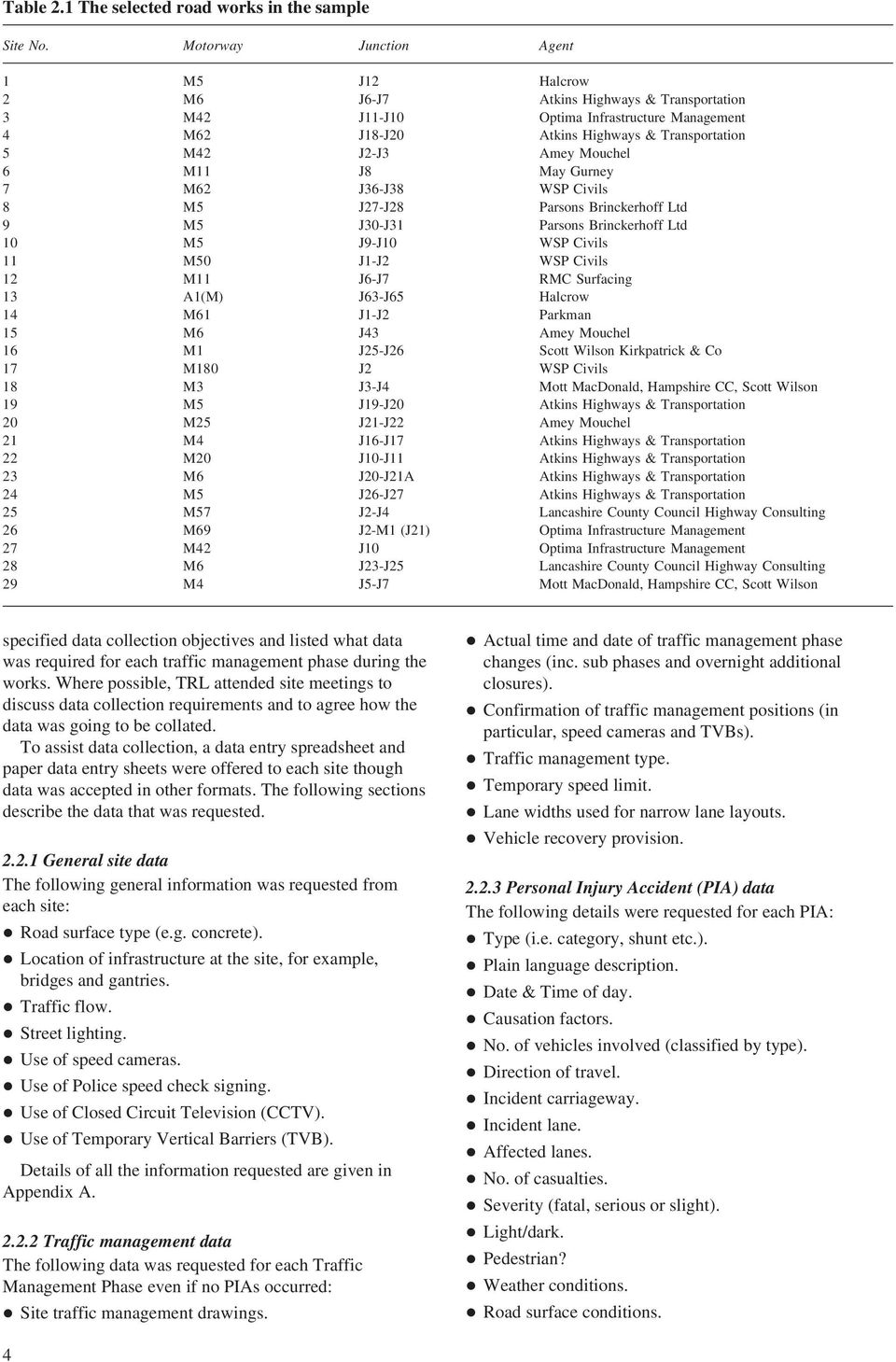
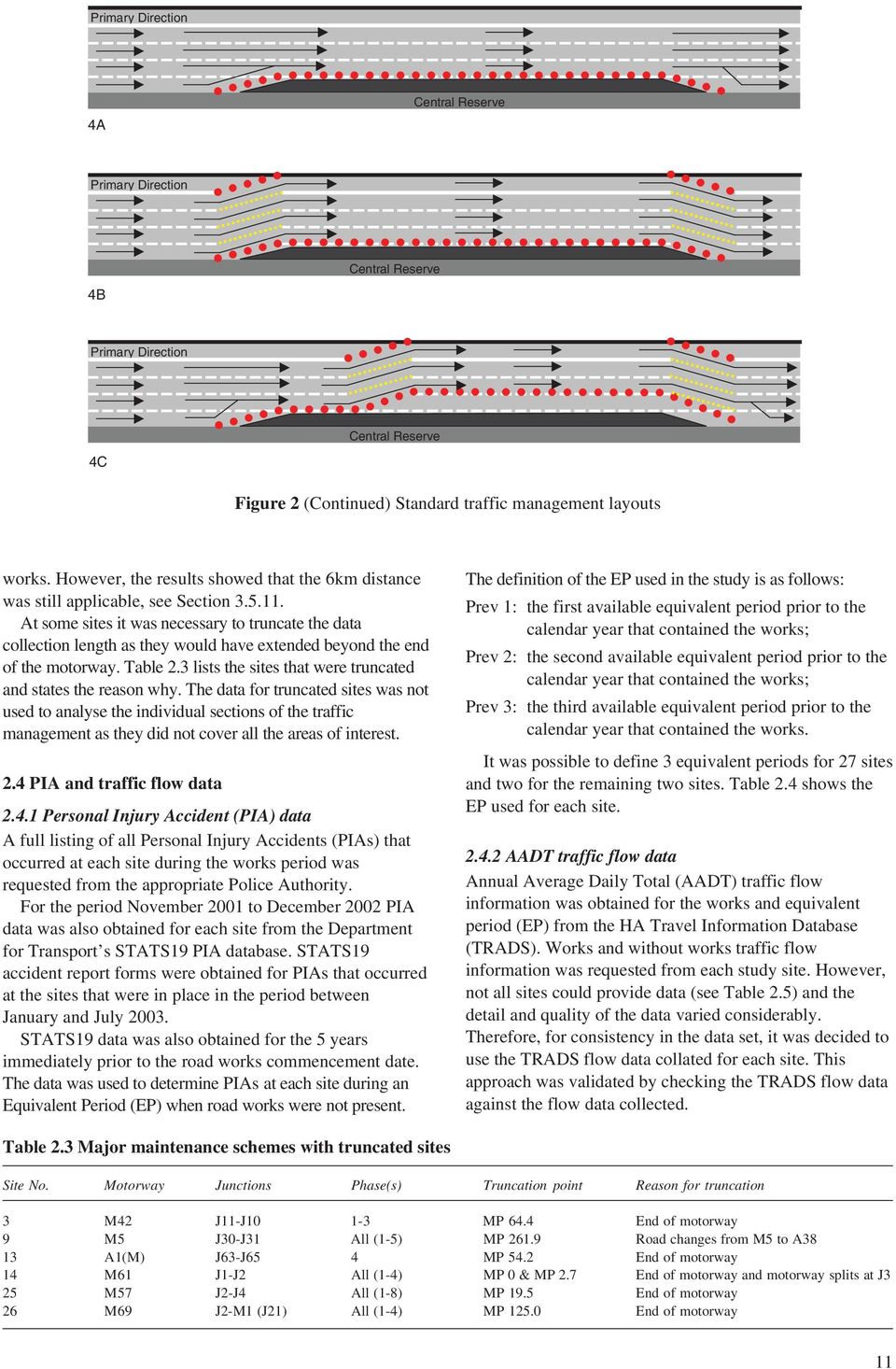
9 Location of road work sites Figure 1 Location of the selected road works in the sample If the site is street lit, were the lights in working order? Records of damage only accidents, if they were readily available. 2.3 Traffic management layouts The types of traffic management used in the sample and the duration of each traffic management phase is detailed in Table 2.2 and represented graphically in Figure 2. In this study, the primary direction has been defined as the carriageway directly affected by the works activity. At some sites, for example where there were works on a bridge either side of the central reserve, both directions were classified as primary Truncation of sites PIA data was collected for a length of carriageway 10km before and after the works area. A distance of 6km was used in the previous study, the increased distance allowed a comparison to be made of the zone of influence of the 5

10 Table 2.2 The 'with' road works period Works period Site No. Motorway Junction Works TM type Phase Start End 1 M5 J12 Bridge works 3F 2 05/11/ /11/ M5 J12 Bridge works 3C 3 28/11/ /01/ M5 J12 Bridge works 3F 2 31/01/ /02/ M5 J12 Bridge works 3F 4 10/02/ /03/ M5 J12 Bridge works 3C 5 05/03/ /04/ M5 J12 Bridge works 3C 6 11/04/ /07/ M5 J12 Bridge works 3C 7 05/07/ /07/ M5 J12 Bridge works 3F 8 25/07/ /08/ M5 J12 Bridge works 3C 9 07/08/ /10/ M6 J6-J7 Hybrid 3E 2 07/07/ /07/ M6 J6-J7 Hybrid CFA 3 21/07/ /12/ M6 J6-J7 Hybrid CFA 4 15/12/ /03/ M6 J6-J7 Hybrid CFA 5 02/03/ /06/ M6 J6-J7 Hybrid CFA 6 10/06/ /06/ M42 J11-J10 Road repairs 3D 1 12/04/ /04/ M42 J11-J10 Road repairs CFA 2 13/04/ /04/ M42 J11-J10 Road repairs CFA 3 23/04/ /05/ M42 J11-J10 Road repairs CFA 4 03/05/ /05/ M42 J11-J10 Road repairs CFA 5 14/05/ /05/ M42 J11-J10 Road repairs 3D 6 21/05/ /05/ M62 J18-J20 Road repairs 3E 1 15/10/ /12/ M62 J18-J20 Road repairs CFA 2 07/01/ /01/ M62 J18-J20 Road repairs CFA 3 21/01/ /01/ M62 J18-J20 Road repairs CFA 4 07/02/ /02/ M62 J18-J20 Road repairs CFA 5 24/02/ /03/ M62 J18-J20 Road repairs CFA 6 07/03/ /03/ M62 J18-J20 Road repairs CFA 7 19/03/ /03/ M62 J18-J20 Road repairs CFA 8 30/03/ /04/ M62 J18-J20 Road repairs CFA 9 12/04/ /04/ M62 J18-J20 Road repairs CFA 10 25/04/ /05/ M62 J18-J20 Road repairs CFA 11 03/05/ /05/ M42 J2-J3 Road repairs 3E 1 17/03/ /03/ M42 J2-J3 Road repairs CFA 2 19/03/ /03/ M42 J2-J3 Road repairs CFA 3 25/03/ /03/ M42 J2-J3 Road repairs CFA 4 31/03/ /04/ M42 J2-J3 Road repairs CFA 5 06/04/ /04/ M42 J2-J3 Road repairs 3E 6 10/04/ /04/ M42 J2-J3 Road repairs CFA 7 25/04/ /05/ M11 J8 Junction improvement CFA 1 01/01/ /03/ M11 J8 Junction improvement CFA 2 10/03/ /03/ M11 J8 Junction improvement CFA 3 18/03/ /08/ M11 J8 Junction improvement 2C 4 23/08/ /10/ M62 J36-J38 Bridge works 3C 1 08/05/ /10/ M62 J36-J38 Bridge works CFA 2 20/10/ /02/ M62 J36-J38 Bridge works CFB 3 07/02/ /03/ M5 J27-J28 Road repairs 3C/3B 1 08/04/ /04/ M5 J27-J28 Road repairs 3F 2 14/04/ /04/ M5 J27-J28 Road repairs 3G/3B 3 19/04/ /04/ M5 J27-J28 Road repairs 3D/3B 4 25/04/ /04/ M5 J27-J28 Road repairs 3B/3C 5 30/04/ /05/ M5 J27-J28 Road repairs 3B/3F 6 06/05/ /05/ M5 J27-J28 Road repairs CFB 7 13/05/ /05/2002 Continued... 6

11 Table 2.2 (Continued) The 'with' road works period Works period Site No. Motorway Junction Works TM type Phase Start End 9 M5 J30-J31 Junction improvement 3C 1 09/09/ /11/ M5 J30-J31 Junction improvement 3B/3C 2 18/11/ /12/ M5 J30-J31 Junction improvement 3B/3C 2 05/01/ /02/ M5 J30-J31 Junction improvement 3C 3 24/02/ /03/ M5 J30-J31 Junction improvement 3B/3F 4 03/03/ /03/ M5 J30-J31 Junction improvement 3B/3C 5 07/03/ /03/ M5 J30-J31 Junction improvement 3B/3F 4 10/03/ /03/ M5 J9-J10 Road repairs 3C 1 11/11/ /11/ M5 J9-J10 Road repairs 3C/3B 2 18/11/ /11/ M5 J9-J10 Road repairs CFA 3 29/11/ /12/ M50 J1-J2 Bridge works 2B 1 18/11/ /12/ M50 J1-J2 Bridge works 2B 2 09/12/ /03/ M50 J1-J2 Bridge works 2B 3 17/03/ /04/ M50 J1-J2 Bridge works 2B 4 27/04/ /05/ M11 J6-J7 Road repairs 3D 1 05/02/ /02/ M11 J6-J7 Road repairs CFD 2 09/02/ /02/ M11 J6-J7 Road repairs CFD 3 01/03/ /03/ M11 J6-J7 Road repairs CFD 4 18/03/ /03/ M11 J6-J7 Road repairs CFD 4 02/04/ /04/ M11 J6-J7 Road repairs CFD 5 28/03/ /04/ M11 J6-J7 Road repairs 3E 6 13/04/ /04/ A1(M) J63-J65 Road repairs 3E 4 23/01/ /03/ M61 J1-J2 Bridge works 4A 1 02/04/ /04/ M61 J1-J2 Bridge works 4A 2 11/04/ /05/ M61 J1-J2 Bridge works 4C 3 05/06/ /07/ M61 J1-J2 Bridge works 4C/4B 4 05/08/ /08/ M6 J43 Bridge works 3F 1 18/02/ /02/ M1 J25-J26 Bridge works 3B/3E 1 18/03/ /04/ M180 J2 Concrete pavement overlay 3F 1 26/09/ /09/ M180 J2 Concrete pavement overlay 3C 2 28/09/ /10/ M180 J2 Concrete pavement overlay 3F 1 11/10/ /10/ M180 J2 Concrete pavement overlay 3G 1 14/10/ /11/ M180 J2 Concrete pavement overlay 3G 1 25/11/ /11/ M180 J2 Concrete pavement overlay 3D 2 27/11/ /12/ M3 J3-J4 Re-surfacing, drainage 3E 2 12/06/ /06/ M3 J3-J4 Re-surfacing, drainage CFA 3 16/06/ /06/ M3 J3-J4 Re-surfacing, drainage 3E 4 20/06/ /07/ M3 J3-J4 Re-surfacing, drainage 3E 5 06/07/ /07/ M3 J3-J4 Re-surfacing, drainage CFA 6 31/07/ /08/ M3 J3-J4 Re-surfacing, drainage CFA 7 27/08/ /09/ M5 J19-J20 Lighting upgrade 3E 2 10/06/ /07/ M5 J19-J20 Lighting upgrade 3E 3 10/07/ /07/ M25 J21-J22 Concrete pavement overlay 3E 1 19/08/ /09/ M25 J21-J22 Concrete pavement overlay CFA 2 14/09/ /09/ M25 J21-J22 Concrete pavement overlay CFA 3 18/09/ /10/ M25 J21-J22 Concrete pavement overlay CFA 4 02/10/ /10/ M25 J21-J22 Concrete pavement overlay CFA 5 24/10/ /11/ M25 J21-J22 Concrete pavement overlay 3E 6 08/11/ /11/ M25 J21-J22 Concrete pavement overlay 3E 7 21/11/ /11/ M25 J21-J22 Concrete pavement overlay CFA 8 28/11/ /12/ M25 J21-J22 Concrete pavement overlay CFA 9 06/12/ /12/ M25 J21-J22 Concrete pavement overlay CFA 10 13/12/ /12/ M25 J21-J22 Concrete pavement overlay CFA 11 19/12/ /12/2002 Continued... 7

12 Table 2.2 (Continued) The 'with' road works period Works period Site No. Motorway Junction Works TM type Phase Start End 21 M4 J16-J17 Embankment works 3B/3C 1 02/10/ /10/ M4 J16-J17 Embankment works 3C/3B 2 03/10/ /10/ M4 J16-J17 Embankment works 3C/3B 3 29/10/ /10/ M4 J16-J17 Embankment works 3B/3C 4 01/11/ /11/ M4 J16-J17 Embankment works 3B/3C 5 24/11/ /12/ M20 J10-J11 Road repairs 3F 1 29/07/ /07/ M20 J10-J11 Road repairs CFB 2 01/08/ /08/ M20 J10-J11 Road repairs CFB 3 08/08/ /08/ M20 J10-J11 Road repairs CFB 4 10/08/ /08/ M20 J10-J11 Road repairs CFB 5 15/08/ /08/ M20 J10-J11 Road repairs CFB 6 17/08/ /08/ M20 J10-J11 Road repairs CFB 7 26/08/ /08/ M20 J10-J11 Road repairs CFB 8 03/09/ /09/ M20 J10-J11 Road repairs CFB 9 10/09/ /09/ M20 J10-J11 Road repairs CFB 10 17/09/ /09/ M20 J10-J11 Road repairs CFB 11 22/09/ /10/ M20 J10-J11 Road repairs 3C 12 02/10/ /10/ M6 J20-J21A Bridge works CFC 1 17/07/ /06/ M5 J26-J27 Concrete pavement overlay 3C 1 13/01/ /01/ M5 J26-J27 Concrete pavement overlay 3C/3F 2 16/01/ /01/ M5 J26-J27 Concrete pavement overlay CFB 3 27/01/ /02/ M5 J26-J27 Concrete pavement overlay CFB 4 20/02/ /03/ M5 J26-J27 Concrete pavement overlay 3C/3F 5 20/03/ /03/ M5 J26-J27 Concrete pavement overlay 3C 6 21/03/ /03/ M57 J2-J4 Concrete pavement overlay 3F 2 29/08/ /09/ M57 J2-J4 Concrete pavement overlay 3F 3 12/09/ /09/ M57 J2-J4 Concrete pavement overlay CFA 4 01/10/ /10/ M57 J2-J4 Concrete pavement overlay CFA 5 30/10/ /11/ M57 J2-J4 Concrete pavement overlay CFA 6 12/01/ /02/ M57 J2-J4 Concrete pavement overlay CFA 7 07/02/ /02/ M69 J2-M1 (J21) Resurfacing CFA 2 24/02/ /03/ M69 J2-M1 (J21) Resurfacing CFA 3 17/03/ /03/ M69 J2-M1 (J21) Resurfacing 3C/3F 4 31/03/ /04/ M42 J10 Road repairs 3D 1 21/03/ /03/ M42 J10 Road repairs CFA 2 22/03/ /04/ M42 J10 Road repairs 3D 3 16/04/ /04/ M6 J23-J25 Hybrid 3F 2 23/04/ /05/ M6 J23-J25 Hybrid CFA 3 28/05/ /07/ M4 J5-J7 Road repairs 3B 1 28/04/ /06/ M4 J5-J7 Road repairs 3B 2 05/06/ /07/2003 8
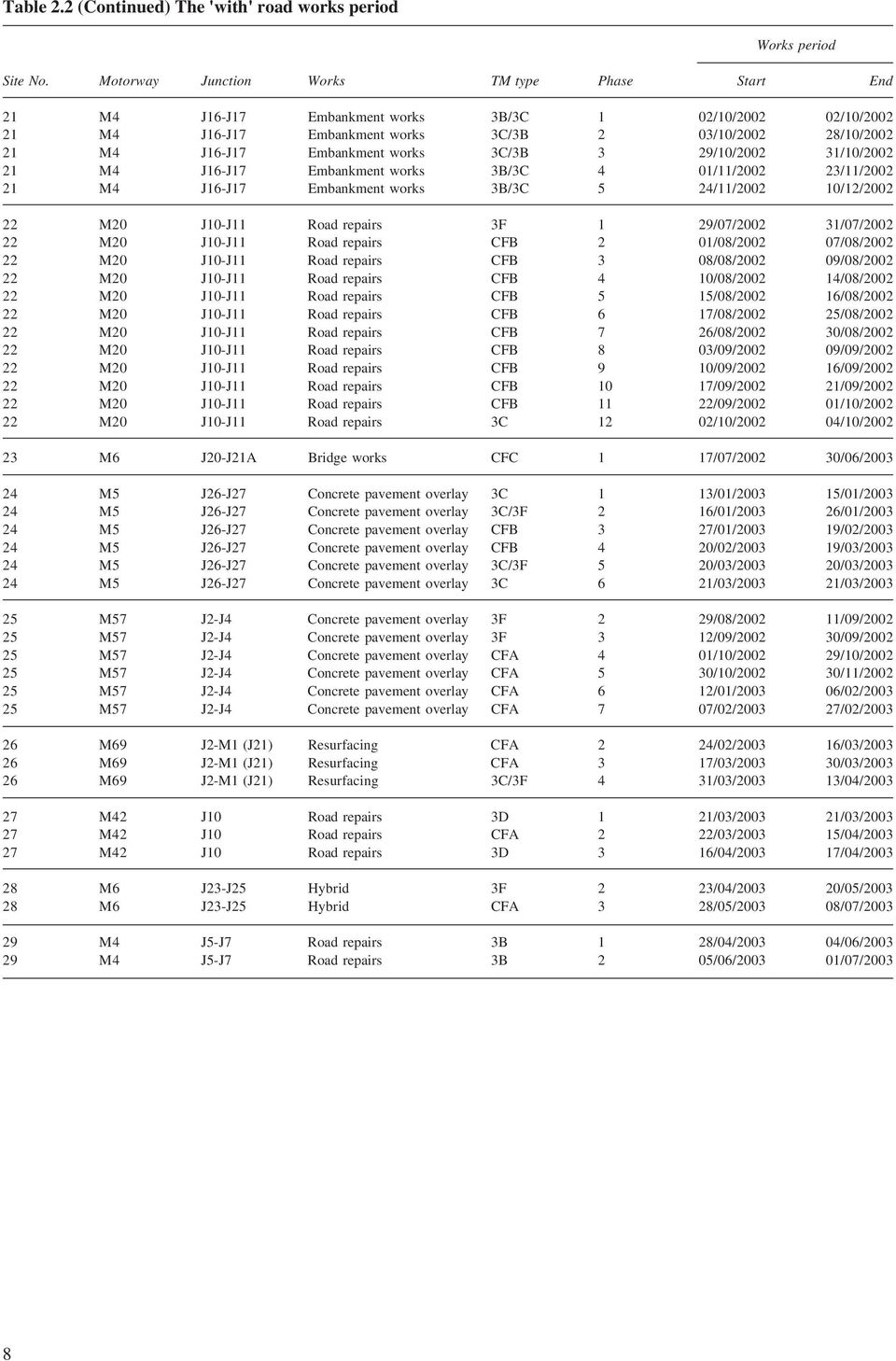
13 Primary Direction CFA Secondary Direction Primary Direction CFB Secondary Direction Primary Direction CFC Closed at junction Secondary Direction Primary Direction Secondary Direction As in TA 64 Fig 9 (a) Primary Direction CFD Secondary Direction As in TA 64 Fig 9 (a) Cone gates Buffer zone of cylinders & studs Figure 2 Standard traffic management layouts 9

14 Primary Direction 2B Central Reserve Lane 1 only running in the Primary direction is shown. Lane 2 only running is an alternative. Primary Direction 2C Central reserve Central Reserve 3B Secondary Direction Primary Direction Central Reserve Primary Direction 3C Central Reserve Primary Direction 3D Central Reserve Primary Direction 3E Central Reserve Primary Direction 3F Central Reserve Primary Direction 3G Central Reserve Figure 2 (Continued) Standard traffic management layouts 10

15 Primary Direction 4A Central Reserve Primary Direction Central Reserve 4B Primary Direction Central Reserve 4C Figure 2 (Continued) Standard traffic management layouts works. However, the results showed that the 6km distance was still applicable, see Section At some sites it was necessary to truncate the data collection length as they would have extended beyond the end of the motorway. Table 2.3 lists the sites that were truncated and states the reason why. The data for truncated sites was not used to analyse the individual sections of the traffic management as they did not cover all the areas of interest. 2.4 PIA and traffic flow data Personal Injury Accident (PIA) data A full listing of all Personal Injury Accidents (PIAs) that occurred at each site during the works period was requested from the appropriate Police Authority. For the period November 2001 to December 2002 PIA data was also obtained for each site from the Department for Transport s STATS19 PIA database. STATS19 accident report forms were obtained for PIAs that occurred at the sites that were in place in the period between January and July STATS19 data was also obtained for the 5 years immediately prior to the road works commencement date. The data was used to determine PIAs at each site during an Equivalent Period (EP) when road works were not present. The definition of the EP used in the study is as follows: Prev 1: the first available equivalent period prior to the calendar year that contained the works; Prev 2: the second available equivalent period prior to the calendar year that contained the works; Prev 3: the third available equivalent period prior to the calendar year that contained the works. It was possible to define 3 equivalent periods for 27 sites and two for the remaining two sites. Table 2.4 shows the EP used for each site AADT traffic flow data Annual Average Daily Total (AADT) traffic flow information was obtained for the works and equivalent period (EP) from the HA Travel Information Database (TRADS). Works and without works traffic flow information was requested from each study site. However, not all sites could provide data (see Table 2.5) and the detail and quality of the data varied considerably. Therefore, for consistency in the data set, it was decided to use the TRADS flow data collated for each site. This approach was validated by checking the TRADS flow data against the flow data collected. Table 2.3 Major maintenance schemes with truncated sites Site No. Motorway Junctions Phase(s) Truncation point Reason for truncation 3 M42 J11-J MP 64.4 End of motorway 9 M5 J30-J31 All (1-5) MP Road changes from M5 to A38 13 A1(M) J63-J65 4 MP 54.2 End of motorway 14 M61 J1-J2 All (1-4) MP 0 & MP 2.7 End of motorway and motorway splits at J3 25 M57 J2-J4 All (1-8) MP 19.5 End of motorway 26 M69 J2-M1 (J21) All (1-4) MP End of motorway 11
16 Table 2.4 Works period start and end dates and equivalent sampling periods for previous years Works period Previous years Site no Location Start End Prev. 1 Prev. 2 Prev. 3 Prev. 4 Prev. 5 1 M5 J12 05/11/ /10/ M6 J6-7 07/07/ /06/ M42 J11-10 S/B 12/04/ /05/ M62 J /10/ /05/ M42 J2-J3 17/03/ /05/ M11 J8 01/01/ /10/ M62 J /05/ /03/ M5 J /04/ /05/ M5 J31 09/09/ /03/ M5 J /11/ /12/ M50 J1 to 2 18/11/ /05/ M11, J6-7 NB 05/02/ /04/ A1(M) J /01/ /03/ M61 J1 to J2 02/04/ /08/ M6 J43 18/02/ /02/ M1 J25 - J26 18/03/ /04/ M180, J2 26/09/ /12/ M3 J3-4 12/06/ /09/ M5, J /06/ /07/ M25 J21 - J22 19/08/ /12/ M4 J /10/ /12/ M20 J /07/ /10/ M6 J /07/ /06/ M5, J /01/ /03/ M57, J2-4 29/08/ /02/ M69, J2 to M1 J21 24/02/ /04/ M42 J10 N/B 21/03/ /04/ M6 J /04/ /07/ M4 J5-7 28/04/ /07/2003 Key Previous equivalent without works period used. Previous equivalent without works period unsuitable due to presence of motorway road works. Previous equivalent without works period not required. 2.5 Presentation of data All data (traffic management, PIA and flow) collected in the study is contained within a Microsoft Excel spreadsheet. A front end application has been built into the spreadsheet to allow fast manipulation and analysis of the data. The spreadsheet application has been used to produce all the results described in the following section. 12

17 Table 2.5 Availability of traffic flow data for the with and without works period Traffic data Without With Site No. Motorway Junction works works 1 M5 J12 No No 2 M6 J6-J7 Yes No 3 M42 J11-J10 Yes No 4 M62 J18-J20 Yes No 5 M42 J2-J3 Yes No 6 M11 J8 Yes No 7 M62 J36-J38 Yes No 8 M5 J27-J28 Yes Yes 9 M5 J30-J31 No No 10 M5 J9-J10 Yes No 11 M50 J1-J2 Yes No 12 M11 J6-J7 Yes No 13 A1(M) J63-J65 Yes No 14 M61 J1-J2 Yes No 15 M6 J43 No No 16 M1 J25-J26 No No 17 M180 J2 Yes Yes 18 M3 J3-J4 Yes No 19 M5 J19-J20 Yes No 20 M25 J21-J22 Yes No 21 M4 J16-J17 Yes No 22 M20 J10-J11 Yes No 23 M6 J20-J21A No No 24 M5 J26-J27 Yes No 25 M57 J2-J4 Yes No 26 M69 J2-M1 (J21) Yes No 27 M42 J10 Yes No 28 M6 J23-J25 Yes No 29 M4 J5-J7 Yes No Number of sites with data Analysis 3.1 Composition of the study sample This study has monitored 29 road work sites, and covered a total of 147 traffic management phases. Just under half of the phases used a contra-flow arrangement, with the remaining phases using lane closures or narrow lanes. Full details of the scope of the study are shown in Table 3.1 and details of the traffic management arrangements used can be found in Figure 2. Annual Average Daily Traffic flow at the monitored sites varied from a minimum of 25,140 vehicles per day on the M50 to a maximum of 164,966 vehicles per day on the M6. The duration of road works sites varied from 11 days at junction 43 (J43) on the M6 to 348 days between J20 and J21 on the M6. A total of 4,176 million vehicle kilometres were monitored and 423 Personal Injury Accidents (PIAs) recorded at the sampled road works sites. The sample control without works period (equivalent period of time without road works in place for 3 previous years) contained 1,187 PIAs and 12,000 million vehicle kilometres. Table 3.2 details the number of PIAs recorded at each road works site and PIAs for the Equivalent Period (EP). It can be seen the observed number of PIAs is often close to the average number of PIAs in the EP. 3.2 Overall Personal Injury Accident (PIA) rates The overall Personal Injury Accident Rate for the study is estimated by combining the data from all traffic management arrangements across all sites monitored in the study. To compare with the 1982, 1987 and 1992 studies PIA information was recorded over a region of 6 kilometres either side of the central section of the works, as defined in Figure 3. The overall with road works observed PIA rate was PIA per million vehicle kilometres, which when compared with the equivalent non-works rate of produces a ratio of with to without road works of The results showed that for this study there was no significant difference (5% level) between the works and non-works PIA rates. Table 3.3 details the overall PIA rates and shows that the rates observed are similar to the PIA rate on all motorways in Great Britain in 2002 (which includes the small percentage of PIAs and associated exposure that have occurred at road works). The comparable rates observed for the previous studies were as follows: With road National works Without road motorway PIA rate works PIA rate (PIA per PIA rate (PIA (PIA per million per million Ratio million vehicle vehicle of PIA vehicle kilometres) kilometres) rates kilometres)

18 Table 3.1 The scope of the study With road works Without road works Exposure Accidents Exposure Accidents No. of Type of traffic Motorways roadworks Veh. km Veh. km management involved phases (millions) PIA (millions) PIA Contra-flow CFA M6(2), M42(3), M62(2), M11, M5, M3, M25, M57, M CFB M42, M62, M5(2), M CFC M CFD M Non contra-flow 2-lane dual carriageways 2A 2B M C M lane dual carriageways 3A 3B M4(2), M5(2), M C M5(5), M180, M69, M20, M57, M4, M D M42(2), M11, M E M6, M62, M42, M11, A1(M), M3, M5, M25, M4, M F M5(2), M6(2), M20, M57, M G M lane dual carriageways 4A M B M C M All layouts The number of sites is shown as M6(3) i.e. 3 sites on the M6. See Figure 2 for definitions of the type of traffic management. Whole Site (nominally 6km + Central Section + 6km) 'Approach' Restricted Zone Central Section 'After' Restricted Zone 'Approach Zone' 'Approach' Signed Zone 100m 100m 'After' Signed Zone 'After Zone' Hard shoulder Hard shoulder Secondary direction of travel Central reserve Central reserve Primary direction of travel Hard shoulder Hard shoulder 'After Zone' 'After' Signed Zone 100m Central Section 100m 'Approach' Signed Zone 'Approach Zone' 'After' Restricted Zone 'Approach' Restricted Zone Whole Site (nominally 6km + Central Section + 6km) Figure 3 Definition of site sections 14
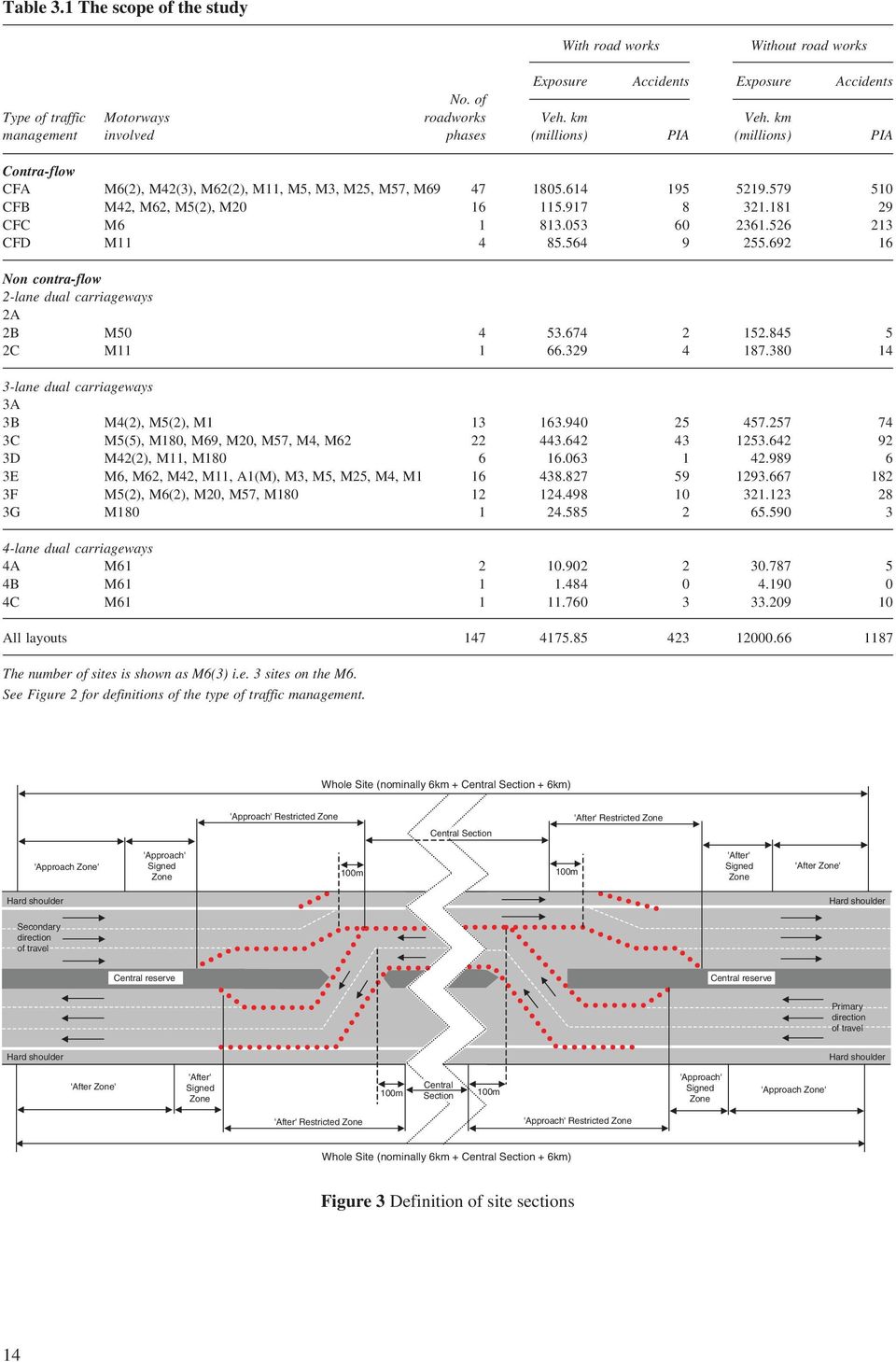
19 Table 3.2 Number of PIA by road works site, for the with and without road works periods Equivalent without road works periods No. of PIA Site No. No. Location of PIA Average Total Prev. 1 Prev. 2 Prev. 3 1 M5 J12* M6 J6-J7* M42 J M62 J M42 J2-J M11 J M62 J M5 J M5 J30 & J M5 J M50 J M11, J A1(M) J M61 J1 to J M6 J M1 J25 - J M180, J2* M3 J M5, J M25 J M4 J n/a 22 M20, J M6 J M5 J M57, J M69, J2 to M1 J M42 J M6 J n/a 29 M4 J Total * Includes HAWSAR accidents (see Section ). Figure 4 contains a plot of the above with and without road works PIA rates together with the PIA rate for all motorways over time. It can be seen that the with works rate has converged with the national rate, which has remained fairly constant at approximately 0.1. It is thought that the reduction in the with road works rate is due to the large number of safety initiatives that have taken place over the past decade. These will be discussed fully in Section Truncated sites The effect of truncated sites on the works/non-works PIA ratio was tested by removing the sites listed in Table 2.3. The resulting works and without works PIA rates were and respectively, giving a ratio of No statistical difference (5% level) was found between the two rates. 3.3 Ratios of personal injury accident rates by type of traffic management and by section Figure 3 illustrates how the road works sites have been disaggregated into 7 zones: the approach zone, the approach signed zone, the approach restricted zone, the central section, the after restricted zone, the after signed zone and the after zone. Table 3.4 shows the PIA rate by zone for primary, secondary and both directions for all traffic management layouts. The statistical significances of these values are given in Table 3.5. Table 3.6 summarises the PIA ratios for each section of the traffic management as described in Figure 3. The largest ratios (typically 1.4, significant at the 90% confidence level) were found to be on the approach to the central works section. It is in these areas where conflicts between traffic are most likely and hence this result is as expected. The rate for the central works section was found to be significantly different from the without works period (5% level) giving a ratio of For the zone after the works the ratios tended to be less than one (between 0.4 and 0.7) indicating that this area is more safe when road works are present. 3.4 PIA rates for use in QUADRO Table 3.7 illustrates the derivation of accident rates suitable for use in the Department for Transport s QUADRO program (Department for Transport, 2002b). Two rates are used in QUADRO: the Site Presence Rate and the Site Length Rate. These rates are given separately in Table 3.7 for the primary and secondary direction. It should be noted that in this report the term primary direction is used to mean the direction in which works activity is taking place and the secondary direction the one unaffected by the works. See also Section 2.3. Table 3.3 Overall PIA rates Personal injury accidents Vehicle kilometres Personal injury accidents (mean number of) (mean number of [millions]) per million veh. km With Without With Without With 3 year road road road road road average works works works works works EP Whole sample Prev Prev Prev All motorways (GB) 1 92, Source: Road Casualties Great Britain 2002 (Vehicle population, traffic and road length), Department of Transport, October Source: Road Casualties Great Britain 2002 (Table 3: Accidents and accident rates: by road class and severity: average, (The National without road works accident rate is not strictly works-free, as it applies to the whole network which includes some road works). 15

20 PIAs per million vehicle km All motorways (Source: Road Casualties Great Britain) With road works Without road works Year Figure 4 Comparison of PIA rates on motorways with and without road works Site length rate The site length rate corresponds to PIAs occurring along the works site itself, with the site length defined as that section of the road subject to a change in geometric standards due to the road works related traffic management. Thus referring to Figure 3, the site length corresponds to the Central Section. The Site Length Rate is expressed conventionally in PIA per million vehicle-kilometres and is determined from the formula: Site length rate = B cs R n where B cs = ratio of PIA rates on the Central Section, with road works over without road works; and R n = overall PIA rate without works (see Table 3.3) expressed in PIAs per million vehiclekilometres. This corresponds to the study sample s Three-Year Averaged Equivalent Period without works PIA rate. Site Presence Rate The Site Presence Rate is independent of the length of the physical works, and is expressed in PIA per million vehicles. The rate is a measure of the extra PIAs associated with the presence of road works related features. It is effectively the extra PIAs in a given period divided by the total flow of traffic in that period. However, for the purpose of this study this is expressed more appropriately as: Site Presence Rate = 12 R n ( B o 1 ) Where 12 = nominal length of the approach plus after sections in kilometres (as shown in Figure 3); B o = ratio of PIA rates on the Whole Site excluding the Central Section, with road works over without road works; The Site Presence Rate for use in QUADRO is thus the excess PIA rate per million vehicle passes over and above the corresponding rate without works. Values for use in QUADRO Site Length Rate: Based on the results of the study, the Site Length Rate for use in QUADRO for 2, 3 and 4 lane motorways are: 0.13 PIA/mvkm for the primary and 0.15 PIA/mvkm for the secondary direction. Site Presence Rate: Table 3.7 shows the values for the Site Presence Rate for the primary and secondary directions. The values are PIA/mv for the primary and PIA/mv for the secondary direction for use in QUADRO for 2, 3 and 4 lane motorways. The figures for both the Site Length and Site Presence Rates are much lower than those currently used in QUADRO and reflect the main finding of this study that there is no significant difference (at the 5% level) between the works and non-works PIA rates. Given this finding, a negative value for the Site Presence Rate is to be expected if the value for the Site Length Rate, representing the risk on the Central Section, is greater than one. The greatly reduced values for the two rates compared with those currently used have implications for the way PIAs are dealt with in QUADRO and it is recommended that Chapter 3 of Part 2 of the QUADRO manual that deals with the valuation of PIAs is reviewed before the values given above are used in QUADRO. and R n = as defined above. 16

21 Table 3.4 PIA rates for each traffic management section, by direction of travel Traffic management zone Type of With or Approach Approach After After Approach traffic without Whole signed restricted Central restricted signed and management roadworks site Approach zone zone section zone zone After after All layouts primary direction Works Number of PIAs Veh. km (millions) Mean PIA rate Average 3 year EP PIA rate Prev. 1 Number of PIAs Veh. km (millions) PIA rate Prev. 2 Number of PIAs Veh. km (millions) PIA rate Prev. 3 Number of PIAs Veh. km (millions) PIA rate Primary direction by contra-flow type CFA Works Number of PIAs Veh. km (millions) Mean PIA rate Average 3 year EP PIA rate Prev. 1 Number of PIAs Veh. km (millions) PIA rate Prev. 2 Number of PIAs Veh. km (millions) PIA rate Prev. 3 Number of PIAs Veh. km (millions) PIA rate CFB Works Number of PIAs Veh. km (millions) Mean PIA rate Average 3 year EP PIA rate Prev. 1 Number of PIAs Veh. km (millions) PIA rate Prev. 2 Number of PIAs Veh. km (millions) PIA rate Prev. 3 Number of PIAs Veh. km (millions) PIA rate These results do not include data from truncated sites. Continued... 17
22 Table 3.4 (Continued) PIA rates for each traffic management section, by direction of travel Traffic management zone Type of With or Approach Approach After After Approach traffic without Whole signed restricted Central restricted signed and management roadworks site Approach zone zone section zone zone After after CFC Works Number of PIAs Veh. km (millions) Mean PIA rate Average 3 year EP PIA rate Prev. 1 Number of PIAs Veh. km (millions) PIA rate Prev. 2 Number of PIAs Veh. km (millions) PIA rate Prev. 3 Number of PIAs Veh. km (millions) PIA rate CFD Works Number of PIAs Veh. km (millions) Mean PIA rate 0.13 N/A Average 3 year EP PIA rate 0.08 N/A Prev. 1 Number of PIAs Veh. km (millions) PIA rate 0.00 N/A Prev. 2 Number of PIAs Veh. km (millions) PIA rate 0.13 N/A Prev. 3 Number of PIAs Veh. km (millions) PIA rate 0.10 N/A Primary direction by non contra-flow type 2B Works Number of PIAs Veh. km (millions) Mean PIA rate 0.04 N/A Average 3 year EP PIA rate 0.03 N/A Prev. 1 Number of PIAs Veh. km (millions) PIA rate 0.02 N/A Prev. 2 Number of PIAs Veh. km (millions) PIA rate 0.04 N/A Prev. 3 Number of PIAs Veh. km (millions) PIA rate 0.04 N/A These results do not include data from truncated sites. Continued... 18
23 Table 3.4 (Continued) PIA rates for each traffic management section, by direction of travel Traffic management zone Type of With or Approach Approach After After Approach traffic without Whole signed restricted Central restricted signed and management roadworks site Approach zone zone section zone zone After after 2C Works Number of PIAs Veh. km (millions) Mean PIA rate Average 3 year EP PIA rate Prev. 1 Number of PIAs Veh. km (millions) PIA rate Prev. 2 Number of PIAs Veh. km (millions) PIA rate Prev. 3 Number of PIAs Veh. km (millions) PIA rate B Works Number of PIAs Veh. km (millions) Mean PIA rate Average 3 year EP PIA rate Prev. 1 Number of PIAs Veh. km (millions) PIA rate Prev. 2 Number of PIAs Veh. km (millions) PIA rate Prev. 3 Number of PIAs Veh. km (millions) PIA rate 0.17 N/A C Works Number of PIAs Veh. km (millions) Mean PIA rate Average 3 year EP PIA rate Prev. 1 Number of PIAs Veh. km (millions) PIA rate Prev. 2 Number of PIAs Veh. km (millions) PIA rate Prev. 3 Number of PIAs Veh. km (millions) PIA rate These results do not include data from truncated sites. Continued... 19
24 Table 3.4 (Continued) PIA rates for each traffic management section, by direction of travel Traffic management zone Type of With or Approach Approach After After Approach traffic without Whole signed restricted Central restricted signed and management roadworks site Approach zone zone section zone zone After after 3D Works Number of PIAs Veh. km (millions) Mean PIA rate Average 3 year EP PIA rate Prev. 1 Number of PIAs Veh. km (millions) PIA rate Prev. 2 Number of PIAs Veh. km (millions) PIA rate Prev. 3 Number of PIAs Veh. km (millions) PIA rate E Works Number of PIAs Veh. km (millions) Mean PIA rate Average 3 year EP PIA rate Prev. 1 Number of PIAs Veh. km (millions) PIA rate Prev. 2 Number of PIAs Veh. km (millions) PIA rate Prev. 3 Number of PIAs Veh. km (millions) PIA rate F Works Number of PIAs Veh. km (millions) Mean PIA rate Average 3 year EP PIA rate Prev. 1 Number of PIAs Veh. km (millions) PIA rate Prev. 2 Number of PIAs Veh. km (millions) PIA rate Prev. 3 Number of PIAs Veh. km (millions) PIA rate These results do not include data from truncated sites. Continued... 20
25 Table 3.4 (Continued) PIA rates for each traffic management section, by direction of travel Traffic management zone Type of With or Approach Approach After After Approach traffic without Whole signed restricted Central restricted signed and management roadworks site Approach zone zone section zone zone After after 3G Works Number of PIAs Veh. km (millions) Mean PIA rate Average 3 year EP PIA rate Prev. 1 Number of PIAs Veh. km (millions) PIA rate Prev. 2 Number of PIAs Veh. km (millions) PIA rate Prev. 3 Number of PIAs Veh. km (millions) PIA rate All layouts secondary direction Works Number of PIAs Veh. km (millions) Mean PIA rate Average 3 year EP PIA rate Prev. 1 Number of PIAs Veh. km (millions) PIA rate Prev. 2 Number of PIAs Veh. km (millions) PIA rate Prev. 3 Number of PIAs Veh. km (millions) PIA rate Secondary direction by contra-flow type CFA Works Number of PIAs Veh. km (millions) Mean PIA rate Average 3 year EP PIA rate Prev. 1 Number of PIAs Veh. km (millions) PIA rate Prev. 2 Number of PIAs Veh. km (millions) PIA rate Prev. 3 Number of PIAs Veh. km (millions) PIA rate These results do not include data from truncated sites. Continued... 21
26 Table 3.4 (Continued) PIA rates for each traffic management section, by direction of travel Traffic management zone Type of With or Approach Approach After After Approach traffic without Whole signed restricted Central restricted signed and management roadworks site Approach zone zone section zone zone After after CFB Works Number of PIAs Veh. km (millions) Mean PIA rate Average 3 year EP PIA rate Prev. 1 Number of PIAs Veh. km (millions) PIA rate Prev. 2 Number of PIAs Veh. km (millions) PIA rate Prev. 3 Number of PIAs Veh. km (millions) PIA rate CFC Works Number of PIAs Veh. km (millions) Mean PIA rate Average 3 year EP PIA rate Prev. 1 Number of PIAs Veh. km (millions) PIA rate Prev. 2 Number of PIAs Veh. km (millions) PIA rate Prev. 3 Number of PIAs Veh. km (millions) PIA rate CFD Works Number of PIAs Veh. km (millions) Mean PIA rate Average 3 year EP PIA rate Prev. 1 Number of PIAs Veh. km (millions) PIA rate Prev. 2 Number of PIAs Veh. km (millions) PIA rate Prev. 3 Number of PIAs Veh. km (millions) PIA rate These results do not include data from truncated sites. Continued... 22
27 Table 3.4 (Continued) PIA rates for each traffic management section, by direction of travel Traffic management zone Type of With or Approach Approach After After Approach traffic without Whole signed restricted Central restricted signed and management roadworks site Approach zone zone section zone zone After after Secondary direction by non contra-flow type 3E Works Number of PIAs Veh. km (millions) Mean PIA rate Average 3 year EP PIA rate Prev. 1 Number of PIAs Veh. km (millions) PIA rate Prev. 2 Number of PIAs Veh. km (millions) PIA rate Prev. 3 Number of PIAs Veh. km (millions) PIA rate All other non contra-flow layout types (2B, 2C, 3B, 3C, 3D, 3F and 3G) do not have a secondary direction All layouts both directions of travel Works Number of PIAs Veh. km (millions) Mean PIA rate Average 3 year EP PIA rate Prev. 1 Number of PIAs Veh. km (millions) PIA rate Prev. 2 Number of PIAs Veh. km (millions) PIA rate Prev. 3 Number of PIAs Veh. km (millions) PIA rate Both directions by contra-flow type CFA Works Number of PIAs Veh. km (millions) Mean PIA rate Average 3 year EP PIA rate Prev. 1 Number of PIAs Veh. km (millions) PIA rate Prev. 2 Number of PIAs Veh. km (millions) PIA rate Prev. 3 Number of PIAs (millions) PIA rate These results do not include data from truncated sites. Continued... 23
28 Table 3.4 (Continued) PIA rates for each traffic management section, by direction of travel Traffic management zone Type of With or Approach Approach After After Approach traffic without Whole signed restricted Central restricted signed and management roadworks site Approach zone zone section zone zone After after CFB Works Number of PIAs Veh. km (millions) Mean PIA rate Average 3 year EP PIA rate Prev. 1 Number of PIAs Veh. km (millions) PIA rate Prev. 2 Number of PIAs Veh. km (millions) PIA rate Prev. 3 Number of PIAs Veh. km (millions) PIA rate CFC Works Number of PIAs Veh. km (millions) Mean PIA rate Average 3 year EP PIA rate Prev. 1 Number of PIAs Veh. km (millions) PIA rate Prev. 2 Number of PIAs Veh. km (millions) PIA rate Prev. 3 Number of PIAs Veh. km (millions) PIA rate CFD Works Number of PIAs Veh. km (millions) Mean PIA rate Average 3 year EP PIA rate Prev. 1 Number of PIAs Veh. km (millions) PIA rate Prev. 2 Number of PIAs Veh. km (millions) PIA rate Prev. 3 Number of PIAs Veh. km (millions) PIA rate These results do not include data from truncated sites. Continued... 24
29 Table 3.4 (Continued) PIA rates for each traffic management section, by direction of travel Traffic management zone Type of With or Approach Approach After After Approach traffic without Whole signed restricted Central restricted signed and management roadworks site Approach zone zone section zone zone After after Both directions by non contra-flow type 2B Works Number of PIAs Veh. km (millions) Mean PIA rate 0.04 N/A Average 3 year EP PIA rate 0.03 N/A Prev. 1 Number of PIAs Veh. km (millions) PIA rate 0.02 N/A Prev. 2 Number of PIAs Veh. km (millions) PIA rate 0.04 N/A Prev. 3 Number of PIAs Veh. km (millions) PIA rate 0.04 N/A C Works Number of PIAs Veh. km (millions) Mean PIA rate Average 3 year EP PIA rate Prev. 1 Number of PIAs Veh. km (millions) PIA rate Prev. 2 Number of PIAs Veh. km (millions) PIA rate Prev. 3 Number of PIAs Veh. km (millions) PIA rate B Works Number of PIAs Veh. km (millions) Mean PIA rate Average 3 year EP PIA rate Prev. 1 Number of PIAs Veh. km (millions) PIA rate Prev. 2 Number of PIAs Veh. km (millions) PIA rate Prev. 3 Number of PIAs Veh. km (millions) PIA rate 0.17 N/A These results do not include data from truncated sites. Continued... 25
30 Table 3.4 (Continued) PIA rates for each traffic management section, by direction of travel Traffic management zone Type of With or Approach Approach After After Approach traffic without Whole signed restricted Central restricted signed and management roadworks site Approach zone zone section zone zone After after 3C Works Number of PIAs Veh. km (millions) Mean PIA rate Average 3 year EP PIA rate Prev. 1 Number of PIAs Veh. km (millions) PIA rate Prev. 2 Number of PIAs Veh. km (millions) PIA rate Prev. 3 Number of PIAs Veh. km (millions) PIA rate D Works Number of PIAs Veh. km (millions) Mean PIA rate Average 3 year EP PIA rate Prev. 1 Number of PIAs Veh. km (millions) PIA rate Prev. 2 Number of PIAs Veh. km (millions) PIA rate Prev. 3 Number of PIAs Veh. km (millions) PIA rate E Works Number of PIAs Veh. km (millions) Mean PIA rate Average 3 year EP PIA rate Prev. 1 Number of PIAs Veh. km (millions) PIA rate Prev. 2 Number of PIAs Veh. km (millions) PIA rate Prev. 3 Number of PIAs Veh. km (millions) PIA rate These results do not include data from truncated sites. Continued... 26
31 Table 3.4 (Continued) PIA rates for each traffic management section, by direction of travel Traffic management zone Type of With or Approach Approach After After Approach traffic without Whole signed restricted Central restricted signed and management roadworks site Approach zone zone section zone zone After after 3F Works Number of PIAs Veh. km (millions) Mean PIA rate Average 3 year EP PIA rate Prev. 1 Number of PIAs Veh. km (millions) PIA rate Prev. 2 Number of PIAs Veh. km (millions) PIA rate Prev. 3 Number of PIAs Veh. km (millions) PIA rate G Works Number of PIAs Veh. km (millions) Mean PIA rate Average 3 year EP PIA rate Prev. 1 Number of PIAs Veh. km (millions) PIA rate Prev. 2 Number of PIAs Veh. km (millions) PIA rate Prev. 3 Number of PIAs Veh. km (millions) PIA rate These results do not include data from truncated sites. 27
32 Table 3.5 Statistical significance of the differences, between the with and without road works PIA rates With road works Without road works 2-sided % change confidence With road works Without road works 3 year in accident level at 95% 95% Type of Mean Vehicle average Vehicle rates as which the confdence interval confidence interval traffic PIA kilometres EP PIA kilometres a result of difference is management rate (millions) rate (millions) z-statistic road works significant Lower Upper Lower Upper All sections, both directions Whole sample, all layouts, both directions CFA CFB CFC CFD B C B C D E F G Approach section Primary CFA CFB CFC CFD ~ ~ ~ ~ ~ ~ ~ 2B ~ ~ ~ ~ ~ ~ ~ 2C ~ ~ ~ ~ ~ ~ ~ 3B ~ ~ ~ ~ ~ ~ ~ 3C D ~ ~ ~ ~ ~ ~ 3E F ~ ~ ~ ~ ~ G ~ ~ ~ ~ ~ ~ ~ All layouts Secondary CFA CFB ~ ~ ~ ~ ~ CFC CFD ~ ~ ~ ~ ~ ~ ~ 3E ~ ~ ~ ~ ~ All layouts Both directions CFA CFB CFC CFD ~ ~ ~ ~ ~ ~ ~ 2B ~ ~ ~ ~ ~ ~ ~ 2C ~ ~ ~ ~ ~ ~ ~ 3B ~ ~ ~ ~ ~ ~ ~ 3C D ~ ~ ~ ~ ~ ~ ~ 3E F ~ ~ ~ ~ ~ G ~ ~ ~ ~ ~ ~ ~ All layouts ~ Denotes that the subgroup had no accidents in the with and/or without road works period. Table excludes truncated sites. Continued... 28
33 Table 3.5 (Continued) Statistical significance of the differences, between the with and without road works PIA rates With road works Without road works 2-sided % change confidence With road works Without road works 3 year in accident level at 95% 95% Type of Mean Vehicle average Vehicle rates as which the confdence interval confidence interval traffic PIA kilometres EP PIA kilometres a result of difference is management rate (millions) rate (millions) z-statistic road works significant Lower Upper Lower Upper Approach signed section Primary CFA CFB CFC CFD B ~ ~ ~ ~ ~ C ~ ~ ~ ~ ~ B C D ~ ~ ~ ~ ~ E F G All layouts Secondary CFA CFB CFC CFD ~ ~ ~ ~ ~ 3E All layouts Both directions CFA CFB CFC CFD B ~ ~ ~ ~ ~ C ~ ~ ~ ~ ~ B C D ~ ~ ~ ~ ~ E F G All layouts ~ Denotes that the subgroup had no accidents in the with and/or without road works period. Table excludes truncated sites. Continued... 29
34 Table 3.5 (Continued) Statistical significance of the differences, between the with and without road works PIA rates With road works Without road works 2-sided % change confidence With road works Without road works 3 year in accident level at 95% 95% Type of Mean Vehicle average Vehicle rates as which the confdence interval confidence interval traffic PIA kilometres EP PIA kilometres a result of difference is management rate (millions) rate (millions) z-statistic road works significant Lower Upper Lower Upper Approach restricted section Primary CFA CFB ~ ~ ~ ~ ~ ~ ~ CFC CFD B C B C D ~ ~ ~ ~ ~ ~ ~ 3E ~ F ~ ~ ~ ~ ~ 3G ~ ~ ~ ~ ~ ~ ~ All layouts Secondary CFA CFB ~ ~ ~ ~ ~ ~ ~ CFC CFD ~ ~ ~ ~ ~ ~ ~ 3E ~ ~ ~ ~ ~ ~ ~ All layouts Both directions CFA CFB ~ ~ ~ ~ ~ ~ ~ CFC CFD B C B C D ~ ~ ~ ~ ~ ~ ~ 3E F ~ ~ ~ ~ ~ 3G ~ ~ ~ ~ ~ ~ ~ All layouts Primary CFA CFB ~ ~ ~ ~ ~ CFC CFD ~ ~ ~ ~ ~ B ~ ~ ~ ~ ~ C B C D ~ ~ ~ ~ ~ E F G All layouts ~ Denotes that the subgroup had no accidents in the with and/or without road works period. Table excludes truncated sites. Continued... 30
35 Table 3.5 (Continued) Statistical significance of the differences, between the with and without road works PIA rates With road works Without road works 2-sided % change confidence With road works Without road works 3 year in accident level at 95% 95% Type of Mean Vehicle average Vehicle rates as which the confdence interval confidence interval traffic PIA kilometres EP PIA kilometres a result of difference is management rate (millions) rate (millions) z-statistic road works significant Lower Upper Lower Upper Secondary CFA CFB CFC CFD ~ ~ ~ E All layouts Both directions CFA CFB CFC CFD ~ ~ ~ ~ ~ B ~ ~ ~ ~ ~ C B C D ~ ~ ~ ~ ~ E F G All layouts After restricted section Primary CFA ~ ~ ~ ~ ~ CFB ~ ~ ~ ~ ~ CFC ~ ~ ~ ~ ~ CFD ~ ~ ~ ~ ~ ~ ~ 2B ~ ~ ~ ~ ~ ~ ~ 2C ~ ~ ~ ~ ~ ~ ~ 3B ~ ~ ~ ~ ~ C ~ ~ ~ ~ ~ ~ ~ 3D ~ ~ ~ ~ ~ ~ ~ 3E ~ ~ ~ ~ ~ F ~ ~ ~ ~ ~ ~ ~ 3G ~ ~ ~ ~ ~ ~ ~ All layouts ~ ~ ~ ~ ~ Secondary CFA CFB ~ ~ ~ ~ ~ ~ CFC ~ ~ ~ ~ ~ CFD ~ ~ ~ ~ ~ 3E ~ ~ ~ ~ ~ ~ ~ All layouts Both directions CFA CFB ~ ~ ~ ~ ~ CFC ~ ~ ~ ~ ~ CFD ~ ~ ~ ~ ~ 2B ~ ~ ~ ~ ~ ~ ~ 2C ~ ~ ~ ~ ~ ~ ~ 3B ~ ~ ~ ~ ~ C ~ ~ ~ ~ ~ ~ ~ 3D ~ ~ ~ ~ ~ ~ ~ 3E ~ ~ ~ ~ ~ F ~ ~ ~ ~ ~ ~ ~ 3G ~ ~ ~ ~ ~ ~ ~ All layouts ~ Denotes that the subgroup had no accidents in the with and/or without road works period. Table excludes truncated sites. Continued... 31
36 Table 3.5 (Continued) Statistical significance of the differences, between the with and without road works PIA rates With road works Without road works 2-sided % change confidence With road works Without road works 3 year in accident level at 95% 95% Type of Mean Vehicle average Vehicle rates as which the confdence interval confidence interval traffic PIA kilometres EP PIA kilometres a result of difference is management rate (millions) rate (millions) z-statistic road works significant Lower Upper Lower Upper After signed section Primary CFA ~ ~ ~ ~ ~ CFB ~ ~ ~ ~ ~ CFC ~ ~ ~ ~ ~ ~ ~ CFD ~ ~ ~ ~ ~ ~ ~ 2B ~ ~ ~ ~ ~ 2C ~ ~ ~ ~ ~ ~ ~ 3B ~ ~ ~ ~ ~ ~ ~ 3C ~ ~ ~ ~ ~ ~ ~ 3D ~ ~ ~ ~ ~ ~ ~ 3E ~ ~ ~ ~ ~ F ~ ~ ~ ~ ~ ~ ~ 3G ~ ~ ~ ~ ~ ~ ~ All layouts Secondary CFA CFB ~ ~ ~ ~ ~ ~ ~ CFC ~ ~ ~ ~ ~ CFD ~ ~ ~ ~ ~ E ~ ~ ~ ~ ~ All layouts Both directions CFA CFB ~ ~ ~ ~ ~ CFC ~ ~ ~ ~ ~ CFD ~ ~ ~ ~ ~ ~ ~ 2B ~ ~ ~ ~ ~ 2C ~ ~ ~ ~ ~ ~ ~ 3B ~ ~ ~ ~ ~ ~ ~ 3C ~ ~ ~ ~ ~ ~ ~ 3D ~ ~ ~ ~ ~ ~ ~ 3E ~ ~ ~ ~ ~ F ~ ~ ~ ~ ~ ~ ~ 3G ~ ~ ~ ~ ~ ~ ~ All layouts After section Primary CFA CFB CFC CFD ~ ~ ~ ~ ~ ~ ~ 2B ~ ~ ~ ~ ~ C B C D E F G ~ ~ ~ ~ ~ ~ ~ All layouts ~ Denotes that the subgroup had no accidents in the with and/or without road works period. Table excludes truncated sites. Continued... 32
37 Table 3.5 (Continued) Statistical significance of the differences, between the with and without road works PIA rates With road works Without road works 2-sided % change confidence With road works Without road works 3 year in accident level at 95% 95% Type of Mean Vehicle average Vehicle rates as which the confdence interval confidence interval traffic PIA kilometres EP PIA kilometres a result of difference is management rate (millions) rate (millions) z-statistic road works significant Lower Upper Lower Upper Secondary CFA CFB ~ ~ ~ ~ ~ CFC CFD ~ ~ ~ ~ ~ E ~ ~ All layouts Both directions CFA CFB CFC CFD B ~ ~ ~ ~ ~ C B C D E F G ~ ~ ~ ~ ~ ~ ~ All layouts Approach and after section Primary CFA CFB CFC CFD B ~ ~ ~ ~ ~ C B C D E F G ~ ~ ~ ~ ~ All layouts Secondary CFA CFB ~ ~ ~ ~ ~ CFC CFD ~ ~ ~ ~ ~ E All layouts Both directions CFA CFB CFC CFD B ~ ~ ~ ~ ~ C B C D E F G ~ ~ ~ ~ ~ All layouts ~ Denotes that the subgroup had no accidents in the with and/or without road works period. Table excludes truncated sites. 33
38 Table 3.6 Ratios of PIA rates, by section Type of Approach Approach After After Approach 1 traffic Approach signed restricted Central restricted signed After and management section zone zone section zone zone section after Primary CFA *[1.44] CFB *[5.21] *[0.69] *[0.61] *[1.09] CFC *[0.97] 1.16 *[1.45] *[0.19] CFD *[1.00] *[2.99] *[2.99] *[3.00] 2B *[1.42] 2C *[2.86] *[0.94] *[0.71] *[0.71] 3B 0.61 *[0.84] C *[1.70] 2.13 *[1.58] D *[2.85] *[2.86] 3E *[0.97] 1.02 *[0.97] F *[2.57] *[2.38] *[0.20] *[0.19] 3G *[2.73] *[2.72] All layouts *[1.41] Secondary CFA *[0.94] 1.15 *[0.29] 1.77 *[0.72] *[1.73] CFB *[0.93] *[5.48] CFC *[5.83] 1.09 *[0.97] CFD 3E *[0.71] *[0.96] *[0.40] *[0.26] All other non contra-flow layout types (2B, 2C, 3B, 3C, 3D, 3F and 3G) do not have a secondary direction. All layouts *[0.44] 1.50 *[1.24] *[1.23] Both directions CFA *[0.51] *[2.31] CFB *[2.01] *[0.80] *[1.37] *[0.42] *[0.70] CFC *[2.9] 1.13 *[1.34] CFD *[2.00] *[2.98] *[0.75] *[0.74] 2B *[1.42] 2C *[2.86] *[0.94] *[0.71] *[0.71] 3B 0.61 *[0.84] C *[1.70] 2.13 *[1.58] D *[2.85] *[2.86] 3E *[0.58] 0.99 *[0.97] F *[2.57] *[2.38] *[0.20] *[0.19] 3G *[2.73] *[2.72] All layouts *[1.29] Ratio is defined as the PIA rate with road works divided by the PIA rate without road works. 2 See Figure 2 for definitions of the traffic management layout. 3 See Figure 3 for definitions of sections. * Figures shown in italics (in brackets) are derived from samples with less than 30 million vehicle - kilometres and / or less than 5 personal injury accidents during the works period, or an average of 5 personal injury accidents over the previous 3 years. 34
39 Table 3.7 PIA rate ratios for use in QUADRO Classification: Motorways 95% 95% 95% Direction 95% confidence Works confidence confidence without confidence level direction level level works level lower (primary) upper lower (secondary) upper Site Length Rate ratio Number of PIAs With road works Without road works Aggregate Prev Prev Prev Vehicle - kilometres With road works (millions) Without road works Aggregate Prev Prev Prev PIA rate With road works Without road works Average 3 year EP Prev Prev Prev Site Length Rate Ratio (Study site length rate (PIA/mvkm)) QUADRO site length rate (PIA/mvkm) Site Presence Rate Ratio Number of PIAs With road works Without road works Aggregate Prev Prev Prev Vehicle - kilometres With road works (millions) Without road works Aggregate Prev Prev Prev PIA rate With road works Without road works Average 3 year EP Prev Prev Prev Site Presence Rate ratio (Study Site Presence Rate (PIA/mv)) QUADRO Site Presence Rate (PIA/mv) Primary and Secondary directions are those with the works and without works respectively. Truncated sites have been excluded. Study Site Length Rate and Study Site Presence Rate are calculated using overall without road works PIA rates from the study sample. Site Length Rate is based on the central section. Site Presence Rate is based on the Whole Site excluding the Central Section. 35
40 3.5 PIA risk factors PIA rates in daylight and darkness The analysis of the PIA rate by lighting condition required the proportions of the daily traffic flow which occurred during darkness and daylight. Darkness was defined as the period from half an hour after sunset to half an hour before sunrise. Figure 5 shows the ratio of the daily traffic flow which occurred during darkness for each month of the year for a sample of three sites in the study. An average of this ratio was then calculated for each month and the proportion of the traffic flow in darkness was estimated for the period of the works for each site in the study. The proportion of the traffic flow in darkness ranged from 15 per cent for works in the summer months to 53% for works that took place in November and December. The figure for those sites that lasted 12 months was 31%. Table 3.8 outlines the numbers and rates of PIAs in daylight and darkness. For the whole site, all layouts, the proportions of PIAs in daylight are similar (76% and 73% for with and without road works respectively). The proportion is also similar to the National figure of 72% for all motorways (Department for Transport, 2002a). The with road works figure for the present study is also similar to those obtained in the 1982 and 1987 studies (77% and 78% respectively). The figure for the previous study in 1992 was 70%. No significant difference was observed between the works and without works PIA rates for both daylight and darkness conditions PIA severity, casualty severity and PIA costs Accidents involving personal injury often have more than one casualty. The severity of a personal injury accident is classified by the highest category of casualty severity that occurred as a result of the incident PIA severity Table 3.9 shows the severity of PIAs (number and percentage) in the works and without works periods, together with the latest National average. The results show that the distribution of severity classification for the works and without works period is similar to that of the National figures. When comparing the works and without works figures it can be seen that there is a reduction of approximately 17% in the number of Killed or Seriously injured accidents (KSI = Fatal + Serious accidents) and an increase of 11% in the number of slight accidents. This is suspected to be due to the lower average speed of traffic travelling through works Casualty severity Table 3.10 shows the number and classification of casualties per personal injury accident for the works and without works periods, together with the National statistics. The results show that the without works and National figures are comparable. However, the effect of the presence of road works appears to reduce the likelihood of a fatal and/or serious casualty in an accident. This finding is in keeping with accident severity figures. Table 3.11 shows the distribution of casualty severity by road user type. The results show that comparing PIAs at works and the non-works situation, there was a 27% decrease in Driver/Rider Fatal and Serious injury casualties. There was also a 3% decrease in both Passenger and Pedestrian Fatal and Serious Driver/Rider casualties. The percentage of Fatal and Serious Driver/Rider casualties was higher than the National average in the both the works and without works periods PIA costs The values for the prevention of fatal, serious and slight injury accidents include the following elements of cost: Loss of output due to injury. Ambulance costs and cost of hospital treatment. 0.6 Ratio of flow in darkness to flow in whole day Jan Feb Mar Apr May Jun Jul Aug Sep Oct Nov Dec Figure 5 Proportion of daily flow occurring in darkness 36
41 Table 3.8 Numbers and rates of PIAs in daylight and darkness Daylight Darkness All (whole site, (whole site, lighting all layouts) all layouts) conditions Number of PIAs With road works [145] [61] [206] 1 Without road works Aggregate Prev Prev Prev Percentage of total With road works 76% 24% 100% [70%] [30%] Without road works 73% 27% 100% Aggregate Prev. 1 73% 27% 100% Prev. 2 73% 27% 100% Prev. 3 71% 29% 100% All motorways 2 72% 28% 100% Vehicle kilometres (millions) With road works Without road works Aggregate Prev Prev Prev Table 3.9 Numbers of PIAs and percentage of total by PIA severity class Number of PIAs Total number Fatal Serious Slight of PIA Number of PIAs With road works [0] [28] [178] [206] Without road works Aggregate Prev Prev Prev Percentage of total With road works 1.18% 9.46% 89.36% 100% [ - ] [14%] [86%] [100%] Without road works Aggregate 3% 11% 86% 100% Prev. 1 3% 13% 85% 100% Prev. 2 2% 9% 88% 100% Prev. 3 3% 12% 86% 100% Number of PIAs All motorways (GB) ,780 8,942 Percentage of total 2% 11% 87% 100% The figures in square brackets [ ] are the results of the 1992 study (TRL Project Report PR81). 1 Source: Road Casualties Great Britain 2002 (Table 3 Accidents and accident rates: by road type and severity: Average , ). PIA per million vehicle kilometres With road works Without road works Average 3 year equivalent works period 1 The figures in square brackets [ ] are the results of the 1992 study (TRL Project Report PR81). 2 Source: Road Casualties Great Britain Table 17. The Stationery Office. October Table 3.10 Number of casualties per PIA by casualty severity Fatal injury Serious injury Slight injury All casualties Number of Number of Number of Number of Number of casualties Number of casualties Number of casualties Number of casualties casualties per PIA casualties per PIA casualties per PIA casualties per PIA At road works [0] [ - ] [47] [0.23] [252] [1.22] [299] [1.45] Without road works Aggregate Prev Prev Prev All motorways , , , Source: Road Casualty Great Britain 2002 (Tables 3 and 4c), Department for Transport. 37
42 Table 3.11 Casualty frequency by casualty severity and person type Fatal and serious injury Slight injury All injuries Driver/rider Passenger Pedestrian Driver Driver F S F S F S /rider Passenger Pedestrian /rider Passenger Pedestian Number of casualties With road works Without road works Aggregate Prev Prev Prev Percentage of total injury type With road works 63% 30% 7% 64% 36% 63.8% 35.6% 0.6% Without road works 69% 27% 4% 65% 35% 0% 65% 34% 1% Aggregate Prev. 1 67% 30% 2% 66% 33% 1% 66% 33% 1% Prev. 2 79% 14% 7% 68% 32% 0% 69% 30% 1% Prev. 3 62% 34% 4% 59% 41% 0% 59% 40% 1% Percentage of all road users accounted for by driver/rider Motorways (GB) 1 58% 60% 1 Source: Road Casualty Great Britain 2002 (Table 8 Casualty rates: by road user type and severity: ). Human costs, based on Willingness To Pay values, which represent grief, pain and suffering to the casualty, relatives and friends, and, for fatal accidents, the intrinsic loss of enjoyment of life over and above the consumption of goods and services. Damage to vehicles and property. Police and the administrative costs of accident insurance. The cost of a PIA is larger than the cost of a casualty as on average there is more than one casualty in any given PIA. The costs associated with PIAs used in this study have been extracted from the latest Highways Economic Note No. 1 (October 2003) and are based on 2002 national data. Cost estimates are given for June 2002 prices and values. As the majority of the sample is based within this financial year the figures have been directly taken from Table 4a which are as follows: Cost of a Motorway Fatal PIA = 1,698,940 Cost of a Motorway Serious PIA = 190,740 Cost of a Motorway Slight PIA = 21,990 These figures were used to calculate the mean total cost of PIAs per site in the works period, which equates to 842,639. The same cost figure for the without works period was 1,135,499. Therefore, the presence of road works resulted in a reduction in cost of 292,860. Table 3.12 shows the costs associated with each traffic management layout monitored in the study. However, due to the small number of phases monitored for certain traffic management types, and the lack of consistent change in cost within types, little significance can be given to these results Effect of road surface condition The road surface condition at the time of each PIA in the works and without works periods is shown in Table % of the road works accidents occurred under dry road surface conditions. This figure is between the without works period (61%) and the National average (71%) and suggests that the road surface condition does not contribute to additional PIAs at road works Effect of weather conditions The weather conditions at the time of the PIA for the works and without works PIA figures are shown in Table The percentage of PIAs that occur in fine conditions is similar for the works and without works periods. The figures are also similar to the National average PIA types This road works accident study has covered a wide range of road work sites and the sample is felt to be more representative than in previous studies. As a result the classification of PIA types has been changed to enable the additional detail obtained, such as junction PIAs, to be analysed. The new PIA categories and results are shown in Table The results show that the majority of the PIAs fall within 3 accident categories Multiple Shunt (53% with works, 54% without works), Multiple Vehicle [Lane Changing Error] (22% with, 20% without) and Single Vehicle [hit other object] (8% with, 13% without). The 1992 study showed a 30% increase in shunt PIAs when comparing with (48%) and without (18%) works period. This finding was 38 z
43 Table 3.12 Change in PIA costs, with and without road works by traffic management type % change Change in in cost TM Site Average average (as a result of type No. Phase Works Prev. 1 Prev. 2 Prev. 3 3 year EP cost ( ) road works) 2B ,330 20% Average 2B 7,330 2C ,643-69% Average 2C -573,643 3B ,293,150-81% Average 3B -2,293,150 3B/3C , % 3B/3C ,330 50% 3B/3C , % Average 3B/3C 72,503 3B/3E ,570-80% Average 3B/3E -85,570 3B/3F ,990 3B/3F Average 3B/3F 10,995 3C ,653 57% 3C ,411,327-97% 3C ,230-82% 3C , % 3C , % 3C C , % Average 3C -71,478 3C/3B C/3B ,720,930 3C/3B ,507-75% Average 3C/3B 267,808 3C/3F , % 3C/3F , % Average 3C/3F -10,995 3D D , % 3D D Average 3D -1,833 3D/3B Average 3D/3B 0 3E ,580 30% 3E ,530-11% 3E E ,990 3E ,750, % 3E ,483-60% 3E ,293-97% 3E ,133-60% Average 3E -25,078 Continued... 39
44 Table 3.12 (Continued) Change in PIA costs, with and without road works by traffic management type % change Change in in cost TM Site Average average (as a result of type No. Phase Works Prev. 1 Prev. 2 Prev. 3 3 year EP cost ( ) road works) 3F ,433-57% 3F , % 3F F , % 3F F ,303-96% 3F , % Average 3F -163,557 3G Average 3G 0 3G/3B Average 3G/3B 0 4A ,330 20% Average 4A 7,330 4C ,990-33% Average 4C -21,990 4C/4B , % Average 4C/4B 14,660 CFA ,067 13% CFA ,910-76% CFA ,032,397-55% CFA ,820-76% CFA ,977-45% CFA , % CFA ,990 CFA ,593-66% CFA ,253-22% CFA ,630 22% CFA , % CFA , % CFA ,330 50% Average CFA -185,306 CFB ,500-84% CFB ,313-96% CFB ,403-38% CFB , % Average CFB -276,424 CFC ,191,107-34% Average CFC -1,191,107 CFD ,870-8% Average CFD -31,870 40
45 Table 3.13 Personal Injury Accident frequency by road surface condition Road surface condition Dry Other Total Number of PIAs With road works [126] 1 [80] 1 [206] 1 Without road works Aggregate Prev Prev Prev Percentage of total With road works 66% 34% 100% [61%] 1 [39%] 1 [100%] 1 Without road works Aggregate 61% 39% 100% Prev. 1 60% 40% 100% Prev. 2 62% 38% 100% Prev. 3 61% 39% 100% All motorways (GB) 2 Percentage of total 71% 29% 100% 1 The figures in square brackets [ ] are the results of the 1992 study (TRL Project Report PR81). 2 Source : Road Casualties Great Britain 2002 (Table 14a - Accidents: by daylight and darkness, road surface condition, built-up and non built-up roads and severity: 2002, Department for Transport). Table 3.14 Personal Injury Accident frequency by weather condition Weather conditions Dry Other Total Number of PIAs With road works [154] 1 [52] 1 [206] 1 Without road works Aggregate Prev Prev Prev Percentage of total With road works 80% 20% 100% [75%] 1 [25%] 1 [100%] 1 Without road works Aggregate 76% 24% 100% Prev. 1 77% 23% 100% Prev. 2 77% 23% 100% Prev. 3 76% 24% 100% All motorways (GB) 2 Percentage of total 76% 24% 100% 1 The figures in square brackets [ ] are the results of the 1992 study (TRL Research Report RR81). 2 Source: Road Casualties Great Britain 2002 (Table 15a - Accidents: by daylight and darkness, weather condition, built-up and non built-up roads and severity: 2002, Department for Transport). Table 3.15 Personal Injury Accident frequncy by type of PIA Type of PIA PJ MJ SJ PJ MJ SJ All off off off on on on P MC MO MS MOT SR SOO SOT PIAs Number of accidents With road works Without road works Aggregate Prev Prev Prev Percentage of total injury type With road works 0% 2% 2% 0% 2% 0% 1% 22% 5% 53% 2% 1% 8% 3% 100% Without road works Aggregate 0% 0% 1% 0% 1% 1% 1% 20% 4% 54% 0% 0% 13% 4% 100% Prev. 1 0% 1% 2% 0% 1% 1% 1% 22% 5% 52% 0% 0% 11% 4% 100% Prev. 2 0% 0% 0% 0% 1% 1% 1% 18% 4% 57% 0% 0% 14% 3% 100% Prev. 3 0% 0% 1% 0% 1% 1% 1% 21% 3% 53% 0% 0% 15% 3% 100% Types: PJ off = pedestrian junction error - off. MJ off = Multiple vehicle junction error - off. SJ off = Single vehicle junction error - off. PJ on = Pedestrian junction error - on. MJ on = Multiple vehicle junction error - on. SJ on = Single vehicle junction error - on. P = Pedestrian accident. MC MO MS MOT SR SOO SOT = Multiple vehicle changing lane. = Multiple vehicle overtaking error. = Multiple vehicle shunt. = Multiple vehicle other. = Single vehicle hit road works. = Single vehicle hit other object. = Single vehicle other. 41
46 comparable with the 1987 and 1982 studies. This suggests that the occurrence of shunts in normal motorway driving conditions is increasing and the level of shunts at road works is consistent over time. The rise in shunts in the without works period, when compared with the previous studies, may be due to the significant increase in traffic levels and congestion over the past decade Number of vehicles involved in PIAs The number of vehicles involved in each PIA in the study is shown in Table The results show that the distribution of the number of vehicles involved in the road works PIAs is comparable with the without works and National distributions PIA involvement by vehicle type The frequency of vehicle involvement by class of vehicle is shown in Table The results show that the distribution of vehicle involvement is similar to the 1992 study and the national figures. This suggests that vehicle type does not have any significant effect on the type of PIAs that occur at road works The effect of speed camera enforcement Speed camera enforcement, with the appropriate signing, was used at 17 of the 29 sites monitored in the study. Of these sites 10 were monitored using analogue cameras, 5 were monitored using digital cameras and the remaining two sites used patrol cars and speed traps. The analogue speed cameras present during this study are those that measure spot speeds of vehicles at a single location. Digital cameras described in this study measure the average speed of vehicles over a distance between two cameras using number plate recognition software. The study data was split into sites with and without speed camera enforcement to determine their respective with/without works ratios. The ratios found for both sets of data were found to be not significantly different from 1.0, see Table However it should be noted that it appears in general sites with speed cameras were chosen as they were thought to have a high accident risk. Table 3.18 shows that the non-works PIA rate is significantly (5% level) higher for the sites with speed cameras than the rate for sites without. When comparing the results for Analogue and Digital camera enforcement it should be noted that the PIA ratio for the digital camera sites is less than 1. Table 3.19 shows the proportion and severity of PIAs at sites with and without speed camera enforcement. There was a 1% decrease in the proportion of fatal and serious PIAs at sites with speed cameras. However, it should be noted that installing speed cameras at road works is expensive and they are generally only used at sites where it is thought that the works are likely to have a significant impact on safety at the site. Although these numbers are small it should be remembered that the respective cost of a fatal and serious PIA are 1,698,940 and 190, The effect of narrow lanes Table 3.20 shows the number of PIAs at sites with and without narrow lane traffic management arrangements. The results show that PIA rate for the sites using narrow lanes was less when road works were in operation, when Table 3.16 Number of vehicles per Personal Injury Accident Number of vehicles per PIA >6 Number of PIAs With road works [32] [79] [50] [26] [12] [7] [ ] Without road works Aggregate Prev Prev Prev Percentage of total With road works 1 14% 51% 23% 9% 2% 0% 1% [16%] [38%] [24%] [13%] [6%] [3%] [ %] Without road works Aggregate 20% 48% 19% 7% 3% 1% 2% Prev. 1 20% 50% 18% 6% 2% 50% 2% Prev. 2 20% 48% 20% 7% 4% 200% 0% Prev. 3 21% 45% 19% 7% 3% 89% 2% All motorways (GB) 2 Percentage of total 22% 50% 17% 11% 3 1 The numbers in brackets [ ] are the results of the 1992 study. 2 Source: Road Casualties Great Britain 2002 (Table 20 Accidents: by number of vehicles involved, road class and severity), Department for Transport. 3 11% of PIAs involved 4 or more vehicles. 42
47 3.17 Frequency of vehicle involvement in Personal Injury Accidents by class of vehicle Vehicle class Total number C LGV MGV HGV PSV MC OV of vehicles Number of PIAs With road works Without road works Aggregate Prev Prev Prev Percentage of total With road works 72% 6% 2% 15% 1% 2% 2% 100% [76%] [4%] 1 [15%] 2 [1%] [3%] [1%] Without road works Aggregate 74% 4% 2% 9% 1% 2% 9% 100% Prev. 1 75% 5% 2% 15% 1% 1% 2% 100% Prev. 2 72% 5% 2% 9% 1% 2% 10% 100% Prev. 3 76% 2% 1% 3% 1% 2% 15% 100% % of total veh. km on all motorways (GB) 3 75% 11% 13% 4 1% <1% 100% Class: C = Car. LGV = Light goods vehicle, maximum gross weight 1.5 tonne or less. MGV = Medium goods vehicle, maximum gross weight greater than 1.5 tonne and under 7.5 tonne. HGV = Heavy goods vehicle, maximum gross weight 7.5 tonne or over. PSV = Public service vehicle. MC = Motorcycle. OV = Other vehicles (including minbus and taxi). 1 In 1992 study, LGV defined as light goods vehicle, unladen weight 1.5 tonne or less. 2 In 1992 study, OGV defined as other goods vehicle, unladen weight greater than 1.5 tonne. OGV is equivalent to MGV + HGV in the current study. 3 Source: Transport Statistics Great Britain 2002 (Table 4.9) The Stationery Office, October All vehicles over 3.5 tonnes gross vehicle weight (MGV + HGV). The figures in square brackets [ ] are the results of the 1992 study (TRL Project Report PR81). veh km is vehicle kilometres (millions). Table 3.18 The influence of speed cameras on PIA rates PIAs Million vehicle kilometres (mean number of) (mean number of) PIAs Without With Without With Without With Ratio speed cameras speed cameras speed cameras speed cameras speed cameras speed cameras Without With Non- Non- Non- Non- Non- Non- speed speed Works works Works works Works works Works works Works works Works works cameras cameras Aggregate Digital Analogue Other The non-works with speed camera PIA rate is significantly greater than the without speed camera rate (5% level). 43
48 Table 3.19 Numbers of PIAs and percentage of total by accident severity class Number of accidents Total number Number of PIAs Fatal Serious Slight of PIA Without speed cameras [3.33] [9] [61.7] [73] 3% 9% 88% 100% With speed cameras [7] [35.33] [279.33] [321.66] 1% 10% 90% [2%] [11%] [87%] Digital [2.67] [17.67] [176.67] [197.01] Analogue [3.33] [15.67] [91.67] [110.67] Other [1] [2] [11] [14] The figures in square brackets [ ] are the average number of PIAs in the equivalent non-works period. compared to the without works PIA rate. However, when tested the works/ without works ratio for both sites with and without narrow lanes were found not to be significantly different from 1. Table 3.20 shows that, as with the sites with speed cameras, sites where narrow lanes were chosen tended to have a significantly (5% level) higher PIA risk when no road works are present Table 3.20 Personal Injury Accident frequency by narrow lanes Narrow lanes Used Not used Total Number of PIAs With road works Mean Without road works Aggregate Mean Prev Prev Prev Percentage of total With road works 66% 34% 100% Without road works Aggregate 72% 28% 100% Prev. 1 71% 29% 100% Prev. 2 71% 29% 100% Prev. 3 73% 27% 100% Vehicle kilometres (millions) With road works Mean Without road works Mean PIA rate per million vehicle kilometres With road works Without road works PIA works / no works ratio The non-works with narrow lanes PIA rate is significantly greater than the without narrow lane rate (5% level) The effect of site flow level In order to determine any effects that flow level may have on PIAs, each site was categorised into one of the following: 1 Low (AADT less than 60,000 vehicles). 2 Medium (AADT greater than 60,000, but less than 100,000 vehicles). 3 High (AADT greater than 100,000 vehicles). Table 3.21 shows the breakdown of results by the above three categories. It can be seen that for the low and high flow sites that the PIA rate is reduced when road works were present. However, for the medium flow sites the PIA ratio is approximately 1.5 times higher, but this result was not found to be significant at the 95% level The effect of works duration The effect of works duration on PIA rates was investigated by separating the sites into the following categories: 1 Less than 2 months. 2 between 2-5 months. 3 greater than 5 months. Table 3.22 displays the PIA number and rates for these categories. The results show that there is no significant difference between the PIA works/ without works ratios Temporary Vertical Barriers (TVBs) Only 2 of the 29 sites in the study used Temporary Vertical Barriers (TVBs) to separate opposing traffic through the works. It was therefore not possible to analyse the effect on safety at road works The zone of influence As part of this study it was decided to investigate PIAs that occurred outside the area monitored in the previous studies to see whether the zone of influence of a road works site extended further upstream or downstream than the designated 6 kilometre area (perhaps as a result of the increased traffic flow on the network). To achieve this PIA details were collected for a further 4 kilometres up and down stream of the works. The PIAs recorded in the extended zone were analysed for both the works and without works periods. The results did not provide any clear evidence that there was an increase of PIAs that could be caused by queuing 44
49 Table 3.21 Personal Injury Accident frequency by traffic flow AADT flow* Medium Low > 60,000 & High < 60,000 < 100,000 > 100,000 Total Number of sites Number of PIAs With road works Mean Without road works Aggregate Mean Prev Prev Prev Percentage of total With road works 10% 21% 69% 100% Without road works Aggregate 11% 14% 75% 100% Prev. 1 11% 16% 73% 100% Prev. 2 11% 15% 74% 100% Prev. 3 12% 10% 77% 100% Vehicle kilometres (millions) With road works Mean Without road works Mean PIA rate per million vehicle kilometres With road works Without road works PIA works / no works ratio * Combined flow for both carriageways. associated with the works (shunts and lane changing error) and it was therefore decided that the 6 kilometre zone of influence was still applicable for the current traffic levels PIA time trends associated with the introduction of works There is a concern that a large number of accidents occur when a road works site is first introduced on a motorway. To help quantify this, a plot of PIA against time duration was produced for each site. The graphs did not show any clear trends of PIAs over time and therefore evidence to support the concern could not be found. However, it should be noted that this study has only investigated PIAs and there may be a trend for damage only accidents Workforce accidents The HA HAWSAR records were provided for the works sites. There were 4 reported workforce accidents at the 29 sites. Three of the accidents involved vehicles from the public highway and hence were included in the 423 PIAs collected for the study. The other accident Table 3.22 Personal Injury Accident frequency by works duration Works duration > 2 months & < 2 months < 5 months > 5 months Total Number of sites Number of PIAs With road works Mean Without road works Aggregate Mean Prev Prev Prev Percentage of total With road works 8% 31% 60% 100% Without road works Aggregate 7% 31% 62% 100% Prev. 1 6% 28% 66% 100% Prev. 2 7% 34% 59% 100% Prev. 3 9% 31% 61% 100% Vehicle kilometres (millions) With road works Mean Without road works Mean PIA rate per million vehicle kilometres With road works Without road works PIA works / no works ratio involved an operative injuring their lower back whilst loading drainage ironwork on to a vehicle. This accident has not been included in the study as road traffic was not involved. 3.6 Risk factors It is not possible based on this single study to assign detailed risk factors. The data collected only permits a first order of ranking for the various traffic management elements by zone. For any Scheme Risk Assessment (SRA) the risk factor ranking provided should be used with caution and where necessary adjusted to take account of unusual site and traffic conditions. In addition the assessor should undertake a sensitivity assessment to ensure that the SRA calculated is robust. Appendix B lists the risk factors, together with the 95% confidence intervals, calculated using the study data. 45
50 4 Summary 4.1 Summary of main findings The safety performance of traffic management arrangements at road works sites has been periodically monitored by the Highways Agency since The last study was conducted in Since this date there have been a number of safety initiatives that have been introduced to reduce the number of accidents on motorways, particularly when road works are present. Some of these measures include: The introduction of Chapter 8 of the Traffic signs Manual (1991). The increased use of speed cameras at road works and the introduction of digital speed enforcement zones (2000). The introduction of sector scheme traffic management training. The increased use of narrow lane traffic management layouts due to capacity demand on the network. Speed limiter settings lowered to 65mph for new buses and coaches and to 56mph for HGVs. (1994). Introduction of the Driving Theory test for car and motorcycle learners (1996). Kill your speed campaigns (1999). Think! Road safety campaign which included road works in This study is based on a sample of 29 road work sites and PIA details were collected for a total exposure of 4,176 million vehicle kilometres. For this exposure, 423 PIAs were recorded at the work sites and, for control, data was also collected for 1187 PIAs over the previous 3 years at the sites when no road works were present. This large sample is approximately 3.5 times greater than the samples in the previous study. The study has covered a large representative range of traffic management layouts that are currently being used at road work sites Overall Personal Injury Accident (PIA) rates The study showed that there was no significant increase in the rate of PIAs when road works were present on the motorway. The reason for the finding is that the PIA rate for the works situation has decreased from in the 1992 study to The rate for the without works period was which is comparable to the National figure of 0.1 (Department for Transport 2002a). The national PIA rate figure for motorways has remained almost constant at 0.1 over the last decade (Department for Transport 2002a). It is therefore considered that the safety measures mentioned above have led to a significant reduction to the rate of PIAs at road works Effects of speed camera enforcement The study monitored 17 sites that used speed camera enforcement. Of these sites 10 used analogue cameras (spot speed measurement), 5 used digital cameras (average speed measurement) and 2 used patrol cars and speed traps. No significant difference was observed in the PIA rate for sites with and without cameras. However, there was a 1% decrease in the proportion of Fatal and Serious PIAs recorded at the sites with speed cameras when compared to the without works period. It should also be noted that the sites with speed camera enforcement had a significantly higher (see Table 3.18) without works ratio than sites that did not use camera enforcement PIA and casualty severity The 2002 study showed that when compared with the without works figured, there was a 17% reduction in the number of fatal and serious PIAs. When compared with the National and without works period the study also showed a reduction in the likelihood of a fatal or serious casualty in a PIA occurring at a road works site (see Tables 3.9 and 3.10) PIA costs The reduction in fatal and serious PIAs at the works sites in the 2002 study when compared to the equivalent without works periods produced an accumulative reduction in PIA cost of 292, PIA types The top three accident types that were observed across the 29 works sites were Multiple Vehicle Shunts (53%), Multiple Vehicle [changing lane errors] (22%) and Single Vehicle [hit other object] (8%). These types and proportions were comparable to the previous studies Workforce accidents A review of the Highways Agency s HAWSAR records indicate that there have been very few reported workforce accidents associated with the 29 road work sites Other factors Other factors such as weather, road conditions, number of vehicles involved and lighting conditions were analysed. All of these factors were shown not to have an increased impact on the safety performance of motorways when road works are introduced. 5 Study conclusion It can be concluded from the evidence produced by this study, that due to the increased number of safety measures and practices over the past decade, the risk when road works are present is now similar to the risk when no road works are present. However, it should be noted that this assessment is only associated with Personal Injury Accidents and there is no evidence to suggest that the effect is the same for damage only accidents. The inclusion of damage only accidents in a study such as this would be practically impossible as no adequate and formal records of damage only accidents on the roads are recorded. 46
51 6 Acknowledgements The authors of this report would like to thank all the people associated with the works sites detailed in Table 2.1 for their help and co-operation with this study. TRL would also like to acknowledge the help and support provided by the HA area support teams and the client team for this contract. 7 References Department of Transport (1991). The Traffic Signs Manual Chapter 8. Traffic safety measures and signs for road works and temporary situations. London: The Stationery Office. Department for Transport (2002a). Road Casualties Great Britain. London: The Stationery Office. Department for Transport (2002b). The QUADRO Manual, November 2002, DMRB London: Department for Transport. Department for Transport (2003). Highway Economic Note No Valuation of the benefits of prevention of road accidents and casualties. London: Department for Transport. Hayes M R, Taylor P J and Bowman H C R (1994). A study of the performance of major motorway roadwork layouts. Project Report PR81. Crowthorne: TRL Limited. Marlow M and Coombe R D (1989). A study of the safety of major motorway roadworks in Research Report RR223. Crowthorne: TRL Limited. Summersgill I (1985). Safety performance of traffic management at major roadworks on motorways in Research Report RR42. Crowthorne: TRL Limited. 47
52 Appendix A: Details of information requested from each site Traffic flow Average Annual Daily Total flow (AADT), split by carriageway, through the site during the works period. AADT flows, split by carriageway, through the site for the 3 most recent preceding years without road works in place. Proportion of Heavy Goods Vehicles (HGV) in the traffic flow. Street lighting Lit section? (part?/all?). Lights in working order? Traffic Management (TM) signs lit? Type of lighting. Presence of temporary lighting. Crossover Lighting? Height of lighting columns. Position of lighting columns. Special features Speed cameras? Type. Location. Threshold speeds (for Live and dummy cameras). No. of cameras. No. of dummy units (No. with and without flash units). Markings only Prosecution/Offenders information (if available). Police Speed Check signing? No. and location of Police speed check signs. Date & Time of Police spot checks. Method(s) of detection (e.g. Unmarked cars, Hand held device). Prosecution/Offenders information (if available). Temporary Vertical Barriers. Location. Type. Will CCTV cameras be in operation? Will permanent or temporary Variable Message Signs (VMS) be used at the site? Site photographs (only if available). 48
53 Appendix B: Risk factors The following tables contain risk factors and their associated 95% confidence intervals for use in the risk assessment aspects of traffic management design and operations. The tables have been produced using the following assumptions: 1 Personal Injury Accidents are Poisson distributed. 2 There is no error associated with exposure measures. 3 There is no correlation between works and no works. Traffic management type Works/ no works 95% confidence interval Works No works (previous 3 years) TM type Ratio Lower Upper PIAs Exposure Rate PIAs Exposure Rate Tidal contra-flow Non contra-flow (all types) Partial contra-flow (2x1, 4x3) Full contra-flow (2x2) Of the 272 contra-flow PIAs, 5( 1.8%) were head on collisions between opposing traffic in the central section of the works, and 3 (1.1%) were PIAs at cross-overs within the approach restricted zone (2 rear shunt and 1 lane changing PIA at the start of the cross-over). Traffic management zone Works/ no works 95% confidence interval Works No works (previous 3 years) TM zone Ratio Lower Upper PIAs Exposure Rate PIAs Exposure Rate Approach Approach signed Approach restricted Central After restricted After signed* After * Figures shown in italics are derived from samples with less than 30 million veh - km and / or less than 5 PIAs during the works period or an average of 5 accidents over the previous 3 years. Narrow lanes Works/ no works 95% confidence interval Works No works (previous 3 years) Ratio Lower Upper PIAs Exposure Rate PIAs Exposure Rate Narrow lanes No narrow lanes Reduction in number of lanes Works/ no works 95% confidence interval Works No works (previous 3 years) Ratio Lower Upper PIAs Exposure Rate PIAs Exposure Rate Lane drop No lane drop Speed cameras Works/ no works 95% confidence interval Works No works (previous 3 years) Ratio Lower Upper PIAs Exposure Rate PIAs Exposure Rate Speed cameras No speed cameras
54 Abstract This report reviews the fourth motorway safety performance study carried out on behalf of the Highways Agency. Previous studies were carried out in 1982, 1987 and 1992 and have provided the Agency with key information on the safety of traffic management at major road works. This study has monitored 29 major motorway road works sites and has recorded Personal Injury Accident details for an exposure of 4,176 million vehicle kilometres over the period November 2001 to July The study showed that there was no significant difference in the rate of Personal Injury Accidents when road works were present. Related publications PR81 PR37 RR223 RR42 CT34.3 Temporary traffic management on high speed roads - good working practice (price 25, code AAX) Guidance for safer temporary traffic management (price 35, code H) A study of the safety performance of major motorway roadwork layouts by M R Hayes, P J Taylor and H C R Bowman (price 50, code N) A review of the accident risk associated with major roadworks on all-purpose dual carriageway roads by M R Hayes and P J Taylor (price 50, code N) A study of the safety of major motorway roadworks in 1987 by M Marlow and R D Coombe (price 20, code B) Safety performance of traffic management at major roadworks on motorways in 1982 by I Summersgill (price 20) Streetworks and reinstatement update (2001-3) Current Topics in Transport: selected abstracts from TRL Library s database (price 20) Prices current at January 2004 For further details of these and all other TRL publications, telephone Publication Sales on , or visit TRL on the Internet at 50
Review of 20 mph zones in London Boroughs. by D C Webster and R E Layfield. Published Project Report PPR243
 Review of 20 mph zones in London Boroughs by D C Webster and R E Layfield Published Project Report PPR243 Review of 20 mph zones in London Boroughs by D C Webster and R E Layfield PUBLISHED PROJECT REPORT
ANNEX D REVIEW OF INFORMATION RECEIVED FROM HIGHWAYS AGENCY LOCAL AGENTS, BRITPAVE, AND THE VRMA
 ANNEX D REVIEW OF INFORMATION RECEIVED FROM HIGHWAYS AGENCY LOCAL AGENTS, BRITPAVE, AND THE VRMA Highways Agency Area 1 Cornwall and Devon Joint response: Richard Tift, Parsons Brinckerhoff and Clive Park,
ROAD SAFETY GUIDELINES FOR TAH ROAD INFRASTRUCTURE SAFETY MANAGEMENT
 I. GENERAL ROAD SAFETY GUIDELINES FOR TAH ROAD INFRASTRUCTURE SAFETY MANAGEMENT ANNEX III B i. The setting up and implementing of appropriate management procedures is an essential tool for improving the
INTERIM ADVICE NOTE 65/05 DESIGN OF VEHICLE RECOVERY OPERATIONS AT ROAD WORKS
 INTERIM ADVICE NOTE 65/05 DESIGN OF VEHICLE RECOVERY OPERATIONS AT ROAD WORKS The Purpose of this document is to provide the Project Sponsor / Designer with comprehensive guidance on the range of issues
The Delivery Hub health, safety and environment Raising the bar 2 Traffic management entry and exit
 Safe roads, reliable journeys, informed travellers The Delivery Hub health, safety and environment Raising the bar 2 Traffic management entry and exit Version I - July 2012 An executive agency for the
Task 2 Structural Consequences
 Whole Life Cost-Benefit Analysis for Median Safety Barriers Task 2 Structural Consequences by G L Williams PPR 277 HA Task Ref No. 3/372/R22 PUBLISHED PROJECT REPORT TRL Limited PUBLISHED PROJECT REPORT
Environment Committee 11 January 2016
 Environment Committee 11 January 2016 Title Whole Life Costing of Footway Maintenance Treatments and Scheme Prioritisation Report of Wards Status Urgent Key Enclosures Commissioning Director, Environment
Transportation Management Plan Template
 DATE: TO: FROM: SUBJECT: Date Name Position Transportation Service Center Name Position Transportation Service Center Transportation Management Plan Job Number(s) Control Section(s) Route Details County
Traffic Management During Construction
 Traffic Management During Construction The construction of Dublin Port Tunnel couldn t begin until a traffic management plan had been developed and agreed to facilitate construction of the Tunnel and to
INTERIM ADVICE NOTE 179/14
 INTERIM ADVICE NOTE 179/14 Guidance on the Use of Vehicle Mounted High Level to provide advance warning of lane closures for Relaxation Works on Dual Carriageways with a Hard Shoulder Summary Guidance
East Ayrshire Council Road Safety Plan
 East Ayrshire Council Road Safety Plan Foreword Road crashes are not inevitable - the deaths and injuries which occur each year need not happen. However, in order to reduce these incidents a major effort
Pass Plus evaluation 06224 April 2009
 Pass Plus evaluation 06224 April 2009 CONFIDENTIALITY Please note that the copyright in the attached report is owned by TfL and the provision of information under Freedom of Information Act does not give
CHAPTER. Traffic Signs Manual. Part 1: Design. Traffic Safety Measures and Signs for Road Works and Temporary Situations
 Traffic Signs Manual CHAPTER 8 Traffic Safety Measures and Signs for Road Works and Temporary Situations Part 1: Design 2009 Traffic Signs Manual Chapter 8 Traffic Safety Measures and Signs for Road Works
Contributory factors to road accidents
 Contributory factors to road accidents Jonathan Mosedale, Andrew Purdy and Eddie Clarkson, Transport Statistics: Road Safety, Department for Transport Introduction The STATS19 national system of collection
An analysis of collisions & casualties: 18 months pre and post launch Dorset County Council
 An analysis of collisions & casualties: 18 months pre and post launch Dorset County Council Completed by Michael Potter October 2011 [email protected] 1 Figures detailed in this report have been
Delineation. Section 4 Longitudinal markings
 Delineation Section 4 Longitudinal markings The delineation guidelines have been developed to assist in designing and maintaining a quality delineation system. The guidelines are to comprise 19 sections
Rural Road Safety Policy in Korea: Lesson Learned
 Regional Seminar on Safe, Climate Adaptive and Disaster Resilient Transport for Sustainable Development Nov. 17 th, Seoul Rural Road Safety Policy in Korea: Lesson Learned Sangjin HAN Korea Transport Institute
Whole Life Cost-Benefit Analysis for Median Safety Barriers
 Whole Life Cost-Benefit Analysis for Median Safety Barriers by G L Williams PPR 279 HA Task Ref No. 3/372/R22 PUBLISHED PROJECT REPORT TRL Limited PUBLISHED PROJECT REPORT PPR 279 WHOLE LIFE COST-BENEFIT
STOP ROAD CARNAGE NOW!
 THE INSTITUTION OF ENGINEERS OF IRELAND STOP ROAD CARNAGE NOW! SUBMISSION TO MR SEAMUS BRENNAN TD MINISTER FOR TRANSPORT December 2002 STOP ROAD CARNAGE NOW IEI SUBMISSION ON ROAD SAFETY PG. 01 1. STOP
INNOVATIVE USE OF A CORPORATE SURVEY TOOL FOR PUBLIC CONSULTATION FOR THE SUSTAINABLE RURAL ROADS MASTER PLAN FOR STRATHCONA COUNTY, ALBERTA
 INNOVATIVE USE OF A CORPORATE SURVEY TOOL FOR PUBLIC CONSULTATION FOR THE SUSTAINABLE RURAL ROADS MASTER PLAN FOR STRATHCONA COUNTY, ALBERTA Masood Hassan, EBA A Tetra Tech Company Richard Dekker, Strathcona
Recommendation for the Common Accident Data Set (CADaS)
 SAU workshop Valencia, June 14 th - 15 th 2007 Recommendation for the Common Accident Data Set (CADaS) Petros Evgenikos National Technical University of Athens SafetyNet Building the European Road Safety
Bedford s Network Management Strategy (2011 2021) November 2010
 Bedford s Network Management Strategy (2011 2021) November 2010 Page 1 of 13 1. Introduction 1.1. The Bedford Borough Council Network Management Strategy has been developed to support local and national
DEPARTMENT OF TRANSPORT CYCLING STRATEGY 29 February 2008
 DEPARTMENT OF TRANSPORT CYCLING STRATEGY 29 February 2008 INTRODUCTION The Department of Transport s Business Plan for the 2007/08 financial year stated the following: Government Aim: Quality Environment
Oxfordshire Local Transport Plan 2011-2030 Revised April 2012. Objective 3 Reduce casualties and the dangers associated with travel
 6. Road Safety Objective 3 Reduce casualties and the dangers associated with travel Road safety continues to be a core priority both nationally and locally reflecting the very high human and other costs
Reported Road Casualties Great Britain: 2012. Annual Report
 Reported Road Casualties Great Britain: 2012 Annual Report DEPARTMENT FOR TRANSPORT SCOTTISH GOVERNMENT WELSH ASSEMBLY GOVERNMENT REPORTED ROAD CASUALTIES GREAT BRITAIN 2012 Published : September 2013
The characteristics of fatal road accidents during the end of year festive period
 The characteristics of fatal road accidents during the end of year festive period 1994-2003 March 2004 Traffic Management and Road Safety Unit Ministry of Public Infrastructure, Land Transport and Shipping
Draft TMH 22 ROAD ASSET MANAGEMENT MANUAL
 -- South Africa COTO Committee of Transport Officials Draft TMH 22 ROAD ASSET MANAGEMENT MANUAL M a r c h 2013 C ommittee of Transport Officials Contents Background Process Contents of Manual Quo Vadis
The accident risk of motorcyclists
 The accident risk of motorcyclists Prepared for Road Safety Division, Department for Transport B Sexton, C Baughan, M Elliott and G Maycock TRL Report TRL607 First Published 2004 ISSN 0968-4107 Copyright
Construction Traffic Management Plan
 Construction Traffic Management Plan Proposed Additional Accommodation for SWDPLS Shinners Bridge Dartington Produced for and on behalf of Built Environments Team Devon County Council NPS South West Ltd
The Relationship between Speed and Car Driver Injury Severity
 Road Safety Web Publication 9 The Relationship between Speed and Car Driver Injury Severity D. Richards and R. Cuerden Transport Research Laboratory April 2009 Department for Transport: London Although
1. The consultation seeks views on the vision, targets and measures for improving road safety in Great Britain for the period beyond 2010.
 Executive Summary 1. The consultation seeks views on the vision, targets and measures for improving road safety in Great Britain for the period beyond 2010. 2. We have made good progress in reducing road
ASSET MANAGEMENT GUIDE FOR PROJECT DESIGN FORMAT
 ASSET MANAGEMENT GUIDE FOR PROJECT DESIGN FORMAT 1. BACKGROUND There has been an increasing awareness of design features, which produce poor whole-of-life costs. These poor whole-of-life costs manifest
Seagull Intersection Layout. Island Point Road - A Case Study. Authors: John Harper, Wal Smart, Michael de Roos
 Seagull Intersection Layout. Island Point Road - A Case Study Authors: John Harper, Wal Smart, Michael de Roos Presented by Mr John Harper, Road Safety and Traffic Services Manager Phone: 4221 2456 Mobile:
Area 4 Incident Response Plan
 Area 4 Incident Response Plan Plan Owner Plan Author Revision Date June 2013 Date of Next Review December 2013 [Redacted under sections 40 and 43, 13/08/2013] AMENDMENT RECORD Incident Response Plan Amendment
Waste Management. GUIDANCE NOTES FOR DEVELOPERS AND LANDLORDS ON THE STORAGE & COLLECTION OF DOMESTIC REFUSE AND RECYCLING (December 2012)
 Waste Management GUIDANCE NOTES FOR DEVELOPERS AND LANDLORDS ON THE STORAGE & COLLECTION OF DOMESTIC REFUSE AND RECYCLING (December 2012) 1. Introduction The aim of this guide is to inform developers of
INITIAL SITE INSPECTION OF MOTORCYCLE COLLISIONS WITH ROADSIDE OBJECTS IN NEW JERSEY
 INITIAL SITE INSPECTION OF MOTORCYCLE COLLISIONS WITH ROADSIDE OBJECTS IN NEW JERSEY Allison Daniello Ben Powell Nicholas Schaeffer Aaliyah McClinton Yusuf Mehta Rowan University United States Kimberly
Welsh Fire and Rescue Services Road Safety Strategy 2015-2020
 All Wales Call Challenge Welsh Fire and Rescue Services Road Safety Strategy 2015-2020 GWASANAETH TÂN AC ACHUB Canolbarth a Gorllewin Cymru Mid and West Wales FIRE AND RESCUE SERVICE 2 Contents Executive
Child Road Safety Audit for South Gloucestershire 2009-2011
 Child Road Safety Audit for South Gloucestershire 9 - August 9 Contents Page Foreword Executive Summary. Introduction. Review of the Action Plan. Summary of Casualty Statistics 9. Child Casualty Trends.
Workplace Transport Safety Reversing Vehicles Information Sheet What are the dangers associated with reversing vehicles? Why is reversing a problem?
 Workplace Transport Safety Reversing Vehicles Information Sheet This information sheet aims to raise awareness of the dangers caused by reversing vehicles in the workplace. It provides basic information,
Traffic Accidents Trends and Characteristics in Jordan
 International Journal of Civil & Environmental Engineering IJCEE-IJENS Vol:13 No:5 9 Traffic Accidents Trends and Characteristics in Jordan Bashar AL-Omari 1, Khalid Ghuzlan 2*, Hala Hasan 3 1 Associate
CONSTRUCTION TRAFFIC MANAGEMENT PLAN Issue 2, V5, 11/11/13
 Note: Please refer to the end of this document for guidance notes about completing this form Q1. What is the full postal address of the site? Your response Q2. Planning reference and revision number (if
The partnership has selected three intersections where enforcement, education, and engineering initiatives are being implemented to improve safety:
 Hamilton-Finn Suite 310 Tel. (403) 207-6000 Road Safety 3016 5th Avenue N.E. Fax. (403) 273-3440 Consultants Ltd. Calgary, Alberta dawatt.dawatt.com www.hamiltonfinn.ca January 19, 2005 Mr. Don Szarko,
Slough Borough Council. Highway Asset Management Strategy
 Slough Borough Council Highway Asset Management Strategy OUR AMBITION USING RESOURCES WISELY By 2019 the Council s income and the value of its assets will be maximised 1 Key Priorities 1.1 We understand
HIGHWAY ENGINEERING BY DISTANCE/ONLINE LEARNING. HIGHWAYS OPEN TECH www.bathcollege.ac.uk/highways
 HIGHWAY ENGINEERING BY DISTANCE/ONLINE LEARNING HIGHWAYS OPEN TECH www.bathcollege.ac.uk/highways HIGHWAYS OPEN TECH Contents About Highways Open Tech 3 Qualifications 4 Courses 6 Highway Technology 6
NTSU Fleet Vehicle Driving
 Severity Date: Updated1/12/12 What Is Being Assessed: Describe the hazard & how it can The Driver Collision with other or pedestrians Assessed By: Colin Hutchinson NTSU Fleet Vehicle Driving and other
Reported Road Casualties Great Britain: 2013. Annual Report. File: 69282_Junctions_6_Sheet Client: TFL. Size: 450x300 Date: 15/10/13
 Reported Road Casualties Great Britain: 2013 Annual Report File: 69282_Junctions_6_Sheet Client: TFL Op: Steve AMV Job No: Publication: 6 Sheet Size: 450x300 Date: 15/10/13 Page:1 DEPARTMENT FOR TRANSPORT
Construction Traffic Management Plan
 Introduction This (CTMP) has been prepared in order to discharge Condition 20 of planning permission ref 07/02879/EFUL for the enabling site works associated with the wider Bath Western Riverside development.
Galloper Wind Farm Project. Traffic Management Plan May 2013 Draft v1 Document Reference GWF/TMP/100513. Galloper Wind Farm Limited
 Galloper Wind Farm Project Traffic Management Plan May 2013 Draft v1 Document Reference GWF/TMP/100513 Galloper Wind Farm Limited Document title Galloper Wind Farm Project Traffic Management Plan Status
EXTENDED JOURNAL ABSTRACT
 EXTENDED JOURNAL ABSTRACT Targeted Journal: Accident Analysis and Prevention An Evaluation of Bicycle Awareness Zones Nicole Smart ABSTRACT A project was undertaken to review Bicycle Awareness Zones (BAZ).
A Review of Serious Casualty Motorcycle Crashes in Tasmania
 A Review of Serious Casualty Motorcycle Crashes in Tasmania D epart ment of Infrastructure, Energy and Resources A Review of Serious Casualty Motorcycle Crashes in Tasmania Traffic and Infrastructure Branch
Traffic Signs Manual CHAPTER. Traffic Safety Measures and Signs for Road Works and Temporary Situations Part 2: Operations
 Traffic Safety Measures and Signs for Road Works and Temporary Situations provides the official detailed guidance on these matters. Part 1: Design (ISBN 978-0-11-553051-7, price 70) is for those responsible
Ontario Emergency Medical Services Section 21 Sub Committee. Emergency Medical Services Guidance Note #5
 Emergency Medical Services Guidance Note #5 Issue: TRAFFIC SAFETY AND WORKER VISIBILITY PREAMBLE Emergency Medical Services (EMS) workers (paramedics) performing their duties while responding to emergencies/unplanned
Visualizing Fatal Car Accidents in America
 Kenneth Thieu [email protected] CMPS161 Visualizing Fatal Car Accidents in America Abstract The goal of this paper is to examine and analyze car accidents in America with fatal consequences, the rate of
Maryland SafeZones. Work Zone Automated Speed Enforcement Program. Eric Tabacek Deputy Director, Office of Traffic and Safety
 Maryland SafeZones Work Zone Automated Speed Enforcement Program Eric Tabacek Deputy Director, Office of Traffic and Safety Overview Program goals Rules and regulations Citation processing Pilot program
NORTH EAST Regional Road Safety Resource
 NORTH EAST Regional Road Safety Resource Project Report: 1. Regional Overview of Pedal Cycle Accidents 2005 2007. Produced May 2008. Natalie Goodman Project is supported by the Department of Transport.
Reported Road Casualties Great Britain: 2013 Annual Report
 Reported Road Casualties Great Britain: 2013 Annual Report Focus on pedal cyclists Key findings The key findings from this article include: Pedal cyclist deaths have seen a long-term fall, but have fluctuated
CHAPTER 2 PAVEMENT MANAGEMENT SYSTEM
 CHAPTER 2 PAVEMENT MANAGEMENT SYSTEM 2.1. INTRODUCTION TO PAVEMENT MANAGEMENT The ability of a pavement system to serve a society is largely a function of planning. Planning is the intersection between
Reported road accidents involving young car drivers: Great Britain 2011
 Reported road accidents involving young car drivers: Great Britain 211 Road Accident Statistics Factsheet No. 1 August 212 Introduction This factsheet presents summary information relating to the casualties
PERFORMANCE REPORT Quarter 2 2014/15
 PERFORMANCE REPORT Quarter 2 2014/15 CONTENTS 1. RELIABILITY... 3 2. NETWORK DISRUPTION... 9 3. TRAFFIC VOLUMES... 15 4. TRAFFIC SPEEDS... 17 5. ROAD SAFETY... 18 6. ASSET AVAILABILITY... 19 7. STATE OF
Road Safety Authority Provisional Review of Road Crashes 2013
 A review of 2013 fatal collision statistics December 31 st 2013 The following report summarises the main trends that have emerged in 2013. This has been prepared by the Road Safety Authority following
Section 16: Traffic Incident Management
 Section 16: Traffic Incident Management Traffic Incident Management (TIM) is the coordinated process to identify, respond to and clear traffic incidents to prevent secondary collisions and reduce the duration
Pedal cyclist collisions and casualties in Greater London
 Transport for London Surface Transport Factsheet Better Routes and Places Directorate Topic Factsheet 211-1 September 211 Pedal cyclist collisions and casualties in Greater London This factsheet looks
TRAFFIC MANAGEMENT PLAN
 NATIONAL HIGHWAYS AUTHORITY OF INDIA (Ministry of Road Transport & Highways) Government of India SIX LANING OF CHANDIKHOLE JAGATPUR BHUBANESWAR SECTION OF NH-5 FROM KM 414.000 TO 419.000 AND FROM KM 0.000
Claims for compensation
 Claims for compensation Relating to an incident on the highway or footway which resulted in personal injury and/or damage to property Introduction This document is about compensation claims for incidents
Analysis of Accident Statistics
 Analysis of Accident Statistics I. BACKGROUND To ensure that safety objectives are met, a distinction must be made between: (1) locations which are hazardous as identified based on accident experiences,
Before applying for a Road Opening Licence, please read and understand the following information.
 Sept 2012 Before applying for a Road Opening Licence, please read and understand the following information. What is a Road Opening Licence? A Road Opening Licence (ROL) is a licence that allows the holder
Highway Infrastructure Asset Management Strategy
 Highway Infrastructure Asset Management Strategy City Development Highways and Transportation Highways Asset Management Page i Asset Management Strategic Documents Contents Page Foreword 4. 1 Introduction)...)))))))))))))))))))))))...
Managing Public Use of Freeway Emergency Access Gates and Median Crossovers
 Managing Public Use of Freeway Emergency Access Gates and Median Crossovers Operational Instruction Transport Services Division TRAFFIC MANAGEMENT Operational Instructions Managing Public Use of Freeway
Collision. Advice. A step by step guide for motorists involved in a collision on the road
 Collision Advice A step by step guide for motorists involved in a collision on the road Contents Our service to you 3 What happens next? 4 Frequently asked questions 6 Take some details 10 If you have
[Area] Technology Managing Agent Contractor Contract. Service Information. Annex SI 0 Glossary
![[Area] Technology Managing Agent Contractor Contract. Service Information. Annex SI 0 Glossary](/thumbs/33/15896863.jpg "[Area] Technology Managing Agent Contractor Contract. Service Information. Annex SI 0 Glossary") [Area] Technology Managing Agent Contractor Contract Annex SI 0 Glossary A0-1 SERVICE INFORMATION FOR TECHMAC CONTRACT ANNEX SI 0 CONTENTS AMENDMENT SHEET Revision Number Issue Amendments Initials Date
[Area] Technology Managing Agent Contractor Contract Annex SI 0 Glossary A0-1 SERVICE INFORMATION FOR TECHMAC CONTRACT ANNEX SI 0 CONTENTS AMENDMENT SHEET Revision Number Issue Amendments Initials Date
THE COST OF ROAD TRAFFIC ACCIDENT IN VIETNAM
 THE COST OF ROAD TRAFFIC ACCIDENT IN VIETNAM Trinh Thuy ANH Lecturer. University of Transport and Communication. Department of Transport - Economics Address: Caugiay, Ha Noi, Vietnam Tel: 84 4 8674702
THIS PAGE INTENTIONALLY LEFT BLANK
 THIS PAGE INTENTIONALLY LEFT BLANK Construction Traffic Management Plan 2 Contents 1. Introduction... 4 1.1 Conditions of Consent... 4 2. Goals of the CTMP... 6 2.1 Objectives... 6 2.2 Predicted Construction
How To Improve Safety
 Collision Diagrams Collision diagrams are used to display and identify similar accident patterns. They provide information on the type and number of accidents; including conditions such as time of day,
CONTROL AND COMMUNICATIONS PART 2 TA 73/97 MOTORWAY EMERGENCY TELEPHONES SUMMARY
 DESIGN MANUAL FOR ROADS AND BRIDGES VOLUME 9 SECTION 4 NETWORK - TRAFFIC CONTROL AND COMMUNICATIONS SYSTEMS DESIGN PART 2 TA 73/97 MOTORWAY EMERGENCY TELEPHONES SUMMARY This Advice Note describes the design
Road Safety Engineering
 Road Safety Engineering Evaluation of Traffic Calming Schemes Constructed on National Roads 1993-1996 RS 460 F Crowley A MacDermott Acknowledgements. The authors wish to thank the following individuals:
8. Temporary Traffic Measures and Signs for Roadworks CHAPTER 8
 8. Temporary Traffic Measures and Signs for Roadworks CHAPTER 8 Traffic Signs Manual Chapter 8 Temporary Traffic Measures and Signs for Roadworks Contents Page 8.1 Introduction... 8/3 8.1.1 General...
DRAFT PLANNING THE OPENING OF A ROAD PROJECT GUIDELINE 1
 DRAFT PLANNING THE OPENING OF A ROAD PROJECT GUIDELINE 1 Guideline: DRAFT Planning the opening of a road project guideline Version: 1.1 Issue: September 2009 Approved By: Phil Margison General Manager,
RESPONSE TO THE DEPARTMENT FOR TRANSPORT CONSULTATION PAPER CHANGES TO THE TREATMENT OF PENALTIES FOR CARELESS DRIVING AND OTHER MOTORING OFFENCES
 RESPONSE TO THE DEPARTMENT FOR TRANSPORT CONSULTATION PAPER CHANGES TO THE TREATMENT OF PENALTIES FOR CARELESS DRIVING AND OTHER MOTORING OFFENCES 4 SEPTEMBER 2012 Introduction This is the response of
Claims Reporting Procedure
 Claims Reporting Procedure This document includes:- An introduction to the claims reporting process Your Belmont contacts The life of your claim A review of the Ministry of Justice Reforms Introduction
Flood Evacuation Strategy Hawkins Lane, Burton on Trent
 Flood Evacuation Strategy Hawkins Lane, Burton on Trent Tesco Stores Ltd 10-Apr-14 Issue and Revision Record Rev Date Changes Originator Checker Approver - 10.09.10 N/A BS GB NK A 10.04.14 Amended to suit
Surface Transportation Program (STP) Projects
 Toledo Metropolitan Area Council of Governments American Reinvestment and Recovery Act (Economic Stimulus Program) Application Packet for: Surface Transportation Program (STP) Projects APPLICATIONS DUE
Claim notification form
 Before filling in this form you are encouraged to seek independent legal advice. Date sent / / Claim notification form Low value personal injury claims in road traffic accidents( 1,000-10,000) Are you