
Pūrongo-ā-tau Annual Report 2012 Māori Television
|
|
|
- Cecilia Henderson
- 10 years ago
- Views:
Transcription
1 Pūrongo-ā-tau Annual Report Māori Television
2 Contents Chairman s Review 02 Chief Executive s Report 06 Performance Highlights 10 Governance and Accountability 13 Statement of Responsibility 15 Audit Report 16 Statement of Service Performance 18 Statement of Comprehensive Income 20 Statement of Changes in Equity 20 Statement of Financial Position 21 Statement of Cash Flows 22 Notes to the Financial Statements 23
3 Pūrongo-ā-tau Annual Report Māori Television Service 1 Annual Report of Māori Television Service For the year ended 30 June Presented to the House of Representatives, pursuant to section 44(2) of the Māori Television Service (Te Aratuku Whakaata Irirangi Māori) Act The Ministers of Māori Affairs and Finance In accordance with section 44(2) of the Māori Television Service (Te Aratuku Whakaata Irirangi Māori) Act 2003 I present, on behalf of the Māori Television Board, the Annual Report on the operations of Māori Television for the year ended 30 June. Hon Georgina te Heuheu QSO Chairman

4 2 Pūrongo-ā-tau Annual Report Māori Television Service Tirohanga Hou a te Heamana Karapinepine mai ngā iwi o te motu, mē he kapua whakapipi o runga o Kaimanawa, hei titi i te rau o te huia ki te tikitiki o Whakaata Māori, kia tuhia te reo ki te rangi, ki te whenua, ki te ngākau o te tangata. Tēnā tātou katoa. Nau mai ra ki tēnei pūrongo ā tau - e whakātu ana i ngā mahi ā Whakaata Māori mo te tau tuawaru e kawe ana i te kaupapa pāpāho reo rua me te tau tuawha o te teihana motuhake. Ahakoa kātahi anō au ka tohua ki te tūranga Heamana, kei te hari koa ahau i te kitenga o te ū o te teihana ki te kaupapa kia tū motuhake te teihana hei kaikawe i ngā kaupapa whakaora i Te Reo Māori me ōna tikanga. Kua āta kitea e au ngā mahi nui o te hunga mai i te tīmatanga i pukumahi kia tū te āhua o Whakaata Māori e rongonuihia ana i ēnei rā. I roto i te wā poto kua tupu a Whakaata Māori hei teihana e kitea ake ai ngā hōtaka o te kāinga nei, e tohu ana i te āhua o te iwi o Aotearoa, e kitea mai ana e te kanohi Māori. He mahi uaua tēnei i roto i ngā mahi o ēnei rā, ēngari koirā tā mātou e kaha nei ki te whakapūmau i tēnei kaupapa hei whakatutuki i ngā wawata kia tū a Whakaata Māori hei kaiwhakapāho taketake angitū o te ao. Ngā Whanaketanga I te tahua tau kua huri nei, e toru ngā wāhanga i aronuitia. Te whakapiki ake i te Teihana Māori kia mana te tū o Te Reo Māori. Ko te whakapiki ake ki te autōhiko hei ara kawe i ngā reo e rua me te teihana Reo Māori motuhake. Ko te whakatoka i ngā tikanga tōpū rawa hei whakatinana i ngā mahi e manawapātia ana. E hari koa ana te kite atu kua tōroahia ngā haora e pāho ana te Teihana Reo Māori i te Aperira e matapaetia ana ko te hunga e kaha nei tō rātou reo ka honohono mai ki tēnei teihana Reo Māori motuhake. He nui tonu ngā mahi ki te whakawhiti atu i a Whakaata Māori ki te ara autōhiko, he paetukutuku hou. Hei hopu i ngā whakarewanga hou kei te mahia ngā pakihere rokiroki hei tautoko i te kaupapa, e mau ai ā mātou mahi ki runga rorohiko. Nā te mea he rōpū matapiko mātou ki te tiaki pūtea, kei te titiro tonu ki ngā wāhi tiaki pūtea. Ahakoa te hari koa kua ranea ngā pūkoro i tēnei tahua tau, he mahi nui ki te rapu hoa haere tahi me te tōpū pūtea e hāngai ana ki wā mātou ake aronganui. Te Ipu Hutupaoro o Te Ao I te mea ko mātou te kaiarataki o ngā kaipāpāho mo te kore utu he nui ngā hua i hoki mai ki ā Whakaata Māori, te pānui atu i Te Reo Māori me ōna tikanga ki te marea mano tini. 2.6 miriona ngā kaimātakitaki i wā mātou mahi i te Hepetema me te Oketopa. Hāunga anō te whakapiki ake i te mana o Whakaata Māori i roto i ngā tirohanga o ngā iwi o Aotearoa, ko wā mātou mahi pai i tōia mai te 560,000 o ngā kaimātakitaki hou. Ko te whakapāho i Te Ipu Hutupaoro o Te Ao te wā i tuwhera mai ki ā Whakaata Māori hei toha i ōna painga ki te whenua, ki te ao. Te Reo Māori I roto i ngā tau e waru e pāho ana a Whakaata Māori i kitea tōna nei pai ki te whakapiki ake i Te Reo mo ngā tāngata mātakitaki, mo ngā tauhou me te whakanui i ērā e matatau ana. I kitea tēnei e Te Puni Kōkiri i tētahi o āna rangahau he 66 % o ērā kua piki ake to rātou reo e hiahia ana kia kaha ake ai ta rātou kōrero i Te Reo, (Impact of Māori Television on the Māori Language ). I te wā o Te Ipu Hutupaoro o Te Ao i āta poipoia tētahi kawenga reo hei hopu ake i te wā o te kōkiritanga atu ki te wā o te tākaro. Ko ēnei ko ngā pāpāho reo rua i runga i ā Whakaata Māori. Te 100% Reo Māori i runga i te teihana pāpāho i Te Reo motuhake, te pāpāho i tētahi akoranga mo Te Reo, me ngā whakaohooho mo Te Reo hei tō mai i ngā tini kaimātakitaki. Ko te kawenga matua mo tēnei ko te karanga i ngā whakataetae i roto i Te Reo Māori, i runga i Te Teihana Reo Māori, hei āpiti atu i tēnā ko te wātea o aua pāpāho ki ngā teihana reo irirangi. Tētahi atu pou mo Te Reo Māori i taua wā ko te whakatau kia kaha ake Te Reo i Te Teihana Reo Māori na te āpitinga o ngā pāpāho Reo Māori mai i te tekau karaka i te ata ki te toru karaka i te ahiahi ia rā. I kōkirihia tēnei i te tīmatanga o te tahua tau Ko te rima haora hei ako i Te Reo he mea hou i kōkiritia hei pātaka mo ngā rauemi o Te Reo mo te hunga ka aro mai ki te whakapiki ake i to rātou Reo. Ko tēnei aronga e mea ana kia whai wāhi ngā iwi katoa o te motu ki Te Reo Māori, me ēra hoki e matatau ana ki Te Reo. E kaha tautoko ana a mātou kaiāwhina pērā me Te Pūtahi Pāho i tēnei ara hou hei whakawhanui i te wāhanga o Te Reo Māori ki te marea. Rōpū Kaiwhakahaere Mo te taha ki te poari ka nui aku mihi ki te Heamana ō mua a Garry Muriwai i tutuki nei tōna wā i te Aperira whai muri i te rima tau i roto i te tūranga Heamana. I hono mai

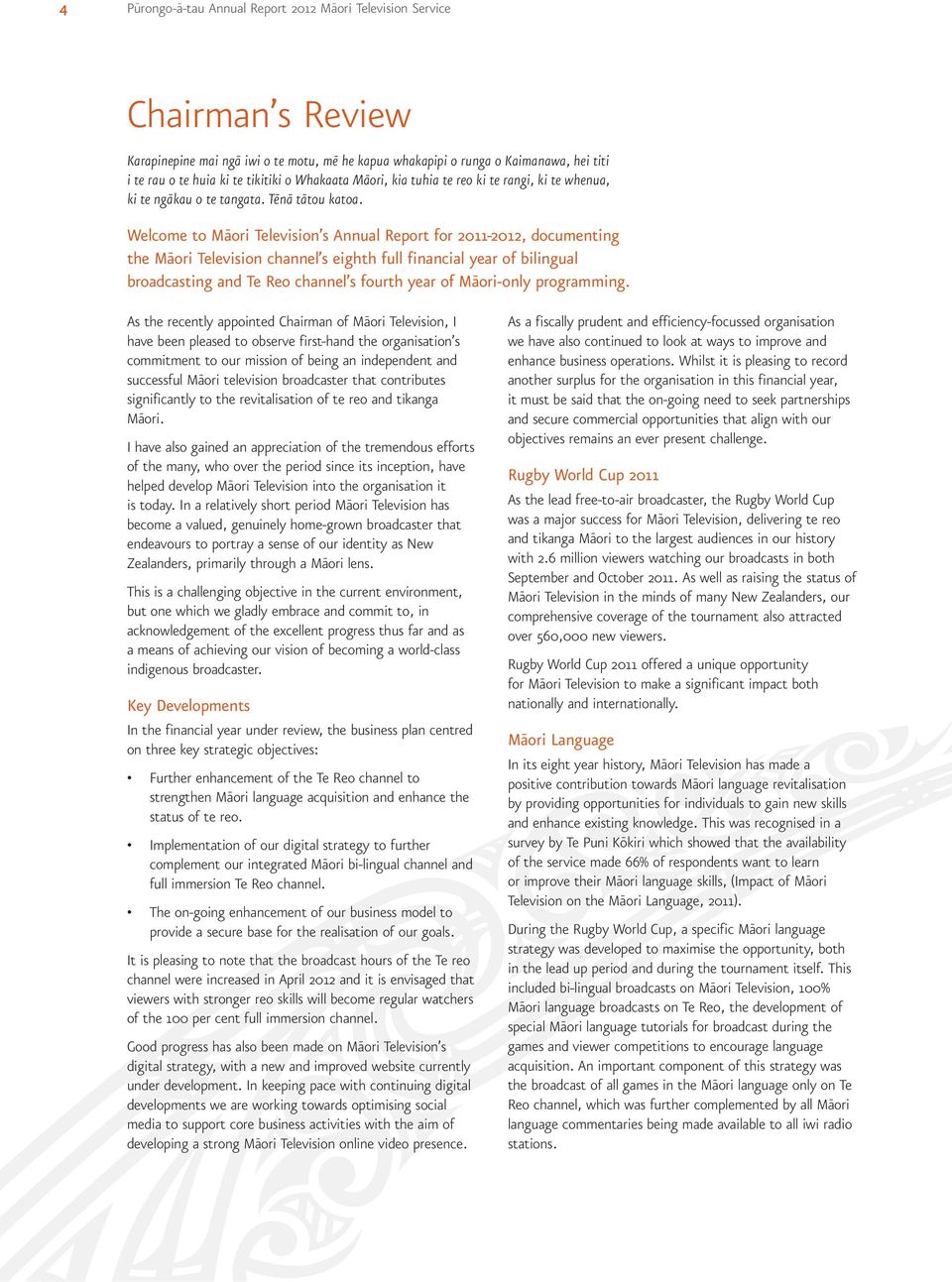
5 Pūrongo-ā-tau Annual Report Māori Television Service 3 a Garry ki te poari i te tau 2004, na Te Pūtahi Paoho i tohu. I roto i ngā tau e waru i runga i te poari kā nui te kaha me te manawapā o āna mahi kia tū kaha a Whakaata Māori. No reira mai i te poari, he mihi nui tēnei ki a Garry. Hāunga anō tāku mo nga tohutanga ki te poari, e rua atu anō ngā mema hou, ko Ian Taylor rāua ko Piripi Walker. He nui ngā pūkenga o Ian Taylor ka kawea mai e ia ki Whakaata Māori, he hautupua no te ao pāpāho autōhiko. He maha anō hoki ngā pūkenga o Piripi Walker i roto i āna mahi mo ngā teihana reo irirangi me āna mahi rongonui hei kaiakiaki mo Te Reo Māori. He mea nui ki au te arataki i te poari kikii ana i te hunga mātau, ki te arataki i ā Whakaata Māori ki ngā taumata tiketike i runga i te pai me te mārama o te huarahi ka takina atu. Te aronga ki mua I a tātou e ahu atu nei ki te tau tekau a te Maehe 2014, e hira ana tā mātou titiro ki te whakatupu i ngā mahi a Whakaata Māori. Na te mea ko ngā tahua pūtea a te Kāwanatanga, ko ā mātou whainga katoa kia tōtika te tiaki pūtea me te u ki ngā ture me ngā mahi pāpāho kia noho tonu ko te oranga o Te Reo Māori te kiko o ā mātou mahi katoa. Ahakoa te uaua o te ao pakihi, kei te tū kaha tonu mātou ki ngā akinga o ngā hau kino kia kōkiri whakamua ngā mahi whakaata pai ki te hunga mātakitaki, te whakapiki ake i ngā rauemi mo Te Reo hei tuara mo te oranga o Te Reo. Ngā Mihi Nui He tangata te mea nui ahakoa ko tēhea te rōpū. I tana haerengatahi e waimarie ana a Whakaata Māori, ki āna kaimahi, me o rātou pukenga hei tautoko i te kaupapa. Mai i Te Kaunihera Kaumātua, ki ngā kaimahi, ngā kaiwhakahaere me te poari katoa, ko tēnei taku mihi nui ki a rātou katoa. Kia kaua hoki e warewaretia ngā Minita a te Karauna, Hon Bill English, Hon Pita Sharples, ki te taha o Te Pūtahi Pāho ko rātou ngā ringa arataki, ngā ringa āwhina mo te kaupapa nei. Engari ko te mihi nui ki ngā kaitautoko katoa, ki ngā mano tini o te motu e mātakitaki mai ana i ā Whakaata Māori hei teihana ma rātou. Ka mihi atu ki to koutou kaha ki te āwhina mai i tēnei ara e kitea ai te mana, te ihi, me te wehi o to tātou Reo motuhake me ōna tikanga. Nō reira, hei kupu whakamutunga māku kia tika, kia pono, kia aroha, kia Māori. Hon Georgina te Heuheu QSO Heamana / Chairman
6 4 Pūrongo-ā-tau Annual Report Māori Television Service Chairman s Review Karapinepine mai ngā iwi o te motu, mē he kapua whakapipi o runga o Kaimanawa, hei titi i te rau o te huia ki te tikitiki o Whakaata Māori, kia tuhia te reo ki te rangi, ki te whenua, ki te ngākau o te tangata. Tēnā tātou katoa. Welcome to Māori Television s Annual Report for -, documenting the Māori Television channel s eighth full financial year of bilingual broadcasting and Te Reo channel s fourth year of Māori-only programming. As the recently appointed Chairman of Māori Television, I have been pleased to observe first-hand the organisation s commitment to our mission of being an independent and successful Māori television broadcaster that contributes significantly to the revitalisation of te reo and tikanga Māori. I have also gained an appreciation of the tremendous efforts of the many, who over the period since its inception, have helped develop Māori Television into the organisation it is today. In a relatively short period Māori Television has become a valued, genuinely home-grown broadcaster that endeavours to portray a sense of our identity as New Zealanders, primarily through a Māori lens. This is a challenging objective in the current environment, but one which we gladly embrace and commit to, in acknowledgement of the excellent progress thus far and as a means of achieving our vision of becoming a world-class indigenous broadcaster. Key Developments In the financial year under review, the business plan centred on three key strategic objectives: Further enhancement of the Te Reo channel to strengthen Māori language acquisition and enhance the status of te reo. Implementation of our digital strategy to further complement our integrated Māori bi-lingual channel and full immersion Te Reo channel. The on-going enhancement of our business model to provide a secure base for the realisation of our goals. It is pleasing to note that the broadcast hours of the Te reo channel were increased in April and it is envisaged that viewers with stronger reo skills will become regular watchers of the 100 per cent full immersion channel. Good progress has also been made on Māori Television s digital strategy, with a new and improved website currently under development. In keeping pace with continuing digital developments we are working towards optimising social media to support core business activities with the aim of developing a strong Māori Television online video presence. As a fiscally prudent and efficiency-focussed organisation we have also continued to look at ways to improve and enhance business operations. Whilst it is pleasing to record another surplus for the organisation in this financial year, it must be said that the on-going need to seek partnerships and secure commercial opportunities that align with our objectives remains an ever present challenge. Rugby World Cup As the lead free-to-air broadcaster, the Rugby World Cup was a major success for Māori Television, delivering te reo and tikanga Māori to the largest audiences in our history with 2.6 million viewers watching our broadcasts in both September and October. As well as raising the status of Māori Television in the minds of many New Zealanders, our comprehensive coverage of the tournament also attracted over 560,000 new viewers. Rugby World Cup offered a unique opportunity for Māori Television to make a significant impact both nationally and internationally. Māori Language In its eight year history, Māori Television has made a positive contribution towards Māori language revitalisation by providing opportunities for individuals to gain new skills and enhance existing knowledge. This was recognised in a survey by Te Puni Kōkiri which showed that the availability of the service made 66% of respondents want to learn or improve their Māori language skills, (Impact of Māori Television on the Māori Language, ). During the Rugby World Cup, a specific Māori language strategy was developed to maximise the opportunity, both in the lead up period and during the tournament itself. This included bi-lingual broadcasts on Māori Television, 100% Māori language broadcasts on Te Reo, the development of special Māori language tutorials for broadcast during the games and viewer competitions to encourage language acquisition. An important component of this strategy was the broadcast of all games in the Māori language only on Te Reo channel, which was further complemented by all Māori language commentaries being made available to all iwi radio stations.
7 Pūrongo-ā-tau Annual Report Māori Television Service 5 Another key development for Māori language broadcasting during this period was the decision to strengthen our language revitalisation focus on the Māori channel with the introduction of daily language programming from 10.00am 3.00pm. This commences at the start of the financial year. The new five hour block of Māori language tuition programming is designed to provide extensive resources for viewers to upskill and develop their reo proficiency. This initiative is intended to provide greater accessibility to te reo Māori for all New Zealanders, including Māori language learners and non-fluent speakers. This development has been strongly supported by our key stakeholder partners and in particular provided opportunities to work more closely with Te Pūtahi Paoho (Māori Television Electoral College) to identify new and innovative ways to achieve improved Māori language acquisition outcomes. Governance On behalf of the Board I would like to pay tribute to the former Chairman Garry Muriwai who completed his term in April after almost 5 years in the role of Chairman. Garry originally joined the Board in April 2004, appointed by Te Pūtahi Paoho. Over the entire 8 years of his tenure, Garry s strong leadership and loyal support has been fundamental to Māori Television s success. On behalf of the Board, I wish Garry all the best for the future. As well as my own appointment, the Māori Television Board welcomed two other new members, Ian Taylor and Piripi Walker. Ian brings to Māori Television an extensive television background and proven entrepreneurial success, particularly in the digital area. Piripi Walker offers remarkable expertise in both iwi radio broadcasting and Māori language advocacy. I am proud to be leading a talented and dedicated board and with my fellow directors, look forward to contributing to the future success of Māori Television by providing strong governance and clear strategic direction. Looking to the future As we approach our tenth anniversary of broadcasting in March 2014, we look forward to consolidating and building on Māori Television s strong performance to date. As a publicly funded Māori language broadcaster we remain focussed on meeting our financial, legislative and broadcast commitments whilst continuing to ensure that language revitalisation remains at the heart of everything we do. Despite a challenging external environment, we are wellpositioned to continue our strong performance in the coming year through increased audience engagement, additional resourcing to improve Māori language proficiency, and further enhancements to the quality of our programming. Acknowledgements Integral to the progress of any organization are the people charged with its success. With its unique mission, Māori Television is fortunate to have a body of people who bring an impressive range of skills and experience to the task, as well as the energy, passion and creativity required to sustain the kaupapa long term. From our Kaunihera Kaumātua (Elders Council) through to our staff, management and Board, a unique contribution to Māori Television continues to be made. I acknowledge that contribution sincerely. I also acknowledge our shareholding Ministers, Hon Bill English, and Hon Pita Sharples, who together with Te Pūtahi Paoho provide the guidance and support so necessary in an ever- changing environment. Finally I express thanks to all our stakeholders, in particular the many thousands of New Zealanders and others who choose to include Māori Television programming among their viewing preferences. We like that you share our passion and optimism for television that portrays a sense of our lives in Aotearoa New Zealand, and embodies the uniqueness of te Reo and tikanga Māori. Nō reira, hei kupu whakamutunga māku kia tika, kia pono, kia aroha, kia Māori. Hon Georgina te Heuheu QSO Heamana / Chairman
8 6 Pūrongo-ā-tau Annual Report Māori Television Service Tā te Tāhūhū Rangapū Ripoata Tuia ki te rangi i runga nei, tuia ki te papa e takoto nei, tuia ki ā rātou te hunga wahangū. Tuia ki ā tātou e pāhotia nei i tō tātou reo kia pāorōrotia ki ngā tōpito o te ao. Kia whakatairangatia ki uta, ki tai, e mau ai te ahurei o te iwi Māori. Tēnā tātou katoa. Ko te tātaritanga kōrero a te Heamana e whakarāpopoto ana i ngā hua matua i tutuki i ā Whakaata Māori i te tahua a tau kua taha ake. Ka waimarie matou i te mārama o te kaupapa angamua i whakatakotohia e te poari, me nga kaiāwhina pērā me Te Pūtahi Paaho, ngā Minita a te Kāwanatanga me te Kaunihera Kaumātua. Koinei ka taea e mātou te whai i te taki nei He ātea motuhake a Whakaata Māori hei taki i te oranga pūmau o Te Reo Māori me ōna tikanga katoa. Te whanonga Ko te whanonga nui kia toka te manawa o te Māori me ēra atu, kia mātakitaki mai i wā mātou hōtaka.ko tēnei te ara, hei whakangoto i Te Reo ki te hinengaro Māori ma te kunenga o te hunga ka mātaki mai. Ko te angitu o tēnei tikanga pākaha kia tupu te hiahia o te hunga ka pā mai, ka tahuri mai ki te whakaora i to tātou Reo. Kei roto i te rīpoata a te Heamana, te kōrero mo te kokiringa i te tau kia tōia mai a Whakaata Māori ki te ao o te pūnaha rorohiko. Ahakoa ka noho tonu ngā ngaru autōhiko hei kawenga ma Whakaata Māori mo tēnei wā, ka ngaoki atu ki te wā o te autōhiko e āmio ana i te ao, hei toronga atu ma ngā kaimātakitaki. Koinei te take ka wawe ta mātou hono atu ki ngā autōhiko o ngā āmiorangi. Hei hoa haere tahi mo tēnei ko te whakarewatanga a te pounga o te tau tahua, ko ngā mahi hei hono atu i ngā hōtaka ki runga i ngā pakihere rokiroki, he paetukutuku hou, he teihana hou mo You Tube. Ko ēnei ara katoa hei tautoko, hei āwhina ake i ngā kawenga ā Whakaata Māori i tana kaupapa reo rua me Te Reo Māori motuhake. Ka haere tonu ngā mahi hei whakapiki ake i te Teihana Reo Māori, pērā me te whakaroa ake i ngā haora, me ngā momo hōtaka ka kitea i te tau, he mea taki na te Poari. Ko te Teihana Reo Māori te ātea mo ngā mahi tutū ki te oranga o Te Reo, hei whakamana, hei tōpū rawa ako, me te hūtanga o ngā rauemi mo Te Reo ma roto atu i te tikanga e tau ai te kōrero i Te Reo i ngā wā katoa. I angamua to mātou waka ki te herenga tuatoru ara ki te tupu i te taha pakihi, te oranga pūmau mo Whakaata Māori. Ahakoa kāhore anō kia neke te tahua pūtea mai i te tau 2008, kei te aronui tonu te teihana ki ngā ara e ranea ake ngā hua. I te whakakorenga o ngā hōtaka pānui moni ka ngaro anō taua awa pūtea. Ka whakahoungia aua pānui moni, ki te hōtaka ako i Te Reo Māori mo te rima haora ia rā. Na kua whiwhi moni tautoko mo tērā kaupapa e ōrite ana ki te moni i ngaro atu. Ko ēnei ara mahi moni e hāngai ana ki te kaupapa o Whakaata Māori ngā mea ka whaitia e mātou. Te whakatutukitanga o ngā mahi. I te tīmatanga o te tahua tau ka hanga houtia he Tari hei tāpui mai i ngā mahi maha o roto ake o te teihana. I pēnei ai na te hiahia kia rahi ake ngā mahi e oti ana i te wā i whakaritea ahakoa te kuiti o ngā tahua pūtea. I oti pai taua hanga hou i mua atu o Te Ipu Hutupaoro o Te Ao, anā, e takoto tonu ana taua huarahi e kaha pupū ake ana ngā oranga. He pērā pū me ngā tau kua taha, kei te aro tonu a mātou mahi kia tere tika tonu to tātou waka. Na te mea he rōpū matapiko mātou ki te tiaki pūtea, i ranea ngā toenga pūtea ki te $775,000 kei runga ake tēnei i ngā whakaritenga o te $49,000 mo te tau tahua. Ko te wāhanga o tēnei rīpoata mo ngā whakahaere e mea ana i tutuki katoa ngā mahi ā Whakaata Māori ki tāna i oati ai mo tēnei tau. Te tirohanga ki mua Ko te tīmatanga o te āta whakawhiti atu ki ngā kawenga autōhiko ma ia rohe kia tae ki te kapinga katoa o te motu mai i te tau 2013 he mea angitu mo Whakaata Māori hei tō mai i te tini o ngā kaimātakitaki. Na te mea ko mātou tētahi o ngā kaikōkiri i te whakaata kore utu, kei runga rawa atu mātou i te tātai tāhiko na tēnei ka noho mātou ki te taha o ngā hautupua o te whakaata kore utu, i ngā pao tāhiko o ngā kaimātakitaki. Ko te huanga o tēnei, ko te tini, ko te mano ka taea te totoro mai ki wā mātou hōtaka o te kāinga nei. Ka hari
9 Pūrongo-ā-tau Annual Report Māori Television Service 7 koa ki te noho tahi ki ngā hautupua pāpāho ki runga i te kawenga kore utu, he mea ka rite tonu mātou katoa i runga i aua kawenga. Ka titiro tonu mātou ki ngā hangarau hou me te whakakaha ake i wa mātou whakahaere. Heoi ano i ngā wā katoa ko ta mātou aronganui ko te whānau mātakitaki, kia kitea ngā hōtaka hira rawa atu me te whakatoka i wa mātou herenga ki te ture, hei whakaora i Te Reo Māori me ōna tikanga. I te mutunga ko a mātou mahi katoa ka whakataungia mena i ea a mātou ritenga mo te whakaora i Te Reo Māori me ōna tikanga, kia rongohia, kia arohatia. He Tangata, He Tangata Ko ngā tāngata te mea nui mo ngā rōpū whakahaere mena ka hua kā kore rānei. Kei te toitu a Whakaata Māori mo tēnā. He momo wairua kei roto i ā Whakaata Māori e arataki ana i ngā kaimahi, ngā kaiwhakahaere, me te poari, kia tū whakahira hei kaitiaki mo te taonga nei e tutuki ai ngā wawata o rātou ma i moemoeatia kia tū he teihana whakaata Māori. Na runga i tēnā kei te mihi atu au ki te whānau o Whakaata Māori mo a rātou pūkenga hei kawe i te kaupapa whakaora i Te Reo Māori. Hei kapi ake i ēnei kōrero, tēnei te mihi atu ki ngā hunga e āwhina mai ana i te kaupapa. Ko tērā ko Te Māngai Pāho me ngā rōpū mahi hōtaka. Ko te mea nui ko te mihi ki ngā kaimātakitaki mai i a Whakaata Māori me ngā tini kowhiritanga. Me te mea hoki kia hari koa rātou ki ngā kaupapa i take ake nei i te haukāinga hei tohu i te āhua Māori, te āhua o Aotearoa, kia whakananua hei kōrito e tupu ai ngā hua o te rengarenga mo tātou katoa. Nō reira, ngahunga tonu atu te waka o Whakaata Māori ki te pae tawhiti, kia tata, kia tina. Haumi e, hui e, tāiki e. Jim Mather Tāhūhū Rangapū / Chief Executive
10 8 Pūrongo-ā-tau Annual Report Māori Television Service Chief Executive s Report Tuia ki te rangi i runga nei, tuia ki te papa e takoto nei, tuia ki ā rātou te hunga wahangū. Tuia ki ā tātou e pāhotia nei i tō tātou reo kia pāorōrotia ki ngā tōpito o te ao. Kia whakatairangatia ki uta, ki tai, e mau ai te ahurei o te iwi Māori. Tēnā tātou katoa. The Chairman s Review summarises the key developments implemented by Māori Television over the last financial year. As an organisation we continue to benefit from the clear strategic direction set by the Board and strong support received from a range of key stakeholders, including Te Pūtahi Paoho (Māori Television Electoral College), the Responsible Ministers and our Kaunihera Kaumātua (Elders Council). All of which contributes greatly to our on-going mission of being an independent, secure and successful Māori television broadcaster that makes a significant contribution to the revitalisation of te reo and tikanga Māori. Strategy Implementation A key overarching objective is to give Māori and all other viewers compelling reasons to watch our programming. This approach is designed to improve Māori language acquisition outcomes through optimising audience growth, as increased participation and engagement levels are core components of an effective language revitalisation strategy. As noted in the Chairman s report significant progress was made in the financial year to transform Māori Television into a digital media organisation. Although traditional linear broadcasting will remain the primary service provided by Māori Television for the foreseeable future, it will progressively be further augmented by a range of digital options for our viewers to access programming content. This assessment underscores the high priority that has been given to implementing our digital strategy. Aligned with this will be the launch in the final quarter of of a range of enhanced options to view our content via social media, mobile devices, an upgraded website and a new You Tube channel. All of these viewing options will further complement our integrated bi-lingual Māori Television and full-immersion Te Reo television channels. The on-going enhancement of the Te Reo channel which included extended hours and a broader range of programme genres in, was another key objective set by the Board. The Te Reo channel is a crucial component of our language revitalisation strategy in that it gives status to te reo Māori, provides a corpus of language development resources and strengthens the acquisition of te reo through normalising its usage in a full-immersion setting. Progress was also made towards the third key strategic objective associated with enhancing the business model under which Māori Television functions. Although it has been in a static funding situation since 2008, the organisation continues to be aspirational and prepared to explore different commercial approaches. An example was the planning which commenced at the end of the financial year to eliminate infomercials and the associated commercial revenue. The infomercials were subsequently replaced with a daily 5 hour block of Māori language tuition programming which has since attracted sponsorship support comparable to the previous level of revenue associated with the infomercials. It is these types of commercial opportunities which are better aligned with the kaupapa of Māori Television that we will continue to develop. Operational Performance At the beginning of the financial year a restructure was undertaken to create a separate Production Department to reflect the growing importance of in-house produced programming content. This was necessary to enable higher volumes of content to be produced in a timely manner within tight budgetary constraints. The restructuring was successfully implemented prior to the coverage of the Rugby World Cup tournament and continues to provide opportunities for further efficiency gains. As in previous years specific focus continues to be applied to enhancing our business practices to optimise efficiency and effectiveness. As a fiscally responsible organisation it is very positive that we can report another surplus result of $775,000 against a budgeted result of $49,000 for the financial year. The Statement of Service Performance section of this report also highlights that Māori Television achieved all of its statutory performance measurements in this financial year.
11 Pūrongo-ā-tau Annual Report Māori Television Service 9 Looking Ahead The commencement of a staged digital switch over (DSO) by region through to full nationwide completion in December 2013, presents a significant opportunity for Māori Television to access a much wider audience. As a founding stakeholder in the Freeview consortium, our high placing on the electronic programme guide (EPG) means that we will be right alongside the main free-to-air broadcasters on the remote controls of viewers. This is anticipated to translate into significantly larger audiences who are able to access our wide range of unique locally produced programming. We look forward to being on the same transmission platform as the free-to-air commercial broadcasters and the level playing field options that provides. We will continue to explore and develop relevant new technologies as well as strive to improve the overall quality of our programming. Yet, at all times, we will ensure that we remain a customer-oriented organisation, delivering programmes that exceed the expectations of our viewers, whilst fulfilling our statutory obligations and inherent responsibility to the revitalisation of the Māori language and culture. Ultimately our future performance will be measured by our effectiveness as an organisation that makes a significant contribution to te reo and tikanga Māori being increasingly valued, embraced and spoken. He Tāngata, He Tāngata It is the people of any organisation who determine its success or otherwise. In that regard, Māori Television is very well placed. We have a unique spirit of commitment shared by all staff, management and board members to ensure that we as kaitiaki of this taonga, fulfil the dreams and aspirations of those who were at the forefront of the establishment of Māori Television. Accordingly, I acknowledge all members of the whānau of Māori Television for the important skills, creativity and dedication required to successfully operate a complex media organisation committed to Māori language revitalisation. In closing, I further acknowledge the special contribution made by other key stakeholders including Te Māngai Pāho and our passionate, hardworking independent production community. Finally, gratitude is extended to our viewers who connect with Māori Television and include our programming amongst the many and varied choices available to them. In doing so, we trust that our high local content and unique reflection of who we are as Māori and New Zealanders, genuinely enriches our society, culture and heritage. Nō reira, ngahunga tonu atu te waka o Whakaata Māori ki te pae tawhiti, kia tata, kia tina. Haumi e, hui e, tāiki e. JIM MATHER Tāhūhū Rangapū / Chief Executive
12 10 Pūrongo-ā-tau Annual Report Māori Television Service Performance Highlights The following table sets out how targets within the intermediate outcomes have performed this year: OUTCOME 1: MĀORI LANGUAGE REVITALISATION OBJECTIVES ARE ACHIEVED KEY PERFORMANCE INDICATORS MECHANISM DELIVERABLE TARGET FY PERFORMANCE FY MEASUREMENT Māori language content Māori Television Channel: Minimum percentage of Māori language during prime time Minimum percentage of Māori language across schedule. 51% 51% Māori Television Schedule 60% 57% Māori Television Schedule Te Reo Channel: Māori language across schedule %* 100%* Māori Television Schedule Both Channels: Combined minimum percentage of Māori language during prime time for Māori Television and Te Reo. 70% 72% Māori Television Schedule Language Learning Programming: Programmes broadcast for all people learning Māori language 20 hours per month (average) 28 hours per month (average) Māori Television Schedule Tamariki Programming: Programmes for tamariki participating in Māori language immersion education 10 hours per week (average) 13 hours per week (average) Māori Television Schedule Māori language quality Average rating** is achieved Te Taura Whiri I Te Reo Māori Impact*** Understanding of Māori language is improved by watching Māori Television. 54% of Maori & 28% of all NZ ers agreed Māori Television Tracking Research Interest in learning Māori language ge is increased by watching Māori Television 50% of Maori & 22% of all NZ ers agreed Māori Television Tracking Research Māori Television provides a strong sense of connection to Māori people, lifestyles, language and culture 83% of Maori & 64% of all NZ ers agreed Māori Television Tracking Research * Some programmes will contain English words and phrases. ** Rating band is: 1 Very Poor; 2- Poor; 3 Good; 4 Very Good; 5 Excellent *** Based on two-yearly surveys conducted by Māori Television

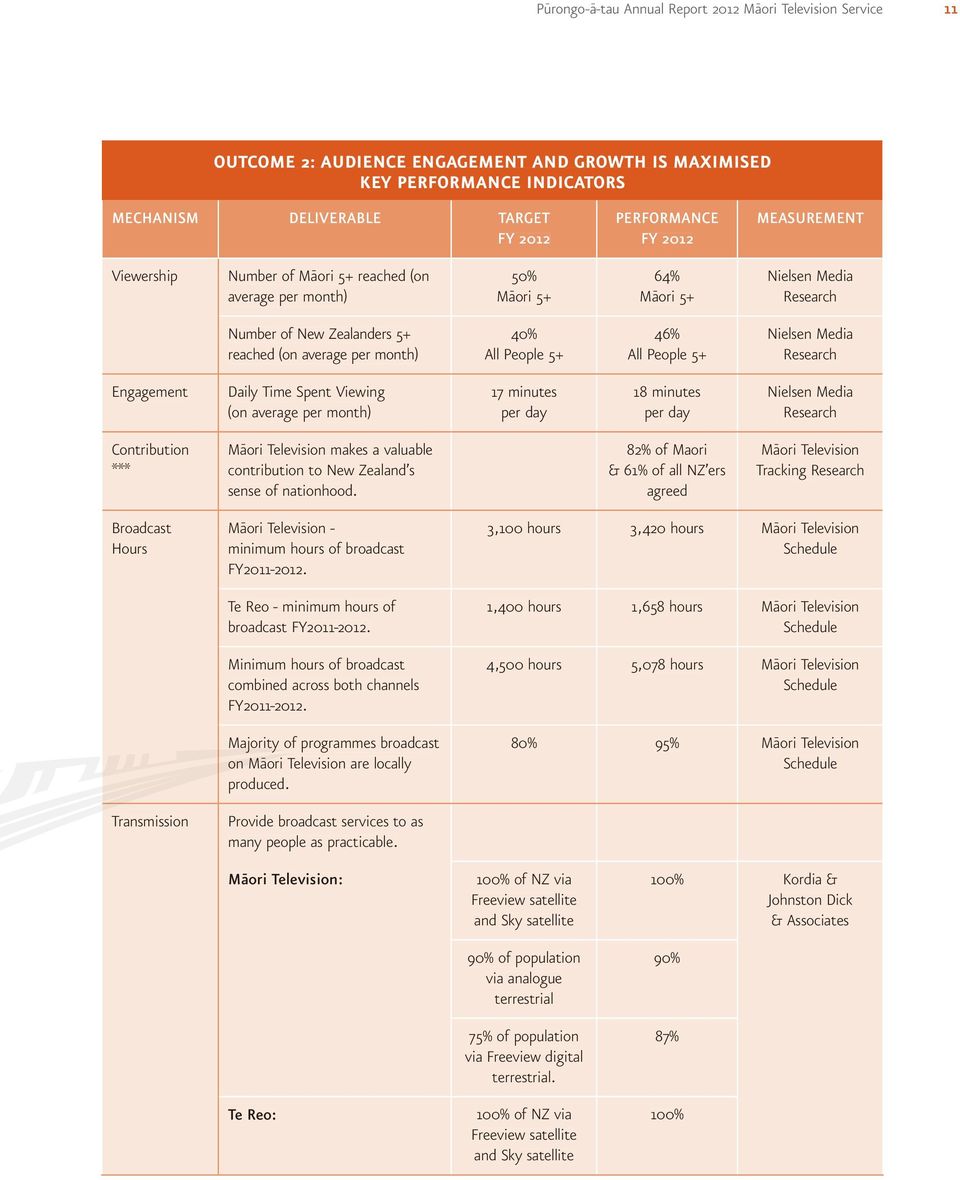
13 Pūrongo-ā-tau Annual Report Māori Television Service 11 OUTCOME 2: AUDIENCE ENGAGEMENT AND GROWTH IS MAXIMISED KEY PERFORMANCE INDICATORS MECHANISM DELIVERABLE TARGET FY PERFORMANCE FY MEASUREMENT Viewership Number of Māori 5+ reached (on average per month) 50% Māori 5+ 64% Māori 5+ Nielsen Media Research Number of New Zealanders 5+ reached (on average per month) 40% All People 5+ 46% All People 5+ Nielsen Media Research Engagement Daily Time Spent Viewing (on average per month) 17 minutes per day 18 minutes per day Nielsen Media Research Contribution *** Māori Television makes a valuable contribution to New Zealand s sense of nationhood. 82% of Maori & 61% of all NZ ers agreed Māori Television Tracking Research Broadcast Hours Transmission Māori Television - minimum hours of broadcast FY-. Te Reo - minimum hours of broadcast FY-. Minimum hours of broadcast combined across both channels FY-. Majority of programmes broadcast on Māori Television are locally produced. Provide broadcast services to as many people as practicable. 3,100 hours 3,420 hours Māori Television Schedule 1,400 hours 1,658 hours Māori Television Schedule 4,500 hours 5,078 hours Māori Television Schedule 80% 95% Māori Television Schedule Māori Television: Te Reo: 100% of NZ via Freeview satellite and Sky satellite 90% of population via analogue terrestrial 75% of population via Freeview digital terrestrial. 100% of NZ via Freeview satellite and Sky satellite 100% Kordia & Johnston Dick & Associates 90% 87% 100%
14 12 Pūrongo-ā-tau Annual Report Māori Television Service OUTCOME 3: BUSINESS MODEL IS DEVELOPED AND ENHANCED KEY PERFORMANCE INDICATORS MECHANISM DELIVERABLE PERFORMANCE FY COMPARE Efficiency Cost effective and efficient operations: - Average cost of programme production (per programme hour) - Average cost of broadcasting (per programme hour) - Annual Cost to taxpayer per viewer reached $13,561 per hour Compare with $38,118 per hour independent production (ex TMP contestable fund) and $85,484 per hour general independent production (ex NZOA contestable fund). $2,274 per hour Compare with $19,000 per hour, International Public Broadcasters Survey 2007 $19 per viewer Māori Television Tracking Research Financial Financial targets are achieved Surplus achieved

15 Pūrongo-ā-tau Annual Report Māori Television Service 13 Governance and Accountability The Board of Māori Television comprises up to seven non-executive directors. Four directors are appointed by Te Pūtahi Paoho and the remaining three by the Crown, represented by the Minister of Finance and the Minister of Māori Affairs. In the period under review, Hon. Georgina te Heuheu joined the Board as Chairman. Ian Taylor and Piripi Walker also joined the Board as directors. Hon Georgina te Heuheu QSO Ngāti Tūwharetoa, Te Arawa, Ngāti Awa, Tuhoe (Crown appointment) Georgina te Heuheu is Chairman of the Board of Māori Television. She was recently elected a member of the Tūwharetoa Māori Trust Board. Georgina has extensive experience in central government and public accountability, including recent experience with the Māori broadcasting industry as Associate Minister of Māori Affairs with delegated responsibility for Māori broadcasting. She served five terms as a Member of Parliament from 1996 until, including as a Minister of the Crown in two National Governments. She was the first Māori woman to be admitted to the High Court as a Barrister and Solicitor in She was a member of the Waitangi Tribunal for ten years, and a member of the Courts Consultative Committee. She has served as Minister for Courts on two occasions. Former Parliamentary and Ministerial roles also include Chair of the Māori Affairs Select Committee and Associate Minister of Treaty Negotiations, and more recently, Minister of Pacific Island Affairs and Minister for Disarmament and Arms Control. Georgina has previously been a Director of the Māori Development Corporation, Te Papa and the Midland Regional Health Authority and a member of the council of the University of Waikato. Cathy Dewes Te Arawa, Ngāti Porou (Te Pūtahi Paoho appointment) Cathy Dewes is a long-time advocate of the Māori language and has been actively involved in various Māori language revitalisation initiatives for more than three decades. She was a part of Te Reo Māori Society which was instrumental in establishing the first Koha and Te Karere programmes as well as the first training programme for Māori television producers and directors. A founding member of the kura kaupapa Māori movement, Cathy is the principal of Te Kura Kaupapa Māori o Ruamata in Rotorua which is a pioneer in the delivery of national secondary qualifications in te reo Māori. She is also a former Chairperson of Te Rūnanganui o Ngā Kura Kaupapa Māori o Aotearoa and still serves on the executive council. Cathy was the first woman to serve on Te Arawa Māori Trust Board and represented Ngāti Rangitihi through to the settlement of their lakes claim. Rikirangi Gage Te Whānau-a-Apanui, Ngāti Porou, Te Whakatōhea, Ngāti Maniapoto (Te Pūtahi Paoho appointment) Rikirangi Gage is the Chief Executive of Te Rūnanga o te Whānau tribal authority a position he has held for more than 20 years. He was a Board member of Te Papa for three years and is a current director of the Māori fisheries commission, Te Ohu Kaimoana. He has also served as a member of a specialist advisory panel for Te Ture Whenua Māori Act 1993, the Ministerial Advisory Committee on Oceans Policy and the Board of Enquiry for the New Zealand Coastal Policy Statement An active member of the Ringatu Church, Mr Gage has been a negotiator for Te Whānau-a-Apanui on its foreshore and seabed claims. He has experience in governance and management roles and issues for iwi, Māori organisational development, Māori economic development, Māori education initiatives, leadership within Māori churches, youth justice and indigenous rights. Donna Gardiner Ngaiterangi, Ngāti Ranginui, Ngāti Pūkenga (Crown appointment) Donna Gardiner (BA, MED, Dip Indigenous Diplomacy) has extensive experience in whānau and hapū development, community development and the public service as well as a lifelong commitment to Māori and indigenous development. Governance, Māori political representation and strategic leadership are significant areas of interest to Ms Gardiner. She is currently employed at Ngā Pae o te Māramatanga UOA New Zealand s Māori Centre of Research Excellence and has previously worked as a senior lecturer at AUT s Te Ara Poutama. Prior to this, she managed the Manukau outpost of Te Whare Wānanga o Awanuiārangi for three years. Ms Gardiner is working on her PHD. Tahu Potiki Ngāi Tahu (Te Pūtahi Paoho appointment) Tahu Potiki has been a major influence in the Māori language revitalisation initiatives of South Island tribe Ngāi Tahu over the past two decades and is a former Board member of the Māori broadcasting funding agency, Te Māngai Pāho. Tahu and his whānau run a business from the Otago Peninsula and he is involved in a number of community organisations and Māori development projects. He currently represents Otakou in the Otago on the tribal council, Te Rūnanga o Ngāi Tahu.

16 14 Pūrongo-ā-tau Annual Report Māori Television Service Piripi Walker Ngāti Raukawa te Au ki te Tonga (Te Pūtahi Paoho appointment) Having trained as a Māori Language Producer at Radio New Zealand, Piripi Walker was one of the founders and former station managers of Te Upoko o Te Ika Radio, the oldest Māori radio station in New Zealand. He remains Trustee and Secretary of the station s Trust Board, a position he has held since Piripi was secretary for Ngā Kaiwhakapūmau i Te Reo (the Wellington Māori Language Board) in a number of Tribunal and Court cases relating to the Māori language, Māori radio, Māori television, and the radio spectrum during the 1980 s. Later, he became one of the negotiators on the appropriate Treaty mechanisms for the establishment of Māori broadcasting. As a full-time Director of Language Studies, Piripi directed the Māori Laws and Philosophy Programme at Te Wananga o Raukawa in Otaki from He was also a member of the Electoral College for the Māori Television Service Board for ten years until, representing Te Tauihu o Ngā Wānanga, the national association of Wānanga Māori. Having mostly worked as a writer, editor and translator over the last ten years, Piripi has edited a number of publications, including assisting with editing anthologies and dictionaries. Ian Taylor Ngāti Kahungungu, Ngāpuhi (Crown appointment) Ian Taylor is the founder of Animation Research Limited (ARL), a graphics company responsible for revolutionising the televised coverage of sports with the development of a 3D real-time graphics tracking application for the Americas Cup. A lawyer by training, Ian spent over 20 years in the Television industry as a presenter for Play School, Spot On, Fast Forward and NZ s Funniest Home Videos. Ian is also an award winning producer for a number of documentaries including The World s Fastest Indian and Aramoana. In 2010 Ian was named North and South magazine s New Zealander of the Year and in he was named a Companion of the NZ Order of Merit, for services to television and business. Role of the Board The Board s governance responsibilities, which are defined in the Māori Television Service (Te Aratuku Whakaata Irirangi Māori) Act 2003, include: The annual completion of a Statement of Intent, which is to be agreed upon with the Minister of Māori Affairs and the Minister of Finance (the responsible ministers ) and Te Pūtahi Paoho; The annual completion of an Output Agreement, which is to be agreed upon with the responsible ministers; The provision of quarterly reports against the Output Agreement to the Chairperson of Te Pūtahi Paoho and the responsible ministers; The provision of an Annual Report to the responsible ministers and the Chairperson of Te Pūtahi Paoho; The delegation to the Chief Executive of responsibility for the efficient and effective administration of the dayto-day operations of Māori Television. The Board concentrates on setting policy and strategy and holds regular meetings to monitor progress towards the achievement of those strategic objectives and to ensure that the affairs of Māori Television are being conducted in accordance with the Board s policies. The Board has two standing committees: Audit Committee During the year, members of the Audit Committee were Tahu Potiki, Cathy Dewes, Ian Taylor and Piripi Walker. Remuneration Committee During the year, members of the Remuneration Committee were Georgina te Heuheu, Donna Gardiner and Rikirangi Gage. Conflicts of Interest A director who is interested in a transaction, or proposed transaction of, or other matter relating to Māori Television must disclose the nature of the interest to the Chairman of the Board. If the director is the Chairman, disclosure must be made to the responsible Ministers and the Chairman of Te Pūtahi Paoho. Risk Management The Board acknowledges that it is ultimately responsible for the management of risks to Māori Television. The Board has charged the Chief Executive with establishing and operating a prudent risk management programme. Programme Standards The Board acknowledges Māori Television s responsibility to comply with programme codes adopted by the Broadcasting Standards Authority. Māori Television has implemented procedures to ensure formal complaints are investigated and appropriate action taken. Occupational Health and Safety Māori Television is committed to maintaining a safe and healthy working environment and has implemented a health and safety policy to promote prevention and best practice.

17 Pūrongo-ā-tau Annual Report Māori Television Service 15 Statement of Responsibility For the year ended 30 June The Board and management of Māori Television accept responsibility for the preparation of the annual Financial Statements and the judgements used in them. The Board and management of Māori Television accepts responsibility for establishing and maintaining a system of internal control designed to provide reasonable assurance as to the integrity and reliability of financial and non-financial reporting. In the opinion of the Board and management of Māori Television the annual Financial Statements including the Statement of Service Performance for the year ended 30 June, fairly reflect the financial position and operations of Māori Television. Hon. Georgina te Heuheu QSO Jim Mather Chairman Chief Executive Date: 18 October Date: 18 October

18 16 Pūrongo-ā-tau Annual Report Māori Television Service Independent Auditor s Report To the readers of the Māori Television Service s financial statements and statement of service performance for the year ended 30 June The Auditor-General is the auditor of the Māori Television Service. The Auditor-General has appointed me, David Walker, using the staff and resources of Audit New Zealand, to carry out the audit of the financial statements and statement of service performance of the Māori Television Service on her behalf. We have audited: the financial statements of the Māori Television Service on pages 20 to 36, that comprise the statement of financial position as at 30 June, the statement of comprehensive income, statement of changes in equity and statement of cash flows for the year ended on that date and notes to the financial statements that include accounting policies and other explanatory information; and the statement of service performance of the Māori Television Service on pages 18 to 19. Opinion In our opinion: the financial statements of the Māori Television Service on pages 20 to 36: - comply with generally accepted accounting practice in New Zealand; and - fairly reflect the Māori Television Service s: financial position as at 30 June ; and financial performance and cash flows for the year ended on that date. the statement of service performance of the Māori Television Service on pages 18 to 19: - complies with generally accepted accounting practice in New Zealand; and - fairly reflects, for each class of outputs for the year ended 30 June, the Māori Television Service s: service performance compared with the forecasts in the statement of forecast service performance for the financial year; and actual revenue and output expenses compared with the forecasts in the statement of forecast service performance at the start of the financial year. Our audit was completed on 18 October. This is the date at which our opinion is expressed. The basis of our opinion is explained below. In addition, we outline the responsibilities of the Board and our responsibilities, and we explain our independence. Basis of opinion We carried out our audit in accordance with the Auditor- General s Auditing Standards, which incorporate the International Standards on Auditing (New Zealand). Those standards require that we comply with ethical requirements and plan and carry out our audit to obtain reasonable assurance about whether the financial statements and statement of service performance are free from material misstatement. Material misstatements are differences or omissions of amounts and disclosures that would affect a reader s overall understanding of the financial statements and statement of service performance. If we had found material misstatements that were not corrected, we would have referred to them in our opinion. An audit involves carrying out procedures to obtain audit evidence about the amounts and disclosures in the financial statements and statement of service performance. The procedures selected depend on our judgement, including our assessment of risks of material misstatement of the financial statements and statement of service performance, whether

19 Pūrongo-ā-tau Annual Report Māori Television Service 17 due to fraud or error. In making those risk assessments, we consider internal control relevant to the preparation of the Māori Television Service s financial statements and statement of service performance that fairly reflect the matters to which they relate. We consider internal control in order to design audit procedures that are appropriate in the circumstances but not for the purpose of expressing an opinion on the effectiveness of the Māori Television Service s internal control. An audit also involves evaluating: the appropriateness of accounting policies used and whether they have been consistently applied; the reasonableness of the significant accounting estimates and judgements made by the Board; the adequacy of all disclosures in the financial statements and statement of service performance; and the overall presentation of the financial statements and statement of service performance. We did not examine every transaction, nor do we guarantee complete accuracy of the financial statements and statement of service performance. We have obtained all the information and explanations we have required and we believe we have obtained sufficient and appropriate audit evidence to provide a basis for our audit opinion. Responsibilities of the Board The Board is responsible for preparing financial statements and a statement of service performance that: comply with generally accepted accounting practice in New Zealand; fairly reflect the Board s financial position, financial performance and cash flows; and fairly reflect its service performance. The Board is also responsible for such internal control as is determined necessary to enable the preparation of financial statements and a statement of service performance that are free from material misstatement, whether due to fraud or error. The Board s responsibilities arise from the Māori Television Service Act Responsibilities of the Auditor We are responsible for expressing an independent opinion on the financial statements and statement of service performance and reporting that opinion to you based on our audit. Our responsibility arises from section 15 of the Public Audit Act 2001 and section 43(2) of the Māori Television Service Act Independence When carrying out the audit, we followed the independence requirements of the Auditor-General, which incorporate the independence requirements of the New Zealand Institute of Chartered Accountants. Other than the audit, we have no relationship with or interests in the Māori Television Service. David Walker Audit New Zealand On behalf of the Auditor-General Auckland, New Zealand Matters relating to the electronic presentation of the audited financial statements and statement of service performance This audit report relates to the financial statements and statement of service performance of the Māori Television Service for the year ended 30 June included on the Māori Television Service s website. The Māori Television Service s Board is responsible for the maintenance and integrity of the Māori Television Service s website. We have not been engaged to report on the integrity of the Māori Television Service s website. We accept no responsibility for any changes that may have occurred to the financial statements and statement of service performance since they were initially presented on the website. The audit report refers only to the financial statements and statement of service performance named above. It does not provide an opinion on any other information which may have been hyperlinked to or from the financial statements and statement of service performance. If readers of this report are concerned with the inherent risks arising from electronic data communication they should refer to the published hard copy of the audited financial statements and statement of service performance and the related audit report dated 18 October to confirm the information included in the audited financial statements and statement of service performance presented on this website. Legislation in New Zealand governing the preparation and dissemination of financial information may differ from legislation in other jurisdictions.

20 18 Pūrongo-ā-tau Annual Report Māori Television Service Statement of Service Performance Non-Departmental Output Class Māori Television receives operational funding from Vote: Māori Affairs. The description of the output class through which Māori Television receives operational funding is as follows: The Minister of Māori Affairs will purchase this class of outputs from Māori Television to: Enable Māori Television to meet its statutory functions, including the promotion of te reo me ngā tikanga Māori through the provision of a high quality, cost effective Māori television service, in both Māori and English, that informs, educates and entertains a broad viewing audience and, in so doing, enriches New Zealand s society, culture and heritage; Pursue the outcomes in its - Statement of Intent; Support the operational costs of Māori Television; and Purchase and produce programmes to be broadcast on Māori Television. Performance measures for this class of outputs will be included in the following document: Māori Television - Output Plan. Outputs will be provided at a total forecast cost of Outputs 1 and 2 Māori Television will deliver two outputs through this output class. A description, the cost and performance measures for each output are described below (actual performance shown in italics): OUTPUT 1 TELEVISION SERVICE OPERATIONS Description To support the operational costs of Māori Television so that it can meet its statutory functions. Performance Measures Quantity Broadcast 4,000 hours of programming for the year. Māori Television broadcast a total of 5,078 hours (: 4,717 hours) during the year. Broadcast programmes mainly in te reo Māori. 71% (: 73%) of all programmes broadcast on Māori Television were in te reo. Quality Two six monthly reviews by Te Taura Whiri i te Reo Māori (Māori Language Commission) confirm that a selection of programmes broadcast during the general prime-time meet its quality indicator framework. 12 independent Māori Language Quality Assessment reviews were performed against the Te Taura Whiri I Te Reo Māori quality-indicator framework, during the period July to June. The average rating achieved by those programmes assessed achieved an average grading of 4.37 (: 4.29) (very good, 4.0 and excellent, 5.0). Cost Actual: $ million Budget: $ million Actual: $ million

21 Pūrongo-ā-tau Annual Report Māori Television Service 19 OUTPUT 2 TRANSMISSION COVERAGE Description Provide broadcast services that are technically available throughout New Zealand and are accessible to as many people as is reasonably and economically possible. Performance Measures Quantity Provide free-to-air terrestrial UHF transmission coverage to at least 90% of New Zealand s population. Māori Television Channel only: Māori Television has 90% (: 90%) free to air transmission coverage in UHF analogue and 87% (: 74%) free to air transmission coverage on Freeview digital terrestrial Provide free-to-air satellite transmission coverage to 100% of New Zealand s population. Both Māori Television & Te Reo Channels: Māori Television has 100% (: 100%) satellite transmission coverage on Freeview Satellite and on Sky TV. Cost Total Output Costs equals Total Expenditure per Statement of Comprehensive Income Actual: $3.449 million Budget: $3.721 million Actual: $3.326 million Actual: $ million Budget: $ million Actual: $ million
22 20 Pūrongo-ā-tau Annual Report Māori Television Service Statement of Comprehensive Income For the year ended 30 June Note Actual Budget Actual Income Revenue from the Crown 16,611 16,611 16,611 Te Māngai Pāho Production Funding 16,120 16,120 16,120 Other Production Funding 3,165 1,700 1,616 Advertising Income 2,393 3,149 1,598 Interest Income Other Income 11-5 TOTAL INCOME 38,790 37,973 36,438 Expenditure Personnel Costs 3 12,527 12,641 12,100 Depreciation & Amortisation Expense 4 1,528 1,479 1,323 Finance Costs Programme Costs incl. Amortisation 4 14,728 14,181 13,920 Other Operating Costs 4 9,232 9,623 8,866 TOTAL EXPENDITURE 38,015 37,924 36,210 Surplus Other Comprehensive Income TOTAL COMPREHENSIVE INCOME The expenditure budgets as approved in the Statement of Intent (SOI) have been reclassified to realign with the disclosure of actual results. Note 23a provides further details. Explanation of significant variances against budget are detailed in Note 23b. Statement of Changes in Equity For the year ended 30 June Note Actual Budget Actual Balance at 1 July 18,281 18,300 18,053 Total Comprehensive Income BALANCE AT 30 JUNE 19,056 18,349 18,281 The accompanying notes form part of these financial statements.
23 Pūrongo-ā-tau Annual Report Māori Television Service 21 Statement of Financial Position As at 30 June Note Actual Budget Actual Public Equity General Funds 19,056 18,349 18,281 TOTAL PUBLIC EQUITY 19,056 18,349 18,281 Represented by: Assets Current Assets Cash and Cash Equivalents 5 4,576 4,462 3,169 GST Receivable Bank Deposits 6 6,200 5,200 5,200 Trade and Other Receivables 7 2,922 5,214 3,455 Intangibles Programme Rights 9a 1,405 (105) 2,215 TOTAL CURRENT ASSETS 15,561 14,857 14,452 Non-Current Assets Property, Plant and Equipment 8 7,449 5,580 6,586 Intangibles 9b TOTAL NON-CURRENT ASSETS 7,721 5,580 7,015 TOTAL ASSETS 23,282 20,437 21,467 Liabilities Current Liabilities Trade and Other Payables 10 2,844 1,166 1,994 Employee Entitlements 11 1, ,192 Unearned Income TOTAL CURRENT LIABILITIES 4,226 2,088 3,186 TOTAL LIABILITIES 4,226 2,088 3,186 NET ASSETS 19,056 18,349 18,281 The accompanying notes form part of these financial statements.
24 22 Pūrongo-ā-tau Annual Report Māori Television Service Statement of Cash Flows For the year ended 30 June Note Actual Budget Actual Cash Flows from Operating Activities Cash was provided from: Receipts from Crown Revenue 16,611 16,611 16,611 Te Māngai Paoho Production Funding 15,833 16,120 13,476 Other Production Funding 2,981-1,432 Interest Received Advertising Revenue 1,078 3,017 1,440 Other Income 2, Cash was applied to: Payments to Employees (12,429) (12,980) (12,025) Payments to Suppliers (10,471) (9,848) (10,845) Interest Paid (1) - (1) Goods and Services Tax (Net) (45) 108 (18) NET CASH FROM OPERATING ACTIVITIES 12 16,439 13,421 10,522 Cash Flows from Investing Activities Cash was applied to: Acquisition of Bank Deposits (1,000) - (500) Purchase of Property, Plant and Equipment (2,082) (696) (917) Purchase of Computer Software (153) - (387) Purchase of Intangibles Programme Rights (11,797) (10,801) (9,839) NET CASH FLOWS FROM INVESTING ACTIVITIES (15,032) (11,497) (11,643) Net Increase/(Decrease) in Cash and Cash Equivalents 1,407 1,924 (1,121) Cash and Cash Equivalents at the beginning of the year 3,169 2,538 4,290 CASH AND CASH EQUIVALENTS AT THE END OF THE YEAR 4,576 4,462 3,169 The GST (net) component of operating activities reflects the net GST paid and received with the Inland Revenue Department. The GST (net) component has been presented on a net basis, as the gross amounts do not provide meaningful information for financial statement purposes. The accompanying notes form part of these financial statements
25 Pūrongo-ā-tau Annual Report Māori Television Service 23 Notes to the Financial Statements For the year ended 30 June 1. Statement of Accounting Policies The financial statements of Māori Television are for the year ended 30 June. The financial statements were authorised by the Board of Directors on 18 October. The following accounting policies that materially affect the measurement of financial performance, financial position and cash flows have been applied: (a) Reporting Entity Māori Television is a statutory corporation incorporated in New Zealand under the Māori Television Service Act 2003 and is domiciled in New Zealand. The purpose of Māori Television is to contribute to the protection and to promote te reo Māori and as such the objective is to provide a service to the public of New Zealand as opposed to that of making a financial return. Accordingly Māori Television has designated itself as a public benefit entity for the purposes of New Zealand Equivalents to International Financial Reporting Standards ( NZ IFRS ). (b) Statement of Compliance These financial statements have been prepared in accordance with section 41 of the Māori Television Act 2003 which includes the requirement to comply with New Zealand generally accepted accounting practice ( NZ GAAP ). The financial statements comply with NZ IFRS and other applicable Financial Reporting Standards, as appropriate for public benefit entities. (c) Measurement Base The financial statements have been prepared on an historical cost basis except where derivative financial instruments have been measured at fair value. (d) Standards, amendments and interpretations issued that are not yet effective and have not been early adopted The Minister of Commerce has approved a new Accounting Standards Framework (incorporating a Tier Strategy) developed by the External Reporting Board (XRB). Under this Accounting Standards Framework, Māori Television is classified as a Tier 1 reporting entity and it will be required to apply full Public Benefit Entity Accounting Standards (PAS). These standards are being developed by the XRB based on current International Public Sector Accounting Standards. The effective date for the new standards for public sector entities is expected to be for reporting periods beginning on or after 1 July This means Māori Television expects to transition to the new standards in preparing its 30 June 2015 financial statements. As the PAS are still under development, Māori Television is unable to assess the implications of the new Accounting Standards Framework at this time. Due to the change in the Accounting Standards Framework for public benefit entities, it is expected that all new NZ IFRS and amendments to existing NZ IFRS will not be applicable to public benefit entities. Therefore, the XRB has effectively frozen the financial reporting requirements for public benefit entities up until the new Accounting Standard Framework is effective. Accordingly, no disclosure has been made about new or amended NZ IFRS that exclude public benefit entities from their scope. (e) Changes in Accounting Policy There have been no changes in accounting policies during the financial year. (f) Functional and Presentation Currency The financial statements are presented in New Zealand dollars and all values are rounded to the nearest thousand dollars ($ 000). The functional currency of Māori Television is New Zealand dollars. (g) Forecast Financial Statements Budget Figures The budget figures are derived from the statement of intent as approved by the Board at the beginning of the financial year. The budget figures have been prepared in accordance with NZ IFRS, using accounting policies that are consistent with those adopted by Māori Television for the preparation of the financial statements. (h) Foreign Currencies Transactions denominated in a foreign currency are converted at the exchange rate ruling at the date of the transaction. At balance date foreign currency monetary assets and liabilities are converted at closing exchange rates and exchange variations arising from these transaction items are included in the surplus or deficit. (i) Revenue Revenue is measured at the fair value of consideration received or receivable. Māori Television is primarily funded through revenue received from the Crown, which is restricted in its use for the purpose of Māori Television meeting its objectives as specified in the Statement of Intent. Revenue from the Crown is recognised as revenue when earned and is reported in the financial period to which it relates. Production funding from Te Māngai Pāho and others
26 24 Pūrongo-ā-tau Annual Report Māori Television Service (e.g. NZ On Air) is recognised when earned. Advertising revenue is recognised when advertising spots have gone to air. Interest income is recognised when earned. (j) Leases Operating Leases Leases that do not transfer substantially all the risks and rewards incidental to ownership of an asset to Māori Television are classified as operating leases. Lease payments under an operating lease are recognised as an expense on a straight-line basis over the term of the lease in the surplus or deficit. (k) Cash and Cash Equivalents Cash and cash equivalents include cash on hand, deposits held at call with banks, other short-term, highly liquid investments, with original maturities of three months or less. (l) Investments At balance date Māori Television assesses whether there is any objective evidence that an investment is impaired. Bank deposits Investments in bank deposits are initially measured at fair value plus transaction costs. After initial recognition investments in bank deposits are measured at amortised cost using the effective interest method. For bank deposits, impairment is established when there is objective evidence that Māori Television will not be able to collect amounts due according to the original terms of the deposit. Significant financial difficulties of the bank, probability that the bank will enter into bankruptcy, and default in payments are considered indicators that the deposit is impaired. (m)trade and Other Receivables Trade and other receivables are measured at fair value. Impairment of a receivable is established when there is objective evidence that Māori Television will not be able to collect amounts due according to the original terms of the receivable. The amount of the impairment is the difference between the asset s carrying amount and the present value of estimated future cash flows. The carrying amount of the asset is reduced through the use of an allowance account, and the amount of the loss is recognised in the surplus or deficit. When the receivable is uncollectible, it is written off against the allowance account for receivables. Overdue receivables that have been renegotiated are reclassified as current (i.e. not past due) (n) Financial Instruments Māori Television is party to financial instrument arrangements including cash and bank, term deposits, accounts receivable and prepayments as part of its every day operations, which are recognised in the Statement of Financial Position. Revenue and expenditure in relation to all financial instruments are recognised in the surplus or deficit. Except for those items covered by a separate accounting policy, all financial instruments are shown at their estimated fair value. (o) Intangibles Software: Acquired computer software licenses are capitalised on the basis of the costs incurred to acquire and bring to use the specific software. Costs associated with maintaining computer software are recognised as an expense when incurred. Costs associated with the development and maintenance of the Māori Television website are recognised as an expense when incurred. Programme Rights: All programmes are valued at their cost to Māori Television. Cost being defined as total cost paid by Māori Television not including any Māori Television overheads. Third party contributions for individual programmes are recorded in the Statement of Comprehensive Income as revenue. Under NZ IAS 38, Māori Television recognises the following types of programmes at cost and amortises each programme over its economic useful life: Internally produced programmes (Note 9a Programme Rights Internal); Commissioned programmes (Note 9a Programme Rights External); and Acquired programmes produced by third party producers (Note 9a Programme Rights External). An annual impairment assessment is carried out on all intangibles recognised by Māori Television. Frequency Licenses: The cost of acquiring frequency licenses is amortised on a straight line basis over the period of the licenses, typically 20 years. The current frequency licenses were acquired at zero cost. (p) Amortisation The carrying value of an intangible with a finite life is amortised on a straight-line basis over its useful life. Amortisation begins when the asset is available for use and ceases at the date that the asset is derecognised. The amortisation charge for each period is recognised in the surplus or deficit. The useful lives and associated amortisation rates of major classes of intangible assets have been estimated as follows:
27 Pūrongo-ā-tau Annual Report Māori Television Service 25 Acquired computer software Frequency licenses 3 years 20 years Programme Rights Programmes which primarily deal with current events, and/or transmitted within a very short-time of their production, and/or are unlikely to be replayed at any future time (e.g. genres such as current affairs, sport, live events) are fully amortised at the time of their first transmission. Programmes with longer shelf lives, that are intended to be transmitted several times over a number of months or years, are amortised as they are broadcast. The amortisation formula may be varied depending on the specifics of the programme but the default amortisation policy is based on 60% first play, 20% second play and 20% third play. (q) Property, Plant and Equipment and Depreciation Property, plant and equipment are stated at historical cost less accumulated depreciation or impairment losses. The provision for depreciation is calculated on a straight line basis to allocate the cost of the assets by equal instalments to an estimated residual value at the end of the economic life of the asset. Important depreciation periods are: Computer Equipment 3 years Office Equipment 3-10 years Studio Equipment 5 years Studio Fitout years Building Soft Fitout and Office Equipment 5-12 years The residual value and useful life of an asset is reviewed, and adjusted if applicable at each financial year end. (r) Impairment of non-financial assets Property, plant and equipment and intangibles that have a finite useful life are reviewed for impairment whenever events or changes in circumstances indicate that the carrying amount may not be recoverable. An impairment loss is recognised for the amount by which the asset s carrying amount exceeds its recoverable amount. The recoverable amount is the higher of an asset s fair value less costs to sell and value in use. Value in use is depreciated replacement cost for an asset where the future economic benefits or service potential of the asset are not primarily dependent on the asset s ability to generate net cash inflows and where Māori Television would, if deprived of the asset, replace its remaining future economic benefits or service potential. If an asset s carrying amount exceeds its recoverable amount, the asset is impaired and the carrying amount is written down to the recoverable amount. For assets not carried at a revalued amount, the total impairment loss is recognised in the surplus or deficit. (s) Trade and Other Payables Trade and other payables are measured at fair value. (t) Employee Entitlements Employee entitlements that Māori Television expects to be settled within 12 months of balance date are measured at undiscounted nominal values based on accrued entitlements at current rates of pay. These include salaries and wages accrued up to balance date and annual leave earned, but not yet taken at balance date. Currently there is no provision in employment contracts for long service leave or retirement leave. (u) Goods and Services Tax (GST) All items in the financial statements are presented exclusive of GST, except for receivables and payables, which are presented on a GST inclusive basis. Where GST is not recoverable as input tax then it is recognised as part of the related asset or expense. The net amount of GST recoverable from, or payable to the Inland Revenue Department (IRD) is included as part of receivables or payables in the statement of financial position. The net GST paid to, or received from the IRD, including the GST relating to investing and financing activities, is classified as an operating cash flow in the statement of cash flows. Commitments and contingencies are disclosed exclusive of GST. (v) Statement of Cash Flows Cash and cash equivalents means cash balances on hand, held in bank accounts, on-demand deposits and term deposits with original maturities of less than three months. Operating activities include cash received from all income sources of Māori Television and records the cash payments made for the supply of goods and services. Investing activities are those activities relating to the acquisition and disposal of property plant and equipment, intangibles and bank deposits greater than three months. Financing activities are those activities relating to changes in debt or capital structure. (w)liquidity Risk - Management of Liquidity Risk Liquidity risk is the risk that Māori Television will encounter difficulty raising liquid funds to meet commitments as they fall due. Prudent liquidity risk management implies maintaining sufficient cash, the availability of funding through and an adequate amount of committed credit facilities. Māori Television aims to maintain flexibility in funding by keeping committed credit lines available.
28 26 Pūrongo-ā-tau Annual Report Māori Television Service (x) Capital Management Māori Television s capital is its equity, which includes retained earnings and is represented by net assets. (y) Interest in Jointly Controlled Entity The interest in a joint venture entity is accounted for in the financial statements using the equity method of accounting. Under the equity method, Māori Television s share of the results of the joint venture is recognised in the Statement of Comprehensive Income and the share of movements in reserves is recognised in the Statement of Financial Position. (z) Critical accounting estimates and assumptions In preparing these financial statements Māori Television has made estimates and assumptions concerning the future. These estimates and assumptions may differ from the subsequent actual results. Estimates and assumptions are continually evaluated and are based on historical experience and other factors, including expectations of future events that are believed to be reasonable under the circumstances. Property, plant and equipment useful lives and residual value At each balance date Māori Television reviews the useful lives and residual values of its property, plant and equipment. Assessing the appropriateness of useful life and residual value estimates of property, plant and equipment requires Māori Television to consider a number of factors such as the physical condition of the asset, expected period of use of the asset by Māori Television, and expected disposal proceeds from the future sale of the asset. An incorrect estimate of the useful life or residual value will impact the depreciation expense recognised in the surplus or deficit, and carrying amount of the asset in the statement of financial position. Māori Television minimises the risk of this estimation of uncertainty by: - physical inspection of assets; - asset replacement programs; - review of second hand market prices for similar assets; and - analysis of prior asset sales. Māori Television has not made significant changes to past assumptions concerning useful lives and residual values. Programme rights useful lives and residual value At each balance date Māori Television reviews the values of its programme rights. Assessing the appropriateness of the useful life and residual value estimates of programme rights is based on historical experience and the expected period of use of the programme right. Adjustments to useful lives are made when considered necessary. Programme Values Māori Television has exercised its judgement when determining that programmes with value in terms of te reo Māori (Māori language) me ngā tikanga Māori (Māori culture) are retained in the programme library. Māori Television periodically assesses whether there are programmes that do not contribute to the preservation of te reo Māori and therefore are removed from the programme library When assessing whether the programme should be removed from intangible assets, Māori Television considers the following factors: The cost price has been fully amortised. The broadcast rights period has expired. The number of authorised plays has been reached. Māori Television has no rights to any future exploitation of the programme for non-broadcast uses. Māori Television does not have the right to add the programme to its archive. Māori Television had no role in its conception or production, and therefore no intellectual property rights. The programme has no future usage in regard to the promotion te reo Māori me ngā tikanga Māori. When these criteria are satisfied, Māori Television adjusts the cost and accumulated amortisation of the programmes. In these instances, there is no impact on the surplus or deficit, or net book value of intangible assets. (aa) Critical judgements in applying Māori Television s accounting policies Management has exercised the following critical judgments in applying Māori Television s accounting policies for the period ended 30 June : Leases classification Determining whether a lease agreement is a finance or an operating lease requires judgement as to whether the agreement transfers substantially all the risks and rewards of ownership to Māori Television. Judgement is required on various aspects that include, but are not limited to, the fair value of the leased asset, the economic life of the leased asset, whether or not to include renewal options in the lease term and determining an appropriate discount rate to calculate the present value of the minimum lease payments. Classification as a finance lease means the asset is recognised in the statement of financial position as property, plant and equipment, whereas for an operating lease no such asset is recognised.
29 Pūrongo-ā-tau Annual Report Māori Television Service 27 Māori Television has exercised its judgment on the appropriate classification of property and equipment leases and, has determined all of their lease arrangements are operating leases. 2. Taxation Māori Television is exempt from Income Tax by virtue of being registered as a charitable entity under the Charities Act 2005 and therefore no provision has been made in the financial statements. 3. Personnel Costs Salaries and Wages 12,256 11,859 Board Members fees Employer Contributions to Defined Contribution Plans TOTAL 12,527 12, Expenditure The net surplus is after charging for: Fees paid to Auditors Attest Audit Fees Other Operating Expenses includes: Bad and Doubtful Debts 5 - Interest Expense - 1 Rental Expense on Operating Leases Depreciation & Non- Programme Amortisation: Property, Plant & Equipment (Note 8) 1,219 1,253 Computer Software (Note 9b) TOTAL DEPRECIATION & NON-PROGRAMME AMORTISATION 1,528 1,323 Programme Costs incl. Amortisation Programme Amortisation (Note 9a) 12,622 11,664 Programme Overhead Costs 2,106 2,256 TOTAL PROGRAMME COSTS INCL. AMORTISATION 14,728 13, Cash and Cash Equivalents Cash at Bank and On Hand 4,576 3,169 Short-term Deposits Maturing 3 Months or Less from Date of Acquisition - - NET CASH AND CASH EQUIVALENTS FOR THE PURPOSES OF THE STATEMENT OF CASH FLOWS 4,576 3,169 The carrying value of cash at bank and short-term deposits with maturity dates of three months or less approximates their fair value. 6. Bank Deposits Investments are represented by bank deposits which have maturities greater than three months from the date of acquisition. Impairment There are no impairment provisions for bank deposits. No bank deposits are either past due or impaired (: nil). Fair Value The carrying amounts of investments approximate their fair value. Maturity Analysis and Effective Interest Rates of Investments The maturity dates and weighted average effective interest rates for short-term bank deposits are as follows: Bank Deposits with Maturities greater than 3 months and less than 12 months 6,200 5,200 TOTAL BANK DEPOSITS 6,200 5,200 Weighted Average Effective Interest Rate 4.59% 5.11% 7. Trade and Other Receivables Receivables Less Provision for Impairment - - Prepayments Other 2,515 2,541 TOTAL 2,922 3,455 The carrying value of receivables approximates their fair value. As at 30 June and all overdue receivables have
30 28 Pūrongo-ā-tau Annual Report Māori Television Service been assessed for impairment and appropriate provisions applied as detailed below: Gross Impairment Net Not past due Past Due 1-30 days Past Due days 1-1 Past Due days 2-2 Past Due > 91 days 4-4 TOTAL Gross Impairment Net Not past due Past Due 1-30 days Past Due days Past Due days Past Due > 91 days TOTAL The provision for impairment has been calculated based on expected losses for Māori Television pool of debtors. Expected losses have been determined based on an analysis of Māori Television s losses in previous periods and review of specific debtors. Movement in the provision for impairment of receivables is as follows: Balance at 1 July - (16) Additional Provisions made during the year Receivables written off during the period (5) TOTAL - -
31 Pūrongo-ā-tau Annual Report Māori Television Service Property, Plant and Equipment Movements for each class of property, plant and equipment are as follows: Cost Office Equipment Computer Equipment Studio Equipment Studio Fitout Building Soft Fitout Artwork Total Balance at 1 July ,274 11,269 5, ,731 Additions Disposals - (85) (7) - (1) - (93) BALANCE AT 30 JUNE 358 1,275 11,816 5, ,556 Balance at 1 July 358 1,275 11,816 5, ,556 Additions , ,082 Disposals - (125) (217) (342) BALANCE AT 30 JUNE 366 1,352 13,427 5, ,296 Accumulated Depreciation Balance at 1 July ,470 1, ,809 Depreciation Expense ,253 Depreciation on Disposals - (84) (7) - (1) - (92) BALANCE AT 30 JUNE 270 1,055 10,198 1, ,970 Balance at 1 July 270 1,055 10,198 1, ,970 Depreciation Expense ,219 Depreciation on Disposals - (125) (217) (342) BALANCE AT 30 JUNE 313 1,114 10,682 2, ,847 Carrying Amounts At 1 July ,799 4, ,922 At 30 June and 1 July ,618 4, ,586 AT 30 JUNE ,745 3, ,449
32 30 Pūrongo-ā-tau Annual Report Māori Television Service 9a. Intangibles Programme Rights Programme Rights - Internal Programme Rights - External Total Year ended 30 June At 1 July net of accumulated amortisation 65 2,212 2,277 Additions 10,264 1,591 11,855 Amortisation charge (10,354) (2,268) (12,622) (25) 1,535 1,510 Less Provision for Write Off - (105) (105) Closing net book value (25) 1,430 1,405 As at 30 June Cost 82,482 8,232 90,714 Accumulated Amortisation (82,507) (6,697) (89,204) Less Provision for Write Off - (105) (105) TOTAL (25) 1,430 1,405 Programme Rights - Internal Programme Rights - External Total Year ended 30 June $000's $000's $000's At 1 July net of accumulated amortisation 1,390 1,972 3,362 Additions 7,889 2,690 10,579 Amortisation charge (9,214) (2,450) (11,664) 65 2,212 2,277 Less Provision for Write Off - (62) (62) Closing net book value 65 2,150 2,215 As at 30 June Cost 72,218 10,632 82,850 Accumulated Amortisation (72,153) (8,420) (80,573) Less Provision for Write Off - (62) (62) TOTAL 65 2,150 2,215
33 Pūrongo-ā-tau Annual Report Māori Television Service 31 9b. Intangibles Computer Software At 1 July net of accumulated amortisation Additions Disposals - - Amortisation charge (309) (70) CLOSING NET BOOK VALUE At 30 June Cost 1,465 1,313 Accumulated Depreciation (1,193) (884) TOTAL Trade and Other Payables Trade and other payables are non-interest bearing and are normally settled on 30-day terms, therefore the carrying value approximates their fair value. Trade Creditors 1,631 1,561 Accrued Expenses 1, TOTAL 2,844 1, Employee Entitlements Annual Leave Accrued Wages ACC Levies TOTAL 1,313 1, Reconciliation of the Net Surplus from Operations with the Net Cash Flows from Operating Activities Net Surplus for the Year Add/(Less) Non Cash Movements Depreciation Property, Plant & Equipment 1,219 1,253 Amortisation Programme Rights 12,622 11,664 Amortisation Computer Software Provision for Doubtful Debts / Bad Debts Written Off (5) (16) 14,920 13,199 Add/(Less) Movements in Working Capital Less (Increase)/Add Decrease in Prepayments & Other Rec bles 2,388 (2,428) Less (Decrease)/Add Increase in Payables & E ee Entitlements Less (Increase)/Add Decrease in Receivables (1,856) (614) Less (Increase)/Add Decrease in GST Receivable (45) (18) Less (Decrease)/ Add Increase in Unearned Income 69 - NET CASH FLOWS FROM OPERATING ACTIVITIES 16,439 10,522
34 32 Pūrongo-ā-tau Annual Report Māori Television Service 13. Related Party Transactions and Key Management Personnel Māori Television has been established as a body corporate with perpetual succession whose key stakeholders are the Crown and Māori. The Government is the principal source of funding for Māori Television. Māori Television enters into transactions with government departments, state-owned enterprises and other Crown entities. Those transactions that occur within a normal supplier or client relationship on terms and conditions no more or less favourable than those which it is reasonable to expect Māori Television would have adopted if dealing with that entity at arm s length in the same circumstances have not been disclosed as related party transactions. The following transactions were carried out with related parties other than those described above. During the year a number of directors and the chief executive officer had the following related party transactions with Māori Television. Goods and services were purchased from the organisations listed below, and all transactions were made at arms length. Related Party Freeview Jim Mather - Director Te Runanga O Ngai Tahu Te Reo Irirangi O Te Arawa Animation Research Limited Taylormade Media Māori Television Director or Chief Executive and nature of their interest in the related party Payments Receipts Transaction Value between Māori Television and related party Balance outstanding between Māori Television and related party 30 June 30 June Tahu Potiki Representative Payments 6 9 Cathy Dewes - Board Member Payments 0* 51 Ian Taylor CEO, Shareholder Payments 20 Ian Taylor MD, Shareholder Payments 12 The Video Factory Ian Taylor Shareholder Payments 0** * * Payments totaling $15 was made to this organisation ** Payments totaling $450 was made to this organisation Key Management Personnel Compensation Salaries and other short term employee benefits 2,958 2,792 Post employee benefits - - Other long term benefits - - Termination benefits TOTAL TAL KEY MANAGEMENT PERSONNEL COMPENSATION 3,009 2,838 The key management personnel are made up of 27 individuals (28 as at 30 June ) who included all board members, the chief executive and the remaining members of the senior management team.
35 Pūrongo-ā-tau Annual Report Māori Television Service Employees Remuneration The following numbers of employees received remuneration and other benefits in their capacity as employees the total value of which exceeded $100,000 for the year. $100,001 - $110, $110,001 - $120, $120,001 - $130, $130,001 - $140, $140,001 - $150, $150,001 - $160, $160,001 - $170,000-2 $170,001 - $180, $180,001 - $190, $190,001 - $200, $200,001 - $210, $210,001 - $220, $220,001 - $230, $230,001 - $240, $240,001 - $250,000-1 $250,001 - $260, $260,001 - $270, $270,001 - $280, Board Fees Board members earned the following fees during the period: Garry Muriwai (resigned 30/4/12) Wayne Walden (resigned 31/1/11) - 10 Cathy Dewes Tahu Potiki Rikirangi Gage Donna Gardiner Sir Wira Gardiner (resigned 4/4/11) - 13 Ian Taylor (appointed 28/7/11) 16 - Hon Georgina te Heuheu (appointed 23/4/12) 7 - Piripi Walker (appointed 1/5/12) 3 - TOTAL
36 34 Pūrongo-ā-tau Annual Report Māori Television Service 16. Loan Facilities Māori Television has a letter of credit facility with the bank for $200,000. At balance date this facility was un-utilised. 17. Good Employer Policy Māori Television continues to discharge its obligations as a good employer by providing fair employment contracts and policies which provide for proper conduct of the business and opportunities for team members to consult on matters of concern to them. The seven most senior positions of chief executive and six general managers have a 6:1 male to female gender split and 5:2 ethnic split between Māori and Other. In terms of the organisation as a whole Māori Television has a total staff base of 168 employees with all but four classified as full-time. Māori Television have a 49%:51% male to female gender split while the ethnic split between Māori and Other is approximately 78%:22%. 18. Employment Matters During the year, Māori Television made 2 (: 3) severance payments to employees totalling $35,000 (: $61,000). 19. Post Balance Date Events No significant events have occurred since balance date which will have any material effect upon the financial statements for the year ended 30 June. 20. Commitments and Operating Leases Transmission and Satellite 6,062 18,020 Linking Programme Production 3,739 3,520 Programme Acquisitions TOTAL 9,956 21,742 Transmission and Satellite Linking Māori Television has entered into long-term agreements with Sky Network Television, ion, Television New Zealand, Telecom, JDA and Kordia for transmission and linking services. $ 000s $ 000s0 Not later than one year 2,201 2,000 Later than one not later than 2 1,043 1,995 Later than 2 but not later than 5 1,103 5,967 Later than 5 years 1,715 8,058 TOTAL 6,062 18,020 Programme Production Production of a number of programmes had commenced but were not completed at year end. Expenditure required to complete production is recorded as a commitment. Programme Acquisitions Contracts for the purchase of broadcast rights in certain programmes have been entered into but full payment has not yet been made and is not yet due, pending certain events, eg delivery of materials, first transmission, etc. Non-Cancellable Operating Lease Commitments Not later than one year Later than one not later than Later than 2 but not later than 5 2,600 - Later than 5 years - - TOTAL 4, Contingencies There are no contingent assets or liabilities at year end 30 June. 22. Interest in Joint Venture Māori Television has a 17.7% interest in FreeView Limited, an incorporated joint venture with Television New Zealand, TVWorks Limited, Māori Television Service and Radio New Zealand Limited. FreeView Limited is audited by Ernst Young and has a balance date of 30 June. The carrying amount of the company s investment in FreeView Limited is $nil ($: nil) The following table provides summarised financial information relating to FreeView Limited joint venture: Extract from the joint venture Statement of Financial Position Current Assets Non-Current Assets TOTAL ASSETS Current Liabilities Non-Current Liabilities 0 48 TOTAL LIABILITIES NET ASSETS - - Māori Television s share of joint venture s net assets - -
37 Pūrongo-ā-tau Annual Report Māori Television Service 35 Extract from the joint venture Statement of Comprehensive Income Income 6,964 6,622 Expenses 6,964 6,622 NET SURPLUS - - Māori Television s share of joint venture s net surplus - - There are no contingent liabilities relating to Māori Television s interest in the joint venture and no contingent liabilities or capital commitments of FreeView Limited itself. 23a. Statement of Intent Budgets The expenditure budgets shown in the Statement of Comprehensive Income differ from those in the Statement of Intent (SOI) as follows: Expenditure Budget Statement of Comprehensive Income Budget -14 SOI Change Personnel Costs 12,641 12, Depreciation & Amortisation Expense Programme costs incl. Amortisation Other Operating Costs 1,479 2,258 (779) 14,181 21,991 (7,810) 9,623 1,084 8,539 TOTAL EXPENDITURE 37,924 37,924 - These changes were made to ensure that budgeted amounts correspond to the classification used for recording actual results. 23b. Significant Budget Variances (a) Other Production Funding Income: This type of income is unpredictable in nature and is difficult to budget for because of the uncertainty involved in determining what will be received in any given financial year. However, the extra production income received is matched by a corresponding increase in the cost of programme production. (b) Advertising Income this year failed to meet budget due to a shortfall in Rugby World Cup sponsorship revenue. A lower uptake of non-sponsorship sales than expected also added to the shortfall. Compared to last year and excluding the Rugby World Cup overall advertising income is slightly behind budget. (c) The unfavourable variance in Depreciation & Amortisation compared to last year is due to a major equipment upgrade which commenced in the current year. Overall $2.083m in capital expenditure purchases were added to property, plant & equipment. (d) The favourable variance to budget in Programme Management Costs occurred mainly in the area of Programme Amortisation. Variances in this area usually arises out of a change in repeat rates, the mix of programming between inhouse, commissioned and acquisition and total transmission hours. (e) The unfavourable variance to last year in Other Operating Costs was due to the introduction of the new Online/Digital Department and Rugby World Cup related Marketing Costs. 24. Financial Instruments Māori Television is risk averse and seeks to minimise its exposure from its treasury activities. Its policies do not allow any transactions which are speculative in nature to be entered into. Credit Risk Credit risk is the risk that a third party will default on its obligation to Māori Television, causing Māori Television to incur a loss. Financial instruments which potentially subject the company to risk consist principally of cash, short term investments and trade receivables. Māori Television has a minimal credit risk in its holdings of various financial instruments. These instruments include cash, bank deposits and accounts receivable. Māori Television believes that these policies reduce the risk of any loss which could arise from its investment activities. Māori Television does not require any collateral or security to support financial instruments. There is no significant concentration of credit risk. The maximum amount of credit risk for each class is the carrying amount in the Statement of Financial Position. Liquidity Risk Liquidity risk is the risk that Māori Television will encounter difficulty raising liquid funds to meet commitments as they fall due. Prudent liquidity risk management implies maintaining sufficient cash, the availability of funding through an adequate amount of committed credit facilities and the ability to close out market positions. Māori Television aims to maintain flexibility in funding by keeping committed credit lines available. Currency Risk Currency risk is the risk that the value of a financial instrument will fluctuate due to changes in foreign exchange rates. At balance date Māori Television had exposure to currency risk in regard to the purchase of television programmes from overseas which are primarily denominated in US dollars
38 36 Pūrongo-ā-tau Annual Report Māori Television Service (see Statement of Commitments). Māori Television does not enter into forward exchange contracts to hedge any exposure. Interest Rate Risk Interest rate risk is the risk that the value of a financial instrument will fluctuate due to changes in market interest rates. There are no interest rate options or interest rate swap options in place as at 30 June. The Board does not consider that there is any significant interest exposure on Māori Television s investments. 24A Financial Instrument Categories The accounting policies for financial instruments have been applied to the line items below: FINANCIAL ASSETS Loans & Receivables Cash & Cash Equivalents 4,576 3,169 Bank Deposits 6,200 5,200 Trade and Other Receivables 2,922 3,868 TOTAL LOANS & RECEIVABLES 13,698 12,237 Credit quality of financial assets The credit quality of financial assets that are neither past due nor impaired can be assessed by reference to Standard and Poor s credit ratings (if available) or to historical information about counterparty default rates: Counterparties with credit ratings: Cash at Bank and Bank Deposits AA- 10,776 8,369 TOTAL CASH AT BANK AND BANK DEPOSITS 10,776 8,369 Counterparties without credit ratings: Debtors and Other Receivables Existing counterparty with no defaults in the past 2,922 3,868 TOTAL DEBTORS AND OTHER RECEIVABLES 2,922 3,868 FINANCIAL LIABILITIES Financial Liabilities at Amortised Cost Trade and Other Payables 2,844 1,994 TOTAL FINANCIAL LIABILITIES AT AMORTISED COST 2,844 1,994 25B Financial Instrument risks Maximum exposure to credit risk The maximum exposure for each class of financial instrument is as follows: Cash at Bank and Bank Deposits 10,776 8,369 Debtors and Other Receivables 2,922 3,868 TOTAL CREDIT RISK 13,698 12,237
39
40 Māori Television 9-15 Davis Crescent PO Box Newmarket Auckland 1149 New Zealand Tel: Fax:
Pānui Whāinga Statement of Intent 2012-2015. Statement of Intent 2012-2015 1
 Pānui Whāinga Statement of Intent 2012-2015 Statement of Intent 2012-2015 1 Pānui Whāinga 2012-2015 Statement of Intent 2012-2015 1 Contents Page 1 Acceptance of the Statement of Intent 2 Chairman s Overview
B.29[15c] Education for Māori: Relationships between schools and whānau
![B.29[15c] Education for Māori: Relationships between schools and whānau](/thumbs/27/10069989.jpg "B.29[15c] Education for Māori: Relationships between schools and whānau") B.29[15c] Education for Māori: Relationships between schools and whānau Office of the Auditor-General PO Box 3928, Wellington 6140 Telephone: (04) 917 1500 Facsimile: (04) 917 1549 Email: [email protected]
B.29[15c] Education for Māori: Relationships between schools and whānau Office of the Auditor-General PO Box 3928, Wellington 6140 Telephone: (04) 917 1500 Facsimile: (04) 917 1549 Email: [email protected]
Te Whàriki. He Whàriki Màtauranga mò ngà Mokopuna o Aotearoa. Early Childhood Curriculum. Ministry of Education. Learning Media Wellington
 Te Whàriki He Whàriki Màtauranga mò ngà Mokopuna o Aotearoa Early Childhood Curriculum Ministry of Education Learning Media Wellington Published for the Ministry of Education by Learning Media Limited,
2014 Tāwera Scholarship. Te Pūtea Whakatupu Trust Business/Management Undergraduate Scholarship
 2014 Tāwera Scholarship Te Pūtea Whakatupu Trust Business/Management Undergraduate Scholarship Kaupapa: Te Pūtea Whakatupu Trust was established to promote Māori education, training, and research. It achieves
Lawyers and Conveyancers Act (Lawyers: Senior Counsel and Queen s Counsel) Regulations 2008
 Lawyers and Conveyancers Act (Lawyers: Senior Counsel and Queen s Counsel) Regulations 2008 Rt Hon Dame Sian Elias, Administrator of the Government Order in Council At Wellington this 30th day of June
Ka whānau mai te reo. Honouring Whānau Upholding Reo Māori. Nicola Bright, Alex Barnes and Jessica Hutchings
 Ka whānau mai te reo Honouring Whānau Upholding Reo Māori Nicola Bright, Alex Barnes and Jessica Hutchings Ka whānau mai te reo Honouring Whānau Upholding Reo Māori Nicola Bright, Alex Barnes, and Jessica
CNI FORESTS IWI COLLECTIVE DEED OF SETTLEMENT
 CNI (CENTRAL NORTH ISLAND) FORESTS IWI COLLECTIVE (Ngāi Tūhoe, Ngāti Manawa, Ngāti Tūwharetoa, Ngāti Whakaue, Ngāti Whare, Raukawa and the Affiliate Te Arawa Iwi/Hapū) and HER MAJESTY THE QUEEN in right
Emergency Management in Schools
 Emergency Management in Schools February 2011 Emergency Management in Schools Civil Defence Publication 2011/01 ISSN: 1175 8902 (Print) ISSN: 1179 9560 (Online) February 2011 Bay of Plenty Civil Defence
2015 MĀORI EDUCATION TRUST 2015 ROSE HELLABY POSTGRADUATE SCHOLARSHIP
 Name: 2015 MĀORI EDUCATION TRUST Tēnā koe e tono nei mō Ngā Karahipi Māori 2015. Tēnā hoki koe e whai i te huarahi mātauranga hei hāpai i a koe, to whānau, to iwi, otirā, te ao Māori. He huarahi tēnei
Secondary Principals Collective Agreement 2013-2016. Table of Contents
 PAGE 1 Secondary Principals Collective Agreement 2013-2016 Table of Contents Part One Application of the Agreement 1.1 Coverage 1.2 Name of Contract 1.3 Term of Agreement 1.4 Definitions 1.5 Declaration
Kaitātari Pakihi Business Analyst
 Kaitātari Pakihi Business Analyst Te Puni: Reports to: Location: Te Puni Tautoko Whakahaere - Organisational Support Kaihoahoaina Pārongo - Information Architect Tari Matua, Te Whanganui a Tara - National
TATAIAKO - CULTURAL COMPETENCIES FOR TEACHERS OF MAORI LEARNERS
 TATAIAKO - CULTURAL COMPETENCIES FOR TEACHERS OF MAORI LEARNERS KA HIKITIA Managing for Success MANAGING FOR SUCCESS KA HIKITIA - MAORI ACHIEVING EDUCATION SUCCESS - AS MAORI 2 FOREWORD E ngä iwi, tënä
Healing the past, building a future A Guide to Treaty of Waitangi Claims and Negotiations with the Crown
 Ka tika ā muri, ka tika ā mua He Tohutohu Whakamārama i ngā Whakataunga Kerēme e pā ana ki te Tiriti o Waitangi me ngā Whakaritenga ki te Karauna Healing the past, building a future A Guide to Treaty of
What we have LEARNED
 What we have LEARNED He Oranga Poutama: What we have learned A report on the developmental evaluation of He Oranga Poutama A Developmental Evaluation partnership between Sport New Zealand and Research
trusteeship a guide for school trustees A publication for school trustees
 A publication for school trustees 1st Edition 1997 2nd Edition 2003 3rd Edition 2007 4th Edition 2010 5th Edition 2013 NZSTA July 2013 CONTENTS Preface...04 Foreword...06 Whakatauki... 07 Overview of the
He Pa Harakeke: Workforce Profile. Selected regulated health occupations 2007. He Pa Harakeke: Māori Health Workforce Profile
 He Pa Harakeke: Māori Health Workforce Profile Selected regulated health occupations 2007 Disclaimer This report provides information about the Māori health workforce. While every care has been taken to
MAORI PERSPECTIVES ON KAUPAPA MAORI AND PSYCHOLOGY:
 MAORI PERSPECTIVES ON KAUPAPA MAORI AND PSYCHOLOGY: A Discussion Document A REPORT FOR THE NEW ZEALAND PSYCHOLOGISTS BOARD By Moe Milne August 2005 This paper is presented in its original form, as submitted
Te Tohu Paetahi Ako. Bachelor of Education (Teaching)
 Te Tohu Paetahi Ako Bachelor of Education (Teaching) NGĀ UARA TIKA PONO AROHA Manaakitanga Hāpaihia te mana o te akonga, te manuhiri, te hāpori, tētahi ki tētahi Manaakitanga acknowledges our responsibility
Office of Treaty Settlements Te Tari Whakatau Take e pā ana ki te Tiriti o Waitangi
 Office of Treaty Settlements Te Tari Whakatau Take e pā ana ki te Tiriti o Waitangi 12 Month Progress Report 1 July 2014 30 June 2015 www.ots.govt.nz OTS Quarterly Report, July 2014 June 2015 Contents
This project was supported through the Ako Aotearoa National Project Fund 2009, in the Mäori Initiative Projects funding stream.
 Authors Ngaroma M. Williams, Mary-Elizabeth Broadley and Keri Lawson Te-Aho Publishers: Ako Aotearoa National Centre for Tertiary Teaching Excellence PO Box 756 Wellington 6140 This project was supported
Remuneration of Public Service and State sector senior staff as at 30 June 2012
 Remuneration of Public Service and State sector senior staff as at 30 June 2012 State Services Commission September 2012 Copyright/Terms of Use This work is licensed under the Creative Commons Attribution
This is an application for (please circle): Secondary School Grant Year 10-11 only $250
 Office Use Date Received: Email: [email protected] Postal address: PO Box 4035; Whanganui 4541 New Zealand Telephone: 06 348 7213 Fax: 06 348 7482 Website: www.atihau.com Te Ati Hau Trust Education Grant
Whāia Te Ao Mārama: The Māori Disability Action Plan for Disability Support Services. 2012 to 2017
 Whāia Te Ao Mārama: The Māori Disability Action Plan for Disability Support Services 2012 to 2017 Citation: Ministry of Health. 2012. Whāia Te Ao Mārama: The Māori Disability Action Plan for Disability
Vygotsky in Education in Aotearoa
 Vygotsky in Education in Aotearoa Exploring the possibilities of weaving Mātauranga Māori / indigenous thinking with Vygotsky s Theory of Development and how the two theories can co-exist Mā te areare
Remuneration of Public Service and State sector senior staff as at 30 June 2013
 Remuneration of Public Service and State sector senior staff as at 30 June 2013 State Services Commission September 2013 Copyright/Terms of Use This work is licensed under the Creative Commons Attribution
Mental Health Nursing
 Partnership, Voice, Excellence in Mental Health Nursing Standards of Practice for Mental Health Nursing in Aotearoa New Zealand Te Ao Märamatanga New Zealand College of Mental Health Nurses Inc. Standards
Ka möhio, ka matau, ka ora: He ia körero. Effectiveness for Mäori Measurement and Reporting Framework: A resource for State Sector Agencies
 Mätauranga Knowledge Ka möhio, ka matau, ka ora: He ia körero Effectiveness for Mäori Measurement and Reporting Framework: A resource for State Sector Agencies Mä te rongo, ka möhio; Mä te möhio, ka märama;
WHĀNAU ORA INTEGRATED SERVICES DELIVERY. A report prepared for the Ministry of Health
 WHĀNAU ORA INTEGRATED SERVICES DELIVERY A report prepared for the Ministry of Health Published in November 2010 by the Ministry of Health PO Box 5013, Wellington, New Zealand ISBN 978-0-478-37412-4 (online)
www.rmauriora.org.nz
 Kaupapa Maori service providing services and support for tamariki, rangatahi and their whanau TU TE IHI - Counselling for Problem Gambling TU TE WEHI - Primary Mental Health TU TE WANA - Programmes for
Victoria University - Specific Māori Scholarships
 Victoria University - Specific Māori Scholarships Hauraki Māori Trust Board Education Grants Grants are available to registered iwi members who are studying towards a diploma or higher level qualification.
2011 international prospectus
 2011 international prospectus ROTORUA NEW ZEALAND waiariki your journey to success rotorua taupo tokoroa whakatane On Front Cover: Waiariki students relax between classes inside the Waiariki Centre for
Māori Doctoral Success PROFILING DOCTORAL RESEARCH AT MASSEY UNIVERSITY
 Māori Doctoral Success PROFILING DOCTORAL RESEARCH AT MASSEY UNIVERSITY Featuring 1. He mihi 2. Amber Fletcher Challeging, yet rewarding 3. Graham Jensen Enjoy the freedom of the academic environment 4.
ADMINISTRATIVE CLASS QUALIFICATIONS
 ADMINISTRATIVE CLASS QUALIFICATIONS APPENDIX A Group One NZQA QUALIFICATIONS National Certificate in Composites (Level 4) National Certificate in Business Administration (Level 4) National Certificate
MĀORI MENTAL HEALTH NURSING: GROWING OUR WORKFORCE
 MĀORI MENTAL HEALTH NURSING: GROWING OUR WORKFORCE Māori Mental Health Nursing: Growing Our Workforce 1 Every whānau should have a Māori nurse ISBN: 978-1-877412-23-2 This document is available on: Web:
Māori and Addiction Treatment Services. A paper prepared for the National Committee for Addiction Treatment
 Māori and Addiction Treatment Services A paper prepared for the National Committee for Addiction Treatment AUGUST 2012 1 HE MIHI He hōnore, he korōria ki te Atua. He tangi aroha ki ō tātou tini mate e
Television New Zealand Limited and subsidiaries. Statement of Intent. For 4 Years Ending 30 June 2018
 Television New Zealand Limited and subsidiaries Statement of Intent For 4 Years Ending 30 June 2018 Table of Contents 1. Introduction 2 2. Who we are and what we do 2 3. Challenges within the operating
Guidelines for Researchers on Health Research Involving Māori VERSION 2
 Guidelines for Researchers on Health Research Involving Māori 2010 VERSION 2 Health Research Council of New Zealand Published in 2010 by the Health Research Council of New Zealand PO Box 5541, Wellesley
HEALTH PROMOTION A FUTURE IN PROMOTION
 HEALTH PROMOTION A FUTURE IN HEALTH PROMOTION WHAT IS HEALTH PROMOTION? Health promoters advocate for people s rights to good health, social equity, health equality and social justice at an individual,
I NOTES REPORT: The Government s Proposed Genesis Energy Share Offer. Whakamarino Lodge, Tuai, Waikaremoana
 I NOTES REPORT: The Government s Proposed Genesis Energy Share Offer Kaupapa Location To discuss the proposed change in status of Genesis Energy Limited from a State Owned Enterprise to a Mixed Ownership
Coping with Depression
 MARCH 2005 Coping with Depression New Zealand Treatment Guide for Consumers and Carers T H E R O Y A L A U S T R A L I A N A N D N E W Z E A L A N D C O L L E G E O F P S Y C H I A T R I S T S Royal Australian
SOUTH ISLAND REGIONAL MENTAL HEALTH NETWORK TE WAIPOUNAMU KAUPAPA MAORI SERVICES REVIEW TE ROOPU AWHIOWHIO APRIL 2004
 SOUTH ISLAND REGIONAL MENTAL HEALTH NETWORK TE WAIPOUNAMU KAUPAPA MAORI SERVICES REVIEW TE ROOPU AWHIOWHIO APRIL 2004 Whakataka te hau ki te uru Whakataka te hau ki te tonga Kia makinakina ki uta Kia mataratara
he rongoa kei te korero talking
 he rongoa kei te korero talking therapies for maori Wise practice guide for mental health and addiction services He rongoā kei te kōrero. Talking therapies for Māori: Wise practice guide for mental health
4. Human Rights and the Treaty of Waitangi
 38 SECTION ONE GENERAL 4. Human Rights and the Treaty of Waitangi Te Mana i Waitangi Treaties are the basis for a strengthened partnership between indigenous people and the State. HUMAN RIGHTS IN NEW ZEALAND
Post Settlement Governance Entities: A Guide
 Post Settlement Governance Entities: A Guide Disclaimer Statement The Crown has made this guide available solely to assist claimant groups to ensure their chosen post settlement governance entity is compliant
TRUST DEED. 20 th ANNIVERSARY REVISION
 TRUST DEED 20 th ANNIVERSARY REVISION Table of Contents 1. Te Ingoa [Name]... 1 2. Tari [Registered Office]... 1 3. Takenga Mai [Background]... 1 4. Heretaunga [area of operation]... 3 5. Whainga [objects]...
Te Kupenga o Maniapoto Limited ANNUAL REPORT
 Te Kupenga o Maniapoto Limited ANNUAL REPORT For the Year Ended 30 September 2014 Table of Contents Page 1. Introduction 1 2. Company Overview 2 2.1 Key Assets 2 2.2 Directors and Management 4 2.3 Governance
KÄI TAHU KI OTAGO NATURAL RESOURCE MANAGEMENT PLAN 2005
 KÄI TAHU KI OTAGO NATURAL RESOURCE MANAGEMENT PLAN 2005 PLAN PHILOSOPHY AS DEPICTED BY THE TAOKA KAITIAKITAKA Takaroa - Tane Mahuta Awa 1 2 3 4 5 Pito Papatuanuku - - Takaroa Tane - Mahuta Papatuanuku
Reporting to: Director Policy, Policy Group Location: Wellington Salary range: Policy Band J
 Policy Manager Policy Group, Policy, Regulatory and Ethnic Affairs Branch The DIA Policy Group is responsible for policy and ministerial servicing relating to the Internal Affairs, Local Government, Community
Te Reo Māori - the Māori language Part 1: Overview, Government funding, broadcasting, overseas comparisons
 2000/4, 14 March 2000 Te Reo Māori - the Māori language Part 1: Overview, Government funding, broadcasting, overseas comparisons (Part 2 will cover Māori language education and will be published later)
FACULTY OF EDUCATION AND SOCIAL WORK UNDERGRADUATE PROSPECTUS
 FACULTY OF EDUCATION AND SOCIAL WORK UNDERGRADUATE PROSPECTUS Teaching PHYSICAL EDUCATION Social Work HUMAN SERVICES Education Contents Why study with us? 3 Our programmes at a glance 4 Programmes Early
Experiencing Marine Reserves (EMR) Information Experience Action! A Planning Resource for Teachers of Primary and Intermediate Schools
 Experiencing Marine Reserves (EMR) Information Experience Action! A Planning Resource for Teachers of Primary and Intermediate Schools Holly Worthington, Russell School (year 7) Imagine if we could have
National Certificate in Electrical Engineering Level 3. School of Engineering Technology Electrical Engineering
 NC5415 National Certificate in Electrical Engineering Level 3 School of Engineering Technology Electrical Engineering Disclaimer Wellington Institute of Technology (WelTec) exercises reasonable skill and
National Diploma in Teaching (Early Childhood Education, Pasifika) (Level 7)
 NZQF NQ Ref 0983 Version 4 Page 1 of 11 National Diploma in Teaching (Early Childhood Education, Pasifika) (Level 7) Level 7 Credits 360 Purpose The National Diploma in Teaching (Early Childhood Education,
INSPIRING THE FUTURE OF MENTAL HEALTH AND ADDICTIONS IN NEW ZEALAND: The Blueprint Executive Leadership and Management Programmes
 INSPIRING THE FUTURE OF MENTAL HEALTH AND ADDICTIONS IN NEW ZEALAND: The Blueprint Executive Leadership and Management Programmes Sally Pitts-Brown, Chief Executive Officer, Blueprint Centre for Learning,
Corporate Governance Report
 Corporate Governance Report Chairman s introduction From 1 January 2015 until 31 December 2015, the company applied the 2014 edition of the UK Corporate Governance Code (the Code ). 1. BOARD COMPOSITION
PRIVATELY- OWNED BUSINESS BAROMETER
 TE TIROHANGA WH NUI THE ANZ PRIVATELY- OWNED BUSINESS BAROMETER M ORI BUSINESS KEY INSIGHTS 2015 Tūngia te ururua, kia tupu whakaritorito te tupu o te harakeke. Clear the undergrowth so the new shoots
Version 2.0 July 2015. NZQA 125 The Terrace PO Box 160 Wellington 6140
 Version 2.0 July 2015 NZQA 125 The Terrace PO Box 160 Wellington 6140 2 Table of contents 1. Introduction... 4 2. The New Zealand Qualifications Framework... 5 3. Quality Assurance... 6 3.1 Te Hono o Te
POSITION DESCRIPTION. Organisation profile. Our vision. Our values. Position title Procurement Specialist Job band G
 POSITION DESCRIPTION Position title Procurement Specialist Job band G Group Corporate Services Reports to: Support Services Manager Location Wellington Staff responsibilities Nil Financial delegations
Improving Quality: A Framework for Screening Programmes in New Zealand
 Improving Quality: A Framework for Screening Programmes in New Zealand Published in October 2005 by the National Screening Unit, a separate unit of the Ministry of Health. PO Box 92522, Wellesley Street,
Beyond Treaty Settlements: growing our assets for future abundance
 Beyond Treaty Settlements: growing our assets for future abundance Discussion Facilitated by Leon Wijohn at the August 2011 Nga Kaitatau Maori Hui-a-Tau Partnerships with Maori What we will discuss: Why
Waikato-Tainui Relativity Hui Report
 Waikato-Tainui Relativity Hui Report Published April 2013 Waikato Taniwharau! He piko, he taniwha He piko, he taniwha! Waikato of a hundred chiefs! At every bend a chief, at every bend a chief! Waikato-Tainui
DIGITAL SATELLITE TELEVISION - SPECTRUM MANAGEMENT (PAPER D)
 OFFICE OF THE MINISTER OF BROADCASTING OFFICE OF THE ASSOCIATE MINISTER OF COMMUNICATIONS The Chair CABINET ECONOMIC DEVELOPMENT COMMITTEE DIGITAL SATELLITE TELEVISION - SPECTRUM MANAGEMENT (PAPER D) PROPOSAL
How To Improve Mental Health And Addiction Care In New Zealand
 Blueprint II Improving mental health and wellbeing for all New Zealanders How things need to be June 2012 Mental Health Commission Citation: Mental Health Commission. 2012. Blueprint II: How things need
Te Tirohanga ki te Reo Mäori The Mäori Language Survey
 MÄTAURANGA K N O W L E D G E PÄRONGO F A C T S H E E T Te Tirohanga ki te Reo Mäori The Mäori Language Survey Ki tä te Tirohanga ki te Oranga o te Reo Mäori i 2006, kua piki haere te tokomaha o ngä pakeke
Creating a digital New Zealand: New Zealand's Digital Content Strategy, opportunities and challenges for the education and research sectors
 Purdue University Purdue e-pubs Proceedings of the IATUL Conferences 2008 IATUL Proceedings Creating a digital New Zealand: New Zealand's Digital Content Strategy, opportunities and challenges for the
Performance audit report. Ministry of Education: Monitoring and supporting school boards of trustees
 Performance audit report Ministry of Education: Monitoring and supporting school boards of trustees Office of the Auditor-General Private Box 3928, Wellington 6140 Telephone: (04) 917 1500 Facsimile: (04)
Tēnā koutou e āku manuhiri, tēnā koutou ngā whānau whānui o te kura, ka nui te mihi ki a koutou
 Gregor Fountain s 2013 Paraparaumu College Prize-giving Speech Tihē mauri ora! Tihē uriuri, tihē nakonako Tihē ki te Wai-taki-hua-o-Kupe Tihē mauri ora! E te manuhiri tūārangi, nau mai, haere mai! E ngā
Reducing Long-Term Benefit Dependency. Recommendations
 Reducing Long-Term Benefit Dependency Recommendations February 2011 E tipu e rea mō ngā rā o tōu ao. Ko tōu ringa ki ngā rākau a te Pākehā hei oranga mō tōu tinana. Ko tōu ngākau ki ngā taonga a ō tīpuna
Welcome to Social Sciences and Public Policy. Welcome to AUT
 SOCIAL SCIENCES & PUBLIC POLICY STUDY GUIDE UNDERGRADUATE 2016 1 Welcome to Social Sciences and Public Policy Welcome to AUT E ngā mana, e ngā reo E te iti, e te rahi E ngā mātāwaka o ngā tōpito o te ao
How can Mātauranga Māori contribute to the Rena disaster response?
 Image: Maritime New Zealand Nga Pae O Te Maramatanga Research Contract: 12RF01 Morgan K CONTRACT 12RF01 FINAL REPORT How can Mātauranga Māori contribute to the Rena disaster response? DR TE KIPA KEPA BRIAN
Toi te Kupu, Toi te Mana, Toi te Whenua NZARE SYMPOSIUM 26-27 September 2014, Whakatāne Te Whare Wānanga o Awanuiārangi
 Toi te Kupu, Toi te Mana, Toi te Whenua NZARE SYMPOSIUM 26-27 September 2014, Whakatāne Te Whare Wānanga o Awanuiārangi Ngareta Timutimu Toi te Kupu - Bilingual Strand Cultural Responsiveness Myth, Mischief
New Zealand Kindergartens Te Putahi Kura Puhou O Aotearoa Inquiry into Pacific languages in early childhood education
 New Zealand Kindergartens Te Putahi Kura Puhou O Aotearoa Inquiry into Pacific languages in early childhood education Submission to the Education and Science Committee June 2012 1 Index Introduction.....3
Te Umanga Whakaora Accelerated Māori Occupational Therapy Workforce Development
 - Te Umanga Whakaora Accelerated Māori Occupational Therapy Workforce Development Te Umanga Whakaora Accelerated Māori Occupational Therapy Workforce Development Te Umanga Whakaora is one te reo Māori
Tūpuna Taonga o Tāmaki Makaurau Trust Deed
 Tūpuna Taonga o Tāmaki Makaurau Trust Deed Tūpuna Taonga o Tāmaki Makaurau Trust Limited Ngā Mana Whenua o Tāmaki Makaurau TABLE OF CONTENTS PARTIES... 4 BACKGROUND... 4 1. INTERPRETATION... 4 2. CONSTITUTION,
CHIEF EXECUTIVE INFORMATION PACK
 CHIEF EXECUTIVE INFORMATION PACK 2015 Dear Candidate Thank you for expressing interest in the role of Chief Executive (CEO) of the ECITB. This exciting opportunity has arisen because our current CEO (David
Self review guidelines for ECE
 Self review guidelines for ECE For an organisation to grow and improve the quality of its services it is important it monitors its performance. Ngā Arohaehae Whai Hua/Self-review Guidelines for Early Childhood
TRUST DEED OF TE RUNANGA O NGAI TE RANGI IWI TRUST
 TRUST DEED OF TE RUNANGA O NGAI TE RANGI IWI TRUST 1 DEED Dated 2007 SETTLOR Ngaiterangi Iwi Society Incorporated PARTIES Mawete Gardiner Puhirake Ihaka Kipouaka Marsden Mike Nuku Hauata Palmer Tony Paraire
APPLICATION OF THE KING III REPORT ON CORPORATE GOVERNANCE PRINCIPLES
 APPLICATION OF THE KING III REPORT ON CORPORATE GOVERNANCE PRINCIPLES Ethical Leadership and Corporate Citizenship The board should provide effective leadership based on ethical foundation. that the company
APPLICATION OF KING III CORPORATE GOVERNANCE PRINCIPLES 2014
 WOOLWORTHS HOLDINGS LIMITED CORPORATE GOVERNANCE PRINCIPLES 2014 CORPORATE GOVERNANCE PRINCIPLES 2014 CORPORATE GOVERNANCE PRINCIPLES 2014 This table is a useful reference to each of the King III principles
E.33 SOI (2009-2014) Statement of Intent. Crown Law For the Year Ended 30 June 2010
 E.33 SOI (2009-2014) Statement of Intent Crown Law For the Year Ended 30 June 2010 Contents Foreword: Attorney-General 3 Introduction from the Solicitor-General 4 Nature and Scope of Functions 6 Strategic
JOB TITLE: Community Manager, Mental Health & Addiction Services
 JOB TITLE: Community Manager, Mental Health & Addiction Services 1. PURPOSE OF POSITION The Community Manager will work in partnership with the area Clinical Leads, Clinical Director and Clinical Services
Progen Pharmaceuticals Limited ABN 82 010 975 612
 Progen Pharmaceuticals Limited ABN 82 010 975 612 Corporate Governance - 2015 Progen Pharmaceuticals Limited (the Company or Progen ) is a dual listed Australian company. Our primary listing is on the
EDUCATION UNDERGRADUATE STUDY GUIDE
 EDUCATION UNDERGRADUATE STUDY GUIDE 2016 1 Welcome to the School of Education Welcome to AUT E ngā mana, e ngā reo E te iti, e te rahi E ngā mātāwaka o ngā tōpito o te ao Ngā mahuetanga iho e kawe nei
INTERNAL AUDIT FRAMEWORK
 INTERNAL AUDIT FRAMEWORK April 2007 Contents 1. Introduction... 3 2. Internal Audit Definition... 4 3. Structure... 5 3.1. Roles, Responsibilities and Accountabilities... 5 3.2. Authority... 11 3.3. Composition...
He Pūrongo Arotake: Mana Social Services Trust (Rotorua) Evaluation Report: Mana Social Services Trust (Rotorua)
 He Pūrongo Arotake: Mana Social Services Trust (Rotorua) Evaluation Report: Mana Social Services Trust (Rotorua) Me mahi tahi tātou Let us work as one Prepared by Dr Jarrod Haar (PhD) Ngati Maniapoto,
Matawhenua, Kaupae 1 2005
 For Supervisor s use only 1 9 0 2 0 2 M See back cover for an English translation of this cover Matawhenua, Kaupae 1 2005 90202 Te ärohi i tëtahi päpono aotü hautupua me te urupare a te tangata Whiwhinga:
VOLUNTEERS AND VOLUNTEERING POLICY PROJECT: PAPER ONE RECOGNITION AND VALUING OF VOLUNTEERING
 Cabinet Social Development Committee Office of the Minister for the Community and Voluntary Sector VOLUNTEERS AND VOLUNTEERING POLICY PROJECT: PAPER ONE RECOGNITION AND VALUING OF VOLUNTEERING Proposal
IN THE HIGH COURT OF NEW ZEALAND WELLINGTON REGISTRY CIV-2011-485-794 [2014] NZHC 2049. THE ATTORNEY-GENERAL Respondent
![IN THE HIGH COURT OF NEW ZEALAND WELLINGTON REGISTRY CIV-2011-485-794 [2014] NZHC 2049. THE ATTORNEY-GENERAL Respondent](/thumbs/26/7399359.jpg "IN THE HIGH COURT OF NEW ZEALAND WELLINGTON REGISTRY CIV-2011-485-794 [2014] NZHC 2049. THE ATTORNEY-GENERAL Respondent") IN THE HIGH COURT OF NEW ZEALAND WELLINGTON REGISTRY CIV-2011-485-794 [2014] NZHC 2049 IN THE MATTER OF BETWEEN AND an application under the Marine and Coastal Area (Takutai Moana) Act 2011 Pauline Tangiora
IN THE HIGH COURT OF NEW ZEALAND WELLINGTON REGISTRY CIV-2011-485-794 [2014] NZHC 2049 IN THE MATTER OF BETWEEN AND an application under the Marine and Coastal Area (Takutai Moana) Act 2011 Pauline Tangiora
National Manager Online Services for Schools
 National Manager Online Services for Schools National Library, Information and Knowledge Services The National Manager Online Services for Schools is responsible for providing strategic and operational