
Secondary Principals Collective Agreement Table of Contents
|
|
|
- Garey O’Connor’
- 10 years ago
- Views:
Transcription
1 PAGE 1 Secondary Principals Collective Agreement Table of Contents Part One Application of the Agreement 1.1 Coverage 1.2 Name of Contract 1.3 Term of Agreement 1.4 Definitions 1.5 Declaration Pursuant to State Sector Act 1.6 Variation Clause 1.7 Retirement Savings Part Two General Provisions 2.1 Responsibilities of the Board 2.2 Responsibilities of the Principal 2.3 Good Employer/Equal Employment Opportunities 2.4 Advertising Positions 2.5 Permanent Positions 2.6 Health and Safety Part Three Remuneration 3.1 Principals Salaries 3.2 Definition of Roll 3.3 Expenses 3.4 Changes to U Grade and Decile Funding 3.5 General 3.6 High Priority Principals' Allowance Part Four Professional Leadership and Annual Review Process 4.1 Performance Agreement 4.2 Performance Review 4.3 Working Relationship 4.4 Secondary Principals Career Structure Part Five Leave 5.1 Eligibility 5.2 Sick Leave 5.3 Parental Provisions 5.4 Bereavement/Tangihanga Leave 5.5 Leave for Family Reasons 5.6 Refreshment Leave 5.7 Special Leave 5.8 Travelling Time for Leave Purposes 5.9 Leave Records 5.10 Annual Leave 5.11 Public Holidays 5.12 Sabbatical Leave Scheme

2 PAGE 2 Part Six Disciplinary Provisions 6.1 General Principles / Process 6.2 Competency 6.3 Discipline 6.4 Suspension 6.5 Dismissal Part Seven Termination for Medical Reasons 7.1 Termination for Medical Reasons Part Eight Disestablishment 8.1 Disestablishment Part Nine Resignation 9.1 Resignation Part Ten Removal Expenses 10.1 Eligibility 10.2 Entitlement 10.3 Travel Expenses 10.4 Accommodation Expenses 10.5 Furniture Removal 10.6 Amount of Refund 10.7 Legal Fees and Land Agent s Commission 10.8 Penalty Mortgage Repayment Charges 10.9 Transfer Grants Leave to Remove Dependants and Effects Expenses to Visit Prospective Accommodation Telephone Reconnection Charges Part Eleven Resolving Employment Relationship Problems 11.1 Resolving Employment Relationship Problems Part Twelve Miscellaneous Appendix A Terms of Settlement SIGNATORIES SCHEDULE A - SCHOOL CLOSURE PROFESSIONAL STANDARDS

3 PAGE 3 Part One - Application of the Agreement 1.1 Coverage This agreement is entered into by: The Secretary for Education acting under delegation from the State Services Commissioner made pursuant to section 23 and acting in accordance with section 74(5) of the State Sector Act 1988 (as amended by the Employment Relations Act 2000); and The New Zealand Post Primary Teachers Association (NZPPTA); and The Secondary Principals Association of New Zealand Inc (SPANZ) In terms of section 74(6) of the State Sector Act 1988 (as amended by the Employment Relations Act 2000), this agreement is binding on: principals employed in State or State integrated secondary schools, as defined in 1.4.1(g), who are or who become members of the NZPPTA or who have given or who give their bargaining authority to SPANZ; every employer of a principal described in clauses In relation to new boards of trustees the parties agree that: where a new board of trustees of a school is created from the establishment of a new State secondary (including integrated) school or the amalgamation or merger of any employers bound by this agreement, then the new board shall in terms of clause also be bound by this agreement; any board bound by this agreement in terms of clause which whilst remaining a State secondary (including integrated) school changes its name shall remain bound by this agreement; in accordance with section 74 (6) of the State Sector Act (as amended by the Employment Relations Act 2000), any board employing a principal who authorises the NZPPTA or SPANZ to represent them shall become bound by this agreement In relation to new appointments to the position of principal of a secondary school the following provisions will apply: where the principal is a member of the NZPPTA or has given their bargaining authority to SPANZ, the principal shall be employed according to the terms of this agreement and shall become bound by it; where the principal is not a member of NZPPTA nor has given their bargaining authority to SPANZ, the principal shall be employed according to the terms of this agreement for the first 30 days, advised that she/he may join either NZPPTA or SPANZ and how to contact them and informed that if she/he joins either organisation, she/he shall become bound by this collective agreement.

4 PAGE All previous contracts or agreements shall be superseded by this agreement. 1.2 Name of Agreement This Agreement shall be called the Secondary Principals Collective Agreement and referred to as "the agreement". 1.3 Term of Agreement This agreement is effective from 8 April 2013 and shall expire on 31 March 2016, except as provided by section 53 of the Employment Relations Act Definitions The following definitions apply unless the agreement otherwise specifies: (d) (e) (f) "Advertised" means advertised in the Education Gazette; NZPPTA, means the New Zealand Post Primary Teachers Association and union or association shall have the same meaning; "Employer" or board shall mean a board of trustees or where a Commissioner has been appointed under Part 9 of the Education Act 1989 to act in place of the board of trustees, the Commissioner. Note: In relation to a dispute about the interpretation, application or operation of this agreement, the employer shall act, if the State Services Commissioner and/or the Secretary for Education acting under delegation so requires, together or in consultation with the State Services Commissioner and/or the Secretary for Education; Employee means a principal who is, or who becomes bound by this agreement under its coverage provisions; "Principal" shall mean a secondary school teacher who has been fully registered or provisionally registered or registered subject to confirmation by the Teachers Council and who has been appointed to the position of principal of a secondary school; SPANZ shall mean the Secondary Principals Association of New Zealand Inc; (g) Secondary school shall mean a year 9-13 (form 3-7) or a year 7-13 (form 1-7) school. This includes junior high schools and senior high schools.

5 PAGE Declaration Pursuant to State Sector Act Pursuant to section 75(1) of the State Sector Act 1988 the terms and conditions contained in this agreement are declared actual terms and conditions, provided that concurrence may be given from time to time by the Secretary for Education under authority delegated from the State Services Commissioner to additional terms and conditions, where such terms are not inconsistent with the terms and conditions contained in this collective agreement; and/or to salary rates or allowances being treated as minimum rates, where there is agreement to this between the employer and the principal. Note: Where an individual employee had such a concurrence issued by the State Services Commissioner or the Secretary for Education on the coming into force of this agreement, that concurrence is rescinded and the employee s board will need to reapply to the Secretary for Education. Further information on concurrences can be found on the Ministry of Educations Website at Variation Clause The parties agree that the terms and conditions contained in this agreement may be varied at any time by written agreement between NZPPTA and SPANZ on behalf of employees bound by this agreement and the Secretary for Education, acting under delegation from the State Services Commissioner made pursuant to section 23 of the State Sector Act 1988; any such variation thereby binding employers of employees covered by the agreement in accordance with section 74(6) of the State Sector Act 1988 (as amended by the Employment Relations Act 2000). 1.7 Retirement Savings Principals are eligible to join Kiwisaver schemes in accordance with the terms of those schemes Employer or government contributions to retirement or superannuation schemes which are closed to new members (and include the Teachers Retirement Savings Scheme, the State Sector Retirement Savings Scheme and the Government Superannuation Fund), shall continue in accordance with the terms of those schemes A principal can receive an employer contribution to only one retirement scheme. A principal can choose which scheme that employer contribution shall go to and is advised to consider the terms and conditions of each scheme in exercising that choice.
6 PAGE 6 Part Two - General Provisions 2.1 Responsibilities of the board The board shall act as a good employer in all its dealings with the principal. For the purposes of this agreement a good employer is an employer who treats employees fairly and properly in all aspects of their employment The board shall ensure that a performance agreement with the principal is in place and undertake an annual performance review as outlined in part four of this collective agreement The board shall take all reasonable steps to ensure that the principal is provided with adequate resources to fulfil the responsibilities and duties required of the principal under this collective agreement. 2.2 Responsibilities of the Principal The principal shall honestly and diligently carry out the duties and responsibilities as set out in the job description provided to them by the board on appointment and shall work such reasonable hours as may be required for them to do so. It is recognised that this may necessitate more than 40 hours per week The principal shall not, except so far as may be necessary for the proper performance of the principal s duties and responsibilities, or as may be required by law: disclose to any person any confidential or official information that has come to the principal s knowledge in the course of the performance of the principal s duties and responsibilities; use or attempt to use any such confidential or official information for the principal s own personal benefit, or for the benefit of any other person or organisation, or in any manner whatsoever Upon the termination of employment, the principal shall deliver to the board any confidential or official information, and any other property of the school, the board or the Crown which may be in the principal's possession or under the principal's control. 2.3 Good Employer/Equal Employment Opportunities Attention is drawn to Part 7A of the State Sector Act 1988 which outlines the responsibilities of the employer with regard to the operation of a personnel policy that complies with the principles of being a good employer and the equal employment opportunity responsibilities of the employer. 2.4 Advertising Positions All positions of at least one year s duration shall be advertised nationally. 2.5 Permanent Positions
7 PAGE All appointments to advertised positions shall be permanent unless there are genuine reasons based on reasonable grounds for appointment for a fixed term. 2.6 Health and Safety The parties recognise the importance of ensuring good and safe working conditions through Health and Safety in the workplace and that it is a mutual obligation of the employer and employees to achieve this through a participative approach. To this end, the employers and employees attention is drawn to the Health and Safety in Employment Act This and other legislation, relevant Codes of Practice and Guidelines are the reference points for gaining a common understanding of what those obligations are, what will assist in meeting those mutual obligations and also in promoting best practice. Where a principal s health and safety is shown to be at risk in the carrying out of her/his duties the employer shall take all reasonable steps as are necessary to remove or minimise the identified risk for the principal and if appropriate, to do so in consultation with the relevant health and safety authorities.

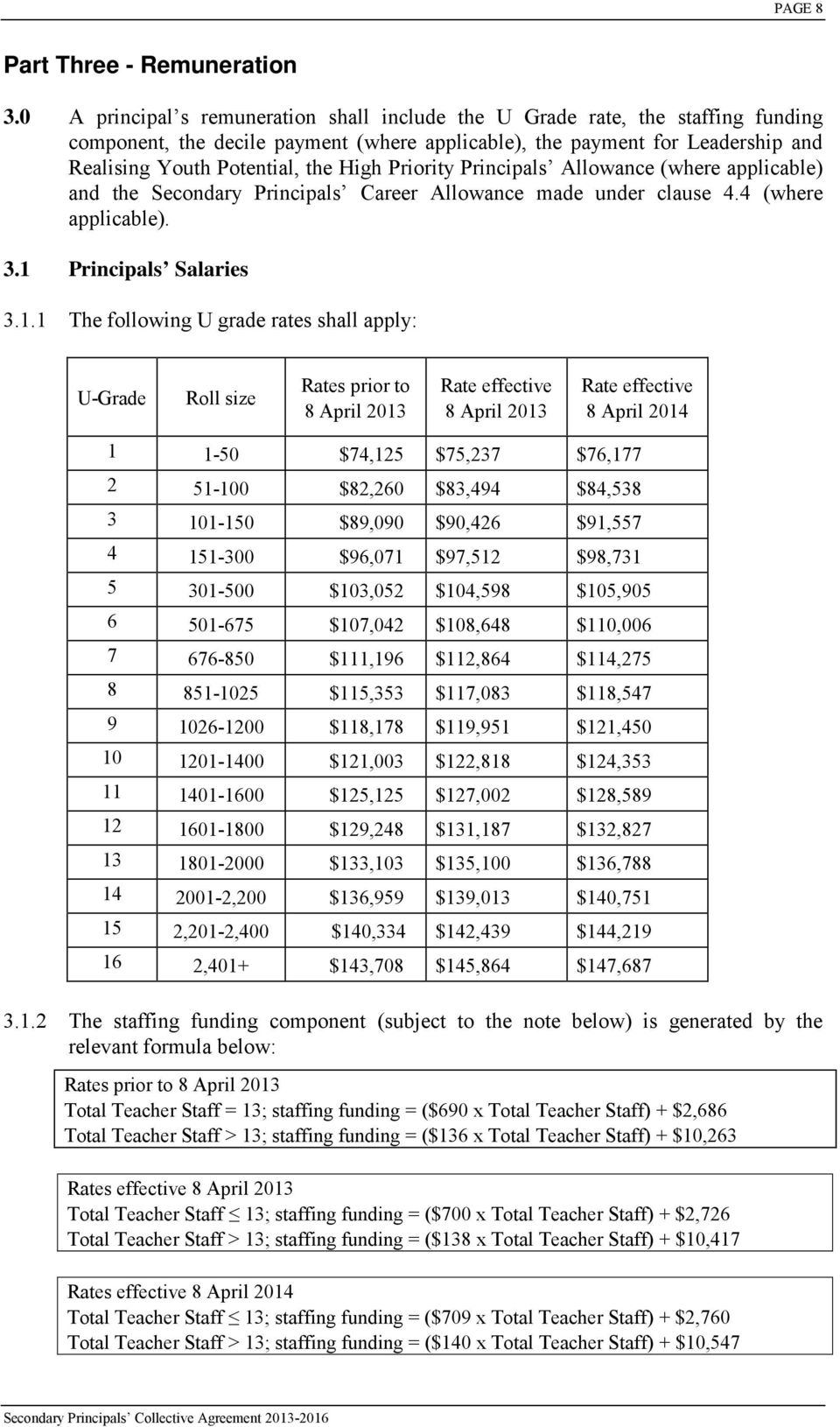
8 PAGE 8 Part Three - Remuneration 3.0 A principal s remuneration shall include the U Grade rate, the staffing funding component, the decile payment (where applicable), the payment for Leadership and Realising Youth Potential, the High Priority Principals Allowance (where applicable) and the Secondary Principals Career Allowance made under clause 4.4 (where applicable). 3.1 Principals Salaries The following U grade rates shall apply: U-Grade Roll size Rates prior to 8 April 2013 Rate effective 8 April 2013 Rate effective 8 April $74,125 $75,237 $76, $82,260 $83,494 $84, $89,090 $90,426 $91, $96,071 $97,512 $98, $103,052 $104,598 $105, $107,042 $108,648 $110, $111,196 $112,864 $114, $115,353 $117,083 $118, $118,178 $119,951 $121, $121,003 $122,818 $124, $125,125 $127,002 $128, $129,248 $131,187 $132, $133,103 $135,100 $136, ,200 $136,959 $139,013 $140, ,201-2,400 $140,334 $142,439 $144, ,401+ $143,708 $145,864 $147, The staffing funding component (subject to the note below) is generated by the relevant formula below: Rates prior to 8 April 2013 Total Teacher Staff = 13; staffing funding = ($690 x Total Teacher Staff) + $2,686 Total Teacher Staff > 13; staffing funding = ($136 x Total Teacher Staff) + $10,263 Rates effective 8 April 2013 Total Teacher Staff 13; staffing funding = ($700 x Total Teacher Staff) + $2,726 Total Teacher Staff > 13; staffing funding = ($138 x Total Teacher Staff) + $10,417 Rates effective 8 April 2014 Total Teacher Staff 13; staffing funding = ($709 x Total Teacher Staff) + $2,760 Total Teacher Staff > 13; staffing funding = ($140 x Total Teacher Staff) + $10,547
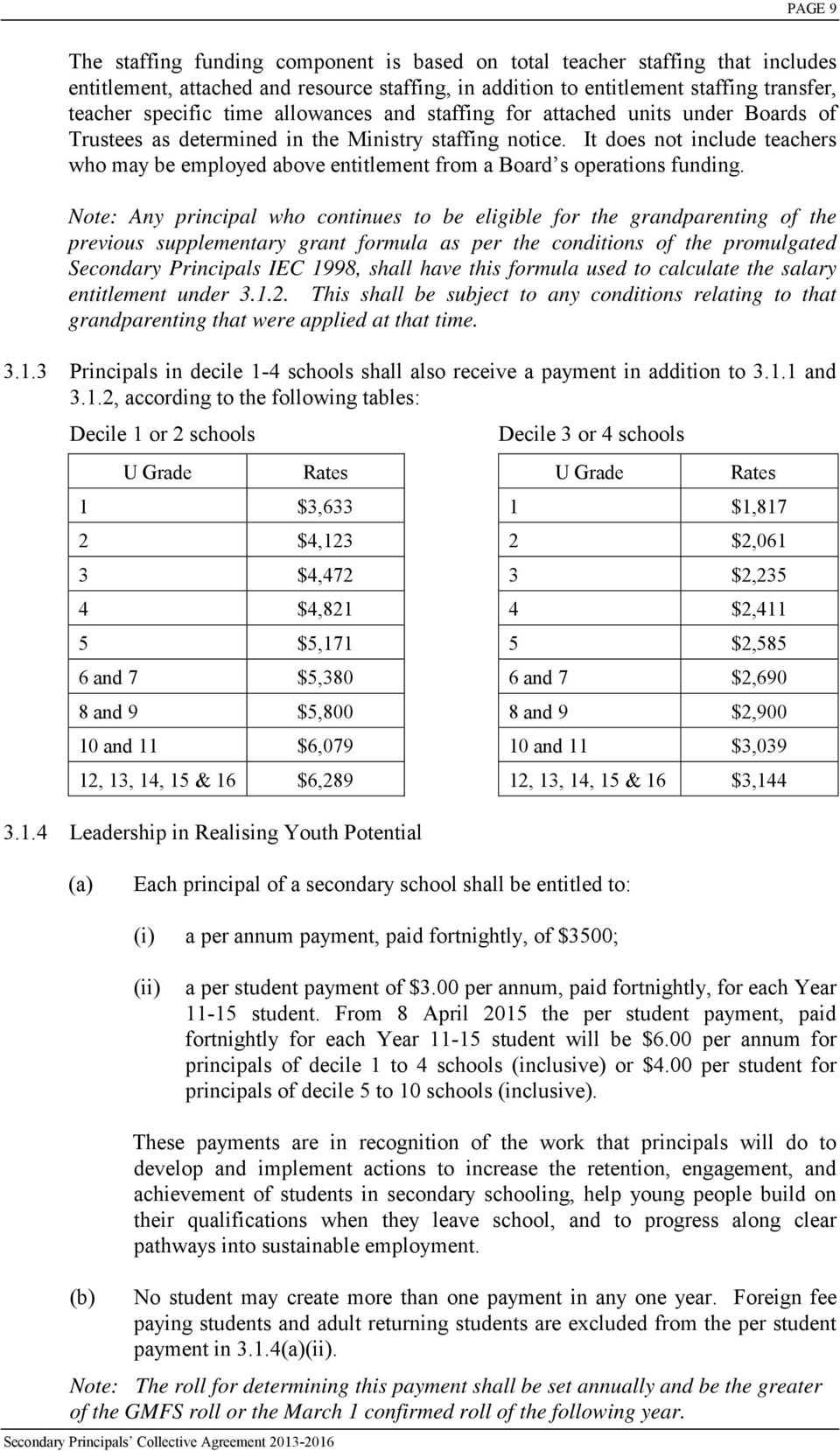
9 PAGE 9 The staffing funding component is based on total teacher staffing that includes entitlement, attached and resource staffing, in addition to entitlement staffing transfer, teacher specific time allowances and staffing for attached units under Boards of Trustees as determined in the Ministry staffing notice. It does not include teachers who may be employed above entitlement from a Board s operations funding. Note: Any principal who continues to be eligible for the grandparenting of the previous supplementary grant formula as per the conditions of the promulgated Secondary Principals IEC 1998, shall have this formula used to calculate the salary entitlement under This shall be subject to any conditions relating to that grandparenting that were applied at that time Principals in decile 1-4 schools shall also receive a payment in addition to and 3.1.2, according to the following tables: Decile 1 or 2 schools Decile 3 or 4 schools U Grade Rates U Grade Rates 1 $3,633 1 $1,817 2 $4,123 2 $2,061 3 $4,472 3 $2,235 4 $4,821 4 $2,411 5 $5,171 5 $2,585 6 and 7 $5,380 6 and 7 $2,690 8 and 9 $5,800 8 and 9 $2, and 11 $6, and 11 $3,039 12, 13, 14, 15 & 16 $6,289 12, 13, 14, 15 & 16 $3, Leadership in Realising Youth Potential Each principal of a secondary school shall be entitled to: (i) a per annum payment, paid fortnightly, of $3500; (ii) a per student payment of $3.00 per annum, paid fortnightly, for each Year student. From 8 April 2015 the per student payment, paid fortnightly for each Year student will be $6.00 per annum for principals of decile 1 to 4 schools (inclusive) or $4.00 per student for principals of decile 5 to 10 schools (inclusive). These payments are in recognition of the work that principals will do to develop and implement actions to increase the retention, engagement, and achievement of students in secondary schooling, help young people build on their qualifications when they leave school, and to progress along clear pathways into sustainable employment. No student may create more than one payment in any one year. Foreign fee paying students and adult returning students are excluded from the per student payment in 3.1.4(ii). Note: The roll for determining this payment shall be set annually and be the greater of the GMFS roll or the March 1 confirmed roll of the following year.
10 PAGE Definition of roll For the purposes of determining a principal s U grade as per and roll shall mean the greater of the GMFS roll or the 1 March roll of the following year, as determined by the relevant Staffing Order in Council, except that students who are included in the Ongoing Resourcing Scheme (at 1 July for the September school roll purposes) shall be counted on the following basis: students classified as very high under the Ongoing Resourcing Scheme shall be counted as six instead of one; students classified as high under the Ongoing Resourcing Scheme shall be counted as three instead of one. 3.3 Expenses The principal shall be entitled to reimbursement of the actual and reasonable expenses incurred by the principal in the proper performance of the principal's duties in accordance with the reimbursement provisions applying to teachers in the school and as specified in the applicable Secondary Teachers Collective Agreement or as may be approved by the board. Reimbursement shall be made out of the school's operational funds Removal expenses shall be available to the principal and funded by the Ministry as provided for in Part 10 of this agreement. 3.4 Changes to U Grade and Decile Funding Where the salary rate of the principal as specified in clause changes as a result of a drop in the U grade of the position (determined by the greater of the GMFS roll or the confirmed 1 March roll of the following year) and the principal s salary exceeds the rate for the new U grade, the following shall apply: the amount of the principal s U grade payment above the rate for the new U grade will be protected for a period of 24 months inclusive of the school year that the new U grade is confirmed in the 1 March roll; after the 24 month period of U grade protection, the principal shall be paid no more than the appropriate U grade for the position; U grade protection under this clause shall lapse if the principal accepts an alternative position or is appointed to a new position in another school Where the U grade of the principal s position increases, (as determined by the greater of the GMFS or the confirmed 1 March roll of the following year), the principal will move to the new U grade rate from the beginning of the new school year in which the 1 March roll is determined For clarity, salary protection includes the U grade (3.1.1) and any applicable decile rating (3.1.3). It does not include the salary generated by the staffing funding component formula in 3.1.2, the Secondary Principals Career Structure allowance (4.4) and the payment for leadership in realising youth potential (3.1.4) In the event of a change in the school s decile rating the change in the decile rate will be effective from the beginning of the following year; except that where the change to the decile would reduce the decile rating of the principal, the existing rate will be protected for a period of 24 months from the first day the change takes effect.

11 PAGE General The remuneration received by the principal pursuant to this agreement shall be deemed to compensate fully the principal for all time worked and duties performed under this agreement Nothing in this agreement shall affect the principal s entitlement to continue making contributions to the Government Superannuation Fund and to receive all benefits that the principal may be entitled to under the Government Superannuation Fund Act Nothing in this agreement shall affect the principal s entitlement to continue making contributions to the SSRSS and TRSS and other government approved retirement savings schemes and to receive all the benefits that the principals may be entitled to under these schemes It is noted that the rules for the retirement schemes differ with regard to the components of remuneration which form part of the contributions to the schemes. 3.6 High Priority Principals' Allowance The High Priority Principals Allowance (HPPA) provisions below shall apply to principals employed in those secondary schools identified by the Ministry of Education as requiring additional support for recruitment and retention. The schools identified by the Ministry are those set out in separate advice and may be changed by the Ministry as needs change, no more than annually, after consultation with the NZPPTA and SPANZ. Full-time fully registered teachers employed as principal on a permanent or long-term relieving basis of two consecutive terms or more shall be entitled to receive the allowance of $3000 per annum. Principals moving to a school which has been designated as a HPPA status are entitled to either the transfer and removal provisions of this agreement or the National Relocation Grant. On completion of a minimum of three years' continuous service in one or more HPPA schools a principal shall have access to the transfer and removal provisions of this Agreement when moving from this category of school to another principal position in a state or integrated school. In the event that a school is removed from the HPPA coverage, a principal in receipt of the HPPA immediately prior to that change, shall continue to receive the allowance until the end of the school year. Principals so affected shall retain their entitlement to the transfer and removal provisions of this Agreement for a further three years.
12 PAGE 12 Part Four - Professional Leadership and Annual Performance Review 4.1 Performance Agreement (d) (e) The board shall put in place an annual performance agreement and carry out a review (appraisal) of the principal every year. The purposes of this process are to ensure the principal is aware of the board s objectives, assist the principal s professional learning and development and improve/acknowledge performance (i.e. it is about both accountability and development). The performance agreement shall reflect the school s strategic and annual plans and the principal s job description and shall take into account the professional standards (as appended at the back of this agreement), the preceding year s review report where relevant and the New Zealand Teachers Council criteria for registration as a teacher. The performance agreement and review process is an integral part of the professional criteria by which a principal may advance in professional leadership through the career stages of 4.4. The performance agreement shall be in writing and a signed copy kept by both the board and principal The performance agreement shall be developed in consultation with the principal and it shall detail: objectives for that year including relevant professional standards; a professional learning and development plan for the principal to identify strategies and support (including any agreed resourcing) to enable the principal to carry out his/her responsibilities, meet the objectives and improve professional knowledge and performance; and the process and criteria, as per 4.2 below, by which the principal s performance is to be reviewed for that year. Every endeavour shall be made by the board and principal to reach agreement on a performance agreement that is acceptable to both of them. Where this has not been achieved the board or the principal may seek professional advice to assist them. Where a performance agreement acceptable to both parties is not achieved, the decision of the board in relation to the contents of the performance agreement for that year will be final. In such circumstances the principal shall have the right to attach written comments including any professional advice obtained under above and/or noting any objectives that he/she considers unreasonable, to the performance agreement which shall be considered during the review or other proceedings.

13 PAGE Performance Review The board will carry out the annual review of the principal s performance in accordance with the annual performance agreement. The review is in relation to the objectives in the performance agreement and to professional standards While the board shall retain responsibility for the review it may delegate the management of the process to board member(s). The board or delegated board member(s) may decide to engage, following consultation with the principal, an external reviewer Evidence used in the review should be relevant and should be objective and /or robust The principal will assist the board to conduct any review under this clause and in particular will give to the board such information as the board requires to carry out the review The board will, in consultation with the principal, prepare a final report based on the review. The principal shall have the opportunity to comment on the final report, but is not obliged to do so. 4.3 Working relationship Where there is a problem in the working relationship between the principal and the board (including individual board members) that has not been informally resolved and is to the detriment of the school, the board, in consultation with the principal, may consider appointing a suitably qualified independent person to mediate or facilitate between the parties and/or undertake an impartial and objective assessment of the concern(s) This does not preclude the principal from requesting the process outlined in 4.3.1, to which the Board shall give due consideration; or either the board or the principal from utilising Part Eleven of this agreement to resolve any issues arising from their working relationship. 4.4 Secondary Principals Career Structure This clause outlines a career progression for secondary principals who meet the professional criteria as affirmed by their board and the service criteria. Payments made under this clause are to encourage and recognise individual professional growth, leadership and contribution of a secondary principal. Provided that the principal has entered into a performance agreement and undertaken an annual review as in clauses and 4.1 within the last 12 months, principals covered by this collective agreement will be entitled to a career allowance based on clauses 4.4 (j) and the following service and professional criteria:
14 PAGE 14 Stage Service criteria Professional criteria 1 Initial principalship 2 Experienced principal 3 Leading principal Minimum of 3 years continuous service as a principal in a New Zealand State or State Integrated Secondary School Minimum of 6 years continuous service as a principal in a New Zealand State or State Integrated Secondary School Minimum of 9 years continuous service as a principal in a New Zealand State or State Integrated Secondary School Meeting the requirements of the performance review/agreement (as in clause 4.1 and 4.2) Completion of the First Time Principals Programme (or similar) Participation in a professional learning and development plan which may involve (but is not limited to) mentoring, professional supervision, study or a professional learning and development project aligned with school goals. Meeting the requirements of the performance review/agreement (as in clause 4.1 and 4.2) Participation in a professional learning and development plan that demonstrates professional growth, including pedagogical leadership. This could be through further tertiary study/qualifications, a sabbatical project or professional learning project in own school context. Meeting the requirements of the experience principal (as above) Contribution to or leadership of a learning or professional community that contributes to the wider education sector. (d) The board of trustees is responsible for affirming that the principal meets the professional criteria, after which one of the following career allowances shall be made and will be paid fortnightly. A principal can only receive one payment under 4.4(d) at any one time. From the date this collective agreement is signed, the career allowances will apply as follows: (i) A secondary principal who meets the service and professional criteria for stage one will be entitled to an annual career allowance of $3500. (ii) (iii) A secondary principal who meets the service and professional criteria for stage two will be entitled to an annual career allowance of $7000. A secondary principal who meets the service and professional criteria for stage three will be entitled to an annual career allowance of $10,500.
15 PAGE 15 (e) (f) For the purposes of this clause continuous service is not broken by a gap in principalship of up to three years. Service as a principal in a New Zealand State or State Integrated area school shall be included in the calculation of service under the service criteria, provided that at the time of applying the principal has completed at least a year in a New Zealand State or State Integrated secondary school. Service will not be counted for periods of time spent: (i) (ii) (iii) (iv) on leave without pay; on secondment (other than as a principal in another school); as supernumerary in a teaching role; as a relief or acting principal (except where the acting or relief principal moves directly to a substantive principal role). (g) When there is a break of more than three years service before reappointment as a secondary principal, previous experience as a principal shall be credited as one half year of service for each complete year of principalship (that would otherwise be eligible as service for this allowance), allowing the principal the possibility of moving directly to any of the three career stages providing she/he meets the relevant professional criteria, provided that: (i) (ii) at the time of eligibility she/he has completed one year in their current position; that while they were on the break for three years or more the principal consistently maintained their teacher registration; (h) Where the principal does not meet these requirements, three years service must be completed prior to the previous experience as a principal being credited as one half year of service for each complete year of principalship (that would otherwise be eligible as service for this allowance). Secondary principals employed as at 17 February 2011 who have met the service criteria of stage one (or higher) but have not participated in a First Time Principals Programme and who are no longer eligible to do so shall demonstrate through their professional learning and development plan that they have participated in professional learning activities similar to the First Time Principals Programme. (i) A principal who is undergoing corrective action pursuant to clause or 6.3 of this agreement shall not receive the career allowance from the commencement of the procedure until such time as the corrective action has successfully been completed at which time the career allowance recommences. (j) To maintain eligibility for the career allowance, every three years the principal s board of trustees must re-affirm that the principal meets the service and professional criteria and has undertaken a performance agreement and annual review within the previous 12 months (consistent with clause 4.1 and 4.2).

16 PAGE 16 Part Five - Leave 5.1 Eligibility Only principals appointed to permanent positions are entitled to the leave provided in this part, unless otherwise stated. 5.2 Sick Leave Entitlement A principal who is granted on application leave of absence on account of sickness or injury not arising out of or in the course of the principal s employment shall be entitled to sick leave on pay for a period or periods not exceeding a total amount determined in accordance with the scale set out in the following table. The period of sick leave due at any time shall be the amount specified in the following table, less the total amount of sick leave with pay that the principal has already taken during her/his teaching service. Length of total teaching service Up to 3 months Over 3 months and up to 6 months Over 6 months and up to 9 months Over 9 months and up to 5 years Over 5 years and up to 10 years Over 10 years and up to 20 years Over 20 years and up to 30 years Over 30 years Aggregate period for which sick leave on pay may be granted during teaching service 7 days 14 days 31 days 46 days 92 days 154 days 229 days 306 days In exceptional circumstances the board may grant sick leave with pay in excess of the periods prescribed in the table set out in this clause (5.2.1) in anticipation of future entitlements, provided that no extension may be granted beyond 306 days. For the purposes of this clause (5.2.1), disregarded sick leave not exceeding an overall aggregate of two years may be granted under conditions prescribed by the Secretary for Education. Notwithstanding this clause (5.2.1), retired principals have a new sick leave entitlement based on service from the date they commenced teaching after their retirement The sick leave entitlement is to be administered in accordance with the same rules as applying to teachers in the school Disregarded sick leave not exceeding an overall aggregate of two years shall be granted by the Secretary for Education in the following circumstances: The sickness can be traced directly to the conditions or circumstances under which the principal is working; or
17 PAGE 17 (d) The injury was suffered by the principal in the discharge of duties through no fault of the principal; and in circumstances where payment has not been made by the Accident Compensation Corporation; or In the opinion of the Secretary for Education, the absence was due to war injury or to war service; or The absence was due to the principal contracting a disease which, in the opinion of the Secretary for Education was for the time being epidemic, or by reason of the principal being in contact with a person suffering from such a disease and being required to undergo a period of isolation in accordance with a decision made under regulations administered by the Ministry of Health. In the case of hepatitis, however, the period of disregarded sick leave is the time that the principal s doctor decides is necessary for the principal to remain away from school An board may grant a principal who contracts tuberculosis disregarded sick leave with full salary for a period of up to six months in addition to any period of leave of absence on account of sickness or injury to which the principal is entitled with full salary in accordance with the scale set out in clause above if the principal enters, or is placed on a waiting list for entry to, a recognised institution Notwithstanding above, holders of long term relieving appointments and principals available for and eligible for future permanent appointments shall only be granted disregarded sick leave, as provided for in above, where they have been in continuous employment before the date of application and have been medically examined before entry into the teaching service No deduction is to be made from the holiday pay of principals for periods of sick leave without pay for periods not exceeding three months (90 days) in any one school year. Where the total amount of sick/accident leave without pay is in excess of three months (90 days) the deduction is based on the period subsequent to the three months (90 days). The initial three months (90 days) are unaffected. In order to receive the benefits of holiday pay for periods of sick leave without pay, a principal must first have used her/his current sick leave entitlement. Principals with current entitlements to sick leave are not covered by the non reduction in holiday pay provisions if they apply to receive sick leave without pay instead. They should be advised of this when notified of the approval The board may allow a principal who has been on sick leave to return to duty on a reduced hours basis if the principal s doctor so recommends and provides a medical clearance, and there would be no staffing problems for the school. This arrangement should not, however, normally be allowed to continue for more than six weeks. The following provisions apply: The daily hours not worked are to be aggregated and debited against sick leave on the basis of a five-hour day. Whole days or half-days of absence are to be debited as whole or half-days.
18 PAGE 18 (d) When the absence is on account of injury by accident and earnings related compensation is payable to the principal, normal pay is to continue and the Secretary for Education is to obtain reimbursement of earnings related compensation from the Accident Compensation Corporation in accordance with the usual procedures. If the accident was work related there is no debit against sick leave entitlement. However, if the accident was non-work related, the sick leave entitlement is debited to the extent to which the salary payable for time actually worked plus the earnings related compensation is made up to give normal full salary (provided, of course, the principal has a sick leave entitlement available). 5.3 Parental Provisions Birth in this section means the birth of a child whether live or stillborn, within the meaning of the Births, Deaths, Marriages and Relationships Registration Act Maternity Leave A principal who is pregnant is entitled to maternity leave without pay. Leave may commence at any time during the pregnancy subject to the principal giving the board one month s notice in writing, supported by a medical certificate. A shorter period of notice will be accepted on the recommendation of a medical practitioner. A female principal with 12 months or more service as a teacher or principal, but excluding any periods of teachers college or university training, shall be entitled to 12 months leave from the date of birth. The amount of leave taken shall be at the election of the principal. A female principal with less than 12 months such service shall be entitled to six months leave from the date of birth and may be granted up to six months additional leave at the discretion of the board. A female principal intending to legally adopt a child under the age of 12 months shall, subject to satisfactory evidence, be entitled to maternity leave from the date of assuming responsibility for the child as if paragraph or above applied. The requirement of one month s notice does not apply The principal s position shall be held open (subject to transfer and redeployment provisions) for the duration of maternity leave. If a relieving principal is employed it will be a condition of the relieving appointment that it will be terminated by the board concerned within one month from the date that the permanent incumbent gives notice of intention to return to work early. A principal must give her board at least one month s notice if it is her intention to return to work before maternity leave expires. This provision shall not apply in the case of a woman who has had a miscarriage or a stillborn child. In such cases the principal may elect to return to work immediately A principal intending to resign because of pregnancy must be advised of her right to take maternity leave.
19 PAGE Maternity Grant Maternity grant is payable to female principals on production of a birth certificate or evidence of an approved adoption placement, whether she is granted maternity leave without pay or resigns because of pregnancy or adoption except as follows: The maternity grant is not payable where a principal has not produced a medical certificate confirming pregnancy, or confirmation from the appropriate authority of suitability as an adoptive parent, before commencing leave or resigning. No provision is made for payment of a maternity grant in the case of a miscarriage. The amount of the grant is calculated on the basis of six weeks full salary at the rate applicable at the date of birth (or placement in the case of adoption) to the position from which the principal was granted leave of absence or resigned as the case may be. When a principal is absent on maternity leave for less than six weeks (30 working days), the full grant equivalent to six weeks salary is still payable. The maternity grant is not reduced because salary is being received Parental Leave Other Principals The provisions of the Parental Leave and Employment Protection Act 1987 shall apply Sick Leave During Pregnancy Periods of illness due to pregnancy prior to the birth may be charged against the principal s sick leave entitlement. Normal rules for sick leave with regard to production of a medical certificate apply. Once the principal has commenced parental leave, any day(s) of sickness must be leave without pay and in no circumstances may a principal have an absence during or following the birth of the child credited against her sick leave entitlement. 5.4 Bereavement/Tangihanga Leave for Death in New Zealand or Overseas Principals shall be granted leave with pay to allow a reasonable opportunity to discharge their obligations and/or to pay their respects to a deceased person with whom they have had a close association. Such obligations may exist because of blood or family ties or because of particular cultural requirements such as attendance at all or part of a tangihanga (or its equivalent) In granting time off therefore, and for how long, the following points must be taken into account: The closeness of the association between the principal and the deceased; (Note: This association need not be a blood relationship.) Whether the principal has to take significant responsibility for any or all of the arrangements to do with the ceremonies resulting from the death; The amount of time needed to discharge properly any responsibilities or obligations;
20 PAGE 20 (d) (e) (f) Reasonable travelling time should be allowed, but for cases involving overseas travel that may not be the full period of travel; A decision must be made as quickly as possible so that the principal is given maximum time possible to make any arrangements necessary. In most cases the necessary approval will be given immediately, but may be given retrospectively where necessary; If paid special leave is not appropriate then leave without pay should be granted If a bereavement occurs while a principal is absent on annual leave, sick leave with pay, or other special leave with pay, such leave may be interrupted and bereavement leave granted in terms of clauses and above. This provision will not apply if the principal is on leave without pay. 5.4 Nga Whakarite Tuku Tangihanga Mo te mate i roto o Aotearoa, ki tawahi ranei Ka taea te tuku i tetahi kaiako me te utu ano hoki, kia watea ki te whakarite i nga ahuatanga ki te whakatakoto i tona aroha ranei ki tetahi tupapaku, i tino tata atu mohiotia hoki e ia. Tera pea nona ake, he whanaunga tonu ranei, i raro i nga ahuatanga a iwi ranei kia tae atu ki tetahi wahanga, ki te katoa ranei o te wa o te tangihanga, hura kohatu, etahi atu tikanga a rite ranei No reira mo tenei tu ahua tuku, me te roa o te tuku kia watea, me whai i nga ahuatanga e whai ake nei: (d) (e) (f) Te tata atu o te kaiako ki te tupapaku (kia mohio: tenei tata e ki ana me toto tonu nou); Mehemea he wahanga nui ta te kaimahi ki te whakahaere, kaore ranei, i nga whakariterite mo te tangihanga; Te wa tuku kia watea e hiahiatia ana, mo enei whakahaere, whakariterite hei mahi mana; Me whakaaetia tetahi wa e tika ana mo te haere atu hoki mai, engari mena he haere ki tawahi kaore pea e whakaritea mo te katoa o te haere, hoki mai ano hoki; Kia tere tonu te whakatau i te tono kia tere ai te watea o te kaiako ki te whakariterite i nga mea katoa e pa ana ki a ia. I te nuinga o enei tu ahuatanga ka hoatu tonutia te whakaae, engari i etahi wa, kua tae kua hoki mai ke te kaimahi ki te tanihanga, i mua o te hoatutanga i te whakaae mena e tika ana; Mehemea kaore e tika ana kia whiwhi i tenei tuku whakawatea me te utu hoki, tera pea ka whakaaetia kia tangohia atu i o whakawatea (hararei) a tau, whakawatea mo te kore utu ranei, engari koinei te mutunga.

21 PAGE Mehemea ka pa mai he aitua ki tetahi kaiako i te wa o tana whakawatea a tau, o tana whakawatea a turoro (me te utu), o etahi atu whakawatea hirahira (me te utu) ranei, ka taea te whakatarewa i taua whakawatea, kia pai ai te tuku whakawatea tangihanga ki a ia i raro o te ture i runga ake nei. Kaore tenei whakaarotanga e tukuna mehemea kaore te kaiako i te utua mo te wa whakawatea. 5.5 Leave for Family Reasons A principal may be granted leave for family reasons subject to meeting the requirements as provided for in clauses below. Relieving principals may be granted leave for family reasons as for permanent principals. Definition for the purposes of clause 5.5, the terms near relative and near relative-in-law mean the principal s: Grandparents, Father-in-law, Sons-inlaw, Grandchildren, Mother-in-law, Daughters-in-law The terms do not exist beyond those degrees of relationship Serious Illness A principal may be granted leave with pay on account of serious accident or a crisis in a severe illness of a: (i) partner, child, parent, brother or sister two days; (ii) a near relative, near relative-in-law or a member of the principal s household one day. The maximum period of leave on full pay that may be granted for this purpose, including travelling time, is seven days Leave for Sickness in the Home The board may grant a principal leave with pay as a charge against a sick leave entitlement when the principal must be absent from work to attend to a member of the household who through illness becomes dependent on the principal. Members of the household may include the principal s child, partner, or any other member of the principal s family or household. Approval is not to be given for absences during or in connection with the birth of a principal s child. Such situations should be covered by leave without pay, paternity leave, annual leave or anticipated annual leave Recurring Serious Illness When a principal applies for several periods of leave because of recurring illness in the family the board has a discretion as to how many times leave with pay is granted in the same school year, having regard for the welfare of the school or class concerned. Note: The production of a medical certificate or other evidence of illness may be required in the case of leave granted in terms of clauses 5.5.2, and Important Family and Other Occasions A principal may be granted one day s paid leave per year plus traveling time in terms of clause 5.8 below for the following occasions:
22 PAGE 22 (d) (e) Their own wedding or that of their child, a sibling, parent, grandchild or grandparent; Their parents golden or diamond wedding anniversary; Their own ordination, vice-regal investiture, admission to the bar or capping or that of their partner, child, sibling or parent; Attendance at court for an adoption order; Rosh Hashonah and Yom Kippur for principals of the Jewish faith. 5.6 Refreshment Leave Subject to below, upon application, a principal shall be entitled to one school term of unpaid refreshment leave after three years service in the school and up to one year of such leave after five years service in the school Entitlement to refreshment leave is subject to: The principal providing reasonable notice to the board of their intention to take refreshment leave; and The board s ability to find a suitable reliever to fill the vacancy created by the principal taking the leave. A suitable reliever is an individual who will be able, to the satisfaction of the board, to relieve in the school during the period of the principal s leave. The board shall use reasonable endeavour to find a suitable reliever. Reasonable endeavour in this context does not mean advertising regionally or nationally, except as required in this agreement. It does not require the board to place more than one advertisement; and The principal not being subject to current competence or disciplinary processes under this agreement or previous agreement at the time that leave is sought Time off on refreshment leave will not count for the purposes of sick leave or holiday pay calculations or for entitlement to public holidays A principal may not take up employment in another state or integrated school while on refreshment leave. This restriction does not preclude a principal on refreshment leave agreeing to undertake occasional day-relief duties. Note: The qualifying periods set out in for refreshment leave relate solely to this provision and do not apply to any other forms of leave. 5.7 Special Leave Special leave of absence with or without pay may be granted to a principal subject to meeting the requirements as provided for in clauses below. The special leave provisions apply to full-time permanent and long-term relieving principals.
23 PAGE Court Proceedings Except when principals are pursuing their own interests or where answering charges against themselves, the board will grant leave with pay when a principal is required by subpoena to attend court proceedings as a witness or to serve on a jury; provided that where fees for service are paid, these fees shall be repaid to the board for repayment to the Public Account Candidates in General Elections The provisions of the Electoral Act 1993 and its amendments shall apply Sports Leave Where such leave is approved by the board, principals are entitled to leave with pay for overseas sports tours, inter-provincial fixtures, national championships and international competition within New Zealand subject to the following maxima per any 12 month period: overseas tours up to four weeks; inter-provincial fixtures and national championships up to six weeks; international competition within New Zealand one day for assembly and training, plus two days traveling time, plus the day or days of the fixture. Provided that relieving principals may apply for leave to be granted as for permanent principals Cultural Leave Where such leave is approved by the board, principals participating in recognised cultural activities within New Zealand or outside New Zealand are entitled to leave with pay on the same conditions as for sports leave. Provided that relieving principals, except those employed on a casual basis for only a few days at a time, may apply for leave to be granted as for permanent principals Meetings of Statutory and Local Authorities Principals may be granted, by the board, leave with pay plus necessary traveling time to attend meetings of statutory, local, Mäori and other authorities (or in other circumstances leave without pay may be granted to attend such meetings). For the purposes of clause the following are recognized Mäori authorities/organisations: (i) (ii) (iii) New Zealand Mäori Council; Mäori Women s Welfare League; Tribal Trust Boards;
24 PAGE 24 (iv) (v) Iwi authorities; Runanga-A-Iwi Study and Examination Leave The board may approve leave without pay for pre-examination study and shall approve leave on pay for time spent sitting examinations plus necessary traveling time. The board shall grant leave on pay to principals who are awarded a prestigious scholarship or fellowship (as defined by the Secretary for Education from time to time) for the duration of the contract plus reasonable traveling time Miscellaneous Leave Leave with or without pay may be granted for the following purposes subject to the criteria set out below being met: (d) (e) Where a principal is prevented from traveling from their home to work because of an emergency situation outside of the control of the principal (up to seven days leave with pay may be granted) provided that this provision is for emergencies only. Approval shall not be given where the principal has advance notice or in circumstances where the principal could be reasonably expected to have foreseen the situation arising. Where practicable the principal is to inform the school of the reasons for the absence and is required to return to duty as soon as possible. Full details of the case shall be submitted. Search and Rescue. Where a principal is a member of an authorised search and rescue organization and is requested by a responsible authority to take part in a search and rescue operation (leave with pay). Written evidence of the principal s participation in the search from the appropriate authority mentioned above is to be submitted to the board. Outward Bound. Principals selected for Outward Bound courses should, if possible, take the course during the long vacation. Where there are overlaps with term time and the board supports the principal s attendance leave with pay up to one week may be granted. Where a principal is participating in an overseas tour by a school party approved by the board (leave with or without pay for the duration of the tour). Rotary Group Exchange Tours (i) (ii) A principal selected to go on a Rotary group study exchange tour may, provided that they spend one full week of the tour on studies directly related to their position and, on their return produce a full report of these studies, be granted one week s leave on full pay. All applications for this leave must be approved by the board. In no circumstances shall leave with pay be granted in excess of one week. Leave with pay shall not be granted for Rotoract study tours.
25 PAGE 25 (f) Other Forms of Leave (i) (ii) Nothing in this agreement limits the facility for the principal to apply to the board for leave with or without pay in any circumstances not specified. Nothing in this agreement shall limit the authority of the board to grant to the principal such special leave, whether with or without pay, as the board considers appropriate to enable the principal to undertake professional development training. The board shall have regard to the need to ensure that the principal receives training appropriate to the requirements of the position. 5.8 Traveling Time for Leave Purposes Where specifically approved in this agreement traveling time with pay for a period of up to seven days (exclusive of public holidays) may be granted subject to the following conditions: Leave for traveling can only be granted if the principal is required to travel when the school is open; The quickest and most direct means of travel shall be used; No traveling time is granted for a journey that is preceded by leave without pay or for a return journey that is followed by a period of leave without pay. 5.9 Leave Records Leave records for principals should clearly indicate all sick leave, leave without pay, periods of special leave and periods during which accident compensation may be granted Annual Leave The principal shall be entitled to 25 days paid annual leave per annum. Annual leave shall normally be taken when the school is closed for instruction. Such leave shall be taken at a time or times agreed with the school board that will not unreasonably impinge upon the proper performance of the principal s responsibilities and duties under this agreement Clause does not limit the ability of the board and principal to make such arrangements regarding the attendance of the principal at the school during any period or periods when the school is closed for instruction, and the principal is not on annual leave, as the parties consider appropriate and consistent with their responsibilities under this agreement or at law Leave due under clause shall be taken in the year in which it falls due, except where the board and the principal agree, in writing, that the unused entitlement may be carried over to the following year.
26 PAGE Public Holidays 5.11 Where a principal is required by a board to work on a public holiday, they will receive an additional 0.5 salary for the day, plus a day in lieu, pursuant to section 50 of the Holidays Act Sabbatical Leave Scheme A sabbatical leave scheme for principals will apply according to the following; (d) There will be 45 full-time equivalent sabbaticals awarded annually (Note this may result in sabbatical leave being awarded to more than 45 secondary principals during one school year). A full time equivalent sabbatical will be of ten weeks duration paid at the rate of the principal s normal pay. Principals may apply for ten-week, five week or three week sabbaticals; however, ten week sabbaticals will be allocated first. A ten week sabbatical may, with the board s approval, be taken in two blocks during one school year. Each block must be whole weeks in duration and the smallest block must be for at least three weeks Entitlement to the sabbatical is subject to: service of at least five years as a secondary (and/or area school) principal in the state sector; application by the principal which has the support of their school board; and the submission of a proposal of work to be undertaken during the sabbatical leave The Ministry of Education, the NZPPTA, SPANZ and the NZSTA jointly develop the criteria for the scheme and its operation. The award of the sabbatical leave will be by a panel with representation from the four parties.
27 PAGE 27 Part Six - Disciplinary Provisions 6.1 General Provisions / Process The following principles shall be used in addressing complaints, discipline, and concerns regarding competence, to ensure that such matters are, in the interests of all parties, fully and fairly addressed: where issues or concerns arise the board shall initiate informal discussions with the principal in an attempt to resolve the matter in an informal manner. This applies following receipt of a complaint and /or concern(s) being raised. This occurs prior to formally commencing a disciplinary or competency process, unless the nature of the complaint or concern(s) is such that this would be inappropriate; questions of competence, conduct and discipline should be handled in a manner which, as far as possible, protects the mana and dignity of the principal concerned. Principals may seek whanau, family, professional and / or other support in relation to such matters (refer Part Eleven). 6.2 Competency Where there are matters of competency which are causing concern (for example failing to meet the secondary principals professional standards), the board shall put in place appropriate assistance and guidance to assist the principal and for that purpose, may seek such appropriate professional advice as may be required Where this assistance and guidance has not remedied the situation, the board shall initiate a competency process and the following provisions should govern the action to be taken: (d) (e) (f) the principal must be advised in writing of the specific matter(s) causing concern and what, if any, corrective action is required. the principal is to be given a reasonable opportunity to remedy the matter(s) causing concern. This timeframe shall be determined by the board, may take into account any previous support or guidance, and shall be relevant to the matter(s) causing concern; the process and results of any evaluation are to be recorded in writing, sighted and signed by the principal; a copy of any report made to the board shall be given to the principal; no action shall be taken on a report until the principal has had a reasonable time to comment (in writing, orally or both); if the above steps (a-e) fail to resolve the matter(s) of concern, the board may, where justified, dismiss the principal without notice and pay him/her two months salary in lieu, without the need to follow the provisions of 6.3 below; and
28 PAGE 28 (g) a copy of any report given to the New Zealand Teachers Council shall be given to the principal. 6.3 Discipline For the purposes of this part, the term misconduct includes: (d) any material breach of the terms of this agreement; or any continued non observance or non performance of any of the terms of this agreement; or any offence for which the principal may be proceeded against by way of indictment; or any conduct by the principal (whether within the principal s professional capacity or otherwise) that is unbecoming of a principal or which demonstrates that the principal is unfit to remain in the position of principal The principal must be advised of the right to have representation at any stage The principal must be advised in writing of the specific matter(s) causing concern and be given a reasonable opportunity to provide an explanation. Before making a final decision, the board may need to make further inquiries in order to be satisfied as to the facts of the specific matter(s) causing concern If the misconduct is found to have occurred then the corrective action(s) that may be imposed, following an opportunity for the principal to comment, include: counselling and/or mentoring intended to assist the principal amend his/her conduct and/or change particular behaviours; a verbal or written warning that includes advice of any corrective action required to amend his/her conduct and a reasonable opportunity to do so; and a final written warning which includes advice of any corrective action required to amend his/her conduct and given reasonable opportunity to do so The board may also consider that the misconduct warrants dismissal with or without notice The process and any resulting action(s) are to be recorded, then sighted and signed by the principal, and placed on his/her personal file A copy of any report made to the board or provided to the New Zealand Teachers Council shall be given to the principal. 6.4 Suspension If the alleged conduct is deemed sufficiently serious a principal may be either suspended with or without pay or transferred temporarily to other duties while the allegations are investigated.
29 PAGE 29 (d) The board shall not, unless there are exceptional circumstances, suspend the principal without first allowing the principal a reasonable opportunity to make submissions to the board about the alleged misconduct and the appropriateness of suspension in all of the circumstances. The board shall take into account any submissions made by the principal before determining the matter of suspension. The board shall use its best endeavours to ensure that the period of suspension is kept to the minimum possible time consistent with ensuring that the allegations of misconduct are properly investigated and that the principal is treated fairly. If the allegation that led to suspension is found to be without substance the principal shall, unless he/she has resigned in the interim, be entitled to resume duties immediately and, if suspended without pay, to have that pay reinstated from the date of suspension. 6.5 Dismissal The board may, after applying the principles and processes of 6.1 and 6.2 or 6.3 above, terminate the employment of the principal by giving two months notice of termination or he/she may be dismissed without notice and paid two months salary in lieu. In the case of a finding of serious misconduct, the board may dismiss without notice.
30 PAGE 30 Part Seven - Termination for Medical Reasons 7.1 Termination for Medical Reasons Without limiting the generality of interpretation of part 6, the board may terminate the employment of the principal by giving such written notice to the principal as it deems appropriate if as the result of mental or physical illness the principal is, in the opinion of the board, rendered incapable of the proper performance of the principal's duties and responsibilities under this agreement Before taking any action under this clause the board shall, at its expense, require the principal to undergo a medical examination by a registered medical practitioner nominated by the board or, if the principal wishes, two medical practitioners one nominated by the board and the other by the principal, and shall take into account any report or recommendations made available to it as a result of that examination and any other relevant medical reports or recommendations which it might receive or which may be tendered to it by or on behalf of the principal A principal may apply to retire for medical reason, i.e., mental or physical illness, where the principal has a medical opinion verifying that the principal is rendered incapable, currently and in the future, of the proper performance of the principal s duties and responsibilities under this agreement Before agreeing to the application for medical retirement the board may require, at its expense, require the principal to undergo a medical examination by a registered medical practitioner nominated by the board, or, if the principal wishes, two medical practitioners, one nominated by the board and the other by the principal. The board shall take into account any report or recommendations which it might receive or which may be tendered to it by or on behalf of the principal when making its decision whether or not to grant medical retirement Where the employment is terminated for medical reasons as provided for in clauses or the principal shall be entitled to receive either: Any unused sick leave as provided for in clause of this agreement and annual leave entitlement which would have accrued during the period for which the sick leave has been paid out; or three months salary in lieu of notice. whichever is the greater together with any outstanding leave due in terms of clause 5.10 of this agreement The board may temporarily relieve the principal of his/her duties and responsibilities under this agreement where: the board has required the principal to undergo a medical examination under clause 7.1.2; and
31 PAGE 31 the results of the medical examination under clause support a course of action less than the termination of employment under clause 7.1.1; and the board considers that it is in the best interests of the school Where the principal is temporarily relieved from duty under clause 7.1.6, the principal shall be placed on sick leave on pay unless all the sick leave to which the principal is entitled under clause has already been used in which case the sick leave shall be without pay If the medical examination required under clause does not provide adequate medical reasons for the decision of the board to temporarily relieve the principal from duty, or to terminate the employment, the board shall forthwith permit the principal to return to duty and shall in respect of the period during which the principal was temporarily relieved from duty: reinstate any sick leave taken by the principal during that period; reimburse the principal for any loss of salary during that period.
32 PAGE 32 Part Eight - Disestablishment 8.1 Disestablishment From the start of the 2004 school year in the situation of a merger or amalgamation of schools, the principals' positions in all the affected schools shall be disestablished. The new position of principal in the merged or amalgamated school shall be advertised pursuant to the State Sector Act 1988 (as per clause 2.3, 2.4 and 2.5) Where the staffing requirements within the school have been reviewed by the board (including as a consequence of the school s amalgamation, merger, change of status, and/or closure), and a permanent principal s position is to be disestablished, no less than three months notice in writing of this shall be given by the board to the principal and the provisions of Schedule A shall apply Where the staffing requirements within the school have been reviewed by the board (including as a consequence of the school s amalgamation, merger, change of status, and/or closure), and a fixed term principal s position is to be disestablished; the employee will be paid to the earlier of the following dates: The last day of the fixed term agreement. The school amalgamation, merger, change of status, and/or closure date where 3 months notice is given or the fixed term employment commences within 3 months of that date. 3 months from notice in writing: together with any annual leave owing.
33 PAGE 33 Part Nine - Resignation 9.1 Resignation The principal's employment may be terminated at any time by the principal giving to the board not less than two months written notice, unless a shorter time is mutually agreed.
34 PAGE 34 Part Ten - Removal Expenses 10.1 Eligibility Providing that where the provider contracted by the Ministry is used for the transfer of effects and transit insurance if transfer and insurance is required, a principal who holds a permanent position is eligible for removal expenses in the following circumstances: Appointment on promotion Promotion is defined as an appointment to a principalship of a higher U grade or an appointment from a base scale teaching position. Appointment to a permanent position in a staffing incentive or high priority teacher supply school, or shifting from a staffing incentive or high priority teacher supply school to a permanent position, or a long-term relieving position for a period equal to four school terms or more, in another state or integrated school, provided that: (i) (ii) A principal must have completed three years continuous service in a staffing incentive or high priority teacher supply school or continuous service in more than one staffing incentive or high priority teacher supply school totalling three years; If the school loses its staffing incentive status during the period of the principal s employment the entitlement to removal expenses on appointment out of the school is still valid as long as the principal fulfils the three years service requirement; (d) (e) (f) Protected country service Those principals who held an entitlement to removals from a country service school when the former country service provisions were replaced by the staffing incentives package, preserve that entitlement and retain it for their next position in the education service. Principals returning from sponsored schemes overseas A principal returning to a New Zealand appointment following service overseas as part of a government to government contract is eligible for removal expenses incurred within New Zealand. Removal within same locality Where a principal who occupies a school residence which is replaced or is being extensively renovated and the house has to be vacated, or a principal who occupies a private residence and is required by the board to move to a school residence, provided that a principal and any dependants who are required to board during renovations shall receive a rent subsidy. Principals on long-term specialist courses of at least one academic year s duration: (i) A principal who has been granted leave by their Board and has to move to attend a Ministry of Education approved long-term specialist course;
35 PAGE 35 (ii) A principal moving to her/his first permanent appointment after the course is completed. (g) A secondary principal moving to a school that has a lower U-Grade, and a lower decile to the principal s current school (provided that the principal has been employed (as the principal) in their current school for at least the last 3 years). (h) Miscellaneous: A principal who loses or is about to lose a position through no personal fault (e.g. through disestablishment, closure, amalgamation or translation of a school) is entitled to removal expenses. (i) In exceptional circumstances the Secretary for Education may exercise discretion and confirm eligibility for removal expenses for a principal who does not meet the criteria outlined in to (g) above. (j) Reimbursements will only be made for costs in relation to the sale and purchase of the principal s nominated primary place of residence and not for holiday homes or investment properties Entitlement Principals eligible for removal expenses under clause 10.1 of this Part are entitled to the following expenses, grants and allowances as appropriate as specified below in clauses The Ministry of Education provides a lump sum payment to cover the travel, phone, transfer grant, accommodation expenses and travelling meal allowances entitlements outlined below. However, this does not prevent a principal from choosing (as an alternative to the lump sum payment) to claim entitlements as specified in clauses and based on itemised receipts Travel Expenses The following travel expenses are refundable: (d) Taxi fares to and from transport; Cost of meals en route; Cost of overnight board if stopover unavoidable; When traveling by own transport, payment of motor vehicle allowance rates as follows: (i) Motorcar 62 cents per kilometer (ii) Motorcycle 20 cents per kilometer (e) Equivalent surface fare for driving a second car or motorcycle which is part of the household effects to the new location provided that the fare would otherwise have been paid under this contract.
36 PAGE Accommodation Expenses Accommodation expenses shall be paid for the accommodation of a principal and any dependants from the time of moving from the former location until permanent accommodation is obtained in the new location When moving personal expenses are allowable to cover meals, accommodation, and such other expenses as the board may approve, for the principal and any dependants as follows: From the commencement of the journey, up to two days if necessary; On arrival at destination, up to seven days if necessary When dependants are boarding When approval has been given by the Ministry of Education for a principal and any dependants to board either together or in different localities, and a home is no longer being maintained at the former location, assistance may be granted in accordance with the following provisions: In the first instance, a refund of personal expenses as set out in above; At the expiration of this period, an accommodation allowance of the amount by which actual and reasonable board and lodging expenses exceed 45% of gross remuneration. Gross remuneration means classified salary plus any allowance in the nature of salary. This is calculated on the consecutive day basis; If the principal and any dependants stay at a motel and they purchase and prepare food, a rent subsidy may be paid. When meals must be taken in a restaurant, payment of the amount by which the total of rent and meals exceeds 45% of gross salary may be paid. The total cost is not to exceed scale relieving allowance rate payable to teachers in the school in terms of the applicable secondary teachers collective agreement When Maintaining Home at Former Location A principal on transfer who is required to maintain the home and any dependants at the former location until suitable housing is obtained in the new location, shall be granted an accommodation allowance as follows: For the first month, up to a maximum of the rate of the relieving allowance payable to teachers in the school in terms of the applicable secondary teachers collective agreement; For the second month, up to a maximum of two thirds of the rate of the said relieving allowance; For the third month, up to a maximum of one third of the rate of the said relieving allowance;
37 PAGE 37 (d) (e) (f) Principals staying at a motel and preparing their own meals may be paid an assessed amount for food not exceeding one quarter of the scale relieving allowance rate, plus motel charges. The total cost is not to exceed scale relieving allowance rate; The incidentals allowance payable to teachers in the school in terms of the applicable secondary teachers collective agreement shall also be paid to cover incidental expenses not otherwise recoverable. The allowances commence on and from the day the principal arrives at the new location; When the principal finally obtains suitable accommodation in the new location and any dependants then move, the assistance set out in clause is granted Rent Subsidy Assistance with rental accommodation may be considered on the merits of each case if a principal on transfer is experiencing difficulty in finding permanent housing. The subsidy will be granted only in respect of a short-term tenancy. The amount of the subsidy will be the excess of the rental over one-sixth of the principal s gross salary. The period of subsidy is limited to three months. Furniture storage charges may be met while the principal is on a rent subsidy Outgoings on Former Home If the principal and any dependants are occupying temporary accommodation at the new location (and the principal receives a rent subsidy), pending the sale of the former home and the purchase of another, then interest, rates and insurance on the former home shall be taken into account while it remains unsold and unoccupied. In these circumstances, the outgoings on the principal s house may be added to the rent of the temporary house, and the subsidy calculated on the combined total. Only mortgage interest may be included, not loan principal repayments, and this will usually require inquiry, as outgoings quoted by claimants almost always include installments of loan principal. If a principal is required to rent a house at the new location before liability for rent at the previous location has ceased, resulting in the payment of double rent, a rent subsidy equal to the lower of the two rents may be paid Furniture Removal Packing, transporting and unpacking of the principal s household effects will be undertaken by a provider contracted to the Ministry for the transfer of principals effects and transit insurance Amount of Refund Where a principal qualifies for an accommodation allowance or rent subsidy, this will include the provision of storage. Reimbursement will be made for the cost of interisland transport and marine insurance for up to two vehicles and one towed vehicle.
38 PAGE Legal Fees and Land Agent s Commission A principal with an entitlement to removal expenses shall be reimbursed for legal fees and land agent s commission provided that when a principal sells a house at the former location and buys another at the new location within two years of the date of the new appointment, or sells at the former location and builds and takes occupation of a house at the new location within two years of the date of the new appointment, actual aggregated expenses for legal fees and land agent s commission combined up to $11,000 maximum shall be paid. Legal fees The refund of legal fees shall be either: (i) (ii) when principal sells a house at the former location within two years of the date of the new appointment, but does not buy another, actual expenses up to $950; or when a principal buys or builds a house at the new location within two years of the date of the new appointment without having sold a house at the former location, provided it is not the first time the principal has owned a house, actual expenses up to $4,000 maximum. Land agent s commission When a principal sells a house at the former location within two years of the date of the new appointment but does not purchase or build another house at the new location within the two year period, actual expenses up to $6,300. Two year limitation Normally all transactions (selling, buying or building) must be completed within two years of the date of transfer to qualify for a refund of expenses. (d) Sale of home prior to appointment in another position Where a principal anticipates securing a position where full removal expenses are payable, and sells their home before this actually occurs the principal will be eligible for a refund of legal and land agent s fees. This is subject to a two year limitation period as in clause above commencing from the date of the sale of the house. The refund of land agent s and legal fees will not be made until and unless the principal is appointed and takes up another position. (e) Purchase and sale of land A refund of legal fees and land agent s commission will be made as follows: (i) When a principal has previously owned a house or land and purchases land following transfer to another locality with the intention of building a house for the principal s own use and transfers again before the house is built, assistance is granted towards the cost of legal expenses and land agent s commission in the purchase and sale of the land up to $3,800.
39 PAGE 39 (ii) When a house or land has not been owned previously and a principal subsequently purchases land at one locality and transfers again before building, assistance will be granted towards the cost of legal expenses up to $500 and land agent s commission up to $2,000 in the sale of the land as follows: Note: (1) Sale of land in a previous locality must be effected within two years of transferring to a new location. (2) Purchase of land must have been effected not more than two years after the previous transfer and not more than two years before the subsequent transfer. (f) Advertising costs of $630 when selling at former location without the services of a land agent Penalty Mortgage Repayment Charges Penalty charges which may arise because of the termination of a mortgage before the completion of the term of the loan will be refunded up to a maximum of $2, Transfer Grants A principal who is entitled to removal expenses and required to shift household shall be paid a transfer grant of $1000 and uniform grant of $300 for each child attending a secondary or intermediate school for whom a different uniform is required to be purchased (in terms of that new school s policy) because of a change of school Leave to Remove Dependants and Effects When a principal has left dependants at the former location pending the finding of suitable housing, a refund of actual and reasonable travel expenses may be approved by the Secretary for Education to permit the principal to return to the former centre to assist with the transfer of their dependants and effects Payment of Expenses to Visit Prospective Accommodation A principal may claim expenses in connection with a visit to inspect prospective accommodation Telephone Reconnection Charges Telephone reconnection charges for one installation shall be refunded when a principal has transferred and is eligible for transfer expenses. Note: Receipts should be produced when claiming removal expenses. Note: The provisions of Part 10 shall be applied in accordance with any administrative conditions that were in effect at the commencement of this agreement or modifications to the administrative conditions made as a result of this agreement. Nothing in these provisions shall be read as extending any entitlement beyond that which existed at the commencement of this agreement except as may be expressly agreed to by the Secretary for Education after consultation with the NZPPTA and SPANZ.
40 PAGE 40 Part Eleven - Resolving Employment Relationship Problems 11.1 Resolving Employment Relationship Problems Good faith requires the parties to an employment relationship to be active and constructive in establishing and maintaining a productive employment relationship in which the parties are, among other things, responsive and communicative If the employment relationship is to be as successful as possible, it is important that the board and principal deal effectively with any problems that may arise The principal and board will use reasonable effort to resolve employment problems as quickly and as close to the source of the matter as possible. This procedure sets out information on how problems can be raised and worked through What is an employment relationship problem? It can be anything that harms or may harm the employment relationship, other than problems relating to setting the terms and conditions of employment Clarify the problem If either the board or the principal (the parties) feels that there may be a problem in the employment relationship, the first step is to check the facts and make sure there really is a problem, and not simply a misunderstanding Either party might want to discuss a situation with someone else to clarify whether a problem exists, but in doing so they should take care to respect the privacy of others and to protect confidential information belonging to the board. For example: The principal could seek information or support from: (i) Their union (ii) Friends and family (iii) a lawyer or an employment relations consultant The board could seek information or support from: (i) The New Zealand School Trustees Association Industrial Advisory Service (ii) a lawyer or an employment relations consultant Either party could seek information or support from: (i) The Department of Labour on or on its website at (ii) Pamphlets/fact sheets from the Department of Labour 11.4 Discuss the problem If either party considers that there is a problem, it should be raised as soon as possible. This can be done in writing or verbally. A meeting will usually then be arranged where the problem can be discussed. The principal should feel free to bring a support person with them to the meeting if they wish.
41 PAGE The parties will then try to establish the facts of the problem and discuss possible solutions The Next Steps If the parties are not able to resolve the problem by talking to each other, a number of options exist: Either party can contact the Ministry of Business, Innovation and Employment (MBIE), who can provide information and/or refer the parties to mediation Either party can take part in mediation provided by MBIE (or the parties can agree to get an independent mediator) If the parties reach agreement, a mediator provided by the MBIE can sign the agreed settlement, which will then be binding on the parties The parties can both agree to have the mediator provided by the MBIE decide the problem, in which case that decision will be binding; If mediation does not resolve the problem, either party can refer the problem to the Employment Relations Authority for investigation The Employment Relations Authority can direct the parties to mediation, or can investigate the problem and issue a determination If one or other of the parties is not happy with the Employment Relations Authority's determination, they can refer the problem to the Employment Court In limited cases, there is a right to appeal a decision of the Employment Court to the Court of Appeal Personal Grievances Where the principal wishes to raise a personal grievance with the board the provisions of sections 102 to 128 of the Employment Relations Act 2000 apply. In summary, the principal must raise the grievance with the employer within 90 days. The 90 day period begins on the latter of either: the date on which the action alleged to amount to a personal grievance occurred; the date on which the action alleged to amount to a personal grievance came to the principal's attention Section 114 of the Employment Relations Act allows that where the principal wishes to submit a personal grievance to the board after the 90 days has elapsed the consent of the board is required. If the board does not consent to such a request when made, the principal may seek a ruling from the Employment Relations Authority about whether the submission is allowed outside the 90 days. The Employment Relations Authority may allow a late submission if it finds that there are exceptional circumstances (as defined in the Employment Relations Act 2000) and it considers it just to do so In accordance with section 103 of the Employment Relations Act 2000 the term personal grievance means any claim that an employee may have against the employer or former employer because of a claim:
42 PAGE 42 (d) (e) (f) that the employee has been unjustifiably dismissed; or that the employee s employment, or one or more conditions of the employment (including any condition that survives the termination of the employment) is or are or was (during employment that has since been terminated) affected to the employee's disadvantage by some unjustifiable action by the employer; or that the employee has been discriminated against in the employee s employment or that the employee has been sexually harassed in the employee s employment; or that the employee has been racially harassed in the employee s employment; or that the employee has been subject to duress in the employee s employment in relation to the membership or non membership of a union or employees organisation The terms discrimination, sexual harassment, racial harassment, and duress as used in this agreement have the meanings given to them by sections 104, 105, 106, 107, 108, 109, and 110 of the Employment Relations Act 2000 and are neither limited nor extended by their use in this agreement In terms of section 112 of the Employment Relations Act, if the principal has a personal grievance claim that entitled the principal to make a complaint under the Human Rights Act 1993, the principal may, if the matter is not otherwise resolved (for example through mediation or discussion) either: apply to the Employment Relations Authority for resolution of the grievance; or make, in relation to those circumstances, a complaint under the Human Rights Act The principal may take one of the steps outlined in but not both. For the purposes of above, the principal has made a complaint when the Complaints Division referred to in section 12(1) of the Human Rights Act 1993 accepts the complaint for investigation or conciliation.
43 PAGE 43 Part Twelve - Miscellaneous 12.1 Any written notice to be given under this agreement may be served personally or by registered mail addressed to the respective other and in the case of the board at the school office, and in the case of the principal at the principal's last known residential address This agreement shall be construed and take effect in accordance with the laws of New Zealand The board and the principal will abide by the privacy principles contained in the Privacy Act.
44 PAGE 44 Appendix A Terms of Settlement Terms of Settlement Secondary Principals Collective Agreement 5 April 2013 This document sets out agreed components of a settlement for the Secondary Principals Collective Agreement (SPCA) , between the Secretary for Education and the Post Primary Teachers Association (PPTA) and the Secondary Principals Association of New Zealand Inc (SPANZ). 1. Term The term will be from 8 April 2013 to 31 March 2016, provided that ratification is confirmed and a new collective agreement signed no later than 3pm Friday 12 April 2013; if not, the term will be from the date the collective agreement is signed to 31 March Refer clause The parties note that initiation for a new collective agreement to replace the SPCA cannot occur before 31 January As this coincides with the beginning of the school year, when the presence of principals in schools is essential, the parties agree that they will meet in mid December 2015 to agree on a bargaining process agreement and begin discussions in preparation for the subsequent bargaining for a new collective agreement. 2. Remuneration The elements of remuneration in, and below, will first increase from 8 April 2013 provided that ratification is confirmed and a new collective agreement signed no later than Friday 12 April. If not the first increase will apply from the date the collective agreement is signed and the subsequent increases 12 and 24 months thereafter. Increase to U-Grade rates by 1.5% from 8 April 2013, and by 1.25% 12 months later, as follows; U-Grade Roll size Rate Rate effective Rate effective 8 April April $74,125 $75,237 $76, $82,260 $83,494 $84, $89,090 $90,426 $91, $96,071 $97,512 $98, $103,052 $104,598 $105, $107,042 $108,648 $110, $111,196 $112,864 $114, $115,353 $117,083 $118, $118,178 $119,951 $121, $121,003 $122,818 $124, $125,125 $127,002 $128, $129,248 $131,187 $132, $133,103 $135,100 $136, $136,959 $139,013 $140, $140,334 $142,439 $144, $143,708 $145,864 $147,687
45 PAGE 45 Increase to the staffing funding component formula: i. From 8 April 2013 as follows: Where the Total Teacher Staff (TTS) 13 the staffing funding formula will be (($700 x TTS) + $2,726) Where the Total Teacher Staff (TTS) > 13, the staffing funding formula with be ((138 x TTS) + $10,417)) ii. From 8 April 2014 as follows: Where the Total Teacher Staff (TTS) 13 the staffing funding formula will be (($709 x TTS) + $2,760) Where the Total Teacher Staff (TTS) > 13, the staffing funding formula with be ((140 x TTS) + $10,547)) From 8 April 2015 the per student payment portion of the Leadership in Realising Youth Potential formula will change as follows: i. For deciles 1 to 4, inclusive, the per student payment will be $6 per annum ii. For deciles 5 to 10, inclusive, the per student payment will be $4 per annum The parties agree, during the term of this agreement, to evaluate the basis for the calculation of the Leadership in Realising Youth Potential payment in response to concerns raised by the Ministry in respect of the date the roll data is drawn from in the calculation of the payment. Refer clauses 3.1.1, and Sabbatical Leave The parties have agreed to amend the Sabbatical Leave Scheme to enable the scheme to be more fully accessible to principals across secondary schools. It is agreed that priority will be given to applications for sabbatical leave of ten weeks duration (whether in one block or two). However principals will also be able to apply for sabbatical leave of five weeks or of three weeks duration and these will be allocated by the same selection panel following allocation of the ten week sabbaticals. This will be reflected in the Guidelines prior to applications being called for the 2014 school year. Amend the sabbatical leave scheme clause as follows: A sabbatical leave scheme for principals will apply according to the following: There will be 45 full-time equivalent sabbaticals awarded annually (Note this may result in sabbatical leave being awarded to more than 45 secondary principals during one school year). A full time equivalent sabbatical will be of ten weeks duration paid at the rate of the principal s normal pay.
46 PAGE 46 Principals may apply for ten-week, five week or three week sabbaticals; however, ten week sabbaticals will be allocated first. (d) A ten week sabbatical may, with the board s approval, be taken in two blocks during one school year. Each block must be whole weeks in duration and the smallest block must be for at least three weeks no change no change 4 Working Relationship Add a new sub clause as follows: This does not preclude the principal from requesting the process outlined in 4.3.1, to which the Board shall give due consideration; or either the board or the principal from utilising Part Eleven of this agreement to resolve any issues arising from their working relationship. Amend Part Eleven as outlined in Appendix 1, as attached, and delete Schedule B (now incorporated in Part Eleven). The parties note that as new wording has been agreed in clause 4.3 and Part Eleven, the NZSTA, PPTA and SPANZ have agreed, following settlement of this collective agreement, to meet to consider concerns raised in these negotiations and what changes may be required to advice to Boards and Principals to support the intentions of these changes. The progress and outcome(s) of this process will be discussed with the Ministry of Education by the three parties. 5 Declaration Pursuant to State Sector Act The parties agree to amend clause 1.5 to be consistent with the Area School Principals Collective Agreement. The parties understanding is that this provision shall only be used in exceptional circumstances. Amend the clause 1.5 to read as follows: Pursuant to section 75(1) of the State Sector Act 1988 the terms and conditions contained in this agreement are declared actual terms and conditions, provided that concurrence may be given from time to time by the Secretary for Education under authority delegated from the State Services Commissioner to additional terms and conditions, where such terms are not inconsistent with the terms and conditions contained in this collective agreement; and/or to salary rates or allowances being treated as minimum rates, where there is agreement to this between the employer and the principal. Note: Where a principal had such a concurrence issued by the State Services Commissioner or the Secretary for Education on the coming into force of this collective agreement, that concurrence is rescinded and if it continues to be required, the employing Board will need to reapply to the Secretary for Education. Further information on concurrences can be found on the Ministry of Education s website at
47 PAGE 47 The parties on signing this document acknowledge, subject to any subsequent agreed editorial and technical changes, that this reflects the agreements reached in the settlement of the Secondary Principals Collective Agreement Signed at Wellington on 5 April 2013 Marion Norton Industrial Advocate PPTA Patrick Walsh SPANZ Union Nick Kyrke-Smith Advocate for the Secretary for Education Witnessed by Colin Davies Manager Services Delivery NZSTA
48 PAGE 48 SIGNATORIES This collective agreement was signed by the parties on 12 April 2013 Signed on behalf of the NZPPTA Date: Signed on behalf of SPANZ Union Date Signed on behalf of the Secretary for Education Date: Witnessed on behalf of the NZSTA Date:
49 PAGE 49 SCHEDULE A SCHOOL CLOSURE 1. The principal shall be given written notice of no less than three months of a decision to disestablish his or her position. 2. During the notice period the board shall assist the principal to locate suitable alternative employment in the New Zealand education service, and will meet the reasonable costs of the principal attending relevant interviews where such costs are not otherwise met. 3. Where, prior to the disestablishment of the position: a reasonable offer of employment in the education service is made to the principal; or the principal applies for a position in the education service for which he/she is suitable and declines an offer of appointment to the position; the board's responsibilities under these provisions shall be fulfilled and the principal's employment may be terminated from the date of disestablishment with no payment of compensation. 4. Where the principal is appointed to a suitable alternative position in the education service and a transfer of location is involved the principal shall be entitled to removal expenses in accordance Part 10 of this agreement. 5. Where a reasonable offer of employment is not made prior to the expiry of the notice period the principal shall be offered the following options: Redeployment as a supernumerary teacher for up to 40 weeks; Retraining in a course approved by the Ministry of Education for up to 40 weeks; (d) Severance payment; or Long Service Payment (the intention of this option is to enable the principal to withdraw from the education service). Details of these options are: Redeployment / supernumerary employment Supernumerary employment is employment for a period of up to forty (40) school weeks). A principal whose position is disestablished who has elected to be employed as a supernumerary teacher shall be entitled to supernumerary employment in accordance with the following provisions: The principal will be employed as a supernumerary teacher at her/his existing salary for a period of forty (40) school weeks from the effective date of the disestablishment of the position (normally at the beginning of term one of the following year);
50 PAGE 50 (d) The principal may elect to take up her/his supernumerary employment at the same school or at any other school at the request of the principal and with the approval of the original employer and the board at the other school. A principal employed as a supernumerary teacher shall have no entitlement to any vacancy arising in either the school where employed at the time or the originating school. The employee s supernumerary employment shall cease upon appointment to a new position or upon the employee choosing to resign or at the expiration of the forty (40) school weeks, whichever is the earlier; Where a supernumerary teacher is appointed to a new permanent teaching or principal position and a transfer of location is involved, that employee shall be entitled to normal removal expenses provisions provided that this entitlement shall be exercised once only for each supernumerary period; Note: Attention is drawn to Part 10 in relation to removal expenses. Retraining Where a principal s position is disestablished the principal may elect to take a course of study approved by the Secretary for Education that will enhance or upgrade the principal s skills as a secondary school teacher or principal, provided that: (d) The principal will continue to be employed at her/his existing salary for a maximum period of forty (40) school weeks from the effective date of the disestablishment of the position (normally at the beginning of term one of the following year); The principal is employed as a supernumerary teacher during this period and has the rights and obligations of a supernumerary teacher except as specifically provided in this clause; There is no requirement on the employer to meet any costs and expenses of training, including course fees; The principal will provide evidence of attendance at the approved course of study where required by the employer. The employer may make enquiries during the retraining period to establish that the employee is undertaking the approved course of study; (e) Where the approved course of study is for a shorter period than forty (40) school weeks the principal is required to attend the school as a supernumerary teacher in periods when the school is open for instruction. (f) Where the course of study commences later than the effective date of disestablishment, the principal is required to attend the school as a supernumerary teacher in periods when the school is open for instruction, except in special circumstances approved by the employer;
51 PAGE 51 (g) (h) Where the principal chooses to withdraw from the course before its completion, further employment shall cease, except where the principal and the Secretary for Education agree that there was just cause for the withdrawal the employee shall return to the school as a supernumerary teacher for the remainder of the retraining period. Where the course of study is completed prior to 40 weeks, the principal may elect to terminate their supernumerary employment with no further compensation. Severance Payment If the principal has up to three (3) years service he/she shall receive three (3) months ordinary pay (taxable salary); or If the principal has over three (3) years service and up to five (5) years service he/she shall receive four (4) months ordinary pay (taxable salary); or If the principal has five (5) years service and over he/she shall receive six (6) months ordinary pay (taxable salary). PROVIDED that if the principal, following disestablishment of his/her position commences permanent employment in the education service before the expiry of the period in respect of which the payment was made (i.e. three months, four months or six months), the principal shall refund the portion of the severance payment which represents the difference between the period in respect of which the payment was made and the number of weeks without employment. Long Service Payment If the principal has twenty-five years service or more he/she shall be paid a lump sum of six months ordinary pay (taxable salary) plus one weeks ordinary pay for each complete year of service. The maximum amount payable under this clause shall not exceed salary for one year. PROVIDED that if the principal, following closure, begins permanent employment in the education service before the expiry of the period of weeks for which a long service payment has been made, the principal shall refund the portion of the long service payment which represents the difference between the period for which the payment was made and the number of weeks without employment. 6. "Service" for the purposes of the provisions in clause 5 shall mean: Service in a full-time capacity as a teacher in any - State School - Integrated School - Kindergarten (within the meaning of the Education Act 1964) - Technical Institute - College of Education - University - Agricultural College
52 PAGE 52 or, where a proportion of that service was part-time, on the basis that 80 hours equals one month s service and 1,000 hours equals one year s service. Non-permanent or permanent part-time service of twenty hours per week or more shall be credited as fulltime service; and shall include: service credits for childcare, where the principal had resigned or took leave to care for his/her children, on the basis of one third credit for each year of such leave up to a maximum of five years credit; but shall exclude: any period of service in the education service (as defined in section 2 of the State Sector Act 1988) that ended with a payment of severance or long service leave. NOTE: For the purposes of section 54(3)(ii) of the Employment Relations Act 2000 it is agreed that in the context of the education service the only situation which may be argued to be a "transfer of the business of the board" would be in the case of an amalgamation or merger to which the provisions above would in any case apply.
53 PAGE 53 PROFESSIONAL STANDARDS The following professional standards were developed in 2009 following consultation with the NZPPTA, SPANZ, NZSTA, Teachers Council and ERO in accordance with section 77C of the State Sector Act. They form part of the principal s performance agreement as detailed in Part 4. Changes to these professional standards can be made under section 77 of the State Sector Act where the Secretary for Education may prescribe matters that are to be taken into account in assessing the performance of principals. To do this, section 77 requires consultation with the NZPPTA and SPANZ, as organisations that represent principals who will be subject to such standards. Readers should check for any updates to the professional standards for Secondary School Principals on the Ministry of Education s website at Professional Standards for Secondary Principals The Professional Standards have been drawn from the Kiwi Leadership for Principals document and educational leadership best evidence. The Standards form a component part of the principal s performance agreement alongside other components such as the school s strategic and annual plans, the principal s job description, and the New Zealand Teachers Council criteria for registration as a teacher. These Standards contribute to a framework which assists in assessing and reviewing current practice and in identifying future professional development. Part 4 of the Secondary Principals Collective Agreement describes the responsibility of the employing board to develop the principal s performance agreement. Areas of practice CULTURE Provide professional leadership that focuses the school culture on enhancing learning and teaching. Professional Standards With the Board, develop and then implement a school vision with shared goals and values focused on enhanced engagement and achievement (academically, socially and culturally) for all students. Promote a culture whereby staff members assume appropriate leadership roles and work collaboratively to improve teaching and learning. Model respect for others in interactions with adults and students Promote the bicultural heritage of New Zealand by ensuring that it is evident in the school culture. Maintain a safe, learning-focused environment. Promote an inclusive environment in which the diversity, multicultural nature and prior experiences of students are acknowledged and respected. Manage conflict and other challenging situations effectively and actively work to achieve solutions. Demonstrate leadership in professional practice, through applying critical inquiry and problem solving.
54 PAGE 54 Areas of practice PEDAGOGY Create a learning environment in which there is an expectation that all students will experience success in learning. SYSTEMS Develop and use management systems to support and enhance student learning. PARTNERSHIPS and NETWORKS Strengthen communication and relationships to enhance student learning. Professional Standards Promote, participate in and support ongoing professional learning linked to student progress. Demonstrate leadership through engaging with staff and sharing knowledge about effective teaching and learning in the context of the New Zealand curriculum documents. Ensure staff members engage in professional learning to establish and sustain effective teacher / learner relationships with all students. Promote and support the gaining of worthwhile qualifications and successful transitions to tertiary education or employment for all students. Ensure that the review and design of school programmes is informed by school-based and external evidence. Foster a professional learning community within which staff members are encouraged to be reflective practitioners engaging with research, and feedback on their professional practice. Ensure the use of best practices for assessment, and analyse and act upon evidence on student learning to maximise learning for all students. Focus in particular on success in learning for Māori and Pasifika students, students with special education needs, and students at risk of not succeeding at school. Exhibit leadership that results in the effective day-to-day operation of the school. Operate effective systems within board policy and in accordance with legislative requirements. Provide the Board with timely and accurate information and advice on student learning and school operation. Effectively manage finance, property, health and safety systems. Effectively manage personnel with a focus on maximising the effectiveness of all staff members. Use school / external evidence to inform planning for future action, monitor progress and manage change. Align resource allocation with the school s annual and strategic objectives. Work with the Board to facilitate strategic decision making. Actively foster positive relationships with the school s community and local iwi. Actively foster professional relationships with, and between colleagues, and with government agencies and others with expertise in the wider education community. Ensure regular interaction with parents and the school community on student progress and other school-related matters. Actively foster positive relationships with other schools and participate in appropriate school networks.
Support Staff in Schools Collective Agreement 6 June 2014 to 5 December 2016
 Support Staff in Schools Collective Agreement 6 June 2014 to 5 December 2016 Part 1 Coverage/Term of Agreement 3 1.1 Parties to the Agreement 3 1.2 Coverage 3 1.3 Interpretation and Definition 3 1.4 Term
UNIVERSITY OF OTAGO GENERAL PRACTITIONER INDIVIDUAL EMPLOYMENT AGREEMENT
 UNIVERSITY OF OTAGO GENERAL PRACTITIONER INDIVIDUAL EMPLOYMENT AGREEMENT 1 July 2012 Contents UNIVERSITY OF OTAGO... 1 GENERAL PRACTITIONER... 1 INDIVIDUAL EMPLOYMENT... 1 AGREEMENT... 1 EMPLOYMENT AGREEMENT...
LIFE INSURANCE POLICY DOCUMENT. Participating Employer (Universities of NZ) (the employer)
 LIFE INSURANCE POLICY DOCUMENT For Employees (as Voluntary Insured Members) Participating Employer (Universities of NZ) (the employer) Administered by Marsh (the policy owner) Insured by Sovereign Assurance
BIRMINGHAM CITY UNIVERSITY ACADEMIES TRUST SICK PAY AND ABSENCE MANAGEMENT SCHEME
 BIRMINGHAM CITY UNIVERSITY ACADEMIES TRUST SICK PAY AND ABSENCE MANAGEMENT SCHEME 1. Introduction 1.1. BCUAT wants to ensure that employees who are absent from work due to ill-health or injury receive
SICK LEAVE AND SICK PAY SCHEME APPLICABLE TO ALL STAFF (INCLUDING HOURLY PAID STAFF)
 SICK LEAVE AND SICK PAY SCHEME APPLICABLE TO ALL STAFF (INCLUDING HOURLY PAID STAFF) 1. Introduction 1.1 This scheme sets out the rights, entitlements and obligations upon all members of staff irrespective
Trans Canada Trail Ontario
 TABLE OF CONTENTS Section PAGE 1.0 Purpose and Scope of Policy 1 2.0 Introduction and Regulations 1 3.0 Recruitment and Selection 1 4.0 Probation 2 5.0 Hours of Work 3 6.0 Performance Appraisal 3 7.0 Employee
Collective Agreement between. NZEI Te Riu Roa and the Service and Food Workers Union and The Secretary for Education.
 Collective Agreement between NZEI Te Riu Roa and the Service and Food Workers Union and The Secretary for Education. Effective: 6 June 2014 to 5 December 2016 Revision prepared pursuant to Support Staff
CONTENTS. What is long term sickness? Page 2. Keeping in Contact during Absence Page 2. Medical Certificates Page 2
 CONTENTS What is long term sickness? Page 2 Keeping in Contact during Absence Page 2 Medical Certificates Page 2 The Role of the Occupational Health Service Page 2 Access to Health Records Act (1990) Page
LEGAL PROTECTION FOR YOUR BUSINESS
 Legal Sense (PTY) Ltd. is an Authorised Financial Services Provider FSP No: 26702 LEGAL PROTECTION FOR YOUR BUSINESS Criminal Civil Labour Contracts Debt Collection www.legalsense.co.za 0861 573 673 [email protected]
TABLE OF CONTENTS PART A.
 TABLE OF CONTENTS PART A. TECHNICAL MATTERS... 4 1. Objectives of the Agreement... 4 2. Title of this Agreement... 4 3. Coverage, parties and persons bound... 4 4. Categories of employment... 4 5. Commencement
RULES POLICE WELFARE FUND LIMITED. Approved by Board March 2012
 RULES OF POLICE WELFARE FUND LIMITED March 2012 Approved by Board March 2012 1 POLICE WELFARE FUND LIMITED 1. WELFARE FUND... 2 2. INTERPRETATION... 2 3. COMPANY ROLE AND ADDRESS... 4 4. MEMBER ELIGIBILITY
Northern Territory of Australia. Government Gazette. No. S60 11 June 2015
 Northern Territory of Australia Government Gazette ISSN-0157-833X No. S60 11 June 2015 Northern Territory of Australia Children's Commissioner Act Appointment of Children's Commissioner I, John Laurence
PRE-SCHOOL (KINDERGARTEN) TEACHING STAFF AWARD
 PRE-SCHOOL (KINDERGARTEN) TEACHING STAFF AWARD This is a consolidated award of the Industrial Relations Commission of South Australia published pursuant to the provisions of the FAIR WORK ACT 1994. MEMBER:
Title. 1 This agreement will be known as the Victorian Government Schools Agreement 2013. Arrangement 2 This agreement is arranged as follows:
 Title 1 This agreement will be known as the Victorian Government Schools Agreement 2013. Arrangement 2 This agreement is arranged as follows: Subject Clause Allowances 20 Arrangement 2 Attendance 24 Class
PRIMARY TEACHERS (INCLUDING DEPUTY AND ASSISTANT PRINCIPALS AND OTHER UNIT HOLDERS) COLLECTIVE AGREEMENT 7 JUNE 2013 21 DECEMBER 2015
 PRIMARY TEACHERS (INCLUDING DEPUTY AND ASSISTANT PRINCIPALS AND OTHER UNIT HOLDERS) COLLECTIVE AGREEMENT 7 JUNE 2013 21 DECEMBER 2015 Primary Teachers (including Deputy and Assistant Principals and other
Provincial Collective Bargaining Agreement
 Provincial Collective Bargaining Agreement Effective September 1, 2010 to August 31, 2013 Between the Boards of Education and the Government of Saskatchewan and the Teachers of Saskatchewan Index Preamble...
AXA Group Insurance. Group Income Continuance Insurance Policy. Fonterra Welfare Fund. Important Note
 AXA Group Insurance Group Income Continuance Insurance Policy Fonterra Welfare Fund Important Note Cover will not commence under this Policy until all of the following applies: 1. You accept our (the Insurer
Provincial Collective Bargaining Agreement
 Provincial Collective Bargaining Agreement Effective September 1, 2013 to August 31, 2017 Between the Boards of Education and the Government of Saskatchewan and the Teachers of Saskatchewan Index Preamble...
Auckland District STAFF Board Policy Health Board (Section 6) Manual LEAVE
 Auckland District STAFF Board Introduction Purpose The purpose of this policy is to provide: Managers with the parameters within which they will manage leave. Employees with details of the conditions surrounding
Blackpool & The Fylde College SICK PAY POLICY. Agreed Date: April 2013
 Blackpool & The Fylde College SICK PAY POLICY Agreed Date: April 2013 Review Date: April 2015 Contents 1. Scope and Policy 3 2. Accountability 3 3. Learner Involvement 3 4. Statutory Sick Pay 4 5. Entitlement
ARTICLES OF MANAGEMENT FOR CATHOLIC SECONDARY SCHOOLS
 ARTICLES OF MANAGEMENT FOR CATHOLIC SECONDARY SCHOOLS BOM Manual Amended 2011 1 FOR CATHOLIC SECONDARY SCHOOLS 1. In these articles, unless the context otherwise requires, the following words or expressions
TEACHERS' (NSW HEALTH EARLY CHILDHOOD SERVICE CENTRES) SALARIES AND MISCELLANEOUS CONDITIONS AWARD
 IRC784 of 2015 Commissioner Tabbaa - New Award effective 1 September 2015 TEACHERS' (NSW HEALTH EARLY CHILDHOOD SERVICE CENTRES) SALARIES AND MISCELLANEOUS CONDITIONS AWARD INDUSTRIAL RELATIONS COMMISSION
Citation. 1. These Regulations may be cited as the Education (Teaching Service) Regulations.
 EDUCATION (TEACHING SERVICE) REGULATIONS 85/1967. [85/1968 116/1969 175/1976]. made under section 85(11) Citation. 1. These Regulations may be cited as the Education (Teaching Service) Regulations. PART
Independent Schools NSW. (Teachers) Multi-Enterprise Agreement 2015-2017
 AGREEMENT ISSUED WITH UNDERTAKINGS Independent Schools NSW (Teachers) Multi-Enterprise Agreement 2015-2017 page 1 PART A Application and Operation 1. Title This Agreement shall be known as the Independent
ABSENCE FROM WORK ABSENCE FROM WORK
 ABSENCE FROM WORK Revised 12/17/2015 Employee Handbook: Absence From Work 1 of 11 VACATION To define time-off from regular work hours. It is company policy to grant time off from work under specific rules
Award Maintenance. Agreement Maintenance. 1. Recruitment and retention initiatives
 ANF Medical Centres & Clinics Claim Part A Award Maintenance The new Agreement is to contain all conditions contained in the Nurses Award 2010 and the National Employment Standards (where these are beneficial)
L.T. Thean Memorial Medical Research Scholarship* [F5324]
![L.T. Thean Memorial Medical Research Scholarship* [F5324]](/thumbs/39/18510558.jpg "L.T. Thean Memorial Medical Research Scholarship* [F5324]") L.T. Thean Memorial Medical Research Scholarship* [F5324] An asterisk (*) indicates that this scholarship is governed by conditions. Note: These conditions are subject to approval and final drafting by
L.T. Thean Memorial Medical Research Scholarship* [F5324] An asterisk (*) indicates that this scholarship is governed by conditions. Note: These conditions are subject to approval and final drafting by
CROWN EMPLOYEES (TEACHERS IN SCHOOLS AND RELATED EMPLOYEES) SALARIES AND CONDITIONS AWARD 2009
 (264) SERIAL C7330 CROWN EMPLOYEES (TEACHERS IN SCHOOLS AND RELATED EMPLOYEES) SALARIES AND CONDITIONS AWARD 2009 INDUSTRIAL RELATIONS COMMISSION OF NEW SOUTH WALES Application by New South Wales Teachers
S U P E R S E D E D DIRECTIVE. No: 29/99. 1. TITLE: Senior Executives and Senior Officers - Employment Conditions. Supersedes: 1/99 and 2/99
 QUEENSLAND GOVERNMENT DIRECTIVE (refer Section 34 of the Public Service Act 1996) No: 29/99 Supersedes: 1/99 and 2/99 1. TITLE: Senior Executives and Senior Officers - Employment Conditions 2. PURPOSE:
MANAGING SICKNESS ABSENCE POLICY
 MANAGING SICKNESS ABSENCE POLICY Policy Devised: March 2013 Adopted on: 5 th December 2013 Review date: December 2014 1. BACKGROUND 1.1 From time to time employees may suffer ill health and it is essential
STAFF SICKNESS AND ABSENCE MANAGEMENT POLICY
 STAFF SICKNESS AND ABSENCE MANAGEMENT POLICY AIMS To ensure that staff absence is managed in a way which safeguards the interests of the students and other staff whilst at the same time showing understanding
We are committed to equality and diversity and the provision of practices which enable staff members to manage their work/life balance.
 HR Services Employee Handbook Maternity, Paternity and Adoption Leave Policy 1. Policy Statement We are committed to equality and diversity and the provision of practices which enable staff members to
2013 No. 2356 PUBLIC SERVICE PENSIONS, ENGLAND AND WALES. The Local Government Pension Scheme Regulations 2013
 S T A T U T O R Y I N S T R U M E N T S 2013 No. 2356 PUBLIC SERVICE PENSIONS, ENGLAND AND WALES The Local Government Pension Scheme Regulations 2013 Made - - - - 12th September 2013 Laid before Parliament
SOUTHERN EDUCATION AND LIBRARY BOARD MANAGING ATTENDANCE AT WORK. Staff in Grant Aided Schools with Fully Delegated Budgets
 SOUTHERN EDUCATION AND LIBRARY BOARD MANAGING ATTENDANCE AT WORK Staff in Grant Aided Schools with Fully Delegated Budgets POLICY STATEMENT The Southern Education and Library Board is committed to promoting
SOLIHULL METROPOLITAN BOROUGH COUNCIL. Sickness Absence Management
 SOLIHULL METROPOLITAN BOROUGH COUNCIL Sickness Absence Management 1 SICKNESS ABSENCE MANAGEMENT What does this procedure cover? Page 1. Introduction 3 2. Scope of Policy 3 3. Policy Statement 3 4. Principles
MISSION AUSTRALIA COMMUNITY SERVICES ENTERPRISE AGREEMENT 2011-2014 COMMISSIONER MCKENNA SYDNEY, 9 AUGUST 2011
 [2011] FWAA 5229 DECISION Fair Work Act 2009 s.185 Enterprise agreement Mission Australia (AG2011/10881) MISSION AUSTRALIA COMMUNITY SERVICES ENTERPRISE AGREEMENT 2011-2014 Social, community, home care
E.9 SALARIES AND APPOINTMENT/RETIREMENT OF STAFF
 E.9 SALARIES AND APPOINTMENT/RETIREMENT OF STAFF E.9.1 Appointment of Staff Heads of Colleges may only request staff appointments that are part of approved University Policy. Before any proposed appointment
POLICY FOR MANAGING SICKNESS ABSENCE
 Summary POLICY FOR MANAGING SICKNESS ABSENCE This policy sets out the standards for dealing with sickness absence in a fair, sensitive and supportive way, whilst at the same time recognising the needs
Ministry of Education NZEI Te Riu Roa Collective Agreement for FIELD STAFF. From
 Ministry of Education NZEI Te Riu Roa Collective Agreement for FIELD STAFF From 6 March 2013 6 July 2015 1 INDEX Clause Title Page Number PART 1 COVERAGE AND SCOPE 4 1.1 Parties to the Agreement 4 1.2
YORK UNIVERSITY PENSION PLAN
 YORK UNIVERSITY PENSION PLAN (Amended and Restated as at January 1, 1992) Unofficial Consolidation to December 31, 2013 This is an unofficial consolidation of the York University Pension Plan including
CONDITIONS OF SERVICE FOR SCHOOL TEACHERS IN ENGLAND AND WALES REVISED EDITION PUBLISHED AUGUST 2000
 CONDITIONS OF SERVICE FOR SCHOOL TEACHERS IN ENGLAND AND WALES REVISED EDITION PUBLISHED AUGUST 2000 Incorporating a Joint Commentary by the National Employers Organisation for School Teachers and the
(J8131) SICKNESS PAY SCHEME
 (J8131) SICKNESS PAY SCHEME June 2008 www.abertawe.ac.uk www.swansea.ac.uk 1 (J8131) SICKNESS PAY SCHEME 1. This is a Scheme to supplement the State Insurance Benefit and Statutory Sick Pay by the payment
WORKCOVER QUEENSLAND EMPLOYEES AWARD STATE 2014
 CITATION: WorkCover Queensland Employees Award - State 2014 - Modern Award WORKCOVER QUEENSLAND EMPLOYEES AWARD STATE 2014 Table of Contents PART 1 Title and Operation... 3
JOB-SHARING SCHEME FOR ACADEMIC STAFF POLICY & GUIDELINES
 JOB-SHARING SCHEME FOR ACADEMIC STAFF POLICY & GUIDELINES 1. APPROVAL OF APPLICATIONS 1.1 Applications for job-sharing will be assessed and approved by the Institute. The Institute will consider favourably
LAFOURCHE PARISH FIRE PROTECTION DISTRICT #3 CIVIL SERVICE BOARD RULES RULE I
 LAFOURCHE PARISH FIRE PROTECTION DISTRICT #3 CIVIL SERVICE BOARD RULES MEETING OF THE BOARD: RULE I SECTION 2: SECTION 3: SECTION 4: SECTION 5: SECTION 6: The board shall hold one regular meeting within
ACCReDITATION COuNCIL OF TRINIDAD AND TOBAGO ACT
 ACCReDITATION COuNCIL OF TRINIDAD AND TOBAGO ACT ChAPTeR 39:06 Act 16 of 2004 Amended by 16 of 2007 10 of 2008 Current Authorised Pages Pages Authorised (inclusive) by 1 8.. 9 16.. 17 19.. 2 Chap. 39:06
Lawyers and Conveyancers Act (Lawyers: Senior Counsel and Queen s Counsel) Regulations 2008
 Lawyers and Conveyancers Act (Lawyers: Senior Counsel and Queen s Counsel) Regulations 2008 Rt Hon Dame Sian Elias, Administrator of the Government Order in Council At Wellington this 30th day of June
b. Accident Insurance policy means the Accident Insurance policy arranged under By-law 11.4.5.b.i.
 11.4 MINISTERS BENEFIT FUND 11.4.1 The Synod shall establish a fund to be known as the Ministers Benefit Fund which shall be administered by the CEO/General Secretary of the Synod. DEFINITIONS 11.4.2 In
LEAD PROVIDER FRAMEWORK CALL OFF TERMS AND CONDITIONS
 LEAD PROVIDER FRAMEWORK CALL OFF TERMS AND CONDITIONS 1 LEAD PROVIDER FRAMEWORK - CALL OFF TERMS AND CONDITIONS - SUMMARY Where an Order Form is issued by the Authority that refers to the Framework Agreement,
02 - HUMAN RESOURCES / STAFFING
 02 - HUMAN RESOURCES / STAFFING 02.01 Position management Electronic records Data used in the management of employment positions: incumbents, position status, job descriptions, position groups, benefit
HEADS OF AGREEMENT FOR THE SETTLEMENT OF THE SECONDARY TEACHERS COLLECTIVE AGREEMENT 2002-2004 27 AUGUST 2002
 HEADS OF AGREEMENT FOR THE SETTLEMENT OF THE SECONDARY TEACHERS COLLECTIVE AGREEMENT 2002-2004 27 AUGUST 2002 The following outlines the key points of agreement in the settlement reached between the PPTA
[EMPLOYERS NAME AND ADDRESS]
![[EMPLOYERS NAME AND ADDRESS]](/thumbs/30/14286809.jpg "[EMPLOYERS NAME AND ADDRESS]") THIS CONTRACT HAS BEEN PROVIDED BY WITHY KING SOLICITORS FOR MEMBERS OF ANA THIS IS FOR GUIDANCE ONLY. IS YOUR RESPONSIBILITY TO ENSURE ITS LEGAL CONTENT. Contracts Drawing up a contract at the beginning
THIS CONTRACT HAS BEEN PROVIDED BY WITHY KING SOLICITORS FOR MEMBERS OF ANA THIS IS FOR GUIDANCE ONLY. IS YOUR RESPONSIBILITY TO ENSURE ITS LEGAL CONTENT. Contracts Drawing up a contract at the beginning
Attendance Management Policy Statement
 Attendance Management Policy Statement 1 Attendance Management Policy Statement The Principles of this Managing Staff Attendance Policy..is committed to maintaining the health, safety and welfare of its
2015 MĀORI EDUCATION TRUST 2015 ROSE HELLABY POSTGRADUATE SCHOLARSHIP
 Name: 2015 MĀORI EDUCATION TRUST Tēnā koe e tono nei mō Ngā Karahipi Māori 2015. Tēnā hoki koe e whai i te huarahi mātauranga hei hāpai i a koe, to whānau, to iwi, otirā, te ao Māori. He huarahi tēnei
Phoenix Resourcing Services (Holdings) Ltd (PRS) and all PRS Group Companies TERMS AND CONDITIONS FOR PERMANENT RECRUITMENT
 Phoenix Resourcing Services (Holdings) Ltd (PRS) and all PRS Group Companies TERMS AND CONDITIONS FOR PERMANENT RECRUITMENT 1 APPLICATION OF THESE TERMS 1.1 All and any business relating to permanent recruitment
Human Resources ATTENDANCE MANAGEMENT POLICY AND PROCEDURE. Agreed June 2013
 Human Resources ATTENDANCE MANAGEMENT POLICY AND PROCEDURE Agreed June 2013 To be reviewed 2015 Contents Page 1. Scope and Policy 3 2. Accountability 3 3. Learner Involvement 3 4. Process 4.1 Rules for
ADOPTION LEAVE. It is essential that you read all the guidance in these adoption leave pages.
 ADOPTION LEAVE This document includes all the guidance given on the Personnel Services website, which can be found at http://www.admin.ox.ac.uk/personnel/during/family/adoption/. This guidance is intended
[NAME OF EMPLOYER] CASUAL INDIVIDUAL EMPLOYMENT AGREEMENT
![[NAME OF EMPLOYER] CASUAL INDIVIDUAL EMPLOYMENT AGREEMENT](/thumbs/26/8539101.jpg "[NAME OF EMPLOYER] CASUAL INDIVIDUAL EMPLOYMENT AGREEMENT") [NAME OF EMPLOYER] CASUAL INDIVIDUAL EMPLOYMENT AGREEMENT AGREEMENT made this day of 20 PARTIES 1. [NAME OF EMPLOYER] ( Employer ) 2. ( Employee ) TERMS OF EMPLOYMENT The terms of employment are as follows:
[NAME OF EMPLOYER] CASUAL INDIVIDUAL EMPLOYMENT AGREEMENT AGREEMENT made this day of 20 PARTIES 1. [NAME OF EMPLOYER] ( Employer ) 2. ( Employee ) TERMS OF EMPLOYMENT The terms of employment are as follows:
GROUP INCOME PROTECTION PROACTIVE PROTECTION PROVIDED BY METLIFE POLICY TERMS & CONDITIONS
 GROUP INCOME PROTECTION PROACTIVE PROTECTION PROVIDED BY METLIFE POLICY TERMS & CONDITIONS 1 CONTENTS 1. The policy 2 2. Definitions 3 3. Minimum requirements for the policy 7 4. Eligible employees and
PSA BARGAINING STRATEGY 2012-2015
 PSA policy PSA BARGAINING STRATEGY 2012-2015 Status This policy was formally adopted by the PSA executive board at its August 2012 meeting. It is made pursuant to rule 40 of the PSA Rules and derives its
Employees. Table of Contents
 Table of Contents 1. Introduction 2 2. Recruitment 2 3. Pay and Leave Administration 5 3.1 Pay Administration 5 3.2 Leave Administration 7 4. Benefits 10 5. Employee Assistance Program 12 6. Conflict Resolution
ADDITIONAL DESCRIPTION DATE INSURANCE GUIDE FOR EMPLOYERS AND THEIR EMPLOYEES 25 MAY 2015. Tailored Employer Plans
 ANZ Smart Headline Choice goes Super here ADDITIONAL DESCRIPTION DATE INSURANCE GUIDE FOR EMPLOYERS AND THEIR EMPLOYEES 25 MAY 2015 Tailored Employer Plans Legal entity referred to in this Guide Name of
IRC No 433 of 2015 Walton P New Award effective 1 July 2015 STAFF SPECIALISTS (STATE) AWARD INDUSTRIAL RELATIONS COMMISSION OF NEW SOUTH WALES AWARD
 IRC No 433 of 2015 Walton P New Award effective 1 July 2015 STAFF SPECIALISTS (STATE) AWARD INDUSTRIAL RELATIONS COMMISSION OF NEW SOUTH WALES AWARD INDEX PART A - AWARD Clause No. Subject Matter 1. Title
Injury Allowance a guide for employers
 Injury Allowance a guide for employers Introduction 1 Section 22 of the NHS terms and conditions of service handbook contains provisions for a new allowance known as the Injury Allowance that is effective
St John of God Health Care HSU Health Professionals, Administrative, Clerical and Technical Enterprise Agreement 2015
 St John of God Health Care HSU Health Professionals, Administrative, Clerical and Technical Enterprise Agreement 2015 Introduction St John of God Health Care is committed to the dignity and worth of each
JOB SHARING POLICY AND PROCEDURE
 JOB SHARING POLICY AND PROCEDURE INTRODUCTION 1. Carmarthenshire County Council is fully committed to equality of opportunity in employment. The aim of the Job Share Policy is to provide opportunities
Supplementary Information on the Terms and Conditions of Employment in the Final Agreement
 THE UNIVERSITY OF MANCHESTER Supplementary Information on the Terms and Conditions of Employment in the Final Contents 1. Introduction 2. Pay and Grading structure 2.1 Pay on appointment (amended December
California State University Employees Union (CSUEU) (Units 2, 5, 7, and 9)
 California State University Employees Union (CSUEU) (Units 2, 5, 7, and 9) NOTE: The following summary is intended to provide an overview of leave program information. Please refer to the respective collective
ABSOLUTE HEALTH HEALTH INSURANCE POLICY TABLE OF CONTENTS. 1 What are your policy benefits 2. 2 Your premiums 2. 3 How to make a claim 2
 HEALTH INSURANCE POLICY ABSOLUTE HEALTH TABLE OF CONTENTS 1 What are your policy benefits 2 2 Your premiums 2 > > Premium > > Method of paying premiums > > What happens if you do not pay the premium on
REPUBLIC OF SOUTH AFRICA BASIC CONDITIONS OF EMPLOYMENT ACT
 REPUBLIC OF SOUTH AFRICA BASIC CONDITIONS OF EMPLOYMENT ACT No, 1997 ACT To give effect to the right to fair labour practices referred to in section 23(1) of the Constitution by establishing and making
INTRODUCTION 1 STRUCTURE AND APPROACH 1 CONTEXT AND PURPOSE 2 STATEMENT OF PURPOSE 3
 June 2007 Table of Contents INTRODUCTION 1 STRUCTURE AND APPROACH 1 CONTEXT AND PURPOSE 2 STATEMENT OF PURPOSE 3 3 Standard 1: Statement of purpose 3 Standard 2: Written guide to the adoption service for
CROWN EMPLOYEES (ROADS AND TRAFFIC AUTHORITY OF NEW SOUTH WALES - SALARIED STAFF SALARIES AND CONDITIONS OF EMPLOYMENT) AWARD 2008
 CROWN EMPLOYEES (ROADS AND TRAFFIC AUTHORITY OF NEW SOUTH WALES - SALARIED STAFF SALARIES AND CONDITIONS OF EMPLOYMENT) AWARD 2008 INDUSTRIAL RELATIONS COMMISSION OF NEW SOUTH WALES Applications by Public
CROWN EMPLOYEES (POLICE OFFICERS DEATH AND DISABILITY) AWARD 2005
 (1851) SERIAL C4235 CROWN EMPLOYEES (POLICE OFFICERS DEATH AND DISABILITY) AWARD 2005 INDUSTRIAL RELATIONS COMMISSION OF NEW SOUTH WALES Application by New South Wales Police. (No. IRC 6040 of 2005) Before
SPECIAL LEAVE POLICY (H9)
 SPECIAL LEAVE POLICY (H9) If you require a copy of this policy in an alternative format (for example large print, easy read) or would like any assistance in relation to the content of this policy, please
Determination 2015/19: Principal Executive Office - Classification Structure and Terms and Conditions
 REMUNERATION TRIBUNAL Determination 2015/19: Principal Executive Office - Classification Structure and Terms and Conditions The Remuneration Tribunal has determined a Principal Executive Office (PEO) classification
Maternity leave (for NHS medical staff)
 British Medical Association Maternity leave (for NHS medical staff) Membership guidance note NHS employment March 2011 Notes This membership guidance note gives general guidance only and should not be
Macquarie Superannuation Plan Group Income Protection Contract
 Macquarie Superannuation Plan Group Income Protection Contract This Contract applies to the following products: Macquarie Superannuation Insurance Macquarie Super Manager Life Insurance SuperOptions Insurance
REDEPLOYMENT AND REDUNDANCY. Policy and Procedure for Handling Redeployment and Redundancy
 REDEPLOYMENT AND REDUNDANCY This item sets out the Council s written policy for handling organisational change, which involve staff redundancies. This policy was agreed by the Policy and Resources Committee
Relocation Expenses Scheme - A Civil Service Guide
 ISLE OF MAN CIVIL SERVICE RELOCATION EXPENSES SCHEME Last updated 7 March 2013 Amendment No 13-002 Isle of Man Government has a scheme which allows for relocation expenses to be paid to assist successful
SIPTU Ambulance Services Income Protection Scheme. Member Information Booklet - April 2012 Group Policy No: 24104
 SIPTU Ambulance Services Income Protection Scheme Member Information Booklet - April 2012 Group Policy No: 24104 CONTENTS Section 1 Section 2 Section 3 Section 4 Section 5 Section 6 Object of the Scheme
Welplan Building Engineering Services Employee Benefits Scheme Scheme Rules
 Welplan Building Engineering Services Employee Benefits Scheme Scheme Rules Crown House Technologies Ltd SUMMARY The Scheme operates in the following way: a b The Employer notifies Welplan of all Operatives
Southern State Superannuation Act 2009
 Version: 27.8.2015 South Australia Southern State Superannuation Act 2009 An Act to continue the Triple S contributory superannuation scheme for persons employed in the public sector; and for other purposes.
PROCEDURE FOR MANAGING SICKNESS ABSENCE
 PROCEDURE FOR MANAGING SICKNESS ABSENCE ORKNEY ISLAND S COUNCIL PROCEDURE FOR MANAGING SICKNESS ABSENCE 1 INTRODUCTION The Council s procedure on the management of sickness absence is outlined below. The
QANTAS SUPERANNUATION PLAN Formerly the Qantas Airways Limited Staff Superannuation Plan TRUST DEED AND RULES
 Trust Deed QANTAS SUPERANNUATION PLAN Formerly the Qantas Airways Limited Staff Superannuation Plan TRUST DEED AND RULES Please note that the Trust Deed is a legal document. A detailed knowledge of superannuation
Re: Vancouver Coastal Health Authority - Vancouver Detox/ BCGEU (2012 to 2014) Superior Benefits
 ANNOTATED MEMORANDUM OF AGREEMENT between Health Services & Support Community Subsector Association of Bargaining Agents and Health Employers' Association of British Columbia Re: Vancouver Coastal Health
ADMINISTRATOR S EMPLOYMENT CONTRACT Principal (2013-2014)
 ADMINISTRATOR S EMPLOYMENT CONTRACT Principal (2013-2014) AGREEMENT made this 14 th day of May, 2013, between the BOARD OF EDUCATION OF COMMUNITY CONSOLIDATED SCHOOL DISTRICT NO. 146, COOK COUNTY, ILLINOIS,
SECTION 6: LEAVE PROVISIONS
 SECTION 6: LEAVE PROVISIONS 35. Annual leave 35.1 Full-time employees will accrue an annual leave credit of 20 days (150 hours) for each full year that they are employed. Annual leave will accrue and be
NEW SOUTH WALES INSTITUTE OF PSYCHIATRY ACT. Act No. 44, 1964.
 NEW SOUTH WALES INSTITUTE OF PSYCHIATRY ACT. Act No. 44, 1964. An Act to provide for the establishment and incorporation of a New South Wales Institute of Psychiatry, and to define its powers, authorities,
NATIONAL ACCREDITATION AND EQUIVALENCY COUNCIL CHAPTER 47A NATIONAL ACCREDITATION AND EQUIVALENCY COUNCIL ARRANGEMENT OF SECTIONS PART I - PRELIMINARY
 [CH.47A 1 CHAPTER 47A LIST OF AUTHORISED PAGES 1-15 SECTION ARRANGEMENT OF SECTIONS PART I - PRELIMINARY 1. Short title. 2. Interpretation and application of Act. PART II - THE NATIONAL ACCREDITATION COUNCIL
The Teachers Superannuation and Disability Benefits Act
 TEACHERS SUPERANNUATION 1 The Teachers Superannuation and Disability Benefits Act being Chapter T-9.1 of the Statutes of Saskatchewan, 1994 (effective June 2, 1994) as amended by the Statutes of Saskatchewan,
CHANGE MANAGEMENT POLICY AND PROCEDURE
 CHANGE MANAGEMENT POLICY AND PROCEDURE This Change Management Policy and Procedure contains guidance to managers and staff who are involved in the development and implementation of changes in working arrangements
METLIFE SINGLE LIFE RELEVANT LIFE POLICY TERMS AND CONDITIONS
 METLIFE SINGLE LIFE RELEVANT LIFE POLICY TERMS AND CONDITIONS Contents 1 The MetLife Single Life Relevant Life policy 4 2 Definitions 4 3 Minimum requirements for the MetLife Single Life Relevant Life
Essex Recruitment Services: Terms of Engagement of Limited Company Contractors to Supply Workers to Clients (Opted Out) 1. Definitions 1.
 Essex Recruitment Services: Terms of Engagement of Limited Company Contractors to Supply Workers to Clients (Opted Out) 1. Definitions 1.1 In these terms of engagement the following definitions apply:-
POLICY FOR THE MANAGEMENT OF ABSENCE DUE TO SICKNESS
 Directorate of Organisational Development & Workforce POLICY FOR THE MANAGEMENT OF ABSENCE DUE TO SICKNESS Reference: OWP007 Version: 1.0 This version issued: 31/05/12 Result of last review: N/A Date approved
b. Any change in the standard work week for full-time employees shall require approval of the appropriate employer representative and the President.
 Page: 45 C. Civil Service Employees 1. Coverage This Subsection C. applies to all civil service employees of the Board unless otherwise provided by these Regulations, by law, or by the terms of a collective
10 Salary and Allowances
 CONTENTS Salary and Allowances 10 Salary and Allowances 10.1 Payment of Teachers Salaries 1 10.1.1 General 1 10.1.1.1 Notification of Return to Duty 1 10.1.1.2 Pay Advice Slips 1 10.1.1.3 Income Tax and