
Impact 360 Recording. Integration Service. Integration Guide
|
|
|
- Elmer Norton
- 10 years ago
- Views:
Transcription
1 Impact 360 Recording Integration Service Integration Guide 7.8 SP3 February 2009

2 Verint Systems Inc. Confidential and Proprietary Information of Verint Systems Inc. All rights reserved, worldwide. The Verint Systems Inc. products are protected by one or more of the following U.S., European or International Patents: USPN 5,659,768; USPN 5,790,798; USPN 6,278,978; USPN 6,370,574; USPN 6,404,857; USPN 6,510,220; USPN 6,757,361; USPN 6,782,093; USPN 6,952,732; USPN 6,959,405; USPN 7,047,296; USPN 7,149,788; USPN 7,155,399; USPN 7,203,285; USPN 6,959,078; USPN 6,724,887; USPN 7,216,162; European Patent ; GB ; and other provisional rights from one or more of the following Published US Patent Applications: US 10/061,469; US 10/061,489; US 10/061,491; US 11/388,854; US 11/388,944; US 11/389,471; US 10/818,787; US 11/166,630; US 11/129,811; US 11/477,124; US 11/509,553; US 11/509,550; US 11/509,554; US 11/509,552; US 11/509,549; US 11/509,551; US 11/583,381; US 10/181,103; US 09/825,589; US 09/899,895; US 11/037,604; US 11/237,456; US 09/680,131; US 11/359,356; US 11/359,319; US 11/359,532; US 11/359,359; US 11/359,358; US 11/359,357; US 11/359,195; US 11/385,499; US 11/394,496; US 11/393,286; US 11/396,061; US 11/395,992; US 11/394,410; US 11/394,794; US 11/395,350; US 11/395,759; US 60/799,228; US 11/479,926; US 11/479,841; US 11/479,925; US 11/479,056; US 11/478,714; US 11/479,899; US 11/479,506; US 11/479,267; US 60/837,816; US 11/528,267; US 11/529,132; US 11/540,281; US 11/540,322; US 11/529,947; US 11/540,902; US 11/541,056; US 11/529,942; US 11/540,282; US 11/529,946; US 11/540,320; US 11/529,842; US 11/540,904; US 11/541,252; US 11/541,313; US 11/540,086; US 11/540,739; US 11/540,185; US 11/540,107; US 11/540,900; US 10/610,780; US 10/832,509; US 11/608,340; US 11/608,350; US 11/608,358; US 10/771,315; US 10/771,409. Other U.S. and International Patents Pending. VERINT, the VERINT logo, ACTIONABLE INTELLIGENCE, POWERING ACTIONABLE INTELLIGENCE, STAR-GATE, RELIANT, VANTAGE, X-TRACT, NEXTIVA, ULTRA, AUDIOLOG, WITNESS, the WITNESS logo, IMPACT 360, the IMPACT 360 logo, IMPROVE EVERYTHING, EQUALITY, CONTACTSTORE, and CLICK2STAFF are trademarks or registered trademarks of Verint Systems Inc. or its subsidiaries. Other trademarks mentioned are the property of their respective owners. Doc Version /19/09
3 Contents About This Guide Intended Audience for This Guide Conventions Used in This Guide If You Need Help Before You Contact Technical Support Contacting Technical Support Verint Witness Actionable Solutions Website and the Customer Interaction Center (CIC) Telephone Direct Internet FTP Other Support and Training Alternatives Introduction About This Guide Additional Resources Integration Service Overview About Integrations Enterprise Manager Recorder Manager New in this Release Configuration Workflow Configuration Workflow Basic Voice Recording CTI/Recorder-Controlled Station Side TDM CTI/Recorder-Controlled Trunk Side TDM CTI/Recorder-Controlled IP CTI-Controlled Cisco DMS Clustered Integration Services with Cisco DMS CTI-Controlled Nortel DMS Screen Recording Dialer Integration BT Trader Configuring the Integration Service Getting Started
4 Contents Setting Up the Environment Supported Switches and other Third-Party Devices BT ITS Quality Monitoring Essential Concepts in Impact 360 Recording Controlling Recording TDM Recording IP Recording Multiple Recorder Support Dialers Common Recording Configuration Tasks Creating an Enterprise Site Adding a Recorder to an Enterprise Site Associating Recorders with the Integration Service Managing Phones/Extensions Creating Data Source Groups Creating Agents and Assigning Agent IDs Configuring UDF Tagging and Attributes Setting up Business Rules Overview Creating Business Rules Creating Rules Managing Rules Setting Up Voice Recording Creating an Enterprise Site Adding a Recorder to an Enterprise Site Associating Recorders with the Integration Service Configuring the Phone Data Source Setting up TDM Redundancy Setting Up Clustered Integration Services Adding, Removing, and Editing Phones/Extensions Creating Data Source Groups Setting Up Screen Recording Creating an Enterprise Site Adding a Recorder to an Enterprise Site Associating Recorders with the Integration Service Screen Recording in Non-CTI Environments Creating the LAN Data Source Setting Up Workstations and Workstation Groups Creating Agents and Assigning Network IDs Recording Terminal Sessions Setting Up Business Rules for Screen Recording Setting up a Dialer Integration Creating a Phone Data Source Creating a Dialer Data Source Creating Agents Creating a Trunk Side Member Group Integration Service Integration Guide Verint Systems Inc. Confidential and Proprietary Information of Verint Systems Inc. All rights reserved, worldwide.

5 Contents Configuring a CTI Adapter Editing an Adapter Deleting an Adapter Starting, Stopping, or Restarting an Adapter Quality Monitoring Event Filtering Validating and Testing Configuration Validation and Testing Configuration Viewing Integration Status Validating Configuration Validating Voice and Screen Recording from Viewer A How Do I? Recording with the Integration Service B Logs and Troubleshooting IF Studio Getting Started Troubleshooting Call Scenarios Using Logs Viewing Logs Integration Service Commands Recorder Controller Commands Identifying Issues in Integration Service Logs Typical startup sequence General Troubleshooting C Adapter Settings Overview Configuring Integration Service CTI Adapters BT Integration equality Connect Integration Exec Record and TCP/IP API/Unify D Agent Tagging Worksheet Index Integration Service Integration Guide Verint Systems Inc. Confidential and Proprietary Information of Verint Systems Inc. All rights reserved, worldwide.
6 Contents Integration Service Integration Guide Verint Systems Inc. Confidential and Proprietary Information of Verint Systems Inc. All rights reserved, worldwide.

7 About This Guide This introductory section to the Integration Service Guide provides information on: Intended Audience for This Guide, page 8 Conventions Used in This Guide, page 9 If You Need Help, page 11 Contacting Technical Support, page 12

8 Contents Intended Audience for This Guide The Integration Service Guide is intended for Verint Systems Field Services and Support personnel. It documents supported call flows, as well as recording segmentation and deployment scenarios. It also documents the basic process for configuring adapters and completing integrations, independent of specific switch and vendor considerations. Integration Service Integration Guide Verint Systems Inc. Confidential and Proprietary Information of Verint Systems Inc. All rights reserved, worldwide.

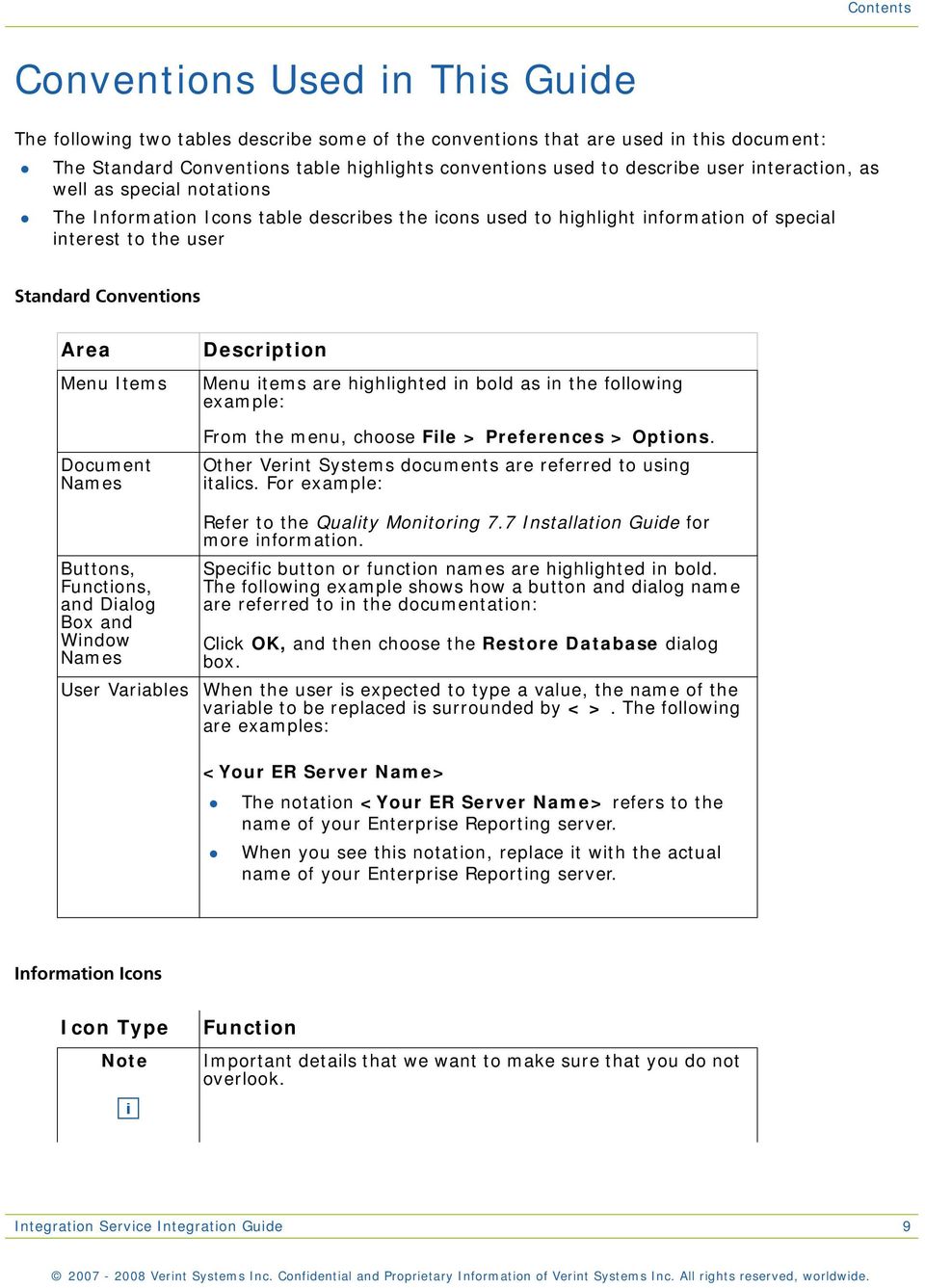
9 Contents Conventions Used in This Guide The following two tables describe some of the conventions that are used in this document: The Standard Conventions table highlights conventions used to describe user interaction, as well as special notations The Information Icons table describes the icons used to highlight information of special interest to the user Standard Conventions Area Menu Items Document Names Buttons, Functions, and Dialog Box and Window Names User Variables Description Menu items are highlighted in bold as in the following example: From the menu, choose File > Preferences > Options. Other Verint Systems documents are referred to using italics. For example: Refer to the Quality Monitoring 7.7 Installation Guide for more information. Specific button or function names are highlighted in bold. The following example shows how a button and dialog name are referred to in the documentation: Click OK, and then choose the Restore Database dialog box. When the user is expected to type a value, the name of the variable to be replaced is surrounded by < >. The following are examples: <Your ER Server Name> The notation <Your ER Server Name> refers to the name of your Enterprise Reporting server. When you see this notation, replace it with the actual name of your Enterprise Reporting server. Information Icons Icon Type Note Function Important details that we want to make sure that you do not overlook. Integration Service Integration Guide Verint Systems Inc. Confidential and Proprietary Information of Verint Systems Inc. All rights reserved, worldwide.
10 Contents Tip Helpful hints that can improve the efficiency or effectiveness of your work. Caution Advice that can help you avoid undesirable results. Warning Situations that can result in: Harm to software Loss of data An interruption in service Integration Service Integration Guide Verint Systems Inc. Confidential and Proprietary Information of Verint Systems Inc. All rights reserved, worldwide.

11 Contents If You Need Help Our goal at Verint Systems is to provide you with the best products backed by a high quality support network with a variety of resource options. These include: Verint Systems website and Customer Interaction Center (CIC) Telephone Direct Internet FTP Other support and training alternatives Before You Contact Technical Support Help from Technical Support is as near as your keyboard or telephone. However, before you contact us, read this section carefully. We can provide faster and better service if you have certain information available when you contact us. You can solve many problems quickly with the information in the online Help system or in this manual. When running the product, you can select the Help button in the upper-right portion of the window to get help for the active window or dialog box. If you are unable to solve a problem by using the online Help or this manual, and you need help from Technical Support, use the guidelines in the following checklist before you contact us: 1 Write down the problem and details that may help us solve the problem. If you can consistently reproduce the problem, list the steps to reproduce it. 2 Have at least the following information available when you contact Technical Support. Your name and customer site number, and identify yourself as a customer, Verint Systems partner, or Verint Systems employee. Customer-initiated CIC contact is restricted to customers that are one of the designated support contacts on your company s service level agreement. Product name and version number. Server and client operating systems and service pack version numbers Supporting files and screenshots (if available) ACD type and reporting package (for ACD-related issues) The wording of any error messages from the product and/or operating system Has this problem occurred previously? If it is new, did you change your system configuration recently? Integration Service Integration Guide Verint Systems Inc. Confidential and Proprietary Information of Verint Systems Inc. All rights reserved, worldwide.

12 Contents Contacting Technical Support Once you have determined that you need technical support, and you have gathered as much information as you can based on the checklist, the following provides a list of the various support options and alternatives: Verint Witness Actionable Solutions Website and the Customer Interaction Center (CIC) This facility allows users worldwide fast access to product information, marketing and sales information, information about the company, technical documentation, support case management, and support solutions information. You can access the Verint Witness Actionable Solutions Customer Interaction Center (CIC) support site at or through by clicking the Support Login link from the Home page. Once you have successfully logged on to the CIC, use the navigation tree on the right to access available user manuals, troubleshooting guides, FAQs, and more. For help using the site, refer to the CIC Support Website Navigation Guide. To access this document, click the link at the right on the CIC Home page. The guide is a PDF file that you can save or print locally for future reference. Telephone Verint Systems' Customer Interaction Center (CIC) provides the self-service tools and information you need to get the most out of your investment. Americas: WITNESS (USA toll-free) Europe/Middle East/Africa: (0) Hong Kong/Asia Pacific: Australia: New Zealand: Japan: +81 (0) For geographic locations and hours of operation, refer to and click on Contact Centers. Integration Service Integration Guide Verint Systems Inc. Confidential and Proprietary Information of Verint Systems Inc. All rights reserved, worldwide.

13 Contents If you are a new customer and need a logon ID and password, you can [email protected] to obtain your new logon information. Direct Internet FTP This facility greatly speeds up transfer of new and upgraded software to all Verint Systems customers. Contact us for more information about access to Direct Internet FTP services. Other Support and Training Alternatives In addition to documentation, online Help, and support services, Verint Systems also offers both classroom-based and online learning alternatives to suit your specific needs. Contact us for more information about other support and training alternatives. Integration Service Integration Guide Verint Systems Inc. Confidential and Proprietary Information of Verint Systems Inc. All rights reserved, worldwide.
14 Contents Integration Service Integration Guide Verint Systems Inc. Confidential and Proprietary Information of Verint Systems Inc. All rights reserved, worldwide.

15 Chapter 1 Introduction This chapter describes the Integration Service at a high level. It contains the following sections: About This Guide, page 16 Additional Resources, page 16 Integration Service Overview, page 17 About Integrations, page 19 New in this Release, page 24
16 Chapter 1 - Introduction About This Guide About This Guide The Integration Service Guide is intended for Verint Systems Field Services and Support personnel. It describes how to set up recorder integrations that is, how to set up your recorder so that it can connect to and receive data from third party devices for your particular deployment scenario. It describes the basic process for configuring adapters and completing integrations, independent of specific switch and vendor considerations. An additional series of guides, available in Product Central, documents integrations for specific switch-computer telephony integration (CTI) combinations. This series of guides will expand as the number of supported combinations increases; so check with your Verint Systems representative to obtain the latest guides. Refer to Verint Systems Product Central for a list of supported CTI combinations. Note: For Quality Monitoring integration information, refer to the Quality Monitoring with Impact 360 Recording Guide. Note: Additional Resources This guide assumes that you have already installed Impact 360 Recording, using the Impact 360 Recording Installation Guide. You may want to consult the following additional resources when planning and configuring Impact 360 Recording installation and Integration: Impact 360 Recording System Infrastructure Guide Impact 360 Recording Recorder Manager System Administration Guide Impact 360 Recording Enterprise Manager Administration Guide Integration Service Integration Guide 16

17 Chapter 1 - Introduction Integration Service Overview Integration Service Overview The Integration Service is the base platform for recording, acting as an interface between the recording system and output from the switch and other data sources. The Integration Service processes events from the server interfaces, detects state or data changes, and passes them along to other subsystems. It can capture CTI event streams to file for later playback and viewing, and holds agent state, device state, call state, and data associated with all known devices and calls. The Integration Service supports the majority of integrations out-of-box (OOB). Custom integration work is required only in cases where the OOB solution does not meet customer requirements. By maximizing the number of OOB functional integrations, the Integration Service minimizes the overhead previously required for integration installation and configuration, benefiting both Verint Systems and its OEM partners. The Integration Service provides: A real-time common representation of the enterprise contact center state to the rest of the Verint Systems products Control of recording in a TDM or IP recording environment Auditing and event logging, with a level of detail sufficient to allow for troubleshooting Integration Service Integration Guide 17

18 Chapter 1 - Introduction Integration Service Overview A mechanism for capturing third-party application events, using captured events to test system behavior, and to facilitate support and testing of integrations when the third-party product is not accessible in-house A path to minimize dependency on other internal subsystem components Facilitation of the use of automated Unit and System Test Tools, as well as automated Regression Test Tools by leveraging event record and playback capability The Integration Service performs call tracking and includes integration adapters, which enable the translation of recorded events from third-party systems (such as private branch exchanges [PBXs] and CTI Middleware Servers). Adapters connect to and receive events from the third-party systems, bridging the event data into key-value pairs that are then sent to the Integration Service Adapters notify the Integration Service of any serious errors in the third-party system, or in the communication with that system. The Integration Service translates this information into data that is usable by the recorder. Configuration of adapters through the Recorder Manager enables the translation of recorded events from third-party systems into key-value pairs that are then sent to the Integration Service components. The Integration Service in turn translates this information into data that the recorder and related applications can use. The Integration Service also controls recording, and manages Business Rules configured in Enterprise Manager. Integration Service Integration Guide 18

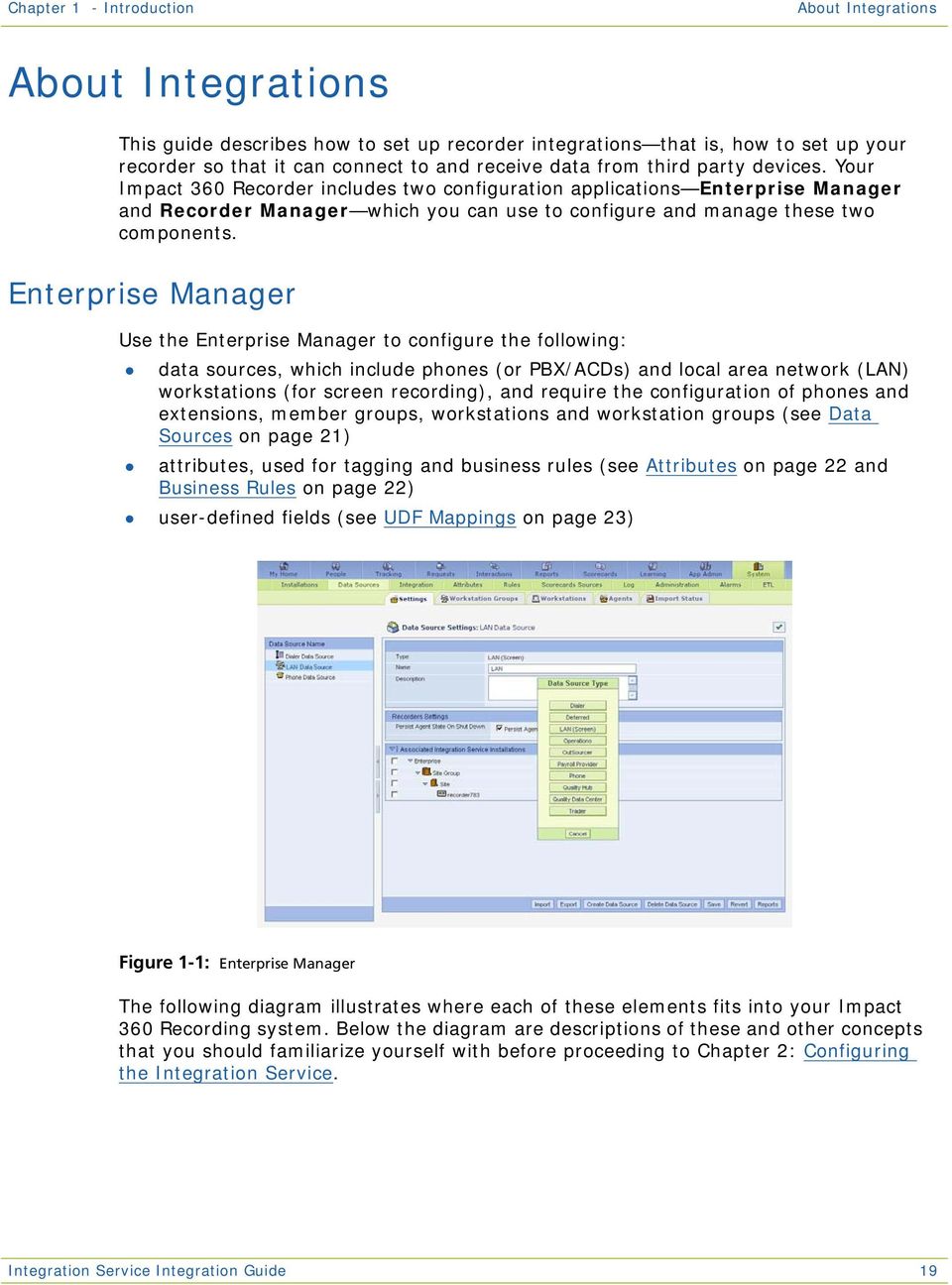
19 Chapter 1 - Introduction About Integrations About Integrations This guide describes how to set up recorder integrations that is, how to set up your recorder so that it can connect to and receive data from third party devices. Your Impact 360 Recorder includes two configuration applications Enterprise Manager and Recorder Manager which you can use to configure and manage these two components. Enterprise Manager Use the Enterprise Manager to configure the following: data sources, which include phones (or PBX/ACDs) and local area network (LAN) workstations (for screen recording), and require the configuration of phones and extensions, member groups, workstations and workstation groups (see Data Sources on page 21) attributes, used for tagging and business rules (see Attributes on page 22 and Business Rules on page 22) user-defined fields (see UDF Mappings on page 23) Figure 1-1: Enterprise Manager The following diagram illustrates where each of these elements fits into your Impact 360 Recording system. Below the diagram are descriptions of these and other concepts that you should familiarize yourself with before proceeding to Chapter 2: Configuring the Integration Service. Integration Service Integration Guide 19
20 Chapter 1 - Introduction About Integrations Server Roles The Integration Service is considered a server role, and, as such, is specified during Impact 360 Recording installation. Refer to the Impact 360 Recording Installation Guide for more information. In Enterprise Manager, server roles are reflected in System > Installations > Settings > Server Roles. The following server roles are available: IP Recorder Records IP calls from IP data sources, such as switches and IP gateways. TDM Recorder Records TDM calls from data sources. Integration Service Integration Guide 20

21 Chapter 1 - Introduction About Integrations Screen Recorder Records agent workstation screens. IP Analyzer Spans IP traffic from an IP data source and distributes the traffic to designated gateways and recorders. Integration Service Connects to a data source such as a phone or LAN. Enterprise Archive Archives calls or screens from the local archiver on two or more recorders to a central archiving system (CAM) that is accessible from Viewer. Sites and Installations Sites and site groups allow you to organize recorders across the enterprise, based on criteria such as geography or business requirements. A site can be a physical location or any other organizational unit. An installation is a construct that allows you to associate sites or site groups with a recorder or other server type. Data Sources Data sources are third-party systems, such as private branch exchanges (PBXs) and CTI Middleware Servers, that generate agent state, device state, and data change events.the Recorder makes business decisions on the interactions to record based on the events supplied by the Integration Service. They also provide business views of interactions based on different logic. Each type of recording you can configure involves a different type of data source: Phone or PBX data sources are for voice recording Dialer data sources are for voice recording for a dialer LAN data sources are for screen capture (also called screen recording) Member Groups Member Groups are groupings of different elements, such as extensions, trunk spans and extension pools. By specifying recording control types for extensions within member groups you can define Station-side, Trunk-side, or IP Recording setups Recorder Control Types on page 41 describes this aspect of configuration. Phones All of the phones you wish to perform recording on are associated with a Phone data source during configuration, in Enterprise Manager. A phone will have a primary extension and optional secondary extensions. To each extension, you must assign a recording mode that determines the kind of recording that can occur on the extension. The recording mode options are: Recorder Controlled The Recorder controls recording of the extensions or trunks and implements the default recording modes. In this case either Unify or Integration Service is used only for tagging. External Controlled Recording is controlled by a 3rd party application, which redirects audio to the Recorder. For use with Cisco DMS bulk recording. Integration Service Integration Guide 21
22 Chapter 1 - Introduction About Integrations CTI Controlled The Integration Service controls recording of the extensions or trunks and implements the default recording modes. Duplicate Streaming Controlled Same as CTI Controlled with the additional requirement that the Integration Service controls the streaming of the Audio (only valid for IP extensions). For use with Nortel DMS and Cisco DMS bulk recording. Unify Controlled Unify controls recording of the extensions or trunks. Here, the default recording modes are not read by Unify. Instead, the Recorder implements any of the possible default recording modes. You can specify the recording mode when setting up extensions (Creating and Editing Phones/Extensions on page 55). In voice recording, the recording mode and recorder control type define what gets recorded and how see Controlling Recording on page 41 for more Note: information, including descriptions of the recording mode and recorder control type settings necessary to produce the recording behaviour you require. Workstations and Workstation Groups Within your LAN, workstations on which you want to implement screen recording are known as LAN data sources. Whereas you configure Phone switches for recording telephone calls, you set up the LAN as the Data Source for creating and tracking agent workstations for recording screens within those screen, by creating workstations and groups of workstations in both IP and TDM environments. Attributes Your Impact 360 Recording system includes standard Contact, Agent, and CTI attributes. You can use these attributes for tagging and to build business rules, where the attributes become criteria upon which the decision is based to record or not to record. By configuring attributes, you create support for CTI tagging, which facilitates the process of recording and retrieving contacts based on real criteria, such as an agent s ID or extension. Once you have determined which fields you need to use in your system, you can add them as custom attributes, and then map these custom attributes to an adapter. You can also map fields with abstract internal names to meaningful ones, using the lookup mapping feature (for example, you could map a skill ID number to the actual name of the skill). See Configuring UDF Tagging and Attributes on page 70 for configuration instructions. Attributes are also one of the building blocks that comprise business rules, as described below. Business Rules Business rules extend the functionality of your recording system by allowing you to implement recording and tagging on the basis of a business logic that reflects the goals Integration Service Integration Guide 22
23 Chapter 1 - Introduction About Integrations of your enterprise. Each rule consists of a set of conditions (such as "extension starts with") and actions (record, do not record, and so on). The rules trigger recording when contacts that take place between customer interaction center agents and customers meet the specified criteria. See Overview on page 86 for configuration instructions. UDF Mappings You can map the attributes described above to UDFs in the Attributes Database, using the Enterprise Manager. This allows the data provided to be used in a meaningful way in call recording. For example, data typically associated with the attribute named Calling Party in the Enterprise Manager may be supplied to the recorder as something slightly different, such as Caller. If Caller has an association of UDF11 in the third-party data device, you would map UDF11 to Calling Party. See UDF Mapping on page 81 for configuration instructions. Recorder Manager Use the Recorder Manager to configure the adapters that allow the recorder to receive data from third-party devices. Figure 1-2: Recorder Manager Adapters Adapters connect to and receive events from third-party systems or data sources bridging the event data into key-value pairs that are then sent to the Integration Service. Adapters notify the Integration Service of any serious errors in the third-party system, or in the communication with that system. Integration Service Integration Guide 23
24 Chapter 1 - Introduction New in this Release New in this Release This release includes, but is not limited to, the following new features and enhancements. Enhanced Support for Extensions This release includes support for duplicate extensions over multiple data sources that is, the same extension identifier can exist on two different data sources. This release also supports long extensions, such as those required for SIP, up to 255 characters in length. AIM Application Control without CTI Calls It is now possible to apply messages from AIM to recordings, without an intervening CTI call. TDM Integration Service Redundancy This release supports Integration Service Redundancy for TDM Recorders. See Setting up TDM Redundancy on page 110 for more information. Citrix Screen Capture Citrix Screen Capture with Integration Service is now supported. See Recording Terminal Sessions on page 122 for more information. Quality Monitoring Event Filtering Integration Service Call and Agent events can be sent to Quality Monitoring (if your system includes this component) based on Agents or Extensions, or both. For all Quality Monitoring information, see the Quality Monitoring with Impact 360 Recording Guide. Integration Service Integration Guide 24
25 Chapter 2 Configuration Workflow This chapter outlines the high-level steps required to implement each of the following types of recording: Basic Voice Recording on page 27 Dialer Integration on page 35 CTI/Recorder-Controlled Trunk Side TDM on page 29 CTI/Recorder-Controlled IP on page 30 CTI-Controlled Cisco DMS on page 31 Clustered Integration Services with Cisco DMS on page 32 CTI-Controlled Nortel DMS on page 33 Dialer Integration on page 35 BT Trader on page 35
26 Chapter 2 - Configuration Workflow Configuration Workflow Configuration Workflow The steps you need to complete to configure your recorder and associated integrations will depend on the type of recording you need. You can set up each of the following scenarios by following the associated workflow diagram through the procedures in this guide: Basic Voice Recording on page 27 Dialer Integration on page 35 CTI/Recorder-Controlled Trunk Side TDM on page 29 CTI/Recorder-Controlled IP on page 30 CTI-Controlled Cisco DMS on page 31 Clustered Integration Services with Cisco DMS on page 32 CTI-Controlled Nortel DMS on page 33 Dialer Integration on page 35 BT Trader on page 35 These workflows are like checklists that outline the specific procedures that you need to complete. Each one contains links to the location of the procedures within this guide, as well as notes at key configuration points where the settings described are critical to implementing the type of recording you require. Integration Service Integration Guide 26
27 Chapter 2 - Configuration Workflow Configuration Workflow Basic Voice Recording Adding a Recorder to an Enterprise Site on page 51 Note: Viewer is always a separate server even if it is on the Integration Service box. Associating Recorders with the Integration Service on page 53 Create the Phone Data Source on page 97 Associate the Integration Service with the Data Source on page 100 Create Member Groups and Extensions on page 101 Creating and Editing Phones/Extensions on page 55 Configuring UDF Tagging and Attributes on page 70 Creating Agents and Assigning Agent IDs on page 62 (may be optional depending on your requirements refer to section for more details). Setting Up Screen Recording on page 114 (optional) Setting up Business Rules on page 86 Integration Service Integration Guide 27
28 Chapter 2 - Configuration Workflow Configuration Workflow CTI/Recorder-Controlled Station Side TDM Adding a Recorder to an Enterprise Site on page 51 Note: Viewer is always a separate server even if it is on the Integration Service box. Associating Recorders with the Integration Service on page 53 Create the Phone Data Source on page 97 Associate the Integration Service with the Data Source on page 100 Create Member Groups and Extensions > TDM Station Side Member Group on page 101. Set the Recorder Control Type to Recorder Controlled or CTI Controlled. Creating and Editing Phones/Extensions on page 55 Configuring UDF Tagging and Attributes on page 70 Creating Agents and Assigning Agent IDs on page 62 (may be optional depending on your requirements refer to section for more details). Setting Up Screen Recording on page 114 (optional) Setting up Business Rules on page 86 Integration Service Integration Guide 28
29 Chapter 2 - Configuration Workflow Configuration Workflow CTI/Recorder-Controlled Trunk Side TDM Adding a Recorder to an Enterprise Site on page 51 Note: Viewer is always a separate server even if it is on the Integration Service box. Associating Recorders with the Integration Service on page 53 Create the Phone Data Source on page 97 Associate the Integration Service with the Data Source on page 100 Create Member Groups and Extensions > TDM Trunk Side Member Group on page 104. Set the Recorder Control Type to Recorder Controlled or CTI Controlled Creating and Editing Phones/Extensions on page 55 Configuring UDF Tagging and Attributes on page 70 Creating Agents and Assigning Agent IDs on page 62 (may be optional depending on your requirements refer to section for more details). Setting Up Screen Recording on page 114 (optional) Setting up Business Rules on page 86 Integration Service Integration Guide 29
30 Chapter 2 - Configuration Workflow Configuration Workflow CTI/Recorder-Controlled IP Adding a Recorder to an Enterprise Site on page 51 Note: Viewer is always a separate server even if it is on the Integration Service box. Associating Recorders with the Integration Service on page 53 Create the Phone Data Source on page 97 Associate the Integration Service with the Data Source on page 100 Create Member Groups and Extensions > IP Member Group on page 106. Set the Recorder Control Type to Recorder Controlled or CTI Controlled Creating and Editing Phones/Extensions on page 55 Configuring UDF Tagging and Attributes on page 70 Creating Agents and Assigning Agent IDs on page 62 (may be optional depending on your requirements refer to section for more details). Setting Up Screen Recording on page 114 (optional) Setting up Business Rules on page 86 Integration Service Integration Guide 30
31 Chapter 2 - Configuration Workflow Configuration Workflow CTI-Controlled Cisco DMS Adding a Recorder to an Enterprise Site on page 51 Note: Viewer is always a separate server even if it is on the Integration Service box. Associating Recorders with the Integration Service on page 53 Create the Phone Data Source on page 97 Associate the Integration Service with the Data Source on page 100 Create Member Groups and Extensions set the Recorder Control Type to External Controlled (for bulk recording mode, in which Cisco sends everything to the Integration Service set the Call Manager Recording Option to Automatic Call Recording Enabled) or Duplicate Streamed (for selective recording, in which a duplicate stream is requested for each call set the Call Manager Recording Option for the line to Application Invoked Recording Enabled). Creating and Editing Phones/Extensions on page 55 Configuring UDF Tagging and Attributes on page 70 Create a Cisco SIP Proxy adapter to support Cisco DMS see Cisco Call Manager on page 211 Creating Agents and Assigning Agent IDs on page 62 (may be optional depending on your requirements refer to section for more details). Setting Up Screen Recording on page 114 (optional) Integration Service Integration Guide 31
32 Chapter 2 - Configuration Workflow Configuration Workflow Clustered Integration Services with Cisco DMS Enable Clustered Integration Services (see Setting Up Clustered Integration Services on page 111) Create Server Installations. One server will be primary and one will be secondary. See Adding a Recorder to an Enterprise Site on page 51 Associating Recorders with the Integration Service on page 53 Create the Phone Data Source on page 97. Associate the phone data source with both the primary and secondary Integration Service servers see Associate the Integration Service with the Data Source on page 100 Create an IP Extension Pool Member Group see IP Member Group on page 106. Associate the Member Group with the recorder being used for Cisco DMS, and set the Recorder Control Type to External Controlled or Duplicate Streamed. Creating and Editing Phones/Extensions on page 55 set the recording mode to Record. Configuring UDF Tagging and Attributes on page 70 Associating Recorders with the Integration Service on page 53 associate the recorders to the multiple integration services. For example, if you have set up a primary and secondary IS, associate the Primary with the Secondary, and vice versa. Creating Agents and Assigning Agent IDs on page 62 (may be optional depending on your requirements refer to section for more details). Setting Up Screen Recording on page 114 (optional) Integration Service Integration Guide 32
33 Chapter 2 - Configuration Workflow Configuration Workflow CTI-Controlled Nortel DMS Adding a Recorder to an Enterprise Site on page 51 Note: Viewer is always a separate server even if it is on the Integration Service box. Associating Recorders with the Integration Service on page 53 Create the Phone Data Source on page 97. Set the Data Source Switch Type to Nortel CS1000/Meridian1/ Succession. Associate the Integration Service with the Data Source on page 100 Create Member Groups and Extensions set Recorder Control Type to Duplicate Streamed. Creating and Editing Phones/Extensions on page 55. Set the Recording Mode to Record, Do Not Record, or Application Controlled, depending on the desired functionality (see Controlling Recording on page 41). Configuring UDF Tagging and Attributes on page 70 Create a Symposium adapter for Nortel/Meridian Succession see Nortel Meridian/Succession via MLS in the Nortel Integration Guide. Creating Agents and Assigning Agent IDs on page 62 (may be optional depending on your requirements refer to section for more details). Setting Up Screen Recording on page 114 (optional) Integration Service Integration Guide 33
34 Chapter 2 - Configuration Workflow Configuration Workflow Screen Recording Adding a Recorder to an Enterprise Site on page 51 Note: Viewer is always a separate server even if it is on the Integration Service box. Associating Recorders with the Integration Service on page 53 Creating the LAN Data Source on page 116 Associating Integration Service with the Data Source on page 117 Creating Workstation Groups on page 118 Associating Workstation Groups with a Recorder on page 119 Setting Up Workstations and Workstation Groups on page 118 Creating Agents and Assigning Agent IDs on page 62 (may be optional depending on your requirements refer to section for more details). Setting Up Business Rules for Screen Recording on page 124 Integration Service Integration Guide 34
35 Chapter 2 - Configuration Workflow Configuration Workflow Dialer Integration Create the Phone Data Source on page 97 Create a TDM Trunk Side Member Group on page 104 Creating a Dialer Data Source on page 125 Creating Data Source Groups on page 60 Creating Agents and Assigning Agent IDs on page 62 and Adding Agent Mappings on page 67 (may be optional depending on your requirements refer to section for more details). BT Trader For BT Trader instructions, refer to the BT Recorder Implementation Guide. Integration Service Integration Guide 35
36 Chapter 2 - Configuration Workflow Configuration Workflow Integration Service Integration Guide 36
37 Chapter 3 Configuring the Integration Service This chapter describes the Integration Service configuration process from start to finish, including the following tasks: Getting Started, page 38 Setting Up the Environment, page 39 Essential Concepts in Impact 360 Recording, page 41 Setting Up Voice Recording, page 96 Setting Up Screen Recording, page 114 Setting up a Dialer Integration, page 125 Configuring a CTI Adapter, page 128
38 Chapter 3 - Configuring the Integration Service Getting Started Getting Started This chapter contains step-by-step instructions for all of the tasks required to set up recording integrations. To determine which tasks are relevant to the type of recording you want to perform in your particular environment (for example, CTI/Recorder- Controlled Trunk Side TDM, or Screen Recording), and the order in which to complete those tasks, see Configuration Workflow on page 25 for a master checklist, which will guide you through the following tasks as applicable: Setting Up the Environment, page 39 Essential Concepts in Impact 360 Recording, page 41 Setting Up Voice Recording, page 96 Setting Up Screen Recording, page 114 Setting up a Dialer Integration, page 125 Configuring a CTI Adapter, page 128 Setting up Business Rules, page 86 Several tasks common to the above processes appear in the section Common Recording Configuration Tasks on page 50. Note: Before you begin, read Chapter 1: Introduction, to ensure that you understand the different elements in your recording system that are involved in setting up integrations service recording solutions. To recap: The Integration Service manages adapters, call tracking, event processing and business rules. Adapters connect to and receive events from third-party systems or data sources. The Enterprise Manager and Recorder Manager applications allow you to configure the Integration Service. The Enterprise Manager enables you to configure enterprise-level configuration details such as data sources, extensions, member groups, and agents. The Recorder Manager allows you to configure adapters. Integration Service Integration Guide 38
39 Chapter 3 - Configuring the Integration Service Setting Up the Environment Setting Up the Environment Switches and other third-party devices in use within your system will require configuration in order to set up an integration. This information is covered in a series of Guides, available on the Recorder software, Product Central, and the Partner Extranet. Supported Switches and other Third-Party Devices At the time of this release, the following guides are available, covering configuration of the devices and environments listed (additional guides may become available to support new integration types): Alcatel Integration Guide Alcatel OmniPCX 4400 Via Alcatel TSAPI Aspect Aspect Call Center via Event Bridge Aspect Call Center via Contact Server Aspect Unison/Ensemble/ Ensemble Pro Avaya Integration Guide Avaya Definity G3/ S8x00 via Avaya Definity LAN Gateway Avaya ASAI via CVLAN Adapter Avaya Definity G3/S8x00 via Avaya CT (TSAPI) Avaya Definity G3/S8x00 via Genesys Avaya CT Connect Avaya Via ICM Avaya PDS Cisco Integration Guide CTI Controlled Solution via JTAPI Duplicate Streamed Recording Solution Recorder Controlled Solution with Tagging via JTAPI and/or Cisco ICM JTAPI Adapters Cisco ICM Adapter Genesys Integration Guide Genesys SIP Switch with Genesys TServer Nortel Integration Guide Nortel Meridian/Succession via Symposium Nortel Meridian/Succession via CT Connect Nortel Meridian/Succession via Genesys Integration Service Integration Guide 39
40 Chapter 3 - Configuring the Integration Service Setting Up the Environment BT ITS For instructions on how to configure a recording solution for BT ITS, see the BT ITS Recorder Implementation Guide. Quality Monitoring For instructions on configuring the Integration Service for Impact 360 Recording with Quality Monitoring, see Quality Monitoring with Full-time Recording. Integration Service Integration Guide 40
41 Chapter 3 - Configuring the Integration Service Essential Concepts in Impact 360 Recording Essential Concepts in Impact 360 Recording Calls are recorded by tapping into telephone lines at different points in the telephone network. The recorder supports both TDM and IP recording, including trunk-side recording (TDM) or gateway recording (IP), and station-side recording (TDM) or extension-side recording (IP) recording. You can configure each of these types of recording by using Enterprise Manager to set up extension groups or pools (called member groups), each with a data source that defines where the recorded call is coming from, and then setting recording modes. This section outlines important concepts related to voice recording. Once you have familiarized yourself with these concepts, proceed to one of the following sections for step-by-step configuration instructions, depending on the type of recording you are setting up: Setting Up Voice Recording on page 96 Setting Up Screen Recording on page 114 Setting up a Dialer Integration on page 125 The following sections describe how to control recording (Controlling Recording, page 41), as well as network topologies for TDM recording (TDM Recording, page 43) and IP recording (IP Recording, page 45). Controlling Recording Your recorder control type and default extension recording mode setting work in combination to define how and when recording occurs. You can configure each of these settings as follows: Recorder Control Type: Set the Recorder Control Type in the Enterprise Manager, as part of setting up Station-side recording (page 101), Trunk-side recording (page 104), or IP Recording (page 106). See Recorder Control Types on page 41. Default Extension Recording Mode: See Extension Recording Modes on page 42. To achieve the recording behavior you expect, it is essential that you configure these settings such that they do not contradict one another. The section Recommended Settings for Recorder Control Types and Recording Modes on page 43 outlines supported configurations, as well as configurations that you should avoid. Recorder Control Types The two main deployment types are CTI Controlled and Recorder Controlled. Recorder Control types apply to member groups, which define phone extensions associated with trunk groups (spans), station-side extension groups, and IP extension pools (IP only). The recording control type on the member group determines what method will be used Integration Service Integration Guide 41
42 Chapter 3 - Configuring the Integration Service Essential Concepts in Impact 360 Recording to record extensions assigned to that member group, and a given deployment can be a mix of any or all of the Control Types in this section. CTI Controlled deployments are those in which the Integration Service controls call recording. Recorder Controlled deployments are those in which the recorders themselves control recording, and the Integration Service only provides tagging data. In the context of an IP recorder, recording is accomplished by a means of decoding of IP control packets, such as Skinny or SIP. In the context of a TDM recorder, recording control is accomplished through either D-Channel detect, VOX, CAS, line voltage (tap sense) recording, and the Integration Service provides tagging information from CTI events. When you use this control type, Unify or Integration Service are used only for tagging purposes. In addition to the recorder control types described above, an additional option Unify Controlled is available. With Unify Controlled, Unify is responsible for controlling recording of the extensions or trunks. In this case, the default recording modes are not read by Unify so it is up to the Unify script to implement any of the possible default recording modes. The Duplicate Stream recorder control type is available when you are using Nortel DMS or the Cisco SIP implementation. Duplicate Stream is the same as CTI Controlled in that the Integration Service will control recording based on CTI events, but in addition this tells the Integration Service that the recordings will be accomplished by directing the RTP streams to the recorders via CTI commands. The External Controlled recorder control type is available when using the Cisco SIP implementation. Using External Controlled, recording is controlled through a third party redirecting audio to the recorder; this method of getting the audio to the recorder distinguishes External controlled from CTI Controlled, but the two recorder control types are similar. Extension Recording Modes Each phone associated with a Phone data source has a primary extension, as well as optional secondary extensions. Each extension has a default recording mode that determines the recording behavior for that extension. Available recording modes are Record, Do Not Record, Application Controlled Recording, and Start at Business Rule. The behavior for each of these modes is as follows: Record Record all calls on this extension. However, if a Do Not Record Business Rule triggers, the recording will be deleted, regardless of all other settings or rules. Recordings can also be blocked by tools such as AIM and Unify Desktop Start at Business Rule Do not record calls on this extension until a business rule is triggered or an external API command starts recording. However, if a Do Not Record Business Rule triggers, the recording will be deleted, regardless of all other settings or rules. Application Controlled Record every call, and then delete it. At any time during a call, a Business Rule or external API command can cause the recorder to keep the call. However, if a Do Not Record Business Rule triggers, the recording will be deleted, regardless of all other settings or rules. Integration Service Integration Guide 42
43 Chapter 3 - Configuring the Integration Service Essential Concepts in Impact 360 Recording Do Not Record Never record a call for this extension. If another extension is involved in the call that is not in the Do Not Record list, then it is recorded. Similarly, parts of the call that were already recorded before the Do Not Record extension entered the call will be kept; however, the rest of the call will not be recorded. Business Rules or external API commands do not override this setting. Recommended Settings for Recorder Control Types and Recording Modes See How do I choose the correct Recording Mode and Recorder Control Type? on page 146. TDM Recording The recorder supports two types of TDM recording: Trunk-Side and Station-Side. TDM Trunk-Side Recording In TDM environments, trunk-side recording taps directly into a T1 or E1 line to record all incoming calls at the demarcation point before going to a switch. Passive tap trunk-side recording requires a physical connection directly between the demarcation point and the switch system. The following diagram illustrates a typical passive tap trunk-side configuration scenario within a Call Center environment. Integration Service Integration Guide 43
44 Chapter 3 - Configuring the Integration Service Essential Concepts in Impact 360 Recording Trunk Side Recording (TDM) IS/Unify Server CTI Server Recorder Server Junction Box LAN Agent Workstations PSTN PBX Sysadmin/ Supervisor Server T1 Line Note: 1 junction box required for each T1 line. Punchdown Block TDM Station-Side Recording In TDM environments, station-side recording is initiated between the switch/acd and a phone. This is done by tapping into the line that connects the switch to the telephone using a punch-down block. A cable is installed so that each extension connects directly to a port on the voice card. The following diagram illustrates a typical passive tap station-side configuration within a Call Center environment. Integration Service Integration Guide 44
45 Chapter 3 - Configuring the Integration Service Essential Concepts in Impact 360 Recording Station Side Recording (TDM) CTI Server IS/Unify Server LAN Sysadmin/ Supervisor Server Agent Workstations PSTN PBX T1 Line Punchdown Block RECORDING Recorder Server IP Recording The recorder supports two types of IP recording: Gateway and Extension-Side. IP Gateway Recording Gateway recording in IP environments can be compared to trunk-side recording in TDM environments. Gateway recording is accomplished by SPANning the gateway and the call control server. In Cisco environments, the call control server is Call Manager. To record conference calls, any and all conference bridge resources/participants must be SPANned. At the same time, care must be taken to ensure that SPANning the conference bridge resources does not take the IP Recorder over the maximum number of concurrent channels for which it is configured. A possible limitation of this configuration is that it may be difficult to record agent to agent calls, since these do not usually go over the gateway. Integration Service Integration Guide 45
46 Chapter 3 - Configuring the Integration Service Essential Concepts in Impact 360 Recording The following diagram illustrates a typical gateway recording configuration. Gateway Recording (IP) Recorder Server IS/Unify Server CTI Server Voice Gateway/ Conference Bridge LAN Agent Workstations PSTN T1 Line V Sysadmin/ Supervisor Server M Call Manager Spanning the gateway enables the Recorder to see the RTP traffic between the IP device and the gateway. When a conference is established, the RTP traffic flows between the gateway and the conference bridge, meaning that the IP Recorder cannot associate it with any device. The conference bridge must be SPANned, therefore, to enable the IP Recorder to access and record the RTP streams going to and from IP devices. The SCCP protocol only flows between the IP device and the call control server. The gateway does not use the SCCP protocol, and therefore SPANning just the gateway is not sufficient to allow recording, since it has no way to initiate the recording process. This necessitates SPANning of the call control server to allow the IP Recorder to see all SCCP packets for the entire system. Extension-Side IP Recording Extension-side recording in IP environments is comparable to station-side recording in TDM environments. Extension-side recording is achieved by SPANning (that is, copying) the traffic to and from an IP phone, typically using either port or VLAN SPANning. SPANning the IP device itself means that the IP Recorder will receive all RTP traffic to and from that device, as well as SCCP protocol traffic between the device and the Cisco Call Manager Server/Cluster. In this configuration, it is not necessary to explicitly SPAN the Call Manager or any of the conference bridge resources. Integration Service Integration Guide 46
47 Chapter 3 - Configuring the Integration Service Essential Concepts in Impact 360 Recording The following diagram is an example of extension-side recording. In this configuration, the access switches to which the IP phones connect are SPANned directly. Extension Recording (IP) CTI Server IS/Unify Server LAN Call Manager M Sysadmin/ Supervisor Server Agent Workstations T1 Line V PSTN Voice Gateway/ Conference Bridge Recorder Server Multiple Recorder Support A single instance of an Integration Service can support multiple TDM, IP, or screen recorders either by segregating the extensions by assigning them to specific recorders, or by sharing extensions across recorders (in the case of load-balanced or redundant recorders). When extensions are assigned to specific recorders, the Integration Service only sends recording control messages to the recorder assigned to a given extension through configuration. Redundant IP Recorders This release supports redundant recorder configurations with IP recorders for both CTI Controlled and Recorder Controlled configurations. In a redundant Recorder Controlled IP recorder configuration, the Integration Service can track extensions involved in a call and send tagging messages to a associated recorders. This means that tag commands are sent to any recorder associated with the extension that has sent an Inum to the Integration Service, indicating that a recording is active. For redundant CTI Controlled IP recorder configurations, the Integration Service sends recording control commands in addition to tagging, as in the Recorder Controlled configuration. The Integration Service also sends commands to any recorder associated with any extension involved in the call, as in the Recorder Controlled Integration Service Integration Guide 47
48 Chapter 3 - Configuring the Integration Service Essential Concepts in Impact 360 Recording solution, but it is assumed that recording only takes place on the recorders to which the audio is available. For both Recorder Controlled and CTI Controlled configurations, you must assign extensions to recorders to utilize the Integration Service with that recorder, even with a recorder that is configured to Record All. Load-Balanced IP Recorders The Integration Service configuration for load-balanced IP recorders is almost the same as that for redundant IP recorders (see Redundant IP Recorders on page 47). However, in Load-Balanced recorders the Real-time Transport Protocol (RTP) streams are only visible to one of the recorders, and, therefore, only recorded on that recorder. For screen recording, the Recorder Controller attempts to send screen recordings to the recorder that is least utilized, when more than one recorder can record that workstation. Integration Service TDM Redundancy This release supports Integration Service Redundancy for TDM recorders. See Setting up TDM Redundancy on page 110. Dialers Predictive dialers enable contact centers to maximize their resources by automating the task of dialing customers. The dialer dials the customer, and the agent is only connected to the customer once the customer actually answers the call. Thus no time is wasted while dialing or waiting for the customer to answer. There are two kinds of dialers: Soft Dialers and Hardware Dialers. Soft Dialers Soft dialers are software-only dialers that instruct the PBX to initiate calls via Active CTI. This dialer type has no external trunks to the PSTN. When working in environments with soft dialers, the only CTI connection is with the PBX. Tapping and call marking are performed as if there was no dialer. Hardware Dialers Hardware Dialers connect to the PSTN (directly or indirectly through the PBX) and can be configured in the following working modes: Nailed agent The Predictive Dialer establishes a long call with each outbound agent, for the whole duration of the agent s shift, and connects agents with the outbound calls it generates internally. Agents are dedicated to answering calls initiated by the Predictive Dialer throughout their shift; from the moment that login has been performed. In the common Nailed Agent Mode, the PBX s CTI link reports just one long call between the agent and the dialer. Integration Service Integration Guide 48
49 Chapter 3 - Configuring the Integration Service Essential Concepts in Impact 360 Recording Blended agent the Predictive Dialer "manages" the agent's extension by transferring outbound calls to the agent but also allowing the connection of incoming ACD calls when necessary. Stand alone Stand-alone dialers act as a PBX and the extensions are connected directly to the dialer. This mode is rare. If trunk-side tapping is required, trunks are intercepted in two places: between the PSTN (Public Switch Telephony Network) and the contact center switch (PBX), and between the dialer and the PBX. Trunk-side tapping is supported for all of the hardware dialers we integrate to, assuming a trunk supporting PBX integration. Note that the recorder taps the trunks between the Dialer to the PBX and not between the dialer to PSTN. In some cases there may be a TDM network between the dialer and the PBX, for example if the dialer and PBX reside in two different countries. Integration Service Integration Guide 49
50 Chapter 3 - Configuring the Integration Service Common Recording Configuration Tasks Common Recording Configuration Tasks The following tasks are common to most Recording scenarios. Refer to Configuration Workflow on page 26 for the specific order in which you should complete these tasks for your particular recording scenario. Creating an Enterprise Site on page 50 Adding a Recorder to an Enterprise Site on page 51 Associating Recorders with the Integration Service on page 53 Managing Phones/Extensions on page 54 Creating Data Source Groups on page 60 Creating Agents and Assigning Agent IDs on page 62 Configuring UDF Tagging and Attributes on page 70 Setting up Business Rules on page 86 The following sections (Setting Up Voice Recording, Setting Up Screen Recording, and so on) will refer back to these procedures. Creating an Enterprise Site You can manage recorder installations across the enterprise by creating Sites. A Site may be a country, a city, an office location, or any other organizational unit that models the enterprise. Recorders, Analyzers, and Viewer installations are all contained in Sites. Please note the following when creating Sites or Site Groups: Site and Site Group names must be unique within its container group in the installation hierarchy. Site Groups may contain other Site Groups or Sites, but Sites may not contain Site Groups or other Sites. You can only add server installations under Sites, and you may import server installations using Viewer, or create them manually using the Enterprise Manager. Site and Site Group names are not case sensitive. User privileges control available functionality. To create a Site: 1 In Enterprise Manager, click System > Installations > Settings. 2 The Installations pane on the left-hand side represents the hierarchy of sites across your enterprise. Click Enterprise, or any site group it contains if you wish the new site to be included in an existing group. 3 If the site you are creating will reside in a group with other sites, click Create Site Group otherwise proceed to step 4. a. Type a Site Group Name. b. Type a Description of the site group (optional). c. Click Save. Integration Service Integration Guide 50
51 Chapter 3 - Configuring the Integration Service Common Recording Configuration Tasks 4 Click Create Site. a. Type a Site Group Name. b. Type a Description of the site group (optional). c. Click Save. Repeat these steps for all the Sites in your organization. Adding a Recorder to an Enterprise Site Once you have created an enterprise site, create a recorder and add it to the site. 1 In Enterprise Manager, click System > Installations > Settings. 2 In the Installations pane, select the Site where you want to create the Recorder, and then click Create Installation. Integration Service Integration Guide 51
52 Chapter 3 - Configuring the Integration Service Common Recording Configuration Tasks 3 On the pop-up dialog box, click Server. Viewer is always a separate server even if it is on the Integration Service box. Note: 4 Type the following information: Name A name for the new recorder. Integration Service Integration Guide 52
53 Chapter 3 - Configuring the Integration Service Common Recording Configuration Tasks Serial Number Read-only field that displays the serial number of the Recorder. Description Descriptive text that identifies of the new recorder (for example, "Atlanta TDM"). Server Name The name of the server on which the recorder is located. Enterprise Manager uses this information to connect to the server. Port Number The port number (8080) to use if security is not being used for the Recorder-to-Viewer communication. SSL Port Number The port number (8443) to use if you are using security for Recorder-to-Viewer communication. 5 Click Save. Associating Recorders with the Integration Service A recorder is associated with an Integration Service during installation if they are both on the same server. Recorders installed onto servers without an Integration Service can be associated with an Integration Service using the following procedure. If, during installation, you associated the recorder with an Integration Service, you cannot change this association, and the options described in the following Note: procedure are read-only. To associate a recorder with an Integration Service: 1 Log on to the Enterprise Manager. 2 Choose System > Installations > Associations. Integration Service Integration Guide 53
54 Chapter 3 - Configuring the Integration Service Common Recording Configuration Tasks 3 Under Associated Recorders, select the Integration Service servers with which you want to associate the recorder. 4 Click Save. You must also associate data sources with an Integration Service. Note: Managing Phones/Extensions You can add primary and secondary telephone extensions for use throughout the organization, and set whether phone extensions are recorded, and select a recording mode. Creating and Editing Phones/Extensions, page 55 Editing Multiple Extensions, page 58 Creating a Range of Extensions, page 58 Deleting Extensions, page 60 Integration Service Integration Guide 54
55 Chapter 3 - Configuring the Integration Service Common Recording Configuration Tasks This release includes support for duplicate extensions over multiple data sources that is, the same extension identifier can exist on two different data Note: sources. This release also supports long extensions, such as those required for SIP, up to 255 characters in length. Extensions will not be recorded if the extension is not associated with a recorder. Note: Creating and Editing Phones/Extensions You can add or edit primary and secondary extensions (for example, you may wish to change an extension s recording mode). You can also edit multiple extensions at once see Editing Multiple Extensions on page 58. You can only edit secondary extensions when editing a single extension. Note: To associate port numbers with extensions 1 Under Group Members, associate port numbers with extensions by doing one of the following: type an extension number (for example, 3344) in each field, then click Save. or automatically assign extensions by clicking Generate Extensions, type the Starting Port Number, the total Number of Ports, and the Starting Extension Number, then click Assign. To create and edit phones 1 Click System > Data Sources > Phones and select a Data Source in the left pane. Integration Service Integration Guide 55
56 Chapter 3 - Configuring the Integration Service Common Recording Configuration Tasks 2 Select a primary extension, then click Create or click Edit. 3 Specify or edit the following: Extension Type the extension number, including any prefix or suffix, such as 3344, or X3344, or X3344A (the prefix and suffix are not case-sensitive). Recording Mode Choose one of the following extension recording modes: Record, Do Not Record, Application Controlled, or Start at Business Rule (see Extension Recording Modes on page 42 for descriptions). Application Controlled is for use with the Exec Recordfeature see "Installing ExecRecord" in the Recorder Installation Guide to learn how to deploy it. (ExecRecord allows you to record calls on demand, in recording environments that use Cisco CallManager equipment and IP phones.) Note: LAN Data Source Required for screen recording. Select the LAN Data Source with which the phone must be associated. Workstation Name In setups involving a LAN data source, you can map phones to workstations. Click the pencil icon. Select a workstation, then click Set. Integration Service Integration Guide 56
57 Chapter 3 - Configuring the Integration Service Common Recording Configuration Tasks Secondary Extensions Under, Secondary Extensions, type the secondary extension number in the Extension field. This number must be distinct from the primary number. For example, add a prefix or suffix to the primary number. Primary and Secondary extensions are not case-sensitive. Recording Mode Set the recording mode (see above for descriptions). Click Add to add new secondary extensions as needed. 4 Click Set. 5 Click Save. Integration Service Integration Guide 57
58 Chapter 3 - Configuring the Integration Service Common Recording Configuration Tasks Editing Multiple Extensions You can change multiple non-clustered extensions for a selected switch at one time, using the following procedure. To edit multiple extensions: 1 Click System > Data Sources > Phones and select two or more extensions. 2 Click Edit. 3 Complete the fields as described in Creating and Editing Phones/Extensions on page Click Save. Creating a Range of Extensions You can automatically create a series of extension numbers between a specified start and end range, including prefixes and postfixes, allowing you to create up to five thousand extensions at once. All extensions in the range assume the same recording mode, and are not case-sensitive. To create a range of extensions: 1 Click System > Data Sources > Phones and select a Data Source in the left pane. 2 Click Create Range. Integration Service Integration Guide 58
59 Chapter 3 - Configuring the Integration Service Common Recording Configuration Tasks 3 In the Create Phone Range window, complete the following fields: Prefix Type any digit or letter that will precede the extensions number, such as X. Extension Range Type an extension number range, such as Postfix Type any digit or letter that will appear after the extension, as an identifier. Recording Mode Choose one of the following extension recording modes: Record Record all calls on this extension. However, a triggered "block" business rule blocks any recording, regardless of all other settings or rules. Recordings can also be blocked by tools such as AIM and Unify Desktop Do Not Record Never record a call for this extension. If another extension involved in the call is not in the Do Not Record list, the call is recorded. Similarly, parts of the call that were already recorded before the Do Not Record extension entered the call will be kept; however, the rest of the call will not be recorded. Application Controlled Record every call, and then delete it. At any time during a call, the application can command the recorder to keep the call. However, a triggered "block" business rule blocks any recording, regardless of all other settings or rules. Application Controlled is for use with the Exec Recordfeature see "Installing ExecRecord" in the Recorder Installation Guide to learn how to deploy it. (ExecRecord allows you to record calls on-demand, in recording environments that use Cisco CallManager equipment and IP phones.) Note: Start at Business Rule Do not record calls on this extension until a business rule is triggered. However, a triggered "block" business rule blocks any recording, regardless of all other settings or rules. Integration Service Integration Guide 59
60 Chapter 3 - Configuring the Integration Service Common Recording Configuration Tasks Overwrite Existing Select this check box to have existing identical extensions replaced with new ones created in the range. The new one then assumes the characteristics of the range. If unchecked, the identical extension will remain with its existing characteristics (such as recording mode). Delete if extension exists as primary Select this check box to delete the primary extension if a primary extension with the same number/identification is detected. For secondary extensions, type the range of secondary extension numbers, which must be distinct from the primary numbers. Secondary extensions assume the same prefix and postfix as the primary extension, and are not case-sensitive. Refer to the following table for extension range guidelines: Extension type Allowable ranges Primary Extension 1000, , st Secondary Extension 4000, , nd Secondary Extension 7000, , If necessary, click Add to add a new secondary extension. 5 Click Save to save any addition or change in the Create Phone Range window. Deleting Extensions Use the following procedure to delete extensions. To delete extensions: 1 Click System > Data Sources > Phones 2 Select a Data Source and then select one or more extensions. 3 Click Delete, then click OK. Wait a few seconds until the deletion is complete. Creating Data Source Groups Data Source groups are groups of telephone extensions that allow automation. For example, in a Hunt group, incoming calls are passed from extension to extension within the group until the call is accepted, optimizing agent and extension usage. This section describes how to create and edit groups, import group information from a.csv file, and access the queues for multiple groups. Refer to the individual Integration Guides for your particular deployment to determine whether configuring Data Source Groups is required. Creating and Editing Data Source Groups 1 In Enterprise Manager, click System > Data Sources > Data Source Groups. Integration Service Integration Guide 60
61 Chapter 3 - Configuring the Integration Service Common Recording Configuration Tasks 2 Select a Data Source in the left pane. 3 Do one of the following: Click Create Group to create a new Data Source group for the selected Data Source. Select a Data Source group in the right pane and click Edit Group to edit an existing group. 4 Complete the following fields: Data Source Group Name Type value of the Data Source Group (the Skill ID, Hunt Group Number, etc.). Description Type a description of the group (optional). Type The type of data source group you can select depends on the third-party device/software you are using. Select one of the following: Avaya: Hunt Group, or VDN Nortel: CDN, ACD Queue, DN (QDN) Aspect: Agent Groups Alcatel: Pilot Number Dialer: Varies by dialer switch (Aspect Unison/Ensemble/Ensemble Pro), with different groups performing different functions. For example in a Hunt Group, Integration Service Integration Guide 61
62 Chapter 3 - Configuring the Integration Service Common Recording Configuration Tasks incoming calls are passed from extension to extension within the group until the call is accepted. Note that for dialers these are not currently in use. Note: Average Work Time Shows the average work time in hours for the group, applicable only in the Workforce Management application, if licensed. 5 Click Save. Creating Agents and Assigning Agent IDs You can create agents either individually, or by importing a list of agents from an existing source. You should configure employees and agent IDs if you want agent name, supervisor or logged on duration for tagging or business rules. However, if you Note: require only agent id tagging, you do not need to configure employees and agentid. See Agent Tagging Worksheet on page 184 for a table you can use to gather agent information for the purposes of tagging. Note: Seating Arrangements During the following procedure you will specify the seating arrangement. The agent seating arrangement can be Fixed, Free, or Hybrid: With fixed seating, an agent has a permanently assigned workstation and is associated with a specific extension. In a free seating arrangement, agents do not have permanently-assigned workstations. They are assigned an Agent ID and can log in from any location in the call center. Extensions are assigned dynamically when the agent logs in (either a CTI login to the phone, or a Workstation login to the workstation, if a phone is associated to the workstation). Hybrid seating refers to an arrangement in which some agents are using free seating and some are using fixed. If an agent is assigned only an Agent ID for this data source they are considered to have a free seating arrangement. If an agent is assigned a phone for this data source they will be considered to have a fixed seating arrangement. It is also possible to have agents associated to workstations upon login, either the workstation directly, or by a CTI login to a phone that is associated to a workstation (see Static/Dynamic Workstations on page 115 for more information). Integration Service Integration Guide 62
63 Chapter 3 - Configuring the Integration Service Common Recording Configuration Tasks To create a single agent: 1 In Enterprise Manager, click People > Profiles. 2 Click the Create button. 3 Type the Employee s Last Name, First Name, Middle Initial (all required) and Suffix (optional). Steps 4, 5, 6 and 7 are optional if you are not using Workforce Management. 4 Under Contact Information, type the following information for the employee: (required), Pop-up Address, Home Phone (required), Work Phone (required), Cell Phone. 5 Under Home Address, type the employee s address details in the relevant fields. 6 Under Administrative Details, specify the following information: If an employee who has a user account is terminated, the employee s user account is automatically put in Locked By Admin status at midnight of the employee's final day. If, subsequently, the employee is un-terminated (the end date is deleted or moved to the future), you must modify their user account status manually. Note: Start date Employment start date. End date Employment end date. Integration Service Integration Guide 63
64 Chapter 3 - Configuring the Integration Service Common Recording Configuration Tasks Is Supervisor Select this box if the employee is a supervisor. Is Team Lead Select this box if the employee is a team lead. Employee ID Type the employee ID. Tax ID (SSN) Type the employee s tax ID/social security number. Wage amount Type the employee s wage Rank Type a number that represents the employee s rank in relation to other employees. Organization Specify the organization to which the employee belongs. Supervisor Specify the employee's manager or supervisor. Team Lead Specify the employee's team lead. Job title Type the employee s job title. 7 In the Data Source section, associate the agent with a data source by typing their agent ID and/or extension in the field next to the appropriate data source. The seating arrangement you set when creating the data source determines what you must specify here: If the seating arrangement is... Fixed Free Hybrid specify the Extension. Agents are assigned to extensions permanently and do not share extensions with other agents. No login events are required to assign the agents to their extensions. Agent ID. The System will dynamically assign agents to extensions based on received login events. Agent ID or Extension. On a per agent basis, each agent can either be designated as using fixed or free seating. The arrangement used is determined by whether they have an Extension assigned. If an extension is assigned the agent seating arrangement is considered fixed. You can either type the phone extension, or click the Pencil icon to show the Select Extension window, choose the extension, and then click Set. Integration Service Integration Guide 64
65 Chapter 3 - Configuring the Integration Service Common Recording Configuration Tasks If your site uses Quality Monitoring, and you are licensed for Advanced Adherence, click the Quality Monitoring checkbox to associate that data source Note: with employees who are also defined in the Quality Monitoring system. Refer to the User Synchronization Tool Guide to find out how to synchronize information from Enterprise Manager to Quality Monitoring. If your site uses Impact 360 Recording, locate the data source for the employee, which can be a Phone or Dialer switch, or a LAN, and then type or Note: import the Agent ID and/or Phone Extension. For the Phone Extension, you can also click the pencil icon to show the Select Extension window, choose the extension, and then click Set. For information on importing data sources for Impact 360 Recording, refer to Data Source Import Formats in the Enterprise Manager Administration Guide. 8 Click Save. You can view information for more than one employee at once, by using shift or ctrl to select multiple employee profiles this is referred to as multi-edit Note: mode. In this mode, an asterisk (*) displayed in a field signifies that the values of that field differ among the selected employees. A value displayed in such a field, however, signifies that the value of that field is the same for all selected employees. Importing Agents from an Existing Source You can import a list of agents from an existing source, such as a.csv file containing information from LDAP. 1 In Enterprise Manager, click People > Profiles. Integration Service Integration Guide 65
66 Chapter 3 - Configuring the Integration Service Common Recording Configuration Tasks 2 Click Import. 3 Under File Setup, click Browse and select the file you wish to import. Integration Service Integration Guide 66
67 Chapter 3 - Configuring the Integration Service Common Recording Configuration Tasks 4 As the Delimter, specify whether Tabs, Commas, or Semicolons separate the data in the source file. 5 Type the number of lines appearing at the start of the file that should be ignored. 6 From the list of fields, select those that appear in your file, and indicate the column number in which that data appears. Last Name, First Name, and Organization are mandatory. 7 Click Save. Mapping Agents to Data Sources You can map agents to data sources to provide agents in your organization with a switch ID, and associate this ID with data sources such as a phone switch or LAN. Data sources appear in the left pane, and only those agents associated with a data source appear in the right pane. You can add, edit and delete agent mappings, as described in the following topics: Adding Agent Mappings, page 67 Editing Agent Mappings, page 69 Only phone, LAN, and dialer data sources allow you to record on a per-agent basis. For a LAN data source, you can only give agents a Login ID. You must Note: have the "View and Configure Data Sources" privilege to edit these agent settings. Adding Agent Mappings Agent mappings to associate agents with data sources. You can assign agents to a fixed, free, or hybrid seating arrangement: Free seating, the default, indicates that agents do not have permanently-assigned workstations. They are assigned an Agent ID and can log in from any location in the call center. Extensions are assigned dynamically when the agent logs in. Fixed seating indicates that an agent has a permanently assigned workstation and is associated with a specific extension. Hybrid seating refers to a mixed arrangement that contains both Free and Fixed seating for agents. When you add an agent in a phone or LAN data source, add a network ID. When adding agents to an application data source, add an ID that is also used in the applications. You can also search for and filter agents if you have a large number of agents. Note: Integration Service Integration Guide 67
68 Chapter 3 - Configuring the Integration Service Common Recording Configuration Tasks To add agent mappings: 1 Select System > Data Sources > Agents. 2 Select a data source. 3 Click Add Agent Mapping. 4 Select one or more Agents, and then click Add. Integration Service Integration Guide 68
69 Chapter 3 - Configuring the Integration Service Common Recording Configuration Tasks 5 Specify an Agent ID and/or Extension: For free seating, specify an Agent ID. For fixed seating, specify an Extension (either by typing the extension in the field, or clicking the pencil icon to select one). For Hybrid seating, specify both an Agent ID and Extension. 6 Click Save. Editing Agent Mappings You can edit agent mappings to associate new or updated agent IDs or Network IDs with agents. Complete one of the following procedures: To select Agent IDs for Free Seating and Hybrid Seating arrangements, see To edit agent mappings for free and hybrid seating: To select extensions for Fixed Seating arrangements, see To select extensions in agent mappings: To edit agent mappings for free and hybrid seating: 1 Select System > Data Sources > Agents. 2 Select a data source and one or more agents. 3 Click Edit Agent Mapping. Integration Service Integration Guide 69
70 Chapter 3 - Configuring the Integration Service Common Recording Configuration Tasks 4 Specify the following: Agent ID: Type the agent s unique ID. Extension: Type the extension numbers, separated by commas, to which the agent must be mapped, or click the pencil icon to select extensions as described in To select extensions in agent mappings: on page Click Save. To select extensions in agent mappings: 1 Edit agent mappings as described in Editing Agent Mappings on page 69, and then click the pencil icon to select extensions to be mapped to the agent. 2 Select the extension(s) to be mapped to the agent. If multiple pages of extensions exist, you can search by typing the first few digits in the Find Extension field and then clicking Go. 3 Click Set, and then click Save. Configuring UDF Tagging and Attributes Your Impact 360 Recording system includes standard Contact, Agent, and CTI attributes. You can use these attributes for tagging and to build business rules, where the attributes become criteria upon which the decision to record or not is based. By configuring attributes, you create support for CTI tagging, which facilitates the process of recording and retrieving contacts based on real criteria, such as an agent s ID or extension. For example, you would use the Agent ID attribute when creating a rule that specifies that contacts for all agents with a certain ID are recorded. Similarly, you may create rules based on attributes such as skill level, logged on duration, or dialed number identification service (DNIS). Once you have determined which fields you need to use in your system, you can add them as custom attributes, and then map these custom attributes to an adapter. If the attribute must be stored with the recording, you can also map the attribute to a UDF. You can also map fields with abstract internal names to meaningful ones, using the lookup mapping feature (for example, you could map a skill ID number to the actual Integration Service Integration Guide 70
71 Chapter 3 - Configuring the Integration Service Common Recording Configuration Tasks name of the skill). Attributes are also one of the building blocks that comprise business rules, as described below and in Creating Business Rules on page 87. Click on any standard attribute (under Enterprise Manager > Atrributes > Attributes) to show additional information about that attribute. Refer to Adding Custom Attributes on page 74 for more details overview, a listing of the standard default attributes in Impact 360 Recording, and step-by-step instructions on how to configure attributes, which includes the following tasks: Identifying Required Third-Party CTI Attributes on page 75 Creating an Attribute on page 77 (which includes the option to set up lookup mapping) Mapping Custom Attributes to an Adapter on page 79 UDF Mapping on page 81 (optional) See Agent Tagging Worksheet on page 184 for a table you can use to gather agent information for the purposes of tagging. Note: Integration Service Integration Guide 71
72 Chapter 3 - Configuring the Integration Service Common Recording Configuration Tasks Standard Attributes Category Attribute Description Agent Agent ID The ID of an agent involved in a contact. Agent Name Logged On Duration Skill Supervisor Name The name of an agent involved in a contact. The amount of time during which an agent is logged on. Refers to the skill level of an agent. The name of the supervisor associated with a contact. Contact Call Reference A reference (any string) sent by the recorder. Contact Duration No. Of Times Conference No. Of Times Transferred Number of Holds Pause Duration Time On Hold The duration of the contact in seconds. Total number of times that a conference is initiated over the course of the contact. Total number of transfers that occur over the course of the contact. Total number of times during the course of the contact that the calling party is put on hold. The Pause Duration for the contact. Total amount of time, in seconds, that the calling party was put on hold. Integration Service Integration Guide 72
73 Chapter 3 - Configuring the Integration Service Common Recording Configuration Tasks Category Attribute Description CTI ANI Automatic number identification or Caller ID. Call Direction Called Party Called Party Name Call ID Calling Party Calling Party Name Call Type Channel Name Data Source Name Device Name DNIS DTMF Digits Event Type Extension First Message Last Message Number Dialed Queue Third Party Trunk The direction of the call. Number of the line to which the call was directed. Agent Id of the called party (applies to the Cisco switch). Unique call identifier on the switch. Number of the line from which call is made. Agent ID of the calling party (applied to the Cisco switch). The type of call. Name of the channel on which the call appears. The name of the switch from which the contact information originates. This is name of either the primary extension or workstation. Dialed number identification service (DNIS). DNIS identifies the number that the caller dialed, useful in call centers to which calls to multiple numbers may be directed. Dual Tone Multi Frequency (DTMF) Digits apply to the TDM Recorder. DTMF refers to voice-frequency band telephone signaling to call switching centers. An event in a call, at the Agent, System, or CTI level. The extension of an agent involved in a contact. The first message sent by the recorder. The last message sent by the recorder. The actual number dialed by the calling party. The queues configured on the switch. A message sent by the recorder. The trunk that the call is on. Integration Service Integration Guide 73
74 Chapter 3 - Configuring the Integration Service Common Recording Configuration Tasks Default Attribute Mapping The CTI fields that the UDFs are extracted from will be integration-specific, however, the following general assignment of UDFs will be used as the default. Default values will appear with an asterisk (*) within Enterprise Manager. Field Attribute Value Attribute Display Name UDF1 Uses default TDM or IP tagging UDF2 Extension Extension UDF3 AgentID Agent ID UDF4 Trunk Trunk UDF5 DNIS DNIS UDF6 CallDirection Call Direction UDF7 CallID Call ID UDF8 ThirdParty Third Party UDF9 ChannelName Channel Name UDF10 CallingParty Calling Party UDF11 CalledParty Called Party UDF12 DTMFDigits DTMF Digits UDF13 FirstMessage First Message UDF14 LastMessage Last Message UDF15 Undefined Adding Custom Attributes You can use the Enterprise Manager to create any custom attributes required in your particular system. This is required when you have third-party devices sending data to the recorder custom attributes allow you to tap this data for use in business rules. See Creating an Attribute on page 77 for more information. To configure custom attributes: 1 Identify required third-party attributes (see Identifying Required Third-Party CTI Attributes on page 75). 2 Create the attribute(s) in Enterprise Manager (see Creating an Attribute on page 77). 3 Configure the mapping in the adapter (see Mapping Custom Attributes to an Adapter on page 79). The following additional steps are optional, depending on your system: Integration Service Integration Guide 74
75 Chapter 3 - Configuring the Integration Service Common Recording Configuration Tasks 4 If the attribute must be stored with the recording, map the attribute to a UDF (see UDF Mapping on page 81). 5 If you want to associate internal fields with meaningful terms that can be used in business rules or to store in UDFs, set up lookup mapping (see Creating an Attribute on page 77). Attributes are also used in business rules (see Creating Business Rules on page 87). Note: Identifying Required Third-Party CTI Attributes Third-party CTI fields are based on events received from the switch. The following procedure describes how to determine which third-party CTI attributes you need to add. Once you have identified these, you can add them using the procedure in Creating an Attribute on page 77, and then proceed to Mapping Custom Attributes to an Adapter on page 79 to configure these in the Recorder Manager. To identify third-party CTI attributes: 1 Navigate to Verint Systems\ContactStore\log files\, and then open the IntegrationFramework log file. Ensure the the log Trace Level is set to DebugHigh before you se the log. To increase the TraceLevel, navigate to Verint Systems\ContactStore\ LogManager.exe. Open the Log Manager and increase the Trace Level of IntegrationFramework component to DebugHigh. Note: Integration Service Integration Guide 75
76 Chapter 3 - Configuring the Integration Service Common Recording Configuration Tasks 2 Locate the following text, for the JTAPI adapter and all other adapters respectively. For the JTAPI adapter: Message<2> CTI Event<me> --> <CallTracker> For all other adapters: Message<2> <si.1> --> <CallTracker> All the fields that you may want to use for CTI attribute tagging appear in this section. Under this line, locate the text Folder<event>. Each event lists associated CTI fields (for example callid or callingpartyinfo). To add an attribute to the Enterprise Manager, use the following format: event.xyz where "xyz" represents the CTI field of the received event. Example: Integration Service Integration Guide 76
77 Chapter 3 - Configuring the Integration Service Common Recording Configuration Tasks Consider the following sample extract from an Integration Service log file: Message<2> CTI Event<me> --> <CallTracker> String Data<description>= <CallCtlConnEstablishedEv> Integer Data<eventId> = <206> String Data<AdapterName> = <CiscoJTAPIAdapter> String Data<SwitchName> = <Cisco Call Manager v5> Folder<event> Integer Data<metaCode> = <129> String Data<extension> = <10000> Integer Data<callControlCause> = <100> Integer Data<cause> = <100> Folder<call> Integer Data<callId> = < > Folder<callingPartyInfo> String Data<addressName> = <10000> Folder<calledPartyInfo> String Data<addressName> = <11000> Array<connections> The Call event includes a number of fields: callid, callingpartyinfo and so on. Assume you want to use the "addressname" of the "calledpartyinfo" folder, under the "Call" folder in the event folder in the CallTracker event. You would create the following External Name to map to the Custom Attribute at the Adapter. event.call.calledpartyinfo.addressname Similarly, if you want to include the callcontrolcause field, you would create the following External Name to map with Custom Attribute at the Adapter: event.callcontrolcause Once you have compiled a list of CTI fields, proceed to Creating an Attribute on page 77 and Mapping Custom Attributes to an Adapter on page 79. Creating an Attribute You can create custom attributes for use in your business rules. To support any external attributes in use by a third-party device (such as a CTI switch), you must create custom attributes using the following procedure, and then associate them with the adapter as described in Mapping Custom Attributes to an Adapter on page 79. To create an attribute: 1 Log on to the Enterprise Manager. 2 Choose System > Attributes > Attributes. Integration Service Integration Guide 77
78 Chapter 3 - Configuring the Integration Service Common Recording Configuration Tasks 3 Click Create. 4 Type a unique Name (required) and a Description (optional) for the attribute. The Name can be anything, for example CiscoJTAPI addressname. 5 From the drop-down list, select a Data Type: Boolean Integer String Date/Time Note: The Date/Time format used in business rules is MM/DD/YYYY HH:MM AM (or PM). For example, 05/04/2007 1:26 PM. 6 Type a maximum Size (that is, number of characters) for the value of the attributes. 7 Select the Enabled check box to make this attribute available for use. 8 Set up lookup mapping. Lookup mapping allows you to associate internal fields with meaningful terms that can be used in business rules or to store in UDFs. For example, if you have fields that are represented by numeric codes, you may want to map them to names that convey what each field actually represents (for example, you could map a skill ID number to the actual name of the skill). Integration Service Integration Guide 78
79 Chapter 3 - Configuring the Integration Service Common Recording Configuration Tasks You can also map attributes to user defined fields (UDFs) see UDF Mapping on page 81. Note: a. Click Add LookupMapping. b. In the Field Value field, type the internal name of the field. c. In the Lookup Value field, type a name that conveys what the internal name represents (for example, the actual name of a company rather than a numeric code that represents that company). d. Click Save. 9 Repeat steps 8 for any additional fields. 10 Click Save. Mapping Custom Attributes to an Adapter Mapping custom attributes to an adapter tells the adapter what external CTI attribute must be populated into the internal attribute in Enterprise Manager. Use the following procedure to associate custom attributes with an adapter. Before you begin, you must create an adapter as described in Configuring a CTI Adapter on page 128. Note: To map custom attributes to an adapter: 1 Log on to the Recorder Manager. Integration Service Integration Guide 79
80 Chapter 3 - Configuring the Integration Service Common Recording Configuration Tasks 2 Choose System > Integration Service > Settings. 3 In the left-hand pane, select the adapter for which there are fields that must be mapped to custom attributes. 4 Click Attributes. The attributes you created in Enterprise Manager should appear in the list. 5 For each attribute, type the External Name, that is, the name supplied by the third-party device. For example: Attribute CiscoJTAPI addressname is mapped to External Name event.call.calledpartyinfo.addressname. Attribute CiscoJTAPI callcontrolcause is mapped to External Name event.callcontrolcause. You can find this name in the IntegrationFramework log as explained in Identifying Required Third-Party CTI Attributes on page Click Save. Integration Service Integration Guide 80
81 Chapter 3 - Configuring the Integration Service Common Recording Configuration Tasks UDF Mapping You can map the attributes described above to UDFs in the database, using the Enterprise Manager. This allows the data provided to be used in a meaningful way in call recording. For example, data typically associated with the attribute named Calling Party in the Enterprise Manager may be supplied to the recorder as something slightly different, such as Caller. If Caller has an association of UDF11 in the third-party data device, you would map UDF11 to Calling Party. There are 15 UDFs per recording. If you are using both Unify and the Integration Service in your system, the Unify scripter must ensure that the script populates the correct attribute into Note: the correct UDFs as they are defined in EM; otherwise, the Integration Service and Unify will overwrite each other. If you are using a stand-alone Unify solution, you do not need to set up UDF mapping. You can view UDF mappings in the Enterprise Manager at any time by clicking System > Attributes > UDF. Integration Service Integration Guide 81
82 Chapter 3 - Configuring the Integration Service Common Recording Configuration Tasks Default IP and TDM Mapping The CTI fields that the UDFs are extracted from are integration-specific, however, the following general assignment of UDFs will be used as the default. Default values appear with an asterisk (*) within Enterprise Manager. TDM Field Attribute Value Attribute Display Name UDF1 Uses default TDM tagging UDF2 Extension Extension UDF3 AgentID Agent ID UDF4 Trunk Trunk UDF5 DNIS DNIS UDF6 CallDirection Call Direction UDF7 CallID Call ID UDF8 ThirdParty Third Party UDF9 ChannelName Channel Name UDF10 CallingParty Calling Party UDF11 CalledParty Called Party UDF12 DTMFDigits DTMF Digits UDF13 FirstMessage First Message UDF14 LastMessage Last Message UDF15 Undefined IP Field Attribute Value Attribute Display Name UDF1 Extension Extension UDF2 CallingParty Calling Party UDF3 CalledParty Called Party UDF4 CallingPartyName Calling Party Name Integration Service Integration Guide 82
83 Chapter 3 - Configuring the Integration Service Common Recording Configuration Tasks Field Attribute Value Attribute Display Name UDF5 CalledPartyName Called Party Name UDF6 CallRef Call Reference UDF7 CallType Call Type If you want an attribute to be stored with the recording, you must map it to a UDF. In combined Unify/Integration Service environments, there should be no overlap between the UDFs used by the Unify script and Integration Service. Note: To Map User Defined Fields 1 Log on to the Enterprise Manager. 2 Choose System > Attributes > UDF. 3 Click the pencil icon to view a list of assignable attributes. 4 5 Select an attribute. 6 Click Set. 7 Click Save. See UDF Mapping on page 81 for more information. Integration Service Integration Guide 83
84 Chapter 3 - Configuring the Integration Service Common Recording Configuration Tasks Selecting and Storing the First or Last UDF Tagged This feature applies to IP Recording systems only. Note: You can select the first or last UDF tagged to be stored in the database, for cases in which the same tag is received from CTI multiple times, with values that may vary during a single recording segment or from one segment to the next. Selecting the first or last UDF tagged in the database gives you some control in terms of which of these instances will appear in the related areas of your Impact 360 software. To enable this feature you must modify two stored procedures in the EWareCalls database: AddIPFrameworkXML.sql This stored procedure is called to insert each INUM XML into the database. If a particular INUM has multiple instances of the same tag with different values, this stored procedure will determine which will be used. AddFrameworkStitch.sql This stored procedure is called upon inserting each INUM segment into the database, and updates the stitching tags for each INUM for the stitching sequence. Edit this procedure to specify whether the tagged value for the 1st INUM in the sequence contains the value from the 1st INUM or the last INUM. The following table lists the default behavior for each of the UDFs: UDF udf1 through udf7 udf8 through udf12 Behavior 1st value when updating each segment, value from 1st segment used for each segment in stitching sequence 1st value when updating each segment, value from last segment used for each segment in stitching sequence To Select and Store First or Last UDF Tagged 1 Open SQL Management Studio/Query Analyzer and connect to the server by entering the server login details. 2 In Object Explorer, navigate to ewarecalls > programmability > Stored Procedures or ewarecalls > Stored Procedures (In Query Analyzer). 3 Right-click on AddIPFrameworkXML and select Edit/Modify. 4 Within the stored procedure, press ctrl+f and search for "GILES:". Below that you will see sorting statements for UDFs 1 to 15. By default these are sorted in asc order. Update the sort order for each UDF from ASC to DESC for any UDF below that Integration Service Integration Guide 84
85 Chapter 3 - Configuring the Integration Service Common Recording Configuration Tasks for which want to keep the last value tagged. Leaving it as ASC will use the first value tagged. For example, the existing statement for udf1 is: SELECT TOP = udf1 WHERE udf1 IS NOT NULL ORDER BY updatetime ASC To modify the system to choose last one, change the statement to: SELECT TOP = udf1 WHERE udf1 IS NOT NULL ORDER BY updatetime desc 5 Repeat for any other UDF statements you wish to change. 6 Press F5, or select Execute from the menu to make changes effective. 7 To modify AddFrameworkStitch, right click on this stored procedure and select Edit/Modify. 8 Within the stored procedure, press ctrl+f and search for "GILES:". Below that you will see the Update statement.there are two lines that need to be modified in the attached files but not necessarily in the end files. Remove any UDF from the identified update if you want to keep the 1st value tagged, and keep any UDFs in the update for which you want to keep the last value tagged. For example, if you don't want to update userfield8, then remove userfield8 (userfield8 from the update statement. 9 Press F5, or select Execute from the menu to make changes effective. Integration Service Integration Guide 85
86 Chapter 3 - Configuring the Integration Service Setting up Business Rules Setting up Business Rules Business rules extend the functionality of your recording system by allowing you to implement recording and tagging on the basis of a business logic that reflects the goals of your enterprise. Each rule consists of a set of conditions (such as "extension starts with") and actions (record, do not record, and so on). The rules trigger recording when contacts that take place between customer interaction center agents and customers meet the specified criteria. Overview Your Impact 360 Recording system includes standard Contact, Agent, and CTI attributes. You can use these attributes for tagging and to build business rules, where the attributes become criteria upon which the decision to record or not is based (see Configuring UDF Tagging and Attributes on page 70 for more information). Business rules extend the functionality of your recording system by allowing you to implement recording and tagging on the basis of a business logic that reflects the goals of your enterprise. Each rule consists of a set of conditions (such as "extension starts with") and actions (record, do not record, and so on). These rules are like if-then propositions that you can use to extract, from the contacts, a set of meaningful data that you can then analyze for a business purpose. The rules trigger recording when contacts that take place between customer interaction center agents and customers meet the specified criteria. For example: You could create a rule that specifies "if Contact Duration is Greater Than 20 minutes (1200 seconds), then Record Audio, at a level of 25% of all contacts (with Randomize on Individual member enabled)." This will provide a sample of contacts lasting longer than 20 minutes, and handled by a range of agents. You could use the results to examine whether certain factors may be contributing to lengthy resolution times in a support center. Imagine that you have an agent within your organization who is particularly successful at resolving contacts without placing the caller on hold to seek additional help or resources. You could create a rule that specifies "if Agent Name is Equal to AgentABC and Time on Hold is Equal to 0 (zero), then Record Audio and Video at a level of 100%." You could use the captured data to analyze whether the agent uses strategies that are repeatable, and then, with the use of elearning tools available in Advanced packages, turn the data into a Web-based learning clip that you could then distribute internally as an educational tool. Imagine that you are running a specific campaign, and you want to analyze whether specific supervisors were successful in communicating to agents the key goals of the campaign. Assume all calls for this campaign are to a special promotional number; you could set up the following rule: "if Number Dialed Equals , then Record Audio, at a level of 10% of all contacts, where the Supervisor Name is Equal to Supervisor A Or Supervisor B (with Randomize on Individual member enabled)." This will record a random sampling of campaign-related calls to agents working for Supervisors A and B. Occasionally, you may want to monitor a block of time for an agent. You can make any rule run on specific schedule, triggering contact recording on certain days or during Integration Service Integration Guide 86
87 Chapter 3 - Configuring the Integration Service Setting up Business Rules defined time periods. For example, to identify opportunities for professional development for a specific agent, you might create a schedule-based rule to record the agent s interactions with customers during certain hours each day. Users familiar with the scheduling feature available in Quality Monitoring 7.7 should note that the scheduling of rules in Full-time Recording is functionally Note: different. For Full-time Recording 7.8.1, the schedule defines a time period during which a rule is active or inactive, whereas in n Quality Monitoring 7.7 scheduled recording means that the recording would take place during the defined period, regardless of rules or CTI. You can also specify that each recording triggered by a given rule is tagged, so that you can later identify it as such. You can configure business rules in the Enterprise Manager, and propagate these rules across the Enterprise to associated sites. See Creating Business Rules on page 87 for step-by-step instructions that will allow you to create any of the rules described above. Creating Business Rules You can think of business rules as consisting of three building blocks: Rule Definition: The settings, conditions, and schedule for a rule. These criteria combine to reflect the types of business-related goals as described and they can include both Attributes and UDFs. Attributes: Attributes are like the details of any contact: characteristics such as Agent ID, skill level, call duration and so on. Custom attributes allow you to tap the data received from third-party devices. All attributes are among the criteria used in business rules to trigger recordings. User Defined Fields: You can use user defined fields, or UDFs, to map the attributes described above to UDFs in the Attributes Database. See UDF Mapping on page 81. To create business rules, you must first create attributes, map these attributes to an adapter, and set up UDF mapping. The following sections describe these tasks: Creating an Attribute on page 77 Mapping Custom Attributes to an Adapter on page 79 UDF Mapping on page 81 Creating an Attribute on page 77 If you do not need custom attributes and UDFs, you can skip straight to Creating Rules, below. Integration Service Integration Guide 87
88 Chapter 3 - Configuring the Integration Service Setting up Business Rules To view configuration reports for business rules, click the Reports button, then click Rules Summary Report, or Rules Details Report. Note: Creating Rules The creation of rules involves two steps: creating rules and attaching rules to Integration Servers. Please read the preceding section before you begin the following procedure. Note: To create rules 1 Log on to the Enterprise Manager. 2 Choose System > Rules > Settings. 3 Click Create. 4 Type a Name for the rule, and a Description (optional). 5 Select the Enabled check box if you want the rule to take effect right away. 6 Select an Action to apply to any contact that meets the criteria: Record Audio, Record Video, Record Audio and Video, Do Not Record, Tag Only. 7 If you selected a "record" action above, use the sliding bar to set the % percentage of calls to save. Integration Service Integration Guide 88
89 Chapter 3 - Configuring the Integration Service Setting up Business Rules 8 Select the Randomize on Individual member check box to ensure that, within the calls that meet the criteria, calls are recorded for a random sampling of agents when available. If the percentage of calls to save is less than 100, and the rule conditions include more than one agent or supervisor, the random check can be applied to each individual or for the group as a whole. For example, there are 100 calls for 10 agents, and you have specified that 10 percent of calls be recorded. If Randomize on Individual member is not enabled, any number of the 10 recorded calls may be for just one agent. If Randomize on Individual member is enabled, we are specifying that each agent be given equal treatment when the rule fires. So if each agent gets 10 calls, then the supervisor is assured that he can expect 10 percent, or 1 call per agent, to be recorded. 9 Select the Record after call work check box if you want to record after call work. Specify a time in seconds to record the agent s work after the call terminates. This option is only available when the selected action includes video, and it allows you to capture the screen activity of the agent. 10 Under Tag stored in, select a UDF from the drop-down box, and type a value in the Tag value field. This setting is optional and will overwrite the value passed from CTI. 11 Under Installations, specify where you want this rule to apply. You can apply the rule to individual Integration Services, entire sites, or across the enterprise. 12 Click Save. 13 Click the Schedule tab, and then specify when you want the rule to run. 14 Click Save. 15 Click the Conditions tab. If the Settings tab is like the "then" part of the statement, the Conditions tab is like the "if" part. This is where you select the attributes that, in combination with the schedule, will trigger recording, as described in the introductory section. 16 Click Add. 17 For each condition, select an Attribute and a Condition. In the field beside the condition, type a value or click the pencil icon to select a value from the list. 18 If you are creating only one condition for this rule, select End from the Terminator drop-down list. If you are creating more than one condition, use the parentheses check boxes and the And and Or terminators group parts of the condition together logically. For example, the following rule triggers recording when the supervisor is either John Doe or Jane Doe, the call is placed on hold more than three times, and the entire call is longer than 20 minutes (1200 seconds). If you are creating only one condition for this rule, select End from the Terminator drop-down list. If you are creating Integration Service Integration Guide 89
90 Chapter 3 - Configuring the Integration Service Setting up Business Rules more than one condition, use parentheses (by clicking the * in each line) and the And and Or terminators group parts of the condition together logically. Compare the first rule with the following rule, which triggers recording when the Supervisor is John Doe, OR the Supervisor is Jane Doe, the call is placed on hold more than three times, and the entire call is longer than 20 minutes (1200 seconds). Note how only the placement of parentheses has changed, but the rules will produce different results: the first rule will record only those calls where John Doe or Jane Doe are the supervisor, and the other criteria are met, while the second Integration Service Integration Guide 90
91 Chapter 3 - Configuring the Integration Service Setting up Business Rules rule will record all calls where John Doe is the Supervisor, and only some where Jane Doe is the Supervisor. 19 At the end of your condition, select the End terminator. 20 Click Add. 21 Click Save. Click the Statistics tab at any time to determine who created the rule and at what time. Note: To Attach Rules to Integration Servers 1 Follow steps described in Creating Rules on page Select the rule in the Rules pane. 3 In the Installations area at the bottom of the Rules screen choose one or more Servers (with the Integration Service role) to which the rule must be applied. 4 Click Save. Managing Rules Once you have created business rules (Creating Rules, page 88), you can manage those rules to control the recording of contacts (that is, calls and screen activity) in your organization. Integration Service Integration Guide 91
92 Chapter 3 - Configuring the Integration Service Setting up Business Rules Screens that display Attributes, UDFs, and Rules apply only to recording systems that use the Integration Service to control or tag recordings. Note: The following sections cover tasks related to rule management in Enterprise Manager: Attaching Rule Schedules on page 92 Viewing Rule Statistics on page 93 Viewing Rule Statistics on page 93 Viewing Rules Associated with Recorders on page 94 Attaching Rule Schedules Attach schedules to rules to specify times when the selected rule should be applied to the recording of the contact. You can specify days of the week when the rule is enabled, times during these days, and time zones. For example you could schedule recordings to take place between 9 a.m. and 5 p.m. every Monday through Friday. To attach rule schedules: 1 Click System > Rules > Schedules, and then select a rule. Integration Service Integration Guide 92
93 Chapter 3 - Configuring the Integration Service Setting up Business Rules 2 Complete the following fields: Enabled on every Check all the days when you wish recording to be done. Time to Schedule Choose one of the following: All Day (to have recording occur at all times during the days indicated), or Between hours of and then type a range of times, such as 12 a.m. to 12 p.m. Time Zone Choose Local Time Zone of Integration Service to observe the local time zone such as EST (Eastern Standard Time) in effect for the Integration Service Server for this recording system, or choose UTC (Universal Time Zone) to observe Greenwich Mean Time, where the time in Greenwich England is considered the base time, preferred when recording is being administered in different time zones. Beginning Check Immediately to have recording begin right away, or choose On this date and then specify a date when the business rule will be effective and will be evaluated based on the Conditions specified. and Ending Check No End Date to have recording continue infinitely, or choose On this Date and then specify a date when recording will end. 3 Click Save. Examples for Scheduling: Trigger the business rule XYZ on every day of the week between the hours of 12:00am and 12 pm UST beginning immediately and ending on 06/27/2006. Trigger the business rule ABC on every Sunday of the week between the hours of 12:00am and 12 pm UST beginning on 06/23/2006 and ending on 06/27/2006. Trigger the business rule FCG on every Sunday of the week between the hours of 12:00am and 12 pm UST beginning on 06/23/2006 and with no end date. Viewing Rule Statistics View statistics for a given rule to view a summary of rule activity to date, including when the rule was created, or when it was modified. To view rule statistics: 1 In Enterprise Manager, click System > Rules > Statistics. Integration Service Integration Guide 93
94 Chapter 3 - Configuring the Integration Service Setting up Business Rules 2 Select a rule in the left pane. 3 Review statistics for the rule in the right pane. Viewing Rules Associated with Recorders View rules associated with Recorders to see only those Rules applicable to individual Recorder installations, as opposed to viewing all system Rules when you click the System tab followed by the Rules tab. You can then select and edit the specific recorder s rule. To view rules associated with Recorders: 1 Click System > Installations > Rules. 2 Select a recorder. The list of all associated rules appears in the right-hand pane. Integration Service Integration Guide 94
95 Chapter 3 - Configuring the Integration Service Setting up Business Rules Deleting Rules 1 In the left pane of the Rules window select one or more rules to be deleted. 2 Click Delete. The deletion process may take a few seconds to complete. Integration Service Integration Guide 95
96 Chapter 3 - Configuring the Integration Service Setting Up Voice Recording Setting Up Voice Recording The following are the basic tasks involved in setting up voice recording: Creating an Enterprise Site on page 50 Adding a Recorder to an Enterprise Site on page 51 Associating Recorders with the Integration Service on page 53 Configuring the Phone Data Source on page 96, which includes the following tasks: Create the Phone Data Source on page 97 Associate the Integration Service with the Data Source on page 100 Create Member Groups and Extensions on page 101 Create Member Groups and Extensions on page 101. This includes creation of any of the following: TDM Station Side Member Group on page 101 TDM Trunk Side Member Group on page 104 IP Member Group on page 106 Managing Phones/Extensions on page 54 Creating Data Source Groups on page 60 Creating Agents and Assigning Agent IDs on page 62 As stated previously, the particular workflow you need to follow depends on your environment see Configuration Workflow on page 25 for a complete list. Creating an Enterprise Site See Creating an Enterprise Site on page 50. Adding a Recorder to an Enterprise Site See Adding a Recorder to an Enterprise Site on page 51. Associating Recorders with the Integration Service See Associating Recorders with the Integration Service on page 53. Configuring the Phone Data Source To set up voice recording you must create a phone data source. A phone data source encapsulates information related to the target to be recorded, specifically the switch type, and the seating arrangement of agents using the phones within the call centre. You set up the particular type of recording you require (Trunk-side, Station-side, or IP) by creating member groups and associating them with recorders. Member groups define different elements, such as extensions, trunk spans and extension pools. By Integration Service Integration Guide 96
97 Chapter 3 - Configuring the Integration Service Setting Up Voice Recording then specifying recording control types for extensions within member groups (as described in Controlling Recording on page 41) you can define Station-side, Trunk-side, or IP Recording setups. Next you must add an extension or range of extensions, and define whether phone those extensions are recorded by selecting a recording mode. Finally, you create or import a list of agents, and map them to the appropriate data source. The steps to create and configure a phone data source are as follows: Create the Phone Data Source on page 97 Associate the Integration Service with the Data Source on page 100 Create Member Groups and Extensions on page 101. This includes creation of any of the following: TDM Station Side Member Group on page 101 TDM Trunk Side Member Group on page 104 IP Member Group on page 106 Managing Phones/Extensions on page 54 Creating Data Source Groups on page 60 Creating Agents and Assigning Agent IDs on page 62 Create the Phone Data Source 1 Log on to the Enterprise Manager. 2 Choose System > Data Sources > Settings. 3 Click Create Data Source. Integration Service Integration Guide 97
98 Chapter 3 - Configuring the Integration Service Setting Up Voice Recording Integration Service Integration Guide 98
99 Chapter 3 - Configuring the Integration Service Setting Up Voice Recording 4 In the Data Source Type dialog box, click Phone. 5 Type a Name for the phone data source, and a Description (optional). 6 If your recorder is part of an Impact 360 package that includes WFM, set the WFM settings. a. Type an External Name. b. Select a Data Source Parent. c. Select the Time Zone. d. Specify whether you want to Use ACD Staffing. 7 If you Scorecards is part of your Impact 360 package, under Scorecards Settings, type the Contact Viewer Server Name, Contact Viewer Server Port, Contact Viewer URL. 8 Under Recorder Settings, select the Switch Type you are using. 9 Specify a Seating Arrangement Fixed, Free, or Hybrid. Free seating, the default, indicates that agents do not have permanently-assigned workstations. They are assigned an Agent ID and can log in from any location in the call center. Extensions are assigned dynamically when the agent logs in. Integration Service Integration Guide 99
100 Chapter 3 - Configuring the Integration Service Setting Up Voice Recording Fixed seating indicates that an agent has a permanently assigned workstation and is associated with a specific extension. Hybrid seating refers to a mixed arrangement that contains both Free and Fixed seating for agents. 10 To save the last agent s settings after the PC is shut down, select the Persist Agent State For check box. Specify the amount of time in minutes for which you want to save the agent s settings. The default is 600 minutes (10 hours). 11 Click Save. Proceed to Associate the Integration Service with the Data Source on page 100. Associate the Integration Service with the Data Source 1 Under Associated Integration Service Installations, select the Integration Service installation(s) with which you want to associate the data source. 2 Click Save. Integration Service Integration Guide 100
101 Chapter 3 - Configuring the Integration Service Setting Up Voice Recording Create Member Groups and Extensions You set up the particular type of recording you require (trunk-side, station-side, and so on) creating member groups. Member groups tie channels to Recorders, and define different groupings and their associations to recorders, such as TDM extensions, TDM trunk spans and IP extension pools. The type of member group you create depends on the type of recorder configuration in use. TDM station-side and TDM trunk-side member groups are used for TDM recorders, and IP Member Groups are used for IP recorders. Member groups also define the mechanism used to record the element groups defined within them. Examples of recording mechanisms are CTI Controlled, Recorder Controlled, or Duplicate Streamed, among others. Each member group consists of: general properties that depend on the Member Group type recorder control type (see Recorder Control Types on page 41) the associated channels (trunks for TDM trunk-side, extensions for TDM station-side and IP) an association to a recorder (and indirectly, and Integration Service) Refer to one of the following procedures for instructions on how to set up each type of member group: TDM Station Side Member Group on page 101 TDM Trunk Side Member Group on page 104 IP Member Group on page 106 See How do I choose the correct Recording Mode and Recorder Control Type? on page 146 for recommended settings. Note: TDM Station Side Member Group 1 In Enterprise Manager, click System > Data Sources > Member Groups. 2 Click Create. Integration Service Integration Guide 101
102 Chapter 3 - Configuring the Integration Service Setting Up Voice Recording 3 On the Group Type dialog box, click Station Extension Group. Integration Service Integration Guide 102
103 Chapter 3 - Configuring the Integration Service Setting Up Voice Recording 4 Enter the following information in the appropriate fields: Name Type a unique name for the station-side extension group. Description Type a description for this extension group (optional). Port Count Specify the number of channels (i.e. phone extensions) available on the voice card. Recorders Select all Recorders on which station-side extensions must be created. 5 Set the Recorder Control Type to one of the following (see Recorder Control Types on page 41 for more information): Recorder Controlled, CTI Controlled, or Unify Controlled. 6 Set Enable FallBack check box to enable fallback mode. Fallback mode is a backup recording method that uses tap sense recording when Unify or the Integration Service detects a disconnect in the CTI source. 7 Associate one or more Recorders to a Data Source or Member Group. Under Associated Integration Service Installations, select the Integration Service installation(s) with which you want to associate the data source. Integration Service Integration Guide 103
104 Chapter 3 - Configuring the Integration Service Setting Up Voice Recording 8 Click Save. 9 Add phones and extensions as described under Managing Phones/Extensions on page Click Save. TDM Trunk Side Member Group 1 In Enterprise Manager, click System > Data Sources > Member Groups and select a Data Source in the left pane. 2 Click Create. 3 On the Group Type popup box, click Trunk Span. Integration Service Integration Guide 104
105 Chapter 3 - Configuring the Integration Service Setting Up Voice Recording 4 Select the trunk span Type from the drop-down box refer to the vendor-specific Integration Guide for details. 5 Enter the following information in the appropriate fields: Name Type a unique name for the trunk span. Description Type a description for the trunk span (optional). Port Count Specify the number of channels (i.e. phone extensions) available on the voice card. Associated Dialer Data Source Ignore this field. Recorders Select all Recorders on which station-side extensions must be created. 6 Set the Recorder Control Type to one of the following: Recorder Controlled, CTI Controlled, or Unify Controlled (see Recorder Control Types on page 41 for descriptions). 7 Set Enable FallBack check box to enable fallback mode. Fallback mode is a backup recording method that uses tap sense recording when Unify or the Integration Service detects a disconnect in the CTI source. 8 Associate one or more Recorders to a Data Source or Member Group. Under Associated Recorders, select the recorder with which you want to associate the data source. Integration Service Integration Guide 105
106 Chapter 3 - Configuring the Integration Service Setting Up Voice Recording 9 Click Save. 10 Add phones and extensions following the procedures under Managing Phones/Extensions on page Click Save. To delete a station-side member group, select the group in the left pane, then click Delete. Note: IP Member Group 1 In Enterprise Manager, click System > Data Sources > Member Groups and select a Data Source in the left pane. Integration Service Integration Guide 106
107 Chapter 3 - Configuring the Integration Service Setting Up Voice Recording 2 Click Create. Integration Service Integration Guide 107
108 Chapter 3 - Configuring the Integration Service Setting Up Voice Recording 3 On the Group Type popup box, click IP Extension Pool. Integration Service Integration Guide 108
109 Chapter 3 - Configuring the Integration Service Setting Up Voice Recording 4 Enter the following information in the appropriate fields: Name Type a unique name for the trunk span. Description Type a description for the trunk span (optional). 5 Set the Recorder Control Type to one of the following: Recorder Controlled The Recorder controls recording of the extensions or trunks and implements the default recording modes. In this case either Unify or Integration Service is used only for tagging. External Controlled Recording is controlled by a 3rd party application, which redirects audio to the Recorder. For use with Cisco DMS bulk recording. CTI Controlled The Integration Service controls recording of the extensions or trunks and implements the default recording modes. Duplicate Streamed Controlled Same as CTI Controlled with the additional requirement that the Integration Service controls the streaming of the Audio (only valid for IP extensions). For use with Nortel DMS and Cisco DMS Selective Recording. Unify Controlled Unify controls recording of the extensions or trunks. Here, the default recording modes are not read by Unify. Instead, the Recorder implements any of the possible default recording modes. Integration Service Integration Guide 109
110 Chapter 3 - Configuring the Integration Service Setting Up Voice Recording 6 Associate one or more Recorders to a Data Source or Member Group. Under Associated Integration Service Installations, select the Integration Service installation(s) with which you want to associate the data source. 7 Click Save. 8 Assign extensions using the procedures under Managing Phones/Extensions on page Click Save. To delete an IP extension member group, select the group in the left pane, then click Delete. Note: Setting up TDM Redundancy You must configure the TDM redundancy setting manually (that is, not through Enterprise Manager), using the following procedure. 1 On both Primary and Secondary Integration Servers, locate your Integration Service installation directory (e.g., c:\program Files\Verint Systems, herein referred to as <INSTALL_DIR>). 2 Create a blank text file and name it IntegrationService-conf.xml. Save the file to <INSTALL_DIR>/conf/Roles/INTEGRATION_FRAMEWORK. (You may need to create this directory structure.) 3 Copy the following content into that file and save it. <?xml version="1.0" encoding="utf-8"?> <IFService xmlns=" xmlns:xsi=" xsi:schemalocation=" IFServices.xsd"> <Settings> <Set Key="PeerMode" Value="StandAlone" /> </Settings> </IFService> By default this setting configures the Integration Service to run in stand-alone mode. To change this setting, edit the file and set the Value of PeerMode to one of the following: Integration Service Integration Guide 110
111 Chapter 3 - Configuring the Integration Service Setting Up Voice Recording StandAlone: In this mode, the Integration Service will manage its own recorders, which includes performing tagging, starting and stopping recorders etc. Primary: In this mode, the Integration Service will act as the primary controller and actively seek control of all the recorders with which it is associated. In its absence, all recorders will be controlled by another Integration Service, configured as secondary. Once it comes back online, this primary Integration Service will attempt to regain control, channel by channel. Through collaboration, all control will eventually be under this primary Integration Service. The secondary Integration Service, after relinquishing all control, will run passively in standby mode. Secondary: In this mode, the Integration Service will attempt to control a recorder only when it detects the absence of its primary peer. When the primary Integration Service comes back online, this secondary Integration Service will run in standby mode, after relinquishing all control to the primary. This mode requires an additional setting, PrimaryServer, which must specify the name of the machine hosting the primary Integration Service. Under the PeerMode setting, add the following line to the configuration file: <Set Key="PrimaryServer" Value="PRIMARYSERVERNAME_GOES_HERE" /> Replace dummy value PRIMARYSERVERNAME_GOES_HERE with the correct value. 4 When configured as Primary or Secondary, both Integration Servers must be associated with the same set of recorders. You can manage this association under the Enterprise Manager s Association tab. See Associating Recorders with the Integration Service on page 53. By default, EM does not allow one recorder to be associated with more than one Integration Service, so the Associations tab will not display a recorder if it Note: has already been associated with another IS. To display all recorders, enable the Clustered Integration Services see Setting Up Clustered Integration Services on page 111. Both screen and phone data sources must be associated with an Integration Service, because when the Integration Service is in control, it will control both Note: screen and phone recording. Setting Up Clustered Integration Services Complete the following steps to enable Clustered Integration Services. 1 In Enterprise Manager, click System > Administration > General. 2 Under EM General Configuration, select the Enable Clustered Integration Services check box. 3 Choose System > Installations > Associations. Integration Service Integration Guide 111
112 Chapter 3 - Configuring the Integration Service Setting Up Voice Recording 4 Select each of the Integration Service servers and associate both of them to all of the recorders. a. Click the Settings tab. b. Under server roles, select the Integration Service check box. c. Click the Associations tab. d. Under Associated Integration Service Installations, select an Integration Service for the recorder. e. Click Save. 5 Click System > Data Sources and select your data source. 6 Under Installations, select both of the Integration Service servers you want to associate with this data source. Integration Service Integration Guide 112
113 Chapter 3 - Configuring the Integration Service Setting Up Voice Recording 7 Click Save. CTI Adapters can not be configured on the secondary Integration Services. If the primary Integration Service fails, then CTI tagging is lost until the Note: Integration Service is restored. Adding, Removing, and Editing Phones/Extensions See Managing Phones/Extensions on page 54. Creating Data Source Groups See Creating Data Source Groups on page 60. Integration Service Integration Guide 113
114 Chapter 3 - Configuring the Integration Service Setting Up Screen Recording Setting Up Screen Recording To use screen recording, you must create a LAN data source in Enterprise Manager. In addition, you create workstations and workstation groups, associated with the LAN data source, to identify computers the screen activity of which you want to record. You can also associate an extension with a workstation, or create subnets that allow for dynamic workspaces, in which agent workstations and associated extensions are not tied to Agent IDs. This means that call and screen recording can be done on any workspace in the subnet, and you don t need to configure multiple associations within that subnet individually. Finally, you must create business rules for screen recording. Creating an Enterprise Site on page 50 Adding a Recorder to an Enterprise Site on page 51 Associating Recorders with the Integration Service on page 53 Screen Recording in Non-CTI Environments on page 115 Creating the LAN Data Source on page 116 Setting Up Workstations and Workstation Groups on page 118 Creating Agents and Assigning Agent IDs on page 62 Setting Up Business Rules for Screen Recording on page 124 Please read the following sections before setting up screen recording. At the end of this section you will also find information about Recording Terminal Sessions and Configuring and Recording Citrix Terminals. Setting up Business Rules is optional for voice recording, but required for screen recording. Note: Setting up Business Rules for Screen Recording You must set up business rules in order to implement screen recording. See Quality Monitoring Event Filtering on page 132 for more information. Static/Dynamic Workspaces A workspace refers to the conceptual entity of a phone tied to a workstation. You can configure your phones such that this association is either static, or created dynamically during login. A static workspace is one for which the agent ID and a specific extension are associated with a workspace. You can create this association between a phone and a workstation either by tying a workstation to a Phone Data Source/Extension when configuring workstations under LAN Data Source, or by tying a LAN Data Source/ workstation to the phone under Phone Data Sources. Integration Service Integration Guide 114
115 Chapter 3 - Configuring the Integration Service Setting Up Screen Recording Dynamic workspaces allow contacts to be recorded by any available agent that is, agent workstations are not tied to agent IDs. You can create dynamic workspaces for any workstations within a range of IP addresses, during configuration of the LAN data source, by configuring the Network Address and Subnet Mask that define the network segment that includes the workstations. Static/Dynamic Workstations You can define Static and Dynamic Workstations when creating the LAN Data Source. A Static Workspace should have a Phone and a workstation. If it does not have both of these things, AIM is used to automatically match logins between phone and workspace. To define Dynamic Workstations, you can define an IP subnet (on the LAN Data Source > Workstations screen in order to allow any workstations with Agent Capture installed that match the subnet to automatically be have the ability to be recorded. Agent logins are automatically sent to the Integration Service for these workstations. Agent Capture on each workstation must also be configured with the IP/hostname and port of the Integration Service. Load Balanced Screen Recorders The Recorder Controller attempts to send screen recordings to the recorder that is least utilized when more than one recorder can record that workstation. Creating an Enterprise Site See Associating Recorders with the Integration Service on page 53. Adding a Recorder to an Enterprise Site See Adding a Recorder to an Enterprise Site on page 51. Associating Recorders with the Integration Service See Associating Recorders with the Integration Service on page 53. Screen Recording in Non-CTI Environments Screen recording in non-cti environments is supported for both IP and TDM recorders. This functionality is supported by default but you must specify rules to trigger recordings using select attributes. This release does not support screen recording in trunk-side TDM environments without CTI. Note: Integration Service Integration Guide 115
116 Chapter 3 - Configuring the Integration Service Setting Up Screen Recording The behavior of this feature is different depending on the type of recorder, TDM or IP: Station-Side TDM Recording Environments: In station-side TDM recording environments, there may be latency between the time recording starts and the time the business rule is triggered to start screen recording. IP Recording Environments: In some IP environments (for example, Avaya Passive IP), the IP Recorder will send multiple start and stop recordings for a single call. This will result in multiple segments appearing in Viewer, since there is no way to distinguish one start message from another. There should be one screen recording segment for each STARTED message sent by the recorder. Business Rules and Screen Recording in Non-CTI Environments You must create one or more business rules to trigger screen recording in non-cti environments. You can use a business rule based on Event Type Begin_Call or based on Extension. In addition, you can also use a business rule based on recorder attributes, as described in the following sections. The attributes available for use in business rules depend on whether it is a TDM or IP recorder environment. See Quality Monitoring Event Filtering on page 132 for more information. TDM Recording Environments You can use the following recorder attributes in business rules in TDM environments. The exact content of the attributes will depend on your environment. FirstMessage First message displayed on phone set display LastMessage Last message displayed on phone set display DTMFDigits Dual Tone Multi frequency digits on TDM Recorder IP Recording Environments You can use the following recorder attributes in business rules in IP environments. The exact content of the attributes will depend on your environment. CallingParty - Number of the line from which call is made CalledParty - Number of the line to which call arrived CallingPartyName - Agent ID of calling person in case of Cisco Switch CalledPartyName - Agent ID of the called person in case of Cisco switch CallType - Type of Call Creating the LAN Data Source Use the following procedure to create a LAN Data Source. Creating the LAN Data Source 1 Log on to the Enterprise Manager. 2 Choose System > Data Sources > Settings. Integration Service Integration Guide 116
117 Chapter 3 - Configuring the Integration Service Setting Up Screen Recording 3 Click Create Data Source. 4 In the Data Source Type dialog box, select LAN (Screen). 5 Type a Name and a Description for the data source (the description is optional). 6 Click Save. Associating Integration Service with the Data Source 1 Choose System > Data Sources, then select a data source. 2 Under Associated Integration Service Installations, select the Integration Service servers with which you want to associate this data source. 3 Click Save. Integration Service Integration Guide 117
118 Chapter 3 - Configuring the Integration Service Setting Up Screen Recording Setting Up Workstations and Workstation Groups Computers on which you want to perform screen recording are referred to as workstations. You can also associate workstations with phone data sources, and create either dynamic workstations (in which contacts can be recorded by any available agent that is, agent workstations are not tied to agent IDs) or static workstations (also referred to as fixed workstations). For more information, see Static/Dynamic Workstations on page 115 and Static/Dynamic Workspaces on page 114. The following sections describe how to do the following: Creating Workstation Groups on page 118 Associating Workstation Groups with a Recorder on page 119 Configuring Workstations on page 119 Creating Workstation Groups 1 Click the Workstation Groups tab. a. Click Create. b. Type a Name and a Description for the Workstation Group (the description is optional). c. In the Screen Capture Settings section, set the following information. Max Concurrent Recordings Type the maximum number of concurrent recordings to capture (this may be determined by your license). Integration Service Integration Guide 118
119 Chapter 3 - Configuring the Integration Service Setting Up Screen Recording Recording Quality/Data Rate Select the recording quality from the drop-down list: High, Medium, Low, or Custom. The lower the setting, the higher the compression and the smaller the file size will be. Select Custom to enable the Reduced Color option. Reduced Color Availability of this option is dependent on the recording quality, as described above. Screen Change Detection Interval (milliseconds) Type a value, in milliseconds, representing the change detection rate in milliseconds, that is, the interval at which the screen capture engine polls the workstations in the group for screen changes. The minimum value is 50 milliseconds. d. Click Save. Associating Workstation Groups with a Recorder 1 Under Associated Recorders, select the recorder installation(s) with which you want to associate the data source. 2 Click Save. Configuring Workstations You can create either dynamic workstations (in which contacts can be recorded by any available agent that is, agent workstations are not tied to agent IDs) or static workstations (also referred to as fixed workstations). The process to create each is described in the following procedures: Static Workstations on page 119 Dynamic Workstations on page 120 Static Workstations 1 Click the Workstations tab. 2 Under Workstations, click Create. Integration Service Integration Guide 119
120 Chapter 3 - Configuring the Integration Service Setting Up Screen Recording 3 Type a Name and a Description for the Workstation (the description is optional). 4 Specify the following information: Host Name Type the workstation host name. Phone Data Source Select the type of switch that TDM telephones associated with this workstation are using as a Data Source. If telephones are IP phones/extensions, they must use the LAN, in which case this field will be blank. Extension Click the pencil button to specify the TDM or IP telephone extension associated with this workstation. Platform This is the platform or operating system for this workstation. Select Windows, Terminal Server Agent, and Terminal Server Host. Domain Type the name of the domain to which this workstation belongs. Workstation Group Select the Workstation Group created above. A workstation can belong to only one workstation group. Description Type a description of the workstation (optional). You can only have one workstation associated with an extension. Note: 5 Click Save. Dynamic Workstations 1 Create a dynamic workstation within a range of IP addresses, by configuring the Subnet and Subnet Mask that define the network segment that includes the workstations: Integration Service Integration Guide 120
121 Chapter 3 - Configuring the Integration Service Setting Up Screen Recording a. On the Workstations tab, under Subnet Configuration, click Create. b. Select a Workstation Group from the drop-down list. c. Type an IP address in the Network Address field, for example , and a Subnet mask, for example See About Subnets and Subnet Masks on page 122 for more information. This option requires that the NT Logon be associated to a Person. Note: 2 Click the Workstations tab. 3 Under Workstations, click Create. 4 Type a Name and a Description for the Workstation (the description is optional). Integration Service Integration Guide 121
122 Chapter 3 - Configuring the Integration Service Setting Up Screen Recording 5 Specify the following information: Host Name Type the workstation host name. Phone Data Source Select the type of switch that TDM telephones associated with this workstation are using as a Data Source. If telephones are IP phones/extensions, they must use the LAN, in which case this field will be blank. Extension Click the pencil button to specify the TDM or IP telephone extension associated with this workstation. Platform This is the platform or operating system for this workstation. Select Windows, Terminal Server Agent, and Terminal Server Host. Domain Type the name of the domain to which this workstation belongs. Workstation Group Select the Workstation Group Created above. A workstation can belong to only one workstation group. Description Type a description of the workstation (optional). You can only have one workstation associated with an extension. Note: 6 Click Save & Close. About Subnets and Subnet Masks Work with the site IT network administrator to obtain appropriate Subnet and Subnet Mask settings that cover the range of IPs to be recorded. Here are some simple sample configurations: 12.1 Subnet (Network address/subnet ID) Subnet Mask In the configuration above, the Starting Host is and the Ending Host is (for a total of 254 workstations) Subnet (Network address/subnet ID) Subnet Mask In the configuration above, the Starting Host will be and the Ending Host is (for a total of 30 workstations) Subnet (Network address/subnet ID) Subnet Mask In the configuration above, the Starting Host is and the Ending Host is (for a total of 30 workstations). Creating Agents and Assigning Network IDs See Creating Agents and Assigning Agent IDs on page 62. Recording Terminal Sessions You can record screen activity on terminals accessed using the remote desktop protocol (RDP), including Citrix Servers, using the following procedure. Integration Service Integration Guide 122
123 Chapter 3 - Configuring the Integration Service Setting Up Screen Recording 1 Create a Workstation as described in Setting Up Workstations and Workstation Groups on page 118, choosing Terminal Server as the Platform. The Phone Data Source and Workstation Groups fields are disabled. 2 Create a workstation group as described in Creating Workstation Groups on page 118, specifying screen capture settings. 3 Associate the remote terminal with a recorder, as described in Associating Workstation Groups with a Recorder on page 119. Screens on the remote terminal will now be recorded according to the screen capture settings you defined in the Workstation Group. The following sections describe how to configure Windows Terminal Services Screen Capture, and Citrix Terminal Recording, and list known limitations for each. Configuring Windows Terminal Services (without Citrix) Screen Capture Configure Windows terminal services as described in Recording Terminal Sessions on page 122. The Recorder Subsystem records only one Windows Terminal Session at a time per agent. It records all the activities in that Terminal Session. To enable the recording of all activities in environments in which it is not possible to predetermine which screen should be recorded, do the following: Restrict each Agent to work on a single Windows Terminal Server, and to the single Terminal Session. Allow agents to access all the Applications through the Terminal Session. Known Limitations If the agent opens Multiple Terminal Sessions from different Windows Terminal Servers, only one session will be recorded. If the agent opens Multiple Terminal Sessions from a single Windows Terminal Server, only one session will be recorded. The session that will be recorded is the session most recently created. For example, if the agent first opens as a published application on one server, and then CRM as an application on a different server, the CRM application session will be recorded and associated with their next call. If the agent opens CRM first and second, then will be recorded instead. Configuring Citrix Terminal Recording Configure a Citrix terminal as described in Recording Terminal Sessions on page 122. Only one Citrix Session at a time per Agent can be recorded. Citrix recording falls into one of three scenarios: If the Citrix session is a Published Server Desktop Session then the Recorder will record all the activities in that Desktop Session. If the Citrix session is an individual Published Application Session, then the Recorder will record only that particular Published Application. Integration Service Integration Guide 123
124 Chapter 3 - Configuring the Integration Service Setting Up Screen Recording If the Citrix session is a session that is shared between Published Applications then the Recorder will record all the Published Applications in that Session. Published Applications with common properties (color depth, resolution, encryption etc.) can be configured to share the same session within Citrix. Refer to for session sharing details. To enable the recording of all Published Applications in environments where it is not possible to predetermine which screen should be recorded, do the following: Restrict each Agent to work on a single Citrix Server in a Citrix Server Farm at a particular time. Apply one of the following methods to record all Applications an Agent uses: Configure Published Applications to share the Same Session. Publish the Server Desktop and allow Agents to access all the Applications through the Desktop session. Configure explorer.exe as the Published Application, specifying one of the folder names as the argument. Create file shortcuts to applications in that folder using Windows Explorer. When explorer.exe is launched on the client PC, it opens the file explorer with shortcuts. These shortcuts can be used to launch applications. Only one session will be created on Citrix Server when the explorer.exe program is launched. All applications launched using shortcuts will run in the same explorer.exe session. Known limitations If the agent opens Multiple Published Applications from different Citrix Servers in a Farm, only one session will be recorded. If the agent opens Multiple Published Applications (not by session sharing) from a single Citrix Server, only one session will be recorded. The session that will be recorded is the session most recently created. For example, if the agent first opens as a published application on one server, and then CRM as an application on a different server, the CRM application session will be recorded and associated with the agent s next call. If the agent opens CRM first and second, then will be recorded. Setting Up Business Rules for Screen Recording You must set up business rules in order to implement screen recording. See Setting up Business Rules on page 86 for more information. Integration Service Integration Guide 124
125 Chapter 3 - Configuring the Integration Service Setting up a Dialer Integration Setting up a Dialer Integration Dialer integration configuration depends upon the scenario, that is, whether it is a trunk-side or station side-deployment. For station-side, configure the Phone Data Source, then the Dialer Data Source then associate the dialer agent IDs with the Dialer Data Source, then configure the CTI adapter. For trunk-side you must also configure the trunk taps that are connected to the dialer trunks in the Member Group of the phone data source before moving on to configure the CTI adapter. The steps to set up a dialer integration are as follows: Creating a Phone Data Source on page 125 Creating a Dialer Data Source on page 125 Creating a Trunk Side Member Group on page 127 (necessary for trunk-side only) Configuring a CTI Adapter on page 128 Creating a Phone Data Source When Dialer agents login to dialers, typically a call is placed from the dialer to the agent through the PBX and a connection is established and maintained for their entire dialer login session. This call is typically called a nailup call. When doing trunk side recording deployments it is necessary to tap the trunks that are between the dialer and the PBXs that are used to establish these nailup calls in order to record the voice for dialer calls. You configure this by creating a Trunk Side Member Group for the dialer trunks. Typically these trunks are either setup by the PBX administrator with Trunk IDs or with Extension IDs, so the member group Type field should be set accordingly. In the Member Group you should configure either the Extensions or Trunk IDs for the trunks between a dialer and the PBX that are being used for nailup calls. In addition, you must select the Dialer Data Source that defines the dialer to which the trunks are connected. To create a phone data source: See Create the Phone Data Source on page 97. Creating a Dialer Data Source Use the following procedure to create a dialer data source. To create a dialer data source: 1 Log on to the Enterprise Manager. 2 Choose System > Data Sources > Settings. 3 Click Create Data Source. Integration Service Integration Guide 125
126 Chapter 3 - Configuring the Integration Service Setting up a Dialer Integration 4 In the Data Source Type dialog box, select Dialer. Integration Service Integration Guide 126
127 Chapter 3 - Configuring the Integration Service Setting up a Dialer Integration 5 Type a Name and a Description for the data source (the description is optional). 6 Select a Dialer Type from the drop-down list. 7 Under Phone Data Source, select the actual PBX/ACD in use in your system (that is, the Phone data source created in Creating a Phone Data Source on page 125). 8 Under Recorder Settings, specify whether you want to Persist Agent State, and for how long (in minutes). 9 Click Save. Creating Agents See Creating Agents and Assigning Agent IDs on page 62. Creating a Trunk Side Member Group See TDM Trunk Side Member Group on page 104. Integration Service Integration Guide 127
128 Chapter 3 - Configuring the Integration Service Configuring a CTI Adapter Configuring a CTI Adapter The following procedures describe in general terms how to configure an adapter using the Recorder Manager, using the following procedures: Launching RM on page 128 Creating an Adapter on page 128 Editing an Adapter on page 130 Deleting an Adapter on page 131 Starting, Stopping, or Restarting an Adapter on page 131 You can have more than one adapter in your enterprise, and you can associate multiple adapters with a single data source. For detailed information on specific supported adapter integrations, see the solution sheet for the switch-cti combination in question. For instructions specific to individual adapter types, see Appendix C: Adapter Settings. Launching RM For each of the following procedures, you must log on to Recorder Manager on the local recorder node as an Administrator. 1 Click the desktop shortcut or enter the URL of the system such as (where recordername is the Recorder s server name and PortNumber is the server port number chosen at installation). For example, a login URL could be 2 Type your login name. 3 Type the password provided. For first-time login, refer to the Recorder Installation Guide. 4 Click Login. You can change the password after login by clicking the System tab and then the Manage Users tab. Select the login name, and then click Change Note: Password. Creating an Adapter 1 In the Recorder Manager, choose System > Integration Service > Settings. 2 Click Create. Integration Service Integration Guide 128
129 Chapter 3 - Configuring the Integration Service Configuring a CTI Adapter 3 In the right-hand pane, under Choose a CTI Adapter to Create, select the type of adapter that you are going to use. 4 Specify settings for this adapter in the right-hand pane. The following settings apply to all adapters. For settings for additional adapters, refer to Appendix C: Adapter Settings. Alternatively, consult the Integration Guide for the adapter. Field Name Description Adapter Type Description Type a unique name for this adapter. Do not use any special characters or characters that truncate xml. This is a required field and is not case sensitive. Type a description of the adapter. This is a read-only field that specifies the adapter selected in step 3. Integration Service Integration Guide 129
130 Chapter 3 - Configuring the Integration Service Configuring a CTI Adapter Field Startup Type Data Source Description Select a startup type: Automatic, Manual, or Disabled. This is a required field. Select the data source you created above. This is a required field. 5 Under Advanced Settings, use the Key and Value fields to enter any proprietary pairs that are in use in your system. 6 Click Add. The adapter appears in the left-hand pane. Editing an Adapter 1 In the Recorder Manager, choose System > Integration Service > Settings. 2 Select an adapter from the list in the left-hand pane. Integration Service Integration Guide 130
131 Chapter 3 - Configuring the Integration Service Configuring a CTI Adapter 3 Edit the fields as necessary, and then click Save. Deleting an Adapter 1 In the Recorder Manager, choose System > Integration Service > Settings. 2 Select an adapter from the list in the left-hand pane. 3 Click Delete. Starting, Stopping, or Restarting an Adapter The current status of an adapter appears beside the adapter name in the left-hand pane of the Settings tab, in the Status column. You can start, stop, or restart the adapter at any time using the following procedure. To start, stop, or restart an adapter: 1 In the Recorder Manager, choose General Setup > Integration Service > Settings. 2 Select an adapter from the list in the left-hand pane. 3 Click Start, Stop, or Restart. Integration Service Integration Guide 131
132 Chapter 3 - Configuring the Integration Service Quality Monitoring Event Filtering Quality Monitoring Event Filtering Integration Service Call and Agent events can be sent to Quality Monitoring (if your system includes this component) based on agents or extensions, or both. You can configure this option in Quality Monitoring via the FilterType setting associated with the Quality Monitoring-Integration Service adapter. For Quality Monitoring 7.8.1, configure FilterType as a Custom Attribute on the IFConnector Adapter page. For Quality Monitoring 7.8 SP2 and above, Filter Note: Type is a setting on the IFConnector Adapter page. 1 In Quality Monitoring System Administration, under Components, click CTI Adapters. 2 Select IFConnector. 3 Do one of the following: If you are using Quality Monitoring 7.8.1, click Custom Properties, then click Add. Create an attribute with a Custom Property Name of FilterType, and a Custom Property Value set to one of those described below (see "Defining Custom Properties" in the Quality Monitoring Configuration Guide for more information). If you are using Quality Monitoring 7.8 SP2, Set the Filter Type to one of the following: Integration Service Integration Guide 132
133 Chapter 3 - Configuring the Integration Service Quality Monitoring Event Filtering No Filtering By default, the adapter will register for all events from the Integration Service, irrespective of agents and extensions. Agent The adapter registers for events from the Integration Service based on agents configured in Quality Monitoring. Quality Monitoring will only receive login and call events for calls that are related to an agent configured within that Quality Monitoring system. Extension The adapter registers for events from Integration Service based on extensions configured in Quality Monitoring. Quality Monitoring will only receive login and call events for calls that are related to an extension configured within that Quality Monitoring system. Agent and Extension The adapter registers for events from Integration Service based on both agents and extensions configured in Quality Monitoring. Quality Monitoring will only receive login and call events for calls that are related either to an extension or an agent configured within that Quality Monitoring system. 4 Click Submit. Integration Service Integration Guide 133
134 Chapter 3 - Configuring the Integration Service Quality Monitoring Event Filtering Integration Service Integration Guide 134
135 Chapter 4 Validating and Testing Configuration This chapter describes different ways of validating that the Integration Service is configured properly and is tagging calls as expected. It includes the following sections: Viewing Integration Status, page 136 Validating Configuration, page 139 Validating Voice and Screen Recording from Viewer, page 141
136 Chapter 4 - Validating and Testing Configuration Validation and Testing Configuration Validation and Testing Configuration There are several ways to test and validate the configuration of integrations and recorders: Viewing Integration Status on page 136 Validating Configuration on page 139 Validating Voice and Screen Recording from Viewer on page 141 Viewing Integration Status You can view a status summary for the Integration Service in the Recorder Manager. This area displays statistics on five key areas: Data Sources, Business Rules Engine, Recorders, Adapters, and Internal Queues. All information (except the Refresh rate) is read-only. To view Integration Service Status: 1 In Recorder Manager, click Status > Integration Status. Integration Service Integration Guide 136
137 Chapter 4 - Validating and Testing Configuration Validation and Testing Configuration 2 The available status information is as follows: Field Description Data Sources Refresh Rate Name Lines (Registered/ Tracked) Calls/Hour (Current/Max) Allows you to set the refresh rate, in minutes, for the Integration Status screen. Values range from one minute (the default) to 20 minutes. Longer refresh rates lessen the impact on system performance. The name of the data source with which the IS is associated. The number of phone lines registered to, and tracked by, the Data Source. The number of calls recorded in the last hour, followed by the maximum in any hour. Integration Service Integration Guide 137
138 Chapter 4 - Validating and Testing Configuration Validation and Testing Configuration Field Events In/Hour (Current/Max) Events Out/Hour (Current/Max) Description The number of Switch Events that came into the IS in the last hour, expressed as the current number compared to the maximum allowable number per hour. The number of Switch Events that are relayed from the integration service in the last hour, expressed as the current number compared to the maximum allowable number per hour. Business Rules Engine Number of Rules (Active/ Configured) Evaluation Rate Average Rules per Event Trigger Rate (Current/ Maximum) The number of business rules currently active and configured. The rate at which business rules are evaluated. The average number of rules that apply to each event. The calculated rate at which business rules are triggered, shown as the current and the maximum rate to date. Recorders Name Role Status Last Connect Time Number of Recordings (Current/Max) Message Rate (Current/Max) Recording Rate (Current/Max) Lists the names of all Recorders associated with the IS. The roles of the recorder (Voice or Screen Recorder, IP Analyzer, Archive, Integration Service). The connection status of the Recorder (Connected or Not Connected). The last time the Recorder was connected to the Integration Service. The number of recordings currently in progress, followed by the maximum number of allowable recordings. The calculated rate at which system messages are taking place, expressed as the current rate and the maximum message rate to date. The calculated rate at which recordings are taking place, expressed as the current rate and the maximum recording rate to date. Adapters Name Startup Type Status Lists the names of the CTI Adapter(s). The startup type of the CTI adapter (Automatic, Manual, or Disabled). The status of the CTI adapter (Started, Stopped, Starting, or Stopping). Integration Service Integration Guide 138
139 Chapter 4 - Validating and Testing Configuration Validation and Testing Configuration Field Last Startup Time Events Per Hour Description The last time the CTI adapter was started. The number of events being processed by the CTI adapter each hour. Internal Queues Name Value Max Value Rate Max Rate The name of the queue. The number of entries in the queue. The maximum number of entries ever in the queue. The rate at which entries in the queue are being processed. The fastest rate at which entries in the queue were ever processed. Validating Configuration You can review and validate your configuration using configuration reports and the configuration checker. Configuration Reports allow you to view information about specific aspects of your setup, including installation, data sources, member groups, and rules. To view configuration reports, click System > Data Sources > Settings or System > Rules > Settings, then click the Reports button on the bottom right of the screen. After clicking Reports, the following menu will appear simply click any button to view the associated report. Integration Service Integration Guide 139
140 Chapter 4 - Validating and Testing Configuration Validation and Testing Configuration Throughout the Enterprise Manager interface, there are also Configuration Checker buttons, that allow you to verify that settings are correct and complete. The configuration checker button is a green check mark in the upper right corner of the screen, as illustrated in the following example: When you click the configuration checker button, a screen such as the following appears, listing any anomalies in your configuration. After addressing any issues that the configuration checker identifies, then run the checker again. Integration Service Integration Guide 140
141 Chapter 4 - Validating and Testing Configuration Validation and Testing Configuration The Reports button and the Configuration Checker button are not available on all screens. Note: Validating Voice and Screen Recording from Viewer You can use queries in Viewer to verify whether the Integration Service has correctly tagged a recording. Screen Capture Calls Query For contacts that have both voice and screen content, you can use the icon that appears in the query results pane of a Screen Capture Calls Query to verify that the Integration Service tagged a recording correctly. Integration Service Integration Guide 141
142 Chapter 4 - Validating and Testing Configuration Validation and Testing Configuration Icon Description The Camera with a Balloon icon indicates that voice and screen recording have been stitched together, something that can only happen when the Integration Service has tagged the recordings properly. The Camera without Balloon icon indicates that screen recording has occurred, which indicates that the Integration Service is functioning to some degree since screen recording is not possible without the Integration Service business rules. If a separate Speaker icon (see below) appears for the audio portion, it indicates that the Integration Service failed to tag the recordings properly. If no separate Speaker icon appears, it indicates that there is no audio for the recording in question. The Speaker icon by itself indicates that no screen recording occurred. This indicates a definite problem in that for some reason the Integration Service/ Screen Recorder were unable to create a screen recording. IP Calls Query With an IP Calls Query, one way to verify that the Integration Service tagged a recording properly is by looking at the call direction. If the call direction is listed as either Inbound or Outbound, the Integration Service tagged the recordings properly. Without the Integration Service the call direction for IP systems would be listed as either in or out as tagged by the recorder. TDM Calls Query For a TDM Calls Queries, there are no standard attributes that Integration Service will always tag for all integrations, and that the recorder never tags. For this reason, the easiest way to verify that the Integration Service tagged a recording properly is to create a business rule that will tag some value to one of the UDFs directly. You can also use this method with IP Calls Queries, as an alternative to checking the call direction value. Integration Service Integration Guide 142
143 Chapter 4 - Validating and Testing Configuration Validation and Testing Configuration Integration Service Integration Guide 143
144 Appendix A How Do I? This section provides answers to common questions about the recording system, and includes the following: How do I record with the Integration Service? on page 145 How do I bring data from my switch into the recording system? on page 145 How do I record using the Integration Service and Unify in combination? on page 146 How Do I Connect My Switch to the Recorder? on page 146 How do I set up Cisco CallManager for Duplicate Media Streaming recording? on page 146 How do I choose the correct Recording Mode and Recorder Control Type? on page 146. How do I manage data from my CTI server? on page 147 How do I know which Recorders are associated with Integration Servers? on page 147
145 Appendix A - How Do I? Recording with the Integration Service Recording with the Integration Service This section answers common questions you may have about using the Integration Service to record or replay calls and screens. The Integration Service connects with the CTI server through a CTI adapter, simplifying communication by relaying information from the switch (the Data Source) to the Recorder. This section covers the following: How do I record with the Integration Service? on page 145 How do I bring data from my switch into the recording system? on page 145 How do I record using the Integration Service and Unify in combination? on page 146 How do I record using the Integration Service and Unify in combination? on page 146 How Do I Connect My Switch to the Recorder? on page 146 How do I set up Cisco CallManager for Duplicate Media Streaming recording? on page 146 How do I choose the correct Recording Mode and Recorder Control Type? on page 146 How do I choose the correct Recording Mode and Recorder Control Type? on page 146. How do I manage data from my CTI server? on page 147 How do I know which Recorders are associated with Integration Servers? on page 147 How do I record with the Integration Service? The steps involved in setting up recording via Integration Service vary, depending on your setup and the type of recording you want. Each scenario is outlined in Chapter 2: Configuration Workflow. Find the scenario that applies to you, then proceed to Chapter 3: Configuring the Integration Service, which includes all of the procedures for each scenario. How do I bring data from my switch into the recording system? Your CTI/telecom switch is linked to a data source in the Impact 360 recording system. You create an Adapter for your switch in the Recorder Manager, specifying its location and other settings, and link it to a data source. The data source corresponds to the type of recording you re setting up (for voice recording, see Configuring the Phone Data Source on page 96, for screen recording, see Creating the LAN Data Source on page 116, for a dialer, see Creating a Dialer Data Source on page 125). Remember that each of these tasks is part of an overall workflow to set up recording see Configuring the Integration Service on page 37. Note: Integration Service Integration Guide 145
146 Appendix A - How Do I? Recording with the Integration Service How do I record using the Integration Service and Unify in combination? You have two options for recording with both the Integration Service and Unify: 1 Integration Service controls recording and Unify adds tagging. For this mode, configure the Integration Service for a normal CTI Controlled recording environment, by setting Member Groups to use CTI Controlled, Recorder Controlled, Duplicate Streamed or External Controlled as the recording mode (in Enterprise Manager, click Data Sources > Member Groups, and set CTI Controlled as the recording method). The System Integrator must then tailor the Unify script to perform the tagging based on messages received from the Recorder. 2 Unify controls recording and the Integration Service adds tagging. For this mode, configure the Member Groups as Unify Controlled (in Enterprise Manager, click Data Sources > Member Groups, and set Unify Controlled as the recording method). The System Integrator must then tailor the Unify script to control recording. In this scenario, the Integration Service attempts to match the recordings from the Recorder to the CTI events, and tag them according to settings in the UDF mapping section of Enterprise Manager (see UDF Mapping on page 81). For more information on Recording modes, see Controlling Recording on page 41. How Do I Connect My Switch to the Recorder? The following steps assume that you have installed and configured the Recorder software, including the Integration Service, the Recorder Manager and Enterprise Manager, and that you have already set up a CTI server. 1 Install a CTI adapter for your switch on the machine where the Integration Service is installed. CTI Adapters are obtained from switch vendors. Note: 2 Configure your CTI adapter to communicate with the CTI server and the Recorder, as described on Setting Up Screen Recording on page 114. How do I set up Cisco CallManager for Duplicate Media Streaming recording? See CTI-Controlled Cisco DMS on page 31. How do I choose the correct Recording Mode and Recorder Control Type? The recording mode defines, in conjunction with the Recorder Control Type, what is recorded and how. The type of recording you want to use TDM Trunk Side, TDM Station Side, or IP also influence the combination of settings you should use. The Integration Service Integration Guide 146
147 Appendix A - How Do I? Recording with the Integration Service following tables list the behavior you can expect for each type of recording with the settings described. TDM Trunk-Side Recording on page 43 TDM Station-Side Recording on page 44 IP Gateway Recording on page 45 See Controlling Recording on page 41 for a complete overview of Recorder Control Type and Extension Recording Mode. Note: How do I manage data from my CTI server? User-defined fields allow you to identify the metadata being streamed from the CTI server into the Recorder (either through the Integration Service or Unify, depending on your setup). If you are using a combination of Integration Service and Unify, the Unify scripter must ensure that the Unify script does not overwrite the fields being created automatically by the Integration Service. You can add and delete attributes on the UDF mapping pane see Configuring UDF Tagging and Attributes on page 70. How do I know which Recorders are associated with Integration Servers? In Enterprise Manager, click System > Installations, and then select a Recorder. Click Associations to view the mapping of Recorders to Integration Service servers. Integration Service Integration Guide 147
148 Appendix B Logs and Troubleshooting This appendix describes how to use the IF Studio application to capture call flows and view Integration Service logs in real time. It includes the following sections: Getting Started, page 149 IF Studio, page 149 Troubleshooting Call Scenarios Using Logs, page 151 Viewing Logs, page 151
149 Appendix B - Logs and Troubleshooting IF Studio IF Studio Impact 360 Recorder installation includes IF Studio, which allows Verint Systems support personnel and Verint Systems partners to view logs in real-time, and capture call flows. For troubleshooting purposes, you can collect events related to a problem scenario for the purposes of recreate it in-house, without requiring the customer's specific environment or configuration. This Appendix describes how to use IF Studio to do the following: Connect to the Integration Service (Getting Started on page 149). Getting Started Recreate problematic call scenarios and generate logs that you can use to debug the issue (Troubleshooting Call Scenarios Using Logs on page 151). View logs for troubleshooting purposes (Viewing Logs on page 151). Use the following procedure to launch IF Studio, and connect to the Integration Service. The Integration Service must be started before you connect using IF Studio. Note: 1 On the computer on which you installed the Integration Service, use Windows Explorer to navigate to [drive letter]:\verint Systems\ContactStore. 2 Double-click the file ifstudio.bat. 3 Type the name of the computer you want to monitor in the Connect To field. To connect to the Integration Service on the local computer, type localhost. To connect to either of these on a remote computer, type its name or IP address. Integration Service Integration Guide 149
150 Appendix B - Logs and Troubleshooting IF Studio 4 Type a port number in the Port field. To connect to the Integration Framework, type To connect to the Recorder Controller, type Select a Transport protocol from the drop-down box. 6 Click Connect. See Troubleshooting Call Scenarios Using Logs on page 151 to learn how to start and stop events, and generate messages. Integration Service Integration Guide 150
151 Appendix B - Logs and Troubleshooting Troubleshooting Call Scenarios Using Logs Troubleshooting Call Scenarios Using Logs Use the following procedure to recreate problematic call scenarios and generate logs that you can use to debug the issue. To troubleshoot call scenarios: 1 Connect to IF Studio as described in Getting Started on page Click View > Capture. Viewing Logs 3 Click Start to send a command to the Integration Service to start capturing all events. 4 Type some text in the field that will allow you to later identify in the output file the scenario you are about to recreate. Click the Generate Messages to send this text to the output "capture file". 5 Recreate the problematic call scenario on the phones. 6 Click Stop to send a command to the Integration Service to stop capturing events. 7 An.xml file is added to the ContactStore directory with the naming convention "IntegrationFrame-CaptureOuput-<timestamp>.xml". Obtain this file to debug the issue. You can view logs in real-time via the console window, and set the level of logs that you want to view, using the following procedure. To view logs: 1 Connect to IF Studio as described above. 2 Choose View > Console. 3 In the Console window, right-click and select a debug level from the menu. Integration Service Integration Guide 151
152 Appendix B - Logs and Troubleshooting Troubleshooting Call Scenarios Using Logs To clear the Console window at any time, right-click, and then, from the menu, select Clear. Note: Integration Service Commands Click View > Application in IF Studio to enter the following commands: Command: agents Displays all of the People (from Enterprise Manager People tab) and what devices, if any, they are logged into for all configured data sources. Integration Service Integration Guide 152
153 Appendix B - Logs and Troubleshooting Troubleshooting Call Scenarios Using Logs Example Output: Data Source<Cisco Call manager, CiscoCM> Agent<9001, LoggedIn, [Extension StartAtBusinessRule<9001, LineRegistered>]> Agent<9000, LoggedIn, [Extension StartAtBusinessRule<9000, LineRegistered>]> Data Source<Lan Data Source, Data Connection> Agent<dclark, Unknown, []> Explanation: Data Source Name, Type Data Source <Cisco Call manager, CiscoCM> Ext. Status EM Info: Recording Mode Ext. Registration Status Agent <9001, LoggedIn, [Extension StartAt Business Rule <9001, Line Registered>]> Command: calls Displays all of the calls currently being tracked by Integration Service and their state. Integration Service Integration Guide 153
154 Appendix B - Logs and Troubleshooting Troubleshooting Call Scenarios Using Logs Example Output: Call< , OnHold, Simple, Internal> Connection< , 9000, , Held, monitored, false> Connection< , 9001, , OnHold, monitored, false> Call< , Active, Simple, Internal> Connection< , 9003, , Active, monitored, false> Connection< , 9002, , Active, monitored, false> Data Source<Lan Data Source, Data Connection> Explanation: Call ID Status Type Direction Call< , OnHold, Simple, Internal> Connection ID Ext. Call ID Status Monitored (y/n) Out of Band Connection < , 9000, , Held, monitored, false> Command: equipment Displays all of the data sources, devices, and registration status. Integration Service Integration Guide 154
155 Appendix B - Logs and Troubleshooting Troubleshooting Call Scenarios Using Logs Example Output: Data Source<Cisco Call manager, CiscoCM> Telephone<0,9002> Extension StartAtBusinessRule<9002, LineRegistered> Telephone<0,9001> Extension StartAtBusinessRule<9001, LineRegistered> Telephone<0,9000> Extension StartAtBusinessRule<9000, LineRegistered> Telephone<0,9003> Extension StartAtBusinessRule<9003, LineRegistered> Unassociated Lines AgentId StartAtBusinessRule<9001, LineUnregistered> AgentId StartAtBusinessRule<9000, LineUnregistered> Data Source<Lan Data Source, Data Connection> Unassociated Lines AgentId StartAtBusinessRule<drubel, LineUnregistered> Workstation StartAtBusinessRule<VM781EMREC, LineUnregistered> Recorder Controller Commands Click View > Application in IF Studio to enter the following commands: Command: contacts Displays all of the contacts currently being tracked by Recorder Controller. Integration Service Integration Guide 155
156 Appendix B - Logs and Troubleshooting Troubleshooting Call Scenarios Using Logs Example Output: Debugging all contacts: Debugging all Compliance contacts: Contact: ActiveConnection<Connection< , 9001, OnHold>> Content <9001,Audio> Connection < > Contact: ActiveConnection<Connection< , 9002, Active>> Content <9002,Audio> Connection < > Contact: ActiveConnection<Connection< , 9003, Active>> Content <9003,Audio> Connection < > Contact: ActiveConnection<Connection< , 9000, Held>> Content <VM781EMREC,Video> Content <9000,Audio> Connection < > Explanation: ID Ext. Status Contact: Active Connection <Connection < , 9001, OnHold>> Device Media Content <9001, Content <VM781EMREC, Audio> Video> Command: recorders Displays all of the recorders currently associated with Integration Service. Integration Service Integration Guide 156
157 Appendix B - Logs and Troubleshooting Troubleshooting Call Scenarios Using Logs Example Output: Debugging all recorders: Recorder <ScreenCaptureRecorder,Cicso CTI Controlled,VM781EMREC,1463> Recorder <IPRecorder,Cicso CTI Controlled,VM781EMREC,1462> Explanation: Recorder Type Recorder Name Hostname Port Recorder <ScreenCaptureRecorder, Recorder <IPRecorder, Cicso CTI Controlled, Cicso CTI Controlled, VM781EMREC, 1463> VM781EMREC, 1462> Identifying Issues in Integration Service Logs Most issues can be identified using the Debug logging level. The following cases will require DebugHigh: Tier 3 NGA messages Detailed CTI Messages Custom attributes The Log Detail Level and Location are set by LogManager, with the exception of IFWrapper.log and RCWrapper.log, for which: Service wrappers logs are rarely needed Location defaults to..\program Files\Verint Systems\ContactStore\log files Logging location controlled by..\program Files\Verint Systems\conf\*.conf Collecting logs for Tier 3 Set logging to DebugHigh and collect the following from the Integration Service server:..\program Files\Verint Systems\conf\IFServices.xml..\Program Files\Verint Systems\conf\Cache\*.xml..\Program Files\Verint Systems\ContactStore\log files\*.log Information collected in the log files is as follows: IntegrationFrameworkxxx.log Call/CTI Events and Attributes, Call Tracking. RecorderControllerxxx.log BRE, Contacts, Recordings, Matching Recordings to Contacts. Integration Service Integration Guide 157
158 Appendix B - Logs and Troubleshooting Troubleshooting Call Scenarios Using Logs Adapter-xxxx.log Only non-java adapter types will generate it (Genesys, Avaya TSAPI, Alcatel TSAPI, Avaya CVLAN, CTConnect). It contains device registration failure messages for Non-Java Adapters (which are otherwise in the IF log) Typical startup sequence The following is a typical startup sequence for a CTI Controlled Nortel IP Simple Call: IntegrationFramework CTI Events, Call Tracking, Lines, Calls, RC Events Anonymous Lines RecorderController Contacts, Audio/Video Matching Port 1462 = IP/TDM Capture, 1463 = Screen Capture Recorder Controlled The differences in logging with Recorder Controlled are that there is No Start/Stop from IS, only matching of Recordings to Calls, and then tagging. Special cases The following are some special circumstances that occur for specific adapters: Avaya IP May have multiple segments in contact. Nortel DMS Requires DMS commands to CTI (nails up on 1st call, re-allocates on an as-needed basis). Cisco DMS Requires SIPProxy/Invites to Recorders. Screen Capture without CTI Audio recorder events trigger screen recording. Integration Service Integration Guide 158
159 Appendix B - Logs and Troubleshooting General Troubleshooting General Troubleshooting The following sections describe issues and their possible resolutions. No Agent ID Tagged If logins are not being received verify the following: Data Source Groups are configured. Data Source Group Name is the value of the skill/hunt group. Check to make sure Agent IDs are configured. Workstation not recording Verify the following: The Workstation Group of the LAN Data Source is associated with the recorder. The Workstations to be recorded are configured and assigned to the correct Workstation Group. That a business rule is configured to record screen. Locate the REQUESTWORKSTATIONLIST message in the Recorder Controller log [DebugHigh logging level]. Workstation recorded does not appear to match voice recording Incorrect association between Workstations and Phone extensions. Adapter not receiving CTI events Investigate whether any of the following apply: Most integrations Register for events based on Data Source Groups or Extensions configured. Monitor All Agent Groups/Trunks configured for Aspect. Some integrations require a client to be installed (JTAPI, Avaya TSAPI, Alcatel TSAPI). Attributes are not being tagged This may be due to one of the following: Missing or incorrectly configured custom attribute in adapter. Attribute not mapped to UDF. Integration Service Integration Guide 159
160 Appendix B - Logs and Troubleshooting General Troubleshooting Recordings occur when none are desired. Fallback in on and the Integration Service received no CTI. Unify is running. Recorder Controlled not tagging Recorder Controller matches CTI to Inums based on extension, so verify that the extension was received from the recorder. Cisco DMS not recording This may be due to one of the following: Incorrect Cisco CM configuration (Route Pattern, Recording Profile, SIP Trunk, Devices). Phones were not reset after configuration. All Cisco recordings are noise CallManger is set up for encrypted RTP. Can t find recordings in Viewer that were recorded Verify the following: That a BR or API command did not block recording. That IS performed tagging properly for Recorder Controlled configurations. Not Equal or Not In Business Rule does not fire Attributes that aren't received are not evaluated. Long calls Non-CTI screen recording enabled. Missing recordings Check for NGA messages for an unconfigured channel in the RC log. If found, the cache files are out of sync. Check that call tracker was loaded. [CallTracke 0C04 I] 2008/07/23 10:56: Loading CallTracker for Adapter< You may have configured a Generic switch type that is not understood by the adapter. Integration Service Integration Guide 160
161 Appendix B - Logs and Troubleshooting General Troubleshooting Nortel DMS is not recording even though configuration is correct Nortel Phone (TN) Configuration incorrect, check the Nortel Integration Guide for settings. Connect API events not being processed Insufficient identifiers to ID device. Integration Service Integration Guide 161
162 Appendix B - Logs and Troubleshooting General Troubleshooting Integration Service Integration Guide 162
163 Appendix B - Logs and Troubleshooting General Troubleshooting Integration Service Integration Guide 163
164 Appendix B - Logs and Troubleshooting General Troubleshooting Integration Service Integration Guide 164
165 Appendix B - Logs and Troubleshooting General Troubleshooting Integration Service Integration Guide 165
166 Appendix B - Logs and Troubleshooting General Troubleshooting Integration Service Integration Guide 166
167 Appendix B - Logs and Troubleshooting General Troubleshooting Integration Service Integration Guide 167
168 Appendix B - Logs and Troubleshooting General Troubleshooting Integration Service Integration Guide 168
169 Appendix B - Logs and Troubleshooting General Troubleshooting Integration Service Integration Guide 169
170 Appendix B - Logs and Troubleshooting General Troubleshooting Integration Service Integration Guide 170
171 Appendix B - Logs and Troubleshooting General Troubleshooting Integration Service Integration Guide 171
172 Appendix B - Logs and Troubleshooting General Troubleshooting Integration Service Integration Guide 172
173 Appendix B - Logs and Troubleshooting General Troubleshooting Integration Service Integration Guide 173
174 Appendix C Adapter Settings This appendix describes how to create adapters for each of the following: BT Integration, page 176 equality Connect Integration, page 180 Exec Record and TCP/IP API/Unify, page 182
175 Appendix C - Adapter Settings Overview Overview This appendix describes how to create adapters for specific switch/cti combinations. The majority of supported combinations are described in Integration Guides specific to each vendor, available on the Recorder software media, and in Product Central. Refer to Product Central for a complete list of supported CTI combinations. Note: Integration Service Integration Guide 175
176 Appendix C - Adapter Settings Configuring Integration Service CTI Adapters Configuring Integration Service CTI Adapters BT Integration To Create an Adapter for British Telecom Integration with the BT ITS Switch 1 In the Recorder Manager, choose System > Integration Service > Settings. 2 Click Create. 3 In the right-hand pane, in Choose a CTI Adapter to Create, select British Telecom ITS Integration. 4 Click Create. The adapter appears in the left-hand pane. Integration Service Integration Guide 176
177 Appendix C - Adapter Settings Configuring Integration Service CTI Adapters 5 Specify settings for this adapter in the right-hand pane, referring to the following table (all fields are required unless otherwise indicated): Field Description Settings Adapter Name Description Adapter Type Startup Type DataSource Type a unique name for this adapter (typically ITSLink). Do not use any special characters or characters that truncate xml. This field is not case sensitive. Type a description of the adapter (optional). This is a read-only setting that specifies the adapter selected in step 3. Select a startup type: Automatic, Manual, or Disabled. Type the Trader Data Source Name defined in Enterprise Manager. Integration Service Integration Guide 177
178 Appendix C - Adapter Settings Configuring Integration Service CTI Adapters Field CTI Consolidation Description Select one of the following: All calls CTI from ITS-Link recorded whether the call is recorded or not. All calls with recorded party CTI from ITS-Link recorded if the recorded party is involved. Only recorded parties CTI from ITS-Link recorded only for recorded parties. Alram Configuration Alarm if unrecorded device used Select this check box to raise an alarm if the Integration Service receives an ITS-Link event for a device that appears on a channel not configured to be recorded. Redundancy Configuration Is Primary Integration Server Is Standalone Integration Server Primary Integration Server Hostname Select the check box to make this the primary integration server (otherwise it will be the backup server). Select the check box to indicate that this is a standalone integration server. Type the IP address or domain name of the server to use for failover purposes. ITS Link Configuration ITS Link Hostname Type the IP address or domain name for the ITS Link. Switch Configuration Use LDAP for switch configuration LDAP Hostname LDAP Username LDAP Password Select this check box to use LDAP for switch configuration (otherwise, the system uses.tms files). Type the IP address or domain name for the LDAP host. This field is only configurable if you enable LDAP use by selecting the check box above. Type the LDAP user name. Click the box beside the LDAPPassword field. In the pop up window, type a password in the Password field. Next, re-type the password in the Confirm password field. Integration Service Integration Guide 178
179 Appendix C - Adapter Settings Configuring Integration Service CTI Adapters Field TMS files fileshare or directory Username for TMS fileshare Password for TMS fileshare Description Type the path to the location of the TMS files. Typically these are located on the ITSLink server. This field is only configurable if you deselect the LDAP check box. Type the user name for the TMS fileshare. This field is only configurable if you deselect the LDAP check box. Type the password for the TMS fileshare. This field is only configurable if you deselect the LDAP check box. Routiner Configuration Line for Routiner Use Steering Code Schedule Routiner for daily checks Schedule for daily IP Load Balance checks Hour of day to run Routiner Specify the line number for routiner use. This must be an unused PSTN line. The steering code is sequence of digits that prefix those dialled by the Routiner. This enables the BT ITS Switch to improve performance by filtering Routiner calls away from the rest of the system. The prefix must not conflict with settings on the customer s PBX. Select this check box to have the Routiner run daily checks (otherwise, you must run the Routiner manually by clicking the Run Routiner Now button. Select this check box to have daily IP Load Balance checks occur automatically Using 24-hour clock time, type an integer representing the hour of day on which you want Routiner to run. For example, to run at 2:00 am, you would enter 2, or to run at 7:00 pm, you would enter 19.This setting is only available if you enable daily routiner checks as described above. 6 Under Advanced Settings, use the Key and Value fields to enter any proprietary pairs that are in use in your system. 7 Click Save. The adapter appears in the left-hand pane. Select the adapter and click the Run Routiner Now button to run Routiner at any time. Note: Integration Service Integration Guide 179
180 Appendix C - Adapter Settings Configuring Integration Service CTI Adapters equality Connect Integration To Create an Adapter for equality Connect Integrations This includes AIM functionality or other custom integrations. Note: 1 In the Recorder Manager, choose System > Integration Service > Settings. 2 Click Create. 3 In the right-hand pane, in Choose a CTI Adapter to Create, select equality Connect v6 Adapter. 4 Specify settings for this adapter in the right-hand pane, referring to the following table (all fields are required unless otherwise indicated): Field Adapter Name Description Description Type a unique name for this adapter. Do not use any special characters or characters that truncate xml. This field is not case sensitive. Type a description of the adapter (optional). Integration Service Integration Guide 180
181 Appendix C - Adapter Settings Configuring Integration Service CTI Adapters Field Adapter Type Startup Type DataSource Listen Port Description This is a read-only field that specifies the adapter selected in step 3. Select a startup type: Automatic, Manual, or Disabled. Select a data source this should be the switch used in Quality Monitoring (see "Creating a Data Source" in the Integration Service Integration Guide). Specify the port number on which the eqcadapter listens for connections. The default is Under Advanced Settings, use the Key and Value fields to enter any proprietary pairs that are in use in your system. 6 Click Save. The adapter appears in the left-hand pane. Integration Service Integration Guide 181
182 Appendix C - Adapter Settings Configuring Integration Service CTI Adapters Exec Record and TCP/IP API/Unify To Create an Adapter for Exec Record and TCP/IP API using Unify TCP 1 In the Recorder Manager, choose System > Integration Framework > Settings. 2 Click Create. 3 In the right-hand pane, in Choose a CTI Adapter to Create, select Unify TCP Adapter. 4 Specify settings for this adapter in the right-hand pane, referring to the following table (all fields are required unless otherwise indicated): Field Adapter Name Description Adapter Type Startup Type Description Type a unique name for this adapter. Do not use any special characters or characters that truncate xml. This field is not case sensitive. Type a description of the adapter (optional). This is a read-only field that specifies the adapter selected in step 3. Select a startup type: Automatic, Manual, or Disabled. Integration Service Integration Guide 182
183 Appendix C - Adapter Settings Configuring Integration Service CTI Adapters Field DataSource Listen Port Message Type Description Select a data source. Specify the port that the Unify TCP adapter is listening on. The default is Select the NGA Formatted Messages option if you will use the adapter for ExecRecord functionality. Select TCP Source Formatted Messages if you will use the adapter for recording control 5 Under Advanced Settings, use the Key and Value fields to enter any proprietary pairs that are in use in your system. 6 Click Save. The adapter appears in the left-hand pane. Integration Service Integration Guide 183
184 Appendix D Agent Tagging Worksheet This appendix provides a table that you can use to gather information for agent tagging. Use the following table to gather gather information for agent tagging.
185 Appendix D - Agent Tagging Worksheet Unique Identifier First Name Last Name Middle Name Supervisor Unique ID Switch Logon ID Integration Service Integration Guide 185
186 Appendix D - Agent Tagging Worksheet Integration Service Integration Guide 186
187 Appendix D - Agent Tagging Worksheet Integration Service Integration Guide 187
188 Appendix D - Agent Tagging Worksheet Integration Service Integration Guide 188
189 Appendix D - Agent Tagging Worksheet Integration Service Integration Guide 189
190 Appendix D - Agent Tagging Worksheet Integration Service Integration Guide 190
191 Appendix D - Agent Tagging Worksheet Integration Service Integration Guide 191
192 Appendix D - Agent Tagging Worksheet Integration Service Integration Guide 192
193 Appendix D - Agent Tagging Worksheet Integration Service Integration Guide 193
194 Appendix D - Agent Tagging Worksheet Integration Service Integration Guide 194
195 Appendix D - Agent Tagging Worksheet Integration Service Integration Guide 195
196 Appendix D - Agent Tagging Worksheet Integration Service Integration Guide 196
197 Appendix D - Agent Tagging Worksheet Integration Service Integration Guide 197
198 Appendix D - Agent Tagging Worksheet Integration Service Integration Guide 198
199 Appendix D - Agent Tagging Worksheet Integration Service Integration Guide 199
200 Appendix D - Agent Tagging Worksheet Integration Service Integration Guide 200
201 Appendix D - Agent Tagging Worksheet Integration Service Integration Guide 201
202 Appendix D - Agent Tagging Worksheet Integration Service Integration Guide 202
203 Appendix D - Agent Tagging Worksheet Integration Service Integration Guide 203
204 Appendix D - Agent Tagging Worksheet Integration Service Integration Guide 204
205 Appendix D - Agent Tagging Worksheet Integration Service Integration Guide 205
206 Appendix D - Agent Tagging Worksheet Integration Service Integration Guide 206
207 Appendix D - Agent Tagging Worksheet Integration Service Integration Guide 207
208 Appendix D - Agent Tagging Worksheet Integration Service Integration Guide 208
209 Appendix D - Agent Tagging Worksheet Integration Service Integration Guide 209
210 Index A about this guide adapter equality Connect overview adapters adding configuring deleting editing restarting starting stopping third-party adding custom attributes extensions phones additional resources , 16 agents adding mappings assigning to workstations creating , 127 editing mappings mapping, selecting extensions AIM Alcatel Alcatel Integration Guide Application Controlled mode Aspect Aspect Integration Guide attributes and UDFs creating custom in business rules mapping to an adapter standard third-party CTI Avaya Avaya Integration Guide B BT BT ITS BT Trader business rules creating , 88 deleting lookup mapping overview schedules statistics UDF mapping viewing in installations C call flow
211 Index Call Manager CIC Cisco Cisco Integration Guide Citrix clustered integration services Clustered Integration Services with Cisco DMS, configuration workflow Concerto configuration overview phone data source testing validating , 139 voice recording Configuration Checker configuration workflow basic voice recording Clustered Integration Services with Cisco DMS 32 CTI-Controlled Cisco DMS CTI-Controlled Nortel DMS Dialer Integration IP Recording, CTI/Recorder-Controlled Screen Recording Station Side TDM, CTI/Recorder-Controlled.. 28 Trunk Side TDM, CTI/Recorder-Controlled configuring adapters recording modes screen recording specific adapters workstations controlling recording conventions used in this guide conversion checklist creating agents , 127 business rules , 88 dialer data source phone data source workstation groups workstations creating LAN data sources CTI adapter equality Connect CTI Controlled, recorder control type CTI-Controlled Cisco DMS, configuration workflow 31 CTI-Controlled Nortel DMS, configuration workflow 33 custom attributes custom integrations Customer Interaction Center D data source LAN data sources groups group, creating group, editing Hunt Group overview VDN group default recording modes Definity/G3/S8x deleting adapters business rules dialer data source Dialer Integration configuration workflow Do Not Record mode Duplicate Stream, recorder control type dynamic workspaces dynamic workstations , 120 E editing adapters Enterprise Archive server role equality Connect Event Bridge event filtering in Quality Monitoring extension recording mode overview extensions adding assigning to workstations create range create, edit deleting editing multiple find multiple, editing selecting, agent F fault tolerance see clustered integration services FilterType first UDF tagged, store fixed seating fixed workspaces free seating G generic call flow Genesys getting started groups, data source H Hunt Group hybrid seating I IF Studio , 149 IFConnector information icons Integration Service Integration Guide Verint Systems Inc. Confidential and Proprietary Information of Verint Systems Inc. All rights reserved, worldwide.
212 Index installations Integration Framework Integration Service overview server role status intended audience IP Analyzer server role IP Calls Query IP Recorder, server role IP Recording Extension Side for screen gateway member group overview IP Recording TDM, CTI/Recorder-Controlled, configuration workflow L LAN data source creating last UDF tagged, store load balancing load-balanced IP recorders logs lookup mapping M mapping lookup user defined fields member groups IP phone data source TDM Station Side TDM Trunk Side modes, recording multiple recorder support N network IDs, assigning Nortel Nortel Integration Guide P passive tap station-side recording phone data source configuration creating for dialer integrations member groups phones adding creating a range creating and editing multiple, editing Q Quality Monitoring , 40 event filtering R RDP Record mode recorder control types environment load-balanced IP multiple redundant recorder control type selecting Recorder Controlled, recorder control type recording IP overview screen activity on Citrix servers TDM terminal sessions recording mode see extension recording mode selecting reduncancy, TDM redundancy redundant recorders restarting adapters roles S schedules, business rule Screen Capture Calls Query screen capture, see screen recording screen recording configuration workflow configuring IP environments non-cti environments server role TDM environments validating seating arrangements select first or last UDF tagged server setting up the environment sites standard conventions Start at Business Rule mode starting adapters static workstations , 119 Station Side Recording, TDM Station Side TDM, CTI/Recorder-Controlled, configuration workflow station-side, passive tapping statistics status integration stopping adapters subnets and subnet masks Integration Service Integration Guide Verint Systems Inc. Confidential and Proprietary Information of Verint Systems Inc. All rights reserved, worldwide.
213 Index T tagging UDF TDM and screen recording Calls Query Recorder server role recording, overview redundancy Station Side member group Trunk Side member group terminal sessions, recording testing configuration third-party CTI attributes troubleshooting , 148, 149 Trunk Side Recording, TDM Trunk Side TDM, CTI/Recorder-Controlled, configuration workflow U UDF see user defined fields select first or last tagged Unify Unify Controlled, recorder control type user defined fields in business rules V mapping tagging validating configuration , 139 screen recording using Viewer voice recording VDN group, data source Viewer using to validate configuration voice recording configuration configuration workflow validating W workspaces dynamic fixed workstation groups, creating workstations configuring creating dynamic , 120 static , 119 Integration Service Integration Guide Verint Systems Inc. Confidential and Proprietary Information of Verint Systems Inc. All rights reserved, worldwide.
Full-time Recorder. System Administration Guide
 Full-time Recorder System Administration Guide Release 7.8. SP1 January, 2008 2008 Verint Systems Inc. All Rights Reserved Worldwide. Confidential and Proprietary Information of Verint Systems Inc. The
Qfiniti Enterprise and VoIP for Avaya. Qfiniti Enterprise and VoIP. An etalk Technical White Paper
 Qfiniti Enterprise and VoIP for Avaya Qfiniti Enterprise and VoIP An etalk Technical White Paper Table of Contents etalk Product Briefing...3 Integration Overview...3 VoIP Connection...4 Layer 2 Connectivity...4
Viewer. Installation and Configuration Guide
 Viewer Installation and Configuration Guide Release 7.8 SP1 January 2008 2000-2008 Verint Systems Inc. Confidential and Proprietary Information of Verint Systems Inc. All rights reserved, worldwide. The
Oracle IVR Integrator
 Oracle IVR Integrator Concepts and Procedures Release 11i for Windows NT July 2001 Part No. A86103-03 1 Understanding Oracle IVR Integrator This topic group provides overviews of the application and its
Administrator s Guide for the Polycom Video Control Application (VCA)
 Administrator s Guide for the Polycom Video Control Application (VCA) Version 1.1 November 2007 Edition 3725-26448-004/A Trademark Information Polycom and the Polycom logo design are registered trademarks
Personal Call Manager User Guide. BCM Business Communications Manager
 Personal Call Manager User Guide BCM Business Communications Manager Document Status: Standard Document Version: 04.01 Document Number: NN40010-104 Date: August 2008 Copyright Nortel Networks 2005 2008
Crystal Gears. Crystal Gears. Overview:
 Crystal Gears Overview: Crystal Gears (CG in short) is a unique next generation desktop digital call recording system like no other before. By widely compatible with most popular telephony communication
Accounting Manager. User Guide A31003-P1030-U114-2-7619
 Accounting Manager User Guide A31003-P1030-U114-2-7619 Our Quality and Environmental Management Systems are implemented according to the requirements of the ISO9001 and ISO14001 standards and are certified
Feature and Technical
 BlackBerry Mobile Voice System for SIP Gateways and the Avaya Aura Session Manager Version: 5.3 Feature and Technical Overview Published: 2013-06-19 SWD-20130619135120555 Contents 1 Overview...4 2 Features...5
Oracle PeopleSoft CRM Integration into the Contact Center. Technical Integration Brief
 Oracle PeopleSoft CRM Integration into the Contact Center Technical Integration Brief Table of Contents Table of Contents... 2 Introduction... 3 Integration Overview... 4 Customer Need... 5 Process Scenario...
AVAYA PASSIVE & ACTIVE CTI RECORDING
 AVAYA PASSIVE & ACTIVE CTI RECORDING HOW TO DESIGN RECORDING FOR AVAYA PASSIVE & ACTIVE CTI RECORDING This document is intended to provide an overview of the requirements for designing the CyberTech Recording
AND Recorder 5.4. Overview. Benefits. Datenblatt
 Datenblatt AND Recorder 5.4 Using affordable call recording enables you to comply with legal and regulatory obligations. These requirements are easily achieved by deploying a secure call recording solution
Solution Overview. NICE Perform express 3.0 INSIGHT FROM INTERACTIONS TM
 INSIGHT FROM INTERACTIONS TM NICE Perform express 3.0 Solution Overview All contents of this document are: Copyright 2010 NICE Systems Ltd. All rights reserved. Table of Contents Scope... 3 NICE Perform
Product Release Notes
 Prognosis VoIP Monitor Important Notices Copyright Copyright 2013 - Integrated Research Limited (ABN 76 003 588 449). All rights reserved. The information contained in this Prognosis guide is protected
Installation and Configuration Manual
 Beacon Office Installation and Configuration Manual Version - 2.5(1) Radianta Inc. September 2008 Radianta, Inc. Beacon Office Page 2 Table of Contents Introduction... 4 What is Beacon Office... 4 How
Silent Monitoring and Recording Using Unified Communications Manager
 Silent Monitoring and Recording Using Unified Communications Manager Call centers are expected to guarantee the quality of customer service their agents provide to callers. To that end, the ability to
CUCM 9.x Configuration Manual for Arc Premium
 CUCM 9.x Configuration Manual for Arc Premium Version 6.0.0 2003-2013 Arc Solutions (International) Ltd. All rights reserved No part of this documentation may be reproduced in any form or by any means
Integrating Telrex CallRex Call Recording Solution with the Cisco Unified Communications 500 Series for Small Business
 Integrating Telrex CallRex Call Recording Solution with the Cisco Unified Communications 500 Series for Small Business This application note provides guidelines and configuration instructions for the Cisco
Server Installation Guide ZENworks Patch Management 6.4 SP2
 Server Installation Guide ZENworks Patch Management 6.4 SP2 02_016N 6.4SP2 Server Installation Guide - 2 - Notices Version Information ZENworks Patch Management Server Installation Guide - ZENworks Patch
Dell InTrust 11.0. Preparing for Auditing Microsoft SQL Server
 2014 Dell Inc. ALL RIGHTS RESERVED. This guide contains proprietary information protected by copyright. The software described in this guide is furnished under a software license or nondisclosure agreement.
Deploying Polycom SoundStation IP Conference Phones with Cisco Unified Communications Manager (CUCM)
 Document Title Version SOLUTION GUIDE October 2013 1725-40120-002 Rev A Deploying Polycom SoundStation IP Conference Phones with Cisco Unified Communications Manager (CUCM) Polycom, Inc. 1 Copyright 2013,
Crystal Gears. The Next Generation Personal Desktop Call Recording Solution. Why Crystal Gears
 The Next Generation Personal Desktop Call Recording Solution Crystal Gears Crystal Gears (CG as short) is a new next generation desktop digital recording system like no other before. By widely compatible
Unicenter Patch Management
 Unicenter Patch Management Best Practices for Managing Security Updates R11 This documentation (the Documentation ) and related computer software program (the Software ) (hereinafter collectively referred
Sage CRM. Sage CRM 7.3 CTI Guide
 Sage CRM Sage CRM 7.3 CTI Guide Copyright 2014 Sage Technologies Limited, publisher of this work. All rights reserved. No part of this documentation may be copied, photocopied, reproduced, translated,
Avaya Quality Monitoring Release 11.0 Server Infrastructure Guide
 Avaya Quality Monitoring Release 11.0 Server Infrastructure Guide March 2012 2003-2011 Verint Systems Inc. All Rights Reserved. THIS AVAYA PRODUCT ('Product') CONTAINS CONFIDENTIAL AND PROPRIETARY INFORMATION
User Manual. Onsight Management Suite Version 5.1. Another Innovation by Librestream
 User Manual Onsight Management Suite Version 5.1 Another Innovation by Librestream Doc #: 400075-06 May 2012 Information in this document is subject to change without notice. Reproduction in any manner
Horizon Debt Collect. User s and Administrator s Guide
 Horizon Debt Collect User s and Administrator s Guide Microsoft, Windows, Windows NT, Windows 2000, Windows XP, and SQL Server are registered trademarks of Microsoft Corporation. Sybase is a registered
Configuring CyberData VoIP Ceiling Speakers
 NetVanta Unified Communications Technical Note Configuring CyberData VoIP Ceiling Speakers Introduction The CyberData Voice over IP (VoIP) ceiling speaker connects to existing local area networks (LANs)
Application Notes for Configuring Dorado Software Redcell Enterprise Bundle using SNMP with Avaya Communication Manager - Issue 1.
 Avaya Solution & Interoperability Test Lab Application Notes for Configuring Dorado Software Redcell Enterprise Bundle using SNMP with Avaya Communication Manager - Issue 1.0 Abstract These Application
Interaction Center Integration with HEAT
 Interaction Center Integration with HEAT Installation and Configuration Guide Interactive Intelligence Customer Interaction Center (CIC) 2016 R1 Last updated September 14, 2015 (See Change log for summary
Configuring the Dolby Conference Phone with Cisco Unified Communications Manager
 Configuring the Dolby Conference Phone with Cisco Unified Communications Manager Version 1.2 December 10, 2015 This product is protected by one or more patents in the United States and elsewhere. For more
BroadWorks Receptionist
 BroadWorks Receptionist Administration Guide Release 14.sp2 Document Version 1 220 Perry Parkway Gaithersburg, MD USA 20877 Tel +1 301.977.9440 Fax +1 301.977.8846 WWW.BROADSOFT.COM BroadWorks Guide Copyright
Sage 100 ERP. Installation and System Administrator s Guide
 Sage 100 ERP Installation and System Administrator s Guide This is a publication of Sage Software, Inc. Version 2014 Copyright 2013 Sage Software, Inc. All rights reserved. Sage, the Sage logos, and the
Application Notes for Integrating Verint ULTRA9 VoIP Call Recording Service With Avaya Interaction Center - Issue 1.1
 Avaya Solution & Interoperability Test Lab Application Notes for Integrating Verint ULTRA9 VoIP Call Recording Service With Avaya Interaction Center - Issue 1.1 Abstract Verint Ultra Intelligent Recording
Copyright 2012 Trend Micro Incorporated. All rights reserved.
 Trend Micro Incorporated reserves the right to make changes to this document and to the products described herein without notice. Before installing and using the software, please review the readme files,
Enterprise Toolbar User s Guide. Revised March 2015
 Revised March 2015 Copyright Notice Trademarks Copyright 2007 DSCI, LLC All rights reserved. Any technical documentation that is made available by DSCI, LLC is proprietary and confidential and is considered
Deployment Guide for the Polycom SoundStructure VoIP Interface for Cisco Unified Communications Manager (SIP)
 Deployment Guide for the Polycom SoundStructure VoIP Interface for Cisco Unified Communications Manager (SIP) UC Software 4.0.1 December 2011 1725-33223-001 Rev. A Trademark Information POLYCOM, the Polycom
Cisco Unified Communications Manager Auto-Attendant
 Cisco Unified Communications Manager Auto-Attendant This chapter provides information about Cisco Unified Communications Manager Auto-Attendant, a simple automated attendant, which allows callers to locate
Polycom RSS 4000 / RealPresence Capture Server 1.6 and RealPresence Media Manager 6.6
 INTEGRATION GUIDE May 2014 3725-75304-001 Rev B Polycom RSS 4000 / RealPresence Capture Server 1.6 and RealPresence Media Manager 6.6 Polycom, Inc. 0 Copyright 2014, Polycom, Inc. All rights reserved.
For Active Directory Installation Guide
 For Active Directory Installation Guide Version 2.5.2 April 2010 Copyright 2010 Legal Notices makes no representations or warranties with respect to the contents or use of this documentation, and specifically
Crystal Innovation Solution 16 Moshe Shapira St., Rishon Le-Zion, 75704, Israel www.crystalrs.com. Crystal Gears
 Crystal Gears Why Crystal Gears - product Overview To ensure compliance with increased strict regulations, customer service quality, employee productivity, sales Verification and business intelligence,
Quick Start for Network Agent. 5-Step Quick Start. What is Network Agent?
 What is Network Agent? The Websense Network Agent software component uses sniffer technology to monitor all of the internet traffic on the network machines that you assign to it. Network Agent filters
UNICORN 6.4. Administration and Technical Manual
 UNICORN 6.4 Administration and Technical Manual Page intentionally left blank Table of Contents Table of Contents 1 Introduction... 1.1 Administrator functions overview... 1.2 Network terms and concepts...
Upgrading to Document Manager 2.7
 Upgrading to Document Manager 2.7 22 July 2013 Trademarks Document Manager and Document Manager Administration are trademarks of Document Logistix Ltd. TokOpen, TokAdmin, TokImport and TokExRef are registered
Configuring the CyberData VoIP 4-Port Zone Controller with Audio Out
 NetVanta Unified Communications Technical Note Configuring the CyberData VoIP 4-Port Zone Controller with Audio Out Introduction The CyberData Voice over Internet Protocol (VoIP) zone controller enables
Disaster Recovery System Administration Guide for Cisco Unified Contact Center Express Release 8.5(1)
 Disaster Recovery System Administration Guide for Cisco Unified Contact Center Express Release 8.5(1) This guide provides an overview of the Disaster Recovery System, describes how to use the Disaster
High Availability Setup Guide
 High Availability Setup Guide Version: 9.0 Released: March 2015 Companion Guides: The UniPrint Infinity Administrator s Guide, Cluster Guide and Mobile Setup Guide can be found online for your convenience
Avaya Solution & Interoperability Test Lab
 Avaya Solution & Interoperability Test Lab Application Notes for Configuring Ascom Wireless IP-DECT SIP Solution with Avaya IP Office 9.0 in a Converged Voice over IP and Data Network - Issue 1.0 Abstract
IM and Presence Service Network Setup
 Configuration changes and service restart notifications, page 1 Domain Value Configuration, page 2 Routing Information Configuration on IM and Presence Service, page 3 Configure Proxy Server Settings,
UC Business & UC Team
 UC Business & UC Team Administrator Guide Revision 1.0 GCI Ltd Global House 2 Crofton Close Lincoln Lincolnshire LN3 4NT www.gcicom.net Copyright GCI 2013 UC Business & UC Team Administrator Guide 1 of
Configuration Manager
 After you have installed Unified Intelligent Contact Management (Unified ICM) and have it running, use the to view and update the configuration information in the Unified ICM database. The configuration
IBM Security SiteProtector System Configuration Guide
 IBM Security IBM Security SiteProtector System Configuration Guide Version 2.9 Note Before using this information and the product it supports, read the information in Notices on page 209. This edition
Installation Manual UC for Business Unified Messaging for Exchange 2010
 Installation Manual UC for Business Unified Messaging for Exchange 2010 NEC Corporation nec.com Unified Messaging for Exchange Installation Manual - Exchange 2010 Edition Table of Contents About this Manual...
Disaster Recovery System Administration Guide for Cisco Unified Contact Center Express Release 8.5(1)
 Disaster Recovery System Administration Guide for Cisco Unified Contact Center Express Release 8.5(1) This guide provides an overview of the Disaster Recovery System, describes how to use the Disaster
Cisco Unified Workforce Quality Management
 New and Updated Features, page 1 Deprecated Features, page 3 Important Notes, page 3 Removed and Unsupported Features, page 7 Third-party Software Impacts, page 7 New and Updated Features New Features
Configuring the Sonus SBC 2000 with Cisco Unified Call Manager 10.5 for Verizon Deployment
 Configuring the Sonus SBC 2000 with Cisco Unified Call Manager 10.5 for Verizon Deployment Application Notes Rev 1.0 P/N 550-06690 Last Updated: October 26, 2015 Revision History Revision Date Revised
PortSIP Encryption Relay Server Deployment Guide
 SOLUTION GUIDE Wave 3 Nov 2015 2998-000606-003 Rev A PortSIP Encryption Relay Server Deployment Guide 1 Copyright 2015, All rights reserved. No part of this document may be reproduced, translated into
Whitepaper: Microsoft Office Communications Server 2007 R2 and Cisco Unified Communications Manager Integration Options
 Whitepaper: Microsoft Office Communications Server 2007 R2 and Cisco Unified Communications Manager Integration Options Document Summary This document provides information on several integration scenarios
OAISYS and ShoreTel: Call Recording Solution Configuration. An OAISYS White Paper
 OAISYS and ShoreTel: Call Recording Solution Configuration An OAISYS White Paper Table of Contents Introduction... 3 ShoreTel Networks... 4 Trunk Side Recording... 4 Station Side Recording... 6 Active
Novell ZENworks Asset Management 7.5
 Novell ZENworks Asset Management 7.5 w w w. n o v e l l. c o m October 2006 INSTALLATION GUIDE Table Of Contents 1. Installation Overview... 1 If you are upgrading... 1 Installation Choices... 1 ZENworks
Deploying Unified Contact Center Enterprise DUCCE v10.0; 5 Days, Instructor-led
 Deploying Unified Contact Center Enterprise DUCCE v10.0; 5 Days, Instructor-led Course Description Deploying Cisco Unified Contact Center Enterprise (DUCCE) is a 5-day instructor-led course that helps
File Auditor for NAS, Net App Edition
 File Auditor for NAS, Net App Edition Installation Guide Revision 1.2 - July 2015 This guide provides a short introduction to the installation and initial configuration of NTP Software File Auditor for
Verizon Business National Unified Messaging Service Enhanced Service Guide
 USER GUIDE Voice Verizon Business National Unified Messaging Service Enhanced Service Guide What Is Unified Messaging? Verizon Business National Unified Messaging Service is an interactive voicemail system
Version 2.10 Installation and Configuration Guide
 Version 2.10 Installation and Configuration Guide Document Version 1.6 QGate Software Limited D2 Fareham Heights, Standard Way, Fareham Hampshire, PO16 8XT United Kingdom Tel +44 (0)1329 222800 [email protected]
BillQuick HR Getting Started Guide2015
 GETTING STARTED GUIDE: BillQuick HR 2015 BillQuick HR Getting Started Guide2015 BillQuick Power Up Your Business (866) 945-1595 www.bqe.com [email protected] GETTING STARTED GUIDE: BillQuick HR 2015 Contents
ACCELERATOR 6.4 CISCO UNITY 3.1/4.1 INTEGRATION GUIDE
 ACCELERATOR 6.4 CISCO UNITY 3.1/4.1 INTEGRATION GUIDE March 2015 Tango Networks, Inc. phone: +1 469-229-6000 3801 Parkwood Blvd, Suite 500 fax: +1 469-467-9840 Frisco, Texas 75034 USA www.tango-networks.com
Application Notes Rev. 1.0 Last Updated: February 3, 2015
 SBC 1000/2000 Series Configuration Guide with Cisco Unified Call Manager v8.6 for Level 3 Voice Complete SM Deployments Application Notes Rev. 1.0 Last Updated: February 3, 2015 Contents 1 Document Overview...
Product Brochure. Enigma Contact Center. Impressive Customer Experience Thru Unifying Communication
 Enigma Contact Center Impressive Customer Experience Thru Unifying Communication IP Multi-Channel Contact Center In order to be successful in today s competitive customer care industry, you need to have
MGC WebCommander Web Server Manager
 MGC WebCommander Web Server Manager Installation and Configuration Guide Version 8.0 Copyright 2006 Polycom, Inc. All Rights Reserved Catalog No. DOC2138B Version 8.0 Proprietary and Confidential The information
SC-T35/SC-T45/SC-T46/SC-T47 ViewSonic Device Manager User Guide
 SC-T35/SC-T45/SC-T46/SC-T47 ViewSonic Device Manager User Guide Copyright and Trademark Statements 2014 ViewSonic Computer Corp. All rights reserved. This document contains proprietary information that
Disaster Recovery System Administration Guide for Cisco Unified Contact Center Express Release 8.0(2)
 Disaster Recovery System Administration Guide for Cisco Unified Contact Center Express Release 8.0(2) This guide provides an overview of the Disaster Recovery System, describes how to use the Disaster
Abstract. Avaya Solution & Interoperability Test Lab
 Avaya Solution & Interoperability Test Lab Application Notes for Configuring the Ascom Wireless IP- DECT SIP Solution with Avaya IP Office in a Converged Voice over IP and Data Network - Issue 1.1 Abstract
Integrating VoIP Phones and IP PBX s with VidyoGateway
 Integrating VoIP Phones and IP PBX s with VidyoGateway Updated February 2011 INDEX: I. ABSTRACT.1 II. III. IV. VIDYOGATEWAY OVERVIEW.. 1 NETWORK TOPOLOGIES AND DEFINITIONS...2 CONNECTING TO VIDYOCONFERENCES
FactoryTalk Gateway Getting Results Guide
 Performance and Visibility FactoryTalk Gateway Getting Results Guide Getting Results Guide Table of contents Chapter 1 Introduction Intended audience... 7 Where to find additional information... 7 Help...
LogLogic Trend Micro OfficeScan Log Configuration Guide
 LogLogic Trend Micro OfficeScan Log Configuration Guide Document Release: September 2011 Part Number: LL600065-00ELS090000 This manual supports LogLogic Trend Micro OfficeScan Release 1.0 and later, and
Keynote DeviceAnywhere/HP Application Lifecycle Management (HP ALM/QC) Integration Guide. TCE Automation 5.2
 Keynote DeviceAnywhere/HP Application Lifecycle Management (HP ALM/QC) Integration Guide TCE Automation 5.2 Copyright Copyright 2012 Keynote DeviceAnywhere. All Rights Reserved. August 2012. Notice 2012
UNICORN 7.0. Administration and Technical Manual
 UNICORN 7.0 Administration and Technical Manual Page intentionally left blank Table of Contents Table of Contents 1 Introduction... 1.1 Administrator functions overview... 1.2 Network terms and concepts...
Deploying Remote Desktop Connection Broker with High Availability Step-by-Step Guide
 Deploying Remote Desktop Connection Broker with High Availability Step-by-Step Guide Microsoft Corporation Published: May 2010 Abstract This guide describes the steps for configuring Remote Desktop Connection
Mitel SRC Integration Guide
 Mitel SRC Integration Guide 6/25/2013 Americas Headquarters OAISYS 7965 South Priest Drive, Suite 105 Tempe, AZ 85284 USA www.oaisys.com (480) 496-9040 OVERVIEW The purpose of this document is to guide
Interworks. Interworks Cloud Platform Installation Guide
 Interworks Interworks Cloud Platform Installation Guide Published: March, 2014 This document contains information proprietary to Interworks and its receipt or possession does not convey any rights to reproduce,
Synthetic Monitoring Scripting Framework. User Guide
 Synthetic Monitoring Scripting Framework User Guide Please direct questions about {Compuware Product} or comments on this document to: APM Customer Support FrontLine Support Login Page: http://go.compuware.com
InventoryControl for use with QuoteWerks Quick Start Guide
 InventoryControl for use with QuoteWerks Quick Start Guide Copyright 2013 Wasp Barcode Technologies 1400 10 th St. Plano, TX 75074 All Rights Reserved STATEMENTS IN THIS DOCUMENT REGARDING THIRD PARTY
TestKings.6207.49Questions. Avaya Aura Contact Recording and Avaya Aura Quality Monitoring Implementation Exam
 TestKings.6207.49Questions Number: 6207 Passing Score: 800 Time Limit: 120 min File Version: 4.4 http://www.gratisexam.com/ 6207 Avaya Aura Contact Recording and Avaya Aura Quality Monitoring Implementation
Nexio Connectus with Nexio G-Scribe
 Nexio Connectus with Nexio G-Scribe 2.1.2 3/20/2014 Edition: A 2.1.2 Publication Information 2014 Imagine Communications. Proprietary and Confidential. Imagine Communications considers this document and
Administrator s Guide
 Administrator s Guide Citrix Network Manager for MetaFrame XPe Version 1.0 Citrix Systems, Inc. Information in this document is subject to change without notice. Companies, names, and data used in examples
ShorePhone IP 8000 Conference Phone Configuration Guide
 Application Note ST-10070 April 16, 2008 ShorePhone IP 8000 Conference Phone Configuration Guide This application note provides the details on adding the IP 8000 conference phone to the ShoreTel Unified
BusinessObjects Planning Excel Analyst User Guide
 BusinessObjects Planning Excel Analyst User Guide BusinessObjects Planning Excel Analyst 5.2 Copyright Third-party contributors Copyright 2007 Business Objects. All rights reserved. Business Objects owns
Application Notes Rev. 1.0 Last Updated: January 9, 2015
 SBC 1000/2000 Series Configuration Guide with Cisco Unified Call Manager v9.1 for Level 3 Voice Complete SM SIP Trunk Deployments Application Notes Rev. 1.0 Last Updated: January 9, 2015 Contents 1 Document
Nortel Networks Symposium Call Center Server
 297-2183-922 Nortel Networks Symposium Call Center Server for M1/Succession 1000 Administrator s Guide Product release 5.0 Standard 1.0 April 2004 Nortel Networks Symposium Call Center Server for M1/Succession
Microsoft Office Communicator 2007 Getting Started Guide. Published: July 2007
 Microsoft Office Communicator 2007 Getting Started Guide Published: July 2007 Information in this document, including URL and other Internet Web site references, is subject to change without notice. Unless
http://docs.trendmicro.com/en-us/smb/hosted-email-security.aspx
 Trend Micro Incorporated reserves the right to make changes to this document and to the product described herein without notice. Before installing and using the product, review the readme files, release
CaseWare Time. CaseWare Cloud Integration Guide. For Time 2015 and CaseWare Cloud
 CaseWare Time CaseWare Cloud Integration Guide For Time 2015 and CaseWare Cloud Copyright and Trademark Notice Copyright. 2015 CaseWare International Inc. ( CWI ). All Rights Reserved. Use, duplication,
Migration from TDM to IP in Public Safety Environments: The Challenge for Voice Recording
 9-1-1 Magazine / published in December 2007 Migration from TDM to IP in Public Safety Environments: The Challenge for Voice Recording by Andreas Potyka, Product Management, ASC telecom AG VoIP communications
OrecX Oreka Total Recorder Application Notes
 NetVanta Unified Communications Technical Note OrecX Oreka Total Recorder Application Notes Introduction OrecX (www.orecx.com) Oreka Total Recorder (TR) is a call recording application designed to work
Setting Up Exchange. In this chapter, you do the following tasks in the order listed:
 CHAPTER 6 In this chapter, you do the following tasks in the order listed: 1. Determine the Exchange server that Cisco Unity will connect with, known as the partner Exchange server. See the Determining
Intel NetMerge Call Processing Software Introduction
 Intel NetMerge Call Processing Software Introduction Order Number: 05-0414-007 Software/Version: Intel NetMerge Call Processing Software Version 6.0 INFORMATION IN THIS DOCUMENT IS PROVIDED IN CONNECTION
OAISYS SIP Trunk Integration
 OAISYS SIP Trunk Integration 05/11/2011 Americas Headquarters OAISYS 7965 South Priest Drive, Suite 105 Tempe, AZ 85284 USA www.oaisys.com (480) 496-9040 OVERVIEW OAISYS introduces the ability to record
WhatsUp Gold v16.3 Installation and Configuration Guide
 WhatsUp Gold v16.3 Installation and Configuration Guide Contents Installing and Configuring WhatsUp Gold using WhatsUp Setup Installation Overview... 1 Overview... 1 Security considerations... 2 Standard
Introducing Cisco Voice and Unified Communications Administration Volume 1
 Introducing Cisco Voice and Unified Communications Administration Volume 1 Course Introduction Overview Learner Skills and Knowledge Course Goal and Course Flow Additional Cisco Glossary of Terms Your