
PROJECT DESIGN DOCUMENT (PDD)
|
|
|
- Sherman Hall
- 10 years ago
- Views:
Transcription
1 CDM Executive Board Page 1 PROJECT DESIGN DOCUMENT FORM FOR CDM PROJECT ACTIVITIES (F-CDM-PDD) Version 04.1 PROJECT DESIGN DOCUMENT (PDD) Title of the project activity Balabanlı Wind Power Plant, Turkey Version number of the PDD 00 Completion date of the PDD Project participant(s) Balabanlı Rüzgar Enerjisinden Elektrik Üretim A.Ş. Host Party(ies) Turkey Sectoral scope and selected methodology(ies) 01 - ACM0002, v Estimated amount of annual average GHG emission 88,522 tco 2 e reductions

2 CDM Executive Board Page 2 SECTION A. Description of project activity A.1. Purpose and general description of project activity Balabanlı Rüzgar Enerjisinden Elektrik Üretim A.Ş. (hereafter referred to as Balabanlı ), plans to invest in to a new power project called Balabanlı Wind Power Project, Turkey (hereafter referred to as the Project or Balabanlı WPP ), which consists of installation and operation of 50.6 MW wind power plant. The license of the project is issued by Energy Market Regulatory Authority (EMRA) in 31 March The estimated net electricity generation of the plant is GWh per year. By the efficient utilization of the available wind energy project activity will replace the grid electricity, which is constituted of different fuel sources, mainly fossil fuels. The electricity produced by project activity will result in a total emission reduction of 88,522 tonnes of CO 2 e per year. Moreover, project activity will contribute further dissemination of wind energy and extension of national power generation. Construction work has been started in August 2013, and is planned to complete by the last quarter of 2014; the project will be commissioned to produce electricity. The project will help Turkey to stimulate and commercialize the use of grid connected renewable energy technologies and markets. Furthermore, the project will demonstrate the viability of grid connected wind farms which can support improved energy security, improved air quality, alternative sustainable energy futures, improved local livelihoods and sustainable renewable energy industry development. The specific goals of the project are to: reduce greenhouse gas emissions in Turkey compared to the business-as-usual scenario; help to stimulate the growth of the wind power industry in Turkey; create local employment during the construction and the operation phase of the wind farm; reduce other pollutants resulting from power generation industry in Turkey, compared to a business-as-usual scenario; help to reduce Turkey s increasing energy deficit; And differentiate the electricity generation mix and reduce import dependency. As the project developer, Balabanlı believes that efficient utilization of all kinds of natural resources with a harmony coupled with responsible environmental considerations is vital for sustainable development of Turkey and the World. This has been a guiding factor for the shareholders towards the concept of designation and installation of a wind power project. Other than the objective of climate change mitigation through significant reduction in greenhouse gas (GHG) emissions, the project has been carried out to provide social and economic contribution to the region in a sustainable way. The benefits that will be gained by the realization of the project compared to the business-as-usual scenario can be summarized under four main indicators: Environmental The project activities will replace the grid electricity, which is constituted of different fuel sources causing greenhouse gas emissions. By replacing in the consumption of these fuels, it contributes to conservation of water, soil, flora and faunas and transfers these natural resources and also the additional supply of these primary energy sources to the future generations. In the absence of the project activity, an equivalent amount of electricity would have been generated from the power plants connected to the grid, majority of which are based on fossil fuels. Thus, the project is replacing the greenhouse gas emissions 1 Balabanlı WPP Generation License
3 CDM Executive Board Page 3 (CO 2, CH 4 ) and other pollutants (SO X, NO X, particulate matters) occurring from extraction, processing, transportation and burning of fossil-fuels for power generation connected to the national grid. Economical Firstly, the project will help to accelerate the growth of the wind power industry and stimulate the designation and production of renewable energy technologies in Turkey. Then, other entrepreneurs irrespective of sector will be encouraged to invest in wind power generations. It will also assist to reduce Turkey s increasing energy deficit and diversify the electricity generation mix while reducing import dependency, especially natural gas. Importantly, rural development will be maintained in the areas around the project site by providing infrastructural investments to these remote villages. Social The employment of local people that have necessary technical qualifications for the required post will be the priority and enhanced by all project activities during construction and operation of wind farm. As a result, local poverty and unemployment will be partially eliminated by increased job opportunities and project business activities. Construction materials for the foundations, cables and other auxiliary equipment will preferentially be sourced locally. Moreover as contribution of the project to welfare of the region, the quality of the electricity consumed in the region will be increased by local electricity production, which also contributes decreasing of distribution losses. Technological Implementation of the proposed project will contribute to wider deployment of wind power technology in local and national level. It will demonstrate the viability of larger grid connected wind farms, which will support improved energy security, alternative sustainable energy, and also renewable energy industry development. This will also strengthen pillars of Turkish electricity supply based on ecologically sound technology.

4 UNFCCC/CCNUCC CDM Executive Board Page 4 A.2. Location of project acti ctivity A.2.1. Host Party(ies) The host country is Republicc of o Turkey. A.2.2. Region/State/Province ce etc. Project area is in Marmara reg egion, Tekirdağ province. A.2.3. City/Town/Communit nity etc. The project is located in Çorlu rlu and Muratlı Districts; Balabanlı, Çevrimkaya an and Maksutlu villages. A.2.4. Physical/Geographica ical location Location of the project is give ven below in the Map 1. so of Muratlı District and will be situated ted on several hills, between The project site is located southeast Balabanlı, Maksutlu, Deregün ündüzü and Çevrimkaya Villages. The closest sett ettlement is Balabanlı village by 660m. The turbine towerss w will be built in a 5 km long strip, placed approxim imately m apart. Map 1: Location of BalabanlıWiind Power Plant Project

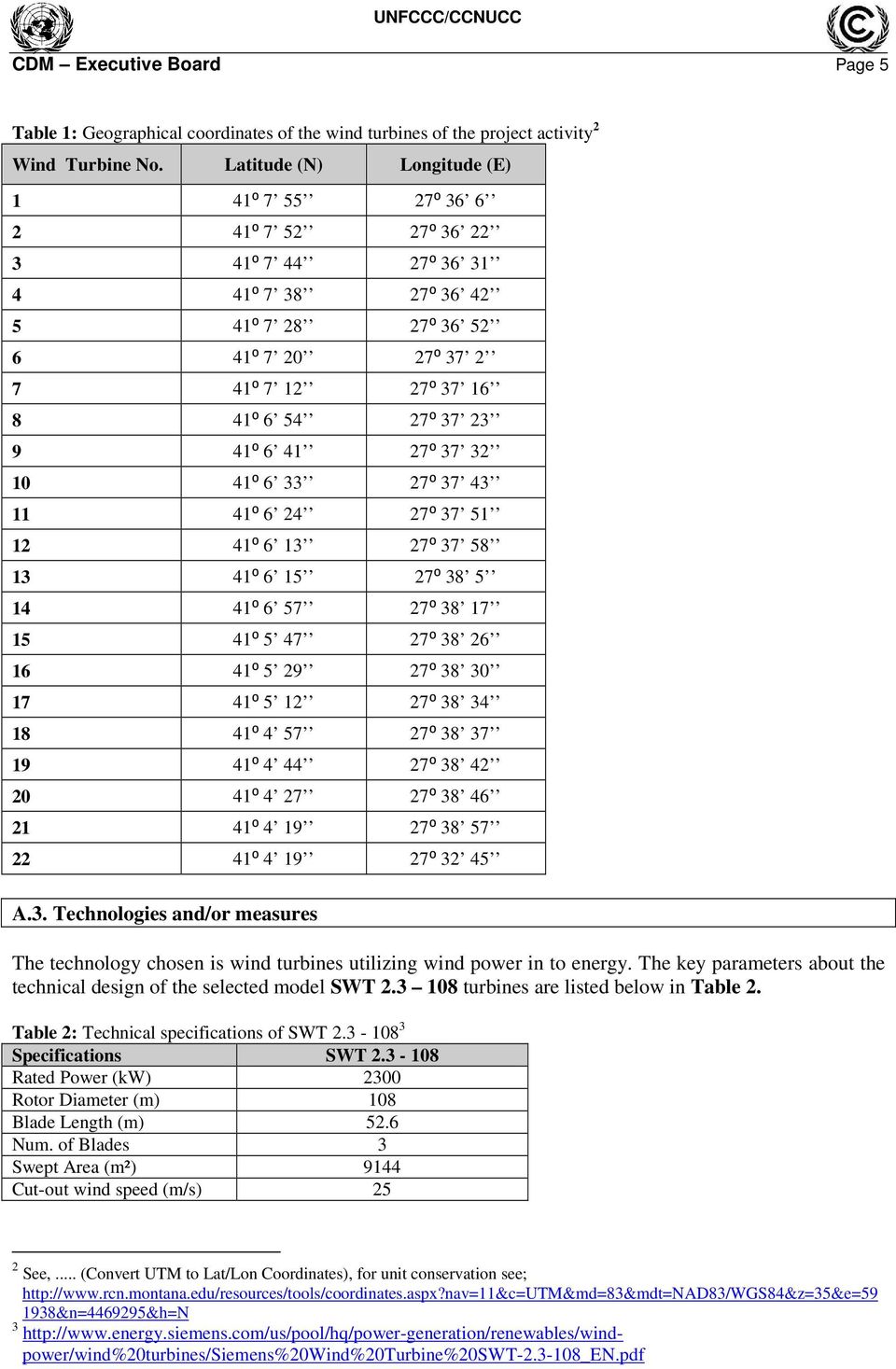
5 CDM Executive Board Page 5 Table 1: Geographical coordinates of the wind turbines of the project activity 2 Wind Turbine No. Latitude (N) Longitude (E) 1 41⁰ ⁰ ⁰ ⁰ ⁰ ⁰ ⁰ ⁰ ⁰ ⁰ ⁰ ⁰ ⁰ ⁰ ⁰ ⁰ ⁰ ⁰ ⁰ ⁰ ⁰ ⁰ ⁰ ⁰ ⁰ ⁰ ⁰ ⁰ ⁰ ⁰ ⁰ ⁰ ⁰ ⁰ ⁰ ⁰ ⁰ ⁰ ⁰ ⁰ ⁰ ⁰ ⁰ ⁰ A.3. Technologies and/or measures The technology chosen is wind turbines utilizing wind power in to energy. The key parameters about the technical design of the selected model SWT turbines are listed below in Table 2. Table 2: Technical specifications of SWT Specifications SWT Rated Power (kw) 2300 Rotor Diameter (m) 108 Blade Length (m) 52.6 Num. of Blades 3 Swept Area (m²) 9144 Cut-out wind speed (m/s) 25 2 See,... (Convert UTM to Lat/Lon Coordinates), for unit conservation see; &n= &h=N 3
6 CDM Executive Board Page 6 The project activity will achieve emission reductions by avoiding CO 2 emissions from the business-as- plants within the Turkish usual scenario electricity generation produced by mainly fossil fuel-fired power national grid (Figure 2) Total emission reduction over the 7 year crediting period is expected to reach 619,654 tco 2 e with the assumed total net electricity generation of GWh/annually. Fuel share in electricity generation 2012 Total GWh Motor Oil Fuel Oil 0.00% 0.39% Lignite 16.94% Coal 11.92% Renew. and Wastes 0.20% LPG 0.00% Naphtha 0.00% Geot. and Wind 2.36% Hydro 22.82% Natural Gas 45.36% Figure 1: Share of Sources in Installed Capacity See, Annual Development of Turkey s Gross Electricity Generation of Primary Energy Resources ( ):

7 CDM Executive Board Page 7 Fuel share in energy capacity 2012 Total 50.1 GW Wind and Geo. 4.00% Renew+Waste 0.27% Natural gas 28.51% Hydro 37.17% Lignite 17.79% Liquid Fuels 2.82% Coal 9.44% Figure 2: Share of Sources in Electricity Generation Although Turkey has a very good wind resource, substantial space, a reasonably good electrical infrastructure and an approaching shortage of electricity; it uses negligible capacity (less than 5%) of its onshore potential, which is estimated as 53,000 MW by Ministry of Energy and Natural Resources (MENR). 6 Lack of attractive incentives and tax advantages, limited grid access and restricted turbine supply constitutes the major barriers in front of the wind energy. Renewable energy law, enacted in 2005, which had amendments in end of 2010 regarding feed-in tariffs, stipulates a purchase obligation by the retail companies for 10 years with a purchase price 7.3 USDc/kWh (~5.5 c/kwh) for the power plants put in operation by end of This tariff is much below the average remuneration in the leading wind markets and does not constitutete a sufficient incentive for investments in little experienced wind energy sector of Turkey. The revenues calculated according to these regulations are considered in the investment planning of the projects and do not lead to returns that let the project be profitable or attractive for capital investors and lenders. These numbers and figures show the contribution of a wind power project like Balabanlı WPP to the development of environmental friendly electricity generation instead of above described Turkish mix of hydroelectric and fossil fuelled power plants, which are better known and financially more attractive from an investor s point of view. The emission reductions would not occur in the absence of the proposed project activity because of various real and perceived risks that impede the provision of financing. Balabanlı WPP, as a large wind power plant project, will serve as a perfect project to demonstrate long- as well as to diversifying term potential of wind energy as a means to efficiently reducing GHG emissions and increasing security of the local energy supply and contributing to a sustainable development. Wind driven turbines will rotate in generators and electricity generated here will be transferred to the grid for consumer without any greenhouse gas emissions. The Gold Standard certification shall help to realize this 5 See, The Distribution of Installed Capacity by Primary Energy Resources and The Electricity Utilities in Turkey (2012): 3)/8.xls 6 See, Presentation of Zeynep Günaydın from MENR, page 9 7 See : (List I in page 10)

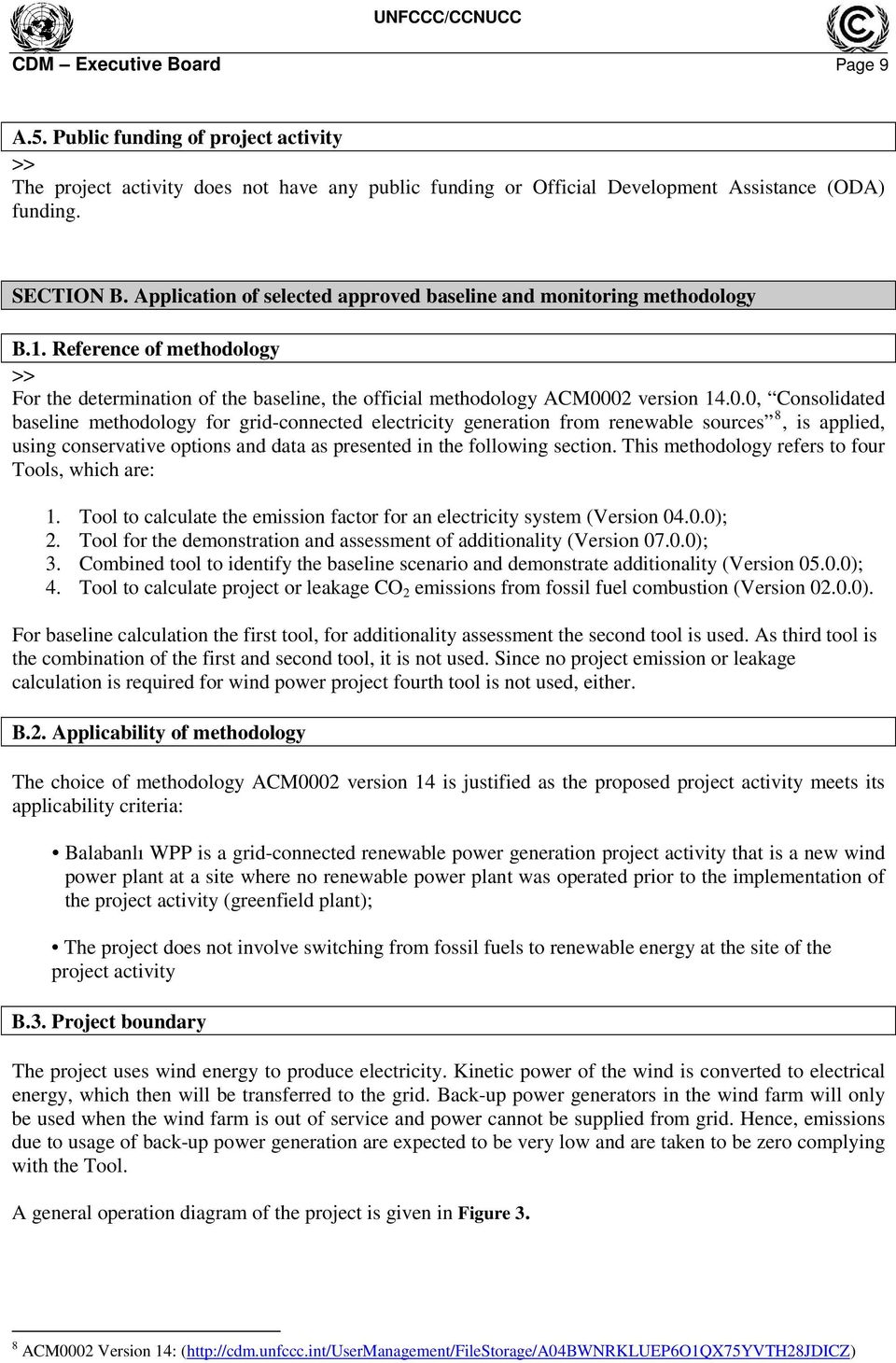
8 CDM Executive Board Page 8 seminal technology by providing an adequate compensation for the lacking financial incentives in the Turkish renewable energy market. Generation of emission reduction and by the way crediting period will start with the first day of documented electricity supply to the national grid. The first 7-year crediting period is expected to be from October 2014 to September With GWh/annual production of the plant and applying the approved methodology to the project (detailed in the Section B), annual average amount of emission reduction is estimated to be as listed in Table 3. Table 3: Estimated annual emission reductions of the project over the crediting period. Annual estimation of emission Years reductions in tonnes of CO 2 e 2014* 22, , , , , , , ** 66,743 Total estimated reductions (tonnes of CO 2 e) 619,654 Total number of crediting years 7 Annual average over the crediting period of estimated reductions 88,522 (tonnes of CO 2 e) * October 2014 ** September 2021 A.4. Parties and project participants The project participant is listed in the table below, and the contact information of the project participant is provided in Annex 1. Table 4: Parties involved Party involved (host) indicates a host Party Turkey (host) Private and/or public entity(ies) project participants (as applicable) Balabanlı Rüzgar Enerjisinden Elektrik Üretim A.Ş. (private entity) Indicate if the Party involved wishes to be considered as project participant (Yes/No) No Balabanlı Rüzgar Enerjisinden Elektrik Üretim A.Ş. is subsidiary of Borusan EnBW Enerji Yatırımları A.Ş.which is the developer and owner of the Project. The Republic of Turkey is the host country. Turkey has recently ratified the Kyoto Protocol (on 5 th February of 2009).
9 CDM Executive Board Page 9 A.5. Public funding of project activity >> The project activity does not have any public funding or Official Development Assistance (ODA) funding. SECTION B. Application of selected approved baseline and monitoring methodology B.1. Reference of methodology >> For the determination of the baseline, the official methodology ACM0002 version , Consolidated baseline methodology for grid-connected electricity generation from renewable sources 8, is applied, using conservative options and data as presented in the following section. This methodology refers to four Tools, which are: 1. Tool to calculate the emission factor for an electricity system (Version ); 2. Tool for the demonstration and assessment of additionality (Version ); 3. Combined tool to identify the baseline scenario and demonstrate additionality (Version ); 4. Tool to calculate project or leakage CO 2 emissions from fossil fuel combustion (Version ). For baseline calculation the first tool, for additionality assessment the second tool is used. As third tool is the combination of the first and second tool, it is not used. Since no project emission or leakage calculation is required for wind power project fourth tool is not used, either. B.2. Applicability of methodology The choice of methodology ACM0002 version 14 is justified as the proposed project activity meets its applicability criteria: Balabanlı WPP is a grid-connected renewable power generation project activity that is a new wind power plant at a site where no renewable power plant was operated prior to the implementation of the project activity (greenfield plant); The project does not involve switching from fossil fuels to renewable energy at the site of the project activity B.3. Project boundary The project uses wind energy to produce electricity. Kinetic power of the wind is converted to electrical energy, which then will be transferred to the grid. Back-up power generators in the wind farm will only be used when the wind farm is out of service and power cannot be supplied from grid. Hence, emissions due to usage of back-up power generation are expected to be very low and are taken to be zero complying with the Tool. A general operation diagram of the project is given in Figure 3. 8 ACM0002 Version 14: (
10 CDM Executive Board Page 10 1) Wind rotates the blades of the turbine 3) Generated electricity is transferred by underground and overhead cables to the WPP substation to be distributed for consumption 2) Rotating blade also rotates the shaft in the Generator, and this rotation leads to electricity generation Figure 3: Operation diagram of a WPP Based on the above operation diagram, the baseline and project activity related greenhouse gases which are considered in baseline calculation is given below, in Table 5: Table 5: Emissions sources included in or excluded from the project boundary Source GHGs Included? Justification/Explanation Baseline scenario Project scenario CO 2 emissions from electricity generation in fossil fuel fired power plants that are displaced due to the project activity Emissions during construction and operation of the project activity CO 2 CH 4 N 2 O CO 2 CH 4 N 2 O Yes No No No No No Main emission source: Fossil fuels fired for electricity generation cause CO 2 emissions. It is included to baseline calculation to find the displaced amount by the project activity. Minor emission sources: Even though there may be some CH 4 and N 2 O emissions during electricity generation, these emissions are negligible and not included in baseline calculation to be conservative and comply with Table-1 of the methodology (ACM0002 v13) (page 5). Minor emission source Minor emission source Minor emission source

11 CDM Executive Board Page 11 B.4. Establishment and description of baseline scenario The baseline scenario is identified according to the Baseline Methodology Procedure of ACM0002 ver.14 (page 4). The project activity is installation of a new grid-connected wind farm with 8 turbines and is not modification/retrofit of an existing grid-connected power plant. So, first identification of this procedure is selected for proposed project activity, which is described as: Electricity delivered to the grid by the project activity would have otherwise been generated by the operation of grid-connected power plants and by the addition of new generation sources, as reflected in the combined margin (CM) calculations described in the Tool to calculate the emission factor for an electricity system. To describe the baseline and its development for the project activity, long-term electricity demand and supply projections for Turkey are assessed. Demand for electricity in Turkey is growing rapidly with average 6.16% 9 for previous ten years. TEİAŞ, who is responsible from the grid reliability has prepared an electricity demand projection for next ten years period ( ) for Turkey and announced on July 2012, given in Hata! Başvuru kaynağı bulunamadı. and Hata! Başvuru kaynağı bulunamadı., reflecting the continuation of current demand growth 10. Table 6: Low and High Demand Projection Scenarios for Ten Years Period (TWh) Scenarios High Scenario Low Scenario Figure 4: Electricity Demand Projections for Ten Years 9 See, (page 3, Table 1) 10 See, (page 24-25, Table 6 for High and Table 7 for Low Scenarios)

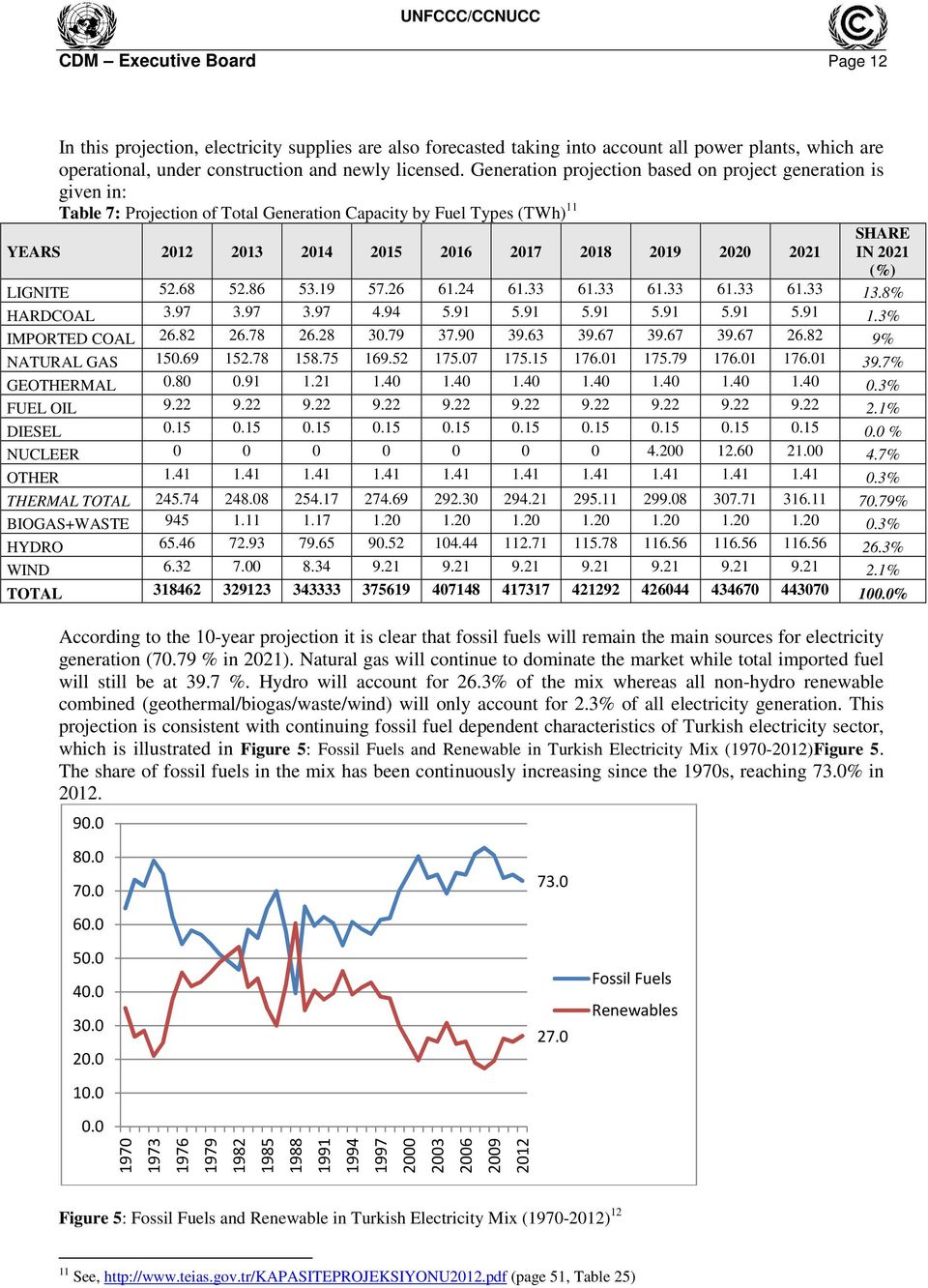
12 CDM Executive Board Page 12 In this projection, electricity supplies are also forecasted taking into account all power plants, which are operational, under construction and newly licensed. Generation projection based on project generation is given in: Table 7: Projection of Total Generation Capacity by Fuel Types (TWh) 11 YEARS SHARE IN 2021 (%) LIGNITE % HARDCOAL % IMPORTED COAL % NATURAL GAS % GEOTHERMAL % FUEL OIL % DIESEL % NUCLEER % OTHER % THERMAL TOTAL % BIOGAS+WASTE % HYDRO % WIND % TOTAL % According to the 10-year projection it is clear that fossil fuels will remain the main sources for electricity generation (70.79 % in 2021). Natural gas will continue to dominate the market while total imported fuel will still be at 39.7 %. Hydro will account for 26.3% of the mix whereas all non-hydro renewable combined (geothermal/biogas/waste/wind) will only account for 2.3% of all electricity generation. This projection is consistent with continuing fossil fuel dependent characteristics of Turkish electricity sector, which is illustrated in Figure 5: Fossil Fuels and Renewable in Turkish Electricity Mix ( )Figure 5. The share of fossil fuels in the mix has been continuously increasing since the 1970s, reaching 73.0% in Fossil Fuels Renewables Figure 5: Fossil Fuels and Renewable in Turkish Electricity Mix ( ) See, (page 51, Table 25)
13 CDM Executive Board Page 13 In the shed of above analysis for the baseline scenario (continuation of current situation) it can be concluded that: Conclusion-1: Energy demand in Turkey has been increasing with significant rates since ten years, and it is expected to continue at least for next ten years. Conclusion-2: Even all operational plants, construction phase plants and licensed ones are taken into account lack of supply is projected after the year of So, there is significant need for electricity generation investments to satisfy demand, which means electricity to be generated by the project activity would otherwise be generated by new power plants to avoid power shortage in coming years. Conclusion-3: Fossil fuels will hold the dominance in generation mix for at least midterm period (till the end of 2021) with 74.6% share. Hydro included renewable will remain low with 25.4% share and non-hydro energy contribution will stay negligible with only 2.6% of total share by the end of that period. This also shows that most of new capacity additions will be fossil fuel fired power plants. The combination of aforementioned trends indicates that if Balabanlı WPP would not be built, power from a new grid-connected thermal plant would be the most likely scenario B.5. Demonstration of additionality For the explanation of how and why the project activity leads to emission reductions that are additional to what would have occurred in the absence of the project activity, the Baseline Methodology refers to the consolidated Tool for the demonstration and assessment of additionality 14 version (Tool), which defines a step-wise approach to be applied to the proposed project. Step 1. Identification of alternatives to the project activity consistent with current laws and regulations. Sub-step 1a. Define Alternatives to the project activity To identify the realistic and credible alternative scenario(s) for project participants, scenarios in the Tool are assessed: a) The proposed project activity undertaken without being registered as a GS VER project activity This alternative is realistic and credible as Balabanlı WPP may undertake project activity if it sees no risk for project and/or if the project turns out to be financially attractive without GS VER credit income. However, investments analyze shows that the project is not economically feasible without GS VER credit income. Detail information is given in Step-3. b) Other realistic and credible alternative scenario(s) to the proposed GS VER project activity scenario that deliver electricity with comparable quality, properties and application areas, taking into account, where relevant, examples of scenarios identified in the underlying methodology; The project activity is power generation activity without any greenhouse gas emission harnessing the energy of the wind. Being a private entity, Balabanlı doesn t have to invest power investments even proposed project activity. Also, since Balabanlı has a licence only for wind power investment and since in 12 See, 13 See, (page 99, Table 48) 14 Version 6, (page 4)
14 CDM Executive Board Page 14 the proposed project area there is no hydro or other sources for electricity generation, other project activities delivering same electricity in the same project area is not realistic for project participant. c) Continuation of the current situation, i.e. Balabanlı WPP is not built The decision in favour or against a project investment depends on the expected revenues and risks, like for every other private investment. Investment decisions other than Balabanlı WPP are independent from the question whether Balabanlı WPP is built or not. This alternative is also realistic and credible. According to baseline scenario, which is described in B.4, there is a need for energy investment to satisfy increasing demand and if the Balabanlı WPP is not built, the same amount of energy will be supplied by other private investors to the grid. Forecasts shows that electricity supplied in the absence of Balabanlı WPP will be mainly based on fossil fuels as the projections for the year of 2021 forecasts 70.79% share for fossil fuels in the energy mix. In the absence of the project the power will be produced by new and existing power plants in accordance with the baseline in ACM0002 version 14. Outcome of Step 1.a: Therefore, two realistic and credible alternative scenarios are identified for the project activity: a) The proposed project activity undertaken without being registered as a GS VER project activity. b) Continuation of the current situation, i.e. Balabanlı WPP is not built. Sub-step 1b. Consistency with mandatory laws and regulations Both alternatives are (building or not building the project activity) in compliance with the following identified applicable mandatory laws and regulations: (1) Electricity Market Law 15 (2) Law on Utilization of Renewable Energy Resources for the Purpose of Generating Electricity Energy 16 (3) Environment Law 17 Table 8: Project Implementation Schedule Date (DD/MM/YYYY) Activity 02/09/2009 EIA Positive Certificate 31/03/2011 Issuance of the License 15/03/2012 Agreement with Carbon consultant 12/09/2012 Local Stakeholder Meeting 19/02/2013 Notice to Proceed of the Agreement with Equipment provider 15/08/2013 Date for start of construction 30/09/2014 Planned date of operation According to Turkish regulations, to get necessary permits for further project implementation, license issued by EMRA is required. Hence, issuance of license cannot be considered as Project Start Date but a prerequisite to proceed for further project development activities. Notice to proceed date of 15 See: (Enactment Date:2013) 16 See: (Enactment Date: 2005) 17 See: (Enactment Date: 1983)

15 CDM Executive Board Page 15 electromechanical equipment contract is set to be project starting (19/02/2013). From above Implementation Schedule it can be seen that Balabanlı after having license started to analysis of VER and decided to get consultancy for VER development, much before planned construction starting date. Aforementioned project implementation schedule shows us that Balabanlı started to consideration of VER from the beginning of the project implementation and VER Revenue has decisive impact on decision of proceeding to the project. In the following, the investment analysis is applied to clearly demonstrate that the project activity is unlikely to be financially/economically attractive without the revenue from the sale of VERs. Outcome of Step 1.b: Balabanlı consisted with mandatory laws and regulations. Project implementation schedule shows us that Balabanlı started to consideration of VER from the beginning of the project implementation and VER Revenue has decisive impact on decision of proceeding to the project. Step 2. Investment analysis Guidelines on the assessment of investment analysis 18 version 5 is taken into account when applying this step. Applied tool: Tool for the demonstration and assessment of additionality version Three options can be applied for the investment analysis: the simple cost analysis, the investment comparison analysis and the benchmark analysis. - Option I: Simple cost analysis - Option II: Investment comparison analysis - Option III: Benchmark analysis The simple cost analysis is not applicable for the proposed project because the project activity will have revenue (from electricity sales) other than CDM related income. The investment comparison analysis is also not applicable for the proposed project because the baseline scenario, providing the same annual electricity output by the Turkish National Grid, is not an investment project. To conclude, the benchmark analysis will be used to identify whether the financial indicators (Project IRR in this case) of the proposed project is better than relevant benchmark value. Sub-step 2b: Option III. Apply Benchmark analysis Sub-step 2b: Option III: Benchmark analysis While applying the Benchmark Analysis, Option III, the Equity IRR is selected as the financial indicator for the demonstration of the additionality of the project as permitted in the additionality tool. Benchmark rate is calculated in line with Tool for the demonstration and assessment of additionality which suggests to use the government bond rates, increased by a suitable risk premium. The government 18
16 CDM Executive Board Page 16 bonds are used for determining the Benchmark because there is no pre-determined value for IRR or any other financial indicator for wind power projects in Turkey at the investment decision date of the project. According to the Tool, benchmark can be derived from Estimates of the cost of financing and required return on capital (e.g. commercial lending rates and guarantees required for the country and the type of project activity concerned), based on bankers views and private equity investors/funds. As a banker view, according to Worldbank loan appraisal document 19, threshold equity IRR for wind power investments (i.e. required returns of equity for wind power plant investors) in Turkey is 15%. Sub-step 2c: Calculation and comparison of the IRR In the paragraph 12 of the Guidance on the Assessment of Investment Analysis 20 version 5, it is stated that: Required/expected returns on equity are appropriate benchmarks for equity IRR. Since, benchmark identified in the Sub-step 2b is required/expected returns on equity, equity IRR (before tax) of the project activity shall be calculated for comparison. Item Value Units Source Installed 50.6 MWe License of The project Power Operational 20 years Turbine catalogue lifetime of the project Net 152,800 MWh License of The project Generation to be sold Electricity tariff 55 EUR Per MWh For feed-in-tariff (5,0 and 5,5 c/kwh) see, un_yek_kanun.doc (table 1) on page 9). The equity IRR (after tax) of Balabanlı WPP is calculated on the basis of expected cash flows (investment, operating costs and revenues from electricity sale), as used in the financial analysis for the feasibility assessment of the project. The parameters and values used for the IRR calculation are available to DOE during validation. The resulting IRR for 20 years is stated in below table. Table 9: Equity IRR value for project activity (after tax) Period IRR 20 years 8.60 % The Benchmark is 15%, it does clearly exceed the resulting equity IRRs, thus rendering the project activity economically unattractive. 19 Worldbank - Project Appraisal Document on a IBRD Loan and a Proposed Loan from Clean Technology Fund to TSKB and TKB with the Guarantee of Turkey, May 2009 ( PAD0P112101Official0Use0Only1.pdf page 80, paragraph 29 and page 81, Table In order to access to the file, copy and paste the complete link to the web browser.) 20 See, 3)

17 CDM Executive Board Page 17 PLF= Annual Gen. / Installed Cap. * (working hours) =152,800/50.6*8760 =0.35 Sub-step 2d: Sensitivity analysis While the main parameter determining the income of the project is the electricity sales revenue, investment cost and operation cost, a variation of the accordant values shall demonstrate the reliability of the IRR calculation. Key parameters are varied with +/-10%. The worst, base and best-case results for each parameter variation are given below, in Table 10. The sensitivity analysis confirms that the proposed project activity is unlikely to be economically attractive without the revenues from VERs as even the maximum IRR result for the best case scenario (12.29 %) is below the benchmark, which is 15% Table 10: Equity IRR results according to different parameters Parameter Investment 55 EUR/MWh Energy 55 EUR/MWh Operation 55 EUR/MWh Variance -10% 0% 10% -10% 0% 10% -10% 0% 10% Equity IRR - 20y 12.76% 8.60% 5.97% 5.02% 8.60% 12.29% 9.56% 8.60% 7.65% Step 3. Barrier analysis The investment analysis has fully demonstrated and explained the additionality of the project, so step 3 is skipped. Step 4: Common Practice Analysis The section below provides the analysis as per step 4 of the Tool for the demonstration and assessment of additionality, version and according to the Guidelines on Common Practice version 02.0 Step 1. Calculate applicable capacity or output range as +/-50% of the total design capacity or output of the proposed project activity: The proposed project has a capacity of 50.6 MW. Per the guideline of +/- 50%, the applicable output range for the project is 25.3 MW to 75.9 MW. Step 2: Identify similar projects (both CDM and non-cdm) which fulfil all of the following conditions: (a) The projects are located in the applicable geographical area; (Turkey) (b) The projects apply the same measure as the proposed project activity; (Renewable Energy Projects) (c) The projects use the same energy source/fuel and feedstock as the proposed project activity, if a technology switch measure is implemented by the proposed project activity; (Wind Power Plants) (d) The plants in which the projects are implemented produce goods or services with comparable quality, properties and applications areas (e.g. clinker) as the proposed project plant; (N.A.) (e) The capacity or output of the projects is within the applicable capacity or output range calculated in Step 1; (25.3MW-75.9 MW)

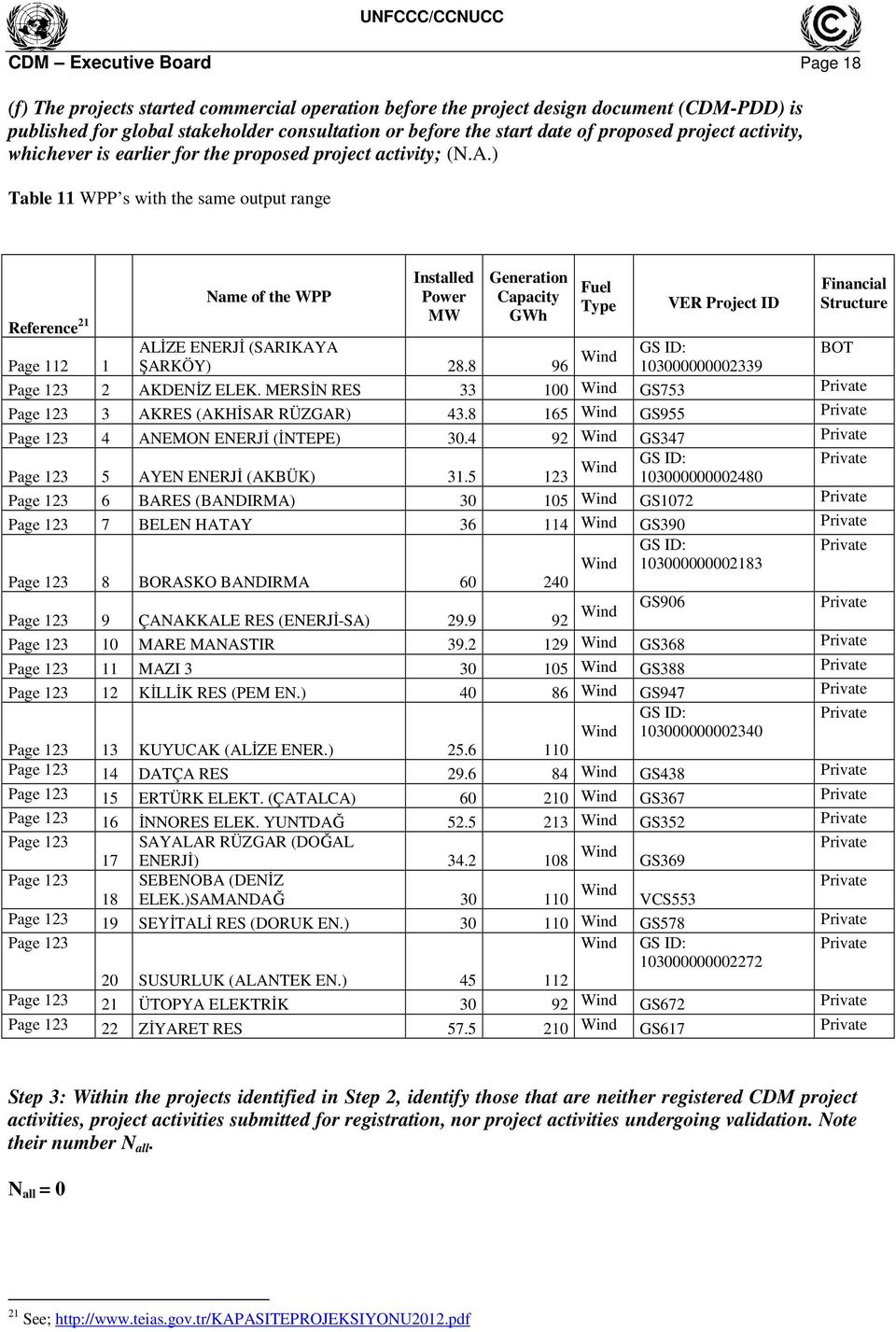
18 CDM Executive Board Page 18 (f) The projects started commercial operation before the project design document (CDM-PDD) is published for global stakeholder consultation or before the start date of proposed project activity, whichever is earlier for the proposed project activity; (N.A.) Table 11 WPP s with the same output range Name of the WPP Installed Power MW Generation Capacity GWh Fuel Type VER Project ID Financial Structure Reference 21 ALİZE ENERJİ (SARIKAYA GS ID: BOT Wind Page ŞARKÖY) Page AKDENİZ ELEK. MERSİN RES Wind GS753 Private Page AKRES (AKHİSAR RÜZGAR) Wind GS955 Private Page ANEMON ENERJİ (İNTEPE) Wind GS347 Private GS ID: Private Wind Page AYEN ENERJİ (AKBÜK) Page BARES (BANDIRMA) Wind GS1072 Private Page BELEN HATAY Wind GS390 Private GS ID: Private Wind Page BORASKO BANDIRMA GS906 Private Wind Page ÇANAKKALE RES (ENERJİ-SA) Page MARE MANASTIR Wind GS368 Private Page MAZI Wind GS388 Private Page KİLLİK RES (PEM EN.) Wind GS947 Private GS ID: Private Wind Page KUYUCAK (ALİZE ENER.) Page DATÇA RES Wind GS438 Private Page ERTÜRK ELEKT. (ÇATALCA) Wind GS367 Private Page İNNORES ELEK. YUNTDAĞ Wind GS352 Private Page 123 SAYALAR RÜZGAR (DOĞAL Private Wind 17 ENERJİ) GS369 Page 123 SEBENOBA (DENİZ Private Wind 18 ELEK.)SAMANDAĞ VCS553 Page SEYİTALİ RES (DORUK EN.) Wind GS578 Private Page 123 Wind GS ID: Private SUSURLUK (ALANTEK EN.) Page ÜTOPYA ELEKTRİK Wind GS672 Private Page ZİYARET RES Wind GS617 Private Step 3: Within the projects identified in Step 2, identify those that are neither registered CDM project activities, project activities submitted for registration, nor project activities undergoing validation. Note their number N all. N all = 0 21 See;
19 CDM Executive Board Page 19 Step 4: within similar projects identified in Step 3, identify those that apply technologies that are different to the technology applied in the proposed project activity. Note their number N diff. N diff = 0 Step 5: Calculate factor F=1-N diff /N all representing the share of similar projects (penetration rate of the measure/technology) using a measure/technology similar to the measure/technology used in the proposed project activity that deliver the same output or capacity as the proposed project activity. F = 1-N diff /N all = 1 (0/0) Factor F is therefore unidentified. The proposed project activity is a common practice within a sector in the applicable geographical area if the factor F is greater than 0.2 and Nall-Ndiff is greater than 3. Since factor F is unidentified and also N all -N diff is 0, the proposed is not a common practice as per the guidelines. The proposed project activity is therefore additional under common practice analysis. An Excel sheet is provided for the calculation. B.6. Emission reductions B.6.1. Explanation of methodological choices Baseline scenario is identified and described in B.4. Emission reductions due to project activity will be calculated according to Tool to calculate the emission factor for an electricity system (Tool) 22 as indicated in ACM0002 ver A brief explanation of this methodology is given in Tool as (page 4): This methodological tool determines the CO 2 emission factor for the displacement of electricity generated by power plants in an electricity system, by calculating the combined margin emission factor (CM) of the electricity system. 22 See, (version 04)
20 CDM Executive Board Page 20 B.6.2. Data and parameters fixed ex ante Data / Parameter Unit Gross electricity generation MWh Description Gross Electricity supplied to the grid (2012) Source of data Value(s) applied Choice of data or Measurement methods and procedures Purpose of data Additional comment Turkish Electricity Transmission Company (TEİAŞ), Annual Development of Turkey s Gross Electricity Generation of Primary Energy Resources ( ) TEİAŞ m%20tuketim(23-47)/37(06-12).xls See Table 15 TEIAS is the national electricity transmission company, which makes available the official data of all power plants in Turkey. Data used for emission reduction calculation Data / Parameter Unit Description Source of data Value(s) applied Choice of data or Measurement methods and procedures Purpose of data Additional comment Net electricity generation GWh Net electricity fed into the grid. Used for the calculation of the net/gross relation (Including Import and Export figures) Turkish Electricity Transmission Company (TEIAS), Annual Development of Electricity Generation- Consumption and Losses in Turkey ( ) TEIAS, see m%20tuketim(23-47)/34(84-12).xls See Table 16, Table 17 This data is used to find relation between the gross and net electricity delivered to the grid by fossil fuel fired power plants. ( Table 16). Import and Export data is used to identify total net electricity fed into the grid in the years of 2010, 2011 and 2012 (Table 17). TEIAS is the national electricity transmission company, which makes available the official data of all power plants in Turkey. Data used for emission reduction calculation

21 CDM Executive Board Page 21 Data / Parameter Unit HVi,y Mass or volume unit Description Heating Values of fuels consumed for electricity generation in the year of 2012 Source of data Heating Values Of Fuels Consumed In Thermal Power Plants In Turkey By The Electric Utilities, TEİAŞ. See: C4%B1t48-53/51.xls Value(s) applied See Table 22 Choice of data or Measurement methods and procedures Purpose of data Additional comment Data / Parameter Unit There is no national NVC data in Turkey. However, TEİAŞ announces Heating values of fuels. This data is used to calculate annual NCVs for each fuel type TEİAŞ is the national electricity transmission company, which makes available the official data of all power plants in Turkey. Data used for emission reduction calculation FCi,y Mass or volume unit Description Fuels consumed for electricity generation in the year of 2012 Source of data Annual Development of Fuels Consumed In Thermal Power Plants In Turkey By The Electric Utilities, TEİAŞ. See: C4%B1t48-53/49.xls Value(s) applied See Table 23 Choice of data or Measurement methods and procedures Purpose of data Additional comment Data / Parameter Unit TEİAŞ is the national electricity transmission company, which makes available the official data of all power plants in Turkey. Data used for emission reduction calculation NCVi,y TJ/kton, TJ/million m3 Description Net Calorific Value of fuel types in the years of 2012 Source of data Calculated by using HVi,y to FCi,y as Net Calorific Values of fuel types are not directly available in Turkey. Value(s) applied See Table 24, Table 22, Table 23 Choice of data or Measurement methods and procedures Purpose of data Additional comment TEİAŞ is the national electricity transmission company, which makes available the official data of power plants in Turkey. Calculation of NCVs from national HVi,y and FCi,y data is preferred to default IPCC data as these are more reliable.
22 CDM Executive Board Page 22 Data / Parameter Unit Description Source of data Value(s) applied Choice of data or Measurement methods and procedures Purpose of data Additional comment Sample Group for BM emission factor Name of the plants, MW capacities, fuel types, annual electricity generations and dates of commissioning. Most recent power plants which compromise 20% of total generation Annual Development Of Fuels Consumed In Thermal Power Plants In Turkey By The Electric Utilities, TEIAS: df 008_2017.pdf Table 19 TEIAS is the national electricity transmission company, which makes available the official data of all power plants in Turkey. The latest data available during PDD preparation was for 2011.
23 CDM Executive Board Page 23 Data / Parameter Unit Description EF CO2,m,i,y tco 2 /GJ Emission factor for fuel type I Source of data IPCC default values at the lower limit of the uncertainty at a 95% confidence interval as provided in table 1.4 of Chapter1 of Vol. 2 (Energy) of the IPCC Guidelines on National GHG Inventories. Value(s) applied See Table 12 Choice of data or Measurement methods and procedures No plant specific and national emission factor data is available in Turkey. So, IPCC default data is used. For Fuel Oil Power Plants: 'Gas/Diesel Oil' data is used for conservativeness. Purpose of data Additional comment For Coal Power Plants: In the 205 th page of official document given in the link below, it is stated that Çolakoğlu and İçdaş utilizes 'Taşkömürü' (Hardcoal). And at the Table-2 in page 157 of the same document, Taşkömürü is dived in two groups: Bituminous and Antharcite. Since Sub-Bituminous Coal is under Brown Coal in the same table and since Other Bituminous Coal has lower EF than Anthracite in 1.4 of IPCC Guidelines, EF for 'Other Bituminous Coal' is used. See: skömuru-jeotermal) Data / Parameter Unit - Description Source of data η m,y Value(s) applied See Table 20 Choice of data or Measurement methods and procedures Purpose of data Additional comment Average energy conversion efficiency of power unit m in year y Annex I the Tool to calculate the emission factor for an electricity system For efficiency rates of Coal and Lignite Power Plants See Annex-1 of the Tool (highest rate is applied to be conservative) For Natural Gas and Oil plants efficiencies, default value given in the tool is applied:
24 CDM Executive Board Page 24 B.6.3. Ex ante calculation of emission reductions >> >> Stepwise approach of Tool to calculate the emission factor for an electricity system version is used to find this combined margin (emission coefficient) as described below: Step 1. Identify the relevant electric systems There are 21 regional distribution regions in Turkey but no regional transmission system is defined. In Article 20 of License Regulation it is stated that: TEIAS shall be in charge of all transmission activities to be performed over the existing transmission facilities and those to be constructed as well as the activities pertaining to the operation of national transmission system via the National Load Dispatch Center and the regional load dispatch centers connected to this center and the operation of Market Financial Reconciliation Center 24. As it can be understood from this phrase, only one transmission system, which is national transmission system is defined and only TEİAŞ is in the charge of all transmission system related activities. Moreover, a communication with representative of TEIAS, which indicates that: There are not significant transmission constraints in the national grid system which is preventing dispatch of already connected power plants is submitted to the DOE. Therefore, the national grid is used as electric power system for project activity. The national grid of Turkey is connected to the electricity systems of neighboring countries. Complying with the rules of the tool, the emission factor for imports from neighboring countries is considered 0 (zero) tco 2 /MWh for determining the OM. There is no information about interconnected transmission capacity investments, as TEİAŞ, who operates the grid, also didn t take into account imports-exports for electricity capacity projections. 25 Because of that, for BM calculation transmission capacity is not considered. Step 2. Choose whether to include off-grid power plants in the project electricity system (optional) According to Tool project participants may choose between the following two options to calculate the operating margin and build margin emission factor: Option I: Only grid power plants are included in the calculation. Option II: Both grid power plants and off-grid power plants are included For this project Option I is chosen. Step 3: Select a method to determine the operating margin (OM) The calculation of the operating margin emission factor (EF grid,om,y ) is based on one of the following methods: (a) Simple OM; or (b) Simple adjusted OM; or (c) Dispatch data analysis OM; or 23 See, 24 See, (page 21) 25 See,
25 CDM Executive Board Page 25 (d) Average OM. The Simple Operating Margin (OM) emission factor (EF grid, OM, y ) is calculated as the generation weighted average CO 2 emissions per unit net electricity generation (tco 2 /MWh) of all the generating plants serving the system, excluding low-cost/must-run power plants. As electricity generation from solar and low cost biomass facilities is insignificant and there are no nuclear plants in Turkey, the only low cost /must run plants considered are hydroelectric, wind and geothermal facilities. The Turkish electricity mix does not comprise nuclear energy. Also there is no obvious indication that coal is used as must run resources. Therefore, the only low cost resources in Turkey, which are considered as must-run, are Hydro, Renewables and Waste, Geothermal and Wind (according to statistics of TEİAŞ). Table 13: Share of Low Cost Resource (LCR) Production (Production in GWh) Gross production 198, , , , ,496.8 TOTAL LCR Production 34, , , , ,345.8 Hydro 33, , , , ,865.0 Renewable and Waste Geothermal and Wind 1, , , , ,760.1 Share of LCRs 17.39% 19.62% 26.44% 25.38% 27.28% Average of last five years 23.22% As average share of low cost resources for the last five years is far below 50% (23.22%), the Simple OM method is applicable to calculate the operating margin emission factor (EF grid,om,y ) For the Simple OM method, the emissions factor can be calculated using either of the two following data vintages: Ex-ante option: A 3-year generation-weighted average, based on the most recent data available at the time of submission of the CDM-PDD to the DOE for validation, or Ex-post option: The year, in which the project activity displaces grid electricity, requiring the emissions factor to be updated annually during monitoring. The ex-ante option is selected for Simple OM method, with the most recent data for the baseline calculation stemming from the years 2010 to Step 4. Calculate the operating margin emission factor according to the selected method The Simple OM emission factor is calculated as the generation-weighted average CO 2 emissions per unit net electricity generation (tco 2 /MWh) of all generating power plants serving the system, not including low-cost/must-run power plants. The calculation of the simple OM emission factor can be based on: net electricity generation and corresponding CO 2 emission factor of each power unit (Option A), or total net electricity generation of all power plants serving the system and the fuel types and total fuel consumption of the project electricity system (Option B). 26 See:
26 CDM Executive Board Page 26 Option B is chosen to calculate the Simple OM, as there is no power plant specific data available. Renewable power generation is considered as low-cost power source and amount of electricity supplied to the grid by these sources is known. Where Option B is used, the simple OM emission factor is calculated based on the net electricity supplied to the grid by all power plants serving the system, not including low-cost / must-run power plants, and based on the fuel type(s) and total fuel consumption of the project electricity system, as per formula in the tool: EF FCi, y xncvi, y xefco 2, i, y, i = EG (1) grid OMsimple, y y Where: EF grid,omsimple,y = Simple operating margin CO 2 emission factor in year y (tco 2 /MWh) FC i,y = Amount of fossil fuel type i consumed in the project electricity system in year y (mass or volume unit) NCV i,y = Net calorific value (of fossil fuel type i in year y (GJ / mass or volume unit) EF CO2,i,y = CO 2 emission factor of fossil fuel type i in year y (tco 2 /GJ) EG y = Net electricity generated and delivered to the grid by all power sources serving the system, not including low-cost / must-run power plants / units, in year y (MWh) i = All fossil fuel types combusted in power sources in the project electricity system in year y y = three most recent years for which data is available at the time of submission of the PDD to the DOE for validation For the calculation of the OM the consumption amount and heating values of the fuels for each sources used for the years 2010, 2011 and 2012, is taken from the TEİAŞ annual statistics, which holds data on annual fuel consumption by fuel types as well as electricity generation amounts by sources and electricity imports. All the data needed for the calculation, including the emission factors and net calorific values (NCVs), are provided in part B of this Annex. Total CO 2 emission due to electricity generation in Turkey for the years of 2010, 2011 and 2012 are given in Table 14. Table 14: CO 2 emissions from electricity production (ktco 2 ) CO 2 -Emmissions 98, , ,544 Table 15 presents the gross electricity production data by all the relevant energy sources. Low-cost/must run resources like hydro, wind, geothermic and biomass do not emit fossil CO 2 and thus are not taken into account in calculations. Table 15: Gross electricity production by fossil energy sources (GWh) 27 Energy Source Natural Gas 98, , ,499.2 Lignite 35, , ,688.9 Coal 19, , , See;
27 CDM Executive Board Page 27 Fuel Oil 2, ,638.7 Motor Oil Naphtha LPG Total fossil fuels 155, , ,151.0 Above table shows gross data, but EG y in the above described formula means electricity delivered to the grid, i.e. net generation, the following table shall help to derive net data by calculating the net/gross proportion on the basis of overall gross and net production numbers. Table 16: Net/gross electricity production (GWh) Gross Production 211, , , Net Production 203, , , Relation 96.14% 94.84% 95.08% Multiplying these overall gross/net relation percentages with the fossil fuels generation amount does in fact mean an approximation. However this is a conservative approximation as the consumption of plant auxiliaries of fossil power plants is higher than for the plants that are not included in the baseline calculation. In the end this would lead to a lower net electricity generation and therefore to a higher OM emission factor and higher emission reductions. Table 17 shows the resulting net data for fossil fuel generation and adds electricity imports. Table 17: Electricity supplied to the grid, relevant for OM (GWh) Net El. Prod. by fossil fuels 149, , ,578.2 Electricity Import 1, , ,826.7 Electricity supplied to grid by relevant sources 150, , ,404.9 Electricity import is added to the domestic supply in order to fulfill the Baseline Methodology requirements. Imports from connected electricity systems located in other countries are weighted with an emission factor of 0 (zero) tco 2 /MWh. The last step is to calculate EF grid,omsimple,y : Table 18: Calculation of Weighted EF grid,omsimple,y (ktco 2 /GWh) CO 2 -Emmissions (ktco 2 ) 98, , ,544 Net Electricity Supplied to Grid by relevant sources (GWh) 150, , ,404.9 EF grid,omsimple,y (ktco 2 /GWh) year Generation Weighted Average EF grid,omsimple,y (ktco 2 /GWh) EF grid,omsimple,y = (ktCO 2 /GWh) 28 For Net Production See,
28 CDM Executive Board Page 28 Step 5. Calculate the build margin (BM) emission factor Option 1: For the first crediting period, calculate the build margin emission factor ex ante based on the most recent information available on units already built for sample group m at the time of CDM-PDD submission to the DOE for validation. For the second crediting period, the build margin emission factor should be updated based on the most recent information available on units already built at the time of submission of the request for renewal of the crediting period to the DOE. For the third crediting period, the build margin emission factor calculated for the second crediting period should be used. This option does not require monitoring the emission factor during the crediting period. Option 2: For the first crediting period, the build margin emission factor shall be updated annually, ex post, including those units built up to the year of registration of the project activity or, if information up to the year of registration is not yet available, including those units built up to the latest year for which information is available. For the second crediting period, the build margin emissions factor shall be calculated ex ante, as described in Option 1 above. For the third crediting period, the build margin emission factor calculated for the second crediting period should be used. Again, the project proponents can chose between two options according to the calculation tool: calculate the BM ex-ante based on the latest available data or update the BM each year ex post. Option 1, the exante approach, is again chosen. The sample group of power units m used to calculate the build margin should be determined as per the following procedure, consistent with the data vintage selected above. The last plant of the sample group is built in 2009 and until the end of the 2011 which is the latest year for official statistics published for plants put in operation. VER plants are excluded from sample group. While identifying the sample group dismantled, revised, retrofits are not included. Only new capacity additions (power plants / units) are taken into account. All power plants in operation by 2011 are given in Annex. Total electricity generation in 2012 is 239,496.8 GWh and 20% of this generation is 47, (AEG SET- >20%) GWh. Total electricity generation of last five power plants in operation is GWh (AEG SET-5-units ) which is lower than 20% total generation in Since AEG SET->2%0 is bigger than AEG SET-5-units, SET - >20% is chosen as SET sample. Also in the sample group there is no power plant started supply electricity to grid more than 10 years ago, steps d, e and f are ignored Sample group for BM emission factor is given the Annex. The derivation of the values presented in Table 19 is contained in a separate excel file which is available for validation. Table 19: Sample group generation for BM emission factor calculation (GWh) Energy Source Sample Group Total Generation (GWh) Natural Gas 0 12, , ,348.6 Lignite Coal 0 9, , ,400.0 Fuel Oil Hydro , , ,665.4 Renewable TOTAL , , ,449.2
29 CDM Executive Board Page 29 The build margin emissions factor is the generation-weighted average emission factor (tco 2 /MWh) of all power units m during the most recent year y for which power generation data is available, calculated as follows: EF grid EGm, y xefel, m, y, BM, y m = EG (2) m m, y Where: EF grid,bm,y = Build margin CO 2 emission factor in year y (tco 2 /MWh) EG m,y = Net quantity of electricity generated and delivered to the grid by power unit m in year y (MWh) EF EL,m,y = CO 2 emission factor of power unit m in year y (tco 2 /MWh) m = Power units included in the build margin y = Most recent historical year for which power generation data is available Because of only fuel types and electricity generation data are available for the sample group, Option B2 of Simple OM method is used to calculate emission factor. The formulation of emission factor is given below: EF EL, m, y EFCO 2, m, i, y x3.6 = (3) η m, y Where: EF EL,m,y = CO 2 emission factor of power unit m in year y (tco 2 /MWh) EF CO2,m,i,y = Average CO 2 emission factor of fuel type i used in power unit m in year y (tco 2 /GJ) η m,y = Average net energy conversion efficiency of power unit m in year y (%) y = Three most recent years for which data is available at the time of submission of the PDD to the DOE for validation BM emission factor calculation and resulted BM factor is given in the Table 20. For BM factor calculation, since no official emission factors for different fuel types are available, lower confidence default values of IPCC Guidelines are applied. Explanation of emission factor selection for each energy sources and references are given in B.6.2 part of the PDD. Table 20: BM emission factor calculation using equation (2) and (3) Energy Source Sample Group Total Generation (GWh) Effective CO 2 emission factor (tco 2 /TJ) Average Efficiency (η m,y ) CO 2 Emission (ktco 2 ) Natural Gas 25, % 8,258.6 Lignite % Coal 13, % 8,635.0 Fuel Oil % Hydro 8, % 0.0 Renewables % 0.0 Total 48, ,412.3 EF grid,bm,y (tco 2 /MWh) EF grid,bm,y = tco 2 /MWh
30 CDM Executive Board Page 30 Step 6. Calculate the combined margin emission factor The calculation of the combined margin (CM) emission factor (EFgrid,CM,y) is based on one of the following methods: (a) Weighted average CM; or (b) Simplified CM. The combined margin emission factor is calculated by using weighted average CM as per tool formula below: EF * w grid, CM, y = EFgrid, OM, y * wom + EFgrid, BM, y BM (5) Where: EF grid,bm,y = Build margin CO 2 emission factor in year y (tco 2 /MWh) EF grid,om,y = Operating margin CO 2 emission factor in year y (tco 2 /MWh) w OM = Weighting of operating margin emissions factor (%) w BM = Weighting of build margin emissions factor (%) According to the Tool for wind power generation project activities: w OM = 0.75 and w BM = Then: EF grid,cm,y = tco2/mwh * tco2/mwh * 0.25 = tco2/mwh EF grid,cm,y= tCO 2 /MWh Emission reductions are calculated as follows: ER y = BE y PE y LE y (5) Where: ER y = Emission reductions in year y (t CO 2 /yr). BE y = Baseline emissions in year y (t CO 2 /yr). PE y = Project emissions in year y (t CO 2 /yr). LE y = Leakage emissions in year y (t CO 2 /yr). Project emissions The proposed project activity involves the generation of electricity by development of a wind farm. The generation of electricity does not result in greenhouse gas emissions and therefore is taken as 0 tco 2 /year.
31 CDM Executive Board Page 31 Leakage LEy is 0, as it is not considered according to ACM0002. PEy is 0 because project is a wind power generation activity (Only for geothermal and Hydro project activities, it should be considered according to ACM0002). Then: ER y = BE y Baseline emissions Baseline emissions include only CO 2 emissions from electricity generation in fossil fuel fired power plants that are displaced due to the project activity, calculated as follows: BE y = (EG y - EG baseline ) x EF grid,cm,y (6) Where: BE y = Baseline emissions in year y (tco 2 /yr). EG y = Electricity supplied by the project activity to the grid (MWh). EG baseline = Baseline electricity supplied to the grid in the case of modified or retrofit facilities (MWh). For new power plants this value is taken as zero. EF grid,cm, y = Combined margin CO2 emission factor for grid connected power generation in year y calculated using the latest version of the Tool to calculate the emission factor for an electricity system. The project activity is the installation of a new grid-connected renewable power plant so, EG baseline = 0 Then: Then: ER y = BE y = EG y * EF grid,cm, = 152,800 MWh/year * tCO 2 /MWh = 88,522 tco 2 /year B.6.4. Summary of ex ante estimates of emission reductions Table 21 Emission Reductions of the plant Year Baseline emissions (t CO2e) Project emissions (t CO2e) Leakage (t CO2e) Emission reductions (t CO2e) 2014* 22, , , , , , , , , , , , , , ** 66, ,392 Total 619, ,654 Total number 7 of crediting years
32 CDM Executive Board Page 32 Annual average over the crediting period 88, ,522 * October2014 **September 2021 B.7. Monitoring plan B.7.1. Data and parameters to be monitored
33 CDM Executive Board Page 33 Data / Parameter Unit Description Source of data Value(s) applied Measurement methods and procedures EG facility,y MWh/yr Quantity of net electricity generation supplied by the project plant to the grid in year y On site measurement 152,800 MWh Two electricity meters will be placed (one main and one reserve) at the substation. These meters are sealed by TEIAS and intervention by project proponent is not possible. The fact that two meters are installed in a redundant manner keeps the uncertainty level of the only parameter for baseline calculation low. High data quality of this parameter is not only in the interest of the emission reduction monitoring, but paramount for the business relation between the plant operator and the electricity buyers. Measured hourly and readings monthly. Monthly settlement notifications of PMUM (Piyasa Mali Uzlaştırma Merkezi) consist hourly electricity production and withdrawn from the grid. Since the meters are reading electricity supplied to the system and withdrawn from the system separately, the net electricity amount supplied to the grid will be calculated by electricity supplied minus electricity withdrawn which will be taken from monthly settlement notifications. The above described measurement method follows Article 81 of the official regulation Electricity Market Balancing And Settlement Regulation 29 Monitoring frequency Annually QA/QC procedures According to the Article 2 of the Communiqué of Meters in Electricity Sector 30 : The meters to be used in the electricity market shall be compliant with the standards of Turkish Standards Institute or IEC and have obtained Type and System Approval certificate from the Ministry of Trade and Industry. Therefore, Ministry of Trade and Industry (Ministry) is responsible from control and calibration of the meters. Also according to Article 11 of this Communiqué, meters shall be in class of 0.5s, which means error interval for measuring is in % range which is well acceptable according to rules. Purpose of data Paragraph b) of the Article 9 of the 'Regulation of Metering and Testing of Metering Systems' 31 (Regulation) of Ministry states that: b) Periodic tests of meters of electricity, water, coal gas, natural gas and current and voltage transformers are done every 10 years. Therefore periodic calibration of the meters will be done every 10 years. Also according to Article 67 (page 20) of this regulation, the calibration shall be done in calibration stations which have been tested and approved by Ministry of Trade and Industry. Article 10 d) of Communiqué requires the meters shall be three phase four wire and Article 64 of Regulation clearly states how calibration shall be performed for this kind of meters. As above mentioned, the data acquisition and management and quality assurance procedures that are anyway in place, no additional procedures have to be established for the monitoring plan. Calculation of Baseline and Project Emission 29 See, page See, 31 See,
34 CDM Executive Board Page 34 Additional comment B.7.2. Sampling plan >> As the necessary baseline emission factors are all defined ex ante (Operating and Built Margin, see baseline description), the most important information to be monitored is the amount of electricity fed into the grid by Balabamlı WPP. This value will be monitored continuously by redundant metering devices, one of them being the main one in the substation, which provides the data for the monthly invoicing to TEİAŞ. The collected data will be kept by Balabanlı during the crediting period and until two years after the last issuance of VERs for the BalabanlıWPP activity for that crediting period. Given a data vintage based on ex ante monitoring and selection of a renewable 7 year crediting period, the Combined Margin will be recalculated at any renewal of the crediting period using the valid baseline methodology. A backup power generator will be installed in power plant. In case, emissions from back-up power generator exceed 1% of the total emission reductions, they will be accounted as project emissions in each verification period. Operating hours of back-up power generator will be monitored with that purpose. Potential leakage emissions in the context of power sector projects are emissions arising due to activities such as power plant construction, fuel handling and land inundation. However, according to the methodology, those emission sources do not need to be taken into account. Operational and Management Structure As described before, there are two main factors important for the calculation of emission reductions. The only relevant data that have to be monitored is only net electricity generation (EG facility,y ) per year. Since project emission is zero no additional monitoring is required. The generation data are subject to the strict internal quality control systems of both parties. The monthly meter reading documents are stored by Balabanlı and TEİAŞ. The settlement notification, which is issued by TEİAŞ and includes the meter reading data, is stored on a TEİAŞ file server and accessible for Balabanlı via a secured website. The meters themselves can always be read as plausibility check for verification. The other important parameter is the emission factor. It is approved according to strict quality control parameters from an independent external party. With this, no additional structures or processes have to be implemented to insure the availability and high quality of the necessary data for monitoring. At the end of each monitoring period, which is planned to generally last one year, from the monthly meter reading records the net electricity generation amounts as calculated by electricity supplied to the grid minus withdrawn from the system, will be added up to the yearly net electricity generation and total project emissions will be subtracted from this amount and result data will be multiplied with the combined margin emission factor with the help of an excel spread sheet that also contains the combined margin calculation. Thus, the complete baseline approach is always transparent and traceable. For the elaboration and quality assurance of the monitoring report, FutureCamp Türkiye, an expert in the project mechanisms who already supported in the project design, is assigned. However, in order to continue improving the monitoring procedures and therefore also the future monitoring reports, internal quality check shall be fulfilled by FutureCamp Türkiye. The monitoring reports are checked and in cases of mistakes and inconsistencies in the monitoring report, revisions with improvements shall be done. Furthermore, external year verification assures that the emission reductions calculations are transparent and traceable.
35 CDM Executive Board Page 35 For the operation of Balabanlı WPP, below hierarchy is planned: Operation Manager Electrical Technicians Mechanical Technicians Administrative Officers Figure 6: Operation and Management diagram Balabanlı will keep all the data needed for the calculation of emission reductions during the crediting period and until two years after the last issuance of GS VERs for BALABANLI WPP. Because of the data acquisition and management and quality assurance procedures that are anyway in place, no additional procedures have to be established for the monitoring plan. Dedicated emergency procedures are not provided, as there is no possibility of overstating emission reductions due to emergency cases. B.7.3. Other elements of monitoring plan >> Date: 14 th November 2013 Name of entity determining the baseline: FutureCamp İklim ve Enerji Ltd. Şti. (FutureCamp Türkiye) (Project consultant) Tel : Fax : [email protected] Contributor: Borusan EnBW Enerji Yatırımları ve Üretim A.Ş. FutureCamp Türkiye is not a project participant. SECTION C. Duration and crediting period C.1. Duration of project activity C.1.1. Start date of project activity >> The project activity begins in , the date of Notice to Proceed of the electromechanical equipment agreement between Balabanlı and Siemens. C.1.2. Expected operational lifetime of project activity >> The expected lifetime of the Balabanlı WPP is 20 years.
36 CDM Executive Board Page 36 C.2. Crediting period of project activity C.2.1. Type of crediting period >> Renewable Crediting Period C.2.2. Start date of crediting period >> 30/09/2014 C.2.3. Length of crediting period The length of the first crediting period is 7 years, 0 months. SECTION D. Environmental impacts D.1. Analysis of environmental impacts >> Please refer to Gold Standard Passport for detail information for Environmental Impacts of the project D.2. Environmental impact assessment >> Please refer to Gold Standard Passport for detail information for Environmental Impacts of the project SECTION E. Local stakeholder consultation E.1. Solicitation of comments from local stakeholders >> Please refer to Gold Standard Passport for detail information for Stakeholder comments E.2. Summary of comments received >> Please refer to Gold Standard Passport for detail information for Stakeholder comments E.3. Report on consideration of comments received >> Please refer to Gold Standard Passport for detail information for Stakeholder comments SECTION F. Approval and authorization >> Not applicable
37 CDM Executive Board Page 37 Appendix 1: Contact information of project participants Organization name Balabanlı Rüzgar Enerjisinden Elektrik Üretim A.Ş. Street/P.O. Box Büyükdere Caddesi Nurol Plaza No A-B Blok Kat:4 Building - City Maslak Şişli- İstanbul State/Region İstanbul Postcode Country Turkey Telephone Fax [email protected] Website Contact person Title Salutation Ms. Last name Yasaroğlu Middle name First name Emel Department Investment Mobile Direct fax Direct tel. Personal [email protected] Appendix 2: Affirmation regarding public funding There is no public funding.
38 CDM Executive Board Page 38 Appendix 3: Applicability of selected methodology Calculation of Total CO 2 from OM Power Plants: Table : HV i,y (Heating Values for Fossil Fuels for Electricity Generation (TCal) Energy Sources Hard Coal+Imported Coal 39,546 57,567 71,270 Lignite 96, ,210 93,587 Fuel Oil 8,884 5,435 7,508 Diesel Oil LPG Naphta Natural Gas 194, , ,064 Table 23: FC i,y (Fuel Consumptions for Fossil Fuels for Electricity Generation (million m 3 for Natural Gas and ton for others) 33 Energy Sources Hard Coal+Imported Coal 7,419,703 10,574,434 12,258,462 Lignite 56,689,392 61,507,310 55,762,463 Fuel Oil 891, , ,175 Diesel Oil 20,354 15,047 0 LPG Naphta 13, Natural Gas 21,783,414 22,804,587 23,090,121 1 Tcal = TJ Table 24: NCV i,y (Average Net Calorific Values for Fossil Fuels for Electricity Generation (TJ/million m 3 for Natural Gas and TJ/kton for others) and EF i (Emission Factor of Fossil Fuels) Energy Sources NCVi 2010 NCVi 2011 NCVi 2012 EFCO2, I (TJ/Gg) (TJ/Gg) (TJ/Gg) (kg/tj) Hard Coal+Imported Coal Lignite Fuel Oil Diesel Oil LPG Naphta Natural Gas See; 33 See;
39 CDM Executive Board Page 39 Table 25: CO 2 Emission by each Fossil Fuels Types (ktco 2 e) Energy Sources Hard Coal+Imported Coal 14,819 21,571 26,706 Lignite 36,745 40,802 35,617 Fuel Oil 2,700 1,652 2,282 Diesel Oil Lpg Naphta Natural Gas 44,215 45,938 45,938 TOTAL 98, , ,544 Identification of Sample Group Table 26: Sample Group PPs for BM Emission Factor Calculation No Information to clearly identify the Plant (Name of the Plant) Date of Commissioning Capacity in MW Fuel Type Annual Generation (GWh) 1 LAMAS III - IV HES (TGT ENERJİ ÜRETİM) Hydro (run of river) YPM SEVİNDİK HES (Suşehri/SİVAS) Hydro (run of river) YPM GÖLOVA HES (Suşehri/SİVAS) Hydro (run of river) BEREKET ENERJİ (KOYULHİSAR HES) Hydro (run of river) KALEN ENERJİ (KALEN I - II HES) Hydro (run of river) CİNDERE HES (Denizli) Hydro (With Dam) ŞİRİKÇİOĞLU EL.(KOZAK BENDİ VE HES) Hydro (run of river) AKUA ENERJİ (KAYALIK REG. VE HES) Hydro (run of river) KAYEN ALFA ENERJİ (KALETEPE HES) Hydro (run of river) OBRUK HES Hydro (With Dam) ANADOLU ELEKTRİK (ÇAKIRLAR HES) Hydro (run of river) ÖZTAY ENERJİ (GÜNAYŞE REG.VE HES) Hydro (run of river) AKÇAY HES ELEKTRİK ÜR. (AKÇAY HES) Hydro (run of river) ELESTAŞ ELEKTRİK (YAYLABEL HES) Hydro (run of river) FİLYOS ENERJİ (YALNIZCA REG. VE HES) Hydro (run of river) ERVA ENERJİ (KABACA REG. VE HES) Hydro (run of river) ELESTAŞ ELEKTRİK (YAZI HES) Hydro (run of river) YAPISAN (KARICA REG. ve DARICA I HES) Hydro (run of river) ERVA ENERJİ (KABACA REG. VE HES) Hydro (run of river) TÜM ENERJİ (PINAR REG. VE HES) Hydro (run of river) TEKTUĞ (Erkenek) (Additon) Hydro (run of river) REŞADİYE 3 HES (TURKON MNG ELEKT.) Hydro (run of river) SARITEPE HES (GENEL DİNAMİK SİS.EL.) Hydro (run of river) UZUNÇAYIR HES (Tunceli) Hydro (With Dam) YEŞİLBAŞ ENERJİ (YEŞİLBAŞ HES) Hydro (run of river) SARITEPE HES (GENEL DİNAMİK SİS.EL.) Hydro (run of river) ÖZGÜR ELEKTRİK (AZMAK II REG.VE HES) Hydro (run of river) BAKİ ELEKTRİK ŞAMLI RÜZGAR Wind DATÇA RES (Datça) Wind AYEN ENERJİ A.Ş. AKBÜK RÜZGAR Wind AYEN ENERJİ A.Ş. AKBÜK RÜZGAR (Addition) Wind DATÇA RES (Datça) (Addition) Wind ALİZE ENERJİ (ÇAMSEKİ RES) Wind 0.00
40 CDM Executive Board Page ALİZE ENERJİ (KELTEPE RES) Wind ROTOR ELEKTRİK (OSMANİYE RES) Wind ÜTOPYA ELEKTRİK (DÜZOVA RES) Wind AK ENERJİ (AYYILDIZ RES) Wind SOMA ENERJİ ÜRETİM (SOMA RES) Wind SAYALAR RÜZGAR (Doğal Enerji) Wind MAZI-3 RES ELEKT.ÜR. A.Ş. (MAZI-3 RES) Wind BAKİ ELEKTRİK ŞAMLI RÜZGAR Wind ROTOR ELEKTRİK (OSMANİYE RES) Wind MAZI-3 RES ELEKT.ÜR. A.Ş. (MAZI-3 RES) Wind BORASKO ENERJİ (BANDIRMA RES) Wind BELEN ELEKTRİK BELEN RÜZGAR-HATAY Wind BORASKO ENERJİ (BANDIRMA RES) Wind ALİZE ENERJİ (SARIKAYA RES) (Şarköy) Wind BELEN ELEKTRİK BELEN RÜZGAR-HATAY Wind SOMA ENERJİ ÜRETİM (SOMA RES)(Addition) Wind ROTOR ELEKTRİK (OSMANİYE RES) Wind SOMA ENERJİ ÜRETİM (SOMA RES)(Addition) Wind KORES KOCADAĞ RES (Urla/İZMİR) Wind Eti Soda Lignite Can Tekstil Natural Gas ALTINMARKA GIDA Natural Gas Gaziantep Landfill Biogas Akbaşlar (Addition) Natural Gas ORTADOĞU ENERJİ (ODA YERİ) (Eyüp/İST.) Landfill Gas GLOBAL ENERJİ (PELİTLİK) Natural Gas Konya Şeker Lignite FLOKSER TEKSTİL SAN.AŞ.(Çatalça/istanbul)(SüetserTesisi) Natural Gas RASA ENERJİ (VAN) Natural Gas Aksa Enerji (Antalya) Natural Gas Yıldız Entegre Ağaç (kocaeli) Natural Gas ITC-KA ENERJİ (SİNCAN) Landfill Gas ATAER ENERJİ Liqued Fuel + N.Gas Cengiz Enerji Natural Gas Simko (Kartal) Natural Gas Uğur Enerji Natural Gas Söktaş Nafta Aksa Enerji (Antalya) Natural Gas ALTEK ALARKO Elektrik Santralleri Natural Gas Eren Enerji Imported coal Flokser Tekstil (Çerkezköy/Tekirdağ) Natural Gas RB Karesi İthalat İhracat Tekstil Natural Gas Cengiz Enerji Natural Gas Keskinoğlu Tavukçuluk ve Dam. İşl Natural Gas Binatom Elektrik Üretim A.Ş Natural Gas CAN ENERJİ (Çorlu - Tekirdağ) Natural Gas Kurtoğlu Bakır Kurşun San.A.Ş Natural Gas Sönmez Enerji Üretim (Uşak) Natural Gas ITC-KA Adana Biyokütle Sant Biomass Kırka Boraks Liqued Fuel + N.Gas Enerji-SA (Bandırma) Natural Gas Uğur Enerji (Addition) Natural Gas Eren Enerji (Addition) Imported coal
41 CDM Executive Board Page Eren Enerji (Addition) Imported coal MARMARA PAMUKLU MENS. SN.TİC.A.Ş. (Addition) Natural Gas Aliağa Çakmaktepe Enerji A.Ş.(Aliağa/İZMİR) (Addition) Natural Gas FRİTOLAY GIDA SAN.VE TİC. AŞ. (Addition) Biogas Sönmez Enerji Üretim (Uşak) (Addition) Natural Gas Ak-Enerji (Uşak OSB) Liqued Fuel + N.Gas Ak-Enerji (DG+N) (Deba-Denizli) Liqued Fuel + N.Gas Polyplex Europa Polyester Film Natural Gas ALTEK ALARKO Elektrik Santralleri Natural Gas Aksa Enerji (Demirtaş/Bursa) Natural Gas RASA ENERJİ (VAN) (Addition) Natural Gas SİLOPİ ELEKTRİK ÜRETİM A.Ş.(ESENBOĞA) Fuel Oil International Hospital Istanbul Natural Gas Tuzla Jeotermal Geothermal Menderes Jeotermal Dora Geothermal Selimoğlu Reg. Ve Hes Hydro (run of river) Kulp IV HES Hydro (run of river) Cindere HES (Denizli) (Addition) Hydro (With Dam) Bayburt Hes Hydro (run of river) UZUNÇAYIR HES (Tunceli) (Addition) Hydro (With Dam) Alakır Hes Hydro (run of river) Peta Müh. En. (Mursal II Hes.) Hydro (run of river) Asa Enerji (Kale Reg. Ve Hes.) Hydro (run of river) Hetaş Hacısalihoğlu (Yıldızlı Hes) Hydro (run of river) Doğubay Elektrik (Sarımehmet Hes) Hydro (run of river) Nuryol Enerji (Defne Reg. Ve hes.) Hydro (run of river) ÖZGÜR ELEKTRİK (AZMAK I REG.VE HES) Hydro (run of river) Birim Hidr. Üretim A.Ş. (Erfelek Hes) Hydro (run of river) Beytek El. Ür. A.Ş. (Çataloluk Hes.) Hydro (run of river) Nisan E. Mekanik En. (Başak Reg. Hes.) Hydro (run of river) UZUNÇAYIR HES (Tunceli) (Addition) Hydro (With Dam) Fırtına Elektrik Üretim A.Ş. (Sümer Hes) Hydro (run of river) KAR-EN Karadeniz El. A.Ş. Aralık Hes Hydro (run of river) Birim Hidr. Üretim A.Ş. (Erfelek Hes) Hydro (run of river) Karadeniz El. Üret. (Uzundere-1 Hes) Hydro (run of river) Akım Enerji (Cevizli Reg. Ve Hes.) Hydro (run of river) Çakıt Hes. (Çakıt Enerji) Hydro (run of river) Ceyhan Hes. (Oşkan Hes.) (Enova En.) Hydro (run of river) Erenler Reg. Ve Hes. (BME Bir. Müt. En.) Hydro (run of river) Paşa Reg. Ve Hes (Özgür Elektrik) Hydro (run of river) Güzelçay-I-II Hes (İlk Elektrik Enerji) Hydro (run of river) Kale Reg. Ve Hes (Kale Enerji Ür.) Hydro (run of river) Erikli-Akocak Reg. Ve Hes Hydro (run of river) Çamlıkaya Reg. Ve Hes Hydro (run of river) Dinar Hes. (Elda Elekrik Üretim) Hydro (run of river) Damlapınar Hes. (Cenay Elektrik Üretim) Hydro (run of river) Dim Hes (Diler Elektrik Üretim) Hydro (run of river) ÖZGÜR ELEKTRİK (AZMAK I REG.VE HES) Hydro (run of river) Kirpilik Reg. Ve Hes (Özgür Elektrik) Hydro (run of river) Yavuz Reg. Ve Hes (Masat Enerji) Hydro (run of river) Kayabükü Reg. Ve Hes (Elite Elektrik) Hydro (run of river) Gök Reg. Ve Hes (Gök Enerji El. San.) Hydro (run of river) Bulam Reg. Ve Hes (MEM Enerji ELK.) Hydro (run of river) Karşıyaka HES (Akua Enerji Üret.) Hydro (run of river) 8.00
42 CDM Executive Board Page Ceyhan Hes. (Berkman Hes) (Enova En.) Hydro (run of river) Güdül I Reg. Ve HES (Yaşam Enerji) Hydro (run of river) Tektuğ Elektrik (Andırın Hes) Hydro (run of river) Selen Elektrik (Kepezkaya Hes) Hydro (run of river) REŞADİYE 2 HES (TURKON MNG ELEKT.) Hydro (run of river) Kozan Hes (Ser-Er Enerji) Hydro (run of river) Kahraman Reg. Ve Hes (Katırcıoğlu) Hydro (run of river) Narinkale Reg. Ve Hes (EBD Enerji) Hydro (run of river) Erenköy Reg. Ve Hes (Türkerler) Hydro (run of river) Kahta I HES (Erdemyıldız Elektrik Üretim) Hydro (run of river) Azmak II Reg. Ve Hes Hydro (run of river) Ulubat Kuvvet Tüneli ve Hes Hydro (With Dam) REŞADİYE 1 HES (TURKON MNG ELEKT.) Hydro (run of river) Egemen 1 HES (Enersis Elektrik) Hydro (run of river) Sabunsuyu II HES (Ang Enerji Elk.) Hydro (run of river) Burç Bendi ve Hes (Akkur Enerji) Hydro (run of river) Murgul Bakır (Ç.kaya) (Addition) Hydro (run of river) Güzelçay II Hes (İlk Elektrik Enerji) (Addition) Hydro (run of river) REŞADİYE 1 HES (TURKON MNG ELEKT.) Hydro (run of river) Egemen 1 HES (Enersis Elektrik) Hydro (run of river) Yedigöze HES (Yedigöze Elektrik) Hydro (With Dam) Umut III Reg. Ve HES (Nisan Elek.) Hydro (run of river) FEKE 2 Barajı ve HES (Nisan Elek.) Hydro (With Dam) Egemen 1B HES (Enersis Elektrik) Hydro (run of river) Kalkandere Reg. Ve Yokuşlu HES Hydro (run of river) ROTOR ELEKTRİK (OSMANİYE RES) Wind Asmakinsan (Bandırma 3 RES) Wind Soma Enerji Üretim (Soma Res) Wind Deniz Elektrik (Sebenoba Res) Wind Akdeniz Elektrik (Mersin Res) Wind Boreas Enerji (Boreas I Enez Res) Wind Bergama Res En. Ür. A.Ş. Aliağa Res Wind Bakras En. Elek. Ür. A.Ş. Şenbük Res Wind ALİZE ENERJİ (KELTEPE RES) Wind ROTOR ELEKTRİK (Gökçedağ Res) Wind MAZI-3 RES ELEKT.ÜR. A.Ş. (MAZI-3 RES) Wind BORASKO ENERJİ (BANDIRMA RES) Wind Ziyaret Res (Ziyaret Res Elektirk) Wind Soma Res (Bilgin Rüzgar San. En. Ür.) Wind Belen ELEKTRİK BELEN Res (Addition) Wind ÜtOPYA ELEKTRİK (DÜZOVA RES) (Addition) Wind Kuyucak Res (Alize Enerji Ür.) Wind Sares Res (Garet Enerji Üretim) Wind Turguttepe Res (Sabaş Elektrik Ür.) Wind AKIM ENERJİ BAŞPINAR (SÜPER FİLM) Natural Gas AKSA AKRİLİK (İTHAL KÖM.+D.G) Natural Gas AKSA ENERJİ (Antalya) Natural Gas ALİAĞA ÇAKMAKTEPE ENERJİ (İlave) Natural Gas BEKİRLİ TES (İÇDAŞ ELEKTRİK EN.) Imported coal BOLU BELEDİYESİ ÇÖP TOP. TES. BİYOGAZ Landfill Gas BOSEN ENERJİ ELEKTRİK ÜRETİM AŞ Natural Gas CENGİZ ÇİFT YAKITLI K.Ç.E.S Natural Gas CENGİZ ENERJİ SAN.VE TİC.A.Ş Natural Gas CEV ENERJİ ÜRETİM(GAZİANTEP ÇÖP BİOGAZ) Landfill Gas 0.00
43 CDM Executive Board Page FRAPORT IC İÇTAŞ ANTALYA HAVALİMANI Natural Gas GLOBAL ENERJİ (PELİTLİK) Natural Gas GORDİON AVM (REDEVCO ÜÇ EMLAK) Natural Gas GOREN-1 (GAZİANTEP ORGANİZE SAN.) Natural Gas GÜLLE ENERJİ(Çorlu) (İlave) Natural Gas HASIRCI TEKSTİL TİC. VE SAN. LTD. ŞTİ Natural Gas HG ENERJİ ELEKTRİK ÜRET. SAN.TİC. A.Ş Natural Gas ISPARTA MENSUCAT (Isparta) Natural Gas ITC ADANA ENERJİ ÜRETİM (İlave) Landfill Gas ITC-KA EN. (ASLIM BİYOKÜTLE) KONYA Landfill Gas ITC-KA ENERJİ (SİNCAN) (İlave) Landfill Gas ITC-KA ENERJİ MAMAK KATI ATIK TOP Landfill Gas İSTANBUL SABİHA GÖKÇEN UL.AR. HAV Natural Gas KARKEY (SİLOPİ 1) Fuel Oil KAYSERİ KATI ATIK DEPONİ SAHASI Landfill Gas KNAUF İNŞ. VE YAPI ELEMANLARI SN Natural Gas LOKMAN HEKİM ENGÜRÜ SAĞ.(SİNCAN) Natural Gas MARDİN-KIZILTEPE (AKSA ENERJİ) Natural Gas NUH ENERJİ EL. ÜRT.A.Ş. (ENERJİ SANT.-2) Natural Gas ODAŞ DOĞALGAZ KÇS (ODAŞ ELEKTRİK) Natural Gas POLYPLEX EUROPA POLYESTER FİLM Natural Gas SAMSUN TEKKEKÖY EN. SAN. (AKSA EN.) Natural Gas SAMUR HALI A.Ş Natural Gas SARAY HALI A.Ş Natural Gas TEKİRDAĞ-ÇORLU TEKS.TES.(NİL ÖRME) Natural Gas TİRENDA TİRE ENERJİ ÜRETİM A.Ş Natural Gas YENİ UŞAK ENERJİ ELEKTRİK SANTRALI Natural Gas ZORLU ENERJİ (B.Karıştıran) Natural Gas ŞANLIURFA OSB (RASA ENERJİ ÜR. A.Ş.) Natural Gas AYDIN/GERMENCİK JEOTERMAL Geothermal ÇEŞMEBAŞI REG. VE HES (GİMAK EN.) Hydro (run of river) ÇUKURÇAYI HES (AYDEMİR ELEKTRİK ÜR.) Hydro (run of river) DARCA HES (BÜKOR ELEKTRİK ÜRETİM) Hydro (run of river) DERME (KAYSERİ VE CİVARI ENERJİ) Hydro (run of river) DURU 2 REG. VE HES (DURUCASU ELEK.) Hydro (run of river) ERENKÖY REG. VE HES (NEHİR ENERJİ) Hydro (run of river) ERKENEK (KAYSERİ VE CİVARI ENERJİ) Hydro (run of river) EŞEN-1 HES (GÖLTAŞ ENERJİ ELEKTRİK) Hydro (run of river) GİRLEVİK (BOYDAK ENERJİ) Hydro (run of river) GÖKMEN REG. VE HES (SU-GÜCÜ ELEKT.) Hydro (run of river) HACININOĞLU HES (ENERJİ-SA ENERJİ) Hydro (run of river) HAKKARİ (Otluca) (NAS ENERJİ A.Ş.) Hydro (run of river) HASANLAR Hydro (run of river) HASANLAR HES (DÜZCE ENERJİ BİRLİĞİ) Hydro (run of river) İNCİRLİ REG. VE HES (LASKAR ENERJİ) Hydro (run of river) KALKANDERE REG. VE YOKUŞLU HES Hydro (run of river) KARASU 4-2 HES (İDEAL ENERJİ ÜRETİMİ) Hydro (run of river) KARASU 4-3 HES (İDEAL ENERJİ ÜRETİMİ) Hydro (run of river) KARASU 5 HES (İDEAL ENERJİ ÜRETİMİ) Hydro (run of river) KARASU I HES (İDEAL ENERJİ ÜRETİMİ) Hydro (run of river) KARASU II HES (İDEAL ENERJİ ÜRETİMİ) Hydro (run of river) KAZANKAYA REG. VE İNCESU HES (AKSA) Hydro (run of river) KESME REG. VE HES (KIVANÇ ENERJİ) Hydro (run of river) KIRAN HES (ARSAN ENERJİ A.Ş.) Hydro (run of river) 0.00
44 CDM Executive Board Page KORUKÖY HES (AKAR ENERJİ SAN. TİC.) Hydro (run of river) KOVADA-I (BATIÇİM ENERJİ ELEKTRİK) Hydro (run of river) KOVADA-II (BATIÇİM ENERJİ ELEKTRİK) Hydro (run of river) KOZDERE HES (ADO MADENCİLİK ELKT. ) Hydro (run of river) KÖYOBASI HES (ŞİRİKOĞLU ELEKTRİK) Hydro (run of river) KULP I HES (YILDIZLAR ENERJİ ELK.ÜR.) Hydro (run of river) KUMKÖY HES (AES-IC İÇTAŞ ENERJİ) Hydro (run of river) AKSU REG. VE HES (KALEN ENERJİ) Hydro (run of river) ALKUMRU BARAJI VE HES (LİMAK HİD.) Hydro (run of river) AYRANCILAR HES (MURADİYE ELEKTRİK) Hydro (run of river) BALKONDU I HES (BTA ELEKTRİK ENERJİ) Hydro (run of river) BAYRAMHACILI BARAJI VE HES Hydro (run of river) BERDAN Hydro (run of river) BOĞUNTU HES (BEYOBASI ENERJİ) Hydro (run of river) CEVHER I-II REG. VE HES (ÖZCEVHER EN.) Hydro (run of river) ÇAKIRMAN REG. VE HES (YUSAKA EN.) Hydro (run of river) ÇAMLIKAYA REG.VE HES (ÇAMLIKAYA EN) Hydro (run of river) ÇANAKÇI HES (CAN ENERJİ ENTEGRE) Hydro (run of river) MENGE BARAJI VE HES (ENERJİSA ENERJİ) Hydro (run of river) MOLU ENERJİ (Zamantı-Bahçelik HES) Hydro (run of river) MURATLI REG. VE HES (ARMAHES EL.) Hydro (run of river) NARİNKALE REG. VE HES (EBD ENERJİ) Hydro (run of river) OTLUCA I HES (BEYOBASI ENERJİ ÜR.) Hydro (run of river) OTLUCA II HES (BEYOBASI ENERJİ ÜR.) Hydro (run of river) ÖREN REG. VE HES (ÇELİKLER ELEKTRİK) Hydro (run of river) POYRAZ HES (YEŞİL ENERJİ ELEKTRİK) Hydro (run of river) SARAÇBENDİ HES (ÇAMLICA ELEKTRİK) Hydro (run of river) SARIKAVAK HES (ESER ENERJİ YAT. AŞ.) Hydro (run of river) SAYAN HES (KAREL ELEKTRİK ÜRETİM) Hydro (run of river) SEFAKÖY HES (PURE ENERJİ ÜRETİM AŞ.) Hydro (run of river) DAREN HES ELEKTRİK (SEYRANTEPE) Hydro (run of river) SIZIR (KAYSERİ VE CİVARI EL. T.A.Ş) Hydro (run of river) SÖĞÜTLÜKAYA (POSOF III) HES Hydro (run of river) TEFEN HES (AKSU MADENCİLİK SAN.) Hydro (run of river) TUZTAŞI HES (GÜRÜZ ELEKTRİK ÜR.) Hydro (run of river) ÜZÜMLÜ HES (AKGÜN ENERJİ ÜRETİM) Hydro (run of river) YAMAÇ HES (YAMAÇ ENERJİ ÜRETİM A.Ş.) Hydro (run of river) YAPISAN (KARICA REG. ve DARICA I HES) Hydro (run of river) YAPRAK II HES (NİSAN ELEKTROMEK.) Hydro (run of river) YAŞIL HES (YAŞIL ENERJİ ELEKTRİK) Hydro (run of river) YEDİGÖL REG. VE HES (YEDİGÖL HİDR.) Hydro (run of river) YEDİGÖZE HES (YEDİGÖZE ELEK.) (İlave) Hydro (run of river) SARES RES (GARET ENERJİ ÜRETİM) Wind SEYİTALİ RES (DORUK ENERJİ ELEKTRİK) Wind SOMA RES (SOMA ENERJİ) (İlave) Wind SUSURLUK RES (ALANTEK ENERJİ ÜRET.) Wind ŞAH RES (GALATA WİND ENERJİ LTD. ŞTİ) Wind TURGUTTEPE RES (SABAŞ ELEKTRİK) Wind ZİYARET RES (ZİYARET RES ELEKTRİK) Wind AKRES (AKHİSAR RÜZGAR EN. ELEKT.) Wind AYVACIK RES (AYRES AYVACIK RÜZG.) Wind BAKİ ELEKTRİK ŞAMLI RÜZGAR (İlave) Wind ÇANAKKALE RES (ENERJİ-SA ENERJİ) Wind ÇATALTEPE RES (ALİZE ENERJİ ELEKTRİK) Wind İNNORES ELEKTRİK YUNTDAĞ RÜZGAR Wind 0.00
45 CDM Executive Board Page KİLLİK RES (PEM ENERJİ A.Ş.) Wind 0.00 Appendix 4: Further background information on ex ante calculation of emission reductions Appendix 5: Further background information on monitoring plan Appendix 6: Summary of post registration changes History of the document Version Date Nature of revision April 2012 Editorial revision to change version 02 line in history box from Annex 06 to Annex 06b EB March EB 25, Annex July EB 14, Annex 06b 14 June EB 05, Paragraph August 2002 Decision Class: Regulatory Document Type: Form Business Function: Registration Revision required to ensure consistency with the Guidelines for completing the project design document form for CDM project activities (EB 66, Annex 8). Initial adoption.
PROJECT DESIGN DOCUMENT (PDD)
 CDM Executive Board Page 1 PROJECT DESIGN DOCUMENT FORM FOR CDM PROJECT ACTIVITIES (F-CDM-PDD) Version 04.1 PROJECT DESIGN DOCUMENT (PDD) Title of the project activity Çeşme Wind Power Project, Turkey
PROJECT DESIGN DOCUMENT (PDD) Silivri Enerji A.Ş. Turkey. 80.442 tco 2 e
 Project design document form for CDM project activities (Version 05.0) PROJECT DESIGN DOCUMENT (PDD) Title of the project activity Silivri Wind Power Plant, Turkey Version number of the PDD 01 Completion
Project design document form for CDM project activities (Version 06.0) PROJECT DESIGN DOCUMENT (PDD) Süloğlu Wind Power Plant, Turkey
 Project design document form for CDM project activities (Version 06.0) PROJECT DESIGN DOCUMENT (PDD) Title of the project activity Süloğlu Wind Power Plant, Turkey Version number of the PDD 01 Completion
PROJECT DESIGN DOCUMENT (PDD)
 CDM Executive Board Page 1 PROJECT DESIGN DOCUMENT FORM FOR CDM PROJECT ACTIVITIES (F-CDM-PDD) Version 04.1 PROJECT DESIGN DOCUMENT (PDD) Title of the project activity Aksu Wind Farm Project, Turkey Version
Draft consolidated baseline and monitoring methodology ACM00XX
 Draft consolidated baseline and monitoring methodology ACM00XX Consolidated baseline and monitoring methodology for new grid connected fossil fuel fired power plants using a less GHG intensive technology
0CLEAN DEVELOPMENT MECHANISM PROJECT DESIGN DOCUMENT FORM (CDM-PDD) Version 03 - in effect as of: 28 July 2006 CONTENTS. Annexes
 page 1 0CLEAN DEVELOPMENT MECHANISM PROJECT DESIGN DOCUMENT FORM (CDM-PDD) Version 03 - in effect as of: 28 July 2006 CONTENTS A. General description of project activity B. Application of a baseline and
CLEAN DEVELOPMENT MECHANISM PROJECT DESIGN DOCUMENT FORM (CDM-PDD) Version 03 - in effect as of: 28 July 2006 CONTENTS
 page 1 CLEAN DEVELOPMENT MECHANISM PROJECT DESIGN DOCUMENT FORM (CDM-PDD) Version 03 - in effect as of: 28 July 2006 CONTENTS A. General description of project activity B. Application of a baseline and
Methodological tool Tool for the demonstration and assessment of additionality
 CLEAN DEVELOPMENT MECHANISM TOOL01 Methodological tool Tool for the demonstration and assessment of additionality TABLE OF CONTENTS Page 1. INTRODUCTION... 3 2. SCOPE, APPLICABILITY, AND ENTRY INTO FORCE...
PROJECT DESIGN DOCUMENT FORM (CDM PDD) - Version 03
 page 1 CLEAN DEVELOPMENT MECHANISM PROJECT DESIGN DOCUMENT FORM (CDM-PDD) Version 03 - in effect as of: 28 July 2006 CONTENTS A. General description of project activity B. Application of a baseline and
(GS-VER-PDD) THE GOLD STANDARD: Project Design Document for Gold Standard Voluntary Offset projects
 THE GOLD STANDARD: Project Design Document for Gold Standard Voluntary Offset projects (GS-VER-PDD) For more information, please contact The Gold Standard: http://www.cdmgoldstandard.org [email protected]
Annex 1 Tool for the demonstration and assessment of additionality
 page 1 Tool for the demonstration and assessment of additionality 1. This document provides for a step-wise approach to demonstrate and assess additionality. These steps include: Identification of alternatives
Annex 8 GUIDELINES FOR COMPLETING THE PROJECT DESIGN DOCUMENT FORM. (Version 01.0) CONTENTS
 Page 1 GUIDELINES FOR COMPLETING THE PROJECT DESIGN DOCUMENT FORM (Version 01.0) CONTENTS Paragraphs I. Introduction... 1 4 2 A. Background... 1 3 2 B. Objectives... 4 2 II. Scope and applicability...
BÜYÜKDÜZ HYDROELECTRIC POWER PLANT, TURKEY
 BÜYÜKDÜZ HYDROELECTRIC POWER PLANT, TURKEY Document Prepared By Ayen Enerji A.S. Project Title Büyükdüz Hydroelectric Power Plant, Turkey Version 2.0 Date of Issue Prepared By 26-May-2014 Ayen Enerji A.S.
Greenhouse Gas Offsets and Renewable Energy Certificates: Distinct Commodities in an Evolving Market The Climate Trust
 Greenhouse Gas Offsets and Renewable Energy Certificates: Distinct Commodities in an Evolving Market The Climate Trust Introduction The framework for future climate policy is emerging in the United States
Revision to the approved baseline methodology AM0011
 CDM Executive Board AM00011 / Version 02 Source Revision to the approved baseline methodology AM0011 Landfill gas recovery with electricity generation and no capture or destruction of methane in the baseline
Project Procurement Standard
 Project Procurement Standard Version: June 2008 This document presents the procurement standard for all carbon offsetting projects under the myclimate label. It provides a summary of all applicable standards
Green Power Accounting Workshop: Concept Note For discussion during Green Power Accounting Workshop in Mexico City, May 13th 2011
 Introduction As more companies and government organizations prepare greenhouse gas (GHG) inventories that reflect the emissions directly and indirectly associated with their operations, they increasingly
Annex 26 GUIDELINES FOR COMPLETING THE PROJECT DESIGN DOCUMENT FORM FOR CARBON CAPTURE AND STORAGE CDM PROJECT ACTIVITES. (Version 01.
 Page 1 GUIDELINES FOR COMPLETING THE PROJECT DESIGN DOCUMENT FORM FOR CARBON CAPTURE AND STORAGE CDM PROJECT ACTIVITES (Version 01.0) CONTENTS Paragraphs Page I. Introduction... 1-4 2 A. Background...
Germany's energy transition: Status quo and Challenges.
 Ulrich Benterbusch Germany's energy transition: Status quo and Challenges. 2 nd Session Group of Experts on Renewable Energy, UNECE, Geneva 1 Agenda. Energy transition: Status quo and official goals. German
How To Calculate Fuel Type I
 Page 1 Methodological tool Tool to calculate project or leakage CO 2 emissions from fossil fuel combustion (Version 02) I. SCOPE, APPLICABILITY AND PARAMETERS Scope and applicability This tool provides
SECTOR ASSESSMENT (SUMMARY): ENERGY. 1. Sector Performance, Problems, and Opportunities
 Country Operations Business Plan: Philippines, 2013 2015 SECTOR ASSESSMENT (SUMMARY): ENERGY 1. Sector Performance, Problems, and Opportunities 1. Challenges. Economic growth has been impeded in the Philippines
GHG Accounting Guidance Note Manufacture of Renewable Energy Climate Related Products
 GHG Accounting Guidance Note Manufacture of Renewable Energy Climate Related Products IFC CLIMATE BUSINESS GROUP SEPTEMBER 2011 Introduction The following is an overview guidance for IFC investment staff
Assessment Report for CDM proposed standardized baseline (Version 01.0)
 Assessment Report for CDM proposed standardized baseline (Version 01.0) (To be used by the UNFCCC secretariat in assessing the quality of a proposed standardized baseline only when requested by eligible
Annex 12 GUIDELINES FOR COMPLETING THE PROJECT DESIGN DOCUMENT (CDM-PDD) AND THE PROPOSED NEW BASELINE AND MONITORING METHODOLOGIES (CDM-NM)
 Page 1 GUIDELINES FOR COMPLETING THE PROJECT DESIGN DOCUMENT (CDM-PDD) AND THE PROPOSED NEW BASELINE AND MONITORING METHODOLOGIES (CDM-NM) (Version 07) PART I (General guidance) A. General Information
WIND AND SOLAR ENERGY DEVELOPMENTS IN IRAN
 WIND AND SOLAR ENERGY DEVELOPMENTS IN IRAN H. Kazemi Karegar a,b, A.Zahedi a,v. Ohis a, G. taleghani b and M. Khalaji b a Department of Electrical & Computer Systems Engineering, PO Box 35, Monash University,
Approved baseline and monitoring methodology AM0056
 Approved baseline and monitoring methodology AM0056 Efficiency improvement by boiler replacement or rehabilitation and optional fuel switch in fossil fuel-fired steam boiler systems I. SOURCE AND APPLICABILITY
INDONESIA S COUNTRY REPORT ENCOURAGING CLEAN ENERGY INITIATIVE
 DEWAN PERWAKILAN RAKYAT REPUBLIK INDONESIA INDONESIA S COUNTRY REPORT ENCOURAGING CLEAN ENERGY INITIATIVE As part of the international community, Indonesia shares its concern on the environment and development
welcome! Turkish Renewable Energy Market Rome 29 th April 2015 Levent Çelepçi
 welcome! Turkish Renewable Energy Market Rome 29 th April 2015 Levent Çelepçi Turkish Map 65,000,000,000 Dollars Current Deficit Overview Turkish Electricity Market-Growth Potential Turkey s importance
Germany's renewable energy sector in the context of energy transition.
 Oliver Frank Germany's renewable energy sector in the context of energy transition. May 11 th, Hong Kong 1 Agenda. About dena Energy transition / main trends in the German energy sector Renewable Energies
How To Get A Carbon Credit
 Energy Saving Technologies & CDM - Business Opportunity with Japan - Clean Energy Finance Committee Mitsubishi UFJ Securities Contents 1. Technology & CDM: Why this is a new business model? 2. CDM: revenue
Wigton Wind Farm Project Project Design Document
 EcoSecurities Environmental Finance Solutions Mauritskade 25 2514 HD Den Haag The Netherlands Telephone (31) 70 3654749 Fax (31) 70 3656495 E-mail: [email protected] Web site: www.ecosecurities.com
RENEWABLE INTEGRATION IN TURKISH POWER SYSTEM
 RENEWABLE INTEGRATION IN TURKISH POWER SYSTEM Nurhan OZAN Transmission Planning & Coordination Manager Research, Planning, Coordination Department TURKISH ELECTRICITY TRANSMISSION CORPORATION () www.teias.gov.tr
Category 15: Investments
 15 Category 15: Investments Category description T his category includes scope 3 emissions associated with the reporting company s investments in the reporting year, not already included in scope 1 or
RENEWABLES INTEGRATION IN TURKISH POWER SYSTEM
 RENEWABLES INTEGRATION IN TURKISH POWER SYSTEM Kazim SENOCAK Electrical Engineer Research, Planning & Coordination Department TURKISH ELECTRICITY TRANSMISSION CORPORATION () www.teias.gov.tr MAIN RESPONSIBILITIES
Guidelines for Monthly Statistics Data Collection
 Guidelines for Monthly Statistics Data Collection Final version Data Expert Group 31 May 2015 1. Table of contents 1. Table of contents... 2 2. Remarks... 3 3. Introduction... 3 4. Geographical perimeter
NEW NUCLEAR POWER PLANT UNIT IN FINLAND ACCEPTED BY THE FINNISH PARLIAMENT
 International Conference Nuclear Energy for New Europe 2002 Kranjska Gora, Slovenia, September 9-12, 2002 www.drustvo-js.si/gora2002 NEW NUCLEAR POWER PLANT UNIT IN FINLAND ACCEPTED BY THE FINNISH PARLIAMENT
Our financing of the energy sector in 2013
 Our financing of the energy sector in 213 rbs.com/sustainable About this document This report is the fourth Our financing of the energy sector briefing that we have produced since 21. The aim remains the
Carbon Projects and Potential Source of Revenue for Microfinance Institutions to Accelerate Renewable Energy Lending in Nepal
 Carbon Projects and Potential Source of Revenue for Microfinance Institutions to Accelerate Renewable Energy Lending in Nepal By: Marco van der Linden, Carbon Finance Advisor: [email protected]
State of Renewables. US and state-level renewable energy adoption rates: 2008-2013
 US and state-level renewable energy adoption rates: 2008-2013 Elena M. Krieger, PhD Physicians, Scientists & Engineers for Healthy Energy January 2014 1 Introduction While the United States power sector
The Energy Transition in Germany Past, Present and Future
 The Energy Transition in Germany Past, Present and Future smart energy Paraná, Conferência International 2014 9 May 2014 Dr. Carsten Tschamber A Brief History of the Energiewende 1973 - oil crisis, Federal
are country driven and in conformity with, and supportive of, national development priorities;
 OPERATIONAL PROGRAM NUMBER 6 PROMOTING THE ADOPTION OF RENEWABLE ENERGY BY REMOVING BARRIERS AND REDUCING IMPLEMENTATION COSTS 6.1 The United Nations Framework Convention on Climate Change (UNFCCC) seeks
Fact Sheet on China s energy sector and Danish solutions
 Fact Sheet on China s energy sector and Danish solutions 1. EXPANSION WITH RENEWABLE ENERGY: China focuses on a massive expansion with non fossil energy that is renewable energy and nuclear energy. The
Sustainable and Renewable Energy Development Authority (SREDA) of Bangladesh Role and Responsibility
 Sustainable and Renewable Energy Development Authority (SREDA) of Bangladesh Role and Responsibility Welcome to SREDA Siddique Zobair Member (EE & C) Sustainable & Renewable Energy Development Authority
International Solar Energy Arena January 23rd, 2009, Istanbul STEAM (Strategic Technical Economic Research Center)
 International Solar Energy Arena January 23rd, 2009, Istanbul STEAM (Strategic Technical Economic Research Center) Good morning. Sayin Bakanım. Members of Parliament. Ladies and Gentlemen. Slide 1: Opening
Solar-Diesel hybrid system to stabilize solar power generation
 MOEJ/GEC JCM Feasibility Study (FS) 2013 Final Report Solar-Diesel hybrid system to stabilize solar power generation (implemented by Mizuho Bank, Ltd.) Study partners Project site Category of project Description
How to Earn the LEED Green Power Credit
 3D EG REES WH ITE PAPER How to Earn the LEED Green Power Credit Using on-site and off-site renewable energy to mitigate the impact of greenhouse gas emissions associated with a LEED project s energy use
GUIDELINES FOR USERS OF THE JOINT IMPLEMENTATION PROJECT DESIGN DOCUMENT FORM. Version 04. Revision history of the document
 Joint Implementation Supervisory Committee page 1 GUIDELINES FOR USERS OF THE JOINT IMPLEMENTATION PROJECT DESIGN DOCUMENT FORM Document version Adoption Revision Revision history of the document Version
Nuclear Power s Role in Enhancing Energy Security in a Dangerous World Al Shpyth, B.A., M.E.S. Director, Government Relations Cameco Corporation
 Nuclear Power s Role in Enhancing Energy Security in a Dangerous World Al Shpyth, B.A., M.E.S. Director, Government Relations Cameco Corporation Introduction: Should we be concerned about energy security?
Technical Note: Glossary of terms
 Technical Note: Glossary of terms This glossary defines terms that may be unfamiliar to those responding to the Carbon Disclosure Project for the first time. Definitions have been sourced from the GHG
Project Idea Note: Solar Water Heating Fee-For-Service Program in the Caribbean
 PROJECT IDEA NOTE (Based on the World Bank s PIN Template, with Some Adaptations) A. Project description, type, location and schedule Name of Project: Solar Water Heating Fee-for-Service Program in the
Greenhouse gas abatement potential in Israel
 Greenhouse gas abatement potential in Israel Israel s GHG abatement cost curve Translated executive summary, November 2009 1 Executive Summary Background At the December 2009 UNFCCC Conference in Copenhagen,
Financing Wind Energy in Turkey. Emre Hatem Head of Project & Acquisition Finance Garanti Bank
 Financing Wind Energy in Turkey Emre Hatem Head of Project & Acquisition Finance Garanti Bank DISCLAIMER This document has been drafted with an informative purpose, having the information contained herein
Danish Energy Model RE Policy Tools MAIN Asian Dialog, Bali January 20-22 2014. Mr. Henrik Breum Special Advisor
 Danish Energy Model RE Policy Tools MAIN Asian Dialog, Bali January 20-22 2014 Mr. Henrik Breum Special Advisor Agenda Danish Energy Model RE Policy Tools Introduction The Danish Energy Model Past, now
Solar City Master Plan - Executive Summary
 Solar City Master Plan - Executive Summary Meeting the growing energy demand is one of the biggest challenges that the world is facing today. Rising population and depleting fossil fuel resources are compelling
Annual Electricity and Heat Questionnaire
 Annual Electricity and Heat Questionnaire IEA Statistics Course Pierre Boileau International Energy Agency OVERVIEW Global trends in electricity production 1973-2009 IEA Annual Electricity and Heat Questionnaire
Policy Brief International Renewable Energy Investment Credits Under a Federal Renewable Energy Standard
 Policy Brief International Renewable Energy Investment Credits Under a Federal Renewable Energy Standard Andrew Stevenson and Nigel Purvis* July 13, 2010 Key Findings Allowing regulated entities to comply
ESBI Company Profile. ESB International. Bringing Energy Innovation to the World...
 ESBI Company Profile ESB International Bringing Energy Innovation to the World... ESB International ESBI is one of Europe s most progressive and commercially focused electricity consultancy firms with
Busting Myths about Renewable Energy
 Symposium on Renewable Energy: the Future for Australia, UNSW 15 April 2014 Busting Myths about Renewable Energy Dr Mark Diesendorf Institute of Environmental Studies University of New South Wales Sydney,
SECTOR ASSESSMENT (SUMMARY): ENERGY 1
 Country Partnership Strategy: Kazakhstan 2012 2016 SECTOR ASSESSMENT (SUMMARY): ENERGY 1 Sector Road Map 1. Sector Performance, Problems, and Opportunities 1. Overview. Oil accounts for about a quarter
TURKEY S HYDROPOWER POTENTIAL and
 ERE OTOPRODÜKTÖR, ELEKTRİK ÜRETİM, İLETİM ve DAĞITIM SANAYİ ve TİCARET A.Ş. TURKEY S HYDROPOWER POTENTIAL and REVIEW of ELECTRICITY GENERATION POLICIES from EU PERSPECTIVE FEASIBILITY CRITERIA FOR HEPP
COMPARISON OF ELECTRICITY GENERATION COSTS
 Tarjanne Risto, Kivistö Aija COMPARISON OF ELECTRICITY GENERATION COSTS LAPPEENRANNAN TEKNILLINEN YLIOPISTO LAPPEENRANTA UNIVERSITY OF TECHNOLOGY TEKNILLINEN TIEDEKUNTA ENERGIA- JA YMPÄRISTÖTEKNIIKAN OSASTO
CLEAN DEVELOPMENT MECHANISM SMALL-SCALE PROGRAM ACTIVITY DESIGN DOCUMENT FORM (CDM-SSC-CPA-DD) Version 01 CONTENTS
 CDM Executive Board page 1 CLEAN DEVELOPMENT MECHANISM SMALL-SCALE PROGRAM ACTIVITY DESIGN DOCUMENT FORM (CDM-SSC-CPA-DD) Version 01 CONTENTS A. General description of CDM programme activity (CPA) B. Eligibility
E N G I N E E R I N G
 Purpose If the customer s proposed project proceeds to Gate 1 of the Integrated Customer Solutions (ICS) process (see the ICS Process and Proposal Submission Guide), the customer must prepare a Load Displacement
A clean energy solution from cradle to grave
 Environmental Product Declaration A clean energy solution from cradle to grave Offshore wind power plant employing SWT-6.0-154 siemens.com / wind 2 Assessing the performance of a wind power plant The environmental
CANADIAN RENEWABLE ENERGY POLICIES. Matthew H. Brown InterEnergy Solutions 2007
 CANADIAN RENEWABLE ENERGY POLICIES Matthew H. Brown InterEnergy Solutions 2007 The following offers an overview of Canadian federal and provincial policies that promote renewable energy. It is excerpted
Solar Power in China. By Zhou Fengqing
 Solar Power in China By Zhou Fengqing Overview Adjust Chinese power structure Feasibility of solar power in China Solar energy as national policies Legislations of solar energy Adjust Chinese Power Structure
Overview on SEA output
 1 st SEA workshop of the revised PDP VII Overview on SEA output of Project N a t i o n a l P o w e r D e v e l o p m e n t P l a n p e r i o d 2 0 11-2 0 2 0, v i s i o n 2 0 3 0 ( P D P V I I ) P r e
CLEAN DEVELOPMENT MECHANISM CDM-MP62-A01
 CLEAN DEVELOPMENT MECHANISM CDM-MP62-A01 Draft Large-Scale Consolidated Methodology ACM00XX: Natural gas substitution by biogenic methane produced from the anaerobic digestion of organic waste COVER NOTE
Prospects and Incentives for Use of Alternative Energy Technologies in the Arab Electric Power Generation Sector
 Prospects and Incentives for Use of Alternative Energy Technologies in the Arab Electric Power Generation Sector Samir AlKotob Arab Fund for Economic and Social Development Objectives To overview the Arab
Renewable Energy Strategy for 2020 and Regulatory Framework. Eng. Hatem Amer Egyptian Electric Regulatory and Consumer Protection Agency
 Renewable Energy Strategy for 2020 and Regulatory Framework Eng. Hatem Amer Egyptian Electric Regulatory and Consumer Protection Agency Objectives of the Agency Regulate, supervise, and control all matters
CHP & ENVIRONMENTAL COMMODITIES: MARKET & POLICY UPDATE FOR MONETIZING RENEWABLE ENERGY CREDITS FROM CHP PROJECTS. Thomas Jacobsen October 2012
 CHP & ENVIRONMENTAL COMMODITIES: MARKET & POLICY UPDATE FOR MONETIZING RENEWABLE ENERGY CREDITS FROM CHP PROJECTS Thomas Jacobsen October 2012 ELEMENT MARKETS US Emissions House of the Year Launched in
Draft Scope 2 Accounting Guidance: What it could mean for corporate decisions to purchase environmental instruments
 Draft Scope 2 Accounting Guidance: What it could mean for corporate decisions to purchase environmental instruments September 2014 Corporate Scope 2 accounting has traditionally been relatively straight
Comparison of CO 2 Abatement Costs in the United States for Various Low and No Carbon Resources. Total System Levelized Cost Based on EIA LCOE
 Comparison of CO 2 Abatement Costs in the United States for Various Low and No Carbon Resources Every year the Energy Information Administration (EIA) publishes its Annual Energy Outlook (AEO). In the
1. Whether the concept of materiality can be applied in the context of the CDM
 Project Developer Forum input on materiality Preamble In the current version of the Draft Clean Development Mechanism Project Standard published in conjunction with annotated agenda to EB63, section 12.8.4.1
UNITED NATIONS FRAMEWORK CONVENTION ON CLIMATE CHANGE. REVIEW OF INFORMATION AND POSSIBLE DECISIONS UNDER ARTICLE 4.2(f) Submission by Turkey
 December 1997 ENGLISH ONLY UNITED NATIONS FRAMEWORK CONVENTION ON CLIMATE CHANGE CONFERENCE OF THE PARTIES Third session Kyoto, 1-10 December 1997 Agenda item 3 (e) REVIEW OF INFORMATION AND POSSIBLE DECISIONS
CLEAN DEVELOPMENT MECHANISM PROJECT DESIGN DOCUMENT FORM (CDM-PDD) Version 03 - in effect as of: 28 July 2006 CONTENTS
 page 1 CLEAN DEVELOPMENT MECHANISM PROJECT DESIGN DOCUMENT FORM (CDM-PDD) Version 03 - in effect as of: 28 July 2006 CONTENTS A. General description of project activity B. Application of a baseline and
Electricity Generation from Renewable Energy in Sri Lanka: Future Directions
 Electricity Generation from Renewable Energy in Sri Lanka: Future Directions Presented by M.M.C. Ferdinando, Secretary, Ministry of Power and Energy R.J. Gunawardana, Additional General Manager (Transmission),
Security of electricity supply
 Security of electricity supply Definitions, roles & responsibilities and experiences within the EU Thomas Barth Chairman of Energy Policy & Generation Committee EURELECTRIC Outline Security of Supply a
EXAMPLES OF SUCCESSFUL POLICY TOOLS FOR EMISSION REDUCTION
 Submission of the United Nations Environment Programme (UNEP) Sustainable Building Initiative (SBCI) to the Ad Hoc Working Group on Long-Term Cooperative Action under the Convention (AWG-LCA) 24 April
Netherlands National Energy Outlook 2014
 Netherlands National Energy Outlook 2014 Summary Michiel Hekkenberg (ECN) Martijn Verdonk (PBL) (project coordinators) February 2015 ECN-E --15-005 Netherlands National Energy Outlook 2014 Summary 2 The
MONITORING REPORT FORM (CDM-MR) * Version 01 - in effect as of: 28/09/2010 CONTENTS
 MONITORING REPORT FORM (CDM-MR) * Version 01 - in effect as of: 28/09/2010 CONTENTS A. General description of the project activity A.1. Brief description of the project activity A.2. Project participants
MINISTRY OF ENERGY FEED-IN-TARIFFS POLICY ON WIND, BIOMASS, SMALL-HYDRO, GEOTHERMAL, BIOGAS AND SOLAR RESOURCE GENERATED ELECTRICITY
 MINISTRY OF ENERGY FEED-IN-TARIFFS POLICY ON WIND, BIOMASS, SMALL-HYDRO, GEOTHERMAL, BIOGAS AND SOLAR RESOURCE GENERATED ELECTRICITY Initial Issue: March 2008 1 st Revision: January 2010 2 nd Revision:
Interview: Aurélie Faure, Financial Analyst at Dexia Asset Management
 Research letter n 09/03 October 2009 http://www.carbonium.fr/pdf/research0903.pdf CONTENTS Interview: Aurélie Faure, Financial Analyst at Dexia Asset Management... p. 1 Hot topics in Copenhagen... p. 3
Energy Options in a Carbon Constrained World. Martin Sevior, School of Physics, University of Melbourne http://nuclearinfo.net
 Energy Options in a Carbon Constrained World. Martin Sevior, School of Physics, University of Melbourne Energy underpins our Civilization Imagine one week without Electricity Imagine one week without Motorized
Determination of the CO2 Emissions Factor the electrical system of the Dominican Republic
 VI International Symposium on Energy & Innovation & Entrepreneurship Forum San Juan, Puerto Rico [20.feb.2014] Determination of the CO2 Emissions Factor the electrical system of the Dominican Republic
Communicating Your Commitment: Your Guide to Clean Energy Messaging
 Communicating Your Commitment: Your Guide to Clean Energy Messaging Congratulations on your recent purchase of clean energy from Renewable Choice! Whether you ve purchased green power in the form of renewable
Renewable Energy. 2015 LORD Green Real Estate Strategies, Inc.
 Renewable Energy Benefits of Renewable Energy Meet real estate portfolio GHG emission reduction/reporting goals Use energy that produces no GHG emissions from fossil fuels and reduces air pollution Mitigate
Summary of the Impact assessment for a 2030 climate and energy policy framework
 Summary of the Impact assessment for a 2030 climate and energy policy framework Contents Overview a. Drivers of electricity prices b. Jobs and growth c. Trade d. Energy dependence A. Impact assessment