
Southern Careers Institute
|
|
|
- Cori Carson
- 10 years ago
- Views:
Transcription
1 Southern Careers Institute ADDENDUM TO THE CATALOG Volume This Addendum is Effective ) Approved Testing Site a. National Healthcareer Association (all locations) b. American Medical Certification Association (all locations) c. National Center for Competency Testing (Austin, Brownsville, Harlingen, Pharr, San Antonio South) (new added, page 5). 2) Hours of Operation Campuses are open from 8:00 am to 8:00 PM Monday to Thursday, 8:00 am to 5:00 PM on Friday and 9:00 am to 1:00 PM on Saturday. Monday-Thursday 8:00 am - 9:00 am Class 60 minutes 9:00 am - 9:10 am Break 10 minutes 9:10 am - 10:10 am Class 60 minutes Period 1 10:10 am - 10:20 am Break 10 minutes 10:20 am - 11:20 am Class 60 minutes 11:20am - 11:50am lunch 11:50am - 12:50 pm Class 60 minutes 12:50 pm - 1:00 pm Break 10 minutes 1:00pm - 2:00pm class 60 minutes 2: 00 pm - 2:10pm break 10 minutes Period 2 2:10 pm - 3:00 pm Class 50 minutes 3:00 pm - 3:10 pm Break 10 minutes 6:00pm - 7:00pm class 60 minutes 7:00 pm - 7:10pm break 10 minutes 7:10 pm - 8:10 pm Class 60 minutes 8:10 pm - 8:20 pm Break 10 minutes Period 3 8:20pm - 9:10pm class 50 minutes 9:10pm - 9:20pm Break 10 minutes 9:20 pm - 10:20pm Class 60 minutes 10:20pm - 10:30pm Break 10 minutes Period 4 10:30pm - 11:00pm Class 30 minutes (updated hours, page 11). 3) Institutional Scholarships and Grants SCI offers a High School Best Scholarship to first time students who enroll and attend an SCI campus within six (6) months of their high school graduation date, and have a GPA of 3.5 or higher on a 4.0 scale. Adjustments will be made for schools using a different grade scale to maintain the measurement of exemplary student achievement. (new sentence added in paragraph 1, page 15.) Southern Careers Institute Catalog Addendum Page 1

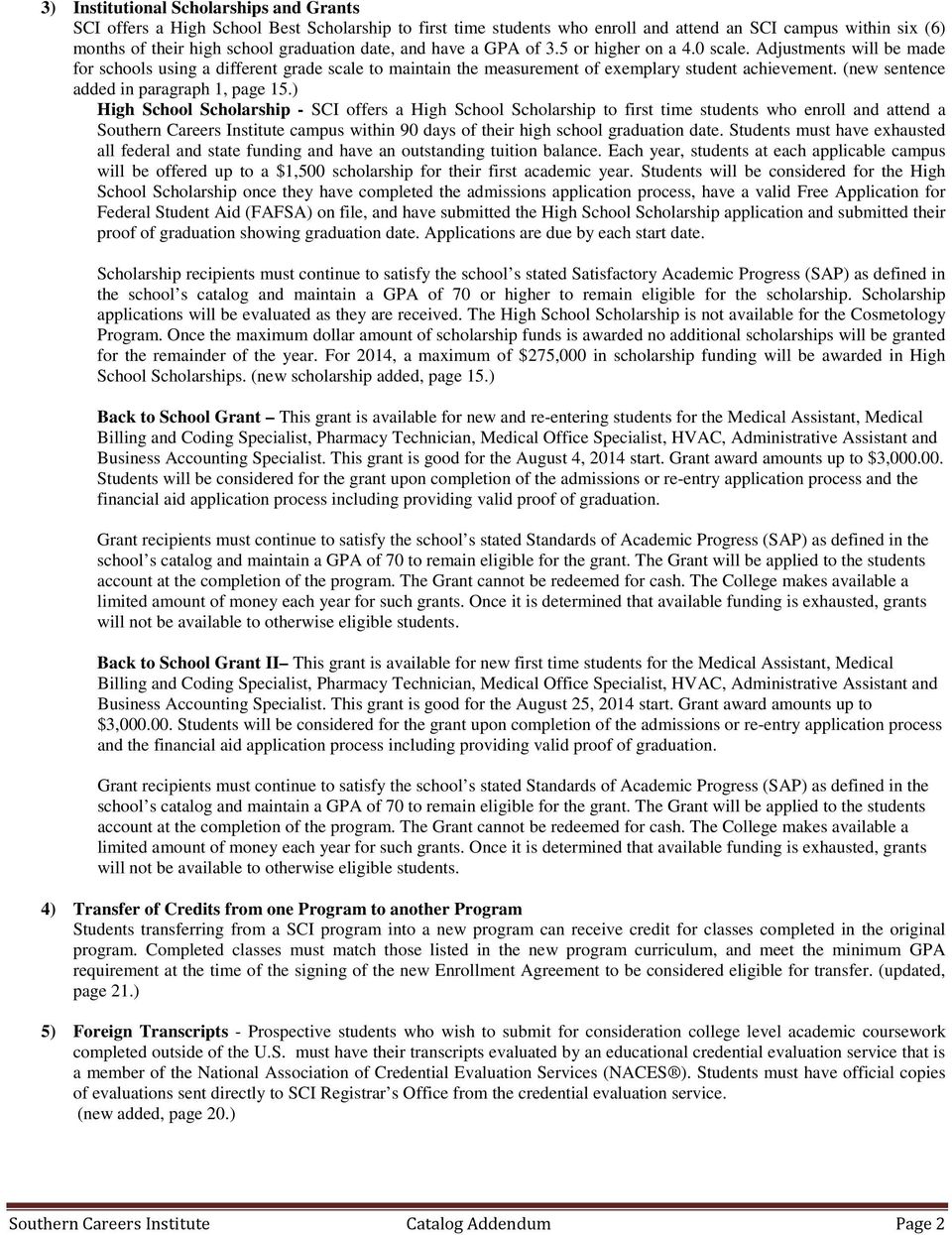
2 3) Institutional Scholarships and Grants SCI offers a High School Best Scholarship to first time students who enroll and attend an SCI campus within six (6) months of their high school graduation date, and have a GPA of 3.5 or higher on a 4.0 scale. Adjustments will be made for schools using a different grade scale to maintain the measurement of exemplary student achievement. (new sentence added in paragraph 1, page 15.) High School Scholarship - SCI offers a High School Scholarship to first time students who enroll and attend a Southern Careers Institute campus within 90 days of their high school graduation date. Students must have exhausted all federal and state funding and have an outstanding tuition balance. Each year, students at each applicable campus will be offered up to a $1,500 scholarship for their first academic year. Students will be considered for the High School Scholarship once they have completed the admissions application process, have a valid Free Application for Federal Student Aid (FAFSA) on file, and have submitted the High School Scholarship application and submitted their proof of graduation showing graduation date. Applications are due by each start date. Scholarship recipients must continue to satisfy the school s stated Satisfactory Academic Progress (SAP) as defined in the school s catalog and maintain a GPA of 70 or higher to remain eligible for the scholarship. Scholarship applications will be evaluated as they are received. The High School Scholarship is not available for the Cosmetology Program. Once the maximum dollar amount of scholarship funds is awarded no additional scholarships will be granted for the remainder of the year. For 2014, a maximum of $275,000 in scholarship funding will be awarded in High School Scholarships. (new scholarship added, page 15.) Back to School Grant This grant is available for new and re-entering students for the Medical Assistant, Medical Billing and Coding Specialist, Pharmacy Technician, Medical Office Specialist, HVAC, Administrative Assistant and Business Accounting Specialist. This grant is good for the August 4, 2014 start. Grant award amounts up to $3, Students will be considered for the grant upon completion of the admissions or re-entry application process and the financial aid application process including providing valid proof of graduation. Grant recipients must continue to satisfy the school s stated Standards of Academic Progress (SAP) as defined in the school s catalog and maintain a GPA of 70 to remain eligible for the grant. The Grant will be applied to the students account at the completion of the program. The Grant cannot be redeemed for cash. The College makes available a limited amount of money each year for such grants. Once it is determined that available funding is exhausted, grants will not be available to otherwise eligible students. Back to School Grant II This grant is available for new first time students for the Medical Assistant, Medical Billing and Coding Specialist, Pharmacy Technician, Medical Office Specialist, HVAC, Administrative Assistant and Business Accounting Specialist. This grant is good for the August 25, 2014 start. Grant award amounts up to $3, Students will be considered for the grant upon completion of the admissions or re-entry application process and the financial aid application process including providing valid proof of graduation. Grant recipients must continue to satisfy the school s stated Standards of Academic Progress (SAP) as defined in the school s catalog and maintain a GPA of 70 to remain eligible for the grant. The Grant will be applied to the students account at the completion of the program. The Grant cannot be redeemed for cash. The College makes available a limited amount of money each year for such grants. Once it is determined that available funding is exhausted, grants will not be available to otherwise eligible students. 4) Transfer of Credits from one Program to another Program Students transferring from a SCI program into a new program can receive credit for classes completed in the original program. Completed classes must match those listed in the new program curriculum, and meet the minimum GPA requirement at the time of the signing of the new Enrollment Agreement to be considered eligible for transfer. (updated, page 21.) 5) Foreign Transcripts - Prospective students who wish to submit for consideration college level academic coursework completed outside of the U.S. must have their transcripts evaluated by an educational credential evaluation service that is a member of the National Association of Credential Evaluation Services (NACES ). Students must have official copies of evaluations sent directly to SCI Registrar s Office from the credential evaluation service. (new added, page 20.) Southern Careers Institute Catalog Addendum Page 2
3 6) Attendance Policy for Online Courses If a student fails to actively participate in an online class for a time period that exceeds ten (10) calendar days, the student will be dropped from the course. (updated the number of days, page 21.) 7) Grading Scale (new, page 25.) Grade Percentage L Rating Leave of Absence 8) Out of School Work Policy Hours listed in course descriptions and on syllabi as theory, laboratory, or externship is scheduled time required for delivery of course content, practice of learned skills, and/or demonstration of competencies in a work environment. The accumulation of these hours is listed under Total Contact Hours and is utilized in determining credits awarded in each course. In addition to the contact hours in a course, students are expected to spend time out of class in reading/preparing for lecture, completing assigned homework, studying for exams/quizzes, researching or completing project assignments, and/or preparing for laboratory exercises. This additional time is listed on each syllabus as Outside Hours and represents a minimum of 5 outside hours for each 20 spent in class in order to meet course objectives. (new policy added after Grading Scale, page 25.) 9) Code of Conduct Smoking outside of designated smoking areas (includes e-cigarettes). (new sentence added, page 31). 10) Directed Studies A Directed Study course is a permanent catalog course delivered on an individual basis when the course is not offered that term. Directed studies are approved under extenuating circumstances to provide an opportunity to complete a required course. (new section added, p.23) 11) Course Substitutions A course substitution needs to be based on similarity of courses, not on convenience or inconvenience. Thus, a rationale for a substitution cannot rest on the difficulty a student has with scheduling a particular course, but rather on how one course duplicates what is covered in another course listed as part of the a SCI program. Student should be currently active in the program of study to which the substitution applies. Course to be substituted must be equal to or greater in credits than the required course and not reduce the number of credits needed to complete the degree. Course to be substituted should meet the content and outcomes of the required course. (new section added, p.23) 12) Course detail revisions COURSE TITLE ADMINISTRATIVE ASSISTANT QUARTER CREDITS TOTAL CLOCK HOURS THEORY CLOCK HOURS LAB CLOCK HOURS COURSE NUMBER ACC101 Accounting Foundations BUS101 Business Communication CIS101 Word Processing CIS102 Spreadsheets CIS103 Application Presentation & Sharing CIS104 Integrated Applications EXTERN HOURS Southern Careers Institute Catalog Addendum Page 3

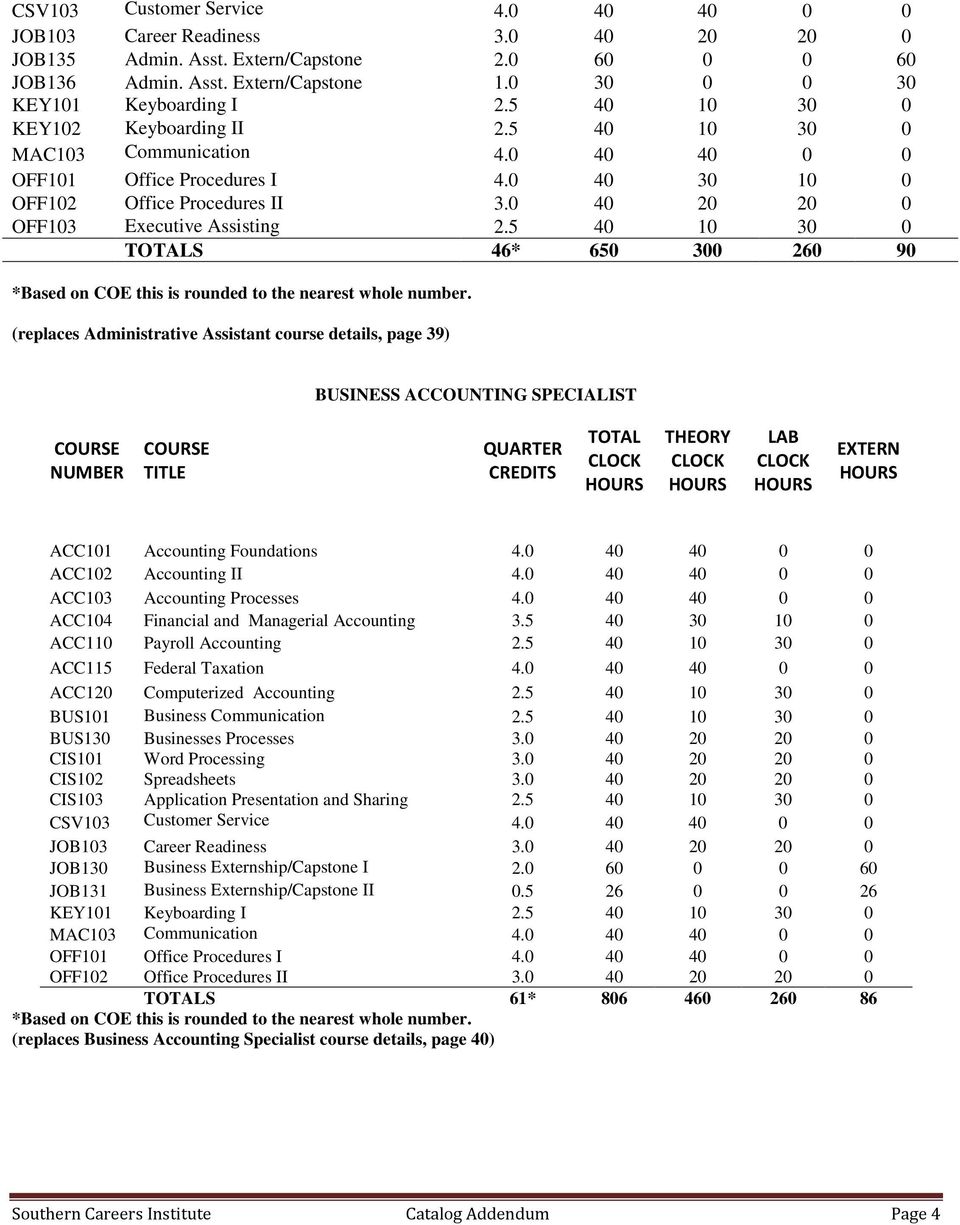
4 CSV103 Customer Service JOB103 Career Readiness JOB135 Admin. Asst. Extern/Capstone JOB136 Admin. Asst. Extern/Capstone KEY101 Keyboarding I KEY102 Keyboarding II MAC103 Communication OFF101 Office Procedures I OFF102 Office Procedures II OFF103 Executive Assisting TOTALS 46* *Based on COE this is rounded to the nearest whole number. (replaces Administrative Assistant course details, page 39) BUSINESS ACCOUNTING SPECIALIST COURSE NUMBER COURSE TITLE QUARTER CREDITS TOTAL CLOCK HOURS THEORY CLOCK HOURS LAB CLOCK HOURS EXTERN HOURS ACC101 Accounting Foundations ACC102 Accounting II ACC103 Accounting Processes ACC104 Financial and Managerial Accounting ACC110 Payroll Accounting ACC115 Federal Taxation ACC120 Computerized Accounting BUS101 Business Communication BUS130 Businesses Processes CIS101 Word Processing CIS102 Spreadsheets CIS103 Application Presentation and Sharing CSV103 Customer Service JOB103 Career Readiness JOB130 Business Externship/Capstone I JOB131 Business Externship/Capstone II KEY101 Keyboarding I MAC103 Communication OFF101 Office Procedures I OFF102 Office Procedures II TOTALS 61* *Based on COE this is rounded to the nearest whole number. (replaces Business Accounting Specialist course details, page 40) Southern Careers Institute Catalog Addendum Page 4
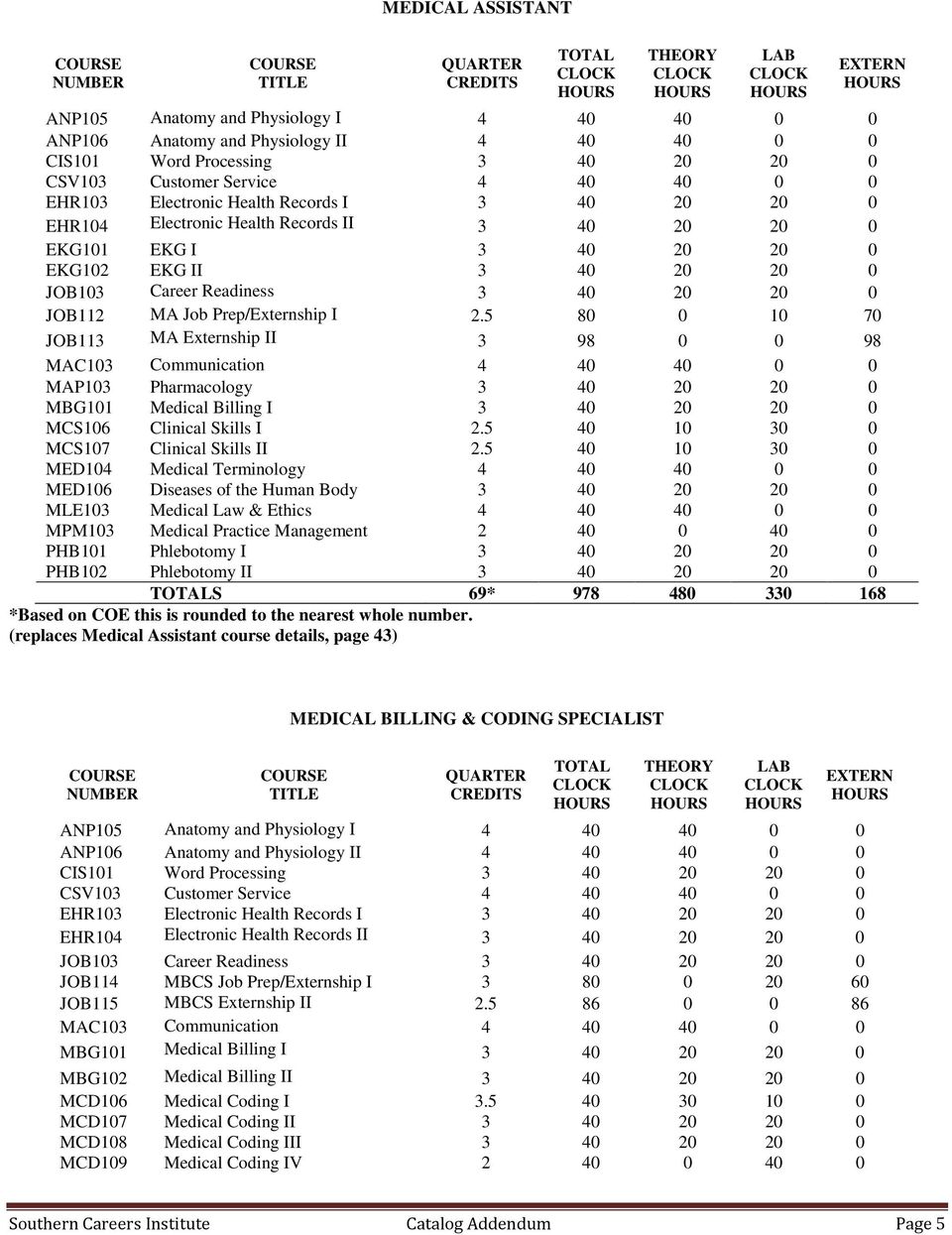
5 MEDICAL ASSISTANT COURSE NUMBER COURSE TITLE QUARTER CREDITS TOTAL CLOCK HOURS THEORY CLOCK HOURS LAB CLOCK HOURS EXTERN HOURS ANP105 Anatomy and Physiology I ANP106 Anatomy and Physiology II CIS101 Word Processing CSV103 Customer Service EHR103 Electronic Health Records I EHR104 Electronic Health Records II EKG101 EKG I EKG102 EKG II JOB103 Career Readiness JOB112 MA Job Prep/Externship I JOB113 MA Externship II MAC103 Communication MAP103 Pharmacology MBG101 Medical Billing I MCS106 Clinical Skills I MCS107 Clinical Skills II MED104 Medical Terminology MED106 Diseases of the Human Body MLE103 Medical Law & Ethics MPM103 Medical Practice Management PHB101 Phlebotomy I PHB102 Phlebotomy II TOTALS 69* *Based on COE this is rounded to the nearest whole number. (replaces Medical Assistant course details, page 43) MEDICAL BILLING & CODING SPECIALIST COURSE NUMBER COURSE TITLE QUARTER CREDITS TOTAL CLOCK HOURS THEORY CLOCK HOURS LAB CLOCK HOURS EXTERN HOURS ANP105 Anatomy and Physiology I ANP106 Anatomy and Physiology II CIS101 Word Processing CSV103 Customer Service EHR103 Electronic Health Records I EHR104 Electronic Health Records II JOB103 Career Readiness JOB114 MBCS Job Prep/Externship I JOB115 MBCS Externship II MAC103 Communication MBG101 Medical Billing I MBG102 Medical Billing II MCD106 Medical Coding I MCD107 Medical Coding II MCD108 Medical Coding III MCD109 Medical Coding IV Southern Careers Institute Catalog Addendum Page 5
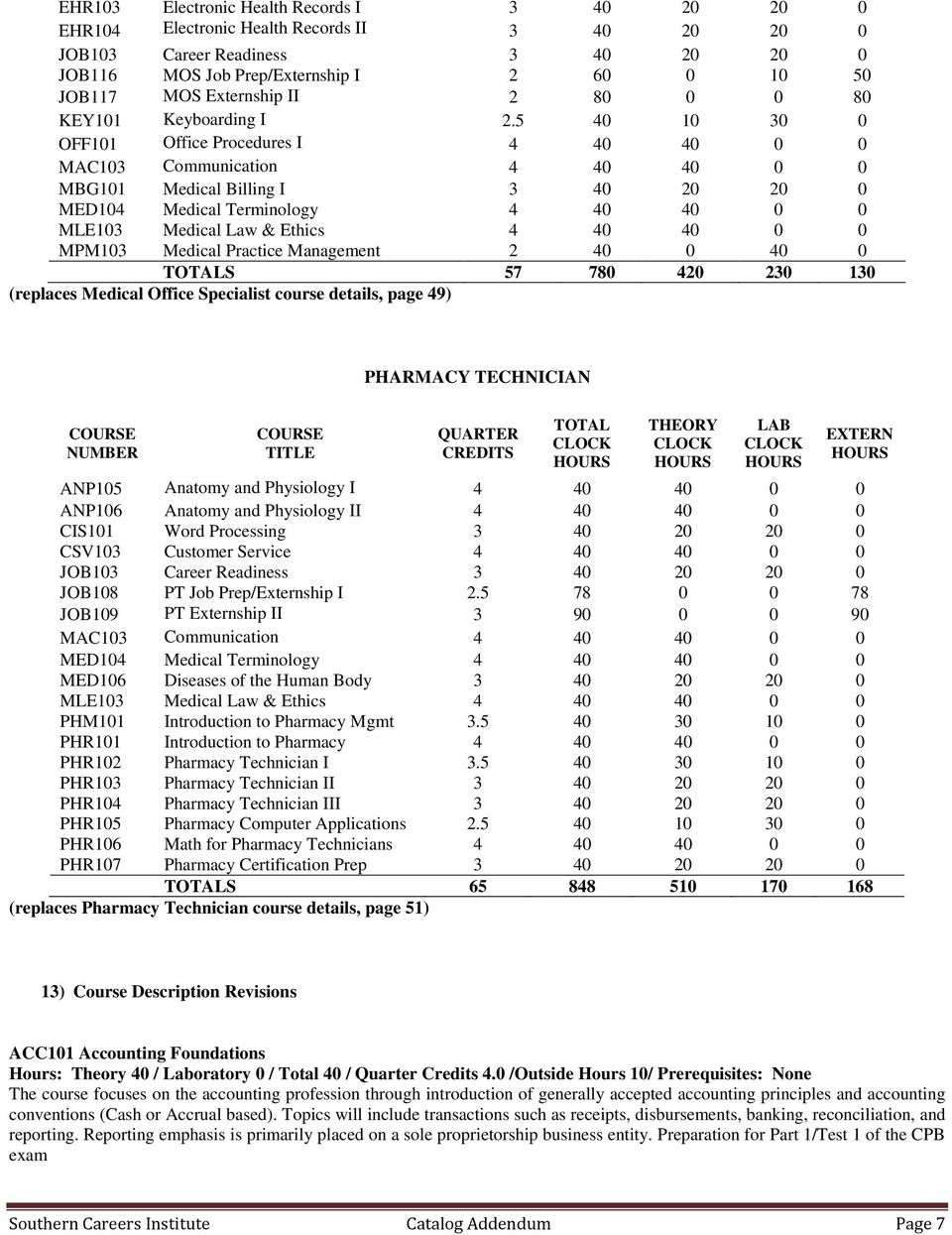
6 MED104 Medical Terminology MED106 Diseases of the Human Body MLE103 Medical Law & Ethics MPM103 Medical Practice Management OFF101 Office Procedures I TOTALS (replaces Medical Billing & Coding Specialist course details, page 45) MEDICAL BILLING & CODING SPECIALIST ONLINE COURSE NUMBER COURSE TITLE QUARTER CREDITS TOTAL CLOCK HOURS THEORY CLOCK HOURS LAB CLOCK HOURS EXTERN HOURS ANP105-O Anatomy and Physiology I ANP106-O Anatomy and Physiology II CIS101-O Word Processing CSV103-O Customer Service EHR103-O Electronic Health Records I EHR104-O Electronic Health Records II JOB103-O Career Readiness JOB114-O MBCS Job Prep/Externship I JOB115-O MBCS Externship II MAC103-O Communication MBG101-O Medical Billing I MBG102-O Medical Billing II MCD106-O Medical Coding I MCD107-O Medical Coding II MCD108-O Medical Coding III MCD109-O Medical Coding IV MED104-O Medical Terminology MED106-O Diseases of the Human Body MLE103-O Medical Law & Ethics MPM103-O Medical Practice Management OFF101-O Office Procedures I TOTALS (replaces Medical Billing & Coding Specialist Online course details, page 47) MEDICAL OFFICE SPECIALIST COURSE NUMBER COURSE TITLE QUARTER CREDITS TOTAL CLOCK HOURS THEORY CLOCK HOURS LAB CLOCK HOURS EXTERN HOURS ANP105 Anatomy and Physiology I ANP106 Anatomy and Physiology II CIS101 Word Processing CIS102 Spreadsheets CIS103 Application Presentation and Sharing CSV103 Customer Service Southern Careers Institute Catalog Addendum Page 6

7 EHR103 Electronic Health Records I EHR104 Electronic Health Records II JOB103 Career Readiness JOB116 MOS Job Prep/Externship I JOB117 MOS Externship II KEY101 Keyboarding I OFF101 Office Procedures I MAC103 Communication MBG101 Medical Billing I MED104 Medical Terminology MLE103 Medical Law & Ethics MPM103 Medical Practice Management TOTALS (replaces Medical Office Specialist course details, page 49) PHARMACY TECHNICIAN COURSE NUMBER COURSE TITLE QUARTER CREDITS TOTAL CLOCK HOURS THEORY CLOCK HOURS LAB CLOCK HOURS EXTERN HOURS ANP105 Anatomy and Physiology I ANP106 Anatomy and Physiology II CIS101 Word Processing CSV103 Customer Service JOB103 Career Readiness JOB108 PT Job Prep/Externship I JOB109 PT Externship II MAC103 Communication MED104 Medical Terminology MED106 Diseases of the Human Body MLE103 Medical Law & Ethics PHM101 Introduction to Pharmacy Mgmt PHR101 Introduction to Pharmacy PHR102 Pharmacy Technician I PHR103 Pharmacy Technician II PHR104 Pharmacy Technician III PHR105 Pharmacy Computer Applications PHR106 Math for Pharmacy Technicians PHR107 Pharmacy Certification Prep TOTALS (replaces Pharmacy Technician course details, page 51) 13) Course Description Revisions ACC101 Accounting Foundations Hours: Theory 40 / Laboratory 0 / Total 40 / Quarter Credits 4.0 /Outside Hours 10/ Prerequisites: None The course focuses on the accounting profession through introduction of generally accepted accounting principles and accounting conventions (Cash or Accrual based). Topics will include transactions such as receipts, disbursements, banking, reconciliation, and reporting. Reporting emphasis is primarily placed on a sole proprietorship business entity. Preparation for Part 1/Test 1 of the CPB exam Southern Careers Institute Catalog Addendum Page 7
8 ACC102 Accounting II Hours: Theory 40 / Laboratory 0 / Total 40 / Quarter Credits 4.0 /Outside Hours 10/ Prerequisites: None This course focuses on accounting concepts associated with a merchandising business. Topics include special journals, payables, receivables, and payroll. Preparation for Part 1/Test 2, Part 2/Test 2 of the CPB exam ACC103 Accounting Processes Hours: Theory 40 / Laboratory 0 / Total 40 / Quarter Credits 4.0 /Outside Hours 10 /Prerequisites: None This course introduces accounting concepts associated with a partnership entity and manufacturing businesses. Topics include inventory methods, depreciation, interest calculations, and notes receivable Preparation for Part2/Test 1 of the CPB exam. ACC104 Financial and Managerial Accounting Hours: Theory 30 / Laboratory 10 / Total 40 / Quarter Credits 3.5 /Outside Hours 10/ Prerequisites: None Students will be introduced to accounting for a corporate entity. Focus will be on financial information use as a business decision making tool. Student will study financial document analysis, error correction, year-end entries, and internal controls. Reporting emphasis will be on manufacturing entity. Preparation for Part 3 and Part 4 tests of the CPB exam ACC110 Payroll Accounting Hours: Theory 10 / Laboratory30 / Total 40 / Quarter Credits 2.5 /Outside Hours 10/ Prerequisites: None This course will focus on the requirements and regulations relating to the payment of wages and salaries; Payroll taxes, withholding, Federal and State payroll reports, and practice in all phases of payroll preparation and recordkeeping. Preparation for Part 1/Test 1 of the CPB exam. ACC115 Federal Taxation Hours: Theory 40 / Laboratory0 / Total 40 / Quarter Credits 4.0 /Outside Hours 10/ Prerequisites: None A study of federal tax laws as they apply to individuals and small businesses. Students have opportunities to prepare tax returns, supplemental forms, and schedules used by individual taxpayers. ACC120 Computerized Accounting Hours: Theory 10 / Laboratory30 / Total 40 / Quarter Credits 2.5 /Outside Hours 10/ Prerequisites: ACC102 The course will utilize computerized accounting software to record and report financial data. The course will include installation and use of the various components of an electronic accounting system including receipts, disbursements, inventory, payroll, banking transactions, adjusting entries, error correction, and reporting. Preparation for Certiport QuickBooks certification exam. ANP105 Anatomy & Physiology I Hours: Theory 40 / Laboratory 0 / Total 40 / Quarter Credits 4.0 /Outside Hours 10 Prerequisites: None This course introduces the student to anatomy and physiology, the structure and function of the human body. The students will learn the structure and function of the following systems: integumentary, skeletal, muscular, cardiovascular, blood, lymphatic and immune systems. Common diseases and disorders associated with these systems will be introduced and discussed. ANP105-O Anatomy & Physiology I online Hours: Theory 40 / Laboratory 0 / Total 40 / Quarter Credits 4.0 /Outside Hours 10 Prerequisites: None This course introduces the student to anatomy and physiology, the structure and function of the human body. The students will learn the structure and function of the following systems: integumentary, skeletal, muscular, cardiovascular, blood, lymphatic and immune systems. Common diseases and disorders associated with these systems will be introduced and discussed. ANP106 Anatomy and Physiology II Hours: Theory 40 / Laboratory 0 / Total 40 / Quarter Credits 4.0 /Outside Hours 10 Prerequisites: None This course introduces the student the structure and function of the respiratory, nervous, urinary, reproductive, digestive, endocrine systems and the special senses. Common diseases and disorders associated with these systems will be introduced and discussed. ANP106-O Anatomy and Physiology II online Hours: Theory 40 / Laboratory 0 / Total 40 / Quarter Credits 4.0 /Outside Hours 10 Prerequisites: None This course introduces the student the structure and function of the respiratory, nervous, urinary, reproductive, digestive, endocrine systems and the special senses. Common diseases and disorders associated with these systems will be introduced and discussed. Southern Careers Institute Catalog Addendum Page 8

9 BUS101 Business Communication Hours: Theory 10 / Laboratory 30 / Total 40 / Quarter Credits 2.5 /Outside Hours 10/ Prerequisites: None Application of the principles of effective communication to reach, motivate, influence business audiences are studied. Oral and written applications of these principles are practiced in business scenarios. Letters, reports, memorandums, proposals, and presentations are evaluated in this context. BUS130 Business Processes Hours: Theory 20 / Laboratory 20 / Total 40 / Quarter Credits 3.0 /Outside Hours 10/ Prerequisites: None This course will focus on basic business concepts including entrepreneurship, management, teamwork, human resources, marketing, and financial management. Students will explore various business functions and decision-making processes related to financial data. CIS101 Word Processing Hours: Theory 20 / Laboratory 20 / Total 40 / Quarter Credits 3.0 /Outside Hours 10 Prerequisites: None This course focuses on the basic techniques of electronic word processing. Through utilization of application software, students will study the functionality of the program in creating work products. Preparation for Certiport MOS Beginning Word Exam. CIS101-O Word Processing online Hours: Theory 20 / Laboratory 20 / Total 40 / Quarter Credits 3.0 /Outside Hours 10 Prerequisites: None This course focuses on the basic techniques of electronic word processing. Through utilization of application software, students will study the functionality of the program in creating work products. Preparation for Certiport MOS Beginning Word Exam. CIS102 Spreadsheets Hours: Theory 20 / Laboratory 20 / Total 40 / Quarter Credits 3.0 /Outside Hours 10/ Prerequisites: None This course focuses on the basic techniques of electronic spreadsheets. Through utilization of application software, students will study the functionality of the program in creating work products. Preparation for Certiport MOS Beginning Excel Exam. CIS103 Application Presentation and Sharing Hours: Theory 10 / Laboratory 30 / Total 40 / Quarter Credits 2.5 /Outside Hours 10/ Prerequisites: None This course will focus on basic techniques of electronic presentation and communication. Through utilization of application software students will study the functionality of application programs in creating work product. Preparation for Certiport MOS Outlook and PowerPoint exams CIS104 Integrated Applications Hours: Theory 20 / Laboratory 20 / Total 40 / Quarter Credits 3.0 /Outside Hours 10/ Prerequisites: None This course will provide an opportunity for students to explore the functionality and integration of the Microsoft Office products. Students will utilize application software to created integrated business, professional, and personal projects. CSV103 Customer Service Hours: Theory 40 / Laboratory 0 / Total 40 / Quarter Credits 4.0 /Outside Hours 10 Prerequisites: None The role of customer service is studied focusing on skills needed to work effectively with individuals or groups. Problem solving and critical thinking skills will be incorporated in exploring varying aspects of interaction with internal and external customers. CSV103-O Customer Service online Hours: Theory 40 / Laboratory 0 / Total 40 / Quarter Credits 4.0 /Outside Hours 10 Prerequisites: None The role of customer service is studied focusing on skills needed to work effectively with individuals or groups. Problem solving and critical thinking skills will be incorporated in exploring varying aspects of interaction with internal and external customers. EHR103- Electronic Health Records Specialist I Hours: Theory 20 / Laboratory 20 / Total 40 / Quarter Credits 3.0 /Outside Hours 10 Prerequisites: MED104 This course is an introduction to electronic health records. The students will discuss various types of software available for EHR and practice management. The student will learn how to access patient data from an external source, back up data, transmit data, and store patient information in the database. Insurance billing will be presented including obtaining diagnoses and procedures from the patient record and entering coding and billing information into the electronic health record. The student will have the opportunity to become competent in generating encounter forms, insurance verification reports, and locating the correct codes in the ICD, CPT, and HCPCS manuals. Southern Careers Institute Catalog Addendum Page 9

10 EHR103-O - Electronic Health Records Specialist I online Hours: Theory 20 / Laboratory 20 / Total 40 / Quarter Credits 3.0 /Outside Hours 10 Prerequisites: MED104, MED104-O This course is an introduction to electronic health records. The students will discuss various types of software available for EHR and practice management. The student will learn how to access patient data from an external source, back up data, transmit data, and store patient information in the database. Insurance billing will be presented including obtaining diagnoses and procedures from the patient record and entering coding and billing information into the electronic health record. The student will have the opportunity to become competent in generating encounter forms, insurance verification reports, and locating the correct codes in the ICD, CPT, and HCPCS manuals. EHR104- Electronic Health Record Specialist II Hours: Theory 20 / Laboratory 20 / Total 40 / Quarter Credits 3.0 /Outside Hours 10 Prerequisites: EHR103 Electronic charting is reviewed to include monitor documentation for accuracy, locate requested information in a patient s chart, and perform file maintenance. Regulatory compliance is introduced. The Reporting component of electronic healthcare records is presented. Competencies will have the opportunity to be achieved in software applications, operation of integrated devices, the ability to maintain electronic health records in various healthcare settings, knowledge of regulatory compliance and medical ethics, and to identify any security breach. The student will take a practice certification exam to prepare for the National Health Careers Association Certified Electronic Health Record Specialist (CEHRS) examination. EHR104-O Electronic Health Record Specialist II online Hours: Theory 20 / Laboratory 20 / Total 40 / Quarter Credits 3.0 /Outside Hours 10 Prerequisites: EHR103, EHR103-O Electronic charting is reviewed to include monitor documentation for accuracy, locate requested information in a patient s chart, and perform file maintenance. Regulatory compliance is introduced. The Reporting component of electronic healthcare records is presented. Competencies will have the opportunity to be achieved in software applications, operation of integrated devices, the ability to maintain electronic health records in various healthcare settings, knowledge of regulatory compliance and medical ethics, and to identify any security breach. The student will take a practice certification exam to prepare for the National Health Careers Association Certified Electronic Health Record Specialist (CEHRS) examination. EKG 101- EKG I Hours: Theory 20 / Laboratory 20 / Total 40 / Quarter Credits 3.0 /Outside Hours 10 Prerequisites: None This course prepares the student to sit for the National Healthcareers Association Certified EKG Technician (CET) examination. A review of anatomy and physiology of the heart, circulatory and conductions systems will be presented. The course will introduce the student to preparing the patient for a routine EKG, modified EKG s including Holter Monitors, and stress EKG s and telemetry monitoring. Proper placement of electrodes and patient safety will be emphasized. Components of the EKG tracing will be identified including the P wave, QRS complex and T wave. The course includes a lab component, which incorporates the introduction of the EKG machine, correct placement of electrodes and completing a successful 12 Lead EKG. EKG 102- EKG II Hours: Theory 20 / Laboratory 20 / Total 40 / Quarter Credits 3.0 /Outside Hours 10 Prerequisites: EKG101 This course is a continuation of EKG 101. The origination and aspects of dysthymias as presented on the EKG tracing will be discussed. Recognition and identification of sinus, atrial, ventricular or junctional dysthymias will be emphasized. Dysthymias associated with hypertrophy, trauma, electrolyte imbalance and congenital heart malformations are presented. Medical law and Ethics as it applies to electrocardiogram technicians will be introduced. The lab activities introduces trouble shooting the EKG machine, accommodations for special populations requiring an EKG, and continued identification and recognition of critical and life threatening dysthymias. A practice certification examination will be given in preparation for taking the Certified EKG Technician (CET) examination. JOB103 Career Readiness Hours: Theory 20 / Laboratory 20 / Total 40 / Quarter Credits 3.0 /Outside Hours 10 Prerequisites: None This course introduces the skills needed for career success. Students will have the opportunity to learn about setting personal and professional goals, job search techniques and portfolio development. Final resume, cover letter and mock interviews are key aspects of this course. Students may also learn about different career paths. JOB103-O Career Readiness online Hours: Theory 20 / Laboratory 20 / Total 40 / Quarter Credits 3.0 /Outside Hours 10 Prerequisites: None This course introduces the skills needed for career success. Students will have the opportunity to learn about setting personal and professional goals, job search techniques and portfolio development. Final resume, cover letter and mock interviews are key aspects of this course. Students may also learn about different career paths. Southern Careers Institute Catalog Addendum Page 10

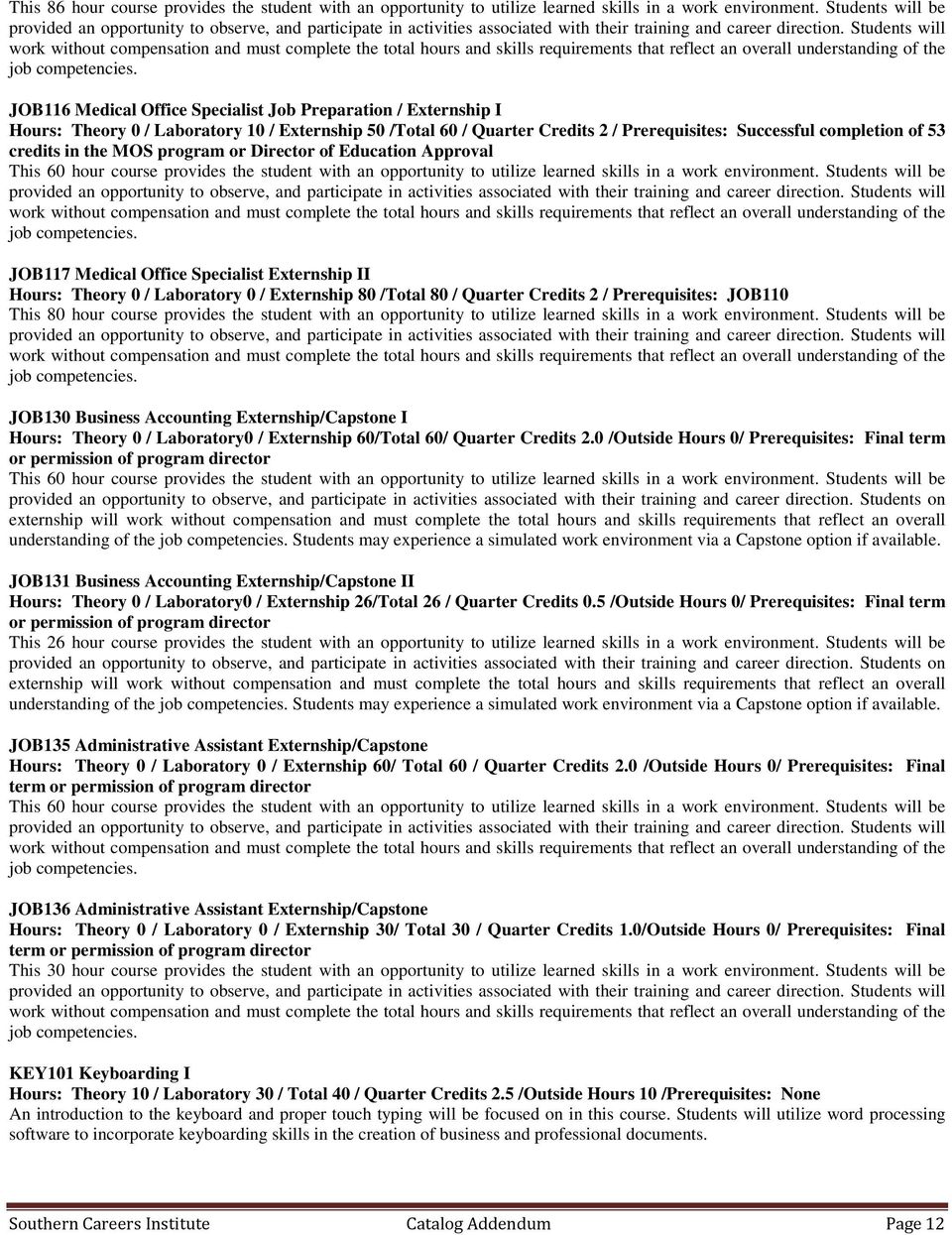
11 JOB108 Pharmacy Technician Job Preparation / Externship I Hours: Theory 0 / Laboratory 05 / Externship 78 /Total 78 / Quarter Credits 2.5 / Prerequisites: Successful completion of 48 credits in the Pharmacy Technician Program or Director of Education Approval This 95 hour course provides the student with an opportunity to utilize learned skills in a work environment. Students will be provided an opportunity to observe, and participate in activities associated with their training and career direction. Students will work without compensation and must complete the total hours and skills requirements that reflect an overall understanding of the job competencies. JOB109 Pharmacy Technician Externship II Hours: Theory 0 / Laboratory 0 / Externship 90 /Total 90/ Quarter Credits 3 / Prerequisites: JOB108 This 86 hour course provides the student with an opportunity to utilize learned skills in a work environment. Students will be provided an opportunity to observe, and participate in activities associated with their training and career direction. Students will work without compensation and must complete the total hours and skills requirements that reflect an overall understanding of the job competencies. JOB112 Medical Assistant Job Preparation / Externship I Hours: Theory 0 / Laboratory 10 / Externship 70 /Total 80 / Quarter Credits 2.5 / Prerequisites: Completion of 66 credit hours or Director of Education Approval This 80 hour course provides the student with an opportunity to utilize learned skills in a work environment. Students will be provided an opportunity to observe, and participate in activities associated with their training and career direction. Students will work without compensation and must complete the total hours and skills requirements that reflect an overall understanding of the job competencies. JOB113 Externship II Hours: Theory 0 / Laboratory 0 / Externship 98 /Total 98 / Quarter Credits 3 / Prerequisites: JOB112 This 98 hour course provides the student with an opportunity to utilize learned skills in a work environment. Students will be provided an opportunity to observe, and participate in activities associated with their training and career direction. Students will work without compensation and must complete the total hours and skills requirements that reflect an overall understanding of the job competencies. JOB114 Medical Billing & Coding Specialist Job Preparation / Externship I Hours: Theory 0 / Laboratory 20 / Externship 60 /Total 80 / Quarter Credits 3 / Prerequisites: Successful completion of 60 credits in the MBCS program or Director of Education Approval This 80 hour course provides the student with an opportunity to utilize learned skills in a work environment. Students will be provided an opportunity to observe, and participate in activities associated with their training and career direction. Students will work without compensation and must complete the total hours and skills requirements that reflect an overall understanding of the job competencies. JOB114-O Medical Billing & Coding Specialist Job Preparation / Externship I online Hours: Theory 0 / Laboratory 20 / Externship 60 /Total 80 / Quarter Credits 3 / Prerequisites: Successful completion of 60 credits in the MBCS program or Director of Education Approval This 80 hour course provides the student with an opportunity to utilize learned skills in a work environment. Students will be provided an opportunity to observe, and participate in activities associated with their training and career direction. Students will work without compensation and must complete the total hours and skills requirements that reflect an overall understanding of the job competencies. JOB115 Medical Billing & Coding Specialist Externship II Hours: Theory 0 / Laboratory 0 / Externship 86 /Total 86 / Quarter Credits 2.5 / Prerequisites: JOB114 This 86 hour course provides the student with an opportunity to utilize learned skills in a work environment. Students will be provided an opportunity to observe, and participate in activities associated with their training and career direction. Students will work without compensation and must complete the total hours and skills requirements that reflect an overall understanding of the job competencies. JOB115-O Medical Billing & Coding Specialist Externship II online Hours: Theory 0 / Laboratory 0 / Externship 86 /Total 86 / Quarter Credits 2.5 / Prerequisites: JOB114 Southern Careers Institute Catalog Addendum Page 11

12 This 86 hour course provides the student with an opportunity to utilize learned skills in a work environment. Students will be provided an opportunity to observe, and participate in activities associated with their training and career direction. Students will work without compensation and must complete the total hours and skills requirements that reflect an overall understanding of the job competencies. JOB116 Medical Office Specialist Job Preparation / Externship I Hours: Theory 0 / Laboratory 10 / Externship 50 /Total 60 / Quarter Credits 2 / Prerequisites: Successful completion of 53 credits in the MOS program or Director of Education Approval This 60 hour course provides the student with an opportunity to utilize learned skills in a work environment. Students will be provided an opportunity to observe, and participate in activities associated with their training and career direction. Students will work without compensation and must complete the total hours and skills requirements that reflect an overall understanding of the job competencies. JOB117 Medical Office Specialist Externship II Hours: Theory 0 / Laboratory 0 / Externship 80 /Total 80 / Quarter Credits 2 / Prerequisites: JOB110 This 80 hour course provides the student with an opportunity to utilize learned skills in a work environment. Students will be provided an opportunity to observe, and participate in activities associated with their training and career direction. Students will work without compensation and must complete the total hours and skills requirements that reflect an overall understanding of the job competencies. JOB130 Business Accounting Externship/Capstone I Hours: Theory 0 / Laboratory0 / Externship 60/Total 60/ Quarter Credits 2.0 /Outside Hours 0/ Prerequisites: Final term or permission of program director This 60 hour course provides the student with an opportunity to utilize learned skills in a work environment. Students will be provided an opportunity to observe, and participate in activities associated with their training and career direction. Students on externship will work without compensation and must complete the total hours and skills requirements that reflect an overall understanding of the job competencies. Students may experience a simulated work environment via a Capstone option if available. JOB131 Business Accounting Externship/Capstone II Hours: Theory 0 / Laboratory0 / Externship 26/Total 26 / Quarter Credits 0.5 /Outside Hours 0/ Prerequisites: Final term or permission of program director This 26 hour course provides the student with an opportunity to utilize learned skills in a work environment. Students will be provided an opportunity to observe, and participate in activities associated with their training and career direction. Students on externship will work without compensation and must complete the total hours and skills requirements that reflect an overall understanding of the job competencies. Students may experience a simulated work environment via a Capstone option if available. JOB135 Administrative Assistant Externship/Capstone Hours: Theory 0 / Laboratory 0 / Externship 60/ Total 60 / Quarter Credits 2.0 /Outside Hours 0/ Prerequisites: Final term or permission of program director This 60 hour course provides the student with an opportunity to utilize learned skills in a work environment. Students will be provided an opportunity to observe, and participate in activities associated with their training and career direction. Students will work without compensation and must complete the total hours and skills requirements that reflect an overall understanding of the job competencies. JOB136 Administrative Assistant Externship/Capstone Hours: Theory 0 / Laboratory 0 / Externship 30/ Total 30 / Quarter Credits 1.0/Outside Hours 0/ Prerequisites: Final term or permission of program director This 30 hour course provides the student with an opportunity to utilize learned skills in a work environment. Students will be provided an opportunity to observe, and participate in activities associated with their training and career direction. Students will work without compensation and must complete the total hours and skills requirements that reflect an overall understanding of the job competencies. KEY101 Keyboarding I Hours: Theory 10 / Laboratory 30 / Total 40 / Quarter Credits 2.5 /Outside Hours 10 /Prerequisites: None An introduction to the keyboard and proper touch typing will be focused on in this course. Students will utilize word processing software to incorporate keyboarding skills in the creation of business and professional documents. Southern Careers Institute Catalog Addendum Page 12
13 KEY102 Keyboarding II Hours: Theory 10 / Laboratory 30 / Total 40 / Quarter Credits 2.5 /Outside Hours 10 /Prerequisites: None This course will focus on improving students typing speed and accuracy. Students will utilize word processing software to transcribe letters, memos, and/or reports. MAC103 Communication Hours: Theory 40 / Laboratory 0 / Total 40 / Quarter Credits 4.0 /Outside Hours 10 Prerequisites: None Students will study communication skills utilizing informal writing techniques. Focus will be on the production of work product that demonstrates basic skills in communicating to individuals or groups. Software and/or online ancillaries will be incorporated to supplement project creation. MAC103-O Communication I online Hours: Theory 40 / Laboratory 0 / Total 40 / Quarter Credits 4.0 /Outside Hours 10 Prerequisites: None Students will study communication skills utilizing informal writing techniques. Focus will be on the production of work product that demonstrates basic skills in communicating to individuals or groups. Software and/or online ancillaries will be incorporated to supplement project creation. MAP103 Pharmacology Hours: Theory 20 / Laboratory 20 / Total 40 / Quarter Credits 3.0 /Outside Hours 10 Prerequisites: None This course introduces general principles of pharmacology relating to the medical assisting profession. Emphasis is placed on recognizing the government agencies that regulate drugs in the U.S., researching drugs using a drug reference, explaining the clinical use of drugs, and patient education regarding medications. Course content includes relating the principles of pharmacokinetics to drug use, and describing factors that affect the action of a drug. MBG101 Medical Billing I Hours: Theory 20 / Laboratory 20 / Total 40 / Quarter Credits 3.0 /Outside Hours 10 Prerequisites: None This course introduces the fundamental elements of medical insurance payment systems and reimbursements. Students will examine different types of healthcare insurance coverage, the medical billing cycle, and protected health information will be identified and discussed as applied to the Health Insurance Portability and Accountability Act. Types of data the Electronic Health Records specialist must gather in each patient encounter will be discussed. Students will explore the general guidelines and processes for claims preparation and transmission, including specific preparation and transmission of claims as required by private payers. MBG101-O Medical Billing I online Hours: Theory 20 / Laboratory 20 / Total 40 / Quarter Credits 3.0 /Outside Hours 10 Prerequisites: None This course introduces the fundamental elements of medical insurance payment systems and reimbursements. Students will examine different types of healthcare insurance coverage, the medical billing cycle, and protected health information will be identified and discussed as applied to the Health Insurance Portability and Accountability Act. Types of data the Electronic Health Records specialist must gather in each patient encounter will be discussed. Students will explore the general guidelines and processes for claims preparation and transmission, including specific preparation and transmission of claims as required by private payers. MBG102 Medical Billing II Hours: Theory 20 / Laboratory 20 / Total 40 / Quarter Credits 3.0 /Outside Hours 10 Prerequisites: None This course examines the terminology and functions of major commercial and governmental payers such as: managed care plans, the Blue Plans, Medicare, Medicaid, TRICARE, CHAMPVA, and Workers Compensation. MBG102-O Medical Billing II online Hours: Theory 20 / Laboratory 20 / Total 40 / Quarter Credits 3.0 /Outside Hours 10 Prerequisites: None This course examines the terminology and functions of major commercial and governmental payers such as: managed care plans, the Blue Plans, Medicare, Medicaid, TRICARE, CHAMPVA, and Workers Compensation. MCD106 Medical Coding I Hours: Theory 30 / Laboratory 10 / Total 40 / Quarter Credits 3.5 /Outside Hours 10 Prerequisites: None This course will introduce procedural coding through the use of Current Procedural Terminology (CPT) and the Healthcare Common Procedural Coding System (HCPCS). The purpose of the CPT, modifier usage and Evaluation and Management coding will be explored. Southern Careers Institute Catalog Addendum Page 13

14 MCD106-O Medical Coding I online Hours: Theory 30 / Laboratory 10 / Total 40 / Quarter Credits 3.5 /Outside Hours 10 Prerequisites: None This course will introduce procedural coding through the use of Current Procedural Terminology (CPT) and the Healthcare Common Procedural Coding System (HCPCS). The purpose of the CPT, modifier usage and Evaluation and Management coding will be explored. MCD107 Medical Coding II Hours: Theory 20 / Laboratory 20 / Total 40 / Quarter Credits 3 /Outside Hours 10 Prerequisites: None This course focuses on the usage of ICD-9 coding and the transition ICD-10. Students will receive a basic overview of diagnostic coding, outpatient coding and reporting guidelines and the layout and usage of the diagnostic coding manual. MCD107-O Medical Coding II online Hours: Theory 20 / Laboratory 20 / Total 40 / Quarter Credits 3 /Outside Hours 10 Prerequisites: None This course focuses on the usage of ICD-9 coding and the transition ICD-10. Students will receive a basic overview of diagnostic coding, outpatient coding and reporting guidelines and the layout and usage of the diagnostic coding manual. MCD108 Medical Coding III Hours: Theory 20 / Laboratory 20 / Total 40 / Quarter Credits 3 /Outside Hours 10 Prerequisites: None This course will provide an overview of the ICD-10-CM outpatient reporting guidelines as well as chapter-specific guidelines when accurately coding from the ICD-10-CM. MCD108-O Medical Coding III online Hours: Theory 20 / Laboratory 20 / Total 40 / Quarter Credits 3 /Outside Hours 10 Prerequisites: None This course will provide an overview of the ICD-10-CM outpatient reporting guidelines as well as chapter-specific guidelines when accurately coding from the ICD-10-CM. MCD109 Medical Coding IV Hours: Theory 0/ Laboratory 40/ Total 40/ Quarter Credits 2/Outside Hours 10 Prerequisites: MCD106, MCD107, MCD108 This course focuses on the usage of CPT, HCPCS, ICD-9 and ICD-10 in a simulated work environment. MCD109-O Medical Coding IV online Hours: Theory 0/ Laboratory 40/ Total 40/ Quarter Credits 2/Outside Hours 10 Prerequisites: MCD106, MCD107, MCD108 This course focuses on the usage of CPT, HCPCS, ICD-9 and ICD-10 in a simulated work environment. MCS106 Clinical Skill I Hours: Theory 10 / Laboratory 30 / Total 40 / Quarter Credits 2.5 /Outside Hours 10 Prerequisites: None This course provides an introduction to the clinical side of medical assisting. Preliminary steps that must be taken before working with patients are covered such as organizing the office, lab, and examination areas, safety precautions, infection controls, and adherence to OSHA guidelines. Additionally, the course is designed to furnish the student with both theory and practical applications of medical assisting basics including infection control and patient assessment. MCS107 Clinical Skill II Hours: Theory 10 / Laboratory 30 / Total 40 / Quarter Credits 2.5 /Outside Hours 10 Prerequisites: None This course provides an introduction to the clinical side of medical assisting. It is designed to furnish the student with both theory and practical applications of medical assisting basics, including patient assessment, and describes what steps the medical assistant should follow to aid both the physician and the patient during various medical examinations. MED104 Medical Terminology Hours: Theory 40 / Laboratory 0 / Total 40 / Quarter Credits 4.0 /Outside Hours 10 Prerequisites: None This course introduces the student to the medical terminology using a systems approach. The student will identify root word elements, prefixes, suffixes that form medical terms commonly used in healthcare. Correct pronunciation and spelling will be emphasized. Southern Careers Institute Catalog Addendum Page 14
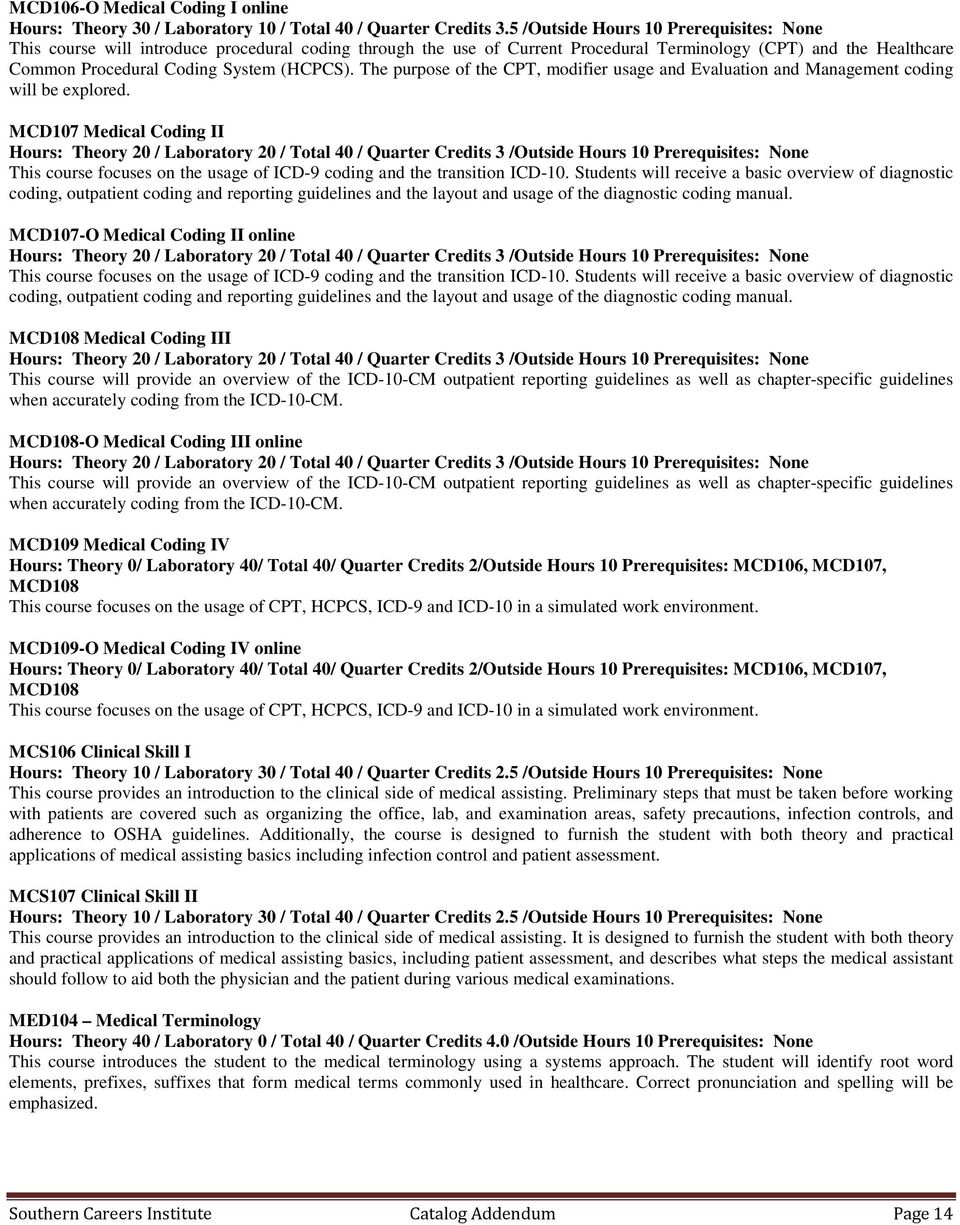
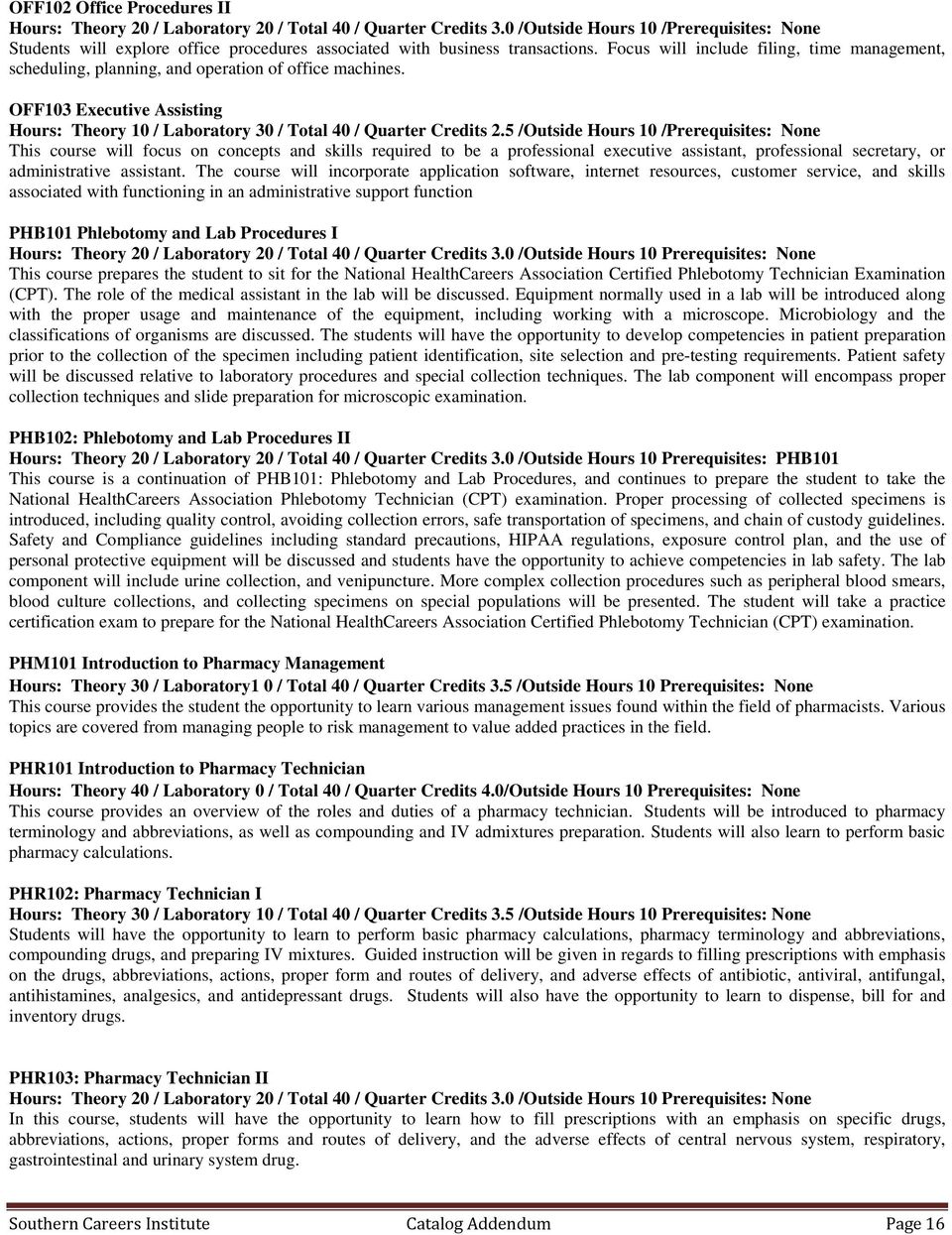
15 MED104-O Medical Terminology online Hours: Theory 40 / Laboratory 0 / Total 40 / Quarter Credits 4.0 /Outside Hours 10 Prerequisites: None This course introduces the student to the medical terminology using a systems approach. The student will identify root word elements, prefixes, suffixes that form medical terms commonly used in healthcare. Correct pronunciation and spelling will be emphasized. MED106 Diseases of the Human Body Hours: Theory 20 / Laboratory 20 / Total 40 / Quarter Credits 3 /Outside Hours 10 Prerequisites: MED104 This course introduces the student to human diseases and conditions frequently encountered in the healthcare field. The diseases and conditions addressed are presented by body system to include signs and symptoms of the disease, pathophysiology, diagnosis, treatment options, prognosis, prevention and patient teaching. The ICD-9-CM and ICD-10-CM codes are also included for each disease process. MED106-O Diseases of the Human Body online Hours: Theory 20 / Laboratory 20 / Total 40 / Quarter Credits 3 /Outside Hours 10 Prerequisites: MED104 This course introduces the student to human diseases and conditions frequently encountered in the healthcare field. The diseases and conditions addressed are presented by body system to include signs and symptoms of the disease, pathophysiology, diagnosis, treatment options, prognosis, prevention and patient teaching. The ICD-9-CM and ICD-10-CM codes are also included for each disease process. MLE103 Medical Law and Ethics Hours: Theory 40 / Laboratory 0 / Total 40 / Quarter Credits 4.0 /Outside Hours 10 Prerequisites: None This course introduces the students to law and ethics as it applies to the medical professional. The students will be introduced to the rights and responsibilities of the healthcare consumer and the healthcare providers. Differences between law, ethics and moral values will be presented. Protected health information will be identified and discussed as applied to the Health Insurance Portability and Accountability Act. MLE103-O Medical Law and Ethics online Hours: Theory 40 / Laboratory 0 / Total 40 / Quarter Credits 4.0 /Outside Hours 10 Prerequisites: None This course introduces the students to law and ethics as it applies to the medical professional. The students will be introduced to the rights and responsibilities of the healthcare consumer and the healthcare providers. Differences between law, ethics and moral values will be presented. Protected health information will be identified and discussed as applied to the Health Insurance Portability and Accountability Act. MPM 103 Medical Practice Management Hours: Theory 0 / Laboratory 40 / Total 40 / Quarter Credits 2 /Outside Hours 10 Prerequisites: None This course introduces SimChart as it functions in the medical office setting. Students will have the opportunity to learn how to create a new case, edit an existing case, and enter new information into the program. A focus on charge transactions and insurance claims in SimChart will be presented at the end of the course. MPM 103-O Medical Practice Management online Hours: Theory 0 / Laboratory 40 / Total 40 / Quarter Credits 2 /Outside Hours 10 Prerequisites: None This course introduces SimChart as it functions in the medical office setting. Students will have the opportunity to learn how to create a new case, edit an existing case, and enter new information into the program. A focus on charge transactions and insurance claims in SimChart will be presented at the end of the course. OFF101 Office Procedures I Hours: Theory 40 / Laboratory 0 / Total 40 / Quarter Credits 4.0 /Outside Hours 10 Prerequisites: None Students will study office procedures using the functionality of business machines in resolving business problems. Students will incorporate 10-key calculators and other electronic applications in completion of course objectives. OFF101-O Office Procedures I online Hours: Theory 40 / Laboratory 0 / Total 40 / Quarter Credits 4.0 /Outside Hours 10 Prerequisites: None Students will study office procedures using the functionality of business machines in resolving business problems. Students will incorporate 10-key calculators and other electronic applications in completion of course objectives. Southern Careers Institute Catalog Addendum Page 15

16 OFF102 Office Procedures II Hours: Theory 20 / Laboratory 20 / Total 40 / Quarter Credits 3.0 /Outside Hours 10 /Prerequisites: None Students will explore office procedures associated with business transactions. Focus will include filing, time management, scheduling, planning, and operation of office machines. OFF103 Executive Assisting Hours: Theory 10 / Laboratory 30 / Total 40 / Quarter Credits 2.5 /Outside Hours 10 /Prerequisites: None This course will focus on concepts and skills required to be a professional executive assistant, professional secretary, or administrative assistant. The course will incorporate application software, internet resources, customer service, and skills associated with functioning in an administrative support function PHB101 Phlebotomy and Lab Procedures I Hours: Theory 20 / Laboratory 20 / Total 40 / Quarter Credits 3.0 /Outside Hours 10 Prerequisites: None This course prepares the student to sit for the National HealthCareers Association Certified Phlebotomy Technician Examination (CPT). The role of the medical assistant in the lab will be discussed. Equipment normally used in a lab will be introduced along with the proper usage and maintenance of the equipment, including working with a microscope. Microbiology and the classifications of organisms are discussed. The students will have the opportunity to develop competencies in patient preparation prior to the collection of the specimen including patient identification, site selection and pre-testing requirements. Patient safety will be discussed relative to laboratory procedures and special collection techniques. The lab component will encompass proper collection techniques and slide preparation for microscopic examination. PHB102: Phlebotomy and Lab Procedures II Hours: Theory 20 / Laboratory 20 / Total 40 / Quarter Credits 3.0 /Outside Hours 10 Prerequisites: PHB101 This course is a continuation of PHB101: Phlebotomy and Lab Procedures, and continues to prepare the student to take the National HealthCareers Association Phlebotomy Technician (CPT) examination. Proper processing of collected specimens is introduced, including quality control, avoiding collection errors, safe transportation of specimens, and chain of custody guidelines. Safety and Compliance guidelines including standard precautions, HIPAA regulations, exposure control plan, and the use of personal protective equipment will be discussed and students have the opportunity to achieve competencies in lab safety. The lab component will include urine collection, and venipuncture. More complex collection procedures such as peripheral blood smears, blood culture collections, and collecting specimens on special populations will be presented. The student will take a practice certification exam to prepare for the National HealthCareers Association Certified Phlebotomy Technician (CPT) examination. PHM101 Introduction to Pharmacy Management Hours: Theory 30 / Laboratory1 0 / Total 40 / Quarter Credits 3.5 /Outside Hours 10 Prerequisites: None This course provides the student the opportunity to learn various management issues found within the field of pharmacists. Various topics are covered from managing people to risk management to value added practices in the field. PHR101 Introduction to Pharmacy Technician Hours: Theory 40 / Laboratory 0 / Total 40 / Quarter Credits 4.0/Outside Hours 10 Prerequisites: None This course provides an overview of the roles and duties of a pharmacy technician. Students will be introduced to pharmacy terminology and abbreviations, as well as compounding and IV admixtures preparation. Students will also learn to perform basic pharmacy calculations. PHR102: Pharmacy Technician I Hours: Theory 30 / Laboratory 10 / Total 40 / Quarter Credits 3.5 /Outside Hours 10 Prerequisites: None Students will have the opportunity to learn to perform basic pharmacy calculations, pharmacy terminology and abbreviations, compounding drugs, and preparing IV mixtures. Guided instruction will be given in regards to filling prescriptions with emphasis on the drugs, abbreviations, actions, proper form and routes of delivery, and adverse effects of antibiotic, antiviral, antifungal, antihistamines, analgesics, and antidepressant drugs. Students will also have the opportunity to learn to dispense, bill for and inventory drugs. PHR103: Pharmacy Technician II Hours: Theory 20 / Laboratory 20 / Total 40 / Quarter Credits 3.0 /Outside Hours 10 Prerequisites: None In this course, students will have the opportunity to learn how to fill prescriptions with an emphasis on specific drugs, abbreviations, actions, proper forms and routes of delivery, and the adverse effects of central nervous system, respiratory, gastrointestinal and urinary system drug. Southern Careers Institute Catalog Addendum Page 16
17 PHR104 Pharmacy Technician III Hours: Theory 20 / Laboratory 2 0 / Total 40 / Quarter Credits 3 /Outside Hours 10 Prerequisites: None In this course, students will have the opportunity to learn to fill prescriptions with an emphasis on specific drugs, abbreviations, actions, proper forms and routes of delivery, and the adverse effects of cardiovascular system, muscle relaxant, hormone replacement therapy, topical medications, and chemotherapy drugs. PHR105 Pharmacy Computer Applications Hours: Theory 10 / Laboratory 30 / Total 40 / Quarter Credits 2.5 /Outside Hours 10 Prerequisites: None In this course, students will have the opportunity to process prescriptions using pharmacy software. PHR106 Math for Pharmacy Technicians Hours: Theory 40 / Laboratory 0 / Total 40 / Quarter Credits 4.0/Outside Hours 10 Prerequisites: None In this course, students will have the opportunity to learn basic pharmacy math skills through calculation and conversion concepts. Instruction will also be provided in reading and interpreting labels and physician s orders. PHR107 Pharmacy Certification Preparation Hours: Theory 20 / Laboratory 20 / Total 40 / Quarter Credits 3.0 /Outside Hours 10 Prerequisites: Successful completion of 52 credits in the PT program or Director of Education Approval This course is a preparation for the Pharmacy Technician certification examination. It is comprehensive in nature and is a review of practical skills, calculations, and pharmacy theory. Activities and practice exams will be assigned to help students prepare for the certification exam. (revised course hours and descriptions, pages 52-68) (new section added, pg. 68) 14) Faculty and Staff Southern Careers Institute Catalog Addendum Page 17

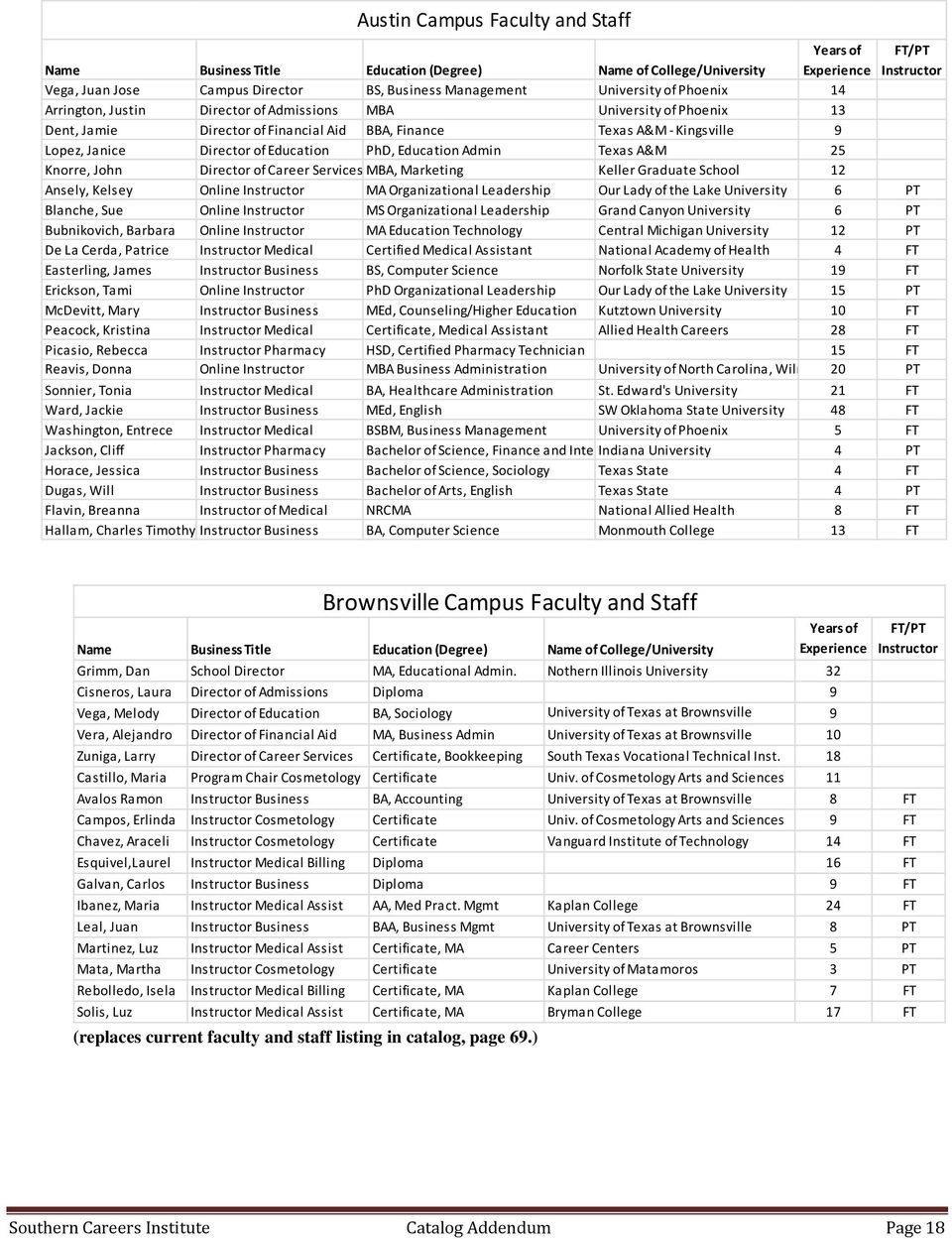
18 Austin Campus Faculty and Staff Name Business Title Education (Degree) Name of College/University Years of Experience FT/PT Instructor Vega, Juan Jose Campus Director BS, Business Management University of Phoenix 14 Arrington, Justin Director of Admissions MBA University of Phoenix 13 Dent, Jamie Director of Financial Aid BBA, Finance Texas A&M - Kingsville 9 Lopez, Janice Director of Education PhD, Education Admin Texas A&M 25 Knorre, John Director of Career Services MBA, Marketing Keller Graduate School 12 Ansely, Kelsey Online Instructor MA Organizational Leadership Our Lady of the Lake University 6 PT Blanche, Sue Online Instructor MS Organizational Leadership Grand Canyon University 6 PT Bubnikovich, Barbara Online Instructor MA Education Technology Central Michigan University 12 PT De La Cerda, Patrice Instructor Medical Certified Medical Assistant National Academy of Health 4 FT Easterling, James Instructor Business BS, Computer Science Norfolk State University 19 FT Erickson, Tami Online Instructor PhD Organizational Leadership Our Lady of the Lake University 15 PT McDevitt, Mary Instructor Business MEd, Counseling/Higher Education Kutztown University 10 FT Peacock, Kristina Instructor Medical Certificate, Medical Assistant Allied Health Careers 28 FT Picasio, Rebecca Instructor Pharmacy HSD, Certified Pharmacy Technician 15 FT Reavis, Donna Online Instructor MBA Business Administration University of North Carolina, Wilm 20 PT Sonnier, Tonia Instructor Medical BA, Healthcare Administration St. Edward's University 21 FT Ward, Jackie Instructor Business MEd, English SW Oklahoma State University 48 FT Washington, Entrece Instructor Medical BSBM, Business Management University of Phoenix 5 FT Jackson, Cliff Instructor Pharmacy Bachelor of Science, Finance and Inte Indiana University 4 PT Horace, Jessica Instructor Business Bachelor of Science, Sociology Texas State 4 FT Dugas, Will Instructor Business Bachelor of Arts, English Texas State 4 PT Flavin, Breanna Instructor of Medical NRCMA National Allied Health 8 FT Hallam, Charles Timothy Instructor Business BA, Computer Science Monmouth College 13 FT Brownsville Campus Faculty and Staff Name Business Title Education (Degree) Name of College/University (replaces current faculty and staff listing in catalog, page 69.) Years of Experience FT/PT Instructor Grimm, Dan School Director MA, Educational Admin. Nothern Illinois University 32 Cisneros, Laura Director of Admissions Diploma 9 Vega, Melody Director of Education BA, Sociology University of Texas at Brownsville 9 Vera, Alejandro Director of Financial Aid MA, Business Admin University of Texas at Brownsville 10 Zuniga, Larry Director of Career Services Certificate, Bookkeeping South Texas Vocational Technical Inst. 18 Castillo, Maria Program Chair Cosmetology Certificate Univ. of Cosmetology Arts and Sciences 11 Avalos Ramon Instructor Business BA, Accounting University of Texas at Brownsville 8 FT Campos, Erlinda Instructor Cosmetology Certificate Univ. of Cosmetology Arts and Sciences 9 FT Chavez, Araceli Instructor Cosmetology Certificate Vanguard Institute of Technology 14 FT Esquivel,Laurel Instructor Medical Billing Diploma 16 FT Galvan, Carlos Instructor Business Diploma 9 FT Ibanez, Maria Instructor Medical Assist AA, Med Pract. Mgmt Kaplan College 24 FT Leal, Juan Instructor Business BAA, Business Mgmt University of Texas at Brownsville 8 PT Martinez, Luz Instructor Medical Assist Certificate, MA Career Centers 5 PT Mata, Martha Instructor Cosmetology Certificate University of Matamoros 3 PT Rebolledo, Isela Instructor Medical Billing Certificate, MA Kaplan College 7 FT Solis, Luz Instructor Medical Assist Certificate, MA Bryman College 17 FT Southern Careers Institute Catalog Addendum Page 18
19 Corpus Christi Campus Faculty and Staff Name Business Title Education (Degree) Name of College/University Years of Experience FT/PT Instructor Ruszczyk, Lisa Campus Director BA, Sociology Southwest Texas State University 19 Gonzales, Erica Director of Admissions High School Diploma N/A 3 Fulton, Lynn Director of Career Services High School Diploma N/A 9 Turner, Jeff Director of Education MSM, Management Indiana Weslyan University 21 Behrens, Rebecca Director of Financial Aid High School Diploma N/A 5 Bunch, Margaret Instructor Business BS, Business Education Texas College 20 PT Canales, Rene Instructor Business MA, Secondary Education Mathematics Texas A&M University; Career Centers of Texa 5 FT Young, Patricia Instructor Business Administrative Assistant Certificate Southern Careers Institute 19 PT Cooper, James Allyn Instructor Business Accounting MBA, Business Administration California Coast University 26 FT Sanchez, Anita Instructor Business Accounting MBA, Business Administration University of the Incarnate Word 10 PT Howe, Judy Instructor General High School Diploma N/A 14 PT Hernandez, Guadalupe Instructor Medical Medical Assistant Certificate Southern Careers Institute 7 FT Sanchez, Gina Marie Instructor Medical AA, Health Care Management Ashworth College 9 FT Perez, Ena Instructor Medical Medical Assistant Certificate Kaplan Collge 5 PT Ruiz, Jody Instructor Medical Medical Assistant Certificate US Naval School of Health Science 10 PT Zamarano, Diana Instructor Medical Billing & Coding High School Diploma N/A 13 PT Barry, Mark Instructor Pharmacy Technician Pharmacy Technician Certificate University of Houston, College of Pharmacy 14 FT Sandoval, Vernon Instructor Pharmacy Technician BS, Biology; Pharmacy Technician Certifica Texas A&M University; Career Centers of Texa 9 PT Harlingen Campus Faculty and Staff Years of FT/PT Name Business Title Educational Credentials Name of College / University Experience Instructor Keyes, Angie School Director BS, Psychology/Sociology University of Texas-Edinburg 24 Garza, George Director of Education BBA, Finance University of Texas-Edinburg 21 Diaz, Walter Director of Financial Aid Certificate South Texas Vo Tech-Weslaco 30 Juarez, Dolores Director of Career Services AAS, Interdiscipinary Studies Kaplan University 30 Almendarez, Robert Instructor Business BA, Accounting University of Texas at San Antonio 43 FT Camacho, Marie T. Instructor Medical Certificate CBM Education Center 24 FT Cerda, Jesus Instructor Medical Certificate South Texas Vo Tech 8 PT Cruz, Lisa Instructor Medical Certificate Southern Careers Institute 7 FT Gomez, Ninfa Instructor Medical Certificate Pharr Vocational School 24 PT Garza, Ruben A. Instructor Business BA, Finance University of Texas-Brownsville 21 FT Ledesma, Rita Instructor Medical Certificate South Texas Vo Tech 13 FT Maganda, Aimee Instructor J1 BS, Math/Electrical Engineering University of Texas-Edinburg 5 PT Reyes, Juana Instructor Medical Certificate Texas State Technical Institute 15 PT Saldivar, Sandra Instructor Medical Certificate CBM Education Center 23 FT Sanchez, Juanita Instructor Medical Certificate South Texas Vo Tech 7 FT Scoggins, Deidre C. Instructor Business BS, Math & English University of Texas-Brownsville 12 FT Sias, Aida A. Instructor Medical Certificate South Texas Vo Tech 10 FT (replaces current faculty & staff listing in catalog, page 70.) Southern Careers Institute Catalog Addendum Page 19

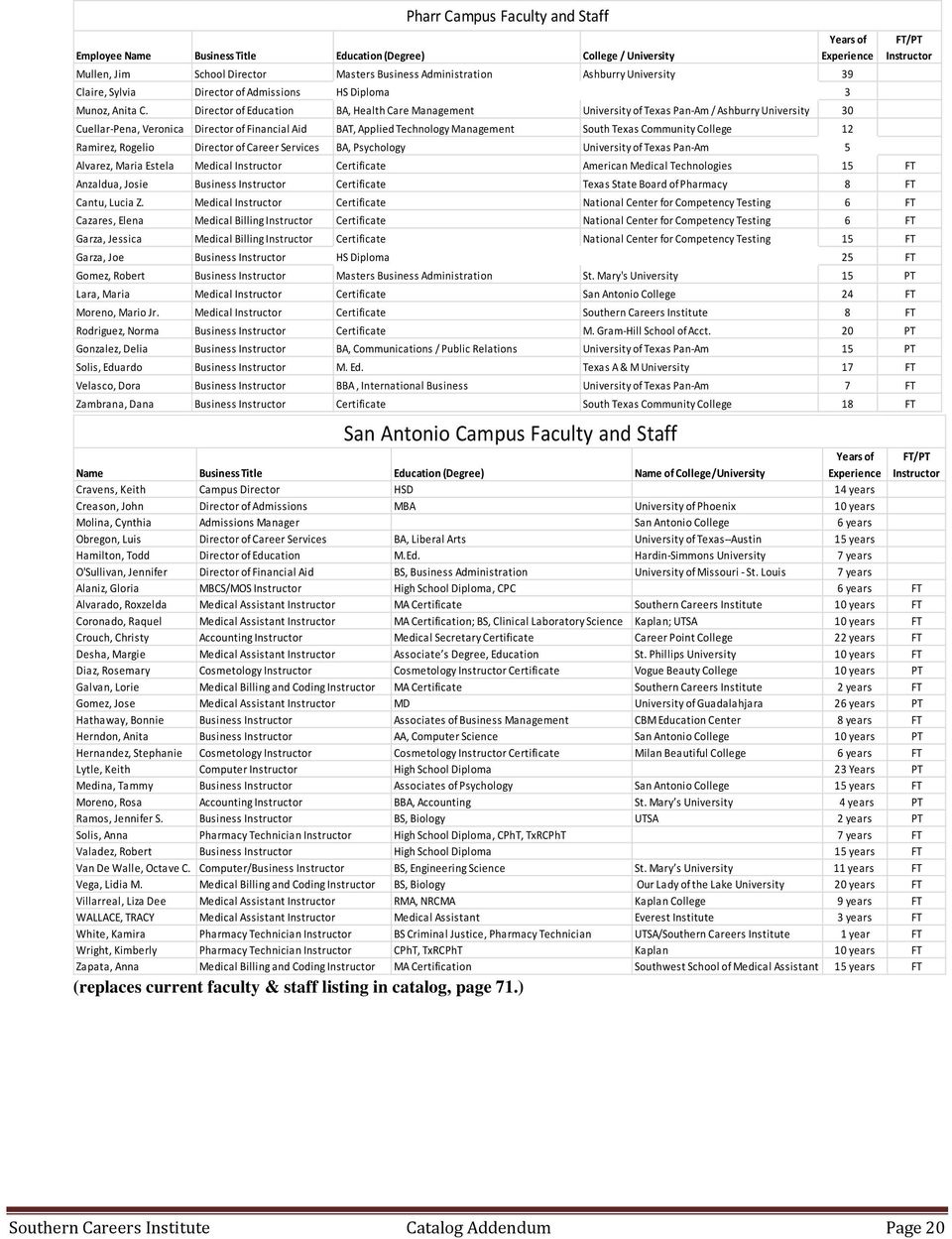
20 Pharr Campus Faculty and Staff Employee Name Business Title Education (Degree) College / University Mullen, Jim School Director Masters Business Administration Ashburry University 39 Claire, Sylvia Director of Admissions HS Diploma 3 Munoz, Anita C. Director of Education BA, Health Care Management University of Texas Pan-Am / Ashburry University 30 Cuellar-Pena, Veronica Director of Financial Aid BAT, Applied Technology Management South Texas Community College 12 Ramirez, Rogelio Director of Career Services BA, Psychology University of Texas Pan-Am 5 (replaces current faculty & staff listing in catalog, page 71.) Years of Experience Alvarez, Maria Estela Medical Instructor Certificate American Medical Technologies 15 FT Anzaldua, Josie Business Instructor Certificate Texas State Board of Pharmacy 8 FT Cantu, Lucia Z. Medical Instructor Certificate National Center for Competency Testing 6 FT Cazares, Elena Medical Billing Instructor Certificate National Center for Competency Testing 6 FT Garza, Jessica Medical Billing Instructor Certificate National Center for Competency Testing 15 FT Garza, Joe Business Instructor HS Diploma 25 FT Gomez, Robert Business Instructor Masters Business Administration St. Mary's University 15 PT Lara, Maria Medical Instructor Certificate San Antonio College 24 FT Moreno, Mario Jr. Medical Instructor Certificate Southern Careers Institute 8 FT Rodriguez, Norma Business Instructor Certificate M. Gram-Hill School of Acct. 20 PT Gonzalez, Delia Business Instructor BA, Communications / Public Relations University of Texas Pan-Am 15 PT Solis, Eduardo Business Instructor M. Ed. Texas A & M University 17 FT Velasco, Dora Business Instructor BBA, International Business University of Texas Pan-Am 7 FT Zambrana, Dana Business Instructor Certificate South Texas Community College 18 FT San Antonio Campus Faculty and Staff FT/PT Instructor Name Business Title Education (Degree) Name of College/University Years of Experience FT/PT Instructor Cravens, Keith Campus Director HSD 14 years Creason, John Director of Admissions MBA University of Phoenix 10 years Molina, Cynthia Admissions Manager San Antonio College 6 years Obregon, Luis Director of Career Services BA, Liberal Arts University of Texas--Austin 15 years Hamilton, Todd Director of Education M.Ed. Hardin-Simmons University 7 years O'Sullivan, Jennifer Director of Financial Aid BS, Business Administration University of Missouri - St. Louis 7 years Alaniz, Gloria MBCS/MOS Instructor High School Diploma, CPC 6 years FT Alvarado, Roxzelda Medical Assistant Instructor MA Certificate Southern Careers Institute 10 years FT Coronado, Raquel Medical Assistant Instructor MA Certification; BS, Clinical Laboratory Science Kaplan; UTSA 10 years FT Crouch, Christy Accounting Instructor Medical Secretary Certificate Career Point College 22 years FT Desha, Margie Medical Assistant Instructor Associate s Degree, Education St. Phillips University 10 years FT Diaz, Rosemary Cosmetology Instructor Cosmetology Instructor Certificate Vogue Beauty College 10 years PT Galvan, Lorie Medical Billing and Coding Instructor MA Certificate Southern Careers Institute 2 years FT Gomez, Jose Medical Assistant Instructor MD University of Guadalahjara 26 years PT Hathaway, Bonnie Business Instructor Associates of Business Management CBM Education Center 8 years FT Herndon, Anita Business Instructor AA, Computer Science San Antonio College 10 years PT Hernandez, Stephanie Cosmetology Instructor Cosmetology Instructor Certificate Milan Beautiful College 6 years FT Lytle, Keith Computer Instructor High School Diploma 23 Years PT Medina, Tammy Business Instructor Associates of Psychology San Antonio College 15 years FT Moreno, Rosa Accounting Instructor BBA, Accounting St. Mary s University 4 years PT Ramos, Jennifer S. Business Instructor BS, Biology UTSA 2 years PT Solis, Anna Pharmacy Technician Instructor High School Diploma, CPhT, TxRCPhT 7 years FT Valadez, Robert Business Instructor High School Diploma 15 years FT Van De Walle, Octave C. Computer/Business Instructor BS, Engineering Science St. Mary s University 11 years FT Vega, Lidia M. Medical Billing and Coding Instructor BS, Biology Our Lady of the Lake University 20 years FT Villarreal, Liza Dee Medical Assistant Instructor RMA, NRCMA Kaplan College 9 years FT WALLACE, TRACY Medical Assistant Instructor Medical Assistant Everest Institute 3 years FT White, Kamira Pharmacy Technician Instructor BS Criminal Justice, Pharmacy Technician UTSA/Southern Careers Institute 1 year FT Wright, Kimberly Pharmacy Technician Instructor CPhT, TxRCPhT Kaplan 10 years FT Zapata, Anna Medical Billing and Coding Instructor MA Certification Southwest School of Medical Assistant 15 years FT Southern Careers Institute Catalog Addendum Page 20
21 San Antonio South Faculty and Staff Name Business Title Education (Degree) Name of College/University Years of Experience FT/PT Instructor Dominisac, Dan Campus Director MBA, Human Resource Management Strayer University 12 Mays, Tiffani Director of Career Services Certification,Medical Assistant Allied Health Careers 15 Torrez, Sandra Director of Education MA, English Texas A&M University Kingsville 12 O'Sullivan, Jennifer Director of Financial Aid BS, Business Administration University of Missouri-St. Louis 6 Noriega, Annette Admissions Management BS Management University of Phoenix 8 Branaman, TY HVAC - Program Director HVAC Certificate Ashworth CC, Enviromental Agency, Texas Dept of License and Regulations 14 FT Lopez, Gloria Instructor BS, Management, MA Certificate Our Lady of the Lake University, Southwest School of Medical Assisting 18 PT Fournier, Nancy Instructor Billing & Coding BA, Sociology Austin College 13 PT MORENO, ANGEL Instructor Billing & Coding AAS, Information Technology St. Phillips College 7 PT Evans, Norma Instructor Business MBA, Management Northwood University 22 FT Henry, Mary Ann Instructor Business Bachelor of Business University of Central University 5 FT Reed, Chloe Instructor Business MBA, Strategic Business Management Davenport University 3 PT Rodriguez, Michael Instructor Business MBA in Accounting/Finance Our Lady of the Lake University 4 PT Carrico, Jason Instructor HVAC HVAC Certificate EPA Certification, State of Texas 10 PT LORCH, STEVEN EARL Instructor HVAC HVAC Certificate EPA Certification, Electrical License, State of Texas 32 PT Ontiveros, Andrew Instructor HVAC HVAC Certificate Everest Institution, ARI, NCI, and TDLR 5 PT Perez, Francisco Instructor HVAC MBA, HVAC Certificate University Of Phoenix, Mansfield Technical 14 PT Phillips, Jason Instructor HVAC Universal EPA Cert, Class B Enviromental HVAC License Texas A&M University, State of Texas 12 FT Wilkerson, Marvyn Instructor HVAC AAS, Business Management, HVAC-EPA Certificate Borough of Manhattan CC, Apex Technical School 10 PT Camacho Morin, Susan Instructor Medical Certificate, Medical Assistant Stratford Carerrs 18 FT Montez, Sonia Instructor Medical MA Certificate Southwest School of Medical Assisting 7 PT Moreno, Linda Instructor Medical MD in Medicince, BS Biology University of Puerto Rico 18 PT Parker, Rochelle Instructor Medical Medical Assistant Cert, Phlebotomy Cert PolyTechnical Medical Institute 9 FT PATRICK, CHARVETTE Instructor Medical License, Paramedic SAC 14 PT Romero, Stephanie Instructor Medical Certificate, Medical Assistant Allied Health Schools 13 FT Desoto, Mary Instructor Pharmacy Certificate, Pharmacy Technician Texas State Registration 5 PT Perry, Marcy Instructor Pharmacy MS in Ed, BS in Biology, PT Cert Ohio State U, Ohio Dominican U 20 PT San Miguel, Zina Instructor Pharmacy Certificate, Pharmacy Technician Texas State Registration, PTCB 12 FT Young, Sharonda Instructor Pharmacy Certificate, Pharmacy Technician National Institute of Technology 5 FT Paz, Veronica Registrar MBA, General Business University of the Incarnate Word 6 FT (replaces current faculty & staff listing in catalog, page 72.) Southern Careers Institute Catalog Addendum Page 21
22 The information contained in this catalog is true and correct to the best of my knowledge. Rafael Castaneda Campus Director Austin Dan Grimm Campus Director Brownsville Open Position Campus Director Corpus Christi Dan Dominisac Campus Director San Antonio North Campus Location Angie Keyes Campus Director Harlingen Jim Mullen Campus Director Pharr Kevin Puls Campus Director San Antonio South Campus Location Southern Careers Institute Catalog Addendum Page 22
23 Table of Contents SOUTHERN CAREERS INSTITUTE LOCATIONS... 2 ACCREDITATIONS, LICENSES, AND APPROVALS... 5 HISTORY OF SOUTHERN CAREERS INSTITUTE... 6 OWNERSHIP... 6 CAREER-FOCUSED CURRICULUM... 6 MISSION STATEMENT... 6 FACILITIES AND EQUIPMENT... 7 Admissions Process and Entrance Requirements... 8 Criminal Conviction Policy... 8 English Proficiency... 8 Non-Discrimination... 9 Applicants in the Pharmacy Technician Program Admissions Procedures Online Orientation CLASS SCHEDULES AND HOLIDAYS TUITION BY PROGRAM STUDENT FINANCIAL AID PROGRAMS Institutional Scholarships and Grants Reverse Start Policy EDUCATION Withdrawals Reentries Military Leave of Absence Academic Advising Grading Scale Satisfactory Academic Progress Policy EXTERNSHIPS GRADUATION REQUIREMENTS CAREER SERVICES STUDENT SERVICES Student Housing Student Guidance Tutoring PROFESSIONAL CONDUCT AND DRESS CODE ACADEMIC MISCONDUCT POLICY GRIEVANCES OR COMPLAINTS Grade Grievances Other Grievances General NOTIFICATIONS AND OTHER INFORMATION Class Size School Policies Responsibility for Personal Property Catalog Addendum Statement of Non-Discrimination Reasonable Accommodations Policy Individuals with Disabilities Notification of Rights under FERPA with Respect to Student Records PROGRAMS OF STUDY Administrative Assistant Business Accounting Specialist HVAC Medical Assistant Medical Billing & Coding Specialist Medical Office Specialist Pharmacy Technician COURSE DESCRIPTIONS
24 SOUTHERN CAREERS INSTITUTE LOCATIONS Southern Careers Institute, Inc. (TWC# S0470) 2301 South Congress Avenue, Suite 27, Austin, Texas Phone (512) Fax (512) Branch Campus Locations Southern Careers Institute, Inc. - Brownsville (TWC# S3380) 1424 W. Price Road, Suite K, Brownsville, Texas Phone (956) Fax (956) Southern Careers Institute - Corpus Christi, Inc. (TWC# S0640) 2422 Airline Road, Corpus Christi, Texas Phone (361) Fax (361) Southern Careers Institute (TWC# S4333) 6963 NW Loop 410, San Antonio, Texas Phone (210) Fax (210) (North Campus Location) Southern Careers Institute, Inc. - Harlingen (TWC# S3379) 603 Ed Carey Drive, Harlingen, Texas Phone (956) Fax (956) Southern Careers Institute South Texas, Inc. (TWC# S0630) 1500 North Jackson Road, Pharr, Texas Phone (956) Fax (956) Southern Careers Institute #1, Inc. (TWC# S0708) 238 SW Military Drive, Suite 101, San Antonio, Texas Phone (210) Fax (210) (South Campus Location) Corporate Office 1701 Directors Boulevard, Suite 800, Austin, Texas Phone: (512) Fax (512) Catalog Publication Date: December 26, 2013 Volume Number: Effective Date: December 26,
25 Approved and Regulated by the Texas Workforce Commission, Career Schools and Colleges, Austin, Texas Southern Careers Institute reserves the right to modify, upon approval of the Texas Workforce Commission and the Commission on Occupational Education, the offering of programs, individual courses of study, tuition, hours of classes, the school calendar, and other materials listed in the publication or herein attached or inserted. The information contained in this catalog is true and correct to the best of my knowledge. Joe Vega Campus Director Austin Dan Grimm Campus Director Brownsville Lisa Ruszczyk Campus Director Corpus Christi Dan Dominisac Campus Director San Antonio North Campus Location Angie Keyes Campus Director Harlingen Jim Mullen Campus Director Pharr Kevin Puls Campus Director San Antonio South Campus Location 3
26 ADMINISTRATIVE AND CAMPUS OPERATIONS Corporate Officers Jacob Mayhew Chief Executive Officer Rachel Lang Chief Financial Officer Matthew Hawes Chief Operations Officer Tami Erickson, PhD Executive Director of Education & Compliance Sandy Vann Vice President of Career Services Susan Blanche Vice President of Human Recourses Hunter Mefford Executive Director of Marketing and Analytics John Richardson Director, Information Technology 4
27 ACCREDITATIONS, LICENSES, AND APPROVALS The Commission of the Council on Occupational Education accredits Southern Careers Institutes. Council on Occupational Education 7840 Roswell Road, Building 300, Suite #325 Atlanta, Georgia Phone (770) Toll Free (800) Southern Careers Institute locations are approved by the Texas Workforce Commission, Career Schools and Colleges: Texas Workforce Commission, Career Schools and Colleges 101 East 15 th Street, Rm. 226T Austin, Texas Phone (512) Southern Careers Institute locations are approved by the Texas Veterans Commission to train eligible veterans. 5
28 HISTORY OF SOUTHERN CAREERS INSTITUTE Southern Careers Institute (SCI) was founded in The Institute received its initial accreditation from the Commission on Occupational Education, a nationally United States Department of Education recognized accrediting agency, in SCI Austin expanded to its present facilities in The school added medical and business programs to its curriculum in 1992 and added pharmacy in The expansion of the company evolved as follows: The Pharr (South Texas) branch campus was opened in May of The Corpus Christi branch campus was opened in August of The San Antonio campus was opened in The Brownsville, Harlingen and Corpus Christi 2 campuses were added in November of In 2009, SCI was acquired by SCI Acquisition Company, Inc. The San Antonio North campus was opened in OWNERSHIP The ownership of SCI is SCI Acquisition Company, Inc., which is wholly owned by Tall Oak Learning, LLC. CAREER-FOCUSED CURRICULUM SCI offers a Diploma in the following career fields. Administrative Assistant Business Accounting Specialist Medical Assistant HVAC Medical Billing and Coding Specialist Medical Office Specialist Pharmacy Technician MISSION STATEMENT Our mission is to ensure the long-term success of our students by delivering employer tailored programs that result in an increasing demand for Southern Careers Institute graduates. SCI is dedicated to accomplishing its Mission Statement through the following objectives: 1. Laser Focus on Student Value Through Efficient Delivery 2. Superior Student Experience 3. Strategic Employer Partnerships 6
29 FACILITIES AND EQUIPMENT Austin Campus The campus occupies approximately 19,985 square feet and has spacious, well-designed facilities consisting of classrooms, laboratories, administrative offices, break areas for students and employees, a learning resource center and restrooms. SCI provides an environment suited to the students needs, offering ample room to learn, gain experience, and promote growth. SCI maintains the necessary equipment and supplies required to teach each program. Adequate student parking is also available. Brownsville Campus The campus occupies approximately 19,902 square feet and has spacious, well-designed facilities consisting of classrooms, laboratories, administrative offices, break areas for students and employees, a learning resource center and restrooms. SCI provides an environment suited to the students needs, offering ample room to learn, gain experience, and promote growth. SCI maintains the necessary equipment and supplies required to teach each program. Adequate student parking is also available. Corpus Christi Campus The campus occupies approximately 19,000 square feet and has spacious, well-designed facilities consisting of classrooms, laboratories, administrative offices, break areas for students and employees, a learning resource center and restrooms. SCI provides an environment suited to the students needs, offering ample room to learn, gain experience, and promote growth. SCI maintains the necessary equipment and supplies required to teach each program. Adequate student parking is also available. San Antonio (North Campus) The campus occupies approximately 34,000 square feet and has spacious, well-designed facilities consisting of classrooms, laboratories, administrative offices, break areas for students and employees, a learning resource center and restrooms. SCI provides an environment suited to the students needs, offering ample room to learn, gain experience, and promote growth. SCI maintains the necessary equipment and supplies required to teach each program. Adequate student parking is also available. Harlingen Campus The campus occupies approximately 15,000 square feet and has spacious, well-designed facilities consisting of classrooms, laboratories, administrative offices, break areas for students and employees, a learning resource center and restrooms. SCI provides an environment suited to the students needs, offering ample room to learn, gain experience, and promote growth. SCI maintains the necessary equipment and supplies required to teach each program. Adequate student parking is also available. Pharr Campus The campus occupies approximately 19,000 square feet and has spacious, well-designed facilities consisting of classrooms, laboratories, administrative offices, break areas for students and employees, a learning resource center and restrooms. SCI provides an environment suited to the students needs, offering ample room to learn, gain experience, and promote growth. SCI maintains the necessary equipment and supplies required to teach each program. Adequate student parking is also available. San Antonio (South Campus) The campus occupies approximately 28,931 square feet and has spacious, well-designed facilities consisting of classrooms, laboratories, administrative offices, break areas for students and employees, a learning resource center and restrooms. SCI provides an environment suited to the students needs, offering ample room to learn, gain experience, and promote growth. SCI maintains the necessary equipment and supplies required to teach each program. Adequate student parking is also available. 7
30 CHANGES IN CATALOG INFORMATION This is an official document publishing the policies, procedures, and regulations of SCI. Each student is responsible for knowing and complying with the information contained in this publication. To view a complete list of disclosures and consumer information please visit ADMISSIONS Admissions Process and Entrance Requirements Admission to SCI requires that applicants complete the following process prior to the students start date: Interview with an Admissions Representative Tour the campus Provide proof of high school graduation or General Equivalency Diploma (GED) Complete an enrollment agreement May be required to complete and pass a Background Check* *Criminal Conviction Policy In an effort to maintain a safe educational and working environment for students and staff, SCI does not accept applicants who are known to have certain types of criminal convictions in their backgrounds. Admitted students who are discovered to have misrepresented their criminal conviction history to SCI are subject to immediate dismissal. Similarly, students who commit certain types of crimes while enrolled are subject to immediate dismissal. As such, students convicted of any criminal offense while enrolled must report that conviction to the school within ten (10) days of receiving the conviction. Students who fail to report a criminal conviction while enrolled are subject to immediate dismissal. SCI reserve the right to conduct criminal background checks on applicants and students in circumstances deemed appropriate. English Proficiency SCI does not provide English-as-a-second language instruction. Students are required to speak English in classes that are taught in English. Students whose native language is not English are required to provide proof of English proficiency by one of the following: Test of English as a Foreign Language (TOEFL) with an Internet-Based Test (ibt) score of 61 or higher, Paper-Based Test score of 500 or higher, or Computer- Based Test (CBT) score of 173 Advance Placement International English Language (APIEL) with a score of 173 or higher International English Language Testing System (IELTS) with a level of 6 or higher A grade of C or better in an intermediate ESL course Graduation from an English-speaking secondary institution Evidence of having completed 12 semester hours or 18 quarter hours with at least a C (70%) average at a postsecondary institution in which English was the language of instruction Or other appropriate method of providing English proficiency as determined by the Campus Director. 8
31 Students or Graduates who have been previously enrolled in a SCI Spanish program who chose to transfer to a non-spanish program will need to meet the English Proficiency requirements. Applicants must be at least 16 years of age. Any applicant, who has not reached the age of 18 at the time of the admissions process, must provide proof of a high school diploma or GED and have written permission from a parent or legal guardian. Non-Discrimination The school admits students without regard to race, gender, sexual orientation, religion, creed, color, national origin, ancestry, marital status, age, disability, or any other factor prohibited by law. SCI reserves the right to deny admission to any person for any nondiscriminatory reason. Applicants are notified promptly of their admission status. The Medical Billing and Coding Specialist program is offered in both an on-ground and online (herein known as Distance Education ) format. Students wishing to enroll in the Medical Billing and Coding Specialist on-line program must meet the Southern Careers Institute Enrollment Process and Entrance Requirements as well as the following Technology/Resource Requirements: Technology/Resource Requirements: Students are required to have access to a computer and the Internet on a daily basis. Students must also possess the ability to use a computer, access s, use a web browser (Internet Explorer, Firefox, Google Chrome, or Safari), and use the Moodle course management system. Students must also have word processing software such as Microsoft Word or OpenOffice or a process that will allow you to format in APA format and save to a PDF for submission to your instructor. In addition to textbooks, workbooks, lab manuals or other required materials, classes may utilize sources from the library. Your instructor will provide specific information on resources that will be utilized/required in class to support content and aid in research. Students enrolled in an online learning environment will be introduced to acceptable standards of behavior regarding dialog postings, plagiarism, netiquette (online etiquette) and attendance. See additional information listed under student Rule of Conduct section. Courses that utilize an original researched component will have students submit their documents to the TurnItIn website ( for originality checking, in compliance with the schools honor code. Your instructor will provide detail information on how and where to submit your documents. **This is not intended to be a comprehensive list and additional items/supplies/equipment may be provided to the student as part of their program fees, or information provided on how to obtain the required items. Students Enrolled in the Medical Billing and Coding Specialist Distance Education program are expected to follow all Southern Career Institute Policies and Procedures as outlined in the Institutional Catalog and Individual class syllabus. 9
32 Applicants in the Pharmacy Technician Program Applicants who intend to enroll in the Pharmacy Technician program must possess a high school diploma or GED at the time of enrollment. In order to be eligible for approval of externship in a retail or hospital pharmacy, students must be registered with the Texas State Board of Pharmacy as a Pharmacy Technician Trainee. Registration as a trainee requires: 1. Completion of an online application, including payment of a non-refundable fee of $53.00; and 2. Completion of a fingerprint session including a non-refundable fee of approximately $ These fees are part of the student tuition total, and students withdrawing from the Pharmacy Technician program that have submitted applications and completed a fingerprint session will be required to pay these fees. Registration may take up to six (6) months to complete; therefore, pharmacy technician students are required to complete the application and fingerprinting process during their first three-week term. Background checks may be conducted and students who have felony convictions will not be approved for admission. Additionally, the pharmacy board also closely scrutinizes certain types of misdemeanors, which may result in denial of registration or additional requirements by the board. Admissions Procedures After satisfying the admissions requirements, students will complete necessary paperwork, including Enrollment Agreement (to be signed by parent or guardian if the student is a minor), and make satisfactory financial arrangements. STUDENT ORIENTATION Prior to beginning courses at SCI, new students have the opportunity to attend an orientation program. Orientation facilitates a successful transition into SCI. New students are encouraged to attend regardless of their prior college experience. At orientation, students are acquainted with the campus, introduce to campus policies and procedures and to the administrative staff, the faculty and their peers. The directors of the administrative departments explain the ways in which they assist students and clarify students rights and responsibilities. Online Class Orientation Online orientation is provided for students who are registered for courses that are delivered via distance education. Online orientation classes are presided over by the campus Director of Education and provide students with the necessary skills to be successful online learners. Students in online classes must successfully pass the required online orientation class prior to gaining access to any online courses. Students are awarded P (pass) or F (fail) grades that do not affect the student s grade point average. 10
33 CLASS SCHEDULES AND HOLIDAYS Normal business hours of operation are Monday through Friday, 8:00 am to 5:00 pm. Class days and times are subject to change at the discretion of the Campus Director. The school may be closed to avoid extreme weather. Under this condition, make-up time may be scheduled on Fridays and/or Saturdays. See seminar section for appropriate class schedules. Allied Health and Business Programs Morning Programs Afternoon Programs Evening Programs Monday Thursday 8:00 am - 9:00 am Class 12:50 pm - 1:50 pm Class 6:00 pm - 7:00 pm Class 9:00 am - 9:10 am Break 1:50 pm - 2:00 pm Break 7:00 pm - 7:10 pm Break 9:10 am - 10:00 am Class 2:00 pm - 2:50 pm Class 7:10 pm - 8:00 pm Class 10:00 am - 10:10 am Break 2:50 pm - 3:00 pm Break 8:00 pm - 8:10 pm Break 10:10 am - 11:10 am Class 3:20 pm - 4:20 pm Class 8:10 pm - 9:00 pm Class 11:10 am - 11:20 am Break 4:20 pm - 4:30 pm Break 9:00 pm - 9:10 pm Break 11:20 am - 12:20 pm Class 4:30 pm - 5:30 pm Class 9:10 pm - 10:10 pm Class 12:20 pm - 12:50 pm Lunch Break 5:30-6:00 pm Dinner Break 10:10 pm - 10:20 pm Break 12:50 pm - 1:50 pm Class 6:00 pm - 7:00 pm Class 1:50 pm - 2:00 pm Break 7:00 pm - 7:10 pm Break 2:00 pm - 2:50 pm Class 7:10 pm - 8:00 pm Class 2:50 pm - 3:00 pm Break 8:00 pm - 8:10 pm Break HVAC Programs Morning Program Evening Program Monday Thursday Monday - Friday 8:00 am - 9:00 am Class 6:00 pm - 7:00 pm Class 9:00 am - 9:10 am Break 7:00 pm - 7:10 pm Break 9:10 am - 10:00 am Class 7:10 pm - 8:00 pm Class 10:00 am - 10:10 am Break 8:00 pm - 8:10 pm Break 10:10 am - 11:00 am Class 8:10 pm - 9:00 pm Class 11:00 am - 11:10 am Break 9:00 pm - 9:10 pm Break 11:10 am - 12:10 pm Class 9:10 pm - 10:10 pm Class 12:10 pm - 12:20 pm Break 10:10pm - 10:20 pm Break 12:50 pm - 1:50 pm Class 1:50 pm - 2:00 pm Break 2:00 pm 3:00 pm Class 11
34 2014Term and Holiday Calendar 2014 Term Calendar Allied Health, Business, HVAC Days Term Start Date Term End Date Holiday Start End 1/20/2014 2/9/2014 President s Day 2/17/2014 2/10/2014 3/2/2014 Spring Break 3/10/2014 3/14/2014 3/3/2014 3/30/2014 Good Friday 4/18/2014 3/31/2014 4/20/2014 Memorial Day 5/26/2014 4/21/2014 5/11/2014 Independence Day 7/4/2014 5/12/2014 6/1/2014 Labor Day 9/1/2014 6/2/2014 6/22/2014 Thanksgiving 11/27/ /28/2014 6/23/2014 7/13/2014 Winter Break 12/22/2014 1/3/2015 7/14/2014 8/3/2014 8/4/2014 8/24/2014 8/25/2014 9/14/2014 9/15/ /5/ /6/ /26/ /27/ /16/ /17/ /7/ /8/2014 1/11/ Term Calendar HVAC evening Program Term Start Date Term End Date 2/13/2014 4/20/2014 4/21/2014 6/16/2014 6/17/2014 8/12/2014 8/13/ /8/ /9/ /7/ /8/2014 2/13/
35 TUITION BY PROGRAM With the exception of the Registration fee, Books, Uniforms and Fees are included in the cost of tuition* Administrative Assistant Business Accounting Specialist Costs Registration $50.00 Costs Registration $50.00 Tuition $13, Tuition $15, Total Cost $13, Total Cost $16, Medical Assistant** Medical Billing And Coding Specialist** Costs Registration $50.00 Costs Registration $50.00 Tuition $18, Tuition $16, Total Cost $18, Total Cost $16, Medical Office Specialist Pharmacy Technician** Costs Registration $50.00 Costs Registration $50.00 Tuition $15, Tuition $16, Total Cost $15, Total Cost $16, HVAC Costs Registration $50.00 Tuition $19,925 Total Cost $19,975 *Registration fee is one time only. One set of books (new, used or classroom resource) and 2 set of uniforms are included in the tuition. **These programs include first-time registration for licensure or certification testing. Other Charges Replacement Student ID $5.00 Replacement Diploma $5.00 Additional or Replacement Uniforms Scrubs (XXS XL) $16.00 Scrubs (2XL 4XL) $16.50 Polo Shirts $12.75 TSBP PT Trainee Registration $53.00 PT Fingerprint session $45.00 Official Transcripts First one is free $2.00 there after 13
36 STUDENT FINANCIAL AID PROGRAMS Financial assistance is generally a combination of grants and loans which supplement the student s contribution toward training. As an accredited post-secondary institution, SCI has various federal financial assistance programs available to qualified students. These programs exist to assist students in paying for educational expenses. SCI will assist students in developing financial plans to pay for their education through a combination of student/family contributions, financial aid, if eligible, and finance plans. Eligibility for financial assistance is determined by Financial Aid office personnel, who are trained in using standard, federally-approved method of needs analysis. Students will be interviewed individually to determine a financial arrangement that suits their needs and personal situation, and which meets the requirements of the school. Students may be required to make monthly payments while attending school. Payment amounts are based upon the program in which the student is enrolled and the amount of financial aid the student may be receiving. Failure to keep all payments current may result in termination. Applying For Student Financial Assistance All students applying for financial assistance must have a personal interview with a member of the Financial Aid office staff. During this interview process, the staff member can provide guidance on the process of completing a Free Application for Federal Student Aid (FAFSA) and any other forms necessary to determine eligibility and apply for financial assistance. It is the student s responsibility to provide any requested documents in order to verify eligibility and process the application in a timely manner. Federal Pell Grant The Federal Pell Grant is a grant to students who qualify under the financial need guidelines. Application is made through the Free Application for Federal Student Aid. (FAFSA) Federal Supplemental Educational Opportunity Grant (FSEOG) The Federal SEOG is a grant that the school distributes to students based on financial need and the availability of funds. Application is made through the Free Application for Federal Student Aid (FAFSA). Federal Direct Loan (Subsidized and Unsubsidized) The Federal Direct Loan is a low-interest rate loan provided by the Federal Government. The amount is determined according to financial need. Applications for the Federal Direct Loan Program are available in the Financial Aid Office. Federal PLUS Loan The Federal PLUS Loan is a low interest rate loan available for the parents of dependent, undergraduate students enrolled at least half time. Applications are available in the Financial Aid Office. 14
37 Institutional Scholarships and Grants High School Best Scholarship SCI offers High School Best Scholarship to first time students who enroll and attended an SCI campus within six (6) months of their high school graduation date and have a GPA of 3.5 or higher. Students must have exhausted all federal and state funding and have an outstanding tuition balance. Each year, students at each applicable campus will be offered up to $3,000 scholarships for their first academic year. Students will be considered for the High School Best Scholarship once they have completed the admissions application process, have a valid Free Application for Federal Student Aid (FAFSA) on file, and have submitted the High School Best Scholarship application and submitted their high school diploma. Applications are due by each start date; awards will be based on financial need as well as academic achievement. Scholarship recipients must continue to satisfy the school s stated Standards of Academic Progress (SAP) as defined in the school s catalog and maintain a GPA of 70 to remain eligible for the scholarship. Scholarship applications will be evaluated as they are received. The High School Best Scholarship is not available for the Cosmetology Program or Seminar Courses. Once the maximum dollar amount of scholarship funds is awarded no additional scholarships will be granted for the remainder of the year. For 2014, a maximum of $420,000 in scholarship funding will be awarded in High School Best Scholarships. Three Weeks to Success Completion Grant SCI offers a Three Weeks to Success Completion Grant to first time students who have successfully completed the Three Weeks to Success Course. Students must have exhausted all federal and state funding and have an outstanding tuition balance. Each start date, a number of students at each applicable institution will be offered up to $2,000 grant for their first academic year based on the student s institutional funding. Students will be considered for the Three Weeks to Success Completion Grant once they have completed the admissions application process, have a valid Free Application for Federal Student Aid (FAFSA) on file, and have submitted the Three Weeks to Success Completion Grant application, completed the Three Weeks to Success course and submitted their high school diploma. Applications are due by the start date; awards will be based on financial need as well as academic achievement. Grant recipients must continue to satisfy the school s stated Standards of Academic Progress (SAP) as defined in the school s catalog and maintain a GPA of 70 to remain eligible for the grant. Grant applications will be evaluated as they are received. The Three Weeks to Success Completion Grant is not available for the Cosmetology Program or Seminar Courses. Once the maximum number of grants is awarded for the start and/or for the year, no additional grants will be awarded for that start or year. For 2014, a maximum of 10 first-year grants per start at each applicable campus will be awarded totaling $2,240,000 in Three Weeks to Success Completion Grants. Re-Enter Grant SCI is committed to helping our students meet their educational and professional goals. The Re- Enter Grant program was established to provide tuition assistance to former SCI students interested in returning to school to complete their program of study. The Re-Enter Grant program is limited to students in a certificate program who started prior to July 1, 2013, but did not graduate from the program. In order to qualify for the Re-Enter Grant, the student must have completed at least 50% of the program s contact/clock hours prior to withdrawal and be in good academic standing. Additionally, students must re-enter into the institution within 180 days from 15
38 their withdrawal date. Students are eligible for the lesser of $1,000 or the remaining direct costs of their program. Students will be considered for the grant upon completion of the application for all federal, state, and private financial aid, grants and/or scholarships. The Re-entry grant may only be used once. The following certificate programs are included in the Re-Enter Grant program: Medical Assistant, Medical Billing and Coding Specialist, Pharmacy Technician, Medical Office Specialist, Administrative Assistant and Business Accounting Specialist. The Re- Enter Grant is not available for the Cosmetology Program or Seminar Courses. In order to apply, the student must complete the appropriate grant application prior to returning to class. Grant recipients must continue to satisfy the school s stated Standards of Academic Progress (SAP) as defined in the school s catalog and maintain a GPA of 70 to remain eligible for the grant. All applications will be reviewed by the Grant Selection Committee and students will be notified of the Committee s decision. Additional information can be obtained from the school s Financial Services Office. Once the maximum number of grants is awarded for the start and/or for the year, no additional grants will be awarded for that start or year. For 2014, a maximum of $640,000 in Re-Entry Grants will be awarded. Sponsors Grant If requested, SCI will match sponsor s contribution with an additional grant to a student who is sponsored by another organization. After the Pell grant is applied to cost of program, SCI will match up to the sponsor s contribution which is not to exceed cost of program. If the student is not eligible for a Pell grant the institution will match half (½) of the sponsor s contribution up to cost of program. Any portion of the program cost which is not covered by grants, sponsor, and scholarship will be paid by the student while in school. Alternative Financing For those students who qualify, alternative financing is available through several financing companies. The Financial Aid Office will assist students in tailoring payment plans to fit their individual needs. Co-signers may be necessary, depending upon credit history. Veterans Veteran benefits are available for those who are eligible. SCI is approved for GI Bill Chapters 30, 31, 32, 33, 35, 1606, 1607, and VRAP tuition payments from the US Department of Veterans Affairs. Social Security Benefits Eligible students may obtain Social Security benefits. For more information see the Financial Aid Office. REFUND POLICY Reverse Start Policy A 21 day reverse start may be applied to students enrolling at SCI for the first time. If at any time during the first 21 day period the student decides to discontinue enrollment, or fails to confirm intent to continue enrollment by attending any class on calendar day 22 or beyond, he or she may do so without incurring any tuition-related expense or Federal Student Loan debt. If the student confirms intent to continue enrollment by attending any class within or beyond the 21 day period, he or she may be subject to all tuition charges as outlined in this Agreement. On calendar day 22 or beyond, pursuant to , the minimum refund of the remaining tuition 16
39 and fees will be the pro rata portion of tuition, fees, and other charges that the number of hours remaining in the portion of the course or program for which the student has been charged after the effective date of termination bears to the total number of hours in the portion of the course or program for which the student has been charged, except that a student may not collect a refund if the student has completed 75 percent or more of the total number of hours in the portion of the program for which the student has been charged on the effective date of termination. Cancellation Policy A full refund will be made to any student who cancels the enrollment contract within 72 hours (until midnight of the third day excluding Saturdays, Sundays and legal holidays) after the enrollment contract is signed. A full refund will also be made to any student who cancels enrollment within the student s first three scheduled class days, except that the school may retain not more than $100 in any administrative fees charged, as well as items of extra expense that are necessary for the portion of the program attended and stated separately on the enrollment agreement. Institutional Refund Policy When a student withdraws from school, two calculations will be performed. The first of these is Return to Title IV. Federal Law specifies how the school must determine the amount of federal financial assistance that a student earns when the student withdraws. The law requires that when a student withdraws during a charging period, the amount of Student Financial Aid program assistance that is earned will be determined by a specific formula. If a student received (or the school received on the student s behalf) less assistance than the amount that is earned, the student may be able to receive additional funds. If more assistance was received then was earned, the excess funds must be returned. This process must be completed within 45 days of the date of determination, and returns will be made according to Federal Guidelines. The amount of assistance that is earned is determined on a pro-rata basis. That is, if a student completes 30 percent of the payment period or period of enrollment, he/she earns 30 percent of the assistance originally scheduled to be received. Once a student completes more than 60 percent of the payment period or period of enrollment, all of the assistance for the period is earned. The second calculation that will be performed is School s Institutional Refund. 1. Refund computations will be based on scheduled course time of class attendance through the last date of attendance. Leaves of absence, suspensions and school holidays will not be counted as part of the scheduled class attendance. 2. The effective date of termination for refund purposes will be the earliest of the following: (a) The last day of attendance, if the student is terminated by the school; (b) The date of receipt of written notice from the student; or (c) Ten school days following the last date of attendance. 3. If tuition and fees are collected in advance of entrance, and if after expiration of the 72 hour cancellation privilege the student does not enter school, not more than $100 in any administrative fees charged shall be retained by the school for the entire residence program or synchronous distance education course. 4. If a student enters a residence or synchronous distance education program and withdraws or is otherwise terminated after the cancellation period, the school or college may retain not more than $100 in any administrative fees charged for the entire program. The minimum refund of the remaining tuition and fees will be the pro rata portion of tuition, 17
40 fees, and other charges that the number of hours remaining in the portion of the course or program for which the student has been charged after the effective date of termination bears to the total number of hours in the portion of the course or program for which the student has been charged, except that a student may not collect a refund if the student has completed 75 percent or more of the total number of hours in the portion of the program for which the student has been charged on the effective date of termination Refunds for items of extra expense to the student, such as books, tools, or other supplies are to be handled separately from refund of tuition and other academic fees. The student will not be required to purchase instructional supplies, books and tools until such time as these materials are required. Once these materials are purchased, no refund will be made. For full refunds, the school can withhold costs for these types of items from the refund as long as they were necessary for the portion of the program attended and separately stated in the enrollment agreement. Any such items not required for the portion of the program attended must be included in the refund. 6. A student who withdraws for a reason unrelated to the student s academic status after the 75 percent completion mark and requests a grade at the time of withdrawal shall be given a grade of incomplete and permitted to re-enroll in the course or program during the 12-month period following the date the student withdrew without payment of additional tuition for that portion of the course or program. 7. A full refund of all tuition and fees is due and refundable in each of the following cases: (a) An enrollee is not accepted by the school; (b) If the course of instruction is discontinued by the school and this prevents the student from completing the course; or (c) If the student's enrollment was procured as a result of any misrepresentation in advertising, promotional materials of the school, or representations by the owner or representatives of the school. A full or partial refund may also be due in other circumstances of program deficiencies or violations of requirements for career schools and colleges. 8. REFUND POLICY FOR STUDENTS CALLED TO ACTIVE MILITARY SERVICE. A student of the school or college who withdraws from the school or college as a result of the student being called to active duty in a military service of the United States or the Texas National Guard may elect one of the following options for each program in which the student is enrolled: (a) If tuition and fees are collected in advance of the withdrawal, a pro rata refund of any tuition, fees, or other charges paid by the student for the program and a cancellation of any unpaid tuition, fees, or other charges owed by the student for the portion of the program the student does not complete following withdrawal; (b) A grade of incomplete with the designation "withdrawn-military" for the courses in the program, other than courses for which the student has previously received a grade on the student's transcript, and the right to re-enroll in the program, or a substantially equivalent program if that program is no longer available, not later than the first anniversary of the date the student is discharged from active military duty without payment of additional tuition, fees, or other charges for the program 1 More simply, the refund is based on the precise number of course time hours the student has paid for, but not yet used, at the point of termination, up to the 75% completion mark, after which no refund is due. Form PS-1040R provides the precise calculation. 18
41 (c) other than any previously unpaid balance of the original tuition, fees, and charges for books for the program; or The assignment of an appropriate final grade or credit for the courses in the program, but only if the instructor or instructors of the program determine that the student has: (1) satisfactorily completed at least 90 percent of the required coursework for the program; and (2) demonstrated sufficient mastery of the program material to receive credit for completing the program. 9. The payment of refunds will be totally completed such that the refund instrument has been negotiated or credited into the proper account(s), within 60 days after the effective date of termination. RETURN TO TITLE IV Federal Law specifies how the school must determine the amount of federal financial assistance that a student earns when the student withdraws. The law requires that when a student withdraws during a payment period, the amount of student financial aid program assistance that is earned will be determined by a specific formula. If a student received (or the school received on the student s behalf) less assistance than the amount that is earned, the student may be able to receive additional funds. If more assistance was received then was earned, the excess funds must be returned. This process must be completed within 45 days of the date of determination and returns will be made according to federal guidelines. The amount of assistance that is earned is determined on a pro-rata basis. That is, if a student completes 30 percent of the payment period, he/she earns 30 percent of the assistance originally scheduled to be received. Once a student completes more than 60 percent of the payment period, all of the assistance for the period is earned. EDUCATION SCI programs are divided into three-week modules which are scheduled continuously throughout the year. Re-entry students are eligible to begin classes at the beginning of each three week module. Unit of Credit The quarter credit hour is the unit of academic measurement used by SCI. A minimum of 10 lecture hours of not less than 50 minutes each plus outside reading and/or preparation; 20 laboratory hours; or 30 externship hours; or an appropriate combination of all three constitutes one quarter hour of credit. Definition of a Credit Hour The institution awards quarter credit hours to reflect the successful completion of pre-determined course learning objectives and requirements. A quarter credit hour represents an institutionally established equivalency of work or learning corresponding to intended learning outcomes and verified by evidence of student achievement. The institution has established equivalencies that reasonably approximate expected learning outcomes resulting from the following time commitments: 19
42 (1) One hour of classroom or direct faculty instruction and a minimum of two hours of out of class student work each week for approximately three (3) weeks, or the equivalent amount of work over a different amount of time; or (2) At least an equivalent amount of work required in paragraph (1) of this definition for other academic activities as established by the institution including laboratory work, internships, practica, studio work, and other academic work leading to the award of credit hours. Module Courses are offered in three-week modules. Two modules are included in each Term. Acceptance of Transfer Credits into Southern Careers Institute s Programs A prospective student requesting credit for previous training must do so prior to starting school and must provide an official transcript for review. SCI may request the student also provide detailed course descriptions. SCI will then evaluate the documentation and make a decision regarding the appropriateness of the request. If prior credit is accepted, SCI will make the appropriate adjustments to the program length and charges, within the guidelines of state and federal law. SCI will consider credit that is less than five (5) year old for General Education courses and three (3) years old for core courses. The transfer credit must have been awarded by an institution accredited by an agency recognized by the U.S. Department of Education. The student must have passed the course to be transferred with a grade of C or better. Transfer courses must be relevant and comparable to SCI offerings. Students may transfer in no more than 30% of the curriculum credit hours, unless the credit was issued by an SCI affiliated school. Payment Period A payment period is one half of the program length (in credits or clock hours, as applicable) for programs that are less than or equal to an Academic Year in length and one half of each academic year for programs greater than an Academic Year in length. Programs with reduced credits or hours due to transfer credits or hours are considered to be the length of the remaining credits or hours in the program. Students receiving VA educational benefits are required to provide all previous post secondary education transcripts for review, including DD214 military training records. Credit for Military Training and Experience: Southern Careers Institute recognizes and uses ACE Guide to the Evaluation of Educational Experiences in the Armed Services in evaluating and awarding academic credit for military training. To be officially accepted, newly enrolled students must remain continuously enrolled in school for the first 30 days of the program. a. Army/ACE Registry Transcript System (AARTS). The AARTS is a computerized transcript system that produces transcripts for eligible Soldiers and Veterans upon request by combining a Soldier's/Veteran s military education, training and experience with descriptions and credit recommendations developed by the American Council on Education (ACE). b. Sailor/Marine/ACE Registry Transcript (SMART). Marine Corps and Navy Personnel have an official document certifying military training and education for recommended college credit called the Sailor/Marine American Council on Education Registry Transcript (SMART). SMART is an official transcript endorsing and 20
43 recommending college credit for military education and training and recognized by the American Council on Education (ACE). The Marine Corps and the Navy have developed SMART jointly. c. Community College of the Air Force (CCAF). CCAF is a federally-chartered degreegranting institution that serves the United States Air Force s enlisted total force. All enlisted personnel are automatically enrolled in CCAF and credits earned through the military and through civilian education are added to their degree plan. National Proficiency Exams Proficiency credit, recorded as PR on the transcript, for certain courses may be granted to students who achieve acceptable scores on specific nationally recognized exams such as CLEP, Advanced Placement (AP), and DANTES. The American Council on Education (ACE) recommendations are used when awarding CLEP or DANTES credit. Credit for AP coursework is based solely upon the student s performance on the national examination administered by the College Board. A score of three (3) or better on the AP examination is required for proficiency credit. Transfer of Credits from one Program to another Program If a student transfers from one SCI program to a different SCI program, only courses previously taken, that are required in the new program, can be credited to the new program. The credits must be current and relevant to the new program. Any transferred courses must meet the minimum GPA requirement at the time of the signing of the new Enrollment Agreement to be considered eligible for transfer. Transfer Students/Program Transfers/Proficiency Credits Transfer quarter credit hours or clock hours of successfully completed classes from one program that are applied to a new program within SCI are counted as completed credits hours or clock hours and will be included in both the calculation of cumulative GPA and MTF. Transfer quarter credit hours or clock hours from other institutions are included in the Rate of Progress and Maximum Time Frame calculations as both attempted and completed, but will have no impact in the Cumulative GPA calculation. Test Outs SCI does not allow students to test out of coursework, or provide credit by examination. Transferability of Southern Career Institute s Credits to another School SCI makes no promises regarding the transferability of its credits; acceptance of credits is the decision of the receiving institution. Many Colleges and Universities may not accept transfer credits from Southern Careers Institute. 21
44 ACADEMIC POLICIES Attendance Students are requested to call their instructors in advance if they are going to be absent. According to Texas Administrative Code, Title 40, Section , SCI is obligated to terminate the enrollment of a student who accumulates the lesser of the following amounts of absences: More than 10 consecutive school days More than 20% of the total clock hours in a program More than 20% of the scheduled hours in a term while on Attendance Probation (see below) Fails to return on the scheduled LOA return date. The US Department of Veterans Affairs will be notified if students using veteran s education benefits fail to attend five [5] consecutive class days or miss 20% of their total program. A school shall record a full day of absence when the student fails to attend all of the scheduled classes on that day. The school shall record a partial day of absence for any period of absence during the day. Make-up work will not be authorized for the purpose of removing an absence. Assignments that were not turned in on the day of an absence, or were assigned on the day of an absence, may be completed by the student and turned in for a grade. However, assignments of this nature will not impact the student s attendance record. Non-school days referred to in the school calendar will not be considered as days of absence. Attendance is taken at the beginning of each class. Students who are not in attendance at the time it is taken are considered absent from that class. A student who arrives late will have the absent mark changed to a tardy. Students who leave class early are also marked tardy. Any student who misses more than 50% of a class session by either arriving late or leaving early will be considered absent for the day for that class. Attendance Policy for Online Courses If a student fails to actively participate in an online class for a time period that exceeds fourteen (14) calendar days, the student will be dropped from the course. Students who are in danger of being dropped should contact their online instructor to determine if they are able to complete any past due work. Online students are responsible for contacting their campus registrar for a determination of reinstatement, if applicable. Attendance Probation: Attendance is monitored on both a cumulative and a by-term basis. Students whose attendance drops below 80% in an individual module will be put on Attendance Probation for the following module. If a student is on Attendance Probation and misses more than 20% of the clock hours during the probation period, the student will be dismissed from SCI. Attendance cannot be earned in advance of the class date. Attendance make-up will only be allowed to the extent that make-up hours will allow a student or to meet the criteria for graduation and is at discretion of the Director of Education and/or the Campus Director. Only 5% of the program s total attendance hours may be made up. All attendance make up hours must be completed before the end of a grading period. 22
45 Make-up policy Students who miss lab work, tests, quizzes, or other assignments due to absences may, with the instructor permission, be permitted to make up the work they missed. Make up work in classes does not imply makeup attendance. Makeup attendance will only be granted with the approval of the Director of Education and/or the Campus Director in special mitigating circumstances where makeup attendance is necessary to remain enrolled in school. The following additional rules apply to makeup attendance in accordance with Texas Workforce Commission Make up work shall be: (1) Be supervised by an instructor approved for the class being made up; (2) Require the student to demonstrate substantially the same level of knowledge or competence expected of a student who attended the scheduled class session; (3) Be completed within two weeks of the end of the grading period during which the absence occurred; (4) Be documented by the school as being completed, recording the date, time, duration of the make-up session, and the name of the supervising instructor; and (5) Be signed and dated by the student to acknowledge the make-up session. Please note that no more than 5% of the total course time hours for a program may be made up. Withdrawals A student must notify the Campus Director or designee in writing of intent to withdraw to be considered officially withdrawn. If a student withdraws or reenters after being terminated, he/she will be charged at the cost in effect at time of reentry. Withdrawal from a single class will be recorded as credits attempted in the MTF but will not be included in the calculation of GPA. Reentries SCI encourages previously withdrawn students to return to school to complete their education. Reentry is contingent on space availability, program schedules, and requires final approval from the Campus Director or designee. Applicants may reenter into original program of study; otherwise the applicant is considered to be in a new program. Reentry date must be within 12 months of the last date of attendance. Any student who is terminated or withdraws without meeting the requirements of Academic Probation 1 or for failing to meet Attendance Requirements must sit out at least one grading period (typically a three week module). Students who are withdrawn for failing to achieve a cumulative 70% GPA or cumulative 67% MTF/rate of progress after the completion of Academic Probation 2 will not be eligible for re-entry in the same program until a minimum of one grading period (typically a three week module) have elapsed. If it is determined that a potential reentry is unable to meet SAP, for whatever reason, he/she must not be allowed to return. Applicant must meet with or the Student Service Coordinator to review reasons for previous withdrawal. 23
46 Applicant must be considered by a reentry committee. The prospective reentry is required to provide a detailed plan to convince the committee of his/her commitment to completing the training. The student may be required provide an explanation of what has changed that will allow success if the re-enrollment is approved. All reentered students must meet on a weekly basis for the first three weeks with a Student Service Coordinator to review attendance and plan for success. Dismissed students who are readmitted will sign a new Enrollment Agreement, will be charged tuition consistent with the existing published rate, and will be eligible to apply for federal financial aid. The student will have one grading period to return to good standing. If SAP is not achieved during that time the enrollment will be terminated. Military If the military student is enrolled in a program that will allow him or her to withdraw and reenter at the same point, the student may request a leave of absence, which will be granted provided that the school is able to ensure that the student will be able to return to the program at exactly the point at which he or she withdrew. In all cases, the military student must provide evidence, such as a copy of official orders, and/or a letter from a superior, to document the activation and/or deployment. Military students are also encouraged to consider taking courses on-line whenever possible during deployments, so that they can continue to progress toward completion of their programs. Leave of Absence A leave of absence may be issued for jury duty, a medical reason for the student, for a member of the student s immediate family, or for extenuating circumstances. The leave of absence will be reasonable in duration and will not exceed a total of 60 calendar days in any twelve-month period. The leave must be for a specific and reasonable purpose. Only two leaves of absences will be allowed during a twelve month period. The total of the two leaves must not exceed 60 calendar days in that calendar year. The school attendance records shall clearly show that a leave of absence has been granted. A written request for a leave of absence, properly signed by both the student and an authorized school official, must be placed in the individual student file. If the student fails to return from the leave, he/she shall be automatically withdrawn from school. Academic Advising Students educational objectives, grades, attendance, and conduct are reviewed on a regular basis. The education department notifies students if their academic standing or conduct is unacceptable. Failure to improve academic standing or behavior may result in further action up to and including withdrawal. The school provides tutorial sessions and academic advising for students who are experiencing academic difficulties. Students are encouraged to seek academic assistance through their instructor or the education department. 24
47 Grading Scale The progress and quality of students work is measured numerically. The meaning of each grade is listed below. Grade Percentage Rating Excellent Above Average Average 69 0 Failure I Incomplete W Withdrawal R Re-take TR Transfer credit PR Proficiency credit P Pass F Fail In order to maintain satisfactory progress, the student must have at least a cumulative 70% average of all courses on a grading scale of 100%. Students receive grades on their classroom and laboratory work and are evaluated for satisfactory progress purposes at the end of each six week period. Student grades are expressed in a numeric format. Students may be allowed to take make-up tests by making arrangements with the instructor. Students will receive final grades based on work completed. Progress Reports are provided to students after each three (3) week modular. Satisfactory Academic Progress Policy Southern Careers Institute requires that every student receives a current catalog at the time of enrollment which includes the Satisfactory Academic Progress Policy. SCI students are expected to meet minimum Satisfactory Academic Progress standards. At the end of each grading period progress will be measured relative to attendance, Grade Point Average (GPA), and Maximum Time Frame (MTF)/Rate of Progress. Cumulative GPA At the end of each grading period, students must achieve a minimum cumulative GPA of 70% on a 100 point scale to meet the GPA standard. These GPA standards apply to all students in both quarter credit hour programs. The cumulative GPA is calculated using all courses in the program with the exception of repeated courses (R grade) or unless another exception applies. Students will also have an evaluation completed at the end of each payment period (see definitions below). Students not meeting the GPA measurement at the end of any payment period will be placed on FA Warning for the following payment period. See FA Warning status as described below. 25
48 See Academic Probation section for consequences of not meeting GPA requirements. Decisions based on not meeting the GPA requirements may not be appealed. Maximum Timeframe (MTF)/Rate of Progress Students must be progressing at a rate which would allow them to complete their educational program within the Maximum Time Frame (MTF). The MTF is defined as 150% of the scheduled program length. Authorized Leaves of Absences are excluded from the MTF calculation. For programs measured in clock hours, the MTF for the student to complete the program is no more than 150 percent of the published length of the program, as measured by the cumulative number of clock hours the student has completed as well as calendar time. See Definitions for exceptions. For programs measured in Quarter Credit Hours (QCH), the MTF for the student to complete the program is no more than 150 percent of the published length of the program, as measured in attempted credit hours. At the end of each grading period, students Rate of Progress through the program will be measured to determine if they are on track to complete all course work within the MTF or 150% of the expected program length Rate of Progress is also measured at the end of each payment period (as defined below). For QCH programs, Rate of Progress is met when a minimum of 67 percent of the attempted QCH are successfully completed. For clock hour programs, students must attend a minimum of 67 percent of the scheduled clock hours. See Academic Probation and Financial Aid Warning and Appeals sections for consequences of not meeting MTF requirements. Academic Probation There is one grading period Academic Probationary Period (Academic Probation 1) following an initial failure to meet either cumulative GPA or MTF requirements. Students who have achieved a 70% GPA and have met the 67% required rate of progress for the courses within Academic Probation 1 period, but do not meet both the cumulative 70% GPA requirement and the 67% cumulative rate of progress will be granted an additional grading Period (Probation 2). The enrollments of students who fail to meet the 70% GPA or 67% rate of progress requirements for the courses within Academic Probation 1 and those who have not achieved a cumulative 70% GPA and cumulative 67% rate of progress at the conclusion of the Academic Probation 2 will be terminated. Students placed on Academic Probation (1 or 2) will be notified in writing that they are not meeting Academic Progress and have been placed on Academic Probation. This notification will be issued by the Director of Education within five school days following the end of the sixweek Term during which they failed to meet the SAP Standards as defined above. This 26
49 notification will include the date, action taken, and terms of the Academic Probation. This notification will be placed in the students academic files. Students on Academic Probation who do not meet the terms of their Probation will be withdrawn from the school. The Director of Education will notify the student in writing within five school days of the end of the Academic Probationary Period that the student has been terminated from school for not meeting the SAP standards. Students whose enrollments have been terminated for not meeting SAP requirements must meet the re-entry requirements. Financial Aid Warning and Appeals Students who have not met either the GPA or MTF requirements at the end of any payment period will be placed on Financial Aid Warning for the following Payment Period. Title IV funds will be disbursed during the FA Warning period. Students not meeting the MTF or cumulative GPA requirements by the end of the FA Warning period will be placed on FA Probation. Title IV aid is not disbursed during the FA Probation period unless the student has filed an FA Appeal that has been approved. Students placed on FA Probation due to not achieving a 67% MTF as calculated on the rate of progress or not obtaining a 70% cumulative GPA will have the option to appeal the loss of Title IV eligibility. The appeal must be in writing and addressed to the School Director. The appeal must be received within five school days of the date of notification of the Probation Status. A description of the extraordinary circumstances that hindered their ability to meet the MTF or cumulative GPA standards must be provided. Examples of circumstances that would be considered extraordinary are: the death of a relative, an injury or illness of the student or the student s immediate family, or any other circumstances deemed extraordinary, at the discretion of the Campus Director or designee. The appeal must be accompanied by documentation of the circumstances that prevented the student from obtaining the MTF and/or GPA measurements. The Campus Director or designee will review all appeals and determine if any action regarding the appeal will be taken. Students will be sent a written decision within five school days of the receipt of the appeal. This decision will be final and no further appeals will be considered. Documentation regarding appeals will be placed in students academic files. Terminations based on cumulative GPA or Attendance policies may not be appealed. Students whose enrollments have been terminated for not meeting SAP requirements must meet the reentry requirements. Cumulative GPA Exceptions The cumulative GPA is calculated at the end of each scheduled six-week Term (two threeweek modules) using all courses in the program unless an exception applies. See below for exceptions for transfer credits, re-entry students, withdrawals, incompletes and repeated courses. Incompletes To receive an Incomplete ( I ) grade, the student must petition the instructor to receive an extension to complete the required course work. This request must be approved by the end 27
50 of the last day of class. The student must be passing a course in order to be eligible for an incomplete grade. Should a student fail to complete the unfulfilled coursework requirements within 10 calendar days from the end of the course, the Incomplete grade will be converted to the grade the student earned in the class, or grade of 0 points for the incomplete work. For six week Business courses, the first three week module will receive an I until the second three week module has been completed and graded. Incompletes will not be included in the calculations for Cumulative GPA or Rate of Progress (MTF); however, any Incomplete not converted to a numeric grade within 10 calendar days from the end of the course will be changed to 0 and included as attempted in both the GPA and Rate of Progress (MTF) calculations. EXTERNSHIPS Externship classes are expected to be completed at a rate of 40 hours per week. Externship sites generally expect hours to be completed during the day but are not restricted to regular business hours and may require distant travel, different shifts or weekend work. Typically, externships are unpaid. Pharmacy Technician Program of Study: In order to be eligible for externship in a retail or hospital pharmacy, students must register with the Texas State Board of Pharmacy as a Pharmacy Technician Trainee. This registration requires the completion of a fingerprint session through an approved company. Results of the fingerprint analysis may take up to four to six months; therefore, it is required that student begin the trainee registration process during their first term of enrollment. GRADUATION REQUIREMENTS A diploma will be issued to students upon successful completion of all attendance and academic requirements. Successful completion of all courses listed in the program breakdown requires a minimum cumulative score of 70%. All externships must also be successfully completed with a passing grade. Students must satisfy outstanding financial obligations before the school will issue an official transcript. Students must request a transcript from Student Services by filling in a transcript request form. Transcripts are printed once per week, and can be picked up in Student Services. A continuously enrolled student is entitled to graduate under academic requirements stated in the catalog in effect at the time of the student s enrollment. This may not apply to a student who withdrew and reenters at a future date. 28
51 CAREER SERVICES SCI s department of Career Services is committed to assisting all active students and graduates in the pursuit of a rewarding career by providing the tools, resources, and support necessary to successfully transition from student to professional in their field of study. The programs and services provided enhance job readiness and employability skills of students. Offerings include job readiness training, assistance with resume writing, cover letter development, interviewing techniques, and advising on professional development and job search skills. In addition, Career Services Coordinators maintain positive relationships with employers to be an advocate for students and graduates and assist in the interview and hiring process. After graduation, those not yet employed in their field of training are expected to actively and aggressively search for training related employment and remain in close contact with the Career Services Coordinator. SCI reserves the right to contact a graduate s employer through telephone calls, , or postal mail to verify graduate employment information. Securing employment upon graduation remains the responsibility of the student. SCI does not guarantee employment or starting salaries for its graduates. Alumni are welcome to contact the Career Services department to inquire about additional employment opportunities. STUDENT SERVICES Student Housing The campuses do not have dormitory facilities. Students must arrange for their own housing. The school can provide contact with various apartment locator services in the general vicinity of the campus. Student Guidance The school is committed to helping students realize and use their own abilities to reach their personal, academic, and career goals. The staff of the school makes every effort to maintain close communication with its students. Students may contact their instructor, the student services coordinator, and administrative staff for assistance with vocational, academic and personal problems. Financial aid questions should be directed to the Finance Specialist. Students can receive parttime employment assistance through the Career Services Department. The Campus Director is also available to advise any student who desires assistance. Students experiencing personal problems, which require professional assistance, will be referred to the appropriate agencies. Tutoring Tutoring is available at no cost to the student. The instructors or student services coordinator will arrange for tutoring sessions. Either students or instructors may initiate tutoring sessions. 29
52 Resources Internet sites, periodicals, newspapers, professional (or business) publications, state-specific laws or codes, magazines, publisher provided information (via CD, DVD, or website), instructor work experience, video, audio or other visual files/documents to convey and aid in obtaining course objectives is available in the Resource Center. CODE OF CONDUCT Students must adhere to high standards of conduct that will not interfere with the learning process of any other student. Any student that violates the rules of conduct will be subject to suspension and/or dismissal from school. The administration of the school has the right to exercise its judgment, to suspend and/or dismiss a student for any of the following reasons: Breach of the school s Enrollment Agreement Carrying a concealed or potentially dangerous weapon Cheating Disruptive behavior in the classroom or on school property Dress Code (see below) Entering the school property under the influence of drugs or alcohol Excessive absences or tardiness Failure to follow the rules and regulations of the school Failure to pay charges in a timely manner Falsification of school records Physical threats Possession of drugs or alcohol on school property Profanity Rebellious behavior against an instructor or other student Theft Unsatisfactory academic progress Vandalism of school property School property is defined as the building and the parking lot. PROFESSIONAL CONDUCT AND DRESS CODE When applying for admission, students agree to conduct themselves within the limits of acceptable behavior and appearance that will enable SCI to recommend the graduate to prospective employers as a courteous, considerate, and well-mannered individual. Students are expected to be neat, clean, and dressed consistently with the type of apparel that would be 30
53 required in order to promote professionalism. Students enrolled in an online learning environment will be introduced to acceptable standards of behavior regarding dialog postings, plagiarism, netiquette (online etiquette) and participation. Failure to follow the guidelines for professional conduct either on campus or online may result in disciplinary action up to and including suspension or dismissal from the Institution. Scrubs are required to be worn in all classes by Medical Assistant, Medical Billing and Coding Specialist, Pharmacy Technician, and Medical Office Specialist students. The SCI Polo shirt is to be worn at all times by Business Students. If the student does not adhere to these practices in the judgment of the Institute s Administration, suspension or termination may result. Skirts and Shorts must be no shorter than 1 inch above the knee No baggy pants with exposed underwear TATTOOS - should be covered at all times FACIAL PIERCINGS -should be removed (if possible) EAR GAUGES -should be covered for hygiene purposes GROOMING make-up applied and hair styled PERSONAL HYGIENE is of utmost importance as a professional. ACADEMIC MISCONDUCT POLICY Students may be disciplined for acts of academic misconduct. These include, but are not limited to cheating and plagiarism. Cheating is defined as obtaining or attempting to obtain a better assessment or grade by any dishonest or deceptive means. It also includes aiding another to obtain credit for work or a better assessment or grade by any dishonest or deceptive means. Cheating includes, but is not limited to, lying; copying from another's test or examination; allowing another to copy from one s test or examination; use of an assignment submitted in another class without the knowledge/permission of the current class instructor; discussion of answers or questions on an examination or test, unless such discussion is specifically authorized by the instructor; taking or receiving copies of an exam without the permission of the instructor; using or displaying notes, "cheat sheets", or other information devices without the consent of the instructor; allowing someone other than the officially enrolled student to provide work or answers on any assignment. Plagiarism is a form of cheating and is defined as presenting someone else's work, including the work of other students, as one's own. Any ideas or materials taken from another source for either written or oral use must be fully acknowledged, unless the information is common knowledge. What is considered "common knowledge" may differ from course to course. A student must not adopt or reproduce ideas, opinions, words, theories, formulas, graphics, or pictures of another person without acknowledgment. A student must give credit to the originality of others and acknowledge whenever: Directly quoting another person's actual words, whether oral or written; 31
54 Using another person's ideas, opinions, or theories; Paraphrasing the words, ideas, opinions, or theories of others, whether oral or written; Borrowing facts, statistics, or illustrative material; or Offering materials assembled or collected by others in the form of projects or collections. GRIEVANCES OR COMPLAINTS Grade Grievances Students who disagree with a grade they have received should contact the instructor to discuss their concern within 10 calendar days from the end of the course. If the student is unable to resolve the dispute with the instructor, he or she should write a letter of appeal no later than 21 calendar days from the end of the course explaining the reasons for the dispute and recommending a decision. The Director of Education will issue a final decision to the student within 5 business days. Other Grievances Many student complaints can be resolved through discussion with the appropriate instructor or staff member and the use of this grievance procedure, and we encourage students to make contact at the first indication of a problem or concern. This section describes the steps the student should follow so that the problem can be fully and fairly investigated and addressed. The student will not be bound by any resolution unless the student agrees to accept it. If the student does not accept a proposed conclusion or resolution, then the student may pursue the matter in arbitration as provided for in the student s Enrollment Agreement. However, the student must pursue his or her claim through this grievance procedure first. Please note that this grievance procedure is intended for problems concerning a student s recruitment, enrollment, attendance, education, financial aid assistance, or career service assistance, or the educational process or other school matters. It does not apply to student complaints or grievances regarding grades or sexual harassment, which are addressed in other sections of this catalog. SCI and the student agree to participate in good faith in this grievance procedure. We will receive all information submitted by the student concerning a grievance in strict confidence and we and the student agree to maintain confidentiality in the grievance procedures. No reprisals of any kind will be taken by any party of interest or by any member of the SCI administration against any party involved. We will investigate all complaints or grievances fully and promptly. So long as the student pursues this grievance procedure to its conclusion, the period during which the student is pursuing this process will not count toward any statute of limitations relating to the student s claims. 32
55 Step 1 Grievances or complaints involving an individual instructor or staff member should first be discussed with the individual involved. Grievances or complaints involving a policy or class should first be discussed with the individual enforcing that policy, such as the class instructor. Alternatively, the student may submit the complaint to the Director of Education. Step 2 If the matter is not resolved to the student s satisfaction in Step 1, the student may submit a written, dated and signed statement of the grievance or complaint and a description of the actions that have taken place thus far to the next level of authority directly or through the Director of Education. Step 3 If the matter is not resolved to the student s satisfaction in Step 2, the student s next step is to submit a written, dated and signed statement to the Campus Director. Within five (5) days of the Campus Director s receipt of the written statement, the Campus Director will arrange to preliminarily meet with the student to discuss the grievance, and the Campus Director will thereafter conduct an investigation, including providing the student with a full and fair opportunity to present evidence relevant to the matter. The Campus Director will render his/her decision in writing within ten (10) business days after concluding his/her investigation, setting out the Campus Director s findings, conclusions, and reasoning. The Campus Director s decision will be final. The student s written complaint, together with the Campus Director s decision, will become a permanent part of the files of the parties involved. General This grievance procedure is designed to address problems promptly and without undue delay. In order to achieve that, the student must initiate Step 1 within ten (10) business days of the incident or circumstance(s) giving rise to the complaint, and must initiate each other Step within ten (10) business days after receiving a response or if more than twenty (20) business days have passed with no response. If the student fails to take any of the steps in this procedure within the required time frames, then the student will be deemed to have accepted the resolution last proposed by SCI. If the school fails to act within the time frames described in this procedure, then the student may elect to forgo any further steps in the grievance procedure and choose to go directly to arbitration as provided in the student's Enrollment Agreement. The time periods set forth in these procedures can be extended by mutual consent of SCI and the student. Students may also contact the following agencies: 1) Texas Workforce Commission, Career Schools and Colleges, Room 226T, 101 E. 15 th Street, Austin Texas ) The Council on Occupational Education, 7840 Rosewell Road, Building 300, Suite #325, Atlanta, Georgia
56 NOTIFICATIONS AND OTHER INFORMATION Class Size The skills needed for a particular program are reinforced with relevant instruction. SCI instructors provide supervision and guidance, which promotes confidence and support. Laboratory Classes Students attend laboratory classes for their program with a typical class sizes not to exceed a student: instructor ratio of 20:1. Lecture Classes Students attend lecture classes for their program with a typical class sizes not to exceed a student: instructor ration of 40:1. School Policies Students are expected to be familiar with the information presented in this school catalog, in any supplements and addenda to the catalog, and with all school policies. By enrolling in SCI, students agree to accept and abide by the terms stated in this catalog and all school policies. If there is any conflict between any statement in this catalog and the enrollment agreement signed by the student, the provision in the enrollment agreement controls and is binding. Responsibility for Personal Property Southern Careers Institute assumes no responsibility for loss or damage to personal property through fire, theft, or other causes. Catalog Addendum See the catalog addendum for current information related to the school calendar, tuition and fees, listing of faculty, and other updates. Statement of Non-Discrimination Southern Careers Institute is committed to the principle of equal opportunity in education and employment. The Institute does not discriminate against individuals on the basis of race, color, sex, sexual orientation, gender identity, religion, disability, age, genetic information, veteran status, ancestry, or national or ethnic origin in the administration of its educational policies, admissions policies, employment policies, scholarship and loan programs, and other Institute administered programs and activities. Reasonable Accommodations Policy Individuals with Disabilities SCI does not discriminate against individuals on the basis of physical or mental disability and is fully committed to providing reasonable accommodations, including appropriate auxiliary aids and services, to qualified individuals with a disability, unless providing such accommodations would result in an undue burden or fundamentally alter the nature of the relevant program, benefit, or service provided by SCI. To request an auxiliary aid or service please contact the Director of Education. 34
57 Individuals requesting an auxiliary aid or service will need to complete an Application for Auxiliary Aid. To enable SCI to timely provide an auxiliary aid or service, SCI request that individuals complete and submit the Application for Auxiliary Aid six weeks before the first day of classes, or as soon as practicable. Disagreements regarding an appropriate auxiliary aid and alleged violations of this policy may be raised pursuant to SCI s grievance procedures. Notification of Rights under FERPA with Respect to Student Records The Family Educational Rights and Privacy Act (FERPA) afford eligible students certain rights with respect to their education records. An eligible student under FERPA is a student who is 18 years of age or older or who attends a postsecondary institution. These rights include: 1. The right to inspect and review the student's education records within 45 days after the day SCI receives a request for access. A student should obtain a Request to Inspect and Review Education Records form from the portal and submit to the President, a written request that identifies the record(s) the student wishes to inspect. The school official will make arrangements for access and notify the student of the time and place where the records may be inspected. Students are not entitled to inspect and review financial records of their parents. If the records are not maintained by the school official to whom the request was submitted, that official shall advise the student of the correct official to whom the request should be addressed. 2. The right to request the amendment of the student s education records that the student believes is inaccurate, misleading, or otherwise in violation of the student s privacy rights under FERPA. A student who wishes to ask the school to amend a record should write to the Campus Director, clearly identify the part of the record the student wants changed, and specify why it should be changed. If the school decides not to amend the record as requested, the school will notify the student in writing of the decision and the student s right to a hearing regarding the request for amendment. Additional information regarding the hearing procedures will be provided to the student when notified of the right to a hearing. 3. The right to provide written consent before SCI discloses personally identifiable information from the student's education records, except to the extent that FERPA authorizes disclosure without consent. The school discloses education records without a student s prior written consent under the FERPA exception for disclosure to school officials with legitimate educational interests. A school official is a person employed by the institution in an administrative, supervisory, academic, research, or support staff position (including law enforcement unit personnel and health staff); a person serving on the board of trustees; or a student serving on an official committee, such as a disciplinary or grievance committee. A school official also may include a volunteer or contractor outside of SCI who performs an institutional service of function for which the school would otherwise use its own employees and who is under the direct control of the school with respect to the use and 35
58 maintenance of the education records, such as an attorney, auditor, or collection agent or a student volunteering to assist another school official in performing his or her tasks. A school official has a legitimate educational interest if the official needs to review an education record in order to fulfill his or her professional responsibilities for the institution. Parental access to a student s record will be allowed by SCI without prior consent if: (a) the student has violated a law or the institution s rules or policies governing alcohol or substance abuse, if the student is under 21 years old; or (b) the information is needed to protect the health or safety of the student or other individuals in an emergency. Upon request, the school also discloses education records without consent to officials of another school in which a student seeks or intends to enroll. 4. The right to file a complaint with the U.S. Department of Education concerning alleged failures by SCI to comply with the requirements of FERPA. The name and address of the Office that administers FERPA is: Family Policy Compliance Office U.S. Department of Education 400 Maryland Avenue, SW Washington, DC Below is a listing of the disclosures that postsecondary institutions may make without consent: FERPA permits the disclosure of education records, without consent of the student, if the disclosure meets certain conditions found in the FERPA regulations. Except for disclosures to school officials, disclosures related to some judicial orders or lawfully issued subpoenas, disclosures of directory information, and disclosures to the student, FERPA regulations requires the institution to record the disclosure. Eligible students have a right to inspect and review the record of disclosures. A postsecondary institution may disclose education records without obtaining prior written consent of the student in the following instances: To other school officials, including teachers, within SCI whom the school has determined to have legitimate educational interests. This includes contractors, consultants, volunteers, or other parties to whom the school has outsourced institutional services or functions. To officials of another school where the student seeks or intends to enroll, or where the student is already enrolled if the disclosure is for purposes related to the student s enrollment or transfer. To authorized representatives of the U. S. Comptroller General, the U. S. Attorney General, the U.S. Secretary of Education, or State and local educational authorities, such as a State postsecondary authority that is responsible for supervising the institution s State-supported education programs. Disclosures under this provision may be made, in connection with an audit or evaluation of Federal- or State-supported 36
59 education programs, or for the enforcement of or compliance with Federal legal requirements that relate to those programs. These entities may make further disclosures to outside entities that are designated by them as their authorized representatives to conduct any audit, evaluation, or enforcement or compliance activity on their behalf. In connection with financial aid for which the student has applied or which the student has received, if the information is necessary to determine eligibility for the aid, determine the amount of the aid, determine the conditions of the aid, or enforce the terms and conditions of the aid. To organizations conducting studies for, or on behalf of, the school, in order to: (a) develop, validate, or administer predictive tests; (b) administer student aid programs; or (c) improve instruction. To accrediting organizations to carry out their accrediting functions. To comply with a judicial order or lawfully issued subpoena. To appropriate officials in connection with a health or safety emergency. Information the school has designated as directory information may be released at the school s discretion. SCI have defined directory information as the student s name, address (es), telephone number(s), address, birth date and place, program undertaken, dates of attendance, honors and awards, photographs and credential awarded. If a student does not want his or her directory information to be released to third parties without the student s consent, the student must present such a request in writing to the Campus Director within 45 days of the student s enrollment or by such later date as the institution may specify. Under no circumstance may the student use the right to opt out to prevent the institution from disclosing that student s name, electronic identifier, or institutional address in a class in which the student is enrolled. To a victim of an alleged perpetrator of a crime of violence or a non-forcible sex offense. The disclosure may only include the final results of the disciplinary proceeding with respect to that alleged crime or offense, regardless of the finding. To the general public, the final results of a disciplinary proceeding if the school determines the student is an alleged perpetrator of a crime of violence or non-forcible sex offense and the student has committed a violation of the school s rules or policies with respect to the allegation made against him or her. To parents of a student regarding the student s violation of any Federal, State, or local law, or of any rule or policy of the school, governing the use or possession of alcohol or a controlled substance if the school determines the student committed a disciplinary violation and the student is under the age of twenty-one. Drug-Free Environment As a matter of policy, SCI prohibit the unlawful manufacture, possession, use, sale, dispensation, or distribution of controlled substances and the possession or use of alcohol by students and employees on its property and at any school activity. Further information on the school s policies can be found in the Consumer Report. Any violation of these policies will result in appropriate disciplinary actions up to and including expulsion in the case of students and termination in the case of employees, even for a first offense. Violations of the law will also be referred to the appropriate law enforcement authorities. Students or employees may also be referred to abuse help centers. If such a referral is made, continued enrollment or employment 37
60 will be subject to successful completion of any prescribed counseling or treatment program. Information on the school s drug-free awareness program and drug and alcohol abuse prevention program may be obtained from the Campus Director s Office. Campus Crime and Annual Security Report Campus Security SCI publishes an annual security report that contains information concerning policies and programs relating to campus security, crimes and emergencies, the prevention of crimes and sexual offenses, drug and alcohol use, campus law enforcement and access to campus facilities. The annual security report also includes statistics concerning the occurrence of specified types of crimes on campus, at certain off-campus locations, and on the public property surrounding the campus. The annual security report is published each year by October 1 and contains statistics for the three most recent calendar years. The annual security report is provided to all current students and employees. A copy of the most recent annual security report may be obtained from the Campus Director s office during regular business hours. In addition to the annual security report, SCI maintains a crime log recording all reported crimes. The crime log is available for public inspection during regular business hours at Campus Director s office. SCI reminds all students that they are ultimately responsible for their own actions regarding their safety and welfare. Access to the Facilities The schools are not open to the public. Visitors are subject to the rules and regulations of the campus. Visitors must sign in at the reception desk and must be accompanied by an employee. The schools are only open during prescribed business hours. Maintenance of the Facilities Each Campus Director is responsible for the maintenance at the campus. Unlawful Harassment Policy SCI is committed to the policy that all members of the school s community, including its faculty, students, and staff, have the right to be free from sexual harassment by any other member of the school s community. Should a student feel that he/she has been sexually harassed; the student should immediately inform the Campus Director. Sexual harassment refers to, among other things, sexual conduct that is unwelcome, offensive, or undesirable to the recipient, including unwanted sexual advances. All students and employees must be allowed to work and study in an environment free from unsolicited and unwelcome sexual overtures and advances. Unlawful sexual harassment will not be tolerated. 38
61 PROGRAMS OF STUDY Administrative Assistant This program is offered at the following campuses: Austin, San Antonio (South Campus Location), Corpus Christi, Harlingen, Brownsville and Pharr Objectives The Administrative Assistant program prepares our graduates for a career in the office environment by providing specialized instruction in computer applications, office procedures, and business communication. Students also receive instruction in the techniques of finding and retaining a job. Career Opportunities - Graduates may find entry-level employment as word processors, administrative assistants, executive assistants, secretarial staff, clerical staff, or customer service representatives. School Equipment Students train on computer equipment utilizing software to learn to create documents such as letters, memoranda, and reports, and databases used for management, analysis and evaluation of information. Length of Program - Students attend day and evening classes Monday through Thursday. The morning and afternoon shifts takes approximately 27 weeks to complete, while the evening shift takes approximately 39 weeks. COURSE NUMBER COURSE TITLE QUARTER CREDITS TOTAL CLOCK HOURS THEORY CLOCK HOURS LAB CLOCK HOURS B1 Business Communication B2 Business Communication B3 Business Communication B4 Business Communication C1 Computer Applications C2 Computer Applications C3 Computer Applications C4 Computer Applications D1 Student Success J1 Career Success K1 Keyboarding K2 Keyboarding K3 Keyboarding O1 Office Procedures O2 Office Procedures O3 Office Procedures O4 Office Simulation EXTERN HOURS TOTALS
62 Business Accounting Specialist This program is offered at the following campuses: Austin, San Antonio (South Campus Location), San Antonio (North Campus Location), Corpus Christi, Harlingen, Brownsville and Pharr Objectives This program provides the student with a plan of study in the area of accounting principles. Students also receive extensive training in computer applications. This program provides students with an opportunity to learn the fundamentals of accounting as well as applications of certain computerized accounting systems. This program prepares students for the integrated accounting systems found in the business environment. Students also receive instruction in the techniques of finding and retaining a job. Career Opportunities - Graduates may find employment as accounting clerks, bookkeepers and bookkeeping clerks, auditing clerks, and clerks handling receivables, payables, payroll and/or inventories. School Equipment Students train on computer equipment utilizing software to create documents such as letters, memoranda, and reports, and databases used for management, analysis and evaluation of information. Software utilizing electronic accounting methods is also included in this program. Length of Program - Students attend day and evening classes Monday through Thursday. The morning and afternoon shifts takes approximately 33 weeks to complete, while the evening shift takes approximately 48 weeks. COURSE NUMBER COURSE TITLE QUARTER CREDITS TOTAL CLOCK HOURS THEORY CLOCK HOURS LAB CLOCK HOURS A1 Introduction to Accounting A2 Intermediate Accounting A3 Advanced Accounting A4 Introduction to Quickbooks A5 Introduction to Peachtree B1 Business Communication B2 Business Communication B3 Business Communication B4 Business Communication C1 Computer Applications C2 Computer Applications C3 Computer Applications C4 Computer Applications D1 Student Success J1 Career Success K1 Keyboarding K2 Keyboarding O1 Office Procedures O2 Office Procedures O3 Office Procedures EXTERN HOURS TOTALS
63 HVAC This program is offered at the following campus: San Antonio (North Campus Location) Objectives The HVAC program prepares our graduates for a career in the field of Air-Conditioning, Heating Systems and Refrigeration at both the commercial and residential levels. Students will have the opportunity to learn to install, maintain and repair essential temperature control equipment found in homes and businesses. Some of the specific topics students will study are: Refrigeration and air conditioning technology; System evacuation, refrigerants, and system charging; Automatic, electronic, and programmable controls; Heating systems; Commercial refrigeration; EPA regulations and energy efficiency. Students will also receive instruction in the important aspect of green technology and its impact today and the future of the HVAC field. Career Opportunities - Graduates may find entry-level employment as HVAC Technicians both in the field of residential and commercial climate controls. Opportunities may also be found in commercial refrigeration. Students may also work for large companies to maintain large heating and cooling systems. School Equipment Students will train on a wide variety of cooling and heating systems common to the industry. They will also receive instruction on piping using a wide variety of materials. They will also receive instruction on a variety of trouble shooting equipment addressing issues they will face in the field. Length of Program - Students attend day and evening classes Monday through Friday. The morning and shifts takes approximately 36 weeks to complete, while the evening shift takes approximately 48 weeks. COURSE NUMBER COURSE TITLE QUARTER CREDITS TOTAL CLOCK HOURS THEORY CLOCK HOURS LAB CLOCK HOURS EXTERN HOURS H1 Introduction to HVAC H2 Trouble shooting & Ventilation H3 Controls and Systems H4 Maintenance & HVAC System Quality H5 Green Technology & HVAC Design H6 Review, Certifications & Employment Training Totals
64 Medical Assistant This program is offered at the following campuses: Austin, San Antonio (South Campus Location), San Antonio (North Campus Location), Corpus Christi, Harlingen, Brownsville and Pharr Objectives The objective of the Medical Assistant program is to train students to acquire satisfactory skills and demonstrate competency in a variety of medical office procedures and laboratory techniques. Students have the opportunity to acquire knowledge and skills in areas such as anatomy, physiology, pathology, the body systems, medical terminology, medical front office procedures, venipuncture, laboratory diagnostic procedures, EKG, as well as instruction in the techniques of finding and retaining a job. After successful completion of theory and laboratory course work, students have the opportunity to develop skills and competencies further by participating in a 120-hours externship in a clinic, laboratory, physician s office, or hospital. Students also receive instruction in the techniques of finding and retaining a job. Career Opportunities - Graduates may find entry-level employment in a hospital, emergency/urgent care facility, clinic, nursing home, home health agency, doctor s office (front office included), chiropractor s office, podiatrist s office, laboratory facility, public health departments or in other offices in a medical environment. School Equipment Students train on computer equipment utilizing software to create documents and maintain databases. Students are also introduced to medical office management software that is often utilized in the field. Laboratories are well equipped and provide opportunities for practical skills applications. Length of Program - Students attend day and evening classes Monday through Thursday. The morning and afternoon shifts takes approximately 36 weeks to complete, while the evening shift takes approximately 54 weeks. 42
65 Medical Assistant, continued Total Clock Hours Theory Clock Hours Lab Clock Hours Course # Title Quarter Credits Extern Hours ANP101 Anatomy & Physiology 1 (Body Sys., Integumentary, Skeletal., Muscle) ANP102 Anatomy & Physiology 2 ( Cardio., Lymphatic and Immune ) ANP103 Anatomy & Physiology 3 ( Respiratory, Nervous System, Urinary) ANP104 Anatomy & Physiology 4 (Reproductive, Digestive, Endocrine) CSV101 Customer Service EHR101 Electronic Health Records EHR102 Electronic Health Records JOB101 Career Success JOB111 Externship LSS101 Student Success (school & life survival skills) MAC101 Written Therapeutic Communications MAC102 Oral Therapeutic Communications MAP101 Pharmacology 1 (Dosage Cal, Pharm Principals) MAP102 Pharmacology 2 (Drugs and Medication Administration) MAS101 Medical Administrative Skills MCD101 Medical Coding MCD102 Medical Coding MCP101 Medical Assisting Cert. Prep MCS101 Clinical Skills 1 (Asepsis, Infect. Cnt., Safety, OSHA, Exam & Treat.) MCS102 Clinical Skills 2 (Vital Signs, Pt Interview & Hist., Pediat, Geriatrics) MCS103 Clinical Skills 3 (Lab orient., Microbiology & Dis., Collect & test speci. ) MCS104 Clinical Skills 4(Electrocardiography, Diagnostic Imaging, PT, Nutrition) MCS105 Clinical Skills MED101 Medical Terminology MED102 Medical Terminology MED103 Diseases of the Human Body (Tropical/Infectious/Disease in Society) MLE101 Medical Law & Ethics 1 (Law & Ethics in Medicine) MLE102 Medical Law & Ethics 2 (Legal & Ethical Topics) MOS101 Clinical Office Applications 1 (Typing & MS Word) MOS102 Clinical Office Application 2 (Excel & Outlook) MPM101 Med. Practice Management MPM102 Med. Practice Management PLP101 Phlebotomy & Lab Procedures 1 (includes Pathogen cert) PLP102 Phlebotomy & Lab Procedures
66 Medical Billing & Coding Specialist This program is offered at the following campuses: Austin, San Antonio (South Campus Location), San Antonio (North Campus Location), Corpus Christi, Harlingen, Brownsville, Pharr and through Distance Education. Objectives The objective of the Medical Insurance Billing and Coding program is to train students for entry-level employment in skills such as data collection, documentation, diagnostic and procedural coding, insurance claim completion and submission, updating insurance rules and regulations, and following-up on claims. Students also receive instruction in the techniques of finding and retaining a job. Career Opportunities - Graduates may find entry-level employment in a doctor s office, chiropractor s office, podiatrist s office, hospital, emergency/urgent care facility, clinic, nursing home, pharmacy, public health department facility or other offices in a medical environment. They may also find employment in attorney s offices, at insurance companies or other businesses that require knowledge of billing and coding. School Equipment Students train on computer equipment utilizing software to create documents and maintain databases. Students are also introduced to medical office management software that is often utilized in the field. The most up to date billing and coding instructional materials are utilized. Length of Program - Students attend day and evening classes Monday through Thursday. The morning and afternoon shifts takes approximately 36 weeks to complete, while the evening shift takes approximately 51 weeks. 44
67 Medical Billing & Coding Specialist, continued Quarter Credits Total Clock Hours Theory Clock Hours Lab Clock Hours *All courses in the Medical Billing & Coding Specialist program are available in the online delivery format with the exception of JOB111 Externship for MBCS. Courses taken online will be noted with an O suffix course #. Extern Hours Course # Title ANP101 Anatomy & Physiology 1 (Systems, Integumentary, Skeletal, Muscle) ANP102 Anatomy & Physiology 2 ( Cardio., Lymphatic and Immune ) ANP103 Anatomy & Physiology 3 ( Respiratory, Nervous System, Urinary) ANP104 Anatomy & Physiology 4 (Reproductive, Digestive, Endocrine) CSV101 Customer Service EHR101 Electronic Health Records EHR102 Electronic Health Records EMC101 Ethics in Medical Coding EMC102 Ethics in Medical Coding JOB101 Career Success JOB111 Externship for MBCS* LSS101 Student Success 1 (school & life survival skills) MAC101 Written Therapeutic Communications MAC102 Oral Therapeutic Communications MBC101 Medical Billing Coding Cert. Prep MBL101 Medical Billing 1 (Payment Systems and Reimbursements) MBL102 Medical Billing 2 (Medicare and Medicaid) MBL103 Medical Billing 3 (Workers Comp., claim follow-up & payment process) MCD101 Medical Coding 1 (Intro to Med Coding,/CPT/ICD9 coding systems) MCD102 Medical Coding 2 (ICD9 & transition to ICD10) MCD103 Medical Coding 3 (ICD10 and ICD 10 PCS) MCD104 Medical Coding 4 (ICD 10 cont and case studies) MCD105 Medical Coding Practice MED101 Medical Terminology MED102 Medical Terminology MED103 Diseases of the Human Body MLE101 Medical Law & Ethics 1 (Law & Ethics in Medicine) MLE102 Medical Law & Ethics 2 (Legal & Ethical Topics) MOS101 Clinical Office Applications 1 (Typing & MS Word) MOS102 Clinical Office Application 2 (Excel & Outlook) MPM101 Med. Practice Management MPM102 Med. Practice Management
68 Medical Billing & Coding Specialist Online Location: This program is hosted through the Austin Campus. Objectives The objective of the Medical Insurance Billing and Coding Specialist Online program is to train students for entry-level employment in skills such as data collection, documentation, diagnostic and procedural coding, insurance claim completion and submission, updating insurance rules and regulations, and following-up on claims. Students also receive instruction in the techniques of finding and retaining a job. All courses in the Medical Billing & Coding Specialist program are available in the online delivery format with the exception of JOB111 Externship for MBCS. Courses taken online will be noted with an O suffix course #. Career Opportunities - Graduates may find entry-level employment in a doctor s office, chiropractor s office, podiatrist s office, hospital, emergency/urgent care facility, clinic, nursing home, pharmacy, public health department facility or other offices in a medical environment. They may also find employment in attorney s offices, at insurance companies or other businesses that require knowledge of billing and coding. School Equipment Students train on computer equipment utilizing software to create documents and maintain databases. Students are also introduced to medical office management software that is often utilized in the field. The most up to date billing and coding instructional materials are utilized. Length of Program - Students attend day and evening classes Monday through Thursday. The morning and afternoon shifts takes approximately 36 weeks to complete, while the evening shift takes approximately 51 weeks. 46
69 Course # Title Medical Billing & Coding Specialist Online, continued Quarter Credits Total Clock Hours Theory Clock Hours Lab Clock Hours Extern Hours ANP101-O Anatomy & Physiology 1 online (Systems, Integumentary, Skeletal, Muscle) ANP102-O Anatomy & Physiology 2 online ( Cardio., Lymphatic and Immune ) ANP103-O Anatomy & Physiology 3 online ( Respiratory, Nervous System, Urinary) ANP104-O Anatomy & Physiology 4 online (Reproductive, Digestive, Endocrine) CSV101-O Customer Service online EHR101-O Electronic Health Records 1 online EHR102-O Electronic Health Records 2 online EMC101-O Ethics in Medical Coding 1 online EMC102-O Ethics in Medical Coding 2 online JOB101-O Career Success online JOB111 -O Externship for MBCS* LSS101-O Student Success 1 (school & life survival skills) online MAC101-O Written Therapeutic Communications online MAC102-O Oral Therapeutic Communications online MBC101-O Medical Billing Coding Cert. Prep online MBL101-O Medical Billing 1 online (Payment Systems and Reimbursements) MBL102-O Medical Billing 2 online(medicare and Medicaid) MBL103-O Medical Billing 3 online (Workers Comp., claim follow-up & payment process) MCD1010-O Medical Coding 1 online(intro to Med Coding,/CPT/ICD9 coding systems) MCD102-O Medical Coding 2 online (ICD9 & transition to ICD10) MCD103-O Medical Coding 3 online (ICD10 and ICD 10 PCS) MCD104-O Medical Coding 4 online (ICD 10 cont and case studies) MCD105-O Medical Coding Practice online MED101-O Medical Terminology 1 online MED102-O Medical Terminology 2 online MED103-O Diseases of the Human Body online MLE101-O Medical Law & Ethics 1 online (Law & Ethics in Medicine) MLE102-O Medical Law & Ethics 2 online (Legal & Ethical Topics) MOS101-O Clinical Office Applications 1 online (Typing & MS Word) MOS102-O Clinical Office Application 2 online (Excel & Outlook) MPM101-O Med. Practice Management 1 online MPM102-O Med. Practice Management 2 online TOTALS
70 Medical Office Specialist This program is offered at the following campuses: San Antonio (South Campus Location) and Pharr Objectives The objective of the Medical Office Specialist Program is to train students to acquire satisfactory skills and demonstrate competence in a variety of medical office administration procedures to qualify for entry-level employment in a medical practice. The medical office administration skills include introductory bookkeeping, introductory billing and collections, records management, patient data collection, keyboarding, word processing, appointment scheduling, written correspondence, and telephone techniques. Students also receive instruction in the techniques of finding and retaining a job. Career Opportunities - Graduates may find entry-level employment as medical office specialists, administrative assistants, word processors, office assistants, clerical office assistants, or customer service representatives in a medical, other business office or public health department setting. School Equipment Students train on computer equipment utilizing software to create documents and maintain databases. Students are also introduced to medical office management software that is often utilized in the field. Length of Program - Students attend day and evening classes Monday through Friday. The morning and afternoon shifts takes approximately 30 weeks to complete, while the evening shift takes approximately 45 weeks. 48
71 Medical Office Specialist, continued Quarter Credits Course # Title BAS107 Introduction to QuickBooks BAS108 Introduction to QuickBooks CSV101 Customer Service EHR101 Electronic Health Records EHR102 Electronic Health Records IMO101 Introduction to Medical Office JOB101 Career Success LSS101 Student Success (school & life survival skills) MAC101 Written Therapeutic Communications MAC102 Oral Therapeutic Communications MAS101 Medical Administrative Skills MAS102 Medical Administrative Skills MCD101 Medical Coding MCD102 Medical Coding MCS101 Clinical Skills MCS102 Clinical Skills MED101 Medical Terminology MED102 Medical Terminology MED103 Diseases of the Human Body MLE101 Medical Law & Ethics 1 (Law & Ethics in Medicine) MLE102 Medical Law & Ethics 2 (Legal & Ethical Topics) MOS101 Clinical Office Applications 1 (keyboarding & MS Word) MOS102 Clinical Office Applications 2 (Excel & Outlook) MOS103 Clinical Office Applications 3 (Advanced MS Word) MOS104 Clinical Office Applications 4 (Advanced Excel) MOS105 Clinical Office Applications 5 (Advanced Outlook) MOS106 Clinical Office Applications 6 (Capstone project in MS Word) MOS107 Clinical Office Applications 7 (Capstone project in Excel) MPM101 Med. Practice Management MPM102 Med. Practice Management Total Clock Hours Theory Clock Hours Lab Clock Hours Extern Hours
72 Pharmacy Technician This program is offered at the following campuses: Austin, San Antonio (South Campus Location), San Antonio (North Campus Location) and Corpus Christi Objectives The objective of the Pharmacy Technician Program is to prepare students for eligibility to register with the Texas State Board of Pharmacy by providing training in skills and competencies needed for success in a pharmacy setting. Students have the opportunity to learn skills in basic pharmacology, pharmacy operations and procedures, as well as in areas of business communications and computer software by combining classroom instruction with ample hands-on experience. Students also receive instruction in the techniques of finding and retaining a job. Career Opportunities - Graduates may find entry-level employment in hospitals, clinics, retail pharmacies, wholesale pharmacies, and pharmaceutical companies as either a Pharmacy Aide or a Pharmacy Technician. School Equipment Students train on computer applications software to create documents and maintain databases. Students are also introduced to pharmacy management software that is often utilized in the field. The classroom simulates a retail setting by providing equipment and supplies found in a pharmacy. Length of Program - Students attend day and evening classes Monday through Thursday. The morning and afternoon shifts takes approximately 33 weeks to complete, while the evening shift takes approximately 45 weeks. Class Size - Classes generally range in size from students. Depending on the course subject matter, certain classes may contain a greater or lesser number of students. Pharmacy Technician: In order to be eligible for externship in a retail or hospital pharmacy, students must register with the Texas State Board of Pharmacy as a Pharmacy Technician Trainee. Registration as a trainee requires completion of an application, payment of a nonrefundable fee of $53.00 and completion of a fingerprint session through LI Identity Solutions, which includes a fee of $40-$45. Results of the fingerprint analysis may take up to four to six months and pharmacy technician students must begin the trainee registration process during the first term of enrollment. 50
73 Pharmacy Technician, continued Quarter Credits Total Clock Hours Theory Clock Hours Lab Clock Hours Extern Hours Course # Title ANP101 Anatomy & Physiology 1 (Body Sys., Integumentary, Skeletal, Muscle) ANP102 Anatomy & Physiology 2 (Cardio., Lymphatic and Immune) ANP103 Anatomy & Physiology 3 ( Respiratory, Nervous System, Urinary) ANP104 Anatomy & Physiology 4 (Reproductive, Digestive, Endocrine) CSV101 Customer Service JOB101 Career Success JOB111 Pharmacy Technician Externship LSS101 Student Success (school & life survival skills) MAC101 Written Therapeutic Communications MAC102 Oral Therapeutic Communications MED101 Medical Terminology MED102 Medical Terminology MED103 Disease of the Human Body MLE101 Medical Law & Ethics 1 (Law & Ethics in Medicine) MLE102 Medical Law & Ethics 2 (Legal & Ethical Topics) MOS101 Clinical Office Applications 1 (Typing & MS Word) MOS102 Clinical Office Applications 2 (Excel & Outlook) PHT101 Introduction to Pharmacy PHT102 Pharmacy Tech 2 (antibiotic, Antiviral, & Antifungal) PHT103 Pharmacy Tech 3 (Antihistamines, Analgesics, Antidepressants) PHT104 Pharmacy Tech 4 (Central Nervous System & Respiratory) PHT105 Pharmacy Tech 5 (Gastrointestinal & Urinary) PHT106 Pharmacy Tech 6 (Cardiovascular & Muscle Relaxant) PHT107 Pharmacy Tech 7 (Hormones, Topicals, & Chemotherapy) PHT108 Pharmacy Tech 8 (Pharmacy Computer) PHT109 Pharmacy Tech 9 (Math for Pharmacy Technicians) PHT110 Pharmacy Tech 10 (Certification Prep) PTM101 Pharmacy Management PTM102 Pharmacy Management
74 COURSE DESCRIPTIONS A1 Introduction to Accounting Hours: Theory 52 / Laboratory 0 / Total 52 / Quarter Credits 5.0 / Prerequisites: None Students have the opportunity to learn an introduction to accounting, emphasizing how the generalpurpose financial statement communicates information about over all financial positions. A2 Intermediate Accounting Hours: Theory 52 / Laboratory 0 / Total 52 / Quarter Credits 5.0 / Prerequisites: A1 Students will have the opportunity to learn intermediary accounting functions. Topics covered include use of special journals, subsidiary ledgers, and general ledgers. A3 Advanced Accounting Hours: Theory 52 / Laboratory 0 / Total 52 / Quarter Credits 5.0 / Prerequisites: A2 Students have the opportunity to learn upper level accounting functions. Topics covered include exposure to recording transactions, adjusting balances, and preparing financial statements. A4 Introduction to QuickBooks Hours: Theory 10 / Laboratory 42 / Total 52 / Quarter Credits 3.0 / Prerequisites: None Students have the opportunity to learn how to keep financial records using computerized accounting software. Computer simulations are utilized to demonstrate the student s ability to set up an accounting system using a hands-on approach. A5 Introduction to Peachtree Hours: Theory 10 / Laboratory 42 / Total 52 / Quarter Credits 3.0 / Prerequisites: None Students have the opportunity to learn the basics of Peachtree accounting software. Students will be instructed in a variety of accounting tools available through Peachtree such as payments, estimates, financial statements, inventory tracking and many other functions. ANP101 Anatomy and Physiology 1 Hours: Theory 26 / Laboratory 0 / Total 26 / Quarter Credits 2.5 / Prerequisites: None This course focuses on the anatomy and physiology of the organs, Integumentary, skeletal, and muscular systems. Students will have the opportunity to learn the organization and function of each of these systems, along with an emphasis on the locations of muscles and bones, identification of the common diseases and disorders of these systems will be a focus throughout the course. ANP101-O Anatomy and Physiology 1 online Hours: Theory 26 / Laboratory 0 / Total 26 / Quarter Credits 2.5 / Prerequisites: None This course focuses on the anatomy and physiology of the organs, Integumentary, skeletal, and muscular systems. Students will have the opportunity to learn the organization and function of each of these systems, along with an emphasis on the locations of muscles and bones, identification of the common diseases and disorders of these systems will be a focus throughout the course. ANP102 Anatomy and Physiology 2 Hours: Theory 26 / Laboratory 0 / Total 26 / Quarter Credits 2.5 / Prerequisites: None This course discusses the cardiovascular, blood, lymphatic, and immune systems. The function, organization, and mechanics of each system will be the primary focal point within the course. Students will have the opportunity to learn about the disease and disorders of each of these body systems, as well as the treatments for these various illnesses. 52
75 ANP102-O Anatomy and Physiology 2 online Hours: Theory 26 / Laboratory 0 / Total 26 / Quarter Credits 2.5 / Prerequisites: None This course discusses the cardiovascular, blood, lymphatic, and immune systems. The function, organization, and mechanics of each system will be the primary focal point within the course. Students will have the opportunity to learn about the disease and disorders of each of these body systems, as well as the treatments for these various illnesses. ANP103 Anatomy and Physiology 3 Hours: Theory 26 / Laboratory 0 / Total 26 / Quarter Credits 2.5 / Prerequisites: None This course focuses on the respiratory, nervous, and urinary systems. The organs and structures composing these systems, as well as the overall function of each system will be a primary topic of discussion. Students will have the opportunity to learn to identify the diseases and disorders of these systems, and the various methods of treatment for these illnesses. ANP103-O Anatomy and Physiology 3 online Hours: Theory 26 / Laboratory 0 / Total 26 / Quarter Credits 2.5 / Prerequisites: None This course focuses on the respiratory, nervous, and urinary systems. The organs and structures composing these systems, as well as the overall function of each system will be a primary topic of discussion. Students will have the opportunity to learn to identify the diseases and disorders of these systems, and the various methods of treatment for these illnesses. ANP104 Anatomy and Physiology 4 Hours: Theory 26 / Laboratory 0 / Total 26 / Quarter Credits 2.5 / Prerequisites: None This course will explore the reproductive, digestive, and endocrine systems, as well as include a focus on the special senses. Students will have the opportunity to learn the organs and body parts associated with all of these systems, as well as identify the function and location of each of these organs. The disorders and diseases of all systems will be covered, as well as the various modes of treatment associated with the ailments discussed. ANP104-O Anatomy and Physiology 4 online Hours: Theory 26 / Laboratory 0 / Total 26 / Quarter Credits 2.5 / Prerequisites: None This course will explore the reproductive, digestive, and endocrine systems, as well as include a focus on the special senses. Students will have the opportunity to learn the organs and body parts associated with all of these systems, as well as identify the function and location of each of these organs. The disorders and diseases of all systems will be covered, as well as the various modes of treatment associated with the ailments discussed. BAS107 Introduction to QuickBooks 1 Hours: Theory 6 / Laboratory 20 / Total 26 / Quarter Credits 1.5 / Prerequisites: None Students will have the opportunity to learn how to keep financial records using computerized accounting software. Computer simulations are utilized to demonstrate the student s ability to set up an accounting system using a hands- on approach. B1 Business Communication 1 Hours: Theory 26 / Laboratory 0 / Total 26 / Quarter Credits 2.5 / Prerequisites: None Students have the opportunity to learn basic business grammar skills, capitalization and punctuation, and number expression for the area of sentence structure. 53
76 B2 Business Communication 2 Hours: Theory 26 / Laboratory 0 / Total 26 / Quarter Credits 2.5 / Prerequisites: None Students have the opportunity to learn proper sentence structure and punctuation utilized in business writing. B3 Business Communication 3 Hours: Theory 26 / Laboratory 0 / Total 26 / Quarter Credits 2.5 / Prerequisites: None Students have the opportunity to learn communication theories and strategies for a variety of business situations including memos, letters, meetings, presentations, proposals, reports, and technology-based communications. B4 Business Communication 4 Hours: Theory 26 / Laboratory 0 / Total 26 / Quarter Credits 2.5 / Prerequisites: None Students have the opportunity to learn the concepts and skills needed to give effective oral presentations in professional settings. The course is guided by a theoretical framework that emphasizes strategic communication choices, expansion of communication styles, and adaptation to others employing a variety of audience-centered strategies. BAS108 Introduction to QuickBooks 2 Hours: Theory 6 / Laboratory 20 / Total 26 / Quarter Credits 1.5 / Prerequisites: None Students will have the opportunity to learn how to keep financial records using computerized accounting software. Computer simulations are utilized to demonstrate the student s ability to set up an accounting system using a hands- on approach. C1 Computer Applications 1 Hours: Theory 10 / Laboratory 42 / Total 52 / Quarter Credits 3.0 / Prerequisites: None This course is designed to provide a basic understanding of computer concepts and applications. Students have the opportunity to learn hands-on experience using computer applications for word processing, spreadsheets, and file organization in the Microsoft environment using Word and Excel. C2 Computer Applications 2 Hours: Theory 10 / Laboratory 42 / Total 52 / Quarter Credits 3.0 / Prerequisites: None Students have the opportunity to learn a basic understanding of computer concepts and applications. Students have the opportunity to learn hands-on experience using computer applications for databases and presentation graphics in the Microsoft environment using Access and PowerPoint. C3 Computer Applications 3 Hours: Theory 10 / Laboratory 42 / Total 52 / Quarter Credits 3.0 / Prerequisites: C1 Students have the opportunity to learn fundamental computing skills and concepts. Students will use the productivity tools and features of MS Office software to solve problems and to create documents and spreadsheets needed for personal and professional use. C4 Computer Applications 4 Hours: Theory 10 / Laboratory 42 / Total 52 / Quarter Credits 3.0 / Prerequisites: C2 Students have the opportunity to learn fundamental computing skills and concepts. Students use the productivity tools and features of MS Office software to solve problems and to create databases and presentations needed for personal and professional use. 54
77 CSV101 Customer Service Hours: Theory 26 / Laboratory 0 / Total 26 / Quarter Credits 2.5 / Prerequisites: None This course introduces customer service, communication, and problem-solving skills. Strategies for positive service culture, behavioral styles, customer relationships, and working with difficult customers will be covered. Students will have the opportunity to learn the skills needed for successful communication in order to maintain positive customer relationships. CSV101-O Customer Service online Hours: Theory 26 / Laboratory 0 / Total 26 / Quarter Credits 2.5 / Prerequisites: None This course introduces customer service, communication, and problem-solving skills. Strategies for positive service culture, behavioral styles, customer relationships, and working with difficult customers will be covered. Students will have the opportunity to learn the skills needed for successful communication in order to maintain positive customer relationships. D1 Student Success Hours: Theory 26 / Laboratory 0 / Total 26 / Quarter Credits 2.5 / Prerequisites: None Students have the opportunity to learn to understand and develop those skills needed for success in school and elsewhere. Students will be introduced to the concepts of self-management and strategies for success and have the opportunity to learn to identify the deterrents and obstacles that interfere with school. EHR101 Electronic Health Records 1 Hours: Theory 6 / Laboratory 20 / Total 26 / Quarter Credits 1.5 / Prerequisites: None This course will introduce the PrimeSUITE software for electronic health records. Students will have the opportunity to learn how to collect and input data into the software; identify and use the administrative data; and document a patient s past medical history. The physician s role in collecting, using, and tracking data will also be highlighted. EHR101-O Electronic Health Records 1 online Hours: Theory 6 / Laboratory 20 / Total 26 / Quarter Credits 1.5 / Prerequisites: None This course will introduce the PrimeSUITE software for electronic health records. Students will have the opportunity to learn how to collect and input data into the software; identify and use the administrative data; and document a patient s past medical history. The physician s role in collecting, using, and tracking data will also be highlighted. EHR102 Electronic Health Records 2 Hours: Theory 6 / Laboratory 20 / Total 26 / Quarter Credits 1.5 / Prerequisites: None This course will focus on the management of information using PrimeSUITE. Financial documents, privacy and security of patient information, and the use of reports will be guiding topics throughout the course. Students will have the opportunity to gain an advanced understanding of the software, as well as knowledge of the current and future trends influencing the use of electronic health records EHR102-O Electronic Health Records 2 online Hours: Theory 6 / Laboratory 20 / Total 26 / Quarter Credits 1.5 / Prerequisites: None This course will focus on the management of information using PrimeSUITE. Financial documents, privacy and security of patient information, and the use of reports will be guiding topics throughout the course. Students will have the opportunity to gain an advanced understanding of the software, as well as knowledge of the current and future trends influencing the use of electronic health records 55
78 EMC101 Ethics in Medical Coding 1 Hours: Theory 26 / Laboratory 0 / Total 26 / Quarter Credits 2.5 / Prerequisites: None In this course students will be introduced to the challenging topics of ethics and compliance in medical coding, billing, and health information management. EMC101-O Ethics in Medical Coding 1 online Hours: Theory 26 / Laboratory 0 / Total 26 / Quarter Credits 2.5 / Prerequisites: None In this course students will be introduced to the challenging topics of ethics and compliance in medical coding, billing, and health information management. EMC102 Ethics in Medical Coding 2 Hours: Theory 26 / Laboratory 0 / Total 26 / Quarter Credits 2.5 / Prerequisites: None A continuation of the first course, topics introduced in the first course, students will continue the ethical issues of medical coding and billing. EMC102-O Ethics in Medical Coding 2 online Hours: Theory 26 / Laboratory 0 / Total 26 / Quarter Credits 2.5 / Prerequisites: None A continuation of the first course, topics introduced in the first course, students will continue the ethical issues of medical coding and billing. H1 Introduction to HVAC Hours: Theory 135 / Laboratory 22 / Total 157 / Quarter Credits 14.5 / Prerequisites: None Students will have an introduction to HVAC as an occupation. Students will gain working knowledge on the core areas of HVAC craft skills to include safety, construction math, hand tools, power tools, construction drawings, rigging, communication skills, employment skills, and materials handling. In addition to those areas, student will have the opportunity to learn the field of HVAC, math specific to HVAC, basic electricity and an introduction to heating. Students will also learn basic concepts of how to be a successful student. H2 Troubleshooting and Ventilation Hours: Theory 65 / Laboratory 92 / Total 157 / Quarter Credits 11.0 / Prerequisites: H1 Students have the opportunity to learn a variety of HVAC ventilation systems and how to troubleshoot common HVAC issues. They will also learn the following topics: copper and plastic piping, ferrous metals, soldiering and brazing, introduction to cooling, commercial airside systems; chimneys, vents & flues; various air duct systems; alternating current, control circuit troubleshooting, leak detection (evacuation, recovery, and charging), basic solid state electronics and sheet metal duct systems. H3 Controls and Systems Hours: Theory 63 / Laboratory 94 / Total 157 / Quarter Credits 10.5 / Prerequisites: H1 and H2 Students continue to have the opportunity to learn a variety of HVAC topics and functional areas. Areas of concentration in this course will be: Refrigerants and oils; compressors; metering devices; troubleshooting continued (electronic controls, oil heating, heat pump & accessories); steam systems; retail refrigeration systems; and commercial hydronic systems. H4 Maintenance and HVAC System Quality Hours: Theory 104 / Laboratory 53 / Total 157 / Quarter Credits 12.5 / Prerequisites: H1, H2 and H3 Students have the opportunity to learn how to conduct troubleshooting in the areas of electronic controls and oil heating. Various troubleshooting accessories will also be integrated into this training. System balancing and indoor air quality will also be taught as part of overall building management systems. System start up and shutdown are also covered with regards to the building maintenance. Planned maintenance and water treatment will also be covered. Students will also learn to read construction drawings with specifications. 56
79 H5 Green Technology and HVAC Design Hours: Theory 115 / Laboratory 42 / Total 157 / Quarter Credits 13.5 / Prerequisites: H1, H2, H3 and H4 Students will be heavily exposed to the growing field of green technology and its important role in all aspects of HVAC. Design of heating and cooling systems combined with alternative and traditional equipment will be covered. Commercial and Industrial refrigeration will be demonstrated and demonstrated. Supervisory skills on the job site will also be an important topic of discussion. H6 Review, Certifications and Employment Training Hours: Theory 102 / Laboratory 55 / Total 157 / Quarter Credits 12.5 / Prerequisites: H1, H2, H3, H4 and H5 In this module students will receive a culmination of review and practical application of the prior five modules. Students will be expected to compare and contrast various heating and cooling systems both traditional and non-traditional systems. Students will also be provided the opportunity to review their working knowledge with regards to the EPA and NATE certifications. Students will have the opportunity to learn how to prepare for the demands of the workplace by covering topics that are fundamental to successful job-seeking efforts. Additionally, students will prepare resumes and cover letters and will be introduced to interview techniques needed to help them answer interview questions with confidence. IMO101 Introduction to Medical Office Hours: Theory 26 /Laboratory 0/ Total 26 / Quarter Credits 2.5 / Prerequisites: None Students will have the opportunity to learn procedures in filing, preparation of medical forms, financial records and reports and case histories; as well as duties of the receptionist, secretary, and other medical office personnel. J1 Career Success Hours: Theory 26 / Laboratory 0 / Total 26 / Quarter Credits 2.5 / Prerequisites: None Students have the opportunity to learn how to prepare for the demands of the workplace by covering topics that are fundamental to successful job-seeking efforts. Additionally, students will prepare resumes and cover letters and will be introduced to interview techniques needed to help them answer interview questions with confidence. JOB101 Career Success Hours: Theory 20 / Laboratory 6 / Total 26 / Quarter Credits 2.0 / Prerequisites: None This course introduces the skills needed for career success. Students will have the opportunity to learn about setting personal and professional goals, job search techniques and portfolio development. Final resume, cover letter and mock interviews are key aspects of this course. Students will also have the opportunity to learn about different career paths. JOB101-O Career Success online Hours: Theory 20 / Laboratory 6 / Total 26 / Quarter Credits 2.0 / Prerequisites: None This course introduces the skills needed for career success. Students will have the opportunity to learn about setting personal and professional goals, job search techniques and portfolio development. Final resume, cover letter and mock interviews are key aspects of this course. Students will also have the opportunity to learn about different career paths. JOB111 Externship Hours: Theory 0 / Clinical 120 / Total 120 / Quarter Credits 4.0 / Prerequisites: None This course is the culmination of a students learning as they apply their skills and training in an actual work environment. This is a practical on-going seminar between student, faculty and employer 57
80 supervisor. This course involves a learning contract, periodic meetings with faculty, professional experience at an entry level position in their field and a site supervisor who will evaluate the student s performance. K1 Keyboarding 1 Hours: Theory 10 / Laboratory 42 / Total 52 / Quarter Credits 3.0 / Prerequisites: None Students have the opportunity to learn alphanumeric keyboarding proficiency with particular emphasis given to the development of alphabetic keyboarding speed and accuracy to 30 wpm. K2 Keyboarding 2 Hours: Theory 10 / Laboratory 42 / Total 52 / Quarter Credits 3.0 / Prerequisites: K1 Students have the opportunity to learn alphanumeric keyboarding proficiency. Emphasis is on developing speed and accuracy to 39 wpm. This course also introduces computer word processing concepts by allowing students hands-on experience preparing personal and business documents. K3 Keyboarding 3 Hours: Theory 10 / Laboratory 42 / Total 52 / Quarter Credits 3.0 / Prerequisites: K2 Students have the opportunity to learn alphanumeric keyboarding proficiency. Emphasis is on developing speed and accuracy 43 wpm. This course also introduces computer word processing concepts by allowing students hands-on experience preparing personal and business documents. LSS101 Student Success 1 Hours: Theory 26 / Laboratory 0 / Total 26 / Quarter Credits 2.5 / Prerequisites: None This class sets the foundation for students to thrive throughout the program by providing them with valuable context, self-awareness, and support tools. Focus on learning styles, note taking, time management, financial literacy, diversity, communication, and setting personal goals is threaded throughout the course. LSS101-O Student Success 1 online Hours: Theory 26 / Laboratory 0 / Total 26 / Quarter Credits 2.5 / Prerequisites: None This class sets the foundation for students to thrive throughout the program by providing them with valuable context, self-awareness, and support tools. Focus on learning styles, note taking, time management, financial literacy, diversity, communication, and setting personal goals is threaded throughout the course. MAC101 Written Therapeutic Communications Hours: Theory 20 / Laboratory 6 / Total 26 / Quarter Credits 2.0 / Prerequisites: None This course will introduce the proper use of grammar and punctuation, as well as their function in the clinical setting. In reviewing basic grammatical skills, students will have the opportunity to learn to compose properly punctuated and grammatically sound documents. Common sentence errors including fragments, run-on sentences, and comma splices will be reviewed. MAC101-O Written Therapeutic Communications online Hours: Theory 20 / Laboratory 6 / Total 26 / Quarter Credits 2.0 / Prerequisites: None This course will introduce the proper use of grammar and punctuation, as well as their function in the clinical setting. In reviewing basic grammatical skills, students will have the opportunity to learn to compose properly punctuated and grammatically sound documents. Common sentence errors including fragments, run-on sentences, and comma splices will be reviewed. 58
81 MAC102 Oral Therapeutic Communication Hours: Theory 20 / Laboratory 6/ Total 26 / Quarter Credits 2.0/ Prerequisites: None This course focuses on the role of oral communication in the clinical setting. Both verbal and nonverbal communication will be discussed as they apply to interacting with patients. Students will have the opportunity to learn about ethics, abuse, discrimination and impairment in the health care setting. Legal concerns for the health care professional will be discussed at the end of the course. MAC102-O Oral Therapeutic Communication online Hours: Theory 20 / Laboratory 6/ Total 26 / Quarter Credits 2.0/ Prerequisites: None This course focuses on the role of oral communication in the clinical setting. Both verbal and nonverbal communication will be discussed as they apply to interacting with patients. Students will have the opportunity to learn about ethics, abuse, discrimination and impairment in the health care setting. Legal concerns for the health care professional will be discussed at the end of the course. MAP101 Pharmacology 1 Hours: Theory 26 / Laboratory 0 / Total 26 / Quarter Credits 2.5 / Prerequisites: None This course provides an introduction to the basic concepts of pharmacology, then moves on to the more advanced principles including the peripheral and central nervous system. The pharmacology of the peripheral nervous system will explore how drugs affect both the sympathetic and parasympathetic nervous system. In discussion of the central nervous system, students will have the opportunity to learn how different drugs affect the brain and various nerve pathways throughout the body. MAP102 Pharmacology 2 Hours: Theory 26 / Laboratory 0 / Total 26 / Quarter Credits 2.5 / Prerequisites: None This course focuses on the pharmacology of the following systems: heart, vascular, renal, respiratory, GI tract, endocrine, and immune. The pharmacology of infectious disease will also be covered and will focus on antibacterial, antifungal, antiviral, and antiseptic agents. Students will have the opportunity to learn how the pharmacologic interventions change depending on the system being treated. MAS101 Medical Administration Skills 1 Hours: Theory 26 / Laboratory 0 / Total 26 / Quarter Credits 2.5 / Prerequisites: None This course will introduce the administrative skills needed in the medical office setting. Reception of patients, telephone communication, management of office equipment and supplies, and effective writing in written and electronic documents will all be covered. Students will also have the opportunity to learn about the advantages and disadvantages of electronic health records. MAS102 Medical Administration Skills 2 Hours: Theory 26 / Laboratory 0 / Total 26 / Quarter Credits 2.5 / Prerequisites: None This course continues to introduce the administrative skills needed in the medical office setting. Various forms of verbal and written communication along with the importance of record keeping (both paper and electronic) will continue to be stressed. The importance of inventory control as well as a multitude of office tasks will be discussed in order to provide the student with a solid understanding of the operations of a medical office. MBC101 Medical Billing & Coding Certification Preparation Hours: Theory 26 / Laboratory 0 / Total 26 / Quarter Credits 2.5 / Prerequisites: None This course will provide the students with an opportunity for full review of the material covered in the program. Students will demonstrate mastery of the hands on parts of the curriculum as well as knowledge to sit for and pass a certification should they choose to do so. 59
82 MBC101-O Medical Billing & Coding Certification Preparation online Hours: Theory 26 / Laboratory 0 / Total 26 / Quarter Credits 2.5 / Prerequisites: None This course will provide the students with an opportunity for full review of the material covered in the program. Students will demonstrate mastery of the hands on parts of the curriculum as well as knowledge to sit for and pass a certification should they choose to do so. MBL101 Medical Billing 1 Hours: Theory 10 / Laboratory 16/ Total 26 / Quarter Credits 1.5 / Prerequisites: None This course focuses on the basic elements of medical insurance payment systems and reimbursements. Students will explore types of health care coverage; how the medical billing cycle works; why protection of patients health information is crucial; and what sort of data the medical billing specialist must gather in each patient encounter. The similarities and differences between diagnostic and procedural coding are also examined. MBL101-O Medical Billing 1 online Hours: Theory 10 / Laboratory 16/ Total 26 / Quarter Credits 1.5 / Prerequisites: None This course focuses on the basic elements of medical insurance payment systems and reimbursements. Students will explore types of health care coverage; how the medical billing cycle works; why protection of patients health information is crucial; and what sort of data the medical billing specialist must gather in each patient encounter. The similarities and differences between diagnostic and procedural coding are also examined. MBL102 Medical Billing 2 Hours: Theory 10 / Laboratory 16/ Total 26 / Quarter Credits 1.5 / Prerequisites: None This course begins with a look at various rules the medical billing specialist must follow to ensure all healthcare claims are coded correctly. Students will then explore the general process of claims preparation and transmission. From there, the focus turns to specific preparation and transmission procedures required by private payers, Medicare, Medicaid, TRICARE, and CHAMPVA. MBL102-O Medical Billing 2 online Hours: Theory 10 / Laboratory 16/ Total 26 / Quarter Credits 1.5 / Prerequisites: None This course begins with a look at various rules the medical billing specialist must follow to ensure all healthcare claims are coded correctly. Students will then explore the general process of claims preparation and transmission. From there, the focus turns to specific preparation and transmission procedures required by private payers, Medicare, Medicaid, TRICARE, and CHAMPVA. MBL103 Medical Billing 3 Hours: Theory 10 / Laboratory 16/ Total 26 / Quarter Credits 1.5 / Prerequisites: None Students begin the course with a look at the unique aspects of workers compensation and disability insurance. After that, the focus expands to follow-up and processing for all types of healthcare claims. Here, students will have the opportunity to learn about claim adjudication, remittance, appeals, patient billing, and collections. Finally, the course concludes by considering the unique aspects of hospital billing and reimbursement. MBL103-O Medical Billing 3 online Hours: Theory 10 / Laboratory 16/ Total 26 / Quarter Credits 1.5 / Prerequisites: None Students begin the course with a look at the unique aspects of workers compensation and disability insurance. After that, the focus expands to follow-up and processing for all types of healthcare claims. Here, students will have the opportunity to learn about claim adjudication, remittance, appeals, patient billing, and collections. Finally, the course concludes by considering the unique aspects of hospital billing and reimbursement. 60
83 MCD101 Medical Coding 1 Hours: Theory 1 6 / Laboratory 10 / Total 26 / Quarter Credits 2.0 / Prerequisites: None This course will introduce three manuals: the ICD-9-CM, the ICD-10-CM, and the CPT Manual. Diagnosis codes and the structure of each manual will be discussed throughout the course. Students will have the opportunity to learn the codes, function, and organization system within each manual. MCD101-O Medical Coding 1 online Hours: Theory 1 6 / Laboratory 10 / Total 26 / Quarter Credits 2.0 / Prerequisites: None This course will introduce three manuals: the ICD-9-CM, the ICD-10-CM, and the CPT Manual. Diagnosis codes and the structure of each manual will be discussed throughout the course. Students will have the opportunity to learn the codes, function, and organization system within each manual. MCD102 Medical Coding 2 Hours: Theory 1 6 / Laboratory 10 / Total 26 / Quarter Credits 2.0 / Prerequisites: None This course will focus on the transition from ICD-9 coding to ICD-10 coding. Specialty coding for anesthesia, radiology, surgery, pathology, laboratory services, and medicine services will be a significant focus. Students will also have the opportunity to learn about the use and function of modifiers. MCD102-O Medical Coding 2 online Hours: Theory 1 6 / Laboratory 10 / Total 26 / Quarter Credits 2.0 / Prerequisites: None This course will focus on the transition from ICD-9 coding to ICD-10 coding. Specialty coding for anesthesia, radiology, surgery, pathology, laboratory services, and medicine services will be a significant focus. Students will also have the opportunity to learn about the use and function of modifiers. MCD103 Medical Coding 3 Hours: Theory 1 6 / Laboratory 10 / Total 26 / Quarter Credits 2.0 / Prerequisites: None This course will provide a comprehensive review of medical coding systems and the appropriate documentation. ICD-10-CM codes will be discussed in relation to all body systems, common disorders, infections, parasitic diseases, and chromosomal abnormalities. Cases of injury, poisoning, and death will be reviewed as well. Medical procedure coding will be focused on later in the course, with a further emphasis on ICD-10-PCS codes and the coding of various procedures. MCD103-O Medical Coding 3 online Hours: Theory 1 6 / Laboratory 10 / Total 26 / Quarter Credits 2.0 / Prerequisites: None This course will provide a comprehensive review of medical coding systems and the appropriate documentation. ICD-10-CM codes will be discussed in relation to all body systems, common disorders, infections, parasitic diseases, and chromosomal abnormalities. Cases of injury, poisoning, and death will be reviewed as well. Medical procedure coding will be focused on later in the course, with a further emphasis on ICD-10-PCS codes and the coding of various procedures. MCD104 Medical Coding 4 Hours: Theory 1 6 / Laboratory 10 / Total 26 / Quarter Credits 2.0 / Prerequisites: None This course focuses on application of the different coding systems, including ICD-9-CM, ICD-10-CM, CPT, and HCPCS. Students will have the opportunity to work through scenarios and exercises in which they will need to use different coding systems and apply the knowledge they have gained. CPT and HCPCS codes mandated by HIPAA will be covered, as well as HCPCS codes for products, supplies, and services. Common coding errors, code linkage, and coding compliance will be examined. 61
84 MCD104-O Medical Coding 4 online Hours: Theory 1 6 / Laboratory 10 / Total 26 / Quarter Credits 2.0 / Prerequisites: None This course focuses on application of the different coding systems, including ICD-9-CM, ICD-10-CM, CPT, and HCPCS. Students will have the opportunity to work through scenarios and exercises in which they will need to use different coding systems and apply the knowledge they have gained. CPT and HCPCS codes mandated by HIPAA will be covered, as well as HCPCS codes for products, supplies, and services. Common coding errors, code linkage, and coding compliance will be examined. MCD105 Medical Coding Practice Hours: Theory 1 6 / Laboratory 10 / Total 26 / Quarter Credits 2.0 / Prerequisites: None The course deals with the hands- on practicum approach. Students will have the opportunity to use a variety of case studies to provide a real world feel for coding cases into different systems. Using material from the field (physician s notes, charts, etc.), students will experience different medical coding systems. MCD105-O Medical Coding Practice online Hours: Theory 1 6 / Laboratory 10 / Total 26 / Quarter Credits 2.0 / Prerequisites: None The course deals with the hands- on practicum approach. Students will have the opportunity to use a variety of case studies to provide a real world feel for coding cases into different systems. Using material from the field (physician s notes, charts, etc.), students will experience different medical coding systems. MCP101 Medical Assisting Certification Preparation Hours: Theory 6 / Laboratory 20 / Total 26 / Quarter Credits 1.5 / Prerequisites: None This course will help students to review for the RMA, CMA exam and externship by covering the basic and advanced duties of a medical assistant. General, administrative, and clinical duties will be covered, emphasizing the core competencies needed by the medical assistant. Students will be provided with an overview and application of the competencies, as well as on which exam each competency will appear. MCS101 Clinical Skills 1 Hours: Theory 6 / Laboratory 20 / Total 26 / Quarter Credits 1.5 / Prerequisites: None This course provides an introduction to the clinical side of medical assisting. Preliminary steps that must be taken before working with patients are covered such as organizing the office, lab, and examination areas, safety precautions, infection controls, and adherence to OSHA guidelines. Additional federal regulations such as HIPAA are also covered. Lab time will be used to complete procedures as outlined in the text. MCS102 Clinical Skills 2 Hours: Theory 6 / Laboratory 20 / Total 26 / Quarter Credits 1.5 / Prerequisites: None This course describes what steps the medical assistant should follow to aid both the physician and the patient during various medical examinations. MCS103 Clinical Skills 3 Hours: Theory 6 / Laboratory 20 / Total 26 / Quarter Credits 1.5 / Prerequisites: None This course focuses on the medical assistant s introduction and orientation to the laboratory, the role of microorganisms in disease, and the collection of various specimens. Students will have the opportunity to learn the role of viruses, bacteria, protozoa, fungi, and parasites in causing illnesses and diseases in humans. The processing, collecting, and testing of stool, urine, and blood samples will be discussed within this course. 62
85 MCS104 Clinical Skills 4 Hours: Theory 6 / Laboratory 20 / Total 26 / Quarter Credits 1.5 / Prerequisites: None This course focuses on the medical assistant s role in working with blood samples, electrocardiograph and pulmonary function tests, and diagnostic testing. Precautions, techniques, quality assurance, and safety procedures are highlighted for each of the main topics discussed in this course. MCS105 Clinical Skills 5 Hours: Theory 6 / Laboratory 20 / Total 26 / Quarter Credits 1.5 / Prerequisites: None This course will focus on physical therapy, nutrition, management, emergency preparedness, and basic life support and CPR techniques. Patient health, wellness, recovery, and safety will be discussed throughout the course. Students will have the opportunity to learn the proper CPR and life support techniques. MED101 Medical Terminology 1 Hours: Theory 26 / Laboratory 0 / Total 26 / Quarter Credits 2.5 / Prerequisites: None This course introduces medical terminology, anatomy and physiology, and basic pathology using a systems approach. Medical terms and common disease processes related to each body system are taught using an applied approach. This course covers the following topics: prefixes, suffixes, root words, and combining forms, numbers, amounts, colors, and positions, and terms related to the Integumentary, respiratory, cardiovascular, blood, lymphatic, and immune systems. MED101-O Medical Terminology 1 online Hours: Theory 26 / Laboratory 0 / Total 26 / Quarter Credits 2.5 / Prerequisites: None This course introduces medical terminology, anatomy and physiology, and basic pathology using a systems approach. Medical terms and common disease processes related to each body system are taught using an applied approach. This course covers the following topics: prefixes, suffixes, root words, and combining forms, numbers, amounts, colors, and positions, and terms related to the Integumentary, respiratory, cardiovascular, blood, lymphatic, and immune systems. MED102 Medical Terminology 2 Hours: Theory 26 / Laboratory 0 / Total 26 / Quarter Credits 2.5 / Prerequisites: None This course introduces medical terminology, anatomy and physiology, and basic pathology using a systems approach. Medical terms and common disease processes related to each body system are taught using an applied approach. This course covers the following topics: prefixes, suffixes, root words, and combining forms, numbers, amounts, colors, and positions, and terms related to the digestive, urinary, reproductive, endocrine, nervous, and musculoskeletal systems. MED102-O Medical Terminology 2 online Hours: Theory 26 / Laboratory 0 / Total 26 / Quarter Credits 2.5 / Prerequisites: None This course introduces medical terminology, anatomy and physiology, and basic pathology using a systems approach. Medical terms and common disease processes related to each body system are taught using an applied approach. This course covers the following topics: prefixes, suffixes, root words, and combining forms, numbers, amounts, colors, and positions, and terms related to the digestive, urinary, reproductive, endocrine, nervous, and musculoskeletal systems. MED103 Diseases of the Human Body Hours: Theory 20 / Laboratory 6 / Total 26 / Quarter Credits 2.0 / Prerequisites: None This class discusses various types of diseases and is arranged in the following categories: Tropical, Infectious, and Disease in Society. The various topical areas will allow students to investigate the various topics and the role of MA s when it comes to various disease issues such as SARS, influenza out breaks and other topical infectious diseases. 63
86 MED103-O Diseases of the Human Body online Hours: Theory 20 / Laboratory 6 / Total 26 / Quarter Credits 2.0 / Prerequisites: None This class discusses various types of diseases and is arranged in the following categories: Tropical, Infectious, and Disease in Society. The various topical areas will allow students to investigate the various topics and the role of MA s when it comes to various disease issues such as SARS, influenza out breaks and other topical infectious diseases. MLE101 Medical Law and Ethics 1 Hours: Theory 26 / Laboratory 0 / Total 26 / Quarter Credits 2.5 / Prerequisites: None This course introduces law and ethics in medical practice. Students will have the opportunity to learn how the law applies to health care contracts, malpractice, patient privacy, and patient safety. Public health concerns, quality improvement, and avoiding malpractice will be discussed throughout the course. MLE101-O Medical Law and Ethics 1 online Hours: Theory 26 / Laboratory 0 / Total 26 / Quarter Credits 2.5 / Prerequisites: None This course introduces law and ethics in medical practice. Students will have the opportunity to learn how the law applies to health care contracts, malpractice, patient privacy, and patient safety. Public health concerns, quality improvement, and avoiding malpractice will be discussed throughout the course. MLE102 Medical Law and Ethics 2 Hours: Theory 26 / Laboratory 0 / Total 26 / Quarter Credits 2.5 / Prerequisites: None This course focuses on the cross-sections of law and ethics. Students will have the opportunity to learn about ethical decision making and legal ramifications. Controversial topics such as genetic testing and genetic engineering will be discussed in terms of ethical considerations and the law. Forecasts for the health care system provide a look into future and current legal considerations. MLE102-O Medical Law and Ethics 2 online Hours: Theory 26 / Laboratory 0 / Total 26 / Quarter Credits 2.5 / Prerequisites: None This course focuses on the cross-sections of law and ethics. Students will have the opportunity to learn about ethical decision making and legal ramifications. Controversial topics such as genetic testing and genetic engineering will be discussed in terms of ethical considerations and the law. Forecasts for the health care system provide a look into future and current legal considerations. MSO101 Clinical Office Applications 1 Hours: Theory 6 / Laboratory 20 / Total 26 / Quarter Credits 1.5 / Prerequisites: None This course will provide a comprehensive review of keyboarding skills as they apply to the alphabet, numbers and symbols. The creation of both traditional and electronic resumes will be discussed, with a later emphasis on their creation in Microsoft Word Medical office documents will be explored in terms of both keyboarding and processing. MSO102 Clinical Office Applications 2 Hours: Theory 6 / Laboratory 20 / Total 26 / Quarter Credits 1.5 / Prerequisites: None This course explores Microsoft Excel and Microsoft Outlook. Students will have the opportunity to learn how to use both programs proficiently. Discussion of Excel will include creation of workbooks, review of both formulas and functions, as well as a concentration on both worksheet appearance and charts. The focus on outlook will demonstrate and contact management. 64
87 MSO103 Clinical Office Applications 3 Hours: Theory 6 / Laboratory 20 / Total 26 / Quarter Credits 1.5 / Prerequisites: None This course will build students competency in using Microsoft Word. After learning the basics of selecting and formatting text, students will explore more advanced paragraph editing options, as well as Word s Move, Copy, Find, Replace, and Print features. Students will practice adjusting page formatting through the use of tabs, columns, margins, breaks, headers, footers, styles, themes, and templates. MSO104 Clinical Office Applications 4 Hours: Theory 6 / Laboratory 20 / Total 26 / Quarter Credits 1.5 / Prerequisites: None This course provides a broad foundation in the many features of Microsoft Excel. Students begin by learning how to create, edit, manage, and navigate both worksheets and workbooks. Basic data entry is then explored, followed by use of editing and style tools and the Home Tab commands. Next, students practice applying Excel s built-in formulas and functions, ranging from basic arithmetic operations to more advanced logical, financial, and nesting calculations. MSO105 Clinical Office Applications 5 Hours: Theory 6 / Laboratory 20 / Total 26 / Quarter Credits 1.5 / Prerequisites: None This class takes a closer look at the more advanced features of Microsoft Outlook beyond simply sending and receiving . Students begin by exploring the program s scheduling and task management capabilities. After that, students have the opportunity to learn how to more efficiently manage their through use of folders, security features, delivery options, rules, searches, and interface customization. Finally, the course concludes with an examination of how to create categories and manage Outlook data files. MSO106 Clinical Office Applications 6 Hours: Theory 6 / Laboratory 20 / Total 26 / Quarter Credits 1.5 / Prerequisites: None In this course, students have the opportunity to apply prior skills learned in regards to Microsoft Word. Instructors will assign a series of projects meant to test students competencies in creating, editing, formatting, and customizing a variety of documents, including memos, letters, reports, envelopes, and labels. MSO107 Clinical Office Applications 7 Hours: Theory 6 / Laboratory 20 / Total 26 / Quarter Credits 1.5 / Prerequisites: None Students begin this course with an opportunity to apply what prior skills learned in regards to Microsoft Excel. Instructors will assign a series of projects meant to test students competencies in creating and editing workbooks and worksheets, as well as using formulas and functions. MPM101 Medical Practice Management 1 Hours: Theory 6 / Laboratory 20 / Total 26 / Quarter Credits 1.5 / Prerequisites: None This course introduces Medisoft as it functions in the medical office setting. Students will have the opportunity to learn how to create a new case, edit an existing case, and new information into the program. A focus on the change transactions and insurance claims in Medisoft will be presented at the end of the course. MPM102 Medical Practice Management 2 Hours: Theory 6 / Laboratory 20 / Total 26 / Quarter Credits 1.5 / Prerequisites: None This course will focus on the advanced processes within Medisoft. Application of the skills acquired in Medical Practice Management 1 will be included in the second half of this course. Students will have the opportunity to learn to post payments, create patient statements and reports, as well as how to create collection letters and track past-due accounts. 65
88 O1 Office Procedures 1 Hours: Theory 26 / Laboratory 0 / Total 26 / Quarter Credits 2.5 / Prerequisites: None Students have the opportunity to learn basic office procedures, operation of common office machines, filing methods and procedures, planning and scheduling, and business ethics. O2 Office Procedures 2 Hours: Theory 26 / Laboratory 0 / Total 26 / Quarter Credits 2.5 / Prerequisites: None Students have the opportunity to learn telephone etiquette, providing quality customer service, and effective communication techniques. O3 Office Procedures 3 Hours: Theory 26 / Laboratory 0 / Total 26 / Quarter Credits 2.5 / Prerequisites: None Students have the opportunity to learn basic math calculations used in business transactions such as payroll computation and banking transactions. O4 Office Simulation Hours: Theory 10 / Laboratory 42 / Total 52 / Quarter Credits 3.0 / Prerequisites: None Students have the opportunity to learn the opportunities and challenges found in today s office environment. The completion of tasks and projects required in many offices is emphasized. PHT101 Introduction to Pharmacy Hours: Theory 20 / Laboratory 6 / Total 26 / Quarter Credits 2.0 / Prerequisites: None Students will have the opportunity to learn to perform basic pharmacy calculations, pharmacy terminology and abbreviations, compounding drugs, and preparing IV mixtures. PHT102 Pharmacy Tech 2 Hours: Theory 20 / Laboratory 6 / Total 26 / Quarter Credits 2.0 / Prerequisites: None Students will have the opportunity to learn to fill prescriptions with an emphasis on the drugs, abbreviations, actions, proper form and routes of delivery, and adverse effects of antibiotic, antiviral, and antifungal drugs. PHT103 Pharmacy Tech 3 Hours: Theory 20 / Laboratory 6 / Total 26 / Quarter Credits 2.0 / Prerequisites: None Students will have the opportunity to learn to fill prescriptions with emphasis on drugs, abbreviations, actions, proper forms and routes of delivery and the adverse effects of antihistamines, analgesics, and antidepressant drugs. Students will also have the opportunity to learn how to dispense, bill for, and inventory drugs. PHT104 Pharmacy Tech 4 Hours: Theory 20 / Laboratory 6 / Total 26 / Quarter Credits 2.0 / Prerequisites: None In this course, students will continue to have the opportunity to learn how to fill prescriptions with an emphasis on specific drugs, abbreviations, actions, proper forms and routes of delivery, and the adverse effects of central nervous system and respiratory drugs. PHT105 Pharmacy Tech 5 Hours: Theory 20 / Laboratory 6 / Total 26 / Quarter Credits 2.0 / Prerequisites: None In this course, students will continue to have the opportunity to learn how to fill prescriptions with an emphasis on specific drugs, abbreviations, actions, proper forms and routes of delivery, and the adverse effects of gastrointestinal and urinary system drugs. 66
89 PHT106 Pharmacy Tech 6 Hours: Theory 20 / Laboratory 6 / Total 26 / Quarter Credits 2.0 / Prerequisites: None In this course, students will continue to have the opportunity to learn how to fill prescriptions with an emphasis on specific drugs, abbreviations, actions, proper forms and routes of delivery, and the adverse effects of cardiovascular system and muscle relaxant drugs. PHT107 Pharmacy Tech 7 Hours: Theory 20 / Laboratory 6 / Total 26 / Quarter Credits 2.0 / Prerequisites: None In this course, students will continue to have the opportunity to learn how to fill prescriptions with an emphasis on specific drugs, abbreviations, actions, proper forms and routes of delivery, and the adverse effects of hormone replacement therapy, topical medications, and chemotherapy drugs. PHT108 Pharmacy Tech 8 Hours: Theory 20 / Laboratory 6 / Total 26 / Quarter Credits 2.0 / Prerequisites: None In this course students will have the opportunity to learn how to process prescriptions using pharmacy software. PHT 109 Pharmacy Tech 9 Hours: Theory 20 / Laboratory 6 / Total 26 / Quarter Credits 2.0 / Prerequisites: None In this course, students will have the opportunity to learn basic pharmacy math skills through calculation and conversion concepts. Instruction will also be provided in reading and interpreting labels and physician s orders. PHT 110 Pharmacy Tech 10 Hours: Theory 20 / Laboratory 6 / Total 26 / Quarter Credits 2.0 / Prerequisites: None This course is a preparation course for the certification examination. It is comprehensive in nature and review of all skills and pharmacy theory and practice will be covered. PLP101 Phlebotomy 1 Hours: Theory 6 / Laboratory 20 / Total 26 / Quarter Credits 1.5 / Prerequisites: None This course will introduce phlebotomy and the primary roles and duties of the phlebotomist. Safety procedures and infection control will be discussed throughout the course. Students will have the opportunity to learn the function of blood and the major veins used in phlebotomy procedures. The course will also focus on blood borne and airborne pathogens, the diseases they cause, and preventive measures for preventing these infections. PLP102 Phlebotomy 2 Hours: Theory 6 / Laboratory 20 / Total 26 / Quarter Credits 1.5 / Prerequisites: None This course will focus on the methods and procedures surrounding blood specimen collection, as well as the collection of other types of specimens. Safety and quality assurance when collecting samples will be discussed throughout the course. Students will have the opportunity to learn the different forms of testing, including waived testing, moderately complex testing and highly complex testing. Forms and logs for incidents, injuries and exposure in the lab will also be covered in this course. PTM101 Pharmacy Management 1 Hours: Theory 26 / Laboratory 0 / Total 26 / Quarter Credits 2.5 / Prerequisites: None This course provides the student the opportunity to learn various management issues found within the field of pharmacies. Various topics are covered from managing people to risk management to value added practices in the field. 67
90 PTM102 Pharmacy Management 2 Hours: Theory 26 / Laboratory 0 / Total 26 / Quarter Credits 2.5 / Prerequisites: None This course continues to provide the students various management issues found within the field of pharmacies. Various topics are covered from managing people to risk management to value added practices in the field. 68
91 Faculty and Staff Southern Careers Institute has selected professionals to teach in each program of instruction offered. These professionals are adept in theory and practical application. All faculty members meet or exceed the minimum education and industry experience requirements as set forth by state approving agencies and accrediting bodies governing Southern Careers Institute. In addition the instructional staff and support personnel are available for assistance in financial aid, attendance and other areas where students may require assistance. Austin Campus Faculty and Staff Name Business Title Education (Degree) Name of College/University Years of Experience FT/PT Instructor Vega, Juan Jose Campus Director BS, Business Management University of Phoenix 13 Jones, Paul Director of Admissions BA, Business Administration Argosy University 18 Martinez, Carlos Director of Financial Aid BBA, Finance Texas A&M - Kingsville 9 Hallam, Charles Director of Education BA, Computer Science Monmouth College 13 Knorre, John Dir. of Career Services MBA, Marketing Keller Graduate School 12 Easterling, James Instructor Business BS, Computer Science Norfolk State University 19 FT McDevitt, Mary Instructor Business MEd, Counseling/Higher Ed. Kutztown University 10 FT Patel, Megha Suresh Instructor Medical BS, Health-Nutrition University of Texas at Austin 7 PT Peacock, Kristina Instructor Medical Certificate, Medical Assistant Allied Health Careers 28 FT Picasio, Rebecca Instructor Pharmacy HSD, Certified Pharmacy Tech 15 FT Sonnier, Tonia Instructor Medical BA, Healthcare Administration St. Edward's University 21 PT Ward, Jackie Instructor Business MEd, English SW Oklahoma State Univ 48 FT Washington, Entrece Instructor Medical BSBM, Business Management University of Phoenix 5 PT Rockman, Junice Instructor Business BA English Literature & Language University of Michigan 7 FT Ysla, Erica Instructor Business Bachelor of Arts in Administration St. Edwards University 12 PT Brownsville Campus Faculty and Staff Name Business Title Education (Degree) Name of College/University Years of Experience FT/PT Instructor Grimm, Dan School Director MA, Educational Admin. Northern Illinois University 32 Cisneros, Laura Director of Admissions Diploma 9 Vega, Melody Director of Education BA, Sociology University of Texas at Brownsville 9 Vera, Alejandro Director of Financial Aid MA, Business Admin University of Texas at Brownsville 10 Zuniga, Larry Director of Career Services Certificate, Bookkeeping South Texas Vocational Technical Inst. 18 Castillo, Maria Program Chair Cosmetology Certificate Univ. of Cosmetology Arts and Sciences 11 Avalos Ramon Instructor Business BA, Accounting University of Texas at Brownsville 8 FT Galvan, Carlos Instructor Business 9 FT Leal, Juan Instructor Business BAA, Business Mgmt University of Texas at Brownsville 8 PT Campos, Erlinda Instructor Cosmetology Certificate Univ. of Cosmetology Arts and Sciences 9 FT Chavez, Araceli Instructor Cosmetology Certificate Vanguard Institute of Technology 14 FT Mata, Martha Instructor Cosmetology Certificate University of Matamoros 3 PT Esquivel,Laurel Instructor Medical Billing Diploma 16 FT Rebolledo, Isela Instructor Medical Billing Certificate, MA Kaplan College 7 PT Ibanez, Maria Instructor Medical Assist AA, Med Pract. Mgmt Kaplan College 24 FT Martinez, Luz Instructor Medical Assist Certificate, MA Career Centers 5 PT Solis, Luz Instructor Medical Assist Certificate, MA Bryman College 17 FT 69
92 Corpus Christi Campus Faculty and Staff Name Business Title Education (Degree) Name of College/University Years of Experience Ruszczyk, Lisa School Director BA, Sociology Southwest Texas State University 18 Gonzales, Erica Director of Admissions High School Diploma 2 Fulton, Lynn Director of Career Services High School Diploma 5 Behrens, Rebecca Director of Financial Aid High School Diploma 4 OPEN Director of Education Bunch, Margaret Instructor Business BS, Business Education Texas College 20 PT Young, Patricia Instructor Business AA Certificate Southern Careers Institute 19 PT Cooper, James Instructor Accounting MBA, California Coast University 1 FT Howe, Judy Instructor General High School Diploma 13 PT Sanchez, Anita Instructor Accounting MBA, Business Administration University of the Incarnate Word 1 PT Hernandez, Guadalupe Instructor Medical Medical Assistant Certificate Southern Careers Institute 6 FT Sanchez, Gina Marie Instructor Medical AA, Health Care Management Ashworth College 7 FT Lloyd, Margaret Instructor Medical High School Diploma 11 PT Zamarano, Diana Instructor Medical High School Diploma 12 PT Barry, Mark Instructor Pharmacy PT Certificate Univ of Houston, College of Pharmacy 9 FT Garcia, Yvette Instructor Pharmacy PT Certificate Career Centers of Texas 9 PT FT/PT Instructor Harlingen Campus Faculty and Staff Name Business Title Educational Credentials Name of College / University Years of Experience Keyes, Angie School Director BS, Psychology/Sociology University of Texas-Edinburg 24 Garza, George Director of Education BBA, Finance University of Texas-Edinburg 21 Diaz, Walter Director of Financial Aid Certificate South Texas Vo Tech-Weslaco 30 Juarez, Dolores Director of Career Services AAS, Interdisciplinary Studies Kaplan University 30 Maganda, Aimee Instructor J1 BS, Math/Electrical Engineering University of Texas-Edinburg 5 Almendarez, Robert Instructor Business BA, Accounting University of Texas at San Antonio 43 FT Cerda, Jesus Instructor Medical Certificate South Texas Vo Tech 8 PT Cruz, Lisa Instructor Medical Certificate Southern Careers Institute 7 FT Camacho, Marie T. Instructor Medical Certificate CBM Education Center 24 FT Garza, Ruben A. Instructor Business BA, Finance University of Texas-Brownsville 21 FT Ledesma, Rita Instructor Medical Certificate South Texas Vo Tech 13 FT Reyes, Juana Instructor Medical Certificate Texas State Technical Institute 15 PT Salas, Edgar Instructor Business BS, Computer Science Engineering Universidad Nacional Autonoma De Mexico FT/PT Instructor 13 FT Saldivar, Sandra Instructor Medical Certificate CBM Education Center 23 FT Sanchez, Juanita Instructor Medical Certificate South Texas Vo Tech 7 FT Scoggins, Deidre C. Instructor Business BS, Math & English University of Texas-Brownsville 12 FT Sias, Aida A. Instructor Medical Certificate South Texas Vo Tech 10 FT 70
93 Pharr Campus Faculty and Staff Employee Name Business Title Education (Degree) College / University Years of Experience Mullen, Jim School Director Masters Business Administration Ashburry University 39 Claire, Sylvia Director of Admissions HS Diploma 3 Munoz, Anita C. Director of Education BA, Health Care Management & Special Education University of Texas Pan-Am 30 Cuellar-Pena, Veronica Director of Financial Aid BAT, Applied Technology Management South Texas Community College 12 FT/PT Instructor Ramirez, Rogelio Director of Career Services BA, Psychology University of Texas Pan-Am 5 Alvarez, Maria Estela Medical Instructor Certificate American Medical Technologies 15 FT Cantu, Lucia Z. Medical Instructor Certificate National Center for Competency Testing 3 FT Garza, Jessica Medical Billing Instructor Certificate National Center for Competency Testing 15 FT Garza, Joe Business Instructor HS Diploma 25 FT Gomez, Robert Business Instructor Masters Business Administration St. Mary's University 15 PT Lara, Maria Medical Instructor Certificate San Antonio College 24 FT Rodriguez, Norma Business Instructor Certificate M. Gram-Hill School of Acct. 20 PT Salazar, Javier Business Instructor BA, English-Government University of Texas Pan-Am 7 PT Solis, Eduardo Business Instructor M. Ed. Texas A & M University 17 FT Velasco, Dora Business Instructor BBA, International Business University of Texas Pan-Am 7 FT Zambrana, Dana Business Instructor Certificate South Texas Community College 18 FT San Antonio Campus Faculty and Staff Name of College/University Years of Experience FT/PT Instructor Name Business Title Education (Degree) Puls, Kevin Campus Director BBA University of North Texas 18 years Breck, David Director of Admissions MBA Stevens Henager College 15 years Creason, John Director of Admissions MBA University of Phoenix 10 years Director of Career Obregon, Luis Services BA, Liberal Arts University of Texas--Austin 15 years Hardin-Simmons Hamilton, Todd Director of Education M.Ed. University 7 years Castaneda, Annette Director of Financial Aid BS, Management University of Phoenix 22 years Allied Health Program Cano, Liza Dee Director RMA, NRCMA Kaplan College 9 years FT Medical Assistant Alvarado, Roxzelda Instructor MA Certificate Southern Careers Institute 10 years FT Castro, Stephanie Cosmetology Instructor Cosmetology Instructor Certificate Milan Beautiful College 6 years FT Coronado, Raquel Medical Assistant Instructor MA Certification; BS, Clinical Laboratory Science Kaplan; UTSA 10 years FT Crouch, Christy Accounting Instructor Medical Secretary Certificate Career Point College 22 years FT Desha, Margie Medical Assistant Instructor Associate s Degree, Education St. Phillips University 10 years FT Diaz, Rosemary Cosmetology Instructor Cosmetology Instructor Certificate Vogue Beauty College 10 years PT Galvan, Lorie Medical Instructor MA Certificate Southern Careers Institute 5 years FT Harry, James Pharmacy Technician Instructor Associates of Arts, CPhT, TxRCPhT Chaminade University 40 years FT Hathaway, Bonnie Business Instructor Associates of Business Management CBM Education Center 8 years FT Lytle, Keith Computer Instructor High School Diploma 23 Years PT Martinez, Ernestina Cosmetology Instructor Cosmetology Instructor Certificate Rickerson Beauty College 25 years FT Medina, Tammy Business Instructor Associates of Psychology San Antonio College 15 years FT 71
94 Moreno, Rosa Accounting Instructor BBA, Accounting St. Mary s University 4 years PT San Antonio Faculty, continued Solis, Anna Pharmacy Technician Instructor CPhT, TxRCPhT High School 7 years FT Valadez, Robert Business Instructor High School Diploma 15 years FT Van De Walle, Octave Computer/Business Instructor BS, Engineering Science St. Mary s University 11 years FT Vega, Lidia M. Medical Instructor BS, Biology Our Lady of the Lake University 20 years FT Williams, Elizabeth Pharmacy Technician Instructor CPhT, TxRCPhT University of Incarnate Word 13 years FT Wright, Kimberly Pharmacy Technician Instructor CPhT, TxRCPhT Kaplan 10 years FT Zapata, Anna Medical Instructor MA Certification Southwest School of Medical Assistant 15 years FT San Antonio North Faculty and Staff Name Business Title Education (Degree) Name of College/University Years of Experience FT/PT Instructor Dominisac, Dan Campus Director MBA, Human Resource Management Strayer University 12 Voss, David Director of Admissions MBA University of Phoenix 13 O'Sullivan, Jennifer Director of Financial Aid BS, Business Administration University of Missouri-St. Louis 6 Torrez, Sandra Director of Education MA, English Texas A&M University Kingsville 12 Open Director of Career Services Paz, Veronica Registrar MBA, General Business University of The Incarnate Word 6 Morin, Susan Instructor Medical Certificate, Medical Assistant Stratford Careers 18 FT Romero, Stephanie Instructor Medical Certificate, Medical Assistant Allied Health Schools 13 FT Evans, Norma Instructor Business MBA, Management Northwood University 22 FT Branaman, TY HVAC - Program Director HVAC Certificate Ashworth CC 14 FT Young, Sharonda Instructor Pharmacy Certificate, Pharmacy Technician National Institute of Technology 5 FT San Miguel, Zina Instructor Pharmacy Certificate, Pharmacy Technician Texas State Registration, PTCB 12 FT Rich, Todd Instructor Medical BS, Public Administration, LPN Roger Williams University 13 PT Scott, Katherine Instructor Medical BS, Health Care Administration Tident University International 10 PT Allen, Miriam Instructor Medical BS, Business Management, LVN Certificate University of Phoenix, Career Point College 5 PT Lopez, Gloria Instructor BS, Management, MA Certificate Our Lady of the Lake University, Southwest School of Medical Assisting 18 PT Riojas, Sonia Instructor Medical MA Certificate Southwest School of Medical Assisting 9 PT Reed, Chloe Instructor Business MBA, Strategic Business Management Davenport University 3 PT Montez, Sonia Instructor Medical MA Certificate Southwest School of Medical Assisting 7 PT Desoto, Mary Instructor Pharmacy Certificate, Pharmacy Technician Texas State Registration 5 PT Wilkerson, Marvyn Instructor HVAC AAS, Business Management, HVAC-EPA Certificate Borough of Manhattan CC, Apex Technical School 10 PT Ontiveros, Andrew Instructor HVAC HVAC Certificate Everest Institution, ARI, NCI 5 PT Perez, Francisco Instructor HVAC MBA, HVAC Certificate University Of Phoenix, Mansfield Technical 14 PT 72
Medical Assistant Certificate Program
 Berkeley College Overview Academic Programs Medical Assistant Certificate Program Admissions and Finances Administration, Faculty, and Staff Contact Us Get a PDF of this page. Course Requirements MAJOR
CATALOG ADDENDUM ANCHORAGE
 Effective Date: 01/06/2014 CATALOG ADDENDUM The following information represents a program in which students receiving benefits from Veteran Affairs may be actively enrolled. However, Charter College is
Medical Billing & Coding Catalog Course Description
 Medical Billing & Coding Catalog Course Description Effective 6/10/2011 Medical Billing & Coding Course Description Educational Objectives: American School of Technology s Medical Billing and Coding program
TUITION AND FEES Page 11
 1 of 5 TUITION AND FEES Page 11 Number of Quarter Credit Hours(QCH)/ Program Graduation Total Program Clock Hours Tuition Fees Fee Costs Clinical Medical 53/780 $ 13,621 $ 1,800 $ 50 $ 15,471 Assisting
Medical Coding and Billing Specialist Course Description
 Medical Coding and Billing Specialist Course Description EDUCATIONAL OBJECTIVES American School of Technology s Medical Coding and Billing Specialist program is an academic program that prepares graduates
900 Clock Hours 90 Quarter Credits
 Medical Office Management Associate of Applied Science Degree 900 Clock Hours 90 Quarter Credits Course # CouRSE clock Hours Credits MBAS101 Introduction to Medical Administrative Duties 40 4.0 MBAS103
Administrative Medical Assistant Technology Associate in Science Degree General Information
 General Information Administrative Medical Assistant Technology is an associate degree program offering a balance of training in clinical and administrative skills needed in today s rapidly changing medical
ASSOCIATE OF APPLIED SCIENCE IN MEDICAL ASSISTING
 Program Overview The American Association of Medical Assistants defines Medical Assistants as persons who are, allied health professionals whose practice it is to function as a member of the health care
Medical Assisting Technology
 H. Councill Trenholm State Technical College 229 Location: Trenholm Campus Program Information The Program at H. Councill Trenholm State Technical College is accredited by the American Association of Medical
MEDICAL ASSISTANT PROGRAM BREAKDOWN BY COURSE
 MEDICAL ASSISTANT Program Objective/Description: The Medical Assistant program is designed to train students in all of the relevant aspects of medical office management including reception, booking appointments,
990 Clock Hours 91 Quarter Credits
 Medical BILLING ADMINISTRATIVE SPECIALISTS PROGRAM 990 Clock Hours 91 Quarter Credits Course # CouRSE clock Hours Credits MBAS101 Introduction to Medical Administrative Duties 40 4.0 MBAS103 Medical Terminology
Health Information Management AAS Degree Program Offered at the HNL Online Campus
 Health Information Management AAS Degree Program Offered at the HNL Online Campus Objective: Health Information Technology AAS degree program is designed to equip students with the skills and knowledge
Medical Assisting Technology
 Medical Assisting Technology 212 Medical Assisting Technology Location: Trenholm Campus - Bldg. J Program Information The Medical Assisting Technology Program at is accredited by the Medical Assisting
To define and explain different learning styles and learning strategies.
 Medical Billing and Coding Program Overview The Medical Billing and Coding program prepares students for entry-level employment as a medical billing and/or coding clerk. It discusses the fundamentals of
Anthem College Bryman School 9215 North Black Canyon Highway Phoenix, Arizona 85021
 Anthem College Bryman School 9215 North Black Canyon Highway Phoenix, Arizona 85021 Addendum to the March 5, 2014 Catalog. This bulletin is an integral part of the College s Academic Catalog. The purpose
MEDICAL OFFICE ASSISTANT
 Diploma Program Length: 34 Weeks Microsoft Office Applications Microsoft Word Microsoft Excel Business Communication Microsoft Outlook Microsoft PowerPoint Career Management Accounting and Applications
MEDICAL OFFICE ADMINISTRATIVE SUPPORT AS A CAREER Program Instructor/Advisor: Darrelyn Relyea, (360) 538-4161 darrelyn.relyea@ghc.
 MEDICAL OFFICE ADMINISTRATIVE SUPPORT AS A CAREER Program Instructor/Advisor: Darrelyn Relyea, (360) 538-4161 [email protected] For more information about our graduation rates, the median debt of
VALLEY COLLEGE Student Catalog Addendum May 2014 edition Curriculum Changes Effective 10/1/2014
 VALLEY COLLEGE Student Catalog Addendum May 2014 edition Curriculum Changes Effective 10/1/2014 On Page 7, in the Section titled Faculty and Class Schedule section the text regarding the Online Programs
MEDICAL RECORDS OFFICE ASSISTANT AS A CAREER Program Instructor/Advisor: Darrelyn Miller, (360) 538-4161 [email protected]
 MEDICAL RECORDS OFFICE ASSISTANT AS A CAREER Program Instructor/Advisor: Darrelyn Miller, (360) 538-4161 [email protected] http://www.ghc.edu/voc/med.pdf For more information about our graduation
How To Complete A Medical Assisting Course
 Medical Assisting Catalog Course Description Effective 8/1/2014 Medical Assisting Course Description EDUCATIONAL OBJECTIVES The educational objective of this program is to provide the graduate with the
Health Services Administration - Medical Insurance, Billing, and Coding Associate in Applied Science Degree (A.A.S.)
 Berkeley College Overview Academic Programs Admissions and Finances Health Services Administration - Medical Insurance, Billing, and Coding Associate in Applied Science Degree (A.A.S.) Administration,
Syllabus: Office Technology Medical Office Assistant
 Syllabus: Office Technology Medical Office Assistant Subject Code: 140320 Course Number: OT9501 CIP Code: 11.1001 SOC Code: 11-3021 C-TEC of Licking County 150 Price Road Newark, Ohio 43055 Instructor:
CATALOG ADDENDUM. CHARTER COLLEGE - Wasilla COURSE DESCRIPTION BSM301 CATALOG PAGE REFERENCE: 91 EFFECTIVE DATE: 10-20-2012
 CATALOG PAGE REFERENCE: 91 EFFECTIVE DATE: 10-20-2012 COURSE DESCRIPTION BSM301 Project Management Applications 3.25 Quarter Credit Hours This is a study of project management from initiation to completion.
MEDICAL CODING AND INSURANCE
 MEDICAL CODING AND INSURANCE DIPLOMA 50 CREDITS About this program The Medical Coding and Insurance diploma program prepares students in many of the procedures associated with billing for medical services.
Office Administration
 H. Councill Trenholm State Technical College 241 Location: Library Tower Program Information As part of the Service Division at Trenholm State Technical College, the program prepares students for a variety
Medical Transcriptionist
 Medical Transcriptionist PROGRAM OBJECTIVES The Medical Transcriptionist program prepares students with the necessary skills and academic knowledge for entry-level transcription positions in hospitals,
National Health Care. Foundation Standards and Accountability Criteria NCHSE-2012
 National Health Care Foundation Standards and Accountability Criteria NCHSE-2012 This document describes the correlation between curriculum, supplied by Applied Educational Systems, and the National Health
PATIENT CARE TECHNICIAN
 Program Objective/Description PATIENT CARE TECHNICIAN The Patient Care Technician (PCT) program is designed to train the student for an entry level position in all of the relevant aspects of patient care
Accounting ACCOUNTING. 2015-16 Sacramento City 37 College Catalog 37. Degree: A.S. Accounting
 ACCT Degree: A.S. Certificates of Achievement: Clerk Full Charge Bookkeeper Associate in Science Degree The degree is designed for students planning to seek accounting positions in business, industry,
PHARMACY TECHNICIAN CCAPP Accredited Program Provisional Status
 PHARMACY TECHNICIAN CCAPP Accredited Program Provisional Status Program Overview As a result of pharmacists taking a more active role in clinical drug therapy and the counselling of their patients, the
What is your level of coding experience?
 The TrustHCS Academy is dedicated to growing new coders to enter the field of medical records coding while also increasing the ICD-10 skills of seasoned coding professionals. A unique combination of on-line
Medical Clinical Assistant
 Medical Clinical Assistant Pennsylvania CIP 51.0801 This document describes the correlation between curriculum, supplied by Applied Educational Systems, and the Medical Clinical Assistant standard, published
If you have not applied to the college yet, please pay particular attention to the section on applying to Austin Community College.
 Welcome to the online information session for the Medical Coding Certificate Program. You may also be listening to this information session because you intend to register for Health Information Technology
CORE MEDICAL TERMINOLOGY Course Syllabus
 Course Syllabus Course Number: HLTH-0342 OHLAP Credit: No OCAS Code: None Course Length: 45 Hours Career Cluster: Health Science Career Pathway: Therapeutic Services Career Major(s): Pre-requisite(s):
MEDICAL BILLING AND CODING CERTIFICATE
 Sonoran Desert Institute School of Arts and Sciences Academy of Medical Professions 8767 E. Via De Ventura, Suite 126 Scottsdale AZ 85258-3376 Phone: (480) 314-2102 or Toll Free 1-800-336-8939 Fax: (480)
Pharmacy Technician. P r o g r a m S y l l a b u s
 Pharmacy Technician P r o g r a m S y l l a b u s i n b r i e f The Pharmacy Technician program prepares students for employment as a pharmacy technician in either a retail or health-system pharmacy. It
Georgia Perimeter College Faculty Senate New Course
 Page 1 of 8 Georgia Perimeter College Faculty Senate New Course Number: 09-Oct-12 Date submitted: 10/30/2012 Date approved: Title of Proposal: New Course HIMS 3200 Medical Terminology Initiator and Place
ASSOCIATE OF APPLIED SCIENCE IN DIAGNOSTIC MEDICAL SONOGRAPHY (DMS AAS) 130 quarter credit units / 2,160 clock hours / 84 weeks (20-32 hours per
 ASSOCIATE OF APPLIED SCIENCE IN DIAGNOSTIC MEDICAL SONOGRAPHY (DMS AAS) 130 quarter credit units / 2,160 clock hours / 84 weeks (20-32 hours per week) Educational Objective: The Associate of Applied Science
To define and explain different learning styles and learning strategies.
 Medical Office Assistant Program Overview The Medical Office Assistant program prepares students for entry-level employment as a medical office assistant. It discusses the fundamentals of medical terminology,
MEDICAL ASSISTING PROGRAM
 MEDICAL ASSISTING PROGRAM 1860 HAYES STREET. SAN FRANCISCO, CA 94117. 415-561-1821. FAX 415-561-1999 Dear Prospective Student: Thank you for your interest in the City College of San Francisco Medical Assisting
Medical Billing and Coding Specialist Total Program Cost with Prerequisite Courses: $4,184 315 Total Program Hours with elective
 Medical Billing and Coding Specialist Total Program Cost with Prerequisite Courses: $4,184 315 Total Program Hours with elective Medical Billing and Coding Specialists are responsible for translating and
Gallipolis Career College
 Individual Courses Accounting AC 101 Business Accounting I 4 Quarter Hours This course introduces the student to the fundamental principles of accounting as they relate to single proprietorship business.
SPRING 2011 PRELIMINARY SCHEDULE OF HEALTHCARE CLASSES
 American Heart Association American Heart Association (AHA) courses offer a number of training options. Please read the following course descriptions carefully to determine which course is the right one
ASSOCIATE OF APPLIED SCIENCE IN MEDICAL BILLING AND CODING
 Program Overview This online program provides students with the academic foundation and the critical skills needed in healthcare billing and coding practices, and the technologies that support them. Successful
PATIENT CARE TECHNICIAN PROGRAM
 PATIENT CARE TECHNICIAN PROGRAM Class Dates: April through March Class Days: Monday through Thursday Class Times: 5:00 PM to 9:30 PM Courses: STNA 88 Hours Medical Teminology/Basic Science/CPR 43 Hours
Practical Nurse Certificate Program
 Berkeley College Overview Academic Programs Practical Nurse Certificate Program Admissions and Finances Administration, Faculty, and Staff Contact Us Course Requirements MAJOR COURSES Qtr. hrs. Clock credit
NORTH CAROLINA A&T STATE UNIVERSITY
 NORTH CAROLINA A&T STATE UNIVERSITY Office of Continuing Education Healthcare Certification Courses: Pharmacy Technician Phlebotomy Technician EKG Technician Medical Billing and Coding Fall 2012 For more
Skills Standards MEDICAL ASSISTING: ADMINISTRATIVE OD28624 ALIGNED WITH AMT ADMINISTRATIVE SPECIALIST ENDORSED BY INTEGRIS PHYSICIANS SERVICES
 Skills Standards MEDICAL ASSISTING: ADMINISTRATIVE OD28624 ALIGNED WITH AMT ADMINISTRATIVE SPECIALIST ENDORSED BY INTEGRIS PHYSICIANS SERVICES COMPETENCY-BASED EDUCATION: OKLAHOMA S RECIPE FOR SUCCESS
MEDICAL ASSISTANT PROGRAM
 Addendum to 2013-14 Campus Catalog Ross Medical Education Center West Virginia Campuses Volume XXXVII March 6, 2014 Tuition and Fees The total package charge for tuition, books, supplies, lab fees and
PHARMACY TECHNICIAN. Program Length: 46 weeks (11.5 months) Monday thru Friday- 9:00am. 1:00pm / 6:00pm-10:00 pm (20 hours per week)
 Program Objective/Description: PHARMACY TECHNICIAN The Pharmacy Technician program provides instruction in how to assist the pharmacist in the packing and distribution of medication. Graduates can find
MEDICAL OFFICE ASSISTANT
 MEDICAL OFFICE ASSISTANT Begin a career in health care by learning to work in a medical clinic or physician's office. You will learn to perform the administrative tasks of a medical receptionist and work
BUSINESS OFFICE ADMINISTRATION COURSE DESCRIPTIONS
 BUSINESS OFFICE ADMINISTRATION COURSE DESCRIPTIONS Freshman Seminar (ORNT 1000, 1 credit) - This course is designed to introduce newly enrolled students to college life and career development through a
Graduate Competencies
 WISCONSIN INDIANHEAD TECHNICAL COLLEGE MEDICAL ASSISTANT STUDENT HANDBOOK Graduate Competencies In order to graduate from the Medical Assistant program, the student must have successfully completed the
Health Information. Technology and Cancer Information Management. Health Information Technology & Cancer Information Management 363
 Health Information Technology & 363 Health Information Technology and Cancer Information Management Opportunities in the health information field have expanded with changes in health care delivery, utilization
MEDICAL ASSISTANT. programs offered. Associate of Applied Science Degree
 Associate of Applied Science Degree The Midstate College Associate of Applied Science Degree in the Medical Assistant Program is accredited by the Commission on Accreditation of Allied Health Education
Arizona College of Allied Health
 MEDICAL ASSISTING DEGREE (AOS) BOOK LIST ADM 101 Career Development ADM 103 Exploration of Medical Specialties MA Book #9781418032611 ADM 105 Math for Meds Math for Meds #0918082099 BIO 126 The Body as
Medical Assisting Admissions Requirements
 Medical Assisting Admissions Requirements 2014-2015 2 HEALTH PROGRAMS ADMISSIONS REQUIREMENTS Below are the general admissions requirements for all health programs followed by the program specific requirements.
HEALTH AND HUMAN SERVICES DIVISION COMMUNITY HEALTH SERVICE EDUCATION Career Courses 2016-2017
 HEALTH AND HUMAN SERVICES DIVISION COMMUNITY HEALTH SERVICE EDUCATION CHSE 100 Introduction to Health Professions Reading Level 5 or (Reading Level 4 and READ 170 concurrently) and Writing Level 4 and
Southern Illinois Collegiate Common Market Health Information Technology Program 3213 S. Park Avenue Herrin, IL 62948 618-942-6902
 Southern Illinois Collegiate Common Market Health Information Technology Program 3213 S. Park Avenue Herrin, IL 62948 618-942-6902 Dear Prospective Student: Thank you for your interest in the Health Information
MEDICAL OFFICE ADMINISTRATOR (MOA)
 Langara College Continuing Studies Program Coordinator: [email protected] 604.323.5926 MEDICAL OFFICE ADMINISTRATOR (MOA) CERTIFICATE PROGRAM PROGRAM DATES (2016) 1. January 23, 24, 30, 31, Feb 13, 14,
Health Information Management Program
 Health Information Management Program Phone: (512) 245-8242 Office: Health Professions Building 220 Fax: (512) 245-8258 Web: http://www.health.txstate.edu/him Degree Program Offered BSHIM, major in Health
Certificate of Completion Vocational Nursing. McLENNAN COMMUNITY COLLEGE
 Certificate of Completion Vocational Nursing McLENNAN COMMUNITY COLLEGE 2015-2016 Degree Description Accredited/Approved by Board of Nurse Examiners for the State of Texas, (333 Guadalupe #3-460, Austin,
Medical Office Assistant
 Medical Office Assistant PROGRAM SYLLABUS IN BRIEF The Medical Office Assistant program prepares students for entry-level employment as a medical office assistant. It discusses the fundamentals of medical
Health Services Management Bachelor of Business Administration Degree (B.B.A.)
 Berkeley College Overview Academic Programs Admissions and Finances Administration, Faculty, and Staff Contact Us Health Services Management Bachelor of Business Administration Degree (B.B.A.) Course Requirements
ABOUT FISHER COLLEGE AND CORPORATE ADVANTAGE PROGRAM
 ABOUT FISHER COLLEGE AND CORPORATE ADVANTAGE PROGRAM Fisher College is an accredited fouryear college located in Boston s historic Back Bay. Our Division of Accelerated and Professional Studies provides
PELLISSIPPI STATE COMMUNITY COLLEGE MASTER SYLLABUS INSURANCE BILLING & CODING OST 2945
 PELLISSIPPI STATE COMMUNITY COLLEGE MASTER SYLLABUS INSURANCE BILLING & CODING OST 2945 Class Hours: 3.0 Credit Hours: 3.0 Laboratory Hours: 0.0 Revised: Spring 2010 Catalog Course Description: A continuation
Everest University - Brandon campus 2011-2012 catalog, revision date 093011 Addendum
 ADDENDUM, effective September 30, 2011. Tuition and fees listed below for fully online students only are current as of the effective date of this addendum and will be charged for the student s first quarter
Health Careers Institute
 Health Careers Institute TRAINING COURSES FALL 2015 Jump Start your career in Healthcare! Basic Life Support for Health Care Providers Certified Nurse Aide Clinical Medical Assistant Dental Assistant Dialysis
Healthcare Careers. Certified Pharmacy Technician
 Healthcare Careers About 50% of the fastest growing jobs of 2013 are in healthcare. Many of those jobs do not require a four year degree. But if you decide to go for a higher degree, you can make a good
RTCC Program Syllabus for Health Careers II with Medical Terminology 2015-2016
 RTCC Program Syllabus for Health Careers II with Medical Terminology 2015-2016 Randolph Technical Career Center 17 Forest Street Randolph, Vermont 05060 Last Revision/Review: 8/31/2015, 10:32 AM Program
MEDICAL CODING FROM HOME
 MEDICAL CODING FROM HOME How to Get Started in the Lucrative Medical Coding Field ALL RIGHTS RESERVED. AFFILIATE DISCLAIMER. This report has affiliate accounts for products that complement this report.
Medical Billing & Coding 600 Hours/12 Months/Instructor Supported
 Medical Billing & Coding 600 Hours/12 Months/Instructor Supported Our Medical Billing & Coding program is essential for individuals wanting to start a new career in the medical profession. Both full length
A. CPT Coding System B. CPT Categories, Subcategories, and Headings
 OST 148 MEDICAL CODING, BILLING AND INSURANCE COURSE DESCRIPTION: Prerequisites: None Corequisites: None This course introduces CPT and ICD coding as they apply to medical insurance and billing. Emphasis
MEDICAL BILLING & CODING PROGRAM
 ELIM OUTREACH TRAINING CENTER 1820 Ridge Rd Suite 300-301 Homewood, IL 60430 Tel:708-922-9547-Fax: 708-922-9568 E-mail: [email protected] Website: elimotc.com MEDICAL BILLING & CODING PROGRAM ELIM OUTREACH
CURRICULUM PROGRAMS - 221 OFFICE SYSTEMS TECHNOLOGY CODE A25360 CREDENTIAL A.A.S.
 CURRICULUM PROGRAMS - 221 CREDENTIAL A.A.S. CODE A25360 The Office Systems Technology curriculum prepares individuals for positions in administrative support careers. It equips office professionals to
Health and Science Investigations: Year III COURSE OUTLINE
 Health and Science Investigations: Year III COURSE OUTLINE 1. Course Title: Health and Science Investigations: Year III 2. CBEDS Title: Other Health Careers Course 3. CBEDS Number: 4298 4. Job Titles:
Clock Hours I Anatomy and Physiology 1-9 180. II Basic Science 10-18 180. III Surgical Technology 19-27 180. IV Surgical Procedures 28-36 180
 SURGICAL TECHNOLOGY (ST) 1500 clock hours/ 70 weeks (Total time to complete the program may vary based on school holidays and breaks) 45 weeks Theory/Lab (20 hours per week) + 25 weeks externship (24 hours
Office Technology Business & Computer Science Division
 Business & Computer Science Division Program Description Students may select from four programs in Office Technology: Administrative Assistant, Legal Specialist, Medical Office Specialist, Medical Transcription
80 CAREER PROGRAMS San Juan College
 HEALTH INFORMATION TECHNOLOGY PROGRAMS Associate of Applied Science Degree/Health Information Technology Associate of Applied Science Degree/Medical Administrative Assistant Certificate/Medical Insurance
HLTH 125 Survey of Medical Terminology An Accelerated Online Course CRN: 61030
 HLTH 125 Survey of Medical Terminology An Accelerated Online Course CRN: 61030 INSTRUCTOR: Ross Langston, PhD OFFICE: Imiloa 104 OFFICE HOURS: Online Contact me any time via email* or by cell phone. *Allow
Health Information Administration
 Health Information Administration Department Chairperson: Rachelle Stewart Faculty: Adrianne Borden, Barbara Price, Lawrence Willis The Department of Health Information Administration (HIA) offers a four-year
Department of Health Information Management
 and managerial decision making. Prerequisite: HA 75. 15 Health Services Problem Solving and Decision Making. (-0) An introduction to methodologies used to seek solutions to health administration problems
HIM 111 Introduction to Health Information Management HIM 135 Medical Terminology
 HIM 111 Introduction to Health Information Management 1. Demonstrate comprehension of the difference between data and information; data sources (primary and secondary), and the structure and use of health
Basic CPT Coding, Part I
 Basic CPT Coding, Part I Course Description The purpose of this course is to provide students with the basic principles of CPT coding and classification systems, the sequencing of codes and impact on reimbursement,