
Financial flows in compulsory education in Europe
|
|
|
- Marsha Dickerson
- 10 years ago
- Views:
Transcription
1 Directate-General f Education and Culture Financial flows in compulsy education in Europe (diagrams f 2001) Focus European Commission

2 EURYDICE Eurydice Focus Diagrams showing financial flows in compulsy education in Europe, 2001 Eurydice The Infmation Netwk on Education in Europe

3 This document is published by the Eurydice European Unit with the financial suppt of the European Commission (Directate-General f Education and Culture). Available in English (Financial flows in compulsy education in Europe, 2001) and French (Diagrammes des flux financiers au niveau de l enseignement obligatoire en Europe, 2001). D/2001/4008/19 ISBN This document is also available on the Internet ( Text completed in October Eurydice, The contents of this publication may be reproduced in part, except f commercial purposes, provided that the extract is preceded by a complete reference to Eurydice, the infmation netwk on education in Europe, followed by the date of publication of the document. Requests f permission to reproduce the entire document must be made to the European Unit. Cover photograph: Photo: Getty Images, Brussels, Belgium. EURYDICE European Unit Avenue Louise 240 B-1050 Brussels Tel. (32-02) Fax (32-02) [email protected] Internet: Printed in Belgium

4 TABLE OF CONTENTS Preface... 5 Introduction... 6 Definitions... 7 Comparative overview... 9 Guide to reading the diagrams Legend Diagrams by country Acknowledgements... 67

5 4

6 PREFACE T he financing and management of school resources are at the heart of debate on the future of compulsy education. This is a concern shared by all policy-makers in the European Union. The issues at stake relate to the scale of resources, the extent to which decision-making is centralised decentralised, the most appropriate kind of allocation, and the method of calculating how resources should be distributed among schools to cater f their varied needs as effectively as possible. Exchanging and sharing infmation on methods of financing schools throughout Europe is essential to allround understanding and the promotion of good practice. It is f this reason that Eurydice has conducted an exceptionally though study on this topic. It was published in 2000 and covers the EU and EFTA/EEA countries ( 1 ). As part of its content, the fegoing study includes an overall view of financing and management systems in the fm of country diagrams showing the financial flow paths along which resources reach schools. Because the diagrams are especially helpful in enabling readers to take in school funding methods at a glance, Eurydice considered it appropriate to update them and publish them separately in its Eurydice Focus series. They have also been supplemented with infmation on financial flows from non-public sources of funding. A further helpful feature of the present publication is the valuable infmation it contains on school financing in the 12 pre-accession countries taking part in the Socrates programme. By gathering material specially from the Eurydice National Units in these countries, it has been possible to prepare diagrams that illustrate their own particular funding methods and add a broader European and geographical dimension to the book. The publication begins with an account of its content and aims, as well as limits to the infmation contained in it and a sht comparative overview. This introducty section concludes with a guide to reading the diagrams and a key to their symbols and underlying logic, which are essential if they are to be crectly interpreted. By making available in an interesting and convenient fm this basic infmation covering 30 European countries, the Eurydice Netwk hopes to fuel national and international debate and discussion on the financing and management of resources invested in compulsy education. Luce Pépin Head of the Eurydice European Unit October 2001 ( 1 ) Eurydice; European Commission. The financing and management of resources in compulsy education. Key topics in education in Europe, vol. 2. Luxembourg: Office f Official Publications of the European Communities,

7 INTRODUCTION T Coverage of the diagrams he diagrams illustrate the flow paths along which human and physical resources reach schools providing full-time compulsy education, cresponding me specifically to ISCED (educational) levels 1 and 2 ( 2 ). They cover all EU and EFTA/EEA countries, as well as the 12 pre-accession countries. The schools considered are all in the public sect except in Belgium, Ireland, the Netherlands and the United Kingdom (England, Wales and Nthern Ireland), in which grant-aided private schools are also taken into account, as they represent at least half of all schools providing compulsy education. By public-sect school is meant any school financed and directly administered by the public governmental authities. By private grant-aided school is meant any school which is administered and owned by a private body (such as a foundation, non-profit-making association, board of governs, etc.) and receives some all of its finance from public funds. The categy of the school with which each diagram is concerned is indicated in its upper right-hand cner in the cresponding national language. The reference year is the calendar year ( 2 ) F details on the International Standard Classification of Education, see: T A twofold objective he first objective is to show the igin of the resources received by schools, specifying clearly whether they come from the public private sect. N Public-sect resources: the diagrams indicate which one me public authities finance them, and from which precise source (allocations received from a higher level, taxation, the ministry s own budget, etc.). The public authities are represented in the diagrams at two levels. The top central level includes central federal government bodies and the top-level authities f school education in Germany (where schools are the responsibility of the Länder), as well as in Belgium and Spain, in which responsibility f educational policy has been decentralised to their respective Communities. The second (intermediate) level may comprise administrative divisions of the top central level, as well as regional/local authities and/ bodies whose members are appointed by them. The public-sect funds shown in the diagrams are in most cases awarded to schools as a matter of course, the exceptions being allocations f which they have to submit a special application. N Private resources: the diagrams illustrate the kinds of activity source on which schools may rely (ganisation of events, fund-raising campaigns, donations, sponsing, etc.) and the one me categies of resources f which the money obtained may be used (teaching equipment and materials, extracurricular activities, building repairs, etc.). Nonpublic resources are represented differently from public allocations in so far as, unlike the latter, they only crespond to funding which actually reaches schools if schools deliberately act to obtain it. The inclusion of private funding in a diagram therefe means that it is possible f schools to use such funding to supplement its resources but not that it is transferred to them systematically. The actual level of private financing obtained by a school will depend on a range of facts, such as the involvement of its in fund-raising, possible advantages which the school may represent f those who subsidise it, and characteristics of the school infrastructure conducive to the letting of premises, etc. The second aim of the diagrams is to show which particular entity cresponding to one of the public authities schools undertakes the remuneration of the and the acquisition of operational goods and services and capital goods available to a school. This is imptant because, in the majity of cases, the de facto acquisition of resources by a school means that it exercises managerial responsibility vis-à-vis an amount in cash that has to be converted into resources in kind and that it has therefe been endowed with some degree of autonomy. 6

8 DEFINITIONS S Categies of resources considered chool resources cresponding to the financial flows in the diagrams are divided into five categies, namely, operational goods and services, capital assets (movables and immovables), specific resources and other resources. Specific resources cover physical and human resources allocated solely to some schools as part of geographic, social, linguistic other fms of positive discrimination programme (such as education action zones, teaching of minity languages, and special programmes f children whose mobility is impaired, etc.). Other resources comprise those used by schools to provide services subsidiary to their prime responsibility f education (such as school transpt and catering, even accommodation, f pupils and extracurricular activities). The five fegoing categies may also be broken down into further subdivisions depending on circumstances relating to a particular categy of school. F example, resources are divided into teaching resources and non-teaching resources where allocations f the two kinds of come from different sources in different fms, as occurs f example when teachers are remunerated by the Ministry of Education and administrative by the school. I Illustrating variations n some countries, schools providing compulsy education are not all financed in the same manner. This may be the case when compulsy education comprises distinct levels types of education. Other variations may stem from the fact that schools f compulsy education are not financed and administered in any nationally unifm way, because local authities exercise some discretion in this respect, such as that of deciding whether not to delegate the management of certain resources to schools. Variations which are limited in number but reflect maj differences are illustrated in different diagrams. Where a wide variety of possibilities exist, the most frequent situation throughout the country concerned is illustrated, with the others referred to in footnotes. Certain min variations may also be shown in the same diagram using the wd to highlight an alternative possibility. Besides providing infmation on variations with respect to the situation shown in a diagram, the footnotes also clarify its acronyms. They also draw attention to maj refms expected to have a bearing on financial flows in the near future. In addition, the notes provide f a clarification of complex situations which a diagram cannot clearly illustrate. F example, where the use of private funds depends on local authities, the situation may require an explanation to supplement what is indicated in a diagram. T Limits to the diagrams he diagrams provide key infmation about the financing of schools f compulsy education but cannot indicate the finer details. It is imptant f readers to realise this so that they do not embark on a fruitless search f me elabate infmation. Infmation not contained in the diagrams N N N N Parental contributions. Financing from European subsidies. Quantitative flow data: the diagrams include neither amounts n proptions indicating how the budget f different resource categies is broken down. Expenditure from the budgets referred to in the diagrams which is unrelated to schools. However, it should not be fgotten that parts of some of these budgets/allocations may be f other public services. 7

9 Infmation not in the diagrams but included in the study published by the European Commission ( 3 ) N The real room f manoeuvre of a body in charge of transferring resources. Whether it has to break down an allocation among various public authities schools, acquire resources, the room f manoeuvre of the body concerned may vary in accdance with the significance of the regulations governing the exercise of its responsibilities. Thus when a local authity has to break down a cash allocation among schools f which it is responsible, in response to their ing requirements, it is not possible to tell from the diagram whether it acts entirely as it wishes whether it is restricted by regulations concerned (f example) with /pupil ratios. N Bodies with no autonomy because they simply apply rules fmulas f calculation determined by other agencies. Where there is this kind of distinction between official and real responsibility, the diagrams only reflect the latter. F example, a local authity may undertake the acquisition of resources in accdance with instructions fwarded to it by a school which determines both the amount and the nature of the resources concerned. In this particular case, it is the school which exercises real responsibility and is shown in the diagram. N Levelling mechanisms to ensure that allocations to local authities from a higher authity result in a fair distribution of resources. This is of significance in so far as decentralisation of the financing of education to local authities in some parts of Europe has drawn attention to the need f fairness in public funding whenever the scale of locally available resources in a particular country differs to any significant extent. ( 3 ) Eurydice; European Commission. The financing and management of resources in compulsy education. Key topics in education in Europe, vol. 2. Luxembourg: Office f Official Publications of the European Communities,

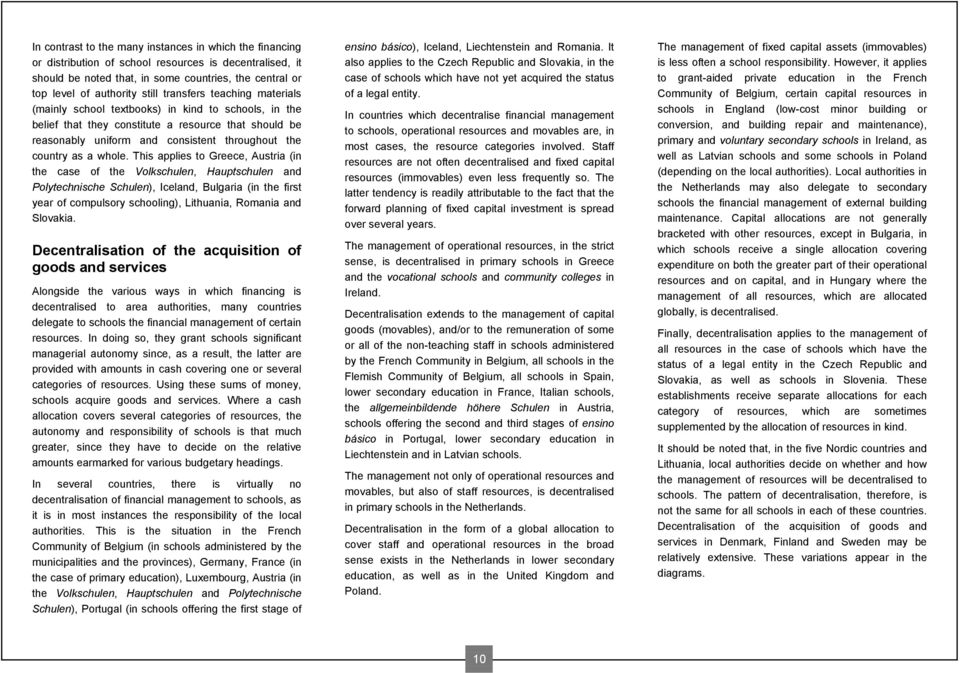
10 COMPARATIVE OVERVIEW T 1. To what extent are policies f financing and managing public resources f schools which provide compulsy education decentralised? he diagrams reveal the extent to which the financing and management of resources f schools which provide compulsy education are decentralised. Decentralisation of financing The decentralisation of financing implies a downward shift of authity from the top-level centre towards intermediate-level players cresponding to regional local authities. The intermediate players involved in financing resources f schools that provide compulsy education come to a decision regarding the amount of these resources and other fms of public expenditure and distribute the fmer among the schools concerned. In doing so, their room f manoeuvre depends on the regulations but, as pointed out above, this aspect is not a feature of the diagrams. In allocating amounts to schools, the area authities generally make use of a global allocation from the central top-level authities f education, which is meant to cover a variety of public services, and their own resources such as taxes and other fms of income. In Romania, this has only been the case since September During 2000/2001, it was the sole country in which the financing of compulsy education by the local authities came solely from their local resources, thus ruling out the use of any levelling mechanism f me unifm nationwide distribution. It is this previous situation which is represented in the diagram. In some countries, decentralisation is less clear-cut. Amounts of money f some categies of educational resources which the regional local authities receive from the central top-level authities f education are predetermined by the latter. The area authities may then supplement these amounts from their own resources be obliged to do so. This applies to the French Community of Belgium (in the case of education administered by the municipalities provinces), Liechtenstein (in primary education) in the case of allocations f operational and capital resources, Germany f specific capital allocations and France in the case of allocations of school facilities and equipment f collèges. In the five Ndic countries, the United Kingdom, Bulgaria, Lithuania and Poland, decentralisation of financing to the local authities (and, in the case of Poland, the regional authities as well) is very extensive, since they are in charge of funding school, operational and capital resources. The same applies to Hungary and Slovenia but, in these two countries, schools are also provided with funds f these resources from other public bodies. The most widespread situation is one in which the financing of school capital and/ operational resources and rather less frequently non-teaching resources is decentralised, but that of the biggest single item of school expenditure, namely teaching, is not. This applies to the French Community of Belgium (in the case of schools administered by the provinces and municipalities), Germany, Spain (in the case of primary education), France, Italy, Ptugal (in the case of schools providing the first stage of ensino básico), primary education in Luxembourg (in which the local authities also finance a share of teacher salaries), the Netherlands (solely f immovables), Austria (in the case of the Volkschulen, Hauptschulen and Polytechnische Schulen), Liechtenstein in the case of primary education, the Czech Republic, Estonia, Latvia and Romania In a limited number of countries, namely Greece, Ireland in the case of the vocational schools and community colleges, and Slovakia, the financing of compulsy education is only decentralised in the sense that the regional and local authities are responsible f distributing to schools allocations whose amounts are determined at the top level. Finally, the financing of resources is almost entirely the responsibility of the Community in the French Community of Belgium, in the case of schools administered by the Community authities, and grant-aided private education, and in the Flemish Community of Belgium in the case of all schools. It is also highly centralised in Austria at federal government level (in the case of the allgemeinbildende höhere Schulen), Ptugal (schools offering the second and third stages of ensino básico), Ireland (in the case of primary and some lower secondary education), Cyprus and Malta. 9

11 In contrast to the many instances in which the financing distribution of school resources is decentralised, it should be noted that, in some countries, the central top level of authity still transfers teaching materials (mainly school textbooks) in kind to schools, in the belief that they constitute a resource that should be reasonably unifm and consistent throughout the country as a whole. This applies to Greece, Austria (in the case of the Volkschulen, Hauptschulen and Polytechnische Schulen), Iceland, Bulgaria (in the first year of compulsy schooling), Lithuania, Romania and Slovakia. Decentralisation of the acquisition of goods and services Alongside the various ways in which financing is decentralised to area authities, many countries delegate to schools the financial management of certain resources. In doing so, they grant schools significant managerial autonomy since, as a result, the latter are provided with amounts in cash covering one several categies of resources. Using these sums of money, schools acquire goods and services. Where a cash allocation covers several categies of resources, the autonomy and responsibility of schools is that much greater, since they have to decide on the relative amounts earmarked f various budgetary headings. In several countries, there is virtually no decentralisation of financial management to schools, as it is in most instances the responsibility of the local authities. This is the situation in the French Community of Belgium (in schools administered by the municipalities and the provinces), Germany, France (in the case of primary education), Luxembourg, Austria (in the Volkschulen, Hauptschulen and Polytechnische Schulen), Ptugal (in schools offering the first stage of ensino básico), Iceland, Liechtenstein and Romania. It also applies to the Czech Republic and Slovakia, in the case of schools which have not yet acquired the status of a legal entity. In countries which decentralise financial management to schools, operational resources and movables are, in most cases, the resource categies involved. Staff resources are not often decentralised and fixed capital resources (immovables) even less frequently so. The latter tendency is readily attributable to the fact that the fward planning of fixed capital investment is spread over several years. The management of operational resources, in the strict sense, is decentralised in primary schools in Greece and the vocational schools and community colleges in Ireland. Decentralisation extends to the management of capital goods (movables), and/ to the remuneration of some all of the non-teaching in schools administered by the French Community in Belgium, all schools in the Flemish Community of Belgium, all schools in Spain, lower secondary education in France, Italian schools, the allgemeinbildende höhere Schulen in Austria, schools offering the second and third stages of ensino básico in Ptugal, lower secondary education in Liechtenstein and in Latvian schools. The management not only of operational resources and movables, but also of resources, is decentralised in primary schools in the Netherlands. Decentralisation in the fm of a global allocation to cover and operational resources in the broad sense exists in the Netherlands in lower secondary education, as well as in the United Kingdom and Poland. The management of fixed capital assets (immovables) is less often a school responsibility. However, it applies to grant-aided private education in the French Community of Belgium, certain capital resources in schools in England (low-cost min building conversion, and building repair and maintenance), primary and voluntary secondary schools in Ireland, as well as Latvian schools and some schools in Poland (depending on the local authities). Local authities in the Netherlands may also delegate to secondary schools the financial management of external building maintenance. Capital allocations are not generally bracketed with other resources, except in Bulgaria, in which schools receive a single allocation covering expenditure on both the greater part of their operational resources and on capital, and in Hungary where the management of all resources, which are allocated globally, is decentralised. Finally, decentralisation applies to the management of all resources in the case of schools which have the status of a legal entity in the Czech Republic and Slovakia, as well as schools in Slovenia. These establishments receive separate allocations f each categy of resources, which are sometimes supplemented by the allocation of resources in kind. It should be noted that, in the five Ndic countries and Lithuania, local authities decide on whether and how the management of resources will be decentralised to schools. The pattern of decentralisation, therefe, is not the same f all schools in each of these countries. Decentralisation of the acquisition of goods and services in Denmark, Finland and Sweden may be relatively extensive. These variations appear in the diagrams. 10
12 B 2. How many bodies are involved in financing schools f compulsy education? odies responsible f the public financing of schools f compulsy education may be considered in terms of their range and variety, f each country in turn. Indeed, it is of interest to examine whether an educational policy relies on many different bodies f the financing of compulsy education. The concern here is whether funding is unified somewhat fragmented. This question is relevant to each country but also, within it, to each type of school f compulsy education associated with a particular method of funding (public-sect schools, grant-aided private schools, primary lower secondary schools, schools which do/do not have the status of legal entities and so fth). In some countries, there is no variation in the sources of public financing because this is the exclusive responsibility of a single public authity. This may apply to funding f which solely the central government top-level authities f education are responsible, as in the case of education administered by the French Community of Belgium and all schools in the Flemish Community of Belgium, Greece, Ireland, Luxembourg (in lower secondary education), Austria (in the allgemeinbildende höhere Schulen), Liechtenstein (in lower secondary education) and Slovakia. It may also be the case where the financing of all categies of resources is undertaken solely by the local authities, as occurs in the Ndic countries, Bulgaria, Lithuania and Poland, although it should not be fgotten that the Finnish and Polish municipalities receive certain predetermined central government allocations that they can supplement with their own income. Where compulsy education is financed by several different bodies, the funding of teaching and/ non-teaching- resources, is in most cases assumed by the central top-level authity f education, whereas operational and/ capital resources are allocated by the local authities other intermediate bodies. This applies to the vast majity of EU countries and a few pre-accession countries, namely the Czech Republic, Estonia, Latvia and Romania. Alongside the most conventional model in which the financing of resources is shared by the central government and local authities as explained above, it is wth noting that some categies of resources in some countries are financed from a variety of different public sources. Among the pre-accession countries, Slovenia is one in which teaching and nonteaching- resources, operational resources, movables and immovables are each financed both by the central government and the local authities. In Hungary, much the same applies to movables and immovables and, among the EU countries, to immovables in Italy and Ptugal (in schools offering the second and third stages of ensino básico). I 3. What is the scale of private as compared to public financing? n the majity of European countries, schools are able to seek non-public sources of financing. Their freedom in this respect is often governed by legislation but may still exist in the absence of any legal provision. The few countries in which schools do not seek nonpublic sources of funding are the German-speaking Community of Belgium, Greece, Luxembourg, Iceland and Cyprus. In Denmark, Germany, Finland, Sweden, Nway, and Lithuania, their room f manoeuvre in this respect is determined by the local authities. In Lithuania and Poland, the use of funds raised by schools from non-public sources is also determined by the local authities. Schools in the Czech Republic and Slovakia have to have the status of legal entities in der to undertake fund-raising from non-public sources. In some countries, such as Denmark and Finland, there is scope f fund-raising by schools but this only rarely occurs in practice. In most cases, opptunities f schools to raise money from non-public sources involve the ganisation of events, fund-raising campaigns, donations and sponsship. Rather less frequently, they may let out school property to third parties, provide services and engage in advertising. Less frequently still, schools may accumulate financial reserves, undertake investment, raise loans as in the French Community of Belgium (in grant-aided private schools), the Flemish Community of Belgium, Spain, France (lower secondary education), Ireland, the Netherlands, Austria, Ptugal (schools offering the second stage of ensino básico), the United Kingdom (England, Wales and Nthern Ireland) and Bulgaria. Only in the Netherlands, the United Kingdom (England, Wales and Nthern Ireland) f grant-aided private schools, and in Bulgaria, are schools allowed to sell assets. Where schools are able to raise non-public sources of funding, they may generally use the money obtained to acquire operational goods and services (teaching and other equipment and materials) and movables, and to carry out extracurricular activities. Funding from private 11

13 sources is less frequently used f expenditure on. This may nonetheless occur in Italy, the Netherlands and the United Kingdom (England, Wales and Nthern Ireland) and in several pre-accession countries, namely the Czech Republic, Lithuania, Hungary, Poland and Romania. As to the use of private sources of funding to finance fixed capital expenditure, this applies to grantaided private schools in the French Community of Belgium, all schools in the Flemish Community of Belgium, public-sect schools in Italy, public-sect and private grant-aided schools in the United Kingdom. Among the pre-accession countries, public-sect schools in the Czech Republic, Hungary and Slovenia are in the same situation. The budget that schools can draw up on the basis of privately obtained funds is generally distinct from the one based on allocations from the public authities. However, grant-aided private schools in the French Community of Belgium, and all schools in Spain, Italy, the Netherlands, the United Kingdom (England, Wales and Nthern Ireland), Latvia, Hungary and Romania may combine funds from non-public sources with allocations they receive from the public authities and earmark them f most categies of resources which they can manage autonomously. Finally, in the French Community of Belgium (in schools administered by the municipalities and provinces), Austria and United Kingdom (Wales, Nthern Ireland and Scotland), schools may also use money obtained from non-public sources of funding to purchase goods and services they are unable to acquire from their public-sect allocations. S 4. How is infmation and communication technology in schools financed in the various countries? ome diagrams contain infmation on the financing of infmation and communication technology (ICT) in compulsy education. They thus indicate which countries earmark funding specifically f ICT, rather than funding it from one of the other main school resource categies. In some pre-accession countries (Latvia, Lithuania, Hungary, Malta, Poland, Slovenia and Slovakia), ICT receives funding in its own right. Although the financing of operational and capital resources, and sometimes resources, in these countries is in most cases decentralised to intermediate level, while the resources themselves are either managed at this level by schools, their ICT resources are funded by special central government allocations which may may not reach schools via intermediate authities. In the United Kingdom, ICT is financed through schools delegated budget which also covers other main categies of resources. However, additional specific funding is made available in England through the Standards Fund, in Wales through GEST, and in Scotland through the Excellence Fund. Another source of funding f ICT in England, Wales and Nthern Ireland is the New Opptunities Fund provided by the National Lottery. In Lithuania, Hungary, Poland in the case of the newly established gimnazja ( 4 ) and Slovenia, in all of which funding is largely decentralised, ICT resources are ( 4 ) The gimnazja are new schools introduced in 1999/2000 which offer three years of lower secondary education from the ages of 13 to 16. allocated directly by the government to schools. Allocations are in kind, except in Lithuania. And in Slovenia, they only crespond to some school ICT resources. Throughout the United Kingdom, except f some categies of school in Nthern Ireland which are funded directly by the Department of Education, specific allocations f ICT are in cash and reach schools via the local authities. In Latvia, the central authities allocate ICT resources to the municipalities from which they are transferred to schools in kind, while the municipalities also draw on their own budget to award ICT resources to schools. In the case of some schools in Slovakia, ICT resources are allocated directly in kind by the government, whereas the remainder receive theirs via the intermediate bodies responsible f acquiring them. I 5. What have been recent ongoing trends in the financing of compulsy education? n the last years, a very sizeable majity of EU and EFTA/EEA countries have taken steps to refm their methods of financing and awarding resources in compulsy education. In most cases, changes in this respect have reflected decentralisation towards local authities schools. However, in the last few years as such, it is clear that methods of financing and managing resources have changed little overall. A limited number of countries are experiencing changes: in the Netherlands, Ptugal, the United Kingdom (England 12

14 and Wales), some schools have been granted greater autonomy in the area of financial management. In recent years, it has become possible f municipalities in the Netherlands to delegate to secondary schools expenditure associated with the external maintenance of buildings. In England and Wales, funding f building maintenance and repairs is now managed by schools. In addition, all schools in England now receive a Fmula Capital Grant based on pupil numbers which can be used on small capital projects can be saved to fund future larger scale wks. Furtherme, schools in England are being encouraged to initiate and manage capital wks through the Seed Challenge Grants provided by the DfEE via local education authities (LEAs). Schools may apply to the LEA f money from these grants provided that they meet a percentage of the expenditure from their own funds. In Ptugal, the status of schools offering the first stage of ensino básico is currently being amended to give them some degree of financial autonomy. This has no bearing whatever on their autonomy as regards public financing (since the schools concerned administer none of their public resources), but it enables them to raise and use money obtained from private sources. At present, 65 % of schools offering the first stage of ensino básico are completing the fmalities necessary to secure this kind of administrative autonomy which is likely to be extended to all of them in due course. During the 1990s, methods of awarding and managing resources f compulsy education underwent maj changes in most pre-accession countries, reflecting two distinct trends. The first cresponded to decentralisation of the funding of some all categies of educational resources to local regional authities. This applied in particular to Hungary (1990), the Czech Republic and Slovakia ( 5 ), Poland (1990 in the case of primary education and 1999 in the case of lower secondary education) and Romania (1999). The second trend to emerge concerns managerial autonomy which has been granted in the last ten years to schools in Bulgaria (in the fm of a pilot project launched in 1998), in the Czech Republic (an ongoing development), Slovenia (1996), Slovakia (an ongoing development) and Malta (1995/96). Transfers of responsibility to schools from either the central government local authities may be involved. In two pre-accession countries, the Czech Republic and Slovakia, these moves to increase the autonomy of schools are part of a process to change their status. Some of them have already been granted a fm of legal status under which they can themselves administer their expenditure on the basis of a variety of allocations and, in the case of the Czech Republic, engage in fund-raising. Schools with no legal status receive all their resources in kind. ( 5 ) In the Czech Republic and Slovakia, the transfer of responsibilities was me marked between administrative divisions of their ministries. However, the most recent refm in the Czech Republic is seeking to transfer responsibility f funding to the autonomous regional authities. The regions concerned were fmally established in 1997 and were entrusted with regional autonomy, carrying with it financial responsibility, on 1 January

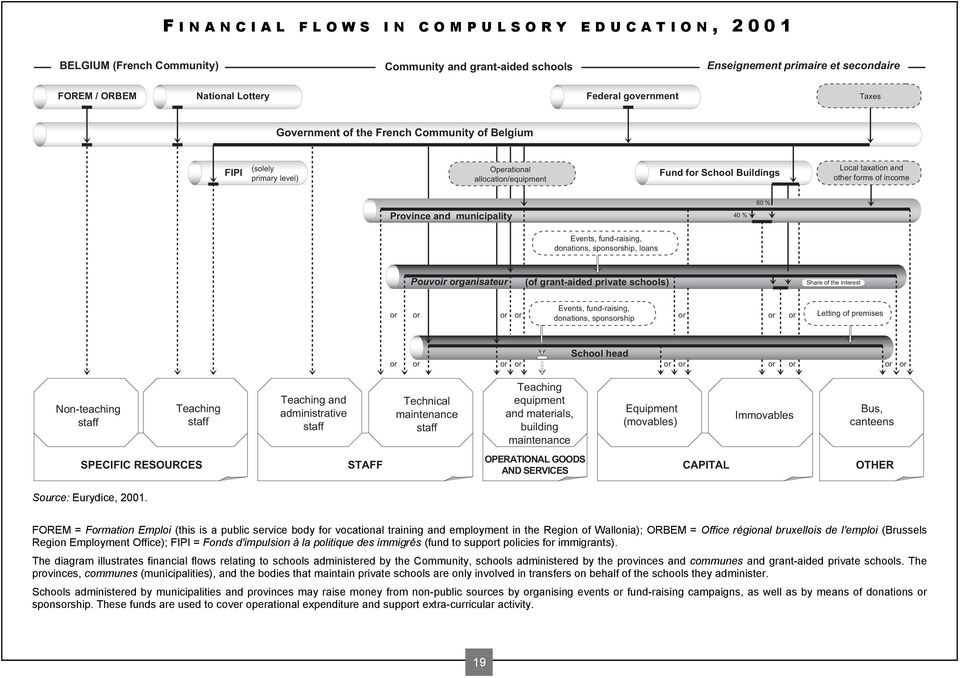
15 GUIDE TO READING THE DIAGRAMS E ach diagram shows the transfers of resources awarded to schools f a particular country f a categy of schools within a particular country. It is recommended that the infmation be read from the bottom of the diagram up. The different types of resources used by the school are illustrated in this part of the diagram, grouped into three broad categies. The arrows leading to one type of resources (human material) represent the arrival of the latter at the school. Moving up each arrow, the act involved in acquiring this type of resource can be identified. This could be the school itself (me specifically, the school head the school governing body), an intermediate higher authity. If this act itself receives resources in der to fulfil its responsibilities, this other transfer is also shown by an arrow, which is continuous broken to indicate whether it is a transfer in cash in kind The reader will note that all the arrows which arrive at the categies of resources indicated at the bottom of the diagram crespond to transfers in kind. It should be remembered that these arrows are situated downstream from the acquisition of resources. The school can thus be represented at two levels. It is always present at the bottom of the diagram in its role as the body that uses resources. It can also be shown as an act involved in the financial transfer when it acquires the resources itself. Thus, a school head who undertakes the payment of his himself from a cash allocation received from an intermediate higher authity (shown by a continuous arrow from the authity in question towards the school budget) would have the task of converting this sum of money into people physically present within the school (shown at the bottom of the diagram by a broken arrow from the school budget to the categy of resources). The way in which budgets are represented also gives an idea of the leeway of the act in defining the amount of the allocation. If a school receives allocations f particular purposes, its budget is shown as several thick broken lines, each being the result of a transfer emanating from an intermediate higher authity. If a school receives a global allocation which it distributes across the different categies of resources as it wishes, particular allocations with possibilities f transfers between budgetary headings, its budget is shown as a thick continuous line. The diagrams relate primarily to transfers of funds from public, but also private, sources using different colours f each (greyish blue backgrounds and dark blue arrows f the fmer, and white backgrounds and white arrows f the latter). 14

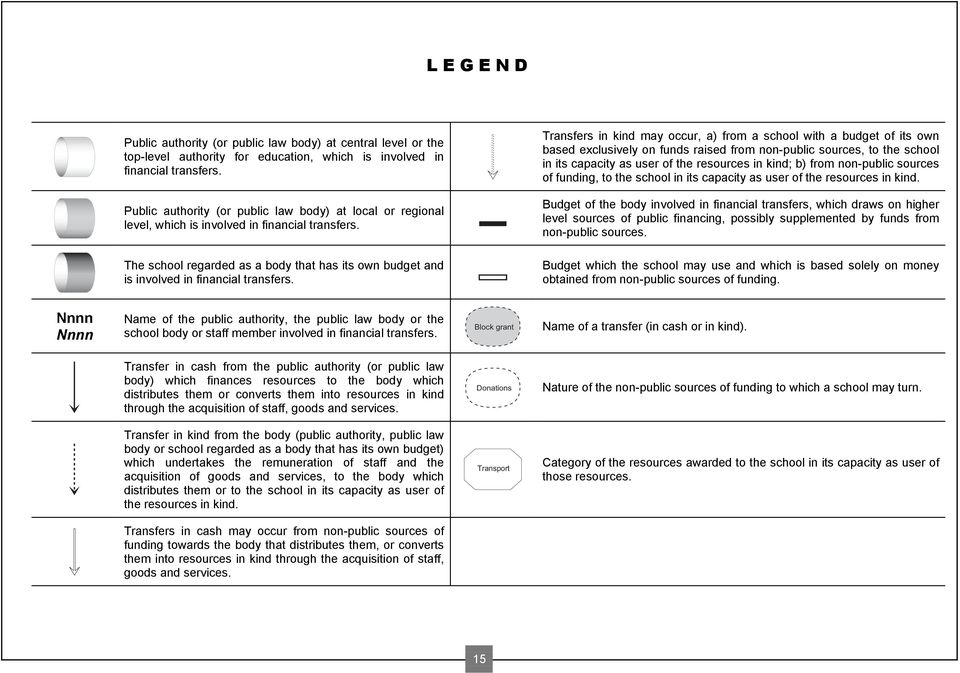
16 LEGEND Public authity ( public law body) at central level the top-level authity f education, which is involved in financial transfers. Transfers in kind may occur, a) from a school with a budget of its own based exclusively on funds raised from non-public sources, to the school in its capacity as user of the resources in kind; b) from non-public sources of funding, to the school in its capacity as user of the resources in kind. Public authity ( public law body) at local regional level, which is involved in financial transfers. Budget of the body involved in financial transfers, which draws on higher level sources of public financing, possibly supplemented by funds from non-public sources. The school regarded as a body that has its own budget and is involved in financial transfers. Budget which the school may use and which is based solely on money obtained from non-public sources of funding. Nnnn Nnnn Name of the public authity, the public law body the school body member involved in financial transfers. Block grant Name of a transfer (in cash in kind). Transfer in cash from the public authity ( public law body) which finances resources to the body which distributes them converts them into resources in kind through the acquisition of, goods and services. Donations Nature of the non-public sources of funding to which a school may turn. Transfer in kind from the body (public authity, public law body school regarded as a body that has its own budget) which undertakes the remuneration of and the acquisition of goods and services, to the body which distributes them to the school in its capacity as user of the resources in kind. Transpt Categy of the resources awarded to the school in its capacity as user of those resources. Transfers in cash may occur from non-public sources of funding towards the body that distributes them, converts them into resources in kind through the acquisition of, goods and services. 15
17 Categies of schools cresponding to ISCED levels 1 and 2 SINGLE STRUCTURE PRIMARY EDUCATION / ISCED 1 LOWER SECONDARY EDUCATION / ISCED 2 SINGLE STRUCTURE PRIMARY EDUCATION / ISCED 1 B fr Enseignement primaire 6 years Enseignement secondaire 2 years * S Grundskola 9 years LOWER SECONDARY EDUCATION / ISCED 2 B de Primarunterricht 6 years Sekundarunterricht 2 years * UK (E/W) Primary school 6 years Secondary School 3 years * B nl Lager onderwijs 6 years Secundair onderwijs 2 years * UK (NI) Primary school 7 years Secondary School 3 years * DK Folkeskole/Grundskole 9 years UK (SC) Primary school 7 years Secondary School 4 years * D Grundschule 4 years Orientierungsstufe, Gymnasium, Gesamtschule, Realschule, Schularten 5/6 years IS Grunnskóli 9 years mit mehreren Bildungsgängen LI Primarschule 5 years Oberschule, Realschule, Gymnasium 4 years Hauptschule EL Dimotiko scholeio 6 years Gymnasio 3 years NO Grunnskole 9 years E Educación primaria 6 years Educación secundaria obligatia 4 years Unterstufe F École élémentaire 5 years Collège 4 years BG Natchalno utchilishte 4 years Progimnazialno utchilishte 4 years IRL Primary school 6 years Secondary/Vocational/comprehensive 3 years * CZ Základní škola 9 years School/ community school and college EE Põhikool 9 years I Scuola primaria 5 years Scuola media 3 years CY Dimotiko scholeio 6 years Gymnasio 3 years L Enseignement primaire 6 years Lycée 3 years * LV Pamatskola 9 years NL Basisonderwijs ( 6 ) 8 years VWO 3 years * LT Pradinė mokykla 4 years Pagrindinė mokykla 6 years HAVO 3 years * HU Altalános iskola 8 years VMBO 2 years * Gymnázium 4 years * A Volksschule 4 years Hauptschule 4 years Gymnázium 2 years * Allgemeinbildende höhere Schule 4 years * MT Skejjel primarji 6 years Skejjel sekondarji 5 years P Ensino básico PL Szkoła podstawowa 6 years Gimnazjum 3 years 1 e 2 ciclos 6 years 3 ciclo 3 years RO Şcoală primară 4 years Gimnaziu 4 years FIN Perusopetus/ 9 years Sl Osnovna šola 8 9 years Grundläggande utbildning SK Základná škola 9 years *: x years* = first x years in this type of education/school. ( 6 ) Basisonderwijs in the Netherlands comprises two years cresponding to ISCED 0 and six years cresponding to ISCED 1. 16

18 DIAGRAMS BY COUNTRY Belgium French Community German-speaking Community Flemish Community Denmark Germany Greece Spain France Ireland Italy Luxembourg The Netherlands Austria Ptugal Finland Sweden United Kingdom England Wales Nthern Ireland Scotland Iceland Liechtenstein Nway Bulgaria Czech Republic Estonia Cyprus Latvia Lithuania Hungary Malta Poland Romania Slovenia Slovakia
19

20 BELGIUM (French Community) Community and grant-aided schools Enseignement primaire et secondaire FOREM / ORBEM National Lottery Federal government Taxes Government of the French Community of Belgium FIPI (solely primary level) Operational allocation/equipment Fund f School Buildings Local taxation and other fms of income Province and municipality 40 % 60 % Events, fund-raising, donations, sponsship, loans Pouvoir ganisateur (of grant-aided private schools) Share of the interest Events, fund-raising, donations, sponsship Letting of premises School head Non-teaching Teaching SPECIFIC RESOURCES Teaching and administrative Technical maintenance Teaching equipment and materials, building maintenance Equipment (movables) Immovables Bus, canteens GOODS STAFF CAPITAL OTHER AND SERVICES FOREM = Fmation Emploi (this is a public service body f vocational training and employment in the Region of Wallonia); ORBEM = Office régional bruxellois de l'emploi (Brussels Region Employment Office); FIPI = Fonds d'impulsion à la politique des immigrés (fund to suppt policies f immigrants). The diagram illustrates financial flows relating to schools administered by the Community, schools administered by the provinces and communes and grant-aided private schools. The provinces, communes (municipalities), and the bodies that maintain private schools are only involved in transfers on behalf of the schools they administer. Schools administered by municipalities and provinces may raise money from non-public sources by ganising events fund-raising campaigns, as well as by means of donations sponsship. These funds are used to cover operational expenditure and suppt extra-curricular activity. 19
21 BELGIUM (German-speaking Community) Community and grant-aided schools Primar- und Sekundarunterricht National Lottery Federal government Taxes Government of the German-speaking Community of Belgium Operational allocation/equipment Other fms of income Fund f School Buildings Local taxes and other fms of income Municipality 40 % 60 % Schulträger (of grant-aided private schools) Share of the interest School head Teaching Teaching and non-teaching Teaching equipment and materials, building maintenance Equipment (movables) Immovables Bus, canteens SPECIFIC RESOURCES STAFF GOODS AND SERVICES CAPITAL OTHER 20
22 BELGIUM (Flemish Community) Community schools Lager en secundair onderwijs Federal government Taxes Ministry of the Flemish Community Letting of premises, service provision, events, fund-raising, loans Raad van het Gemeenschapsonderwijs Scholengroep Infmation and communication technology Priity policies in education, special needs Teaching Nonteaching Teaching materials, building maintenance, operational activities Movables (furniture) Immovables, repairs, renovation Transpt SPECIFIC RESOURCES STAFF GOODS AND SERVICES CAPITAL OTHER Cash allocations f immovable capital expenses received by the scholengroepen from the Ministry of the Flemish Community, are intended f building repairs and renovation, the cost of which is no greater than BEF 2.5 million (EUR 61,973). Resources f educational priities and special needs, which are allocated in kind to the scholengroepen, cover the salaries of teaching designated specifically f wk in those areas. Resources f educational priities and special needs, which are allocated in cash to the scholengroepen, cover teaching materials and equipment used in schools f pupils who are the focus of the priities concerned receiving integrated special needs provision. 21
23 BELGIUM (Flemish Community) Grant-aided schools Lager en secundair onderwijs Federal government Taxes Ministry of the Flemish Community Letting of premises, service provision, events, fund-raising, loans DIGO Schoolbestuur / Inrichtende macht Infmation and communication technology Priity policies in education, special needs Teaching Nonteaching Teaching materials, building maintenance, operational activities Movables (furniture) Immovables Transpt SPECIFIC RESOURCES STAFF GOODS AND SERVICES CAPITAL OTHER DIGO = Dienst vo infrastructuurwerken van het Gesubsidieerd Onderwijs (a body responsible f managing resources f expenditure on infrastructure f grant-aided schools in the public and private sects). The administrative authity (schoolbestuur in the case of primary schools/inrichtende macht in the case of secondary schools) is a local authity (province municipality) in the case of the grant-aided public-sect schools and a local-level body (situated visually at school level in the diagram) in the case of the grant-aided private schools. Resources f educational priities and special needs, which are allocated in kind to the schoolbestuur/inrichtende macht, cover the salaries of teaching designated specifically f wk in those areas. Resources f educational priities and special needs, which are allocated in cash to the schoolbestuur/inrichtende macht, cover teaching materials and equipment used in schools f pupils who are the focus of the priities concerned receiving integrated special needs provision. As regards non-public funding, only grant-aided private schools may take out loans. 22
24 DENMARK Maximum degree of delegation Folkeskole / Grundskole Ministry of the Interi County Grant f non-danish-speaking pupils Block grants Property tax, income tax, investment revenue Municipality School head / School board Special education assistance Non-Danish speaking pupils Teaching and non-teaching Teaching activities, furnishings, office materials, cleaning, administrative costs External and internal maintenance, Green areas Constructions School-based leisure time activities, excursions, field trips Transpt SPECIFIC RESOURCES STAFF GOODS AND SERVICES CAPITAL OTHER The extent to which budgets are delegated to schools varies from one municipality to the next. The diagram illustrates a situation in which there has been the fullest possible delegation. There is no legislation dealing explicitly with school funding from non-public sources. With the permission of the local authities, schools may seek non-public funds from sponsing and donations but this is not common practice. 23
25 GERMANY Grundschule, Orientierungsstufe, Gymnasium, Gesamtschule, Realschule, Schularten mit mehreren Bildungsgängen, Haupschule Government of the Land Share of federal and Land taxes as well as general and specific grants Local taxes and other fms of municipal income Schulträger (one several municipalities) Supplementary posts (cresponding to special teaching, educational experimentation) SPECIFIC RESOURCES Tenured and non-tenured teaching, specific teaching f feign pupils Non-teaching (caretakers, secretaries, cleaning ) Teaching equipment, cleaning products, maintenance contracts, rental income, heating, textbooks, etc. Maintenance and operational activities f grounds and buildings Purchase of buildings, building wks, initial equipment (furnishings and teaching equipment) Transpt STAFF GOODS AND SERVICES CAPITAL OTHER In their educational legislation, the majity of the Länder have established the basis f educational refm resulting in greater management autonomy f schools, while the municipalities (as Schulträger) have implemented pilot projects introduced fms of school budgeting to the same end, in all cases in accdance with the budgetary laws of the Land concerned. Fund-raising from private sources is a relatively new development and both legislation and current municipal practice may vary. But schools in the majity of the Länder may now receive additional resources from sponss and acknowledge their suppt. These resources are initially the property of the Schulträger which may in turn transfer the money donations in kind to the schools. Nevertheless, there have to be firm assurances that the benefit to school activities will be greater than any gain derived by the spons concerned. 24
26 GREECE Dimotiko scholeio and Gymnasio Ministry of National Education and Religious Affairs Ministry of the Interi OEDV OSK s.a. Public investment programme Municipality Prefectial authity Scholiki epitropi Teaching and administrative, caretakers Teachers travel, extra pay events Electricity, water, telephone, stationery, cleaning, etc. Repairs, maintenance Books Equipment New buildings, site acquisition STAFF GOODS & SERVICES CAPITAL OEDV = Organismos Ekdoseos Didaktikon Vivlion (Organization f the Publishing of School Books); OSK s.a. = Organismos Skolikon Ktirion société anonyme (Organisation f the Building of Schools, a limited company). Schools are not allowed to raise money from non-public sources. 25
27 SPAIN Educación primaria Regional taxes and other incomes Central government administration Departamento / Consejería de educación Local taxes and other incomes Concejalía de educación (local administration) Letting of premises, service provision, events, fund-raising, financial reserves/investments, donations, sponsship, advertising Direct / Consejo escolar del centro Teaching and administrative Service Electricity, water, heating Telephone, mail, cultural and extra-curricular activities Building repairs Other capital expenditure (up to a certain amount) Maj capital expenditure (above a certain amount) STAFF CAPITAL OTHER GOODS AND SERVICES Meals Transpt The resources of local administrative authities come from different sources that may vary from one Autonomous Community to the next. In general, they consist of global allocations from the central authities, the administrative authities of the Autonomous Community concerned and local taxes. The opptunities provided by law f obtaining money from non-public sources are hardly ever exploited, so almost the whole school budget is based on public funding. 26
28 SPAIN Educación secundaria obligatia Regional taxes and other incomes Central government administration Departamento / Consejería de educación Letting of premises, service provision, events, fund-raising, financial reserves/investments, donations, sponsship, advertising Direct / Consejo escolar del centro Teaching and non-teaching Cleaning Electricity, heating, water, extra-curricular activities, etc. Repair and upkeep of facilities, machinery, new equipment and furniture (under a certain amount) Repair and upkeep of facilities, machinery, new equipment and furniture (over a certain amount) STAFF GOODS AND SERVICES CAPITAL OTHER Meals Transpt The opptunities provided by law f obtaining money from non-public sources are hardly ever exploited, so almost the whole school budget is based on public funding. 27
29 FRANCE Écoles élémentaires Ministry of Education Ministry of the Interi Rectat Operational block grant Block grant f equipment Inspection académique Département Local taxes and other fms of municipal income Municipality Special educational schemes (ZEP, etc.) Teaching Non-teaching Administrative and teaching activity School books Maintenance, renovation, building, equipment Canteens Transpt SPECIFIC RESOURCES STAFF GOODS AND SERVICES CAPITAL OTHER ZEP = Zones d éducation priitaires (priity education areas). 28
30 FRANCE Collèges Ministry of Education Ministry of the Interi Rectat General operational grant Grant to the départements f school facilities Inspection académique Region Local taxes and other fms of municipal income Département General operational grant Letting of premises, service provision, events, fund-raising, financial reserves, investments, donations, sponsship, advertising, loans Conseil d'administration Educational action schemes, special educational initiatives, research activities and experimentation in education Teaching Non-teaching Administrative and teaching activity New technologies, specialized teaching materials, equipment, wkshops Building, rebuilding, extensions, maj repairs Transpt SPECIFIC RESOURCES STAFF GOODS AND SERVICES CAPITAL OTHER As regards fund-raising from non-public sources, collèges can only take out loans with the permission of the government, the département and the supervisy authities. This is most uncommon. 29
31 IRELAND Primary education Department of Education and Science Capitation grants Local contributions Board of management Books f Needy Children Scheme Disadvantaged area schools All Irish schools Breaking the Cycle Initiative Remedial and resource teacher allocation Home/ School Liaison Scheme Community Employment Scheme Ancillary and clerical, caretakers Teachers Heating, lighting, cleaning, teaching materials Maintenance of school premises and grounds Min wks Maj projects, emergency and min wk, prefabricated classrooms, premises f all Irish schools Transpt SPECIFIC RESOURCES STAFF GOODS AND CAPITAL OTHER SERVICES Local contributions received by schools can come from several non-public sources. Depending on the school concerned, non-public funds may be derived from service provision, events, fund-raising, donations, sponsship loans. The local contribution at primary level is compulsy and is defined as a contribution to the day-to-day running costs. Schools are free to raise additional non-public funds and each individual school Board of management decides how such funds should be used. 30
32 IRELAND Vocational schools and community colleges Secondary schools Department of Education and Science Staff allocation Block Grants Vocational Education Committee of local government authity Board of management Books f Needy Children Scheme Designated areas scheme Remedial Home/school codinats Community Employment Scheme Teaching and non-teaching Heating, electricity Maintenance of school premises and grounds Buildings, furnishings, equipping, extension, refurbishing Transpt SPECIFIC RESOURCES STAFF GOODS AND CAPITAL OTHER SERVICES Vocational schools and community colleges may seek non-public funds from service provision, events, fund-raising, donations and sponsship and use them f a wide range of resources. 31
33 IRELAND Voluntary secondary schools (non-fee paying schools), and community and comprehensive schools Secondary schools Department of Education and Science Special subjet grants (voluntary secondary schools) Local contributions (community schools/ voluntary secondary schools) Board of management Books f Needy Children Scheme Designated areas scheme Remedial Home/ school codinats Community Employment Scheme Teaching, principal, guidance Clerical, administrative and maintenance, part-time and substitute teachers Heating, electricity Maintenance of school premises and grounds Buildings, furnishings, equipping, extension, refurbishing Transpt SPECIFIC RESOURCES STAFF GOODS AND SERVICES CAPITAL OTHER The voluntary secondary schools and the community schools receive their capital allocations in cash, whereas the comprehensive schools obtain theirs in kind. The voluntary secondary schools get subsidies f some subjects requiring special equipment (technological and artistic courses, etc.). Voluntary secondary schools which charge fees get no allocations f nonteaching. Local contributions schools may receive can come from several non-public sources. Depending on the voluntary secondary school community school concerned, non-public funds may be derived from the letting of premises, service provision, events, fund-raising, financial reserves, donations, sponsship loans. The same applies to comprehensive schools except that they cannot seek non-public funds from the letting of premises and financial reserves. It is up to individual school Boards of management to decide how such funds should be used. 32
34 ITALY Scuola primaria and scuola media Ministry of Education Ministry of the Interi Specific grant Specific grant Specific grant Local taxes Ufficio scolastico regionale Local taxes Region Service provision, events, fund-raising, sale of assets, donations, sponsship, advertising, loans Consiglio comunale Consiglio di circolo / Consiglio d'istituto Remedial tuition, in-service training, experimentation SPECIFIC RESOURCES Teaching, school head and administrative Technical and manual wkers Teaching aids Management Classroom activities General maintenance, water, electricity, etc. Classroom and teaching equipment Textbooks Construction, renovation, spts facilities, non-teaching equipment Meals, transpt, supervision STAFF CAPITAL OTHER GOODS AND SERVICES Excursions, visits, cultural activities As regards capital resources, regions may be involved in transfers of funding f spts facilities. The Consiglio di circolo is the school board f primary schools. The Consiglio d istituto is the school board in lower secondary education. 33
35 LUXEMBOURG Enseignement primaire Ministry of Finance Ministry of Education and Vocational Training Government subsidies, income from property, local taxes Ministry of Public Wks Municipality Extra tuition, hours of study Artistic and musical education Assistance with homewk Tenured teaching and replacement Nontenured teaching Nonteaching Maintenance, cleaning School books Teaching materials Maintenance of buildings Maj investment Transpt Out-ofschool activities, visits, supervised recreational activity Canteens SPECIFIC RESOURCES STAFF GOODS AND SERVICES CAPITAL OTHER The municipalities reimburse the Ministry of Finance one third of the amount of teaching salaries paid f by the government. 34
36 LUXEMBOURG Lycées Ministry of Education and Vocational Training Ministry of Public Wks School head Special projects Teaching and non-teaching Stationery, routine operational activities Large-scale property maintenance (immovables and movables), computer equipment Building, maj investment, movable assets Teaching materials, events, out-of-school activities SPECIFIC RESOURCES STAFF GOODS AND SERVICES CAPITAL OTHER Schools may obtain some kinds of private funding linked to fmal school schemes, through partnerships with firms. However, the number of schools that do so is relatively limited. 35
37 THE NETHERLANDS Basisonderwijs Ministry of the Interi Ministry of Education, Culture and Science Gemeentefonds (Municipality Fund) CFI (Central Agency f the Financing of Schools) Local taxes and other fms of municipal income Participatiefonds Vervangingsfonds VELO (grant f operational costs) Gemeente FBS Letting of premises, service provision, events, fund-raising, sale of assets, financial reserves, investments, sponsship, advertising, loans Gemeente (municipality) Bevoegd gezag (Schoolbestuur) Guidance Suppt teaching, educational priity policy (GOA, OALT) SPECIFIC RESOURCES Special needs Teaching and non-teaching including human resources f special needs and GOA teachers Supply Management, teaching materials Electricity, heating, water, taxes, etc. Indo maintenance (painting, flo, etc.) Outdo maintenance, construction, renovation, extension Pupils transpt STAFF CAPITAL OTHER GOODS AND SERVICES GOA = Gemeentelijk Onderwijsachterstandenbeleid (municipal policy f fighting underachievement at school); OALT = Onderwijs in allochtone levende talen (teaching of minity languages), FBS = Fmatiebudgetsysteem (system f the award of resources); VELO = Vereenvoudigd Londo (system f the award of operational resources). As regards school funding from non-public sources, the diagram refers to the entire range of possibilities, without specifying what schools actually do in practice. 36
38 THE NETHERLANDS VWO, HAVO and VMBO Ministry of the Interi Ministry of Education, Culture and Science Gemeentefonds (Municipality Fund) CFI (Central Agency f the Financing of Schools) Local taxes and other fms of municipal income Participatiefonds Vervangingsfonds Block grants Gemeente Letting of premises, service provision, events, fund-raising, sale of assets, financial reserves, investments, sponsship, advertising, loans Gemeente (municipality) Bevoegd gezag (Schoolbestuur) Guidance Suppt teaching, educational priity policy (GOA) SPECIFIC RESOURCES Special needs Teaching and non-teaching including human resources f special needs and GOA teachers Supply Management, teaching materials Electricity, heating, water, taxes, etc. Indo maintenance (painting, flo, etc.) Outdo maintenance, construction, renovation, extension Pupils transpt STAFF CAPITAL OTHER GOODS AND SERVICES GOA = Gemeentelijk Onderwijsachterstandenbeleid (municipal policy f fighting underachievement at school). The municipality may delegate to schools the management of the external maintenance of buildings. As regards school funding from non-public sources, the diagram refers to the entire range of possibilities, without specifying what schools actually do in practice. 37
39 AUSTRIA Volkschule, Hauptschule and Polytechnische Schule Federal Ministry of Finance Federal Ministry of Education, Science and Culture Federal Ministry of Social Security and Generations Local taxes and other fms of income Austrian Cultural Office Landesregierung (government of the Land) Funds f School Construction Letting of premises, service provision, events, fund-raising, financial reserves, investments, donations, sponsship, advertising Gemeinde (municipality) Schulleiter (headteacher) Teaching and f specific purposes Nonteaching (catering) Technical wkers, superviss Cleaning, consumable material, heating, electricity, water, medical assistance, health-related costs Maintenance, repairs, new equipment Construction, renovation, maj maintenance wk, purchase of property, initial equipment STAFF GOODS AND SERVICES CAPITAL OTHER Books Out of school activities Meals Arts events Transpt Fms of funding from non-public sources open to Volkschulen, Hauptschulen and Polytechnische Schulen depend on the Landesschulräte in each Land. 38
40 AUSTRIA Allgemeinbildende höhere Schule Federal Ministry of Finance Federal Ministry of Social Security and Generations Federal Ministry of Education, Science and Culture Bundesimmobiliengesellschaft Ges.m.d.H, Gemeinde (municipality) private authities Austrian Cultural Office Landesschulrat Letting of premises, service provision, events, fund-raising, financial reserves, investments, donations, sponsship, advertising Schulleiter (headteacher) Teaching and trainees Superviss, administrative, technical Cleaning, energy consumption, rent and reimbursements, property management, specific projects, etc. Min repairs, initial equipment, teaching equipment, duplication machines Constructions and current maintenance of buildings STAFF CAPITAL OTHER GOODS AND SERVICES Books Supervising (out of class time) Arts events Transpt To raise funds from non-public sources by providing services ganising events, the allgemeinbildende höhere Schulen have to acquire limited legal autonomy. The Bundesimmobiliengesellschaft Ges.m.d.H (National Estate Agency) is a public limited company. As far as arts and cultural events are concerned, these academic secondary schools may also apply f a special budget from the Austrian Cultural Office. This budget is directly transferred from the Ministry of Education to the school. 39
41 PORTUGAL Schools engaged in securing greater administrative autonomy 1. ciclo do ensino básico Ministry f Education Cabinet f Financial Affairs Central government Direcção regional de educação Service provision, donations and other fms of income Local taxes and other fms of income Municipality Conselho da escola Education f All Programme Programme f underprivileged areas SPECIFIC RESOURCES Teaching Non-teaching Teaching materials, administration, maintenance, utilities, out-of-school activities, insurance Equipment, maj repairs, buildings Meals STAFF CAPITAL OTHER GOODS AND SERVICES Milk Transpt All pupils in the first stage of ensino básico receive two decilitres of milk funded by the Ministry of Education and a Community subsidy from the European Agricultural Guidance and Guarantee Fund. Moves are under way to grant some administrative autonomy to schools offering the first stage of ensino básico. As a result, 65 % of these schools have some room f manoeuvre in seeking and managing non-public funds. However, only small amounts of money are involved. The remaining 35 % of the schools still have no financial autonomy. 40
42 PORTUGAL 2. e 3. ciclos do ensino básico Ministry f Education Cabinet f Financial Affairs Central government Grant f expenses Budget f running costs Direcção regional de educação Letting of premises, service provision, events, fund-raising, donations, sponsship Municipality 78 % 22 % Conselho da escola Specific projects (underprivileged zones, etc.) Staff f specific projects, extra-curricular activities, teacher training SPECIFIC RESOURCES Teaching and non-teaching Teaching material, transpt, maintenance, utilities, in-service training, out-of-school activities, insurance Rents, spts facilities, building maintenance and equipment Min repairs Maj repairs, equipment, alterations, constructions Grounds Meals Transpt STAFF CAPITAL OTHER GOODS AND SERVICES 41
43 FINLAND Maximum degree of delegation Perusopetus Grundläggande utbildning Ministry of Education Additional subsidies Government subsidies Local income tax Subsidies f capital investments Kunta (municipality) Events, fund-raising, donations, sponsship, advertising Johtokunta (managing board) / Rehti (school head) Remedial instruction, teaching of the mother tongue of pupils of immigrant igin Teaching and non-teaching Services f pupils, teaching materials Administration and maintenance of facilities and equipment Small investments Maj investments Trips, excursions Meals Accommodation, transpt SPECIFIC RESOURCES STAFF GOODS AND SERVICES CAPITAL OTHER The extent to which responsibility f their budgets is delegated to schools varies from one municipality to the next. The diagram illustrates a situation in which there has been the fullest possible delegation. Budgets relating to school building (fixed assets/immovables), school transpt and accommodation are very frequently the responsibility of the municipalities. The municipalities also decide on the freedom of action of schools as regards seeking funds from private sources and use of the funds so obtained. 42
44 SWEDEN Grundskola Central government Specific grant General grants Local taxes Income, rents, etc. Kommunfullmäktige (municipality) 20 % 70 % 10 % Education budget Education committee district council Planning and building administration Additional resources Service provision, events, fund-raising, advertising Rekt (school head) / management Special needs: underprivileged pupils, disabled and/ immigrant pupils Teaching and non-teaching Operational activities Movables and immovables Transpt, meals Out-of school activities SPECIFIC RESOURCES STAFF GOODS AND SERVICES CAPITAL OTHER The extent to which responsibility f their budgets is delegated to schools varies from one municipality to the next. In general, delegation occurs in the case of and operational resources, whereas the pattern of transfer in the case of capital resources is me varied. In certain instances, budgets are delegated to schools whereas, in others, they are administered by the municipality, either by the municipal council, its planning and building wks department. From , the government is allocating municipalities a special grant f employing school. To receive this grant, a municipality must fulfil certain requirements laid down by the National Agency f Education. From 2006, this grant will be included in the general state grant to municipalities. In municipalities that grant them permission, schools can seek funds from non-public sources through the letting of premises, donations and sponsship. 43
45 UNITED KINGDOM (ENGLAND) Maintained schools Primary and secondary schools Department f Education and Employment Department of the Environment, Transpt and the Regions Standards Fund Council tax, sale of property, charges f services Capital grants Revenue suppt grant Local education authity Individual schools budget Letting of premises, events, fund-raising, sale of assets, financial reserves, investments, donations, sponsship, advertising, loans School governing body Founding body / trustees (of voluntary aided schools) Specific resources to suppt government priities in raising standards Special educational needs SPECIFIC RESOURCES Teaching and non-teaching, advisy services Stationery, books, photocopies, cleaning and maintenance, building repairs, utilities, development Meals Visits and other activities Durable, nonconsumable items (library books, computing equipment, etc.) Buildings, renovation, main installations and associated equipment Transpt STAFF CAPITAL OTHER GOODS AND SERVICES In June 2001, the Department f Education and Employment (DfEE) became the Department f Education and Skills (DfES), while the Department of the Environment, Transpt and the Regions (DETR) became the Department of Transpt, Local Government and the Regions (DTLR). Expenditure on durable, non-consumable items such as books, furniture and computer equipment is generally considered to be recurrent rather than capital expenditure and, as such, is funded from the schools own budget. However, furniture and equipment associated with new and renovated buildings are generally incpated into the capital costs f the project. In der to permit LEAs to brow money to finance capital education projects, the DfEE issues credit approvals. Capital expenditure on fixed assets f voluntary aided schools is provided directly by DfEE grants (not shown in the diagram). Government priities in raising standards embrace measures to suppt the inclusion of disadvantaged pupils (including those from ethnic minities), measures to suppt school effectiveness, professional development of teachers, and infmation and communication technology etc. Fmula capital funding is also paid through the Standards Fund. LEAs must delegate funding f school meals to secondary schools whereas, in the case of primary schools, funding is only delegated if schools themselves request it. As far as non-public funding is concerned, loans taken out by schools must be used f large capital projects. Private sources of funding shown are theetically available to schools but, while all schools probably benefit from fund-raising from events, very few schools are likely to benefit from advertising revenues. F further infmation on the funding of schools, see item 2.14 in the United Kingdom national dossier in Eurybase ( 44
46 UNITED KINGDOM (WALES) Maintained schools Primary and secondary schools National Assembly f Wales GEST Revenue suppt grant Council tax, sale of property, charges f services Capital grants General capital funding allocation Local education authity Individual schools budget Letting of premises, events, fund-raising, sale of assets, financial reserves, investments, donations, sponsship, advertising, loans School governing body Founding body / trustees (of voluntary aided schools) Specific resources to suppt National Assembly priities in raising standards Special educational needs SPECIFIC RESOURCES Teaching and non-teaching Stationery, books, photocopies, cleaning and maintenance, utilities, development, etc. Meals Visits and other activities Durable, nonconsumable items (library books, computing equipment, etc.) Buildings, renovation, main installations and associated equipment Transpt STAFF CAPITAL OTHER GOODS AND SERVICES GEST = Grants f Education Suppt and Training in Wales. Expenditure on durable, non-consumable items such as books, furniture and computer equipment is generally considered to be recurrent rather than capital expenditure and, as such, is funded from the schools own budget. However, furniture and equipment associated with new and renovated buildings are generally incpated into the capital costs f the project. Capital expenditure on fixed assets f voluntary aided schools is provided directly by grants from the National Assembly f Wales (NafW). The National Assembly priities in raising standards include tackling social disadvantage, including the ethnic minities achievement grants, special educational needs, professional development of teachers, measures to suppt effectiveness, and infmation and communication technology, etc. LEAs must delegate funding f school meals to secondary schools whereas, in the case of primary schools, funding is only delegated if schools themselves request it. As far as non-public funding is concerned, loans taken out by schools must be used f large capital projects. Private sources of funding shown are theetically available to schools but, while all schools probably benefit from fund-raising from events, very few schools are likely to benefit from advertising revenues. F further infmation on the funding of schools, see item 2.14 in the United Kingdom national dossier in Eurybase ( 45
47 UNITED KINGDOM (NORTHERN IRELAND) Controlled and maintained schools Primary and secondary schools Department of Education (Nthern Ireland) School improvement programme and other initiatives Block grants Education and Library Board Aggregated school budget Letting of premises, events, fund-raising, sale of assets, financial reserves, investments, donations, sponsship, advertising Board of governs School improvement programme Special educational needs SPECIFIC RESOURCES Teaching and non-teaching Stationery, books, photocopies, cleaning and maintenance, utilities, development Visits and other activities Durable, nonconsumable items (library books, computing equipment, etc.) Buildings, renovation, main installations and associated equipment Transpt, meals STAFF CAPITAL OTHER GOODS AND SERVICES Expenditure on durable, non-consumable items such as books, furniture and computer equipment is generally considered to be recurrent rather than capital expenditure and, as such, is funded from the schools own budget, subject to a limit of GBP (around EUR 4 973). However, furniture and equipment associated with new and renovated buildings are generally incpated into the capital costs f the project. Grants f capital expenditure are provided directly by the Department of Education to maintained schools, while Education and Library Boards meet the capital expenditure of controlled schools. Consultation is currently taking place on a new common funding fmula f all schools in Nthern Ireland. The new system is expected to be introduced in April Private sources of funding shown are theetically available to schools but, while all schools probably benefit from fund-raising from events, very few schools are likely to benefit from advertising revenues. F further infmation on the funding of schools, see item 2.14 in the United Kingdom national dossier in Eurybase ( 46
48 UNITED KINGDOM (NORTHERN IRELAND) Voluntary grammar schools Grant-maintained integrated schools Primary and secondary schools Department of Education (Nthern Ireland) School improvement programme and other initiatives Aggregated school budget Letting of premises, events, fund-raising, sale of assets, financial reserves, investments, donations, sponsship, advertising, loans Education and Library Board Board of governs School improvement programme Special educational needs SPECIFIC RESOURCES Teaching and non-teaching Stationery, books, photocopies, cleaning and maintenance, utilities, development Visits and other activities Durable, nonconsumable items (library books, computing equipment, etc.) Buildings, renovation, main installations and associated equipment STAFF CAPITAL OTHER GOODS AND SERVICES Meals Transpt Approved capital expenditure is directly grant aided by the Department of Education f grant-maintained integrated and voluntary grammar schools. However, the trustees of some voluntary grammar schools contribute up to 15 % of capital costs. Expenditure on durable, non-consumable items such as books, furniture and computer equipment is generally considered to be recurrent rather than capital expenditure and, as such, is funded from the schools own budget. However, furniture and equipment associated with new and renovated buildings is generally incpated into the capital costs f the project. Consultation is currently taking place on a new common funding fmula f all schools in Nthern Ireland. The new system is expected to be introduced in April As far as non-public funding is concerned, loans taken out by schools must be used f large capital projects. Private sources of funding shown are theetically available to schools but, while all schools probably benefit from fund-raising from events, very few schools, if any, benefit from advertising. F further infmation on the funding of schools, see item 2.14 in the United Kingdom national dossier in Eurybase ( 47
49 UNITED KINGDOM (SCOTLAND) Primary and secondary schools Central government / The Scottish Executive Specific grants Revenue Suppt Grant Local (council) tax, non-domestic rates, other fms of income Local authity Letting of premises, events, fund-raising, donations, sponsship School head Finance committee Provision of Gaelic education, initiatives related to raising standards, school security, ICT, SEN In-service training, curriculum development, examination fees SPECIFIC RESOURCES Teaching and non-teaching Administration e.g. postage, printing, stationery, telephones Classroom supplies, equipment maintenance, wk experience, out-of-school activities, etc. Property-related costs (rates, energy, cleaning, min repairs, ground maintenance, furniture, fittings) Buildings, maj repairs and durable equipment Transpt, careers and psychological services STAFF CAPITAL OTHER GOODS AND SERVICES ICT = Infmation and Communication Technology. SEN = Special Educational Needs. Initiatives relating to raising standards refers to schemes such as the Excellence Fund. Funding is targeted on specific activities such as early intervention, classroom assistants, national grid f learning, alternatives to exclusion and others. A finance committee, made up of teachers and sometimes the school head, administers the budget f non-public resources. 48
50 ICELAND Grunnskóli Ministry of Social Affairs Ministry of Education, Science and Culture Municipalities Equalization Fund (except Reykjavik) Property tax, income tax Income from public utilities National Centre f Educational Materials Municipality School head School development Special education, ethnic minities SPECIFIC RESOURCES Teaching and non-teaching, special education Consumable materials (f pupils, teachers, cleaning), electricity, telephone, mail, insurance, running costs f transpt, maintenance equipment Textbooks, audio-visual material New buildings, maj renovations and equipment Out-of-school activities, supervision, trips, visits, etc. STAFF CAPITAL OTHER GOODS AND SERVICES Transpt, meals 49
51 LIECHTENSTEIN Primarschule Government 50 % 50 % Government grant Taxes on income and wealth taxes Municipality Teacher training (initial and in-service) Non-Germanspeaking pupils: teachers and school material Tenured and specialized teachers, part-time and supply Cleaning, caretakers, secretarial, headmaster, religious teachers Teaching materials, secretarial and cleaning expenditure, insurance, rents, electricity, gas, heating, etc. Teaching aids, upkeep Buildings, spts buildings and equipment Textbooks Field trips Transpt SPECIFIC RESOURCES STAFF GOODS AND SERVICES CAPITAL OTHER Schools may acquire funds from non-public sources as a result of donations through advertising. However, in practice, they do not rest to advertising. 50
52 LIECHTENSTEIN Oberschule, Realschule, Gymnasium Unterstufe Government Events, fund-raising, donations, advertising Schulleiter (school head) Teaching and administrative, headmasters, cleaning STAFF Teaching material, secretarial expenses, insurance costs, current running costs (water, gas, etc.), cleaning and upkeep GOODS AND SERVICES Teaching equipment, equipment, maintenance of school buildings, spts facilities CAPITAL Construction, initial equipment, maj repairs Cultural events, extra-curricular activities, musical training OTHER Dental care, supervision, meals, medical care (partial) In practice, schools do not rely on advertising to acquire funds from non-public sources. 51
53 NORWAY Grunnskole Central government Earmarked grants Block grants Local taxes and other fms of income Municipal council Education officers Donations Municipal property offices School head Minity languages, special education, music/art, schools f Sami children Socioeducational services SPECIFIC RESOURCES Teaching Non-teaching Office expenses, telephone, oil, electricity, heating School supplies, school materials supplied to pupils free of charge, photocopies, school events Teaching aids, furniture and fittings, books/library facilities, maintenance, min repairs Maj repairs and maintenance, construction Transpt, boarding facilities STAFF CAPITAL OTHER GOODS AND SERVICES Out-of-school activities In some municipalities, the budgets f salaries are also transferred to the schools. Schools are allowed to receive donations, but are not allowed to actively seek non-public resources of this kind. 52
54 BULGARIA Natchalno utchilishte and Progimnazialno utchilishte Ministry of Finance Ministry of Education Local taxes and other fms of municipal income Obchtinski suvet (municipal council) and mestna vlast (local authity) Letting of premises, service provision, events, fund-raising, sale of assets, financial reserves, donations, sponsship, advertising Direkt (school head) / pedagogitcheski suvet (pedagogical council) Teaching and non-teaching Teaching material, books f needy children Research activity, teaching training Utilities Books (1st year) Health and safety Maintenance, renovation, building Meals, extraclass activities STAFF GOODS AND SERVICES CAPITAL OTHER 53
55 CZECH REPUBLIC Schools without the status of a legal entity Základní škola Ministry of Education, Youth and Spts Ministry of Finance Krajský úøad (regional authity) Okresní úøad (district authity) Local income and other fms of municipal income Obec (municipality) Special educational projects (f Romany minity children, anti-drugs programmes, etc.) SPECIFIC RESOURCES Teaching, in-service training Non-teaching Textbooks, teaching material, innovative and development programmes Other operational resources, utilities, etc. Maintenance, renovation, building, equipment STAFF CAPITAL OTHER GOODS AND SERVICES Meals Among the Základní škola, are schools without the status of a legal entity. This number is decreasing. Municipalities can also make allocations f special educational projects, teaching, non-teaching, textbooks and teaching equipment and materials from the budget of the Ministry of Finance, as well as from their own local income. The Ministry of Education, Youth and Spts can finance special educational projects directly. Operating costs of meals and capital expenditure on refecties are covered by the municipality, whereas salaries are covered by the Ministry of Education via the district authity. 54
56 CZECH REPUBLIC Schools with the status of a legal entity Základní škola Ministry of Education, Youth and Spts Ministry of Finance Krajský úøad (regional authity) Okresní úøad (district authity) Local income and other fms of municipal income Letting of premises, service provision, events, fund-raising, donations, sponsship, advertising Obec (municipality) Øeditel školy (school head) Special educational projects (f Romany minity children, anti-drugs programmes, etc.) SPECIFIC RESOURCES Teaching, in-service training Non-teaching Textbooks, teaching material, innovative and development programmes Other operational resources, utilities, etc. Maintenance, renovation, building, equipment STAFF CAPITAL OTHER GOODS AND SERVICES Meals Among the Základní škola, are schools with the status of a legal entity. This number is increasing. Municipalities can participate in financing special educational projects, teaching, non-teaching, textbooks and teaching equipment and materials from the budget of the Ministry of Finance, as well as from their own local income. The Ministry of Education, Youth and Spts can finance special educational projects directly. Operating costs of meals and capital expenditure on refecties are covered by the municipality, whereas salaries are covered by the Ministry of Education via the district authity. 55
57 ESTONIA Põhikool Ministry of Education Block grants Local taxes Vald/Linn (local government) Direkt ja Hoolekogu (school head and school board) Special needs: minities integration SPECIFIC RESOURCES Teaching, school head and deputy heads STAFF Non-teaching (cleaning, secretaries, caretakers) Administrative and teaching activity School books GOODS AND SERVICES Equipment, new technologies CAPITAL Maintenance, renovation, building Transpt OTHER Dmity The diagram relates to municipal schools. It does not represent the state schools (5% of the total of primary and lower secondary schools) which are financed directly by the central government. The resources f special needs are provided f schools by the Ministry of Education. The Ministry distributes them to the local government authity directly to schools. Capital resources, including equipment, are provided f schools by the local government authity. The authity uses a budget comprising local taxes, one allocated to it from the Ministry of Education f that purpose. 56
58 CYPRUS Dimotiko scholeio and Gymnasio Ministry of Education and Culture School Board / Committee Financial suppt from parents' association Financial suppt from parents' association Special projects, experiments, special education Teaching Non-teaching clerical Other non-teaching Welfare services Wkshop material, cleaning, heating, offices, teaching materials Textbooks Buildings, maintenance and renovation, maintenance equipment, dinary equipment Building, technological and scientific equipment, specialised material Transpt SPECIFIC RESOURCES STAFF GOODS AND SERVICES CAPITAL OTHER 57
59 LATVIA PamatizglDtDba Ministry of Education and Science Ministry of Finance Earmarked dotations Earmarked dotations Earmarked dotations Latvian Education Computerisation System suppt Earmarked dotations Municipal block dotation (per child) Municipal fees, state tax shares, means from municipal equalisation fund and other income IzglDtDbas DD parvalde (municipality) Letting of premises, donations, sponsship, etc. Direkts, skolas padome (school head and school board) Special education, boarding schools Society integration programme activities Teaching Other (administrative, technical) Textbooks Other means f ensuring pedagogical process School maintenance School computerisation Investments f education development Travel cost suppt Catering Accommodation Out-ofschool activities SPECIFIC RESOURCES STAFF GOODS AND SERVICES CAPITAL OTHER In several municipalities, all financial dealings are carried out by the municipality itself although, in some mixed schemes, both schools and municipalities are involved in such dealings. Municipalities may decide to cover travel costs f pupils from rural areas and to award them a single grant when they start school. Almost all schools are municipal except f some specialised schools which are the responsibility of the Ministry of Education and Science. It is expected that, following ongoing regional refm, all state schools will be transferred to municipal ownership. 58
60 LITHUANIA Pradrinè mokykla and Pagrindinè mokykla Ministry of Education and Science Ministry of Social Security and Labour Specific grants Specific grants Ministry of Finance Apskrities valdytojo administracija (administration of the county govern) Non-public sources sought by schools (letting of premises, service provision, events, fund-raising, sale of assets, donations, sponsship, advertising) Local taxes and other fms of income General grant. Savivaldybes taryba (municipal council) Drugs prevention programme Delinquency prevention programme, programme f children from disadvantaged social backgrounds SPECIFIC RESOURCES Teaching Nonteaching Heating, electricity, telecommunications, current repairs, etc. Textbooks Computers Furniture Capital repairs and construction Transpt STAFF CAPITAL OTHER GOODS AND SERVICES Meals f pupils from disadvantaged families Municipalities may award the heads of all some of their schools earmarked cash amounts f, operational goods and services, equipment and/ transpt and meals. Subject to approval of the education administration department, school heads may make transfers between those amounts within fixed percentages. In some municipalities, education administration departments manage a budget based on a block financial transfer from the municipal budget. Municipalities with sufficient budgetary resources award schools an extra supply of school books. The municipal council decides which sources of non-public resources may be sought, as well as the categies of resources f which they may be used. The municipality manages those resources but they are included in the individual budget of the school concerned, and their use is subject to the approval of the school head. Schools to which municipalities have delegated financial autonomy (which are not shown in the diagram) themselves manage the funds they raise from non-public sources. Following the School Building Renovation Action Plan, selected schools receive additional resources in kind from the Ministry of Finance via the municipalities. 59
61 HUNGARY Általános iskola and Gimnázium Ministry of Education Programmes, foundations f professional development Ministry of the Interi Private revenue of foundations Regional development grant General grant Targeted subsidies Direct subsidies Earmarked grant Public foundations of the county/the capital Regional Development Council Taxes and other fms of income Donations, sponsship, letting of premises, financial investment Helyi önkmányzat (local governement) Iskolaigazgató (school head) ICT, quality assurance, special programmes, talented pupils Teaching and non-teaching Operational goods and services Equipment Renovations, investment Catering, school bus, in-service training, textbooks, pedagogical services SPECIFIC RESOURCES STAFF CAPITAL OTHER GOODS AND SERVICES ICT = Infmation and Communication Technology. Direct and targeted subsidies are awarded to local government authities if they meet standards set by the Parliament. The provision of services and ganisation of events may also be undertaken by schools seeking to raise their own funds, but there is less reliance on them than on the other sources of non-public funding shown in the diagram. 60
62 MALTA Skejjel primarji and Skejjel sekondarji Ministry of Education Recurrent expenditure budget Capital expenditure budget Education division Eden Foundation 90 % 10 % Grant f materials and supplies Letting of premises, events, fund-raising, donations, sponsship, advertising Grant f school maintenance Grant f capital equipment Local Council Income from tuck shops, renting, events, fund-raising, donations, sponsship, advertising School head School Council Special Education Programme Let Me Learn Project SPECIFIC RESOURCES Specific Learning Difficulty Unit Teaching and nonteaching Textbooks Utilities Materials and supplies Repair and upkeep Furniture and equipment Out of school activities STAFF CAPITAL OTHER GOODS AND SERVICES ICT Refurbishment and maintenance Construction and adaptation School transpt ICT = Infmation and Communication Technology. In most cases, tuck shops are run by private contracts which distribute allocations to the school council. There are also instances in which school councils run tuck shops. In such cases, all proceeds from sales are kept by the school. 61
63 POLAND Szko³y podstawowe and gimnazja Ministry of Education Ministry of Finance Specific grant General grant Wojewoda (region) General grant Non-public sources sought by schools (letting of premises, sponsship) Investment funds Local income Rada Gminy (gmina council) Dyrekt szko³y (school head) Computers f the newly established gimnazja School buses f pupils commuting to the newly established gimnazja Textbooks f pupils from non-privileged families Teaching and non-teaching Teaching aids, administration, cleaning products, heating, equipment, maintenance, renting of premises Renovation, building, equipment, furniture Transpt SPECIFIC RESOURCES STAFF CAPITAL OTHER GOODS AND SERVICES In some gminas, a small proption of income raised by the schools comes from non-public sources. The use of these funds is decided by the gmina council and, in most cases, they are earmarked f educational purposes. However, in the case of sponsing, the don can define the purpose f which funds allocated to schools must be used. Besides the letting of premises and sponsship, the legislation also provides f the acquisition of funds by schools through the provision of services, the ganisation of events, the sale of assets, donations and advertising. Whether schools use any of the methods in this latter group depends on the local situation. The gmina council generally allocates capital resources to schools in cash, in the case of maj renovation improvements to existing schools their grounds. When new schools are built, the gmina is in charge of the investment and manages the budget. Some gminas may partly cover the costs of school meals by awarding an allocation in cash to the school head from their own income. 62
64 ROMANIA ªcoala primarã and Gimnaziu Ministry of Education Inspectatul ªcolar Judeþean (county school inspectate) Local taxes and other fms of municipal income Letting of premises, service provision events, fund-raising, sale of assets, donations, sponsship, advertising Consiliul Local (local council) Consiliul de administraþie al ºcolii (management board) Specific projects (disadvantaged areas, rehabilitation of schools) SPECIFIC RESOURCES Teaching and non-teaching Travel and accommodation f in-service teacher training Textbooks Operational resources f teaching and administration, teaching equipment Building, rebuilding, extensions, maj repairs Transpt, canteen STAFF CAPITAL OTHER GOODS AND SERVICES Extramural activities The financing of operational and capital resources was decentralised to the local authities in During the 2000/2001 school year, they undertook this financing solely from their own resources. This is the situation shown in the diagram. From the 2001/2002 school year, local authities are receiving from the government a global allocation to cover several public services, including education, which they can use to finance schools. 63
65 SLOVENIA Osnovna šola Ministry of Education, Science and Spt Ministry of Finance Letting of premises, events, fund-raising, donations, sponsship Local taxes General grant Obèinski sveti (municipal council) Župani (may) Svet šole (school council) Ravnatelj (headteacher) Specific schemes (special needs, minity children, Romanies, extra-curricular activities, etc.) Teaching and non-teaching Administration, teaching activities, in-service teacher training Utilities and other operational resources (water, electricity, heating, min repairs, etc.) Textbooks New technologies equipment Maintenance, renovation, building, equipment Meals Transpt SPECIFIC RESOURCES STAFF GOODS AND SERVICES CAPITAL OTHER Schools may offer non-compulsy courses and extra-curricular activities f which additional might be needed (f instance, additional teachers, social wkers, watchmen, cooks, caretakers, etc.). Such additional posts are approved and financed by the municipal council. 64
66 SLOVAK REPUBLIC Schools without the status of a legal entity Základná škola Ministry of Finance Ministry of Education Krajský úrad (regional office) Okresný úrad (district office) Donations, etc. Experiments, introduction of infmation technologies, etc. Teaching Non-teaching Administration, cleaning products, heating Textbooks New technologies, specialized teaching materials, computers Maintenance, renovation, building, equipment, spts areas Catering, out-of-school activities SPECIFIC RESOURCES STAFF CAPITAL OTHER GOODS AND SERVICES Schools without the status of a legal entity are directly managed by the district office. In 2001, 83% of primary and lower secondary schools are in this categy. 65
67 SLOVAK REPUBLIC Schools with the status of a legal entity Základná škola Ministry of Finance Ministry of Education Krajský úrad (regional office) Okresný úrad (district office) Riadite¾ školy (school head) Donations, etc. Experiments, introduction of infmation technologies, etc. Teaching Non-teaching Administration, cleaning products, heating Textbooks New technologies, specialized teaching materials, computers Maintenance, renovation, building, equipment, spts areas Catering, out-of-school activities SPECIFIC RESOURCES STAFF CAPITAL OTHER GOODS AND SERVICES A school may ask f the status of a legal entity if it provides f a complete phase of education by giving classes at the first and second levels and is able to administer its activities from its own resources. In 2001, 16.7% of primary and lower secondary schools have the status of a legal entity. Schools with this status carry out all wk, investment and administration within the framewk of allocated finances but may also transfer these activities to the district office. 66
68 ACKNOWLEDGEMENTS Eurydice European Unit Codination and completion of the study: Isabelle De Coster and Anne Godenir English-language Edit: Brian Frost-Smith Graphic design and lay-out: Patrice Brel - Web pages: Brigitte Gendebien Eurydice National Units National contributions EUROPEAN UNION PRE-ACCESSION COUNTRIES Belgique/België N Communauté française N Communauté germanophone N Communauté flamande Danmark Bundesrepublik Deutschland N Bund N Länder Ellada España France Ireland Italia Luxembourg Nederland Joint responsibility of the Unit Joint responsibility of the Unit Joint responsibility of the Unit Joint responsibility of the Unit Joint responsibility of the Unit Joint responsibility of the Unit Antigoni Faragoulitaki Javier Murillo Joint responsibility of the Unit Joint responsibility of the Unit Joint responsibility of the Unit Joint responsibility of the Unit Joint responsibility of the Unit; Raymond van der Ree (codination) Ptugal Suomi/Finland Sverige United Kingdom N England, Wales and Nthern Ireland N Scotland EFTA/EEA Ísland Liechtenstein Nge Luisa Maia et Ana machado de Araújo (Eurydice Unit); Gabriela Faria dos Santos (Gabinete de Gestão Financeiro, Ministério da Educação) Joint responsibility of the Unit Bodil Bergman, Lena Linnerbg Joint responsibility of the Unit Joint responsibility of the Unit Joint responsibility of the Unit Joint responsibility of the Unit Joint responsibility of the Unit Bălgarija Česká Republika Eesti Kypros Latvija Lietuva Magyarszág Malta Polska România Slovenija Slovenská Republika Joint responsibility of the Unit Joint responsibility of the Unit Sija Kimmel, Head of Planning and Analysis Division in the Ministry of Education Andreas Skotinos Joint responsibility of the Unit Joint responsibility of the Unit with the ministerial officials Joint responsibility of the Unit Raymond Camilleri in consultation with the Finance Department Magdalena Górowska-Fells Alexandru Modrescu, Tinca Modrescu Joint responsibility of the Unit Joint responsibility of the Unit Österreich Joint responsibility of the Unit 67
69 EUROPEAN UNION BELGIQUE / BELGIË Unité francophone d Eurydice Ministère de la Communauté française Direction générale des Relations internationales Bureau 6A/002 Boulevard Léopold II Bruxelles Vlaamse Eurydice-Eenheid Ministerie van de Vlaamse Gemeenschap Departement Onderwijs Afdeling Beleidscoördinatie Hendrik Consciencegebouw 5C13 Koning Albert II - laan Brussel Ministerium der Deutschsprachigen Gemeinschaft Agentur Eurydice / Agentur für Europäische Programme Quartum Centre Hütte 79 / Bk Eupen DANMARK Eurydice s Infmationskont i Danmark Institutionsstyrelsen Undervisningsministeriet Frederiksholms Kanal 25D 1220 København K BUNDESREPUBLIK DEUTSCHLAND Eurydice-Infmationsstelle beim Bundesministerium für Bildung, Wissenschaft, Fschung und Technologie Hannoversche Strasse Berlin Eurydice-Infmationsstelle der Länder im Sekretariat der Kultusministerkonferenz Lennéstrasse Bonn ELLADA Ministry of National Education and Religious Affairs Direction CEE Section C Eurydice Unit Mitropoleos Athens Eurydice Netwk ESPAÑA Ministerio de Educación, Cultura y Depte (MECD) CIDE Centro de Investigación y Documentación Educativa Unidad de Eurydice c/general Oráa Madrid FRANCE Unité d Eurydice Ministère de l Éducation nationale, Délégation aux relations internationales et à la coopération Centre de ressources pour l infmation internationale Rue de Grenelle Paris IRELAND Eurydice Unit International Section Department of Education and Science Marlbough Street Dublin 1 ITALIA Ministero della Pubblica Istruzione c/o INDIRE Istituto Nazionale di Documentazione per l Innovazione e la Ricerca Educativa (ex BDP) Unità di Eurydice Via M. Buonarroti Firenze LUXEMBOURG Unité d Eurydice Ministère de la Culture, de l Enseignement supérieur et de la Recherche (CEDIES) Route de Longwy Luxembourg NEDERLAND Eurydice Eenheid Nederland Afd. Infmatiediensten D073 Ministerie van Onderwijs, Cultuur en Wetenschappen Postbus Europaweg LZ Zoetermeer ÖSTERREICH Bundesministerium für Bildung, Wissenschaft und Kultur Abt. I/6b Eurydice-Infmationsstelle Minitenplatz Wien PORTUGAL Unidade de Eurydice Ministério da Educação Departamento de Avaliação, Prospectiva e Planeamento (DAPP) Av. 24 de Julho Lisboa SUOMI / FINLAND Eurydice Finland National Board of Education P.O. Box Helsinki SVERIGE Eurydice Unit Ministry of Education and Science Drottninggatan Stockholm UNITED KINGDOM Eurydice Unit f England, Wales and Nthern Ireland National Foundation f Educational Research (NFER) The Mere, Upton Park Slough, Berkshire SL1 2DQ Eurydice Unit Scotland International Relations Branch Scottish Executive Education Department Area 1 - B (CP) Victia Quay Edinburgh EH6 6QQ EFTA/EEA ÍSLAND Ministry of Education, Science and Culture Division of Evaluation and Supervision Eurydice Unit Sölvhólsgata Reykjavik LIECHTENSTEIN National Unit of Eurydice Schulamt Herrengasse Vaduz NORGE Royal Nwegian Ministry of Education, Research and Church Affairs Eurydice Unit P.O. Box 8119 Dep Oslo 68
70 PRE-ACCESSION COUNTRIES BĂLGARIJA Eurydice Unit Equivalence and Infmation Centre International Relations Department Ministry of Education and Science 2A, Knjaz Dondukov Bld 1000 Sofia ČESKÁ REPUBLIKA Eurydice Unit Institute f Infmation on Education ÚIV/IIE Senovážné nám. 26 Praha 06, EESTI Eurydice Unit Estonian Ministry of Education Tallinn Office 9/11 Tonismägi St Tallinn KYPROS Ministry of Education and Culture Pedagogical Institute Eurydice Unit Latsia P.O. Box Nicosia LATVIJA Eurydice Unit Ministry of Education and Science Department of European Integration & Codination of Internatinonal Assistance Programmes Valnu Riga LIETUVA Eurydice Unit Ministry of Education and Science A. Volano 2/ Vilnius MAGYARORSZÁG Eurydice Unit Ministry of Education Szalay u Budapest MALTA Education Officer (Statistics) Eurydice Unit Department of Planning and Development Education Division Fliana CMR 02 POLSKA Eurydice Unit Foundation f the Development of the Education System Socrates Agency Mokotowska Warsaw ROMÂNIA Eurydice Unit Socrates National Agency 1 Schitu Magureanu 2 nd Flo Bucharest SLOVENIJA Ministry of Education, Science and Spt Eurydice Unit Župančičeva Ljubljana SLOVENSKÁ REPUBLIKA Slovak Academic Association f International Cooperation Eurydice Unit Staré grunty Bratislava Printing Enschedé/Van Muysewinkel, Brussels, Belgium 69
71 70
72 Diagrams showing financial flows in compulsy education in Europe, Eurydice Brussels: Eurydice p. Eurydice Focus ISBN Descripts: Financing, Educational institution, Organising body, Ministry of education, Cost of education, Public funds, Private funds, Financial resources, Resource allocation, School autonomy, Decentralization, Local government, Primary education, Secondary education, Compulsy education, Comparative education, Comparative analysis, European Union, Central and Eastern Europe, EFTA 71
73 67
74 EURYDICE, the infmation netwk on education in Europe The EURYDICE Netwk produces reliable, readily comparable infmation on national education systems and policies. EURYDICE also acts as an observaty, highlighting both the diversity of systems and their common features. Wking on behalf of policy-makers and the wld of education, EURYDICE prepares and publishes: regularly updated descriptive analyses of the ganization of education systems; comparative studies on specific topics of European interest; indicats on the various levels of education from pre-primary to tertiary education. EURYDICE also has its own database, EURYBASE, which constitutes a further highly detailed reference source on education systems in Europe. By circulating the results of its wk, EURYDICE promotes better mutual understanding of these systems and the common issues that run through them. Established in 1980, EURYDICE is an integral part of Socrates, the Community action programme in education. The Netwk comprises National Units and a European Unit. National Units set up by the cresponding education ministries now exist in 30 countries, namely the 15 EU Member States, the three EFTA/EEA countries, ten central and eastern European countries, Cyprus and Malta. These Units provide and check the basic infmation needed to sustain netwk activity. The Brussels-based European Unit set up by the European Commission is responsible f management of the netwk, co-dination of its activities, preparation of the comparative analyses, and database design and administration. EURYDICE on the Internet
Teachers' and School Heads' Salaries and Allowances in Europe, 2013/14
 1 Teachers' and School Heads' Salaries and Allowances in Europe, 2013/14 CONTENTS Table of Figures 3 Codes 4 Overview 5 Part I: Comparative Analysis 6 Part II: National Data Sheets 29 Part III: Definitions
SURVEY ON THE TRAINING OF GENERAL CARE NURSES IN THE EUROPEAN UNION. The current minimum training requirements for general care nurses
 SURVEY ON THE TRAINING OF GENERAL CARE NURSES IN THE EUROPEAN UNION This survey serves as a background document for the discussion of the Commission's legislative proposal to modernize the minimum requirements
Teachers' and School Heads' Salaries and Allowances in Europe 2014/15
 1 Teachers' and School Heads' Salaries and Allowances in Europe 2014/15 This document is published by the Education, Audiovisual and Culture Executive Agency (EACEA, Education and Youth Policy Analysis).
The structure of the European education systems. schematic diagrams. Eurydice Highlights. Education and Training
 What is Eurydice The Eurydice Network provides information on and analyses of European education systems and policies. It consists of 40 national units based in all 36 countries participating in the EU's
Teachers. and School Heads. European Commission
 Teachers and School Heads Salaries and Allowances in Europe, 2009/10 European Commission Teachers' and School Heads' Salaries and Allowances in Europe, 2009/10 CONTENTS Overview 3 Part I: Cross country
The structure of the European education systems 2012/13: schematic diagrams
 What is Eurydice The Eurydice Network provides information on and analyses of European education systems and policies. It consists of 38 national units based in all 34 countries participating in the EU's
INNOBAROMETER 2015 - THE INNOVATION TRENDS AT EU ENTERPRISES
 Eurobarometer INNOBAROMETER 2015 - THE INNOVATION TRENDS AT EU ENTERPRISES REPORT Fieldwork: February 2015 Publication: September 2015 This survey has been requested by the European Commission, Directorate-General
EUROPEAN AREA OF SKILLS AND QUALIFICATIONS
 EUROPEAN AREA OF SKILLS AND QUALIFICATIONS REPORT Fieldwork: April - May 2014 Publication: June 2014 This survey has been requested by the European Commission, Directorate-General for Education and Culture
Teachers and School Heads Salaries and Allowances in Europe, 2011/12. Eurydice Report. Education and Culture
 Teachers and School Heads Salaries and Allowances in Europe, 2011/12 Eurydice Report Education and Culture Eurydice Report Teachers' and School Heads' Salaries and Allowances in Europe, 2011/12 CONTENTS
EUROPE 2020 TARGET: EARLY LEAVERS FROM EDUCATION AND TRAINING
 EUROPE 2020 TARGET: EARLY LEAVERS FROM EDUCATION AND TRAINING By 2020, the share of early leavers from education and training (aged 18-24) should be less than 10% Early school leaving 1 is an obstacle
The Structure of the European Education Systems 2014/15:
 The Structure of the European Education Systems 2014/15: Schematic Diagrams November 2014 Eurydice Facts and Figures Education and Training at is Eurydice The Eurydice Network provides information on and
C O N T E X T. to Promote all Forms of Giftedness at School. in Europe. Working Document. June 2006 E U RYD I C E
 E U RYD I C E Directorate-General for Education and Culture Specific C h aeducational p t e r A : Measures to Promote all Forms of Giftedness at School C O N T E X T in Europe Working Document June 2006
Comparison of annuity markets (OECD National Annuity Markets: Features and Implications, Rusconi 2008) Mercer
 May 2009 Retirement Income/Annuities Around the World What US Policy Makers Might Learn Barbara Marder, Baltimore Global Defined Contribution Consulting Leader www.mercer.com 1 Comparison of annuity markets
Private education in the European Union
 EURYDICE Private education in the European Union Organisation, administration and the public authorities' role PREFACE Education administered by the private, or non-state, sector within the European Union
THE ROLE OF PUBLIC SUPPORT IN THE COMMERCIALISATION OF INNOVATIONS
 Flash Eurobarometer THE ROLE OF PUBLIC SUPPORT IN THE COMMERCIALISATION OF INNOVATIONS REPORT Fieldwork: January February 2014 Publication: May 2014 This survey has been requested by the European Commission,
ANALYSIS OF THE STAKEHOLDER CONSULTATION ON
 ANALYSIS OF THE STAKEHOLDER CONSULTATION ON Science and Technology, the key to Europe s future: guidelines for future European policy to support research COM(353)2004 DG Research, European Commission,
Computing our Future Computer programming and coding in schools in Europe. Anja Balanskat, Senior Manager European Schoolnet
 Computing our Future Computer programming and coding in schools in Europe Anja Balanskat, Senior Manager European Schoolnet ABOUT THE SURVEY What do Ministries currently think about the topic? Curricula
ENTERING THE EU BORDERS & VISAS THE SCHENGEN AREA OF FREE MOVEMENT. EU Schengen States. Non-Schengen EU States. Non-EU Schengen States.
 ENTERING THE EU BORDERS & VISAS THE SCHENGEN AREA OF FREE MOVEMENT An area without internal borders where EU citizens and non-eu nationals may move freely EU Schengen States Non-Schengen EU States IS Azores
The coverage rate of social benefits. Research note 9/2013
 Research note 9/2013 SOCIAL SITUATION OBSERVATORY INCOME DISTRIBUTION AND LIVING CONDITIONS APPLICA (BE), EUROPEAN CENTRE FOR THE EUROPEAN CENTRE FOR SOCIAL WELFARE POLICY AND RESEARCH (AT), ISER UNIVERSITY
Public Debt and Contingent Liabilities: A Cross-Country Comparison
 Public Debt and Contingent Liabilities: A Cross-Country Comparison Melchior Vella and Gevit Duca * 1. Contingent Liabilities 1.1 What are contingent liabilities? Contingent liabilities are obligations
Science Teaching in Schools in Europe
 Directorate-General for Education and Culture Science Teaching in Schools in Europe Policies and Research European Commission Science Teaching in Schools in Europe Policies and Research Eurydice The information
SURVEY OF SCHOOLS: ICT IN EDUCATION COUNTRY PROFILE: CZECH REPUBLIC
 SURVEY OF SCHOOLS: ICT IN EDUCATION COUNTRY PROFILE: CZECH REPUBLIC November 2012 This report was prepared by the Contractor: European Schoolnet and University of Liège under contract SMART 2010/0039.
Implementing the cooperation mechanisms of the RES directive current status and open questions
 Implementing the cooperation mechanisms of the RES directive current status and open questions Corinna Klessmann, Ecofys Germany RE-SHAPING Workshop, Vilnius, 16.05.2011 Supported by Intelligent Energy
Report on the Possibility for Insurance Companies to Use Hedge Funds 1
 CEIOPS-DOC-06/05 Rev.1 Report on the Possibility for Insurance Companies to Use Hedge Funds 1 December 2005 1. Introduction The purpose of this survey is to gather information at Community level on the
BUSINESS-TO-BUSINESS ALTERNATIVE DISPUTE RESOLUTION IN THE EU
 Flash Eurobarometer BUSINESS-TO-BUSINESS ALTERNATIVE DISPUTE RESOLUTION IN THE EU REPORT Fieldwork: March-April 22 Publication: November 22 This survey has been requested by Directorate-General for Justice
User language preferences online. Analytical report
 Flash Eurobarometer 313 The Gallup Organization Flash Eurobarometer European Commission User language preferences online Analytical report Fieldwork: January 2011 Publication: May 2011 This survey was
I have asked for asylum in the EU which country will handle my claim?
 EN I have asked for asylum in the EU which country will handle my claim? A Information about the Dublin Regulation for applicants for international protection pursuant to article 4 of Regulation (EU) No
INNOVATION IN THE PUBLIC SECTOR: ITS PERCEPTION IN AND IMPACT ON BUSINESS
 Flash Eurobarometer INNOVATION IN THE PUBLIC SECTOR: ITS PERCEPTION IN AND IMPACT ON BUSINESS REPORT Fieldwork: February-March 22 Publication: June 22 This survey has been requested by the European Commission,
Dublin, March 2013. EPSO Network of Experts in the field of Personnel Selection 14th March 2013
 Dublin, March 2013 EPSO Network of Experts in the field of Personnel Selection 14th March 2013 On-going and upcoming competitions AD2012 by Citizenship AD2012 Citizenship %EU Population validated application
72/2015-21 April 2015
 72/2015-21 April 2015 Provision of deficit and debt data for 2014 - first notification Euro area and EU28 government deficit at 2.4% and 2.9% of GDP respectively Government debt at 91.9% and 86.8% In 2014,
ERMInE Database. Presentation by Nils Flatabø SINTEF Energy Research. ERMInE Workshop 2 - Northern Europe Oslo, 1. November 2006
 ERMInE Database Presentation by Nils Flatabø SINTEF Energy Research ERMInE Workshop 2 - Northern Europe Oslo, 1. November 26 Overview Content of the Ermine Database Electronic Questionnaire RTD&D Data
Study on comparison tools and third-party verification schemes
 Justice and Consumers Study on comparison tools and third-party verification schemes ECCG 25/03/2015 Julien Brugerolle JUST E6 Introduction Study objectives Explore consumer behavioural patterns in the
European judicial training 2014. Justice
 European judicial training 2014 Justice Europe Direct is a service to help you find answers to your questions about the European Union. Freephone number (*): 00 800 6 7 8 9 10 11 (*) Certain mobile telephone
RETAIL FINANCIAL SERVICES
 Special Eurobarometer 373 RETAIL FINANCIAL SERVICES REPORT Fieldwork: September 211 Publication: March 212 This survey has been requested by Directorate-General Internal Market and Services and co-ordinated
RETAIL FINANCIAL SERVICES
 Special Eurobarometer 373 RETAIL FINANCIAL SERVICES REPORT Fieldwork: September 211 Publication: April 212 This survey has been requested by the European Commission, Directorate-General Internal Market
EUROPEAN YOUTH: PARTICIPATION IN DEMOCRATIC LIFE
 Flash Eurobarometer EUROPEAN YOUTH: PARTICIPATION IN DEMOCRATIC LIFE REPORT Fieldwork: April 2013 Publication: May 2013 This survey has been requested by the European Commission, Directorate-General for
How To Study The Small Ruminant Population In The European Land Animals
 1 Joint Research Centre (JRC) Economic Analysis of Electronic Identification (EID) of Small Ruminants in Member States IPSC - Institute for the Protection and Security of the Citizen Ispra - Italy http://ipsc.jrc.ec.europa.eu/
OVERVIEW OF PURCHASE AND TAX INCENTIVES FOR ELECTRIC VEHICLES IN THE EU
 01.04.2014 OVERVIEW OF PURCHASE AND TAX INCENTIVES FOR ELECTRIC VEHICLES IN THE EU This table provides an overview of the incentives that are granted in the Member States of the European Union for the
RETAILERS ATTITUDES TOWARDS CROSS- BORDER TRADE AND CONSUMER PROTECTION
 Eurobarometer RETAILERS ATTITUDES TOWARDS CROSS- BORDER TRADE AND CONSUMER PROTECTION REPORT Fieldwork: September - October 2012 Publication: June 2013 This survey has been requested by the European Commission,
SURVEY OF SCHOOLS: ICT IN EDUCATION COUNTRY PROFILE: ITALY
 SURVEY OF SCHOOLS: ICT IN EDUCATION COUNTRY PROFILE: ITALY November 2012 This report was prepared by the Contractor: European Schoolnet and University of Liège under contract SMART 2010/0039. The views
EXECUTIVE SUMMARY. Measuring money laundering at continental level: The first steps towards a European ambition. January 2011 EUROPEAN COMMISSION
 MONEY LAUNDERING IN EUROPE Measuring money laundering at continental level: The first steps towards a European ambition EXECUTIVE SUMMARY January 2011 EUROPEAN COMMISSION DG HOME AFFAIRS FIGHT AGAINST
EUROPEAN CITIZENS DIGITAL HEALTH LITERACY
 Flash Eurobarometer EUROPEAN CITIZENS DIGITAL HEALTH LITERACY REPORT Fieldwork: September 2014 Publication: November 2014 This survey has been requested by the European Commission, Directorate-General
Adult Education and Training
 Adult Education and Training Widening Access to Learning Opportunities in Europe Eurydice Report Education and Training Adult Education and Training in Europe: Widening Access to Learning Opportunities
How To Fund A Project
 PREPARATORY ACTION IN THE FIELD OF SPORT Administrative and Financial Management Handbook The rules outlined in this Administrative and Financial Handbook apply to the projects funded by the Preparatory
European Research Council
 ERC Starting Grant Outcome: Indicative statistics Reproduction is authorised provided the source ERC is acknowledged ERCEA/JH. ERC Starting Grant: call Submitted and selected proposals by domain Submitted
Definition of Public Interest Entities (PIEs) in Europe
 Definition of Public Interest Entities (PIEs) in Europe FEE Survey October 2014 This document has been prepared by FEE to the best of its knowledge and ability to ensure that it is accurate and complete.
193/2014-15 December 2014. Hourly labour costs in the EU28 Member States, 2012 (in )
 193/2014-15 December 2014 Labour Cost Survey 2012 in the EU28 Labour costs highest in the financial and insurance sector Three times higher than in the accommodation and food sector In 2012, average hourly
ATTITUDES OF EUROPEANS TOWARDS WASTE MANAGEMENT AND RESOURCE EFFICIENCY
 Flash Eurobarometer ATTITUDES OF EUROPEANS TOWARDS WASTE MANAGEMENT AND RESOURCE EFFICIENCY REPORT Fieldwork: December 0 Publication: June 0 This survey has been requested by the European Commission, Directorate-General
Key Data on Education in Europe 2012
 Key Data on Education in Europe 2012 EURYDICE Key Data on Education in Europe 2012 This document is published by the Education, Audiovisual and Culture Executive Agency (EACEA P9 Eurydice). Available
ERASMUS+ MASTER LOANS
 ERASMUS+ MASTER LOANS Erasmus+ Master Loan: opening up access to more affordable lending for cross-border studies The Erasmus+ programme makes it possible for students who want to take a full Masters level
The Community Innovation Survey 2010 (CIS 2010)
 The Community Innovation Survey 2010 (CIS 2010) THE HARMONISED SURVEY QUESTIONNAIRE The Community Innovation Survey 2010 FINAL VERSION July 9, 2010 This survey collects information on your enterprise s
Planned Healthcare in Europe for Lothian residents
 Planned Healthcare in Europe for Lothian residents Introduction This leaflet explains what funding you may be entitled to if you normally live in Lothian (Edinburgh, West Lothian, Midlothian and East Lothian
EURYDICE. Key Data on Education in Europe 2012
 EURYDICE Key Data on Education in Europe 2012 This document is published by the Education, Audiovisual and Culture Executive Agency (EACEA P9 Eurydice). Available in English (Key Data on Education in Europe
Our patent and trade mark attorneys are here to help you protect and profit from your ideas, making sure they re working every bit as hard as you do.
 Our patent and trade mark attorneys are here to help you protect and profit from your ideas, making sure they re working every bit as hard as you do. Our people work with everyone from multi-nationals
Taxation of tobacco products in the European Union. Frank Van Driessche DG Taxation and Customs Union May 2006
 1 Taxation of tobacco products in the European Union Frank Van Driessche DG Taxation and Customs Union May 2006 2 Legislation on taxation Directive 92/79/EEC (Approximation of taxes on cigarettes) Directive
Monitoring the social impact of the crisis: public perceptions in the European Union (wave 6) REPORT
 Eurobarometer Monitoring the social impact of the crisis: public perceptions in the European Union (wave 6) REPORT Fieldwork: December 2011 Publication: April 2012 This survey has been requested by Directorate-General
Voluntary health insurance and health care reforms
 Voluntary health insurance and health care reforms Sarah Thomson Senior Research Fellow, European Observatory Deputy Director, LSE Health IMF conference, Paris, 21 st June 2011 Health financing policy
Finnish foreign trade 2014 Figures and diagrams. 27.2.2015 FINNISH CUSTOMS Statistics 1
 Finnish foreign trade 214 Figures and diagrams 27.2.215 FINNISH CUSTOMS Statistics 1 IMPORTS, EXPORTS AND TRADE BALANCE 199-214 7 billion e 6 5 4 3 2 1-1 9 91 92 93 94 95 96 97 98 99 1 2 3 4 5 6 7 8 9
Entrepreneurship Education at School in Europe
 Entrepreneurship Education at School in Europe National Strategies, Curricula and Learning Outcomes EURYDICE Entrepreneurship Education at School in Europe National Strategies, Curricula and Learning
OVERVIEW OF RESEARCH PROJECTS IN THE ICT DOMAIN 2012. ICT statistical report for annual monitoring (StReAM)
 OVERVIEW OF RESEARCH PROJECTS IN THE ICT DOMAIN 2012 ICT statistical report for annual monitoring (StReAM) 12 June 2013 ACRONYMS AAL: ACC: ARTEMIS: ASS: BPN: CA: CIP: CP: CSA: EEA: EPO: FP: FET: GBAORD:
Information and Communications Technologies (ICTs) in Schools
 H u n g a r y : k e y f i n d i n g s Almost all Hungarian schools now use computers for teaching and have internet access. 77% use the internet via a broadband connection. With this figure Hungary ranks
SURVEY OF SCHOOLS: ICT IN EDUCATION COUNTRY PROFILE: NORWAY
 SURVEY OF SCHOOLS: ICT IN EDUCATION COUNTRY PROFILE: NORWAY November 2012 This report was prepared by the Contractor: European Schoolnet and University of Liège under contract SMART 2010/0039. The views
Key Data on Teachers and School Leaders in Europe
 Key Data on Teachers and School Leaders in Europe 2013 Edition Eurydice Report Education and Training This document is published by the Education, Audiovisual and Culture Executive Agency (EACEA, Eurydice
The Structure of the European Education Systems 2015/16
 The Structure of the European Education Systems 2015/16 Schematic Diagrams Eurydice Facts and Figures Education and Training The Structure of the European Education Systems 2015/16 Schematic Diagrams
EUROPE 2020 TARGET: TERTIARY EDUCATION ATTAINMENT
 EUROPE 2020 TARGET: TERTIARY EDUCATION ATTAINMENT Low tertiary or equivalent education attainment levels create skills bottlenecks in knowledgeintensive economic sectors and hamper productivity, innovation
INVESTING IN INTANGIBLES: ECONOMIC ASSETS AND INNOVATION DRIVERS FOR GROWTH
 Flash Eurobarometer INVESTING IN INTANGIBLES: ECONOMIC ASSETS AND INNOVATION DRIVERS FOR GROWTH REPORT Fieldwork: January February 213 Publication: May 213 This survey has been requested by the European
CO2 BASED MOTOR VEHICLE TAXES IN THE EU IN 2015
 CO2 BASED MOTOR VEHICLE TAXES IN THE EU IN 2015 COUNTRY AT (AUSTRIA) BE (BELGIUM) BG (BULGARIA) CO2/FUEL CONSUMPTION TAXES A fuel consumption tax (Normverbrauchsabgabe or NoVA) is levied upon the first
Special Eurobarometer 390 CYBER SECURITY REPORT
 Special Eurobarometer 390 CYBER SECURITY REPORT Fieldwork: March 2012 Publication: July 2012 This survey has been requested by the European Commission, Directorate-General Home Affairs and co-ordinated
Entrepreneurship Education at School in Europe
 Entrepreneurship Education at School in Europe National Strategies, Curricula and Learning Outcomes EURYDICE Entrepreneurship Education at School in Europe National Strategies, Curricula and Learning
Special Eurobarometer 423 CYBER SECURITY REPORT
 Special Eurobarometer 423 CYBER SECURITY REPORT Fieldwork: October 2014 Publication: February 2015 This survey has been requested by the European Commission, Directorate-General for Home Affairs and co-ordinated
Family Law. Analytical Report
 Flash Eurobarometer European Commission Family Law Analytical Report Fieldwork: June 2006 Report: October 2006 Flash Eurobarometer 188 The Gallup Organization This survey was requested by Directorate-General
Family Law. Fieldwork: June 2006 Report: October 2006
 The Gallup Organization Flash EB N o 188 Consular Protection and Family Law Flash Eurobarometer European Commission Family Law Summary Fieldwork: June 06 Report: October 06 Flash Eurobarometer 188 The
European Research Council
 ERC Advanced Grants 2011 Outcome: Indicative Statistics Reproduction is authorised provided that the source ERC is acknowledged NB: In these graphs grantee refers to a candidate selected for ERC funding
COMPANIES ENGAGED IN ONLINE ACTIVITIES
 Flash Eurobarometer 413 COMPANIES ENGAGED IN ONLINE ACTIVITIES SUMMARY Fieldwork: January-February 2015 Publication: May 2015 This survey has been requested by the European Commission, Directorate-General
ERASMUS+ MASTER LOANS
 Ref. Ares(2015)660570-17/02/2015 ERASMUS+ MASTER LOANS Erasmus+ Master Loan: opening up access to more affordable lending for cross-border studies The Erasmus+ programme makes it possible for students
SURVEY OF SCHOOLS: ICT IN EDUCATION COUNTRY PROFILE: FRANCE
 SURVEY OF SCHOOLS: ICT IN EDUCATION COUNTRY PROFILE: FRANCE November 2012 This report was prepared by the Contractor: European Schoolnet and University of Liège under contract SMART 2010/0039. The views
MAPPING THE IMPLEMENTATION OF POLICY FOR INCLUSIVE EDUCATION
 MAPPING THE IMPLEMENTATION OF POLICY FOR INCLUSIVE EDUCATION MAPPING THE IMPLEMENTATION OF POLICY FOR INCLUSIVE EDUCATION (MIPIE) An exploration of challenges and opportunities for developing indicators
SURVEY OF SCHOOLS: ICT IN EDUCATION COUNTRY PROFILE: SWEDEN
 SURVEY OF SCHOOLS: ICT IN EDUCATION COUNTRY PROFILE: SWEDEN November 2012 This report was prepared by the Contractor: European Schoolnet and University of Liège under contract SMART 2010/0039. The views
The Guardianship Service
 The Guardianship Service How can they help you? When you arrive in Belgium Are you under the age of 18 and have you arrived in Belgium without your father or mother? You are searching for support and accommodation
Key Data on Teachers and School Leaders in Europe
 Key Data on Teachers and School Leaders in Europe 2013 Edition Eurydice Report Education and Training This document is published by the Education, Audiovisual and Culture Executive Agency (EACEA, Eurydice
HOW COMPANIES INFLUENCE OUR SOCIETY: CITIZENS VIEW
 Flash Eurobarometer HOW COMPANIES INFLUENCE OUR SOCIETY: CITIZENS VIEW REPORT Fieldwork: October-November 2012 Publication: April 2013 This survey has been requested by the European Commission, Directorate-General
SMES, RESOURCE EFFICIENCY AND GREEN MARKETS
 Eurobarometer SMES, RESOURCE EFFICIENCY AND GREEN MARKETS REPORT Fieldwork: September 2013 Publication: December 2013 This survey has been requested by the European Commission, Directorate-General for
Information on insurance tax and fire protection tax for EU/EEA insurers
 Information on insurance tax and fire protection tax for EU/EEA insurers I. General This leaflet is intended for all insurers and authorised agents located in the EU/EEA area who are established outside
SURVEY OF SCHOOLS: ICT IN EDUCATION COUNTRY PROFILE: SPAIN
 SURVEY OF SCHOOLS: ICT IN EDUCATION COUNTRY PROFILE: SPAIN November 2012 This report was prepared by the Contractor: European Schoolnet and University of Liège under contract SMART 2010/0039. The views
The Future European Constitution
 Flash Eurobarometer European Commission The Future European Constitution Fieldwork : January 2004 Publication : February 2004 Flash Eurobarometer 159 - TNS Sofres / EOS Gallup Europe This survey was requested
How To Understand And Understand The Structure Of Higher Education In Europe
 EURYDICE Higher Education Governance in Europe Policies, structures, funding and academic staff Eurydice The information network on education in Europe This document is published by the Eurydice European
EUROPEANS SATISFACTION WITH RAIL SERVICES
 Flash Eurobarometer 382a EUROPEANS SATISFACTION WITH RAIL SERVICES SUMMARY Fieldwork: September 2013 Publication: December 2013 This survey has been requested by the European Commission, Directorate-General
Minimum Wage Protection Current German and European Debates
 Årskonferanse i Fafo Østforum Fire år etter EU-utvidelsen: Status og framtidsperspektiver Oslo, 3 June 2008 Minimum Wage Protection Current German and European Debates Thorsten Schulten Wirtschafts- und
EUROPE 2020 TARGETS: RESEARCH AND DEVELOPMENT
 EUROPE 2020 TARGETS: RESEARCH AND DEVELOPMENT Research, development and innovation are key policy components of the EU strategy for economic growth: Europe 2020. By fostering market take-up of new, innovative
The coordination of healthcare in Europe
 The coordination of healthcare in Europe Rights of insured persons and their family members under Regulations (EC) No 883/2004 and (EC) No 987/2009 Social Europe European Commission The coordination of
SURVEY OF SCHOOLS: ICT IN EDUCATION COUNTRY PROFILE: ESTONIA
 SURVEY OF SCHOOLS: ICT IN EDUCATION COUNTRY PROFILE: ESTONIA November 2012 This report was prepared by the Contractor: European Schoolnet and University of Liège under contract SMART 2010/0039. The views
SURVEY OF SCHOOLS: ICT IN EDUCATION COUNTRY PROFILE: BELGIUM
 SURVEY OF SCHOOLS: ICT IN EDUCATION COUNTRY PROFILE: BELGIUM November 2012 This report was prepared by the Contractor: European Schoolnet and University of Liège under contract SMART 2010/0039. The views
VAT Refunds Irrecoverable Tax A Country by Country Detailed Guide
 VAT Refunds Irrecoverable Tax A Country by Country Detailed Guide EC VAT refunds Irrecoverable Tax VAT incurred in other EC Member States may be recovered in certain circumstances. However, some claims
Special Eurobarometer 431 DATA PROTECTION REPORT
 Special Eurobarometer 431 DATA PROTECTION REPORT Fieldwork: March 2015 Publication: June 2015 This survey has been requested by the European Commission, Directorate-General for Justice and Consumers and
Special Eurobarometer 423 CYBER SECURITY SUMMARY
 Special Eurobarometer 423 CYBER SECURITY SUMMARY Fieldwork: October 2014 Publication: February 2015 This survey has been requested by the European Commission, Directorate-General for Home Affairs and co-ordinated