
Child Adoption: Trends and Policies
|
|
|
- Lynne Neal
- 10 years ago
- Views:
Transcription
1 Child Adoption: Trends and Policies
2 [blank page]

3 ST/ESA/SER.A/292 Department of Economic and Social Affairs Population Division Child Adoption: Trends and Policies United Nations New York, 2009

4 DESA The Department of Economic and Social Affairs of the United Nations Secretariat is a vital interface between global policies in the economic, social and environmental spheres and national action. The Department works in three main interlinked areas: (i) it compiles, generates and analyses a wide range of economic, social and environmental data and information on which States Members of the United Nations draw to review common problems and take stock of policy options; (ii) it facilitates the negotiations of Member States in many intergovernmental bodies on joint courses of action to address ongoing or emerging global challenges; and (iii) it advises interested Governments on the ways and means of translating policy frameworks developed in United Nations conferences and summits into programmes at the country level and, through technical assistance, helps build national capacities. Note The designations employed and the presentation of the material in this publication do not imply the expression of any opinion whatsoever on the part of the Secretariat of the United Nations concerning the legal status of any country, city or area or of its authorities, or concerning the delimitation of its frontiers or boundaries. The designations developed and developing countries and more developed and less developed regions are intended for statistical convenience and do not necessarily express a judgment about the stage reached by a particular country or area in the development process. The term country as used in the text of this publication also refers, as appropriate, to territories or areas. This publication has been issued without formal editing. ST/ESA/SER.A/292 UNITED NATIONS PUBLICATION Sales No. E.10.XIII.4 ISBN ISBN Copyright United Nations, 2009 All rights reserved

5 PREFACE The Population Division of the Department of Economic and Social Affairs of the United Nations Secretariat is in charge of monitoring population policies in all countries of the world. Since the United Nations convened its first intergovernmental conference on population in 1974, the Population Division has been responsible for reviewing and appraising the implementation of the plans or programmes of action adopted by the United Nations international conferences on population. As part of its work, the Population Division produces in-depth studies on specific issues related to population policy. This report, focusing on policies on child adoption and the resulting trends in 195 countries, aims to provide Governments with the evidence necessary to assess their policies in this area. One of its major conclusions is that available data on child adoptions have a number of limitations that prevent a thorough assessment of the determinants of the process and its consequences for the parties involved. The systematic collection and publication of more detailed data on adoption would provide useful insights about how the process of adoption functions and would validate measures that the authorities in charge could use to ensure the welfare of adopted children. The World Population Plan of Action adopted in 1974 at the World Population Conference called for facilitating child adoption so that involuntarily sterile and sub-fecund couples could achieve their desired family size. Implicit in this recommendation was the idea that adoption is a means to approximate biological parenthood for couples who would otherwise be unable to have children. More than three decades later, the general view is that, in societies where marriage is being increasingly delayed, childbearing is postponed and levels of biological childlessness are on the rise, increasing numbers of persons are resorting to alternative means of experiencing parenthood, including through adoption. This report analyses adoption trends in light of changes in nuptiality and childbearing in order to assess the extent to which the generalized view presented above holds true. This study, the first of its kind undertaken by the Population Division, presents comparable information for 195 countries. The information presented relates to: adoption policies and legislation; multilateral, regional and bilateral treaties on intercountry adoption; levels and trends of total, domestic and intercountry adoptions, and data on selected demographic characteristics of the individuals involved in an adoption, namely, the adopted person, the adoptive parents and the birth parents. The report surveys recent trends and policies on child adoption while providing the cultural and historical background necessary to understand differences in country practices. Acknowledgement is due to Dr. Peter Selman, who contributed background material for several of the chapters of this study, and to Dr. Robert Gardner, who assisted in editing the publication. Responsibility for the design, execution and content of this study lies entirely with the Population Division. This publication, as well as other population information, may be accessed on the Population Division s website, at For further information about this publication, please contact the office of Ms. Hania Zlotnik, Director, Population Division, Department of Economic and Social Affairs, United Nations, New York, N.Y ; tel: (212) ; fax (212) iii

6

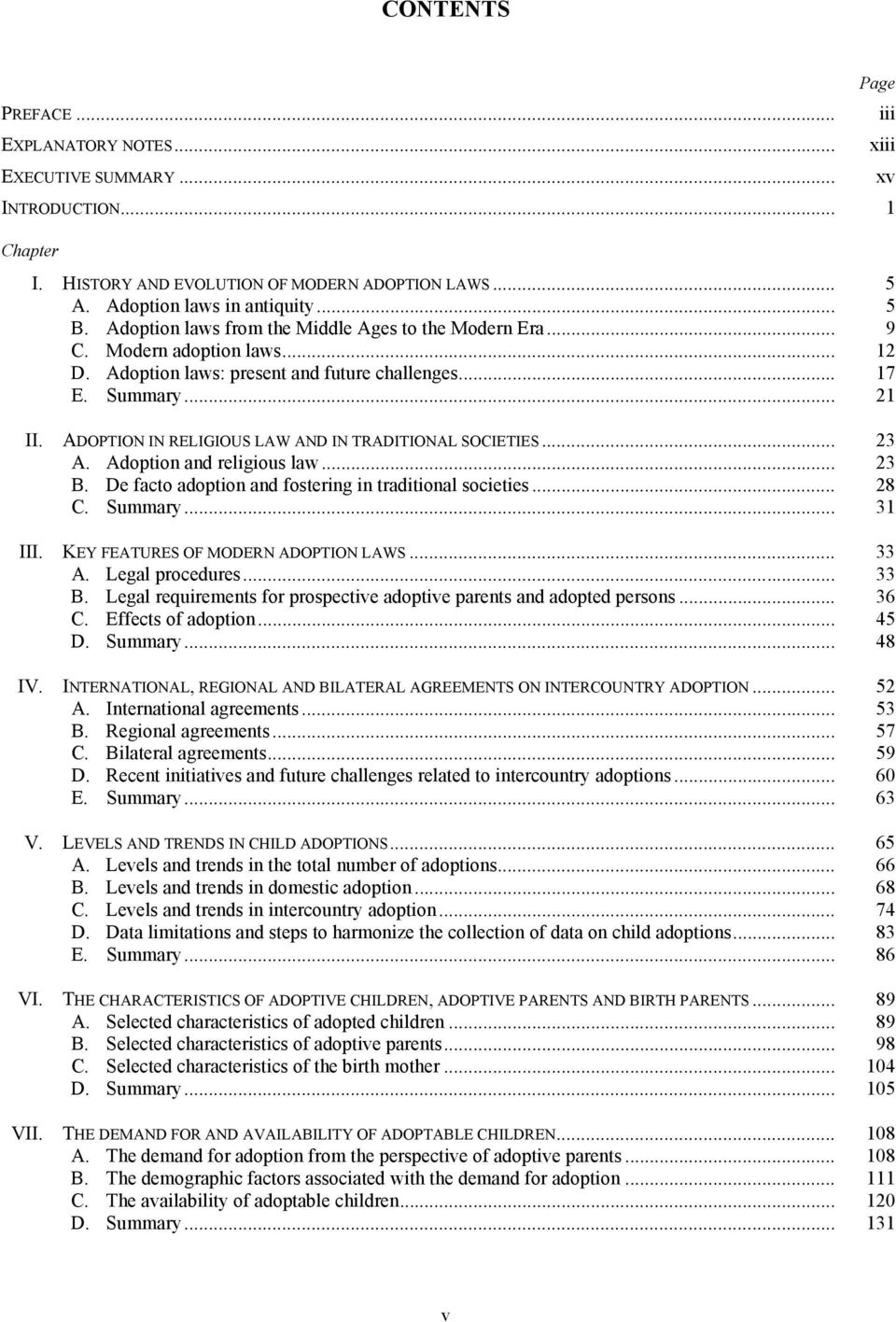
7 CONTENTS PREFACE... EXPLANATORY NOTES... EXECUTIVE SUMMARY... INTRODUCTION... 1 Chapter I. HISTORY AND EVOLUTION OF MODERN ADOPTION LAWS... 5 A. Adoption laws in antiquity... 5 B. Adoption laws from the Middle Ages to the Modern Era... 9 C. Modern adoption laws D. Adoption laws: present and future challenges E. Summary II. ADOPTION IN RELIGIOUS LAW AND IN TRADITIONAL SOCIETIES A. Adoption and religious law B. De facto adoption and fostering in traditional societies C. Summary III. KEY FEATURES OF MODERN ADOPTION LAWS A. Legal procedures B. Legal requirements for prospective adoptive parents and adopted persons C. Effects of adoption D. Summary IV. INTERNATIONAL, REGIONAL AND BILATERAL AGREEMENTS ON INTERCOUNTRY ADOPTION A. International agreements B. Regional agreements C. Bilateral agreements D. Recent initiatives and future challenges related to intercountry adoptions E. Summary V. LEVELS AND TRENDS IN CHILD ADOPTIONS A. Levels and trends in the total number of adoptions B. Levels and trends in domestic adoption C. Levels and trends in intercountry adoption D. Data limitations and steps to harmonize the collection of data on child adoptions E. Summary VI. THE CHARACTERISTICS OF ADOPTIVE CHILDREN, ADOPTIVE PARENTS AND BIRTH PARENTS A. Selected characteristics of adopted children B. Selected characteristics of adoptive parents C. Selected characteristics of the birth mother D. Summary VII. THE DEMAND FOR AND AVAILABILITY OF ADOPTABLE CHILDREN A. The demand for adoption from the perspective of adoptive parents B. The demographic factors associated with the demand for adoption C. The availability of adoptable children D. Summary Page iii xiii xv v
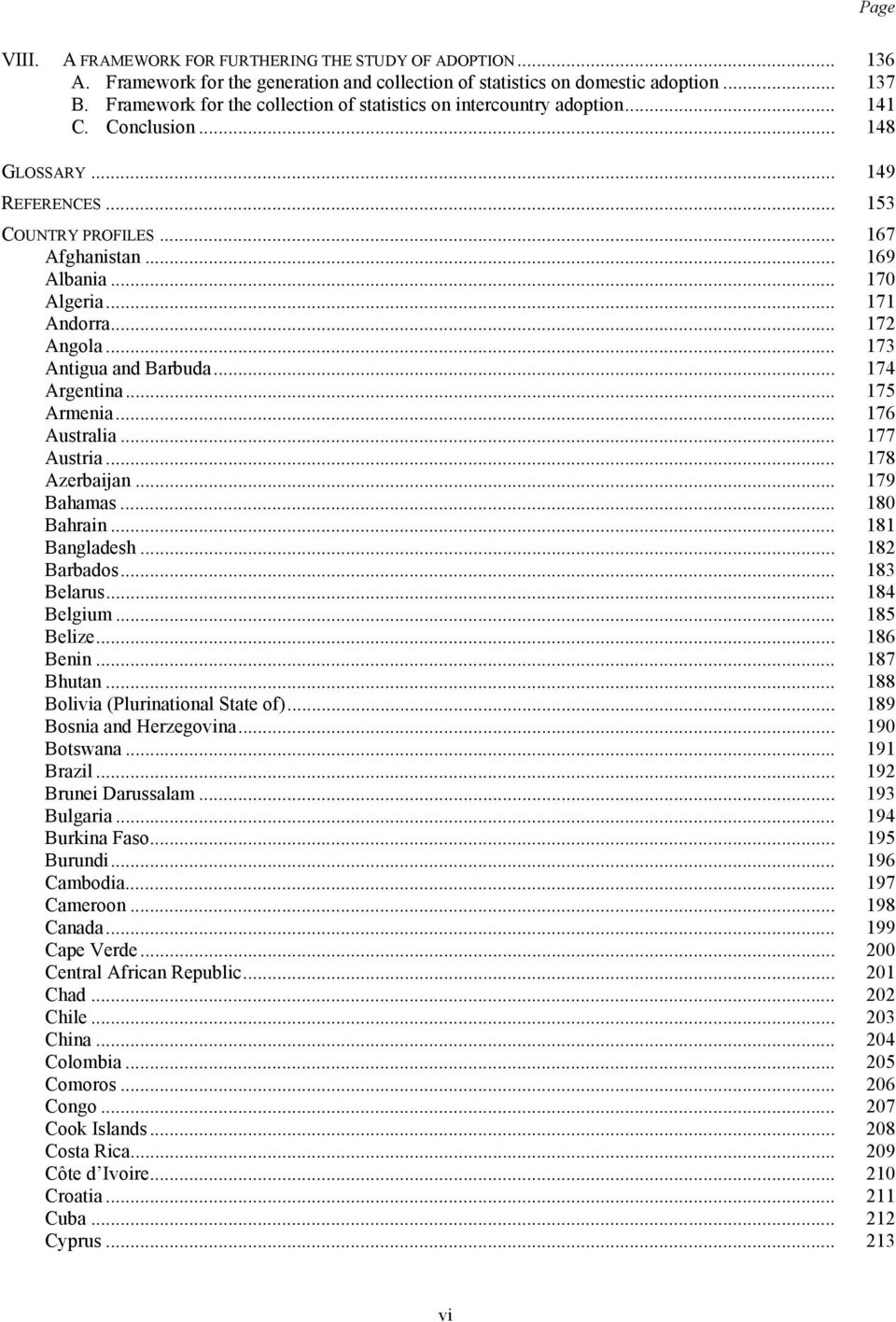
8 Page VIII. A FRAMEWORK FOR FURTHERING THE STUDY OF ADOPTION A. Framework for the generation and collection of statistics on domestic adoption B. Framework for the collection of statistics on intercountry adoption C. Conclusion GLOSSARY REFERENCES COUNTRY PROFILES Afghanistan Albania Algeria Andorra Angola Antigua and Barbuda Argentina Armenia Australia Austria Azerbaijan Bahamas Bahrain Bangladesh Barbados Belarus Belgium Belize Benin Bhutan Bolivia (Plurinational State of) Bosnia and Herzegovina Botswana Brazil Brunei Darussalam Bulgaria Burkina Faso Burundi Cambodia Cameroon Canada Cape Verde Central African Republic Chad Chile China Colombia Comoros Congo Cook Islands Costa Rica Côte d Ivoire Croatia Cuba Cyprus vi
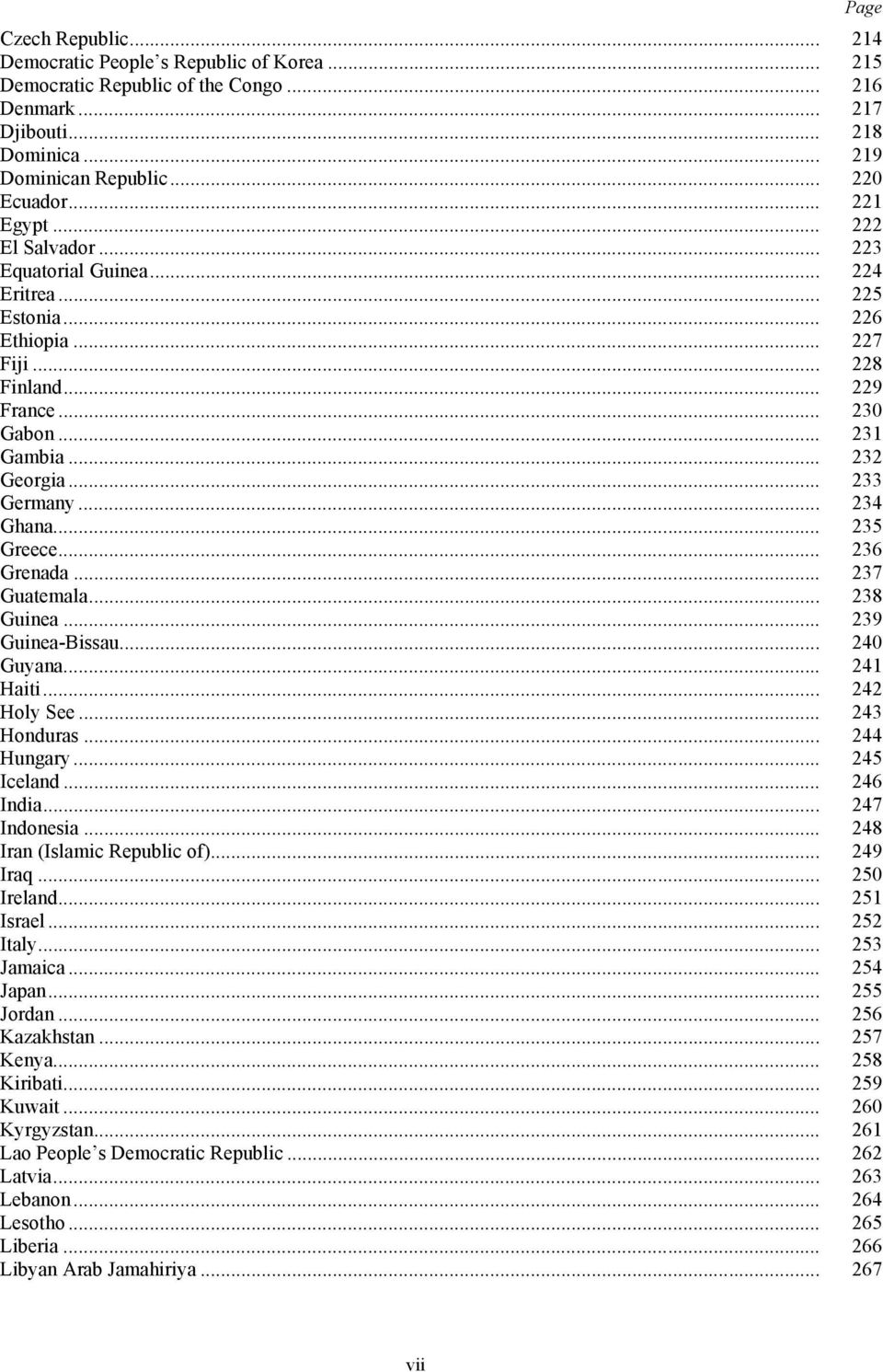
9 Page Czech Republic Democratic People s Republic of Korea Democratic Republic of the Congo Denmark Djibouti Dominica Dominican Republic Ecuador Egypt El Salvador Equatorial Guinea Eritrea Estonia Ethiopia Fiji Finland France Gabon Gambia Georgia Germany Ghana Greece Grenada Guatemala Guinea Guinea-Bissau Guyana Haiti Holy See Honduras Hungary Iceland India Indonesia Iran (Islamic Republic of) Iraq Ireland Israel Italy Jamaica Japan Jordan Kazakhstan Kenya Kiribati Kuwait Kyrgyzstan Lao People s Democratic Republic Latvia Lebanon Lesotho Liberia Libyan Arab Jamahiriya vii
10 Page Liechtenstein Lithuania Luxembourg Madagascar Malawi Malaysia Maldives Mali Malta Marshall Islands Mauritania Mauritius Mexico Micronesia (Federated States of) Monaco Mongolia Montenegro Morocco Mozambique Myanmar Namibia Nauru Nepal Netherlands New Zealand Nicaragua Niger Nigeria Niue Norway Oman Pakistan Palau Panama Papua New Guinea Paraguay Peru Philippines Poland Portugal Qatar Republic of Korea Republic of Moldova Romania Russian Federation Rwanda Saint Kitts and Nevis Saint Lucia Saint Vincent and the Grenadines Samoa San Marino Sao Tome and Principe Saudi Arabia Senegal viii
11 Serbia Seychelles Sierra Leone Singapore Slovakia Slovenia Solomon Islands Somalia South Africa Spain Sri Lanka Sudan Suriname Swaziland Sweden Switzerland Syrian Arab Republic Tajikistan Thailand The former Yugoslav Republic of Macedonia Timor-Leste Togo Tonga Trinidad and Tobago Tunisia Turkey Turkmenistan Tuvalu Uganda Ukraine United Arab Emirates United Kingdom United Republic of Tanzania United States of America Uruguay Uzbekistan Vanuatu Venezuela (Bolivarian Republic of) Viet Nam Yemen Zambia Zimbabwe Page ANNEXES NO. I. DERIVATION OF GLOBAL ESTIMATES OF TOTAL, DOMESTIC AND INTERCOUNTRY ADOPTIONS II. REFERENCES FOR COUNTRY PROFILES III. ANNEX TABLES ix

12 No. TEXT TABLES I.1. Year of promulgation or enactment of selected adoption laws, III.1. Number of countries requiring the prospective adoptive parent to be of a certain age by type of age requirement III.2. Number of countries requiring the prospective adoptive parents to be of a certain age, by age group of prospective adoptive parents III.3. Number of countries permitting single persons to adopt by sex of those persons and major area. 39 III.4. Number of countries that require or allow the child to express consent to adoption by the age above which the child s consent is sought IV.1. Countries that have ratified the European Convention on the Adoption of Children, IV.2. Countries that have ratified the Inter-American Convention on Conflict of Laws Concerning the Adoption of Minors, V.1. Countries with the largest total number of adoptions and different adoption rates V.2. Countries with the largest number of domestic adoptions V.3. Countries of destination with the largest number of intercountry adoptions and main country of origin V.4. Countries of origin with the largest number of intercountry adoptions and main country of destination V.5. Number of intercountry adoptions by main country of origin, and V.6. Countries publishing data on adoption by type of adoption and by major area VI.1. Mean age of children at the time of adoption by type of adoption VI.2. Sex ratio and percentage of boys among adopted children at the time of adoption by type of VI.3. adoption Overall number of intercountry adoptions by country of origin and sex of the child for Denmark, Ireland and Norway combined, VI.4. Age of parents at the time of adoption, various indicators VI.5. Number and percentage of adoptions by single parents VI.6. Number and percentage of adoptions by step-parents and other relatives VI.7. Adoptions by age and marital status of the birth mother, Australia, VII.1. Number of adoption applications and approvals VII.2. Average desired number of children and distribution of persons by number of children desired for selected countries of destination of intercountry adoptions VII.3. Number of adoptions by persons with and without children at the time of adoption VII.4. Number of children in care and adoptions of children from care VII.5. Sex ratio of children in care and of those adopted from care VII.6. Mean ages of children in care and adopted children at the time of adoption from care VII.7. Domestic rate of under-five adoptions by step-parents and selected indicators of marital dissolution Page ANNEX TABLES A.III.1. Status of adoption, national legislation and institutional arrangements concerning adoptions by major area and country A.III.2. Selected requirements for prospective adoptive parents and adopted children by major area and country A.IV.1. Countries that have ratified various conventions relevant to intercountry adoptions A.V.1. Selected adoption rates by major area and country A.V.2. Selected adoption indicators by major area and country A.V.3. Main countries of destination of intercountry adoptions for selected countries of origin A.V.4. Main countries of origin of intercountry adoptions for selected countries of destination A.VI.1. Total number of adoptions and percentage distribution of adoptions by age of the child at the time of adoption x

13 No. A.VI.2. Number of domestic adoptions and percentage distribution of domestic adoptions by age of the child at the time of adoption A.VI.3. Number of intercountry adoptions and percentage distribution of intercountry adoptions by age of the child at the time of adoption A.VI.4. Sex ratio of adopted children and percentage distribution by sex A.VI.5. Sex ratio of children adopted domestically and percentage distribution by sex A.VI.6. Sex ratio of children adopted through an intercountry procedure and percentage distribution by sex A.VII.1. Total, domestic and intercountry under-five adoption rates and selected indicators of the desired family size in countries that are not major destinations for intercountry adoptions A.VII.2. Total, domestic and intercountry under-five adoption rates and selected indicators of the desire for more children in countries that are not major destinations of intercountry adoptions A.VII.3. Total, domestic and intercountry under-five adoption rates and selected indicators of fertility in countries that are major destinations of intercountry adoptions A.VII.4. Total, domestic and intercountry under-five adoption rates and selected indicators of fertility in countries that are not major destinations of intercountry adoptions A.VII.5. Total, domestic and intercountry under-five adoption rates and percentage of extramarital births in countries that are major destinations of intercountry adoptions A.VII.6. Total, domestic and intercountry under-five adoption rates and percentage of extramarital births in countries that are not major destinations of intercountry adoptions A.VII.7. Total, domestic and intercountry under-five adoption rates and selected indicators of abortion and contraceptive use in countries that are major destinations of intercountry adoptions A.VII.8. Total, domestic and intercountry under-five adoption rates and selected indicators of abortion and contraceptive use in countries that are not major destinations of intercountry adoptions A.VII.9. Total, domestic and intercountry under-five adoption rates and selected indicators of orphanhood in countries that are not major destinations of intercountry adoptions Page TEXT FIGURES V.1. Number of domestic adoptions in Ireland and New Zealand, V.2. Number of domestic adoptions and adoptions by step-parents and other relatives, Australia, V.3. Number of intercountry adoptions in Northern America and in West European countries as a group, by region of origin, V.4. Number of intercountry adoptions in Northern America and in West European countries as a group, by country of origin, V.5. Number of intercountry adoptions in the United States, V.6. Number of intercountry adoptions in France and Sweden, V.7. Number of domestic and intercountry adoptions in Romania, V.8. Number of intercountry adoptions received by the United States from the four main countries of origin, VI.1. Age distribution of children adopted domestically and through an intercountry procedure, Norway, VI.2. Age distribution of children adopted by step-parents and by non-related adoptive parents, Germany, VI.3. Adoptions by step-parents and adoptions of children aged 10 or over, Switzerland, VI.4. Number of domestic and intercountry adoptions by sex of the adoptive child, Singapore, VI.5. Number of adoptions by age and sex of the adoptive parent, Australia, xi
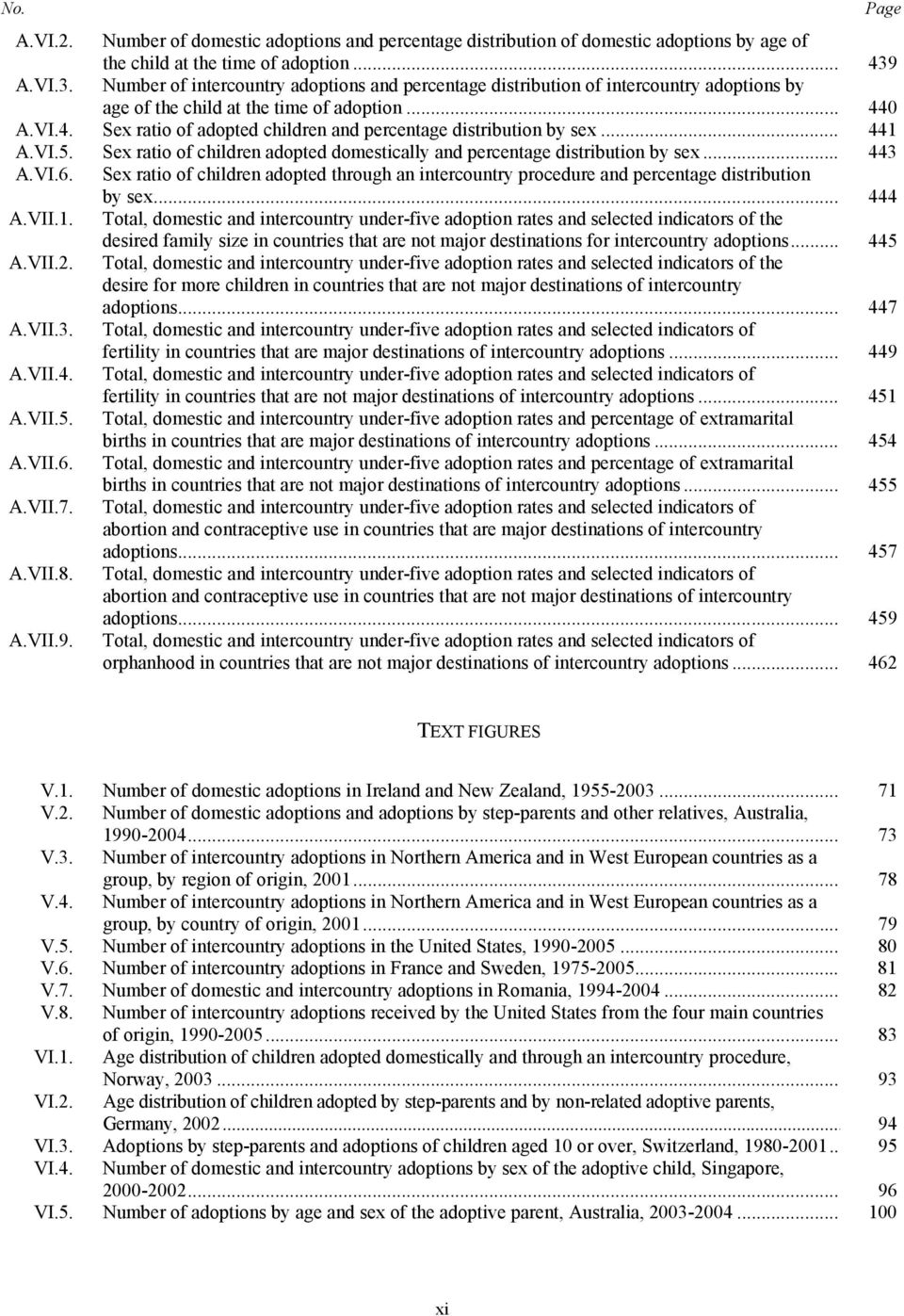
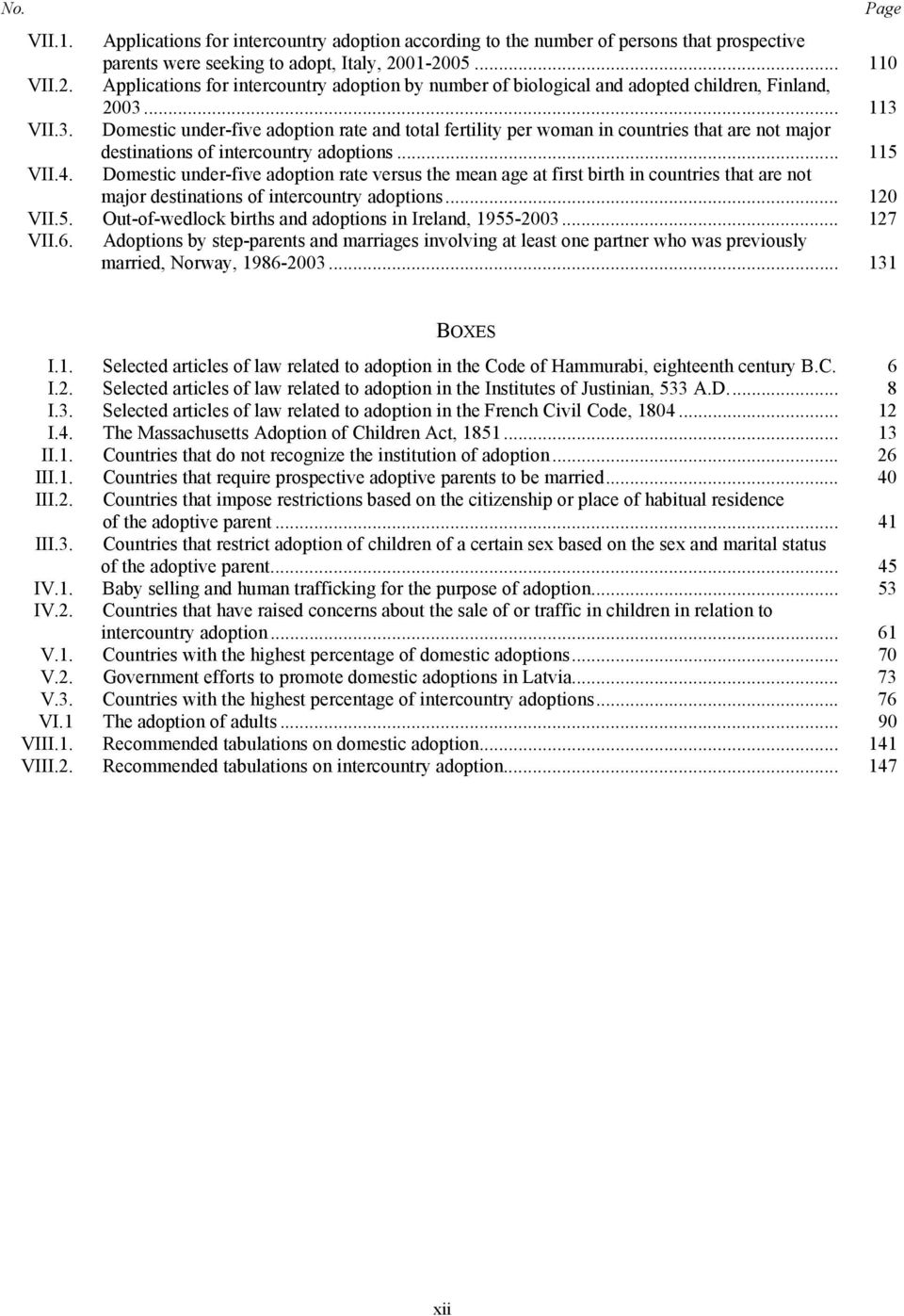
14 No. VII.1. Applications for intercountry adoption according to the number of persons that prospective parents were seeking to adopt, Italy, VII.2. Applications for intercountry adoption by number of biological and adopted children, Finland, VII.3. Domestic under-five adoption rate and total fertility per woman in countries that are not major destinations of intercountry adoptions VII.4. Domestic under-five adoption rate versus the mean age at first birth in countries that are not major destinations of intercountry adoptions VII.5. Out-of-wedlock births and adoptions in Ireland, VII.6. Adoptions by step-parents and marriages involving at least one partner who was previously married, Norway, Page BOXES I.1. Selected articles of law related to adoption in the Code of Hammurabi, eighteenth century B.C. 6 I.2. Selected articles of law related to adoption in the Institutes of Justinian, 533 A.D... 8 I.3. Selected articles of law related to adoption in the French Civil Code, I.4. The Massachusetts Adoption of Children Act, II.1. Countries that do not recognize the institution of adoption III.1. Countries that require prospective adoptive parents to be married III.2. Countries that impose restrictions based on the citizenship or place of habitual residence of the adoptive parent III.3. Countries that restrict adoption of children of a certain sex based on the sex and marital status of the adoptive parent IV.1. Baby selling and human trafficking for the purpose of adoption IV.2. Countries that have raised concerns about the sale of or traffic in children in relation to intercountry adoption V.1. Countries with the highest percentage of domestic adoptions V.2. Government efforts to promote domestic adoptions in Latvia V.3. Countries with the highest percentage of intercountry adoptions VI.1 The adoption of adults VIII.1. Recommended tabulations on domestic adoption VIII.2. Recommended tabulations on intercountry adoption xii
15 Explanatory notes Symbols of United Nations documents are composed of capital letters combined with figures. The tables presented in this publication make use of the following symbols: Two dots (..) indicates that the item is not applicable. Three dots ( ) indicate that data are not available or are not separately reported. An em-dash ( ) indicates that the amount is nil or negligible. A minus sign (-) before a figure indicates a decrease. A full stop (.) is used to indicate decimals. Use of a hyphen (-) between years, for example , signifies the full period involved. Percentages in tables and figures do not necessarily add to totals because of rounding. xiii

16

17 EXECUTIVE SUMMARY Adoption is one of the oldest social institutions. Nevertheless, adoption still raises highly emotive issues because of its fundamental implications for the meaning of familial ties. Questions on whether adoption serves the best interests of children, who should be allowed to adopt and the role of Governments in regulating such decisions are frequent subjects of debate. Yet, despite the heightened attention to these issues, much of the information on adoption remains anecdotal. Data on the number of children adopted domestically are rarely available and when they are, they tend to be out-of-date. Similarly, comparable information on trends in intercountry adoptions that is, adoptions that involve a change of country of residence for the adopted person is often lacking or is available for just a few countries. is the first study focusing on adoption prepared by the Population Division of the Department of Economic and Social Affairs of the United Nations Secretariat. The study provides a solid foundation for furthering research on child adoption and, more specifically, on the demographic factors that shape the demand for and the availability of adoptable children. The focus of this report is on the nexus between adoption policies and trends at the national and global levels. Understanding adoption policies and their origins is all the more important today because, as adoption has become global, inconsistencies among the legal principles and traditions regarding adoption in different countries are increasingly coming to the fore. The major findings of this study are summarized below. Key findings 1. There are over a quarter of a million adoptions every year. The United Nations Population Division estimates that some 260,000 children are adopted each year. This estimate implies that fewer than 12 children are adopted for every 100,000 persons under age 18 (figure I). Adoption remains, therefore, a relatively rare event. 2. A few countries account for most adoptions (figure II). The United States of America, with over 127,000 adoptions in 2001, accounts for nearly half of the total number of adoptions worldwide. Large numbers of adoptions also take place in China (almost 46,000 in 2001) and in the Russian Federation (more than 23,000 in 2001). 3. The purpose of adoption has evolved over time. Historically, adoption occurred primarily to preserve and transmit family lines or inheritance, to gain political power or to forge alliances between families. Adopted persons were usually adolescents or adults who could guarantee the continuation of the family line. The notion that adoption was a means for promoting children s welfare did not take hold until the mid-nineteenth century. Today, the principle of ensuring that the best interests of the child are served by adoption is the paramount consideration enshrined in most adoption laws. 4. Over 160 countries recognize the legal institution of adoption but 20 countries do not have legal provisions allowing child adoption. In most of the countries where adoption is not possible, alternative procedures, such as guardianship or the placement of children under the care of relatives are permitted. Religion often plays a key role in determining the conditions under which such alternative practices may be pursued. 5. In some countries, informal adoption and fostering are perceived as preferable to formal adoption. Informal or de facto adoption and fostering are practices that allow parents to put children in the care of others (usually relatives) without having to cut all ties with their children. These practices contrast markedly with the secrecy and finality that have come to characterize adoption in the western context. xv

18 Executive summary Figure I. Number of adoptions of children under 18 per 100,000 children under 18, most recent data available, Sources: For a complete list of country references, see annex II. NOTES: The under-18 adoption rate is calculated by dividing the total number of adoptions of persons under age 18 by the number of persons under age 18. It is assumed that all persons adopted are under age 18 at the time of adoption. The boundaries shown on the present map do not imply official endorsement or acceptance by the United Nations. 6. The consequences of an adoption for the rights of adopted children differ considerably among countries. In some countries, adopted children acquire the same rights as birth children, including the right to inheritance, and adopted children sever all legal ties with their birth parents. In other countries, the termination of natural ties between birth parents and children is viewed as culturally unacceptable. 7. Requirements for prospective adoptive parents vary considerably among countries. In 81 countries, adoption laws establish a minimum age for prospective adoptive parents and in 15 countries, adoption laws also stipulate a maximum age. Single persons are allowed to adopt in 100 countries but in 15, only married couples can adopt. In many countries, laws have been amended to allow older persons or single persons to adopt. However, in some cases, the criteria that potential adoptive parents must meet have become more stringent. Adoption by step-parents, for instance, is currently discouraged in several countries because of the potentially detrimental effects that such adoptions are deemed to have on the child s relationship to his or her non-custodial biological parent. The requirements for intercountry adoptions have also been tightened in several countries of origin. 8. Domestic adoptions far outnumber intercountry adoptions. Almost 85 per cent of all adoptions involve citizens or residents of the same country. Domestic adoptions represent at least half of all adoptions in 57 of the 96 countries with data. Whereas the number of domestic adoptions has been declining in many developed countries, several developing countries have experienced an increase in the number of domestic adoptions, partly because of the implementation of policies to encourage local residents to adopt. xvi

19 Executive summary Figure II. Countries with the largest number of adoptions, most recent available data, United States China Russian Federation Ukraine United Kingdom Germany Spain France Brazil Canada Republic of Korea Guatemala Kazakhstan Italy India Viet Nam Uzbekistan Poland Bulgaria South Africa 0 30,000 60,000 90, ,000 Source: For a complete list of country references, see annex II. NOTES: Data for Canada and the Russian Federation are estimates. Data for Brazil refer to the state of São Paulo only. Data for Poland refer to adoption rulings by the courts. 9. Adoptions by step-parents and other relatives account for more than half of all domestic adoptions. Nevertheless, the number of adoptions by step-parents and other relatives has been declining in recent years. In some countries, the introduction of legislation discouraging adoptions by step-parents accounts partly for this trend. Declining re-marriage rates and an increasing prevalence of informal parenting arrangements are also contributing to that decline. 10. The number of intercountry adoptions has been increasing. Both the number of intercountry adoptions and their share among all adoptions have been increasing. In many European countries, intercountry adoptions now account for more than half of all adoptions. 11. The United States, France and Spain, in order of importance, are the major countries of destination of children adopted internationally. Other countries that experience large inflows of children adopted from abroad are Canada, Germany, Italy, the Netherlands and Sweden. Each of these countries has recorded over 1,000 foreign adoptions annually in recent years. 12. Asian and East European countries are the major sources of children adopted through an intercountry procedure. Relatively few children adopted internationally originate in Africa or Latin America and the Caribbean. The countries of origin accounting for most international adoptions are China, Guatemala, the Republic of Korea, the Russian Federation and Ukraine. More than half of the children adopted abroad originate in those five countries. xvii

20 Executive summary 13. The dwindling supply of children available for domestic adoption may partially explain the increase in the number of intercountry adoptions. In developed countries, the widespread availability of reliable, safe and inexpensive contraception has meant that there are fewer children available for adoption. In addition, wider societal acceptance of single parenthood and the greater availability of welfare support have meant that fewer single mothers give up their children for adoption. 14. The characteristics of children available for domestic adoption has also contributed to the increase in the number of intercountry adoptions. Adoptable children within countries are often older than those desired by adoptive parents. The desire for younger children has probably prompted some parents to adopt children abroad. Intercountry adoptions are also favoured in contexts where adoption procedures are less demanding and faster for intercountry adoptions than for domestic adoption. 15. Over 60 per cent of adopted children are under age five at the time of adoption. Despite adoptive parents preference for younger children, relatively few adoptions involve children under age one. Adoptions of children older than five years also tend to be rare and, when they occur, they frequently involve step-children. 16. In countries of destination, children adopted domestically tend to be older than children adopted through an intercountry procedure. This outcome results, at least in part, from the fact that domestic adoptions comprise a larger proportion of step-child adoptions, which usually involve older children. The preference of prospective adoptive parents for adopting younger children may also be a factor. In countries of origin, children adopted domestically tend to be younger than those adopted by foreign parents through an intercountry procedure. The principle of subsidiarity, whereby intercountry adoption is considered only after all other options have been exhausted, may be the reason for this difference. 17. More girls are adopted than boys. In both domestic and intercountry adoptions, the number of girls adopted exceeds that of boys. In some countries, this pattern is associated with imbalances in the sex distribution of children available for adoption. In other countries, the perception that girls are easier to raise or that female children are more likely to provide assistance with housework or care-giving activities may explain in part the higher percentage of adoptions involving girls. 18. Most adoptive parents are in the age group. Adoptions by parents who are younger than 30 or older than 44 are less frequent, partly because of the maximum and minimum age limits imposed by the legislation of most countries. Female adoptive parents are generally younger, partly because they are less likely to adopt as step-parents. 19. The numbers of male adoptive parents is roughly the same as that of female adoptive parents. However, in countries with large numbers of adoptions by step-parents or where adoption by single persons is permitted, differences by sex are noticeable. Among adopting step-parents, men outnumber women, but women outnumber men among single persons who adopt. 20. People who are unable to achieve their desired family size through childbearing often resort to adoption. Country-level surveys and ethnographic studies indicate that persons who are involuntarily childless as a result of sterility, subfecundity or other factors often seek to adopt. 21. Adoption is not simply a demographic response to achieve a desired family size for those suffering from involuntary sterility and sub-fecundity. Whereas involuntary childlessness is often associated with adoption, in several countries a large percentage of persons seeking to adopt already have children of their own. xviii

21 Executive summary 22. Birth mothers who give up their children for the purpose of adoption tend to be young and unmarried. However, having an extramarital birth, which in the past was a strong reason for placing a child for adoption is no longer strongly associated with the availability of adoptable children. In many societies, unmarried women are deciding to raise children born out of wedlock instead of placing them for adoption. 23. Despite the perceived shortage of adoptable children domestically, the number of children in foster care or in institutions generally far exceeds the number of children who are being adopted. This paradox arises because many children in foster care or in institutions are older or have health problems and are not, therefore, easy to place among prospective adoptive parents who prefer younger and healthy children. In addition, because many children in foster care or in institutions still have ties to their biological parents, they often are not formally adoptable. 24. In countries highly affected by the AIDS epidemic, there are a large number of orphans who have lost both their parents to the disease and that could be adopted either domestically and internationally. It is estimated that in Africa, the continent most affected by the epidemic, the current number of domestic adoptions would have to be multiplied by 2,000 to ensure that the estimated 7.7 million orphans in the continent would have an adoptive family. At a global level, the number of adoptions would have to increase by a factor of 60 to provide families to all AIDS orphans. 25. Many countries have ratified multilateral, regional or bilateral agreements on intercountry adoption aimed at addressing conflicts of jurisdiction and protecting the welfare of children. Seventy countries have ratified or acceded to the Convention on Protection of Children and Co-operation in Respect of Intercountry Adoption. As of January 2007, 117 countries had ratified the United Nations Optional Protocol to the Convention on the Rights of the Child on the Sale of Children, Child Prostitution and Child Pornography, which stipulates that coercive adoption should be a criminal offence. Nevertheless, child trafficking and selling of children for adoption are still a concern in several countries. Problems in making the various agreements operational have also emerged. Initiatives are under way to ensure that existing international legal mechanisms respond better to the evolving challenges raised by intercountry adoptions. 26. Total lack of data on adoption or limitations in the data available represent a major obstacle to the understanding of the determinants of adoption, its changing patterns over space and time, and its major trends. Out of the 195 countries considered in this study, only 118 publish data on the total number of adoptions and far fewer publish data on adoptions classified by type (domestic vs. intercountry) or on the characteristics of those involved in the adoption process (the adopted child, the biological parents and the adoptive parents). Variations in the concepts and definitions underlying the data available limit the usefulness of cross-country comparisons. xix
22
23 INTRODUCTION In 1974, the World Population Plan of Action of the World Population Conference called on countries to facilitate child adoption so that all couples could achieve their desired number of children. 1 By doing so, the Plan of Action recognized that child adoption could play a role in approximating biological parenthood for couples who would otherwise be unable to have children. In the intervening years, many of the demographic trends associated with the demand for adoption have become more accentuated. Delayed marriage, the postponement of childbearing, rising levels of childlessness, high levels of divorce and the wider acceptance of new family forms are just some of the demographic trends associated with a larger pool of people having recourse to adoption. At the same time, adoption as a legal institution has continued to evolve. Following the entry into force of the 1989 United Nations Convention on the Rights of the Child, 2 the principle of safeguarding the best interests of the child has been firmly established as the paramount consideration in all decisions relating to child adoption. Countries have modified existing legislation to recognize new forms of adoption and to allow adoptions by individuals who had been previously considered ineligible to adopt. A large number of countries have ratified multilateral and bilateral agreements relative to adoption in order to ensure clarity in matters of jurisdiction and applicable law where intercountry adoptions are concerned and to ensure that the welfare of the children involved is safeguarded. Despite these developments, the broader demographic context in which adoptions take place remains generally unexplored. 3 The lack of comparable data on the number of children adopted each year and on the characteristics of the individuals involved, namely, the adopted person, the adoptive parents and the birth parents, has hindered such exploration. Important questions remain to be addressed. Will the postponement of childbearing result in an ever-increasing number of persons seeking to adopt? How will fertility trends affect the availability of adoptable children? What role, if any, should adoption play in providing care for the nearly 8 million children who have lost both parents due to illness or conflict? This study, the first on child adoption undertaken by the Population Division of the Department of Economic and Social Affairs of the United Nations Secretariat, focuses on the nexus between demography and policy to understand trends in child adoption. Clearly, Government policies on child adoption play a major role in shaping individual and social behaviour and are powerful determinants of overall trends. Decisions, such as lowering age requirements for prospective adoptive parents or extending the right to adoption to single persons, can contribute to increase the number of adoptions. Conversely, more stringent requirements regarding the age, marital status, health or income of prospective adoptive parents are likely to result in lower numbers of adoptions. This report assembles information for 195 countries on a number of aspects of adoption, including national legislation and ratification of multilateral treaties. Data on domestic adoptions, intercountry adoptions and the total number of adoptions as well as on selected characteristics of the individuals involved in the adoption process are also considered. The contents of each of the chapters of this report are described briefly below. Chapter I examines the evolution of adoption laws and policies, starting with some of the earliest written legal codes. This chapter focuses mainly on the tradition of western legal jurisprudence, although adoption laws in other parts of the world are also considered. The chapter describes how adoption laws have changed from antiquity to the modern era, highlighting similarities and differences between past and present practices. Areas of current and future debate, including the role of intercountry adoption, adoption by stepparents and access to information on birth parents are also discussed. United Nations Department of Economic and Social Affairs/Population Division 1
24 Introduction Chapter II provides an overview of adoption practices in the context of religious law and traditional societies. In particular, it focuses on the different attitudes towards adoption in Canon law, Sharia law and Halachic law. The position on adoption in Hindu and Confucian legal traditions is also touched upon. The chapter then examines various alternatives to formal adoption, such as fostering and de facto adoption common in traditional societies in Africa, the Americas and Oceania. In doing so, the emphasis is on the different cultural and social functions that such practices have played in comparison with the role that formalised adoption plays today in the western legal context. Chapter III discusses modern adoption laws and policies for 195 countries. It describes differences in adoption procedures among countries, focusing on the authorities responsible for overseeing, approving and granting adoptions. The chapter then examines the requirements that prospective adoptive parents and adopted children should meet, including those relative to age, sex, marital status, residency and citizenship. The different effects of adoption on the rights of the adopted child as outlined in the laws of various countries are also discussed, including the right to inheritance, the acquisition of the surname of the adoptive family and the right to acquire the citizenship of the adoptive parents when intercountry adoption is involved. Chapter IV is devoted to a discussion of intercountry adoption, focusing on the role of multilateral, regional and bilateral agreements in regulating such flows. It describes the four major multilateral instruments relative to adoption: the 1961 United Nations Convention on the Reduction of Statelessness; the 1989 United Nations Convention on the Rights of the Child; the 1993 Convention on Protection of Children and Cooperation in Respect of Intercountry Adoption, and the 2000 United Nations Optional Protocol to the Convention on the Rights of the Child on the Sale of Children, Child Prostitution and Child Pornography. The chapter also considers two regional instruments: the 1967 European Convention on the Adoption of Children and the 1984 Inter-American Convention on Conflict of Laws Concerning the Adoption of Minors. Child trafficking and selling children for the purpose of adoption are discussed as the two major concerns of Governments intent on combating international crime that affects minors. Lastly, the chapter discusses the problems faced in making the various multilateral, regional and bilateral agreements operational. Chapter V offers on overview of levels and trends in the total number of adoptions and the number of domestic and intercountry adoptions. It provides a global estimate of the annual number of children adopted in the world and of the shares of intercountry and domestic adoptions. Various adoption rates and ratios are presented to provide an understanding of the relative magnitude of the phenomenon. Trends in domestic and intercountry adoption for selected countries are also discussed, as are changes in the major countries of origin and destination of intercountry adoptions. Chapter VI examines the characteristics of the individuals involved in the adoption process (the adopted person, the adoptive parents and the birth parents). The age and sex of adopted persons at the time of adoption, their differences with respect to intercountry and domestic adoptions, the characteristics of adoptive parents (age, sex, marital status, relationship with adopted person) and the characteristics of birth mothers are analysed. Chapter VII examines the relationships between demographic factors and the demand for, and the availability of, adoptable children. Adoption rates are compared with selected indicators of fertility and family formation, including desired family size, childlessness, presence of own children, mean age at marriage and total number of children per woman. To explore the determinants of the availability of adoptable children, adoption rates are compared with the percentage of children born outside of marriage, abortion rates and the prevalence of orphanhood. 2 United Nations Department of Economic and Social Affairs/Population Division
25 Introduction Chapter VIII provides recommendations for the improvement of data on adoption. The chapter suggests a minimum set of data required to monitor the implementation of various multilateral instruments on intercountry adoption. The comprehensive set of data compiled for this report is presented in annex tables. NOTES 1 See Report of the United Nations World Population Conference, Bucharest, August 1974 (United Nations publication, Sales No. E.75.XIII.3). 2 United Nations (1990). Treaty Series, vol. 1577, No , p The Programme of Action of the 1994 International Conference on Population and Development called on countries to stem the practice of coercive adoption. See Report of the International Conference on Population and Development, Cairo, 5-13 September 1994 (United Nations publication, Sales No. E.95.XIII.18), chap. I, resolution 1, annex. United Nations Department of Economic and Social Affairs/Population Division 3
26
27 I. HISTORY AND EVOLUTION OF MODERN ADOPTION LAWS Literary and legal sources indicate that adoption was widely practised in many ancient societies (Brosnan, 1922; Huard, 1956). From the frequently cited example of the adoption of Moses to that of the Emperor Octavian Augustus, adoption played a major part in the traditional law of many Eurasian societies (Goody, 1969, p. 55). While adoption may be as old as human society itself (Benet, 1976), the motivations for adoption have changed markedly over time. Today, adoption is undertaken mainly to provide a home for children deprived of parental care and to satisfy the desire of individuals or couples to care for and rear a child (Goody, 1969; Tizard, 1977). In contrast, societies of the past regarded adoption as a means for preserving family lineage, enabling the continuation of ancestor worship, creating political alliances and ensuring care for adoptive parents in their old age (Derrett, 1957; Gardner, 1998, and Huard, 1956). The norms regulating adoption have also shifted over time. In many early laws, for instance, persons with children of their own, individuals of reproductive age and women were not allowed to adopt. Further, ancient laws often did not permit the adoption of minors, clear evidence that the welfare and best interests of children were not the paramount consideration in the decisions related to adoption. Nevertheless, ancient legislation is the source of many of the key features of modern adoption laws, including the acquisition by the adopted person of the name of the adoptive parents, the right to inheritance from the adoptive family and the termination of the birth parents guardianship rights. It is fitting therefore to begin this overview of adoption trends and policies by focusing briefly on the past, to uncover the roots of today s norms and practices. This chapter focuses mainly on adoption laws in the western legal tradition, a choice made both to limit the scope of this overview and because modern adoption laws in many parts of the world have been profoundly influenced by western jurisprudence. The purpose of this chapter is threefold: to shed light on the genesis of modern adoption laws by providing a historical overview of past adoption customs and legislation, to offer an explanation for some of the differences that exist in current legal approaches towards adoption and to identify some of the areas where adoption laws are likely to continue evolving. Chapter II provides an overview of adoption practices in other cultural and societal contexts, looking at the role of norms in religion and in traditional societies. A. ADOPTION LAWS IN ANTIQUITY Adoption clearly played an important part in ancient life as attested by literary and legal sources dating back almost four millennia. Specific information on ancient adoption legislation remains, however, highly fragmented and it is difficult to reconstruct a comprehensive chronology of the history of such laws. Consequently, the following section provides only selected illustrations of adoption laws in antiquity. 1. Babylonia: The Code of Hammurabi One of the earliest legal texts referring to adoption is the Code of Hammurabi (box I.1). This code, dating from the eighteenth century B.C., contains many features that are still relevant to modern adoption law (Cole and Donley, 1990). For example, the code established that adoption was a legal contract that could only be executed with the consent of the birth parents. As in many laws today, birth parents ceased to have any claim upon the child once the deed transferring the guardianship of an adopted child had been executed (Johns, ). In addition, the Code of Hammurabi granted adopted children equal rights to those of birth children. Nevertheless, the Code also contained many provisions that differ from modern practices. Adopted persons were severely punished for attempting to return to their birth families and the adoption contract could be annulled if the adopted child s filial duties were not properly fulfilled. These provisions had particularly severe consequences for individuals who had been slaves, because the termination of the adoption contract returned them into bondage. The adoption contract could also be dissolved by a court at the adopted United Nations Department of Economic and Social Affairs/Population Division 5
28 Chapter I. History and evolution of modern adoption laws BOX I.1. SELECTED ARTICLES OF LAW RELATED TO ADOPTION IN THE CODE OF HAMMURABI, EIGHTEENTH CENTURY B.C If a man adopt a child and to his name as son, and rear him, this grown son cannot be demanded back again If a man adopt a son, and if after he has taken him he injure his foster father and mother, then this adopted son shall return to his father s house If an artisan has undertaken to rear a child and teaches him his craft, he cannot be demanded back If he has not taught him his craft, this adopted son may return to his father s house If a man does not maintain a child that he has adopted as a son and reared with his other children, then his adopted son may return to his father s house If a man, who had adopted a son and reared him, founded a household, and had children, wish to put this adopted son out, then this son shall not simply go his way. His adoptive father shall give him of his wealth one-third of a child s portion, and then he may go. He shall not give him of the field, garden, and house If a son of a paramour or a prostitute say to his adoptive father or mother: You are not my father, or my mother, his tongue shall be cut off If the son of a paramour or a prostitute desire his father s house, and desert his adoptive father and adoptive mother, and goes to his father s house, then shall his eye be put out. Source: L.W. King, person s request if the adoptive parent failed to teach the adopted person a trade or if the adopted person had not been properly reared by the adoptive family. If an adoptive parent remarried and decided to dissolve the contract with the adopted child, the latter was entitled to inherit onethird of a child s share in goods but had no claim to the house or land of the adoptive family. Unlike most modern adoption laws, only the adoption of male children was permitted. 2. Greek laws on adoption The laws of ancient Greece provide an additional illustration of some of the earliest adoption legislation. As with Hammurabi s Code, these laws often aimed at providing heirs for childless individuals. Persons who already had legitimate sons were not normally permitted to adopt. According to the laws of Solon (sixth century B.C.) and the Law Code of Gortyn (fifth century B.C.), for instance, only adult males who had no legitimate descendants and who were considered sound of mind were permitted to adopt (Rubenstein, 1993; Willetts, 1977). If, however, a male offspring was born after an adoption had been completed, the adopted child and the birth child were entitled to equal shares of the inheritance (Goody, 1973; Willetts, 1977). Most modern adoption laws have preserved this concept by recognizing that birth descendants and adopted persons have equal rights to inheritance. According to Solonic law, adoption could assume three distinct forms. Children could be adopted by a living person (inter vivos: between living persons); through testamentary adoption (that is, in the will of a deceased person), or posthumously by a relative in the name of a deceased family member (Rubenstein, 1993). Adoption inter vivos was a voluntary contractual relationship entered into by two individuals, whereas testamentary and posthumous adoptions were legal acts requiring confirmation by the People s Court. Adoption inter vivos was practised mainly to provide support for older adoptive parents, whereas testamentary adoption was undertaken for the purpose of ancestor worship. Adoption inter vivos was also used when a man with no male offspring adopted a son to prevent a kinsman from claiming his daughter as an heiress (Goody, 1969). 6 United Nations Department of Economic and Social Affairs/Population Division
29 Chapter I. History and evolution of modern adoption laws Regardless of the form, adoption in ancient Greece had the effect of terminating the ties between the adopted person and the birth father s relatives (Rubenstein, 1993). Adopted sons assumed the full filial status but were only able to perpetuate their new family line by direct male descent (Goody, 1969). 3. Roman laws on adoption Roman law also recognized multiple forms of adoption. The Institutes of Gaius (circa 161 A.D.), for example, cites two forms: adoptio and arrogatio or adrogatio (from the Latin rogare: to ask) (Muirhead, 1880). 1 Adoptio consisted of a ceremony by which a person who was in the power of his parent, whether child or grandchild, male or female, was transferred to the power of the person adopting him (Long, 1878, p. 15). The adopted person was emancipated by his natural father and surrendered to the adoptive father. Adoptio was undertaken under the authority of a magistrate in the capital or by a governor in the provinces and could apply to children of any age and to daughters as well as sons. Persons who were not under someone else s authority (sui juris), could be adopted by arrogatio, since in this case the adoptive parent, the adopted person and the people were all asked to agree to the adoption (Long, 1878). Arrogation was usually limited to sons above the age of puberty and was originally undertaken only in Rome, since it required a vote of the people (Muirhead, 1880). The need for such approval stemmed from the fact that, according to the laws of the Twelve Tables, the status of a Roman citizen could be modified only by a vote of the people in the assembly called comitia curiata (Long, 1878). After the third century A.D., arrogation could also be accomplished by an imperial rescript or edict (Gardner, 1998). Some authors have observed that arrogation had more far-reaching effects than did adoptio (Gardner, 1998; Goody, 1969). Individuals who were arrogated renounced the worship of the gods of their birth family and passed into the worship of the new family (Goody, 1969). Through arrogation the adoptive parent acquired potestas (power, authority) not only over the arrogated son, but also over his wife, his property and his children (Bechtel, 1896). Furthermore, the familia that the arrogated son had previously governed was terminated and its sacra (family cult) extinguished (Gardner, 1998). For these reasons a person could not legally be adopted by arrogation until he had made a satisfactory case in front of the relevant authorities. If the person to be adopted was the only male of his family group, the consent to arrogatio could be refused (Gardner, 1998). Adoptio, on the other hand, had a lesser impact. Although it conferred many of the same rights, privileges and duties as arrogation, including the relinquishing of the family name and the sacra of the old family, the ties of blood relationship were not extinguished and the rights acquired through adoptio were agnatic and not cognatic (Bechtel, 1896, p. 79). 2 Under the Byzantine emperor Justinian (reigned 527 to 565 A.D.), the practice of adoptio was amended by limiting full adoption (adoptio plena) to natural ascendants, such as a grandfather, and by introducing simple adoption (adoptio minus plena) for adoptive parents who were not blood relatives (box I.2). Full adoption created an irrevocable bond equivalent to natural filiation and had the effect of permanently terminating pre-existing legal parentchild relationships. An adopted person acquired the same right as a birth child to inherit property from the adopted parents (Gardner, 1998). Furthermore the rights acquired through this type of adoption were extended to the adopted person s descendants. In contrast, simple adoption did not affect the rights of the birth father, although a son thus adopted did have the right of succession to the estate of his adoptive father if the adoptive father died without leaving a will. As later sections of this chapter will indicate, the modern adoption legislation of several countries, e.g., Argentina, France and Madagascar, preserves the distinction between full and simple adoption. As other ancient laws did, Roman law established specific guidelines regarding who was allowed to adopt. For instance, a person could not adopt someone older, since adoption was supposed to imitate nature and it was seen as unnatural for a son to be older than his father. Anyone who wished to adopt or to arrogate a son had to be aged 60 or over and at least eighteen years older than the United Nations Department of Economic and Social Affairs/Population Division 7
30 Chapter I. History and evolution of modern adoption laws BOX I.2. SELECTED ARTICLES OF LAW RELATED TO ADOPTION IN THE INSTITUTES OF JUSTINIAN, 533 A.D. 1. Adoption takes place in two ways, either by imperial rescript or by the authority of the magistrate. The imperial rescript gives power to adopt persons of either sex who are sui juris; and this species of adoption is called arrogation. By the authority of the magistrate we adopt persons in the power of an ascendant, whether in the first degree, as sons and daughters, or in an inferior degree, as grandchildren or great grandchildren. 2. But now, by our constitution, when a filius familias is given in adoption by his natural father to a stranger, the power of the natural father is not dissolved; no right passes to the adoptive father, nor is the adopted son in his power, although we allow such son the right of succession to his adoptive father dying intestate. But if a natural father should give his son in adoption, not to a stranger, but to the son s maternal grandfather; or, supposing the natural father has been emancipated, if he gives the son in adoption to the son s paternal grandfather, or to the son s maternal great-grandfather, in this case, as the rights of nature and adoption concur in the same person, the power of the adoptive father, knit by natural ties and strengthened by the legal bond of adoption, is preserved undiminished, so that the adopted son is not only in the family, but in the power of his adoptive father. 4. A younger person cannot adopt an older; for adoption imitates nature; and it seems unnatural that a son should be older than his father. Any one, therefore, who wishes either to adopt or arrogate a son should be the elder by the term of complete puberty, that is, by eighteen years. 8. He who is either adopted or arrogated is assimilated, in many points, to a son born in lawful matrimony; and therefore, if any one adopts a person who is not a stranger by imperial rescript, or before the praetor, or the praeses of a province, he can afterwards give in adoption to another the person whom he has adopted. 9. It is a rule common to both kinds of adoption, that persons, although incapable of procreating, as, for instance, impotent persons, may, but those who are castrated cannot adopt. 10. Women, also, cannot adopt; for they have not even their own children in their power; but, by the indulgence of the emperor, as a comfort for the loss of their own children, they are allowed to adopt. 12. Cato, as we learn from the ancients, has with good reason written that slaves, when adopted by their masters, are thereby made free. In accordance with which opinion, we have decided by one of our constitutions that a slave to whom his master by a solemn deed gives the title of son is thereby made free, although he does not acquire thereby the rights of a son. Source: O. J. Thatcher, person he was seeking to adopt (Bechtel, 1896). Women were generally not allowed to adopt unless they had received the special authorization of the emperor, because women did not have potestas over other free persons (Sandars, 1905). In general, prospective adoptive parents were also required to be childless (Gardner, 1998; Long, 1878). Roman law also contained guidelines relating to the adopted person. Arrogation of persons who had not yet become adults was allowed only under extraordinary circumstances. Initially, only sons could be arrogated although, under Justinian, arrogation was extended to daughters (Gardner, 1998). Marriage between the adopted person and those who had become related as ascendants and descendants through adoption was prohibited, as was marriage between adoptive siblings, unless one or the other had been emancipated from the adoption contract. Although there are examples in Roman society of individuals adopting a child out of kindness (Boswell, 1988), several authors have noted that Roman adoption law paid little attention to the interests or welfare of the adopted person (Huard, 1956). Adoption was frequently undertaken to avoid the extinction of a family (Brosnan, 1922), to express political loyalty or affection (Boswell, 1988) or, in the case of emperors, as a means of being assured of a chosen successor (Altstein and Simon, 1991). Religious motivations, such as ancestor worship, also appear to have been fundamental (Huard, 1956). 8 United Nations Department of Economic and Social Affairs/Population Division
31 Chapter I. History and evolution of modern adoption laws The fact that child abandonment continued to be widespread into the second and third centuries A.D. (Pollack and others, 2004) illustrates how the modern concept of parental rights and responsibilities differs from that of the Romans. Roman law did not require that parents keep their birth children, and abandonment and even infanticide were not punishable because the authority of the father over his direct family members as well as his slaves was absolute (Boswell, 1988). Furthermore, until an edict by Constantine in 331 A.D., parents could reclaim a child that they had previously abandoned as long as they compensated the person who had reared the child in their absence. The fact that foundlings could be reclaimed by their birth parents may have been one of the reasons why they were rarely adopted. B. ADOPTION LAWS FROM THE MIDDLE AGES TO THE MODERN ERA 1. Adoption laws during the Middle Ages Although adoption was an essential and permanent reality throughout much of antiquity, by the early Middle Ages formal adoption had fallen into disuse in many of the provinces of the Roman Empire. There is nonetheless fragmentary evidence that adoption was practised sometimes. For instance, King Gunthchramn of Burgundy, being childless, adopted his nephew to inherit the throne in 577 A.D. (Jussen, 2000). Several authors have noted that the medieval interpretation of adoption differed considerably from that of classic Roman law. Germanic and Frankish law, for example, recognized the custom of adoptio in hereditate or affatomie (from the Frankish fathumjan: to receive into the narrowest circle of the kindred) (Hübner and others, 1918). The Pactus legis salicae the body of law established by Clovis I, King of the Franks between 507 and 511 A.D. describes affatomie as a legal contractual form through which the adopted person acquired the same rights as a legitimate heir (Santinelli, 1999). The Markulf Collection a compilation of legal practices from the second half of the seventh century or the first half of the eighth century A.D. also contained an adoption formula whereby a man could bequeath his property to a stranger on condition that the latter would take care of the adoptive father in his old age (Jussen, 2000). Such practices can be viewed as a sort of inter vivos donation, since future rights to an inheritance were promised in exchange for filial care during the lifetime of the donor (Gager, 1996, p. 40). While adoption as a legal practice fell into disuse or in some cases, such as the English legal system, remained absolutely unknown (Hübner and others, 1918, p. 661), in some parts of Medieval Europe, the institution of adoption as outlined in Roman law was preserved (Boswell, 1988). In the Byzantine Empire (330 to 1453), for instance, the influence of ancient Roman law never waned. Nevertheless, adoption in Byzantine law gradually changed from the concepts set out in Justinian s Institutes to a form of adoption similar to the Roman simple adoption (Pitsakis, 1999). According to the Epanagoge aucta a Byzantine legal code compiled during the tenth and eleventh centuries adoptive parents could not take possession of the adopted person s patrimony and the adopted person s ties with his or her birth family were not extinguished through the act of adoption. Byzantine law also introduced several important changes to Roman law by, among other things, extending the right to adoption to all childless persons including women. In the late Middle Ages (1300 to 1500), jurists in Western Europe began to rediscover ancient Roman law and to reconstruct the rules pertaining to adoptive filiation according to Justinian s Institutes, sometimes introducing fundamental changes (Roumy, 1999). For instance, in the thirteenth century, the Partidas of the Castilian King Alfonso X recognized the difference between adoptio and arrogatio as outlined in Roman law and established that only arrogated persons could be viewed as legitimate heirs (Garcia Marsilla, 1999). The Valencian code of James I (thirteenth century) permitted both women and men with no legitimate descendants to adopt a person at least twenty years their junior (Garcia Marsilla, 1999). 3 Canonists during this period also approached adoption from the viewpoint of Roman law. United Nations Department of Economic and Social Affairs/Population Division 9
32 Chapter I. History and evolution of modern adoption laws Tancred, a renowned canonist of the early thirteenth century, differentiated between arrogation and simple adoption (Pollack and others, 2004). As in Roman law, he contended that arrogation should be permitted only when the child was free from parental authority, while simple adoption could take place when the child was under someone else s power. However, in contrast with Roman law, the adoptive father was required to be capable of procreation and under the age of 70. Women were generally not permitted to adopt and only children under a certain age could be adopted. In the case of arrogation, adopted persons had the right to inherit from their adoptive parents, even if the latter died intestate. The emphasis placed by medieval jurists on the view that adoptions should imitate nature led to the widespread perception that adoptive filiation was inferior to natural filiation (Roumy, 1999), and many authors agree that it was during the Middle Ages that adopted children began to be stigmatized. Customary French law of the eleventh and twelfth centuries discouraged the creation of fictive adoptive ties by fixing the principle of devolution of family property firmly within the confines of consanguinity (Gager, 1996, p. 69). In late medieval Florence, the preference given to blood ties contributed to making formal adoption extremely rare (Kuehn, 1999). While legal adoption may have been infrequent during the Middle Ages, other means of providing for children deprived of parental care became widespread. For instance, oblation, a practice that consisted in donating a child to a convent or a monastery, was used during the Middle Ages (Boswell, 1988). The purpose of oblation was both practical and spiritual, since it unburdened the birth family of the obligation to provide for a child and at the same time was perceived as a highly pious gesture. Children were also placed in foundling homes, which were first created during the twelfth and thirteenth centuries with the purpose of providing a shelter for orphans and abandoned children (Kertzer, 2000). There is evidence that children placed in these institutions were sometimes adopted, although these adoptions were infrequent and often of an informal nature (Boswell, 1988). 2. Adoption laws in the early Modern Era Information on adoption in the early Modern Era is highly fragmented and it is difficult to reconstruct an overall picture of the legal practices in effect during this period. Gager (1996), for instance, notes that in the sixteenth century, French jurists herald[ed] their period as the critical turning point marking the disappearance of adoption in French law (p. 51). Early modern French jurists upheld the inheritance claims of birth children and collateral heirs above those of strangers. As a result, adopted children began to be perceived in French society as incomplete family members and were barred from inheriting in intestate successions. During the same period, however, canonists continued expanding on the legal framework developed during the twelve and thirteenth centuries (Pollack and others, 2004). In De Sancto Matrimonio, one of the leading canonic treaties of its time, Tomás Sánchez asserted that there were two types of adoption: arrogation and simple adoption. Arrogation was viewed as perfect adoption in that the one adopted was placed under his or her new father s paternal power and made his necessary heir. Under simple adoption, the person remained subject to his or her natural father s paternal power and had the right to share in the natural father s estate, not that of the adoptive parents (Pollack and others, 2004, p. 722). Later, Pope Benedict XIV (reigned 1740 to 1758) reiterated the distinction between arrogation and simple adoption and asserted that adoption was a legal Roman concept that the Church had made its own. As formal adoption faded from legal frameworks, orphanages and institutions began to play an ever increasing role in the care of children deprived of parents. In 1764, for instance, Catherine the Great opened the Moscow Foundling Home with the purpose of rescuing abandoned or orphaned children and rearing them to become the so-called third estate or mercantile class (Ransel, 1988). In 1764, 523 children were admitted to the Moscow foundling home. By the 1860s, the number of children entering the home each year had climbed to over 11,000. Similarly in Florence and Paris, the number of admittances to 10 United Nations Department of Economic and Social Affairs/Population Division
33 Chapter I. History and evolution of modern adoption laws foundling homes peaked during the first half of the nineteenth century, with annual admission of almost 5,000 children in Paris (Fuchs, 1984) and 2,500 children in Florence (Viazzo and others, 2000). The evidence suggests that children were not adopted from such institutions. According to Fuchs (1984), adoptions of abandoned children were rare in nineteenth century France because of the stigma associated with their presumed illegitimacy. Adoption of children in orphanages was also constrained because French authorities could refuse requests for adoption of abandoned children on the grounds that their biological mothers should have the right to reclaim them at any time (p. 30). Evidence from the Moscow Foundling Home also indicates that adoptions were infrequent. About 1,000 children were adopted from the Foundling Home between 1810 and 1838, a relatively small number given that over 140,000 children were placed there during the period and among these, 40,000 survived the high mortality rates prevalent in the institution (Ransel, 1988) The Napoleonic Code Probably the most influential adoption law of the Modern Era is the French Civil Code of 1804, known also as the Napoleonic Code (box I.3). Based largely on Roman law, the Napoleonic Code limited adoption to persons who had already reached adulthood. Although adoptive parents conferred their name on the adopted person, the birth parents were required to give their consent, and adopted persons maintained the natural obligations towards their birth family. Adopted persons enjoyed the same rights to inherit from the adoptive parent as legitimate offspring but were not entitled to inherit from relations of the adoptive parents. If an adopted person died without leaving descendants, the property received from the adoptive parents was returned to the adoptive family or their descendants. The rights acquired through adoption were not considered transmissible even in the descending line. The Napoleonic Code also laid out a series of requirements for prospective adoptive parents. Only persons over the age of 50 who had neither children nor legitimate descendants were permitted to adopt. The adoptive parent was also expected to be at least 15 years older than the adopted person. Minors could be cared for only under the proviso of benevolent guardianship. This type of arrangement involved the obligation of supporting the ward, of bringing him up, and of putting him in a situation to gain his livelihood (Spence, 1827, art. 364). Guardians were allowed to apply for the adoption of their charges once the latter had reached majority or after the death of the guardian, in a practice in many respects similar to Greek testamentary adoption. As the sections below indicate, the Napoleonic Code has influenced profoundly the modern adoption laws of many countries. 4. The first alternatives to institutional care As economic and social conditions changed during the nineteenth century, orphanages and workhouses 5 almshouses in the United States began to be perceived as an unacceptable system for dealing with parentless children. Institutions were becoming overwhelmed by the number of destitute children needing care and education (Triseliotis and others, 1997). High mortality rates, the social stigma attached to institutionalization and the high costs of running such facilities also contributed to undermining the support for existing institutions. In the middle of the nineteenth century, boarding out, a practice that consisted of placing a child with a family, became a popular alternative to institutionalization. This practice gained wide support because, besides offering a more suitable environment for raising children, it provided a source of income to the families that took in children. Other informal arrangements, such as baby farms, where unwanted or illegitimate children were looked after for a fee, became common in Australia (Kociumbas, 1997), the United Kingdom (Shanley, 1989) and the United States (Carp, 2000; Riis, 1890). During this period, large numbers of children were also forcibly relocated from workhouses in the United Kingdom to various British colonies, including Australia, Canada, New Zealand, South Africa and Zimbabwe (Bean and Melville, 1989). Such children were often removed without parental consent and were infrequently adopted (Eekelaar, 1994). 6 The social experiment of United Nations Department of Economic and Social Affairs/Population Division 11
34 Chapter I. History and evolution of modern adoption laws BOX I.3. SELECTED ARTICLES OF LAW RELATED TO ADOPTION IN THE FRENCH CIVIL CODE, Adoption is not permitted to persons of either sex, except to those above the age of fifty years, and who at the period of adoption shall have neither children nor legitimate descendants, and who shall be at the least fifteen years older than the individuals whom they propose to adopt No one can be adopted by more than one person, except by husband and wife. Except in the case in article 366, no married person can adopt without the consent of the other conjunct The faculty of adoption shall not be exercised except towards an individual, for whom, during minority, and for a period of at least six years, the party shall have supplied assistance, and employed uninterrupted care, or towards one who shall have saved the life of the party adopting, either in a fight, or in rescuing him from fire or water. It shall suffice, in this latter case, that the adopter have attained majority, be older than the adopted, without children, or lawful descendants, and if married, that his conjunct consent to the adoption Adoption shall not, in any case, take place before the majority of the adopted party. If the adopted having father and mother, or one of them, has not completed his twenty-fifth year, he shall be bound to produce the consent of his father and mother, or the survivor, to his adoption; and if he is more than twenty-five years of age, to require their counsel The adoption shall confer the name of the adopter on the adopted, in addition to the proper name of the latter The adopted shall continue in his own family, and shall there retain all his rights: nevertheless, marriage is prohibited, Between the adopter, the adopted, and his descendants; Between adopted children of the same individual; Between the adopted, and the children who may be born to the adopter; Between the adopted and the conjunct of the adopter, and reciprocally between the adopter and the conjunct of the adopted The natural obligation, which shall continue to exist between the adopted and his father and mother, to supply them with sustenance in cases determined by the law, shall be considered as common to the adopter and the adopted towards each other The adopted shall acquire no right of succession to the property of relations of the adopter; but he shall enjoy the same rights with regard to succession to the adopter as are possessed by a child born in wedlock, even though there should be other children of this latter description, born subsequently to the adoption If the adopted child die without lawful descendants, presents made by the adopter, or acquisitions by inheritance to him, and which shall actually exist at the decease of the adopted, shall return to the adopter or to his descendants, on condition of contributing to debts, without prejudice to third persons. The surplus of the property of the adopted shall belong to his own relations; and these shall exclude always, for the same objects specified in the present article, all the heirs of the adopter other than his descendants If during the life of the adopter, and after the decease of the adopted, children or descendants left by the latter, shall themselves die without issue, the adopter shall succeed to donations made by him, as is directed in the preceding article; but this right shall be inherent in the person of the adopter and not transmissible to his heirs, even in the descending line. Source: G. Spence, forcibly moving children from institutions was replicated within the United States with the socalled orphan trains. Between 1854 and 1929, an estimated 200,000 children were relocated under the auspices of the Children s Aid Society of New York to families living in the mid-western states of Indiana, Iowa, Kansas, Michigan, Missouri and Ohio. Most of those moved were not even orphans and were never formally adopted (Holt, 1992; O Connor, 2001). C. MODERN ADOPTION LAWS 1. Modern adoption laws: The first modern adoption laws were passed in the second half of the nineteenth century in response to the increasing belief that society should play a more proactive role in promoting the welfare of children. Under the influence of this new ideological framework, adoption began 12 United Nations Department of Economic and Social Affairs/Population Division
35 Chapter I. History and evolution of modern adoption laws to be advocated not simply as a legal mechanism to establish heir status but as a means of promoting the best interests of children (Sokoloff, 1993). The Massachusetts Adoption of Children Act (box I.4) is widely recognized as the first modern adoption law. 7 Enacted in 1851, this statute required the written consent of the birth parents, a joint application by the husband and wife and a complete severance of the child from its family of origin (Sokoloff, 1993). The bond created between the adopted child and the adoptive parent was regarded as equivalent to that of natural filiation, and all rights held by the birth parents were terminated upon the decree of adoption. One of the most striking features of the act was that it gave the judge the authority to assess whether the prospective adoptive parents had sufficient ability to bring up the child, and furnish suitable nurture and education. This implied a radical departure from the basic concept of the Roman law in that the primary concern was the welfare of the child rather than concern for the continuity of the adopter s family (Huard, 1956, p. 749). BOX I.4. THE MASSACHUSETTS ADOPTION OF CHILDREN ACT, 1851 Be it enacted by the Senate and House of Representatives, in General Court assembled, and by the authority of the same, as follows: Sect. 1. Any inhabitant of this Commonwealth may petition the judge of probate, in the county wherein he or she may reside, for leave to adopt a child not his or her own by birth. Sect. 2. If both or either of the parents of such child shall be living, they or the survivor of them, as the case may be, shall consent in writing to such adoption; if neither parent be living, such consent may be given by the legal guardian of such child; if there be no legal guardian, no father nor mother, the next of kin of such child within the State may give such consent; and if there be no such next of kin, the judge of probate may appoint some discreet and suitable person to act in the proceedings, as the next friend of such child, and give or withhold such consent. Sect. 3. If the child be of the age of fourteen years or upwards, the adoption shall not be made without his or her consent. Sect. 4. No petition by a person having a lawful wife shall be allowed unless such wife shall join therein, and no woman having a lawful husband shall be competent to present and prosecute such petition. Sect. 5. If, upon such petition, so presented and consented to as aforesaid, the judge of probate shall be satisfied of the identity and relations of the persons, and that the petitioner, or, in case of husband and wife, the petitioners, are of sufficient ability to bring up the child, and furnish suitable nurture and education, having reference to the degree and condition of its parents, and that it is fit and proper that such adoption should take effect, he shall make a decree setting forth the said facts, and ordering that, from and after the date of the decree, such child should be deemed and taken, to all legal intents and purposes, the child of the petitioner or petitioners. Sect. 6. A child so adopted, as aforesaid, shall be deemed, for the purposes of inheritance and succession by such child, custody of the person and right of obedience by such parent or parents by adoption, and all other legal consequences and incidents of the natural relation of parents and children, the same to all intents and purposes as if such child had been born in lawful wedlock of such parents or parent by adoption, saving only that such child shall not be deemed capable of taking property expressly limited to the heirs of the body or bodies of such petitioner or petitioners. Sect. 7. The natural parent or parents of such child shall be deprived, by such decree of adoption, of all legal rights whatsoever as respects such child; and such child shall be freed from all legal obligations of maintenance and obedience, as respects such natural parent or parents. Sect. 8. Any petitioner, or any child which is the subject of such a petition, by any next friend, may claim and prosecute an appeal to the Supreme Judicial Court from such decree of the judge of probate, in like manner and with the like effect as such appeals may now be claimed and prosecuted in cases of wills, saying only that in no case shall any bond be required of, nor any costs awarded against, such child or its next friend so appealing. Source: W. H. Whitmore, United Nations Department of Economic and Social Affairs/Population Division 13
36 Chapter I. History and evolution of modern adoption laws TABLE I.1. YEAR OF PROMULGATION OR ENACTMENT OF SELECTED ADOPTION LAWS, Year Country 1851 Massachusetts (United States) 1881 New Zealand 1896 Western Australia (Australia) 1900 Germany 1907 Switzerland 1914 Austria 1917 Sweden 1920 British Columbia (Canada) 1923 Denmark 1923 South Africa 1926 England and Wales (United Kingdom) 1926 U.S.S.R Peru 1939 France Poland 1940 Greece 1942 United Republic Tanganyika Uruguay 1947 Guatemala 1948 Argentina 1952 Ireland 1956 India Sources: P. Abel, 1960; J. F. Brosnan, 1922; K. Griffith, 1997; M. Kornitzer, 1952; K. Lilani, 1995; N. Lowe, 2000; K. O Halloran, 2006; T. Rosenwald, 2004; B. A. Rwezaura and U. Wanitzek, 1988; United Nations, 1956 and W. J. Wadlington, Introduction of the concept of adoptive legitimation. 2 On 26 April 1964, the United Republic of Tanganyika and Zanzibar ratified Articles of Union and on 1 November 1964, the United Republic of Tanzania was recognized by the United Nations. A number of countries introduced new legislation between the second half of the nineteenth century and the first years of the twentieth century based on the Massachusetts Act of 1851 (table I.1). New Zealand, for instance, introduced the 1881 Adoption of Children Act, becoming the first country of the Commonwealth to pass an adoption law. The stated purpose of this Act was to benefit children who, being deprived of natural parents, would otherwise have been exposed to want and privation (Griffith, 1997). The Act also aimed at securing the rights of adoptive parents, who under the system of voluntary guardianship had been powerless to intervene in the case where birth parents wished to reclaim their child (New Zealand, Law Commission, 1999). Western Australia passed the Adoption of Children Act of 1896 in response to the appalling conditions, high mortality rate and corruption in the boarding houses of the nineteenth century (Rosenwald, 2004, p. 2). As in the Massachusetts Act of 1851, prospective adoptive parents were required to prove their suitability and parental fitness in front of a judge. 8 In many other countries, however, adoption legislation focused primarily on upholding the inheritance rights of legitimate descendants. Under the German Civil Code of 1900, for instance, an adoption order did not terminate the relationship with the birth relatives and adopted persons could be excluded from inheritance by their extended adoptive relatives. The code also included provisions that one who has legitimate descendants living cannot adopt and that the adopting person must have completed the fiftieth year (Brosnan, 1922, p. 334). Analogous restrictions existed in the Swiss Civil Code of 1907, which did not recognize the extinction of ties to the family of origin and allowed adopted persons to inherit from their birth families (Addis, 1953; United Nations, 1956). The Swiss code, like the Napoleonic Code, limited adoption to childless persons who were past childbearing age. 2. Modern adoption laws: In the 1920s, the existence of many orphans and abandoned children in the aftermath of the First World War and the influenza epidemic of 1918, combined with concerns over the legal status of children permanently separated from their birth families, prompted many countries to enact new legislation or reintroduce or modify previously existing adoption laws. England and Wales, for instance, passed the first adoption law the Adoption of Children Act in Until that date, adoption had not been recognized as a formal legal concept in England and Wales, in part due to the emphasis given under common law to blood ties (Brosnan, 1922; Huard, 1956). As in the Massachusetts Act of 1851, the 1926 Adoption of Children Act required the consent of the birth parents as well as that of both adoptive parents. Although the Act recognized that adopted children benefited from the same rights, duties, obligations and liabilities as birth children, it did not ensure the child s full integration into the adoptive family, nor did it replace inheritance rights in the birth family (Bridge, 2001) United Nations Department of Economic and Social Affairs/Population Division
37 Chapter I. History and evolution of modern adoption laws In the Soviet Union, the Family Code of 1926 reinstated adoption, a legal practice that had been suspended in 1918 during the Russian Revolution of , to meet the needs of abandoned and orphaned children (Bernstein, 1997). In its initial formulation, the law did not attempt to equate adoptive relationships with biological ones, and as a result few restrictions were placed on who could adopt, as long as they were unlikely to exploit, corrupt, or prejudice a budding Soviet citizen (p. 209). In France, a legal decree of 29 July 1939 introduced the concept of adoptive legitimation (Wadlington, 1966), which recognized the termination of the ties between the adopted child and the birth parents for children under age five who had been declared abandoned by a court or were of unknown parentage. 3. Modern adoption laws: A large number of countries enacted new adoption laws during or in the aftermath of the Second World War. For example, in Tanganyika (now the United Republic of Tanzania), the first adoption legislation the Adoption of Infants Ordinance was introduced in 1942, based on the English Adoption of Children Act of 1926 (Rwezaura and Wanitzek, 1988). This act was subsequently amended by the Adoption Ordinance of In Ireland, the first adoption law the Adoption Act was passed in 1952 (O Halloran, 2006). It recognized that adopted children should enjoy the same rights and duties as legitimate offspring and established that adopted persons were entitled to inherit from their adoptive parents and relatives, even if the latter died intestate. Birth mothers lost all parental rights upon the adoption decree. 10 In India, the Hindu Adoptions and Maintenance Act was introduced in 1956 (Lilani, 1995). This Act recognized the equivalence between natural and adoptive filiation but also contained the proviso, as in the 1926 Adoption of Children Act of England and Wales, that any property which vested in the adopted child before the adoption shall continue to vest in such person subject to the obligations, if any, attaching to the ownership of such property, including the obligation to maintain relatives in the family of his or her birth. 11 The Hindu Adoptions and Maintenance Act, which still governs adoption rulings in India, regulates adoptions by parents who are Hindus, Buddhists, Jains and Sikhs. Adoptions by Muslims, Christians, Parsis and Jews are governed by the Indian Guardians and Wards Act of 1890 (see also chapters II and III). 12 The Indian Guardians and Wards Act does not confer on the adopted person the same rights as a biological child in terms of the acquisition of the family name or property (Bhargava, 2005). During , several countries also introduced amendments to earlier legislation. Many of these changes were aimed at broadening the effects of adoption and at better protecting the adopted person s welfare. In England and Wales, for instance, the Adoption of Children Act of 1949 guaranteed for the first time the full integration of adopted children into their adoptive families through the provision of inheritance rights (Lowe, 2000). Likewise in New Zealand, the Adoption Act of 1955 recognized adopted children as legitimate offspring of the adoptive family. Under this Act, the legal ties between adopted persons and their families of origin were terminated and courts were granted the possibility of dispensing with parental consent to an adoption in the case of abandonment or neglect (Armitage, 1995; Cameron, 1966). In Romania, Decree No. 131 of 1949 altered several provisions of the Civil Code of 1865, granting, among other things, people with children or legal descendents the right to adopt (Zugravescu and Iacovescu, 1995). In the Soviet Union, the revised Family Code of 1968 recognized that adopted persons and their descendants had the same personal rights and obligations as any blood relatives in the adopters family (Bernstein, 1997, p. 216). A number of countries also modified existing legislation to allow for new forms of adoption. In France, for example, adoptive legitimation was replaced in 1966 by the concept of full adoption, which equated the adopted child with a legitimate offspring of the adoptive family and terminated all ties between the adopted child and his or her birth family. The concept which had been known as adoption under the Napoleonic Code was renamed simple adoption (British Institute of International and Comparative Law, 1967). In Poland, as courts became concerned with protecting the best interests of the child, a series of amendments were made, including the introduction of the United Nations Department of Economic and Social Affairs/Population Division 15
38 Chapter I. History and evolution of modern adoption laws concept of full adoption in the Family and Guardianship Code of 1965 (Holewinska- Lapinska, 1995, p. 74). In Germany, the concept of full adoption replaced that of simple adoption in 1976 (Hoffman-Riem, 1990). The German Civil Code was also amended to dispense with parental consent for the adoption of children who had been abused or neglected Modern adoption laws: basic similarities and differences As the discussion above suggests, current national legal frameworks are the product of historical processes. The French Civil Code of 1804, for instance, served as model for the civil codes of many former French colonies as well as those of many Latin American countries. Similarly, the laws of England and Wales shaped the legal framework of many former British colonies. Consequently, western precedents have influenced adoption laws in many regions of the world. While chapter III provides a more detailed overview of some of the similarities and differences between adoption laws, we focus here on a preliminary classification of the diverse set of national adoption legislation. The first dimension of interest relates to whether legislation recognizes only one form of adoption or multiple forms of adoption (for example, full adoption and simple adoption). Countries that recognize only one modality of adoption include Albania, Togo and the United Kingdom. Countries that recognize multiple forms of adoption include Argentina, Benin, Japan, Madagascar and Uruguay. A second dimension relates to how adoption laws affect the rights and responsibilities of adoptive parents, birth parents and adopted persons. Laws that embrace the concept of full adoption tend to interpret adoption as replacing the birth ties with adoptive ones and to view the rights and responsibilities acquired through adoption as equivalent to those gained through birth. In Brazil, for instance, the 1988 Constitution guarantees adopted children the same rights and duties as birth children, including the right to acquire the family name and inheritance. 14 Likewise in Turkey, the Civil Code establishes that adopted children take the surname of their adoptive parents and become their legal heirs. 15 In the Russian Federation, the Family Code of 1995 grants adopted children and their progeny the same rights and responsibilities towards their adoptive parents and relatives as those of birth children. 16 In Albania, Law No of 17 December 1992 recognizes that upon the act of adoption, the rights and obligations of the adopted child towards his or her family of origin cease. 17 A similar provision is part of the Individuals and Family Code of Togo of In contrast, laws using the concept of simple adoption usually do not equate adoption with a termination of the relationship between the adopted person and his or her birth family. As a result, children adopted through simple adoption frequently do not lose their original surname. Furthermore, they do not automatically acquire the right to inherit from their adoptive parents or other adoptive relatives. In Argentina, for instance, the rights and duties deriving from the adopted child s biological links are not extinguished by simple adoption. 19 Likewise, according to the French Civil Code, children who are adopted through simple adoption retain the right to succession from their birth family. 20 Under Bolivian law, children adopted through simple adoption keep the surname of their biological parents although the adoptive parents have parental authority. 21 In Rwanda, the Civil Code establishes that adoption does not break the ties between the natural family and the adoptive child. The latter retains all the rights and obligations towards his or her family of origin, including use of the surname and forenames acquired at birth. At the same time, the law recognizes that the adoptive parent is the sole person vested with parental authority over the adopted child and that the relationship arising out of adoption extends to the child s descendants. 22 Other examples of adoption practices that do not establish the termination of the rights of biological parents are presented in chapters II and III. The third dimension of interest relates to whether the adoption contract is final or can be revoked under certain circumstances. According to the French Civil Code, full adoption is considered irrevocable, 23 while simple adoption 16 United Nations Department of Economic and Social Affairs/Population Division
39 Chapter I. History and evolution of modern adoption laws can be revoked by a court under certain conditions. 20 Under Bolivian law, simple adoption can be revoked when the physical, moral or mental well-being or the patrimony of the adopted child or the adoptive parent is compromised. 21 In Denmark, the Danish Adoption (Consolidation) Act of 2004 recognizes that an adoption decree may be revoked by the Minister of Family and Consumer Affairs when the adopter and the adopted child so agree and when the revocation is in the best interests of the child (Denmark, Ministry of Family and Consumer Affairs, 2004). In contrast, the 1958 Adoption of Children Act of Jamaica makes no provision for the revocation of the adoption order, except where the adopted child is legitimated by the marriage of his or her parents, having been adopted by one of those parents (Jamaica, Supreme Court, 2003). D. ADOPTION LAWS: PRESENT AND FUTURE CHALLENGES A number of issues relating to adoption are being debated currently in courts and policy circles in many countries. They include: permanency planning and the right of children to live in a family setting; intercountry adoption; adoption by step-parents and other relatives; interracial adoption; the right to have access to information on the birth family, and the importance of protecting the anonymity of persons involved in the adoption procedure. This section provides a brief discussion of some of the more salient aspects of such debates. 1. Adoption as a response to the needs of children living in foster care or institutions At the end of the nineteenth century, experts on child welfare began to focus on the family as the most appropriate setting for raising children deprived of the care of their birth parents. This concern arose in parallel with the rich body of research focusing on the detrimental effects of institutional care on children s emotional development (Hendrick, 2003; Shapiro and others, 2001). As a result of this research, many Governments have been actively encouraging the adoption of children living in foster or institutional care who cannot be reunited with their birth families. In the United States, for example, President Clinton called for doubling the number of adoptions of children placed in public care by the year The ensuing Adoption and Safe Families Act of introduced incentives to raise the number of adoptions and increased financial support to persons who adopted children (Pecora and others, 2000). Subsequently, President Bush committed his administration to encouraging adoption. In the United Kingdom, Prime Minister Blair called for a concerted effort to overhaul and modernize the legal framework for adoption. A White Paper, Adoption: A new approach, 25 established the target of increasing the number of adoptions of looked-after children by 40 per cent by (O Halloran, 2006). In 2002, the Adoption and Children Act made the child s welfare the paramount consideration in any decision relating to adoption and established an adoption register to facilitate the matching of children waiting in care with potential adoptive families. 26 Other countries have also begun to promote adoption as a key strategy to meet the needs of children living in care. For instance, since 1997 the Republic of Korea has provided tax incentives to adoptive families in order to promote domestic adoptions (Buck, 2005). 27 In the Russian Federation, the Family Code of 1995 recognizes adoption as the best form of care for children deprived of a family. 16 In Latvia, four legislative acts were amended in order to facilitate domestic adoptions. 28 Not all countries, however, view adoption as the best approach for dealing with children in need of family care. In New Zealand, for instance, adoption is increasingly seen as only one of several ways in which permanent care can be provided for a child (New Zealand, Law Commission, 1999, p. 28; see also New Zealand Law Commission, 2000). As a result, the Care of Children Act of 2004 places more emphasis on maximizing the role of the extended family than on promoting adoption by strangers. Among other things, the act encourages the strengthening of links between children and wider family groups (New Zealand, Ministry of Justice, 2005). United Nations Department of Economic and Social Affairs/Population Division 17
40 Chapter I. History and evolution of modern adoption laws 2. Intercountry adoption Intercountry adoption was a relatively uncommon phenomenon until the second half of the twentieth century. It became widespread in the aftermath of the Second World War, when orphaned children were sent from Germany, Greece and Japan to new homes in the United States (Altstein and Simon, 1991; Masson, 2001; Weil, 1984). Later, the Korean and Viet Nam wars resulted in a surge in intercountry adoptions, often involving children of mixed race, to Sweden, the United States and other countries. Because intercountry adoption had not been widely practised before, many countries did not have the necessary legal frameworks to protect the best interests of children adopted from abroad. In the United Kingdom, for instance, prior to the enactment of the Adoption of Children Act of 1949, courts did not have the power to issue an adoption order for a child who was not a British citizen or resident, as stipulated in the Adoption Act of 1926 (United Nations, 1953). In Ethiopia, the Civil Code of 1960 had no provisions regulating intercountry adoption (Bekstorm, 1972) and, consequently, when Dutch and Swedish couples attempted to adopt Ethiopian children in the 1960s, they often encountered difficulties. As the number of intercountry adoptions rose during the 1960s and 1970s, new multilateral initiatives to regulate them arose. Increasing concern over child trafficking (Defence for Children International 1989 and 1991; Tolfree, 1995) led to the creation of a multilateral legal instrument to regulate intercountry adoptions, the Hague Convention on Protection of Children and Co-operation in Respect of Intercountry Adoption, 29 which entered into force on 1 May This convention was influenced by regional and multilateral legal instruments adopted earlier, including the 1967 European Convention on the Adoption of Children, 30 the 1984 Inter-American Convention on Conflict of Laws Concerning the Adoption of Minors, 31 the 1986 United Nations Declaration on Social and Legal Principles relating to the Protection and Welfare of Children, with Special Reference to Foster Placement and Adoption Nationally and Internationally 32 and the 1989 United Nations Convention on the Rights of the Child. 33 More recently, some countries of origin have taken measures to limit the scope of intercountry adoption (Bartholet, 1993; Weil, 1984). The Republic of Korea, for instance, established a plan to phase out intercountry adoptions after adverse publicity at the time of the 1988 Seoul Olympics (Melosh, 2002). The Republic s current goal is to reduce the number of intercountry adoptions by 3 per cent to 5 per cent each year for the next two decades. 34 Similarly, after many failed attempts at moratoria, Romania passed legislation in 2004 that has effectively halted all intercountry adoptions by non-relatives (Buck, 2005). Other countries, including Benin, Poland, Viet Nam and Uruguay, apply the principle of subsidiarity whereby intercountry adoption is considered only after other options are exhausted. A number of countries of destination of intercountry adoptions have also recently modified their laws to prevent abuse. The Government of New Zealand, for instance, passed the Citizens Amendment Act of 1992 to ensure that intercountry adoptions are not used to secure immigration status. As a result, individuals aged 14 years or over who are adopted by a New Zealand citizen do not acquire New Zealand citizenship automatically (Galvin, 2005). Other countries that limit the automatic acquisition of citizenship for foreign-born persons adopted internationally are Singapore 35 and the United Kingdom. 36 Chapters III and IV discuss further the problems arising from the lack of recognition of foreign adoption orders and conflicts between the laws of countries of origin and those of countries of destination of intercountry adoptions. 3. Adoption by step-parents and other relatives Throughout history, children have been adopted by close relatives. In Justinian s Institutes, for instance, full adoption was limited to maternal grandfathers and great-grandfathers. Likewise, many of the anecdotal examples that have survived from the Middle Ages involved adoption by close relatives. In many countries, modern law continues to favour adoption by relatives. In Italy, for instance, the Law of 28 March 2001 awards relatives (up to the sixth degree) a special status in adopting a child who has been orphaned, waiving the requirement 18 United Nations Department of Economic and Social Affairs/Population Division
41 Chapter I. History and evolution of modern adoption laws regarding marital status. 37 In the United States, a number of states specifically voice a preference for adoption by kin, because such adoptions are consider to provide greater continuity and permanency for the child (Brooks and others, 2005). In Thailand, close relatives or blood relations are exempted from the six-month probationary period required for other prospective adoptive parents. 38 Similarly, in China, the requirements for the adoption of a child by a collateral relative by blood of the same generation and up to the third degree of kinship are less demanding than those imposed on other prospective adoptive parents. 39 Similar distinctions are made in the 1989 Adoption Act of Sierra Leone (Lisk, 1992). By contrast, some countries discourage adoption by relatives, the rationale being that such adoptions might distort biological family relationships. For instance, the New Zealand Law Commission (2000, p. 142) has recommended limiting adoptions by relatives on the grounds that in the majority of cases of intra-family care, enduring guardianship or guardianship is preferable to adoption. Other countries that discourage adoptions by relatives are Australia (O Halloran, 2006) and the Netherlands (Vonk, 2006). Since 1950, as a result of increases in the number of divorces in many countries, there has been a rising trend in adoptions by step-parents. Because divorced people frequently remarry, there is a growing pool of people with the potential to adopt their partner s birth children. By the mid- 1970s, adoptions by step-parents represented the most common form of domestic adoption in many developed countries (see chapter VI), and many countries had adopted explicit guidelines to regulate such adoptions. In France, Act No of 22 December 1976 establishes that a stepparent adoption produces the effects of an adoption by two spouses. 23 In El Salvador, the law recognizes that a spouse may adopt his or her partner s child. 40 Some countries, however, have tried to limit the number of adoptions by step-parents arguing that it is not acceptable to deprive the divorced birth-parent who does not have primary custody of a child of all his or her parental rights. Hence, in England and Wales, the Children Act of 1975 seeks to discourage such adoptions (Gibson, 1994; Selman, 2004). Likewise, the New Zealand Law Commission noted that adoptions by step-parents leave a non-custodial parent without any legal rights of custody or access to the child (1999, p. 51). In 2000, the Law Commission recommended that guardianship be granted as an alternative and sought to impose a high threshold upon eligibility for step-parent adoption, arguing that the court should not encourage the reshuffling and dealing out of a new family. Rather, the emphasis should be upon people coming to terms with the reality of their family situation (2000, p. 138). The Care of Children Act of 2004 recognizes this principle. In Western Australia, amendments were made in 2003 to the Adoption Act of 1994, effectively limiting adoption by step-parents and other relatives. 41 In Switzerland, the Civil Code was modified in 1998 so that step-parents could adopt a child of a spouse only if they had been married for at least five years instead of the previously required two years The issue of race and ethnicity in adoption laws Inter-racial adoption has been a contentious legal issue in some countries, especially Australia, New Zealand and the United States. The debate has focused on the importance of finding an adoptive family for children deprived of parental care, regardless of their racial and ethnic identity, and on the potential negative impact of placing children with adoptive parents who are not of the same background as the child. In the United States 43 this debate has centred around two landmark pieces of legislation: the Indian Child Welfare Act (ICWA) of 1978 and the Multi-ethnic Placement Act (MEPA) of The ICWA was adopted to reverse the highly discriminatory practice of removing Native American and Alaskan children from their families and communities and placing them in Caucasian adoptive families or foster homes (Silverman, 1993). The ICWA called for placing children of a given ethnic, racial and even religious background with a caregiver with similar characteristics, whenever possible. In 1994, however, the MEPA United Nations Department of Economic and Social Affairs/Population Division 19
42 Chapter I. History and evolution of modern adoption laws declared that states could not delay or deny an adoption on the basis of the race, colour or national origin of the adoptive or foster parent or of the child involved. In Australia (Edwards and Read, 1989) and New Zealand (Rockell and Ryburn, 1988), the bitter history of inter-racial placements involving Aboriginal and Maori children, viewed by many as a form of cultural genocide, has led to the view that adoption is not the best strategy to secure permanent care for looked-after children and that care by relatives should be encouraged first (Love, 2000; O Halloran, 2006) (see chapters II and III). Similar concerns have been raised in relation to the adoption of Roma children in Switzerland. 5. The right of adopted persons to have access to information on their birth family In the past, adoption laws did not place emphasis on hiding the origins of the adopted persons, in part because adoption often involved consenting adults. During the first half of the twentieth century, however, secrecy, anonymity, and the sealing of records became statutorily required and standard adoption practice in the United States (Sokoloff, 1993, p. 21) and in many other countries. The need to protect adopted children from the stigma attached to their presumed illegitimacy was probably a major reason for Governments to order the concealment of the adopted child s origin. In Western Australia, for instance, the Adoption of Children Act of 1896 was amended in 1921 to restrict access to the records of adopted children. This measure was taken to protect the interests of the child, the birth mother and the adoptive parents. 41 In the Soviet Union, adoption laws were tightened in the 1960s to protect the secrecy of adoption. The Family Code of 1968, for instance, authorized adoptive parents to modify the date of birth of their adopted child by six months in order to hide the child s biological roots not only from the adoptee, but from friends and family (Bernstein, 1997, p. 217). Disclosing information on the origins of an adopted child became a cause for criminal prosecution and penalties. Until recently, only a few countries allowed adopted persons to gain access to information about their origins. In England and Wales, the Children Act of 1975 gave all adopted persons over 18 years of age the right of access to their original birth records (Haimes and Timms, 1985; Smith and Logan, 2003). The Adoption and Children Act of 2002 expanded on this legislation by giving birth parents limited rights to seek information about their adopted birth children, subject to the consent of those involved. Similarly, New Zealand recognizes the right of adopted persons to have access to their original birth certificate. The right of birth parents to ask for information about their children is also acknowledged, although both adopted persons and birth parents can veto the transmission of information (Goldson, 2003; Griffith, 1997). Other countries that grant access to adoption records to adopted persons after they reach a certain age are Canada, Finland and Israel. In Portugal, Decree Law No. 185/93 asserts that knowledge of the family of origin can be detrimental to the development of the adopted persons in view of the feelings of ambivalence and problems of identity such knowledge can give rise to, and of the feelings of concern of the adoptive parents and the negative consequences thereof on the tranquillity of the new adoptive family. 44 Despite these reservations, adopted children in Portugal may access information on their origins once they reach age 18. Limitations on the access of an adopted person to information on his or her origins remain in several countries. The United States, for instance, has a long tradition of sealed records, and even today a majority of states require a court order for adopted persons to gain access to their original birth certificates.... In many states, [however,] the laws are changing to allow easier access to these records (United States, Child Welfare Information Gateway, 2004a, p. 3). The introduction of safe havens, which allow mothers in crisis to safely relinquish their babies while remaining anonymous (United States, Child Welfare Information Gateway, 2004b, p.1), could make it more difficult for adopted persons to access such information (Appell, 2002a, 2002b, and 2002c). In 20 United Nations Department of Economic and Social Affairs/Population Division
43 Chapter I. History and evolution of modern adoption laws France, article of the Civil Code protects the anonymity of birth mothers. A law introduced in January 2002, however, encourages mothers to leave information regarding their identity in a sealed envelope so that adopted persons interested in obtaining information on their origins may do so. 45 E. SUMMARY As this chapter has documented, the welfare of the child as the primary concern of adoption is a relatively recent development. Throughout most of history, adoption has mainly occurred for religious purposes or to serve the needs of the adoptive parents, including their need to preserve and transmit family lines or inheritance, to gain political power or to forge alliances between families. Before 1850, arrangements to promote the welfare of children deprived of parental care included placement in foundling homes and orphanages, informal adoptions and apprenticeships. As societies became more sensitive towards the developmental needs of children, legislation was enacted that strengthened children s rights to have a family. A movement to deinstitutionalize children resulted and Governments began to promote adoption or the placement of children in foster families as better strategies to provide children with the care they need. Laws also began to reflect more systematically concern about the welfare of children within adoptive families. State laws adopted in the United States at the beginning of the twentieth century, for instance, increasingly emphasized the need to assess the character and means of the adoptive parents and to monitor the quality of the adoptive relationship. Adoption thus became a process and not just the execution of a contract between two consenting parties, the adoptive parent and the birth parent. Nowadays, authorities in many countries reserve the right to terminate birth parents rights and to make decisions regarding placement settings, including with adoptive families, in order to safeguard the best interests of the child. As the purpose of adoption has changed over time, so have adoption laws. New issues and concerns are likely, therefore, to lead to further changes in adoption practices, especially in areas concerning permanency planning, intercountry adoption, adoption by step-parents and other relatives, inter-racial adoption and the right to have access to information on the birth family. NOTES 1 Testamentary adoption was also practiced, although its popularity steadily declined under Justinian thanks to reforms in the system of testamentary succession (Bechtel, 1896). 2 An agnate is a blood relative or descendant on the father s or male side only; a cognate is a blood relative or descendant on the mother s side as well as the father s. According to Maine (1861, chapter 5), a cognatic relationship is simply the inception of kinship familiar to modern ideas; it is the relationship arising through common descent from the same pair of married persons, whether the descent be traced through males or females. Agnatic relationship is something very different: it excludes a number of persons whom we in our day should certainly consider of kin to ourselves, and it includes many more whom we should never reckon among our kindred. 3 Garcia Marsilla (1999) contends that Hispanic medieval society had already developed other strategies for acquiring descendants and consequently adoption did not have the popularity that the kings had expected. 4 To increase the number of adoptions, the Tsar introduced a legislative amendment in 1837 that allowed parents to adopt a son even if they already had male offspring of their own (Ransel, 1988). As a result, the number of adoptions rose to 10,000 over the period 1838 to 1860, equivalent to one in seven of the children who survived placement in the Moscow institution during this period. 5 An orphanage is a residential institution designed to host orphans and other children deprived of parental care. A workhouse was an institution in which the destitute of a parish received board and lodging in return for work. 6 Various child migration schemes from the United Kingdom continued until the late 1960s (Gill, 1997). 7 The states of Mississippi and Texas passed adoption laws in 1846 and 1850, respectively, but while these statutes did establish some procedures for adoption, they were not as comprehensive as the Massachusetts law (Carp, 1998). 8 Western Australia, Department for Community Development, Models of out of home placement. Available from posts.communitydevelopment.wa.gov.au/type/view.aspx?typeid=3#_ ftn4 (accessed 28 September 2007). 9 Article 5 (2) of the act stated that an adoption order shall not deprive the adoptive child of any right to or interest in the property for which, but for the order, the child would have been entitled to. 10 Ireland, Adoption Act, No. 25, 13 December Available from (accessed 30 October 2006). 11 India, The Hindu Adoptions and Maintenance Act, No. 78 of 21 December Available from ges/67.htm (accessed 30 October 2006). 12 See United Nations, Second periodic reports of States parties due in 2000: India (CRC/C/93/Add.5). 13 Germany, Civil Code, book I, part II, title VII. Available from (accessed 12 February 2006). 14 See United Nations, Initial reports of States parties due in 1992: Brazil (CRC/C/3/Add.65). 15 See United Nations, Initial reports of States parties due in 1997: Turkey (CRC/C/51/Add.4). 16 See United Nations, Periodic reports of States parties due in 1997: Russian Federation (CRC/C/65/Add.5). 17 See United Nations, Initial periodic report of States parties due in Albania (CRC/C/11/Add.27). United Nations Department of Economic and Social Affairs/Population Division 21
44 Chapter I. History and evolution of modern adoption laws 18 See United Nations, Second periodic reports of States parties due in 1997: Togo (CRC/C/65/Add.27). 19 See United Nations, Periodic reports of States parties due in 1998: Argentina (CRC/C/70/Add.10). 20 France, Civil Code, book I, title VIII, chapter II, section II. Available (accessed 29 October 2006). 21 See United Nations, Periodic reports of States parties due in 1997: Bolivia (CRC/C/65/Add.1). 22 See United Nations, Second periodic reports of States parties due in 1998: Rwanda (CRC/C/70/Add.22). 23 France, Civil Code, book I, title VIII, chapter I, section III. Available from =318 (accessed 30 October 2006). 24 United States, Adoption and Safe Families Act, Public Law of 19 November Available from programs/cb/laws_policies/cblaws/public_law/pl105_89/pl105_89. htm (accessed 27 October 2006). 25 See United Kingdom, Adoption: a new approach. A white paper. London: Department of Health. Available from gov.uk/assetroot/04/08/05/12/ pdf (accessed 30 October 2006). 26 United Kingdom, Adoption and Children Act 2002 Elizabeth II. Chapter 38. Available from htm (accessed 30 October 2006). 27 See United Nations, Periodic reports of States parties due in 1998: Republic of Korea (CRC/C/70/Add.14). 28 United Nations, Second periodic reports of States parties due in 1999: Latvia (CRC/C/83/Add.16), para Hague Conference on Private International Law, Collection of Conventions ( ), pp Council of Europe, European Treaty Series, No Organization of American States, General Secretariat, Treaty Series, No Resolution A/RES/41/ United Nations (1990). Treaty Series, vol. 1577, No , p See Overseas Korean Foundation, Guide to Korea for overseas adopted Koreans. Available from pdf/guide-1.pdf (accessed 12 May 2006). 35 See United Nations, Initial reports of States parties due in 1997: Singapore (CRC/C/51/Add.8). 36 See United Nations, Periodic reports of States parties due in 1998: United Kingdom of Great Britain and Northern Ireland (CRC/C/83/Add.3). 37 Italy, Law No. 149 of 28 March Available from (accessed 30 October 2006). 38 See United Nations, Initial reports of States parties due in 1994: Thailand (CRC/C/11/Add.13). 39 China, Adoption Law of the People s Republic of China of 29 December 1991, revised at the 5th Meeting of the Standing Committee of the 9th National People s Congress on 4 November 1998 and promulgated by Order No. 10 of the President of the People's Republic of China. Available from _26770.htm (accessed 12 May 2006). 40 See United Nations, Second periodic reports of States parties due in 1997: El Salvador (CRC/C/65/Add.25). 41 See Western Australia, Department for Community Development, Policy for the adoption of children. Available from (accessed 30 October 2006). 42 Switzerland, Civil Code, book II, part II, title VII, chapter IV, art. 264a. Available from (accessed 12 February 2006). 43 In the United States, inter-racial adoptions were relatively uncommon prior to the Second World War (Simon and Altstein, 2002). During the 1960s, however, they became more widespread, in part due to the growing number of adoptions involving children from abroad (Bartholet, 1991). 44 United Nations, Periodic reports due in 1997: Portugal (CRC/C/65/Add.11), para France, Law No of 22 January Available from L (accessed 29 October 2006). 22 United Nations Department of Economic and Social Affairs/Population Division
45 II. ADOPTION IN RELIGIOUS LAW AND IN TRADITIONAL SOCIETIES Chapter I has discussed how western jurisprudence has profoundly influenced adoption laws in many parts of the world. This chapter focuses on other traditions that have also shaped adoption practices and procedures, including religion and religious law. In countries that follow Islamic law, for instance, domestic or intercountry adoption is generally not allowed because the Koran, while explicitly acknowledging the importance of caring for orphaned children and encouraging guardianship and fostering, does not recognize the formal institution of adoption (Pollack and others, 2004). Confucianism and Hinduism, by emphasizing blood ties and inheritance passed through the male line have contributed to perpetuate customary adoptions, sometimes at the expense of other forms of adoption. These examples illustrate the relevance of religion for an understanding of adoption practices in the contemporary world. Anthropologists have found that de facto adoption and fostering have played a central role in ensuring care for children in many traditional societies. Such practices have been followed for a variety of reasons, including expanding a child s social network, strengthening family ties and caring for children deprived of their birth parents by illness or death. Given the centrality of the community in the socialization of children, de facto adoption and fostering continue to be considered preferable to formal adoption in many traditional societies (Bowie, 2004). The openness and flexibility of such practices contrasts with modern adoption procedures in western culture, where secrecy and finality often characterize adoption laws, especially those enacted after This chapter reviews the positions outlined in religious law with regard to the practice of adoption and then discusses de facto adoption and fostering in traditional societies. This review provides a sense of the complexity and richness of the topic and suggests some of the challenges faced in studying the practice of adoption globally given the different norms and practices prevalent in different countries. The review presented below is not comprehensive and does not fully reflect the diversity of views characterizing the various approaches to adoption. A. ADOPTION AND RELIGIOUS LAW 1. Catholic Canon law 1 As indicated in chapter I, the Catholic Church played a crucial role in preserving the institution of adoption as outlined in Roman law. 2 During the late Middle Ages and the early Modern Era, canonists elaborated on earlier legal concepts, laying the foundations for some of the features of modern legislation, including the termination of the birth parents rights in the case of abandonment (Pollack and others, 2004). Since the eighteenth century, canon law has recognized that most questions concerning the administration of adoption law should have as their starting point the civil law (Pollack and others, 2004, p. 723). Two centuries later, the 1983 Code of Canon Law endorsed this view: Children who have been adopted according to the norm of civil law are considered the children of the person or persons who have adopted them (canon 110). 3 The Code of Canon Law contains two other canons that deal with adoption. Canon 877 establishes that generally the names of both adoptive and birth parents should be entered into the baptismal register. Special regulations may, however, be issued to take into account concerns related to privacy and confidentiality. Canon 1094 prohibits marriage between the adopted person and those who have become related through adoption. Marriage to adoptive relatives in the direct line (that is, adoptive parents or grandparents) or up to the second degree in the collateral line (that is, adoptive siblings or cousins) is not permitted. 4 For the purpose of marriage, adoption does not sever the blood ties between the adopted person and his or her family of origin (Gibbons, 2004). Canon law does not establish explicit requirements for prospective adoptive parents and children since it defers to the appropriate civil laws (Gibbons, 2004). 5 The Church, however, emphasizes the importance of ensuring that adoptions takes place in the best interests of the child and calls for adoption to be granted to married couples who give real guarantees of United Nations Department of Economic and Social Affairs/Population Division 23
46 Chapter II. Adoption in religious law and in traditional societies stability, moral solidity, ability to accompany and exemplarity. 6 Many predominantly Catholic countries require prospective adoptive parents to be married (see chapter III). In recent years, Catholic attitudes towards adoption have been influenced by the Church s commitment to protecting innocent human life, especially against the evil of abortion (Pollack and others, 2004, p. 722). The Church sees adoption as a natural remedy for infertility and highly preferable to the use of reproductive biotechnologies. The adoption of children whose birth families are unable to care for them is also considered part of the mission of a Christian family (Cahill, 2005, p. 148). 2. Confucian law A number of authors have argued that Confucianism, with its emphasis on the importance of blood ties, has influenced attitudes and practices regarding adoption in several countries. In Korea during the early Chosŏn period (circa ), for instance, women could be adopted and could inherit property (Peterson, 1996). However, with the onset of neo-confucian family rites, agnatic adoption (a son adopted through the father s side) became the norm. Only an agnatic adopted son was entitled to become the heir for ritualistic purposes and could carry the family name. Agnatic adoption in Korean society was mainly practised for the purpose of ancestor worship (Roesch-Rhomberg, 2004), and adoption generally involved a younger brother giving one of his sons preferably the oldest one to an elder brother or an older brother giving one of his younger male offspring to a younger brother. Adoptions of sons-in-law and posthumous adoptions were also relatively common. Historical sources indicate that adoption and, especially the adoption of related adult males, was also widespread in China and Japan. 7 As in other Confucian societies, adoption was primarily used as a means for childless couples to preserve family lineage, pass on inheritance and ensure the performance of the rituals of ancestor worship. The two countries, however, differed somewhat in the procedures used to regulate adoption. In China a more orthodox interpretation of Confucian legal doctrine was applied and, consequently, penal codes during the Ming and Ch ing dynasties ( and ) permitted adoption only within blood lines, preferably among agnates (Junjian, 1999; MacCormack, 1996). 8 In Japan, because society placed more emphasis on the household (ie) than on blood ties, non-agnatic adoption was permitted (Goodman, 2000). Adoptions of adults, preferably with the same clan name (honsei), were widely practised during the Tokugawa period (circa ) by members of the aristocracy and the warrior class (samurai) (Barr, 2002; Bryant, 1990; Goodman, 2000; Nakamura, 1964). Japanese Confucian scholars generally sanctioned such adoptions, although some attempted to prohibit non-agnatic adoption contending that it was detrimental to human relationships and the administration of the State (McMullen, 1975). 9 Today, Confucian customs continue to influence adoption practices in a number of countries. In the Republic of Korea, for example, the emphasis placed by Confucianism on biological ties is believed to have hindered the contemporary development of domestic adoption, despite the fact that many traditional Confucian practices, including posthumous adoption and the adoption of sons-in-law were repealed after the amendments made to the Civil Code in 1990 (Roesch- Rhomberg, 2004). Johnson notes that, despite the Government s efforts, the continuing grip of Confucianism, with its heavy emphasis on maintaining bloodlines, along with a strong preference for sons, has made it very difficult to promote domestic adoption in [the Republic of] Korea as a substitute for intercountry adoption (2002, p. 380). Similarly, in China and Japan, adoptions of sons-in-law or unrelated adults still occur in the context of agreements on inheritance and care for the elderly (Palmer, 1989; Goodman, 2000). As of the late 1980s, two-thirds of formal adoptions in Japan involved adults and the vast majority of persons adopted as minors were related to their adoptive parents (Bryant, 1990). In recent years, some of the countries where customary adoption practices have been shaped by 24 United Nations Department of Economic and Social Affairs/Population Division
47 Chapter II. Adoption in religious law and in traditional societies Confucianism have enacted laws that focus on the best interests of the adopted child rather than on the preservation of the family or the household s lineage. In China, for example, the Adoption Law of specifies that adoption is permitted, irrespective of the relationship between the child and the perspective adoptive parent and that orphans, abandoned children and children whose parents are unable to rear them may be adopted (art. 4). Nevertheless, article 7 of the Act establishes that some restrictions on the prospective adoptive parents (minimum age, for instance) do not apply in the case of the adoption of a child of a collateral relative by blood of the same generation and up to the third degree of kinship. 11 In Japan, the practice of special adoption (tokubetsu yōshi) was introduced in 1988 to protect the interests of the child, especially in cases where the birth parents are considered unfit (Goodman, 1998). Special adoptions are limited to children under six years of age and have the effect of terminating the ties between the adopted child and his or her birth parents and relatives. 12 Some authors have noted that, since the introduction of special adoption, the total number of adoptions in Japan has declined markedly. Part of this decline has been attributed to improvements in the social security system, changes that have made the elderly less reliant on care provided by their children (Goodman, 2000). The stigma associated with the presumed illegitimacy of unrelated adoptive children and the fact that the system of family registration (koseki) makes anonymous adoption nearly impossible have been cited as other possible factors keeping the number of adoptions in Japan low. 3. Hindu law Child adoption has been a common social practice in Hinduism since ancient times (Adamec and Pierce, 2002; Huard, 1956). As in other ancient societies (Huard, 1956), religious concerns, notably the continuation of the family lineage and ancestor worship, were fundamental motivations for adoption. According to the Manu-smrti, an authoritative book of Hindu code, which dates in its present form from the first century B.C., he to whom nature has denied a son can adopt one, so that the funeral ceremonies may not cease (Fustel de Coulanges, 1901, p. 68). Other parental needs namely, the perpetuation of the family name and lineage as well as care in old age were also important motivations for adoption (Mehta, 2002). For these reasons, adoption under traditional Hindu laws was confined to sons who could, once adopted, become full legal heirs (Rwezaura and Wanitzek, 1988). Hindu law recognized 12 different kinds of fictive sonship or filiation, the highest of which involved the adoption of a male grandchild by a man with no sons (putrika putra) (Mayne, 1892). In order for the adoption to be legally recognized, it had to be accompanied by a religious ritual called datta homam (Rocher, 1987). Given the importance placed on the perpetuation of lineage, adopted sons had the same privileges and obligations in their new family as birth sons but retained a minimal link to their birth family that extended to limitations regarding inter-marriage with blood relatives (Goody, 1969). Hindu law also stipulated various requirements for adoptive parents and children to meet. The adoptive father was required to have no male offspring and had to belong to the same caste as the adopted person. The adopted child was required to receive the consent of a kinsman and to have male siblings to ensure the continuation of his own line of descent (Goody, 1969). It was also considered preferable for the adopted child to be a close relative of the adoptive parent. The adoption of orphaned children and females was not permitted (Diwan, 2000). In India, traditional Hindu laws regulating adoption have been superseded by the Hindu Adoptions and Maintenance Act, which came into force in 1956 (Lilani, 1995). This Act requires adopted persons to be under 15 years of age at the time of adoption unless special circumstances apply (art. 10 (iv)). 13 Furthermore, orphaned children, both male and female, can be adopted outside of their family or caste group (Bhargava, 2005). In other countries, customary Hindu practices have been incorporated into civil adoption law. In Nepal, for example, the Civil Code of 1963 (Muluki Ain) favours adoptions by close blood United Nations Department of Economic and Social Affairs/Population Division 25
48 Chapter II. Adoption in religious law and in traditional societies relatives or persons belonging to the same clan. Adoption is primarily viewed as an agreement involving inheritance or care for adoptive parents since an adoption can be revoked if the adopted person does not provide food and clothing to the adoptive parents befitting their status, squanders the family cash and property... or misbehaves. 14 In Myanmar, 15 adoption is regulated by the Registration of Kittima Adoption Act of According to this act, adoption consists in a contractual agreement between two parties sought for the express purpose of inheritance. The adoption of adults is permitted upon their consent Islamic law (Sharia) The custom of adopting children, especially sons, was common in pre-islamic Arabia, but with the founding of Islam and the development of Sharia law, adoption as a legal institution was abolished (Boswell, 1988). A social obligation (fard kifâya) to rescue abandoned children remained (Pollack and others, 2004, p. 738), but the rescuer was not legally obliged to support the foundling from his own funds. In the fifth verse of the thirty-third Surah, the Koran explicitly states that adopted sons shall be named after their birth father, not their adoptive father. That verse has been interpreted as prohibiting the conferment of inheritance rights and legitimacy to adopted persons. The prohibition results from two principles: first, that a male adulterer has no rights on a child born of an illicit relationship, and second, that a stranger... cannot, by mere social convention, accede to the legal rights and responsibilities of the child s legal father (Pollack and others, 2004 p. 735). For this reason, countries that follow Islamic law do not recognize the institution of adoption. Among the 195 countries considered in this study, 20, all predominantly Muslim, do not recognize the institution of adoption (box II.1). Six of the 20 countries are in Africa and 14 in Asia, mostly in Western Asia. Nevertheless, some predominantly Muslim countries, such as Indonesia, Tunisia and Turkey, allow the practice of adoption. Given the importance accorded in the Koran to blood and kinship ties, the preference is for orphaned or abandoned children to be placed with relatives. Many countries that follow Islamic law allow kafalah (from the Arabic kafl: to take care of) for children who have been declared abandoned by a judge. Kafalah does not give inheritance rights to the adopted person BOX II.1. COUNTRIES THAT DO NOT RECOGNIZE THE INSTITUTION OF ADOPTION Africa: Algeria Djibouti Egypt Libyan Arab Jamahiriya Mauritania Morocco Asia: Afghanistan Bahrain Iran, Islamic Republic of Iraq Jordan Kuwait Maldives Oman Pakistan Qatar Saudi Arabia Syrian Arab Republic United Arab Emirates Yemen Source: For a complete list of country references, see annex II. 26 United Nations Department of Economic and Social Affairs/Population Division
49 Chapter II. Adoption in religious law and in traditional societies (Bargach, 2002; Van Bueren, 1995a and 1995b) and in many cases, only Muslim couples who have been married for more than three years are allowed to practise kafalah. Children benefiting from kafalah preserve the name of their birth father. Although they are not automatically given rights of inheritance from the person who sponsors them, they may be appointed as legatees and inherit through a bequest. Many of the countries that do not recognize the institution of adoption have developed laws outlining alternative strategies and procedures to meet the needs of children deprived of parental care. In Bahrain, for instance, the Cabinet has recently approved the Fosterage Act, which regulates the procedures needed to safeguard the rights of children in foster families and specifies their respective rights and obligations. 17 In the Syrian Arab Republic, Legislative Decree No. 107 of 4 May 1970 regulates the protection of the welfare of foundlings and the management of any property they owned as well as their placement with a family under the system of kafalah. The Act gives the Minister for Social Affairs and Labour the authority of placing such children. Placement has to be in the foundling s best interest and the caregivers, who can be either married couples or single women, must be able to provide for the care, upbringing, protection, education and maintenance of their charges. 18 Because of the restrictions on adoption under Islam, some countries apply different laws depending on the religious affiliation of the child or parent. In Brunei Darussalam, for example, the Islamic Adoption of Children Order of 2001 regulates the care of Muslim children. 19 Under this law, children s rights to inherit from their natural parents are not prejudiced and the caregiver under kafalah may grant at most onethird of his property to his charge. Adoptions of non-muslims by non-muslims are governed by the Adoption of Children Order of In the Sudan, Muslim children deprived of a family environment can be cared for under kafalah, while non-muslim children can be adopted in accordance to the Child Welfare Act of A similar provision exists in the United Republic of Tanzania (Rwezaura and Wanitzek, 1988). 5. Jewish law (Halacha) Despite a strong ethical mandate regarding the care of orphans, adoption as a formal legal institution does not exist in Jewish law (Pollack and others, 2004, p. 696). Jewish law does, however, encourage guardianship of orphaned children as an act of goodness and as a social reality, adoption always existed in Jewish societies (Pollack and others, 2004, p. 696). It is in this sense that adoption is discussed below. In both the Bible and the Talmud there are numerous examples of individuals who take care of orphaned children. The most quoted instance is that of Michal, the wife of King David, who reared her sister s five children. According to the Talmud, This teaches that whoever brings up an orphan in his home is regarded, according to Scripture, as though the child had been born to him (Gold, 1994, p. 174). Some authors have noted that adoption offers infertile Jewish couples a positive way of fulfilling the commandment (mitzvah) to be fruitful and multiply (Gold, 1994, p. 173). However, given the strong emphasis placed in Judaism on bloodlines, lineage and the obligation to procreate, formal adoption raises several halachic concerns (Broyde, 2005; Jaffe, 1991). One of these relates to marriage. Jewish law requires the adopted person to avoid inadvertently entering into an incestuous relationship with a biological sibling. A second concern stems from the prohibition under traditional Jewish law for males and females other than spouses, mothers and sons, or fathers and daughters to hug or kiss one another. A third issue relates to the conversion of non-jewish children adopted by a Jewish family. Because children retain the right to renounce their conversion upon reaching the age of maturity (13 years for boys and 12 years for girls), a number of Talmudic experts have stressed the importance of informing adopted persons of their adoptive status (Pollack and others, 2004). Countries have chosen different approaches to deal with halachic restrictions on adoption. In Israel, for example, adoption has been recognized as a legal institution since the 1960s. Prior to that time, there were no general procedures regulating United Nations Department of Economic and Social Affairs/Population Division 27
50 Chapter II. Adoption in religious law and in traditional societies adoption although adoptions did take place and were in some cases heard by rabbinical courts (Karayanni, 2005). Adoptions in Israel are currently governed by the 1981 Adoption of Children Law. According to that law, adoption creates ties between the adoptive parent and child equivalent to those of natural filiation. The law also requires the prospective adoptive parent to be of the same religion as the child (section 5). 21 In India, halachic concerns among Jews are addressed through the Indian Guardians and Wards Act of According to this act, adoptive parents become the permanent, legal guardians of the child they adopt although the laws of inheritance, rights, and privileges are governed by the personal laws and customs of individual ethnic or religious groups (Lilani, 1995, p. 25). B. DE FACTO ADOPTION AND FOSTERING IN TRADITIONAL SOCIETIES While adoption is now largely viewed as a legal procedure through which a permanent family is created for a child whose birth parents are unable, unwilling or legally prohibited from caring for a child (Triseliotis and others, 1997, p. 1), de facto adoptions meaning the practice of caring for a child either temporarily or permanently without a legally recognized contract have long been practised in many traditional societies. Crosscultural studies of de facto adoptions reveal a wide variation in the nature of such arrangements and the social functions they perform (Selman, 2004). Unlike formal adoptions, many of these practices involve individuals who are not abandoned and who are sometimes adults. The ties between the birth parents and the child are usually maintained and informal adoptive practices in some societies are a means of strengthening the bond between different communities and clans. De facto adoptions also tend to place little emphasis on replicating the relationship of natural parenthood or do not entail the secrecy that often surrounds adoption in contemporary western cultures. 1. De facto adoption and fostering in Africa De facto adoptions have been a common practice among various populations of sub-saharan Africa. The Gallas and the Amharas of Ethiopia, for instance, traditionally practised a form of adoption that required the consent of the child s parents or relatives and was sanctioned by a ritual ceremony. Only a person who had reached adulthood could become an adoptive parent, and adopted persons could not inherit from their birth families (Bekstorm, 1972). Other features of this practice, such as the acquisition of the adoptive parents name and the right to succession from adoptive parents, were similar to those associated with formal adoption. The Kuria people of the United Republic of Tanzania also practised a form of informal adoption, whereby a wife who failed to have a male child in a later marriage was permitted to adopt one of her sons from a previous marriage (Rwezaura and Wanitzek, 1988). Similarly, among the Yakö of Nigeria, maternal relatives could adopt children after the divorce of the mother (Forde, 1939 and 1950), while among the Kikuyu in Kenya, clan members had the option of adopting an orphaned child or the child of an adulterous relationship who would otherwise have been put to death (Simmance, 1959). Among East African pastoral peoples, it is still quite common for infertile or childless women to adopt children from co-wives, sisters, sisters-inlaw or other close female relatives (Talle, 2004, p. 64). One of the prime motivations for such arrangements is to provide old-age support to childless couples. Among the pastoral Masai, for example, a childless household is viewed as a potential site of disorder that may endanger the prosperity of the community. Although adoption cannot remove the sadness of the barren woman (Talle, 2004, p. 76), it can bring order by ensuring that she has a child to nurture and that child is considered as hers. In sub-saharan Africa, child fostering is also a widespread and socially accepted practice. Parents send their children to live with another family frequently that of a close relative, such as a maternal grandmother or a sibling or take in children from another family. Goody (1973) observed that, unlike formal adoption, fostering by kin involves no permanent forfeiting of rights and duties, no change in the kinship terms used and no permanent change of status. Alber (2004) notes that among the Baatombu in Northern Benin, fostering is the norm and foster parents are often viewed as 28 United Nations Department of Economic and Social Affairs/Population Division
51 Chapter II. Adoption in religious law and in traditional societies the real parents. Informal fostering is also common in Ghana (Goody, 1982) and Cameroon (Notermans, 2004). A recent study in Burkina Faso indicates that over one quarter of households had either sent or received a child between 1998 and 2000, and 10 per cent of children with ages ranging from 5 to 15 years had lived separated from their birth families for an average of two to three years (Akresh, 2004). During the late 1980s, an estimated 20 per cent to 40 per cent of children in Botswana, Ghana, Liberia and Western Nigeria were living with relatives (Hegar and Scannapieco, 1999). There is evidence that traditional adoption and fostering practices are still widely preferred over formal adoption in some countries. In Madagascar, for instance, families frequently favour the informal system of godparents over other forms of adoption. By becoming a godparent, a family member with no dependents (usually an elder or a guarantor) may raise a young relative whose ties with his or her family of origin are maintained. 23 Formal adoptions are also uncommon in Liberia, where children are frequently entrusted to relatives or friends and are returned to their birth parents when either the birth parents or the child request so. 24 African migrants living abroad have maintained the tradition of fostering and de facto adoption (Holman, 1973). The issue of placement with relatives, for instance, was recently raised by an inquiry into the death of a child from Côte d Ivoire brought to England and entrusted to the care of a great aunt (Laming, 2003). This case has been cited as an illustration of the problems of cross-border kinship care, which typically involves sending a child from a developing or a transition country to stay with relatives residing in an industrialised country (ISS and UNICEF, 2004a, p. 6). Countries where the practice of intercountry fostering is common include Côte d Ivoire, Ghana, Liberia, Nigeria and Sierra Leone. In several countries of sub-saharan Africa, the AIDS epidemic has killed many men and women in the prime of their lives and has led to a sharp decline in life expectancy (United Nations, 2005). Consequently, a large number of children have become orphans. In 2003, there were an estimated 8 million orphans in sub-saharan Africa both of whose parents had died (UNAIDS, UNICEF and USAID, 2004). This situation has gravely strained the customary support system offered to children through extended family networks. It is estimated that, in countries such as Namibia, grandparents are caring for over half of all children orphaned by AIDS (UNICEF, 2003a). The growing number of AIDS orphans is imposing a heavy burden on the ability of Governments to respond to the needs of these children (ISS and UNICEF, 2004b). As a result, alternative care arrangements are being explored in a number of countries (Subbarao and Coury, 2004). In South Africa, the Department of Welfare has proposed strategies to encourage foster care and adoption of AIDS orphans within the broader family and community. 25 Experts are studying the feasibility of promoting adoption for Ethiopian children orphaned because of AIDS (Varnis, 2001). So far, suggestions to promote intercountry adoption of AIDS orphans have generally come to nought. Restrictive practices and regulations regarding the adoption of HIV-positive children from abroad are common in receiving countries and constitute a major obstacle to such initiatives (Greene, 2002; Wooldridge, 2005). 2. De facto adoption and fostering in the Americas Accounts of de facto adoption and fostering are also found in several traditional societies in the Americas. According to Silk (1987), for instance, informal adoptions were widespread among the indigenous peoples of the North American Artic regions and, in particular, the Inuit. Under these arrangements, birth parents often played an active role in the lives of their children and retained the right to reclaim them if they believed that their children were being mistreated by the adoptive parents. Dunning (1962) studied the extent of de facto adoptions among Eskimo populations, finding that families with no offspring were more likely to adopt, while large families were more likely to give up their children for adoption. As in other populations, adoption among the Eskimo was primarily undertaken as a means of providing United Nations Department of Economic and Social Affairs/Population Division 29
52 Chapter II. Adoption in religious law and in traditional societies assistance to adoptive parents in their old age, to perform ritual ceremonies and to balance the sex ratio among offspring. The Yukpa and other Carib-speaking indigenous populations of South America also developed a spectrum of parental concepts whereby the transfer of rights from the birth family to the adoptive family was a bi-directional process rather than a formal act of renunciation (Halbmayer, 2004). 3. De facto adoption and fostering in Oceania De facto adoptions and fostering have been a common practice among the traditional populations of Oceania (Silk, 1980). Anthropological studies in Papua New Guinea indicate that children are often raised by persons, usually relatives, other than their biological parents during at least part of their childhood (Anderson, 2004; Demian, 2004). Such practices are so common that in some villages as many as half of the inhabitants are adopted (Anderson, 2004). Similarly, in New Zealand, the roots of adoption trace back to the Maori tradition of sharing the rearing of children among members of the wider family (Love, 2000). Customarily, such adoptions were not a means of disposing of unwanted children but were rather considered as a gift from the birth parents. Adopted children were often cared for in more than one home and had access to their birth family as they were growing up (Rockell and Ryburn, 1988). As in other regions, informal adoptions in Oceania often assume multiple forms. In Hawaii, 26 for example, de facto adoption practices involved a wide range of arrangements, including cases where the adopted child became the adoptive parents own child and lived with them and cases where adoptive parents did no more than provide food for the adopted child (Brosnan, 1922). Adoption was customarily transacted via an oral agreement and, unless explicitly stated, informally adopted children did not have the right to inherit from their adoptive parents. 27 The inhabitants of Pingelap in Micronesia also practised various forms of adoption, distinguishing between adoption by grandparents, adoption by step-parents and adoption in general. Adoption among the inhabitants of Pingelap generally involved a change of residence, land transferral and the change of patrilineal affiliation (Damas, 1983). The motivations for adoption also differ considerably among the peoples of Oceania (Benet, 1976; Brady, 1976; Carroll, 1970). Howard and Kirkpatrick (1989), for instance, noted that in Oceania, informal adoption often functioned as a mechanism to strengthen the relationships between families within the community and to create alliances among communities. Adopted children could help a family with domestic work and later become important economic contributors to the household. Adoption was also a powerful mechanism to achieve a more equitable distribution of resources, including land, without involving necessarily the termination of contact between the adopted person and his or her birth family. In recent years, differences between such traditional practices and western-style adoption laws have caused some painful cultural misunderstandings. A study by Roby and Matsumura (2002), for instance, describes how women from the Marshall Islands in Micronesia allowed their children to be adopted by United States citizens under the belief that, having benefited from a better education in the United States, they would be returned to them as adults. Confronted with the irrevocability of those adoptions according to United States law and amid widespread reports of irregularities, the Parliament of the Marshall Islands imposed a moratorium from September 1999 to December 2000 on all international adoptions. 28 While in many settings traditions allowing de facto adoptions are being eroded and substituted by formalized modern adoption laws, some countries are attempting to reconcile traditional practices with formal adoption and guardianship. In New Zealand, for instance, policy-makers have been exploring the legal recognition of Maori alternatives to adoption, such as additional guardianship (New Zealand, Law Commission, 1999 and 2000). Customary adoption and fostering have also contributed to a debate on open adoption a practice that involves maintaining links between members of the birth family and the adopted child (Griffith, 1997; 30 United Nations Department of Economic and Social Affairs/Population Division
53 Chapter II. Adoption in religious law and in traditional societies Mullender, 1991). In Polynesia, the Government of Samoa, noting that intercountry adoptions were removing Samoan children from their genealogical heritage and birthright in respect of their entitlement to customary lands and chiefly titles, imposed restrictions on adoptions by foreigners. 29 Adoptions by members of the child s extended family living abroad, however, have not been limited, since this practice provides greater opportunities for children without breaking their ties to the community of origin. C. SUMMARY In the past, religion played a crucial role in shaping adoption practices because of the emphasis it placed on ancestor worship, inheritance and the continuation of family lines. More recently, the importance accorded by some religions to blood ties has meant that alternative strategies to adoption are common in certain societies. Rules regarding who is adoptable and who can adopt, as well as guidelines for marriage, are also part of religious practices or laws. Many of these rules and guidelines are reflected in civil adoption laws. Informal or de facto adoption and fostering are widespread in many traditional societies and the goals of such practices are diverse. Prominent among them are the goal of providing assistance and care for childless people in old age and the establishment of stronger ties between different groups and clans. De facto adoptions usually do not terminate the relationship between adopted children and their birth parents. Recently, mainly because of increasing numbers of intercountry adoptions, the inconsistencies between traditional practices and the tenets of formalized adoption law have gained prominence in certain contexts. In sub-saharan Africa, traditional care mechanisms are being pushed to the limit by the AIDS epidemic. The high mortality of young adults associated with the disease is undermining customary support networks provided by families and clans. The large number of orphans who have lost both parents is forcing the Governments of the most affected countries to find alternative strategies to provide adequate care for the AIDS orphans. While traditional de facto adoption practices are being eroded in many contexts, in some countries they are being incorporated into formal adoption laws. The movement towards open adoption, which is being considered as a possible new standard in some countries, also draws on these traditions. NOTES 1 The Protestant and Orthodox Churches also support adoption as a solution for the care of children deprived of a family, and have traditionally promoted the placement of orphaned and abandoned children into adoptive families. In this chapter, however, these positions and views are not discussed. 2 Some authors have argued that, with the establishment of Christianity, formal adoptions declined. This argument is based on the fact that Christians did not emphasize the worship of deceased ancestors, thereby removing what had previously been one of the prime motivations for adoption (Verdon, 1988). 3 Code of Canon Law, book I, title VI, chapter I. Available from PC.HTM (accessed 1 October 2007). 4 Code of Canon Law, book IV, part I, title VII, chapter III. Available from P3Y.HTM (accessed 1 October 2007). 5 McIntyre (2000) has argued that by mentioning person or persons, canon 110 leaves open the possibility for adoption by single individuals. 6 López Trujillo, Intervention made at the Special Session of the United Nations on Children on 9 May Available from -st_doc_ _trujillo-onu_en.html (accessed 30 October 2006). 7 In Japan, customary adoption practices were influenced by Confucian law as well as Buddhist and Taoist doctrines. 8 There is nonetheless evidence that other types of adoption besides agnatic adoption did take place. Specifically, a traditional form of adoption (minglingzi) was widespread (Waltner, 1990). This practice, which emphasized the importance of likeness in the parentchild relationship and denied the impact of biological heredity, competed with the Confucian-based ideology and legal codes that limited adoption to blood relatives (Johnson, 2002). Another traditional practice that was widespread, tongyangxi, involved a couple adopting a female child who would eventually become the wife of their son (Johnson, 2002). 9 According to McMullen (1975) the opposition by some orthodox Confucian scholars to non-agnatic adoption contributed to the development in Japan of Kokugaku, an anti-confucian school of thought. 10 See United Nations, Initial reports of States parties due in 1994: China (CRC/C/11/Add.7). 11 China, Adoption Law of the People s Republic of China of 29 December 1991, revised at the 5th Meeting of the Standing Committee of the 9th National People s Congress on 4 November 1998 and promulgated by Order No. 10 of the President of the People's Republic of China. Available from ent_26770.htm (accessed 12 May 2006). 12 See United Nations, Second periodic reports of States parties due in 2001: Japan (CRC/C/104/Add.2). 13 India, The Hindu Adoptions and Maintenance Act, No. 78 of 21 December Available from images/67.htm (accessed 30 October 2006). 14 United Nations, Initial reports of States parties due in 1992: Nepal (CRC/C/3/Add.34), para United Nations Department of Economic and Social Affairs/Population Division 31
54 Chapter II. Adoption in religious law and in traditional societies 15 In Myanmar, customary adoption practices were influenced by Hindu law (Buxbaum, 1968) as well as Buddhist doctrines. 16 See United Nations, Second periodic reports of States parties due in 1998: Myanmar (CRC/C/70/Add.21). 17 See United Nations, Initial reports of States parties due in 1994: Bahrain (CRC/C/11/Add.24). 18 See United Nations, Periodic reports of States parties due in 2000: Syrian Arab Republic (CRC/C/93/Add.2). 19 See United Nations, Initial reports of States parties due in 1998: Brunei Darussalam (CRC/C/61/Add.5). 20 See United Nations, Periodic reports of States parties due in 1997: Sudan (CRC/C/65/Add.17). 21 United Nations, Periodic reports of States parties due in 1993: Israel (CRC/C/8/Add.44), para See United Nations, Second periodic reports of States parties due in 2000: India (CRC/C/93/Add.5). 23 See United Nations, Second periodic reports of States parties due in 1998: Madagascar (CRC/C/70/Add.18.). 24 See United Nations, Initial reports of States parties due in 1995: Liberia (CRC/C/28/Add.21). 25 See United Nations, Initial reports of States parties due in 1997: South Africa (CRC/C/51/Add.2). 26 Hawaii is the one of the 50 states of the United States of America. However, geographically and historically, Hawaii is part of Polynesia. According to the geographical classification of the United Nations, Polynesia is a sub-region of Oceania. Consequently, the informal adoption practices of Hawaii are presented in the section on Oceania. 27 While formal adoption legislation has widely eroded customary Hawaiian practices, children are still entrusted to grandparents, other relatives, or friends on an informal basis (Ito, 1999). 28 See United Nations, Second periodic reports of States parties due in 2000: Marshall Islands (CRC/C/93/Add.8). 29 United Nations, Initial report of States parties: Samoa (CRC/C/WSM/1), para United Nations Department of Economic and Social Affairs/Population Division
55 III. KEY FEATURES OF MODERN ADOPTION LAWS Adoption laws have been evolving to meet the needs of their times. In recent years, pressure from would-be adoptive parents and public opinion has led to substantial changes in the procedures, requirements and effects of adoption laws. Consequently, the requirements that prospective adoptive parents have to meet have become less stringent in many contexts. As a result, countries have amended their laws to allow adoption by persons who are single and have eased their requirements for the age at which a person is eligible to adopt. The legal stipulations regarding the consent of birth parents have also become more lenient and some countries now permit competent authorities to dispense with parental consent when it is in the best interests of the child. The principles guiding adoption have also changed. As indicated in the United Nations Convention on the Rights of the Child, 1 safeguarding the best interests of the child has become the paramount consideration in all decisions relating to adoption (art. 21). Most countries have incorporated this principle into their adoption laws. While many countries have amended their adoption laws, not all national statutory provisions and procedures affecting adoption have moved in the same direction. Despite attempts at standardization, adoption laws in different countries continue to reflect the specific historical processes that produced them as well as differences in societal norms. This chapter documents variations in adoption laws by focusing on three aspects: legal procedures regarding adoption, the requirements that prospective adoptive parents have to meet in order to adopt and those that persons have to fulfil in order to be declared adoptable, and the legal effects of adoption on the rights of the adopted person. This review draws extensively on the reports submitted to the Committee on the Rights of the Child 2 by States parties to the 1989 United Nations Convention on the Rights of the Child. A. LEGAL PROCEDURES Adoption procedures are complex and vary greatly among countries. In some countries, adoption is granted by a court order, while in others it is decided by an administrative authority. Adoptions may also be effected by a deed or exchange of consent between the parties concerned, which, in turn, may be ratified by a court order or by a competent authority. In some cases, countries that recognize multiple forms of adoption may apply different legal procedures for each form. Full adoption in Uruguay, for instance, is granted by the courts, while simple adoption is effected by a notarized deed accepted by the adopted person or his or her legal representatives. 3 In Madagascar, full adoption is granted by a competent court, while simple adoption is made by a declaration in front of a registrar Adoption application Most adoption procedures start with the prospective adoptive parents applying or petitioning for an adoption. This application may be lodged by an individual alone or by two persons jointly. Depending on the laws of the country, prospective adoptive parents may apply directly to the competent court or administrative authority or may avail themselves of an adoption agency, which may be private or State-run. In many countries, the suitability of prospective adoptive parents is vetted at this stage of the adoption process (see section III.B). 2. Declaration of adoptability The second phase of the adoption procedure usually consists in identifying an adoptable child. One of the most common requirements for declaring a child adoptable is to obtain the consent of his or her birth parents or guardians. Almost all countries have statutory provisions regarding consent to the adoption by the birth parents or other guardians, especially when the adoption involves a minor. This is consistent with article 21 (a) of the United Nations Convention on the Rights of the Child, which states that, where appropriate, the persons concerned should give their informed consent to the adoption. In Liberia, parental consent is necessary for both formal and de facto adoption. 5 In Luxembourg, consent of the United Nations Department of Economic and Social Affairs/Population Division 33
56 Chapter III. Key features of modern adoption laws birth parents is required only if the person to be adopted is a minor. 6 Some countries dispense with parental consent when it is in the best interests of the child to do so. In Ethiopia, article 19 (1) of the revised Family Code states that, if both parents are alive and known, they must both consent to the adoption before it can take place. Yet, article 192 (2) of the same code adds that, if one of the parents is dead, absent, unknown or incapable, the consent of the other suffices. 7 In Belize, the court may dispense with parental consent if the birth parents have abandoned, deserted or persistently refused to support their child financially. 8 A similar proviso is included in the laws of Benin 9 and Dominica. 10 Some countries make statutory provisions regarding the withdrawal of consent by a birth parent. In Hungary, a parent cannot revoke his or her consent to an open adoption. In closed adoptions, the statement showing consent to place a child for adoption, which can be presented prior to the birth of the baby, may be revoked until the child is two months of age. 11 In Saint Lucia, birth parents have the right to change their minds regarding the adoption of their infant, even after an Interim Care Order for temporary placement has been made. 12 Parents have six weeks following the placement to indicate that they would like to re-assume the responsibility for parenting their child. 3. Authority charged with overseeing, approving and granting the adoption Once authorities have established that the adoption is in the best interests of the child, an adoption order or decision can be made. In most of the 164 countries for which data are available, the judiciary is responsible, either solely or in conjunction with another authority, for deciding whether an adoption can take place (table III.A.1). In Spain, for instance, adoption is granted by judicial order after taking into consideration the best interests of the child and the suitability of the prospective adoptive parents. 13 In the Russian Federation 14 and Turkey, 15 adoption decisions are also adjudicated by court order. Depending on the country, different judicial authorities may be involved. In Germany 16 and Poland, 17 adoptions are granted by the guardianship court. In Italy, applications for adoption must be submitted to the juvenile court, which pronounces upon the adoption after having ascertained that the child is adoptable and that the prospective adoptive parents are suitable. 18 In the United States, only state courts and, in some instances, Indian tribal courts are authorized to grant adoptions (Hollinger, 1993). In Chad, the N Djaména High Court of Justice has jurisdiction over requests for intercountry adoption, while decisions on domestic adoptions are made by a magistrate in the place of residence of the adoptive parents. 19 In a few countries, authorities other than the judiciary are involved in authorizing and granting adoptions. In the Democratic Republic of Korea, the local population administration organ is responsible. 20 In Hungary, adoptions are authorized by the city guardianship authorities who are also charged with carrying out in-depth home studies to ascertain the suitability of the prospective adoptive family. 11 In Ireland, adoption is regulated by the Adoption Board, an independent quasi-judicial statutory body appointed by the Government. 21 In other countries, government bodies that are frequently responsible, either in whole or in part, for the adoption process include Ministries of Social Welfare, Ministries of Health and Ministries of Labour. In some countries, different authorities are involved in the various phases of the adoption process. In El Salvador, the Procurator-General of the Republic and the Salvadoran Institute for the Protection of Children are required, respectively, to authorize and collect relevant information regarding the parties involved in the adoption procedure, while judges in the place of habitual residence of the child have jurisdiction to decide on the adoption. 22 In France, adoption orders are made by the judiciary, after the President of the General Council responsible for child welfare services has authorized the adoption. 23 In recent years, some countries have also set up or designated central adoption authorities to oversee the process of intercountry adoption, in accordance with article 6 (1) of the Convention on Protection of Children and Co-operation in Respect 34 United Nations Department of Economic and Social Affairs/Population Division
57 Chapter III. Key features of modern adoption laws of Intercountry Adoption of 29 May The United States has designated the Department of State as its central authority. 24 In India, the Central Adoption Resource Agency (CARA) was set up in 1990 as an autonomous body under the Ministry of Welfare. CARA is charged with dealing with all matters concerning adoption in India. 25 Chapter IV presents a more detailed discussion on the role of central adoption authorities. 4. Deeds or exchanges of consent While contact between the adoptive parents and the birth parents is usually discouraged, a number of countries require a deed or exchange of consent between the parties involved in the adoption. In China, the Adoption Act of 1998 establishes that foreign adoptive parents must conclude a written agreement with the person or persons putting up the child for adoption. 26 In Hungary, open adoption requires a joint agreement by the birth parents and the adoptive parents authorizing the adoption, while for closed adoption this agreement is not required. 27 In the Republic of Korea, the process of domestic adoption requires an agreement between the child s guardians and the adoptive parents. 28 In Austria, adoption is based on a written agreement between the adopting persons, the birth parents or legal guardians and, if the prospective adopted person is 19 years of age or older, the adopted person as well. 29 The adoption agreement must be approved by the courts for it to enter into force Probationary period Some countries require children to live with their prospective adoptive parents for a certain period before an adoption can be completed. This procedure is meant to ensure that the adoption takes place in accordance with the child s best interests. In Germany, for instance, an adoption generally cannot be authorized until the child has been in the adoptive parents care for an appropriate period. During that time, the child is generally under the guardianship of the youth welfare office. 31 In Italy, children are placed in the care of the prospective adoptive parents for a trial period of one year before the Juvenile Court can pronounce upon their adoption. 32 In France, a period of six months must elapse after a child has been placed with a family before the adoption application is submitted. 23 This trial period is used by the welfare services or official adoption agencies to ascertain that the child is well integrated into the adoptive family. In Argentina, a similar procedure is outlined in Act No of 28 February In Saint Lucia, the High Court must establish that the child has remained continuously under the care of the applicants for at least three consecutive months before the adoption order can proceed. 12 Some jurisdictions have instituted specific probationary periods for children adopted through intercountry procedures. In the United Kingdom, local authorities or approved adoption agencies are required to monitor the progress of children brought to the United Kingdom for the purpose of intercountry adoption during at least one year prior to issuing the adoption order. 34,35 In the Philippines, foreign adoption agencies must submit bi-monthly reports to the Inter-Country Adoption Board (ICAB) during the six months immediately following a placement abroad. The reports should document the health status of the child and the prospective adoptive family, the financial situation of the family and the psychosocial adjustment and emotional readiness of the child. Based on these reports, the ICAB assesses whether the prospective foreign parents can petition for an adoption, whether a different foreign family should be identified or whether the Filipino child should be repatriated Date of entry into force National laws differ with respect to when an adoption takes effect. In Lithuania, individuals are considered the child s adoptive parents from the date of enforcement of the court decision. 37 In China, an adoption becomes effective from the date of its registration with the competent civil administrative authority. 26 In some countries, adoption can become effective retrospectively. In Senegal, for instance, the adoption enters into force from the date the adoption application is lodged with the competent court. 38 In Argentina, the adoption order takes effect from the date when custody is awarded and if a step-child is being United Nations Department of Economic and Social Affairs/Population Division 35
58 Chapter III. Key features of modern adoption laws adopted, the retroactive effect commences from the date of initiation of the proceedings Revocation or annulment of the adoption In many countries adoption is considered irrevocable. In Costa Rica, for instance, adoption is defined as a permanent, definitive alternative care option that excludes any return to the original family. 39 Some countries, however, recognize that an adoption may be annulled or revoked under certain circumstances. Thus, in Ethiopia, under Article 195 of the Family Code, a court may reverse an adoption decision in cases of abuse. 7 In Turkmenistan, an adoption may be invalidated or annulled if statutory provisions and procedures are breached or if the child s interests are prejudiced. Only the courts may annul or invalidate an adoption in such cases. 40 Different rules are sometimes applied, based on the type of adoption. In France 23 and Senegal, 38 a full adoption is considered irrevocable, but a simple adoption may be revoked under certain circumstances. In Japan an ordinary adoption 41 may be dissolved by agreement, by judgment or by court decision on withdrawal of parental authority, but the dissolution of special adoptions 42 can be effected only by court decision and only when it is deemed to be in the best interests of the child to do so Post-adoption monitoring Some countries have put in place mechanisms to monitor the welfare of adopted persons. In Romania, competent authorities are required to monitor the wellbeing of adopted children for at least two years following the approval of the adoption order. 44 In Ukraine, the Cabinet of Ministers is responsible for monitoring the living conditions and the upbringing of children adopted domestically. The upbringing and wellbeing of children adopted by foreign nationals is supervised in accordance with the instructions issued by the Ministry of Foreign Affairs to Ukraine s consular offices, which keep records on such children until the age of Similarly, in the Russian Federation, government resolution No. 268 of 28 March 2003 establishes a framework for monitoring the welfare of Russian children adopted by foreign nationals or by Russian nationals permanently residing outside of the country. 46 Representatives of foreign organizations are required to send written reports, prepared by the competent authority of the State in which the child resides, on the living conditions of adopted children with their adoptive families. Such reports are submitted every six months during the first year following the adoption and annually during the second and third years. B. LEGAL REQUIREMENTS FOR PROSPECTIVE ADOPTIVE PARENTS AND ADOPTED PERSONS 1. The adoptive parents Many countries require prospective parents to meet specific criteria to be eligible to adopt. These criteria are generally established to ensure that the adoptive parents are able to satisfy the child s basic physical, emotional and financial needs. The sections below discuss some of the main requirements that adoptive parents should meet according to the laws of various countries. The most commonly stipulated requirements relate to the age, sex, marital status, citizenship and place of habitual residence of the prospective adoptive parents. (a) Age Most of the countries considered in this study establish explicit age limits for adoptive parents (table III.1). 47 Such constraints date back to Roman law, according to which adoption should imitate nature, implying that adoptive parents should be old enough to be the biological parents of the person being adopted (Wadlington, 1966). There are essentially two ways in which countries regulate the age of prospective adoptive parents. The first consists in establishing absolute age limits, which may include a lower age limit, an upper age limit or both (table III.2). Eighty-one countries establish a lower age limit for adoptive parents, with 45 countries specifying 25 years as the minimum age. In comparison, only 15 countries stipulate maximum ages beyond which adoption is not permitted. Among these, seven establish 50 years as the maximum age for adoptive parents, while three require parents to be no older than United Nations Department of Economic and Social Affairs/Population Division
59 Chapter III. Key features of modern adoption laws TABLE III.1. NUMBER OF COUNTRIES REQUIRING THE PROSPECTIVE ADOPTIVE PARENT TO BE OF A CERTAIN AGE BY TYPE OF AGE REQUIREMENT Absolute Type of age requirement Minimum age difference Relative Maximum age difference Number of countries, by type of age requirement Type Minimum Maximum 1... X X.... X X.. X X X.. X X X X X X X.. X X X X X X X X.. X X 2 Total number of countries Source: For a complete list of country references, see annex II. NOTES: X indicates the type of age requirement. For the four countries that identified separate age requirements for persons adopting jointly, only the lowest of the two age requirements is reflected in this table. Among the countries that establish absolute ages for prospective adoptive parents, 10 use age ranges. The Civil Code of Guinea-Bissau, for example, allows parents to adopt if they are between the ages of 25 and Other countries that establish both a lower and an upper age limit for adoptive parents are Croatia 49 and the Plurinational State of Bolivia. 50 The European Convention on the Adoption of Children of 1967, whose purpose is to serve as a basis for the harmonization of adoption laws among Member States of the Council of Europe, requires prospective adoptive parents to be between 21 and 35 years of age (art. 7). 51 Nevertheless, none of the 18 ratifying State parties applies both the lower and the upper limits set forth by the Convention (see chapter IV). The second approach used to regulate who may adopt focuses on the age difference between the adopted person and the prospective adoptive parents. Among the 104 countries with information available, 72 have established some form of minimum age difference and eight have a maximum age difference. Among the countries following the first approach, 25 require the adoptive parents to be at least 15 years older than the prospective adoptive child. Fourteen countries, including Israel 52 and San Marino, 53 establish a minimum age difference of 18 years, and 15 countries require the adoptive parents to be at least 21 years older than the person they are seeking to adopt. Countries that have established a maximum age difference between the prospective adoptive parents and the person they are intending to adopt include Finland 54 and Hungary. 11 Fifty-eight countries combine the two approaches described above, requiring that prospective adoptive parents be older or younger than certain age limits and that their age difference with respect to the prospective adopted child be above a certain threshold. The Civil Code of Argentina, for example, requires adoptive parents to be at least 30 years of age and at least 18 years older than the child they are trying to adopt. 33 Persons under the age of 30 may adopt only if they have been married for more than three years. Likewise, in Cambodia, adoptive parents are required to be at least 25 years of age and 20 years older than the prospective adopted child. 55 In cases where adoption is granted to a couple, four countries regulate the age of only one of the adopting adults. In Spain, for example, the Third United Nations Department of Economic and Social Affairs/Population Division 37
60 Chapter III. Key features of modern adoption laws TABLE III.2. NUMBER OF COUNTRIES REQUIRING THE PROSPECTIVE ADOPTIVE PARENTS TO BE OF A CERTAIN AGE, BY AGE GROUP OF PROSPECTIVE ADOPTIVE PARENTS Absolute age requirement 1 Relative age requirement Minimum age Maximum age Above a certain difference Below a certain difference Number of countries Number of countries Age difference (years) Number of countries Age difference (years) Number of countries Age Age Total Total Total Total... 8 Source: For a complete list of country references, see annex II. NOTE: For the four countries that identified separate age requirements for persons adopting jointly, only the lowest of the two age requirements was considered. 1 Ten countries stipulate a range, i.e., both a minimum and a maximum. Additional Provision to Act 21/1987 requires that one of the prospective parents be at least 25 years of age. 13 Some countries, however, regulate the age of both adoptive parents. In Luxembourg, for instance, one of the adoptive parents is required to be at least 25 years old, while the other must be at least 21 years old to be eligible for full adoption. 6 The law further requires each of the adoptive parents to be at least 15 years older than the prospective adoptive child. In Portugal, when a married couple adopts, both spouses must be at least 25 years of age. 56 Some countries have eased their age requirements over time. In France, for instance, under the Civil Code of 1804, only persons aged 50 or over could adopt. The minimum age requirement for adoptive parents was later lowered to 35 years (Wadlington, 1966) and is currently 28 years. 57 Likewise, in Germany, the minimum age for adoptive parents was reduced from 50 in the Civil Code of 1900 to 35 years in the 1960s. Currently, the German Civil Code establishes 21 years as the minimum age for unmarried prospective adoptive parents. 58 In the case of adoption by a married couple, one of the spouses is required to be over age 25, while the other must be over age 21. (b) Sex of adoptive parents Very few countries have explicit statutory provisions regarding the sex of adoptive parents. Those that do, frequently combine such requirement with other characteristics, such as marital status or whether the person is petitioning for an adoption jointly or alone. In India, 59 for instance, an unmarried or divorced woman may adopt on her own, while a married woman can only be a consenting party to an adoption. By contrast, men can adopt jointly or alone regardless of their marital status. In Kenya, Section 158 (3) of the Children s Act establishes that a sole foreign male is not allowed to adopt, while a sole foreign female may adopt under special circumstances. 60 There are also several countries where persons are precluded from adopting on their own a child of the opposite sex. In Zambia, for instance, men are not permitted to adopt girl children except under special circumstances. 61 A more detailed discussion of these eligibility criteria is presented in the section describing requirements related to the sex of the adopted person. (c) Marital status Among the nearly 120 countries that have established explicit requirements regarding the marital status of prospective adoptive parents, about 100 allow adoption by single persons (table III.3). In Europe, almost all countries recognize the right of unmarried people to adopt. In Oceania, the five countries with information available 38 United Nations Department of Economic and Social Affairs/Population Division
61 Chapter III. Key features of modern adoption laws TABLE III.3.NUMBER OF COUNTRIES PERMITTING SINGLE PERSONS TO ADOPT BY SEX OF THOSE PERSONS AND MAJOR AREA No information available Total number of countries Major area Permitted Not permitted Not applicable Male Africa Asia Europe Latin America and the Caribbean Northern America Oceania Total Female Africa Asia Europe Latin America and the Caribbean Northern America Oceania Total Source: For a complete list of country references, see annex II. NOTES: The category Not applicable refers to countries that do not recognize the institution of adoption. The category Not permitted refers to countries that do not allow adoption by a single person. 1 In Nigeria and the United States the laws regarding adoption by single persons vary by state, and in Canada they vary by province. Australia, the Federated States of Micronesia, the Marshall Islands, New Zealand and Samoa permit adoption by single persons. In Africa and Asia, relatively few countries 21 in Africa and 17 in Asia allow unmarried individuals of either sex to adopt. However, information on the legality of adoption by single persons is not available for many countries in Africa and Asia. Some countries set more stringent age requirements for single persons. In Cameroon, for instance, single persons of either sex are legally permitted to adopt a child as long as they are at least 40 years of age. 62 Some countries apply different requirements based on the citizenship or place of habitual residence of the prospective adoptive parents. The Children s Act of Ghana, for instance, allows unmarried Ghanaian citizens to adopt, but not single foreign persons. 63 In Chile, law No extends the right to adopt to unmarried and widowed individuals, as long as they are permanent residents of Chile. 64 While most countries allow single persons to adopt, 15 countries restrict adoption exclusively to married couples, in some cases even setting a minimal duration of marriage as a prerequisite (see box III.1). In Italy, for instance, only couples who have been married for at least three years are permitted to adopt. 18 However, this requirement is waived for adoptive parents who are close relatives of the prospective adopted person. In Guinea- Bissau, parents applying for an adoption are required to have been married for at least five years. 48 Other countries that allow adoption only by married or widowed persons are Mozambique 65 and Ireland. 66 A number of countries not only limit the possibility of adopting jointly to married couples, as does the 1967 European Convention on the Adoption of Children, but require also that married couples adopt jointly. 51 This stipulation is made in article 10 of the Chinese Adoption Act. 67 Germany has a similar provision in its Civil Code. 58 In some of these countries, exceptions are made in cases where one of the married persons is adopting the biological child of his or her spouse. In that case, the step-parent is generally allowed to adopt alone. A few countries allow de facto couples to adopt jointly. In Portugal, civil partners, but not same-sex couples, are allowed to adopt a child jointly. 68 In United Nations Department of Economic and Social Affairs/Population Division 39
62 Chapter III. Key features of modern adoption laws BOX III.1. COUNTRIES THAT REQUIRE PROSPECTIVE ADOPTIVE PARENTS TO BE MARRIED Africa: Asia: Europe: Latin America and the Caribbean: Guinea-Bissau Indonesia Czech Republic 1 Suriname Mozambique Israel 2,3 Iceland 1 Niger Thailand Ireland 2,4 Tunisia 5 Italy 2 Liechtenstein Lithuania 1 Luxembourg 6 Source: For a complete list of country references, see annex II. 1 Permission to adopt may be granted to single persons under special circumstances. 2 Close relatives of the adopted person are permitted to adopt, regardless of their marital status. 3 A sole person is permitted to adopt in cases where one spouse adopts the child of the other. 4 Widowed persons are permitted to adopt. 5 A judge may waive the marriage requirement for a widowed or divorced individual. 6 Single persons aged 25 years or over may engage in simple adoptions. Norway, individuals in a registered partnership have been able to adopt their partner s child since 1 January According to the Third Periodic Report submitted by Norway to the Committee on the Rights of the Child, the purpose of the new provision is to give these children the same possibility for legal security and safeguards as children who live with a parent and his or her spouse. 69 In Sweden, adoption by de facto couples, including same-sex couples, is permitted. 70 A similar law entered into force in the Netherlands in In Finland, cohabiting partners, including registered same-sex partners, are not permitted to adopt a child jointly. 54 (d) Childlessness In the past, countries such as Denmark, Guatemala, Italy, Peru and Switzerland, used to bar people who already had children of their own from adopting (United Nations, 1956; Wadlington, 1966). Today this restriction has largely been removed and most jurisdictions allow persons with biological children of their own to adopt. In China, the restriction limiting adoption to childless women has been lifted recently. Under the Chinese Adoption Act of 1998, adoptive parents who are not childless may adopt a child in cases where the adoption involves orphans, disabled children or abandoned children of whom social welfare institutions are unable to trace the natural parents. 72 In Myanmar, the Registration of Kittima Adoption Act of 1941 allows persons to adopt a child regardless of whether they already have offspring of their own. 73 There are still some countries where having children of one s own makes adoption impossible. That is the case of Cameroon 62 and Gabon, 74 whose laws require that prospective adoptive parents be childless at the time of adoption. In Senegal, persons who already have children of their own or have legal descendants are permitted to adopt only if they have received the authorization of the President of the Republic. 38 In Madagascar, prospective adoptive parents are allowed to adopt only if they have fewer than three children. 4 In Switzerland, article 266 of the Civil Code stipulates that only persons with no descendants are permitted to adopt an adult. 75 Some jurisdictions, while not limiting adoption solely to childless persons, require that the children and legal descendants of the prospective adoptive parents be consulted about the adoption. Such a provision is outlined in article 314 of the Civil Code of Argentina. 33 Likewise, in the Philippines, Section 9, article III of the Domestic Adoption Act of 1998 stipulates that all children of the adoptive family aged United Nations Department of Economic and Social Affairs/Population Division
63 Chapter III. Key features of modern adoption laws years or over have to give their written consent before an adoption can take place. 36 (e) Citizenship Only five countries bar non-citizens from adopting their nationals (see box III.2). One such country is Namibia, where only citizens are allowed to adopt Namibian children, although exceptions are sometimes made in cases where one of the adoptive parents is a permanent resident who has applied and qualified for naturalization as a Namibian citizen. 76 A somewhat similar requirement is stipulated in the Children s Act of the Seychelles. 77 Some countries, while not barring adoption by foreigners, establish additional conditions that non-citizens are required to meet in order to be eligible to adopt a child. In the former Yugoslav Republic of Macedonia, for instance, foreign nationals need special permission from the Ministry of Labour and Social Policy to adopt. 78 In Mozambique, adoptions are granted to foreign citizens only in exceptional cases, such as when all possibilities of identifying a Mozambican adoptive family have been exhausted or when the foreign adoptive family resides permanently in Mozambique. 65 Other countries impose residence requirements. In Ghana, for instance, an adoption order cannot be granted to a foreigner unless the foreign applicant and the child are both residents of Ghana. 63 A somewhat similar provision is set out in the Adoption Act of 1958 of Zambia. 61 In Eritrea, non-citizens are not permitted to adopt an Eritrean child unless they have resided in the country for at least six months. 79 In Uganda, the residence requirement for non-citizens is at least three years. 80 (f) Residence A number of countries establish residence requirements for prospective parents, regardless of whether they are citizens or not. In the United Republic of Tanzania, for example, adoption orders are restricted to applicants who are residents within the East African Territories. 81 Similarly, in Malawi, the Adoption of Children Act prohibits the adoption of Malawi children by non-residents. 82 In Antigua and Barbuda, Section 3 (5) of the Adoption of Children Act provides that an applicant who is not resident or domiciled in the country cannot adopt a citizen of the country. The reason for this provision is that the courts are reluctant to grant adoption orders that they may be unable to supervise. 83 In Argentina, non-residents are not permitted to adopt children residing in Argentinean territory. 33 These restrictions are motivated by concerns about trafficking in children and the limited number of children available for domestic adoption. BOX III.2. COUNTRIES THAT IMPOSE RESTRICTIONS BASED ON THE CITIZENSHIP OR PLACE OF HABITUAL RESIDENCE OF THE ADOPTIVE PARENT Based on citizenship Based on residence Bangladesh Antigua and Barbuda Federated States of Micronesia Argentina 1 Namibia 2 Malawi Nigeria Solomon Islands 1 Seychelles 2 United Republic of Tanzania 3 Source: For a complete list of country references, see annex II. 1 Intercountry adoptions are granted only to prospective adoptive parents residing in the country who adopt children from abroad. 2 Intercountry adoptions are granted only to nationals living abroad who are also related to the prospective adoptive child or to permanent residents who have applied and qualified for naturalization. 3 Intercountry adoptions are granted only to prospective adoptive parents residing within the East African Territories. United Nations Department of Economic and Social Affairs/Population Division 41
64 Chapter III. Key features of modern adoption laws Some countries allow persons who are not habitual residents to adopt under certain conditions. In Trinidad and Tobago, the Adoption of Children Act, No. 67 of 2000 indicates that an adoption order shall not be made in favour of any applicant who is not resident and domiciled in Trinidad and Tobago nor in respect of any child who is not a Commonwealth citizen and resident. 84 However, the Adoption of Children Act permits persons who are not nationals of Trinidad and Tobago and who live outside of Trinidad and Tobago to adopt, provided the Court is satisfied that all attempts to secure an adoption by applicants who are nationals of Trinidad and Tobago have failed and it is in the best interest of the child to grant the adoption. In Dominica, non-residents are generally not permitted to apply for an adoption. 10 The court, however, can decide to grant an adoption order in favour of such applicants when certain conditions are satisfied. As indicated in previous sections, some jurisdictions specify a minimum residence requirement for prospective adoptive parents. In the United Kingdom, only persons who have been habitual residents in a part of the British Islands for a period of at least one year can apply. 85 In Malaysia, only persons who have resided in the country for at least two years are considered eligible. 86 Yet, even countries that allow non-residents to adopt tend to follow the principle of subsidiarity whereby intercountry adoption is considered only after other options are exhausted. This principle is outlined in article 21 of the United Nations Convention on the Rights of the Child, which states that inter-country adoption may be considered as an alternative means of child s care, if the child cannot be placed in a foster or an adoptive family or cannot in any suitable manner be cared for in the child s country of origin. 1 In the Plurinational State of Bolivia, international adoption is viewed as an exceptional measure to be contemplated only after all attempts at realizing a domestic adoption have been exhausted. 50 In Poland, the Public Adoption Care Centre has three months to identify a suitable adoptive parent in Poland, after which the child may be eligible for adoption abroad. 87 The Government of Romania also gives priority to adoptions by nationals over foreign citizens and Romanians living abroad, in accordance with the principle of susbidiarity. 44 Since 2005, new legislation restricting intercountry adoptions exclusively to relatives of the child has entered into force. 88 Other countries that have incorporated the principle of subsidiarity into their legislation are Albania, Austria, Barbados, Benin, Chile, Croatia, El Salvador, Guyana, Lithuania, Serbia, Togo, Turkey, Viet Nam, Ukraine and Uruguay. (g) Religious affiliation Some countries require the prospective adoptive parents to be of a certain religion in order to qualify for adoption. In India, the Hindu Adoptions and Maintenance Act of 1956 regulates adoptions by parents who are Hindus, Buddhists, Jains and Sikhs. Adoptions by Muslims, Christians, Parsis and Jews are governed by the Indian Guardians and Wards Act of 1890, which permits affiliates of these religions to take a child in guardianship. 59 In Brunei Darussalam, non- Muslims are not allowed to apply for the adoption of a child of unknown parentage or whose parents are Muslim. 89 Additional examples of such requirements are presented in the section focusing on the religious affiliation of the adopted person. (h) Social and economic requirements Many countries have instituted requirements regarding the physical, moral and mental health of prospective adoptive parents. Frequently, the competent authority carries out a formal investigation or requires the submission of affidavits attesting to the suitability of the prospective adoptive parents with respect to various characteristics. In Brazil, for example, prospective adoptive parents are assessed based on their motivation, way of life, personality and conjugal and family situation, as well as their place of residence. 90 In Samoa, under the Infants Ordinance of 1961, the Court must be satisfied that the prospective adoptive parents are of good repute and that the future environment of the adopted child is safe and secure. 91 In Kenya, an applicant who is of unsound mind, has been charged or convicted of an offence by a court of competent jurisdiction, or is a homosexual is barred from adoption. 92 In Ghana, the Department of Social Welfare is charged with investigating 42 United Nations Department of Economic and Social Affairs/Population Division
65 Chapter III. Key features of modern adoption laws the financial and social status of the prospective adoptive parents before the court can grant an adoption order. 63 In Hungary, psychological aptitude tests are conducted with the aim of assessing the motivation, personality and views about child-rearing of prospective adoptive parents. 11 Health tests are also conducted to ensure that the adoptive parent is free from any disease or health impediment that might endanger the child s development. Some countries have established more stringent requirements for foreign adoptive parents than for local applicants. In Ethiopia, for instance, non-citizens who wish to adopt an Ethiopian child are required to produce documentation proving that they have no incurable or contagious diseases, have no criminal record and have sufficient income to support the child. 7 Similar requirements are not explicitly outlined for Ethiopian citizens. 93 In China, article 21 of the Adoption Act of requires noncitizens wishing to adopt a Chinese child to provide, in addition to information on age, marital status and health status, which is also required for Chinese citizens, 67 proof of their profession, criminal record and ownership of property. 26 In the Plurinational State of Bolivia, besides the requirements set for nationals, foreign adoptive parents must demonstrate financial solvency. 50 El Salvador also imposes more stringent requirements for foreign adoptive parents than for Salvadorian citizens arguing that it is more difficult to monitor the wellbeing of Salvadorian children once they have left the country The adopted person A number of countries establish specific requirements that persons have to fulfil in order to be declared adoptable, including age, consent, sex, citizenship, residency status and religious affiliation. These requirements are discussed in the sections below. (a) Age Some laws set specific requirements for the age of the adopted person. In São Tome and Principe, for instance, only persons aged 16 years or less, who have been abandoned or whose parents are unknown, may be adopted. 95 In Gabon a person aged 15 years or over cannot be adopted. 74 In Ireland, only children aged 18 years or less are eligible for adoption. 21 Similar provisions are in place in Israel 96 and the Plurinational State of Bolivia. 50 Some countries, however, impose no age limits for the adopted person. In Switzerland, for instance, the Civil Code outlines the procedure for adopting adults as well as children. 97 Likewise, in Guatemala, article 228 of the Civil Code establishes that adults may be adopted if they give their consent. 98 (b) Consent The notion that a child should be able to express an opinion relating to his or her adoption is reflected in the United Nations Convention on the Rights of the Child, 1 as well as in the legislation of many countries. Article 4 of the Convention on Protection of Children and Co- Operation in Respect of Intercountry Adoption requires Contracting States to ensure that a child has been counselled and duly informed of the effects of the adoption and of his or her consent to the adoption, where such consent is required. 99 In 90 countries there are specific age cut-offs above which the consent of the child is either required or sought (table III.4). Among these countries, the majority require the consent of children who are 10 years of age or older. In the Philippines, article III of the Domestic Adoption Act of 1998 stipulates that the adopted child as well as any children of the adoptive family aged 10 or over must give their written consent to the adoption. 36 Other countries that recognize age 10 as the cut-off point from which a child s consent is required for the adoption to be approved are: China, 26 the Russian Federation 14 and South Africa. 100 An additional 51 countries have established higher minimum ages. Twenty-six of these, including Brazil, 90 Mexico 101 and Spain, 13 require or seek the prospective adopted child s view starting at age 12. A further 10 countries require the child s consent if he or she is 14 years or older. They include Germany 58 and Guinea- Bissau. 48 Relatively few countries require very young children to give their consent. Laws in Austria 30 United Nations Department of Economic and Social Affairs/Population Division 43
66 Chapter III. Key features of modern adoption laws TABLE III.4. NUMBER OF COUNTRIES THAT REQUIRE OR ALLOW THE CHILD TO CONSENT TO THE ADOPTION BY THE AGE ABOVE WHICH THE CHILD S CONSENT IS SOUGHT Minimum age 1 Number of countries Total Source: For a complete list of country references see annex II. 1 Minimum age at which consent of the child who is candidate for adoption is sought. and Liechtenstein 102 indicate that children aged five or over have the right to a hearing, and four countries, including Mongolia 103 and São Tome and Principe 95 require or allow the child s opinion to be sought beginning at age seven. In addition to the above-mentioned approaches, 16 countries require relevant authorities to appraise the child s maturity or capacity to understand before asking his or her consent with regard to the adoption. Under Slovak law, for instance, consent is required whenever the minor is able to assess the legal implications of the adoption. The court is charged with determining whether a child has this capacity. 104 In Zambia, the Adoption Act of 1958 provides that the court must seek the prospective adopted child s views when it is satisfied that the child is of an age to understand the effects of the adoption order. 61 Belize is another country that follows a similar approach. 105 (c) Sex Relatively few countries have legal requirements concerning the sex of the adopted person. One such country is Bangladesh, where Hindu personal law makes no provisions for the adoption of girls. 106 In Indonesia, the Staatsblad 1917 No. 129 allows for the adoption of male children only, but based on jurisprudence of 1963, the Supreme Court considers the adoption of female children legal. 107 In India, the Hindu Adoptions and Maintenance Act of 1956 limits the adoption of children of a certain sex depending on the sex of any children or grandchildren that the adoptive parents might already have. 108 A number of countries also have requirements for the sex of the prospective adopted person based on the sex of the adoptive parent. In 12 countries, men are not allowed to adopt a girl on their own (see box III.3). A smaller number of countries do not permit boys to be adopted by single women. (d) Citizenship Very few countries impose limitations based on the citizenship of the prospective adopted persons. Even those that do, usually allow such persons to be adopted under special circumstances. In Mauritius, for instance, a Mauritian seeking to adopt a non-citizen needs the approval of the Prime Minister s Office. 109 In Kenya, any child who is a resident, regardless of whether he or she is a Kenyan citizen or was born in Kenya, may be adopted. 60 (e) Residence As indicated in previous sections, in some countries only residents are eligible to apply for an adoption. Relatively few countries, however, provide specific guidelines with regard to the residence of the adopted person. In Zambia, an adoption order cannot be made unless the prospective adopted child is a resident of the country and has been continuously in the care of the applicant for at least three consecutive months before the date of the adoption order. 61 Similarly, in Malawi, the Adoption of Children Act prohibits the adoption of non-resident children by Malawi residents. 82 Antigua and Barbuda, 83 Belize 8 and Dominica 10 also require the prospective adopted person to reside in the country. Some countries of destination of intercountry adoption have introduced moratoria on the adoption of children originating in certain countries because of allegations concerning the sale of children or the trafficking in children for the purpose of adoption. For instance, France 23 and the United States 110 suspended temporarily adoptions 44 United Nations Department of Economic and Social Affairs/Population Division
67 Chapter III. Key features of modern adoption laws BOX III.3. COUNTRIES THAT RESTRICT ADOPTION OF CHILDREN OF A CERTAIN SEX BASED ON THE SEX AND MARITAL STATUS OF THE ADOPTIVE PARENT Countries where a girl may not be adopted by an unmarried man Countries where a boy may not be adopted by an unmarried woman Antigua and Barbuda 1 Brunei Darussalam 2 Bangladesh 3 Malawi Brunei Darussalam 2 Panama Belize 1 Uganda 1 Dominica 1 Guyana 1 Jamaica 1 Malawi Panama Saint Lucia 1 Uganda 1 Zambia 1 Source: For a complete list of country references, see annex II. 1 Only with special permission or under special circumstances. 2 Not permitted unless the prospective adoptive parent is related by blood to the person he or she is seeking to adopt. 3 Refers to Hindu men. of children from Viet Nam, following allegations of irregularities. Likewise, Canada has suspended adoptions of children from a number of countries, including Cambodia, Guatemala and Viet Nam, because of concerns related to unethical or illegal practices. 111 (f) Religious affiliation Article 20 of the United Nations Convention on the Rights of the Child 112 calls on States parties to take into consideration the religious affiliation of prospective adoptive children when identifying suitable adoptive families. Only a small number of countries, however, have established requirements based on the religion of the child. In the Sudan, for example, Muslim children deprived of a family environment can only be cared for under kafalah, whereas Christian children enjoy the rights and duties stipulated in connection to their own religious laws. 113 A similar distinction is made in Lebanese law. 114 C. EFFECTS OF ADOPTION According to article 8 of the Declaration on Social and Legal Principles relating to the Protection and Welfare of Children, with Special Reference to Foster Placement and Adoption Nationally and Internationally, a child should not, as a result of foster placement, adoption or any alternative regime, be deprived of his or her name, nationality or legal representative unless the child thereby acquires a new name, nationality or legal representative. 115 As indicated in chapter I, countries have opted for different strategies in this respect. In countries that recognize only full adoption, for instance, adoption creates an irrevocable bond equivalent to natural filiation and has the effect of permanently terminating preexisting legal parent-child relationships. It also grants adopted persons the same rights and responsibilities as birth children, including the right to inherit from the adoptive parents and relatives. However, in countries that recognize simple adoption, adoption does not extinguish the ties to the adopted person s family of origin. Furthermore, simple adoption does not entail the automatic acquisition of the adoptive parents name, nor does it ensure benefits equivalent to those of a birth child with regard to inheritance. The sections below examine some of the differences between country laws regarding the effect of adoption in terms of name, acquisition of United Nations Department of Economic and Social Affairs/Population Division 45
68 Chapter III. Key features of modern adoption laws citizenship, right to inheritance, the termination of ties between the adopted person and his or her birth parents or relatives, and limitations with regard to marriage. 1. Name In most jurisdictions, adopted persons automatically acquire the surname of the adoptive parents. In Cape Verde, for instance, the adopted person loses his or her former surname and acquires the surname of his or her adoptive parents. 116 Other countries where the acquisition of the name of the adoptive family is automatic are Argentina 33 and Turkey. 15 Some countries, however, leave the decision of whether to change the name of the adopted person to the discretion of a judge or presiding authority. In Finland, for instance, the court has the authority to decide whether it is in the child s best interests to maintain his or her former family name. 54 Similarly, in São Tome and Principe, the adoption order states whether the adopted person should keep the name of his or her birth family or should take the name of the adoptive parents. 95 A number of countries require the adopted person to give his or her consent to any change of name. In Lithuania, article of the Civil Code provides that, while a child adopted through a court judgment is usually given the surname of the adoptive parents, upon request the adopted person may retain his or her original surname. 37 In France, adopted persons aged 13 or over must give their consent before any change is made to their family name or first name. 23 In a number of countries, children retain their original name unless the judge, the presiding authority or the adoptive parent requires it to be changed. In the Democratic People s Republic of Korea, for example, the identity of a child is not changed by adoption unless it is deemed that maintaining the relation with the natural parents is detrimental to the child s best interests or the child requests it. 117 A similar position is taken by the Russian Federation, where an adoptive child keeps his or her given name, patronymic and family name unless the court decides otherwise following a request from the adoptive parents. 14 A small number of countries permit the adopted person to carry either or both of the surnames of the adoptive parents and of the birth parents. In Mauritius, for instance, article 357 of the Civil Code provides that a judge can decide whether an adopted child will keep his or her name or whether the name of the child s family of origin be added to the name of the adoptive parents Right to inheritance Most of the countries that permit full adoption recognize that adopted persons have the same right to inherit from their adoptive parents and relatives as biological offspring. Examples of such countries are Brazil, 90 Myanmar 73 and Turkey. 15 In the Republic of Moldova, the law stipulates that adopted children who are incapable of work and who were supported by an adoptive parent prior to his or her death are entitled to inherit at least two-thirds of the share that would have been due to them in the case of legal succession, regardless of the content of their adoptive parent s will. 118 The rights to inheritance tend to be more limited in the case of simple adoption. In France, for instance, simple adoption does not confer upon the adopted person or his descendants the status of compulsory heir with regard to the ascendants of the adoptive parent. Furthermore, if an adoptive parent dies intestate, the adopted person must return any property received through succession to the adoptive family. 57 Countries that recognize simple adoptions also tend not to preclude the adopted person s right to inherit from his or her birth parents and relatives. In Burkina Faso, for instance, simple adoption has the effect of making adopted children members of the adoptive family, while retaining their rights, including hereditary rights and the duty of sustenance, with respect to their birth family. 119 A number of countries also permit adopted persons to inherit from their birth parents if the latter die intestate. In Swaziland, for instance, section 6 (3) of the Adoption of Children Act of 1952 provides that an adopted child s right to inherit ab intestato from his or her birth parents or relatives is not affected by an adoption order. 120 Likewise, in the Philippines, article 189 of the 46 United Nations Department of Economic and Social Affairs/Population Division
69 Chapter III. Key features of modern adoption laws Family Code indicates that the adopted person remains an intestate heir of the biological parents and other blood relatives Termination of relationship with the birth parents In many countries, adoption terminates the birth parents rights and responsibilities towards the adopted person. In Japan, for instance, the Civil Code acknowledges that special adoption ends existing relationships between the adopted child and his or her birth parents and blood relatives. 42 In Albania, Law No of 17 December 1992 states that, upon adoption, the rights and obligations between the adopted child and his or her family of origin cease to exist. 121 In Paraguay, the adopted child s ties to his or her family of birth are terminated from the moment of adoption except under special circumstances. 122 In Ireland, the birth family loses all legal rights over the child and the responsibility for the adopted person s welfare passes over to the adoptive family. A similar provision is outlined in the 1980 Individuals and Family Code of Togo. 123 In a number of countries, however, it is common to have arrangements that do not call for the termination of pre-existing legal relationships between the adopted person and the birth parents. Especially in countries that recognize simple adoption or where the extended family plays an important role in the socialization and upbringing of children, ties with the birth family may not be extinguished upon the act of adoption. In Argentina, for example, article 331 of the Civil Code establishes that the rights and duties deriving from the adopted child s biological link are not terminated by simple adoption. 33 Similar provisions are outlined in the Civil Codes of Belgium 124 and France Citizenship Countries that allow their citizens to adopt foreign children usually grant those children the right to citizenship. Under article 3 of the Turkish Citizenship Law of 1964, for instance, a foreign minor adopted by a Turkish family acquires Turkish citizenship in order to avoid statelessness. 15 Likewise, in Ireland, persons adopted by Irish citizens have an automatic right to Irish citizenship under the Adoption Act of 1952 and the Irish Nationality and Citizenship Act of Similar provisions are laid out in article 19 of the Code on Nationality of Gabon, 74 section 4b of the Nationality Law of Israel 52 and in the 1995 Citizenship Act of Armenia. 125 However, Hungarian law stipulates that adoption does not automatically entail the acquisition of Hungarian citizenship, although it does lay the foundations for preferential naturalization. 11 A number of countries establish age cut-offs after which the adopted person is not automatically eligible to acquire the citizenship of his or her adoptive parents. In New Zealand, the Citizens Amendment Act of 1992 establishes that children aged 14 years or over who are adopted by a New Zealand citizen do not automatically acquire New Zealand citizenship (Galvin, 2005). In Norway, children aged 12 years or over must give their consent before being granted Norwegian nationality. 126 In Botswana, children adopted under the age of three become citizens if the adoptive parent is a citizen at the time of adoption. 127 In the Republic of Moldova, adopted children must be younger than 16 to be granted citizenship. 118 Some countries apply different regulations for the acquisition of citizenship to foreign-born children depending on where the adoption takes place. Under the British Nationality Act of 1981, a child adopted in the United Kingdom automatically becomes a British citizen if at least one of the adoptive parents was a British citizen at the time of the adoption order. 35 However, there are no similar provisions if the child is adopted by British citizens outside the United Kingdom. In that case, the decision to register a minor as a British citizen is left to the discretionary power of the Home Secretary. Likewise, children adopted by United States citizens residing overseas can file for naturalization during a legal, temporary visit to the United States so long as they are under 18 years of age and their adoptive parents or grandparents meet certain eligibility criteria. 128 Countries that do not automatically award citizenship to foreign-born children adopted abroad often do so for fear that individuals might use United Nations Department of Economic and Social Affairs/Population Division 47
70 Chapter III. Key features of modern adoption laws adoption as a loophole for obtaining citizenship. In the case of the United Kingdom, the British Nationality Act of 1981 explicitly aims to limit intercountry adoptions arranged by unscrupulous third parties with the sole purpose of circumventing immigration controls. 35 Likewise, Singapore reserves the right to refuse to issue a dependant s passport if there is sufficient evidence that an adoption is being carried out with the purpose of eluding an immigration restriction. 129 Some countries require or allow their citizens adopted through an intercountry procedure to retain the citizenship of the country of origin. Based on the 1991 Act on Citizenship of Ukraine, for instance, children adopted by foreign nationals retain their Ukrainian citizenship. 45 A similar provision is outlined in the Armenian Citizenship Act of and in the Bolivian Code for Children and Adolescents of Limitations on marriage A common feature of many adoption laws is the prohibition of marriage between the adopted person and his or her descendents and any close adoptive ascendants or descendents. In the case of full adoption, the Civil Code of Argentina, for instance, prohibits marriage between adopted persons and all adoptive ascendants, descendents and siblings. 130 Likewise, according to the French Civil Code, marriage is prohibited between the adoptive parent (or his or her spouse) and the adopted person (and his or her descendents). The adopted person is permitted to marry his or her adoptive siblings only by dispensation of the President of the Republic. In addition, adopted persons are prohibited from marrying close relatives of their birth family. 57 Somewhat similar provisions are laid out in the 1988 Family Code of Angola. 131 D. SUMMARY As indicated in this chapter, adoption laws differ greatly among countries. In some jurisdictions, for example, adoptions are overseen by a judge, while in others an administrative authority is charged with approving and granting adoptions. Countries also have different requirements for prospective adoptive parents and adopted children. In some jurisdictions, only persons of a certain age or marital status are permitted to adopt. In other cases, persons may be barred from adopting because they are unable to meet certain eligibility criteria for residency or citizenship. The effects of adoption also differ from country to country. Under some laws, adoptive children acquire the same rights as biological children with respect to their adoptive parents, including the right to inheritance. In some countries, adoption implies a termination of legal ties with birth parents, whereas in others such termination is culturally unacceptable. There are also differences with regard to the acquisition of citizenship. In some contexts, foreign-born children automatically acquire the citizenship of the adoptive parents, whereas in others, the acquisition of citizenship is not automatic and adoptive parents need to apply for the naturalization of their adopted children. NOTES 1 United Nations, Treaty Series, vol. 1577, No , p The Committee on the Rights of the Child is the body of independent experts that monitors the implementation of the United Nations Convention on the Rights of the Child by its State parties. 3 See United Nations, Initial reports of States parties due in 1992: Uruguay (CRC/C/3/Add.37). 4 See United Nations, Second periodic reports of States parties due in 1998: Madagascar (CRC/C/70/Add.18). 5 See United Nations, Initial reports of States parties due in 1995: Liberia (CRC/C/28/Add.21). 6 See United Nations, Initial reports of States parties due in 1996: Luxembourg (CRC/C/41/Add.2). 7 See United Nations, Third periodic report of States parties due in 2003: Ethiopia (CRC/C/129/Add.8). 8 See United Nations, Initial reports of States parties due in 1992: Belize (CRC/C/3/Add.46). 9 See United Nations, Second periodic reports of States parties due in 1997: Benin (CRC/C/BEN/2). 10 See United Nations, Initial reports of States parties due in 1993: Dominica (CRC/C/8/Add.48). 11 See United Nations, Second periodic reports of States parties due in 1998: Hungary (CRC/C/70/Add.25). 12 See United Nations, Initial reports of States parties due in 1995: Saint Lucia (CRC/C/28/Add.23). 13 See United Nations, Periodic reports of States parties due in 1999: Spain (CRC/C/70/Add.9). 14 See United Nations, Periodic reports of States parties due in 1997: Russian Federation (CRC/C/65/Add.5). 15 See United Nations, Initial reports of States parties due in 1997: Turkey (CRC/C/51/Add.4). 16 See United Nations, Initial reports of States parties due in 1994: Germany (CRC/C/11/Add.5). 17 See United Nations, Initial reports of States parties due in 1993: Poland (CRC/C/8/Add.11). 18 See United Nations, Initial reports of States parties due in 1993: Italy (CRC/C/8/Add.18). 48 United Nations Department of Economic and Social Affairs/Population Division
71 Chapter III. Key features of modern adoption laws 19 See United Nations, Initial reports of States parties due in 1992: Chad (CRC/C/3/Add.50). 20 See United Nations, Initial report of States parties due in 1992: Democratic People s Republic of Korea (CRC/C/3/Add.41) and Second periodic reports of States parties due in 1997: Democratic People s Republic of Korea (CRC/C/65/Add.24). 21 See United Nations, Second periodic report of States parties due in 1999: Ireland (CRC/C/IRL/2). 22 See United Nations, Second periodic reports of States parties due in 1997: El Salvador (CRC/C/65/Add.25). 23 See United Nations, Second periodic reports of States due in 1997: France (CRC/C/65/Add.26). 24 See United States, Department of Homeland Security, Citizenship and Immigration Services, Information sheet regarding the Intercountry Adoption Act of Available from f6d1a/?vgnextoid=009a98751de7d010VgnVCM f3 d6a1rcrd&vgnextchannel=063807b03d92b010vgnvcm f 3d6a1RCRD (accessed 12 May 2006). 25 See India, Central Adoption Resource Agency, Guidelines for adoption from India: Available from adoptionfromindia.htm (accessed 12 May 2006). 26 See United Nations, Second periodic report of States parties due in 1997: China (CRC/C/83/Add.9). 27 In open adoption, the natural parent and the adoptive parent know each other and, essentially, file a joint request for the authorization of the adoption. In closed adoption, there is no personal contact between the birth parent and the adoptive parent. A child can be the subject of a closed adoption if the birth parent has consented to placing a child for adoption with an unknown person, if the court annuls the birth parent s parental rights or if the guardianship authorities rule in an absolute decree that a child raised in an institution or by foster parents can be adopted. United Nations, Second periodic reports of States parties due in 1998: Hungary (CRC/C/70/Add.25), para See United Nations, Periodic reports of States parties due in 1998: Republic of Korea (CRC/C/70/Add.14). 29 See United States, Embassy to Austria, Adopting a child in Austria. Available from cons/adoption.htm (accessed 12 February 2006). 30 See United Nations, Second periodic report of States parties due in 1999: Austria (CRC/C/83/Add.8). 31 See United Nations, Second periodic reports of States parties due in 1999: Germany (CRC/C/83/Add.7). 32 See United Nations, Periodic reports of States parties due in 1998: Italy (CRC/C/70/Add.13). 33 See United Nations, Periodic reports of States parties due in 1998: Argentina (CRC/C/70/Add.10). 34 Where a child has been adopted in a country whose adoption is automatically recognized by the United Kingdom, the adoption agency has no further involvement in the process once the child enters the United Kingdom. 35 See United Nations, Periodic reports of States parties due in 1998: United Kingdom of Great Britain and Northern Ireland (CRC/C/83/Add.3). 36 See United Nations, Second periodic reports of States parties due in 1997: Philippines (CRC/C/65/Add.31). 37 See United Nations, Second periodic reports of States parties due in 1999: Lithuania (CRC/C/83/Add.14). 38 See United Nations, Initial reports of States parties due in 1992: Senegal (CRC/C/3/Add.31). 39 See United Nations, Third periodic reports of States Parties due in 2002: Costa Rica (CRC/C/125/Add.4). 40 See United Nations, Initial reports of States parties due in 1995: Turkmenistan (CRC/C/TKM/1). 41 An ordinary adoption creates a legal parental relation between the adopted person and the adoptive parents. The adoptive person acquires the status of a legitimate child. United Nations, Initial reports of States parties due in 1996: Japan (CRC/C/41/Add.1), paras Special adoption is effected if a child is, in principle, under six years of age at the time of request, by the Family Court. The judgment is made upon request from the person intending to become an adoptive parent, rather than by agreement between the adoptive parents and the adopted child. In special adoption, the family relation between the adopted child and his or her natural parents in addition to his or her blood relatives is terminated. Special adoption is undertaken only in extraordinary circumstances. United Nations, Initial reports of States parties due in 1996: Japan (CRC/C/41/Add.1), para See United Nations, Second periodic reports of States parties due in 2001: Japan (CRC/C/104/Add.2). 44 See United Nations, Periodic reports of States parties due in 1997: Romania (CRC/C/65/Add.19). 45 See United Nations, Second periodic reports of States parties due in 1998: Ukraine (CRC/C/70/Add.11). 46 See United Nations, Third periodic reports of States parties due in 2001: Russian Federation (CRC/C/125/Add.5). 47 In Canada the laws regarding age requirements for adoptive parents vary by province, while in Nigeria and the United States of America they vary by state. 48 See United Nations, Initial reports of States parties due in 1992: Guinea-Bissau (CRC/C/3/Add.63). 49 See United Nations, Second periodic reports of States parties due in 1998: Croatia (CRC/C/70/Add.23). 50 See United Nations, Third periodic reports of States parties due in 2002: Bolivia (CRC/C/125/Add.2). 51 Council of Europe, European Treaty Series, No See United Nations, Periodic reports of States parties due in 1993: Israel (CRC/C/8/Add.44). 53 See United Nations, Initial reports of States parties due in 1993: San Marino (CRC/C/8/Add.46). 54 See United Nations, Third periodic reports of States parties due in 2003: Finland CRC/C/129/Add See United Nations, Initial reports of States parties due in 1994: Cambodia (CRC/C/11/Add.16). 56 Portugal, Civil Code, book IV, title IV. Available from (accessed 2 February 2007). 57 France, Civil Code, book I, title VIII, chapter I. Available (accessed 29 October 2006). 58 Germany, Civil Code, book I, part II, title VII. Available from (accessed 12 February 2006). 59 See United Nations, Second periodic reports of States parties due in 2000: India (CRC/C/93/Add.5). 60 See United Nations, Second periodic report of States parties due in 1997: Kenya (CRC/C/KEN/2). 61 See United Nations, Initial reports of States parties due in 1994: Zambia (CRC/C/11/Add.25). 62 See United Nations, Initial reports of States parties due in 1995: Cameroon (CRC/C/28/Add.16). 63 See United Nations, Second periodic reports of States parties due in 1997: Ghana (CRC/C/65/Add.34). 64 Chile, Act No. 19,620 of Available from bcategorias/subcat_164.doc (accessed 12 May 2006). 65 See United Nations, Initial report of States parties due in 1996: Mozambique (CRC/C/41/Add.11). 66 See Ireland, the Adoption Board, Domestic adoption in Ireland: an introduction to domestic adoption in Ireland. Available from (accessed 12 February 2006). 67 China, Adoption Law of the People s Republic of China of 29 December 1991, revised at the 5th Meeting of the Standing Committee of the 9th National People s Congress on 4 November 1998 and promulgated by Order No. 10 of the President of the People's Republic of China. Available from ent_26770.htm (accessed 12 May 2006). 68 Portugal, Civil Code, book IV, title IV and Law No. 7 of 11 May Available from United Nations Department of Economic and Social Affairs/Population Division 49
72 Chapter III. Key features of modern adoption laws and EF09A46B655/0/lei_7-2001_de_11_de_maio_i_serie_a.pdf (accessed 12 February 2006). 69 United Nations, Third periodic report of States parties due in 2003: Norway (CRC/C/129/Add.1), para See United Nations, Third periodic report of States parties due in 2002: Sweden (CRC/C/125/Add.1). 71 See United Nations, Second periodic reports of States parties due in 2002: Netherlands (CRC/C/117/Add.1). 72 United Nations, Second periodic report of States parties due in 1997: China (CRC/C/83/Add.9), para See United Nations, Second periodic reports of States parties due in 1998: Myanmar (CRC/C/70/Add.21). 74 See United Nations, Initial reports of States parties due in 1996: Gabon (CRC/C/41/Add.10). 75 Switzerland, Civil Code, book II, part II, title VII, chapter IV, art Available from 210/a266.html (accessed 12 February 2006). 76 See United Nations, Initial reports of States parties due in 1992: Namibia (CRC/C/3/Add.12). 77 See United Nations, Initial reports of States parties due in 1995: Seychelles (CRC/C/3/Add.64). 78 See United Nations, Initial report of States parties due in 1993: The former Yugoslav Republic of Macedonia (CRC/C/8/Add.36). 79 See United States, Bureau of Consular Affairs, Intercountry adoption: Eritrea. Washington, D.C.: Department of State. Available from (accessed 20 February 2007). 80 See United Nations, Initial reports of States parties due in 1992: Uganda (CRC/C/3/Add.40). 81 See United Nations, Second periodic reports of States parties due in 2004: United Republic of Tanzania (CRC/C/70/Add.26). 82 See United Nations, Initial reports of States parties due in 1993: Malawi (CRC/C/8/Add.43). 83 See United Nations, Initial reports of States parties due in 1995: Antigua and Barbuda (CRC/C/28/Add.22). 84 See United Nations, Second periodic reports of States parties due in 1999: Trinidad and Tobago (CRC/C/83/Add.12). 85 United Kingdom, Adoption and Children Act 2002 Elizabeth II. Chapter 38. Available from htm (accessed 30 October 2006). 86 See United Nations, Initial report of States parties due in 1997: Malaysia (CRC/C/MYS/1). 87 See United Nations, Periodic reports of States parties due in 1998: Poland (CRC/C/70/Add.12). 88 See Teodorescu, A.G., The Functioning of the new legislation on adoptions and provisions on defining the procedures in the moratorium. Paper presented at the Joint Parliamentary Committee European Union, Brussels, November, Available from (accessed 12 May 2006). 89 See United Nations, Initial reports of States parties due in 1998: Brunei Darussalam (CRC/C/61/Add.5). 90 See United Nations, Initial reports of States parties due in 1992: Brazil (CRC/C/3/Add.65). 91 See United Nations, Initial Report of States parties due in 1996: Samoa (CRC/C/WSM/1). 92 United Nations, Second periodic reports of States parties due in 1997: Kenya (CRC/C/KEN/2), para Ethiopia, The Revised Family Code of 2000, Proclamation No. 213/2000. Available from /1stterm/5thyear/hopre/bills/1999_2000/pro213.html (accessed 12 May 2006). 94 The Ministry of Civil Affairs has devised new guidelines regulating the adoption of Chinese children by foreigners. See China, New criteria spelt out for adoption by foreigners. Available from (accessed 21 February 2007). 95 See United Nations, Initial reports of States parties due in 1993: São Tome and Principe (CRC/C/8/Add.49). 96 See United Nations, Periodic reports of States parties due in 1993: Israel (CRC/C/8/Add.44). 97 Switzerland, Civil Code, book II, part II, title VII, chapter IV. Available (accessed 12 February 2006). 98 Guatemala, Civil Code, book I, title II, chapter VI. Available from _civil (accessed 12 February 2006). 99 Hague Conference on Private International Law, Collection of Conventions ( ), pp See United Nations, Initial reports of States parties due in 1997: South Africa (CRC/C/51/Add.2). 101 Mexico, Civil Code, book I, title VII, chapter V. Available from (accessed 12 February 2006). 102 See United Nations, Initial report of States parties due in 1998: Liechtenstein (CRC/C/61/Add.1). 103 See United Nations, Second periodic reports of States parties due in 1997: Mongolia (CRC/C/65/Add.32). 104 See United Nations, Initial reports of States parties: Slovakia (CRC/C/11/Add.17). 105 See United Nations, Second periodic report of States parties due in 1997: Belize (CRC/C/65/Add.29). 106 See United Nations, Second periodic reports of States parties due in 1997: Bangladesh (CRC/C/65/Add.22). 107 See United Nations, Second periodic reports of States parties due in 1997: Indonesia (CRC/C/65/Add.23). 108 India, The Hindu Adoptions and Maintenance Act, No. 78 of 21 December Available from kimages/67.htm (accessed 30 October 2006). 109 See United Nations, Second periodic reports of States parties due in 1997: Mauritius (CRC/C/65/Add.35). 110 See United States, Bureau of Consular Affairs, Intercountry adoption: Viet Nam. Washington, D.C.: Department of State. Available from _349.html (accessed 27 October 2006). 111 See Canada, Adoption Council of Canada, Survey of countries reveals closures, slowdowns in international adoption. Available from (accessed 5 May 2005). 112 Article 20 (3) of the United Nations Convention on the Rights of the Child states that: 1. A child temporarily or permanently deprived of his or her family environment, or in whose own best interests cannot be allowed to remain in that environment, shall be entitled to special protection and assistance provided by the State. 2. States Parties shall in accordance with their national laws ensure alternative care for such a child. 3. Such care could include, inter alia, foster placement, kafalah of Islamic law, adoption or if necessary placement in suitable institutions for the care of children. When considering solutions, due regard shall be paid to the desirability of continuity in a child s upbringing and to the child s ethnic, religious, cultural and linguistic background. 113 See United Nations, Periodic reports of States parties due in 1997: Sudan (CRC/C/65/Add.17). 114 See United Nations, Third periodic reports of States parties due in 2003: Lebanon (CRC/C/129/Add.7). 115 Resolution A/RES/41/ See United Nations, Periodic reports due in 1994: Cape Verde (CRC/C/11/Add.23). 117 See United Nations, Second periodic reports of States parties due in 1997: Democratic People s Republic of Korea (CRC/C/65/Add.24). 118 See United Nations, Initial reports of States parties due in 1995: Republic of Moldova (CRC/C/28/Add.19). 119 See United Nations, Initial reports of States parties due in 1997: Burkina Faso (CRC/C/65/Add.18). 120 See United Nations, First Periodic Report of States parties due in 1997: Swaziland (CRC/C/SWZ/1). 121 See United Nations, Initial periodic report of States parties due in 1994: Albania (CRC/C/11/Add.27). 50 United Nations Department of Economic and Social Affairs/Population Division
73 Chapter III. Key features of modern adoption laws 122 See United Nations, Periodic reports of States parties due in 1997: Paraguay (CRC/C/65/Add.12). 123 See United Nations, Initial reports of States Parties due in 1992: Togo (CRC/C/3/Add.42). 124 See Belgium, Ministry of Justice, L Adoption. Available from (accessed 12 February 2006). 125 See United Nations, Second periodic reports of States parties due in 2000: Armenia (CRC/C/93/Add.6). 126 See United Nations, Third periodic report of States parties due in 2003: Norway (CRC/C/129/Add.1). 127 See United Nations, Initial reports of States parties due in 1997: Botswana (CRC/C/51/Add.9). 128 See United States, Department of Homeland Security, Citizenship and Immigration Services, U.S. citizenship for a foreignborn adopted child. Available from uscis/menuitem.5af9bb95919f35e66f f6d1a/?vgnextoid=28d c6138f898d010vgnvcm f3d6a1rcrd&vgnextchannel= b03d92b010VgnVCM f3d6a1RCRD (accessed 2 March 2007). 129 See United Nations, Initial reports of States parties due in 1997: Singapore (CRC/C/51/Add.8). 130 Argentina, Civil Code, book I, part II, title IV. Available from igocivil.htm (accessed 12 February 2006). 131 See United Nations, Initial reports of States parties due in 1993: Angola (CRC/C/3/Add.66). United Nations Department of Economic and Social Affairs/Population Division 51
74 IV. INTERNATIONAL, REGIONAL AND BILATERAL AGREEMENTS ON INTERCOUNTRY ADOPTION Between the late 1940s and the late 1960s, intercountry adoption 1 was seen mainly as a humanitarian effort aimed at rescuing children orphaned as a result of the Second World War, the Korean War and, to a lesser extent, the Viet Nam War (Altstein and Simon, 1991; Masson, 2001). Children were predominantly adopted from a handful of countries notably Germany, Japan, the Republic of Korea and Viet Nam and the magnitude of intercountry adoption flows was relatively small. Since the 1970s, the number of children involved in intercountry adoptions has increased considerably (see chapter V) and children have originated from an ever growing number of countries (Kane, 1993; Weil, 1984). As intercountry adoption became more widespread, pressures on legal systems and problems arising from conflicting laws emerged. Because most modern adoption laws made no specific provisions for intercountry adoptions (see chapter I), persons adopted by foreigners could find themselves in situations where their interests were not protected and where they were at risk of becoming stateless. Furthermore, there were no internationally agreed mechanisms for recognizing adoption orders promulgated abroad or for translating those orders into comparable practices within the jurisdiction of the countries of destination of adopted persons. Also lacking were clear guidelines defining the jurisdiction of the various authorities involved in the intercountry adoption process. The first initiatives to establish internationally recognized legal standards for intercountry adoptions were undertaken in the 1960s (Parra- Aranguren, 1996). Thus, the 1961 United Nations Convention on the Reduction of Statelessness 2 included provisions to prevent the statelessness of children adopted internationally. Other initiatives followed suit. The 1965 Convention on Jurisdiction, Applicable Law and Recognition of Decrees Relating to Adoptions 3, drafted by the Hague Conference on International Private Law, fostered common provisions on jurisdiction so as to facilitate the recognition of decrees relating to adoption. The European Convention on the Adoption of Children 4 entered into force three years later with the purpose of harmonizing laws, regulations and practices among countries of the Council of Europe. These conventions were based on the European situation of the 1960s, when international adoptions spanned relatively short geographical distances and involved countries with comparable socio-economic, cultural and legal systems (Van Loon, 1995). By the time the Convention on Jurisdiction, Applicable Law and Recognition of Decrees Relating to Adoptions entered into force in 1978, the social reality underlying intercountry adoption had already changed dramatically (Van Loon, 1995, p. 463). During the 1980s, the increasing scale of intercountry adoptions, combined with the realization that existing domestic and international legal instruments were insufficient, led to a new series of multilateral and bilateral initiatives aimed at defining questions of applicable law and jurisdiction. In 1989, the Permanent Bureau of the Hague Conference on International Private Law recommended the establishment of legally binding standards for intercountry adoptions and a system to supervise those standards (Parra-Aranguren, 1996). Incidents of trafficking in children and child selling (box IV.1), as well as allegations of irregularities involving intercountry adoptions, heightened the sense of urgency (Bartholet, 1993). In 1989, the United Nations Convention on the Rights of the Child 5 was drafted. One of its objectives was to ensure that the principle of safeguarding the best interests of the child became the paramount consideration in all decisions relating to child adoption. Four years later, the Convention on Protection of Children and Cooperation in Respect of Intercountry Adoption 6 was adopted by the Hague Conference on International Private Law with the aim of defining standards, safeguards and procedures for courts, administrative authorities and private intermediaries involved in intercountry adoption (Van Loon, 1995). 52 United Nations Department of Economic and Social Affairs/Population Division
75 Chapter IV. International, regional, and bilateral agreements on intercountry adoption BOX IV.1. BABY SELLING AND HUMAN TRAFFICKING FOR THE PURPOSE OF ADOPTION There is an important distinction between baby selling and human trafficking for the purpose of adoption. Baby selling involves coerced or induced removal of a child, or a situation where deception or undue compensation is used to induce the relinquishment of a child. It is an illegal practice which results in an individual or set of individuals profiting from the sale of a human being in this case an adoptive child. Trafficking, besides generating a financial gain, also implies the exploitation of the child, sexually or in terms of coerced labour. Source: United States, Department of State, 2005, p. 21. The international community has also addressed concerns related to the sale of, and traffic in, children through intercountry adoptions. The Programme of Action of the 1994 International Conference on Population and Development, for instance, called on countries of origin of intercountry adoptions to stem the practice of coercive adoption. 7 In 2000, the United Nations Optional Protocol to the Convention on the Rights of the Child on the Sale of Children, Child Prostitution and Child Pornography, 8 was adopted and opened for signature and ratification by General Assembly resolution 54/263 of 25 May This chapter provides an overview of selected international, regional and bilateral instruments that have dealt either in whole or in part with the issue of intercountry adoption. It highlights key features of these agreements and underscores some of their similarities and differences. A. INTERNATIONAL AGREEMENTS Several international instruments have focused either in whole or in part on the issue of intercountry adoption. The purposes of these instruments with respect to intercountry adoption are diverse. The main aim of the United Nations Convention on the Reduction of Statelessness of 1961, for instance, is to protect the interests of minors and, in particular, to ensure that children adopted through intercountry procedures do not become stateless. The United Nations Optional Protocol to the Convention on the Rights of the Child on the Sale of Children, Child Prostitution and Child Pornography, 8 aims at criminalizing the improper inducement of consent, as an intermediary, for the adoption of a child. The section below reviews in chronological order some of the multilateral instruments that have dealt with the issue of intercountry adoption. 1. United Nations Convention on the Reduction of Statelessness (1961) 2 The Convention on the Reduction of Statelessness contains one paragraph that refers to intercountry adoption. Paragraph 1 of article 5 states that if the law of a contracting State entails loss of nationality as a consequence of any change in the personal status of a person such as marriage, termination of marriage, legitimation, recognition or adoption, such loss shall be conditional upon possession or acquisition of another nationality. The Convention entered into force in December 1975 and, as of January 2007, had been ratified by 33 countries (table A.IV.1). Three additional countries were signatories but had not yet ratified it. None of the countries that have ratified the Convention has made any declaration or reservations in relation to the application of the paragraph relevant to intercountry adoption. 2. Convention on Jurisdiction, Applicable Law and Recognition of Decrees Relating to Adoptions (1965) 3 This Convention was one of the first multilateral instruments seeking to establish common provisions on jurisdiction, applicable law and recognition of decrees relating to adoption. As such, it is worthy of note, despite the fact that the three Member States that ratified it Austria, Switzerland and the United Kingdom later denounced it, implying that the Convention no longer has effect for them. One of the essential features of the Convention is that it provides guidelines as to the authority responsible for various aspects of the adoption procedure. The jurisdiction to grant an adoption is vested in the authorities of the State in which the United Nations Department of Economic and Social Affairs/Population Division 53
76 Chapter IV. International, regional and bilateral agreements on intercountry adoption adoptive parents either have their habitual residence or are nationals. These authorities may grant an adoption only when it is in the best interests of the child and only after having carried out a thorough inquiry relating to the prospective adoptive parents, child and birth family (art. 6). The authorities of the State in which the adopted person or the adoptive parents reside, as well as the State in which the adoption was granted, have jurisdiction to annul or revoke the adoption (art. 7). The Convention also stipulates in article 8 that contracting States must recognize, without further formality, every adoption governed by the Convention and granted by an authority having jurisdiction under the first paragraph of article 3. The Convention does not establish specific requirements for the prospective adoptive parents, nor does it provide a detailed description of the legal ramifications of adoption. The Convention applies only to persons who are nationals and habitual residents of one of the contracting States. As in the European Convention on the Adoption of Children (section IV.B below), the prospective adopted persons must be minors and single United Nations Declaration on Social and Legal Principles relating to the Protection and Welfare of Children, with Special Reference to Foster Placement and Adoption Nationally and Internationally (1986) 10 This Declaration was adopted by General Assembly resolution 41/85 of 3 December The Declaration recognizes that a child should not, as a result of foster placement, adoption or any alternative regime, be deprived of his or her name, nationality or legal representative unless the child thereby acquires a new name, nationality or legal representative (art. 8). It also establishes the principle of subsidiarity, that is, that an intercountry adoption should only take place when suitable adoptive parents cannot be identified in the country of origin of the child (art. 17). The Declaration calls upon the Governments of all Member States to establish policy, legislation and effective supervision for the protection of children involved in intercountry adoption (art. 18). The Declaration indicates that placements should be made through competent authorities or agencies with the same safeguards and standards as national adoptions and that in no case should an adoption result in improper financial gains for those involved (art. 20). The Declaration further states that intercountry adoption should not be considered before it has been established that the child is legally free for adoption and that all necessary documentation, such as the consent of the competent authorities, is available. The Declaration requires Member States to ascertain that the adopted child is able to migrate, to join the prospective adoptive parents and to obtain their nationality before authorizing an intercountry adoption (art. 22). The Declaration calls for giving all due weight to the laws of the States in which the child and the prospective adoptive parents are nationals. The Declaration also requires Member States to consider the child s cultural and religious background and interests (art. 24). 4. United Nations Convention on the Rights of the Child (1989) 5 The Convention on the Rights of the Child dedicates several paragraphs to the issue of intercountry adoption. Under article 21 (c), for instance, States parties are required to ensure that children adopted through intercountry procedures enjoy the same safeguards and standards as children adopted domestically. The Convention also recognizes the principle of subsidiarity (art. 21 (b)) and indicates that States parties should take all appropriate measures to ensure that, in the case of intercountry adoptions, placement does not result in improper financial gains for those involved (art. 21 (d)). The Convention, similarly to the United Nations Declaration on Social and Legal Principles relating to the Protection and Welfare of Children, with Special Reference to Foster Placement and Adoption Nationally and Internationally, recognizes that the best interests of the child should be the paramount consideration. The Convention entered into force in September As of January 2007, 193 countries were parties to the Convention (see table A.IV.1). Several of the ratifying States have entered reservations to the articles relevant to adoption. For instance, Egypt, Jordan, Kuwait, the 54 United Nations Department of Economic and Social Affairs/Population Division
77 Chapter IV. International, regional, and bilateral agreements on intercountry adoption Syrian Arab Republic and the United Arab Emirates expressed reservations with respect to all clauses and provisions relating to adoption, because they do not include adoption among the ways and means of protecting and caring for children. Likewise, Argentina expressed reservations to subparagraphs (b), (c), (d) and (e) of article 21 of the Convention and declared that these subparagraphs do not apply within its jurisdiction, indicating that a stricter mechanism for the legal protection of children in matters of intercountry adoption was necessary in order to prevent trafficking in, and the sale of, children. 5. Convention on Protection of Children and Co-operation in Respect of Intercountry Adoption (1993) 6 This Convention, frequently referred to as the Hague Convention, is probably the major multilateral instrument regulating intercountry adoptions. It has three main objectives. The first is to establish safeguards to ensure that intercountry adoptions take place in the best interests of the child. The second is to prevent the sale of, or traffic in, children through a system of cooperation among contracting States. The third objective is to secure the recognition among contracting States of adoptions made in accordance with the Convention (art. 1). The Convention applies only to children who are habitually residents in one contracting State the State of origin and are moved to another contracting State the receiving State either after their adoption or for the purpose of adoption (art. 2). Only adoptions that create permanent child-parent relationships fall under the jurisdiction of the Hague Convention. The different responsibilities of States of origin and States of destination are outlined in chapter II of the Hague Convention. However, unlike many previous multilateral instruments, the Hague Convention does not simply delineate the rules of jurisdiction and applicable law but recognizes the need for coordination and direct cooperation between countries (Van Loon, 1995). Authorities in the State of origin are charged with establishing whether a child is adoptable and whether the placement is in the child s best interests (art. 4). The State of origin is also responsible for ascertaining that a permanent family cannot be found in the child s own country and that the persons, institutions and authorities whose consent is necessary for the adoption have given their consent freely and are duly informed of the effects of their consent. The competent authorities of the receiving States are responsible for determining that the prospective adoptive parents are eligible and suited to adopt, that they have been appropriately counselled and that the child is or will be authorized to reside permanently in the receiving State (art. 5). The Hague Convention calls upon contracting States to designate a central adoption authority and outlines the roles and responsibilities of this authority in chapter III. Specifically, the Convention calls on central authorities to cooperate with each other to protect children (art. 7). Central authorities are required to take measures to prevent improper financial or other gains in connection with an adoption and to deter all practices contrary to the objectives of the Convention (art. 8). Central authorities are charged with collecting and exchanging information regarding the child and the prospective adoptive parents, facilitating the adoption proceedings and promoting the development of adoption counselling (art. 9). The central authorities of both the State of origin and the receiving State must agree before an adoption can proceed (art. 17). Once an adoption has been authorized, the central authorities of both the receiving State and the State of origin are required to ensure the smooth transfer of the child (art. 19). In cases where the adoption takes place after the transfer of the child, the central authorities of the receiving State are responsible for taking the necessary measures to protect the child s best interests, including, if necessary, finding temporary care for the child, arranging a new placement or returning the child to his or her country of origin (art. 21). Public authorities or other bodies duly accredited in a contracting State can also perform some of the responsibilities of central authorities outlined in article 9. These accredited bodies are required to pursue only non-profit objectives and must be directed and staffed by persons qualified to work in the field of intercountry adoption. Accredited bodies are subject to supervision by the competent authorities of their State as to their United Nations Department of Economic and Social Affairs/Population Division 55
78 Chapter IV. International, regional and bilateral agreements on intercountry adoption composition, operation and financial situation (art. 11). Paragraph 2 of article 22 of the Hague Convention, however, indicates that the functions of the central authority may also be performed by non-accredited bodies or persons as long as these meet the requirements of integrity, professional competence, experience and accountability of that State and are qualified by their ethical standards and by training or experience to work in the field of intercountry adoption. Contracting States may refuse to allow such non-accredited agencies to arrange adoptions on their territory. The recognition of the role of accredited and nonaccredited bodies stems from the present reality that private organizations play an important role as intermediaries in the intercountry adoption process (Van Loon, 1995, p. 466). As did many previous instruments, the Hague Convention dedicates a chapter to the legal ramifications of adoption. According to article 26, adoption creates a legal child-parent relationship between the adopted person and his or her adoptive parents and terminates any pre-existing legal relationships between the adopted person and his or her birth parents. However, where an adoption granted in the State of origin does not have the effect of terminating pre-existing legal parent-child relationships, the receiving State can terminate those relationships, under the condition that the relevant persons, institutions and authorities including, where appropriate, the birth parents and the child freely consent and are duly informed of the effect of their consent (art. 27). With regards to the recognition of adoptions, contracting States are called upon to recognize all adoptions made in accordance with the Convention (art. 23). However, they may reserve the right not do so by applying article 39, paragraph 2 (art. 25). Just as the United Nations Convention on the Rights of the Child, the Hague Convention also calls upon contracting parties to undertake all appropriate measures to ensure that placements do not result in improper financial gains. Specifically, paragraphs 1 and 2 of article 32 establish that no one shall derive improper financial or other gain from an activity related to an intercountry adoption. Only costs and expenses, including reasonable professional fees of persons involved in the adoption, may be charged or paid. The remuneration of directors, administrators and employees of bodies involved, furthermore, should not be unreasonable given the services rendered (art. 32 (3)). The Convention specifies that direct contact between the adoptive parents and birth parents is generally prohibited (art. 29) and that adoptive parents are responsible for the cost of translation of any documents required by the authorities of the State of destination (art. 34). The Convention entered into force in May As of January 2007, 70 States had ratified or acceded to the Hague Convention, and three States Ireland, the Russian Federation and the United States were signatories to the Convention but had not yet ratified it (table A.IV.1). 6. United Nations Optional Protocol to the Convention on the Rights of the Child on the Sale of Children, Child Prostitution and Child Pornography (2000) 8 The Optional Protocol to the Convention on the Rights of the Child was adopted at the fifty-fourth session of the General Assembly of the United Nations on 25 May 2000 (Resolution 54/263). Paragraph 1 (a) (ii) of article 3 of the Optional Protocol calls on States parties to ensure that coercive adoption is fully covered under their criminal or penal law, regardless of whether such an offence is committed domestically or transnationally and whether it is committed on an individual or organized basis. Specifically, the article criminalizes the act of improperly inducing consent, as an intermediary, for the adoption of a child (art. 3, para. 1 (c) (ii)). Paragraph 5 of article 3 of the Optional Protocol further calls on States parties to take all appropriate legal and administrative measures to ensure that all persons involved in the adoption act do so in conformity with applicable international legal instruments. The Optional Protocol entered into force in January 2002 and by January 2007, it had been ratified by 117 States (table A.IV.1). Some countries have advanced reservations to some of the paragraphs of article 3 relevant to adoption. Argentina, for instance, stated that it has not signed international instruments on the international adoption of minors... and does not 56 United Nations Department of Economic and Social Affairs/Population Division
79 Chapter IV. International, regional, and bilateral agreements on intercountry adoption permit international adoption of children domiciled or resident in its jurisdiction. The Government of the Republic of Korea specified that it understands article 3 (1) (a) (ii) to be applicable only to States that are parties to the Convention on Protection of Children and Co-operation in Respect of Intercountry Adoption. The Syrian Arab Republic entered a reservation to the provisions set forth in article 3, paragraph 5, and article 3, paragraph 1 (a) (ii) of the Optional Protocol because it does not recognize the institution of adoption. B. REGIONAL AGREEMENTS Regional agreements have been seen as a means of harmonizing laws, of identifying common principles and practices and as a way of minimizing the conflicts of jurisdiction that can occur in intercountry adoptions. Two major regional agreements are examined in this chapter: the European Convention on the Adoption of Children of 1967 and the Inter-American Convention on Conflict of Laws Concerning the Adoption of Minors of European Convention on the Adoption of Children (1967) 4 The European Convention on the Adoption of Children was developed with the purpose of harmonizing adoption laws among Member States of the Council of Europe. The Convention calls for common principles and practices to promote the welfare of adopted children and aims to harmonize some of the principles governing adoption, the procedures affecting it, and its legal consequences. The Convention only applies to legal adoptions involving unmarried minors 9 (art. 3). The Convention contains a core of essential provisions which each State party undertakes to incorporate into its legislation, as well as a list of supplementary provisions which States parties are free to adopt or not. Among its essential provisions, the Convention stipulates that adoption must be granted by a competent judicial or administrative authority (art. 4), that birth parents must freely consent to the adoption (art. 5) and that the adoption must be in the best interests of the child (art. 8). Article 15 requires States parties to make provisions to prohibit any improper financial advantages arising from the adoption of a child. The Convention requires prospective adoptive parents to be between 21 and 35 years of age (art. 7) and limits joint adoption to married couples (art. 6). Some procedural rules are also outlined among the essential provisions of the Convention. One such requirement is that competent authorities conduct a series of enquiries to ensure the suitability of the prospective adoptive parents (articles 8 and 9). The Convention also addresses the procedures for revoking or annulling an adoption (art. 13) and for sharing the information collected through the enquiries (art. 14). With respect to the legal ramifications of adoption, article 10 of the Convention recognizes that adoption terminates all rights and obligations between the adopted person and his or her birth parents and that adopted persons have the same rights and obligations as legitimate offspring, including the right to inheritance. With regard to the acquisition of the adoptive parents name, the Convention stipulates that, as a general rule, the adopted child should acquire the surname of the adoptive parents either in substitution for, or in addition to, his or her own name. Article 11 recognizes that, where the adopted person does not have the same nationality as the adoptive parents, the acquisition of nationality of the adoptive parents should be facilitated and any eventual loss of nationality resulting from an adoption should be conditional upon the possession or acquisition of another nationality. Among the supplementary provisions, the Convention calls on Member States to ensure that adoptions are completed without disclosing the identity of the adoptive parents to the child s birth family and to enable adoption proceedings to take place in camera (art. 20). The Convention entered into force in April 1968 and, as of January 2007, had been ratified by 18 of the 46 Member States of the Council of Europe, while three Member States were signatories but had not yet ratified it (table IV.1). Some of the countries that ratified the Convention made reservations to specific articles or paragraphs. Countries such as Romania and the former Yugoslav Republic of Macedonia, for instance, United Nations Department of Economic and Social Affairs/Population Division 57
80 Chapter IV. International, regional and bilateral agreements on intercountry adoption declared that instead of the age requirements set out in article 7, paragraph 1 of the Convention, they would apply the age requirements established in their own legislation. 2. Inter-American Convention on Conflict of Laws Concerning the Adoption of Minors (1984) 11 This Convention was developed with the purpose of harmonizing national laws, regulations and procedures regarding the adoption of minors, addressing conflicting stipulations within these laws and regulations, and identifying clear guidelines as to the authority responsible for various aspects of the adoption procedure. The Convention applies only when the prospective adoptive parents are domiciled in one State party and the adopted person is domiciled in another State party. Instead of establishing specific statutory requirements, the Convention defines the jurisdiction of the various authorities involved in the adoption procedure. The authorities of the State of habitual residence of the child at the time of adoption are, for instance, considered competent to grant the adoption (art. 15) and to decide on its eventual annulment or revocation (art. 16). The laws of the country of habitual residence of the prospective adopted child also govern the capacity, consent, and other requirements for adoption, as well as those procedures and formalities that are necessary for creating the relationship (art. 3). The laws of the country of domicile of the adoptive parents govern the TABLE IV.1. COUNTRIES THAT HAVE RATIFIED THE EUROPEAN CONVENTION ON THE ADOPTION OF CHILDREN, 1967 Country Year of ratification Austria Czech Republic Denmark France..... Germany Greece Iceland..... Ireland Italy Latvia Liechtenstein Luxembourg..... Malta Norway Poland Portugal Romania Sweden Switzerland The former Yugoslav Republic of Macedonia United Kingdom Total number of ratifications Source: Council of Europe, NOTES: As of January Ratification includes acceptance, approval, accession or succession. Two dots (..) indicate that the treaty has been signed but not ratified. 1 In 2005 the United Kingdom denounced the Convention except for the Bailiwicks of Jersey and Guernsey. 58 United Nations Department of Economic and Social Affairs/Population Division
81 Chapter IV. International, regional and bilateral agreements on intercountry adoption TABLE IV.2. COUNTRIES THAT HAVE RATIFIED THE INTER-AMERICAN CONVENTION ON CONFLICT OF LAWS CONCERNING THE ADOPTION OF MINORS, 1984 Country Year of ratification Belize Bolivia (Plurinational State of)..... Brazil Chile Colombia Dominican Republic..... Ecuador..... Haiti..... Mexico Panama Paraguay..... Uruguay..... Venezuela (Bolivarian Republic of)..... Total number of ratifications... 6 Source: Organization of American States, General Secretariat, NOTES: As of January Ratification includes acceptance, approval, accession or succession. Two dots (..) indicate that the treaty has been signed but not ratified. requirements relating to the age and marital status of the prospective adoptive parents, as well as the consent of any eventual spouse of the adoptive parent (art. 4). The Convention recognizes that the conversion of a simple adoption into a full adoption 12 can be governed either by the laws of the country of habitual residence of the adopted person at the time of the adoption or by the laws of the country in which the adoptive parents have their domicile (art. 13). In describing the effects of adoption, the Convention distinguishes between full adoption and simple adoption. In relation to full adoption, the Convention recognizes that the relations between the adoptive parents and the adopted child are equivalent to those between biological offspring and their parents (art. 9). The termination of ties with the family of origin and the right to succession are also recognized (articles 9 and 11). In the case of simple adoption, the effects of the adoption are determined by the laws of the country of habitual residence of the adoptive parents (art. 10). The potential loss of nationality of an adopted child is not addressed in the Convention. As of January 2007, six Member States had ratified the Convention, while an additional seven Member States were signatories (table IV.2). C. BILATERAL AGREEMENTS As indicated in the United Nations Convention on the Rights of the Child, bilateral agreements offer an important tool for ensuring that intercountry adoptions take place in accordance with established rules and under conditions that protect the interests of minors. 13 One of the most common objectives of bilateral agreements has been to streamline the adoption process. In Ireland, for instance, the Adoption Board has concluded bilateral or working agreements on intercountry adoption with Belarus, China, the Philippines and Thailand. 14 The effect of these agreements has been to simplify the adoption procedure by eliminating the need for the involvement of third parties. Ireland has also entered into a Government-to-Government agreement with Romania, which allows prospective adoptive parents who wish to adopt a Romanian child to avail themselves directly of accredited Romanian adoption agencies. 14 Similarly, Spain has United Nations Department of Economic and Social Affairs/Population Division 59
82 Chapter IV. International, regional, and bilateral agreements on intercountry adoption concluded bilateral agreements on civil and commercial matters with Bulgaria and China that have facilitated intercountry adoptions by exempting certain documents from authentication. 15 Australia also concluded a bilateral agreement with China the Australia-China Adoption Agreement ensuring that intercountry adoptions undertaken by Australian nationals in China are automatically recognized under Australian law. 16 In addition to bilateral agreements aimed at facilitating intercountry adoption procedures, a growing number of countries have sought to prevent and criminalize the abduction and sale of or trafficking in children in connection with intercountry adoptions. Australia, for instance, has entered into bilateral agreements with a number of countries in Africa, Asia, Europe and South America with the stated objective of ensuring that children are protected from being bought or sold and to provide protection for families who wish to adopt a child from overseas. 16 Similarly, Costa Rica reported that it was in the process of drafting and signing bilateral agreements on intercountry adoptions with Canada, France, Italy, the Netherlands and the United Kingdom. The purpose of these agreements is to ensure that all measures relating to intercountry adoption are duly implemented and to prevent the abduction of and trafficking in children and adolescents. 17 Viet Nam has required countries to enter into bilateral agreements with its Government following allegations of irregularities. In response to this requirement, the United States signed a bilateral agreement on adoptions with Viet Nam, which entered into force on 1 September Canada 19 and Ireland 20 have also concluded bilateral agreements with Viet Nam. While many countries have availed themselves of bilateral agreements to facilitate intercountry adoption procedures and protect the interests of adopted persons, some countries have indicated that they view multilateral approaches as preferable. The Netherlands, for instance, stated in a recent report to the Committee on the Rights of the Child that it is not in favour of bilateral agreements on adoption and child abduction, preferring instead to use existing multilateral agreements. The Netherlands further indicated that it did not support bilateral treaty negotiations with States that are not parties to such multilateral Conventions because this might dissuade them from ratifying. 21 Likewise, the Government of the United States prefers to enter into multilateral treaties on private international law rather than into bilateral agreements because a multilateral instrument offers substantially all the mutual benefits that could be expected from a bilateral treaty, and at the same time, facilitates the development of a single, unified legal regime among the countries party to it. 22 Another reason cited is that negotiating, concluding and obtaining senate consent to ratifying bilateral treaties has proven to be a long, uncertain, and resource intensive process. 22 D. RECENT INITIATIVES AND FUTURE CHALLENGES RELATED TO INTERCOUNTRY ADOPTIONS In recent years, the growing willingness of Governments to enter into multilateral, regional and bilateral agreements on adoption has resulted in significant progress in improving procedures and adding safeguards to the intercountry adoption process. Thus, after ratifying the Hague Convention in 1998, Lithuania established a public adoption authority the Adoption Agency that receives information regularly from contracting foreign authorities on the well-being of Lithuanian children adopted abroad. 23 In Nicaragua, a central adoption authority was established to oversee and report on international adoptions originating in the country in accordance with the Hague Convention. 24 Progress has also been made in enacting laws to criminalize the act of obtaining improper gains from intercountry adoptions. Brazil 25 and Germany, 26 for instance, have modified their civil and criminal laws to criminalize the sale of children and trafficking in children for the purpose of adoption. In Romania, parents, legal guardians, custodians or third parties facilitating an adoption are subject to imprisonment for demanding or receiving money or any other benefits in exchange for the adoption. 27 A number of countries have developed mechanisms for recognizing adoption orders promulgated abroad or for translating those orders 60 United Nations Department of Economic and Social Affairs/Population Division
83 Chapter IV. International, regional, and bilateral agreements on intercountry adoption into practices consistent with the jurisdiction of the receiving country. In France, Act No of 6 February 2001 stipulates that an adoption order lawfully issued abroad has the effect of a full adoption in France, if a full and irrevocable break is made with the previous filiation. 28 Otherwise, the order has the effect of a simple adoption. According to that Act, a simple adoption ordered abroad can be converted into a full adoption if the concerned persons give their express consent after being informed of the implications of the conversion. 28 In the United Kingdom, the Adoption and Children Act of 2002 requires birth parents to be duly informed of the effects of adoption and requires their consent to a full adoption prior to granting an adoption order. 29 Many of these changes were introduced to comply with international agreements. Recent events, however, have indicated that, especially during emergency situations, children are still particularly vulnerable to being the victims of trafficking or sale for the purpose of adoption. Following the 2004 tsunami in South-eastern Asia, for example, several countries temporarily suspended both domestic and intercountry adoptions in order to prevent abuses. Similar issues have arisen in conflict situations. Thus, some children who were evacuated to Europe during the conflict in Rwanda were adopted without following appropriate legal procedures. A recent report submitted by Rwanda to the Committee on the Rights of the Child cites the case of 41 Rwandan children who were adopted irregularly by parents in Italy. 30 Instances of trafficking in and sale of children continue to take place in conjunction with intercountry adoptions in many parts of the world (box IV.2). In Thailand, for instance, the Centre for the Protection of Children s Rights has documented instances of trafficking. 31 About 100 children, many very young, are believed to have been trafficked into Malaysia for the purpose of adoption between 1986 and In Guatemala, a study by the Association Casa Alianza and the Office of the National Procurator-General showed that the trafficking in children and the sale of children for the purpose of intercountry adoption were widespread. The existence of networks of child traffickers and irregularities in the procedures followed by some judicial bodies all contributed to make those criminal activities possible. Guatemala has responded by creating the Consejo Nacional de Adopciones, a body charged with overseeing and monitoring domestic and intercountry adoptions. 32 Several receiving countries have suspended intercountry adoptions from Guatemala or require DNA samples as evidence of the authenticity of the birth mother s consent. 33 Africa: BOX IV.2. COUNTRIES THAT HAVE RAISED CONCERNS ABOUT THE SALE OF CHILDREN OR TRAFFIC IN CHILDREN IN RELATION TO INTERCOUNTRY ADOPTION Asia: Central African Republic Azerbaijan Equatorial Guinea Cambodia Madagascar Indonesia 1 Mauritius Sri Lanka 1 Rwanda Thailand 1 Viet Nam Latin America and the Caribbean: Argentina Guatemala Paraguay Oceania: Fiji Marshal Islands Source: For a complete list of country references, see annex II. 1 Concerns voiced in the wake of the South-eastern Asian tsunami of December United Nations Department of Economic and Social Affairs/Population Division 61
84 Chapter IV. International, regional, and bilateral agreements on intercountry adoption A number of States parties have also voiced concerns about practical issues related to the implementation of various aspects of multilateral instruments on intercountry adoption. At the meeting of the Permanent Bureau of the Hague Conference on Private International Law, held from 28 November to 1 December 2000, several Latin American delegations described the difficulties they were experiencing in shifting to a system in which central authorities instead of the courts monitored intercountry adoptions. Similarly, EurAdopt and the Nordic Adoption Council, representing 26 adoption organizations and 13 European countries, voiced concern about the role of accredited bodies and called for better guidelines in this respect. The United Kingdom, on behalf of the informal Working Conference of European Contracting States, echoed many of the same concerns and its representative emphasized the need for States parties to uphold the same standards for intercountry adoptions. Some scholars and experts have also pointed to areas where multilateral initiatives focusing on intercountry adoption could be strengthened. For instance, Bartholet, writing just before the Hague Convention was adopted, recognized the significance of the Declaration on Social and Legal Principles Relating to Adoption and Foster Placement of Children Nationally and Internationally and of the Convention on the Rights of the Child but noted that these documents do not establish standards for the processing of international adoptions (Bartholet, 1993, p. 94). Seven years after the adoption of the Hague Convention and five years after its entrance into force, a similar observation was made by Lovelock (2000). Another common criticism has been that the multilateral instruments developed thus far place too much emphasis on the political will of the implementing countries (Lovelock, 2000, p. 941). Thus, Masson noted that the Hague Convention only works against abuses indirectly; it is not an international criminal code. The enactment and enforcement of laws regulating adoption is a matter for the competent authorities in each contracting State (Masson, 2001, p. 151). The vagueness of the terminology used in these instruments has also been criticized. Lovelock (2000) noted that important terms, such as reasonable compensation, non-profit objectives and adoptability are left undefined in the Hague Convention, leaving room for the possibility of misunderstanding and abuse. The fact that the Hague Convention does not apply to children from non-contracting States and that contracting States are permitted to receive children from non-contracting countries has also been noted with concern by some authors (Lovelock, 2000; Masson, 2001). Fears of excessive bureaucratisation of the adoption process have also been raised. Bartholet, for instance, remarked on the risk that the Hague Convention will simply establish additional barriers to the placement of children and will do little to establish the kind of new legal framework needed to make the international adoption process work effectively (Bartholet, 1993, p. 95). These challenges were discussed by the Special Commission on the Practical Operation of the Hague Convention when it met from 17 to 23 September The Special Commission recommended that the Permanent Bureau should continue to gather information from different contracting States with the view of developing clearer standards for dealing with the issue of accreditation (Hague Conference on Private International Law, 2005). The Special Commission also recommended that the Permanent Bureau, in consultation with contracting States and nongovernmental organizations, develop a model form for the consent of the child (art. 4 (d) (3)), as well as model forms or protocols regarding the operation of articles 15 and 16 of the Convention. The Special Commission further recommended that States actively discourage direct contact between prospective adoptive parents and authorities in the State of origin until authorized to do so. With regard to nationality, the Special Commission recommended that children be automatically accorded the nationality of one of the adoptive parents or of the receiving State, without the need to rely on any action by the adoptive parents. Receiving States that do not automatically recognize the acquisition of citizenship were encouraged to provide the necessary assistance to ensure that an adopted child does not become stateless. 62 United Nations Department of Economic and Social Affairs/Population Division
85 Chapter IV. International, regional, and bilateral agreements on intercountry adoption E. SUMMARY International, regional and bilateral instruments on adoption are necessary because intercountry adoption, by its very nature, involves the interaction of at least two countries whose legal principles might differ. Over the past decades, countries have responded to the increasing magnitude and complexity of intercountry adoption flows by calling for greater international co-operation and by emphasizing the need for improved mechanisms to protect the wellbeing of adopted persons (Lovelock, 2000). The principle of safeguarding the best interests of the child, as outlined in the United Nations Convention on the Rights of the Child, has become the paramount consideration guiding the provisions included in recent multilateral and bilateral instruments. Since 1990, States have made substantial progress in laying the legal framework to prevent the use of adoption as a means of child exploitation. Thus, several Governments have passed laws to punish the sale of and traffic in children for the purpose of adoption. Countries have also developed multilateral and bilateral mechanisms to address conflicts of jurisdiction and applicable law that would eliminate loopholes exploited by traffickers. Despite such progress, several challenges remain. Instances of child trafficking and selling continue to occur. A major challenge is to make the various agreements operational. It has been argued that existing multilateral instruments may be unenforceable and may rely too much on Governments political will to comply. The fact that key terms used in international instruments remain ill defined and open to interpretation undermine efforts to achieve greater harmonization. Aware of these challenges, Governments continue to engage in international initiatives to ensure that existing international legal mechanisms respond better to the evolving reality of intercountry adoptions. NOTES 1 Some experts have made a distinction between intercountry adoptions, which entail a change of the child s habitual country of residence but not necessarily of the child s citizenship, and international adoptions, which involve parents and children of a different citizenship regardless of their place of residence (UNICEF, 1998). This distinction is not made in this chapter. A more detailed discussion of these concepts is given in chapter VIII. 2 United Nations, Treaty Series, vol. 989, No , p Hague Conference on Private International Law, Collection of Conventions ( ), pp Council of Europe, European Treaty Series, No United Nations, Treaty Series, vol. 1577, No , p Hague Conference on Private International Law, Collection of Conventions ( ), pp Paragraph states that Governments of both receiving countries and countries of origin should adopt effective sanctions against those who organize undocumented migration, exploit undocumented migrants or engage in trafficking in undocumented migrants, especially those who engage in any form of international traffic in women, youth and children. Governments of countries of origin, where the activities of agents or other intermediaries in the migration process are legal, should regulate such activities in order to prevent abuses, especially exploitation, prostitution and coercive adoption. Report of the International Conference on Population and Development, Cairo, 5-13 September 1994 (United Nations publication, Sales No. E.95.XIII.18), chap. I, resolution 1, annex. 8 United Nations, Treaty Series, vol. 2171, No , p A minor is defined in the Convention as a person who has not attained the age of 18 at the time when the adoptive parent applies for the adoption. 10 Resolution A/RES/41/ Organization of American States, General Secretariat, Treaty Series, No The treaty also refers to adoptive legitimation as having similar effects to full adoption. Descriptions of adoptive legitimation and of simple and full adoption are given in chapter I. 13 According to article 21 of the Convention on the Rights of the Child, States Parties that recognize and/or permit the system of adoption shall ensure that the best interests of the child shall be the paramount consideration and they shall:... (e) Promote, where appropriate, the objectives of the present article by concluding bilateral or multilateral arrangements or agreements, and endeavour, within this framework, to ensure that the placement of the child in another country is carried out by competent authorities or organs. 14 See Ireland, International Adoption Association, Bilateral agreements. Available from agreements.htm (accessed 12 February 2006). 15 See United Nations, Periodic reports of States parties due in 1999: Spain (CRC/C/70/Add.9). Spain has also signed administrative protocols coordinating procedures on intercountry adoptions with Colombia, Ecuador, Peru, the Plurinational State of Bolivia and Romania. 16 See Australia, Department of Immigration and Citizenship, Child migration. Available from booklets/1128.pdf (accessed 12 February 2006). 17 See United Nations, Third periodic reports of States parties due in 2002: Costa Rica (CRC/C/125/Add.4). 18 See United States, Government Accountability Office, Foreign affairs: agencies have improved the intercountry adoption process, but further enhancements are needed (Report No. GAO ). Available from (accessed 21 February 2006). 19 See Canada, Adoption Council, Country survey reveals status of international adoption. Available from news/050730cystatus.htm (accessed 21 February 2006). 20 See Ireland, Department of Health and Children, Minister Lenihan announces a bilateral adoption agreement between Ireland and Vietnam. Available from / a.html (accessed 21 February 2006). 21 See United Nations, Second periodic reports of States parties due in 2002: Netherlands (CRC/C/117/Add.1). 22 See United States, Bureau of Consular Affairs, What is the Office of Children s Issues? Washington, D.C.: Department of State. United Nations Department of Economic and Social Affairs/Population Division 63
86 Chapter IV. International, regional, and bilateral agreements on intercountry adoption Available from (accessed 21 February 2006). 23 See United Nations, Second periodic reports of States parties due in 1999: Lithuania (CRC/C/83/Add.14). 24 See United Nations, Third periodic reports of States parties due in 2002: Nicaragua (CRC/C/125/Add.3). 25 See United Nations, Initial reports of States parties due in 1992: Brazil (CRC/C/3/Add.65). 26 See United Nations, Second periodic reports of States parties due in 1999: Germany (CRC/C/83/Add.7). 27 See United Nations, Periodic reports of States parties due in 1997: Romania (CRC/C/65/Add.19). 28 See United Nations, Second periodic reports of States due in 1997: France (CRC/C/65/Add.26). 29 United Kingdom, Adoption and Children Act 2002 Elizabeth II. Chapter 38. Available from / htm (accessed 30 October 2006). 30 See United Nations, Second periodic reports of States parties due in 1998: Rwanda (CRC/C/70/Add.22). 31 See United Nations, Initial reports of States parties due in 1994: Thailand (CRC/C/11/Add.13). 32 See United Nations, Second periodic reports of States parties due in 1997: Guatemala (CRC/C/65/Add.10). 33 See United States, Bureau of Consular Affairs, Intercountry adoption: Guatemala. Washington, D.C.: Department of State. Available from html (accessed 21 February 2006). 64 United Nations Department of Economic and Social Affairs/Population Division
87 V. LEVELS AND TRENDS IN CHILD ADOPTIONS There is a generalized view that the number of adoptions is high and increasing worldwide. Yet, data on the number of adoptions are fragmentary, lack wide dissemination or, in some countries, are not routinely compiled or published. This chapter uses the data available to derive estimates of the total number of adoptions worldwide, 1 the share of all adoptions that involve intercountry procedures, and the number and characteristics of domestic adoptions. Intercountry adoptions are those that involve a change in the country of residence of the adopted child. Because such a change of residence is an essential part of an intercountry adoption, both the country of origin and the country of destination require procedures allowing the migration of the adopted child from one to the other. The country of destination, in particular, must have in place laws or regulations for the admission of foreign children for the purpose of adoption. Usually, those laws or regulations establish the conditions under which citizens of the country in question may secure the admission of a foreign child coming from abroad for the purpose of adoption. In some countries, long-term residents who are not citizens may also have the possibility of engaging in intercountry adoptions. Data on intercountry adoptions are obtained both from countries of origin of the children involved and from countries of destination. The data produced by countries of origin usually reflect the number of adoptions processed via an intercountry procedure. Data produced by countries of destination often reflect the number of foreign children admitted for the purpose of adoption and indicate the country of origin of the children involved. Data disseminated by countries of origin are less likely to show the country of destination of the children being adopted. None of the two sources of data provide enough information on the citizenship or country of residence of adoptive parents. Hence, it is not straightforward to disentangle how these characteristics of adoptive parents condition intercountry adoptions. There is no universally accepted definition of a domestic adoption. For the purposes of this chapter, domestic adoptions are characterized as all those adoptions that do not involve an intercountry procedure. In domestic adoptions there is, therefore, no expectation that the adopted child will have to change country of residence because of the adoption. In countries where adoption is allowed, citizens are able to adopt. Whether long-term residents who are not citizens also have the possibility of adopting depends on the laws and regulations of each State. Some States may also impose restrictions on adoptions by their citizens residing abroad. Data on domestic adoptions are usually derived from the documentation produced by the administrative or judicial procedures leading to the adoption. Among the 195 countries in the world, adoption is allowed in 173 and some data on the number of adoptions are available for all but 47 of them. In addition, for the 22 countries where children can be placed through kafalah, two have information on the number of children involved. Hence, there are 128 countries with some data available and among them 88 have information on both domestic and intercountry adoptions. An additional 23 countries have data only on the overall number of adoptions and a further eight have data only on domestic adoptions, seven of which do not allow intercountry adoptions. In addition, nine countries have data only on intercountry adoptions. On the basis of these data, this chapter presents a comprehensive overview of levels and trends in child adoption. It corroborates that the number of intercountry adoptions has been increasing in several developed countries and that their share of all adoptions in the major receiving countries is high. Nevertheless, at the world level, 85 per cent of all adoptions are still domestic and the intensity of adoption in most countries is low. Furthermore, most adoptions are concentrated in relatively few countries. These and other findings are presented in detail below. United Nations Department of Economic and Social Affairs/Population Division 65
88 Chapter V. Levels and trends in child adoptions A. LEVELS AND TRENDS IN THE TOTAL NUMBER OF ADOPTIONS 1. How many children are adopted annually? The United Nations Population Division estimates that, at the global level, at least 260,000 children 2 were adopted annually around Most of these adoptions occur in a few countries. The United States, with over 127,000 adoptions in 2001, accounts for nearly half of all adoptions (table V.1). Large numbers of adoptions also take place in China (almost 46,000 in 2001) and the Russian Federation (more than 23,000 in 2001). 3 Other countries with sizeable numbers of adoptions are Germany, Ukraine and the United Kingdom, each with over 5,000 adoptions annually. Brazil, 4 Canada, France and Spain also record significant numbers, ranging from 4,000 to 5,000 adoptions per year. The remaining adoptions are distributed among a large number of countries. In 48 of the 118 countries having data on the total number of adoptions, between 100 and 1,000 adoptions occur annually. In another 40 countries, fewer than 100 adoptions take place each year. These countries include Mozambique and Sudan, both of which have large child populations, with at least ten million children each (United Nations, 2005). 2. How common is adoption? One way of addressing this question is to compare the number of adoptions to the pool of potentially adoptable children worldwide. To do so, one must determine first who is adoptable. Minors who have lost both parents are one possible group. A comparison of the number of adoptions to the number of children under age 18 who have lost both parents indicates that adoption is not very common. The estimated number of children who had lost both parents by 2003 was more than 60 times the number of children adopted globally on an annual basis (UNAIDS, UNICEF and USAID, 2004). Another way of assessing the magnitude of adoption is to compare the number of adoptions to the number of children living in institutions. However, data on the number of children in institutions are not available for most countries. Considering the data for just three countries China (China, Ministry of Civil Affairs, 2005), the Russian Federation 5 and the United States (Barber and Delfabbro, 2004) the global number of adoptions is small compared to the number of children in institutions or in foster care. A third approach to measuring the intensity of adoption is to relate the annual number of adoptions (flow data) to the overall number of children at a given point in time (stock data). While this approach has the advantage that the denominators required for such calculation are readily available (United Nations, 2005), the overall number of children in a population does not represent the number of potentially adoptable children. Furthermore, the share of the latter among all children is likely to vary from one country to another depending on factors such as: levels of adult mortality, maternal mortality and fertility; the incidence of unwanted births; levels of divorce and remarriage, and the prevalence of poverty. Nevertheless, consideration of the adoption rate sheds some light on the relative importance of adoption in each country. For purposes of comparison two rates are used in this report and presented in table V.1. According to Article 1 of the Convention on the Rights of the Child, children are persons under 18 years of age. Therefore, the total number of adoptions can be related to the number of persons under 18 to produce the under-18 adoption rate. Based on this measure, the adoption rate at the global level is quite low, with fewer than 12 children adopted each year for every 100,000 persons under age 18. At the country level, Palau 6 and Samoa have the highest under-18 adoption rate among the 118 countries with data available: in those islands over 500 adoptions occurred for every 100,000 children under 18. Mongolia, with 187 children adopted in 2004 for every 100,000 persons under 18 and the United States, with a rate of 173, display the third and fourth highest rates respectively. Bulgaria, Cyprus, Denmark and Monaco 6 also show relatively high under-18 adoption rates, with values ranging from 101 to 144 adoptions per 100,000 persons under 18 (table A.V.1). In contrast, Asian 66 United Nations Department of Economic and Social Affairs/Population Division
89 Chapter V. Levels and trends in child adoptions TABLE V.1. COUNTRIES WITH THE LARGEST TOTAL NUMBER OF ADOPTIONS AND DIFFERENT ADOPTION RATES Adoption rate Total (per 100,000 persons) adoptions Under age 5 Under age 18 Adoptions per 100,000 births Rank Country Year 1 United States of America China Russian Federation Ukraine United Kingdom Germany Spain France Brazil Canada Republic of Korea Guatemala Kazakhstan Italy India Viet Nam Uzbekistan Poland Bulgaria South Africa Venezuela (Bolivarian Republic of) Japan Philippines Mongolia Kyrgyzstan Romania Sweden Colombia Netherlands Denmark Median Sources: For a complete list of country references see annex II. For the population under age five and under age 18 and the number of births, see United Nations, NOTES: The total number of adoptions is the sum of the number of domestic and intercountry adoptions as reported by each country. For countries that are primarily destinations for intercountry adoptions (listed in annex I), data include foreign-born children adopted from abroad. For countries of origin of intercountry adoptions, data include nationals adopted by non-citizens abroad. Because intercountry adoptions are included in both the data of the country of origin and the country of destination, the total number of adoptions in the world cannot be computed by summing the number of total adoptions for each country as shown in this table. For a description of the estimation procedure used to obtain the total number of adoptions worldwide see annex I. The under-five adoption rate is calculated by dividing the total number of adoptions of children under age five by the number of children under age five. It is assumed that 60 per cent of children are under age five at the time of adoption. The under-18 adoption rate is calculated by dividing the total number of adoptions of persons under age 18 by the number of persons under age 18. It is assumed that all persons are under age 18 at the time of adoption. The adoption ratio is calculated by dividing the total number of adoptions by the number of live births. The median is calculated for all 118 countries for which data are available on the total number of adoptions. For a complete list of countries for which data are available see table A.V.1. 1 Estimate. 2 Data refer only to the state of São Paulo. 3 Data refer to the fiscal year. 4 Data refer to adoption rulings by the courts. 5 Data include children who have been adopted as well as placed with guardians. 6 Data refer to adoptions granted by Dutch courts. United Nations Department of Economic and Social Affairs/Population Division 67
90 Chapter V. Levels and trends in child adoptions countries such as Bangladesh, Indonesia and Myanmar have some of the lowest under-18 adoption rates in the world, with fewer than six adoptions for every ten million persons under age 18. Many countries in Africa also record low rates of formal adoptions. In Benin, Mozambique, Niger and the United Republic of Tanzania, for example, there is only about one adoption for every million persons under age 18. Table V.1 also presents the under-five adoption rate, which relates the number of adoptions of children under five years of age to the population under age five. Because the majority of the children adopted are under age five, the under-five adoption rate provides an important indication of the intensity of adoption among younger children. However, few countries publish information on the age of children at the time of adoption. Since the data available suggest that approximately 60 per cent of all children adopted annually are under the age of five at the time of adoption, that proportion is used to estimate the necessary numerators for the calculation of the under-five adoption rate for countries lacking data on the age of children at the time of adoption. The denominators are derived from the official population estimates and projections prepared by the United Nations (United Nations, 2005). The resulting under-five adoption rates show that, once more, Palau 6 and Samoa display the highest levels: 1,211 and 964 adoptions of children under five per 100,000 persons under five, respectively. Mongolia and Bulgaria have the third and fourth highest rates, with 422 and 410 children under five adopted per 100,000 persons under five, respectively (table A.V.1). The United States exhibits the fifth highest rate, at 385 adoptions per 100,000 children under five in Six other countries Cyprus, Denmark, Monaco, 6 the Russian Federation, Sweden and Ukraine have under-five adoption rates higher than 200. As in the case of the under-18 adoption rate, countries in Africa and Asia have the lowest under-five adoption rates, with Bangladesh, Indonesia, Myanmar, Niger and the United Republic of Tanzania reporting fewer than two adoptions of children under five for every million children in the same age group. An alternative indicator used to illustrate the intensity of adoption is the adoption ratio calculated as the number of adoptions per 100,000 live births. This measure, which relates flow data on two events, adoptions and live births, is a weak and possibly misleading indicator of the intensity of adoption because adoptions involve children of all ages whereas the number of births is indicative only of the number of infants (children under age one) present over a given year. Available data on the age of adopted children at the time of adoption indicate that only a small proportion is adopted before the age of one (see chapter VI). In relative terms, the adoption ratio yields results similar to those obtained when considering adoption rates. Once more, Palau 6 and Samoa have the highest adoption ratios, with over 11,000 and 8,000 adoptions per 100,000 births, respectively. Bulgaria, Mongolia and the United States also display high adoption ratios, with over 3,000 adoptions per 100,000 births in each. The countries with the lowest number of adoptions relative to births are Bangladesh, Indonesia, Myanmar, Niger and the United Republic of Tanzania, which experience just about one adoption per 100,000 births. Other measures to assess the relative intensity of adoption, such as indicators that relate the number of adoptions to the number of individuals or couples seeking to adopt or the number of adopted persons to the total population, would likely yield similar results. However, the denominators necessary to calculate some of these indicators are not readily available. Consequently, they are not examined here. B. LEVELS AND TRENDS IN DOMESTIC ADOPTION While information on the total number of adoptions provides useful insights into how widespread adoption is at the global and national levels, for analytical purposes it is best to focus separately on the two components of all adoptions, namely, domestic and intercountry adoptions as characterized in the introduction to this chapter. 1. Global estimate of the number of domestic adoptions The majority of adoptions worldwide are domestic, that is they do not involve a change of country of residence for the adopted child. About 220,000 children are adopted domestically each year, accounting for almost 85 per cent of all 68 United Nations Department of Economic and Social Affairs/Population Division
91 Chapter V. Levels and trends in child adoptions adoptions occurring annually. The United States records the highest number of domestic adoptions, with nearly 110,000 children adopted domestically in 2001 (table V.2). China and the Russian Federation also record large numbers of domestic adoptions, with more than 37,000 and 17,000 children adopted, respectively, in Three additional countries Brazil, 4 Ukraine and the United Kingdom reported more than 4,000 domestic adoptions in the most recent year for which data are available. As with the total number of adoptions, domestic adoptions are highly concentrated in a few countries. TABLE V.2. COUNTRIES WITH THE LARGEST NUMBER OF DOMESTIC ADOPTIONS Rank Country Year Number Domestic adoptions As a percentage of total adoptions Domestic adoption rate under age 5 (per 100,000 persons) 1 United States of America China Russian Federation United Kingdom Ukraine Brazil Germany Uzbekistan Kazakhstan Canada Poland India South Africa Mongolia Republic of Korea Japan Viet Nam Romania Bulgaria Italy Spain Sri Lanka Mexico Azerbaijan Malawi Hungary Sweden Colombia Denmark Ghana Median Source: For a complete list of country references, see annex II. NOTES: The percentage of domestic adoptions is calculated using the total number of adoptions as shown in table A.V.2. For countries of destination, the remaining adoptions are primarily foreign-born children adopted from abroad. For countries of origin, the remaining adoptions are primarily nationals adopted by non-citizens abroad. The median is calculated for all 96 countries for which data on domestic adoptions are available. For the complete list of countries for which data are available see table A.V.2. 1 Estimate. 2 Data refer only to the state of São Paulo. 3 Data refer to the fiscal year. 4 Data refer to adoption rulings by the courts. 5 Data include regular and special adoptions. 6 Intercountry adoptions are not permitted. United Nations Department of Economic and Social Affairs/Population Division 69
92 Chapter V. Levels and trends in child adoptions Over 86 per cent of domestic adoptions take place in just ten countries. The remaining 14 per cent, equivalent to about 31,000 adoptions, are distributed among 86 countries, 42 of which record fewer than 100 domestic adoptions per year. The countries with the highest numbers of domestic adoptions also tend to have the highest under-five domestic adoption rates. Thus, Kazakhstan, the Russian Federation, Ukraine, the United Kingdom and the United States have relatively high domestic adoption rates, with values ranging from over 100 to nearly 330 domestic adoptions of children under five per 100,000 persons under five. Exceptions occur, however. China, with the second largest number of domestic adoptions worldwide, has a relatively low under-five domestic adoption rate, with fewer than 24 children under five adopted domestically for every 100,000 persons under five. Similarly, India has an under-five domestic adoption rate of one, although it recorded nearly 2,000 domestic adoptions in Some countries have high domestic adoption rates despite recording relatively low numbers of domestic adoptions. That is the case of Belize, Bulgaria, Denmark, and Mongolia, where domestic adoptions are more common relative to the size of the population under five than in the most populous countries of the world. 2. Domestic adoptions as a percentage of the total number of adoptions A high proportion of domestic adoptions among all adoptions indicates that the local demand for adoption is mainly being met by the local supply of adoptable children. In 57 of the 96 countries with data available, domestic adoptions represent at least half of all adoptions (table A.V.2) and in seven of them Argentina, Bangladesh, Malawi, Namibia, Seychelles, Solomon Islands and the United Republic of Tanzania domestic adoptions constitute the totality of adoptions because intercountry adoptions are not permitted. As box V.1 BOX V.1. COUNTRIES WITH THE HIGHEST PERCENTAGE OF DOMESTIC ADOPTIONS 70 to 79 per cent 80 to 89 per cent 90 per cent or more Benin 1 Chile Azerbaijan Indonesia China Belize Kazakhstan Estonia Brazil 3 Russian Federation 2 Fiji 2 Croatia Hungary Czech Republic 2 Jamaica Democratic Peoples Republic of Korea Japan 4 Ghana Mauritius 5 Mongolia Mexico Panama 1 Nicaragua 2 Poland 6 Romania Portugal South Africa Slovenia United States of America Sri Lanka Turkey United Kingdom 2 Uzbekistan Source: For a complete list of country references, see annex II. NOTES: The percentage of domestic adoptions is calculated using as denominator the total number of adoptions as shown in table A.V.2. The box does not include the seven countries for which data are available on domestic adoptions but where intercountry adoptions are not permitted. 1 Because the number of adoptions is very small in many of the countries considered, some of the percentages and rates may not be very reliable. 2 Estimate. 3 Data refer only to the state of São Paulo. 4 Data include regular and special adoptions. 5 Data include both simple and full adoptions. 6 Data refer to adoption rulings by the courts. 70 United Nations Department of Economic and Social Affairs/Population Division
93 Chapter V. Levels and trends in child adoptions indicates, there are 16 countries where domestic adoptions account for at least 90 per cent of all adoptions. They include Brazil, 4 Mongolia, Turkey and the United Kingdom. In an additional 13 countries, between 80 per cent and 89 per cent of all adoptions are domestic. They include China, Japan, Mexico and the United States. While domestic adoptions represent the majority of adoptions worldwide, there are important regional differences in the relative importance of domestic adoptions. In most West European countries, 7 for instance, fewer than half of all adoptions are domestic, though Germany, Malta, 6 Portugal and the United Kingdom are exceptions. In contrast, domestic adoptions represent 50 per cent or more of all adoptions in 13 of the 19 countries in Latin America and the Caribbean for which data are available, including Chile, Ecuador and Peru. Likewise, the majority of countries in Africa, Asia and East Europe 8 having the required data register high percentages of domestic adoptions. In Africa, domestic adoptions represent more than 50 per cent of all adoptions in 10 of the 16 countries 9 with data available, while in Asia the same holds for 14 of the 20 countries with data. Among East European countries, 12 out of the 15 with data available have more domestic adoptions than intercountry adoptions. 3. Trends in the number of domestic adoptions The scarcity of time series information on adoption precludes a thorough assessment of longterm trends in the number of domestic adoptions. According to the data available, it would appear that the number of domestic adoptions has followed an inverted U-shaped curve since the Second World War, rising to reach a peak between the 1960s and the early 1980s and declining thereafter. Adoptions in New Zealand offer an example of this trend. In 1955, there were about 1,400 domestic adoptions in that country (New Zealand, Law Commission, 2000) and by 1969, that figure had more than doubled, reaching 3,500 (figure V.1). Since then, the reported number of domestic adoptions in New Zealand has declined steadily, falling to 295 in 2003 (New Zealand, Department of Child, Youth and Family Services, 2005). Similarly, the number of domestic adoptions in Ireland rose sharply from 1960 to 1967, reached a plateau and began a rapid decline in In 2003, the number of domestic adoptions in Ireland stood at 263 children, a figure that is barely one-sixth of the high numbers recorded in 1967 and 1975 (Ireland, The Adoption Board, 2004). Figure V.1. Number of domestic adoptions in Ireland and New Zealand, ,000 Number of adoptions 3,000 2,000 1, Ireland New Zealand Sources: Ireland, The Adoption Board, 2004; New Zealand, Law Commission, 2000, and Department of Child, Youth and Family Services, United Nations Department of Economic and Social Affairs/Population Division 71
94 Chapter V. Levels and trends in child adoptions In the United Kingdom and the United States, the number of domestic adoptions also rose throughout the 1950s and 1960s, reaching maxima of 27,000 adoptions in the late 1960s in the United Kingdom and 175,000 in the early 1970s in the United States (Mather, 2001; Stolley, 1993). In the United Kingdom, the number of domestic adoptions fell to an estimated 4,700 in 1999 and has been increasing since then (United Kingdom, Office for National Statistics, 2004 and Department for Education and Skills, 2005). In the United States, the number of domestic adoptions declined to 104,000 in 1986 and has remained relatively stable since then (Stolley, 1993). While information on long-term trends is limited, statistics on domestic adoptions are available for a large number of countries starting in the late 1980s. According to these data, the number of domestic adoptions has declined in many developed countries. In Australia, for instance, the number of domestic adoptions fell from 1,107 in 1989 to 132 in 2004 so that, as a percentage of all adoptions, domestic adoptions dropped from 74 per cent in 1989 to 26 per cent in 2004 (Australia, Australian Institute of Health and Welfare, 2004). In Germany, the reported number of domestic adoptions declined from 6,326 in 1995 to 3,749 in 2002, passing from 79 per cent to 66 per cent of all adoptions (Germany, Federal Statistics Office, 2004). France, Norway and Switzerland have also experienced downward trends in the number of domestic adoptions since the 1990s. Why have these declines taken place? One reason is the increasing shortage of adoptable children domestically. In developed countries, the widespread availability of reliable, safe and low cost contraception, as well as of legal abortion, has meant that fewer children are born who might be put up for adoption (UNICEF, 1998). In addition, the increased acceptance of single parenthood and the greater availability of welfare support have meant that fewer single mothers relinquish their children for adoption (Akerlof and others, 1996; Donnelly and Voydanoff, 1991; Knitzer, 2001; United States, Child Welfare Information Gateway, 2005). Furthermore, children available for adoption domestically do not necessarily have the characteristics sought by prospective adoptive parents (Steltzner, 2003). The desire for younger or healthier children has likely prompted increasing numbers of adoptive parents in developed countries to adopt foreign-born children instead of those eligible for domestic adoption. The decline in the number of adoptions by step-parents and other relatives, which in many countries constitute the majority of domestic adoptions, has also contributed to the declining number of domestic adoptions (see chapter VI). The enactment of more restrictive legislation regarding adoptions by step-parents together with declining rates of remarriage and an increasing tendency for step-parents not to adopt stepchildren formally have all resulted in fewer children being adopted domestically (Stolley, 1993). In Australia, for instance, the decline in the number of domestic adoptions closely mirrors that of adoptions by step-parents and other relatives (figure V.2). In 1989, 500 children, equivalent to 45 per cent of all domestic adoptions, were adopted by a relative or a step-parent; by 2004 that figure had fallen to 34 children, equivalent to 26 per cent of domestic adoptions. Domestic adoptions have also declined in many East European countries, despite a widespread increase in the number of children left in public care (UNICEF, 2003b). This decline has been associated with a variety of factors, including the rising incidence of poverty during the 1990s, the negative financial repercussions of the transition to a market economy on child protection services and the sharp increase in the number of adoptions of children from East European countries by foreigners (UNICEF, 2003b). In Poland, for instance, the number of children adopted domestically fell from 2,837 in to 2,236 in According to the Government, factors contributing to this reduction include declining fertility, the country s deteriorating socio-economic situation, a preference for young and healthy children on the part of adoptive parents and the significant increase in financial support to families with foster children. 11 Other countries that have experienced a decline in the number of domestic adoptions since the 1990s are Albania, Belarus, 72 United Nations Department of Economic and Social Affairs/Population Division
95 Chapter V. Levels and trends in child adoptions Figure V.2. Number of domestic adoptions and adoptions by step-parents and other relatives, Australia, ,250 Number of adoptions 1, Adoptions by step-parents or other relatives Domestic adoptions Source: Australia, Australian Institute of Health and Welfare, Bulgaria, Estonia, Hungary, Latvia and Ukraine. A number of Governments of East European countries have responded to this decline with incentives to promote domestic adoption and with measures to lower the number of adoptions by foreign parents (see box V.2). There are exceptions to the downward trend in the number of domestic adoptions experienced by developed countries. In the United Kingdom, for example, the number of domestic adoptions increased from around 4,700 in 1998 to over 5,900 in 2002 (United Kingdom, Office for National Statistics, 2004 and Department for Education and Skills, 2005). This increase is believed to have been the result of the Government s efforts to raise by 40 per cent the number of adoptions of children waiting in care (O Halloran, 2006; Parkinson, 2003). Italy and Spain have also experienced an increase in the number of domestic adoptions since the early 1990s. In Italy, the number of domestic adoptions rose from 800 in 1993 to 1,020 in 1999, while in Spain, the number of domestic adoptions increased from 531 in to 896 in 2003 (Italy, Ministry of Justice, 2003; Spain, Ministry of Labour and Social Affairs, 2005). In Italy the percentage of domestic adoptions among total adoptions rose from 28 per cent in 1993 to 32 per cent in 1999 but in Spain that percentage declined from 61 per cent in 1990 to 18 per cent in Several developing countries have also experienced an increase in the number of domestic adoptions. In the Republic of Korea, for instance, the number of domestic adoptions rose from 1,190 in 1992 to 1,641 in 2004 (Republic of Korea, Ministry of Health and Welfare, 2005). This increase may stem from the commitment of the Government to promote domestic adoptions through tax incentives and medical allowances for disabled adopted children. 13 In India, both the number of domestic and that of total adoptions have been rising since the late 1980s. In 1989, BOX V.2. GOVERNMENT EFFORTS TO PROMOTE DOMESTIC ADOPTIONS IN LATVIA In Latvia, the number of domestic adoptions fell from 383 in 1993 to 27 by 2003 and, as a percentage of the total number of adoptions, domestic adoptions dropped from nearly 82 per cent to 25 per cent. The Government reacted to this situation by instituting a temporary moratorium on intercountry adoptions in It also enacted the Law on the Protection of Children s Rights, which restricted intercountry adoptions exclusively to adoptive parents who were citizens of countries that had concluded bilateral agreements with Latvia and guaranteed children s rights (Vaskis, 2000 and 2001). Recently, in an attempt to promote domestic adoption, the Minister for Special Assignments for Children and Family Affairs drafted amendments to four legislative acts, providing childcare leave and a monthly allowance of 1,495 Euros to adoptive parents. 14 United Nations Department of Economic and Social Affairs/Population Division 73
96 Chapter V. Levels and trends in child adoptions about 700 children were adopted by Indian citizens (Selman, 2002) and by 2003 that number had nearly trebled to 1, During the same period, the percentage of domestic to total adoptions rose from 36 per cent to 64 per cent. In Sri Lanka, the number of domestic adoptions has also increased, rising from 549 in 1994 to 881 in 2001, while the percentage of domestic adoptions among the total rose from 74 per cent to 95 per cent during the same period. 16 C. LEVELS AND TRENDS IN INTERCOUNTRY ADOPTION The United Nations Population Division estimates that about 40,000 intercountry adoptions took place each year around 2005 (annex I). According to that estimate, intercountry adoptions account for 15 per cent of the total number of adoptions. As with domestic adoptions, the majority of intercountry adoptions involve relatively few countries. The data available do not permit to distinguish intercountry adoptions, which entail a change of the adopted child s habitual country of residence but not necessarily of the child s citizenship, from international adoptions, which involve adoptive parents and adopted children with different citizenships regardless of their place of residence. Hence, to the extent that countries include international adoptions in their statistics on adoptions carried out through intercountry procedures, that type of adoption is included below in the totals for intercountry adoption. 1. Receiving countries Data relative to receiving countries indicate that the United States is the major destination of foreign adopted children, with 19,056 intercountry adoptions in 2001 (United States, Child Welfare Information Gateway, 2004c). Citizens of the United States adopt more foreign children than the citizens of the next 13 major receiving countries combined (table V.3). France is the second largest recipient of children adopted from abroad, with 3,995 intercountry adoptions in 2003, followed by Spain with 3,951 intercountry adoptions in Large numbers of intercountry adoptions also take place in Germany and Italy, with around 2,000 children adopted abroad by citizens of each country. Other countries that experience large inflows of adopted children from abroad are Canada, the Netherlands and Sweden. Each of these countries has recorded over 1,000 foreign adoptions annually in recent years. The remaining 13 per cent of intercountry adoptions, equivalent to 5,300 adoptions, are distributed among 19 major receiving countries, six of which record fewer than 100 intercountry adoptions per year. Indicators of the relative intensity of intercountry adoption provide another picture. The country with the highest under-five intercountry adoption rate is Cyprus, with over 192 intercountry adoptions of children under age five per 100,000 children under five. Denmark, Luxembourg, 6 Norway, Singapore, Spain and Sweden are other countries with high under-five intercountry adoption rates, whose values range from 107 to 140 intercountry adoptions of children under age five for every 100,000 children under five. In contrast, countries such as Canada, France and the United States, which are among the main countries of destination of intercountry adoptions, display much lower under-five intercountry adoption rates. The countries with the lowest rates are Japan, Portugal and the United Kingdom, with fewer than six intercountry adoptions of children under age five per 100,000 persons under five. With the availability of domestic adoptable children declining as the demand for adoptions remains high, prospective parents, especially in developed countries, have increasingly resorted to adopting children abroad (Masson, 2001). In consequence, intercountry adoptions constitute more than half of all adoptions in 20 of the 27 major receiving countries. In some of these countries, intercountry adoptions are a very high percentage of all adoptions (box V.3). In Belgium, 17 France and Luxembourg, for instance, intercountry adoptions account for 90 per cent or more of all adoptions. In six other countries Cyprus, Liechtenstein, 6 the Netherlands, Norway, Spain and Switzerland intercountry adoptions constitute at least 75 per cent of all adoptions. 74 United Nations Department of Economic and Social Affairs/Population Division
97 Chapter V. Levels and trends in child adoptions TABLE V.3. COUNTRIES OF DESTINATION WITH THE LARGEST NUMBER OF INTERCOUNTRY ADOPTIONS AND MAIN COUNTRY OF ORIGIN Intercountry adoptions Rank Receiving country Year Number As a percentage of total adoptions Intercountry adoption rate under age 5 (per 100,000 persons) Main country of origin 1 United States of America China 2 France Haiti 3 Spain Russian Federation 4 Italy Russian Federation 5 Germany Russian Federation 6 Canada China 7 Sweden China 8 Netherlands 3, China 9 Denmark China 10 Norway China 11 Switzerland Colombia 12 Singapore Malaysia 13 Belgium China 6 14 Australia China 15 Ireland Russian Federation 16 New Zealand United Kingdom China 18 Japan Finland China 20 Israel Ukraine 21 Cyprus Luxembourg Republic of Korea 23 Iceland China 24 Portugal 10, Malta Romania 26 Liechtenstein 3, Andorra 3, Romania Median Source: For a complete list of country references, see annex II. NOTES: The percentage of intercountry adoptions is calculated using as denominator the total number of adoptions, as shown in table A.V.2. The median relates to the 27 major receiving countries of intercountry adoptions listed in this table. 1 Data refer to children who entered under an orphan visa for purposes of adoption. These include children with an IR-3 visa status who were adopted abroad and children with an IR-4 status who were to be adopted in the United States. 2 Data refer to the fiscal year. 3 Estimate. 4 Data refer to adoptions granted by Dutch courts. 5 Data refer to intercountry adoptions in the regions of Flanders and Wallonia. 6 Main country of origin for the region of Flanders only. 7 Data refer to number of adoptions overseas. 8 Data refer to the number of applications for intercountry adoptions received by the Department of Health during the year ending 31 March. 9 Data refer to children in the process of undergoing adoption. 10 Because the number of adoptions is very small in many of the countries considered, some of the percentages and rates may not be subject to large year-to-year variations. 11 Data include 1 foreign child adopted by Portuguese citizens as well as 5 Portuguese children adopted abroad. United Nations Department of Economic and Social Affairs/Population Division 75
98 Chapter V. Levels and trends in child adoptions BOX V.3. COUNTRIES WITH THE HIGHEST PERCENTAGE OF INTERCOUNTRY ADOPTIONS 60 to 74 per cent 75 to 89 per cent 90 per cent or more Receiving countries Andorra 1 Cyprus Belgium 2 Australia Liechtenstein 1 France Israel Netherlands 3 Luxembourg 4 Italy Norway Singapore Spain Sweden Switzerland 60 to 74 per cent 75 to 89 per cent 90 per cent or more Countries of origin Colombia Georgia Ethiopia Latvia Haiti Guatemala Grenada 1 Mali Honduras Thailand Niger 5 Togo 1 Source: For a complete list of country references, see annex II. NOTE: The percentage of intercountry adoptions is calculated by using as denominator the total number of adoptions, as shown in table A.V.2. 1 Because the number of adoptions is very small in many of the countries considered, some of the percentages and rates may be subject to large year to year fluctuations. 2 Data refer to intercountry adoptions in the regions of Flanders and Wallonia. 3 Data refer to adoptions granted by Dutch courts. 4 Data refer to children in the process of undergoing adoption. 5 Data refer to adoptions of abandoned children. 2. Countries of origin Data produced by the countries of origin indicate that China and the Russian Federation are the two major sources of children adopted through intercountry procedures (table V.4). In 2001, 8,600 Chinese and 5,800 Russian children were adopted by foreign parents. Together, the two countries are the origin of 35 per cent of all intercountry adoptions worldwide. Other major countries of origin are Bulgaria, Guatemala, India, the Republic of Korea, Ukraine and Viet Nam. In recent years, each of these countries has been the origin of more than 1,000 children adopted annually through an intercountry procedure. In most of the other countries of origin, the reported numbers of intercountry adoptions have been lower. Fewer than 1,000 intercountry adoptions were reported each year by 62 countries and in 46 of them the annual number of intercountry adoptions did not surpass 100, as in Burkina Faso, Chile, Nicaragua and Indonesia. Most of the countries of origin with the highest numbers of intercountry adoptions also exhibit high rates of intercountry adoptions among children under five. That is the case of Bulgaria, Guatemala, Kazakhstan, the Republic of Korea, the Russian Federation and Ukraine, whose intercountry adoption rates range from 52 to 181 intercountry adoptions of children under five for every 100,000 persons under five. The major exception is China, which ranks first as country of origin of intercountry adoptions but where the intercountry adoption rate is just six intercountry adoptions of children under five per 100,000 persons under five. India and Viet Nam, each of which has been the origin of over 1,000 children adopted annually through an intercountry procedure in recent years, also exhibit relatively low intercountry adoption rates for children under five: less than one per 100,000 in India and 11 per 100,000 in Viet Nam. According to the data available, intercountry adoptions account for a small proportion of all adoptions in countries of origin. Out of the 70 countries with the required information, only in 18 do intercountry adoptions represent more than half of all adoptions. In four of them Ethiopia, Guatemala, Mali and Thailand intercountry 76 United Nations Department of Economic and Social Affairs/Population Division
99 Chapter V. Levels and trends in child adoptions TABLE V.4. COUNTRIES OF ORIGIN WITH THE LARGEST NUMBER OF INTERCOUNTRY ADOPTIONS AND MAIN COUNTRY OF DESTINATION Intercountry adoptions As a percentage of total number of adoptions Intercountry adoption rate under age 5 (per 100,000 persons) Main receiving country Rank Country of origin Year Number 1 China United States 1 2 Russian Federation United States 1 3 Guatemala United States 4 Ukraine United States 1 5 Republic of Korea United States 1 6 Viet Nam United States 1 7 India United States 8 Bulgaria Italy 1 9 Kazakhstan United States 1 10 Colombia France 11 Ethiopia France 1 12 Belarus Italy 1 13 Madagascar Haiti South Africa Sweden 16 Romania Italy 1 17 Poland Bolivia (Plurinational State of) Spain 1 19 Mali France 1 20 Brazil Italy 1 21 Georgia United States 1 22 El Salvador Lithuania Italy 24 Mexico Peru Spain 26 Chile Italy 27 Hungary Italy 28 Republic of Moldova United States 29 Latvia France 30 Nepal Spain 1 31 Armenia Azerbaijan Congo 3, Sri Lanka Germany 35 Burundi Median Source: For a complete list of country references, see annex II. NOTES: The percentage of intercountry adoptions is calculated using as denominator the total number of adoptions as shown in table A.V.2. The median is calculated for all 70 countries for which data are available on intercountry adoption and that are not major destinations of intercountry adoption. For the complete list of countries for which data are available see table A.V.2. 1 Estimate based on data from selected receiving countries. 2 Data refer to fiscal year 3 Estimate. 4 Data refer to children previously protected in public or private placement centres or in substitute families. 5 Data refer to adoption rulings by the courts. 6 Data refer only to the state of São Paulo. 7 Data refer to intercountry adoptions by citizens of States that are parties to the Convention on Protection of Children and Co-operation in Respect of Intercountry Adoption. 8 Data include 14 foreign children adopted by Hungarian citizens as well as 80 Hungarian children adopted abroad. 9 Data refer to adoptions heard in the Brazzaville District Court. United Nations Department of Economic and Social Affairs/Population Division 77
100 Chapter V. Levels and trends in child adoptions adoptions exceed 90 per cent of all adoptions, and in Georgia and Haiti they account for more than 75 per cent of all adoptions (box V.3). 3. Inter-regional flows of adopted children There are clear regional patterns in the flows of children adopted via intercountry procedures. Asia 18 and the region constituted by all East European countries 19 are the main regions of origin of children adopted by citizens of Northern American countries 20 (figure V.3). Thus, half of all the foreign children admitted for purposes of adoption in Northern America originate in Asia and a third in East European countries. Children originating in Asia and East European countries also account for the majority of the foreign children adopted in West European countries, 21 with each of those regions of origin accounting for about a third of the foreign children adopted in West European countries. Latin America and the Caribbean 22 and Africa 23 are, respectively, the third and fourth major regions of origin of foreign children adopted in West European countries in recent years. In 2001, about 2,500 children originating in Latin America and the Caribbean were admitted for purposes of adoption by West European countries, a figure comparable to the 3,000 from the same region admitted by countries in Northern America. However, children from Latin America and the Caribbean account for a higher proportion of all those adopted through intercountry procedures in West European countries than they do in Northern America. In 2001, about 1,600 children originating in Africa were adopted in West European countries compared to just about 300 in Northern America. 4. Inter-country flows of adopted children At the country level, China and the Russian Federation are the major countries of origin of intercountry adoptions for both West European countries as a group and Northern America (figure V.4). In West European countries, more than a quarter of foreign children admitted for the purpose of adoption in 2001 originated in either China or the Russian Federation. In Northern America, children from those two countries accounted for about half of the foreign children admitted for the Number of adoptions Figure V.3. Number of intercountry adoptions in Northern America 1 and in West European countries as a group, 2 by region of origin, ,000 10,000 8,000 6,000 4,000 2,000 0 Northern America Africa Latin America and the Caribbean West European countries Asia East European countries Source: For a complete list of country references see annex II. 1 Data for Northern America refer to Canada and the United States. Data for Canada refer to Data for West European countries refer to the following countries: Belgium, Denmark, Finland, France, Germany, Iceland, Ireland, Italy, Luxembourg, Malta, Norway, Spain, Sweden and Switzerland. Data for Belgium refer to intercountry adoptions in the regions of Flanders and Wallonia in Data for France refer to United Nations Department of Economic and Social Affairs/Population Division
101 Chapter V. Levels and trends in child adoptions Figure V.4. Number of intercountry adoptions in Northern America 1 and in West European countries as a group, 2 by country of origin, 2001 China Russian Federation Republic of Korea Guatemala Ukraine Viet Nam Romania Kazakhstan India Cambodia Bulgaria Haiti Colombia Philippines Ethiopia Belarus Thailand Poland Brazil Latvia Peru Nepal Madagascar Number of adoptions 0 1,000 2,000 3,000 4,000 5,000 6,000 Northern America West European countries Source: For a complete list of country references see annex II. 1 Data for Northern America refer to Canada and the United States. Data for Canada refer to Data for West European countries refer to the following countries: Belgium, Denmark, Finland, France, Germany, Iceland, Ireland, Italy, Luxembourg, Malta, Norway, Spain, Sweden and Switzerland. Data for Belgium refer to intercountry adoptions in the regions of Flanders and Wallonia in Data for France refer to purpose of adoption in West European countries and countries in Northern America also admitted large numbers of children adopted from India, Romania, Ukraine and Viet Nam. Some regions have established preferential ties with certain countries of origin. Parents in Northern America, for instance, adopt nine times more children from Guatemala than do parents in West European countries. Northern America also received 24 times more foreign adopted children from Kazakhstan and five times more adopted children from the Republic of Korea than West European countries did around In contrast, adopted children originating in Brazil, Bulgaria, Colombia, Ethiopia, Haiti, Latvia and Thailand were more numerous in flows to West European countries than in those directed to Northern America. As with other types of migration, cultural, political and historical ties shape the flows of children adopted through intercountry procedures. Thus, Spain is the major country of destination for adopted children originating in Latin American countries, such as Costa Rica, Peru and the United Nations Department of Economic and Social Affairs/Population Division 79
102 Chapter V. Levels and trends in child adoptions Figure V.5. Number of intercountry adoptions in the United States, ,000 Number of adoptions 20,000 15,000 10,000 5, Source: United States, Bureau of Consular Affairs, NOTE: Data refer to children who entered under an orphan visa for purposes of adoption. These include children with an IR-3 visa status who were adopted abroad and children with an IR-4 visa status who were to be adopted in the United States. Plurinational State of Bolivia (table A.V.3). Likewise, France is the major receiver of adopted children from Haiti and other francophone countries, such as Madagascar and Mali. The United States is the primary destination of children adopted from the Republic of Korea, mainly on account of the ties that were created between the two countries as a result of the Korean War and the subsequent presence of U.S. military personnel in the country. Bilateral and multilateral agreements also play a role in shaping flows. The German Federal Ministry for Family Affairs, Senior Citizens, Women and Youth, for example, concluded an agreement with the Romanian Adoption Committee in In that agreement, terms of reference for cooperation in the adoption of Romanian children by prospective German parents were set out. As a result, Romania ranked fourth among the countries of origin of foreign adopted children in Germany in 2002 (Germany, Federal Statistics Office, 2004). Similarly, an agreement between Spain and China on civil and commercial matters may have facilitated intercountry adoption procedures for Chinese children by exempting certain documents from the need for authentication. 25 As of 2003, China was the second major country of origin of foreign children adopted by Spanish parents, after the Russian Federation (Spain, Ministry of Labour and Social Affairs, 2005). 5. Trends in intercountry adoption Most studies indicate that the number of intercountry adoptions has been rising since the 1980s. From a level of about 20,000 annually in the 1980s (Altstein and Simon, 1991), their number rose to nearly 32,000 annually by the end of the 1990s (Selman, 2002) and is estimated at 40,000 annually around 2005 according to data presented in this report. In the United States, the number of intercountry adoptions more than tripled, rising from 7,093 in 1990 to 22,728 in 2005, as is shown in figure V.5 (United States, Bureau of Consular Affairs, 2006). Several West European countries have also experienced a sharp increase in the number of intercountry adoptions. Notable in this respect are France, Italy and Spain. In France, intercountry adoptions climbed from below 1,000 in to more than 4,000 in 2005 (France, Ministry of Foreign Affairs, 2006). In Italy, the number increased from 2,015 in 1993 to 2,840 in 2005 (Italy, Ministry of Justice, 2003; Office of the Prime Minister, 2006), whereas in Spain, the number of intercountry adoptions rose from around 300 in the early 1990s 13 to over 3,900 in 80 United Nations Department of Economic and Social Affairs/Population Division
103 Chapter V. Levels and trends in child adoptions 2003 (Spain, Ministry of Labour and Social Affairs, 2005). Intercountry adoptions have also increased in Finland, Germany, Ireland, the Netherlands and Norway. In a small number of European countries, however, the number of intercountry adoptions has declined. That is the case of Sweden, where the number of intercountry adoptions fell from a peak of almost 1,900 in 1977 to 1,093 in 2004, as is shown in figure V.6 (Sweden, Statistics Sweden, 2005 and Swedish National Board for Intercountry adoptions, 2005). Some countries of origin have also witnessed a decline in the number of their citizens adopted through an intercountry procedure. In Chile, for example, the number of intercountry adoptions involving Chilean children fell from 1,020 in to 91 in Likewise, the number of Romanian children adopted by foreign parents dropped from 3,035 in 2000 to 1,521 the following year 29 and to 251 by 2004 (Romania, Ministry of Labour, Social Solidarity and Family, 2005). In the case of Romania, this decline can be attributed to a moratorium on intercountry adoptions imposed for the second time by the Government of Romania in 2001 (figure V.7). A first moratorium had been imposed in 1991, following widespread allegations of child trafficking (UNICEF, 1998). 30 Many of the countries that have sought to reduce the outflow of children for the purpose of intercountry adoption have done so through the development of in-country adoption and fostering. 6. The changing set of main countries of origin of intercountry adoptions The set of main countries of origin of children adopted via an intercountry procedure has changed markedly over time. In the immediate aftermath of the Second World War, Germany, Greece and Japan were the main sources of children adopted by foreigners (Altstein and Simon, 1991). In the early 1950s, with the onset of the Korean War, the Republic of Korea emerged as a major country of origin. During the 1980s, as intercountry adoptions shifted from being mainly a humanitarian response to protect children victimized by war to being a means of helping children deprived of parental care because of extreme poverty (Lovelock, 2000), countries such as India, the Philippines and Sri Lanka in Asia or Brazil, Chile and Colombia in South America gained prominence as countries of origin of children adopted by foreigners (Kane, 1993). During that period, the number of countries of origin increased from 22 to 63 (Kane, 1993). 5,000 Figure V.6. Number of intercountry adoptions in France and Sweden, Number of adoptions 4,000 3,000 2,000 1, France Sweden Sources: France, Ministry of Foreign Affairs, 2006; Sweden, Statistics Sweden, 2005 and Swedish National Board for Intercountry Adoptions, United Nations Department of Economic and Social Affairs/Population Division 81
104 Chapter V. Levels and trends in child adoptions Figure V.7. Number of domestic and intercountry adoptions in Romania, ,000 Number of adoptions 3,000 2,000 1, Intercountry Domestic Sources: Romania, National Institute of Statistics, 2004, and Ministry of Labour, Social Solidarity and Family, For the complete list of references for Romania, see annex II. TABLE V.5. NUMBER OF INTERCOUNTRY ADOPTIONS BY MAIN COUNTRY OF ORIGIN, AND Rank Country Number 1 Country Number 2 1 Republic of Korea China India Russian Federation Colombia Guatemala Brazil Ukraine Sri Lanka Republic of Korea Chile Viet Nam Philippines India Guatemala Bulgaria Peru Kazakhstan El Salvador Colombia Sources: S. Kane, 1993, for the series 1980 to For the series 1998 to 2006, see annex II. 1 Data refer to the average annual number of intercountry adoptions for the period 1980 to Estimate based on data from 21 receiving countries of intercountry adoptions. 2 Data refer to the number of intercountry adoptions for the most recent year between 1998 and As a result of major geo-political changes in the early 1990s, the set of main countries of origin of children adopted through an intercountry procedure has once more undergone major changes. Countries such as China, the Russian Federation and Ukraine, which had formerly not been open to intercountry adoptions, emerged as major sources of foreign adopted children worldwide (table V.5). The inflow of adopted children to the United States reflects the changes taking place. Whereas in 1992, just 206 Chinese and 324 Russian children were adopted by U.S. citizens, in 2005 the United States recorded the arrival of 7,906 adopted children from China and 4,639 from the Russian Federation (United States, Bureau of Consular Affairs, 2006). Similarly, the number of children adopted from Guatemala rose from 257 in 1990 to 82 United Nations Department of Economic and Social Affairs/Population Division
105 Chapter V. Levels and trends in child adoptions Figure V.8. Number of intercountry adoptions received by the United States from the four main countries of origin, ,000 Number of adoptions 6,000 4,000 2, China Republic of Korea Guatemala Russian Federation Source: United States, Bureau of Consular Affairs, NOTE: Data refer to children who entered under an orphan visa for purposes of adoption. These include children with an IR-3 visa status who were adopted abroad and children with an IR-4 visa status who were to be adopted in the United States. 3,783 in 2005 (figure V.8). In contrast, during the same period, the number of children from the Republic of Korea adopted by U.S. citizens declined from 2,620 to 1,630. As of 2005, four countries China, the Russian Federation, Guatemala and the Republic of Korea, in order of importance were the major sources of foreignborn children adopted by citizens of the United States (table A.V.4). The ranking of major countries of origin for foreign adopted children has also changed considerably in other receiving countries. In France, for example, the number of adoptions from Asia fell sharply between 1999 and 2001, partly as a result of the suspension of adoptions from Viet Nam, which had been one of the main countries of origin of foreign children adopted by French citizens. 26 At the same time, the number of adoptions from Latin America and the Caribbean increased, especially those of children adopted by French citizens in Haiti. Italy has witnessed a pronounced increase in both the number and the percentage of children adopted in East European countries. Between 2001 and 2005, the number of Russian children brought to Italy for purposes of adoption increased from 92 to 623, and their share of all foreign children arriving in Italy as a result of an intercountry adoption procedure rose form 5 per cent to 22 per cent (Italy, Office of the Prime Minister, 2006). The number of children adopted by Italian citizens in Belarus and Poland also rose sharply during the same period. In Spain, bilateral agreements with Bulgaria and China concluded in the late 1990s contributed to a shift in the major countries of origin of children adopted through an intercountry procedure. 25 Until 1999, Latin America had been the primary source of foreign-born children adopted by Spanish parents. In 1997, only 33 per cent of the foreign children adopted in Spain originated in Asia or East European countries, but by 2004, those regions accounted for 85 per cent of all intercountry adoptions recorded in Spain (Spain, Ministry of Labour and Social Affairs, 2005). D. DATA LIMITATIONS AND STEPS TO HARMONIZE THE COLLECTION OF DATA ON CHILD ADOPTIONS 1. Data gaps This chapter has provided an overview of levels and trends in adoption by focusing on the total number of adoptions reported by countries and on those relative to domestic and intercountry United Nations Department of Economic and Social Affairs/Population Division 83
106 Chapter V. Levels and trends in child adoptions adoptions taking place each year. The analysis presented is constrained by the limitations of data available. Out of the 195 countries considered in this study, only 128 have some data on adoption. Given that in at least 20 countries the institution of adoption is not recognized, that leaves 47 countries without data or 24 per cent of all countries in the world. Among the 128 countries with data available, 118 provide data on the total number of adoptions (table V.6). Data relative only to domestic adoptions are available for an additional country (Swaziland) and for another nine countries, data are available only on intercountry adoptions. Only 88 of the 118 countries with data on the total number of adoptions provide data allowing a distinction between intercountry adoptions and the rest, denominated here domestic adoptions. In a further seven countries Argentina, Bangladesh, Malawi, Namibia, Seychelles, Solomon Islands and the United Republic of Tanzania the data available refer only to domestic adoptions because intercountry adoptions are not allowed. Consequently, the study of domestic adoptions is based on data for 96 countries and data on intercountry adoptions are available for 97 countries. For an additional 23 countries, data are available only on the total number of adoptions. 2. Differences in regional coverage Data coverage is particularly deficient in the developing regions. In Oceania, data are lacking for half of the countries in the region and only 44 per cent have data on the total number of adoptions. In Africa, 32 per cent of the countries in the region lack data altogether and just 47 per cent of those that could potentially have data on the total number of adoptions report those data. Africa is also the region where partial information is available for the largest number of countries. Thus, seven African countries provide data only on intercountry adoptions and Swaziland does so only for domestic adoptions. In Asia, one of every five countries lacks data altogether but, disregarding the 14 countries where adoption is not possible, data on the total number of adoptions are available for 70 per cent of the countries in the region where adoption is permitted. Similarly, 73 per cent of the countries in Latin America and the Caribbean provide data on the total number of adoptions, leaving slightly more than a quarter with no data whatsoever. Even in Europe, about a tenth of all countries lack data on adoptions. Northern America, where Canada and the United States publish data on adoptions with some regularity, is the only region where all countries have at least minimal information on adoption. Coverage is even weaker when the focus is on separate reporting of data on intercountry and domestic adoptions. Among the countries that could potentially produce those data, coverage in Oceania amounts to 20 per cent and in Africa to 28 per cent. In Asia and Latin America and the TABLE V.6. COUNTRIES PUBLISHING DATA ON ADOPTION BY TYPE OF ADOPTION AND BY MAJOR AREA Total number of countries Total number of adoptions Number providing data on Only on domestic adoptions Only on intercountry adoptions Both domestic and intercountry adoptions 1 Not applicable No data on adoption available Major area Africa Asia Europe Latin America and the Caribbean Northern America Oceania Total Source: For a complete list of country references see annex II. NOTE: The category total number of adoptions includes the seven countries that have data only on domestic adoptions but do not allow intercountry adoptions. The category Not applicable refers to countries that do not recognize the institution of adoption. 1 Data do not include the seven countries for which data are available on domestic adoptions, but where intercountry adoptions are not permitted. 2 For two countries, Algeria and Mauritania, data are available on children placed through kafalah. 84 United Nations Department of Economic and Social Affairs/Population Division
107 Chapter V. Levels and trends in child adoptions Caribbean, coverage is 59 per cent and 56 per cent, respectively. Even in Europe, just 77 per cent of all countries report data separately on intercountry and domestic adoptions. The overall number of adoptions reported by countries in Africa (5,500 annually) and those of Oceania (2,000 annually) is biased downward because of the lack of data for significant numbers of countries in those regions. It may be, however, that lack of reporting is related to the low numbers of adoptions occurring in the countries involved. 3. Lack of common concepts and definitions Aside from the lack of data, the study of adoption is also hampered by other limitations in the data available. One of them is the lack of standard practices, concepts and definitions underpinning the production of adoption statistics in different countries. For instance, practices differ with regard to the types of events covered, with some countries publishing data on the number of adoption orders granted during a certain period, others reporting data on applications processed and yet others reporting data on adoption applications received. In addition, some countries consider all adoptions undertaken by residents as domestic regardless of differences in citizenship between the adoptive parents and the child involved, whereas others do not. The approaches used by countries to record intercountry adoptions also vary considerably. In countries of origin, data on children adopted by non-residents often do not indicate the country of destination of the children involved. Similarly, countries of destination do not report consistently the country of origin of adopted children. Lack of such information hampers the estimation of the number of children involved in intercountry adoptions because it is not always possible to avoid double-counting when data produced by both countries of origin and countries of destination are used as the basis for estimation. Furthermore, when both countries of origin and destination of adopted children produce data specifying the origin and destination of the children involved, inconsistencies often arise and it is not uncommon for the reported number of adopted children moving from country A to country Z to be different from the reported number of children received by country Z from country A. In those cases, more information is needed to ascertain whether the discrepancies detected are caused by lags in the timing of registration in the receiving country with respect to that in the country of origin or by differences in the type of events being recorded at origin and destination. More information on how the data are generated would go a long way in allowing an understanding of why the differences detected arise and permitting the development of methods to adjust for them. Furthermore, were the differences be found to be real and not just an artefact of the data reporting processes, they might be an important indicator of illegal activity relating to the international transfer of children for the purposes of adoption. Without timely, complete, reliable and well documented statistics on the number of children moving from one country to another because of intercountry adoptions, it is not possible to ensure that the provisions of bilateral, regional or multilateral instruments aimed at safeguarding children s best interests are being properly implemented. Reliable and timely data are necessary to monitor that intercountry adoptions take place in the best interests of the child and with respect for his or her fundamental rights as recognized in international law, as is stated in the 1993 Convention on Protection of Children and Co-operation in Respect of Intercountry Adoption International standards for the production of adoption statistics The Principles and Recommendations for a Vital Statistics System, Revision 2 defines adoption as the legal and voluntary taking and treating of the child of other parents as one s own, in so far as provided by the laws of each country (United Nations, 2001, p. 11). The Principles and Recommendations do not, however, provide specific guidelines on how to collect and disseminate data on adoptions. United Nations Department of Economic and Social Affairs/Population Division 85
108 Chapter V. Levels and trends in child adoptions The Committee on the Rights of the Child, which oversees the implementation of the United Nations Convention on the Rights of the Child, requests the 193 State parties to the Convention to provide periodically data on the number of domestic and intercountry adoptions, classified by age, sex, ethnic or national background of the child, and rural or urban residence. However, the reporting guidelines provided by the Committee on the Rights of the Child do not include specific definitions for the terms used nor do they present a set of suggested tabulations. Consequently, the data provided by State parties show considerable variability in terms of the events covered, with some State parties reporting the annual number of adoptions (flow data) and others presenting data on the total number of persons adopted up to a certain point in time (stock data). Furthermore, data on the number of adoptions reported to the Committee on the Rights of the Child frequently do not match the official data published by national sources. In order to monitor the implementation of the Convention on Protection of Children and Cooperation in Respect of Intercountry Adoption (the Hague Convention), EurAdopt and the Nordic Adoption Council have recently developed a questionnaire for the compilation of national data on adoption. This instrument for data collection requests that statistics on the number of intercountry adoptions be provided by age, sex and country of origin of the adopted child. It also requests information on the number of domestic adoptions. Consistent use of this instrument to compile data from the State parties to the Hague Convention is expected to promote standardization of reporting procedures. However, this initiative does not go far enough in providing guidance regarding methods of data collection at the country level or in discussing the variety of definitions that underlie the data available. It would appear, therefore, that in order to promote harmonization in the gathering and reporting of statistical information on adoption, a discussion of the data required for the demographic analysis of adoption levels and trends and of the definitions or concepts underlying available data is needed. Chapter VIII of this report focuses on these issues. For the time being, it bears noting that countries ought to give equal attention to the collection and dissemination of data on domestic adoptions as to intercountry adoptions. Many countries provide more detailed and timely statistics on the adoption of children through intercountry procedures than they do on domestic adoptions. Without the latter, it is not possible to carry out the effective monitoring of the work of child-welfare agencies in charge of placing children in adoptive families. Lastly, it bears underscoring that, in disseminating adoption data, it is important to provide information on the demographic and social characteristics of the adopted child, the adoptive parents and the birth parents. Availability of data on those characteristics is very limited. Fewer than one in seven countries publish data on the age of the child at the time of adoption, and only 39 of the 195 countries considered in this report produce data on adoptions classified by sex of the child. Just six of the 195 countries considered reported data classified by the age of the adoptive parents at the time of adoption and even fewer produced data classified by the sex of the adoptive parents. Data on the characteristics of birth parents are even scarcer. These lacunae on the availability of data prevent an adequate understanding of the demographic dynamics underlying the adoption process and hinder the production of evidence to guide the implementation or development of policies to ensure the wellbeing of adoptable children. E. SUMMARY According to the United Nations Population Division, the number of adoptions has been increasing since 1995 and over 260,000 adoptions took place globally in The majority of adoptions are domestic: 85 per cent of all adoptions do not involve an immediate change of country of residence for the adopted child. However, the number of domestic adoptions has been declining in many countries, both because of the dwindling supply of adoptable children and the decline in the number of adoptions by step-parents and other relatives. At the same time, the number of intercountry adoptions has been rising both in absolute terms and as a percentage of all adoptions. In 2005, there were an estimated 40,000 intercountry adoptions globally. 86 United Nations Department of Economic and Social Affairs/Population Division
109 Chapter V. Levels and trends in child adoptions The majority of adoptions are concentrated in a few countries. The United States accounts for nearly half of all the adoptions worldwide. Other countries with large numbers of children adopted annually are China, the Russian Federation, Ukraine and the United Kingdom. Countries where the number of adoptions is high as a proportion of the population under age five include Bulgaria, Mongolia, Palau, 6 Samoa and the United States. In the majority of countries (57 of the 96 countries with data available), domestic adoptions constitute at least half of all adoptions and in 16 of them, domestic adoptions account for at least 90 per cent of all adoptions. In an additional 13 countries, including China and the United States, between 80 per cent and 89 per cent of all adoptions are domestic. Several developed countries have data on the number of domestic adoptions since the 1980s and in many of them their number has been declining. A similar trend has been prevalent more recently in several East European countries where the number of children left in public care has increased. Exceptions to this trend include Italy, Spain and the United Kingdom, where the number of domestic adoptions has increased over the past decade or so. In many developed countries, the availability of domestic adoptable children has been declining but the demand for adoption has remained high. Consequently, prospective adoptive parents have increasingly resorted to adopting children abroad. Therefore, especially since 1995, the number of intercountry adoptions has risen sharply, particularly in developed countries. Today, in 20 of the 27 major receiving countries, intercountry adoptions constitute more than half of all adoptions. The major countries of origin and destination of intercountry adoptions have changed over time. Recently, China and the Russian Federation have become the main countries of origin of children adopted by persons living in Northern America or in West European countries. The United States remains the major destination of foreign adopted children but France, Italy and Spain have emerged as important destinations of children moving as a result of intercountry adoption. The data available to assess levels and trends in adoption are deficient in several respects. Not all countries publish the necessary information. Those that do, present data according to their own practices and definitions. There is a need for a minimal standardization of the concepts and definitions underlying adoption data. Also necessary, is greater harmonization in the types of tabulations published, both with regard to domestic and to intercountry adoptions, so as to improve comparability in the data produced by different countries. NOTES 1 This review is based primarily on the reports submitted to the Committee on the Rights of the Child by States parties to the 1989 United Nations Convention on the Rights of the Child. Also used as sources of information were the country replies to the questionnaire on the implementation of the Convention on Protection of Children and Co-operation in Respect of Intercountry Adoption as well as other official national sources. 2 This figure probably underestimates the global number of children adopted annually. An estimate of the missing values yields an additional 10,000 adoptions per year. For a detailed discussion of how the estimate of 260,000 adoptions was computed see annex I. For information on how many countries provide data on the total number of adoptions, and on the numbers of domestic and intercountry adoptions separately, see table V.6. 3 The total number of adoptions is the sum of domestic and intercountry adoptions as reported by a country. For countries that are primarily destinations for intercountry adoptions, such as the United States (listed in annex I), data include foreign-born children adopted from abroad. For countries of origin of intercountry adoptions, such as China and the Russian Federation, the data include nationals adopted abroad by persons who are not Chinese or Russian citizens, respectively. 4 Data refer only to the state of São Paulo. 5 See United Nations, Written replies by the Government of the Russian Federation (CRC/C/RESP/92) concerning the list of issues received by the Committee on the Rights of the Child (CRC/C/Q/RUS/3) relating to the consideration of the third periodic report of the Russian Federation. 6 Because the number of adoptions is very small in many of the countries considered, some of the percentages and rates are subject to large year on year fluctuations and should be interpreted with caution. 7 Data for West European countries refer to the following countries: Andorra, Belgium, Denmark, Finland, France, Germany, Iceland, Ireland, Italy, Liechtenstein, Luxembourg, Malta, the Netherlands, Norway, Portugal, Spain, Sweden, Switzerland and the United Kingdom. This classification is used for ease of presentation and does not represent a standard geographical classification used by the United Nations. 8 Data for East European countries refer to the following countries: Albania, Belarus, Bulgaria, Croatia, Czech Republic, Estonia, Hungary, Latvia, Lithuania, Poland, the Republic of Moldova, Romania, the Russian Federation, Slovenia and Ukraine. This classification is used for ease of presentation and does not represent a standard geographical classification used by the United Nations. 9 For Swaziland, data are available on domestic adoptions but not on the total number of adoptions for the year United Nations Department of Economic and Social Affairs/Population Division 87
110 Chapter V. Levels and trends in child adoptions 10 See United Nations, Initial reports of States parties due in 1993: Poland (CRC/C/8/Add.11). 11 See United Nations, Periodic reports of States parties due in 1998: Poland (CRC/C/70/Add.12). 12 See United Nations, Initial reports of States parties due in 1993: Spain (CRC/C/8/Add.6). 13 See United Nations, Periodic reports of States parties due in 1998: Republic of Korea (CRC/C/70/Add.14). 14 See United Nations, Second periodic reports of States parties due in 1999: Latvia (CRC/C/83/Add.16). 15 See India, Response to the 2005 questionnaire on the practical operation of the Hague Convention of 29 May 1993 on Protection of Children and Co-operation in Respect of Intercountry Adoption. 16 See United Nations, Second periodic reports of States parties due in 1998: Sri Lanka (CRC/C/70/Add.17) and Written replies by the Government of Sri Lanka (CRC/C/RESP/35) concerning the list of issues received by the Committee on the Rights of Child (CRC/C/Q/LKA/2) relating to the consideration of the second periodic report of Sri Lanka. 17 Data refer to intercountry adoptions in the regions of Flanders and Wallonia. 18 Data for Asia refer to the following countries: Cambodia, China, India, Kazakhstan, the Philippines, the Republic of Korea, Thailand and Viet Nam. 19 Data for East European countries refer to the following countries: Belarus, Bulgaria, Latvia, Poland, Romania, the Russian Federation and Ukraine. 20 Data for Northern America refer to Canada and the United States. 21 Data for West European countries refer to the following countries: Belgium, Denmark, Finland, France, Germany, Iceland, Ireland, Italy, Luxembourg, Malta, Norway, Spain, Sweden and Switzerland. 22 Data for Latin America and the Caribbean refer to the following countries: Brazil, Chile, Colombia, Guatemala, Haiti, Jamaica, Mexico, Peru and the Plurinational State of Bolivia. 23 Data for Africa refer to the following countries: Burkina Faso, Cameroon, Ethiopia, Liberia, Mali, Madagascar and South Africa. 24 See United Nations, Second periodic reports of States parties due in 1999: Germany (CRC/C/83/Add.7). 25 See United Nations, Periodic reports of States parties due in 1999: Spain (CRC/C/70/Add.9). 26 See United Nations, Second periodic reports of States parties due in 1997: France (CRC/C/65/Add.26). 27 See United Nations, Periodic reports of States parties due in 1997: Chile (CRC/C/65/Add.13). 28 See Chile, National Service for Minors, Response to the 2005 questionnaire on the practical operation of the Hague Convention of 29 May 1993 on Protection of Children and Co-operation in Respect of Intercountry Adoption. 29 See United Nations, Written replies by the Government of Romania (CRC/C/RESP/ROM/1) concerning the list of issues received by the Committee on the Rights of the Child (CRC/C/Q/ROM/2) relating to the consideration of the second periodic report of Romania. 30 In 2004, Romanian President Iliescu signed into law a draft adoption bill that limits international adoption to a child s grandparents. The law entered into force on 1 January See Teodorescu, A.G., The Functioning of the new legislation on adoptions and provisions on defining the procedures in the moratorium. Paper presented at the Joint Parliamentary Committee European Union, Brussels, November, Hague Conference on Private International Law, Collection of Conventions ( ), pp United Nations Department of Economic and Social Affairs/Population Division
111 VI. THE CHARACTERISTICS OF ADOPTIVE CHILDREN, ADOPTIVE PARENTS AND BIRTH PARENTS Two hypotheses have been proposed to explain observed changes in the number of domestic and intercountry adoptions over time. According to the first, the decline in the number of domestic adoptions in developed countries is mainly the result of a falling supply of domestically adoptable children. In those countries, the widespread availability of safe and reliable contraception combined with the pervasive postponement of childbearing as well as with legal access to abortion in most of them has resulted in a sharp reduction of unwanted births and, consequently, in a reduction of the number of adoptable children (UNICEF, 1998). Furthermore, single motherhood is no longer stigmatized as it once was and single mothers can count on State support to help them keep and raise their children (Akerlof and others, 1996; Donnelly and Voydanoff, 1991; Knitzer, 2001). As a consequence, there are not enough adoptable children in developed countries for the residents of those countries wishing to adopt and prospective adoptive parents have increasingly resorted to adopting children abroad. The second hypothesis contends that shifts in the numbers of domestic and intercountry adoptions have been brought about mainly by changes in demand. Accordingly, it is not the reduced domestic supply of adoptable children but rather the preferences of adoptive parents for children with characteristics other than those available locally that has led to a decline in the number of domestic adoptions and a rise in the number of intercountry adoptions (Steltzner, 2003). This chapter presents an analysis of the evidence available to understand the dynamics of adoption in ways that may shed light on possible reasons for changing adoption trends. It focuses on selected demographic characteristics of the adopted children, the adoptive parents and the birth parents. Thus, it analyses the data available on the age and sex of adopted children as well as on the age, sex and marital status of adoptive parents at the time of adoption and their relationship to the adopted child. Chapter VII examines how developments in selected demographic processes are associated with the demand for and availability of adoptable children. A. SELECTED CHARACTERISTICS OF ADOPTED CHILDREN 1. Age of children at the time of adoption 1 Of the 195 countries considered in this report, fewer than one in seven publish data on the age of children at the time of adoption. Furthermore, such data are not readily available for two of the countries that report the largest number of adoptions China and the Russian Federation. Based on available information, however, some patterns are discernible. (a) Total number of adoptions Information on the age of children at the time of adoption is available for 26 countries. For these countries, the mean age of children at the time of adoption varies considerably, ranging from less than two years in Belgium 2 to over 11 years in the Gambia 3 (table A.VI.1). However, for about half of the countries with data, the mean age of children at the time of adoption falls between four and six years. In none of the countries with data are a majority of children adopted as infants, that is, before age one. Marked differences exist, however, among countries. In Australia and Belgium, 2 for instance, 43 per cent of the children adopted are adopted before age one. In Chile, France and Norway, about 30 per cent of the persons adopted are adopted as infants. In contrast, in 12 countries, at most 20 per cent of adopted children were under age one at the time of adoption. In Ecuador, Germany, Switzerland and the United Kingdom, at most 5 per cent of those adopted were infants. According to the data for 17 countries, over 60 per cent of adopted children are under age five at the time of adoption. Andorra, 3 Australia and Belgium 2 have the highest percentage of adopted United Nations Department of Economic and Social Affairs/Population Division 89
112 Chapter VI. The characteristics of adoptive children, adoptive parents and birth parents children who were under age five at the time of adoption: 100 per cent in Andorra, 94 per cent in Belgium and 84 per cent in Australia. Other countries with high percentages of adopted persons who were under five at the time of adoption are Armenia, Chile, Colombia, Croatia, Ecuador and Ireland. Older children account for the majority of all adoptions in only seven of the countries with data available. In the Gambia, 3 Germany, New Zealand, the Philippines, Samoa, Switzerland and the United Kingdom, at least half of all adoptions involve children aged five or over. The Gambia 3 and Samoa have the highest percentage of children aged six or over (over 80 per cent), followed by Germany (59 per cent) and the Philippines (54 per cent). In some countries, particularly those where many adults are adopted (see box VI.1), the mean age of adopted persons at the time of adoption is quite high (over eight years). (b) Domestic adoptions Data on the age of children adopted domestically provide a similar picture as that BOX VI.1. THE ADOPTION OF ADULTS Data for a few countries indicate that a relatively large number of people are adopted as adults. In Denmark, nearly 300 persons out of the 1,249 who were adopted in 2003 were aged 20 years or over at the time of adoption. Almost all such adoptions (91 per cent) involved step-parents (Denmark, Statistics Denmark, 2004). In Samoa, 25 persons out of the 438 adopted in 2002 were aged 19 or over at the time of adoption, constituting nearly 6 per cent of all adoptions. 4 In Switzerland, nearly 7 per cent of the 702 adoptions taking place in 2002 involved persons aged 20 or over at the time of adoption (Switzerland, Swiss Federal Statistical Office, 2004). In most adoption cases involving adults, the adopted person and the adoptive parents already know each other, as is the case of adoptions by step-parents. Such adoptions may be prompted, as in historical times, by considerations relative to inheritance or taxation. They may also occur after the adopted person reaches the age of legal majority because of problems in securing the agreement of birth parents or legal guardians when the person was a child. yielded by data on all adoptions, although generalizations are compromised by the paucity of data. For domestic adoptions, the mean age at the time of adoption ranges between less than two years in Andorra 3 and nearly 16 years in Denmark (table A.VI.2). The median mean age for the 21 countries with data is 5.4 years, a figure higher than the median mean age among the 26 countries with data on the total number of adoptions (4.8 years). Among the 16 countries with data on both total and domestic adoptions, the median mean ages are, respectively, 4.8 and 5.7 years. In three countries Andorra, 3 France and the Netherlands 3 children under age one constitute at least half of all children adopted domestically (table A.VI.2). Australia, where 48 per cent of the children adopted domestically were under age one at the time of adoption and Chile where 39 per cent were in that age group also register high percentages of infants among the children adopted domestically. In contrast, in Ecuador, Norway, Switzerland and the United States, infants account for less than 10 per cent of domestic adoptions. In 11 of the countries with the requisite data, the majority of domestic adoptions involve children under age five. Andorra, 3 Chile, Costa Rica, 3 Ecuador and the Netherlands 3 have the highest percentages of adopted children under five at the time of adoption, with values exceeding 70 per cent. At the other end of the spectrum there are six countries in which at least half of domestic adoptions involve children over age five. In Switzerland, children aged five years or over constitute 85 per cent of all those adopted domestically, while in Ireland they constitute 68 per cent. In Denmark and the Gambia, 3 at least 80 per cent of children adopted domestically were aged six or over at the time of adoption. In nine countries, the mean age of children at the time of adoption is higher than six years and in three of them Denmark, the Gambia 3 and Norway it exceeds 12 years. (c) Intercountry adoptions Information on the age of children adopted through an intercountry procedure is available for 90 United Nations Department of Economic and Social Affairs/Population Division
113 Chapter VI. The characteristics of adoptive children, adoptive parents and birth parents 27 countries. Children adopted through an intercountry procedure in the Gambia 3 exhibit the highest mean age at the time of adoption, nine years, whereas those in Ireland have the lowest, at two years. The median mean age among the 27 countries is 4.4 years, that is, about a year lower than that for domestic adoptions. Among the 16 countries with data on both domestic and intercountry adoptions, the median mean age for domestic adoptions is 5.7 years, higher than the median mean age for intercountry adoptions, 5.3 years (table VI.1). In none of the countries with data are at least half of the children adopted through an intercountry procedure younger than one year at the time of adoption (table A.VI.3). The highest proportions under age one were recorded in Australia, Ireland and the United States, where at least 40 per cent of children adopted through an intercountry procedure are infants. In 12 of the 27 countries with data available, infants account for at most 10 per cent of all children adopted through an intercountry procedure. As in the case of children adopted domestically, most of those adopted through an intercountry procedure are under age five at the time of adoption. Only in seven countries do at least half of all intercountry adoptions involve children over age five. Costa Rica 3 recorded the highest percentage of children aged five or over among those adopted through an intercountry procedure (89 per cent). It is followed by Chile (80 per cent), New Zealand (68 per cent) and Switzerland (54 per cent). The countries with the highest percentage of intercountry adoptions involving children aged six years or over are Costa Rica, 3 the Gambia 3 and Germany. (d) Age differences at the time of adoption between children adopted domestically and those adopted through an intercountry procedure In the main countries of destination of children adopted through an intercountry procedure, those children tend to be, on average, younger than children adopted domestically. This conclusion stems from data for the 16 countries that publish, for the same year, information on both, children adopted domestically and those adopted through an intercountry procedure, classified by age, thus permitting to estimate the difference between the mean ages of each group. When the difference is positive, children adopted through an intercountry procedure are, on average, younger than children adopted domestically, and the reverse holds when the difference is negative. The difference is positive in most countries that are major destinations of intercountry adoptions, whereas it is negative in several countries of origin of intercountry adoptions (table VI.1). In Norway in 2003, the difference was 10 years, with the mean age of children adopted domestically being 12.2 years and that of children adopted through an intercountry procedure 2.2 years. Out of the 206 children adopted domestically, over 67 per cent were aged 12 years or over at the time of adoption (Norway, Statistics Norway, 2004a). In contrast, just 2 per cent of the 664 foreign-born children adopted in 2003 by Norwegian citizens were aged 12 years or over and 87 per cent were under age three (figure VI.1). In Australia, the difference between the mean ages amounted to 3.6 years in 2004, with 45 per cent of the 132 children adopted domestically being five years of age or over at the time of adoption but fewer than 7 per cent of the 370 children adopted from abroad during the same period being in that age group (Australia, Australian Institute of Health and Welfare, 2004). Denmark, Ireland and Switzerland are other countries of destination exhibiting a positive difference in the mean ages at which domestic and intercountry adoptions occur. The evidence suggests that the high mean ages of children adopted domestically are caused, in large part, by the high proportion of adoptions by step-parents or other relatives. In Denmark, for instance, 87 per cent of the 561 domestic adoptions recorded in 2003 involved step-parents or other relatives and nearly half of those adoptions involved adopted persons aged 20 years or over (Denmark, Statistics Denmark, 2004). Other countries of destination with high percentages of domestic adoptions by step-parents or other relatives are Iceland, 3 Ireland and Norway (table VI.6). United Nations Department of Economic and Social Affairs/Population Division 91
114 Chapter VI. The characteristics of adoptive children, adoptive parents and birth parents TABLE VI.1. MEAN AGE OF CHILDREN AT THE TIME OF ADOPTION BY TYPE OF ADOPTION Total number of adoptions Mean age of children at the time of adoption 1 Domestic (1) Intercountry (2) Difference (1) (2) (years) Statistical significance Country Year Andorra Australia *** Chile *** Colombia *** Costa Rica Denmark *** Ecuador France *** Gambia Germany *** Ireland *** Lithuania *** New Zealand *** Norway *** Republic of Moldova Switzerland *** Median Source: For a complete list of country references, see annex II. NOTES: Based on the Chi-square test, comparing the age of children at the time of adoption for domestic and intercountry procedures. Two dots (..) indicate that the there are not enough observations to conduct the Chi-square test. Two stars (**) indicate that the Chi-square test is significant at a level of p< Three stars (***) indicate that the Chi-square test is significant at a level of p< Estimate. 2 Data refer to the fiscal year. 3 All domestic adoptions between 1998 and 2000 involved children over age six. In countries of destination where the mean age of children adopted through intercoutry procedures is lower than that of children adopted domestically, this difference may owe much to the inability of citizens to adopt young and healthy children domestically because of long waiting lists for young adoptable children (Bartholet, 1991; Lovelock, 2000). Surveys among applicants for adoption indicate that prospective parents often have strong preferences regarding the age of prospective adoptive children. In the United States, for instance, almost 60 per cent of women interviewed in the 1995 National Survey of Family Growth indicated that they would prefer to adopt a child under the age of two (Chandra and others, 1999). Similarly, data collected by the Ministry of Social Affairs and Health of Finland indicated that 59 per cent of Finnish parents applying for an intercountry adoption in 2003 expressed a preference for adopting a child under the age of three (Finland, Finnish Adoption Board, 2004). Factors determining the supply of adoptable children in countries of origin also play a role in the differences detected. According to a report by the United States Agency for International Development (USAID), in Romania, young children were adopted mostly by foreign citizens, whereas children over the age of three, who were harder to place abroad, were slated for domestic adoption (Ambrose and Coburn, 2001). There is some concern that the income generated by intercountry adoption may weaken the implementation of the principle of subsidiarity, whereby intercountry adoption should be considered only after all other options have been exhausted, and may delay the development of or weaken domestic adoption services (Dickens, 2002). In contrast to other countries of destination, in France, Germany and New Zealand, children adopted domestically are, on average, younger than children adopted from abroad. In France, measures facilitating the adoption of newborns 92 United Nations Department of Economic and Social Affairs/Population Division
115 Chapter VI. The characteristics of adoptive children, adoptive parents and birth parents Figure VI.1. Age distribution of children adopted domestically or through an intercountry procedure, Norway, Domestic adoptions Intercountry adoptions Percentage of children Under 1 year 1-2 years 3-11 years 12 years or older Age (in years) Source: Norway, Statistics Norway, 2004a. may have contributed to this outcome: in 2003, 57 per cent of the 450 children adopted domestically were infants, while only 31 per cent of the nearly 4,000 children adopted through an intercountry procedure were under age one (Halifax and Villeneuve-Gokalp, 2005). In Germany and New Zealand, the prevalence of adoptions of foreign-born children by stepparents or other relatives contributes to increase the mean age of children adopted through intercountry procedures. In Germany, where the average age difference between children adopted domestically and those adopted through an intercountry procedure is small, adoptions by step-parents account for more than half of all intercountry adoptions and children adopted by step-parents tend to be older (Germany, Federal Statistics Office, 2004). In 2002, almost 84 per cent of the 3,489 children adopted in Germany by a step-parent or another relative were at least six years of age, compared to just 19 per cent of the 2,179 children adopted by a person or persons not related to them (figure VI.2). In New Zealand, data for fiscal year 2000 show a high percentage of adoptions by stepparents or other relatives among intercountry adoptions (New Zealand Law Commission, 2000). More recent data indicate that over 60 per cent of foreign-born children adopted by step-parents in New Zealand were aged 10 years or over at the time of the adoption, a figure more than 20 percentage points higher than the equivalent for domestic adoptions. 5 Turning now to the countries of origin of intercountry adoptions, in Colombia, Ecuador 3 and the Gambia, 3 the mean age of children adopted domestically is higher than that of children adopted through intercountry procedures. Once more, differences in the prevalence of adoptions by step-parents between domestic and intercountry adoptions contribute to that outcome as does the extent of local demand for formal adoptions. In contrast to the situation in Colombia, Ecuador and the Gambia, the mean age of children adopted domestically is lower than the mean age of children adopted through an intercountry procedure in Chile, Costa Rica, 3 Lithuania and the Republic of Moldova. In Chile in 2003, the average age of children adopted domestically was 2.6 years, compared to 7.5 years for Chilean children adopted from abroad. 6 In Lithuania, children adopted domestically in 2004 were, on average, three years younger than children adopted through an intercountry procedure. 7 United Nations Department of Economic and Social Affairs/Population Division 93
116 Chapter VI. The characteristics of adoptive children, adoptive parents and birth parents Figure VI.2. Age distribution of children adopted by step-parents and by non-related adoptive parents, Germany, Step-parents and other relatives Non-related adoptive parents Percentage of children Under 1 year 1-3 years 3-6 years 6-12 years 12 years or older Age (in years) Source: Germany, Federal Statistics Office, In the Republic of Moldova, the mean age of children adopted domestically in 2004 was 4.8 years, whereas that of Moldovan children adopted from abroad was 6.5 years. Furthermore, 35 per cent of the domestic adoptions taking place in 2004 involved children under age one, compared to less than 3 per cent of Moldovan children adopted from abroad. 8 Almost half of the 82 intercountry adoptions that originated in the Republic of Moldova involved children between the ages of one and five. Full application of the principle of subsidiarity probably contributes to facilitate the domestic adoption of young children in the four countries where the mean age of children adopted domestically is lower than that of those adopted from abroad. In countries of destination, the mean ages of children adopted through intercountry procedures vary significantly by countries of origin. In Italy, children adopted from Belarus had a mean age of 11 years, those adopted from Chile were, on average, 9 years old and those adopted from Lithuania had a mean age of 7 years (Italy, Office of the Prime Minister, 2004). In contrast, children adopted from Burkina Faso, Cambodia, Mexico, the Plurinational State of Bolivia and Viet Nam had mean ages below three years. In Ireland, children adopted from Guatemala, Kazakhstan and Viet Nam were, on average, younger than children adopted from Belarus or the Russian Federation (Ireland, The Adoption Board, 2004). In France, the mean age of children adopted from Brazil in 2003 was 7 years, whereas children adopted from the Republic of Korea were, on average, six months of age (Halifax and Villeneuve-Gokalp, 2005). (e) Trends in the age of children at the time of adoption In most countries with data available, the age of children at the time of adoption has been decreasing. In England and Wales, for instance, children are being adopted at increasingly younger ages: the mean age at the time of adoption declined from 6.8 years in 1991 to 5.8 years in 2005 owing to a rising proportion of children adopted between the ages of one and four (from 29 per cent in 1991 to 52 per cent in 2005). In addition, over the same period, the proportion of children adopted at ages 10 to 14 dropped from 19 per cent to 12 per cent (United Kingdom, Office for National Statistics, 2002 and 2007). In countries of destination, an increasing percentage of adoptions involving foreign-born children, who tend to be younger, and a declining 94 United Nations Department of Economic and Social Affairs/Population Division
117 Chapter VI. The characteristics of adoptive children, adoptive parents and birth parents percentage of adoptions by step-parents and other relatives, which frequently involve older children, are some of the reasons for the declining mean age of children at the time of adoption. In Switzerland, that mean age fell from 10.2 years in 1980 to 8.5 years in 2002, owing to a decline in the number of children aged 10 years or over at the time of adoption (from 731 to 230, as is shown in figure VI.3). The decreasing number of adoptions of older children closely parallels the reduction in the number of adoptions by stepparents over the period (Switzerland, Swiss Federal Statistical Office, 2004). Similarly, in Slovenia, the mean age of children at the time of adoption fell from 6.8 years in the 1960s to 6 years in the 1990s. During that period, the number of adoptions by step-parents decreased from about 640 to less than 300 (Banovec, 2001). 2. Sex of the adopted child Data on the sex of adopted children are available only for 39 of the 195 countries considered in this study. (a) Sex ratios among the total number of adoptions According to the data available, more girls are being adopted than boys, with the median sex ratio of adopted children being 87 boys for every 100 girls among the 39 countries considered and most countries exhibiting sex ratios below 100 (table A.VI.4). However, there are marked differences among countries. In nine countries, sex ratios among adopted children are above 100, indicating that more boys than girls are being adopted. Thailand, where there are 148 adopted boys for every 100 adopted girls, has the highest sex ratio. Sudan, 9 Togo, 3 Turkey and Viet Nam follow, with sex ratios surpassing 120. Among the 30 countries where more girls are adopted than boys, Grenada, India, Norway, Paraguay, 3 the Seychelles 3 and Sweden display the lowest sex ratios, with fewer than 60 boys adopted for every 100 girls. (b) Sex ratios among domestic adoptions Among the 30 countries with data on the sex of children adopted domestically, the number of adopted girls surpasses that of adopted boys in 18 (table A.VI.5). In the Myanmar, the Republic of Moldova and Togo, 3 over 60 per cent of domestic adoptions involve girls. Other countries where the number of girls adopted domestically exceeds that of boys are India, Lithuania, Norway and Sri Lanka. Three additional countries Andorra, 3 Figure VI.3. Adoptions by step-parents and adoptions of children aged 10 or over, Switzerland, Adoptions by step-parents Adoptions of children age 10 or over 1,000 Number of adoptions Year Source: Switzerland, Swiss Federal Statistical Office, United Nations Department of Economic and Social Affairs/Population Division 95
118 Chapter VI. The characteristics of adoptive children, adoptive parents and birth parents Costa Rica 3 and the Gambia 3 report the same number of boys as that of girls adopted domestically. In nine countries, including Australia, Germany and Singapore, more boys than girls are adopted domestically. The highest sex ratios among children adopted domestically are reported by Ethiopia, at 226 boys per 100 girls, and Viet Nam, at 164 boys per 100 girls. (c) Sex ratios of intercountry adoptions Data on the sex of children adopted through an intercountry procedure indicate that more girls are adopted than boys. In 25 of the 36 countries with data, girls outnumber boys among children adopted internationally (table A.VI.6). In Ireland, 208 girls were adopted from abroad in 2003 but just 150 boys (Ireland, The Adoption Board, 2004). In Singapore, there were 263 girls and 185 boys adopted internationally in 2002 (figure VI.4). 10 In 2003, Norwegian parents adopted almost twice as many girls as boys from abroad (Norway, Statistics Norway, 2004a), while in Denmark, intercountry adoptions involved 397 girls and 291 boys (Denmark, Statistics Denmark, 2004). In eleven countries, boys exceed girls among children adopted through an intercountry procedure. In Colombia, Ecuador, Slovakia, Thailand and Togo 3, all countries of origin, over 120 boys are adopted from abroad for every 100 girls. Among countries of destination, intercountry adoptions in Italy involve 133 boys for every 100 girls, while in Germany the equivalent sex ratio is 104. (d) Comparing the sex distribution of domestic and intercountry adoptions As already noted, in the majority of countries with the required data, more girls than boys are adopted either domestically or through an intercountry procedure. For the 30 countries with data on the sex of children adopted domestically, the median sex ratio is 87 boys per 100 girls. Similarly, among the 36 countries with data on the sex of children adopted through an intercountry procedure, the median sex ratio is 89 boys per 100 girls. However, comparing the proportion of boys among children adopted domestically with that among children adopted through an intercountry procedure for the 24 countries with data relative to both types of adoption for the same year reveals a more complex picture (table VI.2). In 17 countries, the percentage of boys among domestic adoptions is higher than that among intercountry adoptions. Seven are countries of Figure VI.4. Number of domestic and intercountry adoptions by sex of the adoptive child, Singapore, Boys Girls 300 Number of adoptions Year Domestic adoptions Intercountry 96 United Nations Department of Economic and Social Affairs/Population Division
119 Chapter VI. The characteristics of adoptive children, adoptive parents and birth parents TABLE VI.2. SEX RATIO AND PERCENTAGE OF BOYS AMONG ADOPTED CHILDREN AT THE TIME OF ADOPTION BY TYPE OF ADOPTION Sex ratio of adopted children (boys per 100 girls) Boys as a percentage of adopted children Domestic (1) Intercountry (2) Difference (2) (1) (percentage points) Statistical significance Country Year Domestic Intercountry Andorra Australia ** Chile Colombia *** Costa Rica Denmark Ecuador Ethiopia *** France Gambia Georgia Germany India *** Ireland ** Jamaica New Zealand Norway Republic of Moldova Singapore *** Sweden *** Switzerland Thailand Togo Viet Nam ** Median Source: For a complete list of country references, see annex II. NOTES: Based on the Chi-square test, comparing the sex distribution of children adopted domestically and through an intercountry procedure. Two dots (..) indicate that the there are not enough observations to conduct the Chi-square test. Two stars (**) indicate that the Chi-square test is significant at a level of p< Three stars (***) indicate that the Chi-square test is significant at a level of p< Estimate. 2 Data refer to the fiscal year. origin of intercountry adoptions, namely, Costa Rica, 3 Ethiopia, the Gambia, 3 Georgia, India, Thailand 3 and Viet Nam. The other ten are major receivers of intercountry adoptions. In Australia, for instance, 57 per cent of the 132 children adopted domestically in 2004 were boys, compared to 41 per cent of the foreign-born children adopted by Australian parents (Australia Australian Institute of Health and Welfare, 2004). A similar difference is found in Norway, where 40 per cent of the 206 children adopted domestically in 2003 were boys, compared to 34 per cent of the 664 children adopted through an intercountry procedure (Norway, Statistics Norway, 2004a). Other countries of destination where the percentage of boys among children adopted domestically exceeds the percentage of boys among children adopted abroad are Andorra, 3 Denmark, France, Germany, Ireland, Singapore, Sweden and Switzerland. In another seven countries, most of which are countries of origin of intercountry adoptions, boys constitute a lower proportion of domestic adoptions than of those involving an intercountry procedure. These countries are: Colombia, Chile, Ecuador, Jamaica, New Zealand, the Republic of Moldova and Togo. 3 In all of them, the sex ratio of United Nations Department of Economic and Social Affairs/Population Division 97
120 Chapter VI. The characteristics of adoptive children, adoptive parents and birth parents domestic adoptions is below 100, indicating that more girls are adopted domestically than boys but that is not always the case regarding intercountry adoptions. Thus, in Colombia in 2004, boys accounted for 43 per cent of the 563 children adopted domestically but for 55 per cent of the 846 Colombian children adopted through an intercountry procedure. 11 In the Republic of Moldova, girls outnumber boys in both domestic and intercountry adoptions but, whereas 39 per cent of the 137 children adopted domestically in 2004 were boys, boys constituted 48 per cent of the 82 Moldovan children adopted by foreign parents. As in the case of age, the children s country of origin plays a role in determining sex ratios. Thus, in 2003, adoptive parents residing in Denmark, Ireland and Norway adopted more boys than girls from Belarus, Colombia, the Republic of Korea and Thailand, but more girls than boys from China, Ethiopia, India and Viet Nam (table VI.3). Parents preference for boys in some Asian societies and the greater probability that birth parents abandon girls has resulted in more adoptable girls than boys in countries such as China, India and Viet Nam (Johnson and others, 1998). In addition, the preference of adoptive parents in those countries for adopting boys also contributes to leave an excess of adoptable girls available for intercountry adoptions. B. SELECTED CHARACTERISTICS OF ADOPTIVE PARENTS 1. Age of parents at the time of adoption 1 Data on the age of parents at the time of adoption are available for only six countries and for five of those the data are incomplete. In Finland and Italy, for instance, data refer to the age of prospective adoptive parents at the time of application for an intercountry adoption. In Ireland, only information on the age of parents who adopted through a domestic procedure is available, while in Denmark data do not include adoptions by step-parents. Despite these limitations, some patterns can be gleaned from the available data (table VI.4). TABLE VI.3. OVERALL NUMBER OF INTERCOUNTRY ADOPTIONS BY COUNTRY OF ORIGIN AND SEX OF THE CHILD FOR DENMARK, IRELAND AND NORWAY COMBINED, 2003 Number of adoptions Sex ratio of adopted children (boys per 100 girls) Percentage distribution of adopted children Boys Girls (1) (2) Difference (1)-(2) (Percentage points) Country of origin Belarus Brazil China Colombia Ethiopia India Philippines Republic of Korea Russian Federation Thailand Viet Nam Other Total Sources: Denmark, Statistics Denmark, 2004; Ireland, The Adoption Board, 2004; and Norway, Norway, Statistics Norway, 2004a. NOTE: Data refer to children received through intercountry adoption in Denmark, Ireland and Norway in United Nations Department of Economic and Social Affairs/Population Division
121 Chapter VI. The characteristics of adoptive children, adoptive parents and birth parents TABLE VI.4. AGE OF PARENTS AT THE TIME OF ADOPTION, VARIOUS INDICATORS Number of adoptive parents Under Percentage distribution of parents by age at the time of adoption 40 or older 45 or older 50 or older Mean age 2 Median age 2 Country Year Australia Denmark Croatia Finland Ireland Italy Median Source: For a complete list of country references, see annex II. NOTE: Data include both male and female adoptive parents. 1 Data refer to the total number of placement adoptions and do not include known child adoptions, that is, adoptions by step-parents, other relatives or caregivers. Data refer to the fiscal year. 2 Estimate. 3 Data do not include step-parent adoptions. 4 Of these, 69 are of unknown age. 5 Data refer to adoptions by step-parents and other relatives. 6 Data refer to adoptive parents and relatives under age Data refer to adoptive parents and relatives ageg 35 to 40 years. 8 Data refer to applicants for intercountry adoptions. 9 Data refer to domestic adoptions. In four of the six countries, at least half of adoptive parents are aged 30 to 39. Parents in Australia and Italy have the highest mean age at the time of adoption (around 40 years), while parents in Ireland have the lowest mean age (35.5 years). Adoption by parents under age 30 is not frequent. In Australia, Denmark and Italy less than 3 per cent of parents were under age 30 at the time of adoption. Only Croatia and Ireland register relatively high percentages of younger adoptive parents. In Croatia, per cent of parents who adopted a child in were under age 35, while in Ireland, nearly 17 per cent of parents who undertook an adoption in 2003 were under age 30 (Ireland, The Adoption Board, 2004). Adoptions by persons aged 45 or over are also relatively rare. Among the six countries considered, Australia has the highest percentage: in 2004, 19 per cent of adoptive Australian mothers were 45 or over, while 23 per cent of adoptive fathers were in that age group (Australia, Australian Institute of Health and Welfare, 2004). In Italy, nearly 20 per cent of persons applying for an intercountry adoption between 2000 and 2004 were aged 45 or over (Italy, Office of the Prime Minister, 2004). In Denmark, Finland and Ireland, less than 15 per cent of adoptive parents were in that age group at the time of the adoption. Laws and regulations establishing who can adopt condition the ages of adoptive parents. As indicated in chapter III, upper and lower age limits for adoptive parents are established following the principle that adoption should imitate nature. Thus, the Finnish Adoption Act (153/1985) and the supplementary decree (508/1997) require adoptive parents to be at least 25 years of age. 13 In addition, the Act requires adoptive parents to be at most 45 years older than the adopted child. In Croatia, the Family Act establishes that persons seeking to adopt should be between the ages of 21 and 35, 12 although it permits older persons to adopt if it is in the child s best interest and if the age difference between adoptive parents and the adopted child does not exceed 40 years. (a) Age difference between adoptive mothers and fathers In all six countries having the required data, adoptive fathers are, on average, older than adoptive mothers at the time of adoption. In Australia, the average age of men who adopted a United Nations Department of Economic and Social Affairs/Population Division 99
122 Chapter VI. The characteristics of adoptive children, adoptive parents and birth parents child in 2004 was 40.9 years, while that of women was 39.9 years, as is shown in figure VI.5 (Australia, Australian Institute of Health and Welfare, 2004). In Italy, the mean age of Italian parents applying for an intercountry adoption in was 41 years for men and 39 years for women (Italy, Office of the Prime Minister, 2004), while in Finland, the mean age of male applicants in 2003 was 38.7 years, compared to 37.8 years for female applicants (Finland, Finnish Adoption Board, 2004). Such differences reflect mostly the typical age differences between spouses (United Nations, 2004b) as well as men s greater likelihood of remarrying and adopting step-children. (b) Trends in the age of adoptive parents There is some evidence that the mean age of adoptive parents has been increasing over time. In Denmark, for example, the mean age of women at the time of adopting a child increased from 33.7 years in 1959 to over 37 years in In Finland, the mean age of women applying for an intercountry adoption rose from 35.8 years in 1985 to over 37.8 years in 2003 (Finland, Finnish Adoption Board, 2004). This increase was mainly driven by a major increase in the number of applications by women aged 40 to 44, from five in 1985 to almost 100 in Among Finnish men, the mean age at the time of application for an intercountry adoption also increased: from 37.1 years in 1985 to 38.7 years in In European countries, the increasing age of adoptive parents at the time of adoption owes much to a broader trend toward the postponement of marriage and the increasing age of parents at first birth. 2. Sex of the adoptive parents Data on the sex of adoptive parents are available for three countries and suggest that the number of male adoptive parents nearly matches that of female adoptive parents, as would be expected when married or cohabiting heterosexual couples constitute the majority of adoptive parents (see VI.B.3 below). Nevertheless, in countries where a high percentage of adoptions are by stepparents or single individuals, significant differences may arise. Figure VI.5. Number of adoptions by age and sex of the adoptive parent, Australia, Male Female Number of adoptions Under Age (in years) Source: Australia, Australian Institute of Health and Welfare, NOTES: Data refer to the total number of placement adoptions. Data do not include adoptions of children already known by the adoptive parents (i.e., adoptions by a step-parent, another relative or a caregiver). Data refer to the fiscal year. 100 United Nations Department of Economic and Social Affairs/Population Division
123 Chapter VI. The characteristics of adoptive children, adoptive parents and birth parents In the countries with data available, female adoptive parents outnumber males slightly. In Finland, for instance, 47 more women than men applied to adopt a child in 2003 (Finland, Finnish Adoption Board, 2004). Likewise, in Australia, 10 more women than men became adoptive parents in women compared to 433 men and adoptions by single women accounted for the difference (Australia, Australian Institute of Health and Welfare, 2004). Data for the United States suggest that similar differences exist. According to a sample of the 2000 population census of the United States, there were nearly three and a half as many adopted children under age 18 living in households headed by single women as there were adopted children living in households headed by single men (United States, Bureau of the Census, 2003). 3. Marital status of the adoptive parents As noted in chapter III, 15 countries restrict adoption exclusively to married couples and the data available show that, even in countries where single persons are permitted to adopt, married couples constitute the majority of all adoptive parents. In Australia, almost 96 per cent of the adoptions concluded in 2004 were by married adoptive parents (Australia, Australian Institute of Health and Welfare, 2004). In Slovakia, among the 465 children adopted in 1999 through a decision of the court, only 18 (4 per cent) were adopted by single persons, while 302 were adopted by couples (145 were adopted by step-parents). 14 In the United States, data from the 2000 census indicate that 78 per cent of all adopted children under age 18 lived with a married couple (United States, Bureau of the Census, 2003). (a) Adoptions by single persons Among the six countries that publish data on adoptions by single parents (table VI.5), Australia, Slovakia and Switzerland record fewer than 4 per cent of all adoptions involving single adoptive parents. Finland has the highest percentage of adoptions by single parents: 14 per cent of applicants for intercountry adoption in 2003 were single and, among those single applicants, females outnumbered males by 48 to 1 (Finland, Finnish Adoption Board, 2004). In addition, the number of single persons applying for an intercountry adoption increased from 4 in 1985 to 49 in 2003 (Finland, Finnish Adoption Board, 2004). Denmark also records a relatively high number of adoptions by single persons. In 2004, 71 intercountry adoptions, equivalent to 10 per cent of all such adoptions, were undertaken by single TABLE VI.5. NUMBER AND PERCENTAGE OF ADOPTIONS BY SINGLE PARENTS Adoptions by single parents As percentage of the total number of Country Year Number adoptions Australia Denmark Finland France Slovakia Switzerland Median Source: For a complete list of country references, see annex II. 1 Data refer to the total number of placement adoptions by single persons. Data do not include adoptions of children already known by the adoptive parents (i.e., adoptions by a stepparent, another relative or a caregiver). Data refer to the fiscal year. 2 Data refer to intercountry adoptions. 3 Data refer to applicants for intercountry adoptions. 4 Data refer to adoption applications. 5 Estimate. United Nations Department of Economic and Social Affairs/Population Division 101
124 Chapter VI. The characteristics of adoptive children, adoptive parents and birth parents persons. Furthermore, the number of single persons approved to become adoptive parents rose from 25 in 1997 to 71 in 2004 (Denmark, Danish National Board of Adoption, 2005). Studies in the United States also indicate that the percentage of adoptions undertaken by single persons has increased considerably, at least since 1970 when they involved only one per cent of all adoptions (Feigelman and Silverman, 1993; Stolley, 1993). Switzerland presents a case where the number and percentage of adoptions by single persons have declined. In 1980, 57 adoptions involved single adoptive parents or almost 4 per cent of the total. By 2002, adoptions by single persons in Switzerland numbered 16 and represented just 2 per cent of the total (Switzerland, Swiss Federal Statistical Office, 2004). (b) Adoptions by persons living in a consensual union Data on adoptions by persons living in consensual unions are available for only two countries. In Australia, data for 2004 indicate that seven adoptions involved couples in consensual unions, equivalent to less than 2 per cent of all placement adoptions (Australia, Australian Institute of Health and Welfare, 2004). In the United States, according to the 2000 census, nearly 4 per cent of adopted children were living in households headed by an adoptive parent cohabiting with a partner. There were approximately equal numbers of male and female adoptive parents living in consensual unions (United States, Bureau of the Census, 2003). 4. Adoptions by step-parents and other relatives Since the mid-1970s, adoptions by stepparents and other relatives have become increasingly common in Canada, the United States and many European countries. This trend is associated with the increasing number of divorces and re-marriages occurring since the 1970s (United Nations, 2004a). (a) All adoptions Among the 12 countries with data on the total number of adoptions classified by relationship with adoptive parents, Germany has by far the largest number of adoptions by step-parents or other relatives: 3,489 in 2002 (table VI.6). Canada, Denmark and New Zealand also register sizable numbers of adoptions by step-parents or other relatives, ranging between 300 and 600 annually. The Gambia, 3 Lithuania and Slovenia report fewer than 100 such adoptions in the most recent year for which data are available. In four of the 12 countries with the relevant data, step-parents and other relatives account for 50 per cent or more of the total number of adoptions. New Zealand has the highest percentage (75 per cent), followed by the Gambia 3 (67 per cent) and Germany (62 per cent). Denmark and Lithuania also register high percentages of such adoptions, with step-parents and other relatives accounting for 46 per cent of all adoptions in Denmark and 38 per cent in Lithuania. (b) Domestic adoptions Data on domestic adoptions by step-parents and other relatives are available for 17 countries. Once more, Germany has the highest number of such adoptions: 2,454 in Denmark, Ghana, Italy, the Netherlands and New Zealand each report over 200 domestic adoptions by step-parents and other relatives. Adoptions by step-parents and other relatives account for at least half of domestic adoptions in 14 of the 17 countries with relevant data. Croatia, Denmark, the Gambia 3 and Haiti have the highest proportions, each with over 87 per cent of domestic adoptions involving a relative or a stepparent. In Iceland 3 and the Netherlands, at least 75 per cent of domestic adoptions are by a stepparent or another relative. In contrast, in Colombia and Italy, just 32 per cent and 35 per cent, respectively, of domestic adoptions involve a stepparent or another relative. 102 United Nations Department of Economic and Social Affairs/Population Division
125 Chapter VI. The characteristics of adoptive children, adoptive parents and birth parents TABLE VI.6. NUMBER AND PERCENTAGE OF ADOPTIONS BY STEP-PARENTS AND OTHER RELATIVES Country Year Number Total As percentage of the total number of adoptions Adoptions by step-parents and other relatives Number Domestic As percentage of domestic adoptions Of which Number Intercountry As percentage of intercountry adoptions Australia Canada 2, Colombia Croatia Denmark Estonia Gambia 3, Germany Ghana Haiti Iceland Ireland Italy Kazakhstan Lithuania Netherlands 5, New Zealand Norway Slovakia Slovenia Sweden Switzerland Median Source: For a complete list of country references, see annex II. 1 Data refer to fiscal year. 2 Data refer to the provinces of Alberta, Newfoundland and Labrador, Nova Scotia, Prince Edward Island and Saskatchewan. 3 Estimate. 4 Data refer to adoptions by relatives. 5 Data refer to adoptions by step-parents only. 6 Data refer to children adopted by relatives outside of Kazakhstan. 7 Data refer to adoptions granted by Dutch courts. 8 Data refer to adoptions recorded in the Population Register. (c) Intercountry adoptions While the majority of adoptions by step-parents and other relatives involve nationals of the same country, a significant number of step-parents are adopting children from abroad. Thus, data for Germany indicate that over 1,000 children were adopted abroad by German step-parents in 2002, accounting for 54 per cent of all intercountry adoptions (Germany, Federal Statistics Office, 2004). Almost half of the foreign-born stepchildren originated in Eastern European countries, with 69 coming from Poland, 78 from Romania, 177 from the Russian Federation and 75 from Ukraine. In Denmark, 89 foreign children were adopted by Danish step-parents in 2003, accounting for 13 per cent of all intercountry adoptions (Denmark, Statistics Denmark, 2004). Of these, 31 children were from other European countries, including Germany, Poland and the Russian Federation, and 15 were from Asian countries (the Republic of Korea, Thailand and Viet Nam). United Nations Department of Economic and Social Affairs/Population Division 103
126 Chapter VI. The characteristics of adoptive children, adoptive parents and birth parents In New Zealand, almost 85 per cent of the 90 intercountry adoptions that took place in 2000 were by step-parents or other relatives (New Zealand Law Commission, 2000). In contrast, very low percentages of recent intercountry adoptions involved step-parents or other relatives in Lithuania, 3 the Netherlands 3 and Norway. 3 (d) Sex of the step-parent The scant data available indicate that men are more likely to adopt a spouse s child than women, a tendency that owes much to custodial arrangements of divorced parents and the fact that children tend to remain with their mothers (Hetherington and Jodl, 1994). In Denmark, for example, the ratio of male to female step-parents among persons adopting is twelve to one, with 487 adoptions by step-fathers in 2003 to only 41 adoptions by step-mothers (Denmark, Statistics Denmark, 2004). In Switzerland, there were 12 to 25 times more adoptions by step-fathers than by step-mothers over the period , and in Slovakia recently, adoptions by step-fathers have outnumbered adoptions by step-mothers by up to 70 to (e) Trends in adoptions by step-parents Over the last few decades, the number of adoptions by step-parents and other relatives has declined in most countries. Part of this decline can be ascribed to legislative changes. In England and Wales, for example, the number of adoptions by step-parents peaked in 1975, when over 9,200 such adoptions were reported (Lowe, 2000). By 1982, that number had declined to 3,560 (Selman, 1988), partly because the 1975 Children Act discouraged adoptions by step-parents. Since the 1980s, the number of adoptions by step-parents has continued to fall, passing from 1,614 in 1999 to 866 in 2005 (Selman, 2006). In Australia, the number of domestic adoptions by step-parents and other relatives has dropped from 500 in 1989 to 34 in 2004 and their share of all domestic adoptions has fallen from 45 per cent to 26 per cent (Australia, Australian Institute of Health and Welfare, 2004). In Australia, adoptions by step-parents and other relatives are currently discouraged because of their potentially detrimental effects on the child s relationship to his or her biological parents (Australia, Australian Institute of Health and Welfare, 2004). In Switzerland, the number of adoptions by step-parents fell from 842 in 1980 to 180 in 2002 (figure VI.3). This decline was especially pronounced for step-fathers (Switzerland, Swiss Federal Statistical Office, 2004). In Estonia, the number of adoptions by stepparents declined from 188 in 1995 to 53 in 2003, while their share of all domestic adoptions fell from 77 per cent to 55 per cent (Estonia, Ministry of Social Affairs, 2004). The number of adoptions by step-parents also decreased in the United States during the 1980s, but may have stabilized since then. After reaching a peak of over 90,000 in 1982, the number of adoptions by step-parents and other relatives fell to about 53,000 in 1986 (Stolley, 1993). Some authors have attributed this reduction to an increase in informal care arrangements among parents and to decreasing remarriage rates (Stolley, 1993). In 1992, adoptions by stepparents totalled over 54,000 and accounted for about 42 per cent of all adoptions in the United States (United States, Child Welfare Information Gateway, 2004c). C. SELECTED CHARACTERISTICS OF THE BIRTH MOTHER 1. Age of the birth mother 1 Very few countries systematically collect and disseminate data on birth mothers, partly because of regulations protecting their anonymity. Data on birth fathers are even scarcer. As a result, the characteristics of birth parents are the least known part of the adoption triad. In Ireland, many of the women who relinquish children for adoption are quite young. In 2003, almost 40 per cent of the 92 women who gave a child up for adoption were under 21 years of age at the time of the birth of the child (Ireland, The 104 United Nations Department of Economic and Social Affairs/Population Division
127 Chapter VI. The characteristics of adoptive children, adoptive parents and birth parents Adoption Board, 2004). This finding is consistent with research undertaken in the United States, which indicates that younger women are more likely to give a child up for adoption, especially if they lack support from a partner or other family members (United States, Child Welfare Information Gateway, 2005). In contrast, data for Australia indicate that only 26 per cent of children adopted through local placements had mothers under age 20 (table VI.7). Most of the children 59 per cent had birth mothers aged 20 to 39. Furthermore, a quarter of the adopted children had mothers aged 30 or over (Australia, Australian Institute of Health and Welfare, 2004). 2. Marital status of the birth mother The scant data available suggest that the majority of women who give a child up for adoption are unmarried. Data for Australia indicate that, out of the 73 children who were placed through local adoptions in 2004, 65 children, equivalent to 92 per cent, were born to unmarried mothers (table VI.7). More than a quarter of those unmarried women were under age 20. In England and Wales, 76 per cent of children adopted in 2005 were born out of wedlock (United Kingdom, Office for National Statistics, 2007). Similarly, in the Republic of Korea, about 98 per cent of all children who were given up for adoption in 1998 were born to unmarried mothers. Poverty and divorce are some of the major factors cited by the Korean Government as influencing a woman s decision to place a child for adoption. 15 In some countries, the percentage of adopted children born to unmarried mothers has increased in recent years. Data for England and Wales, for instance, show a fairly steady increase, with 76 per cent of children adopted in 2005 born outside of marriage compared to 58 per cent in 1991 (United Kingdom, Office for National Statistics, 2002 and 2007). Likewise, in Australia the percentage of adopted children born to unmarried mothers rose from 89 per cent in 1988 to 92 per cent in 2004 (Australia, Australian Institute of Health and Welfare, 2004). D. SUMMARY This chapter has reviewed what is known about key characteristics of the individuals involved in adoptions on the basis of the few data sets having the relevant information. Paucity of data is a major limitation. Thus, data on the age of adopted children are available for just 26 countries and information on their sex could be obtained for only 39 countries. That is, just 22 per cent and 33 per cent of countries releasing some data on adoption also disseminate information on the age or sex of adopted children, respectively. Data on key characteristics of adoptive parents or birth parents are even scarcer. Therefore, no firm conclusions can be reached on several aspects of adoption that are basic to understanding the dynamics of the process. Clearly, it is necessary to work towards a more systematic production and dissemination of detailed information on the demographic characteristics of the persons involved in the adoption triad. TABLE VI.7. ADOPTIONS BY AGE AND MARITAL STATUS OF THE BIRTH MOTHER, AUSTRALIA, Married Not married Total Number Percentage Number Percentage Number Percentage Under age years or older Unknown Total Source: Australia, Australian Institute of Health and Welfare, NOTE: Data refer to the fiscal year. 1 Of these, one is of unknown marital status. United Nations Department of Economic and Social Affairs/Population Division 105
128 Chapter VI. The characteristics of adoptive children, adoptive parents and birth parents The data available suggest that over 60 per cent of adopted children are under five years of age at the time of adoption, although that percentage varies widely from country to country. Despite the preference of parents for younger children, relatively few adoptions involve children under age one. Adoptions of children over age five also tend to be rare and frequently involve step-children. The data indicate that in several countries of origin of intercountry adoptions, children adopted domestically tend to be younger than those adopted through an intercountry procedure, whereas in most countries of destination, the opposite tends to be true. In recent years, the mean age of children at the time of adoption has declined, partly because of the increasing number of intercountry adoptions, which involve younger children, and because of the drop in the number of adoptions by step-parents, which generally involve older children. Data on the sex of adopted children indicate that, overall, fewer boys are adopted than girls in most countries with data available, with the median sex ratio among those with data being 87 boys adopted for every 100 girls. Girls tend to outnumber boys in both domestic and intercountry adoptions. However, in a number of countries, many of which are countries of origin, the percentage of boys among children adopted domestically is higher than that among children adopted through an intercountry procedure. Such sex imbalances are partly the result of local preference for adopting boys. The age of most parents at the time of adoption ranges from 30 to 44 years. Adoptive parents are less likely to be under age 30 or over age 44. This distribution is shaped both by the legal requirements on the minimum or maximum ages of potential adoptive parents and by trends in marital formation and childbearing. Female adoptive parents are generally younger than male adoptive parents, mainly because women marry younger than men and are less likely to become step-parents. In many countries, especially developed countries, the mean age of adoptive parents is rising, largely echoing the overall postponement of marriage and childbearing. Although the number of male and female adoptive parents tends to be roughly equivalent, women slightly outnumber men as adoptive parents in the countries with data available. Furthermore, men tend to outnumber women as step-parents and women tend to outnumber men among single adoptive parents. Countries having data on the number of adoptions by step-parents and other relatives show that these adoptions often constitute very high proportions of all domestic adoptions. The number of adoptions by step-parents, however, has been declining in a number of countries, partly as a result of legislation discouraging the severance of legal ties between birth parents and children as a result of divorce. Declining remarriage rates and an increasing tendency to opt for informal care arrangements are other factors that may be contributing to this trend. Information on the characteristics of birth parents is very scarce. In the few countries with data available, birth mothers who relinquish their children for adoption tend to be young and unmarried. NOTES 1 The mean ages of children, adoptive and birth parents at the time of adoption are estimated by the United Nations Population Division based on available data. 2 Data refer to domestic adoptions in the region of Flanders. 3 Because the number of adoptions is very small in many of the countries considered, some of the percentages and rates are subject to large year on year fluctuations and should be interpreted with caution. 4 See United Nations, Initial report of States parties due in 1996: Samoa (CRC/C/WSM/1). 5 See New Zealand, Department of Child, Youth and Family Services, Response to the 2005 questionnaire on the practical operation of the Hague Convention of 29 May 1993 on Protection of Children and Co-operation in Respect of Intercountry adoption. Data on intercountry adoptions by step-parents and other relatives are incomplete. 6 See Chile, National Service for Minors, Response to the 2005 questionnaire on the practical operation of the Hague Convention of 29 May 1993 on Protection of Children and Co-operation in Respect of Intercountry adoption. 7 See Lithuania, Ministry of Social Security and Labour, Response to the 2005 questionnaire on the practical operation of the Hague Convention of 29 May 1993 on Protection of Children and Co-operation in Respect of Intercountry adoption. 106 United Nations Department of Economic and Social Affairs/Population Division
129 Chapter VI. The characteristics of adoptive children, adoptive parents and birth parents 8 See Republic of Moldova, Response to the 2005 questionnaire on the practical operation of the Hague Convention of 29 May 1993 on Protection of Children and Co-operation in Respect of Intercountry adoption. 9 Data refer only to the State of Khartoum. 10 See United Nations, Initial reports of States parties due in 1997: Singapore (CRC/C/51/Add.8); and Written replies by the Government of Singapore (CRC/C/RESP/43) concerning the list of issues received by the Committee on the Rights of the Child (CRC/C/Q/SGP/1) relating to the consideration of the initial report of Singapore. 11 See Colombia, Colombian Family Welfare Institute, Response to the 2005 questionnaire on the practical operation of the Hague Convention of 29 May 1993 on Protection of Children and Cooperation in Respect of Intercountry adoption. 12 See United Nations, Second periodic reports of States parties due in 1998: Croatia (CRC/C/70/Add.23). 13 See United Nations, Third periodic reports of States parties due in 2003: Finland (CRC/C/129/Add.5). 14 See United Nations, Initial reports of States parties: Slovakia (CRC/C/11/Add.17); and Written replies by the Government of Slovakia (CRC/C/RESP/SLO/1) concerning the list of issues received by the Committee on the Rights of the Child (CRC/C/Q/SLO/1) relating to the consideration of the initial report of Slovakia. 15 See United Nations, Periodic reports of States parties due in 1998: Republic of Korea (CRC/C/70/Add.14). United Nations Department of Economic and Social Affairs/Population Division 107
130 VII. THE DEMAND FOR AND AVAILABILITY OF ADOPTABLE CHILDREN In 1974, the World Population Plan of Action of the World Population Conference 1 recommended that all Governments facilitate child adoption so as to assist involuntarily sterile and subfecund couples in achieving their desired family size (United Nations, 1975b). This recommendation implied that couples could use adoption to approximate biological parenthood when they were otherwise unable to have children of their own. Changes occurring since the 1970s in many countries, including delaying marriage, the postponement of childbearing, higher levels of childlessness and the wider acceptance of new family forms suggest that there may be a growing demand for adoptable children. Yet the evidence suggests that the number of children available for adoption is declining, especially in developed countries. Women s increased capacity to control their fertility and societal changes that have made it both acceptable and possible for unmarried women to raise children on their own are partly responsible for such a decline. In countries where the availability of adoptable children especially of healthy infants has decreased, prospective adoptive parents have sought to adopt children abroad (Sokoloff, 1993; Steltzner, 2003). As a result, intercountry adoptions have become the means of satisfying part of the demand for adoptable children in many developed countries. This chapter examines the relationship between various demographic factors and the demand for and availability of adoptable children. In terms of demand, it focuses on the relationship between adoption and age at marriage, age at first birth and various indicators of fertility, including the number of children per woman. With respect to the availability of adoptable children, it examines the relationship between the number of adoptions, unwanted fertility and extra-marital births. The impacts of orphanhood and the HIV/AIDS epidemic on the supply of adoptable children are also discussed. As in previous chapters, the analysis is limited by the paucity of relevant data. A. THE DEMAND FOR ADOPTION FROM THE PERSPECTIVE OF ADOPTIVE PARENTS Since at least the 1970s, many countries have witnessed a widening gap between the number of families wishing to adopt and the number of children available for adoption domestically. In Italy, for instance, an estimated 15 couples wish to adopt for every local child eligible for adoption. 2 In the United States, only one out of every three women who seek to adopt actually succeeds in doing so (Bachrach and others, 1991; Chandra and others, 1999). 3 In France 4 and Singapore, 5 the demand for adoptable children also exceeds the local supply. Information on the number and characteristics of persons seeking to adopt is scarce. Very few countries publish data on the number of adoption applications and adoption orders granted. While such information throws some light on the demand for adoption, it has at least three drawbacks. First, adoption applications and orders refer to events and not persons and therefore do not provide direct information on the number of persons seeking to adopt, since a person may apply to adopt alone or as part of a couple. 6 Second, such data do not reflect the adoption attrition, that is, they do not provide information on the number of persons who, having failed to adopt a child within a certain period, give up. In the United States, one estimate indicated that 62 per cent of women who have ever sought to adopt ended renouncing their plan 7 (Bachrach and others, 1991). Adoption applications may therefore underestimate the actual demand for adoption. Third, in most cases, countries disseminate information on the number of adoption applications recorded during a specified period, usually a year. However, to study the demand for adoption, information is required on the overall number of pending applications at one point in time, a measure of stock. Since it often takes more than one year to process an adoption order, 8 focusing only on the applications filed over a year underestimates the unfulfilled demand for adoption. A discussion of the data required to 108 United Nations Department of Economic and Social Affairs/Population Division
131 Chapter VII. The demand for and supply of adoptable children history monitor the demand for adoption can be found in chapter VIII. 1. Adoption applications and orders granted Despite the limitations of the information available, a few inferences can be made from data on adoption applications and orders granted. In all countries with the required data, the demand for adoption exceeds the supply of adoptable children. The gap between adoption applications and adoption orders granted is particularly large in the developing countries having the required data (table VII.1). In the Gambia, for instance, only 18 of the 95 applications submitted between 1998 and 2000 were approved or just 19 per cent of such applications. 9 In Fiji, 89 placements were made in 1994 whereas 509 adoption applications were submitted that year. 10 In Guyana, the Adoption Board approved just 25 per cent of the more than 1,500 applications received between 1999 and Compared to developed countries, developing countries receive fewer adoption applications and approve lower proportions of them, a difference that is statistically significant at the p<0.01 level according to a Pearson correlation test. These differences may arise because developed countries tend to have more efficient procedures for screening applicants, allowing only persons who meet the required eligibility criteria to apply. However, because the data available for developed countries refer primarily to applications for intercountry adoptions, it has been suggested that applicants may appear to be more successful because countries of origin may not be upholding the principle of subsidiarity, whereby intercountry adoption is considered only after all other options have been exhausted. The data available do not support this explanation. Countries of origin do not appear to give preferential treatment to applications by persons residing abroad over those filed by local residents. In Jamaica, for instance, persons residing overseas and local residents have virtually the same likelihood of being granted an adoption. 12 Similarly, in the Gambia, slightly more applications for domestic adoption were granted between 1998 and 2000 than intercountry adoptions filed during the same period. 9 Moreover, in the Gambia, half of the cases of intercountry adoption involved children adopted by a relative residing abroad. A second finding is that certain groups of people, such as married couples or relatives of the child involved, are sometimes favoured in the adoption process. In Denmark, nearly 91 per cent of the 5,560 decisions on intercountry adoptions submitted by couples during were granted, compared to 75 per cent of the 367 decisions on adoptions by single persons issued during the same period (Denmark, Danish National Board of Adoption, 2005). 13 In Ireland, a slightly higher proportion of applications submitted by step-fathers and other relatives were approved than of those submitted by persons unrelated to the child (Ireland, The Adoption Board, 2004). TABLE VII.1. NUMBER OF ADOPTION APPLICATIONS AND APPROVALS Number of Of which approved Country Year applications Number Percentage Denmark Fiji Finland Gambia Guyana Ireland Jamaica Source: For a complete list of country references see annex II. 1 2 Data refer only to applications and approvals for intercountry adoptions. Data refer only to applications and approvals for domestic adoption. United Nations Department of Economic and Social Affairs/Population Division 109
132 Chapter VII. The demand for and supply of adoptable children history 2. The preferences of prospective adoptive parents While adoption applications offer an indication of the number of persons seeking to adopt, other factors, such as the preferences of prospective adoptive parents regarding the number and characteristics of children they wish to adopt, also need to be considered in determining whether the supply of adoptable children is adequate to meet the demand. Preferences with respect to the age and sex of the adopted child explain why prospective parents, especially those in developed countries, often have recourse to intercountry adoption (Lovelock, 2000; Steltzner, 2003). (a) The number of children that prospective parents wish to adopt A few countries provide information on the number of children that prospective adoptive parents wish to adopt. The data confirm that the vast majority of applicants seek to adopt and are granted one child at a time. In Italy, the majority of couples who sought to adopt through an intercountry procedure between 2001 and 2005 requested only one child (figure VII.1) but 16 per cent of couples applied for two children and just under 3 per cent applied for three children or more (Italy, Office of the Prime Minister, 2006). 14 In the United States, 65 per cent of women interviewed in the 1995 National Survey of Family Growth (NSFG) expressed a preference for adopting a single child, while 26 per cent indicated that they would prefer to adopt two or more siblings and the remaining 9 per cent replied that they had no preference. In addition, respondents indicated flexibility in agreeing to adopt more than one child if that was their only option (Chandra and others, 1999). In Finland, the majority of applicants for intercountry adoption expressed no preference as to the number of children they wanted but 15 per cent said they wished to adopt two children or more (Finland, Finnish Adoption Board, 2004). These examples suggest that the overall demand for adoptable children may be higher than indicated by the number of adoption applications, which are usually constrained to a single child. (b) Sex of prospective adopted children Preferences regarding family composition shape the demand for adoption. 15 Thus, persons may adopt a child of a certain sex to achieve a Figure VII.1. Applications for intercountry adoption according to the number of persons that prospective parents were seeking to adopt, Italy, ,500 One child Two children Three or more children Number of applications 2,000 1,500 1, Source: Italy, Office of the Prime Minister, United Nations Department of Economic and Social Affairs/Population Division
133 Chapter VII. The demand for and supply of adoptable children history more balanced sex ratio among their offspring or for reasons related to inheritance of land or titles (Carroll 1970; Damas, 1972). In China, data relative to the period indicate that childless women who adopted did not show a preference for the sex of the child, whereas women who already had children used adoption to achieve a better sex balance among their offspring (Liu, Larsen and Wyshak, 2004). Johnson and others (1998) validated this conclusion on the basis of a sample of 392 adoptions by Chinese families carried out between the late 1940s and the mid- 1990s. In this study, 130 of the 134 families with sons but no daughters adopted a girl and families that already had daughters were more likely to adopt a son. These preferences matched the views expressed by adoptive families regarding the ideal family: it should include both a daughter and a son (Johnson and others, 1998). The limited data available suggest that the preferences of prospective adoptive parents often mirror broader societal preferences regarding the sex composition of families. In Jamaica, where there is a slight preference for daughters (Sargent and Harris, 1992), 282 applications were made for adopting a girl in 2002 compared to 160 applications for adopting a boy. 12 Adoption orders were granted for 142 girls and 113 boys, implying that only half of the adoption applications concerning girls were satisfied, whereas 70 per cent of adoption applications for boys could be satisfied, a difference significant at the p< 0.05 level. In countries where there is no overwhelming preference regarding the sex of offspring or where there is a preference for a balanced sex distribution of children within a family, prospective parents often seek to adopt equal numbers of boys and girls (Hank and Kohler, 2000; Pebley and Westoff, 1982). In Italy, over 70 per cent of couples seeking to adopt reported that they had no preference regarding the sex of the prospective adopted child. Among those who did express a preference, the majority of couples preferred to adopt a girl (Italy, National Statistical Institute, 2005). Similarly, in the United States, respondents to the 1997 National Survey of Family Growth signalled that they would accept to adopt a child of either sex, although a slightly higher percentage of women said that they would prefer to adopt a girl (Chandra and others, 1999). 16 In the Gambia, more applications were submitted for adopting boys than girls over the period , 9 indicating a slight son preference consistent with that common in other countries of sub-saharan Africa (Arnold, 1992). (c) Age of prospective adopted children As indicated in chapter VI, prospective adoptive parents often prefer adopting younger children. In Finland, the average preferred age of children adopted through an intercountry procedure, as reported by prospective parents, has declined from nearly two years in 1996 to less than one year and a half in The mean age of children adopted from abroad in 2003, however, was nearly three years, indicating that, despite the preference of parents for adopting infants, they had to settle for older children (Finland, Finnish Adoption Board, 2004). 17 In the United States, women also appear to prefer adopting young children. Thus, the majority of ever married women aged 18 to 44 interviewed in various rounds of the National Survey of Family Growth declared that they would prefer to adopt a child under the age of two (Chandra and others, 1999). In Italy, 35 per cent of couples interviewed responded that they would like to adopt an infant (that is, a child under age one) and nearly 50 per cent said they would prefer to adopt a child aged two to four years (Italy, National Statistical Institute, 2005). In Belgium, the majority of persons who had children of their own and were seeking to adopt, wanted children younger than the children they already had (Belgium, Kind en Gezin, 2003). 18 B. THE DEMOGRAPHIC FACTORS ASSOCIATED WITH THE DEMAND FOR ADOPTION This section explores the demographic factors that are likely to play a role in determining the demand for adoption. One such factor is the extent of childlessness, especially that caused by biological impediments to conceive or bring a United Nations Department of Economic and Social Affairs/Population Division 111
134 Chapter VII. The demand for and availability of adoptable children pregnancy to term. Individuals who have no children because of sterility, subfecundity or other factors can have recourse to adoption to build a family. It is also useful to consider trends in certain determinants of total fertility, 19 such as the mean age at first birth or the mean age at marriage since, the longer a woman waits to have children, the less likely she is to achieve her target family size if it is not zero or one. In considering adoption as the main strategy that persons who are involuntarily childless have in order to achieve their desired family size, one must bear in mind that those who actually resort to adoption include many people who already have children or are able to have them biologically but for whom adoption is a choice based on other considerations, including providing orphans with a family, adopting step-children 20 or realizing preferences in terms of family composition (Feigelman and Silverman, 1997). The sections below focus on some of the demographic factors commonly associated with the unfulfilled desire for children or, described demographically, factors preventing the realized family size from reaching a large desired family size (Bongaarts, 1997 and 2001; Livi Bacci, 2001). Comparisons made on the basis of national data are used to suggest hypotheses about how the demand for adoption is shaped, which are then validated, to the extent possible, with evidence derived from individual-level data gathered through ethnographic studies, sample surveys or censuses. 1. Desired number of children Individuals or couples decide to adopt because they wish to have more children than they are able or willing to bear. In the United States, a study based on the 1988 National Survey of Family Growth showed that ever married women aged 15 to 44 who wanted more children than they expected to bear were substantially more likely to have sought to adopt a child than women who desired fewer children, although this relationship was not statistically significant (Bachrach and others, 1991). Furthermore the odds of having sought to adopt increase[d] as the discrepancy between the desired and expected number of children widen[ed] (Bachrach and others, 1991, p. 712). Women who wanted one child more than they expected to bear were three times more likely to seek adoption than women who did not desire more children than they expected to have. The odds of seeking adoption increased to nearly five times for women who desired two more children than they expected to bear and to over eight times for those desiring three or more children than they expected to bear. Some insight into the relationship between the desired family size and adoption can also be gleaned from information on the parity 21 of prospective adoptive parents. In general, the more children a person already has, the less likely he or she is to want to have another child. A number of studies, most of which relate to the United States, have confirmed this relationship. According to the 1973 National Survey of Family Growth, 42 per cent of currently married women aged 15 to 44 who wanted more children but already had one biological child expressed the intention to adopt. For women with two children, the proportion was 30 per cent and for those with three or more children it was 22 per cent (Bonham, 1977). Chandra and others (1999), using data from later rounds of the same survey, found that the proportion of ever married women aged 18 to 44 who had considered adoption declined steadily with increasing parity, being 28 per cent for those with one child, 24 per cent for those with two children and 22 per cent for those with three or more. Data on applications for intercountry adoptions among persons who already have children, whether biological or adoptive, also support the conclusion that the demand for adoption decreases with the number of children a person or couple already has. 22 In Finland, couples applying for intercountry adoptions were more likely to have smaller than larger families: in 2003, 47 families with one biological child, 13 families with two biological children, eight families with three children, and two families with four children or more applied for an intercountry adoption, implying a difference between families with at most two children and larger families that 112 United Nations Department of Economic and Social Affairs/Population Division
135 Chapter VII. The demand for and availability of adoptable children was significant at a p< level using a Chisquare test (figure VII.2). A similar distribution was found among families with adopted children, significant at the same level. In Italy, the more children prospective adoptive couples already have, the less likely they are to seek to adopt more children. Furthermore, adoption applications are consistent with an ideal family size of two children. Thus, a larger than expected number of couples with no children sought to adopt two children and a larger than expected number of couples who already had one child applied to adopt another child. Yet, a smaller than expected number of couples with only one child sought to adopt two children (Italy, Office of the Prime Minister, 2006). Aggregate population data confirm some of these relations. Among countries that are major receivers of intercountry adoptions, 23 those where respondents to a recent Population Policy Acceptance Study (PPAS) reported large numbers of desired children also tended to have higher total under-five adoption rates (table VII.2) and the relationship between the average desired number of children and the under-five intercountry adoption rate was positive and statistically significant at the p< 0.05 level, an indication that families in developed countries may be turning to intercountry adoption as a way to reach their desired family size. Countries where relatively high proportions of men and women reported that they wanted three children or more also recorded higher intercountry under-five adoption rates (significant at a level of p< 0.05 according to a non-parametric correlation test). These findings are consistent with those of Bachrach and others (1991) and suggest that, when the desired number of children is large, couples are more likely to resort to adoption to get the number of children they desire. A different picture emerges for countries that are not major receivers of intercountry adoptions. 24 A non-parametric correlation test shows a negative and statistically significant relationship at the p< 0.05 level between the domestic under-five adoption rate and desired family size as reported in recent Demographic and Health Surveys (DHS) (Zlidar and others, 2003). Countries with the highest number of desired children among married women aged 15 to 49, such as the Central African Republic, Chad, Mozambique and Niger, have some of the lowest under-five domestic adoption rates in the world. Not all countries, however, conform to this pattern. Among countries with relatively low levels of desired fertility (three children or less), Figure VII.2. Applications for intercountry adoption by number of biological and adopted children, Finland, 2003 Families with biological children Families with adopted children Percentage of applications One child Two children Three children Four or more children Source: Finland, Finnish Adoption Board, United Nations Department of Economic and Social Affairs/Population Division 113
136 Chapter VII. The demand for and availability of adoptable children TABLE VII.2. AVERAGE DESIRED NUMBER OF CHILDREN AND DISTRIBUTION OF PERSONS BY NUMBER OF CHILDREN DESIRED FOR SELECTED COUNTRIES OF DESTINATION OF INTERCOUNTRY ADOPTIONS Under-five adoption rate (per 100,000 children under five) Average desired Percentage distribution by number of children desired number of children Country Total Intercountry Women Men Women Men Women Men Women Men Women Men Austria Belgium Cyprus Finland Germany Italy Netherlands Median Sources: For a complete list of country references, see annex II. The data on the desired number of children were obtained from Germany, Federal Institute for Population Research and the Robert Bosch Foundation, there is considerable variability in terms of the domestic under-five adoption rates, with countries such as Armenia, Brazil, Kazakhstan and Uzbekistan having relatively high domestic adoption rates. In contrast, countries with similar average numbers of desired children, such as Colombia or Peru in Latin America or India and Indonesia in Asia, have much lower under-five domestic adoption rates (table A.VII.1). Among countries that are not major receivers of intercountry adoptions, there is also a negative correlation between the proportion of women who want more children than they already have and the under-five domestic adoption rate, which is significant at the p< 0.01 level according to a nonparametric test. Thus, countries where high proportions of married women aged 15 to 49 reported that they wanted to have another child, either within two years or later, had lower underfive domestic adoption rates (table A.VII.2). Benin, Ethiopia and the United Republic of Tanzania, where at least 20 per cent of married women aged 15 to 49 wanted another child, also displayed some of the lowest domestic under-five adoption rates. Conversely, in countries such as Azerbaijan, the Czech Republic, Mauritius and Ukraine, where at most 14 per cent of married women aged 15 to 49 wanted another child, the domestic under-five adoption rates were considerably higher. It would appear, therefore, that in countries that are not major destinations of children adopted through an intercountry procedure, the desire for children is fulfilled predominantly through childbearing. However, in some countries, institutions other than formal adoption may also provide a means to achieve the desired family size. In sub-saharan Africa, for instance, de facto adoption and fostering are often alternative practices to meet family building goals. Exploring the relationship between adoption rates and total fertility 25 (obtained from United Nations, 2005) can provide further evidence about the use of adoption to achieve a desired family size, since the desired number of children is highly correlated with total fertility. 26 Among developed countries that are also major receivers of children adopted through intercountry procedures, total fertility levels are already generally low and they show a low correlation with adoption rates. In Ireland, New Zealand, Norway and the United States, where total fertility is relatively high, at 1.8 children per woman or higher, under-five adoption rates are also high, but so are those in Canada, Singapore and Spain, whose total fertility levels are at most 1.6 children per woman. A few countries, including Greece, Italy and Japan, have both low levels of total fertility and low adoption rates. In contrast, among countries that are not major destinations of children adopted through intercountry procedures, there is a strong negative relationship between total fertility and adoption rates, significant at the p< 0.01 level according to a non-parametric test. That is, among this group of 114 United Nations Department of Economic and Social Affairs/Population Division
137 Chapter VII. The demand for and availability of adoptable children history countries, high total fertility goes hand in hand with low domestic adoption rates and vice versa (figure VII.3). Benin, Ethiopia, Mali, Mozambique, Niger and Togo, all of which have total fertility levels above five children per woman, report under-five domestic adoption rates under one per 100,000. Furthermore, countries with low total fertility levels, such as Bulgaria, Estonia, the Russian Federation and Ukraine, report some of the highest domestic adoption rates. These observations are consistent with the expectation that adoption would be more common in countries where expressed fertility preferences are likely to exceed completed cohort fertility, which is related to period total fertility 27 (Bongaarts, 2001). Furthermore, the data also corroborate that in populations where observed fertility exceeds desired family size, there is less demand for adoption. 2. Sterility and childlessness People who are biologically unable to bear children must resort to adoption or allied practices if they wish to become legal parents. Therefore, one of the determinants of the potential demand for adoption is the number of couples where at least one partner is sterile or subfecund. 28 Data on the prevalence of sterility and subfecundity can be derived from surveys inquiring about the desire for children and the ability to have them. 29 However, the responses to those surveys are often deficient because women affected by subfecundity may be unaware of their condition. Another indicator of the possible demand for adoption is the level of childlessness in a population. However, women may remain childless out of choice or because, if they remain single, it might be difficult for them to rear children on their own. Moreover, because couples Figure VII.3. Domestic under-five adoption rate and total fertility per women in countries that are not major destinations of intercountry adoptions 250 Adoption rate (per 100,000 persons under age 5) Total fertility (children per woman) Sources: See table A.VII.4. For a complete list of country references, see annex II. The population under age five and total fertility estimates were obtained from United Nations, NOTES: The domestic under-five adoption rate is calculated by dividing the number of domestic adoptions of children under five by the number of children under five. If data on domestic adoptions are not classified by age, it is assumed that 60 per cent of adopted children were under age five at the time of adoption. The data on total fertility represent children per woman and refer to 2005; the data on total fertility and on adoptions do not necessarily refer to the same year. United Nations Department of Economic and Social Affairs/Population Division 115
138 Chapter VII. The demand for and availability of adoptable children that already have or are able to have biological children also opt for adoption, the level of childlessness by itself may not be indicative of the potential demand for adoption. Nevertheless, levels of childlessness are compared with adoption rates for the sake of completeness. (a) Sterility A number of studies focusing on the United States have concluded that sterility is often associated with a higher propensity to adopt. Using survey data, Bonham (1977) found that sterile and subfecund women in the United States were more likely to have adopted a child than fecund women. Data from the National Survey of Family Growth indicate that nearly 5 per cent of married women who are sterile and slightly over 7 per cent of those who are subfecund had adopted a child, whereas less than 1 per cent of fecund married women had done so. Similarly, Bachrach (1983) concluded that adoptions in the United States were disproportionately concentrated among couples who had difficulties bearing children: nearly half of the estimated 274,000 currently married women who had reached or surpassed age 30 without having had a live birth and were unable to have one had adopted a child (p. 862). Chandra and others (1999) confirmed this relationship based on later rounds of the National Survey of Family Growth, finding that a greater proportion of women who were surgically sterile or had impaired fecundity had adopted a child than women who were fecund. 30 Adoption or fostering are also strategies used by women who are sterile or subfecund in developing countries. Rutstein and Shah (2004), using DHS data, show that in most of the 40 countries they considered, sterile women are more likely to adopt or foster a child than fertile women. 31 The highest percentages of women who, suffering from primary sterility, lived with at least one adoptive or foster child were found in Benin (61 per cent) and Guinea (58 per cent). Given these findings and considering that in most developing countries few women wish to remain childless (Germany, Federal Institute for Population Research and the Robert Bosch Foundation, 2005; Rutstein and Shah, 2004), countries with higher levels of sterility would be expected to have, on average, higher adoption rates. Yet the relationship between domestic underfive adoption rates and the prevalence of primary sterility measured by DHS surveys (Rutstein and Shah, 2004) is not statistically significant. This weak relationship is at least partly the result of the continued practice of de facto adoption and child fostering in many developing countries, practices that are not reflected by the adoption data used in this report. (b) Childlessness Data on childlessness 32 are widely available, since the population censuses and surveys of most developing countries collect information on the number of children women have ever borne. Because few women in developing wish to remain childless, levels of childlessness are expected to be associated positively with adoption rates. 33 Adoption is a strategy to avoid childlessness, as ethnographic studies corroborate. Dunning (1962), studying Eskimo populations, found that among 33 families that had adopted children, 16 had done so because they were unable to have children or because of the death of one of their offspring, whereas the other 17 did so mainly because they adopted the children of deceased kin, they wished to have a son or they wanted to expand their kinship bonds. In Micronesia, as Weckler (1953) noted, adoption was used as a means of redistributing children to childless couples. Similarly, Damas (1983) found that childlessness ( apparent sterility ) was a prime motivation for adoption in the atoll of Pingelap. Among the 196 adoptive families studied by Damas, 113 had no children at the time of adoption and only 14 had two children or more. Damas also observed a positive relationship between childlessness and adoption over four generations of women. Despite confirming this association, Damas found that childless women in the cohorts born after 1944 were less likely to adopt than childless women born in or He attributed this decline to weakening kinship ties and demographic factors. 34 Data on the number of children present in families before adoption can provide insights 116 United Nations Department of Economic and Social Affairs/Population Division
139 Chapter VII. The demand for and availability of adoptable children about the relationship between childlessness and adoption (table VII.3). In Finland, for example, the majority of adoptive parents are childless (80 per cent in 2003): among the 343 persons who applied for an intercountry adoption in 2003, 273 had no biological children of their own. Among the 70 applicants who had biological children, almost 70 per cent had only one child (Finland, Finnish Adoption Board, 2004). Similarly, in Italy, almost 91 per cent of the couples who applied for an intercountry adoption in had no children (Italy, Office of the Prime Minister, 2004). 35 In Australia, 59 per cent of children adopted during were adopted by parents with no biological children, whereas 15 per cent of children were adopted by parents who had biological children, 22 per cent by parents who had another adopted child and 4 per cent by parents who had both biological and other adopted children (Australia, Australian Institute of Health and Welfare, 2004). While in many countries a high proportion of adoptive parents are childless, there are exceptions. In Ireland in 2003, 157 of the 263 families who adopted a child domestically, representing 64 per cent, already had a child (Ireland, The Adoption Board, 2004). The proportion of families who already had one or more biological children was particularly high for adoptions that involve relatives or step-parents, where factors other than the desired number of children play a key role in the decision to adopt. Among those adoptions, 80 per cent of adoptive families had a biological child and 5 per cent had both a biological and an adopted child. As already noted in previous chapters, children adopted by relatives or step-parents are older on average than those adopted by persons unrelated to them, suggesting that the motivations for adopting differ between the two groups. Belgium 18 and Israel 36 also record high proportions of adoptions involving parents who already had children. In Belgium, 52 per cent of the TABLE VII.3. NUMBER OF ADOPTIONS BY PERSONS WITH AND WITHOUT CHILDREN AT THE TIME OF ADOPTION Percentage of adoptions by parents without children with children Difference (1)-(2) Country Year Number (1) (2) Australia Belgium Finland Ireland Israel Italy United States Median Source: For a complete list of country references, see annex II. NOTE: Children include biological children, adopted children and step-children. 1 Data refer to the fiscal year. 2 Of these, the family composition is unknown for two adoptions. 3 Of these, 3.7 per cent have both adopted and biological children. 4 Data refer only to the region of Flanders. 5 Data refer to applicants for intercountry adoption. 6 Data refer to domestic adoptions. 7 Of these, 4.2 per cent have both adopted and biological children. 8 Data refer only to older children. 9 Data for 2006 refer only to the first six months. 10 Data refer to the number of households containing an adopted person as reported in the sample of the 2000 U.S. population census. Among those households, 1.8 per cent had adopted children and step-children, and 1.9 per cent had adopted children, step-children and biological children. United Nations Department of Economic and Social Affairs/Population Division 117
140 Chapter VII. The demand for and availability of adoptable children 186 children adopted in 2003 went to parents who already had children of their own. Similarly in Israel, 53 per cent of the 343 persons who applied for an adoption between 1985 and 1995, amounting to 183 cases, already had children. In the United States, the 2000 population census sample indicates that almost 4 per cent of households with children had at least one adopted child. Among those 1.7 million households, almost 50 per cent had both biological and adopted children. Less than 4 per cent of those households, had either a combination of adopted and stepchildren or a combination of birth, adopted and step-children (United States Census Bureau, 2003). There is no clear relationship between the proportion childless among women aged 40 to 44 and adoption rates. 37 Some countries with high percentages of childless women have high adoption rates (table A.VII.3). The United States, for instance, has one of the highest under-five adoption rates and a high proportion of childless women (21.5 per cent of women aged 40-44) and so does Canada, but countries such as France, Italy and Portugal have intermediate levels of childlessness ranging from 10 per cent to 14 per cent of women aged and relatively low under-five adoption rates (below 80 adoptions per 100,000). In Australia, the under-five adoption rate is low compared to that of other major receiving countries of intercountry adoptions but the percentage of childless women is also low. None of the countries of destination of intercountry adoptions registers both high levels of childlessness and low under-five adoption rates. However, some countries, including Ireland, Norway and Singapore, have low levels of childlessness and high under-five adoption rates. Among countries that are not major destinations of intercountry adoptions, the relationship between childlessness and adoption is even weaker (table A.VII.4). Thus, Mongolia, a country with one of the lowest levels of childlessness in the world, has an under-five domestic adoption rate just above 415 per 100,000. Countries such as Argentina, the Central African Republic and Thailand, all of which record relatively high proportions childless among women aged (over 10 per cent), exhibit extremely low under-five domestic adoption rates. That is, at the population level, childlessness does not appear to be the major determinant of formal adoption in most societies. 3. Factors influencing the timing of fertility A late start of childbearing 38 is an important determinant of the number of children a woman has and, hence, of whether desired family size is achieved. A woman s ability to conceive and bear children declines with age and women who postpone childbearing too long may be unable to have as many children as they would like, especially if the desired number of children is large. Few studies have considered how the proximate determinants of fertility, such as the mean age at marriage or the mean age at first birth, relate to adoption. Attention has focused mostly on the age of prospective adoptive parents (see chapter VI). Thus, Bachrach and others (1991) as well as Chandra and others (1999) have found that the proportion of ever married women who had ever sought to adopt increases with age, a finding consistent with the increasing likelihood of subfecundity or sterility as age increases. Age at first marriage has been rising in most countries and so has the mean age of women at the birth of their first child (United Nations, 2004b). In the absence of changes in other factors, 39 these trends could result in a rising demand for adoption (Bachrach, 1983; Bitler and Zavodny, 2002; Sobol and Daly, 1994). The mean ages at first marriage and at first birth have reached particularly high levels in developed countries (United Nations, 2004b). This section explores the relationship between the mean age at marriage and the mean age of women at the birth of their first child, on the one hand, and adoption rates on the other, using estimates at the national level derived from the United Nations (2004a). (a) Age at marriage At the population level, the female singulate mean age at marriage 40 (SMAM) is an indicator of the average length of single life for women who marry before age 50 and is commonly used as an indicator of the mean age at marriage. 118 United Nations Department of Economic and Social Affairs/Population Division
141 Chapter VII. The demand for and availability of adoptable children Among countries that are major destinations of intercountry adoptions, several exhibit both high singulate mean ages at marriage and high underfive adoption rates or vice-versa (table A.VII.3). Thus, Denmark, Iceland, Ireland and Norway have some of the highest female singulate mean ages at marriage in the world as well as some of the highest under-five adoption rates, and countries such as Greece, Israel, Malta and Portugal, have both relatively low female singulate mean ages at marriage and low under-five adoption rates. Overall, however, the relationship between the two indicators is not statistically significant partly because, for a number of countries, relatively high under-five adoption rates are paired with moderate singulate mean ages at marriage (e.g., Singapore, Spain and the United States) or low under-five adoption rates are paired with comparatively high female singulate mean ages at marriage (e.g., Australia, Belgium and France). Among the countries that are not major destinations of intercountry adoptions, there is a positive and significant association at the p< 0.01 level between the singulate mean age at marriage and the under-five domestic adoption rate (table A.VII.4). Several countries, including Benin, Mozambique and Togo in sub-saharan Africa, and Bangladesh and India in South-central Asia, have both low female singulate mean ages at marriage and low under-five domestic adoption rates. Several countries in Eastern Europe, including Bulgaria, the Russian Federation and Ukraine, have low singulate mean ages at marriage (ranging from 21 to 23 years) and high under-five domestic adoption rates. Lastly, yet other countries exhibit relatively high singulate mean ages at marriage (above 27 years) and low under-five domestic adoption rates (e.g., Bahamas, Slovenia and South Africa). Consequently, despite the statistically significant relationship between the indicators considered, high singulate mean ages at marriage do not translate necessarily into high adoption rates. (b) Age at first birth Generally, the age at first marriage is highly correlated with the age at first birth. For purposes of assessing the impact of delayed childbearing on the demand for adoption, the mean age at first birth is a better indicator than the age at first marriage because, in some countries, there is a substantial interval between marriage and first birth and, in others, particularly those in Europe and Northern America, the proportion of births outside marriage is high (United Nations, 2004b). In both cases, the reproductive period is different from that implied by the age at first marriage. The mean age at first birth is expected to be positively associated with the adoption rate because, the more women delay the birth of their first child, the shorter their effective reproductive life becomes and the less likely that they will bear their desired number of children if it is higher than one. Among countries that are major destinations of intercountry adoptions, many where the mean age at first birth is above 28 years also have high total under-five adoption rates, as is case for Cyprus, Ireland, Singapore and Spain (table A.VII.3). In addition, some countries have both a low total under-five adoption rate and a low mean age at first birth (e.g. Belgium and Israel). However, the relationship between those two measures is not statistically significant because in several countries a relatively low mean age at first birth (under 27 years of age) coexists with a high total under-five adoption rate (e.g., Canada and Iceland). Similarly, Norway and the United States display some of the highest total under-five adoption rates but have mean ages at first birth lower than other major receiving countries, including New Zealand, Spain and the United Kingdom. A stronger relationship between the mean age at first birth and the adoption rate is found among the countries that are not major destinations of intercountry adoptions (figure VII.4, table A.VII.4), where a non-parametric correlation test indicates that the relationship between the two is positive and statistically significant at the p< 0.01 level. Thus, Bangladesh, the Central African Republic, Niger, Togo and the United Republic of Tanzania display low mean ages at first birth (at around 19 years) and very low under-five adoption rates. Nevertheless, there are some exceptions. In Bulgaria and the Russian Federation, the mean age at first birth is relatively low and the domestic United Nations Department of Economic and Social Affairs/Population Division 119
142 Chapter VII. The demand for and availability of adoptable children Figure VII.4. Domestic under-five adoption rate versus the mean age at first birth in countries that are not major destinations of intercountry adoptions Adoption rate (per 100,000 persons under age 5) Mean age at first birth Sources: See table A.VII.4. For a complete list of country references see annex II. The population under five was obtained from United Nations, 2005, and the mean age at first birth was obtained from United Nations, 2004a. NOTE: The domestic under-five adoption rate is calculated by dividing the number of domestic adoptions of children under age five by the number of children under five. If data are not classified by age, it is assumed that 60 per cent of adopted children were under age five at the time of adoption. The estimated mean age at first birth was derived from survey data referring to some year within the period ; the estimated mean age at first birth and the adoption rate do not necessarily refer to the same year. under-five adoption rate is higher than would be expected on the basis of the timing of first births. C. THE AVAILABILITY OF ADOPTABLE CHILDREN An assessment of the potential availability of adoptable children is not straightforward. As this report has shown, children may be adopted in different ways. Some children are adopted from institutions and other care facilities where they have been placed because they lack the support and protection of their biological parents. Although not all children in care are adoptable, in most countries at least some of the children in institutional care may be adopted. In some countries, children can also be adopted directly from their parents, that is, they pass from the care of their biological parents (generally the mother) to the care of adoptive parents. In such cases, the biological parents opt for adoption because they cannot care or support the children involved or because they find themselves in situations where it is not socially acceptable to have children (for instance, women having children out of wedlock). Lastly, as this report has shown, many children are adopted by their step-parents and, therefore, do not cease being under the care of at least one of their biological parents. Thus, in order to assess the availability of children for adoption, these different paths to becoming adoptable need to be considered. Another indicator of the potential availability of children for adoption is provided by estimates of the number of orphaned children who have lost both of their parents. Usually, minors who have no living parents must be under the guardianship of some adult, normally a relative, but may not need to be adopted formally. Furthermore, some may end up in institutional care and, therefore, be included in the statistics relative to children in care. Nevertheless, a discussion of orphanhood and adoption is appropriate mainly because it will show that adoption is not the main mechanism through which care for orphaned children is ensured. 120 United Nations Department of Economic and Social Affairs/Population Division
143 Chapter VII. The demand for and availability of adoptable children This section presents the data available on the number of children in care and their characteristics; an analysis of the processes that may cause parents to have more children than those they feel able to support or care for; data on trends in out-of-wedlock fertility and remarriage, and estimates of the number of orphaned children in relation to adoption rates. Although the data presented do not yield an estimate of the number of children potentially available for adoption, they provide useful insights about key processes that help determine the number of adoptable children. 1. Children in care Children in foster care or in other types of institutions for children who are orphaned or whose parents cannot care for them are of interest because, under certain circumstances, they may be or become adoptable. Data on the number of children in care are scarce. Few countries publish them on a regular basis and the data published are often not comparable among countries. The Russian Federation, the United Kingdom and the United States, for instance, publish data on both the number of children entering care each year (flow data) and the number of children in care at a particular point in time (stock data). Other countries, such as the Czech Republic, publish data only on children who enter care each year. Countries in yet a third group release data but do not make clear whether those data refer to stocks of children in care or flows of children admitted into care. 41 Generally, the stock of children in care is expected to be larger than the inflow of children into care. However, when only one number is published, errors of interpretation may arise. This possibility must be borne in mind in considering the evidence presented below. Among countries publishing the relevant data, there is considerable variability in the proportion of children placed in foster care or in institutions (table VII.4). In Cyprus, the Czech Republic, Latvia, Malawi, Nicaragua and Swaziland more than 80 per 100,000 children under age 18 enter care each year. In Benin, China and the Philippines the equivalent rate of entry is lower than 40 per 100,000 children under age 18. Among countries that publish stock data, Hungary, the Russian Federation and the United States have the highest proportions of children in care, while Sri Lanka and Venezuela have the lowest (table VII.4). The differences detected depend on both the prevalence of family problems leading to the enforced separation of parents and children for the protection of the latter and the type of settings providing care to the children who need it. Countries differ in terms of the type of placement that is most common. In Cyprus, Estonia, Slovenia, the United Kingdom and the United States, the vast majority of children in care are placed with foster families. In contrast, in Nicaragua, the Philippines, Swaziland and Venezuela, children in need of care are more likely to be placed in institutions. A comparison of the number of children in care to the number of children who exit care via adoption shows that, in most countries, the proportion of children adopted from care is very low. Among the nine countries that disseminate information on the stock of children in care, in all but two the Russian Federation and Venezuela at most 15 per cent of children in care are adopted annually. Among countries that publish data on annual inflows of children into care, in Benin, Nicaragua and Swaziland, annual adoptions of children from care are equivalent to less than 3 per cent of the children entering care over the same year. In China, the Philippines and Singapore, annual adoptions of children from care are equivalent to at least 40 per cent of children entering care over the year. These comparisons are less than ideal because the children in care are not always adoptable. Often, the number of children in care who have been declared adoptable is considerably smaller than the overall number of children in care. In the United States, just 114,000 of the 513,000 children in care in 2005 were available for adoption 42 (United States, Administration for Children and Families, 2006), implying that the number of children adopted from care in 2005 amounted to nearly 45 per cent of the adoptable children in care. United Nations Department of Economic and Social Affairs/Population Division 121
144 Chapter VII. The demand for and availability of adoptable children TABLE VII.4. NUMBER OF CHILDREN IN CARE AND ADOPTIONS OF CHILDREN IN CARE Total children in care Of which In family foster care Total adoptions of children in care Per 100,000 Of which children under age 18 Number Domestic As a percentage of children in care Country Year Number In institutions Flow data 1 Benin China Cyprus Czech Republic Latvia Malawi Nicaragua Philippines Seychelles Singapore Swaziland Median Stock data 10 Estonia Hungary Russian Federation Serbia Slovenia Sri Lanka United Kingdom United States of America Venezuela Median Source: For a complete list of country references, see annex II. 1 Data refer to the number of children entering and exiting care during the specified year. 2 Data include orphans, abandoned children and children in other vulnerable groups. 3 Data refer only to domestic adoptions. 4 Estimate. 5 Data refer to children in orphanages. 6 Because the number of adoptions is very small, the percentages and rates presented here are subject to considerable variability. 7 Data refer to the period July 2002-June Data refer to children admitted to voluntary children homes. 9 Data refer to children in registered homes only. 10 Data refer to the number of children in care at a certain point in time and exiting care during a specific year. 11 Data refer to children in welfare institutions as of 31 December Data include 14 foreign children adopted by Hungarian citizens. 13 Data do not include children in guardianship care. 14 Data refer to children in institutions, children homes-cum-schools, boarding schools for orphans, ordinary boarding schools at residential homes and boarding schools for children with developmental abnormalities. 15 Data refer to orphans in foster families and family-type children s homes. 16 Data refer to children exiting children s institutions. Data do not include children exiting from: children homes-cum-schools, boarding schools for orphans, ordinary boarding schools at residential homes, boarding schools for children with developmental abnormalities, foster families and family-type children s homes. 17 Data refer to Serbia and Montenegro. Data refer to interventions or cases and not persons. 18 Data refer to children placed in social welfare institutions. 19 Data on child placements for England refer to 2006, for Northern Ireland, Scotland and Wales data on child placements refer to Data on adoptions for England refer to 2006, data for Northern Ireland refer to 2000, data on adoptions for Scotland refer to 2004 and data on adoptions for Wales refer to Data do not include children placed for adoption or children living with their families. 21 Data refer to children in care as of 30 September Data refer to the number of children exiting care through adoption. 23 Data refer to children in the process of being adopted. 122 United Nations Department of Economic and Social Affairs/Population Division
145 Chapter VII. The demand for and availability of adoptable children As discussed in section VII.A, prospective adoptive parents often have specific preferences regarding the age and sex of the children they are willing to adopt. Hence, it is of interest to document the characteristics of children in care. (a) The sex distribution of children in care The sex distribution of children in care varies considerably from one country to another. In Hungary, a report by the Hungarian Government to the Committee on the Rights of the Child noted that, in 2004, there were 126 boys for every 100 girls among children in children s homes and 106 boys per 100 girls among those in foster care. 43 In the Seychelles, the United Kingdom and the United States, boys also outnumbered girls among children in care. In contrast, in Benin, 261 girls but just 175 boys were placed in care centres during Girls also outnumbered boys among children in care in Malawi, Sri Lanka and Swaziland. In the Philippines in 2003, girls outnumbered boys among children entering family foster care (715 girls and 555 boys), but the reverse held among children entering children s homes (boys constituted 62 per cent of the 2,600 children admitted by children s homes). 45 In Nicaragua, more boys than girls were placed in family foster care, but more girls than boys were placed in institutions. 46 The sex selectivity of adoption does not seem to depend on the sex selectivity of children in care. In six of the nine countries with the required data, more girls than boys were adopted from care although more boys than girls were being placed in care (table VII.5). In the Philippines, for instance, fewer boys than girls were adopted from care in all age groups, including among children aged 13 years or over, although more boys entered care than girls. 45 The role of girls in providing assistance with domestic chores and caregiving 47 probably accounts in part for the excess of girls over boys among adopted children. In view of the shortage of girls available for adoption, the Intercountry Adoption Board of the Philippines has revised the application procedures for prospective adoptive parents who wish to adopt female children. 48 In Malawi in 2001, 387 girls were adopted from among the 3,462 in care, whereas 327 boys were adopted from among the 2,035 boys in care, suggesting that girls outnumber boys among adopted children partly because of the higher availability of girls than boys for adoption. 49 In Singapore in 2002, 144 boys and 121 girls were adopted domestically, whereas among children in care, half were girls. 5 Among children adopted through an intercountry procedure by foreign parents, girls strongly outnumbered boys. (b) The age distribution of children in care As discussed in previous chapters, adoptive parents often prefer to adopt younger children and may not be willing to adopt a child unless he or she is under a certain age. Only five countries provide data on children in care classified by age: the Russian Federation, the United Kingdom and the United States publish such data relative to the stock of children in care, whereas the Philippines and Singapore publish data by age of children entering care annually. The age distribution of children in care varies considerably from one country to another. In the Russian Federation, children under one year of age accounted for 32 per cent of the 19,962 children living in institutions in 2004 and children between the ages of one and three accounted for an additional 48 per cent. In the Philippines, children under the age of six years constituted 71 per cent of those placed in foster care in Children in care in the other three countries considered tended to be older. In Singapore, the mean age of children admitted into voluntary homes during 2003 was about 12 years, whereas that of children entering foster care was 5 years. 5 In Sri Lanka, children in voluntary children s homes were, on average, 10.4 years old, whereas the mean age of children in state receiving homes was 4.5 years. 50 In the United States in 2005, children in care had a mean age of 10 years, United Nations Department of Economic and Social Affairs/Population Division 123
146 Chapter VII. The demand for and availability of adoptable children TABLE VII.5. SEX RATIO OF CHILDREN IN CARE AND OF THOSE ADOPTED FROM CARE Sex ratio of children (boys per 100 girls) Adopted from care Boys as a percentage of children In care (1) Adopted from care (2) Difference (2) (1) (percentage points) Statistical significance Country Year In care Latvia ** Malawi *** Nicaragua Philippines *** Seychelles 1, Singapore Sri Lanka ** United Kingdom 7, *** United States *** Median Source: For a complete list of country references, see annex II. NOTE: Statistical significance is based on the Chi-square test, comparing the sex distribution of children in care and adopted from care. Two dots (..) indicate that there are not enough observations to conduct the Chi-square test. Two stars (**) indicate that the Chi-square test is significant at a level of p< Three stars (***) indicate that the Chi-square test is significant at a level of p< Data refer to the number of children entering and exiting care during the specified year. 2 Data refer only to children in institutions. 3 Data refer to children in foster families and in institutions. 4 Because the number of adoptions is very small, some of the percentages and rates may not be reliable. 5 Data refer to the period July 2002-June Data refer only to domestic adoptions. 7 Data refer to the number of children in care at a certain point in time and exiting care during a specific year. 8 Estimate. 9 Data on child placements for England refer to For Northern Ireland, Scotland and Wales data on child placements refer to Data on adoptions for England and Wales refer to Data refer only to England and Wales. 11 Data refer to children in care as of 30 September whereas children declared adoptable had a mean age of 8.6 years (United States, Administration for Children and Families, 2006). Four countries have data classified by age on both children in care and children adopted from care. In three of those countries, adopted children were younger than children in care (table VII.6). In the United States, for instance, the mean age of children adopted from care was 6.7 years, whereas that of adoptable children in care was 8.6 years (United States, Administration for Children and Families, 2006). In Singapore, 535 of the 713 adoptions undertaken in 2002 (75 per cent) involved children under 3 years of age 5 and the mean age of adopted children was 3.2 years, considerably lower than the mean age of 11 years for all children in care. Such a large difference owes much to the high proportion of children adopted from abroad (60 per cent) who tend to be younger than children adopted domestically (see chapter VI). In the United Kingdom, children in care had a mean age of 10.2 years whereas the majority of children adopted from care were between the ages of one and four (United Kingdom, British Association for Adoption and Fostering, 2006a and 2006b). A different pattern is found in the Philippines: in 2003, children entering foster care were, on average, several years younger than children being adopted, but the data on children entering care refer to flows and not to stocks as in previous comparisons. 45 (c) The health and disability status of children in care The health status of adoptable children is another determinant of adoption. However, data on the health status of children in care are generally not available. Data on three countries indicate that a large number of children in care suffer from some 124 United Nations Department of Economic and Social Affairs/Population Division
147 Chapter VII. The demand for and availability of adoptable children Country TABLE VII.6. MEAN AGES OF CHILDREN IN CARE AND OF ADOPTED CHILDREN AT THE TIME OF ADOPTION FROM CARE Year In care (1) Mean age of children At the time of adoption from care (2) Difference (2) (1) (percentage points) Statistical significance Philippines *** Singapore *** United Kingdom 6, *** United States of America *** Source: For a complete list of country references, see annex II. NOTE: Statistical significance is based on the Chi-square test, comparing the age distribution of children in care and that of those adopted from care. Three stars (***) indicate that the Chi-square test is significant at a level of p< Data refer to the number of children entering and exiting care during the specified year. 2 Data refer only to children in foster families. 3 Data refer to the period July 2002-June Data refer to children in foster families as well as institutions. 5 Data refer to total adoptions. 6 Data refer to the number of children in care at a certain point in time and exiting care during a specific year. 7 Estimate. 8 Data on child placements for England refer to For Northern Ireland, Scotland and Wales data on child placements refer to Data on adoptions for England refer to 2006 and data on adoptions for Wales refer to Data refer to England and Wales only. 10 Data refer to children in care as of 30 September Data refer to children available for adoption. form of mental disability or other health problems. In Cyprus, for instance, 41 per cent of the 34 children admitted into care institutions in 2001 had a disability. 51 In the Russian Federation, about half the children in institutional care in 2004 had been diagnosed as having some form of retardation to their physical development and 76 per cent had problems affecting their mental developmental. In addition, 24 per cent suffered from nutritional disorders, 22 per cent from anaemia and 13 per cent from rickets. 52 In the Czech Republic, over 32 per cent of the 1,800 children admitted into care in 2004 had health problems and an additional 22 per cent had health and social problems (Bruthansová and others, 2005). A moderate proportion of those children were also diagnosed as having mental handicaps. In Estonia, just 31 of the 1,538 children who entered foster care during 2003 (2 per cent) were diagnosed as being disabled, a very small proportion compared to the other countries considered here (Estonia, Ministry of Social Affairs, 2004). Generally, children with health problems are less likely to be adopted. In Serbia, of the 6,198 children who received care in 2001 were classified as socially or emotionally maladjusted, 1,163 children were considered mentally handicapped and 371 children physically handicapped (Serbia and Montenegro, Statistical Office, 2004). In relation to the number of children in care with a diagnosed disability, fewer children with mental or physical handicaps were adopted, a difference significant at the p< 0.01 level according to a Chi-square test. In some cases, disabled children may have better than average chances of being adopted because of other factors. Thus, Chinese boys with a diagnosed health problem or disability were more likely than the average adoptable child to be adopted because of their sex (Johnson and others, 1998). 2. Fertility trends and their determinants in relation to adoption (a) Children born out of wedlock In many societies, especially in past centuries, unmarried women who became pregnant faced social disapproval and economic difficulties in raising a child on their own. Consequently, they often opted to give up their children. Thus, United Nations Department of Economic and Social Affairs/Population Division 125
148 Chapter VII. The demand for and availability of adoptable children between 1815 and 1835, nearly half of all children born out of wedlock in Paris and the Department of the Seine were abandoned (Fuchs, 1984). In Moscow, between 1900 and 1914, illegitimate children constituted the majority of those admitted to the foundling home (Ransel, 1988). In developed countries, especially since the 1950s, the stigma attached to extramarital fertility has been decreasing at the same time that increasing work opportunities for women and better welfare support for unmarried mothers has reduced the economic barriers to raising a child on one s own. Consequently, the proportion of women who opt to keep the children born out of wedlock has been rising and those births have become a diminishing source of adoptable children (Bitler and Zavodny, 2002). Thus, in Canada, the percentage of single mothers who decided to raise their own children increased from 46 per cent in 1981 to almost 60 per cent in 1989 (Sobol and Daly, 1994). In the United States, the proportion of children born to never married women who were given up for adoption declined from an average of 9 per cent before 1973 to 2 per cent in and to less than 1 per cent in (Chandra and others, 1999). This decline was particularly pronounced among white women (Bachrach, 1986; Bachrach and others, 1992). In England and Wales in the 1960s, about 20 per cent of children born out of wedlock were put up for adoption. By the 1970s, that percentage had fallen considerably, despite the increasing number of children born to single women (Selman, 1976, 1988 and 2006). In Ireland until the mid-1960s, most children born outside marriage were given up for adoption (Ireland, The Adoption Board, 2004). Since the early 1970s, however, out-ofwedlock births have increased while the number of adoptions has fallen (figure VII.5). At a population level, there is a positive and statistically significant relationship at the p< 0.05 level between the percentage of extramarital births in countries that are major receivers of intercountry adoptions and the domestic underfive adoption rate (table A.VII.5). In Canada, Denmark, Iceland, the United Kingdom and the United States, high percentages of extramarital births coexist with high domestic adoption rates. Conversely, in countries with relatively low percentages of extramarital births, such as Japan, Israel or Italy, domestic adoption rates tend to be low. This finding suggests that a higher prevalence of out-of-wedlock births does lead to a higher number of adoptable children, since in many developed countries the majority of children given up for adoption are born to single mothers (see chapter VI). There are also important differences among countries in attitudes towards non-traditional forms of family formation, including both adoption and single-motherhood. Among countries that are not major receivers of intercountry adoptions, a non-parametric correlation test shows that there is a negative but not statistically significant relationship between the proportion of extramarital births and domestic under-five adoption rates (table A.VII.6), suggesting that factors other than legitimacy status are at play in determining the supply of children available for adoption. This result is consistent with findings regarding child abandonment, which indicate that, under certain circumstances, poverty may be a more important reason than illegitimacy for giving a child up for adoption. 54 (b) Unwanted fertility If a woman becomes pregnant when she is not ready to become a mother or when she already has the number of children she wants, she may decide to give up the child for adoption (Nock, 1994; Stolley and Hall, 1994). The evidence available suggests that relatively few of those unwanted children are given up for adoption. Strong and DeVault (1994) estimate that among the unmarried women who became pregnant without desiring it, 47 per cent decided to bring the pregnancy to term and the majority decided to keep their children (97 per cent), while just 3 per cent resorted to giving the child up for adoption. Bachrach (1986) found that less than 4 per cent of women aged 15 to 44 who experienced a premarital first pregnancy in 1982 opted for adoption. Nearly 65 per cent of women raised the child themselves, either alone or with their partner, while 32 per cent lost the pregnancy through 126 United Nations Department of Economic and Social Affairs/Population Division
149 Chapter VII. The demand for and availability of adoptable children Figure VII.5. Out-of-wedlock births and adoptions in Ireland, Out-of-wedlock births Adoptions 25,000 20,000 Number 15,000 10,000 5, Year Source: Ireland, The Adoption Board, miscarriage or induced abortion or had a pregnancy that resulted in a stillbirth. There is no conclusive evidence as to whether the propensity of birth parents to relinquish children for adoption is related primarily to their desired family size or other factors, such as the child s birth order and sex. In China, Johnson and others (1998) found that, among the parents of a sample of 240 abandoned Chinese children, those most likely to give up a girl for adoption already had more than one girl and had parity three or higher. In the United States, Bachrach and others (1992) found that unmarried white women aged 15 to 44 were twice as likely to give up girls for adoption than boys. These findings are context specific. Historical and ethnographic studies show considerable variability in the sex ratio of abandoned children. 55 At an aggregate level, a non-parametric correlation test indicates that there is a positive and statistically significant relationship with a probability level of p< 0.01 between the total under-five adoption rate 56 and different indicators of unwanted fertility as captured in recent DHS surveys 57 (Zlidar and others, 2003). Specifically, for countries that are not major receivers of intercountry adoptions, the higher the percentage of married women aged 15 to 49 who want no more children or want to end childbearing, the higher the total under-five adoption rate. However, the relationship is not linear. In Azerbaijan, the Czech Republic and Ukraine, for example, there are high proportions of married women wanting no more children (60 per cent and more) as well as high total under-five adoption rates. In contrast, in many sub-saharan African countries, including the Central African Republic, Eritrea, Mozambique and Niger, married women who do not want another child constitute less than 20 per cent of the total and total under-five adoption rates are also low (under one per 100,000 children under-five). (c) Contraceptive prevalence Women who do not have access to contraception are more likely to have unplanned pregnancies if they are sexually active and therefore to consider the option of giving up a child for adoption. Consequently, at an aggregate level, higher levels of contraceptive use 58 are expected to be associated with lower adoption rates. As with the demand for adoptive children, desired family size would mediate the relationship between contraceptive use and the availability of adoptable children. Despite these expectations, adoption rates in countries that are major destinations of intercountry adoptions are not significantly related to contraceptive prevalence because, whereas most of United Nations Department of Economic and Social Affairs/Population Division 127
150 Chapter VII. The demand for and availability of adoptable children them have already reached very high levels of contraceptive use, their domestic under-five adoption rates vary considerably. Thus, Denmark and the United Kingdom exhibit high adoption rates while others, such as Australia, France or the Netherlands, exhibit lower adoption rates, but all have similarly high levels of contraceptive use (table A.VII.7). Data for countries that are not major destinations of intercountry adoptions also fail to show a negative correlation between contraceptive prevalence and adoption rates. In fact, a nonparametric correlation test shows a positive and statistically significant relationship at a p< 0.01 level between total under-five adoption rates and overall contraceptive prevalence among women of reproductive age who are married or in union as well as between the same adoption rates and use of modern contraception among those women (table A.VII.8). Thus, several countries in Africa, such as Eritrea, Guinea-Bissau, Mali or Sudan, exhibit very low levels of contraceptive use (below 10 per cent) and also record very low total under-five adoption rates, whereas countries with high levels of contraceptive use, such as Kazakhstan, Mongolia, the Republic of Korea or Ukraine, register higher total under-five adoption rates. Moreover, desired family size tends to be higher in countries with low contraceptive prevalence and in societies where contraceptive levels are high, unwanted fertility tends to be higher among lower-income groups that face greater barriers in accessing and using modern contraception as well as among single women. As discussed earlier, for women in those groups adoption may be an option when unwanted pregnancies occur (Stolley and Hall, 1994). In sum, the findings in this section suggest that both adoption and contraceptive use are means of addressing unwanted fertility. In societies where desired family size is low, contraception is used to prevent unwanted pregnancies but, when these occur, adoption is an option. (d) Induced abortion In many countries, women resort to abortion when an unwanted pregnancy occurs. The incidence of induced abortion would be expected, therefore, to be negatively correlated with the availability of adoptable children. This expectation is validated by studies such as that by Bitler and Zavodny (2002) in the United States, which finds that the elimination of restrictions on abortion by legislation adopted between 1961 and 1975 was associated with declines in adoption rates. Thus, in the states that repealed their abortion restrictions before the 1973 Supreme Court ruling, adoption rates dropped by between 34 per cent and 37 per cent. The negative relationship was statistically significant only for white women. In contrast to the above finding, Sobol and Daly (1994) find that, in Canada, adoption rates were unaffected by changes in the abortion rate and, instead, the decline in the supply of adoptable children was associated with the increasing tendency of never married women who became pregnant to raise their children by themselves. Our analysis of the relationship between abortion rates (measured as the annual number of abortions per 1,000 women aged 15 to 44) and adoption rates shows that, contrary to expectation, there is a positive correlation between the two. Thus, among countries that are major destinations of intercountry adoptions, a nonparametric test confirms that there is a positive and statistically significant relationship at a probability level of p< 0.05 between the abortion rate and the domestic under-five adoption rate. In countries with relatively high abortion rates (17 abortions per 1,000 women aged 15 to 44 or higher), such as New Zealand, Sweden or the United States, under-five domestic adoption rates also tend to be high (above 60 adoptions per 100,000 children under age five), as shown in table A.VII.7. In addition, many of the countries with lower abortion rates, such as Belgium, 18 Spain or Switzerland, also have low domestic under-five adoption rates (below 30 adoptions per 100,000 children under-five). The association is also positive among countries that are not major receivers of intercountry adoptions: a non-parametric test shows a statistically significant correlation at the p< 0.01 level between abortion rates and total 128 United Nations Department of Economic and Social Affairs/Population Division
151 Chapter VII. The demand for and availability of adoptable children under-five adoption rates (table A.VII.8). Countries having some of the highest abortion rates in the world, such as Belarus, Estonia, Kazakhstan or the Russian Federation, also have some of the highest total under-five adoption rates. Conversely, countries with lower abortion rates, such as India, Mexico or South Africa, also record lower total under-five adoption rates. For Estonia and Latvia, where there is a time series of data on both the number of abortions and that of adoptions, there is also a strong positive and statistically significant correlation at a probability level of p< 0.01 between the two over the period (Estonia, Ministry of Social Affairs, 2004; United Nations, 2006b; UNICEF, 2003c). These findings suggest that abortion and relinquishing children for adoption are both symptomatic of the same underlying cause: the inability of women or couples to cope with births resulting from unwanted pregnancies. In societies where the number of unwanted pregnancies is high, both the number of abortions and the availability of adoptable children is likely to be high and the reverse holds when the number of unwanted pregnancies is low. The incidence of unwanted pregnancies is, in turn, determined by other factors, including desired family size, access to contraception, socio-economic status, societal attitudes towards single mothers and the type of support available to them. 3. Orphaned children Historically, a large proportion of the children available for adoption were orphans 59 (Fuchs, 1984; Hunecke, 1987). Today, orphanhood is a rare event in developed countries but many developing countries, especially those with high HIV/AIDS prevalence, have large numbers of orphans (table A.VII.9). In many sub-saharan African countries, including the Central African Republic, Kenya, Malawi, Rwanda, Swaziland and the United Republic of Tanzania, children who have lost both parents (double orphans) constitute 3 per cent or more of the population under age 18. In Bangladesh, India, Haiti and Myanmar, the proportion of double orphans surpasses 1 per cent. Because of the major impact that deaths caused by AIDS are having on families and communities in the most affected countries, strategies to care for the large and increasing numbers of orphans are not relying mainly on formal adoption. Instead, orphans are being cared for by relatives and both Governments and nongovernmental organizations are devising strategies to encourage families to care for orphans (Matshalaga and Powell, 2002). The Governments in Botswana, Malawi, Rwanda, South Africa and Uganda, for example, are providing material support and monthly allowances to promote formal fostering and, where appropriate, adoption (Subbarao and Coury, 2004). Intercountry adoptions are also being promoted but some receiving countries forbid the adoption of HIVpositive children. Currently, among countries that are not major receivers of intercountry adoptions, those with the highest proportions of orphans also tend to have low total under-five adoption rates (table A.VII.9). A non-parametric correlation test shows that the relationship between the two is negative and significant at the p< 0.01 level. Thus, whereas many of the countries with the highest proportions of double orphans among the population under 18, such as the Central African Republic, Kenya, Mozambique or the United Republic of Tanzania, exhibit very low total under-five adoption rates, those with lower proportions of orphans, such as Belize, Jamaica or the Republic of Korea, exhibit relatively high total under-five adoption rates. These findings confirm that in the countries most affected by the HIV/AIDS epidemic, formal adoption is not being the main vehicle to ensure the care of AIDS orphans. Partly because many of those countries have a strong tradition of child fostering within extended families and partly because the legal processes involved in formal adoption represent a barrier for families coping with the effects of HIV/AIDS, adoption remains rare compared to potential needs. In Africa alone, the current number of domestic adoptions would need to be multiplied by 2,000 to cover the estimated 7.7 million double orphans living in the region (UNAIDS, UNICEF and USAID, 2004). Globally, the number of adoptions would have to United Nations Department of Economic and Social Affairs/Population Division 129
152 Chapter VII. The demand for and availability of adoptable children increase by a factor of 60 to cover the estimated number of double orphans. 4. Children affected by marital dissolution and remarriage When a divorced or widowed person with children remarries, the new spouse may wish to adopt his or her partner s children. As discussed in chapter VI, this type of adoption is common and adoptions by step-parents constitute a large proportion of domestic adoptions in many developed countries. There is a positive but not statistically significant relationship between indicators of marital dissolution and rates of domestic underfive adoptions by step-parents (table VII.7). Countries with relatively high divorce rates or large proportions of divorced persons among the ever married population, such as Denmark, Estonia or Iceland, record high rates of domestic adoptions by step-parents. However, other countries with similar proportions of divorced persons, such as the Netherlands or Sweden, register relatively low rates of domestic adoptions by step-parents. Other indicators of marital instability, such as the proportion of marriages in which at least one of the partners was previously divorced or widowed, are also positively correlated with the domestic rate of under-five adoptions by stepparents, although once more the relationship is not statistically significant. Estonia and New Zealand, for instance, record both high proportions of marriages where at least one of the partners is widowed or divorced and relatively high rates of domestic under-five adoptions by step-parents. Italy registers both low proportions of marriages TABLE VII.7. DOMESTIC RATE OF UNDER-FIVE ADOPTIONS BY STEP-PARENTS AND SELECTED INDICATORS OF MARITAL DISSOLUTION Domestic adoptions Percentage by step-parents Under-five adoption rate (per 100,000 children under five) Divorce rate (per woman) Divorced among the ever married population Marriages in which at least one partner was previously divorced Marriages in which at least one partner was previously widowed Divorces involving at least one child Country Number Australia Denmark Estonia Germany Iceland Ireland Italy Lithuania Netherlands New Zealand Norway Sweden Median Sources: For a complete list of country references see annex II. The population under five was obtained from United Nations, 2005; the divorce rate per woman was obtained from United Nations, 2004a, the percentage divorced among the ever married population was obtained from United Nations, 2006c. NOTES: The rate of domestic under-five adoptions by step-parents is calculated by dividing the total number of domestic adoptions of children under age five by step-parents by the number of children under five and is expressed per 100,000 children. If data on the age distribution of adopted children is not available, it is assumed that 60 per cent of adopted children are under age five at the time of adoption. The data used are those for the most recent date available; the data on divorces and adoptions by step-parents do not necessarily refer to the same year. 1 Because the number of adoptions is very small, some of the percentages and rates presented here are affected by high random variability and should be interpreted with caution. 2 Estimated. 130 United Nations Department of Economic and Social Affairs/Population Division
153 Chapter VII. The demand for and availability of adoptable children Figure VII.6. Adoptions by step-parents and marriages involving at least one partner who was previously married, Norway, Adoption by step-parents Marriages involving at least one partner who was previously married Number (indexed to the values of 1986) Source: Statistics Norway, 2004a and 2004b. involving at least one partner who had been previously married and a low rate of domestic adoptions by step-parents. Denmark or Iceland have high rates of domestic adoptions by stepparents relative to the proportion of marriages involving at least one partner who was divorced or widowed, but Australia and Sweden have low rates of adoptions by step-parents relative to the proportion of marriages involving divorced or widowed persons. The relationship between the rate of domestic adoptions by step-parents and the proportion of divorces where the couple had at least one child is similarly inconclusive. Cross-country comparisons fail to provide a clear cut picture because other factors are at play, including variations in legislation and social customs. A better indication of the relationship between adoptions by step-parents and marital dissolution can be obtained from time series data. In Norway, for instance, there is a close relationship between the number of step-parent adoptions and the number of marriages involving at least one previously married partner (Norway, Statistics Norway, 2004a and 2004b). However, the ratio of the two has declined since the mid- 1990s, implying that fewer adoptions by stepparents are taking place compared to the number of persons who are remarrying (figure VII.6). In England and Wales, the number of step-parent adoptions has declined from over 9,000 in 1975 to around to 866 in 2005, while the proportion of divorced persons who remarry has increased (Selman, 1976, 1988 and 2006; United Nations, 2006c). A similar trend is found in relation to adoptions by step-parents and marriages of men to previously married women in New Zealand between the early 1970s and the mid-1990s (New Zealand Law Commission, 2000; United Nations, 2006c). The divergence between the two series is likely the result of the previously documented trend towards facilitating the maintenance of ties between biological parents and their children even after divorce (see chapter I and VI). Nevertheless, divorce and remarriage remain important factors shaping overall adoption trends. 60 D. SUMMARY This chapter has explored some of the demographic trends and factors shaping adoption levels. Although it has uncovered few strong relationships between demographic indicators and adoption levels, a number of interesting patterns have emerged. A marked difference between adoption applications and adoption orders granted was found in many countries, especially those in the developing world. Inefficiencies in case processing and a shortage of adoptable children are likely at the root of such differences. Proactive United Nations Department of Economic and Social Affairs/Population Division 131
154 Chapter VII. The demand for and availability of adoptable children government policies can contribute to reduce processing time and may be able to improve the availability of adoptable children, especially in societies where the number of children in care is significant. Adoption is less likely in countries with high fertility and high desired family size. Among countries that are not major receivers of intercountry adoptions, domestic adoption rates are lower the higher the desired number of children and the higher the total fertility attained. Thus, when most couples have large numbers of children they are less likely to adopt. However, this conclusion should be tempered by considering that the high-fertility countries of today are often those where child fostering is common and fostering is a substitute for formal adoption. Domestic adoption rates tend to be higher in countries with very low fertility levels, most of which have well established procedures and systems to allow formal adoption. In particular, among countries that are major destinations of intercountry adoption, there is a positive and statistically significant relationship between the average desired number of children and the underfive intercountry adoption rate. Domestic adoptions are more likely the higher the mean age at marriage or the mean age at first birth in countries that are not major receivers of intercountry adoptions. This finding suggests that couples who are unable to achieve their desired family size through childbearing often resort to adoption. However, in a number of countries, adoptive families are not predominantly childless. According to the evidence available, people who are subfecund, sterile or otherwise unable to have children on their own are not the only ones or even the majority of those adopting children in most countries. Societal norms, socio-economic status, personal values and desires also shape the decisions of couples and individuals to adopt, even when they already have children of their own. An assessment of factors shaping the availability of children for adoption reveals that the proportion of children placed in care varies considerably among countries as does the proportion of children who exit care through adoption. Despite deficiencies in the data available, they indicate that the number of children in care greatly exceeds the number of children who exit care via adoption. This outcome stems from the characteristics of children in care, many of whom are older or disabled, categories that do not match the preferences of prospective adoptive parents. In addition, many children in care are not officially adoptable because they have parents who have not relinquished their rights over them. An exploration of demographic trends that might influence the availability of adoptable children yielded few definitive results. Contrary to expectation, adoption rates tend to increase with higher contraceptive use and higher abortion rates. These findings suggest that all three variables are associated with the prevalence of unwanted pregnancies, which is driven, in turn, by other factors, including desired family size, ease of access to effective methods of contraception, societal norms regarding motherhood among unmarried women and the degree of support single mothers can expect. Thus, in societies where the stigma against births occurring out-orwedlock has diminished and where there is greater support for single mothers, the number of extramarital births is no longer, as it once was, an adequate predictor of the number of children available for adoption. Because adoptions by step-parents constitute a large proportion of domestic adoptions in many developed countries, some relationship was expected between indicators of marriage dissolution and adoption. However, the data show only a weak correlation between the two, largely because rules aimed at maintaining relations between children of divorced parents and both of their biological parents after divorce have resulted in fewer children being adopted by step-parents. In countries where mortality remains high, particularly those affected by the HIV/AIDS epidemic, the number of orphaned children has been growing. Nevertheless, in most of those countries adoption has not been the main means of ensuring care for orphans. Instead, Governments have been promoting care within the extended 132 United Nations Department of Economic and Social Affairs/Population Division
155 Chapter VII. The demand for and availability of adoptable children family and, in some cases, providing support through monthly allowances. Data on adoption shows that countries with high proportions of orphans tend to have low adoption rates and this relationship is statistically significant. This chapter has explored systematically the interrelations between demographic processes and the incidence of adoption. The analysis presented here has two major limitations. The first is the paucity of detailed data on adoption that would permit the estimation of better indicators. The second is the reliance on cross-country comparisons of bivariate relationships. A more thorough analysis would involve a multivariate approach with more appropriate dependent variables. However, even this exploratory analysis has yielded important insights, the main one being that societal norms and legislative traditions affect the propensity to resort to adoption and that such factors can be powerful determinants of adoption levels and trends. To understand better the drivers of adoption it is necessary both to improve the data on adoption and to devise measures to reflect the underlying drivers of the availability of children for adoption and of the demand for those children. The next chapter focuses on ways of improving the data on adoption. NOTES 1 Paragraph 29 (c) states that Consistent with the Proclamation of the International Conference on Human Rights, the Declaration on Social Progress and Development, the relevant targets of the Second United Nations Development Decade and the other international instruments on the subject, it is recommended that all countries:... (c) Ensure that family planning, medical and related social services aim not only at the prevention of unwanted pregnancies but also at the elimination of involuntary sterility and subfecundity in order that all couples may be permitted to achieve their desired number of children, and that child adoption may be facilitated. Report of the United Nations World Population Conference, Bucharest, August 1974 (United Nations publication, Sales No. E.75.XIII.3), chapter I. 2 See United Nations, Periodic reports of States parties due in 1998: Italy (CRC/C/70/Add.13). 3 Based on weighted data for women aged 15 to 44 who replied to various waves of the U.S. National Survey of Family Growth. A woman was considered to have ever sought to adopt if she indicated that she had ever contacted a lawyer or an adoption agency about adopting a child. 4 See United Nations, Second periodic reports of States due in 1997: France (CRC/C/65/Add.26). 5 See United Nations, Initial reports of States parties due in 1997: Singapore (CRC/C/51/Add.8); and Written replies by the Government of Singapore (CRC/C/RESP/43) concerning the list of issues received by the Committee on the Rights of the Child (CRC/C/Q/SGP/1) relating to the consideration of the initial report of Singapore. 6 Application and adoption orders are also not suitable for approximating the number of persons adopted since an application or an adoption order may involve more than one person, as is in the case of the adoption of siblings. 7 Having had a biological child, changes in lifestyle, barriers to adoption and lack of success in identifying an adoptable child were among the factors cited as contributing to this decision. 8 While in some countries, the waiting time for an adoption is relatively short in Finland, for instance, 99 per cent of the 343 applications for an intercountry adoption submitted in 2003 were either approved or refused within three months of application (Finland, Finnish Adoption Board, 2004) in many countries waiting times are much longer. In Ireland, for example, in 2003 the average time for processing an adoption application surpassed 15 months (Ireland, The Adoption Board, 2004). 9 See United Nations, Written replies by the Government of Gambia (CRC/C/RESP/GAM/1) concerning the list of issues received by the Committee on the Rights of the Child (CRC/C/Q/GAM/1) relating to the consideration of the initial report of Gambia. 10 See United Nations, Initial reports of States parties due in 1995: Fiji (CRC/C/28/Add.7). 11 See United Nations, Initial reports of States parties due in 1993: Guyana (CRC/C/8/Add.47). 12 See United Nations, Periodic reports of States parties due in 1998: Jamaica (CRC/C/70/Add.15). 13 In recent years, the gap between the two groups has narrowed and in 2004 there was no significant difference between the percentage of applications approved for single and joint applicants. 14 In Italy, the number and proportion of persons applying for more than one child has increased slightly in recent years. 15 Such findings are consistent with much of the literature on desired family size. Arnold (1992), for example, found that the sex composition of living children influences fertility attitudes and behaviours, resulting, in some cases, in higher fertility. Parents who have specific preferences regarding the sex of their offspring are more likely to continue to have children in order to achieve the desired sex composition (Sheps, 1963; Stash, 1996). Adoption may serve similar purposes in families that already have children. 16 In both Italy and the United States, a moderate preference for adopting girls may stem from the perception that girls are easier to raise (Adamec and Pierce, 2000). 17 The mean ages of adopted children are estimated by the United Nations Population Division based on available data. 18 Data refer only to the region of Flanders. 19 According to Bongaarts (2001), factors that contribute to reduce fertility relative to desired family size include increasing age at the start of childbearing, involuntary infertility and competing preferences. 20 From a demographic perspective, this could be viewed as the equivalent of the new union commitment effect (Vikat and others, 1999). Adoption by step-parents is examined in reference to the availability of adoptable children (see section VII.C). 21 Parity is the number of live births a woman has had by the time of observation. 22 While individual-level data show that fewer children are adopted by parents who already have large numbers of children, there is some evidence that adopted children tend to live in larger families than biological children. In France, Halifax (2001) found that adopted children were more likely to live in a family with other children than biological children. 23 For countries that are major destinations of intercountry adoption, the total adoption rate is used as an indicator of the demand for adoption. For countries that are not major destinations of intercountry adoption, the domestic under-five adoption rate is used instead. 24 The term countries that are not major destinations of intercountry adoption refers to all countries that are not net receivers of children adopted internationally. United Nations Department of Economic and Social Affairs/Population Division 133
156 Chapter VII. The demand for and availability of adoptable children 25 Total fertility is a synthetic measure of the level of fertility over a period. It represents the average number of children a woman would have were she subject during all her reproductive life to the age-specific fertility rates observed during the period in question. 26 In developing countries, desired family size and total fertility are positively correlated (Bongaarts, 1990 and 2001). In countries undergoing the transition to low fertility, total fertility tends to be higher than the desired family size. The countries where the transition has been completed, total fertility tends to be lower than desired family size. 27 In countries where the mean age at first birth has been rising, current total fertility underestimates the actual number of children that some cohorts of women will eventually have. 28 Fertility refers to proven ability to conceive and give birth. Thus, a fertile woman is a woman who has given birth. Fecundity refers to the physiological ability to conceive and give birth. Thus, a fecund woman may not yet have given birth. Subfecundity refers to a situation where it would be difficult but not impossible to have a child due to physical or medical reasons (Bonham, 1977, p. 303). Infecundity refers to the inability to conceive and give birth after being exposed to the risk of pregnancy for a number of years. [P]rimary infertility (also called primary sterility) is defined as the inability to bear any children, either due to the inability to conceive or the inability to carry a pregnancy to a live birth... Secondary infertility, which has been shown to have a high geographical correlation with primary infertility... is the inability to bear a child after having an earlier birth (Rutstein and Shah, 2004, p. 3). 29 Typically, [w]omen are classified as sterile if they or their husbands [have] had a sterilizing operation, if they [have] reached menopause, or if they or their husbands [are] sterile due to accident, illness, or other reason (Bonham, 1977, p. 303). 30 The proportion of ever married women with impaired fecundity or who have undergone sterilization and who have ever adopted has been declining since the early 1980s. 31 On the basis of data gathered in the DHS, Rutstein and Shah (2004, p. 7) have identified women with primary infertility as women who have been married for the past five years, who have ever had sexual intercourse, who have not used contraception during the past five years, and who have not had any births. Women with secondary infertility were identified as women with no births in the past five years but who have had a birth at some time, among women who have been married for the past five years and did not use contraception during that period. 32 A childless woman is defined here as a woman who has never had a live birth. 33 As documented in chapters I and III, childlessness used to be one of the requirements to be granted an adoption. Today many countries have removed this requirement. In China, for example, the 1992 Adoption Law required adoptive parents to be childless, and they could adopt only one child, with the exception of orphans or disabled children. In 1998, the law was amended to allow exemptions from the one-child policy for the adoption of children living in social welfare institutions or abandoned infants (Liu, Larsen and Wyshak, 2004). 34 Damas (1983, p. 340) argues that there are places in Oceania, such as Pingelap and Romonum, where the rise and fall of adoption rates are highly sensitive to demographic changes, such as those caused by fluctuating fertility rates, and where systems of adoption are drastically modified by altered demographic conditions. 35 Time series for a few countries indicate that the proportion of childless persons seeking to adopt has not varied by much. In Finland, for example, the proportion of applications by childless families rose from around 80 per cent in the late 1980 to around 90 per cent in the late 1990s. As of 2003, it had fallen again to levels around 80 per cent (Finland, Finnish Adoption Board, 2004). In Italy, the proportion childless among persons seeking to adopt fluctuated between 90 and 94 per cent over the period (Government of Italy, Office of the Prime Minister, 2004, 2005 and 2006). 36 See United Nations, Periodic reports of States parties due in 1993: Israel (CRC/C/8/Add.44). 37 Because the majority of women who adopt children are aged between 30 and 40 years, it is more appropriate to examine the relationship between adoption and childlessness among women aged 35 to 39. However, a non-parametric correlation test applied to the percentage of childless among women aged 35 to 39 indicates that there is no statistically significant relationship between that percentage and the under-five adoption rate. 38 The notion that overall fertility is affected by timing is well established. Malthus, in his famous Essay on Population published in 1798, noted that a delay in marriage was a key means for reducing fertility. Historical data show a strong association between age at first marriage (or the start of cohabitation) and ability to control marital fertility (Coale, 1992; Finnas and Hoem, 1980; Leasure, 1963), both of which are related to other factors, such as a women s decision-making capacity and education (Bumpass, 1969; Bumpass and others, 1978; Rodriguez and others, 1984). However, it is well known that during the period in which the age at marriage increases, period indicators of fertility will overstate the fertility reduction actually taking place among cohorts of women. 39 This chapter does not focus specifically on the effects of other factors, such as desired family size, which are likely to be important in shaping adoption levels. 40 In populations with accurate vital registration statistics, the female mean age at marriage can be calculated from data on registered marriages by age of brides. If such information is not available or is unreliable, the singulate mean age at marriage (SMAM) can be calculated from the proportions of single women classified by age derived from census or survey data. The SMAM represents the average length of single life among those who marry before age 50. In this report, SMAM is used as the indicator of age at marriage. 41 In cases where it was not obvious from the published tabulation whether data refer to stocks or flows, the following convention was used: data in tabulations referring to children placed in care during a certain year were considered flows, whereas data referring to the provision of services to children in care were considered stocks. 42 Children are usually considered adoptable when the rights of their legal guardians have been terminated. 43 See United Nations, Written replies by the Government of Hungary (CRC/C/HUN/Q/2/Add.1) concerning the list of issues received by the Committee on the Rights of the Child (CRC/C/HUN/Q/2) relating to the consideration of the second periodic report of Hungary. 44 See United Nations, Written replies by the Government of Benin concerning the list of issues received by the Committee on the Rights of the Child (CRC/C/BEN/Q/2) relating to the consideration of the second periodic report of Benin. 45 See United Nations, Written replies by the Government of Philippines (CRC/C/RESP/84) concerning the list of issues received by the Committee on the Rights of the Child (CRC/C/Q/PHL/2) relating to the consideration of the second periodic report of Philippines. 46 See United Nations, Written replies by the Government of Nicaragua (CRC/C/RESP/83) concerning the list of issues received by the Committee on the Rights of the Child (CRC/C/Q/NIC/3) relating to the consideration of the third periodic report of Nicaragua. 47 Child domestic workers are common in the Philippines (Flores- Oebanda, 2006). 48 See United Kingdom, Department for Children, Schools and Families. Intercountry adoption. Available from gov.uk/intercountryadoption/ (accessed 28 November 2006). 49 See United Nations, Written replies by the Government of Malawi (CRC/C/8/Add.43) concerning the list of issues received by the Committee on the Rights of the Child (CRC/C/Q/MALA/1) relating to the consideration of the initial report of Malawi. 50 See United Nations, Written replies by the Government of Sri Lanka concerning (CRC/C/RESP/35) the list of issues received by the Committee on the Rights of Child (CRC/C/Q/LKA/2) relating to the consideration of the second periodic report of Sri Lanka. 134 United Nations Department of Economic and Social Affairs/Population Division
157 Chapter VII. The demand for and availability of adoptable children 51 See United Nations, Written replies by the Government of Cyprus (CRC/C/RESP/CYP/2) concerning the list of issues received by the Committee on the Rights of the Child (CRC/C/Q/CYP/2) relating to the consideration of the second periodic report of Cyprus. 52 See United Nations, Written replies by the Government of the Russian Federation (CRC/C/RESP/92) concerning the list of issues received by the Committee on the Rights of the Child (CRC/C/Q/RUS/3) relating to the consideration of the third periodic report of the Russian Federation. 53 Data refer to Serbia and Montenegro. 54 The literature indicates that legitimate children are more likely to be abandoned by poor families during periods of economic crisis (Fuchs, 1984; Hunecke, 1987) or in response to food shortages (Food and Agriculture Organization of the United Nations, 1996; Fuchs, 1987; Guemple, 1979). 55 Damas (1983), for example, concluded that while there was a strong preference for adopting boys among families in Pingelap, not only did more than one-third of the donor families give up their firstborn, but in nearly half of the 187 cases for which there is information, the first-born of each sex was given in adoption (p. 333). Fuchs (1987), focusing on nineteenth century France, concluded that the sex of children was not a significant factor in explaining why women decided to give up their children. In contrast, Kerzter (1991) found that in fifteenth century Italy, girls were twice as likely as boys to be abandoned, though by the nineteenth century there was near gender parity in the number of abandoned boys and girls. 56 For countries that are major destinations of intercountry adoption, the total under-five adoption rate is used as an indicator of the availability of adoptable children. For countries that are not major destinations of intercountry adoption, the domestic under-five adoption rate is used instead. 57 Estimating unwanted fertility can only be done indirectly (Bongaarts, 1990; Casterline and others, 2003). One way of assessing the level of unwanted fertility is by comparing the desired number of children with the number of living children a person has. 58 Contraceptive prevalence is measured as the percentage of women aged 15 to 49 who are married or in union and who are using, or whose partner is using, any method of contraception. 59 In this discussion, the term orphans means double orphans, that is, children with no living parents. 60 Adoptions by step-parents are different from other types of adoption because the children adopted often continue to be under the guardianship of their biological parents and are only available for adoption to the spouse of one of their biological parents. Therefore, the supply of children available for adoption by step-parents is not directly comparable to the supply of other adoptable children. United Nations Department of Economic and Social Affairs/Population Division 135
158 VIII. A FRAMEWORK FOR FURTHERING THE STUDY OF ADOPTION This report has posed and tried to answer key questions about the factors that determine levels and trends in adoption. The answers provided have often fallen short of the mark because of the paucity of data available on adoptions. As documented in this report, only about half of the countries in the world report some data on adoptions. Furthermore, there is great variability in the data available in terms of completeness, coverage and meaning. Only 88 countries publish information on both intercountry and domestic adoptions and information on the characteristics of adoptive parents, adopted persons and birth parents is severely limited. The absence of harmonization in the ways countries collect, compile and disseminate information on adoption is a major obstacle in understanding how adoption is changing and the factors leading to those changes. It also limits the possibility of answering policy-relevant questions and investigating the overall effects of adoption on children. This chapter offers guidelines about the type of information required to improve the evidence for the study of adoption. Although the guidelines presented here are developed specifically for countries that recognize the institution of adoption, they can also be useful for countries wishing to improve their information on alternative forms of child guardianship, such as kafalah. The presentation of guidelines starts with the simplest case, namely, adoptions that take place within the jurisdiction of a single country. It then proceeds to consider the more complex situation in which adoptions involve the jurisdiction of two or more countries. Two attributes of adoptable children and adoptive parents must be taken into account to determine whether the jurisdiction of more than one country is involved: their countries of citizenship and their respective countries of residence. If the adoptable child and the prospective adoptive parent or parents are all citizens and residents of the same country, only one jurisdiction is involved. At the other extreme, if the three actors involved in an adoption all have different countries of citizenship and of residence, there could be up to six jurisdictions involved. According to the concepts used in this report (chapter V), a domestic adoption involves persons who are habitual residents of the same country, regardless of whether they are citizens of that country or not. 1 Domestic adoption is not defined explicitly in international instruments. In contrast, intercountry adoption is normally defined as an adoption that involves a change in the country of habitual residence of the adopted person, a definition consistent with the principles contained in the Hague Convention on Protection of Children and Co-operation in Respect of Intercountry Adoption 2 (UNICEF, 1998). Consequently, an intercountry adoption always involves the jurisdiction of at least two countries. Usually, the actors in domestic adoptions are both habitual residents and citizens of the country in which the adoption takes place. However, in rare cases, the adoption may involve persons who are habitual residents of the country where the adoption takes place but citizens of different countries. There are also cases in which the adoptive parents and the adopted person are citizens of the same country, but habitual residents of different countries. In those two cases, whether the adoption procedure is considered domestic or intercountry depends on the laws and regulations of the country of residence of the persons involved. Because those cases tend to be rare, the discussion in this chapter assumes that domestic adoptions fall under the jurisdiction of a single country, namely, the country of residence of the adoptable person. Section VIII.A describes the proposed framework for the collection, compilation and dissemination of statistics on domestic adoption. Section VIII.B expands the framework for use in cases of intercountry adoption. 136 United Nations Department of Economic and Social Affairs/Population Division
159 Chapter VIII. A framework for furthering the study of adoption A. FRAMEWORK FOR THE GENERATION AND COLLECTION OF STATISTICS ON DOMESTIC ADOPTION In order to determine the data required for the demographic study of adoption, we focus on the adoption triangle, consisting of the adoptive parents, the adopted person and the person or persons giving up guardianship (usually the birth mother or the birth parents). The number of persons involved in that triangle varies depending on the circumstances of each adoption and on the laws and regulations establishing who can adopt. If single persons are allowed to adopt and the birth parents of the adoptable child are unknown, the adoption may involve only two persons and, perhaps, the State as the entity relinquishing guardianship. If a couple adopts a child having two known and engaged biological parents, five persons would be involved: the two birth parents, the two adoptive parents and the adopted person. The number of persons for which data needs to be recorded ranges, therefore, from a minimum of two to a maximum of five. Form 1, as presented below, is recommended as the instrument to record the basic information needed on the persons involved in an adoption. The Form records information on: the type of adoption involved, the dates of several key steps in the adoption procedure and the place where the adoption takes place (in terms of locality and state or province). It also records the date of birth, the sex, the place of habitual residence and the country of citizenship of each person involved in the adoption triangle. Other information recorded includes the current marital status of each of the adoptive parents and of each of the persons relinquishing guardianship as well as their relationship to the adopted child (to distinguish adoptions by step-parents or other relatives from other adoptions and to ascertain whether birth parents were the persons relinquishing guardianship of the adopted person). Form 1 requires that information be recorded on both persons and events, a crucial distinction that is usually not made explicitly in adoption statistics. Because information on the type of data being reported is generally lacking, this report has treated data on events and persons as equivalent, a less than ideal approach because there are cases in which multiple children are covered by a single legal decree or event. To prevent confusion, Form 1 should be filled for each child being adopted, irrespective of whether only one decree is issued for multiple children or a decree is issued for each. Copies of the form could then be submitted by the appropriate administrative or judicial authority to the National Statistical Office of the country concerned for processing and the eventual dissemination of adoption statistics. Note that the names of the persons involved are not recorded in Form 1. Therefore, the National Statistical Office would receive anonymized records, a procedure that would ensure the privacy of the persons concerned. National Statistical Offices have considerable experience in protecting the privacy of individuals and most of them comply with the privacy provisions contained in the Fundamental Principles of Official Statistics. 3 We describe below the type of information that ought to be recorded in each of the entries in Form Characteristics of the adoption event Type of adoption: As discussed in chapter I, the laws or regulations of some countries differentiate between different types of adoption, the most common being simple and full adoption. Whatever the categories in existence in a country, it is important that the type of each adoption be recorded explicitly. The legal provisions of each country will determine the relevant categorization. Availability of such data will permit analysts to ensure that the comparisons made are appropriate. It will also permit a better understanding of the differences existing within and between countries. Date when the adoption request was received: This entry and the two following in Form 1 relate to the timing of different stages in the adoption process. It is important to record them separately because a major source of data heterogeneity in existing adoption statistics stems from the practices of different countries with respect to the dates used for statistical reporting. Note that all United Nations Department of Economic and Social Affairs/Population Division 137
160 Chapter VIII. A framework for furthering the study of adoption FORM 1. MINIMUM DATA NEEDED TO MONITOR DOMESTIC ADOPTION COUNTRY: DATE WHEN THE FORM IS FILLED (DD/MM/YEAR): CHARACTERISTICS OF THE EVENT Type of adoption (e.g. simple or full): Date when the adoption request was received: Date when the adoption request was granted: Date when the adoption came into effect: Authority granting the adoption: Place of the adoption: Locality (town or city) State/Province CHARACTERISTICS OF THE PERSONS INVOLVED IN THE EVENT Sex Date of birth Place of habitual residence: Locality (town or city) State/Province Country of citizenship Number of children before adoption comes into effect Of which, biological children Marital status Relationship to adopted person Persons relinquishing Adopted person Persons adopting guardianship Person 1 Person 2 Person 0 Person 3 Person 4 Not applicable Not applicable Not applicable Not applicable dates should be recorded in terms of day, month and year. The date considered here should be the date when the official adoption process starts. The terminology used may vary among countries but the concept is straightforward. Some terms used to refer to this date include: date of deposit of the adoption application with the competent court; date of filing of the adoption application; date of application, or date received. It is implicit in Form 1 that information on an adoption should be transmitted for statistical processing only when the adoption has come into effect. At that point, having a record of the starting date of the process allows useful analysis of the length of the process in relation to other characteristics. Available statistics indicate that some countries carry out statistical reporting as soon as an adoption petition is filed, while others do so only when the adoption is approved and yet others wait until the adoption comes into effect. Standard use of Form 1 for statistical reporting will make it easier to reach comparability by fostering statistical reporting at the end of the process. Date when the adoption request was granted: This is the date, recorded in terms of day, month and year, when the appropriate authority adjudicates in favour of the adoption request. Usually, there is some delay between the granting of an adoption and the time when the adopted person is put in the custody of the adoptive parents, that is, when the adoption actually comes into effect. Form 1 allows authorities to reflect these two different stages of the adoption separately. In cases where the two dates coincide, they should be repeated in Form 1. Date when the adoption came into effect: This is the date, recorded in terms of day, month and year, when the adopted person is actually relinquished to the adoptive parents. As noted above, if it coincides with the date when the adoption request is granted, the same date should 138 United Nations Department of Economic and Social Affairs/Population Division
161 Chapter VIII. A framework for furthering the study of adoption be recorded for the two items. In some countries, the adoption becomes effective when the adopted person is registered and obtains a new birth certificate. The registration date would therefore be the date recorded under this item. Since the nomenclature used by different countries for the different stages of the adoption process varies, it is recommended that each country adds to Form 1 the particular term used to describe the event whose date is being recorded. Authority granting the adoption: The type of authority granting the adoption should be recorded since, as previous chapters have noted, the type of authority involved varies among countries. Distinguishing between civil and judicial authorities is important. Place of the adoption: The place of the adoption should be recorded in terms of the locality and state or province where the authority granting the adoption is located. The locality may be a town, city or other form of administrative territorial unit. Availability of this information allows authorities to compare workload as well as the characteristics of events and their outcomes among different geographical locations. In countries with a federal organization, the practices of different states or provinces may vary and such differences should be reflected in Form 1 (for instance, differences in the terminology used for the different stages of the adoption procedure). 2. Characteristics of the persons affected by the adoption Sex: The sex of each and every person involved in the adoption triangle adoptive parents, adopted person, and the persons relinquishing guardianship (generally, the birth parent or parents) should always be recorded explicitly. Such information should not be deduced from the name of a person or from other indirect evidence. Date of birth: The date of birth in terms of day, month and year should be recorded for each and every person involved in the adoption triangle. Statisticians can then derive relevant measures of age in relation to the dates in which different stages of the adoption process took place. It is important to record date of birth for every person involved, irrespective of whether laws or regulations impose restrictions on the ages that adoptive parents may have or on that of the person being adopted. Place of habitual residence: The place of habitual residence, defined in terms of locality and state or province, should be recorded for each person involved in the adoption triangle. Because Form 1 is intended for use in recording information about domestic adoptions only, it is not expected that any of the persons involved would have a habitual residence outside the country where the adoption is being processed. However, if the regulations of a country allow persons residing abroad to be part of a domestic adoption, their country of habitual residence should also be recorded. Country of citizenship: The country of citizenship of each and every person involved in the adoption triangle should be recorded. It is preferable to record country of citizenship than citizenship by itself to avoid confusion between citizenship and ethnic group. If a person has multiple citizenships, including that of his or her country of habitual residence, the citizenship corresponding to the country of habitual residence should be the one recorded. Number of children before the adoption comes into effect: Recording the number of children that the person or persons relinquishing guardianship have (including the person put up for adoption) and the number of children that the adoptive parents already have (excluding the person being adopted) is important in order to study how the presence of other children affects the decision to put a child up for adoption in the case of the persons relinquishing guardianship or the decision to adopt in the case of the adoptive parents. Note that the number of children should be recorded separately for each of the adults involved in the adoption triangle, even if the two members of a couple report the same number. That number should be repeated for each member of the couple. Number of biological children: It is also useful to record the number of biological children that the persons relinquishing guardianship and United Nations Department of Economic and Social Affairs/Population Division 139
162 Chapter VIII. A framework for furthering the study of adoption the adoptive parents had before the adoption came into effect. Once more, although the number of biological children may be the same for both partners in a couple, the item should be recorded separately for each. Marital status: Information on current marital status should be recorded for each of the adoptive parents and each of the persons relinquishing guardianship (usually, the birth parents). Marital status should be recorded using at least the following categories: (1) never-married; (2) married; (3) in consensual union; (4) separated; (5) divorced, and (6) widowed. Relationship to the adopted person: The relationship to the adopted person of each person relinquishing guardianship should be recorded. It is also important to record the relationship, if any, between the adopted person and the adoptive parents, particularly when one of the latter is a step-parent. Information about the relationship to the adopted person should include, at a minimum, the following categories: (1) birth mother; (2) birth father; (3) step-mother; (4) step-father; (5) grandmother; (6) grandfather; (7) aunt; (8) uncle; (9) sister; (10) brother; (11) other relative and (12) not related. 3. Dissemination of data on domestic adoption Once the data on each adopted person has been recorded by the appropriate administrative or judicial authority, the set of Forms 1, properly filled, should be transmitted for statistical processing to the National Statistical Office or some other centralized governmental entity. The information gathered can then be disseminated in a variety of ways, including via databases accessible on the internet, special releases of data on the cases completed over a certain period or through routine tabulations. Box VIII.1 provides a suggested list of tabulations useful for monitoring trends in domestic adoptions and their characteristics. The tabulations suggested should be made for all adoptions completed during a year, be it a calendar year or a fiscal year. The tabulations highlighted in bold should be given priority. In presenting statistics on adoption, countries should make an effort to standardize the way certain characteristics are tabulated to improve the international comparability of data on adoption. Specifically, it is recommended that information on the age of persons relinquishing guardianship and adoptive parents be tabulated by five-year age group starting with 10 to 14 and ending with 65 years or over as the open-ended interval. For the adopted persons a more detailed age distribution would be useful, either by single years of age or at least having the following age groups: under one year of age; 1 to 3; 3 to 5; 5 to 9; 10 to 14; 15 to 17, and 18 or over. Given that countries often limit adoption to children under a certain age, that age will generally be the upper age limit for tabulations regarding adopted persons by age. With respect to country of citizenship or country of habitual residence, it is recommended that the standard classification of countries or areas presented in the Standard Country or Area Codes for Statistical Use, Revision 4 (United Nations, 1998a) be used in tabulating data by country of citizenship. Combining countries into ad hoc groups should be avoided. However, aggregates for the major regional groups may be presented, provided data are also tabulated by individual country of citizenship or country of habitual residence, as the case may be. Several tabulations call for data to be classified according to the number of children ( by number of adopted children, by number of children or by number of biological children ). In setting the categories for reporting the number of children it is recommended that individual numbers be presented separately, even if they are very high. The practice of using an open-ended category, such as 10 children or more, limits the usefulness of the data. If an open-ended category has to be used, its lower limit should be 10 or higher. As the list of tabulations contained in Box VIII.1 indicates, it is important to tabulate the characteristics of adopted persons in relation to those of the adoptive parents or those of the persons relinquishing guardianship. In depth 140 United Nations Department of Economic and Social Affairs/Population Division
163 Chapter VIII. A framework for furthering the study of adoption BOX VIII.1. RECOMMENDED TABULATIONS ON DOMESTIC ADOPTION The following tabulations should be made for all persons adopted over a given year, be it a calendar year or a fiscal year. Tabulations in bold should be accorded priority. Tabulations on adopted persons by characteristics of the adoption 1. Number of persons adopted domestically by sex, age group and type of adoption 2. Number of persons adopted domestically by sex, age group and place of adoption 3. Number of persons adopted domestically by sex and month in which the adoption came into effect Tabulations on persons adopted domestically by characteristics of adoptive parents 4. Number of adopted persons by sex and by marital status and age group of adoptive mother 5. Number of adopted persons by sex and by marital status and age group of adoptive father 6. Number of adopted persons by sex, age group and relationship to adoptive mother 7. Number of adopted persons by sex, age group and relationship to adoptive father 8. Number of adopted persons by sex, age group and country of citizenship of adoptive mother 9. Number of adopted persons by sex, age group and country of citizenship of adoptive father Tabulations on persons adopted domestically by characteristics of persons relinquishing guardianship 11. Number of adopted persons by sex, age group and relationship with male persons relinquishing guardianship 12. Number of adopted persons by sex and by the marital status and age group of the birth mother 13. Number of adopted persons by sex and by the marital status and age group of the birth father Tabulations on the adoptive parents of persons adopted domestically 14. Number of adoptive parents by sex, age group and country of citizenship 15. Number of adoptive mothers by marital status, age group and number of biological children 16. Number of adoptive fathers by marital status, age group and number of biological children 17. Number of adoptive mothers by marital status, age group and number of children before the adoption 18. Number of adoptive fathers by marital status, age group and number of children before the adoption Tabulations on the persons relinquishing guardianship of persons adopted domestically 19. Number of birth mothers by marital status, age group and number of biological children 20. Number of female persons relinquishing guardianship by marital status, age group and number of children before the adoption 21. Number of male persons relinquishing guardianship by marital status, age group and number of children before the adoption 10. Number of adopted persons by sex, age group and relationship to female persons relinquishing guardianship analysis of the interrelations among the characteristics of all three requires access to data for individual adoption cases so that appropriate multivariate analysis can be carried out. Barring that possibility, tabulations that relate the characteristics of adopted persons to adoptive parents of each sex separately or of persons relinquishing guardianship for each sex separately would go a long way in providing useful insights about the adoption process. B. FRAMEWORK FOR THE COLLECTION OF STATISTICS ON INTERCOUNTRY ADOPTION When an adoption involves the jurisdiction of more than one country, more information needs to be gathered on the event than that recorded in Form 1. Form 2 presents the minimum set of items of information needed to monitor trends in and the characteristics of adoptions that involve the jurisdiction of two countries. Note that Form 2 United Nations Department of Economic and Social Affairs/Population Division 141
164 Chapter VIII. A framework for furthering the study of adoption FORM 2. MINIMUM DATA NEEDED TO MONITOR INTERCOUNTRY ADOPTION CHARACTERISTICS OF THE INTERCOUNTRY EVENT FORM ID: PART TO BE FILLED BY AUTHORITIES IN COUNTRY OF ORIGIN Country of origin: Country of destination: Current date: Type of adoption (simple or full): Date when adoption request was received: Date when adoption request was granted: Date when the adoption came into effect: Place of the adoption: Locality (town or city) State/Province Date of departure: Type of exit permit (if required): PART TO BE FILLED BY AUTHORITIES IN COUNTRY OF DESTINATION Country of destination: Country of origin: Current date: Type of adoption (simple or full): Date when adoption abroad was recognized: Date when adoption request was granted: Date when the adoption came into effect: Place where the adoption was recognized or granted: Locality (town or city) State/Province Date of arrival: Type of visa: Type of residence permit (if appropriate): CHARACTERISTICS OF THE PERSONS INVOLVED IN THE EVENT Sex Date of birth Country of habitual residence Locality (town or city) State/Province Country of citizenship Number of children before adoption comes into effect Of which, biological children Marital status Relationship to child Persons relinquishing Adopted person Persons adopting guardianship Persons 1 Person 2 Person 0 Person 3 Person 4 Not applicable Not applicable Not applicable Not applicable differs from Form 1 mainly in that the adoption may involve two events: one in the country of residence of the persons being adopted (hereafter called country of origin ) and another in the country of destination. Depending on the laws and regulations of each, the event may be registered at different times in the two jurisdictions involved. In addition, because the adopted person is expected to migrate from one country to another, information about the type of visa granted is also of relevance. Otherwise, the items of information gathered on the persons involved in the adoption are the same as in Form 1 and will not be discussed again below (see subsection VIII.A.2 above for a detailed discussion of those items). 1. Recording the characteristics of the adoption in two countries As noted earlier, countries normally have jurisdiction to authorize the adoption of individuals legally residing within their own territory. When the adoptive parents also reside in the country s territory, the adoption need not involve another jurisdiction. However, when the adopted person and the adoptive parents reside in two different countries, conflicts of jurisdiction and applicable law may arise between the two countries concerned. To avoid such complications, countries often recognize adoption orders promulgated abroad or, if the country of 142 United Nations Department of Economic and Social Affairs/Population Division
165 Chapter VIII. A framework for furthering the study of adoption destination does not recognize an adoption order issued abroad, a second adoption order may be issued when the child is brought into the country. To record the relevant characteristics of the adoption event or events involved, it is recommended that authorities in both, the country of origin and the country of destination, record the relevant characteristics of the event occurring in their respective jurisdictions. In Form 2, the left part of the upper panel is meant to be filled by the authorities of the country of origin, whereas the right part would be filled by the authorities of the country of destination. Ideally, authorities in the country of origin would use Form 2 to record information on the adoption and the persons involved in it before the adopted person leaves the country. Then, they could keep a copy of Form 2, duly filled, and transmit another copy to the country of destination, preferably as part of the set of documents that adoptive parents have to present to authorities in the country of destination. Authorities in the country of destination can then use the same Form 2 to complete the information on the adoption process according to the procedures in their country. Following that procedure, the statistical unit of the country of destination could then carry out the statistical processing of the full set of information gathered using Form 2. Furthermore, by adding a unique identifier to Form 2, the country of destination could transmit a copy of the completed Form 2 to the country of origin so that it might be matched with the copy left behind to ensure that all children who left a country of origin for a given destination actually arrived there. Ideally, the country of origin would process the first set of information it collected using Form 2 as soon possible so that computerassisted matching might be carried out when the duplicate and fully completed Form 2 was received from the country of destination. Matching forms would have the added value of permitting countries where an adopted child lives with the adoptive parents during a probationary period before an intercountry adoption is granted, to have better control on the fate of the children involved in intercountry adoptions. (a) Characteristics of the adoption event recorded in the country of origin These characteristics are to be recorded on the left side of the upper panel of Form 2. The items in Form 2 that are different from those in Form 1 are described in detail below. Country of origin: The name of the country of origin should appear explicitly in Form 2 because a copy of it will be shared with several countries of destination. Country of destination: Recording the name of the country of destination on the left side of Form 2 is necessary for the country of origin to keep track of the number of adopted children going to each destination. Current date: This is the date when the form is filled in the country of origin (left side). It should be recorded in terms day, month and year. The type of adoption: The type of adoption (for instance, simple or full adoption) should be recorded according to the country origin. Note that Form 2 makes allowance for recording the type of adoption also from the perspective of the country of destination, in order to make explicit when the type may differ from one jurisdiction to another. Date when the adoption request was received by authorities in the country of origin: As in Form 1, this entry and the two following on the left side of Form 2 relate to the timing of different stages in the adoption process in the country of origin. It is important to record those dates separately because a major source of data heterogeneity in existing adoption statistics stems from different national practices regarding the dates used for statistical reporting. Note that all dates should be recorded in terms of day, month and year. The date considered here should be the date when the official adoption process started in the country of origin. The terminology used for this event may vary among countries but the concept is straightforward. Some terms used to refer to the date of this event include: date of deposit of the adoption application with the competent court; date of filing of the adoption application; date of United Nations Department of Economic and Social Affairs/Population Division 143
166 Chapter VIII. A framework for furthering the study of adoption application, or date received. It is implicit in Form 2 that information on an adoption should be transmitted for statistical processing in the country of origin only when the adoption process has been completed according to its jurisdiction. As mentioned earlier, the information in Form 2 may be processed as soon as the part of Form 2 referring to procedures in the country of origin and to the characteristics of the persons involved are filled so that if, at a later stage, the duplicate is received back from the country of destination, computer-assisted matching can be carried out. The early processing of the country-of-origin information would permit the timely reporting of statistics on intercountry adoption from the country of origin s perspective. Date when the adoption request was granted by authorities in the country of origin: This is the date, recorded in terms of day, month and year, when the appropriate authority in the country of origin adjudicates in favour of the adoption request. Usually, there is some delay between the granting of an adoption and the time when the adopted person is put in the custody of the adoptive parents, that is, when the adoption actually comes into effect. Form 2 allows the authorities of the country of origin to reflect separately those two different dates in the adoption process. In cases where the two dates coincide, they should be repeated in the appropriate entries on the left side of Form 2. Date when the adoption came into effect in the country of origin: This is the date, recorded in terms of day, month and year, when the adopted person is actually relinquished to the adoptive parents by the authorities in the country of origin. As noted above, if it coincides with the date when the adoption request is granted, the same date should be recorded for the two items on the left side of Form 2. In some countries, the adoption only becomes effective when the adopted person is registered with the authorities of the country of destination. In those cases, the date in which the adoption becomes effective may be left blank on the left side of Form 2. Since the nomenclature used by different countries for the different stages of the adoption process varies, it is recommended that each country adds to Form 2 the particular terminology used to describe the event whose date is being recorded. Authority granting the adoption in the country of origin: The type of authority granting the adoption in the country of origin should be recorded on the left side of Form 2. Distinguishing between civil and judicial authorities is important. Place of the adoption in the country of origin: The place of the adoption should be recorded in terms of the locality and state or province where the authority granting the adoption is located. The locality may be a town, city or other form of administrative territorial unit. Availability of this information can allow authorities to compare workload as well as the characteristics of events and their outcomes among different geographical locations. In countries with a federal organization, the practices of different states or provinces may vary and such differences should be reflected in Form 2 (as, for instance, differences in the terminology used for the different stages of the adoption procedure). Date of departure from the country of origin: The authorities of the country of origin should record, as accurately as possible, the date of departure of the child from the country of origin. When feasible, the date reported should be corroborated by appropriate documentation (airplane ticket or reservation in other means of transport). Such information is relevant to monitor adoption cases, especially in terms of the timing of departure from the country of origin and arrival in the country of destination (see below). Type of exit permit: If the country of origin requires a special permit to allow the child to leave the country, the type of permit should be recorded. (b) Characteristics of the event recorded in the country of destination These characteristics are to be recorded on the right side of the upper panel in Form United Nations Department of Economic and Social Affairs/Population Division
167 Chapter VIII. A framework for furthering the study of adoption Country of destination: Because a copy of Form 2 will be transmitted to the country of destination, it is important to record explicitly the country that received it and whose authorities filled the information requested on the right side of the Form. Country of origin: By filling in this entry, authorities in the country of destination corroborate that the country of origin where the left side of the form was filled is indeed that from which the adopted person originates. Current date: This is the date when the form is filled in the country of destination (right side). It should be recorded in terms day, month and year. The type of adoption: The type of adoption (for instance, simple or full adoption) should be recorded according to the regulations and procedures of the country of destination (right side) in order to allow for the possibility that the type of adoption in the country of destination may differ from that in the country of origin. Date when the adoption abroad was recognized: In countries that recognize adoptions granted abroad, the authorities filling the right side of Form 2 should record the date, in terms of day, month and year, when the adoption abroad was recognized by the country of destination. Generally, that date will be the only one relevant to the adoption procedure in the country of destination and the two entries following may be marked as not applicable. Date when the adoption request was granted by authorities in the country of destination: In cases where the adoption abroad is not recognized automatically by the country of destination, a procedure to reconfirm the adoption according to the rules and regulations of the country of destination will have to be undertaken. In that case, the date when the adoption was granted by authorities in the country of destination should be recorded on the right side of Form 2 in terms of day, month and year. Note that in this case the date in which the procedure starts is not recorded because it is contingent on the timing of the procedure in the country of origin. Date when the adoption comes into effect in the country of destination: There is usually some delay between the time when the adoption is granted and the time when it comes into effect. Form 2 allows the authorities of the country of destination to reflect separately those two dates in the adoption process when applicable. In cases where the two dates coincide, they should be repeated in the appropriate items on the right side of Form 2. Place where the adoption was recognized or granted: Authorities in the country of destination should record the place where the adoption was either recognized or granted. Place should be recorded in terms of locality, town or city at a first level and in terms of province or state at a second level of geographical aggregation. Date of arrival: Authorities in the country of destination should record the date of arrival of the adopted person in its territory. The date should be recorded in terms of day, month and year. Type of visa issued: Some countries of destination allow children to enter their territory on a temporary visa when the purpose of their entry is to be adopted. Countries of destination should record the type of visa under which the child entered the country. Type of residence permit (if appropriate): The country of destination may provide a special type of residence permit to a foreign child that is a candidate for adoption while the adoption is being processed. In that case, the type of permit granted should be recorded on the right side of Form 2. (c) Characteristics of the persons involved in the adoption The characteristics of the persons involved in the adoption should be recorded in Form 2 by authorities in the country of origin. Most entries are the same as those included in Form 1 and a description of each can be found in subsection VIII.A.2. Note that, for intercountry adoptions, the country of habitual residence of the adopted person is expected to be different from that of the adoptive parents. Since a copy of Form 2 would be submitted to the authorities in the country of United Nations Department of Economic and Social Affairs/Population Division 145
168 Chapter VIII. A framework for furthering the study of adoption destination, they would have the opportunity, if they so wished, of checking the accuracy of the information relative to the adoptive parents. 2. Tabulations on intercountry adoption Box VIII.2 presents two lists of suggested tabulations on intercountry adoptions and the persons involved in them to guide countries of origin and countries of destination, respectively, on the type of statistics that it would be useful to disseminate in regard to intercountry adoptions. Bold face is used to indicate which tabulations should have priority. Countries of origin should focus on disseminating information on the adoptions of their residents adopted abroad, while countries of destination should provide data on adoptions involving residents of other countries by their own residents. All tabulations should refer to events occurring during a year, be it a calendar or a fiscal year. The recommendations made in subsection VIII.A.3 about the categories to be used in tabulating age of children, age of adults, relationships between persons or the marital status of adults should be followed. Similarly, in tabulating data by country (of destination, origin, citizenship or habitual residence), it is important to list each country separately and to avoid reporting data in terms of ad hoc country groupings. C. CONCLUSION The systematic study of adoption trends and characteristics worldwide is severely hampered by both the scarcity of data and their lack of comparability, which is in turn exacerbated by the paucity of information on the concepts and definitions that underlie the statistics available. Although perfect comparability might not be possible because of differences in the legal principles and national regulations governing adoption, much could be done to improve the transparency of existing data by providing better documentation on their meaning and scope. In addition, as this chapter has suggested, a concerted effort to collect systematically, for every person being adopted, the same information regarding the event and the characteristics of the persons involved in it, would go a long way to provide the evidence required to understand better the social and demographic dimensions of adoption. With regard to intercountry adoption, timely and detailed statistics are necessary to monitor the implementation of relevant multilateral, regional and bilateral instruments. The evidence suggests that countries that are parties to such instruments are making an effort to produce the relevant statistics. However, much remains to be done to improve dissemination of the available data and to provide the detail necessary for assessing important aspects of the adoption process. This chapter has provided guidelines on the type of information that could be collected on domestic and intercountry adoptions and has suggested a list of tabulations that would provide the information necessary to improve the assessment of trends in adoption and the characteristics of the persons involved in the event. Yet, preparation of such guidelines is only the first step on the path to improving adoption statistics. The authorities in charge of monitoring adoptions, both nationally and internationally, need to consider the guidelines proposed and be willing to embark on a process of change. NOTES 1 The definition of domestic adoption used in this publication is broader than the one employed by UNICEF (1998), according to which a domestic adoption involves citizens and habitual residents of the same country. 2 From a legal perspective, the Hague Convention is unambiguous: it applies only to children who are habitual residents in one contracting State the State of origin and are moved to another contracting State the receiving State either after their adoption or for the purpose of adoption (art. 2). 3 See United Nations, Fundamental Principles of Official Statistics (ST/ESA/STAT/OFFICIALSTATISTICS/WWW). Available from (accessed 24 March 2007). 146 United Nations Department of Economic and Social Affairs/Population Division
169 Chapter VIII. A framework for furthering the study of adoption BOX VIII.2. RECOMMENDED TABULATIONS ON INTERCOUNTRY ADOPTION The following tabulations should be made for all persons adopted over a given year, be it a calendar year or a fiscal year. Tabulations in bold should be accorded priority. Different tabulations should be made about resident persons adopted from abroad (for whom the reporting country is origin) and about non-residents adopted by residents (for whom the reporting country is the country of destination). Country of origin Country of destination Tabulations on persons adopted via an intercountry procedure by characteristics of the adoption 1. Number of resident persons adopted via an intercountry procedure by sex, age group and type of adoption 2. Number of resident persons adopted via an intercountry procedure by sex, age group and country of destination 3. Number of resident persons adopted via an intercountry procedure by sex, age group and place of adoption 4. Number of resident persons adopted via an intercountry procedure by sex and by month in which the adoption came into effect 5. Number of resident persons adopted via an intercountry procedure by sex and by month of departure for the country of destination Tabulations on persons adopted abroad by characteristics of the adoption 1. Number of persons adopted via an intercountry procedure by sex, age group and type of adoption 2. Number of persons adopted via an intercountry procedure by sex, age group and country of origin 3. Number of persons adopted via an intercountry procedure by sex, age group and place of adoption 4. Number of persons adopted via an intercountry procedure by sex and by month in which the adoption was recognized or came into effect 5. Number of persons adopted via an intercountry procedure by sex and by month of arrival Tabulations on persons adopted via an intercountry procedure by characteristics of the adoptive parents 6. Number of resident persons adopted via an intercountry procedure by sex and by marital status and age group of adoptive mother 7. Number of resident persons adopted via an intercountry procedure by sex and by marital status and age group of adoptive father 8. Number of resident persons adopted via an intercountry procedure by sex, age group and relationship to adoptive mother 9. Number of resident persons adopted via an intercountry procedure by sex, age group and relationship to adoptive father 10. Number of resident persons adopted via an intercountry procedure by sex, age group and country of citizenship of adoptive mother 11. Number of resident persons adopted via an intercountry procedure by sex, age group and country of citizenship of adoptive father Tabulations on persons adopted abroad by characteristics of the adoptive parents 6. Number of persons adopted via an intercountry procedure by sex and by marital status and age group of adoptive mother 7. Number of persons adopted via an intercountry procedure by sex and by marital status and age group of adoptive father 8. Number of persons adopted via an intercountry procedure by sex, age group, country of origin and relationship to adoptive mother 9. Number of persons adopted via an intercountry procedure by sex, age group, country of origin and relationship to adoptive father 10. Number of persons adopted via an intercountry procedure by sex, age group and country of citizenship of adoptive mother 11. Number of persons adopted via an intercountry procedure by sex, age group and country of citizenship of adoptive father United Nations Department of Economic and Social Affairs/Population Division 147
170 Chapter VIII. A framework for furthering the study of adoption BOX VIII.2. (continued) Country of origin Country of destination Tabulations on persons adopted via an intercountry procedure by characteristics of persons relinquishing guardianship 12. Number of resident persons adopted via an intercountry procedure by sex, age group and relationship to female persons relinquishing guardianship 13. Number of resident persons adopted via an intercountry procedure by sex, age group and relationship to male persons relinquishing guardianship 14. Number of resident persons adopted via an intercountry procedure by sex and by marital status and age group of birth mother 15. Number of resident persons adopted via an intercountry procedure by sex and by marital status and age group of birth father Tabulations on persons adopted abroad by characteristics of persons relinquishing guardianship 12. Number of persons adopted via an intercountry procedure by sex, age group and relationship to female persons relinquishing guardianship 13. Number of persons adopted via an intercountry procedure by sex, age group and relationship to male persons relinquishing guardianship 14. Number of persons adopted via an intercountry procedure by sex and by marital status and age group of birth mother 15. Number of persons adopted via an intercountry procedure by sex and by marital status and age group of birth father Tabulations on the characteristics of adoptive parents of persons adopted via an intercountry procedure 16. Number of adoptive mothers by marital status, age group and country of citizenship 17. Number of adoptive fathers by marital status, age group and country of citizenship 18. Number of adoptive parents by sex, age group and country of citizenship 19. Number of adoptive mothers by marital status, age group and number of biological children 20. Number of adoptive fathers by marital status, age group and number of biological children 21. Number of adoptive mothers by marital status, age group and number of children before the adoption 22. Number of adoptive fathers by marital status, age group and number of children before the adoption Tabulations on the characteristics of adoptive parents of persons adopted abroad 16. Number of adoptive mothers by marital status, age group and country of citizenship 17. Number of adoptive fathers by marital status, age group and country of citizenship 18. Number of adoptive parents by sex, age group and country of citizenship 19. Number of adoptive mothers by marital status, age group and number of biological children 20. Number of adoptive fathers by marital status, age group and number of biological children 21. Number of adoptive mothers by marital status, age group and number of children before the adoption 22. Number of adoptive fathers by marital status, age group and number of children before the adoption Tabulations on the persons relinquishing guardianship of persons adopted via an intercountry procedure 23. Number of birth mothers by marital status, age group and number of biological children 24. Number of female persons relinquishing guardianship by marital status, age group and number of children before the adoption 25. Number of male persons relinquishing guardianship by marital status, age group and number of children before the adoption Tabulations on the persons relinquishing guardianship of persons adopted abroad 23. Number of birth mothers by marital status, age group and number of biological children 24. Number of birth mothers by marital status, age group, number of biological children and country of citizenship 25. Number of female persons relinquishing guardianship by marital status, age group and number of children before the adoption 26. Number of male persons relinquishing guardianship by marital status, age group and number of children before the adoption 148 United Nations Department of Economic and Social Affairs/Population Division
171 GLOSSARY Abortion rate: Adoption: Adopted person: Adoptive parent: Adoption rate (also total adoption rate): Adoption ratio: Age of consent (to adoption): Birth parent: Childless woman: Closed adoption: Committee on the Rights of the Child: Country of destination: Country of origin: The number of abortions per 1,000 women aged years, unless otherwise indicated. A legal institution that creates ties equivalent to natural filiation between an adopted person and one or two adoptive parents, so far as provided by the laws of the country. In some countries, especially those within the French legal tradition, there is more than one type of adoption. An individual who has been legally adopted by means of a judicial or administrative process. An individual who has legally assumed the parental rights over, and responsibilities for, another person through adoption. The number of adopted persons in a certain age group divided by the number of persons in that same age group. The under-five adoption rate used in this report is calculated by dividing the total number of adoptions of children under age five by the number of children under age five, expressed per 100,000. It is assumed that 60 per cent of adopted children are under age five at the time of adoption. (See also domestic adoption rate, intercountry adoption rate.) The number of adoptions during a certain time period divided by the number of live births during the same time period. The youngest age at which an individual is required or permitted to give his or her consent to adoption. The biological parent of an individual. A woman who has never had a live birth. A type of adoption where there is no personal contact between the prospective adoptive parent and the birth parent. A body composed of 18 independent experts that monitors the implementation of the Convention on the Rights of the Child by States parties. A country that is primarily a recipient of children adopted through intercountry procedures. A country that is primarily a source of children adopted through intercountry procedures. United Nations Department of Economic and Social Affairs/Population Division 149
172 Glossary De facto adoption: Domestic adoption: Domestic adoption rate: Double orphan: Fecundity: Fertility: Foster care: Full adoption: Infecundity: Intercountry adoption: Intercountry adoption rate: International adoption: Inter-racial adoption: Kafalah: An informal arrangement through which one or more individuals assume parental rights over, and responsibilities for, another person. Such adoptions do not have legal validity. An adoption where both the adoptive parents and the adopted person are citizens and habitual residents of the same country. Total number of domestic adoptions of children in a certain age group divided by the number of children in that same age group, expressed per 100,000. An individual that has lost both parents due to death. The physiological ability to conceive and give birth. The proven ability to conceive and give birth. A system enabling a child who lacks parental support and protection to be placed in the care of a person or family, usually by court order. A type of adoption that permanently terminates the legal ties between the adopted person and his or her birth parents and replaces those ties with equivalent ones between the adopted person and his or her adoptive parents. In the French legal tradition, full adoption is contrasted with simple adoption. The inability to conceive and give birth after being exposed to the risk of pregnancy for a number of years. An adoption that involves a change in the adopted person s country of habitual residence. For any given country, this includes both adoptions by citizens of that country of children who were resident elsewhere (i.e., the children become immigrants) and adoptions by citizens of other countries of children born in that country (i.e., the children become emigrants). Total number of intercountry adoptions of children in a certain age group divided by the number of children in that same age group, expressed per 100,000. An adoption where the adoptive parents and the adopted person are citizens, but not necessarily residents, of different countries. An adoption where at least one of the adoptive parents and the adopted person are identified as belonging to different racial groups. A practice similar to guardianship, recognised under Sharia law. Kafalah does not terminate the legal ties between the person under guardianship and his or her birth parents nor does it grant automatic inheritance rights with respect to the guardian s property. 150 United Nations Department of Economic and Social Affairs/Population Division
173 Glossary Mean age at first birth (MAFB): Mean age at (first) marriage (MAM): Open adoption: Ordinary adoption: Parity: Percentage of childless women by age group: Percentage ever married by age group: Percentage of extramarital births among all births: Percentage using a modern contraceptive method: The mean age of mothers at the birth of the first child. It is computed from age-specific fertility rates derived from information on first births only. Data on first births by age of mother are normally obtained from a civil registration system, but can also be obtained from retrospective questions included in censuses and surveys. The mean age at (first) marriage of men or women in a population. It is calculated from age-specific (first) marriage rates derived from a civil registration system and a census. When data from civil registration is not available, the mean age at marriage can be calculated from data obtained using retrospective questions included in censuses and surveys. A commonly used proxy is the singulate mean age at marriage (SMAM), which is estimated from the proportions never married by age reported by censuses or surveys. In this report, SMAM is used as the indicator of mean age at first marriage even if it is referred to as the mean age at marriage. A type of adoption where the birth parent and the adoptive parent file a joint request for the authorization of the adoption. A type of adoption recognized in Japan, which creates a legal parental relation between the adoptive parents and the adopted person, who acquires the status of a legitimate child. If the child to be adopted is a minor, permission of the family court is needed. The total number of live births that a woman has had during her life, usually reported for women in different age groups. The percentage of women in a particular age group who have never experienced a live birth. It is usually derived from census or survey data on women classified by the number of children ever born. The percentage of persons in each age group who are not single. These percentages are derived from census data on the population classified by current marital status, sex and age group. The ever married population includes all those who are currently married or living in a consensual union or are divorced or widowed. The percentage of live births occurring to parents who, according to national law, were not married at the time of the birth. The percentage of women of reproductive age (usually 15 to 49) who are currently married or in union and are using a modern method of contraception. Modern contraceptive methods include sterilization (female or male), the pill, injectables, intra-uterine devices (IUDs), condoms, vaginal barrier methods and implants. Data on use of modern contraceptives are usually derived from surveys. United Nations Department of Economic and Social Affairs/Population Division 151
174 Glossary Percentage using any contraceptive method: Primary infertility (also primary sterility): Secondary infertility: Simple adoption: Singulate mean age at marriage (SMAM): Step-parent adoption: Subfecundity: Total fertility per woman: Total divorce rate: The percentage of women of reproductive age (usually 15 to 49) who are currently married or in union and are using either a traditional or a modern contraceptive method. Traditional contraceptive methods include rhythm (also called periodic abstinence or calendar method), withdrawal, breastfeeding, douching and various folk methods. Modern contraceptive methods include sterilization (female or male), the pill, injectables, intra-uterine devices (IUDs), condoms, vaginal barrier methods and implants. The inability to bear any children, either due to the inability to conceive or the inability to carry a pregnancy to a live birth. The inability to bear a child after having an earlier birth. A type of adoption where the adopted person maintains some legal and financial ties with his or her birth family, including inheritance rights. Simple adoption is common in countries with a French legal heritage. The average age of single life for those under age 5, which is considered equivalent to the mean age at first marriage. It is calculated from the proportions single reported by censuses or surveys. An adoption where the adoptive parent is married to one of the birth parents of the adopted person. A situation where, due to physical or medical reasons, it is difficult but not impossible for a person to have a child. The average number of live births a woman would have by age 50 if she were subject, throughout her life, to the age-specific fertility rates observed in a given year or period. Its calculation assumes that there is no mortality before age 50. Total fertility is expressed as the number of children per woman. The number of divorces that a person would have gone through by age 50 if the age-specific divorce rates observed in a given year were applied throughout his or her life. This measure is expressed as number of divorces per person. 152 United Nations Department of Economic and Social Affairs/Population Division
175 REFERENCES Abel, P. (1960). Reform of the Austrian adoption legislation. The International and Comparative Law Quarterly, vol. 9. No. 3, pp Adamec, C., and W. Pierce (2000). The Encyclopaedia of Adoption, 2nd ed. New York: Facts on File. Addis, R. S. (1953). Some points of English and foreign adoption law. The International and Comparative Law Quarterly, vol. 2, No. 3, pp Akerlof, G. A. and others (1996). An analysis of out-ofwedlock childbearing in the United States. The Quarterly Journal of Economics, vol. 111, No. 2 (May), pp Akresh, R. (2004). Adjusting household structure: school enrollment impacts of child fostering in Burkina Faso. IZA Discussion Papers Bonn: Institute for the Study of Labor. Available from ftp://repec.iza.org/repec/discussionpaper/dp1379.pdf (accessed 30 October 2006). Alber, E. (2004). The real parents are the foster parents : social parenthood among the Baatombu in Northern Benin. In Cross-Cultural Approaches to Adoption, F. Bowie, ed. London; New York: Routledge, pp Altstein, H. and R. Simon, eds. (1991). Intercountry Adoption: a Multinational Perspective. New York: Praeger. Ambrose, M., and A. M. Coburn (2001). Report on intercountry adoption in Romania. Washington, D.C.: United States Agency for International Development. Available from genita.it/documenti/romanadopt.pdf (accessed 30 October 2006). Anderson, A. (2004). Adoption and belonging in Wogeo, Papua New Guinea. In Cross-Cultural Approaches to Adoption, F. Bowie, ed. London; New York: Routledge, pp Appell, R. A. (2002a). Safe havens to abandon babies: Part 1: the law. Adoption Quarterly, vol. 5, No. 4, pp (2002b). Safe havens to abandon babies: Part 2: the fit. Adoption Quarterly, vol. 6, No. 1, pp (2002c). Safe havens to abandon babies: Part 3: the effects. Adoption Quarterly, vol. 6, No. 2, pp Armitage, A. (1995). Comparing the Policy of Aboriginal Assimilation: Australia, Canada, and New Zealand. Vancouver: UBC Press. Arnold, F. (1992). Sex preference and its demographic and health implications. International Family Planning Perspectives, vol. 18, No. 3 (September), pp Australia, Australian Institute of Health and Welfare (2004). Adoptions Australia Child Welfare Series No. 35. Canberra. Available from (accessed 30 October 2006). Australia, Department of Immigration and Citizenship (2007). Child Migration. Available from htm (accessed 07 December 2007). Bachrach, C. (1983). Adoption as a means of family formation: data from the National Surveys of Family Growth. Journal of Marriage and the Family, vol. 45, No. 4 (November), pp (1986). Adoption plans, adopted children, and adoptive mothers. Journal of Marriage and the Family, vol. 48, No. 2 (May), pp and others (1991). On the path to adoption: adoption seeking in the United States, Journal of Marriage and the Family, vol. 53, No. 3 (August), pp Bachrach, C. and others (1992). Relinquishment of Premarital births: evidence from national survey data. Family Planning Perspectives, vol. 24, No. 1 (January), pp Banovec, T. (2001). Trends and indicators on child and family well-being in Slovenia, Background paper prepared for A Decade of Transition. Regional Monitoring Report, No. 8. Florence, Italy: UNICEF Innocenti Research Centre. Available from ovenia00.pdf (accessed 30 October 2006). Barber, J. G. and P.H. Delfabbro (2004). Children in Foster Care. London: Routledge. Bargach, J. (2002). Orphans of Islam: Family, Abandonment, and Secret Adoption in Morocco. Lanham, Maryland: Rowman and Littlefield Publishers. Barr, M. D. (2002). Cultural Politics and Asian Values: The Tepid War. London: Routledge. Bartholet, E. (1991). Where do black children belong? The politics of race matching in adoption. University of Pennsylvania Law Review, vol. 139, No. 5, pp (1993). International adoption: current status and future prospects. The Future of Children, vol. 3, No. 1, pp Available from tire_journal.pdf (accessed 30 October 2006). Bean, P., and J. Melville (1989). Lost Children of the Empire. London: Unwin Hyman. United Nations Department of Economic and Social Affairs/Population Division 153
176 References Bechtel, E. A. (1896). A study of the Roman law of adoption. The Northwestern Law Review, vol. 4, pp Bekstorm, J. H. (1972). Adoption in Ethiopia ten years after the Civil Code. Journal of African Law, vol. 16, No. 2, pp Belgium, Kind en Gezin, Flemish Minister of Welfare (2003). The Child in Flanders Available from _Flanders_2003_tcm pdf (accessed 10 October 2007). Benet, M. K. (1976). The Character of Adoption. London: Jonathan Cape. Bernstein, L. (1997). The evolution of Soviet adoption law. Journal of Family History, vol. 22, No. 2, pp Bhargava, V. (2005). Adoption in India: Policies and Experiences. New Delhi: Sage Publications. Bitler, M., and M. Zavodny (2002). Did abortion legalization reduce the number of unwanted children? Evidence from adoptions. Perspectives on Sexual and Reproductive Health, vol. 34, No. 1 (Jan.-Feb.), pp Black, V. (1994). GATT for kids: new rules for intercountry adoption of children. Canadian Family Law Quarterly, vol. 11, pp Bongaarts, J. (1990). The measurement of wanted fertility. Population and Development Review, vol. 16, No. 3 (September), pp (1997). Trends in unwanted childbearing in the developing world. Studies in Family Planning, vol. 28, No. 4, pp (2001). Fertility and reproductive preferences in post-transitional societies. Population and Development Review, vol. 27, Supplement: Global Fertility Transition, pp Bonham, G. (1977). Who adopts: the relationship of adoption and social-demographic characteristics of women. Journal of Marriage and the Family, vol. 39, No. 2 (May), pp Boswell, J. (1988). The Kindness of Strangers: the Abandonment of Children in Western Europe from Late Antiquity to the Renaissance. London; New York: Penguin. Bowie F., ed. (2004). Cross-Cultural Approaches to Adoption. London; New York: Routledge. Brady, I., ed. (1976). Transactions in Kinship: Adoption and Fostering in Oceania. Honolulu, Hawaii: University of Hawaii Press. Bridge, C. (2001). Adoption law: a balance of interests. In Family Law: Issues, Debates, Policy, J. Herring, ed. Cullompton, United Kingdom: Willan Publishing, pp British Institute of International and Comparative Law (1967). France. The International and Comparative Law Quarterly, vol. 16, No. 2 (April), pp Brooks, D. and others (2005). Contemporary adoption in the United States: implications for the next wave of adoption theory research and practice. In Psychological Issues in Adoption: Research and Practice, D.M. Brodzinsky and J. Palacios, eds. Westport, Connecticut: Praeger Publishers, pp Brosnan, J. F. (1922). The law of adoption. Columbia Law Review, vol. 22, No. 4 (April), pp Broyde, M. J. (2005). Adoption, personal status, and Jewish law. In The Morality of Adoption: Social- Psychological, Theological, and Legal Perspectives, T. P. Jackson, ed. Grand Rapids, Michigan: W.B. Eerdmans, pp Bruthansová, D. and others (2005). Institutional health and social care aiming to children under three. Prague, RILSA - Research Centre Brno. Available from (accessed 6 July 2006). Bryant, T. L. (1990). Sons and lovers: adoption in Japan. The American Journal of Comparative Law, vol. 38, No. 2. (Spring), pp Buck, T. (2005). International Child Law. London: Cavendish Publishing. Bumpass, L. L. (1969). Age at marriage as a variable in socio-economic differentials in fertility. Demography, vol. 6, No. 1, pp and others (1978). Age and marital status at first birth and the pace of subsequent fertility. Demography, vol. 15, No. 1, pp Buxbaum, D. C. (1968). Family Law and Customary Law in Asia: A Contemporary Legal Perspective. The Hague: Martinus Nijhoff Publishers. Cahill, L. S. (2005). Adoption: a Roman Catholic perspective. In The Morality of Adoption: Social- Psychological, Theological, and Legal Perspectives, T.P. Jackson, ed. Grand Rapids, Michigan: W.B. Eerdmans, pp Cameron, B. J. (1966). Adoption. In An Encyclopaedia of New Zealand, A.H. McLintock, ed. Wellington: Government Printer. Canada, Adoption Council (2005). China leads adoption statistics for Ottawa: Adoption Council of Canada. Available from option.ca/news/050527stats04.htm (accessed 27 October 2006). Canada, Citizenship and Immigration Canada (2003). International adoptions. The Monitor (Fall). Available from monitor/issue03/index.html and ca/francais/ressources/statistiques/observateur/issue 03/06-de_fonds.asp (accessed 27 October 2006). Canada, Human Resources and Social Development (2004). Child and Family Services Statistical Report 154 United Nations Department of Economic and Social Affairs/Population Division
177 References to Available from w.sdc.gc.ca/en/cs/sp/sdc/socpol/publications/statistics / /page02.shtml (accessed 04 December 2007). Carp, E.W. (1998). Family Matters: Secrecy and Disclosure in the History of Adoption. Cambridge, Massachusetts: Harvard University Press. (2000). Adoption in America: Historical Perspectives. Ann Arbor: University of Michigan. Carroll, V., ed. (1970). Adoption in Eastern Oceania. Honolulu: University of Hawaii Press. Casterline, J. B. and others (2003). Unmet need and unintended fertility: longitudinal evidence from Upper Egypt. International Family Planning Perspectives, vol. 29, No. 4. Chandra, A. and others (1999). Adoption, adoption seeking, and relinquishment for adoption in the United States. Advance Data, No Hyattsville, Maryland: National Center for Health Statistics, U.S. Department of Health and Human Services. China, Ministry of Civil Affairs (2005). Statistical Yearbook Beijing: China Statistics Press. China, National Bureau of Statistics of the People's Republic of China (2002). China Statistical Yearbook Beijing: China Statistics Press. Coale, A.J. (1992). Age of entry into marriage and the date of the initiation of voluntary birth control. Demography, vol. 29, No. 3, pp Cole, E., and K. Donley (1990). History, values and placement policy issues in adoption. In The Psychology of Adoption, D. Brodzinsky and M. Schechter, eds. New York: Oxford University Press, pp Council of Europe (1967). European Convention on the Adoption of Children. European Treaty Series, No Cretney, S. M. and others (2003). The Adoption and Children Act Supplement to Principles of Family Law. Czech Republic, Institute of Health Information and Statistics (2005). Czech Health Statistics Yearbook Prague. Damas, D. (1972). The copper Eskimo. In Hunters and Gatherers Today, M.G. Bicchieri, ed. pp New York: Holt, Rinehart, and Winston. (1983). Demography and kinship as variables of adoption in the Carolines. American Ethnologist, vol. 10, No. 2, pp Defence for Children International (1989). Protecting Children s Rights in International Adoption: Selected Documents on the Problem of Trafficking and Sale of Children. Geneva. (1991). Romania: The Adoption of Romanian Children by Foreigners: Report of a Group of Experts on the Rights of the Child in Intercountry Adoption. Geneva. Demian, M. (2004). Transactions in rights, transactions in children: a view of adoption from Papua New Guinea. In Cross-Cultural Approaches to Adoption, F. Bowie, ed. London; New York: Routledge, pp Denmark, Danish National Board of Adoption (2005). Statistical information some figures on foreign adoptions in Denmark. Available from ult.htm (accessed 30 October 2006). Denmark, Ministry of Family and Consumer Affairs (2004). The Danish Adoption (Consolidation) Act. Available from iliestyrelsen.dk/ adoption/lovgivning/love/the-danish-adoptionconsolidation-act/ (accessed 28 October 2006). Denmark, Statistics Denmark (2004). Statistical News. Population and Elections, No. 5, Copenhagen, Denmark. (2005). The age of the female adoptant at adoption. Statistical News. Available from alder.htm (accessed 29 October 2006). Derrett, J. D. (1957). Private international law. Adoption. The Modern Law Review, vol. 20, No. 1, pp Dickens, J. (2002). The paradox of inter-country adoption: analysing Romania s experience as a sending country. International Journal of Social Welfare, No. 11, pp Diwan, P. (2000). Law of Adoption Minority Guardianship and Custody, Third Edition. Delhi: Universal Law. Publishing Co. Donnelly, B. W., and P. Voydanoff (1991). Factors associated with releasing for adoption among adolescent mothers. Family Relations, vol. 40, No. 4 (October), pp Dunning, R. W. (1962). A note on adoption among the Southampton Island Eskimo. Man, vol. 62 (November), pp Edwards, C., and P. Read (1989). The Lost Children: Thirteen Australians taken from their Aboriginal Families tell of their Struggle to find their Natural Parents. Sydney: Doubleday. Eekelaar, J. (1994). The Chief Glory : the export of children from the United Kingdom. Journal of Law and Society, vol. 21, No. 4 (December), pp Estonia, Ministry of Social Affairs (2004). Social Sector in Figures Tallinn. Available from 04/$file/social_sector_2004.pdf (accessed 27 October 2006). (2005). Response to the 2005 questionnaire on the practical operation of the Hague Convention of 29 May 1993 on Protection of Children and Cooperation in Respect of Intercountry Adoption. United Nations Department of Economic and Social Affairs/Population Division 155
178 References Available from _ee.pdf (accessed 6 July 2006). European Commission (2002). Maternity leave: prior to and after confinement. Available from soc/2002/missoc_87_en.htm (accessed 26 October 2006). Fauve-Chamaux, A. (1996). Beyond adoption: orphans and family strategies in pre-industrial France. The History of the Family, vol. 1, No. 1, pp Feigelman, W., and A.R. Silverman (1997). Single parent adoption. In The Handbook for Single Adoptive Parents. H. Marindin Chevy Chase, Maryland: National Council for Single Adoptive Parents, pp Finland, Finnish Adoption Board (2004). Annual Report Helsinki: Ministry of Social Affairs and Health. Available from http//stm.fi/resource. hx/publishing/store/2004/06/mk / passthru.pdf (accessed 30 October 2006). Finnas, F., and J. M. Hoem (1980). Starting age and subsequent birth intervals in cohabitational unions in current Danish cohorts, Demography, vol. 17, No. 3, pp Flores-Oebanda, C. (2006). Addressing vulnerability and exploitation of child domestic workers: an open challenge to end a hidden shame. Paper presented at the Expert Group Meeting Elimination of all forms of discrimination and violence against the girl child, UNICEF Innocenti Research Centre, Florence, Italy, September Available from daw/egm/elim-disc-viol-girlchild/expertpapers/ep. 10%20%20 Flores%20Oebanda.pdf (accessed 12 November 2006). Folsom, R. H., and J. H. Minan (1989). Law in the People s Republic of China: Commentary, Readings, and Materials. Dordrecht; Boston: Martinus Nijhoff Publishers. Food and Agriculture Organization of the United Nations (FAO) (1996). Study on the impact of armed conflicts on the nutritional situation of children. Rome. Available from org/docrep/005/w2357e/w2357e00.htm (accessed 12 November 2006). Forde, D. (1939). Kinship in Umor Double unilateral organization in a semi-bantu society. American Anthropologist, New Series, vol. 41, No. 4, pp (1950). Double descent among the Yakö. In African Systems of Kinship and Marriage, A. R. Radcliffe-Brown and D. Forde, eds. London: Oxford University Press, pp France, Ministry of Foreign Affairs (2006). Adoption Internationale: Statistiques Available from adoption_2005.pdf (accessed 30 October 2006). Fuchs, R. G. (1984). Abandoned Children: Foundlings and Child Welfare in Nineteenth-century France. Albany: State University of New York Press. (1987). Legislation, poverty, and childabandonment in nineteenth-century Paris. Journal of Interdisciplinary History, vol. 18, No. 1 (Summer), pp Fustel de Coulanges, N. D. (1901). The Ancient City: a Study on the Religion, Laws, and Institutions of Greece and Rome, 10th ed. W. Small, trans. Boston: Lee and Shepherd. Gaber, I., and J. Aldridge (1994). In the Best Interests of the Child: Culture, Identity, and Transracial Adoption. London: Free Association Books. Gager, K. E. (1996). Blood Ties and Fictive Ties: Adoption and Family Life in Early Modern France. Princeton: Princeton University Press. Galvin, W. (2005). International adoption the good, the bad and the ugly: a South Pacific perspective. Paper presented at the International Bar Association 2005 Conference, Prague, Czech Republic, September. Available from article_goodbadugly.html (accessed 30 October 2006). Garcia Marsilla, J. V. (1999). Adoption in Spanish legal texts of the thirteenth century. Revues Médiévales, No. 35, pp Gardner, J. F. (1998). Family and Familia in Roman Law and Life. New York: Oxford University Press. Geen, R. (2000). In the interest of children: rethinking federal and state policies affecting kinship care. Policy and Practice of Public Human Services, vol. 58, No. 1, pp Germany, Federal Institute for Population Research, and the Robert Bosch Foundation (2005). The Demographic Future of Europe Facts, Figures, policies. Results of the Population Policy Acceptance Study (PPAS). Available from pdf (accessed 30 October 2006). Germany, Federal Statistics Office (2004). Statistical Yearbook 2004 for the Federal Republic of Germany. Wiesbaden, Germany. Gibbons, R. C. (2004). Adoption. In The Modern Catholic Encyclopedia, M. Glazier and M.K. Hellwig, eds. Collegeville: Liturgical Press, p. 12. Gibson, C. S. (1994). Dissolving Wedlock. London; New York: Routledge. Gill, A. (1997). Orphans of the Empire: The Shocking Story of Child Migration to Australia. Alexandria: Millennium Books. Global Legal Information Network (2006). Kafala. In Subject term index. Available from gov/lookup.do (accessed 30 October 2006). 156 United Nations Department of Economic and Social Affairs/Population Division
179 References Gold, M. (1994). Adoption as a Jewish option. In The Jewish Family and Jewish Continuity, S. Bayme and G. Rosen, eds. Hoboken: KTAV Publishing House, pp Goldson, J. (2003). Adoption in New Zealand: an international perspective. In Adoption: Changing Families, Changing Times, A. Douglas and T. Philpot, eds. London: Routledge, pp Goodenough, R. G. (1970). Adoption on Romonum, Truk. In Adoption in Eastern Oceania. ASAO Monograph No. 1, V. Carroll, ed. Honolulu, Hawaii: University of Hawaii Press, pp Goodman, R. (1998). A child in time: changing adoption and fostering in Japan. In Interpreting Japanese Society: Anthropological Approaches, J. Hendry, ed. London: Routledge, pp (2000). Children of the Japanese State: The Changing Role of Child Protection Institutions in Contemporary Japan. Oxford: Oxford University Press. Goody, E. (1973). Contexts of Kinship: an Essay in the Family Sociology of the Gonja of Northern Ghana. Cambridge, United Kingdom: Cambridge University Press. (1982). Parenthood and Social Reproduction: Fostering and Occupational Roles in West Africa. Cambridge; New York: Cambridge University Press. Goody, J. (1969). Adoption in cross-cultural perspective. Comparative Studies in Society and History, vol. 11, No. 1 (January), pp Greene, M. F. (2002). What will become of Africa s AIDS orphans? New York Times Magazine. Griffith, K. (1997). New Zealand Adoption: History and Practice, Social and Legal, Wellington: K.C. Griffith. Guemple, L. (1979). Inuit Adoption. Canadian Ethnology Service, No. 47. Ottawa: National, Museums of Canada. Hague Conference on Private International Law (1996). Collection of Conventions ( ), pp (2005). Conclusions and recommendations of the second meeting of the Special Commission on the practical operation of the Hague Convention of 29 May 1993 on Protection of Children and Co-operation in Respect of Intercountry Adoption. Meeting of the Permanent Bureau, September Available from (accessed 30 October 2006). Haimes, E., and N. Timms (1985). Adoption, Identity and Social Policy: the Search for Distant Relatives. London: Gower. Halbmayer, E. (2004). The one who feeds has rights : adoption and fostering of kin, affines and enemies among the Yukpa and other Carib-speaking Indians of Lowland South America. In Cross-Cultural Approaches to Adoption, F. Bowie, ed. London; New York: Routledge, pp Halifax, J. (2001). L insertion Sociale des Enfants Adoptes. Résultats de l Enquête Adoption Internationale et Insertion Sociale, Available from publication/1069/ publi_pdf1_98.pdf (accessed 04 December 2007). and C. Villeneuve-Gokalp (2005). L adoption en France: qui sont les adoptés, qui sont les adoptants? Population et Sociétés, No. 417, pp Hank, K., and H.-P. Kohler (2000). Gender preferences for children in Europe: empirical results from 17 FFS Countries. Demographic Research, vol. 2. Available from org/volumes/vol2/1/2-1.pdf (accessed 30 October 2006). Hegar, R. L., and M. Scannapieco, eds. (1999). Kinship Foster Care: Policy, Practice and Research. New York: Oxford University Press. Hendrick, H. (2003). Child Welfare: Historical Dimensions, Contemporary Debates. Bristol: The Policy Press. Herman, E. (2002). The paradoxical rationalization of modern adoption. Journal of Social History, vol. 36, No. 6, pp Hetherington, E. M., and K. M. Jodl, (1994). Stepfamilies as settings for child development. In Stepfamilies: Who Benefits? Who Does Not? A. Booth and J. Dunn, eds. Hillsdale, New Jersey: Lawrence Erlbaum Associates, pp Hoffman-Riem, C. (1990). The Adopted Child: Family Life with Double Parenthood. M. Brookman, trans. New Brunswick; London: Transaction Publishers. Holewinska-Lapinska, E. (1995). The legal procedures for adopting children in Poland by local citizens and foreign nationals. In Intercountry Adoptions: Laws and Perspectives of Sending Countries, E. D. Jaffe, ed. Dordrecht; Boston; London: Martinus Nijhoff Publishers, pp Hollinger, J. H. (1993). Adoption law. The Future of Children, vol. 3, No. 1, pp Available from ire_journal.pdf (accessed 30 October 2006). Holman, R. (1973). Trading in Children: a Study of Private Fostering. London; Boston: Routledge and Kegan Paul. Holt, M. I. (1992). The Orphan Trains: Placing Out in America. Lincoln: University of Nebraska Press. Howard, A., and J. Kirkpatrick (1989). Social organization. In Developments in Polynesian Ethnology, A. Howard and R. Borofsky, eds. Honolulu: University of Hawaii Press, pp United Nations Department of Economic and Social Affairs/Population Division 157
180 References Huard, L. A. (1956). The law of adoption: ancient and modern. The Vanderbilt Law Review, vol. 9, pp Hübner, R. (1918). A History of Germanic Private Law. F. S. Philbrick, trans. Boston: Little, Brown, and Company. Hunecke, V. (1987). Die Findelkinder von Mailand: Kindsaussetzung und Aussetzende Eltern vom 17. bis zum 19 Jh. Stuttgart: Klett-Cotta. International Social Service (ISS) and United Nations Children s Fund (UNICEF) (2004a). Improving protection for children without parental care. Kinship care: an issue for international standards. Geneva; New York. Available from ote.pdf (accessed 30 October 2006). (2004b). Care for children affected by HIV/AIDS: the urgent need for international standards. Geneva; New York. Available from _FINAL.pdf (accessed 30 October 2006). Ireland, The Adoption Board (2004). Report of An Bord Uchtála Dublin: The Stationery Office. Available from lets/adoption_report_nov_25.pdf (accessed 27 October 2006). Italy, Ministry of Justice (2003). Disciplina dell Adozione e dell Affidamento dei Minori negli Anni , Analisi Statistica. Rome. Available from statistiche_dgm/analisi_statistiche/adoz1993_99. htm (accessed 27 October 2006). Italy, Ministry of Labour and Social Policies (2003). Legge 24 novembre 2003, n. 326, Conversione in legge, con modificazioni, del decreto-legge 30 settembre 2003, n. 269, recante disposizioni urgenti per favorire lo sviluppo e per la correzione dell andamento dei conti pubblici. Available from ation/normativa/legge_24_novembre_2003.pdf (accessed 29 October 2006). Italy, National Statistical Institute (2005). Le coppie che chiedono l adozione di un bambino. Anno Available from comunicati/non_calendario/ _01/testo integrale.pdf (accessed 26 October 2006). Italy, Office of the Prime Minister, Commission for Intercountry Adoption (2004). Coppie e bambini nelle adozioni internazionali. Florence: UNICEF Innocenti Research Centre. Available from Download.aspx?id=83 (accessed 27 October 2006). (2005). Coppie e bambini nelle adozioni internazionali. Florence: UNICEF Innocenti Research Centre. (2006). Coppie e bambini nelle adozioni internazionali. Florence: UNICEF Innocenti Research Centre. Available from sioneadozioni.it/fileservices/download.aspx?id=2 44 (accessed 02 October 2007). Ito, K.L. (1999). Lady Friends: Hawaiian Ways and the Ties that Define. Ithaca, New York: Cornell University Press. Jaffe, E.D. (1991). Foreign adoptions in Israel: private paths to parenthood. In Intercountry Adoption: a Multinational Perspective, H. Altstein and R. Simon, eds. New York: Praeger, pp Jamaica, Supreme Court (2003). Claim No. HCV 0343/2003. Available from Judgments/sc/HCV0343_2003.pdf (accessed 30 October 2006). Johns, C.H.W. ( ). Babylonian law The Code of Hammurabi. In Encyclopedia Britannica, 11th ed. Cambridge, United Kingdom: Cambridge University Press. Johnson, K. (2002). Politics of international and domestic adoption in China. Law and Society Review, vol. 36, No. 2, pp and others (1998). Infant abandonment and adoption in China. Population and Development Review, vol. 24, No. 3, pp Joint United Nations Programme on HIV/AIDS (UNAIDS), United Nations Children s Fund (UNICEF) and US Agency for International Development (USAID) (2004). Children on the Brink A Joint Report of New Orphan Estimates and a Framework for Action. New York: UNICEF. Available from org/publications/files/cob_layout6-013.pdf (accessed 30 October 2006). Junjian, J. (1999). Legislation related to the civil economy in the Qing dynasty. In Civil Law in Qing and Republican China, K. Bernhardt and P. Huang, eds. Stanford: Stanford University Press, pp Jussen, B. (2000). Spiritual Kinship as Social Practice: Godparenthood and Adoption in the Early Middle Ages. P. Selwyn, trans. Cranbury; London: Associated University Presses. Kane, S. (1993). The movement of children for international adoption: an epidemiological perspective. The Social Science Journal, vol. 30, No. 4, pp Karayanni, M. (2005). The religious matching requirement under Israeli adoption law: a historical ontology. Paper presented at Multiculturalism and the Antidiscrimination Principle Conference of Ramat-Gan College Law, Ramat-Gan, on December Available from (accessed 30 October 2006). 158 United Nations Department of Economic and Social Affairs/Population Division
181 References Kertzer, D. I. (1991). Gender ideology and infant abandonment in nineteenth-century Italy. Journal of Interdisciplinary History, vol. 22, No. 1 (Summer), pp (2000). The lives of foundlings in nineteenth-century Italy. In Abandoned Children, C. Panter-Brick and M.T. Smith, eds. Cambridge; New York: Cambridge University Press, pp King, L. W., trans. (1910). The Code of Hammurabi. Available from /medieval/hamframe.htm (accessed 30 October 2006). Knitzer, J. (2001). Federal and State efforts to improve care for infants and toddlers. The Future of Children, vol. 11, No. 1, Caring for Infants and Toddlers. (Spring - Summer), pp Kociumbas, J. (1997). Australian Childhood: a History. St. Leonards: Allen and Unwin. Kornitzer, M. (1952). Child Adoption in the Modern World. New York, Philosophical Library. Kuehn, T. (1999). Adoption in late medieval Florence. Revues Médiévales, No. 35, pp Laming, L. (2003). The Victoria Climbié Inquiry. London: Stationery Office. Latvia, Ministry for Children and Family Affairs (2007). Adoption to Foreign Countries on 1st November, Available from adoption/statistics/?doc=4998 (accessed 07 December 2007). Leasure, J. W. (1963). Malthus, marriage and multiplication. The Milbank Memorial Fund Quarterly, vol. 41, No. 4, Part 1, pp Lilani, K. (1995). Adoption of children from India. In Intercountry Adoptions: Laws and Perspectives of Sending Countries, E. D. Jaffe, ed. Dordrecht; Boston; London: Martinus Nijhoff Publishers, pp Lisk, I. E. (1992). The Adoption Act of Sierra Leone. Journal of African Law, vol. 36, No. 1 (Spring), pp Liu, J., U. Larsen and G. Wyshak (2004). Factors affecting adoption in China, Population Studies, vol. 58, No. 1, pp Livi Bacci, M. (2001). Comment: desired family size and the future course of fertility. Population and Development Review, vol. 27, Supplement: Global Fertility Transition, pp Long, G. (1878). Adoptio. In A dictionary of Greek and Roman Antiquities, W. Smith, ed. London: John Murray, pp Love, C. (2000). Cultural origins, sharing, and appropriation: a Maori reflection. In Family Group Conferencing: New Directions in Community- Centered Child and Family Practice, G. Burford and J. Hudson, eds. New York: Aldine de Gruyter, pp Lovelock, K. (2000). Intercountry adoption as a migratory practice: a comparative analysis of intercountry adoption and immigration policy and practice in the United States, Canada and New Zealand in the post W.W. II period. International Migration Review, vol. 34, No. 3, pp Lowe, N. (2000). English adoption law: past, present, and future. In Cross Currents: Family Law and Policy in the United States and England, S.N. Katz and others, eds. Oxford; New York: Oxford University Press, pp Luxembourg, Central Service of Statistics and Economic Studies. (2006). Statistiques des Adoptions Available from public.lu/stat/tableviewer/tableview.aspx?report Id=1162 (accessed 04 December 2007). MacCormack, G. (1996). The Spirit of Traditional Chinese Law. Athens, Georgia: University of Georgia Press. Maine, H. S. (1861). Ancient Law: Its Connection with the Early History of Society, and Its Relation to Modern Ideas. London: John Murray. Maluccio, A. (1986). Permanency Planning for Children. London: Tavistock. Mannes, M. (1995). Factors and events leading to the passage of the Indian Child Welfare Act. Child Welfare, vol. 74, No. 1, pp Marshall, A., and M. McDonald (2001). The Manysided Triangle: Adoption in Australia. Carlton South, Victoria, Australia: Melbourne University Press. Masson, J. (2001). Intercountry adoption: a global problem or a global solution? Journal of International Affairs, vol. 55, No. 1, pp Mather, M. (2001). Adoption. British Medical Journal, vol. 322, No (30 June), pp Matshalaga, N. R. and G. Powell (2002). Mass orphanhood in the era of HIV/AIDS. Bold support for alleviation of poverty and education may avert a social disaster. British Medical Journal, vol. 324, No (26 January), pp Maurice, P. (1999). The adoption and donation of children in Gévaudan in the late Middle Ages. Revues Médiévales, No. 35. Mayne, J. D. (1892). A treatise on Hindu Law and Usage. Madras: Higginbotham. McIntyre, J. P. (2000). The Canonical condition of physical persons. In New Commentary on the Code of Canon Law, J.A. Beal and others, eds. New York: Paulist Press, pp McMullen, I. J. (1975). Non-agnatic adoption: a Confucian controversy in seventeenth- and eighteenth-century Japan. Harvard Journal of Asiatic Studies, vol. 35, pp United Nations Department of Economic and Social Affairs/Population Division 159
182 References Mehta, N. (2002). An overview of child adoption in India: background, current scenario and future challenges. Paper presented at the Fourth International Conference on Adoption, New Delhi, October. Melosh, B. (2002). Strangers and Kin: The American Way of Adoption. Cambridge, Massachusetts: Harvard University Press. Muirhead, J., ed./trans. (1880). The Institutes of Gaius and Rules of Ulpian: the Former Studemund s Apograph of the Verona Code. Edinburgh: T. and T. Clark. Mullender, A., ed. (1991). Open Adoption: The Philosophy and Practice. London: British Association for Adoption and Fostering. Nakamura, H. (1964). Ways of Thinking of Eastern Peoples: India, China, Tibet, Japan. P.P. Wiener, ed. Honolulu, Hawaii: East-West Center Press. Netherlands, Statistics Netherlands (2005). Adoptions from China continue to rise. Web Magazine. Available from themas/bevolking/publicaties/artikelen/archief/200 5/ wm.htm (accessed 30 October 2006). New Zealand, Department of Child, Youth and Family Services (2005). Response to the 2005 questionnaire on the practical operation of the Hague Convention of 29 May 1993 on Protection of Children and Co-operation in Respect of Intercountry adoption. New Zealand, Law Commission (1999). Adoption: options for reform. Preliminary Paper, No. 38. Wellington. Available from govt.nz/uploadfiles/publications/publication_72_ 143_PP38.pdf (accessed 23 October 2006). (2000). Adoption and its alternatives: a different approach and a new framework. New Zealand Law Commission Report, No. 65. Wellington. Available from govt.nz/uploadfiles/publications/publication_72_ 144_R65.pdf?ProjectID=72 (accessed 23 October 2006). (2006). Access to court records terms of reference. New Zealand Law Commission Report, No. 93. Wellington. Available from com.govt.nz/uploadfiles/publications/publication_ 119_330_R93.pdf (accessed 04 December 2007). New Zealand, Ministry of Justice (2005). Introduction to the Care of Children Act. Wellington. Available from court-does/children/introduction.asp (accessed 30 October 2006). Nock, S. L. (1994). Abortion, adoption, and marriage: alternative resolutions of an unwanted pregnancy. Family Relations, vol. 43, No. 3, pp Norway, Statistics Norway (2004a). Adoptions, Available from subjects/02/02/10/adopsjon_en/art en.html (accessed 18 January 2006). (2004b). Population statistics. Marriages and divorces. Available from skilsmisse_en/arkiv/tab en.html (accessed 30 October 2006). Notermans, C. (2004). Fosterage and the politics of marriage and kinship in East Cameroon. In Cross- Cultural Approaches to Adoption, F. Bowie, ed. London; New York: Routledge, pp O Connor, S. (2001). Orphan Trains: The Story of Charles Loring Brace and the Children he Saved and Failed. Boston: Houghton Mifflin. O Halloran, K. (2006). The Politics of Adoption: International Perspectives on Law, Policy and Practice. Dordrecht, The Netherlands: Springer. Organization of American States, General Secretariat, (1984). Inter-American Convention on Conflict of Laws Concerning the Adoption of Minors, Treaty Series, No. 62. Palmer, M. J. E. (1989). Civil adoption in contemporary Chinese law: a contract to care. Modern Asian Studies, vol. 23, No. 2, pp Parkinson, P. (2003). Child protection, permanency planning and children s right to family life. International Journal of Law, Policy and the Family, vol. 17, No. 2, pp Parra-Aranguren, G. (1996). History, philosophy and general structure of the Hague adoption convention. In Children on the Move: How to Implement Their Right to Family Life, J.E. Doek and others, eds. The Hague; Boston: Martinus Nijhoff, pp Pebley, A. R., and C.F. Westoff (1982). Women s sex preferences in the United States: 1970 to Demography, vol. 19, No. 2 (May), pp Pecora, P. J. and others (2000). The Child Welfare Challenge: Policy, Practice, and Research, Second Edition. New York: Aldine de Gruyter. Peterson, M. A. (1996). Korean Adoption and Inheritance: Case Studies in the Creation of a Classic Confucian Society. Ithaca, New York: East Asia Program, Cornell University. Pitsakis, C. G. (1999). Adoption in Byzantine law. In Revues Médiévales, No. 35, pp Pollack, D. and others (2004). Classical religious perspectives of adoption law. Notre Dame Law Review, vol. 79, No. 2, pp Ransel, D. L. (1988). Mothers of Misery: Child Abandonment in Russia. Princeton, New Jersey: Princeton University Press. Republic of Korea, Ministry of Health and Welfare (2005). Domestic adoption of children increases 5% in United Nations Department of Economic and Social Affairs/Population Division
183 References Republic of Korea, National Statistical Office (2004). Yearbook of Health and Welfare Statistics. Seoul: Ministry of Health and Welfare. Riis, J. A. (1890). How the Other Half Lives: Studies Among the Tenements of New York. New York: Charles Scribner s Sons. Roby, J., and S. Matsumara (2002). If I give you my child, aren t we family? A study of birthmothers participating in Marshall Islands-U.S. adoptions. Adoption Quarterly, vol. 5, No. 4, pp Rocher, L. (1987). Can a murderer inherit his victim s estate? British responses to troublesome questions in Hindu law. Journal of the American Oriental Society, vol. 107, No. 1, pp Rockell, J., and M. Ryburn (1988). Adoption Today: Change and Choice in New Zealand. Auckland: Heinemann Reed. Rodriguez, G., and J. Cleland. (1981). The effects of socioeconomic characteristics on fertility in 20 countries. International Family Planning Perspectives, vol. 7, No. 3, pp Roesch-Rhomberg, I. (2004). Korean institutionalised adoption. In Cross-cultural Approaches to Adoption, F. Bowie, ed. London; New York: Routledge, pp Romania, Ministry of Labour, Social Solidarity and Family (2005). Statistical Bulletin in the Field of Labour, Social Solidarity and Family, No. 1 (49). Bucharest. Available from cms/files/pdf/ro/cap6.pdf (accessed 2 October 2007). Romania, National Institute of Statistics (2004). Romanian Statistical Yearbook Bucharest. Rosenwald, T. (2004). From the trenches of the war on adoption in Australia. Paper presented at Knowledge into Action Conference of the Association of Children s Welfare Agencies, Sydney, Australia, 2-4 August. Available from s/15_mccullagh_war.pdf (accessed 30 October 2006). Roumy, F. (1999). Adoptio naturam imitatur: the scope and consequences of an Aristotelian maxim in medieval juridical thought (twelfth-fifteenth centuries). In Revues Médiévales, No. 35, pp Rubenstein, L. (1993). Adoption in IV Century Athens. Copenhagen: Museum Tusculanum Press. Rutstein, S. O., and I. H. Shah (2004). Infecundity, Infertility, and Childlessness in Developing Countries. DHS Comparative Reports No. 9. Calverton, Maryland: ORC Macro and the World Health Organization. Available from suredhs.com/pubs/pdf/cr9/cr9.pdf (accessed 10 October 2006). Rwezaura, B. A., and U. Wanitzek (1988). The law and practices relating to the adoption of children in Tanzania. Journal of African Law, vol. 32, No. 2, pp Sandars, T.C. (1905). The Institutes of Justinian: With English Introduction, Translation and Notes. London: Longmans, Green. Santinelli, E. (1999). Continuity or fracture? Adoption in Merovingian law. Revues Médiévales, No. 35, pp Sargent, C. and M. Harris (1992). Gender ideology, childrearing, and child health in Jamaica. American Ethnologist, vol. 19, No. 3 (August), pp Save Abandoned Babies Foundation (2006). Legislative summary of Illinois Abandoned Newborn Infant Protection Act. Available from abandonedbabies.org/summary.html (accessed 30 October 2006). Selman, P. (1976). Patterns of Adoption in England and Wales since Social Work Today, vol. 7, No. 7, pp (1988). Family Planning. Reviews of UK Statistical Sources Series, vol. XXV, Royal Statistical Society and the Economic and Social Research Council, London: Chapman and Hall. (1998). Intercountry adoption in Europe after the Hague Convention. In Developments in European Social Policy: Convergence and Diversity, R. Sykes and P. Alcock, eds. Bristol, United Kingdom: Policy Press, pp , ed. (2000). Intercountry adoption: Developments, Trends and Perspectives. London: Skyline House/British Association for Adoption and Fostering. (2002). Intercountry adoption in the new millennium; the quiet migration revisited. Population Research and Policy Review, vol. 21, No. 3, pp (2004). Adoption: a cure for (too) many ills? In Cross-Cultural Approaches to Adoption, F. Bowie, ed. London; New York: Routledge, pp (2006). Towards demography of adoption: making sense of official statistics on child adoption and the search for origins. Paper presented at the Second International Conference on Adoption Research, University of East Anglia, July. Serbia and Montenegro, Statistical Office (2004). Statistical Yearbook of Serbia and Montenegro. Belgrade. Shanley, M. L. (1989). Feminism, Marriage, and the Law in Victorian England, Princeton, New Jersey: Princeton University Press. Shapiro, V. B. and others (2001). Complex Adoption and Assisted Reproductive Technology: A Developmental Approach to Clinical Practice. New York: The Guilford Press. United Nations Department of Economic and Social Affairs/Population Division 161
184 References Sheps, M. C. (1963). Effects on family size and sex ratio of preferences regarding the sex of children. Population Studies, vol. 17, No. 1 (July), pp Silk, J. B. (1980). Adoption and kinship in Oceania. American Anthropologist, vol. 82, No. 4, pp (1987). Adoption among the Inuit. Ethos, vol. 15, No. 3. (September), pp Silverman, A. R. (1993). Outcomes of transracial adoption. The Future of Children, vol. 3, No. 1, pp Available from children.org/usr_doc/vol3no1entire_journal.pdf (accessed 30 October 2006). Simmance, A. J. F. (1959). The adoption of children among the Kikuyu of Kiambu District. Journal of African Law, vol. 3, No. 1, pp Simon, R., and H. Altstein (2002). Adoption, Race, and Identity: From Infancy to Young Adulthood. New Brunswick, New Jersey: Transaction Publishers. Smith, C. R., and J. Logan (2003). After Adoption: Direct Contact and Relationships. London: Routledge. Sobol, M., and K. Daly (1994). Canadian adoption statistics: Journal of Marriage and the Family, vol. 56, No. 2 (May), pp Sokoloff, B. Z. (1993). Antecedents of American adoption. The Future of Children, vol. 3, No. 1, pp Available from children.org/usr_doc/vol3no1entire_journal.pdf (accessed 30 October 2006). Spain, Ministry of Labour and Social Affairs (2001). Estadísticas sobre Adopción Internacional. Madrid. Available from FamiliaInfanc/infancia/Adopcion/EstadisAdopcion Intern.htm (accessed 30 October 2006). (2005). Estadísticas sobre Adopción Internacional. Madrid. Available from mtas.es/sgas/familiainfanc/infancia/adopcion/ Adopcion.pdf (accessed 30 October 2006). (2007). Adopción Internacional. Available from Servicios+Consulares/Espa%C3%B1oles+en+el +extranjero/adopcion+internacional/ (accessed 07 November 2007). Spence, G., trans. (1827). The French Civil Code. London: William Benning. Stash, S. (1996). Ideal-family-size and sex-composition preferences among wives and husbands in Nepal. Studies in Family Planning, vol. 27, No. 2 (March), pp Steltzner, D. M. (2003). Intercountry adoption: toward a regime that recognizes the best interests of adoptive parents. Case Western Reserve Journal of International Law, vol. 35, No. 1, pp Stolley, K. S. (1993). Statistics on adoption in the United States. The Future of Children, vol. 3, No. 1, pp Available from children.org/usr_doc/vol3no1entire_journal.pdf (accessed 30 October 2006). and E.J. Hall (1994). The presentation of abortion and adoption in marriage and family textbooks. Family Relations, vol. 43, No. 3, pp Strong, B., and C. DeVault (1994). Response to Stolley and Hall. Family Relations, vol. 43, No. 3 (July), pp Subbarao, K., and D. Coury. (2004). Reaching Out to Africa's Orphans: A Framework for Public Action. Washington, D.C.: World Bank. Available from Resources/ /ReachingOutto AfricasOrphans.pdf (accessed 3 October 2007). Sweden, National Board for Intercountry Adoption (2005). Survey of the number of foreign adoptive children placed into Swedish families over the years by countries of origin. Sweden, Statistics Sweden (2005). Statistical Yearbook of Sweden Edita Norstedts Tryckeri AB: Stockholm. Available from templates/standard asp (accessed 26 October 2006). Switzerland, Swiss Federal Statistical Office (2004). Statistical Yearbook of Switzerland Neuchâtel: Editions Verlag Neue Zürcher Zeitung. Talle, A. (2004). Adoption practices among the pastoral Masai of East Africa: enacting fertility. In Cross- Cultural Approaches to Adoption, F. Bowie, ed. London; New York: Routledge, pp Teodorescu, A. G. (2005) The Functioning of the new legislation on adoptions and provisions on defining the procedures in the moratorium. Paper presented at the Joint Parliamentary Committee European Union, Brussels, November. Available from 6_EN.pdf (accessed 26 October 2006). Tessler, R., and Y. Ning (2001). How Chinese people feel about Americans adopting Chinese children. Paper presented at the Annual Meeting of the Eastern Sociological Society, March. Available from (accessed 30 October 2006). Thatcher, O. J., ed./trans. (1907). Adoption. In The Library of Original Sources, vol. 3. London; New York: University Research Extension, pp Tizard, B. (1977). Adoption: A Second Chance. London: Open Books. Tolfree, D. (1995). Roofs and Roots: The Care of Separated Children in the Developing World. Aldershot: Arena. Triseliotis, J. and others (1997). Adoption: Theory, Policy and Practice. London: Cassell. 162 United Nations Department of Economic and Social Affairs/Population Division
185 References United Kingdom, British Association for Adoption and Fostering (2006a). Summary Statistics on Children in Care and Children Adopted from Care, and Searching for Birth Relatives in England. Available from england.shtml (accessed 8 December 2006). (2006b). Summary Statistics on Children in Care and Children Adopted from Care, and Searching for Birth Relatives in Wales. Available from (accessed 8 December 2006). United Kingdom, Department for Education and Skills (2005). Adoption Statistics: Intercountry Adoptions in the United Kingdom. London. Available from adoptionreforms/statistics.shtml (accessed 10 October 2005). United Kingdom, Office for National Statistics (2002). Marriage, Divorce and Adoption Statistics. Review of the Registrar General on marriages, divorces and adoptions in England and Wales, Series FM2 No. 28. London: The Stationery Office. Available from downloads/theme_population/fm2_2000/fm2_28_ v2.pdf (accessed 3 October 2007). (2004). Annual Abstract of Statistics, 2004 Edition. London: The Stationery Office. Available from _compendia/aa2004/aa2004.pdf (accessed 30 October 2006). (2007). Marriage, Divorce and Adoption Statistics. Review of the Registrar General on marriages and divorces in 2004, and adoptions in 2005, in England and Wales. Series FM2 No. 32. London: The Stationery Office. Available from population/fm2no32/fm2_32.pdf (accessed 3 October 2007). United Nations (1953). Biennial Report on Family, Child and Youth Welfare , United Kingdom of Great Britain and Northern Ireland, p. 7. United Nations publication ST/SOA/SER.D/2. (1956). Comparative Analysis of Adoption Laws. United Nations publication, Sales No IV.5. (1975a). Treaty Series, vol. 989, No , p. 175, (1975b). Report of the United Nations World Population Conference, Bucharest, August United Nations publication, Sales No.: E.75.XIII.3. (1990). Treaty Series, vol. 1577, No , p. 3. (1995). Report of the International Conference on Population and Development, Cairo, 5-13 September United Nations publication, Sales No. E.95.XIII.18, chap. I, resolution 1, annex. (1998a). Standard Country or Area Codes for Statistical Use, Revision 4. United Nations publication, Sales No. 98.XVII.9. (1998b). Recommendations on Statistics of International Migration, Revision 1. United Nations publication, Series M, No.58/Rev.1, Sales No. 98.XVII.14. (1999). Demographic Yearbook Historical Supplement United Nations publication, Sales No. E/F.99.XIII.12. (2001). Principles and Recommendations for a Vital Statistics System, Revision 2. United Nations publication, Sales No. 01.XVII.10. (2002). Treaty Series, vol. 2171, No , p (2003). Manual for the Development of a System of Criminal Justice Statistics. United Nations publication, Series F, No. 89, Sales No. 03.XVII.6. Available from unsd/publication/seriesf/seriesf_89e.pdf (accessed 30 October 2006). (2004a). World Fertility Report United Nations publication, Sales No. E.04.XIII.10. Available from esa/population/publications/worldfertility/world_f ertility_report.htm (accessed 30 October 2006). (2004b). World Population Monitoring Reproductive Rights and Reproductive Health. United Nations publication, Sales No. E.02.XIII.14. Available from esa/population/publications/2003monitoring/worl dpopmonitoring_2002.pdf (accessed 27 October 2006). (2005). World Population Prospects: The 2004 Revision. Population database Available from (accessed 30 October 2006). (2006a). World Contraceptive Use (database). (2006b). Demographic Yearbook 2003 United Nations publication, Sales No. E/F.06.XIII.1. Available from unsd/demographic/products/dyb/dyb2003.htm (accessed 27 October 2006). (2006c). Demographic Yearbook. (database). (2007). World Abortion Policies United Nations publication, Sales No. E.07.XIII.6. Available from publications/2007_abortion_policies_chart/2007_ WallChart.pdf (accessed 3 October 2007). (Forthcoming). Childlessness Worldwide: Fate or Choice? United Nations Department of Economic and Social Affairs/Population Division 163
186 References United Nations Children s Fund (UNICEF) (1998). Intercountry Adoption. Innocenti Digest (Florence), No. 4. Available from publications/pdf/digest4e.pdf (accessed 29 October 2006). (2001). A Decade of Transition. Regional Monitoring Report, No. 8. Florence: UNICEF Innocenti Research Centre. Available from eng/cover_monee8.pdf (accessed 29 October 2006). (2003a). Africa s Orphaned Generations. New York. Available from /media/files/orphans.pdf (accessed 24 October 2006). (2003b). Intercountry adoption: trends and consequences. In Innocenti Social Monitor Florence: UNICEF Innocenti Research Centre. Available from cations/pdf/monitor03/monitor2003.pdf (accessed 24 October 2006). (2003c). Situation analysis of children and women in Latvia Republic of Latvia National Committee for UNICEF. Riga: Republic of Latvia National Committee for UNICEF. United States, Administration for Children and Families (2005). How many children were in foster care on September 30, 2003? 520,000. AFCARS Report, No. 10. Washington, D.C.: Department of Health and Human Services. Available from acf.hhs.gov/programs/cb/stats_research/afcars/tar/re port10.htm (accessed 27 October 2006). (2006). How many children were in foster care on September 30, 2005? 513,000. AFCARS Report, No. 13. Washington, D.C.: Department of Health and Human Services. Available from afcars/tar/report13.pdf (accessed 27 October 2006). United States, Bureau of the Census (2003). Adopted Children and Stepchildren: Census 2000 Special Reports. Available from gov/prod/2003pubs/censr-6.pdf (accessed 30 October 2006). United States, Bureau of Consular Affairs (2006). Immigrant visas issued to orphans coming to the U.S. Washington, D.C.: Department of State. Available from tion/stats/stats_451.html (accessed 27 October 2006). United States, Child Welfare Information Gateway (2004a). Access to Family Information by Adopted Persons: Summary of State Laws. Washington, D.C.: Department of Health and Human Services. Available from emwide/laws_policies/statutes/infoaccessapall.pdf (accessed 23 October 2006). (2004b). Infant Safe Haven Laws: Summary of State Laws. Washington, D.C.: Department of Health and Human Services. Available from systemwide/laws_policies/statutes/safehaven.pdf (accessed 23 October 2006). (2004c). How Many Children were Adopted in 2000 and 2001? Washington, D.C.: Department of Health and Human Services. Available from s_adopted/index.cfm (accessed 23 October 2006). (2005). Voluntary Relinquishment for Adoption: Numbers and Trends. Washington, D.C.: Department of Health and Human Services. Available from pubs/s_place.pdf (accessed 23 October 2006). United States, Department of State (2005). Trafficking in Persons Report. Washington, D.C.: Department of State. Available from tip/rls/tiprpt/2005/ (accessed 27 October 2006). Van Bueren, G. (1995a). Children s access to adoption records: state discretion or an enforceable international right? The Modern Law Review, vol. 58, No. 1, pp (1995b). The International Law on the Rights of the Child. Dordrecht; Boston; London: Martinus Nijhoff Publishers. Van Loon, J. H. A. (1990). Report on Intercountry Adoption. The Hague, Netherlands: Hague Conference on Private International Law, Proceedings of the Seventeenth Session, Vol. II, pp (1995). Hague Convention of 29 May 1993 on Protection of Children and Co-operation in Respect of Intercountry Adoption. International Journal of Children s Rights, vol. 3, pp Varnis, S. L. (2001). Promoting child protection through community resources: care arrangements for Ethiopian AIDS orphans. Northeast African Studies, vol. 8, No. 1, pp Vaskis, E., co-ordinator (2000). Trends and indicators on child and family well-being in Latvia. Background paper prepared for A Decade of Transition. Regional Monitoring Report, No. 8. Riga, Latvia: Central Statistical Bureau of Latvia; and Florence, Italy: UNICEF Innocenti Research Centre. (2001). Poverty and welfare trends in Latvia over the 1990s. Background paper prepared for the Innocenti Social Monitor, Riga, Latvia: Central Statistical Bureau of Latvia and Florence, Italy: UNICEF Innocenti Research Centre. Verdon, M. (1988). Virgins and widows: European kinship and early Christianity. Man, vol. 23, No. 3, pp United Nations Department of Economic and Social Affairs/Population Division
187 References Viazzo, P. P. and others. (2000). Five centuries of foundling history in Florence: changing patterns of abandonment, care and mortality. In Abandoned Children, C. Panter-Brick and M. T. Smith, eds. Cambridge, United Kingdom: Cambridge University Press. Vikat, A. and others (1999). Stepfamily fertility in contemporary Sweden: the impact of childbearing before the Current Union. Population Studies, vol. 53, No. 2 (July), pp Vonk, M. J. (2006). Tensions between legal, biological and social conceptions of parentage. In Netherlands Reports to the seventeenth International Congress ofcomparative Law, J. H. M. Van Erp, and L. P. W. Van Vliet, eds. Antwerpen; Oxford: Intersentia, pp Wadlington, W. J. (1966). Minimum age difference as a requisite for adoption. Duke Law Journal, vol. 1966, No. 2 (Spring), pp Waltner, A. (1990). Getting an Heir: Adoption and the Construction of Kinship in Late Imperial China. Honolulu, Hawaii: University of Hawaii Press. Weckler, J. E. (1953). Adoption on Mokil. American Anthropologist, vol. 55, No. 4. (October), pp Weil, R. H. (1984). International adoptions: the quiet migration. International Migration Review, vol. 18, No. 2, pp Weinstein, E. (1968). Adoption. In International Encyclopaedia of the Social Sciences. New York: MacMillan. Western Australia, Law Reform Commission (2002). Succession rights of adopted children. In Thirtieth Anniversary Reform Implementation Report, p. 78. Western Australia, Department for Community Development (2003). Policy for the adoption of children. Available from use/committee/fhs/adoption/subs/sub183attch1.pdf (accessed 30 October 2006). Whitmore, W. H. (1876). The Law of Adoption in the United States, and Especially in Massachusetts. Albany: J. Munsell. Willetts, R. F. (1977). The Civilization of Ancient Crete. London: Batsford. Wooldridge, M. (2005). Adopting Ethiopia s AIDS Orphans. BBC News, Belgium. Zlidar, V. M., and others (2003). New survey findings: the reproductive revolution continues. Population Reports, Series M, No. 17. Baltimore, Johns Hopkins Bloomberg School of Public Health. Available from m17/m17.pdf (accessed 30 October 2006). Zugravescu, A., and A. Iacovescu (1995). The adoption of children in Romania. In Intercountry Adoptions: Laws and Perspectives of Sending Countries, E. D. Jaffe, ed. Dordrecht; Boston; London: Martinus Nijhoff Publishers, pp United Nations Department of Economic and Social Affairs/Population Division 165
188
189 COUNTRY PROFILES
190
191 Country profiles AFGHANISTAN Government policies Type of adoption permitted Domestic adoption... No Intercountry adoption... No Single male permitted to adopt... Not applicable Single female permitted to adopt... Not applicable Age requirements for adopting parents... Not applicable Child s age of consent for adoption... Not applicable Year of ratification of legal instruments on child adoption Convention on the Rights of the Child Hague Convention on Intercountry Adoption... Not ratified National legislation governing adoption... Not applicable Government body responsible for adoption approval... Not applicable Adoption indicators Year Number Percentage Total children adopted Domestic adoptions Intercountry adoptions Adoptions by step-parents or other relatives Adoptions per 100,000 births..... Adoptions per 100,000 children under age Adoptions per 100,000 children under age Demographic indicators Year Value Female singulate mean age at marriage (years) Mean age at first birth (years)... Total fertility (children per woman) Percentage of childless women, aged Divorce rate (per woman)... United Nations Department of Economic and Social Affairs/Population Division 169
192 ALBANIA Country profiles Government policies Type of adoption permitted Domestic adoption... Yes Intercountry adoption... Yes Single male permitted to adopt... Yes Single female permitted to adopt... Yes Age requirements for adopting parents... At least 18 years older than the child Child s age of consent for adoption... Aged 10 years or older Year of ratification of legal instruments on child adoption Convention on the Rights of the Child Hague Convention on Intercountry Adoption National legislation governing adoption... Family Code; Law No of 17 December 1992; Law No of 15 June 2000 Government body responsible for adoption approval... Judiciary; Albanian Committee for Adoption Adoption indicators Year Number Percentage Total children adopted Domestic adoptions Intercountry adoptions Adoptions by step-parents or other relatives... Adoptions per 100,000 births Adoptions per 100,000 children under age Adoptions per 100,000 children under age Demographic indicators Year Value Female singulate mean age at marriage (years) Mean age at first birth (years) Total fertility (children per woman) Percentage of childless women, aged Divorce rate (per woman)... 1 Based on data from selected receiving countries, the main receiving country: United States of America. 2 It was assumed that 60 per cent of adoptive children are under age five. 170 United Nations Department of Economic and Social Affairs/Population Division
193 Country profiles ALGERIA Government policies Type of adoption permitted Domestic adoption... No Intercountry adoption... No Single male permitted to adopt... Not applicable Single female permitted to adopt... Not applicable Age requirements for adopting parents... Not applicable Child s age of consent for adoption... Not applicable Year of ratification of legal instruments on child adoption Convention on the Rights of the Child Hague Convention on Intercountry Adoption... Not ratified National legislation governing adoption... Not applicable Government body responsible for adoption approval... Not applicable Adoption indicators Year Number Percentage Total children adopted Domestic adoptions Intercountry adoptions Adoptions by step-parents or other relatives... Adoptions per 100,000 births Adoptions per 100,000 children under age Adoptions per 100,000 children under age Demographic indicators Year Value Female singulate mean age at marriage (years) Mean age at first birth (years) Total fertility (children per woman) Percentage of childless women, aged Divorce rate (per woman)... 1 Data refer to children placed through kafalah. 2 Data refer to children placed through kafalah. It was assumed that 60 per cent of adoptive children are under age five. 3 Median age at first birth among women aged 25 to 29 years at the date of the survey. United Nations Department of Economic and Social Affairs/Population Division 171
194 ANDORRA Country profiles Government policies Type of adoption permitted 1 Domestic adoption... Yes Intercountry adoption... Yes Single male permitted to adopt... Yes Single female permitted to adopt... Yes Age requirements for adopting parents... Child s age of consent for adoption 2... Aged 12 years or older Year of ratification of legal instruments on child adoption Convention on the Rights of the Child Hague Convention on Intercountry Adoption National legislation governing adoption... Qualified Law on Adoption of 21 March 1996; Regulations for Adoption of 10 June 1998 Government body responsible for adoption approval... Judiciary; Adoption Service; Ministry of Foreign Affairs Adoption indicators Year Number Percentage Total children adopted Domestic adoptions Intercountry adoptions Adoptions by step-parents or other relatives... Adoptions per 100,000 births Adoptions per 100,000 children under age Adoptions per 100,000 children under age Demographic indicators Year Value Female singulate mean age at marriage (years)... Mean age at first birth (years)... Total fertility (children per woman) Percentage of childless women, aged Divorce rate (per woman)... 1 Adopted children must be under 18 years of age. 2 The views of the adoptive child may be sought from 10 years of age. 3 Main country of origin: Romania. 4 It was assumed that 60 per cent of adoptive children are under age five. 172 United Nations Department of Economic and Social Affairs/Population Division
195 Country profiles ANGOLA Government policies Type of adoption permitted Domestic adoption... Yes Intercountry adoption... Yes Single male permitted to adopt... Single female permitted to adopt... Age requirements for adopting parents... Child s age of consent for adoption... Aged 10 years or older Year of ratification of legal instruments on child adoption Convention on the Rights of the Child Hague Convention on Intercountry Adoption... Not ratified National legislation governing adoption... Angolan Adoption Act of 27 August 1980 (Act No. 7/80); Family Code Government body responsible for adoption approval... Judiciary; National Assembly Adoption indicators Year Number Percentage Total children adopted... Domestic adoptions... Intercountry adoptions... Adoptions by step-parents or other relatives... Adoptions per 100,000 births... Adoptions per 100,000 children under age Adoptions per 100,000 children under age 5... Demographic indicators Year Value Female singulate mean age at marriage (years) Mean age at first birth (years)... Total fertility (children per woman) Percentage of childless women, aged Divorce rate (per woman)... United Nations Department of Economic and Social Affairs/Population Division 173
196 ANTIGUA AND BARBUDA Country profiles Government policies Type of adoption permitted Domestic adoption... Intercountry adoption... Single male permitted to adopt 1... Single female permitted to adopt... Age requirements for adopting parents... Yes No Yes Yes Aged 25 years or older and at least 21 years older than the child Child s age of consent for adoption... Maturity of child considered Year of ratification of legal instruments on child adoption Convention on the Rights of the Child Hague Convention on Intercountry Adoption... Not ratified National legislation governing adoption... Adoption of Children Act Government body responsible for adoption approval... Judiciary Adoption indicators Year Number Percentage Total children adopted... Domestic adoptions... Intercountry adoptions Adoptions by step-parents or other relatives... Adoptions per 100,000 births... Adoptions per 100,000 children under age Adoptions per 100,000 children under age 5... Demographic indicators Year Value Female singulate mean age at marriage (years)... Mean age at first birth (years)... Total fertility (children per woman) Percentage of childless women, aged Divorce rate (per woman)... 1 A sole male applicant is not permitted to adopt a girl, except under special circumstances. 174 United Nations Department of Economic and Social Affairs/Population Division
197 Country profiles ARGENTINA Government policies Type of adoption permitted 1 Domestic adoption 2... Yes Intercountry adoption 3... No Single male permitted to adopt... Yes Single female permitted to adopt... Yes Age requirements for adopting parents 4... Aged 30 years or older and at least 18 years older than the child Child s age of consent for adoption... Year of ratification of legal instruments on child adoption Convention on the Rights of the Child Hague Convention on Intercountry Adoption... Not ratified National legislation governing adoption... Civil Code; Act No of 28 February 1997 Government body responsible for adoption approval... Judiciary; Ministry of Health and Social Welfare Adoption indicators Year Number Percentage Total children adopted Domestic adoptions Intercountry adoptions Adoptions by step-parents or other relatives... Adoptions per 100,000 births Adoptions per 100,000 children under age Adoptions per 100,000 children under age Demographic indicators Year Value Female singulate mean age at marriage (years) Mean age at first birth (years) Total fertility (children per woman) Percentage of childless women, aged Divorce rate (per woman)... 1 Prospective adoptive parents must have had the child in their care and custody for at least six months prior to the date of the adoption order. 2 Prospective adoptive parents must have resided in the country for at least five years. 3 Argentina s legislation does not pronounce against intercountry adoptions granted under the law of another country. 4 Prospective adoptive parents under age 30 are permitted to adopt if they have been married for at least three years. 5 It was assumed that 60 per cent of adoptive children are under age five. United Nations Department of Economic and Social Affairs/Population Division 175
198 ARMENIA Country profiles Government policies Type of adoption permitted Domestic adoption... Yes Intercountry adoption... Yes Single male permitted to adopt... Yes Single female permitted to adopt... Yes Age requirements for adopting parents... Child s age of consent for adoption... Aged 10 years or older Year of ratification of legal instruments on child adoption Convention on the Rights of the Child Hague Convention on Intercountry Adoption... Not ratified National legislation governing adoption... Marriage and Family Code; Civil Code Government body responsible for adoption approval... Judiciary; Commission on Adoption Issues; Ministry of Social Welfare Adoption indicators Year Number Percentage Total children adopted Domestic adoptions Intercountry adoptions Adoptions by step-parents or other relatives... Adoptions per 100,000 births Adoptions per 100,000 children under age Adoptions per 100,000 children under age Demographic indicators Year Value Female singulate mean age at marriage (years) Mean age at first birth (years) Total fertility (children per woman) Percentage of childless women, aged Divorce rate (per woman) Data for 2003 refer to the first six months only. 2 Data for 2003 refer to the first six months only. It was assumed that 60 per cent of adoptive children are under age five. 176 United Nations Department of Economic and Social Affairs/Population Division
199 Country profiles AUSTRALIA Government policies Type of adoption permitted Domestic adoption... Yes Intercountry adoption... Yes Single male permitted to adopt... Yes Single female permitted to adopt... Yes Age requirements for adopting parents... Child s age of consent for adoption... Maturity of child considered Year of ratification of legal instruments on child adoption Convention on the Rights of the Child Hague Convention on Intercountry Adoption National legislation governing adoption... Varies by state Government body responsible for adoption approval... Varies by state Adoption indicators Year Number Percentage Total children adopted Domestic adoptions Intercountry adoptions Adoptions by step-parents or other relatives Adoptions per 100,000 births Adoptions per 100,000 children under age Adoptions per 100,000 children under age Demographic indicators Year Value Female singulate mean age at marriage (years) Mean age at first birth (years) Total fertility (children per woman) Percentage of childless women, aged Divorce rate (per woman) Data refer to the fiscal year. 2 Data refer to the fiscal year. Main country of origin: China. 3 Data refer to domestic adoptions only. The percentage is calculated based on the total number of domestic adoptions. Data refer to the fiscal year. 4 Data refer to the fiscal year. It was assumed that 60 per cent of adoptive children are under age five. United Nations Department of Economic and Social Affairs/Population Division 177
200 AUSTRIA Country profiles Government policies Type of adoption permitted Domestic adoption... Intercountry adoption... Single male permitted to adopt... Single female permitted to adopt... Age requirements for adopting parents... Yes Yes Child s age of consent for adoption... Aged 5 years or older Year of ratification of legal instruments on child adoption Convention on the Rights of the Child Hague Convention on Intercountry Adoption National legislation governing adoption... Civil Code Government body responsible for adoption approval... Varies by state The male adoptive parent must be aged 30 years or older and the female adoptive parent must be aged 28 years or older Adoption indicators Year Number Percentage Total children adopted Domestic adoptions... Intercountry adoptions... Adoptions by step-parents or other relatives... Adoptions per 100,000 births Adoptions per 100,000 children under age Adoptions per 100,000 children under age Demographic indicators Year Value Female singulate mean age at marriage (years) Mean age at first birth (years) Total fertility (children per woman) Percentage of childless women, aged Divorce rate (per woman) It was assumed that 60 per cent of adoptive children are under age five. 178 United Nations Department of Economic and Social Affairs/Population Division
201 Country profiles AZERBAIJAN Government policies Type of adoption permitted Domestic adoption... Yes Intercountry adoption... Yes Single male permitted to adopt 1... Yes Single female permitted to adopt 1... Yes Age requirements for adopting parents... Child s age of consent for adoption... Aged 10 years or older Year of ratification of legal instruments on child adoption Convention on the Rights of the Child Hague Convention on Intercountry Adoption National legislation governing adoption... Family Code of 28 December 1999 Government body responsible for adoption approval... Judiciary; Commission on Adoption Affairs of the Cabinet of Ministers Adoption indicators Year Number Percentage Total children adopted Domestic adoptions Intercountry adoptions Adoptions by step-parents or other relatives... Adoptions per 100,000 births Adoptions per 100,000 children under age Adoptions per 100,000 children under age Demographic indicators Year Value Female singulate mean age at marriage (years) Mean age at first birth (years) Total fertility (children per woman) Percentage of childless women, aged Divorce rate (per woman) Prospective adoptive parents must be at least 16 years older than the child. 2 Data for 2005 refer to the first six months only. 3 Data for 2005 refer to the first six months only. It was assumed that 60 per cent of adoptive children are under age five. United Nations Department of Economic and Social Affairs/Population Division 179
202 BAHAMAS Country profiles Government policies Type of adoption permitted Domestic adoption... Yes Intercountry adoption... Yes Single male permitted to adopt... Yes Single female permitted to adopt... Yes Age requirements for adopting parents 1... Aged 25 years or older and at least 21 years older than the child Child s age of consent for adoption... Year of ratification of legal instruments on child adoption Convention on the Rights of the Child Hague Convention on Intercountry Adoption... Not ratified National legislation governing adoption... Adoption of Children Act of 1954 Government body responsible for adoption approval... Judiciary; Department of Social Services Adoption indicators Year Number Percentage Total children adopted Domestic adoptions Intercountry adoptions Adoptions by step-parents or other relatives... Adoptions per 100,000 births Adoptions per 100,000 children under age Adoptions per 100,000 children under age Demographic indicators Year Value Female singulate mean age at marriage (years) Mean age at first birth (years) Total fertility (children per woman) Percentage of childless women, aged Divorce rate (per woman) Prospective adoptive parents must be aged 18 years or older to adopt a relative. 2 It was assumed that 60 per cent of adoptive children are under age five. 180 United Nations Department of Economic and Social Affairs/Population Division
203 Country profiles BAHRAIN Government policies Type of adoption permitted Domestic adoption... No Intercountry adoption... No Single male permitted to adopt... Not applicable Single female permitted to adopt... Not applicable Age requirements for adopting parents... Not applicable Child s age of consent for adoption... Not applicable Year of ratification of legal instruments on child adoption Convention on the Rights of the Child Hague Convention on Intercountry Adoption... Not ratified National legislation governing adoption... Not applicable Government body responsible for adoption approval... Not applicable Adoption indicators Year Number Percentage Total children adopted Domestic adoptions Intercountry adoptions Adoptions by step-parents or other relatives Adoptions per 100,000 births..... Adoptions per 100,000 children under age Adoptions per 100,000 children under age Demographic indicators Year Value Female singulate mean age at marriage (years) Mean age at first birth (years) Total fertility (children per woman) Percentage of childless women, aged Divorce rate (per woman) United Nations Department of Economic and Social Affairs/Population Division 181
204 BANGLADESH Country profiles Government policies Type of adoption permitted 1 Domestic adoption... Yes Intercountry adoption 2... No Single male permitted to adopt 3... Yes Single female permitted to adopt... Age requirements for adopting parents... Aged 15 years or older Child s age of consent for adoption... Year of ratification of legal instruments on child adoption Convention on the Rights of the Child Hague Convention on Intercountry Adoption... Not ratified National legislation governing adoption 4... Varies depending on the religion of the adoptive child or parent Government body responsible for adoption approval... Judiciary Adoption indicators Year Number Percentage Total children adopted Domestic adoptions Intercountry adoptions Adoptions by step-parents or other relatives... Adoptions per 100,000 births Adoptions per 100,000 children under age Adoptions per 100,000 children under age Demographic indicators Year Value Female singulate mean age at marriage (years) Mean age at first birth (years) Total fertility (children per woman) Percentage of childless women, aged Divorce rate (per woman)... 1 Procedures differ according to the religion of the adoptive child or parent. 2 Non-citizens are not permitted to adopt. 3 Unmarried Hindu men are not permitted to adopt a girl. 4 The country does not have civil laws governing adoption, but under the Hindu, Christian and Buddhist personal laws, adoption is permitted. 5 Estimate. Data refer to children placed in families. 6 Estimate. Data refer to children placed in families. It was assumed that 60 per cent of adoptive children are under age five. 7 Median age at first birth among women aged 25 to 29 years at the date of the survey. 182 United Nations Department of Economic and Social Affairs/Population Division
205 Country profiles BARBADOS Government policies Type of adoption permitted Domestic adoption... Yes Intercountry adoption... Yes Single male permitted to adopt... Single female permitted to adopt... Age requirements for adopting parents... Child s age of consent for adoption 1... Aged 16 years or older Year of ratification of legal instruments on child adoption Convention on the Rights of the Child Hague Convention on Intercountry Adoption... Not ratified National legislation governing adoption... Adoption Act of 1955; Child Care Board Act of 1981; Adoption (Amendment) Act of 1981; Adoption Regulations of 1986 Government body responsible for adoption approval... Judiciary; Child Care Board Adoption indicators Year Number Percentage Total children adopted... Domestic adoptions... Intercountry adoptions... Adoptions by step-parents or other relatives... Adoptions per 100,000 births... Adoptions per 100,000 children under age Adoptions per 100,000 children under age 5... Demographic indicators Year Value Female singulate mean age at marriage (years) Mean age at first birth (years)... Total fertility (children per woman) Percentage of childless women, aged Divorce rate (per woman) The maturity of the child is also considered. United Nations Department of Economic and Social Affairs/Population Division 183
206 BELARUS Country profiles Government policies Type of adoption permitted Domestic adoption... Yes Intercountry adoption... Yes Single male permitted to adopt... Yes Single female permitted to adopt... Yes Age requirements for adopting parents... At least 16 years older than the child Child s age of consent for adoption... Aged 10 years or older Year of ratification of legal instruments on child adoption Convention on the Rights of the Child Hague Convention on Intercountry Adoption National legislation governing adoption... Marriage and Family Code Government body responsible for adoption approval... Judiciary; National Adoption Center; Ministry of Education Adoption indicators Year Number Percentage Total children adopted Domestic adoptions Intercountry adoptions Adoptions by step-parents or other relatives... Adoptions per 100,000 births Adoptions per 100,000 children under age Adoptions per 100,000 children under age Demographic indicators Year Value Female singulate mean age at marriage (years) Mean age at first birth (years) Total fertility (children per woman) Percentage of childless women, aged Divorce rate (per woman)... 1 Based on data from selected receiving countries, the main receiving country: Italy. 2 It was assumed that 60 per cent of adoptive children are under age five. 184 United Nations Department of Economic and Social Affairs/Population Division
207 Country profiles BELGIUM Government policies Type of adoption permitted Domestic adoption... Intercountry adoption... Single male permitted to adopt... Single female permitted to adopt... Age requirements for adopting parents... Yes Yes Yes Yes Aged 25 years or older and at least 15 years older than the child Child s age of consent for adoption... Aged 12 years or older Year of ratification of legal instruments on child adoption Convention on the Rights of the Child Hague Convention on Intercountry Adoption National legislation governing adoption... Civil Code; Law of 24 April 2003 Government body responsible for adoption approval... Varies by community Adoption indicators Year Number Percentage Total children adopted Domestic adoptions Intercountry adoptions Adoptions by step-parents or other relatives... Adoptions per 100,000 births Adoptions per 100,000 children under age Adoptions per 100,000 children under age Demographic indicators Year Value Female singulate mean age at marriage (years) Mean age at first birth (years) Total fertility (children per woman) Percentage of childless women, aged Divorce rate (per woman) Data refer to domestic adoptions in the region of Flanders. 2 Data refer to intercountry adoptions in the regions of Flanders and Wallonia. Main country of origin for the region of Flanders: China. 3 It was assumed that 60 per cent of adoptive children are under age five. 4 Data refer only to the Dutch-speaking community of the Flemish Region of Belgium. United Nations Department of Economic and Social Affairs/Population Division 185
208 BELIZE Country profiles Government policies Type of adoption permitted Domestic adoption... Intercountry adoption... Single male permitted to adopt 1... Single female permitted to adopt... Age requirements for adopting parents... Yes Yes Yes Yes Aged 25 years or older and at least 12 years older than the child Child s age of consent for adoption... Maturity of child considered Year of ratification of legal instruments on child adoption Convention on the Rights of the Child Hague Convention on Intercountry Adoption National legislation governing adoption... Families and Children Act (Revised 31 December 2000) Government body responsible for adoption approval... Judiciary; Department of Human Development Adoption indicators Year Number Percentage Total children adopted Domestic adoptions Intercountry adoptions Adoptions by step-parents or other relatives... Adoptions per 100,000 births Adoptions per 100,000 children under age Adoptions per 100,000 children under age Demographic indicators Year Value Female singulate mean age at marriage (years) Mean age at first birth (years)... Total fertility (children per woman) Percentage of childless women, aged Divorce rate (per woman)... 1 A sole male applicant is not permitted to adopt a girl, except under special circumstances. 2 It was assumed that 60 per cent of adoptive children are under age five. 186 United Nations Department of Economic and Social Affairs/Population Division
209 Country profiles BENIN Government policies Type of adoption permitted Domestic adoption... Yes Intercountry adoption... Yes Single male permitted to adopt... Single female permitted to adopt... Age requirements for adopting parents... Child s age of consent for adoption... Year of ratification of legal instruments on child adoption Convention on the Rights of the Child Hague Convention on Intercountry Adoption... Not ratified National legislation governing adoption... French Civil Code (1958 version); Dahomy Code of Customary Law Government body responsible for adoption approval... Judiciary Adoption indicators Year Number Percentage Total children adopted Domestic adoptions Intercountry adoptions Adoptions by step-parents or other relatives... Adoptions per 100,000 births Adoptions per 100,000 children under age Adoptions per 100,000 children under age Demographic indicators Year Value Female singulate mean age at marriage (years) Mean age at first birth (years) Total fertility (children per woman) Percentage of childless women, aged Divorce rate (per woman)... 1 It was assumed that 60 per cent of adoptive children are under age five. 2 Median age at first birth among women aged 25 to 29 years at the date of the survey. United Nations Department of Economic and Social Affairs/Population Division 187
210 BHUTAN Country profiles Government policies Type of adoption permitted Domestic adoption... Yes Intercountry adoption... Yes Single male permitted to adopt... Single female permitted to adopt... Age requirements for adopting parents... Child s age of consent for adoption... Year of ratification of legal instruments on child adoption Convention on the Rights of the Child Hague Convention on Intercountry Adoption... Not ratified National legislation governing adoption... Resolution 4 of the sixty-seventh session of the National Assembly of 1988 Government body responsible for adoption approval... Judiciary Adoption indicators Year Number Percentage Total children adopted... Domestic adoptions... Intercountry adoptions... Adoptions by step-parents or other relatives... Adoptions per 100,000 births... Adoptions per 100,000 children under age Adoptions per 100,000 children under age 5... Demographic indicators Year Value Female singulate mean age at marriage (years) Mean age at first birth (years)... Total fertility (children per woman) Percentage of childless women, aged Divorce rate (per woman) United Nations Department of Economic and Social Affairs/Population Division
211 Country profiles BOLIVIA (PLURINATIONAL STATE OF) Government policies Type of adoption permitted 1 Domestic adoption... Yes Intercountry adoption... Yes Single male permitted to adopt... Yes Single female permitted to adopt... Yes Age requirements for adopting parents... Aged 25 to 50 years and at least 15 years older than the child Child s age of consent for adoption... Year of ratification of legal instruments on child adoption Convention on the Rights of the Child Hague Convention on Intercountry Adoption National legislation governing adoption... Family Code; Code for Children and Adolescents Government body responsible for adoption approval... Juvenile Court; Vice-Ministry of Gender, Generational and Family Affairs Adoption indicators Year Number Percentage Total children adopted Domestic adoptions Intercountry adoptions Adoptions by step-parents or other relatives... Adoptions per 100,000 births Adoptions per 100,000 children under age Adoptions per 100,000 children under age Demographic indicators Year Value Female singulate mean age at marriage (years) Mean age at first birth (years) Total fertility (children per woman) Percentage of childless women, aged Divorce rate (per woman)... 1 Adopted children must be under 18 years of age. 2 Based on data from selected receiving countries, the main receiving country: Spain. 3 It was assumed that 60 per cent of adoptive children are under age five. 4 Median age at first birth among women aged 25 to 29 years at the date of the survey. United Nations Department of Economic and Social Affairs/Population Division 189
212 BOSNIA AND HERZEGOVINA Country profiles Government policies Type of adoption permitted Domestic adoption... Yes Intercountry adoption... Yes Single male permitted to adopt... Single female permitted to adopt... Age requirements for adopting parents... Child s age of consent for adoption... Aged 10 years or older Year of ratification of legal instruments on child adoption Convention on the Rights of the Child Hague Convention on Intercountry Adoption... Not ratified National legislation governing adoption... Family Law Government body responsible for adoption approval 1... Judiciary; Ministry of Social Welfare; Ministry of the Interior Adoption indicators Year Number Percentage Total children adopted Domestic adoptions... Intercountry adoptions... Adoptions by step-parents or other relatives... Adoptions per 100,000 births Adoptions per 100,000 children under age Adoptions per 100,000 children under age Demographic indicators Year Value Female singulate mean age at marriage (years)... Mean age at first birth (years) Total fertility (children per woman) Percentage of childless women, aged Divorce rate (per woman) Varies by municipality. 2 It was assumed that 60 per cent of adoptive children are under age five. 190 United Nations Department of Economic and Social Affairs/Population Division
213 Country profiles BOTSWANA Government policies Type of adoption permitted Domestic adoption... Yes Intercountry adoption 1... Yes Single male permitted to adopt... Yes Single female permitted to adopt... Yes Age requirements for adopting parents 2... Aged 25 years or older Child s age of consent for adoption... Aged 10 years or older Year of ratification of legal instruments on child adoption Convention on the Rights of the Child Hague Convention on Intercountry Adoption... Not ratified National legislation governing adoption... Adoption of Children Act Government body responsible for adoption approval... Judiciary Adoption indicators Year Number Percentage Total children adopted... Domestic adoptions... Intercountry adoptions... Adoptions by step-parents or other relatives... Adoptions per 100,000 births... Adoptions per 100,000 children under age Adoptions per 100,000 children under age 5... Demographic indicators Year Value Female singulate mean age at marriage (years) Mean age at first birth (years)... Total fertility (children per woman) Percentage of childless women, aged Divorce rate (per woman)... 1 The adopted person must remain in the country for at least 12 months following the adoption decree. 2 Prospective adoptive parents must be at least 25 years older than the child if the child is aged 16 years or older. United Nations Department of Economic and Social Affairs/Population Division 191
214 BRAZIL Country profiles Government policies Type of adoption permitted Domestic adoption... Intercountry adoption 1... Single male permitted to adopt... Single female permitted to adopt... Age requirements for adopting parents... Yes Yes Yes Yes Aged 21 years or older and at least 16 years older than the child Child s age of consent for adoption... Aged 12 years or older Year of ratification of legal instruments on child adoption Convention on the Rights of the Child Hague Convention on Intercountry Adoption National legislation governing adoption... Statute of the Child and Adolescent, Law No of 13 July 1990; Decree 2,427 of 17 December 1997; Decree 3,087 of 21 June 1999 Government body responsible for adoption approval... State Judiciary Commission on Adoption; Department for the Child and Adolescent, Secretary of State for Human Rights of the Ministry of Justice Adoption indicators Year Number Percentage Total children adopted Domestic adoptions Intercountry adoptions Adoptions by step-parents or other relatives... Adoptions per 100,000 births Adoptions per 100,000 children under age Adoptions per 100,000 children under age Demographic indicators Year Value Female singulate mean age at marriage (years) Mean age at first birth (years) Total fertility (children per woman) Percentage of childless women, aged Divorce rate (per woman)... 1 Prospective adoptive parents must remain in the country up to one month (and no less than 15 days) before the completion of the adoption procedure. 2 Data refer only to the state of São Paulo. 3 Data refer only to the state of São Paulo. Based on data from selected receiving countries, the main receiving country: Italy. 4 Data refer only to the state of São Paulo. It was assumed that 60 per cent of adoptive children are under age five. 5 Median age at first birth among women aged 25 to 29 years at the date of the survey. 192 United Nations Department of Economic and Social Affairs/Population Division
215 Country profiles BRUNEI DARUSSALAM Government policies Type of adoption permitted Domestic adoption... Yes Intercountry adoption... Yes Single male permitted to adopt 1... Yes Single female permitted to adopt 2... Yes Age requirements for adopting parents... Child s age of consent for adoption... Maturity of child considered Year of ratification of legal instruments on child adoption Convention on the Rights of the Child Hague Convention on Intercountry Adoption... Not ratified National legislation governing adoption 3... Varies depending on the religion of the adoptive child or parent Government body responsible for adoption approval 4... Sharia Court; High Court; Social Affairs Services Unit Adoption indicators Year Number Percentage Total children adopted... Domestic adoptions... Intercountry adoptions... Adoptions by step-parents or other relatives... Adoptions per 100,000 births... Adoptions per 100,000 children under age Adoptions per 100,000 children under age 5... Demographic indicators Year Value Female singulate mean age at marriage (years) Mean age at first birth (years) Total fertility (children per woman) Percentage of childless women, aged Divorce rate (per woman)... 1 A sole male applicant is not permitted to adopt a girl, unless they are related by blood. 2 A sole female applicant is not permitted to adopt a boy, unless they are related by blood. 3 The Islamic Adoption of Children Order 2001 applies to Muslims, and the Adoption of Children Order 2001 applies to non-muslims. 4 Adoptions made under the Islamic Adoption of Children Order 2001 must be approved by the Sharia Courts, and adoptions made under the Adoption of Children Order 2001 must be approved by the High Court. United Nations Department of Economic and Social Affairs/Population Division 193
216 BULGARIA Country profiles Government policies Type of adoption permitted Domestic adoption... Intercountry adoption... Single male permitted to adopt... Single female permitted to adopt... Age requirements for adopting parents... Yes Yes Yes Yes Aged 18 years or older and at least 15 years older than the child Child s age of consent for adoption... Aged 14 years or older Year of ratification of legal instruments on child adoption Convention on the Rights of the Child Hague Convention on Intercountry Adoption National legislation governing adoption... Family Code No. 41/ Amended SG No. 11 &15/1992; Regulation of the Ministry of Justice on the Manner and Procedure for Adoption of 1992 Government body responsible for adoption approval... Judiciary Adoption indicators Year Number Percentage Total children adopted Domestic adoptions Intercountry adoptions Adoptions by step-parents or other relatives... Adoptions per 100,000 births Adoptions per 100,000 children under age Adoptions per 100,000 children under age Demographic indicators Year Value Female singulate mean age at marriage (years) Mean age at first birth (years) Total fertility (children per woman) Percentage of childless women, aged Divorce rate (per woman) Based on data from selected receiving countries, the main receiving country: Italy. 2 It was assumed that 60 per cent of adoptive children are under age five. 194 United Nations Department of Economic and Social Affairs/Population Division
217 Country profiles BURKINA FASO Government policies Type of adoption permitted Domestic adoption... Yes Intercountry adoption... Yes Single male permitted to adopt... Single female permitted to adopt... Age requirements for adopting parents... Child s age of consent for adoption... Aged 15 years or older Year of ratification of legal instruments on child adoption Convention on the Rights of the Child Hague Convention on Intercountry Adoption National legislation governing adoption... Code on the Individual and the Family Government body responsible for adoption approval... Judiciary; Ministry of Social Action and the Family Adoption indicators Year Number Percentage Total children adopted... Domestic adoptions... Intercountry adoptions Adoptions by step-parents or other relatives... Adoptions per 100,000 births... Adoptions per 100,000 children under age Adoptions per 100,000 children under age 5... Demographic indicators Year Value Female singulate mean age at marriage (years) Mean age at first birth (years) Total fertility (children per woman) Percentage of childless women, aged Divorce rate (per woman)... 1 Median age at first birth among women aged 25 to 29 years at the date of the survey. United Nations Department of Economic and Social Affairs/Population Division 195
218 BURUNDI Country profiles Government policies Type of adoption permitted Domestic adoption... Yes Intercountry adoption... Yes Single male permitted to adopt... Yes Single female permitted to adopt... Yes Age requirements for adopting parents 1... Under age 30 and at least 15 years older than the child Child s age of consent for adoption... Aged 16 years or older Year of ratification of legal instruments on child adoption Convention on the Rights of the Child Hague Convention on Intercountry Adoption National legislation governing adoption... Code of Personal and Family Affairs Government body responsible for adoption approval... Judiciary; Ministry for the Advancement of Women and Social Action Adoption indicators Year Number Percentage Total children adopted... Domestic adoptions... Intercountry adoptions Adoptions by step-parents or other relatives... Adoptions per 100,000 births... Adoptions per 100,000 children under age Adoptions per 100,000 children under age 5... Demographic indicators Year Value Female singulate mean age at marriage (years) Mean age at first birth (years) Total fertility (children per woman) Percentage of childless women, aged Divorce rate (per woman)... 1 Different age requirements apply to adoptions by step-parents. 2 Estimate. 3 Median age at first birth among women aged 25 to 29 years at the date of the survey. 196 United Nations Department of Economic and Social Affairs/Population Division
219 Country profiles CAMBODIA Government policies Type of adoption permitted Domestic adoption... Intercountry adoption... Single male permitted to adopt... Single female permitted to adopt... Age requirements for adopting parents... Yes Yes Aged 25 years or older and at least 20 years older than the child Child s age of consent for adoption... Year of ratification of legal instruments on child adoption Convention on the Rights of the Child Hague Convention on Intercountry Adoption... Not ratified National legislation governing adoption... Marriage and Family Act; Council of Ministers Letter No.549 of 25 March 1991; Council of Ministers Decision of 23 June 1991 Government body responsible for adoption approval... Communal authorities Adoption indicators Year Number Percentage Total children adopted... Domestic adoptions... Intercountry adoptions... Adoptions by step-parents or other relatives... Adoptions per 100,000 births... Adoptions per 100,000 children under age Adoptions per 100,000 children under age 5... Demographic indicators Year Value Female singulate mean age at marriage (years) Mean age at first birth (years) Total fertility (children per woman) Percentage of childless women, aged Divorce rate (per woman)... 1 Median age at first birth among women aged 25 to 29 years at the date of the survey. United Nations Department of Economic and Social Affairs/Population Division 197
220 CAMEROON Country profiles Government policies Type of adoption permitted Domestic adoption... Yes Intercountry adoption 1... Yes Single male permitted to adopt 2... Yes Single female permitted to adopt 2... Yes Age requirements for adopting parents 3... One adoptive parent must be aged 35 years or older and at least 15 years older than the child Child s age of consent for adoption... Aged 16 years or older Year of ratification of legal instruments on child adoption Convention on the Rights of the Child Hague Convention on Intercountry Adoption... Not ratified National legislation governing adoption... Civil Code Government body responsible for adoption approval... Judiciary; Ministry of Social Affairs Adoption indicators Year Number Percentage Total children adopted... Domestic adoptions... Intercountry adoptions Adoptions by step-parents or other relatives... Adoptions per 100,000 births... Adoptions per 100,000 children under age Adoptions per 100,000 children under age 5... Demographic indicators Year Value Female singulate mean age at marriage (years) Mean age at first birth (years) Total fertility (children per woman) Percentage of childless women, aged Divorce rate (per woman)... 1 Prospective adoptive parents must have resided in the country and had the child in their care and custody for at least three consecutive months prior to the date of the adoption application. 2 Prospective adoptive parents must be aged 40 years or older. 3 Age requirements apply to prospective adoptive parents who have been married at least ten years. Different age requirements apply to single adoptive parents. 4 Data refer to intercountry adoption requests. Main requesting countries: France and Switzerland. 5 Median age at first birth among women aged 25 to 29 years at the date of the survey. 198 United Nations Department of Economic and Social Affairs/Population Division
221 Country profiles CANADA Government policies Type of adoption permitted Domestic adoption... Yes Intercountry adoption... Yes Single male permitted to adopt... Varies by province Single female permitted to adopt... Varies by province Age requirements for adopting parents... Varies by province Child s age of consent for adoption... Year of ratification of legal instruments on child adoption Convention on the Rights of the Child Hague Convention on Intercountry Adoption National legislation governing adoption... Varies by province or territory Government body responsible for adoption approval 1... National Adoption Desk Adoption indicators Year Number Percentage Total children adopted Domestic adoptions Intercountry adoptions Adoptions by step-parents or other relatives Adoptions per 100,000 births Adoptions per 100,000 children under age Adoptions per 100,000 children under age Demographic indicators Year Value Female singulate mean age at marriage (years) Mean age at first birth (years) Total fertility (children per woman) Percentage of childless women, aged Divorce rate (per woman) The National Adoption Desk coordinates intercountry adoptions for all provinces, with the exception of Quebec. 2 Estimate. Data refer to the fiscal year. 3 Data refer to the fiscal year. Main country of origin: China. 4 Estimate. Data refer to adoptions by step-parents and other relatives in the provinces of Alberta, Newfoundland and Labrador, Nova Scotia, Prince Edward Island and Saskatchewan. Data refer to the fiscal year. 5 Estimate. Data refer to the fiscal year. It was assumed that 60 per cent of adoptive children are under age five. United Nations Department of Economic and Social Affairs/Population Division 199
222 CAPE VERDE Country profiles Government policies Type of adoption permitted Domestic adoption... Yes Intercountry adoption... Yes Single male permitted to adopt... Single female permitted to adopt... Age requirements for adopting parents... Child s age of consent for adoption... Aged 12 years or older Year of ratification of legal instruments on child adoption Convention on the Rights of the Child Hague Convention on Intercountry Adoption... Not ratified National legislation governing adoption... Civil Code Government body responsible for adoption approval... Judiciary Adoption indicators Year Number Percentage Total children adopted... Domestic adoptions... Intercountry adoptions... Adoptions by step-parents or other relatives... Adoptions per 100,000 births... Adoptions per 100,000 children under age Adoptions per 100,000 children under age 5... Demographic indicators Year Value Female singulate mean age at marriage (years) Mean age at first birth (years)... Total fertility (children per woman) Percentage of childless women, aged Divorce rate (per woman) United Nations Department of Economic and Social Affairs/Population Division
223 Country profiles CENTRAL AFRICAN REPUBLIC Government policies Type of adoption permitted Domestic adoption... Yes Intercountry adoption... Yes Single male permitted to adopt... Single female permitted to adopt... Age requirements for adopting parents... Child s age of consent for adoption... Year of ratification of legal instruments on child adoption Convention on the Rights of the Child Hague Convention on Intercountry Adoption... Not ratified National legislation governing adoption... French Civil Code Government body responsible for adoption approval 1... Judiciary; Adoption Committee Adoption indicators Year Number Percentage Total children adopted Domestic adoptions Intercountry adoptions Adoptions by step-parents or other relatives... Adoptions per 100,000 births Adoptions per 100,000 children under age Adoptions per 100,000 children under age Demographic indicators Year Value Female singulate mean age at marriage (years) Mean age at first birth (years) Total fertility (children per woman) Percentage of childless women, aged Divorce rate (per woman)... 1 The Adoption Committee was established by Decree No. 95/06 of 21 April It was assumed that 60 per cent of adoptive children are under age five. 3 Median age at first birth among women aged 25 to 29 years at the date of the survey. United Nations Department of Economic and Social Affairs/Population Division 201
224 CHAD Country profiles Government policies Type of adoption permitted Domestic adoption... Yes Intercountry adoption... Yes Single male permitted to adopt... Single female permitted to adopt... Age requirements for adopting parents... Child s age of consent for adoption... Year of ratification of legal instruments on child adoption Convention on the Rights of the Child Hague Convention on Intercountry Adoption... Not ratified National legislation governing adoption... Civil Code Government body responsible for adoption approval... Judiciary; Child Protection Office Adoption indicators Year Number Percentage Total children adopted... Domestic adoptions... Intercountry adoptions Adoptions by step-parents or other relatives... Adoptions per 100,000 births... Adoptions per 100,000 children under age Adoptions per 100,000 children under age 5... Demographic indicators Year Value Female singulate mean age at marriage (years) Mean age at first birth (years) Total fertility (children per woman) Percentage of childless women, aged Divorce rate (per woman)... 1 Estimate. 2 Median age at first birth among women aged 25 to 29 years at the date of the survey. 202 United Nations Department of Economic and Social Affairs/Population Division
225 Country profiles CHILE Government policies Type of adoption permitted Domestic adoption... Yes Intercountry adoption... Yes Single male permitted to adopt 1... Yes Single female permitted to adopt 1... Yes Age requirements for adopting parents... Aged 26 to 59 years and at least 20 years older than the child Child s age of consent for adoption 2... Aged 14 years or older Year of ratification of legal instruments on child adoption Convention on the Rights of the Child Hague Convention on Intercountry Adoption National legislation governing adoption... Act No of 1943; Act No. 18,703 of 1988; Act No. 19,620 of 1999; Act No. 19,670 of 2000; Act No. 19,910 of 2003 Government body responsible for adoption approval... Judiciary; National Service for Minors Adoption indicators Year Number Percentage Total children adopted Domestic adoptions Intercountry adoptions Adoptions by step-parents or other relatives... Adoptions per 100,000 births Adoptions per 100,000 children under age Adoptions per 100,000 children under age Demographic indicators Year Value Female singulate mean age at marriage (years) Mean age at first birth (years) Total fertility (children per woman) Percentage of childless women, aged Divorce rate (per woman) Prospective adoptive parents must be permanent residents in the country. 2 A female child above the age of 12 must be heard. 3 Main receiving country: Italy. 4 It was assumed that 60 per cent of adoptive children are under age five. United Nations Department of Economic and Social Affairs/Population Division 203
226 CHINA Country profiles Government policies Type of adoption permitted Domestic adoption... Yes Intercountry adoption... Yes Single male permitted to adopt 1... Yes Single female permitted to adopt 1... Yes Age requirements for adopting parents 2... Aged 30 years or older Child s age of consent for adoption... Aged 10 years or older Year of ratification of legal instruments on child adoption Convention on the Rights of the Child Hague Convention on Intercountry Adoption National legislation governing adoption... Adoption Act; Marriage Act Government body responsible for adoption approval... Chinese Center for Adoption Affairs, Ministry of Civil Administration Adoption indicators Year Number Percentage Total children adopted Domestic adoptions Intercountry adoptions Adoptions by step-parents or other relatives... Adoptions per 100,000 births Adoptions per 100,000 children under age Adoptions per 100,000 children under age Demographic indicators Year Value Female singulate mean age at marriage (years) Mean age at first birth (years)... Total fertility (children per woman) Percentage of childless women, aged Divorce rate (per woman)... 1 The Ministry of Civil Affairs has devised new guidelines that require foreign prospective adoptive parents to have been married at least two years. 2 The Ministry of Civil Affairs has devised new guidelines that require foreign prospective adoptive parents to be aged 30 to 50 years. 3 Based on data from selected receiving countries, the main receiving country: United States of America. 4 It was assumed that 60 per cent of adoptive children are under age five. 204 United Nations Department of Economic and Social Affairs/Population Division
227 Country profiles COLOMBIA Government policies Type of adoption permitted Domestic adoption... Intercountry adoption... Single male permitted to adopt... Single female permitted to adopt... Age requirements for adopting parents... Yes Yes Yes Yes Aged 25 years or older and at least 15 years older than the child Child s age of consent for adoption... Year of ratification of legal instruments on child adoption Convention on the Rights of the Child Hague Convention on Intercountry Adoption National legislation governing adoption... Juvenile Code, Decree No of 27 November 1989; Resolution No of 1994 Government body responsible for adoption approval... Judiciary; Adoption Division, Colombian Family Welfare Institute Adoption indicators Year Number Percentage Total children adopted Domestic adoptions Intercountry adoptions Adoptions by step-parents or other relatives Adoptions per 100,000 births Adoptions per 100,000 children under age Adoptions per 100,000 children under age Demographic indicators Year Value Female singulate mean age at marriage (years) Mean age at first birth (years) Total fertility (children per woman) Percentage of childless women, aged Divorce rate (per woman)... 1 Main receiving country: France. 2 Data refer to domestic adoptions by relatives only. The percentage is calculated based on the total number of domestic adoptions. 3 It was assumed that 60 per cent of adoptive children are under age five. 4 Median age at first birth among women aged 25 to 29 years at the date of the survey. United Nations Department of Economic and Social Affairs/Population Division 205
228 COMOROS Country profiles Government policies Type of adoption permitted Domestic adoption... Yes Intercountry adoption... Single male permitted to adopt... Single female permitted to adopt... Age requirements for adopting parents... Child s age of consent for adoption... Year of ratification of legal instruments on child adoption Convention on the Rights of the Child Hague Convention on Intercountry Adoption... Not ratified National legislation governing adoption 1... French Civil Code Government body responsible for adoption approval... Judiciary Adoption indicators Year Number Percentage Total children adopted... Domestic adoptions... Intercountry adoptions... Adoptions by step-parents or other relatives... Adoptions per 100,000 births... Adoptions per 100,000 children under age Adoptions per 100,000 children under age 5... Demographic indicators Year Value Female singulate mean age at marriage (years) Mean age at first birth (years) Total fertility (children per woman) Percentage of childless women, aged Divorce rate (per woman)... 1 Adoption is not permitted under Sharia law, but it is legitimised, if necessary, by resorting to French Civil Law. 2 Median age at first birth among women aged 25 to 29 years at the date of the survey. 206 United Nations Department of Economic and Social Affairs/Population Division
229 Country profiles CONGO Government policies Type of adoption permitted Domestic adoption... Yes Intercountry adoption... Yes Single male permitted to adopt... Single female permitted to adopt... Age requirements for adopting parents... Child s age of consent for adoption... Aged 15 years or older Year of ratification of legal instruments on child adoption Convention on the Rights of the Child Hague Convention on Intercountry Adoption... Not ratified National legislation governing adoption... Family Code Government body responsible for adoption approval... Judiciary Adoption indicators Year Number Percentage Total children adopted Domestic adoptions Intercountry adoptions Adoptions by step-parents or other relatives... Adoptions per 100,000 births Adoptions per 100,000 children under age Adoptions per 100,000 children under age Demographic indicators Year Value Female singulate mean age at marriage (years) Mean age at first birth (years)... Total fertility (children per woman) Percentage of childless women, aged Divorce rate (per woman)... 1 Estimate. Data refer to adoptions heard by the Brazzaville District Court. 2 Estimate. Data refer to adoptions heard by the Brazzaville District Court. It was assumed that 60 per cent of adoptive children are under age five. United Nations Department of Economic and Social Affairs/Population Division 207
230 COOK ISLANDS Country profiles Government policies Type of adoption permitted Domestic adoption... Intercountry adoption... Single male permitted to adopt... Single female permitted to adopt... Age requirements for adopting parents... Child s age of consent for adoption... Year of ratification of legal instruments on child adoption Convention on the Rights of the Child Hague Convention on Intercountry Adoption... Not ratified National legislation governing adoption... Government body responsible for adoption approval... Adoption indicators Year Number Percentage Total children adopted... Domestic adoptions... Intercountry adoptions... Adoptions by step-parents or other relatives... Adoptions per 100,000 births... Adoptions per 100,000 children under age Adoptions per 100,000 children under age 5... Demographic indicators Year Value Female singulate mean age at marriage (years)... Mean age at first birth (years)... Total fertility (children per woman) Percentage of childless women, aged Divorce rate (per woman) United Nations Department of Economic and Social Affairs/Population Division
231 Country profiles COSTA RICA Government policies Type of adoption permitted Domestic adoption... Yes Intercountry adoption 1... Yes Single male permitted to adopt... Yes Single female permitted to adopt... Yes Age requirements for adopting parents... Child s age of consent for adoption... Year of ratification of legal instruments on child adoption Convention on the Rights of the Child Hague Convention on Intercountry Adoption National legislation governing adoption... Adoptions Act; Family Code Law No of 22 August 1995; Law No of 1995 Government body responsible for adoption approval... Judiciary; National Adoption Council; National Children's Trust Adoption indicators Year Number Percentage Total children adopted Domestic adoptions Intercountry adoptions Adoptions by step-parents or other relatives... Adoptions per 100,000 births Adoptions per 100,000 children under age Adoptions per 100,000 children under age Demographic indicators Year Value Female singulate mean age at marriage (years) Mean age at first birth (years) Total fertility (children per woman) Percentage of childless women, aged Divorce rate (per woman) Intercountry adoptions to countries that have not implemented the Convention on Protection of Children and Co-operation in Respect of Intercountry Adoption were suspended. 2 Data refer to adoptions arranged by the National Children s Trust. 3 Data refer to both adoptions arranged by the National Children s Trust and by direct contact between the parties concerned in the metropolitan area. Main receiving country: Spain. 4 It was assumed that 60 per cent of adoptive children are under age five. United Nations Department of Economic and Social Affairs/Population Division 209
232 CÔTE D'IVOIRE Country profiles Government policies Type of adoption permitted Domestic adoption... Intercountry adoption... Single male permitted to adopt... Single female permitted to adopt... Age requirements for adopting parents... Yes Yes Aged 30 years or older and at least 15 years older than the child Child s age of consent for adoption... Aged 16 years or older Year of ratification of legal instruments on child adoption Convention on the Rights of the Child Hague Convention on Intercountry Adoption... Not ratified National legislation governing adoption... Law No of 2 August 1983 modifying Law No of 7 October 1964 on Adoption; Code de la nationalité ivoirienne Government body responsible for adoption approval... Judiciary; Ministry of Health and Social Welfare Adoption indicators Year Number Percentage Total children adopted... Domestic adoptions... Intercountry adoptions... Adoptions by step-parents or other relatives... Adoptions per 100,000 births... Adoptions per 100,000 children under age Adoptions per 100,000 children under age 5... Demographic indicators Year Value Female singulate mean age at marriage (years) Mean age at first birth (years) Total fertility (children per woman) Percentage of childless women, aged Divorce rate (per woman)... 1 Median age at first birth among women aged 25 to 29 years at the date of the survey. 210 United Nations Department of Economic and Social Affairs/Population Division
233 Country profiles CROATIA Government policies Type of adoption permitted Domestic adoption... Yes Intercountry adoption... Yes Single male permitted to adopt... Yes Single female permitted to adopt... Yes Age requirements for adopting parents 1... Aged 21 to 35 years and less than 40 years older than the child Child s age of consent for adoption... Aged 12 years or older Year of ratification of legal instruments on child adoption Convention on the Rights of the Child Hague Convention on Intercountry Adoption... Not ratified National legislation governing adoption... Family Act of 1998 Government body responsible for adoption approval... Judiciary; Ministry of Labor and Social Policy Adoption indicators Year Number Percentage Total children adopted Domestic adoptions Intercountry adoptions Adoptions by step-parents or other relatives Adoptions per 100,000 births Adoptions per 100,000 children under age Adoptions per 100,000 children under age Demographic indicators Year Value Female singulate mean age at marriage (years) Mean age at first birth (years) Total fertility (children per woman) Percentage of childless women, aged Divorce rate (per woman) Prospective adoptive parents aged 35 years or older are permitted to adopt under special circumstances. 2 Data refer to domestic adoptions by relatives only. The percentage is calculated based on the total number of domestic adoptions. 3 It was assumed that 60 per cent of adoptive children are under age five. United Nations Department of Economic and Social Affairs/Population Division 211
234 CUBA Country profiles Government policies Type of adoption permitted Domestic adoption... Intercountry adoption... Single male permitted to adopt... Single female permitted to adopt... Age requirements for adopting parents... Child s age of consent for adoption... Year of ratification of legal instruments on child adoption Convention on the Rights of the Child Hague Convention on Intercountry Adoption... Not ratified National legislation governing adoption... Government body responsible for adoption approval... Adoption indicators Year Number Percentage Total children adopted... Domestic adoptions... Intercountry adoptions... Adoptions by step-parents or other relatives... Adoptions per 100,000 births... Adoptions per 100,000 children under age Adoptions per 100,000 children under age 5... Demographic indicators Year Value Female singulate mean age at marriage (years) Mean age at first birth (years) Total fertility (children per woman) Percentage of childless women, aged Divorce rate (per woman) United Nations Department of Economic and Social Affairs/Population Division
235 Country profiles CYPRUS Government policies Type of adoption permitted Domestic adoption... Yes Intercountry adoption... Yes Single male permitted to adopt... Single female permitted to adopt... Age requirements for adopting parents... Child s age of consent for adoption... Year of ratification of legal instruments on child adoption Convention on the Rights of the Child Hague Convention on Intercountry Adoption National legislation governing adoption... Adoption Law No. 19(I) of 1995 Government body responsible for adoption approval... Judiciary; Ministry of Labour and Social Insurance Adoption indicators Year Number Percentage Total children adopted Domestic adoptions Intercountry adoptions Adoptions by step-parents or other relatives... Adoptions per 100,000 births Adoptions per 100,000 children under age Adoptions per 100,000 children under age Demographic indicators Year Value Female singulate mean age at marriage (years) Mean age at first birth (years) Total fertility (children per woman) Percentage of childless women, aged Divorce rate (per woman) It was assumed that 60 per cent of adoptive children are under age five. 2 Never married added. United Nations Department of Economic and Social Affairs/Population Division 213
236 CZECH REPUBLIC Country profiles Government policies Type of adoption permitted Domestic adoption... Yes Intercountry adoption... Yes Single male permitted to adopt 1... No Single female permitted to adopt 1... No Age requirements for adopting parents... Child s age of consent for adoption... Maturity of child considered Year of ratification of legal instruments on child adoption Convention on the Rights of the Child Hague Convention on Intercountry Adoption National legislation governing adoption... Act on the Family (Act No. 94/1963 Coll., as amended by Act No. 91/1998 Coll.) Government body responsible for adoption approval... Judiciary; Ministry of Labour and Social Affairs; Office for International Legal Protection of Children Adoption indicators Year Number Percentage Total children adopted Domestic adoptions Intercountry adoptions Adoptions by step-parents or other relatives... Adoptions per 100,000 births Adoptions per 100,000 children under age Adoptions per 100,000 children under age Demographic indicators Year Value Female singulate mean age at marriage (years) Mean age at first birth (years) Total fertility (children per woman) Percentage of childless women, aged Divorce rate (per woman) Permission for adoption may be granted to a single person under special circumstances. 2 Data refer to children placed in pre-adoption care. 3 Estimate. Data refer to children placed in pre-adoption care. 4 Data refer to children placed in pre-adoption care. Main receiving country: Denmark. 5 Data refer to children placed in pre-adoption care. It was assumed that 60 per cent of adoptive children are under age five. 214 United Nations Department of Economic and Social Affairs/Population Division
237 Country profiles DEMOCRATIC PEOPLE'S REPUBLIC OF KOREA Government policies Type of adoption permitted Domestic adoption... Yes Intercountry adoption... Yes Single male permitted to adopt... Single female permitted to adopt... Age requirements for adopting parents... Child s age of consent for adoption... Maturity of child considered Year of ratification of legal instruments on child adoption Convention on the Rights of the Child Hague Convention on Intercountry Adoption... Not ratified National legislation governing adoption... Family Law of October 1990 Government body responsible for adoption approval... Local population administration authorities Adoption indicators Year Number Percentage Total children adopted Domestic adoptions Intercountry adoptions Adoptions by step-parents or other relatives... Adoptions per 100,000 births Adoptions per 100,000 children under age Adoptions per 100,000 children under age Demographic indicators Year Value Female singulate mean age at marriage (years)... Mean age at first birth (years)... Total fertility (children per woman) Percentage of childless women, aged Divorce rate (per woman)... 1 It was assumed that 60 per cent of adoptive children are under age five. United Nations Department of Economic and Social Affairs/Population Division 215
238 DEMOCRATIC REPUBLIC OF THE CONGO Country profiles Government policies Type of adoption permitted Domestic adoption... Yes Intercountry adoption... Yes Single male permitted to adopt... Single female permitted to adopt... Age requirements for adopting parents... Child s age of consent for adoption... Year of ratification of legal instruments on child adoption Convention on the Rights of the Child Hague Convention on Intercountry Adoption... Not ratified National legislation governing adoption... Family Code Government body responsible for adoption approval... Ministry of Justice; the Tribunal de Paix Adoption indicators Year Number Percentage Total children adopted... Domestic adoptions... Intercountry adoptions... Adoptions by step-parents or other relatives Adoptions per 100,000 births..... Adoptions per 100,000 children under age Adoptions per 100,000 children under age 5... Demographic indicators Year Value Female singulate mean age at marriage (years) Mean age at first birth (years)... Total fertility (children per woman) Percentage of childless women, aged Divorce rate (per woman) United Nations Department of Economic and Social Affairs/Population Division
239 Country profiles DENMARK Government policies Type of adoption permitted Domestic adoption... Yes Intercountry adoption... Yes Single male permitted to adopt... Yes Single female permitted to adopt... Yes Age requirements for adopting parents... Aged 25 years or older Child s age of consent for adoption... Aged 12 years or older Year of ratification of legal instruments on child adoption Convention on the Rights of the Child Hague Convention on Intercountry Adoption National legislation governing adoption... Danish Adoption Act, cf. Consolidated Act No of 16 December 1999; Adoption (Consolidation) Act, Act. No. 928 of 14 September 2004 Government body responsible for adoption approval... Judiciary; Ministry of Family and Consumer Affairs; Regional Government Department; Central Adoption Board Adoption indicators Year Number Percentage Total children adopted Domestic adoptions Intercountry adoptions Adoptions by step-parents or other relatives Adoptions per 100,000 births Adoptions per 100,000 children under age Adoptions per 100,000 children under age Demographic indicators Year Value Female singulate mean age at marriage (years) Mean age at first birth (years) Total fertility (children per woman) Percentage of childless women, aged Divorce rate (per woman) Main country of origin: China. 2 Data refer to adoptions by step-parents only. 3 It was assumed that 60 per cent of adoptive children are under age five. United Nations Department of Economic and Social Affairs/Population Division 217
240 DJIBOUTI Country profiles Government policies Type of adoption permitted Domestic adoption... No Intercountry adoption... No Single male permitted to adopt... Not applicable Single female permitted to adopt... Not applicable Age requirements for adopting parents... Not applicable Child s age of consent for adoption... Not applicable Year of ratification of legal instruments on child adoption Convention on the Rights of the Child Hague Convention on Intercountry Adoption... Not ratified National legislation governing adoption... Not applicable Government body responsible for adoption approval... Not applicable Adoption indicators Year Number Percentage Total children adopted Domestic adoptions Intercountry adoptions Adoptions by step-parents or other relatives Adoptions per 100,000 births..... Adoptions per 100,000 children under age Adoptions per 100,000 children under age Demographic indicators Year Value Female singulate mean age at marriage (years)... Mean age at first birth (years)... Total fertility (children per woman) Percentage of childless women, aged Divorce rate (per woman) United Nations Department of Economic and Social Affairs/Population Division
241 Country profiles DOMINICA Government policies Type of adoption permitted Domestic adoption... Intercountry adoption 1... Single male permitted to adopt 2... Single female permitted to adopt... Age requirements for adopting parents... Yes Yes Yes Yes Aged 25 years or older and at least 21 years older than the child Child s age of consent for adoption... Maturity of child considered Year of ratification of legal instruments on child adoption Convention on the Rights of the Child Hague Convention on Intercountry Adoption... Not ratified National legislation governing adoption... Adoption of Infants Act; Guardianship of Infant Act Government body responsible for adoption approval... Judiciary; Welfare Division Foster Care Program Adoption indicators Year Number Percentage Total children adopted Domestic adoptions... Intercountry adoptions... Adoptions by step-parents or other relatives... Adoptions per 100,000 births Adoptions per 100,000 children under age Adoptions per 100,000 children under age Demographic indicators Year Value Female singulate mean age at marriage (years)... Mean age at first birth (years)... Total fertility (children per woman) Percentage of childless women, aged Divorce rate (per woman)... 1 Intercountry adoptions are granted only in exceptional cases. 2 A sole male applicant is not permitted to adopt a girl, except under special circumstances. 3 Estimate. 4 Estimate. It was assumed that 60 per cent of adoptive children are under age five. United Nations Department of Economic and Social Affairs/Population Division 219
242 DOMINICAN REPUBLIC Country profiles Government policies Type of adoption permitted Domestic adoption... Yes Intercountry adoption... Yes Single male permitted to adopt... Yes Single female permitted to adopt... Yes Age requirements for adopting parents... Aged 30 to 60 years Child s age of consent for adoption... Aged 12 years or older Year of ratification of legal instruments on child adoption Convention on the Rights of the Child Hague Convention on Intercountry Adoption National legislation governing adoption... Act No ; Act No ; Code for the Protection and Fundamental Rights of Children and Adolescents, Law No Government body responsible for adoption approval... Executive Technical Department of the Governing Body of the System for the Protection of Children and Adolescents Adoption indicators Year Number Percentage Total children adopted... Domestic adoptions... Intercountry adoptions... Adoptions by step-parents or other relatives... Adoptions per 100,000 births... Adoptions per 100,000 children under age Adoptions per 100,000 children under age 5... Demographic indicators Year Value Female singulate mean age at marriage (years) Mean age at first birth (years) Total fertility (children per woman) Percentage of childless women, aged Divorce rate (per woman) Median age at first birth among women aged 25 to 29 years at the date of the survey. 220 United Nations Department of Economic and Social Affairs/Population Division
243 Country profiles ECUADOR Government policies Type of adoption permitted Domestic adoption... Yes Intercountry adoption... Yes Single male permitted to adopt... Yes Single female permitted to adopt... Yes Age requirements for adopting parents 1... Aged 25 years or older and 14 to 45 years older than the child Child s age of consent for adoption... Year of ratification of legal instruments on child adoption Convention on the Rights of the Child Hague Convention on Intercountry Adoption National legislation governing adoption... Children's and Youth Code, Codification No R.O. 737 of 3 January 2003 Government body responsible for adoption approval... Judiciary; Ministry of Social Welfare Adoption indicators Year Number Percentage Total children adopted Domestic adoptions Intercountry adoptions Adoptions by step-parents or other relatives... Adoptions per 100,000 births Adoptions per 100,000 children under age Adoptions per 100,000 children under age Demographic indicators Year Value Female singulate mean age at marriage (years) Mean age at first birth (years) Total fertility (children per woman) Percentage of childless women, aged Divorce rate (per woman) Step-parents must be at least 10 years older than the child. 2 Main receiving country: United States of America. 3 It was assumed that 60 per cent of adoptive children are under age five. United Nations Department of Economic and Social Affairs/Population Division 221
244 EGYPT Country profiles Government policies Type of adoption permitted Domestic adoption... No Intercountry adoption... No Single male permitted to adopt... Not applicable Single female permitted to adopt... Not applicable Age requirements for adopting parents... Not applicable Child s age of consent for adoption... Not applicable Year of ratification of legal instruments on child adoption Convention on the Rights of the Child Hague Convention on Intercountry Adoption... Not ratified National legislation governing adoption... Not applicable Government body responsible for adoption approval... Not applicable Adoption indicators Year Number Percentage Total children adopted Domestic adoptions Intercountry adoptions Adoptions by step-parents or other relatives Adoptions per 100,000 births..... Adoptions per 100,000 children under age Adoptions per 100,000 children under age Demographic indicators Year Value Female singulate mean age at marriage (years) Mean age at first birth (years) Total fertility (children per woman) Percentage of childless women, aged Divorce rate (per woman) United Nations Department of Economic and Social Affairs/Population Division
245 Country profiles EL SALVADOR Government policies Type of adoption permitted Domestic adoption... Intercountry adoption... Single male permitted to adopt 1... Single female permitted to adopt 1... Age requirements for adopting parents... Yes Yes Yes Yes Aged 25 years or older and at least 15 years older than the child Child s age of consent for adoption... Aged 12 years or older Year of ratification of legal instruments on child adoption Convention on the Rights of the Child Hague Convention on Intercountry Adoption National legislation governing adoption... Family Code, D.L. No. 677 of 11 October 1993; Family Court Procedure Act, D.L. No. 133 of 14 September 1994 Government body responsible for adoption approval... Office of the Procurator-General of the Republic; Salvadoran Institute for the Protection of Children Adoption indicators Year Number Percentage Total children adopted Domestic adoptions Intercountry adoptions Adoptions by step-parents or other relatives... Adoptions per 100,000 births Adoptions per 100,000 children under age Adoptions per 100,000 children under age Demographic indicators Year Value Female singulate mean age at marriage (years) Mean age at first birth (years) Total fertility (children per woman) Percentage of childless women, aged Divorce rate (per woman) Unmarried foreign citizens residing outside of the country are not permitted to adopt. 2 It was assumed that 60 per cent of adoptive children are under age five. United Nations Department of Economic and Social Affairs/Population Division 223
246 EQUATORIAL GUINEA Country profiles Government policies Type of adoption permitted Domestic adoption... Intercountry adoption... Single male permitted to adopt... Single female permitted to adopt... Age requirements for adopting parents... Yes Aged 25 years or older and at least 14 years older than the child Child s age of consent for adoption... Aged 12 years or older Year of ratification of legal instruments on child adoption Convention on the Rights of the Child Hague Convention on Intercountry Adoption... Not ratified National legislation governing adoption... Spanish Civil Code Government body responsible for adoption approval... Government Procurator's Office Adoption indicators Year Number Percentage Total children adopted... Domestic adoptions... Intercountry adoptions... Adoptions by step-parents or other relatives... Adoptions per 100,000 births... Adoptions per 100,000 children under age Adoptions per 100,000 children under age 5... Demographic indicators Year Value Female singulate mean age at marriage (years) Mean age at first birth (years)... Total fertility (children per woman) Percentage of childless women, aged Divorce rate (per woman) United Nations Department of Economic and Social Affairs/Population Division
247 Country profiles ERITREA Government policies Type of adoption permitted Domestic adoption... Yes Intercountry adoption 1... Yes Single male permitted to adopt... Single female permitted to adopt... Age requirements for adopting parents... Child s age of consent for adoption... Aged 10 years or older Year of ratification of legal instruments on child adoption Convention on the Rights of the Child Hague Convention on Intercountry Adoption... Not ratified National legislation governing adoption... Transitional Civil Code of Eritrea Government body responsible for adoption approval... Judiciary; Ministry of Labour and Human Welfare Adoption indicators Year Number Percentage Total children adopted Domestic adoptions... Intercountry adoptions... Adoptions by step-parents or other relatives... Adoptions per 100,000 births Adoptions per 100,000 children under age Adoptions per 100,000 children under age Demographic indicators Year Value Female singulate mean age at marriage (years) Mean age at first birth (years) Total fertility (children per woman) Percentage of childless women, aged Divorce rate (per woman)... 1 Prospective adoptive parents who are not citizens must have resided in the country for at least six months prior to the date of the adoption application. 2 Estimate. 3 Estimate. It was assumed that 60 per cent of adoptive children are under age five. 4 Median age at first birth among women aged 25 to 29 years at the date of the survey. United Nations Department of Economic and Social Affairs/Population Division 225
248 ESTONIA Country profiles Government policies Type of adoption permitted Domestic adoption... Yes Intercountry adoption... Yes Single male permitted to adopt... Yes Single female permitted to adopt... Yes Age requirements for adopting parents... Aged 25 years or older Child s age of consent for adoption 1... Aged 10 years or older Year of ratification of legal instruments on child adoption Convention on the Rights of the Child Hague Convention on Intercountry Adoption National legislation governing adoption... Family Law Act; Child Protection Act; Social Welfare Act Government body responsible for adoption approval... Judiciary; Ministry of Social Affairs Adoption indicators Year Number Percentage Total children adopted Domestic adoptions Intercountry adoptions Adoptions by step-parents or other relatives Adoptions per 100,000 births Adoptions per 100,000 children under age Adoptions per 100,000 children under age Demographic indicators Year Value Female singulate mean age at marriage (years) Mean age at first birth (years) Total fertility (children per woman) Percentage of childless women, aged Divorce rate (per woman) The maturity of the child is also considered. 2 Main receiving country: United States of America. 3 Data refer to domestic adoptions by step-parents only. The percentage is calculated based on the total number of domestic adoptions. 4 It was assumed that 60 per cent of adoptive children are under age five. 5 Native and foreign born. 226 United Nations Department of Economic and Social Affairs/Population Division
249 Country profiles ETHIOPIA Government policies Type of adoption permitted Domestic adoption... Yes Intercountry adoption... Yes Single male permitted to adopt... Yes Single female permitted to adopt... Yes Age requirements for adopting parents... Aged 25 years or older Child s age of consent for adoption... Year of ratification of legal instruments on child adoption Convention on the Rights of the Child Hague Convention on Intercountry Adoption... Not ratified National legislation governing adoption... Civil Code; Family Code Government body responsible for adoption approval... Judiciary; Ministry of Labor and Social Affairs Adoption indicators Year Number Percentage Total children adopted Domestic adoptions Intercountry adoptions Adoptions by step-parents or other relatives... Adoptions per 100,000 births Adoptions per 100,000 children under age Adoptions per 100,000 children under age Demographic indicators Year Value Female singulate mean age at marriage (years) Mean age at first birth (years) Total fertility (children per woman) Percentage of childless women, aged Divorce rate (per woman)... 1 Data refer to the fiscal year. 2 Data refer to the fiscal year. Based on data from selected receiving countries, the main receiving country: France. 3 Data refer to the fiscal year. It was assumed that 60 per cent of adoptive children are under age five. 4 Median age at first birth among women aged 25 to 29 years at the date of the survey. United Nations Department of Economic and Social Affairs/Population Division 227
250 FIJI Country profiles Government policies Type of adoption permitted Domestic adoption... Yes Intercountry adoption... Yes Single male permitted to adopt... Single female permitted to adopt... Age requirements for adopting parents... Child s age of consent for adoption... Year of ratification of legal instruments on child adoption Convention on the Rights of the Child Hague Convention on Intercountry Adoption... Not ratified National legislation governing adoption... Juveniles Act; Adoption of Infants Act Government body responsible for adoption approval... Department of Social Welfare, Ministry of Heath and Social Welfare; Adoption Court Adoption indicators Year Number Percentage Total children adopted Domestic adoptions Intercountry adoptions Adoptions by step-parents or other relatives... Adoptions per 100,000 births Adoptions per 100,000 children under age Adoptions per 100,000 children under age Demographic indicators Year Value Female singulate mean age at marriage (years) Mean age at first birth (years) Total fertility (children per woman) Percentage of childless women, aged Divorce rate (per woman)... 1 Estimate. 2 It was assumed that 60 per cent of adoptive children are under age five. 228 United Nations Department of Economic and Social Affairs/Population Division
251 Country profiles FINLAND Government policies Type of adoption permitted Domestic adoption... Intercountry adoption... Single male permitted to adopt... Single female permitted to adopt... Age requirements for adopting parents... Yes Yes Yes Yes Aged 25 years or older and less than 45 years older than the child Child s age of consent for adoption... Aged 12 years or older Year of ratification of legal instruments on child adoption Convention on the Rights of the Child Hague Convention on Intercountry Adoption National legislation governing adoption... Adoption Act (153/1985); Decree on the Finnish Board of Inter-Country Adoption Affairs (508/1997) Government body responsible for adoption approval... Judiciary; The Finnish Adoption Board, Ministry of Social Affairs and Health Adoption indicators Year Number Percentage Total children adopted Domestic adoptions Intercountry adoptions Adoptions by step-parents or other relatives... Adoptions per 100,000 births Adoptions per 100,000 children under age Adoptions per 100,000 children under age Demographic indicators Year Value Female singulate mean age at marriage (years) Mean age at first birth (years) Total fertility (children per woman) Percentage of childless women, aged Divorce rate (per woman) Main country of origin: China. 2 It was assumed that 60 per cent of adoptive children are under age five. United Nations Department of Economic and Social Affairs/Population Division 229
252 FRANCE Country profiles Government policies Type of adoption permitted Domestic adoption 1... Yes Intercountry adoption... Yes Single male permitted to adopt... Yes Single female permitted to adopt... Yes Age requirements for adopting parents 2... Aged 28 years or older and at least 15 years older than the child Child s age of consent for adoption... Aged 13 years or older Year of ratification of legal instruments on child adoption Convention on the Rights of the Child Hague Convention on Intercountry Adoption National legislation governing adoption... Civil Code; Family and Social Welfare Code of 1985; Adoption Act No of 5 July 1996; Act No of 6 February 2001 Government body responsible for adoption approval... Judiciary; Family Council of Children in Care; Higher Council for Adoption; Intercountry Adoption Office, Minister of Foreign Affairs Adoption indicators Year Number Percentage Total children adopted Domestic adoptions Intercountry adoptions Adoptions by step-parents or other relatives... Adoptions per 100,000 births Adoptions per 100,000 children under age Adoptions per 100,000 children under age Demographic indicators Year Value Female singulate mean age at marriage (years) Mean age at first birth (years) Total fertility (children per woman) Percentage of childless women, aged Divorce rate (per woman) Prospective adoptive parents must have had the child in their care and custody for at least six months to engage in a full adoption. 2 Step-parents must be at least 10 years older than the child. 3 Main country of origin: Haiti. 4 It was assumed that 60 per cent of adoptive children are under age five. 5 Mean age at first birth within current marriage. 230 United Nations Department of Economic and Social Affairs/Population Division
253 Country profiles GABON Government policies Type of adoption permitted 1 Domestic adoption... Intercountry adoption... Single male permitted to adopt... Single female permitted to adopt... Age requirements for adopting parents... Yes Yes Yes Aged 35 years or older and at least 15 years older than the child Child s age of consent for adoption... Year of ratification of legal instruments on child adoption Convention on the Rights of the Child Hague Convention on Intercountry Adoption... Not ratified National legislation governing adoption... Civil Code Government body responsible for adoption approval... Judiciary; Department of Social Affairs Adoption indicators Year Number Percentage Total children adopted Domestic adoptions... Intercountry adoptions... Adoptions by step-parents or other relatives... Adoptions per 100,000 births Adoptions per 100,000 children under age Adoptions per 100,000 children under age Demographic indicators Year Value Female singulate mean age at marriage (years) Mean age at first birth (years) Total fertility (children per woman) Percentage of childless women, aged Divorce rate (per woman)... 1 Adoptive children must be under 15 years of age. 2 It was assumed that 60 per cent of adoptive children are under age five. 3 Median age at first birth among women aged 25 to 29 years at the date of the survey. United Nations Department of Economic and Social Affairs/Population Division 231
254 GAMBIA Country profiles Government policies Type of adoption permitted Domestic adoption... Yes Intercountry adoption 1... Yes Single male permitted to adopt... Single female permitted to adopt... Age requirements for adopting parents... Child s age of consent for adoption... Year of ratification of legal instruments on child adoption Convention on the Rights of the Child Hague Convention on Intercountry Adoption... Not ratified National legislation governing adoption... Adoption Act (Act No. 15 of 1992) Government body responsible for adoption approval... Judiciary; Department of Social Welfare Adoption indicators Year Number Percentage Total children adopted Domestic adoptions Intercountry adoptions Adoptions by step-parents or other relatives Adoptions per 100,000 births Adoptions per 100,000 children under age Adoptions per 100,000 children under age Demographic indicators Year Value Female singulate mean age at marriage (years) Mean age at first birth (years)... Total fertility (children per woman) Percentage of childless women, aged Divorce rate (per woman)... 1 Prospective adoptive parents who are not citizens must have resided in the country for at least six months prior to the date of the adoption. 2 Data refer to adoptions by relatives only. 3 It was assumed that 60 per cent of adoptive children are under age five. 232 United Nations Department of Economic and Social Affairs/Population Division
255 Country profiles GEORGIA Government policies Type of adoption permitted Domestic adoption... Yes Intercountry adoption... Yes Single male permitted to adopt... Yes Single female permitted to adopt... Yes Age requirements for adopting parents... Child s age of consent for adoption... Aged 10 years or older Year of ratification of legal instruments on child adoption Convention on the Rights of the Child Hague Convention on Intercountry Adoption National legislation governing adoption... Law on Adoption Regulations of 17 November 1997; Orphaned and Neglected Children (Adoption Procedure) Act of 1999 Government body responsible for adoption approval... Judiciary; Ministry of Education Adoption indicators Year Number Percentage Total children adopted Domestic adoptions Intercountry adoptions Adoptions by step-parents or other relatives... Adoptions per 100,000 births Adoptions per 100,000 children under age Adoptions per 100,000 children under age Demographic indicators Year Value Female singulate mean age at marriage (years) Mean age at first birth (years) Total fertility (children per woman) Percentage of childless women, aged Divorce rate (per woman) Based on data from selected receiving countries, the main receiving country: United States of America. 2 It was assumed that 60 per cent of adoptive children are under age five. United Nations Department of Economic and Social Affairs/Population Division 233
256 GERMANY Country profiles Government policies Type of adoption permitted Domestic adoption... Yes Intercountry adoption... Yes Single male permitted to adopt... Yes Single female permitted to adopt... Yes Age requirements for adopting parents 1... Aged 21 years or older Child s age of consent for adoption... Aged 14 years or older Year of ratification of legal instruments on child adoption Convention on the Rights of the Child Hague Convention on Intercountry Adoption National legislation governing adoption... Civil Code; Adoption on the Protection of Children and the Co-operation in the Field of International Adoption; Act on the Effects of the Adoption According to Foreign Law; Act on the Adoption Placement and the Ban on the Arrangement of Surrogate Mothers; Act on the Implementation of the Hague Convention of 29 May 1993 Government body responsible for adoption approval 2... Guardianship Court; Federal Central Office for Intercountry Adoption Adoption indicators Year Number Percentage Total children adopted Domestic adoptions Intercountry adoptions Adoptions by step-parents or other relatives Adoptions per 100,000 births Adoptions per 100,000 children under age Adoptions per 100,000 children under age Demographic indicators Year Value Female singulate mean age at marriage (years)... Mean age at first birth (years) Total fertility (children per woman) Percentage of childless women, aged Divorce rate (per woman) In the case of adoption by a couple, one adoptive parent must be aged 25 years or older and the other must be aged 21 years or older. 2 Varies by state. 3 Main country of origin: Russian Federation. 4 It was assumed that 60 per cent of adoptive children are under age five. 234 United Nations Department of Economic and Social Affairs/Population Division
257 Country profiles GHANA Government policies Type of adoption permitted Domestic adoption... Yes Intercountry adoption 1... Yes Single male permitted to adopt 2... Yes Single female permitted to adopt 2... Yes Age requirements for adopting parents... Child s age of consent for adoption... Year of ratification of legal instruments on child adoption Convention on the Rights of the Child Hague Convention on Intercountry Adoption... Not ratified National legislation governing adoption... Adoption Act of 1962 (Act 104); Children's Act of 1998 Government body responsible for adoption approval... Judiciary; Department of Social Welfare Adoption indicators Year Number Percentage Total children adopted Domestic adoptions Intercountry adoptions Adoptions by step-parents or other relatives Adoptions per 100,000 births Adoptions per 100,000 children under age Adoptions per 100,000 children under age Demographic indicators Year Value Female singulate mean age at marriage (years) Mean age at first birth (years) Total fertility (children per woman) Percentage of childless women, aged Divorce rate (per woman)... 1 Prospective adoptive parents who are not citizens must have resided in the country for at least six months prior to the date of the adoption. 2 Unmarried foreign citizens are not permitted to adopt. 3 Data refer to domestic adoptions by relatives only. The percentage is calculated based on the total number of domestic adoptions. 4 It was assumed that 60 per cent of adoptive children are under age five. 5 Median age at first birth among women aged 25 to 29 years at the date of the survey. United Nations Department of Economic and Social Affairs/Population Division 235
258 GREECE Country profiles Government policies Type of adoption permitted Domestic adoption... Yes Intercountry adoption... Yes Single male permitted to adopt... Yes Single female permitted to adopt... Yes Age requirements for adopting parents 1... Aged 18 to 50 years older than the child Child s age of consent for adoption... Aged 12 years or older Year of ratification of legal instruments on child adoption Convention on the Rights of the Child Hague Convention on Intercountry Adoption... Not ratified National legislation governing adoption... Civil Code; Adoption Code (Law 2447/1996); Law 1049/1980; Presidential Decree 193/1973 Government body responsible for adoption approval... Judiciary; Ministry of Health and Welfare Adoption indicators Year Number Percentage Total children adopted Domestic adoptions... Intercountry adoptions... Adoptions by step-parents or other relatives... Adoptions per 100,000 births Adoptions per 100,000 children under age Adoptions per 100,000 children under age Demographic indicators Year Value Female singulate mean age at marriage (years) Mean age at first birth (years) Total fertility (children per woman) Percentage of childless women, aged Divorce rate (per woman) Different age requirements apply to adoptions by step-parents. 2 Estimate. 3 Estimate. It was assumed that 60 per cent of adoptive children are under age five. 236 United Nations Department of Economic and Social Affairs/Population Division
259 Country profiles GRENADA Government policies Type of adoption permitted 1 Domestic adoption... Intercountry adoption... Single male permitted to adopt... Single female permitted to adopt... Age requirements for adopting parents... Yes Yes Aged 25 years or older and at least 21 years older than the child Child s age of consent for adoption... Year of ratification of legal instruments on child adoption Convention on the Rights of the Child Hague Convention on Intercountry Adoption... Not ratified National legislation governing adoption... Adoption (Amendment) Act No. 17 of 1994 Government body responsible for adoption approval... Judiciary; Department of Social Security, Grenada Adoption Board Adoption indicators Year Number Percentage Total children adopted Domestic adoptions Intercountry adoptions Adoptions by step-parents or other relatives... Adoptions per 100,000 births Adoptions per 100,000 children under age Adoptions per 100,000 children under age Demographic indicators Year Value Female singulate mean age at marriage (years)... Mean age at first birth (years)... Total fertility (children per woman) Percentage of childless women, aged Divorce rate (per woman)... 1 Prospective adoptive parents must have had the child in their care and custody for at least three months prior to the date of the adoption order. 2 It was assumed that 60 per cent of adoptive children are under age five. United Nations Department of Economic and Social Affairs/Population Division 237
260 GUATEMALA Country profiles Government policies Type of adoption permitted Domestic adoption... Yes Intercountry adoption... Yes Single male permitted to adopt... Single female permitted to adopt... Age requirements for adopting parents... Child s age of consent for adoption... Year of ratification of legal instruments on child adoption Convention on the Rights of the Child Hague Convention on Intercountry Adoption National legislation governing adoption... Civil Code; Children and Adolescents Code of 1996 Government body responsible for adoption approval... Office of the National Procurator-General; Office of Child and Family Welfare Adoption indicators Year Number Percentage Total children adopted Domestic adoptions Intercountry adoptions Adoptions by step-parents or other relatives... Adoptions per 100,000 births Adoptions per 100,000 children under age Adoptions per 100,000 children under age Demographic indicators Year Value Female singulate mean age at marriage (years) Mean age at first birth (years) Total fertility (children per woman) Percentage of childless women, aged Divorce rate (per woman) Main receiving country: United States of America. 2 It was assumed that 60 per cent of adoptive children are under age five. 3 Median age at first birth among women aged 25 to 29 years at the date of the survey. 238 United Nations Department of Economic and Social Affairs/Population Division
261 Country profiles GUINEA Government policies Type of adoption permitted Domestic adoption... Intercountry adoption... Single male permitted to adopt... Single female permitted to adopt... Age requirements for adopting parents... Yes Yes Aged 35 years or older and at least 15 years older than the child Child s age of consent for adoption... Aged 16 years or older Year of ratification of legal instruments on child adoption Convention on the Rights of the Child Hague Convention on Intercountry Adoption National legislation governing adoption... Civil Code Government body responsible for adoption approval... Judiciary; Ministry for the Promotion of Women and Children Adoption indicators Year Number Percentage Total children adopted... Domestic adoptions... Intercountry adoptions... Adoptions by step-parents or other relatives... Adoptions per 100,000 births... Adoptions per 100,000 children under age Adoptions per 100,000 children under age 5... Demographic indicators Year Value Female singulate mean age at marriage (years) Mean age at first birth (years) Total fertility (children per woman) Percentage of childless women, aged Divorce rate (per woman)... 1 Median age at first birth among women aged 25 to 29 years at the date of the survey. United Nations Department of Economic and Social Affairs/Population Division 239
262 GUINEA-BISSAU Country profiles Government policies Type of adoption permitted Domestic adoption... Yes Intercountry adoption... Single male permitted to adopt 1... No Single female permitted to adopt 1... No Age requirements for adopting parents... Aged 25 to 60 years Child s age of consent for adoption... Aged 14 years or older Year of ratification of legal instruments on child adoption Convention on the Rights of the Child Hague Convention on Intercountry Adoption... Not ratified National legislation governing adoption... Civil Code Government body responsible for adoption approval... Judiciary; Ministry of Child Protection Adoption indicators Year Number Percentage Total children adopted Domestic adoptions... Intercountry adoptions... Adoptions by step-parents or other relatives... Adoptions per 100,000 births Adoptions per 100,000 children under age Adoptions per 100,000 children under age Demographic indicators Year Value Female singulate mean age at marriage (years)... Mean age at first birth (years)... Total fertility (children per woman) Percentage of childless women, aged Divorce rate (per woman)... 1 Prospective adoptive parents must have been married at least five years. 2 It was assumed that 60 per cent of adoptive children are under age five. 240 United Nations Department of Economic and Social Affairs/Population Division
263 Country profiles GUYANA Government policies Type of adoption permitted Domestic adoption... Intercountry adoption... Single male permitted to adopt 1... Single female permitted to adopt... Age requirements for adopting parents... Yes Yes Yes Yes Aged 25 years or older and at least 21 years older than the child Child s age of consent for adoption... Maturity of child considered Year of ratification of legal instruments on child adoption Convention on the Rights of the Child Hague Convention on Intercountry Adoption... Not ratified National legislation governing adoption... Adoption of Children Act; Adoption (Amendment) Act of 1997 Government body responsible for adoption approval... Judiciary; Adoption Board Adoption indicators Year Number Percentage Total children adopted Domestic adoptions... Intercountry adoptions... Adoptions by step-parents or other relatives... Adoptions per 100,000 births Adoptions per 100,000 children under age Adoptions per 100,000 children under age Demographic indicators Year Value Female singulate mean age at marriage (years) Mean age at first birth (years) Total fertility (children per woman) Percentage of childless women, aged Divorce rate (per woman)... 1 A sole male applicant is not permitted to adopt a girl, except under special circumstances. 2 It was assumed that 60 per cent of adoptive children are under age five. 3 Median age at first birth among women aged 25 to 29 years at the date of the survey. United Nations Department of Economic and Social Affairs/Population Division 241
264 HAITI Country profiles Government policies Type of adoption permitted Domestic adoption... Yes Intercountry adoption... Yes Single male permitted to adopt... Yes Single female permitted to adopt... Yes Age requirements for adopting parents 1... Aged 35 years or older and at least 19 years older than the child Child s age of consent for adoption... Year of ratification of legal instruments on child adoption Convention on the Rights of the Child Hague Convention on Intercountry Adoption... Not ratified National legislation governing adoption... Decree of 4 April 1974 Government body responsible for adoption approval... Judiciary; Ministry of Social Affairs Adoption indicators Year Number Percentage Total children adopted Domestic adoptions Intercountry adoptions Adoptions by step-parents or other relatives Adoptions per 100,000 births Adoptions per 100,000 children under age Adoptions per 100,000 children under age Demographic indicators Year Value Female singulate mean age at marriage (years) Mean age at first birth (years) Total fertility (children per woman) Percentage of childless women, aged Divorce rate (per woman)... 1 Step-parents must be at least 10 years older than the child. 2 Based on data from selected receiving countries, the main receiving country in 2003: France. 3 Data refer to domestic adoptions by relatives only. The percentage is calculated based on the total number of domestic adoptions. 4 It was assumed that 60 per cent of adoptive children are under age five. 5 Median age at first birth among women aged 25 to 29 years at the date of the survey. 242 United Nations Department of Economic and Social Affairs/Population Division
265 Country profiles HOLY SEE Government policies Type of adoption permitted Domestic adoption... Intercountry adoption... Single male permitted to adopt... Single female permitted to adopt... Age requirements for adopting parents... Child s age of consent for adoption... Year of ratification of legal instruments on child adoption Convention on the Rights of the Child Hague Convention on Intercountry Adoption... Not ratified National legislation governing adoption... Government body responsible for adoption approval... Adoption indicators Year Number Percentage Total children adopted... Domestic adoptions... Intercountry adoptions... Adoptions by step-parents or other relatives... Adoptions per 100,000 births... Adoptions per 100,000 children under age Adoptions per 100,000 children under age 5... Demographic indicators Year Value Female singulate mean age at marriage (years)... Mean age at first birth (years)... Total fertility (children per woman) Percentage of childless women, aged Divorce rate (per woman)... United Nations Department of Economic and Social Affairs/Population Division 243
266 HONDURAS Country profiles Government policies Type of adoption permitted Domestic adoption... Intercountry adoption... Single male permitted to adopt... Single female permitted to adopt... Age requirements for adopting parents... Yes Yes Yes Yes Aged 30 years or older and at least 15 years older than the child Child s age of consent for adoption... Year of ratification of legal instruments on child adoption Convention on the Rights of the Child Hague Convention on Intercountry Adoption... Not ratified National legislation governing adoption... Constitution of the Republic of Honduras, Decree No. 131 of 11 January 1982; Family Code, Decree No of 31 May 1984; Code on Children and Adolescents, Decree No of 5 September 1996; Regulations on Adoption of the National Social Welfare Board Government body responsible for adoption approval... Judiciary; National Social Welfare Board Adoption indicators Year Number Percentage Total children adopted Domestic adoptions Intercountry adoptions Adoptions by step-parents or other relatives... Adoptions per 100,000 births Adoptions per 100,000 children under age Adoptions per 100,000 children under age Demographic indicators Year Value Female singulate mean age at marriage (years) Mean age at first birth (years)... Total fertility (children per woman) Percentage of childless women, aged Divorce rate (per woman)... 1 Based on data from selected receiving countries, the main receiving country: Spain. 2 It was assumed that 60 per cent of adoptive children are under age five. 244 United Nations Department of Economic and Social Affairs/Population Division
267 Country profiles HUNGARY Government policies Type of adoption permitted Domestic adoption... Yes Intercountry adoption... Yes Single male permitted to adopt... Single female permitted to adopt... Age requirements for adopting parents... Aged 16 to 45 years older than the child Child s age of consent for adoption 1... Aged 14 years or older Year of ratification of legal instruments on child adoption Convention on the Rights of the Child Hague Convention on Intercountry Adoption National legislation governing adoption... Family Law Act; Act XXXI of 1997 on the Protection of the Child and on the Management of Public Guardianship; Act IX of 2002 on the Amendment of the Child Protection Act Government body responsible for adoption approval... Guardianship Authority; National Child and Youth Protection Institute; National Institute of Family and Social Policies Adoption indicators Year Number Percentage Total children adopted Domestic adoptions Intercountry adoptions Adoptions by step-parents or other relatives... Adoptions per 100,000 births Adoptions per 100,000 children under age Adoptions per 100,000 children under age Demographic indicators Year Value Female singulate mean age at marriage (years) Mean age at first birth (years) Total fertility (children per woman) Percentage of childless women, aged Divorce rate (per woman) The maturity of the child is also considered. 2 Data include 14 foreign children adopted by Hungarian citizens as well as 80 Hungarian children adopted abroad. Main receiving country: Italy. 3 It was assumed that 60 per cent of adoptive children are under age five. United Nations Department of Economic and Social Affairs/Population Division 245
268 ICELAND Country profiles Government policies Type of adoption permitted Domestic adoption... Yes Intercountry adoption... Yes Single male permitted to adopt 1... No Single female permitted to adopt 1... No Age requirements for adopting parents... Aged 25 years or older Child s age of consent for adoption 2... Aged 12 years or older Year of ratification of legal instruments on child adoption Convention on the Rights of the Child Hague Convention on Intercountry Adoption National legislation governing adoption... Adoption Act No. 130/1999 Government body responsible for adoption approval... Ministry of Justice; Adoption Board; Child Welfare Committee Adoption indicators Year Number Percentage Total children adopted Domestic adoptions Intercountry adoptions Adoptions by step-parents or other relatives Adoptions per 100,000 births Adoptions per 100,000 children under age Adoptions per 100,000 children under age Demographic indicators Year Value Female singulate mean age at marriage (years) Mean age at first birth (years) Total fertility (children per woman) Percentage of childless women, aged Divorce rate (per woman) Permission for adoption may be granted to a single person under special circumstances. 2 The maturity of the child is also considered. 3 Main country of origin: China. 4 Data refer to domestic adoptions by step-parents only. The percentage is calculated based on the total number of domestic adoptions. 5 It was assumed that 60 per cent of adoptive children are under age five. 246 United Nations Department of Economic and Social Affairs/Population Division
269 Country profiles INDIA Government policies Type of adoption permitted 1 Domestic adoption... Yes Intercountry adoption... Yes Single male permitted to adopt... Yes Single female permitted to adopt... Yes Age requirements for adopting parents... Child s age of consent for adoption... Year of ratification of legal instruments on child adoption Convention on the Rights of the Child Hague Convention on Intercountry Adoption National legislation governing adoption... Guardians and Wards Act of 1890; Hindu Adoptions and Maintenance Act LXXVIII of 1956 Government body responsible for adoption approval... Judiciary; Central Adoption Resource Agency; Juvenile Welfare Board; Scrutiny Agencies Adoption indicators Year Number Percentage Total children adopted Domestic adoptions Intercountry adoptions Adoptions by step-parents or other relatives... Adoptions per 100,000 births Adoptions per 100,000 children under age Adoptions per 100,000 children under age Demographic indicators Year Value Female singulate mean age at marriage (years) Mean age at first birth (years) Total fertility (children per woman) Percentage of childless women, aged Divorce rate (per woman)... 1 Procedures differ according to the religion of the adoptive child or parent. 2 Main receiving country: United States of America. 3 It was assumed that 60 per cent of adoptive children are under age five. 4 Median age at first birth among women aged 25 to 29 years at the date of the survey. United Nations Department of Economic and Social Affairs/Population Division 247
270 INDONESIA Country profiles Government policies Type of adoption permitted Domestic adoption... Yes Intercountry adoption... Yes Single male permitted to adopt... No Single female permitted to adopt... No Age requirements for adopting parents... Child s age of consent for adoption... Year of ratification of legal instruments on child adoption Convention on the Rights of the Child Hague Convention on Intercountry Adoption... Not ratified National legislation governing adoption... Staatsblad 1917 No. 129; Civil Code; Circular letters No. 6/1983 and No. 4/1989; Circular Letter KMA/III/II/1994; Decree of the Minister of Social Affairs No. 13/HUK/1993 Government body responsible for adoption approval... Judiciary; Department of Social Affairs Adoption indicators Year Number Percentage Total children adopted Domestic adoptions Intercountry adoptions Adoptions by step-parents or other relatives... Adoptions per 100,000 births Adoptions per 100,000 children under age Adoptions per 100,000 children under age Demographic indicators Year Value Female singulate mean age at marriage (years) Mean age at first birth (years) Total fertility (children per woman) Percentage of childless women, aged Divorce rate (per woman)... 1 It was assumed that 60 per cent of adoptive children are under age five. 2 Median age at first birth among women aged 25 to 29 years at the date of the survey. 248 United Nations Department of Economic and Social Affairs/Population Division
271 Country profiles IRAN (ISLAMIC REPUBLIC OF) Government policies Type of adoption permitted Domestic adoption... No Intercountry adoption... No Single male permitted to adopt... Not applicable Single female permitted to adopt... Not applicable Age requirements for adopting parents... Not applicable Child s age of consent for adoption... Not applicable Year of ratification of legal instruments on child adoption Convention on the Rights of the Child Hague Convention on Intercountry Adoption... Not ratified National legislation governing adoption... Not applicable Government body responsible for adoption approval... Not applicable Adoption indicators Year Number Percentage Total children adopted Domestic adoptions Intercountry adoptions Adoptions by step-parents or other relatives Adoptions per 100,000 births..... Adoptions per 100,000 children under age Adoptions per 100,000 children under age Demographic indicators Year Value Female singulate mean age at marriage (years) Mean age at first birth (years)... Total fertility (children per woman) Percentage of childless women, aged Divorce rate (per woman)... United Nations Department of Economic and Social Affairs/Population Division 249
272 IRAQ Country profiles Government policies Type of adoption permitted Domestic adoption... No Intercountry adoption... No Single male permitted to adopt... Not applicable Single female permitted to adopt... Not applicable Age requirements for adopting parents... Not applicable Child s age of consent for adoption... Not applicable Year of ratification of legal instruments on child adoption Convention on the Rights of the Child Hague Convention on Intercountry Adoption... Not ratified National legislation governing adoption... Not applicable Government body responsible for adoption approval... Not applicable Adoption indicators Year Number Percentage Total children adopted Domestic adoptions Intercountry adoptions Adoptions by step-parents or other relatives Adoptions per 100,000 births..... Adoptions per 100,000 children under age Adoptions per 100,000 children under age Demographic indicators Year Value Female singulate mean age at marriage (years) Mean age at first birth (years)... Total fertility (children per woman) Percentage of childless women, aged Divorce rate (per woman) United Nations Department of Economic and Social Affairs/Population Division
273 Country profiles IRELAND Government policies Type of adoption permitted 1 Domestic adoption... Yes Intercountry adoption... Yes Single male permitted to adopt 2... No Single female permitted to adopt 2... No Age requirements for adopting parents... Aged 21 years or older Child s age of consent for adoption... Aged 7 years or older Year of ratification of legal instruments on child adoption Convention on the Rights of the Child Hague Convention on Intercountry Adoption 3... Not ratified National legislation governing adoption... Adoption Act of 1952; Adoption Act of 1991; Adoption Act of 1998 Government body responsible for adoption approval... Adoption Board; Health Board Adoption indicators Year Number Percentage Total children adopted Domestic adoptions Intercountry adoptions Adoptions by step-parents or other relatives Adoptions per 100,000 births Adoptions per 100,000 children under age Adoptions per 100,000 children under age Demographic indicators Year Value Female singulate mean age at marriage (years) Mean age at first birth (years) Total fertility (children per woman) Percentage of childless women, aged Divorce rate (per woman)... 1 Adopted children must be under 18 years of age. 2 Widowed persons are permitted to adopt. Close relatives are permitted to adopt, regardless of their marital status. 3 Year of signature: Data refer to number of adoptions overseas. Main country of origin: Russian Federation. 5 Data refer to domestic adoptions only. The percentage is calculated based on the total number of domestic adoptions. 6 It was assumed that 60 per cent of adoptive children are under age five. United Nations Department of Economic and Social Affairs/Population Division 251
274 ISRAEL Country profiles Government policies Type of adoption permitted 1 Domestic adoption... Yes Intercountry adoption... Yes Single male permitted to adopt 2... No Single female permitted to adopt 2... No Age requirements for adopting parents 3... At least 18 years older than the child Child s age of consent for adoption 4... Aged 9 years or older Year of ratification of legal instruments on child adoption Convention on the Rights of the Child Hague Convention on Intercountry Adoption National legislation governing adoption... Adoption of Children Law of 1981; Amendment to the Adoption of Children Law: International Adoption Agreement Permit for Adoption of Children of Parents of a Different Religion of 1997 Government body responsible for adoption approval... Judiciary; Ministry of Labor and Social Affairs; Central Authority for Intercountry Adoption Adoption indicators Year Number Percentage Total children adopted Domestic adoptions Intercountry adoptions Adoptions by step-parents or other relatives... Adoptions per 100,000 births Adoptions per 100,000 children under age Adoptions per 100,000 children under age Demographic indicators Year Value Female singulate mean age at marriage (years) Mean age at first birth (years) Total fertility (children per woman) Percentage of childless women, aged Divorce rate (per woman) Adopted children must be under 18 years of age. 2 A sole applicant is permitted to adopt in the case where one spouse adopts the child of the other. Close relatives are permitted to adopt, regardless of their marital status. 3 In the case of intercountry adoption, at least one of the foreign prospective adoptive parents must be under age The maturity of the child is also considered. 5 Main country of origin: Ukraine. 6 It was assumed that 60 per cent of adoptive children are under age five. 252 United Nations Department of Economic and Social Affairs/Population Division
275 Country profiles ITALY Government policies Type of adoption permitted 1 Domestic adoption... Intercountry adoption... Single male permitted to adopt 2... Single female permitted to adopt 2... Age requirements for adopting parents... Child s age of consent for adoption 3... Yes Yes No No Aged 18 years or older and less than 40 years older than the child Aged 12 years or older Year of ratification of legal instruments on child adoption Convention on the Rights of the Child Hague Convention on Intercountry Adoption National legislation governing adoption... Act No. 431 of 5 June 1967; Act No. 184 of 4 May 1983; Law No. 476 of 31 December 1998; Law No. 149 of 28 March 2001 Government body responsible for adoption approval... Juvenile Court; Commission on Intercountry Adoptions Adoption indicators Year Number Percentage Total children adopted Domestic adoptions Intercountry adoptions Adoptions by step-parents or other relatives Adoptions per 100,000 births Adoptions per 100,000 children under age Adoptions per 100,000 children under age Demographic indicators Year Value Female singulate mean age at marriage (years) Mean age at first birth (years) Total fertility (children per woman) Percentage of childless women, aged Divorce rate (per woman) Prospective adoptive parents must have had the child in their care and custody for at least one year prior to the date of the adoption order. 2 Prospective adoptive parents must have been married or lived in a stable union prior to marriage for at least three years. Close relatives are permitted to adopt, regardless of their marital status. 3 The maturity of the child is also considered. 4 Main country of origin: Russian Federation. 5 Data refer to domestic adoptions only. The percentage is calculated based on the total number of domestic adoptions. 6 It was assumed that 60 per cent of adoptive children are under age five. United Nations Department of Economic and Social Affairs/Population Division 253
276 JAMAICA Country profiles Government policies Type of adoption permitted Domestic adoption... Yes Intercountry adoption... Yes Single male permitted to adopt 1... Yes Single female permitted to adopt... Yes Age requirements for adopting parents 2... Aged 25 years or older Child s age of consent for adoption... Maturity of child considered Year of ratification of legal instruments on child adoption Convention on the Rights of the Child Hague Convention on Intercountry Adoption... Not ratified National legislation governing adoption... Children (Adoption of) Act of 2 January 1958 Government body responsible for adoption approval... Judiciary; Adoption Board, Ministry of Health Adoption indicators Year Number Percentage Total children adopted Domestic adoptions Intercountry adoptions Adoptions by step-parents or other relatives... Adoptions per 100,000 births Adoptions per 100,000 children under age Adoptions per 100,000 children under age Demographic indicators Year Value Female singulate mean age at marriage (years) Mean age at first birth (years) Total fertility (children per woman) Percentage of childless women, aged Divorce rate (per woman) A sole male applicant is not permitted to adopt a girl, except under special circumstances. 2 Prospective adoptive parents must be aged 18 years or older to adopt a relative. 3 Main receiving country: United States of America. 4 It was assumed that 60 per cent of adoptive children are under age five. 5 Median age at first birth among women aged 25 to 29 years at the date of the survey. 254 United Nations Department of Economic and Social Affairs/Population Division
277 Country profiles JAPAN Government policies Type of adoption permitted 1 Domestic adoption... Intercountry adoption... Single male permitted to adopt 2... Single female permitted to adopt 2... Age requirements for adopting parents... Yes Yes Yes Yes One adoptive parent must be aged 25 years or older and the other must be aged 20 years or older Child s age of consent for adoption... Year of ratification of legal instruments on child adoption Convention on the Rights of the Child Hague Convention on Intercountry Adoption... Not ratified National legislation governing adoption... Civil Code Government body responsible for adoption approval... Judiciary; Child Guidance Center Adoption indicators Year Number Percentage Total children adopted Domestic adoptions Intercountry adoptions Adoptions by step-parents or other relatives... Adoptions per 100,000 births Adoptions per 100,000 children under age Adoptions per 100,000 children under age Demographic indicators Year Value Female singulate mean age at marriage (years) Mean age at first birth (years) Total fertility (children per woman) Percentage of childless women, aged Divorce rate (per woman) Prospective adoptive parents must have had the child in their care and custody for at least six months prior to the date of the adoption order. 2 Prospective adoptive parents must be aged 25 years or older. 3 Data include regular and special adoptions. 4 It was assumed that 60 per cent of adoptive children are under age five. United Nations Department of Economic and Social Affairs/Population Division 255
278 JORDAN Country profiles Government policies Type of adoption permitted Domestic adoption... No Intercountry adoption... No Single male permitted to adopt... Not applicable Single female permitted to adopt... Not applicable Age requirements for adopting parents... Not applicable Child s age of consent for adoption... Not applicable Year of ratification of legal instruments on child adoption Convention on the Rights of the Child Hague Convention on Intercountry Adoption... Not ratified National legislation governing adoption... Not applicable Government body responsible for adoption approval... Not applicable Adoption indicators Year Number Percentage Total children adopted Domestic adoptions Intercountry adoptions Adoptions by step-parents or other relatives Adoptions per 100,000 births..... Adoptions per 100,000 children under age Adoptions per 100,000 children under age Demographic indicators Year Value Female singulate mean age at marriage (years) Mean age at first birth (years) Total fertility (children per woman) Percentage of childless women, aged Divorce rate (per woman) Median age at first birth among women aged 25 to 29 years at the date of the survey. 256 United Nations Department of Economic and Social Affairs/Population Division
279 Country profiles KAZAKHSTAN Government policies Type of adoption permitted Domestic adoption... Yes Intercountry adoption... Yes Single male permitted to adopt 1... Yes Single female permitted to adopt 1... Yes Age requirements for adopting parents... Child s age of consent for adoption... Aged 10 years or older Year of ratification of legal instruments on child adoption Convention on the Rights of the Child Hague Convention on Intercountry Adoption... Not ratified National legislation governing adoption... Marriage and Family Act of 17 December 1998; Civil Code Government body responsible for adoption approval... Judiciary; Ministry of Education and Science Adoption indicators Year Number Percentage Total children adopted Domestic adoptions Intercountry adoptions Adoptions by step-parents or other relatives Adoptions per 100,000 births Adoptions per 100,000 children under age Adoptions per 100,000 children under age Demographic indicators Year Value Female singulate mean age at marriage (years) Mean age at first birth (years) Total fertility (children per woman) Percentage of childless women, aged Divorce rate (per woman) Prospective adoptive parents must be at least 16 years older than the child. 2 Based on data from selected receiving countries, the main receiving country: United States of America. 3 Data refer to children adopted by relatives outside of Kazakhstan. 4 It was assumed that 60 per cent of adoptive children are under age five. United Nations Department of Economic and Social Affairs/Population Division 257
280 KENYA Country profiles Government policies Type of adoption permitted Domestic adoption... Intercountry adoption 1... Single male permitted to adopt... Single female permitted to adopt 1... Age requirements for adopting parents... Yes Yes Aged 25 years or older and at least 21 years older than the child Child s age of consent for adoption... Aged 14 years or older Year of ratification of legal instruments on child adoption Convention on the Rights of the Child Hague Convention on Intercountry Adoption... Not ratified National legislation governing adoption... Adoption Act; Guardianship of Infants Act; Children Bill; Children's Act of 2001 Government body responsible for adoption approval... Judiciary Adoption indicators Year Number Percentage Total children adopted Domestic adoptions... Intercountry adoptions... Adoptions by step-parents or other relatives... Adoptions per 100,000 births Adoptions per 100,000 children under age Adoptions per 100,000 children under age Demographic indicators Year Value Female singulate mean age at marriage (years) Mean age at first birth (years) Total fertility (children per woman) Percentage of childless women, aged Divorce rate (per woman)... 1 Prospective adoptive parents must have resided in the country and had the child in their care and custody for at least three consecutive months prior to the date of the adoption application. 1 A sole foreign female applicant is allowed to adopt under special circumstances. 2 Data refer to the estimated number of adoption applications recorded by the Child Welfare Society of Kenya. 3 Data refer to the estimated number of adoption applications recorded by the Child Welfare Society of Kenya. It was assumed that 60 per cent of adoptive children are under age five. 4 Median age at first birth among women aged 25 to 29 years at the date of the survey. 258 United Nations Department of Economic and Social Affairs/Population Division
281 Country profiles KIRIBATI Government policies Type of adoption permitted Domestic adoption 1... Yes Intercountry adoption... Single male permitted to adopt... Single female permitted to adopt... Age requirements for adopting parents... Child s age of consent for adoption... Year of ratification of legal instruments on child adoption Convention on the Rights of the Child Hague Convention on Intercountry Adoption... Not ratified National legislation governing adoption... Government body responsible for adoption approval... Magistrates court Adoption indicators Year Number Percentage Total children adopted... Domestic adoptions... Intercountry adoptions Adoptions by step-parents or other relatives... Adoptions per 100,000 births... Adoptions per 100,000 children under age Adoptions per 100,000 children under age 5... Demographic indicators Year Value Female singulate mean age at marriage (years)... Mean age at first birth (years)... Total fertility (children per woman) Percentage of childless women, aged Divorce rate (per woman)... 1 Adoptions are recognized only within the country. 2 Estimate. United Nations Department of Economic and Social Affairs/Population Division 259
282 KUWAIT Country profiles Government policies Type of adoption permitted Domestic adoption... No Intercountry adoption... No Single male permitted to adopt... Not applicable Single female permitted to adopt... Not applicable Age requirements for adopting parents... Not applicable Child s age of consent for adoption... Not applicable Year of ratification of legal instruments on child adoption Convention on the Rights of the Child Hague Convention on Intercountry Adoption... Not ratified National legislation governing adoption... Not applicable Government body responsible for adoption approval... Not applicable Adoption indicators Year Number Percentage Total children adopted Domestic adoptions Intercountry adoptions Adoptions by step-parents or other relatives Adoptions per 100,000 births..... Adoptions per 100,000 children under age Adoptions per 100,000 children under age Demographic indicators Year Value Female singulate mean age at marriage (years) Mean age at first birth (years) Total fertility (children per woman) Percentage of childless women, aged Divorce rate (per woman) United Nations Department of Economic and Social Affairs/Population Division
283 Country profiles KYRGYZSTAN Government policies Type of adoption permitted Domestic adoption... Yes Intercountry adoption... Yes Single male permitted to adopt... Single female permitted to adopt... Age requirements for adopting parents... Aged 18 years or older Child s age of consent for adoption... Aged 10 years or older Year of ratification of legal instruments on child adoption Convention on the Rights of the Child Hague Convention on Intercountry Adoption... Not ratified National legislation governing adoption... Marriage and Family Code; Government Decision No. 825 of 13 November 1994 Government body responsible for adoption approval... Judiciary; Ministry of Education Adoption indicators Year Number Percentage Total children adopted Domestic adoptions... Intercountry adoptions... Adoptions by step-parents or other relatives... Adoptions per 100,000 births Adoptions per 100,000 children under age Adoptions per 100,000 children under age Demographic indicators Year Value Female singulate mean age at marriage (years) Mean age at first birth (years) Total fertility (children per woman) Percentage of childless women, aged Divorce rate (per woman) Data include children that have been adopted and those placed with guardians. 2 Data include children that have been adopted and those placed with guardians. It was assumed that 60 per cent of adoptive children are under age five. United Nations Department of Economic and Social Affairs/Population Division 261
284 LAO PEOPLE'S DEMOCRATIC REPUBLIC Country profiles Government policies Type of adoption permitted Domestic adoption... Yes Intercountry adoption... Yes Single male permitted to adopt... Single female permitted to adopt... Age requirements for adopting parents... Child s age of consent for adoption... Aged 10 years or older Year of ratification of legal instruments on child adoption Convention on the Rights of the Child Hague Convention on Intercountry Adoption... Not ratified National legislation governing adoption... Family Law; Lao Nationality Law Government body responsible for adoption approval... Judiciary Adoption indicators Year Number Percentage Total children adopted... Domestic adoptions... Intercountry adoptions... Adoptions by step-parents or other relatives... Adoptions per 100,000 births... Adoptions per 100,000 children under age Adoptions per 100,000 children under age 5... Demographic indicators Year Value Female singulate mean age at marriage (years) Mean age at first birth (years)... Total fertility (children per woman) Percentage of childless women, aged Divorce rate (per woman) United Nations Department of Economic and Social Affairs/Population Division
285 Country profiles LATVIA Government policies Type of adoption permitted Domestic adoption... Intercountry adoption... Single male permitted to adopt... Single female permitted to adopt... Age requirements for adopting parents... Yes Yes Yes Yes Aged 25 years or older and at least 18 years older than the child Child s age of consent for adoption... Aged 12 years or older Year of ratification of legal instruments on child adoption Convention on the Rights of the Child Hague Convention on Intercountry Adoption National legislation governing adoption... Civil Law; Law on Orphan's Courts and Parish Courts; Law on Protection of the Rights of the Child; Civil Procedure Law Government body responsible for adoption approval... Ministry of Justice; Ministry of Welfare; Ministry for Social Assignments for Children and Family Affairs Adoption indicators Year Number Percentage Total children adopted Domestic adoptions Intercountry adoptions Adoptions by step-parents or other relatives... Adoptions per 100,000 births Adoptions per 100,000 children under age Adoptions per 100,000 children under age Demographic indicators Year Value Female singulate mean age at marriage (years) Mean age at first birth (years) Total fertility (children per woman) Percentage of childless women, aged Divorce rate (per woman) Main receiving country: France. 2 It was assumed that 60 per cent of adoptive children are under age five. United Nations Department of Economic and Social Affairs/Population Division 263
286 LEBANON Country profiles Government policies Type of adoption permitted 1 Domestic adoption... Intercountry adoption... Single male permitted to adopt... Single female permitted to adopt... Age requirements for adopting parents... Yes Yes Yes Yes Aged 40 years or older and at least 18 years older than the child Child s age of consent for adoption... Year of ratification of legal instruments on child adoption Convention on the Rights of the Child Hague Convention on Intercountry Adoption... Not ratified National legislation governing adoption 2... Varies depending on the religion of the adoptive child or parent Government body responsible for adoption approval 3... Judiciary Adoption indicators Year Number Percentage Total children adopted... Domestic adoptions... Intercountry adoptions... Adoptions by step-parents or other relatives... Adoptions per 100,000 births... Adoptions per 100,000 children under age Adoptions per 100,000 children under age 5... Demographic indicators Year Value Female singulate mean age at marriage (years) Mean age at first birth (years)... Total fertility (children per woman) Percentage of childless women, aged Divorce rate (per woman)... 1 Procedures differ according to the religion of the adoptive child or parent. 2 The country does not have civil laws governing adoption, but under Christian personal laws, adoption is permitted. 3 Civil courts oversee intercountry adoptions and adoptions of children of different religious affiliation than their prospective adoptive parents. 264 United Nations Department of Economic and Social Affairs/Population Division
287 Country profiles LESOTHO Government policies Type of adoption permitted Domestic adoption... Yes Intercountry adoption... Yes Single male permitted to adopt... Yes Single female permitted to adopt... Yes Age requirements for adopting parents... At least 25 years older than the child Child s age of consent for adoption... Aged 10 years or older Year of ratification of legal instruments on child adoption Convention on the Rights of the Child Hague Convention on Intercountry Adoption... Not ratified National legislation governing adoption... Adoption Proclamation No. 62 of 1952; Adoption Proclamation No. 690 of 1959 Government body responsible for adoption approval... Judiciary; Department of Social Welfare Adoption indicators Year Number Percentage Total children adopted... Domestic adoptions... Intercountry adoptions... Adoptions by step-parents or other relatives... Adoptions per 100,000 births... Adoptions per 100,000 children under age Adoptions per 100,000 children under age 5... Demographic indicators Year Value Female singulate mean age at marriage (years) Mean age at first birth (years)... Total fertility (children per woman) Percentage of childless women, aged Divorce rate (per woman)... United Nations Department of Economic and Social Affairs/Population Division 265
288 LIBERIA Country profiles Government policies Type of adoption permitted Domestic adoption... Yes Intercountry adoption... Yes Single male permitted to adopt... Single female permitted to adopt... Age requirements for adopting parents... Child s age of consent for adoption... Year of ratification of legal instruments on child adoption Convention on the Rights of the Child Hague Convention on Intercountry Adoption... Not ratified National legislation governing adoption... Domestic Relation Law of Liberia Government body responsible for adoption approval... Ministry of Justice Adoption indicators Year Number Percentage Total children adopted... Domestic adoptions... Intercountry adoptions... Adoptions by step-parents or other relatives... Adoptions per 100,000 births... Adoptions per 100,000 children under age Adoptions per 100,000 children under age 5... Demographic indicators Year Value Female singulate mean age at marriage (years) Mean age at first birth (years) Total fertility (children per woman) Percentage of childless women, aged Divorce rate (per woman)... 1 Median age at first birth among women aged 25 to 29 years at the date of the survey. 266 United Nations Department of Economic and Social Affairs/Population Division
289 Country profiles LIBYAN ARAB JAMAHIRIYA Government policies Type of adoption permitted Domestic adoption... No Intercountry adoption... No Single male permitted to adopt... Not applicable Single female permitted to adopt... Not applicable Age requirements for adopting parents... Not applicable Child s age of consent for adoption... Not applicable Year of ratification of legal instruments on child adoption Convention on the Rights of the Child Hague Convention on Intercountry Adoption... Not ratified National legislation governing adoption... Not applicable Government body responsible for adoption approval... Not applicable Adoption indicators Year Number Percentage Total children adopted Domestic adoptions Intercountry adoptions Adoptions by step-parents or other relatives Adoptions per 100,000 births..... Adoptions per 100,000 children under age Adoptions per 100,000 children under age Demographic indicators Year Value Female singulate mean age at marriage (years) Mean age at first birth (years)... Total fertility (children per woman) Percentage of childless women, aged Divorce rate (per woman)... United Nations Department of Economic and Social Affairs/Population Division 267
290 LIECHTENSTEIN Country profiles Government policies Type of adoption permitted Domestic adoption... Yes Intercountry adoption... Yes Single male permitted to adopt... No Single female permitted to adopt... No Age requirements for adopting parents... At least 18 years older than the child, father must be aged 30 years or older and mother must be aged 28 years or older Child s age of consent for adoption... Aged 5 years or older Year of ratification of legal instruments on child adoption Convention on the Rights of the Child Hague Convention on Intercountry Adoption... Not ratified National legislation governing adoption... General Civil Code Government body responsible for adoption approval... Judiciary; Office of Social Affairs; Children's and Youth Services Adoption indicators Year Number Percentage Total children adopted Domestic adoptions Intercountry adoptions Adoptions by step-parents or other relatives... Adoptions per 100,000 births Adoptions per 100,000 children under age Adoptions per 100,000 children under age Demographic indicators Year Value Female singulate mean age at marriage (years)... Mean age at first birth (years)... Total fertility (children per woman) Percentage of childless women, aged Divorce rate (per woman)... 1 It was assumed that 60 per cent of adoptive children are under age five. 268 United Nations Department of Economic and Social Affairs/Population Division
291 Country profiles LITHUANIA Government policies Type of adoption permitted Domestic adoption... Yes Intercountry adoption... Yes Single male permitted to adopt 1... No Single female permitted to adopt 1... No Age requirements for adopting parents 2... Under age 50 and at least 18 years older than the child Child s age of consent for adoption... Aged 10 years or older Year of ratification of legal instruments on child adoption Convention on the Rights of the Child Hague Convention on Intercountry Adoption National legislation governing adoption... Civil Code; Code of Civil Procedure; Resolution No of 10 September 2002; Resolution No of 23 October 2002; Resolution No of 17 December 2002 Government body responsible for adoption approval... Judiciary; Adoption Agency, Ministry of Social Security and Labor Adoption indicators Year Number Percentage Total children adopted Domestic adoptions Intercountry adoptions Adoptions by step-parents or other relatives... Adoptions per 100,000 births Adoptions per 100,000 children under age Adoptions per 100,000 children under age Demographic indicators Year Value Female singulate mean age at marriage (years) Mean age at first birth (years) Total fertility (children per woman) Percentage of childless women, aged Divorce rate (per woman) Permission for adoption may be granted to a single person under special circumstances. 2 Step-parents must be at least 15 years older than the child. 3 Main receiving country: Italy. 4 It was assumed that 60 per cent of adoptive children are under age five. United Nations Department of Economic and Social Affairs/Population Division 269
292 LUXEMBOURG Country profiles Government policies Type of adoption permitted Domestic adoption... Yes Intercountry adoption... Yes Single male permitted to adopt 1... No Single female permitted to adopt 1... No Age requirements for adopting parents 2... At least 15 years older than the child, one spouse must be aged 25 years or older and the other must be aged 21 years or older Child s age of consent for adoption... Aged 15 years or older Year of ratification of legal instruments on child adoption Convention on the Rights of the Child Hague Convention on Intercountry Adoption National legislation governing adoption... Civil Code; Act of 31 January 1998 on the Accreditation of Adoption Services and the Definition of their Obligations Government body responsible for adoption approval... Judiciary; Ministry of the Family, Social Solidarity and Youth Adoption indicators Year Number Percentage Total children adopted Domestic adoptions Intercountry adoptions Adoptions by step-parents or other relatives... Adoptions per 100,000 births Adoptions per 100,000 children under age Adoptions per 100,000 children under age Demographic indicators Year Value Female singulate mean age at marriage (years) Mean age at first birth (years) Total fertility (children per woman) Percentage of childless women, aged Divorce rate (per woman) Prospective adoptive parents aged 25 years or older may engage in simple adoptions. 2 Different age requirements apply to single adoptive parents. 3 Data refer to children in the process of undergoing adoption. Main country of origin: Republic of Korea. 4 It was assumed that 60 per cent of adoptive children are under age five. 270 United Nations Department of Economic and Social Affairs/Population Division
293 Country profiles MADAGASCAR Government policies Type of adoption permitted Domestic adoption... Yes Intercountry adoption 1... Yes Single male permitted to adopt... Yes Single female permitted to adopt... Yes Age requirements for adopting parents... Aged 30 years or older Child s age of consent for adoption... Year of ratification of legal instruments on child adoption Convention on the Rights of the Child Hague Convention on Intercountry Adoption National legislation governing adoption... Act No of 20 November 1963; Decree No of 19 April 1994 Government body responsible for adoption approval... Judiciary Adoption indicators Year Number Percentage Total children adopted... Domestic adoptions... Intercountry adoptions Adoptions by step-parents or other relatives... Adoptions per 100,000 births... Adoptions per 100,000 children under age Adoptions per 100,000 children under age 5... Demographic indicators Year Value Female singulate mean age at marriage (years) Mean age at first birth (years) Total fertility (children per woman) Percentage of childless women, aged Divorce rate (per woman)... 1 Adoptive parents must remain in the country for one month until the deadline for an appeal to the adoption order has passed. 2 Based on data from selected receiving countries, the main receiving country in 2003: France. 3 Median age at first birth among women aged 25 to 29 years at the date of the survey. United Nations Department of Economic and Social Affairs/Population Division 271
294 MALAWI Country profiles Government policies Type of adoption permitted Domestic adoption... Intercountry adoption... Single male permitted to adopt 1... Single female permitted to adopt 2... Age requirements for adopting parents... Yes No Yes Yes Aged 25 years or older and at least 21 years older than the child Child s age of consent for adoption... Year of ratification of legal instruments on child adoption Convention on the Rights of the Child Hague Convention on Intercountry Adoption... Not ratified National legislation governing adoption... Adoption of Children Act Government body responsible for adoption approval... Judiciary; Ministry of Gender, Youth and Community Services Adoption indicators Year Number Percentage Total children adopted Domestic adoptions Intercountry adoptions Adoptions by step-parents or other relatives... Adoptions per 100,000 births Adoptions per 100,000 children under age Adoptions per 100,000 children under age Demographic indicators Year Value Female singulate mean age at marriage (years) Mean age at first birth (years) Total fertility (children per woman) Percentage of childless women, aged Divorce rate (per woman)... 1 A sole male applicant is not permitted to adopt a girl. 2 A sole female applicant is not permitted to adopt a boy. 3 It was assumed that 60 per cent of adoptive children are under age five. 4 Median age at first birth among women aged 25 to 29 years at the date of the survey. 272 United Nations Department of Economic and Social Affairs/Population Division
295 Country profiles MALAYSIA Government policies Type of adoption permitted 1 Domestic adoption... Intercountry adoption 2... Single male permitted to adopt... Single female permitted to adopt... Age requirements for adopting parents... Yes Yes At least 21 years older than the child and one spouse must be aged 25 years or older Child s age of consent for adoption... Year of ratification of legal instruments on child adoption Convention on the Rights of the Child Hague Convention on Intercountry Adoption... Not ratified National legislation governing adoption... Adoption Act of 1952 (Act 257) (Revised 1981); Registration of Adoptions Act of 1952 (Act 253) (Revised 1981) Government body responsible for adoption approval... Judiciary; Ministry of National Unity and Social Development Adoption indicators Year Number Percentage Total children adopted... Domestic adoptions... Intercountry adoptions... Adoptions by step-parents or other relatives... Adoptions per 100,000 births... Adoptions per 100,000 children under age Adoptions per 100,000 children under age 5... Demographic indicators Year Value Female singulate mean age at marriage (years) Mean age at first birth (years) Total fertility (children per woman) Percentage of childless women, aged Divorce rate (per woman)... 1 Procedures differ according to the religion of the adoptive child or parent. 2 Prospective adoptive parents must have had the child in their care and custody for two years prior to the date of the adoption. 3 Median age at first birth among women aged 25 to 29 years at the date of the survey. 4 Never married added. United Nations Department of Economic and Social Affairs/Population Division 273
296 MALDIVES Country profiles Government policies Type of adoption permitted Domestic adoption... No Intercountry adoption... No Single male permitted to adopt... Not applicable Single female permitted to adopt... Not applicable Age requirements for adopting parents... Not applicable Child s age of consent for adoption... Not applicable Year of ratification of legal instruments on child adoption Convention on the Rights of the Child Hague Convention on Intercountry Adoption... Not ratified National legislation governing adoption... Not applicable Government body responsible for adoption approval... Ministry of Justice and Islamic Affairs Adoption indicators Year Number Percentage Total children adopted Domestic adoptions Intercountry adoptions Adoptions by step-parents or other relatives Adoptions per 100,000 births..... Adoptions per 100,000 children under age Adoptions per 100,000 children under age Demographic indicators Year Value Female singulate mean age at marriage (years) Mean age at first birth (years)... Total fertility (children per woman) Percentage of childless women, aged Divorce rate (per woman) United Nations Department of Economic and Social Affairs/Population Division
297 Country profiles MALI Government policies Type of adoption permitted Domestic adoption... Yes Intercountry adoption... Yes Single male permitted to adopt... Yes Single female permitted to adopt... Yes Age requirements for adopting parents... Child s age of consent for adoption... Year of ratification of legal instruments on child adoption Convention on the Rights of the Child Hague Convention on Intercountry Adoption National legislation governing adoption... Order No. 36/CMLN of 31 July 1973 (Family Relations Code) Government body responsible for adoption approval... Judiciary; Adoption Committee, National Social Welfare Department Adoption indicators Year Number Percentage Total children adopted Domestic adoptions Intercountry adoptions Adoptions by step-parents or other relatives... Adoptions per 100,000 births Adoptions per 100,000 children under age Adoptions per 100,000 children under age Demographic indicators Year Value Female singulate mean age at marriage (years) Mean age at first birth (years) Total fertility (children per woman) Percentage of childless women, aged Divorce rate (per woman)... 1 Based on data from selected receiving countries, the main receiving country: France. 2 It was assumed that 60 per cent of adoptive children are under age five. 3 Median age at first birth among women aged 25 to 29 years at the date of the survey. United Nations Department of Economic and Social Affairs/Population Division 275
298 MALTA Country profiles Government policies Type of adoption permitted Domestic adoption... Yes Intercountry adoption... Yes Single male permitted to adopt... Yes Single female permitted to adopt... Yes Age requirements for adopting parents... Aged 30 to 60 years and at least 21 years older than the child Child s age of consent for adoption... Aged 14 years or older Year of ratification of legal instruments on child adoption Convention on the Rights of the Child Hague Convention on Intercountry Adoption National legislation governing adoption... Civil Code Government body responsible for adoption approval... Judiciary; Adoption Unit, Ministry for the Family and Social Solidarity Adoption indicators Year Number Percentage Total children adopted Domestic adoptions Intercountry adoptions Adoptions by step-parents or other relatives... Adoptions per 100,000 births Adoptions per 100,000 children under age Adoptions per 100,000 children under age Demographic indicators Year Value Female singulate mean age at marriage (years) Mean age at first birth (years)... Total fertility (children per woman) Percentage of childless women, aged Divorce rate (per woman)... 1 Main country of origin: Romania. 2 It was assumed that 60 per cent of adoptive children are under age five. 276 United Nations Department of Economic and Social Affairs/Population Division
299 Country profiles MARSHALL ISLANDS Government policies Type of adoption permitted Domestic adoption... Yes Intercountry adoption 1... Yes Single male permitted to adopt... Yes Single female permitted to adopt... Yes Age requirements for adopting parents... At least 15 years older than the child Child s age of consent for adoption... Aged 12 years or older Year of ratification of legal instruments on child adoption Convention on the Rights of the Child Hague Convention on Intercountry Adoption... Not ratified National legislation governing adoption... Adoption Act of 2002 (Public Law ) Government body responsible for adoption approval... Judiciary; Central Adoption Agency Adoption indicators Year Number Percentage Total children adopted... Domestic adoptions... Intercountry adoptions... Adoptions by step-parents or other relatives... Adoptions per 100,000 births... Adoptions per 100,000 children under age Adoptions per 100,000 children under age 5... Demographic indicators Year Value Female singulate mean age at marriage (years)... Mean age at first birth (years)... Total fertility (children per woman) Percentage of childless women, aged Divorce rate (per woman)... 1 Parliament imposed a moratorium on all intercountry adoptions from September 1999 to December United Nations Department of Economic and Social Affairs/Population Division 277
300 MAURITANIA Country profiles Government policies Type of adoption permitted Domestic adoption... No Intercountry adoption... No Single male permitted to adopt... Not applicable Single female permitted to adopt... Not applicable Age requirements for adopting parents... Not applicable Child s age of consent for adoption... Not applicable Year of ratification of legal instruments on child adoption Convention on the Rights of the Child Hague Convention on Intercountry Adoption... Not ratified National legislation governing adoption... Not applicable Government body responsible for adoption approval... Not applicable Adoption indicators Year Number Percentage Total children adopted Domestic adoptions..... Intercountry adoptions Adoptions by step-parents or other relatives Adoptions per 100,000 births Adoptions per 100,000 children under age Adoptions per 100,000 children under age Demographic indicators Year Value Female singulate mean age at marriage (years) Mean age at first birth (years) Total fertility (children per woman) Percentage of childless women, aged Divorce rate (per woman)... 1 Estimate. Data refer to children placed through kafalah. 2 Estimate. Data refer to children placed through kafalah. It was assumed that 60 per cent of adoptive children are under age five. 3 Median age at first birth among women aged 25 to 29 years at the date of the survey. 278 United Nations Department of Economic and Social Affairs/Population Division
301 Country profiles MAURITIUS Government policies Type of adoption permitted Domestic adoption... Yes Intercountry adoption... Yes Single male permitted to adopt 1... Yes Single female permitted to adopt 1... Yes Age requirements for adopting parents 2... At least 15 years older than the child Child s age of consent for adoption... Aged 15 years or older Year of ratification of legal instruments on child adoption Convention on the Rights of the Child Hague Convention on Intercountry Adoption National legislation governing adoption... Civil Code Government body responsible for adoption approval 3... Judiciary; National Adoption Council; Prime Minister's Office Adoption indicators Year Number Percentage Total children adopted Domestic adoptions Intercountry adoptions Adoptions by step-parents or other relatives... Adoptions per 100,000 births Adoptions per 100,000 children under age Adoptions per 100,000 children under age Demographic indicators Year Value Female singulate mean age at marriage (years) Mean age at first birth (years) Total fertility (children per woman) Percentage of childless women, aged Divorce rate (per woman)... 1 Prospective adoptive parents must be aged 30 years or older to engage in simple adoptions. 2 Step-parents must be at least 10 years older than the child. Different age requirements apply to single adoptive parents. 3 The National Adoption Council oversees the adoption of national children by foreigners. The Prime Minister's Office oversees the adoption of foreign children by nationals. 4 Data include both simple and full adoptions. 5 It was assumed that 60 per cent of adoptive children are under age five. United Nations Department of Economic and Social Affairs/Population Division 279
302 MEXICO Country profiles Government policies Type of adoption permitted Domestic adoption... Intercountry adoption... Single male permitted to adopt... Single female permitted to adopt... Age requirements for adopting parents... Child s age of consent for adoption 1... Yes Yes Yes Yes Aged 25 years or older and at least 17 years older than the child Aged 12 years or older Year of ratification of legal instruments on child adoption Convention on the Rights of the Child Hague Convention on Intercountry Adoption National legislation governing adoption... Civil Code; Code of Civil Procedure Government body responsible for adoption approval... Civil Registry Judges; State System for the Full Development of the Family Adoption indicators Year Number Percentage Total children adopted Domestic adoptions Intercountry adoptions Adoptions by step-parents or other relatives... Adoptions per 100,000 births Adoptions per 100,000 children under age Adoptions per 100,000 children under age Demographic indicators Year Value Female singulate mean age at marriage (years) Mean age at first birth (years) Total fertility (children per woman) Percentage of childless women, aged Divorce rate (per woman) The maturity of the child is also considered. 2 Data refer to intercountry adoptions to States that are parties to the Convention on Protection of Children and Co-operation in Respect of Intercountry Adoption. 3 It was assumed that 60 per cent of adoptive children are under age five. 4 Median age at first birth among women aged 25 to 29 years at the date of the survey. 280 United Nations Department of Economic and Social Affairs/Population Division
303 Country profiles MICRONESIA (FEDERATED STATES OF) Government policies Type of adoption permitted Domestic adoption... Yes Intercountry adoption 1... No Single male permitted to adopt... Yes Single female permitted to adopt... Yes Age requirements for adopting parents... Child s age of consent for adoption... Aged 12 years or older Year of ratification of legal instruments on child adoption Convention on the Rights of the Child Hague Convention on Intercountry Adoption... Not ratified National legislation governing adoption... 6 Federated States of Micronesia Code, subchapter III, Adoption Government body responsible for adoption approval... Judiciary Adoption indicators Year Number Percentage Total children adopted... Domestic adoptions... Intercountry adoptions Adoptions by step-parents or other relatives... Adoptions per 100,000 births... Adoptions per 100,000 children under age Adoptions per 100,000 children under age 5... Demographic indicators Year Value Female singulate mean age at marriage (years) Mean age at first birth (years)... Total fertility (children per woman) Percentage of childless women, aged Divorce rate (per woman)... 1 Non-citizens are not permitted to adopt. United Nations Department of Economic and Social Affairs/Population Division 281
304 MONACO Country profiles Government policies Type of adoption permitted Domestic adoption... Intercountry adoption... Single male permitted to adopt... Single female permitted to adopt... Age requirements for adopting parents... Yes Yes Child s age of consent for adoption... Aged 15 years or older Year of ratification of legal instruments on child adoption Convention on the Rights of the Child Hague Convention on Intercountry Adoption National legislation governing adoption... Civil Code Government body responsible for adoption approval... Judiciary Yes Yes Aged 28 years or older and at least 15 years older than the child Adoption indicators Year Number Percentage Total children adopted Domestic adoptions... Intercountry adoptions... Adoptions by step-parents or other relatives... Adoptions per 100,000 births Adoptions per 100,000 children under age Adoptions per 100,000 children under age Demographic indicators Year Value Female singulate mean age at marriage (years)... Mean age at first birth (years)... Total fertility (children per woman) Percentage of childless women, aged Divorce rate (per woman)... 1 Estimate. 2 Estimate. It was assumed that 60 per cent of adoptive children are under age five. 282 United Nations Department of Economic and Social Affairs/Population Division
305 Country profiles MONGOLIA Government policies Type of adoption permitted Domestic adoption... Yes Intercountry adoption... Yes Single male permitted to adopt... Single female permitted to adopt... Age requirements for adopting parents... Child s age of consent for adoption... Aged 7 years or older Year of ratification of legal instruments on child adoption Convention on the Rights of the Child Hague Convention on Intercountry Adoption National legislation governing adoption... Family Law of 1999 Government body responsible for adoption approval... Judiciary; Ministry of Social Welfare and Labour; Board of Foreigners Adoption indicators Year Number Percentage Total children adopted Domestic adoptions Intercountry adoptions Adoptions by step-parents or other relatives... Adoptions per 100,000 births Adoptions per 100,000 children under age Adoptions per 100,000 children under age Demographic indicators Year Value Female singulate mean age at marriage (years) Mean age at first birth (years)... Total fertility (children per woman) Percentage of childless women, aged Divorce rate (per woman)... 1 It was assumed that 60 per cent of adoptive children are under age five. United Nations Department of Economic and Social Affairs/Population Division 283
306 MONTENEGRO Country profiles Government policies Type of adoption permitted Domestic adoption... Intercountry adoption... Single male permitted to adopt... Single female permitted to adopt... Age requirements for adopting parents... Child s age of consent for adoption... Year of ratification of legal instruments on child adoption Convention on the Rights of the Child Hague Convention on Intercountry Adoption... Not ratified National legislation governing adoption... Government body responsible for adoption approval... Adoption indicators Year Number Percentage Total children adopted... Domestic adoptions... Intercountry adoptions... Adoptions by step-parents or other relatives... Adoptions per 100,000 births... Adoptions per 100,000 children under age Adoptions per 100,000 children under age 5... Demographic indicators Year Value Female singulate mean age at marriage (years)... Mean age at first birth (years)... Total fertility (children per woman)... Percentage of childless women, aged Divorce rate (per woman) United Nations Department of Economic and Social Affairs/Population Division
307 Country profiles MOROCCO Government policies Type of adoption permitted Domestic adoption... No Intercountry adoption... No Single male permitted to adopt... Not applicable Single female permitted to adopt... Not applicable Age requirements for adopting parents... Not applicable Child s age of consent for adoption... Not applicable Year of ratification of legal instruments on child adoption Convention on the Rights of the Child Hague Convention on Intercountry Adoption... Not ratified National legislation governing adoption... Not applicable Government body responsible for adoption approval... Not applicable Adoption indicators Year Number Percentage Total children adopted Domestic adoptions Intercountry adoptions Adoptions by step-parents or other relatives Adoptions per 100,000 births..... Adoptions per 100,000 children under age Adoptions per 100,000 children under age Demographic indicators Year Value Female singulate mean age at marriage (years) Mean age at first birth (years) Total fertility (children per woman) Percentage of childless women, aged Divorce rate (per woman)... 1 Median age at first birth among women aged 25 to 29 years at the date of the survey. United Nations Department of Economic and Social Affairs/Population Division 285
308 MOZAMBIQUE Country profiles Government policies Type of adoption permitted Domestic adoption... Yes Intercountry adoption 1... Yes Single male permitted to adopt 2... No Single female permitted to adopt 2... No Age requirements for adopting parents... Child s age of consent for adoption... Aged 14 years or older Year of ratification of legal instruments on child adoption Convention on the Rights of the Child Hague Convention on Intercountry Adoption... Not ratified National legislation governing adoption... Civil Code Government body responsible for adoption approval... Judiciary; Provincial Directorate of Social Action Adoption indicators Year Number Percentage Total children adopted Domestic adoptions Intercountry adoptions Adoptions by step-parents or other relatives... Adoptions per 100,000 births Adoptions per 100,000 children under age Adoptions per 100,000 children under age Demographic indicators Year Value Female singulate mean age at marriage (years) Mean age at first birth (years) Total fertility (children per woman) Percentage of childless women, aged Divorce rate (per woman)... 1 Intercountry adoptions are granted only in exceptional cases. 2 Prospective adoptive parents must have been married at least five years. 3 It was assumed that 60 per cent of adoptive children are under age five. 4 Median age at first birth among women aged 25 to 29 years at the date of the survey. 286 United Nations Department of Economic and Social Affairs/Population Division
309 Country profiles MYANMAR Government policies Type of adoption permitted Domestic adoption... Yes Intercountry adoption... Single male permitted to adopt... Yes Single female permitted to adopt... Yes Age requirements for adopting parents... Child s age of consent for adoption... Year of ratification of legal instruments on child adoption Convention on the Rights of the Child Hague Convention on Intercountry Adoption... Not ratified National legislation governing adoption... Registration of Kittima Adoption Act of 1941; Child Law of 1993 Government body responsible for adoption approval... Social Welfare Department Adoption indicators Year Number Percentage Total children adopted Domestic adoptions... Intercountry adoptions... Adoptions by step-parents or other relatives... Adoptions per 100,000 births Adoptions per 100,000 children under age Adoptions per 100,000 children under age Demographic indicators Year Value Female singulate mean age at marriage (years) Mean age at first birth (years)... Total fertility (children per woman) Percentage of childless women, aged Divorce rate (per woman)... 1 Data refer to the fiscal year. 2 Data refer to the fiscal year. It was assumed that 60 per cent of adoptive children are under age five. 3 Never married added. United Nations Department of Economic and Social Affairs/Population Division 287
310 NAMIBIA Country profiles Government policies Type of adoption permitted 1 Domestic adoption... Intercountry adoption 2... Single male permitted to adopt... Single female permitted to adopt... Age requirements for adopting parents... Yes No Yes Yes Aged 25 years or older and at least 25 years older than the child Child s age of consent for adoption... Aged 10 years or older Year of ratification of legal instruments on child adoption Convention on the Rights of the Child Hague Convention on Intercountry Adoption... Not ratified National legislation governing adoption... Children's Act No. 33 of 1960 Government body responsible for adoption approval... Judiciary Adoption indicators Year Number Percentage Total children adopted Domestic adoptions Intercountry adoptions Adoptions by step-parents or other relatives... Adoptions per 100,000 births Adoptions per 100,000 children under age Adoptions per 100,000 children under age Demographic indicators Year Value Female singulate mean age at marriage (years) Mean age at first birth (years) Total fertility (children per woman) Percentage of childless women, aged Divorce rate (per woman)... 1 Adopted children must be under 16 years of age. 2 Intercountry adoptions are granted only to nationals living abroad who are also relatives of the prospective adoptive child or to permanent residents who have applied and qualified for naturalization. 3 Data refer to adoptions registered between March 1990 and August Data refer to adoptions registered between March 1990 and August It was assumed that 60 per cent of adoptive children are under age five. 5 Median age at first birth among women aged 25 to 29 years at the date of the survey. 288 United Nations Department of Economic and Social Affairs/Population Division
311 Country profiles NAURU Government policies Type of adoption permitted Domestic adoption... Intercountry adoption... Single male permitted to adopt... Single female permitted to adopt... Age requirements for adopting parents... Child s age of consent for adoption... Year of ratification of legal instruments on child adoption Convention on the Rights of the Child Hague Convention on Intercountry Adoption... Not ratified National legislation governing adoption... Government body responsible for adoption approval... Adoption indicators Year Number Percentage Total children adopted... Domestic adoptions... Intercountry adoptions... Adoptions by step-parents or other relatives... Adoptions per 100,000 births... Adoptions per 100,000 children under age Adoptions per 100,000 children under age 5... Demographic indicators Year Value Female singulate mean age at marriage (years)... Mean age at first birth (years)... Total fertility (children per woman) Percentage of childless women, aged Divorce rate (per woman)... United Nations Department of Economic and Social Affairs/Population Division 289
312 NEPAL Country profiles Government policies Type of adoption permitted Domestic adoption... Intercountry adoption... Single male permitted to adopt... Single female permitted to adopt... Age requirements for adopting parents... Yes Yes The male adoptive parent must be at least 25 years older than the child when adopting a girl Child s age of consent for adoption... Year of ratification of legal instruments on child adoption Convention on the Rights of the Child Hague Convention on Intercountry Adoption... Not ratified National legislation governing adoption... Civil Code of 1963; Children s Act of 1992 Government body responsible for adoption approval... Judiciary; Ministry of Women, Children and Social Welfare Adoption indicators Year Number Percentage Total children adopted... Domestic adoptions... Intercountry adoptions Adoptions by step-parents or other relatives... Adoptions per 100,000 births... Adoptions per 100,000 children under age Adoptions per 100,000 children under age 5... Demographic indicators Year Value Female singulate mean age at marriage (years) Mean age at first birth (years) Total fertility (children per woman) Percentage of childless women, aged Divorce rate (per woman)... 1 Based on data from selected receiving countries, the main receiving country: Spain. 2 Median age at first birth among women aged 25 to 29 years at the date of the survey. 290 United Nations Department of Economic and Social Affairs/Population Division
313 Country profiles NETHERLANDS Government policies Type of adoption permitted Domestic adoption... Yes Intercountry adoption... Yes Single male permitted to adopt... Yes Single female permitted to adopt... Yes Age requirements for adopting parents... Under age 46 Child s age of consent for adoption... Year of ratification of legal instruments on child adoption Convention on the Rights of the Child Hague Convention on Intercountry Adoption National legislation governing adoption... Civil Code; Netherlands Nationality Act; Placement of Foreign Foster Children Act of 15 July 1989 Government body responsible for adoption approval... Ministry of Justice Adoption indicators Year Number Percentage Total children adopted Domestic adoptions Intercountry adoptions Adoptions by step-parents or other relatives Adoptions per 100,000 births Adoptions per 100,000 children under age Adoptions per 100,000 children under age Demographic indicators Year Value Female singulate mean age at marriage (years) Mean age at first birth (years) Total fertility (children per woman) Percentage of childless women, aged Divorce rate (per woman) Data refer to adoptions granted by Dutch courts. 2 Estimate. 3 Estimate. Main country of origin: China. 4 Data refer to adoptions by step-parents only. 5 Data refer to adoptions granted by Dutch courts. It was assumed that 60 per cent of adoptive children are under age five. 6 Up to age 42. United Nations Department of Economic and Social Affairs/Population Division 291
314 NEW ZEALAND Country profiles Government policies Type of adoption permitted Domestic adoption... Yes Intercountry adoption... Yes Single male permitted to adopt... Yes Single female permitted to adopt... Yes Age requirements for adopting parents... Child s age of consent for adoption... Year of ratification of legal instruments on child adoption Convention on the Rights of the Child Hague Convention on Intercountry Adoption National legislation governing adoption... Adoption Act of 1955; Adoption Regulations of 1959; Adult Adoption Information Act of 1985 Government body responsible for adoption approval... New Zealand Central Authority; Department of Justice Adoption indicators Year Number Percentage Total children adopted Domestic adoptions Intercountry adoptions Adoptions by step-parents or other relatives Adoptions per 100,000 births Adoptions per 100,000 children under age Adoptions per 100,000 children under age Demographic indicators Year Value Female singulate mean age at marriage (years) Mean age at first birth (years) Total fertility (children per woman) Percentage of childless women, aged Divorce rate (per woman) Data refer to the fiscal year. 2 Data refer to domestic adoptions only. The percentage is calculated based on the total number of domestic adoptions. Data refer to the fiscal year. 3 Data refer to the fiscal year. It was assumed that 60 per cent of adoptive children are under age five. 292 United Nations Department of Economic and Social Affairs/Population Division
315 Country profiles NICARAGUA Government policies Type of adoption permitted Domestic adoption... Yes Intercountry adoption... Yes Single male permitted to adopt... Yes Single female permitted to adopt... Yes Age requirements for adopting parents 1... Aged 25 to 40 years and at least 15 years older than the child Child s age of consent for adoption... Year of ratification of legal instruments on child adoption Convention on the Rights of the Child Hague Convention on Intercountry Adoption... Not ratified National legislation governing adoption... Adoption Act (Decree No. 862) of 12 October 1981; Code on Children and Adolescents (Act No. 287) of 24 March 1998 Government body responsible for adoption approval... Judiciary; National Adoption Council, Ministry of Social Welfare Adoption indicators Year Number Percentage Total children adopted Domestic adoptions Intercountry adoptions Adoptions by step-parents or other relatives... Adoptions per 100,000 births Adoptions per 100,000 children under age Adoptions per 100,000 children under age Demographic indicators Year Value Female singulate mean age at marriage (years) Mean age at first birth (years) Total fertility (children per woman) Percentage of childless women, aged Divorce rate (per woman)... 1 Requirements regarding age difference do not apply to adoptions by step-parents. 2 Estimate. 3 Estimate. Data refer to children adopted by foreign citizens residing in Nicaragua. 4 Estimate. It was assumed that 60 per cent of adoptive children are under age five. 5 Median age at first birth among women aged 25 to 29 years at the date of the survey. United Nations Department of Economic and Social Affairs/Population Division 293
316 NIGER Country profiles Government policies Type of adoption permitted Domestic adoption... Yes Intercountry adoption... Yes Single male permitted to adopt 1... No Single female permitted to adopt 1... No Age requirements for adopting parents... Aged 35 years old or older Child s age of consent for adoption... Year of ratification of legal instruments on child adoption Convention on the Rights of the Child Hague Convention on Intercountry Adoption... Not ratified National legislation governing adoption... Civil Code Government body responsible for adoption approval... Judiciary; Department of Child Protection, Ministry of Social Development Adoption indicators Year Number Percentage Total children adopted Domestic adoptions Intercountry adoptions Adoptions by step-parents or other relatives... Adoptions per 100,000 births Adoptions per 100,000 children under age Adoptions per 100,000 children under age Demographic indicators Year Value Female singulate mean age at marriage (years) Mean age at first birth (years) Total fertility (children per woman) Percentage of childless women, aged Divorce rate (per woman)... 1 Prospective adoptive parents must have been married at least ten years. 2 Data refer to adoptions of abandoned children. 3 Data refer to adoptions of abandoned children. It was assumed that 60 per cent of adoptive children are under age five. 4 Median age at first birth among women aged 25 to 29 years at the date of the survey. 294 United Nations Department of Economic and Social Affairs/Population Division
317 Country profiles NIGERIA Government policies Type of adoption permitted Domestic adoption... Yes Intercountry adoption 1... No Single male permitted to adopt... Varies by state Single female permitted to adopt... Varies by state Age requirements for adopting parents... Varies by state Child s age of consent for adoption... Maturity of child considered Year of ratification of legal instruments on child adoption Convention on the Rights of the Child Hague Convention on Intercountry Adoption... Not ratified National legislation governing adoption... Varies by state Government body responsible for adoption approval... Varies by state Adoption indicators Year Number Percentage Total children adopted... Domestic adoptions... Intercountry adoptions Adoptions by step-parents or other relatives... Adoptions per 100,000 births... Adoptions per 100,000 children under age Adoptions per 100,000 children under age 5... Demographic indicators Year Value Female singulate mean age at marriage (years) Mean age at first birth (years) Total fertility (children per woman) Percentage of childless women, aged Divorce rate (per woman)... 1 Non-citizens are not permitted to adopt. 2 Median age at first birth among women aged 25 to 29 years at the date of the survey. United Nations Department of Economic and Social Affairs/Population Division 295
318 NIUE Country profiles Government policies Type of adoption permitted Domestic adoption... Intercountry adoption... Single male permitted to adopt... Single female permitted to adopt... Age requirements for adopting parents... Child s age of consent for adoption... Year of ratification of legal instruments on child adoption Convention on the Rights of the Child Hague Convention on Intercountry Adoption... Not ratified National legislation governing adoption... Government body responsible for adoption approval... Adoption indicators Year Number Percentage Total children adopted... Domestic adoptions... Intercountry adoptions... Adoptions by step-parents or other relatives... Adoptions per 100,000 births... Adoptions per 100,000 children under age Adoptions per 100,000 children under age 5... Demographic indicators Year Value Female singulate mean age at marriage (years)... Mean age at first birth (years)... Total fertility (children per woman) Percentage of childless women, aged Divorce rate (per woman) United Nations Department of Economic and Social Affairs/Population Division
319 Country profiles NORWAY Government policies Type of adoption permitted Domestic adoption... Yes Intercountry adoption... Yes Single male permitted to adopt... Yes Single female permitted to adopt... Yes Age requirements for adopting parents 1... Aged 25 years or older Child s age of consent for adoption... Aged 12 years or older Year of ratification of legal instruments on child adoption Convention on the Rights of the Child Hague Convention on Intercountry Adoption National legislation governing adoption... Act of 28 February 1986 No. 8 Relating to Adoption Government body responsible for adoption approval... Government Adoption Office; National Office for Children, Youth and Family Affairs Adoption indicators Year Number Percentage Total children adopted Domestic adoptions Intercountry adoptions Adoptions by step-parents or other relatives Adoptions per 100,000 births Adoptions per 100,000 children under age Adoptions per 100,000 children under age Demographic indicators Year Value Female singulate mean age at marriage (years) Mean age at first birth (years) Total fertility (children per woman) Percentage of childless women, aged Divorce rate (per woman) Prospective adoptive parents aged 20 to 24 years are permitted to adopt under special circumstances. 2 Main country of origin: China. 3 Data refer to adoptions by step-parents only. 4 It was assumed that 60 per cent of adoptive children are under age five. 5 Exact age 43. United Nations Department of Economic and Social Affairs/Population Division 297
320 OMAN Country profiles Government policies Type of adoption permitted Domestic adoption... No Intercountry adoption... No Single male permitted to adopt... Not applicable Single female permitted to adopt... Not applicable Age requirements for adopting parents... Not applicable Child s age of consent for adoption... Not applicable Year of ratification of legal instruments on child adoption Convention on the Rights of the Child Hague Convention on Intercountry Adoption... Not ratified National legislation governing adoption... Not applicable Government body responsible for adoption approval... Not applicable Adoption indicators Year Number Percentage Total children adopted Domestic adoptions Intercountry adoptions Adoptions by step-parents or other relatives..... Adoptions per 100,000 births..... Adoptions per 100,000 children under age Adoptions per 100,000 children under age Demographic indicators Year Value Female singulate mean age at marriage (years) Mean age at first birth (years)... Total fertility (children per woman) Percentage of childless women, aged Divorce rate (per woman) United Nations Department of Economic and Social Affairs/Population Division
321 Country profiles PAKISTAN Government policies Type of adoption permitted Domestic adoption... No Intercountry adoption... No Single male permitted to adopt... Not applicable Single female permitted to adopt... Not applicable Age requirements for adopting parents... Not applicable Child s age of consent for adoption... Not applicable Year of ratification of legal instruments on child adoption Convention on the Rights of the Child Hague Convention on Intercountry Adoption... Not ratified National legislation governing adoption... Not applicable Government body responsible for adoption approval... Not applicable Adoption indicators Year Number Percentage Total children adopted Domestic adoptions Intercountry adoptions Adoptions by step-parents or other relatives Adoptions per 100,000 births..... Adoptions per 100,000 children under age Adoptions per 100,000 children under age Demographic indicators Year Value Female singulate mean age at marriage (years) Mean age at first birth (years) Total fertility (children per woman) Percentage of childless women, aged Divorce rate (per woman)... 1 Median age at first birth among women aged 25 to 29 years at the date of the survey. United Nations Department of Economic and Social Affairs/Population Division 299
322 PALAU Country profiles Government policies Type of adoption permitted Domestic adoption... Yes Intercountry adoption... Yes Single male permitted to adopt... Single female permitted to adopt... Age requirements for adopting parents... Child s age of consent for adoption... Aged 12 years or older Year of ratification of legal instruments on child adoption Convention on the Rights of the Child Hague Convention on Intercountry Adoption... Not ratified National legislation governing adoption... Palau National Code, Title Government body responsible for adoption approval... Judiciary Adoption indicators Year Number Percentage Total children adopted Domestic adoptions... Intercountry adoptions... Adoptions by step-parents or other relatives... Adoptions per 100,000 births Adoptions per 100,000 children under age Adoptions per 100,000 children under age Demographic indicators Year Value Female singulate mean age at marriage (years)... Mean age at first birth (years)... Total fertility (children per woman) Percentage of childless women, aged Divorce rate (per woman)... 1 It was assumed that 60 per cent of adoptive children are under age five. 300 United Nations Department of Economic and Social Affairs/Population Division
323 Country profiles PANAMA Government policies Type of adoption permitted Domestic adoption... Intercountry adoption... Single male permitted to adopt 1... Single female permitted to adopt 2... Age requirements for adopting parents... Yes Yes Yes Yes Aged 21 years or older and at least 15 years older than the child Child s age of consent for adoption... Aged 7 years or older Year of ratification of legal instruments on child adoption Convention on the Rights of the Child Hague Convention on Intercountry Adoption National legislation governing adoption... Civil Code; Family Code of 1994; Act No. 33 of 28 May 1998; Act No. 105 of 30 December 1998; Act No. 18 of 2 May 2001 Government body responsible for adoption approval... Judiciary; Ministry of Youth, Women, Children and the Family Adoption indicators Year Number Percentage Total children adopted Domestic adoptions Intercountry adoptions Adoptions by step-parents or other relatives... Adoptions per 100,000 births Adoptions per 100,000 children under age Adoptions per 100,000 children under age Demographic indicators Year Value Female singulate mean age at marriage (years) Mean age at first birth (years) Total fertility (children per woman) Percentage of childless women, aged Divorce rate (per woman) A sole male applicant is not permitted to adopt a girl. 2 A sole female applicant is not permitted to adopt a boy. 3 It was assumed that 60 per cent of adoptive children are under age five. United Nations Department of Economic and Social Affairs/Population Division 301
324 PAPUA NEW GUINEA Country profiles Government policies Type of adoption permitted Domestic adoption... Yes Intercountry adoption... Yes Single male permitted to adopt... Single female permitted to adopt... Age requirements for adopting parents... Child s age of consent for adoption... Year of ratification of legal instruments on child adoption Convention on the Rights of the Child Hague Convention on Intercountry Adoption... Not ratified National legislation governing adoption... Adoption Act Government body responsible for adoption approval... Judiciary Adoption indicators Year Number Percentage Total children adopted Domestic adoptions... Intercountry adoptions... Adoptions by step-parents or other relatives... Adoptions per 100,000 births Adoptions per 100,000 children under age Adoptions per 100,000 children under age Demographic indicators Year Value Female singulate mean age at marriage (years) Mean age at first birth (years)... Total fertility (children per woman) Percentage of childless women, aged Divorce rate (per woman)... 1 Estimate. 2 Estimate. It was assumed that 60 per cent of adoptive children are under age five. 302 United Nations Department of Economic and Social Affairs/Population Division
325 Country profiles PARAGUAY Government policies Type of adoption permitted Domestic adoption... Yes Intercountry adoption... Yes Single male permitted to adopt... Yes Single female permitted to adopt... Yes Age requirements for adopting parents... Aged 25 to 50 years Child s age of consent for adoption... Aged 12 years or older Year of ratification of legal instruments on child adoption Convention on the Rights of the Child Hague Convention on Intercountry Adoption National legislation governing adoption... Juvenile Code; Adoption Act (No. 1116) of 22 October 1997 Government body responsible for adoption approval... Judiciary; Adoption and Family Placement Office; Adoption Centre Adoption indicators Year Number Percentage Total children adopted Domestic adoptions... Intercountry adoptions... Adoptions by step-parents or other relatives... Adoptions per 100,000 births Adoptions per 100,000 children under age Adoptions per 100,000 children under age Demographic indicators Year Value Female singulate mean age at marriage (years) Mean age at first birth (years) Total fertility (children per woman) Percentage of childless women, aged Divorce rate (per woman)... 1 Estimate. 2 Estimate. It was assumed that 60 per cent of adoptive children are under age five. 3 Median age at first birth among women aged 25 to 29 years at the date of the survey. United Nations Department of Economic and Social Affairs/Population Division 303
326 PERU Country profiles Government policies Type of adoption permitted Domestic adoption... Yes Intercountry adoption... Yes Single male permitted to adopt... Yes Single female permitted to adopt... Yes Age requirements for adopting parents 1... At least 18 years older than the child Child s age of consent for adoption... Aged 10 years or older Year of ratification of legal instruments on child adoption Convention on the Rights of the Child Hague Convention on Intercountry Adoption National legislation governing adoption... Civil Code (Decree Law No. 295 of 24 July 1984); General Adoption Law (Decree Law of 9 December 1992); Children's and Adolescents' Code (Decree Law No of 28 December 1992); Children's and Adolescents' Code (Decree Law No of 2 August 2000) Government body responsible for adoption approval... Judiciary; National Secretariat for Adoptions Adoption indicators Year Number Percentage Total children adopted Domestic adoptions Intercountry adoptions Adoptions by step-parents or other relatives... Adoptions per 100,000 births Adoptions per 100,000 children under age Adoptions per 100,000 children under age Demographic indicators Year Value Female singulate mean age at marriage (years) Mean age at first birth (years) Total fertility (children per woman) Percentage of childless women, aged Divorce rate (per woman)... 1 Different age requirements apply to single adoptive parents. 2 Main receiving country: Spain. 3 It was assumed that 60 per cent of adoptive children are under age five. 4 Median age at first birth among women aged 25 to 29 years at the date of the survey. 304 United Nations Department of Economic and Social Affairs/Population Division
327 Country profiles PHILIPPINES Government policies Type of adoption permitted Domestic adoption... Yes Intercountry adoption... Yes Single male permitted to adopt... Yes Single female permitted to adopt... Yes Age requirements for adopting parents 1... At least 16 years older than the child Child s age of consent for adoption... Aged 10 years or older Year of ratification of legal instruments on child adoption Convention on the Rights of the Child Hague Convention on Intercountry Adoption National legislation governing adoption... Family Code of 1987; Intercountry Adoption Act of 1995; Domestic Adoption Act of 1998 Government body responsible for adoption approval... Judiciary; Department of Social Welfare and Development; Intercountry Adoption Board Adoption indicators Year Number Percentage Total children adopted Domestic adoptions... Intercountry adoptions... Adoptions by step-parents or other relatives... Adoptions per 100,000 births Adoptions per 100,000 children under age Adoptions per 100,000 children under age Demographic indicators Year Value Female singulate mean age at marriage (years) Mean age at first birth (years) Total fertility (children per woman) Percentage of childless women, aged Divorce rate (per woman)... 1 In the case of intercountry adoption, prospective adoptive parents must be aged 27 years or older. 2 It was assumed that 60 per cent of adoptive children are under age five. 3 Median age at first birth among women aged 25 to 29 years at the date of the survey. United Nations Department of Economic and Social Affairs/Population Division 305
328 POLAND Country profiles Government policies Type of adoption permitted 1 Domestic adoption... Yes Intercountry adoption... Yes Single male permitted to adopt... Single female permitted to adopt... Age requirements for adopting parents... Child s age of consent for adoption... Aged 13 years or older Year of ratification of legal instruments on child adoption Convention on the Rights of the Child Hague Convention on Intercountry Adoption National legislation governing adoption... Family and Guardianship Code Government body responsible for adoption approval... Guardianship Court; Ministry of National Education Adoption indicators Year Number Percentage Total children adopted Domestic adoptions Intercountry adoptions Adoptions by step-parents or other relatives... Adoptions per 100,000 births Adoptions per 100,000 children under age Adoptions per 100,000 children under age Demographic indicators Year Value Female singulate mean age at marriage (years) Mean age at first birth (years) Total fertility (children per woman) Percentage of childless women, aged Divorce rate (per woman) Adopted children must be under 18 years of age. 2 Data refer to adoption rulings by the courts. 3 Data refer to adoption rulings by the courts. Based on data from selected receiving countries, the main receiving country in 2004: Italy. 4 Data refer to adoption rulings by the courts. It was assumed that 60 per cent of adoptive children are under age five. 306 United Nations Department of Economic and Social Affairs/Population Division
329 Country profiles PORTUGAL Government policies Type of adoption permitted Domestic adoption... Yes Intercountry adoption... Yes Single male permitted to adopt 1... Yes Single female permitted to adopt 1... Yes Age requirements for adopting parents 2... Under age 50 Child s age of consent for adoption... Aged 12 years or older Year of ratification of legal instruments on child adoption Convention on the Rights of the Child Hague Convention on Intercountry Adoption National legislation governing adoption... Civil Code; Decree Law No. 185 of 22 May 1993; Decree Law No. 120 of 8 May 1998; Law No. 7 of 11 May 2001; Law No. 31 of 22 August 2003 Government body responsible for adoption approval... Ministry of Justice; Department of Social Action Adoption indicators Year Number Percentage Total children adopted Domestic adoptions Intercountry adoptions Adoptions by step-parents or other relatives... Adoptions per 100,000 births Adoptions per 100,000 children under age Adoptions per 100,000 children under age Demographic indicators Year Value Female singulate mean age at marriage (years) Mean age at first birth (years) Total fertility (children per woman) Percentage of childless women, aged Divorce rate (per woman) Prospective adoptive parents must be aged 30 years or older. 2 In the case of adoption by a couple, both prospective parents must be aged 25 years or older. 3 Data include 1 foreign child adopted by Portuguese citizens as well as 5 Portuguese children adopted abroad. 4 It was assumed that 60 per cent of adoptive children are under age five. United Nations Department of Economic and Social Affairs/Population Division 307
330 QATAR Country profiles Government policies Type of adoption permitted Domestic adoption... No Intercountry adoption... No Single male permitted to adopt... Not applicable Single female permitted to adopt... Not applicable Age requirements for adopting parents... Not applicable Child s age of consent for adoption... Not applicable Year of ratification of legal instruments on child adoption Convention on the Rights of the Child Hague Convention on Intercountry Adoption... Not ratified National legislation governing adoption... Not applicable Government body responsible for adoption approval... Not applicable Adoption indicators Year Number Percentage Total children adopted Domestic adoptions Intercountry adoptions Adoptions by step-parents or other relatives Adoptions per 100,000 births..... Adoptions per 100,000 children under age Adoptions per 100,000 children under age Demographic indicators Year Value Female singulate mean age at marriage (years) Mean age at first birth (years) Total fertility (children per woman) Percentage of childless women, aged Divorce rate (per woman) United Nations Department of Economic and Social Affairs/Population Division
331 Country profiles REPUBLIC OF KOREA Government policies Type of adoption permitted Domestic adoption... Yes Intercountry adoption... Yes Single male permitted to adopt... Single female permitted to adopt... Age requirements for adopting parents 1... Aged 25 to 50 years Child s age of consent for adoption... Aged 15 years or older Year of ratification of legal instruments on child adoption Convention on the Rights of the Child Hague Convention on Intercountry Adoption... Not ratified National legislation governing adoption... Civil Code; Special Adoption Act of 1999 Government body responsible for adoption approval 2... Judiciary; Ministry of Health and Welfare Adoption indicators Year Number Percentage Total children adopted Domestic adoptions Intercountry adoptions Adoptions by step-parents or other relatives... Adoptions per 100,000 births Adoptions per 100,000 children under age Adoptions per 100,000 children under age Demographic indicators Year Value Female singulate mean age at marriage (years) Mean age at first birth (years) Total fertility (children per woman) Percentage of childless women, aged Divorce rate (per woman) In the case of intercountry adoption, the foreign prospective adoptive parents must be under age Adoptions can be arranged directly between the child's guardian and the potential adoptive parents. 3 Based on data from selected receiving countries, the main receiving country: United States of America. 4 It was assumed that 60 per cent of adoptive children are under age five. United Nations Department of Economic and Social Affairs/Population Division 309
332 REPUBLIC OF MOLDOVA Country profiles Government policies Type of adoption permitted Domestic adoption... Intercountry adoption... Single male permitted to adopt... Single female permitted to adopt... Age requirements for adopting parents... Yes Yes Yes Yes Aged 25 years or older and at least 15 years older than the child Child s age of consent for adoption... Aged 10 years or older Year of ratification of legal instruments on child adoption Convention on the Rights of the Child Hague Convention on Intercountry Adoption National legislation governing adoption... Marriage and Family Code Government body responsible for adoption approval... Judiciary; Committee for Adoption Adoption indicators Year Number Percentage Total children adopted Domestic adoptions Intercountry adoptions Adoptions by step-parents or other relatives... Adoptions per 100,000 births Adoptions per 100,000 children under age Adoptions per 100,000 children under age Demographic indicators Year Value Female singulate mean age at marriage (years) Mean age at first birth (years) Total fertility (children per woman) Percentage of childless women, aged Divorce rate (per woman) Main receiving country: United States of America. 2 It was assumed that 60 per cent of adoptive children are under age five. 310 United Nations Department of Economic and Social Affairs/Population Division
333 Country profiles ROMANIA Government policies Type of adoption permitted Domestic adoption... Yes Intercountry adoption 1... Yes Single male permitted to adopt... Single female permitted to adopt... Age requirements for adopting parents... Child s age of consent for adoption... Aged 10 years or older Year of ratification of legal instruments on child adoption Convention on the Rights of the Child Hague Convention on Intercountry Adoption National legislation governing adoption... Law No. 87 of 1998; Law No. 273 of 2004; Government Decision No of 2004; Government Decision No of 2004; Government Decision No.1441 of 2004; Government Decision No of 2004; Order No.45 of 2004 of the Secretary of State of the National Authority for Child Protection and Adoption Government body responsible for adoption approval... Ministry of Justice; National Authority for Child Protection and Adoption Adoption indicators Year Number Percentage Total children adopted Domestic adoptions Intercountry adoptions Adoptions by step-parents or other relatives... Adoptions per 100,000 births Adoptions per 100,000 children under age Adoptions per 100,000 children under age Demographic indicators Year Value Female singulate mean age at marriage (years) Mean age at first birth (years) Total fertility (children per woman) Percentage of childless women, aged Divorce rate (per woman) Intercountry adoptions are granted only to adoptive parents who have either a blood or familial link to the adopted child. 2 Data refer to children previously protected in public or private placement centers or in substitute families. Based on data from selected receiving countries, the main receiving country: Italy. 3 It was assumed that 60 per cent of adoptive children are under age five. United Nations Department of Economic and Social Affairs/Population Division 311
334 RUSSIAN FEDERATION Country profiles Government policies Type of adoption permitted Domestic adoption... Yes Intercountry adoption... Yes Single male permitted to adopt 1... Yes Single female permitted to adopt 1... Yes Age requirements for adopting parents... Child s age of consent for adoption... Aged 10 years or older Year of ratification of legal instruments on child adoption Convention on the Rights of the Child Hague Convention on Intercountry Adoption 2... Not ratified National legislation governing adoption... Family Code; Code of Civil Procedure Government body responsible for adoption approval... Judiciary Adoption indicators Year Number Percentage Total children adopted Domestic adoptions Intercountry adoptions Adoptions by step-parents or other relatives... Adoptions per 100,000 births Adoptions per 100,000 children under age Adoptions per 100,000 children under age Demographic indicators Year Value Female singulate mean age at marriage (years) Mean age at first birth (years) Total fertility (children per woman) Percentage of childless women, aged Divorce rate (per woman) Prospective adoptive parents must be at least 16 years older than the child. 2 Year of signature: Estimate. 4 Based on data from selected receiving countries, the main receiving country: United States of America. 5 Estimate. It was assumed that 60 per cent of adoptive children are under age five. 312 United Nations Department of Economic and Social Affairs/Population Division
335 Country profiles RWANDA Government policies Type of adoption permitted Domestic adoption... Yes Intercountry adoption... Yes Single male permitted to adopt... Yes Single female permitted to adopt... Yes Age requirements for adopting parents... At least 15 years older than the child Child s age of consent for adoption... Year of ratification of legal instruments on child adoption Convention on the Rights of the Child Hague Convention on Intercountry Adoption... Not ratified National legislation governing adoption... Civil Code; Law No. 42 of 27 October 1988 Government body responsible for adoption approval... Judiciary Adoption indicators Year Number Percentage Total children adopted... Domestic adoptions... Intercountry adoptions Adoptions by step-parents or other relatives... Adoptions per 100,000 births... Adoptions per 100,000 children under age Adoptions per 100,000 children under age 5... Demographic indicators Year Value Female singulate mean age at marriage (years) Mean age at first birth (years) Total fertility (children per woman) Percentage of childless women, aged Divorce rate (per woman)... 1 Median age at first birth among women aged 25 to 29 years at the date of the survey. United Nations Department of Economic and Social Affairs/Population Division 313
336 SAINT KITTS AND NEVIS Country profiles Government policies Type of adoption permitted Domestic adoption... Intercountry adoption... Single male permitted to adopt... Single female permitted to adopt... Age requirements for adopting parents... Yes Yes Aged 25 years or older and at least 21 years older than the child Child s age of consent for adoption... Year of ratification of legal instruments on child adoption Convention on the Rights of the Child Hague Convention on Intercountry Adoption... Not ratified National legislation governing adoption... Adoption Act; Guardianship of Infants Act Government body responsible for adoption approval... Judiciary; Probation and Child Welfare Board Adoption indicators Year Number Percentage Total children adopted... Domestic adoptions... Intercountry adoptions... Adoptions by step-parents or other relatives... Adoptions per 100,000 births... Adoptions per 100,000 children under age Adoptions per 100,000 children under age 5... Demographic indicators Year Value Female singulate mean age at marriage (years)... Mean age at first birth (years)... Total fertility (children per woman) Percentage of childless women, aged Divorce rate (per woman) United Nations Department of Economic and Social Affairs/Population Division
337 Country profiles SAINT LUCIA Government policies Type of adoption permitted 1 Domestic adoption... Yes Intercountry adoption... Yes Single male permitted to adopt 2... Yes Single female permitted to adopt... Yes Age requirements for adopting parents 3... Aged 25 years or older and at least 21 years older than the child Child s age of consent for adoption... Maturity of child considered Year of ratification of legal instruments on child adoption Convention on the Rights of the Child Hague Convention on Intercountry Adoption... Not ratified National legislation governing adoption... Adoption Ordinance of 1954 Government body responsible for adoption approval... Judiciary; Division of Human Services and Family Affairs Adoption indicators Year Number Percentage Total children adopted... Domestic adoptions... Intercountry adoptions... Adoptions by step-parents or other relatives... Adoptions per 100,000 births... Adoptions per 100,000 children under age Adoptions per 100,000 children under age 5... Demographic indicators Year Value Female singulate mean age at marriage (years) Mean age at first birth (years) Total fertility (children per woman) Percentage of childless women, aged Divorce rate (per woman)... 1 Prospective adoptive parents must have had the child in their care and custody for at least three months prior to the date of the adoption order. 2 A sole male applicant is not permitted to adopt a girl, except under special circumstances. 3 Prospective adoptive parents must be aged 21 years or older to adopt a relative. United Nations Department of Economic and Social Affairs/Population Division 315
338 SAINT VINCENT AND THE GRENADINES Country profiles Government policies Type of adoption permitted Domestic adoption... Yes Intercountry adoption... Yes Single male permitted to adopt... Yes Single female permitted to adopt... Yes Age requirements for adopting parents... Child s age of consent for adoption... Year of ratification of legal instruments on child adoption Convention on the Rights of the Child Hague Convention on Intercountry Adoption... Not ratified National legislation governing adoption... Adoption Act Government body responsible for adoption approval... Judiciary; Adoption Board Adoption indicators Year Number Percentage Total children adopted... Domestic adoptions... Intercountry adoptions... Adoptions by step-parents or other relatives... Adoptions per 100,000 births... Adoptions per 100,000 children under age Adoptions per 100,000 children under age 5... Demographic indicators Year Value Female singulate mean age at marriage (years) Mean age at first birth (years) Total fertility (children per woman) Percentage of childless women, aged Divorce rate (per woman) United Nations Department of Economic and Social Affairs/Population Division
339 Country profiles SAMOA Government policies Type of adoption permitted Domestic adoption... Yes Intercountry adoption 1... Yes Single male permitted to adopt... Yes Single female permitted to adopt... Yes Age requirements for adopting parents... Child s age of consent for adoption... Aged 12 years or older Year of ratification of legal instruments on child adoption Convention on the Rights of the Child Hague Convention on Intercountry Adoption... Not ratified National legislation governing adoption... Infants Ordinance of 1961; Infants (Adoption) Amendment Act of 2005 Government body responsible for adoption approval... Judiciary Adoption indicators Year Number Percentage Total children adopted Domestic adoptions... Intercountry adoptions... Adoptions by step-parents or other relatives... Adoptions per 100,000 births Adoptions per 100,000 children under age Adoptions per 100,000 children under age Demographic indicators Year Value Female singulate mean age at marriage (years) Mean age at first birth (years) Total fertility (children per woman) Percentage of childless women, aged Divorce rate (per woman)... 1 Intercountry adoptions are granted only to adoptive parents who have either a blood or familial link to the adopted child or where the child has been abandoned or orphaned. 2 It was assumed that 60 per cent of adoptive children are under age five. United Nations Department of Economic and Social Affairs/Population Division 317
340 SAN MARINO Country profiles Government policies Type of adoption permitted Domestic adoption... Yes Intercountry adoption... Yes Single male permitted to adopt... Yes Single female permitted to adopt... Yes Age requirements for adopting parents... Aged 25 years or older and 18 to 45 years older than the child Child s age of consent for adoption... Year of ratification of legal instruments on child adoption Convention on the Rights of the Child Hague Convention on Intercountry Adoption National legislation governing adoption... Law No. 49 of 26 April 1986; Law No. 83 of 20 July 1999 Government body responsible for adoption approval... Judiciary; Minor Service Adoption indicators Year Number Percentage Total children adopted... Domestic adoptions... Intercountry adoptions... Adoptions by step-parents or other relatives... Adoptions per 100,000 births... Adoptions per 100,000 children under age Adoptions per 100,000 children under age 5... Demographic indicators Year Value Female singulate mean age at marriage (years)... Mean age at first birth (years)... Total fertility (children per woman) Percentage of childless women, aged Divorce rate (per woman) United Nations Department of Economic and Social Affairs/Population Division
341 Country profiles SAO TOME AND PRINCIPE Government policies Type of adoption permitted 1 Domestic adoption... Yes Intercountry adoption... Single male permitted to adopt... Single female permitted to adopt... Age requirements for adopting parents... Child s age of consent for adoption... Aged 7 years or older Year of ratification of legal instruments on child adoption Convention on the Rights of the Child Hague Convention on Intercountry Adoption... Not ratified National legislation governing adoption... Act No. 2/77 Government body responsible for adoption approval... Judiciary Adoption indicators Year Number Percentage Total children adopted... Domestic adoptions... Intercountry adoptions... Adoptions by step-parents or other relatives... Adoptions per 100,000 births... Adoptions per 100,000 children under age Adoptions per 100,000 children under age 5... Demographic indicators Year Value Female singulate mean age at marriage (years) Mean age at first birth (years)... Total fertility (children per woman) Percentage of childless women, aged Divorce rate (per woman)... 1 Adopted children must be under 16 years of age. United Nations Department of Economic and Social Affairs/Population Division 319
342 SAUDI ARABIA Country profiles Government policies Type of adoption permitted Domestic adoption... No Intercountry adoption... No Single male permitted to adopt... Not applicable Single female permitted to adopt... Not applicable Age requirements for adopting parents... Not applicable Child s age of consent for adoption... Not applicable Year of ratification of legal instruments on child adoption Convention on the Rights of the Child Hague Convention on Intercountry Adoption... Not ratified National legislation governing adoption... Not applicable Government body responsible for adoption approval... Not applicable Adoption indicators Year Number Percentage Total children adopted Domestic adoptions Intercountry adoptions Adoptions by step-parents or other relatives Adoptions per 100,000 births..... Adoptions per 100,000 children under age Adoptions per 100,000 children under age Demographic indicators Year Value Female singulate mean age at marriage (years) Mean age at first birth (years)... Total fertility (children per woman) Percentage of childless women, aged Divorce rate (per woman) United Nations Department of Economic and Social Affairs/Population Division
343 Country profiles SENEGAL Government policies Type of adoption permitted Domestic adoption... Yes Intercountry adoption... Yes Single male permitted to adopt 1... Yes Single female permitted to adopt 1... Yes Age requirements for adopting parents 2... At least 15 years older than the child Child s age of consent for adoption... Aged 15 years or older Year of ratification of legal instruments on child adoption Convention on the Rights of the Child Hague Convention on Intercountry Adoption... Not ratified National legislation governing adoption... Family Code Government body responsible for adoption approval... Judiciary Adoption indicators Year Number Percentage Total children adopted... Domestic adoptions... Intercountry adoptions Adoptions by step-parents or other relatives... Adoptions per 100,000 births... Adoptions per 100,000 children under age Adoptions per 100,000 children under age 5... Demographic indicators Year Value Female singulate mean age at marriage (years) Mean age at first birth (years) Total fertility (children per woman) Percentage of childless women, aged Divorce rate (per woman)... 1 Prospective adoptive parents must be aged 35 years or older. 2 Step-parents must be at least 10 years older than the child. Different age requirements apply to single adoptive parents. 3 Median age at first birth among women aged 25 to 29 years at the date of the survey. United Nations Department of Economic and Social Affairs/Population Division 321
344 SERBIA Country profiles Government policies Type of adoption permitted Domestic adoption... Yes Intercountry adoption... Single male permitted to adopt... Single female permitted to adopt... Age requirements for adopting parents... Child s age of consent for adoption... Year of ratification of legal instruments on child adoption Convention on the Rights of the Child Hague Convention on Intercountry Adoption... Not ratified National legislation governing adoption... Government body responsible for adoption approval... Adoption indicators Year Number Percentage Total children adopted Domestic adoptions... Intercountry adoptions... Adoptions by step-parents or other relatives... Adoptions per 100,000 births Adoptions per 100,000 children under age Adoptions per 100,000 children under age Demographic indicators Year Value Female singulate mean age at marriage (years) Mean age at first birth (years) Total fertility (children per woman) Percentage of childless women, aged Divorce rate (per woman) NOTE: Data refer to Serbia and Montenegro. 1 It was assumed that 60 per cent of adoptive children are under age five. 322 United Nations Department of Economic and Social Affairs/Population Division
345 Country profiles SEYCHELLES Government policies Type of adoption permitted Domestic adoption... Yes Intercountry adoption 1... No Single male permitted to adopt... Yes Single female permitted to adopt... Yes Age requirements for adopting parents... Aged 21 years or older Child s age of consent for adoption 2... Aged 14 years or older Year of ratification of legal instruments on child adoption Convention on the Rights of the Child Hague Convention on Intercountry Adoption... Not ratified National legislation governing adoption... Children's Act Government body responsible for adoption approval... Judiciary; Division of Social Affairs Adoption indicators Year Number Percentage Total children adopted Domestic adoptions Intercountry adoptions Adoptions by step-parents or other relatives... Adoptions per 100,000 births Adoptions per 100,000 children under age Adoptions per 100,000 children under age Demographic indicators Year Value Female singulate mean age at marriage (years)... Mean age at first birth (years)... Total fertility (children per woman) Percentage of childless women, aged Divorce rate (per woman)... 1 Intercountry adoptions are granted only to nationals living abroad who are also relatives of the prospective adoptive child or to permanent residents who have applied and qualified for naturalization. 2 The maturity of the child is also considered. 3 It was assumed that 60 per cent of adoptive children are under age five. United Nations Department of Economic and Social Affairs/Population Division 323
346 SIERRA LEONE Country profiles Government policies Type of adoption permitted Domestic adoption... Yes Intercountry adoption 1... Yes Single male permitted to adopt... Yes Single female permitted to adopt... Yes Age requirements for adopting parents... Aged 30 years or older Child s age of consent for adoption... Year of ratification of legal instruments on child adoption Convention on the Rights of the Child Hague Convention on Intercountry Adoption... Not ratified National legislation governing adoption... Adoption Act of 1989 Government body responsible for adoption approval... Judiciary; Ministry of Social Welfare, Gender and Children's Affairs Adoption indicators Year Number Percentage Total children adopted... Domestic adoptions... Intercountry adoptions... Adoptions by step-parents or other relatives... Adoptions per 100,000 births... Adoptions per 100,000 children under age Adoptions per 100,000 children under age 5... Demographic indicators Year Value Female singulate mean age at marriage (years) Mean age at first birth (years)... Total fertility (children per woman) Percentage of childless women, aged Divorce rate (per woman)... 1 Prospective adoptive parents must have resided in the country and had the child in their care and custody for at least 12 consecutive months prior to the date of the adoption. 324 United Nations Department of Economic and Social Affairs/Population Division
347 Country profiles SINGAPORE Government policies Type of adoption permitted Domestic adoption... Intercountry adoption 1... Single male permitted to adopt 2... Single female permitted to adopt... Age requirements for adopting parents... Yes Yes Yes Yes Aged 25 years or older and at least 21 years older than the child Child s age of consent for adoption... Year of ratification of legal instruments on child adoption Convention on the Rights of the Child Hague Convention on Intercountry Adoption... Not ratified National legislation governing adoption... Adoption of Children Act of 1972 Government body responsible for adoption approval... Judiciary Adoption indicators Year Number Percentage Total children adopted Domestic adoptions Intercountry adoptions Adoptions by step-parents or other relatives... Adoptions per 100,000 births Adoptions per 100,000 children under age Adoptions per 100,000 children under age Demographic indicators Year Value Female singulate mean age at marriage (years) Mean age at first birth (years) Total fertility (children per woman) Percentage of childless women, aged Divorce rate (per woman) Prospective adoptive parents must be residents of the country at the time of applying for an adoption. This, however, does not preclude prospective adoptive parents residing in Singapore from adopting children from other countries. 2 A sole male applicant is not permitted to adopt a child, except under special circumstances. 3 Main country of origin: Malaysia. 4 It was assumed that 60 per cent of adoptive children are under age five. United Nations Department of Economic and Social Affairs/Population Division 325
348 SLOVAKIA Country profiles Government policies Type of adoption permitted Domestic adoption... Yes Intercountry adoption... Yes Single male permitted to adopt... Yes Single female permitted to adopt... Yes Age requirements for adopting parents... Child s age of consent for adoption... Maturity of child considered Year of ratification of legal instruments on child adoption Convention on the Rights of the Child Hague Convention on Intercountry Adoption National legislation governing adoption... Family Act Government body responsible for adoption approval... Judiciary Adoption indicators Year Number Percentage Total children adopted Domestic adoptions... Intercountry adoptions... Adoptions by step-parents or other relatives Adoptions per 100,000 births Adoptions per 100,000 children under age Adoptions per 100,000 children under age Demographic indicators Year Value Female singulate mean age at marriage (years) Mean age at first birth (years) Total fertility (children per woman) Percentage of childless women, aged Divorce rate (per woman) Data refer to adoptions by step-parents only. 2 It was assumed that 60 per cent of adoptive children are under age five. 326 United Nations Department of Economic and Social Affairs/Population Division
349 Country profiles SLOVENIA Government policies Type of adoption permitted Domestic adoption... Yes Intercountry adoption... Yes Single male permitted to adopt... Yes Single female permitted to adopt... Yes Age requirements for adopting parents... At least 18 years older than the child Child s age of consent for adoption... Aged 10 years or older Year of ratification of legal instruments on child adoption Convention on the Rights of the Child Hague Convention on Intercountry Adoption National legislation governing adoption... Marriage and Family Relations Act Government body responsible for adoption approval... Ministry of Labour, Family and Social Affairs Adoption indicators Year Number Percentage Total children adopted Domestic adoptions Intercountry adoptions Adoptions by step-parents or other relatives Adoptions per 100,000 births Adoptions per 100,000 children under age Adoptions per 100,000 children under age Demographic indicators Year Value Female singulate mean age at marriage (years) Mean age at first birth (years) Total fertility (children per woman) Percentage of childless women, aged Divorce rate (per woman) Data refer to adoptions by step-parents only. 2 It was assumed that 60 per cent of adoptive children are under age five. United Nations Department of Economic and Social Affairs/Population Division 327
350 SOLOMON ISLANDS Country profiles Government policies Type of adoption permitted Domestic adoption... Yes Intercountry adoption 1... No Single male permitted to adopt... Single female permitted to adopt... Age requirements for adopting parents... Child s age of consent for adoption... Year of ratification of legal instruments on child adoption Convention on the Rights of the Child Hague Convention on Intercountry Adoption... Not ratified National legislation governing adoption... Adoption Act of 1958 Government body responsible for adoption approval... Judiciary; Social Welfare Office Adoption indicators Year Number Percentage Total children adopted Domestic adoptions Intercountry adoptions Adoptions by step-parents or other relatives... Adoptions per 100,000 births Adoptions per 100,000 children under age Adoptions per 100,000 children under age Demographic indicators Year Value Female singulate mean age at marriage (years) Mean age at first birth (years)... Total fertility (children per woman) Percentage of childless women, aged Divorce rate (per woman)... 1 Prospective adoptive parents residing in the Solomon Islands may adopt children from other countries. 2 It was assumed that 60 per cent of adoptive children are under age five. 328 United Nations Department of Economic and Social Affairs/Population Division
351 Country profiles SOMALIA Government policies Type of adoption permitted Domestic adoption... Intercountry adoption... Single male permitted to adopt... Single female permitted to adopt... Age requirements for adopting parents... Child s age of consent for adoption... Year of ratification of legal instruments on child adoption Convention on the Rights of the Child 1... Hague Convention on Intercountry Adoption... National legislation governing adoption... Government body responsible for adoption approval... Not ratified Not ratified Adoption indicators Year Number Percentage Total children adopted... Domestic adoptions... Intercountry adoptions... Adoptions by step-parents or other relatives... Adoptions per 100,000 births... Adoptions per 100,000 children under age Adoptions per 100,000 children under age 5... Demographic indicators Year Value Female singulate mean age at marriage (years)... Mean age at first birth (years)... Total fertility (children per woman) Percentage of childless women, aged Divorce rate (per woman)... 1 Year of signature: United Nations Department of Economic and Social Affairs/Population Division 329
352 SOUTH AFRICA Country profiles Government policies Type of adoption permitted Domestic adoption... Yes Intercountry adoption... Yes Single male permitted to adopt... Yes Single female permitted to adopt... Yes Age requirements for adopting parents... Child s age of consent for adoption... Aged 10 years or older Year of ratification of legal instruments on child adoption Convention on the Rights of the Child Hague Convention on Intercountry Adoption National legislation governing adoption... Child Care Amendment Act of 1996 Government body responsible for adoption approval... Judiciary Adoption indicators Year Number Percentage Total children adopted Domestic adoptions Intercountry adoptions Adoptions by step-parents or other relatives... Adoptions per 100,000 births Adoptions per 100,000 children under age Adoptions per 100,000 children under age Demographic indicators Year Value Female singulate mean age at marriage (years) Mean age at first birth (years) Total fertility (children per woman) Percentage of childless women, aged Divorce rate (per woman)... 1 Main receiving country: Sweden. 2 It was assumed that 60 per cent of adoptive children are under age five. 3 Median age at first birth among women aged 25 to 29 years at the date of the survey. 330 United Nations Department of Economic and Social Affairs/Population Division
353 Country profiles SPAIN Government policies Type of adoption permitted Domestic adoption... Yes Intercountry adoption... Yes Single male permitted to adopt... Yes Single female permitted to adopt... Yes Age requirements for adopting parents 1... Aged 25 years or older and at least 14 years older than the child Child s age of consent for adoption... Aged 12 years or older Year of ratification of legal instruments on child adoption Convention on the Rights of the Child Hague Convention on Intercountry Adoption National legislation governing adoption... Civil Code; Civil Proceedings Act; Act 21/1987 of 11 November; Legal Protection of Minors (Organization) Act, 1/1996 of 15 January Government body responsible for adoption approval... Varies by state Adoption indicators Year Number Percentage Total children adopted Domestic adoptions Intercountry adoptions Adoptions by step-parents or other relatives... Adoptions per 100,000 births Adoptions per 100,000 children under age Adoptions per 100,000 children under age Demographic indicators Year Value Female singulate mean age at marriage (years) Mean age at first birth (years) Total fertility (children per woman) Percentage of childless women, aged Divorce rate (per woman)... 1 In the case of adoption by a couple, only one of the parents must be aged 25 years or older. 2 Main country of origin: Russian Federation. 3 It was assumed that 60 per cent of adoptive children are under age five. United Nations Department of Economic and Social Affairs/Population Division 331
354 SRI LANKA Country profiles Government policies Type of adoption permitted 1 Domestic adoption... Yes Intercountry adoption... Yes Single male permitted to adopt... Single female permitted to adopt... Age requirements for adopting parents... Child s age of consent for adoption... Aged 10 years or older Year of ratification of legal instruments on child adoption Convention on the Rights of the Child Hague Convention on Intercountry Adoption National legislation governing adoption 2... Adoption of Children Ordinance of 1941 Government body responsible for adoption approval... Judiciary; Department of Probation and Childcare Services Adoption indicators Year Number Percentage Total children adopted Domestic adoptions Intercountry adoptions Adoptions by step-parents or other relatives... Adoptions per 100,000 births Adoptions per 100,000 children under age Adoptions per 100,000 children under age Demographic indicators Year Value Female singulate mean age at marriage (years) Mean age at first birth (years) Total fertility (children per woman) Percentage of childless women, aged Divorce rate (per woman)... 1 Adopted children must be under 14 years of age. 2 Intercountry adoption is governed by the Adoption Ordinance as amended in Based on data from selected receiving countries, the main receiving country: Germany. 4 It was assumed that 60 per cent of adoptive children are under age five. 332 United Nations Department of Economic and Social Affairs/Population Division
355 Country profiles SUDAN Government policies Type of adoption permitted 1 Domestic adoption... Yes Intercountry adoption... Yes Single male permitted to adopt... No Single female permitted to adopt... Age requirements for adopting parents... Aged 30 to 50 years Child s age of consent for adoption... Year of ratification of legal instruments on child adoption Convention on the Rights of the Child Hague Convention on Intercountry Adoption... Not ratified National legislation governing adoption 2... Child Welfare Act of 1971 Government body responsible for adoption approval... Varies by state Adoption indicators Year Number Percentage Total children adopted Domestic adoptions... Intercountry adoptions... Adoptions by step-parents or other relatives... Adoptions per 100,000 births Adoptions per 100,000 children under age Adoptions per 100,000 children under age Demographic indicators Year Value Female singulate mean age at marriage (years) Mean age at first birth (years) Total fertility (children per woman) Percentage of childless women, aged Divorce rate (per woman)... 1 Procedures differ according to the religion of the adoptive child or parent. 2 The Child Welfare Act only applies to non-muslim children. 3 Data refer only to the State of Khartoum. 4 Data refer only to the State of Khartoum. It was assumed that 60 per cent of adoptive children are under age five. 5 Median age at first birth among women aged 25 to 29 years at the date of the survey. United Nations Department of Economic and Social Affairs/Population Division 333
356 SURINAME Country profiles Government policies Type of adoption permitted Domestic adoption... Intercountry adoption... Single male permitted to adopt... Single female permitted to adopt... Age requirements for adopting parents... Yes Yes No No Under age 50 and mother must not be 40 years older than the child Child s age of consent for adoption... Aged 12 years or older Year of ratification of legal instruments on child adoption Convention on the Rights of the Child Hague Convention on Intercountry Adoption... Not ratified National legislation governing adoption... Code of Civil Procedure; Adoption Act of 1972 Government body responsible for adoption approval... Judiciary; Family Law Bureau Adoption indicators Year Number Percentage Total children adopted... Domestic adoptions... Intercountry adoptions... Adoptions by step-parents or other relatives... Adoptions per 100,000 births... Adoptions per 100,000 children under age Adoptions per 100,000 children under age 5... Demographic indicators Year Value Female singulate mean age at marriage (years) Mean age at first birth (years) Total fertility (children per woman) Percentage of childless women, aged Divorce rate (per woman) United Nations Department of Economic and Social Affairs/Population Division
357 Country profiles SWAZILAND Government policies Type of adoption permitted Domestic adoption... Intercountry adoption... Single male permitted to adopt... Single female permitted to adopt... Age requirements for adopting parents... Yes Yes Yes Yes Aged 25 years or older and at least 25 years older than the child Child s age of consent for adoption... Aged 10 years or older Year of ratification of legal instruments on child adoption Convention on the Rights of the Child Hague Convention on Intercountry Adoption... Not ratified National legislation governing adoption... Adoption of Children Act of 1952 Government body responsible for adoption approval... Judiciary Adoption indicators Year Number Percentage Total children adopted... Domestic adoptions Intercountry adoptions... Adoptions by step-parents or other relatives... Adoptions per 100,000 births... Adoptions per 100,000 children under age Adoptions per 100,000 children under age 5... Demographic indicators Year Value Female singulate mean age at marriage (years) Mean age at first birth (years)... Total fertility (children per woman) Percentage of childless women, aged Divorce rate (per woman)... United Nations Department of Economic and Social Affairs/Population Division 335
358 SWEDEN Country profiles Government policies Type of adoption permitted Domestic adoption... Yes Intercountry adoption... Yes Single male permitted to adopt... Yes Single female permitted to adopt... Yes Age requirements for adopting parents 1... Aged 25 years or older Child s age of consent for adoption 2... Aged 12 years or older Year of ratification of legal instruments on child adoption Convention on the Rights of the Child Hague Convention on Intercountry Adoption National legislation governing adoption... Act on International Legal Relations Concerning Adoption (1971:796); Foreign Adoption Orders (Approval) Ordinance (1976:834); Code of Parenthood and Guardianship; Intercountry Adoption Intermediation Act (1997:192); Social Services Act (2001:453) Government body responsible for adoption approval... Judiciary; National Board for Intercountry Adoptions Adoption indicators Year Number Percentage Total children adopted Domestic adoptions Intercountry adoptions Adoptions by step-parents or other relatives... Adoptions per 100,000 births Adoptions per 100,000 children under age Adoptions per 100,000 children under age Demographic indicators Year Value Female singulate mean age at marriage (years) Mean age at first birth (years) Total fertility (children per woman) Percentage of childless women, aged Divorce rate (per woman) Prospective adoptive parents aged 18 to 24 years are permitted to adopt under special circumstances. 2 The maturity of the child is also considered. 3 Main country of origin: China. 4 It was assumed that 60 per cent of adoptive children are under age five. 5 Exact age United Nations Department of Economic and Social Affairs/Population Division
359 Country profiles SWITZERLAND Government policies Type of adoption permitted Domestic adoption... Intercountry adoption... Single male permitted to adopt... Single female permitted to adopt... Age requirements for adopting parents... Yes Yes Yes Yes Aged 35 years or older and at least 16 years older than the child Child s age of consent for adoption... Maturity of child considered Year of ratification of legal instruments on child adoption Convention on the Rights of the Child Hague Convention on Intercountry Adoption National legislation governing adoption... Civil Code of 1907; Federal Ordinance Regulating the Placement of Children of 19 October 1977; Federal Act of 18 December 1987 on International Private Law Government body responsible for adoption approval... Varies by canton Adoption indicators Year Number Percentage Total children adopted Domestic adoptions Intercountry adoptions Adoptions by step-parents or other relatives Adoptions per 100,000 births Adoptions per 100,000 children under age Adoptions per 100,000 children under age Demographic indicators Year Value Female singulate mean age at marriage (years) Mean age at first birth (years) Total fertility (children per woman) Percentage of childless women, aged Divorce rate (per woman) Main country of origin: Colombia. 2 Data refer to adoptions by step-parents only. 3 It was assumed that 60 per cent of adoptive children are under age five. 4 Mean age at first birth within current marriage. United Nations Department of Economic and Social Affairs/Population Division 337
360 SYRIAN ARAB REPUBLIC Country profiles Government policies Type of adoption permitted Domestic adoption... No Intercountry adoption... No Single male permitted to adopt... Not applicable Single female permitted to adopt... Not applicable Age requirements for adopting parents... Not applicable Child s age of consent for adoption... Not applicable Year of ratification of legal instruments on child adoption Convention on the Rights of the Child Hague Convention on Intercountry Adoption... Not ratified National legislation governing adoption... Not applicable Government body responsible for adoption approval... Not applicable Adoption indicators Year Number Percentage Total children adopted Domestic adoptions Intercountry adoptions Adoptions by step-parents or other relatives Adoptions per 100,000 births..... Adoptions per 100,000 children under age Adoptions per 100,000 children under age Demographic indicators Year Value Female singulate mean age at marriage (years) Mean age at first birth (years)... Total fertility (children per woman) Percentage of childless women, aged Divorce rate (per woman) United Nations Department of Economic and Social Affairs/Population Division
361 Country profiles TAJIKISTAN Government policies Type of adoption permitted Domestic adoption... Yes Intercountry adoption 1... Yes Single male permitted to adopt 2... Yes Single female permitted to adopt 2... Yes Age requirements for adopting parents... Child s age of consent for adoption... Aged 10 years or older Year of ratification of legal instruments on child adoption Convention on the Rights of the Child Hague Convention on Intercountry Adoption... Not ratified National legislation governing adoption 3... Family Code of 1998 Government body responsible for adoption approval... Ministry of Education; Ministry of Justice Adoption indicators Year Number Percentage Total children adopted... Domestic adoptions... Intercountry adoptions... Adoptions by step-parents or other relatives... Adoptions per 100,000 births... Adoptions per 100,000 children under age Adoptions per 100,000 children under age 5... Demographic indicators Year Value Female singulate mean age at marriage (years) Mean age at first birth (years)... Total fertility (children per woman) Percentage of childless women, aged Divorce rate (per woman) At least one prospective adoptive parent must be a citizen. 2 Prospective adoptive parents must be at least 16 years older than the child. 3 There is no legislation regarding international adoption. United Nations Department of Economic and Social Affairs/Population Division 339
362 THAILAND Country profiles Government policies Type of adoption permitted Domestic adoption... Intercountry adoption... Single male permitted to adopt... Single female permitted to adopt... Age requirements for adopting parents... Yes Yes No No Aged 25 years or older and at least 15 years older than the child Child s age of consent for adoption... Aged 15 years or older Year of ratification of legal instruments on child adoption Convention on the Rights of the Child Hague Convention on Intercountry Adoption National legislation governing adoption... Civil and Commercial Code; Child Adoption Act of 1979; Adoption Act of 1990 Government body responsible for adoption approval... Judiciary; Department of Public Welfare; Child Adoption Board; Ministry of Foreign Affairs Adoption indicators Year Number Percentage Total children adopted Domestic adoptions Intercountry adoptions Adoptions by step-parents or other relatives... Adoptions per 100,000 births Adoptions per 100,000 children under age Adoptions per 100,000 children under age Demographic indicators Year Value Female singulate mean age at marriage (years) Mean age at first birth (years) Total fertility (children per woman) Percentage of childless women, aged Divorce rate (per woman)... 1 It was assumed that 60 per cent of adoptive children are under age five. 2 Median age at first birth among women aged 25 to 29 years at the date of the survey. 3 Never married added. 340 United Nations Department of Economic and Social Affairs/Population Division
363 Country profiles THE FORMER YUGOSLAV REPUBLIC OF MACEDONIA Government policies Type of adoption permitted Domestic adoption... Yes Intercountry adoption 1... Yes Single male permitted to adopt... Yes Single female permitted to adopt... Yes Age requirements for adopting parents... At least 18 years older than the child Child s age of consent for adoption... Aged 10 years or older Year of ratification of legal instruments on child adoption Convention on the Rights of the Child Hague Convention on Intercountry Adoption... Not ratified National legislation governing adoption... Family Act Government body responsible for adoption approval... Center for Social Work; Ministry of Labor and Social Policy Adoption indicators Year Number Percentage Total children adopted... Domestic adoptions... Intercountry adoptions... Adoptions by step-parents or other relatives... Adoptions per 100,000 births... Adoptions per 100,000 children under age Adoptions per 100,000 children under age 5... Demographic indicators Year Value Female singulate mean age at marriage (years) Mean age at first birth (years) Total fertility (children per woman) Percentage of childless women, aged Divorce rate (per woman) Foreign nationals need a special permission from the Ministry of Labour and Social Policy to adopt. United Nations Department of Economic and Social Affairs/Population Division 341
364 TIMOR-LESTE Country profiles Government policies Type of adoption permitted Domestic adoption... Intercountry adoption... Single male permitted to adopt... Single female permitted to adopt... Age requirements for adopting parents... Child s age of consent for adoption... Year of ratification of legal instruments on child adoption Convention on the Rights of the Child Hague Convention on Intercountry Adoption... Not ratified National legislation governing adoption... Government body responsible for adoption approval... Adoption indicators Year Number Percentage Total children adopted... Domestic adoptions... Intercountry adoptions... Adoptions by step-parents or other relatives... Adoptions per 100,000 births... Adoptions per 100,000 children under age Adoptions per 100,000 children under age 5... Demographic indicators Year Value Female singulate mean age at marriage (years)... Mean age at first birth (years)... Total fertility (children per woman) Percentage of childless women, aged Divorce rate (per woman)... 1 Never married added. 342 United Nations Department of Economic and Social Affairs/Population Division
365 Country profiles TOGO Government policies Type of adoption permitted Domestic adoption... Yes Intercountry adoption... Yes Single male permitted to adopt... Single female permitted to adopt... Age requirements for adopting parents... Child s age of consent for adoption... Year of ratification of legal instruments on child adoption Convention on the Rights of the Child Hague Convention on Intercountry Adoption... Not ratified National legislation governing adoption... Individuals and Family Code Government body responsible for adoption approval... Judiciary; Ministry of Social Affairs Adoption indicators Year Number Percentage Total children adopted Domestic adoptions Intercountry adoptions Adoptions by step-parents or other relatives... Adoptions per 100,000 births Adoptions per 100,000 children under age Adoptions per 100,000 children under age Demographic indicators Year Value Female singulate mean age at marriage (years) Mean age at first birth (years) Total fertility (children per woman) Percentage of childless women, aged Divorce rate (per woman)... 1 It was assumed that 60 per cent of adoptive children are under age five. 2 Median age at first birth among women aged 25 to 29 years at the date of the survey. United Nations Department of Economic and Social Affairs/Population Division 343
366 TONGA Country profiles Government policies Type of adoption permitted Domestic adoption... Intercountry adoption... Single male permitted to adopt... Single female permitted to adopt... Age requirements for adopting parents... Child s age of consent for adoption... Year of ratification of legal instruments on child adoption Convention on the Rights of the Child Hague Convention on Intercountry Adoption... Not ratified National legislation governing adoption... Government body responsible for adoption approval... Adoption indicators Year Number Percentage Total children adopted... Domestic adoptions... Intercountry adoptions... Adoptions by step-parents or other relatives... Adoptions per 100,000 births... Adoptions per 100,000 children under age Adoptions per 100,000 children under age 5... Demographic indicators Year Value Female singulate mean age at marriage (years) Mean age at first birth (years)... Total fertility (children per woman) Percentage of childless women, aged Divorce rate (per woman) United Nations Department of Economic and Social Affairs/Population Division
367 Country profiles TRINIDAD AND TOBAGO Government policies Type of adoption permitted Domestic adoption... Intercountry adoption... Single male permitted to adopt 1... Single female permitted to adopt... Age requirements for adopting parents... Yes Yes No Yes Aged 25 years or older and at least 21 years older than the child Child s age of consent for adoption... Maturity of child considered Year of ratification of legal instruments on child adoption Convention on the Rights of the Child Hague Convention on Intercountry Adoption... Not ratified National legislation governing adoption... Adoption of Children Regulations; Adoption of Children Act, No. 67 of 2000 Government body responsible for adoption approval... Judiciary; Adoption Board Adoption indicators Year Number Percentage Total children adopted Domestic adoptions... Intercountry adoptions... Adoptions by step-parents or other relatives... Adoptions per 100,000 births Adoptions per 100,000 children under age Adoptions per 100,000 children under age Demographic indicators Year Value Female singulate mean age at marriage (years) Mean age at first birth (years) Total fertility (children per woman) Percentage of childless women, aged Divorce rate (per woman) A sole male applicant is not permitted to adopt a child, except under special circumstances. 2 It was assumed that 60 per cent of adoptive children are under age five. United Nations Department of Economic and Social Affairs/Population Division 345
368 TUNISIA Country profiles Government policies Type of adoption permitted Domestic adoption... Yes Intercountry adoption... Yes Single male permitted to adopt 1... No Single female permitted to adopt 1... No Age requirements for adopting parents... Child s age of consent for adoption... Year of ratification of legal instruments on child adoption Convention on the Rights of the Child Hague Convention on Intercountry Adoption... Not ratified National legislation governing adoption... Act No of 4 March 1958 Government body responsible for adoption approval... Judiciary; National Institute for the Protection of Children Adoption indicators Year Number Percentage Total children adopted... Domestic adoptions... Intercountry adoptions... Adoptions by step-parents or other relatives... Adoptions per 100,000 births... Adoptions per 100,000 children under age Adoptions per 100,000 children under age 5... Demographic indicators Year Value Female singulate mean age at marriage (years) Mean age at first birth (years) Total fertility (children per woman) Percentage of childless women, aged Divorce rate (per woman) A judge may waive the marriage requirement for a widowed or divorced individual. 346 United Nations Department of Economic and Social Affairs/Population Division
369 Country profiles TURKEY Government policies Type of adoption permitted Domestic adoption... Intercountry adoption... Single male permitted to adopt... Single female permitted to adopt... Age requirements for adopting parents... Yes Yes Yes Yes Aged 30 years or older and at least 18 years older than the child Child s age of consent for adoption... Year of ratification of legal instruments on child adoption Convention on the Rights of the Child Hague Convention on Intercountry Adoption National legislation governing adoption... Civil Code Government body responsible for adoption approval... Judiciary; General Directorate of the Social Services and Child Protection Agency Adoption indicators Year Number Percentage Total children adopted Domestic adoptions Intercountry adoptions Adoptions by step-parents or other relatives... Adoptions per 100,000 births Adoptions per 100,000 children under age Adoptions per 100,000 children under age Demographic indicators Year Value Female singulate mean age at marriage (years) Mean age at first birth (years) Total fertility (children per woman) Percentage of childless women, aged Divorce rate (per woman) Data include 27 adoptions by Turkish families residing abroad. 2 It was assumed that 60 per cent of adoptive children are under age five. United Nations Department of Economic and Social Affairs/Population Division 347
370 TURKMENISTAN Country profiles Government policies Type of adoption permitted Domestic adoption... Yes Intercountry adoption... Yes Single male permitted to adopt... Yes Single female permitted to adopt... Yes Age requirements for adopting parents... Child s age of consent for adoption... Aged 10 years or older Year of ratification of legal instruments on child adoption Convention on the Rights of the Child Hague Convention on Intercountry Adoption... Not ratified National legislation governing adoption... Marriage and Family Code Government body responsible for adoption approval... Judiciary; Agencies of tutorship and guardianship of the regional, city and district authorities Adoption indicators Year Number Percentage Total children adopted... Domestic adoptions... Intercountry adoptions... Adoptions by step-parents or other relatives... Adoptions per 100,000 births... Adoptions per 100,000 children under age Adoptions per 100,000 children under age 5... Demographic indicators Year Value Female singulate mean age at marriage (years) Mean age at first birth (years) Total fertility (children per woman) Percentage of childless women, aged Divorce rate (per woman)... 1 Median age at first birth among women aged 25 to 29 years at the date of the survey. 348 United Nations Department of Economic and Social Affairs/Population Division
371 Country profiles TUVALU Government policies Type of adoption permitted Domestic adoption... Intercountry adoption... Single male permitted to adopt... Single female permitted to adopt... Age requirements for adopting parents... Child s age of consent for adoption... Year of ratification of legal instruments on child adoption Convention on the Rights of the Child Hague Convention on Intercountry Adoption... Not ratified National legislation governing adoption... Government body responsible for adoption approval... Adoption indicators Year Number Percentage Total children adopted... Domestic adoptions... Intercountry adoptions... Adoptions by step-parents or other relatives... Adoptions per 100,000 births... Adoptions per 100,000 children under age Adoptions per 100,000 children under age 5... Demographic indicators Year Value Female singulate mean age at marriage (years)... Mean age at first birth (years)... Total fertility (children per woman) Percentage of childless women, aged Divorce rate (per woman)... United Nations Department of Economic and Social Affairs/Population Division 349
372 UGANDA Country profiles Government policies Type of adoption permitted Domestic adoption... Intercountry adoption 1... Single male permitted to adopt 2... Single female permitted to adopt 3... Age requirements for adopting parents... Yes Yes Yes Yes Aged 25 years or older and at least 21 years older than the child Child s age of consent for adoption... Aged 14 years or older Year of ratification of legal instruments on child adoption Convention on the Rights of the Child Hague Convention on Intercountry Adoption... Not ratified National legislation governing adoption... Children Statute Government body responsible for adoption approval... Judiciary; Probation and Welfare Department Adoption indicators Year Number Percentage Total children adopted Domestic adoptions... Intercountry adoptions... Adoptions by step-parents or other relatives... Adoptions per 100,000 births Adoptions per 100,000 children under age Adoptions per 100,000 children under age Demographic indicators Year Value Female singulate mean age at marriage (years) Mean age at first birth (years) Total fertility (children per woman) Percentage of childless women, aged Divorce rate (per woman)... 1 Prospective adoptive parents must have resided in the country for at least three years prior to the date of the adoption application. 2 A sole male applicant is not permitted to adopt a girl, except under special circumstances. 3 A sole female applicant is not permitted to adopt a boy, except under special circumstances. 4 Estimate. 5 Estimate. It was assumed that 60 per cent of adoptive children are under age five. 6 Median age at first birth among women aged 25 to 29 years at the date of the survey. 350 United Nations Department of Economic and Social Affairs/Population Division
373 Country profiles UKRAINE Government policies Type of adoption permitted Domestic adoption... Yes Intercountry adoption... Yes Single male permitted to adopt... Yes Single female permitted to adopt... Yes Age requirements for adopting parents... At least 15 years older than the child Child s age of consent for adoption... Aged 10 years or older Year of ratification of legal instruments on child adoption Convention on the Rights of the Child Hague Convention on Intercountry Adoption... Not ratified National legislation governing adoption... Marriage and Family Code Government body responsible for adoption approval... Judiciary; Adoptions Centre, Ministry of Education Adoption indicators Year Number Percentage Total children adopted Domestic adoptions Intercountry adoptions Adoptions by step-parents or other relatives... Adoptions per 100,000 births Adoptions per 100,000 children under age Adoptions per 100,000 children under age Demographic indicators Year Value Female singulate mean age at marriage (years) Mean age at first birth (years)... Total fertility (children per woman) Percentage of childless women, aged Divorce rate (per woman) Based on data from selected receiving countries, the main receiving country: United States of America. 2 It was assumed that 60 per cent of adoptive children are under age five. United Nations Department of Economic and Social Affairs/Population Division 351
374 UNITED ARAB EMIRATES Country profiles Government policies Type of adoption permitted Domestic adoption... No Intercountry adoption... No Single male permitted to adopt... Not applicable Single female permitted to adopt... Not applicable Age requirements for adopting parents... Not applicable Child s age of consent for adoption... Not applicable Year of ratification of legal instruments on child adoption Convention on the Rights of the Child Hague Convention on Intercountry Adoption... Not ratified National legislation governing adoption... Not applicable Government body responsible for adoption approval... Not applicable Adoption indicators Year Number Percentage Total children adopted Domestic adoptions Intercountry adoptions Adoptions by step-parents or other relatives Adoptions per 100,000 births..... Adoptions per 100,000 children under age Adoptions per 100,000 children under age Demographic indicators Year Value Female singulate mean age at marriage (years) Mean age at first birth (years)... Total fertility (children per woman) Percentage of childless women, aged Divorce rate (per woman) United Nations Department of Economic and Social Affairs/Population Division
375 Country profiles UNITED KINGDOM Government policies Type of adoption permitted 1 Domestic adoption... Yes Intercountry adoption... Yes Single male permitted to adopt... Yes Single female permitted to adopt... Yes Age requirements for adopting parents... Aged 21 years or older Child s age of consent for adoption... Maturity of child considered Year of ratification of legal instruments on child adoption Convention on the Rights of the Child Hague Convention on Intercountry Adoption National legislation governing adoption... Adoption Agencies Regulations of 1983; Adoption Rules of 1984; Magistrates Court Rules of 1984; Children Act of 1989; Adoption (Intercountry Aspects) Act of 1999; Adoption and Children Act of 2002 Government body responsible for adoption approval... Judiciary Adoption indicators Year Number Percentage Total children adopted Domestic adoptions Intercountry adoptions Adoptions by step-parents or other relatives... Adoptions per 100,000 births Adoptions per 100,000 children under age Adoptions per 100,000 children under age Demographic indicators Year Value Female singulate mean age at marriage (years) Mean age at first birth (years) Total fertility (children per woman) Percentage of childless women, aged Divorce rate (per woman) Prospective adoptive parents must have resided in the British Isles for at least one year. 2 Estimate. 3 Data refer to the number of applications for intercountry adoptions received by the Department of Health during the year ending 31 March. Main country of origin: China. 4 It was assumed that 60 per cent of adoptive children are under age five. 5 Mean age at first birth within current marriage. United Nations Department of Economic and Social Affairs/Population Division 353
376 UNITED REPUBLIC OF TANZANIA Country profiles Government policies Type of adoption permitted Domestic adoption... Yes Intercountry adoption 1... No Single male permitted to adopt... Single female permitted to adopt... Age requirements for adopting parents... Child s age of consent for adoption... Year of ratification of legal instruments on child adoption Convention on the Rights of the Child Hague Convention on Intercountry Adoption... Not ratified National legislation governing adoption... Adoption Ordinance Government body responsible for adoption approval... Judiciary; Department of Social Welfare Adoption indicators Year Number Percentage Total children adopted Domestic adoptions Intercountry adoptions Adoptions by step-parents or other relatives... Adoptions per 100,000 births Adoptions per 100,000 children under age Adoptions per 100,000 children under age Demographic indicators Year Value Female singulate mean age at marriage (years) Mean age at first birth (years) Total fertility (children per woman) Percentage of childless women, aged Divorce rate (per woman)... 1 Prospective adoptive parents must reside within the East African Territories. 2 It was assumed that 60 per cent of adoptive children are under age five. 3 Median age at first birth among women aged 25 to 29 years at the date of the survey. 354 United Nations Department of Economic and Social Affairs/Population Division
377 Country profiles UNITED STATES OF AMERICA Government policies Type of adoption permitted Domestic adoption... Intercountry adoption... Single male permitted to adopt... Single female permitted to adopt... Age requirements for adopting parents... Child s age of consent for adoption... Year of ratification of legal instruments on child adoption Convention on the Rights of the Child 1... Hague Convention on Intercountry Adoption 2... National legislation governing adoption... Government body responsible for adoption approval 3... Yes Yes Varies by state Varies by state Varies by state Varies by state Not ratified Not ratified Varies by state State Court; Indian Tribal Court Adoption indicators Year Number Percentage Total children adopted Domestic adoptions Intercountry adoptions Adoptions by step-parents or other relatives... Adoptions per 100,000 births Adoptions per 100,000 children under age Adoptions per 100,000 children under age Demographic indicators Year Value Female singulate mean age at marriage (years) Mean age at first birth (years) Total fertility (children per woman) Percentage of childless women, aged Divorce rate (per woman) Year of signature: Year of signature: Varies by state. 4 Data refer to children who entered under an orphan visa for purposes of adoption. These include children with an IR-3 visa status who were adopted abroad and children with an IR-4 status who were to be adopted in the United States of America. Main country of origin: China. 5 It was assumed that 60 per cent of adoptive children are under age five. United Nations Department of Economic and Social Affairs/Population Division 355
378 URUGUAY Country profiles Government policies Type of adoption permitted Domestic adoption... Intercountry adoption 1... Single male permitted to adopt 2... Single female permitted to adopt 2... Age requirements for adopting parents... Yes Yes Yes Yes Aged 25 years or older and at least 15 years older than the child Child s age of consent for adoption... Year of ratification of legal instruments on child adoption Convention on the Rights of the Child Hague Convention on Intercountry Adoption National legislation governing adoption... Code of Children and Adolescents, Law No. 17,823 of 14 September 2004 Government body responsible for adoption approval... Judiciary; Institute of the Child and Adolescent Adoption indicators Year Number Percentage Total children adopted... Domestic adoptions... Intercountry adoptions... Adoptions by step-parents or other relatives... Adoptions per 100,000 births... Adoptions per 100,000 children under age Adoptions per 100,000 children under age 5... Demographic indicators Year Value Female singulate mean age at marriage (years) Mean age at first birth (years) Total fertility (children per woman) Percentage of childless women, aged Divorce rate (per woman)... 1 Prospective adoptive parents must have resided in the country and had the child in their care and custody for at least six months prior to the date of the adoption application. 2 Unmarried foreign citizens are not permitted to adopt. 356 United Nations Department of Economic and Social Affairs/Population Division
379 Country profiles UZBEKISTAN Government policies Type of adoption permitted 1 Domestic adoption... Yes Intercountry adoption... Yes Single male permitted to adopt... Yes Single female permitted to adopt... Yes Age requirements for adopting parents... At least 15 years older than the child Child s age of consent for adoption... Aged 10 years or older Year of ratification of legal instruments on child adoption Convention on the Rights of the Child Hague Convention on Intercountry Adoption... Not ratified National legislation governing adoption... Family Code Government body responsible for adoption approval... Judiciary; Ministry of Education; Makhalla Committees Adoption indicators Year Number Percentage Total children adopted Domestic adoptions Intercountry adoptions Adoptions by step-parents or other relatives... Adoptions per 100,000 births Adoptions per 100,000 children under age Adoptions per 100,000 children under age Demographic indicators Year Value Female singulate mean age at marriage (years) Mean age at first birth (years) Total fertility (children per woman) Percentage of childless women, aged Divorce rate (per woman)... 1 Adopted children must be under 18 years of age. 2 It was assumed that 60 per cent of adoptive children are under age five. United Nations Department of Economic and Social Affairs/Population Division 357
380 VANUATU Country profiles Government policies Type of adoption permitted Domestic adoption... Intercountry adoption... Single male permitted to adopt... Single female permitted to adopt... Age requirements for adopting parents... Child s age of consent for adoption... Year of ratification of legal instruments on child adoption Convention on the Rights of the Child Hague Convention on Intercountry Adoption... Not ratified National legislation governing adoption 1... Not applicable Government body responsible for adoption approval... Not applicable Adoption indicators Year Number Percentage Total children adopted... Domestic adoptions... Intercountry adoptions... Adoptions by step-parents or other relatives... Adoptions per 100,000 births... Adoptions per 100,000 children under age Adoptions per 100,000 children under age 5... Demographic indicators Year Value Female singulate mean age at marriage (years) Mean age at first birth (years)... Total fertility (children per woman) Percentage of childless women, aged Divorce rate (per woman)... 1 Traditional adoptions are practiced. The country does not have legislation concerning adoption. 358 United Nations Department of Economic and Social Affairs/Population Division
381 Country profiles VENEZUELA (BOLIVARIAN REPUBLIC OF) Government policies Type of adoption permitted Domestic adoption... Intercountry adoption... Single male permitted to adopt 1... Single female permitted to adopt 1... Age requirements for adopting parents... Yes Yes Yes Yes Aged 30 years or older and at least 18 years older than the child Child s age of consent for adoption... Aged 12 years or older Year of ratification of legal instruments on child adoption Convention on the Rights of the Child Hague Convention on Intercountry Adoption National legislation governing adoption... Civil Code; Minors Protection Act of 1980; Adoption Act of 1983 Government body responsible for adoption approval... Judiciary; National Children's Institute Adoption indicators Year Number Percentage Total children adopted Domestic adoptions... Intercountry adoptions... Adoptions by step-parents or other relatives... Adoptions per 100,000 births Adoptions per 100,000 children under age Adoptions per 100,000 children under age Demographic indicators Year Value Female singulate mean age at marriage (years) Mean age at first birth (years) Total fertility (children per woman) Percentage of childless women, aged Divorce rate (per woman) Prospective adoptive parents must be aged 40 years or older. 2 It was assumed that 60 per cent of adoptive children are under age five. United Nations Department of Economic and Social Affairs/Population Division 359
382 VIET NAM Country profiles Government policies Type of adoption permitted Domestic adoption... Yes Intercountry adoption... Yes Single male permitted to adopt... Yes Single female permitted to adopt... Yes Age requirements for adopting parents... At least 20 years older than the child Child s age of consent for adoption... Aged 9 years or older Year of ratification of legal instruments on child adoption Convention on the Rights of the Child Hague Convention on Intercountry Adoption... Not ratified National legislation governing adoption... Civil Code of 1995; Ordinance on Marriage and Family between Vietnamese and Foreign Citizens of 1993; Government Decree 184/CP of 1994; Law on Family and Marriage of 2000; Government Decree No. 32/2002/ND-CP of 2002; Government Decree No. 68/2002/ND-CP of 2002 Government body responsible for adoption approval... Local People's Committees; Ministry of Justice Adoption indicators Year Number Percentage Total children adopted Domestic adoptions Intercountry adoptions Adoptions by step-parents or other relatives... Adoptions per 100,000 births Adoptions per 100,000 children under age Adoptions per 100,000 children under age Demographic indicators Year Value Female singulate mean age at marriage (years) Mean age at first birth (years)... Total fertility (children per woman) Percentage of childless women, aged Divorce rate (per woman)... 1 Based on data from selected receiving countries, the main receiving country: United States of America. 2 It was assumed that 60 per cent of adoptive children are under age five. 360 United Nations Department of Economic and Social Affairs/Population Division
383 Country profiles YEMEN Government policies Type of adoption permitted Domestic adoption... No Intercountry adoption... No Single male permitted to adopt... Not applicable Single female permitted to adopt... Not applicable Age requirements for adopting parents... Not applicable Child s age of consent for adoption... Not applicable Year of ratification of legal instruments on child adoption Convention on the Rights of the Child Hague Convention on Intercountry Adoption... Not ratified National legislation governing adoption... Not applicable Government body responsible for adoption approval... Not applicable Adoption indicators Year Number Percentage Total children adopted Domestic adoptions Intercountry adoptions Adoptions by step-parents or other relatives Adoptions per 100,000 births..... Adoptions per 100,000 children under age Adoptions per 100,000 children under age Demographic indicators Year Value Female singulate mean age at marriage (years) Mean age at first birth (years) Total fertility (children per woman) Percentage of childless women, aged Divorce rate (per woman)... 1 Median age at first birth among women aged 25 to 29 years at the date of the survey. United Nations Department of Economic and Social Affairs/Population Division 361
384 ZAMBIA Country profiles Government policies Type of adoption permitted Domestic adoption... Yes Intercountry adoption 1... Yes Single male permitted to adopt 2... Yes Single female permitted to adopt... Yes Age requirements for adopting parents 3... Aged 25 years or older and at least 21 years older than the child Child s age of consent for adoption... Maturity of child considered Year of ratification of legal instruments on child adoption Convention on the Rights of the Child Hague Convention on Intercountry Adoption... Not ratified National legislation governing adoption... Adoption Act of 1958 Government body responsible for adoption approval... Judiciary; Commissioner for Juvenile Welfare Adoption indicators Year Number Percentage Total children adopted... Domestic adoptions... Intercountry adoptions... Adoptions by step-parents or other relatives... Adoptions per 100,000 births... Adoptions per 100,000 children under age Adoptions per 100,000 children under age 5... Demographic indicators Year Value Female singulate mean age at marriage (years) Mean age at first birth (years) Total fertility (children per woman) Percentage of childless women, aged Divorce rate (per woman)... 1 Prospective adoptive parents must have resided in the country and had the child in their care and custody for at least three consecutive months prior to the date of the adoption order. 2 A sole male applicant is not permitted to adopt a girl, except under special circumstances. 3 Prospective adoptive parents must be aged 21 years or older to adopt a relative. 4 Median age at first birth among women aged 25 to 29 years at the date of the survey. 362 United Nations Department of Economic and Social Affairs/Population Division
385 Country profiles ZIMBABWE Government policies Type of adoption permitted Domestic adoption... Yes Intercountry adoption... Yes Single male permitted to adopt... No Single female permitted to adopt 1... Yes Age requirements for adopting parents 2... Aged 25 years or older Child s age of consent for adoption... Year of ratification of legal instruments on child adoption Convention on the Rights of the Child Hague Convention on Intercountry Adoption... Not ratified National legislation governing adoption... Children's Protection and Adoption Act Government body responsible for adoption approval... Judiciary; Ministry of Public Services, Labour and Social Welfare Adoption indicators Year Number Percentage Total children adopted... Domestic adoptions... Intercountry adoptions... Adoptions by step-parents or other relatives... Adoptions per 100,000 births... Adoptions per 100,000 children under age Adoptions per 100,000 children under age 5... Demographic indicators Year Value Female singulate mean age at marriage (years) Mean age at first birth (years) Total fertility (children per woman) Percentage of childless women, aged Divorce rate (per woman)... 1 Permission for adoption may be granted to a single person only under special circumstances. 2 Prospective adoptive parents must be aged 21 years or older to adopt a relative. 3 Median age at first birth among women aged 25 to 29 years at the date of the survey. United Nations Department of Economic and Social Affairs/Population Division 363
386
387 ANNEXES
388
389 ANNEX I. DERIVATION OF GLOBAL ESTIMATES OF TOTAL, DOMESTIC AND INTERCOUNTRY ADOPTIONS Estimating the global number of children adopted each year is not straightforward. Missing data, inconsistent definitions and underreporting are the major problems encountered in producing a global estimate. Nevertheless, it is important to establish a global benchmark, even if approximate. Based on available data, two global estimates were derived. The first refers to the number of adoptions that took place in 2001, the latest year for which a substantial number of countries reported adoption statistics. According to this estimate, about 240,000 children were adopted in 2001 at the global level, including 205,000 adopted domestically and 35,000 adopted through intercountry procedures. A second estimate was obtained by considering, for each country, the number of adoptions reported for the most recent year between 1990 and This approach yielded an estimated 260,000 children adopted per year, including 220,000 domestic adoptions and 40,000 intercountry adoptions. Both estimates are approximate and have limitations and strengths. The first estimate is based on statistics that refer to the same point in time, the year 2001, but it incorporates the statistics of fewer countries than the second estimate does. The latter is based on the statistics reported by a larger number of countries but it does not actually represent the experience of a single year. Only by assuming that the number of adoptions remains fairly constant for every country over the period 1990 to 2005 can the second estimate be considered indicative of the annual number of adoptions occurring globally. However, that assumption is unlikely to be met in practice. Indeed, available data show that the number of adoptions at the national level often fluctuates from year to year, sometimes sharply. In the United States, the country registering the highest number of adoptions, their number increased from 118,138 in 1990 to 127,407 in 2001 (United States, Child Welfare Information Gateway, 2004c). In deriving both estimates, the number of domestic adoptions reported nationally were added with the number of intercountry adoptions reported by countries that are net receivers of intercountry adoptions. To avoid double counting, the number of intercountry adoptions reported by countries that are net sources of children adopted abroad were not included in the sum. The following countries were considered to be net receivers of intercountry adoptions: Andorra, Australia, Austria, Belgium, Canada, Cyprus, Denmark, Finland, France, Germany, Greece, Iceland, Ireland, Israel, Italy, Japan, Liechtenstein, Luxembourg, Malta, the Netherlands, New Zealand, Norway, Portugal, Singapore, Spain, Sweden, Switzerland, the United Kingdom and the United States. This strategy did not ensure that no double counting of adopted children took place. One reason for double counting is the existence of some children moving between the countries considered to be net receivers of intercountry adoptions for the purpose of adoption. Thus, in 2004, Canada received 79 children from the United States through intercountry adoptions (Canada, Adoption Council, 2005) and in 2002 Germany received 5 adopted children from Austria, 18 from Italy, 3 from Portugal and 5 from Spain through intercountry procedures (Germany, Federal Statistics Office, 2004). In producing the global estimates, no attempt was made to correct for these small numbers of children moving between the major receiving countries of intercountry adoptions, mainly because the data to do so systematically were generally lacking. In this report, a global estimate of 260,000 adoptions has been used as indicative of the global number of adoptions occurring annually. That estimate does not make any allowance for the number of adoptions occurring in countries that do not release statistics on adoptions. To get a sense of the possible downward bias that ignoring United Nations Department of Economic and Social Affairs/Population Division 367
390 Annex I. Estimation of the global numbers of total, domestic and intercountry adoptions those countries introduces in the global estimate, the number of adoptions in the 57 countries that lacked data was estimated by assuming that they had the same under-18 adoption rates as neighbouring countries. Hence, the average under- 18 adoption rate of neighbouring countries was multiplied by the population under-18 in each country lacking adoption data and the results were added up. The result was an additional 10,000 adoptions, which would bring the global total to between 250,000 and 270,000 according to first and second estimates discussed above. Since there is no basis for deciding whether these additional 10,000 adoptions were entirely domestic or not, this adjustment was not made to the global estimates reported in the body of this report. 368 United Nations Department of Economic and Social Affairs/Population Division
391 ANNEX II. REFERENCES FOR COUNTRY PROFILES Afghanistan United States of America, Bureau of Consular Affairs (2006). Intercountry adoption: Afghanistan. Washington, D.C.: Department of State. Available from html (accessed 27 October 2006). Albania United Nations (2004a). Initial periodic report of States parties due in 1994: Albania (CRC/C/11/Add.27). (2004b). Written replies by the Government of Albania (CRC/C/RESP/77) concerning the list of issues received by the Committee on the Rights of the Child (CRC/C/Q/ALB/1) relating to the consideration of the initial periodic report of Albania. United States, Bureau of Consular Affairs (2006). Intercountry adoption: Albania. Washington, D.C.: Department of State. Available from state.gov/family/adoption/country/country_373.html (accessed 27 October 2006). Algeria United Nations (2005). Second periodic reports of States parties due in 2000: Algeria (CRC/C/93/Add.7). Andorra Andorra, Ministry of Health, Social Welfare and the Family (2005). Response to the 2005 questionnaire on the practical operation of the Hague Convention of 29 May 1993 on Protection of Children and Co-operation in Respect of Intercountry Adoption. Available from etails&pid=3520&dtid=33 (accessed 10 October 2007). United Nations (2001). Initial reports of States parties: Andorra (CRC/C/61/Add.3). (2001). Written replies by the Government of Andorra (CRC/C/RESP/AND/1) concerning the list of issues received by the Committee on the Rights of the Child (CRC/C/Q/AND/1) relating to the consideration of the initial periodic report of Andorra. Angola United Nations (2004). Initial reports of States parties due in 1993: Angola (CRC/C/3/Add.66). Antigua and Barbuda United Nations (2003). Initial reports of States parties due in 1995: Antigua and Barbuda (CRC/C/28/Add.22). Argentina Argentina (n.d.). Civil Code, book I, part II, title IV. Available from Archivos%20de%20Normas/CodigoCivil.htm (accessed 12 February 2006). United Nations (2002). Periodic reports of States parties due in 1998: Argentina (CRC/C/70/Add.10). World Health Organization, Pan American Health Organization (1999). Encuesta sobre Salud, Bienestar y Envejecimiento en América Latina y el Caribe. Available from tion/argentina.pdf (accessed 07 November 2006). Armenia United Nations (1997). Initial reports of States parties due in 1995: Armenia (CRC/C/28/Add.9). (2003a). Second periodic reports of States parties due in 2000: Armenia (CRC/C/93/Add.6). (2003b). Written replies by the Government of Armenia (CRC/C/RESP/46) concerning the list of issues received by the Committee on the Rights of the Child (CRC/C/Q/ARM/2) relating to the consideration of the second periodic report of Armenia. United States, Bureau of Consular Affairs (2006). Intercountry adoption: Armenia. Washington, D.C.: Department of State. Available from state.gov/family/adoption/country/country_394.html (accessed 27 October 2006). Australia Australia (2005). Response to the 2005 questionnaire on the practical operation of the Hague Convention of 29 May 1993 on Protection of Children and Co-operation in Respect of Intercountry Adoption (Prel.Doc. No. 1 of March 2005). Available from ch.net/index_en.php?act=publications.details&pid=35 21&dtid=33 (accessed 31 October 2006). Australia, Australian Institute of Health and Welfare (2003). Adoptions Australia Child Welfare Series, No. 33. Canberra. Available from aihw.gov.au/publications/cws/aa02-03/aa02-03.pdf (accessed 30 October 2006). United Nations Department of Economic and Social Affairs/Population Division 369
392 Annex II. References for country profiles (2004). Adoptions Australia Child Welfare Series No. 35. Canberra. Available from (accessed 30 October 2006). Australia, Department of Immigration and Citizenship (2006). Child Migration. Available from (accessed 12 February 2006). (2007). Child Migration. Available from m (accessed 07 December 2007). United Nations (1996). Initial reports of States parties due in 1993: Australia (CRC/C/8/Add.31). (2004). Second and third periodic reports of States parties due in 1998 and 2003: Australia (CRC/ C/129/Add.4). (2005). Written replies by the Government of Australia (CRC/C/RESP/90) concerning the list of issues received by the Committee on the Rights of the Child (CRC/C/Q/AUS/3) relating to the consideration of the second and third periodic reports of Australia. Western Australia, Department for Community Development (2003). Policy for the Adoption of Children. Available from house/committee/fhs/adoption/subs/sub183attch1.pdf (accessed 30 October 2006). (n.d.). Models of Out of Home Placement. Available from loppment.wa.gov.au/type/view.aspx?typeid=3#_ftn4 (accessed 28 September 2007). (n.d.). Parliamentary Counsel s Office of Western Australia. Adoption Regulations Available from _au.pdf (accessed 07 November 2006). Western Australia, Law Reform Commission (2002). Succession rights of adopted children. In Thirtieth Anniversary Reform Implementation Report, p. 78. Austria Austria, Federal Ministry of Justice (2005). Response to the 2005 questionnaire on the practical operation of the Hague Convention of 29 May 1993 on Protection of Children and Co-operation in Respect of Intercountry Adoption. Available from adop2005_at.pdf (accessed 10 October 2007). Austria, Statistics Austria (1999). Youth Welfare Statistics. Vienna: Verlag Österreich GmbH. United Nations (1997). Initial reports of States parties due in 1994: Austria (CRC/C/11/Add.14). (1999). Written replies by the Government of Austria (CRC/C/RESP/AUSTRIA.1) concerning the list of issues received by the Committee on the Rights of the Child (CRC/C/Q/AUSTRIA.1) relating to the consideration of the initial periodic report of Austria. (2004a). Second periodic report of States parties due in 1999: Austria (CRC/C/83/Add.8). (2004b). Written replies by the Government of Austria (CRC/C/RESP/75) concerning the list of issues received by the Committee on the Rights of the Child (CRC/C/Q/AUT/2) relating to the consideration of the second periodic report of Austria. United States, Embassy to Austria (2006). Adopting a Child in Austria. Available from usembassy.gov/en/embassy/cons/adoption.htm (accessed 12 February 2006). Azerbaijan United Nations (1996). Initial reports of States parties due in 1994: Azerbaijan (CRC/C/11/Add.8). (2005). Second period report of States parties due in 1999: Azerbaijan (CRC/C/83/Add.13). United States, Bureau of Consular Affairs. (2006). Intercountry adoption: Azerbaijan. Washington, D.C.: Department of State. Bahamas United Nations (2004). Initial reports of States parties due in 1993: Bahamas (CRC/C/8/Add.50). (2005). Written replies by the Government of Bahamas (CRC/C/RESP/BHS/1) concerning the list of issues received by the Committee on the Rights of the Child (CRC/C/Q/BHS/1) relating to the consideration of the initial periodic report of Bahamas. United States, Bureau of Consular Affairs (2001). Intercountry adoption: Bahamas. Washington, D.C.: Department of State. Available from state.gov/family/adoption/country/country_436.html (accessed 27 October 2006). Bahrain United Nations (2001). Initial reports of States parties due in 1994: Bahrain (CRC/C/11/Add.24). Bangladesh United Nations (1995). Initial reports of States parties due in 1992: Bangladesh (CRC/C/3/Add.38). (2003a). Second periodic reports of States parties due in 1997: Bangladesh (CRC/C/65/Add.22). 370 United Nations Department of Economic and Social Affairs/Population Division
393 Annex II. References for country profiles (2003b). Written replies by the Government of Bangladesh (CRC/C/RESP/41) concerning the list of issues received by the Committee on the Rights of the Child (CRC/C/Q/BGD/2) relating to the consideration of the second periodic report of Bangladesh. Barbados United Nations (1997). Initial reports of States parties due in 1992: Barbados (CRC/C/3/Add.45). World Health Organization, Pan American Health Organization and University of the West Indies (1999). Study of Ageing and Health in Barbadian Elders Project SABE. Available from pdf (accessed 07 November 2006). Belarus United Nations (1993). Initial reports of States parties due in 1992: Belarus (CRC/C/3/Add.14). (2001). Second period report of States parties due in 1997: Belarus (CRC/C/65/Add.15). (2002). Written replies by the Government of Belarus (CRC/C/RESP/BEL/2) concerning the list of issues received by the Committee on the Rights of the Child (CRC/C/Q/BEL/2) relating to the consideration of the second periodic report of Belarus. United States, Bureau of Consular Affairs. (2006). Intercountry adoption: Belarus. Washington, D.C.: Department of State. Available from state.gov/family/adoption/country/country_354.html (accessed 27 October 2006). Belgium Belgium, Ministry of Justice (2005). L Adoption. Available from pdf/199.pdf (accessed 12 February 2006). Belgium, National Office of Family Benefits for Salaried Persons (2002). Statistiques démographiques par caisse d allocations familiales année Bruxelles. Available from blication/statistics/statdemocaf2002.pdf (accessed 21 October 2006). (2004). Rapport démographique Séries statistiques Bruxelles. Available from tion/statistics/seriesstatistiques2003.pdf (accessed 10 October 2007). Belgium, Kind en Gezin, Flemish Minister of Welfare (1999). The Child in Flanders. Available from rs99_tcm pdf (accessed 10 October 2007). (2000). The Child in Flanders. Available from _Flanders_2000_tcm pdf (accessed 10 October 2007). (2003). The Child in Flanders Available from Child_in_Flanders_2003_tcm pdf (accessed 10 October 2007). United Nations (1994). Initial reports of States parties due in 1994: Belgium (CRC/C/11/Add.4). (2000). Second periodic reports of States parties due in 1999: Belgium (CRC/C/83/Add.2). Belize Belize (2000). Families and Children Act, Chapter 173 (revised edition 2000). United Nations (1997). Initial reports of States parties due in 1992: Belize (CRC/C/3/Add.46). (2004a). Second periodic report of States parties due in 1997: Belize (CRC/C/65/Add.29). (2004b). Written replies by the Government of Belize (CRC/C/RESP/76) concerning the list of issues received by the Committee on the Rights of the Child (CRC/C/Q/BLZ/2) relating to the consideration of the second periodic report of Belize. Benin United Nations (1997). Initial reports of States parties due in 1992: Benin (CRC/C/3/Add.52). (2005a). Second periodic reports of States parties due in 1997: Benin (CRC/C/BEN/2). (2005b). Written replies by the Government of Benin concerning the list of issues received by the Committee on the Rights of the Child (CRC/C/BEN/Q/2) relating to the consideration of the second periodic report of Benin. Bolivia (Plurinational State of) Bolivia, Ministry of Justice and Human Rights (1999). El Honorable Congreso Nacional, Decreta: Código del Niño, Niña y Adolescente Disposiciones Fundamentales Capítulo Único, October Available from ampro/cinterfor/temas/youth/legisl/bol/iii/ (accessed 31 October 2006). United Nations (1997). Periodic reports of States parties due in 1997: Bolivia (CRC/C/65/Add.1). (2004). Third reports of States parties due in 2002: Bolivia (CRC/C/125/Add.2). United Nations Department of Economic and Social Affairs/Population Division 371
394 Annex II. References for country profiles Botswana United Nations (2004a). Initial reports of States parties due in 1997: Botswana (CRC/C/51/Add.9). (2004b). Written replies by the Government of Botswana (CRC/C/RESP/66) concerning the list of issues received by the Committee on the Rights of the Child (CRC/C/Q/BWA/1) relating to the consideration of the third periodic report of Botswana. Bosnia and Herzegovina United Nations (2004). Initial report of States parties due in 1999: Bosnia and Herzegovina (CRC/C/11/Add.28). (2005). Written replies by the Government of Bosnia and Herzegovina (CRC/C/RESP/85) concerning the list of issues received by the Committee on the Rights of the Child (CRC/C/Q/BIH/1) relating to the consideration of the initial report of Bosnia and Herzegovina. Brazil Brazil (2005). Response to the 2005 questionnaire on the practical operation of the Hague Convention of 29 May 1993 on Protection of Children and Co-operation in Respect of Intercountry Adoption. Available from (accessed 6 July 2006). United Nations (2003). Initial reports of States parties due in 1992: Brazil (CRC/C/3/Add.65). United States, Bureau of Consular Affairs (2006). International adoption: Brazil. Washington, D.C.: Department of State. Available from state.gov/family/adoption/country/country_358.html (accessed 27 October 2006). World Health Organization, Pan American Health Organization and University of São Paulo, Brazil (1999). Saúde, Bem-Estar e Envelhecimento na América Latina e Caribe. Available from ssc.wisc.edu/sabe/question/brasquest.pdf (accessed 07 November 2006). Brunei Darussalam United Nations (2003). Initial reports of States parties due in 1998: Brunei Darussalam (CRC/C/61/Add.5). Bulgaria Tzvetkova-Anguelova, J. (2001). Trends and Indicators on Child and Family Well-Being in Bulgaria. Background paper prepared for A Decade of Transition. Regional Monitoring Report, No. 8. Florence, Italy: UNICEF Innocenti Research Centre. Available from Bulgaria00.pdf (accessed 31 October 2006). United Nations (1995). Initial reports of States parties due in 1993: Bulgaria (CRC/C/8/Add.29)., Economic Commission for Europe (n.d.). Family and Fertility Survey of Bulgaria. Available from bg_englquest.pdf (accessed 07 November 2006). Burkina Faso United Nations (2002a). Initial reports of States parties due in 1997: Burkina Faso (CRC/C/65/Add.18). (2002b). Written replies by the Government of Burkina Faso (CRC/C/RESP/ BURK/2) concerning the list of issues received by the Committee on the Rights of the Child (CRC/C/Q/BURK/2) relating to the consideration of the initial report of Burkina Faso. Burundi Burundi (2005). Response to the 2005 questionnaire on the practical operation of the Hague Convention of 29 May 1993 on Protection of Children and Co-operation in Respect of Intercountry Adoption. Available from (accessed 6 July 2006). United Nations (1998). Initial reports of States parties due in 1992: Burundi (CRC/C/3/Add.58). United States, Bureau of Consular Affairs (2006). International adoption: Burundi. Washington, D.C.: Department of State. Available from gov/family/adoption/country/country_360.html (accessed 27 October 2006). Cambodia United Nations (1998). Initial reports of States parties due in 1994: Cambodia (CRC/C/11/Add.16). Cameroon United Nations (2001). Initial reports of States parties due in 1995: Cameroon (CRC/C/28/Add.16). Bulgaria, National Assembly (1992). Family Code No. 41/ , Amended SG No. 11&15/ United Nations Department of Economic and Social Affairs/Population Division
395 Annex II. References for country profiles Canada Alberta, Children s Services (2005). Summary of Adoption in Alberta Statistics. Available from cfm?pg=adoption%20statistics (accessed 19 October 2005). Canada (2005). Response to the 2005 questionnaire on the practical operation of the Hague Convention of 29 May 1993 on Protection of Children and Cooperation in Respect of Intercountry Adoption. Available from _cae.pdf (accessed 6 July 2006). Canada, Adoption Council of Canada (2003a). International adoptions steady: 1,891 in May Available from ca/news/030506st ats02.htm (accessed 27 October 2006). (2003b). Canadians adopt almost 20,000 children from abroad. 12 December Available from (accessed 27 October 2006). (2004a). International adoptions up: 2,181 in June Available from adoption.ca/news/040628stats03.htm (accessed 27 October 2006). (2004b). Survey of countries reveals closures, slowdowns in international adoption. Available from cystatus.htm (accessed 5 May 2005). (2005a). China leads adoption statistics for May Available from tion.ca/news/050527stats04.htm (accessed 27 October 2006). (2005b). Country survey reveals status of international adoption. Available from adoption.ca/news/050730cystatus.htm (accessed 21 February 2006). Canada, Citizenship and Immigration Canada (2003). International adoptions. The Monitor (Fall). Available from issue03/ind ex.html (accessed 27 October 2006). Canada, Human Resources and Social Development (2004). Child and Family Services Statistical Report to Available from sdc.gc.ca/en/cs/sp/sdc/socpol/publications/statistics/ / page02.shtml (accessed 04 December 2007). Canada, Statistics Canada (2007). General Social Survey, 2006, Cycle 20, Family Transitions Survey. Available from sdds/instrument/4501_q1_v4_e.pdf (accessed 07 November 2006). United Nations (2003). Second periodic reports of States parties due in 1999: Canada (CRC/C/83/Add.6). Cape Verde United Nations (2001a). Initial Report from Cape Verde. Press release, 10 October (2001b). Periodic reports due in 1994: Cape Verde (CRC/C/11/Add.23). Written replies by the Government of Cape Verde (CRC/C/RESP/CAP/2) concerning the list of issues received by the Committee on the Rights of the Child (CRC/C/Q/CAP/1) relating to the consideration of the initial report of Cape Verde. Central African Republic United Nations (1998). Initial reports of States parties due in 1994: Central African Republic (CRC/C/11/Add.18). (2000). Written replies by the Government of the Central African Republic (CRC/C/RESP/CAR/1) concerning the list of issues received from the Committee on the Rights of the Child (CRC/C/Q/ CAR/1) in connection with the initial report of the Central African Republic. Chad United Nations (1997). Initial reports of States parties due in 1992: Chad (CRC/C/3/Add.50). Chile Chile (n.d.). Act No. 19,620 of Available from ion/categorias/subcategorias/subcat_164.doc (accessed 12 May 2006). Chile, National Service for Minors (2005). Response to the 2005 questionnaire on the practical operation of the Hague Convention of 29 May 1993 on Protection of Children and Co-operation in Respect of Intercountry Adoption. Available from adop2005_cl.pdf (accessed 6 July 2006). United Nations (2001a). Periodic reports of States parties due in 1997: Chile (CRC/C/65/Add.13). (2001b). Written replies by the Government of Chile (CRC/C/RESP/CHI/2) concerning the list of issues received by the Committee on the Rights of the Child (CRC/C/Q/CHI/2) relating to the consideration of the second periodic report of Chile. (2005). Third periodic reports of States parties due in 1997: Chile (CRC/C/CHL/3). United States, Bureau of Consular Affairs (2006). International adoption: Chile. Washington, D.C.: Department of State. Available from state.gov/family/adoption/country/country_364.html (accessed 27 October 2006). United Nations Department of Economic and Social Affairs/Population Division 373
396 Annex II. References for country profiles World Health Organization, Pan American Health Organization and University of Chile, Institute of Nutrition and Food Technology (INTA) (1999). Encuesta sobre Salud, Bienestar y Envejecimiento en América Latina y el Caribe. Available from (accessed 07 November 2006). China China, (2005). Response to the 2005 questionnaire on the practical operation of the Hague Convention of 29 May 1993 on Protection of Children and Cooperation in Respect of Intercountry Adoption. Available from _cn.pdf (accessed 6 July 2006). (2006). New criteria spelt out for adoption by foreigners. Available from cn/ /25/content_ htm (accessed 21 February 2007). China, The Legislative Affairs Commission of the Standing Committee of the National People s Congress of the People s Republic of China (1998). Adoption Law. Adopted at the 23rd Meeting of the Standing Committee of the Seventh National People s Congress on 29 December 1991 and revised in accordance with the Decision on Revising the Adoption Law of the People s Republic of China adopted at the 5th Meeting of the Standing Committee of the Ninth National People s Congress on 4 November 1998 and promulgated by Order No. 10 of the President of the People's Republic of China. Available from content_26770.htm (accessed 12 May 2006). China, Ministry of Civil Affairs (2000). Statistical Yearbook Beijing: China Statistics Press. (2001). Statistical Yearbook Beijing: China Statistics Press. (2002). Statistical Yearbook Beijing: China Statistics Press. (2005). Statistical Yearbook Beijing: China Statistics Press. China, National Bureau of Statistics of the People's Republic of China (2002). China Statistical Yearbook Beijing: China Statistics Press. United Nations (1995). Initial reports of States parties due in 1994: China (CRC/C/11/Add.7). (2005a). Second periodic report of States parties due in 1997: China (CRC/C/83/Add.9). (2005b). Written replies by the Government of China (CRC/C/RESP/89) concerning the list of issues received by the Committee on the Rights of the Child (CRC/C/Q/CHN/2) relating to the consideration of the second periodic report of China. Colombia Colombia (2004). Adopción. 27 enero Colombia, Colombian Family Welfare Institute (2004). Adopción. Available from espanol/tramites5c.htm (accessed 27 October 2006). (2005). Response to the 2005 questionnaire on the practical operation of the Hague Convention of 29 May 1993 on Protection of Children and Cooperation in Respect of Intercountry Adoption. Available from act=publications.details&pid=3586&dtid=33 (accessed 6 July 2006). United Nations (1993). Initial reports of States parties due in 1993: Colombia (CRC/C/8/Add.3). (2000). Periodic reports of States parties due in 1998: Colombia (CRC/C/70/Add.5). (2004). Third periodic reports of States parties due in 2003: Colombia (CRC/C/129/Add.6). Comoros United Nations (1998). Initial reports of States parties due in 1995: Comoros (CRC/C/28/Add.13). Congo United Nations (2006a). Initial reports of States parties due in 1999: Congo (CRC/C/COG/1). (2006b). Written replies by the Government of Congo (CRC/C/Q/COG/1/Add.1) concerning the list of issues received by the Committee on the Rights of the Child (CRC/C/Q/COG/1) relating to the consideration of the initial report of Congo. Costa Rica Centro Centroamericano de Población (CCP), Universidad de Costa Rica (1999). Encuesta Nacional De Salud Reproductiva, Costa Rica. Available from as.ccp.ucr.ac.cr/camerica/pdf/cimcr99.pdf#search=%22 Encuesta%20de%20Fecundidad%20cuestionario%20ni nos%20adoptados%22 (accessed 07 November 2006). Costa Rica, National Adoption Council (2005). Response to the 2005 questionnaire on the practical operation of the Hague Convention of 29 May 1993 on Protection of Children and Co-operation in Respect of Intercountry Adoption. Available from adop2005_cr.pdf (accessed 6 July 2006) United Nations (1993). Initial reports of States parties due in 1992: Costa Rica (CRC/C/3/Add.8). (1998). Periodic reports of States parties due in 1997: Costa Rica (CRC/C/65/Add.7). 374 United Nations Department of Economic and Social Affairs/Population Division
397 Annex II. References for country profiles (2004). Third periodic reports of States Parties due in 2002: Costa Rica (CRC/C/125/Add.4). (2005). Written replies by the Government of Costa Rica (CRC/C/RESP/81) concerning the list of issues received by the Committee on the Rights of the Child (CRC/C/Q/CRI/3) relating to the consideration of the third periodic report of Costa Rica. United States, Bureau of Consular Affairs (2006). International adoption: Costa Rica. Washington, D.C.: Department of State. Available from state.gov/family/adoption/country/country_367.html (accessed 27 October 2006). Côte d Ivoire United Nations (2000). Initial reports of States parties due in 1993: Côte d Ivoire (CRC/C/8/Add.41). Croatia United Nations (1994). Initial report of States parties due in 1993: Croatia (CRC/C/8/Add.19). (2003). Second periodic reports of States parties due in 1998: Croatia (CRC/C/70/Add.23). United States, Bureau of Consular Affairs (2006). International adoption: Croatia. Washington, D.C.: Department of State. Available from state.gov/family/adoption/country/country_370.html (accessed 27 October 2006). Cyprus Cyprus, Ministry of Labour and Social Insurance (2005). Response to the 2005 questionnaire on the practical operation of the Hague Convention of 29 May 1993 on Protection of Children and Co-operation in Respect of Intercountry Adoption. Available from (accessed 6 July 2006). United Nations (1995). Initial reports of States parties due in 1993: Cyprus (CRC/C/8/Add.24). Second periodic reports of States parties due in 1998: Cyprus (CRC/C/70/Add.16). (2003). Written replies by the Government of Cyprus (CRC/C/RESP/CYP/2) concerning the list of issues received by the Committee on the Rights of the Child (CRC/C/Q/CYP/2) relating to the consideration of the second periodic report of Cyprus. Czech Republic Bruthansová, D., and others (2005). Institutional health and social care aiming to children under three. Prague, Research Centre Brno. Available from sv.cz/fulltext/vz_177.pdf (accessed 6 July 2006). Czech Republic (2002). Act of the Czech Republic No. 94/1963 Sb. on Family as amended by the Acts No. 132/1982 Sb., No. 234/1992 Sb., by the decision of the Constitutional Court No. 72/1995Sb., by the Acts No. 91/1998 Sb., by the Acts No. 360/1999 Sb., No. 301/2000 Sb. and No. 109/2002 Sb. (2005). Response to the 2005 questionnaire on the practical operation of the Hague Convention of 29 May 1993 on Protection of Children and Cooperation in Respect of Intercountry Adoption. Available from _cz.pdf (accessed 6 July 2006). Czech Republic, Institute of Health Information and Statistics (2002). Czech Health Statistics Yearbook Prague. (2003). Czech Health Statistics Yearbook Prague. (2004). Czech Health Statistics Yearbook Prague. (2005). Czech Health Statistics Yearbook Prague. Novak, J. (2001). Trends and indicators on child and family well-being in the Czech Republic. Background paper prepared for A Decade of Transition. Regional Monitoring Report, No. 8. Prague: Czech Statistical Office; and Florence, Italy: UNICEF Innocenti Research Centre. Available from ep00.pdf (accessed 27 October 2006). United Nations (1996). Initial reports of States parties due in 1994: Czech Republic (CRC/C/11/Add.11). (2002). Periodic reports of States parties due in 1999: Czech Republic (CRC/C/83/Add.4). (2003). Written replies by the Government of Czech Republic (CRC/C/RESP/CZE/2) concerning the list of issues received by the Committee on the Rights of the Child (CRC/C/Q/CZE/2) relating to the consideration of the periodic report of Czech Republic. Democratic People s Republic of Korea United Nations (1996). Initial reports of States parties due in 1992: Democratic People s Republic of Korea (CRC/C/3/Add.41). (2003). Second periodic reports of States parties due in 1997: Democratic People s Republic of Korea (CRC/C/65/Add.24). (2004). Written replies by the Government of the Democratic People s Republic of Korea (CRC/C/ RESP/61) concerning the list of issues received by the Committee on the Rights of the Child (CRC/C/ Q/PRK/2) relating to the second periodic report of the Democratic People s Republic of Korea. United Nations Department of Economic and Social Affairs/Population Division 375
398 Annex II. References for country profiles Democratic Republic of the Congo United Nations (2000). Initial reports of States parties due in 1992: Democratic Republic of Congo (CRC/C/3/ Add.57). (2001). Written replies by the Government of the Democratic Republic of Congo (CRC/C/RESP/ DRC/1) concerning the list of issues received by the Committee on the Rights of the Child (CRC/C/Q/ DRC/1) relating to the initial report of the Democratic Republic of Congo. Denmark Denmark, Danish National Board of Adoption (2005). Statistical Information some figures on foreign adoptions in Denmark. Available from vnet.dk/info_english/default.htm (accessed 30 October 2006). Denmark, Ministry of Family and Consumer Affairs (2004). The Danish Adoption (Consolidation) Act. Available from tion/lovgivning/love/the-danish-adoption-consolidati on-act/ (accessed 28 October 2006). (2005). Response to the 2005 questionnaire on the practical operation of the Hague Convention of 29 May 1993 on Protection of Children and Cooperation in Respect of Intercountry Adoption. Available from _dk.pdf (accessed 6 July 2006) Denmark, Statistics Denmark (2003). Statistical News. Population and Elections, No. 3, Copenhagen, Denmark. (2004a). Statistical News. Population and Elections, No. 5, Copenhagen, Denmark. (2004b). Adoptioner af danske born. Available from d te_adopt_fra_1974.htm (accessed 27 October 2006). (2004c). Modtagne børn , fordelt på lande. Available from nd/ fordelt_paa_lande_5aar.htm (accessed 27 October 2007). (2004d). Statistical Yearbook Copenhagen. Available from Publications/Yearbook/2004.aspx (accessed 27 October 2006). (2004e). Totalt antal adoptioner i Danmark siden Available from dk/generelt/totalantaladoptioner_fra_1938.htm (accessed 27 October 2006). (2005). The age of the female adoptant at adoption. Statistical News. Copenhagen, Denmark. Available from tivmodresalder.htm (accessed 29 October 2006). United Nations (1993). Initial reports of States parties due in 1993: Denmark (CRC/C/8/Add.8). (2005a). Third periodic reports of States parties due in 2003: Denmark (CRC/C/129/Add.3). (2005b). Written replies by the Government of Denmark (CRC/C/RESP/91) concerning the list of issues received by the Committee on the Rights of the Child (CRC/C/Q/DNK/3) relating to the consideration of the third periodic report of Denmark. Dominica United Nations (2003). Initial reports of States parties due in 1993: Dominica (CRC/C/8/Add.48). (2005b). Written replies by the Government of Dominica (CRC/C/RESP/DOM/1) concerning the list of issues received by the Committee on the Rights of the Child (CRC/C/Q/DMA/1) relating to the consideration of the initial periodic report of Dominica. Dominican Republic United Nations (1999). Initial reports of States parties due in 1993: Dominican Republic (CRC/C/8/Add.40). United States, Bureau of Consular Affairs (2006). International adoption: Dominican. Washington, D.C.: Department of State. Available from country_375.html (accessed 27 October 2006). Ecuador Ecuador, National Council for the Children and Adolescents (2005). Response to the 2005 questionnaire on the practical operation of the Hague Convention of 29 May 1993 on Protection of Children and Co-operation in Respect of Intercountry Adoption. Available from hcch.net/upload/adop2005_ec.pdf (accessed 6 July 2006). United Nations (1996). Initial reports of States parties due in 1992: Ecuador (CRC/C/3/Add.44). (2004). Second and third periodic reports of States parties due in 1997 and 2002: Ecuador (CRC/C/ 65/Add.28). (2005). Written replies by the Government of Ecuador (CRC/C/RESP/86) concerning the list of issues received by the Committee on the Rights of the Child (CRC/C/Q/ECU/2) relating to the consideration of the second and third periodic reports of Ecuador. United States, Bureau of Consular Affairs (2006). International adoption: Ecuador. Washington, D.C.: Department of State. Available from country_376.html (accessed 27 October 2006). 376 United Nations Department of Economic and Social Affairs/Population Division
399 Annex II. References for country profiles El Salvador United Nations (1993). Initial reports of States parties due in 1992: El Salvador (CRC/C/3/Add.9). (2003). Second periodic reports of States parties due in 1997: El Salvador (CRC/C/65/Add.25). (2004). Written replies by the Government of El Salvador (CRC/C/RESP/54) concerning the list of issues prepared by the Committee (CRC/C/Q/SLV/2) in connection with the consideration of the second periodic report of El Salvador. Equatorial Guinea United Nations (2004). Initial reports of States parties due in 1994: Equatorial Guinea (CRC/C/11/Add.26). Eritrea United Nations (2002). Initial reports of States parties due in 1996: Eritrea (CRC/C/41/Add.12). United States, Bureau of Consular Affairs (2006). Intercountry adoption: Eritrea. Washington, D.C.: Department of State. Available from gov/family/adoption/country/country_2975.html (accessed 20 February 2007). Estonia Estonia, Ministry of Social Affairs (2004). Social Sector in Figures Tallinn. Available from _2004/$file/social_sector_2004.pdf (accessed 27 October 2006). (2005). Response to the 2005 questionnaire on the practical operation of the Hague Convention of 29 May 1993 on Protection of Children and Co-operation in Respect of Intercountry Adoption. Available from upload/adop2005_ee.pdf (accessed 6 July 2006). Estonia, Statistics Estonia (2006). Social welfare institutions for children, 31 December Available from log/statfileri.asp (accessed 27 October 2006). United Nations (2002). Initial reports of States parties due in 1993: Estonia (CRC/C/8/Add.45)., Economic Commission for Europe and Estonian Demographic Association (1993). Estonian Family and Fertility Survey. Available from (accessed 07 November 2006). United States, Bureau of Consular Affairs (2006). International adoption: Estonia. Washington, D.C.: Department of State. Available from state.gov/family/adoption/country/country_379.html (accessed 27 October 2006). Ethiopia Ethiopia (n.d.). The Revised Family Code of 2000, Proclamation No. 213/2000. Available from ear/hopre/bills/1999_2000/pro213.html (accessed 12 May 2006). United Nations (1995). Initial reports of States parties due in 1993: Ethiopia (CRC/C/8/Add.27). (2005). Third periodic report of States parties due in 2003: Ethiopia (CRC/C/129/Add.8). United States, Bureau of Consular Affairs (2006). International adoption: Ethiopia. Washington, D.C.: Department of State. Available from state.gov/family/adoption/country/country_380.html (accessed 27 October 2006). Fiji United Nations (1996). Initial reports of States parties due in 1995: Fiji (CRC/C/28/Add.7). Finland Finland (2005). Response to the 2005 questionnaire on the practical operation of the Hague Convention of 29 May 1993 on Protection of Children and Cooperation in Respect of Intercountry Adoption. Available from php?act=publications.details&pid=3536&dtid=33 (accessed 6 July 2006). Finland, Finnish Adoption Board (2001). Annual Report Helsinki: Ministry of Social Affairs and Health. Available from english/pao/publicat/adopt01_7/report.htm (accessed 27 October 2006). (2004). Annual Report Helsinki: Ministry of Social Affairs and Health. Available from /06/mk /passthru.pdf (accessed 30 October 2006). United Nations (1995). Initial reports of States parties due in 1993: Finland (CRC/C/8/Add.22). (1998). Second periodic reports of States parties due in 1998: Finland (CRC/C/70/Add.3). (2005a). Third periodic reports of States parties due in 2003: Finland (CRC/C/129/Add.5). (2005b). Written replies by the Government of Finland (CRC/C/RESP/95) concerning the list of issues received by the Committee on the Rights of the United Nations Department of Economic and Social Affairs/Population Division 377
400 Annex II. References for country profiles Child (CRC/C/Q/FIN/3) relating to the consideration of the third periodic report of Finland. France Agence Française de l Adoption (n.d.). Rapports de suivi. Available from spip.php?article19&bloc=1 (accessed 07 November 2006). (n.d.). Transmission de rapports de suivi des enfants adoptés. Available from lnet.fr/home/img/pdf/transmission_de_rapports_de_su ivi_des_enfants_adoptes.pdf (accessed 07 November 2006). France (2005). Response to the 2005 questionnaire on the practical operation of the Hague Convention of 29 May 1993 on Protection of Children and Co-operation in Respect of Intercountry Adoption. Available from (accessed 6 July 2006). (n.d.). Civil Code, book I, title VIII. Available =314 (accessed 29 October 2006). (n.d.). Law No of 22 January Available from spad/untextedejorf?numjo=mesx l (accessed 29 October 2006). France, Ministry of Foreign Affairs (2005). Adoption Internationale: Statistiques Available from ion_2004.pdf (accessed 27 October 2006). (2006). Adoption Internationale: Statistiques Available from matie.gouv.fr/fr/img/pdf/stat_adoption_2005.pdf (accessed 30 October 2006). France, National Institute for Statistics and Economic Studies. Questionnaires de l'enquête Famille Available from (accessed 07 November 2006). Halifax, J. (2001). L insertion Sociale des Enfants Adoptes. Résultats de L enquête Adoption Internationale et Insertion Sociale, Available from ined.fr/fichier/t_publication/1069/publi_pdf1_98.pdf (accessed 04 December 2007)., and C. Villeneuve-Gokalp (2005). L adoption en France: qui sont les adoptés, qui sont les adoptants? Population et Sociétés, No. 417, pp United Nations (2003). Second periodic reports of States due in 1997: France (CRC/C/65/Add.26). (2004). Written replies from the Government of France (CRC/C/RESP/60) to the list of issues to be taken up in connection with the consideration of the second periodic report of France by the Committee on the Rights of the Child (CRC/C/Q/FRA/2). Gabon United Nations (2001). Initial reports of States parties due in 1996: Gabon (CRC/C/41/Add.10). Gambia United Nations (2000). Initial reports of States parties due in 1992: Gambia (CRC/C/3/Add.61). (2001). Written replies by the Government of Gambia (CRC/C/RESP/GAM/1) concerning the list of issues received by the Committee on the Rights of the Child (CRC/C/Q/GAM/1) relating to the consideration of the initial report of Gambia. Georgia United Nations (1998). Initial reports of States parties due in 1996: Georgia (CRC/C/41/Add.4/Rev.1). (2003a). Second periodic reports of States parties due in 2001: Georgia (CRC/C/104/Add.1). (2003b). Written replies by the Government of Georgia (CRC/C/RESP/37) concerning the list of issues received by the Committee on the Rights of the Child (CRC/C/Q/GEO/2) relating to the consideration of the second periodic report of Georgia. Germany Germany (2005). Response to the 2005 questionnaire on the practical operation of the Hague Convention of 29 May 1993 on Protection of Children and Co-operation in Respect of Intercountry Adoption. Available from (accessed 6 July 2006). (n.d.). Act on the adoption placement and the ban on the arrangement of surrogate mothers (Adoption Placement Act AdVermiG). Available from bzaa_english/adop005engl.html (accessed 27 October 2006). (n.d.). Act on the Effects of Adoption According to Foreign Law. Available from glish/adop006engl.html (accessed 27 October 2006). (n.d.). Act on the Implementation of the Hague Convention of 29 May 1993 on the Protection of Children and Co-operation in the Field of International adoption (Adoption Convention Implementation Statute AdÜbAG). Available from register.de/bzaa/bzaa_english/adop004engl.html (accessed 27 October 2006). 378 United Nations Department of Economic and Social Affairs/Population Division
401 Annex II. References for country profiles (n.d.). Civil Code (Bürgerliches Gesetzbuch) Seventh Title, adoption of a child. Available from bzaa/bzaa_english/adop011engl.html (accessed 27 October 2006). Germany, Federal Institute for Population Research (1992). German FFS questionnaire. Available from (accessed 07 November 2006)., and the Robert Bosch Foundation (2005). The Demographic Future of Europe Facts, Figures, Policies. Results of the Population Policy Acceptance Study (PPAS). Available from downloads/ppas_en.pdf (accessed 30 October 2006). Germany, Federal Statistical Office (1997). Statistical Yearbook Wiesbaden, Germany. (1998). Statistical Yearbook Federal Statistical Office. Wiesbaden, Germany. (1999). Statistical Yearbook Federal Statistical Office. Wiesbaden, Germany. (2000). Statistical Yearbook Federal Statistical Office. Wiesbaden, Germany. (2001). Statistical Yearbook Federal Statistical Office. Wiesbaden, Germany. (2002). Statistical Yearbook Federal Statistical Office. Wiesbaden, Germany. (2003). Statistical Yearbook Federal Statistical Office. Wiesbaden, Germany. (2004). Statistical Yearbook Federal Statistical Office. Wiesbaden, Germany. United Nations (1994). Initial reports of States parties due in 1994: Germany (CRC/C/11/Add.5). (2003). Second periodic reports of States parties due in 1999: Germany (CRC/C/83/Add.7). (2004). Written replies by the Government of Germany (CRC/C/RESP/GER/2) concerning the list of issues received by the Committee on the Rights of the Child (CRC/C/Q/DEU/2) relating to the consideration of the second periodic report of Germany. Ghana United Nations (2005). Second periodic reports of States parties due in 1997: Ghana (CRC/C/65/Add.34). Greece (2002). Written replies by the Government of Greece (CRC/C/RESP/GRE/1) concerning the list of issues received by the Committee on the Rights of the Child (CRC/C/Q/GRE/1) relating to the consideration of the initial report of Greece. United States, Bureau of Consular Affairs (2006). International adoption: Greece. Washington, D.C.: Department of State. Available from state.gov/family/adoption/country/country_387.html (accessed 27 October 2006). Grenada United Nations (1997). Initial reports of States parties due in 1992: Grenada (CRC/C/3/Add.55). United States, Bureau of Consular Affairs (2005). International adoption: Grenada. Washington, D.C.: Department of State. Available from ntry_388.html (accessed 27 October 2006). Guatemala Guatemala (n.d.). Civil Code, book I, title II, chapter VI. Available from compendio_leyes/codigo_civil (accessed 12 February 2006). Guatemala, Office of the National Procurator-General (2005): Response to the 2005 questionnaire on the practical operation of the Hague Convention of 29 May 1993 on Protection of Children and Cooperation in Respect of Intercountry Adoption. Available from _gt.pdf (accessed 6 July 2006). United Nations (1995). Initial reports of States parties due in 1992: Guatemala (CRC/C/3/Add.33). (2000). Second periodic reports of States parties due in 1997: Guatemala (CRC/C/65/Add.10). (2001). Written replies by the Government of Guatemala (CRC/C/RESP/GUA2) concerning the list of issues received by the Committee on the Rights of the Child (CRC/C/Q/GUA/2) relating to the consideration of the second periodic report of Guatemala. United States, Bureau of Consular Affairs (2007). International adoption: Guatemala. Washington, D.C.: Department of State. Available from ntry_389.html (accessed 14 June 2007). United Nations (2001). Initial reports of States parties due in 1995: Greece (CRC/C/28/Add.17). United Nations Department of Economic and Social Affairs/Population Division 379
402 Annex II. References for country profiles Guinea United Nations (1997). Initial reports awaited from the States parties for 1992: Guinea (CRC/C/3/Add.48). United States, Bureau of Consular Affairs (2006). International adoption: Guinea. Washington, D.C.: Department of State. Available from gov/family/adoption/country/country_390.html (accessed 27 October 2006). Guinea-Bissau United Nations (2001). Initial reports of States parties due in 1992: Guinea-Bissau (CRC/C/3/Add.63). (2002). Written replies by the Government of Guinea-Bissau (CRC/C/RESP/GUIB/1) concerning the list of issues received by the Committee on the Rights of the Child (CRC/C/Q/GUIB/1) relating to the consideration of the initial report of Guinea-Bissau. Guyana United Nations (2003a). Initial reports of States parties due in 1993: Guyana (CRC/C/8/Add.47). (2003b). Written replies by the Government of Guyana (CRC/C/RESP/47) concerning the list of issues received by the Committee on the Rights of the Child (CRC/C/Q/GUY/1) relating to the consideration of the initial report of Guyana. Haiti United Nations (2002a). Initial reports of States parties due in 1997: Haiti (CRC/C/51/Add.7). (2002b). Written replies by the Government of Haiti (CRC/C/RESP/21) concerning the list of issues received by the Committee on the Rights of the Child (CRC/C/Q/HAI/1) relating to the consideration of the initial report of Haiti. Honduras United Nations (1998). Periodic reports of States parties due in 1997: Honduras (CRC/C/65/Add.2). Hungary Hungary, Central Statistical Office (2000). Statistical Yearbook Budapest. (2001). Statistical Yearbook Budapest. (2002). Statistical Yearbook Budapest. (2003). Statistical Yearbook Budapest. Hungary, Ministry of Youth, Family, Social Affaires and Equal Opportunities (2005). Response to the 2005 questionnaire on the practical operation of the Hague Convention of 29 May 1993 on Protection of Children and Co-operation in Respect of Intercountry Adoption. Available from _hu.pdf (accessed 6 July 2006). United Nations (2003). Report of the Government of the Republic of Hungary on its measures adopted for the implementation of the rights recognized in the Convention on the Rights of the Child, Periodic Report No (2005a). Second periodic reports of States parties due in Hungary (CRC/C/70/Add.25). (2005b). Written replies by the Government of Hungary (CRC/C/HUN/Q/2/Add.1) concerning the list of issues received by the Committee on the Rights of the Child (CRC/C/HUN/Q/2) relating to the consideration of the second periodic report of Hungary. Iceland Iceland, Ministry of Justice and Ecclesiastical Affairs (1999). Adoption Act, No. 130/1999. Available from nr/90 (accessed 31 October 2006). Iceland, Statistics Iceland (2003). Statistical Yearbook Reykjavík. Available from atice.is/?pageid=1342 (accessed 27 October 2006). (2004). Statistical Yearbook Reykjavík. Available from (accessed 27 October 2006). United Nations (2002). Periodic reports of States parties due in 1999: Iceland (CRC/C/83/Add.5). India India (2005). Response to the 2005 questionnaire on the practical operation of the Hague Convention of 29 May 1993 on Protection of Children and Co-operation in Respect of Intercountry Adoption. Available from (accessed 6 July 2006). (n.d.). The Hindu Adoptions and Maintenance Act, No. 78 of 21 December Available from (accessed 30 October 2006). India, Central Adoption Resource Agency (2006). Guidelines for adoption from India: Available from (accessed 12 May 2006). (n.d.). Database. Available from (accessed 27 October 2006). 380 United Nations Department of Economic and Social Affairs/Population Division
403 Annex II. References for country profiles India, Ministry of Women and Child Development. Quantitative Database. Available from (accessed 07 November 2006). United Nations (2003). Second periodic reports of States parties due in 2000: India (CRC/C/93/Add.5). (2004). Written replies by the Government of India (CRC/C/RESP/IND/2) concerning the list of issues received by the Committee on the Rights of the Child (CRC/C/Q/IND/2) relating to the consideration of the second periodic report of India. Indonesia United Nations (2003). Second periodic reports of States parties due in 1997: Indonesia (CRC/C/65/Add.23). United States, Embassy to Indonesia (2006). Adopting Children in Indonesia. Available from usembassy.gov/consular/ivadoptions.html (accessed 27 October 2006). Ireland Ireland (n.d.). Adoption Act, No. 25, 13 December Available from legislation/index.php (accessed 30 October 2006). Ireland, The Adoption Board (2004). Report of an Board Uchtála. Dublin: The Stationery Office. Available from _report_nov_25.pdf (accessed 27 October 2006). (n.d.). Domestic adoption in Ireland: an introduction to domestic adoption in Ireland. Available from (accessed 12 February 2006). Ireland, Department of Health and Children (2003). Minister Lenihan announces a bilateral adoption agreement between Ireland and Vietnam. Available from a.html (accessed 21 February 2006). Ireland, International Adoption Association (n.d.). Bilateral agreements. Available from ireland.org/guide/bilateralagreements.htm (accessed 12 February 2006). United Nations (1996). Initial reports of States parties due in 1994: Ireland (CRC/C/11/Add.12). (2005). Second periodic reports of States parties due in 1999: Ireland (CRC/C/IRL/2). Israel Israel (2005).Response to the 2005 questionnaire on the practical operation of the Hague Convention of 29 May 1993 on Protection of Children and Cooperation in Respect of Intercountry Adoption. Available from _il.pdf (accessed 6 July 2006) United Nations (2002). Periodic reports of States parties due in 1993: Israel (CRC/C/8/Add.44). Italy Italy, Commission on Intercountry Adoptions (2005). Response to the 2005 questionnaire on the practical operation of the Hague Convention of 29 May 1993 on Protection of Children and Co-operation in Respect of Intercountry Adoption. Available from (accessed 6 July 2006) Italy, Ministry of Justice (2001). Law No. 149 of 28 March Available from cassazione/leggi/l149_01.html (accessed 30 October 2006). (2003). Disciplina dell Adozione e dell Affidamento dei Minori negli Anni , Analisi Statistica. Rome. Available from giustizia.it/statistiche/statistiche_dgm/analisi_statistic he/adoz1993_99.htm (accessed 27 October 2006). (n.d.). Model of an Adoption Register. Available from azione/unico/modello30.pdf (accessed 07 November 2006). (n.d.). Banca Dati dei Minori Adottabili. Available from oni/banca_dati_min_adottabili.htm (accessed 07 November 2006). Italy, Ministry of Labour and Social Policies (2003). Legge 24 novembre 2003, n. 326, Conversione in legge, con modificazioni, del decreto-legge 30 settembre 2003, n. 269, recante disposizioni urgenti per favorire lo sviluppo e per la correzione dell andamento dei conti pubblici. Italy, National Statistical Institute (2005). Le coppie che chiedono l adozione di un bambino. Anno Available from ti/non_calendario/ _01/testointegrale.pdf (accessed 26 October 2006). Italy, Office of the Prime Minister, Commission for Intercountry Adoption (2004). Coppie e bambini nelle adozioni internazionali. Florence: UNICEF Innocenti Research Centre. Available from sioneadozioni.it/fileservices/download.aspx?id=83 (accessed 27 October 2006). (2005). Coppie e bambini nelle adozioni internazionali. Florence: UNICEF Innocenti Research Centre. (2006). Coppie e bambini nelle adozioni internazionali. Florence: UNICEF Innocenti Research United Nations Department of Economic and Social Affairs/Population Division 381
404 Annex II. References for country profiles Centre. Available from zioni.it/fileservices/download.aspx?id=244 (accessed 02 October 2007). United Nations (1995). Initial reports of States parties due in 1993: Italy (CRC/C/8/Add.18). (2002). Periodic reports of States parties due in 1998: Italy (CRC/C/70/Add.13). Jamaica United Nations (1994). Initial reports of States parties due in 1993: Jamaica (CRC/C/8/Add.12). (2003). Periodic reports of States parties due in 1998: Jamaica (CRC/C/70/Add.15). (2003). Written replies by the Government of Jamaica (CRC/C/RESP/JAM/2) concerning the list of issues received by the Committee on the Rights of the Child (CRC/C/Q/JAM/2) relating to the consideration of the second periodic report of Jamaica. United States, Bureau of Consular Affairs (2006). International adoption: Jamaica. Washington, D.C.: Department of State. Available from ntry_404.html (accessed 27 October 2006). Japan Japan (2005). Response to the 2005 questionnaire on the practical operation of the Hague Convention of 29 May 1993 on Protection of Children and Cooperation in Respect of Intercountry Adoption. Available from _jp.pdf (accessed 6 July 2006) United Nations (1996). Initial reports of States parties due in 1996: Japan. (CRC/C/41/Add.1). (2003). Second periodic reports of States parties due in 2001: Japan (CRC/C/104/Add.2). (2004). Written replies by the Government of Japan (CRC/C/RESP/JAP/2) concerning the list of issues received by the Committee on the Rights of the Child (CRC/C/Q/JPN/2) relating to the consideration of the second periodic report of Japan. Jordan United Nations (1993). Initial reports of States parties due in 1993: Jordan (CRC/C/8/Add.4). (1999). Periodic reports of States parties due in 1998: Jordan (CRC/C/70/Add.4). (2005). Third periodic report of States parties due in 2003: Jordan (CRC/C/JOR/3). Kazakhstan United Nations (2002). Initial reports of States parties due in 1996: Kazakhstan (CRC/C/41/Add.13). (2003). Written replies by the Government of Kazakhstan (CRC/C/RESP/27) concerning the list of issues received by the Committee on the Rights of the Child (CRC/C/Q/KAZ/1) relating to the consideration of the initial report of Kazakhstan. United States, Bureau of Consular Affairs (2006). International adoption: Kazakhstan. Washington, D.C.: Department of State. Available from ry_408.html (accessed 27 October 2006). Kenya United Nations (2001). Initial reports of States parties due in 1992: Kenya (CRC/C/3/Add.62). (2006). Second periodic reports of States parties due in 1997: Kenya (CRC/C/KEN/2). Kiribati United Nations (2005). Initial report of States parties due in 1998: Kiribati (CRC/C/KIR/1). Kyrgyzstan United Nations (2004). Second periodic reports of States parties due in 2001: Kyrgyzstan (CRC/C/104/Add.4). Lao People s Democratic Republic United Nations (1996). Initial reports of States parties due in 1993: Lao People s Democratic Republic (CRC/C/8/Add.32). Latvia Latvia, Ministry for Children and Family Affairs (2005). Response to the 2005 questionnaire on the practical operation of the Hague Convention of 29 May 1993 on Protection of Children and Cooperation in Respect of Intercountry Adoption. Available from ch.net/upload/adop 2005_lv.pdf (accessed 6 July 2006) (2007). Adoption to Foreign Countries 1st November, Available from =4998 (accessed 07 December 2007). 382 United Nations Department of Economic and Social Affairs/Population Division
405 Annex II. References for country profiles Latvia, Translation and Terminology Centre (2001). The Civil Law of Latvia. Riga. Available from (accessed 27 October 2006). United Nations (2000). Initial reports of States parties due in 1994: Latvia (CRC/C/11/Add.22). (2005a). Second periodic reports of States parties due in 1999: Latvia (CRC/C/83/Add.16). (2005b). Written replies by the Government of Latvia (CRC/C/RESP/LVA/2) concerning the list of issues received by the Committee on the Rights of the Child (CRC/C/LVA/Q/2) relating to the consideration of the second periodic report of Latvia. United Nations Children s Fund (UNICEF) (2003). Situation analysis of children and women in Latvia Republic of Latvia National Committee for UNICEF. Riga: Republic of Latvia National Committee for UNICEF. Vaskis, E., co-ordinator (2000). Trends and indicators on child and family well-being in Latvia. Background paper prepared for A Decade of Transition. Regional Monitoring Report, No. 8. Riga, Latvia: Central Statistical Bureau of Latvia; and Florence, Italy: UNICEF Innocenti Research Centre. (2001). Poverty and welfare trends in Latvia over the 1990s. Background paper prepared for the Innocenti Social Monitor, Riga, Latvia: Central Statistical Bureau of Latvia and Florence, Italy: UNICEF Innocenti Research Centre. Lebanon United Nations (1995). Initial reports of States parties due in 1993: Lebanon (CRC/C/8/Add.23). (2002). Written replies by the Government of Lebanon (CRC/C/70/Add.8) concerning the list of issues received by the Committee on the Rights of the Child (CRC/C/Q/LEB/2) relating to the consideration of the second report of Lebanon. (2005). Third periodic reports of States parties due in 2003: Lebanon (CRC/C/129/Add.7). United States, Bureau of Consular Affairs (2007). International adoption: Lebanon. Washington, D.C.: Department of State. Available from ntry_412.html (accessed 10 October 2007). Lesotho United Nations (1998). Initial reports of States parties due in 1994: Lesotho (CRC/C/11/Add.20). Liberia United Nations (2003). Initial reports of States parties due in 1995: Liberia (CRC/C/28/Add.21). Liechtenstein United Nations (1999). Initial report of States parties due in 1998: Liechtenstein (CRC/C/61/Add.1). (2005). Second periodic reports of States parties due in 2003: Liechtenstein (CRC/C/136/Add.2). Lithuania Lithuania, Ministry of Social Security and Labour (2005). Response to the 2005 questionnaire on the practical operation of the Hague Convention of 29 May 1993 on Protection of Children and Cooperation in Respect of Intercountry Adoption. Available from (accessed 6 July 2006). United Nations (1998). Initial reports of States parties due in 1994: Lithuania (CRC/C/11/Add.21). (2004). Second periodic reports of States parties due in 1999: Lithuania (CRC/C/83/Add.14). Luxembourg Luxembourg, Ministry of the Family, Social Solidarity and Youth (2005). Response to the 2005 questionnaire on the practical operation of the Hague Convention of 29 May 1993 on Protection of Children and Co-operation in Respect of Intercountry Adoption. Available from (accessed 6 July 2006). Luxembourg, Central Service of Statistics and Economic Studies. (2006). Statistiques des Adoptions Available from lu/stat/tableviewer/tableview.aspx?reportid=11 62 (accessed 04 December 2007). United Nations (1997). Initial reports of States parties due in 1996: Luxembourg (CRC/C/41/Add.2). (2004). Written replies by the Government of Luxembourg (CRC/C/RESP/79) concerning the list of issues received by the Committee on the Rights of the Child (CRC/C/Q/LUX/2) relating to the consideration of the initial report of Luxembourg. United Nations Department of Economic and Social Affairs/Population Division 383
406 Annex II. References for country profiles Madagascar United Nations (2003). Second periodic reports of States parties due in 1998: Madagascar (CRC/C/70/Add.18). Malawi United Nations (2001). Initial reports of States parties due in 1993: Malawi (CRC/C/8/Add.43). (2002). Written replies by the Government of Malawi (CRC/C/8/Add.43) concerning the list of issues received by the Committee on the Rights of the Child (CRC/C/Q/MALA/1) relating to the consideration of the initial report of Malawi. Malaysia Malaysia, Department of Social Welfare (1952). Adoption Act 1952 (Act 257). (n.d.). Registration of Adoption Act 1952 (Act 253). Department of Social Welfare. United Nations (2006). Initial report of States parties due in 1997: Malaysia (CRC/C/MYS/1). Maldives United Nations (1996). Initial reports of States parties due in 1993: Maldives (CRC/C/8/Add.33). (2006). Second and third periodic reports of States parties due in 1998 and 2003: Maldives (CRC/C/MDV/3). Mali United Nations (1997). Initial reports of States parties due in 1992: Mali (CRC/C/3/Add.53). (2005). Second periodic reports of States parties due in 1997: Mali (CRC/C/MLI/2). Malta Malta (2005). Response to the 2005 questionnaire on the practical operation of the Hague Convention of 29 May 1993 on Protection of Children and Cooperation in Respect of Intercountry Adoption. Available from adop20 05_mt.pdf (accessed 6 July 2006). Malta, Ministry of Justice (n.d.) Chapter 16, Civil Code. Malta, National Statistics Office (2003). Adoptions in Malta, News release, No.19/2003: 18 February. Available from nso/statdoc/docum ent_file.aspx?id=594 (accessed 27 October 2006). United Nations (1998). Initial reports of States parties due in 1992: Malta (CRC/C/3/Add.56). Marshall Islands Marshall Islands (2002). Public Law , Bill No. 92 N.D rd Constitutional Regular Session, Nitijela of the Marshall Islands. United Nations (1998). Initial reports of States parties due in 1995: Marshall Islands (CRC/C/28/Add.12). (2005). Second periodic reports of States parties due in 2000: Marshall Islands (CRC/C/93/Add.8). Mauritania United Nations (2001a). Initial reports of States parties due in 1993: Mauritania (CRC/C/8/Add.42). (2001b). Written replies by the Government of Mauritania (CRC/C/RESP/ MAU/1) concerning the list of issues received by the Committee on the Rights of the Child (CRC/C/Q/MAU/1) relating to the consideration of the initial report of Mauritania. Mauritius United Nations (1995). Initial report of States Parties due in 1992: Mauritius (CRC/C/3/Add.36). (2005). Second periodic report of States parties due in 1997: Mauritius (CRC/C/65/Add.35). Mexico Mexico (2005). Response to the 2005 questionnaire on the practical operation of the Hague Convention of 29 May 1993 on Protection of Children and Co-operation in Respect of Intercountry Adoption. Available from (accessed 6 July 2006) (n.d.). Civil Code, book I, title VII, chapter V. Available from Biblio/pdf/2.pdf (accessed 12 February 2006). Mexico, State System for the Full Development of the Family (2003). 393 adopciones tramitadas en 2002, 55 de carácter internacional. Reforma, 29 junio. United Nations (1993). Initial reports of States parties due in 1992: Mexico (CRC/C/3/Add.11). (1998). Periodic reports of States parties due in 1997: Mexico (CRC/C/65/Add.6). (2004). Third periodic reports of States parties due in 2002: Mexico (CRC/C/125/Add.7). World Health Organization, Pan American Health Organization and Mexico, National Institute of Statistics, Geography and Informatics, and Ministry of Health (1999). Encuesta sobre Salud, 384 United Nations Department of Economic and Social Affairs/Population Division
407 Annex II. References for country profiles Bienestar y Envejecimiento en América Latina y el Caribe. Available from sabe/question/mexquest.pdf (accessed 07 November 2006). Namibia United Nations (1993). Initial reports of States parties due in 1992: Namibia (CRC/C/3/Add.12). Micronesia (Federated States of) Federated States of Micronesia (n.d.) Census of Population and Housing. Available from sus/quest/fsm/eng2000.pdf (accessed 07 November 2006). United Nations (1996). Initial reports of States parties due in 1995: Federated States of Micronesia (CRC/C/28/Add.5). Monaco Monaco (2005). Response to the 2005 questionnaire on the practical operation of the Hague Convention of 29 May 1993 on Protection of Children and Cooperation in Respect of Intercountry Adoption. Available from _mc.pdf (accessed 6 July 2006). United Nations (2000). Initial reports of States parties due in 1995: Monaco (CRC/C/28/Add.15). Mongolia United Nations (1995). Initial reports of States parties due in 1992: Mongolia (CRC/C/3/Add.32). (2004). Second periodic reports of States parties due in 1997: Mongolia (CRC/C/65/Add.32). (2005). Written replies by the Government of Mongolia (CRC/C/RESP/87) concerning the list of issues) received by the Committee on the Rights of the Child (CRC/C/Q/MNG/2) relating to the consideration of the second periodic report of Mongolia. Mozambique United Nations (2001). Initial report of States parties due in 1996: Mozambique (CRC/C/41/Add.11). Myanmar United Nations (2003). Second periodic reports of States parties due in 1998: Myanmar (CRC/C/70/ Add.21). Nepal United Nations (1995). Initial reports of States parties due in 1992: Nepal (CRC/C/3/Add.34). (2004). Second periodic report of States parties due in 1997: Nepal (CRC/C/65/Add.30). Netherlands Netherlands (2005). Response to the 2005 questionnaire on the practical operation of the Hague Convention of 29 May 1993 on Protection of Children and Co-operation in Respect of Intercountry Adoption. Available from etails&pid=3544&dtid=33 (accessed 6 July 2006) Netherlands, Statistics Netherlands (2005a). Adoptions from China continue to rise. Web Magazine. Available from publicaties/artikelen/archief/2005/ wm.htm (accessed 30 October 2006). (2005b). Statistical Yearbook of the Netherlands (2007). Statistical Yearbook of the Netherlands United Nations (1997). Initial reports of States parties due in 1997: the Netherlands (CRC/C/51/Add.1). (2003a). Second periodic reports of States parties due in 2002: the Netherlands (CRC/C/117/ Add.1). (2003b). Written replies by the Government of the Netherlands including Aruba (CRC/C/RESP/48) concerning the list of issues received by the Committee on the Rights of the Child (CRC/C/Q/NLD/2) relating to the consideration of the second periodic report of the Netherlands including the initial report of Aruba. New Zealand New Zealand, Department of Child, Youth and Family Services (2005). Response to the 2005 questionnaire on the practical operation of the Hague Convention of 29 May 1993 on Protection of Children and Co-operation in Respect of Intercountry Adoption. Available from ns.details&pid=3545&dtid=33 (accessed 23 October 2006s). United Nations Department of Economic and Social Affairs/Population Division 385
408 Annex II. References for country profiles New Zealand, Law Commission (1999). Adoption: options for reform. Preliminary Paper 38. Wellington. Available from govt.nz/uploadfiles/publications/publication_72_ 143_PP38.pdf (accessed 23 October 2006). (2000). Adoption and its alternatives: a different approach and a new framework. New Zealand Law Commission Report, No. 65. Wellington. Available from govt.nz/uploadfiles/publications/publication_72_ 144_R65.pdf?ProjectID=72 (accessed 23 October 2006). (2006). Access to court records terms of reference. New Zealand Law Commission Report, No. 93. Wellington. Available from lawcom.govt.nz/uploadfiles/publications/publicat ion_119_330_r93.pdf (accessed 04 December 2007). New Zealand, Ministry of Justice (2005). Introduction to the Care of Children Act. Wellington. Available from (accessed 30 October 2006). New Zealand, Ministry of Social Policy (2001). Social Services Sector Statistical Report for the Year Ending Wellington. United Nations (1995). Initial reports of States parties due in 1995: New Zealand (CRC/C/28/Add.3). (2003). Second periodic reports of States parties due in 2000: New Zealand (CRC/C/93/Add.4). Nicaragua United Nations (1998). Periodic reports of States parties due in 1997: Nicaragua (CRC/C/65/Add.4). (2004). Third periodic reports of States parties due in 2002: Nicaragua (CRC/C/125/Add.3). (2005). Written replies by the Government of Nicaragua (CRC/C/RESP/83) concerning the list of issues) received by the Committee on the Rights of the Child (CRC/C/Q/NIC/3) relating to the consideration of the third periodic report of Nicaragua. Niger United Nations (2001). Initial reports of States parties due in 1992: Niger (CRC/C/3/Add.29/Rev.1). United States, Bureau of Consular Affairs (2006). International adoption: Niger. Washington, D.C.: Department of State. Available from ntry_428.html (accessed 27 October 2006). Nigeria United Nations (1995). Initial reports of States parties due in 1993: Nigeria (CRC/C/8/Add.26). (2004a). Second periodic reports of States parties due in 1998: Nigeria (CRC/C/70/Add.24). (2004b). Written replies by the Government of Nigeria (CRC/C/RESP/72) concerning the list of issues received by the Committee on the Rights of the Child (CRC/C/Q/NGA/2) relating to the consideration of the second periodic report of Nigeria (CRC/C/70/Add.24). Norway Norway (2005). Response to the 2005 questionnaire on the practical operation of the Hague Convention of 29 May 1993 on Protection of Children and Co-operation in Respect of Intercountry Adoption. Available from ww.hcch.net/upload/adop2005_no.pdf (accessed 6 July 2006). Norway, Ministry of Children and Family Affairs (1986). Act of 28 February 1986 No. 8 relating to adoption. Available from bld/english/doc/legislation/acts/ /dok -bn.html (accessed 27 October 2006). Norway, Statistics Norway (2004a). Adoptions 2004, Population Statistics. english/subjects/02/02/10/adopsjon_en/art en.html (accessed 18 January 2006). (2004b). Population statistics. Marriages and divorces. Available from arkiv/tab en.html (accessed 30 October 2006). United Nations (1993). Initial reports of States parties due in 1992: Norway (CRC/C/8/Add.7). (1998). Periodic reports of States parties due in 1998: Norway (CRC/C/70/Add.2). (2004). Third periodic report of States parties due in 2003: Norway (CRC/C/129/Add.1). Oman United Nations (2000). Initial reports of States parties due in 1999: Oman (CRC/C/78/Add.1). (2006). Second periodic report of States parties due in 2004: Oman (CRC/C/OMN/2). United States, Bureau of Consular Affairs (n.d.). International adoption: Oman. Washington, D.C.: Department of State. Available from state.gov/family/adoption/country/country_430.ht ml (accessed 27 October 2006). 386 United Nations Department of Economic and Social Affairs/Population Division
409 Annex II. References for country profiles Palau United Nations (2000). Initial reports of States parties due in 1997: Palau (CRC/C/51/Add.3). Panama Panama, Ministry of Youth, Women, Children and the Family (2005). Response to the 2005 questionnaire on the practical operation of the Hague Convention of 29 May 1993 on Protection of Children and Cooperation in Respect of Intercountry Adoption. Available from act=publications.details&pid=3565&dtid=33 (accessed 6 July 2006). United Nations (1995). Initial reports of States parties due in 1993: Panama (CRC/C/8/Add.28). (2003). Second periodic reports of States parties due in 1998: Panama (CRC/C/70/Add.20). (2004). Written replies by the Government of Panama (CRC/C/RESP/62) concerning the list of issues received by the Committee on the Rights of the Child (CRC/C/Q/PAN/2) relating to the consideration of the second periodic report of Panama. Papua New Guinea United Nations (2003). Initial reports of States parties due in 2000: Papua New Guinea (CRC/C/28/Add.20). Paraguay United Nations (1993). Initial reports of States parties due in 1992: Paraguay (CRC/C/3/Add.22). (2001a). Periodic reports of States parties due in 1997: Paraguay (CRC/C/65/Add.12). (2001b). Written replies by the Government of Paraguay (CRC/C/RESP/PAR/2) concerning the list of issues received by the Committee on the Rights of the Child (CRC/C/Q/PAR/2) relating to the consideration of the second periodic report of Paraguay. United States, Bureau of Consular Affairs (2006). International adoption: Paraguay. Washington, D.C.: Department of State. Available from gov/family/adoption/country/country_434.html (accessed 27 October 2006). Peru Peru, National Secretariat for Adoptions (2004). Estadísticas sobre Adopciones. Available from des.gob.pe/sna/estadistica.htm (accessed 27 October 2006). (2005). Response to the 2005 questionnaire on the practical operation of the Hague Convention of 29 May 1993 on Protection of Children and Cooperation in Respect of Intercountry Adoption. Available from 05_pe.pdf (accessed 6 July 2006) United Nations (1998). Periodic reports of States parties due in 1997: Peru (CRC/C/65/Add.8). (2005). Third periodic reports of States parties due in 2004: Peru (CRC/C/125/Add.6). United States, Bureau of Consular Affairs (2006). International adoption: Peru. Washington, D.C.: Department of State. Available from ov/family/adoption/country/country_435.html (accessed 27 October 2006). Philippines Flores-Oebanda, C. (2006). Addressing vulnerability and exploitation of child domestic workers: an open challenge to end a hidden shame. Paper presented at the Expert Group Meeting Elimination of all forms of discrimination and violence against the girl child, UNICEF Innocenti Research Centre, Florence, Italy, September Available from org/womenwatch/daw/egm/elim-disc-viol-girlchild/ex pertpapers/ep.10%20%20flores%20oebanda.pdf (accessed 12 November 2006). United Kingdom, Department for Children, Schools and Families (2006). Intercountry adoption. Available from (accessed 28 November 2006). United Nations (1993). Initial reports of States parties due in 1992: Philippines (CRC/C/3/Add.23). (2004). Second periodic reports of States parties due in 1997: Philippines (CRC/C/65/Add.31). (2005). Written replies by the Government of Philippines (CRC/C/RESP/84) concerning the list of issues received by the Committee on the Rights of the Child (CRC/C/Q/PHL/2) relating to the consideration of the second periodic report of Philippines. United States, Bureau of Consular Affairs (n.d.). International adoption: the Philippines. Washington, D.C.: Department of State. Available from state.gov/family/adoption/country/country_437.html (accessed 27 October 2006). Poland Galazka, Z. (2001). Trends and Indicators on Child and Family Well-Being in Poland. Background paper prepared for A Decade of Transition. Regional Monitoring Report, No. 8. Florence, Italy: UNICEF Innocenti Research Centre. Available from United Nations Department of Economic and Social Affairs/Population Division 387
410 Annex II. References for country profiles Reports2000_01/Poland00.pdf (accessed 27 October 2006). Poland (2005). Response to the 2005 questionnaire on the practical operation of the Hague Convention of 29 May 1993 on Protection of Children and Cooperation in Respect of Intercountry Adoption. Available from _pl.pdf (accessed 6 July 2006) United Nations (1994). Initial reports of States parties due in 1993: Poland (CRC/C/8/Add.11). (2002a). Periodic reports of States parties due in 1998: Poland (CRC/C/70/Add.12). (2002b). Written replies from the Government of Poland (CRC/C/RESP/POL/2) concerning the list of issues received by the Committee on the Rights of the Child (CRC/C/Q/POL/2) relating to the second periodic report of Poland., Economic Commission for Europe, Warsaw School of Economics and Central Statistical Office of Poland (1991). Family and Fertility in Poland. Available from unece.org/pau/ffs/pol_pquest.pdf (accessed 07 November 2006). Portugal Portugal (2005). Response to the 2005 questionnaire on the practical operation of the Hague Convention of 29 May 1993 on Protection of Children and Co-operation in Respect of Intercountry Adoption. Available from (accessed 6 July 2006). (2001). Law No. 7 of 11 May Available from F09A46B655/0/lei_7-2001_de_11_de_maio_i_seri e_a.pdf (accessed 12 February 2006). (n.d.). Civil Code, book IV, title IV. Available from civil.pdf (accessed 2 February 2007). United Nations (1994). Initial reports of States parties due in 1992: Portugal (CRC/C/3/Add.30). (2001). Periodic reports due in 1997: Portugal (CRC/C/65/Add.11). Republic of Korea Overseas Korean Foundation (n.d.). Guide to Korea for overseas adopted Koreans. Available from korean.net/download/pdf/guide-1.pdf (accessed 12 May 2006). Republic of Korea, National Statistical Office (2004). Yearbook of Health and Welfare Statistics. Seoul: Ministry of Health and Welfare. Republic of Korea, Ministry of Health and Welfare (2005). Domestic adoption of children increases 5% in United Nations (2002). Periodic reports of States parties due in 1998: Republic of Korea (CRC/C/70/Add.14). Republic of Moldova Moldova (2005). Response to the 2005 questionnaire on the practical operation of the Hague Convention of 29 May 1993 on Protection of Children and Co-operation in Respect of Intercountry Adoption. Available from (accessed 6 July 2006). United Nations (2002a). Initial reports of States parties due in 1995: Republic of Moldova (CRC/C/28/Add.19). (2002b). Written replies by the Government of Moldova (CRC/C/RESP/14) concerning the list of issues received by the Committee on the Rights of the Child (CRC/C/Q/MOL/1) relating to the consideration of the initial report of Moldova. Romania Romania, Ministry of Labour, Social Solidarity and Family (2005). Statistical Bulletin in the Field of Labour, Social Solidarity and Family, No. 1 (49). Bucharest. Available from (accessed 2 October 2007). Romania, National Institute of Statistics (2001). Analytical Report: Social Trends: Romania in the 90s. Bucharest. (2004). Romanian Statistical Yearbook Bucharest. Romania, Office for Adoption (2005). Response to the 2005 questionnaire on the practical operation of the Hague Convention of 29 May 1993 on Protection of Children and Co-operation in Respect of Intercountry Adoption. Available from publications.details&pid=3549&dtid=33 (accessed 6 July 2006). Teodorescu, A.G. (2005). The Functioning of the new legislation on adoptions and provisions on defining the procedures in the moratorium. Paper presented at the Joint Parliamentary Committee European Union, Brussels, November, Available from ww.cdep.ro/docs_comisii/ie/cpm19_tema6_en.pdf (accessed 12 May 2006). United Nations (1993). Initial reports of States parties due in 1992: Romania (CRC/C/3/Add.16). (2002). Periodic reports of States parties due in 1997: Romania (CRC/C/65/Add.19). 388 United Nations Department of Economic and Social Affairs/Population Division
411 Annex II. References for country profiles (2003). Written replies by the Government of Romania (CRC/C/RESP/ROM/1) concerning the list of issues received by the Committee on the Rights of the Child (CRC/C/Q/ROM/2) relating to the consideration of the second periodic report of Romania. United States, Bureau of Consular Affairs (2004). Update on Romanian adoption moratorium, August Washington, D.C.: Department of State. Russian Federation United Nations (1998). Periodic reports of States parties due in 1997: Russian Federation (CRC/C/65/Add.5). (2003). Third periodic reports of States parties due in 2001: Russian Federation (CRC/C/125/Add.5). (2005). Written replies by the Government of the Russian Federation (CRC/C/RESP/92) concerning the list of issues received by the Committee on the Rights of the Child (CRC/C/Q/RUS/3) relating to the consideration of the third periodic report of the Russian Federation. Rwanda United Nations (2003). Second periodic reports of States Parties due in 1998: Rwanda (CRC/C/70/Add.22). Saint Kitts and Nevis United Nations (1997). Initial reports of States parties due in 1992: St. Kitts and Nevis (CRC/C/3/Add.51). United States, Bureau of Consular Affairs (n. d.). International adoption: Saint Kitts and Nevis. Washington, D.C.: Department of State. Available from country_326.html (accessed 27 October 2006). Saint Lucia United Nations (2004). Initial reports of States parties due in 1995: Saint Lucia (CRC/C/28/Add.23). Saint Vincent and the Grenadines United Nations (2001). Initial reports of States parties due in 1995: Saint Vincent and the Grenadines (CRC/C/ 28/Add.18). San Marino United Nations (2003). Initial reports of States parties due in 1993: San Marino (CRC/C/8/Add.46). Sao Tome and Principe United Nations (2003). Initial reports of States parties due in Sao Tome and Principe: (CRC/C/8/Add.49). Samoa United Nations (2006). Initial report of States parties due in 1996: Samoa (CRC/C/WSM/1). Saudi Arabia United Nations (2005). Second periodic reports of States parties due in 2003: Saudi Arabia (CRC/C/136/Add.1). Senegal United Nations (1994). Initial reports of States parties due in 1992: Senegal (CRC/C/3/Add.31). (2006). Second periodic reports of States parties due in 1999: Senegal (CRC/C/SEN/2). Serbia Serbia and Montenegro (2005). Response to the 2005 questionnaire on the practical operation of the Hague Convention of 29 May 1993 on Protection of Children and Co-operation in Respect of Intercountry Adoption. Available from _srp.pdf (accessed 6 July 2006). Serbia and Montenegro, Statistical Office (2004). Statistical Yearbook of Serbia and Montenegro. Belgrade. Seychelles United Nations (2002). Initial reports of States parties due in 1995: Seychelles (CRC/C/3/Add.64). (2002). Written replies by the Government of Seychelles (CRC/C/RESP/17) concerning the list of issues received by the Committee on the Rights of the Child (CRC/C/Q/SEY/1) relating to the consideration of the initial report of Seychelles. Sierra Leone United Nations (1996). Initial reports of States parties due in 1992: Sierra Leone (CRC/C/3/Add.43). United States, Bureau of Consular Affairs (2005). International adoption: Sierra Leone. Washington, D.C.: Department of State. Available from gov/family/adoption/country/country_1475.html (accessed 23 September 2005). United Nations Department of Economic and Social Affairs/Population Division 389
412 Annex II. References for country profiles Singapore Singapore (1985). Adoption of Children Act (Chapter 4), 1985 revised edition. Available from agc.gov.sg/non_version/cgi-bin/cgi_getdata.pl?actno=1 939-REVED-4&doctitle=ADOPTION%20OF%20CH ILDREN%20ACT%0A&date=latest&method=whole (accessed 27 October 2006). United Nations (2003a). Initial reports of States parties due in 1997: Singapore (CRC/C/51/Add.8). (2003b). Written replies by the Government of Singapore (CRC/C/RESP/43) concerning the list of issues received by the Committee on the Rights of the Child (CRC/C/Q/SGP/1) relating to the consideration of the initial report of Singapore. Slovakia Slovak Republic (2005). Response to the 2005 questionnaire on the practical operation of the Hague Convention of 29 May 1993 on Protection of Children and Co-operation in Respect of Intercountry Adoption. Available from en.php?act =publications.details&pid=3550&dtid=33 (accessed 6 July 2006). United Nations (1998). Initial reports of States parties due in 1994: Slovak Republic (CRC/C/11/Add.17). (2000). Written replies by the Government of Slovakia (CRC/C/RESP/SLO/1) concerning the list of issues received by the Committee on the Rights of the Child (CRC/C/Q/SLO/1) relating to the consideration of the initial report of Slovakia. (2006). Second periodic reports due in 1999: Slovakia (CRC/C/SVK/2). Slovenia Banovec, T. (2001). Trends and indicators on child and family well-being in Slovenia, Background paper prepared for A Decade of Transition. Regional Monitoring Report, No. 8. Florence, Italy: UNICEF Innocenti Research Centre. Available from ts2000_01/slovenia00.pdf (accessed 30 October 2006). United Nations (1995). Initial report of States parties due in 1993: Slovenia (CRC/C/8/Add.25). (2003). Second periodic reports of States parties due in 1998: Slovenia (CRC/C/70/Add.19). (2004). Written replies by the Government of Slovenia (CRC/C/RESP/SVN/2) concerning the list of issues received by the Committee on the Rights of the Child (CRC/C/Q/SVN/2) relating to the consideration of the second periodic report of Slovenia. Solomon Islands United Nations (2002). Initial reports of States parties due in 1997: Solomon Islands (CRC/C/51/Add.6). South Africa South Africa (2005). Response to the 2005 questionnaire on the practical operation of the Hague Convention of 29 May 1993 on Protection of Children and Cooperation in Respect of Intercountry Adoption. Available from act=publications.details&pid=3558&dtid=33 (accessed 6 July 2006). South Africa, Government Communication and Information System (2001). South Africa Yearbook 2001/02. Pretoria. South Africa, Law Reform Commission (2002). Discussion Paper 103. Review of the Child Care Act. Available from docs/bills/salr cdis.htm (accessed 30 October 2006). South Africa, Statistics South Africa (n.d.). Census Household Questionnaire. Available from census/quest/zaf/orig2001_hh.pdf (accessed 07 November 2006). United Nations (1999). Initial reports of States parties due in 1997: South Africa (CRC/C/51/Add.2). Spain Spain (2005). Response to the 2005 questionnaire on the practical operation of the Hague Convention of 29 May 1993 on Protection of Children and Cooperation in Respect of Intercountry Adoption. Available from _es.pdf (accessed 6 July 2006). Spain, Ministry of Labour and Social Affairs (2001). Estadísticas sobre Adopción Internacional. Madrid. Available from SGAS/FamiliaInfanc/infancia/Adopcion/Estadis AdopcionIntern.htm (accessed 30 October 2006). (2005). Estadísticas sobre Adopción Internacional. Madrid. Available from mtas.es/sgas/familiainfanc/infancia/adopcion/ Adopcion.pdf (accessed 30 October 2006). (2002). Anuario de Estadísticas Laborales y de Asuntos Sociales Madrid. (2007). Adopción Internacional. Available from Consulares/Servicios+Consulares/Espa%C3%B1ol es+en+el+extranjero/adopcion+internacional/ (accessed 07 November 2007). 390 United Nations Department of Economic and Social Affairs/Population Division
413 Annex II. References for country profiles Spain, National Institute of Statistics (2001). Encuesta de Fecundidad Available from e.es/inebase/cgi/um?m=%2ft20%2fp317&o=inebas e&n=&l= (accessed 07 November 2006). United Nations (1993). Initial reports of States parties due in 1993: Spain (CRC/C/8/Add.6). (2001). Periodic reports of States parties due in 1999: Spain (CRC/C/70/Add.9). (2002). Written replies by the Government of Spain (CRC/C/RESP/SPA/2) concerning the list of issues received by the Committee on the Rights of the Child (CRC/C/Q/SPA/2) relating to the consideration of the second periodic report of Spain. Sri Lanka Sri Lanka (2005). Response to the 2005 questionnaire on the practical operation of the Hague Convention of 29 May 1993 on Protection of Children and Co-operation in Respect of Intercountry Adoption. Available from (accessed 6 July 2006). United Nations (1994). Initial reports of States parties due in 1993: Sri Lanka (CRC/C/8/Add.13). (2002). Second periodic reports of States parties due in 1998: Sri Lanka (CRC/C/70/Add.17). (2003). Written replies by the Government of Sri Lanka concerning (CRC/C/RESP/35) the list of issues received by the Committee on the Rights of Child (CRC/C/Q/LKA/2) relating to the consideration of the second periodic report of Sri Lanka. Sudan United Nations (2001). Periodic reports of States parties due in 1997: Sudan (CRC/C/65/Add.17). (2002). Written replies by the Government of Sudan (CRC/C/RESP/10) concerning the list of issues received by the Committee on the Rights of the Child (CRC/C/Q/SUD/2) relating to the consideration of the second periodic report of Sudan. United States, Bureau of Consular Affairs (2006). International adoption: Sudan. Washington, D.C.: Department of State. Available from gov/family/adoption/country/country_329.html (accessed 27 October 2006). Suriname United Nations (1998). Initial reports of States parties due in 1995: Suriname (CRC/C/28/Add.11). (2005). Second periodic reports of States parties due in 2000: Suriname (CRC/C/SUR/2). Swaziland United Nations (2006). Initial report of States parties due in 1997: Swaziland (CRC/C/SWZ/1). Sweden Sweden (1949). Code of Parenthood and Guardianship (Chapter 4). Sweden, Ministry of Health and Social Affairs (2005). Response to the 2005 questionnaire on the practical operation of the Hague Convention of 29 May 1993 on Protection of Children and Co-operation in Respect of Intercountry Adoption. Available from ch.net/index_en.php?act=publications.details&pid=35 62&dtid=33 (accessed 6 July 2006). Sweden, National Board for Intercountry Adoption (2005). Survey of the number of foreign adoptive children placed into Swedish families over the years by countries of origin. Sweden, Statistics Sweden (2004). Statistical Yearbook of Sweden Edita Norstedts Tryckeri AB: Stockholm. Available from _ asp (accessed 27 October 2006). (2005). Statistical Yearbook of Sweden Edita Norstedts Tryckeri AB: Stockholm. Available from (accessed 26 October 2006). United Nations (1992). Initial reports of States parties due in 1992: Sweden (CRC/C/3/Add.1). (1998). Second periodic reports of States parties due in 1997: Sweden (CRC/C/65/Add.3). (2004a). Third periodic report of States parties due in 2002: Sweden (CRC/C/125/Add.1). (2004b). Written replies by the Government of Sweden (CRC/C/RESP/74) concerning the list of issues received by the Committee on the Rights of the Child (CRC/C/Q/SWE/3) relating to the consideration of the third periodic report of Sweden. Switzerland Switzerland, (2005). Response to the 2005 questionnaire on the practical operation of the Hague Convention of 29 May 1993 on Protection of Children and Co-operation in Respect of Intercountry Adoption. Available from details&pid=3552&dtid=33 (accessed 6 July 2006). (n.d.). Civil Code, book II, part II, title VII, chapter IV. Available from ch/ch/f/rs/210/index2.html#id html (accessed 12 February 2006). United Nations Department of Economic and Social Affairs/Population Division 391
414 Annex II. References for country profiles Switzerland, Swiss Federal Statistical Office (2004). Statistical Yearbook of Switzerland Neuchâtel: Editions Verlag Neue Zürcher Zeitung. United Nations (2001). Initial reports of States parties due in 1999: Switzerland (CRC/C/78/Add.3). (2002). Written replies by the Government of Switzerland concerning (CRC/C/RESP/SWI/1) the list of issues received by the Committee on the Rights of Child (CRC/C/Q/SWI/1) relating to the consideration of the initial report of Switzerland. Syrian Arab Republic United Nations (2002). Periodic reports of States parties due in 2000: Syrian Arab Republic (CRS/C/93/Add.2). Tajikistan United Nations (1998). Initial reports of States parties due in 1995: Tajikistan (CRC/C/28/Add.14). United States, Bureau of Consular Affairs (2006). International adoption: Tajikistan. Washington, D.C.: Department of State. Available from ntry_336.html (accessed 27 October 2006). Thailand Thailand, Ministry of Information and Communication Technology, National Statistical Office (2002). Statistical Yearbook Thailand, Number 49. Available from groups/public/documents/apcity/unpan pdf (accessed 27 October 2006). United Nations (1996). Initial reports of States parties due in 1994: Thailand (CRC/C/11/Add.13). (2005). Second periodic report of States parties due in 1999: Thailand (CRC/C/83/Add.15). United States, Bureau of Consular Affairs (n.d.). International adoption: Thailand. Washington, D.C.: Department of State. Available from ntry_337.html (accessed 27 October 2006). The former Yugoslav Republic of Macedonia United Nations (1997). Initial report of States parties due in 1993: The former Yugoslav Republic of Macedonia (CRC/C/8/Add.36). Togo United Nations (1996). Initial reports of States parties due in 1992: Togo (CRC/C/3/Add.42). (2004a). Second periodic reports of States Parties due in 1997: Togo (CRC/C/65/Add.27). (2004b). Written replies by the Government of Togo concerning (CRC/C/RESP/78) the list of issues received by the Committee on the Rights of Child (CR C/C/Q/TGO/2) relating to the consideration of the second periodic report of Togo. Trinidad and Tobago United Nations (2004). Second periodic reports of States parties due in 1999: Trinidad and Tobago (CRC/C/83/Add.12). Tunisia United Nations (2001). Periodic reports of States parties due in 1999: Tunisia (CRC/C/83/Add.1). Turkey Turkey, General Directorate of the Social Services and Child Protection Agency (2005). Response to the 2005 questionnaire on the practical operation of the Hague Convention of 29 May 1993 on Protection of Children and Co-operation in Respect of Intercountry Adoption. Available from =publications.details&pid=3584&dtid=33 (accessed 6 July 2006). United Nations (2000). Initial reports of States parties due in 1997: Turkey (CRC/C/51/Add.4). (2001). Written replies by the Government of Turkey (CRC/C/51/Add.4) concerning the list of issues received by the Committee on the Rights of the Child (CRC/C/Q/TUR/1) relating to the consideration of the initial report of Turkey. Turkmenistan United Nations (2005). Initial reports of States parties due in 1995: Turkmenistan (CRC/C/TKM/1). United States, Bureau of Consular Affairs (2006). International adoption: Turkmenistan. Washington, D.C.: Department of State. Available from el.state.gov/family/adoption/country/country_341.html (accessed 27 October 2006). 392 United Nations Department of Economic and Social Affairs/Population Division
415 Annex II. References for country profiles Uganda United Nations (1996). Initial reports of States parties due in 1992: Uganda (CRC/C/3/Add.40). (2004). Second periodic report of States parties due in 1997: Uganda (CRC/C/65/Add.33). Ukraine United Nations (1995). Initial reports of States parties due in 1993: Ukraine (CRC/C/8/Add.10/Rev.10). (2001). Second periodic reports of States parties due in 1998: Ukraine (CRC/C/70/Add.11). (2002). Written replies by the Government of Ukraine (CRC/C/RESP/11) concerning the list of issues received by the Committee on the Rights of the Child (CRC/C/UKR/2) relating to the consideration of the second report of Ukraine. United States, Bureau of Consular Affairs (n.d.). International adoption: Ukraine. Washington, D.C.: Department of State. Available from vel.state.gov/family/adoption/country/country_343. html (accessed 27 October 2006). United Kingdom United Kingdom (2002). Adoption and Children Act 2002 Elizabeth II. Chapter 38. Available from m (accessed 30 October 2006). (2000). Adoption: a new approach. A white paper. London: Department of Health. Available from pdf (accessed 30 October 2006). (2006a). Summary Statistics on Children in Care and Children Adopted from Care, and Searching for Birth Relatives in England. Available from england.shtml (accessed 8 December 2006). (2006b). Summary Statistics on Children in Care and Children Adopted from Care, and Searching for Birth Relatives in Wales. Available from (accessed 8 December 2006). (2006c). Summary Statistics on Children in Care and Children Adopted from Care in Northern Ireland. Available from org.uk/info/stats/ni.shtml (accessed 8 December 2006). (2006d). Summary Statistics on Children in Care and Children Adopted from Care in Scotland. Available from info/stats/scotland.shtml (accessed 8 December 2006). United Kingdom, Department for Education and Skills (2005). Adoption Statistics: Intercountry Adoptions in the United Kingdom. London. Available from stics.shtml (accessed 10 October 2005). United Kingdom, Office for National Statistics (2002). Marriage, Divorce and Adoption Statistics. Review of the Registrar General on marriages, divorces and adoptions in England and Wales, Series FM 2 No. 28. London: The Stationery Office. Available from _population/fm2_2000/fm2_28_v2.pdf (accessed 3 October 2007). (2004). Annual Abstract of Statistics, 2004 Edition. London: The Stationery Office. Available from _compendia/aa2004/aa2004.pdf (accessed 30 October 2006). (2007). Marriage, Divorce and Adoption Statistics. Review of the Registrar General on marriages and divorces in 2004, and adoptions in 2005, in England and Wales. Series FM2 No. 32. London: The Stationery Office. Available from tion/fm2no32/fm2_32.pdf (accessed 3 October 2007). United Nations (1994). Initial reports of States parties due in 1994: United Kingdom of Great Britain and Northern Ireland. (CRC/C/11/Add.1). (2002a). Periodic reports of States parties due in 1998: United Kingdom of Great Britain and Northern Ireland (CRC/C/83/Add.3). (2002b). Written replies by the Government of the United Kingdom of Great Britain and Northern Ireland (CRC/C/RESP/12) concerning the list of issues received by the Committee on the Rights of the Child (CRC/C/Q/UK/2) relating to the consideration of the second periodic report of the United Kingdom of Great Britain and Northern Ireland. United Republic of Tanzania United Nations (2000). Initial reports of States parties due in 1993: United Republic of Tanzania (CRC/C/8/Add.14/Rev.1). (2001). Written replies by the Government of Tanzania (CRC/C/8/Add.14/Rev.1) concerning the list of issues received by the Committee on the Rights of the Child (CRC/C/Q/TAN/1) relating to the consideration of the initial report of Tanzania. (2005). Second periodic reports of States parties due in 2004: United Republic of Tanzania (CRC/C/70/Add.26). (2006). Written replies by the Government of the United Republic of Tanzania (CRC/C/RESP/ United Nations Department of Economic and Social Affairs/Population Division 393
416 Annex II. References for country profiles TZA/2) concerning the list of issues received by the Committee on the Rights of the Child (CRC/C/TZA/ Q/2) relating to the consideration of the second periodic report of the United Republic of Tanzania. United States of America United States (2005). Response to the 2005 questionnaire on the practical operation of the Hague Convention of 29 May 1993 on Protection of Children and Cooperation in Respect of Intercountry Adoption. Available from (accessed 6 July 2006) (n.d.). Adoption and Safe Families Act, Public Law of 19 November Available from policies/cblaws/public_law/pl105_89/pl105_89.htm (accessed 27 October 2006). United States, Administration for Children and Families (2005). How many children were in foster care on September 30, 2003? 520,000. AFCARS Report, No. 10. Washington, D.C.: Department of Health and Human Services. Available from gov/programs/cb/stats_research/afcars/tar/report10.htm (accessed 27 October 2006). (2006). How many children were in foster care on September 30, 2005? 513,000. AFCARS Report, No. 13. Washington, D.C.: Department of Health and Human Services. Available from afcars/tar/report13.pdf (accessed 27 October 2006). United States, Bureau of the Census (2003). Adopted Children and Stepchildren: Census 2000 Special Reports. Available from pubs/censr-6.pdf (accessed 30 October 2006). (n.d.). Current Population Survey (CPS) Definitions and Explanations. Available from ml (accessed 16 October 2006). United States, Bureau of Consular Affairs (n.d.). What is the Office of Children s Issues? Washington, D.C.: Department of State. Available from gov/family/about/faq/faq_602.html (accessed 21 February 2006). (2006). Immigrant visas issued to orphans coming to the U.S. Washington, D.C.: Department of State. Available from adoption/stats/stats_451.html (accessed 27 October 2006). United States, Child Welfare Information Gateway (2004a). Access to Family Information by Adopted Persons: Summary of State Laws. Washington, D.C.: Department of Health and Human Services. (2004b). Infant Safe Haven Laws: Summary of State Laws. Washington, D.C.: Department of Health and Human Services. Available from systemwide/laws_policies/statutes/safehaven.pdf (accessed 23 October 2006). (2004c). How many children were adopted in 2000 and 2001? Washington, D.C.: U.S. Department of Health and Human Services. Available from m (accessed 23 October 2006). (2005). Voluntary Relinquishment for Adoption: Numbers and Trends. Washington, D.C.: Department of Health and Human Services. Available from (accessed 23 October 2006). United States, Department of Health and Human Services, Centers for Disease Control and Prevention (2003). NSFG Cycle 6 Main Study Female Questionnaire. Available from female_capilitemar03final.pdf (accessed 07 November 2006). (2007). International Travel with Infants and Young Children. Available from cdc.gov/travel/yb/utils/ybget.asp?section=children&o bj=adoption.htm (ace.ssed 07 November 2006). United States, Department of Homeland Security, Citizenship and Immigration Services (n.d.). Information sheet regarding the Intercountry Adoption Act of Available from portal/site/uscis/menuitem.5af9bb95919f35e66f f6d1a/?vgnextoid=009a98751de7d010VgnVCM f3d6a1RCRD&vgnextchannel=063807b03d 92b010VgnVCM f3d6a1RCRD (accessed 12 May 2006). (n.d.). U.S. citizenship for a foreign-born adopted child. Available from gov/portal/site/uscis/menuitem.5af9bb95919f35e66f f6d1a/?vgnextoid=28dc6138f898d010VgnV CM f3d6a1RCRD&vgnextchannel=063807b 03d92b010VgnVCM f3d6a1RCRD (accessed 2 March 2007). United States, Department of State (2005). Trafficking in Persons Report. Washington, D.C.: Department of State. Available from tiprpt/2005/ (accessed 27 October 2006). (2006). Immigrant visas issued to orphans coming to the U.S. Washington, D.C.: Department of State. Available from adoption/stats/stats_451.html (accessed 27 October 2006). (n.d.). International Adoption. Washington, D.C.: Department of State. Available from html (accessed 07 November 2006). 394 United Nations Department of Economic and Social Affairs/Population Division
417 Annex II. References for country profiles (n.d.). Legal Permanent Residents and Intercountry Adoptions. Available from state.gov/visa/immigrants/types/types_1311.html (accessed 07 November 2006). United States, Government Accountability Office (2005). Foreign affairs: agencies have improved the intercountry adoption process, but further enhancements are needed (Report No. GAO ). Available from (accessed 21 February 2006). Uruguay United Nations (1995). Initial reports of States parties due in 1992: Uruguay (CRC/C/3/Add.37). World Health Organization, Pan American Health Organization. Encuesta sobre Salud, Bienestar y Envejecimiento en América Latina y el Caribe. Available from tion/uruguay.pdf (accessed 07 November 2006). Uzbekistan United Nations (2001a). Initial reports of States parties due in 1996: Uzbekistan (CRC/C/41/Add.8). (2001b). Written replies by the Government of Uzbekistan (CRC/C/RESP/UZB/1) concerning the list of issues received by the Committee on the Rights of the Child (CRC/C/Q/UZB/1) relating to the consideration of the initial periodic report of Uzbekistan. (2005). Second periodic reports of States parties due in 2001: Uzbekistan (CRC/C/104/Add.6). (2006). Written replies by the Government of Uzbekistan (CRC/C/RESP/UZB/2) concerning the list of issues received by the Committee on the Rights of the Child (CRC/C/UZB/Q/2) relating to the consideration of the second periodic report of Uzbekistan. United States of America Department of State, (2006). International adoption: Uzbekistan. Washington, D.C.: Department of State. Available from ry_347.html (accessed 27 October 2006). Vanuatu Venezuela (Bolivarian Republic of) United Nations (1997). Initial report of States parties due in 1992: Venezuela (CRC/C/3/Add.54). (1998). Initial reports of States parties due in 1992: Venezuela supplementary report (CRC/C/3/ Add.59). United States, Bureau of Consular Affairs (2006). International adoption: Venezuela. Washington, D.C.: Department of State. Available from gov/family/adoption/country/country_348.html (accessed 27 October 2006). Venezuela, Nacional Statistical Institute (2000). Anuario Estadístico de Venezuela Caracas, Venezuela. Viet Nam United Nations (1992). Initial reports of States parties due in 1992: Viet Nam (CRC/C/3/Add.4). (2002). Periodic reports of States parties due in 1997: Viet Nam (CRC/C/65/Add.20). (2003). Written replies by the Government of Viet Nam (CRC/C/RESP/VIE/2) concerning the list of issues received by the Committee on the Rights of the Child (CRC/C/Q/VIE/2) relating to the consideration of the second periodic report of Viet Nam. United States, Bureau of Consular Affairs (2006). International adoption: Vietnam. Washington, D.C.: Department of State. Available from state.gov/family/adoption/country/country_349.html (accessed 27 October 2006). Zambia United Nations (2002). Initial reports of States parties due in 1994: Zambia (CRC/C/11/Add.25). Zimbabwe United Nations (1995). Initial reports of States parties due in 1992: Zimbabwe (CRC/C/3/Add.35). United States, Bureau of Consular Affairs (2006). International adoption: Zimbabwe. Washington, D.C.: Department of State. Available from gov/family/adoption/country/country_351.html (accessed 27 October 2006). United Nations (1997). Initial reports of States parties due in 1995: Vanuatu (CRC/C/28/Add.8). United Nations Department of Economic and Social Affairs/Population Division 395
418
419 ANNEX III ANNEX TABLES
420
421 Annex III. Annex tables TABLE A.III.1. STATUS OF ADOPTION, NATIONAL LEGISLATION AND INSTITUTIONAL ARRANGEMENTS CONCERNING ADOPTIONS BY MAJOR AREA AND COUNTRY AFRICA Type of adoption permitted Domestic Intercountry National legislation governing adoption Government body involved in the adoption procedure Algeria... No No Not applicable Not applicable Angola... Yes Yes Angolan Adoption Act of 27 August 1980 (Act No. 7/80); Family Code Benin... Yes Yes French Civil Code (1958 version); Dahomy Code of Customary Law Judiciary; National Assembly Judiciary Botswana... Yes Yes 1 Adoption of Children Act Judiciary Burkina Faso... Yes Yes Code on the Individual and the Family Burundi... Yes Yes Code of Personal and Family Affairs Judiciary; Ministry of Social Action and the Family Judiciary; Ministry for the Advancement of Women and Social Action Cameroon... Yes Yes 2 Civil Code Judiciary; Ministry of Social Affairs Cape Verde... Yes Yes Civil Code Judiciary Central African Republic... Yes Yes French Civil Code Judiciary; Adoption Committee 3 Chad... Yes Yes Civil Code Judiciary; Child Protection Office Comoros... Yes French Civil Code 4 Judiciary Congo... Yes Yes Family Code Judiciary Côte d Ivoire... Yes Yes Law No of 2 August 1983 modifying Law No of 7 October 1964 on Adoption; Code de la nationalité ivoirienne Judiciary; Ministry of Health and Social Welfare Democratic Republic of the Congo... Yes Yes Family Code Ministry of Justice; the Tribunal de Paix Djibouti... No No Not applicable Not applicable Egypt... No No Not applicable Not applicable Equatorial Guinea... Yes Spanish Civil Code Government Procurator's Office Eritrea... Yes Yes 5 Transitional Civil Code of Eritrea Judiciary; Ministry of Labour and Human Welfare Ethiopia... Yes Yes Civil Code; Family Code Judiciary; Ministry of Labor and Social Affairs United Nations Department of Economic and Social Affairs/Population Division 399
422 Annex III. Annex tables TABLE A.III.1 (continued) Type of adoption permitted Domestic Intercountry National legislation governing adoption Gabon... Yes Civil Code; Code on Nationality of Gabon Gambia... Yes Yes 6 Adoption Act (Act No. 15 of 1992) Ghana... Yes Yes 6 Adoption Act of 1962 (Act 104); Children s Act of 1998 Government body involved in the adoption procedure Judiciary; Department of Social Affairs Judiciary; Department of Social Welfare Judiciary; Department of Social Welfare Guinea... Yes Yes Civil Code Judiciary; Ministry for the Promotion of Women and Children Guinea-Bissau... Yes Civil Code Judiciary; Ministry of Child Protection Kenya... Yes Yes 2 Adoption Act; Guardianship of Infants Act; Children Bill; Children s Act of 2001 Lesotho... Yes Yes Adoption Proclamation No. 62 of 1952; Adoption Proclamation No. 690 of 1959 Liberia... Yes Yes Domestic Relation Law of Liberia Judiciary Judiciary; Department of Social Welfare Ministry of Justice Libyan Arab Jamahiriya... No No Not applicable Not applicable Madagascar... Yes Yes 7 Act No of 20 November 1963; Decree No of 19 April 1994 Judiciary Malawi... Yes No Adoption of Children Act Judiciary; Ministry of Gender, Youth and Community Services Mali... Yes Yes Order No. 36/CMLN of 31 July 1973 (Family Relations Code) Judiciary; Adoption Committee, National Social Welfare Department Mauritania... No No Not applicable Not applicable Mauritius... Yes Yes Civil Code Judiciary; National Adoption Council; Prime Minister s Office 8 Morocco... No No Not applicable Not applicable Mozambique... Yes Yes 9 Civil Code Judiciary; Provincial Directorate of Social Action Namibia... Yes No 10 Children s Act No. 33 of 1960 Judiciary Niger... Yes Yes Civil Code Judiciary; Department of Child Protection, Ministry of Social Development Nigeria... Yes No 11 Varies by state Varies by state 400 United Nations Department of Economic and Social Affairs/Population Division
423 Annex III. Annex tables TABLE A.III.1 (continued) Type of adoption permitted Domestic Intercountry National legislation governing adoption Rwanda... Yes Yes Civil Code; Law No. 42 of 27 October 1988 Government body involved in the adoption procedure Judiciary São Tome and Principe... Yes Act No. 2/77 Judiciary Senegal... Yes Yes Family Code Judiciary Seychelles... Yes No 10 Children s Act Judiciary; Division of Social Affairs Sierra Leone... Yes Yes 12 Adoption Act of 1989 Judiciary; Ministry of Social Welfare, Gender and Children s Affairs South Africa... Yes Yes Child Care Amendment Act of 1996 Judiciary Sudan Yes Yes Child Welfare Act of Varies by state Swaziland... Yes Yes Adoption of Children Act of 1952 Togo... Yes Yes Individuals and Family Code Tunisia... Yes Yes Act No of 4 March 1958 Judiciary Judiciary; Ministry of Social Affairs Judiciary; National Institute for the Protection of Children Uganda... Yes Yes 15 Children Statute Judiciary; Probation and Welfare Department United Republic of Tanzania... Yes No 16 Adoption Ordinance Judiciary; Department of Social Welfare Zambia... Yes Yes 2 Adoption Act of 1958 Judiciary; Commissioner for Juvenile Welfare Zimbabwe... Yes Yes Children s Protection and Adoption Act Judiciary; Ministry of Public Services, Labour and Social Welfare ASIA Afghanistan... No No Not applicable Not applicable Armenia... Yes Yes Marriage and Family Code; Civil Code; 1995 Citizenship Act of Armenia Azerbaijan... Yes Yes Family Code of 28 December 1999 Judiciary; Commission on Adoption Issues; Ministry of Social Welfare Judiciary; Commission on Adoption Affairs of the Cabinet of Ministers Bahrain... No No Not applicable Not applicable Bangladesh Yes No 11 Varies depending on the religion of the adoptive child or parent 17 Judiciary United Nations Department of Economic and Social Affairs/Population Division 401
424 Annex III. Annex tables TABLE A.III.1 (continued) Type of adoption permitted Domestic Intercountry National legislation governing adoption Bhutan... Yes Yes Resolution 4 of the sixtyseventh session of the National Assembly of 1988 Brunei Darussalam... Yes Yes Varies depending on the religion of the adoptive child or parent 18 Government body involved in the adoption procedure Judiciary Sharia Court; High Court; Social Affairs Services Unit 19 Cambodia... Yes Yes Marriage and Family Act; Council of Ministers Letter No.549 of 25 March 1991; Council of Ministers Decision of 23 June 1991 China... Yes Yes Adoption Act; Marriage Act Cyprus... Yes Yes Adoption Law No. 19(I) of 1995 Democratic People s Republic of Korea... Yes Yes Family Law of October 1990 Georgia... Yes Yes Law on Adoption Regulations of 17 November 1997; Orphaned and Neglected Children (Adoption Procedure) Act of 1999 India Yes Yes Guardians and Wards Act of 1890; Hindu Adoptions and Maintenance Act LXXVIII of 1956 Indonesia... Yes Yes Staatsblad 1917 No. 129; Civil Code; Circular letters No. 6/1983 and No. 4/1989; Circular Letter KMA/III/II/1994; Decree of the Minister of Social Affairs No. 13/HUK/1993 Communal authorities Chinese Center for Adoption Affairs, Ministry of Civil Administration Judiciary; Ministry of Labour and Social Insurance Local population administration authorities Judiciary; Ministry of Education Judiciary; Central Adoption Resource Agency; Juvenile Welfare Board; Scrutiny Agencies; the Central Adoption Resource Agency (CARA) Judiciary; Department of Social Affairs Iran (Islamic Republic of)... No No Not applicable Not applicable Iraq... No No Not applicable Not applicable 402 United Nations Department of Economic and Social Affairs/Population Division
425 Annex III. Annex tables TABLE A.III.1 (continued) Type of adoption permitted Domestic Intercountry National legislation governing adoption Israel... Yes Yes Adoption of Children Law of 1981; Amendment to the Adoption of Children Law: International Adoption Agreement Permit for Adoption of Children of Parents of a Different Religion of 1997; Nationality Law of Israel Government body involved in the adoption procedure Judiciary; Ministry of Labor and Social Affairs; Central Authority for Intercountry Adoption Japan Yes Yes Civil Code Judiciary; Child Guidance Center Jordan... No No Not applicable Not applicable Kazakhstan... Yes Yes Marriage and Family Act of 17 December 1998; Civil Code Judiciary; Ministry of Education and Science Kuwait... No No Not applicable Not applicable Kyrgyzstan... Yes Yes Marriage and Family Code; Government Decision No. 825 of 13 November 1994 Lao People s Democratic Republic... Yes Yes Family Law; Lao Nationality Law Lebanon Yes Yes Varies depending on the religion of the adoptive child or parent 21 Malaysia Yes Yes 23 Adoption Act of 1952 (Act 257) (Revised 1981); Registration of Adoptions Act of 1952 (Act 253) (Revised 1981) Judiciary; Ministry of Education Judiciary Judiciary 22 Judiciary; Ministry of National Unity and Social Development Maldives... No No Not applicable Ministry of Justice and Islamic Affairs Mongolia... Yes Yes Family Law of 1999 Judiciary; Ministry of Social Welfare and Labour; Board of Foreigners Myanmar... Yes Registration of Kittima Adoption Act of 1941; Child Law of 1993 Nepal... Yes Yes Civil Code of 1963; Children s Act of 1992 Social Welfare Department Judiciary; Ministry of Women, Children and Social Welfare Oman... No No Not applicable Not applicable Pakistan... No No Not applicable Not applicable United Nations Department of Economic and Social Affairs/Population Division 403
426 Annex III. Annex tables TABLE A.III.1 (continued) Type of adoption permitted Domestic Intercountry National legislation governing adoption Philippines... Yes Yes Family Code of 1987; Intercountry Adoption Act of 1995; Domestic Adoption Act of 1998 Government body involved in the adoption procedure Judiciary; Department of Social Welfare and Development; Intercountry Adoption Board Qatar... No No Not applicable Not applicable Republic of Korea... Yes Yes Civil Code; Special Adoption Act of 1999 Judiciary; Ministry of Health and Welfare 24 Saudi Arabia... No No Not applicable Not applicable Singapore... Yes Yes 25 Adoption of Children Act of 1972 Sri Lanka... Yes Yes Adoption of Children Ordinance of Judiciary Judiciary; Department of Probation and Childcare Services Syrian Arab Republic... No No Not applicable Not applicable Tajikistan... Yes Yes 27 Family Code of Ministry of Education; Ministry of Justice Thailand... Yes Yes Civil and Commercial Code; Child Adoption Act of 1979; Adoption Act of 1990 Turkey... Yes Yes Civil Code; Turkish Citizenship Law of 1964 Turkmenistan... Yes Yes Marriage and Family Code Judiciary; Department of Public Welfare; Child Adoption Board; Ministry of Foreign Affairs Judiciary; General Directorate of the Social Services and Child Protection Agency Judiciary; Agencies of tutorship and guardianship of the regional, city and district authorities United Arab Emirates... No No Not applicable Not applicable Uzbekistan... Yes Yes Family Code Judiciary; Ministry of Education; Makhalla Committees Viet Nam... Yes Yes Civil Code of 1995; Ordinance on Marriage and Family between Vietnamese and Foreign Citizens of 1993; Government Decree 184/CP of 1994; Law on Family and Marriage of 2000; Government Decree No. 32/2002/ND-CP of 2002; Government Decree No. 68/2002/ND-CP of 2002 Local People s Committees; Ministry of Justice Yemen... No No Not applicable Not applicable 404 United Nations Department of Economic and Social Affairs/Population Division
427 Annex III. Annex tables TABLE A.III.1 (continued) EUROPE Type of adoption permitted Domestic Intercountry National legislation governing adoption Albania... Yes Yes Family Code; Law No of 17 December 1992; Law No of 15 June 2000 Andorra... Yes Yes Qualified Law on Adoption of 21 March 1996; Regulations for Adoption of 10 June 1998 Government body involved in the adoption procedure Judiciary; Albanian Committee for Adoption Judiciary; Adoption Service; Ministry of Foreign Affairs Austria... Yes Yes Civil Code Varies by state Belarus... Yes Yes Marriage and Family Code Belgium... Yes Yes Civil Code; Law of 24 April 2003 Judiciary; National Adoption Center; Ministry of Education Varies by community Bosnia and Herzegovina... Yes Yes Family Law Judiciary; 29 Ministry of Social Welfare; Ministry of the Interior Bulgaria... Yes Yes Family Code No. 41/ Amended SG No. 11 &15/1992; Regulation of the Ministry of Justice on the Manner and Procedure for Adoption of 1992 Judiciary Croatia... Yes Yes Family Act of 1998 Judiciary; Ministry of Labor and Social Policy Czech Republic... Yes Yes Act on the Family (Act No. 94/1963 Coll., as amended by Act No. 91/1998 Coll.) Denmark... Yes Yes Danish Adoption Act, cf. Consolidated Act No of 16 December 1999; Adoption (Consolidation) Act, Act. No. 928 of 14 September 2004 Estonia... Yes Yes Family Law Act; Child Protection Act; Social Welfare Act Finland... Yes Yes Adoption Act (153/1985); Decree on the Finnish Board of Inter-Country Adoption Affairs (508/1997) Judiciary; Ministry of Labour and Social Affairs; Office for International Legal Protection of Children Judiciary; Ministry of Family and Consumer Affairs; Regional Government Department; Central Adoption Board Judiciary; Ministry of Social Affairs Judiciary; The Finnish Adoption Board, Ministry of Social Affairs and Health United Nations Department of Economic and Social Affairs/Population Division 405
428 Annex III. Annex tables TABLE A.III.1 (continued) Type of adoption permitted Domestic Intercountry National legislation governing adoption France... Yes 30 Yes Civil Code; Family and Social Welfare Code of 1985; Adoption Act No of 5 July 1996; Act No of 6 February 2001 Germany... Yes Yes Civil Code; Adoption on the Protection of Children and the Co-operation in the Field of International Adoption; Act on the Effects of the Adoption According to Foreign Law; Act on Placement for Adoption and the Ban on the Arrangement of Surrogate Mothers; Act on the Implementation of the Hague Convention of 29 May 1993 Greece... Yes Yes Civil Code; Adoption Code (Law 2447/1996); Law 1049/1980; Presidential Decree 193/1973 Hungary... Yes Yes Family Law Act; Act XXXI of 1997 on the Protection of the Child and on the Management of Public Guardianship; Act IX of 2002 on the Amendment of the Child Protection Act Iceland... Yes Yes Adoption Act No. 130/1999 Ireland... Yes Yes Adoption Act of 1952; Adoption Act of 1991; Adoption Act of 1998; Irish Nationality and Citizenship Act of 2004 Italy Yes Yes Act No. 431 of 5 June 1967; Act No. 184 of 4 May 1983; Law No. 476 of 31 December 1998; Law No. 149 of 28 March 2001 Latvia... Yes Yes Civil Law; Law on Orphan s Courts and Parish Courts; Law on Protection of the Rights of the Child; Civil Procedure Law Government body involved in the adoption procedure Judiciary; Family Council of Children in Care; Higher Council for Adoption; Intercountry Adoption Office, Minister of Foreign Affairs Guardianship Court; 31 Federal Central Office for Intercountry Adoption Judiciary; Ministry of Health and Welfare Guardianship Authority; National Child and Youth Protection Institute; National Institute of Family and Social Policies Ministry of Justice; Adoption Board; Child Welfare Committee Adoption Board; Health Authority Board Juvenile Court; Commission on Intercountry Adoptions Ministry of Justice; Ministry of Welfare; Ministry for Social Assignments for Children and Family Affairs 406 United Nations Department of Economic and Social Affairs/Population Division
429 Annex III. Annex tables TABLE A.III.1 (continued) Type of adoption permitted National legislation governing adoption Government body involved in the adoption procedure Domestic Intercountry Liechtenstein... Yes Yes General Civil Code Judiciary; Office of Social Affairs; Children s and Youth Services Lithuania... Yes Yes Civil Code; Code of Civil Procedure; Resolution No of 10 September 2002; Resolution No of 23 October 2002; Resolution No of 17 December 2002 Luxembourg... Yes Yes Civil Code; Act of 31 January 1998 on the Accreditation of Adoption Services and the Definition of their Obligations Judiciary; Adoption Agency, Ministry of Social Security and Labor Judiciary; Ministry of the Family, Social Solidarity and Youth Malta... Yes Yes Civil Code Judiciary; Adoption Unit, Ministry for the Family and Social Solidarity Monaco... Yes Yes Civil Code Judiciary Netherlands... Yes Yes Civil Code; Netherlands Nationality Act; Placement of Foreign Foster Children Act of 15 July 1989 Norway... Yes Yes Act of 28 February 1986 No. 8 Relating to Adoption Poland... Yes Yes Family and Guardianship Code Portugal... Yes Yes Civil Code; Decree Law No. 185 of 22 May 1993; Decree Law No. 120 of 8 May 1998; Law No. 7 of 11 May 2001; Law No. 31 of 22 August 2003 Republic of Moldova... Yes Yes Marriage and Family Code Ministry of Justice Government Adoption Office; National Office for Children, Youth and Family Affairs Guardianship Court; Ministry of National Education Ministry of Justice; Department of Social Action Judiciary; Committee for Adoption United Nations Department of Economic and Social Affairs/Population Division 407
430 Annex III. Annex tables TABLE A.III.1 (continued) Type of adoption permitted Domestic Intercountry National legislation governing adoption Romania... Yes Yes 33 Law No. 87 of 1998; Law No. 273 of 2004; Government Decision No of 2004; Government Decision No of 2004; Government Decision No.1441 of 2004; Government Decision No of 2004; Order No.45 of 2004 of the Secretary of State of the National Authority for Child Protection and Adoption Russian Federation... Yes Yes Family Code; Code of Civil Procedure San Marino... Yes Yes Law No. 49 of 26 April 1986; Law No. 83 of 20 July 1999 Serbia... Yes Government body involved in the adoption procedure Ministry of Justice; National Authority for Child Protection and Adoption Judiciary Slovakia... Yes Yes Family Act Judiciary Slovenia... Yes Yes Marriage and Family Relations Act Spain... Yes Yes Civil Code; Civil Proceedings Act; Act 21/1987 of 11 November; Legal Protection of Minors (Organization) Act, 1/1996 of 15 January Sweden... Yes Yes Act on International Legal Relations Concerning Adoption (1971:796); Foreign Adoption Orders (Approval) Ordinance (1976:834); Code of Parenthood and Guardianship; Intercountry Adoption Intermediation Act (1997:192); Social Services Act (2001:453) Judiciary; Minor Service Ministry of Labour, Family and Social Affairs Varies by state Judiciary; National Board for Intercountry Adoptions Switzerland... Yes Yes Civil Code of 1907; Varies by canton Federal Ordinance Regulating the Placement of Children of 19 October 1977; Federal Act of 18 December 1987 on International Private Law The former Yugoslav Republic of Macedonia... Yes Yes 34 Family Act Center for Social Work; Ministry of Labor and Social Policy 408 United Nations Department of Economic and Social Affairs/Population Division
431 Annex III. Annex tables TABLE A.III.1 (continued) Type of adoption permitted Domestic Intercountry National legislation governing adoption Ukraine... Yes Yes Marriage and Family Code; 1991 Act on Citizenship of Ukraine United Kingdom Yes Yes Adoption Agencies Regulations of 1983; Adoption Rules of 1984; Magistrates Court Rules of 1984; Children Act of 1989; Adoption (Intercountry Aspects) Act of 1999; Adoption and Children Act of 2002; British Nationality Act of 1981 Government body involved in the adoption procedure Judiciary; Adoptions Centre, Ministry of Education Judiciary LATIN AMERICA AND THE CARIBBEAN Antigua and Barbuda... Yes No Adoption of Children Act Judiciary Argentina Yes 36 No 37 Civil Code; Act No of 28 February 1997 Bahamas... Yes Yes Adoption of Children Act of 1954 Barbados... Yes Yes Adoption Act of 1955; Child Care Board Act of 1981; Adoption (Amendment) Act of 1981; Adoption Regulations of 1986 Belize... Yes Yes Families and Children Act (Revised 31 December 2000) Bolivia (Plurinational State of)... Yes Yes Family Code; Code for Children and Adolescents Brazil... Yes Yes 38 Statute of the Child and Adolescent, Law No of 13 July 1990; Decree 2,427 of 17 December 1997; Decree 3,087 of 21 June 1999 Chile... Yes Yes Act No. 7,613 of 1943; Act No. 18,703 of 1988; Act No. 19,620 of 1999; Act No. 19,670 of 2000; Act No. 19,910 of 2003 Colombia... Yes Yes Juvenile Code, Decree No of 27 November 1989; Resolution No of 1994 Judiciary; Ministry of Health and Social Welfare Judiciary; Department of Social Services Judiciary; Child Care Board Judiciary; Department of Human Development Juvenile Court; Vice- Ministry of Gender, Generational and Family Affairs State Judiciary Commission on Adoption; Department for the Child and Adolescent, Secretary of State for Human Rights of the Ministry of Justice Judiciary; National Service for Minors Judiciary; Adoption Division, Colombian Family Welfare Institute United Nations Department of Economic and Social Affairs/Population Division 409
432 Annex III. Annex tables TABLE A.III.1 (continued) Type of adoption permitted Domestic Intercountry National legislation governing adoption Costa Rica... Yes Yes 39 Adoptions Act; Family Code Law No of 22 August 1995; Law No of 1995 Dominica... Yes Yes 9 Adoption of Infants Act; Guardianship of Infant Act Dominican Republic... Yes Yes Act No ; Act No ; Code for the Protection and Fundamental Rights of Children and Adolescents, Law No Ecuador... Yes Yes Children s and Youth Code, Codification No R.O. 737 of 3 January 2003 El Salvador... Yes Yes Family Code, D.L. No. 677 of 11 October 1993; Family Court Procedure Act, D.L. No. 133 of 14 September 1994 Grenada Yes Yes Adoption (Amendment) Act No. 17 of 1994 Guatemala... Yes Yes Civil Code; Children and Adolescents Code of 1996 Guyana... Yes Yes Adoption of Children Act; Adoption (Amendment) Act of 1997 Government body involved in the adoption procedure Judiciary; National Adoption Council; National Children s Trust Judiciary; Welfare Division Foster Care Program Executive Technical Department of the Governing Body of the System for the Protection of Children and Adolescents Judiciary; Ministry of Social Welfare Office of the Procurator- General of the Republic; Salvadoran Institute for the Protection of Children Judiciary; Department of Social Security, Grenada Adoption Board Office of the National Procurator-General; Office of Child and Family Welfare; Consejo Nacional de Adopciones Judiciary; Adoption Board Haiti... Yes Yes Decree of 4 April 1974 Judiciary; Ministry of Social Affairs Honduras... Yes Yes Constitution of the Republic of Honduras, Decree No. 131 of 11 January 1982; Family Code, Decree No of 31 May 1984; Code on Children and Adolescents, Decree No of 5 September 1996; Regulations on Adoption of the National Social Welfare Board Jamaica... Yes Yes Children (Adoption of) Act of 2 January 1958 Judiciary; National Social Welfare Board Judiciary; Adoption Board, Ministry of Health 410 United Nations Department of Economic and Social Affairs/Population Division
433 Annex III. Annex tables TABLE A.III.1 (continued) Type of adoption permitted Domestic Intercountry National legislation governing adoption Mexico... Yes Yes Civil Code; Code of Civil Procedure Nicaragua... Yes Yes Adoption Act (Decree No. 862) of 12 October 1981; Code on Children and Adolescents (Act No. 287) of 24 March 1998 Panama... Yes Yes Civil Code; Family Code of 1994; Act No. 33 of 28 May 1998; Act No. 105 of 30 December 1998; Act No. 18 of 2 May 2001 Paraguay... Yes Yes Juvenile Code; Adoption Act (No. 1116) of 22 October 1997 Peru... Yes Yes Civil Code (Decree Law No. 295 of 24 July 1984); General Adoption Law (Decree Law of 9 December 1992); Children s and Adolescents Code (Decree Law No of 28 December 1992); Children s and Adolescents Code (Decree Law No of 2 August 2000) Saint Kitts and Nevis... Yes Yes Adoption Act; Guardianship of Infants Act Saint Lucia Yes Yes Adoption Ordinance of 1954 Government body involved in the adoption procedure Civil Registry Judges; State System for the Full Development of the Family Judiciary; National Adoption Council, Ministry of Social Welfare Judiciary; Ministry of Youth, Women, Children and the Family Judiciary; Adoption and Family Placement Office; Adoption Centre Judiciary; National Secretariat for Adoptions Judiciary; Probation and Child Welfare Board Judiciary; Division of Human Services and Family Affairs Saint Vincent and the Grenadines... Yes Yes Adoption Act Judiciary; Adoption Board Suriname... Yes Yes Code of Civil Procedure; Adoption Act of 1972 Trinidad and Tobago... Yes Yes Adoption of Children Regulations; Adoption of Children Act, No. 67 of 2000 Uruguay... Yes Yes 41 Code of Children and Adolescents, Law No. 17,823 of 14 September 2004 Venezuela (Bolivarian Republic of)... Yes Yes Civil Code; Minors Protection Act of 1980; Adoption Act of 1983 Judiciary; Family Law Bureau Judiciary; Adoption Board Judiciary; Institute of the Child and Adolescent Judiciary; National Children s Institute United Nations Department of Economic and Social Affairs/Population Division 411
434 Annex III. Annex tables TABLE A.III.1 (continued) Type of adoption permitted Domestic Intercountry National legislation governing adoption Government body involved in the adoption procedure NORTHERN AMERICA Canada... Yes Yes Varies by province or territory National Adoption Desk 42 United States of America... Yes Yes Varies by state State Court; Indian Tribal Court 31 OCEANIA Australia... Yes Yes Varies by state Varies by state Fiji... Yes Yes Juveniles Act; Adoption of Infants Act Department of Social Welfare, Ministry of Heath and Social Welfare; Adoption Court Kiribati... Yes 43 Yes Magistrates court Marshall Islands... Yes Yes 44 Adoption Act of 2002 (Public Law ) Micronesia (Federated States of)... Yes No 11 6 Federated States of Micronesia Code, subchapter III, Adoption New Zealand... Yes Yes Adoption Act of 1955; Adoption Regulations of 1959; Adult Adoption Information Act of 1985; Citizens Amendment Act of 1992 Palau... Yes Yes Palau National Code, Title Judiciary; Central Adoption Agency Judiciary New Zealand Central Authority; Department of Justice Judiciary Papua New Guinea... Yes Yes Adoption Act Judiciary Samoa... Yes Yes 45 Infants Ordinance of 1961; Infants (Adoption) Amendment Act of 2005 Judiciary Solomon Islands... Yes No 46 Adoption Act of 1958 Judiciary; Social Welfare Office Vanuatu... Not applicable 47 Not applicable Source: For a complete list of country references, see annex II. 1 The adopted person must remain in the country for at least 12 months following the adoption decree. 2 Prospective adoptive parents must have resided in the country and had the child in their care and custody for at least three consecutive months prior to the date of the adoption application or the adoption order. 3 The Adoption Committee was established by Decree No. 95/06 of 21 April Adoption is not permitted under Sharia law, but it is legitimised, if necessary, by resorting to French Civil Law. 5 Prospective adoptive parents who are not citizens must have resided in the country for at least six months prior to the date of the adoption application. 6 Prospective adoptive parents who are not citizens must have resided in the country for at least six months prior to the date of the adoption. 7 Adoptive parents must remain in the country for one month until the deadline for an appeal to the adoption order has passed. 8 The National Adoption Council oversees the adoption of national children by foreigners. The Prime Minister s Office oversees the adoption of foreign children by nationals. 9 Intercountry adoptions are granted only in exceptional cases. 10 Intercountry adoptions are granted only to nationals living abroad who are also relatives of the prospective adoptive child or to permanent residents who have applied and qualified for naturalization. 412 United Nations Department of Economic and Social Affairs/Population Division
435 Annex III. Annex tables TABLE A.III.1 (continued) 11 Non-citizens are not permitted to adopt. 12 Prospective adoptive parents must have resided in the country and had the child in their care and custody for at least 12 consecutive months prior to the date of the adoption. 13 Procedures differ according to the religion of the adoptive child or parent. 14 The Child Welfare Act only applies to non-muslim children. 15 Prospective adoptive parents must have resided in the country for at least three years prior to the date of the adoption application. 16 Prospective adoptive parents must reside within the East African Territories. 17 The country does not have civil laws governing adoption, but under the Hindu, Christian and Buddhist personal laws, adoption is permitted. 18 The Islamic Adoption of Children Order 2001 applies to Muslims, and the Adoption of Children Order 2001 applies to non-muslims. 19 Adoptions made under the Islamic Adoption of Children Order 2001 must be approved by the Sharia Courts, and adoptions made under the Adoption of Children Order 2001 must be approved by the High Court. 20 Prospective adoptive parents must have had the child in their care and custody for at least six months prior to the date of the adoption order. 21 The country does not have civil laws governing adoption, but under Christian personal laws, adoption is permitted. 22 Civil courts oversee intercountry adoptions and adoptions of children of different religious affiliation than their prospective adoptive parents. 23 Prospective adoptive parents must have had the child in their care and custody for two years prior to the date of the adoption. 24 Adoptions can be arranged directly between the child s guardian and the potential adoptive parents. 25 Prospective adoptive parents must be residents of the country at the time of applying for an adoption. This, however, does not preclude prospective adoptive parents residing in Singapore from adopting children from other countries. 26 Intercountry adoption is governed by the Adoption Ordinance as amended in At least one prospective adoptive parent must be a citizen. 28 There is no legislation regarding international adoption. 29 Varies by municipality. 30 Prospective adoptive parents must have had the child in their care and custody for at least six months to engage in a full adoption. 31 Varies by state. 32 Prospective adoptive parents must have had the child in their care and custody for at least one year prior to the date of the adoption order. 33 Intercountry adoptions are granted only to adoptive parents who have either a blood or familial link to the adopted child. 34 Foreign nationals need a special permission from the Ministry of Labour and Social Policy to adopt. 35 Prospective adoptive parents must have resided in the British Isles for at least one year. 36 Prospective adoptive parents must have resided in the country for at least five years. 37 Argentina s legislation does not pronounce against intercountry adoptions granted under the law of another country. 38 Prospective adoptive parents must remain in the country up to one month (and no less than 15 days) before the completion of the adoption procedure. 39 Intercountry adoptions to countries that have not implemented the Convention on Protection of Children and Co-operation in Respect of Intercountry Adoption were suspended. 40 Prospective adoptive parents must have had the child in their care and custody for at least three months prior to the date of the adoption order. 41 Prospective adoptive parents must have resided in the country and had the child in their care and custody for at least six months prior to the date of the adoption application. 42 The National Adoption Desk coordinates intercountry adoptions for all provinces, with the exception of Quebec. 43 Adoptions are recognized only within the country. 44 Parliament imposed a moratorium on all intercountry adoptions from September 1999 to December Intercountry adoptions are granted only to adoptive parents who have either a blood or familial link to the adopted child or where the child has been abandoned or orphaned. 46 Prospective adoptive parents residing in the Solomon Islands may adopt children from other countries. 47 Traditional adoptions are practiced. The country does not have legislation concerning adoption. United Nations Department of Economic and Social Affairs/Population Division 413
436 Annex III. Annex tables AFRICA TABLE A.III.2. SELECTED REQUIREMENTS FOR PROSPECTIVE ADOPTIVE PARENTS AND ADOPTED CHILDREN BY MAJOR AREA AND COUNTRY Single adoption permitted Male Female Age requirements for prospective adoptive parents Child s age of consent for adoption Angola... Aged 10 years or older Botswana... Yes Yes Aged 25 years or older 1 Aged 10 years or older Burkina Faso... Aged 15 years or older Burundi... Yes Yes Under age 30 and at least 15 years older than the child 2 Cameroon... Yes 3 Yes 3 One adoptive parent must be aged 35 years or older and at least 15 years older than the child 4 Aged 16 years or older Aged 16 years or older Cape Verde... Aged 12 years or older Congo... Aged 15 years or older Côte d Ivoire... Aged 30 years or older and at least 15 years older than the child Equatorial Guinea... Aged 25 years or older and at least 14 years older than the child Aged 16 years or older Aged 12 years or older Eritrea... Aged 10 years or older Ethiopia... Yes Yes Aged 25 years or older Gabon... Yes Yes Aged 35 years or older and at least 15 years older than the child Ghana... Yes 5 Yes 5 Guinea... Aged 35 years or older and at least 15 years older than the child Aged 16 years or older Guinea-Bissau... No 6 No 6 Aged 25 to 60 years Aged 14 years or older Kenya... 7 Aged 25 years or older and at least 21 years older than the child Lesotho... Yes Yes At least 25 years older than the child Madagascar... Yes Yes Aged 30 years or older Malawi... Yes 8 Yes 9 Aged 25 years or older and at least 21 years older than the child Mali... Yes Yes Mauritius... Yes 10 Yes 10 At least 15 years older than the child 11 Aged 14 years or older Aged 10 years or older Aged 15 years or older Mozambique... No 6 No 6 Aged 14 years or older 414 United Nations Department of Economic and Social Affairs/Population Division
437 Annex III. Annex tables TABLE A.III.2 (continued) Single adoption permitted Age requirements for prospective adoptive parents Male Female Namibia... Yes Yes Aged 25 years or older and at least 25 years older than the child Niger... No 12 No 12 Aged 35 years old or older Child s age of consent for adoption Aged 10 years or older Nigeria... Varies by state Varies by state Varies by state Rwanda... Yes Yes At least 15 years older than the child Maturity of child considered São Tome and Principe... Aged 7 years or older Senegal... Yes 13 Yes 13 At least 15 years older than the child 11 Aged 15 years or older Seychelles... Yes Yes Aged 21 years or older Aged 14 years or older 14 Sierra Leone... Yes Yes Aged 30 years or older South Africa... Yes Yes Aged 10 years or older Sudan... No Aged 30 to 50 years Swaziland... Yes Yes Aged 25 years or older and at least 25 years older than the child Tunisia... No 15 No 15 Uganda... Yes 16 Yes 17 Aged 25 years or older and at least 21 years older than the child Zambia... Yes 16 Yes Aged 25 years or older and at least 21 years older than the child 18 Zimbabwe... No Yes 19 Aged 25 years or older 18 Aged 10 years or older Aged 14 years or older Maturity of child considered ASIA Armenia... Yes Yes Aged 10 years or older Azerbaijan... Yes 20 Yes 20 Aged 10 years or older Bangladesh... Yes 21 Aged 15 years or older Brunei Darussalam... Yes 22 Yes 23 Maturity of child considered Cambodia... Aged 25 years or older and at least 20 years older than the child China... Yes 24 Yes 24 Aged 30 years or older 25 Aged 10 years or older Democratic People s Republic of Korea... Maturity of child considered Georgia... Yes Yes Aged 10 years or older India... Yes Yes Indonesia... No No United Nations Department of Economic and Social Affairs/Population Division 415
438 Annex III. Annex tables TABLE A.III.2 (continued) Single adoption permitted Age requirements for prospective adoptive parents Child s age of consent for adoption Aged 9 years or older 14 Male Female Israel... No 26,27 No 26,27 At least 18 years older than the child 28 Japan... Yes 29 Yes 29 One adoptive parent must be aged 25 years or older and the other must be aged 20 years or older Kazakhstan... Yes 20 Yes 20 Aged 10 years or older Kyrgyzstan... Aged 18 years or older Aged 10 years or older Lao People s Democratic Republic... Aged 10 years or older Lebanon... Yes Yes Aged 40 years or older and at least 18 years older than the child Malaysia... At least 21 years older than the child and one spouse must be aged 25 years or older Mongolia... Aged 7 years or older Myanmar... Yes Yes Nepal... The male adoptive parent must be at least 25 years older than the child when adopting a girl Philippines... Yes Yes At least 16 years older than the child 30 Aged 10 years or older Republic of Korea... Aged 25 to 50 years 31 Aged 15 years or older Singapore... Yes 32 Yes Aged 25 years or older and at least 21 years older than the child Sri Lanka... Aged 10 years or older Tajikistan... Yes 20 Yes 20 Aged 10 years or older Thailand... No No Aged 25 years or older and at least 15 years older than the child Turkey... Yes Yes Aged 30 years or older and at least 18 years older than the child Aged 15 years or older Turkmenistan... Yes Yes Aged 10 years or older Uzbekistan... Yes Yes At least 15 years older than the child Viet Nam... Yes Yes At least 20 years older than the child Aged 10 years or older Aged 9 years or older EUROPE Albania... Yes Yes At least 18 years older than the child Aged 10 years or older 416 United Nations Department of Economic and Social Affairs/Population Division
439 Annex III. Annex tables TABLE A.III.2 (continued) Single adoption permitted Age requirements for Child s age of consent for Male Female prospective adoptive parents adoption Andorra... Yes Yes Aged 12 years or older 33 Austria... The male adoptive parent must be aged 30 years or older and the female adoptive parent must be aged 28 years or older Belarus... Yes Yes At least 16 years older than the child Belgium... Yes Yes Aged 25 years or older and at least 15 years older than the child Aged 5 years or older Aged 10 years or older Aged 12 years or older Bosnia and Herzegovina... Aged 10 years or older Bulgaria... Yes Yes Aged 18 years or older and at least 15 years older than the child Croatia... Yes Yes Aged 21 to 35 years and less than 40 years older than the child 34 Aged 14 years or older Aged 12 years or older Czech Republic... No 19 No 19 Maturity of child considered Denmark... Yes Yes Aged 25 years or older Aged 12 years or older Estonia... Yes Yes Aged 25 years or older Aged 10 years or older 14 Finland... Yes Yes Aged 25 years or older and less than 45 years older than the child France... Yes Yes Aged 28 years or older and at least 15 years older than the child 35 Aged 12 years or older Aged 13 years or older Germany... Yes Yes Aged 21 years or older 36 Aged 14 years or older Greece... Yes Yes Aged 18 to 50 years older than the child 2 Hungary... Aged 16 to 45 years older than the child Aged 12 years or older Aged 14 years or older 14 Iceland... No 19 No 19 Aged 25 years or older Aged 12 years or older 14 Ireland... No 27,37 No 27,37 Aged 21 years or older Aged 7 years or older Italy... No 27,38 No 27,38 Aged 18 years or older and less than 40 years older than the child Latvia... Yes Yes Aged 25 years or older and at least 18 years older than the child Liechtenstein... No No At least 18 years older than the child, father must be aged 30 years or older and mother must be aged 28 years or older Aged 12 years or older 14 Aged 12 years or older Aged 5 years or older United Nations Department of Economic and Social Affairs/Population Division 417
440 Annex III. Annex tables TABLE A.III.2 (continued) Single adoption permitted Age requirements for prospective adoptive parents Male Female Lithuania... No 19 No 19 Under age 50 and at least 18 years older than the child 39 Luxembourg... No 40 No 40 At least 15 years older than the child, one spouse must be aged 25 years or older and the other must be aged 21 years or older 41 Malta... Yes Yes Aged 30 to 60 years and at least 21 years older than the child Monaco... Yes Yes Aged 28 years or older and at least 15 years older than the child Netherlands... Yes Yes Under age 46 Child s age of consent for adoption Aged 10 years or older Aged 15 years or older Aged 14 years or older Aged 15 years or older Norway... Yes Yes Aged 25 years or older 42 Aged 12 years or older Poland... Aged 13 years or older Portugal... Yes 43 Yes 43 Under age Aged 12 years or older Republic of Moldova... Yes Yes Aged 25 years or older and at least 15 years older than the child Aged 10 years or older Romania... Aged 10 years or older Russian Federation... Yes 20 Yes 20 Aged 10 years or older San Marino... Yes Yes Aged 25 years or older and 18 to 45 years older than the child Slovakia... Yes Yes Maturity of child considered Slovenia... Yes Yes At least 18 years older than the child Spain... Yes Yes Aged 25 years or older and at least 14 years older than the child 45 Aged 10 years or older Aged 12 years or older Sweden... Yes Yes Aged 25 years or older 46 Aged 12 years or older 14 Switzerland... Yes Yes Aged 35 years or older and at least 16 years older than the child The former Yugoslav Republic of Macedonia... Yes Yes At least 18 years older than the child Maturity of child considered Aged 10 years or older Ukraine... Yes Yes At least 15 years older Aged 10 years or older than the child United Kingdom... Yes Yes Aged 21 years or older Maturity of child considered 418 United Nations Department of Economic and Social Affairs/Population Division
441 Annex III. Annex tables Male LATIN AMERICA AND THE CARIBBEAN TABLE A.III.2 (continued) Single adoption permitted Female Age requirements for prospective adoptive parents Antigua and Barbuda... Yes 16 Yes Aged 25 years or older and at least 21 years older than the child Argentina... Yes Yes Aged 30 years or older and at least 18 years older than the child 47 Bahamas... Yes Yes Aged 25 years or older and at least 21 years older than the child 48 Child s age of consent for adoption Maturity of child considered Barbados... Aged 16 years or older 14 Belize... Yes 16 Yes Aged 25 years or older and at least 12 years older than the child Bolivia (Plurinational State of)... Yes Yes Aged 25 to 50 years and at least 15 years older than the child Brazil... Yes Yes Aged 21 years or older and at least 16 years older than the child Chile... Yes 49 Yes 49 Aged 26 to 59 years and at least 20 years older than the child Colombia... Yes Yes Aged 25 years or older and at least 15 years older than the child Costa Rica... Yes Yes Dominica... Yes 16 Yes Aged 25 years or older and at least 21 years older than the child Maturity of child considered Aged 12 years or older Aged 14 years or older 50 Maturity of child considered Dominican Republic... Yes Yes Aged 30 to 60 years Aged 12 years or older Ecuador... Yes Yes Aged 25 years or older and 14 to 45 years older than the child 35 El Salvador... Yes 51 Yes 51 Aged 25 years or older and at least 15 years older than the child Grenada... Aged 25 years or older and at least 21 years older than the child Guyana... Yes 16 Yes Aged 25 years or older and at least 21 years older than the child Haiti... Yes Yes Aged 35 years or older and at least 19 years older than the child 35 Aged 12 years or older Maturity of child considered United Nations Department of Economic and Social Affairs/Population Division 419
442 Annex III. Annex tables TABLE A.III.2 (continued) Single adoption permitted Age requirements for prospective adoptive parents Male Female Honduras... Yes Yes Aged 30 years or older and at least 15 years older than the child Child s age of consent for adoption Jamaica... Yes 16 Yes Aged 25 years or older 48 Maturity of child considered Mexico... Yes Yes Aged 25 years or older and at least 17 years older than the child Nicaragua... Yes Yes Aged 25 to 40 years and at least 15 years older than the child 52 Panama... Yes 8 Yes 9 Aged 21 years or older and at least 15 years older than the child Aged 12 years or older 14 Aged 7 years or older Paraguay... Yes Yes Aged 25 to 50 years Aged 12 years or older Peru... Yes Yes At least 18 years older than the child 41 Saint Kitts and Nevis... Aged 25 years or older and at least 21 years older than the child Saint Lucia... Yes 16 Yes Aged 25 years or older and at least 21 years older than the child 18 Saint Vincent and the Grenadines... Yes Yes Suriname... No No Under age 50 and mother must not be 40 years older than the child Trinidad and Tobago... No 32 Yes Aged 25 years or older and at least 21 years older than the child Uruguay... Yes 5 Yes 5 Aged 25 years or older and at least 15 years older than the child Venezuela (Bolivarian Republic of)... Yes 3 Yes 3 Aged 30 years or older and at least 18 years older than the child Aged 10 years or older Maturity of child considered Aged 12 years or older Maturity of child considered Aged 12 years or older NORTHERN AMERICA Canada... Varies by province Varies by province Varies by province United States of America... Varies by state Varies by state Varies by state Varies by state OCEANIA Australia... Yes Yes Maturity of child considered Marshall Islands... Yes Yes At least 15 years older than the child Aged 12 years or older 420 United Nations Department of Economic and Social Affairs/Population Division
443 Annex III. Annex tables TABLE A.III.2 (continued) Single adoption permitted Male Female Age requirements for prospective adoptive parents Child s age of consent for adoption Micronesia (Federated States of)... Yes Yes Aged 12 years or older New Zealand... Yes Yes Palau... Aged 12 years or older Samoa... Yes Yes Aged 12 years or older Source: For a complete list of country references, see annex II. 1 Prospective adoptive parents must be at least 25 years older than the child if the child is aged 16 years or older. 2 Different age requirements apply to adoptions by step-parents. 3 Prospective adoptive parents must be aged 40 years or older. 4 Age requirements apply to prospective adoptive parents who have been married at least ten years. Different age requirements apply to single adoptive parents. 5 Unmarried foreign citizens are not permitted to adopt. 6 Prospective adoptive parents must have been married at least five years. 7 A sole foreign female applicant is allowed to adopt under special circumstances. 8 A sole male applicant is not permitted to adopt a girl. 9 A sole female applicant is not permitted to adopt a boy. 10 Prospective adoptive parents must be aged 30 years or older to engage in simple adoptions. 11 Step-parents must be at least 10 years older than the child. Different age requirements apply to single adoptive parents. 12 Prospective adoptive parents must have been married at least ten years. 13 Prospective adoptive parents must be aged 35 years or older. 14 The maturity of the child is also considered. 15 A judge may waive the marriage requirement for a widowed or divorced individual. 16 A sole male applicant is not permitted to adopt a girl, except under special circumstances. 17 A sole female applicant is not permitted to adopt a boy, except under special circumstances. 18 Prospective adoptive parents must be aged 21 years or older to adopt a relative. 19 Permission for adoption may be granted to a single person under special circumstances. 20 Prospective adoptive parents must be at least 16 years older than the child. 21 Unmarried Hindu men are not permitted to adopt a girl. 22 A sole male applicant is not permitted to adopt a girl, unless they are related by blood. 23 A sole female applicant is not permitted to adopt a boy, unless they are related by blood. 24 The Ministry of Civil Affairs has devised new guidelines that require foreign prospective adoptive parents to have been married at least two years. 25 The Ministry of Civil Affairs has devised new guidelines that require foreign prospective adoptive parents to be aged 30 to 50 years. 26 A sole applicant is permitted to adopt in the case where one spouse adopts the child of the other. 27 Close relatives are permitted to adopt, regardless of their marital status. 28 In the case of intercountry adoption, at least one of the foreign prospective adoptive parents must be under age Prospective adoptive parents must be aged 25 years or older. 30 In the case of intercountry adoption, prospective adoptive parents must be aged 27 years or older. 31 In the case of intercountry adoption, the foreign prospective adoptive parents must be under age A sole male applicant is not permitted to adopt a child, except under special circumstances. 33 The views of the adoptive child may be sought from 10 years of age. 34 Prospective adoptive parents aged 35 years or older are permitted to adopt under special circumstances. 35 Step-parents must be at least 10 years older than the child. 36 In the case of adoption by a couple, one adoptive parent must be aged 25 years or older and the other must be aged 21 years or older. 37 Widowed persons are permitted to adopt. 38 Prospective adoptive parents must have been married or lived in a stable union prior to marriage for at least three years. 39 Step-parents must be at least 15 years older than the child. 40 Prospective adoptive parents aged 25 years or older may engage in simple adoptions. 41 Different age requirements apply to single adoptive parents. 42 Prospective adoptive parents aged 20 to 24 years are permitted to adopt under special circumstances. 43 Prospective adoptive parents must be aged 30 years or older. 44 In the case of adoption by a couple, both prospective parents must be aged 25 years older. 45 In the case of adoption by a couple, only one of the parents must be aged 25 years or older. 46 Prospective adoptive parents aged 18 to 24 years are permitted to adopt under special circumstances. 47 Prospective adoptive parents under age 30 are permitted to adopt if they have been married for at least three years. 48 Prospective adoptive parents must be aged 18 years or older to adopt a relative. 49 Prospective adoptive parents must be permanent residents in the country. 50 A female child above the age of 12 must be heard. 51 Unmarried foreign citizens residing outside of the country are not permitted to adopt. 52 Requirements regarding age difference do not apply to adoptions by step-parents. United Nations Department of Economic and Social Affairs/Population Division 421
444 Annex III. Annex tables TABLE A.IV.1. COUNTRIES THAT HAVE RATIFIED VARIOUS CONVENTIONS RELEVANT TO INTERCOUNTRY ADOPTIONS Country United Nations Convention on the Reduction of Statelessness (1961) United Nations Convention on the Rights of the Child (1989) Year of ratification Convention on the Protection of Children and Co-operation in Respect of Intercountry Adoption (1993) United Nations Optional Protocol to the Convention on the Rights of the Child, on the Sale of Children, Child Prostitution and Child Pornography (2000) Afghanistan Albania Algeria Andorra Angola Antigua and Barbuda Argentina Armenia Australia Austria Azerbaijan Bahamas Bahrain Bangladesh Barbados Belarus Belgium Belize Benin Bhutan Bolivia (Plurinational State of) Bosnia and Herzegovina Botswana Brazil Brunei Darussalam Bulgaria Burkina Faso Burundi Cambodia Cameroon Canada Cape Verde Central African Republic Chad Chile China Colombia Comoros Congo Cook Islands Costa Rica Côte d'ivoire Croatia Cuba Cyprus United Nations Department of Economic and Social Affairs/Population Division
445 Annex III. Annex tables TABLE A.IV.1 (continued) Country United Nations Convention on the Reduction of Statelessness (1961) United Nations Convention on the Rights of the Child (1989) Year of ratification Convention on the Protection of Children and Co-operation in Respect of Intercountry Adoption (1993) United Nations Optional Protocol to the Convention on the Rights of the Child, on the Sale of Children, Child Prostitution and Child Pornography (2000) Czech Republic Democratic People's Republic of Korea Democratic Republic of the Congo Denmark Djibouti Dominica Dominican Republic Ecuador Egypt El Salvador Equatorial Guinea Eritrea Estonia Ethiopia Fiji Finland France Gabon Gambia Georgia Germany Ghana Greece Grenada Guatemala Guinea Guinea-Bissau Guyana Haiti Holy See Honduras Hungary Iceland India Indonesia Iran (Islamic Republic of) Iraq Ireland Israel Italy Jamaica Japan Jordan Kazakhstan United Nations Department of Economic and Social Affairs/Population Division 423
446 Annex III. Annex tables TABLE A.IV.1 (continued) Country United Nations Convention on the Reduction of Statelessness (1961) United Nations Convention on the Rights of the Child (1989) Year of ratification Convention on the Protection of Children and Co-operation in Respect of Intercountry Adoption (1993) United Nations Optional Protocol to the Convention on the Rights of the Child, on the Sale of Children, Child Prostitution and Child Pornography (2000) Kenya Kiribati Kuwait Kyrgyzstan Lao People's Democratic Republic Latvia Lebanon Lesotho Liberia Libyan Arab Jamahiriya Liechtenstein Lithuania Luxembourg Madagascar Malawi Malaysia Maldives Mali Malta Marshall Islands Mauritania Mauritius Mexico Micronesia (Federated States of) Monaco Mongolia Montenegro Morocco Mozambique Myanmar Namibia Nauru Nepal Netherlands New Zealand Nicaragua Niger Nigeria Niue Norway Oman Pakistan Palau Panama Papua New Guinea Paraguay United Nations Department of Economic and Social Affairs/Population Division
447 Annex III. Annex tables TABLE A.IV.1 (continued) Country United Nations Convention on the Reduction of Statelessness (1961) United Nations Convention on the Rights of the Child (1989) Year of ratification Convention on the Protection of Children and Co-operation in Respect of Intercountry Adoption (1993) United Nations Optional Protocol to the Convention on the Rights of the Child, on the Sale of Children, Child Prostitution and Child Pornography (2000) Peru Philippines Poland Portugal Qatar Republic of Korea Republic of Moldova Romania Russian Federation Rwanda Saint Kitts and Nevis Saint Lucia Saint Vincent and the Grenadines Samoa San Marino São Tome and Principe Saudi Arabia Senegal Serbia Seychelles Sierra Leone Singapore Slovakia Slovenia Solomon Islands Somalia..... South Africa Spain Sri Lanka Sudan Suriname Swaziland Sweden Switzerland Syrian Arab Republic Tajikistan Thailand The former Yugoslav Republic of Macedonia Timor-Leste Togo Tonga Trinidad and Tobago Tunisia Turkey United Nations Department of Economic and Social Affairs/Population Division 425
448 Annex III. Annex tables TABLE A.IV.1 (continued) Country United Nations Convention on the Reduction of Statelessness (1961) United Nations Convention on the Rights of the Child (1989) Year of ratification Convention on the Protection of Children and Co-operation in Respect of Intercountry Adoption (1993) United Nations Optional Protocol to the Convention on the Rights of the Child, on the Sale of Children, Child Prostitution and Child Pornography (2000) Turkmenistan Tuvalu Uganda Ukraine United Arab Emirates United Kingdom United Republic of Tanzania United States Uruguay Uzbekistan Vanuatu Venezuela (Bolivarian Republic of) Viet Nam Yemen Zambia Zimbabwe Total number of ratifications Sources: United Nations 1975a, 1990, and 2002, and Hague Conference on Private International Law, NOTES: As of January Ratification includes acceptance, approval, accession or succession. Two dots (..) indicate that the treaty was signed but not ratified. Three dots (...) indicate that the treaty has been neither ratified nor signed. 426 United Nations Department of Economic and Social Affairs/Population Division
449 Annex III. Annex tables AFRICA TABLE A.V.1. SELECTED ADOPTION RATES BY MAJOR AREA AND COUNTRY Year Total number of adoptions Adoption rate Adoptions (per 100,000 persons) per 100,000 births Under age 5 Under age 18 Benin Central African Republic Congo 1, Eritrea Ethiopia Gabon Gambia Ghana Guinea-Bissau Kenya Malawi Mali Mauritius Mozambique Namibia Niger Seychelles South Africa Sudan Togo Uganda United Republic of Tanzania ASIA Armenia Azerbaijan Bangladesh 1, China Cyprus Democratic People's Republic of Korea Georgia India Indonesia Israel Japan Kazakhstan Kyrgyzstan Mongolia Myanmar Philippines Republic of Korea Singapore Sri Lanka Thailand Turkey Uzbekistan Viet Nam United Nations Department of Economic and Social Affairs/Population Division 427
450 Annex III. Annex tables EUROPE Year TABLE A.V.1 (continued) Total number of adoptions Adoption rate Adoptions (per 100,000 persons) per 100,000 births Under age 5 Under age 18 Albania Andorra Austria Belarus Belgium Bosnia and Herzegovina Bulgaria Croatia Czech Republic Denmark Estonia Finland France Germany Greece Hungary Iceland Ireland Italy Latvia Liechtenstein Lithuania Luxembourg Malta Monaco Netherlands Norway Poland Portugal Republic of Moldova Romania Russian Federation Serbia Slovakia Slovenia Spain Sweden Switzerland Ukraine United Kingdom LATIN AMERICA AND THE CARIBBEAN Argentina Bahamas Belize Bolivia (Plurinational State of) Brazil Chile United Nations Department of Economic and Social Affairs/Population Division
451 Annex III. Annex tables Year TABLE A.V.1 (continued) Total number of adoptions Adoption rate Adoptions (per 100,000 persons) per 100,000 births Under age 5 Under age 18 Colombia Costa Rica Dominica Ecuador El Salvador Grenada Guatemala Guyana Haiti Honduras Jamaica Mexico Nicaragua Panama Paraguay Peru Trinidad and Tobago Venezuela (Bolivarian Republic of) NORTHERN AMERICA Canada United States OCEANIA Australia Fiji New Zealand Palau Papua New Guinea Samoa Solomon Islands Source: For a complete list of country references, see annex II. For the population under age five and under age 18 and number of births, see United Nations, NOTES: Total adoptions refer to the sum of domestic and intercountry adoptions as reported by the country. For countries that are primarily destinations for intercountry adoptions (listed in annex I), data include foreign-born children adopted from abroad. For countries of origin of intercountry adoptions, data include nationals adopted abroad by non-citizens. Because intercountry adoptions are included in both the data of the country of origin and the country of destination, the total number of adoptions in the world cannot be computed by summing the number of total adoptions for each country as shown in this table. For a description of the estimation procedure used to obtain the total number of adoptions worldwide see annex I. The adoption ratio is calculated by dividing the total number of adoptions by the number of live births. The under-five adoption rate is calculated by dividing the total number of adoptions of children under age five by the number of children under age five. It is assumed that 60 per cent of the children adopted are under age five at the time of adoption. The under-18 adoption rate is calculated by dividing the total number of adoptions of persons under age 18 by the number of persons under age 18. It is assumed that all adopted persons are under age 18 at the time of adoption. Because the number of adoptions is very small in many of the countries considered, some of the percentages and rates may vary considerably over time. 1 Estimate. 2 Data refer to adoptions heard by the Brazzaville District Court. 3 Data refer to the fiscal year. 4 Data refer to the estimated number of adoption applications recorded by the Child Welfare Society of Kenya. 5 Data refer to adoptions registered between March 1990 and August Data refer to adoptions of abandoned children. 7 Data refer only to the State of Khartoum. 8 Data for 2003 refer to the first six months only. 9 Data for 2005 refer to the first six months only. United Nations Department of Economic and Social Affairs/Population Division 429
452 Annex III. Annex tables TABLE A.V.1 (continued) 10 Data refer to children placed in families. 11 Data include children that have been adopted as well as those placed with guardians. 12 Data refer to children placed in pre-adoption care. 13 Data refer to adoptions granted by Dutch courts. 14 Data refer to adoption rulings by the courts. 15 Data refer to Serbia and Montenegro. 16 Data refer only to the State of São Paulo. 430 United Nations Department of Economic and Social Affairs/Population Division
453 Annex III. Annex tables TABLE A.V.2. SELECTED ADOPTION INDICATORS BY MAJOR AREA AND COUNTRY AFRICA Number of adoptions Percentage Year Total Domestic Intercountry Total Domestic Intercountry Benin Burkina Faso Burundi Cameroon Central African Republic Chad Congo 1, Eritrea Ethiopia Gabon Gambia Ghana Guinea-Bissau Kenya Madagascar Malawi Mali Mauritius Mozambique Namibia Niger Rwanda Senegal Seychelles South Africa Sudan Swaziland Togo Uganda United Republic of Tanzania ASIA Armenia Azerbaijan Bangladesh 1, China Cyprus Democratic People's Republic of Korea Georgia India Indonesia Israel Japan Kazakhstan Kyrgyzstan Mongolia Myanmar Nepal Philippines United Nations Department of Economic and Social Affairs/Population Division 431
454 Annex III. Annex tables TABLE A.V.2 (continued) Number of adoptions Percentage Year Total Domestic Intercountry Total Domestic Intercountry Republic of Korea Singapore Sri Lanka Thailand Turkey Uzbekistan Viet Nam EUROPE Albania Andorra Austria Belarus Belgium Bosnia and Herzegovina Bulgaria Croatia Czech Republic Denmark Estonia Finland France Germany Greece Hungary Iceland Ireland Italy Latvia Liechtenstein Lithuania Luxembourg Malta Monaco Netherlands Norway Poland Portugal Republic of Moldova Romania Russian Federation Serbia Slovakia Slovenia Spain Sweden Switzerland Ukraine United Kingdom United Nations Department of Economic and Social Affairs/Population Division
455 Annex III. Annex tables TABLE A.V.2 (continued) LATIN AMERICA AND THE CARIBBEAN Number of adoptions Percentage Year Total Domestic Intercountry Total Domestic Intercountry Argentina Bahamas Belize Bolivia (Plurinational State of) Brazil Chile Colombia Costa Rica Dominica Ecuador El Salvador Grenada Guatemala Guyana Haiti Honduras Jamaica Mexico Nicaragua Panama Paraguay Peru Trinidad and Tobago Venezuela (Bolivarian Republic of) NORTHERN AMERICA Canada United States OCEANIA Australia Fiji Kiribati New Zealand Palau Papua New Guinea Samoa Solomon Islands Source: For a complete list of country references, see annex II. NOTES: Total adoptions refer to the sum of domestic and intercountry adoptions as reported by the country. For countries that are primarily destinations for intercountry adoptions (listed in annex I), data include foreign-born children adopted from abroad. For countries of origin for intercountry adoptions, data include nationals adopted abroad. Percentage of domestic and intercountry adoptions is calculated based on the total number of adoptions. Because the number of adoptions is very small in many of the countries considered, some of the percentages and rates may vary considerably over time. 1 Estimate. 2 Data refer to intercountry adoption requests. 3 Data refer to adoptions heard by the Brazzaville District Court. 4 Data refer to the fiscal year. 5 Data refer to the estimated number of adoption applications recorded by the Child Welfare Society of Kenya. 6 Data include both simple and full adoptions. United Nations Department of Economic and Social Affairs/Population Division 433
456 Annex III. Annex tables TABLE A.V.2 (continued) 7 Data refer to adoptions registered between March 1990 and August Data refer to adoptions of abandoned children. 9 Data refer only to the State of Khartoum. 10 Data for 2003 refer to the first six months only. 11 Data for 2005 refer to the first six months only. 12 Data refer to children placed in families. 13 Data include regular and special adoptions. 14 Data include children that have been adopted as well as those placed with guardians. 15 Data include 27 adoptions by Turkish families residing abroad. 16 Data refer to domestic adoptions in the region of Flanders. 17 Data refer to intercountry adoptions in the regions of Flanders and Wallonia. 18 Data refer to children placed in pre-adoption care. 19 Data include 14 foreign children adopted by Hungarian citizens as well as 80 Hungarian children adopted abroad. 20 Data refer to number of adoptions overseas. 21 Data refer to children in the process of undergoing adoption. 22 Data refer to adoptions granted by Dutch courts. 23 Data refer to adoption rulings by the courts. 24 Data include 1 foreign child adopted by Portuguese citizens as well as 5 Portuguese children adopted abroad. 25 Data refer to children previously protected in public or private placement centres or in substitute families. 26 Data refer to Serbia and Montenegro. 27 Data refer to the number of applications for intercountry adoptions received by the Department of Health during the year ending 31 March. 28 Data refer only to the State of São Paulo. 29 Data refer to adoptions arranged by the National Children s Trust. 30 Data refer to both adoptions arranged by the National Children s Trust as well as by direct contact between the parties concerned in the metropolitan area. 31 Data refer to intercountry adoptions by citizens of States that are parties to the Convention on Protection of Children and Co-operation in Respect of Intercountry Adoption. 32 Data refer to children adopted by foreign citizens residing in Nicaragua. 33 Data refer to children who entered under an orphan visa for purposes of adoption. These include children with an IR-3 visa status who were adopted abroad and children with an IR-4 status who were to be adopted in the United States. 434 United Nations Department of Economic and Social Affairs/Population Division
457 Annex III. Annex tables TABLE A.V.3. MAIN COUNTRIES OF DESTINATION OF INTERCOUNTRY ADOPTIONS FOR SELECTED COUNTRIES OF ORIGIN Main receiving country Country of origin Year 1st 2nd 3rd 4th 5th Albania United States Italy Belarus Italy United States Sweden Denmark Ireland Bolivia (Plurinational State of) Spain Italy France Denmark and Sweden United States Brazil Italy France Switzerland United States Norway Bulgaria Italy United States Spain Sweden Denmark Chile Italy France Germany Spain and United States Norway China United States Spain Canada France 2 Netherlands Colombia France Italy Spain Norway Netherlands Costa Rica Spain United States Italy Czech Republic Denmark Italy Ecuador United States Italy Spain Belgium, Demark, Netherlands and Norway Switzerland Estonia United States Sweden Finland Ethiopia France United States Spain Switzerland Netherlands Georgia United States Canada Italy Guatemala United States France United Kingdom Belgium and Italy Ireland Haiti France United States Canada Netherlands Spain Honduras Spain United States Hungary Italy Norway Spain France United States India United States Italy Spain Sweden Denmark Jamaica United States Canada Kazakhstan United States Ireland Canada Latvia France United States Canada, Spain and Sweden Lithuania Italy France and United States Russian Federation Sweden Australia Spain Madagascar France Spain Switzerland Italy Mali France Spain Nepal Spain Denmark and Italy Peru Spain Italy Norway Belgium, Demark, Germany and Luxembourg France, Netherlands and Sweden Poland Italy United States France Netherlands Sweden Republic of Korea United States Sweden Australia Canada Denmark Republic of Moldova United States Italy Israel Spain Canada Romania Italy United States Spain France Germany Russian Federation United States Spain France 2 Germany Canada United Nations Department of Economic and Social Affairs/Population Division 435
458 Annex III. Annex tables TABLE A.V.3 (continued) Main receiving country Country of origin Year 1st 2nd 3rd 4th 5th Slovakia Italy France Canada South Africa Sweden Netherlands Finland Denmark United States Sri Lanka Germany Italy Netherlands Australia Switzerland Ukraine United States Italy Spain France 2 Germany Viet Nam United States Germany Canada Sweden Denmark Source: For a complete list of country references, see annex II. 1 Estimate based on data from selected receiving countries. 2 Data refer to Data refer to the fiscal year. 4 Data refer to intercountry adoptions by citizens of States that are parties to the Convention on Protection of Children and Co-operation in Respect of Intercountry Adoption. 436 United Nations Department of Economic and Social Affairs/Population Division
459 Annex III. Annex tables TABLE A.V.4. MAIN COUNTRIES OF ORIGIN OF INTERCOUNTRY ADOPTIONS FOR SELECTED COUNTRIES OF DESTINATION Main country of origin Receiving country Year 1st 2nd 3rd 4th 5th Andorra Romania Australia China Republic of Ethiopia Thailand Philippines Korea Belgium China Ethiopia Cambodia Russian Federation India Canada China Haiti Russian Federation Republic of Korea United States Denmark China India Colombia Republic of Thailand Korea Finland China Russian Thailand South Africa Colombia Federation France Haiti China Russian Ethiopia Viet Nam Federation Germany Russian Viet Nam Ukraine Romania Poland Federation Iceland China India Ireland Russian Federation China Israel Ukraine Russian Federation Italy Russian Federation Luxembourg Republic of Guatemala Korea Belarus and Viet Nam Kazakhstan Thailand Belarus Georgia Romania Ukraine Colombia Belarus Brazil India and South Africa Colombia, Peru and Romania Malta Romania Pakistan Kenya and Morocco Netherlands China Colombia Haiti South Africa Ethiopia Norway China Colombia Republic of Ethiopia India Korea Singapore Malaysia China Indonesia India Thailand Spain Russian Federation China Ukraine Colombia Bulgaria Sweden China Republic of Korea Switzerland Colombia Russian Federation Colombia South Africa Russian Federation Romania India Thailand United Kingdom China Guatemala India Thailand United States United States China Russian Federation Source: For a complete list of country references, see annex II. Guatemala Republic of Korea 1 Data refer to the fiscal year. 2 Main countries of origin for the region of Flanders only. 3 Data refer to the number of applications for intercountry adoptions received by the Department of Health during the year ending 31 March. Ukraine United Nations Department of Economic and Social Affairs/Population Division 437
460 Annex III. Annex tables TABLE A.VI.1. TOTAL NUMBER OF ADOPTIONS AND PERCENTAGE DISTRIBUTION OF ADOPTIONS BY AGE OF THE CHILD AT THE TIME OF ADOPTION Total adoptions Percentage of adopted children under age Mean age at the time of Country Year Number adoption 1 Albania Andorra Armenia Australia Belgium Chile Colombia Costa Rica Croatia Denmark Ecuador France Gambia Germany Ireland Lithuania New Zealand Norway Panama Peru Philippines Republic of Moldova Samoa Singapore Switzerland United Kingdom Median Source: For a complete list of country references, see annex II. NOTE: Because the number of adoptions is very small in many of the countries considered, some of the percentages may vary considerably over time. 1 Estimate. 2 Data refer to the period May 1994 to February Data for 2003 refer only to the first six months. 4 Data refer to the fiscal year. 5 Data refer to adoptions in the region of Flanders. 6 Of these, six are of unknown age. 7 Of these, nine are of unknown age. 438 United Nations Department of Economic and Social Affairs/Population Division
461 Annex III. Annex tables TABLE A.VI.2. NUMBER OF DOMESTIC ADOPTIONS AND PERCENTAGE DISTRIBUTION OF DOMESTIC ADOPTIONS BY AGE OF THE CHILD AT THE TIME OF ADOPTION Domestic adoptions Percentage of adopted children under age Mean age at the time of Country Year Number adoption 1 Andorra Australia Chile Colombia Costa Rica Denmark Ecuador France Gambia Germany Ireland Israel Lithuania Mongolia Netherlands New Zealand Norway Portugal Republic of Moldova Switzerland United States of America Median Source: For a complete list of country references, see annex II. NOTE: Because the number of adoptions is very small in many of the countries considered, some of the percentages may vary considerably over time. 1 Estimate. 2 Data refer to the fiscal year. 3 All domestic adoptions between 1998 and 2000 involved children above age six. 4 Data refer to a sub-set of all domestic adoptions. 5 Data refer to dual-national emigrants and non-resident aliens. 6 Data refer to children adopted from public child welfare at the end of fiscal year Data by age collected for 22 states only. United Nations Department of Economic and Social Affairs/Population Division 439
462 Annex III. Annex tables TABLE A.VI.3. NUMBER OF INTERCOUNTRY ADOPTIONS AND PERCENTAGE DISTRIBUTION OF INTERCOUNTRY ADOPTIONS BY AGE OF THE CHILD AT THE TIME OF ADOPTION Number of Intercountry adoptions Percentage of adopted children under age Mean age at the time of Country Year adoptions adoption 1 Andorra Australia Belarus Canada Chile Colombia Costa Rica Denmark Ecuador Finland France Gambia Germany Ireland Israel Italy Kazakhstan Lithuania Netherlands New Zealand Norway Republic of Moldova Romania Slovakia Sweden Switzerland United States of America Median Source: For a complete list of country references, see annex II. NOTE: Because the number of adoptions is very small in many of the countries considered, some of the percentages may vary considerably over time. 1 Estimate. 2 Data refer to the fiscal year. 3 Of these, three are of unknown age. 4 Of these, six are of unknown age. 5 Of these, 65 are of unknown age. These children were adopted by relatives outside of Kazakhstan. 6 Data refer to intercountry adoptions by citizens of States that are parties to the Convention on Protection of Children and Cooperation in Respect of Intercountry Adoption. 7 Data based on a survey by the Swedish National Board of Intercountry Adoptions. 440 United Nations Department of Economic and Social Affairs/Population Division
463 Annex III. Annex tables TABLE A.VI.4. SEX RATIO OF ADOPTED CHILDREN AND PERCENTAGE DISTRIBUTION BY SEX Country Number of adoptions Sex ratio of adopted children (boys per 100 girls) Total adoptions Percentage distribution of adopted children by sex Boys Girls Difference in percentages of boys and girls (1)-(2) (Percentage points) Year (1)) (2) Albania Andorra Armenia Australia Bahamas Chile Colombia Costa Rica Denmark Ecuador Ethiopia France Gambia Georgia Germany Grenada India Ireland Jamaica New Zealand Norway Panama Paraguay Peru Philippines Republic of Moldova Samoa Seychelles Singapore Sudan Sweden Switzerland Thailand Togo Turkey Uganda United Kingdom Venezuela (Bolivarian Republic of) Viet Nam Median Source: For a complete list of country references, see annex II. NOTE: Because the number of adoptions is very small in many of the countries considered, some of the percentages may vary considerably over time. 1 Data refer to the period May 1994 to February Data for 2003 refer only to the first six months. 3 Data refer to the fiscal year. United Nations Department of Economic and Social Affairs/Population Division 441
464 Annex III. Annex tables 4 Of these, eight are of unknown sex. 5 Of these, one is of unknown sex. 6 Of these, 265 are of unknown sex. 7 Estimate. 8 Data refer only to the State of Khartoum. 9 Data refer to persons in the process of being adopted. TABLE A.VI.4 (continued) 442 United Nations Department of Economic and Social Affairs/Population Division
465 Annex III. Annex tables TABLE A.VI.5. SEX RATIO OF CHILDREN ADOPTED DOMESTICALLY AND PERCENTAGE DISTRIBUTION BY SEX Country Year Number of adoptions Domestic adoptions Percentage distribution of adopted children by sex Sex ratio of adopted Boys Girls children (boys per 100 girls) (1) (2) Difference in percentages of boys and girls (1)-(2) (Percentage points) Andorra Australia Chile Colombia Costa Rica Denmark Ecuador Ethiopia France Gambia Georgia Germany India Ireland Jamaica Lithuania Malawi Myanmar New Zealand Norway Portugal Republic of Moldova Singapore Sri Lanka Sweden Switzerland Thailand Togo United Republic of Tanzania Viet Nam Median Source: For a complete list of country references, see annex II. NOTE: Because the number of adoptions is very small in many of the countries considered, some of the percentages may vary considerably over time. 1 Data refer to the fiscal year. 2 Of these, eight are of unknown sex. United Nations Department of Economic and Social Affairs/Population Division 443
466 Annex III. Annex tables TABLE A.VI.6. SEX RATIO OF CHILDREN ADOPTED THROUGH AN INTERCOUNTRY PROCEDURE AND PERCENTAGE DISTRIBUTION BY SEX Country Year Number of adoptions Intercountry adoptions Percentage distribution of adopted children by sex Sex ratio of adopted Boys Girls children (boys per 100 girls) (1)) (2)) Difference in percentages of boys and girls (1)-(2) (Percentage points) Andorra Australia Belarus Canada Chile Colombia Costa Rica Denmark Ecuador Ethiopia Finland France Gambia Georgia Germany India Ireland Italy Jamaica Kazakhstan Lithuania Malta Mauritius Mongolia Netherlands New Zealand Norway Republic of Moldova Singapore Slovakia Sweden Switzerland Thailand Togo United States Viet Nam Median Source: For a complete list of country references, see annex II. NOTE: Because the number of adoptions is very small in many of the countries considered, some of the percentages may vary considerably over time. 1 Data refer to the fiscal year. 2 Of these, three are of unknown sex. 3 Of these, 65 are of unknown sex. These children were adopted by relatives outside of Kazakhstan. 4 Data refer to intercountry adoptions by citizens of States that are parties to the Convention on Protection of Children and Co-operation in Respect of Intercountry Adoption. 5 Of these, 265 are of unknown sex. 444 United Nations Department of Economic and Social Affairs/Population Division
467 Annex III. Annex tables TABLE A.VII.1. TOTAL, DOMESTIC AND INTERCOUNTRY UNDER-FIVE ADOPTION RATES AND SELECTED INDICATORS OF DESIRED FAMILY SIZE IN COUNTRIES THAT ARE NOT MAJOR DESTINATIONS FOR INTERCOUNTRY ADOPTIONS Under-five adoption rate Desired family size Desired family size among married women aged Wanted fertility Total fertility Total unwanted fertility 1 Country Total Domestic Intercountry Armenia Bangladesh , , Benin Bolivia (Plurinational State of) Brazil Burkina Faso Cameroon Central African Republic Chad Colombia Eritrea Ethiopia Gabon Ghana Guatemala Haiti India Indonesia Kazakhstan Kenya Kyrgyzstan Madagascar Malawi Mali Mozambique Namibia Nepal Nicaragua , Niger Paraguay Peru Philippines Rwanda Senegal South Africa Togo Turkey Uganda United Republic of Tanzania Uzbekistan Viet Nam Median Sources: For a complete list of country references, see annex II. The population under age five was obtained from United Nations, 2005; the desired family size among married women aged was obtained from Zlidar and others, NOTES: The under-five adoption rate is calculated by dividing the number of adoptions of children under age five by the number of children under age five with the result expressed per 100,000 children. If no data are available on the age distribution of adopted children, it is assumed that 60 per cent of adopted children were under age five at the time of adoption. Data on the desired family size among married women aged refer to the latest available year in the period ; the data on desired family size and adoptions do not necessarily refer to the same year. United Nations Department of Economic and Social Affairs/Population Division 445
468 Annex III. Annex tables TABLE A.VII.1 (continued) 1 Refers to the difference between the total and wanted fertility. 2 Estimate. 3 Data refer to children placed with families. 4 Data refer to women aged Data refer only to the State of São Paulo. 6 Data refer to intercountry adoption requests. 7 Data refer to the estimated number of adoption applications recorded by the Child Welfare Society of Kenya. 8 Data include children that have been adopted as well as those placed with guardians. 9 Data refer to children adopted by foreign citizens residing in Nicaragua. 10 Data refer to adoptions of abandoned children. 11 Data include 27 adoptions by Turkish families residing abroad. 446 United Nations Department of Economic and Social Affairs/Population Division
469 Annex III. Annex tables TABLE A.VII.2. TOTAL, DOMESTIC AND INTERCOUNTRY UNDER-FIVE ADOPTION RATES AND SELECTED INDICATORS OF THE DESIRE FOR MORE CHILDREN IN COUNTRIES THAT ARE NOT MAJOR DESTINATIONS OF INTERCOUNTRY ADOPTIONS Under-five adoption rate Country Total Domestic Intercountry Percentage of married women aged who Want to have another child within 2 years in more than 2 years Are undecided Want no more children Are sterilized Want to end childbearing 1 Armenia Azerbaijan Bangladesh , , Benin Bolivia (Plurinational State of) Brazil Burkina Faso Cameroon Central African Republic Chad Colombia Costa Rica Czech Republic , Ecuador El Salvador Eritrea Ethiopia Gabon Georgia Ghana Guatemala Haiti Honduras India Indonesia Jamaica Kazakhstan Kenya Kyrgyzstan Madagascar Malawi Mali Mauritius Mozambique Namibia Nepal Nicaragua , Niger Paraguay Peru Philippines Republic of Moldova Romania Rwanda United Nations Department of Economic and Social Affairs/Population Division 447
470 Annex III. Annex tables TABLE A.VII.2 (continued) Under-five adoption rate Country Total Domestic Intercountry Percentage of married women aged who Want to have another child within 2 years in more than 2 years Are undecided Want no more children Are sterilized Want to end childbearing 1 Senegal South Africa Togo Turkey Uganda Ukraine United Republic of Tanzania Uzbekistan Viet Nam Median Sources: For a complete list of country references, see annex II. The population under age five was obtained from United Nations, 2005; the desired family size among married women aged was obtained from Zlidar and others, NOTES: The under-five adoption rate is calculated by dividing the number of adoptions of children under age five by the number of children under age five, with the result expressed per 100,000 children. If no data are available on the age distribution of adopted children, it is assumed that 60 per cent of adopted children were under age five at the time of adoption. Data on the percentage of married women aged who desire more children refer to the latest available year in the period ; the data on desired family size and adoptions do not necessarily refer to the same year. 1 Data refer to women who want no more and those who are sterilized. 2 Data refer to women aged Estimate. 4 Data refer to children placed with families. 5 Data refer to women aged Data refer only to the State of São Paulo. 7 Data refer to intercountry adoption requests. 8 Data refer to adoptions arranged by the National Children s Trusts. 9 Data refer to both adoptions arranged by the National Children s Trusts and by direct contact between the parties concerned in the metropolitan area. 10 Data refer to children placed in pre-adoption care. 11 Data refer to the estimated number of adoption applications recorded by the Child Welfare Society of Kenya. 12 Data include children that have been adopted as those well as placed with guardians. 13 Data include both simple and full adoptions. 14 Data refer to children adopted by foreign citizens residing in Nicaragua. 15 Data refer to adoptions of abandoned children. 16 Data refer to children previously protected in public or private placement centres or in substitute families. 17 Data include 27 adoptions by Turkish families residing abroad. 448 United Nations Department of Economic and Social Affairs/Population Division
471 Annex III. Annex tables TABLE A.VII.3. TOTAL, DOMESTIC AND INTERCOUNTRY UNDER-FIVE ADOPTION RATES AND SELECTED INDICATORS OF FERTILITY IN COUNTRIES THAT ARE MAJOR DESTINATIONS OF INTERCOUNTRY ADOPTIONS Female singulate mean age at marriage (SMAM) Mean age at first Percentage childless among women aged birth Total fertility (per woman) Under-five adoption rate Country Total Domestic Intercountry Andorra Australia Austria Belgium Canada Cyprus Denmark Finland France Germany Greece Iceland Ireland Israel Italy Japan Liechtenstein Luxembourg Malta Monaco Netherlands New Zealand Norway Portugal Singapore Spain Sweden Switzerland United Kingdom United States Median Sources: For a complete list of country references, see annex II. The population under age five and total fertility per woman was obtained from United Nations, 2005; the estimates of childlessness were obtained from United Nations, 2004a and forthcoming; the female singulate mean age at marriage and mean age at first birth were obtained from United Nations, 2004a. NOTES: The under-five adoption rate is calculated by dividing the number of adoptions of children under age five by the number of children under age five, with the result expressed per 100,000 children. If no data are available on the age distribution of adopted children, it is assumed that 60 per cent of adopted children were under age five at the time of adoption. Data on the selected fertility indicators refer to the latest available year in the period ; the data on selected fertility indicators and adoptions do not necessarily refer to the same year. 1 Data refer to domestic adoptions in the region of Flanders. 2 Data refer to intercountry adoptions in the regions of Flanders and Wallonia. 3 Data refer only to the Dutch-speaking community of the Flemish Region of Belgium. 4 Estimate. 5 Never married added. 6 Mean age at first birth within current marriage. 7 Data refer to number of adoptions overseas. 8 Data refer to ever married women. 9 Data include regular and special adoptions. 10 Data refer to currently married women. 11 Data refer to children in the process of undergoing adoption. 12 Data refer to women aged Data refer to women aged 38 years. 14 Data refer to women aged 43 years. United Nations Department of Economic and Social Affairs/Population Division 449
472 Annex III. Annex tables TABLE A.VII.3 (continued) 15 Data include one foreign child adopted by Portuguese citizens as well as five Portuguese children adopted abroad. 16 Data refer to the number of applications for intercountry adoptions received by the Department of Health during the year ending 31 March. 17 Data refer to children who entered under an orphan visa for purposes of adoption. These include children with an IR-3 visa status who were adopted abroad and children with an IR-4 status who were to be adopted in the United States. 450 United Nations Department of Economic and Social Affairs/Population Division
473 Annex III. Annex tables TABLE A.VII.4. TOTAL, DOMESTIC AND INTERCOUNTRY UNDER-FIVE ADOPTION RATES AND SELECTED INDICATORS OF FERTILITY IN COUNTRIES THAT ARE NOT MAJOR DESTINATIONS OF INTERCOUNTRY ADOPTIONS Under-five adoption rate Female singulate mean age at marriage (SMAM) Percentage childless Mean age among women aged at first birth Total fertility (per woman) Country Total Domestic Intercountry Albania Argentina Armenia Azerbaijan Bahamas Bangladesh , , Belarus Belize Benin Bolivia (Plurinational State of) Bosnia and Herzegovina Brazil Bulgaria Burkina Faso Burundi Cameroon Central African Republic Chad Chile China Colombia Congo , , , Costa Rica Croatia Czech Republic , Democratic People's Republic of Korea Dominica Ecuador El Salvador Eritrea Estonia Ethiopia Fiji Gabon Gambia Georgia Ghana Grenada Guatemala Guinea-Bissau Guyana Haiti Honduras Hungary India Indonesia Jamaica Kazakhstan United Nations Department of Economic and Social Affairs/Population Division 451
474 Annex III. Annex tables Under-five adoption rate TABLE A.VII.4 (continued) Female singulate mean age at marriage (SMAM) Percentage childless Mean age among women aged at first birth Total fertility (per woman) Country Total Domestic Intercountry Kenya Kiribati Kyrgyzstan Latvia Lithuania Madagascar Malawi Mali Mauritius Mexico Mongolia Mozambique Myanmar Namibia Nepal Nicaragua , Niger Palau Panama Papua New Guinea Paraguay Peru Philippines Poland Republic of Korea Republic of Moldova Romania Russian Federation Rwanda Samoa Senegal Serbia Seychelles Slovakia Slovenia Solomon Islands South Africa Sri Lanka Sudan Swaziland Thailand Togo Trinidad and Tobago Turkey Uganda Ukraine United Republic of Tanzania Uzbekistan Venezuela (Bolivarian Republic of) United Nations Department of Economic and Social Affairs/Population Division
475 Annex III. Annex tables TABLE A.VII.4 (continued) Female Under-five adoption rate singulate Percentage childless mean age at Mean age Total among women aged marriage at fertility Country Total Domestic Intercountry (SMAM) first birth (per woman) Viet Nam Median Sources: For a complete list of country references, see annex II. The population under age five and total fertility per woman were obtained from United Nations, 2005; estimates of childlessness were obtained from United Nations, 2004a and forthcoming; the female singulate mean age at marriage and mean age at first birth were obtained from United Nations, 2004a. NOTES: The under-five adoption rate is calculated by dividing the number of adoptions of children under age five by the number of children under age five, with the result expressed per 100,000 children. If no data are available on the age distribution of adopted children, it is assumed that 60 per cent of adopted children were under age five at the time of adoption. Data on the selected fertility indicators refer to the latest available year in the period ; the data on selected fertility indicators and adoptions do not necessarily refer to the same year. 1 Estimate. 2 Data refer to children placed with families. 3 Data refer only to the State of São Paulo. 4 Data refer to intercountry adoption requests. 5 Data refer to adoptions heard in the Brazzaville District Court. 6 Data refer to adoptions arranged by the National Children s Trusts. 7 Data refer to both adoptions arranged by the National Children s Trusts and by direct contact between the parties concerned in the metropolitan area. 8 Data refer to children placed in pre-adoption care. 9 Data refer to native and foreign born. 10 Data include 14 foreign children adopted by Hungarian citizens as well as 80 Hungarian children adopted abroad. 11 Data refer to the estimated number of adoption applications recorded by the Child Welfare Society of Kenya. 12 Data include children that have been adopted as well as those placed with guardians. 13 Data include both simple and full adoptions. 14 Data refer to intercountry adoptions by citizens of States that are parties to the Convention on Protection of Children and Co-operation in Respect of Intercountry Adoption. 15 Never married added. 16 Data refer to children adopted by foreign citizens residing in Nicaragua. 17 Data refer to adoptions of abandoned children. 18 Data refer to adoption rulings by the courts. 19 Data refer to children previously protected in public or private placement centres or in substitute families. 20 Data refer to Serbia and Montenegro. 21 Data refer only to the State of Khartoum. 22 Data include 27 adoptions by Turkish families residing abroad. United Nations Department of Economic and Social Affairs/Population Division 453
476 Annex III. Annex tables TABLE A.VII.5. TOTAL, DOMESTIC AND INTERCOUNTRY UNDER-FIVE ADOPTION RATES AND PERCENTAGE OF EXTRAMARITAL BIRTHS IN COUNTRIES THAT ARE MAJOR DESTINATIONS OF INTERCOUNTRY ADOPTIONS Under-five adoption rate Percentage of extra-marital Country Total Domestic Intercountry births Australia Austria Belgium Canada Cyprus Denmark Finland France Germany Greece Iceland Ireland Israel Italy Japan Luxembourg Malta Netherlands New Zealand Norway Portugal Spain Sweden Switzerland United Kingdom United States Median Sources: For a complete list of country references, see annex II. The population under age five was obtained from United Nations, 2005; the percentage of extra-marital births was obtained from United Nations, 2004a. NOTES: The under-five adoption rate is calculated by dividing the number of adoptions of children under age five by the number of children under age five, with the result expressed per 100,000 children. If no data are available on the age distribution of adopted children, it is assumed that 60 per cent of adopted children were under age five at the time of adoption. Data on extra-marital births refer to the latest available year in the period ; the data on extra-marital births and adoptions do not necessarily refer to the same year. 1 Data refer to domestic adoptions in the region of Flanders. 2 Data refer to intercountry adoptions in the regions of Flanders and Wallonia. 3 Estimate. 4 Data refer to number of adoptions overseas. 5 Data include regular and special adoptions. 6 Data refer to children in the process of undergoing adoption. 7 Data include one foreign child adopted by Portuguese citizens as well as five Portuguese children adopted abroad. 8 Data refer to the number of applications for intercountry adoptions received by the Department of Health during the year ending 31 March. 9 Data refer to children who entered under an orphan visa for purposes of adoption. These include children with an IR-3 visa status who were adopted abroad and children with an IR-4 status who were to be adopted in the United States. 454 United Nations Department of Economic and Social Affairs/Population Division
477 Annex III. Annex tables TABLE A.VII.6. TOTAL, DOMESTIC AND INTERCOUNTRY UNDER-FIVE ADOPTION RATES AND PERCENTAGE OF EXTRAMARITAL BIRTHS IN COUNTRIES THAT ARE NOT MAJOR DESTINATIONS OF INTERCOUNTRY ADOPTIONS Percentage of Under-five adoption rate extra-marital Country Total Domestic Intercountry births Argentina Armenia Azerbaijan Bahamas Belarus Belize Bosnia and Herzegovina Bulgaria Chile Costa Rica Croatia Czech Republic , El Salvador Estonia Georgia Hungary Jamaica Kazakhstan Kyrgyzstan Latvia Lithuania Mauritius Mexico Mongolia Panama Poland Republic of Moldova Romania Russian Federation Slovakia Slovenia Sri Lanka Turkey Ukraine Uzbekistan Median Sources: For a complete list of country references, see annex II. The population under age five was obtained from United Nations, 2005; the percentage of extra-marital births was obtained from United Nations, 2004a. NOTES: The under-five adoption rate is calculated by dividing the number of adoptions of children under age five by the number of children under age five, with the result expressed per 100,000 children. If no data are available on the age distribution of adopted children, it is assumed that 60 per cent of adopted children were under age five at the time of adoption. Data on extra-marital births refer to the latest available year in the period ; the data on extra-marital births and adoptions do not necessarily refer to the same year. 1 Data refer to adoptions arranged by the National Children s Trusts. 2 Data refer to both adoptions arranged by the National Children s Trusts and by direct contact between the parties concerned in the metropolitan area. 3 Data refer to children placed in pre-adoption care. 4 Estimate. 5 Data include 14 foreign children adopted by Hungarian citizens as well as 80 Hungarian children adopted abroad. United Nations Department of Economic and Social Affairs/Population Division 455
478 Annex III. Annex tables TABLE A.VII.6 (continued) 6 Data include children that have been adopted as well as those placed with guardians. 7 Data include both simple and full adoptions. 8 Data refer to intercountry adoptions by citizens of States that are parties to the Convention on Protection of Children and Co-operation in Respect of Intercountry Adoption. 9 Data refer to adoption rulings by the courts. 10 Data refer to children previously protected in public or private placement centres or in substitute families. 11 Data include 27 adoptions by Turkish families residing abroad. 456 United Nations Department of Economic and Social Affairs/Population Division
479 Annex III. Annex tables TABLE A.VII.7. TOTAL, DOMESTIC AND INTERCOUNTRY UNDER-FIVE ADOPTION RATES AND SELECTED INDICATORS OF ABORTION AND CONTRACEPTIVE USE IN COUNTRIES THAT ARE MAJOR DESTINATIONS OF INTERCOUNTRY ADOPTIONS Under-five adoption rate Abortion rate Percentage of married women using contraception Any method Modern method Country Total Domestic Intercountry Andorra Australia Austria Belgium Canada Cyprus Denmark Finland France Germany Greece Iceland Ireland Israel Italy Japan Liechtenstein Luxembourg Malta Monaco Netherlands New Zealand Norway Portugal Singapore Spain Sweden Switzerland United Kingdom United States Median Sources: For a complete list of country references, see annex II. The population under age five was obtained from United Nations, 2005; the percentage of married women using contraception was obtained from United Nations, 2006a; the abortion rate was obtained from United Nations, NOTES: The under-five adoption rate is calculated by dividing the number of adoptions of children under age five by the number of children under age five, with the result expressed per 100,000 children. If no data are available on the age distribution of adopted children, it is assumed that 60 per cent of adopted children were under age five at the time of adoption. The latest contraceptive prevalence data refer to the most recent available data as of 1 October The most recent data were collected using representative surveys carried out since Regional aggregates were estimated by the United Nations Population Division based on the survey data shown and using as weights the estimated number of women aged who were married or in a consensual union in Estimates of the abortion rate, measured as the number of abortions per 1,000 women aged 15-49, are the latest available within the period The estimates of contraceptive prevalence, abortion rates and adoptions do not necessarily refer to the same year. 1 Data refer to domestic adoptions in the region of Flanders. 2 Data refer to intercountry adoptions in the regions of Flanders and Wallonia. 3 Data refer to the region of Flanders only. 4 Estimate. 5 Data refer to sexually active women, irrespective of marital status. 6 Data refer to number of adoptions overseas. 7 Data refer to the Jewish population only. 8 Data include regular and special adoptions. 9 Data refer to Japanese nationals residing in Japan only. United Nations Department of Economic and Social Affairs/Population Division 457
480 Annex III. Annex tables TABLE A.VII.7 (continued) 10 Data refer to children in the process of undergoing adoption. 11 Data refer to women in union born in 1945, 1950, 1955, 1960, 1965 or Data include one foreign child adopted by Portuguese citizens as well as five Portuguese children adopted abroad. 13 Data refer to the number of applications for intercountry adoptions received by the Department of Health during the year ending 31 March. 14 Data refer to residents of England and Wales only. 15 Data do not include Northern Ireland. 16 Data refer to children who entered under an orphan visa for purposes of adoption. These include children with an IR-3 visa status who were adopted abroad and children with an IR-4 status who were to be adopted in the United States. 458 United Nations Department of Economic and Social Affairs/Population Division
481 Annex III. Annex tables TABLE A.VII.8. TOTAL, DOMESTIC AND INTERCOUNTRY UNDER-FIVE ADOPTION RATES AND SELECTED INDICATORS OF ABORTION AND CONTRACEPTIVE USE IN COUNTRIES THAT ARE NOT MAJOR DESTINATIONS OF INTERCOUNTRY ADOPTIONS Under-five adoption rate Abortion rate Percentage of married women using contraception Any method Modern method Country Total Domestic Intercountry Albania Argentina Armenia Azerbaijan Bahamas Bangladesh , , Belarus Belize Benin Bolivia (Plurinational State of) Bosnia and Herzegovina Brazil Bulgaria Burkina Faso Burundi Cameroon Central African Republic Chad Chile China Colombia Congo , , , Costa Rica Croatia Czech Republic , Democratic People's Republic of Korea Dominica Ecuador El Salvador Eritrea Estonia Ethiopia Fiji Gabon Gambia Georgia Ghana Grenada Guatemala Guinea-Bissau Guyana Haiti Honduras Hungary India Indonesia Jamaica United Nations Department of Economic and Social Affairs/Population Division 459
482 Annex III. Annex tables TABLE A.VII.8 (continued) Under-five adoption rate Abortion rate Percentage of married women using contraception Any method Modern method Country Total Domestic Intercountry Kazakhstan Kenya Kiribati Kyrgyzstan Latvia Lithuania Madagascar Malawi Mali Mauritius Mexico Mongolia Mozambique Myanmar Namibia Nepal Nicaragua , Niger Palau Panama Papua New Guinea Paraguay Peru Philippines Poland Republic of Korea Republic of Moldova Romania Russian Federation Rwanda Samoa Senegal Serbia Seychelles Slovakia Slovenia Solomon Islands South Africa Sri Lanka Sudan Swaziland Thailand Togo Trinidad and Tobago Turkey Uganda Ukraine United Republic of Tanzania Uzbekistan United Nations Department of Economic and Social Affairs/Population Division
483 Annex III. Annex tables TABLE A.VII.8 (continued) Under-five adoption rate Abortion rate Percentage of married women using contraception Any method Modern method Country Total Domestic Intercountry Venezuela (Bolivarian Republic of) Viet Nam Median Sources: For a complete list of country references, see annex II. The population under age five was obtained from United Nations, 2005; the percentage of married women using contraception was obtained from United Nations, 2006a; the abortion rate was obtained from United Nations, NOTES: The under-five adoption rate is calculated by dividing the number of adoptions of children under age five by the number of children under age five, with the result expressed per 100,000 children. If no data are available on the age distribution of adopted children, it is assumed that 60 per cent of adopted children were under age five at the time of adoption. The latest contraceptive prevalence data refer to the most recent available data as of 1 October The most recent data were collected using representative surveys carried out since Regional aggregates were estimated by the United Nations Population Division based on the survey data shown and using as weights the estimated number of women aged who were married or in a consensual union in Estimates of the abortion rate, measured as the number of abortions per 1,000 women aged 15-49, are the latest available within the period The estimates of contraceptive prevalence, abortion rates and adoptions do not necessarily refer to the same year. 1 The data include women living in visiting unions, that is, in non-cohabiting but regular relationships. 2 Estimate. 3 Data refer to children placed with families. 4 Data refer only to the State of São Paulo. 5 Data refer to intercountry adoption requests. 6 Data refer to adoptions heard in the Brazzaville District Court. 7 Data refer to adoptions arranged by the National Children s Trusts. 8 Data refer to both adoptions arranged by the National Children s Trusts and by direct contact between the parties concerned in the metropolitan area. 9 Data refer to children placed in pre-adoption care. 10 Data refer to women who were sexually active during the previous month. 11 Data include 14 foreign children adopted by Hungarian citizens as well as 80 Hungarian children adopted abroad. 12 Data do not cover the state of Tripura. 13 Data refer to the estimated number of adoption applications recorded by the Child Welfare Society of Kenya. 14 Data include children that have been adopted as well as those placed with guardians. 15 Data include both simple and full adoptions. 16 Data refer to intercountry adoptions by citizens of States that are parties to the Convention on Protection of Children and Co-operation in Respect of Intercountry Adoption. 17 Data refer to children adopted by foreign citizens residing in Nicaragua. 18 Data refer to adoptions of abandoned children. 19 Data refer to adoption rulings by the courts. 20 Data refer to children previously protected in public or private placement centres or in substitute families. 21 Data refer to Serbia and Montenegro. 22 Data refer to sexually active women, irrespective of marital status. 23 Data refer only to the State of Khartoum. 24 Data refer only to Northern Sudan. 25 Data include 27 adoptions by Turkish families residing abroad. 26 Data do not include abortions in private-sector clinics. United Nations Department of Economic and Social Affairs/Population Division 461
484 Annex III. Annex tables TABLE A.VII.9. TOTAL, DOMESTIC AND INTERCOUNTRY UNDER-FIVE ADOPTION RATES AND SELECTED INDICATORS OF ORPHANHOOD IN COUNTRIES THAT ARE NOT MAJOR DESTINATIONS OF INTERCOUNTRY ADOPTIONS Under-five adoption rate Double orphans Country Total Domestic Intercountry Total Due to AIDS As a percentage of all children under age 18 Argentina Bahamas Bangladesh , , Belize Benin Bolivia (Plurinational State of) Brazil Burkina Faso Burundi Cameroon Central African Republic Chad Chile China Colombia Congo , , , Costa Rica Democratic People's Republic of Korea Ecuador El Salvador Eritrea Ethiopia Fiji Gabon Gambia Ghana Guatemala Guinea-Bissau Guyana Haiti Honduras India Indonesia Jamaica Kenya Madagascar Malawi Mali Mexico Mongolia Mozambique Myanmar Namibia Nepal Nicaragua , Niger Panama Papua New Guinea United Nations Department of Economic and Social Affairs/Population Division
485 Annex III. Annex tables TABLE A.VII.9 (continued) Under-five adoption rate Double orphans Country Total Domestic Intercountry Total Due to AIDS As a percentage of all children under age 18 Paraguay Peru Philippines Republic of Korea Rwanda Senegal South Africa Sri Lanka Sudan Swaziland Thailand Togo Trinidad and Tobago Uganda United Republic of Tanzania Venezuela (Bolivarian Republic of) Viet Nam Median Sources: For a complete list of country references, see annex II. The population under five was obtained from United Nations, 2005; the number of double orphans, number of double orphans due to AIDS and percentage of double orphans out of the population under 18 were obtained from UNAIDS, UNICEF and USAID, NOTES: The under-five adoption rate is calculated by dividing the number of adoptions of children under age five by the number of children under age five, with the result expressed per 100,000 children. If no data are available on the age distribution of adopted children, it is assumed that 60 per cent of adopted children were under age five at the time of adoption. Data on the percentage of double orphans refer to The data on orphanhood and on adoptions do not necessarily refer to the same year. 1 Estimate. 2 Data refer to children placed with families. 3 Data refer only to the State of São Paulo. 4 Data refer to intercountry adoption requests. 5 Data refer to adoptions heard in the Brazzaville District Court. 6 Data refer to adoptions arranged by the National Children s Trusts. 7 Data refer to both adoptions arranged by the National Children s Trusts and by direct contact between the parties concerned in the metropolitan area. 8 Data refer to the estimated number of adoption applications recorded by the Child Welfare Society of Kenya. 9 Data refer to intercountry adoptions by citizens of States that are parties to the Convention on Protection of Children and Co-operation in Respect of Intercountry Adoption. 10 Data refer to children adopted by foreign citizens residing in Nicaragua. 11 Data refer to adoptions of abandoned children. 12 Data refer only to the State of Khartoum. United Nations Department of Economic and Social Affairs/Population Division 463
486 USD 58 ISBN Printed at the United Nations, New York March ,725
Proforma Cost for international UN Volunteers for UN Partner Agencies for 2016. International UN Volunteers (12 months)
 Proforma Cost for international UN Volunteers for UN Partner Agencies for 2016 Country Of Assignment International UN Volunteers (12 months) International UN Youth Volunteers (12 months) University Volunteers
OFFICIAL NAMES OF THE UNITED NATIONS MEMBERSHIP
 OFFICIAL NAMES OF THE UNITED NATIONS MEMBERSHIP Islamic Republic of Afghanistan Republic of Albania People s Democratic Republic of Algeria Principality of Andorra Republic of Angola Antigua and Barbuda
Action required The Committee is requested to take note of the position of 2010 11 income and expenditure as of 30 September 2010.
 INTERNATIONAL LABOUR OFFICE Governing Body 309th Session, Geneva, November 2010 Programme, Financial and Administrative Committee GB.309/PFA/1 PFA FOR INFORMATION FIRST ITEM ON THE AGENDA Programme and
Bangladesh Visa fees for foreign nationals
 Bangladesh Visa fees for foreign nationals No. All fees in US $ 1. Afghanistan 5.00 5.00 10.00 2. Albania 2.00 2.00 3.00 3. Algeria 1.00 1.00 2.00 4. Angola 11.00 11.00 22.00 5. Argentina 21.00 21.00 42.00
States Parties to the 1951 Convention relating to the Status of Refugees and the 1967 Protocol
 States Parties to the 1951 Convention relating to the Status of Refugees and the 1967 Protocol Date of entry into force: 22 April 1954 (Convention) 4 October 1967 (Protocol) As of 1 October 2008 Total
UNHCR, United Nations High Commissioner for Refugees
 Belgium 22 Jul 1953 r 08 Apr 1969 a Belize 27 Jun 1990 a 27 Jun 1990 a Benin 04 Apr 1962 s 06 Jul 1970 a Bolivia 09 Feb 1982 a 09 Feb 1982 a Bosnia and Herzegovina 01 Sep 1993 s 01 Sep 1993 s Botswana
LIST OF RESOLUTIONS ADOPTED BY THE GENERAL ASSEMBLY AT ITS SIXTY-EIGHTH SESSION ON THE RECOMMENDATION OF THE THIRD COMMITTEE
 LIST OF AT THE LEVEL OF THE THIRD COMMITTEE ITEM 27: SOCIAL DEVELOPMENT ITEM 27 (a) Implementation of the outcome of the World Summit for Social Development and of the twenty-fourth special session of
מדינת ישראל. Tourist Visa Table
 Updated 22/06/2016 מדינת ישראל Tourist Visa Table Tourist visa exemption is applied to national and official passports only, and not to other travel documents. Exe = exempted Req = required Press the first
AFR EUR MENA NAC SACA SEA WP
 250000 200000 Millions (USD) 150000 100000 50000 0 AFR EUR MENA NAC SACA SEA WP India China USA Russian Federation Brazil Germany Pakistan Japan Indonesia Mexico Bangladesh Egypt France Italy Turkey Thailand
FDI performance and potential rankings. Astrit Sulstarova Division on Investment and Enterprise UNCTAD
 FDI performance and potential rankings Astrit Sulstarova Division on Investment and Enterprise UNCTAD FDI perfomance index The Inward FDI Performance Index ranks countries by the FDI they receive relative
Countries Ranked by Per Capita Income A. IBRD Only 1 Category iv (over $7,185)
 Page 1 of 5 Note: This OP 3.10, Annex C replaces the version dated September 2013. The revised terms are effective for all loans that are approved on or after July 1, 2014. Countries Ranked by Per Capita
Entrance Visas in Brazil (Updated on July 08, 2014)
 Ministry of External Relations Immigration Division Padip Holders of diplomatic passports Pasof Holders of official or service passports Entrance Visas in Brazil (Updated on July 08, 2014) Caption Vitem
INDEX FOR RISK MANAGEMENT RESULTS 2015
 INDEX FOR RISK MANAGEMENT RESULTS 2015 INFORM 2015 INFORM MEASURES THE RISK OF HUMANITARIAN CRISES AND DISASTERS IN 191 COUNTRIES COUNTRY RISK 3 YR TREND Afghanistan 7.88 æ Albania 2.61 à Algeria 4.64
INTERNATIONAL AIR SERVICES TRANSIT AGREEMENT SIGNED AT CHICAGO ON 7 DECEMBER 1944
 State INTERNATIONAL AIR SERVICES TRANSIT AGREEMENT SIGNED AT CHICAGO ON 7 DECEMBER 1944 Entry into force: The Agreement entered into force on 30 January 1945. Status: 130 Parties. This list is based on
KYOTO PROTOCOL STATUS OF RATIFICATION
 KYOTO PROTOCOL STATUS OF RATIFICATION Notes: R = Ratification At = Acceptance Ap = Approval Ac = Accession 1. ALBANIA ----- 01/04/05 (Ac) 30/06/05 2. ALGERIA ---- 16/02/05 (Ac) 17/05/05 3. ANTIGUA AND
Citizens of the following nationalities are exempted from holding a visa when crossing the external borders of the SCHENGEN area:
 WEB SUMMIT BULLETIN VISA The VISA requirement to cross the external borders of the SCHENGEN area it is one of the most important procedural steps for all those participants in the next Web Summit that
Eligibility List 2015
 The Global Fund adopted an allocation-based approach for funding programs against HIV/AIDS, TB and malaria in 2013. The Global Fund policy states that countries can receive allocation only if their components
Cisco Global Cloud Index Supplement: Cloud Readiness Regional Details
 White Paper Cisco Global Cloud Index Supplement: Cloud Readiness Regional Details What You Will Learn The Cisco Global Cloud Index is an ongoing effort to forecast the growth of global data center and
Guidelines for DBA Coverage for Direct and Host Country Contracts
 Guidelines for DBA Coverage for Direct and Host Country Contracts An Additional Help document for ADS Chapter 302 New Reference: 06/14/2007 Responsible Office: OAA/P File Name: 302sap_061407_cd48 BACKGROUND:
What Can I Do With the Data?
 Profile of GMAT Testing: Report Five-Year Summary, TY2011 TY2015 November 2015 Globally, nearly 1.3 million Graduate Management Admission Test (GMAT ) exams have been taken over the past five years by
CONVENTION FOR THE SUPPRESSION OF UNLAWFUL SEIZURE OF AIRCRAFT SIGNED AT THE HAGUE ON 16 DECEMBER 1970
 CONVENTION FOR THE SUPPRESSION OF UNLAWFUL SEIZURE OF AIRCRAFT SIGNED AT THE HAGUE ON 16 DECEMBER 1970 Entry into force: The Convention entered into force on 14 October 1971. Status: 185 Parties. This
Migration and Remittances: Top Countries
 Migration and Remittances: Top Countries Top Immigration Countries a, 010 number of immigrants, millions United States b Russian Federation b Germany b Saudi Arabia b Canada b United Kingdom b Spain b
CONVENTION ON INTERNATIONAL CIVIL AVIATION SIGNED AT CHICAGO ON 7 DECEMBER 1944
 State CONVENTION ON INTERNATIONAL CIVIL AVIATION SIGNED AT CHICAGO ON 7 DECEMBER 1944 Entry into force: The Convention entered into force on 4 April 1947. Status: 191 parties. This list is based on information
Senate Committee: Education and Employment. QUESTION ON NOTICE Budget Estimates 2015-2016
 Senate Committee: Education and Employment QUESTION ON NOTICE Budget Estimates 2015-2016 Outcome: Higher Education Research and International Department of Education and Training Question No. SQ15-000549
Entrance Visas in Brazil (Updated on November, 24, 2015)
 Ministry of External Relations Immigration Division Padip Holders of diplomatic passports Pasof Holders of official or service passports Entrance Visas in Brazil (Updated on November, 24, 2015) Caption
Time Warner Cable Date: 03/03/2014. Phone Product Management. BCP Standard International Rates
 Afghanistan $1.070 $1.100 Afghanistan Albania $1.040 $1.230 Albania Algeria $0.490 $0.560 Algeria Andorra $0.460 $0.750 Andorra Angola $1.440 $1.520 Angola Anguilla $0.570 $0.690 Anguilla Antarctica $3.010
New Technologies and services - Cable Television
 New Technologies and services - Cable Television WORLD: AFRICA provide service Angola Benin Botswana Burkina Faso Burundi applications. Cameroon The relevant licence must be obtained. Cape Verde Central
Dial 00-800-0010, when prompted to enter calling number, enter 800-544-6666 American Samoa 1-800-544-6666 Number can be dialed directly Angola 0199
 National Financial Services International Calling Instructions Albania 00-800-0010 Dial 00-800-0010, when prompted to enter American Samoa 1-800-544-6666 Number can be dialed directly Angola 0199 Dial
Outsource International Ltd
 Providing global technology solutions for: Carriers Systems Integrators Resellers Outsource Manufacturers International Ltd Government agencies Financial sector Global Technology Solutions Providing global
INDEX FOR RISK MANAGEMENT
 INDEX FOR RISK MANAGEMENT RESULTS 2016 WELCOME Welcome to the INFORM (Index for Risk Management) 2016 global results report. INFORM is a way to understand and measure the risk of humanitarian crises and
Lebara Unlimited Plan
 AFGHANISTAN $0.05 $0.19 ALBANIA $0.35 $0.43 ALGERIA $0.28 $0.38 AMERICAN SAMOA $0.15 $0.15 ANDORRA $0.07 $0.44 ANGOLA $0.25 $0.35 ANGUILLA $0.33 $0.33 ANTARCTICA $1.39 $0.00 ANTIGUA AND BARBUDA $0.25 $0.25
ISO is the world s largest developer of voluntary international
 The ISO Survey 2005 ISO and The ISO Survey ISO is the world s largest developer of voluntary international standards for business, government and society. Its portfolio at the beginning of June 2006 comprised
Mineral Industry Surveys
 4 Mineral Industry Surveys For information contact: Robert L. Virta, Asbestos Commodity Specialist U.S. Geological Survey 989 National Center Reston, VA 20192 Telephone: 703-648-7726, Fax: (703) 648-7757
Per Minute Rate Unlimited North America
 AT&T U-verse Calling Calling Rates Rates do not include taxes, fees, surcharges. Call destinations and rates are subject to change. An additional per minute rate for international calls terminating on
JAMAICAN IMMIGRATION DEPARTMENT VISA REQUIREMENTS FOR JAMAICANS TRAVELLING OVERSEAS AND FOREIGNERS COMING TO JAMAICA
 JAMAICAN IMMIGRATION DEPARTMENT VISA REQUIREMENTS FOR JAMAICANS TRAVELLING OVERSEAS AND FOREIGNERS COMING TO JAMAICA COUNTRY ENTRY VISA Foreigners coming to Jamaica AFGHANISTAN Prior to arrival (pta) ALBANIA
EMERGENCIES 911 ABROAD
 EMERGENCIES 911 ABROAD If you re in an emergency situation abroad, you ll need to know how to contact the police, an ambulance, or even the fire department. Not every county uses 911 as its emergency contact
Consolidated International Banking Statistics in Japan
 Total (Transfer Consolidated cross-border claims in all currencies and local claims in non-local currencies Up to and including one year Maturities Over one year up to two years Over two years Public Sector
Global Online Business Intelligence Masterfile
 Size of Universe Cost Source Min Order Quantity 5,000 Update Frequency 6,074,363 Names USD 150.00 /M Addresses (Business Addresses Only) USD 175.00 /M Addresses (Named Executives) USD 150.00 /M Addresses
Expression of Interest in Research Grant Applications
 INTERNATIONAL CENTRE FOR GENETIC ENGINEERING AND BIOTECHNOLOGY THE ACADEMY OF SCIENCES FOR THE DEVELOPING WORLD UNITED NATIONS EDUCATIONAL, SCIENTIFIC AND CULTURAL ORGANIZATION ICGEB-TWAS-UNESCO/IBSP Joint
LOCAL: INTRALATA RATES: COLLECT: PER CALL SERVICE CHARGE: $.75; PER MINUTE CHARGE: $.07 DEBIT: PER CALL SERVICE CHARGE: $.60; PER MINUTE CHARGE: $.
 RATE INFORMATION SHEET LOCAL: (COLLECT: PER CALL SERVICE CHARGE: $.75; CALL RATE $.25 unlimited (~otal $1.00) DEBIT: $.80 INTRALATA RATES: COLLECT: PER CALL SERVICE CHARGE: $.75; PER MINUTE CHARGE: $.07
VoIP Phone Calling Rates
 Afghanistan Default $0.52 Albania Default $0.24 Albania Mobile $0.71 Algeria Default $0.17 Algeria Mobile $0.86 Andorra Default $0.09 Andorra Mobile $0.48 Angola Default $0.21 Angola Mobile $0.24 Anguilla
TWC Phone Service International Rate Table Comparison
 Afghanistan $0.35 $0.35 Included* Included* $1.07 $1.10 Albania $0.15 $0.24 $1.04 $1.23 $1.04 $1.23 Algeria $0.17 $0.36 $0.49 $0.56 $0.49 $0.56 Andorra $0.05 $0.22 $0.46 $0.75 $0.46 $0.75 Angola $0.18
Ensure that the HRTWS is included in the Declaration of the Post-2015 Development Agenda
 Ensure that the HRTWS is included in the Declaration of the Post-2015 Development Agenda SOCIAL MEDIA STRATEGY SHEET Join us for a weeklong Twitter campaign (Monday 27 April- Friday 1 May) Campaign background:
World Health organization/ International Society of Hypertension (WH0/ISH) risk prediction charts
 World Health organization/ International Society of Hypertension (WH0/ISH) risk prediction charts (charts in colour) 2 1. Introduction 2. Instructions on how to use WHO/ISH (World Health Organization/International
International Talk & Text
 International Talk & Text Use your voice plan minutes to call landlines in over 50 countries, including Mexico, Canada and the Dominican Republic Unlimited text messaging to any cell phone in over 200
GLOBAL. 2014 Country Well-Being Rankings. D Social (% thriving) E Financial (% thriving) F Community (% thriving) G Physical (% thriving)
 0 0 GLOBAL 0 Country Rankings 0 0 0 0 0 0 0 0 0 0 0 0 0 0 0 0 0 : >0.0% 0.% 0.0% 0.% 0.0% 0.% 0.0% 0.0% A Country s global rank B in three or more elements of well-being C (% thriving) D (% thriving) E
Fall 2015 International Student Enrollment
 Fall 2015 International Student Enrollment Prepared by The Office of International Affairs Nova Southeastern University Nova Southeastern University International Student Statistics Fall 2015 International
Appendix A. Crisis Indicators and Infrastructure Lending
 Appendix A. Crisis Indicators and Infrastructure Lending APPENDIX A Table A.1. Crisis Indicators (Case Study Countries) Country % as Share of GDP Share of in Bank Crisis Severity Score (principal factor
SCALES OF ASSESSMENTS AND CURRENCY OF MEMBER STATES CONTRIBUTIONS FOR 2016-2017 OUTLINE
 38th Session, Paris, 2015 38 C 38 C/37 26 August 2015 Original: English Item 9.3 of the provisional agenda SCALES OF ASSESSMENTS AND CURRENCY OF MEMBER STATES CONTRIBUTIONS FOR 2016-2017 OUTLINE Source:
World Health Organization (WHO) estimates of tuberculosis incidence by country, 2014
 World Health Organization (WHO) estimates of tuberculosis incidence by country, 2014 Definition of high incidence With reference to the National Institute for Health and Clinical Excellence (NICE) recommendations
(b) the details of those who have been given asylum of other country, country-wise during the last three years
 Annexure Table indicating country-wise data on asylum seekers (LS Starred Q No. 232 for answer on 5.8.2015 on Political Asylum ) S.No. Name of Country (a) the total number of Indians who have sought political
The World Market for Medical, Surgical, or Laboratory Sterilizers: A 2013 Global Trade Perspective
 Brochure More information from http://www.researchandmarkets.com/reports/2389480/ The World Market for Medical, Surgical, or Laboratory Sterilizers: A 2013 Global Trade Perspective Description: This report
Fiscal Rules and Fiscal Responsibility Frameworks for Growth in Emerging and Low-Income Countries
 Fiscal Affairs Department Effects of Good Government, by Ambrogio Lorenzetti, Siena, Italy, 1338-39 Fiscal Rules and Fiscal Responsibility Frameworks for Growth in Emerging and Low-Income Countries Martine
LIST OF PAYMENT FOR VISA AND SECURITY BOND PAYMENT FOR VISA ( RM )
 LIST OF AND COUNTRY FOR Afghanistan 20 2000 Albania 20 2000 Algeria 20 2000 Angola 20 1500 Antigua and Bermuda - 2000 Argentina 20 2700 Armenia 20 2000 Australia - 1500 Austria ( Vienna ) 20 1500 Azerbaijan*
Poorest Countries of the World: Projections upto 2018
 Poorest Countries of the World: Projections upto 2018 By Dunya News http://www.dunyanews.tv Author: Anis uddin Shiekh ([email protected]) December 2013 Copyright Dunya News 1 Introduction Poverty
New Zealand =============================== Standard Courier NZD$5.00 Rural Delivery Courier NZD $5.00 + $4.50 = $9.50. Australia (Zona A)
 New Zealand =============================== Standard Courier NZD$5.00 Rural Delivery Courier NZD $5.00 + $4.50 = $9.50 Australia (Zona A) Option 1: Airmail economy - 2-6 working days, no tracking NZD $11.50
Adobe Creative Cloud Availability
 Adobe Availability Countries/Regions for teams for teams United States Afghanistan Albania Algeria Andorra Angola Anguilla Antigua & Barbuda Argentina Armenia Aruba Australia Austria Azerbaijan Bahamas
INSTRUCTIONS FOR COMPLETING THE USAID/TDA DEFENSE BASE ACT (DBA) APPLICATION
 INSTRUCTIONS FOR COMPLETING THE USAID/TDA DEFENSE BASE ACT (DBA) APPLICATION Full Name of Insured or Company and Complete Mailing Address: This is whoever has the contract with USAID. Generally, it is
World directory of medical schools
 World directory of medical schools Important note The World Health Organization has no authority to grant any form of recognition or accreditation to schools for the training of health personnel. Such
Gäller från 2015-06-01
 Alla priser är i kronor per minut inklusive moms. Vissa specialnummer/nät i en del destinationer har annat pris än standardpriserna nedan. Var i världen man ringer från har ingen betydelse på priset, bara
CONTENTS THE UNITED NATIONS' HIGH COMMISSIONER FOR REFUGEES (UNHCR)
 CONTENTS HIGH COMMISSIONER FOR REFUGEES (UNHCR) 1. INTRODUCTION...2 2. UNHCR HANDBOOK...2 3. CONTACT WITH UNHCR...2 4. UNHCR DATABASE...3 5. UNHCR HEADQUARTERS...3 ANNEX A. LIST OF STATES PARTY TO THE
These are our call rates from your home phone line to:
 Call rates These are our call rates from your home phone line to: International calls Information Services Operator Services Satellite calls You can find local, national and directory services call rates
JAMAICA IMMIGRATION UNIT
 AFGHANISTAN pta ALBANIA poe ALGERIA - pta ANDORRA poe ANGOLA pta ANTIGUA & BARBUDA ARGENTINA 30 days 30 days ARMENIA - poe pta AUSTRALIA AUSTRIA 90 days pta (Schengen AZERBAIJAN - poe pta BAHAMAS BAHRAIN
UNITED NATIONS FRAMEWORK CONVENTION ON CLIMATE CHANGE STATUS OF RATIFICATION
 Last modified on: 22 August 2007 UNITED NATIONS FRAMEWORK CONVENTION ON CLIMATE CHANGE STATUS OF RATIFICATION 1. AFGHANISTAN 12/06/92 19/09/02 (R) 18/12/02 2. ALBANIA ---- 03/10/94 (Ac) 01/01/95 3. ALGERIA
VISA REQUIREMENTS FOR ALL COUNTRIES
 COUNTRY VISA REQUIRED REMARKS Afghanistan Islamic State of Afghanistan Albania Republic of Albania Business/Vacation Yes Visa not required for visits of up to thirty (30) days. Algeria Democratic and Popular
CONVENTION ON OFFENCES AND CERTAIN OTHER ACTS COMMITTED ON BOARD AIRCRAFT SIGNED AT TOKYO ON 14 SEPTEMBER 1963
 CONVENTION ON OFFENCES AND CERTAIN OTHER ACTS COMMITTED ON BOARD AIRCRAFT SIGNED AT TOKYO ON 14 SEPTEMBER 1963 Entry into force: Convention entered into force on 4 December 1969. Status: 186 Parties. State
Subject: Director (D-1) UNESCO Liaison Office in Addis Ababa (Ethiopia) and UNESCO Representative to Ethiopia 6ETAFR0001RP
 05/10/2015 Ref.: CL/4132 Subject: Director (D-1) UNESCO Liaison Office in Addis Ababa (Ethiopia) and UNESCO Representative to Ethiopia 6ETAFR0001RP Sir/Madam, I wish to inform you that I have decided to
1.1 LIST OF DAILY MAXIMUM AMOUNT PER COUNTRY WHICH IS DEEMED TO BEEN EXPENDED
 1 SUBSISTENCE ALLOWANCE FOREIGN TRAVEL 1.1 LIST OF DAILY MAXIMUM AMOUNT PER COUNTRY WHICH IS DEEMED TO BEEN EXPENDED Albania Euro 97 Algeria Euro 112 Angola US $ 322 Antigua and Barbuda US $ 220 Argentina
List of Agreements on Mutual Visa Exemption. Between the People s Republic of China and Foreign Countries
 List of Agreements on Mutual Visa Exemption Between the People s Republic of China and Foreign Countries (In alphabetical order of foreign countries) Last Update: May 9, 2015 No. Foreign Country Passport
Standard Virgin Mobile Rates
 Standard Virgin Mobile National Out of Bundle * National Landlines National Mobiles National Texts Data per MB Calls to UPC Customer Care (1908) Voicemail 10c per text 1c per MB International ** UK Landlines
MCI Business Complete Unlimited
 MCI Business Complete Unlimited Only available in areas where MCI offers Local Service and customers must be enrolled in corresponding MCI Business Complete Local Product to receive benefits of this plan.
SPRINT CALL HOME PREPAID CALLING CARD
 Domestic Dial-1 Calling Dollar Increments Price Per Unit $10 and $20 $0.59 The same per minute rates apply when the card is refreshed. International Calling The cost per call is based on a $0.59 cost per
CORRELATES OF CORRUPTION
 CORRELATES OF CORRUPTION BO ROTHSTEIN SÖREN HOLMBERG WORKING PAPER SERIES 2011:12 QOG THE QUALITY OF GOVERNMENT INSTITUTE Department of Political Science University of Gothenburg Box 711, SE 405 30 GÖTEBORG
Withholding Tax Rates 2016*
 Withholding Tax Rates 2016* International Tax Updated March 2016 Jurisdiction Dividends Interest Royalties Notes Albania 15% 15% 15% Algeria 15% 10% 24% Andorra 0% 0% 5% Angola 10% 15% 10% Anguilla 0%
How To Calculate The Lorenz Curve
 FACT SHEET 1. Overview 1.1 Developed by an Italian statistician Corrado in the 1910s, is commonly used to indicate income inequality in a society. is a number which has a value between zero and one. As
Total merchandise trade
 Total merchandise trade October 214 213 213-13 212 213 Total exports f.o.b. 18 3 64 1 1 8 2 Total imports c.i.f. 18 49 1 1 7 1 an Union (28) 6 76 41 4 33 - extra-eu (28) exports 2 31 16 13 13 7 7 China
On-Net to On-Net Per. * Billed in 60 second increments. 1 Formerly found in Section 30.7.4
 1 The international usage rates below apply to Dial-1 calls from the U.S. Mainland, Hawaii, Puerto Rico, and the U.S. Virgin Islands. FONCARD international service is available from the U.S. Mainland,
CONVENTION FOR THE UNIFICATION OF CERTAIN RULES FOR INTERNATIONAL CARRIAGE BY AIR DONE AT MONTREAL ON 28 MAY 1999
 State CONVENTION FOR THE UNIFICATION OF CERTAIN RULES FOR INTERNATIONAL CARRIAGE BY AIR DONE AT MONTREAL ON 28 MAY 1999 Entry into force: The Convention entered into force on 4 November 2003*. Status:
Part II. Global health indicators
 2015 Part II Global health indicators 40 2015 General notes The following summary tables represent the best estimates of WHO for a broad range of key public health indicators based on evidence available
WHO global estimates on prevalence of hearing loss. Mortality and Burden of Diseases and Prevention of Blindness and Deafness WHO, 2012
 WHO global estimates on prevalence of hearing loss Mortality and Burden of Diseases and Prevention of Blindness and Deafness WHO, 2012 In 2012, WHO released new estimates on the magnitude of disabling
International calls Standard rates without a calling plan
 If you don t select or already have a call plan, the standard call charges from UK landlines to international landlines across the world are shown below. To save money on international calls as well as
HEALTHIEST COUNTRIES 1 to 40
 BLOOMBERG RANKINGS THE WORLD'S HEALTHIEST COUNTRIES HEALTHIEST COUNTRIES 1 to 40 1 Singapore 89.45% 92.52% 3.07% 2 Italy 89.07 94.61 5.54 3 Australia 88.33 93.19 4.86 4 Switzerland 88.29 93.47 5.17 5 Japan
PAY MONTHLY ADDITIONAL SERVICES TERMS AND CONDITIONS
 4GEE PHONE PLANS ADDITIONAL SERVICES (ALL STANDARD 12 & 24 MONTH PLANS INCLUDING SIM ONLY PLANS) The following add-ons are available on your plan. We reserve the right to change the add-ons available to
The International Call Rates for the following retired plans can be found in this document:
 Retired International Call Charges The International Call s for the following retired plans can be found in this document: 1. Small Business Classic Standard International Call s 2. Small Business Classic
Company Overview. Global Recovery Alliance AG specializes in international credit management & medical debt collection.
 Company Overview Global Recovery Alliance AG specializes in international credit management & medical debt collection. Global Recovery Alliance provides a single point of contact for American, Canadian
Only available to Business Complete customers who disconnect their Local service with MCI.
 Long Distance Complete for Business International Calling Plan Only available to Business Complete customers who disconnect their Local service with MCI. Discounted rates 24 hours a day, 7 days a week
International Fuel Prices 2012/2013
 International Fuel Prices 212/213 8 th Edition Published by International Fuel Prices 212/213 8 th Edition Disclaimer Findings, interpretation and conclusions expressed in this document are based on the
MC/INF/310. Original: English 27 September 2013 103RD SESSION REPORT ON HUMAN RESOURCES MANAGEMENT
 Original: English 27 September 2013 INFORMATION INFORMACIÓN 103RD SESSION REPORT ON HUMAN RESOURCES MANAGEMENT. Page 1 REPORT ON HUMAN RESOURCES MANAGEMENT Introduction 1. This report provides an overview
LESOTHO VISAS CAN BE ACQUIRED AT THE FOLLOWING PLACES IN SOUTH AFRICA IF REQUIRED:
 LIST OF COUNTRIES WHOSE CITIZENS REQUIRE/DO T REQUIRE VISAS TO ENTER THE KINGDOM OF LESOTHO 1. The ENTRY against a country s name means its citizens always require a Visa to enter Lesotho 2. The ENTRY
How To Get A Grant From The European Funders Of Emir
 List 1b: Information This list indicates s understanding of the status of countries at the date of issue. A tick in one of the first four columns indicates that legal entities from the country are eligible
Population below the poverty line Rural % Population below $1 a day % Urban % Urban % Survey year. National %
 2.7 International the the Afghanistan.................... Albania 2002 29.6 19.8 25.4...... 2002 a
Global Dialing Comment. Telephone Type. AT&T Direct Number. Access Type. Dial-In Number. Country. Albania Toll-Free 00-800-0010 888-426-6840
 Below is a list of Global Access Numbers, in order by country. If a Country has an AT&T Direct Number, the audio conference requires two-stage dialing. First, dial the AT&T Direct Number. Second, dial
Technical & Trade School Lines World Report
 Brochure More information from http://www.researchandmarkets.com/reports/1836899/ Technical & Trade School Lines World Report Description: TECHNICAL & TRADE SCHOOL LINES WORLD REPORT The Technical & Trade
Country classification
 Statistical annex 143 Country classification Data sources, country classifications and aggregation methodology The statistical annex contains a set of data that the World Economic Situation and Prospects
Brandeis University. International Student & Scholar Statistics
 1 Brandeis University International Student & Scholar Statistics 2014 2 TABLE OF CONTENTS OVERVIEW OF INTERNATIONAL STUDENT & SCHOLAR POPULATION 3 DETAILED INFORMATION ON INTERNATIONAL STUDENT POPULATION
Introducing Clinical Trials Insurance Services Ltd
 Introducing Clinical Trials Insurance Services Ltd Important Staff Richard Kelly Managing Director Richard joined CTIS in 2006 having previously managed the Pharmaceutical wholesale division at Heath Lambert
questvoice - VoIP Traiffs v1.1 September 2013
 questvoice - VoIP Traiffs v1.1 September 2013 The following is a list of basic, standard tariffs for all questvoice VoIP and SIP services. We are able to tailor a tariff to your business's needs - please
NINETY-EIGHTH SESSION
 Original: English 15 October 2009 NINETY-EIGHTH SESSION REPORT ON HUMAN RESOURCES MANAGEMENT Page i CONTENTS Page I. INTRODUCTION..... 1 II. IOM STAFF.... 1 New Director of HRM. 1 Vacancies and placements...
Capital Account Regulations and the Trading System
 Capital Account Regulations and the Trading System Kevin P. Gallagher Global Economic Governance Initiative Boston University [email protected] www.bu.edu/gegi Pardee Center TASK FORCE REpORT MARCh 2013 Capital