
Step-BY-STEP Development of Facility Management Services
|
|
|
- Sybil Lillian Carter
- 10 years ago
- Views:
Transcription
1 Titelbild: Melissa Morey del Castillo unter Verwendung von Copyright Roman Sakhno - Fotolia industralised integrated intelligent construction Guideline Step-BY-STEP Development of Facility Management Services A Practitioners Guide on the I3Con Service Engineering Approach (SEA) benefits

2 Authors/Editors: Liza Wohlfart Lesya Bilan Sven Schimpf The authors would like to thank the following project partners and experts for their contribution: Iris Karvonen (VTT), Raul Sanchez Labrador (Dragados), Aurelius Bernet (Perspectix), Frank Wagner, Flavius Sturm (both Fraunhofer IAO), German Association of Consulting Engineers (Facility Management Group) Copyright 2010 I3CON Some rights reserved. This guide (and its digital version that is available online through and is released under a creative commons attribution Non Commercial No Deriative Works License. Under this license, you are free to copy, distribute, and perform the work presented in this guide under the following conditions: you must give the original authors credit for the work; you may not use it for commercial purposes; you may not alter, transform, or build upon this work (for more details, visit For other permissions, you should contact the authors. Although all care is taken to ensure the integrity and quality of this publication and the information contained herein, no responsibility is assumed by the publishers, editors and authors for any damage to property or persons as a result of operation or use of this publication and/or the information contained herein. Published by: Printed by: I3CON in collaboration with University of Stuttgart, IAT ( Fraunhofer IRB publishing house, Nobelstraße 12, Stuttgart, Germany Cover Roman Sakhno Fotolia: Melissa Morey del Castillo 2 Fraunhofer IAO Integriertes Innovationsmanagement
3 Table of Contents 1. Aims and Benefits of this Guide 5 2. Definitions and Scope of this Guide 8 3. How to Use this Guideline The Five Phases The Five Phases of the SEA How to Use the SEA SEA Design Modular Toolbox Concept Practical Application Examples Phase 1: Identification of Service Potentials Describe Building Functionalities and User Types Summarise Existing Services Analyse Service Trends Identify Service Opportunities Phase 2: Generation and Evaluation of Service Ideas Generate and Collect Service Ideas Evaluate Service Ideas Assess Competences Phase 3: Definition of Service Modules and Default Combinations Define Service Modules Create Default Module Combinations Specify Service Processes and Resources Elaborate Marketing Concept Phase 4: Configuration of Customer-Specific Solutions Customise Service Solution Collect Configuration Feedback Phase 5: Services Operation and Assessment Operate Services Collect Service Operation Feedback 55 3

4 I3CON Step-by-step Development of Facility Management Services 9. Summary and Tools Overview Outlook and Further Developments Literature 62 4
5 Aims and Benefits of this Guide 1. Aims and Benefits of this Guide The development of the construction industry from a traditional crafting industry towards a service-based industry requires a more structured and effective process of developing and designing services. This trend, as well as a growing number of competitors, increased market saturation, deregulation and multiplication of successful service concepts (comp. Fähnrich and Meiren 2007), make the service markets in the construction industry more dynamic, and increase the pressure on the participating services providers. In addition, facility management (FM) services need to consider an increasing variety of user groups. In the future, the structure of tenants households, for example, will vary even more than today, resulting in more diverse service needs for residential buildings (see figure 1 below). The same is true for office buildings, considering the increasing flexibility of people s work schedules and the blurring of the boundaries between work and private life. 2000: Multi-Families Single parents with 1 child Remaining families Childless couples Nomadic households Single seniors 1 Couples with 1 child Singles 3-generation families Couples with 2 children 3 3 Homosexual couples 4 5+ Patchwork families Single parents with 2 children Extended families 2010: Patchwork Society Single parents with 1 child Childless couples Single seniors 1 Couples with 1 child 1 1 Singles Nomadic households Couples with 2 children 3 4 Extended families 5+ Homosexual couples 4 Patchwork families 4 3-generation families Single parents with 2 children Remaining families 4-generation families Figure 1: Households in 2000 versus 2010 (Zukunftsinstitut 2003) The provision of the right services to a customer is therefore a crucial yet challenging task. It requires a structured service development process which considers (and continuously adapts to) key user needs. And it should be as integrated as possible, since customers increasingly ask for facility managers as central contact points to coordinate the different services of a building, which are provided by different sub-contractors. This may be the internal facility management team of a company, but it could also be a general contractor who provides services along with the building, or a consultant team that supports the building definition, production and use phase. 5

6 I3CON Step-by-step Development of Facility Management Services The aim of this guide is to provide FM teams with an easy-to-use guide on how to: develop suitable service portfolios for different user groups identify suitable service combinations for one specific customer collect crucial feedback during the service selection and provision phase The guide starts with a brief definition of underlying terms (chapter two) to then present the five phases of the approach (chapter three). The following five chapters each explain one of the phases in detail. A summary and an outlook complete the document. The approach presented in this guide is called the I3CON Service Engineering Approach (SEA). It has been developed and validated within an EU co-funded research project 1 (called I3CON) and integrates»service Engineering«and»Mass-Customisation«elements into a process which is aimed at the structured development of modular service portfolios. Service Engineering is a concept for the step-by-step development of services, based on Product Engineering concepts. There are already a number of Service Engineering Guidelines on the market (see for example Bullinger et al. 2003), but very few of them focus on the construction sector. An excellent example, available in German only, however, is the Guideline of the National Association of German Building Companies (GdW, Bundesverband deutscher Wohnungsunternehmen): Leitfaden»Innovative Dienstleistungen rund um das Wohnen professionell entwickeln«(gdw 2004).»The housing industry already applies approaches on how to develop services in a systematic, method-based fashion, by means of tenant surveys, company-internal workshops or working groups, for example. However, they still lack concrete processes and procedures for the development of services, as they are traditionally used in product development or software engineering for instance.«(hohm et al 2004) The key benefit of the service engineering aspect is to enable the structured pre-planning of services. Today, decisions as to requisite facility management services are often made intuitively, without a thorough analysis of what is really needed and how it is needed. And most decisions are made much too late, i.e. when the building s planning has already been finalised or the building has even been constructed. A fast and early decision-making process with regard to the service support required is, however, crucial to ensure that both the building and the services perfectly fit the lifecycle costs and the users comfort. 1 I3CON Industrialised, Integrated, Intelligent Construction. European research project funded by the European Commission within the Sixth Framework Programme (FP6). More information on 6

7 Aims and Benefits of this Guide However, simply providing a wide variety of different services for all possible user groups is not the way forward. Customers are often overwhelmed if they are given too many options to choose from. And an excessively large portfolio will cause costs for the service provider to skyrocket. Mass-customisation has helped various industries to dramatically reduce the costs of their product portfolio, despite their customer-specific personalisation. Extensive literature is available for product mass-customisation (see for example Piller 2008), but only few sources mention the mass-customisation of services. Bringing this concept to the facility management domain is, however, a suitable step not only to increase customer-friendliness but also to ensure greater cost-efficiency in this domain. 7

8 I3CON Step-by-step Development of Facility Management Services 2. Definitions and Scope of this Guide As in many other disciplines, the terms used in the context of this guideline are not self-explanatory and have different meanings when used by different people. Therefore, this chapter aims to explain the most important definitions used in this guideline in order to create a common understanding and define a common starting point. Definition: (Facility Management) Services»Services«are, in the context of this guide, understood as Facility Management (FM) services performed by a supplier during the use phase of a building (blue box in figure 2). They include two main categories: Building-related services, such as maintenance, cleaning and repair. User-related services, such as catering, childcare and energy use consulting. Core services, i.e. obligatory services closely related to a building/ apartment (core product), such as renting and building management, also are part of facility management services (Hohm 2004), but are not discussed within the scope of this document. The definition of services used in this guideline is in line with the rather broad definition of facility management (FM) provided by the International Facility Management Association IFMA ( which describes FM as»a profession that encompasses multiple disciplines to ensure functionality of the built environment by integrating people, place, process and technology.«however, it excludes the technical systems of a building included in IFMA s concept. Facility management mainly applies to the use phase of a building (see figure below), although it should already be considered during the definition and production phase in order to ensure optimum lifecycle costs and user comfort (see previous and next chapter). These two phases are therefore included in the SEA concept. The final phase of the building lifecycle destruction and its services are not considered in the I3CON SEA. 8
9 Definitions and Scope of this Guide Figure 2: The I3CON SEA Consideration of FM services in the early stages of a building lifecycle Definition phase Production phase Building Lifecycle Phases Use phase Destruction phase Facility Management (FM) Co-Planning of FM services along with the building Definition: Building Phases In this document, the key construction phases of a building are defined as follows: Definition phase, i.e. building planning and design. Production phase, i.e. actual construction of the building. Use phase, i.e. active usage by habitants. Destruction phase, i.e. building demolition or re-design. This guide is directed at facility managers (FM) responsible for the development and coordination of services for a specific group of users. Facility managers must not necessarily be service providers themselves, which is why the two terms need to be clearly distinguished. Definition: Facility Manager, Service Provider For the SEA, it is important that customers have one key contact point that is responsible for the coordination of all the services provided. In this guide, this contact point is called the»facility Manager«, in contrast to the»service Provider«. Facility managers develop and coordinate the service portfolio for their customers (on the basis of the SEA). Facility managers could, for example, be the FM team of a general contractor who offers services along with the buildings. Or it could be the FM team of a private or public company that handles all the services of the building. A»Service Provider«, in contrast, is the person or business entity who actually provides the service, i.e. security services, cleaning services, etc. This could be the facility managers (if they provide the services themselves), but it could also be other companies sub-contracted by the facility managers. In each SEA process, there should thus be only one team of facility managers responsible for the development and coordination of the service portfolio, while there may be several service providers contributing to it. 9

10 I3CON Step-by-step Development of Facility Management Services Another term recurring in this document is the notion of»service engineering«, i.e. the structured process of developing or adapting service concepts. The term was coined by Fraunhofer IAO and relates to the field of product engineering, where a flexible step-by-step procedure is typically followed. Definition: Service Engineering and Mass-Customisation Service Engineering in the context of this guideline is defined as a structured process which includes separate development phases and considers, for each phase, the most suitable tools for the development of new services and the adaptation of existing services. Mass-Customisation means the creation of a modular service portfolio for different user groups, so that services can be easily customised for a specific user within certain confines. 10

11 How to Use this Guideline The Five Phases 3. How to Use this Guideline The Five Phases The provision of facility management services ranges from direct supply, cooperation strategies and user involvement strategies to independent supply by an external service provider. The target group of this guideline constitutes everyone interested in the development of service portfolios which are dedicated to specific user groups. For example, this could be facility managers working for: General contractors who offer services along with their buildings, alone or with a group of suppliers; Private companies responsible for planning and providing/coordinating the various services needed in the different buildings owned by the company; Public institutions responsible for planning and providing/coordinating the various services needed, for example, in the different buildings owned by the city; Consultants responsible for supporting building planners in identifying services needed and, where applicable, also coordinating such services once the building is used. All of these potential stakeholders can benefit from the five-phase-approach presented in this document, while making slight changes to the approach to tailor it to their specific needs. 3.1 The Five Phases of the SEA The I3CON Service Engineering Approach for Facility Management includes five phases which first aim at developing a modular service portfolio and then customise this portfolio to suit user needs. Piller and Stotko (2003) provide different examples for this process, including Levi Strauss Original Spin Program offering jeans customised to the individual size and colour preferences of a customer. The first phases of the process focused on the definition of the service portfolio, which included both defining the number of available options (such as a total of 4224 different sizes) and preparing the underlying processes, such as the flexible, on-demand production processes at Levi Strauss factories and the courier services to ensure the fast delivery of the final product to the clients homes. The final phases of the process concentrated on the configuration of customer-specific jeans (size, colour, cloth preferences), done with a specific software used by the shop owners. 11

12 I3CON Step-by-step Development of Facility Management Services In the SEA process, the first three phases focus on the development of a service portfolio, while the last two address the service configuration and provision (see the figure below). Identification of Service Potentials Development of Service Portfolio Generation and Evaluation of Service Ideas Development of Service Modules and Default Combin. Provision of Customer-specific Services Configuration of Customer-Specific Solutions Services Operation and Assessment Figure 3: The I3CON Service Engineering Approach (SEA) for facility management Phase one focuses on service opportunities for the building functionalities and user types to be addressed (chapter four): What kinds of users will make use of the building? If office workers, for example, only use their work spaces part of the time due to intense travel schedules, support for this on-off usage of the premises could be useful (e.g. plant watering and flexible catering). A public organisation with a high number of parents on its staff could find that this specific group of employees should be supported in an optimum way (e.g. childcare facilities). Phase two then looks at concrete service ideas and examines their potential and feasibility (chapter five): What kinds of services are really needed? Does a public organisation with a high percentage of parents really need childcare facilities or would flexible work schemes be more appropriate? Or should both be offered? Phase two ends with a decision on what is needed and who could provide these services (direct supply, sub-contractor, etc.). Phase three (chapter six) starts with the resulting list of new services, which are now detailed into single service modules and suitable default combinations. How should childcare be provided? Only up to noon or also in the afternoon? This step ends with the final service portfolio to be offered. All necessary processes will have been defined, resources made available and (if necessary) sub-contractors sourced. Phase four: The provision of the services starts with the customer-specific selection of the services (chapter seven). A customer now selects the services he/she is interested in for a specific building. A university with a high percentage of parents could, for example, decide that they want to offer morning childcare every day and full-day care twice a week to their employees. Some services could be mandatory, so that an advertising agency, for example, could decide that plant watering will be a standard service for all of their part-time office users. In this phase, the service provider will discuss optimum choices with the customer and will analyse the final choices to further improve the portfolio offered. 12

13 How to Use this Guideline The Five Phases Phase five, the last phase, is the actual operation of the services (chapter eight). At this point, the service provider s task is not only to run the services, but also to gauge the users level of satisfaction with the services provided. 3.2 How to Use the SEA The overall idea behind the approach is to first create a modular service portfolio which is then used as a good basis for making swift decisions on the optimum range of services for a specific building (and its users). Thus, the main focus group of the guideline constitutes facility managers (general contractors, private companies, public institutions, consultants) who are interested in deciding on a flexible set of service types and forms for the range of buildings they manage. The set of services then allows them to make efficient decisions as to what exactly is needed (and is feasible) for any new building. Building Functionalities & User Types to be Addressed Service Phases Identification of Service Potentials Development of Service Portfolio Generation and Evaluation of Service Ideas Definition of Service Modules and Default Combin. Provision of Customer-specific Services Configuration of Customer-Specific Solutions Services Operation and Assessment Feedback to Portfolio Development Building Phases Definition Phase Production and Use Phase Figure 4: SEA as support for optimum co-planning of buildings and services A construction company interested in offering optimum services along with their buildings could, for example, do so by having a good consulting basis right from the start which incorporates knowledge of the building as well as the services to be offered with the building. A university s facility team that serves different campus buildings could do so by ensuring they have a good range of services for all of their user types students and faculty staff, national and international people, singles and families. The major advantage afforded by doing an upfront analysis of possible needs is that this helps a 13
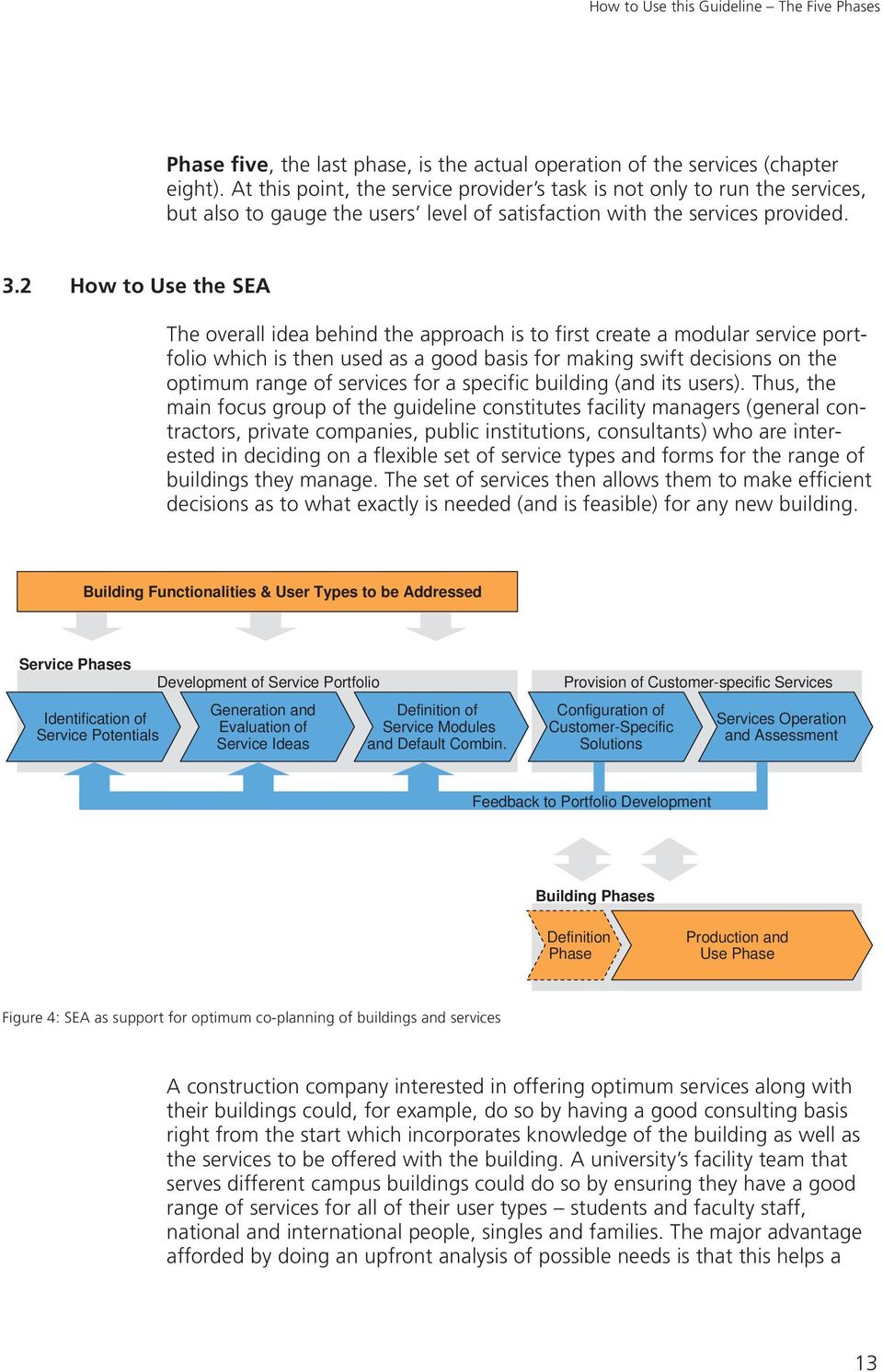
14 I3CON Step-by-step Development of Facility Management Services company consider future services much more quickly when a new building is being planned. This will help ensure true co-planning of both elements: the building and the services 2. The definition, production and use of a building in the SEA thus start in phase four (see figure above). As explained above, the best way to ensure an optimum fit between the building and services is to start with the service configuration during the building definition phase, as not only the building design will have an impact on the services (a certain carpet may need specific cleaning), but some of the services may also have an impact on the building design (security services could necessitate cameras, childcare could need specific facilities etc.). The configuration can, however, also be done for an existing building already in use. In addition, parts of the first three steps can be addressed again when configuring customer-specific solutions. It could be helpful to do so if it proves difficult to decide on the right service combination for a specific customer as the customer is unsure of what is really needed. Facility managers with an existing service portfolio could re-use the first three steps of the SEA to improve their portfolio according to feedback results of phases four and five, or in situations of ad-hoc adaptation needs (if, for example, a new user type arises). As shown so far, the SEA basically is a concept for designing mass-customisable services for a range of buildings. This guide can, however, also be used by people planning the service portfolio for just one specific building and user group. The SEA can then be followed in the same sequence, starting from the first phase. The only aspect to be changed is that phase three will then just focus on setting up the one service portfolio needed (instead of the variations to be offered); phase four will just focus on identifying the right suppliers (if needed) and agreeing contracts (service level agreements). A group of consultants contacted during the validation phase of the SEA said that some buildings are planned by the future owner (who could be an investor) without any knowledge of the final customer they will sell or rent the building to (which could be a company needing office space). Such customerindependent building definition and production often results in vacant buildings and should therefore be avoided or should at least be done with a clear picture of potential customers in mind again a step that can be supported by the SEA. 2 When using the SEA for existing buildings, the co-planning advantages cannot be leveraged but the approach will still help to do a good analysis of service needs. 14
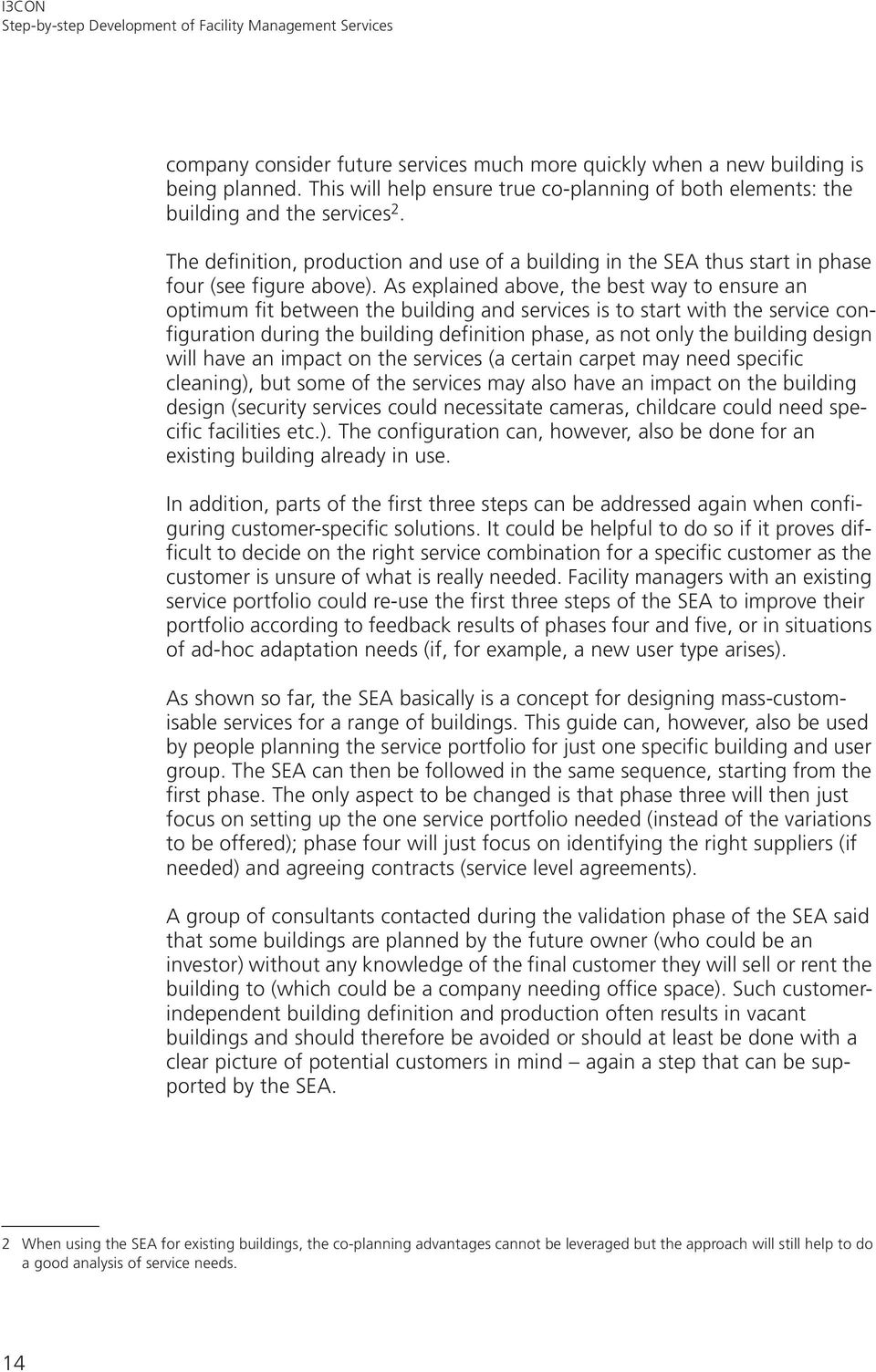
15 How to Use this Guideline The Five Phases 3.3 SEA Design Modular Toolbox Concept Before going into the single phases of the SEA, let us first quickly examine how its five phases have been designed. Each phase consists of several steps. The steps included in a phase should all be considered before proceeding to the next phase. This can be just a check (if the information required is already available) or a concrete task to be worked on (if information is missing). The first phase (identification of service opportunities), for example, includes the description of the building functionalities and user types, the summary of existing services and the analysis of service trends. All phases and the steps they involve are illustrated in the figure below. Development of Service Portfolio Provision of Customer-Specific Services Identification of Service Potentials Generation and Evaluation of Service Ideas Definition of Service Modules and Default Combin. Configuration of Customer-Specific Solutions Services Operation and Assessment Describe building funct. & user types Generate and collect service Ideas Define service modules Customise service solution Operate services Summarise existing services (if any) Evaluate service ideas Create default combinations Collect configuration feedback Collect service operation feedback Analyse service trends Assess competences Specify service processes & resources Identify service opportunities Elaborate marketing concept Figure 5: SEA phases and steps To assist users in working on single step, the SEA includes a toolbox proposing suitable tools for each of the steps. The toolbox has a modular structure so that users select the most appropriate tool for their current needs in some of the steps. 15
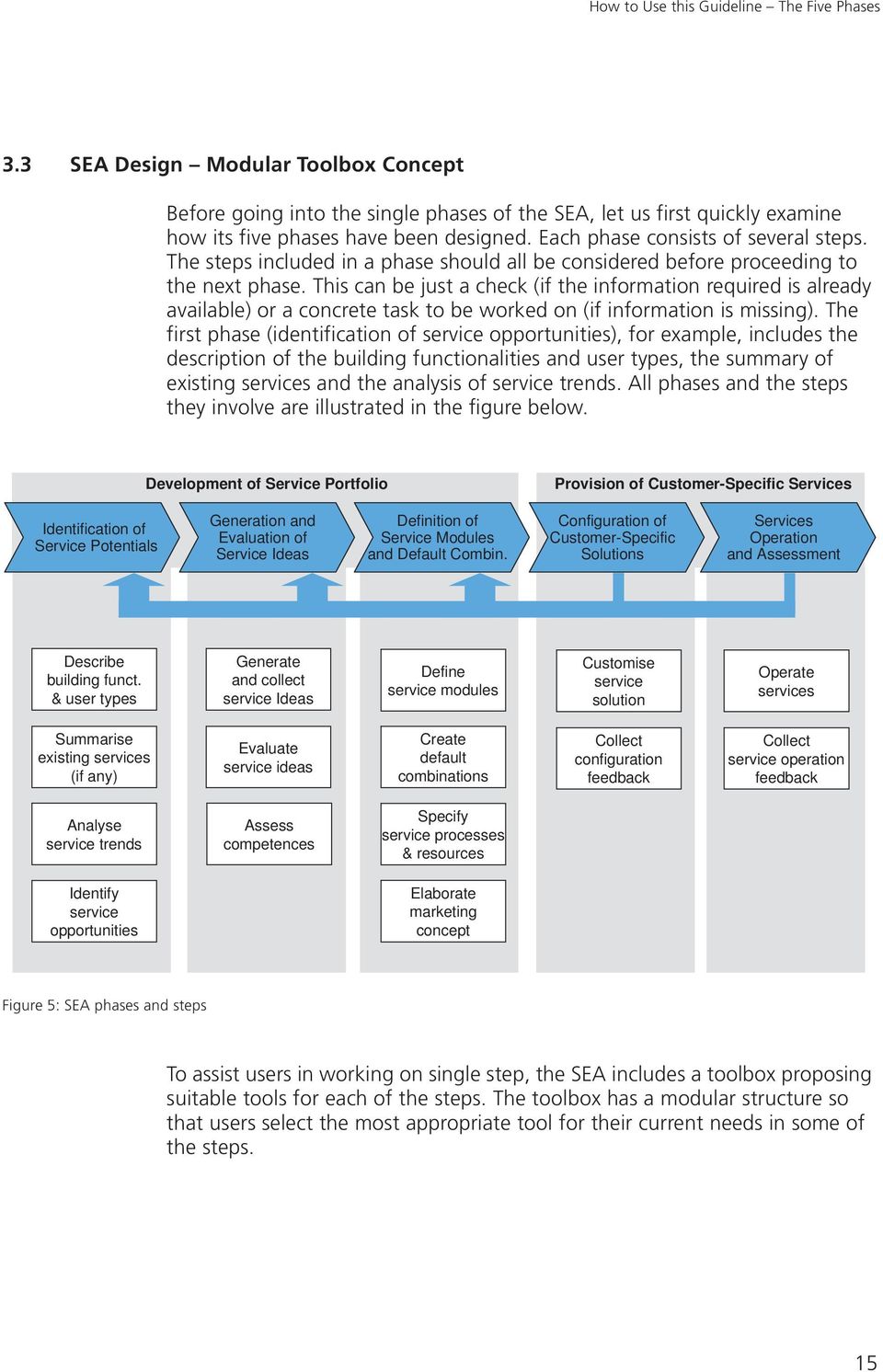
16 I3CON Step-by-step Development of Facility Management Services Development of Service Portfolio Generation and Evaluation of FM Service Ideas Definition of FM Service Modules and Default Combin. Service Ideas Service Modules Ideas Evaluation Default Combinations Configuration of Customer-Specific Solutions FM Services Operation and Assessment Customer Identification of Service Potentials Provision of Customer-Specific Services Service personnel + customer Line of external interaction Customer activity cycle Service Processes & Resources Marketing concept Line of internal interaction Support processes Assessment of Competences Service personnel Line of visibility Figure 6: SEA s modular toolbox 3.4 Practical Application Examples Practical applications examples can help to get a better understanding of the overall SEA concept and the ways it can be used. This chapter therefore presents three application examples, two fictitious and one real, which were elaborated in order to test and validate the approach. The three examples include an office building, a university campus building and a social housing project. The following gives an overview of the three user types and explains how they could use the SEA to optimise their FM services (this is how they were used in the approach s validation). The examples will re-appear throughout this guide as illustrative support. 16

17 How to Use this Guideline The Five Phases Application Example 1: Office building The baseline for the first (fictitious) example is an office building planned by a main contractor for a specific customer. The customer is a large advertising agency which plans to use the building for 250 employees. One of the major targets is ensuring optimum lifecycle costs. The advertising agency will later hire the building along with the services from the main contractor. Image JohanKalen Fotolia.com SEA application: This application example starts with the configuration of a customer-specific set of services (phase four). The general contractor s service portfolio already exists. The contractor helps the agency to identify their optimum service mix for a new building. Application Example 2: University campus The second (fictitious) example considers a University of Applied Sciences. All buildings on the campus belong to the university itself which has its own facility management organisation that purchases most of the services needed. It works together with a small number of suppliers in the framework of longterm business relationships. The university campus consists of 11 buildings (with a total of 100,000 gfa) on 130,000 m 2. The buildings are used by 17,000 students and more than 1,700 employees as offices, classrooms, sport, accommodations etc. The university wants to improve the quality of its education services (and its ranking) by attracting more international high-profile lecturers. Image Franz Pfluegl Fotolia.com SEA application: The university campus application example uses the SEA to check the fit of its service portfolio for a specific user group (international lecturers). The example accordingly focuses on the first three phases of the SEA. 17
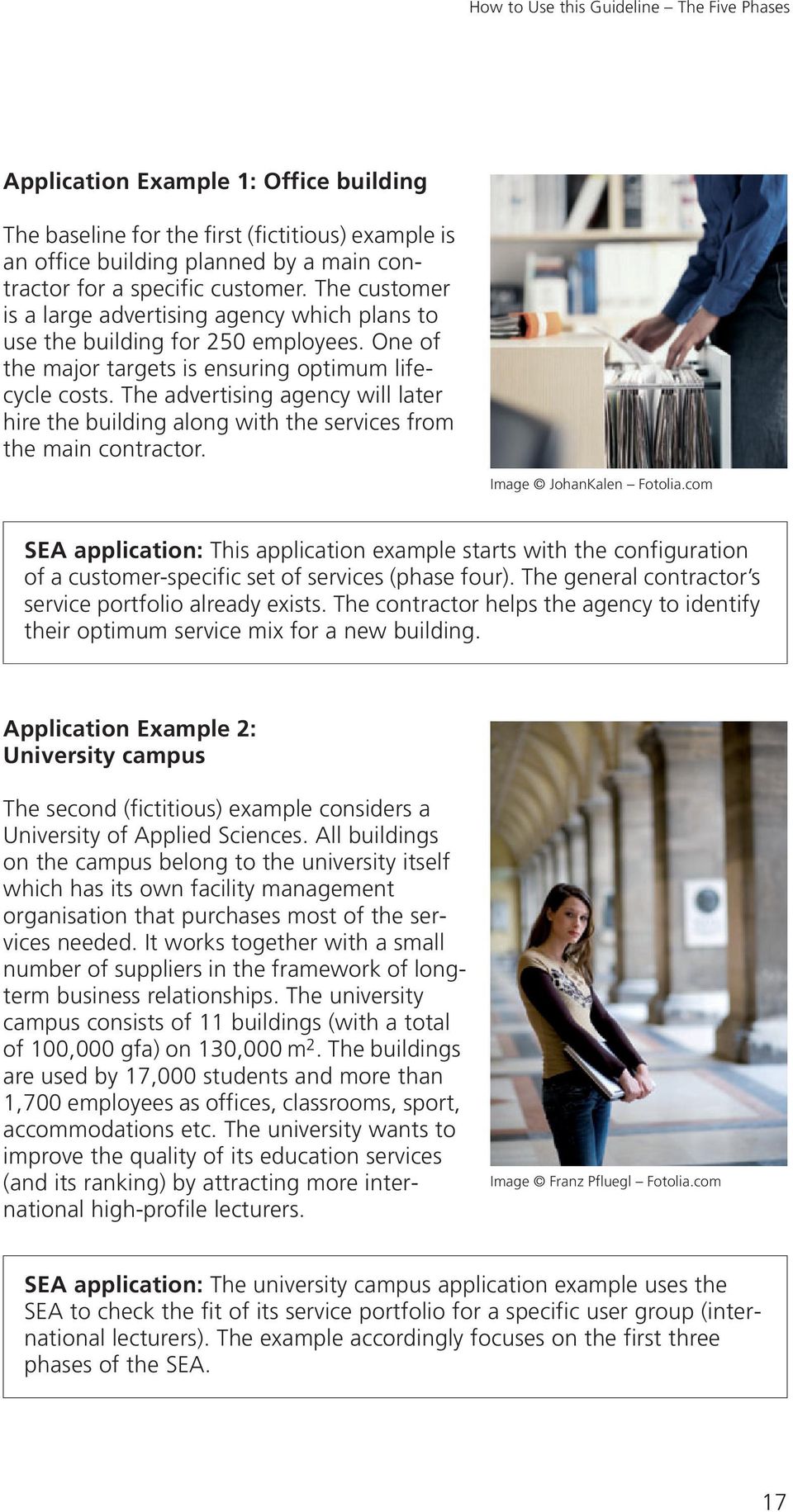
18 I3CON Step-by-step Development of Facility Management Services Application Example 3: Social housing The third application example is based on a real building, the social housing project Margaritas nº 52. Margaritas is specifically dedicated to young people in Madrid. The building is owned by the city of Madrid, while the facility management is the responsibility Image EMVS of EMVS (Empresa Municipal de la Vivienda y Suelo de Madrid), the city s housing company. The FM services coordinated by EMVS include different core, building and user services (rental, maintenance, car park, etc.); service provision is carried out by private service providers. Tenants included young singles, couples and small families; the rental period is restricted to five years. There are some facilities that can be used by all tenants, such as a common laundry. The building has a car park which is hired out to external people or the tenants themselves. SEA application: In the SEA validation, it was assumed that EMVS already cares for several public buildings, but not yet for one dedicated to young tenants. In this application example, the company therefore uses the approach to develop some specific services for this user group. Again, the main phases of the SEA considered are the first three ones. 18

19 Phase 1: Identification of Service Potentials 4. Phase 1: Identification of Service Potentials The objective of the initial phase of the service engineering process»identification of Service Potentials«is to perform a detailed analysis of the current state and future development of the contextual situation that enables the provision of services in the construction industry. To reach this objective, this process phase involves the activities of describing the building functionalities and user types, summarising existing services, analysing service trends and finally identifying service opportunities. These activities are described in detail in the following paragraphs. 4.1 Describe Building Functionalities and User Types The development/adaptation of a flexible service portfolio starts with a detailed description of the building functionalities and user types to be addressed, based on last year s projects and future expectations. The description can be structured in a conventional list of relevant characteristics within different categories. Building functionalities could, for example, be defined according to the typical projects: Project type one: Small office buildings, about 10 projects a year. Project type two: Large office buildings, about 5 projects a year. Project type three: Large buildings of mixed functionality (offices and shops), about 3 projects a year. The main user groups for each building should be defined in the next step. This may, for example, include employees if office functionalities are considered, but also other people using the building, such as external visitors. Employees could be full-time, part-time and freelance workers. Users can be defined using a traditional Market Segmentation exercise. Examples for information that could be added are given in the table below. 19

20 I3CON Step-by-step Development of Facility Management Services Table 1: User segmentation User segmentation Demographic Socioeconomic Geographic Psychographic Age Gender Family status Income Education Occupation Social status Country Region City Attitude Ethical values Interests Lifestyle Getting a good understanding of the buildings and users to be addressed by the service portfolio is of utmost importance and a lot of care should go into this step. All other steps of the SEA approach will depend on the integrity of the information gathered here. 4.2 Summarise Existing Services The next step involves compiling a list of the services already offered. Again, this may be connected to the building functionalities and user types (which services are offered for which buildings and which users). Additional information to be added could, at this point, include contribution margins of the different services. An initial summary of the existing services could be made by means of a service four-by-four portfolio (similar to that used in financial management), showing building functionalities and user types on the two axes of the portfolio and service types as bubbles within the matrix (their size could be associated with service margins). Another useful tool in this step is a Service Portfolio Table. This tool provides relatively detailed information and could therefore be used to complement the service portfolios. An example of a portfolio service table for an apartment building in which services are classified according to service area, service type, user affinity to the object and settlement type is shown in the following table. 20
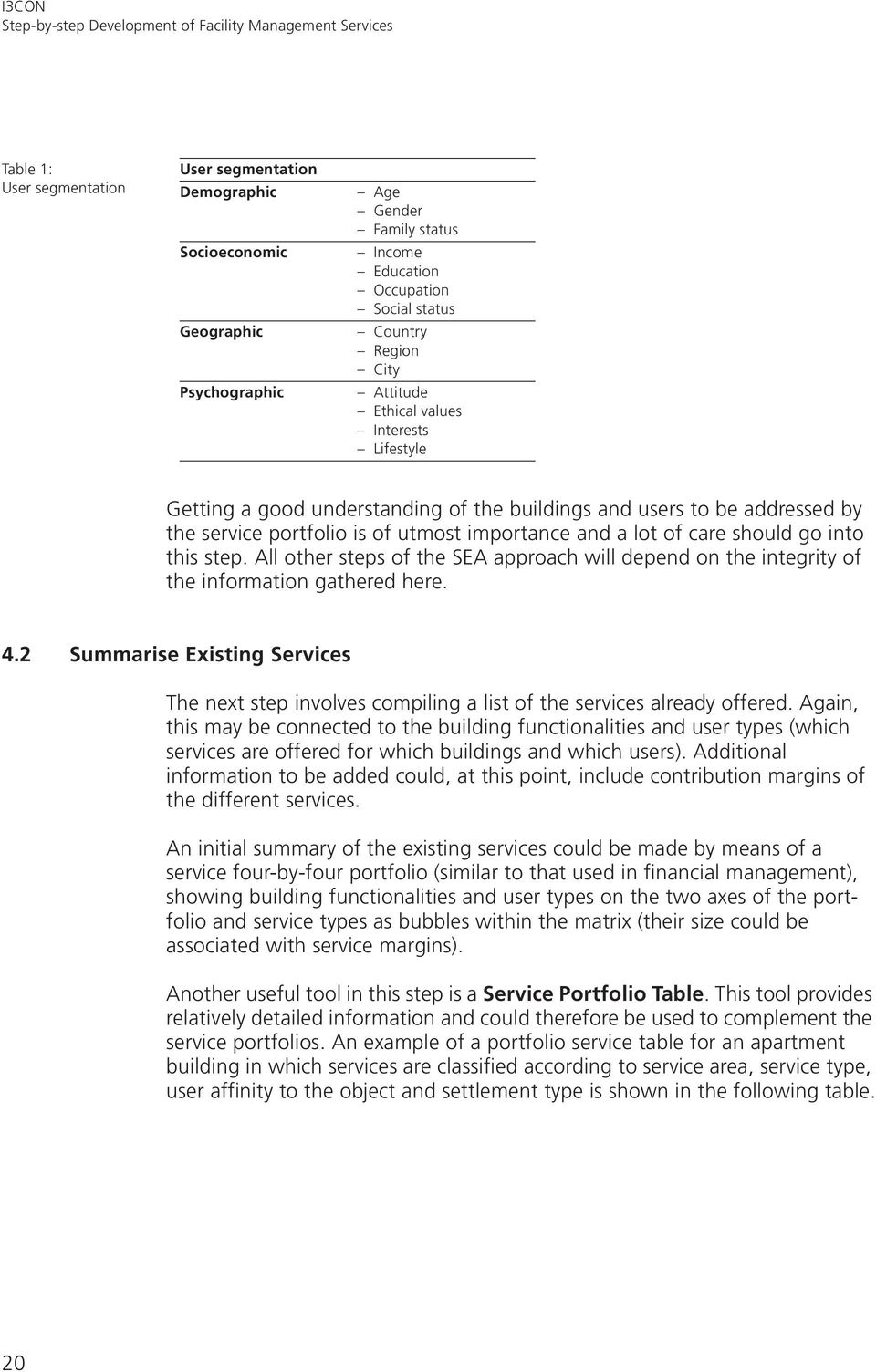
21 Phase 1: Identification of Service Potentials Table 3 2: Example of a service portfolio table (see GdW 2004) Service Service area Service type Social care and qualification Neighbours and community Recreation and adventure Healthcare and nursing Housekeeping and repair ICT 3 Security Provision Consulting Accomplishment Affinity to building High Middle Low Settlement type Free of charge Paid completely by the user User pays a portion of costs Social services for the tenant x x x x Occupational projects x x x x x Common rooms x x x x x Sport for young persons x x x x x Sentry x x x x Caretaker x x x x Tenants concert x x x x x Guest accommodation x x x x Adaptation of living space x x x x Leisure for seniors x x x x x Internet stations x x x x The service portfolio table is a descriptive structured representation of all the services supplied by the provider. It helps to identify overlaps and gaps in the service provision portfolio, i.e. potential opportunities for the improvement of existing services or the development of new ones. 4.3 Analyse Service Trends Another important prerequisite for efficient service development is the identification of relevant trends in the context of the provision of service. This usually includes trends in the areas of technologies, customers, suppliers, competitors, politics or legislation, economy, environment and society. Using the metaphor of a radar system, these areas can be visualised in different sectors of a Trend Radar (see figure 7). The services are placed as points within the different radar fields in this tool. Their distance from the centre of the radar system corresponds to the present relevance to the services offered: The services closest to the centre are those that are very important today, while those close to the outer circle are expected to gain in significance in the years to come. 3 Information and Communication Technologies 21
22 I3CON Step-by-step Development of Facility Management Services Figure 7: Sample trend radar template Technologies 10 years Society Customers 5 years Environment Suppliers Economy Competitors Politics, Legislation A major source of information for the creation of trend radar is the collection and analysis of market surveys and studies, as they provide relatively highquality information on trends related to specific sectors or activities. Drawing on readily available information sources can considerably reduce the time and effort needed to create the trend radar. One of the major benefits of creating a trend radar is the exchange of information and discussion of trends and their relevance for service provision in a specific case. In most cases, the majority of relevant information is already available within the service-providing company, but generally no capacity and no resources are generally available to share and discuss it in the everyday workflow. 22
23 Phase 1: Identification of Service Potentials Application of the Trend Radar in Example 2»University Campus«To identify short- and long-term trends in the context of university campus services, the trend radar tool was used to categorise and share major trends. The categories applied include society, users, competitors, the branch of activity (higher education sector), politics and technology. The inner circle refers to a time span of 5 years and is dedicated to short-term trends, the outer circle is dedicated to long-term trends with a time span of up to 10 years. Input for the radar could come from available market studies and interviews with experts, both internal (university staff) and external (research institutes). The radar itself can be created on a flipchart during a core group workshop (figure on the right). Sample results of the tool test are summarised in the table below. Figure 8: Trend Radar application (workshop result) Table 3: Identified trends (summary of the trend radar) Trend Areas Short-term: 0 5 years Long-term: 5 10 years Users Increasing number of students with families and children. Increasing number of international students. Increasing diversity in age groups among students (increasing age gap). Competitors Higher education sector Good information services. Constantly improving search help. Increasing family support (e.g. better childcare facilities, etc.). Distance education gains popularity Increasing number of women in academic and scientific positions Society Web 2.0 application. Elimination of necessity to travel. Service providers High fluctuation on market (due to the increased competitive pressure). Technology Everyone owes his or her own laptop. Increasing use of different mobile devices. Increasing spread and use of mobile communication and information devices. Increased use of portals (improving online support). Location Politics and legislation Increasing number of cooperation offers from different providers. Focus on families (greater support for families). Improving infrastructure (e.g. better availability for public transport, offers of car sharing). 23
24 I3CON Step-by-step Development of Facility Management Services 4.4 Identify Service Opportunities At the end of phase one of the SEA, the information collected has to be analysed and evaluated to identify suitable service opportunities. A convenient method to do so is the SWOT Analysis. This method helps to assess internal and external factors according to four main categories: Facility Manager s Strengths (for example: good knowledge of future office trends). Facility Manager s Weaknesses (few years of experience with service provision). External Opportunities (such as a high demand for, but lack of, certain services). External Threats (such as low-cost competitors entering the market). A SWOT template containing sample data is provided in the figure below. In the first step, internal and external factors are placed within the corresponding fields of a SWOT matrix (i.e. the grey top and left fields in the figure below). Input should come from the preceding steps as well as other sources of information (customer surveys, etc.). The service opportunities are subsequently examined by means of a thorough cross-field analysis: Which strengths could be harnessed to make optimum use of the opportunities? Which threats could they help to solve? How could opportunities help to tackle current weaknesses? The resulting opportunities are placed within the corresponding fields of the matrix (the white fields in the figure below). Figure 9: Sample SWOT analysis Internal factors Strengths Profound experience in service integration. High awareness of customer needs. Sufficient resources to implement new solutions. Weaknesses No obvious Unique Selling Point (USP). Service portfolio very diverse and not well structured. Opportunities Current customers highly content with services. Good relationship with current service providers. Lack of local services for small offices. Apply Strengths to Leverage Opportunities Develop specific services for small offices. Minimise Weaknesses to Seize Opportunities Develop new marketing channels Provide suitable marketing material on provider s USP. External factors Threats Increasing competitiveness on service markets. Lack of information on users interest in new services. Apply Strengths to Reduce Threats Conduct market survey on users service needs. Reduce Weaknesses to Avoid Risks Structure the service portfolio and concentrate on the most important customer needs. 24
25 Phase 1: Identification of Service Potentials The SWOT analysis should be done in a core team workshop (to enable brainstorming based on multiple perspectives). The outcome of the SWOT should not primarily be concrete service ideas (although they may be noted), but areas where new services could be useful (as well as general points for improvement). A university FM team could, for example, find that they need to provide better information services to their external students and lecturers. A company s facility managers could find that the part-time working parents on their staff need better support to balance work and childcare. 25
26 I3CON Step-by-step Development of Facility Management Services 5. Phase 2: Generation and Evaluation of Service Ideas Phase one ended with a list of areas where new services could be needed. Phase two takes a close look at these areas to generate concrete ideas for new service concepts. The university team could find that some kind of online welcome package with a city map, an intro to the campus facility and addresses of all important campus contact points could be needed. The company s facility managers could find that home office arrangements and more flexible catering would provide good benefits. Phase two will result in a decision on future services to be provided. It includes collecting and evaluating service ideas and deciding on who will provide the services. 5.1 Generate and Collect Service Ideas The first activity in this phase is the generation and collection of service ideas. Some ideas for new service concepts may already be available (or easy to get), for example as the result of customer surveys, competitors analyses or other market research activities. An internal brainstorming on the core strengths of the facility management team itself, as performed in the SWOT analysis in the last chapter, may also have identified initial valuable concepts. New ideas can be generated using one of the many idea generation methods available, such as Mind Mapping, the Gallery Method or the Method 4. Another interesting concept is the Lotus Blossom. It was developed by Matsumura Yasuo, a Japanese researcher at Clover Management Research. Its name is derived from the lotus flower, whose petals resemble the structure of the method (Higgins and Wiese 1996). The Lotus Blossom starts with finding eight potential service types for one service area. Support for international students (university campus application example) could, for example, be provided in the form of a welcome package (see above), but also by means of a faculty mentoring concept or peer-to-peer coaching from regional students. In the Lotus Blossom template (see figure 10), the service area is placed in the field in the middle (yellow box); the eight service ideas are placed in the eight surrounding fields (blue boxes). Each service type is then transferred to a separate flipchart or pin board and brainstormed with respect to eight potential variations (white boxes). Mentoring could, for example, be provided by faculty staff or former students. The advantage of the method is that it supports the 4 For more information on these methods, see for example Higgins, J. M Creative Problem Solving Techniques: The Handbook of New Ideas for Business. 26
27 Phase 2: Generation and Evaluation of Service Ideas Figure 10: Lotusblossom template A B C H A B C H D G F E D G F E creation of different service varieties to address one specific opportunity. The Lotus Blossom is best done in a workshop with mixed competency teams. Another valuable tool for the generation of service ideas is the Customer Activity Cycle provided by Vandermerwe (2000). It helps to visualise the customer process from the beginning to the end of contact, thus enabling the definition of services that could make this process more smooth and userfriendly. Figure 11 below is an example of service ideas for a doctor s patients, derived from the patients usual activities with the doctor once the first symptoms of an illness are experienced. The Customer Activity Cycle considers three phases of provider s interaction with the customer: A Pre-Phase where customers only have tentative contact with the service provider and collect information on potential services. This information itself is also part of the service portfolio and could provide new service ideas (such as new marketing channels and other information material, etc.). The phase results in the first contact between the customer and the service provider. A During phase in which there is intense interaction between the provider and the customer. In this phase, customers make use of the key services provided (such as new diagnosis methods and alternative treatments). 27
28 I3CON Step-by-step Development of Facility Management Services Figure 11: Customer activity cycle (Source: based on Vandermerwe 2000) A patient: experience symptoms and goes to doctor -Early awareness -Practitioner awareness -Helpline, information sites -Early and speedy diagnostics A patient: is monitored has next treatment goes to doctor Customer activity cycle for a patient of a hospital -Telemedical monitoring -Remote prescription adjustments -Maintenance and replacement of equipment -Various relevant services -Early diagnosis A patient: receives diagnosis chooses treatment starts treatment organises supply adjusts treatment -Help line -Peer support -Treatment-options educator -Installation of equipment -Personalised home care -Delivery services -Emergency A Post-Phase, which is important for supporting a good customer relationship through feedback collection and post-contact support (such as e- mail notification on necessary checkups). In each of the phases idea generation is based on the customers requirements at this specific point of the cycle. Teams struggling with the generation of new ideas could try and first think about these needs and then come up with concrete service ideas. The method is very suitable for identifying services for a specific group of customers. 28
29 Phase 2: Generation and Evaluation of Service Ideas Application of the Customer Activity Cycle in Example 2»University Campus«One of the major objectives of the university could be to increase the number of international students. One way to achieve this objective could be improved student support and especially an enhanced infrastructure for students on and around the university campus. To generate and collect service ideas, the needs and requirements of an international student going to a foreign university were classified in the customer activity cycle of figure 12. During validation, the Customer Activity Cycle was applied in a one-day workshop. A Trend Radar was used as a source of ideas for the brainstorming phase. An excerpt of the results achieved within this workshop are summarised in Table 4. A potential student: Looks for general info about university Clarifies specific questions Applies and receives confirmation University offers: -Info service -24hrs support -Accommodation support -Applicants guide -Travelling support Books trip and accommodation Arrives Customer activity cycle for a foreign student A student: Takes arrangements for return trip Receives graduation documents Studies further or works University offers: -Information facilities -Postal services -Communication platform -Cooperation options A student: Registers for courses Goes to lectures Uses different facilities Socialises Passes exams Graduates University offers: -Registration portal -Information facilities -Events, party rooms -Safety, security -Cleaning and maintenance Figure 12: Customer activity cycle on services for international students Table 4: Results of customer activity cycle exercise for international students (excerpt) Phase Student s activities and needs University support Pre-Phase: Students plan their trip abroad During: Students have arrived at the foreign university Post-Phase: Students are back at their home country Browse for information on university. Apply to university. Look for accommodation at the foreign university. Organise trip to foreign university. Register for courses and attendance. Do exams. Use university facilities. Use of libraries. Socialise with other students. Graduate. Arrange return travel. Get graduation documents. Stay in contact with co-students. Promote university to others. Multilingual information portal 24-hour-helpdesk (phone, instant messaging, ) Travel support (e.g. visa support, student rates for flights). Online course overviews, online information on exam results. Security guards. Hotspot facilities. Peer-to-peer assistance. Organisation of social events (get together, cookery courses, etc.) Alumni portal. Online student forums. Goodbye package. Invitations to university events. 29
30 I3CON Step-by-step Development of Facility Management Services 5.2 Evaluate Service Ideas After the generation and collection of service ideas, the objective of the next task is to validate all ideas collected to find the most valuable ones. A good tool to support the evaluation of service ideas is the Correlation Matrix, a tool that allows a quantitative evaluation based on customer requirements. It has its roots in QFD 5, which describes, in a systemic approach, the different steps needed to match all customer requirements. Table 5 below shows the example of a Correlation Matrix for a guest flat offering. Table 5: Correlation matrix for the example of a guest flat (based on GdW 2004); service are prioritised according to how they respond to customer requirements Customer requirements Weighting Location Size Furniture Techn. Equip. Requ. fulfilment Service value Requ. fulfilment Service value Requ. fulfilment Service value Requ. fulfilment Service value Cleaning Requ. fulfilment Service value On-site care Requ. fulfilment Service value Low cost 3 *3 = 9 *9 = 27 *9 = 27 *3 = 9 *3 = 9 *1 = 3 Spacious 1 *9 = 9 Comfortable 2 *3 = 6 *9 = 18 *9 = 18 *3 = 6 Clean 3 *9 = 27 Within reach 1 *9 = 9 Close to the 3 *9 = 27 centre Column sum Priority 1st 2rd 1st 4th 3th 5th The first step for the completion of the correlation matrix is the identification of customer requirements. This can be done on the basis of the customer activity cycle, for example, as described in the previous chapter. The requirements are then weighted according to their priority for the customers (1= lowest priority, 2 = medium, 3 = highest). In the next step, the different services are evaluated according to how relevant they are for these requirements (1= low relevance, 3 = medium relevance, 9 = high relevance). The priority of each service idea based on relevance and weighting is calculated by multiplying both factors. The bottom row of the matrix shows the final priority of each service based on the score. Another method for the evaluation of the attractiveness and profitability of a service idea is the Innovation Portfolio Check. The idea of the method is to answer the three questions»is it real?«,»can we win?«and»is it worth it?«5 QFD: Quality Function Deployment. 30
31 Phase 2: Generation and Evaluation of Service Ideas Figure 13: Innovation Portfolio Check based on the RWW 6 methodology (based on Day 2007 and Occurrence of criteria: Can the solutions satisfy customer requirements? 0 + x x x + + x Is it real? Are components and characteristics of a solution well defined? x x x x Can we attain the solution with available resources? x x x x Are our solutions competitive? x x x x Can we win? Is our company competitive enough? x x x x Is it worth it? Are the solutions strategically reasonable? Are the solutions (considering the risks) profitable enough? x x x x x x x x Energy consumption monitoring Consulting on equipment Shopping and delivery Babysitting for every single service idea, on a five-score scale. The ideas with the best scores should be further pursued. Both the Correlation Matrix and the Innovation Portfolio Check will result in a list of service ideas to be implemented. The next task is to identify who will provide the services Assess Competences When considering new service concepts, it is crucial to determine whether the facility management team developing the services can also offer them on their own or if this should be done by a sub-supplier. A general contractor, for example, offering a broad variety of services to their clients could decide that the company-internal team dedicated to services should be responsible for some of them, such as maintenance and cleaning, as they provide learning opportunities for the company s key products. Other services, such as catering, could be a nice add-on for a full service package, but outside the capabilities 6 RWW:»Real«,»Win«,»Worth it«. 31
32 I3CON Step-by-step Development of Facility Management Services and strategic scope of the general contractor such that it would be easier to sub-contract them. A university may find that some services simply have to be provided by an internal team dedicated to it, such as an online helpdesk, as external providers will not have the necessary knowledge that is needed. It could, however, include users (students) in a user involvement strategy or cooperate with a call centre. To make this decision, a Make-or-Buy Checklist can be helpful. Criteria could include the following (Kämpf and Priehn 2007): Available resources (provider) Service costs Requisite flexibility and speed of the service provision Strategic relevance of the service Importance of specific knowledge for providing the service A useful tool that provides visual support is the Make-or-Buy Matrix. Figure 14 shows a sample matrix that distinguishes between insourcing, cooperation and outsourcing strategies. Services in this matrix are analysed with respect to the strategic importance of a service and the number of barriers to outsourcing the service. The latter may include factors such as a lack of competencies or resources on the provider s part, high transaction costs, high service provision costs, etc. Figure 14: Make-or- Buy Matrix (based on Reckenfelderbäumer and Busse 2003 as well as Kämpf, R. and Priehn, R. 2007) Strategic Relevance of Service Outsourcing Cooperation Insourcing Outsourcing Barriers (Lack of competencies, transaction costs, etc.) 32
33 Phase 2: Generation and Evaluation of Service Ideas The advantage of this tool is that several services can be placed in the matrix at the same time to facilitate the identification of potential strategy bundles to be outsourced (or performed internally). Deciding on these criteria is not an easy task. Deep consideration of the processes and resources involved (next steps) can provide valuable insights for this decision-making process. In any case, the service development task of the facility management team should not be finished at this point in the SEA if they decide to outsource a new service. In order to know what kind of service they need, it is useful to go through some of the steps of the next phase, which looks at different service alternatives. 33
34 I3CON Step-by-step Development of Facility Management Services 6. Phase 3: Definition of Service Modules and Default Combinations In phase 3»Definition of Service Modules and Default Combinations«, the actual development of the service ideas evaluated and selected previously takes place. All variation options of a service will be defined by, first, identifying single service elements (»modules«) and, second, pinpointing useful default combinations (typical module combinations for specific user groups). If the service is provided by the facility managers themselves, the underlying processes for all service alternatives have to be defined, the resources clarified and the marketing concept identified. If the services are sub-contracted, this step will end with a detailing of the service alternatives to be provided and a search for suitable partners to provide the services. The final providers of the service will then, of course, also have an impact on how the services are ultimately offered. 6.1 Define Service Modules As the first step in this phase, each service to be offered has to be divided into different service modules, i.e. alternative options for providing a service. For an office s childcare centre, this could constitute different levels of availability (9 a.m. to 1 p.m. / 3 p.m. / 5 p.m.) or different levels of users (toddlers < 1 year / 1 to 3 years). An information helpdesk for foreign students at a university could have different access media (phone / / instant messaging), which again could be available at different times. Cleaning services, another example, usually include elements done every day (garbage disposal), some done once a month (vacuuming) and some a few times a year (window cleaning). At the end of this step we should have a table clearly defining the different service elements to be offered. This can be based on just a brainstorming exercise in a facility management team workshop. Usually, good categories to start with for user-related services is to look at the different user types to be addressed, the scope (or quantity) of the service, its quality and its availability. Catering service packages, for example, usually vary according to user groups (for example business versus private catering), the service scope (just food, food & beverages, etc.) and the service quality (different menus). Car sharing is usually offered on different quality levels (car types), to different user groups (student versus business rates, public transport user rates) and with different service scopes (fuel included/excluded, etc.). Helpdesks often distinguish 34
35 Phase 3: Definition of Service Modules and Default Combinations service levels according to availability. This may not only include time restraints (e.g. 9 a.m. 5 p.m. Monday-Friday versus 24/7), but also communication systems (e.g. phone versus ). Some consider different user groups (e.g. calls from customers versus external staff). Most existing services are detailed with respect to at least two of the categories mentioned, as the examples for catering and childcare given in table 6 below show. Table 6: Potential complementary user-related services. Users Scope Quality Availability (frequency) Service Types Catering Office workers 10 meals Meat menu Daily (12 am) Veggie menu Visitors Small menu Meat menu On-demand (< 10 meals) Veggie menu Large menu Meat/veggie menu mix (> 10 meals) Child care Office workers Kids from 1 to 6 years Supervising and lunch Daily (9 12) Daily (9 5) Visitors Kids from Supervising and lunch On-demand 1 to 6 years (during business events) Building services can be modularised by considering different building elements (instead of user types) plus their respective scope, quality and availability. Cleaning usually varies according to the service scope provided, i.e. the number, size and kind of objects cleaned (e.g. just windows versus windows and floors, office rooms < 150 sqm versus > 150 sqm, etc.). Other aspects are the frequency/availability of the service (e.g. weekly, monthly, on-demand) and the service quality (e.g. cleaning windows including/excluding the window sills and frames). Another dimension is related to the room types or material types (e.g. wooden/stone/carpeted floor), i.e. the building element. Security services can include different levels of availability/frequency (e.g. patrol times of service staff, video surveillance times). The building elements guarded may also vary (e.g. patrols inside or outside a building). And there can be differences in the scope of the service (e.g. patrolling versus simply checking lights and locking doors). Maintenance services can vary according to frequency/availability (e.g. weekly, monthly, yearly inspections), the service scope (e.g. functional/leakage checks) and the building elements (kinds and number of rooms/equipment checked in the inspections). The service quality could be an additional dimension (e.g. just inspections or also coordination of repairs needed, development of maintenance plans, etc.). The table below shows an example for cleaning and maintenance services. 35
36 I3CON Step-by-step Development of Facility Management Services Table 7: Potential complementary building-related services Building elements Scope Quality Availability (frequency) Service Types Cleaning Floors (carpet) Per 50 sqm Vacuum cleaning Monthly Floors (parquet) Per 50 sqm Vacuuming & mopping Monthly Windows Per 50 sqm Just window glasses Weekly Glasses, frames & sills Monthly Maintenance Heaters Per room Checking Quaterly Replacement Every 5 years It is not crucial at this point to exactly define if, for example, the different menu sizes of a caterer are different scope or quality levels. The main purpose of thinking in the four categories is to come up with variations to a service element. Both analyses (user services and building services) should consider each building functionalities to be addressed, as some buildings may require different services than others (a school will have different cleaning cycles than an office). To support the brainstorming process, a number of tools are available. The Morphological Box is a method that first splits a problem into various components to then generate alternative solutions for each component. The method was developed in the 1960s by Swiss astrophysicist Fritz Zwicky ( ). It is a well-known method applied in various sectors and for various purposes. A big plus of the concept is the ease of use and its excellent, illustrative support for brainstorming. A Morphological Box starts with listing the main parameters of a service. These parameters may again be identified by considering scope, quality and availability. A caterer could, for example, use»types of meals«as a category and»number of meals«. In the next step, a table is drawn that uses the parameters as row headings. The team working on the box then brainstorms on different attribute options for each parameter. For example,»meal types«could differentiate between meat versus vegetarian meals, senior versus adult and kids meals or menus versus buffets. Starting from one of the parameters in one of the rows, the team working on the services now looks for a good match in every other row to set up a complete solution concept for one specific user group or building element. The potential matches identified are connected by lines or threads (if pinned to a board, see table 8 below). 36
37 Phase 3: Definition of Service Modules and Default Combinations Table 8: Example of a morphological box for an office building (catering service) Menu size Small Medium Large Buffet Breakfast Menu quality Vegetarian Meat Mixed Vegan Menu type European Asian US Add-on Delivery Servicing Dishes Decoration Availability Breakfast Lunch Dinner Another useful concept is the Value Curves method based on the»blue ocean strategy«concept of Kim and Mauborgne (2005). Value curves are a useful concept to come up with service alternatives based on customer needs. Existing services are analysed to identify typical service elements. A brainstorming exercise to increase/decrease the performance of single elements or add/delete elements themselves can help identify ways of differentiating one s own service portfolio from those of competitors. In the first step, the main features of existing offers in the market are identified and placed as a so-called»value curve«on a»strategy canvas«according to their level of performance. The idea is not to detail every main offer on the market, but rather to depict typical combinations. The matrix, as a first result, gives a good insight into the relative performance of existing products in the market. Again, thinking about the scope, quality and availability of a service helps to identify the features to be considered. In a second step, a new value curve is created for the service to be offered. In doing so, the performance on some of the factors should be increased or reduced, in comparison to others. Some factors could be added as new service element, some could be deleted as the key user groups do not really need them. Figure 15 provides an example of a value curve for a new energy monitor. Some of the existing monitors (the ones to be put in between electric household devices and power sockets) are rather expensive, with a high level of information details given and high security standards. Their data are very correct, but the applications are not easy to use as they have to be programmed before use. Low-cost alternatives are more easy to use, but provide less information which is not always correct. Safety aspects are sometimes also a problem (devices get too hot). A new service concept could now be that the manager of a social housing project offers high-quality devices to the tenants, which are easy to use, safe and provide accurate information, but not a high level of detail. The devices could be rented to tenants for the price of low-cost alternatives for a test period of several weeks. A post-test analysis of the test results including a consultation on energy-saving options could be a perfect add-on to the package. It is important to perform this exercise with clear user groups in mind, as the idea of a value curve is to identify the optimum mix for a specific group of cus- 37
38 I3CON Step-by-step Development of Facility Management Services high energy monitor 1 level of performance Figure 15: Value Curve example for a new energy monitor new monitor energy monitor 2 post-test consulting rental costs security correctness of data ease of use purchase costs level of info details low tomers. If more than one user group is considered, different curves should therefore be created. Considering the university campus application example, the result could be one value curve for international students and one for international lecturers. The former would definitely rate some service aspects higher than the latter. Deciding on the number of service modules is a crucial task when developing the service configuration, as too many options will make it impossible for customers to decide on the best alternatives for their needs. Too few options again may result in a service offering that does not really fit the needs of the different customer groups addressed. Piller and Stotko (2003) present some guidelines on how to decide on the number of modules. The following Modularisation Checklist is an extract of their list. The span of varieties depends on the number of customisation dimensions. If there is only one dimension, e.g. different designs of a bag, a high number of configuration options could be needed to demonstrate the USP of a product. The configuration tool used is also decisive for a product s span of varieties. The more varieties there are, the better the process of guiding a user through the configuration should be, including suitable visualization of, and advice on, available options. 38
39 Phase 3: Definition of Service Modules and Default Combinations Another key criterion is the client s level of expertise with the product/ service. Customers used to a choice of different options will more easily cope with a large range of options than new customers. For physical products, the (technical) feasibility is another aspect to take into account. This aspect could relate to the input dimension of the service portfolio, i.e. the processes and resources required. A certain number of process varieties could be well within the scope of a service provider; too many varieties could make them too complex to still be managed in an efficient way. Too many resources could be too costly to maintain. 6.2 Create Default Module Combinations The previous step has focused on how single service types could be differentiated by creating service alternatives. The way to do so was to look at single service elements that may be exchanged for another. The objective of the step in this chapter is to create typical default combinations for different user groups. This includes the development of a typical set of services so that a general contractor could, for example, offer a combination of cleaning, maintenance and security as a typical minimum package for office buildings. In addition, the different elements of each service have to be combined intelligently so that the general contractor will, for example, offer either weekly or monthly cleaning in this minimum service package. Default combinations are usually defined by using one or two dimensions and building suitable packages around them. Car sharing initiatives, for example, usually put user types first, to then define suitable service bundles for each alternative user type. Students, for example, could pay a different rate for certain booking times and distances covered than business people. These final costs could, in addition, vary according to car type. Helpdesks, in contrast, often distinguish between service times. There could be different communication options related to service times (e.g. phone only from 9 a.m. to 5 p.m., 24/7). These options could again be detailed according to user groups. 39
40 I3CON Step-by-step Development of Facility Management Services Development of Default Combinations in Example 2»University Campus«In the university campus example, a helpdesk for international students and lecturers could include different service modules (elements), such as different means of communication ( , chat, etc.) and different scales of content (general information, subject-specific information, etc.). In the validation test, these modules were combined according to availability (see screenshot on the right). Some modules are available from 9 a.m. to 3 p.m., some 24 hours. The two are available for students as well as lecturers. In addition, a specific combination was made for lecturers only, which includes additional communication means (videoconferencing). The exercise was done on the basis of the next tool presented, the Kano Model. In the workshop, one diagram was created for the students, one for the lecturers. As a result, it was more easy to decide which services would be considered by both of the groups as absolute core services and which would be a big (unexpected) service plus. Figure 16: Sample default combinations for a university helpdesk In order to find suitable default combinations to be offered, it is important to have a good understanding of the customers requirements and their appreciation of different services. The Value Curve Method detailed in the last chapter provides a good basis for this, as new curves can be analysed to find service elements that can be grouped, for example, as a standard offer for different user groups in contrast to those offered just to some user groups. Another suitable tool for identifying default combinations is the Kano Model of customer satisfaction. The Kano model can be applied to get a clear overview of the»performance levels«of the service (element) a customer expects, and thereby to prioritise services (elements) within the portfolio. The Kano diagram (see figure below) includes two axes:»fulfilment of customer requirements«and»customer satisfaction«in order to differentiate between basic, benefit and inspiration services. All services of a portfolio (or elements 40
41 Phase 3: Definition of Service Modules and Default Combinations of a service) are placed in the diagram according to the customers real or expected reaction to positive and negative performances: How would customers react if the service (element) was available and provided very well? How would they react if the service (element) was missing or provided very badly? The three service types can be identified on the basis of these questions: Basic service elements are at the core of a service, while basic services are at the core of a portfolio. Both are critical as customers would be very unhappy if they were not performed correctly. However, customers are not enthusiastic about excellent performance in these areas (they simply expect them to be done). Benefit services are required for good performance. They are expected by the customer whose satisfaction increases the better the services are provided, and decreases the worse they are provided. Inspiration services go beyond the current customer expectations and are able to create real enthusiasm. Customers will not be unhappy about their lack (as they do not expect them), but highly content if they are done well. Inspiration services usually change their status into benefit and finally basic services over time (as customers get used to them). Figure 17: Kano model of customer satisfaction (Source: BPS 2005) Inspiration services - not articulated - customer tailored - inspiring Customer inspired Operator models Tele-Service Complaint management Onsite service Benefit services - articulated - specific - quantifiable - technical Fair dealing Vendor management inventory Requirements not fulfilled Fast delivery of spare parts Detailed documentation User/ operator training Requirements over-fulfilled Friendly and competent service personnel Spare parts management Customer dissatisfied Basic services - implicit - self-evident - articulated - apparent 41
42 I3CON Step-by-step Development of Facility Management Services An important lesson of the Kano model is that different user groups will have different preferences with respect to service elements (and services), so that their diagrams will differ. Considering these differences is a valuable step for identifying suitable combination packages for different groups. The Service Potential Portfolio technique is a tool that is specifically useful for B2B (Business-to-Business) service providers, such as in application example 1»Office Building«. For example, it can help a general contractor to identify which services should be offered to a specific customer group and how this should be done. The tool offers a four-field matrix based on two scales that considers the»(level of) service complexity«of a service, on the one hand, and the level of»customer knowhow and readiness (to perform the service)«, on the other (see figure on the right). Service Complexity All-in-one carefree packages Standard packages (basic services) Customer Know-How and Readiness Figure 18: Service potential portfolio (based on BPS 2005) Niche/ cost-optimised services Optional: User involvement Services can be classified according to these two dimensions and accordingly be placed into one of the four fields of the tool. In field 1, customers can perform the services themselves and are willing to do so despite the service complexity. Services in this field could be offered if specific know-how in the service area is available (such as niche services) or if cost reduction options can be provided. In field 2 (high complexity, low know-how/readiness), customers depend on external know-how and therefore welcome complete»carefree«service packages. Field 3 (low level of know-how/readiness and complexity) will benefit most from packages offering a set of typical basic services. Field 4 services (low complexity and good know-how) are hard to be tackled, as customers will have the necessary knowledge to master the low-complexity services themselves. If applied to a B2C (Business-to-Customer) service provider, such as in the social housing and the university campus example, the portfolio has to be read the other way round, i.e. the facility managers should look for carefree package providers when outsourcing complex services they are not familiar with. Field 4 services for this user group could be analysed for a user involvement strategy. Some social housing projects, for example, involve users in minor maintenance and cleaning services. 42
43 Phase 3: Definition of Service Modules and Default Combinations Now that suitable services, service modules and default combinations have been identified, they need to be developed in more detail. An in-depth description of this development is provided in the following chapters. 6.3 Specify Service Processes and Resources The objective of this step is to specify the processes and resources necessary for the provision of services. A tool that is able to support this specification is the Service Blueprint. A service blueprint is a presentation of the chro- Application of the Blueprinting Method in Example 3»Social Housing«Customer The social housing example test resulted in the development of a new service concept, a halfday seminar with a consultant on energy-saving options for tenants. A service Blueprint helped to define underlying processes and necessary resources in more detail (see figure 19). Read announcement Decision to participate & registration for the seminar Participate in the seminar Receive confirmation Give feedback on the event Service personnel + customer Line of external interaction Communicate appointment to tenants Collect feedback from tenants Confirm registration Service personnel Line of visibility Elaborate concept for seminar / training Agree on appointment with consultant Possibly revise the concept Collect registrations & communicate participants details Collect & analyse feedback Feedback to the trainer on user acceptance Support processes Line of internal interaction Confirm the availability on the day Prepare the materials/ contents needed Conduct seminar Give feedback on the event Receive feedback & take actions if needed Figure 19: Service blueprint for a new service in the Margaritas building 43
44 I3CON Step-by-step Development of Facility Management Services nological sequence of activities in the process of service provision, comparable to a process flow diagram (see figure below). The big plus of this tool is that the activities are classified according to their visibility to the customer: Some service activities are performed by the customer alone (line of external interaction), some by customer and service provider together (line of visibility), some by the service provider alone and some by the service providers collaborating with internal teams (line of internal interactions). The blueprint helps to get a good understanding of the different activities involved in a service and of how customers will (or will not) perceive them. Valuable additional information, as some of the steps not noticed by a customer may require some communication activities to keep customers on track of developments. A Process Flow Diagram (PFD) is a diagram that illustrates the sequence of the different process steps in the provision of a service. It highlights the start and end points, steps in the process and decision points. Additional information, such as documents and databases to be used, can also be included. Process Flow Diagrams and Blueprints can be enhanced by an analysis of the resources needed to perform the services. A Resources Matrix details the necessary human, operating and IT resources for each element of a service (see example below for details). Yes Start Process step Process step Process step Decision? Process step No Process step Figure 20: Process flow diagram (source: 44
45 Phase 3: Definition of Service Modules and Default Combinations Application of the Resources Matrix in Example 3»Social Housing«The resources necessary in the different process steps of the Service Blueprint prepared for the social housing example were further specified in a Resources Matrix. Resources are defined for the preparatory phase, the marketing phase, the actual supply of the service and its subsequent assessment (see table below). Resources were detailed according to employees, operating resources and IT. Table 9: Example of a resources matrix for an information day on energy saving Providing environment Employees Operating resources ICT Service personnel External consultant Premises Furniture Equipment Internet Intranet Internal database Conventional phone Hotline Information on the event X X X X X X Information on the consultant X X X X X X Consultancy/training concept X X X X X X X Equipment check (individual) X X X X X X Marketing Information on homepage X X X X X X Leaflet at building entrance X X X Application forms X X X X Supply of service Half-day face-to-face seminar X X X X X X Equipment check in a flat (individual) X X X X X X Assessment Feedback collection from tenants X X X X X Feedback collection from consultant X X X X X X X 6.4 Elaborate Marketing Concept The marketing concept aims at providing a framework for communicating a service combination to its target group. For most services, especially in the construction industry, the price of a service is one of the major factors. For its definition, different factors have to be considered. This includes the internal costs of the service proposition, the requirements situation, the customer view, the competitive situation and the corporate objectives (figure 21). 45
46 I3CON Step-by-step Development of Facility Management Services Figure 21: Factors which influence the price (see Internal (functional) costs Requirements situation Price Customer view Corporate objectives Competition situation In order to set a suitable price for a service (and its different alternatives), all five aspects have to be considered. The following Service Price Check helps to cover all these aspects. Traditional accounting methods can help to analyse the internal costs of a service; Blueprints and Resources Matrices also offer good support. The requirements situation (how strong is the demand for the service?) can be addressed by considering market analyses. The customer view (what are customers willing to pay?) can be analysed in discussions or interviews with customers. This is not an easy task, as customers are often unwilling to talk about, or unaware of, the real price they might pay for the service. Assessing the competitive situation involves a market analysis that looks at substitute service offers from competing providers. The pricing strategy as a whole has to fit the overall corporate objectives (low-cost provider, high-quality provider, niche service provider, etc.) and the position of the service provider in selected markets. The marketing concept not only has to determine the price of the service, but also has to provide a communication concept on how to address potential customers (distribution channels, marketing media, etc.). This should be done in a thorough analysis of the key customer groups: How can they be contacted in the best possible way (Internet, flyers, newspaper ads, etc.)? What kind of information will they be specifically interested in (costs, benefits, references, etc.)? And how should it be presented (detailed, simple, etc.)? 46
47 Phase 4: Configuration of Customer-Specific Solutions 7. Phase 4: Configuration of Customer-Specific Solutions Phase three ends with the facility manager s complete service portfolio. At this stage, all services are available, both self-provided and sub-contracted ones. The customer comes into action in phases four and five. Phase four starts with the customer selecting the service in a configuration process, supported by the facility manager. This includes the identification of the services needed and the decision on which service alternative to choose for each service type. The process could be done in a face-to-face situation between the facility manager and customer, using printed and/or online documents (and databases). Final users selecting the services they need could also do this on their own on the facility manager s homepage. A general contractor could, for example, offer different services (and service alternatives) to their customers (developed in phases one to three). One of these customers, an advertising agency (office example), could discuss service options with the general contractor (phase four) when planning a new building. The contractor will offer its overall portfolio and help the agency to identify the best combination of services (and service alternatives) for its particular purposes. A social housing provider could have applied phases one to three to develop new services needed by the housing objects under its responsibility: childcare and catering. In phase four, the task of the social housing provider is to support the service selection process of their customers (the building users) in the best possible way. At the same time, the service provider will collect feedback on the services selected by the customers: What are typical service combinations chosen by a specific customer type? Do customers mention an interest in services not offered so far? Collecting this information will help to see if the services (and the default combinations) developed in step three match the needs of the customers. 7.1 Customise Service Solution Phase four starts with the facility manager offering his service portfolio to the customers. The customers select the service (module) combinations according to their needs in a configuration processes supported by the facility manager. This step needs to be carefully prepared, as it is not easy for customers to identify the optimum service mix. They cannot always present a list of required 47
48 I3CON Step-by-step Development of Facility Management Services services and how these services need to be provided. One of the reasons for this is that customers are often not even aware of all the options available in the market. In addition, some customers may not be familiar with some services yet, so it is hard for them to specify the requisite frequency and quality of the service, for example. A typical configuration process will start with a short assessment of the customer data (see figure below, blue boxes). This will include information on the building functionalities (office/school, etc.), the user types (full-time/part-time workers, etc.) and the building design (square metres, number of floors, etc.). The assessment could be conducted in an interview or an online questionnaire. The next step will be to propose the service portfolio offered by the facility manager. This will include presenting the various service types. In the next step, a typical combination of services for the specific customer type should be offered (for example»cleaning«and»maintenance«). For each service type, this offer should include information as to how the service should be provided, i.e. the specific configuration of the service (»monthly«cleaning). Alternative options should be highlighted (»weekly«cleaning). Figure 22: FM services configuration process (based on Piller 2008) Customer contact Provider (prov.) guiding customer (cust.) through process Assessment (prov.) Building functionality Customer data User type Building design Storing of customer data Available service types Selected option Feedback Available serv. modules & default combinations FB Proposition (prov.) Service type options Proposed service types Proposed service configurations Alternative choices Selection (cust.) Required service types Required service configurations Visualisation (prov.) Configuration and visualisation of complete solution Optional: Feedback to building design Optional: Adjustment of selection Decision Service contracts 48
49 Phase 4: Configuration of Customer-Specific Solutions The customer now selects the service types (and configurations) according to his/her needs; the result is presented in a visualisation of the complete solution. At this stage, service contracts can be concluded if the customer is happy with his/her choice. If not, the configuration could go back to the selection of service types (and configurations) to enable a change of choices. In some cases, service options discussed and decided on may also have an impact on the building s design. Security services may, for example, require the installation of cameras. Catering could require specific premises. There is thus a second, optional feedback loop to the building design. During the configuration process, the facility manager uses his/her information database to support the process and collects customer information as new input to it (figure above, grey boxes). Data provided include the facility manager s overall service portfolio and the default combinations offered for this customer group. Data collected include general customer data such as the building functionality, but also the final service choices made. The following Configuration Checklist presents an overview of the tasks to be considered in a service selection process (based on Piller et al. 2003a). Presentation of the company and its competencies. The configuration process is the first point of contact between the customer and the facility manager. It is therefore important to start by presenting the FM team in a suitable way. Presentation of the company s complete solution portfolio. As services are intangible, it is hard to illustrate them properly. It is, however, important to give customers a good overview of the complete service portfolio offered right at the beginning of the configuration process, by means of illustrations, descriptions, etc. In a face-to-face consulting process, this overview (as well as the general profile of the facility manager) could already be offered before customers actually turn up to discuss options (for example on the homepage or in a flyer). Identification of standard configurations. One of the core tasks of configuring is to start with a suitable basic configuration. This aspect can dramatically reduce the complexity of the process for the customer and ensure that the offer optimally fits both the customer s and the provider s needs. Customer-specific consulting. Suitable configuration processes excel in capturing clients needs. Customers are not always aware of what form a suitable service package for their needs should take, nor can they always articulate their needs explicitly (the so-called»sticky information«). Thus, the facility manager should always ensure that support is provided in identifying and explaining suitable choices for a specific customer. This step 49
50 I3CON Step-by-step Development of Facility Management Services Generation of aggregated customer know-how Surrogate solutions. Support in entering customer data Presentation of the company and its competencies Key tasks of a configurator Presentation of the company s complete solution portfolio Purchasing process Identification of standard configurations Customer-specific consulting Visualisation Guiding through the configuration process Plausability checks and solution completion. Creation of a flow experience. Figure 23: Key tasks in the service configuration process (Piller et al. 2003a) could, for example, include showing standard configurations and/or best practice solutions of similar clients. Guiding through the configuration process. In the configuration, the facility manager should guide the customer clearly through the different steps of the process, from a customer s perspective. This means that the basic steps in the configuration should be explained, along with their output. Creation of a flow experience. So-called»flow experiences«emerge if customers feel that they actively design their own solutions in the configuration process. To make this happen, the configuration process should not be too complex, and should provide prompt visualisation of the configuration results, for example through an online or print overview of the portfolio options selected. Plausibility checks and solution completion. The configuration process should include both plausibility checks and some sort of auto-completion of a solution to ensure that every configuration process will result in a feasible, complete concept. For FM services, this means that there should 50
51 Phase 4: Configuration of Customer-Specific Solutions be a final check as to whether all service categories necessary for the specific building functionality and each user type have been addressed in one way or another. It could also mean highlighting choices that are very rare or unusual. Visualisation. Good visualisation is key to all configuration processes both product-related and service-related as the final product is not available at the time of purchase. The visualisation aspect is often the most difficult task of configuration. Support in entering customer data. Users often refrain from entering personal data in configuration processes. This implies that this process not only has to be as easy as possible, but also that it has to demonstrate trustworthiness. Surrogate solutions. As the final service package is not available to users at the point of purchase, users need some sort of illustration of the solution finally agreed upon which they can take home. This surrogate could be a paper printout detailing the solution, for example. If customers have to wait for some time before the provision of service commences, there should be an automatic update on the status of their order. Generation of aggregated customer know-how. Facility managers should collect and analyse the information in each configuration process to discover how they can improve their service portfolio (and the configuration process): What do specific customer groups typically select? Which new services have some customers asked for? Configuration of Services for Advertising Agency in Example 1»Office Building«The configuration of a customer-specific solution was tested in the»office building«example. An advertising agency plans a new building together with a general contractor, and also starts discussing related service offerings. The first step in the service configuration stage is the collection of key data on the agency (see figure below). This includes data on the building functionalities, the user types and the building design (CAD drawing of building design). The building in application example one is a four-storey office building with an overall floor area of 4000 m 2 (each floor comprising 1000 m 2 ). There are two lifts and two main staircases, as well as two additional emergency staircases in the immediate proximity of each lift. The building includes office rooms of different sizes as well as 3 kitchenettes and 3 conference rooms on each floor. Furthermore, it has a large reception hall with a desk staffed from 7 am to 7 pm. There is no residential area nearby that could offer restaurants, laundries, etc. 51
52 I3CON Step-by-step Development of Facility Management Services The building s main users are the agency s designers (male and female), who have highly flexible work schedules. Most of them are young (average age: 25), some have small children. The main building visitors are the customers of the agency. The agency runs a number of large marketing events each year to acquire new customers. The service provider could offer repair & maintenance, cleaning, security and catering services as a standard set of services for office buildings. Because of the family status of the office users, the provider could also choose to offer childcare services. Plant watering could be attractive because of the flexible work schedules. Agency contacts General Constractor Assessment (general contractor) Building functionality: Office User types: Workers, visitors, etc. Building design: CAD-image + data Proposition (prov.) Service type options Proposed service types Proposed service configurations Alternative choices Repair & Maintenance Plants watering Catering Service Portfolio Cleaning Childcare Security Repair & Maintenance Plants watering Service Portfolio Cleaning Security Selection (cust.) Required service types Required service configurations Catering Childcare Special events care Daily 8 to 5 Breakfast, lunch Dinner buffet (daily) (special events) Visualisation (prov.) Configuration and visualisation of complete solution Decision Service contracts Figure 24: Potential complementary building-related services The agency itself could decide that just childcare and catering are needed, as they have another service provider for cleaning, security, etc. that already takes care of other agency buildings. At this point they could, however, decide that they not only need the typical package for the office users (childcare during main working hours, breakfast and lunch catering), but that childcare and catering support would be excellent for their marketing events. They would thus select these alternative service modules for their final configuration. 52
53 Phase 4: Configuration of Customer-Specific Solutions 7.2 Collect Configuration Feedback The last item on the Configuration Checklist is already part of the second step in phase four. The collection and analysis of information in the configuration process is a key success factor for the provision of a suitable service portfolio, as only the continuous assessment and if needed adaptation of the service offering can ensure that the portfolio fits changing user requirements. Adaptations can include the re-definition, extension or removal of service types (and modules). The outcome of this step will be fed into the previous three SEA phases when the service portfolio is updated. 53
54 I3CON Step-by-step Development of Facility Management Services 8. Phase 5: Services Operation and Assessment In the fifth phase of the SEA Approach, the customised services are provided. During service provision, feedback should again be gathered to gauge whether customers are content with the services and if some services have to be adapted. The findings of this step will be fed into phase four (to adapt the portfolio selected) or the three previous phases of the SEA (to work on the portfolio as a whole). 8.1 Operate Services In the first step of phase five in the SEA, the services are provided to the customers. The necessary processes and resources have already been set up in phase three, and they are now put to work in this stage of the approach. Service provision includes the coordination of the services, including both those run by the facility managers themselves and the services outsourced to sub-contractors. The actual operation of the services may be preceded by some final tests with single users. Lead User Tests focus on multiple users of the service type (or field) under consideration. For example, a new catering Lead User Test of an Energy Use Information Service in Example 3»Social Housing«One of the services developed in example three was a tool informing tenants of their energy consumption (a prototype of this tool was actually developed in the I3CON project). In the SEA application example, the tool is supposed to be provided by a supplier not only installing the tool, but also informing users on energysaving options (leaflet) and offering information days on the topic. EMVS, Madrid s social housing company which takes care of the building, has in the course of the I3CON project installed the tool in the apartment of one (lead) user, who will test the tool over the course of the next months. Feedback from this test phase is collected via questionnaires (see figure on the right) filled out by the user on her own. Figure 25: Questionnaire on energy use information service (extract) 54
55 Phase 5: Services Operation and Assessment service (breakfast) could be tested on an office customer already using the existing service (lunch) to a large extent (i.e. large group of employees). The customer to be considered should always be a long-term customer open to service co-development and ready to offer detailed feedback on the test afterwards. 8.2 Collect Service Operation Feedback Feedback on customer satisfaction with the services can be collected by various means. Interviews (face-to-face or phone) with single customers can give very detailed insights into service aspects to be adapted, and are also a very good channel for a free discussion on additional service needs. A good choice is to contact representatives of typical customer groups at this point. Surveys covering a large group of customers can be conducted via , traditional mail or online. They help to get a broad understanding of the general level of customer satisfaction, and can help to assess the demand for new service offerings. A specific group of customers is invited to a feedback and brainstorming session in what are known as Focus Groups. These groups are an excellent tool not just for collecting individual feedback, but also for initiating interactive discussion among the customers. This may help to get a pulse on common problems and expectations. Future service ideas can also be discussed in these groups, with the advantage that customers can mutually comment and expand on each other s ideas. Customer Complaint Analyses should always be performed to get a good insight into user expectations. To do so, customers need a contact point for questions, comments and complaints (hotline number, address, etc.); the facility manager has to make sure that all requests coming in through these media are registered for statistical analyses. It may also be helpful to conduct interviews and surveys, or hold focus groups with the staff providing the service (own resources or sub-contracted companies). They sometimes have a good insight into the customers satisfaction with a service and may suggest ideas for service improvement. Just like in product development, including suppliers in the development of a new service is also often a good idea. Performance Scans (see figure below) can support the assessment of the feedback gained by means of interviews, surveys, etc. The scan draws on the service categories defined in the Kano Model (see phase three) in distinguishing basic, benefit and inspiration services (or service elements). Basic services simply have to be offered (and in a good quality), as customers expect them as a basic part of a solution. They will, however, not be interested in any over-performance of these services. Benefit services can make customers happy (if well done) and unhappy (if badly done or non-existent). Inspiration services surprise users, as they are not within the scope of a usual service package. 55
56 I3CON Step-by-step Development of Facility Management Services Subsequently, poor performance or non-performance of a basic service (element) requires immediate action, while inspiration services with low quality may be addressed in future service portfolio adaptations. Over-performing basic services should be reduced to minimise costs. Table 10: Performance scan for a technical service (Source: BPS 2005) Basic Benefit Not-performed Performed Over-performed Emergency case: immediate action required Invest and improve the performance Beware and keep the level of performance and satisfaction Keep the position ahead of competitors, keep the level of performance Inspiration Develop and be creative Communicate the performance (make it public) Reduce costs: the level of the performance can be decreased Enjoy your success The results of the second step in phase five will present opportunities for adding, deleting, extending or reducing services (and service modules) in the service. The service portfolio will be adjusted in another round of phases one to three, aimed at improving the service portfolio. A portfolio check (and adjustment) should be performed at regular instances and when a specific need arises (for example a new customer group). 56
57 Summary and Tools Overview 9. Summary and Tools Overview The SEA process presented in this guide combines Service Engineering and Mass-Customisation concepts to support facility managers in the structured development of integrated service portfolios. The resulting portfolios will be flexible enough to be customised to the needs of different users, while selection options will be limited to the choice of a few, pre-defined service alternatives. The guide presents the five steps of the process along with useful tools for each of the five phases. The modular design of the service alternatives supports brainstorming efforts on the different options that are offered for one specific service, and the definition of typical variations for the main user groups. In addition, the concept helps to clearly define the processes and resources involved in each service alternative.»very often the roots of the difficulties lie in the fact that the services offered by the companies are not clearly defined, i.e. there are no clear descriptions of what the service entails, what the relevant processes are and the resources required.«(fähnrich and Meiren 2007: 4). The following tables are the overview of the tools presented in this guide, including the tools names, objectives, and references to where to find them in this guide. Phase 1: Identification of Service Potentials Step Tool Name Tool Objective Page Describe building Market Segmentation Definition of the users 19 functionalities and use types Summarise existing services Service Portfolio table Detailing of service types 20 Analyse service trends Trend Radar Summary of relevant trends 21 Identify service opportunities SWOT Analysis Identification of service potentials, based on internal and external factors 24 57
58 I3CON Step-by-step Development of Facility Management Services Phase 2: Generation and Evaluation of Service Idea Step Tool Name Tool Objective Page Generate and collect service ideas Lotus Blossom Customer Activity Cycle Generation of service ideas based on discussion of alternatives Generation of service ideas based on customer activities Evaluate service ideas Correlation Matrix Validation of service ideas against customer requirements Innovation Portfolio Check Validation of service ideas according strategic considerations Assess competences Make-or-Buy Checklist / Matrix Consideration of service provision options Phase 3: Definition of Service Modules and Default Combinations Step Tool Name Tool Objective Page Define service modules Morphological Box Brainstorming on service modules 36 Value Curves Method Identification of service modules, based on a comparison of existing services 37 Create default module combinations Specify Service Process and Resources Elaborate Marketing Concept Modularisation Checklist Kano Model Service Potential Portfolio Service Blueprint Decision on the number of modules Identification of module combination options Decision on suitable module combinations for different customer types Specification of activities involved in service processes (customer focus) Process Flow Diagram Visualisation of process steps 44 Resources Matrix Analysis of resources needed for 44 running a service Service Price Check Definition of service price (consideration of the factors influencing price)
59 Summary and Tools Overview Phase 4: Configuration of Customer-Specific Solutions Step Tool Name Tool Objective Page Customise Service Solution Configuration Checklist Development of a configurator 49 Collect Configuration Feedback supporting customers in selecting their service mix Phase 5: Service Operation and Assessment Step Tool Name Tool Objective Page Operate Service Lead User Test Test of new service concepts with 54 dedicated customers. Collect Service Operation Feedback Performance Scan Analysis of customer feedback, 55 analysis of service adaptation needs 59
60 I3CON Step-by-step Development of Facility Management Services 10. Outlook and Further Developments As mentioned in the first chapter, the SEA approach presented in this paper is built on a number of existing concepts and guidelines to come up with a suitable concept for the construction industry. Future developments could extend the SEA by adding more tools and templates or transfer it to another service-intensive industry sector. Further developments could also include the development of IT tools to support this process, such as an online software tool presenting the different phases and tools and providing printout templates for them. Another useful tool could be an IT-based configurator for phase four in the SEA process. The prototype for such a tool was developed in the I3CON project by the Swiss company Perspectix ( The tool,»building Services Configuration Tool«, supports the visual configuration of user and building services based on a building s CAD design. The basic idea of the Configuration Tool (see the figure below) is to associate each building element with a set of service options. Floor and window types, for example, are linked to cleaning services. Heater types are related to maintenance & repair services. Once the building s CAD design has been entered into the tool, it will list the options of every building element, so that customers (supported by the facility manager) can easily select the services they need. The tool offers an easy, intuitive configuration process that helps to make sure that all important service types for a building element have been considered. For each building element, the tool will present different product and service options and will then help to calculate the costs to be expected for each of the elements. This will help to illustrate the differences between product and service types: A carpet may be a cheaper product than parquet floors, but lifecycle costs (cleaning, maintenance, etc.) associated with it might be much higher. 60
61 Outlook and Further Developments Figure 26: Perspectix Configuration Tool (screenshot) 61
62 I3CON Step-by-step Development of Facility Management Services 11. Literature Akkermans, H., Baida, Z., Gordijn, J., Pena, N., Altuna, A., Laresgoiti, I Value Webs: Using Ontologies to Bundle Real-World Services. IEEE Computer Society, (online document, accessed ). Baida, Z Software-aided Service Bundling. Intelligent Methods & Tools for Graphical Service Modeling. Academic dissertation. SIKS Dissertation Series No Dutch Graduate School for Information and Knowledge Systems. Baida, Z., Akkermans, H., Gordijn, J Serviguration: Towards online configurability of real-world services, in Proceedings of the Fifth International Conference on Electronic Commerce (ICEC03), ACM Press, Pittsburgh, PA, pp Bernus, P., Baltrusch, R., Tolle, M., Vesterager, J Better Models for Agile Virtual Enterprises The Enterprise and its Constituents as Hybrid Agents. In Karvonen et al. Global Engineering and Manufacturing in Enterprise Networks (GLOBEMEN), VTT Symposium 224, 2003, pp Bordogna, J. A Innovation through Integration (article). Massachusetts Institute of Technology, USA, National Science Foundation, BPS 2005: Service Roadmap Handlungsanleitung zur Neuausrichtung des technischen Service, Hamburg, (online document, accessed ). Brax, S., Toivonen, M Modularization in business service innovations. ISPIM conference 2007 June Bullinger, H.-J., Fähnrich, K.-P., Meiren, T Service Engineering methodical development of new service products. International J. Production Economics 85, 2003, pp Day, A Is It Real? Can We Win? Is It Worth Doing? Managing Risk and Reward in an Innovation Portfolio, in: Harvard Business Review, Jg. 85, 12/ 2007, pp
63 Literature De Miranda, B An ontological approach for the use of pricing models to sell services. Master Thesis in Information Sciences, Vrije Universiteit Amsterdam, The Netherlands. Downar, P Vermarktung industrieller Dienstleistungen: Strategien, Prozesse, Strukturen. Dissertation Universität Stuttgart Deutscher Universitäts-Verlag/GWV Wiesbaden; books?id=akgrc8huniuc & pg=pa43 & lpg=pa43 & dq=selbst-customizing & source=bl & ots=ywtuvsqhc- & sig=9aen3sndljnwyb3pqx7qnb7dqa- E & hl=de & ei=vjvus-obmsk64qa60ssbcq & sa=x & oi=book_result & ct=result & resnum=1 & ved=0cakq6aewaa#v=onepage & q=selbst-customizing & f=false (online document, accessed ). Edvardsson, B., Gustafsson, A. and Enquist, B Success Factors in New Service Development and Value Creation through Services. In: D. Spath and K. Fähnrich (eds.): Advances in Service Innovations. Berlin, Heidelberg, New York: Springer Verlag, 2007, pp Eranti, E Sosiaaliviraston palvelujen kuvaamis- ja tuotteistusprosessi. Helsingin kaupunki. Suunnittelun ja seurannan raportteja 2002, p. 15 (in Finnish). (online document, accessed ). Kämpf, R. and Priehn, R Der Einfluss der Kosten auf Make-or-buy Entscheidungen: (online document, accessed ). Fähnrich, K.-P. and Meiren, Th Service Engineering: State of the Art and Future Trends. In: D. Spath and K. Fähnrich (eds.): Advances in Service Innovations. Berlin, Heidelberg, New York: Springer Verlag, 2007, pp Frutos, J.D, Santos, E., R., Borenstein, D Decision Support System for Product Configuration in Mass Customization Environments. Concurrent Engineering: Research and Applications, Vol. 12 No 4, June 2004, pp GdW (Bundesverband deutscher Wohnungsunternehmen) Leitfaden»Innovative Dienstleistungen rund um das Wohnen professionell entwickeln«. Service Engineering in der Wohnungswirtschaft. GdW Bundesverband deutscher Wohnungsunternehmen e.v. (online document, accessed ). Grönroos, C Service Management and marketing, Lexington Books, San Fransisco,
64 I3CON Step-by-step Development of Facility Management Services Grönroos, C., Ojasalo, K Service productivity. Towards conceptualization of the transformation of inputs into economic results in services; Journal of Business Research 57, pp Hartel, I Virtual Organization of After-Sales Service in the One-Of-A- Kind Industry. In Camarinha-Matos, L. (ed.) Collaborative Business Ecosystems and Virtual Enterprises, IFIP TC5/WG5.5 Third Working Conference on Infrastructures for Virtual Enterprises (PRO-VE 02), May 1 3, 2002, Sesimbra, Portugal. Heiskala, M A Conceptual Model for Modeling Configurable Services from a Customer Perspective. Master s Thesis, Helsinki University of Technology. Espoo, Finland. Hermann, K. et al Computer Aided Service Engineering Tool Ein Rahmenkonzept für das IT-gestützte Service Engineering. In: H.-J. Bullinger and A.- W. Scheer (eds.). Service Engineering. Entwicklung und Gestaltung innovativer Dienstleistungen. Berlin, Heidelberg, New York: Springer Verlag, 2003, pp Heskett, J. L., Sasser, W. E., Schlesinger, L. A The Service-Profit Chain, The Free Press, New York, Higgins, J. and Wiese, G Innovationsmanagement. Springer: Berlin, Hohm et al Innovative Dienstleistungen»rund um das Wohnen«professionell entwickeln. Service Engineering in der Wohnungswirtschaft. GdW Bundesverband deutscher Wohnungsunternehmen e.v. Berlin, Hvam, L., Riis, J., Malis, M., Hansen, B A procedure for building product models. (online document, accessed ). Hvam L A procedure for the application of product modelling. Int. Journal of Production Research, 2001, vol. 39, no 5, Jonuschat, H. and Scharp, M Ideenentwicklung in der Praxis. In: Service Engineering: Entwicklungsverfahren, Praxisbeispiele und Dienstleistungen der Wohnungswirtschaft (eds.: Dr. M. Scharp, H. Jonuschat) Werkstatbericht Nr. 65, Berlin: IZT 2004, pp Junginger, M Kooperationsunterstützung und Werkzeuge für die Dienstleistungs-entwicklung: Die pro-services Workbench. In: H.-J. Bullinger and A.-W. Scheer (eds.). Service Engineering. Entwicklung und Gestaltung innovativer Dienstleistungen. Berlin, Heidelberg, New York: Springer Verlag, 2003, pp
65 Literature Karni, R., Kaner, M An engineering tool for the conceptual design of service systems. In: D. Spath and K. Fähnrich (eds.): Advances in Service Innovations. Berlin, Heidelberg, New York: Springer Verlag, 2007, pp Kersten, W., Kern, E.-M. and Zink, T Collaborative Service Engineering. In: H.-J. Bullinger and A.-W. Scheer (eds.) Service Engineering. Entwicklung und Gestaltung innovativer Dienstleistungen. Berlin, Heidelberg, New York: Springer Verlag, pp Kim, C. and Mauborgne, R. 2005: Blue Ocean Strategy. Boston: Harvard Business School Press, Kotler, P. et al Principles of Marketing. Fourth European Edition. Essex: Pearson-Prentice Hall, Kotler, P., Bloom, P. N Marketing Professional Services, Englewoods Cliffs, Prentice-Hall, New Jersey, Lay, G Professionalisierung produktbegleitender Dienstleistungen. In: G. Lay and M. Nippa (eds.). Management produktbegleitender Dienstleistungen. Heidelberg: Physica-Verlag, 2005, pp Levitt, T Marketing intangible products and product intangibles, Harvard Business Review (May June 1981) (online document, accessed ). Ma, Q., Tseng, M. M., Yen, B A generic model and design representation technique of service products. Technovation 22, 2002, pp Meiren, Th Organisation der Dienstleistungsentwicklung. In: Th. Meiren and V. Liestmann (eds.). Service Engineering in der Praxis: Kurzstudie zu Dienstleistungsentwicklung in deutschen Unternehmen. Stuttgart: Fraunhofer IRB Verlag, 2002, pp Mikes, J Improve processes, focus on value. In: Reliable Plant, Issue 5/ 2007, processes, focus on value & articleid=6406 (online document, accessed ). Mobley, K. CRMP Leading Change. In: Reliable Plant Magazine, Cleveland, Ohio, USA, Mobley, K The Future of Reliability: (online document, accessed ). 65
66 I3CON Step-by-step Development of Facility Management Services Mobley, K., Higgins, L. R., and Wikoff, D. J Maintenance Engineering Handbook, Mc Graw-Hill Handbooks, Mont, O Product-service systems: Panacea or myth? Doctoral Dissertation, Lund university, Sweden, September Oliva, R., Kallenberg, R Managing the transition from products to services, International Journal of Service Industry Management Vol. 14, No 2, 2003, pp O Sullivan J., Edmond, D., Hofstede, A. T What s in a Service? Towards accurate Description of Non-Functional service Properties. Distributed and Parallel Databases, 12, 2002; pp Oekobilanz-Tools/ Bewertungsmethoden Bau: mitarbeiter/bautools.html (online document, accessed ). Piller, F. T Mass Customization Ein wettbewerbsstrategisches Konzept im Informationszeitalter. Wiesbaden: Gabler Edition Wissenschaft, 4th edition, Piller, F. T., Schaller, Ch. and Stotko, Ch. M Customer Relationship Management und Individualität. In: Mass Customization und Kundenintegration: Neue Wege zum innovativen Produkt, Hrsg. Frank T. Piller and Christoph M. Stotko, Düsseldorf: Symposion Publishing 2003, pp Piller, F. T. and Stotko, Ch. M Wie ein Mass-Customization-System entwickelt wird. In: Mass Customization und Kundenintegration: Neue Wege zum innovativen Produkt, Hrsg. Frank T. Piller and Christoph M. Stotko, Düsseldorf: Symposion Publishing 2003, pp Pullman, M. E., Verma, R., Goodale, J. C Service design and operations strategy formulation in multicultural markets. Journal of Operations Management 19, 2001, pp Radford, J. B Service Productization. & morewps= (online document, accessed ). Reckenfelderbäumer, M. and Busse, D Kundenmitwirkung bei der Entwicklung von industriellen Dienstleistungen eine phasenbezogenen Analyse. In: H.-J. Bullinger and A.-W. Scheer (eds.). Service Engineering. Entwicklung und Gestaltung innovativer Dienstleistungen. Berlin, Heidelberg, New York: Springer Verlag, 2003, pp
67 Literature Shaomin W., Clements-Croome, D., Fairey, V., Albany, B., Sidhu, J., Desmond, D., Neale, K Reliability in the whole life cycle of building system. Engineering, construction and architectural management Vol. 13, Schneider, D.:»Strategisches Insourcing Outsourcing Controlling mit Make-or-buy-Portfolios«; Controller Magazin 4/96. Quoted from html. Schneider, K., Wagner, D., Behrens, H Vorgehensmodelle zum Service Engineering. In: H.-J. Bullinger and A.-W. Scheer (eds.). Service Engineering. Entwicklung und Gestaltung innovativer Dienstleistungen. Berlin, Heidelberg, New York: Springer Verlag, 2003, pp Shostack, L Designing Services that Deliver, in: Harvard Business Review, 62/1 (Jan.-Feb. 1984), pp Suomala, P., Sievänen, M., Paranko, J The effects of customization on spare part business: A case study in the metal industry. Int. J. of Production Economics 79, 2002, pp Stauss, B. et al Satisfaction Measurement within the Customer Relationship Life Cycle. In: D. Spath and K. Fähnrich (eds.): Advances in Service Innovations. Berlin, Heidelberg, New York: Springer Verlag, 2007, pp Thoben, K.-D., Eschenbächer, J Emerging concepts in E-business and Extended Products; In: Gasós, J., Thoben, K. D E-Business Applications. Springer-Verlag, 2003, p Tukker, A. and Tischner, U. (eds.) New business for old Europe. Productservice development as a means to enhance competitiveness and eco-efficiency. Final report of suspronet. (online document, accessed ). Vaattovaara, M Transforming services into products in a systems engineering company. Dissertation thesis, Helsinki University of Technology. ISBN Vandermerwe, S How Increasing Value to Customers Improves Business Results, in: MIT Sloan Management Review, Jg. 42, H. 1, pp Werkle, M. Bepreisung und Mehrwert. Online document (online document, accessed ). 67
68 I3CON Step-by-step Development of Facility Management Services Zahn, E. and Stanik, M Integrierte Entwicklung von Dienstleistungen und Netzwerken Dienstleistungskooperationen als strategischer Erfolgsfaktor. In: H.-J. Bullinger and A.-W. Scheer (eds.). Service Engineering. Entwicklung und Gestaltung innovativer Dienstleistungen. Berlin, Heidelberg, New York: Springer Verlag, 2003, pp Zborowski, M Trends for the Industrial Future, in: Coloured Stones, Jan. /Feb. 2004, (online document, accessed ). Zukunftsinstitut Die Megatrends und die Zukunft der Märkte; (online document, accessed ). 68
69
Allianz Corporate Assistance. Medical Assistance Medical Solutions
 Allianz Corporate Assistance Medical Assistance Medical Solutions 1 Despite an uncertain environment, volatile financial markets and challenging regulatory frameworks a promise is a promise. 2 Contents
Marketing Plan Development 101: The Importance of Developing a Marketing Plan for Public Transit Agencies & Commuter Assistance Programs
 Marketing Plan Development 101: The Importance of Developing a Marketing Plan for Public Transit Agencies & Commuter Assistance Programs Mark Glein, PhD, Marketing Florida State University Marketing Plan
Level 4 Diploma in Advanced Hospitality and Tourism Management (VRQ) Qualification Syllabus
 Level 4 Diploma in Advanced Hospitality and Tourism Management (VRQ) Qualification Syllabus Contents Page 1. The Level 4 Diploma in Advanced Hospitality and Tourism Management Syllabus 4 2. Structure of
Room & Resource booking built on Microsoft Exchange & Outlook
 Room & Resource booking built on Microsoft Exchange & Outlook Build on your existing scheduling & messaging investment Microsoft Exchange & Outlook provides an excellent platform for scheduling meetings
EAPAA Accreditation Committee Evaluation Report
 European Association for Public Administration Accreditation 18 September 2012 EAPAA Accreditation Committee Evaluation Report Corvinus University of Budapest, Faculty of Economics, Budapest, Hungary Master
Digital Asset Manager, Digital Curator. Cultural Informatics, Cultural/ Art ICT Manager
 Role title Digital Cultural Asset Manager Also known as Relevant professions Summary statement Mission Digital Asset Manager, Digital Curator Cultural Informatics, Cultural/ Art ICT Manager Deals with
Marketing at McDonald s
 at McDonald s Careers McDonald s is one of the best known brands worldwide. This case study shows how McDonald s aims to continually build its brand by listening to its customers. It also identifies the
release 240 Exact Synergy Enterprise CRM Implementation Manual
 release 240 Exact Synergy Enterprise CRM Implementation Manual EXACT SYNERGY ENTERPRISE CRM IMPLEMENTATION MANUAL The information provided in this manual is intended for internal use by or within the organization
Great Expectations: Why Pharma Companies Can t Ignore Patient Services
 Accenture Life Sciences Rethink Reshape Restructure... for better patient outcomes Great Expectations: Why Pharma Companies Can t Ignore Patient Services Accenture Research Note: Key findings from a survey
Post-graduate Programmes in Construction. Chartered Institute of Building; Royal Institution of Chartered Surveyors
 MSc Construction Management (full-time) For students entering in 2014/5 Awarding Institution: Teaching Institution: Relevant QAA subject Benchmarking group(s): Faculty: Programme length: Date of specification:
Buying or Starting a business in Cyprus
 A. The Basics Buying or Starting a business in Cyprus Open market for Non-residents: Cyprus is an open and free market. Which means that a non-resident or non-citizen can buy or start a new business (or
The Role of Market Analysis in Developing Efficient Marketing Audit
 Abstract The Role of Market Analysis in Developing Efficient Marketing Audit Violeta Radulescu Lecture, PhD, Academy of Economic Studies, Bucharest E-mail: [email protected] Marketing Audit is an
Property Manager V7.0 User Guide
 Property Manager V7.0 User Guide www.propertymanageronline.com Contents 1. Overview of Property Manager 2. Quick Start 3. Property Details 4. Tenants 5. Landlord Accounts 6. Letting Agent Accounts 7. Property
GUIDELINES FOR APPLICANTS
 GUIDELINES FOR APPLICANTS TABLE OF CONTENTS I. ABOUT POLONEZ... 2 II. APPLICANTS... 2 III. HOST INSTITUTION OF THE FELLOWSHIP... 3 IV. FUNDING... 5 V. HOW TO COMPLETE THE POLONEZ 1 APPLICATION FORM...
The world changes rapidly and frequently Means each business must stay informed about its Market
 Chapter 7 Section The world changes rapidly and frequently Means each business must stay informed about its Market A group of potential customers people or businesses who are willing and able to purchase
WORKFLOW MANAGEMENT FOR THE CLINICAL RADIOLOGY
 RADIOLOGY WORKFLOW SOLUTIONS WORKFLOW MANAGEMENT FOR THE CLINICAL RADIOLOGY RADIOLOGY WORKFLOW MANAGEMENT OPTIMISED WORKFLOW MAXIMUM EFFICIENCY medavis. Your trusted partner for workflow management in
Project Risk Management
 PROJECT ADVISORY Project Risk Management Leadership Series 9 kpmg.com/nz About the Leadership Series KPMG s Leadership Series is targeted towards owners of major capital programmes, but its content is
REGULATIONS AND CURRICULUM FOR THE MASTER S PROGRAMME IN INFORMATION ARCHITECTURE FACULTY OF HUMANITIES AALBORG UNIVERSITY
 REGULATIONS AND CURRICULUM FOR THE MASTER S PROGRAMME IN INFORMATION ARCHITECTURE FACULTY OF HUMANITIES AALBORG UNIVERSITY SEPTEMBER 2015 Indhold PART 1... 4 PRELIMINARY REGULATIONS... 4 Section 1 Legal
EuroCommerce position paper Online e-payments
 EuroCommerce position paper Online e-payments 16 September 2011 EuroCommerce welcomes the opportunity to comment on online payment issues. We carried out a brief members' survey and consulted within the
Welcome to the DeGroote School of Business Centre for Business Career Development
 Employer Handbook Welcome to the DeGroote School of Business Centre for Business Career Development Today s business leaders demand the best MBA, Master of Finance (MFin) and Commerce graduates young professionals
Internationalization Strategy (2015-2020)
 Internationalization Strategy (2015-2020) Background The University of Mannheim attributes great importance to international exchange in teaching and research, and promotes the cooperation with universities
CODE OF ETHICS AND CONDUCT
 CODE OF ETHICS AND CONDUCT BSN medical S.r.l. Capital 10,000.00, fully paid-in Single-Member Company - Monza and Brianza Economic Administrative Repertoire 1801972 Monza and Brianza Register of Companies,
Joint conclusions of the Spanish Presidency EU Youth Conference youth employment and social inclusion, Jerez, Spain 13-15 April 2010
 Joint conclusions of the Spanish Presidency EU Youth Conference youth employment and social inclusion, Jerez, Spain 13-15 April 2010 Youth Employment is the common theme of the three EU Youth Conferences
Guidelines for programme Accreditation procedures. Accreditation, Certification and Quality Assurance Institute
 Guidelines for programme Accreditation procedures Accreditation, Certification and Quality Assurance Institute 1 Contents Basic Principles of the Accreditation Procedure 4 An Overview of the Accreditation
Small Start-up Business Project Management
 The PROJECT PERFECT White Paper Collection Abstract Small Start-up Business Project Management Eric Tse This article introduces how business starters can use project management to start up their small
Quality Assurance and Enhancement Documentation. 1.0 Introduction. 2.0 Standard Format. 3.0 Programme Approval Form. 4.0 Validation Documentation
 Quality Assurance and Enhancement Documentation 1.0 Introduction 2.0 Standard Format 3.0 Programme Approval Form 4.0 Validation Documentation 5.0 Response to Conditions 6.0 Definitive Document 7.0 Programme
LONDON BOROUGH OF HAVERING
 LONDON BOROUGH OF HAVERING CORPORATE ASSET MANAGEMENT PLAN 2015-2019 Sections LONDON BOROUGH OF HAVERING CORPORATE ASSET MANAGEMENT PLAN CONTENTS 1 Introduction and Context 2 Corporate Vision 3 Policy
Cambridge Judge Business School Further particulars
 Cambridge Judge Business School Further particulars JOB TITLE: REPORTS TO: SENIOR MBA PROGRAMME COORDINATOR MBA PROGRAMME HEAD Background Established in 1990, Cambridge Judge Business School is a relatively
HUMAN RESOURCES MANAGEMENT
 HUMAN RESOURCES MANAGEMENT Author: ATG Educational Copyright ATG Educational London office, 2008. This material may be distributed freely or sold only in its current 87 - page form bearing the ATG Educational
International Association of Scientific Innovation and Research (IASIR) (An Association Unifying the Sciences, Engineering, and Applied Research)
 International Association of Scientific Innovation and Research (IASIR) (An Association Unifying the Sciences, Engineering, and Applied Research) International Journal of Engineering, Business and Enterprise
Step by Step Project Planning
 Step by Step Project Planning Contents Introduction The Planning Process 1 Create a Project Plan...1 Create a Resource Plan...1 Create a Financial Plan...1 Create a Quality Plan...2 Create a Risk Plan...2
Ten Ways to Generate Higher Returns from Your Innovation Investments
 Ten Ways to Generate Higher Returns from Your Innovation Investments Next Copyright Sopheon plc. All rights reserved worldwide. This work is licensed under the Creative Commons Attribution Non-Commercial
Post-graduate Programmes in Construction. Royal Institution of Chartered surveyors (RICS), Chartered Institute of Building (CIOB)
 MSc in Project Management (full-time) For students entering in 2014/5 Awarding Institution: Teaching Institution: Relevant QAA subject Benchmarking group(s): Faculty: Programme length: Date of specification:
Existing Analytical Market Assessment Tools - Definitions
 Existing Analytical Market Assessment Tools - Definitions November, 2003 This list of market assessment tools was prepared by Development Alternatives Inc. (DAI) as an internal working document to support
Service Management Simplified
 Service Management Simplified TOPdesk develops, markets, implements and supports software which helps organisations to efficiently manage the services they provide. Our vision is to create a user-friendly
TOPdesk Professional. Service Management Simplified
 Service Management Simplified TOPdesk develops, markets, implements and supports software that helps organisations to efficiently manage the services they provide. Our vision is to create a user-friendly
Supporting Women in Leadership
 June 2011 Supporting Women in Leadership Gender diversity at work Why be concerned with gender diversity in your workplace? Organizations that attract, retain, and advance women are: accessing talent from
ENJOY INTEGRATED FACILITY MANAGEMENT SOLUTIONS IN SAP
 ENJOY INTEGRATED FACILITY MANAGEMENT SOLUTIONS IN SAP CONTENTS Cost Savings Through Efficient Facility Management 3 The Key Role of Facility Management Within 4 The Organisation Get More Out Of SAP With
Marketing Plan Template
 1. Executive Summary (Done Last) Marketing Plan Template Keep in mind that not everyone will read every page of your marketing plan. Your executive summary should highlight the most important parts. It
Master of Nutrition and Dietetics (leading to Registration as a Dietitian) Frequently Asked Questions
 Master of Nutrition and Dietetics (leading to Registration as a Dietitian) Frequently Asked Questions We are often asked for further information about our course and on how to apply. In this leaflet we
6. Social & Community Facilities
 6.1. Objectives The built environment, with appropriate housing, public spaces and community facilities provides a basic platform to ensure residents have the best opportunity to build their own community.
OVERCOMING THE CHALLENGES IN IMPLEMENTING EMR
 OVERCOMING THE CHALLENGES IN IMPLEMENTING EMR The bottom line of any Electronic Medical Records (EMR) implementation is operational efficiency. Implementing EMR software surely proves to be valuable to
Introduction. What is ITIL? Automation Centre. Tracker Suite and ITIL
 1 Introduction The Information Technology Infrastructure Library (ITIL) aims to improve the management of IT services within the organization, for lowered costs, improved efficiency and productivity. But
The Logical Framework Approach An Introduction 1
 The Logical Framework Approach An Introduction 1 1. What is the Logical Framework Approach? 1.1. The background The Logical Framework Approach (LFA) was developed in the late 1960 s to assist the US Agency
Master of Nutrition (leading to Registration as a Dietitian). University of Nottingham, School of Biosciences
 Master of Nutrition (leading to Registration as a Dietitian). University of Nottingham, School of Biosciences Frequently Asked Questions We are often asked for further information about our course and
A world of HR at your fingertips
 A world of at your fingertips Bradfield group 1 Contents The Bradfield Group... 4 Our Services... 11 Training... 6 Implants... 12 Leadership Courses... 7 Projects... 13 The Bradfield Certificate in Leadership...
Getting ahead online. your guide to. GOL412_GBBO brochure_aw5.indd 1 10/2/10 10:10:01
 1 Getting ahead online your guide to GOL412_GBBO brochure_aw5.indd 1 10/2/10 10:10:01 2 Welcome to Getting British Business Online Whether you re totally new to the Internet or already have a website,
Blackblot PMTK Marketing Review. <Comment: Replace the Blackblot logo with your company logo.>
 Company Name: Product Name: Date: Contact: Department: Location: Email: Telephone: Blackblot PMTK Marketing Review Document Revision History:
Mcensal School of Fashion Design Prospectus
 Mcensal School of Fashion Design Prospectus 0 Raising fashion standards www.msf.co.ke www.facebook.com/mcensal school of fashion www.twitter.com/mcensal school of fashion www.youtube.com./mcensal school
The conclusions of the marketing research projects planned and executed in Stage 1 are presented on the 3 specific objectives of this phase:
 Conclusions for Step 1 The conclusions of the marketing research projects planned and executed in Stage 1 are presented on the 3 specific objectives of this phase: Regarding the research of similar international
Study in Europe Comparison Fees and Cost of Living
 Study in Europe Comparison Fees and Cost of Living Country Czech Re Finland Unlike in institutions, tuition fees at higher education institutions in the Czech Re vary the language of instruction of the
Facility & Property Management Solution
 Facility & Property Management Solution Center Mine Ltd. Innovative software solutions Center Mine is the global business-to-business software services company founded by the UK hightech investment fund
The Midwives Council of Hong Kong. Handbook for Accreditation of Midwives Education Programs/ Training Institutes for Midwives Registration
 The Midwives Council of Hong Kong Handbook for Accreditation of Midwives Education Programs/ Training Institutes for Midwives Registration January 2012 Revised in November 2013 Contents Page I Preamble
Ralph Lauren. Shelby Gray Group #2 BUS 440.02 11:30
 Ralph Lauren Shelby Gray Group #2 BUS 440.02 11:30 0 COMPANY OVERVIEW Polo Ralph Lauren is a company specializing in the production of lifestyle products. Ralph Lauren began forty years ago with simply
IMPROVING QUALITY. Quality criteria for global education school visits
 IMPROVING QUALITY Quality criteria for global education school visits Organisations that have worked on these quality criteria: Pro Ethical Trade Finland Kepa Service Centre for Development Cooperation
TRAINING CATALOGUE ON IMPACT INSURANCE. Building practitioner skills in providing valuable and viable insurance products
 TRAINING CATALOGUE ON IMPACT INSURANCE Building practitioner skills in providing valuable and viable insurance products 2016 List of training courses Introduction to microinsurance and its business case...
Cambridge Judge Business School Further Particulars
 Cambridge Judge Business School Further Particulars JOB TITLE: REPORTS TO: SENIOR BUILDING SERVICES TECHNICIAN FACILITIES MANAGER Cambridge Judge Business School (CJBS) is in a period of rapid growth and
Major Trends in the Insurance Industry
 To survive in today s volatile marketplace? Information or more precisely, Actionable Information is the key factor. For no other industry is it as important as for the Insurance Industry, which is almost
Business Plan Guidelines
 Business Plan Guidelines The following Business Plan Format checklist is meant as a guideline only listing the most important sections of the business plan in the order in which they will likely appear
Sales success through optimised processes from branch to head office. Retail Software Solutions
 Sales success through optimised processes from branch to head office Retail Software Solutions Introduction Finely fitted targeted expertise from the global partner for retail success MICROS-Retail, the
BUSINESS PLAN GUIDELINES START MY OWN BUSINESS
 BUSINESS PLAN GUIDELINES START MY OWN BUSINESS 1. Cover Page and Table of Contents The cover page of your business plan should include contact information such as your name, the name of your business,
RETAIL MANAGEMENT SYSTEM
 RETAIL MANAGEMENT SYSTEM Introduction & presentation of problem Store Lifecycle Tool: optimising power for your company Efficient company management is the foundation of a successful business. The Store
2015 2016 fashion pre-masters programme
 2015 2016 fashion pre-masters programme fashion pre-masters programme 02 1. Award Programme: Mode of delivery: 2. Entry Route: Progression to: Fashion Pre-Masters Full time Fashion Pre-Masters Master in
1. Key findings 3 2. Background 3 3. Diversity 4 4. Women in the IT profession 5 5. A career in IT 10 6. Profile of participants 13
 Survey Contents 1. Key findings 3 2. Background 3 3. Diversity 4 4. Women in the IT profession 5 5. A career in IT 10 6. Profile of participants 13 List of figures Figure 1 - Does your organisation / company
Do not underestimate the value of your data think proactively about how you collect it, manage it and how you use it.
 What is CRM and do you need a CRM strategy? Where is our data and who has access to it? Creating a single customer view Do you communicate with your members, participants and spectators? What do you know
Tendering to Public Sector Organisations
 Tendering to Public Sector Organisations Introduction Authorities have to meet contract regulations and must ensure they provide equal opportunity and achieve the best value for money. Other factors include
QUEEN S UNIVERSITY BELFAST. e-learning and Distance Learning Policy 2009-2012
 QUEEN S UNIVERSITY BELFAST e-learning and Distance Learning Policy 2009-2012 1 Introduction The University defines e-learning as learning facilitated and supported through the use of information and communication
CHAPTER. Market Research. Research? Section What Is Your Competitive Advantage?
 CHAPTER Market Research Section Research? What Is Market Section What Is Your Competitive Advantage? SECTION What Is Market Research? OBJECTIVES Explain why market research is important Consider important
EMR Implementation Planning Guide
 EMR Implementation Planning Guide A Ten-Step Guide to Planning for Successful Implementation of an Electronic Medical Record (EMR) System 1 Contents Purpose of this guide... 3 Step 1: Establishing the
A short guide for businesses on distance selling. A short guide for business on distance selling
 A short guide for businesses on distance selling A short guide for business on distance selling 1 A short guide for businesses on distance selling Distance Selling Regulations This guide aims to provide
Part one: Programme Specification
 Part one: Programme Specification Course record information Name and level of final award: Name and level of intermediate awards: Awarding body/institution: Status of awarding body/institution: Location
[ know me ] A Strategic Approach to Customer Engagement Optimisation
![[ know me ] A Strategic Approach to Customer Engagement Optimisation](/thumbs/39/19801344.jpg "[ know me ] A Strategic Approach to Customer Engagement Optimisation") [ know me ] A Strategic Approach to Customer Engagement Optimisation A Verint and KANA White Paper Table of contents Introduction... 1 What is customer engagement?... 2 Why is customer engagement critical
[ know me ] A Strategic Approach to Customer Engagement Optimisation A Verint and KANA White Paper Table of contents Introduction... 1 What is customer engagement?... 2 Why is customer engagement critical
Executive Diploma in Digital Marketing
 Executive Diploma in Digital Marketing Achieve More We encourage our students to challenge their thinking, to extend their boundaries, to strive for excellence. We create a positive environment where ambition
Corporate Plan 2015-19
 Corporate Plan 2015-19 i ii Serving the Australian Parliament The DPS Corporate Plan 2015-2019 This corporate plan lays out the strategic direction for the Department of Parliamentary Services for the
ElegantJ BI. White Paper. Key Performance Indicators (KPI) A Critical Component of Enterprise Business Intelligence (BI)
 ElegantJ BI White Paper Key Performance Indicators (KPI) A Critical Component of Enterprise Business Intelligence (BI) Integrated Business Intelligence and Reporting for Performance Management, Operational
Marketing Strategy for Start-Up Businesses or New Product Launch
 Every business owner should develop a written guideline that sets forth the business's marketing strategy. This document is used to judge the appropriateness of each action that the business takes. If
How To Use Social Media To Improve Your Business
 IBM Software Business Analytics Social Analytics Social Business Analytics Gaining business value from social media 2 Social Business Analytics Contents 2 Overview 3 Analytics as a competitive advantage
Leadership and Management Training
 Bury College Business Solutions Leadership and Management Training The employers choice. For all your company training needs. Bury College Business Solutions - Customer Excellence Award Winner 2011 Develop
PRODUCT SHEET HelpDesk
 PRODUCT SHEET With Artologik, it is easy to handle both internal and external support issues. All customer communication, answers, comments and questions are saved in the program, so that knowledge and
Results and processes guide. Australian Government Australian Aged Care Quality Agency. www.aacqa.gov.au
 Results and processes guide Australian Government Australian Aged Care Quality Agency www.aacqa.gov.au Results and processes guide June 2014 HDB-ACC-0002 v14.0 ISSN 1448-4986 (Print) 1448-6172 (Electronic)
CONTACT DATABASES IN MICROSOFT OUTLOOK
 CONTACT DATABASES IN MICROSOFT OUTLOOK September 2007 A Davton Consulting Whitepaper Microsoft Outlook has become the standard desktop tool for managing business email. This paper shows how Microsoft Outlook
"/0,&(00$"-0,10$-&+$2,&-&1(!"#$%&'()*(+,-'($!.-)+$
 INTERNATIONAL BUSINESS SKILLS COURSEWARE "/0,&(00$"-0,10$-&+$2,&-&1(!"#$%&'()*(+,-'($!.-)+$!""#$%&'$%()*!++,"&-'&,.(,/(01+&.$++( 2#-"'&'&,.$#+ INTERNATIONAL BUSINESS SKILLS COURSEWARE PUBLISHED BY: British
TERRITORIAL PLANNING FOR THE MANAGEMENT OF RISK IN EUROPE
 , Territorial págs. Planning 383-388 for the Management of Risk in Europe TERRITORIAL PLANNING FOR THE MANAGEMENT OF RISK IN EUROPE Mark Fleischhauer, Stefan Greiving & Sylvia Wanczura Universität Dortmund
B. Questions and answers 74. Youthpass in practice. Youthpass in Training Courses. 1 What is Youthpass in Training Courses?
 B. Questions and answers 74 B4 Youthpass in practice Mark Taylor 1 What is? The simple answer is that is a Certificate which describes the activity itself and confirms the participation of a youth worker/youth
International Workshop Agreement 2 Quality Management Systems Guidelines for the application of ISO 9001:2000 on education.
 ISO 2002 All rights reserved ISO / IWA 2 / WD1 N5 Date: 2002-10-25 Secretariat: SEP-MÉXICO International Workshop Agreement 2 Quality Management Systems Guidelines for the application of ISO 9001:2000
Schindler Career Development Program Talent today. Leader tomorrow. You have the talent. We have the career tracks. Key management positions are
 Talent today. Leader tomorrow. You have the talent. We have the career tracks. Key management positions are within your reach. Schindler Group Human Resources Policy Welcome aboard. Let s take off. The
Customer Experience Management
 Customer Experience Management Best Practices for Voice of the Customer (VoC) Programmes Jörg Höhner Senior Vice President Global Head of Automotive SPA Future Thinking The Evolution of Customer Satisfaction
Professional Diploma. in Digital Marketing
 Professional Diploma in Digital Marketing RelevantLearning.ca www.digitalmarketinginstitute.com Contents Professional Diploma in Digital Marketing 1. Welcome 2. Programme overview 3. Programme content
Cisco Unified Communications and Collaboration technology is changing the way we go about the business of the University.
 Data Sheet Cisco Optimization s Optimize Your Solution using Cisco Expertise and Leading Practices Optimizing Your Business Architecture Today, enabling business innovation and agility is about being able
Managing explicit knowledge using SharePoint in a collaborative environment: ICIMOD s experience
 Managing explicit knowledge using SharePoint in a collaborative environment: ICIMOD s experience I Abstract Sushil Pandey, Deependra Tandukar, Saisab Pradhan Integrated Knowledge Management, ICIMOD {spandey,dtandukar,spradhan}@icimod.org
siemens.com/mobility Sitraffic Office The integrated workstation for traffic engineers
 siemens.com/mobility Sitraffic Office The integrated workstation for traffic engineers A single software system for use by the traffic engineer, the operator and the service technician? Welcome to the
Managing Risk and Innovation: the Challenge for Smaller Businesses
 University of Warwick Risk Initiative Briefing Managing Risk and Innovation: the Challenge for Smaller Businesses Successful innovation is in large measure an issue of identifying and controlling risk.
Last Review: Outcome: Next Review:
 SITE VISIT REPORT , Program Type: Purpose of Visit: Date of Visit: Master's I. GENERAL INFORMATION Nursing Education Unit
Financial Literacy in Guidance and Career Education Career Studies (GLC2O) Connections to Financial Literacy
 LESSON PLAN Financial Literacy in Guidance and Career Education Career Studies (GLC2O) Connections to Financial Literacy In small groups, students work on a saving and spending plan and develop balanced