
Version I.
|
|
|
- Stella Small
- 10 years ago
- Views:
Transcription
1 Academic Catalog Version I

2 Accreditation is accredited by the Southern Association of Colleges and Schools Commission on Colleges to award associate, baccalaureate, masters, and doctorate degrees. Contact the Commission on Colleges at 1866 Southern Lane, Decatur, Georgia or call for questions about the accreditation of. Information about accreditations and licensing for specific programs and by state begins on page 104. Equal Opportunity Statement is an equal opportunity university open to any qualified individual without regard to race, gender, color, religion, sexual orientation, gender identity, age, national origin, disability, medical condition, marital status, veteran status, genetic marker or any other basis protected by law. Pursuant to all applicable state, local or federal antidiscrimination laws and regulations, South University does not discriminate against any of the protected categories of individuals in the administration of its policies, programs or activities. This nondiscriminatory policy includes admission policies, scholarship and loan programs, employment practices, and all other university administered programs. About the South University Catalog This catalog, in effect at the opening of fall quarter 2013, includes s policies; a list of the campuses; descriptions of academic programs, course offerings, and services; and a list of faculty members. Students are subject to the rules and regulations of the current catalog regardless of their original quarter of enrollment. While the provisions of this catalog will ordinarily be applied as stated, the University reserves the right to change any of the contents of this catalog, including but not limited to academic requirements for graduation. Academic programs, course offerings, and scheduling are subject to change at the discretion of the institution without notice to individual students. Every effort will be made to keep students advised of any such changes. Information on changes will be available in the Office of the Registrar. Students are responsible for staying apprised of current graduation requirements for their particular programs. All academic information in this catalog applies to all campuses unless stated otherwise. Additional specific information related to the Occupational Therapy Assistant, Physical Therapist Assistant, Nursing, Physician Assistant Studies, Anesthesiologist Assistant, and Doctor of Pharmacy programs not included in this catalog can be found in the handbooks for those programs. This catalog is available online at Alternative formats of this publication are available upon request. For more information contact the University Registrar. All contents Printed in the U.S.A. See suprograms.info for program duration, tuition, fees, and other costs, median debt, federal salary data, alumni success, and other important information.

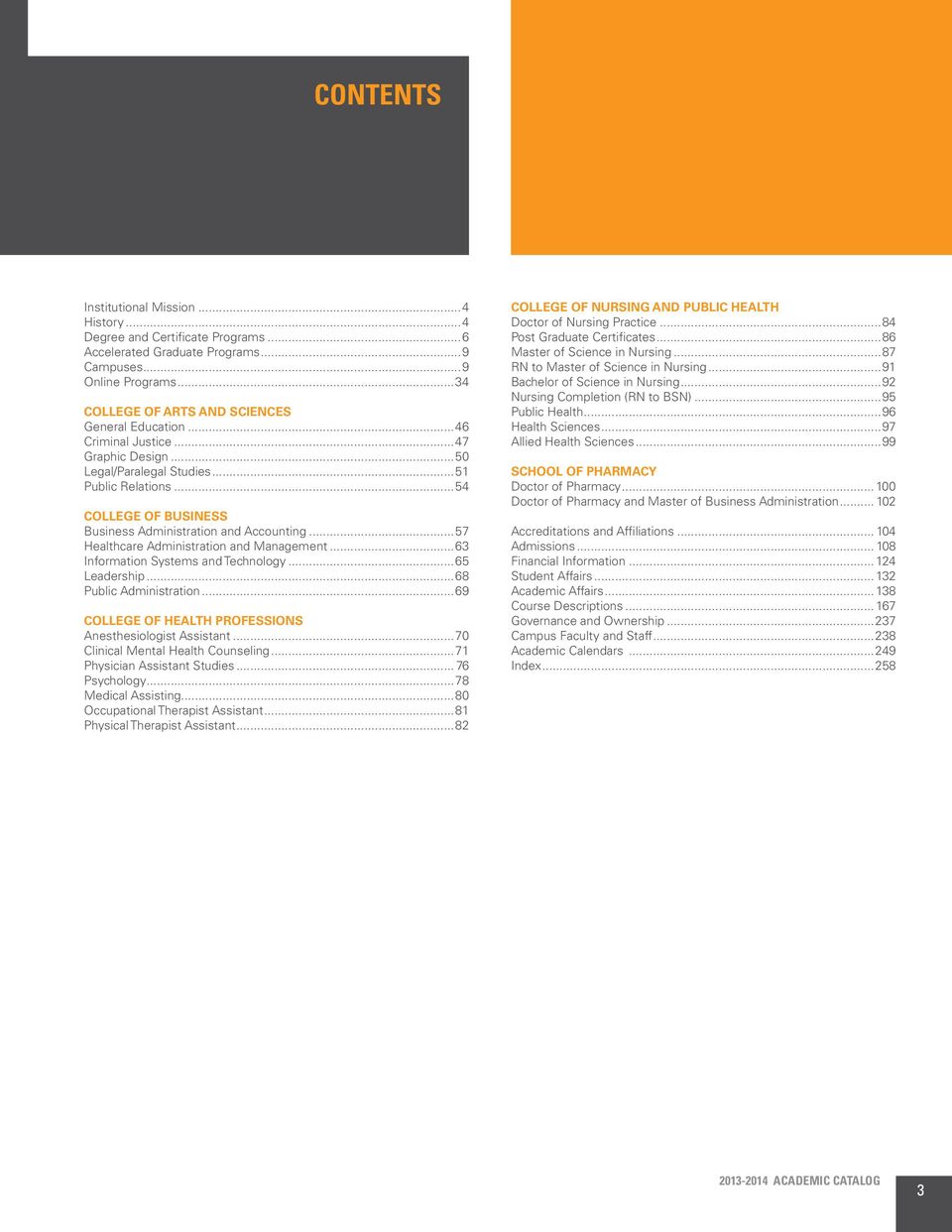
3 CONTENTS Institutional Mission...4 History...4 Degree and Certificate Programs...6 Accelerated Graduate Programs...9 Campuses...9 Online Programs...34 College of Arts and Sciences General Education...46 Criminal Justice...47 Graphic Design...50 Legal/Paralegal Studies...51 Public Relations...54 College of Business Business Administration and Accounting...57 Healthcare Administration and Management...63 Information Systems and Technology...65 Leadership...68 Public Administration...69 College of Health Professions Anesthesiologist Assistant...70 Clinical Mental Health Counseling...71 Physician Assistant Studies Psychology...78 Medical Assisting...80 Occupational Therapist Assistant...81 Physical Therapist Assistant...82 College of Nursing and Public Health Doctor of Nursing Practice...84 Post Graduate Certificates...86 Master of Science in Nursing...87 RN to Master of Science in Nursing...91 Bachelor of Science in Nursing...92 Nursing Completion (RN to BSN)...95 Public Health...96 Health Sciences...97 Allied Health Sciences...99 School of Pharmacy Doctor of Pharmacy Doctor of Pharmacy and Master of Business Administration Accreditations and Affiliations Admissions Financial Information Student Affairs Academic Affairs Course Descriptions Governance and Ownership Campus Faculty and Staff Academic Calendars Index Academic Catalog 3
4 About Institutional Mission is a private academic institution dedicated to providing educational opportunities for the intellectual, social, and professional development of a diverse student population. To achieve this purpose, the institution offers focused and balanced curricula at the associate s, baccalaureate, master s and doctoral levels. A broad-based core curriculum is offered promoting critical thinking, effective verbal and written communication, and skills for life-long learning. Additionally, the University focuses on developing the requisites to pursue and appreciate knowledge. s approach to higher education and the resulting varied academic experiences provide students with the intellectual acumen and pragmatic approach necessary to create the foundation for personal and professional fulfillment. attempts to provide a comprehensive education that instills within its students a philosophy that values not only learning and professionalism but also contribution and commitment to the advancement of community. Believing that qualified individuals should have the privilege of formal academic training, welcomes those who seek educational challenges. To this end, the University provides a learning environment, both on-campus and online, that helps students identify goals and the means to achieve them. With this philosophy in mind, students learn by interacting with a community of faculty, staff and administration dedicated to South University s academic purpose. History traces its history to 1899 when Dr. John Draughon established Draughon s Practical Business College in historic Savannah, GA. The school was originally located in the Masonic Lodge that stood on the northeast corner of Liberty Street and Whitaker Street in the west side of downtown Savannah. During its early years the College was moved several times to accommodate growing enrollment, and eventually was settled into the Atlantic Mutual Building. The school s name was changed to Draughon s Junior College when it was acquired in 1974 by the South family, longtime civic and business leaders in Savannah. That year, the school was relocated to its original neighborhood and began a period of expansion into a multicampus system with the addition of a campus in West Palm Beach, FL. In 1986, the institution s name was changed to South College. In 1996, the College became a four-year school with the addition of a Bachelor of Business Administration degree, and in 1997 opened its third campus in what had been the Massey-Draughon Business College in Montgomery, AL. That same year, the College reorganized its administrative structure into the School of Business and the School of Health Professions with the addition of the Physician Assistant program at the baccalaureate level and the Physical Therapist Assistant program at the associate level. The Southern Association of Colleges and Schools Commission on Colleges (SACSCOC) accredited the institution to confer master s degrees in 2001, and the Master of Science in Physician Assistant degree program was added. In October of that year, with the addition of this post-baccalaureate degree program, South College officially became. In January 2002, opened its fourth campus, formerly Columbia Junior College, in Columbia, SC. Later that year, the University announced plans to open a School of Pharmacy on the Savannah campus and to offer a Doctor of Pharmacy degree program. In December 2002, received accreditation to award doctoral degrees. So, in a span of seven years, the school had been transformed from a two-year college granting associate s degrees and certificates into a four-year university with four campuses, multiple bachelor s and master s degree programs and the ability to offer doctoral degree programs. continued expansion and in 2003 became a part of Education Management Corporation (EDMC), one of the largest education providers in North America. In 2004, the University began web-based instruction with the introduction of online bachelor s degree programs in Business Administration and Information Technology. Online Bachelor of Science degree programs in Healthcare Management, Nursing, and Criminal Justice were added in The next year, opened its fifth campus, in Tampa, FL. In addition, the University launched four online master s degree programs: Master of Business Administration, Master of Business Administration in Healthcare Administration, Master of Science in Criminal Justice, and Master of Science in Nursing. South University also announced the relocation of its Columbia, SC, campus to the city s growing east side.
5 At the Savannah campus in 2007, South University opened a new library, more than tripling the size and resources available to students and faculty. That year, the University also introduced the MBA and MBA in Healthcare Administration degree programs at the Columbia, Montgomery, Savannah, and West Palm Beach campuses, and launched the RN to BSN Degree Completion Program at Columbia, Tampa, and West Palm Beach. Also that year, celebrated its first graduating class of fully online students and awarded the largest number of graduate degrees in its history. In 2008, the Board of Trustees approved the creation of the College of Arts and Sciences, College of Business, College of Health Professions, and College of Nursing, which expanded the BS in Nursing degree program to the Columbia, SC, campus. The University expanded the Master of Science degree program in Physician Assistant Studies to its Tampa campus in 2009 and announced the opening of a School of Pharmacy satellite location in Columbia, SC. also completed the construction and opening of campus locations in Richmond and Virginia Beach, VA. In 2010 s Board of Trustees approved the creation of the College of Creative Art and Design and the merger of The Art Institute Dallas and The Art Institute Fort Worth into. Those schools are now campuses of South University. That year, the University also announced the opening of its Novi, MI, campus. In 2011, the University announced the opening of a location in Austin, Texas, its first campus in the Southwest, and the expansion of the Master of Science in Nursing program with specializations in Adult Health Nurse Practitioner, Family Nurse Practitioner and Nurse Educator. The University also expanded the campuses offering the Master of Science in Criminal Justice and Master of Science in Information Systems and Technology. In 2012, the university opened locations in Cleveland, Ohio and High Point, North Carolina and officially merged with The Art Institute of Charlotte and Art Institute of Raleigh-Durham, North Carolina, both of which became campuses of. As part of it s commitment to the Health Sciences, launched the Associate of Science degree in Occupational Therapy Assistant and announced the launch of post-graduate certificates for nurses interested in advance practice. The university also launched the Doctor of Nursing Practice (DNP) program, which is designed as the highest degree for advanced practice nurses who wish to maintain nursing practice as their area of professional emphasis. s growth is a visible expression of its mission, as well as a response to the demand for a well-educated and highly trained workforce in public and private sectors. During the academic year the university is focused on expansion of its College of Nursing and Public Health and College of Health Professions programs across campus locations Academic Catalog 5

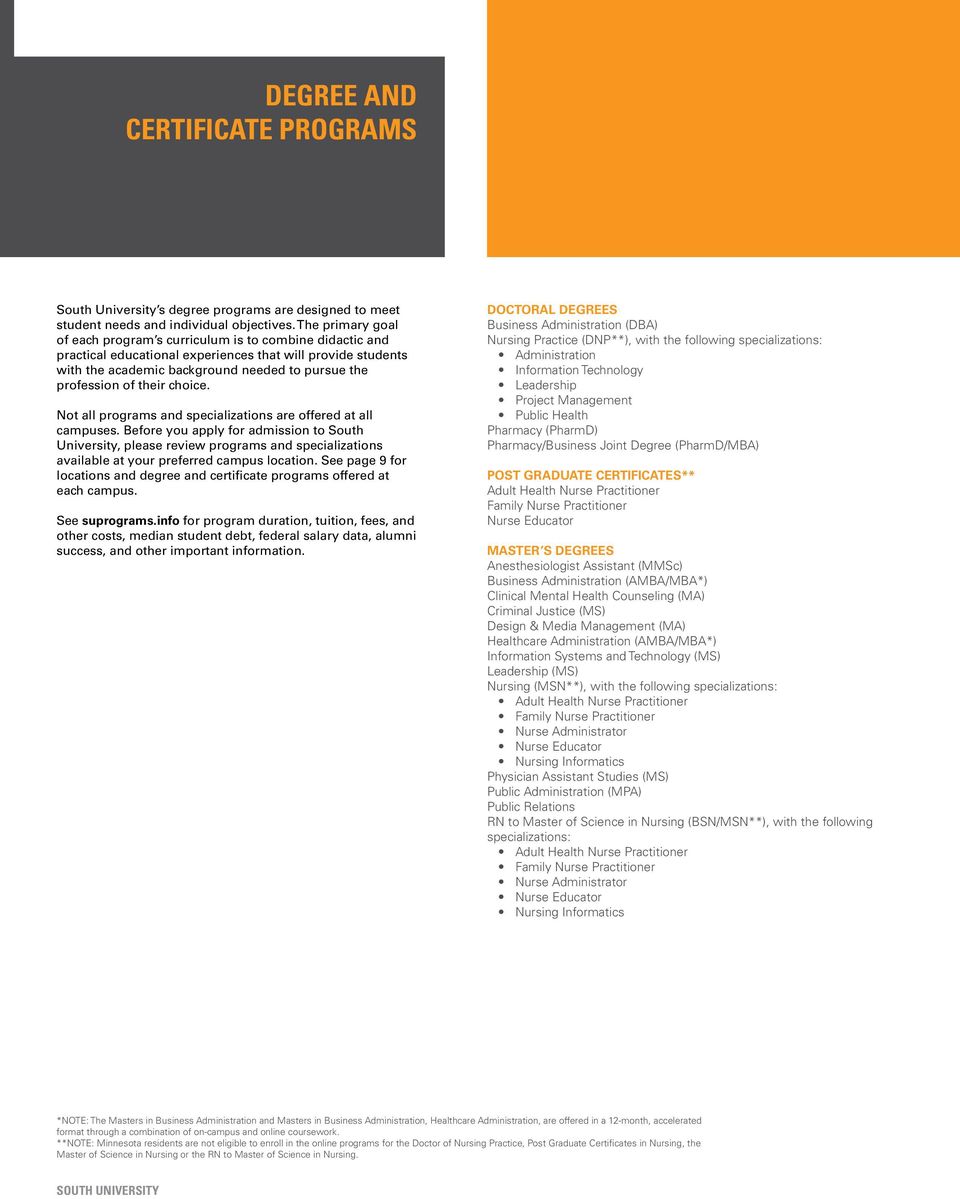
6 Degree and Certificate Programs s degree programs are designed to meet student needs and individual objectives. The primary goal of each program s curriculum is to combine didactic and practical educational experiences that will provide students with the academic background needed to pursue the profession of their choice. Not all programs and specializations are offered at all campuses. Before you apply for admission to South University, please review programs and specializations available at your preferred campus location. See page 9 for locations and degree and certificate programs offered at each campus. See suprograms.info for program duration, tuition, fees, and other costs, median student debt, federal salary data, alumni success, and other important information. Doctoral Degrees Business Administration (DBA) Nursing Practice (DNP**), with the following specializations: Administration Information Technology Leadership Project Management Public Health Pharmacy (PharmD) Pharmacy/Business Joint Degree (PharmD/MBA) Post Graduate CertificateS** Adult Health Nurse Practitioner Family Nurse Practitioner Nurse Educator Master s Degrees Anesthesiologist Assistant (MMSc) Business Administration (AMBA/MBA*) Clinical Mental Health Counseling (MA) Criminal Justice (MS) Design & Media Management (MA) Healthcare Administration (AMBA/MBA*) Information Systems and Technology (MS) Leadership (MS) Nursing (MSN**), with the following specializations: Adult Health Nurse Practitioner Family Nurse Practitioner Nurse Administrator Nurse Educator Nursing Informatics Physician Assistant Studies (MS) Public Administration (MPA) Public Relations RN to Master of Science in Nursing (BSN/MSN**), with the following specializations: Adult Health Nurse Practitioner Family Nurse Practitioner Nurse Administrator Nurse Educator Nursing Informatics *NOTE: The Masters in Business Administration and Masters in Business Administration, Healthcare Administration, are offered in a 12-month, accelerated format through a combination of on-campus and online coursework. **NOTE: Minnesota residents are not eligible to enroll in the online programs for the Doctor of Nursing Practice, Post Graduate Certificates in Nursing, the Master of Science in Nursing or the RN to Master of Science in Nursing.
7 Bachelor s Degrees Advertising Design (BFA) Audio Production (BS) Business Administration (BBA), with the following specializations: Accounting Criminal Justice (BS) Culinary Arts Management (BA) Culinary Management (BS) Digital Filmmaking and Video Production (BFA) Fashion Design (BFA) Fashion Marketing & Management (FBA) Game Art & Design (BFA) Graphic Design (BFA, BS) Health Sciences (BS), with the following specialization: Public Health specialization Healthcare Management (BS) Information Technology (BS), with the following specializations: Database Development and Administration Information Systems Security Network Administration and Management Multimedia and Web Development Interior Design (BFA) Legal Studies (BS) Media Arts & Animation (BFA) Nursing (BSN) Nursing Completion Program (RN to BSN) Photography (BFA) Public Relations Public Relations (BS) Psychology (BA), with the following specializations: Behavioral Health Experimental/Research Visual Effects and Motion Graphics (BFA) Web Design & Interactive Media (BFA) Associate s Degrees Accounting (AS) Allied Health Science (AS) Baking & Pastry (AAS) Business Administration (AS) Criminal Justice (AS) Culinary Arts (AAS) Graphic Design (AS, AAA) Fashion Design (AAA) Information Technology (AS) Medical Assisting (AS) Occupational Therapy Assistant (AS) Paralegal Studies (AS) Photography (AAS) Physical Therapist Assistant (AS, AAS) Restaurant & Catering Management (AAS) Video Production (AAS) Web Design & Interactive Media (AAS) Certificates (C) Art of Cooking Baking & Pastry Culinary Arts Digital Image Management Fashion Retailing Graphic Design and Web Residential Design Web Design & Development I Web Design & Development II Academic Catalog 7

8

9 Campuses South university Campuses s campuses are located in Austin, TX; Cleveland, OH; Columbia, SC; High Point, NC; Montgomery, AL; Novi, MI; Richmond, VA; Savannah, GA; Tampa, FL; Virginia Beach, VA; and West Palm Beach, FL. s Art Institutes campuses are located in Charlotte and Raleigh-Durham, NC; and Dallas and Fort Worth, TX. Oncampus classes are offered days, evenings, and Saturdays and online 24 hours a day, seven days a week. Class schedules vary according to individual programs of study and by campus. Campus facilities include faculty offices, lecture classrooms, and labs. To enhance s progressive learning environment, campuses are equipped with technology including wireless network, multiple student computer labs featuring Mac and PC work stations, and smart classrooms with remote A/V technology. On all its campuses, the University also provides amenities, including a bookstore for the purchase of textbooks and supplies, as well as a student lounge with vending machines. s campus libraries provide scholarly resources and information services to support the curricula and programs of the University, foster academic and professional research by the University community, and facilitate critical thinking and lifelong learning by students. Library facilities offer comfortable seating and study space for students, wireless capabilities for laptop network connectivity, and reference and interlibrary loan services. Open-stack book collections provide access to reference and circulating materials, and program-specific resources to support class assignments. In addition, all authorized students and faculty have 24/7 access, on and off campus, to the University s online library portal with more than 60 databases in all disciplines, along with more than 50,000 e-books, video clips, images, and full-text dissertations. On all its campuses, strives to create a comfortable atmosphere that supports and enhances student learning experiences. Faculty members serve as academic advisors to help students meet their individual goals for graduation. In addition, staff members are attuned to students needs outside the classroom. An annual Student Services survey is circulated to the student body on each campus. Students responses to questions about the quality of campus services, activities, and amenities help the University administration address issues and prioritize concerns raised by students. Accelerated Graduate Programs s Accelerated Graduate Programs are based on the philosophy that qualified students seeking a graduate education should have the opportunity to learn in a supportive environment from outstanding faculty in a format that meets their personal needs. The Accelerated Graduate Programs at are structured for students with busy lives that might be changing careers, starting a new career or advancing their position within an existing career. The accelerated, 12-month programs are built for motivated individuals who believe that education doesn t have to stop when their life or career starts, and students should have opportunities to seek the level of education that can support their personal goals. The 12-month graduate programs are intensive, with an entire graduate education presented in a compressed time frame, so students should consider the discipline necessary to meet program requirements. However individuals able to meet deadlines in their everyday life and career should be able to meet the demands of the 12-month curriculum structure. The program format is built to provide students with both faculty interaction through smart classrooms and industry-utilized video conferencing technology and the convenience of online learning. The Accelerated 12-month MBA and Accelerated, 12-month Healthcare Administration MBA programs help students with existing backgrounds in business and health care to develop a greater understanding of the concepts and organizational structures within their industries, however our programs are designed to be accessible. Students from a variety of educational backgrounds and abilities are able to fully participate and excel in our programs. Programs Master of Business Administration (AMBA) Master of Business Administration in Healthcare Administration (AMBA-HCA) Locations Atlanta, Georgia Columbia, South Carolina Phoenix, Arizona Savannah, Georgia Tucson, Arizona Academic Catalog 9

10 Austin 7700 West Parmer Lane, Building A, Suite A100 Austin, TX Phone: Toll-Free: Fax: The University s Austin campus is conveniently located off West Parmer Lane near Round Rock just north of Austin. The facility includes faculty offices, lecture classrooms, and computer lab space. To enhance students learning experience, the Austin campus is equipped with wireless internet access, video conferencing equipment, smart classroom technology, and student computer labs. The Austin campus library provides scholarly resources and information services to support the curriculum and programs of the University, foster academic and professional research by the University community, and facilitate critical thinking and life-long learning by students. The library provides comfortable seating and study space for students, wireless capabilities for laptop network connectivity, and reference and interlibrary loan services. The open-stack book collection provides access to reference and circulating materials, and program specific resources to support class assignments. An online library portal with access to over 60 databases in all disciplines is available electronically 24/7 on and off campus to all authorized students and faculty. More than 50,000 e- books, video clips, images and full text dissertations are also included in the library offerings., Austin offers students a broad-based core curriculum designed to promote critical thinking and effective verbal and written communication. The Austin campus provides a comprehensive education and gives students an opportunity to experience a philosophy that values both learning and a contribution and commitment to the advancement of community.

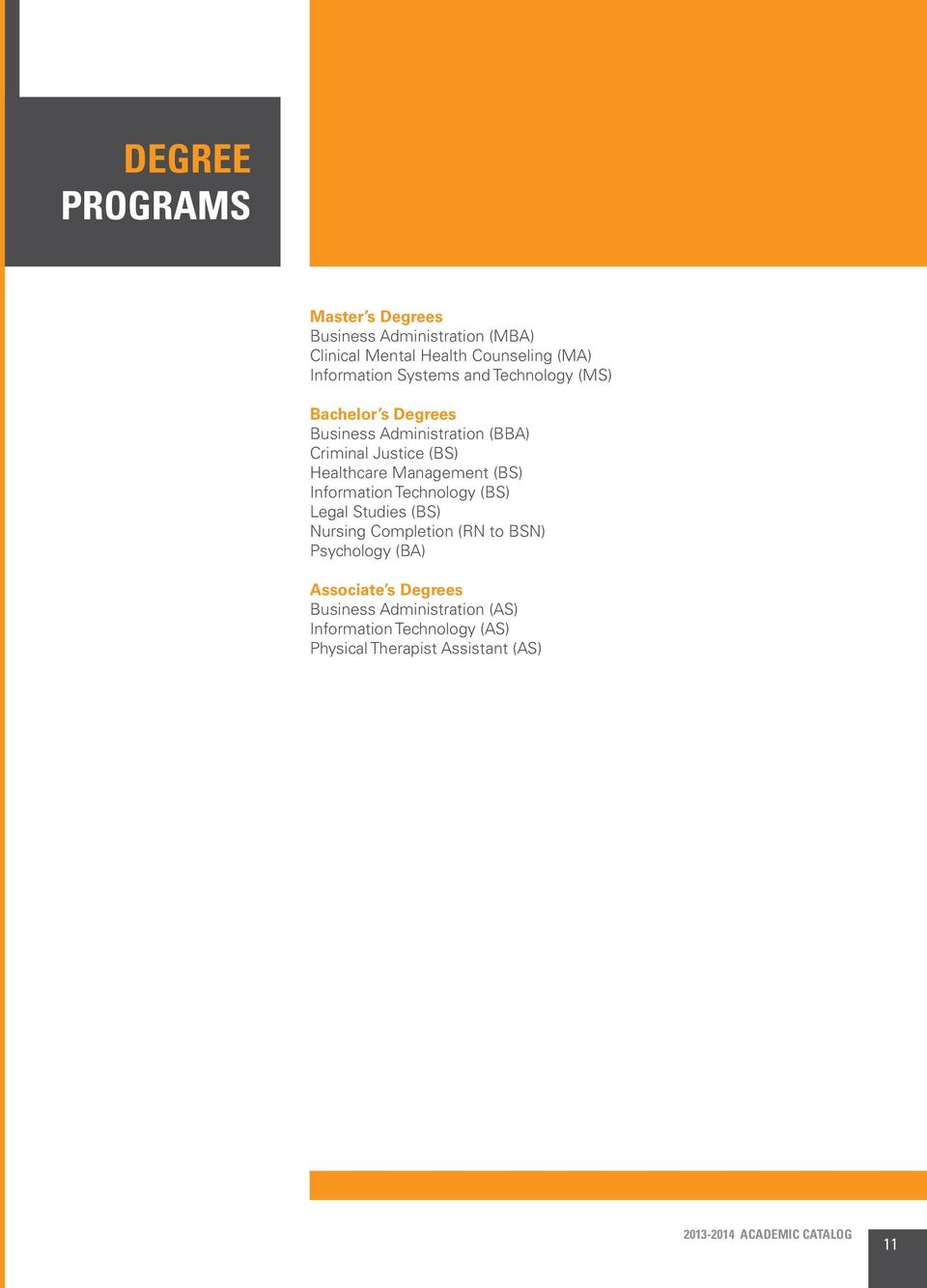
11 Degree Programs Master s Degrees Business Administration (MBA) Clinical Mental Health Counseling (MA) Information Systems and Technology (MS) Bachelor s Degrees Business Administration (BBA) Criminal Justice (BS) Healthcare Management (BS) Information Technology (BS) Legal Studies (BS) Nursing Completion (RN to BSN) Psychology (BA) Associate s Degrees Business Administration (AS) Information Technology (AS) Physical Therapist Assistant (AS) Academic Catalog 11
12 The Art Institute of Charlotte A Campus of South university Three LakePointe Plaza 2110 Water Ridge Parkway Charlotte, NC Phone: Toll-Free: Fax: The Art Institute of Charlotte, a campus of South University, was founded in 1973 as the American Business & Fashion Institute (AB&F) offering programs in Secretarial Science and Fashion Merchandising. Within its first 10 years, additional programs were added and the institution earned accreditation as a business school through the Accrediting Council for Independent Colleges and Schools as well as recognition by the US Department of Education and approval from the Veterans Administration. The original school joined The Art Institutes system of schools in 1999, signaling its name change to The Art Institute of Charlotte. In 2001, the school moved to its current location giving students convenient access to all that Charlotte offers. The city is a thriving business environment that includes high-tech companies as well as corporate giants, and is second only to New York City as a banking center. On campus, The Art institute of Charlotte library provides comfortable seating and study space for students, wireless capabilities for laptop connectivity, and reference and interlibrary loan services. In addition, s library portal is available electronically 24/7 to all authorized students and faculty on and off campus.

13 Degree Programs Bachelor s Degrees Culinary Management (BS) Digital Filmmaking & Video Production (BFA) Fashion & Retail Management (BA) Graphic Design (BFA) Interior Design (BFA) Media Arts & Animation (BFA) Photography (BFA) Web Design & Interactive Media (BFA) Associate s Degrees Culinary Arts (AAS) Fashion Design (AAS) Fashion & Retail Management (AAS) Graphic Design (AAS) Interior Design (AAS) Photography (AAS) Restaurant & Catering Management (AAS) Video Production (AAS) Web Design & Interactive Media Certificate Programs Culinary Arts (C) Baking & Pastry (C) Digital Image Management (C) Fashion Retailing (C) Web Design (C) Web Design & Development (C) Web Design & Interactive Communications (C) Academic Catalog 13

14 Cleveland 4743 Richmond Road Warrensville Heights, OH Phone: Toll-Free: Fax: This campus facility is conveniently located in Warrensville Heights, part of the Cleveland, Ohio, metropolitan area southeast of the city. Warrensville bills itself as The Friendly City and is within comfortable distance of downtown Cleveland and Lake Erie. The campus location also offers quick and easy access to interstates 480 and 271. The Cleveland campus facility includes faculty offices, lecture classrooms, and technology to enhance learning, including wireless internet access, video conferencing equipment, smart classroom technology, and student computer labs. The Cleveland campus library is designed to support general education and the programs to be offered at the Cleveland campus. The library provides comfortable seating and study space and includes print and online books, periodicals, journals, CDs, videos, newspapers, and numerous databases. Reviews, catalogs, publisher/vendor recommendations, faculty/student recommendations, comparisons with holdings of other libraries, and identifying and acquiring resources are methods used in collection development to ensure collections support the Cleveland campus s programs at all levels., Cleveland offers students a broad-based core curriculum designed to promote critical thinking and effective verbal and written communication. The Cleveland campus provides a comprehensive education and give students an opportunity to experience a philosophy that values both learning and a contribution and commitment to the advancement of community.

15 Degree Programs Master s Degrees Business Administration (MBA) Clinical Mental Health Counseling (MA)* Nursing (MSN**), with the following specializations: Family Nurse Practitioner Nurse Educator RN to Master of Science in Nursing (BSN/MSN**),with the following specializations: Family Nurse Practitioner Bachelor s Degrees Business Administration (BBA) Criminal Justice (BS) Healthcare Management (BS) Health Sciences (BS) Information Technology (BS) Legal Studies (BS) Nursing (BSN) Nursing Completion (RN to BSN) Psychology (BA) Associate s Degrees Business Administration (AS) Information Technology (AS) Paralegal Studies (AS) *The Master of Arts in Clinical Mental Health Counseling degree program is designed to meet the standards for licensure in the state of Ohio. Licensing information for the state of Ohio can be obtained from The Counselor, Social Work, and Marriage and Family Therapist Board: CSWMFT Board, 50 West Broad Street, Suite 1075, Columbus, Ohio , Phone: , FAX: , [email protected], Website: **NOTE: Minnesota residents are not eligible to enroll in the online programs for the Doctor of Nursing Practice, Post Graduate Certificates in Nursing, the Master of Science in Nursing or the RN to Master of Science in Nursing Academic Catalog 15

16 Columbia 9 Science Court Columbia, SC Phone: Toll-Free: Fax: The University s Columbia campus has a diverse student body enrolled in both day and evening class schedules. The wide range of academic offerings serves students with a variety of interests and provides an engaging mix of backgrounds that enhance the classroom experience. Likewise, the faculty and staff bring with them a multitude of experience and perspectives which, when combined with their energy and dedication, make for a dynamic team serving the student community. s Columbia campus relocated to the Carolina Research Park in northeast Columbia in fall The campus features spacious classrooms, multiple computer labs, a fully equipped medical lab, and a student lounge. In 2010, opened a new facility on the Columbia campus to house the School of Pharmacy s second location. Like all campuses, Columbia is equipped with technology to support a progressive learning environment, a wireless network, multiple student computer labs featuring Mac and PC computers, and smart classrooms featuring remote A/V technology. The Columbia campus embodies South University s dedication to continually set the standard for excellence, as evidenced by the resources and services provided for its students. The library at the Columbia campus is designed to provide a pleasant environment where students may work, research and study and receive reference, technical, and interlibrary loan assistance from a capable library staff. The book collection provides access to reference, reserve, and circulating materials, program-specific resources to support class assignments, tutorial aides, and current events and recreational reading. The Academic Learning Center, which is located in the library, gives students a quiet environment to study and receive assistance. Note: This campus is authorized under Federal law to enroll non-immigrant alien students.

17 Degree Programs Doctoral Degrees Pharmacy (PharmD) Pharmacy/Business Joint Degree (PharmD/MBA) Master s Degrees Business Administration (AMBA/MBA) Clinical Mental Health Counseling (MA) Criminal Justice (MS) Healthcare Administration (AMBA/MBA) Information Systems and Technology (MS) Leadership (MS) Public Administration (MPA) Public Relations (MS) RN to Master of Science in Nursing (BSN/MSN**), with the following specializations: Family Nurse Practitioner Bachelor s Degrees Business Administration (BBA) Criminal Justice (BS) Graphic Design (BS) Health Sciences (BS) Healthcare Management (BS) Information Technology (BS) Legal Studies (BS) Nursing (BSN) Nursing Completion (RN to BSN) Psychology (BA) Public Relations (BS) Associate s Degrees Business Administration (AS) Graphic Design (AS) Information Technology (AS) Medical Assisting (AS) Paralegal Studies (AS) **NOTE: Minnesota residents are not eligible to enroll in the online programs for the Doctor of Nursing Practice, Post Graduate Certificates in Nursing, the Master of Science in Nursing or the RN to Master of Science in Nursing Academic Catalog 17
18 The Art Institute of Dallas A Campus of South university 8080 Park Lane, Suite 100 Dallas, TX Phone: Toll-Free: Fax: A campus of since late 2010, the Art Institute of Dallas began in 1964 as the Dallas Fashion Merchandising College. Faculty members, in addition to their teaching responsibilities, are often simultaneously involved in their respective fields. This keeps them abreast of the constantly changing worlds of design and business. The curricula are designed to prepare all graduates to pursue entry-level positions in their chosen fields. All programs are offered on a year-round basis to provide students with strong continuity and the ability to work toward their degrees without interruption. The Art Institute of Dallas library provides comfortable seating and study space for students, wireless capabilities for laptop network connectivity, and reference and interlibrary loan services. The open stack book collection provides access to reference and circulating materials, program specific resources to support class assignments, tutorial aids and multimedia. The library contains more than 35,000 books, videos, and CD-ROMS, and subscribes to 235 magazines and journals as well as electronic resources to support the curriculum. In addition, the library portal with access to more than 60 databases in all disciplines available electronically 24/7 on and off campus to all authorized students and faculty. More than 50,000 e -books, video clips, images, and full- text dissertations are also included in the library offerings. Equipment in the library includes 35 computer workstations with Internet access, library data bases, Voyager catalog, and office software. The library is also equipped with a copier, two scanners, and three computers dedicated to online library searches. In addition, two viewing rooms with TV and VCR/DVD players allow students to view videos in the library collection and/or assigned in class. Note: This campus is authorized under Federal law to enroll non-immigrant alien students.

19 Degree Programs Master s Degrees Design & Media Management (MA) Bachelor s Degrees Advertising Design (BFA) Audio Production (BS) Culinary Management (BS) Digital Filmmaking & Video Production (BFA) Fashion & Retail Management (BFA) Fashion Design (BFA) Game Art & Design (BFA) Graphic & Web Design (BFA) Graphic Design (BFA) Interior Design (BFA) Media Arts & Animation (BFA) Photography (BFA) Visual Effects & Motion Graphics (BFA) Web Design & Interactive Media (BFA) Associate s Degrees Baking and Pastry (AAS) Culinary Arts (AAS) Fashion Design (AAA) Graphic Design (AAA) Photography (AAS) Restaurant & Catering Management (AAS) Video Production (AAS) Certificate Programs Baking & Pastry (C) Culinary Arts (C) Digital Image Management (C) Fashion Retailing (C) Web Design & Development I (C) Web Design & Development II (C) Academic Catalog 19

20 The Art Institute of Fort Worth A Campus of South university 7000 Calmont Avenue, Suite 150 Fort Worth, TX Phone: Toll-Free: Fax: The Art Institute of Fort Worth, a campus of South University, was established in The Board of Trustees provides administration, faculty, and students with regular, ongoing guidance regarding, curriculum, and industry. Professional faculty members, in addition to their teaching responsibilities, are often simultaneously involved in their respective fields. This keeps them abreast of the constantly changing worlds of design and business. The Institute s curricula are designed to prepare all graduates to pursue entrylevel positions in their chosen fields. All programs are offered on a year-round basis to provide students with the benefits of continuity and the ability to work toward their degrees without interruption. The Art Institute of Fort Worth library provides comfortable seating and study space for students, wireless capabilities for laptop network connectivity, and reference and interlibrary loan services. The open stack book collection provides access to reference and circulating materials, program specific resources to support class assignments, tutorial aids and multimedia. The library has a copier and printer for student use. The library portal allows students and faculty 24/7 access on and off campus to South University s electronic resources, including more than 60 databases in more than 160 subject areas, with access to more than 60,000 journals and 450 million articles.

21 Degree Programs Bachelor s Degrees Advertising Design (BFA) Fashion & Retail Management (BFA) Graphic Design (BFA) Media Arts & Animation (BFA) Photography (BFA) Web Design & Interactive Media (BFA) Associate s Degrees Graphic Design (AAA) Photography (AAS) Certificate Programs Digital Image Management (C) Fashion Retailing (C) Web Design & Development I (C) Web Design & Development II (C) Academic Catalog 21
22 High Point 3975 Premier Drive High Point, NC Phone: Toll-Free: Fax: The s campus in High Point, NC, is conveniently located in the northeast portion of the city. Known as North Carolina s International City, High Point is minutes from Winston-Salem and Greensboro as well as interstates 40 and 85 for easy driving access to and from the campus. The campus facility at High Point includes faculty offices, lecture classrooms, and advanced technology to enhance learning including wireless Internet access, video conferencing equipment, smart classroom technology, and student computer labs. As keeping with s commitment to its students, special attention has been given to the library at the High Point campus in order to support general education and the specific programs offered on site. Comfortable seating and study space is available throughout the library to encourage use of print and online books, periodicals, journals, CDs, videos, newspapers, and numerous databases. To ensure full support of the High Point facility s programs at all levels, employs a variety of methods to identify and acquire resources for the library s collections. As the campus library s collection is developed, the staff will consider reviews, catalogs, publisher/vendor and faculty/student recommendations, comparisons with holdings of other libraries, among numerous other resources. s High Point campus offers students a broad-based core curriculum designed to promote critical thinking and effective verbal and written communication skills. The High Point campus provides a comprehensive education to students based on a philosophy that values learning as well as community advancement through personal contribution and commitment.
23 Degree Programs Master s Degrees Business Administration (MBA) Clinical Mental Health Counseling (MA) Bachelor s Degrees Business Administration (BBA) Criminal Justice (BS) Healthcare Management (BS) Psychology (BA) Associate s Degrees Paralegal Studies (AS) Academic Catalog 23
24 Montgomery 5355 Vaughn Road Montgomery, AL Phone: Toll-Free: Fax: s campus in Montgomery, AL, is located on the rapidly growing east side of the state s capital city. Montgomery is a hub of government, banking, and law, as well as one of the state s cultural and entertainment centers. Montgomery is situated in the middle of the southeastern states, less than a three-hour drive from Atlanta, Birmingham, and the Gulf of Mexico. The Montgomery campus is located in two buildings on a 3.75 acre campus. The facilities include nursing, computer and health professions labs, comfortably outfitted classrooms, a student center, and a bookstore as well as faculty and administrative offices. A new facility housing the health science classrooms and labs opened in The Montgomery campus library provides scholarly resources and information services to support the curriculum and programs of the University, foster academic and professional research by the University community, and facilitate critical thinking and life-long learning by students. The library provides comfortable seating and study space for students, wireless capabilities for laptop network connectivity, and reference and interlibrary loan services. The openstack book collection provides access to reference and circulating materials, and program-specific resources to support class assignments. An online library portal with access to more than 60 databases in all disciplines is available electronically 24/7 on and off campus to all authorized students and faculty. More than 50,000 e-books, video clips, images and full-text dissertations are also included in the library offerings. Note: This campus is authorized under Federal law to enroll non-immigrant alien students.
25 Degree Programs Master s Degrees Business Administration (MBA) Clinical Mental Health Counseling (MA) Criminal Justice (MS) Healthcare Administration (MBA) Information Systems and Technology (MS) Nursing (MSN**) with the following specializations: Adult Health Nurse Practitioner Family Nurse Practitioner Nurse Educator RN to Master of Science in Nursing (BSN/MSN**), with the following specializations: Adult Health Nurse Practitioner Family Nurse Practitioner Nurse Educator Public Administration (MPA) Public Relations (MS) Bachelor s Degrees Business Administration (BBA) Criminal Justice BS) Health Sciences (BS) Healthcare Management (BS) Information Technology (BS) Legal Studies (BS) Nursing (BSN) Nursing Completion (RN to BSN) Psychology (BA) Public Relations (BS) Associate s Degrees Business Administration (AS) Information Technology (AS) Medical Assisting (AS) Paralegal Studies (AS) Physical Therapist Assistant (AS) **NOTE: Minnesota residents are not eligible to enroll in the online programs for the Doctor of Nursing Practice, Post Graduate Certificates in Nursing, the Master of Science in Nursing or the RN to Master of Science in Nursing Academic Catalog 25
26 Novi Twelve Mile Road Novi, MI Phone: Toll-Free: Fax: The City of Novi is northwest of Detroit and near the Ann Arbor, MI, area. campus facility in Novi occupies more than 30,000 square feet including classrooms, labs and a library. The Novi campus provides students with technology to enhance learning and is equipped with wireless technology, video conferencing equipment, smart classroom technology, and student computer labs. The Novi campus library provides scholarly resources and information services to support the curriculum and programs of the University, foster academic and professional research by the University community, and facilitate critical thinking and lifelong learning by students. The library provides comfortable seating and study space, wireless capabilities for laptop network connectivity, and reference and interlibrary loan services. The open-stack book collection provides access to reference and circulating materials, and program-specific resources to support class assignments. An online library portal with access to more than 60 databases in all disciplines is available electronically 24/7 on and off campus to all authorized students and faculty. More than 50,000 e- books, video clips, images, and full-text dissertations are also included in the library offerings. The physical facilities of the University s Novi campus are designed specifically to support the faculty, students, and the education programs offered by, Novi. The academic programs to be offered at the Novi campus, especially through the College of Health Professions, require specialized classroom and laboratory facilities. The Novi campus will include faculty offices, lecture classrooms, along with computer, nursing, health science, and physical therapy labs. Note: This campus is authorized under Federal law to enroll non-immigrant alien students.
27 Degree Programs Master s Degrees Business Administration (MBA) Clinical Mental Health Counseling (MA) Criminal Justice (MS) Healthcare Administration (MBA) Leadership (MS) Nursing (MSN**), with the following specializations: Adult Health Nurse Practitioner Family Nurse Practitioner RN to Master of Science in Nursing (BSN/MSN**), with the following specializations: Family Nurse Practitioner Bachelor s Degrees Business Administration (BBA) Criminal Justice (BS) Healthcare Management (BS) Information Technology (BS) Legal Studies (BS) Nursing (BSN) Nursing Completion (RN to BSN) Psychology (BA) Associate s Degrees Business Administration (AS) Information Technology (AS) Physical Therapist Assistant (AS) **NOTE: Minnesota residents are not eligible to enroll in the online programs for the Doctor of Nursing Practice, Post Graduate Certificates in Nursing, the Master of Science in Nursing or the RN to Master of Science in Nursing Academic Catalog 27
28 The Art Institute of Raleigh-Durham A Campus of South university 410 Blackwell Street, Suite 200 Durham, NC Phone: Toll-Free: Fax: The Art Institute of Raleigh-Durham, a campus of, has been in continuous operation as a post-secondary school since 1973, when The American Business & Fashion Institute was first licensed by the North Carolina Department of Public Instruction. The Raleigh-Durham school was acquired by The Art Institutes International, LLC in 2000 thereby officially changing its name to The Art Institute of Raleigh-Durham. Located in the heart of the downtown Durham historical and entertainment district, The Art Institute of Raleigh-Durham campus occupies more than 40,000 square feet of space and includes classrooms, a student lounge, spacious library, exhibition gallery, computer labs, studios, resource rooms, culinary kitchens, a dining lab and student supply store. The year-round average class size is 22 or fewer students to provide the personal classroom attention that can foster academic success.
29 Degree Programs Bachelor s Degrees Culinary Management (BS) Digital Filmmaking & Video Production (BFA) Fashion & Retail Management (BA) Game Art & Design (BFA) Graphic Design (BFA) Interior Design (BFA) Photography (BFA) Web Design & Interactive Media (BFA) Associate s Degrees Culinary Arts (AAS) Fashion & Retail Management (AAS) Graphic Design (AAS) Certificate Programs Culinary Arts (C) Baking & Pastry (C) Digital Image Management (C) Fashion Retailing (C) Web Design & Development (C) Web Design & Interactive Communications (C) Academic Catalog 29
30 Richmond 2151 Old Brick Road Glen Allen, VA Phone: Toll-Free: Fax: s campus in Richmond, VA, is located in the Short Pump area northwest of the city on a 115-acre mixed-use tract containing retail businesses, offices, apartments, and condominiums. The campus occupies almost 30,000 square feet in a building constructed specifically for. The facility includes classrooms equipped with the latest technology, as well as specialized laboratories for the Health Sciences, Nursing and Clinical Mental Health Counseling programs, a library, student lounge, computer lab and a bookstore, and faculty and administrative offices. Committed to help students accomplish their individual educational goals, faculty and staff interact with students in a friendly and professional academic environment. s Richmond campus library provides scholarly resources and information services to support the curriculum and programs of the University, foster academic and professional research by the University community, and facilitate critical thinking and life-long learning by students. The library provides comfortable seating and study space for students, wireless capabilities for laptop network connectivity, and reference and interlibrary loan services. The openstack book collection provides access to reference and circulating materials, and program-specific resources to support class assignments. An online library portal with access to more than 60 databases in all disciplines is available electronically 24/7 on and off campus to all authorized students and faculty. More than 50,000 e-books, video clips, images and full-text dissertations are included in the library offerings. Computers for student use are available in the library, as well as in two computer labs with 48 work stations. Each workstation offers Internet access, online database services, a suite of office software, tutorials and class support-software. Note: This campus is authorized under Federal law to enroll non-immigrant alien students.
31 Degree Programs Master s Degrees Business Administration (MBA) Clinical Mental Health Counseling (MA) Criminal Justice (MS) Nursing (MSN**), with the following specializations: Family Nurse Practitioner RN to Master of Science in Nursing (BSN/MSN**), with the following specializations: Family Nurse Practitioner Bachelor s Degrees Business Administration (BBA) Criminal Justice (BS) Health Sciences (BS) Healthcare Management (BS) Information Technology (BS) Legal Studies (BS) Nursing (BSN) Nursing Completion (RN to BSN) Psychology (BA) Associate s Degrees Business Administration (AS) Information Technology (AS) Paralegal Studies (AS) Physical Therapist Assistant (AS) **NOTE: Minnesota residents are not eligible to enroll in the online programs for the Doctor of Nursing Practice, Post Graduate Certificates in Nursing, the Master of Science in Nursing or the RN to Master of Science in Nursing Academic Catalog 31
32 Savannah 709 Mall Boulevard Savannah, GA Phone: Toll-Free: Fax: s expansive campus in Savannah, GA, is located on the city s south side. The original College of Business building was constructed in Beginning in 2000, the campus began to experience tremendous expansion and alteration. The College of Business building was renovated and the Health Professions Building opened in 2000 to house classroom and lab facilities for the Physician Assistant, Physical Therapist Assistant and Medical Assisting programs in addition to the campus library, student lounge, and administrative offices. The 25,000-squarefoot structure, located adjacent to the College of Business building, was designed with expansion in mind with computer and medical labs to meet the changing needs of s student body. In 2002, announced the establishment of the School of Pharmacy on the Savannah campus, offering the University s first doctoral degree and becoming the first university or college in Savannah to offer a health professions doctorate. The School of Pharmacy facility on the west lawn was completed in That same year, s Savannah campus expanded its health professions programs by offering a master s degree in anesthesia sciences with a fully equipped operating room and anesthesia laboratory. Also in 2004, Savannah launched its online programs with bachelor s degrees in business and information technology. In 2005 online degree programs expanded with the addition of undergraduate programs and master s level programs in business, health care and criminal justice. The Savannah campus library provides comfortable seating and study space for students, wireless capabilities for laptop network connectivity, and reference and interlibrary loan services. The openstack book collection provides access to reference and circulating materials, program-specific resources to support class assignments, tutorial aides, and current events and recreational reading. The adjoining research center, furnished with computer work stations, offers students access to the Internet, on-line database services, an office suite, tutorials and class-support software. The library also houses a computer lab, academic support center, conference room, study rooms, and a distance learning classroom. The staff is prepared to assist students and faculty with their research needs. Students and faculty may request individual appointments with the librarians for research assistance and instruction or walk in for guidance on locating materials. University-sponsored student housing is available at the Savannah campus. Interested students should contact the Dean of Student Affairs. Note: This campus is authorized under Federal law to enroll non-immigrant alien students.
33 Degree Programs Doctoral Degrees Nursing Practice (DNP**), with the following specializations: Leadership Pharmacy (PharmD) Pharmacy/Business Joint Degree (PharmD/MBA) Post Graduate Certificates Adult Health Nurse Practitioner Family Nurse Practitioner Nurse Educator Master s Degrees Anesthesiologist Assistant (MS) Business Administration (AMBA/MBA) Clinical Mental Health Counseling (MA) Criminal Justice (MS) Healthcare Administration (AMBA/MBA) Leadership (MS) Nursing (MSN**), with the following specializations: Adult Health Nurse Practitioner Family Nurse Practitioner Nurse Educator RN to Master of Science in Nursing (BSN/MSN**), with the following specializations: Adult Health Nurse Practitioner Family Nurse Practitioner Nurse Educator Physician Assistant Studies (MS) Public Administration (MPA) Public Relations (MS) Bachelor s Degrees Business Administration (BBA) Criminal Justice (BS) Health Sciences (BS) Healthcare Management (BS) Information Technology (BS) Legal Studies (BS) Nursing Completion (RN to BSN) Psychology (BA) Public Relations (BS) Associate s Degrees Business Administration (AS) Information Technology (AS) Medical Assisting (AS) Paralegal Studies (AS) Physical Therapist Assistant (AS) **NOTE: Minnesota residents are not eligible to enroll in the online programs for the Doctor of Nursing Practice, Post Graduate Certificates in Nursing, the Master of Science in Nursing or the RN to Master of Science in Nursing Academic Catalog 33
34 Online Programs In 2004, s Savannah campus launched online bachelor s degree programs in Information Technology and Business Administration. Designed to deliver the same quality instruction and personalized attention students enjoy on campus, these online programs enable students who do not live near a South University campus or those who might not be able to attend classes at a set time and place to pursue an academic degree through. In 2005 added bachelor of science degree programs in Healthcare Management, Nursing, and Criminal Justice. More recently, the University added a Master of Business Administration (MBA), along with the MBA in Healthcare Administration, Master of Science in Nursing, and Master of Science in Criminal Justice. strives to provide an excellent educational environment for students to explore the academic foundations that can lead to the pursuit of professional aspirations. Online programs at South University are an extension of s commitment to providing educational opportunities for the intellectual, social and professional development of a diverse student population. Programs offered in the online modality from South University utilize an interactive learning method in which the educational experience becomes the shared responsibility of students in the classroom, and faculty members serve as facilitators of learning. Online students participate in an enriched learning experience that includes classroom lectures, discussions, demonstrations, field trips and guest speaker contributions, while enjoying the convenience of flexible, 24-hour access to the online classroom and course materials. Online course lectures appear in written format and consist of an introduction to activities as well as explanations of textbook reading assignments. Lectures are intended to be catalysts for ongoing class discussions, and the faculty members facilitate discussion by providing additional insight to course subjects by joining and leading topic dialogues. Discussion boards allow for several topics to be addressed at once; therefore, many different sides of a topic can be examined for greater understanding. The faculty member guides discussions to ensure that students proceed toward an ultimate understanding of the subject matter. The online library provides scholarly resources and information services to support the curriculum and programs of the University, foster academic and professional research by the University community, and facilitate critical thinking and life-long learning by students. The online library provides access to more than 60 databases in all disciplines available electronically 24/7 to all authorized students and faculty. More than 50,000 e-books, video clips, images, and full-text dissertations are also included in the online library offerings. Online reference assistance is available through and telephone. Note: International students present in F-1 visa status are not eligible for online only programs of study.
35 Degree Programs Doctoral Degrees Nursing Practice (DNP**), with the following specializations: Administration Information Technology Leadership Project Management Public Health Master s Degrees Accounting (MS) Business Administration (MBA) Criminal Justice (MS) Healthcare Administration (MBA) Information Systems and Technology (MS) Leadership (MS) Nursing (MSN**), with the following specializations: Adult Health Nurse Practitioner Family Nurse Practitioner Nurse Administrator Nurse Educator Nursing Informatics RN to Master of Science in Nursing (BSN/MSN**), with the following specializations: Adult Health Nurse Practitioner Family Nurse Practitioner Nurse Administrator Nurse Educator Nursing Informatics Public Administration (MPA) Public Relations (MS) Bachelor s Degrees Business Administration (BBA) Criminal Justice (BS) Health Sciences (BS) Healthcare Management (BS) Information Technology (BS) Legal Studies* (BS) Nursing Completion (RN to BSN) Psychology (BA) Public Relations (BS) Associate s Degrees Accounting (AS) Allied Health Science (AS) Business Administration (AS) Criminal Justice (AS) Information Technology (AS) Paralegal Studies* (AS) *Partially available online **NOTE: Minnesota residents are not eligible to enroll in the online programs for the Doctor of Nursing Practice, Post Graduate Certificates in Nursing, the Master of Science in Nursing or the RN to Master of Science in Nursing Academic Catalog 35
36 Online Programs Tuition and Fees Tuition for most online undergraduate degree programs is $1,608 per 4 credit course ($402 per credit hour). Tuition does not include an initial one time application fee of $50. Please refer to the Financial Information section of this catalog for details regarding South University financial information policies. Effective Fall 2012, tuition will change as follows: Master of Business Administration, Master of Business Administration in Healthcare Administration, Master of Science in Information Systems and Technology, Master of Science in Leadership, Master of Public Administration, Master of Science in Accounting and Master of Public Health in degree programs is $567 per credit hour. Tuition for the Master of Science in Criminal Justice degree program is $541 per credit hour and the tuition for the Master of Science in Nursing** degree program is $436 per credit hour, MSN Clinical Fee $1,000.00, MSN Practicum Evaluation Fees (online) $ (per clinical course). Tuition for the RN to Master of Science in Nursing** degree program is $420 per credit hour. Tuition for the Doctor of Business Administration (DBA) degree program is $709 per credit hour. Tuition for the Doctor of Nursing Practice (DNP) degree program is $499 per credit hour. DBA Residency Fee (Online) $1,100. Tuition for the Nursing RN to BSN Completion program is $391 per credit hour. About Online Courses Online course sessions run for 5 weeks, 5.5 weeks, 10 weeks or 11 weeks. Due to the intensive and interactive format of online courses, active participation in courses is a key component of learning and provides a clear indicator of the level of understanding a student has achieved with a topic of study. Part of a student s overall grade for an online course is earned through meeting participation requirements which have been established for all online courses. In addition, students will be required to complete and submit the results from study exercises and formal assignments as further demonstration of competency with the skills and concepts covered in a course. Each online course has the same exit competencies as its on ground equivalent. Online courses are designed to take advantage of technology, making the learning environment more efficient and maximizing relevance to prior learning and experiences. Students should contact their academic advisor for information on the length of each course in their program of study. Digital Bookshelf and ebooks, Online Programs is in the process of enhancing the learning experience by converting traditional textbooks to electronic media. Thus, most courses eventually will have a digital resource fee associated with them. This mandatory fee is a flat rate per course and allows students access to an Electronic Library and HTML versions of textbook(s), and in some cases, other electronic media, which is integrated into the course. Students are responsible for reading the Digital Bookshelf and ebook User s Manual publication, which describes the media, access to the materials and the student s rights and responsibilities related to Digital Bookshelf. Students retaking a course are charged only once for the digital resources fee associated with the same course because students have access to the digital resources materials for five years. Provided the digital resources for the retaken course still uses the same digital books, students do not purchase additional textbook(s) for these courses. On average the price of the digital resource fee is less than the retail price of the textbook(s) for each course, with the added benefits of no shipping charges and immediate access to the materials. After registering for a course, the course registration will display whether there is a digital resource fee or whether paper textbooks are required for each particular course. The online library provides scholarly resources and information services to support the curriculum and programs of the University, foster academic and professional research by the University community, and facilitate critical thinking and life-long learning by students. The online library provides access to over 60 databases in all disciplines available electronically 24/7 on and off campus to all authorized students and faculty. Over 50,000 ebooks, video clips, images and full text dissertations are also included in the online library offerings. Online reference assistance is available through and telephone. Preferred Requirements: Preferred Software Specifications: Mac OSX 10.5 or OR - Windows 7 or Vista with Microsoft.Net 3.5 SP1 Latest version of Safari Browser, MozillaFirefox, or Internet Explorer Preferred Hardware Specifications: 2.0 GHz INTEL processor 1 GB of RAM Graphics card capable of 1024 x 768 resolution or larger Soundcard & speakers High speed internet access Minimum Requirements: Minimum Software Specifications: Apple Mac OSX OR - Microsoft Windows XP SP2 or higher with Microsoft.Net 3.5 SP1 Safari browser or higher, Mozilla Firefox 2.0 or higher, Internet Explorer 6 or higher Minimum Hardware Specifications: 1.0 GHz processor 512 MB of RAM Graphics card capable of 1024x768 screen resolution Dial-up internet access is the minimum standard, however, a higher speed is recommended Recommended Plug-ins or Downloads: The course instructor may employ technology in the ecollege classroom that requires one of these recommended plug ins or downloads in order to function properly. If the instructor uses the ClassLive technology, Java will be required. If your instructor provides **NOTE: Minnesota residents are not eligible to enroll in the online programs for the Master of Science in Nursing or the RN to Master of Science in Nursing.
37 PDF files, Adobe Reader may be required to open and view those files. You can download these items at the time that you need them. Java If Mac - MacOS Classic Java (MRJ 2.2.5) ( apple.com/java/index.html) If Windows - Sun s Java 2 SDK (Java 1.5 or Java 1.6) ( Adobe Reader ( adobe.com/reader/) Recommendation regarding Netbooks Students often see Netbooks (small laptop computers primarily designed for web browsing and ing) as an affordable option when looking to purchase a computer for classwork. However, it is strongly recommend that students do not purchase a Netbook. Purchasing a low-price laptop or desktop computer that meets the system requirements outlined above is a much better solution for classwork. While newer Netbooks may meet resolution and screensize requirements for reading your ebooks, much like some older laptops, some older Netbooks may not be able to graphically handle these sites. This means that reading e texts and participating in the classroom could become difficult. It may be challenging to scroll through your readings and effectively and efficiently work through the material. Taking an Online Program Students considering enrollment in an online program are encouraged to complete a short self-administered survey available through the Online Programs Web site [ edu]. Prior to enrolling in an online program, students will speak with an associate director of admissions to discuss subject interests, learning activities and styles and the amount of time available to pursue an online education. The associate director of admissions will be able to recommend an appropriate program of study and course load. In order to participate in online classes, students must have computer hardware and software equivalent to the specifications indicated by. Prior to registration each quarter, provides students with a list of courses to be offered online and the technology requirements for each course. A list of technology requirements is available through the Online Programs Web site ( and the online course catalog. Because South University regularly evaluates hardware and software needs to ensure that students taking online courses are utilizing technology in parity with students taking the same courses onsite, students should check for technology updates on a quarterly basis. Leave of Absence (online courses) Overall Considerations* A Leave of Absence may be requested by students in online programs. A Leave of Absence is not available to on-campus students (including those on-campus students who are taking online courses). Students in online programs who take a break of 29 consecutive calendar days or less remain continuously enrolled and are classified as full-time students. Students who need to take a break due to situations that would require them to be out of class longer than 29 consecutive calendar days should contact their Academic Counselor and request a Leave of Absence. Students in online programs who have not attended class for more than 29 consecutive calendar days are considered withdrawn from the University unless they have an approved Leave of Absence on file. Signed Leave of Absence forms submitted after 29 consecutive calendar days of the last date of attendance will not be accepted. *Note: Students in the Doctor of Nursing Practice (DNP) program at online are not eligible for a Leave of Absence. Requesting a Leave of Absence Students in online programs may request a Leave of Absence under two instances. Future Leave of Absence: A future leave of absence is a leave that will start upon completion of a course in which the student is enrolled. Students requesting such a Leave of Absence must submit a signed Leave of Absence Request Form to their Academic Counselor. Emergency Leave of Absence: If extenuating circumstances prevent a student from submitting a Leave of Absence Request prior to the last date of attendance, the Leave of Absence will be reviewed on a case by case basis and must be submitted by the student with supporting documentation related to the extenuating circumstances. These extenuating circumstances include military deployment, extended serious medical emergencies, extended serious family emergencies, jury duty, or natural disasters. Students may not request an immediate Emergency Leave of Absence after the 28th calendar day of a 5 week class, 31st calendar day of a 5.5 week class, the 50th calendar day of a 10 week class, or the 58th calendar day of an 11-week class. Students receiving a WF in a course will not be eligible for an approved Tuition Waiver for a Future Course and a Leave of Absence will not be granted. In the event of a natural disaster the University will evaluate the need for a student in the disaster zone to be placed on an approved Leave of Absence. Students receiving an approved Leave of Absence do not receive any extension of time in which to fulfill the requirements for an awarded course Incomplete. Additional Leave of Absence or an Extension of a Current Leave of Absence Students are limited to no more than two Leaves of Absence of 60 calendar days or less within a 12-month period. Students may be granted an additional Leave of Absence or an extension of a current Leave of Absence due to extenuating circumstances. Students requesting an additional Leave of Absence or an extension to a current Leave of Absence must submit a signed Leave of Absence form to their Academic Counselor. The form must explain the extenuating circumstances that require an additional Leave of Absence or an extension of a Current Leave of Absence. The form must be submitted by the student with supporting documentation related to the extenuating circumstances. These extenuating circumstances include military deployment, extended serious medical emergencies, extended serious family emergencies, jury duty, or natural disasters. The Senior Director of Academic Counseling is responsible for reviewing and approving the request. Request for an additional Leave of Absence or an extension of a current Leave of Absence must be received 15 calendar days prior to the end of the current Leave of Absence. Leave of Absences (including extensions) may not exceed 180 calendar days in a 12-month period. Returning from an Approved Leave of Absence Students returning from an approved Leave of Absence that was granted during the time they were enrolled in a course will be allowed to complete coursework started prior to the leave with no additional charges assessed. The University allows students who start a Leave of Absence during a course to withdraw (with a grade of WX) with a Tuition Waiver for a Future Course. Although students will not be charged for the subsequent course, students must re-take the entire course. If a student does not return from an approved Leave of Absence, the official withdrawal date and beginning of the loan grace period (if applicable) is the last date of class attendance. Leave of Absence may not exceed 180 calendar days in a 12-month period. The 12-month period begins the first day of the first Leave of Absence. Students who fail to return on the 180th calendar day will be administratively withdrawn from school Academic Catalog 37
38 online Programs Registration for Online Courses Online students are preregistered for classes by their Academic Counselor. Students will receive their preregistration schedule via notification on the Campus Common and will be required to electronically accept the schedule in order to confirm their registration. Should a student have a question about the schedule or wish to be contacted by his or her online academic advisor, the student will have the option to do so. cannot guarantee course availability for students who register after the preregistration period. Registration is confirmed for the new student once the online orientation has been completed. Registration is confirmed for the continuing student once a schedule has been received and confirmed through correspondence with the student s academic advisor. Student Services Students taking online courses have access to business partners for purchasing textbooks, hardware and software. Information about these vendors is provided in the online orientation course. Links to these vendors are located within the online campus and in the online programs course catalog at: Career Services Online Programs maintain a Career Services Department to assist students with locating and securing full-time, entry-level, field-related employment upon graduation. Although employment in full-time positions is not guaranteed by, it is vitally important to both the student and the University that each student obtain appropriate employment. Therefore, as students approach the final quarter of their programs, specific and personalized attention is provided in the preparation of professional resumes and cover letters as well as in job search strategies and interviewing skills. For more information about the Career Services at Online Programs, please contact Student Support The Student Support team is available to assist online students. As the primary point of contact, the Student Support team is able to answer most student questions. The team can be reached at or [email protected]. Campus Common The Campus Common is the community beyond the classroom. The Campus Common can be accessed from the Student Portal or the online classroom and is a resource for students providing information on many subjects including online news, tutoring and online discussions. The Campus Common is also a resource for students providing access information about their account including academics and financial aid. The Student Portal is the gateway to the online classroom and also allows student to view documents such as course catalogs and directories. Student Financial Aid has a Department of Financial Aid where online students and their families can develop a financial plan to help ensure students completion of their programs. Specialists from this department will help students complete the federal and state applications for grants and loans applicable to the students circumstances. Once a student s eligibility for financial aid has been determined, a financial aid specialist will help the student develop a plan for meeting educational expenses. Students may contact the Financial Aid Department by phoning or through an link provided within the Online Programs Web site [ Emergency Leave Policy for Iowa Residents Iowa residents who are a member, or a spouse of a member if the member has a dependent child, of the Iowa National Guard or Reserve Forces of the United States and who is ordered to state military service or federal service or duty will be afforded the following options: 1. Withdraw from the student s entire registration and receive a full refund of tuition and mandatory fees. 2. Make arrangements with the student s instructors for course grades, or for incompletes that shall be completed by the student at a later date. If such arrangement is made, the student s registration shall remain intact and tuition and mandatory fees shall be assessed for the courses in full. 3. Make arrangement with only some of the student s instructors for grades, or for incompletes that shall be completed by the student at a later date. If such arrangements are made, the registration for those courses shall remain intact and mandatory fees shall be assessed for those courses. Any course for which arrangement cannot be made for grades or incompletes shall be considered dropped and the tuition and mandatory feels for the course refunded. Equipment Prior to registration, students should obtain a technical specification list for hardware and software that supports the online courses. This list is always available from the download documents section of the online programs course catalog. Students may purchase necessary equipment through the hardware and software partners associated with, or through another vendor of choice.
39 Academic Catalog 39
40 Tampa 4401 North Himes Avenue, Suite 175 Tampa, FL Phone: Toll-Free: Fax: Opened in June 2006, s Tampa campus is its second in the state of Florida. Centrally located near Raymond James Stadium in one of Florida s fastest growing communities, this campus affords students the opportunity to learn in classroom, laboratory, and community settings. s Tampa programs have affiliations with hundreds of local businesses and healthcare facilities, including national corporations and world-renown treatment centers. Students may enjoy all the culture and excitement a large city has to offer. Major league sporting events, major concerts, theater, world-renowned restaurants, and a cosmopolitan social scene are all within easy reach. The diverse and vibrant student body thrives on the nurturing atmosphere fostered by faculty and staff. The campus is equipped with technology to support the learning environment, such as a simulation lab; skills labs for nursing, physician assistant, and physical therapist assisting; science lab; computer lab; and Academic Resource Center for tutoring and other academic support. The Tampa campus library provides scholarly resources and information services to support the curriculum and programs of the University, foster academic and professional research by the University community, and facilitate critical thinking and lifelong learning by students. The library provides comfortable seating and study space for students, wireless capabilities for laptop network connectivity, and reference and interlibrary loan services. The open-stack book collection provides access to reference and circulating materials, and program-specific resources to support class assignments. An online library portal with access to more than 60 databases in all disciplines is available electronically 24/7 on and off campus to all authorized students and faculty. More than 50,000 e-books, video clips, images and full-text dissertations are also included in the library offerings. Note: This campus is authorized under Federal law to enroll non-immigrant alien students.
41 Degree Programs Doctoral Degrees Nursing Practice (DNP**), with the following specializations: Leadership Post Graduate Certificates** Adult Health Nurse Practitioner Family Nurse Practitioner Nurse Educator Master s Degrees Business Administration (MBA) Criminal Justice (MS) Healthcare Administration (MBA) Information Systems and Technology (MS) Nursing (MSN**), with the following specializations: Adult Health Nurse Practitioner Family Nurse Practitioner Nurse Educator RN to Master of Science in Nursing (BSN/MSN**), with the following specializations: Adult Health Nurse Practitioner Family Nurse Practitioner Nurse Educator Physician Assistant Studies (MS) Bachelor s Degrees Business Administration (BBA) Criminal Justice (BS) Health Sciences (BS) Healthcare Management (BS) Information Technology (BS) Nursing (BSN) Nursing Degree Completion (RN to BSN) Psychology (BA) Associate s Degrees Information Technology (AS) Occupational Therapy Assistant (AS) Physical Therapist Assistant (AS) **NOTE: Minnesota residents are not eligible to enroll in the online programs for the Doctor of Nursing Practice, Post Graduate Certificates in Nursing, the Master of Science in Nursing or the RN to Master of Science in Nursing Academic Catalog 41
42 Virginia Beach 301 Bendix Road, Suite 100 Virginia Beach, VA Phone: Toll-Free: Fax: s Virginia Beach campus occupies 32,600 square feet in a large office park with easy access to and from Interstate 264. The campus facility includes nine classrooms plus Nursing, Physical Therapist Assistant, Anatomy and Physiology, and Counseling labs. Classrooms and laboratory space offer advanced smart technology to provide students and faculty with instructional equipment to facilitate learning. Also located on campus are administrative offices including admissions, the registrar, student affairs, financial aid, a bookstore, the library, and the office of the campus President. The Virginia Beach campus library offers comfortable space for students to congregate for research, study, tutoring, or online work. Floor to ceiling windows open and illuminate the library s welcoming atmosphere, and ample study space encourages independent and collaborative student work. An online library portal with access to more than 60 databases in all disciplines is available electronically 24/7 to all authorized students and faculty on and off campus. Over 50,000 e-books, video clips, images and full text dissertations are also included in the library offerings. The print collection has reference and circulating materials selected to support the programs offered at the school. The library s computer lab is available to students for homework and research, or it can be closed off from the main library and used for instruction. Serving a diverse student body with both day and evening classes, s team of faculty and staff at the Virginia Beach campus are engaged in helping students achieve success. Faculty from a variety of disciplines are available in the Academic Success Center during designated hours, offering tutoring in a relaxed atmosphere. Embracing South University s commitment to critical thinking, the Virginia Beach campus provides the opportunity for an education that creates life-long learners. Note: This campus is authorized under Federal law to enroll non-immigrant alien students.
43 Degree Programs Master s Degrees Business Administration (MBA) Clinical Mental Health Counseling (MA) Criminal Justice (MS) Healthcare Administration (MBA) Information Systems and Technology (MS) Leadership (MS) Bachelor s Degrees Business Administration (BBA) Criminal Justice (BS) Health Sciences (BS) Healthcare Management (BS) Information Technology (BS) Legal Studies (BS) Nursing (BSN) Nursing Degree Completion (RN to BSN) Psychology (BA) Associate s Degrees Information Technology (AS) Paralegal Studies (AS) Physical Therapist Assistant (AS) Academic Catalog 43
44 West Palm Beach University Centre 9801 Belvedere Road Royal Palm Beach, FL Phone: Toll-Free: Fax: s campus in West Palm Beach, FL, is centrally located in Palm Beach County, close to beaches and accessible to Interstate 95 and the Palm Beach International Airport. In 2010, the West Palm Beach campus moved into a new facility designed specifically to support the campus s growing population. The 32,000-square-foot, three-building campus is in the hub of cultural, economic, and government activity in West Palm Beach. The West Palm Beach campus has engendered a relationship with the surrounding community, reaching out to its neighbors to participate in community activities and host special events. A diverse, multicultural student body thrives on a supportive learning environment fostered by the faculty and staff. In keeping with s educational mission, they are committed to the academic success of their students and to producing graduates who are prepared for the challenges of entry into professional life. The campus library provides individual and group study areas, a computer lab, and a diversified collection of audiovisual, and print materials. Professional librarians are available during all hours of operation to help students locating information and materials at s libraries and at others. An online library portal with access to more than 60 databases in all disciplines is available electronically 24/7 to all authorized students and faculty on and off campus. More than 50,000 e-books, video clips, images, and full-text dissertations are also included in the library offerings. The collections include books, magazines, audiovisual and digital sources that support class assignments, tutorial needs, current events and recreational reading. The computer lab offers Internet access, online databases with indexing and full-text access to thousands of journals, tutorial programs, a suite of office software programs, and tutorial and other class support software. Note: This campus is authorized under Federal law to enroll non-immigrant alien students.
45 Degree Programs Master s Degrees Business Administration (MBA) Clinical Mental Health Counseling (MA) Criminal Justice (MS) Healthcare Administration (MBA) Information Systems and Technology (MS) Nursing (MSN**), with the following specializations: Family Nurse Practitioner Public Administration (MPA) Bachelor s Degrees Business Administration (BBA) Criminal Justice (BS) Health Sciences (BS) Healthcare Management (BS) Information Technology (BS) Legal Studies (BS) Nursing (BSN) Nursing Completion (RN to BSN) Psychology (BA) Associate s Degrees Information Technology (AS) Occupational Therapy Assistant (AS) Paralegal Studies (AS) Physical Therapist Assistant (AS) **NOTE: Minnesota residents are not eligible to enroll in the online programs for the Doctor of Nursing Practice, Post Graduate Certificates in Nursing, the Master of Science in Nursing or the RN to Master of Science in Nursing Academic Catalog 45
46 College of Arts and Sciences General Education Criminal Justice Graphic Design Legal/Paralegal Studies Public Relations Degree programs in the College of Arts and Sciences are developed around a set of standards that offer students broad exposure to an area of study along with deep grounding in the student s chosen career field. Students may select a number of free electives to explore their interests, and they are offered elective options directly related to their chosen field. During the program, students explore the basic theories and concepts of their field, related applications, and current research in that field. The College of Arts and Sciences requires all students to complete courses related to research methods and data analysis as part of career preparation, and to strengthen critical thinking skills and increase information literacy. General Education Program Overview faculty and staff recognize that citizens of the future need to be flexible and broadly knowledgeable in order to adapt to continuously changing technologies, growing diversity across peoples and value systems, and rapid social and cultural change. With this in mind, the University has developed general education requirements that expose students to knowledge from a variety of areas, each framed through the lens of its own history and methodology. Through these required courses, students delve into the worlds of math and science, the humanities and the arts, and the social and behavioral sciences. Students develop competencies in these areas while also gaining a challenging exposure to a range of human knowledge. s general education curriculum challenges the individual to develop a deep and meaningful set of personal values and high ethical standards, along with a commitment to lifelong learning.the curriculum is designed to enhance critical and analytical thinking skills, encourage creativity, and build oral and written communication skills. For students, using technology in coursework and developing skills in assessing the merits of various sources of online information is also an important part of the general education experience. The General Education curriculum at seeks to develop in students competencies that will support them as they progress through their major programs. These competencies include the following: Communicate clearly, effectively, and sensitively in written, graphic, and oral modes appropriate to their fields. Demonstrate basic skills and abilities in mathematical reasoning and the basic sciences. Identify, locate, evaluate, and ethically utilize reliable information from a variety of sources. Illustrate the capacity to think critically, analytically, and logically across multiple fields of inquiry. Interpret and evaluate diverse historical, social, and cultural artifacts, systems, and events as products of the human experience. Areas of Study The general education requirements for comprise six areas. Each area represents a set of requirements designed to build basic skills and insights and to assure that each student experiences coursework in each of the areas of knowledge that together comprise the General Education curriculum. It is our belief that these components are directly associated with the qualities defining an educated professional and are necessary to seek entry-level employment in a fast-paced, changing world. The components are designed to reflect the needs and expectations expressed by many employers of college graduates. The framework shown below reflects minimum requirements to be met by all students at either the associate s or bachelor s degree levels. Programs may identify specific courses needed in that field as a part of the general education program while others may leave choices open to the interests and abilities of the student. The specific areas and course requirements will include the following, but students must check their program for specific courses needed to satisfy general education requirements. General Education Program Areas and Approved CourseS credits A. Professional Development ITS1000 Computer and Internet Literacy 4 UVC1000 Strategies for Success 4 B. Basic Communications ENG1001 Composition I 4 ENG1002 Composition II/Literature 4 ENG2001 Composition III 4 SPC1026 Public Speaking 4 C. Mathematics and Statistics MAT1001 College Algebra I 4 MAT1005 College Algebra II 4 MAT1500 College Mathematics 4 MAT2000 Pre-Calculus 4 MAT2058 Statistics 4 MAT2101 Calculus I 4 MAT2102 Calculus II 4 D. Natural Sciences BIO1011/1012 Anatomy and Physiology I and Lab 4, 2 BIO1013/1014 Anatomy and Physiology II and Lab 4, 2 BIO1020 Biology I 4 BIO1021 Biology II 4 CHM1010 General Chemistry 4 E. Arts and Humanities ENG2002 World Literature I 4 ENG2003 World Literature II 4 HIS1101 U.S. History I: Colonial to HIS1102 U.S. History II: 1865 to present 4 HUM1001 History of Art through the Middle Ages 4
47 HUM1002 History of Art from the Middle Ages to Modern Times 4 HUM2101 World Civilization I: Prehistory 1500 C.E. 4 HUM2102 World Civilization II: 1500 Present 4 PHI2301 Introduction to Philosophy 4 F. Social and Behavioral Sciences ECO2071 Principles of Microeconomics 4 ECO2072 Principles of Macroeconomics 4 POL2076 American Government 4 PSY1001 General Psychology 4 SOC1001 Introduction to Sociology 4 SOC2010 Social Problems 4 Arkansas Residents are required to take the following general education courses, unless specified by the program* General Education 76 Quarter Credit Hours A. Professional Development ITS1000 Computer and Internet Literacy 4 UVC1000 Strategies for Success 4 B. Basic Communications ENG1001 Composition I 4 ENG1002 Composition II/Literature 4 ENG2001 Composition III 4 SPC1026 Public Speaking 4 C. Mathematics and Statistics MAT2058 Statistics 4 Choose two from the following: MAT1001 College Algebra I 4 MAT1005 College Algebra II 4 MAT1500 College Mathematics 4 MAT2000 Pre-Calculus 4 MAT2101 Calculus I 4 MAT2102 Calculus II 4 D. Natural Sciences BIO1011/1012 Anatomy and Physiology I and Lab 4, 2 BIO1013/1014 Anatomy and Physiology II and Lab 4, 2 E. Arts and Humanities Choose three courses from following: ENG2002 World Literature I 4 ENG2003 World Literature II 4 HUM1001 History of Art through the Middle Ages 4 HUM1002 History of Art from the Middle Ages to Modern Times 4 HUM2101 World Civilization I: Prehistory 1500 C.E. 4 HUM2102 World Civilization II: 1500 Present 4 PHI2301 Introduction to Philosophy 4 F. Social and Behavioral Sciences Bachelor of Science in Nursing and Bachelor of Arts in Psychology students must take the following: POL2076 American Government 4 PSY1001 General Psychology 4 SOC1001 Introduction to Sociology 4 Select one from the following: HIS1101 U.S. History I: Colonial to HIS1102 U.S. History II 1865 to present 4 ECO2071 Principles of Microeconomics 4 ECO2072 Principles of Macroeconomics 4 POL2076 American Government 4 PSY1001 General Psychology 4 SOC1001 Introduction to Sociology 4 SOC2010 Social Problems 4 All other bachelor s degree program students must take the following: POL2076 American Government 4 Choose one from the following: HIS1101 U.S. History I: Colonial to HIS1102 U.S. History II 1865 to present 4 Choose two from the following: PSY1001 General Psychology 4 SOC1001 Introduction to Sociology 4 ECO2071 Principles of Microeconomics 4 SOC2010 Social Problems 4 *Arkansas residents may be exempted from UVC1000. Please see the appropriate policy in this catalog for exemption criteria. Criminal Justice Master of Science in Criminal Justice The Master of Science in Criminal Justice degree program is designed for individuals employed in the criminal justice system, as well as those in other careers, both public and private, who wish to acquire further education in criminal justice. Prerequisites are limited so that qualified students with bachelor s degrees in related fields such as criminology, psychology, business or public administration, anthropology, political science, sociology or related social sciences may enroll along with students who have undergraduate degrees in criminal justice. The program is primarily designed to foster a learning community of criminal justice professionals who will use their knowledge within law enforcement, correctional, political, and legal arenas. Program graduates will be prepared for admission to doctoral programs in criminal justice, criminology, and related fields, as well as for advancement within law enforcement, correctional, local and state government, and legal institutions. Program Outcomes include providing students with the following: Professional skills necessary to assume leadership positions in the administration of criminal justice agencies. Advanced knowledge and understanding of criminal justice institutions and processes, and current criminal justice policy. Advanced knowledge and understanding of research methods and program evaluation techniques to effectively conduct and/or evaluate social policy research. Master of Science in Criminal Justice 48 credits Foundation 28 Credits MCJ5001 Foundations in Criminal Justice 4 MCJ5003 Ethics and Moral Behavior in the Criminal Justice System 4 MCJ5100 Advanced Research Methods and Analysis I 4 MCJ6001 Criminal Justice Administration 4 MCJ6003 Criminological Theory 4 MCJ6004 Criminal Justice Planning and Innovation 4 MCJ6405 Organization Leadership 4 Program Elective (choose four) 16 Credits MCJ6002 Juvenile Justice Administration 4 MCJ6401 Critical/Controversial Issues: Law Enforcement 4 MCJ6404 Political Terrorism 4 MCJ6410 Legal Issues in Criminal Justice 4 MCJ6505 Management of Critical Incidents 4 MCJ6601 Resource and Agency Coordination 4 MCJ6620 Special Topics in Homeland Security 4 MCJ6701 Theory and Practice of Community Corrections and Re-entry Programs 4 MCJ6705 Theory and Practice of Institutional Corrections 4 The student will choose four courses (16 credits) from the remaining graduate level criminal justice curriculum listed above or from other graduate offerings with the guidance and approval of the Program Director in Criminal Justice or appropriate Program Chair and with the advice of the related Program Director if courses from other programs are desired. The student should plan to take at least 50% of this part of the degree program in criminal justice courses. Students may construct an area of emphasis with the guidance of the Program Director or Chair or pursue a more general set of elective course choices.. Students may emphasize a traditional area of the field such as Corrections or Homeland Security with their choices, but choices may also reflect the particular professional goals and aspirations of the student. Thus, courses in areas such as Public Administration, Business, or Clinical Mental Health Counseling may be included as desired and approved and if the student completes the required prerequisites for such courses. Please note that Financial Aid may not cover prerequisite courses. Please see the Coursework Taken Outside a Student s Degree Program Policy found in the Academic Affairs section of this catalog. Capstone 4 Credits MCJ6985 Applied Professional Project 4 Acceptance into a Criminal Justice program or its completion does not imply or guarantee that a student will be able to obtain employment in law enforcement, corrections, probation/parole, or related fields. The student should contact the national, state, or local agency/institution in which he or she intends to gain employment for specific requirements and the application process. Maryland residents are not eligible to enroll into an internship, externship, practicum, or field experience course. Students should work with their academic advisor or counselor to be sure they are making appropriate course choices Academic Catalog 47
48 College of Arts and Sciences bachelor of Science in Criminal Justice Bachelor of Science in Criminal Justice degree program is designed to give students broad perspectives on the causes of crime and critical insights to the functions of the components of the criminal justice system. Program Outcomes Students will demonstrate mastery of skills in the areas of theoretical and applied criminal justice as well as in principles and practices to effectively solve a variety of field-based problems. Students will understand the causes of crime and delinquency, the process of adjudicating criminal cases, and the major components of the criminal justice system. Students will demonstrate effective communication and ethical skills as applied to the discipline. Courses in the program deal with crime, violence, and other forms of deviance and the responses to these problems by police, courts, and corrections; contemporary criminal justice issues; and ethical concerns and research. Students in the criminal justice program receive excellent preparation for further study in graduate or professional schools as well as for entry-level positions in the criminal justice system. Bachelor of Science in Criminal Justice 180 CreditS Area I General Education Requirements 64 Credits Professional Development ITS1000 Computer and Internet Literacy 4 UVC1000 Strategies for Success 4 Basic Communications ENG1001 Composition I 4 ENG1002 Composition II/Literature 4 ENG2001 Composition III 4 SPC1026 Public Speaking 4 Mathematics and Statistics MAT2058 Statistics 4 Choose two additional courses from the list below: MAT1001 College Algebra I 4 MAT1005 College Algebra II 4 MAT1500 College Mathematics 4 MAT2000 Pre-Calculus 4 MAT2101 Calculus I 4 MAT2102 Calculus II 4 Natural Sciences (choose two) BIO1020 Biology I 4 BIO1021 Biology II 4 CHM1010 General Chemistry 4 Arts and Humanities (choose two) ENG2002 World Literature I 4 ENG2003 World Literature II 4 HIS1101 U.S. History I: Colonial to HIS1102 U.S. History II: 1865 to Present 4 HUM1001 History of Art through the Middle Ages 4 HUM1002 History of Art from the Middle Ages to Modern Times 4 HUM2101 World Civilization I: Prehistory 1500 C.E. 4 HUM2102 World Civilization II: 1500 Present 4 PHI2301 Introduction to Philosophy 4 Social and Behavioral Sciences PSY1001 General Psychology 4 SOC1001 Introduction to Sociology 4 Choose one additional course from the list below: ECO2071 Principles of Microeconomics 4 ECO2072 Principles of Macroeconomics 4 POL2076 American Government 4 SOC2010 Social Problems 4 Area II Foundation Requirements 44 Credits PSY2007 Statistics for Behavioral Sciences 4 (must be taken concurrently with PSY2008 Statistics for Behavioral Sciences Lab) PSY2008 Statistics for Behavioral Sciences Lab 2 PSY2060 Research Methods 4 (must be taken concurrently with PSY2061 Research Methods Lab) PSY2061 Research Methods Lab 2 Elective Pool (eight courses or 32 credit hours) Transfer students may transfer any course to help fulfill the elective pool requirements, provided the course meets the standards of the Credit for Transcripted and Non-transcripted Work policy found in the Academic Affairs section of this catalog. Non-transfer students, with their advisor s consultation and approval may choose courses from any department recommended and listed course or more broadly from any course offered by. Work from other fields must include any required prerequisite courses in the elective field. A course can be used to meet only one requirement in Area I, Area II, or Area III, but not simultaneously in two areas. Students should work with their academic advisor or counselor to be sure they are making appropriate course choices. Choose eight courses from the following list: CRJ3014 Criminal Justice and the Media 4 CRJ3023 Organized Crime 4 CRJ3026 Concepts in Crime Mapping and Prevention 4 CRJ4009 Illegal Immigration and the Criminal Justice System 4 CRJ4015 Bloodstain Pattern Analysis 4 CRJ4021 Cyber Crime 4 CRJ4011 Terrorism and Homeland Security 4 CRJ4002 Restorative Justice 4 CRJ4650 Forensic Issues 4 CRJ4995 Internship in the Criminal Justice System I 4 CRJ4996 Internship in the Criminal Justice System II 4 CRJ4997 Internship in the Criminal Justice System III 4 Area III Major Requirements 72 Credits Core 44 CRJ1001 Introduction to Criminal Justice System 4 CRJ2100 Introduction to Law Enforcement 4 CRJ2200 Introduction to Criminal Courts 4 CRJ2300 Introduction to Corrections 4 CRJ2800 Criminal Law and Procedures 4 CRJ3003 Juvenile Delinquency & Criminal Justice Systems 4 CRJ3004 Race, Class, & Gender in Criminal Justice 4 CRJ3005 Criminal Justice Management & Administration 4 CRJ3011 Criminology 4 CRJ3025 Comparative Criminal Justice Systems 4 CRJ3500 Ethics in Criminal Justice 4 Program Electives (choose six) 24 CRJ3015 White Collar Crime 4 CRJ3024 Serial Killers and Mass Murderers 4 CRJ3300 Community Based Corrections 4 CRJ3600 Introduction to Forensics 4 CRJ4001 Victimology 4 CRJ4003 Critical Issues in Criminal Justice 4 CRJ4500 Violence in Society 4 CRJ4600 Crime Scene Investigation & Case Management 4 Capstone CRJ4999 Senior Seminar (Capstone) 4 Acceptance into a Criminal Justice program or its completion does not imply or guarantee that a student will be able to obtain employment in law enforcement, corrections, probation/parole or related fields. The student should contact the national, state or local agency/institution in which the student intends to gain employment for specific requirements and the application process. State approval policies require residents of the State of Arkansas to enroll in specific courses within this program rather than the courses specified in the program description above. Residents of the State of Arkansas should contact their admissions representatives for specific courses required within this program. State of Minnesota education requirements consider HIS1101 and HIS1102 to be Social Science coursework; therefore, Minnesota residents are advised to complete an Arts and Humanities course other than HIS1101 or HIS1102 to fulfill their Arts and Humanities General Education requirement. Minnesota residents must also complete the following courses to satisfy Minnesota education requirements: One additional four-credit course in the Arts and Humanities area (other than HIS1101 or HIS1102), and; One additional four-credit courses selected from Mathematics and Statistics, National Sciences, and Social and Behavioral Sciences areas. These additional courses will increase a Minnesota resident s total credits required to graduate. If a student chooses to take an Anatomy and Physiology course, BIO1011 and BIO1013 satisfy the Natural Sciences requirement. Students enrolling in either course must, however, also take the related co-requisite lab courses: BIO1012 and BIO1014 respectively. Students should work with their academic advisor or counselor to be sure they are making appropriate course choices. Maryland residents are not eligible to enroll into an internship, externship, practicum, or field experience course. Students should work with their academic advisor or counselor to be sure they are making appropriate course choices.
49 Associate of Science in Criminal Justice* The Associate of Science in Criminal Justice degree program is designed to provide students with a broadbased education and a foundation of knowledge of crime and society s response to it. Courses in the program include an introduction to the organization and functions of law enforcement, courts and corrections, as well as the basic systems and processes of emergency and disaster management. Successful completion of the Associate of Science in Criminal Justice degree program prepares students for entry into the Bachelor of Science in Criminal Justice degree program. Program Outcomes include the following: Students will demonstrate a basic level of skills in the areas of theoretical and applied criminal justice as well as of principles and practices used to effectively solve a variety of real-life problems in the field. Students will understand basic causes of crime and delinquency, the process of adjudicating criminal cases, and the structure of the major components of the criminal justice system. Students will demonstrate effective communication and ethical skills as applied to the discipline. Associate of Science in Criminal Justice 92 Credits Area 1 General Education 40 Credits Professional Development ITS1000 Computer and Internet Literacy 4 UVC1000 Strategies for Success 4 Basic Communications ENG1001 Composition I 4 ENG1002 Composition II/Literature 4 ENG2001 Composition III 4 SPC1026 Public Speaking 4 Area III Major Requirements 32 Credits CRJ1101 Introduction to Criminal Justice and Law Enforcement 4 CRJ1102 Introduction to Criminal Courts and Corrections 4 CRJ2002 Criminal Law 4 CRJ2003 Juvenile Justice System 4 CRJ2004 Ethics in Criminal Justice 4 CRJ2006 Criminal Procedures 4 CRJ2065 Introduction to Police Organizations 4 EDM2010 Fundamentals of Emergency and Disaster Management 4 *On July 1, 2013, will no longer accept applications for entrance into the Associate of Science in Criminal Justice program offered online or on ground. Acceptance into a Criminal Justice program or its completion does not imply or guarantee that a student will be able to obtain employment in law enforcement, corrections, probation/parole or related fields. The student should contact the national, state or local agency/institution in which the student intends to gain employment for specific requirements and the application process. State approval policies require residents of the State of Arkansas to enroll in specific courses within this program rather than the courses specified in the program description above. Residents of the State of Arkansas should contact their admissions representatives for specific courses required within this program. State of Minnesota education requirements consider HIS1101 and HIS1102 to be Social Science coursework; therefore, Minnesota residents are advised to complete an Arts and Humanities course other than HIS1101 or HIS1102 to fulfill their Arts and Humanities General Education requirement. Minnesota residents must also complete the following courses to satisfy Minnesota education requirements: One additional four-credit course in the Arts and Humanities area (other than HIS1101 or HIS1102), and; One additional four-credit courses selected from Mathematics and Statistics, National Sciences, and Social and Behavioral Sciences areas. These additional courses will increase a Minnesota resident s total credits required to graduate. If a student chooses to take an Anatomy and Physiology course, BIO1011 and BIO1013 satisfy the Natural Sciences requirement. Students enrolling in either course must, however, also take the related co-requisite lab courses: BIO1012 and BIO1014 respectively. Students should work with their academic advisor or counselor to be sure they are making appropriate course choices. Maryland residents are not eligible to enroll into an internship, externship, practicum, or field experience course. Students should work with their academic advisor or counselor to be sure they are making appropriate course choices. Mathematics and Statistics (choose one) MAT1001 College Algebra I 4 MAT1005 College Algebra II 4 MAT2000 Pre-Calculus 4 MAT2101 Calculus I 4 MAT2102 Calculus II 4 Natural Sciences (choose one) BIO1020 Biology I 4 BIO1021 Biology II 4 CHM1010 General Chemistry 4 Arts and Humanities (choose one) ENG2002 World Literature I 4 ENG2003 World Literature II 4 HIS1101 U.S. History I: Colonial to HIS1102 U.S. History II: 1865 to present 4 HUM1001 History of Art through the Middle Ages 4 HUM1002 History of Art from the Middle Ages to Modern Times 4 HUM2101 World Civilization I: Prehistory 1500 C.E. 4 HUM2102 World Civilization II: 1500 Present 4 PHI2301 Introduction to Philosophy 4 Social and Behavioral Sciences PSY1001 General Psychology 4 Area II Foundation Requirements 20 Credits MAT1500 College Mathematics 4 MAT2058 Statistics 4 SOC1001 Introduction to Sociology 4 Choose one additional lecture course from the list below: BIO1020 Biology I 4 BIO1021 Biology II 4 CHM1010 General Chemistry 4 Choose one additional course from the list of four below: ECO2071 Principles of Microeconomics 4 ECO2072 Principles of Macroeconomics 4 POL2076 American Government 4 SOC2010 Social Problems 4 NOTE: These courses cannot count for both Area I and Area II credits Academic Catalog 49
50 College of Arts and Sciences Graphic Design Bachelor of Science in Graphic Design This program is offered at the Columbia campus. The Bachelor of Science in Graphic Design degree program is designed to provide students with a broad background in general education, advanced theoretical graphic design concepts, and practical applications. Students completing the program will demonstrate the following: Clear understanding of the creative process in the graphic arts. Ability to synthesize strong conceptual ideas from research data. Clear understanding of the application of design principles, color theories and typographic fundamentals in a portfolio of design work. Independent critical thinking skills in planning, conceptualizing and producing graphic design projects. In-depth knowledge of graphic design history, design and art styles, and the impact of evolving technology on the graphic arts. Organization, neatness, and precision, as well as an understanding of professional presentation standards for different media, in a portfolio of design work. Competency with computer systems, fluency with major design software commonly used in the field, and knowledge of other peripherals and traditional tools commonly used in graphic design businesses. Ongoing commitment to developing design skills and to lifelong learning. This program prepares students for an entry-level position in the graphic design field as a production manager, art director, or studio manager. The curriculum incorporates both traditional and computer-based techniques. Course work emphasizes development of technical skills, reasoning, analytical, and problem solving abilities. Bachelor of Science in Graphic Design 180 Credits Area I General Education Requirements 64 Credits Personal Development ITS1000 Computer and Internet Literacy 4 UVC1000 Strategies for Success 4 Basic Communications ENG1001 Composition I 4 ENG1002 Composition II/Literature 4 ENG2001 Composition III 4 SPC1026 Public Speaking 4 Mathematics and Statistics (choose three) MAT1001 College Algebra I 4 MAT1005 College Algebra II 4 MAT1500 College Mathematics 4 MAT2000 Pre-Calculus 4 MAT2058 Statistics 4 MAT2101 Calculus I 4 MAT2102 Calculus II 4 Natural Sciences (choose two) BIO1020 Biology I 4 BIO1021 Biology II 4 CHM1010 General Chemistry 4 Arts and Humanities (choose two) ENG2002 World Literature I 4 ENG2003 World Literature II 4 HIS1101 U.S. History I: Colonial to HIS1102 U.S. History II: 1865 to present 4 HUM1001 History of Art through the Middle Ages 4 HUM1002 History of Art from the Middle Ages to Modern Times 4 HUM2101 World Civilization I: Prehistory 1500 C.E. 4 HUM2102 World Civilization II: 1500 Present 4 PHI2301 Introduction to Philosophy 4 Social and Behavioral Sciences (choose three) ECO2071 Principles of Microeconomics 4 ECO2072 Principles of Macroeconomics 4 POL2076 American Government 4 PSY1001 General Psychology 4 SOC1001 Introduction to Sociology 4 SOC2010 Social Problems 4 Area II Foundation Requirements 54 Credits GRA1000 Drawing and Perspective 4 GRA1001 Color Fundamentals 4 GRA1004 Design Fundamentals 4 GRA1005 Graphic Design Studio 4 GRA1011 Typography I 4 GRA1160 Digital Imaging 4 GRA1170 Observational Drawing 4 GRA1195 Digital Layout 4 GRA2010 3D Design Fundamentals 4 GRA2110 Digital Illustration 4 GRA2290 Concept Design 4 GRA2292 Print Production 4 GRA2800 Web Design I 4 GRA2900 Portfolio I 2 Area III Major Requirements 62 Credits Core GRA3000 Graphic Symbolism 4 GRA3010 History of Graphic Design 4 GRA3011 Typography II 4 GRA3060 Multimedia I 4 GRA3090 Digital Photography for Designers 4 GRA3101 Package Design 4 GRA3670 Corporate ID & Branding 4 GRA3810 Collateral Design 4 GRA3820 Advertising Design 4 GRA3850 Web Design II 4 GRA4000 Multimedia II 4 GRA4100 Professional Development for Designers 4 GRA4440 Art Direction 4 Capstone (NOTE: These courses must be taken in the last three quarters of the program.) GRA4670 Digital Portfolio 4 GRA4910 Portfolio II 2 Choose one course from the following: GRA4801 Graphic Design Capstone 4 GRA4802 Graphic Design Capstone Internship 4 Associate of Science in Graphic Design This program is offered at the Columbia campus. The Associate of Science in Graphic Design degree program is designed to help students prepare for entry-level positions in the ever-changing and diverse field of advertising, publishing, and communications. Students develop technical and aesthetic skills through hands-on experience with illustration, graphic design, computer graphics, desktop publishing, designing with type, production, and photography. Graduates of the program are prepared for entry-level positions such as assistant designer, graphic designer, production artist, and layout artist. The program is structured so that a student can continue directly into the Bachelor of Science in Graphic Design degree program. Students in the program will demonstrate the following outcomes: Basic level of understanding of the overall creative process in the graphic arts. Strong foundation in the application of design principles, color theories and typographic fundamentals in a portfolio of design work. Ability to create new conceptual design ideas from available research or other data. Critical thinking skills in sketching, planning, and producing design projects. Basic knowledge of graphic design history, design and art styles, the impact of evolving technology on the graphic arts, and modern trends in art and design. Portfolio organization, neatness, and precision and a basic understanding of artwork and presentation standards for print media.
51 Solid foundation in basic operation and use of computer systems and design software, as well as other peripherals and traditional tools commonly found in graphic design businesses. Growing commitment to developing design skills and to lifelong learning. Associate of Science in Graphic Design 94 Credits Area 1 General Education Requirements 40 Credits Professional Development ITS1000 Computer and Internet Literacy 4 UVC1000 Strategies for Success 4 Basic Communications ENG1001 Composition I 4 ENG1002 Composition II/Literature 4 ENG2001 Composition III 4 SPC1026 Public Speaking 4 Mathematics and Statistics (choose one) MAT1001 College Algebra I 4 MAT1005 College Algebra II 4 MAT1500 College Mathematics 4 MAT2000 Pre-Calculus 4 MAT2058 Statistics 4 MAT2101 Calculus I 4 MAT2102 Calculus II 4 Natural Sciences (choose one) BIO1020 Biology I 4 BIO1021 Biology II 4 CHM1010 General Chemistry 4 Arts and Humanities (choose one) ENG2002 World Literature I 4 ENG2003 World Literature II 4 HIS1101 U.S. History I: Colonial to HIS1102 U.S. History II: 1865 to present 4 HUM1001 History of Art through the Middle Ages 4 HUM1002 History of Art from the Middle Ages to Modern Times 4 HUM2101 World Civilization I: Prehistory 1500 C.E. 4 HUM2102 World Civilization II: 1500 Present 4 PHI2301 Introduction to Philosophy 4 Social and Behavioral Sciences (choose one) ECO2071 Principles of Microeconomics 4 ECO2072 Principles of Macroeconomics 4 POL2076 American Government 4 PSY1001 General Psychology 4 SOC1001 Introduction to Sociology 4 SOC2010 Social Problems 4 Area II Major Program Requirements 54 Credits Core GRA1000 Drawing and Perspective 4 GRA1001 Color Fundamentals 4 GRA1004 Design Fundamentals 4 GRA1005 Graphic Design Studio 4 GRA1011 Typography I 4 GRA1160 Digital Imaging 4 GRA1170 Observational Drawing 4 GRA1195 Digital Layout 4 GRA2010 3D Design Fundamentals 4 GRA2110 Digital Illustration 4 GRA2290 Concept Design 4 GRA2292 Print Production 4 GRA2800 Web Design I 4 Capstone GRA2900 Portfolio I 2 Legal/Paralegal Studies offers the Bachelor of Science in Legal Studies and the Associate of Science in Paralegal Studies in programs that allow a student completing Associate of Science courses to matriculate into the Bachelor of Science in Legal Studies program. Legal/Paralegal Studies Curriculum s Legal Studies and Paralegal Studies programs provide opportunities for students to prepare for a rapidly changing and challenging profession. The American Bar Association (ABA) defines a paralegal as a person, qualified by education, training, or work experience who is employed or retained by a lawyer, law office, corporation, governmental agency or other entity and who performs specifically delegated substantive legal work for which a lawyer is responsible. Paralegals and legal assistants may not give legal advice, set fees, or represent clients in court, and all students in legal studies programs receive instruction in legal ethics and how to avoid the unauthorized practice of law. Coursework emphasizes development of keen analytical and critical thinking skills while fostering sensitivity to cultural and political diversity. Students use modern law office technology and software in courses taught in classrooms, computer labs, or in courses offered online through the Savannah campus. encourages students to commit to lifelong learning that is beneficial in obtaining employment following graduation and that may help them in advancing in their careers as paralegal professionals. The American Bar Association (ABA) has approved the Associate of Science in Paralegal Studies and the Bachelor of Science in Legal Studies programs at the following South University campuses: West Palm Beach, Montgomery, Columbia, and Savannah. Only the Savannah campus is approved by the ABA to offer the programs in a partially online format. Admission to the Legal Studies and Paralegal Studies Degree Programs Students seeking admission into these degree programs must meet all requirements for general admission into the University. Students seeking admission as transfer students must meet additional standards stated in this section of the catalog as well as those required of all transfer students seeking to enroll in. This applies to students moving from one campus to another or from the partially online program offered only through the Savannah campus. Students wishing to transfer to the partially online program from another campus are required to transfer enrollment to the Savannah campus and through that campus to the partially online program. Those seeking admission as a transfer student into the Legal Studies or Paralegal Studies program must provide additional documentation to aid in evaluation for admission and acceptance of transfer credit. Students may transfer up to 75 percent of the total work required for a degree in these programs but no more than 50 percent of the work to be applied toward the legal specialty course requirements for the degree. All courses to be applied toward the legal specialty course requirements must be evaluated and found to be essentially comparable to the course for which the student would receive credit in the program Academic Catalog 51
52 College of Arts and Sciences For legal speciality transfer courses, including courses taken from other campuses, the student should present the catalog description of the course from the source campus, college, or university. A syllabus or comparable document describing the course requirements, learning outcomes of the course, textbook and related materials used in the course, samples of work completed in the course, and grading criteria may also be required at the discretion of the Registrar or the Program Director making the evaluation. These materials will be referred to the appropriate Program Director or qualified faculty member for a final decision after the Registrar has reviewed the courses to assure the work meets the general transfer admission standards. All students enrolling in the partially online program offered through the Savannah campus must document that at least four legal specialty courses comprising at least 16 quarter hours of credit were completed in a traditional classroom format. The program requires that LGS1005 Legal Research and Writing I be completed in a traditional classroom format. The student can complete any other three (3) legal specialty courses In a traditional classroom format with the approval of the Program Director in consultation with the Registrar. Students already enrolled in the partially online program seeking to meet the requirement that at least 16 quarter hours of coursework must be completed in a traditional classroom format, including LGS1005 Legal Research and Writing I, will work with their online Academic Counselor and the online Program Chair or Program Director to identify an acceptable college or university where such work may be completed. Targeted courses will be identified and pre-approved by the online Program Chair or Program Director working with the Academic Counselor and Registrar using the criteria listed above as applicable. Bachelor of Science in Legal Studies The Bachelor of Science in Legal Studies degree program is designed to provide students with a broad academic background in general education, fundamental theoretical legal concepts, and practical applications. This program is designed for the student who has an interest in an entrylevel position or who is ready to take the next step in his or her career in the legal field. The graduate will be prepared for challenging assignments, including investigating cases, researching the law, and preparing documents for litigation or business transactions, while working under the supervision of a licensed attorney. Students pursuing the Bachelor of Science in Legal Studies program are required to follow the curriculum and transfer policies that are outlined at the beginning of this section of the catalog. The coursework is designed to emphasize development of keen analytical and critical thinking skills, while fostering sensitivity to cultural and political diversity. Graduates pursue entry-level positions as paralegals in law firms, banks, insurance companies, governmental agencies and corporations. Program Outcomes Students will demonstrate knowledge of procedural law and substantive law by successfully completing advanced or specialized legal assignments performed in a law office or any organization involved with legal processes under the supervision of an attorney. Students will demonstrate a proficiency in the skills required for the complexities of a modern technology-based law office. Students will demonstrate an understanding of professional and ethical standards expected of a paralegal in a broader spectrum of legal practice. Students will demonstrate enhanced communication skills, including public speaking, letter and memorandum writing, as well as complex legal drafting under the supervision of an attorney. Students will demonstrate advanced legal research, acute critical thinking, reasoning, and analytical approaches to legal problem solving. Bachelor of Science in Legal Studies 180 Credits Area I General Education Requirements 64 Credits Professional Development ITS1000 Computer and Internet Literacy 4 UVC1000 Strategies for Success 4 Basic Communications ENG1001 Composition I 4 ENG1002 Composition II/Literature 4 ENG2001 Composition III 4 SPC1026 Public Speaking 4 Mathematics and Statistics (choose three) MAT1001 College Algebra I 4 MAT1005 College Algebra II 4 MAT1500 College Mathematics 4 MAT2000 Pre-Calculus 4 MAT2101 Calculus I 4 MAT2102 Calculus II 4 MAT2058 Statistics 4 Natural Sciences (choose two) BIO1020 Biology I 4 BIO1021 Biology II 4 CHM1010 General Chemistry 4 Arts and Humanities (choose two) ENG2002 World Literature I 4 ENG2003 World Literature II 4 HIS1101 U.S. History I: Colonial to HIS1102 U.S. History II: 1865 to present 4 HUM1001 History of Art through the Middle Ages 4 HUM1002 History of Art from the Middle Ages to Modern Times 4 HUM2101 World Civilization I: Prehistory 1500 C.E. 4 HUM2102 World Civilization II: 1500 Present 4 PHI2301 Introduction to Philosophy 4 Social and Behavioral Sciences (choose three) ECO2071 Principles of Microeconomics 4 ECO2072 Principles of Macroeconomics 4 POL2076 American Government 4 PSY1001 General Psychology 4 SOC1001 Introduction to Sociology 4 SOC2010 Social Problems 4 Area II Foundation Requirements 40 Credits BUS1038 Business Law I 4 BUS2038 Business Law II 4 Elective Pool (eight courses or 32 credit hours) Transfer students may transfer any course to help fulfill the elective pool requirements, provided the course meets the standards of the Credit for Transcripted and Non-transcripted Work policy found in the Academic Affairs section of this catalog. Non-transfer students, with their advisor s consultation and approval may choose courses from any department recommended and listed course or more broadly from any course offered by. Work from other fields must include any required prerequisite courses in the elective field. A course can be used to meet only one requirement in Area I, Area II, or Area III, but not simultaneously in two areas. Students should work with their academic advisor or counselor to be sure they are making appropriate course choices.
53 Area III Major Requirements 76 Credits Core LGS1001 Introduction to Paralegalism 4 LGS1004 Torts and Remedies 4 LGS1005 Legal Research and Writing I* 4 LGS1006 Legal Research and Writing II 4 LGS2001 Civil Litigation 4 LGS2002 Family Law 4 LGS2003 Estate Planning and Probate 4 LGS2004 Criminal Law 4 LGS2007 Computers in the Legal Office 4 LGS2099 Paralegal Externship 4 LGS4005 Advanced Legal Research and Writing 4 LGS4008 Litigation Support Management 4 LGS4030 Employment Law 4 LGS4075 Legal Topics Seminar 4 Electives (choose two) LGS2005 Real Estate Law 4 LGS2008 Worker s Compensation 4 LGS2010 Bankruptcy Law 4 LGS2030 Administrative Law 4 Electives (choose three) LGS3009 International Law 4 LGS3040 Constitutional Law 4 LGS3050 Immigration Law 4 LGS3060 Contract Law for Paralegals 4 LGS3065 Criminal Procedure 4 LGS4010 Evidence 4 LGS4020 Advanced Real Estate Law 4 LGS4045 Advanced Technology for Paralegals 4 LGS4050 Environmental Law 4 LGS4051 Cyberlaw 4 LGS4055 Intellectual Property 4 LGS4060 Legal Externship II 4 All students enrolling in the partially online program offered through the Savannah campus must document that at least four legal specialty courses comprising at least 16 quarter hours of credit were completed in a traditional classroom format. *The program requires that LGS1005 Legal Research and Writing I be completed in a traditional classroom format. The student can complete any other three (3) legal specialty courses In a traditional classroom format with the approval of the Program Director in consultation with the Registrar.The courses completed on ground in a traditional classroom format must be comparable to the legal specialty courses offered at. Students in Savannah s partially online Legal Studies Program should contact their academic counselor for information on completing these requirements. State approval policies require residents of the State of Arkansas to enroll in specific courses within this program rather than the courses specified in the program description above. Residents of the State of Arkansas should contact their admissions representatives for specific courses required within this program. State of Minnesota education requirements consider HIS1101 and HIS1102 to be Social Science coursework; therefore, Minnesota residents are advised to complete an Arts and Humanities course other than HIS1101 or HIS1102 to fulfill their Arts and Humanities General Education requirement. Minnesota residents must also complete the following courses to satisfy Minnesota education requirements: One additional four-credit course in the Arts and Humanities area (other than HIS1101 or HIS1102), and; One additional four-credit courses selected from Mathematics and Statistics, National Sciences, and Social and Behavioral Sciences areas. These additional courses will increase a Minnesota resident s total credits required to graduate. If a student chooses to take an Anatomy and Physiology course, BIO1011 and BIO1013 satisfy the Natural Sciences requirement. Students enrolling in either course must, however, also take the related co-requisite lab courses: BIO1012 and BIO1014 respectively. Students should work with their academic advisor or counselor to be sure they are making appropriate course choices. Maryland residents are not eligible to enroll into an internship, externship, practicum, or field experience course. Students should work with their academic advisor or counselor to be sure they are making appropriate course choices. Associate of Science in Paralegal Studies The paralegal studies program is designed to provide educational preparation for individuals to serve as paralegals or legal assistants. The program consists of specialized coursework and a supervised externship in selected legal settings such as law firms, real estate and title companies, banks and state or federal governmental agencies. Practical training prepares graduates working under the supervision of a licensed attorney to perform many tasks in a legal office, including, but not limited to, interviewing clients and witnesses, preparing legal documents and otherwise assisting attorneys with the preparation of their cases. The ABA defines a paralegal as a person, office, corporation, governmental agency or other entity and who performs specifically delegated substantive legal work for which a lawyer is responsible. Paralegals and legal assistants may not give legal advice, set fees, or represent clients in court. All students in our paralegal studies program receive instruction in legal ethics and how to avoid the unauthorized practice of law. Students pursuing the Associate of Science in Paralegal Studies program are required to follow the curriculum and transfer policies that are outlined at the beginning of the Legal Studies section of the catalog. Program Outcomes Students will demonstrate knowledge of procedural law and substantive law by successfully completing legal assignments routinely performed in a law office or any organization involved with legal processes under the supervision of an attorney Students will demonstrate an awareness of the needs of a modern technology-based law office Students will demonstrate an understanding of professional and ethical standards expected of a paralegal. Students will demonstrate communication skills, including public speaking, letter and memorandum writing, as well as legal drafting under the supervision of an attorney. Students will demonstrate legal research, analytical and critical thinking skills, including reasoned approaches to legal problem solving. Associate of Science in Paralegal Studies 92 Credits Area I General Education Requirements 40 Credits Professional Development ITS1000 Computer and Internet Literacy 4 UVC1000 Strategies for Success 4 Basic Communications ENG1001 Composition I 4 ENG1002 Composition II/Literature 4 ENG2001 Composition III 4 SPC1026 Public Speaking 4 Mathematics and Statistics (choose one) MAT1001 College Algebra I 4 MAT1005 College Algebra II 4 MAT1500 College Mathematics 4 MAT2000 Pre-Calculus 4 MAT2058 Statistics 4 MAT2101 Calculus I 4 MAT2102 Calculus II 4 Natural Sciences (choose one) BIO1020 Biology I 4 BIO1021 Biology II 4 CHM1010 General Chemistry 4 Arts and Humanities (choose one) ENG2002 World Literature I 4 ENG2003 World Literature II 4 HIS1101 U.S. History I: Colonial to HIS1102 U.S. History II: 1865 to present 4 HUM1001 History of Art through the Middle Ages 4 HUM1002 History of Art from the Middle Ages to Modern Times 4 HUM2101 World Civilization I: Prehistory 1500 C.E.4 HUM2102 World Civilization II: 1500 Present 4 PHI2301 Introduction to Philosophy 4 Social and Behavioral Sciences (choose one) ECO2071 Principles of Microeconomics 4 ECO2072 Principles of Macroeconomics 4 POL2076 American Government 4 PSY1001 General Psychology 4 SOC1001 Introduction to Sociology 4 SOC2010 Social Problems 4 Area II Foundation Requirements 8 Credits BUS1038 Business Law I 4 BUS2038 Business Law II Academic Catalog 53
54 College of Arts and Sciences Area III Major Requirements 44 Credits Core LGS1001 Introduction to Paralegalism 4 LGS1004 Torts and Remedies 4 LGS1005 Legal Research and Writing I* 4 LGS1006 Legal Research and Writing II 4 LGS2001 Civil Litigation 4 LGS2002 Family Law 4 LGS2003 Estate Planning and Probate 4 LGS2004 Criminal Law 4 LGS2007 Computers in the Legal Office 4 Electives (choose one) LGS2005 Real Estate Law 4 LGS2008 Worker s Compensation 4 LGS2010 Bankruptcy Law 4 LGS2030 Administrative Law 4 Capstone: LGS2099 Paralegal Externship 4 Designated as Capstone Course for AS Degree All students enrolling In the partially online program offered through the Savannah campus must document that at least four paralegal specialty courses comprising at least 16 quarter hours of credit were completed in a traditional classroom format. *The program requires that LGS1005 Legal Research and Writing I be completed in a traditional classroom format. The student can complete any other three (3) legal specialty courses In a traditional classroom format with the approval of the Program Director in consultation with the Registrar.The courses completed on ground in a traditional classroom format must be comparable to the legal specialty courses offered at South University. Students in Savannah s partially online Paralegal Studies Program should contact their academic counselor for information on completing these requirements. Only the Associate of Science in Paralegal Studies programs at the following four South University campuses are approved by the American Bar Association (ABA): West Palm Beach, Montgomery, Columbia, and Savannah. Only the Savannah campus is approved by the ABA to offer the program in a partially online format. This program is not open to residents of the state of Arkansas. State of Minnesota education requirements consider HIS1101 and HIS1102 to be Social Science coursework; therefore, Minnesota residents are advised to complete an Arts and Humanities course other than HIS1101 or HIS1102 to fulfill their Arts and Humanities General Education requirement. Minnesota residents must also complete the following courses to satisfy Minnesota education requirements: One additional four-credit course in the Arts and Humanities area (other than HIS1101 or HIS1102), and; One additional four-credit courses selected from Mathematics and Statistics, National Sciences, and Social and Behavioral Sciences areas. These additional courses will increase a Minnesota resident s total credits required to graduate. If a student chooses to take an Anatomy and Physiology course, BIO1011 and BIO1013 satisfy the Natural Sciences requirement. Students enrolling in either course must, however, also take the related co-requisite lab courses: BIO1012 and BIO1014 respectively. Students should work with their academic advisor or counselor to be sure they are making appropriate course choices. Maryland residents are not eligible to enroll into an internship, externship, practicum, or field experience course. Students should work with their academic advisor or counselor to be sure they are making appropriate course choices. Public RElations Master of Science in Public Relations The Master of Science in Public Relations is designed to provide students with essential theoretical and practical tools needed to develop or advance their careers in public relations. Oriented toward management and team-building, students learn best practices in the profession and their application to real-world issues and opportunities. Expansion and advances in technologies and global communication venues necessitate that public relations managers and practitioners obtain skills in managing relationships with diverse publics, clearly communicate organizational accountability and ethical standards, develop and maintain organizational reputations, and facilitate interactive dialogue with organizational stakeholders. Students learn how to conduct public relations research for decision-making, campaign planning, effective message design, and how to create effective relationships with the media, understanding that media relations often traverse both traditional and nontraditional communication venues. Master of Science in Public Relations graduates may seek a variety of career opportunities such as public relations managers, directors of communications, vice presidents of public relations and corporate communications, account directors for public relations consulting firms, management and employee communications managers, public information administrators, public relations specialists, public information specialists, market analysis directors, and political communication managers. Program Outcomes Upon completion of Masters of Science in Public Relations, students should be able to: Identify historical contexts, issues, and key figures in the development of public relations as a profession and discuss how these elements influence present-day public relations practices. Discuss the conditions that build team effectiveness. Create content, provide feedback, access and use appropriate e-communication resource to facilitate collaborative and interactive relationships with organizational stakeholders and the media using Web-based communication tools. Formulate a crisis communications plan including problem identification, resolutions development, and strategies for implementing a communication plan. Design strategic resonant messages that effectively invite trans-cultural dialogue using appropriate cultural communication venues for international audiences. Craft and deliver concise and compelling public relations stories that meet and advance organizational goals and relationships. Describe and analyze major business processes, and explain the balanced scorecard approach to performance management. Discuss how different ethical and moral theories advance ethical practices in public relations. Perform public relations research and understand its findings to develop public relations plans for various internal and external audiences. Masters of Science in Public Relations 48 credits PRL5100 Public Relations Principles and Practices 4 PRL5110 Building Relationships through E-Communications and Social Media 4 PRL5120 Message Design and Digital Storytelling 4 LEA5100 Leadership, Organization Theory and Change 4 LEA5130 Team Building and Group Dynamics 4 PRL5130 In and Out of Crisis: Reputation Creation and Management 4
55 PRL6140 International Public Relations Management 4 PRL6150 Media Relations Management 4 PRL6170 Public Relations Research, Evaluations, and Strategies 4 PRL6190 Ethics and Corporate Social Responsibilities 4 MBA5000 Financial and Management Cost Analysis 4 PRL6290 Public Relations Planning and Campaign Management 4 Maryland residents are not eligible to enroll into an internship, externship, practicum, or field experience course. Students should work with their academic advisor or counselor to be sure they are making appropriate course choices. Bachelor of Science in Public Relations The Bachelor of Science in the Public Relations program at is designed to provide students with fundamental understandings about the field of public relations including public relations principles and practices, strategic public relations planning, effective message design, use of the latest in communication technology and social media venues, and public relations research and evaluation. This 180 credit hour degree orients students toward ethical professional practices for managing relations with various stakeholders including media organizations, customers and clients, community members, and other audiences both internal and external to the organization. Additionally, students learn foundational communication, intercultural, and mass media theories in order to become familiar with methods of effective public relations writing and public communications for both national and international audiences. Public Relations is widely recognized as one of the fastest growing fields worldwide and has been highly ranked on the Forbes list of where the jobs are. According to the Labor Employment Handbook , public relations specialists handle organizational functions, such as media, community, consumer, industry, and governmental relations. They also serve as advisors for political campaigns, special interestgroup representatives, conflict mediators, and employee and investor relations specialists. Public relations specialists also referred to as communications specialists and media specialists, among other titles serve as advocates for clients seeking to build and maintain positive relationships with the public. Their clients include businesses, nonprofit associations, universities, hospitals, and other organizations that need to build and maintain positive relationships with the public. In government, public relations specialists may be called press secretaries. These individuals keep different publics informed about the activities of agencies and officials. A press secretary for a member of Congress informs constituents of the representative s accomplishments. Most government offices on the local, state, and federal level have public relations departments that are typically called PIOs (public information offices). Program Outcomes Upon completion of Bachelor of Science in Public Relations, students should be able to: Define and discuss communication theories and how they apply to real-world contexts. Develop an awareness and appreciation of the foundations of the First Amendment and ethical issues in the media. Apply critical thinking skills creatively and independently to solve public relations challenges facing a variety of organizations. Write correctly and clearly in forms and styles appropriate for scholarly research as well as the communication professions, audiences, and purposes they serve. Develop an awareness and appreciation of the diversity of groups in a global society in relationship to communications. Gather and critically evaluate in-depth information from diverse sources. Understand the history and development of communication technologies and processes and the ways in which this history has affected individuals and society. Produce news stories, public relations materials, and/or media analyses that are clear, accurate, thorough, cogent, and fair. Demonstrate an understanding of current media technologies and their capabilities, limitations and implications from multiple perspectives, including that of producer, participant and audience. Bachelor of Science in Public Relations 180 credits Area I General Education Requirements 64 credits Professional Development UVC1000 Strategies for Success 4 ITS1000 Computer and Internet Literacy 4 Basic Communications ENG1001 Composition I 4 ENG1002 Composition II/Literature 4 ENG2001 Composition III 4 SPC1026 Public Speaking 4 Mathematics and Statistics MAT2058 Statistics 4 Choose two additional courses from the following: MAT1001 College Algebra I 4 MAT1005 College Algebra II 4 MAT1500 College Mathematics 4 MAT2000 Pre-Calculus 4 MAT2101 Calculus I 4 MAT2102 Calculus II 4 Natural Sciences (choose two) BIO1020 Biology I 4 BIO1021 Biology II 4 CHM1010 General Chemistry 4 Arts and Humanities (choose two) ENG2002 World Literature 4 ENG2003 World Literature II 4 HIS1101 U.S. History I: Colonial to HIS1102 U.S. History II: 1865 to Present 4 HUM1001 History of Art through the Middle Ages 4 HUM1002 History of Art from the Middle Ages to Modern Times 4 HUM2101 World Civilization I: Prehistory 1500 C.E. 4 HUM2102 World Civilization II: 1500 Present 4 PHI2301 Introduction to Philosophy 4 Social and Behavioral Sciences (choose three) ECO2071 Principles of Microeconomics 4 ECO2072 Principles of Macroeconomics 4 PSY1001 General Psychology 4 SOC1001 Introduction to Sociology 4 SOC2010 Social Problems 4 Area II Foundation Requirements 36 Credits GRA1004 Design Fundamentals 4 Elective Pool (nine courses or 36 credit hours) Transfer students may transfer any course to help fulfill the elective pool requirements, provided the course meets the standards of the Credit for Transcripted and Non-transcripted Work policy found in the Academic Affairs section of this catalog. Non-transfer students, with their advisor s consultation and approval may choose courses from any department recommended and listed course or more broadly from any course offered by. Work from other fields must include any required prerequisite courses in the elective field. A course can be used to meet only one requirement in Area I, Area II, or Area III, but not simultaneously in two areas. Students should work with their academic advisor or counselor to be sure they are making appropriate course choices Academic Catalog 55
56 College of Arts and Sciences Choose nine courses from the following list: ACC1001 Accounting I 4 ACC1002 Accounting II 4 AHS1001 Medical Terminology 4 BUS1101 Introduction to Business 4 CRJ1001 Introduction to Criminal Justice System 4 CRJ2100 Introduction to Law Enforcement 4 CRJ2200 Introduction to Criminal Courts 4 CRJ2300 Introduction to Corrections 4 HSM1100 Introduction to the Hospitality Industry 4 ITS1101 Foundations of Information Technology 4 ITS1105 Theory of Computation 4 PSY1001 General Psychology 4 PSY2022 Human Growth and Development 4 PSY2010 Abnormal Psychology 4 Area III Major Requirements 80 credits COM2005 Introduction to Communication Theory 4 COM2006 Interpersonal Communication 4 COM2010 Introduction to the Electronic and Emerging Mass Media 4 COM2020 Fundamentals of Persuasion 4 COM3010 History of the Mass Media Influencing Culture and Society 4 COM3020 Theories of Mass Communication 4 COM3050 Intercultural Communication 4 COM3070 Ethics in Mass Communication 4 COM3080 Legal Environment in Mass Communication 4 COM3090 Research Methods in Mass Communication 4 PRL2100 Introduction to Public Relations 4 PRL2110 Writing for Public Relations 4 PRL2150 Media Writing 4 PRL3050 International Public Relations 4 PRL3100 Research Methods for Public Relations 4 PRL3110 Management for Communication Professionals 4 PRL4100 Public Opinion and Political Communication 4 PRL4110 Crisis Communication and Case Studies in Public Relations 4 PRL4970 Public Relations Campaign and Strategies 4 State of Minnesota education requirements consider HIS1101 and HIS1102 to be Social Science coursework; therefore, Minnesota residents are advised to complete an Arts and Humanities course other than HIS1101 or HIS1102 to fulfill their Arts and Humanities General Education requirement. Minnesota residents must also complete the following courses to satisfy Minnesota education requirements: One additional four-credit course in the Arts and Humanities area (other than HIS1101 or HIS1102), and; One additional four-credit courses selected from Mathematics and Statistics, National Sciences, and Social and Behavioral Sciences areas. These additional courses will increase a Minnesota resident s total credits required to graduate. If a student chooses to take an Anatomy and Physiology course, BIO1011 and BIO1013 satisfy the Natural Sciences requirement. Students enrolling in either course must, however, also take the related co-requisite lab courses: BIO1012 and BIO1014 respectively. Students should work with their academic advisor or counselor to be sure they are making appropriate course choices. Maryland residents are not eligible to enroll into an internship, externship, practicum, or field experience course. Students should work with their academic advisor or counselor to be sure they are making appropriate course choices.
57 College of BUsiness Business Administration and Accounting Healthcare Administration and Management Information Systems and Technology Leadership Public Administration Purpose The College of Business provides motivated, life-long learners a higher education experience that combines focused learning with personalized attention in a supportive environment. Vision College of Business will be recognized as the college of choice, which develops minds and creates opportunities through the use of innovative and diverse learning environments, enabling students to be ethically responsible leaders. Values The College of Business subscribes to three core values: Ethical Practices Student Success Quality Education Business Administration and Accounting Doctor of Business Administration The Doctor of Business Administration (DBA) degree program at is designed to prepare students to teach business courses in higher education or to practice their profession in business or consulting. The program is organized around three core areas: field specialization, research methods/statistics, and quality teaching instruction. The purpose of the DBA degree is to prepare graduates for the following: Obtain faculty positions in academic institutions. Advance in positions of senior management responsibility. Enable successful management consulting engagements. The primary objective of the DBA degree program is to prepare students for faculty positions in academic institutions. Another potential value of the degree program is to train students for advancement and for enhanced performance in their positions as senior executives and consultants. The DBA degree program is designed to help candidates develop skills in applied research by improving their methodological and analytical proficiency. These skills help students advance in their academic careers or in their careers as senior managers or consultants. To achieve its mission, the DBA degree program strives for excellence in the following broad areas: Teaching Provide students with the knowledge, skills, abilities, attitudes, and values necessary to pursue their career goals. Develop an understanding of and approach to critical inquiry. Facilitate the transformation of students from dependent to independent learners. Foster a desire and need for lifelong learning. Scholarship Engage students in all forms of scholarship including the scholarship of teaching. Expose students to the research process. Encourage students scholarly inquiry into their field of study in order to increase the knowledge base within that field of study. Academic and Professional Service Involve students in their field of study. Develop an enhanced sense of volunteerism and leadership and recognize its positive impact on the academic and professional community. Integrate the students participation in the program into the students professional lives. This program allows the student to specialize in one of the functional areas within a college or school of business while becoming familiar with the methods of conducting scholarly research and quality methods of teaching in higher education through a highly integrated curriculum. Students have the opportunity to study the current research in the field, analyze and practice the research methods appropriate to the topics within the field/discipline, and develop appropriate methodologies to teach the topics to future students within the methods used in the field. Additionally, students are required to teach an online course at under the mentorship of a South University faculty member. If the student has taught online for or another institution, the student must still meet all the course and learning requirements expected of all DBA degree program students. Program Distinctions The DBA program is designed to be unique through the combination of the following items: Focuses on teaching, scholarship and service and as such mirrors the performance criteria for faculty within higher education. Requires an online teaching experience as an instructor within. Includes a traditional preliminary exam and dissertation experience similar to PhD degree programs. Integrates management research paradigms as an organizing structure within content courses Academic Catalog 57
58 College of Business Program Goals The DBA program seeks to achieve the following goals: Educate future Doctors of Business Administration to possess advanced skills in teaching, scholarship, and providing service to the professional community they serve whether in education or industry. Develop within each student the knowledge and skills necessary to be an effective educator in an area of business administration. Produce researchers who test and advance business theory and practice to make contributions to the larger business community. Promote a desire and provide an avenue for students and faculty to provide service to the academic and professional community, as well as to the public at large. Encourage creative decision making, analytical thinking, and critical analysis. Provide a valuable and compelling learning environment that contributes to lifelong learning. Create a curriculum that actively integrates theory and research methods in all content courses. Program Outcomes Upon completion of the DBA program, students should be capable of the following: Apply critical thinking skills to analyze contemporary theory with their discipline. Integrate contemporary theory into cogent paradigms. Make important contributions to the business administration knowledge base. Comprehend and apply the concepts, principles, and methods of researching business topics for peer reviewed journals, business practices, and consulting assignments. Demonstrate a thorough understanding and practice of teaching management courses in higher education. Develop research designs using scientific investigation and systematic inquiry in an area of management. Provide valuable service to their academic and professional community. Demonstrate excellent oral and written communication related to their field. Doctor of Business Administration 72 Credits Foundation 4 Credits BUS7000 Introduction to the Professional Doctorate 4 Specialization in Organizational Behavior 24 Credits MGT7100 Seminar in Organizational Behavior 4 MGT7105 Seminar in Group and Team Behavior 4 MGT7110 Seminar in Organizational Theory 4 MGT7115 Seminar in Leadership 4 MGT7200 Seminar in Organizational Development and Change 4 MGT7205 Seminar in Ethics and Social Responsibility 4 Research Methods/Statistics 16 Credits BUS7100 Research Methods I 4 BUS7105 Research Methods II 4 BUS7200 Statistics for Research Methods I 4 BUS7205 Statistics for Research Methods II 4 Teaching in Higher Education 12 Credits INS7115 College Teaching 4 INS7200 Instructional Design 4 INS7205 Measurement and Assessment in Education 4 Dissertation 16+ Credits BUS8100 Doctoral Dissertation Research Development 4 BUS8105 Doctoral Dissertation Proposal 4 (may be repeated once) BUS8110 Independent Research for the Doctoral Dissertation 4 (will be repeated two or more times) Maryland residents are not eligible to enroll into an internship, externship, practicum, or field experience course. Students should work with their academic advisor or counselor to be sure they are making appropriate course choices. Master of Business Administration The Master of Business Administration (MBA) degree program is designed to provide students with a process based curriculum versus the standard functional based curriculum. The foundation provides a firm grounding in economics, decision-making, behavioral sciences, and strategic environment. The core presents a functional approach to the long and short run decisions that must be made to deliver goods and services to constituents. recommends that each graduate business student have a laptop computer. Laptop computers are needed for the multi-media classroom, business research and electronic communication. Students lacking the requisite economics, statistics, and accounting background may be required to take prerequisite courses in these disciplines before starting their MBA coursework. Program Outcomes Students will demonstrate the ability to compare and synthesize theoretical foundations and quantitative tools across functional areas as they evaluate diverse business issues and assess business models. Students will demonstrate an ethical and global perspective as they assess decision-making processes, conflict, and other key macro and micro characteristics of organizations in diverse environments. Students will apply effective communication skills in influencing others. They will create sustained, coherent arguments or explanations and reflections in their work for both general and specialized audiences. Students will demonstrate the ability to determine the extent of information needed, assess the needed information, evaluate information and its sources critically, use information effectively to accomplish a specific purpose, and access and use information ethically and legally. Students will demonstrate their ability to apply effective leadership and team work skills to influence individuals and organizations. Students will use critical thinking as they examine both qualitative and quantitative data, then synthesize and evaluate the information for use in problem recognition and problem solving. Students will demonstrate mastery of disciplinespecific knowledge and the practical skills to be effective in management and leadership positions. Master of Business Administration 48 Credits Foundation 16 Credits MBA5001 Organizational Behavior and Communication 4 MBA5004 Managerial Economics 4 MBA5005 Law and Ethics for Managers 4 MBA5008 Quantitative Analysis and Decision Making 4 Core 12 Credits MBA6010 Managerial Finance 4 MBA6011 Strategic Marketing 4 MBA6012 Operations and Supply Chain Management 4 Major Curriculum 16 Credits LEA5125 Leadership Ethics, Culture and Politics 4 MBA6505 Organizational Development and Change Management 4 MBA6710 Entrepreneurial Organizations and Small Businesses** 4 PMC6601 Foundations of Project Management 4 ** Students at the High Point, NC campus will take ACC5005 Financial Accounting and Reporting in place of MBA6710. Capstone 4 Credits MBA6999 Strategic Development and Implementation 4 Maryland residents are not eligible to enroll into an internship, externship, practicum, or field experience course. Students should work with their academic advisor or counselor to be sure they are making appropriate course choices.
59 Accelerated Master of Business Administration The Accelerated Master of Business Administration degree program is designed for the professional working in a variety of organizations who seeks to have a greater understanding of the concepts, organization structures and strategies driving today s complex organizational environment. This is an intensive program presented from a management perspective and designed to be completed in 12 months. Weekend classes held 24 Saturdays per year are supplemented with Internet-mediated coursework and synchronized conference calls and web-based meetings. The Accelerated MBA program is offered in Atlanta, Columbia, Phoenix, Savannah, and Tucson. Accelerated Master of Business Administration 48 Credits ACC5005 Financial Accounting and Reporting 4 LEA5125 Leadership Ethics, Culture and Politics 4 MBA5001 Organizational Behavior and Communication 4 MBA5005 Law and Ethics for Managers 4 MBA5008 Quantitative Analysis and Decision Making 4 MBA5009 Managerial Environment 4 MBA6010 Managerial Finance 4 MBA6011 Strategic Marketing 4 MBA6012 Operations and Supply Chain Management 4 MBA6501 Strategic Human Resource Management 4 MBA6505 Organizational Development and Change Management 4 MBA6999 Strategic Development and Implementation 4 Maryland residents are not eligible to enroll into an internship, externship, practicum, or field experience course. Students should work with their academic advisor or counselor to be sure they are making appropriate course choices. Master of Science in Accounting The Master of Science in Accounting (MSA) degree program at is designed to prepare students from a variety of backgrounds for careers in professional accounting, including corporate and/or public accounting. The accounting and business coursework contained in the MSA program, when combined with the completed bachelor s degree, may allow a student to qualify to take the Certified Public Accounting (CPA) Examination. Students should familiarize themselves with the specific candidacy requirements of the State Board of Accountancy in the particular state in which they wish to take the CPA examination. For students who possess a non-business bachelor s degree, the Master of Science in Accounting program is 76 quarter hours in length and utilizes s existing Master of Business Administration (MBA) foundation and core courses to provide students the opportunity to learn and develop key business knowledge and skills. For students who possess a business bachelor s degree (though not in the area of accounting), the program does not require the MBA foundation and core courses and is 48 quarter hours in length. For both groups of students, the program includes a technical phase that develops in-depth knowledge of accounting principles and techniques across key accounting subject domains. offers its MBA program with a specialization in Accounting for students who possess a business bachelor s degree in accounting. Program Outcomes Upon completion of the MSA program, students should be able to: Demonstrate a thorough understanding and application of accounting, auditing, and taxation principles in a variety of business settings. Apply critical analysis skills to apply contemporary accounting principles and practices to the decisions faced by evolving business organizations. Integrate knowledge, principles, and professional viewpoints throughout the accounting and business subject domains to articulate innovative solutions to organizational challenges. Critique and apply the concepts, principles, and methods gleaned from professional and academic accounting research to challenges in the accounting profession. Demonstrate ethical perspectives, values, and professional responsibilities required in the accounting profession. Master of Science in Accounting 48 to 76 credits Area I: Business Core 28 credits Required if a student does not possess a bachelor s business degree MBA5001 Organizational Behavior and Communication 4 MBA5004 Managerial Economics 4 MBA5005 Law and Ethics for Managers 4 MBA5008 Quantitative Analysis and Decision Making 4 MBA6010 Managerial Finance 4 MBA6011 Strategic Marketing 4 MBA6012 Operations and Supply Chain Management 4 Area II: Accounting Core 44 credits Required for all students; entry point if a student does possess a bachelor s business degree ACC5310 Accounting Information Systems 4 ACC5320 Financial Accounting I 4 ACC5325 Financial Accounting II 4 ACC5328 Financial Accounting III 4 ACC5335 Governmental and Not-for-profit Accounting 4 ACC5340 Cost Accounting 4 ACC5348 Advanced Financial Accounting 4 ACC5360 External Auditing and Assurance 4 ACC5370 Federal Taxation I 4 ACC5372 Federal Taxation II 4 MBA5015 Business and Commercial Law 4 Area III: Accounting Capstone Choose One 4 credits ACC6311 Advanced Accounting Information Systems 4 ACC6315 Accounting Services Consulting 4 ACC6330 Advanced Financial Reporting 4 ACC6342 Corporate Controllership 4 ACC6345 Intermediate Cost Management 4 ACC6350 Internal Auditing and Assurance 4 ACC6362 Forensic and Fraud Auditing 4 ACC6374 Advanced Taxation 4 Maryland residents are not eligible to enroll into an internship, externship, practicum, or field experience course. Students should work with their academic advisor or counselor to be sure they are making appropriate course choices. Bachelor of Business Administration The Bachelor of Business Administration degree program focuses on preparing students with the knowledge and skills they will need to pursue entry-level positions in business. With courses such as Strategic Management, Advanced Operations Management and Global Business Management students can discover how to adapt business strategies to accommodate changing marketplace conditions. Courses that include Managerial Communications, Dynamic Decision Making and Leadership are designed to provide students with opportunities to understand and apply effective leadership skills. Through case studies and intensive projects, students will have the opportunity to gain the ability to assess organizational needs and implement effective improvement scenarios. The BBA degree program culminates in a capstone project, a two-course sequence that focuses on the students area of emphasis and allows the student to apply the concepts and skills he or she has learned in real and simulated business situations. Program Outcomes Students will demonstrate an understanding of the functional areas in business: accounting, marketing, finance, economics, law, and management. They will be able to integrate these functional areas to solve problems and address ethical issues in the business environment. Students will be able to identify and assess business opportunities and threats and develop action plans to address the issues for a competitive advantage in the marketplace. Students will demonstrate knowledge of the evolving business environment and understand how change is necessary to compete in the global marketplace. Students will apply effective and professional communication skills, both orally and in writing Academic Catalog 59
60 College of Business They will demonstrate persuasive communications as it relates to working with key stakeholders in an organization. Students will demonstrate relevant skills and abilities in proficient use of information technology in problem solving, decision making, and communication across functional areas. Students will demonstrate effective teamwork and leadership skills when working with team members with diverse backgrounds and abilities to achieve important business objectives. Students will apply quantitative analysis and critical thinking skills to analyze business problems within and across functional business disciplines to positively affect financial performance. Students will demonstrate attainment of disciplinespecific knowledge (area of specialization) and the practical skills to be effective in entry-level positions. Bachelor of Business Administration 180 Credits Area I General Education Requirements 64 Credits Professional Development ITS1000 Computer and Internet Literacy 4 UVC1000 Strategies for Success 4 Basic Communications ENG1001 Composition I 4 ENG1002 Composition II/Literature 4 ENG2001 Composition III 4 SPC1026 Public Speaking 4 Mathematics and Statistics MAT2058 Statistics 4 Choose two additional courses from the following: MAT1001 College Algebra I 4 MAT1005 College Algebra II 4 MAT1500 College Mathematics 4 MAT2000 Pre-Calculus 4 MAT2101 Calculus I 4 MAT2102 Calculus II 4 Natural Sciences (choose two) BIO1020 Biology I 4 BIO1021 Biology II 4 CHM1010 General Chemistry 4 Arts and Humanities (choose two) ENG2002 World Literature I 4 ENG2003 World Literature II 4 HIS1101 U.S. History I: Colonial to HIS1102 U.S. History II: 1865 to present 4 HUM1001 History of Art through the Middle Ages 4 HUM1002 History of Art from the Middle Ages to Modern Times 4 HUM2101 World Civilization I: Prehistory 1500 C.E. 4 HUM2102 World Civilization II: 1500 Present 4 PHI2301 Introduction to Philosophy 4 Social and Behavioral Sciences ECO2071 Principles of Microeconomics 4 ECO2072 Principles of Macroeconomics 4 Choose one additional course from the following: PSY1001 General Psychology 4 SOC1001 Introduction to Sociology 4 SOC2010 Social Problems 4 Area II Foundation Requirements 36 Credits ACC1001 Accounting I 4 ACC1002 Accounting II 4 ACC1003 Accounting III 4 BUS1038 Business Law I 4 BUS1101 Introduction to Business 4 BUS2023 Business Communications 4 FIN2030 Introduction to Finance 4 MGT2037 Principles of Management 4 MKT2010 Principles of Marketing 4 Area III Major Requirements 48 Credits Core BUS3055 Business Law for Commercial Transactions* 4 BUS3059 Quantitative Business Analysis 4 BUS4101 Quality Management 4 FIN3030 Corporate Finance 4 FIN4060 Financial Statement Analysis 4 MGT3059 Operations Management 4 MGT3002 Organizational Behavior 4 MGT3102 Leadership 4 MGT3035 Fundamentals of Project Management 4 MKT3010 Marketing Management 4 MGT4070 Strategic Management 4 BUS4098 Business Simulation 4 Elective Pool (eight courses or 32 credit hours) Transfer students may transfer any course to help fulfill the elective pool requirements, provided the course meets the standards of the Credit for Transcripted and Non-transcripted Work policy found in the Academic Affairs section of this catalog. Non-transfer students, with their advisor s consultation and approval may choose courses from any department recommended and listed course or more broadly from any course offered by. Work from other fields must include any required prerequisite courses in the elective field. A course can be used to meet only one requirement in Area I, Area II, or Area III, but not simultaneously in two areas. Students should work with their academic advisor or counselor to be sure they are making appropriate course choices. Choose eight courses from the following list: BUS3041 Managerial Communications 4 BUS3101 Dynamic Decision Making 4 MIS3101 Application of Management Information Systems 4 MGT2040 Fundamentals of Strategic Negotiations 4 MGT3045 Human Resources Management 4 MGT4027 Global Business Management 4 MGT4059 Advanced Operations Management 4 MKT4106 Advertising and Promotion 4 State approval policies require residents of the State of Arkansas to enroll in specific courses within this program rather than the courses specified in the program description above. Residents of the State of Arkansas should contact their admissions representatives for specific courses required within this program. State of Minnesota education requirements consider HIS1101 and HIS1102 to be Social Science coursework; therefore, Minnesota residents are advised to complete an Arts and Humanities course other than HIS1101 or HIS1102 to fulfill their Arts and Humanities General Education requirement. Minnesota residents must also complete the following courses to satisfy Minnesota education requirements: One additional four-credit course in the Arts and Humanities area (other than HIS1101 or HIS1102), and; One additional four-credit courses selected from Mathematics and Statistics, National Sciences, and Social and Behavioral Sciences areas. These additional courses will increase a Minnesota resident s total credits required to graduate. If a student chooses to take an Anatomy and Physiology course, BIO1011 and BIO1013 satisfy the Natural Sciences requirement. Students enrolling in either course must, however, also take the related co-requisite lab courses: BIO1012 and BIO1014 respectively. Students should work with their academic advisor or counselor to be sure they are making appropriate course choices. Maryland residents are not eligible to enroll into an internship, externship, practicum, or field experience course. Students should work with their academic advisor or counselor to be sure they are making appropriate course choices. Bachelor of Business Administration Accounting Specialization The Bachelor of Business Administration, Accounting specialization (BBA/ACC) at is designed to prepare students for entry-level positions in corporate and/or public accounting. Additional graduate level coursework may be required to qualify to take the Certified Public Accounting (CPA) Examination in the states where has campuses offering the program. Students should familiarize themselves with the requirements of the State Board of Accountancy in the particular state in which they wish to take the exam. does not guarantee third-party certification/licensure. Outside agencies control the requirements for taking and passing certification/licensing exams and are subject to change without notice to. Bachelor of Business Administration Accounting Specialization 180 Credits Area I General Education Requirements 64 Credits Professional Development ITS1000 Computer and Internet Literacy 4 UVC1000 Strategies for Success 4 Basic Communications ENG1001 Composition I 4 ENG1002 Composition II/Literature 4 ENG2001 Composition III 4 SPC1026 Public Speaking 4 Mathematics and Statistics MAT2058 Statistics 4 Choose two additional courses from the following: MAT1001 College Algebra I 4 MAT1005 College Algebra II 4 MAT1500 College Mathematics 4 MAT2000 Pre-Calculus 4 MAT2101 Calculus I 4 MAT2102 Calculus II 4
61 Natural Sciences (choose two) BIO1020 Biology I 4 BIO1021 Biology II 4 CHM1010 General Chemistry 4 Arts and Humanities (choose two) ENG2002 World Literature I 4 ENG2003 World Literature II 4 HIS1101 U.S. History I: Colonial to HIS1102 U.S. History II: 1865 to present 4 HUM1001 History of Art through the Middle Ages 4 HUM1002 History of Art from the Middle Ages to Modern Times 4 HUM2101 World Civilization I: Prehistory 1500 C.E. 4 HUM2102 World Civilization II: 1500 Present 4 PHI2301 Introduction to Philosophy 4 Social and Behavioral Sciences ECO2071 Principles of Microeconomics 4 ECO2072 Principles of Macroeconomics 4 Choose one additional course from the following: PSY1001 General Psychology 4 SOC1001 Introduction to Sociology 4 SOC2010 Social Problems 4 Area II Foundation Requirements 36 Credits ACC1001 Accounting I 4 ACC1002 Accounting II 4 ACC1003 Accounting III 4 BUS1038 Business Law I 4 BUS1101 Introduction to Business 4 BUS2023 Business Communications 4 FIN2030 Introduction to Finance 4 MGT2037 Principles of Management 4 MKT2010 Principles of Marketing 4 Area III Major Requirements 80 Credits Core ACC3010 Accounting Information Systems 4 ACC3020 Intermediate Financial Accounting I 4 ACC3025 Intermediate Financial Accounting II 4 ACC3028 Intermediate Financial Accounting III 4 ACC3040 Cost Accounting 4 ACC4010 Federal Taxation I 4 ACC4020 Federal Taxation II 4 ACC4050 Internal Auditing and Assurance 4 BUS3041 Managerial Communications 4 BUS3055 Business Law for Commercial Transactions 4 FIN3030 Corporate Finance 4 MGT3002 Organizational Behavior 4 MGT3102 Leadership 4 MKT3010 Marketing Management 4 MGT4070 Strategic Management 4 BUS4098 Business Simulation 4 Elective Pool (four courses or 16 credit hours) Transfer students may transfer any course to help fulfill the elective pool requirements, provided the course meets the standards of the Credit for Transcripted and Non-transcripted Work policy found in the Academic Affairs section of this catalog. Non-transfer students, with their advisor s consultation and approval may choose courses from any department recommended and listed course or more broadly from any course offered by. Work from other fields must include any required prerequisite courses in the elective field. A course can be used to meet only one requirement in Area I, Area II, or Area III, but not simultaneously in two areas. Students should work with their academic advisor or counselor to be sure they are making appropriate course choices. Choose four courses from the following list: ACC3045 Intermediate Cost Management 4 ACC4035 Governmental and Not-for-profit Accounting 4 BUS3101 Dynamic Decision Making 4 MAT3058 Statistics II 4 MIS3101 Application of Management Information Systems 4 MGT2040 Fundamentals of Strategic Negotiations 4 MGT3035 Fundamentals of Project Management 4 MGT3045 Human Resources Management 4 MGT4027 Global Business Management 4 PUB2001 Introduction to Public Administration 4 PRL2100 Introduction to Public Relations 4 State approval policies require residents of the State of Arkansas to enroll in specific courses within this program rather than the courses specified in the program description above. Residents of the State of Arkansas should contact their admissions representatives for specific courses required within this program. State of Minnesota education requirements consider HIS1101 and HIS1102 to be Social Science coursework; therefore, Minnesota residents are advised to complete an Arts and Humanities course other than HIS1101 or HIS1102 to fulfill their Arts and Humanities General Education requirement. Minnesota residents must also complete the following courses to satisfy Minnesota education requirements: One additional four-credit course in the Arts and Humanities area (other than HIS1101 or HIS1102), and; One additional four-credit courses selected from Mathematics and Statistics, National Sciences, and Social and Behavioral Sciences areas. These additional courses will increase a Minnesota resident s total credits required to graduate. If a student chooses to take an Anatomy and Physiology course, BIO1011 and BIO1013 satisfy the Natural Sciences requirement. Students enrolling in either course must, however, also take the related co-requisite lab courses: BIO1012 and BIO1014 respectively. Students should work with their academic advisor or counselor to be sure they are making appropriate course choices. Maryland residents are not eligible to enroll into an internship, externship, practicum, or field experience course. Students should work with their academic advisor or counselor to be sure they are making appropriate course choices. Associate of Science in Accounting* The Associate of Science in Accounting degree program is designed to provide students with the appropriate background, knowledge, and skills they need for entry into the field of accounting and bookkeeping. Graduates are prepared to seek entry-level employment in such diverse sectors as business, health, government, education, manufacturing, and social services. To acquire the broad based flexibility to enter these areas, students have the opportunity to learn the accounting cycle, accounting procedures for merchandising, and the basics of cost accounting. In addition, they can learn how to work with balance sheets, income statements, and statements of changes in financial position and how to prepare a statement of cash flow. The program provides a strong academic foundation to seek entry into the Bachelor of Business Administration degree program upon graduation. Program Outcomes Students will demonstrate an awareness of how culture, society, ethics, law, politics, technology, and economic principles impact the actions and decisions of accounting professionals. Students will demonstrate an ability to use accounting procedures for entry-level financial and cost accounting. They will be able to prepare a balance sheet, an income statement, and a statement of cash flow from financial accounting procedures and internal decisionmaking reports from cost accounting procedures. Students will demonstrate an ability to use accounting software in organizational operations. Students will demonstrate an ability to communicate clearly, both orally and in writing, their understanding of and solutions for common accounting problems. Students will demonstrate proficient use of information technology in an accounting environment. Students will demonstrate effective teamwork skills in an accounting environment. Students will demonstrate an ability to apply quantitative analysis and critical thinking skills to analyze accounting problems. Associate of Science in Accounting 92 Credits Area I General Education Requirements 40 Credits Professional Development ITS1000 Computer and Internet Literacy 4 UVC1000 Strategies for Success 4 Basic Communications ENG1001 Composition I 4 ENG1002 Composition II/Literature 4 ENG2001 Composition III 4 SPC1026 Public Speaking 4 Mathematics and Statistics (choose one) MAT1001 College Algebra I 4 MAT1005 College Algebra II 4 MAT1500 College Mathematics 4 MAT2000 Pre-Calculus 4 MAT2058 Statistics 4 MAT2101 Calculus I 4 MAT2102 Calculus II 4 Natural Sciences (choose one) BIO1020 Biology I 4 BIO1021 Biology II 4 CHM1010 General Chemistry Academic Catalog 61
62 College of Business Arts and Humanities (choose one) ENG2002 World Literature I 4 ENG2003 World Literature II 4 HIS1101 U.S. History I: Colonial to HIS1102 U.S. History II: 1865 to present 4 HUM1001 History of Art through the Middle Ages 4 HUM1002 History of Art from the Middle Ages to Modern Times 4 HUM2101 World Civilization I: Prehistory 1500 C.E. 4 HUM2102 World Civilization II: 1500 Present 4 PHI2301 Introduction to Philosophy 4 Social and Behavioral Sciences ECO2071 Principles of Microeconomics 4 Area II Foundation Requirements 16 Credits ACC1001 Accounting I 4 BUS1101 Introduction to Business 4 BUS2023 Business Communications 4 ECO2072 Principles of Macroeconomics 4 Area III Major Requirements 36 Credits ACC1002 Accounting II 4 ACC1003 Accounting III 4 ACC2003 Business Taxation 4 ACC2010 Automated Accounting Systems and Processes I 4 ACC2015 Automated Accounting Systems and Processes II 4 BUS1038 Business Law I 4 FIN2030 Introduction to Finance 4 MGT2037 Principles of Management 4 MKT2010 Principles of Marketing 4 *On July 1, 2013, will no longer accept applications for entrance into the Associate of Science in Accounting program offered online or on ground. State approval policies require residents of the State of Arkansas to enroll in specific courses within this program rather than the courses specified in the program description above. Residents of the State of Arkansas should contact their admissions representatives for specific courses required within this program. State of Minnesota education requirements consider HIS1101 and HIS1102 to be Social Science coursework; therefore, Minnesota residents are advised to complete an Arts and Humanities course other than HIS1101 or HIS1102 to fulfill their Arts and Humanities General Education requirement. Minnesota residents must also complete the following courses to satisfy Minnesota education requirements: One additional four-credit course in the Arts and Humanities area (other than HIS1101 or HIS1102), and; One additional four-credit courses selected from Mathematics and Statistics, National Sciences, and Social and Behavioral Sciences areas. These additional courses will increase a Minnesota resident s total credits required to graduate. If a student chooses to take an Anatomy and Physiology course, BIO1011 and BIO1013 satisfy the Natural Sciences requirement. Students enrolling in either course must, however, also take the related co-requisite lab courses: BIO1012 and BIO1014 respectively. Students should work with their academic advisor or counselor to be sure they are making appropriate course choices. Maryland residents are not eligible to enroll into an internship, externship, practicum, or field experience course. Students should work with their academic advisor or counselor to be sure they are making appropriate course choices. Associate of Science in Business Administration The Associate of Science degree program in Business Administration is designed to offer the student broad exposure to the responsibilities and requirements of managing a business. The student will have an opportunity to gain an understanding of management concepts that are needed for an entry-level management career. Students are exposed to the principles of accounting, finance, management, economics, and consumer behavior. The program provides a strong academic foundation to seek entry into the Bachelor of Business Administration degree program upon graduation. Hospitality Management The Associate of Science in Business Administration degree program with a specialization in Hospitality Management is designed to prepare students for entry-level management employment within the hospitality industry. The focus of the program is to develop a specific understanding of the industry, while developing critical skills specifically oriented towards hospitality. Students will have the opportunity to learn about operations and management skills that can prepare them for entry level management positions in hotels, restaurants, timeshare operations, clubs, contract management, catering, extended living properties, beverage management, amusement management, gaming operations, and cruise-line management. Program Outcomes Students will demonstrate an awareness of how culture, society, ethics, law, politics, technology, and economic principles impact the actions and decisions of business professionals. Students will demonstrate a general knowledge of the principles of accounting, finance, management, economics, law, and marketing. Students will demonstrate an ability to communicate clearly, both orally and in writing, their understanding of and solutions for common business problems. Students will demonstrate proficient use of information technology in a business environment. Students will demonstrate effective teamwork skills in a business environment. Students will demonstrate an ability to apply quantitative analysis and critical thinking skills to analyze business problems. Associate of Science in Business Administration 92 Credits Area I General Education Requirements 40 Credits Professional Development ITS1000 Computer and Internet Literacy 4 UVC1000 Strategies for Success 4 Basic Communications ENG1001 Composition I 4 ENG1002 Composition II/Literature 4 ENG2001 Composition III 4 SPC1026 Public Speaking 4 Mathematics and Statistics (choose one) MAT1001 College Algebra I 4 MAT1005 College Algebra II 4 MAT1500 College Mathematics 4 MAT2000 Pre-Calculus 4 MAT2058 Statistics 4 MAT2101 Calculus I 4 MAT2102 Calculus II 4 Natural Sciences (choose one) BIO1020 Biology I 4 BIO1021 Biology II 4 CHM1010 General Chemistry 4 Arts and Humanities (choose one) ENG2002 World Literature I 4 ENG2003 World Literature II 4 HIS1101 U.S. History I: Colonial to HIS1102 U.S. History II: 1865 to present 4 HUM1001 History of Art through the Middle Ages 4 HUM1002 History of Art from the Middle Ages to Modern Times 4 HUM2101 World Civilization I: Prehistory 1500 C.E. 4 HUM2102 World Civilization II: 1500 Present 4 PHI2301 Introduction to Philosophy 4 Social and Behavioral Sciences ECO2071 Principles of Microeconomics 4 Area II Foundation Requirements 16 Credits ACC1001 Accounting I 4 BUS1101 Introduction to Business 4 BUS2023 Business Communications 4 ECO2072 Principles of Macroeconomics 4 Area III Major Requirements 36 Credits Core 20 Credits ACC1002 Accounting II 4 ACC1003 Accounting III 4 BUS1038 Business Law I 4 FIN2030 Introduction to Finance 4 MGT2037 Principles of Management 4 Specialization Areas (choose one) 16 Credits General (non-specialized) BUS2038 Business Law II 4 MKT2010 Principles of Marketing 4 Choose one course from the list of two below: PSY1001 General Psychology 4 SOC1001 Introduction to Sociology 4 Choose one course from the list of seven below. These courses cannot count for both Area I and Area III credits. MAT1001 College Algebra I 4 MAT1005 College Algebra II 4 MAT1500 College Mathematics 4 MAT2000 Pre-Calculus 4 MAT2058 Statistics 4
63 MAT2101 Calculus I 4 MAT2102 Calculus II 4 Hospitality Management HSM1100 Introduction to the Hospitality Industry 4 HSM1200 Service Quality Management 4 HSM1500 Purchasing and Cost Control 4 Choose one additional course from the following: HSM2100 Foodservice Operations Management 4 HSM2200 Lodging Operations Management 4 State approval policies require residents of the State of Arkansas to enroll in specific courses within this program rather than the courses specified in the program description above. Residents of the State of Arkansas should contact their admissions representatives for specific courses required within this program. State of Minnesota education requirements consider HIS1101 and HIS1102 to be Social Science coursework; therefore, Minnesota residents are advised to complete an Arts and Humanities course other than HIS1101 or HIS1102 to fulfill their Arts and Humanities General Education requirement. Minnesota residents must also complete the following courses to satisfy Minnesota education requirements: One additional four-credit course in the Arts and Humanities area (other than HIS1101 or HIS1102), and; One additional four-credit courses selected from Mathematics and Statistics, National Sciences, and Social and Behavioral Sciences areas. These additional courses will increase a Minnesota resident s total credits required to graduate. If a student chooses to take an Anatomy and Physiology course, BIO1011 and BIO1013 satisfy the Natural Sciences requirement. Students enrolling in either course must, however, also take the related co-requisite lab courses: BIO1012 and BIO1014 respectively. Students should work with their academic advisor or counselor to be sure they are making appropriate course choices. Maryland residents are not eligible to enroll into an internship, externship, practicum, or field experience course. Students should work with their academic advisor or counselor to be sure they are making appropriate course choices. Healthcare Administration/Management Master of Business Administration, Healthcare Administration The Master of Business Administration, Healthcare Administration degree program is designed to prepare students for a leadership role in the healthcare delivery system. The program is founded with the philosophy that healthcare leaders require strong business competencies and management skills to be successful. The curriculum is designed to prepare students with a sound foundation in business analysis and decision-making, followed by a specialization in healthcare administration. The business foundation is achieved through a foundation and core that is common to all students in the MBA degree program regardless of their specialization. The foundation courses are designed to provide a firm grounding in economics, decision-making, behavioral sciences, and strategic environment. The MBA degree program core presents a functional approach to the long run and short run decisions that must be made to deliver goods and services. The Healthcare Administration specialization core is designed to provide specialized management and capstone courses specific to the healthcare field. By the end of the program the student should be able to: Demonstrate mastery of management, business and leadership skills, concepts and principles specific to the field of healthcare administration. Demonstrate ability to research, critically analyze, evaluate, and utilize data in problem solving, decision-making and case study analysis. Demonstrate exceptional communication skills including appropriate referencing of sources. Master of Business Administration, Healthcare Administration 48 Credits Foundation 16 Credits MBA5001 Organizational Behavior and Communication 4 MBA5004 Managerial Economics 4 MBA5005 Law and Ethics for Managers 4 MBA5008 Quantitative Analysis and Decision Making 4 Core 12 Credits MHC6305 Financial Management of Healthcare Organizations 4 MBA6011 Strategic Marketing 4 MBA6012 Operational and Supply Chain Management 4 Healthcare Administration 16 Credits MHC6301 Healthcare Structure, Organization and Governance 4 Choose 3 of the following: MHC6302 Public Health Organization and Management 4 MHC6303 Quality Performance and Management 4 MHC6304 Health Policy 4 MHC6306 Human Resource Management in Healthcare Organizations 4 Capstone 4 Credits MHC6999 Case Studies in Healthcare Administration 4 Maryland residents are not eligible to enroll into an internship, externship, practicum, or field experience course. Students should work with their academic advisor or counselor to be sure they are making appropriate course choices. Accelerated Master of Business Administration, Healthcare Administration The Accelerated Master of Business Administration, Healthcare Administration degree program is designed to prepare students for a leadership role within the healthcare industry. This is an intensive program presented from a management perspective and designed to be completed in one year. Weekend classes held 24 Saturdays per year are supplemented with Internet-mediated coursework and synchronized conference calls and web-based meetings. The program is founded on the philosophy that healthcare leaders require strong business competencies and management skills to be successful. The curriculum is designed to prepare students with a sound foundation in business analysis and decision-making, in addition to a specialization in healthcare administration. The business foundation is achieved through a core group of business courses. These courses are designed to provide a firm grounding in economics, decision-making, behavioral sciences, and strategic environment. The MBA courses present a functional approach to the long run and short run decisions that must be made to deliver goods and services. The Healthcare Administration specialization courses are designed to provide specialized management courses specific to the healthcare field. The Accelerated MBA, Healthcare Administration program is offered in Columbia, Savannah, and Atlanta. Accelerated Master of Business Administration, Healthcare Administration 48 Credits Business Administration Courses MBA5001 Organizational Behavior and Communication 4 MBA5005 Law and Ethics for Managers 4 MBA5008 Quantitative Analysis and Decision Making 4 MBA5009 Managerial Environment 4 MBA6011 Strategic Marketing 4 MBA6012 Operations and Supply Chain Management 4 Healthcare Administration Courses MHC6301 Healthcare Structure, Organization and Governance 4 MHC6302 Public Health Organization and Management 4 MHC6303 Quality Performance and Management 4 MHC6304 Health Policy 4 MHC6305 Financial Management of Healthcare Organizations 4 MHC6306 Human Resource Management in Healthcare Organizations 4 Maryland residents are not eligible to enroll into an internship, externship, practicum, or field experience course. Students should work with their academic advisor or counselor to be sure they are making appropriate course choices. Bachelor of Science in Healthcare Management The Bachelor of Science in Healthcare Management degree program is designed to provide a strong foundation in both general education and business, with a special concentration in healthcare management. The program begins with liberal arts courses in written and verbal communication, quantitative skills, critical thinking, history, philosophy, economics, math, science, and information management and technology Academic Catalog 63
64 College of Business Students then work to develop skills and knowledge in basic management theory and practice through courses in management, accounting, finance, organization behavior and human resource management. Health services management courses include public health issues, the structure and function of health organizations, leadership in healthcare organizations, health finance, health ethics and law, health economics and healthcare marketing and strategy. Students receive practical experience through an internship program with healthcare facilities that might include hospitals, nursing homes, ambulatory care facilities, physician practices, and pharmaceutical and medical equipment companies. The Bachelor of Science in Healthcare Management degree program is based on the premise that successful healthcare managers need to have superb business skills. Therefore, the curriculum includes several business courses during the first two years followed by specialized courses in healthcare management in the second two years. By the end of the program the student should be able to: Demonstrate ability to discuss and apply knowledge of terminology, concepts and principles specific to the healthcare management field. Demonstrate ability to research, critically analyze, appropriately interpret and utilize data in problem solving, decision-making and case study analysis within the healthcare management environment. Utilize appropriate and professional communication skills including appropriate referencing of sources. Bachelor of Science in Healthcare Management Credits Area I General Education Requirements Credits Professional Development ITS1000 Computer and Internet Literacy 4 UVC1000 Strategies for Success 4 Basic Communications ENG1001 Composition I 4 ENG1002 Composition II/Literature 4 ENG2001 Composition III 4 SPC1026 Public Speaking 4 Mathematics and Statistics MAT2058 Statistics 4 Choose two additional courses from the following: MAT1001 College Algebra I 4 MAT1005 College Algebra II 4 MAT1500 College Mathematics 4 MAT2000 Pre-Calculus 4 MAT2101 Calculus I 4 MAT2102 Calculus II 4 Natural Sciences (choose two) BIO1020 Biology I 4 BIO1021 Biology II 4 CHM1010 General Chemistry 4 BIO1011 Anatomy and Physiology I* 4 (must be taken concurrently with BIO1012 Anatomy and Physiology I Lab) BIO1012 Anatomy and Physiology I Lab 2 BIO1013 Anatomy and Physiology II* 4 (must be taken concurrently with BIO1014 Anatomy and Physiology II Lab) BIO1014 Anatomy and Physiology II Lab 2 *NOTE: If a BS Healthcare Management student chooses to take an Anatomy and Physiology course, only BIO1011 and BIO1013 satisfy the Natural Sciences requirement. Students enrolling in either course must, however, also take the related co-requisite lab courses: BIO1012 and BIO1014 respectively. Students electing this option for their Natural Sciences requirement will complete up to 184 credit hours of work for their degree, depending on their exact choice. Arts and Humanities PHI2301 Introduction to Philosophy 4 Choose one additional course from the following: ENG2002 World Literature I 4 ENG2003 World Literature II 4 HIS1101 U.S. History I: Colonial to HIS1102 U.S. History II: 1865 to present 4 HUM1001 History of Art through the Middle Ages 4 HUM1002 History of Art from the Middle Ages to Modern Times 4 HUM2101 World Civilization I: Prehistory 1500 C.E. 4 HUM2102 World Civilization II: 1500 Present 4 Social and Behavioral Sciences ECO2071 Principles of Microeconomics 4 ECO2072 Principles of Macroeconomics 4 Choose one additional course from the following: PSY1001 General Psychology 4 SOC1001 Introduction to Sociology 4 Area II Foundation Requirements 28 Credits ACC1001 Accounting I 4 ACC1002 Accounting II 4 ACC1003 Accounting III 4 AHS1001 Medical Terminology 4 BUS1101 Introduction to Business 4 BUS2023 Business Communications 4 MGT2037 Principles of Management 4 Area III Major Requirements 88 Credits Core HCM2001 Issues in Public Health 4 HCM2005 Healthcare Delivery and Organization 4 HCM3002 Economics of Healthcare 4 HCM3004 Ethics and Law for Administrators 4 HCM3005 Healthcare Finance 4 HCM3006 Healthcare Marketing and Strategy 4 HCM3008 Health Information Management Systems 4 HCM4002 Risk Management in Healthcare Settings 4 HCM4004 Research Topics in Health Administration 4 HCM4007 Leadership in Healthcare Organizations 4 HSC3010 Long Term Care 4 MGT3045 Human Resources Management 4 Capstone Sequence HCM4012 Case Studies in Health Administration 4 HCM4025 Strategic Management in Healthcare Organizations 4 Elective Pool (eight courses or 32 credit hours) Transfer students may transfer any course to help fulfill the elective pool requirements, provided the course meets the standards of the Credit for Transcripted and Non-transcripted Work policy found in the Academic Affairs section of this catalog. Non-transfer students, with their advisor s consultation and approval may choose courses from any department recommended and listed course or more broadly from any course offered by. Work from other fields must include any required prerequisite courses in the elective field. A course can be used to meet only one requirement in Area I, Area II, or Area III, but not simultaneously in two areas. Students should work with their academic advisor or counselor to be sure they are making appropriate course choices. Choose eight courses from the following list: HCM2004 Introduction to Healthcare Management 4 HCM4008 Leadership in Healthcare Organization Internship 4 (not available online) HSC3020 Managed Care 4 HSC3030 Federal and State Healthcare Programs 4 EDM2010 Fundamentals of Emergency and Disaster Management 4 MGT3002 Organizational Behavior 4 BUS3041Managerial Communications 4 BUS4101Quality Management 4 PRL2100 Introduction to Public Relations 4 PUB2001 Introduction to Public Administration 4 MIS3101 Application of Management Information Systems 4 **PSY2010 Abnormal Psychology 4 **SOC2010 Social Problems 4 **PHE3050 Public Health Policy 4 ** Requires a prerequisite that may or may not satisfy Area I. If not, then prerequisite must be selected as an elective. State approval policies require residents of the State of Arkansas to enroll in specific courses within this program rather than the courses specified in the program description above. Residents of the State of Arkansas should contact their admissions representatives for specific courses required within this program. State of Minnesota education requirements consider HIS1101 and HIS1102 to be Social Science coursework; therefore, Minnesota residents are advised to complete an Arts and Humanities course other than HIS1101 or HIS1102 to fulfill their Arts and Humanities General Education requirement. Minnesota residents must also complete the following courses to satisfy Minnesota education requirements: One additional four-credit course in the Arts and Humanities area (other than HIS1101 or HIS1102), and; One additional four-credit courses selected from Mathematics and Statistics, National Sciences, and Social and Behavioral Sciences areas. These additional courses will increase a Minnesota resident s total credits required to graduate. If a student chooses to take an Anatomy and Physiology course, BIO1011 and BIO1013 satisfy the Natural Sciences requirement. Students enrolling in either course must, however, also take the related co-requisite lab courses: BIO1012 and BIO1014 respectively. Students should work with their academic advisor or counselor to be sure they are making appropriate course choices. Maryland residents are not eligible to enroll into an internship, externship, practicum, or field experience course. Students should work with their academic advisor or counselor to be sure they are making appropriate course choices.
65 Information Systems and Technology Master of Science in Information Systems and Technology Graduates of the Master of Science in Information Systems and Technology degree program will be prepared for a career in, or advancement within, a range of positions that manage information and technology in the digital organization. This program is designed for both professionals in the field and continuing students with an undergraduate degree in a computer or management information systems field. For other academic or professional training, some existing knowledge of computer information systems is recommended. This program offers students knowledge of the business and technical side of bringing organizations into the current age of technology and specializes in designing, developing, deploying, and guiding information systems solutions. All students will take the foundational courses specializing in how information technology architecture can support business operations and how to deploy and manage information systems within that framework. Throughout this program, students will have the opportunity to demonstrate mastery of skills in the areas of theoretical and applied computing as well as in managerial principles and practices to effectively solve a variety of real life problems in the digital organization. Students will also have the opportunity to develop the skills necessary to understand their roles in a technical team and the necessary components of effective planning and teamwork. One of the outcomes of this program is the ability to design, develop, analyze, and evaluate information infrastructure and systems solutions. Before graduation, each student will be required to demonstrate attainment of discipline specific knowledge and applications of management and operations skills in an Information Systems and Technology organization through a Capstone course. For students with a non-technical degree or background, IST5070 Network and System Fundamentals can provide the foundational knowledge of how information systems work and communicate with each other. This course is not part of the credit requirements for this degree but may be helpful to students if they are unprepared for the technical knowledge expected in the IST 6000 level courses. Program Outcomes Students will demonstrate an awareness of how information systems impact businesses and organizations and demonstrate an ability to manage, create, or modify information systems based on their chosen specialization. Students will demonstrate an ability to communicate clearly, both orally and in writing, their understanding of and solutions for common technology problems. Students will demonstrate attainment of discipline-specific knowledge as follows: -- An ability to apply knowledge of computing and mathematics appropriate to the discipline; -- Students will demonstrate an ability to apply quantitative analysis and critical thinking skills to analyze and solve technology problems. -- An ability to design, implement and evaluate a computer-based system, process, component, or program to meet desired needs. -- An ability to function effectively on teams to accomplish a common goal. -- An understanding of professional, ethical, legal, security, and social issues and responsibilities. -- Students will demonstrate effective teamwork and communication skills when working with team members with diverse backgrounds and abilities. -- An ability to analyze the local and global impact of computing on individuals, organizations and society. -- Recognition of the need for, and an ability to engage in, continuing professional development. -- An understanding of processes that support the delivery and management of information systems within a specific application environment. Master of Science in Information Systems and Technology 48 Credits Foundation 16 Credits IST5010 Information Technology Infrastructure 4 IST5020 Information Systems Fundamentals 4 LEA5100 Leadership, Organization and Change 4 MBA5001 Organizational Behavior and Communication 4 Core 28 Credits IST6000 Principles of Systems Development 4 IST6010 Project Management 4 IST6020 Corporate Information Systems Management 4 IST6160 Information Design and Usability 4 IST6161 Human Computer Interaction 4 IST6163 Cognitive Software Design 4 IST6262 Networks Operation Management 4 Capstone 4 Credits IST6995 Information Systems Capstone 4 Maryland residents are not eligible to enroll into an internship, externship, practicum, or field experience course. Students should work with their academic advisor or counselor to be sure they are making appropriate course choices. Bachelor of Science in Information Technology The Bachelor of Science in Information Technology degree program focuses on preparing students with the knowledge and skills needed to understand the theoretical and applied uses of information technology in various business settings. This program is designed to provide a foundation for understanding the function and process of computer programming, database design, network design, information security, and software engineering. Case studies and handson projects can help students gain the communication skills, critical thinking and technical competencies required in the current technology oriented workplace. Students will have the opportunity to grow from a basic knowledge of information systems operations and how they support a business to the inner workings of how they are designed, how they are implemented, how they communicate with other systems, and how they are deployed and maintained. This degree program is recommended for any student interested in an entry level position in Network Administration, Software Engineering, Database Administration, the technical side of Web Development, or any related field in putting IT in action. Students are able to tailor their degree studies to a specific career path by selecting from four areas of specialization: Database Administration, Information Systems Security, Network Administration and Web Management. These specializations represent the variety of information technology fields that students will be prepared to pursue upon graduation from the program. Students can select courses from any of the disciplines to complete their elective requirements, making it possible to customize the learning experience Academic Catalog 65
66 College of Business The Bachelor of Science in Information Technology degree program culminates in a capstone project, a two-course sequence that focuses on the student s overall course of study and allows the student the opportunity to apply the concepts and skills he or she has learned in real and simulated business situations. For students taking courses at a campus, ITS4103 and ITS4199 involve an ongoing project designed by the student and his or her faculty mentor to demonstrate the capabilities acquired throughout the degree. Completion of this project is necessary for graduation and gives the student an excellent example of work to aid in the hiring process. ITS 4194 can also be taken in place of ITS4199 with a documented and approved internship for which students have been authorized to receive credit; this will involve coordination between the student and the supervising faculty member with the permission of the campus Program Director or Dean. Areas of Specialization Database Development and Administration This specialization presents students with the opportunity to acquire the skills and experience needed to control data, design solutions for data storage (including backup and recovery operations) and transfer database information to physical devices such as wireless units. Information Systems Security Students will have the opportunity to learn the fundamentals of how to secure operating systems and networks as well as defensive design for software applications. This is supported by a case studies course that allows students to decide how they would respond to real-world documented security scenarios. Multimedia and Web Development This specialization focuses coursework on a variety of Web tools and technologies (such as multimedia, graphics, scripting, authoring tools, imaging tools and animation tools) for use in ecommerce and networking applications. Network Administration and Management Students can learn to design, install, configure, problem solve and troubleshoot enterprise networks, while achieving business goals by building and maintaining security solutions, LANs, and private and public networks. Program Outcomes Students will demonstrate an ability to manage, create, or modify information systems based on their chosen specialization. Students will demonstrate an ability to communicate clearly, both orally and in writing, their understanding of and solutions for common technology problems. Demonstration will illustrate advanced critical thinking application. Students will demonstrate attainment of disciplinespecific knowledge including a thorough understanding of the terminology, applied usage, application to business problems, and deployment of technology resources to support each of the following areas: -- Ability to apply knowledge of computing and mathematics appropriate to the discipline. This includes computations in binary, prediction of software run-time, and the ability to follow programming logic through complex calculations. -- Ability to apply quantitative analysis and critical thinking skills to analyze and solve technology problems. -- Ability to design, implement and evaluate a computer-based system, process, component, or program to meet desired needs. -- Ability to function effectively on teams to accomplish a common goal. -- Understanding of professional, ethical, legal, security, and social issues and responsibilities in relation to the use and deployment of technology. -- Effective teamwork and communication skills when working with team members with diverse backgrounds and abilities. -- Ability to analyze the local and global impact of computing on individuals, organizations and society. -- Recognition of the need for, and an ability to engage in, continuing professional development to stay current with technology innovations and advancements either through graduate study or progression in a chosen career path. -- Ability to use current techniques, skills, and tools necessary for computing practices. -- Ability to use and apply current technical concepts and practices in the core information technologies. This includes the areas of networking, database design and development, web-based applications, human-computer interface, computer security, and software design and development. -- An ability to identify and analyze user needs and take them into account in the selection, creation, evaluation and administration of computer-based systems. -- An ability to effectively integrate IT-based solutions into the user environment. -- An understanding of best practices and standards in computing and information technology and their application. -- An ability to assist in the creation of an effective project plan. This includes a thorough understanding of the software development lifecycle (SDLC) and the application of technology resources to the solution of business problems. Bachelor of Science in Information Technology 180 Credits Area I General Education Requirements 64 Credits Professional Development IITS1000 Computer and Internet Literacy 4 UVC1000 Strategies for Success 4 Basic Communications ENG1001 Composition I 4 ENG1002 Composition II/Literature 4 ENG2001 Composition III 4 SPC1026 Public Speaking 4 Mathematics and Statistics MAT2058 Statistics 4 Choose two additional courses from the following: MAT1001 College Algebra I 4 MAT1005 College Algebra II 4 MAT1500 College Mathematics 4 MAT2000 Pre-Calculus 4 MAT2101 Calculus I 4 MAT2102 Calculus II 4 Natural Sciences (choose two) BIO1020 Biology I 4 BIO1021 Biology II 4 CHM1010 General Chemistry 4 Arts and Humanities (choose two) ENG2002 World Literature I 4 ENG2003 World Literature II 4 HIS1101 U.S. History I: Colonial to HIS1102 U.S. History II: 1865 to present 4 HUM1001 History of Art through the Middle Ages 4 HUM1002 History of Art from the Middle Ages to Modern Times 4 HUM2101 World Civilization I: Prehistory 1500 C.E. 4 HUM2102 World Civilization II: 1500 Present 4 PHI2301 Introduction to Philosophy 4
67 Social and Behavioral Sciences (choose three) ECO2071 Principles of Microeconomics 4 ECO2072 Principles of Macroeconomics 4 POL2076 American Government 4 PSY1001 General Psychology 4 SOC1001 Introduction to Sociology 4 SOC2010 Social Problems 4 Area II Foundation Requirements 24 Credits BUS1101 Introduction to Business 4 ITS1101 Foundations of Information Technology 4 ITS1103 Ethics and Information Technology 4 ITS2103 Networking Fundamentals 4 ITS2104 Programming Logic 4 ITS2105 Programming I 4 Area III Major Requirements 92 Credits Core ITS2108 Human Computer Interface 4 ITS2110 Database Design and Development 4 ITS2111 Multimedia Web Development 4 ITS3100 Software Engineering Fundamentals 4 ITS3101 Advanced Operating Systems and Architecture 4 ITS3102 SQL Development 4 ITS3103 Advanced Networking 4 ITS3104 IT Security: Access and Protection 4 ITS3105 Programming II 4 ITS3110 Applied Systems Analysis 4 ITS4011 IT Project Management 4 ITS4090 Applied Systems Analysis II 4 ITS4099 IT Research 4 ITS4103 IT Capstone I* 4 ITS4199 IT Specialization Capstone* 4 OR ITS4194 Information Technology Internship* 4 * These courses are taken only after the completion of all core and specialization courses, or concurrently with final elective courses. Elective Pool (eight courses or 32 credit hours) Transfer students may transfer any course to help fulfill the elective pool requirements, provided the course meets the standards of the Credit for Transcripted and Non-transcripted Work policy found in the Academic Affairs section of this catalog. Non-transfer students, with their advisor s consultation and approval may choose courses from any department recommended and listed course or more broadly from any course offered by. Work from other fields must include any required prerequisite courses in the elective field. A course can be used to meet only one requirement in Area I, Area II, or Area III, but not simultaneously in two areas. Students should work with their academic advisor or counselor to be sure they are making appropriate course choices. Choose four courses from the following list: ITS1105 Theory of Computation 4 BUS2021 Spreadsheet and Database Applications 4 BUS2023 Business Communication 4 MIS3101 Application of Management Information Systems 4 Specialization (choose one) General (non-specialized) Choose a combination of four courses from any Information Technology specialization below. 16 Credits Database Development and Administration (choose four) ITS4109 Server Technology 4 ITS4113 Database Systems for Website Applications 4 ITS4114 Advanced Database Design and Development 4 ITS4115 Database Administration 4 ITS4116 Database Programming 4 Information Systems Security (choose four) CRJ4021 Cyber Crime 4 CRJ4022 Digital Forensics 4 ITS4211 Network Security 4 ITS4221 Application Software Security 4 ITS4231 Case Studies in Computer Security 4 Multimedia and Web Development (choose four) ITS4109 Server Technology 4 ITS4110 Digital Audio and Imaging for Multimedia and Web 4 ITS4111 Web Authoring Tools 4 ITS4112 Web Programming 4 ITS4113 Database Systems for Website Applications 4 Networking Administration and Management (choose four) ITS4105 Network Administration I 4 ITS4106 Network Administration II 4 ITS4107 Designing and Maintaining Network Implementations 4 ITS4108 Network Programming 4 ITS4109 Server Technology 4 State approval policies require residents of the State of Arkansas to enroll in specific courses within this program rather than the courses specified in the program description above. Residents of the State of Arkansas should contact their admissions representatives for specific courses required within this program. State of Minnesota education requirements consider HIS1101 and HIS1102 to be Social Science coursework; therefore, Minnesota residents are advised to complete an Arts and Humanities course other than HIS1101 or HIS1102 to fulfill their Arts and Humanities General Education requirement. Minnesota residents must also complete the following courses to satisfy Minnesota education requirements: One additional four-credit course in the Arts and Humanities area (other than HIS1101 or HIS1102), and; One additional four-credit courses selected from Mathematics and Statistics, National Sciences, and Social and Behavioral Sciences areas. These additional courses will increase a Minnesota resident s total credits required to graduate. If a student chooses to take an Anatomy and Physiology course, BIO1011 and BIO1013 satisfy the Natural Sciences requirement. Students enrolling in either course must, however, also take the related co-requisite lab courses: BIO1012 and BIO1014 respectively. Students should work with their academic advisor or counselor to be sure they are making appropriate course choices. Maryland residents are not eligible to enroll into an internship, externship, practicum, or field experience course. Students should work with their academic advisor or counselor to be sure they are making appropriate course choices. Associate of Science in Information Technology The Associate of Science degree program in Information Technology is designed to prepare students with entry-level knowledge and skills needed to understand the theoretical and applied uses of information technology in various business applications. The technical skills covered in the ASIT curriculum beyond the foundational courses include basic web design, introductory database design, network architecture and protocols, and computer programming. This curriculum is designed to help students when they enter an entry-level position where computing technology is used and applied. An affinity for logic and algebraic math is recommended for students entering this program; no prior technical knowledge is assumed for the incoming student but an affinity for technology and its uses is necessary to succeed. Courses in the associate s degree program are transferable to the Bachelor of Science in Information Technology degree program. Program Outcomes Students will demonstrate an awareness of how information systems impact businesses and organizations. Students will demonstrate an ability to communicate clearly, both orally and in writing, their understanding of and solutions for common technology problems. Demonstration will illustrate basic critical thinking application. Students will demonstrate attainment of discipline-specific knowledge as follows: -- An ability to apply knowledge of computing and mathematics appropriate to the discipline; -- Students will demonstrate an ability to apply quantitative analysis and critical thinking skills to analyze and solve technology problems. -- An ability to design, implement and evaluate a computer-based system, process, component, or program to meet desired needs. -- An ability to function effectively on teams to accomplish a common goal. -- An understanding of professional, ethical, legal, security, and social issues and responsibilities. -- Students will demonstrate effective teamwork and communication skills when working with team members with diverse backgrounds and abilities. -- An ability to analyze the local and global impact of computing on individuals, organizations and society. -- Recognition of the need for, and an ability to engage in, continuing professional development. -- An understanding of processes that support the delivery and management of information systems within a specific application environment. Associate of Science in Information Technology 92 Credits Academic Catalog 67
68 College of Business Area I General Education Requirements 40 Credits Professional Development ITS1000 Computer and Internet Literacy 4 UVC1000 Strategies for Success 4 Basic Communications ENG1001 Composition I 4 ENG1002 Composition II/Literature 4 ENG2001 Composition III 4 SPC1026 Public Speaking 4 Mathematics and Statistics (choose one) MAT1001 College Algebra I 4 MAT1005 College Algebra II 4 MAT1500 College Mathematics 4 MAT2000 Pre-Calculus 4 MAT2058 Statistics 4 MAT2101 Calculus I 4 MAT2102 Calculus II 4 Natural Sciences (choose one) BIO1020 Biology I 4 BIO1021 Biology II 4 CHM1010 General Chemistry 4 Arts and Humanities (choose one) ENG2002 World Literature I 4 ENG2003 World Literature II 4 HIS1101 U.S. History I: Colonial to HIS1102 U.S. History II: 1865 to present 4 HUM1001 History of Art through the Middle Ages 4 HUM1002 History of Art from the Middle Ages to Modern Times 4 HUM2101 World Civilization I: Prehistory 1500 C.E. 4 HUM2102 World Civilization II: 1500 Present 4 PHI2301 Introduction to Philosophy 4 Social and Behavioral Sciences (choose one) ECO2071 Principles of Microeconomics 4 ECO2072 Principles of Macroeconomics 4 POL2076 American Government 4 PSY1001 General Psychology 4 SOC1001 Introduction to Sociology 4 SOC2010 Social Problems 4 Area II Foundation Requirements 28 Credits BUS1101 Introduction to Business 4 ITS1101 Foundations of Information Technology 4 ITS1103 Ethics and Information Technology 4 ITS1105 Theory of Computation 4 Electives (choose three) ACC1001 Accounting I 4 BUS2021 Spreadsheet and Database Applications 4 BUS2023 Business Communication 4 MAT3058 Statistics II 4 MIS3101 Application of Management Information Systems 4 MGT2037 Principles of Management 4 MGT2040 Fundamentals of Strategic Negotiations 4 PUB2001 Introduction to Public Administration 4 PRL2100 Introduction to Public Relations 4 Area III Major Requirements 24 Credits ITS2103 Networking Fundamentals 4 ITS2104 Programming Logic 4 ITS2105 Programming I 4 ITS2108 Human Computer Interface 4 ITS2110 Database Design and Development 4 ITS2111 Multimedia Web Development 4 State approval policies require residents of the State of Arkansas to enroll in specific courses within this program rather than the courses specified in the program description above. Residents of the State of Arkansas should contact their admissions representatives for specific courses required within this program. State of Minnesota education requirements consider HIS1101 and HIS1102 to be Social Science coursework; therefore, Minnesota residents are advised to complete an Arts and Humanities course other than HIS1101 or HIS1102 to fulfill their Arts and Humanities General Education requirement. Minnesota residents must also complete the following courses to satisfy Minnesota education requirements: One additional four-credit course in the Arts and Humanities area (other than HIS1101 or HIS1102), and; One additional four-credit courses selected from Mathematics and Statistics, National Sciences, and Social and Behavioral Sciences areas. These additional courses will increase a Minnesota resident s total credits required to graduate. If a student chooses to take an Anatomy and Physiology course, BIO1011 and BIO1013 satisfy the Natural Sciences requirement. Students enrolling in either course must, however, also take the related co-requisite lab courses: BIO1012 and BIO1014 respectively. Students should work with their academic advisor or counselor to be sure they are making appropriate course choices. Maryland residents are not eligible to enroll into an internship, externship, practicum, or field experience course. Students should work with their academic advisor or counselor to be sure they are making appropriate course choices. Leadership Master of Science in Leadership The Master of Science in Leadership program provides students the opportunity to develop skills in leadership, communication, problem solving and teamwork for use in a broad range of organizations. These skills are critical for successfully managing and leading organizations in today s dynamic organizational environment. The 12-course (48 credits) program is designed for experienced professionals seeking to advance in their careers and for individuals with limited professional experience seeking to develop skills that will prepare them to successfully manage and lead individuals, teams, departments and organizations. Program Outcomes Upon completion of the Master of Science in Leadership program, students will be capable of the following: Demonstrate an awareness of how individuals, cultures, society, ethics, and psychological principles provide a context for and affect the actions and decisions of organizational leaders and professionals. Apply effective communication skills in influencing others, and create sustained, coherent arguments or explanations and reflections in their work for both general and specialized audiences. Demonstrate their ability to apply effective leadership and teamwork skills to influence individuals and organizations. Demonstrate the ability to determine the extent of information needed, access the needed information, evaluate information and its sources critically, use information effectively to accomplish a specific purpose, and access and use information ethically and legally. Use critical thinking as they examine both qualitative and quantitative data, then synthesize and evaluate the information for use in problem recognition and problem solving. Demonstrate their deep understanding of individuals and groups, accompanied with a holistic view of leadership and organizations. They will practice the skills used by effective leaders and managers across organizations, industries, and countries. Master of Science in Leadership Degree Program 48 Credits Foundation: Personal Leadership 12 Credits MBA5001 Organizational Behavior and Communication 4 LEA5100 Leadership, Organization Theory and Change 4 LEA5125 Leadership Ethics, Culture, and Politics 4 Core: Organizational Leadership 32 Credits LEA5130 Team Building and Group Dynamics 4 LEA5140 Emotional Intelligence and Leadership 4 LEA6150 Coaching and Professional Development 4 MBA6501 Strategic Human Resource Management 4 MBA6505 Organizational Development and Change Management 4 LEA6175 International Leadership 4 LEA6180 Strategic Negotiations 4 LEA6185 International Negotiations 4 Capstone 4 Credits LEA6999 Strategic Leadership and Implementation 4 Maryland residents are not eligible to enroll into an internship, externship, practicum, or field experience course. Students should work with their academic advisor or counselor to be sure they are making appropriate course choices.
69 Public Administration Master of Public Administration The Master of Public Administration degree program at South University is designed to address the needs of students for applied coursework in areas of critical importance to local, state, and national governmental and non-profit organizations. The program covers a broad range of governmental and nonprofit topics to help develop each student s knowledge, skills, and abilities. This degree program integrates knowledge from other areas to provide a combination of general and specialized information in a multi-disciplinary approach. Program Outcomes Students will demonstrate a thorough understanding of the political, social, institutional, and organizational setting in which practitioners in public administration function. Students will demonstrate a thorough understanding of non-profit and government requirements and an ability to develop a comprehensive operating budget with multiple funding streams and varied contract periods and terms. Students will critically assess decision-making processes, describe possible ethical dilemmas, and evaluate the resulting conflicts in government and non-profit settings. Students will apply effective communication skills in influencing others. They will create sustained, coherent arguments or explanations and reflections in their work for both general and specialized audiences. Students will demonstrate the ability to determine the extent of information needed, access the needed information, evaluate information and its sources critically, use information effectively to accomplish a specific purpose, and access and use information ethically and legally. Students will demonstrate their ability to apply effective leadership and teamwork skills to influence individuals and organizations. Students will use critical thinking as they examine both qualitative and quantitative data, then synthesize and evaluate the information for use in problem recognition and problem solving. Students will demonstrate mastery of discipline-specific knowledge (area of specialization) and the practical skills to be effective in public administration leadership positions. Master of Public Administration 48 Credits Core 44 Credits MBA6501 Strategic Human Resource Management 4 MPA5001 Foundations of Public Administration 4 MPA5005 Public and Nonprofit Organizational Behavior 4 MPA5010 Public and Nonprofit Budgeting and Accounting 4 MPA6001 Research and Data Analysis in Public Administration 4 MPA6100 Non-profit Fundraising and Volunteer Development 4 MPA6105 Grant Writing and Contract Administration 4 MPA6110 Management of Non-profit Organizations 4 MPA6115 Program Evaluation of Public and Non-profit Organizations 4 MPA6501 State and Local Government and Intergovernmental Relations 4 MPA6505 Legislative and Judicial Process 4 Capstone 4 Credits MPA6999 Strategic Challenges in Public Administration 4 Maryland residents are not eligible to enroll into an internship, externship, practicum, or field experience course. Students should work with their academic advisor or counselor to be sure they are making appropriate course choices Academic Catalog 69
70 College of Health Professions Anesthesiologist Assistant Clinical Mental Health Counseling Physician Assistant Studies Psychology Medical Assisting Occupational Therapy Assistant Physical Therapist Assistant The College of Health Professions offers degrees at the master s, bachelor s, and associate s levels. Programs are designed to provide academic, administrative, technical, clinical, and ethical training for a variety of healthcare professions. Ever mindful of the need to seek the highest degree of professionalism, the faculty strives to blend the teaching of theory, clinical application, and high ethical standards. Graduates of s health professions programs are prepared to seek entry-level employment in hospitals, private physician practices, community clinics and agencies, research organizations, pharmaceutical firms, and academic institutions. All baccalaureate- and associate-level degree programs are built on a strong foundation of general studies including mathematics, physical sciences, language arts and social sciences. The master s degree programs are designed to help prepare students to deliver professional services. All programs are geared toward educating individuals for successful careers in public, private and governmental healthcare and counseling services. Students wishing to enter a program in the College of Health Professions should be aware that a prior felony conviction may restrict an individual s ability to obtain professional licensure or certification. Acceptance into a program or its completion does not imply or guarantee that a student will be able to obtain such licensure or certification. Anesthesiologist Assistant Master of Medical Science in Anesthesiologist Assistant This program is offered at the Savannah campus. The mission of, Savannah s Anesthesiologist Assistant Program is to prepare competent entry-level Anesthesiologist Assistants who will practice in the anesthesia care team model. Students will learn to provide safe and efficacious anesthesia care to patients of all ages and degrees of illness for a complete range of surgical procedures. The program strives to enhance the overall knowledge and practice of the anesthesia care team by providing students with proficiencies in physiology, pharmacology, patient monitoring, anesthesia equipment and the principles of safe anesthesia care. The program provides education in current practices in anesthesiology and seeks to instill the highest standards of professionalism and service to patients and the community. The Anesthesiologist Assistant Program will accomplish this mission as follows: Providing the necessary foundation in biomedical and anesthesia sciences for understanding the basis of safe and efficacious delivery of anesthesia care. Facilitating development of the fundamental skills and judgment necessary for safe and efficacious delivery of anesthesia care. Promoting effective communication skills for patient care and interaction with other members of the healthcare team. Promoting scientific literacy by encouraging students to acquire and evaluate medical information effectively, efficiently, and critically. Providing a humane atmosphere that promotes a scholarly approach to learning. Promoting ethical and moral behavior. Encouraging lifelong learning. Providing an environment of academic and clinical excellence. Master of Medical Science in Anesthesiologist Assistant 161 CreditS Quarter I Summer 13 weeks 14 Credits 20 hours clinical experience ANS5001 Clinical Anesthesia I (pass/fail) 1 ANS5020 Medical Terminology (Self Study) (pass/fail) 1 ANS5040 Introduction to Cardiovascular Anatomy and Physiology 1 ANS5060 Introduction to Pulmonary Anatomy and Physiology 1 ANS5081 Principles of Airway Management I 2 ANS5100 Physics of Anesthesia 2 ANS5120 Introduction to Anesthesia Delivery Systems and Equipment 2 ANS5160 Introduction to Clinical Anesthesia 3 ANS5181 Anesthesia Laboratory I 1 Basic life support certification will be accomplished during Quarter I Quarter II Fall 14 weeks 20 Credits 144 hours clinical experience ANS5002 Clinical Anesthesia II 4 ANS5082 Principles of Airway Management II 1 ANS5182 Anesthesia Laboratory II 1 ANS5201 Cardiovascular Physiology for Anesthesia Practice I 2 ANS5221 Principles of Instrumentation and Patient Monitoring I 2 ANS5345 Anesthesia Principles and Practice I 3 ANS5901 Anatomy 3 ANS5921 Physiology I 4 Quarter III Winter 11 weeks 20 Credits 120 hours clinical experience ANS5003 Clinical Anesthesia III 3 ANS5183 Anesthesia Laboratory III 1 ANS5202 Cardiovascular Physiology for Anesthesia Practice II 3 ANS5222 Principles of Instrumentation and Patient Monitoring II 2 ANS5300 Pulmonary Physiology for Anesthesia Practice 2 ANS5346 Anesthesia Principles and Practice II 3 ANS5922 Physiology II 2 PHA5001General Pharmacology I 4
71 Quarter IV Spring 12 weeks 19 Credits 150 hours clinical experience ANS5004 Clinical Anesthesia IV 4 ANS5184 Anesthesia Laboratory IV 1 ANS5302 Pulmonary Physiology for Anesthesia Practice II 2 ANS5347 Anesthesia Principles and Practices III 3 ANS5400 Renal Physiology for Anesthesia Practice 1 ANS5421 Pharmacology in Anesthesia Practice I 2 PHA5002 General Pharmacology II 4 ANS5601 Regional Anesthesia Practice I 2 Quarter V Summer 13 weeks 20 Credits 200 hours clinical experience ANS5005 Clinical Anesthesia V 6 ANS5348 Anesthesia Principles and Practice IV 3 ANS5422 Pharmacology in Anesthesia Practice II 2 ANS5520 Advanced Airway Management 2 ANS5502 Advanced Anesthesia Systems and Monitoring 2 ANS5140 Pre-anesthetic Evaluation 3 ANS5602 Regional Anesthesia Practice II 2 Advanced Cardiac Life Support and PALS certification will be obtained during this quarter. A Comprehensive Examination covering the material from the first five quarters will be administered to determine the preparedness of each student to advance to senior clinical year. Failure to successfully master the exam will result in remediation and necessary extension of the student s program by at least one Quarter. Quarter VI Fall 14 weeks 18 Credits 648 hours clinical experience ANS6001 Clinical Anesthesia I 16 ANS6021 Senior Seminar 1 ANS6041 Anesthesia Review I 1 Quarter VII Winter 11 weeks 16 Credits 540 hours clinical experience ANS6002 Clinical Anesthesia II 14 ANS6022 Senior Seminar 1 ANS6042 Anesthesia Review II 1 Quarter VIII Spring 12 weeks 16 Credits 540 hours clinical experience ANS6003 Clinical Anesthesia III 14 ANS6023 Senior Seminar 1 ANS6043 Anesthesia Review III 1 Quarter IX Summer 13 weeks 18 Credits 640 hours clinical experience ANS6004 Clinical Anesthesia IV 16 ANS6024 Senior Seminar 1 ANS6044 Anesthesia Review IV 1 The curriculum is dynamic and changes may be made to update and improve the curriculum at any time. Should the curriculum depart from that published above, on the recommendation of the curriculum committee, the Council of Deans and the Council of Presidents before matriculation, a letter identifying the changes will be mailed to all students that have been accepted into the incoming class. At this point, students may elect to continue with their planned matriculation accepting the changes in the curriculum, or cancel their registration and receive a full refund of their deposit without a penalty. Generally, examinations for classroom and laboratory work will be administered outside of normal class periods. Occasionally, exams, review sessions, and special certification classes (Basic Life Support, Advanced Cardiac Life Support, Pediatric Advanced Life Support) may involve weekends. Clinical rotations may involve evenings, nights and weekends during the second year, depending upon the rotation and the clinical site. Clinical sites may require students to take in-house call. When a student, in their second year, participates in daytime operating room assignments and is expected to remain in-house for call or extended clinical opportunities that exceed midnight, the student will have the next 24 hours free of clinical obligations. By official request, special arrangements will be made for students who have religious obligations that may conflict with educational program activities. Clinical Mental Health Counseling Master of Arts in Clinical Mental Health Counseling The Master of Arts degree program in Clinical Mental Health Counseling is intended to meet the local and regional need for qualified counselors. The Master of Arts in Clinical Mental Health Counseling is designed to provide advanced and broad training for graduate students regarding theories, principles, and dynamic applications in the field. Students develop the skills necessary to engage in effective assessment and treatment practices, achieve competence for ethical, legal, and professional issues, and understand the significance and utility of research to the field. Faculty members are dedicated to maintaining high teaching standards, developing intellectual curiosity, advancing critical thinking, and engaging in service to the University, community, and profession. The primary goals of the program are as follows: 1. Promote the development of broad and comprehensive knowledge of the field of Clinical Mental Health Counseling. 2. Promote critical/analytical thinking regarding concepts and applications in the field. 3. Promote a thorough understanding of mental health assessment and treatment. 4. Raise awareness of professionalism and issues impacting the profession. The program is designed to enable its graduates to achieve all initial eligibility criteria to become licensed in their state and certified as a National Certified Counselor (NCC) by the National Board for Certified Counselors (NBCC). The length of the Clinical Mental Health Counseling program varies in accord with the licensing requirements of the states in which the program is offered. As a result, the program may not meet the licensing requirements of all states. The student should contact the licensing board in the state in which they anticipate seeking licensure to determine the appropriate program. By way of illustration, the track offered at the Columbia campus is 91 credit hours and meets current state requirements for counseling programs in South Carolina. The program is 90 hours at the Montgomery campus, which meets the current state licensure requirements for counseling programs in Alabama. The program is 91 hours at the Austin, Richmond, Savannah and Virginia Beach campuses, which meets current licensure requirements for counseling programs in Texas, Georgia and Virginia. The program is 92 hours at the Novi campus, which meets the current licensure requirements for counseling programs in Michigan. The state of Florida offers licensure for Counselors in Mental Health Counseling and also requires extra classes in Human Sexuality and Treatment of Substances Abuse. Therefore, the track offered at the West Palm Beach campus is 99 hours, which meets current state licensure requirements. After becoming licensed as a Mental Health Counselor in Florida for three years, dual licensure can be pursued through attaining a License as a Marriage and Family Therapist by taking the LMFT state exam. The delivery structure of the program provides the opportunity for students who wish to balance the rigors of work and home while pursuing their master s degree. Although delivery will vary by campus location, classes generally meet each Saturday and weeknights as needed. The program is designed for students to complete the curriculum in 8 quarters. Each quarter, classes will be held on a weekly basis for a 10 week period with the 11th week designated for final exams Academic Catalog 71
72 College of Health Professions Students who enroll in the program will be taught via two primary modes of instruction. The majority of the program will involve didactic and experiential classroom instruction. The second mode of instruction will focus on supervised field experiences. Students will be placed in actual counseling settings in the community and will practice counseling under the auspices of an onsite supervisor. Students in field placements will also receive weekly individual and group supervision from qualified faculty supervisors. The objectives of the Clinical Mental Health Counseling program are to recruit eligible students from all areas and provide fair and equitable admissions criteria; make available a variety of instructional models and resources to provide the student with the most effective learning arrangements and to provide appropriate learning opportunities for counseling students that will prepare them to perform their expected competencies in an ethical, legal, safe, and effective manner upon graduation; prepare counseling students to communicate effectively; instill the importance and value of continued education and involvement in appropriate professional and community affairs after graduation; and encourage the counseling students to recognize their own strengths and limitations. Students will demonstrate knowledge, comprehension, synthesis, and application of the major theories comprising the foundation of counseling from a historical and contemporary perspective. Students will demonstrate an awareness and comprehension of the normal and abnormal mechanisms of change within individuals across the lifespan. Graduates will demonstrate an ability to properly identify, assess, conceptualize, diagnose, and treat mental disorders in the context of the accepted diagnostic nomenclature. Students will gain an understanding and appreciation of the contributions of quantitative and qualitative research and the synergy among the theoretical, clinical and scientific components of the field. Students will explore and understand the impact of their personal view as it relates to their world view and the multidimensional nature of cultural influences as a Counselor Educator. Students will develop effective verbal and written communication skills necessary to interface with various constituents including clients, treatment teams, and public entities. Student will demonstrate an appropriate level of professional development as evidenced by the knowledge and understanding of pertinent ethical and legal principles in the profession, in addition to current/emerging issues in the field. Students will achieve an appreciation and level of proficiency concerning the knowledge, skills, and competencies deemed appropriate for use in the profession as identified by the ongoing need for education and training beyond graduation. Courses are taught according to the matriculation sequences provided by each campus and at the discretion of the School. Courses must be attempted in the curriculum sequence as defined by each campus. Curriculum content and sequence are subject to change with notification. Master of Arts in Clinical Mental Health Counseling Program (Curriculum for Austin, Columbia, Richmond, Savannah, and Virginia Beach campuses only, 8 quater program) 91 Credits Quarter Code Course Names credits Q1 CNS6002 Counseling Theory 4.5 CNS6313 Professional Orientation and Ethics 4.5 CNS6050 Lifespan Development 4.5 CNS7900 Clinical and Professional Development Seminar 0-P/F Q1-total 13.5 Q2 CNS6018 Psychopathology 4.5 CNS6161 Counseling Techniques 4 CNS6565 Multicultural Foundations 4.5 CNS7901 Clinical and Professional Development Seminar 0-P/F Q2-total 13 Q3 CNS6051 Diagnostics of Psychopathology and Treatment 4.5 CNS6535 Clinical Mental Health Appraisal I 4.5 CNS6425 Clinical Mental Health Counseling 4 CNS7902 Clinical and Professional Development Seminar 0-P/F CNS8100 Preliminary Clinical Evaluation 0-P/F Q3-Total 13 Q4 CNS6529 Research and Statistical Evaluation 4.5 CNS6509 Group Dynamics 4.5 CNS7010 Practicum IA (100 hours) 1 CNS7903 Clinical and Professional Development Seminar 0-P/F CNS8101 Preliminary Didactic Evaluation 0-P/F Q4-total 10 Q5 CNS6901 Diagnosis and Treatment of Addictive Disorders 4 CNS6602 Lifestyle and Career Development 4.5 CNS7011 Practicum IB (100 hours) 1 CNS7904 Clinical and Professional Development Seminar 0-P/F CNS8201 Clinical Evaluation 0-P/F Q5-total 9.5 Q6 CNS7950 Child/Adolescent Psychopathology and Treatment 4 CNS7510 Internship IA (200 hours) 4 CNS7905 Clinical and Professional Development Seminar 0-P/F CNS8202 Didactic Evaluation 0-P/F Q6-total 8 Q7 CNS7970 Clinical Mental Health Appraisal and Treatment II 4 CNS6850 Psychopharmacology 4 CNS7610 Internship IIA (200 hours) 4 CNS7906 Clinical and Professional Development Seminar 0-P/F Q7-total 12 Q8 CNS6709 Couples, Marital, and Family Dynamics 4 CNS6775 Counseling Administration, Advocacy, and Policy 4 CNS7611 Internship IIB (200 hours) 4 CNS7907 Clinical and Professional Development Seminar 0-P/F Q8-total 12 Master of Arts in Clinical Mental Health Counseling Program (Curriculum for Austin, Columbia, Richmond, Savannah, and Virginia Beach campuses only. 10 Quarter Program) 91 Credits Quarter Codes Course Names credits Q1 CNS6002 Counseling Theory 4.5 CNS6313 Professional Orientation & Ethics 4.5 CNS7900 Clinical and Professional Development Seminar 0-P/F Q1-total 9 Q2 CNS6018 Psychopathology 4.5 CNS6161 Counseling Techniques 4 CNS7901 Clinical and Professional Development Seminar 0-P/F Q2-total 8.5 Q3 CNS6051 Diagnostics of Psychopathology and Treatment 4.5 CNS6050 Lifespan Development 4.5 CNS7902 Clinical and Professional Development Seminar 0-P/F CNS8100 Preliminary Clinical Evaluation 0-P/F Q3-total 9 Q4 CNS6565 Multicultural Foundations 4.5 CNS6509 Group Dynamics 4.5 CNS7903 Clinical and Professional Development Seminar 0-P/F Q4-total 9 Q5 CNS6535 Clinical Mental Health Appraisal I 4.5 CNS6425 Clinical Mental Health Counseling 4 CNS7904 Clinical and Professional Development Seminar 0-P/F Q5-total 8.5 Q6 CNS6529 Research and Statistical Evaluation 4.5 CNS7010 Practicum IA (100 hours) 1 CNS8101 Preliminary Didactic Evaluation 0-P/F CNS7905 Clinical and Professional Development Seminar 0-P/F Q6-total 9.5 Q7 CNS6602 Lifestyle and Career Development 4.5 CNS6850 Psychopharmacology 4 CNS7011 Practicum IB (100 hours) 1 CNS7906 Clinical and Professional Development Seminar 0-P/F CNS8201 Clinical Evaluation 0-P/F Q7-total 9.5 Q8 CNS7950 Child/Adolescent Psychopathology & Treatment 4 CNS7510 Internship IA (200 hours) 4 CNS7907 Clinical and Professional Development Seminar 0-P/F CNS8202 Didactic Evaluation 0-P/F Q8-total 8
73 Q9 CNS7970 Clinical Mental Health Appraisal and Treatment II 4 CNS6901 Diagnosis and Treatment of Addictive Disorders 4 CNS7610 Internship IIA (200 hours) 4 CNS7908 Clinical and Professional Development Seminar 0 Q9-total 8 Q10 CNS6709 Couples, Marital, and Family Dynamics 4 CNS6775 Counseling Administration, Advocacy, and Policy 4 CNS7611 Internship IIB (200 hours) 4 CNS7909 Clinical and Professional Development Seminar 0 Q10-total 12 Master of Arts in Clinical Mental Health Counseling Program (Curriculum for Montgomery Campus only) 90 Credits Quarter Code Course Names credits Q1 CNS6000 Counseling Theory 4 CNS6314 Professional Orientation and Ethics 4 CNS6052 Lifespan Development 4 CNS7900 Clinical and Professional Development Seminar 0-P/F Q1-total 12 Q2 CNS6020 Psychopathology 4 CNS6161 Counseling Techniques 4 CNS6566 Multicultural Foundations 4 CNS7901 Clinical and Professional Development Seminar 0-P/F Q2-total 12 Q3 CNS6029 Diagnostics of Psychopathology and Treatment 4 CNS6536 Clinical Mental Health Appraisal I 4 CNS6425 Clinical Mental Health Counseling 4 CNS7902 Clinical and Professional Development Seminar 0-P/F CNS8100 Preliminary Clinical Evaluation 0-P/F Q3-Total 12 Q4 CNS6530 Research and Statistical Evaluation 4 CNS6510 Group Dynamics 4 CNS7010 Practicum IA (100 hours) 1 CNS7903 Clinical and Professional Development Seminar 0-P/F CNS8101 Preliminary Didactic Evaluation 0-P/F Q4-total 9 Q5 CNS6901 Diagnosis and Treatment of Addictive Disorders 4 CNS6603 Lifestyle and Career Development 4 CNS7011 Practicum IB (100 hours) 1 CNS7904 Clinical and Professional Development Seminar 0-P/F CNS8201 Clinical Evaluation 0-P/F Q5-total 9 Q6 CNS7950 Child/Adolescent Psychopathology and Treatment 4 CNS7510 Internship IA (200 hours) 4 CNS6800 Human Sexuality 4 CNS7905 Clinical and Professional Development Seminar 0-P/F CNS8202 Didactic Evaluation 0-P/F Q6-total 12 Q7 CNS7970 Clinical Mental Health Appraisal and Treatment II 4 CNS6850 Psychopharmacology 4 CNS7610 Internship IIA (200 hours) 4 CNS7906 Clinical and Professional Development Seminar 0-P/F Q7-total 12 Q8 CNS6709 Couples, Marital, and Family Dynamics 4 CNS6775 Counseling Administration, Advocacy, and Policy 4 CNS7611 Internship IIB (200 hours) 4 CNS7907 Clinical and Professional Development Seminar 0-P/F Q8-total 12 Master of Arts in Clinical Mental Health Counseling Program (Curriculum for Novi Campus only, 8 quarter program) 91 Credits Quarter Code Course Names credits Q1 CNS6002 Counseling Theory 4.5 CNS6313 Professional Orientation and Ethics 4.5 CNS6050 Lifespan Development 4.5 CNS7900 Clinical and Professional Development Seminar 0-P/F Q1-total 13.5 Q2 CNS6018 Psychopathology 4.5 CNS6161 Counseling Techniques 4 CNS6565 Multicultural Foundations 4.5 CNS7901 Clinical and Professional Development Seminar 0-P/F Q2-total 13 Q3 CNS6051 Diagnostics of Psychopathology and Treatment 4.5 CNS6535 Clinical Mental Health Appraisal I 4.5 CNS6426 Clinical Mental Health Counseling and Philosophy 4 CNS7902 Clinical and Professional Development Seminar 0-P/F CNS8100 Preliminary Clinical Evaluation 0-P/F Q3-Total 13 Q4 CNS6529 Research and Statistical Evaluation 4.5 CNS6509 Group Dynamics 4.5 CNS7010 Practicum IA (100 hours) 1 CNS7903 Clinical and Professional Development Seminar 0-P/F CNS8101 Preliminary Didactic Evaluation 0-P/F Q4-total 10 Q5 CNS6901 Diagnosis and Treatment of Addictive Disorders 4 CNS6602 Lifestyle and Career Development 4.5 CNS7011 Practicum IB (100 hours) 1 CNS7904 Clinical and Professional Development Seminar 0-P/F CNS8201 Clinical Evaluation 0-P/F Q5-total 9.5 Q6 CNS7950 Child/Adolescent Psychopathology and Treatment 4 CNS7510 Internship IA (200 hours) 4 CNS7905 Clinical and Professional Development Seminar 0-P/F CNS8202 Didactic Evaluation 0-P/F Q6-total 8 Q7 CNS7970 Clinical Mental Health Appraisal and Treatment II 4 CNS6850 Psychopharmacology 4 CNS7610 Internship IIA (200 hours) 4 CNS7906 Clinical and Professional Development Seminar 0-P/F Q7-total 12 Q8 CNS6709 Couples, Marital, and Family Dynamics 4 CNS6752 Consultation, Management, Advocacy, and Policy 4 CNS7611 Internship IIB (200 hours) 4 CNS7907 Clinical and Professional Development Seminar 0-P/F Q8-total 12 Master of Arts in Clinical Mental Health Counseling Program (Curriculum for Novi Campus only, 10 Quarter Program) 91 Credits Quarter Code Course Names credits Q1 CNS6002 Counseling Theory 4.5 CNS6313 Professional Orientation & Ethics 4.5 CNS7900 Clinical and Professional Development Seminar 0-P/F Q1-total 9 Q2 CNS6018 Psychopathology 4.5 CNS6161 Counseling Techniques 4 CNS7901 Clinical and Professional Development Seminar 0-P/F Q2-total 8.5 Q3 CNS6051 Diagnostics of Psychopathology and Treatment 4.5 CNS6050 Lifespan Development 4.5 CNS8100 Preliminary Clinical Evaluation 0-P/F CNS7902 Clinical and Professional Development Seminar 0-P/F Q3-total 9 Q4 CNS6565 Multicultural Foundations 4.5 CNS6509 Group Dynamics 4.5 CNS7903 Clinical and Professional Development Seminar 0-P/F Q4-total 9 Q5 CNS6535 Clinical Mental Health Appraisal I 4.5 CNS6426 Clinical Mental Health Counseling and Philosophy 4 CNS7904 Clinical and Professional Development Seminar 0-P/F Q5-total 8.5 Q6 CNS6529 Research and Statistical Evaluation 4.5 CNS7010 Practicum IA (100 hours) 1 CNS8101 Preliminary Didactic Evaluation 0-P/F CNS7905 Clinical and Professional Development Seminar 0-P/F Q6-total 9.5 Q7 CNS6602 Lifestyle and Career Development 4.5 CNS6850 Psychopharmacology 4 CNS7011 Practicum IB (100 hours) 1 CNS7906 Clinical and Professional Development Seminar 0-P/F CNS8201 Clinical Evaluation 0-P/F Q7-total 9.5 Q8 CNS7950 Child/Adolescent Psychopathology & Treatment 4 CNS7510 Internship IA (200 hours) 4 CNS7907 Clinical and Professional Development Seminar 0-P/F CNS8202 Didactic Evaluation 0-P/F Q8-total 8 Q9 CNS7970 Clinical Mental Health Appraisal and Treatment II 4 CNS6901 Diagnosis and Treatment of Addictive Disorders 4 CNS7610 Internship IIA (200 hours) 4 CNS7908 Clinical and Professional Development Seminar 0 Q9-total 8 Q10 CNS6709 Couples, Marital, and Family Dynamics 4 CNS6752 Consultation, Management, Advocacy, and Policy 4 CNS7611 Internship IIB (200 hours) 4 CNS7909 Clinical and Professional Development Seminar 0 Q10-total Academic Catalog 73
74 College of Health Professions Master of Arts in Clinical Mental Health Counseling Program (Curriculum for West Palm Beach Campus only, 8 Quarter PrograM) 99 Credits Quarter Code Course Names credits Q1 CNS6002 Counseling Theory 4.5 CNS6313 Professional Orientation and Ethics 4.5 CNS6050 Lifespan Development 4.5 CNS7900 Clinical and Professional Development Seminar 0-P/F Q1-total 13.5 Q2 CNS6018 Psychopathology 4.5 CNS6161 Counseling Techniques 4 CNS6565 Multicultural Foundations 4.5 CNS7901 Clinical and Professional Development Seminar 0-P/F Q2-total 13 Q3 CNS6051 Diagnostics of Psychopathology and Treatment 4.5 CNS6535 Clinical Mental Health Appraisal I 4.5 CNS6425 Clinical Mental Health Counseling 4 CNS7902 Clinical and Professional Development Seminar 0-P/F CNS8100 Preliminary Clinical Evaluation 0-P/F Q3-Total 13 Q4 CNS6529 Research and Statistical Evaluation 4.5 CNS6509 Group Dynamics 4.5 CNS6800 Human Sexuality 4 CNS7010 Practicum IA (100 hours) 1 CNS7903 Clinical and Professional Development Seminar 0-P/F CNS8101 Preliminary Didactic Evaluation 0-P/F Q4-total 14 Q5 CNS6901 Diagnosis and Treatment of Addictive Disorders 4 CNS6602 Lifestyle and Career Development 4.5 CNS7011 Practicum IB (100 hours) 1 CNS7904 Clinical and Professional Development Seminar 0-P/F CNS8201 Clinical Evaluation 0-P/F Q5-total 9.5 Q6 CNS7950 Child/Adolescent Psychopathology and Treatment 4 CNS7510 Internship IA (200 hours) 4 CNS7905 Clinical and Professional Development Seminar 0-P/F CNS8202 Didactic Evaluation 0-P/F Q6-total 8 Q7 CNS7970 Clinical Mental Health Appraisal and Treatment II 4 CNS6850 Psychopharmacology 4 CNS7620 Internship IIA (300 hours) 6 CNS7906 Clinical and Professional Development Seminar 0-P/F Q7-total 14 Q8 CNS6709 Couples, Marital, and Family Dynamics 4 CNS6775 Counseling Administration, Advocacy, and Policy 4 CNS7621 Internship IIB (300 hours) 6 CNS7907 Clinical and Professional Development Seminar 0-P/F Q8-total 14 Master of Arts in Clinical Mental Health Counseling Program (Curriculum for West Palm Beach Only, 10 Quarter Program) 99 Credits Quarter Code Course Names credits Q1 CNS6002 Counseling Theory 4.5 CNS6313 Professional Orientation & Ethics 4.5 CNS7900 Clinical and Professional Development Seminar 0-P/F Q1-total 9 Q2 CNS6018 Psychopathology 4.5 CNS6161 Counseling Techniques 4 CNS7901 Clinical and Professional Development Seminar 0-P/F Q2-total 8.5 Q3 CNS6051 Diagnostics of Psychopathology and Treatment 4.5 CNS6050 Lifespan Development 4.5 CNS7902 Clinical and Professional Development Seminar 0-P/F CNS8100 Preliminary Clinical Evaluation 0-P/F Q3-total 9 Q4 CNS6565 Multicultural Foundations 4.5 CNS6509 Group Dynamics 4.5 CNS7903 Clinical and Professional Development Seminar 0-P/F Q4-total 9 Q5 CNS6535 Clinical Mental Health Appraisal I 4.5 CNS6425 Clinical Mental Health Counseling 4 CNS7904 Clinical and Professional Development Seminar 0-P/F Q5-total 8.5 Q6 CNS6529 Research and Statistical Evaluation 4.5 CNS7010 Practicum IA (100 hours) 1 CNS8101 Preliminary Didactic Evaluation 0-P/F CNS7905 Clinical and Professional Development Seminar 0-P/F Q6-total 9.5 Q7 CNS6602 Lifestyle and Career Development 4.5 CNS6850 Psychopharmacology 4 CNS7011 Practicum IB (100 hours) 1 CNS7906 Clinical and Professional Development Seminar 0-P/F CNS8201 Clinical Evaluation 0-P/F Q7-total 9.5 Q8 CNS7950 Child/Adolescent Psychopathology & Treatment 4 CNS6800 Human Sexuality 4 CNS7510 Internship IA (200 hours) 4 CNS7907 Clinical and Professional Development Seminar 0-P/F CNS8202 Didactic Evaluation 0-P/F Q8-total 12 Q9 CNS7970 Clinical Mental Health Appraisal and Treatment II 4 CNS6901 Diagnosis and Treatment of Addictive Disorders 4 Fall-3 CNS7620 Internship IIA (300 hours) 4 CNS7908 Clinical and Professional Development Seminar 0 Q9-total 8 Q10 CNS6709 Couples, Marital, and Family Dynamics 4 CNS6775 Counseling Administration, Advocacy, and Policy 4 CNS7621 Internship IIB (300 hours) 4 CNS7909 Clinical and Professional Development Seminar 0 Q10-total 12 Master of Arts in Clinical Mental Health Counseling Program (Curriculum for Cleveland* Campus only, 8 Quarter PrograM) 92 Credits Quarter Code Course Names credits Q1 CNS6002 Counseling Theory 4.5 CNS6315 Professional Orientation and Ethics 4.5 CNS6050 Lifespan Development 4.5 CNS7900 Clinical and Professional Development Seminar 0-P/F Q1-total 13.5 Q2 CNS6043 Psychopathology 4.5 CNS6162 Counseling Techniques 4.5 CNS6514 Social and Cultural Fundamentals 4.5 CNS7901 Clinical and Professional Development Seminar 0-P/F Q2-total 13.5 Q3 CNS6041 Diagnostics of Psychopathology 4.5 CNS6535 Clinical Mental Health Appraisal I 4.5 CNS6428 Clinical Mental Health Counseling and Interventions 4 CNS7902 Clinical and Professional Development Seminar 0-P/F CNS8100 Preliminary Clinical Evaluation 0-P/F Q3-Total 13 Q4 CNS6524 Research and Statistical Evaluation 4.5 CNS6509 Group Dynamics 4.5 CNS7010 Practicum IA (100 hours) 1 CNS7903 Clinical and Professional Development Seminar 0-P/F CNS8101 Preliminary Didactic Evaluation 0-P/F Q4-total 10 Q5 CNS6108 Advanced Counseling Skills, Interventions, and Treatment 4 CNS6602 Lifestyle and Career Development 4.5 CNS7012 Practicum IB (150 hours) 1.5 CNS7904 Clinical and Professional Development Seminar 0-P/F CNS8201 Clinical Evaluation 0-P/F Q5-total 10 Q6 CNS6910 Treatment Planning and Implementation 4 CNS7510 Internship IA (200 hours) 4 CNS7905 Clinical and Professional Development Seminar 0-P/F CNS8202 Didactic Evaluation 0-P/F Q6-total 8 Q7 CNS7970 Clinical Mental Health Appraisal and Treatment II 4 CNS6850 Psychopharmacology 4 CNS7610 Internship IIA (200 hours) 4 CNS7906 Clinical and Professional Development Seminar 0-P/F Q7-total 12 Q8 CNS6704 Couples, Marital, and Family Intervention and Therapy 4 CNS6776 Counseling Administration, Advocacy, Consultation, and Policy 4 CNS7611 Internship IIB (200 hours) 4 CNS7907 Clinical and Professional Development Seminar 0-P/F Q8-total 12 Master of Arts in Clinical Mental Health Counseling Program (Curriculum for Cleveland* Campus Only, 10 Quarter Program) 92 Credits Quarter Code Course Names credits Q1 CNS6002 Counseling Theory 4.5 CNS6315 Professional Orientation & Ethics 4.5 CNS7900 Clinical and Professional Development Seminar 0-P/F Q1-total 9
75 Q2 CNS6043 Psychopathology 4.5 CNS6162 Counseling Techniques 4.5 CNS7901 Clinical and Professional Development Seminar 0-P/F Q2-total 9 Q3 CNS6041 Diagnostics of Psychopathology 4.5 CNS6050 Lifespan Development 4.5 CNS7902 Clinical and Professional Development Seminar 0-P/F CNS8100 Preliminary Clinical Evaluation 0-P/F Q3-total 9 Q4 CNS6514 Social and Cultural Fundamentals 4.5 CNS6509 Group Dynamics 4.5 CNS7903 Clinical and Professional Development Seminar 0-P/F Q4-total 9 Q5 CNS6535 Clinical Mental Health Appraisal I 4.5 CNS6428 Clinical Mental Health Counseling and Interventions 4 CNS7904 Clinical and Professional Development Seminar 0-P/F Q5-total 8.5 Q6 CNS6524 Research and Statistical Evaluation 4.5 CNS6108 Advanced Counseling Skills, Interventions, and Treatment 4 CNS7010 Practicum IA (100 hours) 1 CNS8101 Preliminary Didactic Evaluation 0-P/F CNS7905 Clinical and Professional Development Seminar 0-P/F Q6-total 9.5 Q7 CNS6602 Lifestyle and Career Development 4.5 CNS6850 Psychopharmacology 4 CNS7012 Practicum IB (150 hours) 1.5 CNS7906 Clinical and Professional Development Seminar 0-P/F CNS8201 Clinical Evaluation 0-P/F Q7-total 10 Q8 CNS6910 Treatment Planning and Implementation 4 CNS7510 Internship IA (200 hours) 4 CNS7907 Clinical and Professional Development Seminar 0-P/F CNS8202 Didactic Evaluation 0-P/F Q8-total 8 Q9 CNS7970 Clinical Mental Health Appraisal and Treatment II 4 CNS7610 Internship IIA (200 hours) 4 CNS7908 Clinical and Professional Development Seminar 0-P/F Q9-total 8 Q10 CNS6704 Couples, Marital, and Family Intervention and Therapy 4 CNS6776 Counseling Administration, Advocacy, Consultation, and Policy 4 CNS7611 Internship IIB (200 hours) 4 CNS7909 Clinical and Professional Development Seminar 0-P/F Q10-total 12 *The Master of Arts in Clinical Mental Health Counseling degree program is designed to meet the standards for licensure in the state of Ohio. Licensing information for the state of Ohio can be obtained from The Counselor, Social Work, and Marriage and Family Therapist Board: CSWMFT Board, 50 West Broad Street, Suite 1075, Columbus, Ohio , Phone: , FAX: , [email protected], Website: 12 Master of Arts in Clinical Mental Health Counseling Program (Curriculum for High Point Campus only, 8 quarter program) 95 Credits Quarter Code Course Names credits Q1 CNS6005 Counseling Theory 5 CNS6316 Professional Orientation & Ethics 5 CNS6053 Lifespan Development 5 CNS7900 Clinical and Professional Development Seminar 0-P/F Q1-total 15 Q2 CNS6018 Psychopathology 4.5 CNS6161 Counseling Techniques 4 CNS6567 Multicultural Foundations 5 CNS7901 Clinical and Professional Development Seminar 0-P/F Q2-total 14.5 Q3 CNS6051 Diagnostics of Psychopathology and Treatment 4.5 CNS6537 Clinical Mental Health Appraisal I 5 CNS6425 Clinical Mental Health Counseling 4 CNS7902 Clinical and Professional Development Seminar 0-P/F CNS8100 Preliminary Clinical Evaluation 0-P/F Q3-Total 13.5 Q4 CNS6531 Research and Statistical Evaluation 5 CNS6508 Group Dynamics 5 CNS7010 Practicum IA (100 hours) 1 CNS7903 Clinical and Professional Development Seminar 0-P/F CNS8101 Preliminary Didactic Evaluation 0-P/F Q4-total 11 Q5 CNS6901 Diagnosis and Treatment of Addictive Disorders 4 CNS6604 Lifestyle and Career Development 5 CNS7011 Practicum IB (100 hours) 1 CNS7904 Clinical and Professional Development Seminar 0-P/F CNS8201 Clinical Evaluation 0-P/F Q5-total 10 Q6 CNS7950 Child/Adolescent Psychopathology & Treatment 4 CNS7510 Internship IA (200 hours) 4 CNS7905 Clinical and Professional Development Seminar 0-P/F CNS8202 Didactic Evaluation 0-P/F Q6-total 8 Q7 CNS7970 Clinical Mental Health Appraisal and Treatment II 4 CNS6850 Psychopharmacology 4 CNS7610 Internship IIA (200 hours) 4 CNS7906 Clinical and Professional Development Seminar 0-P/F Q7-total 12 Q8 CNS6709 Couples, Marital, and Family Dynamics 4 CNS6775 Counseling Administration, Advocacy, and Policy 4 CNS7611 Internship IIB (200 hours) 4 CNS7907 Clinical and Professional Development Seminar 0-P/F Q8-total 12 Master of Arts in Clinical Mental Health Counseling Program (Curriculum for High Point Campus only, 10 Quarter Program) 95 Credits Quarter Code Course Names credits Q1 CNS6005 Counseling Theory 5 CNS6316 Professional Orientation & Ethics 5 CNS7900 Clinical and Professional Development Seminar 0-P/F Q1-total 10 Q2 CNS6018 Psychopathology 4.5 CNS6161 Counseling Techniques 4 CNS7901 Clinical and Professional Development Seminar 0-P/F Q2-total 8.5 Q3 CNS6051 Diagnostics of Psychopathology and Treatment 4.5 CNS6053 Lifespan Development 5 CNS7902 Clinical and Professional Development Seminar 0-P/F CNS8100 Preliminary Clinical Evaluation 0-P/F Q3-Total 9.5 Q4 CNS6567 Multicultural Foundations 5 CNS6508 Group Dynamics 5 CNS7903 Clinical and Professional Development Seminar 0-P/F Q4-total 10 Q5 CNS6537 Clinical Mental Health Appraisal I 5 CNS6425 Clinical Mental Health Counseling 4 CNS7904 Clinical and Professional Development Seminar 0-P/F Q5-total 9 Q6 CNS6531 Research and Statistical Evaluation 5 CNS7010 Practicum IA (100 hours) 1 CNS8101 Preliminary Didactic Evaluation 0-P/F CNS7905 Clinical and Professional Development Seminar 0-P/F Q6-total 6 Q7 CNS6604 Lifestyle and Career Development 5 CNS6850 Psychopharmacology 4 CNS7011 Practicum IB (100 hours) 1 CNS7906 Clinical and Professional Development Seminar 0-P/F CNS8201 Clinical Evaluation 0-P/F Q7-total 10 Q8 CNS7950 Child/Adolescent Psychopathology & Treatment 4 CNS7510 Internship IA (200 hours) 4 CNS7907 Clinical and Professional Development Seminar 0-P/F CNS8202 Didactic Evaluation 0-P/F Q8-total 8 Q9 CNS7970 Clinical Mental Health Appraisal and Treatment II 4 CNS6901 Diagnosis and Treatment of Addictive Disorders 4 CNS7610 Internship IIA (200 hours) 4 CNS7908 Clinical and Professional Development Seminar 0 Q9-total 12 Q10 CNS6709 Couples, Marital, and Family Dynamics 4 CNS6775 Counseling Administration, Advocacy, and Policy 4 CNS7611 Internship IIB (200 hours) 4 CNS7909 Clinical and Professional Development Seminar 0 Q10-total Academic Catalog 75
76 College of Health Professions Physician Assistant Studies Master of Science in Physician Assistant Studies This program is offered at the Savannah and Tampa campuses. Physician assistants perform many medical functions under the supervision of a licensed physician, including, but not limited to, evaluation, monitoring, diagnostics, therapeutics, counseling, and referral. The scope of the practice varies according to state laws, the medical setting, and the training of the physician assistant. The objectives of the Physician Assistant Studies (PA) program are to recruit qualified students from all areas and provide fair and equitable admissions criteria; make available a variety of instructional models and resources to provide the PA student with the most effective learning environments and opportunities; provide appropriate cognitive psychomotor and affective learning opportunities for PA students to achieve the necessary competency and proficiency levels expected and required of the physician assistant; provide appropriate learning opportunities for PA students that will prepare them to perform their expected competencies in an ethical, legal, safe, and effective manner upon graduation; prepare PA students to communicate effectively; instill the importance and value of continued education and involvement in appropriate professional and community affairs after graduation; and encourage the PA students to recognize their own strengths and limitations and interpret for others the scope and function of a physician assistant. The Master of Science degree in Physician Assistant Studies is supported by a community-wide network of hospitals, clinics, health agencies, and private medical practices that serve as clinical settings. PA Certification Graduation from an accredited physician assistant program permits students to sit for the Physician Assistant National Certifying Examination (PANCE), administered by the National Commission on Certification of Physician Assistants, Inc. (NCCPA)*. The PANCE is designed to assess essential medical and surgical knowledge of graduate PA s in conducting a variety of healthcare functions normally encountered in practice. Successful completion of the PANCE allows PA s to become eligible for licensure. Examinees will be awarded a certificate that certifies that the examinee passed the NCCPA exam and satisfied all requirements for initial NCCPA certification. Examinees must then apply for licensure in the state in which they plan to practice. Currently 50 states have enacted some type of regulatory requirement for PA s. Eligibility for the Master of Science in Physician Assistant Studies degree at includes the following: A comprehensive summative evaluation of each student is conducted before program completion to assure students meet defined program expectations for knowledge, technical skills, and professionalism. The student must successfully complete the summative evaluation to be eligible for graduation. does not guarantee third-party certification/ licensure. Outside agencies control the requirements for taking and passing certification/licensing exams and are subject to change without notice to. Physician Assistant Learning Outcomes The Physician Assistant Studies program expects the following outcomes for each graduate of the program. The program uses achievement of these outcomes as metrics for student competence and program effectiveness. Students will obtain the knowledge and skills to evaluate and manage patient complaints across the range of disease states in a diverse patient population. Students will demonstrate the ability to provide patient care that is effective, patient-centered, efficient, and equitable for the treatment of health problems and the promotion of wellness. Students will demonstrate the ability to work effectively as part of an interdisciplinary healthcare team. Students will be able to demonstrate verbal, nonverbal, and written communication skills that provide effective information exchange with patients, patients families, and other members of the healthcare team. Students will develop and demonstrate characteristics of professionalism essential to be an effective physician assistant. Comprehensive Exams Completion of the didactic phase of the curriculum requires completion of a formative evaluation. The formative evaluation, consisting of both written, skills performance, and professionalism components, is administered at the end of the didactic training period. This evaluation is used to identify individual and collective weaknesses within the cohort that should be remediated and strengthened during the clinical phase of the program. Successful completion of the program requires satisfactory completion of a comprehensive summative evaluation. The comprehensive summative evaluation consisting of written, skills performance, and professionalism evaluation components is administered up to 12 weeks before the completion of the clinical training period. The test is designed to evaluate students mastery of multiple student learning outcomes in the cognitive, psychomotor, and affective domains. This evaluation is used to identify competence for entry into the PA profession and thus eligibility for graduation. Master of Science in Physician Assistant Studies Prerequisite Courses Applicants to the PA master s degree program must have an earned bachelor s degree with an overall minimum cumulative GPA of 2.80 (on a 4.00 scale) and a recommended science GPA of 3.00 (on a 4.00 scale). The courses listed below are collegiate level prerequisites and must be completed before acceptance into the program. All prerequisites must have been taken at a regionally accredited U.S. college or university. No grade below a C will be accepted for any course. Physician Assistant Undergraduate Prerequisite Courses Semesters or Quarters Human Anatomy 1* Human Physiology 1* General Biology 2+ General Chemistry 2+ Biochemistry -or- Organic Chemistry 1+ Microbiology 1+ *Human Anatomy and Physiology may be taken as standalone courses or as part of a sequence. In the event that the courses are taken as part of a sequence, only a completed sequence of A and P I and II will be accepted. +Basic science courses should be those for science majors. Only courses with an associated lab fulfill prerequisite requirements. In the event that a laboratory is not offered with a prerequisite course, applicants may request that lab requirement for that course be waived.
77 Clinical Experience Clinical experience that includes direct patient care is strongly recommended for application and selection into the program; however, there is no requirement for a predetermined number of hours (or months) of healthcare experience to be earned by an applicant. Clinical experiences should provide the applicant with a knowledge of and orientation to the presentation, signs, and symptoms of a variety of ill or injured patients. Such experiences are evaluated on an individual basis with regard to time spent with PAs or physicians observing or caring for patients. Master of Science in Physician Assistant Studies degree 176 Credits Didactic Phase Physician Assistant Course Sequence 1st Quarter 17 Credits PAS5102 Medical Interviewing and Documentation 3 PAS5110 Physical Assessment I 3 PAS5210 Physical Assessment I Lab 1 PAS5125 Medical Anatomy and Physiology I 4 PAS5225 Medical Anatomy and Physiology I Lab 1 PAS5135 Laboratory Diagnostics 3 PAS5172 Professional Seminar I 2 2nd Quarter 21 Credits PAS5111 Physical Assessment II 3 PAS5211 Physical Assessment II Lab 1 PAS5126 Medical Anatomy and Physiology II 4 PAS5226 Medical Anatomy and Physiology II Lab 1 PAS5180 Clinical Medicine and Pharmacotherapeutics I 8 PAS5280 Clinical Medicine and Pharmacotherapeutics I Lab 1 PAS5175 Issues in Contemporary Medicine 2 PAS5291 Applied Learning Experience I 1 3rd Quarter 21 Credits PAS5181 Clinical Medicine and Pharmacotherapeutics II 8 PAS5281 Clinical Medicine and Pharmacotherapeutics II Lab (sections 1-8) 1 PAS5147 Clinical Procedures 2 PAS5124 Essentials of Behavioral Medicine 3 PAS5166 Musculoskeletal Care 5 PAS5292 Applied Learning Experience II 2 4th Quarter 21 Credits PAS5182 Clinical Medicine and Pharmactherapeutics III 8 PAS5282 Clinical Medicine and Pharmacotherapeutics III Lab 1 PAS5138 Fundamentals of Surgery 4 PAS5105 Epidemiology and Biostatistics 3 PAS5130 Diagnostic Methods 4 PAS5293 Applied Learning Experience III 1 5th Quarter 22 Credits PAS5132 Essentials of Clinical Geriatrics 4 PAS5183 Clinical Medicine and Pharmacotherapeutics IV 8 PAS5283 Clinical Medicine and Pharmacotherapeutics IV Lab 1 PAS5190 Essentials of Emergency Medicine 4 PAS6152 Medical Literature in Clinical Practice 1 PAS5171 Professional Seminar II 3 PAS5294 Applied Learning Experience IV 1 2nd Quarter 21 Credits PAS5111 Physical Assessment II 3 PAS5126 Medical Anatomy and Physiology II 4 PAS5175 Issues in Contemporary Medicine 2 PAS5180 Clinical Medicine and Pharmacotherapeutics I 8 PAS5211 Physical Assessment II Lab 1 PAS5226 Medical Anatomy and Physiology II Lab 1 PAS5280 Clinical Medicine and Pharmacotherapeutics I Lab 1 PAS5291 Applied Learning Experience I 1 3rd Quarter 20 Credits PAS5130 Diagnostic Methods 4 PAS5166 Musculoskeletal Care 5 PAS5181 Clinical Medicine and Pharmacotherapeutics II 8 PAS5281 Clinical Medicine and Pharmacotherapeutics II Lab 1 PAS5292 Applied Learning Experience II 2 4th Quarter 20 Credits PAS5105 Epidemiology and Biostatistics 3 PAS5124 Essentials of Behavioral Medicine 3 PAS5138 Fundamentals of Surgery 4 PAS5182 Clinical Medicine and Pharmacotherapeutics III 8 PAS5282 Clinical Medicine and Pharmacotherapeutics III Lab 1 PAS5293 Applied Learning Experience III 1 5th Quarter 24 Credits PAS5132 Essentials of Clinical Geriatrics 4 PAS5147 Clinical Procedures 2 PAS5171 Professional Seminar II 3 PAS5183 Clinical Medicine and Pharmacotherapeutics IV 8 PAS5190 Essentials of Emergency Medicine 4 PAS5283 Clinical Medicine and Pharmacotherapeutics IV Lab 1 PAS5294 Applied Learning Experience IV 1 PAS6152 Medical Literature in Clinical Practice 1 Didactic Curriculum 102 Credits Clinical Phase PAS6200 Clinical Rotation I 8 PAS6205 Clinical Rotation II 8 PAS6320 Special Topics in Clinical Practice I 2 PAS6210 Clinical Rotation III 8 PAS6215 Clinical Rotation IV 8 PAS6330 Special Topics in Clinical Practice II 2 PAS6220 Clinical Rotation V 8 PAS6225 Clinical Rotation VI 8 PAS6340 Special Topics in Clinical Practice III 2 PAS6230 Clinical Rotation VII 8 PAS6235 Clinical Rotation VIII 8 PAS6350 Senior Seminar 4 Total Credits 74 Required Program Total Credits 176 No physician assistant credits from another institution may transfer into the didactic or clinical year. MSPAS students must complete the entire 27 month program (176 credit hours) at. Didactic Curriculum 102 Credits Clinical Phase PAS6200 Clinical Rotation I 8 PAS6205 Clinical Rotation II 8 PAS6320 Special Topics in Clinical Practice I 2 PAS6210 Clinical Rotation III 8 PAS6215 Clinical Rotation IV 8 PAS6330 Special Topics in Clinical Practice II 2 PAS6220 Clinical Rotation V 8 PAS6225 Clinical Rotation VI 8 PAS6340 Special Topics in Clinical Practice III 2 PAS6230 Clinical Rotation VII 8 PAS6235 Clinical Rotation VIII 8 PAS6350 Physician Assistant Senior Seminar 4 Total Clinical Year Credits 74 Required Program Total Credits 176 The courses below are offered on an as needed basis: PAS5199 Independent Learning Seminar I 8 PAS5299 Independent Learning Seminar II 8 Physician Assistant Program Tampa Campus 1st Quarter 17 Credits PAS5102 Medical Interviewing and Documentation 3 PAS5110 Physical Assessment I 3 PAS5125 Medical Anatomy and Physiology I 4 PAS5135 Laboratory Diagnostics 3 PAS5172 Professional Seminar I 2 PAS5210 Physical Assessment 1 Lab 1 PAS5225 Medical Anatomy and Physiology I Lab Academic Catalog 77
78 College of Health Professions Psychology Bachelor of Arts in Psychology General Concentration Credits Bachelor of Arts in Psychology The Bachelor of Arts in Psychology degree program is designed to provide students with a broad background in general education, and to provide initial training and quality instruction for students seeking entry-level positions in psychology or a graduate degree in the behavioral sciences. Students will demonstrate knowledge of the major theories and content areas comprising the foundation of psychology. Students will actively engage in the process of critically evaluating concepts, theories, research, and applications in the field. Students will demonstrate an awareness and understanding of cultural factors impacting the field of Psychology according to historical and current issues. Students will develop effective verbal and written communication skills necessary in the field. Specifically, students will demonstrate an ability to write and present psychological concepts including an ability to communicate clearly and effectively using APA style. Students will apply the principles of scientific methodology according to human, social, and applied context. Students will demonstrate awareness and understanding of current and future professional issues in the field of Psychology including an understanding of The Ethical Principles of Psychologists and Code of Conduct. Students will demonstrate an understanding and articulate a need for continued professional growth in the field. Students will understand and articulate the connection between theory, concepts, research and clinical application in the field for current and emerging issues. General Concentration The program includes the required general education courses and completion of a core of required psychology courses covering a general foundation stressing the scientific study of human behavior. Additionally, students complete upper-level advanced courses in many disciplines in the field of psychology. Behavioral Health Concentration This program includes the required general education courses and completion of a core of required psychology courses covering a broad foundation stressing the scientific study of human behavior. Students will have an opportunity to learn advanced strategies in order to investigate and analyze mental health issues in the field and in the context of an individualized project. This concentration aids the preparation of students pursuing a career in the areas of Psychiatric Technician, Psychological Technician, Behavioral Specialist, Research Assistant, and those pursuing graduate school in the area of mental health. Experimental/Research Concentration This program includes the required general education courses and completion of a core of required psychology courses covering a broad foundation stressing the scientific study of human behavior. Students will have an opportunity to learn advanced strategies to investigate and analyze trends in human behavior (e.g., consumers). This concentration will also prepare students to understand the most effective methods of developing assessment strategies through quantitative and qualitative methodology while using multimedia technology. This concentration aids the preparation of students pursuing a career in the areas of Personnel Analyst, Market Researcher, Research Assistant, and those pursuing graduate school in Psychology. Area I General Education Requirements 64 Credits Professional Development ITS1000 Computer and Internet Literacy 4 UVC1000 Strategies for Success 4 Basic Communications ENG1001 Composition I 4 ENG1002 Composition II/Literature 4 ENG2001 Composition III 4 SPC1026 Public Speaking 4 Mathematics and Statistics MAT2058 Statistics 4 Choose two additional courses from the following: MAT1001 College Algebra I 4 MAT1005 College Algebra II 4 MAT1500 College Mathematics 4 MAT2000 Pre-Calculus 4 MAT2101 Calculus I 4 MAT2102 Calculus II 4 Natural Sciences (choose two) BIO1020 Biology I 4 BIO1021 Biology II 4 CHM1010 General Chemistry 4 Arts and Humanities (choose two) ENG2002 World Literature I 4 ENG2003 World Literature II 4 HIS1101 U.S. History I: Colonial to HIS1102 U.S. History II: 1865 to present 4 HUM1001 History of Art through the Middle Ages 4 HUM1002 History of Art from the Middle Ages to Modern Times 4 HUM2101 World Civilization I: Prehistory 1500 C.E. 4 HUM2102 World Civilization II: 1500 Present 4 PHI2301 Introduction to Philosophy 4 Social and Behavioral Sciences ECO2071 Principles of Microeconomics 4 ECO2072 Principles of Macroeconomics 4 Choose one additional course from the following: PSY1001 General Psychology 4 SOC1001 Introduction to Sociology 4 SOC2010 Social Problems 4 Area II Foundation Requirements: 32 Credits Elective Pool (eight courses or 32 credit hours) Transfer students may transfer any course to help fulfill the elective pool requirements, provided the course meets the standards of the Credit for Transcripted and Non-transcripted Work policy found in the Academic Affairs section of this catalog. Non-transfer students, with their advisor s consultation and approval may choose courses from any department recommended and listed course or more broadly from any course offered by. Work from other fields must include any required prerequisite courses in the elective field. A course can be used to meet only one requirement in Area I, Area II, or Area III, but not simultaneously in two areas. Students should work with their academic advisor or counselor to be sure they are making appropriate course choices. Area III Major Program Requirements 64 Credits Core 44 Credits PSY2007 Statistics for Behavioral Sciences 4 (must be taken concurrently with PSY2008 Statistics Lab) PSY2008 Statistics for Behavioral Sciences Lab 2 PSY2010 Abnormal Psychology 4 PSY2022 Human Growth and Development 4 PSY2050 History and Systems 4 PSY2060 Research Methods 4 (must be taken concurrently with PSY2061 Research Methods Lab) PSY2061 Research Methods Lab 2 PSY3001 Cognitive 4 (must be taken concurrently with PSY3002 Cognitive Lab) PSY3002 Cognitive Lab 2 PSY3010 Social Psychology 4 (must be taken concurrently with PSY3011 Social Psychology Lab) PSY3011 Social Psychology Lab 2 PSY4030 Multicultural Psychology 4 PSY4320 Psychology and Gender 4 General Track Concentration 40 Credits Core PSY3300 Personality 4 PSY4001 Addictions 4 PSY4200 Psychology and the Media 4 PSY4300 Anxiety Disorders 4 PSY4040 Human Sexuality 4 PSY4570 Mood Disorders 4
79 Concentration Electives 3000 Level Electives (choose two) PSY3400 Sensation and Perception 4 PSY3500 Motivation 4 PSY3520 Child/Adolescent Development 4 PSY3530 Adult Development 4 PSY3540 Elderly Development Level Electives (choose two) PSY4400 Child and Adolescent Disorders 4 PSY4420 Health Psychology 4 PSY4470 Psychology and Law 4 PSY4480 Psychology of Religion 4 PSY4490 Biological Psychology 4 PSY4540 Introduction to Professional Counseling 4 PSY4550 Introduction to Psychological Testing and Assessment 4 PSY4560 Industrial/Organizational Psychology 4 PSY4800 Senior Seminar I 4 Bachelor of Arts in Psychology Behavioral Health Concentration Credits Area I General Education Requirements Credits Professional Development ITS1000 Computer and Internet Literacy 4 UVC1000 Strategies for Success 4 Basic Communications ENG1001 Composition I 4 ENG1002 Composition II/Literature 4 ENG2001 Composition III 4 SPC1026 Public Speaking 4 Mathematics and Statistics MAT2058 Statistics 4 Choose two additional courses from the following: MAT1001 College Algebra I 4 MAT1005 College Algebra II 4 MAT1500 College Mathematics 4 MAT2000 Pre-Calculus 4 MAT2101 Calculus I 4 MAT2102 Calculus II 4 Natural Sciences (choose two) BIO1011 Anatomy and Physiology I* 4 (must be taken concurrently with BIO1012 Anatomy and Physiology I Lab) BIO1012 Anatomy and Physiology I Lab 2 BIO1013 Anatomy and Physiology II* 4 (must be taken concurrently with BIO1014 Anatomy and Physiology II Lab) BIO1014 Anatomy and Physiology II Lab 2 BIO1020 Biology I 4 BIO1021 Biology II 4 CHM1010 General Chemistry 4 *NOTE: If a BA Psychology student chooses to take an Anatomy and Physiology course, only BIO1011 and BIO1013 satisfy the Natural Sciences requirement. Students enrolling in either course must, however, also take the related co-requisite lab courses: BIO1012 and BIO1014 respectively. Students electing this option for their Natural Sciences requirement will complete 184 credit hours of work for their degree, depending on their exact choice. Arts and Humanities PHI2301 Introduction to Philosophy 4 Choose one additional course from the following: ENG2002 World Literature I 4 ENG2003 World Literature II 4 HIS1101 U.S. History I: Colonial to HIS1102 U.S. History II: 1865 to present 4 HUM1001 History of Art through the Middle Ages 4 HUM1002 History of Art from the Middle Ages to Modern Times 4 HUM2101 World Civilization I: Prehistory 1500 C.E. 4 HUM2102 World Civilization II: 1500 Present 4 Social and Behavioral Sciences POL2076 American Government 4 PSY1001 General Psychology 4 SOC1001 Introduction to Sociology 4 Area II Foundation Requirements: 32 Credits Choose three courses from the following: ACC1001 Accounting I 4 AHS1001 Medical Terminology 4 BUS1101 Introduction to Business 4 BUS1038 Business Law I 4 CRJ1101 Introduction to Criminal Justice and Law Enforcement 4 CRJ1102 Introduction to the Criminal Courts and Corrections 4 CRJ2004 Ethics in Criminal Justice 4 CRJ2006 Criminal Procedures 4 CRJ3004 Race, Class, and Gender in Criminal Justice 4 CRJ3007 Law Enforcement Structure and Process 4 *CRJ3012 Introduction to Juvenile Delinquency 4 *CRJ3014 Criminal Justice and the Media 4 CRJ3015 White Collar Crime 4 ECO2071 Principles of Microeconomics 4 ECO2072 Principles of Macroeconomics 4 ENG2002 World Literature I 4 ENG2003 World Literature II 4 ENG2011 Introduction to American Literature, 1865-Present 4 HCM2001 Issues in Public Health 4 HIS1101 U.S. History I: Colonial to HIS1102 U.S. History II: 1865 to present 4 HUM1001 History of Art through the Middle Ages 4 HUM1002 History of Art from the Middle Ages to Modern Times 4 HUM2101 World Civilization I: Prehistory 1500 C.E. 4 HUM2102 World Civilization II: 1500 Present 4 ITS1101 Foundations of Information Technology 4 MGT2037 Principles of Management 4 MGT3002 Organizational Behavior 4 MKT2010 Principles of Marketing 4 PHI2302 Critical Reasoning 4 PHI3001 Symbolic Logic 4 SOC2010 Social Problems 4 *Requires a prerequisite that must be selected as an elective. Elective Pool (five courses or 20 credit hours) Transfer students may transfer any course to help fulfill the elective pool requirements, provided the course meets the standards of the Credit for Transcripted and Non-transcripted Work policy found in the Academic Affairs section of this catalog. Non-transfer students, with their advisor s consultation and approval may choose courses from any department recommended and listed course or more broadly from any course offered by. Work from other fields must include any required prerequisite courses in the elective field. A course can be used to meet only one requirement in Area I, Area II, or Area III, but not simultaneously in two areas. Students should work with their academic advisor or counselor to be sure they are making appropriate course choices. Area III Major Program Requirements: 42 Credits Behavioral Health Concentration Core 24 PSY4001 Addictions 4 PSY4300 Anxiety Disorders 4 PSY4550 Introduction to Psychological Testing and Assessment 4 PSY4570 Mood Disorders 4 PSY4901 Field Placement I 2 PSY4902 Field Placement II 2 Choose one additional course from the following: PSY4540 Introduction to Professional Counseling 4 PSY4541 Introduction to Clinical Psychology 4 Concentration Electives 3000 Level Electives (choose two) PSY3300 Personality 4 PSY3500 Motivation 4 PSY3520 Child/Adolescent Development 4 PSY3530 Adult Development 4 PSY3540 Elderly Development 4 PSY3602 Statistics for Behavioral Sciences II 4 PSY3603 Statistics for Behavioral Sciences III 4 PSY3652 Research Methods II 4 PSY3653 Research Methods III Level Electives (choose two) PSY4040 Human Sexuality 4 PSY4200 Psychology and the Media 4 PSY4400 Child and Adolescent Disorders 4 PSY4420 Health Psychology 4 PSY4470 Psychology and Law 4 PSY4480 Psychology of Religion 4 PSY4490 Biological Psychology 4 PSY4560 Industrial/Organizational Psychology 4 PSY4851 Senior Thesis I 4 PSY4852 Senior Thesis II 4 Bachelor of Arts in Psychology Experimental/Research Concentration Credits Area I General Education Requirements Credits Professional Development ITS1000 Computer and Internet Literacy 4 UVC1000 Strategies for Success 4 Basic Communications ENG1001 Composition I 4 ENG1002 Composition II/Literature 4 ENG2001 Composition III 4 SPC1026 Public Speaking 4 Mathematics and Statistics MAT2058 Statistics 4 Choose two additional courses from the following: MAT1001 College Algebra I 4 MAT1005 College Algebra II 4 MAT1500 College Mathematics 4 MAT2000 Pre-Calculus 4 MAT2101 Calculus I 4 MAT2102 Calculus II Academic Catalog 79
80 College of Health Professions Natural Sciences (choose two) BIO1011 Anatomy and Physiology I* 4 (must be taken concurrently with BIO1012 Anatomy and Physiology I Lab) BIO1012 Anatomy and Physiology I Lab 2 BIO1013 Anatomy and Physiology II* 4 (must be taken concurrently with BIO1014 Anatomy and Physiology II Lab) BIO1014 Anatomy and Physiology II Lab 2 BIO1020 Biology I 4 BIO1021 Biology II 4 CHM1010 General Chemistry 4 *NOTE: If a BA Psychology student chooses to take an Anatomy and Physiology course, only BIO1011 and BIO1013 satisfy the Natural Sciences requirement. Students enrolling in either course must, however, also take the related co-requisite lab courses: BIO1012 and BIO1014 respectively. Students electing this option for their Natural Sciences requirement will complete 184 credit hours of work for their degree, depending on their exact choice. Arts and Humanities PHI2301 Introduction to Philosophy 4 Choose one additional course from the following: ENG2002 World Literature I 4 ENG2003 World Literature II 4 HIS1101 U.S. History I: Colonial to HIS1102 U.S. History II: 1865 to present 4 HUM1001 History of Art through the Middle Ages 4 HUM1002 History of Art from the Middle Ages to Modern Times 4 HUM2101 World Civilization I: Prehistory 1500 C.E. 4 HUM2102 World Civilization II: 1500 Present 4 Social and Behavioral Sciences POL2076 American Government 4 PSY1001 General Psychology 4 SOC1001 Introduction to Sociology 4 Area II Foundation Requirements: 36 Credits BUS1101 Introduction to Business 4 MKT2010 Principles of Marketing 4 ITS1101 Foundations of Information Technology 4 ITS2111 Multimedia and Web Development 4 Elective Pool (five courses or 20 credit hours) Transfer students may transfer any course to help fulfill the elective pool requirements, provided the course meets the standards of the Credit for Transcripted and Non-transcripted Work policy found in the Academic Affairs section of this catalog. Non-transfer students, with their advisor s consultation and approval may choose courses from any department recommended and listed course or more broadly from any course offered by. Work from other fields must include any required prerequisite courses in the elective field. A course can be used to meet only one requirement in Area I, Area II, or Area III, but not simultaneously in two areas. Students should work with their academic advisor or counselor to be sure they are making appropriate course choices. Area III Major Program Requirements 84 Credits Core 44 Credits PSY2007 Statistics for Behavioral Sciences 4 (must be taken concurrently with PSY2008 Statistics Lab) PSY2008 Statistics for Behavioral Sciences Lab 2 PSY2010 Abnormal Psychology 4 PSY2022 Human Growth and Development 4 PSY2050 History and Systems 4 PSY2060 Research Methods 4 (must be taken concurrently with PSY2061 Research Methods Lab) PSY2061 Research Methods Lab 2 PSY3001 Cognitive 4 (must be taken concurrently with PSY3002 Cognitive Lab) PSY3002 Cognitive Lab 2 PSY3010 Social Psychology 4 (must be taken concurrently with PSY3011 Social Psychology Lab) PSY3011 Social Psychology Lab 2 PSY4030 Multicultural Psychology 4 PSY4320 Psychology and Gender 4 Experimental/Research Concentration 36 Core 24 PSY3602 Statistics for Behavioral Sciences II 4 PSY3603 Statistics for Behavioral Sciences III 4 PSY3652 Research Methods II 4 PSY3653 Research Methods III 4 PSY3700 Multimedia Assessment and Psychometrics 4 PSY4200 Psychology and the Media 4 Concentration Electives 3000 Level Electives (choose one) PSY3300 Personality 4 PSY3400 Sensation and Perception 4 PSY3500 Motivation 4 PSY3520 Child/Adolescent Development 4 PSY3530 Adult Development 4 PSY3540 Elderly Development Level Electives (choose two) PSY4040 Human Sexuality 4 PSY4470 Psychology and Law 4 PSY4480 Psychology of Religion 4 PSY4490 Biological Psychology 4 PSY4560 Industrial/Organizational Psychology 4 PSY4851 Senior Thesis I 4 PSY4852 Senior Thesis II 4 State approval policies require residents of the State of Arkansas to enroll in specific courses within this program rather than the courses specified in the program description above. Residents of the State of Arkansas should contact their admissions representatives for specific courses required within this program. State of Minnesota education requirements consider HIS1101 and HIS1102 to be Social Science coursework; therefore, Minnesota residents are advised to complete an Arts and Humanities course other than HIS1101 or HIS1102 to fulfill their Arts and Humanities General Education requirement. Minnesota residents must also complete the following courses to satisfy Minnesota education requirements: One additional four-credit course in the Arts and Humanities area (other than HIS1101 or HIS1102), and; One additional four-credit courses selected from Mathematics and Statistics, National Sciences, and Social and Behavioral Sciences areas. These additional courses will increase a Minnesota resident s total credits required to graduate. If a student chooses to take an Anatomy and Physiology course, BIO1011 and BIO1013 satisfy the Natural Sciences requirement. Students enrolling in either course must, however, also take the related co-requisite lab courses: BIO1012 and BIO1014 respectively. Students should work with their academic advisor or counselor to be sure they are making appropriate course choices. Maryland residents are not eligible to enroll into an internship, externship, practicum, or field experience course. Students should work with their academic advisor or counselor to be sure they are making appropriate course choices. Medical Assisting Associate of Science in Medical Assisting This program is offered at the Savannah, Montgomery, and Columbia campuses. Medical assistants are multi-skilled allied health professionals who perform a wide range of roles in physicians offices, clinics, and other healthcare settings. They are proficient in a multitude of clinical and administrative tasks and are widely viewed by doctors as vital members of the healthcare delivery team. The medical assisting program is devoted to a competencybased education with emphasis on the students mastery of clinical and administrative competencies. These competencies are validated through performance on tests, terminal performance objectives, and a clinical externship. Their training culminates in a required 200-hour, unpaid, supervised practicum at a local medical practice during their last quarter of study. Demonstrate the effective utilization of communication and inter-personal relationship skills. Demonstrate knowledge of basic math and science skills. Identify skills required to develop and maintain professionalism. Demonstrate knowledge of medical assisting administration procedures. Demonstrate knowledge of medical assisting clinical procedures. Demonstrate knowledge of anatomy, physiology, and pathophysiology principles. Demonstrate knowledge of medical terminology and its application. Demonstrate application of psychology principles. Demonstrate knowledge of medical law and ethics. Associate of Science in Medical Assisting 92 Credits Area I General Education Requirements 42 Credits Professional Development ITS1000 Computer and Internet Literacy 4 UVC1000 Strategies for Success 4 Basic Communications ENG1001 Composition I 4 ENG1002 Composition II/Literature 4 ENG2001 Composition III 4 SPC1026 Public Speaking 4
81 Mathematics and Statistics MAT1500 College Mathematics 4 Natural Sciences BIO1011 Anatomy and Physiology I 4 (must be taken concurrently with BIO1012 Anatomy and Physiology I Lab) BIO1012 Anatomy and Physiology I Lab 2 Arts and Humanities (choose one) ENG2002 World Literature I 4 ENG2003 World Literature II 4 HIS1101 U.S. History I: Colonial to HIS1102 U.S. History II: 1865 to present 4 HUM1001 History of Art through the Middle Ages 4 HUM1002 History of Art from the Middle Ages to Modern Times 4 HUM2101 World Civilization I: Prehistory 1500 C.E. 4 HUM2102 World Civilization II: 1500 Present 4 PHI2301 Introduction to Philosophy 4 Social and Behavioral Sciences PSY1001 General Psychology 4 Area II Major Program Requirements 50 Credits Core 42 Credits AHS1001 Medical Terminology 4 AHS2005 Clinical Competencies I 4 AHS2006 Clinical Competencies II 4 AHS2007 Clinical Laboratory Competencies 4 AHS2087 Medical Office Procedures 4 AHS2090 Medical Insurance and Coding 4 AHS2092 Computers in the Medical Office 4 BIO1013 Anatomy and Physiology II 4 (must be taken concurrently with BIO1014 Anatomy and Physiology II Lab) BIO1014 Anatomy and Physiology II Lab 2 BIO2015 Human Pathophysiology 4 BUS2023 Business Communications 4 Capstone AHS2095 Medical Assisting Certification Review 2 AHS2098 Medical Assisting Practicum 6 Occupational Therapy Assistant Associate of Science in Occupational Therapy Assistant This program is offered at the Tampa and West Palm Beach campuses. The Occupational Therapy Assistant works under the supervision of the Occupational Therapist to help individuals regain or accommodate to decreased range of motion, muscle strength, coordination, perception and activities of daily living, which includes dressing, eating, toileting, hygiene and home management. The Associate of Science degree in the Occupational Therapy Assistant Program is dedicated to providing educational opportunities of the intellectual, social and professional development of a diverse student population. Through its carefully balanced and sequenced curricular design over eight quarters, the Occupational Therapy Assistant Program prepares qualified students to become successful occupational therapy practitioners. The program prepares students with knowledge and skills for competent entry-level practice in a variety of contexts for an ever-changing world. The Occupational Therapy Assistant Program further seeks to lead the profession and community through its contributions in educational leadership, community and professional service, lifelong learning, and scholarship. Program Goal (program threads in parentheses) The OTA Program goals address student competency in the following areas: 1. Prepare occupational therapy assistants who appreciate and adapt to diverse and alternative cultures, settings, systems, processes, and ideas. (adaptation thread) 2. Foster student skill in accessing relevant literature and information, using research-based evidence to make informed decisions in occupational therapy practice. (information literacy thread) 3. Cultivate student skill in effective critical thinking, problem-solving, and clinical reasoning with clients across the lifespan in diverse practice settings. (critical thinking thread) 4. Foster development of student s communication skills to promote effective, appropriate interaction with all stakeholders. (professionalism thread) 5. Instill in the student the values, attitudes and behaviors consistent with the occupational therapy profession s philosophy, standards and ethics. (professionalism thread) 6. Provide the student with opportunities to acquire skills in advocacy for the profession of occupational therapy to other professionals, service providers, consumers, thirdparty payers, regulatory bodies, professional associations and the public. (professionalism thread) 7. Provide the student with a challenging curriculum that prepares students to deliver occupational therapy assistant services with entry-level competency under the supervision of an occupational therapist in a variety of practice settings. (professionalism and critical thinking threads) 8. Impart to the student a passion for lifelong professional development to meet changing societal needs. (lifelong learning thread) 9. Provide ongoing opportunities for stakeholders in the OTA Program to have input into the development and evaluation of the OTA Program to ensure the Program remains true to its mission and philosophy. (information literacy thread) Developing Program Status The Occupational Therapy Assistant programs in Tampa and West Palm Beach have applied for accreditation and have been granted Developing Program Status by the Accreditation Council for Occupational Therapy Education (ACOTE) of the American Occupational Therapy Association (AOTA), located at 4720 Montgomery Lane, Suite 200, Bethesda, MD ACOTE s telephone number c/o AOTA is (301) 652-AOTA. Once accreditation of each program has been obtained, its graduates will be eligible to sit for the national certification examination for the occupational therapy assistant administered by the National Board for Certification in Occupational Therapy (NBCOT). After successful completion of this exam, the individual will be a Certified Occupational Therapy Assistant (COTA). In addition, most states require licensure in order to practice; however, state licenses are usually based on the results of the NBCOT Certification Examination. Note that a felony conviction may affect a graduate s ability to sit for the NBCOT certification examination or attain state licensure. Associate of Science in Occupational Therapy Assistant 114 Credits Area I Core Curriculum 30 Credits 1st Quarter AHS1001 Medical Terminology 4 ENG1001 Composition I 4 PSY1001 General Psychology 4 UVC1000 Strategies for Success 4 2nd Quarter BIO1011 Anatomy and Physiology I 4 (must be taken concurrently with BIO1012 Anatomy and Physiology I Lab) BIO1012 Anatomy and Physiology I Lab 2 MAT1001 or MAT1005 Math Elective 4 ENG2001 Composition III 4 Area II Professional Curriculum 84 Credits 3rd Quarter BIO1013 Anatomy and Physiology II 4 (must be taken concurrently with BIO1014 Anatomy and Physiology II Lab) BIO1014 Anatomy and Physiology II Lab 2 SPC1026 Public Speaking 4 OTA1001 Introduction to Occupational Therapy 3 OTA1002 Human Occupation through the Lifespan 2 4th Quarter OTA1010 Medical Conditions 2 OTA1020 Occupational Analysis I 4 OTA1030 Occupational Therapy in Mental Health 6 OTA1035 Professional Issues I 2 OTA1040 Professional Documentation 1 5th Quarter OTA2020 Occupational Analysis II 4 OTA2030 Occupational Therapy for Children and Adolescents 6 OTA2035 Professional Issues II 2 OTA2040 Movement for Human Occupation Academic Catalog 81
82 College of Health Professions 6th Quarter OTA2050 Occupational Therapy for Adults and the Elderly 6 OTA2060 Occupational Therapy Management 4 OTA2070 Community Practice 1 Arts and Humanities Elective 4 7th Quarter OTA2380 Level II Fieldwork A 8 OTA2385 Fieldwork Seminar A 4 8th Quarter OTA2390 Level II Fieldwork B 8 OTA2395 Fieldwork Seminar B 4 Ranking of applicants for the Occupational Therapy Assistant Program Ranking applicants for admission into the Occupational Therapy Assistant program will be done during the second quarter of coursework in general education requirements based on coursework taken in the first quarter. Ranking will be done comprised of the following five elements, listed in descending order of importance: Self Assessment Inventory (SAI, available from the OTA program office) Cumulative GPA for prerequisites (i.e., Strategies for Success, if taken; Medical Terminology, General Psychology, Composition I, Anatomy and Physiology I lecture and lab, Composition III) English Composition I General Psychology Medical Terminology Equal weight will be assigned to the cumulative GPA for prerequisite courses, English Composition I and General Psychology. Physical Therapist Assistant Associate of Science in Physical Therapist Assistant In keeping with the stated purpose of, the Physical Therapist Assistant (PTA) program strives to produce physical therapist assistants who reflect the highest standards of professional practice and conduct. The PTA program offers a curriculum that is well-rounded in all fundamental concepts and theories as they apply to physical therapy modalities and rehabilitation procedures. Physical therapist assistants are healthcare providers who work under the supervision of physical therapists. Their duties include assisting the physical therapist in implementing treatment programs according to a plan of care, training patients in exercises and activities of daily living, conducting treatments using special equipment, administering modalities and other treatment procedures and reporting to the physical therapist on the patient s responses. Graduates will be able to: Provide safe, efficient, efficacious interventions within the plan of care established by the physical therapist. Communicate using effective and culturally-competent verbal, nonverbal, written, and digital communication. Provide effective education to patients, caregivers, and other professionals. Demonstrate the ability to appropriately and efficiently utilize resources to provide highvalue physical therapy services. Demonstrate appreciation for the importance of maintaining continued competence in all areas of practice. Demonstrate the ability to practice within the guidelines and standards established by regulatory, professional, and institutional entities. Demonstrate practice behaviors consistent with the Core Values of the profession of Physical Therapy. State licensure is a requirement for a graduate to work as a PTA in each state in which offers the PTA program. Specific information regarding application for licensure will be available to the student during the last term of study. Licensure or registration is not required in every state for the physical therapist assistant to work. Complete information on practice acts and regulations can be obtained from individual state licensing boards. Associate of Science in Physical Therapist Assistant Credits Area I Core Curriculum Credits Mathematics/Science BIO1011 Anatomy and Physiology I 4 (must be taken concurrently with BIO1012 Anatomy and Physiology I Lab) BIO1012 Anatomy and Physiology I Lab 2 BIO1013 Anatomy and Physiology II 4 (must be taken concurrently with BIO1014 Anatomy and Physiology II Lab) BIO1014 Anatomy and Physiology II Lab 2 Math Elective (MAT1001, MAT1005 or MAT1500) 4 Humanities SPC1026 Public Speaking 4 ENG1001 Composition I 4 ENG1002 Composition II/Literature 4 Social Sciences AHS1001 Medical Terminology 4 Approved Social Science Elective (PSY1001 or SOC1001) 4 UVC1000 Strategies for Success* 4 *Required if the student is also required to take MAT0099 Area II Major Curriculum 74 Credits The Montgomery, Savannah and West Palm Beach campuses follow a 9-quarter sequence of courses: 4th Quarter PTA1001 Introduction to Physical Therapist Assistant 4 PTA1003 Pathophysiology 4 PTA1005 Kinesiology 6 5th Quarter PTA1006 Testing and Measurement for the Physical Therapist Assistant 6 PTA2000 Habilitation/Rehabilitation 6 6th Quarter PTA1008 Modalities 6 PTA2021 Therapeutic Exercise and Orthopedic Applications 6 7th Quarter PTA2046 Advanced Habilitation Rehabilitation 6 PTA2057 Physical Therapy through the Lifespan 2 PTA2050 Professional Seminar 4 8th Quarter PTA2058 Clinical Externship I 9 PTA2059 Current Rehabilitation Issues 3 9th Quarter PTA2099 Clinical Externship II 12 All other campuses follow an 8-quarter sequence of courses: Area II Major Curriculum 74 Credits 3rd Quarter PTA1001 Introduction to Physical Therapist Assistant 4 4th Quarter PTA1003 Pathophysiology 4 PTA1005 Kinesiology 6 PTA1006 Testing and Measurement for the Physical Therapist Assistant 6 5th Quarter PTA2000 Habilitation/Rehabilitation 6 PTA2047 Essentials of Clinical Care 2 PTA1008 Modalities 6 6th Quarter PTA2021 Therapeutic Exercise and Orthopedic Applications 6 PTA2046 Advanced Habilitation/Rehabilitation 6 PTA2050 Professional Seminar 4 7th Quarter PTA2048 Clinical Externship I 8 PTA2049 Current Rehabilitation Issues 4 8th Quarter PTA2099 Clinical Externship II 12
83 Developing program: Austin Effective April 24, 2013,, Austin has been granted Candidate for Accreditation Status by the Commission on Accreditation in Physical Therapy Education (1111 North Fairfax Street, Alexandria, VA 22314; phone: ; Candidate for Accreditation is a pre-accreditation status of affiliation with the Commission on Accreditation in Physical Therapy Education that indicates that the program may matriculate students in technical courses and that the program is progressing toward accreditation. Candidate for Accreditation is not accreditation status nor does it ensure eventual accreditation. Developing program: Cleveland Graduation from a physical therapist assistant education program accredited by the Commission on Accreditation in Physical Therapy Education (CAPTE), 1111 North Fairfax Street, Alexandria, VA 22314; phone; ; [email protected] is necessary for eligibility to sit for the licensure examination, which is required in all states. Cleveland is seeking accreditation of a new physical therapist assistant education program from CAPTE. The program will submit an Application for Candidacy, which is the formal application required in the pre-accreditation stage. Submission of this document does not assure that the program will be granted Candidate for Accreditation status. Achievement of Candidate for Accreditation status is required prior to implementation of the technical phase of the program; therefore, no students may be enrolled in technical courses until Candidate for Accreditation status has been achieved. Further, though achievement of Candidate for Accreditation status signifies satisfactory progress toward accreditation, it does not assure that the program will be granted accreditation. Developing program: Novi: Effective July 31, 2012,,Novi has been granted Candidate for Accreditation Status by the Commission on Accreditation in Physical Therapy Education (1111 North Fairfax Street, Alexandria, VA 22314; phone: ; [email protected]). Candidate for Accreditation is a pre-accreditation status of affiliation with the Commission on Accreditation in Physical Therapy Education that indicates that the program may matriculate students in technical courses and that the program is progressing toward accreditation. Candidate for Accreditation is not accreditation status nor does it ensure eventual accreditation. Developing program: Richmond Effective November 7, 2012,, Richmond has been granted Candidate for Accreditation Status by the Commission on Accreditation in Physical Therapy Education (1111 North Fairfax Street, Alexandria, VA 22314; phone: ; [email protected]). Candidate for Accreditation is a pre-accreditation status of affiliation with the Commission on Accreditation in Physical Therapy Education that indicates that the program may matriculate students in technical courses and that the program is progressing toward accreditation. Candidate for Accreditation is not accreditation status nor does it ensure eventual accreditation. Developing program: Virginia Beach Effective November 7, 2012, Virginia Beach has been granted Candidate for Accreditation Status by the Commission on Accreditation in Physical Therapy Education (1111 North Fairfax Street, Alexandria, VA 22314; phone: ; [email protected]). Candidate for Accreditation is a pre-accreditation status of affiliation with the Commission on Accreditation in Physical Therapy Education that indicates that the program may matriculate students in technical courses and that the program is progressing toward accreditation. Candidate for Accreditation is not accreditation status nor does it ensure eventual accreditation Academic Catalog 83
84 College of Nursing and Public Health Doctor of Nursing Practice** Post Graduate Certificates in Nursing** Master of Science in Nursing** RN to Master of Science in Nursing** Bachelor of Science in Nursing Nursing Completion (RN to BSN) Public Health Health Sciences Allied Health Sciences Development of the Nursing Program to the Present In 1999, the Florida Board of Nursing granted preliminary approval for South College (later ) to develop a pre-licensure nursing program. nursing faculty created a curriculum based on five conceptual framework pillars: caring, critical thinking, communication, professionalism and holism, which support integration of nursing theory with professional nursing practice. Nursing graduates from are prepared to enter practice or expand their practice with the knowledge, clinical proficiency, technical skill, and confidence requisite to meet the ever-changing healthcare needs of the local and global community. Nursing at is growing rapidly, as the University addresses the American nursing shortage through contemporary, industry-standard programs in Montgomery, AL; Tampa and West Palm Beach, FL; Columbia, SC; and Richmond and Virginia Beach, VA. Each campus is authorized by their respective state boards of nursing to provide the prelicensure nursing program. In the various implementation plans of clinical agencies relative to Health Care Reform, pre-licensure graduates are well-positioned to address future projections and expansion of quality services requiring the skill sets of baccalaureate-educated prepared nurses. Nationally and locally, these stakeholders emphasize several realities regarding the level of preparation of new nurses: (1) an environment that increasingly demands the skill set of BSNprepared nurses; (2) the Magnet Hospital requirement for a preponderance of BSN-prepared nurses within leadership and staff positions of clinical agencies in order for them to qualify for review; (3) the deepening shortage that will become evident once the economy improves and (4) the waitlists of the various schools which suggest that there are not enough seats for those who wish to enter nursing as a profession through a BSN mechanism. The RN-BSN, RN-MSN, and Master s offerings (Adult Health Nurse Practitioner, Family Nurse Practitioner, Nurse Administrator, Nurse Educator, and Nursing Informatics specializations) began as online offerings and are now provided at select on-campus locations. Limited Access Program Nursing is a limited access program. Qualified applicants are considered for selection after successful completion of all prerequisite courses and all admission requirements. (Please refer to Procedure for Admission to the Nursing Program). The nursing program supports the policy of nondiscrimination. Acceptance into a nursing program or its completion does not imply or guarantee that a student will be able to obtain licensure or certification. The student should contact the state licensing board of nursing and/ or the respective national professional certification body for specific requirements regarding application and the application process. Doctor of Nursing Practice** This program is offered at the Savannah and Tampa campuses and through online programs. Note: The Doctor of Nursing Practice offered through online programs is a term-based program. Students enrolled through online programs will follow all campus based and term based policies. Program Description The Doctor of Nursing Practice (DNP) program in the College of Nursing is designed as the highest degree for advanced practice nurses who wish to maintain nursing practice as their area of professional emphasis. The DNP program provides options for current nurse practitioners and other advanced practice nurses to incorporate progressive and thoughtful clinical practice, inquiry, and leadership competencies into their clinical practice repertoire. The DNP program is offered as a post-master s program, providing a pathway for master s prepared advanced practice nurses to achieve doctoral level competencies consistent with a clinical program of study. Coursework in the program emphasizes advanced topics in nursing, field experiences, and capstone nursing experiences, while offering program electives drawn from a broad range of interdisciplinary fields from the College of Business and College of Health Professions. The program is offered in a hybrid format incorporating both online and on-ground educational experiences that support ongoing education for working nurses. Courses are provided online with the clinical component (i.e., advanced nursing field experiences which are guided by agency mentors) provided on-ground in the students geographical regions. In 2004 the American Association of Colleges of Nursing (AACN) endorsed the DNP degree and proposed that the DNP is the terminal degree for nursing practice. As a nationallyrecognized provider of online education, offers four advanced practice nursing specialties. The South University College of Nursing is uniquely qualified to provide the framework for this new practice doctorate degree. As an integrated, national system of higher education, the exposure to outstanding faculty, coupled with state-of-the-art online coursework and industry-standard clinical opportunities in the student s geographical area provides a dynamic environment for DNP students to grow into new leadership roles and clinical arenas. **NOTE: Minnesota residents are not eligible to enroll in the online programs for the Doctor of Nursing Practice, Post Graduate Certificates in Nursing, the Master of Science in Nursing or the RN to Master of Science in Nursing.
85 For more information about the Doctor of Nursing Practice within the nursing profession, please visit the American Association of Colleges of Nursing website at aacn.nche.edu/dnp/index.htm. Program Outcomes The objectives of the College of Nursing DNP program are to prepare nurses who, using leadership and collaboration will: Provide the highest level of nursing practice through integration of advanced competencies in leadership, ethics and the practice sciences, including biophysical, psychosocial, analytical, organizational, and public health sciences. Demonstrate organizational and care systems leadership for quality and safety. Use contemporary healthcare science to address and resolve complex healthcare problems and disparities. Evaluate scientific findings for clinical applicability and potential to affect transformative care. Integrate information technology and informatics to provide scalable solutions for real-world systems problems. Use strategies of risk reduction/illness prevention, health promotion, and health maintenance to improve the care of individuals, families, and populations. Partner in the generation of healthcare policy to shape financing, regulation, access, and delivery of health services. Ultimately, the DNP degree provides practicing clinicians with the depth and breadth of clinical skill, leadership, and clinical inquiry competencies essential to achieving the highest level of clinical excellence. Doctor of Nursing Practice credits Foundation 28 Credits NSG7000 Organizational and Systems Leadership for Nursing 4 NSG7005 Clinical Prevention and Population Health 4 NSG7010 Healthcare Policy 4 NSG7015 Financial Management and Resource Utilization 4 NSG7020 Evidence, Effectiveness, and Clinical Quality 4 PHE5015 Principles of Epidemiology 4 PHE5020 Biostatistical Methods 4 Public Health Specialization PHE6202 Program Planning and Evaluation 4 PHE6210 Health Promotion and Disease Prevention 4 PHE6220 Evidence-based Public Health Practice 4 PHE6201 Public Health Policy Research 4 PHE6401 Public Health Administration and Policy 4 PHE6402 Public Health Law and Ethics 4 PHE6404 Grant and Contract Proposal Writing in Public Health 4 PHE6405 Health Economics 4 PHE6110 Epidemiology of Chronic Diseases 4 PHE6502 Violence Prevention 4 PHE6503 Equity in Healthcare 4 PHE6504 Public Health Surveillance 4 *Students are required to complete 2 program elective courses (8 credits). Students may also elect to complete 4 courses (16 credits) across the different program elective areas to earn a General specialization or to complete 4 courses within a single program elective area to earn an Administration, Information Technology, Leadership, Project Management, or Public Health specialization. In all cases, students should work closely with their Academic Counselor and Faculty Mentor to select appropriate coursework that meets their career needs and course prerequisites. Clinical Field Experience** Credits NSG7200 Advanced Nursing Field Experience I 4-6 NSG7205 Advanced Nursing Field Experience II 4-6 NSG7210 Advanced Nursing Field Experience III 4-6 **Students entering the DNP program with 640 or more hours of documented, postbaccalaureate clinical experience must take the DNP Clinical Field Experience coursework at 4 credits each. Students entering the DNP program with 460 hours but less than 640 hours of documented, post-baccalaureate clinical experience must take the DNP Clinical Field Experience coursework at 6 credits each. Students entering the DNP program with less than 460 hours of documented, post-baccalaureate clinical experience must take prior to their enrollment in NSG7200 to reach the minimum 460 hours of documented, post-baccalaureate clinical experience. NSG7220 may be repeated up to three times. In all cases, students should work closely with their Academic Counselor and Faculty Mentor to schedule the appropriate clinical and field experience coursework needed to reach the total minimum required 1,000 documented hours of, post-baccalaureate clinical experience- required upon completion of the DNP program. Capstone in Applied Practice 4 Credits NSG8100 Capstone in Applied Practice I 1 NSG8105 Capstone in Applied Practice II 1 NSG8110 Capstone in Applied Practice III 1 NSG8115 Capstone in Applied Practice IV 1 Maryland residents are not eligible to enroll into an internship, externship, practicum, or field experience course. Students should work with their academic advisor or counselor to be sure they are making appropriate course choices. Specializations (Students select Two or Four Courses*) 8-16 Credits Administration Specialization MHC6301 Healthcare Structure, Organization and Governance 4 MHC6302 Public Health Organization and Management 4 MHC6303 Quality Performance and Management 4 MPA5001 Foundations of Public Administration 4 MPA5005 Public and Non-profit Organizational Behavior 4 MPA5010 Public and Non-profit Budgeting and Accounting 4 MPA6001 Research and Data Analysis in Public Administration 4 MPA6105 Grant Writing and Contract Administration 4 MPA6115 Program Evaluation for Public and Non-Profit Organizations 4 MPA6501 State and Local Government and Intergovernmental Relations 4 MPA6505 Legislative and Judicial Process 4 MPA6520 Legal Environment of Public Administration 4 Information Technology Specialization IST5010 Information Technology Infrastructure 4 IST5020 Information Systems Fundamentals 4 IST6000 Principles of Systems Development 4 IST6010 Project Management 4 IST6020 Corporate Information Systems Management 4 IST6101 Web Technologies 4 Leadership Specialization LEA5100 Leadership, Organization Theory and Change 4 LEA5125 Leadership Ethics, Culture, and Politics 4 LEA5130 Team Building and Group Dynamics 4 LEA6175 International Leadership 4 LEA6185 International Negotiations 4 LEA5140 Emotional Intelligence and Leadership 4 LEA6150 Coaching and Professional Development 4 LEA6180 Strategic Negotiations 4 Project Management Specialization PMC6601 Foundations of Project Management 4 PMC6605 Managing Project Scope, Requirements, and Quality 4 PMC6610 Project Time and Cost Management 4 PMC6615 Project Communications and Human Resource Management 4 PMC6620 Strategic Management Across Projects Academic Catalog 85
86 College of Nursing and Public Health Post Graduate Certificates In Nursing** Adult Health Nurse Practitioner Post Graduate Certificate This program is offered at the Savannah and Tampa campuses. Program Description The Post Graduate Certificate in Adult Health Nurse Practitioner is a 32-credit hour program designed for individuals who hold a master s degree in nursing that has prepared them for practice in another advanced role or in an advanced nursing specialty. The certificate program provides students the knowledge and decision making skills to provide direct advanced practice nursing health care services to adults (ages 18+). Post-master s students must successfully complete graduate didactic and clinical requirements of the master s specialization and are expected to master the same outcome competencies as master s students pursing the specialization in Adult Health Nurse Practitioner, including the master s core competencies and the specialization competencies. Courses may be waived if the individual s master s transcript indicates that s/he has successfully completed the required course or its equivalent. Waivers and exceptions will be determined for individual students through a gap analysis as determined by the Program Director or College Dean. Program Outcomes Upon completion of the Post Graduate Certificate in Adult Health Nurse Practitioner, students should be able to: Integrate specialty standards of advanced practice nursing to deliver culturally competent, quality health care services to individuals, populations and systems. Exercise effective leadership, critical thinking and communication skills in the development and implementation of advanced nursing practice services in Primary Care. Integrate professional nursing standards, values and accountability into role and selfdevelopment as an advanced practice nurse. Utilize information technology and an evidencebased research approach development of nursing knowledge and design of health care services for clients, populations and systems. Ensure advanced levels of clinical judgment, systems thinking, and accountability in the implementation and evaluation of evidenced based care to diverse individuals and populations. Adult Health Nurse Practitioner Post Graduate Certificate 32 credits NSG6005 Pharmacology 4 NSG6020 Advanced Health and Physical Assessment 6 NSG6320 Practicum I: Adult Health Adults & Gerontology 6 NSG6330 Practicum II: Adult Health Women s Health 6 NSG6340 Practicum III: Adult Health Primary Care 6 NSG6999 Graduate Project in Nursing 4 Family Nurse Practitioner Post Graduate Certificate This program is offered at the Savannah and Tampa campuses. Program Description The Post Graduate Certificate in Family Nurse Practitioner is a 38-credit hour program designed for individuals who hold a master s degree in nursing that has prepared them for practice in another advanced role or in an advanced nursing specialty. The certificate program provides students the knowledge and decision making skills to provide direct advanced practice nursing health care services to individuals across the life span. Post-master s students must successfully complete graduate didactic and clinical requirements of the master s specialization and are expected to master the same outcome competencies as master s students pursing the specialization in Family Nurse Practitioner, including the master s core competencies and the specialization competencies. Courses may be waived if the individual s master s transcript indicates that s/he has successfully completed the required course or its equivalent. Waivers and exceptions will be determined for individual students through a gap analysis as determined by the Program Director or College Dean. Program Outcomes Upon completion of the Post Graduate Certificate in Family Nurse Practitioner, students should be able to: Integrate specialty standards of advanced practice nursing to deliver culturally competent, quality health care services to individuals, families, populations and systems. Exercise effective leadership, critical thinking and communication skills in the development and implementation of advanced nursing practice services in Primary Care. Integrate professional nursing standards, values and accountability into role and selfdevelopment as an advanced practice nurse. Utilize information technology and an evidencebased research approach development of nursing knowledge and design of health care services for clients, populations and systems. Ensure advanced levels of clinical judgment, systems thinking, and accountability in the implementation and evaluation of evidenced based care to diverse individuals and populations. Family Nurse Practitioner Post Graduate Certificate 38 credits NSG6005 Pharmacology 4 NSG6020 Advanced Health and Physical Assessment 6 NSG6420 Practicum I: Family Health Adult & Gerontology 6 NSG6430 Practicum II: Family Health Women s Health 6 NSG6435 Practicum III: Family Health Pediatrics 6 NSG6440 Practicum IV: Family Health Primary Care 6 NSG6999 Graduate Project in Nursing 4 Maryland residents are not eligible to enroll into an internship, externship, practicum, or field experience course. Students should work with their academic advisor or counselor to be sure they are making appropriate course choices. Maryland residents are not eligible to enroll into an internship, externship, practicum, or field experience course. Students should work with their academic advisor or counselor to be sure they are making appropriate course choices. **NOTE: Minnesota residents are not eligible to enroll in the online programs for the Doctor of Nursing Practice, Post Graduate Certificates in Nursing, the Master of Science in Nursing or the RN to Master of Science in Nursing.
87 Nurse Educator Post Graduate Certificate This program is offered at the Savannah and Tampa campuses. Program Description The Post-graduate Certificate Program in Nursing with a Specialization in Nurse Educator is a 24-credit hour program comprised of courses in teaching and learning strategies, curriculum development, evaluation, and two practicum courses. Under the guidance of an approved preceptor, the practicum courses provide an opportunity for the student to enact the role of the nurse educator in clinical and academic settings. Post-master s students must successfully complete graduate didactic and clinical requirements of the master s specialization and are expected to master the same outcome competencies as master s students pursing the specialization in Nurse Educator, including the master s core competencies and the specialization competencies. Courses may be waived if the individual s master s transcript indicates that s/he has successfully completed the required course or its equivalent. Waivers and exceptions will be determined for individual students through a gap analysis as determined by the Program Director or College Dean. Program Outcomes Upon completion of the Post-graduate Certificate Program in Nursing with a Specialization in Nurse Educator, students should be able to: Instructional Method Design: Create a variety of successful instructional methods to meet the needs of targeted learner populations. Curriculum, Pedagogy, and Evaluation Strategies: Develop plans of study in nursing education based on appropriate curricular principles, pedagogical principles and strategies, and learning assessment strategies. Clinical Expertise: Apply appropriate clinical expertise when conducting educational experiences. Nurse Educator Post Graduate Certificate 24 credits NSG6003 Teaching and Learning Strategies in Nursing 4 NSG6102 Evaluation of Educational Outcomes in Nursing 4 NSG6103 Curriculum Design & Evaluation in Nursing Education 4 NSG6201 Practicum in Nursing Education I 4 NSG6202 Practicum in Nursing Education II 4 NSG6999 Graduate Project in Nursing 4 Maryland residents are not eligible to enroll into an internship, externship, practicum, or field experience course. Students should work with their academic advisor or counselor to be sure they are making appropriate course choices. Master of Science in Nursing** The Master of Science in Nursing degree program (MSN) is designed to develop and enhance the knowledge and skills of registered nurses. It is also designed for those nurses who want to pursue advanced positions in today s challenging healthcare environment. The program, based on the American Association of Colleges of Nursing Master s Essentials, blends nursing theory with advanced practice concepts that prepare students to work within a healthcare organization or educational setting. All applicants to the Master s program must hold a current and unencumbered license in the state in which they are completing program requirements. Additionally, all applicants must successfully complete a criminal background check and a drug screening. Clinical affiliation agencies may require additional personal testing. The program consists of six core courses and courses in an area of specialization in education, administration, informatics, and various nurse practitioner programs. Program includes practica and experiences in areas of specialization. Courses may be waived if the individual s master s transcript indicates that s/he has successfully completed the required course or its equivalent. Waivers and exceptions will be determined on the written request of individual students through a transcript analysis as determined by the Program Director, Chair, or College Dean. Program Outcomes Students graduating from the MSN degree program will demonstrate acquisition of competencies and proficiencies related to the following: Theoretical Foundations: Synthesize theories and concepts from nursing and other disciplines for application in advanced nursing roles. Evidence-Based Practice: Analyze current scientific research for application of findings to initiate change and to improve practice. Health Promotion, Disease Prevention, and Human Diversity: Create comprehensive plans of action that address the health promotion and disease prevention needs of individual, family, and community populations. Healthcare Policy, Organization and Finance: Formulate a plan for ongoing contributions to improvement of healthcare delivery and development of health policy in a cost-effective manner. Ethics: Apply an ethical decision-making process in professional practice and an analysis of systems of healthcare. Professional Role Development: Model a professional leadership role that fosters improvement of healthcare and advocates scholarly activities to advance self and profession. Informatics and Technology: Employ informatics and technology in various aspects of the advanced nursing leadership role. Advanced Nursing Role: Practice within ethical-legal guidelines, professional policies and regulations, and standards of practice associated with a specialty area of advanced nursing practice. **NOTE: Minnesota residents are not eligible to enroll in the online programs for the Doctor of Nursing Practice, Post Graduate Certificates in Nursing, the Master of Science in Nursing or the RN to Master of Science in Nursing Academic Catalog 87
88 College of Nursing and Public Health Specialization in Nurse Administrator The 21st century nurse administrator will transform care of patients and communities through ethical nursing leadership that is evidence-based, outcome-oriented and focused on nursing excellence. The Specialization in Nurse Administrator from prepares the next generation of nursing leaders through innovative, blended coursework delivered online. The program is targeted to the working professional nurse who seeks to develop the knowledge, skills and abilities to practice within a role of leadership such as a Chief Nursing Officer, Associate Chief Nursing Officer, Director of Nursing or Nurse Manager. The student will complete 240 practicum hours during progression through the program. Program curriculum for the Specialization in Nurse Administrator concentration includes key attributes from the American Association of Colleges of Nursing (AACN) Essentials of Masters Education for Advanced Practice Nursing (1996), The American Organization of Nurse Executives (AONE) Nurse Executive Competencies (2005), and the American Nurses Association (ANA) Scope of Practice for Nurse Administrators (2009). Upon completion of the Master of Science in Nursing program with a specialization in Nurse Administrator, students should be able to: 1. Apply concepts and theories of organizational management and nursing administration to the design of complex healthcare delivery systems. 2. Incorporate the use of technology, contemporary practice, ethics, and professional standards into the ongoing delivery of healthcare. 3. Integrate concepts of health policy, regulation, and financing to the organization of healthcare delivery, with a focus on parsimonious and responsible use of resources. 4. Lead efforts in designing innovative patient safety and quality improvement efforts and effective evaluation of nursing outcome measures. 5. Employ evidence-based practice in the care of patients with chronic and/or acute illnesses across the lifespan, or in structuring nursing interventions designed to promote health. 6. Facilitate the professional development and socialization of diverse nurse populations. 7. Function as change agents and leaders in healthcare settings domestically and abroad. 8. Contribute to the development of the science of nursing by engaging in scholarly activities and by promoting the translation of nursing science into patient care outcomes. Master of Science in Nursing Specialization in Nurse Administrator 52 credits Core 24 Credits NSG5000 Role of the Advanced Practice Nurse: Transformational Leadership in Advanced Practice 4 NSG5002 Advanced Theoretical Perspectives for Nursing 4 NSG5003 Advanced Pathophysiology* 4 NSG6001 Advanced Nursing Practice I* 4 NSG6002 Advanced Nursing Practice II 4 NSG6101 Nursing Research Methods 4 Specialization in Nurse Administrator 28 Credits NSG6005 Pharmacology* 4 NSG6601 Managing Complex Healthcare Systems 4 NSG6605 Quality Outcomes and Financial Management in Healthcare Organizations 4 MHC6306 Human Resource Management in Healthcare Organizations 4 NSG6620 Practicum I: Quantitative Skills in Nursing Administration 4 NSG6630 Practicum II: Qualitative Skills in Nursing Administration 4 NSG6999 Graduate Project in Nursing 4 *Students wishing to further develop their advanced practice skills should take NSG5003 Advanced Pathophysiology, NSG6001 Advanced Nursing Practice I, and NSG6005 Pharmacology. Students wishing to further develop their management, administration, and technology skills may take LEA5100 Leadership, Organization Theory and Change, LEA5130 Team Building and Group Dynamics, IST5010 Information Technology Infrastructure, and/ or PMC6601 Foundations of Project Management in place of NSG5003, NSG6001, and/ or NSG6005. In all cases students should work closely with their Academic Advisors or Academic Counselors to select appropriate coursework that meets their career needs and course prerequisites. Maryland residents are not eligible to enroll into an internship, externship, practicum, or field experience course. Students should work with their academic advisor or counselor to be sure they are making appropriate course choices. Specialization in Nurse Educator Nurse educators combine clinical expertise and a passion for teaching into rich and rewarding careers. These professionals, who work in the classroom and the practice setting, are responsible for preparing and mentoring current and future generations of nurses. Nurse educators play a pivotal role in strengthening the nursing workforce, serving as role models and providing the leadership needed to implement evidencebased practice. Nurse educators are responsible for designing, implementing, evaluating and revising academic and continuing education programs for nurses. These include formal academic programs that lead to a degree or certificate, or more informal continuing education programs designed to meet individual learning needs. Students will complete 176 practicum hours during progression through the program. In addition to the MSN degree program goals and outcomes, students completing the Nurse Educator specialization will have demonstrated their acquisition of competencies and proficiencies related to: 1. Instructional Method Design: Create a variety of successful instructional methods to meet the needs of targeted learner populations. 2. Curriculum, Pedagogy, and Evaluation Strategies: Develop plans of study in nursing education based on appropriate curricular principles, pedagogical principles and strategies, and learning assessment strategies. 3. Clinical Expertise: Integrate clinical expertise with appropriate strategies of instruction when engaged in educational experiences. Master of Science in Nursing Specialization in Nurse Educator 48 Credits Core 24 Credits NSG5000 Role of the Advanced Practice Nurse: Transformational Leadership in Advanced Practice 4 NSG5002 Advanced Theoretical Perspectives for Nursing 4 NSG5003 Advanced Pathophysiology 4 NSG6001 Advanced Nursing Practice I 4 NSG6002 Advanced Nursing Practice II 4 NSG6101 Nursing Research Methods 4 Specialization in Nurse Educator 24 Credits NSG6003 Teaching and Learning Strategies in Nursing 4 NSG6102 Evaluation of Educational Outcomes in Nursing 4 NSG6103 Curriculum Design and Evaluation in Nursing Education 4 NSG6201 Practicum in Nursing Education I 4 NSG6202 Practicum in Nursing Education II 4 NSG6999 Graduate Project in Nursing 4 Maryland residents are not eligible to enroll into an internship, externship, practicum, or field experience course. Students should work with their academic advisor or counselor to be sure they are making appropriate course choices. Specialization in Nursing Informatics The 21st century nurse informaticist will transform care of patients and communities by optimizing information management and communication. These activities include the design and use of informatics solutions and technology to support all areas of nursing practice, including the direct provision of care, establishing effective administrative systems, designing useful decision support systems, managing and delivering educational experiences, enhancing lifelong learning, and supporting nursing research. The Master of Science in Nursing program with a specialization in Nursing Informatics from prepares
89 the next generation of nursing leaders to develop the knowledge, skills, and abilities to develop and implement information management systems in a variety of settings including home health and hospice agencies, nursing homes, public and community health agencies, physician offices, ambulatory care centers, medical device vendors, large and small software companies, web content providers, disease management companies, and government agencies. Students will complete 240 practicum hours during progression through the program. Program curriculum for the specialization in Nursing Informatics includes key attributes from the American Association of Colleges of Nursing (AACN) Essentials of Masters Education for Advanced Practice Nursing (2011), the Alliance for Nursing Informatics (2010), and the ANA Scope and Standards of Practice (2008). Students completing this program will be eligible to sit for the AACC certification examination. Specialization Outcomes Upon completion of the Master of Science in Nursing program with a specialization in Nursing Informatics, students should be able to: Evaluate information requirements for nursing practice. Use principles of database management to collect and analyze the comprehensive data, information, and knowledge pertinent to a situation in nursing practice. Use principles of project management to develop and implement a plan that prescribes strategies, alternatives, and recommendations to attain expected nursing informatics outcomes. Integrate current theories of technology implementation to influence the identified plan, enhance the abilities of other professionals, and effect change in nursing practice. Analyze computer and information technologies for their application to nursing practice. Collaborate with professionals in other informatics-related disciplines to develop informatics solutions to nursing problems. Develop strategies for introducing, modifying, and evaluating information systems for nursing practice. Master of Science in Nursing Specialization in Nursing Informatics 52 Credits Core 24 Credits NSG5000 Role of the Advanced Practice Nurse: Transformational Leadership in Advanced Practice 4 NSG5002 Advanced Theoretical Perspectives for Nursing 4 NSG5003 Advanced Pathophysiology* 4 NSG6001 Advanced Nursing Practice I* 4 NSG6002 Advanced Nursing Practice II 4 NSG6101 Nursing Research Methods 4 Specialization in Nursing Informatics 28 Credits NSG6005 Pharmacology* 4 IST5010 Information Technology Infrastructure 4 NSG6650 Introduction to Nursing Informatics 4 NSG6652 Issues and Trends in Nursing Informatics 4 NSG6670 Practicum I: Database Management in Nursing Informatics 4 NSG6680 Practicum II: Project Management in Nursing Informatics 4 NSG6999 Graduate Project in Nursing 4 *Students wishing to further develop their advanced practice skills should take NSG5003 Advanced Pathophysiology, NSG6001 Advanced Nursing Practice I, and NSG6005 Pharmacology. Students wishing to further develop their information technology skills may take IST5020 Information Systems Fundamentals, IST6000 Principles of Systems Development, IST6101 Web Technologies, and/or PMC6601 Foundations of Project Management, in place of NSG5003, NSG6001, and/or NSG6005. In all cases students should work closely with their Academic Advisors or Academic Counselors to select appropriate coursework that meets their career needs and course prerequisites. Maryland residents are not eligible to enroll into an internship, externship, practicum, or field experience course. Students should work with their academic advisor or counselor to be sure they are making appropriate course choices. Nurse Practitioner Specializations In addition to the MSN degree program goals and outcomes, students completing the Nurse Practitioner specialization demonstrate acquisition of the following competencies and proficiencies: 1. Integrate specialty standards of advanced practice nursing to deliver culturally competent, quality healthcare services to individuals, families, populations and systems. 2. Exercise effective leadership, critical thinking and communication skills in the development and implementation of advanced nursing practice services in primary care. 3. Integrate professional nursing standards, values and accountability into role and self development as an advanced practice nurse. 4. Utilize information technology and an evidence-based research approach in the development of nursing knowledge and design of healthcare services for clients, populations and systems. 5. Ensure advanced levels of clinical judgment, systems thinking, and accountability in the implementation and evaluation of evidenced based care to diverse individuals and populations. Specialization in Adult Health Nurse Practitioner Adult Health Nurse Practitioner (ANP) education encompasses graduate-level health sciences theory as well as supervised, in-depth clinical preparation and experience. The focus of the College of Nursing program is industrystandard community-based care, with an emphasis on at-risk and vulnerable populations. Adult health nurse practitioners are certified through a national certification examination process (ANCC; AANP) in independent management of adolescent and adult healthcare, including elder care, with special emphasis on health promotion, risk reduction, disease prevention, and primary healthcare management. Nurse practitioners diagnose and treat common health problems by: conducting health histories and providing complete physical examinations; interpreting laboratory results and diagnostic procedures; prescribing and managing medications and other therapies; engaging in health teaching and support with particular reference to prevention of illness and health maintenance; and referring patients to other health professionals where indicated. s College of Nursing Adult Health Nurse Practitioner Program meets the core competencies for Adult Health Nurse Practitioners as outlined by the National Organization for Nurse Practitioner Faculties (NONPF). These competencies include: 1. Providing health promotion, health protection, disease prevention, and treatment. 2. Assessing health status. 3. Diagnosing health status. 4. Creating a plan of care and implementation of treatment 5. Ensuring a professional, collegial, and collaborative approach to care. 6. Serving as a teacher and coach to patients. 7. Committing to advancing the profession. 8. Assisting patients in managing and negotiating the healthcare delivery system. 9. Monitoring and ensuring high quality healthcare practice 10. Demonstrating cultural competence The plan of study and required courses for the Adult Health Nurse Practitioner Program include the Master s Core requirements (24 credits) with the addition of the following clinical course requirements (32 credits): Academic Catalog 89
90 College of Nursing and Public Health Master of Science in Nursing Specialization in Adult Health Nurse Practitioner 56 Credits Core 24 Credits NSG5000 Role of the Advanced Practice Nurse: Transformational Leadership in Advanced Practice 4 NSG5002 Advanced Theoretical Perspectives for Nursing 4 NSG5003 Advanced Pathophysiology 4 NSG6001 Advanced Nursing Practice I 4 NSG6002 Advanced Nursing Practice II 4 NSG6101 Nursing Research Methods 4 Specialization in Adult Health Nurse Practitioner 32 Credits NSG6005 Pharmacology 4 NSG6020 Advanced Health and Physical Assessment 6 NSG6320 Practicum I: Adult Health Adults and Gerontology 6 NSG6330 Practicum II: Adult Health Women s Health 6 NSG6340 Practicum III: Adult Health Primary Care 6 NSG6999 Graduate Project in Nursing 4 Students are required to complete a minimum of 600 hours in four supervised clinical practicum courses that are designed to provide the opportunity for skill development and practice in the Adult Health Nurse Practitioner role. Maryland residents are not eligible to enroll into an internship, externship, practicum, or field experience course. Students should work with their academic advisor or counselor to be sure they are making appropriate course choices. Specialization in Family Nurse Practitioner Family Nurse Practitioner (FNP) education prepares advanced practice nurses for the current and evolving primary healthcare system. The College of Nursing program focuses on advanced health sciences knowledge and skills to prepare advanced clinicians to deliver leading edge, community-based primary healthcare to individuals and families across the lifespan. The program places a strong emphasis on health promotion as well as the development of positive health behaviors for clients at different developmental and age stages. FNP students share course content with fellow students in the Adult Nurse Practitioner (ANP) programs where appropriate. This structure exposes students to a variety of expert specialty faculty and supports development of inter-specialty relationships in client management. The program prepares graduates to provide the full range of primary care services to individuals during the ante- partum period, infancy, childhood and adolescence through the adult lifespan. Competencies include provision of preventive care to children and adults as well as the diagnosis and management of common acute and chronic health problems. In addition to direct patient care, family nurse practitioner students also participate in clinical translational efforts, education, and policy activities relevant to advanced practice nursing and diverse population healthcare issues. National certification is available upon program completion through the national certifying bodies (ANCC; AANP). The College of Nursing Family Nurse Practitioner Program meets the Core Competencies for Family Nurse Practitioners outlined by the National Organization for Nurse Practitioner Faculties (NONPF). Upon graduation and entry into practice, family nurse practitioners are proficient in the following areas: 1. Providing health promotion, health protection, disease prevention, and treatment. 2. Assessing health status. 3. Diagnosing health status. 4. Creating a plan of care and implementation of treatment. 5. Ensuring a professional, collegial, and collaborative approach to care. 6. Serving as a teacher and coach to patients. 7. Committing to advancing the profession. 8. Assisting patients in managing and negotiating the healthcare delivery system. 9. Monitoring and ensuring high quality healthcare practice. 10. Demonstrating cultural competence The plan of study and required courses for the Family Nurse Practitioner Program include the Master s Core requirements (24 credits) with the addition of the following clinical course requirements (38 credits): Master of Science in Nursing Specialization in Family Nurse Practitioner 62 Credits Core 24 Credits NSG5000 Role of the Advanced Practice Nurse: Transformational Leadership in Advanced Practice 4 NSG5002 Advanced Theoretical Perspectives for Nursing 4 NSG5003 Advanced Pathophysiology 4 NSG6001 Advanced Nursing Practice I 4 NSG6002 Advanced Nursing Practice II 4 NSG6101 Nursing Research Methods 4 Specialization in Family Nurse Practitioner 38 Credits NSG6005 Pharmacology 4 NSG6020 Advanced Health and Physical Assessment 6 NSG6420 Practicum I: Family Health Adult and Gerontology 6 NSG6430 Practicum II: Family Health-Women s Health 6 NSG6435 Practicum III: Family Health-Pediatrics 6 NSG6440 Practicum IV: Family Health-Primary Care 6 NSG6999 Graduate Project in Nursing 4 Students are required to complete a minimum of 780 hours in the four supervised clinical practicum courses that are designed to provide the opportunity for skill development and practice in the Family Nurse Practitioner role. Maryland residents are not eligible to enroll into an internship, externship, practicum, or field experience course. Students should work with their academic advisor or counselor to be sure they are making appropriate course choices.
91 RN to Master of Science in Nursing** The RN to Master of Science in Nursing program allows students with strong academic backgrounds to reduce the number of courses required in the undergraduate component of the program. Students substitute certain graduate courses for undergraduate nursing courses. The program includes integrated practica experience, didactic instruction, and a summative project to assess individual student learning outcomes. Students who successfully complete all requirements of RN to Master of Science in Nursing program will be awarded both the Bachelor of Science in Nursing degree and the Master of Science in Nursing degree. Specialization in Nursing Informatics 28 Credits NSG6005 Pharmacology* 4 ITS5010 Information Technology Infrastructure 4 NSG6650 Introduction to Nursing Informatics 4 NSG6652 Issues and Trends in Nursing Informatics 4 NSG6670 Practicum I: Database Management in Nursing Informatics 4 NSG6680 Practicum II: Project Management in Nursing Informatics 4 NSG6999 Graduate Project in Nursing 4 *Students wishing to further develop their advanced practice skills should take NSG5003 Advanced Pathophysiology, NSG6001 Advanced Nursing Practice I, and NSG6005 Pharmacology. Students wishing to further develop their management, administration, and technology skills may take LEA5100 Leadership, Organization Theory and Change, LEA5130 Team Building and Group Dynamics, IST5010 Information Technology Infrastructure, and/ or PMC6601 Foundations of Project Management in place of NSG5003, NSG6001, and/ or NSG6005. In all cases students should work closely with their Academic Advisors or Academic Counselors to select appropriate coursework that meets their career needs and course prerequisites. Maryland residents are not eligible to enroll into an internship, externship, practicum, or field experience course. Students should work with their academic advisor or counselor to be sure they are making appropriate course choices. RN to Master of Science in Nursing** Major Curriculum Credits General Education 90 Credits Undergraduate Nursing (45 transfer + 30 from ) NSG3006 Professional Nursing Practice 2 NSG3012 Principles of Assessment for RNs 4 NSG3016 Caring for a Multicultural Society 2 NSG3028 Caring for the Community 4 NSG4028 Concepts of Teaching & Learning 4 NSG4029 Leadership in a Diverse Society 4 NSG4064 Financial Management for Nurses 4 NSG4070 Legal and Ethical Issues in Nursing 2 Nursing Elective (choose one) 4 NSG4065 Complementary & Alternative Methods 4 NSG4066 Palliative Care 4 NSG4067 Gerontological Nursing 4 Graduate Nursing 48+ Credits Core 24 Credits NSG5000 Role of the Advanced Practice Nurse: Transformational Leadership in Advanced Practice 4 NSG5002 Advanced Theoretical Perspectives for Nursing 4 NSG5003 Advanced Pathophysiology* 4 NSG6001 Advanced Nursing Practice I* 4 NSG6002 Advanced Nursing Practice II 4 NSG6101 Nursing Research Methods 4 Specialization in Adult Health Nurse Practitioner 32 Credits NSG6005 Pharmacology 4 NSG6020 Advanced Health and Physical Assessment 6 NSG6320 Practicum I: Adult Health Adults and Gerontology 6 NSG6330 Practicum II: Adult Health Women s Health 6 NSG6340 Practicum III: Adult Health Primary Care 6 NSG6999 Graduate Project in Nursing 4 Specialization in Family Nurse Practitioner 38 Credits NSG6005 Pharmacology 4 NSG6020 Advanced Health and Physical Assessment 6 NSG6420 Practicum I: Family Health Adult and Gerontology 6 NSG6430 Practicum II: Family Health Women s Health 6 NSG6435 Practicum III: Family Health Pediatrics 6 NSG6440 Practicum IV: Family Health - Primary Care 6 NSG6999 Graduate Project in Nursing 4 Specialization in Nurse Administrator 28 Credits NSG6005 Pharmacology* 4 NSG6601 Managing Complex Healthcare Systems 4 NSG6605 Quality Outcomes and Financial Management in Healthcare Organizations 4 MHC6306 Human Resource Management in Healthcare Organizations 4 NSG6620 Practicum I: Quantitative Skills in Nursing Administration 4 NSG6630 Practicum II: Qualitative Skills in Nursing Administration 4 NSG6999 Graduate Project in Nursing 4 Specialization in Nurse Educator 24 Credits NSG6003 Teaching and Learning Strategies in Nursing 4 NSG6102 Evaluation of Educational Outcomes in Nursing 4 NSG6103 Curriculum Design and Evaluation in Nursing Education 4 NSG6201 Practicum in Nursing Education I 4 NSG6202 Practicum in Nursing Education II 4 NSG6999 Graduate Project in Nursing 4 **NOTE: Minnesota residents are not eligible to enroll in the online programs for the Doctor of Nursing Practice, Post Graduate Certificates in Nursing, the Master of Science in Nursing or the RN to Master of Science in Nursing Academic Catalog 91
92 College of Nursing and Public Health Bachelor of Science in Nursing The BSN degree program is designed to provide students with a solid educational foundation that prepares individuals for entry into the nursing profession. The nursing graduate will be able to incorporate the concepts of caring, communication, critical thinking, professionalism, and holism to provide care for individuals, families and communities. The comprehensive theoretical and clinical practice components allow graduates to make a smooth transition into professional nursing practice. Graduates of the Nursing program are encouraged to continue the educational process and are prepared for the challenges of graduate study. The BSN degree program is designed for the non-registered nurse student. Students may complete prerequisite courses in as few as six quarters and then apply for admission to the nursing program, which is taught over seven quarters. The program allows highly motivated full-time students to complete the program of study in nursing in a concentrated period of time. After successful completion of the nursing program, the graduate must pass the National Council Licensure Examination Registered Nurse (NCLEXRN) in order to obtain licensure and begin practice as a registered nurse.* * does not guarantee third-party certification/licensure. Outside agencies control the requirements for taking and passing certification/licensing exams and are subject to change without notice to. Students graduating from the Bachelor of Science in Nursing program will have demonstrated their acquisition of competencies and proficiencies related to the following: Liberal Education for Baccalaureate Generalist Nursing Practice: Synthesize knowledge from nursing, the physical and social sciences, arts, and humanities in the practice of professional nursing practice. Basic Organizational and Systems Leadership for Quality Care and Patient Safety: Apply critical thinking skills in establishing priorities, delegating responsibility, formulating decisions, and maintaining accountability in the practice of professional nursing through the application of nursing standards. Scholarship for Evidence Based Practice: Integrate care and concern for humanity, with scholarly research and systematic inquiry to deliver evidenced based, comprehensive, and holistic nursing care which promotes health and quality of life. Information Management and Application of Patient Care Technology: Utilize informatics and technology to adapt to the challenges of nursing practice of today and the future. Health Care Policy, Finance, and Regulatory Environments: Demonstrate professionalism by advocating for legal, ethical, financial and political issues involving healthcare. Inter-professional Communication and Collaboration for Improving Patient Health Outcomes: Communicate effectively and collaboratively within nursing and other healthcare disciplines to empower patients experiencing health challenges through education and promotion of health and well-being. Clinical Prevention and Population Health: Utilize the nursing process to collaborate with consumers and other health professionals to initiate improvements in healthcare and promote health and well-being in persons, families and communities. Professionalism and Professional Values: Demonstrate a self awareness of and commitment to excellence in nursing practice through the pursuit of community, educational, and organizational opportunities to enhance personal and professional growth. Baccalaureate Generalist Nursing Practice: Provide holistic caring to diverse patient populations, across the lifespan in a variety of settings with technical proficiency that integrates foundational, discipline-specific and interdisciplinary knowledge essential for professional practice. Bachelor of Science in Nursing Program 192 Credits Area I General Education Requirements 68 Credits Professional Development ITS1000 Computer and Internet Literacy 4 Choose one additional course from either UVC1000 Strategies for Success or an advisor-approved general elective (4). Nursing students entering in their freshman year, may register for AHS1001 Medical Terminology which fulfills the elective requirement here. Transfer students may bring an elective from a prior program or complete an advisor-approved general elective. Montgomery transfer students should consider BIO3344 Principles of Genetics to fulfill this elective requirement. Basic Communications ENG1001 Composition I 4 ENG1002 Composition II/Literature 4 ENG2001 Composition III 4 SPC1026 Public Speaking 4 Mathematics and Statistics MAT1005 College Algebra II 4 MAT2058 Statistics 4 Choose one additional course from the list below: MAT1001 College Algebra I 4 MAT1500 College Math 4 MAT2000 Pre-Calculus 4 MAT2101 Calculus I 4 MAT2102 Calculus II 4 Natural Sciences BIO1011 Anatomy and Physiology I 4 (must be taken concurrently with BIO1012 Anatomy and Physiology I Lab) BIO1012 Anatomy and Physiology I Lab 2 BIO1013 Anatomy and Physiology II 4 (must be taken concurrently with BIO1014 Anatomy and Physiology II Lab) BIO1014 Anatomy and Physiology II Lab 2 Arts and Humanities (choose two) ENG2002 World Literature I 4 ENG2003 World Literature II 4 HIS1101 U.S. History I: Colonial to HIS1102 U.S. History I: 1865 to Present 4 HUM1001History of Art through the Middle Ages 4 HUM1002 History of Art from the Middle Ages to Modern Times 4 HUM2101 World Civilization I: Prehistory 1500 C.E. 4 HUM2102 World Civilization II: 1500 Present 4 PHI2301 Introduction to Philosophy 4 Social and Behavioral Sciences PSY1001 General Psychology 4 SOC1001 Introduction to Sociology 4 PSY2022 Human Growth and Development 4 *PSY2022 is required by CCNE for all BSN students. Per the Department of Behavioral Sciences, the course meets the General Education requirements for Social and Behavioral Sciences for Nursing students ONLY. Area II Foundation Requirements 22 Credits BIO2015 Human Pathophysiology 4 BIO2070 Microbiology 4 (must be taken concurrently with BIO2073 Microbiology Lab or BIO2071 Microbiology Lab) BIO2073 Microbiology Lab (on ground) 2 (required for BSN; RN to BSN students ONLY can take either) OR BIO2071 Microbiology Lab (online) 2 CHM1010 General Chemistry 4 NTR2050 Nutrition 4 General Education Elective 4 Note: Students at the Novi, Michigan Campus will not be required to take the General Education Elective. Bringing the Bachelor of Science in Nursing program total to 188 credits. **NOTE: Minnesota residents are not eligible to enroll in the online programs for the Master of Science in Nursing or the RN to Master of Science in Nursing.
93 Area III Major Requirements 102 Credits Core NSG3001 Introduction to the Profession of Nursing 4 NSG3009 Principles of Assessment 3 (must be taken concurrently with NSG3011) NSG3011 Principles of Assessment Lab 4 NSG3014 Critical Reading, Studying and Thinking in Nursing 2 NSG3022 Pharmacotherapeutics I 3 NSG3023 Fundamentals of Nursing 3 (must be taken concurrently with NSG3024 and NSG3027) NSG3024 Fundamentals of Nursing Skills Lab 4 NSG3027 Fundamentals of Nursing Practice 2 NSG3032 Pharmacotherapeutics II 3 NSG3033 Caring for Adults I 5 (must be taken concurrently with NSG3034) NSG3034 Caring for Adults I Practice 5 NSG3036 Introduction to Nursing Research 3 NSG3042 Caring for Women and Neonates 4 (must be taken concurrently with NSG3043) NSG3043 Caring for Women and Neonates Practice 5 NSG3044 Caring for Adults II 2 (must be taken concurrently with NSG3045) NSG3045 Caring for Adults II Practice 3 NSG4050 Caring for Children 4 (must be taken concurrently with NSG4051) NSG4051 Caring for Children Practice 5 NSG4052 Caring for Adults III 2 (must be taken concurrently with NSG4053) NSG4053 Caring for Adults III Practice 3 NSG4060 Caring for Adults IV 2 (must be taken concurrently with NSG4061) NSG4061 Caring for Adults IV Practice 3 NSG4062 Caring for Persons with Psychiatric /Mental Health Problems 4 (must be taken concurrently with NSG4063) NSG4063 Caring for Persons with Psychiatric/Mental Health Problems Practice 5 NSG4070 Legal and Ethical Issues in Nursing 2 NSG4071 Transition into Professional Nursing 6 (must be taken concurrently with NSG4072) NSG4072 Transition into Professional Nursing Preceptorship 5 NSG3069 Caring for Diverse and Vulnerable Populations I* 4 NSG4069 Caring for Diverse and Vulnerable Populations II* 2 *Upon the advisement of the nursing program director, the course sequence NSG3069 and NSG4069 may be substituted for the course sequence NSG3016 and NSG3028. Both courses are required for the substitution and the curriculum sequence of courses may be altered for program completion. Application Process and Deadline The College of Nursing and Public Health admits two classes of students per year to each campus-based BSN programs. Application packets and deadlines are available on each campus. Fully completed application materials (including evidence of completion of all prerequisite courses) are due by the posted deadline, usually the first day of the quarter before admission (ex., first day of summer quarter for fall quarter program start). Incomplete or late applications will not be considered. The Nursing Program Applicants will be selected for admission into the Nursing Program using a composite of: cumulative grade point average (GPA), core courses GPA, and entrance examinations. Suggested Upper Division Nursing Curricular Sequence NOTE: Sequence of courses may vary by campus due to clinical scheduling requirements. 1st Quarter NSG3001 Introduction to the Profession of Nursing 4 NSG3009 Principles of Assessment 3 NSG3011 Principles of Assessment Lab 4 NSG3014 Critical Reading, Studying and Thinking in Nursing 2 NSG3069 Caring for Diverse and Vulnerable Populations I 4 2nd Quarter NSG3022 Pharmacotherapeutics I 3 NSG3023 Fundamentals of Nursing 3 NSG3024 Fundamentals of Nursing Skills Lab 4 NSG3027 Fundamentals of Nursing Practice 2 NSG4069 Caring for Diverse and Vulnerable Populations II 2 3rd Quarter NSG3032 Pharmacotherapeutics II 3 NSG3033 Caring for Adults I 5 NSG3034 Caring for Adults I Practice 5 NSG3036 Introduction to Nursing Research 3 4th Quarter NSG3042 Caring for Women and Neonates 4 NSG3043 Caring for Women and Neonates Practice 5 NSG3044 Caring for Adults II 2 NSG3045 Caring for Adults II Practice 3 5th Quarter NSG4050 Caring for Children 4 NSG4051 Caring for Children Practice 5 NSG4052 Caring for Adults III 2 NSG4053 Caring for Adults III Practice 3 6th Quarter NSG4060 Caring for Adults IV 2 NSG4061 Caring for Adults IV Practice 3 NSG4062 Caring for Persons with Psychiatric/Mental Health Problems 4 NSG4063 Caring for Persons with Psychiatric/Mental Health Problems Practice 5 7th Quarter NSG4070 Legal and Ethical Issues in Nursing 2 NSG4071 Transition into Professional Nursing 6 NSG4072 Transition into Professional Nursing Preceptorship 5 Total Nursing Curriculum Credits 102 For the BSN degree program for initial licensure, progression is also contingent upon completion of required assessment examinations. These examinations include: 1. Standardized achievement tests in course subjects as assigned. 2. Final pre-licensure examination. Students are required to obtain a minimum score on the pre-licensure examination. Students who fail to achieve the required minimum score must perform remediation activities and retest. Failure to achieve the required score within three attempts will delay program completion. 3. Math Competency Examinations. Junior level students (Quarters 1-3) must receive a score of 80 percent or higher on all math examinations. Senior level (Quarters 4-6) students must receive a score of 90 percent or higher on all math examinations. Quarter 7 students must receive a score of 100 percent on the math examination. A maximum of three opportunities are allowed to pass the math requirement each quarter. Failure to pass the math requirement will result in course failure and prevent progression in the nursing program. A student on provisional status who does not satisfactorily complete the requirements for removing provisional status will be dismissed from the nursing program. All applicants to the RN to BSN Completion program must hold a current and unencumbered license in the state in which they are completing program requirements. Additionally, all BSN and RN to BSN applicants must successfully complete a criminal background check and a drug screening. Clinical affiliation agencies may require additional testing. Assessment through Standardized Tests The following policy describes the use of the Assessment Technologies Inc. (ATI) Comprehensive Assessment and Review Program (CARP) as a component of admission, progression, and graduation in nursing program at South University. This policy has been developed to facilitate the assessment of at-risk students and establish a review and remediation process to enhance their success in the program and on NCLEX-RN after graduation. 1. Admission: The ATI Test of Essential Academic Skills (TEAS) is used as a component of the admission process. The TEAS is used to determine academic preparedness of entry-level nursing students in Reading, Math, Science, English, and Language Usage. Students performance will be ranked according to admission criteria Academic Catalog 93
94 College of Nursing and Public Health Rationale: While ATI does not predict success for students based on their performance on the TEAS, composite scores are computed in each of the four areas. Sub scores are also generated to assess specific content mastery. In concert with ATI advice, the scores are to be used in conjunction with other affective and cognitive measures of performance and are not to be used as the sole criterion for admission decisions. 2. Progression: The ATI review and remediation Content Master Series is used as a Component of progression in the program. Students must provide documentation of completion of assigned unsecured (non-proctored) ATI Content Mastery and/or Targeted Medical Surgical Assessment Series exams at the Secured Proctored examination. Additionally, students are required to achieve 85 percent on targeted medical-surgical assessment modules applicable to course content for admission into the course/proctored exams. Students who fail to achieve a Level 2 or Level 3 on the Proctored Exam will be required to complete approved remediation activities. Required nursing courses and related RN ATI content mastery exams are listed below: NSG3014 NSG3023 NSG3032 NSG3033 NSG3044 NSG3028 or NSG4069 NSG3042 NSG4050 NSG4052 NSG4062 NSG4060 NSG4071 NSG4071 NSG4071 Critical Thinking Assessment (entrance) Nurse Logic Fundamentals for Nursing Practice Pharmacology for Nursing Practice Targeted Medical Surgical Assessment Series: Perioperative, Cardiovascular, Respiratory, Gastrointestinal, Endocrine Targeted Medical Surgical Assessment Series: Fluid, Electrolyte, and Acid-Base Balance Community Health RN Maternal-Newborn Nursing RN Nutrition for Nursing RN Nursing Care of Children RN Targeted Medical Surgical Assessment Series: Neurosensory, Renal and Urinary Mental Health Nursing RN Adult Medical-Surgical RN Leadership and Management RN Comprehensive Predictor Critical Thinking Assessment (exit) Rationale: The requirement for the non-proctored exams will provide students the opportunity for review of content and enhance their potential for doing well on the Secured exams. Scheduling examinations throughout the quarter could potentially reduce students stress due to procrastination in preparing for the Secured examination. While the ATI unsecured examinations are not required for certain courses, students will be encouraged to take the exams to take advantage of the opportunity for review and practice with the related course content. 3. Course Credit/Use of Proctored Mastery Exams: The ATI proctored exam must be taken as scheduled before the course final exam. Students taking ATI RN Content Mastery Assessment exams are expected to achieve a score that equates to a Proficiency Level 2 or higher. Students who score at Level Three or Level Two will be awarded performance points on designated course final examinations. One test attempt is allowed. Student achievement levels and points: Level Three will earn 10 points Level Two will earn 5 points Grading will be based on the achievement of Level 2 Proficiency. The required scores will be indicated on the relevant course syllabi. Any student who scores at Level 1 or below Level 1 will be required to participate in a remediation program as prescribed by the instructor. Rationale: Students must achieve a score at or above Proficiency Level 2 in order to receive performance points in the relevant course. According to ATI (2007), scores meeting proficiency Level 2 standard may be considered to exceed minimum expectations for performance in this content area. Scores at this level were judged by the content expert panel to indicate a student as fairly certain to meet NCLEX standards in this content area. ATI advises these students to engage in continuous review in order to improve their knowledge of this content. 4. Graduation: The proctored ATI RN Comprehensive Predictor Exam is a component of NSG4071. Students must pass the examination within three attempts during this course with a score commensurate with a 90 percent probability of passing NCLEX-RN on the first attempt. Required scores vary based on the version of the test taken (2.0 or 3.0). Students will be provided with the test score that must be achieved on the first attempt at the beginning of the semester and the scores required for the second attempt as needed. The first and second attempts must be completed by the scheduled deadline date. If student fails on the first attempt, remediation will be required before the second attempt. The faculty member/consultant will determine when the student is ready for re-testing. A third attempt will be provided if required. An additional fee, to be paid by the student, may be required for the third attempt of the RN Comprehensive Predictor Exam. If a student fails to achieve the required passing score (90 percent prediction to pass NCLEX) on the first attempt ATI Predictor, the student must perform intensive remediation using ATI and other resources. The student will be afforded two more attempts at achieving the required passing score. If a student fails to achieve the required passing score (90 percent prediction to pass NCLEX) on the first attempt ATI Predictor, the student must perform intensive remediation using ATI and other resources. The student will be afforded two more attempts at achieving the required passing score. If the student is not successful after a total of 3 attempts at achieving the required passing score, the course grade for NSG4071 is calculated with a 60 percent for the ATI Assessment Exam score. If the 60 percent score results in failure of the course, the student must repeat the course. The student must meet all other requirements for graduation as listed in the catalog. Remediation provides an opportunity for students to review and acquire additional knowledge about an area in which they are weak or lack full understanding of the content and its application to clinical practice. While the means by which students may remediate is optional, remediation itself is mandatory. Students failing to complete their remediation plans may be assigned an Incomplete Grade or a 0 on the assignment. Remediation is intended to help students recover important information that was missed on the initial test. Remediation strategies vary and may include but are not limited to the following:
95 1. Small Group Review A group session for remediation may be held with or without a faculty member present. Students are encouraged to review those topics commonly missed on any one of the tests administered during that quarter. Students may be required to retest at the completion of the group review to ensure that additional learning has occurred. 2. Online Practice Test Remediation Non-proctored exams may be taken online to demonstrate mastery of content and the ability to score at or above 90 percent. 3. Short Answer Remediation Individualized attention to those areas missed on a test can be addressed through short essays. To be considered remedial, a student must print out the ATI test results listing those items and topics missed. Using the review manuals provided by ATI, the student must then address each of the areas, writing a short paragraph discussing the essential content, and identifying the appropriate reference area in the book. 4. Proctored Test Remediation From the test results, identify those areas in need of remediation. Study and prepare to retake a proctored test in the content area. The student should schedule an appropriate time to repeat the testing with the instructor. All remediation will be time limited and completion of remediation should not be construed as a guarantee of future success in the program or on NCLEX. 5. ATI on Campus Review ATI may provide an on campus customized review at the request of the faculty. Reviews may be scheduled for 3 or 4 days for groups of 25 or more students. 6. Virtual ATI Review Experienced instructor assigned by ATI and will review all ATI reports, create a study plan, and provide advice on preparing for the NCLEX as well as a detailed timeline to ensure adequate progress. Additional online practice assessments with customized diagnostic reports are available on completion. RN to BSN Degree Completion The RN to BSN Degree Completion program at South University is designed to enhance the professional knowledge and career scope for the licensed registered nurse. Concepts of nursing research and community health are key components of the curriculum. These educational experiences are designed to prepare professional nurses for practice today and well into the future. Graduates of the RN to BSN Degree Completion program meet the same program outcomes whether in the on-campus BSN program or the online RN to BSN Degree Completion program. Potential students must be comfortable with technology, selfmotivated, able to solve problems independently, have good organizational skills, good writing skills, and are prepared to invest time to their studies in both the on ground and online nursing programs. Forty-five quarter hours of nursing credit will be accepted toward the BSN degree based upon graduation from an accredited school of nursing. Program Outcomes Graduates of the RN to BSN Degree Completion program are expected to be practitioners of professional nursing who will: Provide nursing care in a multitude of settings with technical proficiency that integrates foundational, discipline specific and interdisciplinary knowledge essential for professional practice. Integrate caring and concern for humanity with scientific knowledge to promote health and quality of life. Utilize critical thinking skills to adapt to the challenges of nursing practice of today and the future. Apply critical thinking skills in establishing priorities, delegating responsibility, and formulating decisions. Utilize the nursing process to promote health and well being in persons, families and communities. Communicate effectively and collaboratively within nursing and other healthcare disciplines. Provide comprehensive holistic care to persons, families and communities in any healthcare setting. Collaborate with consumers and other health professionals to initiate improvements of healthcare and health promotion. Model professional behavior by accepting responsibility and accountability for individual nursing practice, and for commitment to personal and professional growth. Empower persons experiencing health challenges by providing education and promoting health and well-being. Demonstrate professionalism by advocating for legal, ethical, financial and political issues involving healthcare. Graduate Competencies Students who successfully complete the nursing program will have the following competencies: Apply critical thinking to formulate professional practice decisions by utilizing theoretical and empirical knowledge from scientific, humanistic and nursing disciplines. Utilize the nursing process, as a problem solving approach, in assessing and analyzing health problems in diverse clinical settings. Provide professional holistic nursing care based on knowledge derived from theory and research. Provide technically proficient, competent comprehensive care. Communicate effectively with all persons in need of care and persons who are part of the healthcare delivery system. Integrate discipline-specific and interdisciplinary knowledge to nursing practice in a complex highly technical, rapidly changing healthcare environment. Demonstrate professionalism and caring in nursing practice Academic Catalog 95
96 College of Nursing and Public Health Collaborate with clients, healthcare providers, and members of the public, to build community partnerships that achieve healthcare goals and promote individual, family and community wellness. Demonstrate responsibility and accountability for individual nursing practice, and participate in the supervision of selected personnel in the provision of nursing care. Seek opportunities for educational advancement, personal and professional growth, and lifelong learning. Engage in professional role behaviors, using leadership and management skills to improve nursing, improve healthcare delivery, and meet the changing needs of society. Practice nursing in an ethically and legally responsible manner. RN to BSN Completion Major Curriculum 180 Credits General Education 90 Credits Nursing (45 transfer + 45 from ) 90 Credits NSG3005 Transition into Professional Nursing for RN s 4 NSG3012 Principles of Assessment for RNs 4 NSG3016 Caring for a Multicultural Society 2 NSG3028 Caring for the Community 4 NSG3036 Introduction to Nursing Research 3 NSG4028 Concepts of Teaching and Learning 4 NSG4029 Leadership in a Diverse Society 4 NSG4055 Illness and Disease Management across the Life Span 4 NSG4064 Financial Management for Nurses 4 NSG4070 Legal and Ethical Issues in Nursing 2 NSG4075 Holistic Professional Nursing 6 Nursing Elective* 4 *The Nursing Electives Are: NSG4045 Health Promotion Across the Life Span 4 NSG4065 Complementary and Alternative Methods in Nursing 4 NSG4066 Palliative Care 4 NSG4067 Gerontological Nursing 4 State approval policies require residents of the State of Arkansas to enroll in specific courses within this program rather than the courses specified in the program description above. Residents of the State of Arkansas should contact their admissions representatives for specific courses required within this program. Maryland residents are not eligible to enroll into an internship, externship, practicum, or field experience course. Students should work with their academic advisor or counselor to be sure they are making appropriate course choices. Public Health Master of Public Health The Master of Public Health (MPH) program at South University is a 48-credit program designed to educate students about areas of critical importance to local, national, and international public health challenges. The MPH program is organized around a curriculum which consists of core competencies, specialization courses, electives, and a practicum experience or applied research proposal. This program covers a broad range of topics to help develop each student s knowledge, skills, and abilities as leading public health professionals. Specializations in Public Health Practice or Healthcare Management and Policy allow for in-depth exploration within the public health arena. Program Outcomes Upon completetion completion of the MPH program, student should be able to: Articulate and utilize core public health concepts in the areas of biostatistics, epidemiology, social and behavioral sciences, health services administration, and environmental health. Identify and assess the public health conditions, including assets and deficiencies, of populations. Demonstrate the ability to plan, implement, and evaluate programs and services designed to address public health conditions. Understand and employ an ecological approach to public health, with emphasis on the linkages and relationships among the multiple determinants of health to assure conditions that protect and promote the health of populations. Identify and analyze health disparities and design appropriate and culturally competent prevention and intervention strategies. Apply theory and knowledge in field-based settings, as evidenced by a competency level of knowledgeable to proficient across the eight competency domains for public health professionals: 1. Analytical assessment. 2. Policy development/program planning. 3. Communication. 4. Cultural competency. 5. Community dimension of practice. 6. Basic public health sciences. 7. Financial planning and management. 8. Leadership and systems thinking. Demonstrate skills in public health research and communication. Apply critical thinking skills within the context of public health policy, practice, and research. In addition to the overall program learning objectives, students completing the Public Health Practice specialization should be able to: Apply evidence-based knowledge of health determinants to public health issues. Understand the interrelationship among the organization, delivery, and financing of health-related services. Communicate public health principles and concepts through various strategies across multiple sectors of the community. Enact cultural competence and promote diversity in public health research and practice. Evaluate reported studies in terms of rigor, importance, and relevance to professional practice. Incorporate effective management approaches into public health settings. Contribute to health behavior change in various populations. Address environmental health issues in community, agency, and governmental settings. Apply critical thinking skills to integrate theories, research, and experiential knowledge into advanced public health practice. In addition to the overall program learning objectives, students completing the Healthcare Management and Policy specialization should be able to: Design and implement a cost-effective health care program or project, including obtaining and coordinating required financial and staff resources. Apply best practices of human resource management and supervision in a manner that is ethical, legally compliant, and responsive to the motivational and growth needs of an organization s employees. Adopt a strategic management model and strategic perspective to the managerial or professional roles within an organization. Demonstrate the utility of tools and techniques of corporate finance applied to health care. Conduct an environmental analysis of the public health agency s strengths and weaknesses (internal) and opportunities and threats (external), including identification of the agency s key constituencies and accountabilities. Apply policy research tools and methods and analytical reasoning to evaluate the effects of a prevailing or proposed legislative or regulatory initiative. Apply economic analysis to assess the effectiveness of public health interventions in improving the health of populations. Apply critical thinking skills to analyze and influence the health policymaking process at the federal and state levels of government.
97 Master of Public Health Degree Program 48 credits Core 20 Credits PHE5001 Social and Behavioral Aspects of Public Health 4 PHE5005 Introduction to Health Services and Research 4 PHE5010 Environmental and Occupational Health 4 PHE5015 Principles of Epidemiology 4 PHE5020 Biostatistical Methods 4 Specialization Choose one specialization with four courses from the following list. 16 Credits Public Health Practice Specialization (choose four) PHE6201 Public Health Policy Research 4 PHE6202 Program Planning and Evaluation 4 PHE6203 Public Health Informatics 4 PHE6210 Health Promotion and Disease Prevention 4 PHE6220 Evidence-based Public Health Practice 4 Healthcare Management and Policy Specialization (choose four) PHE6201 Public Health Policy Research 4 PHE6401 Public Health Administration and Policy 4 PHE6402 Public Health Law and Ethics 4 PHE6404 Grant and Contract Proposal Writing in Public Health 4 PHE6405 Health Economics 4 Elective Courses 8 credits Students select 2 courses from the following list or any coursework outside of the selected specialization (given course prerequisites are met) PHE6110 Epidemiology of Chronic Diseases 4 PHE6240 Survey Research Methods 4 PHE6250 Case Studies in Public Health 4 PHE6303 Infectious Diseases 4 PHE6502 Violence Prevention 4 PHE6503 Equity in Healthcare 4 PHE6504 Public Health Surveillance 4 Practicum or Applied Research Proposal 4 Students may pursue a practicum experience by taking PHE6980 or complete an applied research proposal by taking PHE6996 through PHE6999. Students completing the applied research proposal must select PHE6240 as one of their elective courses. Students should consult with their Academic Advisors as to the appropriate option to select given their professional background and career goals. PHE6980 Practicum in Public Health 4 PHE6996 Applied Research Proposal in Public Health: Part I 1 PHE6997 Applied Research Proposal in Public Health: Part II 1 PHE6998 Applied Research Proposal in Public Health: Part III 1 PHE6999 Applied Research Proposal in Public Health: Part IV 1 Maryland residents are not eligible to enroll into an internship, externship, practicum, or field experience course. Students should work with their academic advisor or counselor to be sure they are making appropriate course choices. Health Sciences Bachelor of Science in Health ScienceS The Bachelor of Science in Health Sciences degree program provides a firm foundation for competency development in health sciences or in public health that supports entrylevel employment in a range of positions in the healthcare industry. Such employment occurs at facilities including health practitioners offices, hospitals, home healthcare services, outpatient care services, nursing care facilities, health insurance companies, and state and government healthcare programs. It also prepares students for graduate study, and is designed to equip graduates with skills appropriate for lifelong learning. The Core Curriculum of the University which is completed in the first two years of the program is designed to provide students with a foundation in the humanities, mathematics and science. During the second two years, the curriculum provides for a broad focus on essential business knowledge, the evolving healthcare delivery system in the United States, and knowledge development and utilization in the health sciences. The specialization in Public Health provides the educational underpinnings for entry-level positions in the Public Health profession. A variety of career paths exists for students completing the specialization in Public Health. While a portion of these students may obtain employment within for-profit entities, other individuals would likely seek entry-level employment within the public and not-for-profit sectors for which knowledge of and skills in Public Health are important. The emphasis on specialized knowledge in Public Health at the upper division level allows for a compelling educational pathway from the undergraduate program in Health Science to graduate study, either at the master s level or doctoral level, in Public Health. The specialization is designed to provide upper division coursework and expands the knowledge base, as well as beginning application skills, in the areas of policy, planning and evaluation, management and administration, and healthcare law. After successful completion of the Health Sciences program, students receive a Bachelor of Science in Health Science degree. Completion of the first two years of the BS in Health Science degree program may provide students with the required prerequisite courses to apply for professional programs such as the Bachelor of Science in Nursing degree program. However, admission to these programs is competitive at most institutions (including ) and is not guaranteed. Students interested in transferring credit must consult with the institution that they wish to attend in order to determine if and under what circumstances courses will transfer. This consultation should occur before taking the courses. Please be aware that some institutions will not accept online science and laboratory courses for transfer credit. Program Outcomes Upon completion of the Bachelor of Science in Health Sciences, each student should be able to: Utilize the principles and theories of the natural, social, behavioral, and health sciences to serve as competent and considerate healthcare professionals. Demonstrate effective and culturally sensitive written, oral and interpersonal communication skills with individuals, groups and peers in a variety of healthcare settings. Identify and apply exemplary ethical and professional behaviors in various healthcare positions and organizations. Apply creative and critical thinking skills to identify, explore, and develop alternative solutions for a range of healthcare delivery system issues and challenges. Effectively search, analyze and report on healthcare related data through the application of information technology and health management information systems. Develop a quest for new knowledge throughout life for professional and personal achievement and satisfaction. Effectively apply organizational and management skills that incorporate knowledge of the political, financial, economic, and public health issues which impact the healthcare delivery system. In addition to the above program outcomes, upon completion of the specialization in Public Health, each student should be able to: Describe the interaction between resource management, organizational theory, marketing and public policy to safeguard and sustain the public health of individuals and populations. Apply principles of public health planning collaboratively with health service providers, policy makers, and healthcare consumers in the implementation and evaluation of health promotion programs. Identify and analyze current and emerging issues facing the health of diverse communities and populations. Describe and critically evaluate public health research questions to proactively develop and design innovative healthcare programs Academic Catalog 97
98 College of Nursing and Public Health Prepare for continued studies in advanced Public Health degree programs. Bachelor of Science in Health ScienceS 182 Credits Area I General Education Requirements 68 Credits Professional Development ITS1000 Computer and Internet Literacy 4 UVC1000 Strategies for Success 4 Basic Communications ENG1001 Composition I 4 ENG1002 Composition II/Literature 4 ENG2001 Composition III 4 SPC1026 Public Speaking 4 Mathematics and Statistics MAT1001 College Algebra I 4 MAT1005 College Algebra II 4 MAT2058 Statistics 4 Natural Sciences BIO1011 Anatomy and Physiology I 4 (must be taken concurrently with BIO1012 Anatomy and Physiology I Lab) BIO1012 Anatomy and Physiology I Lab 2 BIO1013 Anatomy and Physiology II 4 (must be taken concurrently with BIO1014 Anatomy and Physiology II Lab) BIO1014 Anatomy and Physiology II Lab 2 Arts and Humanities (choose two) ENG2002 World Literature I 4 ENG2003 World Literature II 4 HIS1101 U.S. History I: Colonial to HIS1102 U.S. History II: 1865 to present 4 HUM1001 History of Art through the Middle Ages 4 HUM1002 History of Art from the Middle Ages to Modern Times 4 HUM2101 World Civilization I: Prehistory 1500 C.E. 4 HUM2102 World Civilization II: 1500 Present 4 PHI2301 Introduction to Philosophy 4 Social and Behavioral Sciences ECO2071 Principles of Microeconomics 4 PSY1001 General Psychology 4 SOC1001 Introduction to Sociology 4 Area II Major Foundation Requirements 16 Credits AHS1001 Medical Terminology 4 CHM1010 General Chemistry 4 NTR2050 Nutrition 4 PSY2022 Human Growth and Development 4 Area III Major Requirements 98 Credits Core BIO2015 Human Pathophysiology 4 BIO2070 Microbiology 4 (must be taken concurrently with BIO2073 Microbiology Lab or BIO2071 Microbiology Lab) OR BIO2073 Microbiology Lab (on ground) 2 (required for BSN; RN to BSN students ONLY can take either) BIO2071 Microbiology Lab (online) 2 BIO3344 Principles of Genetics 4 HCM2005 Healthcare Delivery and Organization 4 HSC2010 Medical Sociology 4 HSC3000 Ethics in Healthcare 4 HSC3030 Federal and State Healthcare Programs 4 HSC4010 Epidemiology and Disease Control 4 HSC4021 Health Promotion and Wellness 4 HSC4030 Women and Minority Health Issues 4 HSC4060 Working with Healthcare Professionals 4 Choose two courses from the following: HSC3002 Environmental Health 4 HSC4000 Contemporary Issues in Aging 4 HSC4040 Emergency and Disaster Management 4 Elective Pool (five courses or 20 credit hours) Transfer students may transfer any course to help fulfill the elective pool requirements, provided the course meets the standards of the Credit for Transcripted and Non-transcripted Work policy found in the Academic Affairs section of this catalog. Non-transfer students, with their advisor s consultation and approval may choose courses from any department recommended and listed course or more broadly from any course offered by. Work from other fields must include any required prerequisite courses in the elective field. A course can be used to meet only one requirement in Area I, Area II, or Area III, but not simultaneously in two areas. Students should work with their academic advisor or counselor to be sure they are making appropriate course choices. Recommended electives include: HCM2001 Issues in Public Health 4 HCM3002 Economics of Healthcare 4 HSC3002 Environmental Health 4 HSC3004 Complementary and Alternative Health 4 HSC3010 Long Term Care 4 HSC3015 Behavioral Health 4 HSC3020 Managed Care 4 HSC3070 Medical Informatics 4 HSC4000 Contemporary Issues in Aging 4 HSC4040 Emergency and Disaster Management 4 ECO2072 Principles of Macroeconomics 4 MGT3045 Human Resources Management 4 PHE3025 Research Methods in Public Health 4 PHE3040 Healthcare Law 4 PHE3050 Public Health Policy 4 PHE4055 Public Health Planning and Evaluation 4 PHE4070 Management and Administration of Public Health Systems 4 PHE4095 Special Topics in Public Health 4 Specializations (choose one) 24 Credits Generalist Track HCM3002 Economics of Healthcare 4 HSC3004 Complementary and Alternative Health 4 HSC3010 Long Term Care 4 HSC3015 Behavioral Health 4 HSC3020 Managed Care 4 HSC3070 Medical Informatics 4 Public Health PHE3025 Research Methods in Public Health 4 PHE3040 Healthcare Law 4 PHE3050 Public Health Policy 4 PHE4055 Public Health Planning and Evaluation 4 PHE4070 Management and Administration of Public Health Systems 4 PHE4095 Special Topics in Public Health 4 State approval policies require residents of the State of Arkansas to enroll in specific courses within this program rather than the courses specified in the program description above. Residents of the State of Arkansas should contact their admissions representatives for specific courses required within this program. State of Minnesota education requirements consider HIS1101 and HIS1102 to be Social Science coursework; therefore, Minnesota residents are advised to complete an Arts and Humanities course other than HIS1101 or HIS1102 to fulfill their Arts and Humanities General Education requirement. Minnesota residents must also complete the following courses to satisfy Minnesota education requirements: One additional four-credit course in the Arts and Humanities area (other than HIS1101 or HIS1102), and; One additional four-credit courses selected from Mathematics and Statistics, National Sciences, and Social and Behavioral Sciences areas. These additional courses will increase a Minnesota resident s total credits required to graduate. If a student chooses to take an Anatomy and Physiology course, BIO1011 and BIO1013 satisfy the Natural Sciences requirement. Students enrolling in either course must, however, also take the related co-requisite lab courses: BIO1012 and BIO1014 respectively. Students should work with their academic advisor or counselor to be sure they are making appropriate course choices. Maryland residents are not eligible to enroll into an internship, externship, practicum, or field experience course. Students should work with their academic advisor or counselor to be sure they are making appropriate course choices.
99 Allied Health Sciences Associate of Science in Allied Health ScienceS The associate s degree program in Allied Health Sciences is designed to expose students to a broad education in general studies combined with an emphasis on life science subjects such as anatomy and physiology, chemistry, nutrition, and pathophysiology. It offers students interested in health careers a knowledge base from which they may achieve their professional goals. Students within this program may consider entry into the Bachelor of Science in Nursing, Physical Therapist Assistant or Medical Assisting degree programs upon graduation. Associate of Science in Allied Health ScienceS 90 Credits State approval policies require residents of the State of Arkansas to enroll in specific courses within this program rather than the courses specified in the program description above. Residents of the State of Arkansas should contact their admissions representatives for specific courses required within this program. State of Minnesota education requirements consider HIS1101 and HIS1102 to be Social Science coursework; therefore, Minnesota residents are advised to complete an Arts and Humanities course other than HIS1101 or HIS1102 to fulfill their Arts and Humanities General Education requirement. Minnesota residents must also complete the following courses to satisfy Minnesota education requirements: One additional four-credit course in the Arts and Humanities area (other than HIS1101 or HIS1102), and; One additional four-credit courses selected from Mathematics and Statistics, National Sciences, and Social and Behavioral Sciences areas. These additional courses will increase a Minnesota resident s total credits required to graduate. If a student chooses to take an Anatomy and Physiology course, BIO1011 and BIO1013 satisfy the Natural Sciences requirement. Students enrolling in either course must, however, also take the related co-requisite lab courses: BIO1012 and BIO1014 respectively. Students should work with their academic advisor or counselor to be sure they are making appropriate course choices. Maryland residents are not eligible to enroll into an internship, externship, practicum, or field experience course. Students should work with their academic advisor or counselor to be sure they are making appropriate course choices. Area I General Education Requirements 40 Credits Professional Development ITS1000 Computer and Internet Literacy 4 UVC1000 Strategies for Success 4 Basic Communications ENG1001 Composition I 4 ENG1002 Composition II/Literature 4 ENG2001 Composition III 4 SPC1026 Public Speaking 4 Mathematics and Statistics MAT1005 College Algebra II 4 Natural Sciences CHM1010 General Chemistry 4 Arts and Humanities (choose one) ENG2002 World Literature I 4 ENG2003 World Literature II 4 HIS1101 U.S. History I 4 HIS1102 U.S. History II: 1865 to present 4 HUM1001 History of Art through the Middle Ages 4 HUM1002 History of Art from the Middle Ages to Modern Times 4 HUM2101 World Civilization I: Prehistory 1500 C.E. 4 HUM2102 World Civilization II: 1500 Present 4 Social and Behavioral Sciences (choose one) ECO2071 Principles of Microeconomics 4 ECO2072 Principles of Macroeconomics 4 POL2076 American Government 4 SOC1001 Introduction to Sociology 4 SOC2010 Social Problems 4 Area II Foundation Requirements 20 Credits AHS1001 Medical Terminology 4 MAT2058 Statistics 4 Choose one additional Mathematics (MAT) course (4 credits) other than MAT1005 College Algebra II or MAT2058 Statistics. PHI2301 Introduction to Philosophy 4 PSY1001 General Psychology 4 Area III Major Requirements 30 Credits BIO1011 Anatomy and Physiology I 4 (must be taken concurrently with BIO1012 Anatomy and Physiology I Lab) BIO1012 Anatomy and Physiology I Lab 2 BIO1013 Anatomy and Physiology II 4 (must be taken concurrently with BIO1014 Anatomy and Physiology II Lab) BIO1014 Anatomy and Physiology II Lab 2 BIO2015 Human Pathophysiology 4 BIO2070 Microbiology 4 (must be taken concurrently with BIO2073 Microbiology Lab or BIO2071 Microbiology Lab) OR BIO2073 Microbiology Lab (on ground) 2 (required for BSN; RN to BSN students ONLY can take either) OR BIO2071 Microbiology Lab (online) 2 NTR2050 Nutrition 4 PSY2022 Human Growth and Development Academic Catalog 99
100 School of Pharmacy Doctor of Pharmacy Doctor of Pharmacy and Master of Business Administration s Doctor of Pharmacy program is accredited by the Accreditation Council for Pharmacy Education, South LaSalle Street, Suite 4100, Chicago, IL TEL (312) , FAX (312) , The s Doctor of Pharmacy program is one of four Schools of Pharmacy in the state of Georgia and one of a few ACPE-accredited Doctor of Pharmacy degree programs in the country to offer an accelerated curriculum. The School of Pharmacy has two locations: Savannah, GA, and Columbia, SC. The Savannah campus is conveniently located near historic downtown, shopping, the beaches of Tybee Island, and many other attractions. The Doctor of Pharmacy degree programs are designed to provide progressive, high-quality post-graduate education for the profession s future practitioners. Doctor of Pharmacy Degree Accelerated Program One of only a limited number of Doctor of Pharmacy Degree programs nationwide, s is the only one in the southeastern United States that provides four academic years of study within three calendar years. After being accepted to the School of Pharmacy, students begin a full-time 12-quarter schedule. Curriculum The carefully structured curriculum is designed to prepare graduates for high standards of contemporary pharmacy practice as well as the evolution of the profession. Respected Faculty A mixture of seasoned and energetic young faculty have teaching skills and practical experience in the field. Teaching Method In a setting of collaborative learning and teamwork, the program interrelates the basic sciences and practice. Technology and Facilities School of Pharmacy offers personalized and technical instructional delivery utilizing industry-standard equipment and facilities. The role of pharmacists in the medical field is changing and evolving to meet the demands of the profession and society. The Doctor of Pharmacy degree program s curriculum at is structured to produce graduates who can adapt to the profession s changes while also maintaining high standards of pharmacy practice. s progressive curriculum is designed to incorporate state of the art technology in addition to a traditional classroom setting. School of Pharmacy Mission Statement The goal of School of Pharmacy is to prepare graduates for the practice of pharmaceutical care and lifelong learning, and to promote faculty research, scholarship, and service. Although the School of Pharmacy will prepare pharmacists for all areas of practice, special emphasis is placed on the community environment in which the majority of healthcare services, medication therapy management and other direct patient care services will be provided in the future. Campus and Affiliations with Healthcare Facilities School of Pharmacy in Savannah is a 40,000-square-foot, freestanding, facility designed specifically to house a modern pharmacy school. The building provides excellent instructional, laboratory, and office facilities for pharmacy students, faculty and administrators. This facility also provides two large modern lecture halls and an adequate number of small classrooms to facilitate small group instruction. A General Purpose Laboratory is located in the building. This laboratory includes rooms for patient counseling practice and teaching physical assessment. All rooms have videotape/playback capabilities. In addition, a sterile products room and a model pharmacy are available. This practice laboratory accommodates up to 34 students per class, and is designed to emulate real practice settings as well as to provide maximum use in the academic program. There is also a 32-station Analytical Chemistry Laboratory that is used for chemistry, pharmaceutics, and professional laboratory courses. A Drug Information Center on the first floor provides an active learning center in the School of Pharmacy. Practice sites have been recruited to support the experiential component of the curriculum. Early activity will be focused on the introductory practice experiences. Students will be precepted at sites in all three phases of practice experience: introductory, intermediate and advanced. Experiential sites will include, but not be limited to, chain and independent community pharmacies, teaching and community hospitals, long term care facilities, managed care facilities, pharmaceutical companies, home infusion therapy companies, regulatory agencies, family practice clinics and a veterinary hospital, among others. On June 14, 2010, opened the doors to the second campus offering the Doctor of Pharmacy Program. The School occupies a new building in Columbia, SC, on the existing campus. The building is complete with a pharmacy practice lab and mock pharmacy affording students the opportunity to develop dispensing, compounding, and intravenous admixture skills. An onsite Drug Information Center provides information to consumers and healthcare professionals as well as serves as an advanced rotation site for students.
101 With ten full-time and seven part-time faculty positions, we have, in conjunction with our Savannah faculty, a combination of professionals who enable us to utilize Tandberg distance education, and other modern technologies in combination with live instruction, and who provide the pharmacy education required for our students to develop the professional skills to serve patients. has developed a program that is visionary in its approach to educating Pharmacy students, with a carefully structured curriculum designed to prepare graduates for both high standards of contemporary pharmacy practice and the evolution of the profession. At, we have integrated Medicinal Chemistry, Pharmacology, and Therapeutics into one combined continuing course sequence developed in full collaboration by science and practice faculty. The resulting efficiency allows a rigorous comprehensive didactic component in a curriculum that contains 12 months of full-time rotations using an accelerated, full-time 12-quarter schedule designed to deliver four academic years in three calendar years. Program Outcomes: Accurately and legally process drug orders: interpret and evaluate prescriptions, compound, prepare, package, and dispense medications. Communicate with patients and provide counseling regarding the purposes, uses, and effects of medications, related therapy, and general health promotion. Design, implement, monitor, evaluate, and modify or recommend modifications in drug therapy to insure effective, safe, and economical patient care. Identify, assess and solve medication-related problems, providing clinical judgment and recommendations for achievement of individualized therapeutic outcomes. Evaluate patients through interview, physical assessment, and objective tests, and triage patients to other health professionals as appropriate. Manage and utilize systems, technology and personnel to support, build and enhance the practice of pharmacy including storage, preparation, dispensing and administration of medicines. Understand relevant diet, nutrition, and non-drug therapies. Collaborate with other health professionals in patient care, scholarship, and service. Evaluate and document interventions and pharmaceutical care outcomes. Retrieve, evaluate, manage, and communicate professional information and literature. Contribute to the rational use of medications through skills related to formulary management, medication use evaluation, and adverse event reporting. Display professional attributes of a pharmacist including ethical decision making, critical thinking, and life-long learning as described in the Pharmacist s Oath. Understand the major components and dynamics of the U.S. healthcare system, and roles of pharmacy and the pharmaceutical industry within the system. Understand and use pharmaceutical calculations and pharmacokinetic principles to support accurate and safe drug delivery. Predict the major pharmacological activity, potential side-effects and physicochemical properties of a drug based on its chemical structure. Comprehend basic pharmacological principles (dose-response relationships, drug receptor binding, drug metabolism & elimination) as well as the mechanism of action of a drug, its therapeutic indication and adverse effects. Understand the normal functioning of cells, tissues and organ systems in the context of the overall homeostasis of the organism. Understand how various disease states affect the normal physiology and homeostasis of an organism and use this understanding of pathophysiology as the basis for drug therapy. Compare and contrast various routes of drug administration and predict the availability, metabolism and elimination of a drug following its administration by these various routes. Understand the structure, physiochemical properties, and function of key biomolecules within the human body with respect to their role in metabolism, biosynthesis, energy production and expression of genetic material. Understand and apply the mathematical, physiochemical and biological principles governing the formulation, preparation & effectiveness of various dosage forms as well as new technologies involved in the development of these dosage forms. Doctor of Pharmacy Degree Program Curriculum and CourseS Credits 1st Quarter (Summer Quarter) PHA3101 Biochemistry I 3 PHA3113 Pathophysiology I 5 PHA3118 Introduction to Medicinal Chemistry: Drug Functional Group Evaluations & Analysis 4 PHA3119 Professional Practice and Informatics 2 PHA3127 Pharmaceutical Calculations 3 PHA3145 Integrated Pharmacy Skills Laboratory 1 2nd Quarter (Fall Quarter) PHA3102 Biochemistry II 3 PHA3114 Pathophysiology II 4 PHA3116 Pharmaceutics I 4 PHA3136 Integrated Pharmacy Skills Laboratory II 2 PHA3150 Health Care Systems 2 PHA3152 Communications 2.5 PHA3161 Longitudinal Pharmacy Practice Experience through Service Learning, Community Outreach, and Peer Mentoring I (LPPE I) 0.5 3rd Quarter (Winter Quarter) PHA3109 Microbiology/Immunology 5 PHA3110 Molecular Biology 3 PHA3117 Pharmaceutics II 2 PHA3124 Pharmacotherapy I 2 PHA3137 Integrated Pharmacy Skills Laboratory III 2 PHA3162 Integrated Sequence I 4 PHA3163 Longitudinal Pharmacy Practice Experience through Service Learning, Community Outreach, and Peer Mentoring II (LPPE II) 0.5 4th Quarter (Spring Quarter) PHA4212 Pharmacokinetics I 4 PHA4225 Pharmacotherapy II 3 PHA4238 Integrated Pharmacy Skills Laboratory IV 1 PHA4254 Pharmacy Law and Ethics 2 PHA4264 Integrated Sequence II Infectious Disease 5 PHA4265 Integrated Sequence III Inflammation 3 PHA4266 Longitudinal Pharmacy Practice Experience through Service Learning, Community Outreach, and Peer Mentoring III (LPPE III) 0.5 5th Quarter (Summer Quarter) PHA4280 Community Professional Practice Experience 8 PHA4281 Institutional Professional Practice Experience 8 6th Quarter (Fall Quarter) PHA4228 Pharmacokinetics II 3 PHA4236 Leadership and Advocacy 1 PHA4335 Clinical Epidemiology and Biostatistics 3 PHA4367 Integrated Sequence IV - Autonomics 5 PHA4368 Integrated Sequence V - GI/Hepatic Therapeutics 3 PHA4369 Longitudinal Pharmacy Practice Experience through Service Learning, Community Outreach, and Peer Mentoring (LPPE IV) 0.5 Electives 3 7th Quarter (Winter Quarter) PHA5330 Longitudinal Pharmacy Practice Experience through Service Learning, Community Outreach, and Peer Mentoring V (LPPE V) 0.5 PHA5333 Drug Information, Literature Evaluation, Research Design and Methods 3 PHA5353 Pharmacy Practice Management 3 PHA5369 Integrated Sequence VI Cardiology 7 PHA5370 Integrated Sequence VII Renal Therapeutics 3 8th Quarter (Spring Quarter) PHA5331 Applied Pharmaceutical Care I 4 PHA5348 Longitudinal Pharmacy Practice Experience through Service Learning, Community Outreach, and Peer Mentoring VI (LPPE VI) 0.5 PHA5371 Integrated Sequence VIII CNS 6 PHA5372 Integrated Sequence IX Endocrine Therapeutics 4 Electives Academic Catalog 101
102 School of Pharmacy 9th Quarter (Summer Quarter) PHA5332 Applied Pharmaceutical Care II: Managing Disease States 3 PHA5349 Longitudinal Pharmacy Practice Experience through Service Learning, Community Outreach, and Peer Mentoring VII (LPPE VII) 0.5 PHA5350 Health Economics and Outcomes Assessment 2 PHA5351 Integrated Sequence XI - Hematology/Oncology 3 PHA5352 Complementary and Preventative Medicine 3 PHA5373 Integrated Sequence X - Critical Care 4 Electives 3 10th, 11th, and 12th Quarters (Fall/Winter/Spring Quarters) Advanced Professional Practice Experience Rotations PHA6482 Advanced Professional Practice Experience Community Practice* 8 PHA6483 Advanced Professional Practice Experience Ambulatory Care 8 PHA6484 Advanced Professional Practice Experience Internal Medicine/Acute Care 8 PHA6485 Advanced Professional Practice Experience Medical Specialty 8 PHA6486 Advanced Professional Practice Experience (Drug Information or Medical Specialty) 8 OR PHA6487 Elective Rotation I 8 PHA6488 Other Approved Rotation 8 PHA6489 Advanced Professional Practice Experience - Elective II Rotation 8 PHA6490 Advanced Professional Practice Experience DI 1 PHA6338 Grand Rounds 1 *Includes an Advanced Community Experience based on Pharmaceutical Care PHA3161, PHA3163, PHA4266, PHA4369, PHA5330, PHA5348, PHA5349 Longitudinal Pharmacy Practice Experience through Service Learning, Community Outreach, and Peer Mentoring (LPPE) (The longitudinal experiential education program will begin in quarter 2 and end in quarter 9). NOTE: Students are required to take 8 rotations and Grand Rounds for a total of 58 required hours. Students will take PHA6482, PHA6483, PHA6484, PHA6485, PHA6486 OR PHA6488, PHA6487, PHA6489, PHA6490, PHA6338. Courses are taught once annually and during defined remediation blocks at the discretion of the School. Courses must be attempted in the curriculum sequence as defined by the current School of Pharmacy curriculum. Curriculum content and sequence are subject to change without notification. Doctor of Pharmacy and Master of Business Administration Degree offers the opportunity to pursue the Master of Business Administration (MBA) degree simultaneously with the Doctor of Pharmacy (PharmD) degree. This presents the student with the prospect of earning both degrees with an expected substantial time savings over that required to earn each degree separately. The Master of Business Administration program prepares students for leadership positions in profit and not for profit organizations. These positions require strong competencies in the fundamentals of business and management. The curriculum is designed to provide students a sound foundation in basic business skills followed by cross-functional core courses covering the best practices for business decisions to deliver goods and services to constituents. Admission Requirements Doctor of Pharmacy students with a grade point average of 2.70 or higher and not on academic or professional probation may apply to the MBA program upon completion of the equivalent of 120 undergraduate quarter hours which coincides with the end of the fourth quarter of the Pharm. D. program. Students who do not have the 2.70 grade point average may take the Graduate Management Aptitude Test (GMAT). Admission may be granted if the combined GMAT score is at the 50th percentile or higher. Application for entry into the MBA program later than the fourth quarter will likely result in a decreased time savings and will require special permission from both the Business and Pharmacy Schools. Satisfactory Progress The guidelines outlined in the School of Pharmacy Handbook will apply to courses taken to fulfill the requirements for the Pharm. D. degree. However, for subsequent courses taken to fulfill the requirements for the MBA degree, the guidelines outlined in the College of Business Handbook will apply. In addition, students with a grade of 2.00 or less in any course will be required to meet with the Pharm. D/MBA Directors of the Program to discuss their academic progress. Sequence of Courses After completion of the equivalent of 120 undergraduate quarter hours and acceptance to the MBA program, students who have taken the prerequisite courses at the undergraduate level, may proceed to the fundamental and core courses. Upon completion of the core courses, students proceed to the specialization courses in the area of Pharmacy Administration. Upon completion of these specialization courses, students proceed to the MBA 6999, Strategic Development and Implementation course. This completes the requirements for the MBA. Master of Business Administration Program Prerequisites The following courses must have been completed before beginning the foundation courses in quarter 6 of the Doctor of Pharmacy program. They may be exempted if the equivalent work has been completed at an accredited institution. MAT2058 Statistics (4) or higher, ECO2072 Principals of Macroeconomics (4), and MBA5000 Financial and Management Cost Analysis (4)
103 The following two courses or equivalent can be substituted for MBA5000: Undergraduate Financial Accounting or Accounting I (4) and Undergraduate Managerial Accounting or Accounting II (4) Master of Business Administration with Pharmacy Administration Specialization 48 Credits Foundation 16 Credits Quarter MBA5001 Organizational Behavior and Communication 4 6 MBA5004 Managerial Economics 4 8 MBA5005 Law and Ethics for Managers 4 9 MBA5008 Quantitative Analysis and Decision Making 4 11 Core 12 Credits Quarter MBA6010 Managerial Finance 4 12 MBA6011 Strategic Marketing 4 13 MBA6012 Operations and Supply Chain Management 4 13 Course Timing Pharmacy Administration 13 quarters Three prerequisite courses completed before entry to program or via online offering before quarter 6 Three foundation courses completed as electives during quarters 6, 8, 9 One foundation and one core course completed in quarters 11 and 12 Three specialization courses completed during quarters 6, 7, and 8 Two core, one specialization and capstone course completed in quarter 13 One rotation must be in Pharmacy Administration Pharmacy Administration Specialization 16 Credits Quarter PHA4335 Clinical Epidemiology and Biostatistics 3 6 PHA5333 Drug Information, Literature Evaluation, Research Design and Methods 3 7 PHA5353 Pharmacy Practice Management 3 7 PHA5354 Health Economics and Outcomes Assessment 3 9 (Choose one course from the two courses listed below) MHC6303 Quality Performance and Management 4 13 MHC6304 Health Policy 4 13 (An Administrative Rotation will be required as part of the Pharm. D. course credits) Capstone MBA6999 Strategic Development and Implementation 4 13 MBA with Pharmacy Administration Specialization Course Calendar Quarter Required Courses MBA5000 Pre-Req (4NC) 04 MAT2058 Pre-Req (4NC) 05 ECO2072 Pre-Req (4NC) 06 MBA5001 Organizational Behavior and Communication as SOP Elective (4) and PHA4335 Clinical Epidemiology and Biostatistics 07 PHA5333 Drug Information Research Design and Methods as Spec and PHA5353 Pharmacy Practice Management (6) 08 MBA5002 Microeconomics and Decision Making as SOP Elective (4) 09 MBA5005 Law and Ethics for Managers as SOP Elective (4) and PHA5354 Health Economics and Outcomes Assessment as Spec (3) MBA5008 Quantitative Analysis and Decision Making Foundation as online class (4) 12 MBA6010 Managerial Finance as online class (4) 13 MBA6011 Strategic Marketing as Core (4), MBA6012 Operations and Supply Chain Management as Core (4), Choose one MHC6303 Quality Performance and Management or MHC6304 Health Policy as Spec (4) and MBA6999 Strategic Development and Implementation as Capstone (4) *Quarter 1 for the Pharm D program begins in the 3rd quarter of the calendar year Academic Catalog 103
104 Accreditation and Affiliations is accredited by the Southern Association of Colleges and Schools Commission on Colleges to award associate, baccalaureate, masters, and doctorate degrees. Contact the Commission on Colleges at 1866 Southern Lane, Decatur, Georgia or call for questions about the status of. State Certifications and Licenses In addition to accreditation by the Southern Association of Colleges and Schools Commission on Colleges (SACS) and specific program accreditations, holds the following state certifications, licenses, and affiliations. Alabama, Montgomery, qualifies for exemption from the requirements of licensure by the Department of Postsecondary Education in the State of Alabama pursuant to the Code of Alabama (a)(7), as amended. An exemption pursuant to this section shall not be construed to constitute approval or endorsement by the state of Alabama for any purpose (135 S Union St; Montgomery, AL or PO Box ; Montgomery, AL ; ; dpe.aspx)., Montgomery, is approved by the Alabama State Approving Agency for the training of veterans and other eligible persons under the Code of Alabama , et seq., Montgomery, is approved by the Alabama Board of Nursing to offer the Bachelor of Science in Nursing (PO Box ; Montgomery, AL ; ; Alaska is exempt from authorization by the Alaska Commission on Postsecondary Education per regulation 20 AAC (a)(5). For more information, contact the Commission at PO Box ; Juneau, AK ; ; www. acpe.alaska.gov. Arizona The State Board for Private Postsecondary Education in the State of Arizona has granted a regular degree license license numbers: D1378, D1472 and D1473, (1400 W. Washington, Room 260; Phoenix, AZ 85007). Arkansas The Arkansas Higher Education Coordinating Board (114 East Capitol Avenue; Little Rock, AR 72201; ) has granted certification of the following degree programs by distance technology: Associate of Science in Allied Health Science, Associate of Sciences in Business Administration, Associate of Science in Information Technology, Bachelor of Arts in Psychology, Bachelor of Business Administration, Bachelor of Science in Criminal Justice, Bachelor of Science in Health Sciences, Bachelor of Science in Healthcare Management, Bachelor of Science in Information Technology, Bachelor of Science in Legal Studies, Bachelor of Science in Nursing, Master of Business Administration, Master of Business Administration, in Healthcare Administration, Master of Science in Criminal Justice, Master of Science in Nursing and Master of Public Administration. Arkansas Higher Education Coordinating Board certification does not constitute an endorsement of any institution or program. Such certification merely indicates that certain criteria have been met as required under the rules and regulations implementing institutional and program certification as defined in Arkansas Code The Arkansas State Board of Nursing has approved to offer the RN to BSN and MSN degrees through distance delivery (1123 S University Ave, Suite 800; University Tower Building; Little Rock, AR 72204; ; The Art Institute of Dallas has met the requirements of Arkansas Code et.al., and is licensed by the Arkansas State Board of Private Career Education (501 Woodlane, Suite 312 S; Little Rock, AR 72201; ; California Without a physical presence in California, is not required to seek approval from the Bureau for Private Postsecondary Education under the California Private Postsecondary Act of 2009 (www. bppe.ca.gov/lawsregs/ppe_act.shtml). Colorado Without a physical presence in Colorado, does not qualify for authorization from the Department of Higher Education (1560 Broadway, Suite 1600; Denver, CO 80202; ; www. highered.colorado.gov). Connecticut Without a physical presence in Connecticut, is not regulated by the Connecticut Department of Higher Education (61 Woodland Street; Hartford, CT ; ; Delaware Without a physical presence or incorporation in Delaware, is not required to seek approval from the Delaware Department of Education (The Townsend Building; 401 Federal Street, Suite 2; Dover, DE ; ; k12.de.us). District of Columbia is not required to seek licensure from the Education Licensure Commission of the District of Columbia (810 First Street NE, 2nd Floor; Washington, DC 20002; ; Florida, Tampa (3284) and South University, West Palm Beach (2987) are licensed under Chapter 1005, Florida Statues, by the Commission for Independent Education of the Florida Department of Education (325 W Gaines St, Suite 1414; Tallahassee, FL ; ; Tampa, and South University, West Palm Beach, are approved for training veterans and other eligible individuals by the Florida Department of Veterans Affairs, Bureau of State Approving Agency for Veterans Education, Training (9500 Bay Pines Boulevard, Room 214; Bay Pines, FL 33744; ;
105 , Tampa, and South University, West Palm Beach, are approved by the Florida Board of Nursing to offer the Bachelor of Science in Nursing (4052 Bald Cypress Way, Bin C-02; Tallahassee, FL ; ; Georgia, Savannah, meets the criteria for an exemption from the Georgia Nonpublic Postsecondary Education Commission s (NPEC) regulations as outlined in O.C.G.A (a)(15)., Savannah, is approved for training veterans and other individuals by the State of Georgia Department of Veterans Services Veterans Education and Training Division (Floyd Veterans Memorial Building, Suite E-970; Atlanta, GA ; or ). Idaho Without a physical presence in Idaho, South University has no requirement to register with the Idaho State Board of Education (650 West State Street, Suite 307; PO Box 83720; Boise, ID ; ; www. boardofed.idaho.gov). Illinois meets the description of an Institution with Limited Physical Presence in Illinois as defined under 23 Illinois Administrative Code Section As such, has been granted continuous approval from the Illinois Board of Higher Education (431 East Adams Street, 2nd Floor; Springfield, IL ; ; Iowa is a registered university with the Iowa College Student Aid Commission. Registration in Iowa does not infer that the Commission or the State of Iowa endorses the school or approves the quality of school s educational programs. The Commission s registration authorizes the school to operate within the State of Iowa for the purpose of postsecondary educational programs to Iowa residents (603 E 12 St, Floor 5; Des Moines, IA 50319; ; Kansas The Kansas Board of Regents has approved to operate in the State of Kansas (Private Postsecondary Education Division; 1000 SW Jackson, Suite 520; Topeka, Kansas ; ; Kentucky is licensed as an out of state institution by the Kentucky Council on Postsecondary Education in accordance with KRS and 13 KAR 1:020 (1024 Capital Center Drive, Suite 320; Frankfort, KY 40601; ; Louisiana is currently licensed by the Board of Regents of the State of Louisiana. Licenses are renewed by the State Board of Regents every two years. Licensed institutions have met minimal operational standards set forth by the state, but licensure does not constitute accreditation, guarantee the transferability of credit, nor signify that programs are certifiable by any professional agency or organization (PO Box 3677; Baton Rouge, LA ; ; www. regents.state.la.us). Maryland is in compliance with the requirements of the Education Article, Title 11, Subtitle 2, Annotated Code of Maryland and COMAR 13B.0501 and is registered with the Maryland Higher Education Commission (5 North Liberty Street, 10th Floor; Baltimore, MD 21201; ; md.us). The Commission s registration of the University s fully online programs is not an authorization of the institution to operate in Maryland or an approval or endorsement of the University s programs. Michigan, Novi, is approved by the Department of Licensing and Regulatory Affairs Corporations, Securities & Commercial Licensing Bureau; PO Box 30714; Lansing, MI 48909; ; gov/cscl)., Novi has demonstrated that its facilities, equipment, and staff are adequate for the offering of educational programs in accordance with Act 327 of 1931, as amended, MCL , Novi, is approved by the Michigan Board of Nursing to offer the Bachelor of Science in Nursing (PO Box 30193; Lansing, MI 48909; ; Novi, is approved for training veterans and other eligible individuals by the Michigan State Approving Agency (Workforce Development Agency, State of Michigan; Victor Office Center; 201 North Washington Square, 5th Floor; Lansing, MI 48913; ; Minnesota is registered as a private institution with the Minnesota Office of Higher Education pursuant to sections 136A.61 to 136A.71. Registration is not an endorsement of the institution. Credits earned at the institution may not transfer to all other institutions. Montana has been granted State Authorization from the Montana University System (2500 Broadway; PO Box ; Helena, MT ; ; Nevada is not required to be licensed in Nevada by the Commission on Postsecondary Education (3663 East Sunset Road, Suite 202; Las Vegas, NV 89120; ; New York Without a physical presence in New York, is not required to apply for approval from the State Education Department, Office of Higher Education (5 North Mezzanine, Education Building; 89 Washington Avenue; Albany, NY 12234; ; North Carolina, High Point, The Art Institute of Charlotte, and The Art Institute of Raleigh-Durham are licensed by the Board of Governors of the University of North Carolina to offer degree programs under matters regulated by General Statute (PO Box 2688; Chapel Hill, NC ; ; aa_planning/ licensure/resources.htm). A Guaranty Bond (for prepaid tuition held by each campus) is located in each of the offices of the presidents at the Charlotte, High Point, and Raleigh-Durham campuses and is available for review by anyone during normal business hours. The Art Institute of Charlotte and The Art Institute of Raleigh-Durham are approved by the North Carolina State Board of Community Colleges to offer certificate programs under matters regulated by Article 8, Chapter 115D of the North Carolina General Statutes (5001 Mail Service Center; Raleigh, NC ; )., High Point, The Art Institute of Charlotte, and The Art Institute of Raleigh- Durham are approved for the training of veterans and eligible veterans dependents by the North Carolina State Approving Agency (120 Penmarc Drive, Suite 103; Raleigh, NC ; ). Ohio, Cleveland, has been authorized by the Ohio Board of Regents to offer various associate, baccalaureate, master s, and doctoral degrees online and at off-campus locations in Cleveland (25 South Front Street, Columbus, Ohio 43215; ; Cleveland, is approved by the Ohio Board of Nursing to offer the Bachelor of Science in Nursing (17 South High Street, Suite 400; Columbus, OH ; ; Academic Catalog 105
106 Accreditation and Affiliations, Cleveland, meets the provisions of Chapter 3332 of the Ohio Revised Code and the standards, rules, and regulations of the State Board of Career Colleges and Schools (30 East Broad St., 24th Floor, Suite 2481, Columbus, OH ; ; Oklahoma The Art Institute of Dallas is licensed in accordance with Title 70, Sections et. seq., The Private School Licensing Act, as amended, of the Oklahoma Statues, and all applicable regulations by the Oklahoma Board of Private Vocational Schools (3700 N Classen Blvd, Suite 250; Oklahoma City, OK ; ). South Carolina, Columbia, is licensed under the authority of Chapter 38 of Title 59, 1976 S.C. Code of Laws, as amended and S.C. Commission on Higher Education Regulations, Chapter 62, by the South Carolina Commission on Higher Education (1122 Lady Street, Suite 300, Columbia, SC 29201, ; Columbia, is approved by the South Carolina Commission on Higher Education (Veterans Education and Training section) for the training of veterans and other eligible persons., Columbia, is approved by the South Carolina Department of Labor, Licensing and Regulation, South Carolina Board of Nursing to offer the Bachelor of Science in Nursing (PO Box 12367; Columbia, SC 29211; ; POL/Nursing). Texas, Austin, The Art Institute of Dallas, and The Art Institute of Fort Worth are exempted by the Texas Workforce Commission under Texas Education Code, Section (a)(6). Exemption means that these campuses of South University are not approved or regulated by the Texas Workforce Commission (101 E 15 St; Austin, TX ; ; Austin, The Art Institute of Dallas, and The Art Institute of Fort Worth each hold the Certificate of Authorization acknowledging exemption from regulation by the Texas Higher Education Coordinating Board as defined in Chapter 7.3 of the Texas Higher Education Coordinating Board s rules (PO Box 12788; Austin, TX or 1200 E. Anderson Lane; Austin, TX 78752; ; The Art Institute of Dallas is authorized to offer the Master of Arts in Design and Media Management program on the campuses of The Art Institute of Houston (4140 Southwest Freeway; Houston, TX ) and The Art Institute of Austin (101 West Louis Henna Boulevard, Suite 100; Austin, TX )., Austin, The Art Institute of Dallas, and The Art Institute of Fort Worth are approved for training veterans and other individuals by the Texas Veterans Commission (PO Box 12277, Austin, TX ; ; Utah has met the requirements of Utah Code Ann to be an exempt institution required under 34 C.F.R to be legally authorized by the State of Utah. Vermont Without a physical presence in Vermont, is not required to seek approval from the Vermont Department of Education and the Vermont State Board of Education (120 State Street; Montpelier, VT ; ; vermont.gov). Virginia, Richmond, and South University, Virginia Beach, are certified to operate in the Commonwealth of Virginia pursuant to Title 23, Chapter 21.1, of the Code of Virginia by the State Council of Higher Education for Virginia (James Monroe Building, 101 N 14th St; Richmond, VA 23219; ; The State Approving Agency for Veterans Education of the Virginia Department of Veterans Services has approved South University, Richmond, and, Virginia Beach, for training veterans and other eligible individuals (SAA for Veterans Education and Training; 900 E Main St; Richmond, VA 23219; ; www. dvs.virginia.gov/education_veteranseducation.shtml)., Richmond, and South University, Virginia Beach, are approved by the Virginia Board of Nursing to offer the Bachelor of Science in Nursing (Perimeter Center; 9960 Maryland Dr, Suite 300; Henrico, VA ; ; Washington is authorized by the Washington Higher Education Coordinating Board (HECB) and meets the requirements and minimum educational standards established for degree-granting institutions under the Degree-Granting Institutions Act. The authorization is subject to periodic review and authorizes to offer field placements within the following degree programs: Master of Science in Nursing and RN to Master of Science in Nursing. Authorization by the HECB does not carry with it an endorsement by the board of the institution or its programs. Any person desiring information about the requirements of the act or the applicability of those requirements to the institution may contact the HECB at PO Box 43430, Olympia, WA West Virginia is approved by the West Virginia Higher Education Policy Commission (1018 Kanawha Boulevard East, Suite 700; Charleston, WV ; wvnet.edu). Wisconsin is authorized by the Wisconsin Educational Approval Board (30 West Mifflin Street, 9th floor, Madison, WI ; default.asp). Wyoming is licensed by the Wyoming Department of Education (Hathaway Building, 2nd Floor; 230 Capitol Avenue; Cheyenne, WY ; ; wyoming.gov). Program Accreditation Anesthesiologist Assistant The Anesthesiologist Assistant program at, Savannah, is accredited by the Commission on Accreditation of Allied Health Education Programs (www. caahep.org) upon the recommendation of the Accreditation Review Committee for the Anesthesiologist Assistant (ARC-AA) (1361 Park St; Clearwater, FL 33756; ). Business The Bachelor of Business Administration, Bachelor of Business Administration with a specialization in Accounting, Bachelor of Science in Healthcare Management, Master of Business Administration, Accelerated Master of Business Administration, Master of Business Administration in Healthcare Administration, Accelerated Master of Business Administration in Healthcare Administration, and Master of Science in Leadership programs are candidates for accreditation by the Accreditation Council for Business Schools & Programs ([ACBSP] West 119th Street; Overland Park, KS 66213; ; org). Other programs in the College of Business, regionally accredited by the Southern Association of Colleges and Schools Commission on Colleges, are excluded from ACBSP s candidacy. These programs include: Associate of Science in Accounting, Associate of Science in Business Administration, Association of Science in Information Technology, Bachelor of Science in Information Technology, Master of Public Administration, Master of Science in Accounting, Master of Science in Information Systems and Technology, and Doctor of Business Administration.
107 Culinary Arts The Certificate in the Art of Cooking and the Associate of Applied Science degree in Culinary Arts programs offered by The Art Institute of Dallas, and the Associate of Applied Science degree in Culinary Arts offered by The Art Institute of Charlotte, are accredited by The Accrediting Commission of the American Culinary Federation Education Foundation (180 Center Place Way; St. Augustine, FL 32095; ; Interior Design The Interior Design program leading to the Bachelor of Fine Arts in Interior Design at The Art Institute of Dallas is accredited by the Council for Interior Design (206 Grandville Avenue, Suite 350; Grand Rapids, MI 49503; Legal/Paralegal Studies The Bachelor of Science in Legal Studies and the Associate of Science in Paralegal Studies programs at in Columbia, SC; Montgomery, AL; Savannah, GA; and West Palm Beach, FL, are approved by the American Bar Association (321 N Clark St; Chicago, IL ; ; Medical Assisting The Medical Assisting programs in Savannah, GA; Montgomery, AL; and Columbia, SC, are accredited by the Commission on Accreditation of Allied Health Education Programs ( upon the recommendation of the Medical Assisting Education Review Board (MAERB) Commission on Accreditation of Allied Health Education Programs; 1361 Park St; Clearwater, FL 33756, Nursing College of Nursing and Public Health was awarded 10 years of system-wide accreditation for its programs by the Commission on Collegiate Nursing Education, (One Dupont Circle NW, Suite 530, Washington, DC ; ). This system-wide accreditation awarded to s corporate campus in Savannah, GA, became effective April, 2010, and replaced the accreditation of individual programs. Occupational Therapy Assistant The Associate of Science in Occupational Therapy Assistant programs in Tampa and West Palm Beach, FL, have been granted Developing Program Status by the Accreditation Council for Occupational Therapy Education of the American Occupational Therapy Association (4720 Montgomery Ln, Suite 200; Bethesda, MD ; AOTA; Pharmacy s Doctor of Pharmacy programs at the Savannah, GA, and Columbia, SC, campuses are accredited by the Accreditation Council for Pharmacy Education (20 North Clark Street, Suite 2500; Chicago, IL ; ; Physical Therapist Assistant The Physical Therapist Assistant programs at the Montgomery, AL; Savannah, GA; and Tampa and West Palm Beach, FL, campuses are accredited by the Commission on Accreditation of Physical Therapy Education of the American Physical Therapy Association (1111 N Fairfax St; Alexandria, VA 22314; ; The Physical Therapist Assistant programs at the Austin, TX; Cleveland, Ohio; Novi, MI; and Richmond and Virginia Beach, VA campuses are candidates for accreditation by the Commission on Accreditation of Physical Therapy Education of the American Physical Therapy Association (1111 N Fairfax St; Alexandria, VA 22314; ; Physician Assistant The Physician Assistant Studies programs at s campuses in Savannah, GA, and Tampa, FL, are accredited by the Accreditation Review Commission on Education for Physician Assistant, Inc (12000 Findley Road, Suite 240; Johns Creek, GA 30097; ; This accreditation status qualifies graduating students to take the national certifying examination administered by the National Commission on Certification of Physician Assistants (NCCPA). The Physician Assistant program is a member of the Association of Physician Assistants Programs, the national organization representing Physician Assistant education programs Academic Catalog 107
108 admissions Admissions INformation Student Right-to-Know Statement Information on graduation/completion rates for first-time, full-time students is available on s Student Consumer Information page, or you may obtain a printed copy of this information through the Admissions Office. These rates are calculated according to guidelines in the Student-Right-to-Know Act. General Admissions Application Procedure operates on a quarter system, with terms beginning in October, January, April, and June. The University also uses compressed class calendars to meet the needs of the students. The School of Pharmacy s quarters begin in June, September, January and March/ April to accommodate the experiential requirements of the program. The academic calendar for the Anesthesiologist Assistant program is 9 quarters in length, beginning in June of each year, with subsequent terms beginning in September, January and March. New students may matriculate only in June of each year. Online Program s classes operate in a compressed format of 5, 5.5, 10 and 11 weeks designed to meet the needs of today s busy adults. Applications for General Admission Accelerated Graduate Programs: Director of Admissions Accelerated Graduate Programs 200 Stephenson Avenue, Suite 201 Savannah, GA Austin Campus: Director of Admissions 7700 West Parmer Lane Building A, Suite A100 Austin, TX Cleveland campus: Director of Admissions 4743 Richmond Road Warrensville Heights, OH Columbia campus: Director of Admissions 9 Science Court Columbia, SC High Point campus: Director of Admissions 3975 Premier Drive High Point, NC Montgomery campus: Director of Admissions 5355 Vaughn Road Montgomery, AL Novi campus: Director of Admissions Twelve Mile Road Novi, MI Richmond campus: Director of Admissions 2151 Old Brick Road Glen Allen, VA Savannah campus: Director of Admissions 709 Mall Boulevard Savannah, GA online programs: Complete and transmit online at: Tampa campus: Director of Admissions 4401 North Himes Avenue Tampa, FL Virginia Beach campus: Director of Admissions 301 Bendix Road, Suite 100 Virginia Beach, VA West Palm Beach campus: Director of Admissions 9801 Belvedere Road Royal Palm Beach, FL An application fee must accompany the application. This fee is not refundable except as provided under the section Financial Information of this catalog. The following steps must be completed before a final decision for admission may be reached and the student is allowed to register: 1. Submit the application form with appropriate fee. 2. Submit acceptable transcripts (including verifiable faxed transcripts) from all high schools and colleges attended within ten weeks of the class start date. 3. Complete all tests administered by the University or submit SAT, or ACT scores to the registrar s office. All documents become the property of and will not be returned. After receipt of the application form, the University will schedule a date for the administration of tests and notify the applicant. Upon completion of the above steps, each applicant will receive written notification of the action taken by the admissions office. Applications for admission to the Anesthesia Sciences, Physician Assistant Studies, Pharmacy and Nursing programs are directed to those specific programs. Procedures and additional admission requirements related specifically to these programs can be found in this section of the catalog, in the individual handbooks for these programs, and online at Additional admissions requirements related specifically to the Anesthesiologist Assistant, Nursing, Pharmacy and Physician assistant programs can be found in other sections of this catalog and in the handbooks for these programs. General Admission Requirements To be admitted to any of the programs at South University campuses, the prospective student must provide proof of high school graduation as recognized by the state of residence on the date the degree was earned, or the equivalent
109 (e.g., GED) and must submit a minimum combined SAT score of 900, a combined ACT score of 19, or a satisfactory score on the university-administered admissions examination (see the Admissions Office) or meet the criteria established for acceptance as a transfer student. accepts the International Baccalaureate Program diploma as meeting the requirement for high school graduation. To be admitted to any online program, the prospective student must provide proof of high school graduation as recognized by the state of residence on the date the degree was earned, or the equivalent (e.g. GED) with a minimum CGPA of 2.0 on a 4.0 scale. The prospective student must also complete the university-administered placement test during the first session of attendance. accepts the International Baccalaureate Program diploma as meeting the requirement for high school graduation. Students with less than the minimum CGPA of 2.0 on a 4.0 scale may meet admissions requirements by submitting a minimum combined SAT score of 900, a combined ACT score of 19, or a satisfactory score on the university-administered admissions examination (see the Admissions Office) or meet the criteria established for acceptance as a transfer student. A student s failure to provide proof of high school graduation within 10 weeks of his or her start date will result in the following: Removal from class Cancellation of enrollment No final course grades No transcript NOTE: Students who do not provide proof of high school graduation within the 10-week period will not be responsible for any tuition and related fees. may grant exceptions to the 10-week period for unusual situations or circumstances. All exceptions must be submitted to the office of the University Registrar for approval. Acceptable Accredited Collegiate Institution requires that prior coursework taken by transfer students or transfer credit requested for review be taken at an acceptable accredited collegiate institution. An acceptable accredited collegiate institution possesses either regional or national accreditation granted by an agency recognized by the U.S. Department of Education. Individual programs within may define additional criteria for acceptable accreditation to meet the requirements of specific programmatic accreditation. Academic Support Admission Applicants not meeting the testing standards for general admission can be accepted under academic support admission by submitting a minimum combined SAT I score of 660, a combined ACT score of 14, or a satisfactory score on the University administered admissions examination. Students submitting the Universityadministered admission test, such as the Accuplacer exam, must have minimum section scores as well. The Office of Admissions can inform students of those requirements. NOTE: Students accepted under academic support admission are limited to 12 credit hours of study during their first quarter. Students enrolled in programs that include UVC1000, Strategies for Success are required to take the course within their first two quarters of study at the University. Students must be enrolled in the appropriate developmental courses during their first two quarters of attendance. Developmental course requirements must be completed within four quarters of study at the University. To facilitate the admissions process, unofficial documentation, such as copies of transcripts or grade reports, may be used to determine admission status. Transfer status cannot be designated, however, without some verifying documentation. Admissions test scores on university administered entrance exams will not be accepted from other universities. Prospective students must take the University administered admission exam, like the Accuplacer, at. A transfer student s overall record should not be less than the minimum academic standard required of students. Credit earned at an accredited technical college may not transfer unless the credit earned is equivalent to courses offered in degree programs, including the associate degree. Transfer students will be exempted from developmental courses on the basis of grades earned in credit bearing English or math courses transferred to, if applicable, or SAT or ACT, or scores on the University administered entrance exam only if the exam was taken at. An applicant seeking transfer admission who cannot meet the above criteria may submit SAT, ACT, or University administered admissions examination scores to achieve general admission. Students who are citizens of countries other than the United States should refer to the section entitled Admission of International Students. Academic Placement Tests Placement tests in Algebra and English are administered to determine if a student needs additional preparation in either of these areas. If need is determined, the student must enroll in the required course(s) in the first quarter in which scheduling the required course(s) is practical. All students who do not meet the criteria below must take placement tests during the admissions process unless they are transfer students. Note that in all cases transfer credit is not awarded for developmental courses. Students being admitted on the basis of SAT and ACT scores will be exempt from taking the related placement test if they meet certain criteria. Exemption from MAT0099 Principles of Algebra, or ENG0099 Principles of Composition, is based on the following: MAT0099 ACT Math > 14 SAT Math > 400 ENG0099 ACT Verbal > 14 SAT Verbal > 430 Transfer students must take the appropriate placement test(s) if they are not exempt from either MAT0099 and/ or ENG0099. Transfer students may be exempted from developmental courses in one of the following ways: On the basis of grades earned (at a C or better) in credit-bearing, nondevelopmental courses taken at an acceptable accredited institution that are equivalent to (or at a higher level than) the non-developmental courses offered at and are considered for transfer to. If applicable, students may also be exempted from developmental courses on the basis of SAT or ACT scores as noted above. Students may also take the University administered admissions examination at campuses to seek such exemptions. Only original documents (such as transcripts, SAT or ACT scores, etc.) will be considered in final decisions. Personal Enrichment Enrollment Enrollment in selected subjects for personal enrichment is available under certain circumstances. Students attempting to enroll under these circumstances are classified as special subject students and are not eligible for Title IV financial aid. This status allows a student to enroll in one class per quarter for no more than three quarters without following the standard admission procedures or meeting standard admission requirements. Individuals participating in a specifically contracted workshop, seminar, or course that is not part of the pursuit of a degree are not required to meet any admissions requirements. Status as a special subject student is not available to veterans receiving G.I. benefits. Students enrolled in classes through Online Programs can take two classes per quarter for a maximum of three quarters and at the end of that period must be fully admitted to continue to enroll in classes Academic Catalog 109
110 Home-schooled Students Home-schooled students are individuals who have completed a secondary school education in a home-school setting that is treated as a home school or a private school under state law. The student must have accomplished the following: Obtained a secondary school completion credential as provided by state law, or Completed a secondary school education in a home school setting under state law. Students must provide evidence that home-schooling was conducted in accordance with state laws. A certificate of attendance or completion is not sufficient. Admission of Transient Students Transient status means that students are admitted only for a specified period of time, normally one quarter. Applicants for transient status must file a regular application form and submit a statement from their dean or registrar that they are in good standing and have permission to take specific courses at for transfer to their own institutions when satisfactorily completed. Since transient students are not admitted as regular students, transcripts of university work completed elsewhere are not usually required of such applicants. Transient students who wish to remain enrolled longer than one quarter must meet all requirements for general admission or transfer students. Admission of Transfer Students To be eligible for admission, transfer students must complete the application procedures and satisfy the following criteria: 1. Submit a completed application for admission. 2. Have earned 24 or more quarter credit hours, or the equivalent (e.g. 16 semester hours), with a cumulative GPA of 2.00 from an acceptable accredited collegiate institution. 3. Submit official transcripts (including verifiable faxed transcripts) from all colleges and universities attended. 4. Submit self-certification of high school graduation or GED completion. For transfer of credit practices refer to the applicable section under the Academic Information portion of this catalog. Transfer students accepted into South University who have earned 24 or more quarter credit hours or the equivalent (e.g. 16 semester hours), with a cumulative GPA of 2.00 from an acceptable accredited collegiate institution will be exempt from taking the UVC1000 Strategies for Success. Students will select another 4 credit course in consultation with their Academic Advisor or Academic Counselor to fulfill the degree requirements. Students who are transferring from or to a school within the University of North Carolina or the North Carolina Community College System should be aware of the Comprehensive Articulation Agreement approved by both governing Boards on March 1, 1996 and revised in September of This agreement may be found in its entirety at the following website: planning/licensure/rules Standards Master_Updated_1-08.pdf Joint Enrollment for High School Students Through this program for outstanding high school seniors, students may pursue collegiate coursework while completing their high school requirements. Students accepted into this program will be allowed to enroll parttime or full-time at the University, provided they meet course prerequisites and receive permission from their high school principal or counselor. Students may forfeit the privilege of the program if they receive a grade below a C in their collegiate coursework or if their high school average falls below a B. To be considered for this program, a student must satisfy all of the following criteria: 1. Provide a written recommendation from the principal or counselor. 2. Have the written consent of a parent or guardian. 3. Complete the eleventh grade before application. 4. Attain a satisfactory score on the ACT or SAT, or on the University entrance exam. 5. Achieve a minimum grade point average of 3.0 in high school work completed. Further information about this program can be obtained through the admissions office or registrar s office. Re-entry/Readmission of Former Students Students seeking readmission after an absence of one year or longer, students who previously attended but have not attended during the 12 months immediately precending readmission, who have not been enrolled for one year or longer may be readmitted without retesting for admission, but must apply for readmission and pay a readmission fee of $50. If they were enrolled at other colleges during their absence, transcripts of coursework taken must be sent to. Applications for readmission should be submitted at least one month before the beginning of the quarter the student plans to return. A candidate for readmission must either demonstrate that they already meet the entrance test requirement for admission in effect at the time of readmission or retest to achieve that minimum entrance score. However, a student seeking readmission whose prior record indicates entrance scores below the current standard but who has attempted 36 or more credits, has a minimum cumulative GPA of 2.50, and has a completion rate of 65 percent of the hours attempted, will be readmitted on the basis of the previous enrollment and will not be required to submit new entrance test scores. Students seeking re-entry after an absence of less than a year, may resume their previous program curriculum, or if a curriculum change has occurred since their original start date, they may opt to move to the new program curriculum. Students seeking readmission after an absence of one year or longer must enroll in the new program curriculum. Requests for exceptions to the program enrollment requirement may be submitted to the Dean of Academic Affairs and Operations for campus programs or Program Director for online programs. The University reserves the right to deny re-entry or readmission to any applicant who has an unacceptable academic or conduct record. Students with outstanding financial obligations to the University must make arrangements with the business office before they will be allowed to matriculate. English Language Proficiency Regardless of country of birth or citizenship, immigrant or non-immigrant status, all applicants to whose first language is not English must demonstrate proficiency in the English language. Demonstration that English is an applicant s first language can be satisfied if the applicant submits a diploma from secondary school (or above) in a system in which English is the official language of instruction. If English is not the applicant s first language, the applicant will need to meet the minimum English Language Proficiency standard through submission of an official minimum score selected from the pre-approved list of testing opportunities to demonstrate proficiency. See below for the current preapproved list of testing opportunities: TOEFL Minimum Acceptable Proof of English Language Proficiency Standard DIPLOMA AS/BS GRAD Paper i-bt (internet based test)
111 toefl Equivalent/ Alternative English Language Programs/Test American College Testing (ACT) English Paper EF International Language Schools ELS Language Schools DIPLOMA AS/BS GRAD C1 C1 C2 Level 108 Level 109 Level 112 itep Michigan English Language Assessment Battery (Also known as the MELAB or Michigan Test) Pearson Scholastic Aptitude Test (SAT) Verbal Score** Students from Puerto Rico: Prueba Aptitud Academica (PAA) English Proficiency Section TOEIC (Academic Test) I.E.L.T.S. (A Cambridge University Exam) DIPLOMA AS/BS GRAD * Level 5.5 Level 6 Level 6.5 *The scale for The Prueba Aptitud Academica has changed and now closely reflects the SAT. **As of April 2005, the SAT verbal test is replaced with the SAT critical reading test. Undergraduate (diploma, associate and bachelor level) applicants may also satisfy the minimum standard of English language proficiency by submitting official documentation of one of the following: Successful completion of a minimum of two semesters or quarters of postsecondary coursework at a regionally accredited college or university or a college or university accredited by an approved national accrediting body in which English is the language of instruction. Successful completion is defined as passing all courses for which the student was registered during the two semesters; U.S. High School Diploma or GED administered in English; Equivalent of a U.S. High School Diploma from a country in which English is the official language (equivalency must be verified by a recognized evaluator of international credits); Satisfactory completion of English 101 or 102 at an English speaking college or university within the U.S., achieving a grade of C or higher. Admission of International Students All international applicants to South University must meet the same admissions standards as all other students. Additionally, international students must demonstrate competence in the English language by meeting the standard as specified in the English Language Proficiency Policy. Admission Requirements for Nonimmigrant Students An international student seeking to enroll at in valid student non-immigrant status must submit each of the following items: A complete and signed Application for Admission Form; Official scores on the SAT or the ACT or the institutionally administered examination; Original or official copies of all educational transcripts (high school and, if applicable, university-level academic records) and diplomas. These educational transcripts and diplomas must be prepared in English or include a complete and official English translation. International students are expected to have successfully completed a minimum of the equivalent of a US secondary school degree. International students seeking transfer credit from postsecondary non-american institutions must provide an official evaluation of credit from a recognized credit evaluation agency (i.e. World Education Service). Proof of English language proficiency (See English Language Proficiency Policy for acceptable proof); A completed and signed Sponsor s Statement of Financial Support (this statement is not required if the student is self-sponsored); Official bank statements. Bank statements must verify sufficient funds to cover the cost of the educational program as well as all living expenses; A U.S. $50 application fee; A photocopy of the student s passport to provide proof of birth date and citizenship (students outside the United States who have not yet acquired a passport will need to submit a copy of their birth certificate); For all applicants residing in the United States at the time of application: a photocopy of the visa page contained within the student s passport as well as a photocopy of the student s Form I-94 arrival departure record (both sides); For all applicants residing in the United States at the time of application in either F, M, or J non-immigrant classification: written confirmation of non-immigrant status at previous school attended before transferring to ; Proof of Health Insurance. Students who do not possess health insurance upon applying to must be prepared to purchase health insurance through an approved provider upon commencement of studies. Additional fees may also be required for international students. If an international student is transferring from a college or university in the United States, the International Student Transfer Clearance Form is also required. All documentation must be submitted to s registration office 30 days before a term s registration date for acceptance for that term. The University reserves the right to update these admissions requirements; subject to current federal regulations concerning the enrollment of non-immigrant alien students.south University is authorized under Federal law to admit non-immigrant alien students. Transferability of Credits to Other Colleges is accredited by the Commission on Colleges, Southern Association of Colleges and Schools to award doctoral, master s, bachelor s, and associate s degrees. Contact the Commission on Colleges at 1866 Southern Lane, Decatur, GA or call for questions about the accreditation of. However, the fact that a school is licensed and accredited is not necessarily an indication that credits earned at that school will be accepted by another school. In the U.S. higher education system, transferability of credit is determined by the receiving institution taking into account such factors as course content, grades, accreditation and licensing. For this reason does not imply, promise, or guarantee that credits earned at will be accepted by another college or university. Students planning to transfer to other colleges or universities are responsible for consulting with the registrar at those institutions as early as possible concerning the acceptance of credits earned at Academic Catalog 111
112 Admissions Specialized Program Admission Enrollment in the Anesthesiologist Assistant, Nursing, Pharmacy and Physician Assistant Studies programs is limited; therefore, to be considered for selection, applicants must meet the minimum criteria as detailed in the individual application packets for these programs. Students wishing to enter a program in the College of Health Professions, the College of Nursing and Public Health or the School of Pharmacy should be aware that a prior felony conviction may restrict an individual s ability to obtain professional licensure or certification. Acceptance into a South University program or its completion does not imply or guarantee that a student will be able to obtain such licensure or certification. College of Arts and Sciences Procedure for Admission to Master of Science in Criminal Justice Program In addition to the general requirements of the University, specific requirements for admission to classified graduate status are: A bachelor s degree from an accredited college or university. Completion of application for admission and submission of application fee ($50), A 2.7 overall grade point average or higher on completed requirements for the baccalaureate degree, or, GRE minimum test scores, 450 verbal, 450 quantitative, and analytical, or Millers Analogies Test (MAT): achieve a minimum overall scaled score of 402, or, an earned graduate degree from an accredited institution with a CGPA of 3.0 or higher. Foundation Courses Required The following foundation undergraduate course must have been satisfactorily completed from an accredited institution or be satisfactorily completed (grade of C or better) within the first two quarters after acceptance into the MSCJ degree program. MAT2058 Statistics (or completion of MAT5001) OR an appropriate Statistics course offered in a related field such as Psychology or Business. Foundation undergraduate course credits do not count towards the total number of credits for graduation nor do they count in the Cumulative Grade Point Average (CGPA); however, they do count in determining the maximum time frame (MTF) and the Incremental Completion Rate (ICR). MSCJ students enrolled in foundation undergraduate course must successfully complete the course within their first three attempts or the student will be academically dismissed from the University. Transfer of Credit The majority of credits toward any graduate or post-graduate degree program must be earned at. Credit for transfer work will be given if the courses were taken at an accredited collegiate institution, the course is equivalent to courses offered at, and the course carries a grade of B or better. All transfer credit will be reviewed and approved by the Dean, College of Arts and Sciences, and the Department Chair of the respective academic department. Students may transfer up to three courses. Procedure for Admission to Master of Science in Public Relations Program The criteria used in determining admission to the Master of Science in Public Relations program include: Completion of a bachelor s degree from an acceptable accredited institution. A cumulative grade point average (CGPA) of at least 2.70 (on a scale of 4.0). A minimum score on a preapproved English language proficiency test is required for all applicants whose first language is not English as specified in the English Language Proficiency Policy. Completion of an application for admission and submission of the appropriate application fee. Submission (within 10 weeks of class start date) of official transcripts from all postsecondary institutions attended. Completion of an undergraduate statistics course from an acceptable accredited institution or complete MAT5001 (4) (with a grade of B or better) within the first quarter (for on-campus students) or first two course sessions (for online students) after acceptance into the program. Exceptions to the Minimum CGPA Applicants with CGPAs lower than the stated program minimum may be considered for admission with significant evidence of academic and professional potential demonstrated by the career and/or personal accomplishments indicated in the career résumé (including a personal statement of academic and professional goals), academic or professional letters of recommendation, and Graduate Record Examination (GRE) scores. Although GRE scores are optional, submission of scores may improve an applicant s application. Exceptions must be recommended by the Program Director, Department Chair, or College Dean. Students admitted on an exception basis will be admitted as regular students on a probationary status for the first quarter (for on-campus students) or two course sessions (for online students) of enrollment. In order to remain enrolled in the program and remove the probationary status, a student must achieve a CGPA of at least 3.0 in this coursework. Applicants should review the published general graduate requirements listed in the Academic Catalog. Students who are citizens of countries other than the United States should also refer to the section in the Academic Catalog entitled Admission of International Students. College of Business Procedures for Admission to Doctor of Business Administration The criteria used in determining admission to the doctoral program include: Completion of a master s degree or an MBA degree from an acceptable accredited institution. A cumulative grade point average of at least 3.0 (on a scale of 4.0) on graduate coursework. Additional coursework may be required before beginning the doctoral program. Refer to section on Required Knowledge Base for further information. Submission of GMAT scores that are no more than five years old. Minimum score of 400 required. Applicants for whom English is a Second Language (ESL) must meet a minimum score on a preapproved English language proficiency test is required for all applicants whose first language is not English as specified in the English Language Proficiency Policy. Completion of an application for admission and submission of a $50 application fee. Submission of official transcripts from all post-secondary institutions attended. Personal interview with the Program Director (may be conducted over the phone). Submission of the following: a. Statement of academic and professional goals. This statement should detail how the applicant will benefit from earning a DBA and how the degree will be integrated into future career goals. b. Career résumé or curricula vitaé. c. Three current academic/professional letters of recommendation submitted directly to. These letters should discuss the applicant s ability to successfully matriculate the program and how the applicant will contribute to the overall quality of the program. Additionally, the recommendation should include an assessment of the student s ability to be successful as a professional in teaching, service and research. Once all required admissions documents and information are submitted, the candidate s application will be reviewed and evaluated. Applications will be reviewed on a weekly basis and applicants will be notified immediately. Transfer of Credit Given the unique nature of the courses within the DBA program, transfer credit is not accepted.
113 Required Knowledge Base Applicants to the DBA degree program must demonstrate a master s level ability to integrate knowledge across the functional areas within a college of business with an overall minimum master s-level cumulative GPA of 3.0 on a 4.0 scale. The courses listed below (four quarter hours each) are master s level prerequisites and must be completed before acceptance into the program. All prerequisites must have been taken at an acceptable accredited college or university. No grade below a B will be accepted for any course. Students not having prerequisites will be admitted into the program provisionally and will be fully accepted into the program upon successful completion of the necessary courses listed below. Required Knowledge Base KNOWLEDGE AREA Organizational Behavior and Communication Managerial Economics Finance Marketing Accounting Statistics SOUTH UNIVERSITY EQUIVALENT COURSE MBA5001 MBA5004 MBA6010 MBA6011 MBA5000 MAT5005 Procedure for Admission to Master of Business Administration (MBA), Accelerated Master of Business Administration(AMBA), Master of Business Administration, Healthcare Administration (MBA/HCA), Accelerated Master of Business Administration/ Healthcare Administration (AMBA/ HCA) and Master of Science in Leadership (MSL) Degree Programs Admissions criteria for the MBA, MBA/HCA and MSL degree programs are as follows: Completion of application for admission and submission of application fee ($50), Completion of an undergraduate degree from an accredited institution with a GPA of 2.7 or better on a 4.0 scale, or, completion of an undergraduate degree from an accredited institution with a minimum combined GMAT score at or above the 50th percentile, or, an earned graduate degree from an accredited institution with a CGPA of 3.0 or higher. Admissions criteria for the Accelerated Master of Business Administration and Accelerated Master of Business Administration/Healthcare Administration degree programs are: Completion of application for admission and submission of application fee ($50), Completion of an undergraduate degree from an accredited institution with a GPA of 2.7 or better on a 4.0 scale, or, a GPA of 2.7 or better on the 4.0 scale for the last 60 semester credits (90 quarter credits) earned on the bachelor s degree or subsequent graduate work or, completion of an undergraduate degree from an accredited institution combined with an acceptable GMAT score, or, an earned graduate degree from an accredited institution with a CGPA of 3.0 or higher. The majority of credits toward any graduate or post-graduate degree program must be earned at. Credit for transfer work will be given if the courses were taken at an accredited collegiate institution, the course is equivalent to courses offered at, and the course carries a grade of B or better. All transfer credit will be reviewed and approved by the Dean, College of Business, and the Department Chair of the respective academic department. The maximum number of classes to transfer is four courses or 16 quarter hours. NOTE: Capstone courses may not be transferred in from another institution. Credits earned at any campus will be accepted at all campuses. These credits will not be considered transfer credit; they will be included as credits earned at. If a campus should close a program in any state, students in good standing will be accepted at any campus having the same or a similar authorized degree program. The credits earned in the students original degree program will be applied to the degree program at the new location. Procedure for Admission to Master of Science in Accounting (MSA) Admissions criteria for the MSA program is as follows: Completion of application for admission and submission of application fee. Completion of an undergraduate degree from an accredited institution with a CGPA of 2.7 or better on a 4.0 scale, or, an earned graduate degree from an accredited institution with a CGPA of 3.0 or higher, or, completion of an undergraduate degree from an accredited institution with a minimum combined GMAT score (no more than 5 years old) at or above the 50 percentile. Applicants for whom English is a Second Language (ESL) must submit a minimum paper-based TOEFL score of 600 or the electronic-based score of 250 to be considered for the program. For students admitted to the MSA program who possess a bachelor s degree in a non-business program, the program is 76 quarter hours in length. Students must first complete a business core of 28 quarter hours of coursework from s Master of Business Administration program to gain a broad base of knowledge and skills in economics, decision-making, behavioral sciences, and strategic environment. Students then progress to the accounting core of 4 and the accounting capstone of. For students admitted to the MSA program who possess a bachelor s degree in a business program (though not in accounting), the program is 48 quarter hours in length. Students complete the accounting core of 4 and the accounting capstone of. The majority of credits toward any graduate or post-graduate degree program must be earned at. Credit for transfer work will be given if the courses were taken at an accredited collegiate institution, the course is equivalent to courses offered at, and the course carries a grade of B or better. All transfer credit will be reviewed and approved by the Dean, College of Business, and the Department Chair of the respective academic department. The maximum number of classes to transfer is four courses or 16 quarter hours. NOTE: Capstone courses may not be transferred in from another institution. Credits earned at any campus will be accepted at all campuses. These credits will not be considered transfer credit; they will be included as credits earned at. If a campus should close a program in any state, students in good standing will be accepted at any campus having the same or a similar authorized degree program. The credits earned in the students original degree program will be applied to the degree program at the new location. Foundation Courses Required for MBA, MBA/HCA and MSA programs. Students must have successfully completed a Bachelor s degree from an accredited institution. The following foundation undergraduate courses must have been satisfactorily completed from an accredited institution or be satisfactorily completed (grade of C or better) within the first two quarters after acceptance into the degree program. Accounting: two courses (or completion of MBA5000 at ) Macroeconomics: one course Statistics: one course Foundation undergraduate course credits do not count towards the total number of credits for graduation nor do they count in the Cumulative Grade Point Average (CGPA); however, they do count in determining the maximum time frame (MTF) and the Incremental Completion Rate (ICR). Students enrolled in foundation undergraduate course must successfully complete the course within their first three attempts or the student will be academically dismissed from the University Academic Catalog 113
114 Admissions Procedure for Admission to Master of Science in Information Systems and Technology Degree Program Completion of application for admission and submission of application fee ($50) Completion of an undergraduate degree with a GPA of 2.7 or better on a 4.0 scale from an accredited institution, or, completion of an undergraduate degree and GRE scores in the 50th percentile for all three sections or GRE Graduate Subject Test in Computer Science in the 50th percentile or Millers Analogies Test (MAT) minimum scaled score of 400 or a raw score of 44, or, an earned graduate degree from an accredited institution with a CGPA of 3.0 or higher. Procedure for Admission to Master of Public Administration Degree Program Admissions criteria for the Master of Public Administration degree program are consistent with those required in other master s degree-level programs within the College of Business at. As the admissions process also takes into consideration the characteristics deemed essential to becoming a professional within the governmental and non-profit sector, material is also required which will enable a determination to be made of the applicant s personal integrity, maturity, interpersonal skills, and ability to communicate effectively. The criteria used in determining admission to the graduate program include: 1. Completion of a bachelor s degree from an accredited institution. 2. A cumulative grade point average of at least 2.70 (on a scale of 4.0) for the last 60 hours of coursework (including relevant graduate work), or, an earned graduate degree from an accredited institution with a CGPA of 3.0 or higher. Exceptions to the Minimum GPA Applications with grade point averages lower than the stated program minimum may be considered for admission with significant evidence of academic and professional potential demonstrated by the career and/or personal accomplishments indicated in the personal statement of academic and professional goals, the career resume, academic or professional letters of matriculation recommendation, and GRE Scores. Although GRE scores are optional, submission of scores may improve an applicant s application. Exceptions must be recommended by the department chair or program director. Students admitted on an exception basis will be admitted as regular students on a probationary status for the first quarter of enrollment. In order to remain enrolled after the first quarter, the student must achieve a GPA of at least A minimum score on a preapproved English language proficiency test is required for all applicants whose first language in not English as specified in the English Language Proficiency Policy. 2. Completion of an application for admission and submission of a $50 application fee. 3. Submission (within 10 weeks of class start dates) of official transcripts from all postsecondary institutions attended. Once all required admissions documents and information are submitted, the criteria will be reviewed and evaluated. Applicants will be notified regarding acceptance within two to three weeks of review and evaluation. Applicants should review the published general graduate requirements listed in the catalog. Students who are citizens of countries other than the United States should also refer to the section in the catalog entitled International Admissions Policy. Transfer of Credit Students may transfer a total of 12 credit hours into the Master of Public Administration degree program. The specific courses for which transfer credit is available are MPA5001 Foundations of Public Administration, MPA5005 Public and Nonprofit Organizational Behavior, and MBA6501 Strategic Human Resource Management. The evaluation of transfer of credit follows s applicable policies and procedures that pertain to accredited institutions. Transfer any four courses with the exception of the capstone (strategy) course. College of Health Professions Procedure for Admission to Master of Medical Science in Anesthesiologist Science Degree Program Familiarity with Practice of Anesthesia Applicants to the program must be familiar with the practice of anesthesia, including related activities in the operating room. Individuals who are not familiar with the practice of anesthesia and have had no exposure to an operating room environment must spend at least 8 hours with an anesthetist or an anesthesiologist in an operating room observing the conduct of anesthetics. In addition, the applicant is required to summarize an article of their choice from current anesthesia literature. Technical Standards To undertake and successfully complete the Anesthesiologist Assistant program, as well as to function successfully as an Anesthetist Assistant after graduation, requires that an individual meet certain fundamental physical, cognitive, and behavioral standards. The requisite technical skills include, but are not limited to the following: Effectively communicating verbally with patients and their family members and with other healthcare professionals. Interacting with patients, including obtaining a history and performing a physical examination. Effectively communicating in writing, and by record keeping, the data and information essential to the practice of anesthesia and the care of patients. Reading and comprehending written parts of the medical record and other patient care documents in order to safely and effectively participate in the practice of anesthesia. Having sufficient knowledge, motor skills and coordination to perform diagnostic and therapeutic tasks, including invasive procedures, on patients in a timely manner so as to insure the safety and well-being of the patients. These tasks include but are not limited to peripheral and central venous catheterization, arterial puncture and cannulation, breathing bag-and-mask ventilation, laryngeal mask airway insertion and management, endotracheal intubation. Having sufficient strength, motor skills and coordination to lift, move, and position patients as required for administration of anesthesia and performance of cardiopulmonary resuscitation. Having sufficient speed and coordination to quickly and safely react to emergent conditions throughout the hospital in order to assure patient safety. Recognizing and differentiating colors of signals displayed on monitors; being able to work in both light and dark conditions as exist in patient care areas (e.g., operating room, radiology suite, endoscopy suite); being able to recognize details of objects both near and far. Hearing, processing, and interpreting multiple conversations, monitor signals, alarms, and patient sounds simultaneously in fast-paced patient care settings (e.g., operating room, intensive care unit, emergency room). Having no impairment that would preclude continuous performance of all of the above activities or any and all of the other activities that are an integral part of an anesthesiologist assistant s participation in the anesthesia care team. General Admission Requirements Students wishing to enter the Anesthesiologist Assistant program in the College of Health Professions should be aware that a prior felony conviction will eliminate the candidate from consideration unless special circumstances are reported for consideration by the Admissions Committee. A prior felony conviction may restrict an individual s ability to obtain professional licensure or certification. Acceptance into a educational program, or its completion, does not imply or guarantee that a student will be able to obtain such licensure or certification.
115 Admissions criteria: Baccalaureate degree from a regionally accredited university, including above average performance in courses required in a premed curriculum. All prerequisite coursework must be taken within seven years from the date of application. The student s competencies in courses such as physics, chemistry, calculus and biochemistry may cause their progression in the program to slow if students do not recall fundamental principles from prerequisite courses. Official transcripts of all undergraduate and graduate coursework. Graduate Record Examination [GRE] scores from either the written examination or the computerbased examination taken within five years before application. The Code for is OR Medical College Admission Test [MCAT] scores may be submitted for consideration if completed within five years of the application. The applicant may print official results from the Medical College Admission Testing service website. Advanced placement credits for prerequisite coursework that appear in official transcripts may be considered based on courses, scores, and student s overall undergraduate performance. Three letters of recommendation are required. Two letters from persons familiar with the applicant s prior academic performance, academic potential, work habits, and suitability for graduate study leading to a career in clinical practice. No more than one letter may be a character reference. Completed form attesting to the applicants familiarity with the practice of anesthesia, including the environment in which day-to-day work occurs. In the applicant s own words, he/ she must write a summary of an article of her/his choice that appears in a current anesthesia journal. Receipt of a certified background check that has been completed within 3 months before the date of application. Submission of the completed application form and all of its components. Interview at the request of the Admissions Committee, on-site at - Savannah, Savannah, GA. Interviews are held on Saturdays between October and February before June matriculation. General Admission Requirements Knowledge Area Duration Required English General Biology (Full Academic Year); Labs preferred but not required) General Chemistry (Full Academic Year) Labs are required Organic Chemistry (Sophomore 200 level) Labs are required Biochemistry (Junior 300 level); Labs preferred but not required General Physics (Full academic year); (Sophomore 200 level) Labs are required Calculus Statistics (Math or Statistics Dept) 3 Semester hours or 4-5 Quarter hours 6 Semester hours or 9 Quarter hours 6 Semester hours or 9 Quarter hours 3 Semester hours or 4-5 Quarter hours 3 Semester hours or 4-5 Quarter hours 6 Semester hours or 9 Quarter hours 3 Semester hours or 4-5 Quarter hours 3 Semester hours or 4-5 Quarter hours Preferred (not required) Cell and Molecular Biology, Anatomy, and Physiology Full year of Organic Chemistry Trigonometry or Calculus based Physics 3 Semester hours or 4-5 Quarter hours 6 Semester hours or 9 Quarter hours Health Requirements A recent medical history and physical examination must be on file with the South University Department of Anesthesia Sciences before registration for the first quarter. For health and safety of students, patients, and others with whom the student may come in contact, the Department of Anesthesia Sciences has established the following immunization, laboratory measurement, and surveillance requirements: Tetanus, diphtheria (Td) Initial Immunization Requirement Within past 10 years Follow-up and Alternatives Vaccination Surveillance and Exposure Requirements n/a Measles, Mumps, Rubella (MMR) Initial Immunization Requirement Vaccine booster (if born after 1957) Follow-up and Alternatives Vaccination series Surveillance and Exposure Requirements n/a Polio Initial Immunization Requirement Documentation of vaccination with appropriate boosters Follow-up and Alternatives Vaccination series Surveillance and Exposure Requirements n/a Hepatitis B Initial Immunization Requirement Documentation of previous immunization or 3-dose vaccination Follow-up and Alternatives Serology (Declination forms will be available to students for whom the immunizations are contraindicated.) Surveillance and Exposure Requirements Follow protocol for hepatitis B exposure Varicella Initial Immunization Requirement History of chicken pox or serology Follow-up and Alternatives 2-dose vaccination for negative serology Surveillance and Exposure Requirements n/a Tuberculosis (TB) Initial Immunization Requirement Documentation of negative PPD within past 3 months or PPD skin test at matriculation Follow-up and Alternatives Positive PPD requires CXR every 6 months Surveillance and Exposure Requirements PPD every 12 months while PPDnegative; CXR every year if PPD-positive; follow protocol for MDR TB exposure Previous BCG administration does not exempt PPD testing. Insurance Requirements Students in the College of Health Professions are required to have continuous health insurance coverage in force for the duration of their enrollment. Students must purchase through the University at a nominal cost a plan that covers treatment and monitoring for needle stick injuries regardless of the clinical site where they may be rotating. For the personal safety of each student, it is imperative that every student have an adequate health plan or the resources to pay for necessary medical care in the event of a needle stick or exposure to pathogenic organisms and the University has arranged for Academic Catalog 115
116 Admissions all students in the health professions programs to have coverage at minimal expense. Payment for all medical and psychiatric services elective and emergent is the responsibility of the student no matter what the source of an illness or injury may be. The student is responsible for payment of medical services including all laboratory and other diagnostic and therapeutic services rendered as part of a protocol into which a student is entered in the event of exposure to known or suspected pathogenic organisms. Each clinical site has a specific established protocol for exposure that the student must follow. Application Process The application process is open between July 1st and January 1st for admission to the class entering for summer quarter of the following year. Early decision interviews occur in October and November. A completed application must be received by the program office no later than October 1st to be considered for the early decision interview sessions. After the October 1st deadline, the most qualified applicants will be assigned to an interview group based upon when the application was complete. The earlier the application is completed, the earlier interview group applicants will be assigned. Applicants must meet the following deadlines in order to have their application considered for admission: Clerical and informational deficiencies in application will be documented in a communication sent within 10 days of receipt of application. The applicant is solely responsible for completion of his/ her application. The program is not responsible for deficiencies due to US mail or failure of third parties to complete an applicant s request for transcripts, scores, letters of reference, et cetera. The most qualified candidates for admission will be invited for personal interviews. During the interview process, candidates will have the opportunity to meet faculty and practicing AAs, attend a brief orientation to the university and the program, and receive financial aid information. Interviews are by request of the admission committee only. Eligible applicants will receive a request for an interview from the program via and USPS mail. All interviews are scheduled at in Savannah between October and February. The interview, which is a mandatory part of the application process, are held on Saturdays and typically begin at 8:00 A.M. and ending by 5:00 P.M. The program provides information about transportation, lodging, and campus parking at the time the interview is scheduled. It is important that the program office have an applicant s current, daytime phone number so that he/she can be contacted in a timely manner about any last-minute interview changes. Please note that for all components of the application, failure to provide complete and accurate information or to knowingly provide false information will result in (a) during the application process immediate withdrawal of the application and denial of admission to an applicant and (b) following admission immediate dismissal of the student from the program. Completion of Application Prior to matriculation, each person accepted into the program must provide an official transcript showing completion of all required coursework AND must submit official verification of receipt of undergraduate degree. Complete transcripts and an official record of undergraduate degree must be on file with the program before registration will be permitted for the first quarter. Reapplication to the Program The program will hold completed applications for one additional application cycle (the following year) in the event that the applicant is denied admission to the program on the first attempt. A request in writing for reactivation of application must be received by the program office in order for the application to be reactivated the following year. The applicant must also send a re-application fee of $50. The applicant must furnish two additional references and a short narrative statement describing how the application has been strengthened along with a brief statement concerning activities and employment since the last application. Official transcripts of any coursework that was undertaken to strengthen the application must be received at the program office. If the GRE was retaken, those scores must be forwarded directly to (use GRE code 5157). All application materials must be sent to the following address: Anesthesiologist Assistant Program College of Health Professions 709 Mall Boulevard Savannah, GA NOTE: All applicants should be aware that admission to the Anesthesiologist Assistant program is highly selective and competitive due to the limited number of spaces available in the program. Qualification criteria specified herein are minimum criteria, and no applicants are guaranteed admission to the program, even though they may meet such minimum criteria. reserves the right to select for admission those applicants it deems best qualified for admission while complying with all applicable laws. South University also reserves the right to determine program size and/or to cancel the program. Procedure for Admission to Master of Arts in Clinical Mental Health Program Admissions criteria for the Master of Arts in Clinical Mental Health Counseling program are consistent with those required in other master s degree level programs at South University. As the admissions process also takes into consideration the characteristics deemed essential to becoming a professional counselor, material is also required which will enable a determination to be made of the applicant s personal integrity, maturity, interpersonal skills, and ability to communicate effectively. The criteria used in determining admission to the graduate program include: 1. Completion of a bachelor s degree from an accredited institution. 2. A grade point average of at least 2.7 (on an Admissions scale of 4.0) for the last 60 semester hours/90 quarter hours of coursework (including relevant graduate work), or, an earned graduate degree from an accredited institution with a CGPA of 3.0 or higher. 3. A minimum score on a preapproved English language proficiency test is required for all applicants whose first language is not English as specified in the English Language Proficiency Policy. 4. Interview with the Clinical Mental Health department chair/ program director or designated faculty member. 5. Approval of the campus program admissions committee. 6. Completion of an application for admission and submission of a $50 application fee. 7. Submission of a personal/ professional statement addressing the applicant s interest in counseling, professional goals, along with a self-appraisal of academic and professional qualifications. 8. Submission (within 10 weeks of class start dates) of official transcripts from all postsecondary institutions attended. 9. Current résumé (or career summary). 10. Background Check All required admissions documentation and criteria will be reviewed and evaluated. Applicants will be notified regarding acceptance. Applicants should review the published general graduate requirements listed in the catalog. Students who are citizens of countries other than the United States should also refer to the section in the catalog entitled Admission of International Students. Procedure for Admission to Master of Science Physician Assistant Studies Degree Program Entrance to the Physician Assistant Studies (PA) program is gained through a formal application review and on campus interview. Application to the program is made through the Central Application Service for Physician Assistants (CASPA). Additional information on the application process can be obtained through the PA program web site or by calling Because entrance into the program is highly competitive, only applications meeting the admission requirements listed below will be considered for admission.
117 The application process requires submission of scores from the Graduate Record Examination (GRE). All applications must be complete by August 1st of the calendar year before matriculation. Admission Criteria The following criteria are established for students interested in applying to the South University Master of Science in Physician Assistant Studies degree program. Applicants must have an earned bachelor s degree from a regionally accredited U.S. institution. Applicants must have an overall GPA as calculated by the CASPA service of 2.8 or greater (on a 4.0 scale) (including undergraduate, post-baccalaureate, and graduate coursework) Applicants should have a Biology- Chemistry-Physics (BCP) science GPA of 3.0 (on a 4.0 scale) as calculated by the CASPA service. Applicants must submit scores from the GRE general exam directly to the CASPA service using the South University PA program code Preference will be given to those with GRE scores at the 50th percentile or above. Students must complete all prerequisite courses listed below with a grade of C or better at a regionally accredited U.S. college or university before matriculation. Human Anatomy Human Physiology General Biology General Chemistry Biochemistry -or- Organic Chemistry Microbiology 1 course* 1 course* 2 courses*+ 2 courses*+ 1 course*+ 1 course*+ *Human Anatomy and Physiology may be taken as standalone courses or as part of a sequence. In the event that the courses are taken as part of a sequence, only a completed sequence of A and P I and II will be accepted. +Basic science courses should be those for science majors. Only courses with an associated lab will be given credit for fulfilling prerequisite requirements. In the event that a laboratory is not offered with a prerequisite course, applicants may request the lab requirement for that course be waived. A minimum score on a preapproved English language proficiency test is required for all applicants whose first language is not English as specified in the English Language Proficiency Policy. No transfer credit is accepted for the Master of Science in Physician Assistant Studies program. All students must complete each course in the curriculum. The PA program accepts credit for Advanced Placement courses. AP courses taken and successfully completed will be counted as one course credit toward completion of the respective prerequisite subject. Grades earned in AP courses are not used in calculation of the applicants overall or prerequisite GPA. The PA program does not accept College Level Examination Program (CLEP) credit for any prerequisite requirements. strongly encourages applicants to participate in patient centered clinical experience before application and matriculation. While it is advantageous that entering students have some direct patient contact, it is the policy of the program not to prescribe a minimum number of patient contact hours or fields in which the experience must be gained. Technical Standards In order to ensure that patients receive the best medical care possible, the faculty of the Physician Assistant Program has identified certain skills and professional behaviors that are essential for successful progression of physician assistant students in the program. A student must possess skills and behaviors at a level of capability to perform a variety of duties required of a physician assistant as a healthcare professional. Students with disabilities who can perform these skills and successfully execute professional behavior either unassisted, with dependable use of assistive devices, or by employing other reasonable accommodations are eligible to apply for enrollment in the program. Minimum performance standards include critical thinking, communication skills, observation skills, motor skills, and interpersonal abilities. Interested parties may contact the Physician Assistant Studies Program office for additional information about performance standards. These skills and behaviors include, but are not limited to; those outlined in the document Essentials and Guidelines for an Accredited Education Program for the Physician Assistant (2001) as established by the Accreditation Review Commission of Physician Assistant Programs (ARCPA). A. Critical Thinking: All students must possess the intellectual, ethical, physical and emotional capabilities required to undertake the full curriculum and to achieve the levels of competence required by the faculty. The ability to solve problems, a skill that is critical to the practice of medicine, requires the intellectual abilities of measurement, calculation, reasoning, analysis and synthesis. Candidates for the program must be able to perform demonstrations and experiments in the basic sciences. B. Communication Skills: A candidate should also be able to speak, to hear, and to observe patients in order to elicit information, describe changes in mood, activity and posture, and to perceive nonverbal communications. The candidate must be able to communicate effectively and efficiently in oral and written forms. C. Observation Skills: Candidates must be able to observe a patient accurately, both at a distance and close at hand. This ability requires the functional use of vision and somatic sensation. D. Motor Skills: Candidates should have sufficient motor function to elicit information from patients by palpation, auscultation, percussion and other diagnostic techniques. A candidate should be able to execute movements reasonably required to move from area to area, maneuver in small places, calibrate and use large and small equipment, position and move patients, and provide patients with general care and emergency treatment. E. Interpersonal Abilities: A candidate for the Physician Assistant Program must possess the emotional health required for full utilization of his or her intellectual abilities, the exercise of good judgment, the prompt completion of all responsibilities required for the diagnosis and care of patients and the development of mature, sensitive and effective relationships with patients, families and colleagues. An applicant to the Physician Assistant Studies Program who may require special accommodation(s) on the basis of a disability will be requested to provide pertinent information for review by the Physician Assistant Studies Admissions Committee and the Dean of Student Affairs. A candidate for admissions must request such information when applying for the program. The admission decision with respect to accommodation will be made by the committee on an individual candidate basis after thorough consideration is given to all relevant factors. Procedure for Admission to Associate of Science in Medical Assisting Program Technical standards describe the physical abilities and behavioral characteristics required of students for full participation, and successful completion of the Medical Assisting program, as well as to function as a fully qualified medical assistant after graduation. Prospective Medical Assisting students should carefully look over these standards and determine if they have any limitations that may interfere with their ability to satisfy any of these requirements. The requisite standards include, but are not limited to: Sensory The Medical Assisting student must be able to read charts, graphs, instrument scales and medication orders, prepare and maintain medical records, and use their senses of hearing and touch to recognize emergencies and to assess the patient s physical condition. Communication The Medical Assisting student must be able to read and write effectively in order Academic Catalog 117
118 Admissions to transmit information to all members of the healthcare team. The student must also be able to assess nonverbal communication and respond appropriately. Additional requirements include the ability to interview and record patient histories, provide patient care instructions, use correct telephone technique, collect, prioritize and convey information. Fine Motor Skills The Medical Assisting student must manifest all the fine motor skills necessary to safely and accurately use medical instruments and perform diagnostic and clinical procedures (e.g. obtaining the patient s blood pressure, heart rate and temperature, drawing blood and administering non-intravenous injections). The student must be able to perform basic secretarial skills, including using a keyboard and the operation of common office equipment. Gross Motor Skills The Medical Assisting student must be able to support patients when ambulating, assist patients in and out of a wheelchair, and on and off an examination table. Students must be able to reach equipment and supplies, and respond appropriately to emergency situations in a timely manner. Psychological Stability The Medical Assisting student must demonstrate the ability to handle difficult interpersonal situations in a calm and tactful manner. The student must also be able to maintain a composed, competent, and confident demeanor during emergency situations. Transfer of Credit Guidelines for the Associate of Science in Medical Assisting For students in the Associate of Science in Medical Assisting transfer of credit will not be accepted for the following courses: AHS2005 Clinical Competencies I AHS2006 Clinical Competencies II AHS2007 Clinical Laboratory Competencies AHS2087 Medical Office Procedures AHS2090 Medical Insurance and Coding AHS2092 Computer in the Medical Office Transfer of credit will be accepted for AHS1001 Medical Terminology. Procedure for Admission to Associate of Science in Occupational Therapy Assistant Program Students intending to enter the Occupational Therapy Assistant (OTA) Program will be admitted to as candidates for the OTA Program. Only after completing prerequisite coursework and achieving the requirements outlined below will students be admitted into advanced standing in the OTA Program. Students may transfer prerequisite courses into the program before entering advanced standing if approved by the OTA Program Director and the Registrar. Admission Requirements for the Professional Phase of Occupational Therapy Assistant Program: 1. A minimum cumulative GPA of Minimum of 24 hours of observation, volunteer, or employment in at least one occupational therapy clinic, in at least two practice areas of occupational therapy (e.g., pediatrics, physical disabilities, mental health, geriatrics) attested to by an occupational therapist on the form provided. 3. Completion of the Self-assessment Inventory (available from the OTA Program Office). 4. Completed OTA Application Packet. Procedure for Admission to Associate of Science in Physical Therapist Assistant Program Students intending to enter the Physical Therapist Assistant (PTA) program will be admitted to as candidates for the Physical Therapist Assistant program. Only after completing prerequisite coursework and achieving the requirements outlined below will students be admitted into advanced standing in the PTA program. Students may transfer prerequisite courses into the program before entering advanced standing if approved by the program director and the registrar. Admission Requirements: 1. A minimum cumulative GPA of 2.85 in all mandatory prerequisite courses. 2. Minimum grade of B in Medical Terminology, Anatomy and Physiology I and Anatomy and Physiology II, lecture and laboratory. Students may retake courses in order to achieve the minimum required grade of B. 3. Minimum of 25 hours of observation, volunteer, or employment in at least one physical therapy clinic, attested to by a physical therapist or physical therapist assistant on program provided form. 4. Current American Heart Association Basic Life Support for Healthcare Providers CPR (two-year certification). Associate of Science in Physical Therapist Assistant Professional Admission into the Technical Phase Students must apply for admission into the technical phase of the PTA program. 1. Application must be submitted seven (7) weeks before the start of the technical phase quarter. 2. Applicants must satisfy technical standards for the program in order to enter the ranking process. 3. Background check Applicants will not be permitted to enter the ranking process if they have been convicted of a felony, or a misdemeanor that would impair the student s ability to be placed in a clinical site and/or be eligible to take the PTA licensure exam. The student is responsible for providing the results of the background check to the campus to which the student is applying. The agency performing the background check must be acceptable to. 4. Students must have completed an American Heart Association Basic Life Support for Health Care Providers program and have a valid card at the time of application. The card must remain valid throughout all clinical rotations. 5. Students must have proof of appropriate immunizations before participating in the ranking process. 6. Applicants must have completed 25 hours of observation in a physical therapy setting documented by a licensed PT or PTA on the appropriate form provided in the admissions packet. 7. Ranking will be based upon: a. Cumulative GPA at the time of entry into the ranking process. (35 percent weight) b. Science GPA (required to score a B or higher in these courses). i. Medical Terminology ii. Anatomy and Physiology I iii. Anatomy and Physiology I Lab iv. Anatomy and Physiology II v. Anatomy and Physiology II Lab c. HOBET (Compute average score using each section) i. Reading ii. Math iii. Human Body Science iv. Scientific Reasoning v. English 8. Students must have a 2.85 CGPA or greater at the time they enter the ranking process. 9. Repeating courses to achieve a higher grade is associated with penalty point deductions from the ranking score. 10. Students must complete the general education phase of the program before entering the technical phase. 11. The number of students entering the technical phase will be determined by the President in conjunction with the PTA Program Director and the ACCE/DCE. Technical Standards for Physical Therapist Assistant Students The following standards reflect expectations of a student in the Physical Therapist Assistant (PTA) Program for the performance of common physical therapy functions. In adopting these standards the PTA Program is mindful of the patient s right to safe function in a broad variety of clinical situations while administering physical therapy interventions. These standards do not encompass all that may be required for employment of the PTA Program graduate. In order to verify the students ability to perform these essential functions, students are required to demonstrate the following technical standards throughout the curriculum. The faculty is the sole judge of a student s ability to meet these standards through successful completion of the requirements of the program and individual courses. **NOTE: Minnesota residents are not eligible to enroll in the online programs for the Master of Science in Nursing or the RN to Master of Science in Nursing.
119 Technical Standards 1. Critical Thinking/Problem Solving Skills. Ability to collect, interpret and integrate information and use that information to make appropriate decisions. 2. Interpersonal Skills. Ability to collaboratively work with all PTA students and with program faculty and patients in the classroom, lab, and clinical setting. 3. Coping Skills. Ability to respond appropriately to stressful environments or during impending deadlines. 4. Communication Skills. Ability to communicate effectively in English using verbal, nonverbal and written formats with faculty, other students, patients, families, and healthcare workers. 5. Mobility/Motor Skills. Sufficient motor ability to execute the movement and skills required for safe and effective physical therapy treatment in various clinical settings. 6. Sensory Abilities. Sufficient visual, auditory, and tactile ability to monitor and assess health needs. 7. Behavioral Skills. Ability to demonstrate professional behaviors and a strong work ethic. The Physical Therapist Assistant Program fully supports the provision of reasonable accommodations to students with special needs. Program requirements will not be altered. Instead, it is the policy of to provide reasonable accommodations to students with special needs who request them so that they can meet the program requirements. It is the students responsibility to contact the Dean of Student Affairs with documentation to support their need for accommodations. Students are encouraged to contact the department chair or coordinator as early as possible to discuss their particular situation. Both Section 504 of the Rehabilitation Act, 29 U.S.C.A. Section 794, and the Americans with Disabilities Act prohibit discrimination against otherwise qualified persons with a disability. If an applicant can perform the Technical Standards listed above, he or she is otherwise qualified under the law and must be treated the same as a person without a disability. A person who cannot perform the Technical Standards is not otherwise qualified and may be denied access to the program without discrimination. College of Nursing and Public Health Procedure for Admission to Doctor of Nursing Practice** Program To be admitted to s Doctor of Nursing Practice degree program, prospective students must meet the following admissions criteria: Submit an admissions application and appropriate application fee. Possess a master s degree in nursing (or be a pending graduate) from an acceptable accredited collegiate institution and a CGPA of 3.00 or higher on a 4.0 scale. Provide official documentation of the actual number of verified clinical hours completed during the Master s program of study within 10 weeks after initial start date. This requirement may come in the form of the credentialing documents used to verify hours for certification examination or a statement from the graduate degree-granting institution verifying the actual number of hours completed during the master s program. Completion of a three semester credit hour undergraduate or graduate course in statistics with a grade of C (undergraduate)/b (graduate) or better. Completion of a three semester credit hour graduate nursing research course with a grade of B or better. Submit official transcripts from all post-secondary institutions attended, with submission due within 10 weeks of initial start date. Hold and maintain a valid unencumbered license as a registered nurse in the U.S. state or territory in which the student completes all assignments for the program. (Note that military, federal, and foreign educated nurses must meet this state requirement for nursing licensure.) Applicants for whom English is a Second Language (ESL) must submit a minimum paper-based TOEFL (Test of English as a Foreign Language) score of 600 or the electronic-based score of 250 to be considered for the program. Submit three references using the appropriate appraisal form. At least two of the individuals submitting references should hold a doctoral degree in any field. Submit an essay (i.e. goal statement) explaining career goals, reasons for your choice of program electives, and reasons to pursue a doctor of nursing practice degree. Submit a resume or curriculum vitae describing relevant work, professional, and volunteer experiences. Meet Core Performance Standards for nursing professionals as described in the academic catalog. Procedure for Admission to Post Graduate Certificate Programs** The requirements for admission to the Post Graduate Certificate programs are as follows: Completion of application for admission and submission of the application fee ($50.00). An official transcript documenting the award of a master s degree in nursing from an accredited nursing program with a GPA of 3.0 or better on a 4.0 scale. Official transcripts from every college or university attended. Holds a valid and unencumbered license as a registered nurse in the state in which the student completes all assignments for the program. Completion of a graduate nursing course in nursing research or evidence based practice in nursing. Submit, along with your packet materials, three references using the Nursing Graduate School Appraisal Form. At least two of your references should hold a Master s in Nursing degree. Resume describing relevant work, professional, and volunteer experiences. Procedure for Admission to Master of Science in Nursing** Degree Program At the time of application for the MSN degree program, the student must have submitted a complete application for admission and the application fee. In addition, the student must have: A baccalaureate degree in nursing (or be a pending graduate) from an accredited collegiate institution and a CGPA of 3.0 or better on a 4.0 or at least 3.0 on a 4.0 scale for the last 60 semester hours (or 90 QH) undertaken. Completion of a three semester credit hour undergraduate course in statistics with a grade of C or better. Completion of an undergraduate nursing research course or equivalent with a grade of C or better. Official transcripts from every college or university attended (submission within 10 weeks after initial start date). Holds and maintains a valid unencumbered license as a registered nurse in the US state or territory in which the student completes all assignments for the program. (Note that military, federal and foreign educated nurses must meet this state requirement for nursing licensure.) Submit, along with your packet materials, three references using the Nursing Graduate School Appraisal Form. At least one of your references should hold a Master s or higher degree in nursing. Submit an essay (goal statement) of 1-2 pages (typed, double-spaced) explaining your career goals, reasons for your choice of specialization, and why you want to pursue an advanced degree in nursing. Resume describing relevant work, professional, and volunteer experiences. Meet the Core Performance Standards and essential function related to the profession of nursing as described in this catalog. Provisional admission to the MSN degree program can be granted for any of the following: A GPA of 2.5 to 2.99 on a 4.0 scale for the last 60 semester hours (or 90 Quarter Hours) undertaken. Completion of the statistics or nursing research requirement. Final admission requires completion of two graduate courses with a GPA of 3.0 on a 4.0 scale in those two courses **NOTE: Minnesota residents are not eligible to enroll in the online programs for the Doctor of Nursing Practice, Post Graduate Certificates in Nursing, the Master of Science in Nursing or the RN to Master of Science in Nursing Academic Catalog 119
120 Admissions and, if applicable, completion of the undergraduate statistics or undergraduate nursing research course with a grade of C or better. Failure to meet requirements of provisional admission results in dismissal from the graduate program. International Applicants Students enrolled in the RN to BSN Degree Completion, RN to Master of Science in Nursing and MSN degree programs must have a valid unencumbered license as a registered nurse in the US state or territory in which the student completes all assignments for the program. Core Performance Standards Students must demonstrate essential functions related to the profession of nursing, including the ability to perform specific cognitive functions and psychomotor skills in order to work in the profession of nursing. Nursing students must possess the ability to perform all functions that are necessary components of the nursing program. Students must be able to reason, analyze, integrate, synthesize, and evaluate in the context of their nursing activities within each course in the program. Students must be able to communicate effectively orally and in writing, with faculty, other students, staff, and others relevant to their course of study. Expression of ideas and feelings must be clear and appropriate. Students must be able to maintain mature, sensitive, and effective relationships with patients, students, faculty, staff, and other professionals. Students must possess good emotional health consistent with the use of intellectual abilities and be able to employ sound judgment. Students must demonstrate a willingness and ability to give and receive criticism and positive feedback. Students must possess the ability to reason morally and practice nursing in an ethical manner. Students must not have any impairment that would preclude continuous performance of all of the above activities, or any and all other activities that are integral to the success of a nursing student. Applicants with Disabilities In accordance with policies of South University, the program does not discriminate against any individual because of disability. Applicants must meet the requirements for core performance standards as printed below. Students with disabilities should consult with the Dean of Student Affairs, who coordinates disability services. The following Core Performance Standards are necessary for all nursing education programs for program admission and progression as described by the Southern Regional Educational Board Council on Collegiate Education for Nursing. Critical Thinking: Students must demonstrate judgment in the clinical setting. Students must also be able to develop and utilize nursing care plans. Interpersonal skills: Students must demonstrate the ability to effectively interact with clients and colleagues and maintain a professional demeanor in stressful and non-stressful situations. Communication skills: Students must demonstrate effective communication skills while interacting in the classroom, lab, or clinical settings. Motor skills: Students must demonstrate the physical ability to assess clients, perform technical skills involving gross and fine muscular movements and motor strength. Sensory Integrity: Students must be able to rely on their senses of sight, hearing, smell and touch to effectively assess and care for clients. Procedure for Admission to RN to Master of Science in Nursing** Degree Program At the time of application for the RN to Master of Science in Nursing degree program, the student must have submitted a complete application for admission and the application fee. In addition, the student must have : An associate s degree in nursing from an accredited collegiate institution, or a diploma in nursing from an accredited institution, with a minimum cumulative CGPA of 2.5 or better on a 4.0 scale. Official transcripts from every college or university attended (submission within 10 weeks after initial start date). Holds and maintains a valid unencumbered license as a registered nurse in the US state or territory in which the student completes all assignments for the program. (Note that military, federal and foreign educated nurses must meet this state requirement for nursing licensure.) Submit, along with your packet materials, three references using the Nursing Graduate School Appraisal Form. At least one of your references should hold a Master s in Nursing or higher degree in nursing. Submit an essay (goal statement) of 1-2 pages (typed, double-spaced) explaining your career goals, reasons for your choice of specialization, and why you want to pursue an advanced degree in nursing. Resume describing relevant work, professional, and volunteer experiences. Meet the Core Performance Standards and essential function related to the profession of nursing as described in this catalog. Provisional admission status is not available for the RN to Master of Science in Nursing degree program. Students not meeting admission requirements for the RN to Master of Science in Nursing program may be considered for the RN to BSN program and apply to the MSN degree program if the student meets the admission requirements for the MSN degree program. Procedure for Admission to Bachelor of Science in Nursing Degree Program At the time of application for the BSN degree program, the student must have submitted a complete application for admission and the application fee. In addition, the student must have: Completed 90 quarter hours (QH) of science and general education courses as required for admission to BSN degree program with a grade of C or better. Science courses are not accepted for transfer if they are older than 7 years at the time of application to. Cumulative GPA of 2.5 or better on a 4.0 scale in the nursing pre-requisite courses GPA of 2.5 or better in the following science courses or course sequences: Anatomy and Physiology; Microbiology; Chemistry; Human Pathophysiology Entrance test results Completion of the forms required for Application for Admission to the BSN degree program Transcripts of all collegiate work including courses taken at Meet the Core Performance Standards and essential functions related to the profession of nursing as described in this catalog Provisional admission may be granted if the student is completing prequisites in the term before matriculation into the nursing program. On the day of matriculation to the nursing major all general education courses required for admission to the BSN program must be completed with a GPA of 2.5 or higher. Failure to meet requirements of provisional admission results in dismissal from the nursing program. Procedure for Admission to the RN to BSN Degree Completion Program At the time of application for the RN to BSN Degree Completion Program, the student must have submitted a complete application for admission and the application fee. In addition, the student must have: An associate s degree in nursing from an accredited collegiate institution, or a diploma in nursing from an accredited institution, with a cumulative GPA of 2.5 or better on a 4.0 scale. Official transcripts from every college or university attended (submission within 10 weeks after initial start date). The applicant holds and maintains a valid unencumbered license as a registered nurse in the US state or territory in which the student completes all assignments for the program. (Note that military, federal and foreign educated nurses must meet this state requirement for nursing licensure.) **NOTE: Minnesota residents are not eligible to enroll in the online programs for the Doctor of Nursing Practice, Post Graduate Certificates in Nursing, the Master of Science in Nursing or the RN to Master of Science in Nursing.
121 Meet the Core Performance Standards and essential function related to the profession of nursing as described in this catalog All general education prerequisites must be completed before the student takes any professional nursing courses beyond the 3000 level. Provisional admission may be granted for an overall GPA of 2.0 to 2.49 on a 4.0 scale. Final admission requires completion of the first four courses with a GPA of at least 3.0 on a 4.0 scale in those four courses. Failure to meet requirements of provisional admission results in dismissal from the nursing program. Acceptance into the Nursing Program Upon acceptance into the Nursing Program, the student must submit: 1. Acceptance fee (nonrefundable one -time fee) to business office for student enrolling in the BSN degree program. This fee will be applied to the student s first quarter tuition payment. Students enrolling in the RN to BSN degree program are not required to pay the registration/acceptance fee. 2. Completed current physical examination record with required immunizations, titers, lab results, and tuberculosis assessment. 3. Comprehensive background check 4. Urine Drug Screen 5. Evidence of health insurance or signed waiver. Comprehensive Background Check Students selected for the nursing program are required to obtain a criminal background investigation. While an arrest record will not keep a student from enrolling in the nursing program, it may affect his/ her ability to complete the educational experience, graduate; obtain a RN license, and/or employment. Nursing Programs Transfer of Credit Guidelines BSN, RN to BSN Degree Completion, and RN to Master of Science in Nursing Degree** Program Guidelines 1. General education courses may be accepted in the generic BSN, RN to BSN Degree Completion, and RN to Master of Science in Nursing Degree programs if the courses meet the requirements in the Undergraduate Transfer policy in the South University Catalog. a. All arts and sciences coursework requested for transfer will be evaluated by the local registrar for equivalency with requirements. b. Course content must be equivalent and sufficient hours for award of transfer credit. c. Any questions raised on appropriateness of equivalence will be directed to the appropriate college dean, program chair or program director for consultation. 2. For BSN (pre-licensure) students only, science courses are not accepted for transfer credit if they are older than seven years. 3. No nursing courses may be accepted for transfer credit in the generic BSN, RN to BSN degree completion, or RN to Master of Science in Nursing degree programs. 4. No graduate courses may be accepted for transfer credit in the RN to Master of Science in Nursing Degree program. 5. The final determination on the transferability of any particular course is made by the Dean of the College of Nursing. 6. The majority of the credits toward the degree must be obtained at. MSN** Program Guidelines 1. Graduate credit earned at another institution is evaluated at the written request of the student by the program director for an assessment of currency, equivalence and acceptability for transfer. 2. Such request should include a course description and syllabus and must be received before the student matriculates into the program. 3. The courses must have been completed at an accredited college or university with a grade of B or better. 4. The courses must have been completed within the five year period before the date of application. 5. The courses must be comparable in content to the course, including lab or clinical requirements. 6. Up to 4 courses (with a maximum of 16 quarter hours or 12 semester hours,) may be accepted toward the nursing graduate curriculum. a. A combination of core and specialization courses may be transferred up to the limits in #2 above, except that only 2 specialization courses may be transferred so that greater than 50 percent of the specialization coursework is completed at. b. Transfer credits are limited to the following courses in the graduate curriculum ii. Core: NSG5000 Role of the Advanced Practice Nurse: Transformational Leadership in Advanced Practice; NSG5002 Advanced Theoretical Perspectives for Nursing; NSG5003 Advanced Pathophysiology; NSG6101 Nursing Research Methods iii. Specializations (limited to a maximum of 2 courses): NSG6005 Pharmacology; NSG6020 Advanced Health and Physical Health must include 60 hours of clinical experience; NSG6003 Teaching and Learning Strategies; NSG6102 Evaluation of Educational Outcomes in Nursing; NSG6103 Curriculum Design and Evaluation in Nursing Education 7. NSG6001, NSG6002, NSG6999 and practicum courses are not eligible for transfer credit. 8. The final determination on the transferability of any particular course is made by the Dean of the College of Nursing. The majority of the credits toward the degree must be obtained at. Procedure for Admission to Master of Public Health Program Admissions criteria for the Master of Public Health degree program is as follows: Completion of a bachelor s degree from an accredited institution. A cumulative grade point average (CGPA) of at least 2.7 (on a scale of 4.0) Completion of an application for admission and submission of a $50 application fee. Submission of a document that includes a self-appraisal of academic and professional qualifications to enter the program along with any volunteer experience. The document should also include, if appropriate, a career resume describing relevant professional work in the field of public health. Submission of official transcripts from all college and universities attended prior to admission. Applicants for whom English is a Second Language (ESL) must submit a minimum paper-based TOEFL (Test of English as a Foreign Language) score of 600 or the electronic-based score of 250 to be considered for the program. Required Program Foundation Courses The following undergraduate courses must have been taken at an accredited college or university and satisfactorily be completed prior to acceptance into the Master of Public Health program. Sciences courses will only be considered if they are no older than seven years at the time of application. College Algebra (1 course) or higher level math coursework Statistics (1 course) Biology (at least 2 courses), which may include General Biology, Ecology, Biotechnology, Inheritance, Microbiology, Evolution of Populations, OR Health-related Sciences (at least 2 courses), which may include Human Physiology, Human Anatomy and Physiology, Cell Biology, Medical Genetics, Immunology, etc. OR Any combination of courses in Biology or Health-related Sciences **NOTE: Minnesota residents are not eligible to enroll in the online programs for the Doctor of Nursing Practice, Post Graduate Certificates in Nursing, the Master of Science in Nursing or the RN to Master of Science in Nursing Academic Catalog 121
122 Admissions Transfer of Credit The majority of credits toward any graduates or post-graduate degree program must be earned at. Credit for transfer work will be given if the courses were taken at an acceptable accredited collegiate institution, the course is equivalent to courses offered at, and the course carries a grade of B or better. All transfer credit will be reviewed and approved by the College Dean or his/her designee. For the Master of Public Health program, a maximum of 12 quarter hours may be transferred for any course in the program, with the exception of the Practicum or Applied Research Proposal course requirements. School of Pharmacy Procedure for Admission to Doctor of Pharmacy Degree Program PharmCas School of Pharmacy will accept only applications that are submitted through PharmCas at: Admission Cycle Students are accepted into the Doctor of Pharmacy degree program once each year for the fall quarter. General Admission For optimum consideration during an admissions cycle, prospective students are encouraged to submit a completed application to PharmCas as early as possible. In addition, a supplemental application must be submitted directly to the School of Pharmacy to complete the application process. The supplemental application is available at Supplemental-Application-Final.pdf. Applicants should take the PCAT no later than January of the year of admission. Admission to the program is competitive and will be granted on a rolling basis for applications postmarked no later than February 1 of each year. Admission Criteria Consideration for admission will be based on the applicant s potential for academic and professional achievement and an assessment of written and verbal communication skills, critical thinking skills, integrity, dedication, motivation, character and maturity. To be considered for admission to the Doctor of Pharmacy degree program a prospective student must: 1. Complete or be in the process of completing a minimum of two years of prepharmacy course requirements (65-67 semester hours) at an acceptable accredited collegiate institution. The student must earn a grade of C (2.0) or better in each prerequisite course. All pre-pharmacy coursework presented in the table below must be completed before matriculation to Doctor of Pharmacy degree program on or before May 25th of the program entrance year. Pre-pharmacy Requirements* English Composition a 3 sem. hrs.1 (1 sem. or 5-qtr. hrs) English Literature b 3 sem. hrs.1 (1 sem. or 5-qtr. hrs) History 3 sem. hrs. (1 sem. or 5 qtr. hrs) Psychology 3 sem. hrs. (1 sem. or 5 qtr. hrs) Economics (Macro, micro or general) 3 sem. hrs. (1 sem. or 5 qtr hrs) Public Speaking 3 sem. hrs. (1 sem. or 5 qtr. hrs) Electives c 9 sem. hrs. ( 3 sem. or 13.5 qtr. hrs) General Biology I d 4 sem. hrs. 4 (1 sem. or 6 qtr. hrs) General Biology II d 4 sem. hrs. 4 (1 sem. or 6 qtr. hrs) General Chemistry I d 4 sem. hrs. 4 (1 sem. or 6 qtr. hrs) General Chemistry II d 4 sem. hrs. 4 (1 sem. or 6 qtr. hrs) Organic Chemistry I d 4 sem. hrs. 4 (1 sem. or 6 qtr. hrs) Organic Chemistry II d 4 sem. hrs. 4 (1 sem. or 6 qtr. hrs) Human Anatomy/Physiology I e 4 sem hrs. 5 (1 sem or 6 qtr. hrs.) Human Anatomy/ Physiology II e 4 sem hrs. 5 (1 sem or 6 qtr. hrs.) Physics I 3 3 sem. hrs. 5 (1 sem. or 5 qtr. hrs) Calculus I 3 sem. hrs. (1 sem. or 5 qtr. hrs) a. One English Composition course is required. b. English, American or World Literature. A second English Composition course may be accepted at the discretion of the Assistant Dean for Admissions of the School of Pharmacy. c. A minimum of three semester hours should be in the humanities and the remainder should be in the social sciences, arts, or humanities. d. These courses will include a live laboratory. Students with science courses taken greater than 7 years prior to the entrance date will be required to retake one modern Biology course and one modern Chemistry course to meet the prerequisite requirements. e. For these courses a laboratory is not required and appropriate three credit hour courses in Human Anatomy and Physiology that do not have a lab component will be accepted. *It is recommended that the student take two science courses and at least five courses (a minimum of 17 semester hours of credit) each semester to ensure appropriate preparation for the academic challenge of the School of Pharmacy. **Course substitutions may be considered at the discretion of the Assistant Dean for Admissions of the School of Pharmacy. 2. Earn a minimum cumulative grade point average of 2.80 on a 4.0 scale. (A science GPA of 3.0 or better is recommended.) 3. Submit a completed Pharmacy application through org and a completed School of Pharmacy supplemental application directly to the School of Pharmacy no later than February Submit scores from the Pharmacy College Admissions Test (PCAT) directly to PharmCas, recipient code 104. (A minimum composite score of 60 is recommended.) 5. Submit a minimum of two letters of recommendation directly to PharmCas; however, three letters are preferred. 6. Submit directly to PharmCas a one page personal statement that outlines characteristics possessed by the applicant that will contribute to his/her success as a Doctor of Pharmacy. 7. Demonstrate the oral and written communication skills required to interact with patients and professional colleagues, and is expected of a professional doctoral level student. 8. Complete the School of Pharmacy s on campus personal interview with members of the Faculty and the Admissions Committee (by invitation only). 9. Provide directly to PharmCas all transcripts. Transcripts for all college coursework must be submitted since academic performance for all college coursework undertaken by the student will be evaluated. 10. International students: U.S. permanent residents are considered but Non-U.S. citizens are not accepted. All prerequisite coursework must be completed in the U.S. at an accredited institution. Permanent residents must provide a copy of their permanent resident card. 11. Applications mailed directly to South University will not be accepted. Admissions decisions for students admitted to the Doctor of Pharmacy degree program shall be based on a broad range of considerations, including academic and nonacademic factors. Academic factors will include the performance of applicants in their previous educational experiences. Non-academic factors include information presented through letters of recommendation, and information provided by applicants through personal interviews with the admissions staff and faculty. Such factors as motivation, commitment to service, knowledge of the pharmacy profession, communication skills, and perceived potential are considered in the admissions decision-making process. Exceptions to the Minimum CGPA Applicants with CGPAs lower than the stated program minimum may be considered for admission with significant evidence of academic and professional potential demonstrated by the career and/or personal accomplishments indicated in the career résumé (including a personal statement of academic and professional goals), academic or professional letters of recommendation, and Pharmacy College Admissions Test (PCAT) scores. Exceptions must be recommended by the School of Pharmacy Assistant Dean for Admissions, Chair of the Admissions Committee, or School Dean.
123 Technical Standards for Doctor of Pharmacy Degree Program Admission The educational mission of the South University School of Pharmacy is to educate and graduate competent practitioners to provide pharmaceutical care in a variety of institutional, community and other settings. Students admitted to the Doctor of Pharmacy degree program must also meet the technical standards for admissions. These technical standards outline the essential functions that candidates for the Doctor of Pharmacy degree must be able to perform. These essential functions reside in the following categories: Observation, Communication, Motor, Intellectual, and Behavior/Social. However, it is recognized that degrees of ability vary among individuals. The South University School of Pharmacy is committed to supporting its students by any reasonable means to complete the course of study leading to the Doctor of Pharmacy degree. Observation: A candidate must be able to observe demonstrations and experiments in the basic sciences, including, but not limited to, physiological and pharmacological demonstrations in animals, evaluation of microbiological cultures, and microscopic studies of microorganisms and tissues in normal and pathological states. A candidate must be able to observe a patient accurately at a distance and close at hand. In detail, observation necessitates the functional use of the sense of vision and other sensory modalities. Communication: A candidate must be able to communicate effectively and sensitively with patients. The focus of this communication is to elicit information, describe changes in mood, activity and posture, and perceive nonverbal communication. Communication includes speech, reading, writing, and computer literacy. A candidate must be able to communicate effectively and efficiently in oral and written forms with all members of the healthcare team in a timely manner. Sensory/Motor: A candidate must have sufficient motor function to elicit information from patients by physically touching patients, e.g. assessing range of motion of a joint, taking blood pressure readings, taking a pulse reading. A candidate must be able to execute motor movements to provide general care and emergency treatments to patients, e.g. first aid treatments, cardiopulmonary resuscitation (CPR). A candidate must be able to execute motor movements required in the compounding of medications inclusive of using techniques for preparing sterile solutions, e.g., parenteral or ophthalmic solutions. Such actions require coordination of both gross and fine muscular movements, equilibrium, and functional use of the senses of touch and vision. Intellectual (Conceptual, Integrative, and Quantitative Abilities): A candidate must have the ability to measure, calculate, reason, and analyze. A candidate must be able to synthesize and apply complex information in a timely manner. A candidate must be fully alert and attentive at all times in clinical settings. Behavioral/Social Attributes: A candidate must possess the emotional health required for full utilization of his or her intellectual abilities, the exercise of good judgment, and the prompt completion of all responsibilities attendant to the interaction with patients. A candidate must possess the ability to develop mature, sensitive, and effective relationships with patients. A candidate must be able to tolerate physically taxing workloads and to function effectively under stress. A candidate must be able to adapt to changing environments, to display flexibility and learn to function in the face of uncertainties inherent in the clinical problems of many patients. A candidate must possess compassion, integrity, interpersonal skills, and motivation to excel in pharmacy practice Requirements for Matriculation Applicants who have been accepted into the Doctor of Pharmacy Program must fulfill the following before they can officially enter the program: Remit the $1,000 acceptance deposit by the date designated in the acceptance agreement. The entire acceptance deposit is credited to the first quarter s tuition. Submit a college transcript after each term completed following acceptance. Submit self-certification of high school graduation or GED completion. Submit proof of immunization or for immunity to Measles/Mumps/ Rubella(MMR), Varicella (Chickenpox), Tetanus/Diphtheria, and Hepatitis B. In addition, students must complete the annual Tuberculin Test (PPD). An Immunization Clearance Form provided as part of the acceptance package must be completed and returned along with other immunization documentation. Present a Basic Adult Life Support certificate on the first day of school. Submit proof of medical insurance coverage. Complete additional coursework if required by the Admissions Committee and submit additional documents as requested by the Office of Admissions. Failure to comply with these requirements may result in forfeiture of your acceptance. Laptop Computer Requirement Laptop computers are required for use in the multimedia classroom. All students are required to have a laptop computer with Internet access and CD Rom which meets university specifications. Purchase of a new laptop is not recommended until just before matriculation into the program so that performance vs. cost can be optimized. Students may buy any laptop that meets the minimum computer specifications which are set by the school in the spring of each year Academic Catalog 123
124 Financial Information Financial Information Tuition (On-Campus Programs) (For tuition information for s online programs, please see the Online Programs section of the catalog.) Changes in tuition and fees become effective fall term and apply to all students unless otherwise specified. In-state and out-of-state tuition are the same. Tuition and fees are subject to change at the end of any term. Unless otherwise stated, the cost of books, lab coats, and other miscellaneous expenses are not included in tuition or fees. Tuition for the Doctor of Pharmacy degree program effective June 2013, will be $11,135 per quarter. Tuition does not include text books ($650 average per quarter) nor a $1000 nonrefundable acceptance fee, which is applied to tuition for the first quarter upon enrollment. Pharmacy students taking 16 hours or more are considered full time students and tuition will be based on the per quarter rate. Students taking less than 16 hours or who are remediating courses will be charged on a per quarter hour rate. The per quarter hour $1,115 (The maximum quarterly tuition is $11,135). Students are required to purchase a laptop computer. Tuition for the Master of Business Administration (after the completion of the Doctorate of Pharmacy degree program) is as follows: $6,835 per quarter for credit hours, $5,420 per quarter for 5-9 credit hours, and $3,175 per quarter for 1-4 credit hours. Tuition for the Doctor of Nursing Practice, Doctor of Business Administration and Post Graduate Certificates in Nursing degree programs are as follows: $6,745 per quarter for 8-18 credit hours, $3,950 per quarter for 5-7 credit hours, and $2,450 per quarter for 1-4 credit hours. Tuition for the Anesthesiologist Assistant degree program, effective June 2013, will be $8,960 per quarter. Tuition does not include a $500 nonrefundable acceptance fee, which is applied to tuition for the first quarter upon enrollment. The tuition cost is for a full-time course load and does not include expenses for such required items as lab coats (approximately $30), textbooks (approximately $2,000), stethoscope and chest pieces (approximately $100), and laboratory fees of $100 per quarter of laboratory coursework. Anesthesiologist Assistant students are not eligible for part-time enrollment. Tuition for the Master of Science in Physician Assistant Studies degree program is $7,325 per quarter effective January Tuition in this program, effective January 2013, will be $7,615 per quarter. Tuition does not include a $500 nonrefundable acceptance fee, which is applied to tuition for the first quarter upon enrollment. This is for a full-time course load and does not include expenses for such required items as uniforms (approximately $40), textbooks (approximately $2,800), and professional instruments (approximately $900). Students pay a $75 lab fee per quarter in the didactic phase. Students are required to purchase a laptop computer. Students are also required to purchase Typhon Group Health Solutions Physician Assistant Student Tracking software for tracking clinical patient encounters and procedures ($90; $75 year 1, $15 year 2). PA students are not eligible for part-time enrollment. Tuition for the Accelerated Master of Business Administration and the Accelerated Master of Business/ Healthcare Administration degree program: $9,995 per quarter. Books are included in tuition. Tuition for the Master of Arts in Clinical Mental Health Counseling and Master of Arts in Professional Counseling degree program is as follows: $6,640 per quarter for credit hours, $5,245 per quarter for credit hours, and $3,080 per quarter for 1-4 credit hours. Tuition for the Master of Business Administration and Master of Business Administration in Healthcare Administration, Master of Science in Criminal Justice, Master of Science in Information Systems and Technology, Master of Science in Leadership, Master of Public Administration, and the Master of Science in Public Relations degree programs including prerequisite courses is as follows: $6,835 per quarter for credit hours, $5,420 per quarter for 5-9 credit hours, and $3,175 per quarter for 1-4 credit hours. Tuition for the Master of Science in Nursing degree non-nurse practitioner specializations is as follows: $6,460 per quarter for 8-18 credit hours, $3,950 per quarter for 5-7 credit hours, and $2,400 per quarter for 1-4 credit hours. Tuition for the Master of Science in Nursing degree nurse practitioner specializations is as follows: $6,745 per quarter for 8-18 credit hours, $3,950 per quarter for 5-7 credit hours, and $2,450 per quarter for 1-4 credit hours. Tuition for the RN to Master of Science in Nursing degree non-nurse practitioner specializations is as follows: $6,460 per quarter for 8-18 credit hours, $3,950 per quarter for 5-7 credit hours, and $2,400 per quarter for 1-4 credit hours. Tuition for the RN to Master of Science in Nursing degree nurse practitioner specializations is as follows: $6,745 per quarter for 8-18 credit hours, $3,950 per quarter for 5-7 credit hours, and $2,450 per quarter for 1-4 credit hours. Tuition for the Bachelor of Science in Nursing degree program (professional level) is $7,720 per quarter for credit hours. Students at this level must be enrolled full time. For students returning from academic suspension who must enroll part-time before returning to full-time status, tuition rates are as follows: $6,175 per quarter for 5-9 credit hours, and $3,190 per quarter for 1-4 credit hours. There is a $500 nonrefundable acceptance fee which is applied to tuition for the first quarter upon enrollment. Tuition for undergraduate programs in Allied Health Science, Business, Criminal Justice, Graphic Design, Health Science, Healthcare Management, Information Technology, Legal Studies, Medical Assisting, Occupational Therapy Assistant, Paralegal Studies, Physical Therapist Assistant, Psychology, Public Relations and RN to BSN degree completion programs is as follows: $5,395 per quarter for credit hours, $4,255 per quarter for 5-9 credit hours, $2,220 per
125 quarter for 1-4 credit hours, and $400 per credit hour for more than 18 hours. Tuition for the Art Institute of Dallas and Ft. Worth is $488 per credit hour for undergraduate programs, 1-18 credit hours, both online and at the campus. Tuition for the Art Institute of Charlotte and Raleigh Durham is $473 per credit hour for undergraduate programs, 1-18 credit hours, both online and at the campus. Tuition for Art Institute Masters programs is $592 per credit hour for 1-18 credit hours, both online and at the campus. Fees Application Fee Individuals seeking admission to any program are charged a fee at the time of initial application: The application fee for all programs is $50. The application fee for the Pharmacy program is paid directly to PharmCas. The application fee for the Physician Assistant Studies program is paid directly to CASPA. The application fee for the professional level BSN degree program is $50. The receipt of the application fee does not constitute acceptance of the student. This fee is refundable if a refund is requested within three days of making application except for nonrefundable application fees for Pharmacy, Anesthesiologist Assistant, and Physician Assistant Studies programs. A student paying this fee but not enrolling within one calendar year will be reassessed the fee upon reapplication. Acceptance Fee There is a non-refundable $500 acceptance fee for those applicants accepted into Anesthesiologist Assistant and Physician Assistant programs. There is a non-refundable $500 acceptance fee for those applicants accepted into the BSN degree program. The acceptance fee does not apply to the RN to BSN degree completion program. The non-refundable acceptance fee for applicants accepted through the General Admissions Procedure into the Pharmacy program is $1000. The acceptance fees will be applied to the student s first quarter tuition payment. If an applicant accepted into the Pharmacy or Anesthesiologist Assistant programs encounters circumstances that prevent their matriculation, any amount paid by the applicant that is above the nonrefundable application fee and acceptance fee will be refunded. Anesthesiologist Assistant Lab Fee There is a $100 lab fee charged for each quarter of laboratory coursework (total of $400). Art Institute Fees Fees specific to programs at the Art Institutes are as follows: a student activity fee of $50 (one time), an enrollment fee of $100 (one time), and a culinary lab fee of $300 (per quarter). Auditing Fee Audited courses are subject to the same tuition and fees as courses taken for credit. Refer to the Tuition section. Requirements for auditing are published in the Academic Information section of this catalog. Credit by Examination Fee A fee of $400 will be collected for each examination given to a student who desires to earn credit as outlined in the Credit by Examination section of this catalog. No fee is charged for keyboarding and word processing examinations. Diploma Fee Each student is entitled to have one official diploma sent to them upon graduation. Students may request duplicate diplomas for a fee of $75 each. Diplomas will not be issued to any student who has a balance with the University. Graduation Fee A graduation fee of $125 will be collected from each candidate for graduation and is due and payable the quarter in which the candidate is to graduate. If the candidate is to receive a second degree at the same graduation ceremony, an additional fee of $50 will be charged. The fee will be $95 for a second degree awarded at a subsequent graduation ceremony. Membership Fees Students enrolling in the Physician Assistant Studies program will incur a one-time fee for membership in the American Academy of Physician Assistants (AAPA). The fee of $75 is subject to change. Students in the Physical Therapist Assistant program may become student members of the American Physical Therapy Association (APTA) for a yearly fee of $80.00 plus any state chapter dues. Students enrolling in the Anesthesiologist Assistant program are eligible to join the American Society of Anesthesiologists (ASA) as a student member for $25 per year, which includes the monthly journal Anesthesiology, newsletters, and free admission to the annual meeting. Students are also eligible to join the AA professional organization the American Academy of Anesthesiologist Assistants (AAAA) for a fee of $100, which is good for the entire time in the program. Nonsufficient Funds Fee For all payments returned due to nonsufficient funds, a fee of $15 will be charged to the student s account, in states where allowable. Nurse Entrance Examination Fee Applicants for the Nursing programs (excluding the RN to BSN degree completion program) are required to take an entrance examination (TEAS). The fee for this test is $50 and must be paid upon registration for the test. Occupational Therapy Assistant Entrance Exam Fee Applicants for the Occupational Therapy Assistant program are required to take an entrance examination (SAI). The fee for this test is $16 and must be paid upon registration for the test. Physician Assistant Studies Lab Fee There is a $75 clinical lab fee charged for each quarter of didactic coursework ($375 total). Physical Therapist Assistant Entrance Exam Fee Applicants for the Physical Therapist Assistant program are required to take an entrance examination (HOBET). The fee for this test is $50 and must be paid upon registration for the test. Readmission Fee Any student who has not been in attendance at for one year or longer will be assessed a $50 readmission fee. Student I.D. Replacement Fee Photographs for student IDs are taken during orientation and student IDs are issued to new students during their first week of classes. There is no charge for the initial student ID. Students who lose their IDs may obtain a replacement through the office of the dean of student affairs for a charge of $10 per occurrence. Transcript Fee Each student is entitled to have one official transcript forwarded to another institution. The charge for additional copies is $10 each. Requests for transcripts should be submitted to the administrative office at the applicable campus. Academic transcripts will not be issued to any student who has an outstanding balance with the University. Doctor of Pharmacy Degree Program Application Fee Individuals seeking admissions to the Doctor of Pharmacy degree program must apply through PharmCas, the organization that processes centralized applications to schools of pharmacy in the U.S. Information on the PharmCas application fee and process can be found at Each applicant must also complete a School of Pharmacy supplemental application and submit that application directly to the School of Pharmacy. No fee waivers will be granted. Any student who pays this fee but does not enroll within one calendar year will be reassessed the fee upon reapplication Academic Catalog 125
126 Financial Information School of Pharmacy Acceptance Fee There is a nonrefundable $1,000 acceptance fee for applicants accepted into the Doctor of Pharmacy degree program. The acceptance fee will be applied to the student s first quarter tuition payment. If an applicant accepted into the School of Pharmacy encounters circumstances that prevent their matriculation, any amount paid by the applicant that is above the nonrefundable application fee and acceptance fee will be refunded. Payment of Tuition and Fees All charges are due and payable on or before the start date of each quarter. For students in online programs, all charges are due and payable on or before the start date for each course. Circumstances which prevent a student from adhering to these dates should be discussed with the business office. Students attending school under a grant or loan should confer with the director of financial aid concerning the payment of fees; students attending school under the G.I. Bill can discuss payment of school fees with the director of financial aid. Failure to make proper payments, unless otherwise cleared with the business office, will result in dismissal from the University. Grades will not be issued, degrees granted, or academic transcripts furnished until all financial obligations have been satisfied and all university property returned. Refund of Tuition Tuition charges are based on the total number of credit hours for which a student is enrolled on the first day of classes (as listed in the University calendar), regardless of program. Refunds or tuition adjustments will be awarded according to the following guidelines: 1. If circumstances prevent matriculation before a student begins attending the University, all tuition charges will be refunded. The application fee will be refunded only if a refund is requested within three days of application. A tuition adjustment results when a student officially changes enrollment status (full-time to part-time, part-time to less than part-time or part-time to full time) during the drop/add period. No adjustment will be made for students dropping individual classes after the drop/add period. 2. Richmond and Virginia Beach Virginia campuses only: Rejection: An applicant rejected by is entitled to a refund of all monies paid. Three- Day Cancellation: An applicant who provides written notice of cancellation within three (3) business day, excluding weekends and holidays, of executing the enrollment agreement is entitled to a refund of all monies paid, excluding the $50 non-refundable application fee. Other Cancellations: An application requesting cancellation more than three (3) days after executing the enrollment agreement and making an initial payment, but prior to the first day of class is entitled to a refund of all monies paid, less a maximum tuition fee of 15% of the stated cost of the course or $100, whichever is less. Withdrawal Procedure: A student choosing to withdraw from the school after the commencement of classes is to provide notice in writing or in person to the Office of the Registrar. The notice must include the expected last date of attendance and be signed and dated by the student. A student will be determined to be withdrawn from the institution if the student violates the schools published attendance policy. A student s status as a student will be terminated not later than seven consecutive instructional days after the last date on which the student actually attended the school. All refunds must be submitted within forty-five (45) calendar days of the determination of the withdrawal date. Tuition refunds will be determined as follows: PROPORTION OF TOTAL COURSE TAUGHT BY WITHRAWAL DATE Less than 25% 25% up to but less than 50% 50% up to but less than 75% 75% or more TUITION REFUND 75% of course cost 50% of course cost 25% of course cost No Refund 3. Accelerated Graduate Programs, Austin, Columbia*, High Point, Montgomery, Novi, Savannah, Tampa, and West Palm Beach campuses: Tuition refunds will be determined as follows, based on the week in which the student withdraws: WITHRAWAL DATE Week 1 Week 2 Week 3 After Week 3 TUITION REFUND 75% of course cost 50% of course cost 25% of course cost 0% of course cost Withdrawal Procedure: To withdraw officially from the institution, students must contact the office of the registrar to provide notification of their intention to withdraw. A student will be determined to be withdrawn from the institution if the student violates the university s published attendance policy in all their classes. All refunds must be submitted within thirty (30) calendar days of the determination of the withdrawal date. *Columbia campus only: For students attending the University for the first time and who withdraw from the institution, a prorate refund calculation shall be applied up to 60 percent point in time of that initial term. Prorated refund is a refund for a student of not less than that portion of tuition, fees, and other charges assessed the student equal to the portion of the period of enrollment for which the student has been changed that remains on the last day of attendance by the student, rounded downward to the nearest ten percent of that period, less any unpaid charges owed for the period of enrollment for which the student has been charged that remains on the last day of attendance by the student, rounded downward to the nearest ten percent of that period, less any unpaid charges owed for the period of enrollment for which the student has been charged, and less an administrative fee not to exceed the lesser of five percent or one hundred dollars. 4. Ohio Campus: Students who apply for enrollment into the Cleveland campus but are rejected or provide written notice of cancellation within five (5) calendar days of executing the enrollment agreement is entitled to a refund of all monies paid, including the $50 application fee. An applicant requesting cancellation more than five (5) calendar days after executing the enrollment agreement and making an initial payment but prior to the first day of class is entitled to a refund of all monies paid, less the $50 application fee. Withdrawal Procedure: The University requests that a student choosing to withdraw from the school after the commencement of classes is to provide notice in writing or in person to the Office of the Registrar. The notice must include the expected last date of attendance and be signed and dated by the student. A student will be determined to be withdrawn from the institution if the student violates the university s published attendance policy. All refunds will be submitted within thirty (30) calendar days of the determination of the withdrawal date. Refunds are calculated based on the student s last date of attendance or participation in an academic activity.
127 Refunds for tuition and refundable fees will be determined as follows: CALENDAR WEEK Withdrawal during the first full week Withdrawal during the second full week Withdrawal during the third full week Withdrawal after the third full week TUITION REFUND 75% of tuition and refundable fees, less the $50 application fee 50% of tuition and refundable fees, less the $50 application fee 25% of tuition and refundable fees, less the $50 application fee No tuition or refundable fees refund 5. Students in s online programs who drop before the start date of the course will receive a 100% refund of the total cost of tuition for the course. Tuition refunds after the start of a course are based on weekly attendance. Fully online students must contact their Academic Advisor to officially withdraw from school. A student will be determined to be withdrawn from the institution if the student violates the university s published attendance policy in all their classes. All refunds must be submitted within thirty (30) calendar days of the determination of the withdrawal date. 5 and 5.5 Week Courses Students who withdraw from their course after attending week 1 will receive a 75% tuition refund. Students who withdraw from their course after attending week 2 will receive a 50% tuition refund. Students who withdraw from their course during or after the 3rd week will receive a 0% tuition refund. 10 and 11 Week Course Students who withdraw from their course after attending week 2 will receive a 75% tuition refund. Students who withdraw from their course after attending week 4 will receive a 50% tuition refund. Students who withdraw from their course during or after the 5th week will receive a 0% tuition refund. Arizona State Cancellation Policy Three-Day Cancellation: An applicant who provides written notice of cancellation within three days (excluding Saturday, Sunday and federal and state holidays) of signing an enrollment agreement is entitled to a refund of all monies paid. No later than 30 days of receiving the notice of cancellation, the school shall provide the 100% refund. Iowa State Refund Policy Students taking online courses from their home state of Iowa who withdraw from their course(s) will receive a prorated course refund based on their official last date of attendance (LDA). Tuition charges are based on the total number of credit hours for which a student is enrolled on the first day of classes (as listed in the University calendar), regardless of program. Refunds or tuition adjustments will be awarded according to the following guidelines: 1. If circumstances prevent matriculation before a student begins attending the University, all tuition charges will be refunded. The application fee will be refunded only if a refund is requested within three days of application. 2. Students who drop before the start date of the course will receive a 100% refund of the total cost of tuition for the course. Tuition refunds after the start of a course are based on weekly attendance. 5.5 Week Course Refund% Week 1 LDA 75% Week 2 LDA 57% Week 3 LDA 40% Week 4 LDA 24% Week 5 LDA 7% 11 Week Course Refund% Week 1 LDA 82% Week 2 LDA 75% Week 3 LDA 65% Week 4 LDA 57% Week 5 LDA 49% Week 6 LDA 40% Week 7 LDA 32% Week 8 LDA 24% Week 9 LDA 15% Week 10 LDA 7% 5 Week Course Refund% Week 1 LDA 75% Week 2 LDA 54% Week 3 LDA 36% Week 4 LDA 18% Week 5 LDA 0% 10 Week Course Refund% Week 1 LDA 81% Week 2 LDA 75% Week 3 LDA 63% Week 4 LDA 54% Week 5 LDA 45% Week 6 LDA 36% Week 7 LDA 27% Week 8 LDA 18% Week 9 LDA 9% Week 10 LDA 0% Maryland State Refund Policy The Maryland State Refund Policy applies to students who are residents of Maryland. Refunds are made within 60 days from the date of withdrawal or termination. A Maryland student that withdraws or is terminated after completing only a portion of a course, program, or term within the applicable billing period is as follows: PROPORTION OF TOTAL COURSE, PROGRAM, OR TERM COMPLETED AS OF DATE OF WITHDRAWAL OR TERMINATION Less than 10% 10% up to but not including 20% 20% up to but not including 30% 30% up to but not including 40% 40% up to but not including 60% More than 60% TUITION REFUND 90% refund 80% refund 60% refund 40% refund 20% refund No refund Ohio State Refund Policy Residents of Ohio who apply for enrollment at but are rejected or provide written notice of cancellation within five (5) calendar days of executing the enrollment agreement are entitled to a refund of all monies paid, including the $50 application fee. An applicant requesting cancellation more than five (5) calendar days after executing the enrollment agreement and making an initial payment but prior to the first day of class is entitled to a refund of all monies paid, less the $50 application fee. The University requests that a student choosing to withdraw from the school after the commencement of classes is to provide notice in writing or in person to the Office of the Registrar. The notice must include the expected last date of attendance and be signed and dated by the student. A student will be determined to be withdrawn from the institution if the student violates the university s published attendance policy. All refunds will be submitted within thirty (30) calendar days of the determination of the withdrawal date. Refunds are calculated based on the student s last date of attendance or participation in an academic activity. Refunds for tuition and refundable fees will be determined as follows: CALENDAR WEEK Withdrawal during the first full week Withdrawal during the second full week Withdrawal during the third full week Withdrawal after the third full week TUITION REFUND 75% of tuition and refundable fees, less the $50 application fee 50% of tuition and refundable fees, less the $50 application fee 25% of tuition and refundable fees, less the $50 application fee No tuition or refundable fees refund Academic Catalog 127
128 Financial Information Wisconsin State Refund Policy The Wisconsin State Refund Policy applies to students who are residents of the state of Wisconsin who withdraw from all courses from. The enrollment agreement is a legally binding contract upon acceptance of the student by the school unless the student cancels the enrollment agreement within 3-business days of acceptance by the school day cancellation period. A student who withdraws or is dismissed after the three-business day cancellation period, but before completing 60% of the potential units in the current enrollment period, shall be entitled to a pro rata refund, as calculated below, less any amounts owed by the student for the current enrollment period, less a one-time application fee of $50. Pro rata refund shall be determined as the number of units remaining after the last unit completed divided by the total number of units in the enrollment period, rounded downward to the nearest ten percent. Pro rata refund is the resulting percent applied to the total tuition and other required costs paid by the student for the current enrollment period. The school will make every effort to refund prepaid amounts for books, supplies and other charges unless the student has consumed or used those items and they can no longer be used or sold to new students, or returned by the school to the supplier. The school will issue refunds within 40 days of the effective date of termination. A written notice of withdrawal is not required. The student is considered withdrawn from the school if the student fails to attend classes, utilize instructional facilities, or submit lessons, without providing an explanation to the school regarding the inactivity for 15 days. No refund is required for any student who withdraws or is dismissed after completing 60% of the potential units of instruction in the current enrollment period unless a student withdraws due to mitigating circumstances, which are those that directly prohibit pursuit of a program and which are beyond the student s control. Cancellation Privilege A student shall have the right to cancel enrollment for a program not exempted until midnight of the third business day after written and final receipt of notice of acceptance from the school. The student will receive a full refund of all money paid if the student cancels within the three-business-day cancellation period; the student accepted was unqualified and the school did not secure a disclaimer; the school procured the student s enrollment as the result of false representations in the written materials used by the school or in oral representations made by or on behalf of the school. The school will issue refunds within 3 days of cancellation. Adjustments of the Tuition and Fee Charges before Attending Any Units of Instruction but After the 3 Day Cancellation Period: 100% refund less a one-time application fee of $50. Adjustment of Charges after Completing: At Least But Less Than Refund of tuition 1 unit/ calendar day 10% 90% 10% 20% 80% 20% 30% 70% 30% 40% 60% 40% 50% 50% 50% 60% 40% 60% no refund no refund As part of this policy, the school may retain a one-time application fee of no more than $50. Return of Title IV Funds On-Campus Programs and Term-Based Online Programs In compliance with Federal regulations, the school will determine how much Federal student financial assistance the student has earned or not earned when a student withdraws from school. The school will calculate the percentage and amount of awarded Federal student financial assistance that the student has earned if the student withdraws up through the 60 percent point of the term or session if the student is only attending a session. If the student has completed more than 60 percent of the term or session the student earns 100 percent of the Federal student financial assistance. The amount earned will be based on the percentage of the term that was completed in days up to and including the last date of attendance. To calculate the amount earned, the school will determine the percentage by dividing the number of calendar days completed in the term up to and including the last date of attendance by the total number of calendar days in the term. If there is a scheduled break of five or more days, it will reduce the term length and if the scheduled break is before the student s last date of attendance, it will also reduce the calendar days completed. If the student received more than the amount of Federal student financial assistance earned, the difference will be returned to the Federal student financial assistance programs from which funds were received in the following order: Unsubsidized Direct Loan, Subsidized Direct Loan, Perkins Loan, Direct PLUS Loan, Pell Grant, SEOG. Funds will be returned to the aid source within 45 days of the date that the school determines that the student has withdrawn. vif more Federal student financial assistance has been earned than has been received, the student may be eligible for a post-withdrawal disbursement. The school will notify the student of any post-withdrawal disbursement for which the student may be eligible and what steps need to be taken for the Federal financial assistance funds to be received. If Federal student financial assistance funds need to be returned, the institution must return a portion or all of the unearned funds equal to the lesser of: The institutional charges multiplied by the percentage of the unearned Federal student financial assistance funds; or The entire amount of unearned funds. If there are remaining unearned Federal financial aid funds to be returned, the student must return any loan funds that remain to be returned in accordance with the terms and conditions of the promissory note. If the remaining amount of funds to be returned includes grant funds, the student must return any amount of the overpayment that is more than half of the grant funds received. The school will notify the student as to the amount owed and how and where it should be returned. If students are only scheduled to attend Session 1 or Session 2, the Return of Title IV Calculation as described will be applied to the applicable Session attended. Non-Term Based Online Programs In compliance with Federal regulations, the school will determine how much Federal student financial assistance the student has earned or not earned when a student withdraws from school. The school will calculate the percentage and amount of awarded Federal student financial assistance that the student has earned if the student withdraws up through the 60 percent point of the payment period. If the student has completed more than 60 percent of the payment period, the student earns 100 percent of the Federal student financial assistance. When a student withdraws from the payment period, the amount of federal financial aid assistance the student earned is determined by a specific for mula. Scheduled breaks of at least five consecutive days and days in which the student was on an approved leave of absence are excluded from this calculation. Generally, a payment period consists of 18 credits. If the student received less assistance than the amount the student earned, the student may be able to receive those additional funds as a post-withdrawal disbursement. If the student received more assistance than the amount the student earned, the excess funds must be returned by the University and/or the student. The excess funds could result in an overpayment. The amount of assistance the student earned is determined on a rate-of-progression basis. When the student completes more than 60 percent of the payment period, the student earns all the assistance scheduled for that payment period.
129 If the student received more than the amount of Federal student financial assistance earned, the difference will be returned to the Federal student financial assistance programs from which funds were received in the following order: Unsubsidized Direct Loan, Subsidized Direct Loan, Perkins Loan, Direct PLUS Loan, Pell Grant, SEOG. Funds will be returned to the aid source within 45 days of the date that the school determines that the student has withdrawn. If more Federal student financial assistance has been earned than has been received, the student may be eligible for a post-withdrawal disbursement. The school will notify the student of any post-withdrawal disbursement for which the student may be eligible and what steps need to be taken for the Federal financial assistance funds to be received. If Federal student financial assistance funds need to be returned, the institution must return a portion or all of the unearned funds equal to the lesser of: The institutional charges multiplied by the percentage of the unearned Federal student financial assistance funds; or The entire amount of unearned funds. If there are remaining unearned Federal financial aid funds to be returned, the student must return any loan funds that remain to be returned in accordance with the terms and conditions of the promissory note. If the remaining amount of funds to be returned includes grant funds, the student must return any amount of the overpayment that is more than half of the grant funds received. The school will notify the student as to the amount owed and how and where it should be returned. Loan Disbursement Information (Online Programs) The first payment period will be delivered on or after the start date of the course, depending upon completion of the financial aid paperwork.the second payment period will be delivered once a student has successfully completed the first payment period and the student has begun the second payment period of the Academic Year, which is defined as the time of certification of Title IV funds. Grades of W, WF, I, or F do not count toward successfully completed courses. Grades of D that do not count towards successful completion of required major course and thus must be repeated, also do not count toward successfully completed courses. In addition, students who are required or choose to repeat courses in which they earned a grade of C will not have the repeated course counted toward successfully completed courses. A student may receive subsequent loans once the conditions of the current loan have been met. NOTE: Once a grade of I is successfully completed for a permanent grade as outlined above, the course will count towards successful completion. However, no subsequent Title IV certifications can occur until a grade other than I is posted. Approved Tuition Waiver (Online Programs) Students receiving a W for a course will be granted an Approved Tuition Waiver upon return. Any student retaking a course within 90 days of receiving a W will be granted an Approved Tuition Waiver. Any tuition for the course already paid by the student will be credited toward the student s account. Students must re-take the entire course. Official Withdrawal Procedure To withdraw officially from the institution, students must contact the office of the registrar to provide notification of their intention to withdraw in writing. The effective date of the withdrawal cannot be earlier than date of the written contact with the registrar s office. Fully online students must contact their Academic Advisor to officially withdraw from school. Financial Aid Financial aid is the economic assistance available to help students meet the difference between what they can afford to pay and what it actually costs them to go to school. This economic assistance may be in the form of scholarships, grants, work-study programs, or loans. A financial aid package is a combination of different forms of financial aid that together makes up a student financial aid award. A financial aid package may include grants, loans, or a combination of these two. A student s ability to contribute to the cost of his or her education is determined by the use of a needs analysis, which is a consistent, systematic way of measuring the ability of a family to pay for educational costs and its eligibility to receive funds from federal programs. It determines the ability, not the willingness, of a student or family to finance the student s education. Everyone who applies is treated fairly and equally under this system. In determining how much a student and his or her family can contribute, a number of factors are considered. From these factors, a needs analysis determines how much a student and his or her family can contribute and how much money will be needed to finance the student s education. Application Process for Financial Aid To apply for any form of financial aid at, a student must: 1. Apply for admission to the University. 2. Complete a Free Application for Federal Student Aid (FAFSA). This form is for both in and out-of-state students. Student Aid Programs participates in several student aid programs. A brief description of each follows. Grants Alabama Student Grant (ASG) (Montgomery campus only) This Alabama grant program is available to students who are Alabama residents and who are enrolled at least half-time in an undergraduate program of study. Applications are available in the financial aid office. Alabama Student Assistance Grant Program (ASAP) (Montgomery campus only) This Alabama grant program provides additional funds to Alabama residents with exceptional need and is awarded by the financial aid office to eligible students who are enrolled at least half-time in an undergraduate program of study and have a federal expected family contribution (EFC) of zero. Alabama National Guard Educational Assistance Program (ANGEAP) (Montgomery campus only) This Alabama grant program is available to Alabama National Guard members. Students submit an application to the Alabama National Guard Educational Assistance Program Office before August 1st of the academic year for which grant funds are being requested. Students may obtain applications through the financial aid office or the ANGEAP office. Georgia Tuition Equalization Grant (Savannah campus only) The Georgia Tuition Equalization Grant (TEG) entitles qualified Georgia residents who are full-time students to a tuition grant without respect to age, income, or academic standing. Applications are available from the financial aid office. Georgia LEAP Grant Program (Savannah Campus only) The Georgia LEAP Grant program provides additional funds to students with exceptional need. Apply through the financial aid office to determine eligibility. GLPG is a grant and requires no repayment. Access to Better Learning and Education (West Palm Beach campus only) This Florida grant program is available to students who are Florida residents and who are enrolled full-time in bachelor s degree programs. Florida State Assistance Grant (FSAG) (West Palm Beach campus only) This program is available to fulltime students meeting Florida residency requirements and working toward their first degree Academic Catalog 129
130 Financial Information Federal Pell Grant Program Federal Pell Grants are based on financial need, as defined by the U.S. Department of Education. To be eligible for a Federal Pell Grant, students must: make application each year by filing the Free Application for Federal Student Aid (FAFSA); prove U.S. citizenship or permanent resident status; be able to show graduation from high school or its equivalency; not owe a refund on a federal grant nor be in default on a federal loan; and maintain satisfactory academic progress in school. Federal Supplemental Educational Opportunity Grant Program (FSEOG) Federal Supplemental Educational Opportunity Grants are for students who demonstrate exceptional financial need (with priority given to Pell Grant recipients). There are a limited number of awards available each year so early application is encouraged. This is gift aid; it does not have to be repaid. Institutional Grant The Institutional Grant will be offered at $1,000 per quarter. In order to be eligible, students must meet the following requirements: 1. An official nine-month Expected Family Contribution (EFC), as determined by the U.S. Department of Education, based on completion of the applicable Free Application for Federal Student Aid (FAFSA), of 3500 or higher. 2. Be in their freshman or sophomore years, as defined by grade-level classification. 3. Students are not required to accept any Federal student loans for which they may be eligible. 4. If Federal loans are requested at any time in the freshman or sophomore years, the student s eligibility for the Institutional Grant may be eliminated. 5. If there is a difference (gap) between the direct charges (tuition, books, and required fees) from South University, minus all other aid such as Pell Grants and any state grants, Veterans military benefits or Training Assistance educational benefits, federal, or institutional loans, then: (a) If the unfinanced gap is less than $1,000 per quarter, the South University Institutional Grant will be zero. (b) In no quarter may the student s aid and educational resources, including the Institutional Grant, exceed the student s direct charges. 6. Maintain Satisfactory Academic Progress and be in good academic standing. 7. Attend a minimum of 10 credit hours per quarter. 8. Maintain enrollment status (as defined in #7 above) past the midpoint of the quarter, i.e., after attendance in Session II has been established as appropriate based on the student s schedule of onground and online classes; the Institutional Grant will be disbursed after that determination has been made. The decision of eligibility by the financial aid office is final. Loans Federal Perkins Loan Program Federal Perkins Loans offer a low 5 percent fixed interest rate and repayment terms may be as long as ten years. Because funds under this program are extremely limited, priority is given to students with the greatest financial need, as determined by the results of the FAFSA. Repayment on the loan generally does not begin until nine months after a student leaves campus or coursework is reduced to less than halftime (or less than 6 credits in a quarter). Federal Direct Loan Program Subsidized The Federal Direct Subsidized Loan is a fixed interest loan available to students through the Federal Government. To be eligible, a student must be a citizen or permanent resident alien of the United States and meet other eligibility requirements. Repayment of the loan begins six months after the student drops below half time enrollment. Unsubsidized The Federal Direct Unsubsidized Loan is a fixed interest loan available to students through the Federal Government. The Unsubsidized Loan repayment begins six months after the student drops below half time enrollment. Dependent students who do not meet the need requirements for a Subsidized Loan will be eligible for unsubsidized loans., Students whose parents are denied a PLUS Loan, may also apply for additional unsubsidized loan amounts, based on the student s grade level. Please refer to a Student Financial Services professional for additional information. Federal Direct Parent Loan for Undergraduate Students (PLUS) Loan Program The Direct Parent Loan for Undergraduate Students is a fixed interest loan available to parents through the Federal Government. The PLUS loan is a credit-based loan available to parents of dependent students. The PLUS loan repayment begins 60 days after the loan is fully disbursed. Federal Direct Grad PLUS Loan Eligibility is not need based, but the amount borrowed must be certified by the school. This loan is for graduate students. The student must have a good credit history. The interest rate on the FFELP Grad PLUS Loan is a fixed rate of 7.9 percent. The interest on this loan is not subsidized. Plus Loan Borrowing Limits: Parents or graduate students may borrow up to the full cost of attendance minus any financial aid the student receives. Scholarships Georgia HOPE Scholarship (Savannah campus only) This scholarship is available to qualified Georgia residents who graduated from high school in 1996 or later with a minimum 3.00 grade point average. Additional information about eligibility is available from the financial aid or registrar s office. Florida Bright Futures Scholarship Program (West Palm Beach campus only) This scholarship program is available to students who have applied before their graduation from high school or GED and are currently enrolled at the University and meet the scholarship criteria. South Carolina HOPE Scholarship (Columbia campus only) This scholarship is available to qualified South Carolina residents who graduated from high school in 2002 or later with a minimum of a 3.00 grade point average. Additional information about eligibility is available from the financial aid office. South Carolina LIFE Scholarship* (Columbia campus only) This scholarship is available to qualified South Carolina residents who meet the eligibility criteria. Information about eligibility requirements is available from the financial aid office. Veteran Benefits maintains program participation with the Regional Veteran s Affairs office. Veterans must complete VA paper work and submit a copy of their DD Form 214 for certification. Eligibility is based on program of study and coursework. Please see the VA representative for more information. Federal Work-Study Program Through the Federal Work-Study program, students have the opportunity to meet part of their expenses by working part-time on or off campus. Students can earn at least minimum wage, and possibly higher for specific positions. A limited number of assignments are available, with priority given to students with the greatest need, as determined by the results of the FAFSA. The Student Financial Services Department has more details. The maximum students can earn through this program is the amount of their unmet need (the difference between expenses and all their resources).
131 Arbitration Agreement Every student and agrees that any dispute or claim between the student and (or any company affiliated with, or any of its officers, directors, trustees, employees or agents) arising out of or relating to a student s enrollment or attendance at whether such dispute arises before, during, or after the student s attendance and whether the dispute is based on contract, tort, statute, or otherwise, shall be, at the student s or s election, submitted to and resolved by individual binding arbitration pursuant to the terms described herein. This policy, however, is not intended to modify a student s right, if any, to file a grievance with any state educational licensing agency. Either party may elect to pursue arbitration upon written notice to the other party. Such notice must describe the nature of the controversy and the remedy sought. If a party elects to pursue arbitration, it should initiate such proceedings with JAMS, which will serve as the arbitration administrator pursuant to its rules of procedure. JAMS can be contacted as follows: JAMS, 45 Broadway, 28th Floor, New York, NY, 10006, www. jamsadr.com, This provision does not preclude the parties from mutually agreeing to an alternate arbitration forum or administrator in a particular circumstance. If either party wishes to propose such an alternate forum or administrator, it should do so within twenty (20) days of its receipt of the other party s intent to arbitrate. agrees that it will not elect to arbitrate any undividable claim of less than the relevant jurisdictional threshold that a student may bring in small claims court (or in a similar court of limited jurisdiction subject to expedited procedures). If that claim is transferred or appealed to a different court, however, or if a student s claim exceeds the relevant jurisdictional threshold reserves the right to elect arbitration and, if it does so, each student agrees that the matter will be resolved by binding arbitration pursuant to the terms of this Section. If either a student or chooses arbitration, neither party will have the right to a jury trial, to engage in discovery, except as provided in the applicable arbitration rules, or otherwise to litigate the dispute or claim in any court (other than in small claims or similar court, as set forth in the preceding paragraph, or in an action to enforce the arbitrator s award). Further, a student will not have the right to participate as a representative or member of any class of claimants pertaining to any claim subject to arbitration. The arbitrator s decision will be final and binding. Other rights that a student or south university would have in court also may not be available in arbitration. The arbitrator shall have no authority to arbitrate claims on a class action basis, and claims brought by or against a student may not be joined or consolidated with claims brought by or against any other person. Any arbitration hearing shall take place in the federal judicial district in which the student resides. Upon a student s written request, will pay the filing fees charged by the arbitration administrator, up to a maximum of $3,500 per claim. Each party will bear the expense of its own attorneys, experts and witnesses, regardless of which party prevails, unless applicable law gives a right to recover any of those fees from the other party. If the arbitrator determines that any claim or defense is frivolous or wrongfully intended to oppress the other party, the arbitrator may award sanctions in the form of fees and expenses reasonably incurred by the other party (including arbitration administration fees, arbitrators fees, and attorney, expert and witness fees), to the extent such fees and expenses could be imposed under Rule 11 of the Federal Rules of Civil Procedure. The Federal Arbitration Act (FAA), 9 U.S.C. 1, et seq., shall govern this arbitration provision. This arbitration provision shall survive the termination of a student s relationship with Academic Catalog 131
132 student affairs Student Affairs The Office of Student Affairs is responsible for offering programs and services that augment academic programs by stimulating the personal and professional development of students at. Program Outcomes As an extension of the philosophy and mission of, the student affairs program strives to inform, educate, and encourage students in their endeavors. In order to achieve its goals, the Office of Student Affairs provides the following in particular: A fair and sound entrance testing program. An orientation that will inform students of university policies, programs, and activities. Support and assistance to students in making realistic decisions about academic and nonacademic concerns. Career services and resources. Academic accommodations to students with disabilities in the classroom. Programs and activities that will encourage student involvement and participation in campus life. The student development program is designed to enhance student life by offering programs and services that add to the classroom experience and encourage personal and professional development. Specifically, the Student Affairs staff is responsible for the following: bookstore, testing, orientation, counseling services, disability support services, organizations and activities, graduation, career services, and student conduct. These student services are described in more detail below. Also included in this section are services offered by the University that do not fall under the supervision of the office of student affairs but are considered to be in the category of student services. Bookstore A University bookstore is maintained at each campus for the convenience of the student. All necessary books and some supplies may be obtained at the bookstore. The price of books and supplies is not included in the tuition. New, unmarked books may be returned by midterm of the quarter of purchase. Credit will be issued, but cash refunds will not be given. The receipt of purchase should accompany returned books. Consult the bookstore at the individual campus for hours of operation. Career Services While the primary focus of the Career Services office is to assist students upon graduation, any enrolled student may seek employment information through this office. Although does not guarantee employment, it is vitally important to both the graduate and the University that each student obtains appropriate employment. Therefore, as students approach the final year of their programs, specific and personalized assistance is provided in the preparation of professional resumes and cover letters, as well as in job search strategies and interviewing skills. Career services are provided to South University graduates at no additional charge. Please see the Director of Career Services or Dean of Student Affairs for assistance or information. Advising Services Short-term counseling services are available to assist students in resolving academic, career, and personal problems. University personnel can help students plan their educational programs, as well as adjust to the demands of university level studies. Personal advising is provided for any student who seeks aid in solving and understanding individual problems. Advising services are available at all campuses during the day and in the evening by appointment through the dean of student affairs. Students identified as needing additional counseling resources will be referred to external agencies. Fully online students should contact their Academic Advisor to obtain advising services information. Code of Conduct Each student who enters commits, by the act of enrolling, to full acceptance of the University Code of Conduct. For ease of reference, the Student Handbook contains the Code of Conduct, disciplinary procedures, and the appeals process. Professors are not expected to jeopardize the progress of a class by permitting the continued presence of any student whose behavior in any way could adversely affect the class. Inappropriate behavior includes disruptive behavior, or other actions that are not considered proper conduct for a University student. The Code of Conduct also applies to inappropriate actions on campus outside of the actual classroom or while participating in University sponsored activities off campus. The Code of Conduct also applies to online activities that occur on websites. Alleged violations of the conduct code will be referred to the dean of student affairs. See the Disciplinary Procedures section of the Student Handbook for specific details. Violations of the code of conduct may result in disciplinary probation, suspension or dismissal. A full copy of the code of conduct is available in the Student Handbook. Disability Services provides accommodations to qualified students with disabilities. The Disability Services office assists qualified students with disabilities in acquiring reasonable and appropriate accommodations and in supporting equal access to services, programs and activities at. Students who seek reasonable accommodations should notify the to the Campus Dean of Student Affairs or the Campus Dean of Academic Affairs and Operations of their specific limitations and, if known, their specific requested accommodations. Students will be asked to supply medical documentation of the need for accommodation. Classroom
133 accommodations are not retroactive, but are effective only upon the student sharing approved accommodations with the instructor. Therefore, students are encouraged to request accommodations as early as feasible with the Disability Services Coordinator to allow for time to gather necessary documentation. If you have a concern or complaint in this regard, please contact the Designated Disability Coordinator. Complaints will be handled in accordance with the University s Student Grievance Procedure. Non-discrimination Policy does not discriminate or harass on the basis of race, color, national origin, sex, orientation, gender identity or expression, disability, age, religion, genetic marker, or any other characteristic protected by state, local or federal law, in our programs and activities. will not retaliate against persons bringing foreword allegations of harassment or discrimination. The campus Dean of Student Affairs has been designated to handle inquiries and coordinate the campus compliance efforts regarding the non-discrimination policy. Grievance Procedure Students who believe they have been subjected to discrimination or harassment in violation of the Non Discrimination Policy should follow the procedure outlined below. This complaint procedure is intended to provide a fair, prompt and reliable determination about whether the Non Discrimination Policy has been violated. 1. Complainants are encouraged to file a complaint as soon as possible after an alleged incident of discrimination has occurred. Any student who chooses to file a discrimination complaint should do so either with Any student who chooses to file a discrimination complaint should do so either with the campus Dean of Student Affairs or with the campus Dean of Academic Affairs and Operations. The complaint should be presented in writing and it should describe the alleged incident(s) and any corrective action sought. The complaint should be signed by the complainant. 2. The will investigate the allegations. Both the complainant and the accused will have the opportunity to meet and discuss the allegations with the investigator and may offer any witnesses in support of their position to the investigator during the course of the investigation. A student may be accompanied during investigation meetings and discussions by one person (family member, friend, etc.) who can act as an observer, provide emotional support, and/or assist the student in understanding and cooperating in the investigation. The observer may not be an attorney, unless otherwise required by local law. The investigator may prohibit from attending or remove any person who disrupts the investigation in the investigator s sole discretion. 3. The student who made the complaint and the accused shall be informed promptly in writing when the investigation is completed, no later than 45 calendar days from the date the complaint was filed. The student who made the complaint shall be informed if there were findings made that the policy was or was not violated and of actions taken to resolve the complaint, if any, that are directly related to him/her, such as an order that the accused not contact the student who made the complaint. In accordance with school policies protecting individuals privacy, the student who made the complaint may generally be notified that the matter has been referred for disciplinary action, but shall not be informed of the details of the recommended disciplinary action without the consent of the accused. 4. The decision of the Investigator may be appealed by petitioning the President s Office of. The written appeal must be made within twenty calendar days of receipt of the determination letter. The President, or his or her designee, will render a written decision on the appeal within thirty calendar days from receipt of the appeal. The President s decision shall be final. 5. will not retaliate against persons bringing forward allegations of harassment or discrimination. 6. Matters involving general student complaints will be addressed according to the Student Complaint Procedures, a copy of which can be found in the Student Handbook or Academic Catalog. 7. For more information about your rights under the federal laws prohibiting discrimination, please contact the Office for Civil Rights at the U.S. Department of Education or visit the website at Arizona Residents If the complaint cannot be resolved after exhausting the institution s grievance procedure, the student may file a complaint with the Arizona State Board for Private Postsecondary Education. The student must contact the State Board for further details. The State Board address is 1400 W. Washington Street, Room 260, Phoenix, AZ 85007, phone , website address: For New Mexico Residents If the complaint cannot be resolved after exhausting the institution s grievance procedure, the student may file a complaint with the New Mexico Higher Education Department, 2048 Galisteo Street, Santa FE, NM , Phone: Fax: , Virginia Residents Complaints, which cannot be resolved by direct negotiation with the school in accordance to its written grievance policy, may be filed with the State Council of Higher Education for Virginia, 101 N. 14th Street, 9th Floor, James Monroe Building, Richmond, VA Arkansas Students Right to Appeal: If a complaint cannot be resolved after exhausting the institution s complaint procedures, the student may file a complaint with the Arkansas Department of Higher Education (114 E. Capitol, Little Rock, AR 72201, Phone , website For Maryland Residents-If a complaint cannot be resolved after exhausting the institution s complaint procedures, the student may file a complaint with the Office of the Attorney General of the Maryland Higher Education Commission 6 N. Liberty Street, 10th Floor, Baltimore, MD mhec.state.md.us. is subject to investigation of complaints by the Office of the Attorney General of the Maryland Higher Education Commission. Health Services does not provide health services. Referrals will be made upon request. Housing University-sponsored housing is available only at the Savannah, GA. Interested students should contact the director of student housing and activities or the dean of student affairs. Applications are available in the Office of Admissions and the Office of Student Affairs. There are currently no residence hall facilities available at the other campuses. Independent housing brochures are available through the offices of the Dean of Student Affairs or the Director of Admissions. Library Services provides a library for its students at each of its campuses. The libraries are easily accessible and house general and reference books, pamphlets, periodicals, multimedia software, online services, and other non-print media to assist students in their studies. Through intercollegiate borrowing agreements, South University libraries are able to expand their patrons access to resources outside of their own facilities. In addition, Internet access affords students the opportunity to locate and/or retrieve information from libraries, colleges, database services, and various other institutions throughout the world Academic Catalog 133
134 Student Affairs A library manual of policies and procedures is available upon request at the circulation desk. This manual informs students how to use the library at their campus, how the books are arranged, the policy for overdue books, and how to check out materials. Library resources are reserved for use by students, faculty and administrative staff. A library orientation is given each quarter to all students enrolled in UVC1000/ Strategies for Success classes. Students are informed of the types of books, periodicals, and multimedia available, how to use the online catalog in locating information, and how to use library resources to the greatest advantage. The individual campuses post specific library hours. Organizations Each student organization must be registered with the office of student affairs, be approved by the dean, and have an approved faculty advisor. The Dean of Student Affairs will assist in obtaining an advisor if necessary. Students who are interested in forming a recognized student organization should see the dean of student affairs for information on how to start a new student organization. Hazing Hazing involving students or student groups is strictly prohibited. Hazing is defined as any action or situation that recklessly or intentionally endangers the mental or physical health or safety of a student for the purpose of initiation or admission into or affiliation with any club or organization operating under the sanction of an institution of higher education. For purposes of this definition, any activity as described in this definition that the initiation or admission into or affiliation with a club or organization is directly or indirectly conditioned shall be presumed to be forced activity, the willingness of an individual to participate in such activity notwithstanding. This policy is applicable to all students and members of a student club or organization at. Every student and member of a student club or organization is responsible for complying with this policy. Individuals and/or student clubs that force, require, and/or endorse violations will be held directly responsible through the University s student conduct process and if appropriate, through local authorities, which may pursue criminal action. Students who wish to make a complaint under this policy should contact the Dean of Student Affairs. The negligence or consent of a student or any assumption of risk by the student is not a defense to an action brought pursuant to this policy. Student club activities or programs must not interfere with the rights and activities of others and should always reflect the best interests of the members of the organization it represents and the University community as a whole. In all cases of alleged violations of this policy, faculty and staff advisors and the national/ international headquarters, if applicable, of any organization will be notified. Orientation The University provides an orientation program each term. The program acquaints new students with academic life and university services. All new students are required to attend. The Student Handbook and information regarding alcohol and drug abuse and the campus security report are available electronically. Information sheets that contain the exact URL (electronic address on the web) are distributed to all students at orientation. Students may request a paper copy of these documents from the Dean of Student Affairs. All new fully online students are required to complete an online orientation course before starting classes. This orientation covers the expectations, policies, and procedures associated with online learning at and provides students with an opportunity to practice working within the online classroom environment. It is absolutely necessary that students are prepared to begin working within the online classroom environment on the first day of class, as they will not have the time to orient themselves once classes are underway. University Publications distributes a number of publications during the academic year. All University publications should be approved through the communication s office or chancellor s office. The Catalog is an information book and reference guide dealing with almost all aspects of the University. It is published once a year and includes a listing and description of all courses offered by the University. During orientation, a Student Handbook is distributed to each new student. The handbook contains the Code of Conduct, as well as helpful information about a variety of topics. Copies are available in the office of the dean of student affairs. The President s List and Dean s List are published at the end of each quarter. These lists may contain names and home addresses for all eligible students. At graduation each year, the Commencement program contains the name, diploma to be awarded, and program of study for each graduate. Please see the section of the catalog titled Student Examination of Official Records for a full listing of information designated as directory information which may be released without the student s consent. Veteran Services A certifying V.A. official is available at each campus to assist students with benefit information. The financial aid office can direct students to the appropriate University personnel. All Veterans are required to have all official transcript evaluations completed for all institutions attended by the end of the third quarter to continue receiving VA Education Benefits without interruption. is a member of Service members Opportunity Colleges, a consortium of over 1300 institutions pledged to reasonable cooperation with service members and veterans who are trying to earn degrees even while pursuing demanding, transient careers. As a SOC member, the University is committed to easing the transfer of relevant course credits, providing flexible academic residency requirements, and crediting learning from appropriate military training and work experiences. SOC is sponsored by 15 national higher education associations with the military services, the National Guard Bureau, and the Office of the Secretary of Defense serving as cooperating agencies. ROTC Reserve Officer Training Corps (ROTC) studies in Aerospace Science (US Air Force) and Military Science (US Army, Navy Marine Corps) are available to Tampa students. Students are responsible for registering for the appropriate courses and maintaining compliance with ROTC regulations. Student Responsibility Students are responsible for properly completing their academic programs, being familiar with all requirements of the University catalog under which they intend to graduate, maintaining the required grade point average, and meeting all program and course requirements. They are encouraged to seek counsel from faculty advisors or other staff members, but the final responsibility for fulfilling academic requirements remains that of the student. Students have a right in an academic environment to reserve judgment about matters of opinion and to express their views in a responsible manner. Orderly procedures are provided to allow students the opportunity to question academic evaluations.
135 Declaration of Major A major is an area of focused study in a degree program approved by the board of trustees. A major curriculum leading to a baccalaureate degree requires a minimum of 180 credit hours in specific courses or approved elective courses. A major curriculum leading to an associate s degree requires a minimum of 90 credit hours in specific courses or approved elective courses. Students are requested to declare their academic majors before initial university enrollment. The appropriate form for this procedure is distributed during the admissions process and must be completed and returned to the registrar no later than registration. Students should then follow the requirements of their program of study found in the University catalog. The registrar must be informed of any anticipated changes in a student s academic plans. A student changing a major must complete the Program Change form (available through the registrar s office) at the beginning of the term. The decision to change majors should be made as early as possible to avoid taking unnecessary courses and lengthening the time required to complete a program. Students using veteran benefits must consult with the campus veteran s affairs officer for advisement before changing their majors. Campus Security publishes an annual security report that contains information concerning policies and programs relating to campus security, crimes and emergencies, the prevention of crimes and sexual offenses, drug and alcohol use, campus law enforcement and access to campus facilities. The annual security report also includes statistics concerning the occurrence of specified types of crimes on campus, at certain off-campus locations, and on the public property surrounding the campus. The annual security report is published each year by October 1 and contains statistics for the three most recent calendar years. The annual security report is provided to all current students and employees. A copy of the most recent annual security report may be obtained from the Student Affairs office during regular business hours. Copies of the Crime Report are available on the University s website in the Student Consumer Information section. In addition to the annual security report, maintains a crime log recording all reported crimes. The crime log is available for public inspection during regular business hours at the Student Affairs office. will report to the campus community concerning the occurrence of any crime includable in the annual security report that is reported to campus security or local police and that is considered to be a threat to students or employees. reminds all students that they are ultimately responsible for their own actions regarding their safety and welfare. No Harassment Policy is committed to providing workplaces and learning environments that are free from harassment on the basis of any protected classification including, but not limited to race, sex, gender, color, religion, sexual orientation, age, national origin, disability, medical condition, marital status, veteran status, genetic marker or on any other basis protected by law. Such conduct is unprofessional, unproductive, illegal, and generally considered bad for business. Consequently, all conduct of this nature is expressly prohibited, regardless of whether it violates any law. Definition of Sexual Harassment Sexual harassment consists of unwelcome sexual advances, requests for sexual favors, sexual violence or other verbal or physical conduct of a sexual nature where: a. Submission to such conduct is an explicit or implicit term or condition of a person s status in a course, program or activity or in admission, or in an academic decision; b. Submission to or rejection of such conduct is used as a basis for an academic decision; or c. Such conduct has the purpose or effect of unreasonably interfering with an individual s work or academic performance or creating an intimidating, hostile, or offensive work or educational environment. Sexual violence is considered to be a form of sexual harassment and is defined as physical sexual acts perpetrated against a person s will or where a person is incapable of giving consent due to the victim s use of drugs or alcohol. Other examples of sexual harassment include, but are not limited to: unwanted sexual advances; demands for sexual favors in exchange for favorable treatment; verbal abuse of a sexual nature; graphic commentary about an individual s body, sexual prowess, or sexual deficiencies; leering; whistling; touching; pinching; assault; coerced sexual acts; suggestive, insulting or obscene comments or gestures; stalking; and displaying sexually suggestible objects or pictures. prohibits all conduct of this nature whether or not such conduct violates any applicable laws. Other Forms of Harassment Verbal abuse, insulting comments and gestures, and other harassing conduct are also forbidden under this policy when directed at an individual because of his or her race, color, sex, sexual orientation, familial status, age, religion, ethnic origin, genetic marker or disability. It is the responsibility of each employee and each student to conduct himself or herself in a professional manner at all times and to refrain from such harassment. Complaint Procedure Students who feel they have been harassed should follow the Student Grievance Procedure for Internal Complaints of Harassment and Discrimination (the Student Grievance Procedure ). Students who have been subjected to sexual violence should also review the Policy Concerning Sexual Violence and Programs and Procedures Regarding Sexual Assault (available in the Student Affairs Office). Regardless if a complaint is filed under the Student Grievance Procedure, promptly after learning of such alleged conduct, will conduct an investigation for the purpose of determining whether prohibited harassment has occurred. Efforts will be made to ensure confidentiality to the extent consistent with the goal of conducting an appropriate investigation. Students who initiate or participate in such investigations in good faith will be protected against subsequent harassment and school-related retaliation. If an investigation confirms the allegations, will take prompt corrective action, which may include discipline, up to and including immediate dismissal. Policy Concerning Sexual Violence Sexual violence refers to physical sexual acts perpetrated against a person s will or where a person is incapable of giving consent due to the victim s use of drugs or alcohol. Sexual violence includes rape, sexual assault, sexual battery and sexual coercion. Sexual violence is considered a form of sexual harassment, and is therefore a form of sex discrimination. Acts involving sexual violence, sexual harassment or sex discrimination are not tolerated by. Complaints of sexual violence should be made to the campus Dean of Student Affairs or to the campus Dean of Academic Affairs and Operations. Upon learning of possible sexual violence involving a student, will take immediate action to investigate or otherwise determine what happened. Such action may include, but is not limited to, speaking with the alleged victim, the alleged perpetrator and other potential witness as appropriate and reviewing other evidence such as calendars, videos, phone records, etc. If determines that sexual violence may have occurred, will take steps proactively designed to promptly and effectively end the sexual violence or the threat of sexual violence, prevent its recurrence, and address its Academic Catalog 135
136 Student Affairs effects regardless of whether the alleged actions are subject to criminal investigation. will use good faith efforts to protect the alleged victim from any hostile environment at the school and any subsequent harassment or retaliation. Such efforts may occur prior to the outcome of the investigation and may include: 1. Reporting any subsequent harassment or retaliation to the campus Dean of Student Affairs or to the campus Dean of Academic Affairs and Operations. 2. Providing an escort to ensure the alleged victim can move safely between classes and activities. 3. Ensuring that the alleged victim and the alleged perpetrator do not attend the same classes. 4. Providing referral to counseling services or providers. 5. Providing academic support services, such as tutoring. 6. Arranging for the victim to re-take a course or withdraw from a class without penalty. Disciplinary Actions and Sanctions On-campus disciplinary procedures against students will be in accordance with South University s published Student Code of Conduct and the Student Grievance Procedure for Internal Complaints of Discrimination and Harassment. Both the accuser and the accused are entitled to have others present during a disciplinary proceeding. Both will be informed of the outcome of any campus disciplinary proceeding. For this purpose, the outcome of a disciplinary proceeding means only s final determination with respect to the alleged sexual offense and any sanction that is imposed against the accused. Sanctions, which may be imposed following a final determination of a disciplinary proceeding regarding rape, acquaintance rape, or other forcible or nonforcible sex offenses, may include warning, probation, suspension or dismissal. Students who have been subjected to sexual violence are encouraged to review the No Harassment Policy, the Non-Discrimination Policy, the Student Grievance Procedure for Internal Complaints of Discrimination and Harassment and the Programs and Procedures Regarding Sexual Assault (available in the Student Affairs Office). Notice of s Policies to Comply with the Higher Education Opportunity Act of 2008 The unauthorized distribution of copyrighted material, including unauthorized peer-topeer file sharing, may subject students and individuals to civil and criminal liabilities. Almost all of the music, movies, television shows, software, games and images found on the Internet are protected by federal copyright law. The owner of the copyright in these works has the right to control their distribution, modification, reproduction, public display and public performance. It is generally illegal therefore to use file sharing networks to download and share copyrighted works without the copyright owner s permission unless fair use or another exemption under copyright law applies. Fair use under the federal Copyright Act allows the use without permission of copyrighted material for the purpose of criticism, comment, news reporting or teaching under certain limited circumstances. There is no blanket exception from liability for students or employees of educational institutions, however, and whether the use of copyrighted material without permission falls within fair use or one of the other exceptions in the Act depends on a very detailed, case-by-case analysis of various factors. Students should be aware that sharing music, videos, software and other copyrighted materials is very likely not to be considered a fair use and therefore may be a violation of the law. A violation of the institution s policy for use of its information technology system can result in termination of network access for the student and/or other disciplinary action including removal of the student from the institution. Moreover, there are severe civil and criminal penalties for copyright infringement under federal law. A copyright owner is entitled to recover actual damages and profits resulting from an infringement, but also may recover statutory damages ranging from $750 to $30,000 per work for a non-willful infringement and up to $150,000 for a willful infringement, even if there is no proof of actual damages, in addition to court costs and reasonable attorneys fees. The government also can file criminal charges that can result in fines and imprisonment. s policies in regard to copyright infringement via the Internet prohibit the illegal downloading or unauthorized distribution of copyrighted materials using the institution s information technology system. s policies prohibit use of the computer network to engage in illegal copying or distribution of copyrighted works such as by unauthorized peerto-peer file sharing (i.e., the sharing of copyrighted works, typically in digital or electronic files, without permission. Student General Complaint Procedures If you have a complaint or problem you are encouraged to follow this procedure: 1. You should discuss complaints with the individual(s) within the appropriate department. Initial discussion should be with the person most knowledgeable of the issues involved or with immediate decision-making responsibility. 2. If you feel that the complaint has not been fully addressed, a written account should be submitted to the Dean of Student Affairs if related to non-academic issues or to the Dean of Academic Affairs for academic issues. The written account should indicate your name, phone number, and ID and discuss the steps you have taken to remedy the situation. 3. The appropriate staff member or department will be notified of the complaint. A follow-up meeting with you and the Dean of Student Affairs and/or Dean of Academic Affairs will be held within ten school days of the date of the written complaint in an effort to resolve the issue. 4. If you are not satisfied with the results, you may file an appeal with the President s Office. The appeal should be in writing and contain your name and phone number. You should summarize the steps you have taken to remedy the situation and indicate why the results are not satisfactory. You will hear the results of the appeal within ten class days from the date the appeal is received. 5. If you follow this complaint procedure and still feel dissatisfied with the results you may send a written copy of the complaint to: Arizona Students Arizona State Board for Private Post-Secondary Education 1400 West Washington, Room 260 Phoenix, AZ (602) Website: Georgia Students Georgia Nonpublic Postsecondary Education Commission 2082 East Exchange Place, Suite 220 Tucker, GA (770) South Carolina Students South Carolina Commission on Higher Education 1122 Lady Street, Suite 300 Columbia, SC (803)
137 Florida Students Florida Department of Education, Commission for Independent Education 325 West Gaines St, Suite 1414 Tallahassee, FL (850) Virginia Students State Council of Higher Education for Virginia Private and Out-of-State Postsecondary Education 101 N. 14th Street, 9th Floor - James Monroe Building Richmond, VA (804) Texas Students Texas Higher Education Coordinating Board 1200 East Anderson Lane Austin, TX PO Box Austin, TX (512) Ohio Students Ohio State Board of Career Colleges and Schools 30 East Broad St, Suite 2481 Columbus, OH (614) Ohio Board of Regents 25 South Front Street Columbus, OH (614) Alabama Students Department of Postsecondary Education 135 S Union St Montgomery, AL Michigan Students Department of Licensing and Regulatory Affairs Bureau of Commercial Services Enforcement Division PO Box Lansing, MI (517) North Carolina Students University of North Carolina General Administration 910 Raleigh Rd PO Box 2688 Chapel Hill, NC (919) Maryland Students If a complaint cannot be resolved after exhausting the institution s complaint procedures, the student may file a complaint with the: Office of the Attorney General of the Maryland Higher Education Commission 6 N. Liberty Street 10th Floor Baltimore, MD state.md.us. is subject to investigation of complaints by the Office of the Attorney General of the Maryland Higher Education Commission Academic Catalog 137
138 Academic Affairs Academic Affairs Policy Requirements for a Second Undergraduate Degree Students may earn a second baccalaureate degree by fulfilling all of the degree requirements for both degrees including all general education and program requirements. Meeting the requirements for the second baccalaureate degree includes earning a minimum of 64 quarter hours beyond those required for the first degree, with a minimum of 244 quarter hours total earned for both baccalaureate degrees. Students are subject to the satisfactory academic progress, graduation requirements, and all other academic policies and procedures of the first baccalaureate degree until those requirements for the first degree are complete. Once the first baccalaureate degree is complete, students are subject to the satisfactory academic progress, graduation requirements, and all other academic policies and procedures of the second baccalaureate degree until those requirements for the second degree are complete. Students must declare their intent to seek a second baccalaureate degree in writing to the registrar and the program director so that they may be properly advised as to the requirements for both baccalaureate degree programs. Once the requirements for each baccalaureate degree are successfully completed, the student s transcript will show the degree s completion and a diploma will be issued for the degree. Note that does not allow double baccalaureate majors. Students may earn a second associate s degree by fulfilling all of the degree requirements for both degrees including all general education and program requirements. Meeting the requirements for the second associate s degree includes earning a minimum of 2 beyond those required for the first degree, with a minimum of 116 quarter hours total earned for both associate s degrees. Students are subject to the satisfactory academic progress, graduation requirements, and all other academic policies and procedures of the first associate s degree until those requirements for the first degree are complete. Once the first associate s degree is complete, students are subject to the satisfactory academic progress, graduation requirements, and all other academic policies and procedures of the second associate degree until those requirements for the second degree are complete. Students must declare their intent to seek a second associate s degree in writing to the registrar and the program director so that they may be properly advised as to the requirements for both associate s degree programs. Once the requirements for each associate s degree are successfully completed, the student s transcript will show the degree s completion and a diploma will be issued for the degree. Note that does not allow double associate s degree majors. Students may earn a second specialization or concentration within a degree program by completing the courses required for both specializations or concentrations. However, completion of the courses required for a second specialization or concentration within a degree program does not satisfy the requirements for a second degree. Requests for completing a second specialization or concentration must be submitted to the Program Director in consultation with the Campus Dean of Academic Affairs and Operations prior to the student s graduation. Students who have previously earned a degree at another institution may not seek a second degree from at the same degree level and in the same program. Requirements for a Second Graduate Degree Students may normally earn only one graduate degree at. Students may request permission to pursue a second graduate degree in a field of study unrelated to their first program of study, but must do so in writing and receive approval from the Vice Chancellor for Academic Affairs. No more than 12 credit hours of previously earned coursework may be applied to the second degree. Students may earn a second specialization or concentration within a degree program by completing the courses required for both specializations or concentrations. However, completion of the courses required for a second specialization or concentration within a degree program does not satisfy the requirements for a second degree. Requests for completing a second specialization or concentration must be submitted to the Program Director in consultation with the Campus Dean of Academic Affairs and Operations prior to the student s graduation. Students who have previously earned a degree at another institution may not seek a second degree, at the same degree level, from at the same degree level and in the same program, i.e. students with a Master of Business Administration may not apply to s Master of Business Administration program. Credit for Transcripted and Non-transcripted Work Acceptance of Transcripted (Transfer) Credit Credit for undergraduate transfer work will be considered if the potential course meets all of the following conditions: The course was taken at an acceptable accredited collegiate institution. The course carries a grade of C or better. A grade of C- from colleges that award plus and minus grades is not transferable. The course is directly equivalent to a course required by the South University program in which the student is enrolled. Students may be required to provide additional supporting documentation such as a course description or a syllabus for a class to be considered for Transfer of Credit. The award of transfer credit may also be considered in the following cases: In an area requirement that a South University program does not specify a particular course, a student may submit for transfer of credit consideration a course not offered by South University but directly related in its content to the area requirement. For example, if a program allows a student to select coursework from an approved list of
139 Arts and Humanities courses to fulfill the Arts and Humanities requirement within General Education, a student may submit for transfer of credit consideration an Arts and Humanities course not offered by. In all cases, the course submitted must also be taken at an acceptable accredited collegiate institution and carry a grade of C or better in order to be considered for transfer of credit. For a specific course requirement in a program, a student may submit for transfer of credit consideration a course directly related to the course requirement but at a higher content and course level than the specific course requirement. In a program area or in general education where courses are specified, a student may submit coursework to that is in a related discipline that may substitute for the required course(s). Course substitutions must be approved by the Department Chair or Dean of the College. In all cases, the course submitted must also be taken at an acceptable accredited collegiate institution and carry a grade of C or better in order to be considered for transfer of credit. Course work taken as part of a diploma, certificate or terminal associate degree may be accepted for transfer of credit. The courses submitted must be taken at an acceptable accredited collegiate institution and carry a grade of C or better in order to be considered for transfer of credit. All coursework will be evaluated for its current relevance and may not transfer if the material in the coursework is deemed to be significantly noncurrent in the subject area. Individual Colleges/Schools and/or programs within may place limits on the age of courses eligible for transfer of credit. In the case of courses evaluated for General Education transfer credit, the submitted courses must meet the criteria established by the Commission on Colleges of the Southern Association of Colleges and Schools for General Education credit (as stated in the current Principles of Accreditation The course must also be specifically classified as General Education (i.e., a survey or introductory course) at the transferring institution to be considered for General Education transfer of credit). Transfer credit will not be given by South University for developmental courses such as basic Mathematics or basic English. Transfer of credit will not be given for English as a Second Language (ESL) coursework. If both a separate laboratory course and the related lecture/didactic course are evaluated for transfer of credit, credit will only be considered for the separate laboratory course if the related lecture/didactic course also received a grade of C or better. Students should consult with the Registrar about questions related to acceptance of transfer credit. General Education Transfer Credit Students who enroll at having graduated with an A.A. or A.S. degree from a public, state-recognized 2-year college that participates in a statewide general education articulation agreement in the following states will have satisfied all Area I (General Education) Requirements: Alabama Georgia North Carolina South Carolina Texas Virginia In order to qualify, applicants must provide an official transcript verifying graduation with an A.A. or A.S. degree from an institution that meets the criteria described above. Certain programs at have specialized admission requirements, which are unaffected by this policy. Acceptance of credits earned at other institutions, through examination, and/or other institutions, through examination, and/or other means described in this catalog is limited to 75 percent of the total hours required for an undergraduate degree. No more than half the major area course requirements can be earned through transfer credit, through examination, and/ or other means described in this catalog. Note that programmatic accreditation and/or specific state requirements may alter these percentages. Note: For transfer of credit guidelines for the Master of Science in Criminal Justice program see page 112 of this catalog. For transfer of credit guidelines for the Doctor of Business Administration program see page 112 of this catalog. For transfer of credit guidelines for the Master of Business Administration program see page 113 of this catalog. For transfer of credit guidelines for the Master of Public Administration program see page114 of this catalog. For transfer of credit guidelines for the Associate of Science in Medical Assisting program see page 118 of this catalog. For transfer of credit guidelines for the Nursing programs see page 121 of this catalog. Information Technology Transfer Credit For all Information Technology courses, transfer of credit is not accepted for courses that are older than seven years. Students can meet the ITS1000 requirement if they meet any of the following criteria: A score of 50 or higher (out of 80) on the CLEP Information Systems and Computer Applications national exam, credit will be awarded for ITS1000 Computer and Internet Literacy (four credit hours). A score of 3 or higher (out of 5) on the College Board Advanced Placement Computer Science A exam, credit will be awarded for ITS1000 Computer and Internet Literacy (four credit hours). The student holds a current Microsoft Office Specialist certification; credit will be awarded for ITS1000 Computer and Internet Literacy (four credit hours). Students must provide a copy of the certification to the University A score of 70 or higher (out of 100) on the ITS1000 Placement Exam, credit will be awarded for ITS1000 Computer and Internet Literacy (four credit hours). RN to Bachelor of Science in Nursing (BSN) and RN to Master of Science in Nursing (MSN) General Education and Foundation Courses Transfer Credit Students applying to the RN to BSN Degree Completion and the RN to MSN Programs, who have earned an Associate s degree in nursing from an acceptable accredited institution, may receive up to 90 transfer of credits for the General Education and Foundation course requirements. Acceptance of Graduate Transfer Credit Transfer credit may be allowed in some graduate or post baccalaureate degree programs at the discretion of the College/ School Dean or Department Chair. However, the majority of credits toward any graduate or post baccalaureate degree program must be earned at. The University reserves the right to reject any or all undergraduate or graduate credits from other institutions, regardless of their accreditation status, when it determines through investigation or otherwise that the quality of instruction at such institutions is for any reason deficient or unsatisfactory. The judgment of the University on this question shall be final. The University reserves the right to disallow transfer credit for courses if the student s subsequent grades in required courses in the same subject fall below average. Credits Earned at a South University Campus Credits earned at any campus will be accepted at all campuses except as mentioned herein. If accepted, these credits will not be considered transfer credit; they will be included as credits earned at. If a campus should close a program in any state, students in good standing will be accepted at any campus having the same or a similar authorized degree program. The credits earned in the students original degree program will be applied to the degree program at the new location. Acceptance of Non-transcripted Credit offers students an opportunity to obtain course credit in areas of competency through several non-transcripted means, including AP Examinations, University-administered proficiency examinations, education training, and military experience and training Academic Catalog 139
140 does not award credit for life experience. Acceptance of credits earned at other institutions, through examination, and/ or other means described in this catalog is limited to 75 percent of the total hours required for an undergraduate degree. No more than half the major area course requirements (i.e., those requirements beyond General Education) can be earned through transfer credit, through examination, and/or other means described in this catalog. College Board Advanced Placement (AP) Examinations supports the College Board s Advanced Placement Program, which allows high school students the opportunity to pursue college level courses in their own schools and to be taught the material by their own teachers. After completion of the AP courses, students take the appropriate AP test to determine their level of achievement. For college credit to be awarded, a student must have official score reports from the College Board sent directly to the Office of Registrar at. Since there is major overlap in course content between the two English AP exams, the awarding of AP credit in English will be treated separately from that of other disciplines as follows: 1. If a student receives a score of 3 or 4 on either English AP exam, credit will be awarded for ENG1001 Composition I (four credit hours); 2. If a student receives a score of 3 or 4 on both English AP exams, or a 3 on one and a 4 on the other, credit will be awarded for ENG1001 Composition I and ENG1002 Composition II/Literature (eight credit hours); 3. If a student receives a score of 5 on either or on both English AP exams, credit will be awarded for ENG1001 Composition I and ENG1002 Composition II/Literature (eight credit hours). If a student receives a score of 3 or higher on the AP Computer Science A exam, credit will be awarded for ITS1000 Computer and Internet Literacy (four credit hours). For additional information concerning the awarding of AP credit, contact the Registrar at the appropriate campus. Credit by Examination CLEP and DSST certification exams can be submitted for evaluation for course credit. The guidelines for awarding credit are available from the Registrar at the appropriate campus. In general, no score less than 50 on the CLEP test will be considered for course credit. The credit granting score for DSST exams is available from the Registrar. If students earn a credit granting score for a CLEP or DSST exam that does not directly correlate to a course offered by, credit may be awarded as a) free elective, OR b) General Education credit in the appropriate area. If CLEP or DSST examinations do not exist for a specific course, the Vice Chancellor for Academic Affairs, in consultation with the Dean of the College/School overseeing the course, is the final authority on whether or not a course may be exempted through the examination process. The Department Chair creates the examination to be used from previously administered final examinations in the course. To be eligible to earn credit the student must: 1. Submit a written request to his/her campus Dean of Academic Affairs and Operations or Director of Online Instruction. 2. Verify that s/he has not previously taken the course at. 3. Verify that s/he is not currently enrolled in the course at. 4. Score an 80% or better to receive credit. Students scoring below an 80% must take the course challenged as required in the curriculum. 5. Pay the applicable examination fee (this does not apply to examinations to exempt the keyboarding or word processing course). Credits earned by examination are considered in the same way as transfer credits and are not used in the computation of the student s grade point average. Students may not earn more than 75 percent of their total credits and 50 percent of their major credits through credit by examination, transfer credit, or a combination thereof. The time limit for granting credit by examination for any course is the same as that for accepting transfer credit for the same course. Credit by Education Training College credit may also be awarded for education training completed through business and industry, the armed services, or government organizations. South University is guided by the principles and recommendations of the American Council on Education (ACE) guidebooks when assessing requests for credit earned in this manner. Students must have their ACE transcripts sent directly from the Center for Adult Learning and Educational Credentials to the appropriate campus Registrar at. University Credit for Military Experience and Training Students who wish to have their military experience and training evaluated for university credit should submit copies of appropriate forms to the appropriate campus Registrar. Veterans should submit DD Form 214, and active duty military personnel should submit DD Form 295. Active duty Army personnel and soldiers discharged since October 1, 1986, should also provide the appropriate campus Registrar with copies of their Army/American Council on Education Registry Transcripts. The University may also accept as transfer credit completion of formal military courses as recommended by the American Council on Education (ACE) when verified through official transcripts (Army/ACE registry Transcript System, Community College of the Air Force, Sailor/Marine/ACE Registry Transcript, Registry of Credit Recommendations, or National Registry for Training Programs). Additionally, credit may also be awarded through review of a student s certified Department of Defense (DD) Form 214 (Armed forces of the United States Report of Transfer or Discharge) in conjunction with the ACE Handbook, Evaluation of Educational Experiences in the Armed Forces. Credit will be applied to a degree program upon the approval of the Department Chair from which the degree is to be awarded. Timing of Transcripted and Nontranscripted Credit Consideration and Acceptance will accept transcripts for transcripted (transfer) and documentation of non-transcripted credit evaluation at most points during a student s program of study, provided that limits placed on the total number of credits for the program and components of the program will not be exceeded. During a student s first quarter enrolled at, all official transcripts must be received and evaluated for those courses related to establishing basis of admission. No courses will be evaluated for transfer of credit during a student s final quarter before graduation. Active/Guard/Drilling Reserve military students may have a waiver from this policy concerning their final quarter (for students in on-campus programs) or final two course sessions (for students in online programs) and should work closely with their academic advisors or academic counselors as to their eligibility to have courses evaluated for transfer of credit at any time during their program. Students are encouraged to submit all transcripts for transfer of credit evaluation or documentation for non-transcripted credit as soon as possible upon admission to their program of study to enable accurate scheduling of coursework. Students are also strongly encouraged to discuss with their advisors or registrars the potential transferability of outside coursework being considered. Transferability of Credits to Other Universities is accredited by an accrediting agency recognized by the United States Department of Education. However the fact that a school is licensed and accredited is not necessarily an indication that credits earned at that school will be accepted by another school. In the U.S.
141 higher education system, transferability of credit is determined by the receiving institution taking into account such factors as course content, grades, accreditation and licensing. For this reason does not imply, promise, or guarantee that credits earned at will be accepted by another college or university. Students planning to transfer to other colleges or universities are responsible for consulting with the registrar at those institutions as early as possible concerning the acceptance of credits earned at. Definition of a Credit Hour operates on a quarter system, with each quarter having approximately 10 to 12 weeks. Course credit is awarded on the basis of the number of hours spent in lecture and/or lab situations. One quarter credit hour is equivalent to at least 10 hours of lecture, 20 hours of lab work, 30 hours of externship or clinical practicum, or a combination of these 3 equivalencies. Credit Hour and Outside Classwork Expectations operates on a quarter system with each quarter having approximately 10 to 12 weeks. Students can expect ten (10) hours of instructional engagement for every one quarter credit hour of a course. Instructional engagement activities include lectures, presentations, discussions, group-work, and other activities that would normally occur during class time. Instructional engagement activities may occur in a faceto-face meeting or in the e-classroom. In addition to instructional engagement, students can expect to complete at least twenty (20) hours of outside work for every one quarter credit hour of a course. Outside work includes preparing for and completing readings and assignments. Such outside work also includes, but is not limited to, all research associated with completing assignments, work with others to complete a group project, participation in tutorials, labs, simulations, and other electronic activities that are not a part of the instructional engagement, as well as any activities related to preparation for instructional engagement. Other academic work leading to the awarding of credit hours requires at least an equivalent amount of work as listed in the paragraph above and shall be applied to other academic activities as established by the institution, including laboratory work, internships, practica, and studio work. For example, one quarter credit hour is also equivalent to at least 20 hours of lab work, 30 hours of externship or clinical practicum, or a combination of the equivalencies. Credit Hour Conversions Semester credit hours are converted to quarter credit hours by multiplying the number of semester credits by 3 and then dividing the result by 2. For example, a 3 semester credit hour course equals a 4.5 quarter credit hour course (3 semester hours multiplied by 3, with the result divided by 2) while a 2 semester credit hour course equals a 3 quarter credit hour course (2 semester hours multiplied by 3, with the result divided by 2). Credits will be rounded up or down as appropriate (i.e., 2.0 to 2.49 will be rounded down to 2 credit hours, 2.50 to 2.99 will be rounded up to 3 credit hours). Prerequisite Coursework Policy The determination of the suitability of particular required prerequisite coursework will be made by the program director in consultation with the Chair of the Department in which the program is based. Coursework will be deemed acceptable if it meets the following criteria: Content and comparability relative to standard college/university coursework in the specific discipline of the required courses as determined by the program Director or designee. Science courses must have been completed within 7 years before the date of matriculation. Coursework must be from an acceptable accredited collegiate institution that possesses either regional or national accreditation granted by an agency recognized by the U.S. Department of Education. a. Coursework from Non-U.S. institutions will be considered if the coursework is evaluated by an accredited agency that can provide a statement of equivalency between foreign coursework and standard college/university coursework, including grades (e.g. Educational Credential Evaluators, Inc.), and that is acceptable to. b. Coursework must be successfully completed for credit, with an appropriate grade greater than or equal to a C. Student Course Load Policy Course Load To complete program requirements in a timely manner, most on-campus students choose to attend classes full-time and enroll in 4 quarters per year. Course load designations for on-campus students are as follows: Undergraduate Half-time: 6-8 credit hours. Three-quarter time: 9-11 credit hours. Full-time: 12 or more credit hours. Graduate Half-time: 4 credit hours. Three-quarter time: 6 credit hours. Full-time: 8 or more credit hours. Students in online programs participate in a minimum of 30 weeks of instructional time, with a full-time status of 36 (undergraduate) or 32 (graduate) earned credits. All nonterm students in online programs who remain continuously enrolled, including breaks of 29 consecutive calendar days or less, are classified as full-time. Course Overloads Students may wish to enroll in greater than the full-time number of courses in a particular quarter or academic year. Overloads will only be approved for students who exhibit outstanding academic performance. On-campus students wishing to enroll in more than 16 credit hours (undergraduate) or more than eight credit hours (graduate) must have the permission of their Program Director or the campus Dean of Academic Affairs and Operations to receive a course overload. Students in online programs may wish to enroll in more than one course at a time. Online students may not take more than two courses at any one time. In all cases, online students cannot complete 36 credits in less than 30 weeks of instructional time. Online students must have the permission of their Academic Counselor or Program Director to receive a course overload. Individual programs may designate the specific courses to be taken each quarter (thus specifying the total number of hours to be taken) or the specific course sequence to be scheduled. In such cases a student need not obtain permission for his/her enrollment unless s/he wishes to enroll in more than the designated number of quarter hours or enroll in a non-specified sequence of courses, or must deviate due to other circumstances. Coursework Taken Outside a Student s Degree Program Students enroll in a degree program and the courses taken must all apply to that program. The requirements for the program are defined in this Academic Catalog. A degree program may include elective courses which apply to that program. Any course that is defined as a possible elective is acceptable for student enrollment, as long as the elective requirement has not already been satisfied by another course. If a student takes a course not required by his/her degree program, that course does not qualify for financial aid and does not qualify for computing the student s load for financial aid purposes. The student is responsible for payment of the course s tuition and any associated fees. The student must complete, sign, and submit the Coursework Intent Academic Catalog 141
142 Academic Affairs Form (which must also be signed by the appropriate Financial Aid and Registrar staff members or their designees) to confirm the student s financial responsibility for course s tuition and any associated fees and that the tuition and associated fees will not be covered by financial aid. A student who needs to complete one course to complete an associate s degree and then intends to proceed directly into a bachelor s degree program cannot take the bachelor s program courses during the final quarter (for students enrolled in on-campus programs) or the final payment period (for students enrolled in online programs) of the associate s program and receive financial aid for those bachelor s program courses. Auditing Courses A student wishing to audit a course without receiving credit must obtain permission from the campus academic affairs officer and complete and sign a class audit form before registering for the course. (Policy for some courses forbids auditing.) A student may not change from audit to credit status or from credit to audit status after the registration process has been completed. A grade designation of AU will be recorded on student transcripts for audited courses. The regular schedule of fees applies to auditors. Unauthorized auditing is prohibited. Online courses cannot be audited. Transient Students Students wishing to take classes at another institution while enrolled with should contact their Registrar s office before enrolling in another institution. Students must be in good academic standing with. The Registrar s office can provide guidance on what courses may transfer into South University from the other institution. Without prior approval no guarantees are made that courses taken at other universities will be accepted for credit at. Retaking Coursework Effective July 1, 2011, the Department of Education amended the full-time enrollment status definition for programs at termbased institutions. In a standard term-based program, students who retake previously completed coursework are considered eligible for additional Title IV assistance, even if the students will not receive credit for that coursework in addition to credits already received. To comply with this provision and to assist students with managing appropriate FSA loan balances, South University has implemented the following policy on retaking coursework for standard term and non-term based programs. On-Campus Programs Students enrolled in on-campus programs will receive Title IV funds for unlimited retakes of failed courses and withdrawn courses with no credits earned as long as the student is meeting the satisfactory academic progress (SAP) standards. A student enrolled in developmental courses (ENG0099 and MAT0099) must successfully complete the course after three attempts or the student will be academically dismissed from the University. For on-campus programs, s policy will allow financial aid to cover a single repetition of a previously successfully passed course subject to certain conditions. Students who earned credit(s) may receive Title IV funds for one retake of any previously passed course only if they meet one of the following conditions: Specific State or Accreditation regulations require a student to retake a course which was previously successfully passed within a given time period of graduation. Required as part of an academic plan if a student has successfully appealed a Satisfactory Academic Progress (SAP) termination. For students who need a specific grade or G.P.A. to practice upon graduation. The student must have completed the course for it to be considered a repetition under this policy. Because only one repetition of a previously passed course may be included in the a student s enrollment status for purposes of Title IV aid, if the student failed the repeated course, the student is not eligible for an additional retake because the student is considered to have completed the course. Online Programs Student s coursework is divided into payment periods based on the credit hours and weeks of instructional time in the program or the academic year, whichever is less. A student must successfully complete the credit hours and instructional weeks in a payment period, or withdrawal, in order to advance to the next payment period and academic year. Students who fail or withdrawal from a course will not earn credits for the payment period and academic year. Students who successfully completed a course (earned credits) and wish to repeat the course to earn a better grade or G.P.A., the course attempted and earned credits will not be included in the payment period and academic year credits requirement. Students may only use FSA funds to cover such repeated courses to the extent excess funds are available in the academic year. Grade Level Classification On-Campus Programs Students are classified according to the number of credit hours earned toward completion of the program. Students with fewer than 36 credits are considered freshmen; with as many as 37 but fewer than 90, a sophomore; with as many as 91 but fewer than 126, a junior; and with 127 or more, a senior, as illustrated in the following table: Freshman: 0-36 hrs. Sophomore: hrs. Junior: hrs. Senior: 127+ hrs. Online Programs Undergraduate students are classified according to the number of credit hours earned toward completion of the program. Students with fewer than 36 credits are considered freshmen; with as many as 36 but fewer than 72, a sophomore; with as many as 73 but fewer than 108, a junior; and with 109 or more, a senior, as illustrated in the following table: Freshman: 0-36 credits Sophomore: credits Junior: credits Senior: 109+ credits Undergraduate Academic Year Online Programs Week: 7 consecutive calendar days. Course: 5 week courses = 5 weeks of instructional time weeks and 3 days of instructional time (some courses may consist of 10 weeks or 11 weeks of instructional time). -- Academic Year: Minimum of 30 weeks of instructional time; 36 earned credits. Full-Time Enrollment: All non-term students in online programs who remain continuously enrolled, including breaks of 29 consecutive calendar days or less, are classified as full-time. Instructional Week: Defined as Monday 12:00 A.M. Mountain Time (MT) to 11:59 P.M. MT the following Sunday. For online classes beginning on Thursday, (this includes all 5 and 10 week courses) the attendance week is defined as beginning on Thursday at 12:00 A.M. MT to 11:59 P.M. MT the following Wednesday Graduate Academic Year Online Programs Week: 7 consecutive calendar days. Course: -- 5 week courses = 5 weeks of instructional time -- 5 weeks and 3 days of instructional time (some courses may consist of 10 weeks or 11 weeks of instructional time). Academic Year: Minimum of 30 weeks of instructional time; 32 earned credits. Full-Time Enrollment: All non-term students in online programs who remain continuously enrolled, including breaks of 29 consecutive calendar days or less, are classified as full-time.
143 Instructional weeks are defined as Monday 12:00 A.M. Mountain Time (MT) to 11:59 P.M. MT the following Sunday. For online classes beginning on Thursday, (this includes all 5 and 10 week courses) the attendance week is defined as beginning on Thursday at 12:00 A.M. MT to 11:59 P.M. MT the following Wednesday. University Holidays A course may begin, end, or include an official campus holiday. If such a holiday occurs, the class meeting would not occur on that date and course assignments due on that date would shift as follows: The holiday occurs on the first day of the course term: Assignments shift to the following day. The holiday occurs during the course term: Assignments shift to the following day. The holiday occurs on the last day of the course term: Assignments shift to the previous day. Students in online programs follow the official Savannah campus holiday schedule. Individual on-campus programs may have specific policies as to effect of holidays on class meetings, course assignments, and program requirements. Official Withdrawals from the Institution On-campus Programs To withdraw officially from the institution, students must contact the office of the registrar to provide notification of their intention to withdraw. New students who withdraw from the institution before the end of the first week of class will have no attempted courses shown on their record. Students officially withdrawing before the end of the ninth week of the quarter will receive a grade of W. Students officially withdrawing after the ninth week of the quarter will receive a grade of WF. Accelerated Graduate Programs To withdraw officially from the institution, students must contact the office of the registrar to provide notification of their intention to withdraw. New students who withdraw from the institution before the end of the first week of class will have no attempted courses shown on their record. If a student officially withdraws before the end of the 22nd day of class the student will receive a W grade (if the 23rd day or after of the class a WF is assigned). Online Programs Students enrolled in online programs who wish to officially withdraw from school must contact their Academic Counselor. If a student officially withdraws before the 28th day of a 5 week class, or the 31st day of 5.5 week class the student will receive a W grade (if after the 28th day of the 5 week class, or after the 31st day of the 5.5 week class, a WF grade is assigned). Students who officially withdraw before the 53rd day of a 10 week class, or before the 58th day of an 11 week class, will receive a W grade (if after the 53rd day in a 10 week course or after the 58th day in an 11 week course, a WF grade is assigned). New students who officially withdraw from the institution before the end of the first week of class will have no attempted courses shown on their record, their enrollment will be cancelled, and all tuition and related fees removed. A student, who is out-of-attendance more than 29 consecutive calendar days, will be administratively withdrawn from the University. Veterans in either on-campus or online programs should be aware that the Veterans Administration will not pay for a course that a student drops after the first week of class unless extreme circumstances justify course withdrawal. Veterans should consult their Financial Counselor before withdrawing from any class after the first week of the session. Students who are veterans should also contact the Veterans Administration before withdrawing from school. Administrative Withdrawals Online Programs A student who is out-of-attendance more than 29 consecutive calendar days will be administratively withdrawn from the University. Dropping and Adding a Course Drop/Add Students may adjust their schedules without penalty by dropping and/or adding courses during the first week of classes (first 4 days of class for Accelerated Graduate Programs). Specific dates are reflected on the academic calendar or can be obtained through the Registrar s office. Students are encouraged to consult the professor and/or department chair before dropping any course. All schedule revisions must be made through the registrar s office, where an official Drop/ Add Form must be completed. Students should consult with financial aid to ascertain implications of schedule changes. Courses cannot be added after the late registration period indicated on the University calendar. Dropping Courses (On-Campus Programs) Courses that are dropped after the Drop/Add period but before the end of the ninth week of the quarter, or equivalent percentage, will result in a grade of W. Courses that are dropped after the Drop/ Add period but before to the end of the ninth week of the quarter, Week 4.5, or day 31,of a 5.5 week terms, (Online terms and mid-quarter terms on ground), Week 4, or day 28, of a 5 week term, or equivalent percentage will also result in a grade of W. Courses dropped after this point will result in the grade of a WF. Dropping Courses (Accelerated Graduate Programs) Courses that are dropped after the Drop/Add period but before the end of the 22nd day of the class, will result in a grade of W. Courses that are dropped after the Drop/ Add period but before the end of the 22nd day of the class will also result in a grade of W. Courses dropped after this point will result in the grade of a WF. Drop/Add (Online Programs) To add or drop from a course, students must contact their Academic Counselor. Students who officially drop from a course during the add/drop period will have that course removed from their academic transcripts. Add/Drop period: 5 week course: Days 1, 2, and 3 of the course. 5.5 week course: Days 1, 2, and 3 of the course. 10 week course: Days 1, 2, and 3 of the course. 11 week course: Days 1, 2, and 3 of the course. Students wishing to add a course to their schedule should contact their Academic Counselor. Students may not be added to a current course after the defined add/ drop period. However, students may add a course that begins in a future session. Students who officially drop or are administratively dropped from a course after the add/drop period and before day 31 of a 5.5 week, or day 28 of a 5 week course, will receive a W grade. Students who officially drop after day 31 of a 5.5 week course will receive a WF grade. Students who officially drop or are administratively dropped from an 11 week course after the add/drop period and before day 58 of an 11 week class, or day 53 of a 10 week class, will receive a W grade. Students who officially drop after day 58 of an 11 week class, or after day 53 of a 10 week class, will receive a WF grade. Students should consult with their Financial Counselor to determine the implications of adding or dropping a course. Voluntary Intent to Continue Campus Based Programs Students in Campus-based Programs who are in the first session of the quarter, or students in Accelerated Graduate Programs who are in the first or second session of the quarter, and who drop/withdraw or are administratively dropped from all of their courses in that session must have a Voluntary Intent to Continue Form on file in order to not be withdrawn from the University. Students will have 4 business days from their date of determination to submit the Voluntary Intent to Continue Academic Catalog 143
144 Academic Affairs Form. Students who do not have a Voluntary Intent to Continue Form on file after the fourth business day and are dropped from all of their courses will be administratively withdrawn from the University. Incomplete Policy Incompletes are given at the discretion of the faculty member to any student who does not complete the course requirements. To receive an incomplete, the student must complete at least one-half of the course requirements; then, it is the student s responsibility to complete the remainder of the required coursework. Incomplete grades must be cleared within 14 consecutive calendar days of the end of session (unless special approval is received from the Vice Chancellor for Academic Affairs, Campus Dean of Academic Affairs and Operations, or College/School Dean) or the incomplete will be changed to the grade earned. The final grade for the course will be designated on the transcript by the appropriate letter grade. Attendance Policy University Attendance Policy maintains an institutional attendance policy to support the academic achievement of its students. Students are expected to attend all scheduled class, laboratory, and examination periods each week. Students, whether present or absent from class, are responsible for knowing all that is announced, discussed, and/ or lectured upon in class or laboratory, as well as for mastering all assigned reading. In addition, students are responsible for submitting on time all assignments and examinations as required in the class. Students are expected to attend all scheduled activities that are part of the class, including those activities scheduled during class time and those scheduled outside of class time. An individual on-campus or online program may have specific policies (which in some cases may be more stringent than the general attendance requirements) as to the effect of attendance on class meetings, course assignments, off-campus activities, internships/externships, clinical and practicum activities, and other program requirements. Attendance Requirements Students who fail to attend an on-campus class session will be given an absence for that session. Following the drop/add period, students taking on-campus classes must not miss the class meetings for 14 consecutive calendar days of the scheduled class time of the on-campus class (including on-campus classes that contain an online component). If a student misses the class meetings for 14 consecutive calendar days the student will be administratively withdrawn from the course. Following the drop/add period, if a student misses the class meetings for 21 consecutive calendar days in an 11-week on-campus course that meets once per week the student will be administratively withdrawn from the course. The last date of attendance will be the last day where the student met the attendance requirements. Students in Accelerated Graduate Programs are required to attend every on-campus, Saturday meeting. Failure to attend a Saturday session will result in the student being administratively withdrawn from the course, and may result in the student being withdrawn from the University. Students taking online classes must post in their online course at least two days each week. For online classes that end on a Wednesday, students must post one day from Monday to Wednesday to meet the weekly attendance. For online classes that end on a Saturday, students must post one day from Thursday to Saturday to meet the weekly attendance. Students who fail to meet the attendance requirements for a week will be given an absence for that week (7 days). Students who fail to meet the attendance requirements for 14 consecutive calendar days (two weeks) during a course will be administratively withdrawn from the course. If the student is administratively withdrawn due to attendance with a passing grade the student will receive a WP grade for the course. If the student is administratively withdrawn due to attendance with a failing grade the student will receive a grade of WF for the course. The last date of attendance will be the last day where the student met the attendance requirements. Receiving a grade of F in a course and failing to meet positive attendance in the last week of that course, may impact a student s financial aid. Attendance Week For on-campus classes beginning on a Saturday, the attendance week is defined as beginning on Saturday at 12:00 A.M. in the campus time zone to 11:59 P.M. in the campus time zone the following Friday. For on-campus classes beginning on Thursday, the attendance week is defined as beginning on Thursday at 12:00 A.M. in the campus time zone to 11:59 P.M. in the campus time zone the following Wednesday. The last week of the class begins on Thursday at 12:00 A.M. in the campus time zone and ends on the following Saturday at 11:59 P.M. in the campus time zone. For online classes beginning on a Monday, the attendance week is defined as beginning on Monday at 12:00 A.M. Mountain Time (MT) to 11:59 P.M. MT the following Sunday. The last week of a 5.5-week class begins on Monday at 12:00 A.M. MT and ends on the following Wednesday at 11:59 P.M. MT. For online classes beginning on Thursday, (this includes all 5 and 10 week courses) the attendance week is defined as beginning on Thursday at 12:00 A.M. MT to 11:59 P.M. MT the following Wednesday. The last week of a 5.5-week class begins on Thursday at 12:00 A.M. MT and ends on the following Saturday at 11:59 P.M. MT. There are no half weeks in either the 5 or 10 week courses. Grading System Grade A Quality Points 4.0 Range Interpretation: Excellent Grade B Quality Points 3.0 Range Interpretation: Above Average Grade C Quality Points 2.0 Range Interpretation: Average Grade D Quality Points 1.0 Range Interpretation: Minimum Passing Grade F Quality Points 0.0 Range 0-59 Interpretation: Failure Grade WF Quality Points 0.0 Range 0 Interpretation: Withdraw/Failure Calculation of Grade Point Average The cumulative grade point average (CGPA) is determined by dividing the total number of quality points, calculated by multiplying the numeric equivalents of course grades (e.g., A=4.0) by the number of credit hours assigned to each course (e.g., 4 credit hours x 4.0), by the total number of credit hours attempted. Transfer credits, course exemptions, and non-punitive grades will not be used in determining grade point average. The following symbols are used on grade reports, but are not used in the determination of a student s grade point average: EX Course exempted PR Course credit earned through credit by examination TR Course credit earned through transfer P Pass AU Audit W Withdrawal, no grade penalty WP WX I ^ Interpretation: Withdraw/Passing Registered, never attended (no course credit or residence credit) A tuition adjustment may be made for courses that receive a WX grade. Incomplete Caret symbol, which denotes a developmental course grade
145 Incompletes are given at the discretion of the faculty member to any student who does not complete the course requirements. To receive an incomplete the student must have completed at least one-half (50 percent) of the course requirements. If the incomplete is granted, it is the student s responsibility to complete the remainder of the required coursework. Incomplete grades must be cleared within 14 consecutive calendar days of the end of session (unless special approval is received from the Vice Chancellor for Academic Affairs, Campus Dean of Academic Affairs and Operations, or College/School Dean) or the incomplete will be changed to the grade earned. The final grade for the course will be designated on the transcript by the appropriate letter grade. Repeating Courses Students may repeat coursework to meet academic requirements. A campus based student enrolled in developmental coursework (ENG0099 and MAT0099) must be able to successfully complete the course within their first three attempts or the student will be academically dismissed. A student in an online program, enrolled in undergraduate coursework must be able to successfully complete the course within the first three attempts or be academically dismissed. The last grade received replaces any previous course grades in the calculation of the cumulative grade point average for graduation unless the last grade is one of the following: W, WX, or AU. When one of these is the last grade, the previous grade continues to be used in the GPA calculation. However, the cumulative grade point average for the calculation of honors at graduation will include all grades earned at. Students who are veterans can only receive veteran benefits when repeating courses for which failing grades were earned. Grade Reporting and Challenges Grade reports are made available to students at the end of each class. Students in online programs may request a grade report four days after the completion of each course from the Student Support center at [email protected]. Any student wishing to challenge a final course grade must first discuss the grade with the faculty member of the course in question within 14 consecutive calendar days of the end of final week for on ground courses and within 14 consecutive calendar days of the end of the online session in writing. Challenges after that time will not be permitted, and the grade recorded on the official grade sheets will prevail. For on-ground classes, if the grade challenge is denied in whole or in part by the faculty member and the student is not satisfied with the explanation for the denial, it may be appealed to the Department Chair/ Program Director (whoever is located on the student s campus) and thereafter, in succession, to the Dean of Academic Affairs and Operations on that campus, and then to the Dean of the College offering the course. The decision of the Dean of the College is considered final. Appeals of a decision rendered at any level must be received in writing by the person to whom the appeal is made within seven calendar days of the issuance of the decision at the previous level. For online classes, if the grade challenge is denied in whole or in part by the faculty member, and the student is not satisfied with the explanation for the denial, the student should contact his/her Academic Counselor or Plus Lead to complete an appeal form that will be forwarded by the Academic Counselor or Plus Lead to the Online Department Chair/Program Director. If still not resolved to the student s satisfaction at any level, the decision may be appealed, in succession, to the Assistant Vice Chancellor for Online Academic Operations, and then to the Dean of the College offering the course. The decision of the Dean of the College is considered final. Appeals of a decision rendered at any level must be received in writing by the person to whom the appeal is made within seven calendar days of the issuance of the decision at the previous level. University Examinations/Culture of Assessment seeks to provide an optimal learning experience for each of its students. To provide evidence of learning achievement in the classroom, students are required to participate in university level assessment activities (i.e. Educational Testing Service Proficiency Profile, Standardized Assessment of Information Literacy Skills, course embedded assessment and portfolios) on an ongoing basis throughout their academic studies. Current university level assessment activities are focused on general education learning outcomes (skills in the areas of mathematics, communications, critical thinking, etc.) in the undergraduate programs, in addition to the learning assessment, which takes place in each academic program. The final formal examinations of general education skills occur before graduation, usually after students enter their final two quarters of their program. Students scores will not be factored into their GPA or entered on their transcript. Completion of these exams is an official University requirement for graduation. Honors Only work taken at will be considered in computing honors. President s List Published quarterly, the President s List honors those students who demonstrate outstanding academic achievement. To be eligible for the President s List, a student must complete a minimum of 12 credit hours and earn a grade point average of Graduate students, except for those in the pharmacy program, are not included. Dean s List Published quarterly, the Dean s List honors those students who demonstrate outstanding academic achievement. To be eligible for the dean s list, a student must complete a minimum of 12 credit hours and earn a grade point average of 3.5 or above Honors at Graduation All work taken at will count in the calculation of the cumulative grade point average for honors at graduation. The calculation will include original and repeated course grades. Undergraduate Honors Cum Laude Undergraduate degree program students graduating with a cumulative grade point average of 3.50 through 3.69 will be graduated cum laude. Magna cum Laude Undergraduate degree program students graduating with a grade point average of 3.70 through 3.89 will be graduated magna cum laude. Summa cum Laude Undergraduate degree program students graduating with a grade point average of 3.90 through 4.00 will be graduated summa cum laude. Graduate Honors Honors Graduate degree program students graduating with a grade point average of 3.75 through 3.89 will be graduated with Honors. High Honors Graduate degree students graduating with a grade point average of 3.90 through 4.00 will graduate with High Honors Satisfactory Academic Progress Policy Summary A student must demonstrate academic/ financial aid progress by successfully completing courses attempted. Completing courses with C or better grades indicates academic progress. Poor performance such as receiving D or lower, withdrawing from a course, and/or being dismissed from a course may put students at risk. Poor performance may lead to an academic/ financial aid warning and/or academic dismissal from the University. It is very important that students attend all registered courses and complete them successfully Academic Catalog 145
146 Academic Affairs The following criteria are used to determine whether or not a student is making academic/financial aid progress, where a student must be able to: Maintain a minimum acceptable cumulative grade point average (CGPA); Achieve the minimum incremental completion rate (ICR); and Complete the program within a maximum allowable timeframe (MTF). Administrative actions will be taken when a student fails to meet the minimum standards of any of the above criteria. If the resulting action results in academic dismissal from the University, a student may appeal the dismissal. If the appeal is denied, the student will be academically dismissed from the University. Periods of attendance when a student does not receive financial aid are included in determining academic/financial aid progress. Periods of non-attendance are not included in determining academic/ financial aid progress. While the terms Academic Warning/Financial Aid Warning and Academic Probation/Financial Aid Probation are used, the status applies to all students whether receiving financial aid or not. Regardless of a student s status in relation to academic/financial aid progress, the student must meet the graduation requirements for his/her specific program in order to graduate from the University. The Satisfactory Academic Progress Policy contains the following sections: I. Criteria for Honor Designations II. Minimum Standards for Undergraduate Academic/Financial Aid Progress and Consequences for Failing to Meet Minimum Standards III. Minimum Standards for Graduate Academic/Financial Aid Progress and Consequences for Failing to Meet Minimum Standards IV. Procedures for Appealing Academic/ Financial Aid Dismissal V. Procedures for Readmission after Academic/Financial Aid Dismissal VI. Explanations of Related Issues The University has the right to modify the academic/financial aid progress policy at any time. I. Criteria for Honor Designations is proud to honor those students who demonstrate outstanding academic achievement in their programs of study. Honors are evaluated during a student s academic program (for undergraduate students only) and after successful completion of his/her academic program. Only courses taken at will be considered in evaluating and computing honors. a) Honors during a Student s Academic Program honors undergraduate students for their periodic outstanding academic achievement through the President s List and the Dean s List. To be eligible for the President s List, a student must achieve a grade point average of 4.00 for the courses completed during the evaluation period. To be eligible for the Dean s List, a student must achieve a grade point average greater than or equal to 3.50 and less than 4.00 for the courses completed during the evaluation period. For undergraduate students in on-campus programs, the President s and Dean s Lists are published quarterly. To be eligible for the President s List, a student must complete a minimum of 12 credit hours (nondevelopmental courses) during the quarter and earn the appropriate grade point average specified above. To be eligible for the Dean s List, a student must complete a minimum of 12 credit hours (non developmental courses) during the quarter and earn the appropriate grade point average specified above. For undergraduate students in online programs, eligibility for the President s or Dean s List is considered after attempting the applicable credit hours at the following evaluation points: 18 to 35 credit hours 36 to 53 credit hours 54 to 71 credit hours 72 to 89 credit hours 90 to 107 credit hours 108 to 120 credit hours 126 to 143 credit hours 144 to 161 credit hours 162 to 179 credit hours After attempting the total number of credit hours specified, the grade point average for a student s most recently attempted 18 credit hours are evaluated for the grade point average levels as specified for the President s or Dean s List. A student is only evaluated once for periodic outstanding academic achievement at each evaluation point. b) Honors at Graduation honors students for their outstanding academic achievement upon successful completion of all graduation requirements. All non-developmental courses taken at will count in the calculation of the cumulative grade point average for honors at graduation. The calculation will include original and repeated course grades. For students in undergraduate programs, honors at graduation include: Summa cum Laude: Undergraduate degree students graduating with a grade point average greater than or equal to 3.90 through 4.00 will be graduated Summa cum Laude. Magna cum Laude: Undergraduate degree students graduating with a grade point average greater than or equal to 3.70 but less than 3.90 will be graduated Magna cum Laude. Cum Laude: Undergraduate degree students graduating with a cumulative grade point average greater than or equal to 3.50 but less than 3.70 will be graduated Cum Laude. For students in graduate programs, honors at graduation include: Honors: Graduate degree students graduating with a cumulative grade point average of 3.75 through 3.89 will be graduated with Honors. High Honors: Graduate degree students graduating with a cumulative grade point average of 3.90 through 4.00 will graduate with High Honors. II. Minimum Standards for Undergraduate Academic/Financial Aid Progress and Consequences for Failing to Meet Minimum Standards To maintain academic progress, each undergraduate student must meet the required minimum standards of the following three criteria: Maintain a minimum acceptable cumulative grade point average (CGPA); Achieve the minimum incremental completion rate (ICR); and Complete the program within a maximum allowable timeframe (MTF). a) All Undergraduate programs for Campus Based Students (Except Nursing, Occupational Therapy Assistant and Physical Therapist Assistant) Students in on-campus programs who start or re-enter at mid-quarter will have that mid-quarter count as an entire quarter for satisfactory academic/financial aid purposes. The following evaluation points and minimum standards are used to assess each undergraduate student s academic performance. The evaluation points are at every academic year: After attempting his/her first academic year (an academic year is three quarters in which courses are attempted in each quarter), a student must achieve a CGPA of 1.00 and an ICR of percent. A student not achieving these minimum standards of satisfactory academic progress (SAP) will be academic dismissed from the University. After attempting his/her second academic year, a student must achieve a CGPA of 2.0 and an ICR of percent. A student not achieving these minimum standards of SAP will be academically dismissed from the University.
147 Starting the quarter after the second academic year, and every subsequent quarter, a student must achieve a CGPA of 2.00 and an ICR of percent. A student not achieving these minimum standards of SAP will be placed on academic warning/financial aid warning. If a student who is already on academic warning/financial aid warning fails to achieve these minimum standards of SAP following a quarter or payment period of academic warning/financial aid warning, s/he will be academically dismissed from the University. Campus based students enrolled in a developmental course (ENG0099 and MAT0099) must successfully complete the course within their first three attempts or the student will be academically dismissed from the University. Maximum Time Frame (MTF): An undergraduate student may not attempt more than 150 percent of the credits in his/her program; anything in excess of 150 percent of the credits will result in academic dismissal for violating the MTF. Students who have not met the minimum standards of SAP will be notified in writing by the University. Students on academic warning/financial aid warning are considered to be making progress towards meeting SAP and, if otherwise eligible, can be eligible for financial aid. An undergraduate student may be academically dismissed for academic/ financial aid reasons without a previous academic warning/financial aid warning. Students will be notified in writing if they are dismissed from the University. b) Bachelor of Science in Nursing For undergraduate students in the Bachelor of Science in Nursing program and Nursing Completion Program (RN to BSN) program, the following evaluation points and minimum standards are used to assess each student s academic performance. The evaluation points are at every academic year: After attempting the 1st quarter of the nursing program (for on-campus students) or first payment period of the nursing program (for online students), a student must achieve a CGPA of 2.5 and an ICR of 50%. A student not achieving these minimum standards of satisfactory academic progress (SAP) will be placed on academic warning/ financial aid warning and will continue to be eligible for financial aid. After attempting the 2nd quarter (for on-campus students) or second payment period (for online students), a student must achieve a CGPA of 2.5 and an ICR of 66.67%. A student not achieving these minimum standards of SAP will be placed on academic warning/financial aid warning and will continue to be eligible for financial aid. If a student who is already on academic warning/financial aid warning fails to achieve these minimum standards of SAP following a quarter or payment period of academic warning/financial aid warning, s/he will be academically removed from the University. After attempting each subsequent quarter (for on-campus students) or subsequent payment period (for online students), a student must achieve a CGPA of 2.50 and an ICR of 66.67%. A student not achieving these minimum standards of SAP will be placed on academic warning/ financial aid warning and will continue to be eligible for financial aid. If a student who is already on academic warning/financial aid warning fails to achieve these minimum standards of SAP following a quarter or payment period of academic warning/financial aid warning, s/he will be academically removed from the University. Maximum Time Frame (MTF): An undergraduate student may not attempt more than 150% of the credits in his/ her program; anything in excess of 150% of the credits will result in academic dismissal for violating the MTF. Students who have not met the minimum standards of SAP will be notified in writing by the University. Students on academic warning/financial aid warning are considered to be making progress towards meeting SAP and, if otherwise eligible, can be eligible for financial aid. An undergraduate student may be academically dismissed for academic/ financial aid reasons without a previous academic warning/financial aid warning. Students will be notified in writing if they are dismissed from the University. c) Associate of Science in Occupational Therapy Assistant For undergraduate students in the Associate of Science in Occupational Therapy Assistant program, the following evaluation points and minimum standards are used to assess each student s academic performance. After attempting his/her first quarter (for on-campus students) or first payment period (for online students), a student must achieve a CGPA of 2.40 and an ICR of percent. A student not achieving these minimum standards of satisfactory academic progress (SAP) will be placed on academic warning/ financial aid warning and will continue to be eligible for financial aid. After attempting his/her second quarter (for on-campus students) or second payment period (for online students), a student must achieve a CGPA of 2.85 and an ICR of 50 percent. A student not achieving these minimum standards of SAP will be placed on academic warning/financial aid warning and will continue to be eligible for financial aid. If a student who is already on academic warning/financial aid warning fails to achieve these minimum standards of SAP following a quarter or payment period of academic warning/financial aid warning, s/he will be academically dismissed from the University. NOTE: If a student is on academic warning/ financial aid warning for failing to meet the ICR requirement, it will be very difficult for him/her to meet the ICR standard of 50 percent. In some cases the student may have to successfully complete all the courses attempted. A student should consult with his/her academic advisor or academic counselor on the exact requirements. After attempting each subsequent quarter (for on-campus students) or subsequent payment period (for online students), a student must achieve a CGPA of 2.85 and an ICR of percent. A student not achieving these minimum standards of SAP will be placed on academic warning/ financial aid warning. If a student who is already on academic warning/ financial aid warning fails to achieve these minimum standards of SAP following a quarter or payment period of academic warning/financial aid warning, s/he will be academically dismissed from the University. Campus based students enrolled in a developmental course (ENG0099 and MAT0099) must successfully complete the course within their first three attempts or the student will be academically dismissed from the University. Maximum Time Frame (MTF): An undergraduate student may not attempt more than 150 percent of the credits in his/her program; anything in excess of 150 percent of the credits will result in academic dismissal for violating the MTF. Students who have not met the minimum standards of SAP will be notified in writing by the University. Students on academic warning/financial aid warning are considered to be making progress towards meeting SAP and, if otherwise eligible, can be eligible for financial aid. An undergraduate student may be academically dismissed for academic/ financial aid reasons without a previous academic warning/financial aid warning. Students will be notified in writing if they are dismissed from the University Academic Catalog 147
148 Academic Affairs d) Associate of Science in Physical Therapist Assistant For undergraduate students in the Associate of Science in Physical Therapist Assistant program, the following evaluation points and minimum standards are used to assess each student s academic performance. After attempting the 1st quarter (for on-campus students) or first payment period (for online students), a student must achieve a CGPA of 2.0 and an ICR of percent. A student not achieving these minimum standards of satisfactory academic progress (SAP) will be placed on academic warning/ financial aid warning and will continue to be eligible for financial aid. After attempting the 2nd quarter (for on-campus students) or second payment period (for online students), a student must achieve a CGPA of 2.25 and an ICR of 50 percent. A student not achieving these minimum standards of SAP will be placed on academic warning/financial aid warning and will continue to be eligible for financial aid. If a student who is already on academic warning/ financial aid warning fails to achieve these minimum standards of SAP following a quarter or payment period of academic warning/financial aid warning, s/he will be academically removed from the University. NOTE: If a student is on academic warning/ financial aid warning for failing to meet the ICR requirement, it will be very difficult for him/her to meet the ICR standard of 50 percent. In some cases the student may have to successfully complete all the courses attempted. A student should consult with his/her academic advisor or academic counselor on the exact requirements. After attempting each subsequent quarter (for on-campus students) or subsequent payment period (for online students), a student must achieve a CGPA of 2.50 and an ICR of percent. A student not achieving these minimum standards of SAP will be placed on academic warning/financial aid warning and will continue to be eligible for financial aid. If a student who is already on academic warning/ financial aid warning fails to achieve these minimum standards of SAP following a quarter or payment period of academic warning/financial aid warning, s/he will be academically removed from the University. NOTE: The minimum CGPA required to be eligible to apply to the technical phase of the PTA program is Campus based students enrolled in a developmental course (ENG0099 and MAT0099) must successfully complete the course within their first three attempts or the student will be academically dismissed from the University. Maximum Time Frame (MTF): An undergraduate student may not attempt more than 150 percent of the credits in his/her program; anything in excess of 150 percent of the credits will result in academic dismissal for violating the MTF. Students who have not met the minimum standards of SAP will be notified in writing by the University. Students on academic warning/financial aid warning are considered to be making progress towards meeting SAP and, if otherwise eligible, can be eligible for financial aid. An undergraduate student may be academically dismissed for academic/ financial aid reasons without a previous academic warning/financial aid warning. Students will be notified in writing if they are dismissed from the University. e) All Undergraduate programs for students in online programs (Except Nursing, Occupational Therapy Assistant and Physical Therapist Assisting) The following evaluation points and minimum standards are used to assess each undergraduate student s academic performance. The evaluation points are at the successful conclusion of every payment period. After attempting his/her first payment period, a student must achieve a CGPA of 1.25 and an ICR of percent. A student not achieving these minimum standards of satisfactory academic progress (SAP) will be placed on academic warning/ financial aid warning and will continue to be eligible for financial aid. After attempting his/her second payment period, a student must achieve a CGPA of 1.50 and an ICR of 50 percent. A student not achieving these minimum standards of SAP will be placed on academic warning/ financial aid warning and will continue to be eligible for financial aid. If a student who is already on academic warning/financial aid warning fails to achieve these minimum standards of SAP following a payment period of academic warning/financial aid warning, s/he will be academically dismissed from the University. After attempting his/her third payment period, a student must achieve a CGPA of 1.75 and an ICR of percent. A student not achieving these minimum standards of SAP will be placed on academic warning/financial aid warning. If a student who is already on academic warning/financial aid warning fails to achieve these minimum standards of SAP following a payment period of academic warning/financial aid warning, s/he will be academically dismissed from the University. After attempting his/her fourth payment period, a student must achieve a CGPA of 2.00 and an ICR of percent. A student not achieving these minimum standards of SAP will be placed on academic warning/financial aid warning. If a student who is already on academic warning/financial aid warning fails to achieve these minimum standards of SAP following a payment period of academic warning/financial aid warning, s/he will be academically dismissed from the University. NOTE: If a student is on academic warning/ financial aid warning for failing to meet the ICR requirement, it will be very difficult for him/her to meet the ICR standard of percent. In some cases the student may have to successfully complete all the courses attempted. A student should consult with his/her academic advisor or academic counselor on the exact requirements. After attempting each subsequent payment period, a student must achieve a CGPA of 2.00 and an ICR of percent. A student not achieving these minimum standards of SAP will be placed on academic warning/financial aid warning. If a student who is already on academic warning/financial aid warning fails to achieve these minimum standards of SAP following a payment period of academic warning/financial aid warning, s/he will be academically dismissed from the University. Students in online programs enrolled in an undergraduate course (including the developmental courses of ENG0099 and MAT0099) must successfully complete the course within their first three attempts or the student will be academically dismissed from the University. Maximum Time Frame (MTF): An undergraduate student may not attempt more than 150 percent of the credits in his/her program; anything in excess of 150 percent of the credits will result in academic dismissal for violating the MTF. Students who have not met the minimum standards of SAP will be notified in writing by the University. Students on academic warning/financial aid warning are considered to be making progress towards meeting SAP and, if otherwise eligible, can be eligible for financial aid. An undergraduate student may be academically dismissed for academic/ financial aid reasons without a previous academic warning/financial aid warning. Students will be notified in writing if they are dismissed from the University.
149 III. Minimum Standards for Graduate Academic/Financial Aid Progress and Consequences for Failing to Meet Minimum Standards To maintain academic progress, each graduate student must meet the required minimum standards of the following three criteria: Maintain a minimum acceptable cumulative grade point average (CGPA); Achieve the minimum incremental completion rate (ICR); and Complete the program within a maximum allowable timeframe (MTF). Students in on-campus programs who start or re-enter at mid-quarter will have that mid-quarter count as an entire quarter for satisfactory academic/financial aid purposes. a) All Graduate Programs (Except for the Master of Medical Science in Anesthesia Science, Master of Science in Physician Assistant Studies, RN to Master of Science in Nursing and Doctor of Pharmacy Programs) For all graduate students (except for those graduate students in the Master of Medical Science in Anesthesia Sciences, Master of Science in Physician Assistant Studies, RN to Master of Science of Nursing and Doctor of Pharmacy programs described in b), c), d), and e) below), the following evaluation points and minimum standards are used to assess each student s academic performance. The evaluation points are at every quarter (for students in on-campus programs) or at the successful conclusion of every payment period (for students in online programs): After attempting his/her first quarter (for on-campus students) or first payment period (for online students), a student must achieve a CGPA of 3.00 and an ICR of percent. A student not achieving these minimum standards of satisfactory academic progress (SAP) will be placed on one quarter of academic warning/ financial aid warning and will continue to be eligible for financial aid. After attempting his/her second quarter (for on-campus students) or second payment period (for online students), a student must achieve a CGPA of 3.00 and an ICR of percent. A student not achieving these minimum standards of SAP will be placed on academic warning/financial aid warning and will continue to be eligible for financial aid. If a student who is already on academic warning/financial aid warning fails to achieve these minimum standards of SAP following a quarter or payment period of academic warning/financial aid warning, s/he will be academically dismissed from the University. After attempting each subsequent quarter (for on-campus students) or subsequent payment period (for online students), a student must achieve a CGPA of 3.00 and an ICR of percent. A student not achieving these minimum standards of SAP will be placed on academic warning/financial aid warning and will continue to be eligible for financial aid. If a student who is already on academic warning/ financial aid warning fails to achieve these minimum standards of SAP following a quarter or payment period of academic warning/financial aid warning, s/he will be academically dismissed from the University. NOTE: If a student is on academic warning/ financial aid warning for failing to meet the ICR requirement, it will be very difficult for him/her to meet the ICR standard of percent. In some cases the student may have to successfully complete all the courses attempted. A student should consult with his/her academic advisor or academic counselor on the exact requirements. b) Master of Medical Science in Anesthesia Science For graduate students in the Master of Medical Science in Anesthesia Science program, the following evaluation points and minimum standards are used to assess each student s academic performance: After attempting his/her first quarter, a student in the Master of Medical Science in Anesthesia Sciences program must achieve a CGPA of 2.00, achieve an academic quarter GPA of 2.00, not receive a final grade of F for any course taken during the current quarter, not receive a final grade of D for any two courses taken during the current quarter, achieve satisfactory clinical performance, and receive an ICR of percent. A student not achieving these minimum standards of satisfactory academic progress (SAP) will be placed on academic warning/ financial aid warning and will continue to be eligible for financial aid. After attempting his/her second quarter, a student in the Master of Medical Science in Anesthesia Sciences program must achieve a CGPA of 2.00, achieve an academic quarter GPA of 2.00, not receive a final grade of F for any course taken during the quarter, not receive a final grade of D for any two courses taken during the quarter, achieve satisfactory clinical performance, and receive an ICR of percent. A student not achieving these minimum standards of SAP will be placed on academic warning/financial aid warning and will continue to be eligible for financial aid. If a student who is already on academic warning/financial aid warning fails to achieve these minimum standards of SAP following a quarter of academic warning/financial aid warning, s/he will be academically dismissed from the University. After attempting each subsequent quarter, a student in the Master of Medical Science in Anesthesia Sciences program must achieve a CGPA of 2.00, achieve an academic quarter GPA of 2.00, not receive a final grade of F for any course taken during the quarter, not receive a final grade of D for any two courses taken during the quarter, achieve satisfactory clinical performance, and receive an ICR of percent. A student not achieving these minimum standards of SAP will be placed on academic warning/financial aid warning and will continue to be eligible for financial aid. If a student who is already on academic warning/financial aid warning fails to achieve these minimum standards of SAP following a quarter of academic warning/financial aid warning, s/he will be academically dismissed from the University. NOTE: If a student in the Master of Medical Science in Anesthesia Sciences program is on academic warning/financial aid warning for failing to meet the ICR requirement, it will be very difficult for him/her to meet the ICR standard of percent. In some cases the student may have to successfully complete all the courses attempted. A student should consult with his/her academic advisor or academic counselor on the exact requirements. c) Master of Science in Physician Assistant Studies For graduate students in the Master of Science in Physician Assistant Studies program, the following evaluation points and minimum standards are used to assess each student s academic performance: After attempting his/her first quarter, a student in the Master of Science in Physician Assistant Studies program must achieve a CGPA of 2.50 and an ICR of percent. A student not achieving these minimum standards of satisfactory academic progress (SAP) will be placed on academic warning/ financial aid warning and will continue to be eligible for financial aid. After attempting his/her second quarter, a student in the Master of Science in Physician Assistant Studies program must achieve a CGPA of 2.50 and an ICR of percent. A student not achieving these minimum standards of SAP will be placed on academic warning/financial aid warning and will continue to be eligible for financial aid. If a student who is already on academic warning/financial aid warning fails to achieve these minimum standards of SAP following a quarter of academic warning/financial aid Academic Catalog 149
150 Academic Affairs warning, s/he will be academically dismissed from the University. After attempting each subsequent quarter, a student in the Master of Science in Physician Assistant Studies program must achieve a CGPA of 2.50 and an ICR of percent. A student not achieving these minimum standards of SAP will be placed on academic warning/financial aid warning and will continue to be eligible for financial aid. If a student who is already on academic warning/financial aid warning fails to achieve these minimum standards of SAP following a quarter of academic warning/financial aid warning, s/he will be academically dismissed from the University. NOTE: If a student in the Master of Science in Physician Assistant Studies program is on academic warning/financial aid warning for failing to meet the ICR requirement, it will be very difficult for him/her to meet the ICR standard of percent. In some cases the student may have to successfully complete all the courses attempted. A student should consult with his/her academic advisor or academic counselor on the exact requirements. d) RN to Master of Science in Nursing For students in the RN to Master of Science in Nursing, the following evaluation points and minimum standards are used to assess each student s academic performance. After attempting the 1st quarter of the RN-MSN program (for on-campus students) or first payment period of the RN-MSN program (for online students), a student must achieve a CGPA of 2.5 and an ICR of 50%. A student not achieving these minimum standards of satisfactory academic progress (SAP) will be placed on academic warning/ financial aid warning and will continue to be eligible for financial aid. After attempting the 2nd quarter (for oncampus students) or second payment period (for online students), a student must achieve a CGPA of 2.5 and an ICR of 66.67%. A student not achieving these minimum standards of SAP will be placed on academic warning/financial aid warning and will continue to be eligible for financial aid. If a student who is already on academic warning/ financial aid warning fails to achieve these minimum standards of SAP following a quarter or payment period of academic warning/financial aid warning, s/he will be academically removed from the University. After attempting the 3rd quarter (for on-campus students) or second payment period (for online students), a student must achieve a CGPA of 2.5 and an ICR of 66.67%. A student not achieving these minimum standards of SAP will be placed on academic warning/financial aid warning and will continue to be eligible for financial aid. If a student who is already on academic warning/ financial aid warning fails to achieve these minimum standards of SAP following a quarter or payment period of academic warning/financial aid warning, s/he will be academically removed from the University. After attempting the 4th quarter (for on-campus students) or second payment period (for online students), a student must achieve a CGPA of 2.75 and an ICR of 66.67%. A student not achieving these minimum standards of SAP will be placed on academic warning/financial aid warning and will continue to be eligible for financial aid. If a student who is already on academic warning/ financial aid warning fails to achieve these minimum standards of SAP following a quarter or payment period of academic warning/financial aid warning, s/he will be academically removed from the University. After attempting each subsequent quarter (for on-campus students) or subsequent payment period (for online students), a student must achieve a CGPA of 3.0 and an ICR of 66.67%. A student not achieving these minimum standards of SAP will be placed on academic warning/ financial aid warning and will continue to be eligible for financial aid. If a student who is already on academic warning/financial aid warning fails to achieve these minimum standards of SAP following a quarter or payment period of academic warning/financial aid warning, s/he will be academically removed from the University. Maximum Time Frame (MTF): During the undergraduate course work the RN-MSN student may not attempt more than 150% of the credits in his/her program; anything in excess of 150% of the credits will result in academic dismissal for violating the MTF. Students who have not met the minimum standards of SAP will be notified in writing by the University. Students on academic warning/financial aid warning are considered to be making progress towards meeting SAP and, if otherwise eligible, can be eligible for financial aid. e) Doctor of Pharmacy For graduate students in the Doctor of Pharmacy program, the following evaluation points and minimum standards are used to assess each student s academic performance: After attempting his/her first quarter, a student in the Doctor of Pharmacy program must achieve a CGPA of 2.00 and an ICR of percent. A student not achieving these minimum standards of satisfactory academic progress (SAP) will be placed on academic warning/financial aid warning and will continue to be eligible for financial aid. After attempting his/her second quarter, a student in the Doctor of Pharmacy program must achieve a CGPA of 2.00 and an ICR of percent. A student not achieving these minimum standards of SAP will be placed on academic warning/financial aid warning and will continue to be eligible for financial aid. If a student who is already on academic warning/financial aid warning fails to achieve these minimum standards of SAP following a quarter of academic warning/financial aid warning, s/he will be academically dismissed from the University. After attempting each subsequent quarter, a student in the Doctor of Pharmacy program must achieve a CGPA of 2.00 and an ICR of percent. A student not achieving these minimum standards of SAP will be placed on academic warning/financial aid warning and will continue to be eligible for financial aid. If a student who is already on academic warning/financial aid warning fails to achieve these minimum standards of SAP following a quarter of academic warning/financial aid warning, s/he will be academically dismissed from the University. NOTE: If a student in the Doctor of Pharmacy program is on academic warning/ financial aid warning for failing to meet the ICR requirement, it will be very difficult for him/her to meet the ICR standard of percent. In some cases the student may have to successfully complete all the courses attempted. A student should consult with his/her academic advisor or academic counselor on the exact requirements. f) All Graduate Programs Maximum Time Frame (MTF): A graduate student may not attempt more than 150 percent of the credits in his/her program; anything in excess of 150 percent of the credits will result in academic dismissal for violating the MTF. A graduate student who has not met the minimum standards of SAP will be notified in writing by the University. Students on academic warning/financial aid warning are considered to be making progress towards meeting SAP and, if otherwise eligible, can be eligible for financial aid. A graduate student may only be placed on academic warning/financial aid warning one time during his/her academic program (except as noted below for graduate students in the Master of Medical Science in Anesthesia Sciences or Doctor of Pharmacy programs). If a student is placed on academic
151 warning/financial aid warning, successfully achieves the required CGPA, ICR, or other applicable SAP standards at the end of the next evaluation quarter or payment period (i.e., comes off academic warning/financial aid warning), and subsequently does not achieve the required CGPA, ICR, or other applicable SAP standards at the end of any subsequent evaluation quarter or payment period, the student will be dismissed from the University. A graduate student in the Master of Medical Science in Anesthesia Sciences program may be placed on academic warning/financial aid warning not more than two separate times (but not for two consecutive quarters) during his/ her academic program. A graduate student in the Doctor of Pharmacy program may be placed on academic warning/financial aid warning not more than three separate times (but not for two consecutive quarters) during his/her academic program. A graduate student may be academically dismissed for academic/financial aid reasons without a previous academic warning/financial aid warning. Students will be notified in writing if they are dismissed from the University. IV. Procedures for Appealing Academic/Financial Aid Dismissal Undergraduate and graduate students in on-campus programs wishing to appeal an academic dismissal/financial aid dismissal must do so in writing to their campus Dean of Academic Affairs and Operations. Undergraduate and graduate students in online programs wishing to appeal an academic dismissal/financial aid dismissal must do so in writing to their Academic Counselor. Graduate students in the Master of Medical Science in Anesthesia Sciences program wishing to appeal an academic dismissal/financial aid dismissal must do so in writing to the Progress and Promotions Committee within the Department of Anesthesiologist Assistant Studies. Graduate students in the Master of Science in Physician Assistant Studies program wishing to appeal an academic dismissal/financial aid dismissal must do so in writing to the Student Progress Committee within the Department of Physician Assistant Studies. Graduate students in the Doctor of Pharmacy program wishing to appeal an academic dismissal/financial aid dismissal must do so in writing to the Professional Performance Committee within the School of Pharmacy. The student s written appeal must state the mitigating circumstances that contributed to the dismissal. The appeal must be supported with appropriate written documentation of the mitigating circumstances with explanation on how the circumstances have been remedied or changed that will allow the student to meet academic/financial aid progress. Mitigating circumstances are events that are outside the student s control and are unavoidable. Following is an example list of events that indicate there may be a mitigating circumstance that has negatively impacted academic/financial aid progress: Death of an immediate family member. Student illness requiring hospitalization (this includes mental health issues). Illness of an immediate family member where the student is a primary caretaker. Illness of an immediate family member where the family member is the primary financial support. Abusive relationships. Divorce proceedings. Previously undocumented disability. Work-related transfer before the evaluation point. Change in work schedule before the evaluation point. Natural disaster. Financial hardship such as foreclosure or eviction. Loss of transportation where there are no alternative means of transportation. Documentation from the Academic Advisor, Academic Counselor, and/ or a Professional Counselor. Military deployment. NOTE: A student s life issues and the student s transition to college are not considered mitigating circumstances under this policy since a student has at least two quarters/two payment periods to adjust to college life. Documentation from a school or Professional Counselor should not breach the student/ counselor relationship. A memorandum or letter on school or organizational letterhead indicating a Professional Counselor s opinion that student issues are contrary to academic/ financial aid progress can be offered as proof of mitigating circumstances. The campus Dean of Academic Affairs and Operations (for students in on-campus programs), the Appeals Committee (for students in online programs), the Progress and Promotions Committee (for students in the Master of Medical Science in Anesthesia Sciences program), the Student Progress Committee (for students in the Master of Science in Physician Assistant Studies program), or the Professional Performance Committee (for students in the Doctor of Pharmacy program) will review the student s appeal and related written documentation to determine whether the circumstances and academic status warrant consideration for granting the appeal. Any consideration of mitigating circumstances not specified above should be discussed with relevant College/School Dean. The Vice Chancellor for Academic Affairs is the final authority to which an academic dismissal can be appealed. A student who submits a written appeal and is granted the appeal will be placed on academic probation/financial aid probation at the start of the quarter or course session in which s/he resumes coursework. During the probationary period (which lasts up to two quarters for a student in an on-campus program or one payment period for a student in an online program), a student may receive (if otherwise eligible) financial aid. Prior to and during the probationary period, the student must agree with and sign a written academic plan developed by the University on how the student will achieve specific minimum CGPA, ICR, and other applicable SAP standards associated with the appropriate evaluation points. If a student is able to meet the minimum CGPA, ICR, and other applicable SAP standards at the end of the appropriate evaluation points during the probationary period (i.e., at the end of the next quarter, the subsequent quarter [if granted], or the next payment period), the student would no longer be on probation. If a student is not able to meet minimum CGPA, ICR, and other applicable SAP standards at the end of the appropriate evaluation points during the probationary period, the student will be permanently dismissed from the University. A student who submits a written appeal and is denied the appeal cannot reappeal for one year after the quarter or course session in which the appeal was denied. An individual graduate program may have additional specific procedures for appealing an academic dismissal/financial aid dismissal which are more stringent than the above Procedures for Appealing Academic/Financial Aid Dismissal. A student is not allowed to appeal an academic dismissal/financial aid dismissal for violating the 150 percent MTF. The result of the appeal (whether granted or denied) will be provided in writing to the student and recorded in the student s academic file by the University. V. Procedures for Readmission After Academic/Financial Aid Dismissal After one year of remaining out of the University, undergraduate and graduate students can submit an additional written appeal for reinstatement. Undergraduate or graduate students in on-campus programs wishing to appeal an academic dismissal/ financial aid dismissal must do so in writing to their campus Dean of Academic Affairs and Operations. Undergraduate and graduate students in online programs wishing to appeal an academic dismissal/ financial aid dismissal must do so in writing to their Academic Counselor. Graduate students in the Master of Medical Science in Anesthesia Sciences program and the Master of Science in Physician Assistant Studies programs cannot submit such an appeal for reinstatement. Graduate Academic Catalog 151
152 Academic Affairs students in the Doctor of Pharmacy program wishing to appeal an academic dismissal/ financial aid dismissal must do so in writing to the Professional Performance Committee within the School of Pharmacy. The second written appeal must be accompanied by a written discussion (and demonstration) of accomplishments or changes made in the prior year that will allow the student to meet academic/financial aid progress. In addition they must demonstrate how former mitigating circumstances will no longer impact their academic performance. A student who submits a second written appeal and is granted the appeal will be placed on academic probation/financial aid probation at the start of the quarter or course session in which s/he resumes coursework. During the probationary period (which lasts up to two quarters for a student in an oncampus program or one payment period for a student in an online program), a student may receive (if otherwise eligible) financial aid. Prior to and during the probationary period, the student must agree with and sign a written academic plan developed by the University on how the student will achieve specific minimum CGPA, ICR, and other applicable SAP standards associated with the appropriate evaluation points. If a student is able to meet the minimum CGPA, ICR, and other applicable SAP standards at the end of the appropriate evaluation points during the probationary period (i.e., at the end of the next quarter, the subsequent quarter [if granted], or the next payment period), the student would no longer be on probation. If a student is not able to meet minimum CGPA, ICR, and other applicable SAP standards at the end of the appropriate evaluation points during the probationary period, the student will be permanently dismissed from the University. Should the student have his/her second appeal denied, the student will be permanently dismissed from the University. The result of the second appeal (whether granted or denied) will be provided in writing to the student and recorded in the student s academic file by the University. VI. Explanations of Related Issues a) Calculation of Cumulative Grade Point Average (CGPA) A student s cumulative grade point average (CGPA) is calculated by: Multiplying credits for each course by grade points associated with the grade earned; Totaling the grade points earned for all the courses; and Dividing total grade points earned by the total number of quality credits. Grades of A, B, C, D, F, and WF in c) below are included in a student s CGPA. Grades and symbols of EX, PR, TR, P, AU, W, WP, WX, I, and ^ in c) below are not included in a student s CGPA. b) Calculation of Incremental Completion Rate (ICR) A student s incremental completion rate (ICR) is calculated by: Totaling the number of credit hours attempted; Totaling the number of credit hours successfully completed; and Dividing the total number of credit hours successfully completed by the total number of credit hours attempted. Grades and symbols of A, B, C, D, F, TR, W, WP, WF, P, I and ^ in c) below are included in a student s ICR. Grades of EX, PR, AU, and WX, in c) below are not included in a student s ICR. c) Grading System Grade A Quality Points 4.0 Range Interpretation: Excellent Grade B Quality Points 3.0 Range Interpretation: Above Average Grade C Quality Points 2.0 Range Interpretation: Average Grade D Quality Points 1.0 Range Interpretation: Minimum Passing Grade F Quality Points 0.0 Range 0-59 Interpretation: Failure Grade WF Quality Points 0.0 Range 0 Interpretation: Withdraw/Failure The following symbols are used on grade reports, but are not used in the determination of a student s grade point average: EX PR TR P AU W Interpretation: Course exempted Interpretation: Course credit earned through credit by examination Interpretation: Course credit earned through transfer Interpretation: Pass Interpretation: Audit Interpretation: Withdrawal, no grade penalty WP WX I ^ Interpretation: Withdraw/Passing Interpretation: Withdrawal, never attended (no course credit or residence credit) Interpretation: Incomplete Interpretation: Caret symbol, which denotes a developmental course grade d) Course Attempts A course attempt includes any time a student receives a grade for a course. This includes the letter grades of A through F, a passing grade of P, an incomplete grade of I, a withdrawal while passing the course of WP, a withdrawal while failing the course of WF, and a withdrawal with no grade penalty of W. Courses for which a student enrolls but then drops during the add/drop period at the beginning of a quarter or course session is not counted as a course attempt. e) Maximum Allowable Timeframe (MTF) A student may not attempt more than 150 percent of the credits in his/her program; anything in excess of 150 percent of the credits will result in the student s academic dismissal from the University. Students are not allowed to appeal academic dismissals for violating the 150 percent completion rate. The appeal process and related procedures are the same as those described in sections III., IV., and V. above. f) Developmental Courses requires academic placement tests. Depending on test scores, students may be required to take developmental courses (i.e., ENG0099 and MAT0099). If so required, a student must successfully complete such courses in order to progress within the program. Developmental course credits do not count towards the total number of credits for graduation nor do they count in the CGPA; however, they do count in determining the maximum time frame and the ICR. g) Repeated Courses and Grades Grades achieved in repeated classes will replace withdrawn or failing grades. Withdrawn and failing grades are included in the maximum allowable time frame and ICR. The grade I indicates Incomplete and is calculated as if it is a F for CGPA and ICR purposes until it is changed to another grade. A student may also retake a class in which s/he received a passing grade in order to improve his/her CGPA. A campus based student enrolled in developmental coursework (ENG0099 and MAT0099) must be able to pass the courses within three attempts or the student will be academically dismissed. A student in online program enrolled in all undergraduate coursework must be able to pass the course within three attempts or be academically dismissed. Note that graduate students enrolled in the Doctor of Pharmacy program will have all course grades (including repeated courses) included in the calculation of the CGPA.
153 h) Remediation of Academic Deficiencies It is strongly recommended that any student with withdrawn or failing grades register for the same course(s) in the subsequent quarter or course session to improve his/her academic performance. i) Transfer Credits Credits from transfer courses are calculated in the maximum allowable credits or ICR requirements. Grades for credits transferred from any postsecondary institution will be recorded as TR and will not affect the student s CGPA. Grades from courses taken in a program within the same school group, if applicable to a transfer program, will be recorded as earned credit and will affect the student s CGPA. Students Transferring Between a Campus Program and an Online Program A student who transfers from a campus program to an online program or who transfers from an online program to a campus program is subject to the following SAP policies and procedures: A student who is in a campus program and is in good standing per SAP in his/ her campus program and transfers from a campus program to an online program will be evaluated at the next applicable evaluation point per the SAP policies and procedures of the online program. A student who is in an online program and is in good standing per SAP in his/ her online program and transfers to a campus program will be evaluated at the next applicable evaluation point per the SAP policies and procedures of the campus program. A student who is in an online program and is on financial/academic warning per SAP in his/her online program and transfers to a campus program will be evaluated at the next applicable evaluation point per the SAP policies and procedures of the online program. - If the student meets the SAP policies and procedures of the online program at the next applicable evaluation point (thus coming off financial/academic warning), s/he will be evaluated at subsequent evaluations points per the SAP policies and procedures of the campus program. - If the student does not meet the SAP policies and procedures of the online program at the next applicable evaluation point, s/ he will be dismissed from the University. The student may appeal his/her dismissal, with the appeal reviewed by the campus Dean of Academic Affairs and Operations and a representative from the online programs appeals committee. Note that the evaluation criteria and period of time until the next applicable evaluation point may differ from the SAP policies and procedures of the student s original program. The student should work closely with his/her academic advisor or academic counselor to understand the SAP implications (including financial aid implications) of his/ her transfer before taking any action. Change of Program Students will be allowed one change of program. Changing from a day offering to an evening offering of the same program is not considered a change of program. Changing from an associate s degree to a bachelor s degree in the same program is not considered a change of program. Changing from one specialization or concentration within a program to another specialization or concentration within the same program is not considered a change of program. A student may change his or her program at any point of his or her enrollment provided that s/he is in good satisfactory academic standing. The Dean of Academic Affairs and Operations (for on-campus students) or the appropriate Assistant College Dean for Online Programs (for students in online programs) or the Assistant College Dean for Campus Programs (for students in the Accelerated Graduate Program) may grant exceptions to students on Academic/Financial Aid Warning or Probation. Only then will a student to be allowed the opportunity of changing from one program to another. Courses that apply to the second program will be recorded as earned credit and will affect the student s Cumulative Grade Point Average (CGPA). For Incremental Completion Rate (ICR) purposes, earned credit applied to the new program will reduce the total number of credits that must be attempted within the program. Therefore, the maximum allowable credits are one and one half times the number of credits remaining to complete for graduation. Students who change programs and students who change session times within the same program must sign a new program enrollment form (or the like), which must be filed in the student s academic file. Students in campus based programs must contact the Registrar s office to change their program. Students in online programs must contact their Academic Counselor to change their program. A course required in a student s initial program that is not required in the student s subsequent program may have a negative impact on a student s financial aid. Therefore, students should consult with Student Financial Services before changing their program. Program Change from Nursing Completion (RN to BSN) Program to Accelerated RN to Master of Science in Nursing (RN to MSN) Program Students will be allowed to transfer from the RN-BSN to the RN-MSN program using the following process: 1. Students must have a 3.0 CGPA in all courses taken at. 2. A subcommittee of the Admissions, Progression, Retention and Graduation (APRG) Committee will review the student s transcript and writing sample. 3. The subcommittee will notify the Registrar with the decision to approve or reject the request, the student will be notified. Please note approval of the request may be dependent on space availability. Campus Transfers A student must be in good satisfactory academic standing in order to be allowed the opportunity of transferring from one campus to another, from one campus to an online (or partially online) program, or from an EDMC school to a campus, online program, or partially online program. To be considered a campus transfer student, the student must complete the quarter for campus-based students or session for online students at the originating school and immediately start at the new campus in the next quarter for campus-based students or session for online students. If the student has a break in enrollment, he/she will be considered a reentry student at the new school. A student who has been terminated from a campus, online program, or partially online program and wishes to transfer to another campus, online program, or partially online program must appeal his/her dismissal at the originating campus or program and receive reinstatement before the transfer. College of Health Professions Anesthesiologist Assistant Code of Conduct The, Savannah Student Handbook defines a Code of Conduct that must be followed by all students. Failure to comply with general University policies may result in dismissal from the program and the University according to defined disciplinary procedures enforced by the Dean of Student Affairs. Each student who enters - Savannah commits, by the act of enrolling, to full acceptance of the University Code of Conduct. For ease of reference, the Academic Catalog 153
154 Academic Affairs University Student Handbook contains the Code of Conduct, disciplinary procedures, and the appeals process. Professors are not expected to jeopardize the progress of a class by permitting the continued presence of any student whose behavior in any way could adversely affect the class. Inappropriate behavior includes disruptive behavior, or other actions that are not considered proper conduct for a university student. The Code of Conduct also applies to inappropriate actions on campus outside of the actual classroom or while participating in university sponsored activities off campus. The Code of Conduct also applies to online activities that occur on - Savannah websites. Alleged violations of the conduct code will be referred to the dean of student affairs. See the Disciplinary Procedures section of the University Student Handbook for specific details. Violations of the code of conduct may result in disciplinary probation, suspension or dismissal. A full copy of the code of conduct is available in the - Savannah Student Handbook. Conduct Probation Conduct Violations Anesthesiologist Assistant students are expected to maintain a professional demeanor, which includes trustworthiness; responsibility to duty; appropriate interaction with patients, patients families and other healthcare professionals. A student s conduct may be reviewed at any time, including receipt of an unsatisfactory evaluation based on conduct or referral of a conduct issue to a Program Director. The Program Director shall take appropriate action based on the type and severity of the student s misconduct, including referral of the matter to the Progress and Promotions Committee. The Program Director will inform the student of the program s receipt of unsatisfactory evaluation or referral of conduct issue. The Program Director, in consultation with the Vice President of Academic Affairs, will suspend the clinical activity of any student whose conduct is deemed illegal under federal, state, or local laws or in violation of the rules and regulation of - Savannah or in violation of the rules and regulations of the facility in which the conduct took place. Students will be placed on conduct probation for any of the following violations: A breach of ethical, moral or professional conduct -- When the student is attending clinical rotations or as exhibited while participating in program related activities Accumulation of more than two unexcused absences The Progress and Promotions Committee, after review of the conduct issue recommends the action to be taken. Recommendation can be continuation, continuation with warning, continuation on probation, or dismissal. A student placed on conduct probation will remain on probation until such time that the Progress and Promotions committee determines that the student may be removed from probationary status. It is assumed that the students will rectify inappropriate behavioral issues immediately. A student who fails to emerge from conduct probation may be dismissed from the program. If a student faces multiple probationary violations (i.e. academic, clinical, conduct), they may be dismissed immediately from the program at the recommendation of the Progress and Promotions Committee. When the behavior involved is in violation of the University s Code of Conduct, the Program Director will forward a complete record of events related to the conduct issue along with the recommendation from the Progress and Promotions Committee to the Dean of the Student Affairs for review. If the documented event(s) involve a serious offense, the student may be dismissed from - Savannah College of Health Professions regardless of academic standing. For a lesser offense, the student may receive a letter of warning and be placed on probation. Repeat misconduct issues may result in dismissal from - Savannah College of Health Professions. Professional Behavior Standards of professional behavior for Anesthesiologist Assistants include the provision of responsible and ethical patient care. Students are expected to uphold these standards including demonstration of the following behaviors: trustworthiness; reliability, responsibility to duty, appropriate interaction with patients, patients families and other healthcare professionals. In the practice of anesthesia, the safety and well-being of patients is every practitioner s first and foremost concern. The confidential acquisition and maintenance of patient data are also of paramount importance. To these ends, students must always interact appropriately with patients and patients families and maintain the confidentiality of medical record and all patient data. Interacting appropriately with patients and conducting oneself professionally are requisite to continuation in the program. Conduct can be reviewed and the privilege of working with patients can be withdrawn at any time. Inappropriate behavior and/or failure to maintain patient data in an appropriate, confidential manner according to the Health Insurance Portability and Accountability Act (HIPAA) guidelines are grounds for immediate review and for possible dismissal. Dismissal Students may be dismissed from the program at the recommendation of the progress and promotions committee for any of the following reasons: Failing to emerge from academic, clinical, or conduct probation status in a subsequent quarter Failing to improve sufficiently following remediation in classroom, laboratory or clinical activities according to the academic standards/ requirements listed above Repeated misconduct issues and/or continued behaviors inconsistent with appropriate professional demeanor A recommendation from the Dean of Student Affairs for violation of the University Code of Conduct When the Progress and Promotions Committee recommends that a student be dismissed from the program, the Program Directors meet with the student and inform them of the Committee s decision in writing. To appeal a conduct decision: 1. Student must submit their appeal in writing to the Program Directors within 10 calendar days of receipt of the initial decision. The letter must state the reason for the appeal and may include a petition to meet in person with the Progress and Promotions committee. 2. If the decision of the Progress and Promotions committee is upheld, the student may appeal to the Dean of Academic Affairs and Operations. The letter must include the reason for the appeal and be received within 10 calendar days of the receipt of the previous decision by the Progress and Promotions committee. 3. If the decision is upheld by the Dean of Academic Affairs and Operations, the student may appeal to the campus President. The letter of appeal must include the reason for appeal and be received within 5 calendar days of receipt of the previous decision. Grading The following letter grades, their indication of performance, and assigned quality points are used in the program: A Excellent B Above Average C Average D Below Average This is a marginal grade for which the student may be given credit and continues, or is required to perform remedial work or repeat the course at the discretion of the Program Directors in consultation with the Progress and Promotions Committee. F Failing No course credit or resident credit. W Withdraw 0 No course credit or resident credit. Course credit, No quality points restricted to certain courses. P Pass I Incomplete
155 The notation P indicates a passing score in a course designated as Pass/Fail (P/F). A student receives credit hours for a P/F course, but there are no quality points assigned and a passing grade does not contribute to the students grade point average. The notation I for incomplete will be submitted when assigned work has not been completed at the time that grades are due in the Registrar s office at the end of the quarter. If the work is not completed within the following academic quarter, a final grade of F will be assigned. Clinical Performance Performance during clinical education is based on preceptor evaluations. These evaluations track student performance and skill progression over the course of the program. It is the responsibility of the student to provide an evaluation to their preceptor at the conclusion of each clinical day. Assessment of students is based on the minimal levels of competency at each distinct level of training. Areas of assessment include: Anesthesia knowledge base Technical skills Ability to multi-task Problem solving ability Pre-operative preparation for anesthesia delivery Post-operative transfer/report Desire to learn Patient interaction Professional Conduct Overall Performance Master of Science in Physician Assistant Studies Conduct The Student Handbook defines a Code of Conduct that must be followed by all students. Failure to comply with general University policies may result in dismissal from the program and the University according to defined disciplinary procedures enforced by the Dean of Student Affairs. All disciplinary actions will be reported to the Progress Committee and will be considered relative to the student s suitability for continued participation in the program and entry into the PA profession. Each student shall be attired appropriately whenever he/she is in a clinical (patient care) environment. Failure to adhere to appropriate guidelines for attire can result in dismissal from clinical activity with a resulting penalty applied for absence. In the belief that physicians and PA s are called to the highest standards of honor and professional conduct and understanding that this responsibility begins at the inception of one s medical education rather than upon receipt of a degree, the students of the Physician Assistant Studies Degree Program must uphold the following standards that serve as an embodiment of the conduct and integrity to which they aspire. These standards are intended to promote an atmosphere of honesty, trust, and cooperation among the students, the faculty, their patients, and society. Students in the Physician Assistant Studies Degree Program are expected to demonstrate behavior that is considered appropriate for a career in medicine. Appropriate behavior includes, but is not in any way limited to honesty, trustworthiness, professional demeanor, respect for the rights of others, personal accountability, and concern for the welfare of patients all of which are outlined below. Violations of these Standards of Professionalism may result in disciplinary proceedings. For more information on policies and expectations on PA student conduct see the PA program Student Handbook. Grading The following letter grades, their indication of performance, and assigned quality points are used in the program: A Excellent 4 B Above average 3 C Average 2 D Below average 1 (This is a marginal grade for which the student may be required to perform remedial work or repeat the course at the discretion of the Progress and Promotions Committee) F Failing 0 (no course credit or residence credit) WF Withdrawal while failing 0 (no course credit or residence credit) WX Registered, Never attended 0 (no course credit or residence credit) A tuition adjustment may be made for courses that receive a WX grade. P Pass credit no quality points 0 (restricted to certain courses) I Incomplete The notation P indicates a passing score in a course designated as Pass/Fail (P/F). A student receives credit hours for a P/F course, but there are no quality points assigned and a passing grade does not contribute to the student s grade point average. The notation I for incomplete will be submitted when assigned work has not been completed. If the work is not completed by the end of the second week of the subsequent academic quarter, a final grade of F will be assigned. Associate of Science in Medical Assisting Formative Progression Standards To be eligible for graduation, all course and clinical education requirements must be completed satisfactorily. Course and clinical requirements are published in the course syllabi. These are provided to each student, for each course, before or during the first class contact. Medical assisting program faculty will comply with all published requirements for satisfactory student progress, course syllabi and course goals and objectives described in the program. 1. Students in advanced medical assisting coursework (AHS classes), must achieve a minimum grade of C in all courses. Students will be permitted to repeat a course in which they scored lower than a C, during the next quarter the course is offered. When a student repeats a course they must achieve a minimum grade of B. This repeat option will be offered only once. 2. To assist students achievement of entry-level knowledge, the following remediation procedure will be followed in all AHS classes. Students scoring less than 80 percent on any written examination will be expected to remediate that examination. The remediation plan will be cited in the course syllabi and the following will be required: a. A written counseling procedure will be developed by the course instructor. b. All incorrect answers will be corrected by the student, with citation of the correct answer (textbook and page number) in the format determined by the course instructor. Failure to comply with the written counseling procedures will result in a grade of Incomplete for the course. Refer to the University catalog for resolution of an incomplete grade. 3. Medical assisting coursework must be completed meeting minimal competency standards as listed in the section on Entry-Level Competencies for the Medical Assistant. Failure to receive a passing grade for a required competency will require that the student repeat the course. Repeated AHS courses will require a learning contract with the student. This contract will describe the conditions under which the student may continue in the Medical Assisting program. 4. Students who are dismissed from an extern site will be suspended from the program while a faculty committee, chaired by the program director, investigates the reason for the dismissal. If the committee deems the dismissal a substantial indicator that the student will not succeed in the profession, the student will be dropped from the program. If the committee feels that despite dismissal from a particular clinical rotation the student has a high probability of entering the profession as a safe, proficient practitioner, the student will be provided the opportunity to continue with the practicum program. If the student is dismissed a second time while at an extern site the student will be dropped from the program Academic Catalog 155
156 Academic Affairs Associate of Science in Physical Therapist Assistant Program Progression Standards Physical Therapist Assistant Program Progression Standards All course and clinical education requirements must be completed satisfactorily in order for the student to be eligible for graduation. All course and clinical requirements are published in the course syllabi. These are provided to each student before or during the first class contact for each course. PTA program faculty must comply with published syllabi and course goals and objectives as well as published requirements for satisfactory student progress through the program. NOTE: The minimum CGPA required to be eligible to apply to the technical phase of the PTA program is Students in good standing are required to have a cumulative grade point average of 2.5 calculated from the courses taken while in advanced standing technical courses (PTAdesignated courses). Failure to maintain a CGPA of 2.5 will result in the student being placed on academic warning. The student will be permitted to remain on academic warning for a maximum of one quarter (but no later than the end of the 3rd quarter), during which time the student must obtain a CGPA of 2.5. If the CGPA of 2.5 cannot be met within one quarter (no later than the end of the 3rd quarter) while on academic warning, the student will be removed from the PTA program. All students must have a CGPA of 2.5 by the end of the third quarter in order to proceed to clinical rotations. Students removed from the program may appeal to the PTA Progressions Committee. 2. Students, while in advanced standing, must achieve a minimum grade of C in all courses. Students will be permitted to repeat a course in which they scored lower than a C the next quarter that the course is offered. When a student repeats a course the student must achieve a minimum grade of B. The repeat option will be offered only once. Students who receive more than one D or an F will be removed from the program. Students who wish to be considered for reinstatement should reapply using the following procedure. See the PTA student handbook for additional information. 3. A successful clinical practitioner is required to apply knowledge learned in the classroom to the care and treatment of patients. Courses that include laboratory experiences will have grades calculated separately for classroom and laboratory components. Grades for laboratory components of the course will be calculated using written and other appropriate methods of assessing clinical competence. Students are required to obtain a minimum grade of C in the laboratory/clinical component of the course as well as the classroom component in order to successfully complete the course. The single final course grade will be a weighted average of the classroom exams and laboratory scores. For students repeating a course, the final score in each of the classroom and laboratory sections will have to be 80% or higher. 4. Requirements for satisfactory progression in the PTA program (technical phase) require a cumulative grade point average of 2.5. Remediation is mandatory if a student scores less than 85% on any test. Written remediation occurs when a student s average is nearing or below a passing grade for the course and asks for the student to indicate his/her plan to improve. Failure to remediate via the format prescribed by the instructor (or progressions committee) will result in an incomplete grade, failure to comply with a remediation plan is likely to result in a failing grade. 5. Clinical courses must be completed meeting minimal competency standards as listed in the Physical Therapist Assistant Clinical Performance Instrument (1998). Failure to receive a passing grade (P) in a completed clinical education course will require the student to repeat the clinical course. Each student is only permitted one opportunity to repeat a course upon approval of the Progressions Committee. A second failed course while the student is in advanced standing (academic or clinical) will result in the student being removed from the program for academic reasons. 6. Students who are removed from a clinical affiliation prior to completing the rotation will be suspended from the program while the PTA Progressions Committee, investigates the reasons for the removal. If the committee deems the removal a substantial indicator that the student will not succeed in the profession, the student will be removed from the program. If the committee determines that despite removal from a particular clinical rotation the student has a high probability of entering the profession as a safe, proficient practitioner, the student may be permitted to repeat the clinical course. If the student is removed a second time while in advanced standing, the student will be removed from the program. 7. Students who have been removed from the program may reapply for advanced standing only after a minimum of one year from the time that they were removed from the program. Readmission will be based on all applicable admissions criteria at the time of application for readmission. The student, if accepted, will start at the beginning of all advanced standing coursework, regardless of grades obtained in the courses prior to removal from the program. Physical Therapist Assistant Reinstatement Policy This procedure applies to readmission for students who withdraw from any course in the PTA program, who withdraw from the PTA program, or who receive less than a C in any course in any given quarter in the PTA program. Students who receive more than one D or an F will be removed from the program. Students who wish to be considered for reinstatement should reapply using the following procedure. The final decision for acceptance into the next cohort is provided by the progressions committee, based on available slots in the cohort and a reasonable expectation that the student in question has potential to succeed in the program. The reapplication process will only be offered once. There is no guarantee of reinstatement for a student who withdraws from the PTA program. 1. No later than the third week of the academic quarter preceding the quarter into which the student wishes to reenroll, the student must apply in writing to the progressions committee requesting reinstatement in the program. 2. No later than the fifth week of the academic quarter preceding the quarter into which the student wishes to reenroll, the student must meet with the progressions committee to complete a plan of action to address the reasons for the failure or withdrawal. 3. By the end of the academic quarter preceding the quarter in which the student wishes to reenroll, the PTA progressions committee will determine the appropriateness of reinstatement into the program. The decision will be based on availability of space in the cohort, the student s ability to successfully demonstrate competencies that were required in the term before their leaving the program, for whatever reason, and on the committee s judgment of the student s potential to achieve success in the curriculum. The decision of the committee will be final. Refer to the PTA Student handbook for additional information. 4. The reinstated student will be required to comply with the curriculum and requirements in force at the time of reinstatement, including any changes made to the curriculum or prerequisites during their absence from the program. Students who are eligible for readmission and who have been out of the program for any reason longer than one year must reapply for admission to the university and the PTA program. 5. Any student reinstated in the program for academic reasons (failure to obtain the minimum C final grade or withdrawal from the program with less than C achievement at the time of
157 withdrawal) will be required to obtain a minimum final grade of B, determined as described in the university catalog, in any repeated courses in order to continue in the curriculum. Timeline for the PTA Program Reapplication Timeline 6. A student reinstated for academic reasons who fails to obtain the required minimum B final grade in any repeated courses, or who obtains a final grade lower than C in any Deadline subsequent courses, is not eligible for readmission to the PTA program. Completed Student must apply in writing to Progressions Committee Student must meet with Faculty Advisor or progressions committee PTA Progressions Committee will announce decision. The decision will be final. By 3rd week of preceding quarter By 3rd week of preceding quarter By 8th week of preceding quarter College of Nursing and Public Health Accelerated RN to MSN, Master of Science in Nursing, and Doctor of Nursing Practice Programs Progression Standards All course and practicum education requirements must be completed satisfactorily in order for the student to be eligible for graduation. All course and practical requirements are published in the course syllabi and expanded upon in the Student Handbook. Course syllabi are provided to each student before or during the first class contact for each course. Student Handbooks are given to students after acceptance into the nursing program. Nursing program faculty must comply with published syllabi and course goals and objectives as well as published requirements for satisfactory student progress through the program. NOTE: The minimum CGPA required to be eligible to apply to the MSN program is Students in good standing are required to meet the academic progression standards as stated in the Satisfactory Academic Progression Policy. Failure to meet the SAP standards may result in dismissal from the nursing program. 2. Students, while in advanced standing (accepted into nursing program), must achieve a minimum grade of B in all graduate nursing courses. Students will be permitted to repeat coursework in a single occurrence in which they scored lower than the required letter grade the next quarter or session that the coursework is offered. When a student repeats a course the student must achieve a minimum grade of B or higher. The repeat option will be offered only once. Students who receive more than one incidence of less than a B in any nursing course will be removed from the nursing program. 3. Students who are removed from a clinical affiliation prior to completing the rotation will be suspended from the program while the Program Director/ Chair investigates the reasons for the removal. If the Program Director/ Chair deems the removal is warranted, the student will be removed from the nursing programs. 4. If the Program Director/Chair determines that despite removal from a particular clinical rotation the student has a high probability of entering the profession as a safe, proficient practitioner, the student may be permitted to repeat the clinical course when space permits. If the student is removed a second time while in advanced standing, the student will be removed from the program. 5. Students who have been removed from the program may reapply for advanced standing only within one year from the time that they were removed from the program. Readmission will be based on all applicable admissions criteria at the time of application for readmission. 6. Students may appeal decisions to the Dean of Academic Affairs and Operations and then the College Dean. Accelerated RN to MSN, Master of Science in Nursing, and Doctor of Nursing Practice Programs Reinstatement Policy This procedure applies to readmission for students who withdraw from any course in the Nursing program, who withdraw from the Nursing program, or who receive less than the required letter grade in any course in any given quarter in the Nursing program. Students who receive more than one incidence of less than a B letter grade will be removed from the program. The final decision for acceptance into the next cohort is provided by the Program Director/Chair based on available slots in the cohort and a reasonable expectation that the student in question has potential to succeed in the program. The reapplication process will only be offered once. There is no guarantee of reinstatement for a student who withdraws from the Nursing program. Timing for Reinstatement (On-Campus Programs) 1. No later than the 3rd (third) week of the academic term preceding the term into which the student wishes to reenroll, the student must apply in writing to the Program Director and/ or Dean of Academic Affairs requesting reinstatement in the program. 2. No later than the 4th (fourth) week of the academic term preceding the term into which the student wishes to re-enroll, the student must meet with the Program Director and/or Dean of Academic Affairs to complete a plan of action to address the reasons for the failure or withdrawal. 3. By the end of the academic term proceeding the term into which the student wishes to reenroll, the Program Director and/or Dean of Academic Affairs will determine the appropriateness of reinstatement into the program. The decision will be based on the availability of space in the cohort and on the Program Director/Dean of Academic Affairs judgment of the student s potential to achieve success in the curriculum. Students may appeal decisions to the Dean of Academic Affairs and Operations and then the College Dean. 4. The reinstated student will be required to comply with the curriculum and requirements in force at the time of reinstatement, including any changes made to the curriculum or prerequisites during their absence from the program. Students who are eligible for readmission and who have been out of the program for any reason longer than one year must reapply for admission to the university and the Nursing program. 5. Any student reinstated in the program for academic reasons (failure to obtain the minimum final letter grade or withdrawal from the program with less than the required minimum academic achievement at the time of withdrawal) will be required to obtain a minimum final grade of B, determined as described in the university catalog, in any repeated courses in order to continue in the curriculum Academic Catalog 157
158 Academic Affairs ReapplicationTimeline for the RN to MSN, MSN and DNP Programs Reapplication Timeline 11 week Deadline 5 week Deadline Student must apply in writing to Program Director and/or Dean of Academic Affairs Student must communicate with Program Director and/or Dean of Academic Affairs Program Director or Dean of Academic Affairs will notify the student of the decision. By 3rd week of preceding term By 5th week of preceding term By 8th week of preceding term By 1st week of preceding term By 2nd week of preceding term By 4th week of preceding term (Online Programs) 1. Student wishing to reenroll must apply in writing to the Program Director/Chair six (6) weeks prior to their desired reentry date. Bachelor of Science in Nursing (BSN) Program Progression Standards All course and practicum education requirements must be completed satisfactorily in order for the student to be eligible for graduation. All course and practice requirements are published in the course syllabi and expanded upon in the Nursing Student Handbook. Course syllabi are provided to each student before or during the first class contact for each course. Student Handbooks are available electronically to students after acceptance into the nursing program. Nursing program faculty must comply with published syllabi and course goals and objectives as well as published requirements for satisfactory student progress through the program. NOTE: The minimum CGPA required to be eligible to apply to the BSN program is Students in good standing are required to meet the academic progression standards as stated in the Satisfactory Academic Progression Policy. Failure to meet the SAP standards may result in dismissal from the nursing program. 2. Students, while in advanced standing (accepted into nursing program), may have one quarter with a grade of less than C in undergraduate nursing courses. Students will not be allowed to progress in the program and will be required to sit out until the course is offered again. Students will be permitted to repeat course(s) in which they scored lower than the required letter grade of C the next quarter that the course is offered. When a student repeats a course the student must achieve a minimum grade of C or higher. Failure to obtain a grade of C or higher in the repeated course will result the student being permanently dismissed from the program. The repeat option will be offered only once. Please refer to the Undergraduate Nursing Programs Withdrawal Policy. 3. A successful clinical practitioner is required to apply knowledge learned in the classroom to the care and treatment of patients. Laboratory or clinical experience courses will have grades reported as pass (P) or fail (F). Grades for practicum/laboratory courses are calculated using written and other appropriate methods of assessing clinical competence. Students are required to obtain a minimum grade of P (pass) in the laboratory/ clinical course as well as the classroom courses. For purposes of progression, failure of practicum/laboratory courses carry the same consequences as those courses with letter grades. 4. Remediation is mandatory if a student scores less than the stated percentage on any ATI assessment as outlined in the course syllabi. Please refer to the nursing student handbook for details or course syllabi for detailed explanation. 5. Students who are removed from a clinical affiliation prior to completing the rotation will be suspended from the program while the Program Director/ Chair investigates the reasons for the removal. If the Program Director/Chair deems the removal is warranted, the student will be dismissed from the nursing programs. If the Program Director/Chair determines that despite removal from a particular clinical rotation the student has a high probability of entering the profession as a safe, proficient practitioner, the student may be permitted to repeat the clinical course when space permits. If the student is removed a second time while in advanced standing, the student will be expelled from the program. Students who have been removed from the program may reapply for advanced standing within one year from the time that they were removed from the program. Readmission will be based on all applicable admissions criteria at the time of application for readmission. Bachelor of Science in Nursing (BSN) Program Reinstatement Policy This procedure applies to readmission for students who withdraw from any course in the Nursing program, who withdraw from the Nursing program, or who receive less than the required letter grade in any course in any given quarter in the Nursing program. The final decision for acceptance into the next cohort is provided by the Program Director/Chair based on available space in the cohort and a reasonable expectation that the student in question has potential to succeed in the program. The reapplication process will only be offered once. There is no guarantee of reinstatement for a student who withdraws from the Nursing program. 1. No later than the 3rd (third) week of the academic term preceding the term into which the student wishes to reenroll, the student must apply in writing to the Program Director/Chair requesting reinstatement in the program. 2. No later than the 4th (fourth) week of the academic term preceding the term into which the student wishes to reenroll, the student must communicate with the Program Director/Chair to complete a plan of action to address the reasons for the failure or withdrawal. By the end of the academic term proceeding the term into which the student wishes to reenroll, the Program Director and/or Chair will determine the appropriateness of reinstatement into the program. The decision will be based on the availability of space in the cohort and on the Program Director/Chair judgment of the student s potential to achieve success in the curriculum. Students may appeal decisions to the Dean of Academic Affairs and Operations and then the College Dean. 3. The reinstated student will be required to comply with the curriculum and requirements in force at the time of reinstatement, including any changes made to the curriculum or prerequisites during their absence from the program. Students who are eligible for readmission and who have been out of the program for any reason longer than one year must reapply for admission to the university and the Nursing program.
159 Reapplication Timeline for the BSN Program Reapplication Timeline Student must apply in writing to Program Director and/or Dean of Academic Affairs Student must communicate with Program Director and/or Dean of Academic Affairs Program Director or Dean of Academic Affairs will notify the student of the decision. 11 week Deadline By 3rd week of preceding term By 5th week of preceding term By 8th week of preceding term Nursing Completion (RN to BSN) Nursing Program Progression Standards All course and practicum education requirements must be completed satisfactorily in order for the student to be eligible for graduation. All course and practice requirements are published in the course syllabi and expanded upon in the Student Handbook. Course syllabi are provided to each student before or during the first class contact for each course. Student Handbooks are given to students after acceptance into the nursing program. Nursing program faculty must comply with published syllabi and course goals and objectives as well as published requirements for satisfactory student progress through the program. NOTE: The minimum CGPA requirement for full admission into the RN-BSN program is Provisional acceptance may be permitted for those students with a CGPA of Students in good standing are required to meet the academic progression standards as stated in the Satisfactory Academic Progression Policy. Failure to meet the SAP standards may result in dismissal from the nursing program. 2. Students may have one quarter for campus-based students, or one session for students in online programs with a grade of less than C in undergraduate nursing courses. Students will be permitted to repeat course(s) in which they scored lower than the required letter grade of C the next quarter or session that the coursework is offered. When a student repeats a course the student must achieve a minimum grade of C or higher. Failure to obtain a grade of C or higher in the repeated course will result the student being permanently dismissed from the program. The repeat option will be offered only once. Please refer to the Undergraduate Nursing Programs Withdrawal Policy. Reapplication Timeline 3. Satisfactory completion of general education requirement and 3000 level nursing courses is required before progression to 4000 level nursing courses. 4. Students who are removed from a clinical affiliation prior to completing the rotation will be suspended from the program while the Program Director/Chair investigates the reasons for the removal. If the Program Director/Chair deems the removal is warranted, the student will be removed from the nursing programs. If the Program Director/Chair determines that despite removal from a particular clinical rotation the student has a high probability of entering the profession as a safe, proficient practitioner, the student may be permitted to repeat the clinical course when space permits. If the student is removed a second time while in advanced standing, the student will be dismissed from the nursing programs. 5. Students who have been removed from the program may reapply for advanced standing only within one year from the time that they were dismissed from the program. Readmission will be based on all applicable admissions criteria at the time of application for readmission. Nursing Completion Program (RN to BSN) Reinstatement Policy This procedure applies to readmission for students who are dismissed from the nursing program, or who receive less than the required letter grade in any course in any given quarter in the Nursing program The final decision for acceptance into the next available term is provided by the Program Director/Chair based on space availability and a reasonable expectation that the student in question has potential to succeed in the program. The reapplication process will only be offered once. There is no guarantee of reinstatement for a student who withdraws from the Nursing program. Students who voluntarily withdrawal from the Nursing Completion Program are not guaranteed readmissions due to lack of space. Timing for Reinstatement (On-Campus Programs) 1. No later than the 3rd (third) week of the academic quarter preceding the quarter into which the student wishes to reenroll, the student must apply in writing to the Program Director/Chair requesting reinstatement in the program. 2. No later than the 5th (fifth) week of the academic quarter preceding the quarter into which the student wishes to reenroll, the student must communicate with the Program Director/Chair to complete a plan of action to address the reasons for the failure or withdrawal. 3. By the end of the academic term proceeding the term into which the student wishes to reenroll, the Program Director/Chair will determine the appropriateness of reinstatement into the program. The decision will be based on the availability of space in the cohort and on the Program Director/Chair judgment of the student s potential to achieve success in the curriculum. Students may appeal decisions to the Dean of Academic Affairs and Operations and then the College Dean. a. The reinstated student will be required to comply with the curriculum and requirements in force at the time of reinstatement, including any changes made to the curriculum or prerequisites during their absence from the program. Students who are eligible for readmission and who have been out of the program for any reason longer than one year must reapply for admission to the university and the Nursing program. Reapplication Timeline Student must apply in writing to Program Director and/or Dean of Academic Affairs Student must communicate with Program Director and/or Dean of Academic Affairs Program Director or Dean of Academic Affairs will notify the student of the decision. 11 week Deadline By 3rd week of preceding term By 5th week of preceding term By 8th week of preceding term (Online Programs) 1. Student wishing to reenroll must apply in writing to the Program Director/Chair six (6) weeks prior to their desired re-entry date Academic Catalog 159
160 Academic Affairs School of Pharmacy Grading and Credit Hours The School of Pharmacy employs the following grading scale: 90 and above and below 0.00 For the pharmacy program, courses are rated at one credit hour for 10 hours of lecture, 20 hours of recitation/small group discussion, or 30 hours of laboratory and/or practice session. A total of 2.0 credit hours will be assigned for each Introductory Practice Experience/Rotation and 1.6 credit hours will be assigned for each week of Advanced Practice Experiences/Rotations. A cumulative grade point average will be calculated and posted on the student s transcript at the end of each academic quarter. Class ranking information is available upon request from the Office of the Associate Dean of Academic Affairs and Assessment of the School of Pharmacy and is based on actual grade percentages earned in each course. Commencement Attendance Students preparing for graduation are welcomed and encouraged to participate in their local campus ceremonies. Students in online programs are encouraged to participate in the Savannah, Georgia ceremony held each year in June. Students who choose to participate in the graduation ceremony, must do so within twelve (12) months from the date of their degree completion. Graduation Date Policy For campus based students, graduation dates and degree conferred will reflect the last day of the term in which the student completes the degree requirements. For students in online programs, graduation dates and degree conferred dates will reflect the last day of the session in which the students complete their degree requirements. Students who statisfy incompletes or other degree requirements after 14 calendar days from the end of the term or session will have their graduation and degree conferred dates reflect the day the academic requirements are completed. Associate s and Bachelor s Degrees Program Graduation Requirements To receive an associate s or bachelor s degree or certificate, (except for Nursing, Medical Assisting, and Occuplational Therapy Assistant) a student must satisfy these four requirements: 1. The student normally must complete the course requirements described in the catalog in effect when the student enrolled. However, academic programs are subject to change at the discretion of the institution. Students who leave the University longer than one calendar year will be required to meet catalog requirements in effect at the time of their return. Students may request department chair/coordinator approval for a course substitution or waiver. The registrar or dean of academic affairs must approve deviation from any program requirements. 2. The student must receive a cumulative grade point average of 2.00 or higher in all courses in the student s major (i.e., those described in Area III in the University s Academic Catalog). 3. The student must have a cumulative grade point average of 2.0 or higher for all coursework taken at the University. Students in the bachelor s degree PA program must have a cumulative grade point average of To graduate with the baccalaureate nursing degree, the student must have a cumulative grade point average of 2.0 or higher for all nursing prerequisite coursework taken at the University, a cumulative grade point average of 2.5 or higher for all didactic coursework in the nursing program, and a passing grade in all lab or practice courses. 4. The student must abide by all University rules and regulations and settle any financial obligations to the University before graduation. Students in the baccalaureate degree nursing program must be able to meet the physical and mental demands per the statutory requirements of the State of Florida. Associate of Science in Medical Assisting Graduation Requirements In order to graduate from the Associate of Science in Medical Assisting program, a student must: 1. The student normally must complete the course requirements described in the catalog in effect when the student enrolled. However, academic programs are subject to change at the discretion of the institution. Students who leave the university longer than one calendar year will be required to meet catalog requirements in effect at the time of their return; 2. The student must receive a C or better in all major courses; 3. The student must complete 40 percent of all required courses at South University. At least 50 percent of the major curriculum coursework must be completed at ; The student must abide by all University rules and regulations and settle any financial obligations to the university. Associate of Science in Occupational Therapy Assistant Graduation Requirements In order to graduate from the Associate of Science in Occupational Therapy Assistant program, a student must: 1. The student normally must complete the course requirements described in the catalog in effect when the student enrolled. However, academic programs are subject to change at the discretion of the institution. Students who leave the University longer than one calendar year will be required to meet catalog requirements in effect at the time of their return. Students may request department chair/coordinator approval for a course substitution or waiver. The registrar or dean of academic affairs must approve deviation from any program requirements. 2. The student must receive a cumulative grade point average of 2.85 or higher in all courses in the student s major. 3. The student must have a cumulative grade point average of 2.85 or higher for all coursework taken at the University. 4. The student must abide by all University rules and regulations and settle any financial obligations to the University before graduation. Bachelor of Science in Nursing and Nursing Completion (RN to BSN) programs Graduation Requirements To graduate from the Undergraduate nursing programs (Nursing Completion and BSN) a student must satisfy the following requirements: 1. The student must successfully complete the program requirements described in the Catalog in effect when the student enrolled. Students withdrawn from the university one year or longer will be required to meet the program requirements in effect at the time of their return.
161 2. Passing grades in all nursing lab and practice courses. 3. Grades of C or higher in all nursing courses. 4. A cumulative grade point average (CGPA) of 2.5 or higher. 5. Satisfactorily complete comprehensive achievement examinations. 6. Prelicensure Nursing Students must complete NCLEX review courses. Master of Science in Criminal Justice Graduation Requirements In order to graduate from the Master of Science in Criminal Justice program, a student must: 1. Successfully complete the program requirements described in the Catalog in effect when the student enrolled in. 2. Complete all course work in the degree program with a cumulative grade point average (CGPA) of at least 3.0 and no course grade below a C. Doctor of Business Administration Graduation Requirements To receive the Doctor of Business Administration degree, a student must satisfy the following requirements: 1. Successfully complete the course requirements described in the catalog in effect when the student enrolled in the program. A student who leaves longer than three quarters will be required to meet catalog requirements in effect at the time of his/her return. 2. Possess a cumulative grade point average of 3.0 or higher. 3. Successfully complete the requirements of the required DBA Residencies. 4. Successfully complete the requirements (with a Pass or High Pass) of the DBA Preliminary Examination. 5. Successfully complete the requirements of the DBA Doctoral Dissertation. Master of Science in Accounting Graduation Requirements To receive the Master of Science in Accounting degree, a student must satisfy the following requirements: 1. Successfully complete all required courses and coursework requirements in the program. 2. Possess a CGPA average of 3.0 or higher. Anesthesiologist Assistant Program Graduation Requirements The faculty s judgment of a student s suitability and fitness for graduation is based upon more than scholastic achievement, and includes the applicant s character, physical abilities, and interaction with patients, patients families, and other healthcare professionals. Eligibility for the Master of Medical Science degree in Anesthesiologist Assistant Studies at includes the following: 1. Residence of nine academic quarters. 2. Satisfactory completion of all classroom, laboratory and clinical work. 3. Continued demonstration of ethical and moral behavior and appropriate clinical decorum. 4. Adherence to all federal, state, and local laws, especially those pertaining to substance abuse. 5. Adherence to the rules and regulations of and of all institutions in which students have clinical rotations, especially those rules and regulations pertaining to patient care and confidentiality of medical records. Application for Graduation It is the responsibility of each potential graduate to complete an application for graduation. The application should be submitted during the registration period two quarters before the anticipated graduation date. Fully online students should request and submit the graduation application to their Academic Advisor. Master of Arts in Clinical Mental Health Counseling Graduation Requirements In order to graduate from the Master of Arts in Clinical Mental Health Counseling program, a student must: 1. Evidence a cumulative GPA of 3.0 or greater for all academic work required for the degree. 2. Successfully pass the Comprehensive Examination process. 3. Successfully remediate or repeat all courses in which a grade lower than a C was earned. 4. Successfully meet all conditions of a remediation plan(s) as provided by the Progress Promotions Policy during periods of probation or suspension. *Please refer to the Graduate Student Handbook for the Clinical Mental Health Counseling program for additional information regarding the Progress Promotions Policy. Master of Science in Physician Assistant Studies Degree Program Graduation Requirements To receive a Master of Science in Physician Assistant Studies degree a student must satisfy the following requirements: 1. The student normally must complete the course requirements described in the catalog in effect when the student enrolled. Students who leave South University longer than 3 quarters will be required to meet catalog requirements in effect at the time of their return. 2. The student must receive a minimum grade of C or better in all courses. 3. The student must have a cumulative GPA of 2.5 or higher for all coursework taken while in the SUPAP. 4. The student must successfully complete the summative evaluation before graduation. Doctor of Nursing Practice, Master of Science in Nursing and the RN to Master of Science in Nursing Graduation Requirements To graduate from the College of Nursing graduate program a student must satisfy the following requirements: 1. The student must successfully complete the program requirements described in the Catalog in effect when the student enrolled. Students withdrawn from the University one year or longer will be required to meet the program requirements in effect at the time of their return. 2. The student must successfully complete the required number of clinical practice hours and receive a satisfactory clinical performance evaluation. 3. A letter grade of B or higher in all nursing courses. 4. RN-MSN students are required to maintain a letter grade of B or higher in all nursing courses. School of Pharmacy Graduation Requirements Students who have satisfactorily completed all academic requirements and who have been recommended by the Scholastic Standing Committee and by the School of Pharmacy faculty (as indicated by the successful completion of the School of Pharmacy curriculum) may be awarded the Doctor of Pharmacy degree, provided that they are of good moral character and have met the following standards. They must: 1. Have successfully remediated all course scores of 0.00 (F). 2. Have completed the Doctor of Pharmacy curriculum with no less than a 2.00 cumulative grade point average. 3. Have satisfactorily completed four academic years of residence in a school of pharmacy that is either fully ACPE accredited or has ACPE pre-candidate or candidate status, the final two academic years of which must be completed at School of Pharmacy. 4. Have completed all legal and financial requirements of the School of Pharmacy. 5. Have exhibited the ethical, professional, behavioral, and personal characteristics necessary for the practice of pharmacy. 6. Have completed a Clearance Check Form from the office of the registrar. 7. Have completed an exit interview with the office of financial aid if the student is a recipient of any form of financial aid Academic Catalog 161
162 Academic Affairs 8. Attend the Commencement at which the degree is awarded. Only in unusual circumstances, and with approval of the dean, will a degree be awarded in absentia. A student who completes the curriculum is required to meet graduation requirements listed in the catalog of entry and/or any subsequent or additional program requirements. In the event of an extension beyond the three calendar years, the student must meet the requirements for the class with whom the individual graduates, and any other requirements specified by the Scholastic Standing Committee and the dean. Students must complete all requirements for graduation within five calendar years of the date of matriculation. Academic Honesty Academic dishonesty will not be tolerated. Plagiarism and cheating will result in one of several sanctions, depending on the seriousness of the offense. Infractions of the academic honesty policy may result in receiving a failing grade for the assignment, receiving a failing grade for the course or even expulsion from school. These policies apply to both undergraduate and graduate students. For a full description of the Academic Honesty Policy and the possible sanctions, please refer to the Student Handbook and Faculty Handbook. Student Handbooks are available in the office of the Dean of Student Affairs and the Dean of Academic Affairs and online. Graduate students are governed by an Honor Code, the details of which are found in the Student Handbook and Faculty Handbook. Posthumous Degrees will award a posthumous degree if a student, at the time of his/ her death had not completed degree requirements but was actively enrolled at the University, was in good academic standing, and has completed approximately two-thirds of the requirements for the program. Next of kin of the deceased student may request, in writing, consideration for a posthumous degree to the College/School Dean. If the degree is awarded, and the next of kin desires, the deceased student s name can be read at the next commencement ceremony. In such cases a diploma will be provided free of charge. Intellectual Property Policy Introduction As a creative community of teachers, artists and scholars, is committed to encouraging the creation of new works, new ideas, and new forms of creative and scholarly expression. This Policy on Intellectual Property is provided to protect the interests of those who create as well as the interests of itself, which supports this creative and scholarly work. I. Purpose and Scope This document expresses s policy regarding ownership and usage rights with respect to Intellectual Property (as hereinafter defined). It covers all those who are a part of faculty, staff, students, visiting artists, visiting scholars, or other participants enrolled, employed or affiliated with, and this Policy governs in all circumstances, unless has modified it through a written agreement connected to a sponsored or commissioned work or as part of work under a grant or contract. Should there be any conflict between the provisions of this Policy and the terms of a separate written agreement between and any party, the terms of that separate written agreement will govern. This Policy is not intended to limit fair use as defined by U.S. laws. II. Terminology The following terms are used throughout the Policy and are defined as follows: A. Copyright - Copyright is the intangible property right granted for a limited period of time by federal statute (Title 17 of the U.S. Code) for an original work of authorship fixed in any tangible form of expression. Copyright provides the owner with five exclusive rights, including the exclusive right to reproduce the work, to prepare derivative works based on the work, to distribute copies of the work to the public by sale or other transfer of ownership (or by rental, lease, license or lending), to display the work publicly and to perform the work publicly (if relevant). B. Commissioned Work - A Commissioned Work is defined as a Work (as defined in paragraph K) that is produced or created pursuant to a written agreement with the Institution and for Institution purposes by (a) individuals not under the employ of the Institution or (b) Institutional Employees (as defined in paragraph D) acting outside the scope of their regular Institution employment, as determined by their existing Institution employment arrangement or contract. C. Independent Academic Effort or Creative Activity - Independent Academic Effort or Creative Activity is defined as the inquiry, investigation, research, or creative activity that is carried out by faculty, staff and Students of the Institution working on their own, that advances knowledge or the development of the arts, sciences, humanities, or technology where the specific direction, methodology, and content of the pursuit is determined by the faculty, staff member(s), or Student(s) without the direct assignment, supervision, or involvement of the Institution. D. Institutional Employee - An Institutional Employee is a full-time or part-time faculty member, visiting faculty, adjunct faculty, artist, scholar, or fellow (as defined in the Faculty Handbook), or a full-time or part-time staff member (as defined in the Staff Handbook), or Student, who is employed by the Institution or who is working under an Institution contract, either expressed or implied. E. Intellectual Property - Means: (i) trademarks, service marks, brand names, trade dress, assumed names, trade names, slogans, URLs, domain names, logos and other indications of source, sponsorship or affiliation, together with all associated goodwill (whether the foregoing are registered, unregistered or the subject of a pending application for registration); (ii) inventions, developments, improvements, discoveries, know how, concepts and ideas, whether patentable or not, in any jurisdiction; (iii) patents, patent applications and patent disclosures; (iv) trade secrets and proprietary or confidential information; (v) writings and other works of authorship, whether subject to copyright protection or not, in any jurisdiction, including but not limited to literary works (such as books, scholarly articles, journal articles and other articles, theses, research, course syllabi, curricula, exams, instructional and evaluation materials for classes, courses, labs or seminars, study guides, student rosters and attendance forms, grade reports, assessment of student work and projects, course or program proposals, software, data and databases, lecture and presentation materials); musical works (including any accompanying words); dramatic works (including any accompanying music); pantomimes and choreographic works; pictorial, graphic, and sculpture works (including graphic designs; illustrations, photographs, paintings, sculptures and other works of art); motion pictures and other audiovisual works (including films, audio and video recordings and multimedia projects); sound recordings; architectural works; and compilations; and (vi) copyrights, copyright registrations and applications for registration of copyrights in any jurisdiction. F. Patent - A United States patent is a grant which gives the owner of the patent the right to exclude all others from making, using, or selling the claimed invention in the United States for a set period of time. Similar rights are granted in other countries,
163 but the discussion of Patents in this Policy will focus specifically on United States patent rights. G. Sponsored Work - Sponsored Work is a Work (as defined in paragraph K) that is produced or created under an agreement between the Institution and a sponsor which provides the Institution with ownership and/or usage rights to the Work and Intellectual Property produced under the agreement. Sponsored works do not include works created through independent academic effort or creative activity, even when based on the findings of the sponsored project, so long as an agreement does not state otherwise. H. Student - A Student is a regularly registered, full- or part-time, undergraduate or graduate at the Institution, including students attending the Institution as special status students : e.g., as participants in Professional Institute for Educators (PIE), Continuing Education (CE), the Pre-College or Saturday programs, or in exchange programs or through special grants or fellowships. I. Substantial Institutional Resources - Any substantial use of Institution equipment, facilities, time, personnel, or funds, and use of Institution resources that are not commonly provided, is considered a use of Substantial Institutional Resources. This use does not include resources commonly provided to Institution faculty and staff, such as offices, library facilities, basic artistic facilities, and everyday telephone, computer, and computer network support. However, substantial time spent in the use of these latter resources may constitute the use of Substantial Institutional Resources. Resources not considered commonly provided include specially procured equipment or space, additional staffing or personnel, utilization beyond normal work hours of Institution personnel, and monetary expenditures that require a budget. Faculty may use the basic artistic facilities unless use infringes on student use of those facilities for coursework. J. Trademark and Service Mark - A trademark or service mark is any word, phrase, name, symbol, logo, slogan, device, or any combination thereof that is used in trade to identify and distinguish one party s goods or services from those of others. K. Work - The term Work as used in this Policy shall be defined to include all of the items identified in Sections (i), (ii), (iv) and (v) of the definition of Intellectual Property in paragraph E. L. Work Made for Hire - A Work Made for Hire is defined as a Work (as defined in paragraph K) prepared by an employee within the scope of his or her employment. Consistent with the Copyright Act of 1976, as amended, a Work Made for Hire under this Policy also includes a work specially ordered or commissioned for use as a contribution to a collective work, as a part of a motion picture or other audiovisual work, as a translation, as a supplementary work, as a compilation, as an instructional text, as a test, as answer material for a test, or as an atlas, if the parties expressly agree in a written instrument signed by them that the work shall be considered a work made for hire. Examples of works made for hire include software programs created within the scope of an employee s duties by a staff programmer, a newspaper article written by a staff journalist for the newspaper that employs him/her, and a musical arrangement or ditty written for a music company by a salaried arranger on its staff. III. The Rights of the Creator of Intellectual Property (Policy Provisions) A. Faculty, Staff and Student Works 1. General Rule. Subject to the exceptions noted in this Policy, as a general rule, does not claim ownership of Intellectual Property developed through Independent Academic Effort or Creative Activity and that is intended to disseminate the results of academic research and scholarship, and/or to exhibit forms of artistic expression on the part of faculty, staff, and Students. 2. Exceptions to the General Rule. Exceptions to the general rule set forth in III.A.1 above include Intellectual Property developed by faculty, staff, Students and Institutional Employees under any of the following circumstances: (a) The Intellectual Property is developed as a Sponsored Work. (b) The Intellectual Property is developed as a Commissioned Work. (c) The Intellectual Property is developed using Substantial Institutional Resources. (d) The Intellectual Property is developed by the creator within the scope of his or her employment with South University and constitutes a Work Made for Hire. (e) The Intellectual Property is developed by a creator who is assigned, directed or funded by to create the Intellectual Property. (f) The Intellectual Property is developed under a grant, program or agreement which provides with ownership rights, in whole or in part, to the Intellectual Property. Under the circumstances described in Section III.A.2 (a) through (f) above, the Intellectual Property shall be owned by (or by and any other party as specified in any written grant, program or agreement). The creator of any Intellectual Property that is or might be owned by under this Policy is required to make reasonable prompt written disclosure of the Work to an officer designated by s President, and to execute any document deemed necessary by South University to perfect legal rights in and enable to file applications for registration when desired. 3. Ownership Rights in Specific Types of Works. For purposes of clarification and without limiting the general rule and exceptions set forth in Sections III.A.1 and 2 above, ownership rights in the following types of Works are allocated as set forth below: (a) Curricular materials including course outlines, curricula, lesson plans, course handouts, PowerPoint and other presentation materials (in all forms and media), course content and syllabi are deemed to be Works Made for Hire and therefore all Intellectual Property associated therewith is owned by. Likewise, student rosters, attendance forms, interim grade reports, and assessments of student projects, including all Intellectual Property associated therewith, belong solely to. (b) Unless developed under the circumstances set forth in Section III.A.2 (a) through (f), or a written agreement provides otherwise, scholarly articles and papers written for publication in journals, presentations and scholarly papers prepared for seminars and conferences, and personal lecture or teaching notes are typically not considered to be owned by as Works Made for Hire or otherwise Academic Catalog 163
164 Academic Affairs (c) If any Intellectual Property to be owned by under Section III.A.2 (a) through (f) above is developed jointly with a non-institution party, the parties respective ownership and usage rights in the resulting Intellectual Property shall be set forth in a written agreement. (d) Where Intellectual Property is to be developed using Substantial Institutional Resources, authorized representatives of will develop a written agreement with the user of those resources, which must be executed by the parties before use of the resources, to identify the nature and terms of the use, including possible reimbursements or other systems of compensation back to. (e) Unless a Work is developed under the circumstances set forth in Section III.A.2 (a) through (f), or a written agreement provides otherwise, all Intellectual Property created by faculty during sabbatical are owned by the faculty. (f) Unless the Work is developed under the circumstances set forth in Section III.A.2 (a) through (f), or a written agreement provides otherwise, Intellectual Property created by a Student working on his or her own, or developed in the context of a course, is owned by the Student and will not use the Student s Work without the Student s permission to do so. (g) Students working on a project governed by an existing written agreement to which South University is a party are bound by all terms of that agreement. (h) Students hired to carry out specific tasks that contribute to Intellectual Property of South University retain no rights of ownership in whole or in part to that Intellectual Property or to the Student s contribution to that work. (i) Students who wish to work collaboratively with Institutional Employees on projects which involve the creation of Works and Intellectual Property are required to sign and deliver an acceptable written agreement to South University outlining their rights before commencing work on such projects. Either party has the right to initiate such agreement. (j) The rights of to a perpetual, worldwide license (exclusive or nonexclusive, as deems necessary), to use and reproduce copyrighted materials for educational, research, and promotional purposes must be included in any agreement with a non- Institution sponsor. B. Independent Contractor Works As a general rule, will own Intellectual Property created by an independent contractor if a written agreement signed by the parties so provides, or has specially ordered or commissioned the work and such work is designated as a Work Made for Hire in a signed written agreement between the parties. If does not own the Intellectual Property created by an independent contractor, it shall have a right or license to use any Work produced by the independent contractor in the course of performance of the contract, in accordance with the parties agreement. IV. Institution s Usage Rights To the extent that faculty, staff or Institutional Employees retain ownership of Work and Intellectual Property according to this Policy, shall have a permanent, non-exclusive, worldwide, royalty free right and license to make educational use of such Work and Intellectual Property, including the right to use, reproduce, distribute, display, perform and modify (i.e. create derivative works) such Work and Intellectual Property in all forms and media now known or hereafter existing in connection with its curriculum, courses of instruction and educational programs, and any related accreditation or promotion of. Where practicable, will use best efforts to cite the creator of the Work if South University exercises such usage rights. V. Institution s Marks Intellectual Property comprised of or associated with s Trademarks and Service Marks, including but not limited to its name, logos, slogans, insignia, and other symbols of identity (collectively the Marks ) belongs exclusively to and/or its affiliates. This Policy is designed to protect the reputation of and its affiliates, and to prevent the illegal or unapproved use of s Marks. No Institution Mark may be used without the prior, written authorization of the appropriate authorities of. However, faculty, staff, and Students may identify their status or professional affiliation with South University as appropriate, but any use of s Marks in this regard must avoid any confusing, misleading or false impression of affiliation with, or sponsorship or endorsement by,. No products or services may be marked, offered, sold, promoted or distributed with or under s Marks without s prior written permission and compliance with the licensing policies of. All requests for use of Institution Marks must be submitted in writing to an officer designated by the President. The designated Institution officer retains information concerning what marks, names, logos, symbols, insignias, and related words, phrases, and images currently comprise s Marks. VI. Substantial Use of Institution Resources Although Substantial Institutional Resources is defined (see Section II. Terminology), it is acknowledged that such resources and their use may change over time, with changes in technology, physical infrastructure of, modes of employment, etc. Therefore, this Policy allows the Academic Policy Advisory Committee to review the definition of substantial use from time to time and implement any changes or clarification to the definitions which South University deems necessary in order to establish an appropriate standard. VII. Review Scheme Questions concerning this Intellectual Property Policy should be addressed to the Dean of Academic Affairs. VIII. Reservation of Rights reserves the right at any time in its sole discretion to modify and/ or make changes to the Policy as advisable or appropriate. agrees, however, that it will endeavor to notify the entire Institution community through both print and electronic means of its intention to make modifications and/or changes to the Policy at least 30 working days before their enactment. IX. Effective Date This Policy supersedes any preexisting Intellectual Property policy of South University and will remain in effect until modified or revoked by. This Policy will be binding on all parties who create Intellectual Property after the effective date, and this Policy and other agreements that represent modifications to this Policy shall remain binding on such creators even after their relationship with changes or terminates. X. Governing Law This Policy shall be governed by and interpreted under applicable federal laws pertaining to intellectual property and applicable state law, without regard to choice of law provisions. STUDENT EXAMINATION OF OFFICIAL RECORDS (FERPA) The Family Educational Rights and Privacy Act of 1974, as amended ( FERPA ) sets
165 out requirements designed to afford students certain rights with respect to their education records. In addition, it puts limits on what information may disclose to third parties without receiving prior written consent from the student. I. Procedure to Inspect Education Records Students have the right under FERPA to inspect and review their education records. A student who wishes to inspect and review his/her records should submit a written request to the registrar. The request should identify as precisely as possible the records the student wishes to inspect. If the requested records are subject to inspection and review by the student, arrangements for access will be made within a reasonable period of time but in no case more than 45 days after the request was made, and the student will be notified of the time and place where the records may be inspected. The school may require the presence of a school official during the inspection and review of a student s records. Certain limitations exist on a student s right to inspect and review their own education records. Those limitations include, for example, the following: (i) financial information submitted by parents; (ii) confidential letters and recommendations placed in their files prior to January 1, 1975; (iii) confidential letters and recommendations placed in their files after January 1, 1975 to which the student has waived his or her right to inspect and review and that are related to the student s admission, application for employment or job placement, or receipt of honors. In addition, the term education record does not include certain types of records such as, by way of example, records of instructional, supervisory, administrative, and certain educational personnel that are in the sole possession of the maker thereof, and are not accessible or revealed to any other individual except a substitute. When a record contains personally identifiable information about more than one student, the student may inspect and review only the information that relates to him/her personally. II. Disclosure of Educational Records generally will not permit disclosure of personally identifiable information from the records of a student without prior written consent of the student. Personally identifiable information is disclosed (some items are mandatory, some discretionary) from the records of a student without that student s prior written consent to the following individuals or institutions or in the following circumstances: 1. To officials who have been determined by the school to have legitimate educational interests in the records. A school official is: a. a person employed by the school or its corporate parent in an administrative, supervisory, academic or research, or support staff position. This includes, but is not limited to human resources and accounting staff for purposes of the tuition reimbursement plan; or b. a person employed by or under contract to the school to perform specific tasks, such as an auditor, consultant, or attorney, a person on the Board of Trustees, or a student serving on an official committee or assisting another school official. Any school official who needs information about a student in the course of performing instructional, supervisory, advisory, or administrative duties for has a legitimate educational interest. 2. To certain officials of the United States Department of Education, the Comptroller General of the United States, the Attorney General of the United States, and state and local educational authorities in connection with state or federally supported educational programs. 3. In connection with the student s request for, or receipt of, financial aid necessary to determine the eligibility, amounts or conditions of financial aid, or to enforce the terms and conditions of the aid. 4. To organizations conducting certain studies for or on behalf of the school. 5. To accrediting commissions or state licensing or regulatory bodies to carry out their functions. 6. To parents of a dependent student, as defined in Section 152 of the Internal Revenue Code. 7. To comply with a judicial order or lawfully issued subpoena. 8. To appropriate parties in health or safety emergencies. 9. To officials of another school in which a student seeks or intends to enroll. 10. To an alleged victim of a crime of violence or a non forcible sexual offense, the final results of the disciplinary proceedings conducted by the school against the alleged perpetrator of that crime or offense with respect to that crime or offense. 11. To persons in addition to the victim of a crime of violence or non-forcible sexual offense, the final results of the disciplinary proceedings described in paragraph 10 above but only if the school has determined that a student is the perpetrator of a crime of violence or non-forcible sexual offense, and with respect to the allegation made against him or her, the student has committed a violation of the institution s rules or policies. (The school, in such instances, may only disclose the name of the perpetrator not the name of any other student, including a victim or witness without the prior written consent of the other student(s)). 12. To a parent regarding the student s violation of any federal, state, or local law or of any rules or policy of the school governing the use or possession of alcohol or a controlled substance if the school determines that the student has committed a disciplinary violation with respect to that use or possession, and the student is under 21 at the time of the disclosure to the parent. 13. Directory information (see Section IV below). 14. Student Recruiting Information as requested by the U.S. Military. Student recruiting information includes ONLY: name, address, telephone listing, age or date of birth, class level, academic major, place of birth, degrees received and most recent educational institution attended. It does not include and will not provide: social security numbers, race, ethnicity, nationality, GPA, grades, low performing student lists, religious affiliation, students with loans in default, veteran s status, students no longer enrolled. Students who opt out of the directory also opt out of student recruiting information. III. Record of Requests for Disclosure Except with respect to those requests made by the student themselves, those disclosures made with the written consent of the student, or to requests by or disclosures to officials with legitimate educational interests and disclosures of directory information (or other exceptions described in the applicable regulations), will maintain a record indicating the parties who have requested or obtained personally identifiable information from a student s education records and the legitimate interests those parties had in requesting or obtaining the information. This record may be inspected by the student. IV. Directory Information designates the following information as directory information. (Directory information is personally identifiable information which may be disclosed without the student s consent): 1. Student s name 2. Address: Local, and website 3. Telephone number (local) 4. Date and place of birth 5. Program of study 6. Participation in officially recognized activities 7. Dates of attendance 8. Degrees and certificates awarded 9. Most recent previously attended school 10. Photograph of the student, if available 11. Enrollment status (i.e., enrolled, continuing, future enrolled student, reentry, leave of absence, etc.) 12. Student honors and awards received. 13. The height and weight of athletic team members Academic Catalog 165
166 Academic Affairs Notice of these categories and of the right of an individual in attendance at <school name> to request that his/her directory information be kept confidential will be given to the student annually. Students may request nondisclosure of student directory information by specifying nondisclosure, in writing, to the Office of the Registrar, <school name>, <insert full school address>. Failure to request nondisclosure of directory information will result in routine disclosure of one or more of the above-designated categories of personally identifiable directory information. V. Correction of Educational Records Students have the right under FERPA to ask to have records corrected which they believe are inaccurate, misleading, or in violation of their privacy rights. The following are the procedures for the correction of records: 1. A student must ask the Registrar to amend a record. As part of the request, the student should identify the part of the record they want to have changed and specify why they believe it to be inaccurate, misleading, or in violation of his/her privacy rights. 2. may either amend the record or decide not to amend the record. If it decides not to amend the record, it will notify the student of its decision and advise the student of the right to a hearing to challenge the information believed to be inaccurate, misleading, or in violation of the student s privacy rights. 3. Upon request, will arrange for a hearing and notify the student reasonably in advance of the date, place, and time of the hearing. The hearing will be conducted by an individual who does not have a direct interest in the outcome of the hearing. That individual may be an official of. The student shall be afforded a forum for the opportunity to present evidence relevant to the issues raised in the original request to amend the student s education records. The student may be assisted by other people, including an attorney. 4. will prepare a written decision based solely on the evidence presented at the hearing. The decision will include a summary of the evidence, and the reasons for the decision. 5. If, as a result of the hearing, South University decides that the information is inaccurate, misleading, or otherwise in violation of the privacy rights of the student, it will (a) amend the record accordingly; and (b) inform the student of the amendment in writing. 6. If, as a result of the hearing, South University decides that the information in the education record is not inaccurate, misleading, or otherwise in violation of the privacy rights of the student, it shall inform the student of the right to place a statement in the record commenting on the contested information in the record or stating why he or she disagrees with the decision of the school. 7. If a statement is placed in the education records of a student under paragraph 6 above, will: a. maintain the statement with the contested part of the record for as long as the record is maintained; and b. disclose the statement whenever it discloses the portion of the record to which the statement relates. VI. Student Right to File Complaint A student has the right to file a complaint with the United States Department of Education concerning alleged failures by to comply with the requirements of FERPA. The name and address of the governmental office that administers FERPA is: Family Policy Compliance Office United States Department of Education 400 Maryland Avenue, S.W. Washington, DC VII. Retention of Student Records Transcripts and other student records are retained in paper and/or electronic form on each campus. In the event that a campus has changed locations or ceased operations in a geographical area, students should contact the central office, at the Savannah campus for access to their records.
167 Course Descriptions courses are numbered according to the general level of instruction. Although there are exceptional cases, most courses numbered at the levels are designed for freshmen and sophomore students; courses numbered at the levels are intended for junior and senior students. Developmental courses are designated by a 0099 course number. Courses are assigned letters by the department/major area in which they are taught and are listed in alphabetical order. Academic offerings are subject to change at the discretion of the institution. Prerequisites can be waived with the permission of the Department Chair or Program Director. If no prerequisite is indicated, none is required. reserves the right to cancel any scheduled class if 10 or fewer students are registered. Not all courses are offered at all campuses. Some courses are offered only through the online programs. Please contact the particular campus for current course availability. Course descriptions describe the learning opportunities that are provided through the classroom and coursework. It is each student s responsibility to participate in the activities that will lead to successfully meeting the learning outcomes. Accounting ACC1001 Accounting I Prerequisites: None ACC1001 is the first of a three-course sequence focusing on how stakeholders rely upon accounting information to assist them in their decision making activities. ACC1001 introduces accounting as the language of business the tool used to communicate the effects of an organization s business activities on its income, financial position, and cash flows. The course provides an overview of the financial accounting system, including: the role of accounting in business; the format, content, and use of financial statements; the impact of transactions on the financial statements; the regulatory environment of accounting; and the accounting standard-setting process. ACC1002 Accounting II Prerequisites: ACC1001 with grade of C or better ACC1002 is the second of a three-course sequence focusing on how stakeholders rely upon accounting information to assist them in their decision making activities. ACC1002 continues the study of the financial accounting system, including a study of the time value of money and the effects of various financing, investing, and operating activities on a firm s earnings, financial position, and cash flows. It also begins the study of managerial accounting systems as an invaluable source of information to support managers decision-making activities and introduces a host of alternative cost concepts, including the concept of different costs for different purposes. ACC1003 Accounting III Prerequisites: ACC1002 with grade of C or better ACC1003 is the third of a three-course sequence focusing on how stakeholders rely upon accounting information to assist them in their decision making activities. ACC1003 continues the study of the managerial accounting system, including a focused study of product costing using both traditional and activity-based approaches, the uses of costbased information in decision making, the use of budgeting to accomplish organization objectives, traditional and contemporary approaches to performance management for all levels of responsibility centers, and capital budgeting. ACC2003 Business Taxation Prerequisites: ACC1001 This course introduces the student to many of the tax issues that normally confront small businesses. Students will learn how to calculate taxes for a sole proprietorship and will analyze concepts related to deductions, tax credits, accounting periods, capital gains and losses, payroll taxes, and partnership taxation. ACC2010 Automated Accounting Systems and Processes I Prerequisites: ACC1002 and ITS1000 This course explores how to implement and use automated accounting systems. Topics may include setting up a chart of accounts, journalizing business transactions for sales and expenses, creating receivables and payables schedules, and producing financial statements for small and mediumsized businesses. ACC2015 Automated Accounting Systems and Processes II Prerequisites: ACC2010 This course continues the exploration of how to implement and use automated accounting systems. Topics may include transferring information from different software packages into the accounting system, payroll, inventories, cash budgeting, and financial ratios. ACC3010 Accounting Information Systems Prerequisites: ACC1003 This course provides students with an integrated view of business processes/ cycles, information processes, and accounting procedures. Topics may include how business and information processes impact business strategy, with internal controls embedded to mitigate different types of risk. Emphasis is placed on linkages between financial and managerial accounting techniques and business processes. ACC3020 Intermediate Financial Accounting I Prerequisites: ACC1002 This course explores Generally Accepted Accounting Principles (GAAP) associated with preparing and reporting a corporation s balance sheet, income statement, and statement of cash flows. Topics may include the regulatory environment surrounding financial accounting, measurement and reporting of balance sheet assets, and fundamental revenue and expense recognition principles Academic Catalog 167
168 ACC3025 Intermediate Financial Accounting II Prerequisites: ACC3020 This course continues the exploration of Generally Accepted Accounting Principles (GAAP) associated with preparing and reporting a corporation s balance sheet, income statement, and statement of cash flows. Topics may include the measurement and reporting of balance sheet liabilities and equity, more advanced revenue and expense recognition situations, and accounting corrections and changes. ACC3028 Intermediate Financial Accounting III Prerequisites: ACC3025 This course continues the exploration of Generally Accepted Accounting Principles (GAAP) associated with complex financial transactions that are fundamental to modern corporations. Topics may include asset and/or utility acquisition through leases, accounting for employee pensions and post-retirement benefits, accounting for federal income taxes, and financial instruments. Students may also prepare more sophisticated financial statements to report the effect of complex financial transactions. ACC3040 Cost Accounting Prerequisites: ACC3010 This course explores cost accumulation and budgeting systems applicable to manufacturing, service, and informational organizations. Students relate cost accounting information to management planning and decision-making activities. Topics may include job order, process, and activity-based costing systems. ACC3045 Intermediate Cost Management Prerequisites: ACC3040, and BUS4101 This course continues the exploration of cost management techniques and approaches used in manufacturing, service, and information organizations. Topics may include performance measurement and reporting systems, Total Quality Management (TQM), cost allocations, decision support for managerial decision making, theory of constraints, and economic valued added. ACC4010 Federal Taxation I Prerequisites: ACC3025 This course explores the U.S. Internal Revenue Code applicable to individual income taxes. Topics may include taxable income, deductions, exemptions, property transactions, filings, and individual tax planning. ACC4020 Federal Taxation II Prerequisites: ACC4010 This course explores the U.S. Internal Revenue Code applicable to corporate income taxes. Topics may include taxable income, expenses, equity transactions, filings, and corporate tax planning. ACC4035 Governmental and Not-For-Profit Accounting Prerequisites: ACC3025 This course explores accounting principles applicable to governmental (state and local), healthcare, educational, and other not-for-profit organizations. Topics may include the regulatory environment (which includes standard setting bodies such as the Governmental Accounting Standards Board [GASB]), fund accounting, reporting requirements, financial management, and budgets. ACC4050 Internal Auditing and Assurance Prerequisites: ACC3025 and MAT2058 This course emphasizes fundamental assurance theories, concepts, and techniques associated with internal auditing. Topics may include the regulatory environment applicable to internal auditing, risk assessment, internal controls, evidential matter, audit reporting, and fraud. ACC5005 Financial Accounting and Reporting Prerequisites: None This course explores financial accounting (as defined by Generally Accepted Accounting Principles or GAAP) and reporting in a variety of decision and industry contexts. Topics may include preparing and reporting a corporation s balance sheet, income statement, and statement of cash flows. Topics may include the regulatory environment surrounding financial accounting, measurement and reporting of balance sheet assets, fundamental revenue and expense recognition principles, and analysis of a firm s financial statements. ACC5310 Accounting Information Systems Prerequisites: MBA5000 or an equivalent undergraduate introductory accounting course sequence This course provides students with an integrated view of business processes/ cycles, information processes, and accounting procedures. Topics may include how business and information processes implement business strategy, with internal controls embedded to mitigate different types of risk. Emphasis is placed on linkages between financial and managerial accounting techniques and business processes, current professional research in accounting information systems, and analyzing and solving problems within the accounting profession. ACC5320 Intermediate Financial Accounting I Prerequisites: MBA5000 or an equivalent undergraduate introductory accounting course sequence This course explores Generally Accepted Accounting Principles (GAAP) associated with preparing and reporting a corporation s balance sheet, income statement, and statement of cash flows. Topics may include the regulatory environment surrounding financial accounting, measurement and reporting of balance sheet assets, and fundamental revenue and expense recognition principles. Emphasis is placed on current professional research in financial accounting and reporting and analyzing and solving problems within the accounting profession. ACC5325 Intermediate Financial Accounting II Prerequisites: ACC5320 or an equivalent undergraduate course This course continues the exploration of Generally Accepted Accounting Principles (GAAP) associated with a preparing and reporting corporation s balance sheet, income statement, and statement of cash flows. Topics may include the measurement and reporting of balance sheet liabilities and equity, more advanced revenue and expense recognition situations, and accounting corrections and changes. Emphasis is placed on current professional research in financial accounting and reporting and analyzing and solving problems within the accounting profession. ACC5335 Governmental and Not-for-profit Accounting Prerequisites: ACC5325 or an equivalent undergraduate course This course explores accounting principles applicable to governmental (state and local), health care, educational, and other not-for-profit organizations. Topics may include the regulatory environment (which includes standard setting bodies such as the Governmental Accounting Standards Board [GASB]), fund accounting, reporting requirements, financial management, and budgets. Emphasis is placed on current professional research in governmental and not-for-profit accounting and analyzing and solving problems within the accounting profession.
169 ACC5340 Cost Accounting PREREQUISITES: ACC5310 or an equivalent undergraduate course This course explores cost accumulation and budgeting systems applicable to manufacturing, service, and informational organizations. Students relate cost accounting information to management planning and decision-making activities. Topics may include job order, process, and activity-based costing systems. Emphasis is placed on current professional research in cost accounting and analyzing and solving problems within the accounting profession. ACC5348 Advanced Financial Accounting Prerequisites: Completion of the Master of Business Administration Core Courses and ACC3028 and ACC4035 (or equivalent graduate coursework) This course explores Generally Accepted Accounting Principles (GAAP) associated with a corporation s merger, acquisition, and foreign transactions and operations. Topics may include partnership transactions, International Financial Reporting Standards (IFRS), and advanced tools and techniques for governmental and not-for-profit entities. ACC5360 External Auditing and Assurance Prerequisites: Completion of the Master of Business Administration Core Courses and ACC4050 (or equivalent graduate coursework) This course explores assurance concepts associated with external auditing. Topics may include the regulatory environment applicable to external auditing, Generally Accepted Auditing Standards (GAAS), audit tools and techniques, audit reporting, professional conduct and ethics, statistical sampling, and information systems auditing. ACC5370 Federal Taxation I Prerequisites: ACC5325 or an equivalent undergraduate course This course explores the U.S. Internal Revenue Code applicable to individual income taxes. Topics may include taxable income, deductions, exemptions, property transactions, filings, and individual tax planning. Emphasis is placed on current professional research in individual taxation and analyzing and solving problems within the accounting profession. ACC5372 Federal Taxation II PREREQUISITES: ACC5370 This course explores the U.S. Internal Revenue Code applicable to corporate income taxes. Topics include taxable income, expenses, equity transactions, filings, and corporate tax planning. Emphasis is placed on current professional research in corporate taxation and analyzing and solving problems within the accounting profession. ACC6311 Advanced Accounting Information Systems Prerequisites: Completion of the Master of Business Administration Core Courses and ACC3010 (or equivalent graduate coursework) This course continues the exploration of accounting information systems by examining the impact industry models and paradigms have on accounting information systems. Industries may include healthcare, financial services, information technology and software, manufacturing, and hospitality services. ACC6315 Accounting Services Consulting Prerequisites: Completion of the Master of Business Administration Core Courses This course explores the potential consulting models, policies, and procedures associated with other professional accounting services. Topics may include client marketing, engagement management, consulting categories, scope of services, risk mitigation, and customer service. ACC6330 Advanced Financial Reporting Prerequisites: Completion of the Master of Business Administration Core Courses and ACC3028 (or equivalent graduate coursework) and ACC5348 This course explores reporting as specified by the Securities and Exchange Commission (SEC) under a variety of business and corporate circumstances. Topics may include the regulatory environment applicable to corporate entities (which includes reporting requirements under Sarbanes Oxley), accounting restatements, forecasts, and projections. ACC6342 Corporate Controllership Prerequisites: Completion of the Master of Business Administration Core Courses and ACC6330, ACC5348 (or equivalent graduate coursework) This course explores the knowledge, skills, abilities, and professional experience needed to become a successful corporate controller of a U.S. business organization. Topics may include strategic alignment of operating and financial systems, systems implementation, corporate reporting, budgetary control, and risk analysis. ACC6362 Forensic and Fraud Auditing Prerequisites: Completion of the Master of Business Administration Core Courses and ACC3010, ACC4050, and ACC5360 (or equivalent graduate coursework) This course explores the historical and current fraud environment faced by business organizations. Topics may include investigation, loss calculation, asset valuation, fraud risks, and control policies and procedures controls. ACC6374 Advanced Taxation Prerequisites: Completion of the Master of Business Administration Core Courses and ACC4020 (or equivalent graduate coursework) This course explores the U.S. Internal Revenue Code applicable to estates, trusts, gifts, partnerships, and other corporate entities. Topics may include advanced tax planning, tax research, and tax implications of management decisions. Allied Health Sciences AHS1001 Medical Terminology Prerequisites: ENG0099 This course presents a study of basic medical terminology, based on the human body system approach. Prefixes, suffixes, combining forms, plural forms, abbreviations, and symbols are included in the content. Emphasis is placed on spelling, definition, usage, and pronunciation. This course is designed for health profession students who require study in the fundamentals of medical terminology as part of their professional curriculum. AHS2005 Clinical Competencies I Co-requisite: BIO2015 Clinical Competencies I is designed to furnish the medical assisting student with the theory, rationale and technical application of the medical assisting profession. Theoretical and practical applications are presented, demonstrated and practiced by the student to prepare for professional practice. Areas studied include obtaining a health history and vital signs, proper documentation, performing Electrocardiograms and assisting the physician with routine and specialty examinations. Medical asepsis and correct hand washing techniques are emphasized. Students are required to obtain Standard First Aid Certification and Healthcare Provider CPR Certification to meet the outcomes of this course Academic Catalog 169
170 Course Descriptions AHS2006 Clinical Competencies II Prerequisites: BIO2015 Clinical Competencies II is designed to furnish the Medical Assisting student with the theory, rationale and technical application of the medical assisting profession. Theoretical and practical applications are presented, demonstrated and practiced by the student to prepare for professional practice in the areas of microbiology, specimen collection, sterile techniques and pharmacology. Course content includes specimens collection for microbiological testing, sterilization techniques, use of the autoclave; surgical asepsis, sterile gloving and dressing changes. Pharmacological principles including administration of intradermal, subcutaneous, and intramuscular injections are also covered. AHS2007 Clinical Laboratory Competencies Prerequisites: BIO2015 Clinical Laboratory Competencies is designed to furnish the Medical Assisting student with the theory, rationale and technical applications of the medical assisting profession. Theoretical and practical applications are presented, demonstrated and practiced by the student in the areas of hematology and clinical chemistry. Hematological screening and diagnostic procedures include aseptic blood collection (both venous and capillary), blood cell counts, erythrocyte sedimentation rates, coagulation studies and other miscellaneous tests are covered. Also included is the chemical and microscopic evaluation of urine specimens. Practical procedures include venipuncture techniques, the use of a microscope, and the operation of the centrifuge and chemistry analyzer. AHS2087 Medical Office Procedures Prerequisites: AHS1001, BIO2015, ITS1000 Medical Office Procedures is designed to furnish the Medical Assisting student with basic knowledge of administrative medical office management. Techniques, methods and procedures covered include patient reception, record management, billing, scheduling, and human resource management. Medical law, ethics, and bioethics in the ambulatory healthcare setting are also the focus of this course. AHS2090 Medical Insurance and Coding Prerequisites: AHS1001, BIO2015 Medical Insurance and Coding is an introduction to medical insurance and diagnostic and procedural coding. The course is designed to furnish the medical assisting student with the basic knowledge of the types of medical insurance, diagnosis related groups, alternative delivery systems, resourced based relative value scales, and diagnostic and procedural coding. In accordance with the American Association of Medical Assistant s (AAMA) established Entry-Level Competencies for the Medical Assistant, upon completion of AHS2090, the medical assisting student will be able to perform the following competencies: analyze and employ current third party guidelines for reimbursement; implement current procedural terminology and ICD- 9 coding; distinguish among the various types of health insurance; process medical insurance claims; abstract from medical records; recognize the alternate healthcare delivery systems; process patient billing and collections; and define legal issues affecting insurance claims and medical records. This course is designed to furnish the student with the beginning competencies in the above stated areas. Terminal performance outcomes, tests, and assignments are employed to evaluate the student s knowledge of these competencies. AHS2092 Computers in the Medical Office Prerequisites: BIO2015, ITS1000 This course provides Allied Health students with the opportunity to use computers in basic accounting, the application of medical administrative software and the application of simulated electronic health records (EHR) software. Students become familiar with basic accounting concepts and terms, including assets, liabilities, and equity. They learn how to use universal accounting tools such as the general journal, general ledger, and trial balance to develop acceptable accounting practices. Through the use of current medical administrative software, students will learn to input patient information, schedule appointments, record payment transactions, submit electronic claims, and print financial and practice management reports. Students will become familiar with the need for EHRs and the basic purpose and content of an EHR system. They will learn the role of federal regulations for privacy and security of an electronic health record system. Through the use of simulated EHR software, Practice Partner, they will gain hands-on experience inputting information into an electronic patient record. AHS2095 Medical Assisting Certification Review Prerequisites: Completion of all AHS coursework with a C or better Co-requisites: AHS2098 This course consists of a comprehensive review which will prepare students for the American Association of Medicinal Assistants (AAMA) national certification examination for Certified Medical Assistant (CMA) Or the American Medical Technologists (AMT) national certification examination for Registered Medical Assistant (RMA). Topics will include medical terminology, anatomy and physiology, pathophysiology, pharmacology, and clinical laboratory and administrative procedures. Medicolegal guidelines, communications techniques, and test taking strategies will also be discussed. A written report is submitted upon completion of the course. This report will be a critique of the program and the training received at the assigned site. Students will also be required to complete a questionnaire form critiquing the medical assisting program. 2 quarter hours AHS2098 Medical Assisting Practicum Co-requisite: AHS2095 The student will be placed in a physician s office, clinic, group practice, or other appropriate healthcare setting where he or she will perform clinical and administrative duties appropriate to the Medical Assisting field. Twenty hours of supervised, unpaid training will be performed each week for a period of ten weeks. Consideration will be given to the student s needs and special interests when assignments and schedules are determined. A written report is submitted upon final completion of the course. This report will be a critique of the program and the training received at the assigned site. Students will also be required to complete a questioner form critiquing the medical assisting program. 6 quarter hours
171 Anesthesia Science ANS5001, ANS5002, ANS5003, ANS5004, ANS5005 Clinical Anesthesia I, II, III and IV Prerequisite ANS5001: Permission of faculty Prerequisite ANS5002: ANS5001 Prerequisite ANS5003: ANS5002 Prerequisite ANS5004: ANS5003 Prerequisite ANS5005: ANS5004 Summer, Fall, Winter, Spring quarter Foundations of the clinical practice of anesthesia gained through one-on-one supervised instruction in the operating rooms and ancillary anesthetizing locations. Credit varies each quarter, escalating throughout the year as expectations and responsibilities increase with increasing knowledge base. ANS quarter hour; ANS quarter hours; ANS quarter hours; ANS5004 ; ANS quarter hours ANS5020 Medical Terminology Prerequisites: Permission of Faculty Summer Quarter. This is a pass/fail (satisfactory/unsatisfactory) self paced, self-study course in which the students will complete a programmed learning text and take a final exam at the completion of the text. Includes: word formulation, association to body systems, standard abbreviations, and various surgical procedures. 1 quarter hour ANS5040 Introduction to Cardiovascular Anatomy and Physiology Prerequisites: Permission of Faculty Summer Quarter. Introductory and supplementary coverage of the basic science courses in anatomy and physiology with emphasis on anatomy and physiology of the heart and great vessels as they pertain to the practice of anesthesia. 1 quarter hour ANS5060 Introduction to Pulmonary Anatomy and Physiology Prerequisites: Permission of Faculty Summer Quarter. Introductory and supplementary coverage of the basic science courses in anatomy and physiology. Basic pulmonary physiology includes: ventilation, lung volumes, gas exchange, mechanics of breathing, and pulmonary function testing. 1 quarter hour ANS5081, ANS5082 Principles of Airway Management I & II Prerequisite ANS5081: Permission of Faculty Prerequisite ANS5082: ANS5081 Summer, Fall Quarter. This course will provide an opportunity to learn basic airway management techniques including bag/ mask ventilation, simple oral and nasal intubation techniques, oral and nasal airways, application of laryngeal mask airway and the Comitube, lightwands, placement of double lumen tubes, and complications of endotracheal intubation. Basic airway management equipment will be introduced and applied to airway management using teaching aids. ANS quarter hours; ANS quarter hour ANS5100 Physics of Anesthesia Prerequisites: Permission of Faculty Summer Quarter. Basic physical principles and processes applied to the clinical practice of anesthesia. Includes dimensional analysis; work, energy, and power; gas laws; fluid mechanics; heat transfer; vaporization; solubility; diffusion and osmosis; fires and explosions; laser and x-ray radiation; as well as principles of electrical circuit theory used to model anesthesia equipment, physiologic systems and time constants. 2 quarter hours ANS5120 Introduction to Anesthesia Delivery Systems and Equipment Prerequisites: Permission of Faculty Summer Quarter. Introduction to the anesthesia delivery system including gas distribution systems, anesthesia machines, breathing circuits, anesthesia ventilators, scavenging waste gases and monitoring pollution, risk management, along with critical incidents in anesthesia, and resuscitation equipment. 2 quarter hours ANS5140 Pre-anesthetic Evaluation Prerequisites: Permission of Faculty Summer Quarter. Techniques for examining patients in the process of the preoperative patient. Evaluation, gathering data by patient interviews and chart reviews, including basic Electrocardiogram interpretation. Includes recording of relevant laboratory data as well as the summarization of preoperative consultations and special studies. 3 quarter hours ANS5160 Introduction to Clinical Anesthesia Prerequisites: Permission of Faculty Summer Quarter. Includes history of anesthesia, hazards, precautions and personal protection, universal precautions and infection control, approaching the patient, the preoperative period, vascular access, obtaining arterial blood samples, types of anesthesia, the anesthesia care team, application of American Society of Anesthesiologists basic monitoring requirements, preparing the operating room for the first case of the day, introduction to patient positioning, introduction to induction, maintenance and emergence from anesthesia, identifying and managing anesthetic emergencies. 3 quarter hours ANS5181, ANS5182, ANS5183, ANS5184 Anesthesia Laboratory I, II, III, and IV Prerequisite ANS5181: Permission of Faculty Prerequisite ANS5182: ANS5181 Prerequisite ANS5183: ANS5182 Prerequisite ANS5184: ANS5183 Summer, Fall, Winter, Spring Quarters. This four quarter sequence starts with the students applying standard intraoperative monitors to each other and performing various experiments to explore the proper and improper applications, and to identify rudimentary pitfalls of routing monitoring techniques. The laboratory progresses to detailed study of the anesthesia delivery system and various types of breathing circuits. Experiments are designed to explore dead space, compliance losses, humidification, time constants, fresh gas flow effects, valve malfunction and potential complications of CO2 removal. Many patient modalities are explored, such as capnography and pulse oximetry, permitting investigation of those effects that routinely provide poor quality information and degradation of the monitoring system response, such as invasive blood pressure monitoring systems. Theory of dilutional methods of cardiac output monitoring, along with hemodynamic model experiments to explore relationships between Mean circulatory filling pressure and Central Venous pressure and the Frank Starling law of the heart. Physical principles such as resistance affects on infusion of various types of fluids are explored along with catastrophic failure analysis, and the concepts of various forms of mechanical ventilation. ANS quarter hour; ANS quarter hour; ANS quarter hour; ANS quarter hour Academic Catalog 171
172 Course Descriptions ANS5201, ANS5202 Cardiovascular Physiology for Anesthesia Practice I and II Prerequisite ANS5201: ANS5040 Prerequisite ANS5202: ANS5201 Fall, Winter quarters. Review of hemodynamics, cardiopulmonary transport and exchange, Starling forces, vascular smooth muscle, control of blood vessels, venous return, control of cardiac output, coordinated cardiovascular and pulmonary responses, and maternal and fetal circulations. Also includes crystalloids and colloids IV fluid therapy, administration of blood products and the management of colloid oncotic pressures. ANS quarter hours; ANS quarter hours ANS5221, ANS5222 Principles of Instrumentation and Patient Monitoring I and II Prerequisite ANS5221: Permission of faculty Prerequisite ANS5222: ANS5221 Fall,Winter quarters. Covers the fundamental principles of measurement, the principles, application and interpretation of various monitoring modalities including: Electrocardiogram, invasive and noninvasive blood pressure, oximetry, cardiac output, respiratory gas analysis as well as monitoring respiration. Also includes intraoperative neurophysiology monitoring, temperature, renal function, coagulation/hemostasis, and neuromuscular junction. ANS quarter hours; ANS quarter hours ANS5300 Pulmonary Physiology for Anesthesia Practice Prerequisite: ANS5060 This is the second course in a three course sequence that covers the anatomy, function, and processes of the human pulmonary system with particular emphasis on the application of concepts to the clinical practice of anesthesia. 2 quarter hours ANS5302 Pulmonary Physiology for Anesthesia Practice Prerequisites: ANS5300 Spring quarter. Functional anatomy of the respiratory tract, respiratory resistance, control of breathing, mechanisms and work of breathing, pulmonary circulation and non-respiratory functions, pulmonary ventilation/perfusion, diffusion of respiratory gases, oxygen and carbon dioxide transport, respiratory function in pregnancy, neonates and children, respiration during natural sleep, hypoxia and anemia, hyperoxia and oxygen toxicity, effects of smoking, acute lung injury, lung transplantation, and artificial ventilation. ANS quarter hours; ANS quarter hours ANS5345, ANS5346, ANS5347, ANS5348 Anesthesia Principles and Practice I, II, II and IV Prerequisite ANS5345: ANS5160 Prerequisite ANS5346: ANS5345 Prerequisite ANS5347: ANS5346 Prerequisite ANS5348: ANS5347 Fall, Winter, Spring and Summer Quarters. Principles involved in the formulation of anesthetic plans based upon data obtained during the preoperative evaluation. Includes the formulation of different anesthetic plans and techniques as related to specific surgical procedures and pathophysiology. ANS5345, ANS5346, ANS5347 and ANS quarter hours ANS5400 Renal Physiology for Anesthesia Practice Prerequisite: Permission of faculty Spring Quarter. Basic renal processes, excretion of organic molecules, control of sodium and water excretion, regulation of extracellular volume and osmolarity, renal hemodynamics, and regulation of potassium and acid base balance. 1 quarter hour ANS5421, ANS5422 Pharmacology in Anesthesia Practice I and II Prerequisite ANS5421: Permission of faculty Prerequisite ANS5422: ANS5421 Spring and Summer Quarters. Emphasizes drugs specifically related to the practice of anesthesia: inhaled anesthetics, opioids, barbiturates, benzodiazepines, anticholinesterase and anticholinergics, neuromuscular blockers, adrenergic agonists and antagonists, nonsteroidal anti-inflammatory drugs, anti-dysrhythmics, calcium channel blockers, diuretics, anticoagulants, antihistamines and antimicrobials. ANS quarter hours; ANS quarter hours ANS5502 Advanced Anesthesia Systems and Monitoring Prerequisites: ANS5120, ANS5221 and ANS5222 Through classroom lectures and personal learning experiences in the anesthesia learning laboratory, students will update their knowledge of current anesthesia delivery systems, mechanical ventilation and patient monitoring including point of care testing (POCT). Students will demonstrate their ability to successfully apply knowledge of anesthesia delivery systems and patient monitoring modalities to manage patients in unfamiliar complex situations. Students will learn about the proper use and interpretation of testing apparatus. Clinical scenarios will be provided for students to apply their knowledge to properly identify a patient s acid base status and demonstrate how to use that information to appropriately manage pulmonary ventilation and renal function. 2 quarter hours ANS5520 Advanced Airway Management Prerequisites: ANS5181, ANS5182 Summer Quarter. Covers recognition of the difficult airway, techniques to manage the difficult pediatric and adult airway, the American Society of Anesthesiologists Difficult Airway Algorithm, physiologic response to intubation, fiber optic techniques, retrograde techniques, and the surgical airway. 2 quarter hours ANS5601 Regional Anesthesia Practice I Prerequisites: None Through classroom lectures students will learn about all aspects of the practice of regional anesthesia. Students will gain an understanding of the anatomy specific for each type of regional block as well as techniques for establishing the block and the local anesthetics. Students will also gain an understanding of the use of ultrasound guidance and peripheral nerve stimulation for peripheral nerve blocks. Management of complications associated with these blocks will also be discussed. A skills lab in which students will be instructed and practice the techniques of neuraxial blockade will reinforce concepts taught in the lecture portion of this course. 2 quarter hours ANS5602 Regional Anesthesia Practice II Prerequisites: ANS5601 Through classroom lectures students will learn about all aspects of the practice of regional anesthesia. Students will gain an understanding of the anatomy specific for each type of regional block as well as techniques for establishing the block and the local anesthetics. Students will also gain an understanding of the use of ultrasound guidance and peripheral nerve stimulation for peripheral nerve blocks. Management of complications associated with these blocks will also be discussed. A skills lab in which students will be instructed and practice the techniques of neuraxial blockade will reinforce concepts taught in the lecture portion of this course. 2 quarter hours ANS5901 Anatomy Prerequisite: Permission of faculty Fall Quarter. Gross anatomy and histology of human body systems. Anatomical terms, structures, and relationships emphasizing functional significance in problem solving situations. Laboratory provides demonstrations using models and other learning modalities.
173 ANS5921, ANS5922 Physiology I & II Prerequisite ANS5921: Permission of faculty Prerequisite ANS5922: ANS5921 Fall and Winter Quarters. Systems approach to normal function of the human body, including relevant information on anatomy. Weekly problem solving sessions, regular laboratory exercises and clinical application to systemic disorders. ANS5921 ; ANS quarter hours ANS5995 Individual Tutorial Prerequisite: Permission of faculty Permits first year students to study a particular problem or area of emphasis in anesthesiology, with more breadth or greater depth than covered in the normal curriculum, under the direction of a faculty member. Variable credit ANS5996 Individual Directed Study Prerequisite: Permission of faculty Each semester. Permits first year students to study a particular problem or area of emphasis in anesthesiology that is not covered in the program curriculum, under the direction of a faculty member. Variable credit ANS5998 Remedial Studies Prerequisite: Permission of faculty Each semester. Permits first year students to enroll for review, under the direction of a faculty member, an area of emphasis in anesthesiology for which the student is having difficulty. Variable credit ANS6001, ANS6002, ANS6003, ANS6004 Clinical Anesthesia I, II, III and IV Prerequisite ANS6001: ANS5005 Prerequisite ANS6002: ANS6001 Prerequisite ANS6003: ANS6002 Prerequisite ANS6004: ANS6003 Fall, Winter, Spring, Summer Quarters. This course encompasses the student s clinical experience in required rotations through all anesthesia subspecialty areas in the senior year. Clinical practice of anesthesia gained through one-on-one supervised instruction and ancillary anesthetizing locations. ANS quarter hours; ANS6002 1; ANS quarter hours; ANS quarter hours ANS6021, ANS6022, ANS6023, ANS6024 Senior Seminar Prerequisite ANS6021: Permission of faculty Prerequisite ANS6022: ANS6021 Prerequisite ANS6023: ANS6022 Prerequisite ANS6024: ANS6023 Fall, Winter, Spring, Summer Quarters. Includes student case presentations, student presentations of selected readings reviewing hazards and complications in anesthesiology, and student presentations from current anesthesiology literature. ANS quarter hour; ANS quarter hour; ANS quarter hour; ANS quarter hour ANS6041, ANS6042, ANS6043, and ANS6044 Anesthesia Review I, II, III and IV Prerequisite ANS6041: ANS5348 Prerequisite ANS6042: ANS6041 Prerequisite ANS6043: ANS6042 Prerequisite ANS6044: ANS6043 Fall, Winter, Spring, Summer Quarters. Students are required to read specific chapters in a nationally recognized authoritative textbook during senior clinical rotations on anesthesia and be tested on the contents of those chapters monthly. ANS quarter hour; ANS quarter hour; ANS quarter hour; ANS quarter hour ANS6995 Individual Clinical Practicum Prerequisite: Permission of faculty Each semester. Permits students to enroll for review and participation in, a subspecialty area of clinical anesthesia. Variable credit ANS6996 Individual Directed Study Prerequisite: Permission of faculty Each semester. Permits senior students to study a particular problem or area of emphasis in anesthesiology that is not covered in the program curriculum, under the direction of a faculty member. Variable credit PHA5001 General Pharmacology I Prerequisite: None Pharmacology PHA5001 is the first part of a two-part Pharmacology series that is designed to give a broad overview of basic and applied principles of pharmacology to health science professionals. The first block of PHA5001 covers basic pharmacological principles with a particular emphasis on two key concepts in pharmacology: pharmacodynamics and pharmacokinetics. The second block of the course focuses on the drugs that target the sympathetic and parasympathetic divisions of the autonomic nervous system, whereas the third block of the course encompasses the drugs that selectively target the cardiovascular system. Classroom lectures will include general reviews on physiology and pathophysiology when appropriate. The material will be emphasized by reading assignments, homework, case studies, and classroom discussions. PHA5002 General Pharmacology II Prerequisite: PHA5001 Pharmacology PHA5002 is the second part of a two-part Pharmacology series that is designed to give abroad overview of basic and applied principles of pharmacology to health science professionals. The firstblock of the course emphasizes local anesthetics, skeletal muscle relaxants, general anesthetics, antiemetics,drugs of abuse, opiates, drugs used to treat seizures, and sedative hypnotics. The second block of the coursefocuses on drugs used to treat anxiety, depression, mania, psychoses, neurodegenerative and movementdisorders, and disorders of inflammation. The third block of the course encompasses the classes of drugsused to treat bacterial, fungal, and viral infections. Lectures will include general reviews on physiology and pathophysiology when appropriate. These materials will be emphasized by reading assignments, casestudies, and classroom discussions. Biology BIO1011 Anatomy and Physiology I Prerequisites: MAT0099 and ENG0099 or exemption thereof, AHS1001 Co-requisites: BIO1012 This course is an introduction to the structures and functions of the human body, including the characteristics of life, homeostasis, organizational levels, basic metabolism, the cell, tissues, organs, organ systems, the organism, integumentary system, skeletal system, muscular system, nervous system, and special senses. BIO1012 Anatomy and Physiology I Lab Prerequisites: AHS1001 Co-requisites: BIO1011 In this course students perform laboratory exercises, demonstrations, experiments, and tests that correlate with the lecture material of BIO1011. BIO1012 must be taken concurrently with BIO quarter hours BIO1013 Anatomy and Physiology II Prerequisites: AHS1001, BIO1011, and BIO1012 with grades of C or better Co-requisites: BIO1014 Anatomy and Physiology II is a continuation of BIO1011. It includes the endocrine system, digestive system, respiratory system, blood, cardiovascular system, lymphatic and immune systems, urinary system, fluids and electrolytes, reproductive systems, pregnancy, and growth and development Academic Catalog 173
174 Course Descriptions BIO1014 Anatomy and Physiology II Lab Prerequisites: BIO1011 and BIO1012 with grades of C or better Co-requisites: BIO1013 In this course students perform laboratory exercises, demonstrations, dissections, and tests that correlate with the lecture material of BIO1013. BIO1014 must be taken concurrently with BIO quarter hours BIO1020 Biology I Prerequisites: MAT0099 Co- or prerequisite: ENG1001 This is the first of a two-course sequence in biology. This course introduces biology, scientific methods, biological chemistry, and energy for life. This course also exposes students to the organization of humans and plants, basic genetics, and evolutionary concepts. In addition, the student will complete writing assignments that serve to introduce scientific literature. BIO1021 Biology II Prerequisites: BIO1020 with a grade of C or better Co- or prerequisite: ENG1001 Biology II is the second course in a two course sequence in biology. This course continues the study of human biology with the role of endocrine and nervous systems in homeostatic regulation. Other topics covered are human reproduction, development, evolution, and advanced genetics. Ecological concepts are also discussed. The student will complete writing assignments that serve to increase knowledge of the scientific literature. BIO2015 Human Pathophysiology Prerequisites: BIO1013 and BIO1014 with a minimum of C Human Pathophysiology is an introductory study of disease processes in humans. Etiology, clinical manifestations, complications, common treatments, and diagnostic findings are examined based on a body systems approach. This course emphasizes physiological alterations resulting in disease and illness. BIO2070 Microbiology Prerequisites: CHM1010, BIO1013 and BIO1014 with grades of C or better Co-requisites: BIO2071 or BIO2073 Microbiology introduces the student to microorganisms, with particular emphasis placed on their role in health, wellness and disease. Economic, social, and cultural issues related to utilization control and research of the monera, protista, and viruses are also considered. BIO2071 Microbiology Lab Prerequisites: CHM1010, BIO1013 and BIO1014 with grades of C or better Co-requisites: BIO2070 In this course, students perform laboratory exercises, demonstrations, experiments and tests that correlate with the lecture material of BIO2070. This course must be taken concurrently with BIO quarter hours BIO2073 Microbiology Laboratory Prerequisites: BIO1013, BIO1014, CHM1010 with a grade of C or better Co-requisites: BIO2070 Microbiology introduces the student to microorganisms with particular emphasis on their role in health, wellness and disease. In this course students perform laboratory exercises, experiments and tests that correlate with the lecture material of BIO2070. Emphasis is placed on aseptic technique, proper handling of lab specimens, universal precautions and proper waste disposal. BIO2071 must be taken concurrently with BIO credit hours, 4 lab hours per week BIO3344 Principles of Genetics Prerequisites: BIO1013 and BIO1014 with grades of C or better This class provides an introduction to classic Mendelian genetics, current applications of genetic techniques, and exploration of the human genome project and its implications, along with the genetic components of immunology and cancer. BUSINESS BUS1038 Business Law I Prerequisites: None Business Law I is a survey of American law and procedure covering the legal environment, operation of the legal system, completion of contracts, torts, constitutional law, criminal law, intellectual property and more. Both the text and case study methods may be utilized. BUS1101 Introduction to Business Prerequisites: None A basic exposure to business principles, functions, and practices that prepares students with the knowledge to pursue specific areas of study associated with business enterprise such as economics, marketing, finance, human resource management, information technology, operations, ethics, and entrepreneurship. Awareness of the significance of business in the free enterprise system is developed through topical research, discussion, and writing projects. BUS2021 Spreadsheet and Database Applications Prerequisites: None This course provides students the opportunity to obtain basic knowledge and skills in using spreadsheet and database software. A broad range of software applications, concepts, and problems will be covered. BUS2023 Business Communications Prerequisites: ENG1001 This course is designed to prepare students to organize and compose effective business correspondence and technical writing. The basic principles of writing and approaches for writing various types of communications are stressed. BUS2038 Business Law II Prerequisites: BUS1038 This course covers the law of business entities, including agencies, partnerships, and corporations. This course will include a discussion of personal real property concepts, and a study of sales, negotiable instruments, agency and employment law. BUS3041 Managerial Communications Prerequisites: BUS2023, MGT2037 This course will help students to develop leadership through improved communication. Focus will be on those types of communication encountered in management functions: creating documents, presentations, leadership, managing meetings, building teams, internal and external organizational communication and professional career preparation. BUS3055 Business Law for Commercial Transactions Prerequisites: BUS1038 The course presents a comprehensive study of advanced legal topics in commercial transactions for students interested in pursuing careers in accounting or other professions, which require detailed understanding of business law concepts. Topics covered include types of business organizations, securities regulations, sales, negotiable instruments, secured transactions, bankruptcy, insurance, accountants liability and employment law. BUS3059 Quantitative Business Anylsis Prerequisite: MAT2058 This course is designed to provide students with a sound conceptual understanding of the role that quantitative analysis plays in the decision making process. It emphasizes the application of a variety of techniques to the solution of business and economic problems to help students become effective users and evaluators of quantitative and qualitative information in making decisions.
175 BUS3101 Dynamic Decision Making Prerequisites: MAT1500, MGT3002 This course provides students with opportunities for analysis, synthesis, prescription, and application of critical thinking and decision making within the organization. Emphasis is placed on preparing managers for decision making in dynamic and rapidly changing environments. This course surveys the basic concept of quantitative approaches to decision making. It is designed to provide students with a sound conceptual understanding of the role that quantitative analysis plays in the decision making process. It emphasizes the application of a variety of quantitative techniques to the solution of business and economic problems. The purpose of the course is to help students become users of statistics to effectively evaluate statistical information in making decisions. BUS4098 Business Simulation Prerequisite: Completion- Core Courses In this course, students act as managers of a firm operating in a simulated industry. They are responsible for developing a strategic plan, creating execution plans, monitoring results and modifying execution plans to achieve success in competition with others in the simulated industry. Additionally, students will review business concepts for all areas of the business curriculum and demonstrate proficiency in key competencies required of effective business managers and leaders through the Educational Testing Service (ETS) Major Field Test in Business. BUS4101 Quality Management Prerequisites: MGT2037, BUS3059 This course will introduce students to the philosophy and techniques of total quality management applied to business, governmental, and not-for-profit organizations. Students will explore the fundamentals of quality management with emphasis on the best practices of high performing organizations as measured by assessment tools such as the Baldridge Performance Excellence Program. Students will learn the proper application and use of techniques such as Statistical Process control, Six Sigma, and process management. BUS7000 Introduction to the Professional Doctorate Prerequisites: Program prerequisites if required This course focuses on student familiarity with the doctoral structure and program resources at. The class discusses how the program is appropriate to those seeking to further their careers in higher education and business pursuits. The course sets the stage for students to understand the responsibilities of those who hold a terminal degree to provide teaching, scholarship, and service to the academic and professional communities they serve. Topics include the online library, how to analyze and critique the work of others, an overview of preliminary exams, the dissertation process, and opportunities to serve in academic/ professional communities as students and professionals. Additional topics to be covered may include research in business, ethics in business research, thinking like a researcher, and an overview of the research process and style. A minimum grade of B or better is required of DBA students to pass this course. BUS7100 Research Methods I Prerequisites: BUS7000 Co-requisites: MGT7100 Doctoral-level course focusing on the ethics and process of business research. Topics include the research process, clarifying the research question using secondary data, developing the research design, qualitative research, observational studies, surveys, and experiments. Students will test their understanding of these concepts through discussion of how each of these concepts is used in the articles covered in the content area courses. Additionally, students will explore how they can use their research to provide meaningful service to their academic/professional community. A minimum grade of B or better is required of DBA students to pass this course. BUS7105 Research Methods II Prerequisites: BUS7100 Co-requisites: MGT7110 As a continuation of the first Research Methods course, this course is a doctorallevel study in research methods focusing on measurement, scales, questionnaires and instruments, sampling, preparation of the data, descriptive statistics, hypothesis testing, measures of association and multivariate analysis. A minimum grade of B or better is required of DBA students to pass this course. BUS7200 Statistics for Research Methods I Prerequisites: BUS7100 and MAT5005 or equivalent course Co-requisites: MGT7105 This course focuses on building statistical models for professional research, including distribution assumptions, tests of hypotheses, confidence intervals, collinearity, outliers, transformations, general F test, analysis of variance, and multiple comparisons. Additional topics include generalized linear regression, best model selection, and the linear model approach to analysis of variance and analysis of covariance. A minimum grade of B or better is required of DBA students to pass this course. BUS7205 Statistics for Research Methods II Prerequisites: BUS7105 and BUS7200 Co-requisites: MGT7200 This course focuses on building multivariate models for professional research, and studies topics such as MANOVA, MANCOVA, factor analysis, and disciminant analysis. Additional topics include data mining and predictive modeling for large datasets, with a focus on logistic regression, survival analysis, and classification trees. A minimum grade of B or better is required of DBA students to pass this course. BUS8100 Doctoral Dissertation Research Development Prerequisites: BUS7205 Co-requisites: Final core curriculum course in the student s program The purpose of this course is for students to develop a viable doctoral dissertation research topic that will lead to the creation of the dissertation proposal. Students explore alternative topics and research questions of interest, focusing on those that can be developed into a dissertation that makes an original contribution to the academic literature. A minimum grade of B or better is required of DBA students to pass this course. BUS8105 Doctoral Dissertation Proposal Prerequisites: BUS8100 The purpose of this course is for students to refine the work completed in BUS8100 and to develop the methodologies and procedures that will be used in their dissertation. Students refine their draft proposals using student, faculty, and dissertation committee feedback. The course includes an on-campus residency component in which students present their dissertation proposals for student and faculty feedback. This course may be repeated once. A minimum grade of B or better is required of DBA students to pass this course Academic Catalog 175
176 Course Descriptions BUS8110 Independent Research for the Doctoral Dissertation Prerequisites: BUS8105, accepted dissertation proposal, and successful completion of the preliminary examination requirements The purpose of this course is to provide continuous enrollment for students completing the requirements of their doctoral dissertation. This is a Progressing/ Fail Progressing course. The course may be repeated. CHEMISTRY CHM1010 General Chemistry Prerequisites: MAT0099 plus one other MAT course CHM1010 is a survey course of general chemistry, organic chemistry and biochemistry. Fundamental concepts and principles will be presented including atomic theory, bonding, nomenclature, solutions, acids and bases, and an introduction to organic chemistry and biochemistry. Emphasis will be placed on the application of these topics in various health fields. This overview provides the healthcare worker the ability to appreciate physiological and therapeutic processes at the molecular level. The course will also explore the role of chemistry in society today by applying a problem solving approach to understanding chemistry. COMMUNICATIONS COM2005 Introduction to Communication Theory Prerequisites: None This course is an overview of the principles and theories of human communication. Verbal and nonverbal language, listening, group dynamics, and public speaking are highlighted. Emphasis is on applying communication principles to contemporary problems and preparing various types of oral discourse focusing on the nature, evaluation, and use anzd abuse of evidence in the process of formulating and supporting an argument. COM2006 Interpersonal Communication Prerequisites: COM2005 This course examines the fundamental role of communication in establishing and maintaining relationships. By surveying leading research and theories in interpersonal communication, students explore scholarly perspectives on how individuals enter into, maintain, and terminate relationships. Conceptual perspectives examined will include communicative competence, relational development, interaction process, codes, and context. This course has a prescriptive orientation, meaning that it is geared toward learning how to be a more competent communicator by being oriented towards others. COM2010 Introduction to the Electronic and Emerging Mass Media Prerequisites: COM2005 This course introduces the history, structure, function, economics, content, and evolution of radio, television, film and the Internet, including traditional and mature formats and the emerging electronic media delivery systems. The social, political, regulatory, ethical, and occupational impact of the electronic media may also be examined. COM2020 Fundamentals of Persuasion Prerequisites: COM2005 This course focuses on the theories, principles, and practices of persuasion. Topics may include understanding persuasion, analyzing the audience, motivating the audience, making claims, organizing a persuasive presentation, creating a persuasive introduction, understanding the body of a persuasive presentation, methods of persuasion, and using different methods of persuasion. COM3010 History of the Mass Media Influencing Culture and Society Prerequisites: COM2005 This course surveys the history of media in the United States, focusing on the histories of books, newspapers and magazines (print media), cinema, analog electronic media, advertising, public relations, and digital media (including the Internet). Topics may include the cultural history of the media from its beginnings in print journalism, and the intersection of political, economic, aesthetic, technological, and social factors. Students explore the interrelationships between the mass media and American society in terms of social justice, the common good, and the legitimate scope of government in democratic and pluralistic society, and how such forces both construct and reflect the changing culture of the United States. COM3020 Theories of Mass Communication Prerequisites: COM2005 This course is an introduction to the study of mass communication and computer mediated communication (CMC) theories, social media venues, and communication implications of new communication technologies. Students focus on the relationships among communication theory, research, and practice. General themes include intra- and interpersonal communication, public communication, mass media, and contemporary issues associated with mediated communication. COM3050 Intercultural Communication Prerequisites: COM2006 This course introduces students to intercultural communication theory and research. Intercultural communication concepts of perception, convergence, cultural and linguistic differences, cultural stereotyping, adaptation and culture shock, diversity management, and maintaining relationships in an intercultural setting are explored. Students engage in applying intercultural concepts to current social contexts. COM3070 Ethics in Mass Communication Prerequisites: COM2020 This course examines the moral and ethical principles, and historical ethical philosophies of mass communications and their application to current problems. It is also a critical analysis of professional philosophies, standards and practices in journalism, public relations, and advertising. The course reconsiders the ethical and practical considerations and their interrelated dilemmas in different professional and social contexts with case studies. COM3080 Legal Environment in Mass Communication Prerequisites: COM3070 This course examines important legal issues that affect professional communicators. Topics may include copyright, intellectual property, fair use, privacy, freedom of information, freedom of speech, and freedom of the press, as well as issues raised by the growth of the Internet, the use of digital technologies, and the creation of social media and traditional media content. COM3090 Research Methods in Mass Communication Prerequisites: COM3020 and MAT2058 This course is an introduction to mass communication research methods. Topics may include field, survey, and experimental research methods as well as content analysis.
177 COUNSELING CNS6000 Counseling Theory The basic theory, principles, and techniques of counseling and its application to counseling settings are explained. Also considered are the various theories of counseling and issues (e.g., counselor self-evaluation (moral), ethical, and legal) in the practice of counseling., Quarter 1 or Approval of the Program Director CNS6002 Counseling Theory The basic theory, principles, and techniques of counseling and its application to counseling settings are explained. Also considered are the various theories of counseling and issues (e.g., counselor self-evaluation (moral), ethical, and legal) in the practice of counseling. 4.5 quarter hours, Quarter 1 or Approval of the Program Director CNS6005 Counseling Theory The basic theory, principles, and techniques of counseling and its application to professional multicultural counseling settings are explained. Also considered are the various theories, principles and techniques of counseling and issues (e.g., counselor self-evaluation (moral), ethical, and legal) in the practice of professional counseling. An orientation to wellness and prevention as desired counseling goals, essential interviewing and counseling skills, and consultation theories and their application in various professional settings will be integrated in this course. An understanding of the family and systems theories will be conveyed. This coursework will conclude with crisis intervention and suicidal prevention models. 5 quarter hours, Quarter 1 or Approval of the Program Director CNS6018 Psychopathology (DSM/ICD) This course involves an introduction to the study of abnormal behaviors in children, adolescents, and adults. The etiology, definition, prevalence rate, and morbidity of disorders in the DSM-IV-TR are reviewed. The course will focus on an introduction to the science and art of clinical assessment as the foundation of practice in mental health settings and the use of assessment techniques in a professional and ethical manner. In part, adjustment disorders, V codes, and the ICD system will be studied. Students will primarily concentrate on serious mental disorders in the context of normal lifecycle transitions and review various methods of treatment related to the disorders covered. The course will make a concerted effort to apply the above to the real world of mental health professionals by examining treatment and assessment considerations. 4.5 quarter hours, Quarter 2 or Approval of the Program Director CNS6020 Psychopathology (DSM/ICD) This course involves an introduction to the study of abnormal behaviors in children, adolescents, and adults. The etiology, definition, prevalence rate, and morbidity of disorders in the DSM-IV-TR are reviewed. The course will focus on an introduction to the science and art of clinical assessment as the foundation of practice in mental health settings and the use of assessment techniques in a professional and ethical manner. In part, adjustment disorders, V codes, and the ICD system will be studied. Students will primarily concentrate on serious mental disorders in the context of normal lifecycle transitions and review various methods of treatment related to the disorders covered. The course will make a concerted effort to apply the above to the real world of mental health professionals by examining treatment and assessment considerations., Quarter 2 or Approval of the Program Director CNS6029 Diagnostics of Psychopathology and Treatment This course provides advanced training in the assessment, diagnosis, and treatment of serious psychopathology as depicted in the standard nomenclature of the DSM-IV-TR and subsequent revisions/editions. Students will focus on the descriptions, etiology, and major diagnostic categories in order to effectively utilize Axis I through Axis V diagnostic dimensions to develop appropriate treatment options. In addition, students will learn how to utilize the International Classification of Diseases (ICD) and Clinical Modification System according to the latest version. Upon completing the course, students will have an understanding of the techniques practitioners use in the diagnosis and treatment of psychopathology., Quarter 3 or Approval of the Program Director CNS6041 Diagnostics of Psychopathology This course provides advanced training in the assessment and diagnosis of serious psychopathology as depicted in the standard nomenclature of the DSM-IV-TR and subsequent revisions/editions. Students will focus on the descriptions, etiology, and major diagnostic categories in order to effectively utilize Axis I through Axis V diagnostic dimensions. In addition, students will learn how to utilize the International Classification of Diseases (ICD) and Clinical Modification System according to the latest version. Upon completing the course, students will have an understanding of the techniques practitioners use in the diagnosis of psychopathology. 4.5 quarter hours, Quarter 3 or Approval of the Program Director CNS6043 Psychopathology This course involves an introduction to the study of abnormal behaviors in children, adolescents, and adults. The etiology, definition, prevalence rate, and morbidity of disorders in the DSM-IV-TR are reviewed. The course will focus on an introduction to the science and art of clinical assessment as the foundation of practice in mental health settings and the use of assessment techniques in a professional and ethical manner. In part, adjustment disorders, V codes, and the ICD system will be studied. Students will primarily concentrate on serious mental disorders in the context of normal lifecycle transitions and review various methods of treatment related to the disorders covered. The course will make a concerted effort to apply the above to the real world of mental health professionals by examining treatment and assessment considerations. 4.5 quarter hours, Quarter 4 or Approval of the Program Director CNS6050 Lifespan Development This course includes studies that provide a broad understanding of the nature and needs of individuals at all levels of development: normal and abnormal behavior; personality theory; lifespan theory; and learning theory within cultural contexts. Appropriate strategies for facilitating development over the lifespan are also integrated into the course. 4.5 quarter hours, Quarter 1 or Quarter 3 or Approval of the Program Director CNS6051 Diagnostics of Psychopathology and Treatment This course provides advanced training in the assessment, diagnosis, and treatment of serious psychopathology as depicted in the standard nomenclature of the DSM-IV-TR and subsequent revisions/editions. Students will focus on the descriptions, etiology, and major diagnostic categories in order to effectively utilize Axis I through Axis V diagnostic dimensions to develop appropriate treatment options. In addition, students will learn how to utilize the International Classification of Diseases (ICD) and Clinical Modification System according to the latest version. Upon completing the course, students will have an understanding of the techniques practitioners use in the diagnosis and treatment of psychopathology. 4.5 quarter hours, Quarter 3 or Approval of the Program Director Academic Catalog 177
178 Course Descriptions CNS6052 Lifespan Development This course includes studies that provide a broad understanding of the nature and needs of individuals at all levels of development: normal and abnormal behavior; personality theory; lifespan theory; and learning theory within cultural contexts. Appropriate strategies for facilitating development over the lifespan are also integrated into the course., Quarter 1 or Approval of the Program Director CNS6053 Lifespan Development This course includes studies that provide a broad understanding of the nature and needs of individuals at all levels of development: normal and abnormal behavior; personality theory; lifespan theory; and learning theory within cultural contexts including an understanding of developmental crises, disability, psychopathology, and situational and environmental factors that affect both normal and abnormal behavior. Included in this course are current understandings about neurobiological behavior; theories and models of individual, cultural, couple, family, and community resilience; theories and etiology of addictions and addictive behaviors, including strategies for prevention, intervention, and treatment; and theories for facilitating optimal development and wellness over the life span. Appropriate strategies for facilitating development over the lifespan are also integrated into the course. In addition, the coursework shall highlight the effects of crises, disasters, and other traumacausing events on persons of all ages. 5 quarter hours, Quarter 3 or Approval of the Program Director CNS6108 Advanced Counseling Skills, Interventions, and Treatment This course will provide students with an advanced understanding of the helping relationship. Evaluation and treatment methods associated with mental health issues such as sexual abuse, eating disorders, divorce, domestic violence, and depression will be discussed. Additional focus will be provided on methods of intervention and the prevention of mental and emotional disorders., Quarter 5 or Approval of the Program Director CNS6161 Counseling Techniques A fundamental study of the helping relationship is provided. The course provides a broad understanding of philosophical bases of helping processes: counseling theories and their application: basic and advanced helping skills; consultation theories and their application: client and helper selfunderstanding and self-development; and facilitation of client change., Quarter 2 or Approval of the Program Director CNS6162 Counseling Techniques A fundamental study of the helping relationship is provided. The course provides a broad understanding of philosophical bases of helping processes: counseling theories and their application: basic and advanced helping skills; consultation theories and their application: client and helper selfunderstanding and self-development; and facilitation of client change. 4.5 quarter hours, Quarter 2 or Approval of the Program Director CNS6313 Professional Orientation and Ethics This course will provide an in-depth review of the multifaceted aspects (historical, philosophical, societal, cultural, economic, political), professional identity (e.g., roles, functions), and practice issues (e.g., managed care, reimbursement, expert witness status) specific to Clinical Mental Health Counselors. The course also examines ethical and legal standards (ACA and AMHCA Code of Ethics), risk management, and professional credentialing according to the Foundations of Clinical Mental Health Counseling. 4.5 quarter hours, Quarter 1 or Approval of the Program Director CNS6314 Professional Orientation and Ethics This course will provide an in-depth review of the multifaceted aspects (historical, philosophical, societal, cultural, economic, political), professional identity (e.g., roles, functions), and practice issues (e.g., managed care, reimbursement, expert witness status) specific to Clinical Mental Health Counselors. The course also examines ethical and legal standards (ACA and AMHCA Code of Ethics), risk management, and professional credentialing according to the Foundations of Clinical Mental Health Counseling., Quarter 1 or Approval of the Program Director CNS6315 Professional Orientation and Ethics This course will provide an in-depth review of the multifaceted aspects (historical, philosophical, societal, cultural, economic, political), professional identity (e.g., roles, functions), and practice issues (e.g., managed care, reimbursement, expert witness status) specific to Clinical Mental Health Counselors. The course also examines ethical and legal standards (ACA and AMHCA Code of Ethics), risk management, and professional credentialing according to the Foundations of Clinical Mental Health Counseling. 4.5 quarter hours, Quarter 1 or Approval of the Program Director CNS6316 Professional Orientation & Ethics This course will provide an in-depth review of the multifaceted aspects (historical, philosophical, societal, cultural, economic, political), professional identity (e.g., roles, functions, self-care), and practice issues (e.g., managed care, reimbursement, expert witness status) specific to Clinical Mental Health Counselors. The course also examines ethical and legal standards (ACA and AMHCA Code of Ethics), risk management, supervision models, practices, and professional credentialing according to the Foundations of Clinical Mental Health Counseling. This course shall include the counselors roles and responsibilities as members of an interdisciplinary emergency management response team during a local, regional, or national crisis, disaster or other trauma-causing event. 5 quarter hours, Quarter 1 or Approval of the Program Director CNS6425 Clinical Mental Health Counseling This course will provide an introduction to the field of clinical mental health counseling according to clinical and professional issues. Specifically, students will examine treatment delivery systems and gain an understanding of the dynamic interplay of professionals within these systems. The course will also focus on program analysis via theory and empirical methods., Quarter 3 or Quarter 5 or Approval of the Program Director CNS6426 Clinical Mental Health Counseling and Philosophy This course will provide an introduction to the field of Clinical Mental Health Counseling according to clinical and professional issues. Specifically, students will examine treatment delivery systems and gain an understanding of the dynamic interplay of professionals within these systems. In addition, students will intensively study comprehensive and effective methods for impacting change within clients and be provided an opportunity to examine their own system of beliefs regarding client care. The course will also focus on program analysis via theory and empirical methods. or Approval of the Program Director
179 CNS6428 Clinical Mental Health Counseling and Interventions This course will provide an introduction to the field of Clinical Mental Health Counseling according to clinical and professional issues. Specifically, students will examine treatment delivery systems and gain an understanding of the dynamic interplay of professionals within these systems. In addition, students will intensively study comprehensive and effective methods for impacting change within clients and be provided an opportunity to examine their own system of beliefs regarding client care. The course will also focus on program analysis via theory and empirical methods., Quarter 3 or Approval of the Program Director CNS6508 Group Dynamics A broad understanding of group development, dynamics, methods, and counseling theories is explored. Group leadership styles are discussed in addition to basic and advanced group counseling theories, methods, and skills. Different approaches to conducting group counseling are reviewed in addition to the appropriate counselor self-evaluation (e.g., moral), ethical, and legal considerations in the field of professional counseling. 5 quarter hours, Quarter 4 or Approval of the Program Director CNS6509 Group Dynamics A broad understanding of group development, dynamics, and counseling theories is explored. Group leadership styles are discussed in addition to basic and advanced group counseling methods and skills. Different approaches to conducting group counseling are reviewed in addition to the appropriate counselor self-evaluation (e.g., moral), ethical, and legal considerations in the field of counseling. 4.5 quarter hours, Quarter 4 or Approval of the Program Director CNS6510 Group Dynamics A broad understanding of group development, dynamics, and counseling theories is explored. Group leadership styles are discussed in addition to basic and advanced group counseling methods and skills. Different approaches to conducting group counseling are reviewed in addition to the appropriate counselor self-evaluation (e.g., moral), ethical, and legal considerations in the field of counseling., Quarter 4 or Approval of the Program Director CNS6514 Social and Cultural Fundamentals This course includes studies of multicultural and pluralistic trends including characteristics and concerns of diverse groups; attitudes and behavior based on factors such as age, race, religious preference, physical disability, social class, sexual orientation, ethnicity and culture, family patterns, and gender. This course is meant to sensitize students to the impact of culture on the counselor s understanding of individuals from diverse backgrounds, counselor selfevaluation (e.g., moral), ethical, and legal considerations in the context of counseling. 4.5 quarter hours, Quarter 2 or Approval of the Program Director CNS6524 Research and Statistical Evaluation Studies that provide a basic understanding of types of research are presented: basic statistics; research report development; and research implementation. Other areas studied include program evaluation; needs assessment; publication of research information; parametric and non-parametric statistics; quantitative and qualitative research designs; the use of computers for data management and analysis; including ethical and legal considerations pertinent to the professional counselor. 4.5 quarter hours, Quarter 4 or Approval of the Program Director CNS6529 Research and Statistical Evaluation Studies that provide a basic understanding of types of research are presented: basic statistics; research report development; and research implementation. Other areas studied include program evaluation; needs assessment; publication of research information; parametric and non-parametric statistics; quantitative and qualitative research designs; the use of computers for data management and analysis; including ethical and legal considerations pertinent to the professional counselor. 4.5 quarter hours, Quarter 4 in the 8 Quarter program or Quarter 6 in 10 Quarter program or Approval of the Program Director CNS6530 Research and Statistical Evaluation Studies that provide a basic understanding of types of research are presented: basic statistics; research report development; and research implementation. Other areas studied include program evaluation; needs assessment; publication of research information; parametric and non-parametric statistics; quantitative and qualitative research designs; the use of computers for data management and analysis; including ethical and legal considerations pertinent to the professional counselor., Quarter 4 in the 8 Quarter program or Quarter 6 in 10 Quarter program or Approval of the Program Director CNS6531 Research and Statistical Evaluation Studies that provide a basic understanding of types of research are presented: basic statistics; research report development; and research implementation. The research includes studies that provide a broad understanding of the importance of research in advancing the counseling profession. Other areas studied include program evaluation; needs assessment; publication of research information; parametric and non-parametric statistics; quantitative and qualitative research designs; the use of computers for data management and analysis; including ethical and legal considerations pertinent to the professional counselor including culturally relevant strategies for interpreting and reporting the results of research and program evaluation studies. 5 quarter hours, Quarter 6 or Approval of the Program Director CNS6535 Clinical Mental Health Appraisal A broad understanding of group and individual educational and psychometric theories, ethical, and legal aproaches to appraisal is the goal of this course; also examined are data and information gathering methods; validity and reliability; psychometric statistics; factors influencing appraisals; and use of appraisal results in helping processes. Also, the specific ability to select, administer and interpret tests and inventories to assess abilities, interests, and identify career options is considered. 4.5 quarter hours, Quarter 3 in the 8 Quarter program or Quarter 5 in 10 Quarter program or Approval of the Program Director CNS6536 Clinical Mental Health Appraisal I A broad understanding of group and individual educational and psychometric theories, ethical, and legal approaches to appraisal is the goal of this course; also examined are data and information gathering methods; validity and reliability; psychometric statistics; factors influencing appraisals; and use of appraisal results in helping processes. Also, the specific ability to select, administer and interpret tests and inventories to assess abilities, interests, and identify career options is considered., Quarter 3 or Approval of the Program Director Academic Catalog 179
180 Course Descriptions CNS6565 Multicultural Foundations This course includes studies of multicultural and pluralistic trends including characteristics and concerns of diverse groups; attitudes and behavior based on factors such as age, race, religious preference, physical disability, social class, sexual orientation, ethnicity and culture, family patterns, and gender. This course is meant to sensitize students to the impact of culture on the counselor s understanding of individuals from diverse backgrounds, counselor selfevaluation (e.g., moral), ethical, and legal considerations in the context of counseling. 4.5 quarter hours, Quarter 2 in the 8 Quarter program or Quarter 4 in 10 Quarter program or Approval of the Program Director CNS6537 Clinical Mental Health Appraisal I A broad understanding of group and individual educational and psychometric theories are covered in this course. Studies that provide a broad understanding of historical perspectives concerning the nature and meaning of assessment as well as basic concepts of standardized and nonstandardized testing and other assessment techniques. Ethical and legal approaches to appraisal is the goal of this course. Also examined are data and information gathering methods; validity and reliability; psychometric statistics; factors influencing appraisals; social and cultural factors related to the assessment and evaluation; and ethical strategies for selecting, administering, and interpreting assessment, evaluation instruments and techniques in counseling and use of appraisal results in helping processes. Also, the specific ability to select, administer and interpret tests and inventories to assess abilities, interests, and identify career options is considered. 5 quarter hours, Quarter 5 or Approval of the Program Director CNS6566 Multicultural Foundations Co-requisites: CNS6020, CNS6161, CNS7901 This course includes studies of multicultural and pluralistic trends including characteristics and concerns of diverse groups; attitudes and behavior based on factors such as age, race, religious preference, physical disability, social class, sexual orientation, ethnicity and culture, family patterns, and gender. This course is meant to sensitize students to the impact of culture on the counselor s understanding of individuals from diverse backgrounds, counselor selfevaluation (e.g., moral), ethical, and legal considerations in the context of counseling., Quarter 2 or Approval of the Program Director CNS6567 Multicultural Foundations This course includes studies of multicultural and pluralistic trends including characteristics and concerns of diverse groups; providing an understanding of theories of multicultural counseling, identity development, and social justice while examining attitudes and behavior based on factors such as age, race, religious preference, physical disability, social class, sexual orientation, ethnicity and culture, family patterns, gender and review of the processes of intentional and unintentional oppression and discrimination. This course is meant to sensitize students to the impact of culture on the counselor s understanding of individuals from diverse backgrounds, counselor self-evaluation (e.g., moral), ethical, and legal considerations in the context of professional counseling. This coursework shall include study of attitudes, beliefs, understandings, and acculturative experiences, including specific experiential learning activities designed to foster students understanding of self and culturally diverse clients. 5 quarter hours, Quarter 4 or Approval of the Program Director CNS6602 Lifestyle and Career Development This course includes studies that provide an understanding of career development theories and decision-making models; occupational and educational information sources and systems; assessment instruments and techniques relevant to career planning and decision-making; career, lifestyle, and leisure counseling, guidance and education; and career development program planning, resources, and effectiveness evaluation. Students also focus on counseling techniques involving special populations, the role of technology, counselor self-evaluation (e.g., moral), ethical, and legal considerations. 4.5 quarter hours, Quarter 4 or Quarter 7 or Approval of the Program Director CNS6603 Lifestyle and Career Development This course includes studies that provide an understanding of career development theories and decision-making models; occupational and educational information sources and systems; assessment instruments and techniques relevant to career planning and decision-making; career, lifestyle, and leisure counseling, guidance and education; and career development program planning, resources, and effectiveness evaluation. Students also focus on counseling techniques involving special populations, the role of technology, counselor self-evaluation (e.g., moral), ethical, and legal considerations., Quarter 5 or Approval of the Program Director CNS6604 Lifestyle and Career Development This course includes studies that provide an understanding of career development theories and decision-making models; occupational and educational information sources and systems; assessment instruments and techniques relevant to career planning and decision-making; career, lifestyle, and leisure counseling, guidance and education; and career development program planning, resources, and effectiveness evaluation in a global economy. Students also focus on counseling techniques involving special populations, the role of technology, counselor self-evaluation (e.g., moral), ethical, and legal considerations. The coursework shall increase the knowledge of the interrelationships among and between work, family, and other life roles and factors, including the role of multicultural issues in career development. 5 quarter hours, Quarter 5 or Quarter 7 or Approval of the Program Director CNS6704 Couples, Marital, and Family Intervention and Therapy A broad theoretical and practical foundation for counseling couples and families is emphasized. It provides a survey of current approaches in family, couples and marital counseling with an emphasis on various systemic models of family functioning and therapeutic intervention. This course provides an analysis of the importance of family, social and community systems in the treatment of mental and emotional disorders., Quarter 8 or Approval of the Program Director CNS6709 Couples, Marital, and Family Dynamics A broad theoretical and practical foundation for counseling couples and families is emphasized. It provides a survey of current approaches in family, couples and marital counseling with an emphasis on various systemic models of family functioning and therapeutic intervention. This course provides an analysis of the importance of family, social and community systems in the treatment of mental and emotional disorders., Quarter 8 in the 8 Quarter program or Quarter 10 in 10 Quarter program or Approval of the Program Director
181 CNS6752 Consultation, Management, Advocacy, and Policy The course will provide theoretical and application knowledge concerning psychoeducational consultation regarding individuals, groups and organizations. Students will focus on community consultation and strategies for engaging in advocacy for the profession, including public policy and governmental relations. The course will also examine mental health services and program management involving administration, finance, and budgeting in the private and public sectors, in addition to both individual and group private practice models. Students will be exposed to the foundations and practices of clinical supervision in the context of professional development., Quarter 10 or Approval of the Program Director CNS6775 Counseling Administration, Advocacy, and Policy A study of mental health services and program management involving administration, finance, and budgeting in the private and public sectors, in addition to both individual and group private practice models. Students will be exposed to the foundations and practices of clinical supervision in the context of professional development. The course will also provide knowledge concerning community consultation and strategies for engaging in advocacy for the profession, including public policy and governmental relations., Quarter 8 in the 8 Quarter program or Quarter 10 in 10 Quarter program or Approval of the Program Director CNS6776 Counseling Administration, Advocacy, Consultation, and Policy The course will provide theoretical and application knowledge concerning psychoeducational consultation regarding individuals, groups and organizations. Students will focus on community consultation and strategies for engaging in advocacy for the profession, including public policy and governmental relations. The course will also examine mental health services and program management involving administration, finance, and budgeting in the private and public sectors, in addition to both individual and group private practice models. Students will be exposed to the foundations and practices of clinical supervision in the context of professional development., Quarter 8 or Approval of the Program Director CNS6800 Human Sexuality This course is designed for the counseling professional whose work will bring them in contact with client issues associated with human sexuality. Students will: develop their knowledge base in human sexuality, increase understanding of the varied sexuality issues that may be brought up in a counseling session, learn appropriate assessment and intervention skills when working with clients experiencing problems with their sexuality, and increase awareness of their own beliefs and perceptions related to sexuality issues. The goal of this course is to assist students in becoming more effective in identifying, assessing and intervening with human sexuality in the counseling field., Quarter 4 or Approval of the Program Director CNS6850 Psychopharmacology The course is designed to expose students to the taxonomy, side effects, and contraindications of commonly prescribed psychopharmacological medications. It is intended that students will gain an understanding of the contributions of medication regarding mental illness and an awareness of the collaborative relationship with medical personnel in the field of mental health counseling., Quarter 7 or Approval of the Program Director CNS6901 Diagnosis and Treatment of Addictive Disorders This course will introduce students to the history, philosophy, and trends in addictions counseling. Students will examine prevalence rates, etiology, course, duration, and the diagnostic features of disorders within a biopsychosocial context and through use of the DSM. Additionally, multiple treatment modalities will be explored with regard to inpatient, outpatient, residential, and self-help strategies., Quarter 5 in the 8 Quarter program or Quarter 9 in 10 Quarter program or Approval of the Program Director CNS6910 Treatment Planning and Implementation This course will focus on the intermediate and advanced techniques and processes involved with treatment planning and implementation. Students will have an opportunity utilize their existing knowledge of psychopathology to develop appropriate treatments., Quarter 6 CNS7000 Practicum (100 hours minimum) In this initial, supervised field placement experience, the student is required to spend a minimum of 10 hours per week at the field placement site and to have a minimum of 40 direct contact (counseling) hours with clients, receive 10 hours of individual supervision, and receive 15 hours of group supervision during the academic term. During the practicum, the student will apply knowledge and skills learned throughout the curriculum in work with actual clients. or Approval of the Program Director CNS7003 Practicum (150 hours) In this initial, supervised field placement experience, the student is required to spend a minimum of 15 hours per week at the field placement site and to have a minimum of 60 direct contact (counseling) hours with clients, receive 10 hours of individual supervision, and receive 15 hours of group supervision during the academic term. During the practicum, the student will apply knowledge and skills learned throughout the curriculum in work with actual clients. This course is taken by students pursuing the advanced training required to assess and treat serious problems as categorized in standard diagnostic nomenclature in the state of South Carolina. or Approval of the Program Director CNS7010 Practicum IA (100 hours) In this initial, supervised field placement experience, the student is required to spend a minimum of 10 hours per week at the field placement site and to have a minimum of 40 direct contact (counseling) hours with clients, receive 10 hours of individual supervision, and receive 15 hours of group supervision during the academic term. During the practicum, the student will apply knowledge and skills learned throughout the curriculum in work with actual clients. This course is taken by students pursuing the Clinical Mental Health Counseling track and students pursuing the advanced training required to assess and treat serious problems as categorized in the standard diagnostic nomenclature in the state of South Carolina. 1 quarter hour, Quarter 4 in the 8 Quarter program or Quarter 6 in 10 Quarter program or Approval of the Program Director Academic Catalog 181
182 Course Descriptions CNS7011 Practicum IB (100 hours) In this second course, supervised field placement experience, the student is required to spend a minimum of 10 hours per week at the field placement site and to have a minimum of 40 direct contact (counseling) hours with clients, receive 10 hours of individual supervision, and receive 15 hours of group supervision during the academic term. During the practicum, the student will apply knowledge and skills learned throughout the curriculum in work with actual clients. This course is taken by students pursuing the Clinical Mental Health Counseling track and students pursuing the advanced training required to assess and treat serious problems as categorized in the standard diagnostic nomenclature in the state of South Carolina. 1 quarter hour, Quarter 5 in the 8 Quarter program or Quarter 7 in 10 Quarter program or Approval of the Program Director CNS7012 Practicum IB (150 hours) In this supervised field placement experience, the student is required to spend a minimum of 15 hours per week at the field placement site and to have a minimum of 60 direct contact (counseling) hours with clients, receive 10 hours of individual supervision, and receive 15 hours of group supervision during the academic term. During the practicum, the student will apply knowledge and skills learned throughout the curriculum in work with actual clients. 1.5 quarter hours, Quarter 5 or Approval of the Program Director CNS7300 Internship I (200 hours) During this first internship experience, the student will perform most activities that a regularly employed staff member in the setting would perform and is required to spend a minimum of 20 hours per week at the field placement site and to have a minimum of 90 direct contact hours with clients (9 hours per week), receive a minimum of 25 hours of supervision during the academic term of which 10 hours must be individual supervision and 15 hours group supervision. or Approval of the Program Director CNS7510 Internship IA (200 hours) During this internship experience, the student is expected to perform activities a regularly employed staff member would perform. Students are required to spend a minimum of 20 hours per week at the field placement site and to have a minimum of 90 direct service hours (minimum of 9 hours/ week) with clients, receive a minimum of 25 hours of supervision during the academic term of which 10 hours must be individual supervision and 15 hours group supervision., Quarter 6 in the 8 Quarter program or Quarter 8 in 10 Quarter program or Approval of the Program Director CNS7610 Internship IIA (200 hours) During this internship experience, the student is expected to perform activities a regularly employed staff member would perform. Students are required to spend a minimum of 20 hours per week at the field placement site and to have a minimum of 90 direct service hours (minimum of 9 hours/ week) with clients, receive a minimum of 25 hours of supervision during the academic term of which 10 hours must be individual supervision and 15 hours group supervision., Quarter 7 in the 8 Quarter program or Quarter 9 in 10 Quarter program or Approval of the Program Director CNS7611 Internship IIB (200 hours) During this internship experience, the student is expected to perform activities a regularly employed staff member would perform. Students are required to spend a minimum of 20 hours per week at the field placement site and to have a minimum of 90 direct service hours (minimum of 9 hours/ week) with clients, receive a minimum of 25 hours of supervision during the academic term of which 10 hours must be individual supervision and 15 hours group supervision., Quarter 8 in the 8 Quarter program or Quarter 10 in 10 Quarter program or Approval of the Program Director CNS7620 Internship IIA (300 hours) During this internship experience, the student is expected to perform activities a regularly employed staff member would perform. Students are required to spend a minimum of 30 hours per week at the field placement site and to have a minimum of 140 direct service hours (minimum of 14 hours/week) with clients, receive a minimum of 25 hours of supervision during the academic term of which 10 hours must be individual supervision and 15 hours group supervision. 6 quarter hours, Quarter 7 or Approval of the Program Director CNS7621 Internship IIB (300 hours) During this internship experience, the student is expected to perform activities at a regularly employed staff member would perform. Students are required to spend a minimum of 30 hours per week at the field placement site and to have a minimum of 140 direct service hours (minimum of 14 hours/week) with clients, receive a minimum of 25 hours of supervision during the academic term of which 10 hours must be individual supervision and 15 hours group supervision. 6 quarter hours, Quarter 8 or Approval of the Program Director CNS7900 Clinical and Professional Development Seminar This course is designed to serve as an academic, clinical and professional development opportunity for students to gain 1) additional experience and knowledge regarding case conceptualizations and clinical skill development, 2) professional presentation experience in the context of campus and system-wide audiences, 3) advanced knowledge regarding ethical, legal, and professional issues in the profession, 4) exposure to techniques that will enhance their professional development and marketability following graduation in the context of employment and/or graduate studies at the doctoral level. 0 credit hours, Quarter 1 or Approval of the Program Director CNS7901 Clinical and Professional Development Seminar This course is designed to serve as an academic, clinical and professional development opportunity for students to gain 1) additional experience and knowledge regarding case conceptualizations and clinical skill development, 2) professional presentation experience in the context of campus and system-wide audiences, 3) advanced knowledge regarding ethical, legal, and professional issues in the profession, 4) exposure to techniques that will enhance their professional development and marketability following graduation in the context of employment and/or graduate studies at the doctoral level. 0 credit hours, Quarter 2 or Approval of the Program Director CNS7902 Clinical and Professional Development Seminar Course is designed to serve as an academic, clinical, and professional development opportunity for students to gain 1) additional experience and knowledge regarding case conceptualizations and clinical skill development, 2) professional presentation experience in the context of campus and system-wide audiences, 3) advanced knowledge regarding ethical, legal, and professional issues in the profession, 4) exposure to techniques that will enhance their professional development and marketability following graduation in the context of employment and/or graduate studies at the doctoral level. 0 credit hours, Quarter 3 or Approval of the Program Director
183 CNS7903 Clinical and Professional Development Seminar This course is designed to serve as an academic, clinical, and professional development opportunity for students to gain 1) additional experience and knowledge regarding case conceptualizations and clinical skill development, 2) professional presentation experience in the context of campus and system-wide audiences, 3) advanced knowledge regarding ethical, legal, and professional issues in the profession, 4) exposure to techniques that will enhance their professional development and marketability following graduation in the context of employment and/or graduate studies at the doctoral level. 0 credit hours, Quarter 4 or Approval of the Program Director CNS7904 Clinical and Professional Development Seminar This course is designed to serve as an academic, clinical, and professional development opportunity for students to gain 1) additional experience and knowledge regarding case conceptualizations and clinical skill development, 2) professional presentation experience in the context of campus and system-wide audiences, 3) advanced knowledge regarding ethical, legal, and professional issues in the profession, 4) exposure to techniques that will enhance their professional development and marketability following graduation in the context of employment and/or graduate studies at the doctoral level. 0 credit hours, Quarter 5 or Approval of the Program Director CNS7905 Clinical and Professional Development Seminar This course is designed to serve as an academic, clinical, and professional development opportunity for students to gain 1) additional experience and knowledge regarding case conceptualizations and clinical skill development, 2) professional presentation experience in the context of campus and system-wide audiences, 3) advanced knowledge regarding ethical, legal, and professional issues in the profession, 4) exposure to techniques that will enhance their professional development and marketability following graduation in the context of employment and/or graduate studies at the doctoral level. 0 credit hours, Quarter 6 or Approval of the Program Director CNS7906 Clinical and Professional Development Seminar This course is designed to serve as a academic, clinical and professional development opportunity for students to gain 1) additional experience and knowledge regarding case conceptualizations and clinical skill development, 2) professional presentation experience in the context of campus and system-wide audiences, 3) advanced knowledge regarding ethical, legal, and professional issues in the profession, 4) exposure to techniques that will enhance their professional development and marketability following graduation in the context of employment and/or graduate studies at the doctoral level. 0 credit hours, Quarter 7 or Approval of the Program Director CNS7907 Clinical and Professional Development Seminar This course is designed to serve as an academic, clinical, and professional development opportunity for students to gain 1) additional experience and knowledge regarding case conceptualizations and clinical skill development, 2) professional presentation experience in the context of campus and system-wide audiences, 3) advanced knowledge regarding ethical, legal, and professional issues in the profession, 4) exposure to techniques that will enhance their professional development and marketability following graduation in the context of employment and/or graduate studies at the doctoral level. 0 credit hours, Quarter 8 or Approval of the Program Director CNS7908 Clinical and Professional Development Seminar This course is designed to serve as an academic, clinical, and professional development opportunity for students to gain 1) additional experience and knowledge regarding case conceptualizations and clinical skill development, 2) professional presentation experience in the context of campus and system-wide audiences, 3) advanced knowledge regarding ethical, legal, and professional issues in the profession, 4) exposure to techniques that will enhance their professional development and marketability following graduation in the context of employment and/or graduate studies at the doctoral level. 0 credit hours, Quarter 9 or Approval of the Program Director CNS7909 Clinical and Professional Development Seminar This course is designed to serve as an academic, clinical, and professional development opportunity for students to gain 1) additional experience and knowledge regarding case conceptualizations and clinical skill development, 2) professional presentation experience in the context of campus and system-wide audiences, 3) advanced knowledge regarding ethical, legal, and professional issues in the profession, 4) exposure to techniques that will enhance their professional development and marketability following graduation in the context of employment and/or graduate studies at the doctoral level. 0 credit hours, Quarter 10 or Approval of the Program Director CNS7950 Child/Adolescent Psychopathology and Treatment Prerequisites: None This course involves an in-depth analysis of abnormal behaviors in children and adolescents. The etiology, definition, prevalence rate, and morbidity of disorders in the DSM-IV-TR are reviewed. The course will focus on an introduction to the science and art of clinical assessment as the foundation of practice in mental health settings and the use of assessment techniques in a professional and ethical manner, toward the implementation of treatment. In part, adjustment disorders, V codes, and the ICD system will be studied. Students will primarily concentrate on serious mental disorders in the context of normal lifecycle transitions and review various methods of treatment related to the disorders covered. The course will make a concerted effort to apply the above to the real world of mental health professionals by examining treatment and assessment considerations. 4 credit hours, Quarter 6 in the 8 Quarter program or Quarter 8 in 10 Quarter program or Approval of the Program Director CNS7970 Clinical Mental Health Appraisal and Treatment II This course will provide an understanding of biopsychosocial factors involved with the presentation of mental illness. In particular, students will learn the advanced skills necessary for conducting intake interviews, mental status examinations, and treatment planning for mental illnesses for the purpose of assessing, diagnosing, planning treatment intervention, and managing caseloads in a clinical mental health setting. 4 credit hours, Quarter 7 in the 8 Quarter program or Quarter 9 in 10 Quarter program or Approval of the Program Director Academic Catalog 183
184 Course Descriptions CNS8100 Preliminary Clinical Evaluation This experience is designed to serve as a preliminary examination of the knowledge and skills obtained/achieved by a student, to date, in the program. The bodies of knowledge include (yet are not limited to) Clinical Intervention and Professional Practice Issues. The examination is comprised of: 1) Clinical Case Conceptualizations and a, 2) Mental Status Examination. Students must pass all portions of the exam in order to advance in the program. Those desiring to take the examination must have student status (as defined by ) in order to enroll and sit for the exam. 0 credit hours, Quarter 3 or Approval of the Program Director CNS8101 Preliminary Didactic Evaluation This experience is designed to serve as a preliminary examination of the knowledge and skills obtained/achieved by a student, to date, in the program. The bodies of knowledge include (yet are not limited to) Human Growth and Development, Social and Cultural Foundations, Helping Relationships, Group Work, Career and Lifestyle Development, Appraisal, Research and Program Evaluation, Professional Orientation and Ethics, Fundamentals of Counseling, Assessment and Career Counseling, and Group Counseling. The examination is comprised of a multiple choice exam. Students must pass all portions of the exam in order to advance in the program. Those desiring to take the examination must have student status (as defined by South University) in order to enroll and sit for the exam. 0 credit hours, Quarter 4 in the 8 Quarter program or Quarter 6 in 10 Quarter program or Approval of the Program Director CNS8201 Clinical Evaluation This experience is designed to serve as the formal examination of the knowledge and skills obtained/achieved by a student, to date, in the program. The bodies of knowledge include (yet are not limited to) Clinical Intervention and Professional Practice Issues. The examination is comprised of 1) Clinical Case Conceptualizations and a 2) Mental Status Examination. Students must pass all portions of the exam in order to advance in the program. Those desiring to take the examination must have student status (as defined by ) in order to enroll and sit for the exam. 0 credit hours, Quarter 5 in the 8 Quarter program or Quarter 7 in 10 Quarter program or Approval of the Program Director CNS8202 Didactic Evaluation This experience is designed to serve as the formal examination of the knowledge and skills obtained/achieved by a student, to date, in the program. The bodies of knowledge include (yet are not limited to) Human Growth and Development, Social and Cultural Foundations, Helping Relationships, Group Work, Career and Lifestyle Development, Appraisal, Research and Program Evaluation, Professional Orientation and Ethics, Fundamentals of Counseling, Assessment and Career Counseling, and Group Counseling. The examination is comprised of a multiple choice exam. Students must pass all portions of the exam in order to advance in the program. Those desiring to take the examination must have student status (as defined by ) in order to enroll and sit for the exam. 0 credit hours, Quarter 6 in the 8 Quarter program or Quarter 8 in 10 Quarter program or Approval of the Program Director CRIMINAL JUSTICE CRJ1001 Introduction to Criminal Justice System Prerequisites: None This course is intended to be an examination of the criminal justice system and will provide a core understanding of the history, processes and functions of the three primary components; law enforcement, corrections and the court system. Emphasis will be placed on contemporary problems in the definition of law, strategies of policing, judicial systems, enforcement of the law, correctional practices and sentencing. This course will familiarize students with the operation of the criminal justice system and law enforcement in the United States while developing an appreciation for the diverse values and viewpoints that make up that system. CRJ1101 Introduction to Criminal Justice and Law Enforcement Prerequisites: None This course is intended to be an overview of the various facets of the criminal justice system and an in-depth look at contemporary policing in the United States. Emphasis will be placed on perspectives on crime, crime data, and the criminal justice system and sub-systems. Additionally, the course explores the principles of policing, history of police, police administration and police operations. The overall goal of the course is to familiarize students with the operation of the criminal justice system and law enforcement in the United States and to provide an appreciation for the diverse values and viewpoints that make up that system. CRJ1102 Introduction to the Criminal Courts and Corrections Prerequisites: CRJ1101 This course provides a comprehensive look at the criminal court system in the United States and the American correctional system. The course looks at the roles of prosecutors, judges, defense attorneys and the dynamics of their interactions as well as an overview on all aspects of corrections, including probation and parole. CRJ2002 Criminal Law (May be taken as LGS2004) Prerequisites: CRJ1101 and CRJ1102 This course introduces students to the fundamental nature of law, giving them an overview of general legal principles and helping them develop an understanding of the historical development of criminal law and its contemporary form and function in today s American society. CRJ2003 Juvenile Justice System Prerequisites: CRJ1101 and CRJ1102 This course takes a comprehensive look at the history, current state and future of the juvenile justice system in America. The course will focus on juvenile justice system programs, processes, and prevention programs and will connect theory to practice. CRJ2004 Ethics in Criminal Justice Prerequisites: CRJ1101 and CRJ1102 This course examines ethical issues faced by actors in the criminal justice system. The focus will be placed on the philosophical and practical approaches to solve ethical dilemmas within the complicated criminal justice system. CRJ2006 Criminal Procedures Prerequisite: CRJ2002 This course will cover the legal aspects of police investigatory practices, criminal procedure law, and constitutional cases as they pertain to the criminal justice system. Focus will be on U.S. Supreme Court cases and lower court cases setting out the requirements for arrest, search and seizure, confessions, and pretrial identifications. Students will develop a comprehensive understanding of the legal rights, duties, and liabilities of criminal justice professionals. CRJ2065 Introduction to Police Organizations Prerequisites: CRJ1101 and CRJ1102 This course covers current research and theory in policing and provides comprehensive presentation of police operations, patrol techniques, cultural diversity, and changes in police administration policy.
185 CRJ2100 Introduction to Law Enforcement Prerequisites: CRJ1001 This course is intended to be an overview of contemporary policing in the United States. The course explores the principles of policing, history of police, police administration and police operations. The overall goal of the course is to familiarize students with the field of law enforcement in the United States. CRJ2200 Introduction to Criminal Courts Prerequisites: CRJ1001 This course provides a comprehensive look at the criminal court system in the United States. All levels are explored (local, state, federal, and international courts). Courtroom work groups as well as the roles of judges are examined. Relevant issues such as judicial selection, judicial decision making, and judicial review are covered. Trends in the court system will also be discussed. CRJ2300 Introduction to Corrections Prerequisites: CRJ1001 This course provides a broad examination of the American correctional system. The course considers the purposes of punishment and examines correctional facilities as well as community-based corrections. The student will examine the challenges related to operating a facility, including respecting the rights of inmates while ensuring safety and security. The course concludes with a review of key contemporary issues, including the death penalty. CRJ2800 Criminal Law and Procedures Prerequisites: CRJ1001 This course begins with an introduction to the nature of criminal law, including the definitions and elements of crimes and defenses available to those being prosecuted. The course then examines the procedures that take place after an arrest is made, including pre-trial activities, courtroom processes, jury procedures, and appeals. CRJ3003 Juvenile Delinquency Prerequisites: CRJ1001 This course examines the nature and extent of delinquency, as well as theories of delinquency and the various causes. In addition, an overview of the juvenile justice system will be presented. Specifically, issues and trends regarding juveniles and the police, the juvenile court system, and juvenile corrections will be examined. Current methods of treatment and prevention will also be discussed. CRJ3004 Race, Class and Gender in Criminal Justice Prerequisites: CRJ1001, CRJ2100, CRJ2200, CRJ2300 This course focuses on theoretical foundations and current research on theories of racial, ethnic, class and gender discrimination within America s criminal justice system. Emphasis will be placed on the most recent research on patterns of criminal behavior and victimization, police practices, court processing and sentencing, the death penalty, and correctional programs as they relate to minority groups. CRJ3005 Criminal Justice Management and Administration Prerequisites: CRJ1001, CRJ2100, CRJ2200, and CRJ2300 This course covers modern management theory and the application of management techniques to the criminal justice system. This course focuses on criminal justice managers and supervisors, their jobs, and the complicated interrelationships between members of criminal justice agencies and the communities they serve. Topics covered include: leadership, organizational behavior, and employee supervision. CRJ3011 Criminology Prerequisites: CRJ1001, CRJ2100, CRJ2200, CRJ2300 This course focuses on the causes of crime and theories of criminal behavior including biological, psychological and sociological theories. Students will also explore recent developments in criminological theory and current issues in criminology. CRJ3014 Criminal Justice and the Media Prerequisites: CRJ3011 Criminal Justice and the Media explores the relationship between the mass media, crime and the criminal justice system in the United States. Students will examine the role media plays in the social construction of crime and justice, and the impact of the media on attitudes and perceptions of crime and criminality. Particular attention will be paid to the relationship of the media and crime prevention, and the impact of the media on the operations of the agencies in the criminal justice system from law enforcement to corrections. CRJ3015 White Collar Crime Prerequisites: None This course examines the various types of white-collar and economic crimes in America. These include corporate crimes such as consumer fraud and stock fraud, environmental crimes, corruption, medical crime, and computer-based crime. Students will learn about pyramid schemes, and web-based crimes, boiler-room operations, and criminal organizations posing as religions or charities. CRJ3023 Organized Crime Prerequisites: CRJ1001, CRJ2100, CRJ2200, CRJ2300 Historical review and activities of national and international organized crime groups. Emphasis is placed on the nature and concept of organized crime, both traditional and nontraditional, as well as the rise of the modern street gang. Cultural and social implications of the presence of organized crime and emerging strategies used in the fight against organized crime are examined in depth. CRJ3024 Serial Killers and Mass Murderers Prerequisites: CRJ1001, CRJ2100, CRJ2200, CRJ2300 Exploration into serial killers and mass murderers, and the impact each has on society and individual victims. Examines issues of causation and the social environmental linkage of recent and notorious cases including the mindset of offenders. CRJ3025 Comparative Criminal Justice Systems Prerequisites: CRJ1001, CRJ2100, CRJ2200, CRJ2300 This course examines systems of law, police, courts, and corrections in different countries to show the various ways policing, adjudication and corrections systems can be organized and operated. CRJ3026 Concepts in Crime Mapping and Prevention Prerequisites: CRJ1001 This course is intended to be an overview of the various facets of crime mapping and prevention theories including, criminal behavior and victimology. Emphasis will be placed on understanding the role of place and space in crime theory, in analyzing crime patterns, and how the environment can be altered to prevent crime and/or reduce the fear of crime Academic Catalog 185
186 Course Descriptions CRJ3300 Community Based Corrections Prerequisites: CRJ1001 and CRJ2300 This course will introduce students to the procedures, practices, and personnel involved in community-based corrections. Students will learn about the wide array of effective punishments and treatment programs that constitute alternatives to incarceration, and which are designed to meet the level of risk posed by, and the needs of, each individual. These include probation, parole, electronic monitoring, house arrest, day-treatment centers, boot camps, restitution, fines, and more. CRJ3500 Ethics in Criminal Justice Prerequisites: CRJ1001, CRJ2100, CRJ2200, CRJ2300 This course examines ethical issues faced by actors in the criminal justice system. The focus will be placed on the philosophical and practical approaches to solve ethical dilemmas within the complicated criminal justice system. CRJ3600 Introduction to Forensics Prerequisites: CRJ1001 This course will be an in-depth look at specific areas of forensic science. The course will focus on the Crime Scene; Physical Evidence; Organic and Inorganic Analysis; Paint Analysis; Fire and Explosion Investigation; Fingerprints; and Impressions. CRJ4001 Victimology Prerequisites: CRJ3011 The course is a comprehensive look at the theories of victimology and the interaction of crime victims with others in the criminal justice system. CRJ4002 Restorative Justice Prerequisites: CRJ1001, CRJ2100 This course defines restorative justice and its values, explores its foundational underpinnings, and details ways to build restorative justice into policy and practice. The course will expose students to how restorative justice fits into our criminal justice system and how it can be applied effectively. CRJ4003 Critical Issues in Criminal Justice Prerequisites: CRJ1001, CRJ2100, CRJ2200, and CRJ2300 This course examines contemporary issues involving the criminal justice system. Students will investigate all sides of current controversies and analyze their impact on the institutions that comprise the system. CRJ4009 Illegal Immigration and the Criminal Justice System Prerequisites: CRJ1001 This course provides an in-depth overview of immigration policy in the United States with a focus on how immigration patterns, laws, and related policies have affected the criminal justice system. Current issues related to immigration and its effects on American society will be analyzed including ways immigrants find their way into the United States, find work, residency issues, and the roles of the criminal justice system in responding to the presence of documented and undocumented immigrants. Proposed changes to immigration law and policies, including criminal justice system responses, will also be examined. 4 quarter hour CRJ4011 Terrorism and Homeland Security Prerequisites: CRJ1001 This course focuses on the theories of domestic and international terrorism and the criminal justice response to homeland security. CRJ4015 Bloodstain Pattern Analysis Prerequisites: CRJ1001 and CRJ3600 This course explains the underlying scientific principles involved in bloodstain pattern analysis, which helps in the reconstruction of violent crime scenes. Topics include: the general properties of blood, droplet directionality, documenting bloodstains, and dealing with the risk of blood borne pathogens. CRJ4021 Cyber Crime Prerequisites: CRJ1001, CRJ2100, and ITS1101 This course is designed to introduce the student to the investigation of computer crime and the forensic examination of digital evidence. This course involves intensive study of the history and terminology of computer crime, the types of crimes committed in cyberspace, a behavioral profile of computer offenders, legal issues in cyberspace, the proper collection and preservation of digital evidence and an overview of computer forensics. CRJ4500 Violence in Society Prerequisites: CRJ1001 This course will provide an overview of violence and its impact on society. This course examines a number of different types of both individual and collective violent acts and the behaviors, ideas, perceptions, and justifications that connect these different types of violence. The course will also look at violence prevention and possible solutions for violence reduction. CRJ4600 Crime Scene Investigation and Case Management Prerequisites: CRJ1001 and CRJ3600 This course covers crime scene investigation and reconstruction, focusing on effective methodologies and efficient investigation of crime scenes and criminal tools including fundamental collection, preservation and management techniques, documentation protocols, and proper courtroom presentation techniques. CRJ4650 Forensic Issues Prerequisites: CRJ1001 and CRJ3600 This course will be an in-depth look at specific areas of forensic science. The course will focus on the collection, preservation, and examination of physical evidence, drug analysis, toxicology, biological evidence, firearms, documents, fingerprints, and digital evidence. CRJ4995, 4996, 4997 Internship in the Criminal Justice System I, II, III Prerequisites: Completion or co-completion of all Area III Major Requirements This course is designed to provide students practical work experience in some aspect of the criminal justice system and apply what they learn to real life situations. Students will serve as an unpaid intern in a preapproved criminal justice agency for a specified number of hours per week over the course of the school term. each NOTE: Approval of the department chair and agreement of the respective program director are required to participate in the internship practicum. each CRJ4999 Senior Seminar (Capstone) Prerequisites: All required CRJ courses or co-completion The Senior Capstone course is designed to provide students the opportunity to reflect upon their Criminal Justice education and demonstrate the specific competencies acquired from prior coursework. This course is designed to ensure that graduates of the Criminal Justice program are equipped with the knowledge and skills necessary to pursue further study in the discipline or obtain responsible positions within criminal justice agencies or related professional organizations. The Capstone course emphasizes the connection between scholarship, policy and practice.
187 ECONOMICS ECO2071 Principles of Microeconomics Prerequisites: None Microeconomics is the study of how individuals, households and firms make decisions about consumption and production which affect the supply and demand of goods and services. Other topics include the costs of production, behavior of firms, organization of industries, economics of labor markets, and theories of consumer choice. ECO2072 Principles of Macroeconomics Prerequisites: None The study of macroeconomics includes the basic aspects of economic analysis of the business world. Students will develop an understanding of the monetary system, recession, inflation, and the main cycles of business activity. EMERGENCY AND DISASTER MANAGEMENT EDM2010 Fundamentals of Emergency and Disaster Management Prerequisites: None This course provides students with fundamental knowledge of emergency and disaster management. Students examine the historical contact for emergency and disaster management, then explore topics such as risk assessment, preparedness, mitigation, recovery, and communications. Topics also include emergency disaster management in the international domain as well as approaches to terror threats. ENGLISH ENG0099 Principles of Composition Prerequisites: None This course helps students refine their writing skills by focusing on the elements of style and grammar. Students compose paragraphs and essays in preparation for more advanced composition classes. A minimum grade of C is required to pass this course. NOTE: This course is offered for institutional credit only. ENG1001 Composition I Prerequisites: ENG0099 or exemption thereof In this course students develop their writing skills through the reading and construction of expository essays. A minimum grade of C is required to pass this course. ENG1002 Composition II/Literature Prerequisites: ENG1001 In this course students write analytical and critical essays about fiction, drama, and poetry. Emphasis is placed on literal and figurative interpretations, structural analysis, and variations in thematic and critical reading approaches. A minimum grade of C is required to pass this course. ENG2001 Composition III Prerequisites: ENG1001 Focusing on the construction of effective written argument, this course refines composition techniques, develops abstract thinking processes, and promotes critical thinking. By analyzing ineffective arguments and constructing effective ones, the student will discover how ambiguity, evasiveness, vagueness, and obscurity can weaken his or her credibility as a writer. A minimum grade of C is required to pass this course. ENG2002 World Literature I Prerequisites: ENG1002 Organized by period, genre and theme, this course explores global viewpoints as expressed in novels, poems, plays, short fiction, and philosophical and theological works from the period of the very first written texts up until the Middle Ages. Parallels and contrasts will be drawn between cultures and across time. ENG2003 World Literature II Prerequisites: ENG1002 Organized by period, genre and theme, this course explores global viewpoints expressed in novels, poems, plays, short fiction, and philosophical and theological works from the late 17th century through to the present day. Parallels and contrasts will be drawn between cultures and across time. FINANCE FIN2030 Introduction to Finance Prerequisites: ACC1001, BUS1101 This course exposes the student to a wide range of important issues in managerial and personal finance, including such topics as the role of finance in organizations, principles of financial analysis, forecasting and working capital management, and the basics of analysis and evaluation of investments such as stocks, mutual funds and bonds. FIN3030 Corporate Finance Prerequisites: FIN2030 This course focuses on the financial management of non-financial organizations with emphasis on corporations. Topics covered include valuation and rates of return, cost of capital, capital budget decision, long-term financing options, mergers and acquisitions and international finance. FIN4060 Financial Statement Analysis Prerequisites: FIN3030 This course covers the decision-making principles of accounting and finance in an integrated manner. Material includes the recognition and understanding of the estimates and assumptions underlying financial statements. GRAPHIC DESIGN GRA1000 Drawing and Perspective Prerequisites: None Through observation and application of one, two, and multiple point perspective techniques, the student will render threedimensional forms; the class will study the fundamentals of drawing light and shadow, line, form, and values and use various media, including pencil, charcoal, brush and ink and marker. GRA1001 Color Fundamentals Prerequisites: None This fundamental course will provide an introduction to the principles of color, and an exploration of color theory as it relates to design. Students will learn about the nature of color and its interaction through demonstrations and applications. The psychological and cultural aspects of color will be explored as well as their role in the design process. GRA1004 Design Fundamentals Prerequisites: None This course explores the realm of visual communication with a concerned focus on the elements that form the basics of two-dimensional design. It will focus on developing these concepts as a means of expressing ideas, as well as the terminology used in describing them Academic Catalog 187
188 Course Descriptions GRA1005 Graphic Design Studio Prerequisites: ITS1000 An introduction to standard graphic design studio procedures, the course is designed to give students a baseline overview of the tools used by designers worldwide; the class studies the Macintosh OS and hardware, graphic design applications for illustration, page layout and photo editing, operating scanners and digital peripheral equipment, as well as troubleshooting software and hardware problems. GRA1011 Typography I Prerequisites: ITS1000, GRA1005 This course is an introduction to the history and foundation of letterforms. The placement of display and text type in a formatted space, and the relationship between the appearance and readability of letterforms, are also studied. Students will be introduced to contemporary typesetting technology and the role of type as an important visual element in graphic design. GRA1160 Digital Imaging Prerequisites: ITS1000, GRA1005 This course explores the realm of digital image manipulation. Students learn to manipulate photographic and other images to create concise advertising and graphics; the class will discuss publication standards for print and web graphics. The focus includes scanning, photo restoration, working in layers, and application of special effects. GRA1170 Observational Drawing Prerequisites: GRA1000 This course continues the exploration of drawing skills and the use of different media to render volume, light and shade, and perspective. The course will promote the understanding of the creative process and developing concepts into concrete images, as well as sharpening eye hand coordination. GRA1195 Digital Layout Prerequisites: ITS1000, GRA1005 This course will explore various means of indicating, placing and manipulating visual elements in page design, systematically developing strong and creative layout solutions by means of a cumulative, conceptual design process. The ability to effectively integrate photographs, illustrations, and display and text type will be developed using page composition software. GRA2010 3D Design Fundamentals Prerequisites: GRA1004 A studio course exploring three-dimensional form and space. This course introduces students to the materials, techniques, and ideas that comprise the three-dimensional world of natural and manmade objects. Point, line, plane, mass, volume, density and form are discussed. Students learn to create and discuss 3D situations using basic hand tools and readily available materials. GRA2110 Digital Illustration Prerequisites: GRA1005, GRA1160 This course helps students communicate and design with the computer as a professional tool. Using different software applications, the student will demonstrate an understanding of electronic illustration. The course will explore design applications that are considered to be industry standard. GRA2290 Concept Design Prerequisites: GRA1160 This course identifies and explains the components of the creative process. Problem identification and research methods will be explored. Design solutions appropriate to problem solving will be emphasized. The course will include generating exercises and a concentration on design purpose and function. GRA2292 Print Production Prerequisites: GRA1011, GRA1195 This course discusses traditional film and electronic prepress systems and the printing industry and its association with designers, art directors and print brokers. Image reproduction, color specification, file preparation procedures, and binding and finishing techniques will be explored. Discussion of various printing processes and paper selections are covered in this class. Students will produce print work for production. GRA2800 Web Design I Prerequisites: GRA1160, GRA1195, GRA1011 This course introduces some of the techniques, tools, and technologies associated with web development. By identifying, interpreting, and implementing the roles and responsibilities of web industry team members. Students will define, design, and develop an HTML-based website using standard authoring tools. GRA2900 Portfolio I Prerequisites: GRA2290, GRA2292 This course focuses on the completion of the associate s level portfolio. The final portfolio should focus on the graphic artist s individual strengths. This work should reflect the artist s uniqueness and ability to meet demanding industry standards; students will participate in a gallery display of their work on campus. 2 quarter hours GRA3000 Graphic Symbolism Prerequisites: GRA1011 This course examines the importance of graphic symbols in design. Logos and other symbolic images will be examined in historic and contemporary contexts. Graphic elements including typography, simplified imagery, and abstract shapes will then be utilized to create individual symbolic designs and compositions. GRA3010 History of Graphic Design Prerequisites: ENG1002 This course will examine the influences of social trends, historical events, technological developments, and the fine arts on contemporary graphic design, illustration, typographic design, architectural design, photography and fashionable trends in general. Through lectures, supplied visual examples, independent research and design assessments, the student will gain insight into a variety of major design influences. The student will learn how to research and utilize a wide variety of design styles. GRA3011 Typography II Prerequisites: GRA1011, GRA1195 Emphasis is placed on the hierarchy and expressive potential of typography. How the form of the written word(s) affects the meaning is studied experimentally. The emphasis is on design elements from the perspective of history, psychology, and artistic interpretation executed with digital tools. GRA3060 Multimedia I Prerequisites: GRA2800 Interactive computer programs combine animation with facilities for integrating text, sound, images, and full motion video into interactive products such as games, edutainment, computer based training, and the Internet. This course will allow the student to develop interfaces and 2D animation for interactive projects. Students will fine-tune their conceptual skills, and they will design an animated prototype using interactive multimedia software. GRA3090 Digital Photography for Designers Prerequisites: GRA1160 This course introduces students to the fundamental terminology, concepts, and techniques of digital photography. It focuses on the principles of using color, composition, lighting, and other techniques for overall thematic and visual effects of photographic images; effects and editing software will be used to enhance and montage digital images.
189 GRA3101 Package Design Prerequisites: GRA2010, GRA2110, GRA3011 Students will receive a broad overview that covers essential package design basics, including materials and production methods, structures and surfaces, product positioning and environmental concerns. GRA3670 Corporate ID and Branding Prerequisites: GRA1160, GRA2110, GRA3000 Students will conduct an in depth study of the creation of a corporate identity. Problem solving, information gathering, system development and application standards are discussed. Students will focus on color, logotypes, symbols, and branding. GRA3810 Collateral Design Prerequisites:GRA1195, GRA2290, GRA2292 The role of graphic design in collateral materials will be introduced and explored with a focus on brochures, billboards, posters, point of sale materials, direct mail pieces, sales promotion materials, etc. The process of developing integrated collateral materials from concept through production will be emphasized. GRA3820 Advertising Design Prerequisites: GRA1195, GRA2290, GRA3011 The course focuses on print advertising and its role as part of integrated campaigns; image, brand, history, and the role of the art director are a few of the many subjects studied, a comprehensive overview of advertising s impact on modern society. Students will research, concept and develop several print ad campaigns for targeted audiences, and will consider the role the Web plays in interactive and viral campaigns. GRA3850 Web Design II Prerequisites: GRA2800, GRA3060 Students will continue to design and develop HTML based website using standard authoring tools, as well as interactive features, forms, audio, video and animation. Ecommerce sites with dynamic databases will be studied. Students will also consider current and future trends in Web media and research topics regarding Web design and technology. GRA4000 Multimedia II Prerequisites: GRA3850 Further refinement of interactive computer based programs that combine animation with facilities for integrating text, sound, images, and full motion video. Using interactive multimedia software, students will think outside the box by creating new concepts for their programming presented on the Web or in a standalone environment. GRA4100 Professional Development for Designers Prerequisites: Must be taken in last three quarters of the program This course prepares students for the business environment and the transition into an applied arts profession. It emphasizes the concepts of professionalism and an overall understanding of self-promotion in the field. Professional development tools are presented, including resume and cover letter writing, networking and interviewing skills. This course includes the multiple facets of media business law, including intellectual property, copyright and additional legal and ethical business issues, as it impacts design professionals. Freelance business operating practices such as negotiation of contracts, pricing and estimation of services, ethical guidelines, and pertinent tax laws will be addressed. GRA4440 Art Direction Prerequisites: GRA3820, GRA3810, GRA3011 This course will examine the role of the art director in producing multifaceted design projects. Working in teams, students will coordinate their creative efforts, from concept to finished output. By encouraging a team approach, the course will further enhance students leadership, communications and negotiation skills. GRA4670 Digital Portfolio Prerequisites: Must be taken in last three quarters of the program This course will guide students through the process of compiling their work into a final interactive portfolio. This course will also stress the importance of professional development and help the student obtain the necessary completion of the initial job search requirements. GRA4801 Graphic Design Capstone Prerequisites: Must be taken in last three quarters of the program Students in this course present a comprehensive understanding of their academic experience. Students will develop an independent project. Developing a longterm assignment, providing a research and presentation document, and extending the skills learned in previous studio classes are emphasized. GRA4802 Graphic Design Capstone Internship Prerequisites: Must be taken in last three quarters of the program Students in this course present a comprehensive understanding of their academic experience. Students will take part in an internship, for course credit. Internship supervision and assessment must follow guidelines established for the student, supervisors and department program director/faculty. Students will work a minimum of 120 hours at the internship firm. GRA4910 Portfolio II Prerequisites: Must be taken in last three quarters of the program This course focuses on the completion of the bachelor level portfolio. The final portfolio should focus on the graphic artist s individual strengths. This work should reflect the artist s uniqueness and ability to meet demanding industry standards; students will participate in a gallery display of their work on campus. 2 quarter hours HEALTH SCIENCES HSC2010 Medical Sociology Prerequisite: BIO2015 This course introduces students to the field of medical sociology which addresses the social causes and consequences of health and illness. HSC3000 Ethics in Healthcare Prerequisites: HCM2005 This course introduces the student to ethical issues and thinking with a special focus on ethical considerations in the practice of the health professions. HSC3002 Environmental Health Prerequisites: BIO2015, CHM1010 This course explores the relationship and impact of the environment to health and illness in human populations. An exploration of man-made and natural environmental hazards will be discussed. Environmental health and risk assessment will be discussed as well as interventions. Environmental policy and practices will be viewed from the public health perspective and include the study of energy, waste, environmental justice and regulation Academic Catalog 189
190 Course Descriptions HSC3004 Complementary and Alternative Health Prerequisites: BIO2015, NTR2050 This course reviews and compares traditional medicine to complementary or alternative health measures. Examination of current trends will focus on the business practices and practitioners involved in these alternative healing therapies. Various types of Alternative and Complementary medicine will be evaluated based on scientific research, including Systematized Practices, such as traditional Chinese and Ayurvedic medicine; Botanical Healing, such as herbs, nutritional supplements and homeopathy; Manual Healing Methods, including chiropractic, massage, and pressure point therapies; and Mind-Body Techniques, such as yoga, meditation, hypnotherapy, and biofeedback. HSC3010 Long-Term Care Prerequisite: HCM2005 This course reviews the major issues and trends impacting the long-term care industry and discusses the business and clinical environment of various types of long-term care organizations including accreditation standards, reimbursement and patient care issues. HSC3015 Behavioral Health Prerequisites: HSC2010 This course reviews the major issues and trends impacting the behavioral health industry and discusses the business and clinical environment of various types of behavioral health organizations including accreditation standards, reimbursement and patient care issues. HSC3020 Managed Care Prerequisites: HCM2005 This course reviews the major issues and trends impacting the managed care industry and provides an overview of different types of managed care organizations, considering both provider and payersponsored systems. The business and financial relationship between managed care organizations and providers is explored. HSC3030 Federal and State Healthcare Programs Prerequisites: HCM2005 This course reviews the organization and delivery of federal and state healthcare programs and the impact these programs have on the financing, regulation and quality of the overall healthcare delivery system. Special focus is provided on the mechanisms and impact of federal and state reimbursement of healthcare services. HSC3070 Medical Informatics Prerequisites: ITS1101, BIO2015, HSC2010, HCM2005 Details the history of medical information and biomedical communication. Studies information resources and services related to the transfer of information in the health sciences and integral computer applications to health sciences libraries including the organizational structure of medical knowledge. Familiarizes students with the concept of information management and the application of information technology to healthcare. Analyzes current issues in the healthcare field and the relationship to health sciences libraries and information centers. HSC4000 Contemporary Issues in Aging Prerequisites: HSC2010 This course reviews current issues facing the elderly as they relate to physical changes, health concerns, social adjustments, economic pressures and public policy for this growing segment of the US population. Discussion will also include comparison of these issues within the international community and research in the field of gerontology. HSC4010 Epidemiology and Disease Control Prerequisites: BIO2015, HSC2010 This course introduces the history and development of epidemiology in healthcare with a focus on disease identification and control. A special section is devoted to the detection and response to bioterrorism and pandemics. HSC4021 Health Promotion and Wellness Prerequisites: HSC2010 This course reviews the major issues and trends impacting the field of health prevention and wellness, including the business and professional considerations in various delivery settings. HSC4030 Women and Minority Health Issues Prerequisites: HSC2010 This course explores the health problems and issues unique to women and minorities, including access to healthcare resources and the delivery of quality healthcare services. HSC4040 Emergency and Disaster Management Prerequisites: HSC2010, HSC3030 This course explores the organization and delivery of emergency and disaster management services, from local first responders, to hospital emergency rooms to state and federal emergency and disaster relief. HSC4060 Working with Healthcare Professionals Prerequisites: HSC2010, HSC4021 This course explores the unique working environment, professional culture and job requirements of physicians, nurses, and physician extenders and offers tools for effectively working with and managing these professionals. Healthcare Management HCM2001 Issues in Public Health Prerequisites: AHS1001, ENG1001, 1 Natural Science as indicated in the General Education courses on page 46 of this catalog. This course explores the societal context of health, illness and healthcare system in American Society. We examine determinants and measurement of health and disease and develop an understanding of epidemiology and public health as it relates to healthcare managers. HCM2004 Introduction to Healthcare Management Prerequisites: ENG1002 or ENG2001, BUS1101 This course provides an introduction to traditional management concepts needed in managing healthcare organizations. Students learn about general challenges and complexities of managing in the healthcare setting, focusing on the unique characteristics of healthcare delivery in the U.S. HCM2005 Healthcare Delivery and Organization Prerequisites: AHS1001, ENG1002 or ENG2001, ECO2071 or ECO2072 This course is an introduction to the healthcare delivery system. It provides an overview of the various forces and elements that shape the way healthcare is delivered and received in the United States. It covers the structure and function of the health organizations, professions, and delivery systems across the continuum of care. HCM3002 Economics of Healthcare Prerequisites: ECO2071, ECO2072, HCM2005 This course examines the application of both micro and macroeconomic principles to the healthcare industry.
191 HCM3004 Ethics and Law for Administrators Prerequisites: HCM2005, PHI2301 This course examines health law and ethics from an administrative perspective. Students learn to integrate ethical and legal aspects into administrative decision-making. HCM3005 Healthcare Finance Prerequisites: HCM2005, ACC1001, ACC1002 This course covers the unique structure and process of financial management in healthcare organizations. Students learn to examine and understand statements of profit and loss, balance sheets and cash flow statements in order to make administrative decisions regarding operations and resource allocation. The unique healthcare reimbursement system is given special attention. HCM3006 Healthcare Marketing and Strategy Prerequisites: HCM2005 This course will examine the role and function of marketing and strategy development in healthcare organizations. Marketing concepts including market research, segmentation, branding and advertising are reviewed. Strategy development includes the role of vision and mission, internal and external assessment, developing strategic initiatives, tactical planning and strategic execution. HCM3008 Health Information Management Systems Prerequisites: HCM2005 This course examines the design, operation, application and future of health information management systems. HCM4002 Risk Management in Healthcare Settings Prerequisites: HCM3004 In this course, we examine various risk factors and methods of managing risk in healthcare organizations. HCM4004 Research Topics in Health Administration Prerequisites: MAT2058, HCM3004 In this course, we examine various research methods that are used to gather data, evaluate needs and develop strategies and programs. Students learn to be discriminating users of healthcare research studies in managerial decision-making. HCM4007 Leadership in Healthcare Organizations Prerequisites: HCM3002, HCM3004, HCM3005, HCM3006, HCM3008 This course is designed to prepare students with leadership fundamentals in healthcare organizations. This includes content in interpersonal skills, leadership, ongoing professional development, and strategic management. This course is normally taught in conjunction with HCM4008 Leadership in Healthcare Organization Internship. HCM4008 Leadership in Healthcare Organization Internship Co- or Prerequisites: HCM4007 This course is a faculty supervised and evaluated field experience in health services management. This is an applied field course with a major research paper as an end product. HCM4012 Case Studies in Health Administration Co- or prerequisite: HCM4025 This is one of two capstone courses which provide students with the opportunity to integrate the skills and knowledge learned in the liberal arts foundation with their learned conceptual and technical competencies, through case studies. HCM4025 Strategic Management in Healthcare Organizations Co- or prerequisite: HCM4007 This capstone course integrates the information presented through the HCM core courses to the concept of strategic management. Students will apply their knowledge and skills of healthcare management to the strategic planning process. History HIS1101 U.S. History I: Colonial to 1865 Co- or Prerequisite: ENG1001 This course covers main themes of American history from the country s beginnings until the end of the reconstruction period following the Civil War. The concepts, chief actors, and major events of this period of time will be studied, and the student will analyze the historic concepts of cultural expansion and development found in the history of America. The process of national growth required by foreign and domestic influences will also be examined. HIS1102 U.S. History II: 1865 to Present Co- or Prerequisites: ENG1001 This course covers main themes of American history from reconstruction to the present day. The concepts, chief actors, and major events of this period of time will be studied, and the student will analyze the historic concepts of cultural expansion and development found in the history of America. The process of national growth required by foreign and domestic influences will also be examined. Hospitality Management HSM1100 Introduction to the Hospitality Industry Prerequisites: None This introductory course provides students with an overview of the hospitality industry which includes various operational segments, career opportunities, historical perspectives on tourism and hospitality, and a comprehensive look at each department within the foodservice and lodging industry. HSM1200 Service Quality Management Prerequisites: HSM1100 This course focuses on service delivery and methods for implementation and improvement within the service delivery process. Special emphasis will be placed on management and supervision techniques in service quality along with steps in critically evaluating and implementing a quality service plan within a hospitality based establishment. HSM1500 Purchasing and Cost Control Prerequisites: HSM1100 This course is designed to introduce students to the principals of effective product identification and the cost controls necessary to support a hospitality operation, namely within the foodservice segment. Topics may include the process of procurement of goods, understanding various forms of product distribution, product identification, costing procedures, inventory management, value analysis, and proper record keeping. HSM2100 Foodservice Operations Management Prerequisites: HSM1100 This course focuses on the management of a variety of foodservice concepts which will include the understanding and the management of foodservice segments based on level of service, menu, theme, and price points. Topics may include how to manage each type of operating segment and how to maximize profitability based on specific management techniques within each foodservice segment Academic Catalog 191
192 Course Descriptions HSM2200 Lodging Operations Management Prerequisites: HSM1100 This course will explore the different service levels contained within the lodging industry as a whole. Students will first learn about lodging service levels based upon price points and amenities offerings in determining the lodging concept. Topics may include lodging operations and how to manage them within the multiple departments, including front desk, housekeeping, marketing and sales, food and beverage, and engineering. Humanities HUM1001 History of Art through the Middle Ages Co- or Prerequisites: ENG1001 This course surveys the history of art beginning with the Prehistoric/Tribal period and continuing through the Middle Ages. The concepts, artists, motifs, works, and styles of the periods will be studied. The course introduces students to elements of art and design, and fosters an appreciation for the world of art. HUM1002 History of Art from the Middle Ages to Modern Times Co- or Prerequisites: ENG1001 This course surveys the history of art from the Middle Ages to the present. The concepts, artists, motifs, works, and styles of the periods will be studied. The course introduces students to elements of art and design, and fosters an appreciation for the world of art. HUM2101 World Civilization I: Prehistory 1500 C.E. Co- or prerequisites: ENG1002 or ENG2001 This course covers the major themes and events in world history from prehistoric times to The course will focus on history from a variety of perspectives: social, cultural interactions, environmental, political, economic, and the people and events that shaped our world s history. Various themes that appear across time will be explored from the perspective that all cultures and all events are influenced by the interactions with other peoples, geography, and the environment; and in turn these events influence and shape future events. HUM2102 World Civilization II: 1500 Present Co- or prerequisites: ENG1002 or ENG2001 This course covers the major themes and events in world history from 1500 to the present. The course will focus on history from a variety of perspectives: social, cultural interactions, environmental, political, economic, and the people and events that shaped our world s history. Various themes that appear across time will be explored from the perspective that all cultures and all events are influenced by the interactions with other peoples, geography, and the environment; and in turn these events influence and shape future events. Information Technology ITS1000 Computer and Internet Literacy Prerequisites: None This course is for students to obtain basic knowledge and skills in using computer office production software and internet features. A broad range of software applications, such as word processing, spreadsheets, presentation software, and internet usage concepts will be covered. Students will also use computer and communications technology to develop information literacy skills. ITS1101 Foundations of Information Technology Prerequisites: None This course introduces students to Information Technology in a non-programming context to provide students with a solid foundation in computer organization, computer systems, operating systems, safety issues and technologies. ITS1103 Ethics and Information Technology Prerequisites: None This course examines ethical dilemmas specific to the IT industry through a systematic approach of the basic principles of ethics and the relationship of these principles to a technological and global society. Ethical decision-making and practical applications of ethics in a contemporary society are also explored. ITS1105 Theory of Computation Prerequisites: ITS1101, ENG1002 This course introduces students to the foundations of computational theory. Topics include truth tables, Boolean logic, statebased computing, logic, computability, algorithms and computational complexity. This course delivers the foundation for further study of computer architecture and software engineering. ITS2103 Networking Fundamentals Prerequisites: ITS1101 This course introduces students to the study of basic networking terminology, concepts, components (hardware) and basic network design. Investigation of functions required to operate computer communications networks will also be addressed. ITS2104 Programming Logic Prerequisites: None This course introduces the beginning programmer to structured program logic without focusing on any particular language. Much emphasis is placed on developing sound programming techniques including flowcharting and naming conventions. ITS2105 Programming I Prerequisites: ITS2104 This course builds on the foundation developed in Programming Logic. Students are introduced to the elements of structured programming related components such as overall program design, constraints, variables, functions, procedures logic and code control, error trapping, error handling, interactive coding techniques etc. ITS2108 Human Computer Interface Prerequisites: ITS1101 This course introduces Interaction Design and Usability Design, a broad scope of issues, topics and paradigms, which has traditionally been the scope of Human- Computer Interaction (HCI) and Usability Design. Students will formulate a design project, using interactive designs appropriate for the client and/or target audience. ITS2110 Database Design and Development Prerequisites: ITS2108, ITS2104 This course introduces students to database basic concepts, conceptual data models with case studies, common data manipulation languages, logical data models, database design, facilities for database security/integrity, and applications. ITS2111 Multimedia Web Development Prerequisites: ITS1101 This course will provide a basic understanding of the methods and techniques of developing a simple to moderately complex website. Using the current standard web page language, students will be instructed on creating and maintaining a website. After the foundation language has been established, the aid of an Internet editor will be introduced. A second web-based language will be included to further enhance the websites.
193 ITS3100 Software Engineering Fundamentals Prerequisites: ITS2105 This course introduces the principles of software development, addressing both procedural and object-oriented development. Topics include: requirements, analysis, design, coding, testing, verification, and maintenance. Students will design and implement a project. ITS3101 Advanced Operating Systems and Architecture Prerequisites: ITS1101 This course serves as a survey of the structure and functions of operating systems, process communication techniques, high-level concurrent programming, virtual memory systems, elementary queuing theory, security, and distributed systems using case studies. ITS3102 SQL Development Prerequisites: ITS2110, ITS3100 This course continues the concepts introduced in ITS2110 and introduces students to advanced database design concepts and further mastery of the SQL language, including advanced querying, SQL database creation, and SQL database updates. Throughout this course, the student will gain practical experience in database creation, updating, management, and optimization in the SQL language. ITS3103 Advanced Networking Prerequisites: ITS2103, ITS3100 This course continues the concepts introduced in ITS2103 and introduces students to the study of advanced network planning, protocols, and strategies for effective connectivity and deployment. Students will study the current generation of wireless technology, mobile networking technology, satellite networking, and connectivity protocols for widespread and global networks. ITS3104 IT Security: Access and Protection Prerequisites: ITS2103 This course addresses computer security issues in five key areas: (1) threats, vulnerabilities and controls, (2) encryption, (3) code, (4) management and (5) law, privacy and ethics. ITS3105 Programming II Prerequisites: ITS2105, ITS3100 This course provides a more in-depth use of tools introduced in Programming I and introduces object-oriented programming (OOP), Graphic User Interface (GUI) classes, libraries, over-loading, and inheritance. Introduction to OOP techniques: elementary data structures including lists, stacks, and queues. Dynamic storage allocation concepts, interactive debugging techniques, and use of recursion are also addressed. ITS3110 Applied Systems Analysis Prerequisites: ITS3100 This course introduces students to System Development Life Cycle (SDLC) containing system analysis, design, development and implementation. The course will explain about conventional and current approach for SDLC and explain the role of Computer Aided Systems Engineering (CASE) tools, software, communications and data base technology in practicing various steps of SDLC. This is the first of two courses addressing the issues of requirements analysis, competing designs, current trends, and incorporating existing tools. ITS4090 Applied Systems Analysis II Prerequisites: ITS3110 This is the second course covering the indepth process of the System Development Life Cycle (SDLC). This course focuses on development strategies, validation and verification testing, deployment, maintenance, and revision. Additional topics include quality management, fault tolerance, requirements feedback, and system assessment. ITS4011 IT Project Management Prerequisites: ITS4090 This course focuses on the information technology project management process and development of the project team as key to the successful achievement of IT projects. The process examines the main elements required in every proposal/plan: time frame and budget. Key areas of IT project teams serve to support the fundamental approach that every project team is tailored to achieve project results efficiently and effectively. This course includes topics in managing multiple projects and team scheduling to address the development of multiple systems. ITS4099 IT Research Prerequisites: ITS4011 This course focuses on teaching the research methods for conducting an academic investigation into information technology concepts. This course is intended to be taken concurrently with the elective track to prepare students to successfully research topics for the capstone project. Students will learn to evaluate source credibility, locate academic material on a topic, summarize contributions, and successfully review subject literature. ITS4103 IT Capstone I Prerequisites: ITS4011 This course centers on the evaluation and augmentation of selected projects completed by the student during prior courses. The purpose is for each student to refine project work associated with his/her area of emphasis. The finished project(s) will highlight the skills and industry interest of the student and form the basis of an individualized eportfolio. ITS4105 Network Administration I Prerequisites: ITS2103 This course provides an overview of implementing LAN network management tools through the study of TCP/IP, hardware routers and client/server architecture related to configuring network services, e.g. DHCP scope and policies. Routing, ICMP, troubleshooting, non-broadcast IP networks and subnet/supernet and connectivity will also be addressed. ITS4106 Network Administration II Prerequisites: ITS2103 This course provides an in depth study and comparison of the two primary networking paradigms, Internet/broadcast and switched, using two technologies, IPv6 and ATM, as representative examples. The course is implementation oriented, focusing on issues such as routing, broadcast, multicast, mobility, network configuration, and quality of service. Students will be introduced to network related areas of project management, vendor management, network inventory management, security management, etc., that are related to the day-to-day job of network administration. ITS4107 Designing and Maintaining Network Implementations Prerequisites: ITS4106 This course provides an in-depth knowledge of data communications and networking requirements including networking and telecommunications technologies, hardware, and software. Emphasis is on the analysis and design of networking applications in organizations Academic Catalog 193
194 Course Descriptions ITS4108 Network Programming Prerequisites: ITS4106 This course is designed to prepare students to write programs that operate across network connections. The basic principles of programming general client/server applications in Perl and interacting with a variety of common servers will be addressed. ITS4109 Server Technology Prerequisites: ITS2103, ITS3101 This course integrates different aspects of server-based technologies and the practical requirements and implementations of secure communication. Topics will include password authentication in the Apache web server; using password authentication in PHP scripting for both Internet and Intranet applications; administering user accounts through database operation; and, using to validate/confirm user account information. ITS4110 Digital Audio and Imaging for Multimedia and Web Prerequisites: ITS2111 This course examines the use of audio, video and other digital media as corporate, educational and personal communication. You will configure and apply a number of compression techniques and file formats to different media, and evaluate the effective use of digital media. You will also publish your course project to the Web. ITS4111 Web Authoring Tools Prerequisites: ITS2111 Students learn and practice the principles of multimedia authoring using software similar to Flash as a development tool and XML based web multimedia approaches such as SMIL and SVG. Students develop presentations targeted to the various media players/browsers, integrating video clips, rolling text documents with hyperlink, background music, animation sequences, and slideshows of still and moving images with narration. ITS4112 Web Programming Prerequisites: ITS2104 This course will introduce industry standard programming languages including SQO and Java to develop or manage web applications. Error and exception handling techniques, stored procedures and functions, concurrency issues, etc will be addressed. ITS4113 Database Systems for Website Applications Prerequisites: ITS2110 This course examines how databases are used to support websites and organizations using case studies. Students will develop dynamic websites with web applications that link databases to websites, pull web data and content in and out of databases and integrate a variety of coding and scripting technologies to enhance the functionality and flexibility of websites. Emphasis is placed on web performance tuning, and the application and maintenance of databases to web development. ITS4114 Advanced Database Design and Development Prerequisites: ITS2110 This course represents the practical and demanding challenges of creating web applications for ecommerce, with an emphasis on the SQL queries necessary to build complex relations. In creating the shopping cart project for this course, the students will design a normalized database. This course will review PHP code structures as well as provide basic instruction in Object-Oriented techniques. Also, this course will show students how to document and evaluate their work, within codified goals and test protocols. ITS4115 Database Administration Prerequisites: ITS4114 This course provides students with an indepth coverage of tasks an administrator performs which include, but are not limited to creating and managing database users, implementing a security system, designing a backup strategy, performing recovery, tuning databases to optimize performance and troubleshooting. ITS4116 Database Programming Prerequisites: ITS2105 In this course, students will be introduced to the Data Access Object (DAO) hierarchy which provides the background for the development of sophisticated relational database applications using the control based methods and object programming methods for data. Remote Data Objects (RDO), Active Data Objects (ADO), structured query language (SQL) and how to combine SQL with Visual Basic controls will also be covered. ITS4194 Information Technology Internship Prerequisites: ITS4103 This course is intended for students taking a qualified internship in the IT field. Students must have permission from their Program Director or Chair to take this course. This course focuses the contributions to the student s learning from the tasks performed in the actual internship. Part of this course is documentation of contributions, weekly activity tracking, successful networking, and experience marketing. ITS4199 IT Specialization Capstone Prerequisites: ITS4103 This course is a continuation of the IT Capstone project in which students will complete an independent project based on the chosen specialization of their elective track. This is a culmination of the prior academic work and requires the completion of all prior major curriculum courses before this course can be taken. The outcome of this course is a hiring portfolio and a successful project demonstrating mastery of the specialization topics. ITS4211 Network Security Prerequisites: ITS3104 The course covers the network security principles and applications, including authentication applications. IP security, Web security, network management security, wireless security and system security. ITS4221 Application Software Security Prerequisites: ITS3104 The course is a study of security concepts in developing software applications. This course discusses design principles for secure software development, and some of the security issues in current programming and scripting languages, database systems and web servers. ITS4231 Case Studies in Computer Security Prerequisites: ITS3104 This course presents the tools and tactics of forensic analysis in the context of electronic data tracking and recovery. Students will participate in an in depth study of the practical aspects of computer security, including the study of vulnerabilities and tools used in their discovery. This course focuses on case studies as the primary means of exploring attacks and investigations.
195 Information Systems IST5010 Information Technology Infrastructure Prerequisites: None Concepts, systems development and effective use of up-to-date tools and application software, focusing on IT infrastructure, systematic approach to management, processes involved in managing IT infrastructures, best practices to IT service support and service delivery, the place of IT infrastructure and IT service in an organization, IT management frameworks, and concepts of the work processes used to manage an IT infrastructure. IST5020 Information Systems Fundamentals Prerequisites: None Real-world projects dealing with issues related to development, management and maintenance of medium-size and largescaled information systems with emphasis on business information systems for a distributed environment. The identification of vulnerabilities and risks inherent in the operation of information systems are also explored. IST5070 Network and Systems Fundamentals Prerequisites: None This course serves as a graduate level introduction to network and communication systems for non-major students. The goal of this course is to familiarize students in overlapping majors with the fundamental terminology, applications, and principles of basic computing, network structure, and communication systems. Topics may include representing information, how signals are transmitted, communication connections, networking basics, Local Area Networks (LANs), wireless networks, network security, and network management. IST6000 Principles of Systems Development Prerequisites: IST5010 and IST5020 System development and design and software engineering methodologies, with emphasis on object-oriented analysis, design and implementation of information systems, distributed information systems, information systems life cycle models, and platforms with discussions of requirements definition and management, modeling quality assurance and development environments. IST6010 Project Management Prerequisites: IST6000 Tools and techniques for the successful management of IT projects, project selection and approval, planning, estimation techniques, scheduling methods, budgeting, IT project organizations, and project control and assessment. Students explore each of the nine domains of project management including project planning, scheduling, risk management, cost management, and effective project control, as well as the associated pre-project and post-project activities that need to be performed for a project. IST6020 Corporate Information Systems Management Prerequisites: Foundation Courses This course is an overview and case studies of contemporary information systems management in a digital enterprise. It focuses on the relevant issues of effective management of information services activities and highlights the areas of greatest potential application of the technology. The course emphasizes the skills and knowledge to identify and communicate business system needs, select the right information systems and integrate these systems into organizations to improve business performance. IST6101 Web Technologies Prerequisites: IST5010 and IST5020 Design and implementation of distributed information systems involving the technologies developed for the World Wide Web. Client/server architectures, graphical user interfaces, concurrent and distributed programming, distributed information systems server architectures, database connectivity and standard enterprise development packages. IST6160 Information Design and Usability Prerequisites: IST6000, IST6010 and IST6020 Design elements, methods and software metrics for usability assessment and improvement of interface design and architecture. This course emphasizes the critical need for site design for efficient user navigation to needed materials from the information services of large organizations. IST6161 Human Computer Interaction Prerequisites: IST6000, IST6010 and IST6020 This course is a study of effective and productive interfaces. Topics may include design and evaluation of interactive computer systems, input and output devices, screen layouts, machine design, health issues and ergonomics, and organizational impacts. IST6163 Cognitive Software Design Prerequisites:IST6000, IST6010 and IST6020 This course serves to focus on the application of cognitive principles to improve system design and usability. Topics in this course will include system unification, locus of attention, successful navigation design, user interface issues, successful user interface design, and theory of operation. IST6262 Networks Operations Management Prerequisites: IST6000, IST6010, and IST6020 Planning and designing a network infrastructure for an enterprise, including domain architecture design. Issues relating to choosing appropriate networking technologies and management tools for an enterprise, planning and strategizing servers for a given network infrastructure, and designing a business continuity plan are addressed, with an emphasis on planning and delivering network services to support business objectives of the organization, including monitoring, reporting, troubleshooting, and automating response capabilities. IST6995 Information Systems Capstone Prerequisites: IST6000, IST6010, and IST6020 The course provides students an opportunity to demonstrate professional competencies and capabilities covered in the IST curriculum by conducting a study in an advanced IT or IS related topic or undertake the analysis, design and implementation of a real world application. Instruction INS7115 College Teaching Prerequisites: BUS7000 This doctoral-level course provides students with the essential concepts and skills for successful college teaching. Beginning with an exploration of today s higher education environment and a problem-solving skill framework for college teaching and learning, students then work toward practical solutions to learning, proactive planning, selfawareness, and self-assessment. The course guides students to formulate a teaching style that capitalizes on their individual personality and talents. A minimum grade of B or better is required of DBA students to pass this course Academic Catalog 195
196 Course Descriptions INS7200 Instructional Design Prerequisites: INS7115 This course provides students with an indepth exploration of the instructional design process in higher education. From analysis through evaluation and implementation, the course includes practice in all phases. The course focuses on design issues including course planning, selection of instructional strategies, assessment of instruction, and course evaluation and revision. Students practice the design of effective instruction based on principles from instructional design theory. This course contains an on-campus residency that occurs near or during Week 8 of the course. During the course, students will design an undergraduate course based upon one of the content courses they have completed. The group will present the course for critique in a professional format. As result of the critiques, the group will make appropriate revisions to the course. The revised course design will be turned in as a final project. A minimum grade of B or better is required of DBA students to pass this course. INS7205 Measurement and Assessment in Education Prerequisites: INS7200 This course provides an examination of measurement as it applies to higher education student performance, as well as a review of current practices and trends in assessment in the schools. Topics may include quantitative and qualitative measures such as standardized testing, criterion-referenced tests, teachermade tests, rubrics, and portfolios. A minimum grade of B or better is required of DBA students to pass this course. Leadership LEA5100 Leadership, Organization Theory and Change Prerequisites: None Leading organization wide structural and cultural change is a significant challenge facing today s organizations. This course will explore the nature of these changes, the basis for their adoption, and both the management and leadership of organizational change in the 21st century, including issues of managing growth, resistance to change, intervention phases, crisis management, inter and intra-group conflict/power. LEA5125 Leadership Ethics, Culture, and Politics Prerequisites: None This course compares and contrasts the disciplines of leadership and management with an emphasis on fostering organization culture and personal ethics. Topics include historical and contemporary leadership and management theories, current leadership research, and the practice of leadership and management across a wide variety of organizational contexts. LEA5130 Team Building and Group Dynamics Prerequisites: Completion of the MSL foundation courses This course focuses on the theories and applications of team building and group dynamics, with an emphasis on leadership opportunities in small and large groups. LEA5140 Emotional Intelligence and Leadership Prerequisites: Completion of the MSL foundation courses This course explores a variety of leadership approaches, with a special emphasis on leading with emotional intelligence. Topics include the roles and functions of messages and messaging activities, empathy and selfawareness, and emotional intelligence used in the practice and outcomes of leadership. LEA6150 Coaching and Professional Development Prerequisites: Completion of the MSL foundation courses This course explores the theories and applications of coaching and professional development by a leader with individuals on his/her staff. Topics include coaching strategies employed across a variety of situational contexts and organizational and professional development employed by leaders. LEA6175 International Leadership Prerequisites: Completion of the MSL foundation courses, LEA5130, LEA5140 This course examines international issues and challenges the leaders face. Topics may include historical and contemporary perspectives of international leadership and the influence of international cultures and politics on the practice and outcomes of leadership. LEA6180 Strategic Negotiations Prerequisites: Completion of the MSL foundation courses, LEA5130, LEA5140 This course explores the theories and applications of single and multiparty negotiations in a wide variety of organizational contexts. Topics may include the exploration of negotiation as an art and science, consideration of negotiating behaviors and characteristics, and strategies to achieve negotiation success for the stakeholders involved. LEA6185 International Negotiations Prerequisites: LEA6175 and LEA6180 This course continues to develop applications of single and multiparty negotiations in international organizational contexts. Topics include advanced role playing among different stakeholders, and the impact of culture and political differences, and coalition building strategies. LEA6999 Strategic Leadership and Implementation Prerequisites: Completion of all other MSL courses This capstone course explores the methods of providing leadership in a firm, or a significant division thereof in an internationally competitive environment. Students will develop an understanding of the way in which general managers integrate leadership and strategy in today s market economy. Legal Studies LGS1001 Introduction to Paralegalism Prerequisite: None This course examines the American legal system with emphasis on the methods and institutions of the law. The rights and responsibilities of paralegals, both professional and ethical, are described. Duties and opportunities for paralegals are discussed. Law office management procedures are introduced to the student. LGS1004 Torts and Remedies Prerequisites: LGS1001 This course familiarizes the student with the substantive law of torts. Concentration will be in three main areas intentional torts, strict liability torts, and negligence law. The course will also examine various equitable remedies.
197 LGS1005 Legal Research and Writing I Prerequisites: LGS1001 Co-requisite or Prerequisites: ENG1001 This course is designed to familiarize the student with primary and secondary sources of law, judicial reports, statutes, citators, digests, annotated law reports, and legal treatises and periodicals. It enables the student to undertake, under the supervision of a lawyer, legal research and preparation of memoranda and briefs. LGS1006 Legal Research and Writing II Prerequisites: LGS1001, LGS1005 LGS1006 continues the study of legal research and writing, giving special emphasis to computer research in online legal research databases. Students will be required to present conclusions from their research in well-reasoned memoranda and briefs. LGS2001 Civil Litigation Prerequisites: LGS1001 This course examines civil procedures and the court system, including the role of judges, attorneys, and juries. Venue, jurisdiction, and ethical considerations are studied. The course enables students, under the supervision and control of an attorney, to assist in pretrial practice including drafting complaints, answers, and pretrial motions; preparing pretrial witnesses, conducting preliminary investigations; and assisting the attorney in the preparation of the case for trial. LGS2002 Family Law Prerequisites: LGS1001 Examination of the subjects and preparation of documents for adoption, legal separation, divorce, marriage, annulments, and child visitation and custody will be made in this course. The student will be prepared to assist in the interviewing of clients and the drafting of petitions and agreements. LGS2003 Estate Planning and Probate Prerequisites: LGS1001 In this course, students examine the transferring of assets, trusts, wills, gifts, administration of decedents estates, federal and state taxes, and administrator s responsibilities. Students will receive handson experience drafting legal documents and using related computer software. LGS2004 Criminal Law Prerequisites: LGS1001 This course familiarizes the student with substantive criminal law and criminal procedures. It enables the student, under the supervision of a lawyer, to prepare pretrial pleadings, interview witnesses, and conduct trial and post-trial proceedings. LGS2005 Real Estate Law Prerequisites: LGS1001 This course develops the student s understanding of ownership, deeds, mortgages, easements, landlord/tenant relations, liens, and eviction procedures. An examination is made of the mechanics of transferring interest in real property. LGS2007 Computers in the Legal Office Prerequisites: LGS1001, ITS1000 This course introduces paralegal students to several of the uses of computer software in the law office, including the following: drafting legal documents; legal timekeeping and billing; docket control; and litigation support. Other specialized legal software is introduced as appropriate. LGS2008 Worker s Compensation Prerequisites: LGS1001 This course provides a detailed study of worker s compensation law covering the procedures used to initiate and process worker s compensation claims. Students will have the opportunity to draft relevant forms, as well as study employer responsibility, risk management, and litigation. LGS2010 Bankruptcy Law Prerequisites: LGS1001 This course provides an overview of the federal bankruptcy law and the rights of creditors and debtors. Emphasis is placed on bankruptcy procedures in Chapter 7, 11, 12, and 13 of the U.S. Bankruptcy Code. Upon completion of the course, students under the supervision of an attorney should be able to prepare and file bankruptcy forms, collection letters, UCC search, and post judgment collection such as garnishment. LGS2030 Administrative Law Prerequisites: LGS1001 This course presents basic concepts of administrative law and procedure in federal and state agencies. Topics include representing clients before administrative bodies, agency operation, adjudication, constitutional questions, statutory issues, and appeals. LGS2099 Paralegal Externship Prerequisites: All required 1000 and 2000 level LGS legal specialty classes paralegal courses or co-completion thereof In this course, students are given the opportunity to validate their skills through a 120-hour supervised, unpaid externship experience. Students are assigned to private legal offices, government legal departments, or corporate legal departments where they perform the various responsibilities of the paralegal. Students must contact the Legal Studies Program Director the quarter before enrolling in this course regarding approval of site selection and schedule. There will be a mandatory outcome assessment exam given in this course. LGS3009 International Law Prerequisites: LGS1001 This course acquaints the student with the principles, laws, and organizations that impact on the management of an international business transaction. Topics include basic principles governing relations between nations, such as human rights, treaties, sovereign immunity, and dispute resolution. At the end of this course, students should be able to analyze the risks involved in international trade and create an import/export business. LGS3040 Constitutional Law Prerequisites: LGS1001 This course is designed to give the student a basic understanding of constitutional law. The course will provide an overview of the Constitution itself, coupled with the beliefs and purpose of its framers. The ongoing controversies over jurisprudence of original intent versus the evolutionary interpretation of the Constitution will also be examined. Topics covered will include separation of powers in the national government, regulation of commerce, taxing and spending powers, war and national defense, conduct of foreign relations, state and local powers, limitation on the exercise of government powers, and the Bill of Rights. LGS3050 Immigration Law Prerequisites: LGS1001 This is a practical course on immigration law and procedures and includes the history and administration of U.S. immigration law. Topics include citizenship, admission to the United States, refugees, and political asylum. Students will gain experience in completing numerous immigration forms, including applications for naturalization and applications for employment authorization Academic Catalog 197
198 Course Descriptions LGS3060 Contract Law for Paralegals Prerequisites: LGS1001 and BUS1038 This course is designed to provide students with a strong foundation in basic concepts of contract law from formation of contracts (offer, acceptance, consideration, capacity, intent and mistake) to more complex issues presented by advancements in technology in business and the law. Students will learn to analyze a variety of contracts, develop defenses to breach of contract claims and handle bad faith claims that paralegals face in modern legal or business offices. Upon completion of the course students will be able to draft a contract, identify various defenses and identify ways of voiding a contract. LGS3065 Criminal Procedure Prerequisites: LGS1001 and LGS2004 This course mixes the study of our constitution and common law in regard to the procedural steps in a criminal prosecution from arrest through trial. Pre-Trial through Post-trial motions and remedies are also covered. The primary focus is based on criminal defense since the cases studied apply equally to the defense and prosecution. Students will review at least one pivotal US Supreme Court case in each chapter and apply the law to hypothetical situations presented in the text. Discussion Questions and Hypothetical Questions are presented in each chapter to sharpen student s critical thinking skills so they will understand the procedural safeguards that stem from the federal constitution. LGS4005 Advanced Legal Research and Writing Prerequisites: LGS1001, LGS1006 This course is a comprehensive examination of legal resources and references. It allows the student to apply analytical and logical skills when drafting legal documents such as memoranda of law and an appellate court brief. LGS4008 Litigation Support Management Prerequisites: LGS1001, LGS2001 LGS4008 is an intensive drafting course where students have the opportunity to concentrate on preparing complex pleadings and motions related to the pretrial, trial, and appeal processes. The focus is on developing practical skills in the legal analysis necessary to identify and pursue an appropriate cause of action in a civil case. LGS4010 Evidence Prerequisites: LGS1001, LGS2001 This course is designed to provide a thorough study of the rules of evidence. Emphasis will be placed on application of the rules in preparing and presenting evidence for trial. The role evidence plays in the legal system and the paralegal s responsibility in finding, collecting, handling, labeling, and preparing evidence for litigation will be examined. Since evidence is one of the most critical parts of civil and criminal legal actions, this course will present the essential skills necessary for students using evidence law, and allow for students to apply and practice what they learn. LGS4020 Advanced Real Estate Law Prerequisites: LGS1001, LGS2005 This course is an advanced study of real property law relating to title examination, foreclosures, and preparation of commercial closing documents. Emphasis will be placed on practical work, including examination of titles by obtaining information from the public records and drafting title insurance forms. LGS4030 Employment Law Prerequisites: LGS1001 Employment Law is designed to provide students with an overview of the legal relationship between employer and employee. Areas covered include federal and state laws governing discrimination, wrongful termination, and privacy. Students will get practical experience in drafting an employment policy manual that addresses sexual harassment, Americans with Disabilities Act, and other employment issues. Other topics studied include preemployment concerns, employee benefits, and other ethical issues in employment law. LGS4045 Advanced Technology for Paralegals Prerequisites: LGS1001, LGS2007 The purpose of this course is to explore electronically stored Information (ESI) with an emphasis on managing ESI. Students will analyze the leading cases, existing and pending rules, and prepare several drafting assignments, including motions and supporting memoranda. Students will learn about emerging technologies of electronic filing of court documents with an understanding of the architecture and usability of popular litigation support and trial presentation software used currently in law offices. Students will be given different client scenarios and generate associated legal content. LGS4050 Environmental Law Prerequisites: LGS1001 LGS4050 provides a thorough overview of the government systems that form environmental policy. This course covers the federal statutes on environmental law, including, but not limited to, the Clean Air Act, Clean Water Act, and Toxic Substances Control Act, as well as administrative procedures used to enforce the various laws. International environmental law will be explored, also. LGS4051 Cyberlaw Prerequisites: LGS1001 This course introduces paralegal students to the legal environment of cyber-law in law firms, businesses and governmental agencies. Cyber-law transcends many areas of legal practice. Responsibility for managing digital data is increasingly being delegated to paralegals working under the supervision of licensed attorneys. In the twenty-first century attorneys, businesses, and governmental agencies frequently utilize electronic communications to transmit documents. Online aspects of business include contract formation and signing, intellectual property protections, tort law and invasions of privacy, security and encryption and the proper creation, protection and use of software. This course covers topics that paralegals employed in such firms would benefit from in the digital age. LGS4055 Intellectual Property Prerequisites: LGS1001 This course explores the areas of patent, trademark, and copyright and how they are bound up with antitrust law and government regulations. Topics include competition among businesses and protection of intellectual property in the global market place. Students will apply substantive legal concepts to protection of intellectual property including poetry, lyrics, advertising, inventions, and product names. LGS4060 Legal Externship II Prerequisites: All LGS legal specialty courses or co-completion; or approval by the Legal Studies Program Director Legal Externship II is a 120-hour supervised practical experience in a law firm, corporate legal department, or government entity. It provides students with an opportunity to make the transition from classroom knowledge and theory to practical applications. This course is strongly recommended for students who have never worked in a legal setting.
199 LGS4075 Legal Topics Seminar Prerequisites: All LGS legal specialty courses or concurrent This capstone course will be conducted in a seminar format where students can apply their broad knowledge of the paralegal profession through specific projects integrating work related competencies with academic information. The major objective of this course is successful completion of the capstone project. Management MGT2037 Principles of Management Prerequisites: BUS1101 (College of Business students only) The latest major approaches and techniques of management are studied, including planning, systems management, new organizational concepts, computer influence, controlling, and quantitative measurement. MGT2040 Fundamentals of Strategic Negotiations Prerequisites: None This course explores the terminology, theories, and application of negotiations in a wide variety of organizational contexts. The primary focus for this class is single party negotiations although concepts related to multiparty and complex negotiations will be introduced. Consideration will be given to defining a successful negotiation outcome as well as to the behaviors and strategies that contribute to negotiation success. MGT3002 Organizational Behavior Prerequisites: MGT2037 This course advances the concepts learned in the Principles of Management. In addition, behavioral concepts are applied to motivation, leadership, work groups, and communication. MGT3035 Fundamentals of Project Management Prerequisites: ACC1003 and MGT2037 This course will provide the student with an understanding of the main principles of project management. It will provide real-world examples of how and when to apply these principles, including financial, accounting, and budgeting considerations. An overview and usage of project planning software package will also be provided. MGT3045 Human Resources Management Prerequisites: None This course represents a realistic study of the principles and practices of personnel management, major factors in personnel problems and labor relations, and the organization of personnel work. Attention is also given to the task of procuring, developing, maintaining, and using an effective team. MGT3050 Organizational Change Management Prerequisites: MGT2037 The methods and processes of planned change are examined. This course will emphasize design and implementation of continuous improvement systems and issues related to constant change. Change models are examined and students are given opportunities to apply these models to case studies and scenarios. Students are given the skills and tools to facilitate organizational change processes in organizations. MGT3059 Operations Management Prerequisites: MGT2037 and BUS3059 This course focuses on the production and operations component of business. Topics include operations strategy, forecasting of demand, design of goods and services, process, capacity and location planning, scheduling of jobs and projects, and job design. Students will learn to use basic decision tools to analyze and make decisions in these topic areas. MGT3102 Leadership Prerequisites: MGT3002 This course examines the art and science of leadership in complex organizations. The roles of leaders and managers at different levels of the organizational structure are analyzed. Students are given opportunities to apply personal characteristics of effective leaders and to examine the five primary forces that drive contemporary businesses. Through experiential activities, students discover the implications of collaborative management and effective leadership on the organization s performance. MGT4027 Global Business Management Prerequisites: MGT2037, ECO2071, ECO2072 Students study the basis for transacting business among countries, the mechanics of international trade and foreign exchange transactions, the characteristics of international management, and the different perspectives on organizational behavior, human resource management, management styles and business ethics practiced in different cultural settings. Business in the international environment is interpreted from a strategic management and marketing perspective that yields practical guidance concerning the management of firms and social responsibility. MGT4054 Small Business Management Prerequisites: MGT2037, MKT3010, FIN2030 In this course, students study the special problems of initiating and managing a small business. The course integrates the functions of finance, marketing and management and stresses the special discipline and characteristics required of the small business entrepreneur. MGT4059 Advanced Operations Management Prerequisites: MGT3059 This course provides an analysis of supply chain and operations management for products and services and the dynamic interaction of companies along an integrated supply chain. Topics include supply chain strategy, outsourcing, inventory management, aggregate planning, MRP and ERP, scheduling, advanced production planning, and maintenance and reliability. MGT4070 Strategic Management (Capstone Course) Prerequisites: Completion- Core Courses This capstone course is intended to integrate subject matter from more specialized business courses and related areas of study to help students develop conceptual skills needed in management. Major topics include the development of organizational strategy, decision making within a strategic framework, the planning process, formulation of objectives and policies, and the management of change. Use of the case method will draw significantly on students prior management study and experience Academic Catalog 199
200 Course Descriptions MGT7100 Seminar in Organizational Behavior Prerequisites: BUS7000 Co-requisites: BUS7100 Doctoral level course focusing on topics related to individual behavior including individual personality, decision making, motivation, satisfaction, positive and negative reactions at work, conflict, and impression management. Students will be exposed to literature reviews of weekly topics and will discuss how to develop appropriate literature reviews for peer reviewed journals. The class will also begin to examine the basic design of research articles and analyze the research paradigms employed at the individual level of analysis. This course will incorporate research concepts being covered in the first research methods course. Students will also develop resources to be used in teaching the course topics. A minimum grade of B or better is required of Doctor of Business Administration students to pass this course. MGT7105 Seminar in Group and Team Behavior Prerequisites: MGT7100 Co-requisites: BUS7200 Doctoral-level course focusing on topics related to groups and teams. Topics covered include team dynamics, team alignment, coaching teams, team management, motivation through team management, integrating teams into business strategy and evaluating teams. The study of multi-level analysis will be an important part of this course. This course will incorporate statistical concepts being covered in the first statistics for research methods course. Students will also develop resources to be used in teaching the course topics. A minimum grade of B or better is required of Doctor of Business Administration students to pass this course. MGT7110 Seminar in Organizational Theory Prerequisites: MGT7105 Doctoral level course focusing on theoretical and pragmatic topics related to organizational theory. Topics include organizational design, strategy, environment, structure, process, people, coordination, context, partnerships, and diagnosis. Students will be exposed to literature reviews of weekly topics and will discuss how to develop appropriate literature reviews for peer reviewed journals. Research paradigms at the organizational level of analysis will be explored. Students will develop a research proposal up to the point of data collection and will discuss how they would collect and analyze the data. This course will incorporate research concepts being covered in the first research methods course and first statistics for research methods course. Students will also develop resources to be used in teaching the course topics. A minimum grade of B or better is required of Doctor of Business Administration students to pass this course. MGT7115 Seminar in Leadership Prerequisites: MGT7110 Co-requisites: BUS7105 Doctoral-level course focused on effective organizational leadership. Topics include leader attributes and behaviors, leader/ follower interaction, approaches to leadership, theories of leadership, leading change, strategic leadership, and global leadership. The focus will start with the leader as individuals, followed by leading others and leading organizations. Students will develop a research proposal up to the point of data collection and will discuss how they would collect and analyze the data. This course will incorporate research concepts being covered in the second research methods course. Students will also develop resources to be used in teaching the course topics. A minimum grade of B or better is required of Doctor of Business Administration students to pass this course. MGT7200 Seminar in Organizational Development and Change Prerequisites: MGT7115 Co-requisites: BUS7205 Doctoral-level course focusing on topics related to organizational development and change within organizations. Topics covered include the history of organizational development, strategies for change, transforming organizations, organizational learning, implementation issues, and challenges and opportunities for organizational development. Students will develop a research proposal up to the point of data collection and will discuss how they would collect and analyze the data. This course will incorporate research concepts being covered in the second statistics for research methods course. Students will also develop resources to be used in teaching the course topics. A minimum grade of B or better is required of Doctor of Business Administration students to pass this course. MGT7205 Seminar in Ethics and Social Responsibility Prerequisites: MGT7200 Doctoral level course focusing on topics related to business ethics including corporate social responsibility, stakeholder relationships, ethical leadership, trust and trustworthiness, morality and justice, international business ethics, and teaching business ethics. Students will be exposed to literature reviews of weekly topics and will discuss how to develop appropriate literature reviews for peer reviewed journals. The class will also begin to examine the basic design of research articles and analyze research paradigms employed at the individual and organizational levels of analysis. Students will develop a research proposal up to the point of data collection and will discuss how they would collect and analyze the data. This course will incorporate research concepts being covered in the second statistics for research methods course. Students will also develop resources to be used in teaching the course topics. A minimum grade of B or better is required of Doctor of Business Administration students to pass this course. Management Information Systems MIS3101 Application of Management Information Systems Prerequisites: None The course provides an introduction to applications of business modeling such as entity relationship diagrams and dataflow diagrams. This course emphasizes application of management information system tools to support modeling. Marketing MKT2010 Principles of Marketing Prerequisites: BUS1101 This is an introductory course in the primary activities and practices of domestic and global marketing. It provides an overview of the marketing environment, consumer behavior, market segmentation and target marketing, branding, the distribution of goods and services, the pricing system, promotional and communication activities, and new product development. MKT3010 Marketing Management Prerequisites: MKT2010 and MAT2058 This course studies the marketing process and the business environment in which it operates. The emphasis is on the role of the marketing manager and the basis for strategic and tactical marketing decisions required for achieving the firm s strategic business goals.
201 MKT4106 Advertising and Promotion Prerequisites: MKT3010 This course helps students understand how to plan, develop and execute integrated marketing communications programs using the tools of advertising, direct marketing, sales promotion, public relations, internet advertising, and personal selling. Master of Business Administration MBA5000 Financial and Management Cost Analysis Prerequisites: Graduate Standing An integrated approach to the study of financial and management cost analysis that describes the appropriate usage of reported information to support external and internal stakeholders decisionmaking activities. This is an option only for Master of Business Administration students who have not completed the required courses in financial and managerial accounting (foundation courses). MBA5001 Organizational Behavior and Communication Prerequisites: Program prerequisites if required This course addresses the issues of motivation, leadership, and communications. Included are negotiation, conflict resolution, and teambuilding. MBA5004 Managerial Economics Prerequisites: Program prerequisites if required This course provides an overview of microeconomic concepts and applications to common business problems. Topics include supply and demand analysis, cost analysis, economics of scale, basic market types and their characteristics, pricing, risk analysis and the role of government in economic affairs. MBA5005 Law and Ethics for Managers Prerequisites: Program prerequisites if required This course provides a framework for managers to understand and assess the ethical and legal responsibilities of managers and the implications of their decisions. The course introduces an ethical framework for managers and explores the constitutional foundation for laws and regulations that affect business, the current legal environment, employment and civil rights law, major regulations, corporate governance, securities and financial transactions and international law. MBA5008 Quantitative Analysis and Decision Making Prerequisites: Program prerequisites if required This course presents students with quantitative tools for effective business analysis and decision-making. In addition to a review of basic inferential statistics, the course includes tools such as chi-squared tests, nonparametric statistics, correlation and regression analysis, time-series analysis and forecasting, and decision analysis. MBA5009 Managerial Environment Prerequisites: None This course develops important quantitative skills needed for graduate business coursework and for success in the practice of management. Critical thinking and analytical skills will be developed. Business cases will be used to develop oral and written communication skills, presentation skills, analytical skills and team building skills. MBA5015 Business and Commercial Law Prerequisites: MBA5005 The course presents a comprehensive study of legal topics in commercial transactions for students interested in pursuing careers in accounting or other professions that require a detailed understanding of more advanced business law concepts. Topics covered include types of business organizations, securities regulations, sales, negotiable instruments, secured transactions, bankruptcy, insurance, accountants liability, and employment law. Emphasis is placed on current professional research in business and commercial law and analyzing and solving legal problems within the business profession. MBA6010 Managerial Finance Prerequisites: Completion of Master of Business Administration prerequisite courses, foundation courses or MBA5009 (Accelerated Master of Business Administration) In this course students learn to apply analytical tools to making strategic financial decisions that add value to the shareholder. Students will learn to use financial statement analysis tools, value long-term securities, relate risk and return, perform financial forecasting, evaluate assets and portfolios, determine the firm s cost of capital and design an optimal financial structure. MBA6011 Strategic Marketing Prerequisites: Completion of Master of Business Administration prerequisite courses, foundation courses or MBA5009 (Accelerated Master of Business Administration) a framework for examining key strategic marketing issues faced by modern organizations and helps students to develop an understanding of the marketing environment, customer and their buying behavior, the marketing research process, new product development, marketing channels, and marketing communication and advertising. MBA6012 Operations and Supply Chain Management Prerequisites: Completion of Master of Business Administration prerequisite courses, foundation courses or MBA5009 (Accelerated Master of Business Administration) This course introduces students to the management activities involved in operating organizations within a global supply chain context. Students will learn how business functions (such as marketing, operations, and finance) interact to support decisions for successful execution of the organization s strategic plan. MBA6501 Strategic Human Resource Management Prerequisites: Completion of the Master of Science in Leadership Foundation Courses This course explores human resources from a strategic perspective to help an organization achieve its goals. Topics may include investments in human resources, workforce demographic trends, theories of human resource management, workforce training and development, workforce utilization and assessment, and performance management systems. MBA6505 Organizational Development and Change Management Prerequisites: Completion of the MBA Core Courses This course explores the theoretical grounding and practical approaches necessary to effectively diagnose organizational problems, develop intervention approaches, and implement organizational solutions. Topics may include entering and contracting, organizational diagnostic models, organizational surveys, change impediments, managing the change process, organizational/interpersonal/group interventions, and evaluation approaches Academic Catalog 201
202 Course Descriptions MBA6710 Entrepreneurial Organizations and Small Businesses Prerequisites: Core Courses This course focuses on the unique characteristics, needs, and implications of entrepreneurial organizations and small businesses in the U.S. and global economies. Topics may include the life cycle of entrepreneurial organizations and small businesses, entrepreneurial leadership and the role of the entrepreneur, functional needs of these enterprises, and evaluation of recent new ventures. MBA6999 Strategic Development and Implementation Prerequisites: Foundation and Core Courses This course explores the methods of directing a firm, or a significant division thereof in an internationally competitive environment. Students will develop an understanding of the way in which general managers formulate and implement business level strategy and corporate level strategy in today s market economy. These techniques will incorporate tools and perspectives for international and cooperative strategy. In this course students will also develop skills and perspectives in corporate leadership, corporate parenting, and corporate entrepreneurship. Master of Business Administration, Healthcare Administration MHC6301 Healthcare Structure, Organization, and Governance Prerequisites for Master Business Administration, Healthcare Administration students Completion of all Foundation Courses This course examines the way healthcare organizations are structured, organized, and governed to achieve optimum performance. Explores the various subsystems of healthcare delivery and the way in which these interrelate in the marketplace. MHC6302 Public Health Organization and Management Prerequisites for Master Business Administration, Healthcare Administration students Completion of all Foundation Courses Prerequisites for Accelerated Master of Business Administration, Healthcare Administration Students - MBA5009 This course examines the assessment and understanding of the health status of populations, determinants of health and illness, and health risks and behaviors in diverse populations. It also reviews federal and state emergency management procedures and services with lessons learned from recent national and foreign disasters. MHC6303 Quality Performance and Management Prerequisites for Master Business Administration, Healthcare Administration students Completion of all Foundation Courses Prerequisites for Accelerated Master of Business Administration, Healthcare Administration Students - MBA5009 This course examines the quality assessment of both business practices and healthcare delivery focusing on outcome measurements, process/outcome relationships, and methods for process improvement. Quality management tools and techniques are reviewed with a focus on patient safety, clinical quality, care outcomes, and cost benefit analysis in patient care. MHC6304 Health Policy Prerequisites for Master Business Administration, Healthcare Administration students Completion of all Foundation Courses Prerequisites for Accelerated Master of Business Administration, Healthcare Administration Students - MBA5009 This course examines the formulation, implementation, and evaluation of government health policy both at the state and federal levels, and the manner in which public, private, and social forces influence the politics of healthcare, shape the system, and impact healthcare providers. MHC6305 Financial Management of Healthcare Organizations Prerequisites for Master Business Administration, Healthcare Administration students Completion of all Foundation Courses Prerequisites for Accelerated Master of Business Administration, Healthcare Administration Students - MBA5009 This course examines budgeting, reimbursement, financial planning, capital planning, financial statement analysis, and financial decision-making in healthcare organizations. MHC6306 Human Resource Management in Healthcare Organizations Prerequisites for Master Business Administration, Healthcare Administration students Completion of all Foundation Courses Prerequisites for Accelerated Master of Business Administration, Healthcare Administration Students - MBA5009 Prerequisites for MSN Students: None Presentation of human resource management principles as applied in healthcare organizations. Examines the unique aspects of managing healthcare professionals including recruitment and retention; staff privileges; legal issues; job design and analysis; compensation; and labor relations. MHC6999 Case Studies in Healthcare Administration Prerequisites: To be taken during final quarter or with permission of Program Director Through the application of cases in healthcare administration, students are provided an opportunity to draw upon and apply material covered throughout the program of study and to demonstrate skills in continuous learning through information access, synthesis and use in critical thinking. Master of Science in Criminal Justice MCJ5001 Foundations in Criminal Justice Prerequisites: None This course is intended to be an overview of the historical and contemporary criminal justice system and an introductory look at student research interests. Emphasis will be placed on the relationships among law enforcement, courts, and corrections with an introduction to the basic categories of criminal behavior. The overall goal of the course is to prepare the individual for success as a graduate student and in the study of criminal justice. Students will learn to recognize and utilize appropriate scholarly sources, how to critique those sources, and use them to develop a topic suitable for a field paper or a thesis.
203 MCJ5003 Ethics and Moral Behavior in the Criminal Justice System Prerequisites: None This advanced course in ethics and moral behavior discusses, examines, considers, and critiques the various facets of justice, crime, and ethics within the criminal justice system. A major emphasis will be placed on the theoretical foundations of ethics as they apply to the fields of criminal justice practice. Students will examine the diverse values and ethical dilemmas that arise in law enforcement, the courts and corrections. In addition, we will explore the same concerns in the formulation of crime control policies at the federal, state, and local levels. MCJ5100 Advanced Research Methods and Analysis I MAT2058 Statistics (or completion of MAT5001) OR an appropriate Statistics course offered in a related field such as Psychology or Business. This course will provide an overview of research methods and data analysis in criminal justice and will focus on both quantitative and qualitative methods of research. This course will cover several topics including approaches to theory and method, research ethics, research design, descriptive statistics, sampling, survey research methods, as well as participant observation and case studies. This course will introduce the student to the application of Minitab statistical software. MCJ6001 Criminal Justice Administration Prerequisites: None A critical examination of theories, concepts, and principles concerned with organizational behavior and functions of personnel administration with special attention paid to criminal justice applications. More specifically, how these concepts may be practically applied to administrative and managerial practices in criminal justice organizations. MCJ6002 Juvenile Justice Administration Prerequisites: None This class will provide an assessment of the current policies and practices of agencies that process youthful offenders. Students will examine, discuss and critique the underlying philosophy, procedures, and administration of the juvenile justice system. Major concerns will center on the effectiveness of the contemporary juvenile court, including an assessment of the policies and practices of agencies involved in processing youthful offenders through the juvenile court system. Student discussions will relate these issues to current and developing public policy. MCJ6003 Criminological Theory Prerequisites: None This course provides a comprehensive analysis of major classical and current criminological perspectives including social, behavioral and biochemical theories of crime. Particular attention is given to sociological constructions of criminality. MCJ6004 Criminal Justice Planning and Innovation Prerequisites: None This course discusses the application of planning theory and techniques to the criminal justice system as well as to agency specific problems. The class emphasizes problem identification, goal setting, forecasting, and the selection of alternative courses of action. Students become familiar with computerized data analysis and case study simulation in order to illustrate suitable planning techniques as well as pitfalls that can be avoided by implementing such techniques. MCJ6401 Critical/Controversial Issues: Law Enforcement Prerequisites: None This course focuses upon contemporary critical and controversial issues confronting law enforcement organizations. Discussions may include such topics as police functions; discovery of crime; gender, sexual orientation and/or race ethnicity issues; the changing role of the police; police training and abuse of authority; local, State and Federal interagency relations; domestic terrorism; police/media relations; police/community relations; civil liability; hazards of policing; and, progressive changes in law enforcement. MCJ6404 Political Terrorism Prerequisites: None This course presents an overview of the characteristics and causes of terrorism emerging in the 21st century. Students are exposed to the emergence of modern terrorism from several different areas of the world as well as an analysis from a criminal justice perspective of terror movements affecting the United States. Relevant issues include domestic terrorism undertaken for political purposes in liberal states, state sponsored international and domestic terrorism, and the dilemmas of counterterrorism in a democracy. MCJ6505 Management of Critical Incidents Prerequisites: None The course provides students the opportunity to recognize, classify, and analyze a wide variety of emergency situations initiated through electronic, biological, nuclear, political, or other means. It will explore appropriate responses to serious incidents and disasters. Students will learn the techniques involved in planning and preparing for crises, and forecasting potential crisis situations. MCJ6405 Organizational Leadership Prerequisites: None This course provides a survey overview of the major theories and research on leadership and managerial effectiveness in formal organizations with practical suggestions for improving leadership skills. Students will focus on the practical and theoretical applications of charismatic and transformational leadership, creating and communicating vision and values, inspiring others to act, risk management, empowerment, building trust and teamwork, mentoring, managing change, and converting crisis into opportunity. MCJ6410 Legal Issues in Criminal Justice Prerequisites: None Using case law, this course examines a variety of legal issues critical to a thorough understanding of the various aspects of the criminal justice system. Case briefs in this course provide accurate and concise coverage of topics of vital importance to criminal justice managers and personnel including: law enforcement, prison law, probation, parole, the death penalty, juvenile justice, and sentencing mandates. MCJ6601 Resource and Agency Coordination Prerequisites: None This course exposes students to largescale coordination challenges involved in responding to critical incidents when dealing with the wide variety of resources and agencies involved. Topics may include identification, prioritization, and assessment of resources (including financial, human, information, and physical) and agencies (including local, state, national, and international). MCJ6620 Special Topics in Homeland Security Prerequisites: MCJ6601 This course exposes students to contemporary topics in homeland security and explores pressing national and international issues within the profession Academic Catalog 203
204 Course Descriptions MCJ6701 Theory and Practice of Community Corrections and Re-Entry Programs Prerequisites: None This course will examine the theory, structure, functions, and effectiveness of community corrections programs. The course will focus particular attention on deinstitutionalization of offenders, communitybased treatment centers, community service agencies, work-release programs, re-entry and current trends in community corrections. MCJ6705 Theory and Practice of Institutional Corrections Prerequisites: None This course will examine the theory, structure, and effectiveness of institutional corrections including prisons and penitentiaries, the history and development of punishment and corrections in this country, and operation of institutions. Topics may also include prisoners, prison life, and prisonization (imprisonment). MCJ6985 Applied Professional Project Prerequisites: All Foundation Courses and completion of at least 40 credits in the Master of Science in Criminal Justice program with a 3.0 CGPA or better. The focal point of this course is the completion of an applied research project or paper that addresses an issue or policy or practice central to the field of criminal justice. This paper or project should allow the student to draw upon theories and research findings related to the problem or issue, develop a plan for identifying central issues and problems, critique past approaches to the issue or problem, and suggest directions for future efforts devoted to understanding or solving the issue or problem. This paper or project may be entirely based in a review of relevant research and theoretical literature but it may also incorporate empirical experiences drawn from an internship experience that is a part of the student s program. Mathematics MAT0099 Principles of Algebra Prerequisites: None The course is designed to develop the basic concepts in algebra that are needed as background for intermediate algebra and college math. The approach emphasizes the relationship between arithmetic and algebra, using graphs and applications to motivate students and provide real-world examples. The course begins with signed numbers, proceeds to solving linear equations, and concludes with the Rectangular Coordinate System and graphs. A minimum grade of C is required to pass this course. MAT1001 College Algebra I Prerequisites: MAT0099 or exemption thereof The course is designed to develop the concepts needed for College Algebra II using graphs and applications to motivate students and provide real-world examples. The course covers the solution of systems of linear equations, exponents and polynomials, factoring, rational expressions, functions, and quadratic equations. MyMathLab or a comparable resource may be used for lecture, homework and assessment assignment delivery. MAT1005 College Algebra II Prerequisites: MAT1001 College Algebra provides students with lecture and extensive practice in the concepts required as background for Pre-Calculus and Calculus. The course emphasizes the graphs and properties of functions in general, with emphasis on linear, quadratic, polynomial, rational, exponential, and logarithmic functions. MAT1500 College Mathematics Prerequisites: MAT0099 College Mathematics covers the fundamentals of several areas of mathematics, including set theory, logic, geometry, graph theory, probability, and statistics. 4 credit hours MAT2000 Pre-Calculus Prerequisites: MAT1001, MAT1005 Precalculus provides students with lecture and extensive practice in the concepts required as background for Calculus. The course begins with trigonometric functions, proceeds to analytic trigonometry and applications, polar coordinates, and ends with conic sections. MyMathLab or a comparable resource may be required in the course. MAT2058 Statistics Prerequisites: MAT1005, or MAT1001 AND MAT1500 Statistics introduces the student to the terminology and techniques of Statistics including levels of measurement, measures of central tendency and variance, random variables, linear correlation and regression, normal probability distributions, sampling distributions, the Central Limit Theorem, and hypothesis testing. MAT2101 Calculus I Prerequisites: MAT2000 Calculus I provides students with lecture and extensive practice in the basic concepts of differential calculus. The course emphasizes the limit definition of the derivative, the differentiation of polynomial and exponential functions, curve sketching, optimization, exponential growth and decay, and applications. MyMathLab or a comparable resource may be required in the course. MAT2102 Calculus II Prerequisites: MAT2101 Calculus II provides students with lecture and extensive practice in the basic concepts of differential and integral calculus. The course emphasizes the area definition of the integral, definite integrals, functions of several variables, the differentiation and integration of trigonometric functions, techniques of integration, and first order differential equations. MyMathLab or a comparable resource may be required in the course. MAT3058 Statistics II Prerequisites: MAT2058 This course builds upon the concepts of descriptive and inferential statistics covered in the introductory course and provides students with lecture and extensive practice in advanced methods of inferential statistics. The course emphasizes calculation using technology and application. The course begins with inferences about one and two populations using the t-distributions, proceeds to the chi-square test for contingency tables and analysis of variance, and concludes with inferences about the linear correlation coefficient and some nonparametric statistical methods. MAT5001 Introductory Statistics for Graduate Studies Prerequisites: MAT1001 or equivalent undergraduate course This course emphasizes practical knowledge and skills of data analysis and predictive modeling for decision making. It begins with examining data and relationships graphically and numerically, proceeds to data collection and stat quality, introduces probability theory and statistical inference, and concludes with proportion inference and two-table inference. Students will utilize statistical software to perform analyses. This course is not available for programmatic credit for students who took MAT2058 or an equivalent undergraduate course. MAT5005 Intermediate Statistics for Graduate Studies Prerequisites: MAT5001 or equivalent undergraduate course The course emphasizes practical knowledge and skills in data analysis and predictive modeling for decision making. It begins with regression modeling and its inference, proceeds to statistical process control and time series forecasting, introduces analysis of variance (ANOVA) and nonparametric tests, and concludes with logistic regression and r-sampling methods. In this course, students will use statistical software to perform analyses.
205 Nursing NSG3001 Introduction to the Profession of Nursing Prerequisites: Admission to the Bachelor of Science in Nursing Program Co-requisites: NSG3009, NSG3011, NSG3014 This course introduces professional nursing as a discipline based profession, centered in the art of caring and integrating principles of holism in its foundation of service. Topics discussed include evolution and philosophy of nursing, theoretical foundations of practice, legal and ethical issues, healthcare delivery systems, finance and healthcare policy. Students are introduced to critical thinking, the nursing process and documentation. Students learn the unique contribution of nursing to society. The health illness continuum, health promotion, basic human needs, therapeutic communication and nurse client interactions are explored, including the interdisciplinary team approach. NSG3005 Transition into Professional Nursing for RNs Prerequisites: Admission to the RN to Bachelor of Science in Nursing Degree Completion Program This course introduces the student to baccalaureate nursing practice, centered in the art of caring and integrating of holism in its foundation of professional service. Students utilize critical thinking and communication skills as they explore issues related to the evolution and philosophy of nursing, theoretical foundations of practice, legal and ethical issues, healthcare delivery systems, finance and healthcare policy. NSG3006 Professional Nursing Practice Prerequisites: Admission into the Bachelor of Science in Nursing program This course provides an introduction to the theories, concepts, and knowledge necessary in professional nursing practice. Emphases are on professional role development; the value of lifelong learningand the trends, issues, values, and standards for advanced nursing practice. The student explores the application of five integral components of the nursing profession: Caring, Communication, Critical Thinking, Professionalism, and Holism in the professional practice role. 2 quarter hours NSG3009 Principles of Assessment Prerequisites: Admission to the Bachelor of Science in Nursing Program Co-requisite: NSG3001, NSG3011, and NSG3014 This course introduces the beginning level nursing student to a systems approach to physical assessment. Each physiological system will be studied with inclusion of normal or expected findings as well as abnormal or pathological findings. A lifespan approach and an end of course integration toward a comprehensive holistic assessment of person will be included. Therapeutic communication skills and cultural diversity issues are integrated. 3 quarter hours NSG3011 Principles of Assessment Lab Prerequisites: Admission to the Bachelor of Science in Nursing Program Co-requisite: NSG3001, NSG3009, and NSG3014 This laboratory course is designed to provide the student with practical application of NSG3009. Students will be expected to integrate all components of assessment to perform comprehensive holistic assessments. Students practice interviewing skills, obtain health histories, and perform physical assessments. Satisfactory performance of all assessment skills is necessary for successful completion of the course. NSG3012 Principles of Assessment for RNs Prerequisites: NSG3005 or NSG3006 This course builds on the physical assessment skills of the registered nurse. The course takes a systems approach to physical assessment and includes both normal and abnormal findings. NSG3014 Critical Reading, Studying and Thinking in Nursing Prerequisites: Admission to the Bachelor of Science in Nursing Program Co-requisites: NSG3001, NSG3009, NSG3011 Designed to equip nursing students with the active learning skills needed to excel in the nursing education program, emphasis will be on critical reading, self-management and complex knowledge acquisition as well as development and application of critical thinking to actual material students will be studying. Concrete strategies for preparing for and taking tests will be included. 2 quarter hours NSG3016 Caring for a Multicultural Society Prerequisites: Admission to the RN to Bachelor of Science in Nursing Degree Completion Program and the Bachelor of Science in Nursing Program This course focuses on ways to assist the nurse to provide holistic care in a multicultural society. Theories related to culture and caring, holism, and spirituality are used as a foundation for understanding our multicultural world. Specific cultural practices, beliefs and issues affecting the health of persons and communities are studied. 2 quarter hours NSG3022 Pharmacotherapeutics I Prerequisites: Admission to the Bachelor of Science in Nursing Program Co-requisite: NSG3027 This course addresses the basic principles of pharmacology and studies drugs using a pharmacotherapeutics approach. The course focuses on the major pharmacological classifications and utilizes a prototype approach. Current pharmacological principles, therapeutic effect, drug interactions, and side effects are emphasized. Drugs that affect neurological, cardiovascular, fluid and electrolyte, and hematological balance are included. 3 quarter hours NSG3023 Fundamentals of Nursing Prerequisites: NSG3001, NSG3009, NSG3011, NSG3014 Co-requisite: NSG3024, NSG3027 This course focuses on holistic caring for basic human needs. Strategies to promote health and well-being are identified for inclusion into the care of the person. Also included is the care of persons with special needs including clients with immobility problems, skin integrity and wound problems, sensory alterations, the surgical client, elders and those requiring extended care. Components of Professionalism (competency, legal, ethical, political and economic issues) and Critical Thinking are incorporated throughout this course to enable students to integrate theory and practice. 3 quarter hours NSG3024 Fundamentals of Nursing Skills Lab Prerequisites: None Co-Requisite: NSG3023 and NSG3027 This laboratory course is designed to provide the student with practical application of NSG3023. Students are expected to prepare for each class session by reading or completing all assigned materials in advance. This class concentrates on psychomotor performance. Students will practice skills until proficient. Practice sessions may involve class partners and laboratory manikins and a variety of supplies and equipment. Students must satisfactorily perform all assigned skills to successfully complete the course Academic Catalog 205
206 Course Descriptions NSG3027 Fundamentals of Nursing Practice Prerequisites: NSG3001, NSG3009, NSG3011, NSG3014 Co-requisite: NSG3022, NSG3023, NSG3024 This first clinical course is designed to provide the student with practical application of NSG3023 and NSG3024 and to assist the beginning level student to become grounded in caring for elders and person requiring long-term care. This course is conducted in extended care facilities where student focus on the skills of communication, assessment, and assisting residents with personal hygiene, feeding and mobility. Skills requiring sterile technique such as wound care and catheterization are integrated after these skills have been successfully completed in NSG3023. Components of Professionalism (competency, legal, ethical, political and economic issues) and Critical Thinking are incorporated throughout this course to enable student to integrate theory and practice. 2 quarter hours NSG3028 Caring for the Community Prerequisites: NSG3009 and NSG3011, or NSG3012 This course focuses on the role of the nurse in the community and public health. The community and public health focus includes caring for people in the home, school, workplace, health department, as well as various agencies. Content focuses on the environment, epidemiological issues, and vulnerable populations across the lifespan, communicable disease, and health promotion. Perspectives on healthcare and community oriented nursing, influences on healthcare delivery, and conceptual and scientific approach applied to community oriented nursing are also emphasized. The principles of professional nursing care to culturally diverse individuals, families, and groups are integrated throughout the health-illness continuum. NSG3032 Pharmacotherapeutics II Prerequisites: NSG3022, NSG3023, NSG3024, NSG3027 Co-requisite: NSG3033, NSG3034 A continuation of NSG3022, this course addresses the basic principles of pharmacology and uses a pharmacotherapeutic focus to study drugs. The course will focus on the major pharmacological classifications and will utilize a prototype approach. Current pharmacological principles, therapeutic effect, drug interactions, and side effects are emphasized. Content includes drugs that are used in the treatment of endocrine, reproductive, respiratory, gastrointestinal, bone and joint, cancer, immunologic, inflammatory and infectious disorders. 3 quarter hours NSG3033 Caring for Adults I Prerequisites: NSG3022, NSG3023, NSG3024, NSG3027 Co-requisite: NSG3032, NSG3034, NSG3036 This course serves as the foundational course in caring for adults with health alterations. This unit of study will concentrate on adults experiencing cardiovascular, respiratory, gastrointestinal, endocrine and related oncological disorders. Concepts of pathophysiology, pharmacotherapeutics, and holistic assessment are integrated throughout the course to promote assimilation of learning. Components of Professionalism (competency, legal, ethical, political and economic issues) and Critical Thinking are incorporated throughout this course to enable students to integrate theory and practice. 5 quarter hours NSG3034 Caring for Adults I Practice Prerequisites: NSG3022, NSG3024, NSG3023, NSG3027 Co-requisites: NSG3032, NSG3033 This clinical practice course is designed to provide the student with application of theoretical content from NSG3033. Students, utilizing therapeutic communication, provide nursing care for adults experiencing health problems. The clinical focus will be related to adults experiencing cardiovascular, pulmonary, gastrointestinal, endocrine, cancer and immunological disorders. Emphasis is placed on the various nursing roles used to implement care and meet the needs of ill adults and their families. Components of Professionalism (competency, legal, ethical, political and economic issues) and Critical Thinking are incorporated throughout this course to enable students to integrate theory and practice. 5 quarter hours NSG3036 Introduction to Nursing Research Prerequisites: NSG3022, NSG3023, NSG3024, NSG3027 Co-requisite: NSG3033 Students are introduced to concepts, issues and processes in nursing research and its application to practice. Emphasis is placed on the review, analysis, evaluation, and application of current nursing research. Selected research studies are critiqued. 3 quarter hours NSG3042 Caring for Women and Neonates Prerequisites: NSG3032, NSG3033, NSG3034, NSG3036 Co-requisite: NSG3043, NSG3044, NSG3045 This course provides the student with a foundation for caring for women and neonates. Emphasis is on caring for women before, during and after childbirth. Caring for the neonate is also addressed. Traditional and nontraditional treatments and management of women s health issues are explored. Students will critically examine contemporary issues and concerns in gynecological and reproductive healthcare. Components of Professionalism (competency, legal, ethical, political and economic issues) and Critical Thinking are incorporated throughout this course to enable students to integrate theory and practice. NSG3043 Caring for Women and Neonates Practice Prerequisites: NSG3032, NSG3033, NSG3034, NSG3036 Co-requisite: NSG3044, NSG3045 This course is designed to provide the student with clinical application of NSG3042. Clinical experiences are provided in acute care settings including maternity services and newborn nursery and neonatal intensive care settings. Selected community experiences will also be included. Students utilize critical thinking skills in application of the nursing process in the care of neonates and women. Components of Professionalism (competency, legal, ethical, political and economic issues) and Critical Thinking are incorporated throughout this course to enable students to integrate theory and practice. 5 quarter hours NSG3044 Caring for Adults II Prerequisites: NSG3032, NSG3033, NSG3034, NSG3036 Co-requisites: NSG3042, NSG3043, NSG3045 This course concentrates on caring for adults with sensory and neurological disorders. Concepts of pathophysiology, pharmacotherapeutics, and holistic assessment are integrated throughout the course to promote critical thinking and assimilation of learning. Components of Professionalism (competency, legal, ethical, political and economic issues) and Critical Thinking are incorporated throughout this course to enable students to integrate theory and practice. 2 quarter hours
207 NSG3045 Caring for Adults II Practice Prerequisites: NSG3032, NSG3033, NSG3034, NSG3036 Co-requisites: NSG3042, NSG3043, NSG3044 This clinical practice course is designed to provide the student with application of theoretical content from NSG3044. Utilizing supervised acute, rehabilitative and community based clinical experiences provides nursing care practice for adults and geriatric adults experiencing health problems primarily in the areas of neurology and sensory disorders. Emphasis is placed on utilizing the nursing process to provide holistic care for a culturally diverse population. Components of Professionalism (competency, legal, ethical, political and economic issues) and Critical Thinking are incorporated throughout this course to enable students to integrate theory and practice. Students develop increased nursing skills, including problem solving and decision making, as they work toward becoming independent. 3 quarter hours NSG3069 Caring for Diverse and Vulnerable Populations I Prerequisites: NSG3001, NSG3009, NSG3011, NSG3014 This course focuses on caring for aggregates, particularly vulnerable populations. Concepts related to community and public health nursing are addressed. Among these are environment, epidemiological issues, and communicable disease. The nursing process is applied to groups and students are introduced to community-based care settings through observational experiences. Offered on the Columbia campus only. NSG4028 Concepts of Teaching and Learning Prerequisites: NSG3005 This course gives the registered nurse the opportunity to enhance his/her patient teaching skills and develop skills for staff education. Principles of learning, teaching strategies, communication and preparation of continuing education programs will be included. Considerations for teaching and learning with a diverse population will be explored. NSG4029 Leadership in a Diverse Society Prerequisites: NSG3005 This course prepares the registered nurse, not only for a professional leadership role, but will enhance his/her ability to work with professionals of other cultures. This course emphasizes professional leadership while assisting to develop specialized nursing management skills. NSG4045 Health Promotion Across the Life Span Prerequisites: NSG3005 This course prepares the student to practice holistic health promotion across the life span. Content includes assessment and planning care for individuals, families and aggregates. Special emphasis will be given to diverse and vulnerable populations. NSG4050 Caring for Children Prerequisites: NSG3042, NSG3043, NSG3044, NSG3045 Co-requisite: NSG4051, NSG4052, NSG4053 This course provides an understanding of the healthcare needs of children from birth to adolescence. Caring for the child and the family are addressed using the framework of holism. Health promotion, acute and chronic health concerns and injury prevention are addressed with integration of child growth and development issues. Components of Professionalism (competency, legal, ethical, political and economic issues) and Critical Thinking are incorporated throughout this course to enable students to integrate theory and practice. NSG4051 Caring for Children Practice Prerequisites: NSG3042, NSG3043, NSG3044 Co-requisite: NSG4050, NSG4052, NSG4053 This course is designed to provide the student with the clinical application of NSG4050. Supervised clinical experience takes place with children of various ages both in acute care and community settings. Students will learn to care for children within the framework of holism and caring. Components of Professionalism (competency, legal, ethical, political and economic issues) and Critical Thinking are incorporated throughout this course to enable students to integrate theory and practice. 5 quarter hours NSG4052 Caring for Adults III Prerequisites: NSG3042, NSG3043, NSG3044 Co-requisites: NSG4050, NSG4051, NSG4053 This course will concentrate on caring for adults with male reproductive, renal and urological, hematological and musculoskeletal disorders. Concepts of pathophysiology, pharmacotherapeutics, and holistic assessment will be integrated throughout the course to promote assimilation of learning. Components of Professionalism (competency, legal, ethical, political and economic issues) and Critical thinking are incorporated throughout this course to enable students to integrate theory and practice. 2 quarter hours NSG4053 Caring for Adults III Practice Prerequisites: NSG3042, NSG3043, NSG3044, NSG3045 Co-requisite: NSG4050, NSG4051, NSG4052 This course is designed to provide the student with clinical application of theoretical content from NSG4052. This practicum offers students opportunities to provide supervised care for a culturally diverse adult population in acute care and home health settings with healthcare problems related to movement and coordination, urinary function and male reproductive disorders. Components of Professionalism (competency, legal, ethical, political and economic issues) and Critical Thinking are incorporated throughout this course to enable students to integrate theory and practice. 3 quarter hours NSG4055 Illness and Disease Management Across the Life Span Prerequisites: NSG3005, NSG3028 This course focuses on the experience of illness and chronicity. The student will apply concepts of health maintenance and restoration to individuals, families and aggregates. Strategies to increase the quality of life and minimize complications will be addressed. NSG4060 Caring for Adults IV Prerequisites: NSG4050, NSG4051, NSG4052, NSG4053 Co-requisites: NSG4061, NSG4062, NSG4063 This course concentrates on caring for critically ill adults. Content includes caring for patients with multiple trauma, shock, dysrhythmias, respiratory failure, Multiple Organ Failure, emergency and critical care. The challenge of holistic caring in high technologic environments is addressed. Concepts of pathophysiology, pharmacotherapeutics, and holistic assessment are integrated throughout the course to promote assimilation of learning. Components of Professionalism (competency, legal, ethical, political and economic issues) and Critical Thinking are incorporated throughout this course to enable students to integrate theory and practice. 2 quarter hours Academic Catalog 207
208 Course Descriptions NSG4061 Caring for Adults IV Practice Prerequisites: NSG4050, NSG4051, NSG4052, NSG4053 Co-requisites: NSG4060, NSG4062, NSG4063 This course is designed to provide the student with clinical application of theoretical content from NSG4060. This clinical practice offers students opportunities to provide supervised care for a culturally diverse adult population in critical/emergency acute care and home health hospice settings with healthcare problems related to multiple system failures. Experiences include providing supervised nursing care within the critical care units, emergency room, PACU, and home hospice visits. Components of Professionalism (competency, legal, ethical, political and economic issues) and Critical Thinking are incorporated throughout this course to enable students to integrate theory and practice. 3 quarter hours NSG4062 Caring for Persons with Psychiatric/Mental Health Problems Prerequisites: NSG4050, NSG4051, NSG4052, NSG4053 Co-requisites: NSG4060, NSG4061, NSG4063 This course provides the essential theoretical content for the performance of the professional mental health/psychiatric nurse. The conceptual framework of mental health/ mental disorders is integrated in caring for culturally diverse individuals, families, and groups throughout the health illness continuum. Students will be introduced to psychiatric disorders, treatment modalities, and contemporary issues that affect persons with mental health/psychiatric problems. Components of Professionalism (competency, legal, ethical, political and economic issues) and Critical Thinking are incorporated throughout this course to enable students to integrate theory and practice. Emphasis will be placed on therapeutic communication. NSG4063 Caring for Persons with Psychiatric/Mental Health Problems Practice Prerequisites: NSG4050, NSG4051, NSG4052, NSG4053 Co-requisites: NSG4060, NSG4061, NSG4062 Designed to provide the student with application of NSG4062, this clinical practice takes place in both inpatient psychiatric facilities and outpatient community settings utilizing the nursing process as well as critical thinking in caring for individuals experiencing specific psychiatric disorders. Group dynamics, treatment modalities, and strategies for prevention of mental illness are practiced. Components of Professionalism (competency, legal, ethical, political and economic issues) and Critical Thinking are incorporated throughout this course to enable students to integrate theory and practice. 5 quarter hours NSG4064 Financial Management for Nurses Prerequisites: NSG3005 This course explores nursing finance and budgeting issues. The course includes an overview of the healthcare system, ethics, leadership and budgeting strategies. The use of information technology is examined. NSG4065 Complementary and Alternative Methods in Nursing Prerequisites: NSG3005 This course explores complementary and alternative methods of healing. Principles of psychophysiology of healing are discussed. Alternative therapies such as energy healing, imagery, and music therapy are examined. NSG4066 Palliative Care Prerequisites: NSG3005 In this course the student explores concepts and issues in end of life care. Students learn strategies to give optimum end of life care to the individual and the family. Symptom management, legal/ethical consideration, grief and death are covered. NSG4067 Gerontological Nursing Prerequisites: NSG3005 This course focuses on the care of the older adult. Pathophysiology of normal aging and common ailments will be discussed. The course examines the older adult in the community, long-term care and acute care. NSG4069 Caring for Diverse and Vulnerable Populations II Prerequisites: NSG3069 This clinical course focuses on caring for aggregates, particularly vulnerable populations and applying the concepts related to community and public health nursing, such as environment, epidemiological issues, and communicable disease. The nursing process is applied to groups and communities under the supervision of their clinical instructor with an approved clinical preceptor. A seminar provides discussion of relevant topics linked to actual practice situations. (Offered on the Columbia Campus only). 2 quarter hours NSG4070 Legal and Ethical Issues in Nursing For BSN students: Prerequisites: NSG4060, NSG4061, NSG4062, NSG4063 Co-requisites: NSG4071, NSG4072 For RN-BSN or RN-MSN students: Prerequisites: NSG3005 or NSG3006 Co-requisites: None This course analyzes professional ethical and legal issues with the ensuing nursing dilemmas integrating the factors of professional laws/standards, personal ethical stance, social, spiritual, transcultural, economic, institutional and political climate. Legal and ethical practice issues will be reviewed. Emphasis is given to the resolution of ethical dilemmas through ethical reasoning and ethical and legal obligations in professional patient relationships. 2 quarter hours NSG4071 Transition into Professional Nursing Prerequisites: NSG4060, NSG4061, NSG4062, NSG4063 Co-requisites: NSG4070, NSG4072 This course is designed to assist the student in making the transition into professional practice. Students select, research, analyze and evaluate current issues affecting the nursing profession. The course explores selected topics involving socioeconomics of the healthcare environment, organizational structure and culture, healthcare delivery systems and the impact of political issues on the profession of nursing. Professional roles and responsibilities in leadership, management, consumer advocacy and a commitment to lifelong learning and professional growth are reinforced. Components of Professionalism (competency, legal, ethical, political and economic issues) and Critical Thinking are incorporated throughout this course to enable students to integrate theory and practice. 6 quarter hours
209 NSG4072 Transition into Professional Nursing Preceptorship Prerequisites: NSG4060, NSG4061, NSG4062, NSG4063 Co-requisites: NSG4070, NSG4071 This course is designed to provide the student, under the direction of the clinical faculty, with a concentrated select clinical nursing practice experience in a preceptorship arrangement with a designated Registered Nurse Preceptor. Students receive 150 hours (a minimum of hour shifts or 16 8-hour shifts) in the clinical setting. Students gradually assume increased levels of clinical responsibilities in the transition toward entry into practice. Components of Professionalism (competency, legal, ethical, political and economic issues) and Critical Thinking are incorporated throughout this course to enable students to integrate theory and practice. 5 quarter hours NSG4075 Holistic Professional Nursing Prerequisites: Taken in the last quarter of the nursing program This course allows the student to develop and initiate a plan of care for aggregates in the community. The plan will include concepts discussed throughout the curriculum. The student will practice roles of provider of care, designer/manager/ coordinator of care and member of a profession. 6 quarter hours NSG5000 Role of the Advanced Practice Nurse: Transformational Leadership in Advanced Practice Prerequisites: None This course examines the role of the advanced practice nurse in the clinical, primary care, education, administration, health policy, and research arenas. The historical role of the nurse, change theory, and leadership models are emphasized. Self-reflection, self-mastery, professional integrity, empowerment, and ethical decision-making will be discussed to help the student transition from clinical nurse to the role of advance practice nurse. A minimum grade of B is required to pass this course. NSG5002 Advanced Theoretical Perspectives for Nursing Prerequisites: Admission to the Master of Science in Nursing Program This course explores theories related to nursing, healthcare and learning. Students will have the opportunity to analyze and critique various theories. Students will demonstrate how theory is applied to research. A minimum grade of B is required to pass this course. NSG5003 Advanced Pathophysiology Prerequisites: None This course will examine common pathological conditions of the human. Pharmacologic, medical, and nursing interventions will be included. A minimum grade of B is required to pass this course. NSG6001 Advanced Nursing Practice I Prerequisites: NSG5002, NSG5003 In this course, the learner will synthesize content from physiology, pharmacology and nursing treatment modalities in order to develop expertise in nursing and collaborative practice. This course will focus on common health problems across the life span. A minimum grade of B is required to pass this course. NSG6002 Advanced Nursing Practice II Prerequisites: NSG6001 In this course, the learner will synthesize content from pathophysiology, pharmacology, genetics and genomics, and nursing treatment modalities in order to develop advanced practice skills in health promotion and disease prevention using national guidelines. A minimum grade of B is required to pass this course. NSG6003 Teaching and Learning Strategies in Nursing Prerequisites: NSG6001 This course provides content to assess and motivate learners. Classroom, clinical, simulation and other technology methods will be addressed. The emphasis is on developing the creativity of the nurse educator. A minimum grade of B is required to pass this course. NSG6005 Pharmacology Prerequisites: NSG6002 In this course the student reviews and comprehends the principles of pharmacokinetics, pharmacodynamics, and pharmacotherapeutics of drugs commonly used in the management of acute and chronic illnesses of the adult. Emphasis is on the therapeutic decision-making in drug selection and monitoring therapeutic responses for culturally diverse patients. Patient education, legal, ethical and economic issues are reviewed. A minimum grade of B is required to pass this course. NSG6008 Clinical Psychopharmacology for Advanced Practice Prerequisites: NSG6005 This course addresses the tenets of clinical psychopharmacology for advanced practitioners with focus on major drug classifications, physiological principles of treatment, and clinical application which includes decision making processes in prescribing, patient education, drug monitoring, and drug interactions. NSG6020 Advanced Health and Physical Assessment Prerequisites: NSG6002 This course is designed to apply holistic health concepts by performing culturally sensitive comprehensive history taking, physical and psychological assessment of client s signs and symptoms, pathophysiologic changes, and psychosocial variations of the client including the individual, family, and community. The purpose of this comprehensive assessment is for the student to develop a thorough understanding of the client s health status in order to determine appropriate and effective healthcare strategies that include health promotion and illness prevention across the life span. Taking into consideration client s diverse needs, a major focus is on symptom/health problem assessment, client teaching using a culturally appropriate approach and the selection and interpretation of screening and diagnostic tests in order to formulate and effectively communicate differential diagnoses. A minimum grade of B is required to pass this course. 6 quarter hours NSG6101 Nursing Research Methods Prerequisites: NSG5000, NSG5002, NSG5003 This course prepares the student to critique research studies, identify researchable problems within the clinical setting, and design research projects to generate and apply new knowledge. Both quantitative and qualitative research designs will be addressed. A minimum grade of B is required to pass this course. NSG6102 Evaluation of Educational Outcomes in Nursing Prerequisites: NSG5000, NSG5002, NSG5003 This course covers content relevant to testing and evaluating learners in classrooms, skills labs, and clinical practice settings. Content includes test construction and design; performance based assessment, assessment of critical thinking and standardized testing. A minimum grade of B is required to pass this course. NSG6103 Curriculum Design and Evaluation in Nursing Education Prerequisites: NSG5002, NSG5003 This course prepares the learner to design, examine, revise, and evaluate nursing curriculum. Connecting nursing curricula content to philosophy, outcomes, and outcomes will be analyzed. A minimum grade of B is required to pass this course Academic Catalog 209
210 Course Descriptions NSG6201 Practicum in Nursing Education I Prerequisites: NSG6003, NSG6102, and NSG6103 In this course, the learner enacts the role of the nurse educator. The focus of this course is health across the life span. Content will include both didactic and clinical teaching experiences. This course involves obtaining a local mentor and practicing the role of the nurse educator. The learner will synthesize caring and holism into teaching experiences. The majority of course time will be spent in an educational setting mutually agreed upon by the instructor and the student. Online time will be used to analyze and evaluate this experience. A minimum grade of B is required to pass this course. NSG6202 Practicum in Nursing Education II Prerequisite: NSG6201 Co-requisite: NSG6999 This course gives the learner the opportunity to choose an area of nursing education. The learner will obtain a local mentor and enact the role of the chosen nurse educator. The learner will synthesize the conceptual framework pillars of caring, communication, critical thinking, professionalism, and holism into clinical teaching experience. This course will run concurrent with NSG6999. A minimum grade of B is required to pass this course. NSG6320 Practicum I: Adult Health Adults and Gerontology Prerequisites: NSG6005 and NSG6020 In this course the student analyzes and provides in depth care of alterations in adult health in acute care, correctional institutions, hospice and/or women s health settings. Students may acquire experience in two areas with faculty approval. Patient management will focus on evidence based practice and the nursing process of acutely ill adults. This is an advanced nursing practice experience for continuing beginning level adult ARNP students. Mentoring, coaching and precepting are provided by approved currently licensed physicians or ARNPs. A minimum grade of B is required to pass this course. 6 quarter hours NSG6330 Practicum II Adult Health: Women s Health Prerequisites: NSG6005, NSG6020 In this course the Nurse Practitioner student will learn how to manage the primary healthcare of women from menarche to senescence. Focus is on health promotion, disease prevention, and the clinical management and referral of common, recurring health problems of women. The student will identify normal physiologic alterations associated with reproductive health which are addressed with emphasis on health promotion behaviors. This is an advanced nursing practice experience for continuing beginning level adult ARNP students. Mentoring, coaching and precepting are provided by approved and currently licensed physicians or ARNPs. A minimum grade of B is required to pass this course. The student must also complete 180 precepted hours to complete this course. 6 quarter hours NSG6340 Practicum III: Adult Health Primary Care Prerequisites: NSG6330 This course culminates the student s role as the Adult Health Advanced Practice Nurse through didactic and clinical experiences. The student continues to work with his/ her approved local mentor and refines his/ her practice of the Adult Health Advanced Practice Nurse role. Emphasis is placed on specialized clinical experiences to build the student s knowledge base. Clinical experiences may include practice with specialty practices. The student s level of function becomes more independent in practice. Classroom time is used to analyze and evaluate these experiences. A minimum grade of B is required to pass this course. 6 quarter hours NSG6420 Practicum I: Family Health Adult and Gerontology Prerequisites: NSG6005, NSG6020 In this course the student enacts the role of the FNP Advanced Practice Nurse through didactic and clinical experiences. The student obtains and collaborates with an approved local preceptor and performs the role of a Family Nurse Practitioner in a clinical setting. The student creates a caring and holistic environment in their clinical experiences. During a weekly seminar, the students and faculty analyze and evaluate these experiences. A minimum grade of B is required to pass this course. 6 quarter hours NSG6430 Practicum II: Family Health Women s Health Prerequisites: NSG6420 This course continues the student s role as the FNP Advanced Practice Nurse through didactic and clinical experiences. Students continue to work with their mentor to advance their FNP Advanced Practice Nurse role with more complex health disorders and disease states. The student may begin to use additional approved practice sites to augment their clinical experience. Using a seminar approach, students and faculty will analyze and evaluate these experiences based upon human diversity and social issues. A minimum grade of B is required to pass this course. 6 quarter hours NSG6435 Practicum III: Family Health Pediatrics Prerequisites: NSG6005, NSG6020, NSG6420, NSG6430 The focus of this course is on advanced nursing and healthcare management of children and adolescents in primary care. Course content includes developmental, physiological, pathological, and psychosocial changes relative to health maintenance, acute and chronic illnesses, and developmental transitions within the family context. 6 quarter hours NSG6440 Practicum IV: Family Health - Primary Care Prerequisites: NSG6430 This course culminates the student s role as the FNP Advanced Practice nurse through didactic and clinical experiences. Students continue to work their approved local mentor and refine their practice of the FNP Advanced Practice Nurse professional role. Emphasis is placed on diverse clinical experiences that build upon the student s knowledge base. Clinical experiences may include practice with specialty practices in addition to the focus on primary care. The student s level of function becomes more independent in practice. Using a seminar approach, students and faculty will analyze and evaluate these experiences based upon human diversity and social issues. A minimum grade of B is required to pass this course. 6 quarter hours NSG6601 Managing Complex Healthcare Systems Prerequisites: Completion of core courses This course examines the role of the nurse executive within complex healthcare environments, focusing on the conceptual frameworks of systems theory, complexity science, appreciative inquiry and organizational learning theory, as well as nursing administration models of organizational management.
211 NSG6605 Quality Outcomes and Financial Management in Healthcare Organizations Prerequisites: Completion of core courses This course provides an overview of quality, safety and performance improvement, including an analysis of care processes through evidence based practice, research and translation of innovation. In addition, this course provides an overview of healthcare financing and financial management for the nurse executive. Topics may include financial accounting, cost accounting, budgeting, capital expenditures, and reimbursement systems. NSG6620 Practicum I: Quantitative Skills in Nursing Administration Prerequisites: NSG6601 and NSG6605 This course is the first course in a twocourse series which synthesizes content from the specialty administrative courses into a culminating clinical nursing administrative experience. In both courses the learner enacts the role of the nurse administrator. Content will include didactic and clinical administrative experiences. The course involves obtaining a local mentor and practicing the administrative role under guided mentorship. The majority of didactic coursework includes practical experience with budgets, developing and honing leadership style and expertise, initiating collaborative practice and teambuilding, as well as working with change and motivational theories. The learner will incorporate the five pillars of the conceptual framework into administrative experiences. The majority of clinical time will be spent in an administrative organizational setting. The practicum course will consist of 120 hours in the clinical setting. Online time will be used to analyze and evaluate this experience. A minimum grade of B is required to pass this course. NSG6630 Practicum II: Qualitative Skills in Nursing Administration Prerequisites: NSG6620 This course is the second in the set of two culminating administrative curricular experiences. It expands on previous didactic and clinical coursework, through didactic work in management areas such as quality management, patient care outcomes, and measurement of healthcare outcomes. Emphasis is placed on long-term and strategic planning, incorporating personnel management tactics such as performance. NSG6650 Introduction to Nursing Informatics Prerequisites: Completion of core courses and IST5010 This course explores the role of the nurse informaticist using the ANA Scope and Standards of Practice for Nursing Informatics. Informatics theories, including Rogers Theory of Diffusion of Innovation, the Technology Acceptance Model, and Locsin s Technology Competence as Caring in Nursing will be examined. NSG6652 Issues and Trends in Nursing Informatics Prerequisites: NSG6650 This course examines issues and trends in nursing informatics from sources such as professional and governmental regulations, academic and professional literature, and case studies. Topics may include the Health Information Portability and Accountability Act, meaningful use, and Health Level 7, with an emphasis on how these issues affect nursing informaticists in their current and future roles. NSG6670 Practicum I: Database Management in Nursing Informatics Prerequisites: NSG6652 This course is the first course in a twocourse series which synthesizes content from the specialty informatics courses into a culminating clinical nursing informatics experience. In both courses the learner enacts the role of nursing informatics professional. Content will include didactic and clinical informatics experiences. The course involves obtaining a local mentor and practicing the informatics role under guided mentorship. The didactic portion of this course will involve setting up and maintaining a database to address current challenges in nursing informatics. Data will be collected, stored, and analyzed using database software. The majority of clinical time will be spent in an informatics organizational setting mutually agreed upon by the instructor, the mentor, and the student. The practicum course will consist of 120 hours in the clinical setting. Online time will be used to analyze and evaluate this experience. A minimum grade of B is required to pass this course. NSG6680 Practicum II: Project Management in Nursing Informatics Prerequisites: NSG6670 This course is the second course in a twocourse series which synthesizes content from the specialty informatics courses into a culminating clinical nursing informatics experience. In both courses the learner enacts the role of nursing informatics professional. Content will include didactic and clinical informatics experiences. The course involves obtaining a local mentor and practicing the informatics role under guided mentorship. The didactic portion of this course will involve managing a nursing informatics project through the life cycle using project management software. The majority of clinical time will be spent in an informatics organizational setting mutually agreed upon by the instructor, the mentor, and the student. The practicum course will consist of 120 hours in the clinical setting. Online time will be used to analyze and evaluate this experience. A minimum grade of B is required to pass this course. NSG6999 Graduate Project in Nursing Prerequisites: NSG6101 and successful completion of at least one graduate practicum in Nursing Taken in the last quarter of the Master of Science in Nursing Program and the RN to Master of Science in Nursing Program. The capstone project is a synthesis and application of advanced nursing knowledge, scholarship, and research in the area of specialization. The student s inquiry is focused in the area of the specialty concentration. The student develops a scholarly project that will either demonstrate an application of evidence to practice for a substantive change, or generate a proposal for new nursing knowledge. Emphasis is placed on application of evidence-based research methodology, scholarly writing, and critical thinking. These scholarly projects are presented in both written and oral form. A minimum grade of B is required to pass this course. NSG7000 Organization and Systems Leadership for Nursing Prerequisites: Admission to the Doctor of Nursing Practice (DNP) program Sixty-five percent of sustainable change in organizations and disciplines originates from external forces, which is consistent with the nursing profession. This course is intentionally general because nurses, even nurse executives, tend to believe that their leadership and management issues are unique. This course is intended to debunk isolationist thinking in favor of bringing nursing leadership into the mainstream of contemporary organizational dialogue. Further, the course invites nurses to engage in a different conversation by giving students a common vernacular, thinking structures, and experiences that they can leverage to successfully communicate with non-nurse leaders and managers in their organizations and systems. The course emphasizes leadership development for complex organizations and systems through a process of self-inquiry. The developmental needs of the student are identified. Unique leadership characteristics are examined and enhanced under the lens of transformational change. Course content focuses on synthesis of theoretical leadership concepts with personal and professional values. Students will incorporate the five pillars of the conceptual framework into administrative experiences. Topics are rooted in teaching solutions to real problems facing contemporary business leaders. The content emphasizes leadership development, core business skills, ethical comportment, and social responsibility. The outcome of the course is a deeper knowledge of leadership, greater confidence, and a keen awareness of the values that guide executive decisions. A minimum final grade of B or better is required to successfully complete this course Academic Catalog 211
212 Course Descriptions NSG7005 Clinical Prevention and Population Health Prerequisites: Admission to the Doctor of Nursing Practice (DNP) program This course provides students with conceptual frameworks for advanced public health nursing practice, as well as exploring the contributions of population science to the health of the public. Analysis of population-focused nursing research and public health nursing management strategies is explicitly incorporated. Nursing models, theories, and evidence for critiquing and designing populationfocused interventions form the basis for this course. Students apply principles, theory, and research about epidemiology/public health/public health nursing interventions in resolution of population-focused health issues. Collaborating with communitybased partners to achieve public health objectives is expected. A minimum final grade of B or better is required to successfully complete this course. NSG7010 Healthcare Policy Prerequisites: Admission to the Doctor of Nursing Practice (DNP) program This course advances students abilities to analyze the politics, institutions, norms, and key stakeholders involved in agenda-setting, legitimating, and decision-making of health policy in the United States. Students learn to utilize analytical frameworks to explain how the policymaking process works, relates to the substance of policy, and applies to contemporary healthcare and nursing issues. Specific methods and strategies which healthcare providers use to influence health policy are explored with respect to grassroots organizing, advocacy, building coalitions among stakeholders, lobbying, working with media, developing and sustaining relationships with legislators and providing expert professional testimony as part of the policy-making process. The focus of dialogue includes ethical principles, as well as legal and regulatory issues that impact the health of the public. The preferences of individuals (politics), economic, psychological, social and technological determinants will be examined. The course also examines the impact of policy on the healthcare workforce, especially on nursing deployment and utilization. A minimum final grade of B or better is required to successfully complete this course. NSG7015 Financial Management and Resource Utilization Co- or Prerequisite: NSG7010 This course focuses on complex variables that influence financial management and resource utilization in nursing and healthcare. The conceptual basis and methods of financial analysis and decision making pertinent to healthcare delivery systems are analyzed. Healthcare economics, marketing principles, human resource management, and the influence of health policy and Healthy People 2010 objectives that impact current healthcare environments are explored. A minimum final grade of B or better is required to successfully complete this course. NSG7020 Evidence, Effectiveness, and Clinical Quality Prerequisites: Admission to the Doctor of Nursing Practice (DNP) program This course provides the metrics for assessment, use, and evaluation of scientific data into evidence-based nursing practice. The steps in translating evidence into practice are explored. Knowledge assessment, clinical effectiveness, and tools for applying evidence to practice are emphasized. The goal of this course is to provide students with the knowledge and skills necessary to assume a leadership role in transforming care in complex organizations and environments. Strategies for creating a culture of evidencebased practice are embedded in course requirements. Barriers to evidence-based practice are identified. A minimum final grade of B or better is required to successfully complete this course. NSG7200 Advanced Nursing Field Experience I NSG7205 Advanced Nursing Field Experience II NSG7210 Advanced Nursing Field Experience III Prerequisite NSG7200: Admission to the Doctor of Nursing Practice Program Prerequisite NSG7205: NSG7200 Prerequisite NSG7210: NSG7205 Theory, evidence, and the systematic translation of nursing science into practice provide the basis for Doctor of Nursing Practice (DNP) practica experiences across the program of study. Students investigate clinical problems and refine their clinical translational capabilities within the context of the broader health care system. Clinical learning is directed toward systematic application of knowledge and scientific discovery in resolving new or persistent problems affecting the safety and quality of patient care. The course focuses on mentored clinical application of evidencebased knowledge and skills, independent investigation and evaluation of outcomes, support knowledge acquisition, as well as integration of the DNP role into the complex circumstances of contemporary nursing practice. Leadership, consultation, advocacy, fiscal accountability, and interdisciplinary collaboration serve as core competencies to effect organizational change. A minimum final grade of B or better is required to successfully complete each of these courses. Each course will be selected for 4 or 6 credit hours based upon the total number of clinical hours required by the student for degree completion. DNP program clinical hour requirements are calculated from total masters preparation clinical hours and accreditation requirements for total Bachelor of Science in Nursing clinical hours. NSG7220 Evidence Based Transition Practicum PREREQUISITES: Admission to the Doctor of Nursing Practice (DNP) Program. This clinical course explores the nature of evidence in practice as it relates to the discipline of nursing. This course will emphasize critical appraisal of nursing research as evidence, knowledge development activities in practice and activities aimed at improving the reliability of healthcare practice and outcomes in the clinical setting. Variable credits hours 1 to 6 credits depending on student postbaccalaureate clinical experience.
213 NSG8100 Capstone in Applied Practice I NSG8105 Capstone in Applied Practice II NSG8110 Capstone in Applied Practice III NSG8115 Capstone in Applied Practice IV Prerequisite NSG8100: NSG7020 Prerequisite NSG8105: NSG8100 Prerequisite NSG8110: NSG8105 Prerequisite NSG8115: NSG8110 This integrated scholarly effort is presented in a series of four sequential one-credit offerings that provide the Doctor of Nursing Practice (DNP) student with substantive opportunities to engage in exploration of a critical clinical question. This comprehensive exploration is conducted as a mentored experience and includes identification, development, implementation, evaluation and dissemination of an independent scholarly project. This scholarly project focuses on problems of practice within a defined organization or within specific populations. Each course builds on the existing knowledge and practice expertise of the DNP student within the broader context of translating science into clinical practice or solving for intractable clinical problems in which outcomes management, including quality and safety, are essential. The range of projects varies according to the interest of the individual DNP student. In this course, the DNP student identifies a population or problem of interest. Students are expected to write a definitive problem statement, identify the scope and epidemiology of the problem, and write a comprehensive literature review. To complete the objectives of this course successfully, the DNP student is expected to practice a minimum of 100 hours in a clinical area related to their topic of interest and provide documentation from clinical sources regarding the scope of the problem. Each student will be required to submit individual objectives at the beginning of the semester for each of the four courses. The objectives will be signed by the student and the mentor. The student will be evaluated according to the requirements of the course within the context of the agreed-upon objectives. A minimum final grade of B or better is required to successfully complete each of these courses. 1 quarter hour per course Nutrition Science NTR2050 Nutrition Prerequisites: CHM1010, BIO1013 and BIO1014 with grades of C or better This course surveys the principles necessary to promote optimum nutrition throughout the life cycle. Consideration is given to informed evaluation of areas of controversy, as well as influences of socioeconomic factors and culture on nutritional practices. Occupational Therapy Assistant OTA1001 Introduction to Occupational Therapy Prerequisites: Admission into the OTA program This course introduces concepts of human occupation and the framework for practice and examines the role of occupational therapy in a variety of settings. Topics include history and philosophical principles, meaning of occupation, the Occupational Therapy Framework: Domain and Process; Standards of Practice; Code of Ethics, current and emerging practice areas, roles of the registered occupational therapist and the certified occupational therapy assistant, evidence-based practice, credentialing requirements and professional associations. 3 quarter hours OTA1002 Human Occupation through the Lifespan Co-requisites: OTA1001 This course examines the myriad of occupations that influence health and independence of individuals from infancy to end of life through observation, communication, analytical, and reflective skills. It is also designed to explore the impact of culture, environment, sex and age upon human behavior. 2 quarter hours OTA1010 Medical Conditions Prerequisites: OTA1001, OTA1002 Co-requisites: OTA1020, OTA1030, OTA1035, OTA1040 The course will examine the etiology and symptoms of clinical conditions that are commonly referred to in occupational therapy. This includes topics on trauma, disease and congenital conditions that can impact human occupations and performance. Procedures and precautions ensuring safety of clients and caregivers will be reviewed. 2 quarter hours OTA1020 Occupational Analysis I Prerequisites: OTA1001, OTA1002 Co-requisites: OTA1010, OTA1030, OTA1035, OTA1040 This course will focus on the observations, analysis, and performance of human occupations in work, self-care, and play/ leisure throughout the life span. The major emphasis of this course is analysis of occupations and occupational performance. The process of teaching and learning and the language of occupational therapy will be incorporated. OTA1030 Occupational Therapy in Mental Health Prerequisites: OTA1001, OTA1002 Co-requisites: OTA1010, OTA1020, OTA1035, OTA1040 This course will center on the occupational therapy process in relation to individuals with psychosocial conditions and/or challenges across the lifespan. Emphasis is placed on historical and theoretical overview, clinical characteristics and medical management, assessments and intervention, evidence-based practice, and issues impacting holistic psychosocial OT practice. Level I Fieldwork will be completed towards the end of the quarter. 6 quarter hours OTA1035 Professional Issues I Prerequisites: OTA1001, OTA1002 Co-requisites: OTA1010, OTA1020, OTA1030, OTA1040 This course is designed to examine professional issues related to standards of practice, the code of ethics, and fieldwork placement policies in relationship to the curriculum design. Requirements to participate in Level I Fieldwork will also be covered. Students will analyze issues and make decisions to resolve personal and organizational conflict. Students will also articulate the importance of scholarly activities and apply skills to reading and understanding a scholarly report. 2 quarter hours OTA1040 Professional Documentation Prerequisites: OTA1001, OTA1002 Co-requisites: OTA1010, OTA1020, OTA1030, OTA1035 This course provides training in professional documentation, record keeping for accountability and reimbursement. Focus is also on other verbal and nonverbal professional communication. Content includes: structure and function of daily note writing, patient/client evaluation such as data gathering, reassessment, treatment recommendations, home programming and discharge planning. Students learn to write behavioral objectives and assist the occupational therapist with goal writing. Documentation for quality assurance, insurance systems, and various methods for documentation are explored. Legal and ethical implications for documentation are included. 1 quarter hour Academic Catalog 213
214 Course Descriptions OTA2020 Occupational Analysis II Co-requisites: OTA2030, OTA2035, OTA2040 This course will focus on the development of skills in adapting and grading self-care, work, play and leisure occupations for individuals throughout the lifespan. Emphasis is also placed on the development of therapeutic use of self, and group assessment and occupation-based activities. Topics include standardized and non-standardized assessments/evaluations, assistive technology, and low vision adaptations. OTA2030 Occupational Therapy for Children and Adolescents Co-requisites: OTA2020, OTA2035, OTA2040 A review of human development from birth through adolescence provides an understanding of behavior in children and adolescents. Emphasis is placed on occupational performance of typical and atypical individuals, theory and application, frames of reference, evidence-based practice, the occupational therapy process, and roles of the OT and OTA in the delivery of holistic pediatric services in various practice settings. Level I Fieldwork will be completed towards the end of the quarter. 6 quarter hours OTA2035 Professional Issues II Co-requisites: OTA2020, OTA2030, OTA2040 Students will examine professional issues, the role of agencies and associations that support and regulate occupational therapy practice, and advocacy roles of the occupational therapy assistant. Students will use professional literature to make decisions based on evidence based practice in collaboration with the occupational therapist. Students reflect on previous clinical experiences as they prepare to meet more advanced clinical performance expectations; requirements for Level II Fieldwork will be reviewed. 2 quarter hours OTA2040 Movement for Human Occupation Co-requisites: OTA2020, OTA2030, OTA2035 This course will focus on the development of skills in adapting and grading selfcare, work, and leisure occupations for individuals throughout the lifespan. Students review origins and insertions of upper limb musculature while learning how to conduct tests for range of motion, muscle strength and coordination. The biomechanics portion of the course will address posture, balance and transfers. Students will explore movement and positioning using crutches, walkers, wheelchairs, mobile arm supports and suspension slings; movement will be applied to human occupation. 3 quarter hours OTA2050 Occupational Therapy for Adults and the Elderly Co-requisites: OTA2060, OTA2070 This course will emphasize occupational performance of typical and atypical individuals, theory and application, frames of reference, evidence-based practice, the occupational therapy process, and roles of the occupational therapist and occupational therapy assistant in the holistic delivery of physical rehabilitation services in various practice settings. Level I Fieldwork will be completed towards the end of the quarter. 6 quarter hours OTA2060 Occupational Therapy Management Co-requisites: OTA2050, OTA2070 This course examines basic management and support tasks relevant to the role of the occupational therapy assistant. Emphasis is placed on ethical and legal issues related to occupational therapy practice, the roles and functions of regulatory agencies, funding and reimbursement systems, and healthcare delivery systems. Students complete experiential learning with program development. OTA2070 Community Practice Co-requisites: OTA2050, OTA2060 The occupational therapy process will be explored in relation to populations of individuals in the community in various settings in all contexts throughout the lifespan. Focus will be on health literacy, wellness, prevention, maintenance and client advocacy as well as client/ caregiver education and training. Home and community programming throughout the lifespan will also be addressed. 1 quarter hour OTA2380 Level II Fieldwork A Prerequisites: Successful completion of all OTA academic coursework Co-requisites: OTA2385 Level IIA Fieldwork is a full-time, eight week fieldwork experience in an approved setting focused on helping individuals regain social, emotional, spiritual, occupational, intellectual and physical wellness. Students apply academic knowledge and skills to gain entry level competencies under the graded supervision of a licensed occupational therapist or occupational therapy assistant. 8 quarter hours OTA2385: Fieldwork Seminar A Prerequisites: Successful completion of all OTA academic coursework Co-requisites: OTA2380 This course assimilates and refines skills in clinical reasoning and clinical problem solving while supporting the use of evidence-based practice during Level II Fieldwork A. Based on real clinical scenarios, role delineation of the occupational therapist and occupational therapy assistant will be addressed as well as ethics and confidentiality. OTA2390 Level II Fieldwork B Prerequisites: Successful completion of OTA academic coursework, OTA2380, OTA2385 Co-requisites: OTA2395 Level II Fieldwork B is a full-time, eight week, unpaid, fieldwork experience in an approved setting focused on helping individuals regain social, emotional, spiritual, occupational, intellectual and physical wellness. Students are assigned to a setting offering diverse experiences from those gained in Level II Fieldwork A. Students apply academic knowledge and skills to gain entry level competencies under the graded supervision of a licensed occupational therapist or occupational therapy assistant. 8 quarter hours OTA2395 Fieldwork Seminar B Prerequisites: Successful completion of OTA academic coursework, OTA 2380, OTA 2385 Co-requisites: OTA2390 Actual clinical problems, scenarios, and client cases will be used to assist the student in assimilating ethics, clinical information and knowledge related to skills in clinical reasoning and problem solving. Emphasis will also be placed on the use of evidencebased practice as it relates to the Level II Fieldwork experience. Physician Assistant PAS5102 Medical Interviewing and Documentation This course is designed to introduce students to the art of medical communication. This encompasses the skills of medical interviewing and other forms of communication with patients, their families, and their caregivers. Students will learn the components of a complete medical history. In addition, they will learn interviewing skills that will allow them to efficiently elicit a patient history in an accurate and empathetic manner. Students will be exposed to some of the most common theoretical models that explain and guide medical communication. Students will also learn how to properly document medical interviews and other patient encounters. 3 quarter hours, Quarter 1
215 PAS5105 Epidemiology and Biostatistics This course provides a broad overview to familiarize Physician Assistant students with the basic concepts of public health and preventative medicine. Epidemiological concepts include the distribution, prevalence, causation, mode of transmission, dissemination, control, and preventative countermeasures of infectious and noncommunicable diseases; and environmental occupational, behavioral, and chronic disabling conditions. Students are introduced to approaches to evaluate the validity of research data and the content of articles that appear in the medical literature. 3 quarter hours, Quarter 4 PAS5110 Physical Assessment I Prerequisites: Admission to the Physician Assistant Program This introductory course on physical assessment focuses on patient communication skills, techniques of interviewing and performance of complete physical examination, development of critical thinking and decision-making skills needed to assess adult patients mental and physical status. Assessment of common and important symptoms is also covered. This course also includes presentation of patient data in both oral and written form. This course explores the comprehensive physical examination of the relevant regions and systems of the skin, head, neck, neurologic system, thorax and lungs. Demonstrations and practical laboratory application reinforce the PA s ability to perform a comprehensive physical examination. 3 quarter hours, Quarter 1 PAS5111 Physical Assessment II Prerequisites: Admission to the Physician Assistant Program, PAS5110, PAS5210 This course on physical assessment focuses on patient communication skills, techniques of interviewing and performance of complete physical examination, development of critical thinking and decision-making skills needed to assess adult patients mental and physical status. Assessment of common and important symptoms is also covered. This course also includes presentation of patient data in both oral and written form. This course explores the comprehensive physical examination of the relevant regions and systems of the chest, heart, musculoskeletal system, abdominal exam and genitourinary systems. Demonstrations and practical laboratory application reinforce the PA s ability to perform a comprehensive physical examination. 3 quarter hours, Quarter 2 PAS5124 Essentials of Behavioral Medicine This course will examine a most significant power of a healthcare provider to act as a behavioral change agent and a catalyst for patients to modify a variety of self-injurious lifestyles or habits. A healthcare provider, such as a PA, has the capacity to assist patients to make such changes not through technologic expertise, but in his/her ability to educate patients in daily healthy living. Through the use of lecture on the principles of behavioral science, and patient case studies, this course also explores how a PA may appropriately assess human sexuality and normal and abnormal human behavior including common psychiatric disorders. 3 quarter hours, Quarter 3 PAS5125 Medical Anatomy and Physiology I Prerequisites: Admission to the Physician Assistant Program Medical Anatomy and Physiology I is the first course of a two quarter sequence in which the student will build upon information learned in the basic anatomy and physiology prerequisite courses. General review of all anatomic and physiologic concepts and systems will be undertaken. Class sessions will focus on an in-depth look at human anatomy and physiology with an emphasis on cellular and subcellular mechanisms of normal function. Introductory information will be provided as to clinical application of anatomic and physiologic variations from normal and the means by which these variations can contribute to disease. A clinical application lab will correspond to the lecture course., Quarter 1 PAS5126 Medical Anatomy and Physiology II Prerequisites: Admission to the Physician Assistant Program Medical Anatomy and Physiology II is the final course of a two quarter sequence in which the student will build upon information learned in the basic anatomy and physiology prerequisite courses. General review of all anatomic and physiologic concepts and systems will be undertaken. Class sessions will focus on an in-depth look at human anatomy and physiology with an emphasis on cellular and subcellular mechanisms of normal function. Introductory information will be provided as to clinical application of anatomic and physiologic variations from normal and the means by which these variations can contribute to disease. A clinical application lab will correspond to the lecture course., Quarter 2 PAS5130 Diagnostic Methods Prerequisites: Admission to the Physician Assistant Program The purpose of this course is to provide a comprehensive overview of three basic diagnostic methods and treatments (Electrocardiogram (ECG), radiology and ACLS). The course provides a comprehensive overview of electrocardiography with a focus on recognition of abnormalities, emphasizing the electrical system of the heart, enabling the student to identify normal/abnormal wave shape of 12 lead EKGs using a systematic approach to ECG analysis. The course also explores the characteristics of the hex axial system, wave shape distortion, and patterns of aberrant conduction. The second component of this course aims to prepare the student to provide the best care possible for the most dramatic and emotional moment of a person s life. The course presents a systematic approach to treat a desperately ill patient experiencing a cardiopulmonary emergency or sudden death. The curriculum provides instruction in evaluation and management of life threatening situations. The third component of the course focuses on radiologic imaging designed to assist Physician Assistant students to understand, appropriately select, and correctly interpret the many imaging modalities and techniques currently available for examination of patients., Quarter 4 PAS5132 Essentials of Clinical Geriatrics Prerequisites: Admission to the Physician Assistant Program This course demonstrates new changes in clinical geriatric medicine and the ways in which care for the elderly is being organized. Instruction provides the Physician Assistant student, as a future healthcare practitioner, an excellent understanding of the expanding area of geriatrics and prepares the Physician Assistant student to appropriately evaluate, diagnose, monitor, treat, counsel, and refer elderly patients. Students are given formal instruction on process of death and dying. The interpretation and evaluation of medical literature is also emphasized., Quarter 5 PAS5135 Laboratory Diagnostics The analytical procedures discussed in this course reflect the most recent or commonly performed techniques in the clinical laboratory. Clinical chemistry principles, ordering and interpretation of diagnostics tests, procedures, and correlations are discussed to provide information for appropriate clinical intervention. 3 quarter hours, Quarter Academic Catalog 215
216 Course Descriptions PAS5138 Fundamentals of Surgery This course is designed to provide the Physician Assistant with an early introduction to and participation in the many new surgical techniques that are available, understandable, and safe. Suturing, anesthesia, major and minor surgery specific to various body regions are discussed. New innovations in chemotherapy, laser therapy, and laparoscopic techniques are evaluated. Pre and postoperative evaluation and care of the patient are integrated into this course. Surgical procedures, techniques, and instruments will be explored., Quarter 4 PAS5147 Clinical Procedures Prerequisites: Admission into the Physician Assistant Program The purpose of this course is to provide students fundamental concepts and skills required to perform common clinical procedures based on current practice standards. Students will receive knowledge of key indications, contraindications, risks, and benefits of procedural skills often performed in various practice settings. A basic review of the appropriate anatomy and physiology will be included. The laboratory environment will provide students an opportunity to perform and practice these procedures. 2 quarter hours, Quarter 3 PAS5166 Musculoskeletal Care Prerequisites: PAS5125, PAS5225, PAS5226 Co-requisites: None Course covers the general approach to the patient with a musculoskeletal complaint. The course will include a review of anatomy and physiology of the musculoskeletal system. The primary focus will be on the physical examination, clinical manifestations, diagnosis, initial management and followup of musculoskeletal diseases. Other topics covered include general orthopedics as well as pediatric orthopedics. 5 quarter hours, Quarter 3 PAS5172 Professional Seminar I This course presents an introduction/ overview of the Physician Assistant (PA) profession. Emphasis is placed upon the inception, history, and evolution of the PA profession throughout the fields of medicine and surgery; PA relationships with the supervising physician, the patient; responsibilities including the concepts of privilege, confidentiality and informed consent. This course will also explore a broad spectrum of patient types which the physician assistant will be providing care for in practice. Age, culture, language, lifestyle, and religion all have considerable impact on how patients access and respond to healthcare services. In addition, the physician assistant student s own background and beliefs will form the basis of their attitudes and behaviors. 2 quarter hours, Quarter 1 PAS5171 Professional Seminar II Prerequisites: PAS5172 This is the second seminar in a series of two which addresses a variety of topics in physician assistant professional development. The course will cover Complementary and Alternative Forms of Healthcare and Medicine; to include mainstream adjuncts such as Physical Therapy, Nutrition, and Speech Therapy as well as Herbal and Cultural traditions. The learner will be able to identify and discuss a variety of therapeutic interventions based on patient information and preferences. The student will also explore Media and Medicine Topics to include the following: Health Literacy, Reliability of Information, Advertising and Health Care, Printed Material and Health Information, Video/Television/Movies and Health Care, Patient Education, licensing, hospital credentials/liability, malpractice insurance and building individual portfolios. 3 quarter hours, Quarter 5 PAS5175 Issues in Contemporary Medicine Prerequisites: Admission to the Physician Assistant Program This course summarizes the overall philosophy and skills inherent to the Physician Assistant s ability to practice medicine. Through an eclectic and diverse content, the Physician Assistant student will achieve an overall perspective of the goals of medicine. A variety of subjects in medical ethics and special topics will be discussed that will allow students to integrate multiple facets of the didactic phase into all aspects of clinical practice. 2 quarter hours, Quarter 2 PAS5180 Clinical Medicine and Pharmacotherapeutics I Prerequisites: Admission to the Physician Assistant Program This course is the first in a three course sequence. The course is designed to teach students clinical medicine in an integrated and multidisciplinary approach. The course will be primarily lecture based. Lectures will be done in system-based sequences. This course will include an overview of the scientific principles of clinical pharmacology. Medical Genetics will be introduced as well. The sequences will discuss pathophysiologic mechanisms of disease, clinical presentation of disease, and approach to diagnosis of disease. In most system sequences, therapeutic specific lectures will be included to cover an in-depth discussion of the pharmacology and use of various agents used in the management of disease. An understanding of the actions, reactions, and toxicology of the various pharmacologic agents will be emphasized. Topics to be covered include hematology, dermatology, ophthalmology, otolaryngology, pulmonology, and cardiology. 8 quarter hours, Quarter 2 PAS5181 Clinical Medicine and Pharmacotherapeutics II Prerequisites: Admission to the Physician Assistant Program This course is the second in a four course sequence. The course is designed to teach students clinical medicine in an integrated and multidisciplinary approach. The course will be primarily lecture based. Lectures will be done in system-based sequences. The sequences will discuss pathophysiologic mechanisms of disease, clinical presentation of disease, approach to diagnosis and management of diseases. In most system sequences, therapeutic specific lectures will be included to cover an in-depth discussion of the pharmacology and use of various agents used in the management of disease. An understanding of the actions, reactions, and toxicology of the various pharmacologic agents will be emphasized. Topics to be covered include diabetes, endocrine, gastroenterology, nephrology, acid base disorders, and urology. 8 quarter hours, Quarter 3 PAS5182 Clinical Medicine and Pharmacotherapeutics III This course is the third in a four course sequence. The course is designed to teach students clinical medicine in an integrated and multidisciplinary approach. The course will be primarily lecture based. Lectures will be done in system-based sequences. The sequences will discuss pathophysiologic mechanisms of disease, clinical presentation of disease, approach to diagnosis and management of diseases. In most system sequences, therapeutic specific lectures will be included to cover an in-depth discussion of the pharmacology and use of various agents used in the management of disease. An understanding of the actions, reactions, and toxicology of the various pharmacologic agents will be emphasized. Topics to be covered include neurology, oncology, infectious disease, rheumatology, and introduction to medical genetics. 8 quarter hours, Quarter 4
217 PAS5183 Clinical Medicine and Pharmacotherapeutics IV Prerequisites: PAS5180, PAS5181, PAS5182 This course is the last in a four course sequence. The course is designed to teach students clinical medicine in an integrated and multidisciplinary approach. The course will be primarily lecture based. The course will be divided into two primary subject areas being Obstetrics/Gynecology and Pediatrics. The lecture presentations will be similar to those in previous courses. The OB/GYN sequence will address normal gynecology, disorders of the female reproductive system, normal pregnancy and disorders seen in pregnancy and partition. The Pediatrics portion of this course will present a systembased approach to common disorders seen in pediatric patients. Lectures focused on disease states will address pathophysiologic mechanisms of disease, clinical presentation of disease, approach to diagnosis and management of disease. In some of the lecture sequences, therapeutic specific lectures will be included to cover an in-depth discussion of the pharmacology and use of various agents used in the management of disease. An understanding of the actions, reactions, and toxicology of the various pharmacologic agents will be emphasized. 8 quarter hours, Quarter 5 PAS5190 Essentials of Emergency Medicine This course explores various types of medical and surgical conditions that are present in a modern day emergency department and prepares the Physician Assistant student to evaluate, treat, and monitor such conditions. The increased use by patients of emergency departments for ambulatory and primary care is discussed, and students are provided mechanisms to evaluate resources that are needed and available to provide appropriate ambulatory, emergency, and tertiary care services in a hospital setting. A generalist approach to providing emergency care along with injury prevention is explored., Quarter 5 PAS5199 Independent Learning Seminar I Permits students to enroll for review under the direction of a faculty member and area of emphasis in medicine in which the student is having difficulty. 8 credit hours (offered each semester) PAS5210 Physical Assessment I Lab Prerequisites: Admission to the Physician Assistant Program, PAS5110 This introductory course on physical assessment focuses on patient communication skills, techniques of interviewing and performance of complete physical examination, development of critical thinking and decision-making skills needed to assess adult patients mental and physical status. Assessment of common and important symptoms is also covered. This course also includes presentation of patient data in both oral and written form. This course explores the skin, head and neck, neurological and musculoskeletal and comprehensive physical examination of the relevant regions and systems. Demonstrations and practical laboratory application reinforce the PA s ability to perform a comprehensive physical examination. The laboratory allows the student an opportunity to practice the skills needed to perform a complete physical of the body regions covered in the lecture. 1 quarter hour, Quarter 1 PAS5211 Physical Assessment II Lab Prerequisites: Admission to the PA Program, PAS5210 This course on physical assessment focuses on patient communication skills, techniques of interviewing and performance of complete physical examination, development of critical thinking and decision-making skills needed to assess adult patients mental and physical status. It continues and builds upon assessment of common and important symptoms is also covered. This course also includes presentation of patient data in both oral and written form. This course explores the cardiac, pulmonary, gastrointestinal, urological and vascular systems to teach comprehensive physical examination of the relevant regions and systems. Demonstrations and practical laboratory application reinforce the PA s ability to perform a comprehensive physical examination. The laboratory allows the student an opportunity to practice the skills needed to perform a complete physical of the body regions covered in the lecture. 1 quarter hour, Quarter 2 PAS5225 Medical Anatomy and Physiology I Lab Prerequisites: Admission to the Physician Assistant Program Medical Anatomy and Physiology I Lab is the first course of a two quarter sequence in which the student will build upon information gained in the Medical Anatomy and Physiology lecture. General review of all anatomic and physiologic concepts will be undertaken. Lab sessions will focus on an in-depth look at human anatomy and physiology with an emphasis on the specific body systems and aspects of normal function. Introductory information will be provided for clinical application of anatomic and physiologic variations from normal and the means by which these variations can contribute to disease. This clinical lab application will correspond to the lecture course. 1 quarter hour, Quarter 1 PAS5226 Medical Anatomy and Physiology II Lab Prerequisites: Admission to the Physician Assistant Program Medical Anatomy and Physiology II Lab is the second course of a two quarter sequence in which the student will build upon information gained in the Medical Anatomy and Physiology II lecture. General review of all anatomic and physiologic concepts will be undertaken. Lab sessions will focus on an in-depth look at human anatomy and physiology with an emphasis on the specific body systems and aspects of normal function. Introductory information will be provided for clinical application of anatomic and physiologic variations from normal and the means by which these variations can contribute to disease. This clinical lab application will correspond to the lecture course. 1 quarter hour, Quarter 2 PAS5280 Clinical Medicine and Pharmacotherapeutics I Lab Prerequisites: Admission to the Physician Assistant Program Small groups are specifically useful for developing higher order cognitive skills such as evaluation, problem solving, interpretation of complex concepts, and application of principles and basic information to practical problems. The small group is coordinated with the Clinical Medicine and Pharmacotherapeutics I lecture course in order to coordinate the skills learned in the classroom as well as to incorporate OSCE cases related to the classroom discussion. 1 quarter hour, Quarter Academic Catalog 217
218 Course Descriptions PAS5281 Clinical Medicine and Pharmacotherapeutics II Lab Prerequisites: Admission to the Physician Assistant Program As a supplement to the lecture sequences, students will meet weekly for case based laboratories. These will be small group labs facilitated by faculty group facilitators. The facilitator will have students work through case studies that correspond to current lecture sequences. The students will be given introductory information and must elicit the necessary information from the facilitator to lead to the formulation of an appropriate differential diagnosis, diagnosis, and management plan. This lab will require that students incorporate patient history, physical assessment, scientific concepts, and diagnostic studies to ultimately come to a logical differential diagnosis and final diagnosis. Students will then be required to utilize their knowledge of clinical therapeutics and diseases to develop a rational plan of management. Medical decision making and logic will be a key focus in lab sessions. 1 quarter hour, Quarter 3 PAS5282 Clinical Medicine and Pharmacotherapeutics III Lab As a supplement to the lecture sequences, students will meet weekly for case based laboratories. These will be small group labs facilitated by faculty group facilitators. The facilitator will have students work through case studies that correspond to current lecture sequences. The students will be given introductory information and must elicit the necessary information from the facilitator to lead to the formulation of an appropriate differential diagnosis, diagnosis, and management plan. This lab will require that students incorporate patient history, physical assessment, scientific concepts, and diagnostic studies to ultimately come to a logical differential diagnosis and final diagnosis. Students will then be required to utilize their knowledge of clinical therapeutics and diseases to develop a rational plan of management. Medical decision making and logic will be a key focus in lab sessions. 1 quarter hour, Quarter 4 PAS5283 Clinical Medicine and Pharmacotherapeutics IV Lab Prerequisites: PAS5281, PAS5282 As a supplement to the lecture sequences, students will meet weekly for case based laboratories. These will be small group labs facilitated by faculty group facilitators. The facilitator will have students work through case studies that correspond to current lecture sequences. The students will be given introductory information and must elicit the necessary information from the facilitator to lead to the formulation of an appropriate differential diagnosis, diagnosis, and management plan. This lab will require that students incorporate patient history, physical assessment, scientific concepts, and diagnostic studies to ultimately come to a logical differential diagnosis and final diagnosis. Students will then be required to utilize their knowledge of clinical therapeutics and diseases to develop a rational plan of management. Medical decision making and logic will be a key focus in lab sessions. 1 quarter hour, Quarter 5 PAS5291 Applied Learning Experience I Prerequisites: Admission to the Physician Assistant Program The purpose of this course is to provide students an opportunity to observe and participate in clinical experiences in a variety of community clinical sites, develop appropriate interpersonal skills in a medical setting and develop an understanding of the PA s role as a member of a healthcare team. Clinical specialty sites are assigned to coincide with didactic courses conducted each quarter. Clinical specialty sites include the following: physical screening clinics, orthopedics, cardiology, family practice, ENT practice, surgery, internal medicine grand rounds, gastroenterology, endocrinology, dermatology, plastic surgery, nursing homes, underserved medical clinics, ophthalmology clinics, and other various appropriate sites. Students will be put into practice initial physical examination skills and techniques as well as early documentation skills. In all ALE course rotations, students will keep a journal of one or more patient care experience and specifics of their particular specialty clinical experience. 1 quarter hour, Quarter 2 PAS5292 Applied Learning Experience II Prerequisites: Admission to the Physician Assistant Program The purpose of this course is to provide students continuing exposure and participation in clinical experiences in a variety of community clinical sites. Clinical specialty sites are assigned to coincide with didactic courses conducted each quarter. In addition, students will be able to practice initial clinical skills they are developing in the Clinical Skills course, to include injections and intravenous access and therapy. It will also include a typical Applied Learning Experience in any of a number of disciplines in medicine or surgery. There will be lecture with emphasis placed on recognizing common diseases that can be addressed with primary and secondary prevention efforts. A review of special topics in health will also be included. The clinical experience during this course will require a student to complete a journal of one or more patient care experiences and specifics of their particular specialty clinical experience. 2 quarter hour, Quarter 3 PAS5293 Applied Learning Experience III The purpose of this course is to provide students an opportunity to observe and participate in clinical procedures in a variety of community clinical sites, develop appropriate interpersonal skills in a medical setting and develop an understanding of the PA s role as a member of a healthcare team. Clinical specialty sites are assigned to coincide with didactic courses conducted each quarter. Clinical specialty sites include the following: physical screening clinics, orthopedics, cardiology, family practice, ENT practice, surgery, internal medicine grand rounds, gastroenterology clinics, dermatology, plastic surgery, nursing homes, underserved medical clinics, ophthalmology clinics, and other various appropriate sites. Students will once again have an opportunity to utilize their increasing knowledge of various clinical skills including OR scrub techniques and suturing. The students will again complete a journal of one of more patient care experiences and specifics of their particular specialty clinical experience. 1 quarter hour, Quarter 4
219 PAS5294 Applied Learning Experience IV The purpose of this course is to provide students an opportunity to observe and participate in clinical experiences and procedures in a variety of settings as in their preceding ALE courses. The locations include multiple clinical office and hospital settings, as well as long-term care facilities. Students should continue to develop additional clinical knowledge and skills, cultivate interpersonal skills, and acquire further understanding of the PA s role as a member of a healthcare team. These sites are assigned to coincide with didactic courses conducted during this quarter. The students will increasingly develop their patient interview and physical examination skills. The students complete a journal of one or more patient care experiences and specifics of their particular specialty clinical experience. 1 quarter hour, Quarter 5 PAS5299 Independent Learning Seminar II Permits students to enroll for review under the direction of a faculty member and area of emphasis in medicine in which the student is having difficulty. 8 credit hours (offered each semester) PAS6152 Medical Literature in Clinical Practice Prerequisites: PAS5105 The purpose of this course is to teach students how to access and interpret the medical literature. As lifelong learners, physician assistants must be able to locate, understand, and apply concepts derived from the medical literature as they relate to the treatment of their patients. This course will focus on an evidenced-based medicine approach to interpreting the medical literature. The University librarian will also teach students to search medical databases to efficiently locate appropriate material. The course will use definitions and concepts taught in the Epidemiology and Biostatistics course. 1 quarter hour, Quarter 5 Clinical Rotation I VIII (PAS6200 PAS6235) PAS6200 Clinical Rotation I 8 quarter hours, Quarter 6 PAS6205 Clinical Rotation II 8 quarter hours, Quarter 6 PAS6210 Clinical Rotation III 8 quarter hours, Quarter 7 PAS6215 Clinical Rotation IV 8 quarter hours, Quarter 7 PAS6220 Clinical Rotation V 8 quarter hours, Quarter 8 PAS6225 Clinical Rotation VI 8 quarter hours, Quarter 8 PAS6230 Clinical Rotation VII 8 quarter hours, Quarter 9 PAS6235 Clinical Rotation VIII 8 quarter hours, Quarter 9 Clinical rotations one through eight are designed to provide the student with handson clinical experience that will reinforce knowledge gained in the didactic year while allowing the student to refine procedural, diagnostic and data integration skills. The clinical rotation also allows the student to begin assimilating into the professional role of the Physician Assistant while developing a working relationship with other members of the healthcare team. The clinical curriculum is designed to give the student the opportunity to achieve clinical competence while under the supervision of a clinical preceptor in various healthcare settings. Each student is required to complete eight rotations, seven of which place emphasis on a different discipline of medicine. One rotation serves as an elective, and allows the student to explore an area of personal interest. Students will gain clinical exposure in the following disciplines: Family Medicine This rotation provides clinical experience with manifestations of common diseases and chronic illness. The emphasis is on providing care to patients throughout the life span, from infancy through adolescence and adulthood. The focus will include healthcare promotion and disease prevention as well as the initial and ongoing treatment of primary care disorders. Internal Medicine This rotation focuses on the area of medicine that treats diseases of the internal organs by other than surgical means. The emphasis is on adult illnesses and lifetime continuity of care through health promotion, disease prevention, and evidenced based medical therapy. General Surgery This rotation focuses on the area of medicine that deals with the manual and operative procedures for the correction of deformities, injuries and disease. The surgery rotation must include a component of inpatient surgical management, pre-operative, intra-operative, and post-operative care. Pediatrics This rotation will expose students to pediatric problems and diseases, including common illnesses of childhood, congenital and acquired disease processes, normal and pathological developmental achievements and psychosocial issues. This rotation may include both inpatient and outpatient settings. Women s Health This rotation will expose the student to issues in women s health through the life span. Areas of exposure include prenatal care, reproductive endocrinology, gynecology and gynecologic oncology, family planning and other aspects of women s health. The basic operations of obstetrics and gynecology are explored to allow a fundamental understanding of the technical procedures involved. Some rotations may include delivery participation, however this is not required. Behavioral Medicine In this rotation, students will be exposed to the evaluation, diagnosis, and treatment of acute and chronic psychiatric disorders. This rotation may be conducted in an inpatient or outpatient setting. Emergency Medicine This rotation will expose the student to the diagnosis and treatment of patients presenting to the emergency department with acute health issues. In this often critical care environment, students will be faced with problem solving and the need to rapidly assess patients with a variety of presentations. Students will be exposed to the practice of utilizing emergency departments both for ambulatory care and primary care, with an emphasis on the primary care aspect of emergency department utilization. Clinical Elective This rotation will provide the student an opportunity to pursue additional study in an area of particular interest to the student. This rotation may be conducted in such areas as dermatology, neurology, radiology, orthopedics, rural medicine, and wound care. Other elective rotations may be developed by the clinical coordinator and/ or upon student request with program director approval. The student is responsible for developing rotation objectives to be approved by the clinical coordinator Academic Catalog 219
220 Course Descriptions PAS6320 Special Topics in Clinical Practice I Prerequisites: Successful completion of didactic phase of Physician Assistant Program This is the first in a three course sequence designed to increase and enhance student learning during the clinical phase of the Physician Assistant Program. The course is designed to provide instruction and assessment on areas of clinical practice essential for the graduate PA to be a competent clinician. The course will include both clinical and professional topics. While some professional topics will be a regular part of the course on an annual basis, some clinical topics will be inserted or removed as the knowledge and skills needs of each cohort are determined from the end of didactic year formative assessments. 2 quarter hours, Quarter 6 PAS6330 Special Topics in Clinical Practice II Prerequisites: Successful completion of didactic phase of Physician Assistant Program This is the second in a three course sequence designed to increase and enhance student learning during the clinical phase of the Physician Assistant Program. The course is designed to provide instruction and assessment on areas of clinical practice essential for the graduate PA to be a competent clinician. The course will include both clinical and professional topics. While some professional topics will be a regular part of the course on an annual basis, some clinical topics will be inserted or removed as the knowledge and skills needs of each cohort are determined from the end of didactic year formative assessments. 2 quarter hours, Quarter 7 PAS6340 Special Topics in Clinical Practice III Prerequisites: Successful completion of didactic phase of Physician Assistant Program This is the third in a three course sequence designed to increase and enhance student learning during the clinical phase of the Physician Assistant Program. The course is designed to provide instruction and assessment on areas of clinical practice essential for the graduate PA to be a competent clinician. The course will include both clinical and professional topics. While some professional topics will be a regular part of the course on an annual basis, some clinical topics will be inserted or removed as the knowledge and skills needs of each cohort are determined from the end of didactic year formative assessments. 2 quarter hours, Quarter 8 PAS6350 Physician Assistant Senior Seminar Prerequisites: PAS6235 This course is designed to be a capstone course in the physician assistant curriculum. It is designed to review and evaluate knowledge and skills deemed essential for successful completion of the program and entry into the PA profession. The course will include an extensive didactic review of medical topics in a system based approach. Evaluations will be conducted to assess knowledge, skills, critical thinking, problem solving, communication with patients, and professionalism., Quarter 9 Pharmacy NOTE: Courses are taught once annually and during defined remediation blocks at the discretion of the School. Courses must be attempted in the curriculum sequence as defined by the current School of Pharmacy curriculum. Curriculum content and sequence are subject to change without notification. PHA3101, PHA3102 Biochemistry I, II These two courses are a series of lectures and independent problem solving that introduces the student to current concepts and related chemistry in human biochemistry, including regulatory biochemistry and molecular biology. Discussions will focus on the major metabolic pathways and their regulation by hormonal, allosteric, and genetic mechanisms in relation to nutrition and to a variety of diseases, including heart disease, cancer, diabetes and enzyme defects. PHA3101, 3 quarter hours, Quarter 1; PHA3102, 3 quarter hours, Quarter 2 PHA3109 Microbiology/Immunology This course is an introduction to the basic concepts of molecular and medical microbiology with special emphasis on pathogenic microorganisms. Lectures focus on the importance of basic science information needed to understand the mechanisms of infectious diseases, with an emphasis on how that knowledge applies to their diagnosis, rational management and treatment. Immunology focuses on nonspecific host defense mechanisms, with a detailed description of specific immunity and the products that impart artificial, active and passive immunity. This portion of the course emphasizes the importance of basic science information in understanding the mechanisms of the various immunological disorders, as well as the immunology of cancer, AIDS, hypersensitivity and autoimmune disorders, while applying that knowledge to the diagnosis and treatment of related human diseases. Other discussions will focus on the concepts of biotechnology, together with the currently available products of genetic engineering that relate to immunology. 5 quarter hours, Quarter 3 PHA3110 Molecular Biology This course covers how the blueprints for cells and organisms are contained in molecular structures of like DNA and RNA. Lectures and discussions focus on how minor structural changes in DNA (mutations) have major biochemical effects with subsequent pathological and health consequences. Students learn how modern biomolecular tools allow us to read the information (sequence) contained in minute samples of DNA and identify forensic samples with a high degree of certainty. Further emphasis focuses on the role of those tools in providing the means to diagnosis disease, predict susceptibility to disease, and predict responses of a specific patient to a proposed drug treatment (pharmacogenomics). This course also covers how the insertion of specifically modified genetic information into a cell subsequently causes that cell or organism to produce a specific gene product and how the use of these techniques can produce large quantities of human insulin, human growth hormone, and other products to combat and treat diseases. Finally, students receive a vision of how knowledge of the information contained in the human genome, in combination with molecular biology tools, can provide revolutionary new opportunities for the discovery of more powerful and more selective (less toxic) drugs. 3 quarter hours, Quarter 3 PHA3113, PHA3114 Pathophysiology I, II This course focuses on mechanisms of disease and tissue injury to organs and organ systems during selected pathophysiologic states with the goal of providing students with a rationale for drug therapy. During the first course emphasis is placed on the role of the immune system in disease as well as on the specific alterations that occur to normal physiology of the hematologic, cardiovascular, and respiratory systems during the disease process. In the second course emphasis is placed on the specific alterations that occur to normal physiology of the renal, gastrointestinal, hepatobiliary, central nervous, and musculoskeletal systems during the disease process. PHA3113, 5 quarter hours, Quarter 1; PHA3114,, Quarter 2 PHA3116, PHA3117 Pharmaceutics I, II This two-part sequence is the study and application of the physical chemical principles and quantitative skills necessary for the design, formulation, and effective use of dosage forms to assure product performance and achieve the desired therapeutic outcomes. These courses emphasize the rationale for design, intended performance characteristics, and the proper use of dosage forms to optimize clinical outcomes. PHA3116,, Quarter 2; PHA3117, 2 quarter hours, Quarter 3
221 PHA3118 Introduction to Medicinal Chemistry: Drug Functional Group Evaluations and Analysis The material covered in this course serves as a foundation for the more advanced Integrated Sequences of medicinal chemistry, pharmacology, and therapeutic concepts to be covered in subsequent quarters. The first part of the course is a study of the official and non-official quantitative chemical and physical methods used in analysis of pharmaceutical products. The second part of the course is an introduction into the general principles of medicinal organic chemistry and pharmacology. A beginning emphasis is placed on understanding the precepts of analytical stoichiometry, functional group influences, and the basic concepts of dosage form analyses. This includes the importance of procedural validations in quantitative drug assays in medicinal preparations and active compounds in biological tissues and fluids. This portion of the course focuses on the most important aspects of techniques used in the quality control of pharmaceuticals, pharmaceutical preparations, and their analysis with regard to patient care. Lectures emphasize the analytical techniques used in pharmaceutical analysis which primarily involve spectroscopy, chromatography and organic functional group influences on the analytical processes. The course is designed for the student to develop an understanding of the techniques used and the need for accurate dosage form analysis in preparations and biological media. Then too, the course emphasizes the molecular interactions of drugs in biological systems and especially the physiochemical properties conferred by functional groups and the stereochemical properties of drug molecules as they relate to the influences on absorption, distribution, and metabolism in biological media and on drug action. Further emphasis is placed on acid/base functionalities and other chemical properties of drugs, the theories and principles of drug-receptor interactions, and the principles of drug design from the chemical structure-activity perspective. Additional presentations include the relationships between the chemical structures and the physicochemical properties of peptides, proteins, nucleic acids, carbohydrates, lipids, and organometallics as they relate to medicinal agents. This course forms the foundations for all of the Integrated Sequence Courses, and emphasizes the importance of quantitative accuracy in clinical settings and prescription medications. An overview of drugs derived from natural products and their molecular influences on the novel drug discovery processes is also presented., Quarter 1 PHA3119 Professional Practice and Informatics Topics include an introduction to pharmaceutical care, prescription abbreviations, medical terminology, communication skills, and informatics. Techniques used in the proper interpretation and delivery of prescription/medication orders will be covered as well as an introduction to the medical record. The top one hundred drugs will be presented with an emphasis on the top 60. Techniques of patient counseling will be presented. Written assignments will supplement class material and will assess the students understanding of topics. 2 quarter hours, Quarter 1 PHA3124, PHA4225 Pharmacotherapy I and II This course is designed to provide a didactic framework for the therapeutic management of a number of common, self-limiting diseases that can be treated with overthe-counter agents and/or common herbal products. The goal of the course is to provide students with the information they need to develop rational recommendations for patients and clients in the various pharmacy settings that they rotate through during their fifth quarter intermediate rotations. PHA3124, 2 quarter hours, Quarter 3; PHA4225, 3 quarter hours, Quarter 4 PHA3127 Pharmaceutical Calculations This course introduces the student to the mathematical processes and computations essential to the practice of pharmacy. Emphasis will be placed upon development of fundamental calculation skills necessary in subsequent curricular courses and in professional practice. Relevant topics will include determination and manipulation of drug concentrations in pharmaceutical preparations, calculation and manipulation of excipient concentrations, basic dosage calculations, calculation of solution isotonicity, osmolarity, and calculations used in extemporaneous pharmaceutical compounding. The student will also be exposed to calculations used in clinical pharmacy settings. The classroom instruction and supplemental calculation problems are intended to establish mathematical competency and orient students to relevant clinical applications. 3 quarter hours, Quarter 1 PHA3136 Integrated Pharmacy Skills Laboratory II In the second quarter of the IPS Lab, students become more independent and are expected to apply problem solving skills and critical thinking, but new concepts are still introduced and practiced. These include labs related to prescription dispensing and patient consultation for specific disease states. Challenges related to insurance and 3rd party claims are also addressed. Students are also given an opportunity to apply physical pharmacy concepts introduced in the Pharmaceutics I course. 2 quarter hours, Quarter 2 PHA3137 Integrated Pharmacy Skills Laboratory III The focus of the 3rd quarter of the integrated pharmacy skill laboratory is on prescription compounding, sterile products and basic analytical techniques. Students are given the opportunity to dispense, prepare and label compounded prescriptions and provide proper documentation and expiration details for several dosage forms. Aseptic technique is used to produce several sterile products which require various calculations to prepare. Additionally the students employ basic analytical techniques to analyze several of their compounded products and sterile products to assess the quality of the product. 2 quarter hours, Quarter 3 PHA3145 Integrated Pharmacy Skills Laboratory I The primary goal of the IPS lab is to provide students with the opportunity to apply concepts and knowledge gained in the classroom in a hands-on and practice related setting. The IPS Lab will consist of a series of courses over 4 quarters in which the material continually builds upon itself. The first quarter serves as a building block in which the students learn basic skills related to practice and are given the opportunity to apply them and focuses primarily on prescription and medication order processing, calculations, aseptic technique and basic compounding techniques. 1 quarter hour, Quarter 1 PHA3150 Health Care Systems Health and pharmaceutical delivery in the United States is examined. This course aims to broaden students understanding of the complex system in which they will provide pharmaceutical care in collaboration with other healthcare professionals. Application to various pharmaceutical sectors (e.g. retail, health systems, and manufacturing) is included. Issues of public policy, economic behavior, and patient outcomes are addressed. Students gain an understanding of the factors driving the transformation of healthcare delivery and the implications for future pharmacy practice. 2 quarter hours, Quarter 2 PHA3152 Communications This course provides pharmacy students with the knowledge and empathy needed to communicate and intervene effectively in a variety of psychosocial situations with different populations. Patient education and communication, cultural and social awareness and sensitivity issues are presented. PHA4251 builds on the drug information concepts covered in PHA3119 Introduction to Professional Practice and Informatics, to develop students written and oral presentation skills. Emphasis is placed on pharmacy s role in dealing effectively with patients and other healthcare professionals. 2.5 quarter hours, Quarter Academic Catalog 221
222 Course Descriptions PHA3161, PHA3163, PHA4266, PHA4369, PHA5330, PHA5348, PHA5349 Longitudinal Pharmacy Practice Experience through Service Learning, Community Outreach and Peer Mentoring (LPPE I - LPPE VII) The LPPE experience is a component of the longitudinal experiential education program beginning in quarter 2 and ending in quarter 9. It is comprised of continuous services learning activities that provide opportunities for the student to interact with community members, apply knowledge in practice, and develop empathetic attitudes and skills in a real world environment. PHA3161,.5 quarter hours, Quarter 2; PHA3163,.5 quarter hours, Quarter 3; PHA4266,.5 quarter hours, Quarter 4; PHA4369,.5 quarter hours, Quarter 6; PHA5330,.5 quarter hours, Quarter 7; PHA5348,.5 quarter hours, Quarter 8; PHA5349,.5 quarter hours, Quarter 9 PHA3162 Integrated Sequence I This course builds on the general principles of medicinal chemistry and pharmacology introduced in the Introduction to Integrated Sequence course (PHA3159). The physiochemical properties conferred by functional groups in drug molecules are related to the absorption, distribution, metabolism, elimination, and toxicity of clinically used medicinal agents. Potential drug-drug and drug-food interactions based on absorption, distribution, metabolism, elimination, and toxicity are discussed, with an emphasis on the twenty-five most important clinically important drug-drug interactions, as defined by the Partnership to Prevent Drug-Drug Interactions., Quarter 3 PHA4212 Pharmacokinetics I This course covers the theoretical and practical topics of biopharmaceutics and pharmacokinetics as a necessary foundation for competency in the future clinical pharmacokinetics course. The course provides the student with an understanding of conceptual and mathematical treatment of ADME (Absorption, Distribution, Metabolism and Excretion) in a small group problem based format., Quarter 4 PHA4228 Pharmacokinetics II The course is designed to acquaint the Doctor of Pharmacy students with the clinical application of basic pharmacokinetic principles to the safe and effective management of individual patients and to introduce the student to research techniques in the pharmaceutical sciences. Basic pharmacokinetic and pharmacodynamic principles having direct clinical implications are reviewed in detail. Emphasis is on design of drug dosage regimens, therapeutic drug monitoring and adjustment of drug therapy. The application of these principles are illustrated and reinforced through discussion of pertinent drugs and case examples emphasizing basic pharmacology and therapeutics and introducing students to signs and symptoms of major diseases. 3 quarter hours, Quarter 6 PHA4236 Leadership and Advocacy This course focuses on two primary outcomes: (1) Provide guidance in, and an environment for reflecting on students didactic and experiential education activity in quarter 15, particularly the Introductory Professional Practice Experience. This design allows students to identify the gains that they have made, and to plan for further development as they progress through the Doctor of Pharmacy curriculum; (2) Support student leadership development by enriching leadership and facilitation knowledge, skills, and attitudes needed as Service Learning mentors during Quarters 6-9, and as they enter into professional practice within the healthcare system. 1 quarter hour, Quarter 6 PHA4238 Integrated Pharmacy Skills Laboratory IV In the fourth quarter of the laboratory sequence, the students independently apply the skills they have developed and practiced in the previous three courses during a series of comprehensive labs covering a wide variety of topics. The students are expected to address issues concerning law and ethics, insurance companies, pharmacokinetics, product quality control, clinical judgment, patient interactions and others. In an effort to simulate a real world experience, these labs are presented in a random order so the students have very little time to prepare in advance. 1 quarter hour, Quarter 4 PHA4254 Pharmacy Law and Ethics The basic principles of federal, state, and local statutes as well as court decisions which will impact the practice of pharmacy and drug distribution are reviewed. Civil liability in pharmacy practice and elements of business and contract law as well as discussions of professional ethics will be presented. 2 quarter hours, Quarter 4 PHA4264, PHA4265, PHA4367; PHA4368; PHA5351; PHA5369; PHA5370; PHA5371; PHA5372; PHA5373 Integrated Sequence II XI These courses integrate pharmacology, medicinal chemistry, pathophysiology, and therapeutics. This team taught course sequence is designed to provide students with an opportunity to learn, observe, and apply concepts of these content areas in an integrated manner. The contents of this course includes drugs and therapies necessary to treat disorders of the central and peripheral nervous systems, integumental, gastrointestinal, hematological, musculoskeletal, renal, pulmonary, cardiovascular and endocrine systems. Also included are drugs and therapies for cancer and infectious diseases. Pharmacotherapeutic considerations of alternative therapies, women s health issues and special populations including pediatrics and geriatrics will be discussed. The students apply foundational materials from Biochemistry, Physiology, Microbiology, Pharmaceutics, and Introduction to Integrated Sequence. This material is presented in a lecture demonstration, and small discussion group/case studies format. PHA4264, 5 quarter hours, Quarter 4; PHA4265, 3 quarter hours, Quarter 4; PHA4367, 5 quarter hours, Quarter 6; PHA4368, 3 quarter hours, Quarter 6; PHA5369, 7 quarter hours, Quarter 7; PHA5370, 3 quarter hours, Quarter 7; PHA5371, 6 quarter hours, Quarter 8; PHA5372,, Quarter 8; PHA5373,, Quarter 9 PHA5351, 3 quarter hours, Quarter 9 PHA4280 Community Professional Practice Experience Designed to give the student practical experience in hospital, long term care or other appropriate setting with an emphasis on order interpretation, institutional policy and procedure, experience with therapeutic problems and outcomes, patient monitoring, medication, packaging, parenteral preparation using aseptic technique and communications with pharmacist, healthcare providers and patients. 8 quarter hours, Quarter 5 PHA4281 Institutional Professional Practice Experience Designed to give the student practical experience in a hospital, long term care or other appropriate setting with an emphasis on order interpretation, institutional policy and procedure, experience with therapeutic problems and outcomes, patient monitoring, medication packaging, parenteral preparation using aseptic technique and communications with pharmacists, healthcare providers and patients. 8 quarter hours, Quarter 5
223 PHA4301 Pharmacologic and Non-pharmacologic Treatment of Obesity in Adult Patients Prerequisites/Co-requisites: At least Sixth quarter standing in the Doctor of Pharmacy Program or permission of the instructor and the Office of the Dean This course provides the student with a detailed review of the pharmacologic and non-pharmacologic treatment of obesity in adult patients. Pharmacologic treatments covered include the noradrenergic sympathomimetic agents and lipase inhibitors. Non-pharmacologic treatments covered include caloric restriction, exercise, and surgery. The biochemistry, metabolism, and hormonal control of proteins, carbohydrates, and lipids will be reviewed. Calculations of BMI, IBW, and caloric requirements will be emphasized for determining an appropriate weight loss plan. Additionally, students are required to present on a weight-loss topic of their choice. Presentation topics may include investigational weight-loss agents, fad diets, dietary supplements, or herbal therapies. 3 quarter hours PHA4302 Healthcare and Societal Skills for Geriatric Care Prerequisites/Co-requisites: At least Eighth quarter standing in the Doctor of Pharmacy program or permission of the instructor and the Office of the Dean The format of the course will involve lectures from the course coordinators and lectures from faculty, residents, and guest speakers. During 5 of the class meeting periods special exercises and meeting modalities (example - sitting in a circle on the floor), and projects will be used to enhance the human side of Pharmacy practice. Courteous, respectful and attentive behavior is required at all class meetings. It will also require students to participate in small group sessions that will be both traditional case based learning as well as non-traditional group exercises designed to grow emotional awareness surrounding patient care. This course is offered in the second and/or third professional year to provide students with a broad perspective on issues of end of life care. As students presently enrolled in SUSOP will face the challenge of caring for the Baby Boomer generation as they advance into the later stages of life, it will be beneficial to have an understanding of the issues relative to this generation s care. It will be beneficial for Pharmacists to be emotionally sound and prepared to assist patients as they face end of life, the families who remain behind, and themselves as they come to accept this inevitable part of their practice. This course will give students insight into the importance of the pharmacist as a trusted and desired part of the elderly patient s care and aid students in developing identity as pharmacists and direct patient care providers. It will facilitate communication with other healthcare professionals through improved understanding of the special and specific needs of the elderly. The course will examine challenges facing families and the moral and ethical dilemmas found when caring for those who can t make their own decisions. 3 Quarter Hours PHA4303 Quality Improvement and Patient Safety Prerequisites/Co-requisites: At least Sixth quarter standing in the Doctor of Pharmacy program or permission of the instructor and the Office of the Dean This course provides the student with the knowledge and skills to become change agents in the healthcare improvement process. Students gain experience with quality improvement, patient safety, teamwork, leadership, and patientcentered processes. This course includes online modules which offer 22.5 hours of continuing education to pharmacists, physicians and nurses. Additionally, recitations periods are incorporated to enhance student understanding of topics. 3 quarter hours PHA4335 Clinical Epidemiology and Biostatistics This course will teach the student how to apply the scientific method to analyzing and making clinical decisions that improve patient care. The clinical epidemiology portion of the course will deal specifically with clinical questions pertaining to abnormality, diagnosis, frequency, risk, prognosis, treatment, and cause. The bridge between clinical epidemiology and biostatistics will deal with the issue of chance. The biostatistics portion of the course will cover the various types of clinical data and the common statistical tests used to evaluate the data. 3 quarter hours, Quarter 6 PHA4374 Developing the Pharmacy Leader Prerequisites/Co-requisites: At least sixth quarter standing in the doctor of Pharmacy program or permission of the instructor and the Office of the Dean This course will provide the student with foundational concepts and skills in leadership and advocacy to prepare them for leadership roles as a student and as a pharmacist. Students will develop an understanding of the components that make leadership successful and their personal strengths as a leader. 3 quarter hours PHA5301 Research Study Development and Presentation Prerequisites/Co-requisites: At least Sixth Quarter standing in the Doctor of Pharmacy program or permission of the instructor and the Office of the Dean This course will be offered in the second professional year to give the students an introduction to various components of developing and presenting research studies. This course also allows the development and completion of activities that may be required in post graduate training or professional development within a future career. By completion of the course, a journal-worthy manuscript will have been written and a formal poster will have been printed and prepared for presentation at regional and/ or national professional conferences. Students will review approved secondary data sources for the purpose of developing a research topic, hypothesis, and design. Once a topic has been selected, a formal IBR application shall be drafted and submitted to the instructors for approval. The students will conduct the data analysis. Using the results a formal manuscript will be drafted in compliance with a selected journal s format. Additionally, a poster will be developed to enable design and presentation skills for a research project. Written assignments and class activities will supplement class material and will assess the students understanding of the course. 3 quarter hours PHA5302 Personal Finance for Pharmacists Prequisites/Co-requisites: At least Sixth quarter standing in the Doctor of Pharmacy program or permission of the instructor and the Office of the Dean This course is designed to use active-learning instruction, group discussion, exercises, and lectures to provide students with the knowledge and skill to manage their personal finances in an efficient manner. 3 quarter hours PHA5303 Animal Venoms and Poisons Prerequisites/Co-requisites: At least Sixth quarter standing in the Doctor of Pharmacy program or permission of the instructor and the Office of the Dean The course material covered in the Venoms elective offers an in-depth study of topics such as toxinology and toxicology of marine animals, terrestrial animals, invertebrates and vertebrates. Medicinal chemistry, biochemistry, and pathophysiology caused by animal toxins, as well as case-based pharmacotherapy options are discussed. Course material is presented primarily as faculty lectures, with some student presentations. Patient cases will be periodically discussed in class in order for students to better understand application of information in clinical practice. 3 quarter hours Academic Catalog 223
224 Course Descriptions PHA5304 Women s Health: Focus on Gynecology and Obstetrics Prerequisites/Co-requisites: At least Eighth quarter standing in the Doctor of Pharmacy program or permission of the instructor and the Office of the Dean This course provides the student with a detailed review of the health issues that most commonly affect women with a focus on gynecology and obstetrics. Topics covered include menstruation related disorders, contraception, infertility, pregnancy, pregnancy induced complications, pharmacotherapy of labor and delivery, drugs in pregnancy and lactation, menopause, and female sexual dysfunction. Additionally, students are required to present on a women s health issue of their choice, which may cover gynecologic/obstetric related topics or general health issues commonly affecting women. Presentation topics may include post-partum depression, vaginal infections, cervical cancer prevention, breast cancer prevention, osteoporosis, recurrent UTIs, stress incontinence, aging, or rosacea. 3 quarter hours PHA5305 Advanced Pharmacy Informatics: Clinical Application Prerequisites/Co-requisites: At least Sixth quarter standing in the Doctor of Pharmacy program or permission of the instructor and the Office of the Dean This course provides the student with the basic tools and skills necessary to create, manipulate, and interpret information related to the clinical application of pharmacy informatics. Students gain personal experience with utilizing medication safety, pharmacy order entry, clinical surveillance, and clinical decision support software as well as Microsoft Office Excel and Access. This course includes both lectures and recitation periods to enhance student understanding of topics. 3 quarter hours PHA5306 Seminars in Hematology and Oncology Prerequisites: Students must be in their ninth quarter in the Doctor of Pharmacy program and concomitantly enrolled in PHA5374 Integrated Sequence XI Oncology/Hematology, or have permission of the instructor and the Office of the Dean This course, via traditional didactic lectures, group discussion, and student presentations, will provide the student with unique perspective on the impact a pharmacist can have on the treatment of patients with cancer. This course will introduce students to disease states not covered in the Integrated Sequence Hematology/Oncology Series and will provide students with additional cases for understanding these difficult, yet intriguing disease states. Upon successful completion of this course, students will have gained a new understanding of the impact cancer has had and will continue to have on our society and will feel more confident assessing chemotherapy orders and associated supportive care medications. 3 quarter hours PHA5307 A Practical Approach to Substance Abuse, Addiction, and Recovery Prerequisites: At least ninth quarter standing in the Doctor of Pharmacy program or permission of the instructor and the Office of the Dean The design of this course is to provide an overview of addictive disorders. More specifically, students will gain knowledge in pathophysiology, pharmacology, and pharmacotherapy of selected drugs/ substances of abuse and how they affect the body. Addiction principles, treatment programs, strategies for prevention, recovery principles, and legal issues surrounding substance abuse will be addressed. 3 quarter hours PHA5331, PHA5332 Applied Pharmaceutical Care I, II This course sequence focuses on the application of pharmaceutical care principles, pharmaceutical knowledge, and professional techniques to solve pharmacy related problems. The primary emphasis includes physical assessment, verbal and written communication, the use of reference sources, patient profile review, laboratory data interpretation, pharmaceutical calculations, intravenous admixture preparation and experience in detecting medication errors and omissions. This course sequence allows the integration of previously presented course materials into pharmacy practice situations in laboratory and workshop sessions. Students learn to collect patient specific data, identify and assess drug related problems, develop drug monitoring plans, and document pertinent information. Further, students learn to educate patients and healthcare professionals regarding the appropriate use of drugs. The second course in this sequence is the capstone course for the entire curriculum up to this point. Students must use their knowledge of biochemistry, medicinal chemistry, pharmacology, and therapeutics to design, implement, monitor, evaluate, and adjust pharmaceutical care plans that are patient specific and evidence based. Students will also be required to pass a Capstone exam and a Wet Board Practicum. Students working in groups will be responsible for developing a complex patient case on their own. PHA5331,, Quarter 8; PHA5332, 3 quarter hours, Quarter 9 PHA5333 Drug Information, Literature Evaluation, Research Design and Methods Application of research design concepts and statistical techniques to design, collect and critically analyze data and interpret, preclinical, clinical and economic studies of pharmaceuticals or treatment plans. 3 quarter hours, Quarter 7 PHA5350 Health Economics and Outcomes Assessment The purpose of this course is to introduce 9th quarter pharmacy students to commonly used pharmacoeconomic evaluation methods (e.g. cost-minimization, costutility, cost-benefit, and cost-effectiveness) as applied to pharmaceutical products and services. Quality of life and health outcomes research will also be explored. 2 quarter hours, Quarter 9
225 PHA5352 Complementary and Preventative Medicine The mission of this course is to discuss the principles of integrative medicine which will include recommendations for prevention of the most common disease states using conventional medicine as well as complementary and alternative approaches to treatment in order to achieve the best patient outcomes. The student will gain further knowledge of preventive and alternative/ herbal medicine topics and will learn how to provide appropriate patient education. 2 quarter hours, Quarter 9 PHA5353 Pharmacy Practice Management The principles of management, including personnel and financial management will be covered as they apply to management of pharmacy operations in a variety of settings (e.g. community, health system, managed care). 3 quarter hours, Quarter 7 PHA6338 Grand Rounds In this course students will learn to critically evaluate literature and develop and make a formal presentation. 1 quarter hour, Fall, Quarters 10, 11, or 12 PHA6482, PHA6483, PHA6484, PHA6485, PHA6486, PHA6487, PHA6488, PHA6489 Advanced Professional Practice Experience The senior year is organized as an experiential learning program in various patient care settings. Beginning with the Class of 2009, students in the Advanced Pharmacy Practice Experiences (APPEs) must complete a total of 35 weeks of APPEs, comprised of five, 5 week required rotations, and one, 5 week elective rotation, and one 5 week directed elective rotation. These seven rotations provide 56 quarter hours of full-time study and practice divided into five-week blocks of eight quarter hours each. Upon completion of the advanced practice rotations and the externships completed earlier, students receive over 1700 hours of clinical experience within the framework of the Doctor of Pharmacy curriculum. Required rotations that provide the foundation of the advanced practice experience include: Drug Information or another approved rotation, Internal Medicine Rotation, Ambulatory Care Rotation, Hospital Pharmacy Practice, and Community Pharmacy Practice. In addition, students select an elective rotation that may be an additional clerkship or a nonpatient care experience with industry, a professional organization, chain/independent store management, etc., to complete the experience. Quarters 10, 11, & 12 PHA6490 Advanced Pharmacy Practice Experience Applied Drug Information and Scholarly Endeavors This Advanced Pharmacy Practice Experience builds on skills introduced in Professional Practice I and Informatics (PHA3131), communications (PHA3152), and Drug Information, Literature Evaluation, Research Design and Methods (PHA5333) didactic coursework. Students are engaged in drug information and scholarly activities such as responding to drug information inquiries, participating in journal clubs, team based patient case evaluations and presentations, and patient interviews and discussions. These activities occur over one week, at approximately the midpoint of Advance Pharmacy Practice Experiences, so that lessons learned might be applied in subsequent rotations. 1 quarter hour, Quarters 10 Public Health PHE3025 Research Methods in Public Health Prerequisites: HSC4010, MAT2058 This course provides students with an understanding of epidemiology and the philosophy and methods for healthrelated research. The course explores a wide range of topics, such as, research paradigms, research ethics, quantitative and qualitative research methods, descriptive and inferential statistics, hypothesis testing and writing research proposals. PHE3040 Healthcare Law Prerequisites: HSC3000 This course presents an overview of the legal issues facing the healthcare industry. The course provides students with a basic working knowledge of health law with a comprehensive review of a wide variety of healthcare legal issues. PHE3050 Public Health Policy Prerequisites: HSC3030 This course presents an overview of the public policy facing the healthcare industry. The course provides students with a basic working knowledge of health policy with a comprehensive review of a wide variety of policy making, policy analysis, economic, and insurance issues. PHE4055 Public Health Planning and Evaluation Prerequisites: PHE3050 This course explores the basic concepts and theories relating to health program planning and program evaluation. Topics may include community health assessment, program theory, and program implementation and evaluation. PHE4070 Management and Administration of Public Health Systems Prerequisites: PHE3050 The course provides students with an understanding of the issues involved with the organization, management, and administration of U.S. public health services. PHE4095 Special Topics in Public Health Prerequisites: PHE3050 This course is designed to provide students with an in-depth analysis of emerging and important issues and topics in the field of public health. PHE5001 Social and Behavioral Aspects of Public Health Prerequisites: None The application of the social and behavioral sciences as they contribute to an understanding of health and illness. PHE5005 Introduction to Health Services and Research Prerequisites: None Examines the organization, delivery and financing of the U.S. Healthcare system. Students use evidence from health services research to identify principles for application in various public health settings. For students intending to complete the applied research project at the end of their program, guidance is provided about the project and relevant agency selection. PHE5010 Environmental and Occupational Health Prerequisites: None The study of the major environmental and occupational factors that contribute to the development of health problems in industrialized and developed countries. PHE5015 Principles of Epidemiology Prerequisites: None The study of epidemiological methods to evaluate the patterns and determinants of health and diseases in populations. PHE5020 Biostatistical Methods Prerequisites: PHE5015, and MAT2058 or MAT5001 (or equivalent) This course provides a problem-based understanding and application of parametric statistical assessments in the area of public health practice, as well as exposure to more advanced methodologies such as ANOVA, linear and multiple regression methods, and categorical response variable analysis. Students will utilize statistical software to perform basic and advanced analyses Academic Catalog 225
226 Course Descriptions PHE6110 Epidemiology of Chronic Diseases Prerequisites: PHE5015 This course presents major issues in chronic disease epidemiology, including trends, extent of such diseases nationally, implications of major epidemiologic studies, and strategies for minimizing disability. PHE6201 Public Health Policy Research Prerequisites: Completion of core courses The analysis of current research in health policy including the history of issues, arguments for various positions, and the development of frameworks to enable development of positions on the issues. PHE6202 Program Planning and Evaluation Prerequisites: Completion of core courses Foundation for program planning and evaluation in public health. Provides basic planning principles, processes, and methods. Encourages a multi-disciplinary approach integrating the use of theory and practice. PHE6203 Public Health Informatics Prerequisites: Completion of core courses Topics may include informatics content applicable to administrative and clinical systems used in public health. Students will analyze the application of information science and technology to public health practice. PHE6210 Health Promotion and Disease Prevention Prerequisites: Completion of core courses Skills and strategies for the development and implementation of health promotion and health education programs in various environments. Emphasis will be placed on how identification of risk factors, lifestyle, and behavior changes can promote positive healthy behaviors and prevent disease among individuals, groups, and communities. PHE6220 Evidence-based Public Health Practice Prerequisites: Completion of core courses Strategies will be presented for locating and utilizing scientific evidence to make programmatic and health policy decisions. Application of principles of scientific reasoning and systematic uses of data and information systems will be emphasized. PHE6240 Survey Research Methods Prerequisites: Completion of Master of Public Health core courses Various aspects of survey research methods will be covered such as philosophy of scientific investigation, field research, identification of study participants, experimental design, construction of questionnaires, attitudes scales, and the format for writing a research prospectus. For students intending to complete the applied research project at the end of their program, guidance is provided about the project and relevant agency selection. PHE6250 Case Studies in Public Health Prerequisites: Completion of core courses Ecological approaches frame how prevention, control, health promotion, protection and emergency measures protect the public s health. Current topics may include health disparity, cultural competence, genomics, workforce planning, credentialing, and media communication. PHE6303 Infectious Diseases Prerequisites: Completion of core courses This course involves a study of human infectious diseases with an emphasis on diseases caused by parasites, viruses, bacteria, and fungi found in global environments. PHE6401 Public Health Administration and Policy PREREQUISITES: Completion of core courses This course provides an introduction to public health administration and policy in the United States. Topics may include theoretical models, analysis techniques, organizational structures, and political and ethical implications. PHE6402 Public Health Law and Ethics PREREQUISITES: Completion of core courses The course explores the basic legal and ethical foundations of the public health legal system and examines the relationships among public health, the constitution, economics and human rights. PHE6404 Grant and Contract Proposal Writing in Public Health PREREQUISITES: Completion of core courses This course examines the strategies and execution of grant and proposal writing as well as contract administration in the public health sectors. Topics may include research into funding sources, use of prospectus documents, preparation of competitive proposals for grants and contracts, and peer review. Students will engage in all aspects of grant and proposal writing, including how to efficiently and effectively describe research and program design, outcomes, objectives and methodology, data management, evaluation, and budget development applied to the preparation of an actual proposal. Students will also examine the contract administrative responsibilities resulting from successful grants and contracts, including monitoring and reporting program and fiscal data. PHE6405 Health Economics Prerequisites: Completion of core courses Applies economic theory to selected topics in healthcare, including information, risk and insurance, industry organization, government regulation, and public health issues. PHE6502 Violence Prevention Prerequisites: Completion of core courses Identifies and focuses on the most serious policy and research issues regarding violence prevention. Covers theory, research, and applied programs in community settings. PHE6503 Equity in Healthcare Prerequisites: Completion of core courses Topics include historical overviews and political analyses of health inequalities, social justice and human rights perspectives on health equity. Studies will be reviewed that address problems of access, equity and quality in health systems regarding differences in age, race/ethnicity, nationality, gender, sexual orientation, language, cultural beliefs, religion, disability status, income, education, and insurance coverage. PHE6504 Public Health Surveillance Prerequisites: Completion of core courses Overview of public health surveillance concepts and principles. Types of surveillance systems in local, state, and national public health practice and how these important systems are used in tracking diseases and other public health threats will be introduced.
227 PHE6980 Practicum in Public Health Prerequisites: Completion of the core and approval of the Department Chair or Program Director This course is a practical application of program knowledge, skills, and abilities to a real-world public health setting. The practicum involves placement of the student in a non-academic setting in the area where the student lives. The placement cannot be in the same department in which the student currently works and cannot assume the same role as the student currently works. Government agencies, community organizations, businesses, public health organizations, and social service agencies are all examples of the kinds of placements that would be appropriate. The student is expected to work with the agency/organization a minimum of 25 to 30 hours a week for a minimum of 10 weeks and a minimum of 300 contact hours. In addition, the student is expected to maintain close contact with his/her faculty member as well as a supervisor from the agency/organization. The student is to write a report of his/her experience, describing the nature and operation of the placement setting, detailing his/her activities, responsibilities, and interactions with other individuals, and any public health insights gained from the experience. Where the student is given an issue or problem by the placement supervisor, its nature and outcome should also be included in the report, along with the methods. PHE6996 Applied Research Proposal in Public Health: Part I Prerequisites: Completion of the Master of Public Health core courses and approval of the Department Chair or Program Director The applied research proposal will consider a public health problem or issue in a public or private agency/organization familiar to the student. The student is expected to develop a relationship with an agency/organization in the area where the student lives. The project will culminate in a comprehensive proposal for the analysis of a significant public health issue, problem, or policy concern identified by the agency/organization. The objective of the four course sequence (PHE6996 through PHE6999) is to produce a comprehensive proposal of the student s research, suitable for presentation at a professional meeting. In Part I, the student will develop the statement of the public health problem, write the introduction to the report, describe the data to be collected and analyzed, and raise any ethical concerns that may be involved. 1 quarter hour PHE6997 Applied Research Proposal in Public Health: Part II Prerequisites: PHE6996 The applied research proposal will consider a public health problem or issue in a public or private agency/organization familiar to the student. The student is expected to develop a relationship with an agency/organization in the area where the student lives. The project will culminate in a comprehensive proposal for the analysis of a significant public health issue, problem, or policy concern identified by the agency/organization. The objective of the four course sequence (PHE6996 through PHE6999) is to produce a comprehensive proposal of the student s research, suitable for presentation at a professional meeting. In Part II, the student will research the relevant public health literature, examine alternative approaches to the topic, write the literature review section of the report, and prepare the bibliography. 1 quarter hour PHE6998 Applied Research Proposal in Public Health: Part III Prerequisites: PHE6997 The applied research proposal will consider a public health problem or issue in a public or private agency/organization familiar to the student. The student is expected to develop a relationship with an agency/organization in the area where the student lives. The project will culminate in a comprehensive proposal for the analysis of a significant public health issue, problem, or policy concern identified by the agency/organization. The objective of the four course sequence (PHE6996 through PHE6999) is to produce a comprehensive proposal of the student s research, suitable for presentation at a professional meeting. In Part III, the student will create the research methodology, analyze the results, interpret the expected results, and write the presentation of results section of the report. 1 quarter hour PHE6999 Applied Research Proposal in Public Health: Part IV Prerequisites: PHE6998 The applied research proposal will consider a public health problem or issue in a public or private agency/organization familiar to the student. The student is expected to develop a relationship with an agency/organization in the area where the student lives. The project will culminate in a comprehensive proposal for the analysis of a significant public health issue, problem, or policy concern identified by the agency/organization. The objective of the four course sequence (PHE6996 through PHE6999) is to produce a comprehensive proposal of the student s research, suitable for presentation at a professional meeting. In Part IV, the student will write the discussion and conclusion sections of the report. In addition, the student will prepare an abstract appropriate for submission at a professional meeting. The final report of the four course sequence is due at the end of this course. 1 quarter hour Philosophy PHI2301 Introduction to Philosophy Co- or Prerequisites: ENG1002 or ENG2001 This course introduces students to philosophical thinking. Students will confront fundamental questions of self and identity, of freedom and determinism, of belief and truth, and of ethics and morality. Critical thinking activities will challenge students to incorporate philosophy into their daily lives by applying the questions of philosophy to themselves and their world. PHI2302 Critical Reasoning Prerequisites: ENG1002 or ENG2001 This course will introduce students to the many forms of arguments, both rational and rhetorical. Students will become familiar with the process by which we develop and support our beliefs. In addition, students will learn how to evaluate the strength of arguments made by others in everyday life. Students will practice making deductive, inductive, analogical, and causal arguments and present them in written form. The course will also explore various rhetorical devices and logical fallacies that, accidentally or deliberately, divert us from rational thought. The course applies the reasoning process to fields such as law, morality, and art. PHI3001 Symbolic Logic Prerequisites: ENG1002 or ENG2001 This course will introduce students to the essential concepts and methods of modern formal logic, often called symbolic logic. Students will learn a new language that represents the fundamental elements of deductive reasoning and apply this framework to assess and construct good arguments. The course will help students to understand the formal relationships between statements in their own language and to reason more rigorously in everyday life. Topics may include deductive arguments, argument validity and soundness, truth-functional logical (i.e., Boolean) connectives, quantifiers, and truth-tables Academic Catalog 227
228 Course Descriptions Project Management PMC6601 Foundations of Project Management Prerequisites: Completion of core courses or by permission of Program Director Prerequisites for MSN students: None This course introduces the student to the challenges associated with projects in the business arena. The course introduces the terms and conceptual framework for Project Management as detailed in the ANSI Standard Guide to the Project Management Body of Knowledge (PMBOK Guide ). The course focuses on the processes of project integration management including initiating projects, project planning, executing project plans, controlling and monitoring project work, and closing the project. The course reviews the nine knowledge areas in the PMBOK Guide as foundation for subsequent courses in the specialization. Students also analyze how project management relates to other management disciplines such as leadership, ethics, strategic management, operations management, and human resources management. The student is introduced to project management software that will be used throughout the specialization. PMC6605 Managing Project Scope, Requirements, and Quality Prerequisites: PMC6601 This course focuses on project scope planning, definition, control, and verification in a project requirements and quality context. The emphasis is on developing methods for identifying and prioritizing customer requirements and product specifications, and translating those to define the project scope. The course examines concepts and techniques associated with breaking down project work into component activities to create the work breakdown structure (WBS) for the project. Various types of WBS are examined. The concepts of project scope control and project issues management are explored. Quality philosophy, definitions, and principles are applied to develop a quality model to measure project processes and results. The student will continue to use project management software to translate the WBS into a document that communicates project activities. PMC6610 Project Time and Cost Management Prerequisites: PMC6601 and PMC6605 The course concentrates on defining and estimating project activities, sequencing activities, and developing schedules based upon resource availability. The student is exposed to complex network management techniques designed to illustrate and manage the project schedule. Critical Path Method (CPM) techniques for managing the project schedule are emphasized. Project cost models are developed and approaches to activity estimating and budgeting are explored. The course introduces project time and cost control concepts, emphasizing the concepts of Earned Value Management, a critical approach to controlling the project. The course expands on the student s earlier use of project management software to create cost estimates and manageable schedules. PMC6615 Project Communications and Human Resource Management Prerequisites: PMC6601 This course is focused on the human element in project management. Stakeholder analysis is emphasized as core to developing the effective communications plans that communicate project goals and report project status to various interested audiences. Students synthesize and apply a model for project communications, both internal within the team and external to the organization, to assure stakeholder support. Managing human resources in the project arena includes developing effective project organizational structures, planning for human capital requirements, selecting and assigning the project team, and developing the team into a cohesive, successful work unit. The student will analyze and evaluate the concepts and applications of team leadership needed to manage work in the stressful project environment. The student will develop and apply models for ethical behavior, conflict resolution, and motivating and leading others in a diverse workforce environment that is often geographically dispersed. This course focuses on published project management codes of ethics and professional actions to comply with expectations of fairness, honesty, and ethical behavior toward managers, coworkers, subordinates and clients. The student will continue to develop project management software skills in balancing constrained human resources for project success. PMC6620 Strategic Management Across Projects Prerequisites: PMC6601 This course emphasizes project and program management techniques in the implementation of organizational strategic initiatives. The strategic level of project management is concerned with managing programs which are portfolios of multiple, interrelated projects. The course focuses on implementation and execution of plans, linking programs and projects to the organization s strategic goal of sustainable competitive advantage. Managing strategic programs across functions and business units requires the student to analyze and apply coordination strategies to manage expectations for a variety of stakeholders. The student will explore strategic management concepts and evaluate methods to align project and program outcomes with business unit and enterprise goals to respond to an environment of changing priorities. This course also covers project risk management to include identifying potential risks, applying both quantitative and qualitative techniques to analyze the risks, planning responses to the risks, and monitoring and controlling the risk plan to assure success. The course examines innovation in business from the project management perspective, evaluating project organizational structure and team composition in moving innovation from concept to implementation. The student will continue to develop project management software skills that relate to managing limited resources in the multi-project environment. Politics POL2076 American Government Co- or Prerequisites: ENG1002 or ENG2001 This course introduces students to the American Government. By examining the struggle for power the participants, the stakes, the processes, and the institutional arenas -- this course introduces the students to the political struggles that drive democracy.
229 Psychology PSY1001 General Psychology Prerequisite: None An introduction and overview of the major principles in the field of Psychology including: mental disorders, personality, social understanding, stress and coping, learning, memory, neuroscience, and consciousness. Students will also gain a broad understanding of how these areas are interconnected from a theoretical and practical worldview in addition to scientific modes of thought about behavior. PSY2007 Statistics for Behavioral Sciences Prerequisites: PSY1001 with a C or better; MAT1001 and MAT1500 with a C or better Co-requisites: PSY2008 An investigation of the methodological principles regarding behavioral science research, descriptive and inferential techniques, and the process of using these techniques for psychological experimentation and data analysis. PSY2008 Statistics for Behavioral Sciences Lab Co-requisites: PSY2007 An understanding of the statistical principles associated with the study of behavioral science research through application and computerized data analysis (i.e., SPSS). 2 quarter hours PSY2010 Abnormal Psychology Prerequisites: PSY1001 with a C or better A survey of psychological disorders, contrasting theoretical views and representative research investigating these disorders. A concentration on classification, etiology, diagnosis, and treatment of mental disorders. 4 credit hours PSY2022 Human Growth and Development Prerequisites: PSY1001 with a C or better Prerequisites or Co-requisites: ENG1002 or ENG2001 In Human Growth and Development, students will learn the normal developmental stages of the human life cycle. The stages of human development will be examined within the context of the biological, psychological, sociological, intellectual and emotional processes. Relevant crosscultural comparisons are used to illustrate the unity and diversity of human life. PSY2050 History and Systems Prerequisites: PSY1001 with a C or better A survey of the major and modern theories in psychology through an examination of historical controversies. An understanding of the roots of psychology in natural and social sciences. A consideration of the diversity of psychological study and the future of psychology. PSY2060 Research Methods Prerequisites or Co-requisites: PSY2007 with a C or better Co-requisite: PSY2061 Research design and methodology. An analysis of the approaches to developing, understanding, and interpreting psychological phenomena. Topics include experimental vs. non-experimental research such as survey, observation, case study, and archival data. An understanding of reliability, validity, and experimental control issues. PSY2061 Research Methods Lab Co-requisite: PSY2060 Prerequisite: PSY2008 with a C or better An understanding of the methodological principles associated with behavioral science research through an application of the theoretical, conceptual, and practical principles. 2 quarter hours PSY3001 Cognitive Prerequisites: PSY1001 with a C or better Co-requisite: PSY3002 Historical and current perspectives regarding the examination of human attention, language, vision, memory, and other forms of information processing (e.g., decision-making). PSY3002 Cognitive Lab Prerequisites: PSY2061 with a C or better Co-requisite: PSY3001 The design, operation, analysis, and write-up of experiments which focus on human cognition (e.g., attention, memory and information processing). 2 quarter hours PSY3010 Social Psychology Prerequisites: PSY1001 with a C or better Co-requisite: PSY3011 The study of intrapersonal and interpersonal processes such as conformity, social perception, attribution theory, altruism, aggression, prejudice, persuasion, group dynamics, self-concept and self-esteem. PSY3011 Social Psychology Lab Prerequisites PSY2061 with a C or better Co-requisite: PSY3010 An understanding of the methodological principles associated with research in social psychology. The application of psychosocial processes such as learning, attitudes, and social behaviors. 2 quarter hours PSY3300 Personality Prerequisites: PSY1001 with a C or better The major theoretical perspectives of personality development, structure, dynamic assessment, and psychological adjustment. Additional topics include consideration of biological and environmental indices of personality. PSY3400 Sensation and Perception Prerequisites: PSY1001 with a C or better An understanding of the manner in which humans perceive and respond to internal and external stimuli. Areas of study include vision, audition, the lower senses, receptor mechanisms, psychophysical methods and perceptual phenomena. PSY3500 Motivation Prerequisites: PSY1001 with a C or better The examination of human motives and the impact of emotion on the decision making process. Consideration of primary and secondary motivators regarding theoretical and practical application for reward, punishment, and avoidance scenarios. PSY3520 Child/ Adolescent Development Prerequisites: PSY2022 with a C or better An understanding of the major developmental theories associated with childhood (age 3) through adolescence (age 21). The primary areas of exploration include cognitive, interpersonal, intrapersonal, physical, and emotional systems in addition to contextual approaches involved in understanding these systems. PSY3530 Adult Development Prerequisites: PSY2022 with a C or better An understanding of the major developmental theories associated with adulthood (ages 18 through 65). The primary areas of exploration include cognitive, interpersonal, intrapersonal, physical, and emotional systems in addition to the contextual approaches (i.e., typical life tasks) involved in understanding these systems. PSY3540 Elderly Development Prerequisites: PSY2022 with a C or better An understanding of the major developmental theories associated with late adulthood (age 65 and older). The primary areas of exploration include death and dying, cognitive, interpersonal, intrapersonal, physical, emotional systems in addition to the contextual approaches (e.g., family dynamics, leisure, retirement, bereavement) involved in understanding these systems Academic Catalog 229
230 Course Descriptions PSY3602 Statistics for Behavioral Sciences II Prerequisites: PSY2007, PSY2008 Co-requisites: PSY3652 This statistics course is an advanced examination of the methodological principles regarding behavioral science research with multivariate statistical techniques, including analysis of covariance, multivariate analysis of variance, multivariate analysis of covariance, multiple and logistic regression, discriminant analysis, and canonical correlations. PSY3603 Statistics for Behavioral Sciences III Prerequisites: PSY3602 Co-requisites: PSY3653 This statistics course is an advanced examination of the methodological principles regarding qualitative research including ethnography, phenomenology, case studies, and focus groups. Students will develop an understanding of the appropriate statistical techniques to use (e.g., qualitative vs. quantitative) when encountering various research designs and the ability to utilize current qualitative statistical software in the examination of psychological phenomena. PSY3652 Research Methods II Prerequisites: PSY2060, PSY2061 Co-requisites: PSY3602 This course will address multivariate research design and methodology. Students will be exposed to an analysis of the approaches to developing, understanding, and interpreting multivariate psychological phenomena. The primary topics will include MANOVA, MANCOVA, multiple regression, logistic regression. Additional areas will include a concentration on an understanding of reliability, validity, and experimental control issues. PSY3653 Research Methods III Prerequisites: PSY3652 Co-requisites: PSY3603 This course is an analysis of the qualitative methodological approaches to understanding and interpreting psychological phenomena. Topics include the approaches to qualitative research (ethnography, phenomenology, case studies, grounded theory, and historiography) and methods of qualitative research (individual and focus group interviewing, written records of participants, and observation). Students will develop an understanding of ethical issues associated with qualitative research, the differences between qualitative and quantitative research, and the use of qualitative data analysis techniques. PSY3700 Multimedia Assessment and Psychometrics Prerequisites: PSY3010, PSY3011, PSY3602, PSY3652 This course will examine the topic of psychometrics in reference to testing and assessment via paper and electronic surveys. Students will be exposed to the essential factors involved with survey design and research according to the current and future demands of social and occupational settings. PSY4001 Addictions Prerequisites: PSY2010, PSY2022, PSY3010, and PSY3300 with a C or better A theoretical, conceptual, and practical overview of internal and external determinants of addictive behaviors across the lifespan. Assessment and treatment approaches will be discussed along with issues influencing recidivism. PSY4030 Multicultural Psychology Prerequisites: PSY2010, PSY2022, PSY3010, and PSY3300 with a C or better The examination of psychological conditions according to varied populations including gender, ethnicity, religion, geography, culture, age, sexual orientation, physical disability, education, and social class. This course is meant to expose students to the impact of these contexts on the intra and interpersonal psychosocial framework for individuals across development. PSY4040 Human Sexuality Prerequisites: PSY2010, PSY2022, PSY3010, and PSY3300 with a C or better A biopsychosocial understanding of the determinants of human sexual behavior. Developmental views of normal and abnormal sexual behavior, treatment, and cultural influences will also be highlighted. PSY4200 Psychology and the Media Prerequisites: PSY2010, PSY2022, PSY3001, PSY3010, and PSY3300 with a C or better A historical and contemporary examination of the psychological influences of media. Consideration of the local, regional, national and international influences of varied information sources including television, the Internet, print media, electronic communication devices, and radio within a developmental context. PSY4300 Anxiety Disorders Prerequisites: PSY2010, PSY2022, PSY3010, and PSY3300 with a C or better Examination of the major, minor, and associated categories of anxiety disorders. The course will focus on etiology, prevalence rates, course, duration, assessment, diagnostic, and treatment issues. Attention will be drawn to the observed developmental differences in anxiety disorders, the relative contributions of research in the field, and the dynamic interaction between biological, psychological, and social factors in the field. PSY4320 Psychology and Gender Prerequisites: PSY2010, PSY2022, PSY3010, and PSY3300 with a C or better A historical and contemporary examination of the psychological issues of gender from a social, emotional, personality, physiologic, geographic, and cultural perspective. Specific topics will include career development, marriage, family, sex role development and expectations, role conflict achievement, and sexuality. PSY4400 Child and Adolescent Disorders Prerequisites: PSY2010, PSY2022, PSY3010, and PSY3300 with a C or better An introduction to the field of abnormal child psychology and the associated major theories. Students will be exposed to the pathogenic process (i.e., developmental sequence) of psychological disorders from early childhood to late adolescence. A major goal of the course it to promote critical thinking on major issues such as the genetic, biological, and environmental influences on behavior, emotions, and personality in conjunction with associated assessment, diagnostic, and treatment procedures. PSY4420 Health Psychology Prerequisites: PSY2010, PSY2022, PSY3010, and PSY3300 with a C or better An investigation of the major theories, strategies, and methods of understanding the psychological contributions to human health and disease. The psychological approaches to treating and preventing disease and unintentional injuries with a focus on health and safety promotion. PSY4470 Psychology and Law Prerequisites: PSY2010, PSY2022, PSY3010, and PSY3300 with a C or better and Senior Standing An understanding of the legal system within the context of psychological methodology and research. Historical and contemporary dilemmas within the law in addition to the legal system and psychology will be explored.
231 PSY4480 Psychology of Religion Prerequisites: PSY2010, PSY2022, PSY3010, and PSY3300 with a C or better and Senior Standing An examination of the contemporary issues in psychology regarding religious beliefs, values, experience, and practice. Additional topics include psychosocial comparisons of major religions, religious development, and the connection between religion and health promotion. PSY4490 Biological Psychology Prerequisites: PSY2010, PSY2022, PSY3010, and PSY3300 with a C or better and Senior Standing A study of the biological mechanisms of behavior in psychology. Topics include the development of the brain, brain behavior relationships, hormones and sexual behavior, the biology of learning, memory, and mental disorders. Emphasis will be placed on human findings and applications. PSY4540 Introduction to Professional Counseling Prerequisites: PSY2010, PSY2022, PSY3010, and PSY3300 with a C or better and Senior Standing A survey and focus on the theoretical, conceptual, and practical application of counseling regarding assessment, treatment, diagnostic, and ethical issues in Professional Counseling. Students will gain an understanding of contemporary assessment and interview techniques for mental health disorders and the array of specialties in the counseling profession. PSY4541 Introduction to Clinical Psychology Prerequisites: PSY2010, PSY2022, PSY3010, and PSY3300 with a C or better This course will examine the theoretical, conceptual, and practical applications of psychology regarding assessment, treatment, diagnostics, and ethical issues in the field of clinical psychology. Students will gain an understanding of the contemporary assessment and interview techniques for mental health disorders and the subspecialties within clinical psychology. PSY4550 Introduction to Psychological Testing and Assessment Prerequisites: PSY2010, PSY2022, PSY3010, and PSY3300 with a C or better and Senior Standing A survey and understanding of the application of psychological testing and measurement techniques including self-report, interview, observation, and collateral information. The importance of test construction, utilization, and the psychometric background of tests will be considered for intellectual, emotional, behavioral, and personality applications. The course will also involve the ethical and pragmatic considerations involved with testing and measurement according to developmental level. PSY4560 Industrial/ Organizational Psychology Prerequisites: PSY2022, PSY3010, and PSY3300 with a C or better Industrial/organizational (I/O) psychology is an applied discipline of psychology that specializes in the theory and application of psychological principles to understanding behavior in the workplace and within organizations. This course examines the main aspects of I/O psychology including job analysis, training, performance, organizational culture and dynamics, leadership, worker satisfaction, improving the workplace environment, group behavior and conflict in the work place. PSY4570 Mood Disorders Prerequisites: PSY2010, PSY2022, PSY3010, and PSY3300 with a C or better This course will examine the major, minor, and associated categories of mood disorders with an emphasis on Major Depression and Bipolar Disorder. An additional focus of the course will be on etiology, incidence and prevalence rates, course duration, assessment, and diagnostic and treatment issues. Students will learn about ongoing changes in categorization including newly emerging ideas about spectrum disorders. The contributions of research will be covered and the dynamic interaction between biological, psychological, and social/cultural factors in the field will also be addressed. PSY4800 Senior Seminar I Prerequisites: PSY2010, PSY2022, PSY3010, and PSY3300 with a C or better, Senior Standing, and a minimum GPA of 2.5 or higher The intensive examination of current and/or historical issues in the field of psychology in seminar format. PSY4851 Senior Thesis I Prerequisites: PSY4902, PSY3602, PSY3652 This course is designed to guide students toward the completion of a research proposal in the field of Psychology. Historical and current theories will be investigated and applied to specific research hypotheses. Students will conduct literary research, identify a relevant and specific research topic, design strategies for assessment, and develop specific research hypothesis proposal. PSY4852 Senior Thesis II Prerequisites: PSY4851 This course constitutes the completion of the senior thesis initially proposed in PSY4851. Students will complete the research project proposed in Senior Thesis I by collecting, analyzing, and interpreting data. Posters appropriate for presentation at a professional conference will be developed. PSY4901 Field Placement I Prerequisites: PSY4540 or PSY4541 and Senior Status This course is the first of two field placements designed to provide psychology majors with shadowing experience that exposes them to the practice of psychology and other human services professions. Students are required to spend a minimum of 5 hours per week at the field placement site, a site that the student will secure and the field practicum instructor must approve. In addition, students are required to participate in one and a half hours of weekly group supervision with the field practicum instructor and other students who are engaged in the field placement experience. Finally, students are required to participate fully in the didactic component of the course. The global aims of the field placement experience are for students to see the work of seasoned professionals first hand, integrate prior coursework with their field placement observations, and to gain insight into whether they are interested in pursuing a career in one of these areas. 2 quarter hours Academic Catalog 231
232 Course Descriptions PSY4902 Field Placement II Prerequisites: PSY4901 and Senior Status This course is the second of two field placements designed to provide psychology majors with a shadowing experience that exposes them to the practice of psychology and other human services professions. Students are required to spend a minimum of 10 hours per week at the field placement site, a site that the student will secure and the field practicum instructor must approve. In addition, students are required to participate in one and a half hours of weekly group supervision with the field practicum instructor and other students who are engaged in the field placement experience. Finally, students are required to participate fully in the didactic component of the course. The global aims of the field placement experience are for students to see the work of seasoned professionals first hand, integrate prior coursework with their field placement observations, and to gain insight into whether they are interested in pursuing a career in one of these areas. 2 quarter hours Physical Therapist Assistant PTA1001 Introduction to Physical Therapist Assistant Prerequisites: Admission into Technical Phase of the Physical Therapist Assistant program This course introduces the student to vital signs, general/universal precautions, ethical conduct, standards of practice, and the role and responsibilities of a physical therapist assistant, the history of physical therapy and the American Physical Therapy Association (APTA), documentation, and problem oriented medical records. Students may take this course in the last quarter of general education courses. PTA1003 Pathophysiology Prerequisites: Admission into Technical Phase of the Physical Therapist Assistant program Pathophysiology is an introductory study of disease processes in humans. Disease signs, symptoms, complications, as well as physical, clinical, and laboratory findings are reviewed by body system. Emphasis is placed on those conditions which will be seen by physical therapists or which, if present, will have an impact on the physical therapy care of patients. Treatment, medication, prognosis, precautions, and ramifications for physical therapy are also presented., Quarter 4 PTA1005 Kinesiology Prerequisites: Admission into Technical Phase of the Physical Therapist Assistant program Kinesiology covers the scope of the biomechanically appropriate movement of the body parts with regard to muscle action, neuromuscular innervation, neuromuscular function, and dysfunction related to abnormal postures and motion. 6 quarter hours, Quarter 4 PTA1006 Testing and Measurement for the Physical Therapist Assistant Prerequisites: Admission into Technical Phase of the Physical Therapist Assistant program This course prepares the student to assess accurately and objectively the parameters of strength, motion, muscle length, mass, dimensions, response to exercise, and functional abilities evaluated by the physical therapist in order to determine progress toward therapist established goals of treatment. The understanding of the use of these measures to document progress and to guide the treatment program will be developed. 6 quarter hours, Quarter 4 in the 8 Quarter Program. Quarter 5 in the 9 quarter Program PTA1008 Modalities Prerequisites: Admission into Technical Phase of the Physical Therapist Assistant program This course addresses the techniques and effects of physical agents such as thermal, ultrasound, biofeedback, diathermy, compression, traction, hydrotherapy, and electrical stimulation as treatment and/or facilitator. 6 quarter hours, Quarter 4 in the 8 Quarter Program. Quarter 6 in the 9 quarter Program PTA2000 Habilitation/Rehabilitation Prerequisites: Admission into Technical Phase of the Physical Therapist Assistant program This course introduces the student to aspects of human growth and development as they apply to basic physical therapy procedures utilized to guide the patient to maximum independence in ADL s. The student will learn basic principles of biomechanics and the application of these to safe transfers. The student will learn to assess needs and instruct in ADL techniques, as well as to fit and instruct patients in the safe use of ambulatory aids and orthotic devices. Instruction in wound care, in lower extremity amputations and prosthetics, in architectural barriers, and in pulmonary care is provided. Assessment techniques pertinent to the above topics are taught and practiced. 6 quarter hours, Quarter 5 PTA2021 Therapeutic Exercise and Orthopedic Applications Prerequisites: Admission into Technical Phase of the Physical Therapist Assistant program PTA2021 studies the use of exercise techniques to impact the musculoskeletal system to increase strength, normalize range of motion, improve balance and coordination in the performance of movement, correct postural dysfunction, and promote wellness. Students will also study measurement techniques appropriate to exercise programs. 6 quarter hours, Quarter 6 PTA2046 Advanced Habilitation/Rehabilitation Prerequisites: Admission into Technical Phase of the Physical Therapist Assistant program This course introduces the student to the theory and practice of advanced rehabilitation techniques for the complex and multiply diagnosed individual. Emphasis is on the patient with neurological dysfunction, as well as those with special rehabilitation needs due to mental and cognitive disorders. 6 quarter hours, Quarter 6 in the 8 Quarter Program. Quarter 7 in the 9 quarter Program PTA2047 Essentials of Clinical Care Prerequisites: Admission into Technical Phase of the Physical Therapist Assistant program Under the direct supervision of a physical therapist or physical therapist assistant, the student will have the opportunity to integrate didactic and laboratory learning by demonstrating selected clinical competencies. Specifically those competencies related to basic organization, professional interaction, and practice of clinical skills learned in the preceding three academic terms. This is a minimum of 52, maximum of 60 hours unpaid clinical externship. 2 quarter hours, Quarter 5 PTA2048 Clinical Externship I Prerequisites: Admission into Technical Phase of the Physical Therapist Assistant program This is a minimum of 220, maximum of 240 hours of unpaid clinical externship through which students perform and validate their professional competencies under the direct supervision of a licensed physical therapist or physical therapist assistant. 8 quarter hours, Quarter 7
233 PTA2049 Current Rehabilitation Issues Prerequisites: Admission into Technical Phase of the Physical Therapist Assistant program This is a lecture discussion course consisting of presentations designed to acquaint the student with the latest practice techniques and venues used in the care of patients requiring physical therapy intervention. Presentations will be made by local clinicians as well as by students, based on an independent study conducted during the first 7 weeks of the term in full-time clinical rotation PTA2048., Quarter 7 PTA2050 Professional Seminar Prerequisites: Admission into Technical Phase of the Physical Therapist Assistant program Professional Seminar allows the students to self-teach and to learn skills associated with utilization of learning, community, and other resources in the gathering of new knowledge. The ability to communicate effectively in writing and orally, to professional and community groups, is stressed., Quarter 6 in the 8 Quarter Program. Quarter 7 in the 9 quarter Program PTA2057 Physical Therapy through the Lifespan Prerequisites: Admission into Technical Phase of the Physical Therapist Assistant program This course focuses on a review of pathologies that could require physical therapy intervention in clients through the life span. The course will include discussion of diagnoses and associated physical therapy interventions for the neonate, child, and adolescent; physical therapy interventions for women s health issues including pregnancy; the effect of aging on multiple systems and end of life care. It is meant as a final preparatory course before the student goes out into the clinic. 2 quarter hours, Quarter 7 PTA2058 Clinical Externship I Prerequisites: Admission into Technical Phase of the Physical Therapist Assistant program This is a minimum of 272, maximum of 280 hours unpaid clinical externship through which students perform and validate their professional competencies under the direct supervision of a licensed physical therapist or physical therapist assistant. 9 quarter hours, Quarter 8 PTA2059 Current Rehabilitation Issues Prerequisites: Admission into Technical Phase of the Physical Therapist Assistant program This is a lecture discussion course consisting of presentations designed to acquaint the student with the latest practice techniques and venues used in the care of patients requiring physical therapy intervention. Presentations will be made by local clinicians as well as by students, based on the first 7 weeks of the term that was spent in full- time clinical rotations (PTA2058). The selection of some topics discussed in this course will be based on needs identified by students during the first full- time clinical rotation, PTA quarter hours, Quarter 8 PTA2099 Clinical Externship II Prerequisites: Admission into Technical Phase of the Physical Therapist Assistant program This continuation of PTA 2048 is an additional minimum of 360, maximum of 400 hours of unpaid clinical externship, through which students perform and validate their professional competencies under the direct supervision of a licensed physical therapist. 12 quarter hours, Quarter 8 in the 8 Quarter Program. Quarter 9 in the 9 quarter Program Public Administration MPA5001 Foundations of Public Administration Prerequisites: None This course provides students with an overview of public administration and examines the political, social, institutional, and organizational setting in which practitioners in public administrators function. MPA5005 Public and Non-profit Organizational Behavior Prerequisites: MPA5001 This course addresses the issues of motivation, leadership, and communication within public and non-profit organizations. Included are negotiation, conflict resolution, and team-building. Special attention will be paid to the unique character of public and non-profit organizations operating with a mission of public service and within the context of the political leadership and public constituencies. MPA5010 Public and Non-profit Budgeting and Accounting Prerequisites: MPA5001 This course examines the management of public funds and the preparation and administration of their related budgets. Basic accounting and financial management functions most relevant to public administration are examined, including the roles of treasury, comptroller, and auditing. Topics may include revenue projections, expenditure controls, fiscal management, the relevance of public policy in establishing budgetary priorities, and the utilization of information and accounting systems. Course will also include accounting and auditing requirements particular to non-profit organizations. MPA6001 Research and Data Analysis in Public Administration Prerequisites: MPA5001 This course explores the concepts, principles, and methods of research in public administration, with application to administrative functions and decision making. Topics may include literature reviews, research design, definition and measurement of variables, analysis and interpretation of data, and communication of research results. Emphasis is placed on the role and importance of scientific investigations and systematic inquiries in the development and planning of public policy related to public administration and its functions. MPA6100 Non-profit Fundraising and Volunteer Development Prerequisites: MPA5001 This course explores the goals, processes, and activities associated with fundraising and resource development including the resources provided by volunteers in the non-profit sector. Topics may include annual and capital campaign development, special events, planned giving, communication strategies, stakeholder relationships, automation techniques, and volunteer procedures (including recruitment, training, and recognition). Course will also address legal reporting requirements pertaining to contributions Academic Catalog 233
234 MPA6105 Grant Writing and Contract Administration Prerequisites: MPA5001 This course examines the strategies and execution of grant and proposal writing as well as contract administration in the non-profit and governmental sectors. Topics may include research into funding sources, use of prospectus documents, preparing competitive proposals for grants and contracts, and peer review. Students will engage in all aspects of grant and proposal writing, including how to efficiently and effectively describe research and program design, outcomes, objectives and methodology, data management, evaluation, and budget development applied to the preparation of an actual proposal. Students will also examine the contract administrative responsibilities resulting from successful grants and contracts, including monitoring and reporting program and fiscal data. MPA6110 Management of Non-profit Organizations Prerequisites: MPA5001 This course explores the history, growth, and evolution of the non-profit organizations and examines the critical management and leadership challenges facing the professional manager in the non-profit sector. Topics may include the role of the executive team, board of directors, full-time staff, and volunteers in identifying and realizing the mission of a nonprofit organization. In addition, students will study the legal framework and requirements for non-profit organizations including those pertaining to lobbying and electoral politics. MPA6115 Program Evaluation of Public and Non-profit Organizations Prerequisites: MPA5001 This course examines the goals, methods, and techniques of program evaluation in governmental and non-profit organizations. Special emphasis is placed on how program evaluation relates to legislative and executive budgeting, program planning, and program implementation. MPA6501 State and Local Government and Intergovernmental Relations Prerequisites: MPA5001 This course analyzes the structure, principles, and operation of state and local government in the United States. It examines the governmental interrelationships contained in the American Federal system. Topics may include the analysis of the executive, legislative, and judicial functions of state and local governments, with special attention paid to the similarities and differences among the levels and branches of government as well as the complementary and conflictual relationships between the state and federal government levels. MPA6505 Legislative and Judicial Process Prerequisites: MPA5001 This course examines the process of enacting laws and performing other legislative/administrative/judicial functions in the U.S. Congress and state legislatures. Special attention is paid to the relationship between public administrators and the legislative and judicial processes. MPA6520 Legal Environment of Public Administration Prerequisites: MPA5001 This course focuses on the relationship between public administration and the law. Topics may include the role of public administrators in formulating law and policy through the rule-making process and administrative law, how case law is relevant to public organizations, managers, and the administration of governmental programs, and the liability of government in selected settings. MPA6999 Strategic Challenges in Public Administration Prerequisites: Completion of all other courses in the program This course integrates knowledge, skills, and abilities from a wide variety of content areas to better meet the challenges faced by public administrators. Topics may include developing organizational strategy, executing decision making, shaping the planning process, and managing of organizational change. Use of the case method will draw significantly on students prior public administration study and experience. PUB2001 Introduction to Public Administration Prerequisites: None The course provides students with an overview of the core theoretical principles of public administration and their practical application to the day-to-day implementation of public policies. Students explore the main functional areas within public administration at the federal, state, and local levels of government. The course places public administration practice in context with the broader political system and its importance in solving public problems. Professional Development UVC1000 Strategies for Success Prerequisites: None Designed to help entering students develop a more effective approach to college success, this course emphasizes positive self-evaluation, goal setting and motivation; practical skills of successful students; effective use of the library and the many sources of information available; and the concepts and tools of critical thinking, and their applications. Public Relations PRL2100 Introduction to Public Relations Prerequisites: None This course is a study of the historical development and contemporary status of public relations in business, government, associations, and other organizations. Using a value-driven approach communication theory and social science methodology are explored as they apply to the research, planning, communication, and evaluation aspects of the public relations process. PRL2110 Writing for Public Relations Prerequisites: ENG2001 and PRL2100 This course emphasizes practical skills in writing, research, and editing for public relations. Student will use new technology as a way to communicate with external and internal publics. Content focuses on Associated Press style writing, proper grammar, syntax and usage, and other aspects of public relations writing. Students explore different types of public relations writing from critical analysis of organizational web sites, white papers, social media and blogs, online magazines, and public relations media responses. Students will perform editing and revision tasks, culminating in the creation of a media kit including news/press release and media advisory for capstone portfolio. PRL2150 Media Writing Prerequisites: PRL2110 This course is an introduction to the process of writing for varied media. Good media relations means an organization can maximize the positive effects of news coverage and minimize the damage from negative news coverage. Emphasis is on gathering information, writing styles, editing, and organization of written communication for media. Students gain skills in reporting, interviewing and how to answer media questions in order to facilitate productive media relations. Final project includes news worthy public relations stories for capstone portfolio.
235 PRL3050 International Public Relations Prerequisites: COM3050 and PRL2100 This course is an overview of global communications systems and strategies including the current role of public relations, advertising, and journalism. Emphasis may be given to Spanish-speaking countries and topics may include how culture effects consumers media consumption and how media influences public opinion, with special emphasis on legal and information differences among Spanish-speaking countries and the United States. PRL3100 Research Methods for Public Relations Prerequisites: PRL2100 and MAT2058 Using the Internet for fact finding and audience analysis, students will learn the basic concepts of public relations research including how to gather and apply data to public relations design and evaluation. Topics may include how to conduct primary, secondary, client, competitive, and audience research with emphasis on major public relations research methods including survey and interview research, and focus groups. Students will create a research plan for capstone portfolio. PRL3110 Management for Communication Professionals Prerequisites: PRL2100 This course examines the management underpinnings of successful public relations firms and departments. Students analyze core financial strategies and practices affecting public relations firm profitability and growth and assess the budgeting process in corporate and not-for-profit organizations. Topics may include the study of critical human relations challenges (including hiring, firing, compensation and benefits, and succession), legal, marketing, and branding and issues impacting public relations and public affairs activities. Students will develop a detailed budget for the senior capstone public relations campaign or public affairs project. PRL4100 Public Opinion and Political Communication Prerequisites: COM2020 and PRL2100 This course examines the process by which individuals view their engagement in public debates and politics and how they acquire and maintain their attitudes, biases, and beliefs in forming their opinions and the decisions they make. Topics may include identifying forces that influence public opinion and political socialization, power of the press and its impact on major institutions, use of public opinion in contemporary public affairs and public relations, and how communications activities can influence opinion, attitudes, and behavior. PRL4110 Crisis Communication and Case Studies in Public Relations Prerequisites: To be taken during a student s last quarter or as the second to last class in the student s program. This course focuses on crisis communication and management, emphasizing practical application of theories, strategies, and tactics from a public relations perspective through critically analyzing crisis communication case studies. Students learn how to identify possible crisis situations, plan public relations response, and apply theories and systems for managing crises. PRL4970 Public Relations Campaign and Strategies Prerequisites: To be taken during a student s last quarter or as the last class in the student s program This capstone course provides students an opportunity to apply skills, theories, and concepts learned in strategic thinking and planning for furthering public relations goals. Topics may include fact finding, planning, and evaluating social interrelationships, with the creation of a major campaign for an actual or theoretical client. Students will research, plan, write, schedule, budget, and evaluate a complete public relations campaign. This course enhances career development skills and culminates in portfolio-ready material. PRL5100 Public Relations Principles and Practices Prerequisites: None This course introduces the fundamentals of public relations practices, theories, history, and conceptual foundations to guide organizational leaders in developing progressive and professional goals and practices suited for contemporary organizational goals and issues. Understanding the history of public relations and the present call for ethical professional public relations practices gives students an understanding of how the public relations profession has developed from the early 20th century. Emphasis is placed on how to create and maintain interactive dialogue between diverse publics and the organization. PRL5110 Building Relationships through E-Communications and Social Media Prerequisites: PRL5100 An essential public relations practice is to communicate with organizational constituencies, both internal and external, using the intended audiences preferred communication mediums. In this global digital world, individuals are increasingly using some type of online e-communication. The popularity of virtual social networking communities, discussion forums and blogs, wikis, podcasts, listservs and RSS feeds, and e-publications along with , webinars, and instant messaging affords public relations professionals different communications options to reach a wide audience quickly while reducing publishing and distributing costs. Students learn practical skills by means of different types of e-communications and social media using case studies, teamwork, and personal experiences to design and develop e-communications for different business and professional situations. The content of this course also includes topics in ethical writing, evaluating and citing sources, plagiarism, fair use, audience analysis, and usability testing in the electronic age. Students produce communication piece(s) for capstone professional portfolio. PRL5120 Message Design and Digital Storytelling Prerequisites: PRL5100 and PRL5110 Corporations, non-profit and government agencies, and public relations consulting firms understand the power of storytelling, especially in digital environments where content is critical to the success of the message. Information overload and instantaneous delivery of messages challenges public relations professionals to deliver messages to their intended audiences. Students learn how to craft and deliver concise and compelling stories which capture attention and deliver messages that meet specific organizational needs and goals. Students produce communication pieces for their professional portfolio Academic Catalog 235
236 PRL5130 In and Out of Crisis: Reputation Creation and Management Prerequisites: PRL5100 and PRL5110 This course explains how to identify organizational risk, analyze corporate crisis situations, create communication crisis plans, strategize for best possible outcomes, and evaluate crisis management from the perspective of the Chief Communication Officer (CCO). Students critically evaluate crisis situations, develop alternative strategic plans, and formulate different messages and distribution timelines and communication mediums. Since an organization s reputation is a quantifiable asset, students learn best practice strategies and techniques to develop and maintain reputations, especially during and after a crisis situation. Students produce a crisis communication plan analysis for capstone professional portfolio. PRL6140 International Public Relations Management Prerequisites: PRL5100 and PRL5110 This course provides students with an understanding of how to develop and manage international organizational relationships and focuses on the challenges and opportunities in communicating with people from different cultural backgrounds. Through analyzing case studies from both U.S.-based and non-u.s. multinational corporations, students gain an understanding of how culture and governmental policies influence communication and world views. Emphasis is placed on the different communication venues and messages needed for communicating effectively with diverse publics and how to develop messages that resonate across national cultures as well as different cultures in a single country. In particular, this course examines contemporary Spanish-speaking countries communication resources and influences of present-day politics and social issues along with discussions about how cultural expectations inform audience decisions and responses. Students produce communication pieces for their professional portfolio. PRL6150 Media Relations Management Prerequisites: PRL5100 and PRL5110 Contemporary instantaneous communication environments necessitate public relations professionals who are skilled in developing media relations. Through understanding the difference in goals between journalists and public relations practitioners, students explore different approaches to media and learn how to create materials for the media usage. Students develop skills in identifying and developing news and angles for media coverage that effectively align with organizational goals. Students develop interviewing skills from a media perspective, including how to respond to reporter inquiries. Students produce public relation pieces intended for the media for their professional portfolio. PRL6170 Public Relations Research, Evaluations, and Strategies Prerequisites: PRL5100 Fundamental best practices in public relations metrics involve conducting reliable research including audience, client, industry, competitive, situation and crisis, and media research. Competent public relations plans and strategies are based upon research and evaluation. Students learn applied public relations research techniques such as surveys (both printed and online), interviews, focus groups, Q Sorts, and secondary research, as well as methods of evaluation. Students produce research and evaluation pieces for their professional portfolio. PRL6190 Ethics and Corporate Social Responsibilities Prerequisites: To be taken during a student s last quarter or as the second to last class in the student s program The Public Relations (PR) department is frequently the ethical heart of an organization and frequently PR professionals face legal and ethical challenges and organizational social responsibility issues. PR Managers not only help shape an organization s code of ethics but also control the flow of information (both positive and negative) to employees, media, and the community. This course surveys different ethical and moral theories and concepts through case studies, historical perspectives, and contemporary academic research. An important part of this course is on-going discussion about real-life dilemmas such as conflicting interests, corporate and employee adherence to ethical codes, creating an organizational climate that encourages ethical communication, and other professional issues. Students critically evaluate their own professional practices with an ethical lens and strategize on how to integrate and adhere to these standards. PRL6290 Public Relations Planning and Campaign Management Prerequisites: To be taken during a student s last quarter or as the last class in the student s program This capstone course provides students with an opportunity to explore and learn advanced management techniques for public relations programs and campaigns. Students focus on the use of research and evaluation techniques, development of goals and objectives, segmentation of audiences, development of strategies and tactics, and creation of timelines and budgets. Students build individual portfolios from their work completed throughout the program to demonstrate professional competence for potential and current employers. Along with making a final revision for individual pieces produced in designated courses throughout the program, students also complete a formal proposal for a specified public relations campaign. Public Speaking SPC1026 Public Speaking Prerequisites: None This course is designed to prepare the student to develop and improve the ability to communicate. Self-expression, preparation of effective speeches, and development of speaking and listening skills will be emphasized. Sociology SOC1001 Introduction to Sociology Prerequisites: ENG1001 (recommended) This course introduces the study of human social development, social organizations and social institutions. Students will apply sociological perspectives to examine topics such as the development of self-concept, group dynamics, culture, social deviance, gender equality, social class, racial and ethnic relations, demography and population, the family, religion, and education. SOC2010 Social Problems Prerequisites: SOC1001 This course exposes the student to social problems in the United States and globally. The student will learn the structural causes of social problems, the role that race/ ethnicity, gender, and class play in social inequalities and the position the United States holds with respect to global social problems. Topics may include economic problems, environmental issues, problems of social inequality, deviance, and institutional problems. The student will also learn how to develop solutions to social problems.
237 Governance and Ownership The Board of Trustees has approval authority over new campuses, senior administrative officers, the Strategic Plan, the annual budget, and further authority as outlined in the Bylaws of the South University Board of Trustees. The position of Chancellor is the highest administrative position in the system. The Vice Chancellor of the Art Institutes and the Vice Chancellor of report to the Chancellor. Campus presidents report to the Vice Chancellors. Board of Trustees: Eric R. Winger, Chairman Former President and CEO, Savannah Economic Development Authority Pam Carter-Mendenhall Principal and Owner, Mendenhall Interiors William D. Hansen Chairman and CEO, Madison Education Group Holden T. Hayes President and Director, The Savannah Bank William W. Hubbard President and CEO, Savannah Area Chamber of Commerce John R. McKernan, Jr. Director, Education Management Corporation Todd S. Nelson Chairman and Director, Education Management Corporation John T. South, III Chancellor, Education Management Corporation Board of Directors Todd S. Nelson, Chairman Mick J. Beekhuizen Samuel C. Cowley Adrian M. Jones Jeffrey T. Leeds John R. McKernan, Jr. Leo F. Mullin Paul J. Salem Peter O. Wilde Joseph R. Wright Education Management Corporation 210 Sixth Avenue, 33rd Floor Pittsburgh, PA Phone: Fax: Austin, is owned by South Education Texas LLC, a wholly-owned subsidiary of, LLC., Cleveland, is owned by of Ohio LLC, a whollyowned subsidiary of, LLC., Columbia, is owned by of Carolina, Inc., a whollyowned subsidiary of, LLC., High Point, is owned by of North Carolina LLC, a wholly-owned subsidiary of South University, LLC., Montgomery, is owned by of Alabama, Inc., a wholly-owned subsidiary of South University, LLC., Novi, is owned by South University of Michigan, LLC, a wholly-owned subsidiary of, LLC., Richmond, is owned by of Virginia, Inc., a whollyowned subsidiary of, LLC., Savannah, is owned by, LLC., Tampa, is owned by South University of Florida, Inc., a wholly-owned subsidiary of, LLC., Virginia Beach, is owned by of Virginia, Inc., a whollyowned subsidiary of, LLC., West Palm Beach, is owned by of Florida, Inc., a wholly- owned subsidiary of South University, LLC. The Art Institute of Charlotte is owned by The Art Institute of Charlotte, LLC, a whollyowned subsidiary of, LLC. The Art Institute of Dallas is owned by The Art Institute of Dallas, Inc. The Art Institute of Dallas, Inc. is a wholly-owned subsidiary of, LLC. The Art Institute of Fort Worth is owned by The Art Institute of Fort Worth, Inc., which is owned by The Art Institute of Dallas, Inc., a wholly-owned subsidiary of South University, LLC. The Art Institute of Raleigh-Durham is owned by The Art Institute of Raleigh- Durham, Inc., a wholly-owned subsidiary of, LLC., LLC, is a wholly-owned subsidiary of Education Management LLC, a subsidiary of Education Management Corporation, 210 Sixth Avenue, Pittsburgh, PA Academic Catalog 237
238 Campus Faculty And Staff University Administration John T. South III, Chancellor Paula Abshire, University Director for Career Services Dustin Barrett, Regional Campus Technology Manager Leslie C. Baughman, Vice President of Academic Affairs/Dean of the College of Creative Art & Design; Ph.D., University of North Texas; M.A., Southwestern Baptist Theological Seminary; M.Ed., B.S., Delta State University J. Michael Brooks, Dean, College of Arts and Sciences: Ph.D., Ohio State University; M.A., B.A., Texas Tech University Devin A. Byrd, Dean, College of Health Professions; Ph.D., M.S., Virginia Tech; BS, University of North Carolina, Chapel Hill Ellen Carpenter, Associate Dean, College of Arts and Sciences for Campus Programs; Ph.D., Old Dominion University; M.A., University of North Carolina; B.A., Oberlin College Bruce Chong, Associate Chancellor for Marketing A. Destini Copp, Assistant Vice Chancellor for Online Academic Operations, College of Business; D.B.A., Argosy University; M.B.A., Keller Graduate School of Management; B.S., Clemson University Susan Davis, Assistant Dean and Chair, College of Business; Ph.D., Capella University; M.B.A., University of Rochester; B.S., Pennsylvania State University Kathy Devine, Regional Director for Admissions Terri Foote, Sr. Marketing Manager Jamie Frazier-Held, Human Resources Generalist James C. Freyburger, Associate Chancellor for Information Technology Reinhold Gerbsch, Director for the QEP and Academic Project Manager Lynne Haines, Associate Chancellor for Human Resources O. Joseph Harm, Associate Vice Chancellor for Academic Operations, Ph.D., Vanderbilt University; B.S., Trinity College Charles L. Hossler, Associate Dean for Campus Programs, College of Nursing and Public Health: Ph.D., Medical University of South Carolina; M.S.N., Medical University of South Carolina; B.S.N., Medical University of South Carolina Ally Hughes, Director for Communications Andrew Hurst, Vice Chancellor for Online and Strategic Operations Curtis E Jones II, Dean and Associate Professor, School of Pharmacy; Ph.D., Medical University of South Carolina; B.S., Medical University of South Carolina Lucas Kavlie, Assistant Vice Chancellor for Academic Services Amy Keeter, Administrative Assistant Alisa Krouse, Assistant Chancellor for Student Affairs Dana Ketcham, Senior Financial Analyst Michelle Kloss, Assistant Dean for Online Programs, College of Arts & Sciences, Ph.D., University of Maryland; M.A., University of Maryland; B.A., Western Maryland College Mary Agnes McDonough, Accountant Anita Macias, University Registrar Matthew Mills, Vice Chancellor for Admissions Cheryl Morene, Accountant Cheryl Noll, Dean, College of Business, Ph.D., The Ohio State University; M.B.A., Wheeling Jesuit University; B.S., West Liberty University Frances W. Oblander, Senior Director of Institutional Research and Effectiveness Charlie Parker, Regional Director for Admissions Greg Reed, Senior Financial Analyst Kalani Robinson, Senior Marketing Manager Deborah Rouse, Executive Administrative Assistant for the Vice Chancellor for Academic Affairs Kate Sawyer, Assistant Vice Chancellor for University Libraries Christy Shapard, Senior Human Resources Generalist Jay Stubblefield, Associate Vice Chancellor for Academic Affairs; Ph.D., M.A., University of Kentucky; B.A., North Carolina State University Chad Thompson, Vice Chancellor for Finance Melinda Williams, Assistant University Registrar Nancy Whitten, Assistant to the Chancellor Katrina R. Wigren, Associate Chancellor for Finance Steven K. Yoho, Vice Chancellor for Academic Affairs; Ph.D., Ohio State University, M.S., West Virginia University, B.S., Oklahoma Christian College Accelerated Graduate Programs Ashley Boss, Assistant Director of Admissions Andrew Bush, Assistant Director of Admissions Amy Cordes, Director of Admissions Edward Hood, Program Director Adam Messer, Financial Aid Officer Michael Pahno, Assistant Program Director Sharlonda Pierce, Assistant Director of Admissions AUSTIN Melanie Baak, Dean of Academic Affairs & Operations; Ed.D., Argosy University- Schaumburg; M.S., Our Lady of the Lake University; B.A., Texas Lutheran University Jana Cox-Barron, Executive Assistant Maxine Nadine Bennett, Assistant Director of Admissions Sean M. Danko, IT Desktop Analyst Jonathan DeMitchell, Assistant Director of Admissions Yolanda Shae Draine, Assistant Professor, Healthcare Management; D.H.A., Central Michigan University; M.S., Central Michigan University Shelby Frutchey, Campus President Shannon Herrin, Program Director, Physical Therapist Assistant; D.P.T., Boston University, M.P.T., University of Texas Health Science Center, B.S.H.C.S., University of Texas Health Science Center Jessica Hillyer, Program Director, Psychology; Ph.D., Kent State University; M.A., Kent State University Melissa Kennedy, Receptionist Jennifer Kisel, Registrar Anisa Lewis, Assistant Director of Admissions Ashlie Mildfelt, Librarian Mourad Oulid-Aissa, Program Director, Information Technology; Ph.D., University of Michigan; M.S.E.E., University of Michigan, B.S.E.E., University of Michigan Alexander Plotkin, Assistant Director of Admissions Kelli Reid, Academic Coordinator of Clinical Education; M.S.N., University of Phoenix; M.B.A., University of Phoenix; B.S., Missouri State University Vanessa Ross, Receptionist Shannon Rutkowski, Assistant Director of Admissions Robert Stanton, Program Director, General Education; Ph.D., University of Leeds; M.A., University of Leeds
239 Lisa Steffensen, Dean of Student Affairs Lee Tran, Financial Aid Officer David Woods, Program Director, Criminal Justice; Ph.D., Sam Houston State University, M.A., Southwest Texas State University; B.S.C.J., Texas State University Cleveland Sharon Amentini, Assistant Director of Admissions Richard Ballin, IT Desktop Analyst Scott Behmer, Campus President Sarah Benko, Senior Director of Admissions Dominique Boyd, Assistant Director of Admissions Montrelle Byrd, Assistant Director of Admissions Bruce E. Campbell, Dean of Academic Affairs and Operations; Ph.D., Indiana University of Pennsylvania; M.A., Indiana University of Pennsylvania; B.A., Allegheny Wesleyan College Jason Colucci, Assistant Director of Admissions Wayne Cunningham, Program Director, Business; Ph.D., Penn State University; M.B.A., Penn State University; B.S., Penn State University Audrey Davis, Receptionist Rodney Delaney, Program Director, Clinical Mental Health Counseling; Ph.D., University of Toledo; M.Ed., Cleveland State University; B.G.S., Kent State University Darlyn Derthick, Assistant Director of Admissions Ashley Eddie, Assistant Director of Admissions Giles Falinski, Program Director, Criminal Justice; Ph.D., Kent State University; B.A., Cleveland State University Ashim Gupta, Program Director, Health Sciences; Ph.D., Jadavpur University; M.Sc., University of Calcutta; B.Sc., University of Calcutta Douglas Hart, Library Director Gregory M. Kline, Program Director, Physical Therapist Assistant; D.P.T., Midwestern University; M.B.A., Ursuline College; B.A., Benedictine University Mari Knettle, Clinical Coordinator, Physical Therapist Assistant; D.P.T., Simmons College of Health Science; B.S., Medical College of Ohio Jeff Koloze, Associate Professor of English, General Education; Ph.D., Kent State University; M.A., Cleveland State University; B.A., John Carroll University Cole Lee, Custodian Euriel Merrick, Assistant Professor, Psychology; Ph.D., Palo Alto University; M.A., Azusa Pacific University; B.A., Caribbean Wesleyan College Elin S. Meyer, Assistant Professor, Legal Studies; LL. M., Case Western Reserve University, J.D., Cleveland State University, B.S., Kent State University John Nagy, Registrar Mia Simmons, Assistant Professor, Information Technology; M.S., University of Phoenix; B.S., North Carolina Agricultural and Technical State University Christina Smith, Assistant Director of Admissions Melissa Smith, Program Director, Nursing; Ph.D., Duquesne University; M.S.N., Kent State University; B.S.N., Walsh University; Nursing Diploma, Aultman School of Nursing Lindsey Sobeck, Senior Financial Aid Officer Kriste Susiskas, Executive Assistant David Travis, Dean of Student Affairs Traci Velardo, Financial Aid Officer Columbia Abd Allah Adesanya, Assistant Professor, Legal Studies; J.D., University of California; Berkeley School of Law; B.A., University of the Redlands James Anthos, Program Director, Information Technology; M.B.A., West Virgina Wesleyan College; M.S., University of Phoenix; B.S., Strayer University Shana Ashford, Assistant Registrar Samantha Attaway, Assistant Professor, Health Science; Ph.D., Iowa State University; B.SC., University of Glasgow Joan Bainer, Clinical Coordinator, Nursing; M.S.N., University of South Carolina; B.S.N., University of South Carolina John Ballentine, Director of Finance Pierre Barakat, Program Director, Healthcare Management; Ph.D., University of South Carolina; M.B.A., University of South Carolina; B.S., University of South Carolina Jennifer Bell, Instructor, Nursing; M.S.N., University of South Carolina; B.S.N., University of South Carolina Jennifer Bell, Instructor, Nursing; M.S.N., B.S.N., University of South Carolina Marquita Bradshaw, Assistant Professor, Pharmacy; Pharm.D., Auburn University, Harrison School of Pharmacy; B.S., Tuskegee University Sarah Braga, Assistant Dean for Student Affairs and Associate Professor, Pharmacy; Pharm.D., Medical University of South Carolina; B.S., Medical University of South Carolina James Byrd, Associate Director Financial Aid Sandy Cannon, Business Manager Aimeé Carter, Dean of Student Affairs Kelly Clark, Integrated Pharmacy Skills Laboratories Coordinator and Director of Admissions and Assistant Professor, Pharmacy; Pharm.D., University of Kentucky, College of Pharmacy Tegia Coleman, Assistant Professor, Criminal Justice; Ph.D., University of South Carolina; M.C.J., University of South Carolina; B.S., University of South Carolina P. Wayne Corbett, Program Director, General Education; M.A., University of Georgia; B.A., University of South Carolina Megan Cranford, Administrative Assistant Lauren Cruse, Assistant Registrar Brittany Sconka, Assistant Director of Admissions Robert Curtis, Program Director, Business; Ph.D., University of California, Los Angeles; M.B.A., Columbia University; B.A., Concordia College Peggy Cwiakala, Instructor, General Education; M.L.I.S., University of South Carolina; B.A., Rutgers University James Dahm, Program Director, Graphic Design; M.F.A., Maryland Institute College of Art; B.F.A., University of Georgia Sarah Dailey, Financial Aid Officer Vanessa DeBauche, Assistant Director of Admissions Amanda DiFeterici, Librarian Windy Dukes, Assistant Director of Admissions Mostafa M. Elgebaly, Assistant Professor, Pharmacy; Ph.D., University of Georgia; B.S., Cairo University, College of Pharmacy Donna Estes-Horton, Assistant Professor, Nursing; D.N.P., Duquesne University Pamela Gantt, Instructor, Nursing; M.S.N., ; B.S.N., Clemson University Charles Gilchrist, Assistant Registrar Tara Greene, Assistant Director of Admissions Cameron Gurley, Instructor, Graphic Design; M.A., University of South Carolina; B.S., University of South Carolina Charlotte Hamilton, Program Director, Clinical Mental Health Counseling; Ph.D., University of Virginia Brandon Hanna, Financial Aid Officer Samantha Hansford, Administrative Assistant, School of Pharmacy Laurie Harden, Program Director, Nursing; M.S.N., University of South Carolina Tiffney Hart Wilson, Instructor, Medical Assisting; M.B.A., ; B.S., Brolivia Harvey, Instructor, Nursing; M.S.N., Walden University; B.S.N., University of South Carolina Walt Haversat, Director of Student Financial Services Linda Hentz, Instructor, Nursing; M.S.N., University of South Carolina; B.S.N., University of South Carolina Myrna Hodges, Assistant Director of Admissions Deidre Hollins, Assistant Director of Admissions Carolyn Horner, Instructor, General Education; M.Ed., University of Akron; M.S., University of South Carolina; B.S., Ohio State University Melvin Howard, Program Director, Criminal Justice; Ph.D., Capella University Shakeara Hudson, Assistant Director of Admissions Nicole Hulion, Associate Registrar Donna Jenkins, Program Director, Medical Assisting; M.B.A., ; B.S., ; A.S., Shelia Lewis-Jeter, Assistant Director of Admissions Tosha Jordan, Assistant Director of Admissions Shannon Jones, Senior Director of Admissions Academic Catalog 239
240 Campus Faculty and Staff Scott Kelly, Assistant Professor, Business Administration; Ph.D., University of South Carolina Darlene Lindler, Financial Aid Officer Dana Lindsey, Assistant to the Experiential Education Coordinator, School of Pharmacy Earle W. Lingle, Associate Chair and Associate Professor, Pharmacy; Ph.D., University of Texas at Austin; M.S., University of North Carolina, Chapel Hill; B.S., University of North Carolina, Chapel Hill Alex Markle, Administrative Assistant Joe McGee, Associate Director of Financial Aid Kalisha Middleton, Assistant Director of Admissions Markesha Miller, Assistant Professor, Clinical Coordinator, Clinical Mental Health Counseling; Ph.D., University of South Carolina; Ed.S., University of South Carolina; B.A., University of South Carolina Janis L. Montgomery, Assistant Professor, Pharmacy; Pharm.D., University of Florida; B.S., University of South Carolina Daniel Mooney, Instructor, General Education; M.A., State University of New York, Albany; B.A., State University of New York, Albany Rebecca Nates, Instructor, Nursing; M.S.N., University of South Carolina; B.S., University of South Carolina Carmellita Outten, Assistant Director of Admissions Chanel Parks, Assistant Director of Admissions Terry Parmentier, Registrar J. Todd Powell, Bookstore Manager Lewis Pressley, Facilities Manager Nikki Ramsey, Assistant Director of Admissions Terra Rogerson, Assistant Librarian Joshua Sanders, IT Desktop Analyst LaShonda Scott, Associate Dean Student Affairs Marvin Scott, IT Desktop Analyst Greg Shields, Campus President David Shoop, Dean of Academic Affairs and Operations; Ph.D., University of Nebraska - Lincoln Marilyn Shine, Career Services Advisor Alyson Shirer, Clinical Instructor, Pharmacy; Pharm.D., Medical University of South Carolina; B.S., University of South Carolina Naomi Simmons, Instructor, General Education; M.A., University of South Carolina Dorothy Sims, Instructor, Business Administration; M.Ed., University of South Carolina; B.S., Allen University Steven Small, Assistant Director of Admissions Ralph Spraker, Assistant Professor, General Education; Ph.D., University of South Carolina; B.A., Biola College Ann Stewart-Akers, Assistant Professor, Health Science; Ph.D., University of Pittsburgh; B.S., Michigan State University Ronald T. Stroman, Assistant Professor, Pharmacy; Ph.D., University of South Carolina; B.S., University of South Carolina Erika Tillery, Assistant Professor, Pharmacy; Pharm.D., South Carolina College of Pharmacy Ricky Vassor, Financial Aid Officer Jason Vokral, Assistant Director of Readmissions Kenric B. Ware, Assistant Professor, Pharmacy; Pharm.D., Howard University School of Pharmacy; M.B.A., South University; B.S., Fort Valley State University; B.S., Medical College of Georgia Warren Weyer, VA Benefits Coordinator Missy White, Executive Assistant Pamela A. Whitmire, Regional Experiential Education Coordinator and Clinical Assistant Professor, Pharmacy; Pharm.D., University of Florida College of Pharmacy; M.H.S.A., Medical University of South Carolina; B.S., Medical University of South Carolina; B.S., Clemson University L. Nicole Williams, Director of Career Services Robert Wolff, Program Director, Health Science; Ph.D., University of Wisconsin; M.A., Western Michigan University; B.A., Hope College; B.S., Virginia Tech Jennifer Wright, Assistant Librarian William P. Wynn III, Experiential Coordinator and Assistant Professor, Pharmacy; Pharm.D., University of South Carolina; B.S., Medical University of South Carolina High Point Gisele Abron, Registrar Nasir Assar, Assistant Professor Business; Ph.D., West Virginia University; M.B.A., Marshall University; M.A., West Virginia University; B.A., Iran College of Banking Sciences Todd Atchison, Program Director, General Education; Ph.D., University of North Carolina at Greensboro; M.A., University of North Carolina at Greensboro; B.A., Appalachian State University Elizabeth Balance, Assistant Director of Admissions Mark Beam, Assistant Director of Admissions Shannon Bennett, Dean of Student Affairs Robert Birchbauer, Senior Director of Admissions Dawn Bish, Librarian Joanna Blough, Library Director Ashleigh Contouris, Administrative Assistant Ashely Curry, Assistant Director of Admissions Nannette Funderburk, Program Director, Clinical Mental Health Counseling; Ph.D., North Carolina State University; M.S., North Carolina A&T University; B.A., University of North Carolina at Greensboro Paula Gormley, Program Director, Criminal Justice; Ph.D., The City University of New York; B.A. John Jay College of Criminal Justice, The City University of New York Cheryl Hicks, Assistant Director of Admissions Racquel Ingram, Program Director, Nursing; Ph.D., University of North Carolina at Greensboro; M.S.N., University of North Carolina at Greensboro; B.S.N., Winston- Salem State University Florine Lewis, Financial Aid Officer William Lysse, Assistant Director of Admissions Edward Morris, Program Director, Psychology; Ph.D., University of Maryland; M.A.; University of Maryland; M.S.W., Loyola University; B.A., Lake Forest College Stephanie Peedin, IT desktop Analyst Binta Phillips, Receptionist Kendrick Scales, Assistant Director of Admissions Bobbie Jo Taft, Assistant Director of Admissions Adina Taylor, Financial Aid Officer Michael E. Trembley, Campus President Valarie J. Trimarchi, Dean of Academic Affairs and Operations; D.Ed., Pennsylvania State University; M.A., Indiana University of Pennsylvania; B.A., Indiana University of Pennsylvania Kymm Watson, Program Director, Business; Ph.D., Capella University; M.S., Pfeiffer University; B.S., St. Augustine College Linda Wendling, Program Chair, Legal Studies; J.D., Seton Hall School of Law; B.A., Rutgers College Elisa Zuber, Program Chair, Physical Therapist Assistant; Ph.D., University of Central Arkansas; M.S., Radford University; B.S., Virginia Commonwealth University Montgomery Barbara Allison, Program Director, Business Administration; D.B.A., Louisiana Tech University; M.B.A., University of Alabama; B.S., University of Alabama Heather Barden, Bookstore Manager Michael Barnett, Maintenance Bob Berryman, Assistant Director of Admissions Faith Berryman, Instructor, Academic Coordinator for Clinical Education, Physical Therapist Assistant; D.P.T., University of South Alabama Victor Biebighauser, Campus President Rachel Chenault, Assistant Librarian Libby Christensen, Instructor, General Education; M.A.T., Vanderbilt University; B.A., Transylvania University Kathy Clements, Administrative Assistant George Crowe, Director of Finance Constance Crowley, Program Director, Psychology; Ph.D,, Northcentral University; M.S.Ed., Northwest Missouri State University; B.A., Graceland College Vicki Dearing, Program Director, Legal Studies; J.D., Cumberland School of Law; B.S., Auburn University Ken Eagerton, Assistant Director of Admissions Donald Edwards, Dean of Academic Affairs & Operations; J.D., B.A., University of Alabama Toni Ferguson, Director of Career Services Jennifer Foster, Administrative Assistant, Nursing
241 Ashley Gilliand, Associate Registrar Chantel Hartman, Administrative Assistant, Library Cara Hathcock, Assistant Director of Admissions Jessica Hayes, Head Librarian Jenny Hodo, Executive Assistant/ HR Coordinator Roger Humber, Program Director, Criminal Justice; M.S., Auburn University Montgomery; B.S., Auburn University Montgomery Jefferson Jones, Financial Aid Officer Takena Jones, Financial Aid Officer Dottie King, Assistant Director of Admissions Michael Labosky, Instructor, General Education; M.A., Wake Forest University; M.S., Air Force Institute of Technology; B.A., Wake Forest University Patricia Lumpkin, Student Accounts Manager Dorn Majure, Assistant Professor, Clinical Mental Health Counseling, Psychology; Psy.D., Georgia School of Professional Psychology; M.A., Georgia School of Professional Psychology; M.S., University of South Alabama Patricia McCormick, Dean of Student Affairs Pamela McDowell, Financial Aid Officer Richard McElhaney, Program Director, Graduate Nursing, Interim Program Director, Undergraduate Nursing; D.N.S., Louisiana State University Health Science Center; M.S.N., University of Mobile; B.S.N., William Carey University Ronald Moody, Program Director, Information Technology; D.B.A., Argosy University; M.S., Columbus State University; B.S., Auburn University Kalai Mugilan, Program Director, Healthcare Management/Administration; Ph.D., University of Alabama Birmingham; M.P.H., University of Alabama Birmingham; M.A., University of Alabama Birmingham Angela Newton, Registrar Anna Pearson, Senior Director of Admissions Frank Perry, Program Director, General Education; M.S., Naval Postgraduate School, CA; B.S., US Military Academy- West Point Barbara Pughsley, Assistant Professor, Business Administration; M.B.A., Auburn University Montgomery; B.S., Auburn University Diedre Quave, Assistant Registrar Linda Reynolds, Instructor, Health Science, Medical Assisting; M.H.S., Nova Southeastern University; B.A., Huntingdon College Joanne Rice, Program Director, Physical Therapist Assistant; D.P.T., Boston University; M.S., Columbus College, GA; B.S., Boston University Carrie Rogers, Assistant Director of Admissions Terrell Russell, Assistant Director of Admissions Sakeenah Sadrud-din, Instructor, Health Science; Ph.D., Howard University College of Medicine; M.S., Alabama State University; B.S., Alabama State University Debra Salas, Instructor, Information Technology; M.S., University of Phoenix; B.S., University of Maryland Harold Simpson, Instructor, General Education; M.S.Ed., Alabama State University; B.S., Alabama State University Amber Sloan, Assistant Director of Admissions Laurie Smith, Assistant Registrar Terri Thomas, Assistant Director Financial Aid Michael Todd, Program Director, Health Science, Medical Assisting; D.H.Sc., Nova Southeastern University; M.S., Troy University, Montgomery; B.S., Auburn University, Montgomery Karen Ward, Receptionist Jennifer Wilson, Assistant Professor, Nursing; D.N.P., Troy University; M.S.N., F.N.P., University of South Alabama; A.S.N., Wallace Community College Tyrone White, Maintenance Casey Wylie, Instructor, Health Science; M.S., University of South Alabama; B.S., Auburn University Montgomery Brandy Young, Instructor, Nursing; M.S.N., F.N.P., Troy University; B.S.N., Auburn University, Montgomery Novi Clairessa Bender, Program Director, General Education; Ed.D., Nova Southeastern University; Ed.S., Troy State University; M.Ed., Alabama State University; B.A., Albany State University John Berra, Business Officer Manager Ted Blashak, Campus President Emily Bliss, Library Assistant Cheryl Borders, Receptionist Stacey Braswell, Receptionist Katlin Cahill, Assistant Director of Admissions Doug Cecil, Business Development Representative Sharon Clawson, Registrar Ilya Elkin, Assistant Director of Admissions Pete Fox, Program Director, Physical Therapist Assistant; M.P.T./M.B.A., Michigan State University; M.B.A., University of Michigan; P.T., University of Michigan Michelle Gould, Assistant Director of Admissions India Greene, Assistant Director of Admissions Kianna Hart, Assistant Director of Admissions Matt Hazzard, Assistant Director of Admissions Marvella Howard, Financial Aid Officer Amany Jadallah, Executive Assistant Myron Jenkins, IT Desktop Analyst Angella Jones, Clinical Coordinator, Nursing, D.N.P., Oakland University; M.S.. Detroit Mercy; M.S.N., University Of Phoenix; B.B.A., Northwood University.; A.D.N., Highland Park Community College; Kathryn King, Assistant Director of Admissions Regina Mailey, Faculty, Nursing; M.S.N., Walden University; B.S.N., University of Phoenix; A.S.N., Wayne County Community College Elizabeth Oraiqat, Director of Career Services Cristy Ratliff, Financial Aid Officer Jude Rariden, Program Director, Criminal Justice; Ph.D., Michigan State University; M.A., University of Detroit-Mercy; B.A., University of Michigan, Flint David Reed, Program Director, Business; D.B.A., Indiana University; M.B.A., Indiana University; B.A., Kent State University Laura Rodriguez-Kitkowski, Program Director, Clinical Mental Health Counseling, Psychology; Ph.D., Wayne State University, M.A., Wayne State University, B.S., Texas A&M University Donna Schmidt, Associate Registrar Patricia Scholl, Library Director Melissa Schultz, Dean of Student Affairs Ashley Terry, Assistant Director of Admissions Bini Thomas, Director Clinical Education/ Coordinator, Physical Therapist Assistant; D.P.T., Boston University; M.S., Central Michigan University; B.A., Sri Ramakrishna Institute of Paramedical Sciences Shelby Thompson, Assistant Director of Admissions Jimmy Veliu, Senior Director of Admissions Rosalind Woodson, Program Director, Nursing; D.N.P., Oakland University; M.S.N, M.B.A., University of Phoenix; B.S.N., Wayne State University Jason Young, Dean of Academic Affairs & Operations, Behavioral Sciences, Psychology; Ph.D., Wayne State University; Ph.D., M.A., Wayne State University, B.A.,, University of Michigan, Dearborn Richmond Anne Auditore, Executive Assistant Carl Barrafato, Assistant Director of Admissions Kate Batten, Dean of Student Affairs Kelli Bradford, Assistant Director of Admissions Sharon Broscious, Program Director, Undergraduate Nursing; D.S.N., University of Alabama; M.S.N., Villanova University; B.S.N., Kutztown University Barbara Burnette, Senior Director of Admissions Christopher Campbell, Dean of Academic Affairs & Operations; Ph.D., University of Virginia; M.A., University of North Carolina-Chapel Hill; B.S., United States Air Force Academy Evelyn Campbell, Library Director Tawny Chamberlain, Program Director, Physical Therapist Assistant; D.P.T., Shenandoah University; M.A., University of Findlay; B.A., University of Findlay Christine Cherry, Receptionist Academic Catalog 241
242 Campus Faculty and Staff Jason Crittenden, Program Director, Information Technology; Ph.D., Mississippi State University; M.A., Mississippi State University; B.A., Mississippi State University Karen D Amico, Assistant Director of Admissions Lindy Edwards, Clinical Coordinator, Nursing, M.S.N., Old Dominion University; B.S.N., Virginia Commonwealth University Osie, Egbuniwe, Program Director, Business; D.B.A., Argosy University; M.B.A., B.B.A., Southern Wesleyan University Tracy Estes, Program Director, Graduate Nursing; Ph.D., Virginia Commonwealth University; M.A., Virginia Commonwealth University; B.A., University of Florida Michelle Fawcett, Receptionist Michelle Giamartino, Administrative Assistant Junyanee Griffin, Assistant Professor, Nursing; Ph.D., Virginia Commonwealth University; M.A., Virginia Commonwealth University; B.A., Chonburi Nursing College Wesley Haddaway, Instructor, General Education; M.B.A., Johns Hopkins; M.A., St. Johns; B.A., Washington Bible College Christine Hardenberger, Assistant Director of Admissions Ronda Harris, Financial Aid Officer Sara Henshaw, Assistant Registrar Arcelia Jackson, Financial Aid Officer Richard Jainchell, Assistant Professor, General Studies; Ph.D., University of Oklahoma; M.A., University of Oklahoma; B.A., University of Richmond David Janney, Assistant Director of Admissions Leigh Lafferty, Registrar Sean Leary, Instructor, General Education; M.A., Kennesaw State University; B.A., Western State College of Colorado Susan Lentini, Director of Career Services Linda McCuistion, Professor, Nursing; Ph.D., University of New Orleans; M.S.N., LA State University; B.A., William Carey College Ann McNallen, Assistant Professor, Nursing; Ph.D., Virginia Commonwealth University; M.S.N., Georgetown University; B.S.N., Catholic University Kathy Matthews, Instructor, Undergraduate Nursing; M.S.N., Virginia Commonwealth University B.S.N., Virginia Commonwealth University Eileen Meagher, Library Assistant Cynthia Miller, Assistant Professor, Clinical Mental Health Counseling; Ph.D., University of Virginia; M.Ed., University of Virginia; B.A., Alma College Karen Ostberg, Assistant Professor, Heath Sciences; Ph.D. State University of New York, Buffalo; B.A., Boston University Rebecca Parker, Director of Student Financial Services Jacquelyn Quiroga, Financial Aid Officer Joseph Raviotta, Assistant Professor, Health Sciences; M.D., Louisiana State University; B.A., Loyola University Mark Roberts, Assistant Registrar Cheryl Rodgers, Instructor, Nursing; M.S.N., Walden University; B.A., University of Virginia Andrew Sagadraca, Business Manager Jason Sagadraca, Receptionist Martha Selden, Academic Coordinator of Clinical Education, Physical Therapy Assistant, B.S., Virginia Commonwealth University David Shapiro, Program Director, Legal Studies; J.D., Washington and Lee University Greg Shasby, Assistant Professor, Health Science, Ph.D., University of Connecticut; M.A., Ohio University; M.A., Kent State University Todd Starkweather, Program Director, General Education; Ph.D., University of Chicago; M.A., University of Chicago; B.A., University of Puget Sound Remy Thompson, Assistant Professor, Psychology; Ph.D., Virginia Commonwealth University; M.A., Howard University; B.A., Virginia State University Christina Tuck, Assistant Director of Admissions Michael Van Slyck, Program Director, Psychology; Ph.D., State University of New York, Buffalo; M.A., State University of New York, Buffalo; B.A., State University of New York, Buffalo Rosuany Velez Acevedo, Program Director, Health Sciences; Ph.D., Virginia Commonwealth University; M.A., New York University; B.A., University of Puerto Rico Metoka Welch, Program Director, Clinical Mental Health Counseling; Ph.D., University of North Carolina, Greensboro; M.A., Wake Forest University; B.A., University of North Carolina Christopher Whisenant, Instructor, General Education; M.S., Virginia Commonwealth University; B.A., Lynchburg College Savannah Thomas Adamo, Faculty, General Education; M.A., Monmouth University; B.A., Monmouth University; A.A., Ocean County College Patti Adams, Assistant Professor, Pharmacy; Ph.D., University of South Alabama; M.S., B.S., University of South Alabama Keri C. Anderson, Assistant Professor, Pharmacy; Pharm.D., ; B.S., University of Georgia Larry Arkwright, IT Desktop Analyst Shawana Arkwright, Administrative Assistant Tamara Avant, Chair, Psychology; Program Director, Behavioral Sciences-Psychology; Ph.D., University of North Carolina, Greensboro; M.A., University of North Carolina, Greensboro; B.S., Lander University Nicole Avena-Blanchard, Faculty, Psychology, College of Health Professions; Ph.D., Princeton University; M.A, Princeton University, B.A., Rutgers University Mousa Ayyash, Assistant Program Director, Information Technology; Ph.D., Illinois Institute of Technology; M.Sc., University of Jordan; B.S., Mu tah University Aqueelah Barrie, Assistant Program Director, Health Sciences; M.P.H., University of Michigan; B.S., University of Michigan Jim Baer, Chair for Online Programs, General Education; Ph.D., James Cook University; M.A., Pennsylvania State University; B.S., Pennsylvania State University Richard Bassi, Assistant Program Director, Anesthesiologist Assistant; M.Ed., University of West Florida, M.M.Sc., Emory University Patti Belt, Assistant Director of Admissions Lily Benson-Jaja, Reference Librarian Carolyn Bentley, Associate Director Financial Aid Marcia Berkey, Program Director, Information Technology; D.B.A., Argosy University; M.B.A., Berry College; B.A., Covenant College Melanie Birmingham, Assistant Program Director, General Education; M.A., Baylor University; M.Ed., Harding University; B.S., Harding University J. Tim Blackston, Registrar Misty Blackston, VA Benefits and State Grants Coordinator Charlsetta Blake, Clinical Coordinator for PA Eric Bliss, Faculty, Health Sciences; Ph.D., University of Tennessee; B.S., University of Alabama Karin Bogue, Faculty, Business; J.D., University of Memphis, M.B.A., University of Memphis; B.B.A., University of Memphis Robert Bohman, Dean of Academic Affairs & Operations, Higher Education Administration; Ed.D., Nova Southeastern University; M.S.T., Georgia Southern University; B.S.Ed., Georgia Southern University Robert Bonds, Senior Director of Admissions JoAnne Bonomi, Assistant Program Director, General Education; M.S., Capella University; B.A., Jones International University Donna Borre, Faculty, Nursing, Ed.D., University of Phoenix; M.S.N., Viterbo University; B.S.N., Viterbo University; A.D.N., Milwaukee Area Technical College Cynthia Bostick, Faculty, Nursing; Ph.D., University of Colorado; M.S.N., University of Texas; B.S.N., University of Texas Joseph Brandt, Assistant Program Director, Business; Ed.D., University of Northern Colorado; M.S., Texas A&M; B.A., University of Houston Vashonna Braxton, Staff Clinical Coordinator John Breedlove, Assistant Program Director, General Education; Ph.D., University of Illinois; M.A., University of Illinois; B.A., Kennesaw State University Mia Briggs, Faculty, Criminal Justice; M.C.J., University of South Carolina; B.A., Columbia College Tressa Brush, Director of Student Financial Services
243 John Burns, Program Director, Physician Assistant; M.MSc., Emory University; B.S., University of Georgia. Thomas Cannon, Instructor, Criminal Justice; M.P.A., University of Tennessee-Knoxville Carmen Carpenter, Faculty, Health Sciences; M.S., Florida Atlantic University; B.S.N., University of Wisconsin James Castleberry, Program Director for Online, General Education; Ph.D., Capella University; J.D., LaSalle University; M.S., Minnesota State, Mankato; B.S., University of Wisconsin Todd Cellini, Campus President Michael Chapman, Instructor, Business Administration; M.B.A., Georgia State University; B.S.IM., Georgia Institute of Technology Carl Cone, Associate Professor, Legal Studies; J.D., University of Arkansas; M.A., Georgia Southern University Karyn I. Cotta, Assistant Professor, Pharmacy; Ph.D., Mercer University; B.S., Kasturba Medical College Jenny Covington, Assistant Program Director, General Education; M.S., Montana State University; B.S., Montana State University Arthur G. Cox, Associate Professor, Pharmacy; Ph.D., University of Georgia; B.S., Southern Illinois University, Carbondale Karie D Amico, Assistant Director of Admissions Lisa Davenport, Faculty, Physician Assistant; M.S.H.S., George Washington University; B.A., Northwestern State University; B.S., Northwestern State University Julie Davis, Faculty, Psychology, College of Health Professions; Ph.D., Western Michigan University; M.A., University of Houston, Clear Lake; B.A., Houston Baptist University Heather DeBellis, Assistant Professor, Pharmacy; Pharm.D., West Virginia University Allen Delaney, Assistant Professor, Behavioral Sciences-Counseling; Ph.D., Union Institute; M.Ed., University of Wisconsin; B.A., William Penn University Wei (Daniel) Deng, Assistant Director of Assessment, School of Pharmacy David DiBari, Faculty, Criminal Justice; M.C.J., University of Colorado; B.A., University of Colorado Diane DiSpagna, Faculty, General Education; Ed.D., Nova Southeastern University; Professional Diploma in Educational Administration, C.W., Post/Long Island University; M.S., C.W., Post/Long Island University; B.A., Dominican College Joanna Dixon, Assistant Director of Admissions Lisa Dunham, Assistant Program Director, Legal Studies; J.D., Florida State University; B.S., University of Evansville Cathleen Dunn, Assistant Program Director, General Education; Ph.D., University of South Florida; M.A., University of South Florida; B.A., University of South Florida Omer Durfee, Faculty, General Education, Ph.D., South Dakota State; Ed.S., North Dakota State; M.S.E., Northern State University; M.M., University of South Dakota; B.M., University of South Dakota Bruce Durham, Program Director, Business; D.M., University of Phoenix; M.S., Troy University; B.S., Auburn University Stephen Dyar, Assistant Professor, Pharmacy; Ph.D., Medical University of South Carolina; B.S., University of South Carolina Peggy Eaton, Instructor, General Education; M.A., University of Alabama; B.S., University of Montevallo Hany Eissa, Program Director, Medical Assisting; M.D., Faculty of Medicine, University of Alexandria, Egypt; M.B.C.H.B., Faculty of Medicine, Alexandria University, Egypt Amr Elchouemi, Faculty, Information Technology; Ph.D., University of Louisiana; M.S., University of Louisiana; M.S., Alexandria University, Egypt; B.S., Alexandria University-Egypt Elaine Elder, Chair for Online Programs, Health Sciences; Sc.D., University of Pittsburgh, B.S., University of Pittsburgh Patricia Emfinger, Assistant Professor, Physician Assistant; M.S.P.A.S., University of North Dakota; B.S., ; BSN, Niagara University Kristine Empie, Assistant Program Director, Criminal Justice; Ph.D., Indiana University of Pennsylvania; M.B.A., Southern New Hampshire University; B.S., Northeastern University Ruth Essler, Assistant Program Director, Business; M.B.A., Bryant College; B.A., Wheaton College Mark Fabbri, Chair for Online Programs- Psychology, College of Health Professions; Ph.D., Capella University; M.S.A., Central Michigan University; M.S.E., University of Wisconsin, Superior; B.S., Northern Michigan University Donna Falsetti, Faculty, Nursing; D.P.H., University of Pittsburgh; M.S.N., University of Pittsburgh; B.S.N., University of Pittsburgh Cyndi Faudree, Associate Professor, Nursing; D.N.P., University of South Carolina; MSN, Georgia Southern University B.S.N., University of Florida Jennifer Ferraro, Instructor, General Education; M.F.A., University of New Mexico; M.A., University of New Mexico; B.A., Eugene Lang College of the New School for Social Research James Fetterman, Experiential Education Coordinator Professor, Pharmacy; Pharm.D., Mercer University, College of Pharmacy; B.S.Pharm., Mercer University; B.S., East Tennessee State University Gabriella Fischer, Assistant Dean for Student Affairs and Instructor, Pharmacy; M.Ed., B.S., University of Georgia Sharon Fischer, Educational Program Coordinator Josephine Foster, Program Director, General Education; Ph.D., Bowling Green State University Deandra France, Instructor, Healthcare Management; M.B.A., St. Leo University; B.A., St. Leo University; A.S., Surry Community College Robert Frye, Faculty, General Education; Ph.D., University of Arizona; B.S., University of Arizona Wayne Fulks, Assistant Professor, General Education; Ph.D., University of Toronto; M.A., University of Toronto; B.A., McGill University John Fulton, Assistant Director of Readmissions Lauren Garton, Assistant Professor, Pharmacy; Pharm. D., University of the Sciences in Philadelphia Laurie Gates, Assistant Program Director, General Education; M.S., Florida Institute of Technology; B.A., Trinity Christian College Jenna Gerbasi, Director of Housing Thomas Gillespie, Assistant Program Director, Information Technology; Ph.D., University of California, Berkeley; M.L.I.S., University of California; B.A., Pennsylvania State University Andrea Goldstein, Faculty, General Education; Psy.D., Miami Institute of Psychology; M.S., Miami Institute of Psychology; M.S., Nova Southeastern University; B.A., Florida Atlantic University Michael Gray, Instructor, General Education; M.F.A., Western Michigan University; B.S., University of Illinois Cynthia Greene, Assistant Program Director, General Education; M.A., University of Illinois; B.A., Illinois College T. Renee Griner, Business Officer Manager Magued Habib, Instructor, Medical Assisting; M.D., Ain Shams University Jeanette Hartshorn, Faculty, Nursing; Ph.D., University of Texas; M.N., University of South Carolina; B.S.N., Medical University of South Carolina; B.A., University of Illinois Kim Hahn, Enrollment Manager William Hahn, Professor, Business Administration; Ph.D., Georgia State University Beckie Hayes, Assistant Professor, Physician Assistant; M.S.P.A.S., ; B.S.E., Georgia Institute of Technology William Hayes, Assistant Program Director, General Education; Ph.D., Texas A&M University; M.S., University of Tulsa; B.S., University of Tulsa Helen Heiskell, Chair, Undergraduate Nursing Programs; D.N.P., Medical College of Georgia; M.S.N., University of Alabama at Birmingham; B.S.N., Medical College of Georgia Gerry Helmly, Receptionist Alex Hernandez, Financial Aid Officer Anne Holland, Assistant Director of Admissions Lauren Holmen, Assistant Director of Admissions Jimmy Holmes, Director Facilities David Howard, Instructor, Anesthesiologist Assistant; M.M.Sc., ; B.S., Case Western Reserve University Academic Catalog 243
244 Campus Faculty and Staff Tricia Howard, Assistant Professor, Physician Assistant; M.H.S., Medical University of South Carolina; B.S., Medical University of South Carolina; B.A., College of Charleston Bruce Huang, Faculty, Information Technology; Ph.D., Northcentral University, M.B.A., University of Dallas, B.S., University of Texas. Lula Hudson-Williams, Administrative Assistant Ronnie Hull, IT Desktop Analyst Tom Javarinis, Assistant Program Director, Business; Ph.D., Capella University; M.B.A., Davenport University; M.B.A., Davenport University Kelly Jervis, Instructor, Pharmacy; Pharm.D., University of Georgia Janel Johnson, Faculty, General Education; Ed.D., Nova Southeastern University; M.Ed., Troy University; B.A., Albany State University Marty Johnson, Faculty, Psychology, College of Health Professions; Ph.D., Capella University; M.S., University of Dayton; B.A., Denison University William Ashley Johnson, Assistant Program Director, General Education; M.F.A., University of North Carolina, Greensboro; B.F.A., Eckerd College Jena Jolissaint, Assistant Program Director, General Education; Ph.D., University of Oregon; M.A., University of Oregon; B.A., Oglethorpe University Melissa C. Jones, Assistant Dean for Admissions and Associate Professor, Pharmacy; Pharm.D., Medical University of South Carolina; B.S., University of South Carolina Don Josi, Program Director, Criminal Justice; Ph.D., University of California Irvine; M.A., California State University, San Bernardino; B.A., California State College Lori Kepford, Faculty, Criminal Justice; Ph.D., Bowling Green State University; M.S., Bowling Green State University; B.S., Bluffton College John P. Kennedy, Associate Professor, Pharmacy; Ph.D., Medical University of South Carolina; B.S., Medical University of South Carolina; A.S., Southeastern Kem King, Faculty, Business; Ph.D., University of Alabama; M.B.A., East Tennessee State University; B.B.A., Mississippi State University Kathryn Klock-Powell, Chair, Behavioral Sciences, Behavioral Sciences-Counseling; Ph.D., University of Georgia; M.A., Hofstra University; B.A., State University of New York, Stony Brook Richard Kmetz, Assistant Program Director, General Education, M.A., University of Idaho; B.A., Idaho State University Craig Knight, Assistant Program Director, Business; Ph.D., University of Georgia; M.B.A., University of Alabama; B.S., University of Alabama Christielynn Konopka, Program Director for Online, General Education, M.S., Robert Morris University; B.A., University of Pittsburgh Kavita Kostek, Assistant Program Director, General Education, Ph.D, Capella University; M.A., Central Connecticut State University; B.A., St. Joseph College James Kroeger, Faculty, Business; D.B.A., Cleveland State University; B.A., Cleveland State University; B.B.A., Cleveland State University Kim Kuebler, Associate Professor, Nursing, D.N.P., Vanderbilt University; M.S.N, Emory University; A.S., Mid-Michigan Community College Leslie Lamb, Faculty, General Education, Ph.D., Capella University; M.A., New School for Social Research; M.A., Queens College; M.A.L.S., State University of New York, Stony Brook; B.S., Empire State College C. Scott Lancaster, Assistant Professor, Pharmacy; Pharm.D., University of North Carolina, Chapel Hill Debi Lanier, Executive Assistant to the President Amanda Laski, Assistant Registrar Kelsha Lee, Assistant Director of Admissions Manulito Loman, Reference Librarian John Lombardi, Assistant Program Director, Information Technology; M.S., University of Phoenix; M.Ed., Southeastern Louisiana University; B.A., College of Santa Fe Launa Lynch, Assistant Professor, Pharmacy; Ph.D., M.S., B.S., Idaho State University Lilia Z. Macías-Moriarity, Assistant Professor, Pharmacy; Ph.D., University of North Texas Health Science Center ; B.S., University of Texas, El Paso David Mack, Program Director, Legal Studies; J.D., Mercer University; B.S., State Univ. College of NY at Buffalo; A.S., Niagara County CC Jessica Masoner, Faculty, General Education, Ed.D., Argosy University; M.A., West Virginia University; B.S.,Juniata College Hubert Massey, Instructor, General Education and Business Administration; M.S.M, Southern Wesleyan University; B.A., Piedmont College Chad May, Assistant Program Director, General Education; Ph.D., University of Oregon; M.A., University of Oregon; B.A., University of Montana Claire Maze, Faculty, Nursing, Ph.D., Barry University; M.S.N., Barry University; B.S.N., Florida Atlantic University; A.S.N., Broward Community College Andrea L. McKeever, Assistant Professor, Pharmacy; Pharm.D., University of Georgia - College of Pharmacy Greg McKeever, Assistant Professor, Pharmacy; Pharm.D., University of Georgia Jennifer Melvin, Faculty, General Education, M.A., University of Florida; B.A., University of Florida Jennifer Merritt, Assistant Program Director, Information Technology; M.S., University of Phoenix; B.S., University of Phoenix Louise Miller, Assistant Program Director, Business; Ph.D., University of Texas; M.B.A., University of Texas ; B.S., University of Southwestern Louisiana Vicky Mody, Assistant Professor of Pharmaceutical Sciences; Ph.D., University of Houston; M.S., University of Mumbai; B.S., University of Mumbai Gwen Morse, Program Director, Nurse Educator Program; Ph.D., University of Arizona; M.S.N., California State University, Dominguez Hills; B.S.N., California State University, Dominguez Hills Jacob Morton, Pharmacy Resident Maggie Murphy, Administrative Assistant Richard Naccarato, Faculty, General Education; Ph.D., University of Washington; M.S., University of Washington; M.A., University of Montana Donna Nalley, Program Director for Online, General Education; Ph.D., University of South Carolina; M.A., University of North Carolina, Charlotte; B.A., University of North Carolina, Charlotte Karen Nelson, Faculty, Behavioral Sciences; Ph.D., Walden University; M.S., Eastern Washington University; B.A., Sonoma State University, A.A., Chabot College Kimberly Nixon, Assistant Professor, Information Technology; M.A., Webster University; B.S., Florida Memorial University Daniel Novak, Chair, Business; Ph.D., Regent University; M.B.A., University of Dallas; B.B.A., University of North Texas John Oprandy, Program Director, Health Sciences; Ph.D., University of Rhode Island; B.S., Boston College Michael Owens, Financial Aid Officer Kari Pahno, Dean Student Affairs Michael Pahno, Academic Success Center Coordinator Dominque Pannazzo, Financial Aid Officer John Parham, Program Director, Public Administration; Ph.D., University of Houston; M.A., University of Houston; B.A., University of Houston Tonia Parker, Faculty, Psychology, College of Health Professions, Ph.D., Capella University; M.S., Georgia State University; B.S., Georgia State University Doris Parrish, Professor & Program Director, Nursing; Ph.D., University of Texas; M.S.N., Russell Sage College; B.S.N, State University of New York, Plattsburgh Lina Paske, Faculty, General Education; Ed.D., Nova Southeastern University; M.Ed., Gannon University; B.A., Seton Hill College Karen Pasveer, Faculty, Psychology, College of Health Professions; Ph.D., University of Calgary; M.Sc., University of Calgary; B.Sc., University of Calgary James Payne, Assistant Professor, Clinical Mental Health Counseling; Ed.D., Argosy University; M.A., Argosy University; B.A., Middle Tennessee State College Cari Perez, Assistant Director of Admissions Jeff Phillips, Assistant Registrar Mary Phillips, Evening Receptionist Kip Pirkle, Faculty, Business; Ph.D., Clemson University; M.B.A., University of Georgia; B.B.A., University of Georgia
245 James K. Porter, Professor, Pharmacy; Ph.D., University of Georgia; B.S., University of Georgia Deborah Prouty, Instructor, Physical Therapist Assistant; M.P.T., University of Maryland, Baltimore Doris Rachles, Chair for Online Programs, Legal Studies; J.D., Nova Southeastern University; B.S., Eastern Michigan University Catherine Raven, Assistant Program Director, General Education; Ph.D., Montan State University; B.A., University of Montana Don Reed, Assistant Professor, General Education; M.Ed., University of Georgia; B.S., University of Georgia Mark Rennaker, Assistant Program Director, Business; Ph.D., Regent University; M.Div., Bethel University; M.A., Indiana Wesleyan University; B.A., Indiana Wesleyan University Rachel Ridley, Administrative Assistant Theodor Richardson, Chair, Information Technology; Ph.D., University of South Carolina; M.E., University of South Carolina; B.S., Bethany College Ruth Roberman, Program Director for Online, General Education; M.S., Florida State University; B.S., Florida Southern College Lori Ronan-Khessali, Chair for Online Programs, Criminal Justice; Ph.D., Lynn University; M,S., Lynn University; B.A., Loretto Heights College Johnathan Rose, Assistant Program Director, Healthcare Management; Ph.D., Capella University; M.B.A., Capella University; M.S., Capella University; B.S., Barry University Susan Ross, Assistant Director of Admissions Elsie Rubin, Instructor, Business Administration; M.A., Central Michigan University Arjan Sadhwani, Faculty, Business; Ph.D., Michigan State University; M.Com., University of Bombay; B.A., University of Bombay Tamika Sanchez-Jones, Faculty, Nursing; Ph.D., University of Miami; M.S.N., Kennesaw State University; B.S.N., Florida A&M University Susan Sanner, Clinical Coordinator, Faculty, Nursing; Ph.D., Georgia State University; Post-Master s Certificate, Emory University; M.S., Georgia State University; B.S.N., Georgia State University Roseane M. Santos, Assistant Professor, Pharmacy; Ph.D., State University of New York at Buffalo; M.S., B.S., Universidade Federal do Rio de Janeiro Gina Scarboro, Program Director, Anesthesiologist Assistant; M.M.Sc., Emory University Lori L. Schwartz, Instructor, Pharmacy; B.S., University of Texas Southwestern Medical Center; B.S., Texas A & M University Michael D. Schwartz, Chair and Associate Professor, Pharmacy; Pharm.D., Mercer University; B.A., Duke University Julie Sehl, Registrar & Budget Manager, School of Pharmacy Janet Shaw, Assistant Director of Admissions John Sheffield, Assistant Professor, Physician Assistant; M.P.A.S., University of Nebraska; M.S.P.S., B.S., University of Oklahoma Monesca Smith, Associate Dean of Student Affairs Harriet Speer, Reference Librarian Gregory Stajich, Professor, Pharmacy; Pharm.D., Mercer University; B.A., B.S., University of South Florida; B.S., Mercer University; A.A., St. Petersburg College Lila Stageberg, Assistant Program Director, Health Sciences; M.D., Oregon Health Sciences University; B.S., Oregon State University Paula Stechschulte, Chair, Healthcare Management; Ph.D., Capella, University; M.S, Business, Central Michigan University; B.S, Nursing, Eastern Michigan University Dianna Stewart, Administrative Assistant Donna Stewart, Faculty, Health Sciences; Ph.D., Howard University; B.S., Howard University Rebecca Stout, Assistant Program Director, General Education; M.A., University of Colorado at Boulder; B.A., Cornell College Cristy Stumb, Faculty, Nursing; D.N.P., University of Tennessee Health Science Center; M.B.A., Cumberland University; M.S.N., Vanderbilt University; B.S.N., Cumberland University; A.S.N., Excelsior College Kimberly L. Tackett, Associate Professor, Pharmacy; Pharm.D., University of Kentucky; B.S., University of Kentucky Mary Tan, Interim Chair for online Undergraduate Programs, Faculty, Nursing; Ph.D., University of Mississippi Medical Center School of Nursing; M.S.N., University of Mississippi Medical Center School of Nursing; B.S.N., University of Mississippi Medical Center School of Nursing Ruth Tarantine, Program Director, Assistant Professor, Nursing; D.N.P., Chatham University; M.S.N., University of Pittsburgh; B.S.N., Carlow University Michael C. Thomas, Associate Professor, Pharmacy; Pharm.D., University of Arizona; B.S.Ed., University of Arizona Gus Thompson, Director of Career Services Tara B. Thurman, Assistant Professor, Pharmacy; Pharm.D., University of Georgia Craig Tootle, Bookstore Manager Frederick Torres, Financial Aid Officer Lindsey Tritt, Financial Aid Officer Lindsey Tucker, Administrative Assistant France Turner, Assistant Director of Admissions Marta Urdaneta, Chair, Healthcare Management, Healthcare Management; Ph.D., University of Iowa; M.B.A., University of Iowa; M.A., University of Iowa; B.B.A., University of Iowa Beth Virtanen, Assistant Program Director, General Education; Ph.D., Michigan Technological University; M.S., Capella University; M.A., Ball State University; A.B., University of Michigan Doretha Walker, Assistant Professor, Public Administration; Ph.D., Walden University; M.P.A., Ball State University; B.S., University of Alabama, Tuscaloosa Holly Webb, Financial Aid Officer/ VASCO Michael Whalen, Assistant Program Director, Criminal Justice; Ed.D., Nova Southeastern University; M.S., Florida International University; B.A., University of Florida Catherine White, Assistant Program Director, Information Technology; M.B.A., University of Phoenix; M.S., DePaul University of Chicago, B.S., Elmhurst College Mary Kathryn White, Assistant Director of Admissions Jeanne Williams, Assistant Program Director, General Education; Ph.D., Ohio State University; M.A., Marshall University; B.S., West Virginia University Lisa Wilson, Associate Registrar Jennifer Windincamp, Director of Finance Miriam Wing, Library Assistant Stephen Winkler, Program Director, Physical Therapist Assistant; D.P.T., Temple University; D.P.T., Western Kentucky University; M.S.H.A., Northwestern University, CPT Stacie Wong, Medical Director, Anesthesiologist Assistant; M.D., Medical College of Georgia; B.A., Harvard University Aprille Woodson-Campbell, Assistant Program Director, General Education; J.D., John Marshall Law School, M.A., Regis University; B.S., Tennessee State University Valerie Yaughn, Head Librarian Serge Yaskolko, Assistant Program Director, General Education; Ph.D., Pennsylvania State University; M.S., Tashkent State University Natalie Youmans, Instructor, School of Pharmacy; Pharm.D., University of Georgia Angie Zaher, Faculty, Business; Ph.D., Florida International University; M.A., American University in Cairo; B.B.A., Florida International University Tampa Sherry Abel, Assistant Professor, Nursing; Ed.D., Argosy University; B.S.N.-M.S.N., Northeastern University Christie Addison, Business Officer Manager Catherine Alia-Harding, Assistant Professor, Graduate Nursing; D.N.P., M.S.N., University of South Florida; B.S.N., Long Island University Thomas Arnold, Professor, Health Science; Ph.D., University of South Florida; B.S., University of Florida; A.A., Palm Beach Community College Kenneth Baah, Lecturer; A.B.D., University of South Florida; M.A., University of South Florida; B.Ed., University of Cape Coast, Ghana Sara Bassoumi, Financial Aid Officer Robby Baxendale, Director of Finance Misti Beierlein, Administrative Assistant Academic Catalog 245
246 Campus Faculty and Staff Kevin Bobos, Assistant Professor/Field Work Coordinator, Occupational Therapy Assistant; M.S., Barry University; M.A., University of South Florida; B.S.. Indiana State University Sara Louise Bowen, Assistant Professor, Nursing; D.N.P., Case Western Reserve University; M.S.N., University of Tampa; B.S.N., University of South FloridaKristy Cade, Associate Registrar Eric Callueng, Director of Student Financial Services Patrick Carswell, Assistant Director of Admissions Elizabeth Casterlin, Administrative Assistant Daniel Coble, Campus President, Professor, Graduate Nursing; Ph.D., University of Florida; M.S.N., University of Buffalo; B.S.N., University of State of New York Deborah Condosta, Program Director, MSN NP, Assistant Professor, Nursing; D.N.P., University of South Florida; M.S.N., University of South Florida; B.S.N., Florida Southern College Dowman Covington, Assistant Professor, Health Science; M.D., University of Chicago, Chicago, Illinois; B.S., University of Florida, Gainesville, Florida Michael Davis, Medical Director, Assistant Professor, Physician Assistant; M.D., University of Medicine and Dentistry of New Jersey, Robert Wood Johnson Medical School; B.S., University of Massachusetts at Amherst Katherine Drake, Librarian Arlene Edwards, Assistant Director of Admissions Celinda Evitt, Assistant Professor/Academic Coordinator of Clinical Education, Physical Therapist Assistant; Ph.D., University of South Florida; M.A., University of South Florida; B.S., University of FloridaSuzette Fisher, Academic Resource Center Coordinator Terrie Fox, Associate Professor, Health Science; Ph.D., University of Kentucky; M.S., Tennessee State University; B.S., Tennessee State University Scott French, Clinical Education Coordinator, Assistant Professor, Physician Assistant; M.S.P.A., University of Nebraska; B.S., Nova Southeastern University; A.A., Orange Coast College Craig Ganster, Program Director, Associate Professor, Criminal Justice; Ph.D., Walden University; M.S., Central Michigan University; B.S., Alvernia College, William Gomez, Classroom Support Analyst Jamie Gonzalez, Administrative Assistant Heather Grahek, Dean of Student Affairs Lindsay LaBree Hans, Assistant Professor, Physician Assistant; M.S., Rosalind Franklin University of Medicine & Science; B.S., University of South Florida; A.A., St. Petersburg College Joseph Heinzman, Program Director/Chair, Associate Professor, Business; D.B.A., Nova Southeastern University; M.B.A., Florida Institute of Technology; B.S., Weber State University Frankie James, Assistant Director of Admissions Mary Henderson, Assistant Professor, General Education; Ed.D., M.T.M., B.A., University of West Florida Susan Hewitt, Assistant Director of Admissions Kevin Jones, Assistant Professor, General Education; M.F.A., Queens University; B.A., Union Institute & University Helenmary Keely, Instructor, Nursing; M.S.N., University of Phoenix; M.H.C.A., University of Phoenix; M.B.A., University of Phoenix Cecilia Kitterman, Assistant Professor, Physical Therapist Assistant; D.P.T., Simmons College; B.S., University of Maryland Lacey Kuehner, Administrative Assistant Amy LaPan, Dean of Academic Affairs & Operations, Associate Professor; Ph.D., University of California, Los Angeles; M.S.W., California State University; B.A., University of California, Los Angeles Sherri Mack, Administrative Assistant Steve Martin, Program Director, Associate Professor, Physician Assistant; M.P.A.S., University of Nebraska; B.S., University of Florida; B.A., University of South Carolina Deborah Mattson, Program Director, Assistant Professor, Physician Assistant; M.S., University of Detroit-Mercy; B.S., University of Detroit-Mercy Alma McColl, Instructor, Clinical Coordinator, Nursing; M.S.N., University of Phoenix; B.S.N., University of South Florida, Tiffany Miller, Bookstore Manager Yvonne Montell, Senior Director of Admissions Rose Nieves, Program Director, DNP, Assistant Professor, Nursing; Ph.D., University of South Florida; M.S.N., University of South Florida; B.S.N., University of South Florida Terrie Nolinske, Program Director, Associate Professor, Occupational Therapist Assistant; Ph.D., Northwestern University; M.A., Northwestern University; B.S., University of WisconsinRick Orzechowski, Associate Registrar Nicole Ovsianik, Assistant Director of Admissions Patrice Platteis, Assistant Professor Occupational Therapy Assistant; M.B.A., George Washington University; B.S., State University of New York, Buffalo Jacqueline S. Reece, Registrar Kareem Rhood, Financial Aid Officer Scot Robinson, Executive Assistant Avery Ross, Financial Aid Officer Kasia Rutledge, Financial Aid Officer Terry Rzepkowski, Program Director, Assistant Professor, Physical Therapist Assistant; D.P.T., Rocky Mountain University of Health Professions; M.S., Rocky Mountain University of Health Professions; B.S., Ithaca College V. Leialoha Simpon-Jones, M.S.N, Clinical Coordinator, Instructor; A.R.N.P., Air Force School of Health Sciences; M.A., Texas Christian University; B.S.N., Graceland College Laurie Stark, Program Director, Assistant Professor, Nursing; Ph.D., University of Central Florida; M.S.N., University of South Florida; A.S.N., North Central Michigan College Yvonne Suescun, Assistant Professor; M.D., University of Antioquia Barbara Sweat, Director of Career Services Agelo Thalassinidis, Program Director, Assistant Professor, Information Technology; Ph.D., Stevens Institute of Technology; M.S., New York Institute of Technology; B.S., University of La Verne Patrick Tino, Instructor, Physical Therapist Assistant; D.P.T., Nova Southeastern University; M.S., Nova Southeastern University; B.S., Barry University Morgan Tomlinson, Administrative Assistant Jamie Rose Venice, Assistant Director of Admissions Paul Vermeren, Librarian Sheila Walsh, Instructor, Physical Therapist Assistant; D.P.T., Nova Southeastern University; M.B.A., University of Tampa; B.S., State University of New York at Stony Brook Latiena Williams, Lecturer; M.S.N., South University; B.S.N., St. Petersburg College; A.D.N., St. Petersburg College Thomas Williams, Assistant Professor/ Academic Director, Physician Assistant; M.H.P., Northeastern University; B.A., Colby CollegeLois Winchell, Program Director, Associate Professor Occupational Therapy Assistant; Ph.D., University of Denver; M.A., University of Denver; B.A., Eastern Michigan University Virginia Beach Kanika Allen, Assistant Director of Admissions Norman Belleza, Program Director, Physical Therapist Assistant; D.P.T., Temple University; M.P.T., Loma Linda University; B.S., Loma Linda University Ludin Bello, Senior Director of Admissions Tauquir Bibi, Assistant Professor, General Education; Ph.D., Iowa State University; M.S., Iowa State University, B.S., University of Balochistan Lisa Boice, Dean of Academic Affairs And Operations, Ed.D., West Virginia University M.B.A., Frostburg State University; B.S., Wilson College Joseph Bragg, Program Director Clinical Mental Health Counseling; Psy.D., Regent University; M.A., Regent University; B.A., Saint Leo University Angela Cordisco, Director of Student Financial Services W. Lawrence Daniels, Program Chair, Associate Professor, Nursing; Ph.D., Hampton University; M.S.N., Old Dominion University; B.S.N., Norfolk State University John Duckwall, IT Analyst Krystall Dunaway, Program Director, Psychology; Ph.D., Old Dominion University; M.S., Old Dominion University; B.A., Christopher Newport University
247 Jason V. Gardner, Academic Success Coordinator Bill Gasser, Facilities Stephanie Gerbrick, Financial Aid Officer Mark Gray, Program Director, Health Sciences; Ph.D., Thomas Jefferson University; B.S., Villanova University Anthony Green, Assistant Director of Admissions April Hansen, Assistant Registrar Alan Harper, Program Director, Business Administration; Ph.D., Capella University; M.B.A., Mercer University; B.B.S., Middle Tennessee State University Thomas Henry, Business Office Manager Robyn Knowles, Financial Aid Officer Richard Kriofsky, Campus President Nicole Kuzmich, Receptionist Nicole Kyser, Assistant Professor, Clinical Coordinator, Behavioral Sciences, Counseling; Ph.D., Old Dominion University; M.A., Northeastern Illinois University; B.A., Northeastern Illinois University Lee, Kerry, Assistant Professor, Health Sciences; Ph.D.; Old Dominion University, M.S., Old Dominion University; B.S., Norfolk State University Carol Maxwell, Clinical Coordinator Nursing, Health Sciences; M.S.N., Old Dominion University; B.S.N., Old Dominion University Joel McCormick, Program Director, Criminal Justice; Ph.D., University of Florida; M.S., Longwood University; B.S., Christopher Newport University Patricia McKee, Administrative Assistant German Mendez, Registrar Mari Mickles, Instructor, Nursing; M.S.N. Ed., Old Dominion University; B.S.N., State University of New York, Brockport Albert Mooney Jr., Assistant Director of Admissions Michelle Moorhead, Clinical Coordinator, Physical Therapist Assistant; D.P.T., Old Dominion University; B.S., Old Dominion University Patrick Murray, Director of Career Services Maureen Nixon, Associate Professor, Business; Ph.D., Regent University; M.A., Norfolk State University; B.A., North Carolina University Abbey Pachter, Program Director, Nursing; Ph.D., Pennsylvania School of Nursing; M.S.N., Michigan School of Nursing; B.S.N., Michigan School of Nursing Maurice Person II, Assistant Director of Admissions Christopher Plucker, Financial Aid Officer R. Dale Poe, Assistant Director of Admissions James Powell, Facilities Susanne Preston-Josey, Assistant Professor, Behavioral Sciences, Counseling; Ph.D., Old Dominion University; M.S., Chaminade University; B.S., Virginia Tech Portia Rawles, Assistant Professor, Behavioral Sciences, Counseling; Psy.D., Regent University; B.A., Stanford University Cynthia Robbins, Program Director, Legal Studies; J.D., University of Richmond; T.C., Williams School of Law; B.A., Temple University Gregory Scott, Program Director, Healthcare Management, M.H.A., Ohio University; B.S., Ohio State University Cyrus Shokraii, Assistant Director of Admissions Jenna Smith, Assistant Registrar Nancy Speisser, Library Director Shawn St. Jean, Associate Professor, General Education; Ph.D., Kent State University; M.A. University of Connecticut; B.A.; Rhode Island College Stuart Ste. Croix, Instructor, General Education; M.F.A., University of Alaska, Fairbanks; B.A., Chester College of New England James Tallmadge, Dean of Student Affairs Ashley Thompson, Executive Assistant Elizabeth Waranch, Assistant Director of Admissions Angela Watson, Assistant Librarian Jasmine Wright, Receptionist West Palm Beach Luz Arroyo, Director of Finance Shahla Asghari, Instructor, Health Sciences; M.D., Tehran University of Medical Sciences Kacey Atkinson, Director of Financial Aid Priscilla Bartolone, Program Director, Nursing; D.N.S., Florida Atlantic University; M.S.N., University of Florida; B.S.N., Florida International University; A.S.N., Palm Beach Community College Nicole Beauchamp, Assistant Director of Admissions Michelle Belkin, Registrar Johnica Bennett, Instructor, Nursing; M.S.N., B.S.N., University of Miami; A.S., Broward Community College David Bosca, Head Librarian Karen Cascardi, Instructor, Physical Therapist Assistant; Ph.D., Trident University; M.S., Indiana State University; B.S., Ashland University Denise Cecil-Van Den Heuvel, Department Chair, Program Director, Clinical Mental Health Counseling; Ph.D., North Carolina State; M.Ed., B.S., University of North Carolina Laura Chaney, Assistant Director of Admissions Adam Charles, Assistant Director of Admissions Thomas Christiansen, Instructor, Clinical Mental Health Counseling; Ph.D., University of North Texas; M.A., Mankato State University; B.A., Gustavus Adolphus College Vanessa Clark, Enrollment Coordinator Michael Collins, Program Director, Psychology; Ph.D., Nova Southeastern University; B.S., St. Cloud State University Christopher Dorelien, Associate Director of Admissions Janyce Dyer, Instructor, Nursing; Ph.D., Catholic University; M.S., Rutgers, The State University of New Jersey; B.S., Stockton State College Karen Ferreri, Executive Assistant Jodi Fish, Assistant Director of Admissions Marie-Carole France, Instructor, Nursing; Ed.D., Argosy University; M.S.N., University of Phoenix; B.S.N., Texas Tech University Dawn Frood, Reference Librarian Mark Gibbons, Assistant Director of Admissions Valerie Goodfellow, Bookstore Manager Andre Grimes, Assistant Director of Admissions Keith Hamon, Instructor, General Education; D.A., University of Miami; M.A., Arkansas State University; B.A., Lee College Kathryn Harris, Reference Librarian Leanne Hearn, Administrative Assistant Taffy Hopkins, Instructor, Criminal Justice; D.P.A., M.S., Nova Southeastern University; B.A., Florida Atlantic University Sharon Jackson, Assistant Technical Support Specialist Maverlyn Johnson, Interim Program Director, Healthcare Management; M.S., B.S., Florida International University Pamela Kasyan, Instructor, Occupational Therapy; M.S., Florida International University; B.A., University of Florida Elizabeth Kawecki, Instructor, Nursing; Ed.D., Argosy University; M.S.N., University of Pennsylvania; B.S.N., State University of NY Katherine Kiger-Creslein, Instructor, Nursing; M.S.N., Florida State University; B.S.N., University of Florida; A.S.N., Santa Fe Community College Elizabeth Klamson, Attendance Coordinator Erika Landa, Assistant Director of Financial Aid Barbara Lanshe, Instructor, Legal Studies; J.D., St. Thomas University of Law; B.S., Nova Southeastern University Thomas Laster, Program Director, Occupational Therapist Assistant; M.S., B.A., Indiana State University Elvis Lopez, Instructor, Physical Therapist Assistant; D.P.T., AT Still University of Arizona; M.P.T., Florida International University; B.S., Nyack College David Lowrey, Department Chair, Health Science; Ph.D., University of Miami; B.S., Georgetown College Anthony Mages, Interim Program Director, Business Administration; D.B.A., Nova Southeastern University; M.B.A., B.A., Canisius College Gary Malisos, Senior Director of Admissions Maya Manyrathe, Financial Aid Officer James Marinelli, Interim Program Director, Criminal Justice; M.A., Anna Maria College; B.S., University of Massachusetts Cleveland Marriott, Instructor, General Education; M.A., Columbia University; B.A., Hunter College Gale Marsh, Instructor, Nursing; M.S.N., University of Alabama; B.S.N., University of South Florida Academic Catalog 247
248 Campus Faculty and Staff Teresa Maybee, Instructor, General Education; M.A., B.A., Florida Atlantic University David McGuire, Campus President Michelle Miller, Director of Career Services Sheaon Monlouis, Receptionist Ashley Myerscough, Administrative Assistant Ronald Nachtman, Instructor, Health Sciences; Ph.D., University of Cincinnati; A.B., Oberlin College Michael O Neill, Associate Registrar Vicki Painter, Administrative Assistant Arthur Peterson, Program Director, Physical Therapist Assistant; D.P.T., Boston University; D.I.P., Army School of PhysioTherapist Jose Rafols, Program Director, Occupational Therapy; O.T.D., Creighton University; M.H.S.A., Barry University; B.S.O.T., East Carolina University Javier Ramos, Financial Aid Officer Melodi Ramtallie, Business Manager Regina Ricketts, Associate Registrar Juan Rivera, Facilities Agneza B. Roberson, Academic Support Center Coordinator; Ph.D., M.A., Western Michigan University; B.A., University of Zagreb Wilmar Rodriguez, Instructor, Health Science; M.D., University of Salamanca; B.A., University of Puerto Rico Maria Santos, Dean of Student Affairs Derek Sedlack, Program Director, Information Technology; Ph.D., M.S., Nova Southeastern University; B.S., Saint Leo University Michelle Smith, Clinical Coordinator, Nursing; M.S.N., Bellarmine University; B.S., Spalding University Kandis Steele, Dean of Academic Affairs and Operations; Ph.D., M.A., University of Alabama; B.A., University of North Alabama Robert Steinnagel, Evening Coordinator, Instructor, Business Administration; M.L.A., Harvard University; B.S., University of New Haven Kamisha Vanarsdale, Assistant Director of Admissions Aura Vega, Assistant Director of Admissions Racquel Vera, Instructor, Nursing; M.S.N., Florida International University; B.S.N., United Doctors Medical Center Beth Vissers, Program Director, Legal Studies; J.D., University of Miami; B.S., Florida Atlantic University; A.A., Palm Beach Community College Zahra Weaver, Instructor, Physical Therapist Assistant; M.H.S.A, B.S., Florida International University Ashley Weeks, Associate Director of Admissions Kelly White, Instructor, Nursing; M.S.N., Florida Atlantic University; B.S.N., Gannon University Melody Wilder, Associate Registrar Jeffrey Willens, Program Director, General Education; Ph.D., Marquette University; B.A., Temple University Susan Williams-Lockhart, Instructor, Health Science; M.D., University of the West Indies Alicia Zamudio, Assistant Director of Admissions
249 ACADEMIC CALENDARS SOUTH UNIVERSITY ACADEMIC CALENDAR Fall 2013 Winter 2014 Spring 2014 Summer 2014 New Student Orientation Regular (On Ground) Session II (Mid Quarter) oct 03 / 2013 nov 12 / 2013 jan 09 / 2014 feb 18 / 2014 apr 03 / 2014 may 13 / 2014 jun 26 / 2014 aug 05 / 2014 Classes Begin Regular (On Ground) Session I (On Ground) 11-Week Online Session (Graduate Programs) 5.5-Week Online Session I (Graduate Programs) 10-Week Online Session (Undergraduate Programs) 5-Week Online Session I (Undergraduate Programs) Non-Term Online Session I (5.5 Week-Graduate Programs) Non-Term Online Session II (11 Week-Graduate Programs) Non-Term Online Session III (5.5 Week-Graduate Programs) Non-Term Online Session IV (5 Week-Undergraduate Programs) Non-Term Online Session V (10 Week-Undergraduate Programs) Non-Term Online Session VI (5 Week-Undergraduate Programs) Session II (On Ground) Non-Term Online Session VI (5.5 Week-Graduate Programs) 5.5 Week Online Mid-quarter Session (Graduate Programs) 5 Week Online Mid-quarter Session (Undergraduate programs) oct 05 / 2013 oct 05 / 2013 n/a n/a oct 07 / 2013 oct 07 / 2013 oct 07 / 2013 oct 07 / 2013 oct 21 / 2013 oct 24 / 2013 n/a nov 07 / 2013 nov 14 / 2013 nov 14 / 2013 n/a nov 14 / 2013 jan 11 / 2014 jan 11 / 2014 n/a n/a jan 13 / 2014 jan 13 / 2014 jan 13 / 2014 jan 13 / 2014 feb 06 / 2014 jan 23 / 2014 n/a feb 13 / 2014 feb 20 / 2014 feb 20 / 2014 n/a feb 20 / 2014 apr 05 / 2014 apr 05 / 2014 apr 07 / 2014 apr 07 / 2014 apr 07 / 2014 apr 07 / 2014 apr 24 / 2014 may 08 / 2014 apr 24 / 2014 n/a may 08 / 2014 may 15 / 2014 n/a may 15 / 2014 may 15 / 2014 jun 28 / 2014 jun 28 / 2014 jun 30 / 2014 jun 30 / 2014 jun 30 / 2014 jun 30 / 2014 jul 10 / 2014 n/a jul 24 / 2014 jul 03 / 2014 jul 03 / 2014 jul 17 / 2014 aug 07 / 2014 n/a aug 07 / 2014 aug 07 / 2014 Last Day Late Registration and Drop/Add Full Quarter Start Mid-Quarter Start oct 11 / 2013 oct 11 / 2013 jan 17 / 2014 feb 24 / 2014 apr 11 / 2014 may 19 / 2014 jul 07 / 2014 aug 11 / 2014 Last Day of Classes Regular (On Ground) Session I (On Ground) 11-Week Online Session (Graduate Programs) 5.5-Week Online Session I (Graduate Programs) 10-Week Online Session (Undergraduate Programs) 5-Week Online Session I (Undergraduate Programs) Non-Term Online Session I (5.5 Week-Graduate Programs) Non-Term Online Session II (11 Week-Graduate Programs) Non-Term Online Session III (5.5 Week-Graduate Programs) Non-Term Online Session IV (5 Week-Undergraduate Programs) Non-Term Online Session V (10 Week-Undergraduate Programs) Non-Term Online Session VI (5 Week-Undergraduate Programs) dec 13 / 2013 nov 11 / 2013 n/a n/a dec 15 / 2013 nov 10 / 2013 nov 13 / 2013 dec 21 / 2013 nov 27 / 2013 nov 27 / 2013 n/a dec 11 / 2013 mar 21 / 2014 feb 17 / 2014 n/a n/a mar 23 / 2014 feb 16 / 2014 feb 19 / 2014 mar 29 / 2014 mar 15 / 2014 feb 26 / 2014 n/a mar 19 / 2014 jun 13 / 2014 may 12 / 2014 jun 21 / 2014 may 14 / 2014 jun 15 / 2014 may 11 / 2014 may 31 / 2014 n/a jun 14 / 2014 may 28 / 2014 n/a jun 18 / 2014 sep 05 / 2014 aug 04 / 2014 sep 13 / 2014 aug 06 / 2014 sep 07 / 2014 aug 03 / 2014 aug 16 / 2014 n/a aug 30 / 2014 aug 06 / 2014 sep 10 / 2014 n/a Academic Catalog 249
250 Academic Calendars SOUTH UNIVERSITY ACADEMIC CALENDAR Fall 2013 Winter 2014 Spring 2014 Summer 2014 Last Day of Classes Session II (On Ground) Non-Term Online Session VI (5.5 Week-Graduate Programs) 5.5 Week Online Mid-quarter Session (Graduate Programs) 5 Week Online Mid-quarter Session (Undergraduate programs) dec 17 / 2013 dec 21 / 2013 n/a dec 18 / 2013 mar 25 / 2014 mar 29 / 2014 n/a mar 26 / 2014 jun 17 / 2014 n/a jun 21 / 2014 jun 18 / 2014 sep 09 / 2014 n/a sep 13 / 2014 sep 10 / 2014 Final Exams Regular (On Ground) Session I (On Ground) Session II (Mid Quarter) dec 14 dec 21 dec 12 dec 13 dec 18 dec 20 mar 22 mar 29 feb 18 feb 19 mar 26 mar 28 jun 14 jun 21 may 13 may 14 jun 18 jun 20 sep 06 sep 13 aug 05 aug 06 sep 10 sep 12 Graduation Austin Cleveland Columbia High Point Montgomery Novi Richmond Savannah Tampa Virginia Beach West Palm Beach tbd tbd jun 21 / 2014 tbd jun 21 / 2014 tbd jun 21 / 2014 jun 21 / 2014 jun 21 / 2014 jun 15 / 2014 jun 19 / 2014 jun 21 / 2014 jun 21 / 2014 tbd Holidays* nov 28 nov 29 jan 20 / 2014 apr 18 / 2014 jul 04 / 2014 mar 17 / 2014** may 26 / 2014 sep 01 / 2014 Quarter Ends Regular (On Ground) Session II (Mid Quarter) dec 21 / 2013 dec 21 / 2013 mar 29 / 2014 mar 29 / 2014 jun 21 / 2014 jun 21 / 2014 sep 13 / 2014 sep 13 / 2014 All dates subject to change. Dates may vary by Campus. Contact the Registrar s office for exact dates and times. *Online Terms do not recognize holidays that fall within a session. **Savannah Campus and Accelerated Graduate Programs only.
251 SOUTH UNIVERSITY Online Programs Calendar SOUTH UNIVERSITY Online Programs Calendar (continued) Term Length of Term Class Start Class Ends Term Length of Term Class Start Class Ends oct 03 / Week 10 Week oct 03 / 2013 oct 03 / 2013 nov 06 / 2013 dec 11 / 2013 mar 17 / Week 11 Week mar 17 / 2014 mar 17 / 2014 apr 23 / 2014 may 31 / 2014 oct 07 / Week 11 Week oct 07 / 2013 oct 07 / 2013 nov 13 / 2013 dec 21 / 2013 mar 20 / Week 10 Week mar 20 / 2014 mar 20 / 2014 apr 23 / 2014 may 28 / 2014 oct 21 / Week 11 Week oct 21 / 2013 oct 21 / 2013 nov 27 / 2013 jan 11 / 2014 mar 31 / Week 11 Week mar 31 / 2014 mar 31 / 2014 may 07 / 2014 jun 14 / 2014 oct 24 / Week 10 Week oct 24 / 2013 oct 24 / 2013 nov 27 / 2013 jan 08 / 2014 apr 03 / Week 10 Week apr 03 / 2014 apr 03 / 2014 may 07 / 2014 jun 11 / 2014 nov 07 / Week 10 Week nov 07 / 2013 nov 07 / 2013 dec 11 / 2014 jan 22 / 2013 apr 24 / Week 10 Week apr 24 / 2014 apr 24 / 2014 may 28 / 2014 jul 02 / 2014 nov 14 / Week 11 Week nov 14 / 2013 nov 14 / 2013 dec 21 / 2013 feb 05 / 2014 apr 24 / Week 11 Week apr 24 / 2014 apr 24 / 2014 may 31 / 2014 jul 09 / 2014 nov 28 / Week 5.5 Week nov 28 / 2013 nov 28 / 2013 jan 08 / 2014 jan 11 / 2014 may 08 / Week 10 Week may 08 / 2014 may 08 / 2014 jun 11 / 2014 jul 16 / 2014 nov 28 / Week 11 Week nov 28 / 2013 nov 28 / 2013 feb 12 / 2014 feb 19 / 2014 may 08 / Week 11 Week may 08 / 2014 may 08 / 2014 jun 14 / 2014 jul 23 / 2014 dec 12 / Week 10 Week dec 12 / 2013 dec 12 / 2013 jan 22 / 2014 feb 26 / 2014 may 29 / Week 10 Week may 29 / 2014 may 29 / 2014 jul 02 / 2014 aug 06 / 2014 dec 23 / Week 11 Week dec 23 / 2012 dec 23 / 2012 feb 05 / 2014 mar 15 / 2014 jun 02 / Week 11 Week jun 02 / 2014 jun 02 / 2014 jul 09 / 2014 aug 16 / 2014 jan 09 / Week 10 Week jan 09 / 2014 jan 09 / 2014 feb 12 / 2014 mar 19 / 2014 jun 12 / Week 10 Week jun 12 / 2014 jun 12 / 2014 jul 16 / 2014 aug 20 / 2014 jan 13 / Week 11 Week jan 13 / 2014 jan 13 / 2014 feb 19 / 2014 mar 29 / 2014 jun 16 / Week 10 Week jun 16 / 2014 jun 16 / 2014 jul 23 / 2014 aug 30 / 2014 jan 23 / Week 10 Week jan 23 / 2014 jan 23 / 2014 feb 26 / 2014 apr 02 / 2014 jul 03 / Week 10 Week jul 03 / 2014 jul 03 / 2014 aug 06 / 2014 sep 10 / 2014 feb 06 / Week 11 Week feb 06 / 2014 feb 06 / 2014 mar 15 / 2014 apr 23 / 2014 jul 10 / Week 10 Week jul 10 / 2014 jul 10 / 2014 aug 16 / 2014 sep 24 / 2014 feb 13 / Week 10 Week feb 13 / 2014 feb 13 / 2014 mar 19 / 2014 apr 23 / 2014 jul 17 / Week 10 Week jul 17 / 2014 jul 17 / 2014 aug 20 / 2014 sep 24 / 2014 feb 20 / Week 11 Week feb 20 / 2014 feb 20 / 2014 mar 29 / 2014 may 07 / 2014 jul 24 / Week 11 Week jul 24 / 2014 jul 24 / 2014 aug 30 / 2014 oct 08 / 2014 feb 27 / Week 10 Week feb 27 / 2014 feb 27 / 2014 apr 02 / 2014 may 07 / 2014 aug 07 / Week 10 Week aug 07 / 2014 aug 07 / 2014 sep 10 / 2014 oct 15 / Academic Catalog 251
252 Academic Calendars SOUTH UNIVERSITY Online Programs Calendar (continued) Term Length of Term Class Start Class Ends aug 18 / Week 11 Week aug 18 / 2014 aug 18 / 2014 sep 24 / 2014 nov 01 / 2014 aug 21 / Week 10 Week aug 21 / 2014 aug 21 / 2014 sep 24 / 2014 oct 29 / 2014 sep 01 / Week 11 Week sep 01 / 2014 sep 01 / 2014 oct 08 / 2014 nov 15 / 2014 sep 11 / Week 10 Week sep 11 / 2014 sep 11 / 2014 oct 15 / 2014 nov 19 / 2014 sep 25 / Week 11 Week sep 25 / 2014 sep 25 / 2014 nov 01 / 2014 dec 10 / 2014 sep 25 / Week 10 Week sep 25 / 2014 sep 25 / 2014 oct 29 / 2014 dec 03 / 2014
253 The Art Institute of Dallas, Forth Worth, Charlotte and Raleigh-Durham Academic Calendar Fall Session Start Fall I start Last date of schedule adjustment period Winter 2012 Registration begins Mid-term grades available Fall II 2012 start Thanksgiving Day Holiday Day after Thanksgiving Day Holiday Fall 2012 last day of class Final grades available Winter Session Start Winter 2013 start Last date of schedule adjustment period Martin Luther King Day Holiday Spring 2013 Registration begins Mid-term grades available Winter II 2013 start President s Day Holiday Winter 2013 last day of class Final grades available Spring Session Start Spring 2013 start Last date of schedule adjustment peiod Summer 2013 Registration begins Mid-term grades available Spring II 2013 start Memorial Day Holiday Spring 2013 last day of class Final grades available oct 01 / 2012 oct 01 / 2012 oct 08 / 2012 oct 29 / 2012 nov 07 / 2012 nov 08 / 2012 nov 23 / 2012 nov 24 / 2012 dec 15 / 2012 dec 19 / 2012 jan 07 / 2013 jan 07 / 2013 jan 14 / 2013 jan 21 / 2013 feb 04 / 2013 feb 13 / 2013 feb 14 / 2013 feb 22 / 2013 mar 23 / 2013 mar 27 / 2013 apr 01 / 2013 apr 01 / 2013 apr 08 / 2013 apr 29 / 2013 may 08 / 2013 may 09 / 2013 may 29 / 2013 jun 15 / 2013 jun 19 / 2013 Summer Session Start Summer I start Last date of schedule adjustment period Fall 2013 Registration begins Mid-term grades available Summer II 2013 start Labor Day Holiday Summer 2013 last day of class Final grades available jul 08 / 2013 jul 08 / 2013 jul 15 / 2013 aug 05 / 2013 aug 14 / 2013 aug 15 / 2013 sep 02 / 2013 sep 21 / 2013 sep 25 / Academic Catalog 253
254 Academic Calendars Accelerated Graduate Programs Calendar Session Class Start Class Ends Fall Quarter 2013 October Session November Session December Session oct 02 / 2013 oct 30 / 2013 dec 02 / 2013 oct 29 / 2013 nov 26 / 2013 dec 24 / 2013 Winter Quarter 2014 January Session February Session March Session jan 08 / 2014 feb 05 / 2014 mar 05 / 2014 feb 04 / 2014 mar 04 / 2014 apr 01 / 2014 Spring Quarter 2014 April Session May Session June Session apr 02 / 2014 apr 30 / 2014 may 28 / 2014 apr 29 / 2014 may 27 / 2014 jun 24 / 2014 Summer Quarter 2014 July Session August Session September Session jul 09 / 2014 aug 06 / 2014 sep 03 / 2014 aug 05 / 2014 sep 02 / 2014 sep 30 / 2014 No classes held 11/27/ /01/2013 (Thanksgiving Break) No classes held 12/25/ /07/2014 (Christmas Break) No classes held 06/25/ /08/2014 (Summer Break)
255 Anesthesiologist Assistant Program ACADEMIC CALENDAR Class of 2013 Class of 2014 Class of 2015 Class of 2016 Summer 2013 Class Starts Last day of Classes Finals Week Comp Exam Graduation Break sep 14 / 2013 sep 06 / 2013 jun 24 / 2013 sep 19 sep 20 sep 23 sep 27 sep 06 / 2013 jun 17 / 2013 sep 16 sep 20 sep 23 sep 27 Fall 2013 Class Starts Last Day of Classes Finals Week Break sep 30 / 2013 dec 20 / 2013 dec 23 jan 03 sep 30 / 2013 dec 13 / 2013 dec 16 dec 20 dec 23 jan 03 Winter 2014 Class Starts Last Day of Classes Finals Week Break jan 06 / 2014 mar 28 / 2014 mar 31 apr 04 jan 06 / 2014 mar 14 / 2014 mar 17 mar 21 mar 24 mar 28 Spring 2014 Class Starts Last Day of Classes Finals Week apr 07 / 2014 jun 20 / 2014 mar 31 / 2014 jun 13 / 2014 jun 16 jun 20 Summer 2014 Class Starts Last Day of Classes Finals Week Break Graduation jun 30 / 2014 sep 10 / 2014 sep 13 / 2014 jun 23 / 2014 sep 05 / 2014 sep 08 sep 12 sep 22 sep 26 jun 16 / 2014 sep 05 / 2014 sep 08 sep 19 sep 22 sep Academic Catalog 255
256 Academic Calendars School of Pharmacy ACADEMIC CALENDAR cy 2013 start ay end Winter Quarter Q 3/7 (Winter) Exams Break jan 02 / 2013 mar 02 / 2013 mar 11 / 2013 mar 01 / 2013 mar 09 / 2013 mar 17 / 2013 Spring Quarter Q 4/8 (Spring) Exams Break mar 18 / 2013 may 18 / 2013 may 27 / 2013 may 17 / 2013 may 25 / 2013 jun 09 / 2013 Summer Quarter Q 1/5/9 (Summer) Exams Break ippe s begin jun 10 / 2013 aug 24 / 2013 sep 01 / 2013 jun 03 / 2013 aug 16 / 2013 aug 31 / 2013 sep 15 / 2013 Fall Quarter Q 2/6/10 (Fall) Exams Break appe s begin sep 09 / 2013 nov 16 / 2013 nov 24 / 2013 sep 02 / 2013 nov 15 / 2013 nov 23 / 2013 jan 05 / 2014 *Proposed Dates- Subject to Change School of Pharmacy ACADEMIC CALENDAR cy 2013 start ay end cy 2014 start ay end Winter Quarter Q 3/7 (Winter) Exams Break jan 02 / 2013 mar 02 / 2013 mar 11 / 2013 mar 01 / 2013 mar 09 / 2013 mar 17 / 2013 jan 06 / 2014 mar 08 / 2014 mar 16 / 2014 mar 07 / 2014 mar 15 / 2014 mar 23 / 2014 Spring Quarter Q 4/8 (Spring) Exams Break mar 18 / 2013 may 18 / 2013 may 27 / 2013 mar 17 / 2013 mar 25 / 2013 jun 09 / 2013 mar 24 / 2014 may 24 / 2014 jun 01 / 2014 may 23 / 2014 may 31 / 2014 jun 15 / 2014 Summer Quarter Q 1/5/9 (Summer) Exams Break ippe s begin jun 10 / 2013 aug 24 / 2013 sep 01 / 2013 jun 03 / 2013 aug 16 / 2013 aug 31 / 2013 sep 15 / 2013 Fall Quarter Q 2/6/10 (Fall) Exams Break appe s begin sep 09 / 2013 dec 16 / 2013 nov 24 / 2013 sep 02 / 2013 nov 15 / 2013 nov 23 / 2013 jan 05 / 2013 *Proposed Dates- Subject to Change
257 Physician Assistant Students Clinical Rotations Class of 2013 Rotation Dates ( ) On Campus Quarter Dates Rotation 3 July 1, Aug 2, 2013 June 29, Sept 14, 2013 Summer 2013 Rotation 4 Aug 5, Sept 6, 2013 Sept 16, Sept 20, 2013 Rotation 5 Sept 30, Nov 1, 2013 Sept 30, Dec 20, 2013 Fall 2013 Rotation 6 Nov 4, Dec 6, 2013 Dec 16, Dec 20, 2013 Rotation 7 Jan 6, Feb 7, 2014 Jan 6, March 28, 2014 Winter 2014 Rotation 8 Feb 10, Mar 14, 2014 Mar 17, Mar 28, 2014 Rotation 1 April 7, May 9, 2014 April 7, June 27, 2014 Spring 2014 Rotation 2 May 12, June 13, 2014 June 23, June 27, 2014 Rotation 3 June 30, Aug 1, 2014 June 30, Sept 19, 2014 Summer 2014 Rotation 4 Aug 4, Sept 5, 2014 Sept 15, Sept 19, 2014 OFF DATES: Sep 9-13, 2013 Sep 23-27, Academic Catalog 257
258 Catalog: Index Academic Affairs, 138 Academic Calendars, 249 Academic Honesty, 162 Academic Year, 142 Accelerated Programs, 9 On-campus Programs, 142 Online Programs, 142 Accreditation, 104 Affiliations, 104 Certifications and Licenses, 104 Programmatic Accreditation, 106 Adding and Dropping Courses, 143 Administration and Staff, 238 Admissions (see also admission requirements for specific programs), 108 Academic Placement Tests, 109 Academic Support Admission, 109 Acceptable Accredited Collegiate Institution, 109 Admissions Contacts by Campus, 108 Application Procedure, General, 108 Credit for Military Experience and Training, 140 Disabilities, Applicants with, 120 High School Students, Joint Enrollment, 110 Home-school Students, 110 International Students, 111 Non-immigrant Students, 111 Personal Enrichment Enrollment, 109 Readmission of Former Students, 110 Requirements, General, 108 Transfer of Credits to Other Colleges, 111 Transfer Students, 110 Transient Students, 110 Appeals, 151 Academic, 151 Financial Aid, 151 Arbitration, 131 Art Institute of Charlotte, 12 Art Institute of Dallas, 18 Art Institute of Fort Worth, 20 Art Institute of Raleigh-Durham, 28 Arts and Sciences, College of, 46 General Education, 46 Criminal Justice, 47 Graphic Design, 50 Legal/Paralegal Studies, 51 Associate s Degrees, 7 Associate of Applied Arts (AAA), 7 Graphic Design, 7 Fashion Design, 7 Associate of Applied Science (AAS), 7 Baking and Pastry, 7 Culinary Arts, 7 Restaurant and Catering Management, 7 Photography, 7 Video Production, 7 Web Design and Interactive Media, 7 Accounting (AS), 57 Allied Health Science (AS), 99 Business Administration (AS), 57 Hospitality Management specialization, 63 Criminal Justice (AS), 47 Graphic Design (AS), 50 Information Technology (AS), 65 Medical Assisting (AS), 80 Occupational Therapy Assistant (AS), 81 Paralegal Studies (AS), 51 Physical Therapist Assistant (AS), 82 Attendance Policy, 144 Auditing, 142 Bachelor s Degrees, 7 Audio Production (BS), 7 Business Administration (BBA), 57 Bachelor of Fine Arts (BFA), 7 Advertising Design, 7 Digital Filmmaking and Video Production, 7 Fashion Design, 7 Game Art and Design, 7 Graphic Design, 7 Interior Design, 7 Media Arts and Animation, 7 Photography, 7 Visual Effects and Motion Graphics, 7 Web Design and Interactive Media, 7 Code of Conduct, 132 Course Load/Overload, 141 Credits and Credit Hours, 141 Criminal Justice (BS), 47 Culinary Arts Management (BA), 7 Culinary Management (BS), 7 Digital Filmmaking and Video Production (BA), 7 Family Educational Rights and Privacy Act, 165 Fashion Marketing and Management (BA), 7 Game Art and Design (BA), 7 Graphic Design (BA, BS), 7 Health Science (BS), 97 Public Health specialization, 97 Healthcare Management (BS), 63 Information Technology (BS), 65 with specializations: Database Development and Administration, 66 Information Systems Security, 66 Network Administration and Management, 66 Multimedia and Web Development, 66 Interior Design (BA), 7 Legal Studies (BS), 51 Nursing (BSN), 91 Photography (BA), 7 Psychology (BA), 78 with specializations: Behavioral Health, 78 Experimental/Research, 78 Nursing Completion Program (RN to BSN), 95 Board of Trustees, 237 Bookstore, 132 Business, College of, 57 Business Administration and Accounting, 57 Healthcare Administration and Management, 63 Information Systems and Technology, 65 Leadership, 69 Public Administration, 69 Calendars, Academic, 249 Campuses of, 9 Austin, TX, 10 Cleveland, OH, 14 Columbia, SC, 16 High Point, NC, 22 Montgomery, AL, 24 Novi, MI, 26 Richmond, VA, 30 Savannah, GA, 32 Tampa, FL, 40 Virginia Beach, VA, 42 West Palm Beach, FL, 44 Career Services, 132 Certificate Programs, 7 Art of Cooking, 7 Baking and Pastry, 7 Culinary Arts, 7 Digital Image Management, 7 Fashion Retailing, 7 Graphic Design and Web, 7 Residential Design, 7 Web Design and Development I, 7 Web Design and Development II, 7 Certifications and Licenses of South University, 104 Code of Conduct, 132 Creative Arts and Design, College of, 5 Culinary Arts Management, 7 Digital Filmmaking and Video Production, 7 Fashion Marketing and Management, 7
259 Game Art and Design, 7 Graphic Design, 7 Interior Design, 7 Photography, 7 Web Design and Interactive Media, 7 Complaints, 136 Course Descriptions, 167 Course Load, 141 Credits and Credit Hours, 138 Examination, 140 Transcripted and Non-transcripted Work, 139 Graduate Transfer Credit, 139 Advanced Placement (AP) Examinations, 140 Education and Training, 140 Earned at a Campus, 139 Conversions, 141 Definition of, 141 Dean s List, 145 Degree and Certificate Programs, 6 Disability Services, 132 Digital Bookshelf and ebooks, 36 Doctoral Degrees, 6 Business Administration (DBA), 57 Pharmacy (PharmD), 99 Pharmacy/Business Joint Degree (PharmD/MBA), 101 Dropping and Adding Courses, 143 English Language Proficiency, 110 Equal Opportunity Statement, 2 Equipment, Online Programs, 38 Grade Point Average (GPA), 144 Exceptions to Minimum, 146 Faculty, 238 Fees, 125 Financial Aid, 129 Grants, 129 Loans, 130 Loan Disbursement Information (Online Programs), 129 Online Degree Students, 38 Work-study, 130 Financial Information, 124 General Education Courses, 46 Governance and Ownership, 237 Grades and Grading, 144 Reporting and Challenges, 145 Grading System, 144 Credit Hours, 141 Grade Level Classification, 142 Graduation, 160 Application, 161 Requirements, 160 Grants, 129 Grievances, 133 Hazing, 134 Health Professions, College of, 70 Anesthesiologist Assistant, 70 Clinical Mental Health Counseling, 71 Physician Assistant Studies, 76 Psychology, 78 Medical Assisting, 80 Occupational Therapist Assistant, 81 Physical Therapist Assistant, 82 Higher Education Opportunity Act of 2008, 136 History of, 4 Holidays, 143 Honors, 145 Housing, 133 Incomplete Policy, 144 Intellectual Property, 162 Leave of Absence (Online Programs only), 37 Library Services, 133 Loans, 130 Major, Declaration of, 135 Master s Degrees, 6 Anesthesiologist Assistant (MMSc), 70 Business Administration (AMBA/MBA), 58 Healthcare Administration (AMBA/ MBA), 63 Clinical Mental Health Counseling (MA), 71 Criminal Justice (MS), 47 Information Systems and Technology (MS), 65 Leadership (MS), 68 Nursing (MSN), 87 with specializations: Adult Health Nurse Practitioner, 89 Family Nurse Practitioner, 90 Nurse Administrator, 88 Nurse Educator, 88 Nursing Informatics, 88 Psychiatric Mental Health Nurse Practitioner, 89 Physician Assistant Studies (MS), 76 Public Administration (MPA), 69 RN to Master of Science in Nursing (BSN/MSN), 91 Nursing and Public Health, College of, 84 Master of Science in Nursing, 87 RN to Master of Science in Nursing, 91 Bachelor of Science in Nursing, 92 Nursing Completion (RN to BSN), 95 Health Sciences, 97 Allied Health Sciences, 99 Online Degree Programs, 34 Organizations, 134 Orientation, 134 Pharmacy, School of, 100 Doctor of Pharmacy, 100 Doctor of Pharmacy and Master of Business Administration, 102 Prerequisite Coursework, 141 President s List, 145 Programmatic Accreditation, 106 Publications, 134 Readmission After Dismissal, 151 Refund of Tuition and Fees, 126 Registration for Online Courses, 38 Repeating/Retaking Courses, 145 Title IV Funds, Return of, 128 ROTC, 134 Satisfactory Academic Progress, 145 Second Undergraduate Degree Policy, 138 Security, 135 Sexual Harrassment, Assault, Violence, 135 Student Affairs, 132 Student Aid Programs, 129 Student Examination of Official Records, 164 Student Responsibility, 134 Student Right-to-Know Statement, 108 Technology Specifications (Online Programs), 36 Transfer Credits to Other Universities, 141 Between Campus Program and Online Program, 152 Tuition, 124 Waiver (Online Programs), 129 Refund, 126 Veterans Benefits, 130 Services, 134 Withdrawal On-campus Programs, 143 Online Programs, 143 Work-Study, Academic Catalog 259
260 Austin 7700 West Parmer Lane Building A, Suite A100 Austin, TX Phone: Toll-Free: The Art Institute of Charlotte, A Campus of Three LakePointe Plaza 2110 Water Ridge Parkway Charlotte, NC Phone: Toll-Free: , Cleveland 4743 Richmond Road Warrensville Heights, OH Phone: Toll-Free: , Columbia 9 Science Court Columbia, SC Phone: Toll-Free: The Art Institute of Dallas, A Campus of 8080 Park Lane, Suite 100 Dallas, TX Phone: Toll-Free: The Art Institute of Fort Worth, A Campus of 7000 Calmont Avenue, Suite 150 Fort Worth, TX Phone: Toll-Free: , High Point 3975 Premier Drive High Point, NC Phone: Toll-Free: , Montgomery 5355 Vaughn Road Montgomery, AL Phone: Toll-Free: , Novi Twelve Mile Road Novi, MI Phone: Toll-Free: The Art Institute of Raleigh-Durham, A Campus of 410 Blackwell Street, Suite 200 Durham, NC Phone: Toll-Free: , Richmond 2151 Old Brick Road Glen Allen, VA Phone: Toll-Free: , Savannah 709 Mall Boulevard Savannah, GA Phone: Toll-Free: , Tampa 4401 North Himes Avenue, Suite 175 Tampa, FL Phone: Toll-Free: , Virginia Beach 301 Bendix Road, Suite 100 Virginia Beach, VA Phone: Toll-Free: , West Palm Beach University Centre 9801 Belvedere Road Royal Palm Beach, FL Phone: Toll-Free: Accelerated Graduate Programs Atlanta, GA The Art Institute of Atlanta 6600 Peachtree Dunwoody Road, N.E. 100 Embassy Row Atlanta, GA Chandler, AZ 2200 East Germann Road Chandler, AZ Columbia, SC, Columbia Campus 9 Science Court Columbia, SC Savannah, GA, Savannah Campus 709 Mall Boulevard Savannah, GA Tucson, AZ The Art Institute of Tucson 5099 East Grant Road, Suite 100 Tucson, AZ
South University Brings New Higher Education Opportunities to Cleveland Warrensville Heights Campus Begins Classes April 7, 2012
 For More Information Contact: Bethany Hilt Office: (912) 201-8114 Office: (216) 928-3457 Mobile: (912) 414-2458 Mobile: (330) 338-6633 [email protected] For Immediate Release South University
South University Announces the Opening of New Austin Campus Classes Slated to Begin in November 2011
 PRESS RELEASE SOUTH UNIVERSITY MEDIA CONTACT AUSTIN MEDIA CONTACT Heather Askew Christina Felton Assistant Chancellor for Communications Edelman Office: (912) 201-8114 Office: (512) 634-3662 Mobile: (912)
2011-2012 Academic Catalog
 2011-2012 Academic Catalog Version 1 Institutional Mission South University is a private academic institution dedicated to providing educational opportunities for the intellectual, social, and professional
2013-2014 SOUTH UNIVERSITY CATALOG ADDENDUM I Effective January 1, 2014
 2013-2014 SOUTH UNIVERSITY CATALOG ADDENDUM I Effective January 1, 2014 See suprograms.info for program duration, tuition, fees, and other costs, median debt, federal salary data, alumni success, and other
How To Pay $567 Per Credit Hour At A Masters Degree Program
 2013-2014 SOUTH UNIVERSITY CATALOG ADDENDUM V Effective June 27, 2015 See suprograms.info for program duration, tuition, fees, and other costs, median debt, federal salary data, alumni success, and other
An Invitation to Apply: Quinnipiac University School of Nursing Director, Nurse Anesthesia Program
 An Invitation to Apply: Quinnipiac University School of Nursing Director, Nurse Anesthesia Program THE SEARCH The Quinnipiac University School of Nursing invites applications and nominations/recommendations
2013-2014 SOUTH UNIVERSITY CATALOG ADDENDUM IV Effective January 10, 2015
 2013-2014 SOUTH UNIVERSITY CATALOG ADDENDUM IV Effective January 10, 2015 See suprograms.info for program duration, tuition, fees, and other costs, median debt, federal salary data, alumni success, and
2013-2014 SOUTH UNIVERSITY CATALOG ADDENDUM III Effective June 28, 2014
 2013-2014 SOUTH UNIVERSITY CATALOG ADDENDUM III Effective June 28, 2014 See suprograms.info for program duration, tuition, fees, and other costs, median debt, federal salary data, alumni success, and other
Your guide to a better future.
 Your guide to a better future. Welcome to University of Phoenix, where we re committed to your success. We d like to thank you for your interest in attending University of Phoenix. This guide is designed
EXECUTIVE SEARCH PROFILE. Dean of Academic Affairs
 EXECUTIVE SEARCH PROFILE Dean of Academic Affairs THE OPPORTUNITY LIM College, the nation s only college focused exclusively on the study of business and fashion, is seeking a Dean of Academic Affairs.
GROWTH Who We Educate
 WHO WE ARE (www.artinstitutes.edu), a system of more than 45 education institutions located throughout North America provides an important source for design, media arts, fashion and culinary arts professionals.
How To Buy A College Degree
 MILITARY FINANCIAL AID GUIDE MILITARY FINANCIAL AID GUIDE Financial Aid Shopping Sheet South University is committed to ensuring that military service members, veterans and their families are aware of
GROWTH Who We Educate
 WHO WE ARE (www.artinstitutes.edu), a system of more than 50 schools located throughout North America, provides an important source for design, media arts, fashion and culinary professionals. Several institutions
GCU is Honored to Serve the Military Community. 3300 West Camelback Road, Phoenix, AZ 85017
 GCU is Honored to Serve the Military Community 3300 West Camelback Road, Phoenix, AZ 85017 About Grand Canyon University Since 1949, Grand Canyon University has been helping students find their purpose
South University Transfer Credit Policy
 Revision Effective Date 7/16/15 South University Transfer Credit Policy --------------------------------------------------------------------------------------------------------------------- The Policy:
Broward College Focused Report August 26, 2013
 3.13.1 The institution complies with the policies of the on Colleges. (Policy compliance) *3.13.1. Accrediting Decisions of Other Agencies Applicable Policy Statement. Any institution seeking or holding
College of Our Lady of the Elms
 College of Our Lady of the Elms Mission Statement The College of Our Lady of the Elms, a Catholic college, educates a diverse group of women and men in a supportive, vibrant learning community. Combining
Final Spring 2015 Enrollment by Program Census Day (Feb. 13)
 School of Arts & Sciences Final Enrollment by Program Art 26 28 23 17 19 2 Art: Education 3 5 3 4 3 0 Arts & Sciences Non-Degree 14 18 16 12 20 14 Biochemistry (B.S.) -- -- -- 4 10 0 Biology (B.S.) 103
2013-2014 ACADEMIC CATALOG CREATE TOMORROW DESIGN MEDIA ARTS FASHION CULINARY
 2013-2014 ACADEMIC CATALOG CREATE TOMORROW DESIGN MEDIA ARTS FASHION CULINARY TABLE OF CONTENTS INTRODUCTION 3 COLLEGE OF CREATIVE ART AND DESIGN 4 THE ART INSTITUTE OF CHARLOTTE, a campus of South University
An Invitation to Apply: Dean, College of Nursing
 An Invitation to Apply: Dean, College of Nursing Texas Woman s University College of Nursing invites applications and nominations for the position of Dean of the College of Nursing. The Dean serves as
1. Name of Branch campus: Florida State University Panama City, 4750 Collegiate Drive, Panama City, Florida 32405
 1. Name of Branch campus: Florida State University Panama City, 4750 Collegiate Drive, Panama City, Florida 32405 2. Date Established: 1982 3. Program(s) Offered: Name of Program Number of Program Credit
The following information from the U.S. Department of Education (USDE) shows student loan default rates at Saint Leo University.
 In 2006, the Commission licensed Saint Leo to offer in Sumter its first programs off a South Carolina military installation. The institution now offers programs leading to the A.A. degree in Liberal Arts,
2015-2016 Articulation Manual
 2015-2016 Articulation Manual Ringling College of Art and Design For more information please visit: www.ringling.edu Mission Ringling College of Art and Design recognizes that artists and designers play
Mental Health Counseling M.S. CENTER FOR PSYCHOLOGICAL STUDIES
 Mental Health Counseling M.S. CENTER FOR PSYCHOLOGICAL STUDIES MASTER OF SCIENCE DEG M.S. in Mental Health Counseling The master s degree program in mental health counseling is designed for the continued
September 7, 2006. Dr. Bettie Rose Horne, Chair, and Members, Committee on Academic Affairs and Licensing
 CAAL 9/7/06 Agenda Item 4b September 7, 2006 MEMORANDUM To: From: Dr. Bettie Rose Horne, Chair, and Members, Committee on Academic Affairs and Licensing Dr. R. Lynn Kelley, Acting Director of Academic
announcing a National Search for the Director of the School of Nursing
 announcing a National Search for the Director of the School of Nursing Austin Peay State University - Clarksville, Tennessee www.apsu.edu Austin Peay State University, in north central Tennessee, invites
An Invitation to Apply:
 An Invitation to Apply: The University of Tampa College of Natural and Health Sciences: Department of Nursing Tenure Track Nurse Practitioner Faculty Member With Concentration In Care of Older Adults THE
Standard Seven: Library and Other Information Resources
 Standard Seven: Library and Other Information Resources The institution demonstrates sufficient and appropriate information resources and services and instructional and information technology and utilizes
early Enrollment Program for High School Juniors get started on college a year early
 early Enrollment Program for High School Juniors get started on college a year early Why Johnson & Wales university? Why are so many students choosing? JWU offers a unique educational experience, which
Empowering You For Success! You Can Get There From Here. Transfer Students Continuing Adults
 Empowering You For Success! You Can Get There From Here. Transfer Students Continuing Adults Your Journey Completing a degree as a transfer student or returning adult is an incredible journey that can
TCU. AddRan College of Liberal Arts. Department of Criminal Justice. About. About the. About the
 About TCU About the AddRan College of Liberal Arts About the Department of Criminal Justice Mission: To educate individuals to think and act as ethical leaders and responsible citizens in the global community
Vice Chancellor for Academic, Faculty and Student Affairs
 Announcing the Invitation for Applications and Nominations for the Vice Chancellor for Academic, University of Tennessee Health Science Center - Memphis, Knoxville, Nashville, and Chattanooga www.uthsc.edu
Alabama does not have any new location applications for any EDMC schools. Although, there are several renewal applications.
 SHEEO Information Request May 9, 2013 Re: Education Management Corporation Query: The Education Management Corporation (EDMC, http://www.edmc.edu/) owns and operates private postsecondary institutions
Four Schools. One Calling. SAMFORD UNIVERSITY S COLLEGE OF HEALTH SCIENCES
 Four Schools. One Calling. SAMFORD UNIVERSITY S COLLEGE OF HEALTH SCIENCES MEETING THE DEMAND FOR SKILLED, COMPASSIONATE CAREGIVERS Samford s College of Health Sciences comprises four schools: The College
South University Certification/Licensure Results 5 years where available
 South University Certification/Licensure Results 5 years where available Updated: July 2015 Master of Medical Science in Anesthesiologist Assistant Program National Commission for Certification of Anesthesiologist
2013-2014 SOUTH UNIVERSITY CATALOG ADDENDUM II Effective April 5, 2014
 2013-2014 SOUTH UNIVERSITY CATALOG ADDENDUM II Effective April 5, 2014 See suprograms.info for program duration, tuition, fees, and other costs, median debt, federal salary data, alumni success, and other
Opened in 1969 9,500+ Students 80+ Academic Majors 25+ Certificates. Students from 85+ Countries
 Opened in 1969 9,500+ Students 80+ Academic Majors 25+ Certificates Students from 85+ Countries As the premier resource of higher education in Burlington County, we strive to meet the educational and workforce
Graduate-Level Nursing Ph.D. in Nursing Education COLLEGE OF NURSING
 Graduate-Level Nursing Ph.D. in Nursing Education COLLEGE OF NURSING nova southeastern university entering class 2013 DOCTOR OF PHILOSOPHY (PH.D.) IN NURSING EDUCATION The Doctor of Philosophy (Ph.D.)
Still Scholars & Early Decision programs
 Still Scholars & Early Decision programs Osteopathic Medicine (DO degree) A.T. Still University Kirksville College of Osteopathic Medicine Location: Kirksville, Mo. Still Scholars - DO Get admitted early
Arkansas State Board of Nursing Approval Survey for Nursing Education Programs
 Arkansas State Board of Nursing Approval Survey for Nursing Education Programs ME OF NURSING PROGRAM: ASU-BEEBE DATE OF SURVEY: 02-28-11 New Minimum Standards A. ADMINISTRATION AND ORGANIZATION 1. Institutional
BACCALAUREATE AND MASTER S DEGREES LETTER OF INTENT
 BACCALAUREATE AND MASTER S DEGREES Institution: Fort Valley State University NEW PROPOSAL FORMS (Submit One Copy) LETTER OF INTENT Institutional Contact (President or Vice President for Academic Affairs):
ACADEMIC AFFAIRS COUNCILS ******************************************************************************
 ACADEMIC AFFAIRS COUNCILS AGENDA ITEM: K (1) DATE: October 6-7, 2015 ****************************************************************************** SUBJECT: Intent to Plan: BHSU Bachelor of Fine Arts in
JACKSONVILLE UNIVERSITY
 JACKSONVILLE UNIVERSITY Jacksonville, FL An Overview by Lynsey Newhouse Georgia Southern University Jacksonville University, founded in 1934, is a Private Not-for-profit Masters University located on the
COLOR GUIDE PANTONE PMS 300. PMS Cool Gray 11
 COLOR GUIDE PANTONE PMS 300 PROCESS C = 100 M = 44 Y = 0 K = 0 RGB/WEB #0066cc PMS Cool Gray 11 C = 0 M = 2 Y = 0 #666666 C A B A R R U S C O L L E G E o f H E A L T H S C I E N C E S Creating a progressive
a history of excellence
 College of Nursing a history of excellence Grand Canyon University s College of Nursing has been providing outstanding education for over 25 years. Set in an environment that provides extensive hands-on
Career School Job Openings - Tips For Success
 Career School Job Openings March 2009 In This Issue Tips for Success Locations Throughout the U.S. Alabama Caribbean District of Columbia Florida Georgia North Carolina CAREER ADVANCEMENT OPPORTUNITIES
TARLETON UNIVERSITY SYSTEM CENTER CENTRAL TEXAS
 TARLETON UNIVERSITY SYSTEM CENTER CENTRAL TEXAS Killeen, Texas Dr. Garry Ross, Executive Director Room 101, Tarleton University System Center Central Texas (254) 519-5447 Tarleton University System Center
EXECUTIVE SEARCH PROFILE. Program Director of Online Nursing
 EXECUTIVE SEARCH PROFILE Program Director of Online Nursing THE OPPORTUNITY To provide entrepreneurial leadership and management oversight in all aspects of the College s well established and rapidly growing
An Invitation to Apply: Dean of the Byrdine F. Lewis School of Nursing Georgia State University, Atlanta
 An Invitation to Apply: Dean of the Byrdine F. Lewis School of Nursing Georgia State University, Atlanta THE SEARCH Georgia State University, a leading public research university, located in downtown Atlanta
Master of Public Administration Student Handbook
 Master of Public Administration Student Handbook TABLE OF CONTENTS Introduction 1 Mission 2 What is a Master of Public Administration Degree? 2 Why Public Administration? 3 The Core Foundations of Public
How To Become A Successful University Administrator
 Search for The Blair College of Health Dean at Queens University of Charlotte Queens University of Charlotte seeks a new Dean for the Blair College of Health. We are looking for a visionary and innovative
f the top after the booklet is made. f this side and a half inch of The InTernaTIonal Trim 1-1/2 inches of STudenT experience
 The International Student Experience Chatham University welcomes International Students! Students from all over the world find their home at Chatham University. Cultural diversity is welcomed and celebrated
College Directory Academic Department
 College Directory Academic Department Academic Programs Design Interior Design, B.F.A. Design & Technical Graphics, B.S. Bill Lanigan Director, Design 713 353 3665 [email protected] Design Advertising,
Total Credits Required for Graduation
 Required for Graduation Taken at AIU Tuition Cost Per Credit Hour Program Tuition Application Fee Please see page 2 for Master s program listings. NOTES: 1. Program tuition and total program cost are based
An Invitation to Apply: Adult Gerontology-Acute Care Nurse Practitioner / Clinical Nurse Specialist (AG-ACNP/CNS) Program Faculty Member
 An Invitation to Apply: Adult Gerontology-Acute Care Nurse Practitioner / Clinical Nurse Specialist (AG-ACNP/CNS) Program Faculty Member THE SEARCH The Department of Nursing within the Georgetown University
ARTICULATION AGREEMENT IN OCCUPATIONAL SCIENCE/ OCCUPATIONAL THERAPY BETWEEN JAMESTOWN COMMUNITY COLLEGE AND KEUKA COLLEGE
 ARTICULATION AGREEMENT IN OCCUPATIONAL SCIENCE/ OCCUPATIONAL THERAPY BETWEEN JAMESTOWN COMMUNITY COLLEGE AND KEUKA COLLEGE In an effort to provide New York State students with an increased opportunity
How To Get Into Mica
 a guide to planning your transfer You ve been thinking about transferring MICA s transfer students are a very special population, bound to our artist community by creative interests and a common philosophy.
BACHELOR OF APPLIED ARTS AND SCIENCES IN TECHNICAL MANAGEMENT (BAAS)
 BACHELOR OF APPLIED ARTS AND SCIENCES IN TECHNICAL MANAGEMENT (BAAS) About Concordia University Texas Welcome Message from Online Center Dean Program Details Admissions / How to Apply Tuition Information
Appendix H External Program Review Guide
 Appendix H External Program Review Guide Program Review Overview Every department or academic program at Texas A&M University-Texarkana undergoes the academic program review process at least once every
Master of Science in Nursing
 Master of Science in Nursing Advanced Practice Registered Nurse, Family Nurse Practitioner COLLEGE OF NURSING nova southeastern university 2012 2013 MASTER OF SCIENCE IN NURSING ADVANCED PRACTICE REGISTERED
An Invitation to Apply: UNIVERSITY of CALIFORNIA IRVINE DIRECTOR, PROGRAM IN NURSING SCIENCE
 An Invitation to Apply: UNIVERSITY of CALIFORNIA IRVINE DIRECTOR, PROGRAM IN NURSING SCIENCE THE SEARCH The University of California, Irvine (UCI) invites applications and nominations for the position
Fact Sheet WHO WE ARE WHERE WE EDUCATE ~ LOCATED IN THESE CITIES
 WHO WE ARE Fact Sheet The Art Institutes (www.artinstitutes.edu) is a system of more than 50 schools located throughout North America and extends back to 1921, when The Art Institute of Pittsburgh opened
Index. A Academic Consistency 64. Art Education (B.F.A.) 108. Art and Design, Department of 107. Academic Honesty 18. Arts Management (B.F.A.
 A Academic Consistency 64 Academic Honesty 18 Academic Honors graduation 64 Merit list/dean s list 62 Academic Information and Programs 68 Academic Standing graduate 261 undergraduate 62 Academy Administration
graduate-level Nursing
 nova southeastern university college of allied health and nursing graduate-level Nursing Master of Science in Nursing Degree Post-Master of Science in Nursing Certificates entering class 2012 The Master
UT HEALTH SCIENCE CENTER
 FACULTY RESEARCH The (UTHSC) College of Nursing invites applications for the position of a full-time tenure track position as a faculty member in the department of Advanced Practice and Doctoral Studies.
Complete List of Degree Programs Offered at Lone Star College-University Center at The Woodlands and at University Park
 Programs offered at at The Woodlands Lamar University Electrical Engineering, BS Civil Engineering, BS Mechanical Engineering, BS Industrial Engineering, BS National American University Energy and Manufacturing
SOUTH DAKOTA STATE UNIVERSITY
 An Invitation to Apply: SOUTH DAKOTA STATE UNIVERSITY College of Nursing Position Description Tenure Track Nursing Faculty Position: Psychiatric/Mental Health THE SEARCH South Dakota State University (SDSU)
BACHELOR OF ARTS IN HEALTHCARE ADMINISTRATION
 BACHELOR OF ARTS IN HEALTHCARE ADMINISTRATION About Concordia University Texas Welcome Message from Online Center Dean Program Details Admissions / How to Apply Tuition Information Financial Aid Military
Engage in careful, logical thinking and critical analysis.
 A. Semester System The Ohio State University operates on the Semester System. The academic year is divided into semesters. Autumn and Spring semesters typically have 14 weeks of classes followed by a week
EXECUTIVE SEARCH PROFILE VICE PRESIDENT FOR ACADEMIC AFFAIRS
 EXECUTIVE SEARCH PROFILE VICE PRESIDENT FOR ACADEMIC AFFAIRS THE OPPORTUNITY The next chief academic officer of Antioch University New England (AUNE) will be a key player in advancing academic policies
Master of Science in Nursing Online Programs
 Master of Science in Nursing Online Programs Nursing Education Health Systems Leadership COLLEGE OF NURSING nova southeastern university 2012 2013 MASTER OF SCIENCE IN NURSING NURSING EDUCATION/HEALTH
An Invitation to Apply: College of Nursing Associate Dean for Undergraduate Affairs Associate/Full Professor
 An Invitation to Apply: College of Nursing Associate Dean for Undergraduate Affairs Associate/Full Professor The mission of the UCF College of Nursing is to offer high-quality undergraduate and graduate
An Invitation to Apply: Michigan State University College of Nursing Director of the Undergraduate Program
 An Invitation to Apply: Michigan State University College of Nursing Director of the Undergraduate Program THE SEARCH Michigan State University College of Nursing is seeking an experienced academic leader
Job Posting. Skip to Main Content. Position Information. Posting Date: 01-07-2015. Closing Date: 02-22-2015. First Review Date (if Open Until Filled):
 Skip to Main Content Job Posting Position Information Opportunity Type: Working Title: ACADEMIC EMPLOYMENT OPPORTUNITY Transfer/Career Counselor Posting Date: 01-07-2015 Closing Date: 02-22-2015 First
Senior Vice President for Academic and Student Affairs and Provost
 Announcing an Executive Search for the Senior Vice President for Academic and Student Affairs and Provost Georgia Gwinnett College invites applications and nominations for the position of Senior Vice President
Preparing public leaders for positive change.
 Preparing public leaders for positive change. Master of PUBLIC Administration PROGRAM ChangeYourWorld @ CSUDH Shape the future. Starting with your own. You re looking to make a difference in your organization,
CULINARY ARTS PROGRAM BACKGROUNDER
 CULINARY ARTS PROGRAM BACKGROUNDER MEDIA CONTACT: Jacquelyn P. Muller, Vice President Communications/Public Relations The Art Institutes Office: 412. 995.7262 [email protected] Dining is more than just
BACHELOR OF ARTS IN BUSINESS
 BACHELOR OF ARTS IN BUSINESS About Concordia University Texas Welcome Message from Online Center Dean Program Details Admissions / How to Apply Tuition Information Financial Aid Military Information FAQs
SCOTTSDALE COMMUNITY COLLEGE. www.scottsdalecc.edu 90 0 0 E. Chaparral Road Scottsdale A Z 85256 480.423.60 0 0. A Maricopa Community College
 SCOTTSDALE COMMUNITY COLLEGE www.scottsdalecc.edu 90 0 0 E. Chaparral Road Scottsdale A Z 85256 480.423.60 0 0 A Maricopa Community College What are you looking for in a college? Are you looking to earn
Howard University School of Law
 THE HOWARD UNIVERSITY SCHOOL OF LAW MASTERS OF LAW INFORMATION BROCHURE Located in Washington, DC Masters of Law Program 1 P a g e THE HOWARD PERSPECTIVE he Master of Law (L.L.M.) Program offers a graduate