
HP Color LaserJet 4700 HP Embedded Web Server User Guide
|
|
|
- Dustin Campbell
- 10 years ago
- Views:
Transcription
1 HP Color LaserJet 4700 HP Embedded Web Server User Guide
2

3 HP Embedded Web Server User Guide

4 Copyright and Warranty 2005 Copyright Hewlett-Packard Development Company, L.P. Reproduction, adaptation or translation without prior written permission is prohibited, except as allowed under the copyright laws. Trademarks and credits Adobe and PostScript are trademarks of Adobe Systems Incorporated. Microsoft and Windows are U.S. registered trademarks of Microsoft Corp. Edition 1, 2/2005 The information contained herein is subject to change without notice. The only warranties for HP products and services are set forth in the express warranty statements accompanying such products and services. Nothing herein should be construed as constituting an additional warranty. HP shall not be liable for technical or editorial errors or omissions contained herein. EWS V10.0

5 Table of contents 1 Overview What is an embedded Web server?...1 Features...1 Additional features with a permanent storage device...2 HP Web Jetadmin and the HP Embedded Web Server...2 System requirements...3 Opening the HP Embedded Web Server...3 Login and logoff...4 To log in as an administrator...4 To log off as an administrator...4 Navigating through the HP Embedded Web Server Viewing product status from the HP EWS Information screens Device Status...8 Configuration Page...10 Supplies Status...12 Event Log...14 Usage Page...15 Diagnostics Page...17 Device Information...19 Control Panel...20 Print...21 Printing a file from the Print screen Configuring the product from the Settings screens Configure Device...23 Using the menus on the Configure Device screen Server...25 Configuring outgoing Configuring incoming Alerts...27 Using the Alerts screen with a product...29 To delete destinations and destination lists...32 Sending commands to the product...32 To request information pages by using an message...32 AutoSend...33 To turn on the AutoSend feature...35 Security...36 Edit Other Links...38 ENWW iii

6 Adding a link...39 Removing a link...39 Device Information...40 Language...41 Date & Time...43 Date/Time Format...44 Clock Drift Correction...44 Wake Time Managing network operation from the Networking screens Overview Using the Other Links as a resource hp instant support...52 How hp instant support works...52 Information you can get from hp instant support...52 Order Supplies...52 Product Support...53 My Service Provider and My Service Contract...53 Index...55 iv ENWW

7 List of tables Table 1-1 Table 2-1 Table 2-2 Table 2-3 Table 2-4 Table 2-5 Table 2-6 Table 2-7 Table 3-1 Table 3-2 Table 3-3 Table 3-4 Table 3-5 Table 3-6 Table 3-7 Table 3-8 Table 3-9 Table 3-10 Table 4-1 HP Embedded Web Server...6 Device Status...8 Configuration Page...11 Supplies Status...13 Event Log...14 Usage Page...16 Diagnostics Page...17 Print page...22 Configure Device Server...25 Alerts...28 Requesting information pages using an message...33 AutoSend...34 Security...36 Edit Other Links...38 Language...42 Date & Time...43 Wake Time...46 Network Settings...48 ENWW v

8 vi ENWW

9 List of figures Figure 1-1 Figure 1-2 Figure 2-1 Figure 2-2 Figure 2-3 Figure 2-4 Figure 2-5 Figure 2-6 Figure 2-7 Figure 2-8 Figure 2-9 Figure 3-1 Figure 3-2 Figure 3-3 Figure 3-4 Figure 3-5 Figure 3-6 Figure 3-7 Figure 3-8 Figure 3-9 Figure 3-10 Figure 3-11 Figure 3-12 Figure 4-1 Figure 5-1 Figure 5-2 Enter Network Password...4 Sample HP EWS screen...5 Device Status screen...8 Configuration Page screen...10 Supplies Status screen...12 Event Log screen...14 Usage Page screen...15 Diagnostics Page screen...17 Device Information screen...19 Control Panel screen...20 Print screen...21 Configure Device screen Server screen...25 Alerts screen...28 Alerts setup screen...29 Alerts test screen...31 AutoSend screen...34 Security screen...36 Edit Other Links screen...38 Device Information screen...40 Language screen...41 Date & Time screen...43 Wake Time screen...46 Network Settings screen...48 Device Information screen...51 Other Links...53 ENWW vii

10 viii ENWW

11 1 Overview Overview What is an embedded Web server? A Web server provides an environment in which Web programs can run, in much the same way that an operating system, such as Microsoft Windows, provides an environment in which programs can run on your computer. A Web browser, such as Microsoft Internet Explorer, Apple Safari, or Mozilla, can show output from a Web server. An embedded Web server resides on a hardware product (such as a printer) in the firmware, rather than as software that is loaded on a network server. The advantage of an embedded Web server is that it provides an interface to the product that anyone who has a network-connected computer and a standard Web browser can open and use. No special software needs to be installed or configured. With the HP Embedded Web Server (HP EWS), you can view product status information, change settings, and manage the product at your computer. NOTE In this guide, the terms "product" and "device" are used interchangeably. When products or devices are discussed in this guide, the information pertains to HP LaserJet printers or multifunction peripherals (MFPs), or HP Digital Senders. For specific information about the features that your printer, MFP, or digital sender supports, see the documentation that came with your product. Features You can use the HP EWS to view product and network status and to manage printing functions from your computer, rather than at the product control panel. With the HP EWS, you can perform these tasks: View control-panel messages and product-status information. Determine the remaining life for all supplies and configure specific ordering information for supplies. Gain access to the product's technical support page. Gain access to specific support for recent product events. Add or customize links to other Web sites. View and change product configuration, such as tray configurations. View and change network configuration. ENWW What is an embedded Web server? 1

12 Overview View and print information pages, such as the Configuration page. Receive alerts about product events, such as when the product is low on supplies, through . Select the language in which to display the HP EWS screens. Print to an HP product without having to install the product printer driver. Conserve energy by scheduling the product sleep delay so that the product will go into sleep mode after a period of time of not being used. Schedule wakeup times for each day so that the product has finished initializing and calibrating by the time it is to be used. Send product configuration and supplies usage information periodically to your service provider. Additional features with a permanent storage device If you have a permanent storage device installed in your product, such as a hard disk, you can view, set up, and retain additional information. Alerts. Set up four different destination lists for each user (admin and service), with up to 20 recipients on each of the four lists. (Without the permanent storage device, each user can send alerts to only four addresses.) Other Links. Add up to five additional links to the Web sites of your choice. (Without the extra storage, you can add one additional link.) A hard disk might be installed in your product, depending on the product model. If your product does not have a hard disk, you might be able to order one. For more information, see the user guide that came with your product, or go to: HP Web Jetadmin and the HP Embedded Web Server HP Web Jetadmin is a Web-based system management tool that you can use with a Web browser. The HP EWS and HP Web Jetadmin work together to meet all of your product-management needs. You can use the software to install and manage networked products effectively. Network administrators can manage networked products remotely, from practically anywhere. The HP EWS provides a simple, easy-to-use solution for one-to-one product management in environments that have a limited number of products. However, in environments that have several products, you might want to use HP Web Jetadmin to manage groups of products. With HP Web Jetadmin you can discover, manage, and configure multiple products simultaneously. HP Web Jetadmin is available from HP online support (HP Web Jetadmin webjetadmin). 2 Chapter 1 Overview ENWW

13 System requirements In order to use the HP EWS, you must have the following components: A supported Web browser. Browsers that support embedded Web servers include (but are not limited to) the following: Overview Konqueror 3.0 or later Microsoft Internet Explorer 6.0 or later Mozilla 1.0 (and Mozilla derivatives) Netscape Navigator 6.2 or later Opera 7.0 or later Safari 1.0 or later A transmission control protocol/internet protocol- (TCP/IP-) based network connection. An HP Jetdirect print server (embedded or enhanced input/output [EIO]) installed in the product. Opening the HP Embedded Web Server Use the following procedure to open the HP EWS. NOTE You cannot view the HP EWS screens from outside of a firewall. 1 Open a supported Web browser. 2 In the Address or Go to field, type the TCP/IP address that is assigned to the product (for example, or the host name (for example, npi[xxxxxx] or a configured host name such as If you do not know the TCP/IP address for the product, you can find it by using the control-panel menu or by printing a configuration page. For instructions, see the user guide that came with your product. ENWW System requirements 3

14 Overview Login and logoff The HP EWS has screens that can be used to view product information and change configuration options. The screens that appear, and the settings on them, vary according to how you gain access to the HP EWS: as a general user, an information technology (IT) administrator, or a service provider. These passwords can be customized by an IT administrator or a service provider. In a password-protected HP EWS, only the Information tab is available to users who do not log in by using the password. If no password has been set (which is the default), all of the tabs are visible. If a password has been set, you must log on as an IT administrator or a service provider to gain access to the protected HP EWS tabs (Settings and Networking). NOTE For information about changing passwords as an IT administrator, see Security. If you are a service provider, see your product service guide. To log in as an administrator Use the following procedure to log in to the HP EWS as an administrator. 1 After you open the EWS, click the Log In link in the upper-right corner of the screen. The Enter Network Password dialog box appears, as shown in the following illustration. The appearance of the login screen might vary, depending on your operating system and browser. Figure 1-1 Enter Network Password 2 Type admin for the user name, type your password, and then click OK. To log off as an administrator Use the following procedure to log off. 1 Click the Log Off link. 2 To complete the logoff, close the browser. 4 Chapter 1 Overview ENWW

15 CAUTION If you do not close the browser, the connection to the product HP EWS continues to run and could pose security risks. Navigating through the HP Embedded Web Server To navigate through the HP EWS screens, click one of the tabs (such as Information or Settings), and then click one of the menus on the navigation bar that is located on the left side of the screen. Overview The following illustration and table provide information about the HP EWS screens. NOTE The appearance of the HP EWS screens might differ from the illustrations in this user guide, depending on the product features and the settings that your IT administrator has established. Figure 1-2 Sample HP EWS screen ENWW Navigating through the HP Embedded Web Server 5

16 Overview Table 1-1 HP Embedded Web Server Callout HP EWS screen feature Description More information 1 Product name and TCP/IP address View the product name and Internet protocol (IP) address. 2 Tabs Information tab View information about the product. You cannot configure the product using the screens on this tab. See Viewing product status from the HP EWS Information screens. Settings tab Networking tab Use the features on this tab to configure the product. View network status and configure the network settings. See Configuring the product from the Settings screens. See Managing network operation from the Networking screens. 3 Menus Different on each tab Click a tab to show the menus. 4 Other Links hp instant support Connect to a set of Web resources that help solve problems and describe the additional services that are available for your HP product. See Using the Other Links as a resource. See hp instant support. See Product Support. Order Supplies Use the Internet to order genuine HP supplies for your HP product. See My Service Provider and My Service Contract. Product Support Use product-specific help from the HP Web site to solve a problem. 5 Log In/Log Off Different for each type of user Log in as an IT administrator or service provider. See Login and logoff. 6 Screen Different for each menu item Click a menu item to show a screen. See Viewing product status from the HP EWS Information screens. See Configuring the product from the Settings screens. See Managing network operation from the Networking screens. 6 Chapter 1 Overview ENWW

17 2 Viewing product status from the HP EWS Information screens The screens available from the Information tab are for informational purposes only; you cannot configure the product from these screens. To configure the product through the HP EWS, see Configuring the product from the Settings screens. NOTE Some products do not support all of these screens. Information ENWW 7

18 Information Device Status Use the Device Status screen to view the current status of the product. The following illustration and table describe how to use this screen. Figure 2-1 Device Status screen Table 2-1 Device Status Callout Area on the screen Information or capability that the area provides 1 HP EWS tabs and menus For more information, see Navigating through the HP Embedded Web Server. 2 Status Shows the device status (the same information that appears on the control-panel display). 3 Control-panel buttons Use these control-panel buttons just as you would at the product. To select which control-panel buttons appear on this screen, go to the Security screen on the Settings tab. 8 Chapter 2 Viewing product status from the HP EWS Information screens ENWW

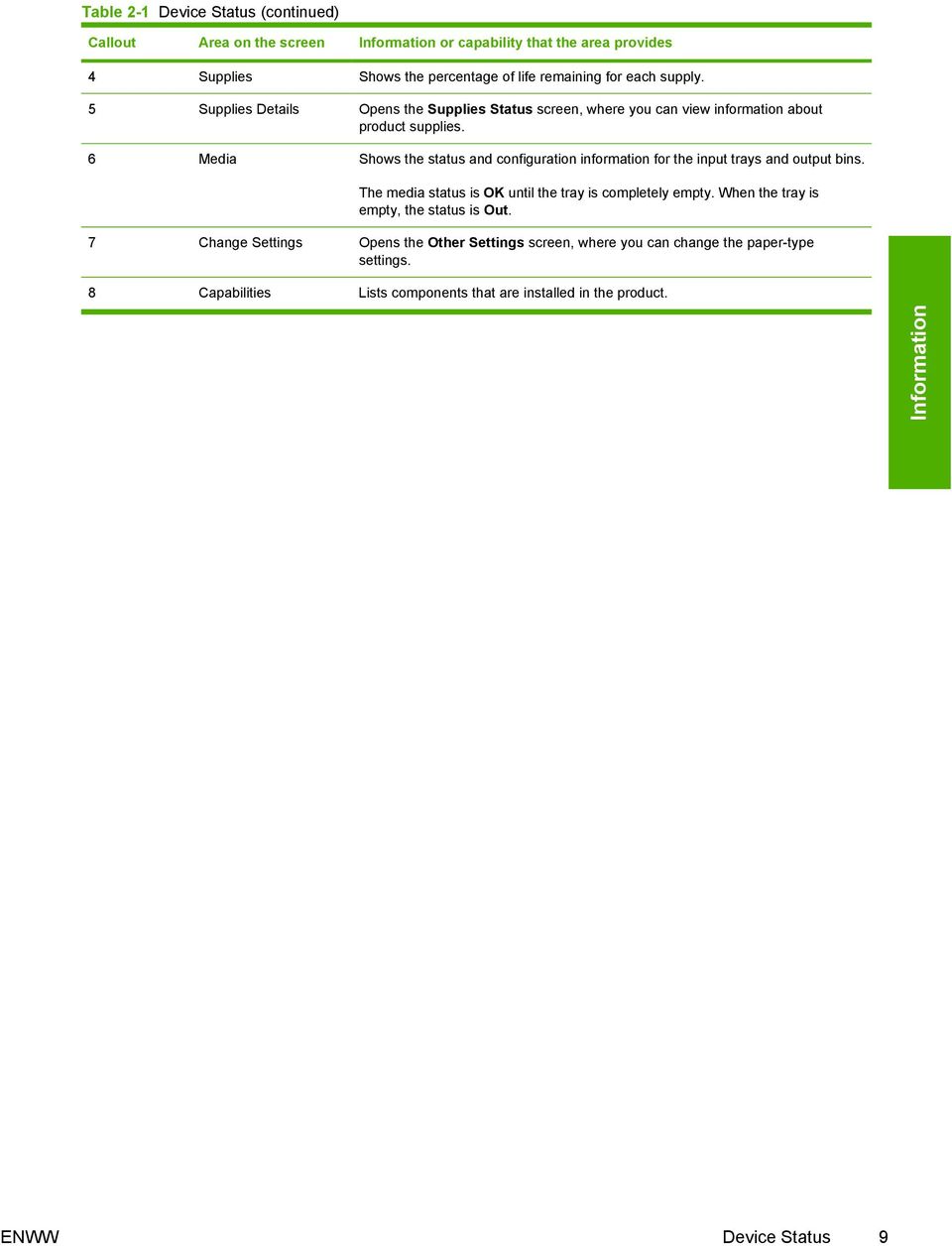
19 Table 2-1 Device Status (continued) Callout Area on the screen Information or capability that the area provides 4 Supplies Shows the percentage of life remaining for each supply. 5 Supplies Details Opens the Supplies Status screen, where you can view information about product supplies. 6 Media Shows the status and configuration information for the input trays and output bins. The media status is OK until the tray is completely empty. When the tray is empty, the status is Out. 7 Change Settings Opens the Other Settings screen, where you can change the paper-type settings. 8 Capabilities Lists components that are installed in the product. Information ENWW Device Status 9
20 Information Configuration Page Use the Configuration Page screen to view current product settings, help troubleshoot problems, and verify the installation of optional accessories such as dual inline memory modules (DIMMs). The following illustration and table describe how to use this screen. Figure 2-2 Configuration Page screen 10 Chapter 2 Viewing product status from the HP EWS Information screens ENWW

21 Table 2-2 Configuration Page Callout Area on the screen Information or capability that the area provides 1 HP EWS tabs and menus For more information, see Navigating through the HP Embedded Web Server. 2 Printer Information Lists the serial number, version numbers, and other information for the device. 3 Installed Personalities and Options Lists: Version and TCP/IP address for all network devices connected to the product (Jetdirect or internal Jetdirect) All of the printer languages that are installed (such as printer command language [PCL] and PostScript [PS]) Options that are installed in each DIMM slot and EIO slot USB devices that can be connected to a printer used as a host USB controller, such as mass storage devices, card swipes, or keypads Information 4 Memory Lists the memory information, PCL Driver Work Space (DWS), and resource saving information. 5 Security Lists the status of the control-panel lock, disk write-protect options, and direct-connect (USB or parallel) ports. You can change the status of the Direct Connect ports on the Security screen under the Settings tab by selecting or clearing the Disable Direct Ports check box. 6 Paper Trays and Options Lists the size and type of media that is specified for each of the trays in the product. If a duplexing unit or any paper-handling accessories are installed on the product, information about those devices is also listed here. 7 Calibration Information Lists the last color-plane registration (CPR) page count, the last CPR page-count date, the last page count (in engine cycles) for DMAX/ DHALF, and the last DMAX/DHALF page-count date. Color plane registration occurs when new print cartridges are installed to compensate for any slight variations that might occur in cartridge circumference. DMAX is a density calibration of each print cartridge color at 100% coverage; DHALF is also a density calibration of each print cartridge color, but as a halftone instead of a full color. During halftone printing, the dots of toner are spread out, and coverage of the toner is less than 100%. 8 Color Density Lists the cyan, magenta, yellow, and black (CMYK) values for highlights, midtones, and shadows. ENWW Configuration Page 11
22 Information Supplies Status The Supplies Status screen shows more detailed supplies information and provides part numbers for genuine HP supplies. (It is helpful to have the part numbers available when ordering supplies.) The following illustration and table describe how to use this screen. Figure 2-3 Supplies Status screen 12 Chapter 2 Viewing product status from the HP EWS Information screens ENWW
23 Table 2-3 Supplies Status Callout Area on the screen Information or capability that the area provides 1 HP EWS tabs and menus For more information, see Navigating through the HP Embedded Web Server. 2 Order Supplies link Use this feature to connect to a Web page that facilitates online ordering of supplies from a reseller of your choice 3 Print Cartridge Information If available, this lists the percent of life remaining and the estimated number of pages remaining before the supply is empty; the total number of pages that have been processed with the supply; the supply serial number and HP part number; and an indication of whether or not the supply has reached the low status. If the Override at Out option has been enabled at the product control panel, a message appears, when the supply is exhausted, stating that the cartridge was used with the override setting. NOTE If a non-hp supply is used, information about the device might not be available. In addition, a warning message about the risks associated with using non-hp supplies could appear on the screen. No further information about the status of the supply will be available. Information 4 Long-Life Supplies Information If available, this lists the percent of life remaining and the estimated number of pages remaining with the supply. ENWW Supplies Status 13
24 Information Event Log The Event Log screen shows the most recent product events, including jams, service errors, and other printer errors. The following illustration and table describe how to use this screen. Figure 2-4 Event Log screen Table 2-4 Event Log Callout Area on the screen Information or capability that the area provides 1 HP EWS tabs and menus For more information, see Navigating through the HP Embedded Web Server. 2 Number Lists the order in which the errors occurred. The last error to occur has the highest number. 3 Date and Time Lists the date and time for each event logged. 4 Engine Cycles Shows the number of engine cycles that the product had completed when the error occurred. The product completes one engine cycle for every Letter/ A4-size page side that it prints or copies. 5 Current Engine Cycles Shows the number of engine cycles that the product has completed to date. 6 Event Shows the internal event code for each event. 7 Description or Personality Shows a brief description of some events. 8 Product Support link Provides access to the HP support Web site for product-specific troubleshooting information. 14 Chapter 2 Viewing product status from the HP EWS Information screens ENWW
25 Usage Page The Usage Page screen gives a page count for each size of media that has passed through the product, as well as the number of duplexed pages. The total is calculated by multiplying the sum of the print count values by the Units value. The information on this screen can be used to determine how much toner or paper to keep on hand. The following illustration and table describe how to use this screen. Information Figure 2-5 Usage Page screen ENWW Usage Page 15
26 Information Table 2-5 Usage Page Callout Area on the screen Information or capability that the area provides 1 HP EWS tabs and menus For more information, see Navigating through the HP Embedded Web Server. 2 Usage Totals (equivalent) Indicates the types of pages that have been printed, the number of singlesided pages that have been printed, the number of duplexed pages that have been printed, and the total number of pages that have been printed. 3 Units A unit is equal to a standard A4-size (Letter-size) page. All other page sizes are referenced in relation to this standard size. An A4-size (Lettersize) page printed on both sides counts as 2 units. 4 Duplex 1 Image Duplex 1 image refers to pages that are printed as part of a duplexed print job, but which are blank on the second side. 5 Print Modes & Paper Path Usage (actual) Indicates the different print modes that have been used for color and monochrome (black-and-white) print jobs. 6 Historical Printer Coverage Indicates the average amount of toner that is used on each printed page. 16 Chapter 2 Viewing product status from the HP EWS Information screens ENWW
27 Diagnostics Page The Diagnostics Page screen provides information about calibration, color density, and parameters. Information Figure 2-6 Diagnostics Page screen Table 2-6 Diagnostics Page Callout Area on the screen Information or capability that the area provides 1 HP EWS tabs and menus For more information, see Navigating through the HP Embedded Web Server. ENWW Diagnostics Page 17
28 Information Table 2-6 Diagnostics Page (continued) Callout Area on the screen Information or capability that the area provides 2 Calibration Information Lists the last color-plane registration (CPR) page count, the last CPR page-count date, the last page count (in engine cycles) for DMAX/DHALF, and the last DMAX/ DHALF page-count date. Color plane registration occurs when new print cartridges are installed to compensate for any slight variations that might occur in cartridge circumference. DMAX is a density calibration of each print cartridge color at 100% coverage; DHALF is also a density calibration of each print cartridge color, but as a halftone instead of a full color. During halftone printing, the dots of toner are spread out, and coverage of the toner is less than 100%. 3 Color Density Lists the cyan, magenta, yellow, and black (CMYK) values for highlights, midtones, and shadows. 4 Parameters For color devices, specific engine settings related to the printing or electrophotographic process are critical in identifying device status and function. The electrophotographic parameters, which are used to detect, diagnose, and track print-quality defects, appear in a 272-cell binary array that contains the settings registered by the device engine. These registers also appear at the bottom of the Diagnostics Page screen. 18 Chapter 2 Viewing product status from the HP EWS Information screens ENWW
29 Device Information The Device Information screen shows the device name, asset number, company name, contact person, device location, and the device's TCP/IP address, name, model, and serial number. The device name, asset number, company name, contact person, and device location can be configured from the Device Information screen, which is located on the Settings tab. Information Figure 2-7 Device Information screen ENWW Device Information 19
30 Information Control Panel For products that have a control panel, the Control Panel screen shows the product control-panel display as if you were standing at the product. Because this view shows the product status, it can help you troubleshoot problems with the product. NOTE The appearance of the screen might vary, depending on your product. Figure 2-8 Control Panel screen 20 Chapter 2 Viewing product status from the HP EWS Information screens ENWW
31 Print You can use the Print screen to print one file at a time from a product that supports the HP EWS. This feature is especially useful if you are a mobile user, because you do not have to install the product's printer driver in order to print; you can print anywhere at any time. You can print print-ready files, such as documents that have been generated by using a "print to file" driver option. Print-ready files commonly have file name extensions such as.prn (Windows printready File),.PCL (printer control language),.ps (postscript),.pdf (Adobe Portable Document Format), and.txt (text). The following illustration and table describe how to use this screen. NOTE The Print screen (and the Print menu on the left) is available only if it has been configured to appear on the Security screen under the Settings tab. For more information, see Security. Information Figure 2-9 Print screen ENWW Print 21
32 Information Table 2-7 Print page Callout Area on screen Information or capability that the area provides 1 HP EWS tabs and menus For more information, see Navigating through the HP Embedded Web Server. 2 Device Status Shows the device status (the same information that appears on the Device Status screen and the control-panel display). 3 Option 1 Prints a file that is located on your laptop, computer, or a network file server. 4 Option 2 Prints a file that you can gain access to on your network. Printing a file from the Print screen Use the following procedure to print a file from the Print screen. 1 Select a file that resides on your machine or on your network by using one of the following options: Click the button under Option 1 to browse to a file that you want to print. -or- Type the uniform resource locator (URL; beginning with " in the Address field (under Option 2) to print a file that is available over your network. 2 Click Apply. 22 Chapter 2 Viewing product status from the HP EWS Information screens ENWW
33 3 Configuring the product from the Settings screens Use the screens on the Settings tab to configure the product from your computer. NOTE Some products do not support all of these screens. Configure Device You can use the Configure Device screen to print device information pages and configure the device remotely. The following illustration, table, and example procedure describe how to use this screen. If your device has a control-panel display, these menus are similar to the menus that are available at your device control panel. Some of the device control-panel menus are not available from the HP EWS. See the documentation that came with your device for more information about the different menus that your device supports. Settings Figure 3-1 Configure Device screen ENWW Configure Device 23
34 Settings Table 3-1 Configure Device Callout Area on the screen Information or capability that the area provides 1 HP EWS tabs and menus For more information, see Navigating through the HP Embedded Web Server. 2 Select A Menu INFORMATION menu Print device information pages, which provide details about the device and its configuration. PAPER HANDLING menu CONFIGURE DEVICE menu DIAGNOSTICS menu Set the type of media that is in each tray. Configure the device to affect the device behavior. For example, you can configure device personality settings from this menu, such as print-quality settings or destination bins. Get information about the device that you can use to troubleshoot problems. 3 Plus sign ( ) Click the plus sign next to a menu, or click the menu itself, to see the submenus or subentries. Using the menus on the Configure Device screen The following procedure is provided only as an example. Similar procedures can be used to set other menu items. Follow these steps to print a configuration page (example procedure). 1 Click INFORMATION. 2 Select the check box for the information page that you want to view or print, and then click Apply. NOTE Print drivers and software programs frequently override selections that are made on the Printing menu and the Paper Handling menu. For more information, see the user guide that came with your product. Any changes are reflected on the Device Status screen, the Configuration Page screen, and the Paper Handling menu. 24 Chapter 3 Configuring the product from the Settings screens ENWW
35 Server Use the Server screen to configure settings for outgoing and incoming . Use the settings on this screen to send and receive messages, including product alerts. The following illustration, table, and procedures describe how to use this screen. Figure 3-2 Server screen Settings Table 3-2 Server Callout Area on the screen Information or capability that the area provides 1 HP EWS tabs and menus For more information, see Navigating through the HP Embedded Web Server. 2 Outgoing Configure outgoing if you intend to use the Alerts or AutoSend features. For more information, see Using the Alerts screen with a product. 3 Device Address This is the device's address that appears in device alerts. This is not the address that you want to use when sending commands to the device. For more information, see Sending e- mail commands to the product. 4 Incoming (not required for E- mail Alerts) Configure incoming if you intend to request information pages from the device by using messages. For more information, see Sending commands to the product. ENWW Server 25
36 Settings Configuring outgoing You must configure outgoing if you intend to use the Alerts or AutoSend features. 1 Gather the following information. (Your organization's network or administrator typically provides the information that is required to configure outgoing mail.) The TCP/IP address of the simple mail transfer protocol (SMTP) mail server on your network. The EWS uses the SMTP server TCP/IP address to relay messages to other computers. The domain name suffix that is used to address messages within your organization. 2 Select the Enable Outgoing check box. 3 Type the SMTP server TCP/IP address in the SMTP Server text box. 4 Type the domain name in the Domain Name text box. 5 Click Apply to save the changes. Configuring incoming You should configure incoming if you intend to request information pages from the product by using messages. For more information, see Sending commands to the product. 1 Establish a Post Office Protocol 3 (POP3) mailbox account for the product on a mail server within your organization's network. Each POP3 account requires a user name and a password. The username combined with the product's domain name (which is specified in the outgoing mail configuration) is the address for the product. For example, if the POP3 mailbox account username is "product" and the POP3 server is "hp.com", the product's address is "[email protected]". NOTE Each product that is configured for incoming mail must have its own POP3 mailbox account on your network's server. The POP3 mailbox accounts are typically configured by your organization's network or administrator. CAUTION Make sure that you do not use your personal account. Doing so could cause all of your to be deleted. You would receive no notification that this deletion had taken place. 2 Select the Enable Incoming check box. 3 Type the TCP/IP address of the POP3 mail server in the POP3 Server text box. 4 Type username and password for the product's mailbox account, and then click Apply to save the changes. 26 Chapter 3 Configuring the product from the Settings screens ENWW
37 Alerts From the Alerts screen, IT administrators can set up the product to send problem and status alerts to anyone through messages. When this function is configured, alerts are automatically triggered about supplies, paper-path status, and other service and advisory information. More than one individual can receive alerts, with each person receiving only specific alerts. For example, an administrative assistant might be responsible for ordering print cartridges or fixing jams, and could receive advanced warning when toner is low or a jam occurs. Similarly, the long-life supplies might be handled by an external service provider, who could receive alerts about performing product maintenance, loading the front or rear stapler, and similar needs. With a permanent storage device installed, such as a hard disk, a user can create up to four different destination lists, with up to 20 recipients on each list. (Without the permanent storage device, a user can send alerts to only four addresses.) By selecting the Remove Control Panel Supplies Status Messages option (available on the Alerts - setup screen that appears when you press the New Destination List button), you can suppress the Cartridge low or Cartridge out supplies status messages on the control panel. (This applies only to the black print cartridge.) The message is suppressed at the control panel only if one or both of these alerts has first been selected to be received. The following illustration, table, and procedures describe how to use this screen to edit, test, and delete destinations and destination lists. NOTE In order for alerts to function, outgoing must be enabled. To enable outgoing mail, see Configuring outgoing . Settings ENWW Alerts 27
38 Settings Figure 3-3 Alerts screen Table 3-3 Alerts Callout Area on the screen Information or capability that the area provides 1 HP EWS tabs and menus For more information, see Navigating through the HP Embedded Web Server. 2 Destination list summary Lists the current selections for each destination. 3 Edit Click this button to make changes to the destination or destination list. 4 Test Click this button to send a test alert to the destination or destination list. 5 Delete Click this button to delete the destination or destination list. 6 New Alert Destination Click this button to define the settings for a new destination list for alerts. 28 Chapter 3 Configuring the product from the Settings screens ENWW
39 Using the Alerts screen with a product With a permanent storage device installed, you can set up four different lists, with up to 20 recipients on each list. Without a permanent storage device, you have room for only four addresses. If a permanent storage device is installed, the Alerts setup screen that appears when you click either Edit or New Destination List looks similar to the following illustration. Settings Figure 3-4 Alerts setup screen ENWW Alerts 29
40 Settings To configure alerts 1 Do one of the following: To create a new destination list, click New Destination List. -Or- To modify an existing destination list, click Edit next to the list that you want to modify. The Alerts setup screen appears. 2 For products that have permanent storage devices installed, type a name in the List Name field, such as Service or Supplies. (If you do not have a permanent storage device, continue to step 3.) 3 Type the addresses for people who you want to receive alerts. In large environments, system administrators can route addresses to list servers, URLs, and mobile devices for expanded alerts. Add multiple destinations by separating each destination with a comma or semicolon. 4 Select the check box for the alerts that you want to be sent with this destination list. (To see all of the alerts that are available for the product, click Show All Alerts.) 5 Where applicable, set the threshold value for the individual alerts. The threshold value for service alerts and for the paper-path alerts is a user-specified number of minutes. This is the amount of time that an event will be ignored before an alert message is sent. For example, you might want to set the threshold value for the "Tray Open" alert to 10 minutes to allow someone to close the tray after loading the tray or clearing a jam. 6 Under Select Control Panel Messages to Suppress, select messages that you do not want to appear on the product control panel. This step applies only to messages that were selected to be received as alerts. NOTE If the browser does not accept JavaScript, then the check box for message suppression will be always enabled. The check-box selection is validated when you submit the page by pressing the Apply button. If the alerts corresponding to the alerts selected for suppression have not been selected, the Alerts setup screen is reloaded with a warning message, informing you that you must first select the corresponding alerts in order to suppress their appearance on the control panel. 7 Select the attachments that you want to be included with your alert messages. These attachments can include Supplies Status Page, Usage Page, Configuration Page, Event Log Page, and XML Data. (Go to the Information tab to see examples of the pages.) The XML Data option should be selected if one of the destinations you have chosen to receive alerts is an automated computer system. Each item that you select will be attached to the . For example, if you select Usage Page and Event Log Page, you will receive one message with two attachments, one for each selection. If you also select the XML Data option, you will receive one message with three attachments: one attachment for the Usage Page in HTML, one for the Event Log in HTML, and a third consisting of instant support information in a text file attachment that has an.xml extension. 8 Click Apply to save the information. 9 Repeat steps 1 through 7 for each additional list or destination. Use the following procedure to test the destination list configuration. 30 Chapter 3 Configuring the product from the Settings screens ENWW
41 To test the configuration of a destination list 1 Click the Test button next to the destination list that you want to test. (If no permanent storage device is installed, only one destination can be tested from this window.) The following window appears. Settings Figure 3-5 Alerts test screen 2 If you have a permanent storage device installed, select the destinations that you want to test. 3 The return address is the product's address. Type your address in the Return Address box if you would like to receive messages about any errors that are generated from the test alert (for example, to be notified of an incorrect destination address). ENWW Alerts 31
42 Settings 4 If applicable, type additional information that you would like to appear at the beginning of the e- mail alert message in the Your Notes (optional) text field. 5 Click OK. To delete destinations and destination lists If you have multiple destinations configured, you can delete a destination or destination list by clicking the Delete button next to the destination or destination list that you want to delete. Click OK to confirm the deletion. Sending commands to the product Another method for receiving information pages is by requesting them from the product. When outgoing and incoming mail are configured, the product can attach information pages, such as the Supplies Status page or the Configuration page, to messages. You can use this feature to solve a problem or check the status of supplies. To request information pages by using an message When composing a message to the product, you must format the To, From, and Subject fields correctly in your program. 1 Make outgoing and incoming functions available by following the instructions that are listed in this chapter. (For more information, see Server ) 2 From your program, compose a message to the product by completing the following steps: a b c In the To field, type the product's address. The user name combined with the product's domain name (which is specified in the outgoing mail configuration) is the address for the product. For example, if the POP3 mailbox account user name is "product" and the POP3 server is "hp.com", the product's address is "[email protected]". Your program should automatically complete the From field with your return address. In the Subject field, type the appropriate text for the format and page that you would like to attach. You can request a Configuration page, a Supplies Status page, or an AutoSend page. For example, if you would like to attach the Configuration page in.html file format, type this.configpage?configpage= &format=html. 32 Chapter 3 Configuring the product from the Settings screens ENWW
43 Table 3-4 Requesting information pages using an message Page HTML format XML format Configuration page Supplies Status page this.configpage? configpage= &format=html this.configpage? suppliespage= &format=html this.configpage? configpage= &format=xml this.configpage? suppliespage= &format=xml AutoSend page 1 not applicable this.configpage? autosend= &format=xml 1 The AutoSend page is not sent to the sender of the (as indicated in Step 2b, above). It is sent to the e- mail address specified in the AutoSend screen of the Settings tab. 3 Click Send. The product checks for new messages once every 3 minutes. When the product receives the message, it generates a reply and sends the requested information back to the sender's e- mail address (as specified in the From field of the original message). NOTE Depending on delays in the network and your organization's mail server, a response might take from 1 minute to several hours to arrive in your program's inbox. If the To, From, and Subject fields are not correctly formatted in your message, the product does not send a message in response. AutoSend Use the AutoSend screen to send product-configuration and supplies-usage information periodically to destinations of your choice, such as service providers. This feature establishes a relationship with Hewlett-Packard Company or another service provider to provide you with services that include, but are not limited to, print-cartridge replacement, pay-per-page contracts, support agreements, and usage tracking. The following illustration, table, and procedure describe how to use this screen. Settings With a permanent storage device installed, such as a hard disk, you can add up to twenty AutoSend destinations. (Without the permanent storage device, you can add one address.) The following example is for a product that does not have a permanent storage device installed. ENWW AutoSend 33
44 Settings Figure 3-6 AutoSend screen Table 3-5 AutoSend Callout Area on the screen Information or capability that the area provides 1 HP EWS tabs and menus For more information, see Navigating through the HP Embedded Web Server. 2 Enable AutoSend Select this check box to turn on the AutoSend feature. 3 Send every [interval] Select the interval at which you want the product to send the product configuration and supplies usage information to the destinations that are configured in the destinations field. 4 destinations Save a list of up to 20 addresses to receive the product-configuration information. The first address can be no more than 50 characters long. 5 Send to HP Select this check box to send device configuration and supplies status information to HP on a regular basis. The information will be sent to an HP address (for example, [email protected]) in a text-based file with an.xml file extension. This file will be created in English. To view more information about how HP treats the information that is sent by AutoSend, click Hewlett-Packard Online Privacy Statement. 6 Test Click this button to save your settings and to send the information immediately, so that you can make sure that the recipient receives the messages. 34 Chapter 3 Configuring the product from the Settings screens ENWW
45 To turn on the AutoSend feature Use the following procedure to make the AutoSend feature available. 1 Make outgoing functions available by following the instructions that are listed in this chapter. (For more information, see Server.) 2 Select the Enable AutoSend check box. 3 Click an option to specify the interval at which you want the product to send the productconfiguration and supplies-usage information to the recipients (determined in the next step), and then type the number of days, weeks, months, or pages printed. 4 For products with permanent storage devices installed, configure up to 20 destinations, using a semicolon or comma to separate the addresses. (If you do not have a permanent storage device, you can configure one address.) 5 To send device configuration and supplies status information to HP, select the Send to HP check box. 6 Click Apply. Settings ENWW AutoSend 35
46 Settings Security The following illustration and table describe how to use the Security screen. Figure 3-7 Security screen Table 3-6 Security Callout Area on the screen Information or capability that the area provides 1 HP EWS tabs and menus For more information, see Navigating through the HP Embedded Web Server. 2 Set Password Set an administrator password to control who can gain access to the EWS Settings, and Networking tabs. After the password has been set, users are prompted to type a password when they click the Log In link. For more information, see Login and logoff. To clear a password, remove the characters from the New Password field, leave the Verify Password field empty, and click the Apply button. 3 Print Page Select to make the Print screen available in the Information tab. 4 Display On Device Status Page Select the control-panel buttons that you want to appear on the Device Status screen (on the Information tab). 5 Direct Ports Select Disable Direct Ports 36 Chapter 3 Configuring the product from the Settings screens ENWW
47 Table 3-6 Security (continued) Callout Area on the screen Information or capability that the area provides to block walk-up printing and system access. When the setting is selected and applied, USB and IEEE 1284 ports are disabled. NOTE The Direct Ports section of the Security screen does not appear on the screen when direct-connect devices are not supported or if the HP EWS is currently running over a direct connection. Settings ENWW Security 37
48 Settings Edit Other Links Use the Edit Other Links screen to add or customize up to five links to the Web sites of your choice (see the following note). These links appear throughout the HP EWS screens in the Other Links box beneath the left navigational bar. Three permanent links (hp instant support, Order Supplies, and Product Support) have already been established. The following illustration, table, and procedures describe how to use this screen. NOTE With a permanent storage device installed, you can add up to five additional links; without the extra storage, you can add one additional link. Figure 3-8 Edit Other Links screen Table 3-7 Edit Other Links Callout Area on the screen Information or capability that the area provides 1 HP EWS tabs and menus For more information, see Navigating through the HP Embedded Web Server. 2 Add Link Add a user-defined link. 3 User-defined Links Lists the user-defined links that have been added. Use this area to delete links. 4 Other Links hp instant support Connect to Web resources that help you to solve specific problems and determine what additional services are available for your product. (Detailed information, including serial number, error conditions, and status, is forwarded to HP Customer Care. Hewlett- Packard Company treats this information as confidential.) Order Supplies Connect to a Web page that facilitates online ordering of supplies from a reseller of your choice. 38 Chapter 3 Configuring the product from the Settings screens ENWW
49 Table 3-7 Edit Other Links (continued) Callout Area on the screen Information or capability that the area provides Product Support My Service Provider My Service Contract Gain access to specific product help from the HP Web site. Connect to the home page of your service provider. This link appears only if the service provider has configured it. Connect to a page that shows the terms and limits of your service contract. This link appears only if the service provider has configured it. Adding a link Use this procedure to add a link. 1 Under Add Link, type the URL and the name of the link as you would like it to appear in the HP EWS. 2 Click Add Link. Removing a link Use this procedure to remove a link. 1 Under User-defined Links, select the link or links that you would like to remove. 2 Click Remove Selected Link. Settings ENWW Edit Other Links 39
50 Settings Device Information Use the Device Information screen to provide a name of your choice for the device, assign an asset number, and configure the company name, the person to contact about the device, and the physical location of the device. The device TCP/IP address, device name, device model, and serial number are also available on this screen. Figure 3-9 Device Information screen NOTE If you make any changes on the Device Information screen, click Apply to save the changes. The information that is typed here appears on the Device Information screen that can be opened from the Information tab. It also appears in messages that are sent from the product. This might be useful if you need to locate the product to replace supplies or fix a problem. 40 Chapter 3 Configuring the product from the Settings screens ENWW
51 Language Use the Language screen to select the language in which the HP EWS screens appear. The following illustration and table describe how to use this screen. Figure 3-10 Language screen CAUTION Selecting View Pages in Device Language or Select A Language changes the language for everyone who uses the HP EWS. Settings ENWW Language 41
52 Settings Table 3-8 Language Callout Area on the screen Information or capability that the area provides 1 HP EWS tabs and menus For more information, see Navigating through the HP Embedded Web Server. 2 View Pages in Browser Language Use this feature to detect which language is selected for your Web browser. The HP EWS screens appear in the same language. (this is the default) 3 View Pages in Device Language Use this feature to detect which language is selected for the device control panel. The HP EWS screen appear in the same language. 4 Select A Language Select the language for the HP EWS screens from these choices: English Dansk (Danish) Français (French) Norsk (Norwegian) Deutsch (German) Nederlands (Dutch) Italiano (Italian) Suomi (Finnish) Español (Spanish) Português (Portuguese) Svenska (Swedish) NOTE The default language is the language that the Web browser is currently using. If your browser and control panel both use a language that is not available for the HP EWS, English is selected as the default. If you make any changes on the Language screen, click Apply to save your changes. 42 Chapter 3 Configuring the product from the Settings screens ENWW
53 Date & Time Use the Date & Time screen to update the product time. The following illustration and table describe how to use this screen. Figure 3-11 Date & Time screen Table 3-9 Date & Time Callout Area on the screen Information or capability that the area provides Settings 1 HP EWS tabs and menus For more information, see Navigating through the HP Embedded Web Server. 2 Current Date and Current Time Shows the product date and time when the EWS was opened. If either is incorrect, an IT administrator can change the information at the product control panel or through this HP EWS page. 3 Refresh Click this button to update the product date and time on the screen. For more information, see Date/Time Format. 4 Date/Time Format Click this button to open a screen where you can select the date and time format. 5 Clock Drift Correction Click this button to configure a network time server. This corrects clock drift using a network time server of your choice. For more information, see Clock Drift Correction. ENWW Date & Time 43
54 Settings Date/Time Format Use the Date/Time Format screen to select the formats you prefer for displaying the date (under Date Format) and time (under Time Format). The following illustration shows the Date/Time Format screen. Clock Drift Correction Use the Date & Time clock drift correction screen to enable clock drift correction. The following illustration shows the screen. 44 Chapter 3 Configuring the product from the Settings screens ENWW
55 To configure a network time server to correct the product clock drift, use the following procedure. NOTE This process keeps the clock from drifting (losing or gaining time), but does not synchronize the clock with the network time server clock. 1 Select the Enable Clock Drift Correction check box. 2 In the Network Time Server Address field, type the TCP/IP address of the clock which you want to use for correction of the product clock drift. NOTE Alternatively, you can click the Automatically Find Server button to find a time server on your network and automatically fill in this field. 3 In the Local Port to Receive Time from Server field, type the name of the appropriate port. 4 Click OK. NOTE Use this screen only to configure the time server for clock drift correction, not to set the clock. To set the clock, use the main Date & Time screen. For further information, see Date & Time. Settings ENWW Date & Time 45
56 Settings Wake Time An IT administrator can use the Wake Time screen to schedule product wakeups on a daily basis. For example, the product can be set to wake up at 07:30, so the product has finished initializing and calibrating and is ready to use by 08:00. The administrator sets only one wakeup setting per day; however, each day can have a different wakeup setting. Additionally, to save energy, the sleep delay can be set to turn the product off after a specific period of inactivity. Figure 3-12 Wake Time screen Table 3-10 Wake Time Callout Area on the screen Information or capability that the area provides 1 HP EWS tabs and menus For more information, see Navigating through the HP Embedded Web Server. 2 Wake Time Select one or more days on which to use the wakeup setting, and then set the time the product is turned on each day. 3 Sleep Delay Set the amount of time the product is idle before it goes into Sleep Mode. When the product is in Sleep Mode, it uses less energy. 46 Chapter 3 Configuring the product from the Settings screens ENWW
57 4 Managing network operation from the Networking screens Overview Use the Networking screens to configure and manage your product on your network. The appearance and features of the screens available from the Networking tab differ, depending on the model and version of your HP Jetdirect print server. The following screen is similar to what you might see when you click Networking. From the left navigational bar, click the Networking menu for the screen that you want to view. Networking ENWW Overview 47
58 Networking Figure 4-1 Network Settings screen Table 4-1 Network Settings Callout Area on screen Information or capability that the area provides 1 HP EWS tabs and menus For more information, see Navigating through the HP Embedded Web Server. 2 Select Language Select the language for the Networking tab. The list of languages that are available in the Networking tab is not identical to the list of languages that are available in the Settings tab. 3 Help Click Help for more information about the options on the Networking tab. 48 Chapter 4 Managing network operation from the Networking screens ENWW
59 Depending on your HP Jetdirect print server model and operating version, the following are some tasks that you can perform from the Networking screens: Change network configuration settings for various types of network connections. Turn on or turn off printing protocols. Set up a support contact and support URLs. Set a password to control access to the product and network configuration settings. This password is synchronized with the password that you set on the Security screen under the Settings tab, so you may set or reset it from either screen. Configure the security of your product through the use of passwords, access lists, and management protocols. View general network status information, including network statistics that are stored on the print server, for network troubleshooting or optimization. View protocol information for all supported network connections. Open the HP Jetdirect Configuration page. Set the frequency at which the HP EWS checks the network status. For more information about the Networking screens, see the following sources: Help. On each Networking screen, a Help link under Other Links provides a description of the networking features. Also, from the Help screen you can gain access to additional help from the HP Web site. HP Jetdirect Administrator's Guide. This guide is normally available on the software CD that came with your product and can be downloaded from the hp.com support pages for your product: for the HP Color LaserJet 4700 Networking ENWW Overview 49
60 Networking 50 Chapter 4 Managing network operation from the Networking screens ENWW
61 5 Using the Other Links as a resource The Other Links box contains three permanent links that provide quick access to product-specific information, such as interactive troubleshooting and ordering information for genuine HP supplies. Figure 5-1 Device Information screen Other Links ENWW 51
62 Other Links NOTE You can use the Edit Other Links screen on the Settings tab to add up to five customized links to the Web sites of your choice. (With a permanent storage device installed, you can add up to five additional links; without the extra storage, you can add one additional link.) These links appear throughout the EWS screens, in the Other Links box beneath the left navigational bar. For more information, see Edit Other Links. The following sections describe each of the links that appear by default in the Other Links box. hp instant support Hewlett-Packard Company offers hp instant support, an Internet-based support system that collects diagnostic information from your product and matches it with the HP information database. At hp instant support, you can find intelligent solutions that help you resolve problems quickly and easily. How hp instant support works Information is gathered from your product and securely transmitted to Hewlett-Packard Company when you click hp instant support. The hp instant support Web site reads the product data to analyze the product's current status. The Web site creates a customized Web page that appears in the browser window and contains easy-to-follow text and visual aids. The hp instant support Web site also directs you to additional services that are available for your product. Before any of the product data is sent to Hewlett-Packard for analysis, you can view all of the information (for example, the serial number, error conditions, and product status) that will be forwarded. Hewlett-Packard treats this information as confidential. Information you can get from hp instant support The hp instant support Web site provides these tools for troubleshooting and for maintenance: Firmware and software updates. Troubleshooting for recent events that are listed on the Event Log. For example, the product might show a jam as the most recent event listed in the event Log. The hp instant support Web site detects the event and provides troubleshooting information for the jam. Support packs. Product documentation, such as user guides and getting started guides. Order Supplies The Order Supplies link connects you to a Web page that facilitates your online ordering of supplies from a reseller of your choice. The supplies that you need are preselected. You can change quantities or select additional items. Your items are added to the shopping cart, ready for checkout, ensuring that the correct supplies are ordered through your selected reseller. 52 Chapter 5 Using the Other Links as a resource ENWW
63 Product Support The Product Support link connects you to a Web page that brings together a comprehensive menu of support resources that business people need. From this Web page, you can accomplish these tasks and more: Find a list of HP products at one site: computers, workstations, servers, storage devices, printers, scanners, digital imaging, and mobile devices. Obtain technical support. Solve a problem; find information to set up, install, and configure your product; discover and use a product; maintain your product; upgrade and migrate your product software and driver; and recycle products or dispose of them correctly. Gain access to self-solve resources such as FAQs, user documentation, features and specifications, and product-compatibility information. Collaborate with HP and with your peers through discussion groups, support, and phone support. Use task-based navigation to identify the task area that you want to work on and quickly discover related topics and tools. In addition, you can find these features: hot topics, a subscription center, product rebate offers and other announcements, and training and education opportunities. My Service Provider and My Service Contract The My Service Provider and the My Service Contract links appear only if they have been created (and perhaps renamed) by the service provider in the Other Links screen on the Settings tab. The link can then be clicked by any user to get information about the service provider and the service contract. The information, which can be up to 50 characters long, is stored in the permanent storage of the product. When these links have been created, the appearance of the Other Links box changes to include the new links, as shown in the following illustration. Figure 5-2 Other Links Other Links ENWW Product Support 53
64 Other Links 54 Chapter 5 Using the Other Links as a resource ENWW
65 Index A accessing the HP Embedded Web Server 3 accessories, verifying installed 10 administrators alerts, setting up 27 logging off 4 logging on 4 wake time settings 46 alerts configuring 29 destination lists, testing 31 configuration 26 ing information pages 32 features 2, 27 asset number 19 AutoSend 33 B browsers closing after logging off 4 defined 1 supported 3 buttons, control panel 8 C cartridge ordering 38, 52 status 12 usage information 15 clock drift correction 44 clock settings 43 Configuration Page screen 10 Configure Device menu 24 Configure Device screen 23 consumables. See supplies control panel buttons 8 menus 23 viewing 20 Control Panel screen 20 counts, page 15 customer support instant 52 product 53 D Date & Time screen 43 Date/Time Format, setting 44 default paper size, setting 24 destination lists creating 29 testing 31 Device Information screen 19, 40 device location 19 Device Status screen 8 devices, defined 1 diagnostics trays 24 Diagnostics menu 24 DIMMs, verifying installed 10 E alerts 27 incoming, configuring 26 information pages 32 outgoing, configuring 26 settings 25 support 53 Server screen 25 Edit Other Links screen 38, 52 embedded Web server defined 1 features 1 error messages 14 Event Log 14 Explorer, versions supported 3 F FAQs 53 features 1 firewalls 3 G group product management 2 H hard disks, features available with 2 help instant support 52 product support 53 HP Embedded Web Server features 1 hp instant support 52 HP Jetdirect print server 49 HP Web Jetadmin 2 I incoming configuration 26 information pages, ing 32 Information screens 7 Information tab locating 24 password protection 4 ink cartridge. See print cartridge Internet Explorer, versions supported 3 IT administrators alerts, setting up 27 logging off 4 logging on 4 wake time settings 46 J Jetadmin, HP Web 2 Jetdirect print server 49 Job Cancel button 36 ENWW Index 55
66 K keys, control panel 8 Konqueror, versions supported 3 L Language screen 41 links 38, 51 log, event 14 logging off 4 logging on 4 M mailbox configuration 26 media usage 15 memory, verifying installed 10 menus control panel 23 HP Embedded Web Server 5 messages, error 14 Microsoft Internet Explorer, versions supported 3 mobile devices, printing from 21 Mozilla, versions supported 3 My Service Contract link 53 My Service Provider link 53 N navigating 5 Netscape Navigator, versions supported 3 Networking screens 47 Networking tab 6 networks configuring 47 types supported 3 Web Jetadmin 2 O ON/OFF schedule 46 online help instant support 52 product support 53 opening the HP Embedded Web Server 3 Opera, versions supported 3 ordering hard disks 2 supplies 38, 52 Other Links area 38, 51 outgoing mail configuration 26 P page counts 15 paper default size, setting 24 usage 15 Paper Handling menu 24 paper path tests 24 passwords 4, 36 PCL documents 21 PDF files, printing 21 phone support 53 POP3 configuration 26 power, setting wake time 46 print cartridge ordering 38, 52 status 12 usage information 15 Print screen 21 print server, HP Jetdirect 49 printing files 21, 22 PRN files 21 product support 53 products, defined 1 PS files, printing 21 R recycle supplies 53 remote configuration 23 S Safari, versions supported 3 Security screen 36 security settings general 36 serial number 19 server, HP Jetdirect 49 service contract link 53 service providers alerts, setting up 27 links to 53 logging off 4 logging on as 4 Settings tab 6, 23 shutdown, setting wake time 46 status alerts 27 ing information pages 32 network 47 supplies 12 supplies AutoSend feature 33 ordering 38, 52 status page 12 usage information 15 Supplies Status screen 12 support instant 52 product 53 system requirements 3 T TCP/IP address configuration 26 locating 3, 19 TCP/IP-based network 3 technical support instant 52 product 53 tests, paper path 24 text files, printing 21 time settings 43 toner cartridge. See print cartridge trays, diagnostics 24 troubleshooting Configuration Page screen 10 instant support 52 product support 53 U usage information, AutoSend 33 Usage screen 15 user name 36 W Web browsers closing after logging off 4 defined 1 supported 3 Web Jetadmin 2 Web server, embedded defined 1 features 1 Web sites, support instant 52 product Index ENWW
67
68 2005 Hewlett-Packard Development Company, L.P.
HP Color LaserJet 3000/3800 Series printers HP Embedded Web Server User Guide
 HP Color LaserJet 3000/3800 Series printers HP Embedded Web Server User Guide HP Embedded Web Server User Guide Copyright and Warranty 2005 Copyright Hewlett-Packard Development Company, L.P. Reproduction,
use hp embedded web server hp LaserJet 4345mfp
 use hp embedded web server hp LaserJet 5mfp HP Embedded Web Server User Guide Copyright 00 Copyright Hewlett-Packard Development Company, L.P. Reproduction, adaptation or translation without prior written
HP LaserJet P3005 Series printers HP Embedded Web Server User Guide
 HP LaserJet P005 Series printers HP Embedded Web Server User Guide HP Embedded Web Server User Guide Copyright 005 Copyright Hewlett-Packard Development Company, L.P. Reproduction, adaptation or translation
use hp embedded web server HP 9200C Digital Sender
 use hp embedded web server HP 900C Digital Sender HP Embedded Web Server User Guide Copyright 00 Copyright Hewlett-Packard Development Company, L.P. Reproduction, adaptation or translation without prior
use hp color LaserJet 5500 hp LaserJet 4100mfp hp embedded web server hp color LaserJet 4600 hp LaserJet 4300 hp LaserJet 9000mfp
 use hp embedded web server hp LaserJet 00 hp color LaserJet 500 hp LaserJet 400mfp hp LaserJet 400 hp LaserJet 400 hp color LaserJet 4600 hp color LaserJet 5500 hp LaserJet 9000mfp hp embedded web server
HP LaserJet P3010 Series Printers HP Embedded Web Server User Guide
 HP LaserJet P3010 Series Printers HP Embedded Web Server User Guide www.hp.com/support/ljp3010series HP LaserJet P3010 Embedded Web Server User Guide Copyright and Warranty 2008 Copyright Hewlett-Packard
hp embedded web server for hp LaserJet printers
 hp embedded web server for hp LaserJet printers user guide Trademark Credits Microsoft is a U.S. registered trademark of Microsoft Corporation. Netscape is a U.S. trademark of Netscape Communications Corporation.
CentreWare Internet Services Setup and User Guide. Version 2.0
 CentreWare Internet Services Setup and User Guide Version 2.0 Xerox Corporation Copyright 1999 by Xerox Corporation. All rights reserved. XEROX, The Document Company, the digital X logo, CentreWare, and
HP LaserJet MFP Analog Fax Accessory 300 Send Fax Driver Guide
 HP LaserJet MFP Analog Fax Accessory 300 Send Fax Driver Guide Copyright and License 2008 Copyright Hewlett-Packard Development Company, L.P. Reproduction, adaptation, or translation without prior written
eprint SOFTWARE User Guide
 eprint SOFTWARE User Guide HP eprint software User Guide Copyright and License 2012 Copyright Hewlett-Packard Development Company, L.P. Reproduction, adaptation, or translation without prior written permission
HP Web Jetadmin Database Connector Plug-in reference manual
 HP Web Jetadmin Database Connector Plug-in reference manual Copyright notice 2004 Copyright Hewlett-Packard Development Company, L.P. Reproduction, adaptation or translation without prior written permission
hp LaserJet quick reference service guide
 hp LaserJet quick reference service guide color service volume III hp color LaserJet quick reference service guide volume III March 2004 edition 2004 Copyright Hewlett-Packard Development Company, LP
HP Color LaserJet CM6040/CM6030 MFP Series Analog Fax Accessory 300 Fax Guide
 HP Color LaserJet CM6040/CM6030 MFP Series Analog Fax Accessory 300 Fax Guide Copyright and License 2008 Copyright Hewlett-Packard Development Company, L.P. Reproduction, adaptation, or translation without
EMBEDDED WEB SERVER CONFIGURATION TO ENABLE AUTOSEND AND OUTGOING EMAIL FOR HP QUICKPAGE
 EMBEDDED WEB SERVER CONFIGURATION TO ENABLE AUTOSEND AND OUTGOING EMAIL FOR HP QUICKPAGE INTRODUCTION To ensure accurate billing, the HP QuickPage program requires collection of the metered information
hp LaserJet 4250/4350 series printers use
 hp LaserJet 4250/4350 series printers use HP LaserJet 4250 or 4350 series printer User Guide Copyright and License 2004 Copyright Hewlett-Packard Development Company, L.P. Reproduction, adaptation, or
NETWORK PRINT MONITOR User Guide
 NETWORK PRINT MONITOR User Guide Legal Notes Unauthorized reproduction of all or part of this guide is prohibited. The information in this guide is subject to change without notice. We cannot be held liable
HP Universal Print Driver
 HP Universal Print Driver Solution and Feature Guide Technology for better business outcomes CONTENTS Getting to know the HP Universal Print Driver...1 How the HP Universal Print Driver works...2 Top
E-mail Settings 1 September 2015
 Training Notes 1 September 2015 PrintBoss can be configured to e-mail the documents it processes as PDF attachments. There are limitations to embedding documents in standard e-mails. PrintBoss solves these
Legal Notes. Regarding Trademarks. 2012 KYOCERA Document Solutions Inc.
 Legal Notes Unauthorized reproduction of all or part of this guide is prohibited. The information in this guide is subject to change without notice. We cannot be held liable for any problems arising from
CONTENTS. Contents > 3
 PREFACE Every effort has been made to ensure that the information in this document is complete, accurate, and up-to-date. The manufacturer assumes no responsibility for the results of errors beyond its
HP Accessibility Guide
 HP Accessibility Guide At HP, we re committed to improving our customers experience with products, information and services that are easier to access and simpler to use. We consider the needs of all our
Version 6.x Generic. KYOCERA KX DRIVER 6.x USER GUIDE
 Version 6.x Generic KYOCERA KX DRIVER 6.x USER GUIDE Legal Notes Unauthorized reproduction of all or part of this guide is prohibited. The information in this guide is subject to change without notice.
DocuPrint C3290 FS Features Setup Guide
 DocuPrint C3290 FS Features Setup Guide Adobe and PostScript are trademarks of Adobe Systems Incorporated in the United States and/or other countries. Apple, Bonjour, ColorSync, EtherTalk, Macintosh, and
HP Access Control Smartcard Solution
 HP Access Control Smartcard for U. S. Government Administrator s Guide HP Access Control Smartcard for U.S. Government Administrator's Guide Copyright information 2009 Copyright Hewlett-Packard Development
technical brief browsing to an installation of HP Web Jetadmin. Internal Access HTTP Port Access List User Profiles HTTP Port
 technical brief in HP Overview HP is a powerful webbased software utility for installing, configuring, and managing networkconnected devices. Since it can install and configure devices, it must be able
Novell ZENworks Asset Management 7.5
 Novell ZENworks Asset Management 7.5 w w w. n o v e l l. c o m October 2006 USING THE WEB CONSOLE Table Of Contents Getting Started with ZENworks Asset Management Web Console... 1 How to Get Started...
ES3452 MFP, ES5462 MFP,
 Configuration Guide This guide supports the following models: MC332dn, MC342dn, MC342dw, MC352dn, MC362dn, MC362dw, MC562dn, MC562dw, ES3452 MFP, ES5462 MFP, MPS2731mc PREFACE Every effort has been made
Sharp Remote Device Manager (SRDM) Server Software Setup Guide
 Sharp Remote Device Manager (SRDM) Server Software Setup Guide This Guide explains how to install the software which is required in order to use Sharp Remote Device Manager (SRDM). SRDM is a web-based
Send to Network Folder. Embedded Digital Sending
 Send to Network Folder Embedded Digital Sending Embedded Digital Sending Legal Notice Copyright 2005 Hewlett-Packard Development Company, L.P. The information contained herein is subject to change without
If you encounter difficulty or need further assistance the Archdiocesan help desk can be reached at (410) 547-5305, option 1. Email Access Methods:
 ArchMail (www.archbalt.org/archmail) is a centrally hosted email system for the employees of the Archdiocese. To simplify employee access multiple methods for accessing email have been established. This
SysPatrol - Server Security Monitor
 SysPatrol Server Security Monitor User Manual Version 2.2 Sep 2013 www.flexense.com www.syspatrol.com 1 Product Overview SysPatrol is a server security monitoring solution allowing one to monitor one or
Color LaserJet Enterprise M552 Color LaserJet Enterprise M553
 Color LaserJet Enterprise M552 Color LaserJet Enterprise M553 User Guide M553n M552dn M553dn M553x www.hp.com/support/colorljm552 www.hp.com/support/colorljm553 HP Color LaserJet Enterprise M552, M553
Webmail Instruction Guide
 Webmail Instruction Guide This document is setup to guide your through the use of the many features of our Webmail system. You may either visit www.safeaccess.com or webmail.safeaccess.com to login with
HP LaserJet 4345 MFP Security Checklist 3/29/2006
 HP LaserJet 4345 MFP Security Checklist 3/29/2006 Table of Contents 1 Introduction... 3 1.1 Coverage and Testing... 4 1.2 Assumptions... 4 1.3 Solutions covered... 6 1.4 Organization... 6 2 Threat Model...
Changes to Skillnet Group Emails. Outlook and Outlook Express Users
 Changes to Skillnet Group Emails Skillnet Group emails are moving from the current provider to our own exchange mail server. This will mean that you will have a much improved web-mail system and almost
HP A-IMC Firewall Manager
 HP A-IMC Firewall Manager Configuration Guide Part number: 5998-2267 Document version: 6PW101-20110805 Legal and notice information Copyright 2011 Hewlett-Packard Development Company, L.P. No part of this
PRINT FLEET MANAGER USER MANUAL
 PRINT FLEET MANAGER USER MANUAL 1 Disclaimer of warranties and limitation of liabilities ( YES ) reserves all rights in the program as delivered. The program or any portion thereof may not be reproduced
HP Intelligent Management Center v7.1 Virtualization Monitor Administrator Guide
 HP Intelligent Management Center v7.1 Virtualization Monitor Administrator Guide Abstract This guide describes the Virtualization Monitor (vmon), an add-on service module of the HP Intelligent Management
HP LeftHand SAN Solutions
 HP LeftHand SAN Solutions Support Document Installation Manuals Installation and Setup Guide Health Check Legal Notices Warranty The only warranties for HP products and services are set forth in the express
RUNNING A HELPDESK CONTENTS. using HP Web Jetadmin
 RUNNING A HELPDESK using HP Web Jetadmin CONTENTS Overview... 2 Helpdesk examples... 2 Viewing devices... 2 Quick Device Discovery... 3 Search... 3 Filters... 3 Columns... 4 Device Groups... 4 Troubleshooting
BCSD WebMail Documentation
 BCSD WebMail Documentation Outlook Web Access is available to all BCSD account holders! Outlook Web Access provides Webbased access to your e-mail, your calendar, your contacts, and the global address
Quick Scan Features Setup Guide
 Xerox WorkCentre 7132 Quick Scan Features Setup Guide 701P45042 This guide includes instructions for: Scan to Email on page 1 Scan to Mailbox Setup (Optional) on page 5 Network Scanning Setup (Optional)
DIGITAL MULTIFUNCTIONAL SYSTEM
 MODEL: MX-M283N MX-M363N MX-M453N MX-M503N DIGITAL MULTIFUNCTIONAL SYSTEM Software Setup Guide BEFORE INSTALLING THE SOFTWARE SETUP IN A WINDOWS ENVIRONMENT SETUP IN A MACINTOSH ENVIRONMENT TROUBLESHOOTING
LASERJET PRO 400. User Guide M401
 LASERJET PRO 400 User Guide M401 HP LaserJet Pro 400 M401 Printer Series User Guide Copyright and License 2012 Copyright Hewlett-Packard Development Company, L.P. Reproduction, adaptation, or translation
LASERJET ENTERPRISE 500 COLOR
 LASERJET ENTERPRISE 500 COLOR User Guide M551n M551dn M551xh HP LaserJet Enterprise 500 color M551 User Guide Copyright and License 2011 Copyright Hewlett-Packard Development Company, L.P. Reproduction,
HP LaserJet 9040/9050 User Guide
 HP LaserJet 9040/9050 User Guide User Guide hp LaserJet 9040/9050 series printers Copyright and License 2005 Copyright Hewlett-Packard Development Company, L.P. Reproduction, adaptation or translation
Color LaserJet Pro M252 User Guide
 Color LaserJet Pro M252 User Guide M252n M252dw www.hp.com/support/colorljm252 HP Color LaserJet Pro M252 User Guide Copyright and License 2015 Copyright Hewlett-Packard Development Company, L.P. Reproduction,
NeoMail Guide. Neotel (Pty) Ltd
 NeoMail Guide Neotel (Pty) Ltd NeoMail Connect Guide... 1 1. POP and IMAP Client access... 3 2. Outlook Web Access... 4 3. Outlook (IMAP and POP)... 6 4. Outlook 2007... 16 5. Outlook Express... 24 1.
Trend Micro Incorporated reserves the right to make changes to this document and to the products described herein without notice.
 Trend Micro Incorporated reserves the right to make changes to this document and to the products described herein without notice. Before installing and using the software, please review the readme files,
Parallels Panel. Parallels Small Business Panel 10.2: User's Guide. Revision 1.0
 Parallels Panel Parallels Small Business Panel 10.2: User's Guide Revision 1.0 Copyright Notice ISBN: N/A Parallels 660 SW 39 th Street Suite 205 Renton, Washington 98057 USA Phone: +1 (425) 282 6400 Fax:
Empowered by Innovation. Setting Up and Using Fax Mail. P/N 1770087 July 2006 Printed in U.S.A.
 Empowered by Innovation Setting Up and Using Fax Mail P/N 1770087 July 2006 Printed in U.S.A. This manual has been developed by NEC Unified Solutions, Inc. It is intended for the use of its customers and
HP LeftHand SAN Solutions
 HP LeftHand SAN Solutions Support Document Applications Notes Best Practices for Using SolarWinds' ORION to Monitor SANiQ Performance Legal Notices Warranty The only warranties for HP products and services
Scan to E-mail Quick Setup Guide
 Xerox WorkCentre M118i Scan to E-mail Quick Setup Guide 701P42574 This guide provides a quick reference for setting up the Scan to E-mail feature on the Xerox WorkCentre M118i. It includes procedures for:
Legal Notes. Regarding Trademarks. Models supported by the KX printer driver. 2011 KYOCERA MITA Corporation
 Legal Notes Unauthorized reproduction of all or part of this guide is prohibited. The information in this guide is subject to change without notice. We cannot be held liable for any problems arising from
email-lead Grabber Business 2010 User Guide
 email-lead Grabber Business 2010 User Guide Copyright and Trademark Information in this documentation is subject to change without notice. The software described in this manual is furnished under a license
File Management Utility User Guide
 File Management Utility User Guide Legal Notes Unauthorized reproduction of all or part of this guide is prohibited. The information in this guide is subject to change without notice. We cannot be held
Installation Guide For ChoiceMail Enterprise Edition
 Installation Guide For ChoiceMail Enterprise Edition How to Install ChoiceMail Enterprise On A Server In Front Of Your Company Mail Server August, 2004 Version 2.6x Copyright DigiPortal Software, 2002-2004
HP 9200c Digital Sender Support Guide
 HP 9200c Digital Sender Support Guide HP 9200C Digital Sender Support Guide Copyright and License 2004 Copyright Hewlett-Packard Development Company, LP Reproduction, adaptation, or translation without
Color LaserJet Pro MFP M476
 Color LaserJet Pro MFP M476 HP Color LaserJet Pro MFP M476 User Guide Copyright and License 2014 Copyright Hewlett-Packard Development Company, L.P. Reproduction, adaptation, or translation without prior
COLOR LASERJET ENTERPRISE CP5520
 COLOR LASERJET ENTERPRISE CP5520 PRINTER SERIES User Guide HP Color LaserJet Enterprise CP5520 Series Printer User Guide Copyright and License 2010 Copyright Hewlett-Packard Development Company, L.P.
Using Avaya Aura Messaging
 Using Avaya Aura Messaging Release 6.3.2 Issue 1 December 2014 Contents Chapter 1: Getting Started... 4 Messaging overview... 4 Prerequisites... 4 Accessing your mailbox from any phone... 4 Accessing the
HP Factory-Installed Operating System Software for Microsoft Windows Small Business Server 2003 R2 User Guide
 HP Factory-Installed Operating System Software for Microsoft Windows Small Business Server 2003 R2 User Guide Part Number 371502-004 October 2007 (Fourth Edition) Copyright 2004, 2007 Hewlett-Packard Development
http://docs.trendmicro.com
 Trend Micro Incorporated reserves the right to make changes to this document and to the products described herein without notice. Before installing and using the product, please review the readme files,
AR-NB2 A NETWORK EXPANSION KIT. OPERATION MANUAL (for network scanner) SCANNER FUNCTION 17 USING THE NETWORK
 MODEL AR-NB A NETWORK EXPANSION KIT OPERATION MANUAL (for network scanner) Page INTRODUCTION BEFORE USING THE NETWORK SCANNER FUNCTION USING THE NETWORK SCANNER FUNCTION 7 TROUBLESHOOTING SHARPDESK CD-ROM
NEC Express5800 Series NEC ESMPRO AlertManager User's Guide
 NEC Express5800 Series NEC ESMPRO AlertManager User's Guide 7-2006 ONL-4152aN-COMMON-128-99-0606 PROPRIETARY NOTICE AND LIABILITY DISCLAIMER The information disclosed in this document, including all designs
HP ProtectTools Embedded Security Guide
 HP ProtectTools Embedded Security Guide Document Part Number: 364876-001 May 2004 This guide provides instructions for using the software that allows you to configure settings for the HP ProtectTools Embedded
Software Technical Reference for the HP LaserJet 8150 Series Printers (8150, 8150N, 8150DN, 8150HN, 8150MFP)
 Software Technical Reference for the HP LaserJet 8150 Series Printers (8150, 8150N, 8150DN, 8150HN, 8150MFP) Notice The information contained in this document is subject to change without notice. HEWLETT-PACKARD
IsItUp Quick Start Manual
 IsItUp - When you need to know the status of your network Taro Software Inc. Website: www.tarosoft.com Telephone: 703-405-4697 Postal address: 8829 110th Lane, Seminole Fl, 33772 Electronic mail: [email protected]
Setting up Sharp MX-Color Imagers for Inbound Fax Routing to Email or Network Folder
 Setting up Sharp MX-Color Imagers for Inbound Fax Routing to Email or Network Folder MX-2300, MX-2600, MX-2700, MX-3100, MX-3501, MX-4501, MX-5500, MX-6200, MX-6201, MX-7000, MX-7001, *MX-M850, *MX-M950,
Troubleshooting File and Printer Sharing in Microsoft Windows XP
 Operating System Troubleshooting File and Printer Sharing in Microsoft Windows XP Microsoft Corporation Published: November 2003 Updated: August 2004 Abstract File and printer sharing for Microsoft Windows
HP ALM. Software Version: 12.50. Tutorial
 HP ALM Software Version: 12.50 Tutorial Document Release Date: December 2015 Software Release Date: December 2015 Legal Notices Warranty The only warranties for HP products and services are set forth in
SyncThru TM Web Admin Service Administrator Manual
 SyncThru TM Web Admin Service Administrator Manual 2007 Samsung Electronics Co., Ltd. All rights reserved. This administrator's guide is provided for information purposes only. All information included
DIGITAL FULL COLOR MULTIFUNCTIONAL SYSTEM. Software Setup Guide
 DIGITAL FULL COLOR MULTIFUNCTIONAL SYSTEM Software Setup Guide BEFORE INSTALLING THE SOFTWARE SETUP IN A WINDOWS ENVIRONMENT SETUP IN A MACINTOSH ENVIRONMENT TROUBLESHOOTING Thank you for purchasing this
Getting Started. rp5800, rp5700 and rp3000 Models
 Getting Started rp5800, rp5700 and rp3000 Models Copyright 2011 Hewlett-Packard Development Company, L.P. The information contained herein is subject to change without notice. Microsoft, Windows, and Windows
Quick Scan Features Setup Guide. Scan to E-mail Setup. See also: System Administration Guide: Contains details about E-mail setup.
 Quick Scan Features Setup Guide XE3024EN0-2 This guide includes instructions for: Scan to E-mail Setup on page 1 Scan to Mailbox Setup on page 6 Network Scanning Setup on page 9 Scan to PC Setup on page
Sharing Pictures, Music, and Videos on Windows Media Center Extender
 Sharing Pictures, Music, and Videos on Windows Media Center Extender Applies to: Microsoft Windows XP Media Center Edition Microsoft Windows Media Center Extender Microsoft Windows Media Center Extender
UFR II Driver Guide. UFR II Driver Ver. 2.20 ENG
 UFR II Driver Guide UFR II Driver Ver. 2.20 Please read this guide before operating this product. After you finish reading this guide, store it in a safe place for future reference. ENG 0 Ot UFR II Driver
LASERJET PRO 200 COLOR. User Guide
 LASERJET PRO 200 COLOR User Guide M251n M251nw HP LaserJet Pro 200 color M251 Series Printer User Guide Copyright and License 2012 Copyright Hewlett-Packard Development Company, L.P. Reproduction, adaptation,
HP EMAIL ARCHIVING SOFTWARE FOR EXCHANGE
 You can read the recommendations in the user guide, the technical guide or the installation guide for HP EMAIL ARCHIVING SOFTWARE FOR EXCHANGE. You'll find the answers to all your questions on the HP EMAIL
SiteCount v2.0 Revised: 10/30/2009
 SiteCount v2.0 Revised: 10/30/2009 Copyright 2009, Traf-SYS, Inc. Contents Introduction... 4 Requirements... 4 General... 4 Software... 4 Hardware... 4 Fulfilling Software Requirements... 5 Installation
HP Insight Diagnostics Online Edition. Featuring Survey Utility and IML Viewer
 Survey Utility HP Industry Standard Servers June 2004 HP Insight Diagnostics Online Edition Technical White Paper Featuring Survey Utility and IML Viewer Table of Contents Abstract Executive Summary 3
Understanding the home screen
 Quick Reference Learning about the printer Using the printer control panel 1 2 3 4 5 6 Understanding the home screen When the printer is turned on, the display shows a basic screen, referred to as the
Legal Notes. Regarding Trademarks. 2011 KYOCERA MITA Corporation
 Legal Notes Unauthorized reproduction of all or part of this guide is prohibited. The information in this guide is subject to change without notice. We cannot be held liable for any problems arising from
LaserJet USB Walk Up Printing
 LaserJet USB Walk Up Printing FEATURE DESCRIPTION... 2 SUPPORTED USB STORAGE DEVICES AND PROTOCOLS... 2 SUPPORTED FILE FORMATS... 2 UNSUPPORTED DEVICES AND PROTOCOLS... 3 SECURITY CONCERNS... 5 Disabling
HomeNet. Gateway User Guide
 HomeNet Gateway User Guide Gateway User Guide Table of Contents HomeNet Gateway User Guide Gateway User Guide Table of Contents... 2 Introduction... 3 What is the HomeNet Gateway (Gateway)?... 3 How do
MULTIFUNCTIONAL DIGITAL SYSTEMS. Scanning Guide
 MULTIFUNCTIONAL DIGITAL SYSTEMS Scanning Guide 2011 TOSHIBA TEC CORPORATION All rights reserved Under the copyright laws, this manual cannot be reproduced in any form without prior written permission of
SMTP PROXY SERVER INSTALLATION FOR HP QUICKPAGE
 SMTP PROXY SERVER INSTALLATION FOR HP QUICKPAGE INTRODUCTION To ensure accurate billing, the HP QuickPage program requires collection of the metered information from the printers and multifunction products
VPOP3 Your email post office Getting Started Guide
 VPOP3 Your email post office Getting Started Guide VPOP3 Getting Started Guide, version 2.1 1 Copyright Statement This manual is proprietary information of Paul Smith Computer Services and is not to be
HP LaserJet MFP Analog Fax Accessory 300 Fax Guide
 HP LaserJet MFP Analog Fax Accessory 300 Fax Guide Copyright and License 2008 Copyright Hewlett-Packard Development Company, L.P. Reproduction, adaptation, or translation without prior written permission
Intel Unite Solution. Standalone User Guide
 Intel Unite Solution Standalone User Guide Legal Disclaimers & Copyrights All information provided here is subject to change without notice. Contact your Intel representative to obtain the latest Intel
Installation and Setup Guide
 Installation and Setup Guide Contents 1. Introduction... 1 2. Before You Install... 3 3. Server Installation... 6 4. Configuring Print Audit Secure... 11 5. Licensing... 16 6. Printer Manager... 17 7.
Web Hosting Getting Started Guide
 Web Hosting Getting Started Guide This guide describes: - Hosting Terms and Definitions - How to sync a domain with your hosting account - How to change your domain s nameservers - How to use FTP to upload
Dell SupportAssist Version 2.0 for Dell OpenManage Essentials Quick Start Guide
 Dell SupportAssist Version 2.0 for Dell OpenManage Essentials Quick Start Guide Notes, Cautions, and Warnings NOTE: A NOTE indicates important information that helps you make better use of your computer.
Using Webmail. Document Updated: 11/10. Technical Manual: User Guide. The Webmail Window. Logging In to Webmail. Displaying and Hiding the Full Header
 Using Webmail Technical Manual: User Guide Webmail is supported in the following browsers: Windows Internet Explorer 6, Internet Explorer 7, Firefox 2, and Firefox 3 Mac OSX Safari 2, Safari 3, Firefox
USING THE UPSTREAM-CONNECT WEBSITE
 USING THE UPSTREAM-CONNECT WEBSITE The UpstreamConnect website is your primary means for viewing imaging device data and reports. This manual covers all aspects of using the UpstreamConnect website. HELPDESK
HP LaserJet 1160, 1320, 1320n, 1320tn, 1320nw. Use
 HP LaserJet 1160, 1320, 1320n, 1320tn, 1320nw Use hp LaserJet 1160 and hp LaserJet 1320 series printer User Guide Copyright information 2004 Copyright Hewlett-Packard Development Company, L.P. Reproduction,
USING MANAGED PRINTER LISTS
 USING MANAGED PRINTER LISTS for the HP Universal Print Driver with HP Web Jetadmin CONTENTS Introduction... 2 Operation overview... 2 Assumptions... 2 Exporting device Groups as XML Managed Printer Lists...
JetAdvice Manager Data Collector v. 2.1. Date: 2014-06-30
 JetAdvice Manager Data Collector v. 2.1 Date: 2014-06-30 NOTE The information contained in this document is subject to change without notice. EuroForm makes no warranty of any kind with regard to this
http://docs.trendmicro.com
 Trend Micro Incorporated reserves the right to make changes to this document and to the products described herein without notice. Before installing and using the product, please review the readme files,