
Doubling constructions in first language acquisition
|
|
|
- Linda Garrison
- 10 years ago
- Views:
Transcription
1 Malaga Doubling constructions in first language acquisition Jacqueline van Kampen and Arnold Evers UiL OTS, Utrecht University For relevant papers, see
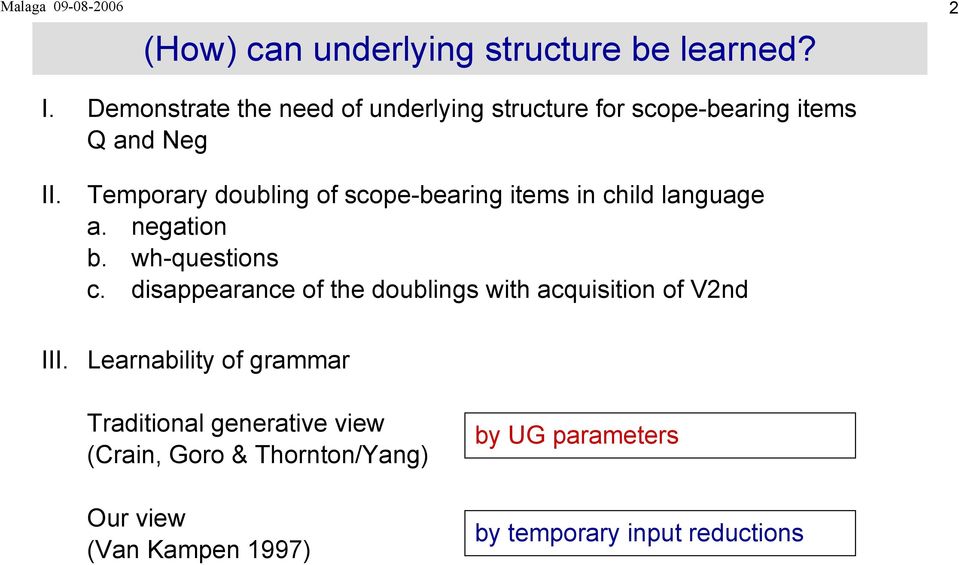
2 Malaga (How) can underlying structure be learned? I. Demonstrate the need of underlying structure for scope-bearing items Q and Neg II. Temporary doubling of scope-bearing items in child language a. negation b. wh-questions c. disappearance of the doublings with acquisition of V2nd III. Learnability of grammar Traditional generative view (Crain, Goro & Thornton/Yang) Our view (Van Kampen 1997) by UG parameters by temporary input reductions
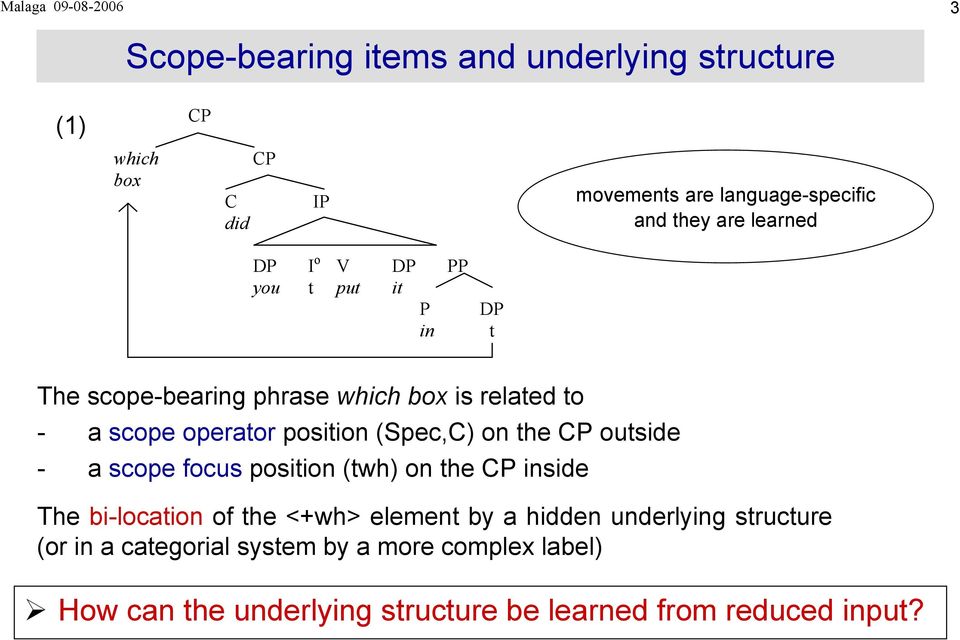
3 Malaga Scope-bearing items and underlying structure (1) CP which CP box C IP did movements are language-specific and they are learned DP I o V DP PP you t put it P DP in t The scope-bearing phrase which box is related to - a scope operator position (Spec,C) on the CP outside - a scope focus position (twh) on the CP inside The bi-location of the <+wh> element by a hidden underlying structure (or in a categorial system by a more complex label) How can the underlying structure be learned from reduced input?
4 Malaga Bi-location and difficulties for learnability gap problem distance problem - how can a phrase position be perceived as an antecedent or as a gap? - what antecedent/gap distance is not allowed? Assumption (gap problem) gap and antecedent can be perceived due to primary licensing conditions - the outside operator phrase lacks a case configuration - the inside case configuration lacks a phrase It follows that scope bearing items can be perceived (and acquired) when the learning system implies an ordering of acquisition steps primary licensing first underlying structure later The learning system implies an ordering of acquisition steps

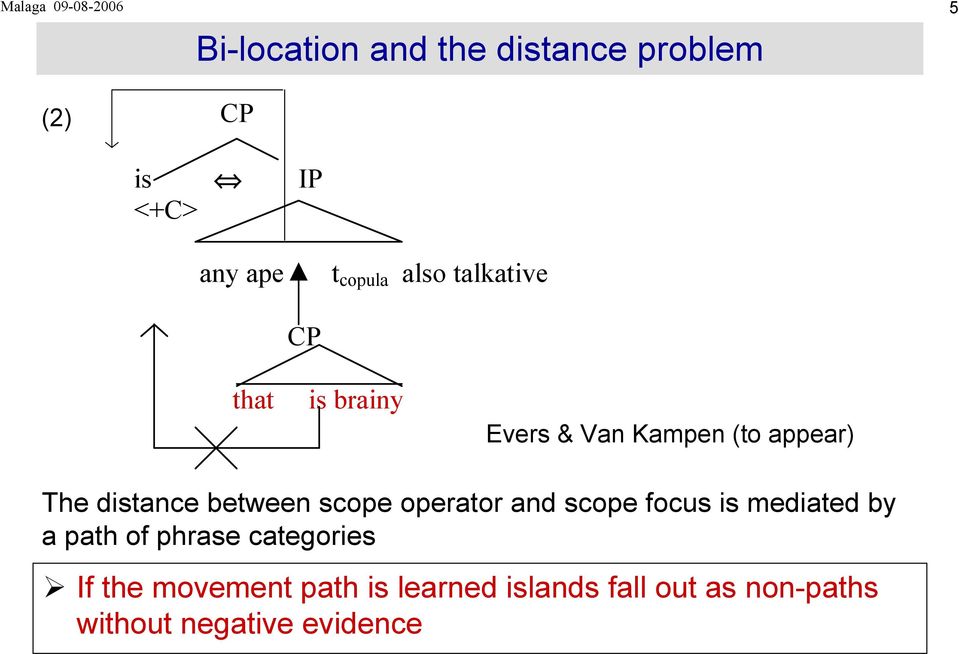
5 Malaga Bi-location and the distance problem (2) CP is IP <+C> any ape t copula also talkative CP that is brainy Evers & Van Kampen (to appear) The distance between scope operator and scope focus is mediated by a path of phrase categories If the movement path is learned islands fall out as non-paths without negative evidence
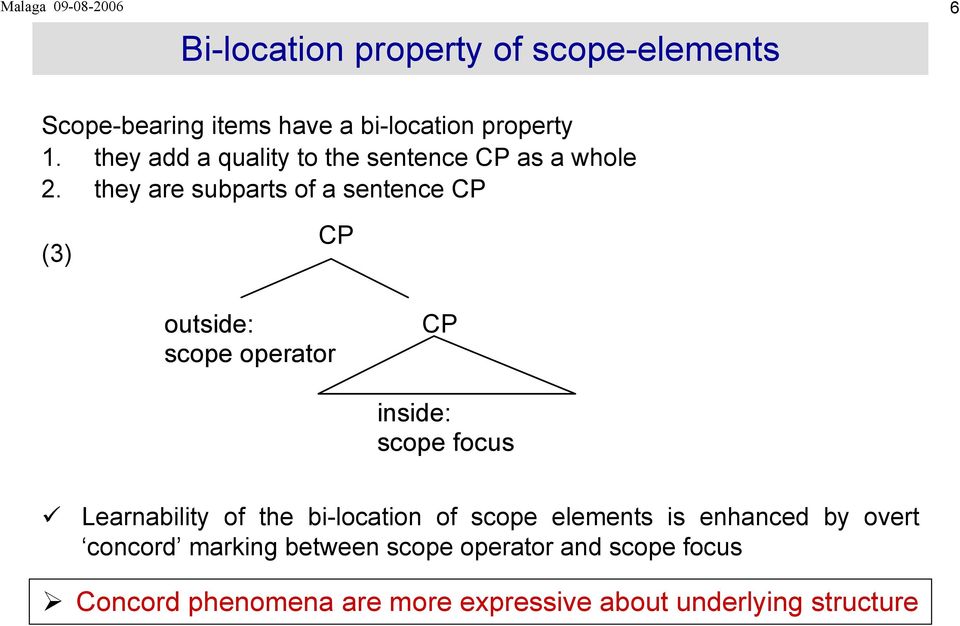
6 Malaga Bi-location property of scope-elements Scope-bearing items have a bi-location property 1. they add a quality to the sentence CP as a whole 2. they are subparts of a sentence CP (3) CP outside: CP scope operator inside: scope focus Learnability of the bi-location of scope elements is enhanced by overt concord marking between scope operator and scope focus Concord phenomena are more expressive about underlying structure
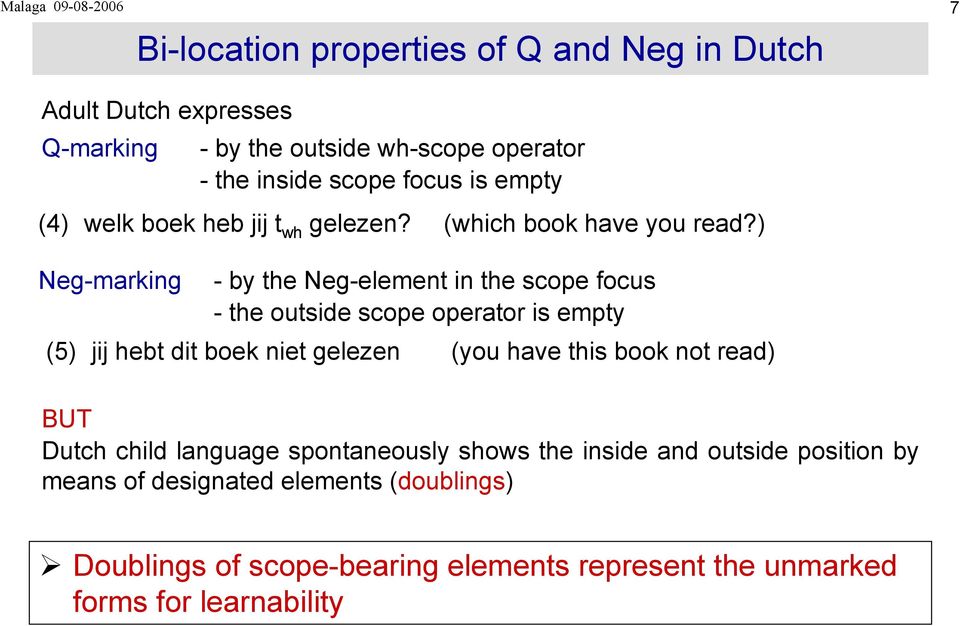
7 Malaga Bi-location properties of Q and Neg in Dutch Adult Dutch expresses Q-marking (4) welk boek heb jij t wh gelezen? (which book have you read?) Neg-marking - by the outside wh-scope operator - the inside scope focus is empty - by the Neg-element in the scope focus - the outside scope operator is empty (5) jij hebt dit boek niet gelezen (you have this book not read) BUT Dutch child language spontaneously shows the inside and outside position by means of designated elements (doublings) Doublings of scope-bearing elements represent the unmarked forms for learnability
8 Malaga Doubling constructions (Neg, wh) Doublings of scope-bearing items appear in early and later child Dutch (but not in adult Dutch) certain dialects/variants of Dutch, e.g. Frisian, Afrikaans various other language types How does the child hit the idea of a structure where the Negation-element and the wh-element have overtly a bi-location not offered by the adult input? The early doublings disappear in child Dutch with the acquisition of V2nd Learnability questions What guides the acquisition procedure to (temporary) doublings? Why are they given up after the acquisition of V2nd?

9 Malaga Examples of Neg-doublings in early child Dutch fused operator ~ content+neg (6) a. kwilnie(t) ~ badje [niet] ((I) wanna not bath not) b. kannie(t) ~ vinden [niet] ((I) cannot find not) c. issenie(t) ~ ei [niet] (that s not egg not) d. hoortniet ~ in kamer [niet] ((it) belongs not in room not) The doublings in negation are not part of the input full adult sentences: ik hoef niet een ei te eten ik hoef het ei niet te eten initial group (with Neg) and final group (with Neg) appear first as single utterances. binary child utterances: hoefenie / niet ei / ei niet the examples of fused operator ~Neg-marked content part can be seen as combining existing subparts combination of binary utterances: hoefenie ei niet The Neg-doubling arises from combining pre-existing subparts
![hoortniet ~ in kamer [niet] ((it) belongs not in room not) The doublings in negation are not part of the input full adult sentences: ik hoef niet een ei te eten ik hoef het ei niet te eten initial](/docs-images/43/4880454/images/page_9.jpg "group (with Neg) and final group (with Neg) appear first as single utterances.")
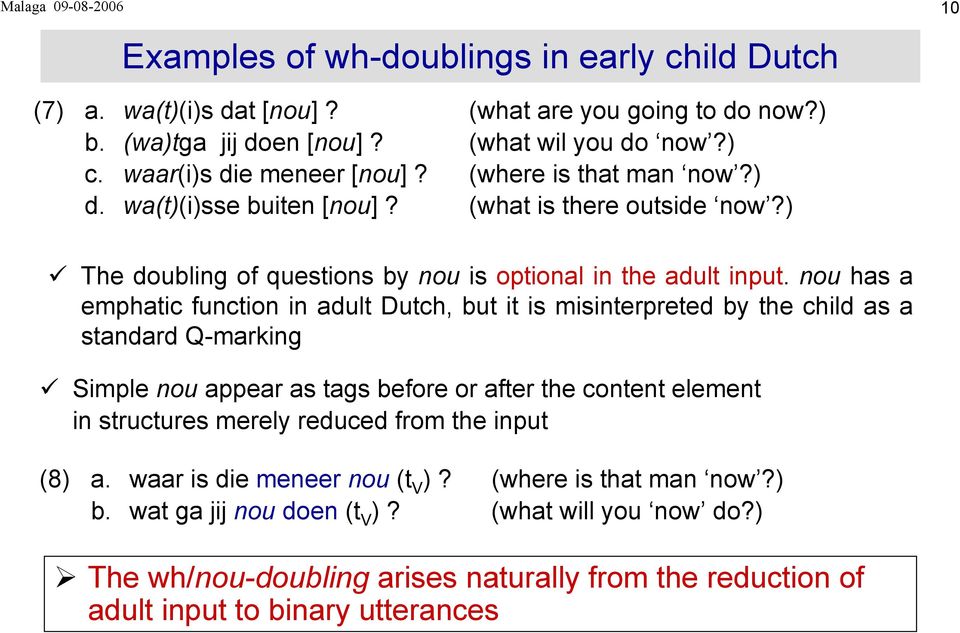
10 Malaga Examples of wh-doublings in early child Dutch (7) a. wa(t)(i)s dat [nou]? (what are you going to do now?) b. (wa)tga jij doen [nou]? (what wil you do now?) c. waar(i)s die meneer [nou]? (where is that man now?) d. wa(t)(i)sse buiten [nou]? (what is there outside now?) The doubling of questions by nou is optional in the adult input. nou has a emphatic function in adult Dutch, but it is misinterpreted by the child as a standard Q-marking Simple nou appear as tags before or after the content element in structures merely reduced from the input (8) a. waar is die meneer nou (t V )? (where is that man now?) b. wat ga jij nou doen (t V )? (what will you now do?) The wh/nou-doubling arises naturally from the reduction of adult input to binary utterances
11 Malaga Early doublings and V2nd (9) Dutch Sarah: The acquisition of V2nd (Evers/Kampen 2001) V-second percentage age in weeks appearance of doublings week Doublings most frequent just before V2nd reaches acquisition point (> 80%) Why is V2nd the turning point for early concord phenomena in child language?

12 Malaga V2nd as structural watershed The fusion of the initial operator is broken up as: [ personal pronoun + finite verb (+ Neg) ] kwinie ik wil niet The final group gets a uniform analysis as: [ Neg + t V (+ infinitive/past participle) ] niet t<+fin> (spelen) Neg appears invariably as an adverb In front of the final group kwil niet in badje t <+fin> (spelen) After the finite verb is analyzed as an illocution marker and scope-bearing item It is related to a C o -position having CP scope It is related to the predicate head final position V2nd integrates the root utterance as C o - I o - V o chain

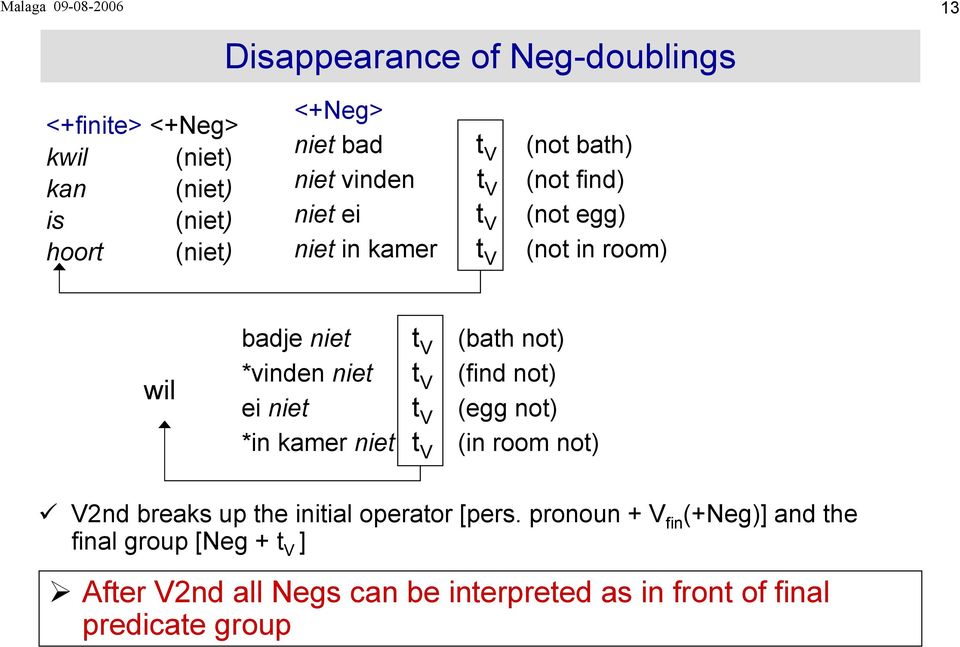
13 Malaga Disappearance of Neg-doublings <+finite> <+Neg> kwil (niet) kan (niet) is (niet) hoort (niet) <+Neg> niet bad t V (not bath) niet vinden t V (not find) niet ei t V (not egg) niet in kamer t V (not in room) wil badje niet t V (bath not) *vinden niet t V (find not) ei niet t V (egg not) *in kamer niet t V (in room not) V2nd breaks up the initial operator [pers. pronoun + V fin (+Neg)] and the final group [Neg + t V ] After V2nd all Negs can be interpreted as in front of final predicate group
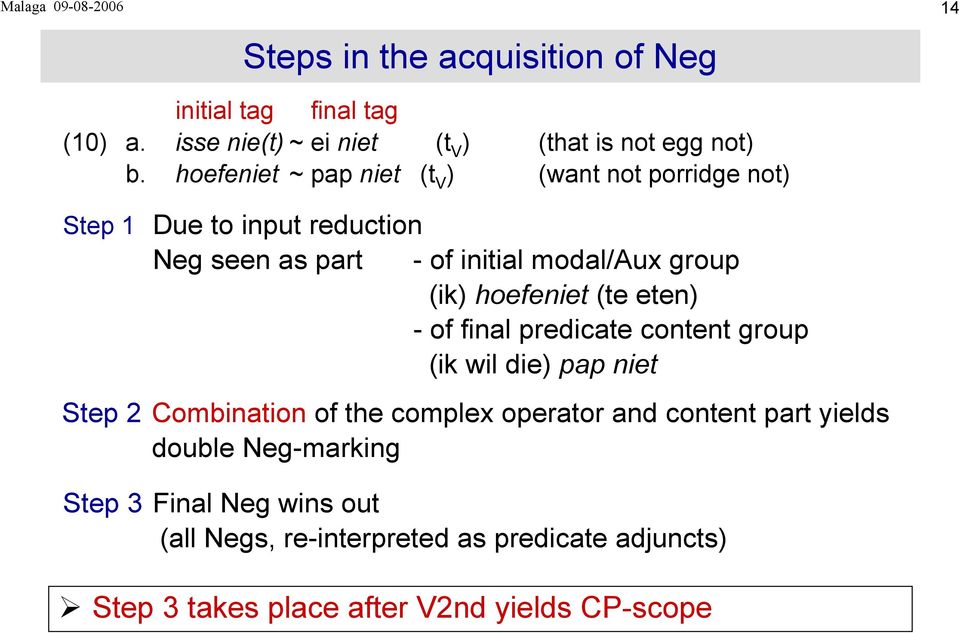
14 Malaga Steps in the acquisition of Neg initial tag final tag (10) a. isse nie(t) ~ ei niet (t V ) (that is not egg not) b. hoefeniet ~ pap niet (t V ) (want not porridge not) Step 1 Due to input reduction Neg seen as part - of initial modal/aux group (ik) hoefeniet (te eten) - of final predicate content group (ik wil die) pap niet Step 2 Combination of the complex operator and content part yields double Neg-marking Step 3 Final Neg wins out (all Negs, re-interpreted as predicate adjuncts) Step 3 takes place after V2nd yields CP-scope
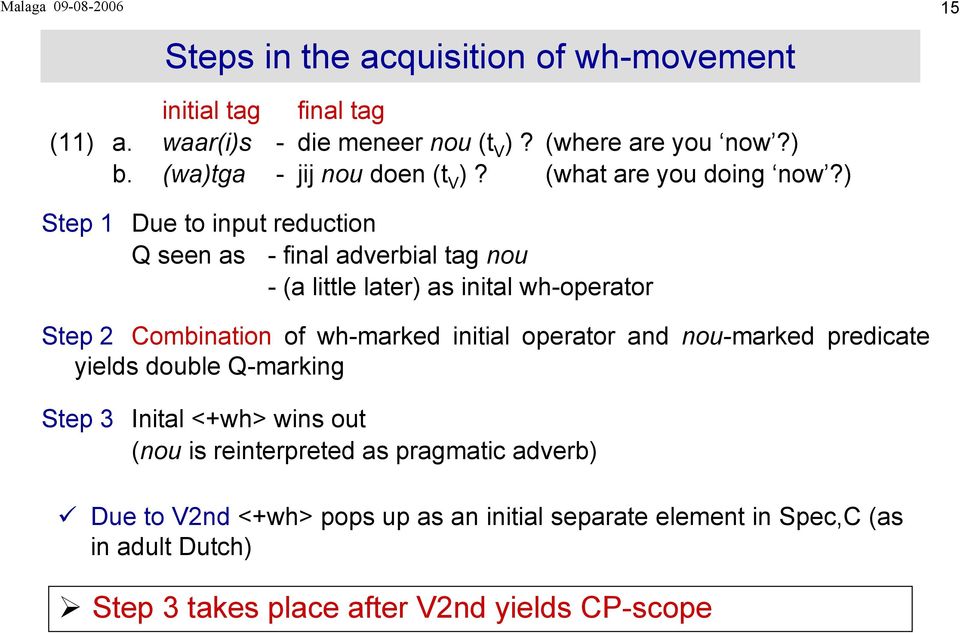
15 Malaga Steps in the acquisition of wh-movement initial tag final tag (11) a. waar(i)s - die meneer nou (t V )? (where are you now?) b. (wa)tga - jij nou doen (t V )? (what are you doing now?) Step 1 Due to input reduction Q seen as - final adverbial tag nou - (a little later) as inital wh-operator Step 2 Combination of wh-marked initial operator and nou-marked predicate yields double Q-marking Step 3 Inital <+wh> wins out (nou is reinterpreted as pragmatic adverb) Due to V2nd <+wh> pops up as an initial separate element in Spec,C (as in adult Dutch) Step 3 takes place after V2nd yields CP-scope
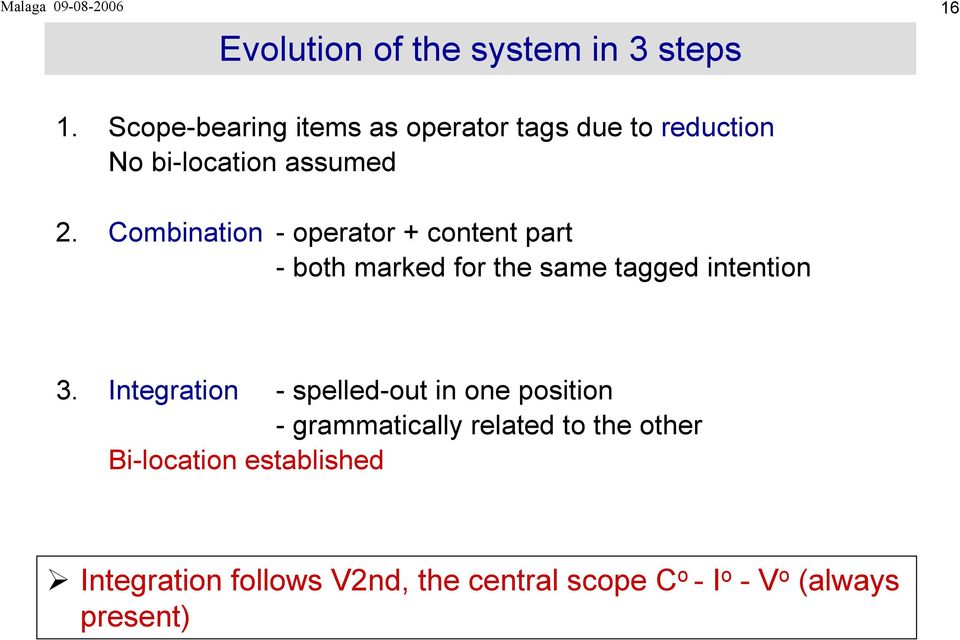
16 Malaga Evolution of the system in 3 steps 1. Scope-bearing items as operator tags due to reduction No bi-location assumed 2. Combination - operator + content part - both marked for the same tagged intention 3. Integration - spelled-out in one position - grammatically related to the other Bi-location established Integration follows V2nd, the central scope C o - I o - V o (always present)
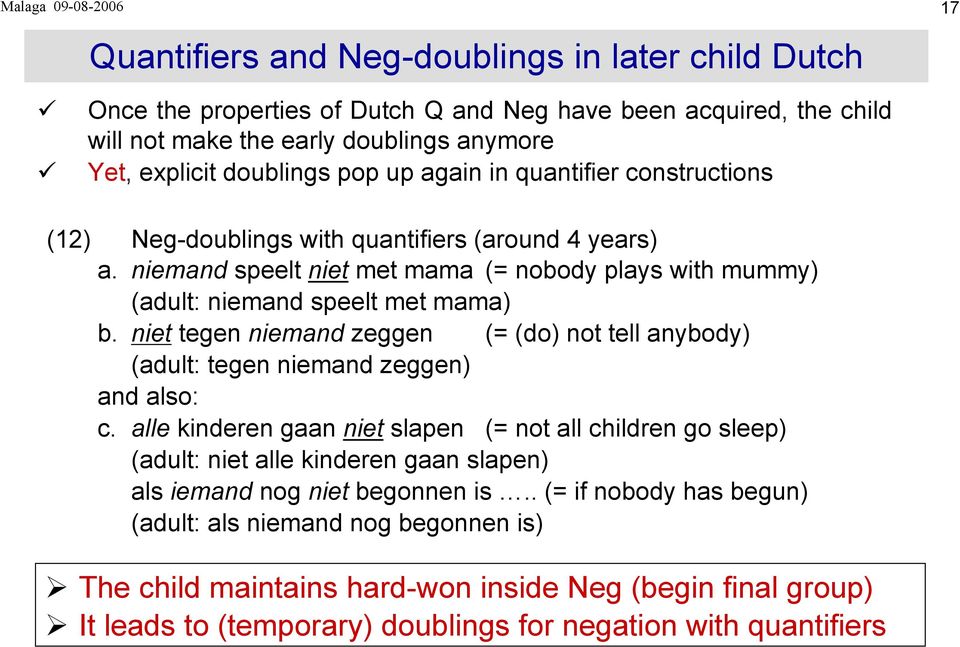
17 Malaga Quantifiers and Neg-doublings in later child Dutch Once the properties of Dutch Q and Neg have been acquired, the child will not make the early doublings anymore Yet, explicit doublings pop up again in quantifier constructions (12) Neg-doublings with quantifiers (around 4 years) a. niemand speelt niet met mama (= nobody plays with mummy) (adult: niemand speelt met mama) b. niet tegen niemand zeggen (= (do) not tell anybody) (adult: tegen niemand zeggen) and also: c. alle kinderen gaan niet slapen (= not all children go sleep) (adult: niet alle kinderen gaan slapen) als iemand nog niet begonnen is.. (= if nobody has begun) (adult: als niemand nog begonnen is) The child maintains hard-won inside Neg (begin final group) It leads to (temporary) doublings for negation with quantifiers
18 Malaga Quantifiers and Negation in later child Dutch C P + N e g (13) S p e c C P + N e g all children go not sleep in the attic = a lle k in d e r e n it is not true that all children are going g a a n I P + N e g to sleep in the attic N e g I P n ie t P P I o o p z o ld e r t V fin V s la p e n The IP predicate is marked by the negative operator adverb niet The full CP is a negative utterance expressed by the projection of <+Neg> The order of c-command in the terminal string does not express that alle is in the scope of niet, but in child language it is Later child Dutch maintains for a while a hard-won negation rule of early child Dutch (negative predicate implies negative sentence) In (standard) Dutch the adverb niet is relocated in the quantifier - niet alle kinderen gaan op zolder slapen The interpretation of (13) as *for all children it is not true is ruled out
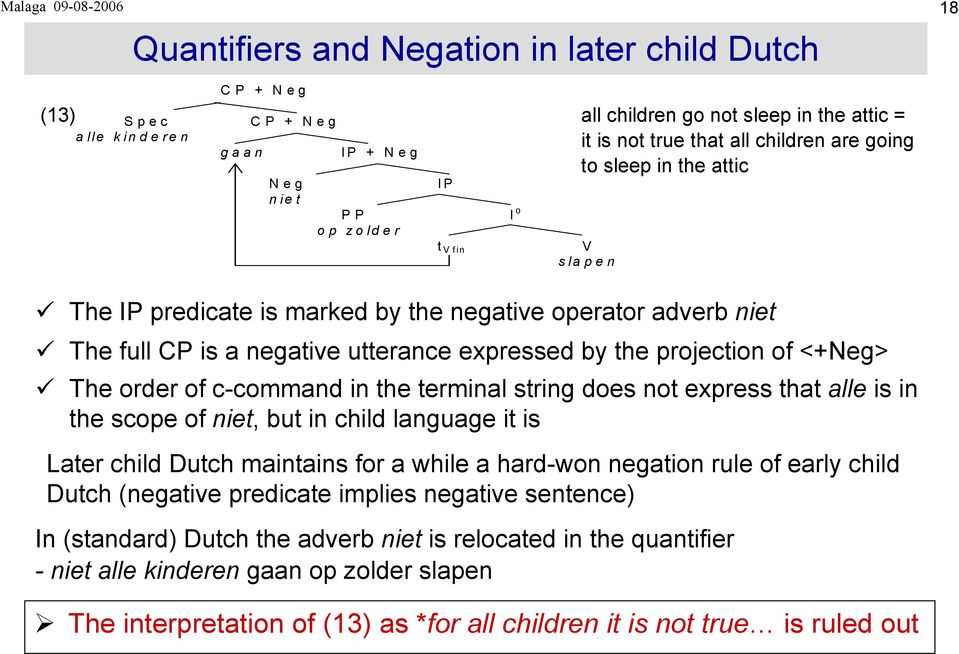
19 Malaga The acquisition order blocks low-scope Neg (14) a. de kinderen gaan [ niet op zolder slapen ] (it is not true that the children are going to sleep in the attic) b. alle kinderen gaan [ niet op zolder slapen ] (it is not true that all children are going to sleep etc.) (child Dutch) c. niet alle kinderen gaan [ op zolder slapen ] (same meaning as b: adult Dutch) d. * alle kinderen gaan [ niet op zolder slapen ] (for all of the children it is not true that they are going to sleep etc.) geen van de kinderen gaat op zolder slapen (14)a > b > c is the order of acquisition (14)d is excluded since it would imply a retreat from the main rule Negation of the predicate must yield sentential scope anyway Acquisition steps are irreversable The order if acquisition steps explains why certain logical options in the surface structure in a given language are excluded.
![niet alle kinderen gaan [ op zolder slapen ] (same meaning as b: adult Dutch) d.](/docs-images/43/4880454/images/page_19.jpg "* alle kinderen gaan [ niet op zolder slapen ] (for all of the children it is not true that they are going to sleep etc.")
20 Malaga The child s elementary grammatical frames The present view is part of a research program that rejects all innate knowledge of UG (contra the a priori assumptions in Crain/Thornton or Yang ) Basic idea a child need not have an a priori idea of a stairway in order to climb to the second floor the child decodes the input in small steps Question: Does the system allow such stepwise decoding? Answer: It does Grammar allows a stepwise decoding Doublings are temporary symptoms of a decoding procedure
21 Malaga Does Universal Grammar exist? Yes, but it is in the (grammatical) tool, not in the mind (the stairway to be climbed by the child) Input reduction happens to reveal a hierarchy of elementary frames by which the child eventually captures grammar Typological properties (parametrized UG) are revealed by input reduction before other properties Typological properties are present as the elementary properties that enable the learnability of the system UG is the discovery of the acquisition procedure Learnability explains the tenacity of typological properties
22 Malaga Universal Grammar as a line of (re)inventions UG is the discovery/outcome of the acquisition procedure rather than the source of the acquisition procedure The child starts with a maximally simplified grammar After input reduction there is a stairway of strong stimuli up to the adult grammar The evolution of grammar (in child language acquisition and in the species) is then the evolution of a tool. The more perfect tool a system of language is, the less innate UG it needs
23 Malaga Selected references On the learnability of V2nd and wh-movement (a stochastic approach) Kampen, J. van (1997) First Steps in Wh-movement Delft: Eburon Evers, A. & J. van Kampen (2001) E-language, I-language and the order of parameter setting. Uil OTS Working Papers S-S, Utrecht. General view on learnability Kampen, J. van & A. Evers (2006) Hierarchies of learning steps in first language acquisition, ms. UiL OTS Utrecht (monograph in preparation). Evers, A. & J. van Kampen (to appear) Parameter setting and input reduction, to appear in: T. Biberauer (ed.) The Structure of Parametric Variation Amsterdam: John Benjamins. Optionality in child and adult grammars Kampen, J. van (2004) An acquisitional view on optionality, Lingua 114, On the learnability of syntactic categories N and V Kampen, J. van (2005) Language specific bootstraps for UG categories International Journal of Bilingualism 9(2), Other references Berwick, R. (1985) The Acquisition of Syntactic Knowledge, MIT Press, Cambridge Crain, S., T. Goro & R. Thornton (2006) Language acquisition is language change, Journal of Psycholinguistic Research 35 (1). Deacon, T.W. (1997) The Symbolic Species. The Co-evolution of Language and the Brain, New York: Norton & Company. Hoekstra, T. & P. Jordens (1994) From adjunct to head, in T. Hoekstra & B.D. Schwartz (eds.) Language Acquisition Studies in Generative Grammar. Amsterdam: John Benjamins Yang, C.D.(2002) Knowledge and Learning in Natural Language, O.U.P, Oxford.
SAND: Relation between the Database and Printed Maps
 SAND: Relation between the Database and Printed Maps Erik Tjong Kim Sang Meertens Institute [email protected] May 16, 2014 1 Introduction SAND, the Syntactic Atlas of the Dutch Dialects,
Sentence Semantics. General Linguistics Jennifer Spenader, February 2006 (Most slides: Petra Hendriks)
 Sentence Semantics General Linguistics Jennifer Spenader, February 2006 (Most slides: Petra Hendriks) Data to be analyzed (1) Maria slaapt. (2) Jan slaapt. (3) Maria slaapt en Jan slaapt. (4) Iedereen
Movement and Binding
 Movement and Binding Gereon Müller Institut für Linguistik Universität Leipzig SoSe 2008 www.uni-leipzig.de/ muellerg Gereon Müller (Institut für Linguistik) Constraints in Syntax 4 SoSe 2008 1 / 35 Principles
The Root Infinitive Stage in Afrikaans: Evidence for Phonologically Neutralized Rich
 Title: The Root Infinitive Stage in Afrikaans: Evidence for Phonologically Neutralized Rich Agreement Running Head: The RI-Stage in Afrikaans: Evidence for Null AGR 1 Abstract: Corpus data available on
Constraints in Phrase Structure Grammar
 Constraints in Phrase Structure Grammar Phrase Structure Grammar no movement, no transformations, context-free rules X/Y = X is a category which dominates a missing category Y Let G be the set of basic
Early Morphological Development
 Early Morphological Development Morphology is the aspect of language concerned with the rules governing change in word meaning. Morphological development is analyzed by computing a child s Mean Length
Acquiring grammatical gender in northern and southern Dutch. Jan Klom, Gunther De Vogelaer
 Acquiring grammatical gender in northern and southern Acquring grammatical gender in southern and northern 2 Research questions How does variation relate to change? (transmission in Labov 2007 variation
Course description Course title: Dutch Language I: Introduction Course code: EN-IN-DLID Domein: Bewegen & Educatie > Education Objectives
 Course description Course title: Dutch Language I: Introduction Course code: EN-IN-DLID Domein: Bewegen & Educatie > Education Objectives Understanding basic vocabulary: words (Dutch to English); Use of
How To Write A Sentence In Germany
 Making Sense of Dutch Word Order Dick Grune [email protected] Version 1.2.1 (October 10, 2013) Note: Although Dutch and Flemish are officially the same language, the explanation below does not apply as
Syntax: Phrases. 1. The phrase
 Syntax: Phrases Sentences can be divided into phrases. A phrase is a group of words forming a unit and united around a head, the most important part of the phrase. The head can be a noun NP, a verb VP,
Syntactic Theory. Background and Transformational Grammar. Dr. Dan Flickinger & PD Dr. Valia Kordoni
 Syntactic Theory Background and Transformational Grammar Dr. Dan Flickinger & PD Dr. Valia Kordoni Department of Computational Linguistics Saarland University October 28, 2011 Early work on grammar There
Nominative-Dative Inversion and the Decline of Dutch
 Nominative-Dative Inversion and the Decline of Dutch Amsterdam Center for Language and Communication, University of Amsterdam (E-mail: [email protected]) 1. Introduction Recently, linguistics was in the centre
How To Distinguish Between Extract From Extraposition From Extract
 PP EXTRAPOSITION FROM NP IN DUTCH C. Jan-Wouter Zwart 1990 0. Summary* Movement to the right is very different from movement to the left. Whereas Wh-movement (extraction) of NP internal PPs is severely
Double Genitives in English
 Karlos Arregui-Urbina Department Linguistics and Philosophy MIT 1. Introduction Double Genitives in English MIT, 29 January 1998 Double genitives are postnominal genitive phrases which are marked with
The acquisition of grammatical gender in bilingual child acquisition of Dutch (by older Moroccan and Turkish children)
 The acquisition of grammatical gender in bilingual child acquisition of Dutch (by older Moroccan and Turkish children) The definite determiner, attributive adjective and relative pronoun Leonie Cornips,
19. Morphosyntax in L2A
 Spring 2012, April 5 Missing morphology Variability in acquisition Morphology and functional structure Morphosyntax in acquisition In L1A, we observe that kids don t always provide all the morphology that
Emphatic Multiple Negative Expressions in Dutch A by-product of the loss of Negative Concord
 Emphatic Multiple Negative Expressions in Dutch A by-product of the loss of Negative Concord Hedde Zeijlstra University of Amsterdam [email protected] Abstract: Double Negation languages such as Dutch and
~ We are all goddesses, the only problem is that we forget that when we grow up ~
 ~ We are all goddesses, the only problem is that we forget that when we grow up ~ This brochure is Deze brochure is in in English and Dutch het Engels en Nederlands Come and re-discover your divine self
Medical Writing - Compilation of Mitigators and Parties
 Amalgamation in mitigator constructions JAMES GRIFFITHS CLCG, Groningen [email protected] DGfS workshop on Parenthesis and Ellipsis, 14 March 2013 0. Overview Mitigators What are mitigators? Mitigators
Estudios de Asia y Africa Idiomas Modernas I What you should have learnt from Face2Face
 Estudios de Asia y Africa Idiomas Modernas I What you should have learnt from Face2Face 1A Question Forms 1.1 Yes-No Questions 1. If the first verb is an auxiliary verb, just move it in front of the Subject:
IP PATTERNS OF MOVEMENTS IN VSO TYPOLOGY: THE CASE OF ARABIC
 The Buckingham Journal of Language and Linguistics 2013 Volume 6 pp 15-25 ABSTRACT IP PATTERNS OF MOVEMENTS IN VSO TYPOLOGY: THE CASE OF ARABIC C. Belkacemi Manchester Metropolitan University The aim of
L130: Chapter 5d. Dr. Shannon Bischoff. Dr. Shannon Bischoff () L130: Chapter 5d 1 / 25
 L130: Chapter 5d Dr. Shannon Bischoff Dr. Shannon Bischoff () L130: Chapter 5d 1 / 25 Outline 1 Syntax 2 Clauses 3 Constituents Dr. Shannon Bischoff () L130: Chapter 5d 2 / 25 Outline Last time... Verbs...
CLARIN project DiscAn :
 CLARIN project DiscAn : Towards a Discourse Annotation system for Dutch language corpora Ted Sanders Kirsten Vis Utrecht Institute of Linguistics Utrecht University Daan Broeder TLA Max-Planck Institute
What can Kind en Gezin (Child and Family) do for you and your family?
 What can Kind en Gezin (Child and Family) do for you and your family? Discover our broad range of free services Engelse vertaling van Kennismakingsfolder ouders You are pregnant Je bent zwanger This is
The mysterious specific indefinite
 UCLA Working Papers in Linguistics, Theories of Everything Volume 17, Article 47: 420-426, 2012 The mysterious specific indefinite Mark de Vries Introduction * When an indefinite newly introduces or reintroduces
Comparing constructicons: A cluster analysis of the causative constructions with doen in Netherlandic and Belgian Dutch.
 Comparing constructicons: A cluster analysis of the causative constructions with doen in Netherlandic and Belgian Dutch Natalia Levshina Outline 1. Dutch causative Cx with doen 2. Data and method 3. Quantitative
Specification by Example (methoden, technieken en tools) Remco Snelders Product owner & Business analyst
 Specification by Example (methoden, technieken en tools) Remco Snelders Product owner & Business analyst Terminologie Specification by Example (SBE) Acceptance Test Driven Development (ATDD) Behaviour
[A Dutch version of this paper appeared in Nederlandse Taalkunde 13, 2008-2, pp 169-187. The English version was written in Spring 2009]
![[A Dutch version of this paper appeared in Nederlandse Taalkunde 13, 2008-2, pp 169-187. The English version was written in Spring 2009]](/thumbs/25/5228939.jpg "[A Dutch version of this paper appeared in Nederlandse Taalkunde 13, 2008-2, pp 169-187. The English version was written in Spring 2009]") Verb clusters and the grammar of the right-periphery Sjef Barbiers, Meertens Instituut and Utrecht University [A Dutch version of this paper appeared in Nederlandse Taalkunde 13, 2008-2, pp 169-187. The
Verb clusters and the grammar of the right-periphery Sjef Barbiers, Meertens Instituut and Utrecht University [A Dutch version of this paper appeared in Nederlandse Taalkunde 13, 2008-2, pp 169-187. The
Annotation Guidelines for Dutch-English Word Alignment
 Annotation Guidelines for Dutch-English Word Alignment version 1.0 LT3 Technical Report LT3 10-01 Lieve Macken LT3 Language and Translation Technology Team Faculty of Translation Studies University College
 Word order in Lexical-Functional Grammar Topics M. Kaplan and Mary Dalrymple Ronald Xerox PARC August 1995 Kaplan and Dalrymple, ESSLLI 95, Barcelona 1 phrase structure rules work well Standard congurational
Modelling the Development of Children s use of Optional. Infinitives in Dutch and English using MOSAIC. Daniel Freudenthal. Julian M.
 Modelling the Development of Children s use of Optional Infinitives in Dutch and English using MOSAIC Daniel Freudenthal Julian M. Pine School of Psychology University of Liverpool Fernand Gobet School
Submission guidelines for authors and editors
 Submission guidelines for authors and editors For the benefit of production efficiency and the production of texts of the highest quality and consistency, we urge you to follow the enclosed submission
Gaps and Parasitic Gaps
 Gaps and Parasitic Gaps Hans Bennis & Teun Hoekstra bron Hans Bennis & Teun Hoekstra, Gaps and Parasitic Gaps. In: The Linguistic Review 4 (1984-1985), p. 29-87. Zie voor verantwoording: http://www.dbnl.org/tekst/benn004gaps01_01/colofon.htm
TAAL THUIS DUTCH FOR BEGINNERS. www.taalthuis.com
 Sjoerd de Vos Marcel Heerink TAAL THUIS DUTCH FOR BEGINNERS www.taalthuis.com Introduction A book and a free course online There are two possibilities, and in both cases you will be surprised! The first
Approximative of zo as a diagnostic tool
 Approximative of zo as a diagnostic tool Norbert Corver 1. Syntactic diagnostics An important tool in syntactic research is the use of syntax diagnostics. The syntactician tries to discover the nature
If farming becomes surviving! Ton Duffhues Specialist Agriculture and society ZLTO Director Atelier Waarden van het Land 4 juni 2014, Wageningen
 If farming becomes surviving! Ton Duffhues Specialist Agriculture and society ZLTO Director Atelier Waarden van het Land 4 juni 2014, Wageningen About myself Study - Cultural and social Anthropology, specialised
Index. 344 Grammar and Language Workbook, Grade 8
 Index Index 343 Index A A, an (usage), 8, 123 A, an, the (articles), 8, 123 diagraming, 205 Abbreviations, correct use of, 18 19, 273 Abstract nouns, defined, 4, 63 Accept, except, 12, 227 Action verbs,
LEXICOGRAPHIC ISSUES IN COMBINATORICS
 LEXICOGRAPHIC ISSUES IN COMBINATORICS Editing multiple idiomatic phraseological units for book and CD-ROM Lineke OPPENTOCHT, Utrecht, The Netherlands Abstract In dictionaries dating from pre-computerized
How To Pass A Dutch Grammar Test
 UNIVERSITY OF CAMBRIDGE INTERNATIONAL EXAMINATIONS International General Certificate of Secondary Education MARK SCHEME for the May/June 2012 question paper for the guidance of teachers 0515 DUTCH (FOREIGN
Linguistics & Cognitive Science
 Linguistics & Cognitive Science 07.201* History of Cognitive Science Fall term 2000 formal account of pivotal role of linguistics in the development of cognitive science relation to psychology, AI, & philosophy
LASSY: LARGE SCALE SYNTACTIC ANNOTATION OF WRITTEN DUTCH
 LASSY: LARGE SCALE SYNTACTIC ANNOTATION OF WRITTEN DUTCH Gertjan van Noord Deliverable 3-4: Report Annotation of Lassy Small 1 1 Background Lassy Small is the Lassy corpus in which the syntactic annotations
Livingston Public Schools Scope and Sequence K 6 Grammar and Mechanics
 Grade and Unit Timeframe Grammar Mechanics K Unit 1 6 weeks Oral grammar naming words K Unit 2 6 weeks Oral grammar Capitalization of a Name action words K Unit 3 6 weeks Oral grammar sentences Sentence
Teacher training worksheets- Classroom language Pictionary miming definitions game Worksheet 1- General school vocab version
 Teacher training worksheets- Classroom language Pictionary miming definitions game Worksheet 1- General school vocab version Whiteboard Work in pairs Desk Board pen Permanent marker Felt tip pen Colouring
Syntactic and Semantic Differences between Nominal Relative Clauses and Dependent wh-interrogative Clauses
 Theory and Practice in English Studies 3 (2005): Proceedings from the Eighth Conference of British, American and Canadian Studies. Brno: Masarykova univerzita Syntactic and Semantic Differences between
Points of Interference in Learning English as a Second Language
 Points of Interference in Learning English as a Second Language Tone Spanish: In both English and Spanish there are four tone levels, but Spanish speaker use only the three lower pitch tones, except when
Cultural Trends and language change
 Cultural Trends and language change Gosse Bouma [email protected] Information Science University of Groningen NHL 2015/03 Gosse Bouma 1/25 Popularity of Wolf in English books Gosse Bouma 2/25 Google Books
Semantics and Generative Grammar. Quantificational DPs, Part 3: Covert Movement vs. Type Shifting 1
 Quantificational DPs, Part 3: Covert Movement vs. Type Shifting 1 1. Introduction Thus far, we ve considered two competing analyses of sentences like those in (1). (1) Sentences Where a Quantificational
Lecture 1: OT An Introduction
 Lecture 1: OT An Introduction 1 Generative Linguistics and OT Starting point: Generative Linguistics Sources: Archangeli 1997; Kager 1999, Section 1; Prince & Smolensky 1993; Barbosa et al. 1998, intro.
The meaning of structure: the wat voor construction revisited
 The meaning of structure: the wat voor construction revisited Hans Bennis 0. Introduction The internal structure of the Dutch wat voor-construction has been the subject of much debate in the past fifteen
It s a small word. Johan Rooryck & Guido Vanden Wyngaerd HIL Leiden/FWO - KUBrussel. 1. Introduction *
 Small words in the big picture. Squibs for Hans Bennis. Sjef Barbiers, Johan Rooryck & Jeroen van de Weijer (eds) 101-106. It s a small word Johan Rooryck & Guido Vanden Wyngaerd HIL Leiden/FWO - KUBrussel
Title page. Title: A conversation-analytic study of time-outs in the Dutch national volleyball. competition. Author: Maarten Breyten van der Meulen
 Title page Title: A conversation-analytic study of time-outs in the Dutch national volleyball competition Author: Maarten Breyten van der Meulen A conversation-analytic study of time-outs in the Dutch
The compositional semantics of same
 The compositional semantics of same Mike Solomon Amherst College Abstract Barker (2007) proposes the first strictly compositional semantic analysis of internal same. I show that Barker s analysis fails
The Syntactic Location of Events. Aspects of Verbal Complementation in Dutch
 The Syntactic Location of Events Aspects of Verbal Complementation in Dutch Published by LOT phone: +31 30 253 6006 Janskerkhof 13 fax: +31 30 253 6406 3512 BL Utrecht e-mail: [email protected] The Netherlands
Noam Chomsky: Aspects of the Theory of Syntax notes
 Noam Chomsky: Aspects of the Theory of Syntax notes Julia Krysztofiak May 16, 2006 1 Methodological preliminaries 1.1 Generative grammars as theories of linguistic competence The study is concerned with
Structure of Clauses. March 9, 2004
 Structure of Clauses March 9, 2004 Preview Comments on HW 6 Schedule review session Finite and non-finite clauses Constituent structure of clauses Structure of Main Clauses Discuss HW #7 Course Evals Comments
12 1 Food. 1 Welk eten vind je lekker? 2 You have seen the film.
 12 1 Food 1 Welk eten vind je lekker? What food do you like? Welk eten vind je niet lekker? What food don t you like? Maak een poster. Make a poster. 2 You have seen the film. Het gaat over Mick en Merron.
Sluicing in Dutch: A Problem for PF-deletion approaches Jack Hoeksema
 Sluicing in Dutch: A Problem for PF-deletion approaches Jack Hoeksema The idea that sluicing is derived by movement of a WH-element, following by deletion of the remainder of the sentence (cf. Merchant
The Michigan State University - Certificate of English Language Proficiency (MSU-CELP)
 The Michigan State University - Certificate of English Language Proficiency (MSU-CELP) The Certificate of English Language Proficiency Examination from Michigan State University is a four-section test
Movement and ellipsis: An analysis of gapping
 SCoFL2 Adam Mickiewicz University, Poznań, Poland Second Student Conference on Formal Linguistics 21-22 April, 2007 1 INTRODUCTION: GAPPING Lobke Aelbrecht OUTLINE 1 Introduction: gapping 2 Analysis: movement
The IPP-effect as a repair strategy
 The IPP-effect as a repair strategy Thesis submitted in partial fulfilment of the requirement for the degree of Master of Philosophy University of Utrecht August 2009 Submitted by: Enrico Boone Studentnumber:
Examen Software Engineering 2010-2011 05/09/2011
 Belangrijk: Schrijf je antwoorden kort en bondig in de daartoe voorziene velden. Elke theorie-vraag staat op 2 punten (totaal op 24). De oefening staan in totaal op 16 punten. Het geheel staat op 40 punten.
MARY. V NP NP Subject Formation WANT BILL S
 In the Logic tudy Guide, we ended with a logical tree diagram for WANT (BILL, LEAVE (MARY)), in both unlabelled: tudy Guide WANT BILL and labelled versions: P LEAVE MARY WANT BILL P LEAVE MARY We remarked
stress, intonation and pauses and pronounce English sounds correctly. (b) To speak accurately to the listener(s) about one s thoughts and feelings,
 Section 9 Foreign Languages I. OVERALL OBJECTIVE To develop students basic communication abilities such as listening, speaking, reading and writing, deepening their understanding of language and culture
Agreement, PRO and Imperatives
 Agreement, PRO and Imperatives Hans Bennis 1. Introduction: the pro drop parameter 1 In the literature the occurrence of an empty subject in finite clauses is generally related to a parametric choice in
On Dutch allemaal and West Ulster English all
 On Dutch allemaal and West Ulster English all Hilda Koopman UCLA This squib compares the similar distributions of floating allemaal and all under wh-movement in Dutch and West Ulster English (WUE) (McCloskey
English Appendix 2: Vocabulary, grammar and punctuation
 English Appendix 2: Vocabulary, grammar and punctuation The grammar of our first language is learnt naturally and implicitly through interactions with other speakers and from reading. Explicit knowledge
Lexical Competition: Round in English and Dutch
 Lexical Competition: Round in English and Dutch Joost Zwarts * Abstract This paper studies the semantic division of labour between three Dutch words, om, rond and rondom, all three corresponding to the
FOREIGN LANGUAGE TEACHING AN INTERVIEW WITH NINA SPADA
 SPADA, Nina. Foreign Language Teaching: an interview with Nina Spada. ReVEL, vol. 2, n. 2, 2004. ISSN 1678-8931 [www.revel.inf.br/eng]. FOREIGN LANGUAGE TEACHING AN INTERVIEW WITH NINA SPADA Nina Spada
Comprendium Translator System Overview
 Comprendium System Overview May 2004 Table of Contents 1. INTRODUCTION...3 2. WHAT IS MACHINE TRANSLATION?...3 3. THE COMPRENDIUM MACHINE TRANSLATION TECHNOLOGY...4 3.1 THE BEST MT TECHNOLOGY IN THE MARKET...4
On the Interpretation of there in Existentials
 On the Interpretation of there in Existentials SJEF BARBIERS & JOHAN ROORYCK HIL/ Leiden University 1. Introduction * In this paper, we would like to show that a large number of properties of existential
TERMS. Parts of Speech
 TERMS Parts of Speech Noun: a word that names a person, place, thing, quality, or idea (examples: Maggie, Alabama, clarinet, satisfaction, socialism). Pronoun: a word used in place of a noun (examples:
I should have been ill
 I should have been ill The interaction of tense, aspect and modality in Dutch Richard van Gerrevink I should have been ill The interaction of tense, aspect and modality in Dutch Richard van Gerrevink
EAP 1161 1660 Grammar Competencies Levels 1 6
 EAP 1161 1660 Grammar Competencies Levels 1 6 Grammar Committee Representatives: Marcia Captan, Maria Fallon, Ira Fernandez, Myra Redman, Geraldine Walker Developmental Editor: Cynthia M. Schuemann Approved:
A Report on my Foreign Language Learning Experience BA English Language and Communication
 Focus A Report on my Foreign Language Learning Experience BA English Language and Communication 1 I aim to discuss and evaluate my acquisition of the grammatical systems of foreign languages; focusing
Negation and (finite) verb placement in a Polish-German bilingual child. Christine Dimroth, MPI, Nijmegen
 Negation and (finite) verb placement in a Polish-German bilingual child Christine Dimroth, MPI, Nijmegen Consensus: Bilingual L1A bilingual children develop two separate linguistic systems from early on
Ling 201 Syntax 1. Jirka Hana April 10, 2006
 Overview of topics What is Syntax? Word Classes What to remember and understand: Ling 201 Syntax 1 Jirka Hana April 10, 2006 Syntax, difference between syntax and semantics, open/closed class words, all
total dutch speak Dutch instantly no books no writing absolute confi dence
 total dutch speak Dutch instantly no books no writing absolute confi dence d To find out more, please get in touch with us. For general enquiries and for information on Michel Thomas: Call: 020 7873 6400
Software product management. Inge van de Weerd
 Software product management Inge van de Weerd Hoe ben je naar dit college gekomen? A. Lopend B. Met de fiets C. Met het openbaar vervoer D. Met de auto E. Anders Agenda Software Product Management Requirements
CAS LX 500 A1 Language Acquisition
 CAS LX 500 A1 Language Acquisition Week 4a. Root infinitives, null subjects and the UCC Root infinitives vs. time Here are those Danish graphs again. Ooo. Consistent. Syntax at age two Root infinitives
Storage in Microsoft Azure Wat moet ik daarmee? Bert Wolters @bertwolters
 Storage in Microsoft Azure Wat moet ik daarmee? Bert Wolters @bertwolters Welk deel van het platform hebben we nu behandeld? Agenda Recap: Storage Account Nieuw! Premium Storage Nieuw! Native backup voor
Chapter II. Controlling Cars on a Bridge
 Chapter II. Controlling Cars on a Bridge 1 Introduction The intent of this chapter is to introduce a complete example of a small system development. During this development, you will be made aware of the
UvA college Governance and Portfolio Management
 UvA college Han Verniers Principal Consultant [email protected] Programma Governance IT Governance, wat is dat? Governance: structuren, processen, instrumenten Portfolio Management Portfolio Management,
The Chat Box Revelation On the chat language of Flemish adolescents and young adults
 !"#$%&'(*+,&(-,.,+/$"#('0 1**234567875549:#,(-; &81**2456787
- Use of vocabulary and grammar in small conversation.
 Course description Course title: Dutch Language II (Intermediate Basic) Course code: EN-IN-DLIM Domein: Bewegen & Educatie > Education Objectives - Understanding intermediate basic vocabulary: words (Dutch
Micha Moffie. Technical Informatics Faculty of Information Technology and Systems Delft university of Technology TU Delft
 Micha Moffie Technical Informatics Faculty of Information Technology and Systems Delft university of Technology TU Delft Delft, November 1999 1. Acknowledgments... 3 2. Introduction... 3 3. Dialogs...
Useful classroom language for Elementary students. (Fluorescent) light
 Useful classroom language for Elementary students Classroom objects it is useful to know the words for Stationery Board pens (= board markers) Rubber (= eraser) Automatic pencil Lever arch file Sellotape
HOE WERKT CYBERCRIME EN WAT KAN JE ER TEGEN DOEN? Dave Maasland Managing Director ESET Nederland
 HOE WERKT CYBERCRIME EN WAT KAN JE ER TEGEN DOEN? Dave Maasland Managing Director ESET Nederland Een datalek melden bij een beveiligingsincident Copyright 1992 2015 ESET, spol. s r. o. ESET, ESET logo,