
CAPABILITY PROCESS ASSESSMENT IN SIX SIGMA APPROACH
|
|
|
- Amberly Glenn
- 10 years ago
- Views:
Transcription
1 METALLURGY AND FOUNDRY ENGINEERING Vol. 33, 007, No. Andrzej Czarski * CAPABILITY PROCESS ASSESSMENT IN SIX SIGMA APPROACH 1. INTRODUCTION We can state that statistical methods belong to a quality tools canon and a formal requirement of their application is contained in each contemporary quality management system, i.e. both in ISO 9000 standard group and in branch standards coming from ISO standards. Statistical techniques occupy a particular place in the organizational culture Six Sigma that is used in many renowned organizations (Motorola, General Electric, Bombardier, Nokia, Sony, BMW, Philips etc.) in order to achieve in the shortest possible time the highest quality level. Six Sigma is, in other words, an efficient and verified program of organization profitability improvement; statistical methods play in this program a role of the basic and most important tool for better and better understanding and improving processes.. CHARACTERISTIC FEATURES OF SIX SIGMA Among lots of definitions of Six Sigma there is one that is first worth mentioning the one presented by Breyfogle [1] that says Six Sigma is a strictly planned process leading to higher and higher quality in time shorter than at competitors. But Pande [] defines Six Sigma as A comprehensive and flexible system for achieving, sustaining, maximizing business success. Six Sigma is uniquely driven by a close understanding of customer needs, disciplined use of facts, data, and statistical analysis and diligent attention to managing, improving, and reinventing business processes. Indeed, all existing definitions of Six Sig- * Ph.D.: Faculty of Metals Engineering and Industrial Computer Science, AGH University of Science and Technology, Cracow, Poland; [email protected] 105
2 ma are brought to a common denominator of a new definition of quality and very intensive application of statistical techniques to improve processes not suddenly, but incrementally. The new definition of quality expresses the right to value: a customer expects the product with desirable functional features, however from the producer s point of view, the product must earn money realization of those seemingly divergent objectives is possible through pursuit of achievement of so-called perfect quality. The new definition of quality is one of three mentioned characteristic features of Six Sigma [3, 4, 5, 6]. The second characteristic feature of Six Sigma is the determined organization structure, of which the most important content is staff dedicated to Six Sigma objectives. There are first of all: champion, master black belts, black belts, green belts and members of teams executing improvement projects. The key persons are, first of all, black belts and green belts who manage the mentioned teams executing improvement projects and they are responsible for the realization of those projects. The third characteristic feature of Six Sigma, possibly the most important one, is an algorithm of realization of improvement projects, consisting of five phases Define-Measure-Analyze-Improve-Control (DMAIC). Realization of the algorithm DMAIC is the basic phase of the so-called breakthrough strategy; through the execution of projects according to the algorithm DMAIC not incremental improvement occurs, but it should be a sudden improvement. Realization of this algorithm requires application of lots of different quality instruments. One of the most important are statistical techniques. 3. CAPABILITY PROCESS ESTIMATION Estimation of a process capability refers to a comparison of the process variability with the expected, tolerable variability defined with the aid of specification limits. The expression of this comparison is a series of different capability indices that are capability indices of first generation (Cp, Cpk, Pp, Ppk), capabi-lity indices of second generation (Cpm), capability indices in case of non-normal distributions, capability indices for correlated data, capability indices in case of multidimensional analysis etc. [7, 8]. 4. SIX SIGMA CAPABILITY 4.1. Conception, interpretation In the Six Sigma approach, analogously to the analysis of variance (ANOVA), the analysis of process variability is being performed considering sources that can be its reasons [1, 9]. The principle of this approach is as follows. The total process variability consists of 106
3 the variability independent on time that we observe in successive rational subgroups taken from a process and the variability dependent on time observed from a sample to a sample. Relating client s expectations presented as specification limits to the total process variability is expressed in long-term capability indices Pp, Ppk. Relating client s expectations presented as specification limits to a component of the process variability irrespective of time is expressed in short-term capability indices Cp, Cpk. In order to interpret process capability indices Cp, Cpk (the same interpretation concerns also indices Pp, Ppk) let s use the following analogy. In a production process a specified product is manufactured, in a measurement process we produce numbers. A good measurement should be correct and precise. From the point of view of correctness, a good measurement means the measurement without a systematic error. Precision is connected with a dispersion of measurement results round an unknown value of the measured parameter. At more precise measurement the dispersion of measurement results is the smallest. Because, regarding the variability, a measurement and production process can be treated the same, we can say also that a good process should be a good measurement similarly correct and precise, too. The relative measure of a process correctness is the real capability factor Cpk; if Cpk = Cp, the process is centered that means the expected realization of the process corresponds to the target (the midpoint of a specification limit). If Cpk < Cp, the position of the process is improper, the process is displaced. The relative measure of a process precision is the potential capability factor Cp; the higher value of this factor, the lesser variability of the process relating to the variability declared by specification limits. Of course, there is an unequivocal relationship (for given distribution) between values of capability indices Cp, Cpk and a fraction of the realization outside specification limits (limit). 4.. Calculation procedure The assessment of non-dependent time variability. We take rational subgroups of a specified size from the on-going process. For each sample we can determine one of the following dispersion measures: range (R), standard deviation (s) or variance (s ). The measure of the variability independent on time is a standard deviation s short. For the assessment of s short one can use: average range ( R ) or average standard deviation ( s ) or average variance ( s ). Obviously, the point is in averages determined on the basis of particular samples taken from the process. The assessment of total variability. From all the samples taken from the on-going process we make one set. Variability observed in this set is a total variability. The measure of this variability is a standard deviation s long determined on the basis of this set. Having at our disposal the measure of variability independent on time s short and the measure of total variability s long we can determine correspondingly short-term capability indices Cp, Cpk and long-term capability indices Pp, Ppk. (Tab. 1). 107

4 Table 1. List of short-term and long-term capability indices calculation procedure [1, 9] PROCESS VARIABILITY ASSESSMENT METHOD VARIABILITY MEASURE VARIABILITY INDEPENDENT ON TIME subgroups taken from the process depending on a variability measure determined on a single subgroup s short s = R (1) d short sshort = s () c 4 = s (3) TOTAL VARIABILITY = VARIABILITY INDEPENDENT ON TIME + VARIABILITY DEPENDENT ON TIME sample of values created on the basis of all taken subgroups 1 slong = ( xi x) n 1 (4) SHORT TERM CAPABILITY* LONG TERM CAPABILITY* CAPABILITY INDICES C C pk p USL LSL = 6 s short (5) x LSL USL x = min ; (6) 3 sshort 3 sshort USL LSL Pp = 6 s P pk long *) in case of one-side limit specification (LSL or USL) only Cpk and Ppk are determined x LSL USL x = min ; 3 slong 3 slong (7) (8) Explanations: Rss,, adequately average range, average standard deviation, average variance d, c 4 indices dependent on a sample size (tabled [10]) s short, s long standard deviations, adequately the measure of process variability independent on time and total process variability xx, Cp, Cpk Pp, Ppk average values, adequately the average determined on the basis of averages from particular samples taken from the process, and the average determined on the basis of a range of values created on the basis of all samples taken (obviously x= x ) short-term capability indices long-term capability indices 108

5 4.3. Conclusions on the basis of analysis results If standard deviations s short and s long are equal i.e. s short = s long, the total process variability consists only of variability independent on time. The independent-on-time variability is a so-called noise. Equality s short = s long involves the equality of adequate short-term and long-term capability indices i.e. Cp = Pp and Cpk = Ppk. Moreover, if the process is centered that means the average corresponds to a target (a midpoint of the specification area), there are the equalities: Cpk = Ppk and Cp=Pp. If there is an inequality s short < s long, the total process variability is larger than the variability caused by the noise, so a position of the considered process was being changed crucially in time (e.g. because of periodical changes of raw materials, settings etc.). The inequality s short < s long involves the following relations between short-term and long-term capability indices: Cp > Pp and Cpk > Ppk. We can demonstrate that there are the following relationships between short-term and long-term process capability indices [9]: Ppk < Cpk < Cp and Ppk < Pp < Cp (9) Pp Cpk = Cp Ppk (10) Expression (10) can be used for verification of the calculation correctness. 5. EXPERIMENTAL PROCEDURE 5.1. Aim, material The aim of research is an assessment of short-term and long-term capability for the sake of hardness of drop forgings (steel 41Cr4, PN-EN Ap1:003). The process of quenching and tempering (hardening and high-temperature tempering) of drop forgings is carried out in a tunnel furnace with regulation of a temperature and atmosphere in particular zones. Forgings heated to the temperature of 850 o C get to a quenching tank and than they are being tempered at the temperature o C. The tempering time is regulated by a tape speed. The material is delivered by batches. The batches are supplied for a heat treatment irregularly, that requires to set the process for each individual batch. During the heat treatment of the batch every determined time five forgings are taken (the sample of five elements, n = 5) and for each forging a hardness measurement is made. The Rockwell ZHR 4150 AK hardness tester of Zwick company is being used for measurements that is suitable to control the process with sufficient precision. According to client s expectations the specification limits for hardness of drop forgings after quenching and tempering are as follows: lower specification limit DWG = 30 HRC, upper specification limit GWG = 40 HRC. 109
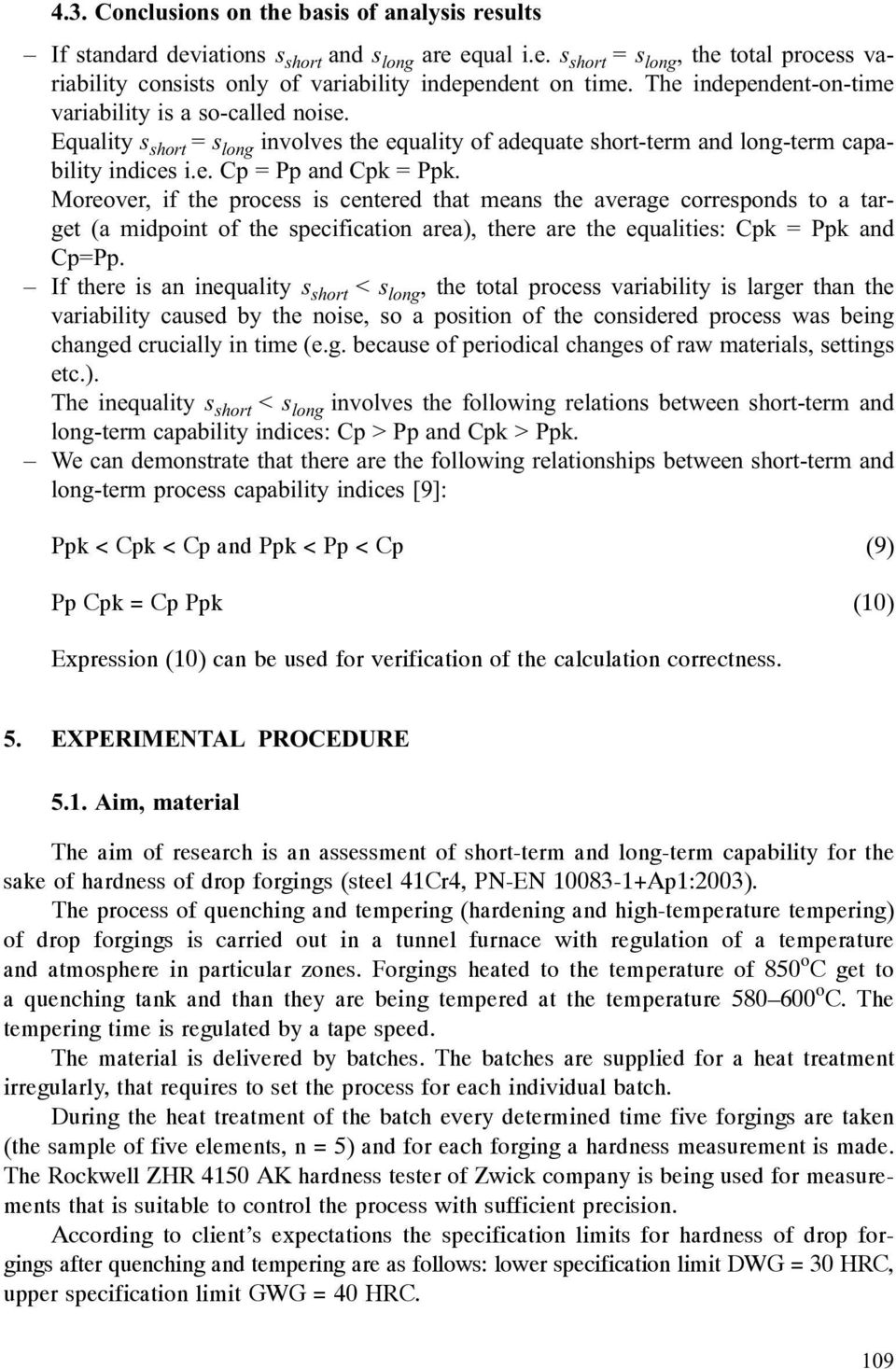
6 5.. Experimental results The analysis of the process capability is made for six batches of drop forgings. The results of measurements are presented in Table and in Figure 1. Table. Results of hardness measurements Batch No. of subgroups Values R x-bar , , , , , , , , , , , , , , , , , , , , , , , , , Fig. 1. Results of hardness measurements 110
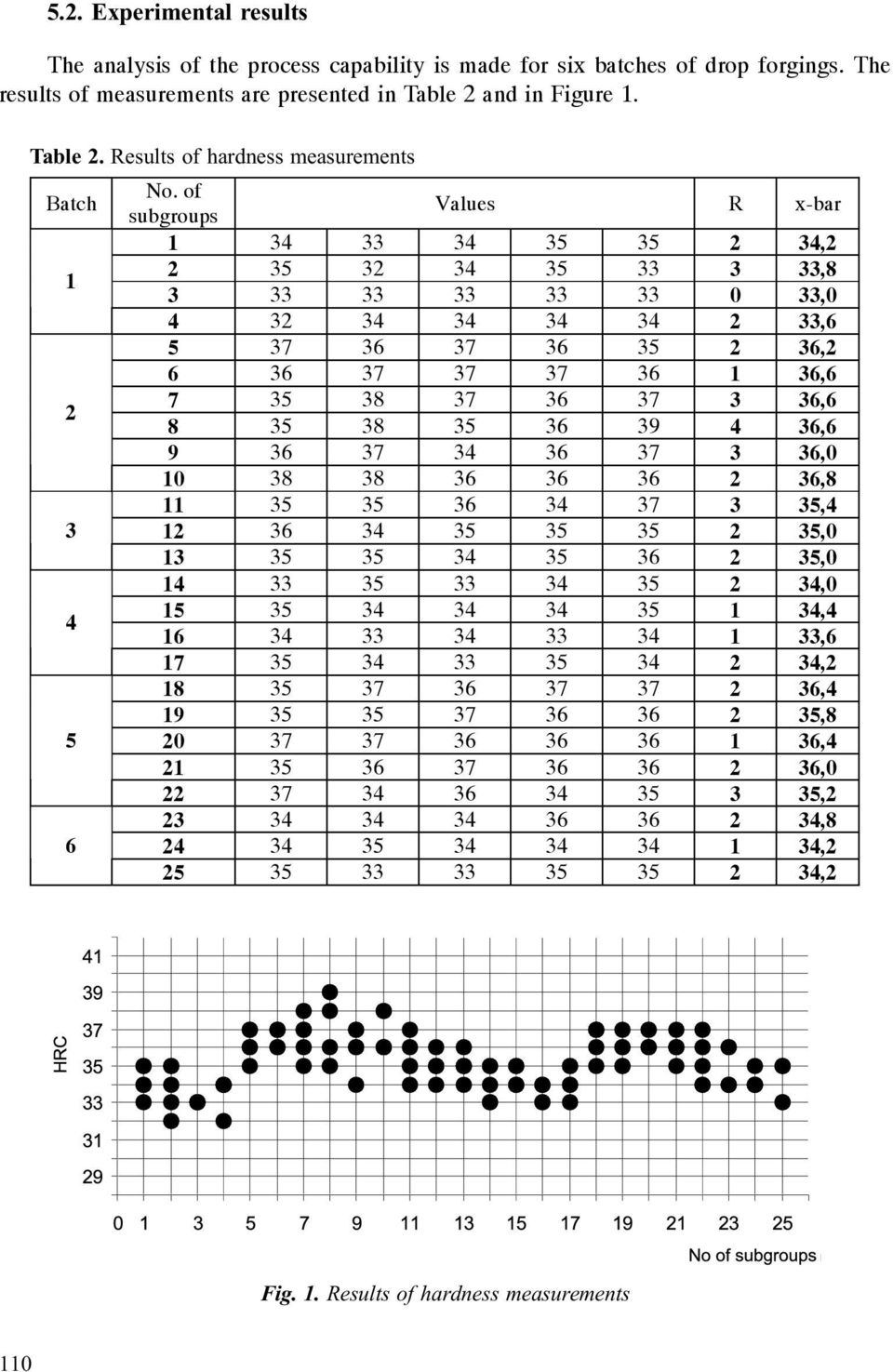
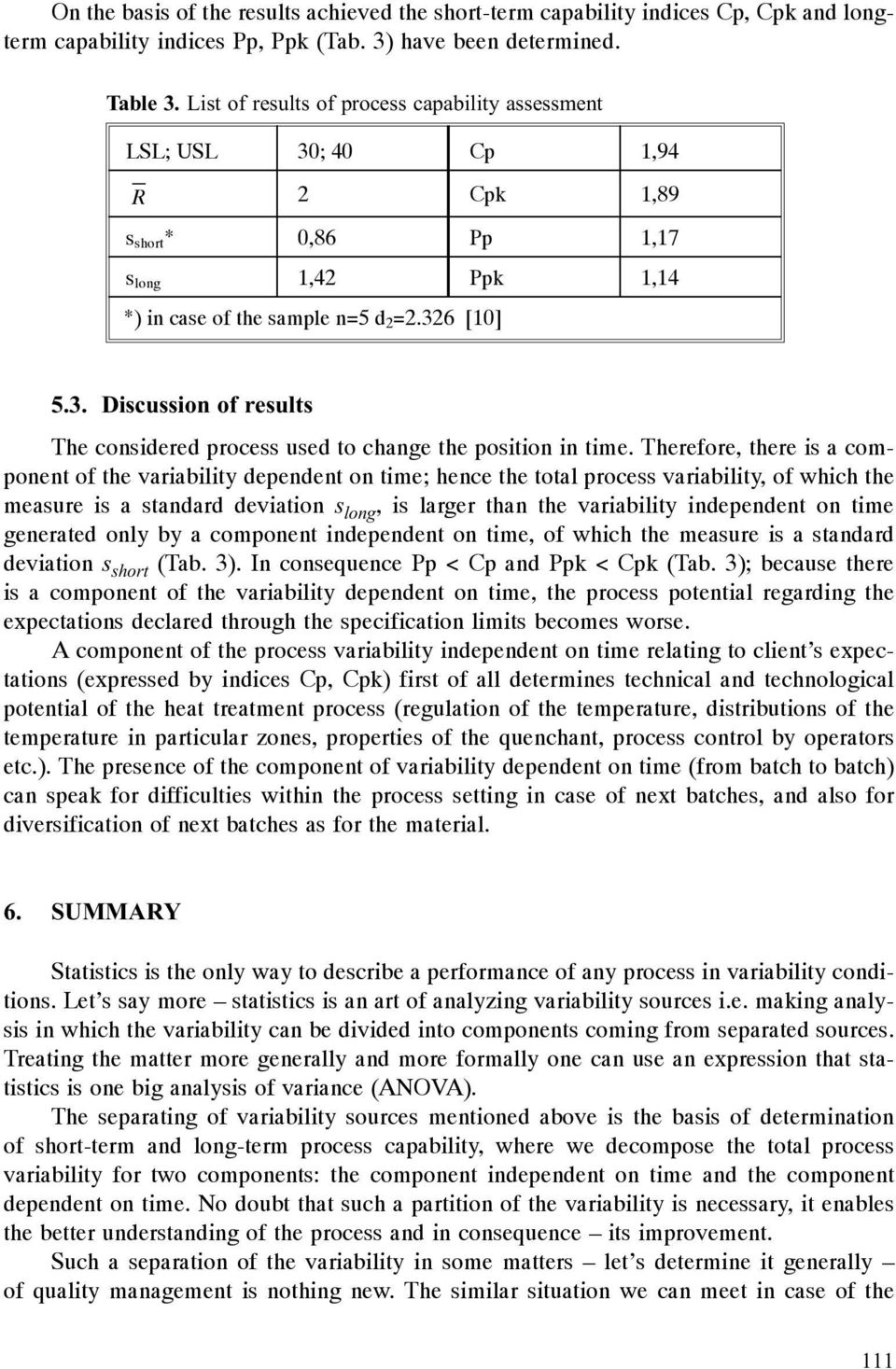
7 On the basis of the results achieved the short-term capability indices Cp, Cpk and longterm capability indices Pp, Ppk (Tab. 3) have been determined. Table 3. List of results of process capability assessment LSL; USL 30; 40 Cp 1,94 R Cpk 1,89 s short * 0,86 Pp 1,17 s long 1,4 Ppk 1,14 *) in case of the sample n=5 d =.36 [10] 5.3. Discussion of results The considered process used to change the position in time. Therefore, there is a component of the variability dependent on time; hence the total process variability, of which the measure is a standard deviation s long, is larger than the variability independent on time generated only by a component independent on time, of which the measure is a standard deviation s short (Tab. 3). In consequence Pp < Cp and Ppk < Cpk (Tab. 3); because there is a component of the variability dependent on time, the process potential regarding the expectations declared through the specification limits becomes worse. A component of the process variability independent on time relating to client s expectations (expressed by indices Cp, Cpk) first of all determines technical and technological potential of the heat treatment process (regulation of the temperature, distributions of the temperature in particular zones, properties of the quenchant, process control by operators etc.). The presence of the component of variability dependent on time (from batch to batch) can speak for difficulties within the process setting in case of next batches, and also for diversification of next batches as for the material. 6. SUMMARY Statistics is the only way to describe a performance of any process in variability conditions. Let s say more statistics is an art of analyzing variability sources i.e. making analysis in which the variability can be divided into components coming from separated sources. Treating the matter more generally and more formally one can use an expression that statistics is one big analysis of variance (ANOVA). The separating of variability sources mentioned above is the basis of determination of short-term and long-term process capability, where we decompose the total process variability for two components: the component independent on time and the component dependent on time. No doubt that such a partition of the variability is necessary, it enables the better understanding of the process and in consequence its improvement. Such a separation of the variability in some matters let s determine it generally of quality management is nothing new. The similar situation we can meet in case of the 111
8 assessment of repeatability and reproducibility of a measurement system (e.g. using R&R method). In the R&R analysis from the total variability accompanying a measurement we separate a component for which a measurement device is responsible (it is a so-called reproducibility) as well as a component for which operators are responsible (it is a so-called repeatability). Such a distinction of the variability is also necessary because it brings some determined information that can be managed. Acknowledgements The financial support from the Polish Ministry of Science and Higher Education, contract AGH no is gratefully acknowledged. REFERENCES [1] Breyfogle F.W.: III, Implementing Six Sigma. Smarter Solutions Using Statistical Methods, Second Edition, John Wiley&Sons, Inc., 003 [] Pande P.S., Neuman R.P., Cavanagh R.R.: Six Sigma. How GE, Motorola and Other Top Companies are Honning Their Performance, KE Liber S.C., 000 (in Polish) [3] Pande P., Holpp L.: What is Six Sigma, First Edition, McGraw-Hill, 001 [4] Stamatis D.H.: Six Sigma and Beyond. Foundations of Excellent Performance. Ed. CRC Press, 001 [5] Rath&Strong s Six Sigma leadership handbook, Edited by Thomas Bertels, John Wiley&Sons, Inc., 003 [6] Six Sigma. International Conference, Wroclaw Centre for Technology Transfer, Wroclaw University of Technology, January 004 (in Polish) [7] Montgomery D.C.: Introduction to Statistical Quality Control, Third Edition, John Wiley&Sons, Inc., 1997 [8] Kotz S., Lovelace C.R.: Proces Capability Indices in Theory and Practice, Arnold, 1998 [9] Joglekar A.M.: Statistical Methods for Six Sigma. In R&D and Manufacturing, John Wiley&Sons, Inc., 003 [10] Glossary and Tables for Statistical Quality Control, Third Edition, ASQ Statistics Division, ASQ Quality Press, 1996 Received September
INFLUENCE OF MEASUREMENT SYSTEM QUALITY ON THE EVALUATION OF PROCESS CAPABILITY INDICES
 METALLURGY AND FOUNDRY ENGINEERING Vol. 38, 2012, No. 1 http://dx.doi.org/10.7494/mafe.2012.38.1.25 Andrzej Czarski*, Piotr Matusiewicz* INFLUENCE OF MEASUREMENT SYSTEM QUALITY ON THE EVALUATION OF PROCESS
SPC Response Variable
 SPC Response Variable This procedure creates control charts for data in the form of continuous variables. Such charts are widely used to monitor manufacturing processes, where the data often represent
Control Charts - SigmaXL Version 6.1
 Control Charts - SigmaXL Version 6.1 Control Charts: Overview Summary Report on Test for Special Causes Individuals & Moving Range Charts Use Historical Groups to Display Before VS After Improvement X-Bar
Six Sigma. Breakthrough Strategy or Your Worse Nightmare? Jeffrey T. Gotro, Ph.D. Director of Research & Development Ablestik Laboratories
 Six Sigma Breakthrough Strategy or Your Worse Nightmare? Jeffrey T. Gotro, Ph.D. Director of Research & Development Ablestik Laboratories Agenda What is Six Sigma? What are the challenges? What are the
Capability Analysis Using Statgraphics Centurion
 Capability Analysis Using Statgraphics Centurion Neil W. Polhemus, CTO, StatPoint Technologies, Inc. Copyright 2011 by StatPoint Technologies, Inc. Web site: www.statgraphics.com Outline Definition of
Process Capability Analysis Using MINITAB (I)
 Process Capability Analysis Using MINITAB (I) By Keith M. Bower, M.S. Abstract The use of capability indices such as C p, C pk, and Sigma values is widespread in industry. It is important to emphasize
Confidence Intervals for Cpk
 Chapter 297 Confidence Intervals for Cpk Introduction This routine calculates the sample size needed to obtain a specified width of a Cpk confidence interval at a stated confidence level. Cpk is a process
Control Charts for Variables. Control Chart for X and R
 Control Charts for Variables X-R, X-S charts, non-random patterns, process capability estimation. 1 Control Chart for X and R Often, there are two things that might go wrong in a process; its mean or its
Project Quality Management. Project Management for IT
 Project Quality Management 1 Learning Objectives Understand the importance of project quality management for information technology products and services Define project quality management and understand
Statistical Process Control Basics. 70 GLEN ROAD, CRANSTON, RI 02920 T: 401-461-1118 F: 401-461-1119 www.tedco-inc.com
 Statistical Process Control Basics 70 GLEN ROAD, CRANSTON, RI 02920 T: 401-461-1118 F: 401-461-1119 www.tedco-inc.com What is Statistical Process Control? Statistical Process Control (SPC) is an industrystandard
Readiness for Lean/Six Sigma Key success factors for integrating Lean/Six Sigma in a Healthcare setting
 Readiness for Lean/Six Sigma Key success factors for integrating Lean/Six Sigma in a Healthcare setting D. Junell Scheeres, MA, BS, CSSBB VHA s Integrated Delivery Team SHS 2005 Conference Co-Chair [email protected]
Six Sigma as a Healthcare Quality Initiative
 Six Sigma as a Healthcare Quality Initiative August 21-24, 2005 Carolyn Pexton, GE Healthcare Benjamin Williams, Harvard Health Policy Review Track IC August 22, 1:45-6:15 Date Six Sigma Basics Benjamin
THE USE OF STATISTICAL PROCESS CONTROL IN PHARMACEUTICALS INDUSTRY
 THE USE OF STATISTICAL PROCESS CONTROL IN PHARMACEUTICALS INDUSTRY Alexandru-Mihnea SPIRIDONICĂ 1 E-mail: [email protected] Abstract The use of statistical process control has gained a major
Chapter 8: Project Quality Management
 CIS 486 Managing Information Systems Projects Fall 2003 (Chapter 8), PhD [email protected] California State University, LA Computer and Information System Department Chapter 8: Project Quality Management
The use of statistical problem solving methods for Risk Assessment
 The use of statistical problem solving methods for Risk Assessment Citti P., Delogu M., Giorgetti A. University of Florence. DMTI, Department of Mechanics and Industrial Technology Via Santa Marta, 3 50121
Confidence Intervals for Cp
 Chapter 296 Confidence Intervals for Cp Introduction This routine calculates the sample size needed to obtain a specified width of a Cp confidence interval at a stated confidence level. Cp is a process
THE INTERNATIONAL JOURNAL OF BUSINESS & MANAGEMENT
 THE INTERNATIONAL JOURNAL OF BUSINESS & MANAGEMENT Process Performance Analysis in the Production Process of Medical Bottles Dr. Kabaday Nihan Research Asistant, Department of Production Management, Business
Z. Liulchak, N. Hayvanovych
 THE ADVANCED SCIENCE JOURNAL BUSINESS ADMINISTRATION & MANAGEMENT RECEIVED 20.04.2014 ACCEPTED 18.05.2014 PUBLISHED 20.05.2014 DOI: 10.15550/ASJ.2014.06.065 SIX SIGMA IN THE ACTIVITIES OF THE INTERMEDIARY
SIPOC: A Six Sigma Tool Helping on ISO 9000 Quality Management Systems
 3 rd International Conference on Industrial Engineering and Industrial Management XIII Congreso de Ingeniería de Organización Barcelona-Terrassa, September 2nd-4th 2009 SIPOC: A Six Sigma Tool Helping
THE CERTIFIED SIX SIGMA BLACK BELT HANDBOOK
 THE CERTIFIED SIX SIGMA BLACK BELT HANDBOOK SECOND EDITION T. M. Kubiak Donald W. Benbow ASQ Quality Press Milwaukee, Wisconsin Table of Contents list of Figures and Tables Preface to the Second Edition
Statistical Process Control (SPC) Training Guide
 Statistical Process Control (SPC) Training Guide Rev X05, 09/2013 What is data? Data is factual information (as measurements or statistics) used as a basic for reasoning, discussion or calculation. (Merriam-Webster
The Importance of Project Quality Management. What Is Project Quality? The International Organization for Standardization (ISO)
 Chapter 8 Project Quality Management November 17, 2008 2 The Importance of Project Quality Management Many people joke about the poor quality of IT products People seem to accept systems being down occasionally
Certified Quality Process Analyst
 Certified Quality Process Analyst Quality excellence to enhance your career and boost your organization s bottom line asq.org/certification The Global Voice of Quality TM Certification from ASQ is considered
Six Sigma Project Charter
 rev 12 Six Sigma Project Charter Name of project: Reduce the time of producing admissions dashboard reports Green belt: Yes Submitted by: Xingming Yu e-mail: [email protected] Date submitted: May 21, 212
THE PROCESS CAPABILITY ANALYSIS - A TOOL FOR PROCESS PERFORMANCE MEASURES AND METRICS - A CASE STUDY
 International Journal for Quality Research 8(3) 399-416 ISSN 1800-6450 Yerriswamy Wooluru 1 Swamy D.R. P. Nagesh THE PROCESS CAPABILITY ANALYSIS - A TOOL FOR PROCESS PERFORMANCE MEASURES AND METRICS -
Measurement Systems Correlation MSC for Suppliers
 Measurement Systems Correlation MSC for Suppliers Copyright 2003-2007 Raytheon Company. All rights reserved. R6σ is a Raytheon trademark registered in the United States and Europe. Raytheon Six Sigma is
THE OPEN SOURCE SOFTWARE R IN THE STATISTICAL QUALITY CONTROL
 1. Miriam ANDREJIOVÁ, 2. Zuzana KIMÁKOVÁ THE OPEN SOURCE SOFTWARE R IN THE STATISTICAL QUALITY CONTROL 1,2 TECHNICAL UNIVERSITY IN KOŠICE, FACULTY OF MECHANICAL ENGINEERING, KOŠICE, DEPARTMENT OF APPLIED
STATISTICAL APPROACH TO. QUALITY IMPROVEMENT and SIX SIGMA IMPROVEMENT MODEL (DMAIC)
 1093 STATISTICAL APPROACH TO QUALITY IMPROVEMENT and SIX SIGMA IMPROVEMENT MODEL (DMAIC) Eralp DOĞU *, Ali Rıza FİRUZAN ** ABSTRACT Six Sigma has been a combination of various statistical methods for organizations
Instruction Manual for SPC for MS Excel V3.0
 Frequency Business Process Improvement 281-304-9504 20314 Lakeland Falls www.spcforexcel.com Cypress, TX 77433 Instruction Manual for SPC for MS Excel V3.0 35 30 25 LSL=60 Nominal=70 Capability Analysis
δ Charts for Short Run Statistical Process Control
 50 Received April 1992 Revised July 1993 δ Charts for Short Run Statistical Process Control Victor E. Sower Sam Houston State University, Texas, USA, Jaideep G. Motwani Grand Valley State University, Michigan,
THE SIX SIGMA BLACK BELT PRIMER
 INTRO-1 (1) THE SIX SIGMA BLACK BELT PRIMER by Quality Council of Indiana - All rights reserved Fourth Edition - September, 2014 Quality Council of Indiana 602 West Paris Avenue West Terre Haute, IN 47885
Technique Review Short Run SPC
 With consumers' tastes changing frequently, companies are forced to adopt small batch production schedules. To conduct SPC studies on these short runs, where the batch may get over before sufficient data
Purchasing Success for the Service Sector: Using Lean & Six Sigma.
 Purchasing Success for the Service Sector: Using Lean & Six Sigma. Gurpreet Singh Khurana, MBA, C.P.M., Lean Six Sigma Green Belt Process Improvement Director, AmeriHealth Mercy Family of Companies [email protected]
3. Deployment CHAMPION (CENTER MANAGER) Master Black Belt. Black Belt (GE-TS group) Black Belt (AUTOMATION group) Black Belt (GE-PS group)
 Quality Improvement The Six Sigma Way Mala Murugappan and Gargi Keeni Tata Consultancy Services Abstract Six Sigma provides an effective mechanism to focus on customer requirements, through improvement
SALES TRAINING INTERNATIONAL LTD FACT SHEET. Six Sigma
 Six Sigma This fact sheet introduces the Six Sigma quality technique, and presents action points for its implementation. Companies are increasingly adopting Six Sigma in a bid to improve the quality of
BUSINESS PROCESS BEST PRACTICES: PROJECT MANAGEMENT OR SIX SIGMA?
 BUSINESS PROCESS BEST PRACTICES: PROJECT MANAGEMENT OR SIX SIGMA? Young Hoon Kwak, PhD John J. Wetter, PMP Frank T. Anbari, PhD, PE, PMP Introduction The aim of this paper is to evaluate the Six Sigma
StatSoft. Business White Paper. Six Sigma Methodology and STATISTICA
 StatSoft Business White Paper Six Sigma Methodology and STATISTICA StatSoft Business White Paper Six Sigma and STATISTICA 2 Table of Contents What is Six Sigma?... 3 Why is Six Sigma so popular?... 3 Technically
Choosing optimal rapid manufacturing process for thin-walled products using expert algorithm
 Choosing optimal rapid manufacturing process for thin-walled products using expert algorithm Filip Górski, Wiesław Kuczko, Radosław Wichniarek, Adam Dudziak, Maciej Kowalski, Przemysław Zawadzki Poznan
REDUCING DAYS TO COLLECT THROUGH THE EXECUTION OF SIX SIGMA WITHIN BUSINESS PROCESS MANAGEMENT. Cosmin DOBRIN 1 Paul SOARE 2
 REDUCING DAYS TO COLLECT THROUGH THE EXECUTION OF SIX SIGMA WITHIN BUSINESS PROCESS MANAGEMENT Cosmin DOBRIN 1 Paul SOARE 2 ABSTRACT Organisations are constantly looking out for ways of counteracting customer
A Six Sigma Approach for Software Process Improvements and its Implementation
 A Six Sigma Approach for Software Process Improvements and its Implementation Punitha Jayaraman, Kamalanathan Kannabiran, and S.A.Vasantha Kumar. Abstract Six Sigma is a data-driven leadership approach
Sigma (σ) is a Greek letter used to represent the statistical term standard deviation
 July 1, 2014 Sigma (σ) is a Greek letter used to represent the statistical term standard deviation Standard deviation is a numerical value that represents the measure of the average variability between
Multiplexer Software. www.elcometer.com. Multiplexer Software. Dataputer DATA-XL Software
 Multiplexer Software Multiplexer Software There are two ways that data can be collected Electronically, where there is no human intervention, and Manually, where data is collected by the User with the
Body of Knowledge for Six Sigma Green Belt
 Body of Knowledge for Six Sigma Green Belt What to Prepare For: The following is the Six Sigma Green Belt Certification Body of Knowledge that the exam will cover. We strongly encourage you to study and
NCSS Statistical Software Principal Components Regression. In ordinary least squares, the regression coefficients are estimated using the formula ( )
 Chapter 340 Principal Components Regression Introduction is a technique for analyzing multiple regression data that suffer from multicollinearity. When multicollinearity occurs, least squares estimates
The Impact of Lean Six Sigma on the Overall Results of Companies
 The Impact of Lean Six Sigma on the Overall Results of Companies Corina DUMITRESCU 1 Marilena DUMITRACHE 2 ABSTRACT Lean Six Sigma represents a management approach for driving innovating processes inside
A Multi-Stream Process Capability Assessment Using a Nonconformity Ratio Based Desirability Function
 A Multi-Stream Process Capability Assessment Using a Nonconformity Ratio Based Desirability Function Thesis for the Acquisition of the Degree of a Doctor in Natural Sciences of the University of Dortmund
Six Sigma DMAIC Model and its Synergy with ITIL and CMMI
 Six Sigma DMAIC Model and its Synergy with ITIL and CMMI Muhammad Noman Butt and M. Anwar SZABIST, Karachi. Abstract: Considering the rapid growth of the emerging trends and technologies as well as the
STATISTICAL REASON FOR THE 1.5σ SHIFT Davis R. Bothe
 STATISTICAL REASON FOR THE 1.5σ SHIFT Davis R. Bothe INTRODUCTION Motorola Inc. introduced its 6σ quality initiative to the world in the 1980s. Almost since that time quality practitioners have questioned
Unit-5 Quality Management Standards
 Unit-5 Quality Management Standards 1 THE ISO 9000 FAMILY ISO 9000: 2005 Identifies the fundamentals and vocabulary for Quality Management Systems (QMS) ISO 9001:2008 Specifies requirements for a QMS where
Managing New Product Introduction Through 6 Sigma
 Managing New Product Introduction Through 6 Sigma Agenda Overview of 6 Sigma DMEDI Process Managing New Product Introduction (NPI) Governance Structure for NPI Program Integrating 3 rd party Consulting
Six Sigma process improvements in automotive parts production
 of Achievements in Materials and Manufacturing Engineering VOLUME 19 ISSUE 1 November 2006 Six Sigma process improvements in automotive parts production M. Soković a, *, D. Pavletić b, E. Krulčić c a Faculty
By Wavepac Infosystems LLC Dubai UAE (In coordination with AIQM India)
 By Wavepac Infosystems LLC Dubai UAE (In coordination with AIQM India) GE s ex CEO Jack Welch s words. Six sigma has changed the DNA at GE it is the way that GE works in everything that GE does in every
Making Improvement Work in Pharmaceutical Manufacturing Some Case Studies. Ronald D. Snee
 Making Improvement Work in Pharmaceutical Manufacturing Some Case Studies Ronald D. Snee ISPE Midwest Extended Education and Vendor Day Overland Park, KS 2 May 2007 King of Prussia PA New York NY Washington
Six Sigma Acronyms. 2-1 Do Not Reprint without permission of
 Six Sigma Acronyms $k Thousands of dollars $M Millions of dollars % R & R Gauge % Repeatability and Reproducibility ANOVA Analysis of Variance AOP Annual Operating Plan BB Black Belt C & E Cause and Effects
Resolution No. 391/2008 of the Polish Financial Supervision Authority. of 17 December 2008
 Resolution No. 391/2008 of the Polish Financial Supervision Authority of 17 December 2008 on issue of Recommendation S (II) concerning good practices related to mortgage-secured credit exposures Pursuant
Six Sigma Applications in Healthcare. Muder Alkrisat PhD, MSN, RN, CSSBB, CSHA, HACP Director of Clinical Process Improvement
 Six Sigma Applications in Healthcare Muder Alkrisat PhD, MSN, RN, CSSBB, CSHA, HACP Director of Clinical Process Improvement Insanity is continuing to do things the way you ve always done them and expecting
Lean Six Sigma Master Black Belt Certification Programme (MBB 08)
 Lean Six Sigma Master Black Belt Certification Programme (MBB 08) DURING APRIL - MAY 2015 (12 days) Conducted by: SQC & OR Unit, Mumbai Indian Statistical Institute, Room No 320, 3rd Floor Old C G O Building
Choosing Which Process Improvement Methodology to Implement
 Choosing Which Process Improvement Methodology to Implement Mark Gershon Temple University A variety of methodologies are available for process improvement. These include Six Sigma, Lean Management, Lean
Six Sigma Workshop Fallstudie och praktisk övning
 Six Sigma Workshop Fallstudie och praktisk övning 0-fels LEAN-konferens, Folkets Hus 05-NOV-2013 Lars Öst GE business segments Technology Infrastructure Energy Infrastructure GE Capital NBC Universal Healthcare
Validation and Calibration. Definitions and Terminology
 Validation and Calibration Definitions and Terminology ACCEPTANCE CRITERIA: The specifications and acceptance/rejection criteria, such as acceptable quality level and unacceptable quality level, with an
Charleston Area Medical Center (CAMC) is the largest hospital
 TRENDS FROM THE FIELD Patient Access and Clinical Efficiency Improvement in a Resident Hospital based Women s Medicine Center Clinic Stephen H. Bush, MD; Michael R. Lao, MD; Kathy L. Simmons, RN; Jeff
Four Key Elements of an Effective Continuous Process Advantage Series White Paper By Jeff Gotro, Ph.D., CMC
 Four Key Elements of an Effective Continuous Process Advantage Series White Paper By Jeff Gotro, Ph.D., CMC Introduction Tough times call for bold actions. The manufacturing sector is going through a challenging
Production Part Approval Process 4 th Edition
 Production Part Approval Process 4 th Edition 13.01.2007 Seite 1 It s the goal of this lecture to to show you the basic content and the rules of the Production Part Approval Process and to explain the
Continuous improvement
 Continuous improvement PRODUCT & PROCESS DEVELOPMENT TRANSACTIONAL PROCESSES LEADERSHIP & MANAGEMENT PURCHASING PRODUCTION Opera onal Excellence SIX SIGMA PROGRAM TRAINING CATALOG 2014 1 Leadership & management
Phenomenological aspects of a modified fragmentation of the ground material
 Phenomenological aspects of a modified fragmentation of the ground material Lucjan Dabrowski, Mieczyslaw Marciniak Warsaw University of Technology, Warsaw, Poland Summary: The main point of this paper
Assessing Measurement System Variation
 Assessing Measurement System Variation Example 1: Fuel Injector Nozzle Diameters Problem A manufacturer of fuel injector nozzles installs a new digital measuring system. Investigators want to determine
Six Sigma Continuous Improvement
 Chapter 4 Six Sigma Continuous Improvement The signifi cant problems we face cannot be solved at the same level of thinking we were at when we created them. Albert Einstein 4.1 SIX SIGMA CONTINUOUS IMPROVEMENT
Pharmaceutical Product Quality, Quality by Design, cgmp, and Quality Metrics
 Pharmaceutical Product Quality, Quality by Design, cgmp, and Quality Metrics Lawrence X. Yu, Ph.D. Deputy Director Office of Pharmaceutical Quality Center for Drug Evaluation and Research Food and Drug
Packet TDEV, MTIE, and MATIE - for Estimating the Frequency and Phase Stability of a Packet Slave Clock. Antti Pietiläinen
 Packet TDEV, MTIE, and MATIE - for Estimating the Frequency and Phase Stability of a Packet Slave Clock Antti Pietiläinen Soc Classification level 1 Nokia Siemens Networks Expressing performance of clocks
Six Sigma and RFID Enabling process improvement
 Six Sigma and RFID Enabling process improvement SM Copyright 2005 United Parcel Service of America, Inc. All Rights Reserved. No part of this publication may be reproduced without the prior written permission
Process capability study of polyjet printing for plastic components
 Journal of Mechanical Science and Technology 25 (4) (2011) 1011~1015 www.springerlink.com/content/1738-494x DOI 10.1007/s12206-011-0203-8 Process capability study of polyjet printing for plastic components
Statistical Process Control OPRE 6364 1
 Statistical Process Control OPRE 6364 1 Statistical QA Approaches Statistical process control (SPC) Monitors production process to prevent poor quality Acceptance sampling Inspects random sample of product
Role of Design for Six Sigma in Total Product Development
 Role of Design for Six Sigma in Total Product Development Presentation Outline Introduction to Six Sigma DMAIC Approach Benefits and Limitations of DMAIC Introduction to Design For Six Sigma (DFSS) DMAIC
VANDERBILT AVENUE ASSET MANAGEMENT
 SUMMARY CURRENCY-HEDGED INTERNATIONAL FIXED INCOME INVESTMENT In recent years, the management of risk in internationally diversified bond portfolios held by U.S. investors has been guided by the following
American Society for Quality (ASQ) CERTIFIED SIX SIGMA GREEN BELT (CSSGB) BODY OF KNOWLEDGE 2014
 American Society for Quality (ASQ) CERTIFIED SIX SIGMA GREEN BELT (CSSGB) BODY OF KNOWLEDGE 2014 Included in this body of knowledge (BOK) are explanations (subtext) and cognitive levels for each topic
International Journal of Information Technology, Modeling and Computing (IJITMC) Vol.1, No.3,August 2013
 FACTORING CRYPTOSYSTEM MODULI WHEN THE CO-FACTORS DIFFERENCE IS BOUNDED Omar Akchiche 1 and Omar Khadir 2 1,2 Laboratory of Mathematics, Cryptography and Mechanics, Fstm, University of Hassan II Mohammedia-Casablanca,
Chapter 6 Variables Control Charts. Statistical Quality Control (D. C. Montgomery)
 Chapter 6 Variables Control Charts 許 湘 伶 Statistical Quality Control (D. C. Montgomery) Introduction I Variable: a numerical measurement A single measurable quality characteristic, such as a dimension(
Full Density Properties of Low Alloy Steels
 Full Density Properties of Low Alloy Steels Michael L. Marucci & Arthur J. Rawlings Hoeganaes Corporation, Cinnaminson, NJ Presented at PM 2 TEC2005 International Conference on Powder Metallurgy and Particulate
THE POSSIBILITIES OF RUNNER PLACEMENTS FOR CASTINGS PRODUCED BY SPIN CASTING INTO SILICON RUBBER MOULDS. Matej BEZNÁK, Martin BAJČIČÁK, Roland ŠUBA
 THE POSSIBILITIES OF RUNNER PLACEMENTS FOR CASTINGS PRODUCED BY SPIN CASTING INTO SILICON RUBBER MOULDS Matej BEZNÁK, Martin BAJČIČÁK, Roland ŠUBA Authors: Matej Beznák, Assoc. Prof. PhD., Martin Bajčičák,
Heat Treatment of Steels : Spheroidize annealing. Heat Treatment of Steels : Normalizing
 Heat Treatment of Steels :Recrystallization annealing The carbon and alloy steels were treated at a temperature of about 700 C, which is about 20 C below the eutectoid temperature. The holding time should
Shainin: A concept for problem solving
 Shainin: A concept for problem solving Lecture at the Shainin conference Amelior 11 December 2009 Willy Vandenbrande www.qsconsult.be 1 Dorian Shainin (1914 2000) Aeronautical engineer (MIT 1936) Design
Unit 1: Introduction to Quality Management
 Unit 1: Introduction to Quality Management Definition & Dimensions of Quality Quality Control vs Quality Assurance Small-Q vs Big-Q & Evolution of Quality Movement Total Quality Management (TQM) & its
IMPLEMENTING LEAN SIX SIGMA: A CASE STUDY IN CONCRETE PANEL PRODUCTION
 IMPLEMENTING LEAN SIX SIGMA: A CASE STUDY IN CONCRETE PANEL PRODUCTION Celep Oguz 1, Yong-Woo Kim 2, John Hutchison 3, and Seungheon Han 4 ABSTRACT Lean Six Sigma method is recognized widely and has been
Measures of Central Tendency and Variability: Summarizing your Data for Others
 Measures of Central Tendency and Variability: Summarizing your Data for Others 1 I. Measures of Central Tendency: -Allow us to summarize an entire data set with a single value (the midpoint). 1. Mode :
An Exploration of Quality Control in Banking and Finance
 Abstract An Exploration of Quality Control in Banking and Finance Jawaher A. Bin Jumah, MSN, RN. René P. Burt, EIT, MSIE. Benjamin Buttram This article discusses the use of quality control techniques in
Why Is EngineRoom the Right Choice? 1. Cuts the Cost of Calculation
 What is EngineRoom? - A Web based data analysis application with an intuitive, drag-and-drop graphical interface. - A suite of powerful, simple-to-use Lean and Six Sigma data analysis tools that you can
EFFECTIVENESS OF CUSTOMER RELATIONSHIP MANAGEMENT PRACTICES IN STAR HOTELS IN KARNATAKA
 EFFECTIVENESS OF CUSTOMER RELATIONSHIP MANAGEMENT PRACTICES IN STAR HOTELS IN KARNATAKA Dr.Ashoka.M.L, Faculty, Department of Post-Graduate Studies and Research in Commerce, University of Mysore, Manasagangotri,
Metal Injection Molded Parts
 Metal Injection Molded Parts Metal Injection Molding (MIM) is a powder metallurgy process. he difference between MIM and conventional powder metallurgy is that in MIM, metal powder along with binders is
Software Quality. Unit 2. Advanced techniques
 Software Quality Unit 2. Advanced techniques Index 1. Statistical techniques: Statistical process control, variable control charts and control chart for attributes. 2. Advanced techniques: Quality function