
Introductory Chemistry
|
|
|
- Eleanor Curtis
- 9 years ago
- Views:
Transcription
1 Introductory Chemistry Lab 7: The Mole and Avogadro s Number
2
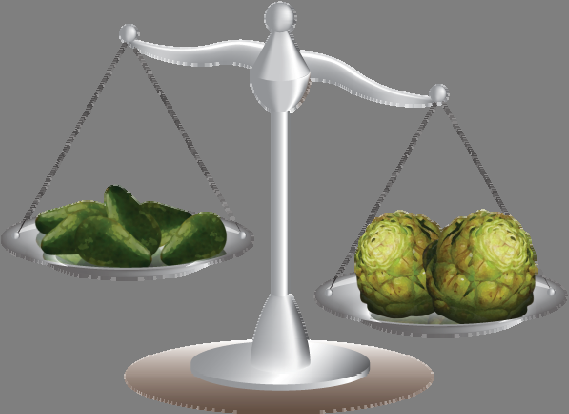
3 Objectives Understand the importance of Avogadro s Number Approximate the value of Avogadro s Number Introduction Avocados number: How many avocados and artichokes are there in a mole? A recipe calls for two avocados and two artichokes. Would you say that equal amounts of avocados and artichokes are used? The answer to that question depends on how you define the same amount. If you consider the quantity, yes, there are two of each. What if instead the recipe told you to use 250 grams of artichokes and avocados? There might be one and a half avocados used for every artichoke would you call this the same amount as well? One way to solve this problem would be to ask for more specific instructions. The phrase the same amount is being used to describe quantity (number) in one instance and mass in another. Similar situations come up in chemistry. If you are supposed to put the same mass of two different substances into a beaker, all you would have to do is weigh Figure 1: You can think of avocados and artichokes in this example as two different types of molecule each with a different molar mass. equal amounts using a scale. Things become more complicated, however, when the ratio of the total number of molecules or atoms is important in an experiment you might know the number of molecules in the reactants and products, but not the actual masses. How would you measure an exact number of NaCl molecules? The mole is an important unit in chemistry that you will use often. The modern definition of the mole is based around the carbon 12 ( 12 C) atom: 12 grams of 12 C is exactly one mole of substance. It turns out that 1 gram of 12 C has approximately 6.02 x individual atoms a value called Avogadro s Number after the chemist Amedeo Avogadro. The mole is a similar concept to a dozen: one mole of a substance will always have 6.02 x atoms or molecules. Atomic weight is a measurement of the mass of each element, and can be easily found on most periodic tables. Atoms that have a large number of protons and neutrons have more total mass than atoms with only a few protons and neutrons, and this difference is reflected by the atomic weight. Conveniently, the mole and atomic weight are defined so that one mole of a substance will have a mass equal to the atomic weight of that substance in grams. This number is called molar mass. For instance, the atomic weight of potassium (K) is This means that one mole of potassium will have a mass equal to grams. Calcium (Ca) is a larger atom than potassium, and has an atomic weight of One mole of calcium will have the same number of atoms as a mole of potassium, but the Calcium will weigh more due to its larger atomic weight. See the next lab for more detail on atomic weigh and atomic mass. So how do you measure 1 mole of NaCl? We know that this molecule is made up of one sodium ion and one chlorine ion (chloride). Looking up sodium (Na) on the Periodic Table tells you its atomic weight is 22.99, meaning it has a molar mass of g/mol. Chlorine, meanwhile, has a molar mass of g/mol. Since one mole of sodium chloride consists of one mole sodium ions and one mole chlorine ions, we can add these together to find the molecular mass of NaCl. 67
4 1 Na = g/mol + 1 Cl = g/mol g/mol of NaCl This is how to determine molar mass of a compound g NaCl 1 mol NaCl = grams NaCl 1 mol NaCl What if we weighed out 1.00 grams of NaCl how many molecules is this? We use the molar mass of NaCl, which we already know from above, to convert from mass to a number of moles. We can then use the fact that there are 6.02 x molecules in a mole to find the number of molecules NaCl in one gram: 23 1 mol NaCl molecules g NaCl = molecules NaCl g NaCl 1 mol NaCl Notice how the molar mass is inverted in the second term. The value is the same, but we flip the fraction so that the gram units cancel. You can go through and cross out the units that cancel to verify that the resulting units are molecules. You can use similar calculations to convert between mass, moles, and the number of molecules fairly easily. Through this lab procedure, we will determine the experimental value for Avogadro s number. You will float cinnamon, evenly distributed, on the surface of water in a Petri dish. The dishwashing liquid you will use in this Lab is about 1% sodium stearate, and a solution with a known concentration of the liquid will be dropped onto the water. The sodium stearate molecules will form a single layer and spread out, pushing the cinnamon toward the edges of the Petri dish, allowing the surface area to be determined. We will assume that each molecule takes up nm 2 of surface area, and that there is no space between the molecules. Pre lab Questions 1. How many grams of H 2 O do you need to weight out to have 1 mole of H 2 O? 68
5 2. How many molecules of water are there in one mole of H 2 O? 3. How many moles of H 2 O are there in 1.0 g of H 2 O? 4. How many molecules of H 2 O are there in 1.0 g of H 2 O? 69
6 Experiment: Avogadro s Number Materials Safety Equipment: Eye goggles, gloves Ground cinnamon Dishwashing liquid Dropper Petri dish (bottom) Ruler 100 ml Graduated cylinder 10 ml Graduated cylinder Stirring rod 50 ml beaker Wash bottle Distilled water* *You must provide Procedure Part 1: Preparing the Sodium Stearate Solution 1. Measure exactly 1.50 ml of dishwashing liquid into a 10 ml graduated cylinder. 2. Fill a wash bottle with distilled water. Gently rinse the 1.50 ml of dishwashing liquid with distilled water and pour it into a 100 ml graduated cylinder. Rinse the 10 ml graduated cylinder several times to make sure all the dishwashing liquid has been transferred to the 100 ml graduated cylinder. HINT: Try not to create suds. 3. Add enough additional distilled water to get to the ml. 4. Gently stir the solution with a stirring rod until it is mixed well. Part 2: Calibrating a Dropper 1. Fill a 50 ml beaker half full with distilled water. Use your dropper to fill a 10 ml graduated cylinder to 1.00 ml with water. HINT: Make sure the 10 ml graduated cylinder is clean of dishwashing liquid. 2. Next, draw up water from the 50 ml beaker into the dropper. Add water dropwise into the graduated cylinder. Hold the dropper consistently at a 45 o angle and drop at a rate of about one drop per second. Count the drops it takes to reach the 2.00 ml mark. HINT: It should take about 25 drops. If you feel that your measurement is incorrect, repeat until you achieve consistent readings. 3. Record in the Data section the number of the drops it takes to add 1 ml water to the graduated cylinder. 4. Repeat calibration for a second trial, and record the number of drops in the Data section. Average the two results. Part 3: Calculating the Number of Molecules 1. Rinse and then fill a petri dish with 20 ml distilled water. Allow the water to settle and remain motionless. 2. Lightly sprinkle cinnamon onto the surface of the water in the Petri dish. HINT: Add just enough to barely cover the water. 70
7 3. Draw up the dishwashing liquid solution with the calibrated dropper. Hold the dropper at a 45 o angle about 1 inch above the center of the Petri dish. Slowly deliver one drop of the solution. HINT: A clear circle should form, spreading the cinnamon outward. 4. Quickly use a ruler to measure the diameter of the cleared circle in cm. 5. Record the diameter in the Data section. Wash out the Petri dish. Data Part 2: Calibrating a Dropper 1. The number of drops in 1 ml water (drops used to move from the 1.00 ml to 2.00 ml mark): Trial 1: Trial 2: 2. The number of drops on average per one milliliter: Part 3: Calculating the Number of Molecules 1. The diameter of the circle formed (cm): Calculations 1. Calculate the surface area of the circle formed ( πd 2 /4 ) : Surface area = 2. Calculate the number of molecules on the top layer. We must convert the surface area in centimeters squared to nanometers squared and then multiply that by the surface area of a sodium stearate molecule. Convert the surface area of the circle formed (#1) to molecules per layer: Top layer SA (Question 1) cm 2 1 m 2 1 x nm 2 1 molecule 10,000 cm 2 1 m nm 2 = molecules top layer 71
8 3. Calculate the concentration of grams of sodium stearate per milliliter of diluted solution. To do this, multiply the concentration of sodium stearate in the dishwashing liquid by the dilution of the solution (1.50 ml dishwashing liquid per 100 ml solution). 1 g sodium stearate 1.50 ml dish liquid 100 ml dish liquid 100 ml diluted solution = g /ml 4. Calculate the number of moles of sodium stearate in a single layer. To do this, first take the number of drops used to achieve the monolayer (1 drop) and convert it to ml using the calibrated number of drops per ml. Then multiply the number of grams of sodium stearate per milliliter of solution. Finally, convert to moles through the molar mass of sodium stearate. HINT: The molar mass of sodium stearate is g/mol. 1 drop (added to dish) 1 ml dish liquid solution g sodium stearate (from #3 calculation) 1 mol top layer drops (avg # calibrated per ml from Data Part 2) 1 ml dish liquid solution g (molar mass of sodium stearate) = mol / top layer 5. Finally, we can calculate the Avogadro s number through the comparison of molecules of sodium stearate in the top single layer to the moles of sodium stearate in the monolayer. Avogadro s number (experimental) = # molecules / top layer (#2) # moles / top layer (#4) = molecules mole 72
9 Post lab Questions 1. Why do you think that Avogadro s number, 6.02 x 10 23, was probably not the exact number you obtained? Was your experimental value close to the actual value (i.e., was your experimental value on the order of molecules)? 2. How many moles are in g of methane (CH 4 )? 3. How many moles are in 1,000,000,000 molecules of H 2 0 2? 4. What is the mass in grams of 1,000,000,000 (10 9 ) molecules of H 2 O 2? 73
10
Element of same atomic number, but different atomic mass o Example: Hydrogen
 Atomic mass: p + = protons; e - = electrons; n 0 = neutrons p + + n 0 = atomic mass o For carbon-12, 6p + + 6n 0 = atomic mass of 12.0 o For chlorine-35, 17p + + 18n 0 = atomic mass of 35.0 atomic mass
Determination of a Chemical Formula
 1 Determination of a Chemical Formula Introduction Molar Ratios Elements combine in fixed ratios to form compounds. For example, consider the compound TiCl 4 (titanium chloride). Each molecule of TiCl
2 The Structure of Atoms
 CHAPTER 4 2 The Structure of Atoms SECTION Atoms KEY IDEAS As you read this section, keep these questions in mind: What do atoms of the same element have in common? What are isotopes? How is an element
Chemical Calculations: The Mole Concept and Chemical Formulas. AW Atomic weight (mass of the atom of an element) was determined by relative weights.
 1 Introduction to Chemistry Atomic Weights (Definitions) Chemical Calculations: The Mole Concept and Chemical Formulas AW Atomic weight (mass of the atom of an element) was determined by relative weights.
Chemical Calculations: Formula Masses, Moles, and Chemical Equations
 Chemical Calculations: Formula Masses, Moles, and Chemical Equations Atomic Mass & Formula Mass Recall from Chapter Three that the average mass of an atom of a given element can be found on the periodic
What s in a Mole? Molar Mass
 LESSON 10 What s in a Mole? Molar Mass OVERVIEW Key Ideas Lesson Type Lab: Groups of 4 Chemists compare moles of substances rather than masses because moles are a way of counting atoms. When considering
Calculating Atoms, Ions, or Molecules Using Moles
 TEKS REVIEW 8B Calculating Atoms, Ions, or Molecules Using Moles TEKS 8B READINESS Use the mole concept to calculate the number of atoms, ions, or molecules in a sample TEKS_TXT of material. Vocabulary
EXPERIMENT 12: Empirical Formula of a Compound
 EXPERIMENT 12: Empirical Formula of a Compound INTRODUCTION Chemical formulas indicate the composition of compounds. A formula that gives only the simplest ratio of the relative number of atoms in a compound
The Empirical Formula of a Compound
 The Empirical Formula of a Compound Lab #5 Introduction A look at the mass relationships in chemistry reveals little order or sense. The ratio of the masses of the elements in a compound, while constant,
How much does a single atom weigh? Different elements weigh different amounts related to what makes them unique.
 How much does a single atom weigh? Different elements weigh different amounts related to what makes them unique. What units do we use to define the weight of an atom? amu units of atomic weight. (atomic
Chapter 4. Chemical Composition. Chapter 4 Topics H 2 S. 4.1 Mole Quantities. The Mole Scale. Molar Mass The Mass of 1 Mole
 Chapter 4 Chemical Composition Chapter 4 Topics 1. Mole Quantities 2. Moles, Masses, and Particles 3. Determining Empirical Formulas 4. Chemical Composition of Solutions Copyright The McGraw-Hill Companies,
The Mole Notes. There are many ways to or measure things. In Chemistry we also have special ways to count and measure things, one of which is the.
 The Mole Notes I. Introduction There are many ways to or measure things. In Chemistry we also have special ways to count and measure things, one of which is the. A. The Mole (mol) Recall that atoms of
Honors Chemistry: Unit 6 Test Stoichiometry PRACTICE TEST ANSWER KEY Page 1. A chemical equation. (C-4.4)
 Honors Chemistry: Unit 6 Test Stoichiometry PRACTICE TEST ANSWER KEY Page 1 1. 2. 3. 4. 5. 6. Question What is a symbolic representation of a chemical reaction? What 3 things (values) is a mole of a chemical
Matter. Atomic weight, Molecular weight and Mole
 Matter Atomic weight, Molecular weight and Mole Atomic Mass Unit Chemists of the nineteenth century realized that, in order to measure the mass of an atomic particle, it was useless to use the standard
Unit 2: Quantities in Chemistry
 Mass, Moles, & Molar Mass Relative quantities of isotopes in a natural occurring element (%) E.g. Carbon has 2 isotopes C-12 and C-13. Of Carbon s two isotopes, there is 98.9% C-12 and 11.1% C-13. Find
The Mole Concept and Atoms
 Copyright The McGraw-Hill Companies, Inc. Permission required for reproduction or display. Chapter 4 24 September 2013 Calculations and the Chemical Equation The Mole Concept and Atoms Atoms are exceedingly
A dozen. Molar Mass. Mass of atoms
 A dozen Molar Mass Science 10 is a number of objects. A dozen eggs, a dozen cars, and a dozen people are all 12 objects. But a dozen cars has a much greater mass than a dozen eggs because the mass of each
1. How many hydrogen atoms are in 1.00 g of hydrogen?
 MOLES AND CALCULATIONS USING THE MOLE CONCEPT INTRODUCTORY TERMS A. What is an amu? 1.66 x 10⁻²⁴ g B. We need a conversion to the macroscopic world. 1. How many hydrogen atoms are in 1.00 g of hydrogen?
EXPERIMENT 7 Reaction Stoichiometry and Percent Yield
 EXPERIMENT 7 Reaction Stoichiometry and Percent Yield INTRODUCTION Stoichiometry calculations are about calculating the amounts of substances that react and form in a chemical reaction. The word stoichiometry
Stoichiometry Limiting Reagent Laboratory. Chemistry 118 Laboratory University of Massachusetts, Boston
 Chemistry 118 Laboratory University of Massachusetts, Boston STOICHIOMETRY - LIMITING REAGENT --------------------------------------------------------------------------------------------------------------------------------------------
Tuesday, November 27, 2012 Expectations:
 Tuesday, November 27, 2012 Expectations: Sit in assigned seat Get out Folder, Notebook, Periodic Table Have out: Spiral (notes), Learning Target Log (new) No Backpacks on tables Listen/Pay Attention Learning
Chapter 3: Stoichiometry
 Chapter 3: Stoichiometry Key Skills: Balance chemical equations Predict the products of simple combination, decomposition, and combustion reactions. Calculate formula weights Convert grams to moles and
Formulas, Equations and Moles
 Chapter 3 Formulas, Equations and Moles Interpreting Chemical Equations You can interpret a balanced chemical equation in many ways. On a microscopic level, two molecules of H 2 react with one molecule
Experiment 8: Chemical Moles: Converting Baking Soda to Table Salt
 Experiment 8: Chemical Moles: Converting Baking Soda to Table Salt What is the purpose of this lab? We want to develop a model that shows in a simple way the relationship between the amounts of reactants
Properties of Acids and Bases
 Lab 22 Properties of Acids and Bases TN Standard 4.2: The student will investigate the characteristics of acids and bases. Have you ever brushed your teeth and then drank a glass of orange juice? What
The Mole. 6.022 x 10 23
 The Mole 6.022 x 10 23 Background: atomic masses Look at the atomic masses on the periodic table. What do these represent? E.g. the atomic mass of Carbon is 12.01 (atomic # is 6) We know there are 6 protons
Stoichiometry Limiting Reagent Laboratory. Chemistry 118 Laboratory University of Massachusetts, Boston
 Chemistry 118 Laboratory University of Massachusetts, Boston STOICHIOMETRY - LIMITING REAGENT -----------------------------------------------------------------------------------------------------------------------------
Ch. 10 The Mole I. Molar Conversions
 Ch. 10 The Mole I. Molar Conversions I II III IV A. What is the Mole? A counting number (like a dozen) Avogadro s number (N A ) 1 mole = 6.022 10 23 representative particles B. Mole/Particle Conversions
Chemical Composition Review Mole Calculations Percent Composition. Copyright Cengage Learning. All rights reserved. 8 1
 Chemical Composition Review Mole Calculations Percent Composition Copyright Cengage Learning. All rights reserved. 8 1 QUESTION Suppose you work in a hardware store and a customer wants to purchase 500
Name Date Class CHEMICAL QUANTITIES. SECTION 10.1 THE MOLE: A MEASUREMENT OF MATTER (pages 287 296)
 Name Date Class 10 CHEMICAL QUANTITIES SECTION 10.1 THE MOLE: A MEASUREMENT OF MATTER (pages 287 296) This section defines the mole and explains how the mole is used to measure matter. It also teaches
Moles Lab mole. 1 mole = 6.02 x 10²³. This is also known as Avagadro's number Demo amu amu amu
 Moles I. Lab: Rice Counting II. Counting atoms and molecules I. When doing reactions chemists need to count atoms and molecules. The problem of actually counting individual atoms and molecules comes from
Study Guide For Chapter 7
 Name: Class: Date: ID: A Study Guide For Chapter 7 Multiple Choice Identify the choice that best completes the statement or answers the question. 1. The number of atoms in a mole of any pure substance
10 The Mole. Section 10.1 Measuring Matter
 Name Date Class The Mole Section.1 Measuring Matter In your textbook, read about counting particles. In Column B, rank the quantities from Column A from smallest to largest. Column A Column B 0.5 mol 1.
Unit 3 Notepack Chapter 7 Chemical Quantities Qualifier for Test
 Unit 3 Notepack Chapter 7 Chemical Quantities Qualifier for Test NAME Section 7.1 The Mole: A Measurement of Matter A. What is a mole? 1. Chemistry is a quantitative science. What does this term mean?
SYMBOLS, FORMULAS AND MOLAR MASSES
 SYMBOLS, FORMULAS AND MOLAR MASSES OBJECTIVES 1. To correctly write and interpret chemical formulas 2. To calculate molecular weights from chemical formulas 3. To calculate moles from grams using chemical
Balance the following equation: KClO 3 + C 12 H 22 O 11 KCl + CO 2 + H 2 O
 Balance the following equation: KClO 3 + C 12 H 22 O 11 KCl + CO 2 + H 2 O Ans: 8 KClO 3 + C 12 H 22 O 11 8 KCl + 12 CO 2 + 11 H 2 O 3.2 Chemical Symbols at Different levels Chemical symbols represent
IB Chemistry. DP Chemistry Review
 DP Chemistry Review Topic 1: Quantitative chemistry 1.1 The mole concept and Avogadro s constant Assessment statement Apply the mole concept to substances. Determine the number of particles and the amount
Name Date Class CHEMICAL QUANTITIES. SECTION 10.1 THE MOLE: A MEASUREMENT OF MATTER (pages 287 296)
 10 CHEMICAL QUANTITIES SECTION 10.1 THE MOLE: A MEASUREMENT OF MATTER (pages 287 296) This section defines the mole and explains how the mole is used to measure matter. It also teaches you how to calculate
Topic 4 National Chemistry Summary Notes. Formulae, Equations, Balancing Equations and The Mole
 Topic 4 National Chemistry Summary Notes Formulae, Equations, Balancing Equations and The Mole LI 1 The chemical formula of a covalent molecular compound tells us the number of atoms of each element present
Recovery of Elemental Copper from Copper (II) Nitrate
 Recovery of Elemental Copper from Copper (II) Nitrate Objectives: Challenge: Students should be able to - recognize evidence(s) of a chemical change - convert word equations into formula equations - perform
CALCULATING THE SIZE OF AN ATOM
 Ch 100: Fundamentals of Chemistry 1 CALCULATING THE SIZE OF AN ATOM Introduction: The atom is so very small that only highly sophisticated instruments are able to measure its dimensions. In this experiment
Calculation of Molar Masses. Molar Mass. Solutions. Solutions
 Molar Mass Molar mass = Mass in grams of one mole of any element, numerically equal to its atomic weight Molar mass of molecules can be determined from the chemical formula and molar masses of elements
MOLES, MOLECULES, FORMULAS. Part I: What Is a Mole And Why Are Chemists Interested in It?
 NAME PARTNERS SECTION DATE_ MOLES, MOLECULES, FORMULAS This activity is designed to introduce a convenient unit used by chemists and to illustrate uses of the unit. Part I: What Is a Mole And Why Are Chemists
Chemical Composition. Introductory Chemistry: A Foundation FOURTH EDITION. Atomic Masses. Atomic Masses. Atomic Masses. Chapter 8
 Introductory Chemistry: A Foundation FOURTH EDITION by Steven S. Zumdahl University of Illinois Chemical Composition Chapter 8 1 2 Atomic Masses Balanced equation tells us the relative numbers of molecules
Chapter 1: Moles and equations. Learning outcomes. you should be able to:
 Chapter 1: Moles and equations 1 Learning outcomes you should be able to: define and use the terms: relative atomic mass, isotopic mass and formula mass based on the 12 C scale perform calculations, including
Lecture Topics Atomic weight, Mole, Molecular Mass, Derivation of Formulas, Percent Composition
 Mole Calculations Chemical Equations and Stoichiometry Lecture Topics Atomic weight, Mole, Molecular Mass, Derivation of Formulas, Percent Composition Chemical Equations and Problems Based on Miscellaneous
Mole Notes.notebook. October 29, 2014
 1 2 How do chemists count atoms/formula units/molecules? How do we go from the atomic scale to the scale of everyday measurements (macroscopic scale)? The gateway is the mole! But before we get to the
Chemistry 65 Chapter 6 THE MOLE CONCEPT
 THE MOLE CONCEPT Chemists find it more convenient to use mass relationships in the laboratory, while chemical reactions depend on the number of atoms present. In order to relate the mass and number of
HOW TO MAKE STANDARD SOLUTIONS FOR CHEMISTRY
 HOW TO MAKE STANDARD SOLUTIONS FOR CHEMISTRY Phillip Bigelow Chemists make two common types of "standard solutions": Molar solutions Normal solutions Both of these solutions are concentrations (or strengths
Description of the Mole Concept:
 Description of the Mole Concept: Suppose you were sent into the store to buy 36 eggs. When you picked them up you would get 3 boxes, each containing 12 eggs. You just used a mathematical device, called
Performing Calculatons
 Performing Calculatons There are three basic units for measurement in the organic laboratory mass, volume, and number, measured in moles. Most of the other types of measurements are combinations of them,
The Mole Concept. The Mole. Masses of molecules
 The Mole Concept Ron Robertson r2 c:\files\courses\1110-20\2010 final slides for web\mole concept.docx The Mole The mole is a unit of measurement equal to 6.022 x 10 23 things (to 4 sf) just like there
Essential Maths for Medics and Vets Reference Materials Module 2. Amount and Concentration.
 2 Amount and concentration: making and diluting solutions 2 Amount and concentration; making and diluting solutions... 2A Rationale... 2B Distinguishing between amount and concentration, g and %w/v...
11-1 Stoichiometry. Represents
 11-1 Stoichiometry What is stoichiometry? Calculations that relate the quantities of substances. It is the study of quantitative (measurable amounts) relationships in chemical reactions and equations.
U3-LM2B-WS Molar Mass and Conversions
 U3-LM2B-WS Molar Mass and Conversions Name: KEY 1. The molar mass of chlorine is: 2 x 35.45 g/mol Cl = 70.90 g/mol Cl 2 (Remember that chlorine exists as a diatomic molecule in nature) 2. The molar mass
Stoichiometry. Lecture Examples Answer Key
 Stoichiometry Lecture Examples Answer Key Ex. 1 Balance the following chemical equations: 3 NaBr + 1 H 3 PO 4 3 HBr + 1 Na 3 PO 4 2 C 3 H 5 N 3 O 9 6 CO 2 + 3 N 2 + 5 H 2 O + 9 O 2 2 Ca(OH) 2 + 2 SO 2
General Chemistry I (FC, 09-10) Lab #3: The Empirical Formula of a Compound. Introduction
 General Chemistry I (FC, 09-10) Introduction A look at the mass relationships in chemistry reveals little order or sense. The ratio of the masses of the elements in a compound, while constant, does not
Amount of Substance. http://www.avogadro.co.uk/definitions/elemcompmix.htm
 Page 1 of 14 Amount of Substance Key terms in this chapter are: Element Compound Mixture Atom Molecule Ion Relative Atomic Mass Avogadro constant Mole Isotope Relative Isotopic Mass Relative Molecular
Chapter 3. Chemical Reactions and Reaction Stoichiometry. Lecture Presentation. James F. Kirby Quinnipiac University Hamden, CT
 Lecture Presentation Chapter 3 Chemical Reactions and Reaction James F. Kirby Quinnipiac University Hamden, CT The study of the mass relationships in chemistry Based on the Law of Conservation of Mass
Getting the most from this book...4 About this book...5
 Contents Getting the most from this book...4 About this book....5 Content Guidance Topic 1 Atomic structure and the periodic table...8 Topic 2 Bonding and structure...14 Topic 2A Bonding....14 Topic 2B
Unit 6 The Mole Concept
 Chemistry Form 3 Page 62 Ms. R. Buttigieg Unit 6 The Mole Concept See Chemistry for You Chapter 28 pg. 352-363 See GCSE Chemistry Chapter 5 pg. 70-79 6.1 Relative atomic mass. The relative atomic mass
Evaluation copy. Titration of a Diprotic Acid: Identifying an Unknown. Computer
 Titration of a Diprotic Acid: Identifying an Unknown Computer 25 A diprotic acid is an acid that yields two H + ions per acid molecule. Examples of diprotic acids are sulfuric acid, H 2 SO 4, and carbonic
Name: Chemistry 117 Laboratory University of Massachusetts Boston AVOGADRO S NUMBER
 Name: Chemistry 117 Laboratory University of Massachusetts Boston AVOGADRO S NUMBER LEARNING GOALS: 1. Obtain practice with calculation using volume, mass, moles and molecules to calculate density, concentration,
Chapter 8 How to Do Chemical Calculations
 Chapter 8 How to Do Chemical Calculations Chemistry is both a qualitative and a quantitative science. In the laboratory, it is important to be able to measure quantities of chemical substances and, as
Chem 31 Fall 2002. Chapter 3. Stoichiometry: Calculations with Chemical Formulas and Equations. Writing and Balancing Chemical Equations
 Chem 31 Fall 2002 Chapter 3 Stoichiometry: Calculations with Chemical Formulas and Equations Writing and Balancing Chemical Equations 1. Write Equation in Words -you cannot write an equation unless you
Solubility Curve of Sugar in Water
 Solubility Curve of Sugar in Water INTRODUCTION Solutions are homogeneous mixtures of solvents (the larger volume of the mixture) and solutes (the smaller volume of the mixture). For example, a hot chocolate
ACID-BASE TITRATIONS: DETERMINATION OF CARBONATE BY TITRATION WITH HYDROCHLORIC ACID BACKGROUND
 #3. Acid - Base Titrations 27 EXPERIMENT 3. ACID-BASE TITRATIONS: DETERMINATION OF CARBONATE BY TITRATION WITH HYDROCHLORIC ACID BACKGROUND Carbonate Equilibria In this experiment a solution of hydrochloric
Organic Chemistry Calculations
 Organic Chemistry Calculations There are three basic units for measurement in the organic laboratory mass, volume, and number, measured in moles. Most of the other types of measurements are combinations
We know from the information given that we have an equal mass of each compound, but no real numbers to plug in and find moles. So what can we do?
 How do we figure this out? We know that: 1) the number of oxygen atoms can be found by using Avogadro s number, if we know the moles of oxygen atoms; 2) the number of moles of oxygen atoms can be found
F321 MOLES. Example If 1 atom has a mass of 1.241 x 10⁻²³ g 1 mole of atoms will have a mass of 1.241 x 10-23 g x 6.02 x 10 23 = 7.
 Moles 1 MOLES The mole the standard unit of amount of a substance (mol) the number of particles in a mole is known as Avogadro s constant (N A ) Avogadro s constant has a value of 6.02 x 10 23 mol -1.
Stoichiometry. What is the atomic mass for carbon? For zinc?
 Stoichiometry Atomic Mass (atomic weight) Atoms are so small, it is difficult to discuss how much they weigh in grams We use atomic mass units an atomic mass unit (AMU) is one twelfth the mass of the catbon-12
= 16.00 amu. = 39.10 amu
 Using Chemical Formulas Objective 1: Calculate the formula mass or molar mass of any given compound. The Formula Mass of any molecule, formula unit, or ion is the sum of the average atomic masses of all
Freezing Point Depression: Why Don t Oceans Freeze? Teacher Advanced Version
 Freezing Point Depression: Why Don t Oceans Freeze? Teacher Advanced Version Freezing point depression describes the process where the temperature at which a liquid freezes is lowered by adding another
Acid Base Titrations
 Acid Base Titrations Introduction A common question chemists have to answer is how much of something is present in a sample or a product. If the product contains an acid or base, this question is usually
4.4 Calculations Involving the Mole Concept
 44 Section 43 Questions 1 Define Avogadro s constant, and explain its significance in quantitative analysis 2 Distinguish between the terms atomic mass and molar mass 3 Calculate the mass of a molecule
Chemical Equations & Stoichiometry
 Chemical Equations & Stoichiometry Chapter Goals Balance equations for simple chemical reactions. Perform stoichiometry calculations using balanced chemical equations. Understand the meaning of the term
Neutralizing an Acid and a Base
 Balancing Act Teacher Information Objectives In this activity, students neutralize a base with an acid. Students determine the point of neutralization of an acid mixed with a base while they: Recognize
Part One: Mass and Moles of Substance. Molecular Mass = sum of the Atomic Masses in a molecule
 CHAPTER THREE: CALCULATIONS WITH CHEMICAL FORMULAS AND EQUATIONS Part One: Mass and Moles of Substance A. Molecular Mass and Formula Mass. (Section 3.1) 1. Just as we can talk about mass of one atom of
Ascorbic Acid Titration of Vitamin C Tablets This lab will be completed individually! Make sure you come prepared!
 Ascorbic Acid Titration of Vitamin C Tablets This lab will be completed individually! Make sure you come prepared! Introduction Vitamin C (also known as ascorbic acid, HC6H7O6) is a necessary ingredient
Analyzing the Acid in Vinegar
 Analyzing the Acid in Vinegar Purpose: This experiment will analyze the percentage of acetic acid in store bought vinegar using titration. Introduction: Vinegar can be found in almost any home. It can
Lecture 3: (Lec3A) Atomic Theory
 Lecture 3: (Lec3A) Atomic Theory Mass of Atoms Sections (Zumdahl 6 th Edition) 3.1-3.4 The Concept of the Mole Outline: The mass of a mole of atoms and the mass of a mole of molecules The composition of
MOLECULAR MASS AND FORMULA MASS
 1 MOLECULAR MASS AND FORMULA MASS Molecular mass = sum of the atomic weights of all atoms in the molecule. Formula mass = sum of the atomic weights of all atoms in the formula unit. 2 MOLECULAR MASS AND
experiment5 Understanding and applying the concept of limiting reagents. Learning how to perform a vacuum filtration.
 81 experiment5 LECTURE AND LAB SKILLS EMPHASIZED Synthesizing an organic substance. Understanding and applying the concept of limiting reagents. Determining percent yield. Learning how to perform a vacuum
Ch. 6 Chemical Composition and Stoichiometry
 Ch. 6 Chemical Composition and Stoichiometry The Mole Concept [6.2, 6.3] Conversions between g mol atoms [6.3, 6.4, 6.5] Mass Percent [6.6, 6.7] Empirical and Molecular Formula [6.8, 6.9] Bring your calculators!
Calculations with Chemical Formulas and Equations
 Chapter 3 Calculations with Chemical Formulas and Equations Concept Check 3.1 You have 1.5 moles of tricycles. a. How many moles of seats do you have? b. How many moles of tires do you have? c. How could
CHEMICAL FORMULAS AND FORMULA WEIGHT CALCULATIONS
 CHEMICAL FORMULAS AND FORMULA WEIGHT CALCULATIONS 1. THE MEANING OF A CHEMICAL FORMULA A chemical formula is a shorthand method of representing the elements in a compound. The formula shows the formulas
20.2 Chemical Equations
 All of the chemical changes you observed in the last Investigation were the result of chemical reactions. A chemical reaction involves a rearrangement of atoms in one or more reactants to form one or more
Chemical formulae are used as shorthand to indicate how many atoms of one element combine with another element to form a compound.
 29 Chemical Formulae Chemical formulae are used as shorthand to indicate how many atoms of one element combine with another element to form a compound. C 2 H 6, 2 atoms of carbon combine with 6 atoms of
PART I: PREPARATION OF SOLUTIONS AND STANDARDIZATION OF A BASE
 TITRATION: STANDARDIZATION OF A BASE AND ANALYSIS OF STOMACH ANTACID TABLETS 2009, 1996, 1973 by David A. Katz. All rights reserved. Reproduction permitted for education use provided original copyright
DETERMINING THE ENTHALPY OF FORMATION OF CaCO 3
 DETERMINING THE ENTHALPY OF FORMATION OF CaCO 3 Standard Enthalpy Change Standard Enthalpy Change for a reaction, symbolized as H 0 298, is defined as The enthalpy change when the molar quantities of reactants
CHAPTER 3 Calculations with Chemical Formulas and Equations. atoms in a FORMULA UNIT
 CHAPTER 3 Calculations with Chemical Formulas and Equations MOLECULAR WEIGHT (M. W.) Sum of the Atomic Weights of all atoms in a MOLECULE of a substance. FORMULA WEIGHT (F. W.) Sum of the atomic Weights
CHEMICAL FORMULA COEFFICIENTS AND SUBSCRIPTS. Chapter 3: Molecular analysis 3O 2 2O 3
 Chapter 3: Molecular analysis Read: BLB 3.3 3.5 H W : BLB 3:21a, c, e, f, 25, 29, 37,49, 51, 53 Supplemental 3:1 8 CHEMICAL FORMULA Formula that gives the TOTAL number of elements in a molecule or formula
Molar Mass Worksheet Answer Key
 Molar Mass Worksheet Answer Key Calculate the molar masses of the following chemicals: 1) Cl 2 71 g/mol 2) KOH 56.1 g/mol 3) BeCl 2 80 g/mol 4) FeCl 3 162.3 g/mol 5) BF 3 67.8 g/mol 6) CCl 2 F 2 121 g/mol
Carolina s Solution Preparation Manual
 84-1201 Carolina s Solution Preparation Manual Instructions Carolina Biological Supply Company has created this reference manual to enable you to prepare solutions. Although many types of solutions may
Unit 7 Stoichiometry. Chapter 12
 Unit 7 Stoichiometry Chapter 12 Objectives 7.1 use stoichiometry to determine the amount of substance in a reaction 7.2 determine the limiting reactant of a reaction 7.3 determine the percent yield of
Chem 115 POGIL Worksheet - Week 4 Moles & Stoichiometry
 Chem 115 POGIL Worksheet - Week 4 Moles & Stoichiometry Why? Chemists are concerned with mass relationships in chemical reactions, usually run on a macroscopic scale (grams, kilograms, etc.). To deal with
AS1 MOLES. oxygen molecules have the formula O 2 the relative mass will be 2 x 16 = 32 so the molar mass will be 32g mol -1
 Moles 1 MOLES The mole the standard unit of amount of a substance the number of particles in a mole is known as Avogadro s constant (L) Avogadro s constant has a value of 6.023 x 10 23 mol -1. Example
Volumetric Analysis. Lecture 5 Experiment 9 in Beran page 109 Prelab = Page 115
 Volumetric Analysis Lecture 5 Experiment 9 in Beran page 109 Prelab = Page 115 Experimental Aims To prepare and standardize (determine concentration) a NaOH solution Using your standardized NaOH calculate
ATOMS. Multiple Choice Questions
 Chapter 3 ATOMS AND MOLECULES Multiple Choice Questions 1. Which of the following correctly represents 360 g of water? (i) 2 moles of H 2 0 (ii) 20 moles of water (iii) 6.022 10 23 molecules of water (iv)
Chapter 5, Lesson 3 Why Does Water Dissolve Salt?
 Chapter 5, Lesson 3 Why Does Water Dissolve Salt? Key Concepts The polarity of water molecules enables water to dissolve many ionically bonded substances. Salt (sodium chloride) is made from positive sodium