
Earned Value Management System (EVMS) Manual. System Description and Implementing Procedures
|
|
|
- Jessie Page
- 10 years ago
- Views:
Transcription
1 Manual System Description and Implementing Procedures

2 Manual System Description and Implementing Procedures Contact Information This document is maintained, updated, and formally revised electronically on the Pacific Northwest National Laboratory (PNNL) internal Earned Value Management System website. Therefore, hard copies of this document do not necessarily represent the latest version. For information concerning the contents of this document, please contact: Craig Whiteley, Manager Project Controls Group Pacific Northwest National Laboratory Richland, WA This manual is presented in two parts. Part I is the Systems Description that provides an overview of the EVMS, establishes requirements for its use, defines system components, and describes the interface between these components. Part II contains procedures for implementing and performing the EVMS component processes described in Part I. Attachment A includes a table documenting where each of the thirty-two Earned Value criteria contained in the American National Standards Institute Electronic Industries Alliance (ANSI/EIA)-748 EVMS standard are addressed in this manual. October 2006 PACIFIC NORTHWEST NATIONAL LABORATORY operated by BATTELLE for the UNITED STATES DEPARTMENT OF ENERGY under Contract DE-AC05-76RL01830

3
4 Change Log Earned Value Management System Document Change Log Revision No. Date Change Description Pages Changed 0 11/01/2006 Original Document All Originals 1 3/19/2007 Clarified annual update of the Estimate at Completion in section Removed project specific reference to WBS shown in Figure ii

5 Contents Contents Signature Page... i Change Log...ii Part I System Description 1.0 Introduction PNNL Corporate Policy Statements and EVMS Principles Purpose and Objective Tailoring the EVMS Process EVMS Characteristics DOE Order 413.3A Critical Decision Process Organization Establishing the Work Breakdown Structure WBS Levels WBS Requirements WBS Dictionary Assigning Program Organizational Responsibility Control Accounts Work Packages / Planning Packages Project Execution Plan (PEP) Responsibility Assignment Matrix (RAM) Training Requirements Planning, Scheduling, and Budgeting Baseline Development Process Risk Management Technical Baseline Planning and Baseline Schedule Project Summary Schedule Integrated Project Schedule Contractor Detail Planning Vertical and Horizontal Traceability Critical Path Schedule Contingency Cost Estimating and Baseline Budget Cost Estimating Baseline Budget Overhead Budgets Contingency / Management Reserve Contingency Development Contingency Allocation Contingency Control Management Reserve iii

6 Contents 3.7 Work Authorization Integrated Performance Measurement Baseline Performance Baseline Reviews Accounting Considerations PNNL Financial System Direct Costs Indirect Costs Burdened Costs Material Accounting Funds Management Analysis and Management Reports Performance Measurement Schedule Status Earned Value Techniques Performance Analysis Schedule Variance (SV) Cost Variance (CV) Estimate at Completion (EAC) Variance at Completion (VAC) Performance Measurement EVMS Metrics Performance Reporting Monthly Status Report Variance Analysis Report (VAR) Revisions and Data Maintenance Baseline Change Control (BCC) Baseline Change Control Procedure, Thresholds and Approvals External/Internal Changes Externally Directed Changes Internal Changes or Internal Replanning Baseline Change Request (BCR) Levels Baseline Change Request Preparation Baseline Change Implementation and Traceability Data Maintenance Surveillance EVMS Responsibilities Self-Assessment Management Surveillance References Attachment A - Acronyms and Glossary... A.1 Attachment B ANSI/EIA-748 EVMS Requirements Matrix... B.1 Figures Figure 1.1. PNNL Project Management Processes Figure 1.2. PNNL Project Planning and Control System Figure 1.3. DOE Project Acquisition Process and Critical Decisions (Taken from DOE Order 413.3A, July 2006) iv

7 Contents Figure 2.1. Work Breakdown Structure for a PNNL Line Item Construction Project Figure 2.2. Management and Control Points Figure 2.3. Example of a Control Account Responsibility Assignment Matrix (RAM) Figure 2.4. Example of a Responsibility Matrix Figure 3.1. Horizontal and Vertical Schedule Traceability Figure 3.2. Project Baseline Budget Hierarchy Figure 4.1. Total Project Cost Elements Figure 5.1. Key EVMS Performance Measurement Metrics Figure 6.1. BCR Process Flow and Levels of Endorsement and Approval Authority Figure 6.2. PNNL Below Level 3 Change Process Tables Table 1.1. PNNL Perspective on the five (5) ANSI EVMS Guideline Categories Table 3.1. Technical Baseline Evolution Table 5.1. Suggested Performance Variance Threshold Limits Table 6.1. Baseline Change Control Threshold and Approval Levels Part II Earned Value Management System Implementing Procedures Organization and Work Definition... EVMS-P-1 Planning and Baseline Schedule Development... EVMS-P-2 Baseline Budget Development... EVMS-P-3 Work Authorization and Funds Management... EVMS-P-4 Financial Processing... EVMS-P-5 Performance Analysis and Management Reporting... EVMS-P-6 Baseline Change Control... EVMS-P-7 Surveillance Guide... EVMS-P-8 v

8 Manual PART I SYSTEM DESCRIPTION

9 Chapter 1 - Introduction 1.0 Introduction This manual provides the requirements, procedures, authorities, and responsibilities for implementing an on PNNL projects requiring U.S. Department of Energy (DOE) Order 413.3A, Program and Project Management for the Acquisition of Capital Assets. This manual also applies to large and/or high risk projects in which PNNL management determines that EVMS project management controls are necessary. The assigned PNNL Project Manager has the primary responsibility for implementing the EVMS and for ensuring projects are planned and executed consistent with the requirements and processes defined in this manual. PNNL Project Manager Roles, Responsibilities, Accountabilities and Authorities (R 2 A 2 ) are defined in PNNL s Standards-Based Management System (SBMS). The PNNL Project Controls Group Manager has the primary responsibility for maintaining the EVM system and maintaining interfaces with existing PNNL business and management systems. 1.1 PNNL Corporate Policy Statements and EVMS Principles PNNL is committed to establishing and maintaining project management systems that provide PNNL and our customers with reliable information related to technical, schedule, and budget status for the duration of all projects. As a DOE National Laboratory, PNNL follows the requirements in DOE Order 413.3A and its accompanying guidance manual, DOE Manual , which mandates Earned Value requirements. All Line Item construction projects and selected complex and high-risk programmatic activities at PNNL are executed under the guidance of DOE Order 413.3A, which defines Critical Decision (CD) points representing go, no-go points in the project. To ensure successful delivery of capital assets and projects where DOE Order 413.3A is required, PNNL s EVM system is consistent with contractor requirements in DOE Order 413.3A. An EVMS is a project management technique that contributes to successful project performance through disciplined and integrated planning, responsible management of assets, determination of true performance status, and prediction of cost and schedule results to support management reporting and for monitoring corrective actions. The integration of PNNL s project management and business systems provides objective and timely information for decision making at all levels of the Laboratory and the responsible project organization throughout the project life cycle. The PNNL EVMS process description and organization described in this manual was developed based on the thirty-two guidelines defined in the American National Standards Institute/ Electronic Industries Alliance (ANSI/EIA)-748-A, Earned Value Management Systems document. The basic tenet of PNNL s EVMS process is structured around the five (5) ANSI guideline categories, which are: (1) Organization, (2) Planning, Scheduling, and Budgeting, (3) Accounting Considerations, (4) Analysis and Management Reports, and (5) Revisions and Data Maintenance. These five (5) EVMS categories and the PNNL perspective related to each category are listed in Table

10 Chapter 1 - Introduction Table 1.1. PNNL Perspective on the five (5) ANSI EVMS Guideline Categories EVMS Principle 1. Organization: Define and organize the total project effort and assign responsibilities for the work. 2. Planning and Budgeting: Plan, schedule, budget, and authorize the work. 3. Accounting: Accumulate cost of work and material. 4. Analysis: Compare budgeted, performed and actual costs, analyze variances and develop estimates of final costs. 5. Revisions and Access to Data: incorporate internal and external changes. PNNL Project Perspective The Project Manager works with the PNNL customer (DOE or others) to establish project requirements Functional & Operational Requirements and develop a complete work scope that meets the Mission Need within the budget provided. Scope and requirements are documented in the Project Execution Plan (PEP). Project work detail is developed within a WBS, WBS Dictionary, and a responsible individual or organization is assigned. A logic driven, time-phased resource loaded schedule is developed through activity-based cost estimating, which is the basis for creating the Performance Measurement Baseline (PMB). Once the project baseline is established work is formally authorized to Control Account Managers (CAM) responsible for project execution. PNNL financial and business management systems are utilized as the basis for all cost and commitment reporting. Actual costs and obligations are gathered through several systems including an electronic time card system, a travel system, a procurement system and a subcontracts management system. These systems gather costs and obligations at the lowest level of the WBS and are imported into the integrated project planning and control system on a monthly basis. Direct cost is collected consistent with the way budgets are established to ensure effective performance management. The CAM determines the amount of work accomplished compared to the Performance Measurement Baseline (PMB). This provides the basis for comparing the amount of work accomplished with the amount of work planned and actual cost incurred. The project schedule is statused and an assessment of progress is determined and compared to the PMB to determine variances and Earned Value data. A critical path analysis is used to determine impacts to project schedule objectives. Analysis of both cost and schedule variances and EVMS data are reviewed by the Project Manager to determine potential corrective actions. A Variance Analysis Report (VAR) for exceeded thresholds is provided to PNNL Senior Management, the DOE or other customers, as required. PNNL uses a formal process for identifying, classifying, documenting, reviewing, and approving changes to project baseline. Incorporating authorized changes in a timely manner maintains the integrity of the performance measurement baseline, and thus its effectiveness as a baseline against which to manage and control performance. 1.2 Purpose and Objective The purpose of this manual is to present policies and procedures that define the PNNL approach to an EVMS. Implementation of an EVMS assists projects in meeting customer scope, schedule, and budget objectives. This manual provides guidance to Project Managers and Project Support staff in the development, execution, and management of approved project work scope throughout the life cycle of the project. 1.2

11 Chapter 1 - Introduction The primary objective of this EVMS manual is to verify that all elements of a project are planned, authorized, monitored, and controlled in a consistent, flexible, and cost-effective manner. The PNNL project management process integrates applicable requirements from PNNL s SBMS into all work that is performed. This includes reviewing all projects for safety hazards, and designing and constructing systems, structures, and components so they are safe and protect workers, the public, and the environment. Compliance with the PNNL EVMS and the processes described in this manual are required for all project activities performed within the project approved baseline. The processes and requirements defined in this manual are derived from a graded application of the requirements contained in DOE Order 413.3A, Program and Project Management for the Acquisition of Capital Assets, from the ANSI/EIA-748-A, Earned Value Management Systems standard, and from project management system operating standards identified in PNNL s SBMS. This manual takes these higher level requirements and defines the specifics of performing project work. Project management requirements equivalent to DOE Order 413.3A, including the requirement for an EVMS, are flowed down into appropriate PNNL subcontracts to ensure project performance expectations are maintained across all project elements. 1.3 Tailoring the EVMS Process The application of EVMS requirements can be tailored among project elements depending on customer requirements and project risk. Each element of a project is assessed and a graded approach is assigned to the application of the project management requirements, which verifies that adequate but not excessive controls are applied. A fundamental premise of the process is that all projects can be managed through the application of a graded approach to project management and controls. Additional control processes for the project may be implemented when required by the customer or sponsor. The PNNL Project Management System Owner has ultimate responsibility to ensure that tailoring of any EVMS process does not violate the intent of ANSI/EIA-748-A and the PNNL certified EVM System. Verification of EVM System compliance is confirmed during the individual project EVMS surveillance process. While tailoring to project specific needs is appropriate and expected, the EVMS process converges to a more consistent approach for all Federal Line Item projects as they consistently follow the process outlined in this document. EVMS is applied in a consistent and formally documented process commensurate with the project s budget, scope, and risk. Implementing, monitoring, controlling, and self-auditing the process assures the highest level of project performance. Deviations of any requirement or process as described in this EVM Systems Description Document or associated implementing procedures must be documented in Federal Project Execution Plans (PEP) or PNNL prepared Project Management Plans (PMP). Customization of reporting or approval thresholds different from those established in this manual must also be documented in project specific management plans. 1.4 EVMS Characteristics The PNNL EVMS is designed to provide effective management information and to provide control over the project s technical, budget, and schedule objectives. Primary characteristics of the PNNL EVMS system include: 1.3

12 Chapter 1 - Introduction Thorough activity-based planning. Timely baseline establishment and control. Work scope broken down by products and deliverables as well as by performing organization. Objective measures of progress and performance against the project detail plan, including schedule critical path analysis. Consistent reporting to management for use in decision making. Analysis of significant cost or schedule variances. Implementation of management actions to mitigate risk and to manage cost and schedule performance objectives. Disciplined maintenance of the project baseline to enhance management value of EVMS information. The PNNL EVMS incorporates project management Best Business Practices to provide maximum benefit for overall project planning and control. The processes defined in this manual include integration of program scope, schedule, and budget objectives, establishment of a baseline plan for achieving project objectives, and use of earned value techniques for performance measurement during the execution of the project. The system provides a sound basis for problem identification, corrective actions, and project replanning, as required. Project management requirements equivalent to DOE Order 413.3A, including the requirement for an EVMS, are flowed down into appropriate PNNL subcontracts during the design and construction phase of Federal Line Item projects to ensure project performance expectations are maintained. Project management requirements for alternatively financed and non-doe sponsored facilities follow Best Business Practices or are adapted to meet basic PNNL project management processes. PNNL is responsible for overall project management and integration, technical and engineering support, and other services as needed for all Federal Line Item construction projects. The PNNL project management process considers appropriate alternatives and assesses risks through the project life cycle and then implements the management controls necessary to execute the baseline as planned. PNNL implements a project management control system that: Provides for the planning, budgeting, and authorization of an integrated technical, schedule, and budget baseline. Provides timely and accurate comparisons of actual versus planned performance to support management corrective actions when baseline deviations occur. Figure 1.1 shows the overall flow for the PNNL project management process. 1.4
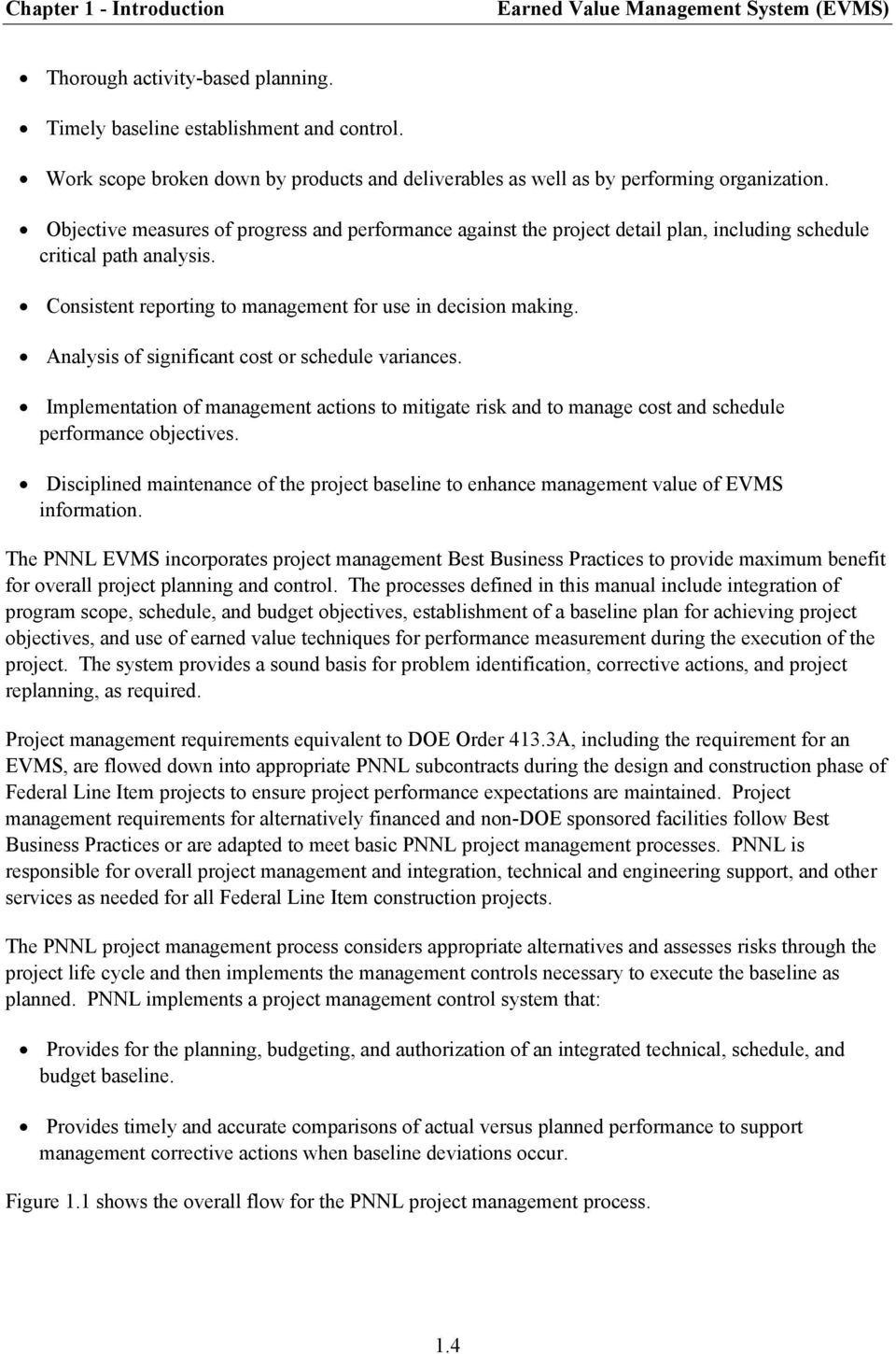
13 Chapter 1 - Introduction Figure 1.2 depicts the project planning and control system that is used on projects where the PNNL EVMS is applied. The system architecture ensures integrated cost and schedule control and is electronically integrated with existing PNNL management and business systems. PNNL Project Management Processes Establish (Project) Work Breakdown Structure Assign Organizational Responsibility Project Planning Initiating / Planning Develop Schedule Logic Develop Estimates and Budgets Time Phased Budget Execution Establish Performance Measurement System Assess Performance Collect Actual Cost by Charge Codes (via Accounting system) Schedule Reports Schedule Performance Trend Charts Cost Performance Trend Charts Cost Reports Analyze Schedule Variances Analyze Cost Variances Controlling Corrective Action Baseline Changes Feedback Feedback Closeout Project Completion Figure 1.1. PNNL Project Management Processes 1.5
14 Chapter 1 - Introduction Scheduling System Critical Path Milestones Deliverables PNNL Plan.Net Earned Value Management System Resource Estimating Performance Measurement Baseline Management Reporting Estimating & Analysis PNNL Financial Management System Actual Cost Subcontract Commitments Authorized Funding PNNL Proposal Pricing System Burdened Charge Out Rates Escalation Figure 1.2. PNNL Project Planning and Control System 1.5 DOE Order 413.3A Critical Decision Process DOE Order 413.3A, Program and Project Management for the Acquisition of Capital Assets, was established in October 2000 and updated in July 2006 to provide the DOE, including the National Nuclear Security Administration (NNSA), with project management guidance and processes to ensure that the acquisition of capital assets be delivered on schedule, within budget, and fully capable of meeting mission performance objectives. As shown in Figure 1.3, the project lifecycle is divided into phases defined by Critical Decision points starting with project justification and ending with the start of operations at a completed facility (CD-0 through CD-4). DOE allows tailoring of the process to combine or eliminate some reviews and Critical Decisions for projects that have low risk and complexity. PNNL works with the assigned Federal Project Director on each project to determine the level of appropriate tailoring. Typically, most Line Item construction projects at PNNL undergo all five Critical Decisions (CD-0 through CD-4) and associated reviews. Energy System Acquisition Advisory Board (ESAABs) is formed to assist the Critical Decision and Baseline Change Control (BCC) processes. CD-2 is the one mandatory review, which consists of a thorough project baseline assessment conducted by an external independent team contracted by DOE. The team reviews the entire project and determines if the Performance Baseline is reasonable and adequately defined. A brief description of each Critical Decision is described below. CD-0, APPROVE MISSION NEED Approval at CD-0 authorizes the project to proceed with the conceptual design phase typically using Customer expense program funds prior to the request of Project Engineering and Design (PED) funding. Prerequisites for this decision are a Justification of Mission Need document, an outline of the user s needs (in terms of capabilities), and an initial Acquisition Strategy. National Environmental Policy Act (NEPA) documentation is submitted very early in the project-planning phase. 1.6

15 Chapter 1 - Introduction OECM External Independent Review For Projects $100M OECM External Independent Review For MS Projects Initiation Definition Execution Transition/ Closeout Operating Funds / Program Funds Operating Funds / Program Funds PED Funds PED Funds Project Funds PARS reporting for projects $5M Report Project Earned Value Into PARS for projects $20M CD-0 CD-1 CD-2 CD-3 Critical Approve Approve Alternative Approve Approve Decisions Mission Selection and Cost Performance Start of Need Range Baseline Construction CD-0 CD-1 CD-2 CD-3 Pre-Conceptual Planning Mission Need Statement Tailoring Strategy Mission Validation Independent Review Conceptual Design Report Acquisition Strategy Preliminary Project Execution Plan Appoint Federal Project Director Conduct Design Review Project Data Sheet Long-Lead Procurements Integrated Safety Management Prepare Environmental Documents Document Sustainable Considerations Prelim Security Vulnerability Assessmnt Conceptual Safety Design Report Prelim Hazard Analysis Report Prelim Safety Validation Report Determine QA Program Establish Performance Baseline Update Project Execution Plan Earned Value Management System Baseline Independent Review Independent Cost Estimate QA Program Acceptable Prepare Preliminary Design Update Project Data Sheet Design Review Prelim Safety Design Report Hazards Analysis Report Update Security Vulnerability Assmnt Prelim Safety Validation Report Prelim Sustainable Bldg Design Complete NEPA Documentation Final Design Update Project Documentation External Independent Review Prelim Documented Safety Analysis Hazard Analysis Report Prelim Security Vulnerability Assmnt Safety Evaluation Report Construction Safety and Health Plan Final Sustainable Bldg Design Update QA Program CD-4 Approve Start of Operations or Project Completion CD-4 Verify Key Performance Parameters Readiness Assessment Commissioning Plan Transition to Operations Plan Updated QA Plan Environ Mgmt System DSA with Technical Safety Rqmts Update Safety and Health Plan Finalize Hazards Analysis Security Vulnerability Report Safety Evaluation Report Project Closeout Report Lessons Learned Report Operational Documentation Post Implementation Review Figure 1.3. DOE Project Acquisition Process and Critical Decisions (Taken from DOE Order 413.3A, July 2006) 1.7

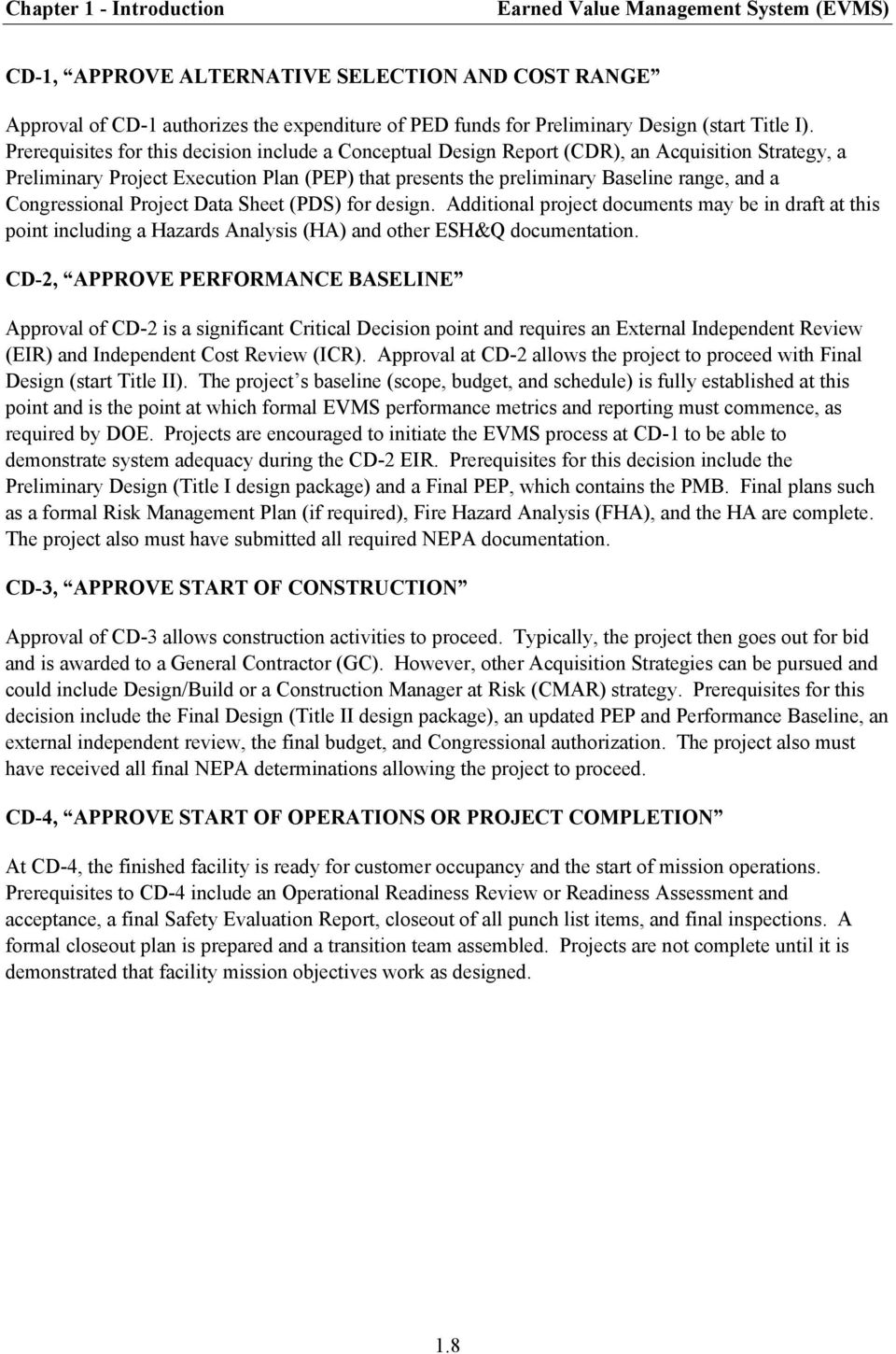
16 Chapter 1 - Introduction CD-1, APPROVE ALTERNATIVE SELECTION AND COST RANGE Approval of CD-1 authorizes the expenditure of PED funds for Preliminary Design (start Title I). Prerequisites for this decision include a Conceptual Design Report (CDR), an Acquisition Strategy, a Preliminary Project Execution Plan (PEP) that presents the preliminary Baseline range, and a Congressional Project Data Sheet (PDS) for design. Additional project documents may be in draft at this point including a Hazards Analysis (HA) and other ESH&Q documentation. CD-2, APPROVE PERFORMANCE BASELINE Approval of CD-2 is a significant Critical Decision point and requires an External Independent Review (EIR) and Independent Cost Review (ICR). Approval at CD-2 allows the project to proceed with Final Design (start Title II). The project s baseline (scope, budget, and schedule) is fully established at this point and is the point at which formal EVMS performance metrics and reporting must commence, as required by DOE. Projects are encouraged to initiate the EVMS process at CD-1 to be able to demonstrate system adequacy during the CD-2 EIR. Prerequisites for this decision include the Preliminary Design (Title I design package) and a Final PEP, which contains the PMB. Final plans such as a formal Risk Management Plan (if required), Fire Hazard Analysis (FHA), and the HA are complete. The project also must have submitted all required NEPA documentation. CD-3, APPROVE START OF CONSTRUCTION Approval of CD-3 allows construction activities to proceed. Typically, the project then goes out for bid and is awarded to a General Contractor (GC). However, other Acquisition Strategies can be pursued and could include Design/Build or a Construction Manager at Risk (CMAR) strategy. Prerequisites for this decision include the Final Design (Title II design package), an updated PEP and Performance Baseline, an external independent review, the final budget, and Congressional authorization. The project also must have received all final NEPA determinations allowing the project to proceed. CD-4, APPROVE START OF OPERATIONS OR PROJECT COMPLETION At CD-4, the finished facility is ready for customer occupancy and the start of mission operations. Prerequisites to CD-4 include an Operational Readiness Review or Readiness Assessment and acceptance, a final Safety Evaluation Report, closeout of all punch list items, and final inspections. A formal closeout plan is prepared and a transition team assembled. Projects are not complete until it is demonstrated that facility mission objectives work as designed. 1.8
17 Chapter 2 - Organization 2.0 Organization Project organization is the first and one of the most important functions of project management. The project organization process ensures that the work is adequately defined, identifies the organizations responsible for performing the work, and assigns responsibilities for managing and performing the work to the appropriate internal or external organization. An initial level of project organization must be established early in a project s life cycle. At a minimum, the PNNL Project Manager and the customer or DOE Federal Project Director is selected along with a core team to begin project planning and definition of customer requirements including what constitutes project completion. The Project Manager and the first members of the Integrated Project Team (IPT) are selected during the justification of Mission Need and Initial Planning phase. During the project initiation phase, prior to CD-0 on DOE projects, the team begins the development of an initial Work Breakdown Structure (WBS) and an initial approximation of the project s budget and schedule. At this stage of planning, summary level planning is beginning to be developed in a conceptual sense (i.e., design, construction, etc). The PNNL End-User (Customer) works with the PNNL and customer IPTs to communicate their Functional and Operational Requirements (F&ORs) upon which further definition and refinement of the project scope is based. Project Managers need to continue to assess the organization of the project throughout the project s life cycle. This includes refining the structure of the WBS and ensuring staff are properly trained to fulfill their assigned roles and responsibilities. Planning the work scope for the project from initiation to completion is essential to control scope creep. All stakeholders must unilaterally accept the project scope fairly early in the planning process, and prior to Final Design. Once the PMB is determined, a final PEP is issued outlining the scope, budget, and schedule for the project, which is then reviewed and updated at all major phases of the project. The IPT charter and membership can change as the project evolves throughout the execution phase. The EVMS Organization and Work Definition Procedure (EVMS-P-1) describes the formal process of organizing and structuring Project work scope. The procedure provides the framework for cost estimating, scheduling, budgeting, authorizing, measuring, costing and reporting of project work. It includes guidelines and instructions for development of the Work Breakdown Structure, the Work Breakdown Structure Dictionary and the Responsibility Assignment Matrix. 2.1 Establishing the Work Breakdown Structure A WBS is a progressive de-composition of the project until the lowest level elements are manageable enough to assign to a responsible individual or organization. The WBS is a hierarchical grouping of project elements that forms the basis for planning and scheduling work, budgeting, and reporting and is a direct representation of the work scope in the project, documenting the hierarchy and description of the tasks to be performed and relationship to the product deliverables. All PNNL EVMS projects use a WBS to organize and manage the project scope. The successful accomplishment of project objectives requires a plan be developed that defines all work to be completed, assigns responsibility, and establishes schedules and budgets for the accomplishment of the 2.1
18 Chapter 2 - Organization work. During the project planning process, the PNNL Project Manager structures the work into elements that are: Manageable, in that specific responsibility is assigned. Minimum interfacing with and dependence upon other ongoing elements. Measurable in terms of progress. Oriented by deliverable whose progress can be discretely measured. Based on the scope of work as described in the technical element of the baseline. The project WBS is used as the basic building block for the planning of all authorized work. The WBS is a product-oriented division of project tasks depicting the breakdown of work scope for work authorization, tracking, and reporting purposes that facilitates traceability and provides a control framework for management. The WBS integrates and relates all project work (scope, schedule, and budget). It is used for technical planning, cost estimating, resource allocations, performance measurement, and status reporting. The WBS consists of a hierarchical description of the work elements to be used in defining the scope of work associated with the project. The project WBS is controlled throughout the life of the project and any changes are documented through the project change control process WBS Levels WBS levels are used to establish an increasingly detailed breakdown of the project work. Typically, Line Item projects will have multiple WBS levels as depicted in Figure 2.1. Control Account Managers (CAMs) can be assigned at any level of the WBS depending on where the responsibility for scope, schedule, and budget is clearly defined. Individuals are also assigned to higher levels of the WBS at the discretion of the PNNL Project Manager. Using a typical Federal Line Item project, as depicted in Figure 2.1 as an example, WBS levels are described as follows: Level 0 represents the entire Line Item project. Level 1 represents the major divisions of work required to successfully complete project execution. These elements can sometimes be congressionally approved and funded. Level 2 represents the next lower level of WBS elements beneath the major divisions of work defined at Level 1. Level 3 and Lower are not specifically shown on Figure 2.1, but would represent a further decomposition of elements derived from the scope definition and planning process conducted during the project initiation phase. Note For those projects that are not specifically related to a Federal Line Item facility construction project, WBS elements and hierarchy are adjusted to reflect project specific scopes of work and mission objectives. 2.2
19 2.3 Level 1 Level 2 Level 0 Sample Project Project Integration Engineering Facility and Site Operational R&D Capability And Support And Design Construction Startup Relocation General Management A/E Design Construction Research Operational Transition Relocation And Support Services Management Readiness And Execution Facility General Contractor Facility Operational Process/Procedure Project Controls Commissioning Subcontract Readiness Development Construction Conduct Readiness Business Support Value Engineering Engineering Support Evaluations Environment, Safety And Health WBS Levels Level 0 Entire Project Level Level Quality Assurance Level Level Etc. Figure 2.1. Work Breakdown Structure for a PNNL Line Item Construction Project Chapter 2 - Organization Earned Value Management System (EVMS
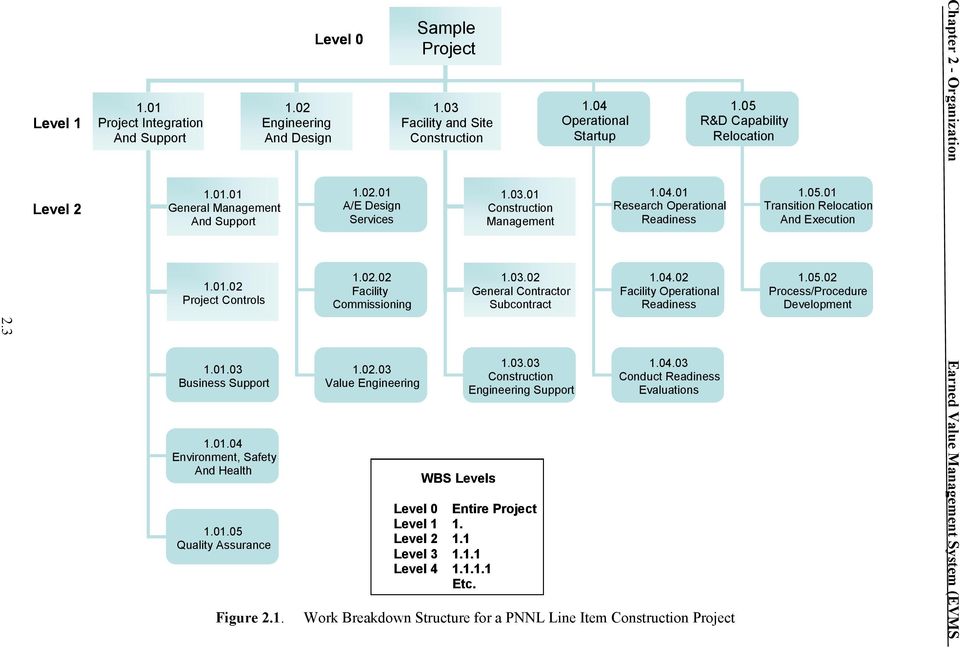
20 Chapter 2 - Organization WBS Requirements A WBS similar to the generic WBS illustrated in Figure 2.1 is required for Line Item construction projects as well as for large/complex science or research projects. The WBS structure for each project is typically negotiated with the local Pacific Northwest Site Office (PNSO), or with the programmatic customer. Level 4 project execution details are typically defined for most projects, but can be adjusted to accommodate a scope of work that requires a less (or greater) degree of detail. Similarly, Levels 5 or 6 may be used to further break down Level 4 elements depending on the degree of detail required to effectively manage the project WBS Dictionary All Projects operating under the PNNL s EVMS are required to develop a WBS Dictionary, which further defines the WBS elements. The WBS Dictionary is typically developed at the Project reporting level and then further refined down through the project Control Account level describing how work is carried out to develop, design, construct, equip, and manage the project. The project-specific WBS Dictionary defines and describes elements of work in the project. An example of a WBS Dictionary format is found in Attachment D of the Organization and Work Definition Procedure (EVMS-P-1). The WBS dictionary serves as the scoping document included in control account plans and in control account agreement documents that support the work authorization process (See Section 3.7, Work Authorization) 2.2 Assigning Program Organizational Responsibility The Organizational Breakdown Structure (OBS) shows how project personnel are organized and is used to define roles and responsibilities and reporting hierarchies. The project specific organization structure for each Project is clearly defined in the PEP. Project roles and responsibilities and reporting levels are defined including the customer or DOE/NNSA/HQ levels down to the local project participants within the PNSO site office; the PNNL Line Management, Program Directors/Champions, and Facilities Management; the PNNL Project Manager; and the core project team members including PNNL s Procurement staff, Project Controls staff, financial accounting personnel, construction management personnel, technical writers, System Engineers, and other Subject Matter Experts (SMEs). Project team members external to PNNL but part of the IPT including the Architect/Engineer (A/E) design firm and the primary subcontractors as well as other consultants, are shown on the OBS as applicable. The primary leads in the project organization include: For DOE Line Item Projects - The DOE Acquisition Executive, or their delegate, provides the guidance for the project to support the Mission Need; approves the annual budget requests; and approves requests for Critical Decisions (CD-0 through CD-4). The DOE or DOE/NNSA Program Manager establishes project budget and secures the funding required to execute the project and defines programmatic Mission requirements and objectives. The DOE Federal Project Director is the field Point-of-Contact (POC), submits budgets, and ensures that the contractor designs and constructs a facility that meets Mission requirements. 2.4

21 Chapter 2 - Organization For non-doe Projects The Customer Project Director has ultimate accountability and responsibility for the successful execution of the project. Ensures that the necessary resources are available to the project. For All Projects - The PNNL Project Manager is charged with managing the day-to-day execution of the project within approved budget, schedule, and scope baseline parameters. The Project Manager also manages all resources necessary to accomplish the project whether they are in-house personnel, consultants, or contractors. The PNNL Project Manager may also appoint Deputy Project Managers. The Control Account Manager (CAM) has responsibility for the budget, schedule, and technical responsibility for the effort in each assigned Control Account. The CAM is responsible for the planning and control of each Control Account and the identification, analysis, and reporting of significant variances. Control Account Managers are responsible for completing project work scope within established budget and schedule parameters. Key responsibilities include, but are not limited to, the following: o o o o o o Plans authorized work scope and defines products and deliverables to achieve technical objectives. Ensures adequate visibility to the performance of work and determining the method for earning value for completed work. Manages assigned resources and resolves scope, schedule, and resource conflicts including issues related to subcontractor performance. Analyzes performance and earned value information to determine causes for variances. Establishes and executes corrective action plans to overcome variances. Performs regular estimates at completion to verify budget and schedule objectives can be maintained. Project Sponsors are upper-level PNNL and/or DOE/NNSA or customer management who strongly advocate the project by raising awareness about the project, demonstrating why the work is important, and obtaining needed support. The Project Organizational Structure (POS) reflects the way the project is functionally organized. The POS is also the resource pool that Project execution responsibility is drawn from. The project OBS is the organizational framework for identification of accountability, responsibility, management, and approvals for all authorized work scope. The project WBS and OBS are integrated, which results in organizational responsibility being established for all identified elements of work. Throughout the WBS, all project work scope is defined to a level where unique organizational and personal responsibilities are established. The individual assigned responsibility for accomplishing work at the Control Account level is often designated a CAM. Control Accounts are divided into smaller, discrete scopes of work called Work Packages, and a Work Package Manager can be assigned to each Work Package. 2.5
22 Chapter 2 - Organization Control Accounts The Control Account is the primary integration point for planning and control. All project management system elements converge at this point including budgets, schedules, work assignments, cost collection, progress assessment, issue identification, and corrective actions. Control Accounts are established based on complexity and risk of work scope and consistent with management control and oversight. The Control Account is the minimum level in the WBS structure where project cost and schedule performance is compared. The Control Account is the point where the WBS tasks and OBS responsibility intersect. It identifies the plan for work and task accomplishment, includes a definition of the effort required, identifies elements of cost, and identifies the resources required to do the job. Integration of the WBS and OBS establishes the Control Account where the performance measurement necessary for project management is performed. This intersection results in designation of a focal point for management control the CAM. Figure 2.2 depicts the intersection between the scope of work (i.e. control account) and the organization responsible for performing the work (i.e., CAM). This intersection represents typical management and control points for the project. Figure 2.2. Management and Control Points 2.6
23 Chapter 2 - Organization Work Packages / Planning Packages Effort contained within a Control Account is distributed into either Work Packages or Planning Packages. Work Packages are near-term activities that are assigned to a performing organization for completion and are natural subdivisions of a Control Account that results in a definable end product or deliverable. Work Packages have the following characteristics: Distinguishable from all other Work Packages Responsibility assigned to a single organization Has a scheduled start and completion date Has a budget expressed in terms of dollars, labor hours, or measurable units Its duration is limited to a relatively short span of time It is integrated with detailed engineering, construction, operations, and transition schedules. Work for a given Control Account that cannot be planned in detail at the outset, is divided into larger segments and placed into Planning Packages within the Control Account. Planning Packages are aggregates of future tasks and budgets, beyond the detail plan, that are divided into Work Packages at the earliest practical point in time. Planning packages differ from work packages in the following ways: The time-phasing of the planning package budget may be linearly spread over the assumed duration of the planning package or be a lump sum value assigned to an annual time period. Detailed resource planning may not exist and the planning package budget may be expressed simply in terms of the labor hours and/or dollars required. Earned value measurement techniques may not yet be defined. The budget for planning packages is identified according to the work for which it is intended, be timephased and be controlled to prevent its use in the performance of other work. Before work contained in a planning package begins, the planning budget must be converted to a work package so that performance measurement can be accomplished. All work in planning packages is planned to the appropriate level of detail for a work package at least six months prior to the scheduled start of work. Time-phased budgets assigned to Planning Packages must be supported by a specified scope of work and this relationship must be maintained when detailed planning of the effort occurs. Work packages and planning packages are made up of at least one (1) or more schedule activities. There is a many-to-one relationship between schedule activities and either work or planning packages. Each work package must have a minimum of at least one schedule activity. 2.3 Project Execution Plan (PEP) The Project Execution Plan is the primary agreement on project planning and objectives between PNNL and the project customer. A PEP is required for all Line Item projects (>$5 million). The PEP is a high-level planning document describing the approach to project execution. In general, the PEP describes the organization of the PNNL IPT and the Federal or customer IPT, defines roles and responsibilities, restates the Mission Need and provides a general overview of the project, outlines budget 2.7
24 Chapter 2 - Organization and schedule data from the Performance Baseline, and lists the project s functional and operational requirements. The major elements required in the PEP are described in DOE Order 413.3A and DOE Manual The PEP is approved by the customer or DOE/NNSA/HQ organization funding the project, with additional signatures showing approval and/or concurrence by the DOE Federal Project Director and the local DOE/NNSA office, the PNNL Project Manager, and the PNNL end-user. As described in Chapter 1.5, a preliminary PEP is developed for DOE Line Item projects prior to CD-1 to begin Title I Preliminary Design, while the Final PEP is approved by all responsible parties and submitted by DOE prior to CD-2 to begin Title II Final Design. Revisions to the PEP may also be incorporated prior to CD-3 (Start Construction) as well as at other intervals, if required, to reflect any significant change in the status of the project. 2.4 Responsibility Assignment Matrix (RAM) The Responsibility Assignment Matrix is an essential element of the project that integrates the Project organizational structure with the scope of work outlined in the PEP. Major project milestones, documents, and actions are identified, then cross-walked to the organization or the individual responsible for that deliverable. The RAM is normally organized such that horizontal rows represent WBS elements or major products and deliverables while the vertical columns contain the name of the individual or the organization responsible for completing work consistent with technical, schedule, and budget objectives. An example of a control account RAM is shown in Figure
25 Chapter 2 - Organization Figure 2.3. Example of a Control Account Responsibility Assignment Matrix (RAM) For most projects, there are many people who have some role in the creation and approval of project deliverables. For complicated scenarios involving many people, a responsibility matrix can be used. This matrix defines project document responsibility expectations and ensures that all staff know what is expected from them. An example of a responsibility matrix for a DOE Order 413.3A type project is identified by their function in the example shown in Figure 2.4. Responsibility functions are categorized as follows: Approves Prepares Input/Knowledge Reviews (concurrence and comments) Notification (receives copy) The responsibility matrix clarifies the roles and responsibilities of all the parties/organizations involved in the project, with Approves being the highest level of responsibility. Various members of the PNNL and DOE IPTs perform some or all of the following functions: Project Management; cost and schedule management; WBS management; task assignment management; and/or consultant/technical review. 2.9
26 Chapter 2 - Organization Examples of some of the deliverables assigned to responsible organizations are listed in Figure 1.3, which shows prerequisite documents needed through the Critical Decision process per DOE Order 413.3A. A Similar responsibility matrix can be prepared for non-doe customers that would not necessarily be structured around the DOE critical decision process. DOE PNNL Responsibility Matrix Legend: Approves Prepares Input/Knowledge Reviews Notification Project Justification CD-0, "Approve Mission Need" Project Development DOE-HQ DOE PNSO Sponsor Representative Communications Contract Acquisition Security Project Manager Administrative Support NEPA/Risk Assessment ES&H Facility Operations Design Team Construction Mgr. Engr. Inspection Preliminary Project Execution Plan (PEP) Project Authorization Develop Preliminary Baseline CD-1, "Approve Alt. Selection & Cost Range" Environmental Compliance / NEPA Design Criteria A/E Acquisition Preliminary Design Preliminary Design QA CD-2, "Approve Performance Baseline" Final Design Final Design QA Title III Construction Acquisition Final PEP CD-3, "Approve Start of Construction" Construction Construction Management/Inspection Special Equipment Procurement Special Equipment Installation Operational Readiness Start Up Acceptance by PNNL CD-4, "Approve Start of Operations" Final Cost Report Figure 2.4. Example of a Responsibility Matrix 2.10
27 Chapter 2 - Organization 2.5 Training Requirements All PNNL personnel, including existing staff and onsite contractor personnel, new hires, and transfers, who are involved in planning or implementing the PNNL EVMS process are trained at the level applicable to their roles and responsibilities. At a minimum EVMS training requires that PNNL Project Managers and Control Account Managers read the current revision of this EVMS Process Description document and attend PNNL developed EVMS training on an annual basis. These individuals may also be required to read additional EVMS reference materials or addendums as identified by specific project requirements. Training is delivered through in-class training sessions administered by PNNL s Project Controls Group staff and may be customized to meet project specific requirements. Formal training is given at various levels of rigor, thus allowing training modules to be tailored specifically for each role. For example, Accountable Program Managers and PNNL Product Line Managers need only to receive an overview of the EVMS processes, while Project Managers and CAMs receive a more systematic and thorough presentation of roles, responsibilities, and techniques as outlined in the EVMS Process Description. 2.11
28 Chapter 3 Planning, Scheduling and Budgeting 3.0 Planning, Scheduling, and Budgeting This chapter discusses how the project planning outputs discussed in Chapter 2 (WBS, OBS, PEP, and RAM) are used in the development of the project schedule, from preliminary schedules to the definitive detailed project schedule. Project planning, scheduling, and budgeting involves organizing and documenting the approach and effort required to complete the approved scope of work based on dependencies, interfaces, constraints, and other factors into a time-phased sequence that fit within the boundaries established by customer schedule and budget objectives. Preliminary baseline schedules are developed from the preliminary WBS. As the WBS becomes more refined through design criteria developed in the conceptual phase of the project, so does the project schedule. Project Managers must balance customer requirements with the customer budget for their projects and ensure this is reflected in their schedules. Budgeting begins with a rough order of magnitude cost range. Estimates are refined and Contingency/Management Reserve is established. Work authorizations are prepared for both external and internal suppliers throughout the life cycle of the project. Preliminary planning information evolves into the fully integrated resourced-loaded PMB to support establishing the project baseline during the project execution phase or at CD-2 for DOE Line Item projects. Through final design, construction, and closeout, the PMB, Work Packages, Control Accounts, and contingencies/management reserves are maintained, updated, and logged to accurately track the project s performance and status. 3.1 Baseline Development Process Baseline development or baseline planning can be defined as making decisions today with a view towards the future. Planning considers the who, what, why, when, and where for a particular effort today while trying to anticipate its effect at some future date. This future-oriented process involves setting objectives, gathering and organizing information, determining feasible courses of action, selecting and implementing courses of action, and monitoring the results to ensure accomplishment of the objective. Planning is often performed in the absence of perfect information; however, decisions and assumptions do need to be made. Although planning is rarely perfect, good planning involves making and documenting assumptions using the best information available. The planning process consists of the following steps: Establish a set of goals that are required to achieve the desired result. Assess project risk and develop actions to minimize risk events. Formulate the plans for completing the work. Implement the plans (e.g., do the work). A product of the planning process is the development of an integrated baseline which is used to measure and control project work activities throughout the project life cycle. The project integrated baseline consists of three components: a technical component, a schedule component, and a budget component. The technical component of the baseline describes the work scope and technical specifications that the project must meet. The schedule component of the baseline is the time-phased logical relationship of interdependent activities required to complete the project. 3.1
29 Chapter 3 Planning, Scheduling and Budgeting The budget component of the baseline is the time-phased approved planned expenditures to complete the project s work scope based on the project baseline schedule. Each of these baseline components evolve and change through the refinement of the project s technical objectives and during major project design and construction phases. All changes to the integrated baseline are documented through the project baseline change control process (See Section 6.0). 3.2 Risk Management Effective risk management is an essential element of every project. The PNNL risk management process is based on the principles that risk management must be analytical, forward-looking, structured, informative, continuous, and dynamic. Risk management is a prospective process initiated and fully integrated with the baseline planning process. As work scope is defined and scheduled, individuals responsible for planning and performing the work apply core elements of risk management. The activities and their logic driven interdependencies are evaluated for possible risks that could preclude successful completion within established technical, schedule, and budget constraints. The PNNL risk management process is comprised of four key areas (1) Planning, (2) Assessment (including risk identification and analysis), (3) Handling, also referred to as risk mitigation, and (4) Monitoring/Improving. The overriding objective of the process is to identify potential project risks, incorporate risk management strategies into the plan, and implement actions that mitigate their impact. Risk assessments are performed as early as possible in a project s life cycle and identify critical technical, performance, schedule, and budget risks. Once risks are identified, appropriate risk mitigation strategies and actions are developed and documented. As the project progresses, new information and insights allow the Project Manager to continuously refine the identified risks and mitigation strategies or remove the risk from consideration once it is no longer applicable. The PNNL risk mitigation strategy for all EVMS projects include the establishment of an adequate level of Contingency/Management Reserve budget, and schedule contingency to reasonably ensure successful project completion. The risk management process establishes a balance between budget, schedule, performance, and risk early in the project and to manage to a budget objective (i.e., the total project cost (TPC) and the performance measurement baseline). Project Managers are required to establish budget objectives, defined to some degree by the maximum level of acceptable risk. Risks in achieving both performance and budget goals must be clearly recognized and actively managed through: o Continual review of cost/performance/schedule risk tradeoffs o Identifying key performance and project uncertainties o Demonstrating solutions before initiating project activities Cost control and effective risk management involve planning and scheduling events and demonstrations to verify solutions to cost, schedule, and performance risk issues. A risk management plan and a risk assessment are required per DOE Order 413.3A. The risk management process and results from the risk assessment can either be included as part of the Project 3.2
30 Chapter 3 Planning, Scheduling and Budgeting Execution Plan or as a standalone document depending on the significance of project risks. Risk assessments are started as early in the project life cycle as possible and identify critical technical, performance, schedule, and budget risks. Once risks are identified, sound risk mitigation strategies and actions are developed and documented. 3.3 Technical Baseline The technical element of the project baseline contains work scope definition, technical specifications, objectives, and assumptions. It structures the project s technical work to verify required objectives are defined and establishes a framework to identify and organize all elements of work into the project WBS. The technical element of the project baseline continues to evolve throughout the design phases of the project. Table 3.1 shows the technical baseline evolution process and Critical Decision stage planned for a typical Federal Line Item construction project. Table 3.1. Technical Baseline Evolution Technical Baseline Basis Document By Project Phase Mission Need Approval Document Conceptual Design Report Preliminary Design Report Final Design Report DOE Critical Decision CD-0 CD-1 CD-2 CD-3 Facility project technical design objectives are implemented utilizing PNNL s SBMS and the Facilities and Operations (F&O) Facility Design Manual. This manual is an F&O Administrative Procedure and is established for the acquisition of facilities and facility systems. It defines the processes, responsibilities, and requirements for preparing, controlling, and using engineering design documents and engineering deliverables. The technical objectives for facility projects are implemented by conforming to PNNL design standards. These standards provide the basis for the design and implementation of facility projects. Design and constructability reviews are conducted to verify the design meets the technical and functional requirements. As well, constructability reviews include both internal and external reviewers to ensure the design can be efficiently implemented. A configuration management process is applied throughout the project life cycle. Design changes are documented and formally approved in accordance with their impact on the project and integrated with the change control processes as described in the EVMS Baseline Change Control Procedure (EVMS-P-7). Technical performance is measured against controlled technical performance indicators (quantitative and qualitative) throughout the project execution phase. The technical element of the baseline is integrated with the schedule and budget components of the baseline to monitor technical performance in relation to schedule and cost performance. 3.4 Planning and Baseline Schedule A schedule is more than a timeline. Schedules address how the work is to be performed and identify the approach or methodology to accomplish the project objectives. Schedules also address how long it takes to complete an activity based on the duration of the task and resource availability. The planned time to complete an activity is influenced by the available resources necessary to execute the work and 3.3
31 Chapter 3 Planning, Scheduling and Budgeting dependencies upon other activities in the schedule. Not all work can be completed simultaneously and not all work is accomplished serially. Schedule concurrency is inherent in all projects, so a project schedule is adjusted by leveling the available resources consistent with available budget, resource constraints and the capacity of the work site among other factors. Schedules that are based on unrealistic availability of budget or time are prone to failure. The PNNL planning and scheduling process provides the framework for time-phasing the authorized project work scope as defined by the WBS. The scheduling process documents, and the resulting project schedule provides, a logical sequence of work leading to a milestone, event, and/or decision point to ensure that the schedule supports the project objectives. The objectives of the PNNL project planning and scheduling process are to: Ensure that all authorized project work scope is planned in a disciplined and consistent manner to meet facility and capability transition need dates. Provide a basis for establishment of an approved baseline schedule to compare actual-to-planned performance for all activities and milestones. Identify all constraints, dependencies, and decision points required to complete project work, as well as defining activity logical relationships and the project critical path. Establish a hierarchical summary schedule to provide summarization of detail schedules to successively higher levels of the WBS. Provide the basis for the Performance Measurement Baseline by integrating the project schedule with the WBS, the OBS, and the baseline budget. The EVMS Planning and Baseline Schedule Development Procedure (EVMS-P-2) describes the formal process for implementing the planning and scheduling requirements defined in the PNNL EVMS Description. The procedure defines the scheduling system structure, and defines the requirements and responsibilities for the development of plans and schedules for PNNL Projects where DOE Order 413.3A is required or on projects where an EVMS is deemed appropriate. Risk-based schedule contingency is included in the project baseline schedule to allow for future situations that can only be partially planned during earlier stages of a project. Part of the scheduling process includes the Control Account Manager determining the risk-based schedule contingency or allowance which is derived from the uncertainty and unknowns associated with the task. As schedule changes occur to the baseline, schedule contingency can be used (like budget contingency) to accommodate scope changes and resultant schedule impacts without immediately impacting overall project schedule objectives Project Summary Schedule The Project Summary Schedule is a rollup schedule created from the Integrated Project Schedule (See Section 3.4.2) showing major project milestones and high-level activities (generally at WBS Level 3), which summarizes work to be performed on the project. The intent of the Project Summary Schedule is to provide a clear, pictorial overview of the project. It depicts all key milestones and critical tasks in an 3.4
32 Chapter 3 Planning, Scheduling and Budgeting abbreviated format that captures the scope of the project. For DOE Line Item projects, the activities and milestones must align with the guidance in DOE Order 413.3A as discussed in Chapter 1.5 and depicted in Figure Integrated Project Schedule The Integrated Project Schedule shows the network of program-planned activities that reflect budget, schedule, and technical performance as described in the PEP. It is structured consistent with the project WBS and provides integrated planning down to at least the Control Account level of detail. The Integrated Project Schedule is constructed to provide horizontal and vertical traceability and to identify and monitor task interdependencies. It is also used to perform critical path analysis. The level of detail established is dependent on the risk and complexity of the project element and by the phase of the project. Projects typically use a rolling wave concept where near-term activities (zero to two years) are planned with greater levels of detail, and future out-year activities (greater than two years) are planned with less detail. The critical path of the project is also established and becomes a focal point for the remainder of the project. By definition, the project critical path is the longest path through the schedule and any delay on the critical path delays the project. Once the Integrated Project Schedule is approved by the customer (at CD-2 for DOE Line Item projects), this schedule becomes the overall and singular baseline project schedule network and is maintained by the assigned Project Controls staff. All project Control Accounts are included in the Integrated Project Schedule and must sum to (reconcile with) the Total Project Cost (TPC). Thus, the sum of all Control Accounts equals resource-loaded Work Packages and Planning Packages (if applicable), which together establish a time phased performance measurement (schedule/budget) baseline. Contingency and management reserve budget are also time phased based on the timing of identified risk events according to the project schedule and are included in the project TPC, but are not part of the PMB. Time phasing of contingency and management reserve is used to develop funding requirement (budget authority [BA]) profiles. How contingency and MR is actually used can be different than how it is planned. The Project planning and scheduling process includes the identification of objective interim measures within tasks to enable performance assessment. A sufficient number of interim measures are defined after the detail schedule is established to ensure performance is measured as accurately as possible. Interim measures are based on the completion criteria developed for each increment of work to provide a basis for objectively measuring project status, thereby limiting the subjectivity of progress reporting. Objective indicators enable measurement of work accomplished, thereby allowing accurate comparison to planned work. Interim performance metrics enable better management insight and decision making and ensure that maximum time is allowed for management action to keep the project on schedule. Planning and schedule status reviews occur at least monthly and are facilitated by the use of the integrated and summary schedules. The use of summary schedules allows higher levels of management to view the entire project and the interrelationships of major tasks without looking into the detail of the individual subtasks. Detailed schedules are utilized by Task and Project Managers to examine individual parts of the project in finer detail without being distracted by those parts of the project where there is no interface. 3.5
33 Chapter 3 Planning, Scheduling and Budgeting Contractor Detail Planning Contracts for A/Es and General Contractors contain flow-down requirements to provide a schedule in sufficient detail to provide the Project Manager the information to effectively manage the project. These detail schedules clearly identify interfaces with other project participants, and contain sufficient detail and logic to allow for effective integration and interfacing of all contractors schedules with the Project Integrated Schedule Vertical and Horizontal Traceability Project schedules must exhibit vertical traceability, which relates activities and milestones between different levels in the schedule within the same Control Account (i.e., WBS levels). Vertical traceability between lower level schedules and the Project Summary Schedule are maintained throughout the project life cycle. Vertical traceability provides the common constraint relationship between different levels of the project schedule hierarchy such that higher-level schedule activity durations constrain lower level activity durations; that is, lower-level activities must reside within the higher-level activity start and end dates. The following components link to the schedule level: WBS product hierarchy Schedule resource information, logic, and networks Project schedules must also exhibit horizontal traceability. Horizontal traceability allows task and WBS interdependencies to be identified. Thus, it is the interdependent relationship between the activities within different Control Accounts as well as the interdependency between tasks within the same Control Account. Interfaces between Control Account schedules are typically the point where schedule breakdown or schedule failure occurs. Managing these interfaces and ensuring communication between affected and responsible CAMs is an important factor in maintaining baseline schedule integrity. Horizontal traceability across schedules at all levels ensures an orderly workflow for significant dependencies and so that constraints can be established and managed. Figure 3.1 illustrates the principle of horizontal and vertical schedule traceability. 3.6
34 Chapter 3 Planning, Scheduling and Budgeting Customer Summary Schedule Vertical Traceability Customer Baseline Schedule Project Summary Schedule Integrated Project Schedule PNNL Detail Schedules Development Support Design Prototypes Test & Evaluation Horizontal Relationships Subcontractor Subcontractor Figure 3.1. Horizontal and Vertical Schedule Traceability Critical Path The Critical Path represents a series of logically connected set of activities whose longest path determines the end date of the project. Activities that are not on the critical path can become part of the critical path if that portion of the schedule slips and an activity that previously had float ends up with no float or negative float. Each activity on the Critical Path becomes a critical activity. If any activity on the Critical Path slips, the project cannot complete on schedule unless corrective or accelerated measures are taken on future critical path activities. The Critical Path typically represents the scheduled activities with the highest schedule risk and the least margin for error. On the schedule, the Critical Path is delineated as an unbroken series of activities between predecessor and successor project tasks from project beginning to project end. This is the longest path through a project network or the network path with the least amount of float. Float is the amount of time an activity can slip before it affects another activity finish date Schedule Contingency Risk-based schedule contingency is included in the baseline project integrated schedule to allow for future situations that can only be partially planned during earlier stages of a project. The need for schedule contingency is dependent upon the sensitivity of the project end date. How much contingency is also dependent upon the risk within the individual schedule activities. Part of the scheduling process includes the Control Account Manager determining the risk-based schedule contingency or allowance that is derived from the uncertainty and unknowns associated with the task. As baseline schedule changes occur, schedule contingency can be used (like budget contingency) to accommodate approved scope changes and resultant schedule impacts without impacting overall project schedule objectives. Schedule risk analysis is a structured process of identifying and quantifying potential/possible impacts to a schedule and combining that information to determine the probability of schedule success. Schedule 3.7
35 Chapter 3 Planning, Scheduling and Budgeting contingency is a duration of time, based on the schedule risk analysis, added to or subtracted from selected schedule events to achieve the desired probability of completing those events on or before the date scheduled. Schedule risk will typically be evaluated for the risks included in the project risk register. It will be applied only to customer commitment milestones and not to the schedule detail. Authorized schedule contingency is shown as the difference between the customer approved target milestone dates(s) and the Project s target milestone date(s) for the same event. An activity called Schedule Contingency may be added between the project and customer milestones (recommended). 3.5 Cost Estimating and Baseline Budget Cost estimates are prepared in a clear, consistent, and comprehensive format that facilitates review of details and assumptions throughout the cost estimate review process. Activities to be estimated are identified in sufficient detail to support the cost estimate methodology used. Cost estimating is the fundamental process used to create the budget element of the project baseline. The EVMS Baseline Budget Development Procedure (EVMS-P-3) describes the formal process for developing the cost estimating and baseline budget requirements defined in the PNNL EVMS Description document. This procedure defines the baseline budget structure, and defines the requirements and responsibilities for the development of budget portion of the project baseline for PNNL Projects where DOE Order 413.3A is required or on projects where an EVMS is deemed appropriate Cost Estimating Cost estimating is a key component of the project baseline budget development process and an integral element in the establishment of annual funding requirements. Estimates are developed and maintained from project initiation through project completion. Cost estimates are created with sufficient levels of detail to identify Control Account resources and to take into consideration schedule activity durations. The cost estimate is prepared at the lowest level of the WBS and is activity based consistent with the schedule and technical elements of the baseline scope of work. Estimates may be prepared for planning purposes to support What If? exercises or to evaluate potential pricing changes. These estimates are not incorporated into the baseline without formal change approval. A consistent approach to cost estimating verifies that cost estimates meet customer and sponsor requirements, are based on standard requirements, are accurate, are traceable to technical requirements, and are consistent with generally accepted and sound industry cost estimating practices. Cost estimates provide the Project Manager and the sponsor with an estimate of the life cycle cost of a project. Cost estimates also solidify the scope of work, providing a documented reference for identifying changes in scope and addressing future cost variances. Cost estimates support the development of the project baseline budget and consist of the following minimum requirements: Estimates reflect the project Total Project Cost (TPC). Estimates use a bottom-up, activity-based cost estimating methodology. All estimates include, at a minimum: 3.8
36 Chapter 3 Planning, Scheduling and Budgeting work scope description explanation of the assumptions made to develop the budget quantification of risk through application of contingency per activity labor hours non-labor units quantity and cost basis for the estimate type of estimate summary of total project cost (TPC). The basis of estimate provides a narrative explanation of the rationale behind the estimating and pricing of the work scope. It contains a documented summary of planning assumptions and resource requirements necessary to perform the project scope of work. For example, the basis of estimate describes why a certain number of labor hours were assigned to a given task or why a certain dollar amount was assigned to specific non-labor costs. In each case, the basis of estimate helps answer the question, Why are the costs this way? The basis of estimates varies. In some cases, the estimator may simply rely on past experience of actual costs for similar work. In this case, there is a reference to the basis for selecting the number of labor hours or quantities of non-labor items based on estimator judgment and experience of prior tasks. Explanation is then provided to support the resources identified. The use of a benchmark tool (RS Means, Timberline Systems, estimating databases, etc.) is noted and modified to more adequately reflect the specific conditions for the estimate. These modifications could include adjustments for: facility / facility component fit geographic location timeframe and escalation market conditions labor market site conditions project delivery options (fast track, phased construction) general requirements ongoing operations life-cycle costs quality level construction costs versus project costs contingency allocation delivery methods (design-bid-build, construction management, design-build). Project Managers are responsible for cost estimates of work scope under their direction. Project Managers are also responsible for establishing estimate type based on known scope (requirements and deliverables), schedule, pricing basis, and customer or sponsor requirements. 3.9
37 Chapter 3 Planning, Scheduling and Budgeting Project Managers and CAMs have the responsibility to identify and document risk and contingency estimates as part of the baseline planning process. During the baseline planning process, risks and uncertainties are identified. To the extent possible, mitigation strategies are incorporated into the baseline budget and schedule to minimize project impacts. Contingency estimates are identified outside the baseline budget and schedule and are based on likelihood and severity of the uncertainty. Contingency is derived against individual work elements (product and activities) regardless of funding type using appropriate contingency development techniques. Project Managers are responsible for identifying the type of work and funding source in order to correctly apply labor rates and indirect adders for the resource estimates. Labor and non-labor costs are stated in current fiscal year rates and include overhead rates to arrive at fully burdened dollars. Future year escalated rates are developed consistent with customer guidance and applied based on the time frame that future schedule activities are performed. PNNL standard rates for performing organizations are used unless an alternative explanation is provided. Contingency is derived at the activity level within the body of the estimate (but not retained within the Control Account or Work Package). Fiscal year project/program management activities are estimated to the same level of detail as the project they support. The development of the cost estimate is worked closely among the performing organizations. Concurrence by performing organizations is obtained at the Work Package level for performance of specified work scope as detailed in the schedule and cost estimate. Project cost estimates are prepared for the life cycle of the project and evolve as definitive design and construction information is established. Projects use the following types of cost estimates: Planning estimate. Based on the amount of available information known about the product or service desired. A planning estimate may only need to take into consideration high level design and construction time frames depicting the project duration. Task definition, resources needed, and accurate pricing may or may not be available to support a planning estimate. In any case, it is based on only the broadest definition of scope, and it provides little or no labor and non-labor resource requirements detail. In place of detail, the estimator is obliged to make certain specific assumptions relating to applicable scope, schedule, and budget. Contingency allowance on a planning estimate may range from 25-50%. Conceptual estimate. Based on considerably more known scope and schedule elements than a planning estimate. Cost information still may be based on high level concepts and functionality. Usually, intermediate levels of detail must be taken into consideration during the pricing step. Usually several subsystems or different levels or phases of the service to be provided must be taken into consideration. Labor and non-labor resource requirements may be based on similar requirements experienced for similar scope. Contingency allowance on a conceptual estimate may range from 15-40%. Detail estimate. Based on a much greater amount of known scope, schedule, and pricing constraints than conceptual estimates. Scope is known in sufficient detail to subdivide it into individual task 3.10
38 Chapter 3 Planning, Scheduling and Budgeting levels; all applicable schedule information is available for the pricing step; labor and non-labor pricing of individual tasks and equipment purchases is determined; and any special operating conditions are taken into account. A detailed risk analysis can now be performed to determine specific project contingency amounts. Contingency allowance on a detail estimate may range from 10-25% Baseline Budget The project baseline budget establishes the estimated cost of executing the project in accordance with the scope and schedule elements of the baseline. The baseline budget is also referred to as the Total Project Cost (TPC) and includes estimates for Management Reserve or Contingency to manage unforeseen conditions and uncertainties. The project baseline budget excluding management reserve or contingency is referred to as the Budget at Completion (BAC). The BAC and the Performance Measurement Baseline (PMB) are synonymous. Other terms and components of the baseline budget and TPC include: Total Project Cost (TPC). The total project cost consists of all costs associated with a project, including contingency and management reserve. It is the sum of all capital costs and the operating costs associated with the project (engineering studies, conceptual design, construction, startup, and costs to complete transition and facility occupancy). Contingency. The portion of the project budget that the customer holds in reserve to accommodate unknowns regarding requirements and uncertainty that is outside the scope of the contractor baseline, but is within the scope of the project. Contingency may be used for additional scope and work that is necessary to meet current project mission requirements. It is not a part of the Performance Measurement Baseline (PMB). Contract Budget Base (CBB). The sum of all project budgets, any summary level planning, any undistributed budget, plus the contractor s management reserve. The Contract Budget Base equals the Performance Measurement Baseline plus management reserve. Management Reserve. That portion of the approved contingency budget assigned by the customer or the Federal Project Director to the PNNL Project Manager for management control purposes. Performance Measurement Baseline (PMB). The performance measurement baseline is the timephased budget plan against which project performance is measured. The performance measurement baseline is the sum of all budgets distributed to the project, summary level planning, plus undistributed budgets. The PMB is synonymous with the Budget-at-Completion (BAC). Summary Level Planning budgets. Distributed budgets not identified to a specific Control Account are maintained in summary level planning. All summary level planning relates to future effort where detail planning is not yet practical. Summary level planning is the responsibility of the assigned Project Manager. Undistributed budget. That budget identified for an approved scope of work but not yet specifically allocated to a Control Account. Undistributed budget can result from a baseline change request being approved or a customer/sponsor modification not yet budgeted in detail and extended to the Control Account. Undistributed budget is included as part of the PMB. 3.11
39 Chapter 3 Planning, Scheduling and Budgeting Control Account budgets. Distributed budgets planned in detail and allocated to specific Control Accounts. Through the life of the project, the baseline budget is eventually distributed and planned in detail within Control Accounts. The Control Account budget is the sum of the budgets for Work Packages and Planning Packages within each Control Account. Work Package budgets. Natural subdivision of Control Account budgets that constitute the basic building blocks in planning, controlling, and measuring project performance. Work Package budgets are directly traceable to activities and tasks planned in detail to support specific scopes of work. Planning Package budgets. Those portions of a project Control Account for future work that is not yet practicable to plan at the Work Package level. Planning Packages are time-phased in accordance with known schedule requirements for resource planning and are refined as detail requirements become clearer and the time to begin work draws nearer. Distributed budget. Work Package and Planning Package budgets allocated as part of a project Control Account. Control Accounts are the minimum level in the WBS structure in which cost and schedule performance is compared. Each Control Account has a unique scope of effort. The estimated resources to complete approved work scope are assigned to a Control Account at the Work Package level, consistent with the established budget estimate and baseline schedule. Time phasing of the budget estimate (i.e., resource loaded schedule) represents the way the resources are planned to be spent and is the baseline against which performance is measured. The project baseline budget can always be reconciled by summing all Control Account budgets, summary level planning, and undistributed budgets. A graphic display of the project budget elements and hierarchy is shown in Figure 3.2. The baseline budget is used to communicate and establish annual funding requirements for the project. For projects that include significant 3 rd party subcontractors (i.e. A/E or General Construction Contracts), annual incremental or full funding requirements are time phased so that sufficient funding is identified and allocated to the project to maintain adequate schedule progress. Funding authorization can often times be required significantly earlier than how budget is planned and when actual cost is incurred. The Project must ensure that sufficient funding is authorized by the customer to cover planned actual cost and subcontract commitments in advance of the completion of project work scope Overhead Budgets The PNNL financial management system has a documented process and the Business Support Services group is the identified organization responsible for managing and controlling overhead rates. Indirect costs and overhead rates are for common Laboratory activities that cannot be identified specifically for a project and are budgeted and controlled separately at the Laboratory level, and approved annually by the DOE. Approved forward pricing rates and projected overhead rates beyond the current year are also maintained within the PNNL financial management system. 3.12
40 Chapter 3 Planning, Scheduling and Budgeting Figure 3.2. Project Baseline Budget Hierarchy 3.6 Contingency / Management Reserve Contingency is included within the Total Project Cost (TPC) and is intended to cover the costs that may result from unforeseen and unpredictable conditions and uncertainties within the defined project scope over which PNNL has no control (i.e., requirements changes, estimating uncertainty, etc). During the activity-based planning process, risks and uncertainties are identified. To the extent possible, mitigation strategies are incorporated into the baseline budget and schedule to minimize project impacts. Contingency estimates are identified outside the performance measurement baseline budget and schedule and are based on likelihood and severity of the risk and uncertainty. Contingency is derived against individual work elements (product and activities) regardless of funding type using appropriate contingency development techniques. It is the responsibility of the Project Manager and CAMs to identify and document risk and contingency estimates as part of the baseline planning process. Contingency allocation is structured, formally documented, and formally controlled as described in the Baseline Change Control process. Contingency usage is routinely reviewed and analyzed, and monthly 3.13
41 Chapter 3 Planning, Scheduling and Budgeting reports are prepared. The Federal Project Director on DOE Line Item projects, or the customer on non- DOE projects, has the final responsibility for controlling project contingency. Guidelines for implementing these requirements in the development, allocation, and control of contingency are presented in the following chapters. PNNL defines Management Reserve as that portion of the project contingency, specifically assigned by the customer, for the management of changes within PNNL s approval authority. Contingency and management reserve are both budget related components of the project Total Project Cost (TPC). Contingency is budget controlled by the customer to cover costs which, based on past experiences, are known to be regularly encountered but difficult or impossible to estimate at the time the estimate is prepared. Management reserve is budget controlled by PNNL for scope of work uncertainty. Use of either contingency or management reserve is documented and controlled consistent with the Baseline Change Control process Contingency Development The PNNL Project Manager is responsible for the development, coordination, and maintenance of the project cost estimate, including contingency even though the customer has responsibility for controlling contingency. Architect/Engineer s who have responsibility for facility design prepare conventional facility capital cost estimates for the project, and then assist in the development of contingency estimates, based on using a comprehensive risk assessment. PNNL prepares the non-capital estimate of Other Project Costs (OPC), including contingency. Contingency for both the capital and non-capital portions of the project cost estimate is developed from a risk assessment of individual work elements within the project WBS. This contingency is then extracted from individual WBS elements and summarized into an overall project contingency account Contingency Allocation Contingency is only used as a last resort. Value engineering and cost avoidance may be used to initiate budget reductions in some areas that may help offset the need for using project contingency. The planned allocation of contingency is established during the annual planning and budgeting cycle. Funding is typically allocated to the project by fiscal year, with projections provided for future years. Likewise, for control purposes, the planned allocation of contingency for a particular fiscal year is based on that particular fiscal year s approved work scope. Contingency requirements are developed and time phased consistent with the life cycle baseline scope, schedule, and budget for future years. For DOE Line Item projects, the Federal Project Director determines and documents in the PEP the amount of contingency budget to be allocated each year to PNNL as management reserve budget to manage project uncertainties within PNNL s approval authority. For DOE funded activities, a DOE work authorization is used to allocate fiscal year budget (potentially including contingency) to PNNL. The project contingency amount is the difference between the project PMB and the project TPC. Funding authorization equivalent to the project budget and contingency amounts is transmitted through Obligation Notices issued by PNSO and cost ceilings established in the DOE Authorized Funding Program. For anticipated current year work activities and after PNSO approval, PNNL is initially allocated a percentage of the project contingency to cover changes that may result from unforeseen and unpredictable conditions and uncertainties within the defined project scope of work each year. The portion of the project contingency allocated to PNNL is defined as Management Reserve. The remaining contingency is 3.14
42 Chapter 3 Planning, Scheduling and Budgeting controlled by the Federal Project Director. Contingency is evaluated throughout the project life cycle and specifically discussed during project quarterly reviews. During the course of a project lifecycle it is possible that all contingency may be allocated to address scope changes such that no contingency budget remains, yet project actual cost could be less than budgeted such that a favorable cost variance exists. If additional scope changes are necessary, the PNNL Project Manager may request from the customer, through the change control process, for the Total Project Cost to be increased by the amount of available funding such that necessary scope changes can be appropriately budgeted. The customer must ultimately approve any increase to the project TPC, or to have unused funding returned Contingency Control Management control of contingency is achieved through a structured process that includes formal authorization, ongoing monitoring and analysis, and routine status accounting and reporting. Authorization. Authorization for the use of contingency related to baseline changes is dependent upon the classification of the change requiring contingency. PNNL may authorize management reserve for changes within the limits of their thresholds, in accordance with the change control process. A change outside the PNNL thresholds requires DOE or customer approval. Changes requiring additional funding authorization also require a revised work authorization document. Analysis. Routine evaluation and assessment of contingency use are necessary for management control purposes. Monthly analyses are performed by PNNL on actual contingency used versus remaining project contingency for the current year and by fiscal year for the life of the project. Evaluations are also made of contingency use by WBS and by type of funding source and significant trends are documented. Change requests are analyzed to assure that the use of contingency is justified and minimized by considering value engineering or cost avoidance options. Reporting. PNNL provides overall project contingency utilization on a monthly basis and documents overall project contingency status. The contingency reporting process includes usage logs and contingency requirements for the current fiscal year and for the project life cycle Management Reserve That percentage of the project contingency specifically assigned to PNNL for the management of changes within PNNL s approval authority is referred to as Management Reserve. This naming convention differentiates that portion of the project contingency that is assigned by the customer to PNNL for baseline management and control. Management reserve is held in reserve by the PNNL project manager at the project level to provide flexibility to manage baseline changes to Work Packages or Planning Packages within the project Performance Measurement Baseline. Management reserve, just like contingency, is a budget related component of the project TPC. Use of management reserve is documented and controlled consistent with the Baseline Change Control process. Management Reserve is used by PNNL to control the execution of the project baseline, for control account planning, and to manage risks and other project unknowns and uncertainties, but is never used for additional scope outside of the authorized technical portion of the baseline. 3.15
43 Chapter 3 Planning, Scheduling and Budgeting 3.7 Work Authorization External Work Authorization - The DOE Federal Project Director is responsible for granting authority to perform project work scope related to Federal Line Item constructed facilities and major DOE programmatic research projects. Work authorization for non-doe projects follow customer specific authorization processes. PNNL prepares documentation for review by DOE representatives prior to each Critical Decision to support the work authorization process. Upon successful completion of this review, the DOE Acquisition Executive issues a Critical Decision approval and a written authorization for PNNL to perform work consistent with the approved baseline plan. Once an external customer work authorization is received, and funding allocations are made, project work is performed consistent with the integrated baseline technical, schedule, and budget elements. Internal Work Authorization - The objective of the internal PNNL work authorization process is to ensure that all defined project work is authorized by the PNNL Project Manager and formally communicated to the appropriate and responsible CAM. The work authorization process involves management approval of the expenditure of project resources, by a responsible individual, to accomplish a specified scope of work within agreed to budget, schedule, and technical objectives. The work authorization process utilizes the products of the baseline development process to provide specific direction to the performers of the work. It assures that work assigned to responsible individuals, timephased budget estimates, and work schedules are all integrated with each other and are related to the WBS within the funding limitations on the project. Formal work authorization provides a means for effective internal coordination, communication and a process to obtain the required management approvals before work begins. Work scope, budget, funding, and contractual commitments are authorized to performing organizations through the use of approved Control Account Agreements (CAA), a sample of which is included in the Work Authorization and Funds Management Procedure (EVMS-P-4). Completed agreement forms are prepared for all Control Accounts as identified in the Project Responsibility Assignment Matrix as discussed in Chapter 2.4 and depicted in Figure 2.2, including all applicable attachments to clearly identify work scope, budget, resource commitments, Control Account WBS Dictionary Sheet, authorized funding and schedule. Control Account Managers are responsible for preparing all necessary attachments to CAAs and obtaining all appropriate approval signatures. Signature approval is required from the PNNL Project Manager, CAMs, and line management of staff responsible for accomplishing agreed-to baseline work scope when deemed appropriate by the PNNL Project Manager. All project work scope is planned and formal work authorization occurs before expenditure of any project funding is allowed. All work and expenditure authorizations are managed by the PNNL Project Manager. Changes in baseline work scope, schedule, or budget will require modification of the respective Control Account Agreement through formal change requests, as defined in the Baseline Change Control Procedure (EVMS-P-7). 3.8 Integrated Performance Measurement Baseline The integration of the planning, scheduling, budgeting, and work authorization management processes provides the basis for establishing the PMB. This integration facilitates the identification and measurement of work accomplished to support management analysis and corrective actions. The 3.16
44 Chapter 3 Planning, Scheduling and Budgeting Performance Measurement Baseline allows summarization of budget data from the lower levels of detail through the WBS and OBS to the appropriate project level needed for management insight and control. The PMB is the time-phased budget plan against which project performance is measured. The objectives for establishing an integrated project PMB are to: Ensure that the technical, schedule, and budget objectives of the project are integrated into the PMB such that timely and valid performance measurement information is provided to management for review and corrective action, as necessary. Ensure that the total project budget is authorized and accounted for within the PMB. Establish a time-phased PMB to provide a basis for an orderly, consistent, and documented baseline change control process. Ensure that budgets for Control Accounts are traceable to the approved cost estimate and that the budget is time phased in accordance with the integrated baseline schedule. Assign and authorize near-term budgets consistent with the fiscal year funding profile allocated to the project. Establish an accounting structure that is integrated with the WBS and the OBS to enable the collection of costs for specific elements of work and for the comparison of technical, schedule, and budget performance. Document the changes made to the PMB in order to preserve its integrity throughout the life cycle of the project. The establishment and maintenance of the PMB is critical for effective performance measurement. It is used for comparison of work completed with work planned, and for comparing actual cost with the value of work completed. Performance measurement takes place at the Control Account level. The baseline used for performance measurement is established during the planning, scheduling, and budgeting of activities at the Work Package level within a Control Account. Planning involves defining and organizing the scope of work to be performed. Scheduling assigns a time frame to accomplish that work. Budgeting assigns a resource allocation to the scheduled work. Planning, scheduling, and budgeting of activities integrates the technical and schedule portions of the baseline, and establishes the baseline budget at the level that work is performed. When it is impractical to plan authorized work down to the Control Account, work scope, schedule, and budget is identified in higher level WBS elements (undistributed budget or summary level planning) for decomposition into Control Accounts when definitive information becomes available. Budget for summary level planning is identified specifically to the work for which it is intended; be time phased; have its value periodically assessed; and establish controls to ensure this budget is not used in the performance of other work. Undistributed budget is not necessarily phased over time but is associated with specific work scope or contract changes not yet assigned to a control account or summary level planning. Undistributed budget is a temporary repository for budget, whereas summary level planning may exist for longer periods of time. Undistributed budget should only be in that category for a given 3.17
45 Chapter 3 Planning, Scheduling and Budgeting work scope for up to 2 months. Eventually, all project work is planned in detail to the Control Account level. The integrity of the PMB is maintained by ensuring that the budget for a Control Account always equals the sum of its Work Package and Planning Package budgets. All Control Accounts contain a budget, a schedule, and a scope of work that realistically represents the work to be performed. At no time does a CAM have a budget with no assigned scope of work. A Control Account Agreement (CAA) represents the work assigned to a responsible CAM for a particular element in the WBS. The PNNL EVMS integrates the technical, schedule, and budget elements of the project through detail and summary plans. Establishment of Control Accounts at the intersection of the WBS and OBS facilitates the linkage between the planning, scheduling, budgeting, work authorization, cost accumulation, and performance measurement processes. Performance measurement is the process where the execution of project work is measured against a predetermined baseline. The time-phased budget (integrated with the schedule) becomes the performance measurement baseline. All project performance is measured against this baseline. 3.9 Performance Baseline Reviews Performance Baseline reviews are conducted to ensure that the project s baseline is complete, traceable, and reasonable, in terms of schedules, milestones, and cost estimates. The reviews ensure that there is an adequate level of scope and design detail at each stage of the project to ensure that priorities and issues can be identified and key performance criteria can be met. Baseline reviews also assess the acquisition strategy and plan, life cycle costs, project risks and hazards, and the adequacy of the EVMS. As discussed in Chapter 1.5, DOE Order 413.3A requires Critical Decision hold points for all Federal Line Items. However, with DOE concurrence, some Critical Decisions and reviews may be combined or eliminated depending on the complexity of the project. Typically, most Line Item construction projects at PNNL undergo all Critical Decision reviews (optional and mandatory). Critical Decision reviews and other Performance Baseline reviews are conducted, when required, as discussed below. CD-0, Approve Mission Need A Mission Validation Independent Project Review is a limited review prior to CD-0 for Major System projects. It validates the mission need and the cost range. A Value Study may also be conducted, as appropriate, to assist in CD-0 The Office of Program Analysis and Evaluation within the Office of the Chief Financial Officer will review the Mission Need Statement and provide a recommendation to the Program Secretarial Officer (PSO) for projects with a Total Project Cost greater than or equal to $100M. CD-1, Approve Alternative Selection and Cost Range Acquisition Strategy Review. Acquisition Strategies for Major System Projects must be sent to the ESAAB Secretariat for review by the OECM prior to scheduling CD-1 decisional briefings. The Federal Program Manager, Federal Project Director and Contracting Officer must concur with the Acquisition Strategy prior to the OECM review. The OECM will provide a recommendation to the 3.18
46 Chapter 3 Planning, Scheduling and Budgeting appropriate PSO or Deputy/Associate Administrator who holds approval authority. Approval of the Acquisition Strategy does not constitute approval required by the Offices of Procurement and Assistance Management (DOE or NNSA, as applicable) for specific contract clearance purposes, including contract acquisition plans. Technical Independent Project Review. Prior to CD-1 approval, the PSO will perform a Technical Independent Project Review to ensure safety and security is effectively integrated into design and construction for high risk, high hazard, and Hazard Category 1, 2, and 3 nuclear facilities. The review ensures safety documentation is complete, accurate, and reliable for entry into the next phase of the project. Design Reviews. Design Reviews are an integral part of a project. Beginning at CD-1 and continuing through the life of the project, as appropriate, Design Reviews are performed by individuals external to the project. Design Reviews are performed to determine if a product (drawings, analysis, or specifications) is correct and will perform its intended functions and meet requirements. Design Reviews must be conducted for all projects and must involve a formalized, structured approach to ensure the reviews are comprehensive, objective, and documented. PNNL CD-1 Internal Review Prior to the release of the preliminary project baseline (prior to CD-2) for DOE s formal review (i.e., after receipt of Preliminary Design package), the project baseline is reviewed and approved by the Project Manager with upper PNNL Management concurrence. Any required changes to the baseline is incorporated by the Project Controls staff and then resubmitted to the Project Manager for final review. CD-2, Approve Performance Baseline Performance Baseline Validation Review. A Performance Baseline Validation Review is required to provide reasonable assurance that the project can be successfully executed. Independent Project Reviews (IPR) are required to validate the Performance Baseline for projects with a TPC less than $100M. The Acquisition Executive may request an External Independent Review (EIR) in lieu of an IPR through the OECM, and must do so if the Acquisition Executive has no Project Management Support Office to perform the review. For all projects with a TPC greater than or equal to $100M, the OECM utilizes the external independent review in support of the performance baseline validation. As part of the EIR, either an Independent Cost Estimate (ICE) or Independent Cost Review (ICR) is employed. The Performance Baseline Validation Review objectives and scope are issued by OECM to PNNL prior to the review start date. The scope can include the following review elements: Project Execution Plan Detailed Resource Loaded Schedule Detailed Cost Estimate for Total Project Cost Alternative analysis and facility life cycle cost assessment Value Management/Engineering 3.19
47 Chapter 3 Planning, Scheduling and Budgeting Work Breakdown Structure and WBS Dictionary System Functions and Requirements Document (also referred to as the Design-to requirements, Design Criteria, or F&ORs) Acquisition Execution Plan for the selected alternative Preliminary Design (Title I design package) Results of and responses to Preliminary Design Review Hazards assessment and documentation (e.g., Primary Hazard Screening, Hazards Analysis, Fire Hazard Analysis, etc.) Risk Management strategy (formal plan or as a chapter in the PEP) Project Performance Management Process Description Organization Breakdown Structure showing PNNL and DOE Integrated Project Teams (roles/responsibilities and qualifications) DOE Independent Cost Review An Independent Cost Review (ICR) is used primarily to verify project budget and schedule estimates and support the CD-2 process in validating the project Performance Baseline since ICRs are part of the EIR. However, an ICR or even an Independent Cost Estimate may be requested at other times for other reasons whenever project complexity, risk, cost, or other factors create a significant cost exposure for the DOE. The OECM has responsibility for coordinating all aspects of the ICR. The results of ICRs are documented in formal reports and submitted to the Program Office and Acquisition Executive by the OECM. PNNL typically performs an internal ICR prior to the DOE review at CD-0. PNNL Baseline Change Request (BCR) Reviews Once the Performance Baseline is established, validated, and approved (at CD-2), the project is under formal change control as defined in the PEP. All proposed changes are reviewed and approved as discussed in Chapter 6.0, Revisions and Data Maintenance, dependent upon the defined change threshold (e.g., review by Project Manager, Baseline Change Control Board [BCCB], and the Federal Project Director). The BCR is either endorsed/approved, resubmitted with changes, or rejected (refer to Figure 6.1). The disposition of all BCRs is formally documented and tracked by the Project Manager. The Project Controls staff incorporate approved changes to the updated Performance Baseline (i.e., scope, schedule, and budget estimates). CD-3, Approve Start of Construction At CD-3, a Construction or Execution Readiness Review is conducted by OECM. This is required for all Major System projects (>$400 million). For all other projects, the PSO, conducted through the Project Management Support Office, conducts an IPR. The purpose of this review is to assess the readiness for construction and to confirm the completeness and accuracy of the Performance Baseline. The core scope of the review has several elements relative to construction readiness, but retains many of the elements contained in the Performance Baseline review (CD-2). Core documents for CD-3 review include: Project Execution Plan 3.20
48 Chapter 3 Planning, Scheduling and Budgeting Integrated Project Schedule Detailed Cost Estimate Acquisition Execution Plan Final Design drawings and specifications Results of and responses to the Final Design Review System Functions and Requirements document (e.g., F&ORs) Risk Management Assessment Safety documentation. Reviews are part of the planning process and are used to assist PNNL and the Federal Project Director and upper level management in developing project plans and verifying that the project meets the mission needs. Reviews provide information to help make decisions, and demonstrate and confirm a project s accomplishments at various stages. Reviews are an important project activity and are included in the project schedule, based on project complexity, duration, and Critical Decision points. 3.21
49 Chapter 4 Accounting Considerations 4.0 Accounting Considerations Financial data accumulation and management for PNNL projects is performed within the established financial systems of the Laboratory. The general ledger and cost accounting system, along with peripheral systems, make up the DOE-approved PNNL financial management system (FMS). The FMS receives manual input as well as automated input from other PNNL business and administrative systems in order to track commitments, encumbrances, accruals, and costs, and is capable of segregating indirect costs. All PNNL automated administrative and business systems reference a table of valid, open cost collection codes, for charging purposes. After processing in accordance with DOE regulations, that data related to a specific PNNL project is extracted and imported into the project management system for detailed cost analysis and reporting. The EVMS Financial Processing Procedure (EVMS-P-5) establishes the methodology for project accounting and to ensure the utilization of proper accounting data in baseline management. The financial management process provides for the timely and accurate collection of direct and indirect costs for the project as defined in the following sections. 4.1 PNNL Financial System Existing PNNL financial and business management systems are used as the basis for all cost and commitment reporting. PNNL s systems gather actual costs and obligations through several systems including an electronic time card system, a travel system, a procurement system and a subcontracts management system. All of these systems gather costs and obligations at the lowest level of the WBS and are imported into the integrated project management system on a monthly basis. Direct cost is brought into the integrated project controls system consistent with the way budgets are established to ensure effective performance management. The PNNL financial management system is compliant with all applicable Federal financial requirements, including Federal Acquisition Regulations, Cost Accounting Standards, the DOE Accounting Handbook, and the current PNNL Management & Operations (M&O) contract. DOE approves all labor and overhead rates annually as required by the Battelle M&O contract. A cost-charging structure is established within the PNNL accounting system to ensure that actual costs collected are directly compared with associated budgets for all work elements. Charge codes are established in the PNNL financial system that uniquely identify costs typically down to the WBS Work Package level and at a minimum at the Control Account level which allows for accumulation and summarization of cost to higher levels of the WBS. Finance system charge codes are mapped to a single Work Package or Control Account (one-to-one). The project cost-charging structure ensures that actual costs are collected so that direct comparison with associated budgets can be made at the appropriate WBS level and to ensure performance measurement data integrity when summarized throughout the WBS. Because project WBS elements are assigned to specific individuals, actual costs are also available at all levels of the OBS to support line management with project management performance measurement data and to ensure data integrity when summarized by OBS. Actual cost and commitment information 4.1
50 Chapter 4 Accounting Considerations reported in the project Cost Performance Reports and other project performance reports is reconciled each month and is consistent with the costs recorded in the PNNL financial system. Unit costs, equivalent unit costs, or lot costs are not used as cost collection methods on PNNL projects. Material procured as part of the project is accounted for and progress is measured at the point most closely aligned to actual consumption to provide effective performance measurement reporting. Material costs are accurately charged to Control Accounts in the appropriate accounting period using recognized techniques, such as receipt of material or when material is used. 4.2 Direct Costs A direct cost is any cost that is specifically identifiable with or attributable to a particular project. Therefore, direct costs include any costs identifiable with the assigned tasks of a specific project. These costs include labor, travel, subcontract, and procurement costs or any other costs directly associated with a specific project. All labor, materials, and other applicable costs are charged directly to final cost objectives to the maximum extent practical. Cost are accounted for as direct cost and charged to final cost objectives according to Cost Accounting Standard guidelines as outlined below: The benefit or cause is primary. The amount can be clearly determined without undue administrative effort. The treatment is consistent with other costs incurred for the same purpose in similar circumstances. 4.3 Indirect Costs Costs that do not meet the above criteria for direct cost are charged to the appropriate intermediate pool and subsequently allocated to final cost objectives as direct or indirect cost in accordance with PNNL s Cost Accounting Standards Disclosure Statement. Distinguishing between direct and indirect costs is essential for successful management of PNNL projects. Indirect costs are those costs incurred for the operation of PNNL that cannot be directly or specifically associated with a PNNL project or program. Indirect and organization overhead costs are established and managed by the PNNL Business Support Services Directorate. Indirect costs are distributed to all projects through an allocation process by applying recovery rates to an appropriate allocation base. PNNL s financial overhead policy (specifically, Chapters 7 and 8 of PNNL s Finance Manual) describes how indirect costs are allocated. Any variance remaining in indirect cost pools at fiscal year end is distributed to projects based on the liquidation to final cost objectives for the fiscal year consistent with Section 5.5 Variance Accounting and Policy of PNNL s Finance Manual. 4.4 Burdened Costs Direct costs and any associated indirect burdens are typically collected at a work package level, but at a minimum at the control account level and then summarized up through the project WBS. The combination of direct and indirect costs is referred to as burdened costs. In accordance with standard accounting practices, costs are segregated into two categories Capital and Expense. 4.2
51 Chapter 4 Accounting Considerations Capital costs include the more tangible and obvious elements of a project such as buildings, structures, infrastructure, and capabilities. It also includes project design (preliminary and final), cost of land and improvements, software/hardware and development costs, special and standard equipment, major computer systems, site services, and Project Management. Expense costs include all costs incurred during conceptual planning of a project such as Mission Needs Requests, Demolition and Decontamination (D&D), writing the CDR, preparing ESH&Q and NEPA documentation, and other project support functions through the life cycle of the project. Figure 4.1 illustrates some of the major categories that fall within each portion of the budget. 4.5 Material Accounting Material costs are generally recognized as General Contractor Firm-Fixed Price (FFP) contract costs. Due to the nature of an FFP contract, residual inventory accountability (materials purchased but not yet used) is managed and held at the General Contractor level. Cost performance measurement of the FFP contract is measured monthly in order to provide the most meaningful (i.e., timely) cost performance and cost variance data. Construction projects currently use estimated actual costs for the General Contractor by taking the Contractor s construction schedule that is provided on a monthly basis and comparing the value of the work completed to the invoices actually paid. Accruals then are the cumulative estimated total cost of work completed minus any invoices already paid. The net amount value of the work completed minus invoices paid becomes the monthly accrual. The next month, the accrual is reversed (subtracted out) and the process is repeated. Figure 4.1. Total Project Cost Elements 4.3
52 Chapter 4 Accounting Considerations NOTE: Construction project scope does not include production unit costs, equivalent unit costs, or lot costs. Construction costs are estimated using units of construction material; however, for EVMS purposes, the Project Manager does not track them individually as such. At the project level, contractor performance is measured based on accomplishment of scope. 4.6 Funds Management The PNNL Project Manager has overall responsibility for managing project funds. Funding for all approved work scope and associated budgets is expected to be allocated incrementally, at the direction of the PNNL Project Manager, as funding is received from the customer. The amount of approved project work scope that can be completed is dependent upon the availability of funding. Costed and contractually committed funding is tracked and managed to ensure the project is being conducted and is completed within project funding limitations. Funding status is analyzed by comparing actual costs, plus any unpaid outstanding commitments, to the authorized funding level. Additional funding needs are addressed monthly in accordance with the project budget and schedule performance reporting process. Consistent with the work authorization process, all project work scope must be planned and formal work authorization must be received before expenditure of any project funding is allowed. PNNL Project Managers authorize work and expenditure of funds to CAMs via Control Account Agreements at the Control Account level of the project WBS. Project funding is managed throughout the fiscal year and during the project lifecycle to ensure that the commitment and expenditure of funds does not exceed authorized limits. The funds management process also provides an early warning capability to project personnel to ensure that funding limits are not exceeded and to facilitate timely corrective action. The funds management process provides what-if capability in order to develop alternative funding profiles in response to change request actions and changes in the project Estimate-at-Completion. Examples of when funding authorization changes can occur to project Control Accounts include the following: When Control Account work authorization is originally established. As baseline changes are approved, provided there is insufficient funding within the Control Account to accommodate the change. The amount of funding authorized for an approved change may be different than the change request budget that is approved if the Control Account has a favorable cost situation. Favorable cost variances are returned to the project level unallocated funding source upon completion of Control Account work scope. Additional funding can be authorized by the project manager when unfavorable cost performance exists and when funding in excess of approved baseline budget is required. In these cases, the Control Account is completed in an over budget condition. Depending on the availability of project funding, scope and/or budget reductions may also be proposed when unfavorable variances prevent the original scope of work from being performed. Changes to the approved scope of work are documented through the Baseline Change Control process. 4.4
53 Chapter 5 Analysis and Management Reports 5.0 Analysis and Management Reports The Performance Measurement Baseline is used to measure and analyze cost and schedule status and to evaluate project performance. Project variance thresholds, provided by the Federal Project Director for DOE Line Item projects or the customer for non-line Item projects, as well as potentially stricter thresholds imposed by PNNL, provide the parameters for monthly project variance reporting. The Monthly Report identifies project performance parameters (as both time-phased and as a snapshot in time) based on variance analysis. The report may also recommend corrective actions, as appropriate. Management actions (e.g., requesting a BCR and applying Contingency/Management Reserve) are implemented as prescribed in DOE Order 413.3A or through other customer reporting requirements. The performance analysis and reporting process consists of comparing the planned budget, schedule, and technical progress to actual cost, schedule, and technical performance effectiveness. This process is designed: (1) to identify technical or performance issues which could result in the project s inability to meet performance or scope objectives; (2) to identify positive and/or negative cost and schedule variances; (3) to identify the causes of meaningful variances; and (4) to update cost at completion estimates. The EVMS Performance Analysis and Management Reporting Procedure (EVMS-P-6) describes how performance information is analyzed and reported by the project manager to document cost, schedule, and technical performance. 5.1 Performance Measurement After the integrated baseline is established, the next phase in the project control process is to measure performance against the plan over the life cycle of the project. To effectively manage and support efficient decision making, project performance is assessed monthly at the close of the accounting period so that status information can be compared with actual costs for that period. Work activities are statused on a regular basis to ensure that progress is being made towards completion of project objectives and goals. Progress is compared with the approved technical, schedule, and budget elements of the baseline established in approved Control Accounts. This performance analysis process provides visibility to potential problems, impacts, and alternative courses of action Schedule Status PNNL projects use a schedule-based method of assessing performance that minimizes the subjectivity involved in evaluating progress. The project uses a critical path method of scheduling as a tool to assess progress against the baseline. Schedule status is the primary input used by the project staff to create performance measurement information. The Control Account or Work Package manager responsible for accomplishing the scope of work assesses how much work is completed. Schedule assessment techniques include monitoring activities that fall on the project critical path, comparing planned durations with actual durations, or comparing planned and forecast dates for activities and milestones. Schedule variances are considered to be normal occurrences that happen throughout the life cycle of the project. Early identification of potential schedule deviations allows for the effective implementation of corrective action before the baseline is impacted. In addition, a critical-path analysis is performed to ensure that the most time constraining activities are being completed as planned and in the correct sequence. 5.1
54 Chapter 5 Analysis and Management Reports Earned Value Techniques Earned value techniques to measure accomplishment of work are established at the activity level of the Integrated Project Schedule. This results in a Control Account potentially having a variety of earned value methods applied. The earned value method chosen must be compatible with the Control Account schedule activity type. The technique may also employ objective milestones identified to facilitate evaluation of work-in-process (work accomplished). On a monthly basis, schedule activities are assessed to compare the work that was accomplished against the baseline plan. Control Account Managers responsible for completing the work determine performance accomplished during the reporting period. The accumulation of all baseline budgets for completed activities, as well as in-progress schedule activities, is then summarized. Many discrete performance assessment (earned-value) methods are available for measurement of progress, as described below: Fixed Formula: The fixed formula method for determining progress applies to schedule activities that span a short period of time (i.e., less than 3 months). This method applies a percent complete to the start and finish of an activity. Generally, the percentages used in the formula are 0/100, 50/50, or 25/75. o o o 0/100 Nothing is earned when an activity starts but 100% of budget is earned when the activity is completed 50/50 50% is earned when an activity starts and the balance is earned when the activity is completed 25/75 25% is earned when an activity starts and the balance is earned when the activity is completed Weighted Milestone: The weighted milestone method assigns budget value, in terms of a percent of the total activity effort, to incremental events or milestones that are not specifically defined within the schedule. Not until full completion of each milestone is the particular percentage of budget earned. Weighted milestone is used as an earned value method for schedule activities with longer durations and ideally should have milestones in each accounting period. Weighted Milestone with Percent Complete: The Weighted Milestone with Percent Complete earned value method assigns budget value, in terms of a percent of the total activity effort, to each milestone and it is earned based on the percent of work completed against each individual milestone. Like the Weighted Milestone method, the Weighted Milestone with Percent Complete earned value method is used on schedule activities with longer durations and ideally should have milestones in each accounting period. Physical Percent (%) Complete: This is a method that requires the Project Manager/CAM to assess the project s progress and estimate how much work was accomplished. This assessment is performed objectively at the detail schedule activity level not subjectively at a higher level Work Package or Control Account. This determination is based on scheduled start and completion dates that represent physical accomplishment and/or interim milestones established during the 5.2
55 Chapter 5 Analysis and Management Reports planning of the Work Package budget. This is typically expressed in percent of effort complete for each schedule activity. Typically, Work Packages are comprised of discrete tasks that are of relatively short duration. If a task is longer than two months in duration, the CAM must determine beforehand what constitutes the effort expended or completed for estimating task percent complete (e.g., defining intermediate milestones). Intermediate milestones are documented within the PNNL planning and control system on individual schedule activities as appropriate. Schedule-based effort: This method accumulates the portion of budget that is earned as it relates to the actual and/or forecasted completion dates of the detailed schedule activities. If an activity starts on time and is scheduled to complete on time, then the portion of budget collected for any given period is equal to the budget that was planned for that period. If activities are completed ahead of schedule, a proportionate amount of budget is earned in advance of the baseline time-phased plan and a favorable schedule variance occurs. Conversely, if activities are completed behind schedule, a lower amount of budget is earned and an unfavorable schedule variance occurs. Additionally, all projects include general work effort that cannot be discretely measured. The LOE methodology is selected only after all other techniques are evaluated and reviewed for appropriateness and found not applicable. Level of Effort: The LOE method is used for those schedule activities that do not have measurable deliverables. This method is generally applied only to management and project support efforts. The LOE method of performance measurement is limited to only those schedule activities that are unable to be measured discretely to avoid distorting project performance data. Budgets for LOE schedule activities must still have a documented basis of estimate and be time phased to properly reflect when work is planned to be accomplished. The earned value amount for LOE activities equals the timephased budget, therefore; no schedule variance occurs. A cost variance can occur on a LOE activity whenever actual cost is different than the planned budget. 5.2 Performance Analysis Knowing the status of a project at any point in time is important; however it is equally important to analyze the project performance so that appropriate corrective action can be taken if deviations occur. The objective of performance analysis is to provide the project management team with a consistent assessment of the work accomplished. Measuring progress against the performance measurement baseline provides an objective periodic assessment of cost and schedule performance and facilitates the process for evaluating forecasts of future performance and supporting estimate to complete evaluations. Management action is an expected outcome of the performance analysis function. Analyzing project performance allows the project management team to look back at what was accomplished and to use that information to help determine what the team must do in the future to meet project technical, schedule, and budget objectives. The primary objectives of analyzing performance are to: Determine if enough time remains to meet scheduled deliverable dates, complete the remaining work, and meet project objectives within the constraints of the project baseline schedule. 5.3
56 Chapter 5 Analysis and Management Reports Determine if adequate resources are available to meet scheduled deliverable dates, complete the remaining work, and meet project budget objectives. Provide insight so that the project management team can recommend or make decisions or take actions that favorably affect the performance of the remaining work. Provide the basis for communicating project management information concerning project performance to PNNL and customer management. Verify that risks are being adequately managed. Project performance information is used by the project management team to monitor project execution. Because of this, the data produced from the earned value management system must be available on a timely basis and must be of sufficient quality to ensure that effective management decisions can be made as a result of performance analysis. The EVMS Performance Analysis and Management Reporting Procedure (EVMS-P-6) describes the process for monitoring progress against the performance measurement baseline. Project Managers need to assess the long-term trends in project performance, and take actions required to maintain the project s planned course consistent with this procedure. An objective assessment of the project cost and schedule performance is performed on a monthly basis by comparing the following elements (expressed in terms of dollars): Budgeted Cost for Work Scheduled (BCWS) - The BCWS is the baseline budget calculated from the approved, resource-loaded baseline schedule and is represented in terms of budgeted dollars per month. It represents the estimated value of the work scheduled. Actual Cost of Work Performed (ACWP) - The ACWP is the actual cost charged to the project, including accruals for work completed, but for which associated payments are not yet finalized. This information is collected in the PNNL financial management system. Budgeted Cost for Work Performed (BCWP) - The BCWP, also known as earned value, represents the progress completed against planned and scheduled work. Earned value is the estimated dollar value of the work performed in relation to the baseline budget or BCWS. The earned value is determined from schedule status provided by the Project CAMs. The process of accumulating and comparing performance measurement data results in the identification of favorable and unfavorable variances. Analysis of these variances is an important component of performance measurement. Variances provide indicators of favorable and unfavorable conditions, allowing the project management team to properly allocate available resources to mitigate budget or schedule impacts. Variance reporting to the customer generally occurs at a level higher than the control account (i.e., level 2 or 3 of the WBS) as defined in the project PEP. To ensure proper attention is given to significant deviations, typical PNNL variance thresholds are established at the project reporting level and control account levels consistent with those defined in Table 5.1 below. Dollar threshold limits may be adjusted 5.4
57 Chapter 5 Analysis and Management Reports based on specific project requirements, risk levels, or project budget values. Deviations from the table are documented in project specific management or execution plans. Table 5.1. Suggested Performance Variance Threshold Limits Project Reporting Level Variance Thresholds Variance Type Threshold Limit Cost Current Period +/- 10% and $50K Cumulative +/- 10% and $100K Schedule Current Period +/- 10% and $50K Cumulative +/- 10% and $100K At Completion $100K Control Account Variance Thresholds Variance Type Threshold Limit Cost Current Period +/- 10% and $25K Cumulative +/- 10% and $50K Schedule Current Period +/- 10% and $25K Cumulative +/- 10% and $50K At Completion $50K Subsequent to the performance measurement assessment, CAMs analyze cost and schedule performance information. For those areas where variance thresholds are exceeded, corrective action analysis must focus on three key areas: Cause and effect How and why did the variance happen? Consequence What, if any impact is there to ongoing or future activities across the technical, schedule, and/or budget elements of the project baseline? Correction Is it possible to recover? What is the recovery plan of action? Do other Control Accounts have to implement corrective action to mitigate the impact? If it is not possible to recover and get back on plan, what must be done to replan the effort? Schedule Variance (SV) Comparing the value of work completed (Budgeted Cost for Work Performed, or Earned Value) to the value of the work scheduled (Budgeted Cost for Work Scheduled) at a point in time provides a valuable indication of progress relative to the baseline plan. This variance does not always indicate whether or not scheduled milestones are being met since some work may be performed out of sequence or ahead of schedule. Schedule variance also does not indicate whether a completed activity is a critical event or if delays in a schedule activity affect the project completion date. Therefore, a critical path analysis is performed in addition to an earned value analysis to ensure that the most time sensitive activities are being completed as planned and in the correct sequence. Schedule variances are calculated in terms of time and/or dollars. The quantification of the schedule variance is valuable as an indication of the rate of work completed compared to the work planned. 5.5
58 Chapter 5 Analysis and Management Reports Because planning is rarely perfect, schedule variances are expected to occur throughout the life cycle of the project and are considered to be normal within certain acceptable boundaries. These boundaries are defined by the variance analysis thresholds Cost Variance (CV) Cost variances represent the difference between the budgeted value of the work completed (BCWP) and the actual cost (ACWP). They provide trend information and serve as a useful indicator of the accuracy of the baseline budget estimate. Factors contributing to cost variances include: poor initial estimates, technology factors that required more or less resources, cost of labor or materials different than planned, difference between planned and actual rates, and staff efficiency different than planned. As part of the monthly cost variance analysis, any deviation resulting from indirect rate anomalies is assessed and impacts to current and/or life cycle project budget objectives are analyzed Estimate at Completion (EAC) The Estimate at completion (EAC) is an earned value parameter that provides an estimate of the total final cost of a project. The EAC is a valuable management tool in that, when it is compared to the budget at completion (BAC), a variance at completion can be calculated that provides an indication of the cost and schedule overrun (or under run) likely to be experienced by the project. An EAC is a reassessment and thorough analysis of the actual cost incurred plus the resources required to complete the remaining work scope on the project. A primary input to the EAC calculation is an updated project schedule that reflects the logical path required to complete the remaining technical portion of the baseline. The EAC is also the basis for cash flow analysis and funding for the life cycle of the project. The following factors are considered during the preparation of an EAC: Actual cost and performance experienced to date. Level of risk or technical complexity associated with the remaining work scope. Projections of future economic escalations in labor or materials. Forecasts of remaining resources based on current trends and performance. Any unrecoverable schedule variances. The EAC reflects the most likely estimate of the total cost for all authorized project efforts and is timephased consistent with the expected completion dates on the project schedule. The basis for the EAC and the reasons for changes from the last estimate must be identified. The EAC process focuses on the CAM. Information relative to price and usage variances are used to support an update to the EAC. This provides timely notification to management of expected and/or incurred price changes that may affect future costs on the project as well as future procurements. To ensure the most accurate rates are used for EAC purposes, future rates are based on: Historical experience Projected economic escalation PNNL anticipated business volume An EAC based on predictive performance measures increases the probability that the project is executed within the overall budget objectives. Monthly EAC reviews are essential for management decisions 5.6
59 Chapter 5 Analysis and Management Reports including the planning of project future funding requirements. On a monthly basis, CAMs review the status of remaining work and the achievability of the actual cost forecast using all available information to arrive at the best possible EAC. A comprehensive total project EAC (bottom-up) is accomplished annually as part of the update to a capital project data sheet update or at major phases of project evolution (i.e. at CD-2, at completion of design, etc). For non-capital projects, the EAC is typically updated as part of the annual budget formulation process. Formula driven Estimates at Completion are used as a means of verification or validation that an EAC is reasonable. Examples of formula driven EAC calculations include: Results of the EAC process are communicated to the customer in reports and in funding documents to help assure that sufficient funding for the project is maintained Variance at Completion (VAC) Comparisons of the total budget with the EAC at the Control Account level provide a variance expected at the completion of the Control Account (Variance at Completion). When the VAC is considered significant, as defined in project variance threshold levels, the project manager and CAM investigate the cause and take appropriate corrective action. Variances can be caused by such things as poor initial planning or budgeting, changes to project schedules, changes to material costs, inflation, and/or overhead rate allocations. CAMs have the authority and responsibility for defining and implementing corrective action, at the Control Account level, for all variances that exceed reporting thresholds or any variance that exceeds authorized funding levels. Variances that are non-recoverable and that require additional funding authorization must be reviewed and approved by the PNNL Project Manager before authorized funding is exhausted Performance Measurement EVMS Metrics Performance metrics provide the objective data needed to employ management by exception by identifying only those items where significant differences exist between planned and actual work efforts. This improves the efficiency and effectiveness of project management processes by focusing attention on those activities with the most significant variances. Figure 5.1 illustrates some of these key EVMS measurement metrics comparing planned and actual performance to time elapsed. 5.7
60 Chapter 5 Analysis and Management Reports Earned Value Management System (EVMS Figure 5.1. Key EVMS Performance Measurement Metrics 5.6
61 Chapter 5 Analysis and Management Reports 5.3 Performance Reporting The project performance reporting process uses performance data and analysis results to generate a series of management reports for internal and external use. The objective of the performance reporting process is to provide PNNL (Project and Line organizations) and external sponsor management (DOE, other Federal Agencies, or non-federal customers) with timely and accurate performance data from the integrated project management control system. To meet this objective, periodic progress reports are developed that provide the following: Periodic analysis of the status towards achieving the baseline technical, schedule, and budget objectives at all levels of the project WBS. Evaluation of schedule progress, including analysis of the critical path(s). Identification of cost, schedule, and at-completion variances that exceed established thresholds. Reporting project status and conducting reviews both internally and externally is fundamental to maintaining a communication flow among the project team and sponsors relative to the current and projected condition of the project. The following reviews and reporting processes are planned for typical project activities: Monthly Project Status Report Quarterly Performance Reviews Typical reviews for DOE Line Item projects - External Independent Reviews Independent Project Reviews Independent Cost Review Energy Systems Acquisition Advisory Board (ESAAB) Equivalent Reviews Monthly Status Report The monthly Project Status Report is submitted to the customer and to PNNL Management documenting progress made against the project baseline. The report is generated from schedule status information, cost status from PNNL s financial system, and internal monthly narrative progress reports prepared by the CAMs. The narrative consists of summaries of work performed and major accomplishments, status of key milestones, significant issues and their corrective actions, and cost and schedule variances along with their analyses. The discussion of the monthly project accomplishments include highlights of key milestones completed. The monthly status report also includes a discussion related to project risks and any updates to the project risk list. The focus of the monthly status report is on exception reporting. Significant problems or issues are highlighted, along with corrective actions taken or needing to be taken to resolve the problems or issues. If there are any variances outside the defined variance threshold limits, then the factors impacting the cost/schedule status and their major causes are discussed. 5.7
62 Chapter 5 Analysis and Management Reports Variance Analysis Report (VAR) A Variance Analysis Report (VAR) is generated when cost and/or schedule variances exceed preestablished thresholds. Variance analysis focuses on three key areas in which to gain insight: Cause and effect - How and why did the variance happen? Consequence - What is the impact to the control account, work packages and summary WBS elements, other controls accounts and their respective WBS elements? Corrective Action - Is it possible to recover? What is the recovery mechanism? Do other control accounts have to be dealt with to mitigate the impact? If it is not possible to recover and get back on plan, what must be done to replan the effort? The report includes alternatives for corrective actions that address the variant conditions for management actions. A VAR is prepared at the control account level of the project for each of the variant conditions cost, schedule, and/or at-completion, and maintained by the project controls group as part of the project records. A summary level VAR is included in the Monthly Status Report typically at Level 2 or Level 3 of the WBS as defined in the Project Execution Plan. 5.8
63 Chapter 6 Revisions and Data Maintenance 6.0 Revisions and Data Maintenance Project plans are dynamic and provisions must be included for revising them and keeping them current based on changes in contractual scope, budget, and schedule constraints. PNNL uses a formal process for identifying, classifying, documenting, reviewing, and approving changes to the project baseline. Uncontrolled changes lead to chaos due to the far-reaching effects that even small changes can have on the baseline technical, scope, schedule, and/or budget, as well as effects on project safety, risk, quality, and end-products. An approved project Performance Measurement Baseline is the time phased budget plan against which project performance is measured. Controlling changes within the PMB is an inherent element of project management that is directly related to the risks and uncertainties associated with a project. One key goal of change control is to provide an orderly and efficient method for incorporating approved changes into the integrated Performance Baseline. The change control process provides a system to approve and document project changes. 6.1 Baseline Change Control (BCC) Change management is an important element of the project planning and baseline management process. The objective of an effective baseline change control process is to provide an orderly and efficient method for incorporating approved changes into the integrated baseline (as illustrated in Figure 6.1). Key elements of an effective change control process include the following Addresses only changes to scope, budget, or schedule that are the result of an approved baseline change. Provides a disciplined process for incorporating approved actions into the project baseline. Provides an appropriate level of approval before incorporating the change into work activities. Documents all approved changes to the project baseline. Ensures that baseline changes are clearly defined, well documented, and approved through a process that delineates the management level required for review and approval. Provides accountability and traceability throughout the approval and decision-making process when changes are made to the baseline. The most difficult type of change to manage is the small scope change that might be verbally directed and has the appearance of having an insignificant impact on the baseline. However, the aggregation of small changes can often have a significant and adverse impact on the project budget or milestone completion dates. These types of changes are referred to as scope creep because the increase in the scope is gradual and not recognized through proper documentation. The purpose of establishing and controlling changes to the project baseline is not only to control scope creep but also to facilitate measurement of actual performance in relation to planned performance. Performance can only be assessed against baseline 6.1
64 Chapter 6 Revisions and Data Maintenance activities. If effort is expended against additional work that is not in the baseline, performance cannot be recognized against it. Poor performance is not a valid reason for requesting a change to a baseline. Baseline changes designed to eliminate variances are not appropriate. Customer funding changes that result in a need to adjust future baseline scope, schedule, or budget parameters, are considered to be a legitimate justification for initiating a baseline change. Baseline changes require coordination with the sponsors prior to initiation and require approval before they are implemented. The use of configuration management procedural requirements to control project baseline changes verifies changes are controlled in a formal, documented, and auditable process. 6.2 Baseline Change Control Procedure, Thresholds and Approvals A robust BCC process is critical to preserving the integrity of the PMB. The project baseline is defined in the PEP and includes a description of the authorized work and the scope/budget/schedule thresholds and approval authorities. To remain a useful management tool, the PMB needs to be maintained to ensure that it accurately represents the approved work to be performed. Consequently, it is necessary to manage and update the PMB through a formal and traceable change process. For PNNL EVMS projects the following change control processes apply: A. A formal project change control procedure is established so that scope, budget, and/or schedule changes to the baseline are identified, controlled, and managed through a traceable, documented process prior to initiation of revisions. All accepted changes to the PMB (scope, budget, and schedule) are formally logged, documented, and filed for the life of the project after which all project documentation is archived and sent to PNNL s long-term storage. B. The established BCC process is prepared in accordance with the BCC guidelines. For projects required to implement DOE Order 413.3A, change control processes begin: After CD-1 for design activities (scope/budget/schedule); and After CD-2 for the PMB. C. Change control thresholds (defined for scope/budget/schedule) and approval levels are in accordance with the project change control guidelines specified in the PEP. Typical approval authorities for DOE Line Item projects are as follows: Level 0 DOE/NNSA Secretarial Acquisition Executive (SAE) Level 1 DOE/NNSA Program Secretarial Officer (PSO) Level 2 DOE/PNSO Federal Project Director Level 3 Contractor (PNNL) Figure 6.1 illustrates the BCC process flow and approval authorities for formal BCRs implemented at threshold Levels 0, 1, 2, and 3 for a DOE Line Item project. Figure 6.2 illustrates the below Level 3 Configuration Change Request process for project changes that do not affect the baseline (below Level 3). However, all requested changes are initiated through the BCC process and then elevated to the customer, as applicable. During the construction phase for Federal Line Item facility projects, it is expected that the contractor will submit many Requests for Information (RFIs) directed to the A/E for clarification of design and construction issues. Some RFIs that require a configuration change may generate a BCR. 6.2
65 6.3 From Below Level 3 Change Process LEVEL 3 Changes PNNL BCCB Level 3 Changes Directed Change or Internal Proposed Change Prepare BCR Assign BCR # NOTE: Assign new BCR number if BCR & enter in BCR log has been resubmitted Convene Modify and PNNL Project BCCB Finalize & Evaluate BCR BCR Submittal As Needed Endorse & Exceed Yes Transmit BCR to Level 3 FPD Approval? Yes No Endorse BCR? No BCR Approved? No Yes Notify Project Team & Review File BCR, Update Baseline Log/Approval Documents Dates, & File Change Dispos. Record Yes Resubmit BCR with Changes? LEVEL 2 Changes No Enter Reason Denied in Change Disposition Record Formal PMB Change Process DOE Program Deputy FPD Secretarial Office Secretary of Energy/ Secretarial Acquisition (PSO) DOE/HQ Executive (SAE) Level 2 Changes Level 1 Changes Level 0 Changes No Prepare DOE/PSO Change Disposition Record Request DOE/PSO BCCB & Review BCR Yes Transmit Approval to PNNL PM Memo of Changes To key Stakeholders Transmit Rejection to PNNL PM Endorse & Transmit BCR to PSO DOE/HQ Yes Endorse BCR? Yes Exceed Level 2 Approval? No BCR Approved? Figure 6.1. BCR Process Flow and Levels of Endorsement and Approval Authority No LEVEL 1 Changes Endorse & BCR No Transmit BCR to Approved? SAE Yes No Endorse BCR? Yes Exceed Level 1 Approval? No No BCR Approved? Yes Transmit Approval to FPD Transmit Rejection to FPD LEVEL 0 Changes Yes Transmit Approval to PSO DOE/HQ Transmit Rejection to PSO DOE/HQ No Change Yes Affect the PMB? (Level 3 Changes) Update Project Docs New & Approved PMB Notify Change Request Initiator Chapter 6 Revisions and Data Maintenance Earned Value Management System (EVMS
66 Chapter 6 Revisions and Data Maintenance Below Level 3 Change Process Configuration Change Request (CCR) Start Change Initiator Prepare CCR & submit to PM Directed Change? Yes Directed Change or Formal Internal Change No Below LEVEL 3 Changes Modify CCR &assign a letter (revision) After original CCR # Input From User, Design, System Engineers, and Building Management Team Assign CCR Tracking Number & enter Into Log Evaluate Proposed Change Go to Change Control Process Described in Figure 6-1 Yes Resubmit & modify? No Project Team Approves Change? No Significant Impact? No Yes Yes Full Project Team & Config Mgt Team Evaluation Config. Team Approves Change? No Affect the Baseline? Yes Yes End Close CCR & Enter to Log Implement Change No Project Team Recommends Change? Yes Reject Change Proceed to Formal BCR Process Figure 6.2. PNNL Below Level 3 Change Process 6.4
67 Chapter 6 Revisions and Data Maintenance PNNL may further define and implement thresholds and approval authorities for changes managed at the site (contractor) level. Normally, the PNNL Project Manager approves site-level changes and/or endorses higher-level changes to DOE for subsequent review and approval. D. A standard PNNL change control form and instructions for their completion can be found in the EVMS Baseline Change Control Procedure (EVMS-P-7). The form may be adjusted or expanded as required by PNNL or the customer so that the BCR being presented is clear, descriptive, accurate, and complete and serves as a stand-alone document. Deviations in the change control form will be reviewed during project EVMS surveillances to ensure adequacy of change request documentation. E. Timely incorporation of authorized changes is essential to ensuring accurate reporting of the PMB. At a minimum, performance reporting on approved changes is implemented during the period when they are incorporated, or consistent with other project functional capabilities (e.g., financial, procurement, contracts, etc.), within the next month s reporting cycle. F. Changes to prior period baseline performance data (retroactive changes) are not allowed. All changes to address administrative and/or accounting adjustments, to correct data errors, or to incorporate customer (DOE) Directed Changes will occur in a current or future period. G. Reallocation and/or use of project Contingency/Management Reserve as a result of baseline changes is recorded in the project BCC Log. 6.3 External/Internal Changes External and internal drivers may cause the PMB to change Externally Directed Changes An externally Directed Change is one that is imposed on the project, generally by the customer or DOE/HQ, with direction to implement. Such a change affects one or more Baseline elements (scope, budget, or schedule) and may include, but is not limited to: Congressional Appropriations (funding allocation) Government-wide Rescissions DOE/HQ approved funding changes PSO direction New or revised DOE policy directives Regulatory or statutory requirements (e.g., environmental laws, policies, etc.) Normally, the DOE Federal Project Director provides a copy of the Directed Change to the PNNL Project Manager in writing. For non-doe projects, the customer provides the Directed Change. Externally Directed Changes may affect the project TPC and/or Total Estimated Cost (TEC), both of which require customer or DOE approval. If changes to the PMB are within the purview of PNNL, then they are accomplished as described in Chapter Conversely, if Directed Changes impact the Baseline in a manner that exceeds the PNNL approval thresholds, and unless specifically authorized for implementation in the customer written instructions, the BCR is formally processed for customer approval. A copy of the written directed change is attached to the BCR. 6.5
68 Chapter 6 Revisions and Data Maintenance Internal Changes or Internal Replanning PNNL may prepare and implement internal BCRs for review by PNNL s BCCB within the limits of the PEP-approved Level 3 thresholds, as necessary to accommodate budget, schedule, or technical scope changes (Figure 6.1). These BCRs may be prepared to reorganize work or personnel and/or to accommodate different engineering or technical approaches. Since BCRs may result in the redistribution of budget, traceability to the previous baseline and attention to funding requirements must be maintained. Funding is reallocated consistent with the Funds Management Process (See Section 4.6). If an internal change or internal replanning results in a baseline change requiring approval beyond the PNNL project manager level of authority, the BCR is sent to the customer for baseline change control board review and disposition. For DOE Line Item projects, significant changes may be sent as high as the Acquisition Executive at DOE/HQ. The objective of internal replanning is to reflect a more accurate and realistic project plan. It is sometimes necessary to perform replanning actions that are within the scope of the project. These replanning actions may be appropriate to compensate for budget, schedule, and technical problems that: Have caused the original plan to become unrealistic. Require a reorganization of work or personnel in order to increase the efficiency for accomplishing the effort. Require different engineering or construction approaches. During internal replanning, it is important to ensure that overall project scope, budget, and schedule objectives are supported and retroactive changes are avoided to ensure the integrity of project performance data. Internal replanning is intended for in-scope changes and replanning of future work. Internal replanning to accommodate adjustments to future work (e.g., project scope evolves or as technical approaches change) is a normal project management process. The effect is most easily seen in changes to the schedule and budget distribution. All budget changes to the baseline as a result of internal changes are documented in a BCR and follow existing change control approval thresholds. Replanning of work packages within control accounts is sometimes necessary to compensate for internal conditions which affect the planning and scheduling of remaining work. Replanning is accomplished within the constraints of the previously established control account schedule and budget. If replanning cannot be done within these constraints, a baseline change request must be prepared and approved prior to incorporating replanning into the performance measurement baseline. If replanning requires that work and associated budget be transferred between control accounts, this transfer must first be approved through the change control process. Replanning actions designed to reduce costs, improve or reflect improved efficiency of operations, or otherwise enhance the completion of the project, are encouraged. Internal replanning may involve changes to work-in-process. The replanning of open work packages must be accomplished in such a way as to maintain valid performance measurement information while minimizing administrative burdens. No retroactive changes are allowed to budgets for completed work. 6.6
69 Chapter 6 Revisions and Data Maintenance 6.4 Baseline Change Request (BCR) Levels For DOE Order 413.3A projects, there are four levels of baseline changes, with disposition authority as indicated in Table 6.1. The level is determined by the type of baseline change and the impact on scope, schedule, and/or budget. If a baseline change request impacts any one threshold, the change is identified at that level. In those cases where two or more thresholds are affected, the highest level is used. Non-DOE order 413.3A projects implementing an EVM system must establish baseline change control and approval authority thresholds prior to establishing the project baseline so that changes can be managed in a timely manner. A change control board (CCB) is established for each PNNL Project to maintain continuity through review and disposition of proposed changes to the approved project baseline scope, schedule, and budget. The CCB chairperson or their designees, may, in accordance with the Baseline Change Control Procedure (EVMS-P-7), provide disposition without a formal CCB meeting by obtaining necessary approvals. A project Change Control Board (CCB) adjudicates project changes submitted to it. Suggested thresholds for determining the classification of a change for DOE Line Item projects are shown in Table 6.1 below. Project specific change control thresholds (defined for scope/budget/schedule) and approval levels are in accordance with the project change control guidelines specified in the PEP. Table 6.1. Baseline Change Control Threshold and Approval Levels Technical Scope Budget Deputy Secretary of Energy/Secretarial Acquisition Executive (Level 0) Program Secretarial Office DOE/HQ (Level 1) Any change in scope Changes to scope and/or performance that that may affect affects mission need operation functions requirements or is not in but does not affect conformance with mission need current approved Project Data Sheet Increase in excess of $25 million or 25% (cumulative) of the original cost baseline. >$5 million use of contingency without an increase to TPC or TEC DOE Federal Project Director (Level 2) Any change affecting the approved scope as defined at the capability/facility level of the WBS >=$100K to <$5 million use of contingency without an increase to TPC or TEC PNNL Project Manager (Level 3) Any change affecting the approved scope as defined at the Control Account level of the WBS that does not affect the scope as defined at the capability/facility level of the WBS <$100K use of contingency (PNNL Management Reserve) without an increase to TPC or TEC Schedule 6 month or greater increase (cumulative) in the original project completion date. 3 to 6 month increase (cumulative) in a project-level milestone date Any change of a projectlevel milestone date of more than (1) one month Any change of a projectlevel milestone of less than one month, unless the change negatively impacts a Critical Decision milestone Baseline Change Request Preparation A baseline change request is to be initiated whenever there is a scope change. If a scope change does not exist, a variance is tracked and the CAM is responsible for determining impact and corrective actions. 6.7
70 Chapter 6 Revisions and Data Maintenance Replanning action or revisions within the scope of the authorized work that compensate for budget, schedule, or technical variation that have caused the original plan to become unrealistic or that require different approaches than originally contemplated are also submitted through the baseline change process. Additionally, each baseline change request must consider any impacts to the current project configuration. Proposed changes are documented on the baseline change request form. The process for initiating a baseline change request is found in the Baseline Change Control Procedure (EVMS-P-7). Baseline change control follows the process shown in Figures 6.1 and 6.2. The process and procedure specify the mechanics of how the baseline is managed and how associated changes are requested, approved, implemented, and controlled. It establishes change control authorities, tracking system, and approval thresholds and sets forth the protocol to be followed Baseline Change Implementation and Traceability A requirement of project baseline change management is traceability to the original work scope definitions, schedule/milestone requirements, budget estimates, and the current budget value of the project baseline. All changes to the project baseline budget are recorded in a change control log and, as appropriate, a funds/budget control log. All changes are implemented as soon as possible to verify the timely initiation and measurement of approved project work scope. After change requests are coordinated and approved, they are incorporated into the project planning and control system. Incorporating authorized changes in a timely manner maintains the integrity of the PMB and its effectiveness as a management tool against which to manage and control performance. Project management support staff incorporate approved changes to the baseline in the automated project management tool no later than thirty days after the baseline change request approval date. Baseline changes are incorporated into the PMB in a documented, disciplined, and timely manner. Adherence to this process ensures that budget, schedule, and work remain coupled. Incorporating changes to the baseline does not arbitrarily eliminate existing cost and schedule variances. The integrity of the current PMB can be verified by ensuring that budget revisions are reconciled. Budget revisions must be traceable to the authorized Control Account scope of work and reflect the current approved technical element of the baseline. Retroactive changes to the project baseline may mask variance trends and prevent use of the performance data to predict estimates of cost and schedule at completion. Therefore, retroactive adjustments to performance or baseline changes are not allowed. All approved changes, including changes to correct accounting adjustments, to correct data errors, or to incorporate customer (DOE) directed changes, are incorporated in current or future periods to ensure baseline integrity and accuracy of performance measurement data. Retroactive budget adjustments could delay visibility to project variances thereby reducing the alternatives available for CAMs to redirect resources or to correct negative variance trends. Only authorized revisions to the PMB are allowed, and the Project Controls staff are only authorized to implement a change based on the project manager s approval. Any change to the project baseline (technical, schedule, or budget) is formally approved and implemented using the Project baseline change control procedure. This precludes the inadvertent implementation of unauthorized changes and ensures the integrity of the PMB for management and control purposes. 6.8
71 Chapter 6 Revisions and Data Maintenance 6.5 Data Maintenance A change to previously reported project performance information is not allowed except for correction of errors and to address anomalous conditions. Changes to actual costs recorded in the PNNL financial system are generally prohibited. Corrections of errors and accounting adjustments are typically reflected in a current or future month s cost accumulations. In order to protect the integrity of the PMB, the following maintenance requirements are established: Budgets must be assigned to specific segments of work defined in the WBS. Work scope and responsibility must not be transferred from one organization to another or from one Control Account or Work Package to another, without transferring the associated budget. A budget assigned to future specific activities or planned work must not be used to provide budget for another work effort. When Contingency or Management Reserve is used, records must clearly identify the amount and reason for its use. 6.9
72 Chapter 7 Surveillance 7.0 Surveillance PNNL management maintains an effective and efficient EVMS process though Surveillance, which includes ensuring that Federal Line Item projects over $20 million or projects where EVMS is deemed appropriate, conduct Self-Assessments of continuing compliance with the PNNL EVMS requirements. PNNL continuously improves this EVMS process through Surveillance, using the most current management techniques and processes to manage projects most efficiently. The EVMS Surveillance Guide (EVMS-P-8) establishes the methodology for PNNL EVM System surveillance. This chapter describes the Surveillance responsibilities and the implementation process. 7.1 EVMS Responsibilities The Project Controls Group Manager is responsible for Surveillance of the EVMS process. Each Surveillance team selected to assess projects includes members of the Project Controls Group and include other PNNL Directorate members who are not directly involved in the project s execution. The Surveillance team leader must also not be directly involved in the project s execution. Responsibilities of the Project Controls Group Manager include: Coordinate the PNNL annual EVMS Self-Assessment (i.e., each Federal Line Item) with other PNNL organizations responsible for projects with a cost greater than $20 million. Summarize the EVMS Self-Assessment results to provide a single overview for submittal through the Accountable PNNL Directors (at least annually). Review any Self-Assessment findings and facilitate the processes for corrective action(s). Responsibilities for PNNL Facilities and Operations or PNNL Technical Organizations that execute projects under PNNL s EVM System include: Assist Project Controls Group by obtaining the data necessary to accurately fill out the EVMS Self- Assessment Checklist for their projects. When appropriate, develop Corrective Action Plans resulting from the Self-Assessment and ensure they are implemented in accordance with this EVMS document and PNNL requirements. Provide documentation identifying corrective action completion by the PNNL Project Manager responsible for executing the project under EVMS requirements to the Project Controls Group within 60 days (exceptions are handled on a case-by-case basis). 7.2 Self-Assessment Project Managers executing projects with a requirement to use the PNNL EVMS submit Self-Assessment data to the Project Control Group by the end of the each calendar year. The Project Controls Group Manager submits a single PNNL Self-Assessment overview to PNNL Management in the first quarter of the following calendar year. 7.1
73 Chapter 7 Surveillance 7.3 Management Surveillance Management Surveillance is a continuous quality monitoring process. The Project Controls Group Manager assures that the EVMS process is providing current, reliable, and confident information on project performance and that the Project Manager is correctly using the information to manage their project. The Management Surveillance process includes the following: Each project s Baseline is reviewed during CD-2 reviews as directed in DOE Order 413.3A. Independent Surveillance reviews of projects requiring EVMS processes are conducted in accordance with the PEP and DOE Order 413.3A, Chapter 5, Section h, Reviews. The EVMS system is periodically, but not less than annually reviewed against the ANSI/EIA-748-A Guidelines and PNNL Project Management System SBMS Requirements. The Project Controls Group Manager provides Surveillance on an as-needed basis based on Monthly Project Reports and/or consultation with the PNNL Management after the annual selfassessment period. The Project Controls Group Manager maintains records of Surveillance actions and monitor Control Account Plans requiring management attention. 7.2
74 Chapter 8 References 8.0 References American National Standards Institute/ Electronic Industries Association, ANSI/EIA-748-A, Earned Value Management Systems. DOE Order 413.3A. Program and Project Management for the Acquisition of Capital Assets U.S. Department of Energy, Washington, D.C. U.S. Department of Energy, DOE Manual , Project Management for the Acquisition of Capital Assets. U.S. Department of Energy, DOE Project Acquisition Plan Guide. U.S. Department of Energy, EVMS Application Guide, Version 1.6, January 1,
75 Attachment A Acronyms and Glossary Attachment A - Acronyms and Glossary Acronym List ACWP A/E AE AEP AFP ANSI ANSI/EIA BAC BA BCC BCCB BCR BCWP BCWS BMI BSS CA CAA CAM CAS CCB CCR CD CDR CFO CM CPI CPM CPR CV CWE DBM DCAA DCMA DHS DOD DOE EAC EIR ESAAB ESH&Q Actual Cost of Work Performed Architect/Engineer or Architectural/Engineering Acquisition Executive Acquisition Execution Plan Approved Funding Program American National Standards Institute American National Standards Institute/Electronic Industries Alliance Budget at Completion Budget Authority Baseline Change Control Baseline Change Control Board Baseline Change Request Budgeted Cost for Work Performed Budgeted Cost for Work Scheduled Battelle Memorial Institute Business Support Services Control Account Control Account Agreements Control Account Manager Cost Accounting Standards Change Control Board Configuration Change Request Critical Decision (CD-0 to CD-4) Conceptual Design Report Chief Financial Officer Construction Management Cost Performance Index Critical Path Method Cost Performance Report Cost Variance Current Working Estimate Directorate Business Manager Defense Contract Audit Agency Defense Contract Management Agency U.S. Department of Homeland Security U.S. Department of Defense U.S. Department of Energy Estimate at Completion External Independent Review Energy Systems Acquisition Advisory Board Environment, Safety, Health and Quality (Directorate) A.1
76 Attachment A Acronyms and Glossary ETC Estimate to Complete ETR Employee Time Reporting System EVMS Earned Value Management System FAR Federal Acquisition Regulation FFP Firm-Fixed Price F&O Facilities and Operations F&OR Functional and Operational Requirement FPD Federal Project Director FPS Financial Processing System G&A General and Administrative (Overhead) GC General Contractor ICE Independent Cost Estimate ICR Independent Cost Reviews IPR Independent Project Review IPT Integrated Project Team LOE Level of Effort MR Management Reserve M&O Management and Operations NEPA National Environmental Policy Act NNSA National Nuclear Security Administration OBS Organizational Breakdown Structure OECM Office of Engineering and Construction Management (DOE) OHC Other Hanford Contractors OPC Other Project Costs ORR Operational Readiness Review P3 Primavera Project Planner PACQ Peoplesoft Acquisition System PDM Precedence Diagram Method PDS Project Data Sheets PED Project Engineering and Design PEP Project Execution Plan (DOE document) PM Project Manager PMB Performance Measurement Baseline PMP Project Management Plan PNNL Pacific Northwest National Laboratory PNSO Pacific Northwest Site Office POS Project Organization Structure PSO Program Secretarial Officer (DOE) QA Quality Assurance R&D Research and Development RAM Responsibility Assignment Matrix ROM Rough Order of Magnitude SAE Secretarial Acquisition Executive SBMS Standards-Based Management System SC DOE Office of Science SOW Statement of Work A.2
77 Attachment A Acronyms and Glossary SPI SV TEC TPC UB VAC VAR WA WBS WFO Schedule Performance Index Schedule Variance Total Estimated Cost Total Project Cost Undistributed Budget Variance at Completion Variance Analysis Report Work Authorization Work Breakdown Structure Work for Others A.3
78 Attachment A Acronyms and Glossary Glossary ACCOMPLISMENT The interim, critical, or discrete activities that must be completed prior to a defined milestone or package of work. ACCRUAL The recording of an expense within the PNNL Financial Processing System (even though the invoice may not have been received or paid) in order to recognize cost in the same accounting period in which the benefit (earned value) is recognized by the project. ACTIVITY A short work effort that occurs over time, usually consumes resources, and usually has an associated product, objective, or milestone. Also referred to as a Task. ACTUAL COST OF WORK PERFORMED (ACWP) The actual and/or accrued cost recorded within the PNNL Financial Processing System for accomplishing the work performed within a given time period. Also referred to as Actuals (A) or Actual Costs. ACTUAL DATE The date that a milestone or scheduled work activity is started or completed. ANSI/EIA STANDARD-748-A The set of 32 guidelines, originally established by U.S. Department of Defense (DOD) R, which define the parameters for the contractor s integrated cost/schedule management system. The 32 guidelines are subdivided into five key performance areas. APPORTIONED EFFORT Effort that by itself is not readily measured or divisible into discrete Work Packages, but which is related in direct proportion to the planning and performance on other measured effort. AUTHORIZED WORK The effort that is definitized, plus the work for which authorization is given, but definitized contract costs may not yet be agreed upon. BASELINE The budget estimate of time, resources, hours, and dollars required to complete a formally approved technical scope of work or project. BASELINE BUDGET Cost estimates, management reserve estimates, and cost and budget documentation based on the scope baseline and the resource-loaded, detailed, project schedule. The baseline budget is the formal and official estimate of how much the work and deliverables/milestones are going to cost, both total and over time. The baseline budget has a one-to-one correlation with the project WBS and the baseline schedule at the lowest levels of each, and can be rolled up to any level of the WBS. BASELINE SCHEDULE The formal and official estimate of the timeframe for accomplishing the project baseline work scope and associated deliverables/milestones. The baseline schedule is the timescaled, logic-driven, graphical representation of the project s detailed work activity. The baseline schedule is directly traceable to the WBS and shows the relationship of deliverables and milestones to other related activities that support accomplishing the deliverable or meeting the milestone. When each schedule activity is resource loaded, a time-phased baseline budget is generated. BASELINE SCOPE The description of the work to be performed in sufficient detail to prepare a detailed baseline schedule and to facilitate progress reporting. The scope baseline is the formal and official agreement defining what is to be accomplished on the project. The scope baseline normally A.4
79 Attachment A Acronyms and Glossary consists of the WBS, associated WBS element or work scope description sheets, and any other information that provides needed detail. BUDGET The agreed upon value for the effort to be performed (i.e., budgeted dollars or time). BUDGET AT COMPLETION (BAC) The sum of all budgets (BCWS) allocated to the contract. It is synonymous with the term Performance Measurement Baseline (PMB). It is equal to the sum of all allocated budgets plus any undistributed budget. (Contingency or Management Reserve is not included.) BUDGETED COST FOR WORK PERFORMED (BCWP) The sum of the budgets for completed Work Packages plus the completed portions of open Work Packages, plus the appropriate portion of the budgets for level of effort and apportioned effort. Also known as Earned Value (EV). BUDGETED COST FOR WORK SCHEDULED (BCWS) The sum of the budgets for all Work Packages, Planning Packages, etc. that are scheduled to be accomplished within a given time period. Also referred to as Planned Value (PV). CHANGE A change is any revision to the approved scope, schedule, and/or budget elements of the project baseline and to non-baseline documents that may be affected by a baseline change. CHANGE CONTROL BOARD A group of people responsible for evaluating and approving or disapproving proposed changes to the configuration of a project (scope, budget, and schedule) that are under formal change control and for ensuring implementation of approved changes. CHANGE CONTROL LOG The baseline change control log is used to maintain change control numbers and to provide status of the actions taken on all baseline change requests. CHANGE DISPOSITION The act of finalizing the action on a Baseline Change Request (BCR). Possible dispositions of changes are approved, approved with comment, and disapproved. Level 0, 1, or 2 changes dispositioned as canceled/withdrawn or deferred by the customer will be considered disapproved. The disposition date is the signature date of the Disposition Authority. CHANGE IMPLEMENTATION The accomplishment of actions authorized by an approved change to Work Complete status. Implementation is needed to close out the BCR. Implementation includes: (1) revising baseline scope, e.g., WBS, dictionary sheets, etc., (2) revising baseline schedule and milestone logs, (3) revising baseline budget, and (4) updating the change control log. CHANGE LEVEL A category derived from an assessment of the impact to the scope, schedule, and/or budget elements of the project baseline. Thresholds are established that determine the level of disposition authority for any given change. Four change levels are used, Level 0, 1, 2, and 3. CHANGE REQUEST (BCR) FORM A BCR form is used to initiate, document, and, if approved, implement scope, schedule, and/or budget baseline changes. CHARGE CODE A 6 digit alpha-numeric PNNL accounting code used to identify the project and work activity to be charged for goods received or services rendered. There can be one or more charge codes that sum to a Control Account. A charge code may be assigned to one task, multiple tasks, or all tasks within a Control Account A.5
80 Attachment A Acronyms and Glossary COMMITMENTS or OPEN PURCHASE COMMITMENTS A financial obligation to a subcontractor, consultant, or vendor that results from a contract or purchase order. CONTINGENCY The portion of the project budget that the customer holds in reserve to accommodate unknowns regarding requirements and uncertainty that is outside the scope of the contractor baseline, but is within the scope of the project. Contingency may be used for additional scope and work that is necessary to meet current project mission requirements. It is not a part of the Performance Measurement Baseline (PMB). CONTRACT DATA REQUIRMENTS LIST (CDRL) A listing of data requirements specified for a contract. CONTROL ACCOUNT (CA) A key management control point located at the natural intersection point of the Work Breakdown Structure (WBS) and Organizational Breakdown Structure (OBS) where functional responsibility for work is assigned. It represents the minimum level that actual costs must be collected and where significant variances are identified. Control Accounts are the focal point of cost/schedule control. Sometimes a Control Account is referred to as a Cost Account. CONTROL ACCOUNT AGREEMENT (CAA) A Control Account work plan clearly defining the scope of work to be performed, a schedule, and a cost estimate approved by the Project Manager. CONTROL ACCOUNT BUDGET Distributed budgets planned in detail and allocated to specific Control Accounts. Through the life of the project, the entire project baseline budget is eventually distributed and planned in detail within Control Accounts. The Control Account budget is the sum of the budgets for work packages and planning packages within each Control Account. CONTROL ACCOUNT MANAGER (CAM) A member of the project team responsible for the performance defined in a Control Account and for managing the resources authorized to accomplish the tasks. Previously referred to as Cost Account Manager. COST PERFORMANCE INDEX (CPI) The value accomplished or earned for every measurable unit of actual cost expended. CPI = BCWP/ ACWP COST PERFORMANCE REPORT (CPR) A monthly report generated by the contractor to provide current month and cumulative cost and schedule status information for project management. It is intended to provide early identification of problems allowing time for corrective action. COST TO COMPLETE FORECAST Estimate of costs to complete all work from a point in time to the end of the project. Synonymous with Estimate to Complete (ETC). COST VARIANCE (CV) A metric for the cost performance on a project. It is the mathematical difference between BCWP and ACWP. A positive value indicates a favorable under budget position and a negative value indicates an unfavorable over budget condition. CV = BCWP ACWP A.6
81 Attachment A Acronyms and Glossary CRITICAL PATH The series of tasks in a network schedule with the longest overall duration, determining the shortest time to complete the project. Any slippage of tasks along the critical path increases the duration of the project. CRITICAL PATH METHOD (CPM) SCHEDULE A network analysis technique used to predict project duration by analyzing which sequence of activities (which path) has the least amount of scheduling flexibility (the least amount of float). Early dates are calculated by means of a forward pass using a specified start date. Late dates are calculated by means of a backward pass starting from a specified completion date (usually the forward pass s calculated project early finish date). CURRENT WORKING ESTIMATE (CWE) The CWE is based on CAM and/or Project Management assessments (best judgment) of known or future events that would affect the EAC. Examples of events considered in the CWE are BCR s submitted but not yet approved or known shortfalls in future resources. DEFENSE CONTRACT MANAGEMENT AGENCY (DCMA) The agency responsible for contract administration and providing liaison between the government customer and the prime contractor. DIRECT COSTS The costs or resources (labor, materials) expended in the accomplishment of work that are directly charged to the affected project. DISCRETE EFFORT Tasks that have a specific end product or end result and that are objectively measurable. DISTRIBUTED BUDGET Budget allocated to project Control Accounts and any summary level planning packages. DUE DATE The date that a milestone or task is scheduled to be completed. EARNED VALUE (EV) see Budgeted Cost for Work Performed (BCWP). EARNED VALUE MANAGEMENT SYSTEM (EVMS) A project management technique that contributes to successful project performance through disciplined and integrated planning, responsible management of assets, determination of true performance status, and prediction of cost and schedule results to support management reporting and for monitoring corrective actions. ELEMENT OF COST Includes cost categories of Labor, Material, Travel, Other Direct Costs, Purchased Services, Subcontracts, and Miscellaneous Items. ESTIMATE AT COMPLETION (EAC) The current estimated total cost for authorized work. It equals actual cost through a point in time plus the estimated costs to completion. Also known as Latest Revised Estimate (LRE). ESTIMATE TO COMPLETE (ETC) Estimate of costs to complete a given segment of work from time now. A.7
82 Attachment A Acronyms and Glossary EXPECTED COMPLETION DATE The date that a scheduled milestone or task is currently expected to be completed. FREE FLOAT The amount of time an activity can slip before it affects any directly succeeding activity. FUNCTIONAL ORGANIZATION See Responsible Organization. FUNDING The amount of monetary authority received by PNNL that is available to support incurred costs, encumbrances, and commitments FUNDS MANAGEMENT Managing the project work and controlling cost against the project so as to complete the project within authorized funding. Funds management includes the obligation to use funds efficiently, e.g., managing the project work to utilize the funds in the fiscal period authorized. GANTT CHART A graphic representation used as an aid to effective scheduling and control by setting up graphically on a time scale when certain events are to take place or where deadlines occur. INDIRECT COST The cost for common or joint objectives that cannot be identified specifically with a particular project or activity. Indirect Costs include fringe benefits, division overhead, General and Administrative expenses, and Cost of Facilities Capital. INTEGRATED PROJECT SCHEDULE The Integrated Project Schedule is a network of programplanned activities keyed to the Project Plan. It is hierarchically structured and provides integrated planning down to at least the Control Account level of detail. The Integrated Project Schedule is constructed to provide horizontal and vertical traceability, interdependencies, and the ability to roll information up the network. It is also used to perform critical path analysis. INTEGRATION Aligning the processes of work definition, planning, scheduling, estimating, budgeting, work authorization, cost accumulation, performance measurement, performance reporting, and work changes with the organizational functions actually performing the work through use of a WBS. LEVEL OF EFFORT (LOE) Work that does not result in a final product, deliverable, or measurable event; and has no potential for down-stream schedule impacts. LOE tasks cannot be effectively associated with a definable end product. It is measured only in terms of resources and budget (not schedule). LOE activities can have cost variances but can never have schedule variances. LOE activities are kept to a minimum. Examples of LOE activities include project administration, project controls, or other project support functions. LIFE CYCLE COST The total of all costs incurred or estimated to incur throughout the life of a facility from planning through acquisition, maintenance, operations and disposition. Decontamination, decommissioning, Environmental Restoration, and transition to future use, if required, are part of life cycle costs. LINE ITEM (LI) PROJECTS Projects that are specifically reviewed and approved by Congress. Projects with a total project cost greater than $5 million are categorized as Line Item projects. (DOE Good Practices Guide) A.8
83 Attachment A Acronyms and Glossary MANAGEMENT RESERVE (MR) A portion of the Contingency that is held for management control purposes by PNNL to budget for unanticipated project requirements (unknown-unknowns). It is not part of the Performance Measurement Baseline. Management Reserve is not used for cost performance over/under-runs. MILESTONE A schedule event marking the due date for accomplishment of a specified effort (work scope) or objective. A milestone may mark the start, an interim step or interface point, or the end of one or more activities. NETWORK SCHEDULE A schedule format where the activities and milestones are represented along with interdependencies between activities. It expresses the logic of how the project is accomplished. Network schedules are the basis for critical path analysis, a method for identification and assessment of schedule priorities and impacts. OFFICE OF ENGINEERING and CONSTRUCTION MANAGEMENT (OECM) A division within the DOE tasked with integrating sound fiscal acquisition and business practices into the project management process for DOE. ORGANIZATIONAL BREAKDOWN STRUCTURE (OBS) The hierarchical arrangement of the management organization for a project, graphically depicting the reporting relationships. The organizational structure is arranged by work team, function, or whatever organizational units are used by the project. OTHER DIRECT COSTS (ODC) A group of accounting cost elements other than labor, travel, subcontracts or materials that can be isolated to specific tasks. OTHER PROJECT COST (OPC) All other costs related to a project that are not included in the TEC such as supporting research and development, pre-authorization costs prior to the start of Title I design, plant support costs during construction activities and one-time costs incurred for startup activities during the transition between the completion of construction and operation of the facility. PERCENT COMPLETE The percentage of work completed for a budgeted element. Dividing the numerical value for the cumulative Earned Value by the numerical value of the Budget at Completion (BAC), and then multiplying the result by 100 gives the percent complete. PERFORMANCE MEASUREMENT BASELINE (PMB) The time-phased budget plan against which project performance is measured. It is formed by the budgets assigned to scheduled Control Accounts and the applicable indirect budgets. The PMB also includes budgets assigned to higher level WBS elements for future effort, not planned to the Control Account level (Summary Level Planning). PLANNED VALUE (PV) This is the BCWS. It represents the phased budget associated with work planned. Cumulative PV is the budget associated with all work scheduled to be completed up to time now. PLANNING PACKAGE A logical aggregation of future work, that can be identified and budgeted, but that is not yet planned in detail at the Work Package level. Planning packages are contained within a A.9
84 Attachment A Acronyms and Glossary control account and are the responsibility of the CAM in whose control account the planning package is located PRECEDENCE DIAGRAM METHOD An activity-oriented system where activities are displayed in uniform boxes complete with activity number, duration, and start and finish dates. The logical relation between activity boxes is shown by logic connector lines. Lead and lag times can also be shown. PROJECT A temporary endeavor to achieve specific objectives with identified resources and planned start and completion dates. PROJECT EXECUTION PLAN (PEP) A plan that defines the project strategy and project parameters (cost, schedule, and scope elements of the baseline) and identifies thresholds for Change Control and reporting. The Project Execution Plan encompasses and defines the distinct project management activities; it evolves with the project, adding sections or details to sections, as needed. The PEP is a DOE document supported by the project team. PROJECT CONTROLS MANAGER Individual who is the central point of contact for providing the project support in planning, baseline development, management system plan preparation and training; and for monitoring, assessing, controlling, and reporting progress against the project baseline. PROJECT MANAGER An individual who is assigned responsibility for accomplishing a specific unit of work and is ultimately accountable for project performance. The Project Manager is typically responsible for initiating, planning, implementing, controlling, and reporting status on a project. RESOURCE LOADING Identification and assignment of funding, services, or personnel resources to the time increments in the schedule. Loading of these resources into the schedule is the first step in establishing a funding profile or labor requirement curve for the project. Resource loading a project schedule and resource leveling a functional organizational schedule may necessitate a recursive exchange among the project and functional managers and the project controls staff. RESOURCE PLAN The time-phased budget, which is the schedule for the planned expenditure of project resources for accomplishment of project work scope. RESPONSIBILITY ASSIGNMENT MATRIX (RAM) A document that provides an overview of the Control Accounts relationship to the WBS and responsible organization. The RAM is created by properly locating the intersection of the responsible functional organization with the WBS. It identifies all Control Account Managers, their line management organization, and shows the relationship of each Control Account to its associated WBS element. RESPONSIBLE ORGANIZATION The organizational unit responsible for accomplishing assigned work scope. RISK A measure of the potential inability to achieve overall project objectives within defined budget, schedule, and technical objectives. It has two components: (1) the probability/likelihood of failing to achieve a particular outcome, and (2) the consequences/impacts of failing to achieve that outcome. ROLLING WAVE PLANNING The progressive refinement of detailed work planning by the continuous subdivision of planned far-term activities into near term work-package tasks. A.10
85 Attachment A Acronyms and Glossary SCHEDULE A plan that defines when specified work must be done to accomplish project objectives on time. SCHEDULE PERFORMANCE INDEX (SPI) The ratio of the value of work accomplished or earned (BCWP) to the budgeted value for work scheduled (BCWS). SPI=BCWP/BCWS SCHEDULE TRACEABILITY Compatibility between schedule due dates, status, and work scope requirements at all levels of schedule detail (vertical traceability) and between schedules at the same level of detail (horizontal traceability). SCHEDULE VARIANCE (SV) A metric for the schedule performance on a project. It is the mathematical difference between BCWP and BCWS. A positive value is a favorable ahead of schedule condition while a negative value is an unfavorable behind schedule condition. SV = BCWP - BCWS SIGNIFICANT VARIANCE A variance that exceeds an established variance threshold is a significant variance, and requires further review, analysis, or action. STATEMENT OF WORK (SOW) A customer and contractor agreed upon document that defines the work scope requirements for a project. SUMMARY SCHEDULE The project summary schedule is a summary level activity bar chart with correlating key milestones. All customer-controlled and significant external milestones are depicted. The summary schedule is used by management as the primary tool to monitor and control the project baseline schedule. The summary schedule illustrates the most significant schedule drivers (i.e., influences) affecting project completion. TOTAL FLOAT The amount of time an activity can slip before it affects the finish date of the project. It is the difference between when an activity can happen and when an activity must happen. Positive float (reserve) is conserved and managed. Negative float indicates activities that must be reworked to meet event schedules. TOTAL PROJECT COST The total project cost consists of all costs associated with a project. It is the sum of all capital costs and the operating costs associated with the project (engineering studies, conceptual design, construction, startup, and costs to complete transition and facility occupancy). UNDISTRIBUTED BUDGET (UB) A holding place for budget applicable to contract effort that is not yet identified to a control account or summary level planning. Undistributed budget can result from a baseline change request being approved or a customer/sponsor modification not yet budgeted in detail and extended to the Control Account. Undistributed budget is included in the cost performance report. UNPAID COMMITMENT The remaining financial obligations that PNNL has under contracts or purchase orders established with its contractors and vendors as the result of executed contracts and written authorizations signed by an authorized Laboratory representative. A.11
86 Attachment A Acronyms and Glossary VARIANCE The difference between planned and actual performance. VARIANCE ANALYSIS An investigation into the root cause of a variance. VARIANCE ANALYSIS REPORT (VAR) A report prepared by the responsible manager for a variance that exceeds thresholds. Contains the root cause, impact on the project, and the corrective actions being taken to correct the identified cause. VARIANCE AT COMPLETION (VAC) The mathematical difference between Budget at Completion and Estimate at Completion. A positive amount is indicative of an under-run and a negative amount an over-run. VAC = BAC - EAC VARIANCE THRESHOLD Cost and schedule limits beyond which differences are not permitted without specific corrective action to eliminate the cause or to reverse an adverse trend. Exceeding a cost or schedule variance threshold at the Control Account level requires a written Variance Analysis Report (VAR). WORK AUTHORIZATION Project work is described in terms of the scope, schedule, and budget that is authorized through a work authorization system. WORK BREAKDOWN STRUCTURE (WBS) A product oriented family tree division of project work elements which organize, define, and graphically display the product to be produced as well as the work to be accomplished to achieve the specified product. WORK BREAKDOWN STRUCTURE (WBS) DICTIONARY A narrative document that describes the work to be accomplished for each WBS element. WORK PACKAGE One or more activities or material items identified for accomplishing work within a project. The lowest level where budgets are established and performance is measured. A.12
87 Attachment B ANSI/EIA-748-A Guidelines Attachment B ANSI/EIA-748 EVMS Requirements Matrix Earned Value Management System Guidelines The following map lists the thirty-two (32) guidelines for Earned Value Management System as standardized in American National Standards Institute/ Electronic Industries Association (ANSI/EIA)- 748-A. The second column of the table, PNNL Implementing Policies and Procedures, defines how PNNL meets each guideline. PNNL uses the term project instead of program since this compliance map relates to the management of discrete DOE Federal Line Item projects (over $20 million). The second column also points the reader to the applicable chapter(s) of the document that demonstrates compliance with a particular guideline. B.1
88 Attachment B ANSI/EIA-748-A Guidelines ANSI/EIA-748-A Guidelines Organization Guideline 1: Define the authorized work elements for the program. A Work Breakdown Structure (WBS), tailored for effective internal management control, is commonly used in this process. Guideline 2: Identify the program organizational structure including the major subcontractors responsible for accomplishing the authorized work, and define the organizational elements in which work will be planned and controlled. Guideline 3: Provide for the integration of the company s planning, scheduling, budgeting, work authorization and cost accumulation processes with each other, and as appropriate, the program work breakdown structure and the program organizational structure. Guideline 4: Identify the company organization or function responsible for controlling overhead (indirect costs). Guideline 5: Provide for integration of the program work breakdown structure and the program organizational structure in a manner that permits cost and schedule performance measurement by elements of either or both structures, as needed. Planning, Scheduling, and Budgeting Guideline 6: Schedule the authorized work in a manner, which describes the sequence of work and identifies significant task interdependencies required to meet the requirements of the program. Guideline 7: Identify physical products, milestones, technical performance goals, or other indicators that will be used to measure progress. PNNL Implementation EVMS Systems Description Document Section Establishing the Work Breakdown Structure EVMS-P-1, Organization and Work Definition Procedure EVMS Systems Description Document Section Assigning Program Organizational Responsibility Section Project Execution Plan (PEP) Section Responsibility Assignment Matrix (RAM) EVMS-P-1, Organization and Work Definition Procedure EVMS Systems Description Document Section Establishing the Work Breakdown Structure Section Assigning Program Organizational Responsibility Section Planning, Scheduling, and Budgeting; Section Planning and Baseline Schedule Section Work Authorization EVMS-P-1, Organization and Work Definition Procedure; EVMS-P-2, Planning and Baseline Schedule Development Procedure; EVMS-P-3, Baseline Budget Development Procedure; EVMS-P-4, Work Authorization and Funds Management. EVMS Systems Description Document Section Overhead Budgets EVMS-P-5, Financial Processing Procedure EVMS Systems Description Document Section Establishing the Work Breakdown Structure Section Assigning Program Organizational Responsibility Section Responsibility Assignment Matrix (RAM) Section Planning and Baseline Schedule EVMS-P-1, Organization and Work Definition Procedure; EVMS-P-2, Planning and Baseline Schedule Development Procedure; EVMS-P-3, Baseline Budget Development Procedure. EVMS Systems Description Document Section Assigning Program Organizational Responsibility Section Risk Management Section Technical Baseline Section Planning and Baseline Schedule Section Work Authorization EVMS-P-1, Organization and Work Definition Procedure; EVMS-P-2, Planning and Baseline Schedule Development Procedure; EVMS-P-4, Work Authorization and Funds Management. EVMS Systems Description Document Section Assigning Program Organizational Responsibility Section Risk Management Section Technical Baseline Section Planning and Baseline Schedule Section 5.1 Performance Measurement EVMS-P-1, Organization and Work Definition Procedure; EVMS-P-2, Planning and Baseline Schedule Development Procedure; EVMS-P-6, Performance Analysis and Management Reporting Procedure. B.2
89 Attachment B ANSI/EIA-748-A Guidelines ANSI/EIA-748-A Guidelines Guideline 8: Establish and maintain a timephased budget baseline, at the Control Account level, against which program performance can be measured. Budget for far-term efforts may be held in higher-level accounts until an appropriate time for allocation at the Control Account level. Initial budgets established for performance measurement will be based on either internal management goals or the external customer negotiated target cost including estimates for authorized but undefinitized work. On government contracts, if an over target baseline is used for performance measurement reporting purposes; prior notification must be provided to the customer. Guideline 9: Establish budgets for authorized work with identification of significant cost elements (labor, material, etc.) as needed for internal management and for control of subcontractors. Guideline 10: To the extent it is practical to identify the authorized work in discrete Work Packages, establish budgets for this work in terms of dollars, hours, or other measurable units. Where the entire Control Account is not subdivided into Work Packages, identify the far term effort in larger Planning Packages for budget and scheduling purposes. Guideline 11: Provide that the sum of all Work Package budgets plus Planning Package budgets within a Control Account equals the Control Account budget. Guideline 12: Identify and control level of effort activity by time-phased budgets established for this purpose. Only that effort which is immeasurable or for which measurement is impractical may be classified as level of effort. Guideline 13: Establish overhead budgets for each significant organizational component of the company for expenses, which will become indirect costs. Reflect in the program budgets, at the appropriate level, the amounts in overhead pools that are planned to be allocated to the program as indirect costs. PNNL Implementation EVMS Systems Description Document Section Planning and Baseline Schedule Section Cost Estimating and Baseline Budget Section Work Authorization Section 3.8 Integrated Performance Measurement Baseline EVMS-P-2, Planning and Baseline Schedule Development Procedure; EVMS-P-3, Baseline Budget Development Procedure; EVMS-P-4, Work Authorization and Funds Management. EVMS Systems Description Document Section Assigning Program Organizational Responsibility Section Responsibility Assignment Matrix (RAM) Section Planning and Baseline Schedule Section Cost Estimating and Baseline Budget Section Work Authorization EVMS-P-1, Organization and Work Definition Procedure; EVMS-P-2, Planning and Baseline Schedule Development Procedure; EVMS-P-3, Baseline Budget Development Procedure; EVMS-P-4, Work Authorization and Funds Management. EVMS Systems Description Document Section Assigning Program Organizational Responsibility Section Planning and Baseline Schedule Section Cost Estimating and Baseline Budget EVMS-P-2, Planning and Baseline Schedule Development Procedure; EVMS-P-3, Baseline Budget Development Procedure. EVMS Systems Description Document Section Planning and Baseline Schedule Section Cost Estimating and Baseline Budget EVMS-P-2, Planning and Baseline Schedule Development Procedure; EVMS-P-3, Baseline Budget Development Procedure. EVMS Systems Description Document Section Planning and Baseline Schedule Section Cost Estimating and Baseline Budget Section 5.1 Performance Measurement EVMS-P-2, Planning and Baseline Schedule Development Procedure; EVMS-P-3, Baseline Budget Development Procedure; EVMS-P-6, Performance Analysis and Management Reporting Procedure. EVMS Systems Description Document Section Overhead Budgets Section 4.4 Burdened Costs EVMS-P-5, Financial Processing Procedure. B.3
90 Attachment B ANSI/EIA-748-A Guidelines ANSI/EIA-748-A Guidelines Guideline 14: Identify management reserves and undistributed budget. PNNL Implementation EVMS Systems Description Document Section Cost Estimating and Baseline Budget Section Contingency / Management Reserve Section Integrated Performance Measurement Baseline Section Performance Reporting Guideline 15: Provide that the program target cost goal is reconciled with the sum of all internal program budgets and management reserves. Accounting Considerations Guideline 16: Record direct costs in a manner consistent with the budgets in a formal system controlled by the general books of account. Guideline 17: When a work breakdown structure is used, Summarize direct costs from Control Accounts into the work breakdown structure without allocation of a single Control Account to two or more work breakdown structure elements. Guideline 18: Summarize direct costs from the Control Accounts into the contractor s organizational elements without allocation of a single Control Account to two or more organizational elements. EVMS-P-3, Baseline Budget Development Procedure; EVMS-P-6, Performance Analysis and Management Reporting Procedure. EVMS Systems Description Document Section Planning and Baseline Schedule Section Cost Estimating and Baseline Budget Section Contingency / Management Reserve Section Integrated Performance Measurement Baseline Section Performance Reporting EVMS-P-2, Planning and Baseline Schedule Development Procedure; EVMS-P-3, Baseline Budget Development Procedure; EVMS-P-6, Performance Analysis and Management Reporting Procedure. EVMS Systems Description Document Section PNNL Financial System Section Direct Costs EVMS-P-5, Financial Processing Procedure. EVMS Systems Description Document Section Establishing the Work Breakdown Structure Section Assigning Program Organizational Responsibility Section Direct Costs Section Performance Reporting EVMS-P-1, Organization and Work Definition Procedure; EVMS-P-5, Financial Processing Procedure; EVMS-P-6, Performance Analysis and Management Reporting Procedure. EVMS Systems Description Document Section Establishing the Work Breakdown Structure Section Assigning Program Organizational Responsibility Section Responsibility Assignment Matrix (RAM) Section Direct Costs Section Performance Reporting Guideline 19: Record all indirect costs, which will be allocated to the contract. EVMS-P-1, Organization and Work Definition Procedure; EVMS-P-5, Financial Processing Procedure; EVMS-P-6, Performance Analysis and Management Reporting Procedure. EVMS Systems Description Document Section Establishing the Work Breakdown Structure Section PNNL Financial System Section Indirect Costs Guideline 20: Identify unit costs, equivalent unit costs, or lot costs when needed. EVMS-P-1, Organization and Work Definition Procedure; EVMS-P-5, Financial Processing Procedure. EVMS Systems Description Document Section PNNL Financial System Not applicable at PNNL B.4
91 Attachment B ANSI/EIA-748-A Guidelines ANSI/EIA-748-A Guidelines Guideline 21: For EVMS, the material accounting system will provide for: (1) Accurate cost accumulation and assignment of costs to Control Accounts in a manner consistent with the budgets using recognized, acceptable, costing techniques. (2) Cost performance measurement at the point in time most suitable for the category of material involved, but no earlier than the time of progress payments or actual receipt of material. (3) Full accountability of all material purchased for the program including the residual inventory. Analysis and Management Reports Guideline 22: At least on a monthly basis, generate the following information at the Control Account and other levels as necessary for management control using actual cost data from, or reconcilable with, the accounting system: (1) Comparison of the amount of planned budget and the amount of budget earned for work accomplished. This comparison provides the schedule variance. (2) Comparison of the amount of the budget earned the actual (applied where appropriate) direct costs for the same work. This comparison provides the cost variance. Guideline 23: Identify, at least monthly, the significant differences between both planned and actual schedule performance and planned and actual cost performance, and provide the reasons for the variances in the detail needed by program management. Guideline 24: Identify budgeted and applied (or actual) indirect costs at the level and frequency needed by management for effective control, along with the reasons for any significant variances. PNNL Implementation EVMS Systems Description Document Section Cost Estimating and Baseline Budget Section Material Accounting Section Performance Reporting EVMS-P-3, Baseline Budget Development Procedure; EVMS-P-5, Financial Processing Procedure; EVMS-P-6, Performance Analysis and Management Reporting Procedure. EVMS Systems Description Document Section Performance Measurement Section Performance Analysis Section Performance Reporting EVMS-P-6, Performance Analysis and Management Reporting Procedure. EVMS Systems Description Document Section Performance Measurement Section Performance Analysis Section Performance Reporting EVMS-P-6, Performance Analysis and Management Reporting Procedure. EVMS Systems Description Document Section Cost Estimating and Baseline Budget Section Indirect Costs Section Performance Measurement Section Performance Analysis Section Performance Reporting Guideline 25: Summarize the data elements and associated variances through the program organization and/or work breakdown structure to support management needs and any customer reporting specified in the contract. EVMS-P-6, Performance Analysis and Management Reporting Procedure. EVMS Systems Description Document Section Performance Analysis Section Performance Reporting Section Management Oversight EVMS-P-6, Performance Analysis and Management Reporting Procedure. B.5
92 Attachment B ANSI/EIA-748-A Guidelines ANSI/EIA-748-A Guidelines Guideline 26: Implement managerial actions taken as the result of earned value information. PNNL Implementation EVMS Systems Description Document Section Funds Management Section Performance Reporting Section Management Oversight Guideline 27: Develop revised estimates of cost at completion based on performance to date, commitment values for material, and estimates of future conditions. Compare this information with the performance measurement baseline to identify variances at completion important to company management and any applicable customer reporting requirements including statements of funding requirements. Revisions and Data Maintenance Guideline 28: Incorporate authorized changes in a timely manner, recording the effects of such changes in budgets and schedules. In the directed effort prior to negotiation of a change, base such revisions on the amount estimated and budgeted to the program organizations. Guideline 29: Reconcile current budgets to prior budgets in terms of changes to the authorized work and internal re-planning in the detail needed by management for effective control. Guideline 30: Control retroactive changes to records pertaining to work performed that would change previously reported amounts for actual costs, earned value, or budgets. Adjustments should be made only for correction of errors, routine accounting adjustments, effects of customer or management directed changes, or to improve the baseline integrity and accuracy of performance measurement data. Guideline 31: Prevent revisions to the program budget except for authorized changes. EVMS-P-4, Work Authorization and Funds Management; EVMS-P-6, Performance Analysis and Management Reporting Procedure. EVMS Systems Description Document Section Integrated Performance Measurement Baseline Section Performance Analysis Section Performance Reporting Section Management Oversight EVMS-P-6, Performance Analysis and Management Reporting Procedure. EVMS Systems Description Document Section Contingency / Management Reserve Section Baseline Change Control Section Baseline Change Control Procedure, Thresholds and Approvals Section External/Internal Changes EVMS-P-7, Baseline Change Control. EVMS Systems Description Document Section Contingency / Management Reserve Section Work Authorization Section Integrated Performance Measurement Baseline Section Performance Reporting Section Baseline Change Control Procedure, Thresholds and Approvals EVMS-P-3, Baseline Budget Development Procedure; EVMS-P-4, Work Authorization and Funds Management; EVMS-P-6, Performance Analysis and Management Reporting Procedure; EVMS-P-7, Baseline Change Control. EVMS Systems Description Document Section Integrated Performance Measurement Baseline Section Baseline Change Control Section Baseline Change Control Procedure, Thresholds and Approvals Section External/Internal Changes EVMS-P-7, Baseline Change Control. EVMS Systems Description Document Section Baseline Change Control Section Baseline Change Control Procedure, Thresholds and Approvals Section External/Internal Changes Section 6.4 Baseline Change Request (BCR) Levels EVMS-P-7, Baseline Change Control. B.6
93 Attachment B ANSI/EIA-748-A Guidelines ANSI/EIA-748-A Guidelines Guideline 32: Document changes to the performance measurement baseline. PNNL Implementation EVMS Systems Description Document Section Integrated Performance Measurement Baseline Section Baseline Change Control Section Baseline Change Control Procedure, Thresholds and Approvals EVMS-P-7, Baseline Change Control. B.7
94 Manual PART II EVMS IMPLEMENTING PROCEDURES
NUMBER: 12.PM-004 RESPONSIBILITY: Office of Project Support Services REVISION: 4 APPROVED BY: TITLE SUBJECT: Head, Office of Project Support Services
 SUBJECT: FERMI RESEARCH ALLIANCE PROCEDURES PROJECT MANAGEMENT NUMBER: 12.PM-004 RESPONSIBILITY: Office of Project Support Services REVISION: 4 APPROVED BY: TITLE Head, Office of Project Support Services
Head, Office of Project Management Oversight
 SUBJECT: FERMI RESEARCH ALLIANCE PROCEDURES PROJECT MANAGEMENT NUMBER: 12.PM-004 RESPONSIBILITY: Office of Project Management Oversight REVISION: 43 APPROVED BY: TITLE Head, Office of Project Management
Sandia National Laboratories. Project Performance Management (PPM) Process Description For Corporate Line Item Projects Greater Than $20 Million
 PODOC PPM Rev. 0 Sandia National Laboratories Process Description For Corporate Line Item Projects Greater Than $20 Million PODOC PPM Rev. 0 Process Description For Corporate Line Item Projects Greater
Baseline Change Control Procedure
 Earned Value Management System (EVMS) Implementing Procedures Baseline Change Control Procedure EVMS-P-7 Revision 0 - October, 2006 Change Log Earned Value Management System Procedure Change Log Revision
Earned Value Management System Description
 LCLS Project Management Document # 1.1-015 Project Management Revision 3.0 Earned Value Management System Description Patricia Mast (LCLS Project Controls Manager) Signature Date Mark Reichanadter (LCLS
Appendix D Glossary Of Terms
 Appendix D Glossary Of Terms The notational style used in this glossary is to begin the definition of each defined term with a new paragraph beginning with the term in UPPERCASE. Any word or phrase used
Project Control System Manual. Jefferson Science Associates, LLC. 200 Organization. Project Control System Manual Revision 7 - 7 -
 Jefferson Science Associates, LLC 200 Organization Project Control System Manual Revision 7-7 - 200 Organization This section of the JSA Project Control System Manual describes the organizational elements
1.0 Purpose. 2.0 Roles and Responsibilities. Management System Description: Project Management. Management System Owner: Lorie Howard
 Management System Description: Project Management Management System Owner: Lorie Howard Point of Contact: Lorie Howard EMCBC Home Page Issue Date: Revision: 1 1.0 Purpose The purpose of the Office of Environmental
Training Seminars. Description. Core Courses: The core courses consist of the following:
 Training Seminars Description The POI consists of training courses known as core. The purpose of the core courses is to provide a principles or foundation knowledge baseline to the student in the fundamentals
PROJECT MANAGEMENT PLAN TEMPLATE < PROJECT NAME >
 PROJECT MANAGEMENT PLAN TEMPLATE < PROJECT NAME > Date of Issue: < date > Document Revision #: < version # > Project Manager: < name > Project Management Plan < Insert Project Name > Revision History Name
Develop Project Charter. Develop Project Management Plan
 Develop Charter Develop Charter is the process of developing documentation that formally authorizes a project or a phase. The documentation includes initial requirements that satisfy stakeholder needs
Project Management System Description (PMSD)
 Project Management System Description (PMSD) Revision 3 Project Management System Description (PMSD) Revision 3 February 2016 Prepared by: Date: Steve Langish Planning & Control Division Approved by: Date:
FERMI RESEARCH ALLIANCE PROCEDURES PROJECT MANAGEMENT. Head, Office of Project Management Oversight
 SUBJECT: FERMI RESEARCH ALLIANCE PROCEDURES PROJECT MANAGEMENT NUMBER: 12.PM-006 RESPONSIBILITY: Office of Project Management Oversight REVISION: 54 APPROVED BY: TITLE DRAFT FOR DISCUSSION Head, Office
300 Scheduling and Budgeting
 Jefferson Science Associates, LLC 300 Scheduling and Budgeting Project Control System Manual Revision 7-16 - 300 Scheduling and Budgeting This chapter of the JSA Project Control System Manual describes
FOREWORD. Page 2 of 88
 FOREWORD Earned Value Management (EVM) is one of the DoD s and industry's most powerful program management tools. Government and industry program managers use EVM to assess cost, schedule and technical
Project Management Using Earned Value
 Project Management Using Earned Value Third Edition Gary C. Humphreys Earned Value Management Consulting Training 2002, 2011, 2014 Gary C. Humphreys Humphreys & Associates, Inc. All rights reserved. No
Accounting System. Page 1 of 9
 Page 1 of 9 Accounting System In support of program management and Earned Value Management, the accounting system must be able to relate costs incurred to work accomplished. Not all accounting systems
This EVMS Training Snippet sponsored by the Office of Acquisition and Project Management (OAPM) covers Firm Fixed Price (or FFP type) subcontracts.
 This EVMS Training Snippet sponsored by the Office of Acquisition and Project Management (OAPM) covers Firm Fixed Price (or FFP type) subcontracts. To begin, how does the Prime integrate the subcontractor
Developing Work Breakdown Structures
 Developing Work Breakdown Structures International Cost Estimating & Analysis Association June 2014 Neil F. Albert MCR, LLC [email protected] 703-506-4600 2014 MCR, LLC Distribution prohibited without express
<name of project> Software Project Management Plan
 The document in this file is adapted from the IEEE standards for Software Project Management Plans, 1058-1998, which conforms to the requirements of ISO standard 12207 Software Life Cycle Processes. Tailor
Department of Administration Portfolio Management System 1.3 June 30, 2010
 E 06/ 30/ 2010 EX AM PL 1. 3 06/ 28/ 2010 06/ 24/ 2010 06/ 23/ 2010 06/ 15/ 2010 06/ 18/ 2010 Portfolio System 1.3 June 30, 2010 Contents Section 1. Project Overview... 1 1.1 Project Description... 1 1.2
Positive Train Control (PTC) Program Management Plan
 Positive Train Control (PTC) Program Management Plan Proposed Framework This document is considered an uncontrolled copy unless it is viewed online in the organization s Program Management Information
THE PROJECT MANAGEMENT KNOWLEDGE AREAS
 THE PROJECT MANAGEMENT KNOWLEDGE AREAS 4. Project Integration Management 5. Project Scope Management 6. Project Time Management 7. Project Cost Management 8. Project Quality Management 9. Project Human
Earned Value Management Systems Application Guide
 National Defense Industrial Association Integrated Program Management Division Earned Value Management Systems Application Guide May 4, 2011 Revision 1* National Defense Industrial Association (NDIA) 2111
Summary of GAO Cost Estimate Development Best Practices and GAO Cost Estimate Audit Criteria
 Characteristic Best Practice Estimate Package Component / GAO Audit Criteria Comprehensive Step 2: Develop the estimating plan Documented in BOE or Separate Appendix to BOE. An analytic approach to cost
Input, Output and Tools of all Processes
 1 CIS12-3 IT Project Management Input, Output and Tools of all Processes Marc Conrad D104 (Park Square Building) [email protected] 26/02/2013 18:22:06 Marc Conrad - University of Luton 1 2 Mgmt /
DATA ITEM DESCRIPTION Title: Integrated Program Management Report (IPMR) Number: DI-MGMT-81861 Approval Date: 20120620
 DATA ITEM DESCRIPTION Title: Integrated Program Management Report (IPMR) Number: DI-MGMT-81861 Approval Date: 20120620 AMSC Number: D7549 Limitation: DTIC Applicable: No GIDEP Applicable: No Preparing
Project Management Planning
 Develop Project Tasks One of the most important parts of a project planning process is the definition of activities that will be undertaken as part of the project. Activity sequencing involves dividing
How To Write Ansi/Eia Evm System Acceptanceance Guide
 National Defense Industrial Association (NDIA) Program Management Systems Committee (PMSC) ANSI/EIA 748 Earned Value Management System Acceptance Guide Working Release For User Comment January 23, 2006
SUCCESSFULLY INTEGRATING AGILE WITH EARNED VALUE MANAGEMENT
 1 PMSC Quarterly Meeting, February 1 2, 2011, Fort Worth, Texas SUCCESSFULLY INTEGRATING AGILE WITH EARNED VALUE MANAGEMENT Increasing the Probability Program of Success (PoPS)by Connect the dots between
Controlling Our Critical Path: A CDOT Guide to Better Project Management Practices
 : A CDOT Guide to Better Project Management Practices Project Management practices have been a part of the CDOT culture for many years. However, with a transitioning workforce and increasing demands, it
Project Delivery Process Overview
 New Jersey Department of Transportation Project Delivery Process Overview Presented by the Program Management Office January, 2012 Project Delivery Process Overview The New Jersey Department of Transportation
IT Project Management Methodology. Project Scope Management Support Guide
 NATIONAL INFORMATION TECHNOLOGY AUTHORITY - UGANDA IT Project Management Methodology Project Scope Management Support Guide Version 0.3 Version Date Author Change Description 0.1 23 rd Mar, 2013 Gerald
Earned Value Management and Professional Services Automation
 Earned Value Management and Professional Services Automation Prepared by: Frances B. Craig Unanet Technologies www.unanet.com 1 of 5 Earned Value Management and Professional Services Automation Earned
Program Lifecycle Methodology Version 1.7
 Version 1.7 March 30, 2011 REVISION HISTORY VERSION NO. DATE DESCRIPTION AUTHOR 1.0 Initial Draft Hkelley 1.2 10/22/08 Updated with feedback Hkelley 1.3 1/7/2009 Copy edited Kevans 1.4 4/22/2010 Updated
Facility Services PROJECT MANAGEMENT METHODOLOGY FRAMEWORK
 Facility Services PROJECT MANAGEMENT METHODOLOGY FRAMEWORK Facility Services Project Management Methodology Framework 1 - Executive Summary The purpose of this document is to introduce the University community
Quick Reference Guide Interactive PDF Project Management Processes for a Project
 Project Processes for a Project Click the Knowledge Area title (below and left in blue underline) to view the details of each Process Group. Project Process Groups and Knowledge Areas Mapping Project Process
Earned Value Management Systems Application Guide
 National Defense Industrial Association Integrated Program Management Division Earned Value Management Systems Application Guide January 27, 2015 Revision 2 National Defense Industrial Association (NDIA)
PROJECT MANAGEMENT AND THE ACQUISITION OF MAJOR SYSTEMS
 PROJECT MANAGEMENT AND THE ACQUISITION OF MAJOR SYSTEMS Guiding Principle: Sound planning and management of DOE s contracts for the acquisition of projects are essential to the success of the Department
Your Software Quality is Our Business. INDEPENDENT VERIFICATION AND VALIDATION (IV&V) WHITE PAPER Prepared by Adnet, Inc.
 INDEPENDENT VERIFICATION AND VALIDATION (IV&V) WHITE PAPER Prepared by Adnet, Inc. February 2013 1 Executive Summary Adnet is pleased to provide this white paper, describing our approach to performing
IT Baseline Management Policy. Table of Contents
 Table of Contents 1. INTRODUCTION... 1 1.1 Purpose... 2 1.2 Scope and Applicability... 2 1.3 Compliance, Enforcement, and Exceptions... 3 1.4 Authority... 3 2. ROLES, RESPONSIBILITIES, AND GOVERNANCE...
WORK BREAKDOWN STRUCTURE HANDBOOK
 WORK BREAKDOWN STRUCTURE HANDBOOK U.S. Department of Energy Washington, D.C. 20585 August 16, 2012 AVAILABLE ONLINE AT: URL TBD INITIATED BY: Office of Management FOREWORD This handbook was developed by
Project Management Plan for
 Project Management Plan for [Project ID] Prepared by: Date: [Name], Project Manager Approved by: Date: [Name], Project Sponsor Approved by: Date: [Name], Executive Manager Table of Contents Project Summary...
Earned Value Management Best Practices
 Division of Information Technology Investment Management Enterprise Architecture & Strategy Group Office of Information Services Earned Value Management Best Practices Version 2.2 Last Modified: 19 November
Introduction to the ITS Project Management Methodology
 Introduction to the ITS Project Management Methodology In September 1999 the Joint Legislative Committee on Performance Evaluation and Expenditure Review (PEER) produced a report entitled Major Computer
Construction Management Standards of Practice
 Construction Management Standards of Practice 2010 Edition Advancing Professional Construction/ Program Management Worldwide. 7926 Jones Branch Drive, Suite 800 McLean, VA 22102-3303 USA 703.356.2622 703.356.6388
PHASE 3: PLANNING PHASE
 PHASE 3: PLANNING PHASE The ning Phase focuses principally on required project planning work. Proper comprehensive project planning is essential to a successful IT project, and incomplete project planning
Appendix B: Work Breakdown Structure (WBS)
 : Work Breakdown Structure (WBS) B.1. Introduction The WBS and WBS dictionary are effective management processes for planning, organizing, and administering NASA programs and projects. In accordance with
PHASE 3: PLANNING PHASE
 PHASE 3: PLANNING PHASE The Planning Phase focuses principally on required project planning work. Proper comprehensive project planning is essential to a successful IT project, and incomplete project planning
PROJECT MANAGEMENT METHODOLOGY SECTION 3 -- PLANNING PHASE
 PROJECT MANAGEMENT METHODOLOGY SECTION 3 -- PLANNING PHASE Table of Contents Introduction...3-1 Overview...3-1 The Process and the Project Plan...3-1 Project Objectives and Scope...3-1 Work Breakdown Structure...3-1
Project Management Standards: A Review of Certifications/Certificates
 Project Standards: A Review of Certifications/Certificates Standards for Project Supporting Certification and Certificates Certificate Certification The Project Body of Knowledge PMBOK Guide Projects in
PROGRAM AND PROJECT MANAGEMENT FOR THE ACQUISITION OF CAPITAL ASSETS
 ORDER DOE O 413.3B Approved: 11-29-2010 PROGRAM AND PROJECT MANAGEMENT FOR THE ACQUISITION OF CAPITAL ASSETS U.S. Department of Energy Washington, DC DOE O 413.3B 1 11-29-2010 1. PURPOSE. PROGRAM AND
Change Control Management Guide
 NOT MEASUREMENT SENSITIVE DOE G 413.320 7292011 Change Control Management Guide [This Guide describes suggested nonmandatory approaches for meeting requirements. Guides are not requirements documents and
FRA s Earned Value Management System Overview for Self Assessment Surveillance March 07-09, 2011
 FRA s Earned Value Management System Overview for Self Assessment Surveillance March 07-09, 2011 Dean Hoffer Head, Office of Project Management Oversight Outline EVMS History at the Lab FRA EVMS Documents
Cost Estimating Guide
 NOT MEASUREMENT SENSITIVE DOE G 413.3-21 5-9-2011 Cost Estimating Guide [This Guide describes suggested non-mandatory approaches for meeting requirements. Guides are not requirements documents and are
PROJECT MANAGEMENT PLAN Outline VERSION 0.0 STATUS: OUTLINE DATE:
 PROJECT MANAGEMENT PLAN Outline VERSION 0.0 STATUS: OUTLINE DATE: Project Name Project Management Plan Document Information Document Title Version Author Owner Project Management Plan Amendment History
Integration Mgmt / Initiating Process Group 4.1 Develop Project Charter
 1 Mgmt / Initiating Process Group 4.1 Develop Project Charter Project statement of work Business case Agreements Facilitation techniques Project charter 26/02/2013 18:23:36 1 2 Mgmt / Planning Process
Project Integration Management
 Integration Initiating ning Executing Monitoring & Controlling Closing 4.1 Develop Charter Statement Of Work Business Case 4.2 Develop 4.3 Direct and Manage Work 4.4 Monitor and Control Work 4.5 Perform
IS EARNED VALUE + AGILE A MATCH MADE IN HEAVEN?
 1 IS EARNED VALUE + AGILE A MATCH MADE IN HEAVEN? Presented at The Nexus of Agile Software Development and Earned Value Management, OSD-PARCA, February 19 20, 2015 Institute for Defense Analysis, Alexandria,
INFORMATION TECHNOLOGY PROJECT EXECUTION MODEL GUIDE FOR SMALL AND MEDIUM PROJECTS
 NOT MEASUREMENT SENSITIVE DOE G 415.1-2 INFORMATION TECHNOLOGY PROJECT EXECUTION MODEL GUIDE FOR SMALL AND MEDIUM PROJECTS [This Guide describes acceptable, but not mandatory means for complying with requirements.
ATTACHMENT 3 SPS PROJECT SENIOR PROGRAM MANAGER (SPM) DUTIES & RESPONSIBILITIES
 1. ROLE DEFINITIONS ATTACHMENT 3 SPS PROJECT SENIOR PROGRAM MANAGER (SPM) DUTIES & RESPONSIBILITIES The purpose of this section is to distinguish among the roles interacting with the SPM obtained through
CHAPTER 4 TYPES OF COST ESTIMATES
 CHAPTER 4 TYPES OF COST ESTIMATES 1. INTRODUCTION All projects, both construction and environmental restoration, require cost estimates to plan and budget the project efficiently. Numerous estimates are
Assessment of NCTD Program Management Framework for Positive Train Control Program
 Assessment of NCTD Program Management Framework for Positive Train Control Program Subtask 2: Analysis Gap Analysis Prepared for: Brad Hansen, M.S., PMP Director, PMO Capital Projects May 2013 0 icfi.com/transportation
ITRM Guideline CPM 110-01 Date: January 23, 2006 SECTION 5 PROJECT CLOSEOUT PHASE
 PROJECT MANAGEMENT GUIDELINE SECTION 5 PROJECT CLOSEOUT PHASE Table of Contents Introduction... 3 Project Closeout Phase... 3 Activities and Documents in the Closeout Phase... 4 Project Closeout Task...
U.S. DEPARTMENT OF ENERGY PROJECT REVIEW GUIDE FOR CAPITAL ASSET PROJECTS
 NOT MEASUREMENT SENSITIVE U.S. DEPARTMENT OF ENERGY PROJECT REVIEW GUIDE FOR CAPITAL ASSET PROJECTS DOE G 413.3-9 [This Guide describes suggested non-mandatory approaches for meeting requirements. Guides
MNLARS Project Audit Checklist
 Audit Checklist The following provides a detailed checklist to assist the audit team in reviewing the health of a project. Relevance (at this time) How relevant is this attribute to this project or audit?
QUALITY ASSURANCE GUIDE FOR PROJECT MANAGEMENT
 NOT MEASUREMENT SENSITIVE DOE G 413.3-2 6-27-08 QUALITY ASSURANCE GUIDE FOR PROJECT MANAGEMENT [This Guide describes suggested non-mandatory approaches for meeting requirements. Guides are not requirements
700 Analysis and Reporting
 Jefferson Science Associates, LLC 700 Analysis and Reporting Project Control System Manual Revision 7-50 - 700 Analysis and Reporting This chapter of the JSA Project Control System Manual explains how
VA ICJIS. Program Management Plan
 VA ICJIS Program Management Plan 1 08/29/01 Program Management Plan VA Integrated Criminal Justice Information System (ICJIS) Program 1. Introduction. The Commonwealth of Virginia Integrated Criminal Justice
Program/Project Management Series Work Breakdown Structure Reference Guide
 Program/Project Management Series Work Breakdown Structure Reference Guide National Aeronautics and Space Administration May 1994 2 Work Breakdown Structure Reference Guide May 1994 Table of Contents Chapter
How To Organize A Business
 Page 1 of 9 The Organization Breakdown Structure Figure 3-1: Organization Breakdown Structure (OBS) (see next page), shows a representative OBS. At the conclusion of this lesson you will be able to recognize
- ATTACHMENT - PROGRAM MANAGER DUTIES & RESPONSIBILITIES MARYLAND STATE POLICE W00B0400021
 - ATTACHMENT - PROGRAM MANAGER DUTIES & RESPONSIBILITIES MARYLAND STATE POLICE W00B0400021 About this document this is a detailed description of typical Project Manager (PM) duties, responsibilities, and
DEVELOPMENT OF BEST MANAGEMENT PRACTICES TO EXECUTE A SUCCESSFUL CAPITAL IMPROVEMENT PROGRAM
 DEVELOPMENT OF BEST MANAGEMENT PRACTICES TO EXECUTE A SUCCESSFUL CAPITAL IMPROVEMENT PROGRAM 2015 Business Plan Chapter 3, Water Facilities Focus Area, Goal Number 4 June 2011 CAPITAL IMPROVEMENT PROGRAM
Project Scope Management in PMBOK made easy
 By Dr. TD Jainendrakumar The main objective of any project is to fulfill the scope of the project on time and within the budget. What is Project Scope? Scope refers to all the work involved in creating
CalMod Design-Build Electrification Services
 SECTION 01800 SYSTEMS INTEGRATION AND INTEGRATOR REQUIREMENTS PART 1 GENERAL DESCRIPTION A. This section specifies the system-wide integration requirements for the Caltrain Electrification system, i.e.
ITRM Guideline CPM 110-01 Date: January 23, 2006 SECTION 4 - PROJECT EXECUTION AND CONTROL PHASE
 PROJECT MANAGEMENT GUIDELINE SECTION 4 - PROJECT EXECUTION AND CONTROL PHASE Table of Contents Introduction... 3 Project Execution and Control Phase Overview... 3 Activities and Documents in the Execution
Best Practices Statement Project Management. Best Practices for Managing State Information Technology Projects
 State of Arkansas Office of Information Technology 124 W. Capitol Ave. Suite 990 Little Rock, AR 72201 501.682.4300 Voice 501.682.4020 Fax http://www.cio.arkansas.gov/techarch Best Practices Statement
STATE BOARD OF ELECTIONS P.O. BOX 6486, ANNAPOLIS, MD 21401-0486 PHONE (410) 269-2840
 MARYLAND STATE BOARD OF ELECTIONS P.O. BOX 6486, ANNAPOLIS, MD 21401-0486 PHONE (410) 269-2840 Bobbie S. Mack, Chairman David J. McManus, Jr., Vice Chairman Rachel T. McGuckian Patrick H. Murray Charles
The 10 Knowledge Areas & ITTOs
 This document is part of a series that explain the newly released PMBOK 5th edition. These documents provide simple explanation and summary of the book. However they do not replace the necessity of reading
DRAFT RESEARCH SUPPORT BUILDING AND INFRASTRUCTURE MODERNIZATION RISK MANAGEMENT PLAN. April 2009 SLAC I 050 07010 002
 DRAFT RESEARCH SUPPORT BUILDING AND INFRASTRUCTURE MODERNIZATION RISK MANAGEMENT PLAN April 2009 SLAC I 050 07010 002 Risk Management Plan Contents 1.0 INTRODUCTION... 1 1.1 Scope... 1 2.0 MANAGEMENT
Certification Exam Objectives: PK0-003
 Certification Exam Objectives: PK0-003 INTRODUCTION The CompTIA Project + examination is designed for business professionals involved with projects. This exam will certify that the successful candidate
Description of Program Management Processes (Initiating, Planning) 2011 PROGstudy.com. All rights reserved
 Description of Program Management Processes (Initiating, Planning) Topics Covered Program Management Process Groups salient features Description of all processes in Initiating Process Group: Initiate Program
Project Management Certificate (IT Professionals)
 Project Management Certificate (IT Professionals) Whether your field is architecture or information technology, successful planning involves a carefully crafted set of steps to planned and measurable goals.
A COMPARISON OF PRINCE2 AGAINST PMBOK
 Introduction This comparison takes each part of the PMBOK and gives an opinion on what match there is with elements of the PRINCE2 method. It can be used in any discussion of the respective merits of the
WORK PROGRAM GUIDELINES
 Project Managed Change Program WORK PROGRAM GUIDELINES JABATAN KERJA RAYA MALAYSIA Cawangan Pengurusan Projek Kompleks (PROKOM) Ibu Pejabat JKR Malaysia 2 Document Ownership Section No Section Amendment
Retained Fire Fighters Union. Introduction to PRINCE2 Project Management
 Retained Fire Fighters Union Introduction to PRINCE2 Project Management PRINCE2 PRINCE stands for: PRojects IN Controlled Environments and is a structured method which can be applied to any size or type
Manag. Roles. Novemb. ber 20122
 Information Technology Manag gement Framework Roles and Respo onsibilities Version 1.2 Novemb ber 20122 ITM Roles and Version History Version ed By Revision Date Approved By Approval Date Description of
Project Governance Plan Next Generation 9-1-1 Project Oregon Military Department, Office of Emergency Management, 9-1-1 Program (The OEM 9-1-1)
 Oregon Military Department, Office of Emergency Management, 9-1-1 Program (The OEM 9-1-1) Date: October 1, 2014 Version: 3.1 DOCUMENT REVISION HISTORY Version Date Changes Updated By 0.1 02/13/014 Initial
PROJECT MANAGEMENT PLAN CHECKLIST
 PROJECT MANAGEMENT PLAN CHECKLIST The project management plan is a comprehensive document that defines each area of your project. The final document will contain all the required plans you need to manage,
AACE International Recommended Practice No. 86R 14
 AACE International Recommended Practice No. 86R 14 VARIANCE ANALYSIS AND REPORTING TCM Framework: 9.1 Project Cost Accounting 9.2 Progress and Performance Measurement 10.1 Project Performance Assessment
SCOPE MANAGEMENT PLAN <PROJECT NAME>
 SCOPE MANAGEMENT PLAN TEMPLATE This Project Scope Management Plan Template is free for you to copy and use on your project and within your organization. We hope that you find this template useful and welcome
U.S. Department of Education Federal Student Aid
 U.S. Department of Education Federal Student Aid Lifecycle Management Methodology Version 1.3 06/30/15 Final DOCUMENT NUMBER: FSA_TOQA_PROC_STGRW.NA_001 Update History Lifecycle Management Methodology
Information Technology Project Oversight Framework
 i This Page Intentionally Left Blank i Table of Contents SECTION 1: INTRODUCTION AND OVERVIEW...1 SECTION 2: PROJECT CLASSIFICATION FOR OVERSIGHT...7 SECTION 3: DEPARTMENT PROJECT MANAGEMENT REQUIREMENTS...11
IT Project Governance Manual Version 1.1
 IT Project Governance Manual Version 1.1 A Mandatory Reference for ADS Chapter 577 New Reference: 04/13/2010 Responsible Office: CIO File Name: 577mak_041310 UNITED STATES AGENCY FOR IT Project Goverance
Knowledge Area Inputs, Tools, and Outputs. Knowledge area Process group/process Inputs Tools Outputs
 HUMAN RESOURCE MANAGEMENT Organizational planning Staff Acquisition Project interfaces such as organizational interfaces, technical interfaces and interpersonal interfaces. Staffing requirements Staffing
Overview of Florida Information Technology Project Management and Oversight Standards. Jason M. Allison, Executive Director
 Overview of Florida Information Technology Project Management and Oversight Standards Jason M. Allison, Executive Director AGENCY FOR STATE TECHNOLOGY Statutory duties and responsibilities of AST: Establish
MGMT 4135 Project Management. Chapter-4. Defining the Project
 MGMT 4135 Project Management Chapter-4 Where We Are Now Chapter-4 Steps for Chapter-4 Step-1 Scope Step-2 Establishing Project Priorities Step-3 Creating the Work Breakdown Structure Step-4 Integrating
Application of DOE Order 413.3B to Office of Science
 Program and Project Management for the Acquisition of Capital Asset Projects And Application of DOE Order 413.3B to Office of Science February 2011 Daniel R. Lehman Office of Project Assessment Office
PROJECT COST MANAGEMENT
 7 PROJECT COST MANAGEMENT Project Cost Management includes the processes required to ensure that the project is completed within the approved budget. Figure 7 1 provides an overview of the following major