
High School Introduction to Criminal Justice Curriculum Essentials Document
|
|
|
- Miranda Ray
- 10 years ago
- Views:
Transcription
1 High School Introduction to Criminal Justice Curriculum Essentials Document Boulder Valley School District Department of CTEC Prepared March 2012

2 Introduction The overarching objective for this introductory course in Criminal Justice is to give students an overview of the criminal justice field in terms of what is involved in choosing a career in the three areas of criminal justice: law enforcement, corrections, and legal careers in the field of criminal justice. Students in this program should receive not only an academic foundation in terms of learning the basic concepts, vocabulary, and theories in each of the above-mentioned areas, but also should receive some practical, skills-based training in each of the areas to provide them with a basic skills base from which they can draw from when applying for and working in entry-level positions in a variety of areas of the criminal justice spectrum. There is an on-going demand for criminal justice professionals in all levels (from entry-level to advanced) in all areas of the criminal justice spectrum. Police officers are hired on a regular basis by all cities in Colorado, and across the nation. Every county has a sheriff's department that hires on a regular basis. In addition, the state has a variety of criminal justice agencies that also continually hire (Colorado Department of Corrections, Colorado Department of Youth Corrections, Colorado State Patrol, Colorado Bureau of Investigation). In addition, there are 21 judicial districts in Colorado that hire district attorneys, criminal investigators, paralegals, legal assistants, translators, and secretarial help. As well each judicial district has a corresponding public defenders office that hires attorneys, criminal investigators, paralegals, legal assistants, translators, and secretarial help. The 21 judicial districts have courts that hire court clerks (for which only a high school education is required), bailiffs, translators, paralegals, legal assistants, and secretarial help. Independent criminal defense law firms hire paralegals, legal assistants, investigators, and secretarial help. Other private security agencies, bail bond companies, private investigation firms, and law firms in general hire entry-level assistants for which the students completing this program will have a basic background. Finally, there is a slew of both public and private hiring in the area of victim assistance, from working in the courts to various non-profit agencies. As stated above, since there are so many different types of occupational listings that can fall under the general category of Criminal Justice, it is impossible to present statistics from the Colorado Department of Labor and Statistics that lists employment outlook Criminal Justice in general sense, or to list statistics on every single possible related occupation one can pursue in the area of criminal justice. However, as an example of projected growth, pursuant to the Colorado Department of Labor s Occupational Employment Projections in Colorado for Police and Sheriff's Patrol Officers for a base year of 2010 and a projected year of 2020, the projected total Employment Change should increase an annual average of 1.2% a year, for a total change in growth being 13.2%. 7/10/2012 BVSD Curriculum Essentials 2

3 Introduction to Criminal Justice Overview Course Description Introduction to Criminal Justice should involve (1) study of the agencies and processes involved in the criminal justice system, including the legislature, the courts, and corrections; (2) an analysis of the roles and problems of the criminal justice system in a democratic society with an emphasis on 4 th, 5 th, & 6 th amendment considerations during police investigations, arrest, in pre-trial procedures, and while moving through the justice system. Careers in policing should be examined, including ethical considerations and standard protocols and dilemmas facing law enforcement on a daily basis such as matters involving use of force and the force continuum, so that students can make an informed decision whether or to pursue the full range of careers and postsecondary opportunities the criminal justice fields. Topics at a Glance Career and Technical Student Organization Part 1: Overview of the Criminal Justice System Search for Causes History of Policing and Crime in America Part 2: Policing: Legal Aspects & the 4 th, 5 th, 6 th Amendments Reasonable Suspicion Search & Seizure Arrest Miranda Investigation Interviewing vs. Interrogation Part 3: Policing: Organization and Careers Police vs. Sheriff Ethics & Life Style Use of Force Force Continuum Abuse of Police Power Structure of the CBI and CSP Guest Speakers from various policing agencies Part 4: Criminal Court System Structure of Colorado and Federal Courts Adult Process Criminal Trials Evidence Sentencing Assessments Mock Crime Scene Investigation Police Report Writing Affidavit for Search Warrant Case Analysis Assessments Mock Trials Bulletin Board Presentations Power Point Presentations Part 6: The Correctional System Jails vs. Prisons History of the Penitentiary in America Civil Rights for Prisoners and Ex-Cons Probation vs. Parole Colorado Department of Corrections Guest Speakers from various correctional agencies Part 7: Special Topics Juvenile Justice (adjudication process, Colorado Division of Youth Corrections, charging and sentencing as juveniles as adults) Domestic Violence (police involvement, sentencing options) Victim Rights (at scene of crime, and Colorado Victim Rights Act) Policing and National Security (Patriot Act, Homeland Security, Terrorism, Careers) ESSENTIAL LEARNINGS 1. Criminal justice is a complex integration of structures and processes that must operate independently and cooperatively to ensure the overall stability of society while protecting the safety of its members, their rights and property on a day-to-day basis. 2. The main components of the criminal justice system- law enforcement, courts, corrections, - exist at all three levels of government in the United States: local, state, and federal, which sometimes face conflicting demands and goals in carrying out their roles. 3. Criminal justice exists at the formal (by the book) and informal (justice in action) levels 4. There are a wide variety of career paths in the criminal justice field with multiple options for education and training available to achieve productive meaningful careers. 7/10/2012 BVSD Curriculum Essentials 3

4 Prepared Graduates The preschool through twelfth-grade concepts and skills that all students who complete the Colorado education system must master to ensure their success in a postsecondary and workforce setting. 1. CTE Essential Skills: Academic Foundations ESSK.01: Achieve additional academic knowledge and skills required to pursue the full range of career and postsecondary education opportunities within a career cluster. Prepared Graduate Competencies in the CTE Essential Skills standard: Complete required training, education, and certification to prepare for employment in a particular career field Demonstrate language arts, mathematics, and scientific knowledge and skills required to pursue the full range of post-secondary and career opportunities 2. CTE Essential Skills: Communications Standards ESSK.02: Use oral and written communication skills in creating, expressing, and interrupting information and ideas, including technical terminology and information Prepared Graduate Competencies in the CTE Essential Skills standard: Select and employ appropriate reading and communication strategies to learn and use technical concepts and vocabulary in practice Demonstrate use of concepts, strategies, and systems for obtaining and conveying ideas and information to enhance communication in the workplace 3. CTE Essential Skills: Problem Solving and Critical Thinking ESSK.03: Solve problems using critical thinking skills (analyze, synthesize, and evaluate) independently and in teams using creativity and innovation. 7/10/2012 BVSD Curriculum Essentials 4
5 Prepared Graduate Competencies in the CTE Essential Skills standard: Employ critical thinking skills independently and in teams to solve problems and make decisions Employ critical thinking and interpersonal skills to resolve conflicts with staff and/or customers Conduct technical research to gather information necessary for decision-making 4. CTE Essential Skills: Safety, Health, and Environmental ESSK.06: Understand the importance of health, safety, and environmental management systems in organizations and their importance to organizational performance and regulatory compliance Prepared Graduate Competencies in the CTE Essential Skills standard: Implement personal and jobsite safety rules and regulations to maintain safe and helpful working conditions and environment Complete work tasks in accordance with employee rights and responsibilities and employers obligations to maintain workplace safety and health 5. CTE Essential Skills: Leadership and Teamwork ESSK.07: Use leadership and teamwork skills in collaborating with others to accomplish organizational goals and objectives Prepared Graduate Competencies in the CTE Essential Skills standard: Employ leadership skills to accomplish organizational skills and objectives 7/10/2012 BVSD Curriculum Essentials 5

6 6. CTE Essential Skills: Employability and Career Development ESSK.09: Know and understand the importance of employability skills; explore, plan, and effectively manage careers; know and understand the importance of entrepreneurship skills Prepared Graduate Competencies in the CTE Essential Skills standard: Indentify and demonstrate positive work behaviors and personal qualities needed to be employable Develop skills related to seeking and applying for employment to find and obtain a desired job 7/10/2012 BVSD Curriculum Essentials 6
7 COLORADO COMMUNITY COLLEGE SYSTEM CAREER & TECHNICAL EDUCATION TECHNICAL STANDARDS REVISION & ACADEMIC ALIGNMENT PROCESS Colorado s 21st Century Career & Technical Education Programs have evolved beyond the historic perception of vocational education. They are Colorado s best kept secret for: Relevant & rigorous learning Raising achievement among all students Strengthening Colorado s workforce & economy Colorado Career & Technical Education serves more than 116,000 Colorado secondary students annually through 1,200 programs in 160 school districts, 270 High Schools, 8 Technical Centers, 16 Community Colleges & 3 Technical Colleges. One of every three Colorado high school students gains valuable experiences by their enrollment in these programs. ALIGNMENT REQUIRED BY SB Preschool through elementary and secondary education - aligned standards - adoption - revisions. 2(b): In developing the preschool through elementary and secondary education standards, the State Board shall also take into account any Career & Technical Education standards adopted by the State Board for Community Colleges and Occupational Education, created in Section , C.R.S., and, to the extent practicable, shall align the appropriate portions of the preschool through elementary and secondary education standards with the Career and Technical standards. STANDARDS REVIEW AND ALIGNMENT PROCESS Beginning in the fall of 2008, the Colorado Community College System conducted an intensive standards review and alignment process that involved: NATIONAL BENCHMARK REVIEW Colorado Career & Technical Education recently adopted the Career Cluster and Pathway Model endorsed by the United State Department of Education, Division of Adult and Technical Education. This model provided access to a national set of business and industry validated knowledge and skill statements for 16 of the 17 cluster areas. California and Ohio provided the comparative standards for the Energy cluster Based on this review Colorado CTE has moved from program-specific to Cluster & Pathway based standards and outcomes In addition, we arrived at fewer, higher, clearer and more transferrable standards, expectations and outcomes. 7/10/2012 BVSD Curriculum Essentials 7

8 COLORADO CONTENT TEAMS REVIEW The review, benchmarking and adjusting of the Colorado Cluster and Pathway standards, expectations and outcomes was through the dedicated work of Content Teams comprised of secondary and postsecondary faculty from across the state. Participation by instructors from each level ensured competency alignment between secondary and postsecondary programs. These individuals also proposed the draft academic alignments for math, science reading, writing and communication, social studies (including Personal Financial Literacy) and post secondary and workforce readiness (PWR.) 7/10/2012 BVSD Curriculum Essentials 8

9 ACADEMIC ALIGNMENT REVIEW In order to validate the alignment of the academic standards to the Career & Technical Education standards, subject matter experts in math, science, reading, writing and communication, and social studies were partnered with career & technical educators to determine if and when a true alignment existed. CURRENT STATUS One set of aligned Essential skills to drive Postsecondary and Workforce Readiness inclusion in all Career & Technical Education programs. 52 pathways with validated academic alignments 12 pathways with revised standards ready for alignment (currently there are no approved programs in these pathways) 21 pathways where no secondary programming currently exists. Standards and alignments will be developed as programs emerge. Available for review at: 7/10/2012 BVSD Curriculum Essentials 9

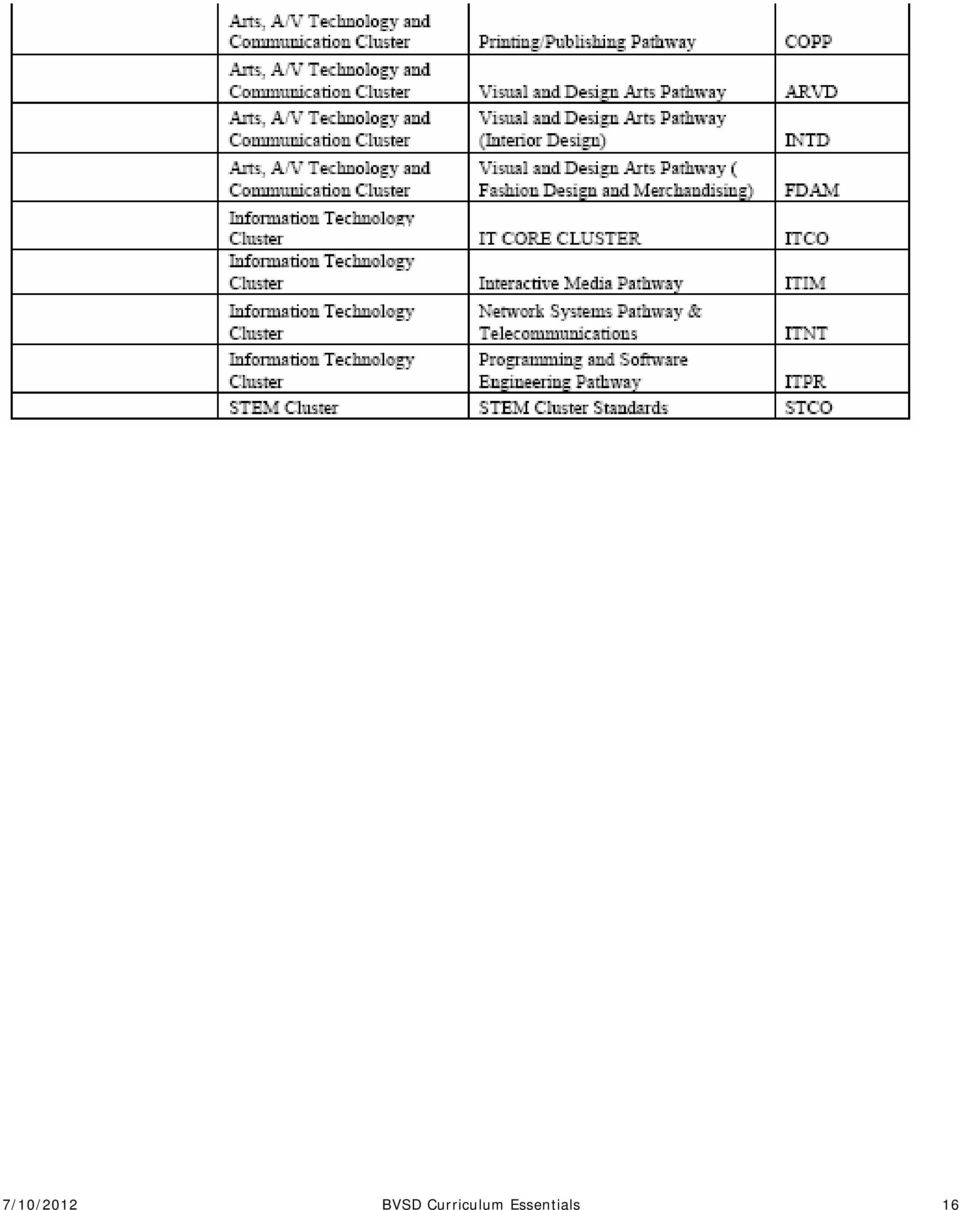
10 Colorado Career & Technical Education Standards Academic Alignment Reference System The Career & Technical Education standards have been organized by Career Cluster (17) and Pathway (81). In addition, a set of Essential Skills was developed to ensure the Postsecondary and Workforce Readiness within any cluster or pathway. These workforce readiness skills are applicable to all career clusters and should form the basis of each CTE program. Organization Essential Skills There exists a common set of knowledge and skills that are applicable to all students regardless of which cluster or pathway they choose. This set of standards, is meant for inclusion in each program to enhance the development of postsecondary and workforce readiness skills. Career Cluster A Career Cluster is a grouping of occupations and broad industries based on commonalities. The 17 Career Clusters organize academic and occupational knowledge and skills into a coherent course sequence and identify pathways from secondary schools to two- and four-year colleges, graduate schools, and the workplace. Students learn in school about what they can do in the future. This connection to future goals motivates students to work harder and enroll in more rigorous courses. Career Pathway Pathways are sub-groupings of occupations/career specialties used as an organizing tool for curriculum design and instruction. Occupations/career specialties are grouped into Pathways based on the fact that they require a set of common knowledge and skills for career success. Prepared Completer Competency This level targets the big ideas in each pathway. These are the competencies that all students who complete a CTE pathway must master to ensure their success in a postsecondary and workforce setting. Prepared Completer Competencies will not usually be course specific but grow with the student s progression through the sequence of courses. Concept/Skill The articulation of the concepts and skills that indicates a student is making progress toward being a prepared completer. They answer the question: What do students need to know and be able to do? Evidence Outcome The indication that a student is meeting an expectation at the mastery level. How do we know that a student can do it? Pathway Abbreviation (4 Letter) 7/10/2012 BVSD Curriculum Essentials 10
11 Academic Alignments Academic alignments, where appropriate in Math, Reading, Writing and Communication, Science and Social Studies (including Personal Financial Literacy) were defined by CTE and academic subject matter experts using the following criteria: It was a point where technical and academic content naturally collided; The student must demonstrate adequate proficiency with the academic standard to perform the technical skill; and It could be assessed for both academic and technical understanding. Colorado s CTE programs have had academic alignments dating back to the early 1990 s. While these alignments resulted in an increase in academic focus in CTE programs, the reality is that a true transformation in intentional teaching toward the academic standard was limited. With these alignments comes a new expectation: If a CTE instructor is teaching a CTE concept that has an identified alignment, they must also be intentional about their instruction of the academic standard. CCCS will be providing professional development and instructional resources to assist with the successful implementation of this new expectation. In addition, this expanded expectation will require increased collaboration between CTE and academic instructors to transform teaching and learning throughout each school. For each set of Cluster and Pathway standards, the academic alignments have been included and are separated by academic area. CCCS chose to align at the Evidence Outcome level. The aligned academic evidence outcome follows the CTE evidence outcome to which it has been aligned. For a sample, see Illustration A. 7/10/2012 BVSD Curriculum Essentials 11

12 The academic standard number used in the alignments matches the Colorado Department of Education standards numbering convention. 7/10/2012 BVSD Curriculum Essentials 12

13 7/10/2012 BVSD Curriculum Essentials 13

14 7/10/2012 BVSD Curriculum Essentials 14

15 7/10/2012 BVSD Curriculum Essentials 15

16 7/10/2012 BVSD Curriculum Essentials 16
17 Health Science, Criminal Justice & Public Safety Essential Skills / Alternative Cooperative Education ESSK.01 ESSK ESSK a ESSK ESSK a ESSK b ESSK c ESSK d ESSK d ESSK e ESSK g ESSK h ESSK i ACADEMIC FOUNDATIONS: Achieve additional academic knowledge and skills required to pursue the full range of career and postsecondary education opportunities within a career cluster. Complete required training, education, and certification to prepare for employment in a particular career field. Identify training, education, and certification requirements for occupational choice Demonstrates language arts knowledge and skills required to pursue the full-range of post-secondary and career opportunities. Model behaviors that demonstrate active listening. Adapt language for audience, purpose, situation. (i.e. diction/structure, style) Organize oral and written information. Compose focused copy for a variety of written documents such as agendas, audiovisuals, bibliographies, drafts, forms/documents, notes, oral presentations, reports, and technical terminology. Compose focused copy for a variety of written documents such as agendas, audiovisuals, bibliographies, drafts, forms/documents, notes, oral presentations, reports, and technical terminology. Edit copy to create focused written documents such as agendas, audiovisuals, bibliographies, drafts, forms/documents, notes, oral presentations, reports, and technical terminology. Evaluate oral and written information for accuracy, adequacy/sufficiency, appropriateness, clarity, conclusions/solutions, fact/opinion, propaganda, relevancy, validity, and relationship of ideas. Identify assumptions, purpose, outcomes/solutions, and propaganda techniques Predict potential outcomes and/or solutions based on oral and written information regarding trends. 7/10/2012 BVSD Curriculum Essentials 17

18 ESSK j ESSK ESSK Present formal and informal speeches including discussion, information requests, interpretation, and persuasive arguments. Demonstrate mathematics knowledge and skills required to pursue the full range of postsecondary education and career opportunities. Demonstrate science knowledge and skills required to pursue the full range of postsecondary and career education opportunities. ESSK.02 Communications: Use oral and written communication skills in creating, expressing, and interpreting information and ideas including technical terminology and information. ESSK Select and employ appropriate reading and communication strategies to learn and use technical concepts and vocabulary in practice. ESSK b Demonstrate use of content, technical concepts and vocabulary when analyzing information and following directions. ESSK c Select the reading strategy or strategies needed to fully comprehend the content within a written document (i.e., skimming, reading for detail, reading for meaning or critical analysis). ESSK d Interpret information, data, and observations to apply information learned from reading to actual practice. ESSK e Transcribe information, data, and observations to apply information learned from reading to actual practice. ESSK f Communicate information, data, and observations to apply information learned from ESSK Demonstrate use of the concepts, strategies, and systems for obtaining and conveying ideas and information to enhance communication in the workplace. ESSK a Employ verbal skills when obtaining and conveying information. ESSK b Record information needed to present a report on a given topic or problem ESSK c Write internal and external business correspondence that conveys and/or obtains information effectively. ESSK d Communicate with other employees to clarify workplace objectives ESSK e Communicate effectively with customers and employees to foster positive relationships. ESSK Locate, organize and reference written information from various sources to communicate with coworkers and clients/participants. ESSK a Locate written information used to communicate with co-workers and customers. ESSK b Organize information to use in written and oral communications. ESSK c Reference the sources of information. 7/10/2012 BVSD Curriculum Essentials 18

19 ESSK Evaluate and use information resources to accomplish specific occupational tasks. ESSK a ESSK b Use informational texts, Internet web sites, and/or technical materials to review and apply information sources for occupational tasks. Evaluate the reliability of information from informational texts, Internet Websites, and/or technical materials and resources. ESSK Use correct grammar, punctuation, and terminology to write and edit documents. ESSK a ESSK b ESSK c Compose multi-paragraph documents clearly, succinctly, and accurately. Use descriptions of audience and purpose when preparing and editing written documents. Use correct grammar, spelling, punctuation, and capitalization when preparing written documents. ESSK Develop and deliver formal and informal presentations using appropriate media to engage and inform audiences ESSK a ESSK b ESSK c ESSK d ESSK e ESSK f Prepare oral presentations to provide information for specific purposes and audiences. Identify support materials that will enhance an oral presentation. Prepare support materials that will enhance an oral presentation. Deliver an oral presentation that sustains listeners' attention and interest. Align presentation strategies to the intended audience. Implement multi-media strategies for presentations. ESSK Interpret verbal and nonverbal cues/behaviors to enhance communication with coworkers and clients/participants. ESSK a Interpret verbal behaviors when communicating with clients and coworkers. ESSK Apply active listening skills to obtain and clarify information. ESSK a ESSK b Interpret a given verbal message/information Respond with restatement and clarification techniques to clarify information. ESSK Develop and interpret tables, charts, and figures to support written and oral communications. ESSK a ESSK b Create tables, charts, and figures to support written and oral communications Interpret tables, charts, and figures used to support written and oral communication. 7/10/2012 BVSD Curriculum Essentials 19

20 ESSK Listen to and speak with diverse individuals to enhance communication skills. ESSK a ESSK b Apply factors and strategies for communicating with a diverse workforce. Demonstrate ability to communicate and resolve conflict within a diverse workforce. ESSK Exhibit public relations skills to increase internal and external customer and client satisfaction. ESSK a Communicate effectively when developing positive customer/client relationships. ESSK.04 Information Technology Applications: Use information technology tools specific to the career cluster to access, manage, integrate, and create information. ESSK Operate Internet applications to perform workplace tasks. ESSK a ESSK b ESSK c Access and navigate Internet (e.g., use a web browser). Search for information and resources. Evaluate internet resources for reliability and validity. ESSK.08 ETHICS AND LEGAL RESPONSIBILITIES: Know and understand the importance of professional ethics and legal responsibilities ESSK Apply ethical reasoning to a variety of workplace situations in order to make ethical decisions. ESSK a ESSK b ESSK c ESSK d ESSK e ESSK f Evaluate alternative responses to workplace situations based on legal responsibilities and employer policies. Evaluate alternative responses to workplace situations based on personal or professional ethical responsibilities Identify personal and long-term workplace consequences of unethical or illegal behaviors. Explain personal and long-term workplace consequences of unethical or illegal behaviors. Determine the most appropriate response to workplace situations based on legal and ethical considerations Explain the most appropriate response to workplace situations based on legal and ethical considerations. ESSK Interpret and explain written organizational policies and procedures to help employees perform their jobs according to employer rules and expectations. ESSK a ESSK b Locate information on organizational policies in handbooks and manuals. Discuss how specific organizational policies and procedures influence a specific work situation. 7/10/2012 BVSD Curriculum Essentials 20

21 Law, Public Safety, Corrections and Security Law Enforcement Services PWR Alignment to Forensics-Related Standards LEAS.01 Complete required training, education and certification to prepare for employment in career cluster. LEAS Identify training, education and certification for requirements for occupation. LEAS a Research and match career opportunities in career cluster. PWR e PWR f Understand the relevance of learning to postsecondary and workforce readiness Demonstrate awareness of and evaluate career options LEAS b Outline a realistic career development plan. PWR e PWR f Understand the relevance of learning to postsecondary and workforce readiness Demonstrate awareness of and evaluate career options LEAS c Compare and contrast different jobs in this field. PWR f Demonstrate awareness of and evaluate career options LEAS.02 Apply English Language Arts knowledge and skills to law, public safety, security and corrections careers to enable pursuit of a full range of careers and post-secondary education opportunities associated with the cluster. LEAS Demonstrate competence in Language Arts knowledge and skills in law enforcement pathway. LEAS a Apply reading process and strategies to criminal justice material by utilizing semantic cues, words and transitions in order to identify main ideas and supporting details PWR a PWR a Read fiction and non-fiction, understanding conclusions reached and points of view expressed Read, write, listen and speak effectively LEAS c Demonstrate competence in writing and editing documents, using correct grammar and punctuation. PWR b PWR e PWR a Write clearly and coherently for a variety of purposes and audiences Employ standard English language properly and fluently in reading, writing, listening, and speaking Read, write, listen and speak effectively LEAS d Demonstrate competence in speaking to different audiences both formally and 7/10/2012 BVSD Curriculum Essentials 21
22 informally to provide and distribute information. PWR e PWR a PWR b PWR c Employ standard English language properly and fluently in reading, writing, listening, and speaking Read, write, listen and speak effectively Construct clear, coherent, and persuasive arguments Communicate and interact effectively with people who have different primary languages LEAS f Understand the difference between writing for fact and writing for fiction and identifying main ideas and structure within that context. PWR b PWR a Write clearly and coherently for a variety of purposes and audiences Read, write, listen and speak effectively LEAS g Demonstrate understanding of the role of persuasive writing as it relates to criminal justice by demonstrating the ability to address counterarguments and the ability to use word choice that extends beyond the ordinary. PWR b PWR c PWR e PWR b PWR c PWR e PWR a PWR b PWR e PWR f PWR a PWR a PWR b Write clearly and coherently for a variety of purposes and audiences Use logic and rhetoric to analyze and critique ideas Employ standard English language properly and fluently in reading, writing, listening, and speaking Interpret sources, and evaluate evidence and competing ideas Build conceptual frameworks based on an understanding of themes and the overall flow of events Interpret information from a global and multicultural perspective Apply logical reasoning and analytical skills Conduct research using acceptable research methods Evaluate the credibility and relevance of information, ideas, and arguments Discern bias, pose questions, marshal evidence, and present solutions Demonstrate intellectual curiosity Read, write, listen and speak effectively Construct clear, coherent, and persuasive arguments LEAS h Demonstrate competence in making formal and informal oral presentations by preparing persuasive essays with thesis statement and supporting documentation using appropriate language and content or audience. 7/10/2012 BVSD Curriculum Essentials 22
23 PWR b PWR c PWR e PWR b PWR c PWR e PWR a PWR b PWR e PWR f PWR a PWR a PWR b Write clearly and coherently for a variety of purposes and audiences Use logic and rhetoric to analyze and critique ideas Employ standard English language properly and fluently in reading, writing, listening, and speaking Interpret sources, and evaluate evidence and competing ideas Build conceptual frameworks based on an understanding of themes and the overall flow of events Interpret information from a global and multicultural perspective Apply logical reasoning and analytical skills Conduct research using acceptable research methods Evaluate the credibility and relevance of information, ideas, and arguments Discern bias, pose questions, marshal evidence, and present solutions Demonstrate intellectual curiosity Read, write, listen and speak effectively Construct clear, coherent, and persuasive arguments LEAS i Apply reading process and strategies to criminal justice material by utilizing semantic cues, words and transitions in order to identify main ideas and supporting details. PWR a PWR c PWR b PWR e PWR a PWR e PWR f PWR a Read fiction and non-fiction, understanding conclusions reached and points of view expressed Use logic and rhetoric to analyze and critique ideas Interpret sources, and evaluate evidence and competing ideas Interpret information from a global and multicultural perspective Apply logical reasoning and analytical skills Evaluate the credibility and relevance of information, ideas, and arguments Discern bias, pose questions, marshal evidence, and present solutions Read, write, listen and speak effectively LEAS Demonstrate writing skills to facilitate effective field note taking and report writing in order to complete police incident reports common to law enforcement. 7/10/2012 BVSD Curriculum Essentials 23
24 LEAS a Prepare a police incident report for submission using clear, concise and complete language and use terminology common to the field and revise as necessary to maximize effect. PWR b PWR e PWR a PWR a Write clearly and coherently for a variety of purposes and audiences Employ standard English language properly and fluently in reading, writing, listening, and speaking Apply logical reasoning and analytical skills Read, write, listen and speak effectively LEAS b Understand sequence of events and topical reporting. PWR a Read fiction and non-fiction, understanding conclusions reached and points of view expressed PWR b Interpret sources, and evaluate evidence and competing ideas LEAS c Differentiate between passive/active tense and first/third person. PWR a Read, write, listen and speak effectively LEAS.03 Model behaviors that demonstrate integrity and a commitment to ethical behavior in order to show a desirable level of character required in law enforcement professions. LEAS Summarize various aspects and strategies used to encourage integrity and ethical behavior among law enforcement professionals. PWR b Understand the ethical uses of information PWR a Demonstrate intellectual curiosity LEAS Analyze crash scene evidence using laws, regulations and procedures. LEAS a Utilizing Newton's three laws of motion, describe occupant and vehicular behavior during a crash. PWR a PWR b PWR c PWR d Think scientifically and apply the scientific method to complex systems and phenomena Use theoretical principles within a scientific field and relevant empirical evidence to make and draw conclusions Recognize that scientific conclusions are subject to interpretation and can be challenged Understand the core scientific concepts, principles, laws, and vocabulary, and how scientific knowledge is extended, refined, an 7/10/2012 BVSD Curriculum Essentials 24
25 LEAS b Perform calculations using formula for speed, velocity, time and distance. PWR b Understand and apply algebraic and geometric concepts and techniques LEAS c Interpret evidence from scene such as tire marks and skids. PWR a PWR a Think critically, analyze evidence, read graphs, understand logical arguments, detect logical fallacies, test conjectures, evaluate risks, and appreciate the role mathematics plays in the modern world, i.e., be quantitatively literate Think scientifically and apply the scientific method to complex systems and phenomena PWR b Interpret sources, evaluate evidence and competing ideas PWR c PWR d PWR e PWR a PWR f PWR a Build conceptual frameworks based on an understanding of themes and the overall flow of events Understand how government works in the United States and in other countries, the varying roles individuals may play in society, Interpret information from a global and multicultural perspective Apply logical reasoning and analytical skills Discern bias, pose questions, marshal evidence, and psolutions Recognize the value of civic engagement and its role in a healthy democracy and civil society LEAS c demonstrate an understanding of guidelines and restrictions imposed by federal and state laws. PWR c PWR d PWR e PWR a PWR f PWR a Build conceptual frameworks based on an understanding of themes and the overall flow of events Understand how government works in the United States and in other countries, the varying roles individuals may play in society, Interpret information from a global and multicultural perspective Apply logical reasoning and analytical skills Discern bias, pose questions, marshal evidence, and present solutions Recognize the value of civic engagement and its role in a healthy democracy and civil society 7/10/2012 BVSD Curriculum Essentials 25
26 Law, Public Safety, Corrections and Security Law Enforcement Services RWC Alignment to Forensics-Related Standards LEAS.01 Complete required training, education and certification to prepare for employment in career cluster. LEAS Identify training, education and certification for requirements for occupation. LEAS a Research and match career opportunities in career cluster. RWC10-GR.10-S.4-GLE.1-EO.a Conduct short as well as more sustained research projects to answer a question (including a selfgenerated question) solve a problem; narrow or broaden the inquiry when appropriate; synthesize multiple sources on the subject, demonstrating understanding of the subject under investigation. (CCSS: W ) RWC10-GR.10-S.4-GLE.1-EO.e Distinguish between types of evidence (e.g., expert testimony, analogies, anecdotes, statistics) and use a variety of types to support a particular research purpose. RWC10-GR.11-S.4-GLE.1-EO.a Conduct short as well as more sustained research projects to answer a question (including a selfgenerated question) or solve a problem; narrow or broaden the inquiry when appropriate; synthesize multiple sources on the subject, demonstrating understanding of the subject under investigation. (CCSS: W ) RWC10-GR.11-S.4-GLE.1-EO.b Gather relevant information from multiple authoritative print and digital sources, using advanced searches effectively; assess the strengths and limitations of each source in terms of the task, purpose, and audience; integrate information into the text selectively to maintain the flow of ideas, avoiding plagiarism and overreliance on any one source and following a standard format for citation. (CCSS: W ) RWC10-GR.9-S.4-GLE.1-EO.a Integrate information from different sources to research and complete a project RWC10-GR.9-S.4-GLE.1-EO.d Examine materials to determine appropriate primary and secondary sources to use for investigating a question, topic, or issue (e.g., library databases, print and electronic encyclopedia and other reference materials, pamphlets, book excerpts, online and print newspaper and magazine articles, letters to LEAS b Outline a realistic career development plan. RWC10-GR.11-S.4-GLE.1-EO.a Conduct short as well as more sustained research projects to answer a question (including a selfgenerated question) or solve a problem; narrow or broaden the inquiry when appropriate; synthesize multiple sources on the subject, demonstrating understanding of the subject under investigation. (CCSS: 7/10/2012 BVSD Curriculum Essentials 26
27 W ) RWC10-GR.12-S.1-GLE.1-EO.a Present information, findings, and supporting evidence, conveying a clear and distinct perspective, such that listeners can follow the line of reasoning, alternative or opposing perspectives are addressed, and the organization, development, substance, and style are appropriate. LEAS c Compare and contrast different jobs in this field. RWC10-GR.12-S.1-GLE.1-EO.a Present information, findings, and supporting evidence, conveying a clear and distinct perspective, such that listeners can follow the line of reasoning, alternative or opposing perspectives are addressed, and the organization, development, substance, and style are appropriate to purpose, audience, and a range of formal and informal tasks. (CCSS: SL ) LEAS.02 Apply English Language Arts knowledge and skills to law, public safety, security and corrections careers to enable pursuit of a full range of careers and post-secondary education opportunities associated with the cluster. LEAS Demonstrate competence in Language Arts knowledge and skills in law enforcement pathway. LEAS a Apply reading process and strategies to criminal justice material by utilizing semantic cues, words and transitions in order to identify main ideas and supporting details RWC10-GR.12-S.2-GLE.2-EO.c Use reading and note-taking strategies (outlining, mapping systems, skimming, scanning, key word search) to organize information and make connections within and across informational texts RWC10-GR.12-S.2-GLE.2-EO.d Use semantic cues, signal words, and transitions to identify text structures (such as critique, proposition/support, inductive/deductive) and to summarize central ideas and supporting details RWC10-GR.12-S.2-GLE.2-EO.e Obtain and use information from text and text features (index, bold or italicized text, subheadings, graphics) to answer questions, perform specific tasks, or identify and solve problems RWC10-GR.12-S.2-GLE.2-EO.f Explain and interpret the visual components supporting the text (maps, LEAS c Demonstrate competence in writing and editing documents, using correct grammar and punctuation. RWC10-GR.10-S.3-GLE.3-EO.a Demonstrate command of the conventions of standard English grammar and usage when writing or speaking. (CCSS: L ), i. Use parallel structure. (CCSS: L a), ii. Distinguish between the active and passive voice, and write in the active voice, iii. Use various types of phrases (noun, verb, adjectival, adverbial, participial, prepositional, absolute) and clauses (independent, dependent; noun, relative, 7/10/2012 BVSD Curriculum Essentials 27
28 adverbial) to convey specific meanings and add variety and interest to writing or presentations. (CCSS: L b) RWC10-GR.10-S.3-GLE.3-EO.b Demonstrate command of the conventions of standard English capitalization, punctuation, and spelling when writing. (CCSS: L ), i. Use a semicolon (and perhaps a conjunctive adverb) to link two or more closely related independent clauses. (CCSS: L a), ii. Use a colon to introduce a list or quotation. (CCSS: L b) RWC10-GR.10-S.3-GLE.3-EO.d Produce clear and coherent writing in which the development, organization, and style are appropriate to task, purpose, and audience. (Grade-specific expectations for writing types are defined in expectations 1-2 above.) (CCSS: W ) RWC10-GR.10-S.3-GLE.3-EO.e Develop and strengthen writing as needed by planning, revising, editing, rewriting, or trying a new approach, focusing on addressing what is most significant for a specific purpose and audience. (CCSS: W ) RWC10-GR.11-S.3-GLE.3-EO.a Demonstrate command of the conventions of standard English grammar and usage when writing or speaking. (CCSS: L ), i. Apply the understanding that usage is a matter of convention, can change over time, and is sometimes contested. (CCSS: L a), ii. Resolve issues of complex or contested usage, consulting references (e.g., Merriam- Webster's Dictionary of English Usage, Garner's Modern American Usage) as needed. (CCSS: L b), i. Use a variety of phrases (absolute, appositive) accurately and purposefully to improve writing, ii. Use idioms correctly, particularly prepositions that follow verbs, iii. Ensure that a verb agrees with its subject in complex constructions (such as inverted subject/verb order, indefinite pronoun as subject, intervening phrases or clauses), iv. Use a style guide to follow the conventions of Modern Language Association (MLA) or American Psychological Association (APA) format, v. Use resources (print and electronic) and feedback to edit and enhance writing for purpose and audience. RWC10-GR.11-S.3-GLE.3-EO.b Demonstrate command of the conventions of standard English capitalization, punctuation, and spelling when writing. (CCSS: L ), i. Observe hyphenation conventions. (CCSS: L a), ii. Spell correctly. (CCSS: L b) RWC10-GR.11-S.3-GLE.3-EO.c Produce clear and coherent writing in which the development, organization, and style are appropriate to task, purpose, and audience. (Grade-specific expectations for writing types are defined in expectations 1-2 above.) (CCSS: W ) RWC10-GR.11-S.3-GLE.3-EO.d Develop and strengthen writing as needed by planning, revising, editing, rewriting, or trying a new approach, focusing on addressing what is most significant for a specific purpose and audience. (CCSS: W ) RWC10-GR.12-S.3-GLE.2-EO.d Select and build context for language appropriate to content (technical, formal) RWC10-GR.12-S.3-GLE.2-EO.h 7/10/2012 BVSD Curriculum Essentials 28
29 Revise writing using feedback to maximize effect on audience and to calibrate purpose RWC10-GR.12-S.3-GLE.3-EO.a Follow the conventions of standard English to write varied, strong, correct, complete sentences RWC10-GR.9-S.3-GLE.3-EO.a Demonstrate command of the conventions of standard English capitalization, punctuation, and spelling when writing. (CCSS: L ), i. Identify comma splices and fused sentences in writing and revise to eliminate them, ii. Distinguish between phrases and clauses and use this knowledge to write varied, strong, correct, complete sentences, iii. Use a colon to introduce a list or quotation. (CCSS: L b), iv. Spell correctly. (CCSS: L c) RWC10-GR.9-S.3-GLE.3-EO.b Produce clear and coherent writing in which the development, organization, and style are appropriate to task, purpose, and audience. (Grade-specific expectations for writing types are defined in expectations 1 and 2 above.) (CCSS: W ) RWC10-GR.9-S.3-GLE.3-EO.c Develop and strengthen writing as needed by planning, revising, editing, rewriting, or trying a new approach, focusing on addressing what is most significant for a specific purpose and audience. (CCSS: W ) LEAS d Demonstrate competence in speaking to different audiences both formally and informally to provide and distribute information. RWC10-GR.11-S.1-GLE.1-EO.a Give informal talks using an appropriate level of formality of verbal language and nonverbal interaction with audience RWC10-GR.11-S.1-GLE.1-EO.b Deliver formal oral presentations for intended purpose and audience, using effective verbal and nonverbal communication RWC10-GR.11-S.1-GLE.1-EO.c Deliver oral talks with clear enunciation, vocabulary, and appropriate organization; nonverbal gestures; and tone RWC10-GR.12-S.1-GLE.1-EO.a Present information, findings, and supporting evidence, conveying a clear and distinct perspective, such that listeners can follow the line of reasoning, alternative or opposing perspectives are addressed, and the organization, development, substance, and style are appropriate to purpose, audience, and a range of formal and informal tasks. (CCSS: SL ) RWC10-GR.12-S.1-GLE.1-EO.e Choose specific words and word order for intended effect and meaning RWC10-GR.9-S.1-GLE.1-EO.a Adapt speech to a variety of contexts and tasks, demonstrating command of formal English when indicated or appropriate.(ccss: SL ) RWC10-GR.9-S.1-GLE.1-EO.b Use verbal and nonverbal techniques to communicate information LEAS e Adapt listening strategies to utilize verbal and nonverbal content of communication. 7/10/2012 BVSD Curriculum Essentials 29
30 RWC10-GR.11-S.1-GLE.2-EO.c Evaluate a speaker's point of view, reasoning, and use of evidence and rhetoric, assessing the stance, premises, links among ideas, word choice, points of emphasis, and tone used. (CCSS: SL ) LEAS f Understand the difference between writing for fact and writing for fiction and identifying main ideas and structure within that context. RWC10-GR.10-S.3-GLE.2-EO.a Write informative/explanatory texts to examine and convey complex ideas, concepts, and information clearly and accurately through the effective selection, organization, and analysis of content. (CCSS: W ), i. Introduce a topic; organize complex ideas, concepts, and information to make important connections and distinctions; include formatting (e.g., headings), graphics (e.g., figures, tables), and multimedia when useful to aiding comprehension. (CCSS: W a), ii. Develop the topic with wellchosen, relevant, and sufficient facts, extended definitions, concrete details, quotations, or other information and examples appropriate to the audience's knowledge of the topic. (CCSS: W b), iii. Choose and develop an effective appeal, iv. Collect, organize, and evaluate materials to support ideas, v. Use appropriate and varied transitions to link the major sections of the text, create cohesion, and clarify the relationships among complex ideas and concepts. (CCSS: W c), vi. Use precise language and domain-specific vocabulary to manage the complexity of the topic. (CCSS: W d), vii. Establish and maintain a formal style and objective tone while attending to the norms and conventions of the discipline in which they are writing. (CCSS: W e), viii. Provide a concluding statement or section that follows from and supports the information or explanation presented (e.g., articulating implications or the significance of the topic). (CCSS: W f), ix. Revise writing by evaluating relationship of central idea, evidence, and organizational pattern, x. Explain how writers use organization and details to communicate their purposes, xi. Present writing to an authentic audience and gauge effect on audience for intended purpose RWC10-GR.11-S.3-GLE.2-EO.a Write arguments to support claims in an analysis of substantive topics or texts, using valid reasoning and relevant and sufficient evidence. (CCSS: W ), i. Introduce precise, knowledgeable claim(s), establish the significance of the claim(s), distinguish the claim(s) from alternate or opposing claims, and create an organization that logically sequences claim(s), counterclaims, reasons, and evidence. (CCSS: W a), ii. Develop claim(s) and counterclaims fairly and thoroughly, supplying the most relevant evidence for each while pointing out the strengths and limitations of both in a manner that anticipates the audience s knowledge level, concerns, values, and possible biases. (CCSS: W b), iii. Use words, phrases, and clauses as well as varied syntax to link the major sections of the text, create cohesion, and clarify the relationships between claim(s) and reasons, between reasons and evidence, and between claim(s) and counterclaims. (CCSS: W c), iv. Establish and maintain a formal style and objective tone while attending to the norms and conventions of the discipline in which they are writing. (CCSS: W d), v. Provide a concluding statement or section that follows from and supports the argument presented. (CCSS: W e) RWC10-GR.11-S.3-GLE.2-EO.b Write informative/explanatory texts to examine and convey complex ideas, concepts, and information clearly and accurately through the effective selection, organization, and analysis of content. (CCSS: W ), i. Introduce a topic; organize complex ideas, concepts, and information so that each new element builds on that which precedes it to create a unified whole; include formatting (e.g., headings), graphics (e.g., figures, tables), and multimedia when useful to aiding comprehension. (CCSS: W a), ii. Develop the topic thoroughly by selecting the most significant and relevant facts, extended definitions, concrete details, quotations, or other information and examples appropriate to the audience's knowledge of the topic. (CCSS: W b), iii. Use appropriate and varied transitions and syntax to link the major sections of the text, create cohesion, and clarify the relationships among complex ideas and concepts. (CCSS: W c), iv. Use precise language, domain-specific vocabulary, and techniques such as metaphor, simile, and analogy to manage the complexity of the topic. (CCSS: W.11-7/10/2012 BVSD Curriculum Essentials 30
31 12.2d), v. Establish and maintain a formal style and objective tone while attending to the norms and conventions of the discipline in which they are writing. (CCSS: W e), vi. Provide a concluding statement or section that follows from and supports the information or explanation presented (e.g., articulating implications or the significance of the topic). (CCSS: W f) RWC10-GR.11-S.3-GLE.3-EO.c Produce clear and coherent writing in which the development, organization, and style are appropriate to task, purpose, and audience. (Grade-specific expectations for writing types are defined in expectations 1-2 above.) (CCSS: W ) LEAS g Demonstrate understanding of the role of persuasive writing as it relates to criminal justice by demonstrating the ability to address counterarguments and the ability to use word choice that extends beyond the ordinary. RWC10-GR.10-S.3-GLE.3-EO.c Apply knowledge of language to understand how language functions in different contexts, to make effective choices for meaning or style, and to comprehend more fully when reading or listening. (CCSS: L ), i. Write and edit work so that it conforms to the guidelines in a style manual (e.g., MLA Handbook, Turabian's Manual for Writers) appropriate for the discipline and writing type. (CCSS: L a) RWC10-GR.11-S.3-GLE.2-EO.a Write arguments to support claims in an analysis of substantive topics or texts, using valid reasoning and relevant and sufficient evidence. (CCSS: W ), i. Introduce precise, knowledgeable claim(s), establish the significance of the claim(s), distinguish the claim(s) from alternate or opposing claims, and create an organization that logically sequences claim(s), counterclaims, reasons, and evidence. (CCSS: W a), ii. Develop claim(s) and counterclaims fairly and thoroughly, supplying the most relevant evidence for each while pointing out the strengths and limitations of both in a manner that anticipates the audience's knowledge level, concerns, values, and possible biases. (CCSS: W b), iii. Use words, phrases, and clauses as well as varied syntax to link the major sections of the text, create cohesion, and clarify the relationships between claim(s) and reasons, between reasons and evidence, and between claim(s) and counterclaims. (CCSS: W c), iv. Establish and maintain a formal style and objective tone while attending to the norms and conventions of the discipline in which they are writing. (CCSS: W d), v. Provide a concluding statement or section that follows from and supports the argument presented. (CCSS: W e) RWC10-GR.12-S.3-GLE.2-EO.c Address audience needs and anticipate audience questions or misunderstandings RWC10-GR.12-S.3-GLE.2-EO.d Select and build context for language appropriate to content (technical, formal) RWC10-GR.12-S.3-GLE.2-EO.f Support judgments with substantial evidence and purposeful elaboration RWC10-GR.12-S.3-GLE.3-EO.b Deliberately manipulate the conventions of standard English for stylistic effect appropriate to the needs of a particular audience and purpose 7/10/2012 BVSD Curriculum Essentials 31
32 RWC10-GR.9-S.3-GLE.2-EO.a Write arguments to support claims in an analysis of substantive topics or texts, using valid reasoning and relevant and sufficient evidence. (CCSS: W ), i. Introduce precise claim(s), distinguish the claim(s) from alternate or opposing claims, and create an organization that establishes clear relationships among claim(s), counterclaims, reasons, and evidence. (CCSS: W a), ii. Develop claim(s) and counterclaims fairly, supplying evidence for each while pointing out the strengths and limitations of both in a manner that anticipates the audience's knowledge level and concerns. (CCSS: W b), iii. Use words, phrases, and clauses to link the major sections of the text, create cohesion, and clarify the relationships between claim(s) and reasons, between reasons and evidence, and between claim(s) and counterclaims. (CCSS: W c), iv. Use appropriate rhetorical appeals and genre to engage and guide the intended audience, v. Anticipate and address readers' biases and expectations, vi. Revise ideas and structure to improve depth of information and logic of organization, vii. Explain and imitate emotional, logical, and ethical appeals used by writers who are trying to persuade an audience, viii. Establish and maintain a formal style and objective tone while attending to the norms and conventions of the discipline in which they are writing. (CCSS: W d), ix. Provide a concluding statement or section that follows from and supports the argument presented. (CCSS: W e) RWC10-GR.9-S.3-GLE.2-EO.a Write arguments to support claims in an analysis of substantive topics or texts, using valid reasoning and relevant and sufficient evidence. (CCSS: W ), i. Introduce precise claim(s), distinguish the claim(s) from alternate or opposing claims, and create an organization that establishes clear relationships among claim(s), counterclaims, reasons, and evidence. (CCSS: W a), ii. Develop claim(s) and counterclaims fairly, supplying evidence for each while pointing out the strengths and limitations of both in a manner that anticipates the audience's knowledge level and concerns. (CCSS: W b), iii. Use words, phrases, and clauses to link the major sections of the text, create cohesion, and clarify the relationships between claim(s) and reasons, between reasons and evidence, and between claim(s) and counterclaims. (CCSS: W c), iv. Use appropriate rhetorical appeals and genre to engage and guide the intended audience, v. Anticipate and address readers' biases and expectations, vi. Revise ideas and structure to improve depth of information and logic of organization, vii. Explain and imitate emotional, logical, and ethical appeals used by writers who are trying to persuade an audience, viii. Establish and maintain a formal style and objective tone while attending to the norms and conventions of the discipline in which they are writing. (CCSS: W d), ix. Provide a concluding statement or section that follows from and supports the argument presented. (CCSS: W e) LEAS h Demonstrate competence in making formal and informal oral presentations by preparing persuasive essays with thesis statement and supporting documentation using appropriate language and content for audience. LEAS i Apply reading process and strategies to criminal justice material by utilizing semantic cues, words and transitions in order to identify main ideas and supporting details. RWC10-GR.10-S.2-GLE.1-EO.b Determine the meaning of words and phrases as they are used in the text, including figurative and connotative meanings; analyze the cumulative impact of specific word choices on meaning and tone (e.g., how the language evokes a sense of time and place; how it sets a formal or informal tone). (CCSS: RL ) RWC10-GR.10-S.2-GLE.2-EO.e Determine the meaning of words and phrases as they are used in a text, including figurative, connotative, and technical meanings; analyze the cumulative impact of specific word choices on meaning and tone. 7/10/2012 BVSD Curriculum Essentials 32
33 RWC10-GR.10-S.2-GLE.3-EO.c Acquire and use accurately general academic and domain-specific words and phrases, sufficient for reading, writing, speaking, and listening at the college and career readiness level; demonstrate independence in gathering vocabulary knowledge when considering a word or phrase important to comprehension or expression. (CCSS: L ) RWC10-GR.11-S.2-GLE.3-EO.b Determine or clarify the meaning of unknown and multiple-meaning words and phrases based on grades reading and content, choosing flexibly from a range of strategies. (CCSS: L ), i. Use context (e.g., the overall meaning of a sentence, paragraph, or text; a word's position or function in a sentence) as a clue to the meaning of a word or phrase. (CCSS: L a), ii. Identify and correctly use patterns of word changes that indicate different meanings or parts of speech (e.g., conceive, conception, conceivable). (CCSS: L b), iii. Consult general and specialized reference materials (e.g., dictionaries, glossaries, thesauruses), both print and digital, to find the pronunciation of a word or determine or clarify its precise meaning, its part of speech, its etymology, or its standard usage. (CCSS: L c), iv. Verify the preliminary determination of the meaning of a word or phrase (e.g., by checking the inferred meaning in context or in a dictionary). (CCSS: L d) RWC10-GR.12-S.2-GLE.2-EO.d Use semantic cues, signal words, and transitions to identify text structures (such as critique, proposition/support, inductive/deductive) and to summarize central ideas and supporting details LEAS Demonstrate writing skills to facilitate effective field note taking and report writing in order to complete police incident reports common to law enforcement. RWC10-GR.10-S.3-GLE.3-EO.a Demonstrate command of the conventions of standard English grammar and usage when writing or speaking. (CCSS: L ), i. Use parallel structure. (CCSS: L a), ii. Distinguish between the active and passive voice, and write in the active voice, iii. Use various types of phrases (noun, verb, adjectival, adverbial, participial, prepositional, absolute) and clauses (independent, dependent; noun, relative, adverbial) to convey specific meanings and add variety and interest to writing or presentations. (CCSS: L b) RWC10-GR.10-S.3-GLE.3-EO.c Apply knowledge of language to understand how language functions in different contexts, to make effective choices for meaning or style, and to comprehend more fully when reading or listening. (CCSS: L ), i. Write and edit work so that it conforms to the guidelines in a style manual (e.g., MLA Handbook, Turabian's Manual for Writers) appropriate for the discipline and writing type. (CCSS: L a) RWC10-GR.10-S.3-GLE.3-EO.e Develop and strengthen writing as needed by planning, revising, editing, rewriting, or trying a new approach, focusing on addressing what is most significant for a specific purpose and audience. (CCSS: W ) RWC10-GR.11-S.3-GLE.3-EO.b Demonstrate command of the conventions of standard English capitalization, punctuation, and spelling when writing. (CCSS: L ), i. Observe hyphenation conventions. (CCSS: L a), ii. Spell correctly. (CCSS: L b) RWC10-GR.11-S.3-GLE.3-EO.d Develop and strengthen writing as needed by planning, revising, editing, rewriting, or 7/10/2012 BVSD Curriculum Essentials 33
34 LEAS b Understand sequence of events and topical reporting. RWC10-GR.10-S.3-GLE.3-EO.d Produce clear and coherent writing in which the development, organization, and style are appropriate to task, purpose, and audience. (Grade-specific expectations for writing types are defined in expectations 1-2 above.) (CCSS: W ) RWC10-GR.9-S.3-GLE.2-EO.a Write arguments to support claims in an analysis of substantive topics or texts, using valid reasoning and relevant and sufficient evidence. (CCSS: W ), i. Introduce precise claim(s), distinguish the claim(s) from alternate or opposing claims, and create an organization that establishes clear relationships among claim(s), counterclaims, reasons, and evidence. (CCSS: W a), ii. Develop claim(s) and counterclaims fairly, supplying evidence for each while pointing out the strengths and limitations of both in a manner that anticipates the audience's knowledge level and concerns. (CCSS: W b), iii. Use words, phrases, and clauses to link the major sections of the text, create cohesion, and clarify the relationships between claim(s) and reasons, between reasons and evidence, and between claim(s) and counterclaims. (CCSS: W c), iv. Use appropriate rhetorical appeals and genre to engage and guide the intended audience, v. Anticipate and address readers' biases and expectations, vi. Revise ideas and structure to improve depth of information and logic of organization, vii. Explain and imitate emotional, logical, and ethical appeals used by writers who are trying to persuade an audience, viii. Establish and maintain a formal style and objective tone while attending to the norms and conventions of the discipline in which they are writing. (CCSS: W d) LEAS c Differentiate between passive and active tense and first and third person. RWC10-GR.10-S.3-GLE.3-EO.a Demonstrate command of the conventions of standard English grammar and usage when writing or speaking. (CCSS: L ), i. Use parallel structure. (CCSS: L a), ii. Distinguish between the active and passive voice, and write in the active voice, iii. Use various types of phrases (noun, verb, adjectival, adverbial, participial, prepositional, absolute) and clauses (independent, dependent; noun, relative, adverbial) to convey specific meanings and add variety and interest to writing or presentations. RWC10-GR.10-S.3-GLE.3-EO.d Produce clear and coherent writing in which the development, organization, and style are appropriate to task, purpose, and audience. (Grade-specific expectations for writing types are defined in expectations 1-2 above.) (CCSS: W ) RWC10-GR.12-S.3-GLE.3-EO.b Deliberately manipulate the conventions of standard English for stylistic effect appropriate LEAS.03 Model behaviors that demonstrate integrity and a commitment to ethical behavior in order to show a desirable level of character required in law enforcement professions. LEAS Summarize various aspects and strategies used to encourage integrity and ethical behavior among law enforcement professionals. LEAS a Examine real world situations and Supreme Court cases involving the application of ethics, be able to cite authority for ethical decisions. 7/10/2012 BVSD Curriculum Essentials 34
35 RWC10-GR.10-S.2-GLE.2-EO.f Analyze seminal U.S. documents of historical and literary significance (e.g., Washington's Farewell Address, the Gettysburg Address, Roosevelt's Four Freedoms speech, King's "Letter from Birmingham Jail"), including how they address related themes and concepts. CCSS: RI ) RWC10-GR.10-S.2-GLE.2-EO.g By the end of grade 10, read and comprehend literary nonfiction at the high end of the grades 9-10 text complexity band independently and proficiently. (CCSS: RI ) RWC10-GR.10-S.2-GLE.3-EO.c Acquire and use accurately general academic and domain-specific words and phrases, sufficient for reading, writing, speaking, and listening at the college and career readiness level; demonstrate independence in gathering vocabulary knowledge when considering a word or phrase important to comprehension or expression. (CCSS: L ) RWC10-GR.11-S.2-GLE.2-EO.b Use Craft and Structure to: i. Determine the meaning of words and phrases as they are used in a text, including figurative, connotative, and technical meanings; analyze how an author uses and refines the meaning of a key term or terms over the course of a text (e.g., how Madison defines faction in Federalist No. 10). (CCSS: RI ), ii. Use text features and graphical representations to complement comprehension and enhance critical analysis of a text, iii. Analyze and evaluate the effectiveness of the structure an author uses in his or her exposition or argument, including whether the structure makes points clear, convincing, and engaging. (CCSS: RI ) RWC10-GR.11-S.2-GLE.2-EO.c Use Integration of Knowledge and Ideas to: i. Delineate and evaluate the reasoning in seminal U.S. texts, including the application of constitutional principles and use of legal reasoning (e.g., in U.S. Supreme Court majority opinions and dissents) and the premises, purposes, and arguments in works of public advocacy (e.g., The Federalist, presidential addresses). (CCSS: RI ), ii. Analyze seventeenth-, eighteenth-, and nineteenth-century foundational U.S. documents of historical and literary significance RWC10-GR.11-S.2-GLE.2-EO.d Use Range of Reading and Complexity of Text to by the end of grade 11 read and comprehend literary nonfiction in the grades 11-CCR text complexity band proficiently, with scaffolding as needed at the high end of the range. (CCSS: RI ) RWC10-GR.11-S.2-GLE.3-EO.d Acquire and use accurately general academic and domain-specific words and phrases, sufficient for reading, writing, speaking, and listening at the college and career readiness level; demonstrate independence in gathering vocabulary knowledge when considering a word or phrase important to comprehension or expression. (CCSS: L ) RWC10-GR.12-S.2-GLE.2-EO.g By the end of grade 12, read and comprehend literary nonfiction at the high end of the grades 11-CCRtext complexity band independently and proficiently. (CCSS: RI ) RWC10-GR.12-S.3-GLE.2-EO.b Select appropriate and relevant information (excluding extraneous details) to set context. RWC10-GR.9-S.2-GLE.2-EO.g Delineate and evaluate the argument and specific claims in a text, assessing whether the 7/10/2012 BVSD Curriculum Essentials 35
36 reasoning is valid and the evidence is relevant and sufficient; identify false statements and fallacious reasoning. (CCSS: RI ) LEAS Analyze and summarize the legal responsibilities associated with different roles and functions within public safety in order to demonstrate a commitment to professional and ethical behavior. LEAS a Explain the dynamics of integrity as it relates to law enforcement either orally or in written format. RWC10-GR.9-S.1-GLE.1-EO.b Use verbal and nonverbal techniques to communicate information LEAS b Utilizing a group setting, determine a response to an ethical dilemma based on the Law Enforcement Code of Ethics and use of discretion. RWC10-GR.11-S.1-GLE.2-EO.a Initiate and participate effectively in a range of collaborative discussions (one-on-one, in groups, and teacher-led) with diverse partners on grades topics, texts, and issues, building on others' ideas and expressing their own clearly and persuasively. (CCSS: SL ) air-come to discussions prepared, having read and researched material under study; explicitly draw on that preparation by referring to evidence from texts and other research on the topic or issue to stimulate a thoughtful, well-reasoned exchange of ideas. (CCSS: SL a) a.ii-critique the accuracy, relevance, and organization of evidence of a presentation. a.iii-evaluate effectiveness of oral delivery techniques. a.iv-listen critically to evaluate the overall effectiveness of the presentation. a.v-analyze the resources cited for validity. a.vi- Respond thoughtfully to diverse perspectives; synthesize comments, claims, and evidence made on all sides of an issue; resolve contradictions when possible; and determine what additional information or research is required to deepen the investigation or complete the task. (CCSS: SL b) RWC10-GR.12-S.1-GLE.2-EO.a Work with peers to promote civil, democratic discussions and decision-making, set clear goals and deadlines, and establish individual roles as needed. (CCSS: SL b) RWC10-GR.12-S.1-GLE.2-EO.c Implement an effective group effort that achieves a goal RWC10-GR.12-S.1-GLE.2-EO.d Participate in the preparations of the group activity or product, defining and assuming Individual roles and responsibilities LEAS c Explain the role of the state and federal constitution to the development and implementation of the mission of law enforcement organizations verbally, in written format or through oral presentation. RWC10-GR.11-S.3-GLE.1-EO.a Write narratives to develop real or imagined experiences or events using effective technique, well-chosen details, and well-structured event sequences. (CCSS: W ), i. Engage and orient the reader by setting out a problem, situation, or observation and its significance, establishing one or multiple point(s) of view, and introducing a narrator and/or characters; create a smooth progression of experiences or events. (CCSS: W a), ii. Use narrative techniques, such as dialogue, pacing, description, reflection, and multiple plot lines, to develop experiences, events, and/or characters. (CCSS: W b), iii. Use a variety of techniques to sequence events so that they build on one another to create a coherent whole and build toward a particular tone and outcome (e.g., a sense of mystery, suspense, 7/10/2012 BVSD Curriculum Essentials 36
37 growth, or resolution). (CCSS: W c), iv. Use precise words and phrases, telling details, and sensory language to convey a vivid picture of the experiences, events, setting, and/or characters. (CCSS: W d), v. Provide a conclusion that follows from and reflects on what is experienced, observed, or resolved over the course of the narrative. (CCSS: W e), vi. Use a range of strategies to evaluate whether the writing is presented in a clear and engaging manner (such as reading the text from the perspective of the intended audience, seeking feedback from a reviewer), vii. Evaluate and revise text to eliminate unnecessary details, ineffective stylistic devices, and vague or confusing language RWC10-GR.11-S.3-GLE.2-EO.a Write arguments to support claims in an analysis of substantive topics or texts, using valid reasoning and relevant and sufficient evidence. (CCSS: W ), i. Introduce precise, knowledgeable claim(s), establish the significance of the claim(s), distinguish the claim(s) from alternate or opposing claims, and create an organization that logically sequences claim(s), counterclaims, reasons, and evidence. (CCSS: W a), ii. Develop claim(s) and counterclaims fairly and thoroughly, supplying the most relevant evidence for each while pointing out the strengths and limitations of both in a manner that anticipates the audience's knowledge level, concerns, values, and possible biases. (CCSS: W b), iii. Use words, phrases, and clauses as well as varied syntax to link the major sections of the text, create cohesion, and clarify the relationships between claim(s) and reasons, between reasons and evidence, and between claim(s) and counterclaims. (CCSS: W c), iv. Establish and maintain a formal style and objective tone while attending to the norms and conventions of the discipline in which they are writing. (CCSS: W d), v. Provide a concluding statement or section that follows from and supports the argument presented. (CCSS: W e) LEAS Evaluate and apply strategies for responding to unethical or illegal actions of individuals and organizations in order to demonstrate how to respond to unethical situations that arise within law and public safety. LEAS a Given a specific situation, outline strategies for responding to unethical and illegal actions. RWC10-GR.11-S.3-GLE.3-EO.d Develop and strengthen writing as needed by planning, revising, editing, rewriting, or trying a new approach, focusing on addressing what is most significant for a specific purpose and audience. (CCSS: W ) 7/10/2012 BVSD Curriculum Essentials 37
38 LEAS.04 Demonstrate understanding have and adherence to the Fourth Amendment in the area of search and seizure and probable cause. LEAS Execute protocols associated with search and seizure using statutes set forth by fourth amendment. LEAS a Analyze and describe the limits of government under 4th amendment using Supreme Court cases. RWC10-GR.10-S.2-GLE.2-EO.a Cite strong and thorough textual evidence to support analysis of what the text says explicitly as well as inferences drawn from the text. (CCSS: RI ) RWC10-GR.10-S.2-GLE.2-EO.f Analyze seminal U.S. documents of historical and literary significance (e.g., Washington's Farewell Address, the Gettysburg Address, Roosevelt's Four Freedoms speech, King's "Letter from Birmingham Jail"), including how they address related themes and concepts. CCSS: RI ) RWC10-GR.10-S.2-GLE.2-EO.g By the end of grade 10, read and comprehend literary nonfiction at the high end of the grades 9-10 text complexity band independently and proficiently. (CCSS: RI ) RWC10-GR.10-S.2-GLE.3-EO.c Acquire and use accurately general academic and domain-specific words and phrases, sufficient for reading, writing, speaking, and listening at the college and career readiness level; demonstrate independence in gathering vocabulary knowledge when considering a word or phrase important to comprehension or expression. (CCSS: L ) RWC10-GR.11-S.2-GLE.2-EO.a Use Key Ideas and Details to: Cite strong and thorough textual evidence to support analysis of what the text says explicitly as well as inferences drawn from the text, including determining where the text leaves matters uncertain. (CCSS: RI ), Determine two or more central ideas of a text and analyze their development over the course of the text, including how they interact and build on one another to provide a complex analysis; provide an objective summary of the text. (CCSS: RI ), Analyze a complex set of ideas or sequence of events and explain how specific individuals, ideas, or events interact and develop over the course of the text. (CCSS: RI ), Designate a purpose for reading expository texts and use new learning to complete a specific task (such as convince an audience, shape a personal opinion or decision, or perform an activity), Predict the impact an informational text will have on an audience and justify the prediction RWC10-GR.11-S.2-GLE.2-EO.b Use Craft and Structure to: i. Determine the meaning of words and phrases as they are used in a text, including figurative, connotative, and technical meanings; analyze how an author uses and refines the meaning of a key term or terms over the course of a text (e.g., how Madison defines faction in Federalist No. 10). (CCSS: RI ), ii. Use text features and graphical representations to complement comprehension and enhance critical analysis of a text, iii. Analyze and evaluate the effectiveness of the structure an author uses in his or her exposition or argument, including whether the structure makes points clear, convincing, and engaging. (CCSS: RI ) RWC10-GR.11-S.2-GLE.2-EO.c Use Integration of Knowledge and Ideas to: i. Delineate and evaluate the reasoning in seminal U.S. texts, including the application of constitutional principles and use of legal reasoning (e.g., in U.S. Supreme Court majority opinions and dissents) and the premises, purposes, and arguments in works of public 7/10/2012 BVSD Curriculum Essentials 38
39 advocacy (e.g., The Federalist, presidential Addresses). (CCSS: RI ), ii. Analyze seventeenth-, eighteenth-, and nineteenth-century foundational U.S. documents of historical and literary significance. Declaration of Independence, the Preamble to the Constitution, the Bill of Rights, and Lincoln's Second Inaugural Address) for their themes, purposes, and rhetorical features. CCSS: RI ) RWC10-GR.11-S.2-GLE.3-EO.d Acquire and use accurately general academic and domain-specific words and phrases, sufficient for reading, writing, speaking, and listening at the college and career readiness level; demonstrate independence ingathering vocabulary knowledge when considering a word or phrase important to comprehension or expression. (CCSS: L ) RWC10-GR.12-S.2-GLE.1-EO.c Evaluate the influence of historical context on the form, style, and point of view of a written work RWC10-GR.12-S.2-GLE.2-EO.g By the end of grade 12, read and comprehend literary nonfiction at the high end of the grades 11-CCR text complexity band independently and proficiently. (CCSS: RI ) RWC10-GR.9-S.2-GLE.2-EO.g Delineate and evaluate the argument and specific claims in a text, assessing whether the reasoning is valid and the evidence is relevant and sufficient; identify false statements and fallacious reasoning. (CCSS: RI ) LEAS b Using cases and examples, prepare presentation on how the rights of the individual to privacy and the need to gather information by the government are balanced. RWC10-GR.10-S.2-GLE.2-EO.a Cite strong and thorough textual evidence to support analysis of what the text says explicitly as well as inferences drawn from the text. (CCSS: RI ) RWC10-GR.10-S.2-GLE.2-EO.f A analyze seminal U.S. documents of historical and literary significance (e.g., Washington's Farewell Address, the Gettysburg Address, Roosevelt's Four Freedoms speech, King's "Letter from Birmingham Jail"), including how they address related themes and concepts. CCSS: RI ) RWC10-GR.10-S.2-GLE.2-EO.g By the end of grade 10, read and comprehend literary nonfiction at the high end of the grades 9-10 text complexity band independently and proficiently. (CCSS: RI ) RWC10-GR.10-S.2-GLE.3-EO.c Acquire and use accurately general academic and domain-specific words and phrases, sufficient for reading, writing, speaking, and listening at the college and career readiness level; demonstrate independence in gathering vocabulary knowledge when considering a word or phrase important to comprehension or expression. (CCSS: L ) RWC10-GR.11-S.2-GLE.2-EO.a Use Key Ideas and Details to: Cite strong and thorough textual evidence to support analysis of what the text says explicitly as well as inferences drawn from the text, including determining where the text leaves matters uncertain. (CCSS: RI ), Determine two or more central ideas of a text and analyze their development over the course of the text, including how they interact and build on one another to provide a complex analysis; provide an objective summary of the text. (CCSS: RI ), Analyze a complex set of ideas or sequence of events and explain how specific individuals, ideas, or events interact and develop 7/10/2012 BVSD Curriculum Essentials 39
40 over the course of the text. (CCSS: RI ), Designate a purpose for reading expository texts and use new learning to complete a specific task RWC10-GR.11-S.2-GLE.2-EO.b Use Craft and Structure to: i. Determine the meaning of words and phrases as they are used in a text, including figurative, connotative, and technical meanings; analyze how an author uses and refines the meaning of a key term or terms over the course of a text (e.g., how Madison defines faction in Federalist No. 10). (CCSS: RI ), ii. Use text features and graphical representations to complement comprehension and enhance critical analysis of a text, iii. Analyze and evaluate the effectiveness of the structure an author uses in his or her exposition or argument, including whether the structure makes points clear, convincing, and engaging. (CCSS: RI ) RWC10-GR.11-S.2-GLE.2-EO.c Use Integration of Knowledge and Ideas to: i. Delineate and evaluate the reasoning in seminal U.S. texts, including the application of constitutional principles and use of legal reasoning (e.g., in U.S. Supreme Court majority opinions and dissents) and the premises, purposes, and arguments in works of public advocacy (e.g., The Federalist, presidential addresses). (CCSS: RI ), ii. Analyze seventeenth-, eighteenth-, and nineteenth-century foundational U.S. documents of historical and literary significance. Declaration of Independence, the Preamble to the Constitution, the Bill of Rights, and Lincoln's Second Inaugural Address) for their themes, purposes, and rhetorical features. (CCSS: RI ) RWC10-GR.11-S.2-GLE.3-EO.d Acquire and use accurately general academic and domain-specific words and phrases, sufficient for reading, writing, speaking, and listening at the college and career readiness level; demonstrate independence in gathering vocabulary knowledge when considering a word or phrase important to comprehension or expression. (CCSS: L ) RWC10-GR.12-S.2-GLE.1-EO.c Evaluate the influence of historical context on the form, style, and point of view of a written work RWC10-GR.12-S.2-GLE.2-EO.g By the end of grade 12, read and comprehend literary nonfiction at the high end of the grades 11-CCR text complexity band independently and proficiently. (CCSS: RI ) RWC10-GR.9-S.2-GLE.2-EO.g Delineate and evaluate the argument and specific claims in a text, assessing whether the reasoning is valid and the evidence is relevant and sufficient; identify false statements and fallacious reasoning. (CCSS: RI ) LEAS e Compare and contrast forfeiture in relation to search and seizure using multiple sources of information and opinions. RWC10-GR.10-S.2-GLE.2-EO.a Cite strong and thorough textual evidence to support analysis of what the text says explicitly as well as inferences drawn from the text. (CCSS: RI ) RWC10-GR.11-S.2-GLE.2-EO.a Use Key Ideas and Details to: Cite strong and thorough textual evidence to support analysis of what the text says explicitly as well as inferences drawn from the text, including determining where the text leaves 7/10/2012 BVSD Curriculum Essentials 40
41 matters uncertain. (CCSS: RI ), Determine two or more central ideas of a text and analyze their development over the course of the text, including how they interact and build on one another to provide a complex analysis; provide an objective summary of the text. (CCSS: RI ), Analyze a complex set of ideas or sequence of events and explain how specific individuals, ideas, or events interact and develop over the course of the text. (CCSS: RI ), Designate a purpose for reading expository texts and use new learning to complete a specific task (such as convince an audience, shape a personal opinion or decision, or perform an activity), Predict the impact an informational text will have on an audience and justify the prediction RWC10-GR.11-S.2-GLE.2-EO.d Use Range of Reading and Complexity of Text to by the end of grade 11, read and comprehend literary nonfiction in the grades 11-CCR text complexity band proficiently, with scaffolding as needed at the high end of the range. (CCSS: RI ) RWC10-GR.11-S.2-GLE.3-EO.d Acquire and use accurately general academic and domain-specific words and phrases, sufficient for reading, writing, speaking, and listening at the college and career readiness level; demonstrate independence in gathering vocabulary knowledge when considering a word or phrase important to comprehension or expression. (CCSS: L ) RWC10-GR.12-S.2-GLE.2-EO.d Use semantic cues, signal words, and transitions to identify text structures (such as critique, proposition/support, inductive/deductive) and to summarize central ideas and supporting details 7/10/2012 BVSD Curriculum Essentials 41
42 LEAS.05 Demonstrate an understanding of the due process rights of an individual under the 5th and 6th amendments. LEAS Summarize the rights of an individual in relation to interviewing and interrogation. LEAS a Differentiate between interviewing and self-incrimination. RWC10-GR.10-S.1-GLE.2-EO.a Initiate and participate effectively in a range of collaborative discussions (one-on-one, in groups, and teacher-led) with diverse partners on grades 9-10 topics, texts, and issues, building on others' ideas and expressing their own clearly and persuasively. (CCSS: SL ) a.i-come to discussions prepared, having read and researched material under study; explicitly draw on that preparation by referring to evidence from texts and other research on the topic or issue to stimulate a thoughtful, well-reasoned exchange of ideas. (CCSS: SL a) a.ii-support others in discussions, activities, and presentations through active listening. a.iii-listen actively in groups to accomplish a goal. a.iv-contribute effectively in both small and large groups to collaboratively accomplish a goal. a.v-choose specific words for intended effect on particular audiences. a.vi-facilitate (or lead) a group by developing an agenda designed to accomplish a specified goal. a.vii-propel conversations by posing and responding to questions that relate the current discussion to broader themes or larger ideas; actively others into the discussion; and clarify, verify, or challenge ideas and conclusions. (CCSS: SL b). a.viii-respond thoughtfully to diverse perspectives, summarize points of agreement and disagreement, and, when warranted, qualify or justify their own views and understanding and make new connections in light of the evidence and reasoning presented. (CCSS: SL c) LEAS c List the purposes of interrogation and how results can be used in trial. RWC10-GR.11-S.1-GLE.1-EO.e Identify, explain, and use content-specific vocabulary, terminology, dialect, or jargon unique to particular groups, perspectives, or contexts (such as social, professional, political, cultural, historical or geographical) LEAS Summarize trial, jury and due process rights. LEAS a Describe the role of a courtroom workgroup. RWC10-GR.11-S.1-GLE.1-EO.e Identify, explain, and use content-specific vocabulary, terminology, dialect, or jargon unique to particular groups, perspectives, or contexts (such as social, professional, political, cultural, historical or geographical) RWC10-GR.11-S.1-GLE.2-EO.a Initiate and participate effectively in a range of collaborative discussions (one-on-one, in groups, and teacher-led) with diverse partners on grades topics, texts, and issues, building on others' ideas and expressing their own clearly and persuasively. (CCSS: SL ) a.i-come to discussions prepared, having read and researched material under study; explicitly draw on that preparation by referring to evidence from texts and other research on the topic or issue to stimulate a thoughtful, well-reasoned exchange of ideas. RWC10-GR.12-S.1-GLE.2-EO.a Work with peers to promote civil, democratic discussions and decision-making, set clear goals and deadlines, and establish individual roles as needed. (CCSS: SL b) RWC10-GR.12-S.1-GLE.2-EO.d 7/10/2012 BVSD Curriculum Essentials 42
43 Participate in the preparations of the group activity or product, defining and assuming individual roles and responsibilities LEAS b Identify the rights to a fair and speedy trial in written or oral format. RWC10-GR.10-S.1-GLE.2-EO.a Initiate and participate effectively in a range of collaborative discussions (one-on-one, in groups, and teacher-led) with diverse partners on grades 9-10 topics, texts, and issues, building on others' ideas and expressing their own clearly and persuasively. (CCSS: SL ) a.i-come to discussions prepared, having read and researched material under study; explicitly draw on that preparation by referring to evidence from texts and other research on the topic or issue to stimulate a thoughtful, well-reasoned exchange of ideas. (CCSS: SL a) a.ii-support others in discussions, activities, and presentations through active listening. a.iii-listen actively in groups to accomplish a goal. a.iv-contribute effectively in both small and large groups to collaboratively accomplish a goal. a.v-choose specific words for intended effect on particular audiences. a.vi-facilitate (or lead) a group by developing an agenda designed to accomplish a specified goal. a.vii-propel conversations by posing and responding to questions that relate the current discussion to broader themes or larger ideas; actively incorporate others into the discussion; and clarify, verify, or challenge ideas and conclusions. (CCSS: SL b). a.viii-respond thoughtfully to diverse perspectives, summarize points of agreement and disagreement, and, when warranted, qualify or justify their own views and understanding and make new connections in light of the evidence and reasoning presented. (CCSS: SL c) RWC10-GR.11-S.1-GLE.1-EO.e Identify, explain, and use content-specific vocabulary, terminology, dialect, or jargon unique to particular groups, perspectives, or contexts (such as social, professional, political, cultural, historical or geographical) LEAS c Define the role of subpoenas. RWC10-GR.11-S.1-GLE.1-EO.e Identify, explain, and use content-specific vocabulary, terminology, dialect, or jargon unique to particular groups, perspectives, or contexts (such as social, professional, political, cultural, historical or geographical) LEAS d Demonstrate criminal justice process by creating a flow chart from arrest through trial using software to organize and present information. RWC10-GR.10-S.3-GLE.3-EO.f Use technology, including the Internet, to produce, publish, and update individual or shared writing products, taking advantage of technology's capacity to link to other information and to display information flexibly and dynamically. (CCSS: W ) RWC10-GR.9-S.3-GLE.2-EO.a Write arguments to support claims in an analysis of substantive topics or texts, using valid reasoning and relevant and sufficient evidence. (CCSS: W ), i. Introduce precise claim(s), distinguish the claim(s) from alternate or opposing claims, and create an organization that establishes clear relationships among claim(s), counterclaims, reasons, and evidence. (CCSS: W a), ii. Develop claim(s) and counterclaims fairly, supplying evidence for each while pointing out the strengths and limitations of both in a manner that anticipates the audience's knowledge level and concerns. (CCSS: W b), iii. Use words, phrases, and clauses to link the major sections of the text, create cohesion, and clarify the relationships between claim(s) and reasons, between reasons and evidence, and between claim(s) and counterclaims. (CCSS: W c), iv. Use appropriate rhetorical appeals and genre to engage and guide 7/10/2012 BVSD Curriculum Essentials 43
44 the intended audience, v. Anticipate and address readers' biases and expectations, vi. Revise ideas and structure to improve depth of information and logic of organization, vii. Explain and imitate emotional, logical, and ethical appeals used by writers who are trying to persuade an audience, viii. Establish and maintain a formal style and objective tone while attending to the norms and conventions of the discipline in which they are writing. (CCSS: W d), ix. Provide a concluding statement or section that follows from and supports the argument presented. (CCSS: W e) RWC10-GR.9-S.3-GLE.3-EO.d Use technology, including the Internet, to produce, publish, and update individual or shared writing products, taking advantage of technology's capacity to link to other information and to display information flexibly and dynamically. (CCSS: W ) LEAS e Distinguish between bail, pretrial detention and release conditions. RWC10-GR.11-S.1-GLE.1-EO.e Identify, explain, and use content-specific vocabulary, terminology, dialect, or jargon unique to particular groups, perspectives, or contexts (such as social, professional, political, cultural, historical or geographical) LEAS f Understand process of voir dire and specifically challenge for cause and preemptory challenges utilizing Supreme Court cases. RWC10-GR.11-S.1-GLE.1-EO.e Identify, explain, and use content-specific vocabulary, terminology, dialect, or jargon unique to particular groups, perspectives, or contexts (such as social, professional, political, cultural, historical or geographical) LEAS g Compare and contrast the pros and cons of the public defender. RWC10-GR.11-S.1-GLE.1-EO.e Identify, explain, and use content-specific vocabulary, terminology, dialect, or jargon unique to particular groups, perspectives, or contexts (such as social, professional, political, cultural, historical or geographical) LEAS h Apply bill of rights to rights of those accused in a trial. RWC10-GR.10-S.2-GLE.2-EO.f Analyze seminal U.S. documents of historical and literary significance (e.g., Washington's Farewell Address, the Gettysburg Address, Roosevelt's Four Freedoms speech, King's "Letter from Birmingham Jail"), including how they address related themes and concepts. CCSS: RI ) RWC10-GR.10-S.2-GLE.2-EO.g By the end of grade 10, read and comprehend literary nonfiction at the high end of the grades 9-10 text complexity band independently and proficiently. (CCSS: RI ) RWC10-GR.10-S.2-GLE.3-EO.c Acquire and use accurately general academic and domain-specific words and phrases, sufficient for reading, writing, speaking, and listening at the college and career readiness level; demonstrate independence ingathering vocabulary knowledge when considering a word or phrase important to comprehension or expression. (CCSS: L ) 7/10/2012 BVSD Curriculum Essentials 44
45 RWC10-GR.11-S.2-GLE.2-EO.b Use Craft and Structure to: i. Determine the meaning of words and phrases as they are used in a text, including figurative, connotative, and technical meanings; analyze how an author uses and refines the meaning of a key term or terms over the course of a text (e.g., how Madison defines faction in Federalist No. 10). (CCSS: RI ), ii. Use text features and graphical representations to complement comprehension and enhance critical analysis of a text, iii. Analyze and evaluate the effectiveness of the structure an author uses in his or her exposition or argument, including whether the structure makes points clear, convincing, and engaging. (CCSS: RI ) 7/10/2012 BVSD Curriculum Essentials 45
46 RWC10-GR.11-S.2-GLE.2-EO.c Use Integration of Knowledge and Ideas to: i. Delineate and evaluate the reasoning in seminal U.S. texts, including the application of constitutional principles and use of legal reasoning (e.g., in U.S. Supreme Court majority opinions and dissents) and the premises, purposes, and arguments in works of public advocacy (e.g., The Federalist, presidential addresses). (CCSS: RI ), ii. Analyze seventeenth-, eighteenth-, and nineteenth-century foundational U.S. documents of historical and literary significance (including The Declaration of Independence, the Preamble to the Constitution, the Bill of Rights, and Lincoln's Second Inaugural Address) for their themes, purposes, and rhetorical features. (CCSS: RI ) RWC10-GR.11-S.2-GLE.2-EO.d Use Range of Reading and Complexity of Text to by the end of grade 11, read and comprehend literary nonfiction in the grades 11-CCR text complexity band proficiently, with scaffolding as needed at the high end of the range. (CCSS: RI ) RWC10-GR.11-S.2-GLE.3-EO.d Acquire and use accurately general academic and domain-specific words and phrases, sufficient for reading, writing, speaking, and listening at the college and career readiness level; demonstrate independence in gathering vocabulary knowledge when considering a word or phrase important to comprehension or expression. (CCSS: L ) RWC10-GR.12-S.2-GLE.1-EO.c Evaluate the influence of historical context on the form, style, and point of view of a written work RWC10-GR.12-S.2-GLE.2-EO.g By the end of grade 12, read and comprehend literary nonfiction at the high end of the grades 11-CCR text complexity band independently and proficiently. (CCSS: RI ) RWC10-GR.9-S.2-GLE.2-EO.g Delineate and evaluate the argument and specific claims in a text, assessing whether the reasoning is valid and the evidence is relevant and sufficient; identify false statements and fallacious reasoning. (CCSS: RI ) 7/10/2012 BVSD Curriculum Essentials 46
47 LEAS.06 Ensure compliance with established procedures to avoid the violation of constitutional rights. LEAS Demonstrate application of constitutional rights upon arrest. LEAS a Compare and contrast the three sources of law. RWC10-GR.11-S.2-GLE.3-EO.d Acquire and use accurately general academic and domain-specific words and phrases, sufficient for reading, writing, speaking, and listening at the college and career readiness level; demonstrate independence in gathering vocabulary knowledge when considering a word or phrase important to comprehension or expression. (CCSS: L ) LEAS b Describe the effects of 1st Amendment on law enforcement. RWC10-GR.10-S.2-GLE.2-EO.f Analyze seminal U.S. documents of historical and literary significance (e.g., Washington's Farewell Address, the Gettysburg Address, Roosevelt's Four Freedoms speech, King's "Letter from Birmingham Jail"), including how they address related themes and concepts. CCSS: RI ) RWC10-GR.10-S.2-GLE.2-EO.g By the end of grade 10, read and comprehend literary nonfiction at the high end of the grades 9-10 text complexity band independently and proficiently. (CCSS: RI ) RWC10-GR.9-S.2-GLE.2-EO.g Delineate and evaluate the argument and specific claims in a text, assessing whether the reasoning is valid and the evidence is relevant and sufficient; identify false statements and fallacious reasoning. (CCSS: RI ) 7/10/2012 BVSD Curriculum Essentials 47
48 LEAS.07 Demonstrate knowledge and understanding of the US legal system and the responsibilities for law enforcement services. LEAS Compare and contrast the legal perspectives and characteristics of the civil and criminal justice system. LEAS c Understand the burden of proof in both systems. RWC10-GR.11-S.1-GLE.1-EO.e Identify, explain, and use content-specific vocabulary, terminology, dialect, or jargon unique to particular groups, perspectives, or contexts (such as social, professional, political, cultural, historical or geographical) LEAS.08 Comprehend the role of law enforcement in the community. LEAS Summarize the philosophies and concepts influencing the development and implementation of policing through US history. LEAS a Research a community problem and in a written format utilizing the SARA method of community policing, prepare and present a written report. RWC10-GR.10-S.3-GLE.3-EO.d Produce clear and coherent writing in which the development, organization, and style are appropriate to task, purpose, and audience. (Grade-specific expectations for writing types are defined in expectations 1-2 above.) (CCSS: W ) RWC10-GR.11-S.1-GLE.1-EO.e Identify, explain, and use content-specific vocabulary, terminology, dialect, or jargon unique to particular groups, perspectives, or contexts (such as social, professional, political, cultural, historical or geographical) RWC10-GR.11-S.3-GLE.2-EO.a Write arguments to support claims in an analysis of substantive topics or texts, using valid reasoning and relevant and sufficient evidence. (CCSS: W ), i. Introduce precise, knowledgeable claim(s), establish the significance of the claim(s), distinguish the claim(s) from alternate or opposing claims, and create an organization that logically sequences claim(s), counterclaims, reasons, and evidence. (CCSS: W a), ii. Develop claim(s) and counterclaims fairly and thoroughly, supplying the most relevant evidence for each while pointing out the strengths and limitations of both in a manner that anticipates the audience's knowledge level, concerns, values, and possible biases. (CCSS: W b), iii. Use words, phrases, and clauses as well as varied syntax to link the major sections of the text, create cohesion, and clarify the relationships between claim(s) and reasons, between reasons and evidence, and between claim(s) and counterclaims. (CCSS: W c), iv. Establish and maintain a formal style and objective tone while attending to the norms and conventions of the discipline in which they are writing. (CCSS: W d), v. Provide a concluding statement or section that follows from and supports the argument presented. (CCSS: W e) RWC10-GR.11-S.3-GLE.3-EO.a Demonstrate command of the conventions of standard English grammar and usage when writing or speaking. (CCSS: L ), i. Apply the understanding that usage is a matter of convention, can change over time, and is sometimes contested. (CCSS: L a), ii. Resolve issues of complex or contested usage, consulting references (e.g., Merriam- Webster's Dictionary of English Usage, Garner's Modern American Usage) as needed. (CCSS: L b), i. Use a variety of phrases (absolute, appositive) accurately and purposefully to improve writing, ii. Use idioms correctly, particularly prepositions that 7/10/2012 BVSD Curriculum Essentials 48
49 follow verbs, iii. Ensure that a verb agrees with its subject in complex constructions (such as inverted subject/verb order, indefinite pronoun as subject, intervening phrases or clauses), iv. Use a style guide to follow the conventions of Modern Language Association (MLA) or American Psychological Association (APA) format, v. Use resources (print and electronic) and feedback to edit and enhance writing for purpose and audience RWC10-GR.11-S.3-GLE.3-EO.b Demonstrate command of the conventions of standard English capitalization, punctuation, and spelling when writing. (CCSS: L ), i. Observe hyphenation conventions. (CCSS: L a), ii. Spell correctly. (CCSS: L b) RWC10-GR.11-S.3-GLE.3-EO.c Produce clear and coherent writing in which the development, organization, and style are appropriate to task, purpose, and audience. (Grade-specific expectations for writing types are defined in expectations 1-2 above.)(ccss: W ) RWC10-GR.11-S.3-GLE.3-EO.c Produce clear and coherent writing in which the development, organization, and style are appropriate to task, purpose, and audience. (Grade-specific expectations for writing types are defined in expectations 1-2 above.) (CCSS: W ) RWC10-GR.12-S.3-GLE.2-EO.c Address audience needs and anticipate audience questions or misunderstandings RWC10-GR.12-S.3-GLE.2-EO.f Support judgments with substantial evidence and purposeful elaboration 7/10/2012 BVSD Curriculum Essentials 49
50 LEAS c Research the different philosophies of policing throughout the history of law enforcement in the US. RWC10-GR.11-S.4-GLE.1-EO.a Conduct short as well as more sustained research projects to answer a question (including a selfgenerated question) or solve a problem; narrow or broaden the inquiry when appropriate; synthesize multiple sources on the subject, demonstrating understanding of the subject under investigation. (CCSS: W ) RWC10-GR.11-S.4-GLE.1-EO.b Gather relevant information from multiple authoritative print and digital sources, using advanced searches effectively; assess the strengths and limitations of each source in terms of the task, purpose, and audience; integrate information into the text selectively to maintain the flow of ideas, avoiding plagiarism and overreliance on any one source and following a standard format for citation. (CCSS: W ) RWC10-GR.12-S.4-GLE.1-EO.a Define and narrow a topic for self-designed research for a variety of purposes and audiences 7/10/2012 BVSD Curriculum Essentials 50
51 LEAS.10 Follow policy and procedures used to address family violence. LEAS Implement procedures and techniques to enforce domestic violence laws. LEAS a Understand C.R.S regarding domestic violence and compare and contrast sentence enhancement versus statute. RWC10-GR.11-S.1-GLE.1-EO.e Identify, explain, and use content-specific vocabulary, terminology, dialect, or jargon unique to particular groups, perspectives, or contexts (such as social, professional, political, cultural, historical or geographical) LEAS b Demonstrate how to safely respond to domestic violence situations and interact with those present. RWC10-GR.12-S.1-GLE.1-EO.e Choose specific words and word order for intended effect and meaning LEAS f Apply effective communication techniques in volatile situations, for example, "verbal judo." RWC10-GR.11-S.1-GLE.1-EO.e Identify, explain, and use content-specific vocabulary, terminology, dialect, or jargon unique to particular groups, perspectives, or contexts (such as social, professional, political, cultural, historical or geographical) RWC10-GR.12-S.1-GLE.1-EO.f Select appropriate technical or specialized language LEAS h Understand and create cycle of violence visual. RWC10-GR.10-S.3-GLE.3-EO.f Use technology, including the Internet, to produce, publish, and update individual or shared writing products, taking advantage of technology's capacity to link to other information and to display information flexibly and dynamically. (CCSS: W ) RWC10-GR.11-S.4-GLE.1-EO.a Conduct short as well as more sustained research projects to answer a question (including a selfgenerated question) or solve a problem; narrow or broaden the inquiry when appropriate; synthesize multiple sources on the subject, demonstrating understanding of the subject under investigation. (CCSS: W ) 7/10/2012 BVSD Curriculum Essentials 51
52 LEAS.12 Investigate and document a motor vehicle accident with prescribed procedures. LEAS Record crash evidence using standard procedures. LEAS a Perform field sketch and fill out Colorado State accident report using relevant information collected. RWC10-GR.10-S.3-GLE.3-EO.d Produce clear and coherent writing in which the development, organization, and style are appropriate to task, purpose, and audience. 7/10/2012 BVSD Curriculum Essentials 52
53 LEAS b Discuss and summarize Supreme Court cases dictating use of force and the effect on law enforcement decisions. RWC10-GR.11-S.1-GLE.1-EO.e Identify, explain, and use content-specific vocabulary, terminology, dialect, or jargon unique to particular groups, perspectives, or contexts (such as social, professional, political, cultural, historical or geographical) RWC10-GR.11-S.2-GLE.2-EO.b Use Craft and Structure to: i. Determine the meaning of words and phrases as they are used in a text, including figurative, connotative, and technical meanings; analyze how an author uses and refines the meaning of a key term or terms over the course of a text (e.g., how Madison defines faction in Federalist No. 10). (CCSS: RI ), ii. Use text features and graphical representations to complement comprehension and enhance critical analysis of a text, iii. Analyze and evaluate the effectiveness of the structure an author uses in his or her exposition or argument, including whether the structure makes points clear, convincing, and engaging. (CCSS: RI ) RWC10-GR.11-S.2-GLE.2-EO.c Use Integration of Knowledge and Ideas to: i. Delineate and evaluate the reasoning in Seminal U.S. texts, including the application of constitutional principles and use of legal reasoning (e.g., in U.S. Supreme Court majority opinions and dissents) and the premises, purposes, and arguments in works of public advocacy (e.g., The Federalist, presidential addresses). (CCSS: RI ), ii. Analyze seventeenth-, eighteenth-, and nineteenth-century foundational U.S. documents of historical and literary significance (including The Declaration of Independence, the Preamble to the Constitution, the Bill of Rights, and Lincoln's Second Inaugural Address) for their themes, purposes, and rhetorical features. CCSS: RI ) RWC10-GR.11-S.2-GLE.3-EO.a Apply knowledge of language to understand how language functions in different contexts, to make effective choices for meaning or style, and to comprehend more fully when reading or listening. (CCSS: L ), i. Vary syntax for effect, consulting references (e.g., Tufte's Artful Sentences) for guidance as needed; apply an understanding of syntax to the study of complex texts when reading. (CCSS: L a) RWC10-GR.11-S.2-GLE.3-EO.d Acquire and use accurately general academic and domain-specific words and phrases, sufficient for reading, writing, speaking, and listening at the college and career readiness level; demonstrate independence in gathering vocabulary knowledge when considering a word or phrase important to comprehension or expression. (CCSS: L ) RWC10-GR.11-S.4-GLE.2-EO.a Analyze the logic of complex situations by questioning the purpose, question at issue, information, points of view, implications and consequences inferences, assumptions and concepts RWC10-GR.12-S.2-GLE.1-EO.c Evaluate the influence of historical context on the form, style, and point of view of a written work RWC10-GR.12-S.2-GLE.2-EO.g By the end of grade 12, read and comprehend literary nonfiction at the high end of the grades 11-CCR text complexity band independently and proficiently. (CCSS: RI ) 7/10/2012 BVSD Curriculum Essentials 53
54 LEAS.14 Understand the role of Victimology in the law enforcement community. LEAS Demonstrate knowledge of victim's rights amendments and how it relates to law enforcement. LEAS b Identify the rights afforded to victims at the state and federal level by analyzing statute. RWC10-GR.11-S.1-GLE.1-EO.e Identify, explain, and use content-specific vocabulary, terminology, dialect, or jargon unique to particular groups, perspectives, or contexts (such as social, professional, political, cultural, historical or geographical) RWC10-GR.11-S.2-GLE.2-EO.b Use Craft and Structure to: i. Determine the meaning of words and phrases as they are used in a text, including figurative, connotative, and technical meanings; analyze how an author uses and refines the meaning of a key term or terms over the course of a text LEAS.14 Understand the role of Victimology in the law enforcement community. LEAS Demonstrate knowledge of victim's rights amendments and how it relates to law enforcement. LEAS b Identify the rights afforded to victims at the state and federal level by analyzing statute. RWC10-GR.11-S.1-GLE.1-EO.e Identify, explain, and use content-specific vocabulary, terminology, dialect, or jargon unique to particular groups, perspectives, or contexts (such as social, professional, political, cultural, historical or geographical) RWC10-GR.11-S.2-GLE.2-EO.b Use Craft and Structure to: i. Determine the meaning of words and phrases as they are used in a text, including figurative, connotative, and technical meanings; analyze how an author uses and refines the meaning of a key term or terms over the course of a text (e.g., how Madison defines faction in Federalist No. 10). (CCSS: RI ), ii. Use text features and graphical representations to complement comprehension and enhance critical analysis of a text, iii. Analyze and evaluate the effectiveness of the structure an author uses in his or her exposition or argument, including whether the structure makes points clear, convincing, and engaging. (CCSS: RI ) RWC10-GR.11-S.2-GLE.2-EO.c Use Integration of Knowledge and Ideas to: i. Delineate and evaluate the reasoning in seminal U.S. texts, including the application of constitutional principles and use of legal reasoning (e.g., in U.S. Supreme Court majority opinions and dissents) and the premises, purposes, and arguments in works of public advocacy (e.g., The Federalist, presidential addresses). (CCSS: RI ), ii. Analyze seventeenth-, eighteenth-, and nineteenth-century foundational U.S. documents of historical and literary significance (including The Declaration of Independence, the Preamble to the Constitution, the Bill of Rights, and Lincoln's Second Inaugural Address) for their themes, purposes, and rhetorical features. (CCSS: RI ) RWC10-GR.11-S.2-GLE.3-EO.a 7/10/2012 BVSD Curriculum Essentials 54
55 Apply knowledge of language to understand how language functions in different contexts, to make effective choices for meaning or style, and to comprehend more fully when reading or listening. (CCSS: L ), i. Vary syntax for effect, consulting references (e.g., Tufte's Artful Sentences) for guidance as needed; apply an understanding of syntax to the study of complex texts when reading. (CCSS: L a) RWC10-GR.11-S.2-GLE.3-EO.d Acquire and use accurately general academic and domain-specific words and phrases, sufficient for reading, writing, speaking, and listening at the college and career readiness level; demonstrate independence in gathering vocabulary knowledge when considering a word or phrase important to comprehension or expression. (CCSS: L ) RWC10-GR.11-S.4-GLE.2-EO.a Analyze the logic of complex situations by questioning the purpose, question at issue, Information, points of view, implications and consequences inferences, assumptions and concepts RWC10-GR.12-S.2-GLE.1-EO.c Evaluate the influence of historical context on the form, style, and point of view of a written work RWC10-GR.12-S.2-GLE.2-EO.g By the end of grade 12, read and comprehend literary nonfiction at the high end of the grades 11-CCRtext complexity band independently and proficiently. (CCSS: RI ) LEAS.16 Recognize and respond appropriately using appropriate procedures to assist individuals requiring special assistance from law enforcement personnel. LEAS Summarize the characteristics and appropriate procedures to handle persons with mental disorders, physical disabilities, communication disorders, and unusual behaviors. LEAS a List general characteristic of psychosis or abnormal behavior. RWC10-GR.11-S.1-GLE.1-EO.e Identify, explain, and use content-specific vocabulary, terminology, dialect, or jargon unique to particular groups, perspectives, or contexts (such as social, professional, political, cultural, historical or geographical) LEAS Execute techniques and protocols used to foster public cooperation and demonstrate concerns for victims in a wide variety of situations. LEAS c Recognize and provide assistance to people with disabilities such as autism, hearing impaired/deaf, visually impaired/blind, mobility impaired and persons having Alzheimer's disease. RWC10-GR.11-S.1-GLE.1-EO.e Identify, explain, and use content-specific vocabulary, terminology, dialect, or jargon unique to particular groups, perspectives, or contexts (such as social, professional, political, cultural, historical or geographical) LEAS d Identify suspected hate crimes and understand specific state statutes. RWC10-GR.11-S.1-GLE.1-EO.e 7/10/2012 BVSD Curriculum Essentials 55
56 Identify, explain, and use content-specific vocabulary, terminology, dialect, or jargon unique to particular groups, perspectives, or contexts (such as social, professional, political, cultural, historical or geographical) 7/10/2012 BVSD Curriculum Essentials 56
57 GLOSSARY Accused Acquittal Adjudication Admissible Evidence Affidavit Amendments Appeal Arraignment Hearing Arrest Warrant Attend, Right to (in regards to victim rights): Bail Hearing Bench Bench Trial Beyond a Reasonable Doubt Bill of Rights Burden of Proof A person or persons formally charged but not yet put on trial for committing a crime. A legal judgment, based on the decision of either a jury or judge, that a person accused of a crime is not guilty of the charges for which he/she has been tried. The judicial decision that ends a criminal proceeding by a judgment of acquittal, conviction, or dismissal of a case. This term is also used in juvenile proceedings. Evidence that is relevant and proper for consideration in reaching a decision in court. Pre-trial hearings are often held to allow the judge to make this determination. A written, sworn statement in which the writer swears that the information stated therein is true. Specific to concepts found in the 4 th, 5 th, 6 th, and 14 th Amendments to the US Constitution. A request by either the defense counsel or prosecutor in a case to have a higher court resolve a dispute with a judge s decision A hearing in which a person charged with a crime is brought before the court to plead either guilty or not guilty to the criminal charges alleged in the indictment or information, and is advised of his/her constitutional rights under law. By definition, arraignment hearings are considered pre-trial hearings. An order made on behalf of Oregon, based on a complaint and signed by a judge, authorizing law enforcement to arrest a person who is thought to have committed a crime. A person who is arrested on a warrant stays in custody until bail or bond is posted, or until released by an order of the court. The right to be physically present in the hearing room during the course of a trial or hearing. Hearing to determine whether or not an incarcerated defendant or convicted offender will be released from custody and to determine what amount (if any) he/she must pay as a bond to assure his/her presence at future proceedings (e.g., trial). This may also include specific conditions of bail, e.g., no contact with the victim or 2 witness, must attend treatment programs, etc. (Also referred to in some jurisdictions as a bond hearing) Where the judge sits during court proceedings. The term is often used to refer to the judge. A trial in which the judge hears the case without a jury, and decides whether the accused is guilty. The degree of proof needed for a judge or jury to convict a person accused of a crime. Collective name for the first ten amendments to the United States Constitution. These limitations serve to protect the natural rights of liberty and property. They guarantee a number of personal freedoms, limit the government's power in judicial and other proceedings, and reserve some powers to the states and the public. While originally the amendments applied only to the federal government, most of their provisions have since been held to apply to the states by way of the Fourteenth Amendment. The State (represented by the prosecuting attorney) carries the burden of proof to establish beyond a reasonable doubt that the defendant committed the 7/10/2012 BVSD Curriculum Essentials 57
58 Case Law offense for which he/she is charged The law as formed by past court decisions, opinions, interpretations, or traditions. CBI Charge Civil Law Clemency Client Manager CDOC Colorado Reporters Commitment Community Supervision Complaint Conviction Corroborating Witness Count Criminal Justice System Criminal Law Criminal Trial Cross Examination CRCP CRCrimP CRS Colorado Bureau of Investigations. A formal accusation filed by the prosecution that a specific person has committed a specific crime. (Also referred to as pressing charges. ) Civil law seeks to resolve non-criminal disputes such as disagreements over the meaning of contracts, property ownership, divorce, child custody, and damages for personal and property damage Reducing the sentence of someone convicted of a crime. In Colorado, During the first thirty days of a youth s commitment, a DYC Client Manager develops an individual care plan to ensure that the juvenile s specific needs and problems are addressed. The plan maps out what will happen to the juvenile during the period of commitment, the projected length of stay and the arrangements for aftercare. The Client Manager will monitor the youth s progress throughout his/her commitment and will serve as the youth s Parole Officer when he/she is placed on parole. Colorado Department of Corrections. Legal publication on Colorado Case Law. Term in Colorado for juvenile offenders convicted of a crime and sentenced to the care under Colorado Department of Human Services, Division of Youth Corrections. An order by a by one or more criminal justice officials, most commonly a probation or parole officer. Such orders often include conditions that the offender must abide by, and can include conditions specific to victims concerns and needs (such as safety and protection) if they are identified through a presentence investigation (PSI) or victim impact statement. A preliminary charge made by the state that a person has committed a specified offense. A judgment of the court, based either on the decision of a jury or judge, that the defendant is guilty of the crime for which he/she was tried. A person who is able to give information that supports the statements made by the victim, defendant, or a witness. Each separate offense listed in a complaint or indictment accusing a person of committing a crime. The entire network of government agencies charged with law enforcement, prosecution, defense, trial, incarceration, and supervision of people arrested and/or convicted of having violated a state or federal criminal law. Is the body of law that relates to crime. It might be defined as the body of rules that defines conduct that is not allowed because it is held to threaten, harm or endanger the safety and welfare of people, and that sets out the punishment to be imposed on people who do not obey these laws. Criminal law is to be distinguished from civil law. A judicial proceeding before a court to determine if a person charged with a crime committed that crime. When a witness is questioned by the opposing party (the prosecuting attorney or defense counsel). Colorado Rules of Civil Procedure Colorado Rules of Criminal Procedure Colorado Revised Statutes 7/10/2012 BVSD Curriculum Essentials 58
59 CSP Defendant Defense Counsel DHS Disposition Domestic Violence DYC Docket Evidence Exercise Felony Force Continuum Grand Jury Grand Jury Hearing Guided Feedback Session Guilty Habeas Corpus Hearing Hearsay Indictment Jail Judge Jurisdiction Colorado State Patrol. A person who has been formally charged by a court with committing a specific crime. Symbolized in short hand by a triangle. The lawyer who represents the defendant in a legal proceeding. The Sixth Amendment of the U.S. Constitution requires that all people accused of a crime have a right to counsel (a lawyer). The defense counsel is sometimes called the public defender or defense attorney. Colorado Division of Human Services (which manages the Colorado Division of Youth Services and all juvenile correctional facilities). The final decision that ends a criminal proceeding or that ends a disputed matter within the proceeding. Is defined as a pattern of abusive behaviors by one partner against another in an intimate relationship such as marriage, dating, family, or cohabitation. Domestic violence, so defined, has many forms, including physical aggression or assault, or threats thereof; sexual abuse; emotional abuse; controlling or domineering; intimidation; stalking; passive/covert abuse. Colorado Division of Youth Corrections (manages all state juvenile correctional facilities in Colorado). The formal record of the court proceedings. The trial docket sometimes refers to the list of cases to be tried on any given day, or in a specified period of time. Testimony and objects used to prove or disprove the statements made by the victim, the defendant, or other witnesses. To make use of. Thus, to exercise a right or power means the person who has that right chooses to have it fulfilled in/by the court. A serious crime potentially punishable by incarceration. Is a standard that provides law enforcement officials & security officers (such as police officers, probation officers, or corrections officers) with guidelines as to how much force may be used against a resisting subject in a given situation. A collection of citizens called to serve on a jury whose duty it is to examine the evidence supporting charges alleged by law enforcement and/or the prosecutor to determine if the evidence is sufficient to have a trial. A hearing during which the Grand Jury examines the evidence supporting charges alleged by law enforcement and/or the prosecutor, to determine if the evidence is sufficient to have a trial. Process used in most juvenile facilities throughout Colorado and the nation that put juvenile offenders in habit of changing high risk thought processes through a processing situations, taking accountability for behaviors, and making commitments to positive change. A verdict of a judge or jury that a person accused of committing a crime did commit it. A Federal process and proceeding in which a prisoner challenges the lawfulness of his/her imprisonment. A legal proceeding where a judge hears arguments, witnesses, and/or evidence. Testimony of an individual that is not from his/her personal knowledge, but from what the witness has heard another person say. A formal charging document presented by the prosecution to a grand jury. The grand jury may then issue the indictment if it believes that if the accusation is proved, it would lead to a conviction. The local facility where people are held in custody. Defendants awaiting trial and people convicted of lesser crimes are held in jail, as opposed to prison. An officer of the court who presides over cases and decides questions of law. Is the practical authority granted to a formally constituted legal body or to a 7/10/2012 BVSD Curriculum Essentials 59
60 Jury Law Clerk Legal Assistant Miranda Warnings Misdemeanor Motion Nolo Contendre Normative Culture Notary Public Notarize Notice Objection Paralegal Pardon Parole Parole Revocation Plea Agreement political leader to deal with and make pronouncements on legal matters and, by implication, to administer justice within a defined area of responsibility. A panel of citizens selected by the prosecution, defense, and judge, and sworn to determine certain facts by listening to testimony in order to decide if the defendant committed the crime. A law student or graduate from law school that assists an attorney or judge. A person that assists a paralegal. Is a warning given by police in the United States to criminal suspects in police custody (or in a custodial interrogation) before they are interrogated to preserve the admissibility of their statements against them in criminal proceedings. A crime that is less serious than a felony, and for which the conviction can mean imprisonment for one year or less, usually in a jail or other local facility, and/or a fin A verbal or written request made by the prosecuting or defense attorney before, during, or after a trial that the court responds to by issuing a rule or an order. A defendant s formal answer in court to the charges where the defendant states that he/she does not contest the charges. The nolo contendre plea is not an admission of guilt, but carries the same legal consequences as a guilty plea. Concept used in juvenile correctional systems that define the type of norms and that peers and staff are accountable for creating and upholding. Is a public officer constituted by law to serve the public in non-contentious matters usually concerned with estates, deeds, powers-of-attorney, and foreign and international business. A notary's main functions are to administer oaths and affirmations, take affidavits and statutory declarations, witness and authenticate the execution of certain classes of documents, take acknowledgments of deeds and other conveyances, protest notes and bills of exchange, provide notice of foreign drafts, prepare marine or ship's protests in cases of damage, provide exemplifications and notarial copies, and perform certain other official acts depending on the jurisdiction. To attest to or authenticate (a document, contract, etc.), as a notary. An official means of providing information, in oral or written form, to an identified party regarding his/her rights or interests (e.g., a letter stating the date, time, and location of a parole hearing; a telephone call informing a victim about the outcome of a sentencing hearing; an automated telephone call informing the victim of the escape of their accused offender, etc.). A protest or argument made concerning the activity of the other party (prosecuting or defense attorney) in court. The judge can overrule (disregard) or sustain (uphold) an objection. A person that assists a law clerk or an attorney. An official release from responsibility and consequences for a crime, usually only granted by the Governor of a state or the President of the United States. Release of a prisoner from imprisonment, but not from legal custody and supervision. People under parole supervision are subject to conditions of supervision that are designed to reduce recidivism and promote public safety, and are supervised by a parole officer. When probable cause is found that a person under parole supervision violated his/her conditions of supervision, parole is revoked and the offender is returned to custody (jail or prison). An agreement between the defendant and the prosecuting attorney that will bring the case to an end if the court approves the agreement. It usually involves the defendant s plea of guilty to a lesser offense, which could include a 7/10/2012 BVSD Curriculum Essentials 60
61 recommendation for a lesser sentence. Police Law enforcement for a city or municipality. Positive Peer Culture Social Learning Theory used in juvenile corrections that shapes individual behavior by drawing on the powerful forces of the peer group. Preliminary Hearing A legal proceeding before a judge in which arguments, witnesses, and/or evidence are presented to determine if there is sufficient probable cause to hold the accused for trial. It is sometimes called a probable cause hearing. Pre-trial Release Any hearing to determine whether the defendant will be released from custody Hearing prior to the trial (i.e., bail or bond hearing). Prison State or Federal facilities where persons convicted of a felony are held. The Colorado Department of Corrections (CDOC) oversees the management of prisons; CDOC has a victim services program Probation Conditional freedom granted to a person by the court after conviction or a guilty plea, with requirements for the person s behavior ( conditions of probation ), where a violation of the conditions may potentially mean jail or prison time. A probation officer conducts supervision. Probation Revocation When a person s probation is revoked through a hearing. Probable Cause The degree of proof needed to arrest and begin prosecution against a person suspected of committing a crime. The evidence must be such that a reasonable person would believe that this specific crime was committed, and that it is probable that the person being accused committed it. Proceeding Business conducted before a court or judicial officer (e.g., hearings, trials, conferences, etc.). Pro se When the defendant is representing him/herself in court and is not represented by counsel (a defense attorney), as when he/she has waived the right to counsel in a proceeding. Prosecutor A lawyer employed by the government or elected by the people to represent the State s interests in court proceedings against people accused of committing crimes. Colorado prosecutors offices have victim/witness programs that are designed to inform victims of their rights, help them understand the criminal justice process, and provide them with information about and referrals to services that can help. Restitution A court order requiring a convicted offender, as a condition of a sentence, to repay the victim money or services to compensate for the monetary losses that resulted from the commission of the crime. Restraining Order An order issued by a court that forbids a person from doing something. In the context of victim protection, often an order forbidding the alleged or convicted offender to have any contact with the victim (or other people connected to the victim) or witnesses. (Sometimes referred to as: stay away order, no contact order, or protective order.) Restorative Justice Is a theory of justice that emphasizes repairing the harm caused or revealed by criminal behavior. It is best accomplished through cooperative processes that include all stakeholders. Sentence A sentence is what a judge or jury formally pronounces after a criminal defendant has been found guilty; the sentence is the legal consequence of the crime Sentence, Sentences that are served at the same time. Concurrent Sentence, Sentences that are served one after the other. Consecutive Shank Lingo for handmade knife used in correctional facilities by inmates. Sheriff Is in principle a legal official with responsibility for a county. 7/10/2012 BVSD Curriculum Essentials 61
62 Statute Subpoena Summons Supreme Court Supreme Court Reporters System-based Victim Service Providers Testimony Transcript Trial Victim Impact Statement Victim Rights Waiver Warrant YOS Any law passed by a state legislature or United States Congress. A court order requiring a person to appear in court on a specified day and time to give testimony. It may also include an order to produce documents or records. Failure to appear constitutes contempt of court. A court order used to bring a person accused of a crime (who is not in custody) to court. Is the highest court in the United States. It has ultimate (but largely discretionary) appellate jurisdiction over all federal courts and over state court cases involving issues of federal law, and original jurisdiction over a small range of cases. The Court, which meets in the United States Supreme Court Building in Washington, D.C., consists of a chief justice and eight associate justices who are nominated by the President and confirmed by the Senate. Once appointed, justices have life tenure unless they are removed after impeachment. Printed bound volumes of the United States Reports contain the final, official opinions of the Supreme Court of the United States Victim service providers whose base of operation and services occurs within a criminal or juvenile justice agency (e.g., prosecutor-based victim services, a victim assistance specialist working within the Department of Corrections, etc.). For more information about system-based victim service providers, please visit: Evidence given by a competent witness under oath, as distinguished from evidence derived from writings and other sources. The official record of a trial or hearing. A judicial process that examines the evidence of a case. A written or verbal statement of a victim s views about the physical, financial, emotional, and spiritual impact the crime has had on them, their lives, and the lives of their families/loved ones. The Victim Impact Statement is delivered to the court (or the Parole Board, if a prisoner receives a parole hearing). A power granted by law that entitles a victim to require another person, usually a criminal justice official (police, prosecutor, judge, probation or parole officer, or corrections official), to perform a specific act or refrain from performing a specific act. The voluntary surrender of a right, claim, or privilege. A court order directing a law enforcement officer to make an arrest, a search, or a seizure. Youth Offender System. In Colorado, this is the Colorado Department of Corrections program for youthful offender, and is to be distinguished from the Colorado Division of Youth Corrections operated under the Colorado Department of Human Services. 7/10/2012 BVSD Curriculum Essentials 62
63 There is currently an articulation agreement in place for this class that became effective Spring 2012 with Aims Community College to cover the academic years. The term is one year, annually renewable by agreement of the parties for one-year terms thereafter, not to extend past The agreement is on file at the Boulder CTE Center at 6600 Arapahoe Road with administration. High School Program: BVSD Criminal Justice School District: District RE2 CTE Coordinator: Wendy Pearson Aims Community College Program: Criminal Justice Department Director: Sue Beecher Academic Dean: Dan Doherty High School Aims Articulated Course(s)/Competencies Course(s) Credit Units Intro to Criminal Justice (V-14-22) CRJ110 Intro to Criminal Justice 3 semester credits Course: CRJ 110 Title: Intro to Criminal Justice Long Title: Intro to Criminal Justice Course Description: Introduces a study of the agencies and processes involved in the criminal justice system: the legislature, the police, the prosecutor, the public defender, the courts, and corrections. Includes an analysis of the roles and problems of the criminal justice system in a democratic society, with an emphasis upon inter-component relations and checks and balances. STANDARD COMPETENCIES: I. Through assigned readings, class participation, writing assignments, projects, dramatization, debates and examination, the student will be given the opportunity to: A. Examine the components and procedures followed in the administration of law enforcement, adjudication and post-conviction processes and strategies in American society. (analysis level/academic-general-specific skill) B. Compare and contrast the interaction and organization of federal, state and local agencies that are components of the criminal justice process. (analysis level/academic-general-specific skill) C. Analyze the historical evolution of the components of the criminal justice process from the 1800 though today. (analysis level/academic-general-specific skill) D. Assess future trends in law enforcement, adjudication and post-conviction processes. (evaluation of level/academic-general-specific skill) 7/10/2012 BVSD Curriculum Essentials 63
Maryland Common Core State Curriculum Framework Standards for Writing Standards in Science and Technical Subjects. Grades 9-12
 Cluster: Text Types and Purposes CCR Anchor Standard #1 Write arguments to support claims in an analysis of substantive topics or texts, using valid reasoning and relevant and sufficient evidence. WHST.11-12.1
PENNSYLVANIA COMMON CORE STANDARDS English Language Arts Grades 9-12
 1.2 Reading Informational Text Students read, understand, and respond to informational text with emphasis on comprehension, making connections among ideas and between texts with focus on textual evidence.
Common Core State Standards Grades 9-10 ELA/History/Social Studies
 Common Core State Standards Grades 9-10 ELA/History/Social Studies ELA 9-10 1 Responsibility Requires Action. Responsibility is the active side of morality: doing what I should do, what I said I would
Boulder High School Business Program Introduction to Marketing Curriculum Essentials Document
 Boulder High School Business Program Introduction to Marketing Curriculum Essentials Document Boulder Valley School District Department of CTEC June 2012 Introduction Introduction to Marketing is a semester
Crosswalk of the Common Core Standards and the Standards for the 21st-Century Learner Writing Standards
 Crosswalk of the Common Core Standards and the Standards for the 21st-Century Learner Writing Standards AASL Standards 1. Inquire, think critically, and gain knowledge. 1.1 Skills 1.1.1 Follow an inquiry-based
Career Planning Basics
 Media Type: DVD Duration: 70 min. Career Planning Basics Goal: To provide students with college and career-readiness skills necessary for life after secondary and post-secondary education. Description:
Integrating the Common Core Standards into the Music Curriculum
 Place Photo Here, Otherwise Delete Box Integrating the Common Core Standards into the Music Curriculum Tom L. Foust January 24 th, 2013 Illinois Music Educators Conference Peoria, Illinois What is the
Minnesota K-12 Academic Standards in Language Arts Curriculum and Assessment Alignment Form Rewards Intermediate Grades 4-6
 Minnesota K-12 Academic Standards in Language Arts Curriculum and Assessment Alignment Form Rewards Intermediate Grades 4-6 4 I. READING AND LITERATURE A. Word Recognition, Analysis, and Fluency The student
American Government/Civics
 American Government/Civics The government course provides students with a background in the philosophy, functions, and structure of the United States government. Students examine the philosophical foundations
Video Game Design (3 Teams per state, 2 team members minimum)
 Content Area Standard Strand 21st-Century Life & Careers 9.4 Career and Technical Education: All students who complete a career and technical education program will acquire academic and technical skills
English 2 - Journalism Mitch Martin: [email protected]
 Mission English 2 - Journalism Mitch Martin: [email protected] To educate students to be self-directed learners, collaborative workers, complex thinkers, quality producers, and community contributors
No Evidence. 8.9 f X
 Section I. Correlation with the 2010 English Standards of Learning and Curriculum Framework- Grade 8 Writing Summary Adequate Rating Limited No Evidence Section I. Correlation with the 2010 English Standards
A + dvancer College Readiness Online Alignment to Florida PERT
 A + dvancer College Readiness Online Alignment to Florida PERT Area Objective ID Topic Subject Activity Mathematics Math MPRC1 Equations: Solve linear in one variable College Readiness-Arithmetic Solving
GRADE 11 English Language Arts Standards Pacing Guide. 1 st Nine Weeks
 1 st Nine Weeks A. Verify meanings of words by the author s use of definition, restatement, example, comparison, contrast and cause and effect. B. Distinguish the relationship of word meanings between
English 4: Florida College Prep, Grade 12 Curriculum Map
 English 4: Florida College Prep, Grade 12 Curriculum Map The following curriculum map is based on the Language Arts Florida Standards (LAFS), which are listed at the beginning of the map and can be accessed,
High School Business Management (B60) Curriculum Essentials Document
 High School Business Management (B60) Curriculum Essentials Document Boulder Valley School District Department of CTEC June 2012 Introduction The number one college major for both men and women is Business.
PROGRAM CONCENTRATION:
 Implementation date PROGRAM CONCENTRATION: Business & Computer Science CAREER PATHWAY: Administrative Information/Support COURSE TITLE: Business Communication and Presentation Course Description: The goal
Luna Community College Criminal Justice Program Associate of Arts Degree 2012 2015
 Luna Community College Criminal Justice Program Associate of Arts Degree 2012 2015 Curriculum Profile Content Page Program Goals 2 Approvals 3 Degree / Certificate Requirements 4 & 5 Course Descriptions
Virginia English Standards of Learning Grade 8
 A Correlation of Prentice Hall Writing Coach 2012 To the Virginia English Standards of Learning A Correlation of, 2012, Introduction This document demonstrates how, 2012, meets the objectives of the. Correlation
English Language Proficiency Standards: At A Glance February 19, 2014
 English Language Proficiency Standards: At A Glance February 19, 2014 These English Language Proficiency (ELP) Standards were collaboratively developed with CCSSO, West Ed, Stanford University Understanding
FOLSOM CORDOVA UNIFIED SCHOOL DISTRICT COMPUTER GAME DESIGN
 FOLSOM CORDOVA UNIFIED SCHOOL DISTRICT COMPUTER GAME DESIGN Date: January 2016 Proposed Grade Level(s): Grade 6-8 Grading: A-F Prerequisite(s): None Course Length: Year Subject Area: Technology Elective
Inspiration Standards Match: Virginia
 Inspiration Standards Match: Virginia Standards of Learning: English Language Arts Middle School Meeting curriculum standards is a major focus in education today. This document highlights the correlation
LANGUAGE! 4 th Edition, Levels A C, correlated to the South Carolina College and Career Readiness Standards, Grades 3 5
 Page 1 of 57 Grade 3 Reading Literary Text Principles of Reading (P) Standard 1: Demonstrate understanding of the organization and basic features of print. Standard 2: Demonstrate understanding of spoken
Iowa. CONTENT STANDARDS and BENCHMARKS. Business and Administration
 Iowa CONTENT STANDARDS and BENCHMARKS Business and Administration 2001 Business, Information Management, and Marketing Career Pathway Framework Illustration of Program Possibilities Occupational Cluster
#804 Digital Media II,
 Digital Media II Level: 11-12 Units of Credit: 1.00 CIP Code: 11.0211 Core Code: 35-02-00-00-011 Prerequisite: Skill Tests: Digital Media I #804 Digital Media II, Adobe Photoshop Adobe Illustrator Adobe
PTE Academic Preparation Course Outline
 PTE Academic Preparation Course Outline August 2011 V2 Pearson Education Ltd 2011. No part of this publication may be reproduced without the prior permission of Pearson Education Ltd. Introduction The
o Ivy Tech CRIM 101- Intro to Criminal Justice Systems CRIM 113- Criminal Investigations
 Indiana Department of Education Academic Course Framework CRIMINAL JUSTICE I Criminal Justice I Introduces specialized classroom and practical experiences related to public safety occupations such as law
Indiana Statewide Transfer General Education Core
 Indiana Statewide Transfer General Education Core Preamble In 2012 the Indiana legislature enacted Senate Enrolled Act 182, thereby establishing the requirements for a Statewide Transfer General Education
Competencies for Secondary Teachers: Computer Science, Grades 4-12
 1. Computational Thinking CSTA: Comp. Thinking 1.1 The ability to use the basic steps in algorithmic problemsolving to design solutions (e.g., problem statement and exploration, examination of sample instances,
Alignment of the National Standards for Learning Languages with the Common Core State Standards
 Alignment of the National with the Common Core State Standards Performance Expectations The Common Core State Standards for English Language Arts (ELA) and Literacy in History/Social Studies, Science,
NEW YORK STATE TEACHER CERTIFICATION EXAMINATIONS
 NEW YORK STATE TEACHER CERTIFICATION EXAMINATIONS TEST DESIGN AND FRAMEWORK DRAFT June 2012 This document is a working draft. The information in this document is subject to change, and any changes will
Montgomery County Public Schools English 9B Exam Review
 Montgomery County Public Schools English 9B Exam Review June 2013 FORMAT Five Readings an excerpt from a Shakespeare play (not Romeo and Juliet) two poems a narrative a nonfiction article related to the
2. SUMMER ADVISEMENT AND ORIENTATION PERIODS FOR NEWLY ADMITTED FRESHMEN AND TRANSFER STUDENTS
 Chemistry Department Policy Assessment: Undergraduate Programs 1. MISSION STATEMENT The Chemistry Department offers academic programs which provide students with a liberal arts background and the theoretical
Monarch High School Marketing Program Principles of Marketing Curriculum Essentials Document
 Monarch High School Marketing Program Principles of Marketing Curriculum Essentials Document Boulder Valley School District Department of CTEC April 2012 Introduction (The Principles of Marketing class
Language Arts Literacy Areas of Focus: Grade 6
 Language Arts Literacy : Grade 6 Mission: Learning to read, write, speak, listen, and view critically, strategically and creatively enables students to discover personal and shared meaning throughout their
Information Technology Curriculum
 Information Technology Curriculum St. Francis School District Committee Review Members: Sue Dohr, Peter Graven, Sandy Korom, Michelle Mancl District Websites: http://www.wggators.org http://www.dcchargers.org
Units of Study 9th Grade
 Units of Study 9th Grade First Semester Theme: The Journey Second Semester Theme: Choices The Big Ideas in English Language Arts that drive instruction: Independent thinkers construct meaning through language.
I. Title of Lesson: Learning from Artifacts and What Artifacts Tell Us
 Lesson Plan Class: Seventh Grade Subject: World History Ancient Civilizations Topic: Unit One Investigating the Past: How are social scientists like detectives? I. Title of Lesson: Learning from Artifacts
PROGRAM CONCENTRATION: Public Safety and Government COURSE TITLE: Exploring Public Safety and Government Education Sixth Grade
 PROGRAM CONCENTRATION: Public Safety and Government COURSE TITLE: Exploring Public Safety and Government Education Sixth Grade COURSE DESCRIPTION: This course serves as an introduction to a variety of
Students will know Vocabulary: purpose details reasons phrases conclusion point of view persuasive evaluate
 Fourth Grade Writing : Text Types and Purposes Essential Questions: 1. How do writers select the genre of writing for a specific purpose and audience? 2. How do essential components of the writing process
This curriculum is part of the Educational Program of Studies of the Rahway Public Schools. ACKNOWLEDGMENTS
 CURRICULUM FOR INTRODUCTION TO JOURNALISM GRADES 9 & 10 This curriculum is part of the Educational Program of Studies of the Rahway Public Schools. ACKNOWLEDGMENTS Christine H. Salcito, Director of Curriculum
Indiana University East Faculty Senate
 Indiana University East Faculty Senate General Education Curriculum for Baccalaureate Degree Programs at Indiana University East The purpose of the General Education Curriculum is to ensure that every
Undergraduate Psychology Major Learning Goals and Outcomes i
 Undergraduate Psychology Major Learning Goals and Outcomes i Goal 1: Knowledge Base of Psychology Demonstrate familiarity with the major concepts, theoretical perspectives, empirical findings, and historical
How To Reconcile The Conflict Between Individual Rights And Collective Responsibility Toward The Commons
 The Commons: Our Right and Our Responsibility? Teacher s Guide Grade: 9-12 Lesson: The Commons: Our Right and Our Responsibility? Number of Class Periods: 3 45-minute periods The Healthy Commons Lesson
10th Grade Language. Goal ISAT% Objective Description (with content limits) Vocabulary Words
 Standard 3: Writing Process 3.1: Prewrite 58-69% 10.LA.3.1.2 Generate a main idea or thesis appropriate to a type of writing. (753.02.b) Items may include a specified purpose, audience, and writing outline.
Common Core Progress English Language Arts
 [ SADLIER Common Core Progress English Language Arts Aligned to the [ Florida Next Generation GRADE 6 Sunshine State (Common Core) Standards for English Language Arts Contents 2 Strand: Reading Standards
Criminal Justice / CSI Blueprint
 Criminal Justice / CSI Blueprint This Blueprint contains the subject matter content of this Skill Connect Assessment. This Blueprint does NOT contain the information one would need to fully prepare for
Students will know Vocabulary: claims evidence reasons relevant accurate phrases/clauses credible source (inc. oral) formal style clarify
 Sixth Grade Writing : Text Types and Purposes Essential Questions: 1. How do writers select the genre of writing for a specific purpose and audience? 2. How do essential components of the writing process
How To Be A Successful Writer
 S WORKING DRAFT FOR PILOT ACROSS GRADUATE PROGRAMS Approved by GASCC; Revised by the Assessment Council, Spring 2013 April 2 nd, 2013 Notre Dame de Namur University Note: Most rubrics adapted from AAC&U
SIXTH GRADE UNIT 1. Reading: Literature
 Reading: Literature Writing: Narrative RL.6.1 RL.6.2 RL.6.3 RL.6.4 RL.6.5 RL.6.6 RL.6.7 W.6.3 SIXTH GRADE UNIT 1 Key Ideas and Details Cite textual evidence to support analysis of what the text says explicitly
New York State K-12 Social Studies Framework Introduction
 The State Education Department The University of the State of New York New York State K-12 Social Studies Framework Introduction Revised November 2014 Contents Introduction... 2 Overview... 2 New York
Writing Emphasis by Grade Level Based on State Standards. K 5.1 Draw pictures and write words for specific reasons.
 Writing Emphasis by Grade Level Based on State Standards Grade K K 5.1 Draw pictures and write words for specific reasons. Grade 1 1.5.1 Write brief narratives describing an experience. Grade 2 2.5.2 Write
Grade Genre Skills Lessons Mentor Texts and Resources 6 Grammar To Be Covered
 Grade Genre Skills Lessons Mentor Texts and Resources 6 Grammar To Be Covered 6 Personal Narrative Parts of speech (noun, adj, verb, adv) Complete sentence (subj. and verb) Capitalization Tense (identify)
Tier One: Possess and Exercise Fundamental Knowledge of the Human and Physical Worlds
 SHARED LEARNING OUTCOMES - To meet the Institute s mission, the curriculum is designed to achieve a series of learning outcomes organized in five tiers. Tier One are the top level, primary outcomes derived
Basic Skills of Marketing Sixth Grade
 PROGRAM CONCENTRATION: COURSE TITLE: Marketing, Sales & Services Basic Skills of Marketing Sixth Grade COURSE DESCRIPITION: The Basic Skills of Marketing is the middle school introductory course to Marketing.
LDC Template Task Collection 2.0
 Literacy Design Collaborative LDC Template Task Collection 2.0 December 2013 The Literacy Design Collaborative is committed to equipping middle and high school students with the literacy skills they need
School Library Standards. for California Public Schools, Grades Nine through Twelve
 School Library Standards for California Public Schools, Grades Nine through Twelve STANDARD 1 Students Access Information The student will access information by applying knowledge of the organization of
HIGH SCHOOL MASS MEDIA AND MEDIA LITERACY STANDARDS
 Guidelines for Syllabus Development of Mass Media Course (1084) DRAFT 1 of 7 HIGH SCHOOL MASS MEDIA AND MEDIA LITERACY STANDARDS Students study the importance of mass media as pervasive in modern life
Science, Technology, Engineering and Mathematics Career Cluster Engineering and Technology Pathway Knowledge and Skill Statements
 The Pathway Knowledge and Skills Chart describes what all/most learners/workers need to know and be able to do to demonstrate competence within a career pathway. Following the pathway description, there
Academic Standards for Reading, Writing, Speaking, and Listening June 1, 2009 FINAL Elementary Standards Grades 3-8
 Academic Standards for Reading, Writing, Speaking, and Listening June 1, 2009 FINAL Elementary Standards Grades 3-8 Pennsylvania Department of Education These standards are offered as a voluntary resource
o Ivy Tech DESN 105- Architectural Design I DESN 113- Intermediate CAD o Vincennes University ARCH 221- Advanced Architectural Software Applications
 Indiana Department of Education Academic Course Framework ARCHITECHTURAL DRAFTING AND DESIGN II Architectural Drafting and Design II presents a history and survey of architecture and focuses on the creative
Creative Writing Mrs. Maryjo Williams Room A213
 Creative Writing Mrs. Maryjo Williams Room A213 One of the most valuable things we can do to heal one another is listen to each other s stories. ----- Rebecca Falls Course Description This course introduces
WRITING SKILLS Course Syllabus
 Course code: ENG316Level: 6Section: Academic Year: 2015 Lecturer: Email: Office hours:. WRITING SKILLS Course Syllabus College Vision: The college of Languages and Translation aspires to: Develop students'
Common Core State Standards Speaking and Listening
 Comprehension and Collaboration. Prepare for and participate effectively in a range of conversations and collaborations with diverse partners, building on others ideas and expressing their own clearly
A Teacher s Guide: Getting Acquainted with the 2014 GED Test The Eight-Week Program
 A Teacher s Guide: Getting Acquainted with the 2014 GED Test The Eight-Week Program How the program is organized For each week, you ll find the following components: Focus: the content area you ll be concentrating
Montgomery County Public Schools Advanced English Semester A Exam Review
 Montgomery County Public Schools Advanced English Semester A Exam Review Four Readings including a narrative a poem a non-fiction piece a visual FORMAT Thirty Selected Response Items (SRs) Students will
the treasure of lemon brown by walter dean myers
 the treasure of lemon brown by walter dean myers item analysis for all grade 7 standards: vocabulary, reading, writing, conventions item analysis for all grade 8 standards: vocabulary, reading, writing,
Language Arts Literacy Areas of Focus: Grade 5
 Language Arts Literacy : Grade 5 Mission: Learning to read, write, speak, listen, and view critically, strategically and creatively enables students to discover personal and shared meaning throughout their
SOUTH DAKOTA Reading and Communication Arts Standards Grade 9 Literature: The Reader s Choice Course 4 2002
 SOUTH DAKOTA Reading and Communication Arts Standards Literature: The Reader s Choice Course 4 2002 OBJECTIVES Reading Goals and Indicators Ninth Grade Reading Goal 1: Students are able to read at increasing
Criminal Justice Today An Introductory Text for the 21 st Century 2011
 A Correlation and Narrative Brief of for the 21 st Century 2011 To the for Criminal Justice I TEXTBOOK NARRATIVE FOR THE STATE OF TENNESSEE : An Introductory Test for the 21 st Century, 11/e Student Edition
Texas Success Initiative (TSI) Assessment. Interpreting Your Score
 Texas Success Initiative (TSI) Assessment Interpreting Your Score 1 Congratulations on taking the TSI Assessment! The TSI Assessment measures your strengths and weaknesses in mathematics and statistics,
Grade: 9 (1) Students will build a framework for high school level academic writing by understanding the what of language, including:
 Introduction: The following document is a draft of standards-designed, comprehensive Pacing Guide for high school English Grade 9. This document will evolve as feedback is accumulated. The Pacing Guide
Teacher's Guide to Meeting the Common Core State Standards* with Scott Foresman Reading Street 2008
 Implementing the Common Core State StandArds Teacher's Guide to Meeting the Common Core State Standards* with Scott Foresman Reading Street 2008 Table of Contents Grade 5 Introduction................................................
Colorado Professional Teaching Standards
 Colorado Professional Teaching Standards Standard I: Teachers demonstrate knowledge of the content they teach a. Teachers provide instruction that is aligned with the Colorado Academic Standards and their
CTE Toolkit Lesson Plans and Handouts Help your students learn about the numerous career pathways and opportunities available.
 CTE Toolkit Lesson Plans and Handouts Help your students learn about the numerous career pathways and opportunities available. Sponsored by the State of California KIT Dear Educator: We hope that you find
Economics Social Studies Georgia Performance Standards. Economics
 Economics The economics course provides students with a basic foundation in the field of economics. The course has five sections: fundamental concepts, microeconomics, macroeconomics, international economics,
Everett Public Schools Framework: Digital Photography I
 Course: CIP Code: 500406 Career Cluster: Commercial Photography Everett Public Schools Framework: Digital Photography I Arts, Audio/Video Technology & Communications Total Framework Hours: 90 Hours Preparatory
Lassen Community College Course Outline
 Lassen Community College Course Outline BUS-27 Business Communications 3.0 Units I. Catalog Description Instruction in the principles of effective business communications. Contemporary approaches to planning,
Criminal Justice II, August 2013, Page 1 of 5
 Indiana Department of Education Academic Course Framework CRIMINAL JUSTICE II Criminal Justice II introduces students to concepts and practices in controlling traffic as well as forensic investigation
Administration of Justice ADMJ
 ADMJ Degrees: A.S. AS-T for Transfer Associate in Science Degree Program Information The general field referred to as is directed toward the prevention, discovery, control, and treatment of crimes, criminals,
High School Computer Information System TEC Curriculum Essentials Document
 High School Computer Information System TEC Curriculum Essentials Document Boulder Valley School District Department of CTEC February 2012 Introduction Boulder Valley School District and Boulder CTEC are
Standards for Certification in Early Childhood Education [26.110-26.270]
![Standards for Certification in Early Childhood Education [26.110-26.270]](/thumbs/24/3436110.jpg "Standards for Certification in Early Childhood Education [26.110-26.270]") I.B. SPECIFIC TEACHING FIELDS Standards for Certification in Early Childhood Education [26.110-26.270] STANDARD 1 Curriculum The competent early childhood teacher understands and demonstrates the central
I.B. SPECIFIC TEACHING FIELDS Standards for Certification in Early Childhood Education [26.110-26.270] STANDARD 1 Curriculum The competent early childhood teacher understands and demonstrates the central
A Writer s Reference, Seventh Edition Diana Hacker Nancy Sommers
 A Writer s Reference, Seventh Edition Diana Hacker Nancy Sommers What s new on the companion Web site? hackerhandbooks.com/writersref The companion Web site for A Writer s Reference, Seventh Edition, now
Arkansas Department of Career Education. College and Career Readiness Student Performance Standards
 Arkansas Department of Career Education Model Framework 2013 2014 Course Title: Career Cluster: College and Career Readiness All Secondary Career Guidance Course Number 493880 CIP Number (Program area
Tab 3: STEM Alignment * Identifies connections between recognized STEM Career Cluster standards and NDG Linux Essentials curriculum.
 NDG Linux Course: Alignment to Education Standards STEM Career Cluster Knowledge and Skills Topics Common Core Anchor College and Career Readiness Standards 21st Century Science & Engineering Practices