
MULTI PHOTON LASER SCANNING MICROSCOPE FV1000MPE FLUOVIEW NEW
|
|
|
- Annabelle Copeland
- 10 years ago
- Views:
Transcription
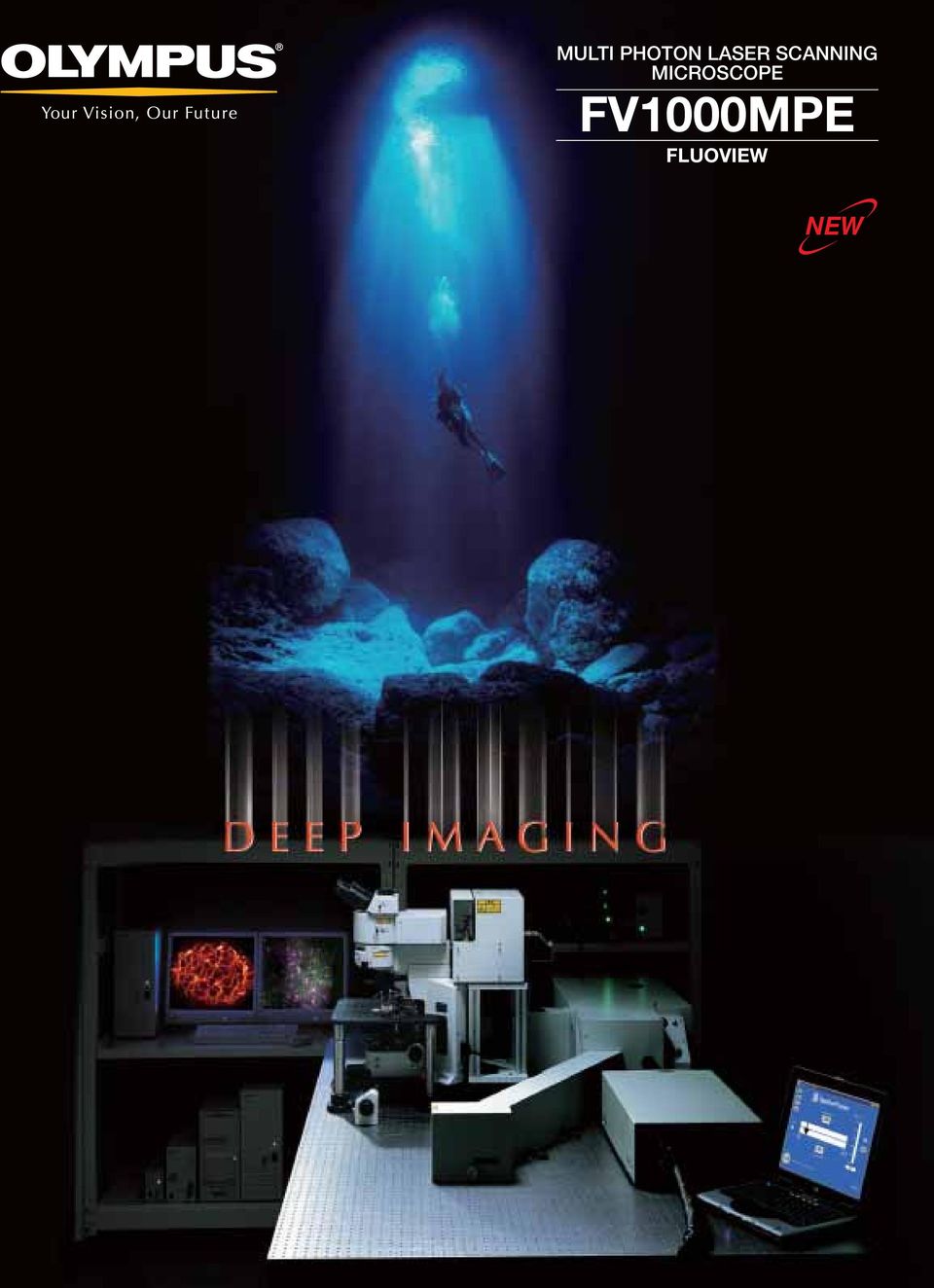
1 MULTI PHOTON LASER SCANNING MICROSCOPE FV1000MPE FLUOVIEW NEW
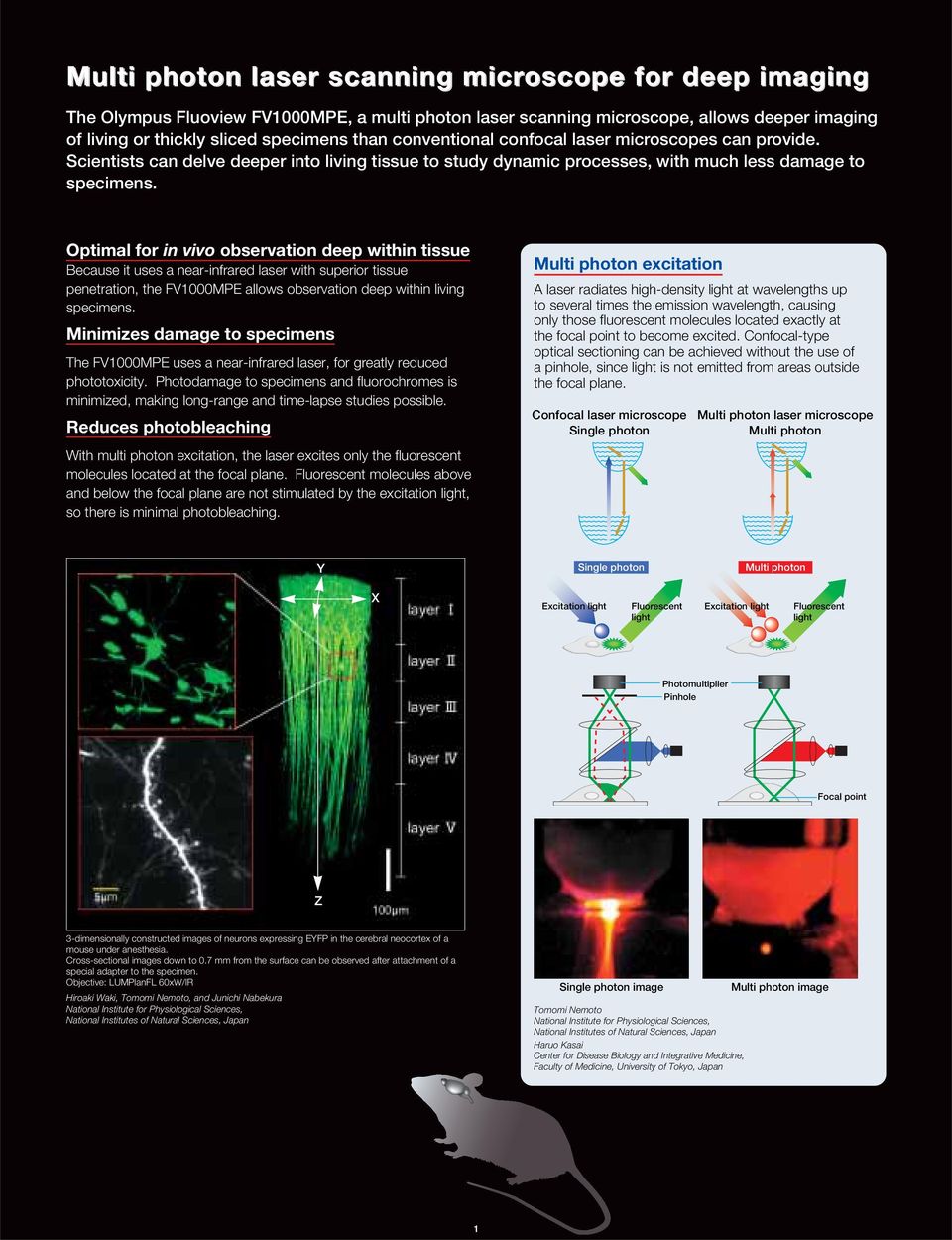
2 Multi photon laser scanning microscope for deep imaging The Olympus Fluoview FV1000MPE, a multi photon laser scanning microscope, allows deeper imaging of living or thickly sliced specimens than conventional confocal laser microscopes can provide. Scientists can delve deeper into living tissue to study dynamic processes, with much less damage to specimens. Optimal for in vivo observation deep within tissue Because it uses a near-infrared laser with superior tissue penetration, the FV1000MPE allows observation deep within living specimens. Minimizes damage to specimens The FV1000MPE uses a near-infrared laser, for greatly reduced phototoxicity. Photodamage to specimens and fluorochromes is minimized, making long-range and time-lapse studies possible. Reduces photobleaching With multi photon excitation, the laser excites only the fluorescent molecules located at the focal plane. Fluorescent molecules above and below the focal plane are not stimulated by the excitation light, so there is minimal photobleaching. Multi photon excitation A laser radiates high-density light at wavelengths up to several times the emission wavelength, causing only those fluorescent molecules located exactly at the focal point to become excited. Confocal-type optical sectioning can be achieved without the use of a pinhole, since light is not emitted from areas outside the focal plane. Confocal laser microscope Single photon Multi photon laser microscope Multi photon Y Single photon Multi photon X Excitation light Fluorescent light Excitation light Fluorescent light Photomultiplier Pinhole Focal point Z 3-dimensionally constructed images of neurons expressing EYFP in the cerebral neocortex of a mouse under anesthesia. Cross-sectional images down to 0.7 mm from the surface can be observed after attachment of a special adapter to the specimen. Objective: LUMPlanFL 60xW/IR Hiroaki Waki, Tomomi Nemoto, and Junichi Nabekura National Institute for Physiological Sciences, National Institutes of Natural Sciences, Japan Single photon image Tomomi Nemoto National Institute for Physiological Sciences, National Institutes of Natural Sciences, Japan Haruo Kasai Center for Disease Biology and Integrative Medicine, Faculty of Medicine, University of Tokyo, Japan Multi photon image 1
3 More e efficient ficient fluorescence Streamlined optical system offers enhanced multi photon performance The FV1000MPE offers aberration correction over a wide range from the visible spectrum to the near-infrared range, thanks to its integrated optical design featuring a dedicated IR laser port, pupil projection lens and objectives. Because every optical element was designed with multi photon imaging in mind, the optical system functions efficiently, and allows better optical penetration when using near-infrared lasers. Olympus provides a full line of water immersion objectives designed for near-infrared imaging, including the five most often-requested objectives. Numerical aperture Working distance (mm) XLUMPlanFl 20 x W LUMPlanFl 40 x W/IR LUMPlanFl 60 x W/IR LUMFL60 x W UPlanSApo60 x W Efficient fluorescence acquisition via non-descanned detector system With regular confocal systems, returning fluorescence emissions traveling from deep within a specimen can become dispersed through the specimen and degrade acquisition efficiency. But the FV1000MPE provides more efficient detection with minimal loss using an external two-channel photomultiplier detection system placed close to the specimen. The system provides effective fluorescence detection without the need for a pinhole for de-scanning, because fluorescence excitation occurs only in the confocal plane. Dichromatic mirrors are used in the light path to separate the light going to the two photomultiplier tubes; the mirrors and filters can be changed easily according to the specimen s fluorescence emission characteristics. External photomultiplier CH2 CH1 Use of a femtosecond pulsed IR laser In multi photon excitation, a pulsed laser is used to increase photon density in the focal plane. Fluorescent molecules can be efficiently detected even at low emission levels by using a femtosecond pulsed laser. Either a Mai Tai (Spectra-Physics, a unit of Newport Corporation) or Chameleon (Coherent, Inc.) laser with PC-controlled wavelength adjustment can be adapted. Mai Tai Chameleon Optics adapted following lasers Manufacturer Model Wavelengths covered Spectra-Physics Mai Tai XF nm Mai Tai XF nm Mai Tai BB nm Mai Tai HP nm COHERENT Chameleon nm Chameleon XR nm Chameleon Ultra II nm 2

4 Optimal for in vivo observation up to several hundred µm deep The FV1000MPE s streamlined light path involving fewer optical elements permits the microscope to operate with far less laser attenuation. The heightened rate of penetration allows deeper observation of in vivo and thickly sliced specimens. Single photon Multi photon 40µm 90µm 320µm Z-stack image of neurons and glial cells in layers II and III of the cerebral cortex of a rat under anesthesia. Magenta: glial cells (astrocytes) marked by specific fluorescence marker Sulforhodamine 101, Green: neurons and glial cells, Ca-sensitive fluorescent dye Oregon Green 488 BAPTA µm. Norio Takata, Hajime Hirase Neuronal Circuit Mechanisms Research Group, Riken Brain Science Institute, Japan XYZ images of mouse brain sections expressing GFP, comparing single-photon 488 nm excitation and two-photon 910 nm excitation. With single photon excitation, tissue can be observed only to a depth of about 90 µm, but with two photons, observation to a depth of about 320 µm is possible. Items displayed in color are vertical cross sections of 3-dimensionally constructed images. Specimens provided by: Kimihiko Kameyama, Tomoyo Ochiishi, Kazuyuki Kiyosue, Tatsuhiko Ebihara Molecular Neurobiology Group, Neuroscience Research Institute, National Institute of Advanced Industrial Science and Technology, Japan Dil Cerebellar slices (XZ scan) Single-photon Two-photon Single-photon Two-photon Molecular layer Granular layer Image of cerebral blood flow of a rat under anesthesia. Cerebral blood flow FITC-dextran µm Z-stack image. Hajime Hirase Neuronal Circuit Mechanisms Research Group, Riken Brain Science Institute, Japan Vertical cross sections of the mouse cerebellum molecular layer (L) and granular layer (R) marked with DiI and obtained by XZ scans using single-photon 488 nm and two-photon 720 nm excitation. Multiphoton excitation's superiority to confocal observation is apparent in deep observation of brain slices. Yasuyuki Hayakawa, Haruo Kasai Center for Disease Biology and Integrative Medicine, Faculty of Medicine, University of Tokyo 3

5 F V M P E A P P L I C A T I O N S Living pancreatic islet of Langerhans stained with FM1-43 lipid-soluble fluorescent dye. The cell membrane structure of the islet of Langerhans can be readily observed, and growth of the membrane area accompanying insulin exocytosis of a single insulin granule can also be observed. Noriko Takahashi, Haruo Kasai Center for Disease Biology and Integrative Medicine, Faculty of Medicine, University of Tokyo 3-dimensionally constructed image of cgmp-containing cells marked with CY3 running along the antenna nerve of the silkworm. 200 µm projection image. Hitoshi Aonuma Research Institute for Electronic Science, Hokkaido University, Japan Cells distributed in the CA1 region of the hippocampus (Mouse embryo with the GFP gene introduced in utero) Cell body and projections of a neural progenitor cell (Mouse embryo with the GFP gene introduced in utero) Akira Mizoguchi Department of Neural Regeneration and Cell Communication, Faculty of Medicine, Mie University Cell body and projections of a neural progenitor cell (Mouse embryo with the GFP gene introduced in utero) Neural progenitor cell: GFP (green) Actin fibers: Phalloidin-Alexa 594 (red) Visualization of erythrocytes following the blood flow in the brain and vascular endothelial cells in a GFP-actin transgenic mouse XYT (time interval 148 ms) Akira Mizoguchi Department of Neural Regeneration and Cell Communication, Faculty of Medicine, Mie University 4

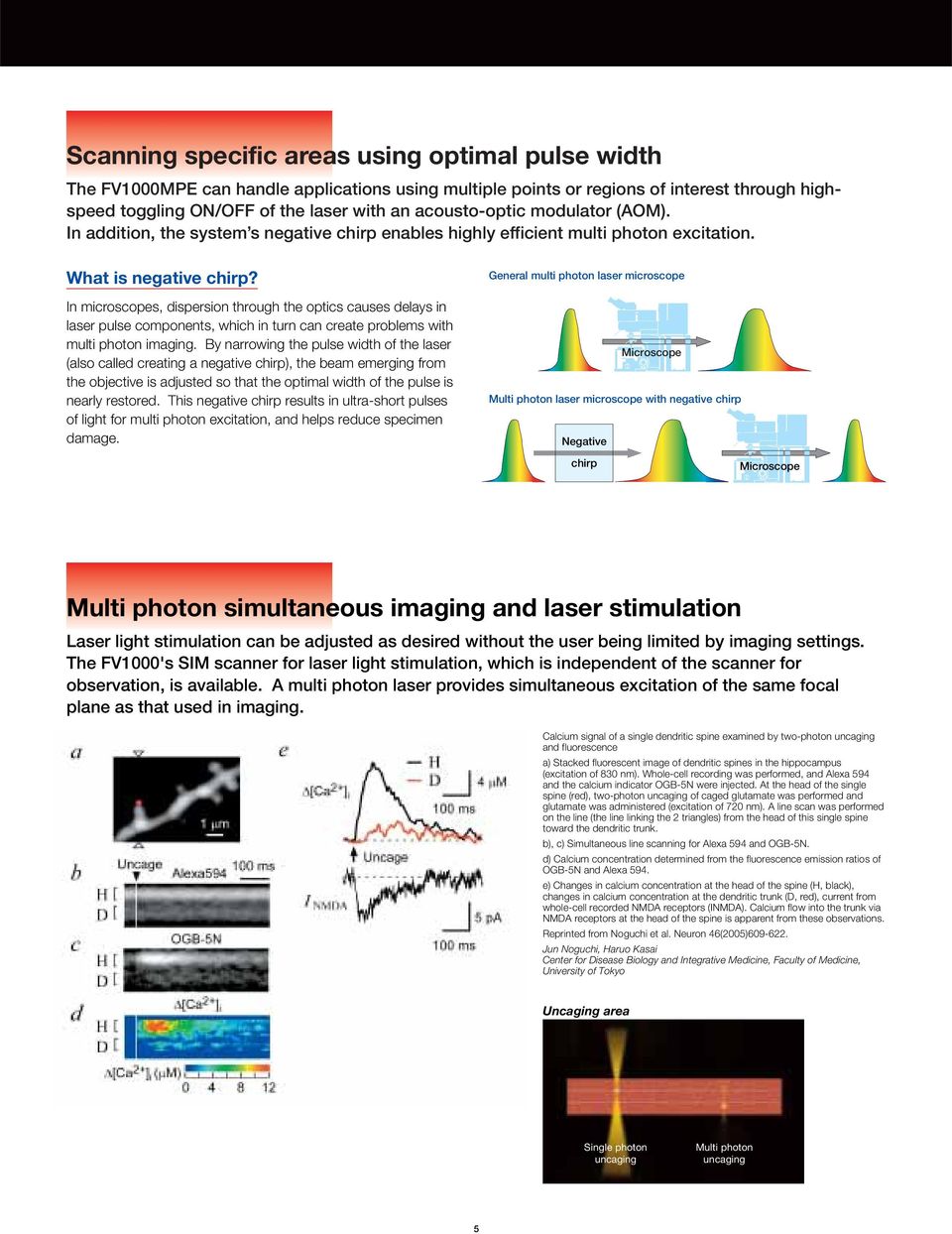
6 Scanning specific areas using optimal pulse width The FV1000MPE can handle applications using multiple points or regions of interest through highspeed toggling ON/OFF of the laser with an acousto-optic modulator (AOM). In addition, the system s negative chirp enables highly efficient multi photon excitation. What is negative chirp? In microscopes, dispersion through the optics causes delays in laser pulse components, which in turn can create problems with multi photon imaging. By narrowing the pulse width of the laser (also called creating a negative chirp), the beam emerging from the objective is adjusted so that the optimal width of the pulse is nearly restored. This negative chirp results in ultra-short pulses of light for multi photon excitation, and helps reduce specimen damage. General multi photon laser microscope Microscope Multi photon laser microscope with negative chirp Negative chirp Microscope Multi photon simultaneous imaging and laser stimulation Laser light stimulation can be adjusted as desired without the user being limited by imaging settings. The FV1000's SIM scanner for laser light stimulation, which is independent of the scanner for observation, is available. A multi photon laser provides simultaneous excitation of the same focal plane as that used in imaging. Calcium signal of a single dendritic spine examined by two-photon uncaging and fluorescence a) Stacked fluorescent image of dendritic spines in the hippocampus (excitation of 830 nm). Whole-cell recording was performed, and Alexa 594 and the calcium indicator OGB-5N were injected. At the head of the single spine (red), two-photon uncaging of caged glutamate was performed and glutamate was administered (excitation of 720 nm). A line scan was performed on the line (the line linking the 2 triangles) from the head of this single spine toward the dendritic trunk. b), c) Simultaneous line scanning for Alexa 594 and OGB-5N. d) Calcium concentration determined from the fluorescence emission ratios of OGB-5N and Alexa 594. e) Changes in calcium concentration at the head of the spine (H, black), changes in calcium concentration at the dendritic trunk (D, red), current from whole-cell recorded NMDA receptors (INMDA). Calcium flow into the trunk via NMDA receptors at the head of the spine is apparent from these observations. Reprinted from Noguchi et al. Neuron 46(2005) Jun Noguchi, Haruo Kasai Center for Disease Biology and Integrative Medicine, Faculty of Medicine, University of Tokyo Uncaging area Single photon uncaging Multi photon uncaging 5
7 F V M P E A P P L I C A T I O N S Three types of optics are available for multi photon laser integration. Basic system Optimized for in vivo imaging, this system allows deeper sections of specimens to be viewed using the multi photon laser. The optics are designed to have the beam enter the pupil of the objective efficiently. Precise adjustment of the light intensity is possible through use of a highly durable λ/2 Plate & Glan-Thompson prism. The system features a streamlined, compact design to save valuable laboratory space Fixed stage upright microscope with motorized focusing BX61WI system layout Unit: mm Laser power source Chiller Laser rack for visible light lasers PC rack AOM system The AOM module allows high-speed ON/OFF powering of the laser. Local laser radiation of regions of interest is possible, so the FV1000MPE can be used in experiments requiring laser light stimulation, such as photoconversion. Negative chirp comes standard, so efficient multi photon excitation can be achieved with relatively weak excitation light. Motorized inverted system microscope BX61WI/IX81 system layout Unit: mm Laser rack for visible light lasers PC rack 2400 Chiller Laser power source MPE-SIM system Multi photon lasers have been integrated in the imaging unit as well as in the scanner for laser light stimulation. With multi photon excitation, excitation occurs only in the focal plane, so there is minimal bleaching. Thus, laser light stimulation of a specific site can be performed in a localized manner, in three dimensions. Additionally, this set of optics is equipped with two AOM modules, and exact laser light stimulation of the targeted area may be achieved in 2 dimensions. (Use of the single photon laser for laser light stimulation by attaching it to the dedicated scanner for laser light stimulation is not possible while imaging with the multi photon laser.) Fixed stage upright microscope with motorized focusing BX61WI with SIM scanner system layout Unit: mm Chiller Laser power source Laser rack for visible light lasers PC rack 608 Chiller Laser power source IR pulsed laser for Stimulation λ2 IR pulsed laser for imaging λ1 6

8 FV1000MPE specifications Basic system AOM system MPE-SIM system Single photon Visible light laser LD laser: 405nm: 50mW, 440nm: 25mW, 473nm: 15mW, 559nm: 15mW, 635mW, 20mW, laser unit Multi Ar laser (457nm, 488nm, 515nm, Total 30mW), HeNe(G) laser (543nm, 1mW) Modulation: Continuously adjustable via an AOTF ( % in 0.1% increments) Operating mode: Allows laser turn-off during the retrace period, adjustment of laser power for a given region, and selection of the laser and selection of the laser wavelength AOTF laser combiner Visible light laser platform with implemented AOTF system, ultra-fast intensity with individual laser lines, additional shutter control Connected to scanner via single-mode fiber Equipped with laser feedback mechanism to limit changes in laser light intensity over time Multi photon Multi photon near-infrared For the adjustable wavelengths of a mode-locked Ti:sapphire laser (femtosecond), laser unit pulsed laser refer to additional lasers that can be used on page 6: Mai Tai (Spectra-Physics) or Chameleon (COHERENT) Can be directly connected to a scanner via Olympus' optics integrating a multi photon near-infrared pulsed laser Multi photon near-infrared pulsed laser power unit, water-cooled circulating chiller Optics integrated Integrates a multi photon near-infrared pulsed laser in the scanning unit Laser safety measures implemented via a protective cover for laser safety Shutter/attenuator λ/2 Plate & Glan-Thompson prism AOM AOM x 2 Scanning unit Basic configuration Detector: 3 channels for fluorescence detection (photomultipliers), 1 channel for transmitted light detection (photomultiplier) Laser ports: visible-light laser port (integrated by fiber), multi photon near-infrared pulsed laser port (directly integrated) Dichromatic mirrors for excitation, dichromatic mirrors for multi photon excitation, dichromatic mirrors for fluorescence, emission filter, infrared cut filter: using a high-performance filter A filter or spectral type of fluorescence detector can be selected Spectral type: Channels 1 and 2 provided with independent grating and slit Selectable wavelength range: nm, wavelength resolution: 2 nm, wavelength switching speed: 100 nm/ms Scanning method Light deflection via 2 galvanometer scanning mirrors Scanning modes Pixel size: 64 x x 4096 pixels Scanning speed: (pixel time): 2 µs 5ms High-speed scanning mode: 16 frames/sec (256 x 256) Dimensions: Time, Z, (wavelength) (or any combination thereof) Line scan: straight line (includes rotation), free line, point XY scan Photo detection method Analog integration Pinhole Single motorized pinhole, adjustable in 0.5 µm increments Field Number 18 Zoom size 1 50x (adjustable in 0.1x increments) External detector External detector: photomultiplier (2 channels) SIM scanner unit For single photon laser (optional) For single photon laser (optional) For multi photon laser Vibration isolation table size Large vibration isolation table for a multi photon near-infrared pulsed laser 1,800(W) x 1,200 (D) mm 2,400(W) x 1,500 (D) mm 3,000 (W) x 1,500 (D) mm Microscopes Motorized microscopes BX61WI BX61WI/ IX81 BX61WI System control OS: Windows XP Professional (English version) CPU: Pentium IV 3.2GHz or larger Memory: 2.0GB or larger Hard disk: 120GB or larger Dedicated I/F board: built-in PC Graphics board: Open GL-compliant Recording media: Equipped with DVD dual drive Monitor: two SXGA 1280 x inch monitors Software FV10-ASW Required installation environment Room temperature: 20 C 25 C ± 1 C, humidity: 60% or less, dust level: Class 10000, requires continuous (24-hour) power supply Power source environment AC / V 60VA For details, refer to supplied environmental specifications *The cover page shows an FV1000MPE BX61WI system The use of lasers with SUB-PICOSECOND pulses for two-photon microscopy is protected by US Pat No. USP , JP Pat No. JP B2, EU Pat No. EP500717B2, EU Pat No. EP807814B1. This technology are under a license from Carl Zeiss MicroImaging GmbH and Cornell Research Foundation Inc. Certified ISO by UKAS ENVIRONMENTAL MANAGEMENT 008 ISO9001 Certification OLYMPUS CORPORATION Micro-Imaging System Division IISO14001 Certification OLYMPUS CORPORATION Ina-Plant ISO9001/ISO14001 Certification Olympus Optical Technology Philippines Inc. OLYMPUS CORPORATION has obtained ISO9001/ISO14001 Specifications are subject to change without any obligation on the part of the manufacturer.

Zeiss 780 Training Notes
 Zeiss 780 Training Notes 780 Start Up Sequence Do you need the argon laser, 458,488,514nm lines? No Turn on the Systems PC Switch Turn on Main Power Switch Yes Turn on the laser main power switch and turn
Optical laser beam scanner lens relay system
 1. Introduction Optical laser beam scanner lens relay system Laser beam scanning is used most often by far in confocal microscopes. There are many ways by which a laser beam can be scanned across the back
Applications of confocal fluorescence microscopy in biological sciences
 Applications of confocal fluorescence microscopy in biological sciences B R Boruah Department of Physics IIT Guwahati Email: [email protected] Page 1 Contents Introduction Optical resolution Optical
Confocal Microscopy and Atomic Force Microscopy (AFM) A very brief primer...
 Confocal Microscopy and Atomic Force Microscopy (AFM) of biofilms A very brief primer... Fundamentals of Confocal Microscopy Based on a conventional fluorescence microscope Fluorescent Microscope Confocal
Lecture 20: Scanning Confocal Microscopy (SCM) Rationale for SCM. Principles and major components of SCM. Advantages and major applications of SCM.
 Lecture 20: Scanning Confocal Microscopy (SCM) Rationale for SCM. Principles and major components of SCM. Advantages and major applications of SCM. Some limitations (disadvantages) of NSOM A trade-off
CONFOCAL LASER SCANNING MICROSCOPY TUTORIAL
 CONFOCAL LASER SCANNING MICROSCOPY TUTORIAL Robert Bagnell 2006 This tutorial covers the following CLSM topics: 1) What is the optical principal behind CLSM? 2) What is the spatial resolution in X, Y,
Neuro imaging: looking with lasers in the brain
 Neuro imaging: looking with lasers in the brain Aim: To image life cells, label free, with cellular resolution in deep tissue Marloes Groot Vrije Universiteit Amsterdam Faculteit Exacte Wetenschappen Natuurkunde
Leica TCS SP5 Confocal Laser Scanning Microscope User Guide 1. BASIC IMAGE ACQUISITION
 Leica TCS SP5 Confocal Laser Scanning Microscope User Guide 1. BASIC IMAGE ACQUISITION This manual is the FIRST section of a THREE part Leica TCS - SP5 User Guide edited by Donald Pottle Leica True Confocal
Raman spectroscopy Lecture
 Raman spectroscopy Lecture Licentiate course in measurement science and technology Spring 2008 10.04.2008 Antti Kivioja Contents - Introduction - What is Raman spectroscopy? - The theory of Raman spectroscopy
A Brief History of the Microscope and its Significance in the Advancement of Biology and Medicine
 Chapter 1 A Brief History of the Microscope and its Significance in the Advancement of Biology and Medicine This chapter provides a historical foundation of the field of microscopy and outlines the significant
Chapter 13 Confocal Laser Scanning Microscopy C. Robert Bagnell, Jr., Ph.D., 2012
 Chapter 13 Confocal Laser Scanning Microscopy C. Robert Bagnell, Jr., Ph.D., 2012 You are sitting at your microscope working at high magnification trying to sort out the three-dimensional compartmentalization
Introduction to flow cytometry
 Introduction to flow cytometry Flow cytometry is a popular laser-based technology. Discover more with our introduction to flow cytometry. Flow cytometry is now a widely used method for analyzing the expression
Recording the Instrument Response Function of a Multiphoton FLIM System
 Recording the Instrument Response Function of a Multiphoton FLIM System Abstract. FLIM data analysis in presence of SHG signals or extremely fast decay components requires the correct instrument response
Chapter 12 Filters for FISH Imaging
 Chapter 12 Filters for FISH Imaging Dan Osborn The application of in situ hybridization (ISH) has advanced from short lived, non-specific isotopic methods, to very specific, long lived, multiple color
AxioCam MR The All-round Camera for Biology, Medicine and Materials Analysis Digital Documentation in Microscopy
 Microscopy from Carl Zeiss AxioCam MR The All-round Camera for Biology, Medicine and Materials Analysis Digital Documentation in Microscopy New Dimensions in Performance AxioCam MR from Carl Zeiss Both
Microscopy. MICROSCOPY Light Electron Tunnelling Atomic Force RESOLVE: => INCREASE CONTRAST BIODIVERSITY I BIOL1051 MAJOR FUNCTIONS OF MICROSCOPES
 BIODIVERSITY I BIOL1051 Microscopy Professor Marc C. Lavoie [email protected] MAJOR FUNCTIONS OF MICROSCOPES MAGNIFY RESOLVE: => INCREASE CONTRAST Microscopy 1. Eyepieces 2. Diopter adjustment
A VERYbrief history of the confocal microscope 1950s
 Confocal Microscopy Confocal Microscopy Why do we use confocal microscopy? A brief history of the confocal microscope Advantages/disadvantages of a confocal microscope Types of confocal microscopes The
Optical mesoscopy with a new giant lens. Gail McConnell, Johanna Tragardh, John Dempster & Brad Amos
 Optical mesoscopy with a new giant lens Gail McConnell, Johanna Tragardh, John Dempster & Brad Amos The spot on specimen, source and detector aperture are at conjugate optical foci detector Advantage:
AxioCam MRm Pure Sensitivity
 Microscopy from Carl Zeiss AxioCam MRm Pure Sensitivity The New Standard for Digital Fluorescence Imaging AxioCam MRm from Carl Zeiss More Information at Low Light Intensities More than ever before, modern
Fluorescence Microscopy for an NMR- Biosensor Project
 Fluorescence Microscopy for an NMR- Biosensor Project Ole Hirsch Physikalisch-Technische Bundesanstalt Medical Optics Abbestr. -1, 10587 Berlin, Germany Overview NMR Sensor Project Dimensions in biological
Synthetic Sensing: Proximity / Distance Sensors
 Synthetic Sensing: Proximity / Distance Sensors MediaRobotics Lab, February 2010 Proximity detection is dependent on the object of interest. One size does not fit all For non-contact distance measurement,
Advances in scmos Camera Technology Benefit Bio Research
 Advances in scmos Camera Technology Benefit Bio Research scmos camera technology is gaining in popularity - Why? In recent years, cell biology has emphasized live cell dynamics, mechanisms and electrochemical
Z-Stacking and Z-Projection using a Scaffold-based 3D Cell Culture Model
 A p p l i c a t i o n N o t e Z-Stacking and Z-Projection using a Scaffold-based 3D Cell Culture Model Brad Larson and Peter Banks, BioTek Instruments, Inc., Winooski, VT Grant Cameron, TAP Biosystems
Study of the Human Eye Working Principle: An impressive high angular resolution system with simple array detectors
 Study of the Human Eye Working Principle: An impressive high angular resolution system with simple array detectors Diego Betancourt and Carlos del Río Antenna Group, Public University of Navarra, Campus
Zecotek S Light Projection Network Marketing
 White Paper Zecotek Visible Fiber Laser Platform Enabling the future of laser technology Zecotek Photonics Inc. (TSX- V: ZMS; Frankfurt: W1I) www.zecotek.com is a Canadian photonics technology company
MIRAX SCAN The new way of looking at pathology
 Microscopy from Carl Zeiss MIRAX SCAN The new way of looking at pathology Greater reliability. Greater efficiency. Virtual microscopy for research & analysis. Better. More efficient. Quality as the basis
Chapter 4. Microscopy, Staining, and Classification. Lecture prepared by Mindy Miller-Kittrell North Carolina State University
 Chapter 4 Microscopy, Staining, and Classification 2012 Pearson Education Inc. Lecture prepared by Mindy Miller-Kittrell North Carolina State University Microscopy and Staining 2012 Pearson Education Inc.
ZEISS Microscopy Course Catalog
 ZEISS Microscopy Course Catalog ZEISS Training and Education Expand Your Possibilities Practical microscopy training has a long tradition at ZEISS. The first courses were held in Jena as early as 1907,
Introduction to Flow Cytometry
 Introduction to Flow Cytometry presented by: Flow Cytometry y Core Facility Biomedical Instrumentation Center Uniformed Services University Topics Covered in this Lecture What is flow cytometry? Flow cytometer
Nederland België / Belgique
 Cronus Brochure 2 Introduction Cronus: The first spectrometer and colorimeter in one The Cronus is world s first spectrocolorimeter combining a high en VIS spectrometer with a high speed XYZ colorimeter.
Introduction to Fourier Transform Infrared Spectrometry
 Introduction to Fourier Transform Infrared Spectrometry What is FT-IR? I N T R O D U C T I O N FT-IR stands for Fourier Transform InfraRed, the preferred method of infrared spectroscopy. In infrared spectroscopy,
Optical Coherence Tomography OCT. 3D Imaging in Medical Technology and Quality Control
 Optical Coherence Tomography OCT 3D Imaging in Medical Technology and Quality Control SLN Seminar, EPMT Lausanne, 26. May. 2011 Ch. Meier www.optolab.ch 1 / 27 SLN/EPMT, Lausanne, 26.5.2011 Ch. Meier Outline
AxioCam HR The Camera that Challenges your Microscope
 Microscopy from Carl Zeiss AxioCam HR The Camera that Challenges your Microscope Documentation at the edge of the visible The Camera for Maximum Success: AxioCam HR Low light fluorescence, live cell imaging,
CNC-STEP. "LaserProbe4500" 3D laser scanning system Instruction manual
 LaserProbe4500 CNC-STEP "LaserProbe4500" 3D laser scanning system Instruction manual 2 Hylewicz CNC-Technik Siemensstrasse 13-15 D-47608 Geldern Fon.: +49 (0) 2831 133236 E-Mail: [email protected] Website:
Real-world applications of intense light matter interaction beyond the scope of classical micromachining.
 Dr. Lukas Krainer [email protected] CEO Real-world applications of intense light matter interaction beyond the scope of classical micromachining. 1 Management & Company Company Based in Zürich, Switzerland
Zeiss Axioimager M2 microscope for stereoscopic analysis.
 Zeiss Axioimager M2 microscope for stereoscopic analysis. This system is fully motorized and configured with bright field and multi-channel fluorescent. It works with Stereo Investigator, Neurolucida,
Nano-Spectroscopy. Solutions AFM-Raman, TERS, NSOM Chemical imaging at the nanoscale
 Nano-Spectroscopy Solutions AFM-Raman, TERS, NSOM Chemical imaging at the nanoscale Since its introduction in the early 80 s, Scanning Probe Microscopy (SPM) has quickly made nanoscale imaging an affordable
Infrared Viewers. Manual
 Infrared Viewers Manual Contents Introduction 3 How it works 3 IR viewer in comparison with a CCD camera 4 Visualization of infrared laser beam in mid-air 4 Power Density 5 Spectral sensitivity 6 Operation
FIXED STAGE UPRIGHT MICROSCOPE BX51WI FIXED STAGE UPRIGHT MICROSCOPE WITH MOTORIZED FOCUSING BX61WI UNIVERSAL INFINITY SYSTEM
 FIXED STAGE UPRIGHT MICROSCOPE BX51WI FIXED STAGE UPRIGHT MICROSCOPE WITH MOTORIZED FOCUSING BX61WI UNIVERSAL INFINITY SYSTEM A dual commitment: Preventing vibration and protecting living cell specimens
Products - Microarray Scanners - SpotLight Two-Color Microarray Fluorescence Scanners New! SpotLight 2 now available!
 Products - Microarray Scanners - SpotLight Two-Color Microarray Fluorescence Scanners New! SpotLight 2 now available! Arrayit SpotLight Two-Color Microarray Scanners provide the market s most affordable
SpectraTec II. Polarized Multi-Laser Source BLUE SKY RESEARCH WAVELENGTHS. The SpectraTec II
 BLUE SKY RESEARCH The SpectraTec II, two wavelength laser module is a highly integrated system comprised of two lasers, individual driving and temperature control electronics, wavelength combining, and
Preface Light Microscopy X-ray Diffraction Methods
 Preface xi 1 Light Microscopy 1 1.1 Optical Principles 1 1.1.1 Image Formation 1 1.1.2 Resolution 3 1.1.3 Depth of Field 5 1.1.4 Aberrations 6 1.2 Instrumentation 8 1.2.1 Illumination System 9 1.2.2 Objective
These particles have something in common
 These particles have something in common Blood cells Chromosomes Algae Protozoa Certain parameters of these particles can be measured with a flow cytometer Which parameters can be measured? the relative
CONFOCAL LASER SCANNING BIOLOGICAL MICROSCOPE FV1000 FLUOVIEW. Next Generation Live Cell Imaging System
 Next Generation Live Cell Imaging System CONFOCAL LASER SCANNING BIOLOGICAL MICROSCOPE FV1000 FLUOVIEW THE EVOLVED FV1000 EVOLVED STABILITY Diode Laser EVOLVED LASER LIGHT STIMULATION SIM Scanner Stability
Alignment Laser System.
 - O T 6 0 0 0 Alignment Laser System. The OT-6000. Multi -Target,Two Dimensional Alignment. Introducing the most powerful way to measure alignment at distances up to 300 feet. The OT-6000 Alignment Laser
Measuring Laser Power and Energy Output
 Measuring Laser Power and Energy Output Introduction The most fundamental method of checking the performance of a laser is to measure its power or energy output. Laser output directly affects a laser s
Acousto-optic modulator
 1 of 3 Acousto-optic modulator F An acousto-optic modulator (AOM), also called a Bragg cell, uses the acousto-optic effect to diffract and shift the frequency of light using sound waves (usually at radio-frequency).
Data. microcat +SPECT
 Data microcat +SPECT microcat at a Glance Designed to meet the throughput, resolution and image quality requirements of academic and pharmaceutical research, the Siemens microcat sets the standard for
LBS-300 Beam Sampler for C-mount Cameras. YAG Focal Spot Analysis Adapter. User Notes
 LBS-300 Beam Sampler for C-mount Cameras P/N SP90183, SP90184, SP90185 and SP90186 YAG Focal Spot Analysis Adapter P/N SP90187, SP90188, SP90189, SP90190, SP90191 User Notes Ophir-Spiricon Inc. 60 West
RESEARCH MACRO ZOOM SYSTEM MICROSCOPE MVX10. Macro View. The first true macro fluorescence imaging system
 The first true macro fluorescence imaging system RESEARCH MACRO ZOOM SYSTEM MICROSCOPE MVX10 Macro View The ultimate in macro fluorescence im The new MVX 10 MacroView from Oly Researchers are interested
Revision problem. Chapter 18 problem 37 page 612. Suppose you point a pinhole camera at a 15m tall tree that is 75m away.
 Revision problem Chapter 18 problem 37 page 612 Suppose you point a pinhole camera at a 15m tall tree that is 75m away. 1 Optical Instruments Thin lens equation Refractive power Cameras The human eye Combining
Theremino System Theremino Spectrometer Technology
 Theremino System Theremino Spectrometer Technology theremino System - Theremino Spectrometer Technology - August 15, 2014 - Page 1 Operation principles By placing a digital camera with a diffraction grating
Experiment 5. Lasers and laser mode structure
 Northeastern University, PHYS5318 Spring 2014, 1 1. Introduction Experiment 5. Lasers and laser mode structure The laser is a very important optical tool that has found widespread use in science and industry,
Pump-probe experiments with ultra-short temporal resolution
 Pump-probe experiments with ultra-short temporal resolution PhD candidate: Ferrante Carino Advisor:Tullio Scopigno Università di Roma ƒla Sapienza 22 February 2012 1 Pump-probe experiments: generalities
Two-photon FCS Tutorial. Berland Lab Department of Physics Emory University
 Two-photon FCS Tutorial Berland Lab Department of Physics Emory University What is FCS? FCS : Fluorescence Correlation Spectroscopy FCS is a technique for acquiring dynamical information from spontaneous
Katharina Lückerath (AG Dr. Martin Zörnig) adapted from Dr. Jörg Hildmann BD Biosciences,Customer Service
 Introduction into Flow Cytometry Katharina Lückerath (AG Dr. Martin Zörnig) adapted from Dr. Jörg Hildmann BD Biosciences,Customer Service How does a FACS look like? FACSCalibur FACScan What is Flow Cytometry?
Measuring the Point Spread Function of a Fluorescence Microscope
 Frederick National Laboratory Measuring the Point Spread Function of a Fluorescence Microscope Stephen J Lockett, PhD Principal Scientist, Optical Microscopy and Analysis Laboratory Frederick National
Fast Z-stacking 3D Microscopy Extended Depth of Field Autofocus Z Depth Measurement 3D Surface Analysis
 Cam CANIMPEX CPX-SOLUTIONS 3D Digital Microscope Camera FAST PRECISE AFFORDABLE 3D CAMERA FOR MICROSCOPY Fast Z-stacking 3D Microscopy Extended Depth of Field Autofocus Z Depth Measurement 3D Surface Analysis
Experiment #5: Qualitative Absorption Spectroscopy
 Experiment #5: Qualitative Absorption Spectroscopy One of the most important areas in the field of analytical chemistry is that of spectroscopy. In general terms, spectroscopy deals with the interactions
Fluorescent Array Imaging Reader
 Fluorescent Array Imaging Reader Multiplex Enabled For 2-Color Fluorescent Microarrays Extended Dynamic Range Automated Spot Analysis Compact and Affordable Microarray Analysis With FLAIR FLAIR Sensovation
DIODE PUMPED CRYSTALASER
 DIODE PUMPED CRYSTALASER Ultra-compact CW & Pulsed Turnkey Systems UV Visible to IR High Reliability High Stability High Efficiency TEMoo & SLM Low Noise Low Cost ULTRA-COMPACT DIODE-PUMPED CRYSTAL LASER
Guideline Laser Series
 Guideline Laser Series Highly visible alignment laser for visually demanding surfaces Red / Green long visible lines Equal brightness across length of the line Uniform Line (no fading at ends of the line)
ProScan DC Linear Servo Stage Technology www.prior.com
 ProScan DC Linear Servo Stage Technology www.prior.com Stretching the Boundaries of Performance... Ultra Quiet Operation Can you hear that? Neither can we! Even at high speeds (up to 300 mm/sec) the linear
product overview pco.edge family the most versatile scmos camera portfolio on the market pioneer in scmos image sensor technology
 product overview family the most versatile scmos camera portfolio on the market pioneer in scmos image sensor technology scmos knowledge base scmos General Information PCO scmos cameras are a breakthrough
Fiber Optics: Engineering from Global to Nanometer Dimensions
 Fiber Optics: Engineering from Global to Nanometer Dimensions Prof. Craig Armiento Fall 2003 1 Optical Fiber Communications What is it? Transmission of information using light over an optical fiber Why
Near-field scanning optical microscopy (SNOM)
 Adviser: dr. Maja Remškar Institut Jožef Stefan January 2010 1 2 3 4 5 6 Fluorescence Raman and surface enhanced Raman 7 Conventional optical microscopy-limited resolution Two broad classes of techniques
A compact, lightweight, portable optical spectrum analyzer for DWDM system installation and maintenance.
 A compact, lightweight, portable optical spectrum analyzer for DWDM system installation and maintenance. Bulletin -01E http://www.yokogawa.com/tm/... Visit our website to sign for e-mail updates Compact,
Problem Set 6 UV-Vis Absorption Spectroscopy. 13-1. Express the following absorbances in terms of percent transmittance:
 Problem Set 6 UV-Vis Absorption Spectroscopy 13-1. Express the following absorbances in terms of percent transmittance: a 0.051 b 0.918 c 0.379 d 0.261 e 0.485 f 0.072 A = log P o /P = log1/t = - log T
16 th IOCCG Committee annual meeting. Plymouth, UK 15 17 February 2011. mission: Present status and near future
 16 th IOCCG Committee annual meeting Plymouth, UK 15 17 February 2011 The Meteor 3M Mt satellite mission: Present status and near future plans MISSION AIMS Satellites of the series METEOR M M are purposed
Designing and Manufacturing Femtoseconds Ultra-broadband Lasers: Proven, Hands-free Reliability
 Technical Note Designing and Manufacturing Femtoseconds Ultra-broadband Lasers: Proven, Hands-free Reliability This whitepaper reviews how design choices, manufacturing steps and testing protocols substantially
Agilent Cary 4000/5000/6000i Series UV-Vis-NIR
 Agilent Cary 4000/5000/6000i Series UV-Vis-NIR Guaranteed specifications Design overview Double beam, ratio recording, double out-of-plane Littrow monochromator UV-Vis-NIR spectrophotometer (Agilent Cary
Two-photon Fluorescence Light Microscopy
 Two- Fluorescence Light Peter TC So, Massachusetts Institute of Technology, Cambridge, Massachusetts, USA Two- fluorescence microscopy allows three-dimensional imaging of biological specimens in vivo.
OPERATING INSTRUCTIONS Nikon TiE Deconvolution Microscope CCRB 1-220G
 OPERATING INSTRUCTIONS Nikon TiE Deconvolution Microscope CCRB 1-220G Conventions Through these notes bold font refers to a software button and italics refer to a hardware switch. The software makes extensive
LASER SCANNING CONFOCAL MICROSCOPY
 LASER SCANNING CONFOCAL MICROSCOPY Nathan S. Claxton, Thomas J. Fellers, and Michael W. Davidson Department of Optical Microscopy and Digital Imaging, National High Magnetic Field Laboratory, The Florida
Fundamentals of modern UV-visible spectroscopy. Presentation Materials
 Fundamentals of modern UV-visible spectroscopy Presentation Materials The Electromagnetic Spectrum E = hν ν = c / λ 1 Electronic Transitions in Formaldehyde 2 Electronic Transitions and Spectra of Atoms
Make Life Easier by Using Modern Features of the SPCM Software
 Make Life Easier by Using Modern Features of the SPCM Software Abstract. Over a long period of time the SPCM operating software of the Becker & Hickl TCSPC systems has continuously been upgraded with new
The best lab standard. 1,4 Megapixels 2/3 inch sensor Giant pixel size 6 times optical zoom Massive 16-bit imaging for enhanced dynamic
 1 AGENDA Product roadmap...3 Computer based system: PLATINUM..5 XPLORER.6 ESSENTIAL..7 Specifications Computer based system..8 Configuration Computer based system... 9 Software Computer based system...10
INFITEC - A NEW STEREOSCOPIC VISUALISATION TOOL BY WAVELENGTH MULTIPLEX IMAGING
 INFITEC - A NEW STEREOSCOPIC VISUALISATION TOOL BY WAVELENGTH MULTIPLEX IMAGING Helmut Jorke, Markus Fritz INFITEC GmbH, Lise-Meitner-Straße 9, 89081 Ulm [email protected] Phone +49 731 550299 56 Fax _
Micro-CT for SEM Non-destructive Measurement and Volume Visualization of Specimens Internal Microstructure in SEM Micro-CT Innovation with Integrity
 Micro-CT for SEM Non-destructive Measurement and Volume Visualization of Specimens Internal Microstructure in SEM Innovation with Integrity Micro-CT 3D Microscopy Using Micro-CT for SEM Micro-CT for SEM
Flat-Field IR Mega-Pixel Lens
 Flat-Field Mega-Pixel Lens Series Flat-Field Mega-Pixel Lens Flat-Field Mega-Pixel Lens 20.ver.02 E Specifications and Lineup Full MP Image Model Imager Size Mount Focal Length Aperture Range Zoom Ratio
Veraview IC5 HD High definition, digital imaging excellence. Thinking ahead. Focused on life.
 Veraview IC5 HD High definition, digital imaging excellence Thinking ahead. Focused on life. Thinking ahead. Focused on life. 2 3 IC5 HD Super High-Speed with High Definition Clarity For dental radiology
pco.edge 4.2 LT 0.8 electrons 2048 x 2048 pixel 40 fps 37 500:1 > 70 % pco. low noise high resolution high speed high dynamic range
 edge 4.2 LT scientific CMOS camera high resolution 2048 x 2048 pixel low noise 0.8 electrons USB 3.0 small form factor high dynamic range 37 500:1 high speed 40 fps high quantum efficiency > 70 % edge
Development of Optical Wave Microphone Measuring Sound Waves with No Diaphragm
 Progress In Electromagnetics Research Symposium Proceedings, Taipei, March 5 8, 3 359 Development of Optical Wave Microphone Measuring Sound Waves with No Diaphragm Yoshito Sonoda, Takashi Samatsu, and
Explaining Ellipse I 2 PL
 Explaining Ellipse I 2 PL CLINICALLY PROVEN SAFE AND EFFECTIVE Ellipse I 2 PL stands for Ellipse secondgeneration Intense Pulsed Light The Ellipse I 2 PL system is used for the treatment of a wide range
Powerful Upright Microscope Solutions for Life Science and Clinical Applications
 Powerful Upright Microscope Solutions for Life Science and Clinical Applications Leica DM4 B Leica DM6 B Short training time, intuitive usage and high quality images are decisive criteria when choosing
Application of Automated Data Collection to Surface-Enhanced Raman Scattering (SERS)
 Application Note: 52020 Application of Automated Data Collection to Surface-Enhanced Raman Scattering (SERS) Timothy O. Deschaines, Ph.D., Thermo Fisher Scientific, Madison, WI, USA Key Words Array Automation
ZEISS Axiocam 506 color Your Microscope Camera for Imaging of Large Sample Areas Fast, in True Color, and High Resolution
 Product Information Version 1.0 ZEISS Axiocam 506 color Your Microscope Camera for Imaging of Large Sample Areas Fast, in True Color, and High Resolution ZEISS Axiocam 506 color Sensor Model Sensor Pixel
ILLUSTRATIVE EXAMPLE: Given: A = 3 and B = 4 if we now want the value of C=? C = 3 + 4 = 9 + 16 = 25 or 2
 Forensic Spectral Anaylysis: Warm up! The study of triangles has been done since ancient times. Many of the early discoveries about triangles are still used today. We will only be concerned with the "right
How To Use An Edge 3.1 Scientific Cmmos Camera
 edge 3.1 scientific CMOS camera high resolution 2048 x 1536 pixel low noise 1.1 electrons global shutter USB 3.0 small form factor high dynamic range 27 000:1 high speed 50 fps high quantum efficiency
INTRODUCTION FIGURE 1 1. Cosmic Rays. Gamma Rays. X-Rays. Ultraviolet Violet Blue Green Yellow Orange Red Infrared. Ultraviolet.
 INTRODUCTION Fibre optics behave quite different to metal cables. The concept of information transmission is the same though. We need to take a "carrier" signal, identify a signal parameter we can modulate,