
Space Details. Available Pages. Description: Last Modifier (Mod. Date): gregan (Jun 26, 2009)
|
|
|
- Hugo O’Neal’
- 10 years ago
- Views:
Transcription
1 Space Details Key: edgesight Name: EdgeSight Description: Creator (Creation Date): gregan (Jun 26, 2009) Last Modifier (Mod. Date): gregan (Jun 26, 2009) Available Pages Citrix EdgeSight Reporting Wiki (Beta) Contents Getting Started with EdgeSight Where to Start Using EdgeSight? Introduction to EdgeSight for XenApp Video Migrating from Resource Manager to EdgeSight Monitoring Introduction to EdgeSight Monitoring Performance Monitoring Experienced with Performance Monitoring? New to Performance Monitoring? Monitoring Farms XenApp Farm Resiliency Alerting on Critical Health Changes Determining When a Data Collection Election Occurs Farm Resiliency Using the Farm Monitor and Reports Using EdgeSight to Monitor XenApp Infrastructure Servers Understanding EdgeSight Alerts System Alerts Application Alerts Network Alerts Session Alerts XenApp Alerts Using EdgeSight Active Application Monitoring XenDesktop Alerts Dashboard Monitoring Troubleshooting Troubleshooting Using EdgeSight Troubleshooting XenApp Application Servers Troubleshooting XenApp Application Issues Application Performance Factors Monitoring Applications Proactively Application Issue Troubleshooting Real Time Troubleshooting of Application Issues Troubleshooting Devices Troubleshooting XenApp Infrastructure Servers Page 1

2 Plan and Manage What is Happening in My Environment? Finding Information about the Clients in Your Environment Detecting General Changes Using the Dashboard and Reports for an Environmental Overview What's Happening on My Network? What's Happening On My Servers? Updating Hardware and Software Inventories What Are Users Up To? XenApp Server Health Fixing Existing XenApp Server Issues Keeping Servers Healthy Uncovering Causes for Poor Server Performance Generating EdgeSight Reports for Management Branch Office Performance Demonstrating SLA Compliance Track Usage Monitoring License Usage Exporting User and Device License Usage Data Troubleshooting Changes to XenApp Servers Monitoring Published Applications Usage Monitoring Session Duration Reports (Browse) Introduction to Reporting Guide to Interpreting Reports EdgeSight Reporting Best Practices Aggregating and Grouping Averages and Sums in EdgeSight Reports How Group and Department Structure Impact Reporting EdgeSight Report List EdgeSight 5.4 Report List EdgeSight 5.3 Report List Report Sample, ICA Client Version Report Sample, User Logon Counts EdgeSight 5.2 Report List Environmental Usage ICA Printer IO ICA Session Compression ICA Session Latency ICA Session Round Trip Time Process Faults Process Network Delay Report Sample, CPU Utilization Management Report Sample, IMA Service Availability Page 2

3 Session Login Time Session Login Time for a User Group Session Startup Duration Details System CPU System Memory Usage User Login Details for a User Group User Summary for a User Group XenApp Server Utilization XenApp Summary XenApp User Summary EdgeSight 5.0 and 5.1 Report List Presentation Server Summary Presentation Server User Summary Sessions Created for a User Group EdgeSight Report List by Task EdgeSight Data End User Experience Monitoring Overview Understanding EdgeSight Data How EdgeSight Calculates ICA Traffic Numbers End User Experience Monitoring Data Improving Slow Session Start Times Session Latency ICA Channel Data Network Why EdgeSight Network Data Differs from Network Monitoring Tools Network Data What Constitutes a Session for EdgeSight? Adding a Custom Performance Monitoring Counter Support for Citrix Performance Monitoring Counters Report Counters Glossary Configuring EdgeSight for Your Environment Configuring Alerts Data Maintenance Custom Reports Citrix Service Provider - License Usage Reports Citrix Service Provider - Resource Usage per User Reports Citrix Service Provider - Server Utilization Report Citrix Service Provider - SLA Compliance Reports License Server Usage Trends - Custom Report Unique User Logon Counts - Custom Report EdgeSight for Load Testing Case Studies Page 3

4 Case Study, Managing Application Rollout Case Study, Application Performance Solution Case Study, Troubleshooting Remote Applications EdgeSight Support Release History Citrix EdgeSight 5.2 and Citrix EdgeSight for Load Testing 3.6 Citrix EdgeSight 5.3 and EdgeSight for Load Testing Citrix EdgeSight 5.4 Top EdgeSight Knowledge Center Articles Using the EdgeSight Wiki About the Citrix EdgeSight Wiki EdgeSight Wiki Community EdgeSight TV Getting Involved in the EdgeSight Wiki Creating an EdgeSight Wiki Article EdgeSight Wiki Style EdgeSight Wiki Editorial Policies Formatting Sources and Citations for the EdgeSight Wiki Home EdgeSight Wiki Spotlight Christian Tobon Who Are We? EdgeSight Wiki Editors and Contributors EdgeSight Wiki Syntax Wiki Macros Ways You Can Help List of Stub Articles FAQ EdgeSight Wiki Site Map Page 4

5 Citrix EdgeSight Reporting Wiki (Beta) This page last changed on Oct 27, 2009 by sarahv. Welcome to the Citrix EdgeSight Reporting Wiki. The Citrix EdgeSight Reporting Wiki is a collaborative authoring encyclopedia project supported by Citrix EdgeSight Engineering. This is intended to be a collaborative Web site for the EdgeSight community. This Wiki is part of an initiative to enhance the information available about EdgeSight reports and is the primary source of information about reports. This Wiki focuses primarily on historical reports. However, it also includes information about real-time reports and other helpful EdgeSight product information. The EdgeSight Engineering and Documentation teams, as well as EdgeSight escalation engineers, technical support personnel and product managers regularly review the Wiki content, vetting it for technical accuracy. We are hoping that this Wiki helps you find the reports you need, interpret the reports you choose, and find new ways to use reports. We also hope it provides an opportunity to converse with EdgeSight users with similar interests on the discussion tabs of each article. Getting Started The Wiki is organized by the following types of information: Where to Start Using EdgeSight? Contents EdgeSight Wiki Site Map Getting Involved in the EdgeSight Wiki EdgeSight Reporting Tasks for XenApp Migrating from Resource Manager to EdgeSight EdgeSight Report List EdgeSight Data Scenarios and Case Studies EdgeSight Reporting Best Practices Report Counters Glossary FAQ Release History You can access information either by searching for the name of specific reports or browsing to them as they are listed on the Browse Reports page. Comments You guys must keep this site going. I see it's in Beta it needs to go production although I cant imagine why not more people are posting here. It's taken me a long time to scour the "internet" to compile some semblance of pertinant information I can use to educate myself about Edgesight. Keep up the great work please dont let this site fall by the wayside. Posted by chriscdw2 at Jun 02, I agree. I was just scouring the internet myself for some helpful information, so I'll review the information submitted so far and hope that this site can lead to a good online community for future discussions. I've been evaluating version 5.3 for a bit and would like more on User and Session Page 5
6 information. Planning a new build for version 5.4 that was just released, and I want to evaluate the differences between the Basic and Advanced modes of operation. Posted by at Aug 26, Hi guys. I m happy to found this Wiki. That s nice idea. Let s go to Keep update this site with more information. Thanks for spending time to help us. I m was searching something about how to implement Citrix EdgeSight and how to explain their reports and, because that, i found this site. Great job. Omar Fernandes Posted by ofernandes.cavalcant at Feb 07, Page 6
7 Contents This page last changed on Nov 10, 2009 by sarahv. This is the overall content for the EdgeSight Wiki site. Getting Started with EdgeSight Monitoring Troubleshooting Plan and Manage Track Usage Reports (Browse) Configuring EdgeSight for Your Environment Custom Reports EdgeSight for Load Testing Case Studies EdgeSight Support Using the EdgeSight Wiki FAQ EdgeSight Wiki Site Map Page 7

8 Getting Started with EdgeSight This page last changed on Nov 10, 2009 by sarahv. Where to Start Using EdgeSight? Migrating from Resource Manager to EdgeSight Page 8

9 Where to Start Using EdgeSight? This page last changed on Sep 15, 2011 by ronaldb1. EdgeSight contains many powerful features and reports. Due to this rich feature set, new EdgeSight users are often unsure where to start. This article provides an overview of several key features and suggestions as to where to start using EdgeSight. Table of Contents Introductory Video What is EdgeSight? What can I do with EdgeSight? What are the different tasks that I can do with EdgeSight? Where should I start? What about Monitoring and Troubleshooting? EdgeSight Functional Areas 7.1 Monitor 7.2 Troubleshoot 7.3 Plan and Manage 7.4 Track Usage 7.5 Browse 7.6 Configure 8 Where do I find EdgeSight information? Introductory Video Introduction to EdgeSight for XenApp Video What is EdgeSight? EdgeSight is a performance and availability management solution for XenApp, Presentation Server, XenDesktop and endpoint systems. It monitors applications, sessions, devices, and the network in real time, allowing you to quickly analyze, resolve, and proactively prevent problems. EdgeSight also monitors Citrix License Servers and displays license usage information. What can I do with EdgeSight? A lot. You can monitor the health of your XenApp Farm, get notified when an application crashes, and discover when there is a network problem before all your users call the Help Desk. You can see which applications are used most frequently and which users are using the applications. You can view the license usage of any Citrix product that uses the license server and determine if you may need to purchase more licenses. You can see which applications take up the most system resources and see which application have had the most problems over the last few months. You can even figure out why it takes a long time for a user launch a Published Application. For those who are technically savvy the detailed real-time performance counters on XenApp servers, virtual device or endpoint will allow you to troubleshoot problems that are currently happening to a user. What are the different tasks that I can do with EdgeSight? The EdgeSight console is separated into six major functional areas; Monitor, Troubleshoot, Plan and Manage, Track Usage, Browse, and Configure. Page 9

10 Monitor - Allows you to see performance and availability problems in your environment in real-time. If you are looking around to see if anyone is having problems start here. Troubleshoot - Investigate performance and stability problems on a single device in real time. You would suspect that there is a problem with a device, application or user before using the troubleshooters. Plan and Manage - This is all about performance and stability trends in your environment. Look here for the worst performing servers, applications and sites that your users are accessing. Track Usage - If you want to know how what the most frequently used Published Applications are or how many Citrix licenses you have and how many are being consumed use these reports. Browse - Browse throught the list of historical reports. Configure - These are the EdgeSight settings pages. Where should I start? Start with the summary reports on the Plan and Manage page. If you are new to EdgeSight then you are probably looking for general information on your environment. These reports will show you summary data for your Farms, devices, and applications. If you see something of interest (e.g. large numbers of errors, or long login time) click on the report and you will be see more detail. The reason for starting with the Plan and Manage page is that the summary reports display high level information about a lot of different things. If you don't know what you are looking for these reports will highlight the areas of interest. When you see a problem then you can drill into detail. The Track Usage page is also a good place to start if you want to know who is using what. If you want to see License information you first have to tell EdgeSight which license servers to poll, this is done on the Configure tab. What about Monitoring and Troubleshooting? Do you know what you want to monitor or which device you want to troubleshoot? If not then don't come here until you have a reason to do so, such as when a user calls the help desk to report a problem. The charts allow you to monitor the health of a Farm or troubleshoot a device that is currently having problems. These pages contained very detailed information so it's helpful to be familiar with performance counters, Windows Event Logs, and error messages in order to interpret this information. As you become more familiar with EdgeSight and configure the alerts to trip when critical events occur you will find the Alert Console and Farm Monitor extremely helpful in finding problems before your users do. EdgeSight Functional Areas Monitor EdgeSight allows you to track the performance, availability, and stability of critical devices and applications and quickly identify problems. See the Monitoring pages for more info. Troubleshoot EdgeSight lets you access both real-time and historical data. When troubleshooting problems in your environment, you will probably want to use mainly the real-time features, such as those found in the Troubleshoot tab. Directions for how to use these features are in the EdgeSight User's Guide and the online help. Page 10

11 Before attempting troubleshooting with EdgeSight, it is helpful to understand the source of problems and also how to resolve those problems in the environment you are monitoring. That is, if you are trying to resolve why a user is having slow XenApp sessions, it helps to understand the major causes of session latency on a farm. EdgeSight is only a monitoring product and consequently only displays metrics. Since the meaning of metrics vary by context, it is up to you to determine how to interpret the data and what metrics you need to evaluate. Fortunately, this Wiki is meant to aid with that task. For more information in using EdgeSight for troubleshooting look at the following article: Troubleshooting Using EdgeSight Plan and Manage EdgeSight generates many reports about the user experience and about performance in general, which are further explained in Generating EdgeSight Reports for Management. If you want to use EdgeSight data for status reports at weekly status meetings, familiarize yourself with how to run reports by reading the relevant section in the EdgeSight User's Guide. You may also want to review the articles "Demonstrating Service Level Agreement (SLA) Compliance" and "What is Happening in My Environment?" for additional tips about ways to evaluate environmental status. Track Usage New to version 5.3, EdgeSight has the ability to display license utilization for all Citrix products that use the Citrix License Server. Published Application usage and session duration reports allow business users to see the usage of applications and servers in an organization. See the Track Usage pages for more info. Browse This page lists all the historical reports within EdgeSight. Use the left pane to filter the list to just the report you are interested in. See the Reports (Browse) page for more information Configure Here you can create an alert, add a new EdgeSight logon, or change the number of days the data is kept before it is deleted. See the Configuring EdgeSight for Your Environment page for more information, Where do I find EdgeSight information? Product documentation. As of EdgeSight 5.3, all new features and known issues, system requirements, installation, and management information for EdgeSight is located in Citrix edocs. User manuals. The EdgeSight User's Guide is a scenario-based guide for EdgeSight Server Console users and is available from the Citrix Knowledge Center. * Online help. EdgeSight and EdgeSight for Load Testing each contain their own online help systems. In contrast with the manuals, the online help tends to provide procedures and detailed information about navigating the user interfaces. Forums. Both Citrix and BrianMadden.com have forums devoted to either EdgeSight or performance monitoring in general. The EdgeSight Wiki. The EdgeSight Wiki is the primary vehicle for information about EdgeSight reports. Also, the Wiki provides extensive task-oriented scenarios integrating proven techniques from XenApp. The Wiki is designed to help Citrix administrators figure out how to resolve XenApp and (in the future) XenDesktop tasks using EdgeSight. Page 11

12 Introduction to EdgeSight for XenApp Video This page last changed on Apr 09, 2010 by normanw1. Introduction to EdgeSight for XenApp Comments Nice knowledge piece for beginners Cheers Raj Posted by at Feb 25, Thank so much for this video. It really helped me understandig the basics of EdgeSight. I enjoyed it more than reading a paper about new stuff. I'm looking forward to more of the videos announced. Posted by at Sep 07, Awesome presentation! Thank you. Prince Posted by at Nov 23, Page 12

13 Migrating from Resource Manager to EdgeSight This page last changed on Apr 28, 2010 by ronaldb. As of Citrix XenApp 5.0, XenApp (formerly known as Presentation Server) uses EdgeSight for performance reporting and monitoring instead of Resource Manager. In some editions of XenApp 5.0 for Windows Server 2008, a lighter version of EdgeSight is included that is known as Resource Manager (or sometimes Resource Manager powered by EdgeSight). Although similarly named, this XenApp 5.0 component is distinct from the version of Resource Manager included in Presentation Server 4.5 and earlier versions. This article assumes that you are familiar with Presentation Server 4.5 Resource Manager usage and architecture. Table of Contents 1 What is EdgeSight? 2 How is EdgeSight Different from Resource Manager? 3 EdgeSight Components 3.1 EdgeSight Editions 3.2 Where do I find the... feature? Dashboard Performance Monitoring Counters 4 What's Next? 4.1 Key Points for Transitioning from Resource Manager 4.2 Key Points for EdgeSight Deployments 5 FAQs 6 EdgeSight Versions 7 See Also 8 References Note: For clarity and consistency with the overall Wiki content, this article refers to the EdgeSight component including the Resource Manager version of it as "EdgeSight." However, when EdgeSight is included as a feature of XenApp, it is also marketed under the name, "Application Performance Monitoring." What is EdgeSight? Citrix EdgeSight for XenApp is a performance management application that can monitor not only XenApp servers but also other non-citrix devices on a network, such as servers or client devices, which it classifies as endpoints. EdgeSight can also monitor user sessions and traffic over the ICA virtual channels. Administrators can use EdgeSight to evaluate the impact of changes to their environment, such as growth, patches, upgrades, and migrations quantitatively. Examples of tasks EdgeSight can perform include running reports to help determine the causes of slow session start times, session latency, application crashes, and use at an administrator's weekly status meetings. Administrators can also use EdgeSight to monitor resource usage, the number of sessions on specific servers, what applications users run on those servers, and other aspects of the user experience. EdgeSight includes a separately-installed component known as EdgeSight for Load Test, which lets administrators simulate loads on farms for application and scalability testing. How is EdgeSight Different from Resource Manager? EdgeSight captures more data than Resource Manager. Unlike Resource Manager, EdgeSight captures Process Errors, Process Faults, Process Hangs, Thread Counts, and quite a few other metrics. EdgeSight monitors back-end connections between the XenApp server and application and/or database servers. Measurements include network latency, delay and volume per user-session. One key difference is that EdgeSight provides information about the end-user experience through its End User Monitoring features. You can use these metrics to run reports, such as the Session Startup Duration Details report, which can help determine causes of slow session start times. Page 13

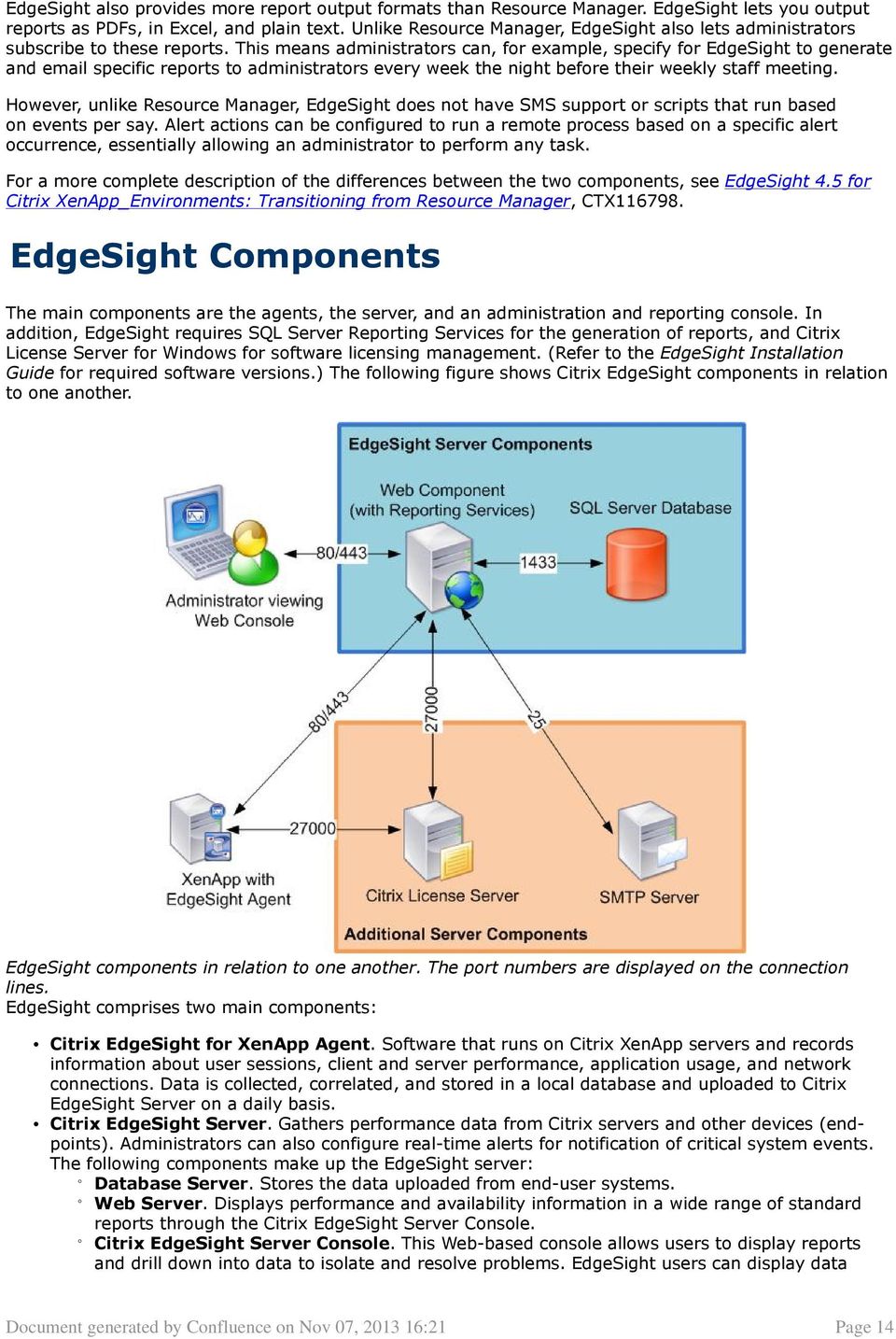
14 EdgeSight also provides more report output formats than Resource Manager. EdgeSight lets you output reports as PDFs, in Excel, and plain text. Unlike Resource Manager, EdgeSight also lets administrators subscribe to these reports. This means administrators can, for example, specify for EdgeSight to generate and specific reports to administrators every week the night before their weekly staff meeting. However, unlike Resource Manager, EdgeSight does not have SMS support or scripts that run based on events per say. Alert actions can be configured to run a remote process based on a specific alert occurrence, essentially allowing an administrator to perform any task. For a more complete description of the differences between the two components, see EdgeSight 4.5 for Citrix XenApp_Environments: Transitioning from Resource Manager, CTX EdgeSight Components The main components are the agents, the server, and an administration and reporting console. In addition, EdgeSight requires SQL Server Reporting Services for the generation of reports, and Citrix License Server for Windows for software licensing management. (Refer to the EdgeSight Installation Guide for required software versions.) The following figure shows Citrix EdgeSight components in relation to one another. EdgeSight components in relation to one another. The port numbers are displayed on the connection lines. EdgeSight comprises two main components: Citrix EdgeSight for XenApp Agent. Software that runs on Citrix XenApp servers and records information about user sessions, client and server performance, application usage, and network connections. Data is collected, correlated, and stored in a local database and uploaded to Citrix EdgeSight Server on a daily basis. Citrix EdgeSight Server. Gathers performance data from Citrix servers and other devices (endpoints). Administrators can also configure real-time alerts for notification of critical system events. The following components make up the EdgeSight server: Database Server. Stores the data uploaded from end-user systems. Web Server. Displays performance and availability information in a wide range of standard reports through the Citrix EdgeSight Server Console. Citrix EdgeSight Server Console. This Web-based console allows users to display reports and drill down into data to isolate and resolve problems. EdgeSight users can display data Page 14
15 directly from an agent database for use in problem resolution. The console can be run from any workstation using a supported browser. EdgeSight Editions There are two modes of EdgeSight available with XenApp: Citrix EdgeSight in Basic Mode, also sometimes known as Resource Manager powered by EdgeSight Citrix EdgeSight in Advanced Mode The mode available with XenApp depends on the edition level (Advanced, Enterprise, or Platinum), as well as the XenApp product version. As previously stated, both editions of EdgeSight are referred to collectively as EdgeSight. More information can be found in the EdgeSight Administrator's Guide. Where do I find the... feature? If you have been using Resource Manager for a long time, you will probably begin trying to use EdgeSight by looking for features you use frequently in Resource Manager. Here is some information about how to find similar features in EdgeSight. Dashboard EdgeSight has a dashboard that lets you define a list of up to six parameters for a group of up to 20 servers. EdgeSight queries the agents running on these servers and refreshes the dashboard at a defined interval. To see the dashboard, in EdgeSight 5.0, click the Configure tab and click Real-Time Dashboard. See the online help for further directions. Performance Monitoring Counters If you display Windows Performance Monitoring counters in EdgeSight, you might want to begin learning EdgeSight by using features with these counters. For more information, see the section for people experienced with performance monitoring in Where to Start Using EdgeSight?. What's Next? To begin using EdgeSight as a performance monitoring solution, start by reviewing some of the whitepapers and documentation on migration: EdgeSight 4.5 for Citrix XenApp Environments: Transitioning from Resource Manager, CTX When planning an EdgeSight deployment, it is important to be aware of key differences in EdgeSight's architecture, including best practices for the EdgeSight database and recommendations for the agent deployment. Start by looking at the Planning section of CTX116798; this section provides a good introduction to best practices EdgeSight deployments. Then review the information in the Citrix EdgeSight Installation Guide. To get EdgeSight up and running, review the configuration and account information in the Citrix EdgeSight Administrator's Guide and then become familiar with EdgeSight's general functionality by reviewing the following: Citrix EdgeSight User's Guide. This guide provides case studies of how administrators can use EdgeSight to accomplish tasks like resoliving system, session, and application performance problems. "Where to Start Using EdgeSight?" This Wiki article provides an entry point with links to key EdgeSight concepts such as Group and Department design, information to help administrators understand how EdgeSight categorizes reports, and an introduction to performance monitoring. "EdgeSight Reporting Tasks for XenApp." This Wiki article provides an entry point for articles about how to use EdgeSight to improve session start times, farm health, and so on. Page 15
16 Key Points for Transitioning from Resource Manager Some key Resource Manager points to consider when planning the transition from Resource Manager to EdgeSight are: Plan to Run "In Parallel" Initially. If you are currently using Resource Manager, Citrix recommends running your Resource Manager systems in parallel to implementing EdgeSight. This will provide monitoring continuity until the transition to EdgeSight is complete. Accessing Historical Summary Database Information. Data cannot be migrated from Resource Manager to EdgeSight because of the differences in the database architectures. After the EdgeSight environment is tested and deployed, Citrix recommends disabling Resource Manager data collection and only using the summary database for historical reference. Alerts. Alerts and thresholds cannot be migrated from Resource Manager to EdgeSight. If you use Monitoring Profiles in Resource Manager, consider grouping alerts and metrics by department in EdgeSight. Before migrating to EdgeSight, document the alerts and thresholds set in Resource Manager so you can figure out their equivalent in EdgeSight. The most common alerts in EdgeSight and their Resource Manager counterparts are listed in the "Alerting and Metrics Consideration" section of EdgeSight 4.5 for Citrix XenApp Environments: Transitioning from Resource Manager, CTX Also, coordinate with your respective network monitoring teams if sending SMTP alerts or SNMP traps to other third-party monitoring systems. Use departments to apply specific alerts required for a group of servers. Key Points for EdgeSight Deployments While reviewing this information, be sure to note some of the key points in managing and deploying EdgeSight: Automated Agent Deployment. To make installing and configuring easier, make sure that the agent software package contains all the required settings for an EdgeSight environment and use any software deployment tools (Installation Manager, SMS, etc) you have in your own environment. Limit the Initial Agent Deployment. Perform a test deployment on a limited number of XenApp servers to gauge the impact on your farm. Use this pilot to adjust initial EdgeSight configurations. It is easier to deploy and manage 25 EdgeSight agents than it is 250 EdgeSight agents (especially if it's required to execute a roll-back plan). Also, this approach reduces risk and overall customer impact in the event an issue arises. Baseline Performance and Fine-Tuning. Citrix suggests baselining your server performance and regularly revisiting alert and threshold settings. FAQs 1. Can I use EdgeSight to monitor Presentation Server 4.5? No. If you have a mixed farm with Presentation Server 4.5 servers and XenApp 5.0 for Windows Server r2003 or Windows Server 2008, you must use Resource Manager to monitor the Presentation Server 4.5 servers and use EdgeSight to monitor the XenApp 5.0 servers. While you can monitor Presentation Server 4.5 servers with EdgeSight, EdgeSight does not recognize these legacy servers and treats them as unidentified end-points. 2. How do I find the Resource Manager report I'm used to using in EdgeSight? For a table of the EdgeSight equivalent of Resource Manager reports, see the "Reporting Considerations" section of the EdgeSight 4.5 for Citrix XenApp Environments: Transitioning from Resource Manager, CTX How do I migrate my Resource Manager database to EdgeSight? It is not possible to migrate data or the Resource Manager database to EdgeSight. Because of the differences in architecture between the two systems, the data and databases are incompatible. Page 16

17 EdgeSight Versions The techniques and features in this article are compatible with the following versions of EdgeSight: EdgeSight 5.3 EdgeSight 5.2 EdgeSight 5.1 EdgeSight 5.0 EdgeSight 4.5 Resource Manager powered by EdgeSight 4.5 See Also Where to Start Using EdgeSight? References The specific product version requirements are listed in Improving Slow Session Start Times. EdgeSight 4.5 for Citrix XenApp Environments: Transitioning from Resource Manager, CTX Citrix EdgeSight Installation Guide Citrix EdgeSight Administrator's Guide Citrix EdgeSight User's Guide Page 17
18 Monitoring This page last changed on Mar 31, 2010 by normanw1. Introduction to EdgeSight Monitoring Performance Monitoring Monitoring Farms Understanding EdgeSight Alerts Dashboard Monitoring Page 18
19 Introduction to EdgeSight Monitoring This page last changed on Mar 31, 2010 by normanw1. This article discusses when you would want to use EdgeSight's Monitoring features. Table of Contents Overview Farm Monitor Alerts Dashboard Difference Between Monitoring and Reports See Also Overview EdgeSight provides a wide range of tools and reports allowing you to access remote devices and display real-time data stored in an EdgeSight agent database. The tools on the Monitoring tab are designed to provide timely notification of alert conditions or of performance problems on critical machines. Use these pages to discover a problem before the end-user calls the help desk.monitoring tools include: Farm Monitor Dashboard Alert Console and Alert List Alerts also fall into the broad category of Monitoring features. Farm Monitor The Farm Monitor helps you monitor alert conditions occurring on XenApp and XenDesktop systems within farms. The farm structure shown on the monitor is read directly from the farms. When an alert condition is detected by an EdgeSight Agent running on a device, an alert is generated and this condition appears on the Farm Monitor. Tip: Configure your alerts wisely. If there are too many alerts configured or they fire to frequently there will be too much noise and the Farm Monitor will not have as much value as us would if the alerts are setup to fire for critical events. Alerts EdgeSight provides numerous alerts, which can be extremely helpful for everyday management of your Citrix environment. Alerts are warnings that trigger when a certain event occurs on the devices EdgeSight is monitoring. In addition to being displayed in the EdgeSight console, EdgeSight can be configured to send alerts via or SNMP trap. Examples of alerts are: Application errors and faults XenApp and XenDesktop unavalibility and errors Session performance problems System performance problems Windows event log messages Network slowdowns Dashboard The Dashboard allows you to see real time information for specific devices. This allows you to quickly detect changes in performance and resource usage on critical machines in your environment or machines that have performance problems. Page 19

20 Difference Between Monitoring and Reports Because the EdgeSight Monitoring features provide real-time information, they are designed to provide quick insight into what is happening in your environment right now. In contrast the reports provide long term historical trending. See Also End\-User Experience Monitoring \(EUEM\) What is Happening in My Environment? Using EdgeSight Active Application Monitoring Using EdgeSight to Monitor XenApp Infrastructure Servers Page 20
21 Performance Monitoring This page last changed on Mar 31, 2010 by normanw1. Experienced with Performance Monitoring? New to Performance Monitoring? Page 21
22 Experienced with Performance Monitoring? This page last changed on Apr 28, 2010 by ronaldb. If you are an administrator who is experienced with performance monitoring, and in particular, perfmon counters, you may want to begin using EdgeSight by mapping your existing knowledge of perfmon counters onto EdgeSight. In addition to collecting some perfmon counters, EdgeSight also gathers data from a variety of sources including the Event Log, XenApp, Windows Management (WMI) on end-user workstations and Citrix servers. Consequently, perfmon counter alerts and reports are only a subset of the information EdgeSight provides. The following table provides examples of where you can find perfmon counters in EdgeSight: To... Use... baseline your environment using Perfmon counters Real-time Device Summary Real-time System Performance see a wide range of Perfmon counters from the last three days (grouped in three hour blocks) Device Troubleshooter set alerts based on a specific Perfmon counter The Custom Performance Counters feature to add a perfmon counter. These will show up in the real-time reports. In the Troubleshoot tab, click Real-Time Reports > Custom Performance Counters > Configuration. perform other reporting tasks using Perfmon counter All of the Real-time reports in the Browse tab are based on Perfmon counters: Real-time Device Summary Real-time Network Performance Real-time Presentation Server User Summary Real-time System Compare Real-time System Performance The advantage to using EdgeSight to gather and report on these Perfmon counters is that unlike displaying these metrics in Perfmon, EdgeSight lets you display the information remotely, generate and print reports, and display the information from multiple servers simultaneously. References Windows Perfmon: The Top Ten Counters. Written on April 2007 on Adminfoo.net. Accessed on July 24, "Establishing a Performance Baseline" a Microsoft TechNet article, accessed on April 20, Key Performance Metrics Exposed in EdgeSight for XenApp 5.0 and EdgeSight for Endpoints 5.0. Citrix Whitepaper. Forum post, accessed on April 16, Page 22
23 New to Performance Monitoring? This page last changed on Apr 28, 2010 by ronaldb. Because EdgeSight is a performance monitoring product, it assumes a certain amount of performance monitoring knowledge. Before using the product, it may be helpful to understand basic performance monitoring concepts such as: How to establish a performance baseline or benchmark How to use performance counters to determine system health and load The reasons organizations use metrics to evaluate network performance and how they can benefit you Microsoft provides a good overview of performance monitoring in its TechNet article, Overview of Performance Monitoring. While this information pertains to Windows Server 2000, the general principles still apply. A very easy introduction to using Windows Performance Counters is available in the article, Windows Perfmon: The Top Ten Counters. The following resources will help with establishing a performance baseline: "Establishing a Performance Baseline" a Microsoft TechNet article, accessed on April 20, Key Performance Metrics Exposed in EdgeSight for XenApp 5.0 and EdgeSight for Endpoints 5.0. Citrix Whitepaper. Forum post, accessed on April 16, Page 23
24 Monitoring Farms This page last changed on Nov 11, 2009 by sarahv. XenApp Farm Resiliency Page 24
25 XenApp Farm Resiliency This page last changed on Dec 02, 2009 by danag. To prevent major outages and crises, it is important to become immediately aware of significant changes to data collectors, XML Brokers, and other servers vital to farm infrastructure. This article defines farm resiliency, which is predicated on the concept of infrastructure servers, and an explanation of this concept. It provides a foundation for the following series of articles, which provide step-by-step instructions for ensuring farm resiliency: Alerting on Critical Health Changes Determining When a Data Collection Election Occurs Farm Resiliency Using the Farm Monitor and Reports Using EdgeSight to Monitor XenApp Infrastructure Servers Table of Contents 1 Overview 1.1 Background Information 2 References Overview To ensure farm resiliency, Citrix recommends monitoring the following events: 1. Any server in your farm is not accepting user connections. This is an essential step in preventing "blackhole" conditions - especially in load-managed application groups. 2. A data collector election occurs. Good farm management also requires knowing how busy your application servers are in actuality and when they exceed certain thresholds. Background Information For large and medium-sized farms, Citrix recommends administrators dedicate a computer for infrastructure functions, such as the XML Broker and the data collector, and configure backup servers for the data collector. XML Broker: Used by the Web Interface to enumerate published applications from the XenApp farm. This server also communicates directly with a Zone Data Collector to determine the server to route a user to when an application is launched through the Web Interface. Zone Data Collector (or "data collector"): Maintains dynamic farm-wide data, including the list of online and offline servers, as well as the load level of each server. The Zone Data Collector is also responsible for communicating farm-wide configuration changes to all servers in its zone. Page 25
26 Note: Ideally, farm administrators should set the data-collector election preferences on the data collector machine to Most Preferred and its backups to be Preferred. (Since Citrix recommends that application servers not host data collectors, application servers should be set to Default Preference or Not Preferred.) References XenApp Infrastructure Monitoring and Alerting, CTX Improving Farm Performance and Resiliency with Hotfix Rollup Pack 3, CTX Citrix XenApp 5.0 for Windows Server 2008 Administrator's Guide, CTX Page 26
27 Alerting on Critical Health Changes This page last changed on Apr 27, 2010 by ronaldb. This article provides suggestions for ways administrators can set alerts for critical health changes. Table of Contents 1 Overview 1.1 Requirements 1.2 Setting Alerts for High Resource Utilization 1.3 Setting Alerts to Prevent Load Balancing Black Holes Configuring EdgeSight Alerts for Unreachable Servers Part 1: To configure the ICA Listener test Part 2: To configure EdgeSight to alert you if a server stops accepting connections 1.4 Reporting for Custom Performance Monitoring Counters Reporting and Analysis 1.5 Determining the Number of Elections on Your Farm 2 Using the Farm Monitor to Display Recent Farm Health 3 Using Reports for Farm Health Other Useful Farm Health Alerts 4 References Overview This article assumes that, in accordance with good farm design, there is one or more computers dedicated to infrastructure functions. For an explanation of infrastructure servers, see Background Information. To ensure farm resiliency, Citrix recommends knowing immediately when: 1. Any server in your farm is not accepting user connections. This is an essential step in preventing "blackhole" conditions - especially in load-managed application groups. 2. A data collector election occurs. Good farm management also requires knowing how busy your application servers are in actuality and when they exceed certain thresholds. Requirements This article assumes administrators have the following configuration: XenApp 5.0 for Windows Server 2003, Hotfix Rollup Pack 3 EdgeSight 5.0 While some techniques in this article might still be possible without HRP03, not all of them will be. HRP03 contains critical farm resiliency enhancments. Citrix strongly recommends installing Hotfix Rollup Pack 3 (HRP03) for Presentation Server 4.5 and XenApp 5 for Windows Server 2003 on all applicable farm servers. Without HRP03, the black-hole conditions discussed in the sections that follow result in the entire zone or possibly even entire farm failing. As of this authoring date, HRP03 farm resiliency features are not available for XenApp products running on Windows Server Setting Alerts for High Resource Utilization Administrators can configure EdgeSight to set alerts when a resource utilization (CPU, thread counts, queue length, memory) for specific processes exceeds a specified value. In practice, this means that administrators can create alerts for critical services, such as the Citrix XML Service. Page 27
28 For example, in an organization with four XML Broker servers, a high CPU load on one XML Broker might cause intermittently slow application enumeration and launch performance. Without setting an alert, this scenario might be time consuming to isolate. By configuring an EdgeSight alert, the administrator can see the issue in the EdgeSight Farm Monitor. By associating an action with this alert, EdgeSight will notify the administrator about the high load before the peak logon period, which lets the administrator prevent the problem from impacting the user community. This scenario and the procedure that follows are just meant as an example. Other examples of Application Performance alerts administrators might want to set include: Problem Service Display Name Service Executable Alert Rule Conditions IMA service becomes unresponsive on some devices Citrix Independent Management Architecture ImaSrv.exe EventLog = 'System' AND EventID = '3999' AND EventSource = 'IMAService' Failure to authenticate externally (or internally depending on farm design) Citrix Secure Gateway Proxy CtxSGSvc.exe TBD Print Manager failure (Overloaded Citrix Print Manager Service) Citrix Print Manager Service cpsvc.exe When the thread count exceeds the value you calculated this can indicate a problem. To create an alert on the XML Broker for overload conditions 1. Create the Alert Rule as follows:rule Category: Application Alerts Rule Type: Application PerformanceRule Name: _XML Broker Overload Alert Rule Conditions: Process file name: ctxxmlss.exe Process company name: Citrix CPU time (percent): 85 Thread count: Thread queue length: Note: The environment must meet all the criteria you specify in the Alert Rule, including the sample ratio, before it will fire. The more parameters adminstrators enter, the more difficult it is for the alert to be triggered. Leave all other fields at their default settings. 2. Apply the alert to the department or farm in which the XML Broker resides. EdgeSight will monitor all servers in this department for the alert criteria. 3. Create an Action for this alert specifying "XML Broker Overloaded" as the subject. Note: Instructions for creating alerts are available in the EdgeSight product documentation. Setting Alerts to Prevent Load Balancing Black Holes To ensure farm health, you want to know immediately when an application server stops accepting ICA connections (that is, the ICA protocol stack fails). This is particularly true when the application server is being load balanced. When one load-managed application server cannot accept connections, a state can result where users cannot connect to any instances of that application in the load-managed group. To prevent these loadbalancing black holes, consider setting EdgeSight to alert you whenever an application server stops acccepting user (ICA) connections. Cause? Page 28
29 This unreachable state results because the Citrix Independent Management Architecture (IMA) service cannot detect when an application server stops accepting user connections. If the application server is in a load-balanced group, the IMA service perceives that the unreachable server is the least-loaded server and continues to direct user connections to it. This misperception results in the IMA service not directing connections to the other servers for that application: consequently, users cannot connect to any instances of the application. Configuring EdgeSight Alerts for Unreachable Servers You can configure EdgeSight to alert you when an application server stops accepting ICA connections by using the following two-part process: 1. Configuring the XenApp Health Monitoring & Recovery feature to run the ICA Listener test. 2. Configuring EdgeSight to alert you when the ICA Listener test fails. This procedure requires that you remove the unreachable server from load balancing. Part 1: To configure the ICA Listener test 1. In XenApp, configure the Health Monitoring & Recovery feature to run the ICA Listener test every 60 seconds on all application servers in the farm. This test determines if a XenApp server can accept connections. For instructions on configuring the Health Monitoring & Recovery feature, see the Citrix XenApp 5.0 for Windows Server 2008 Administrator's Guide. 2. In the Health Monitoring & Recovery feature, as the recovery action, specify for XenApp to Remove Server From Load Balance Tables. This option instructs XenApp to remove a server not accepting user connections from its load-balanced server group. This prevents the "black-hole" condition. Part 2: To configure EdgeSight to alert you if a server stops accepting connections Note: This procedure requires that you have Server Settings permissions in EdgeSight. 1. In EdgeSight, create two new alert rules with the following settings (based on EdgeSight 5.0): Rule 1: Event ID 1004 is the event log entry that the Health Monitoring & Recovery feature logs when it takes an unreachable server out of its load-balanced group. Rule Category: System Alerts Alert Type: Windows Event Log Alert Rule Conditions: Event Log Name: Application Event Type: Any Event ID: 1004 Event Source: MetaFrameEvents Rule 2: Event ID 1005 is the event log entry that the Health Monitoring & Recovery feature logs when it fails to take an unreachable server out of its load-balanced group. Rule Category: System Alerts Alert Type: Windows Event Log Alert Rule Conditions: Event Log Name: Application Event Type: Any Event ID: 1005 Event Source: MetaFrameEvents 2. Assign the alert rule to the Department containing all farms being monitored (PS Farms) or to a specific farm. 3. Configure an alert action to send you an alert. You can also create an action that runs an executable (for example, opening the command-line interface for applications like Tivoli or HP OpenView). Page 29
30 Tip: Creating farm-specific alerts, for example, including the farm name in the alert name (such as "Farm0012 Unreachable Server"), can help you quickly identify the source of the problem. You can also configure alert actions that generate a notification to one or more administrators. Reporting for Custom Performance Monitoring Counters XenApp provides some Performance Monitoring counters that can be beneficial to monitor for farm health. Unfortunately, not all of these counters are currently available in EdgeSight. However, it is possible to add these counters and run a report on them. The limitation is that you can only run a report for custom counters on one device in your farm at a time. Because the data in this report is from the EdgeSight agent, it is possible to run reports on real-time information, which shows changes as they occur, rather than see historical data (typically three days old) from the database. Creating reports for the Performance Monitoring counters listed in XenApp Infrastructure Monitoring and Alerting, CTX is a two-step process: 1. Add the Performance Monitoring counter to EdgeSight for the counters it does not monitor already. 2. Run a report (specifically, the Custom Performance Counters > Chart) on the data. This process is explained in more detail in the article, Generating Reports for a Custom Performance Monitoring Counter in EdgeSight. Reporting and Analysis This section provides information about ways to proactively improve your farm performance by getting insight into past performance though historical reports and similar features. Determining the Number of Elections on Your Farm When evaluating the overall health of your farm, you might want to determine how many times over the last few days election storms have occured. To display trends for recent election storms 1. In EdgeSight, click the Monitor tab. 2. Click Alert Console. 3. Select one of the following: Department. Group. Select Data Collectors as the Group. 4. From the Alert Name list box, select Zone Elections too Frequent. 5. Select By Device as the Filter. 6. (Optional.) Change the Zoom interval to narrow or expand your date range, as desired. Tip: You can also use the Event Log Alerts report filtered on the Data Collectors Group (grouped by Device) to display the number alerts over a longer period of time. Look for the alert Zone Data Collector Election Triggered in the report. To identify the data collectors affected by election storms and monitor elections in real time 1. In EdgeSight, click the Monitor tab. 2. Click Farm Monitor. 3. From the Alert Name list box, select Zone Elections too Frequent. 5. In the tree view, select the farm name and click Go. 7. In the Device Information pane, click the System tab. Page 30
31 8. In the Counter column, look (or search) for the Zone Elections Triggered Performance Monitoring counter. This counter increments each time a server triggers a data collector election. Using the Farm Monitor to Display Recent Farm Health Use the Farm Monitor to browse through your farms and display real-time data for alerts received within the last 6 hours. Note: This procedure requires that you have administrative privileges on the farm experiencing the alert condition. To display information for a recent alert 1. Browse the farm structure, or search for a specific farm. Farms with recent alerts are marked with an alert!farm_mon_alert.jpg width=32,height=32! icon. 2. Click on the menu!menubtn.jpg width=32,height=32! icon and select Alert Detail to display a description of the alert condition. 3. Click on an alert to retrieve system context around the time of the alert. 4. Select the applicable tab to display information on process, system, session, and n4etwork counters. To display information for alerts received within the last three days, use the Alert Console. Using Reports for Farm Health The following reports can also provide insight into farm health: Device Summary. Provides device performance data (CPU and memory usage, network delay, event log alerts, and application errors) Environmental Usage. Provides data on users, clients, sessions (start, end, and duration), published applications, and processes. (Note: You must enable uploading environmental usage data before you can run this report. See the EdgeSight online help for details. ) ICA Round Trip Time. Provides session and network round trip time (RTT). Network Delay for a User Group. Session network delay, broken down by server, client, and network delay. Port Network Delay. Port network delay, broken down by server, client, and network delay. Port Network Volume. Port network volume (kilobytes sent and received). Presentation Server Summary. XenApp performance data (login time, active sessions, ICA session latency, and CPU and memory usage). Presentation Server User Summary. XenApp performance from a user perspective (for example, client traffic, login time, session latency, and recent sessions). Other Useful Farm Health Alerts In environments plagued by frequent connection failures to the Terminal Server License Server, administrators can set alerts when this occurs. By default, EdgeSight monitors for failure to connect to its environment's Terminal Services license server. (The Terminal Server License Server Discovery Failure alert is enabled by default.) However, administrators must associate this alert with an action for them to receive a real-time warning (for example, an message). References XenApp Infrastructure Monitoring and Alerting, CTX Improving Farm Performance and Resiliency with Hotfix Rollup Pack 3, CTX Page 31
32 QueryDC, CTX This article includes information about the -t function Citrix added to the QueryDC tool. Creating, Configuring, and Testing Health Monitoring, CTX HMR Test Pack, CTX Case Study: Using EdgeSight 5.0 to Troubleshoot Application Enumeration, CTX Citrix XenApp 5.0 for Windows Server 2008 Administrator's Guide, CTX Page 32
33 Determining When a Data Collection Election Occurs This page last changed on Nov 09, 2009 by sarahv. The XenApp data collector is a critical aspect of all farms. Regardless of whether the data collector is on a dedicated or shared server, when it performs poorly it will affect all user connections in that zone. This article provides an overview of how to configure alerts for when a data collector election occurs and when there are excessive elections ("election storms"). Table of Contents 1 Overview 1.1 Requirements 2 To create an alert when data-collector elections occur 3 Monitoring for Data Collector Election Storms 3.1 Preventing Data Collector Election Black Holes 4 Applicable Versions 5 References Overview When communications fail between data collectors or between a server and its data collector, the process to choose a new data collector begins. This process is known as the data-collector election. Citrix recommends that you be notified immediately when a data collector fails over to its backup data collector. This is because after failover the farm (or zone) only has one data collector. If that data collector fails, your entire farm will stop accepting user connections. The easiest way to find out that an election occured is to configure an alert in EdgeSight. Since the Access Management Console does not display elections, without EdgeSight, you must remember to run the QuerryDC command or check the event logs on the data collector and its backup. Requirements This article assumes administrators have the following configuration: XenApp 5.0 for Windows Server 2003, Hotfix Rollup Pack 3 EdgeSight 5.0 While some techniques in this article might still be possible without HRP03, not all of them will be. HRP03 contains critical farm resiliency enhancments. Citrix strongly recommends installing Hotfix Rollup Pack 3 (HRP03) for Presentation Server 4.5 and XenApp 5 for Windows Server 2003 on all applicable farm servers. Without HRP03, the black-hole conditions discussed in the sections that follow result in the entire zone or possibly even entire farm failing. As of this authoring date, HRP03 farm resiliency features are not available for XenApp products running on Windows Server To create an alert when data-collector elections occur 1. In EdgeSight, create a new alert rule with the rule category Presentation Server Error Alerts. 2. Specify Zone Data Collector Election Triggered as the Alert Type. 3. Create an action that s you when this alert occurs. Tip: You can also create a System alert based on the Event ID If you do this, the alert displays the name of the zone, which server triggered the election, and the name of the server that is the new data collector. You may also want to create an action for this alert. Page 33
34 Monitoring for Data Collector Election Storms In larger farms, in extreme circumstances, network issues or high load can sometimes unnecessarily and repeatedly trigger data collector elections in rapid succession. These rapid elections are typically referred to as _election storms_. Election storms can result in downtime for end users since the data collectors must repeatedly rebuild dynamic data, which prevents them from load balancing incoming user requests. To configure an EdgeSight alert for excessive data collector elections 1. In EdgeSight, create a new alert rule with the rule category Presentation Server Performance Alert. 2. Specify Zone Elections too Frequent as the Alert Type. 3. Specify the number of elections that you want to occur before EdgeSight alerts you. In farms prone to frequent storms, you can specify either a higher number of election counts or lower polling interval and increase the Re-alert parameter (which is found in the Advanced Parameters) so that it alerts you less frequently once the storm begins. 4. Create an action that s you when this alert occurs. Note: XenApp 5.0 for Windows Server 2003, Hotfix Rollup Pack 3 introduces features that help reduce election storms. Citrix strongly recommends upgrading to this hotfix if election storms are an issue in your farm. For more information, see Improving Farm Performance and Resiliency with Hotfix Rollup Pack 3, CTX Preventing Data Collector Election Black Holes An election "black hole" condition can occur when a data collector only partially fails - that is, it cannot function as a data collector yet continues to win elections and causes an outage. To configure an EdgeSight alert when IMA on a data collector is unresponsive 1. In EdgeSight, create a new alert rule (and action) with the following settings: Rule Category: System Alerts Alert Type: Windows Event Log Alert Rule Conditions: Event Log Name: System Event Type: Any Event ID: 4001 Event Source: MetaFrameEvents To configure an EdgeSight alert when IMA an offline data collector becomes available again 1. In EdgeSight, create a new alert rule (and action) with the following settings: Rule Category: System Alerts Alert Type: Windows Event Log Alert Rule Conditions: Event Log Name: System Event Type: Any Event ID: 4002 Event Source: MetaFrameEvents Applicable Versions This article applies to: EdgeSight 5.2 EdgeSight 5.1 EdgeSight 5.0 Page 34
35 References XenApp Infrastructure Monitoring and Alerting, CTX Improving Farm Performance and Resiliency with Hotfix Rollup Pack 3, CTX QueryDC, CTX This article includes information about the -t function Citrix added to the QueryDC tool. Creating, Configuring, and Testing Health Monitoring, CTX HMR Test Pack, CTX Case Study: Using EdgeSight 5.0 to Troubleshoot Application Enumeration, CTX Citrix XenApp 5.0 for Windows Server 2008 Administrator's Guide, CTX Page 35
36 Farm Resiliency Using the Farm Monitor and Reports This page last changed on Nov 09, 2009 by sarahv. This article provides information about how to use EdgeSight's Farm Monitor feature to ensure farm health and resiliency. It also discusses generating reports for farm health and how to generate alerts. Table of Contents 1 Using the Farm Monitor to Display Recent Farm Health 2 Using Reports for Farm Health 2.1 Other Useful Farm Health Alerts 3 References Using the Farm Monitor to Display Recent Farm Health Use the Farm Monitor to browse through your farms and display real-time data for alerts received within the last 6 hours. Note: This procedure requires that you have administrative privileges on the farm experiencing the alert condition. To display information for a recent alert 1. Browse the farm structure, or search for a specific farm. Farms with recent alerts are marked with an alert 2. Click on the menu icon. icon and select Alert Detail to display a description of the alert condition. 3. Click on an alert to retrieve system context around the time of the alert. 4. Select the applicable tab to display information on process, system, session, and network counters. To display information for alerts received within the last three days, use the Alert Console. Using Reports for Farm Health The following reports can also provide insight into farm health: Device Summary. Provides device performance data (CPU and memory usage, network delay, event log alerts, and application errors) Environmental Usage. Provides data on users, clients, sessions (start, end, and duration), published applications, and processes. (Note: You must enable uploading environmental usage data before you can run this report. See the EdgeSight online help for details. ) ICA Round Trip Time. Provides session and network round trip time (RTT). Network Delay for a User Group. Session network delay, broken down by server, client, and network delay. Port Network Delay. Port network delay, broken down by server, client, and network delay. Port Network Volume. Port network volume (kilobytes sent and received). Presentation Server Summary. XenApp performance data (login time, active sessions, ICA session latency, and CPU and memory usage). Presentation Server User Summary. XenApp performance from a user perspective (for example, client traffic, login time, session latency, and recent sessions). Page 36
37 Other Useful Farm Health Alerts In environments plagued by frequent connection failures to the Terminal Server License Server, administrators can set alerts when this occurs. By default, EdgeSight monitors for failure to connect to its environment's Terminal Services license server. (The Terminal Server License Server Discovery Failure alert is enabled by default.) However, administrators must associate this alert with an action for them to receive a real-time warning (for example, an message). References XenApp Infrastructure Monitoring and Alerting, CTX Improving Farm Performance and Resiliency with Hotfix Rollup Pack 3, CTX QueryDC, CTX This article includes information about the -t function Citrix added to the QueryDC tool. Creating, Configuring, and Testing Health Monitoring, CTX HMR Test Pack, CTX Case Study: Using EdgeSight 5.0 to Troubleshoot Application Enumeration, CTX Citrix XenApp 5.0 for Windows Server 2008 Administrator's Guide, CTX Page 37
38 Using EdgeSight to Monitor XenApp Infrastructure Servers This page last changed on Apr 27, 2010 by ronaldb. This is a stub article and may be combined with another article or expanded. While many people think of EdgeSight as a tool for monitoring servers hosting published applications, you can also use EdgeSight to monitor your infrastructure servers. This article uses the term infrastructure servers to refer to servers that provide XenApp server infrastructure, such as the data collector, data store, license server, and XML broker, that do not traditionally host published applications. This diagram shows an example of the infrastructure servers on a farm. Monitoring for Data Collector Overload To proactively monitor for data collector overload, set EdgeSight to send you alerts when the following performance counters reach TBD level on the computer hosting the data collector: ResolutionWorkItemQueueReadyCount WorkItemQueueReadyCount Infrastructure Servers and Capacity Planning If you increase the number of application servers in your farm, often you will need to increase the number of infrastructure servers to align with this growth. For example, you might need to migrate from an infrastructure server hosting the Citrix License Server, the data collector and the XML Broker to a server hosting just the data collector and the XML Broker or a dedicated server for each function. While farm size (small, medium, large) as determined by the number of servers can provide a general indication of how many infrastructure servers your environment requires, one of the most important factors to consider is the number of user connections. Because applications can scale differently from server to server (some servers might support 100 user connections, others might support only ten), looking solely at the number of servers might be misleading. As the number of users connecting to your farm increases, use EdgeSight to monitor the Windows Performance Monitor counters listed in the table that follows. Checking these counters at the following times is critical: When the peak number of users is connecting simultaneously to the farm; this usually occurs in the morning. When the peak number of users is connected to the farm; this usually occurs during the day. If the counters exceed the criteria listed in the table, break apart the infrastructure functions onto separate servers until the counter metric no longer exceeds that which is listed in the table. Performance Monitor Counter Name Criteria CPU > 85% - 90% Page 38
39 Memory > 80% ResolutionWorkItemQueueReadyCount > 0 for extended periods of time WorkItemQueueReadyCount > 0 for extended periods of time LastRecordedLicenseCheck-OutResponseTime > 5000 ms Typically, you need to evaluate the LastRecordedLicenseCheck-OutResponseTime counter only in large farms. For information about XenApp Performance Monitor counters and their functions, see the Citrix XenApp Administrator's Guide. Page 39
40 Understanding EdgeSight Alerts This page last changed on Nov 12, 2009 by sarahv. System Alerts Application Alerts Network Alerts Session Alerts XenApp Alerts XenDesktop Alerts Page 40
41 System Alerts This page last changed on Nov 12, 2009 by sarahv. Page 41
42 Application Alerts This page last changed on Nov 12, 2009 by sarahv. Page 42
43 Network Alerts This page last changed on Nov 12, 2009 by sarahv. Page 43
44 Session Alerts This page last changed on Nov 12, 2009 by sarahv. Page 44
45 XenApp Alerts This page last changed on Nov 12, 2009 by sarahv. Using EdgeSight Active Application Monitoring Page 45
46 Using EdgeSight Active Application Monitoring This page last changed on Jun 02, 2010 by ronaldb. This is a stub article and may be combined with another article or expanded. EdgeSight Active Application Monitoring is an easy to install and configure automated performance testing tool that monitors the end user experience in Presentation Server and XenApp environments. Table of Contents 1 Overview 1.1 Getting Started with Active Application Monitoring 1.2 Differences Between EdgeSight for Load Test Overview Active Application Monitoring is a separate tool included with EdgeSight, Service Pack 2.0 and higher. Active Application Monitoring lets you create scripts to replicate user actions for a specific application. You can use Active Application Monitoring to perform scalability testing for an application and also demonstrate SLA compliance. The module has a separate installation program, which is found on the EdgeSight DVD. The installation instructions are included in the text of the installation wizard. Getting Started with Active Application Monitoring To use the Active Application Monitoring tool to demonstrate SLA compliance, create a script to perform specific actions in an application and then run it against the corresponding application server in the production environment. In the script, you define the specific items you want to monitor as Monitoring Points. When you run the script, you only specify for it to simulate one user so as not to create excess load on the server. The Active Application Monitor launcher can then capture metrics about how the application behaves on that application server. These metrics are uploaded to EdgeSight. After the metrics are in EdgeSight, you can run one of the Application Response reports. These reports provide metrics for the monitoring point you specified in the script. Note: The Active Application Monitoring online help is installed with the Active Application Monitoring tool. This help system provides instructions for configuring the module initially and creating scripts. Differences Between EdgeSight for Load Test While Active Application Monitoring is designed to test application availability and responsiveness, EdgeSight for Load Testing performs load tests in a XenApp environment. EdgeSight for Load Testing records and replays scripts which simulate a virtual user's interaction with an application, generating the necessary information to simulate the activity of multiple users. This data helps XenApp administrators identify performance bottlenecks before applications are delivered to the production environment, and to establish application monitoring baselines based on transaction and system performance. Once created, scripts can be re-used for application regression testing of updates or for comparing performance of new hardware options or configurations. Page 46
47 XenDesktop Alerts This page last changed on Nov 12, 2009 by sarahv. Page 47
48 Dashboard Monitoring This page last changed on Apr 27, 2010 by ronaldb. This is a stub article and may be combined with another article or expanded. Page 48
49 Troubleshooting This page last changed on Apr 27, 2010 by ronaldb. Troubleshooting Using EdgeSight Page 49
50 Troubleshooting Using EdgeSight This page last changed on Apr 27, 2010 by ronaldb. Administrators can use EdgeSight real-time reports, historical reports, and troubleshooting features to perform troubleshooting in their environments. For articles about troubleshooting techniques, see: Troubleshooting Devices Troubleshooting XenApp Application Servers Troubleshooting XenApp Application Issues Troubleshooting XenApp Infrastructure Servers Case Study, Troubleshooting Remote Applications Table of Contents 1 Overview 2 Starting Points 3 Troubleshooting Tools Data in Real-time Troubleshooting Features Custom Counters 4 References Overview Troubleshooting is a form of systematic problem solving used to isolate the root cause of an issue so that steps can be taken to fix the issue and restore one or more systems to proper operation. In the context of this Wiki, troubleshooting techniques are applied to isolate problems with various components, services, or features in your XenApp environment, including XenApp servers, infrasturcture servers (XML Broker, Data Collector, and Data Store), published applications, and printing services. Identifying the root cause and resolving application issues is best done within a framework such as the scientific method: 1 1. Identify and understand the problem/question. Ask meaningful questions and state the problem or question in a way that it is conceivably possible to answer it. Gather relevant information to attempt to answer the question. 2. Formulate a hypothesis. Propose a solution or answer to the problem or question. State the hypothesis in a way that can be tested. 3. Test the hypothesis. Test the hypothesis before it is corroborated and given any real validity. There are two ways to do this: conduct an experiment and/or make further observations. 4. Collect and analyze the data. If the hypothesis fails the test, it must be rejected and either abandoned or modified. A modified hypothesis must be tested again. If the hypothesis passes further tests, it is considered to be a corroborated hypothesis, and it can now be published. 5. Make conclusions. The final step is to construct, support, or cast doubt on a theory. A scientific theory is a unifying and self-consistent explanation of fundamental natural processes or phenomena that is totally constructed of corroborated hypotheses. You can use several different EdgeSight features, often the real-time features, to troubleshoot issues in XenApp environments. Because data in EdgeSight's real-time features is not averaged, this data shows resource utilization spikes, which is helpful when troubleshooting. Depending on the scope of the problem you are troubleshooting, you may need to use multiple tools to accomplish the task. For an overview of the full range of troubleshooting options for Citrix products, see Citrix Technical Support Brief Troubleshooting Guide, CTX Starting Points When beginning to troubleshoot issues, it is helpful to gather as much of the following information as possible: 1 User ID The permissions and policies associated with the user account Page 50
51 The user's activities before the issue occurred If the user saw anything unusual before the issue occurred Errors messages If the user can reproduce the issue If the application runs correctly when an administrator is logged into the user's console If the user has the same issue when an ICA connection is made to a desktop Troubleshooting Tools EdgeSight provides two major tools for troubleshooting issues: User Troubleshooter. Lets you display detailed performance data for sessions across a farm for a specified user over the last three days. Device Troubleshooter. Lets you display detailed real-time performance data for a device. You can either search or browse for a device. In addition to these generalized troubleshooting tools, EdgeSight also provides the following more specialized tools: Device Trace Route. Lets you execute a trace route from the selected device to a specified network host, allowing you to identify and locate routing problems. Device Process List. Lets you display detailed information about processes currently running on the selected device. This tool also lets you initiate a remote snapshot when you see the onset of a performance problem. This feature allows you to remotely analyze the current state of the system, identify a potential problem, and capture a full set of diagnostic data that can be shared internally with the application owner or externally with a third-party vendor to troubleshoot any potential problems within the application. For usage instructions, see the EdgeSight User Guide. Data in Real-time Troubleshooting Features EdgeSight's Troubleshooting tools (the User Troubleshooter and Device Troubleshooter), the Realtime Excel reports in the Browse tab, and the Custom Performance Monitor Chart generate charts and reports based on real-time data. There are several important things to know about using features that employ real-time data: This data is much finer grained (5 to 15 second samples) than the historical data on the EdgeSight Server. Real-time data is stored in the Agent Database for three days by default. Real-time data is raw data that it not correlated with data from other devices the way it is in the EdgeSight Server. Real-time reports can only provide data about one device at a time. Users must have administrative permissions on the device from which they wish to obtain real-time data. Custom Counters If troubleshooting techniques require using performance monitoring counters not included in EdgeSight, you might be able to add them. For more information, see Generating Reports for a Custom Performance Monitoring Counter in EdgeSight. References Page 51
52 Troubleshooting XenApp Application Servers This page last changed on Apr 28, 2010 by ronaldb. Regardless of what issue you are investigating, when you begin troubleshooting the application server, consider beginning by checking for alerts in the Stability tab on the Device Troubleshooter. The Stability tab displays alert data, including the type of alert, the system entity causing the alert condition, the user logged on to the device when the alert condition occurred, and the time at which the alert was generated on the client system. Table of Contents 1 Session Problems 1.1 Session Latency and Slow Performance in Sessions 1.2 Sample Troubleshooting Process Session Problems Session Latency and Slow Performance in Sessions Slow session performance is one of the highest visibility issues you can have on your farm. Unfortunately, there are many different potential causes for session latency ranging from resource constrained application servers to poor network performance and excessive bandwidth consumption. If you suspect you have issues with session latency, see Session Latency. The XenApp startup process is complex and contains numerous stages. While there are some frequently occurring causes of slow session start times, such as autocreating excessive numbers of printers, profiles, there can be other causes including overloaded XML Brokers or Web Interface servers. The best way to isolate the cause of slow session start times is to run the EdgeSight Session Startup Duration report and follow the process described in the article Improving Slow Session Start Times. This method adds a way to improve slow session times. Sample Troubleshooting Process If a user or department complains about an issue, an administrator might begin the troubleshooting process as follows: 1. Determine if this is limited to a few users or if it is system wide: a. Find out what users are complaining the session is slow. What do these users have in common? Are they in the same user group? Are they in the same department and likely to be using the same application? 2. Try to locate the device hosting the session. To do so, look at the session data for the users: a. Open the User Troubleshooter and enter the name of one of the users (DOMAIN\username). b. After displaying the users session, determine what device hosted the session with the issues. 3. Use the Device Troubleshooter to determine if the issue is specific to the application or occurs with all application on the server. 4. Use the Device Troubleshooter to determine if the issue is specific to the server hosting the application or if it occurs on all servers hosting that application. Symptom Feature Where to Look? Comments Session Latency Troubleshoot tab, Device Troubleshooter Session List tab Shows all processes running. Scroll to the right to UserTime%. If this metric is high for one session and not others, the issue could be specific to the session and not the device (for example, Page 52
53 the user's activity). Compare UserTime % to ProcessorTime %. ProcessorTime % is an average of all the processors on the server. If there are multiple applications on the server and the issue is specific to the application, consider moving the application to another server. Session Latency/Slow Performance (possible resource issues) Troubleshoot tab, User Troubleshooter Session List tab Find the user name, figure out the process and device. If the issue is common to multiple user sessions on the same server, consider if upgrading the hardware would improve performance. If the application is not running well as a multiuser application (for example, its resource issues are caused by the application being designed for a singleuser environment), consider installing the application in a XenDesktop environment or perhaps configure it to stream to desktop. Slow logons or applications take a long time to save (possible network issues) Troubleshoot tab, User Troubleshooter OR Troubleshoot tab, Device Troubleshooter Session Summary tab, then System Network Summary tab In the Session Summary tab, check the Network Round Trip Time metric. In the System Network Summary tab, check bandwidth compression by comparing the Session Line Output and Session Line Input metrics (which, respectively, indicate data written back to the server and transferred from the server to the client) to the Session Compression Input/ Output metrics. If compression is dramatically lower, it might indicate that administrators have not configured policies to control bandwidth Page 53
54 adequately. See next row in table. You can also look at Avg Round Trip Time and compare it to Avg Delay. (Avg Delay indicates how long it takes for a server to process network requests.) If, when compared at the same time periods, Avg Delay is equal to or greater than Avg Round Trip T ime then look at Avg Network Delay, Avg Server Delay, and Avg Network Delay. Avg Server Delay could indicate the server is overloaded - check to see if CPU utilization is around 100% and cannot process requests, or it could indicate the Network Card (NIC) is overloaded. Avg Client Delay could indicate issues with the NIC on the client device or issues with the plugin (client) software itself. Slow login times and applications take a long time to save (possible network issues) Troubleshoot tab, User Troubleshooter Channel Detail tab Look to see which ICA channel is consuming the most bandwidth. Start to isolate the ICA channel on which you need to restrict bandwidth by looking at the Printer Input / Output, SpeedScreen Input/ Output metrics and then proceed to the other metrics. Reconfigure XenApp policies accordingly. Slow session start times in some sessions and not others Troubleshoot tab, User Troubleshooter Session Start Detail tab See the Improving Slow Session Start Times article. Slow application performance/session latency (possible application issues) Troubleshoot tab, User Troubleshooter System Summary tab, then Process Detail tab In the System Summary tab, look to see if there is a resource at maximum capacity or if the WorkingSet (memory) is at its maximum. Sorting by UserTime(%) may Page 54
55 be helpful. Look to see which process is consuming the most resources Session hangs Troubleshoot tab, User Troubleshooter Stability tab Look for application errors. Page 55
56 Troubleshooting XenApp Application Issues This page last changed on Nov 11, 2009 by sarahv. This article discusses ways to use EdgeSight to troubleshoot issues with applications published on XenApp. Table of Contents Overview Application Testing and Deployment Application Alerts Monitoring Applications and Troubleshooting Application Issues Applicable Versions Overview Users running applications through XenApp often call the help desk to report that their application has crashed, is slow, or that they received a cryptic error message. Sometimes these events occur several times before a user finally becomes frustrated and reports the problem. Citrix administrators used to rely on users to report these issues, requiring the user to accurately describe the conditions when the error or crash occurred as well as the complete error message. In addition, administrators were often charged with trying to re-create this error or crash so they can forward the appropriate information to either a developer or a vendor. The EdgeSight Agent running on a XenApp server monitors process availability and performance. For example, the agent creates a standard mini-dump file for any published application that crashes, whether the application was developed in-house or by a third party. These mini-dump files contain a complete set of information that an application developer can use to investigate the issue. Note that in some cases, the nature of the crash prevents system context data from being collected, but an application fault alert is still generated.) In the case of an application error, the complete error text is captured along with the exact time it occurred. As a result, administrators no longer need users to report these issues or hope they can re-create an application issue in an environment where EdgeSight has been deployed. In many organizations, there is often one person in charge of supporting an application. It is possible to identify a particular process and get a performance summary for a particular application. One of the ways to minimize the impact of application issues is to proactively monitor application performance. EdgeSight provides historical reports that tell people "how application X performed last week." You can set up a subscription so the report is ed to an application analyst or group of administrators on a regularly scheduled basis. In many cases, reports on application errors or high resource usage by an application can help you proactively identify a problem application before a crash occurs. EdgeSight also provides real-time reports, monitors, and troubleshooters which allow you to display detailed information about an application- or session-related alert. Application Testing and Deployment Many application issues can be avoided, or at least caught before they affect a production environment, by solid application testing and a careful deployment strategy. Use the Web to search for known application compatibility issues prior to deployment. Consider using the Microsoft Application Compatibility Toolkit to identify the root cause of application issues concerning INI files and registry settings. See the Citrix XenApp Installation Guide for best practice information on assessing applications for XenApp compatibility, evaluating application delivery methods, and locating applications on servers. Page 56
57 Application Alerts The unique alerting functionality of EdgeSight can notify administrators in real time when an application event has occurred, such as alert errors driven by exact error messages, high resource usage by an application, or a non-responsive process. These alerts can trigger notifications, can be sent to thirdparty consoles that accept Simple Network Management Protocol (SNMP) traps, or as of EdgeSight for XenApp 5.2, can be sent to Microsoft System Center Operations Manager. Monitoring Applications and Troubleshooting Application Issues See the following topics for more information on proactively monitoring applications and troubleshooting applications when problems occur. Application Performance Factors Monitoring Applications Proactively Application Issue Troubleshooting Real Time Troubleshooting of Application Issues Applicable Versions EdgeSight 5.2 EdgeSight 5.1 EdgeSight 5.0 Page 57
58 Application Performance Factors This page last changed on Apr 27, 2010 by ronaldb. Before troubleshooting applications, it is important to know what an application issue looks like and what can affect application performance. Application issues can show up as one or more of the following symptoms: The application fails to start or initialize That application does not behave correctly or normally The application and/or application server crashes Poor application and/or application server performance is observed Disconnected ICA sessions occur Slow ICA sessions are observed There are many factors that impact application performance, including system resources, network bandwidth, and application compatibility issues. The following are some of the more common causes of poor application performance on a farm. Too many user connections or application requests: Too many user connections to a particular application server or too many requests to the server from other applications can cause slow response times. Use the Process Usage report, filtered for the application and the server, to show the number of unique users connecting to the application. In the case of too many requests from other applications, the cause of the slowdown is often insufficent memory or CPU resources. Use the System CPU and the System Memory Usage reports to investigate these situations. Insufficient bandwidth: Incorrect printing design, such as printing traffic that uses the network printing model that goes from the XenApp server across the WAN to the print server and then to the printer. If there are no XenApp policies set to limit printing bandwidth, other traffic on the WAN is compromised. Effectively, without setting either the XenApp Session Limits > Printer or Session Limits > Printer (%) policies, print jobs can consume as much WAN bandwidth as they want. This negatively impacts other traffic that crosses the WAN, including ICA traffic, and this has a severe impact on users. To determine if bandwidth is actually the issue, you may want to try running the application from another location. For example, if the problem is occurring when the application is run over the WAN, try running it over another WAN or over the LAN to see if there is a difference in performance. To determine how much bandwidth your XenApp printing traffic is consumming, run the ICA Printer I/ O report. If the application makes havy use of audio or video, run the ICA Audio I/O and ICA Video I/ O reports. You can also display peak and average overall bandwidth used by a session by running the Session Network Bandwidth Used report. Local latency: Local latency if often due to slow processing of reads and writes by the database server. Areas to investigate include CPU and memory usage, on both the application server and the database server, as well as database size. Use the System CPU and the System Memory Usage reports to investigate these situations. It may also be helpful to verify that regular database maintenance has been taking place. Traffic bottlenecks: Traffic bottlenecks can occur because one or more applications on a server has a high CPU usage. Run the Process CPU report, filtered by device, to see which processes are using the most CPU on the server. It may also be helpful to run the Process Thread Count report, filtered by process and device, to see the average thread count for the process. Slow request processing: In some cases, applications that were not written with Terminal Services in mind may have problems running in a multi-user environment, resulting in slow request processing. Since these type of applications will perform poorly in both ICA and RDP sessions, try running the application in an RDP session and compare the performance. For more ideas about using EdgeSight reports to detect application issues before they become critical, see Monitoring Applications Proactively. Page 58
59 Monitoring Applications Proactively This page last changed on Nov 04, 2009 by ronaldb. The historical reports provided by EdgeSight allow you to identify process performance trends over time and, used in conjunction with your system baseline data, allow you to measure performance improvement or degradation. Monitoring Overall Performance with Historical Reports The Process Performance Summary by Process report can help you proactively identify application issues before they become critical. 1. You can display this report or deliver it to subscribers on a regular basis, filtering the report by the Department or Group containing the XenApp servers you are interested in. 2. If the report shows abnormally high CPU or process memory usage, or a long network delay, you may want to investigate further. For example, if the process memory usage is significantly above the baseline value, click on that subreport to display the Process Memory Usage report. 3. You can drill down by expanding report rows to show process memory usage related to the specific device and user. Once you have identified a problem application, you may want to find out if this is a one-time situation or an ongoing issue. For example, if you expand the timeframe of the report, use the Optional Parameters to select the specific application, and sort by date, you can quickly identify past spikes in memory usage. Monitoring Process Stability Another way look at applications is by how stable they are, based on the number of errors, hangs, web errors, and faults encountered. In many cases, application faults (crashes) are preceded by an increased number of more application errors or hangs. Use the Process Stability Summary by Process report to display which applications are experiencing the most issues. Click on any of the charts to display more details about a specific type of problem and drill down to show the device and user associated with the error. The data in the process stability reports is based on conditions detected by the EdgeSight Agent installed on the XenApp Server. The agent determines a message box to be a notification of an application error if the message box contains an error icon or the text of the message box contains one or more of the following error keywords: error, unable, fail*, unsuccessful, unexpected, bad, fault, invalid, illegal, denied, not valid, exception, or memory. EdgeSight software uses the Windows API (the IsHangAppWindow call) to determine if an application is not responding. An application is considered to be not responding if it is not waiting for input, is not in startup processing, and has not called the PeekMessage function within the internal timeout period of 5000 milliseconds (5 seconds). Monitoring Network Performance for a Process Understanding the network metrics EdgeSight provides is a key concept and something that can quickly indicate where a problem might be. For example, you run the Process Network Delay report, filtered for a critical process. The report shows a large amount of server delay. Server delay is the amount of network delay that is caused by waiting for the server or back end application to respond to our requests. For example, the spike might have been caused that day by a back-end server going down or an unusual number of users accessing the application. By looking at this report, it is possible to tell that it is not a network problem because the network-only portion of the delay is well within normal values. If the network portion of the delay was high, it would be possible to deduce that the connection from the XenApp server to the application had some issues. For example, maybe the server and the streaming file share are in different data centers and there was latency over the connection. Page 59
60 You may want to correlate the network delay information with the network volume for the same process at the same time to see if the delay amy be caused by large amounts of data being sent or recieved. Use the Process Network Volume report to display sent, received, and total network volume. Some network problems can show up as application errors or faults, such as when an application fails to start properly, or fails to connect to a required component. Applications may fail to connect to a remote component causing it to terminate during the startup process or malfunction during run-time. Invalid hostnames, IP addresses, and/or port numbers may cause these issues. Applications may also fail to connect to remote components when firewalls and routers are incorrectly configured for the applications. Some applications require specific ports to be opened on the firewall. In some cases, the router may not have the information to correctly route a connection request to the application's remote component. Next Steps Once you have identified an application issue, you'll need to troubleshoot it to determine the root cause. Application Issue Troubleshooting provides a framework for troubleshooting applications. When you start actively troubleshooting application issues, you'll want to look beyond the historical reports to the real-time data provided by the troubleshooters and rea;-time reports, as described in Real Time Troubleshooting of Application Issues. Page 60
61 Application Issue Troubleshooting This page last changed on Nov 09, 2009 by ronaldb. In troubleshooting application issues in XenApp environments, these general steps apply. The appplication issue and its system context must be evaluated. The behavior of the application and the associated environment must be analyzed to highlight the symptoms of the issue. Based on gathered information, multiple hypotheses can be formulated and test cases can be developed to validate that one or more of the hypotheses are correct. Once hypotheses are proven to be true, workarounds or solutions can be developed to resolve the issue. EdgeSight helps you understand the problem and isolate symptoms, gather system context data, and monitor application performance when testing hypotheses. When applications are running in a Terminal Services environment, you need to know under what conditions the application will run and under what conditions iwill fail. Here are some basic questions to ask concerning the application and your environment: Does the application run when the user is logged onto the server console? Rights issues can be uncovered by atempting to run the application from an administor account and a user-class account. Does the application run when a user is logged on to an RDP desktop session? This can help isolate problems that only occur on ICA sessions. Does the application write information to the C drive? Poor network performance may affect apppllications which frequently attempt to write to the client's C drive. Failures may also occur if drivew mapping is disabled. Can the application be executed from the command line or through a batch file? Can the application be run in a fixed window size or seamless window? For more information about troubleshooting applications in a Terminal Services environment, see How to Effectively Troubleshoot Application Integration Issues at One of the things you should know when you start troubleshooting an application is what recent changes have occurred on the XenApp server. Run the Asset Changes report filtered by the device. Have there been any changes in hardware or registry settings? Also, run the New Processes report for the device. Have any new applications been installed recently, especially new versions or hotfixes for the target application or similar applications? If you are troubleshooting an application issue that occurred recently, you can get detailed data from real-time reports and troubleshooters as described in Real Time Troubleshooting of Application Issues. Page 61
62 Real Time Troubleshooting of Application Issues This page last changed on Nov 04, 2009 by ronaldb. If you are investigating a current or recent application issue, you can use the real-time monitoring capabilities of EdgeSight to troubleshoot the situation. The specific monitoring tool you use may depend on how you're notified of the issue and how you choose to investigate the cause. Remote access to information stored in the the EdgeSight Agent database has some requirements that must be met: Downloaded controls may be required - You will be prompted to download controls when initially using monitoring or troubleshooting tools. Ensure that your browser settings will allow you to perform downloads. Administrative privileges - Because you are directly accessing the EdgeSight Agent database, administrative privileges are required on the device you are accessing. To troubleshoot using... Use... Timeframe Real-time alert context data Monitor > Farm Monitor Note that no data is displayed in the monitor unless an alert has been triggered on the agent. Up to 6 hours User session data Troubleshoot > User Troubleshooter Up to 3 days Device performance data Troubleshoot > Device Troubleshooter Up to 3 days Troubleshooting Using the Farm Monitor The Farm Monitor displays not only alerts occurring on the farm, but the system context at the time the alert occurred and at the current time. This context data includes information about processes, system resourced and performance, session performance, and network performance. Note that the tabs displayed in the Farm Monitor depend on the type of alert being displayed. For example, the Process tab is only displayed for a process alert (such as Application Error, Process Fault, or Thrashing Application). If the alert is triggered by system, generic XenApp or network condition, the Process tab is not displayed. If the alert is related to a specific XenApp session (such as Dominant Session or Disconnected Session), the Session tab is displayed. You can quickly identfy farms and XenApp machines which have encountered alert conditions by looking for the addition of the error symbol to the farm or server icon: Clustering of alerts may indicate a system-wide problem. For example, if multiple applications on a server are encountering high CPU usage in a short space of time, looking at processor-related metrics would be a logical starting place. When you click on a specific alert, data is retrieved from the EdgeSight Agent database. You can step through the tabs to display different sets of data and gain insight into the possible root cause of the problem: Process: This tab shows performance data for the process that is the source of the alert. Are there spikes in resource usage or network traffic prior to the alert being triggered? Are there spikes just after the alert? Did resource usage and network traffic levels return to normal? Session: This tab shows performance data for the session that is the source of the alert. Are there spikes in round trip time or bandwidth prior to the alert being triggered? Are there spikes just after the alert? Did round trip time or bandwidth levels return to normal? also, what resource usage was associated with the session? Page 62
63 System: This tab shows performance data for the system hosting the application. Are there systemwide performance issues which could cause the application problem? Process Summary: This tab shows performance data for all applications running on the system. How does the performance of the target application compare to similar or related applications? Are other applications experiencing performance issues at the same time as the target application? Session Summary: This tab shows performance data for active sessions. Is the session associated with the problem application showing high resource usage? Is the session round trip time high? Was there a spike in input or output bandwidth at the time of the alert? Network Summary: This tab shows network performance data. Is there significant network delay which could contribute to the application issue? Is the delay on the server or on the client? Is the volume of network traffic unusally high at the time of the alert? Were there an increased number of network errors at the time of the alert? Once you have identified an area of concern, you may want to display more fine-grained data. Click on the menu icon for the alert and select Alert Excel Sheet to display a report in Microsoft Excel. If the issue is an application hang, here are some possible indicators of the root cause. You may see the Disk queue length (Disk Q Len) spike at the time of the alert being triggered. This may indicate that the disk could be the cause of the contention. You may see the network throughput is low before the alert and then jumps after the alert. This may indicate that an initiated request was waiting on a backend server to respond. If this is the case, double click a data point in the Network chart to display the real-time network data to see which ports and hosts were being used at the time of the alert. Using the User and Device Troubleshooters The process for investigating issues using the User and Device Troubleshooters is similar to the way you use the Farm Monitor. With the troubleshooters, you are able to access data for the last three days and data can be displayed at any time, not just when an alert condition has occured. Which troubleshooter you use may depend on whether the application issue is associated with a specific user session (User Troubleshooter), or whether the issue is associated with a specific XenApp server (Device Troubleshooter). Also, don't ignore the possibility that a user-reported application issue may be the result of a problem on the user's device and not on the XenApp server. If the reported problem is not apparent when looking at the session or XenApp server data, use the Device Troubleshooter to look at the performance metrics for the user's system. Troubleshooting Using Snapshots Another tool to use in investigating application issues is the snapshot. EdgeSight allows you to initiate a remote snapshot from the Device Process List when you see the onset of a performance problem. This feature allows you to remotely analyze the current state of the system, identify a potential problem, and capture a full set of diagnostic data that can be shared internally with the application owner or externally with a third-party vendor to troubleshoot any potential problems within the application. In most cases, you will generate a Normal snapshot. Keep in mind that selecting Full generates a full process dump, which is as large as the selected process. Full snapshots consume system resources and may result in a discernable impact on system performance. Page 63
64 Troubleshooting Devices This page last changed on Nov 10, 2009 by ronaldb. Even when you know what device is causing problems in your environment, it still might be difficult to pinpoint the problem with the device. This topic provides suggestions for ways to troubleshoot XenApp application and infrastructure servers. Sample Process: Troubleshooting Resource Utilization When troubleshooting using the EdgeSight Troubleshooters, many let you drill down into additional detail. For example, if you suspect that resource utilization is high on a particular device, you can do the following: 1. Select the device in the Device Troubleshooter and display data for the device. 2. In the Device Details view, click the System Summary tab, scan the graphs for the counters, looking for the ones with the highest counts (typically represented by a straight line across the top of the graph). In this example, Total Processor Time is high. Page 64
65 3. When you locate a counter with a high count, drill into that counter to see additional detail by clicking on the graph. A detailed graph appears for the counter. 4. In the graph, locate the data point you want to investigate. In this example, the administrator wants to investigate the peak utilization. The administrator mouses over the data point and clicks on the circle that appears to see more data. Page 65
66 A dialog appears listing details for that data point. 5. In the Detail list that appears, look to see what process was running at that time that was using the most resources. In this example, the administrator looks to find out what application or process was using the most processor time. Tip : Administrators can also change the counters that appear in this view by selecting them from the Counter list box. Page 66
67 General Tips for Using Troubleshooters When using the User Troubleshooter, click on any counter in the Session Summary, Channel Detail, System Summary, and Session Network Summary tabs to display more detailed data. Data in the Process Detail tab can be sorted by clicking on a table column heading. Note that the specific tabs displayed in the troubleshooter may vary depending on the type of alert condition selected. You can also get more information about performance counters in the Report Counters Glossary. References Large-farm Optimizations in Hotfix Rollup Pack 3 for XenApp 5.0 for Windows Server 2003 and Presentation Server 4.5, CTX XenApp Infrastructure Monitoring and Alerting, CTX Citrix XenApp 5.0 Installation Guide, CTX Top 10 XenApp Issues 2009 presented by Gerard Carragher in EMEA Support Readiness Page 67
68 Troubleshooting XenApp Infrastructure Servers This page last changed on Nov 11, 2009 by sarahv. In some ways, monitoring the farm's infrastructure servers is arguably more important than monitoring individual application servers. An application server failure will only make one application unavailable. Issues on an infrastructure server could make the entire farm unavailable. Table of Contents 1 Troubleshooting the XML Broker 2 Troubleshooting the Data Collector 2.1 Election Storms 2.2 Application Launch (Enumeration) Delays 3 Troubleshooting the Data Store 3.1 Troubleshooting a SQL Server Data Store 4 Troubleshooting Service Packs, Hotfixes, and Other Changes to Servers 5 References Troubleshooting the XML Broker Initial Symptoms : If the XML Broker is overloaded, users will not be able to enumerate their applications. That is, when they logon to the Web Interface or the XenApp plugin (formerly known as Program Neighborhood Agent), it will take a long time for their applications set to appear. Also, it will take a long time for the application to start up. (This is because the XML server is taking a long time to find the appropriate server to let the user session to which to connect, even if the application server is healthy and running successfully.) Metric Device Displayed Location Comment Application Resolutions/ sec XML Broker Custom Performance Counters Chart Compare this with the value you recorded for your baseline to see if the number of application resolutions/ sec has slowed. If it has slowed, this may indicate you need to increase the computer power for the XML Broker, either by adding another XML Broker to the farm or Number of busy XML threads XML Broker Custom Performance Counters Chart If this counter exceeds 16 for 1 minute or longer *, it indicates XML threads are waiting to be processed. (The maximum number of requests that the XML service can process at any one time is 16. ) Resolution WorkItem Queue Ready Count XML Broker Custom Performance Counters Chart If this counter is sustained above 0 for 1 minute *, it indicates there are an excessive number of work items (related to application launches) Page 68
69 that are waiting for IMA to process WorkItem Queue Ready Count XML Broker Custom Performance Counters Chart If this counter is sustained above 0 for 1 minute *, it indicates there are an excessive number of work items (related to application launches) that are waiting for IMA to process Troubleshooting the Data Collector Election Storms Initial Symptom: Excessive data collector election storms. Metric Device Displayed Location Comment Zone Elections Triggered Any application server that repeatedly wins data collector elections during election storms. Note: This metric can appear on any XenApp server, not just servers set to be backup data collectors. Custom Performance Counters Chart This counter should not increase by more than 2 in one hour. This counter helps determine if a specific server is triggering the election storms. This counter indicates the amount of times this server has called for an election. This counter is incremented regardless of whether or a not a new Zone Data Collector was elected. NOTE: This counter is added with Hotfix Rollup Pack 3 for Presentation Server 4.5. Application Launch (Enumeration) Delays Initial Symptoms: If users find it slow to connect to their applications, check to see if the data collector is overloaded. Specifically, when users launch an application (that is, for example, click the link to the application in Web Interface), it will take a long time for the ICA file to download when launching the application or they may receive an error message stating the application cannot be launched. When a data collector is overloaded, it struggles to resolve the application and users will find it hard to connect to their applications. Metric Device EdgeSight Displayed Location Comment Resolution WorkItem Queue Ready Count Data Collectors and backup Data Collectors* Custom Performance Counters Chart Indicates the number of resolution work items that are ready Page 69
70 to be executed. If this counter is sustained above 0 for 1 minute, it indicates there are an excessive number of work items (related to application launches) waiting for IMA to process. WorkItem Queue Ready Count Data Collectors and backup Data Collectors* Custom Performance Counters Chart Indicates the number of work items that are ready to be executed. If this counter is sustained above 0 for 1 minute, it indicates there are an excessive number of work items (not related to application launches) waiting for IMA to process. *Backup data collectors are any XenApp servers with election preferences set to Most Preferred or Preferred. Troubleshooting the Data Store In environments that are having problems with data store performance, you can generate a report showing how frequently a server cannot reach the data store. To do so, you must add a custom Performance Monitoring counter (Data Store Connection Failure) found on XenApp servers to EdgeSight as a custom counter. To display this counter, you must generate it in a Custom Performance Monitoring Counters Chart specifying a XenApp server you suspect was disconnected from the data store as the device. This can be helpful in two circumstances: 1. You suspect a specific server is not connecting to the data store. 2. Many servers cannot connect to the data store (that is, the data store is offline) and you select one server to represent the total amount of time the data store was offline. Metric Device EdgeSight Displayed Location Comment Data Store Connection Failure Any XenApp server Custom Performance Counters Chart Check this metric to see how long the data store has been offline. This counter displays the number of minutes XenApp has been disconnected from the data store. Its value is zero under normal operating conditions. Troubleshooting a SQL Server Data Store If the data store is running on SQL Server, administrators can also use SQL Server-specific Performance Monitor counters to evaluate data store health. To do so, install the EdgeSight agent for endpoints on the data store and configure EdgeSight to monitor the data store as an endpoint. Page 70
71 Metric Device EdgeSight Displayed Location Comment Processor Queue Length (Performance Object: System) Data Store Custom Performance Counters Chart Indicates the number of threads waiting for the CPU to service them. If the number of threads is greater than 2, it could indicate a CPU bottleneck. Context Switches/ sec (Performance Object: System) Data Store Custom Performance Counters Chart Context switches happen when a higher priority thread preempts a process that is executing and the operating system must change from executing that thread to the other one. If there are over 10,000 context switches/ second, this could mean that either CPU, memory, or disk I/O are overloaded. Cache Hit Ratio > Total (Performance Object: SQLServer: Cache Hit Ratio) Data Store Custom Performance Counters Chart Indicates the ratio between cache hits and lookups. This ratio should always be over 90%. If it is not, it indicates that the data store must do a full table scan whenever XenApp queries it. This can make it longer to start sessions (because they require querying policy and configuration data) and perform administrative tasks that require writing to the data store, such as configuring policies, changing farms, and so on. If the ratio is not over 90%, consider adding more memory to the database server. Troubleshooting Service Packs, Hotfixes, and Other Changes to Servers Changes to server hardware and software often have unexpected results. Symptoms of potential issues with a service pack or upgrade could include spikes in or excessive resource utilization,unusual behavior with a related feature (for example, if you applied an unstable operating system security fix you might notice issues with issues authentication), spontaneous reboots, or session latency. However, during the Page 71
72 troubleshooting process,it can be difficult to pinpoint issues or even determine if changes were made to a server. You can use the Software Asset Changes or the Hardware Asset Changes report, specifying the server as the Device in the Optional Parameters, to see if another administrator made changes to the software or hardware on the server you are trying to troubleshoot. You may also want to look at the New Processes report, filtered for the specific device. Sometimes an application conflict can affect system performance, and if the onset of performance issues coincides with the use of a new application, this may provide an area for investigation. If you suspect a hotfix or update may be the reason your server is performing badly, consider running the Process Stability Summary by Process report for reducing crashes and hangs on the upgraded servers as a group. You can either manually create a group of servers before you apply a hotfix or use Reporting Services to do so, as described in How Group and Department Structure Impact Reporting. In fact, before applying a hotfix, administrators may, as a routine best practice, want to create groups for the hotfixed serves and then delete the groups once they are sure the hotfix is performing acceptably. To determine what servers have hotfixes applied to them, use the Hotfix Management tool in the Access Management Console. References Large-farm Optimizations in Hotfix Rollup Pack 3 for XenApp 5.0 for Windows Server 2003 and Presentation Server 4.5, CTX XenApp Infrastructure Monitoring and Alerting, CTX Citrix XenApp 5.0 Installation Guide, CTX Top 10 XenApp Issues 2009 presented by Gerard Carragher in EMEA Support Readiness community.citrix.com/blogs/citrite/richcr/2009/07/10/top+10+xenapp+issues+2009+presented +by+gerard+carragher Page 72
73 Plan and Manage This page last changed on Mar 31, 2010 by normanw1. What is Happening in My Environment? XenApp Server Health Generating EdgeSight Reports for Management Page 73
74 What is Happening in My Environment? This page last changed on Nov 11, 2009 by sarahv. When you are monitoring your network on a day-to-day basis, you might have specific questions about how your Citrix environment is performing and if anything has changed. You also might want to know the amount of time users spend using instant messaging (or "chatting") and if they tried to access illicit Web sites. This article provides suggestions for using EdgeSight to find out what is happening in your environment. The following topics provide answers to certain facets of these questions: Finding Information about the Clients in Your Environment Detecting General Changes Using the Dashboard and Reports for an Environmental Overview What's Happening on My Network? What's Happening On My Servers? What Are Users Up To? Page 74
75 Finding Information about the Clients in Your Environment This page last changed on Apr 28, 2010 by ronaldb. You may need to determine which versions of the ICA client are running in your XenApp environment. This can be important in some of the following situations: A new version of the ICA client has been release that fixes issues associated with an older version. Operating systems upgrades are planned which will require a specific version of ICA client. You are troubleshooting an issue which may be resolved by upgrading to a new version of the ICA client. In EdgeSight 5.2, a new report (ICA Client Version) was added which displays the ICA clients used for the selected period of time. As shown in the illustration, you can expand each distinct version of the ICA client to display usage by user account, client name (the name of the device running the ICA client), client IP address, and device (the name of the XenApp server to which the ICA client established a connection). Page 75
76 Detecting General Changes This page last changed on Apr 27, 2010 by ronaldb. Sometimes it isn't always obvious if users have violated an organizational policy or other administrators have added applications. EdgeSight provides features that make it easier to montior for these types of changes -- both in real time and historically. Administrators can use EdgeSight to obtain several different types of information about application servers: Information about the sessions run on a server Changes to assets on the server (hardware, software, or otherwise) Alerts To find out if... Configure this alert... a user attempts to connect a hard drive or USB drive System Alerts > Plug and Play Hardware Change a user is running a new process on their machine Application Alerts > New Process Reports To find out if... Run this report... another adminstrator has applied a hotfix or an upgrade to an application server Software Asset Changes OR New Processes, which lists any new processes on device and the date the EdgeSight agent first detected them. if a hotfix is working in an acceptable manner Process Stability Summary by Process OR Process Summary, which summarizes the performance of a particular application. Specify the group of servers to which you applied the hotfix as the Group. OR Process Faults Page 76
77 Using the Dashboard and Reports for an Environmental Overview This page last changed on Nov 11, 2009 by sarahv. There are two main ways EdgeSight provides for adminsitrators to get an overview of their environments. They can: Use the EdgeSight Dashboard to see alerts Run the Environmental Usage report Table of Contents 1 Using the Dashboard to See Alerts 2 Reporting on the Environment Using the Dashboard to See Alerts When you are trying to determine at a high level what is happening with your devices, a good starting point is often the EdgeSight dashboard. The dashboard provides a visual snapshot of device performance against key performance indicators. Techniques for using the dashboard vary according to the type of server you are looking at: Infrastructure Servers. To ensure health for vital functions, such as the data collector, you may want to create custom configurations based on these groups (assuming, for example, you have a Data Collector group defined). Application Servers. Based on the scalability test results for each application, you might want to specify a threshold for the maximum number of sessions that you want running on that server. For example, if your load evaluators are configured to redirect user connections once the application server reaches 100 connections, you might want to become aware when the server approaches this number, before the loads are balanced. If you define thresholds, they appear as alerts in the dashboard. Consequently, you might want to define specific thresholds for CPU utilization, memory usage, context switches, and other metrics that can negatively impact the user experience based on your scalability testing. Like all thresholds, these need to be revisited and iterated over so they align with the actual experience in the environment. For example, do your users report they are experiencing latency when there is a green light for the metric? If so, tweak the threshold in the dashboard's configuration until the experience in your envrionment aligns with the lights on the dashboard. Reporting on the Environment To get a high level overview of your environment, run the Environmental Usage report. This report displays data on users, clients/plugins, sessions (start, end, and duration), published applications, and processes. To use this report, you must configure EdgeSight to collect and upload environmental usage data. To do so, see the EdgeSight online help for details. Page 77
78 What's Happening on My Network? This page last changed on Nov 11, 2009 by sarahv. While EdgeSight is not a network monitoring tool, it can provide some information about your network. A great starting point for obtaining information about network performance are the Network Summary and the Network Summary by Site reports. It provides information through alerts and reports, as follows: To find out... Do the following... The amount of bandwidth consummed by sessions Run the Session Network Bandwidth Used report The amount of network delay in sessions Run the Session Network Delay report The amount of data sent over the network by sessions Run the Session Network Volume report The amount of network delay Run these reports, as applicable: Site Network Delay Transaction Network Delay Port Network Delay The amount of traffic a particular application sends across the network Run the Process Network Volume report You can also find out about critical changes to your network as they occur by configuring Network Alerts. EdgeSight provides the following network alerts in the Network Alert category: Network Connection Performance Exceeded SLA. This alert flags administrators if the connection performance metrics (such as round trip time and transaction delay) the administrator specifies exceed the limits he or she set. Network Socket Error. Network Transaction Failure. Network Transaction Performance Exceeded SLA. This alert flags administrators if the performance metrics for network transactions (such as round trip time, transaction response, and transaction delay) the administrator specifies exceed the limits he or she set. Page 78
79 What's Happening On My Servers? This page last changed on Nov 11, 2009 by sarahv. In large environments with multiple administrators, it can be hard to keep track of changes to servers. Reports that can help include: Software Asset Changes. Recent changes related to software on your farm servers. This report indicates how software on an application server changed, including removing items from startup properties, removing software, and installing software. You can see how EdgeSight categorizes software by looking in Application Categories in the Configure tab. Hardware Asset Changes. This report lists changes to hardware or peripherals on servers in the farm, including changes such as when a memory module is replaced or a printer is mapped to an application server. EdgeSight obtains this information from Windows Management Instrumentation (WMI). Table of Contents Are Any Servers Down? Do Any Servers in a Silo Have More Connections than Others? Overall Stability Assessing the Performance of Hotfixes Are Any Servers Down? If you want to find out if any servers are currently offline, run the ns:ima Service State report. This report indicates whether or not the IMA Service is offline or running as well as when the service started and rebooted. You can run the report against specific groups of servers or an individual server. Do Any Servers in a Silo Have More Connections than Others? For load balancing purposes, sometimes administrators want to know if one application is receiving more user traffic than others or if one server in an application silo is consisently getting a disproportionate number of user connections. To determine if any application servers in a silo have more connections that other servers or silos, do the following: 1. Create groups for (a) all the applications in the farm and (b) all the silos in the farm (assuming these are not the same thing). This process is described in the article [How Group and Department Structure Impact Reporting. 2. Run the Session Statistics report on either the silo or application as the group. Group the report by Hour, then by Device. Overall Stability Reports you can run to indicate the overall stability of your envirionment include: Process Not Responding Alerts. Provides information about applications that hung (did not respond), including the name of the application and the users affected. Process Not Responding Alerts for a User Group. Process not responding (application hang) conditions with alert details. Session Auto-Reconnects. The number of sessions automatically reconnected on a server. (Also provides number of times a user's session automatically reconnected.) Assessing the Performance of Hotfixes After applying a hotfix or a service pack to a server, you can use Edgesight to make tracking the performance of the hotfix easier. To do so, do the following: You can also find information about what hotfixes are installed on a server or an end user's computer by running the Assets for a Device report. The hotfixes are listed towards the bottom of the report. Page 79
80 Updating Hardware and Software Inventories This page last changed on Nov 11, 2009 by sarahv. EdgeSight provides the ability to monitor changes to hardware and software assets and inventory them, as follows: Assets for a Device. Lists the hardware components, such as BIOS, RAM, processor, and video card, as well as software components, such as the operating system, startup items, registry size, print drivers, and hotfixes for any device monitored including application servers and client devices. Software Asset Changes. Lists changes to software. Hardware Asset Changes. Lists changes to software. Page 80
81 What Are Users Up To? This page last changed on Apr 07, 2010 by ronaldb. Keeping abreast of user activities and preventing them from performing unauthorized tasks can be challenging even in the best environments. Table of Contents 1 Updating Application Lists 2 Issues with Clients 3 Information about Sessions Many of the tasks in this section require using the Process Usage report. This report displays a list of new applications detected on devices and the date they were first installed. Displays the active and running time for processes, plus the number of unique users. The Process Usage report provides application categories that include executables for standard applications, common instant messengers, games, and spyware programs. Before running these reports, review the list of executables for the application and add executables as necessary. See Updating Application Lists for information about updating these categories. To find out.. Run this report... What Web sites are users visiting? Visited Sites. Sites visited by site name and address, with the number of visits and date of last visit. Applications are users running the most? Process Usage. You can use this report to determine, for example, how much time a specific user is spending using a specific application (for example, the one they are supposed to run for their job). How much time does a specific user spend running an application central to their job? Process Usage. Set the Category to Presentation Server Programs, if the user's application is published, or one of the application groups. Group by Date, then Hour. In the Optional Parameters section, specify the application using the selector and the user name in the User box. The report distinguishes between the amount of time the user actually used the application amount of timeit was running by providing metrics for Avg Active Time (sec) and Avg Running Time, respectively. If you want to send this report to the user's supervisor, you can export it as a PDF or in Excel. You can use this report to determine, for example, how much time a specific user is spending using a specific application (for example, the one they are supposed to run for their job). How much time do users spend "chatting"? Process Usage. For the Category, select Instant Messengers. What users are "chatting"? Process Usage. For the Category, select Instant Messengers. Group by User and then Hour. While EdgeSight, by default, searches for many instant messengers, such as Windows Live Messenger, Trillian, and AIM, make sure that any instant messengers widely used in your organization are included in Company Configuration > Application Categories. Page 81
82 Is a specific spyware or malware application running on user desktops or in sessions? Process Usage. For the Category, select either Spyware, Malware, or Trojan Horse. Check to make sure the virus you want to detect is in the This report only detects viruses on devices running the EdgeSight agent, such as either a XenApp server or an end-user device. In addition, Citrix does not recommend running this report to detect the presence of all viruses or in place of an antivirus program. Are users visiting any inappropriate Web sites? If you want to see if users are viewing pornography or other materials that violate your organizations policies, If you blocked Web sites in your firewall or filtering software, Are any users playing games during company work hours? Process Usage. For the Category, select Games. Updating Application Lists To update the lists of applications associated with the application categories included in the Process Usage report (for example, games, instant messengers, Trojan Horse Programs, and so on),do the following: 1. Go to Company Configuration > Application Categories > Edit. Select the Arrow button beside Malware and select Copy. 2. Rename the Category Name so that it reflects these are the malware programs you created. For example, ABC Company Malware. 3. Type the executable for the new threat (for example, Conficker.C) in the Category Entries section. Issues with Clients EdgeSight provides several ways to determine if there are problems with clients (plugins): Administrators can configure alerts for client communication failures, ICA file read failures, cache failures, disk space failures, upgrade failures, enumeration failures and so on. These failures are found in the Presentation Server Error Alerts category. Administrators can run the following reports: Environmental Usage. Data on users, clients, sessions (start, end, and duration), published applications, and processes. Port Network Delay. Port network delay, broken down by server, client, and network delay. Process Network Delay. Process network delay, broken down by server, client, and network delay. To determine... Run this report... The type of client (ICA, RDP, console) for sessions on a device Session Client Type The reasons for slow session start time Session Startup Duration Details EdgeSight also provides reports on sessions, including the ICA Session Latency report, ICA Session Round Trip Time report, and the ICA Session Traffic report. If you suspect that an issue with a client might be an issue with Web Interface, application enumeration, or another part of the session start up process, run the Session Startup Duration Details report. Look for higher than normal metrics and begin troubleshooting in those places. For information about the meaning of these metrics, see Session Startup Duration Details and Improving Slow Session Start Times. Page 82
83 Information about Sessions EdgeSight provides robust information about sessions, as follows: To find out... Do the following... which servers host the most sessions Run the Session Count Comparison report. This shows total sessions by application server broken down by active and inactive sessions. how many sessions were created on a server each day Run the Sessions Created report grouped by Device, then Date. average resource usage Run the Session CPU, Session Memory, and Session Network Bandwidth Used reports. the highest number of sessions on a server each day Run the Session Statistics report Page 83
84 XenApp Server Health This page last changed on Nov 09, 2009 by sarahv. You can use EdgeSight to uncover the causes of poor XenApp server performance. In contrast with the term farm health, which refers to evaluating the health of the farm infrastructure and its application servers overall, the term server health refers to the health of individual servers themselves. For information about using EdgeSight to ensure farm health, see XenApp Farm Resiliency. When trying to improve the health of individual farm servers, administrators can either try to: Fix issues as they become apparent (reactively) Prevent issues in advance (proactively) While the ideal strategy is for organizations perform enough proactive maintenance that emergency, reactive responses are rarely necessary, in reality most organizations use a combination of both approaches. This article provides guidance about how to use EdgeSight for both scenarios: to fix existing issues and prevent issues. For guidance about how to resolve server-health issues and strategies for ensuring servers remain healthy, see the following series of related articles: Fixing Existing XenApp Server Issues Keeping Servers Healthy Troubleshooting Changes to XenApp Servers Uncovering Causes for Poor Server Performance Page 84
85 Fixing Existing XenApp Server Issues This page last changed on Nov 09, 2009 by sarahv. This article provides information about fixing existing issues on XenApp servers and uncovering those issues using EdgeSight. This article recommends fixing simple issues before trying more advanced troubleshooting techniques. Table of Contents 1 Fixing Existing Issues 1.1 Reducing Errors, Crashes, and Hangs Part 1: Finding the server with issues Part 2: Fixing Errors, Faults, and Hangs Part 3: Fixing Issues 2 Applicable Versions Fixing Existing Issues Before administrators can start proactively ensuring server health, they should try to fix as many issues as possible on each server. In many cases, depending on the source of the issue, one solution could help resolve problems on many servers. Reducing Errors, Crashes, and Hangs Begin evaluating a server's health by trying to reduce the number of errors, crashes, and hangs on the server. Part 1: Finding the server with issues Perform one of the following procedures: To find servers in your farm with issues If you do not already know what server is having issues, a good way to uncover the servers with the highest numbers of issues is to run the Process Stability Summary by Process report. This report lists processes with the most stability issues (errors, faults, hangs, and transaction errors.) To find the server users are complaining has issues If a specific user group has been complaining of crashes or hangs, to identify the servers, run either Process Faults for a User Group or Process Not Responding Alerts for a User Group reports. After determing what server(s) have the most issues, perform the following, as applicable, on each server: Part 2: Fixing Errors, Faults, and Hangs To find application crashes (process failing) Run the Process Faults report grouped by Process, then Date. In the Optional Parameters section, specify the problematic server as the Device. To find application hangs (process not responding) Run the Process Not Responding Alerts report. Part 3: Fixing Issues Review the reports and fix the most crucial issues and most frequently occurring errors (in volume). Page 85
86 Applicable Versions EdgeSight 5.2 EdgeSight 5.1 EdgeSight 5.0 Page 86
87 Keeping Servers Healthy This page last changed on Apr 28, 2010 by ronaldb. This article provides suggestions for ways to keep XenApp servers healthy using EdgeSight. Table of Contents 1 Using Alerts to Keep Servers Healthy 1.1 Monitoring Application Response Performance 2 Monitoring the Health of Infrastructure Servers 2.1 Forms of Alerting Monitoring the XML Broker Test Monitoring the Data Store Monitoring the IMA Service Other Infrastructure Health Tasks 3 Applicable Versions 4 References See Also Using Alerts to Keep Servers Healthy EdgeSight provides a variety of different alerts to help you keep your users productive and your servers healthy. If you know that certain changes can cause servers to become unhealthy, you can set alerts to flag you of these changes: To be alerted when... configure the following alerts... applications are not available Process Fault and/or Process Hung applications could become unavailable Thrashing Application application performance degrades significantly High Application Resource Usage and/or Application Performance a session is dominant Presentation Server Performance Alerts > Dominant Session there are excessive disconnected sessions Presentation Server Performance Alerts > Excess Disconnected Sessions session performance drops below a predefined level Presentation Server Performance Alerts > PS Session Performance system performance drops below a predefined level Presentation Server Performance Alerts > PS System Performance Alerts to Set on Mission Critical Servers When setting alerts, it is important to consider the volume of messages you might receive from a particular alert. Consequently, consider only setting these alerts on individual servers with misson-critical applications. To be alerted when a... configure the following alerts... session is idle longer than a specified amount of time Presentation Server Performance Alerts > Session Idle Too Long Page 87
88 session is in a down state longer than a specified amount of time Presentation Server Performance Alerts > Session in Down State session has a slow ICA connection Presentation Server Performance Alerts > Slow ICA Connection or Slow ICA Connection for PS 4.5+ Administrators can also add a custom perfmon counter for the Application Resolutions XenApp performance monitor counter and set an alert for when sessions exceed the level of their choice. Note: Setting excessive amounts of alerts can affect EdgeSight performance. See the Citrix EdgeSight Administrator's Guide for details. Monitoring Application Response Performance Administrators can configure the EdgeSight Active Application Monitoring tool to simulate the application performance a user would experience when they log in to to a server. For information about this tool, see Using EdgeSight Active Application Monitoring. If administrators have created and implemented a test script using Active Application Monitoring, they can set alerts for either when a test fails (which could indicate, for example, users cannot connect) or when an application's response exceeds a predefined level (which would typically correspond with an SLA threshold). To use either of these approaches, administrators should configure one of the following rules from the Presentation Server Performance Alerts category: Application Response Failure. Creates an alert when a script fails. Application Response Time. Creates an alert when the amount of time for a script to run exceeds the threshold you set. Monitoring the Health of Infrastructure Servers XenApp infrastructure servers, such as the XML Broker (sometimes also called the XML Service or XML server), play a vital role in your farm's overall health. The XML Broker is the server that relays login information during application enumeration. When it is not functioning optimally, it may take longer for users to open applications. You can also run a XenApp Health Monitoring and Recovery feature's Check XML Threads test to see if the XML Broker is running correctly. This test can show you if the XML Broker is accepting tickets. For instructions on configuring the Health Monitoring & Recovery feature, see the Citrix XenApp 5.0 for Windows Server 2008 Administrator's Guide. Forms of Alerting Here are some examples of alerts you can use to monitor the health of infrastructure servers. Monitoring the XML Broker Test Note: This procedure requires that you have Server Settings permissions in EdgeSight. 1. In EdgeSight, create a new alert rule with the following settings (based on EdgeSight 5.0): Rule Category: System Alerts Alert Type: Windows Event Log Alert Rule Conditions: Event Log Name: System Event Type: Any Page 88
89 Event ID: 4001 Event Source: MetaFrameEvents Monitoring the Data Store You can monitor the data store as an EdgeSight end point and use EdgeSight to identify resource constraints. Warning: Do not directly query or change information in the data store. Doing so could cause the data store to become corrupt. Only IMA-based tools or MFCOM utilities should be used to access the information in the data store. All information in the data store is in binary format. No meaningful queries can be run directly against the data store. Monitoring the IMA Service By default, EdgeSight monitors for IMA service failures; the IMA Service is Unresponsive alert is enabled by default. You can run the IMA Service State report to determine if the IMA service is currently running. For historical analysis you can run the IMA Service Availability report to determine how much time the IMA service was unavailable. Other Infrastructure Health Tasks You can also use Health Monitoring and Recovery to make sure that the data stored in the XenApp server's local host cache is not corrupted and that there are no duplicate entries by running the Check Local Host Cache test. Applicable Versions EdgeSight 5.2 EdgeSight 5.1 EdgeSight 5.0 References Citrix XenApp 5.0 for Windows Server 2008 Administrator's Guide, CTX Citrix Load Manager Administrator's Guide, CTX See Also How to Monitor Farm Health using MedEvac, CTX Page 89
90 Troubleshooting Changes to XenApp Servers This page last changed on Nov 09, 2009 by sarahv. This article provides techniques for using EdgeSight to troubleshoot changes to XenApp servers, including how to detect issues with hotfixes. Table of Contents 1 Uncovering Changes to Servers 2 Assessing Service Packs 3 Applicable Versions Uncovering Changes to Servers Changes to server hardware and software often have unexpected results. However, during the troubleshooting process it can be difficult to determine if changes were made to a server. You can use the Software Asset Changes or the Hardware Asset Changes report, specifying the server as the Device in the Optional Parameters, to see if another administrator made changes to the software or hardware on the server you are trying to troubleshoot. You may also want to look at the New Processes report, filtered for the specific device. Sometimes an application conflict can affect system performance, and if the onset of performance issues coincide with the use of a new application, this may provide an area for investigation. Assessing Service Packs If you suspect a hotfix or update may be the reason your server is performing badly, consider running the Process Stability Summary by Process, reports for reducing crashes and hangs on the upgraded servers as a group. You can either manually create a group of servers before you apply a hotfix or use Reporting Services to do so, as described in How Group and Department Structure Impact Reporting. Applicable Versions EdgeSight 5.2 EdgeSight 5.1 EdgeSight 5.0 Page 90
91 Uncovering Causes for Poor Server Performance This page last changed on Apr 27, 2010 by ronaldb. Traditionally, evaluating computer health is based on analysing key performance counters, such as ones for CPU utlilization, network utilization, and memory usage. When evaluating system performance, it is helpful to know the following: Performance monitoring basics -- see Where to Start Using EdgeSight? A performance baseline for the system in question. This article assumes that you already identified the system that has performance issues and provides a process for isolating issues. When evaluating server health, running the Device Summary report - either on the server in question or a group of servers in your farm - can be a good starting point for investigating server performance. Table of Contents 1 Process Check CPU Utilization Check Network Utilization Check Memory Utilization 1.4 Suggested Actions Excessive CPU Usage 2 Are Some Servers Down Frequently? 3 Applicable Versions Process When you have a server that appears to be performing suboptimally, before replacing the server or load balancing the server, generate the Device Summary report (filtered for the specific device) and use the following process to try to narrow down the cause: 1. Check CPU Utilization Is CPU utilization too high for this server? If the Device CPU chart in the Device Summary report shows an excessive percentage of time spent running with high utilization, try to narrow down the reasons, as follows: 1. Double-click on the Device CPU chart. This generates the System CPU report. Make sure that the System CPU report is filtering on the system with the performance issues. 2. In the System CPU report, scroll to the table at the bottom and fully expand the device. The table displays the following data for the device's CPU as a percentage: Privileged Time (%) User Time (%) If the majority of the processor time is spent in Priviledged Time (%), this means that the server's operating system and its components, including kernel and drivers, as opposed to user applications, is using excessive amounts of processor time. This can occur because a driver or an application is poorly designed or tuned and inefficient. When CPU utilization is continously high, consider if you need to upgrade the CPU or add processors. Alternatively, a high CPU usage rate may indicate a poorly tuned or designed application. Optimizing the application can lower CPU utilization. If the Priviledged Time (%) counter is high while the Physical Disk counters are high, consider if a more efficient disk subsystem would be beneficial. The User Time (%) counter displays the percentage of time that the processor spends executing user processes, such as published applications. Page 91
92 You can also look at CPU utilization in the Device Troubleshooter, which provides real-time data for one server. To do so, look at the Total Processor Time metric in the System Summary tab. If this metric is high for a sustained period (that is, a bar consistenty across the top of a chart) be sure to look at the Processor Queue Length metric. If there are more than two threads waiting in the queue for a sustained period of time, then consider if more CPU resources are needed. (High CPU utilization (for example, 90%) is not necessarily an issue if that is the way in which the applicaiton typically runs and the utilization level is not causing bottlenecks. The true indicator of processor business is the queue length.) If this doesn't provide a clear indication of the reason for poor server performance, try some of the following: Determine if... by running this report... Comments Is there a process using too much CPU? Process CPU, grouped by Device Look for the server with the poor performance in the list of devices. In the table at the bottom of the report, fully expand the device name so that you can see all the processes running on that device. Look in the Total CPU % colunn for any processes consumming excessive amounts of CPU time. Are there too many users logged on? Session Counts, grouped by Device, then Hour Compare the average number of active sessions on the server during the time at which people reported problems. The number of users logged on to a server is only too many relative to the number typically logged on to that application server. XenApp does not have a specific preset number of users that can log on to application servers. The number of users a server can support is based on its resources as well as the application's scalability. To see how many sessions total were created on the server (instead of just those that are active), run the Sessions Created report grouped by Device, then Hour. 2. Check Network Utilization Is network utilization is high? Determine if... by running this report... Comments Network utilization is high? Session Network Bandwidth Used (peak and average input nad output used Use these reports to see if XenApp sent a lot of data over the line or if it used a lot of Page 92
93 by sessions) grouped by Device using the Optional Parameters or User. OR Session Network Volume, which shows quantity of KB sent and rec'd. bandwidth for a small inefficient amount of data. 3. Check Memory Utilization Is too much memory in use? Start by running the Device Summary report and looking at the Device Memory chart. If there appears to be too much Device Memory in use, try to isolate the cause: Determine if... by running this report... Comments There is a process using excessive memory (more than its share or more than it should)? Process Memory Usage with the Category set to [All Processes], grouped by Process, then Device Look for the processes consumming the most memory. To find memory leaks, see if the process's value for the Virtual (KB) column is higher than the Private (KB) value. Look for a either a steady increase or a sharp spike in virtual byte usage (Process Virtual Bytes). Excessive memory in use by a well-written application that returns memory when needed may not be negative and, consequently, may not indicate an application issue. If so, is the memory fault (swapping) too high? Process Pages per Second, grouped by Device and then Server Scan the Avg Pages Per Second column to see if any processes have significantly higher values. This counter is the primary indicator of the kind of faults that cause system wide delays. Tip: To determine whether latency is within the session or is a hardware issue, run the System Page Faults report to see if there are page faults on all processes on the server. Suggested Actions Excessive CPU Usage If there is a process using too much CPU, then consider the following: Is this the first time this occurred or is this historically consistent for the process (or application)? If this is historically consistent you may want to reevaluate your scalability Page 93
94 assessment for this server and either add another server (load balancing) or upgrade the hardware for this application. Have you enabled the CPU Rebalancer feature in XenApp? Citrix has changed the recommendations for the CPU Rebalancer feature and this feature is frequently misunderstood. Citrix only recommends that you use the Citrix CPU Utilization Mgmt/CPU Rebalancer service If you enable Fair sharing of CPU on a multiprocessor system and fair sharing does not occur. Do not start the CPU rebalancer service simply because your server has multiple processors. If fair sharing is occurring, enabling the CPU Rebalancer service can impact server performance. For guidance about the CPU Rebalancer service, including information about how to determine if determine if fair sharing is actually occurring, see the Citrix XenApp Administrator's Guide_. To find out whether or not the CPU Utilization Management feature is enabled on a XenApp server, run the ns:cpu Utilization Management EdgeSight report. The table at the bottom of the page lists whether the CPU Utilization Management is enable or disabled on a per device basis. Load Balanced Servers. For Load Balanced servers, such as application silos, you can control swapping, CPU utilization, and memory usage by customizing the load evaluators that apply to that server. In XenApp 5.0, do this in the XenApp Advanced Configuration console (formerly known as the Presentation Server Console) and select the Advanced option when applying the load evaluator. For more information, see Citrix Load Manager Administrator's Guide and the "To assign a load evaluator to a server" topic in the Citrix XenApp Administrator's Guide. Are Some Servers Down Frequently? If you want to find out if any servers are offline, start by running the ns:ima Service Availability report, as follows: Run an IMA Service Availability report on the entire farm or department. Assuming that you have created groups for your application servers, run a report on the individual load-managed application server groups (for example, the group of servers hosting your client and then one on the group hosting your word-processing application). In the report, look down the Unplanned Down (%) column to see if there are any servers that have a particularly high period of time offline. If you discover that one or more servers has a high period of time offline, run the report on those servers' application groups. If other servers in the same application group have high amounts of unplanned time offline, this could indicate that the servers are overloaded or performing suboptimally. You may want to compare the data in the times the server was offline (that is, the IMA service was unavailable) against the times that the IMA service itself was restarting. To see this, expand the device in the IMA Service State report. This shows the time the service started, when it rebooted, and how long it was running. Other reports that may be helpful include the Hardware Alerts report, which shows disk failures, and the Reboots report, which shows unexpected device reboots. Applicable Versions EdgeSight 5.2 EdgeSight 5.1 EdgeSight 5.0 Page 94
95 Generating EdgeSight Reports for Management This page last changed on Apr 29, 2010 by normanw1. Many organizations hold weekly staff meetings where IT administrators report on the status of their networks. At these meetings, managers and executives might ask administrators questions like: Do we need to budget to add more servers? Are users having productivity issues? Can they access their applications in a timely manner? How much is n costing us? EdgeSight can generate high-level reports that respond to these questions effectively for non-technical audiences. When providing information for management, you can supplement the information gathered from techniques in this article with ideas for information in the articles XenApp Farm Resiliency, XenApp Server Health, What is Happening in My Environment?, and Demonstrating SLA Compliance. Table of Contents 1 Different Reports for Different Audiences 2 IT Directors and Managers 2.1 Suggested Reports for IT Status Meetings 3 Suggested Reports 4 Executives 4.1 Recommendations 5 Versions Different Reports for Different Audiences While the interests of managers and executives at different organizations may vary, for simplicity, this article assumes the following: IT Managers and Directors. Managers of IT departments want administrators to list problems in the environment and potential solutions. Managers may be the quintessential "Don't tell me the problem; tell me the solution" audience. Since this audience might be more technical, they might ask difficult questions about the source or validity of metrics. Executives. Executives or "C levels" want high-level reports focusing on the financial impact of IT events and decisions. For the purposes of this article, we assume this audience is non-technical and wants fast, concise summaries. IT Directors and Managers Many weekly IT department meetings begin with a discussion of the overall stability of the network, often with requests to quantify issues. Questions may include: What are the technical issues in the environment this week? How are we going to solve them? Administrators also might be asked to quantify the productivity and financial impact of a new hotfix rollup pack or patch on their enviornment. When preparing for the meeting, in some cases, administrators might want to drill into specific trends so they can answer tough questions. Likewise, if you aren't the person who will actually be planning the changes to fix issues, you can refer the network engineer to the detailed reports from to obtain additional details about issues. Suggested Reports for IT Status Meetings Overview Device Summary Page 95
96 Network Summary XenApp Summary Process Summary User Summary for a User Group Farm authentication Here's an example of a user gathering and presenting status information, starting off by using the Presentation Server summary. Pat Brown has configured EdgeSight to generate the Presentation Server Summary report each Thursday at noon and send the report by . Pat sets the time interval in the report to be for the most recent week. This gives Pat enough time to prepare for the department's weekly status meeting. Pat typically begins preparing for the meeting by analysing the information in the Presentation Server Summary report. This report displays the Average ICA Session Latency chart and the Average CPU and Memory chart. Pat notices that the average ICA session latency spikes on the Tuesday of that week. All the other days on the report average between 400 to 600 ms. However, on Tuesday the latency spiked to 1400 ms. To investigate, Pat double-clicks on the Average ICA Session Latency by Day chart. EdgeSight generates the ICA Session Latency report, which provides more detail for each day, and scrolls to Tuesday. By expanding Tuesday, Pat notices that the first user listed, JackieN has an average session latency (Avg Latency) three times higher than the next highest user. By expanding the line item for JackieN, Pat can see the name of the client device that Jackie was connecting from and its IP address. Pat writes down this information. While Pat has narrowed down the issue, Pat still doesn't know the reason this client was experiencing such bad latency. However, by going back to the Presentation Server Summary report and looking at the Average CPU and Memory chart to see utilization, Pat notices that, in general, memory usage tends to be higher than CPU usage (35% vs. 5%). As a result, Pat double-clicks on the memory usage bar in the Average CPU and Memory chart and EdgeSight generates System Memory Usage chart. After all of this investigation, Pat can report that one user, JackieN, was experiencing latency in the middle of the week. After looking into the issue, it turns out that Jackie was streaming a 2-hour video presentation on her computer. Suggested Reports Whether you need to do a presentation to lobby for more equipment or show your boss a report at your weekly staff meeting, these reports may help when talking to management: User Summary for a Group Device Summary Process Faults, Process Summary, Process Performance Summary by Process, Process Stability Summary by Process Network Summary by Site, Network Summary, Network Transaction Summary XenApp Summary XenApp User Summary All of these reports present data in a "four-up" format (that is, four reports summarized on one page). These reports are designed to give you a high-level overview of what is happening in your Citrix environment. Executives When preparing reports for executives, consider their goal in requesting information. Likewise, consider their time requirements and attention span when preparing the information - shorter documents are always better. Executives may want to get answers to questions like: Page 96
97 What is the average cost of a ticket per user? How much money is it costing me per user? How much money will a service outage cost the organization? They may want a projection of cost based on how many tickets you project the outage will generate. How many outages have there been in the past n number of days? How does this impact the business? To obtain this information, you might want to combine EdgeSight information with other information that you've gathered in your environment, such as reports from your help desk ticket system and your outage calendar. Recommendations An easy report to start with for showing to management is the User Summary for a Group report. This report provides a good overall view of Farm Health. If you decide that you want to use this report to provide to managers or executives, think about how you will want to display the data in the report. Will it be the overall health for the entire farm or an application silo or the servers in one location or another? Create groups as necessary; see How Group and Department Structure Impact Reporting. Versions EdgeSight 5.3 EdgeSight 5.2 EdgeSight 5.1 EdgeSight 5.0 Page 97
98 Branch Office Performance This page last changed on Apr 28, 2010 by ronaldb. This article discusses using the User Summary for a User Group EdgeSight report to monitor branch offices. Table of Contents Overview How To Do This Determining If An Issue Occurs At All Sites Applicable Versions Overview If your organization has remote offices or has remote users, you can use the User Summary for a User Group report to take a quick snapshot of your environment and see the performance for a particular set of users. How To Do This 1. In EdgeSight, create a group for each branch office you want to monitor. You can create user groups by IP address range, account name, or query. (This lets you contrast one branch's performance with that of another.) Note: Creating Groups in EdgeSight is described in more detail in How Group and Department Structure Impact Reporting and in the Citrix EdgeSight 5.2 Users's Guide. 2. Run the User Summary for a User Group report specifying the group you created for the branch office. This screen capture displays example of the User Summary for a User Group report from EdgeSight 5.2. Page 98
99 Determining If An Issue Occurs At All Sites You can also use User Summary for a User Group report to determine if an issue is only occurring in one location or across all branches. Since the report does not display multiple groups simultaneously, you can take one of two approaches: Create a group that contains all users in all branch offices. OR Run separate reports for each branch office's EdgeSight group. After you create the report, if you see an issue, such as a user who has a particularly long login time, you can click the bar beside that user name to run a report that provides additional detail for that user. Applicable Versions EdgeSight 5.2 EdgeSight 5.1 EdgeSight 5.0 Page 99
100 Demonstrating SLA Compliance This page last changed on Oct 27, 2009 by sarahv. This article provides information about using either EdgeSight or the Active Application Monitoring module included with EdgeSight to demonstrate application availability for Service Level Monitoring (SLM) purposes. Table of Contents 1 Overview 2 Preventing SLA Violations 2.1 Preventing Application Performance Violations Alerts for Application Behavior Alerts for Changes in Application Performance Metrics 2.2 Preventing Network Performance Violations 3 Running Reports to Prove Performance 3.1 Getting Started with Active Application Monitoring Demonstrating Compliance with Active Application Monitoring 3.2 Demonstrating Compliance with EdgeSight Reports 3.3 Suggested Reports 3.4 References Overview Many IT organizations have formal agreements, known as Service Level Agreement (SLA), stating that their IT services will meet a specific, predefined service level. For example, an organization may need to demonstrate the percentage of availability over a month for an application, server, or farm. Likewise, they may need to demonstrate how much time an application was unavailabe. EdgeSight provides reports, alerts, and tools to help administrators maintain and monitor for service level compliance. This monitoring activity is known as service level monitoring (SLM) or, sometimes, application performance monitoring. Administrators can use EdgeSight to monitor the following aspects of service: Network delay and round trip time Application response times Application latency Application hangs and freezes Application availability This article provides two methods of performing service level monitoring as well as instructions on creating alerts to help prevent violating agreed upon service levels. Preventing SLA Violations Administrators can set EdgeSight alerts to help them prevent an environmental condition (network, application)that would violate their SLAs. For example, administrators can set an alert that would them when the round trip time exceeds the maximum threshold value specified in their SLA. This section provides an overview of preventing violations for: Application performance Network performance Preventing Application Performance Violations There are two different approaches to configuring alerts for application performance: Creating alerts for changes in application behavior using Active Application Monitoring Page 100
101 Creating alerts for changes in counters in EdgeSight Alerts for Application Behavior If administrators have configured Active Application Monitoring monitoring, they can set alerts for either when a test fails (which could indicate, for example, users cannot connect) or when an application's response exceeds a predefined level (which would typically correspond with an SLA threshold). To use either of these approaches, administrators should configure one of the following rules from the Presentation Server Performance Alerts category: Application Response Failure. Creates an alert when a script fails. Application Response Time. Creates an alert when the amount of take for a script to run exceeds the threshold you set. Alerts for Changes in Application Performance Metrics EdgeSight provides the following alerts to help ensure application availability and performance. These alerts may also help prevent SLA violations. All of these alerts are found in the Application Alerts category: To prevent violations because... configure the following alerts... applications are not available Process Fault and/or Process Hung applications could become unavailable Thrashing Application of application performance degradation High Application Resource Usage and/or Application Performance A few tips... If administrators know that an application begins to fail when a metric reaches a specific level (for example, when the threads active in a process reach 950), they can set an Application Performance alert to them when or before that number of threads is reached. For example, if an administrator has observed that the Citrix Print Manager Service starts to fail when the threads reach a certain number, they can set an alert to them before this happens. For more information about using this alert for printing, see Using EdgeSight to Troubleshoot XenApp Printing. If administrators know that the performance of an application begins to critically degrade when a certain metric reaches a specific level (for example, when memory usage reaches 150,000 KB), they can set a High Application Resource Usage alert to them when or before that amount of memory usage is reached. Preventing Network Performance Violations EdgeSight provides the following alerts to help prevent network performance SLA violations. All of these alerts are found in the Network Alerts category: To prevent violations due to... create the following alert... round-trip time or transaction delays Network Connection Performance Exceeded SLA network socket errors Network Socket Error network transaction failures Network Transaction Failure Page 101
102 round trip time, transaction response, and transaction delay Network Transaction Performance Exceeded SLA Running Reports to Prove Performance There are two different potential approaches for monitoring application performance: Using Citrix EdgeSight Active Application Monitoring scripts (and the EdgeSight Application Response reports) to simulate a user actions for a specific application on an application server Running a series of EdgeSight reports on real data on your farm To run the Application Response reports, administrators must install the Active Application Monitoring tool and create scripts for the application they want to monitor. The scripts are not difficult to create: administrators just click Record and move their mouse as a user would. However, you can also use standard EdgeSight reports to demonstrate compliance based on real traffic on your farm. The method you choose depends on what type of data you ultimately want to obtain. Getting Started with Active Application Monitoring EdgeSight Active Application Monitoring is an automated performance testing tool that monitors the end user experience in Presentation Server and XenApp environments. EdgeSight Active Application Monitoring is an EdgeSight module included with EdgeSight, Service Pack 2.0 and higher. The module has a separate installation program, which is found on the EdgeSight DVD. The installation instructions are included in the text of the installation wizard. Active Application Monitoring lets you create scripts to replicate user actions for a specific application. You can use Active Application Monitoring to perform scalability testing for an application and also demonstrate SLA compliance. To use the Active Application Monitoring tool to demonstrate SLA compliance, create a script to perform specific actions in an application and then run it against the corresponding application server in the production environment. In the script, you define the specific items you want to monitor as Monitoring Points. When you run the script, you only specify for it to simulate one user so as not to create excess load on the server. The Active Application Monitor launcher can then capture metrics about how the application behaves on that application server. These metrics are uploaded to EdgeSight. After the metrics are in EdgeSight, you can run one of the Application Response reports. These reports provide metrics for the monitoring point you specified in the script. Note: The Active Application Monitoring online help is installed with the Active Application Monitoring tool. This help system provides instructions for configuring the module initially and creating scripts. Demonstrating Compliance with Active Application Monitoring To use Active Application Monitoring to demonstrate compliance, do the following: 1. Determine what criteria you want to evaluate to demonstrate SLA compliance. In some companies application performance might be more important than network performance. For example, maybe management is concerned about previous complaints it takes too long for users to logon each morning. 2. Install the Active Application Monitoring module and configure it according to the directions in the Active Application Monitoring tool, create scripts that will test the aspects of performance you want to monitor. 3. In EdgeSight, create a Group for each application that you want to monitor, as described in How Group and Department Structure Impact Reporting. 4. Run the Application Response Time report this shows the amount of time it takes for the activity you want to monitor. Note: The Application Response reports require EdgeSight 5.0, Service Pack 2. Page 102
103 Demonstrating Compliance with EdgeSight Reports To use live farm data and EdgeSight to demonstrate compliance, do the following: 1. As per above, determine what criteria you want to evaluate to demonstrate SLA compliance. 2. In EdgeSight, create a Group for each application that you want to monitor, as described in How Group and Department Structure Impact Reporting. 3. Run the following reports, as applicable: If you want to demonstrate compliance for... run... Application response time N/A Session latency ICA Session Latency ICA Session Round Trip Time for a User Group Session start times Session Startup Duration Detail Session Login Time for a User Group Session Login Time Application availability, hangs, and freezes Process Stability Summary by Process Process Not Responding Alerts Process Not Responding Alerts for a User Group Network round trip time, Network availability Session Network Round Trip Time Process Network Delay Process Network Volume Suggested Reports This is a summary of reports mentioned in this article: Application Response Failures. This report shows the results from Active Application Response tests and displays monitoring point failure and success counts. Application Response Time. This report shows the results from Active Application Response tests and displays monitoring point durations. Application Response Time for a Test. Lets administrators run a report on how long it takes a test from Active Application Monitoring to run. This is useful for evaluating pilot farms and performing capacity planning. References Service level agreement, Wikipedia, retrieved April 14, Page 103
104 Track Usage This page last changed on Apr 27, 2010 by ronaldb. The Track Usage tab and associated reports were added in Edgesight 5.3. These reports allow you to track the usage of Citrix licenses and published applications in your environment as well as monitor session durations. Monitoring License Usage Exporting User and Device License Usage Data Monitoring Published Applications Usage Monitoring Session Duration Page 104
105 Monitoring License Usage This page last changed on Sep 01, 2011 by ronaldb1. EdgeSight can monitor Citrix License Servers and display license usage information. An EdgeSight user with the role of EdgeSight Administrator or License Server Monitor Administrator must specify one or more Citrix License Servers to monitor before data is displayed. If you do not see a specific license server listed in the reports, this could be due to the following: monitoring has not been enabled for the license server or no configuration was added for the license server. Contact your EdgeSight Administrator to either enable or add the license server configuration. Monitoring license usage can help you make decisions about when to purchase additional licenses, based on usage or license expiration dates. For example, you are asked to help forecast the potential need for new XenApp licenses. You may want to start by looking at a snapshot of current license usage and then identify license usage trends using the following reports: License Usage Summary Displays the most recent license usage information. License Usage Trending Displays historical license usage information. With EdgeSight 5.4, you can monitor the user and device licenses used with XenDesktop deployments. You can also capture a snapshot of user and device liceses currently checked out, as described in Exporting User and Device License Usage Data. Keep in mind that you may need to upgrade your license server to be able to monitor these types of licenses. See the System Requirements topic in edocs for more information: Page 105
106 Exporting User and Device License Usage Data This page last changed on Sep 01, 2011 by ronaldb1. The User/Device License List report provides user/device licensing information from a single license server as a CSV file. Table of Contents 1 Overview 2 Interpreting the Data 3 Applicable Versions Overview The exported CSV file provides a snapshot of the user/devices licenses which have been checked out. Interpreting the Data The file is formatted as follows: <license server>,<feature code>,<version>,user,<user name> <license server>,<feature code>,<version>,device,<device name> For example, the following row: licserver01,xdt_plt_ud, ,user,jsmith indicates that a user license for Citrix XenDesktop Platinum with a version of has been checked out by user jsmith. Because this report is a snapshot, the data has limited currency. The startup of new sessions or the reallocation of user/device licenses after the data for this report is retrieved can have a significant impact on the number and type of checked out licenses in a relatively short time. Applicable Versions EdgeSight 5.4 Page 106
107 Monitoring Published Applications Usage This page last changed on Apr 27, 2010 by ronaldb. When managing published applications, you may need to answer the following questions about application usage: What are the most frequently used published applications? Who is using specific published applications and for how long? Who are the most active users and what published applications are they using? EdgeSight provides reports on the Track Usage tab which provide the information to answer these questions. These reports, plus additional detail reports, are also available from the Browse tab. For general published application usage monitoring, you can use the following summary reports: Summary for a Farm Displays bar charts showing the published applications with the most launches and the most unique users, and trends for launches and users over time. The data is in relation to a department or group of machines. Summary for a User Group Displays bar charts showing the published applications with the most launches and the most unique users, and trends for launches and users over time. The data is in relation to a group of users. You can click on any subreport in these summary reports to drill down into detailed data. Page 107
108 Monitoring Session Duration This page last changed on Apr 28, 2010 by ronaldb. This is a stub article and may be combined with another article or expanded. By monitoring the duration and frequency of sessions across a farm or a user group, you can determine how XenApp and XenDesktop resources are being used in your environment. The Session Duration for a Farm and the Session Duration for a User Group allow you to display which users or devices have the highest total session duration for a period of time. Page 108
109 Reports (Browse) This page last changed on Mar 31, 2010 by normanw1. Introduction to Reporting Guide to Interpreting Reports EdgeSight Report List EdgeSight Data Page 109
110 Introduction to Reporting This page last changed on Apr 27, 2010 by ronaldb. This article provides an introduction to reports, including the key benefits to IT and other departments, the types included with EdgeSight, and key concepts to remember when using EdgeSight reports. Table of Contents Overview Types of Reports Finding Reports Understanding Data Overview One of EdgeSight's key benefits is that it lets you generate reports about your environment. Reports provide a way to aggregate, sort, and summarize complex data in a common form. EdgeSight reports, sometimes referred to as "historical reports," provide insight into past transactions in your environment. Reports are a way to capture historical events and trends for analysis that can be beneficial for troubleshooting, planning, estimating expenses, and comparing past and present performance. Reports can show you: Application usage Licensing Issues and problems in your environment How well your environment is performing Trends in your environment User activities Lists of hardware and software inventory Environmental performance Many departments in an organization will find reports useful: Business managers will be interested in Application Usage and Licensing reports Finance and operations will benefit from software and hardware asset reports. IT will look at performance and stability reports Types of Reports You may want to use reports when you want to examine trends over long time periods or across large numbers of devices. EdgeSight displays information in these general types of reports: Administrative - Oriented towards the business manager: licensing, usage and availability Summary - Displays high level information on devices, applications, XenApp and XenDesktop Farms TopN - What are the best (and worst) performing devices List - Assets, client version, applications run, sites visited Archive - Used for exporting data from the EdgeSight server database to another database, such as a data warehouse Finding Reports You can browse, filter, or search for reports: All reports are available from the Browse tab. The report list can be refined by choosing the Time Frame, Data Type, Object Type or Report Type that you are looking for. Page 110
111 You can find reports by using the Search box. This is useful when you do not know the report name, or even if a report exists, but you know the type of data you want in the report. Search looks at report names, descriptions, and labels. Tip: As you work with EdgeSight, you may find that you use some reports frequently. Add these reports to your Favorite Reports page for easy access. Display the report and click on the Add to Favorite Reports link in the menu bar. Understanding Data For reports to be effective, it is best to spend time carefully considering what information you want to retrieve, or what question you want answered. Comparing the correct data is a critical element in all reports. EdgeSight Data Page 111
112 Guide to Interpreting Reports This page last changed on Apr 29, 2010 by normanw1. This article is a guide to interpreting EdgeSight reports. Table of Contents 1 Best Reports as a Starting Point 2 How to use the reports 3 Using EdgeSight Departments and Groups Best Reports as a Starting Point When starting with EdgeSight the best historical reports to start with are the summary reports. These reports show you a high-level view of your environment and can be used as a starting point for identifying and resolving issues. The report you select depends on how your organization practices farm management. For example, is the focus (a) how the servers in the farm are performing or (b) what the farm's users are experiencing? Here are some common uses for these reports: Device Summary See which devices are using the most CPU and memory, have the most errors or have the longest network delay. Process Summary See which processes are using the most CPU and memory, have the most errors or have the longest network delay XenApp Summary See which XenApp servers are using the most CPU and memory, have the most active sessions, have the longest login time, or have the longest latency User Summary for a User Group Determine which users are experiencing the longest latency, longest login time and the most application errors XenDesktop Summary See the overall login time, latency, CPU and memory, and number of session running in your XenDesktop farm. How to use the reports At a high level, there are a few common techniques to interpreting EdgeSight reports: The summary reports display four different charts with different but related information. Drilling into each summary chart brings you to another report with more detailed information. If there is a specific piece if information that you are looking for, login time for example, use the browse page to narrow the report list to only login related reports and choose the appropriate report from the list. When using reports to track down an issue look for a data point that is significantly higher or lower than the rest of the data points. In other words, what data stands out? For example, if you are trying to track down the reason your average session logon times were high in the Session Startup Duration Details report, look to see if there are any users who had a longer than average logon time. If you see a user has a logon time that is double the length of the other users, try to determine the reason for the difference. This might mean running a report to determine what application the user was running (Process Usage grouped by User then Process) and keeping a calendar of network events handy to correlate this information with events on your network. All reports contain columns with specific metrics as their heading. To find the meaning of these metrics, see the Report Counters Glossary. Page 112
113 Using EdgeSight Departments and Groups Citrix strongly recommends filtering by department or groups when running reports in order to make the reports more meaningful by constraining the report data to similar Farms, device types or organizational units. The Departments are assigned using the Active Directory structure you have defined or the Farm folder structure you have defined within XenApp or XenDesktop. EdgeSight provides out-of-the-box groups based on different platforms and system types, such as Windows 7, Windows 2008, Laptops, Desktops, XenApp Servers, or XenDesktop devices. EdgeSight also offers user groups such as XenApp Users or Anonymous Users. You may want to create custom groups to focus on a particular set of systems or users, as described in How Group and Department Structure Impact Reporting. The objects (servers, users, devices) that a report contains are controlled by how you design EdgeSight groups. For example, if you want the ability to compare all servers with the same hardware (same CPU, memory, and so on), or the users in a specific IP range, you must create a custom group for this purpose. Page 113
114 EdgeSight Reporting Best Practices This page last changed on Apr 15, 2009 by sarahv. The following series of articles present best practices for using EdgeSight reports: How Group and Department Structure Impact Reporting Aggregating and Grouping Averages and Sums in EdgeSight Reports Page 114
115 Aggregating and Grouping Averages and Sums in EdgeSight Reports This page last changed on Jul 17, 2009 by ronaldb. Overview You can use filtering to aggregate or group averages and sums in reports by department, group, user group, time period, process, device, user, site, and other data types. Once a report is selected, use the Filter Bar at the top of the report to filter data. Filter data to isolate information based on particular classes of processes, devices, or users and to quickly identify problems or trends. Many reports containing data on user experience can be filtered by user groups, allowing you to monitor session performance for a group of users with specific characteristics. Remember to click Go to apply filter parameters, or set Automatically Run Reports to Yes in your EdgeSight Server Console profile to dynamically regenerate reports when you change the filtering. Filtering Scenarios Here are some scenarios where you can use filtering to expand, restrict, or change the precedence of the data shown to help you resolve performance and availability issues. Looking at High Average Login Time When you display the Presentation Server Summary report, you notice a sharp spike in average login time across your farm. You click on the login time chart to display the Session Login Time report. Your first concern is to find out if the high session login times are associated with a specific server. By selecting Device from the Group By menu, you can display the session login times for each server, with the server having the longest login times first. You next step may be to find out which users are experiencing high login times. By selecting User from the Group By menu and Device from the Then Group By menu, you can see which users are most affected. When you expand the user row in the report, you can see which servers they are using. From here, you can use other reports to display information about the server, such as the System CPU report filtered by the specific device to see if CPU usage exceeds recommended levels, or about the user, such as the Presentation Server User Summary filtered by the specific user to display the user's overall experience. Once you have resolved the issue at hand, you may want to investigate past instances of high session login times to see if they correspond to events or changes in your environment. When you display a report with the default parameters, it shows data for the previous week. By expanding the date range, you can identify past spikes in login time and the see if the same server or user are involved. Page 115
116 How Group and Department Structure Impact Reporting This page last changed on Sep 22, 2009 by ronaldb. Groups are a very important filter for many EdgeSight reports. They allow you to select a collection of specific devices for each report. This lets you run the desired report for only the devices with the characteristics you are studying. When you install EdgeSight, there are a selection of out-of-the-box groups based on operating system (such as All Windows 2003 and All Windows 2008) or type of device (such as Citrix XenApp or Terminal Servers). When you create custom groups, consider how you would like information in reports to be grouped. You can create groups so that data can be displayed for the entire farm, for a silo of application servers or for any other group of servers. Because the department structure for XenApp farms is determined by the farm and cannot be changed through the EdgeSight Server Console, the ability to create custom groups provides the flexibility to report on a selected set of machines regardless of department structure. Table of Contents 1 Groups: An Overview 1.1 Suggestions for Groups Create Groups for Load-Managed Groups of Applications Create a Group for Data Collectors Create a Group for the XML Broker(s) Creating Custom Groups Create Groups for End User Devices by Location Create Groups for Newly Upgraded or Hotfixed Servers 2 Suggestions for User Groups 2.1 Create User Groups for All Users by Farm 3 References Groups: An Overview A group can be defined using one or more of the following criteria: All of the devices in one or more departments A selected set of individual devices within a department or across departments A selected set of individual devices to be excluded from the group A set of individual devices selected using an SQL query run against the EdgeSight database Group capabilities of EdgeSight allow you to create collections of users by selecting users by username, IP address or IP range, or by running a SQL query against the EdgeSight database. The users can be XenApp or endpoint users. Many reports containing data on user experience can be filtered by user groups, allowing you to monitor system performance for a group of users with specific characteristics. Suggestions for Groups Creating a Group or managing the EdgeSight department structure effectively helps you filter reports to see what you care about. When determining group structure, think about how you like to look at information about your network. Will you want to look at the overall health for the entire farm, an application silo, or the servers in one location or another? Consider creating groups to segment the servers in this manner. To get started, one guiding principle is to group similar servers together. Create Groups for Load-Managed Groups of Applications Creating a group for each one of your sets of application servers (that is, each load-managed group) makes it easier to isolate user issues with specific applications and isolate causes of outages. Page 116
117 Create a Group for Data Collectors Creating a group for the servers designated as data collectors and backkup data collectors on your farm makes it wasier to run reports to learn about data collector elections and election storms. Create a Group for the XML Broker(s) Even if you do not have a dedicated server for the XML Broker, creating a group that may only contain this server makes it faster to find and identify the server when you want to run reports. Creating Custom Groups Creating your own custom groups is relatively easy and allows you almost limitless options for focusing your reports. By using SQL queries, you can create a group based on almost any characteristic a device or group of devices may have. For more ideas about the device characteristic, or assets, that you can choose, see the Assets for a Device report, which provides insight view into your options. You can create custom groups for specific: Machine names Machine serial numbers Models Processor speeds Memory For more information about the SQL queries for the above, see Examples of How to Create EdgeSight Custom Groups Using SQL Queries, CTX Create Groups for End User Devices by Location An easy way to create an EdgeSight group for a group of end-user devices is by using SQL queries. For example, you might want the ability to run reports on a specific geographical group of client devices, such as all the client devices on the west side of the second floor of your building. To create geographic-based device groups 1. Run one of the following SQL queries: By IPRange: select instid from instance where ip_address like ' %' By IPRange using only the last octet (to select ip 1-99 only): select instid from instance where dbo.udf_core_ip_to_int(ip_address) between dbo.udf_core_ip_to_int (' ') AND dbo.udf_core_ip_to_int (' ') Create Groups for Newly Upgraded or Hotfixed Servers After applying Windows upgrades or Citrix hotfix rollup packs, you can create EdgeSight groups that combine devices of the same patch. This lets you monitor the performance of the upgraded servers - and makes it easier to determine if you need to roll them back. To create a group of servers with a specific Citrix Hotfix Rollup Pack 1. Run the following SQL query: select instid Page 117
118 from instance where instid not in (select i.instid from instance i join asset a on i.instid = a.instid join asset_prop ap on a.apid = ap.apid where ap.property = N'HotFixID' and a.prop_value = N'KB888113') To create a group of servers with a specific Windows Service Pack 1. Run the following:by Service Pack Level: select instid from vw_es_archive_device_asset_detail where property = 'ServicePackInEffect' and property_value = 'KB885836' Suggestions for User Groups Groups of users can be selected by user name, IP address, or by running SQL queries. Create User Groups for All Users by Farm You may want to generate reports for all users associated with a specific farm, such as the farm which is used to deliver application to the sales team. Since the departments associated with XenApp farms are determined by the farm, you can use a query that looks at the department table to match the specific farm. select sessid from vw_es_usergroup_ica_users u join instance i on i.instid = u.instid join dept d on d.deptid = i.deptid where d.path = 'All\XenApp Farms\SalesFarm' References Examples of How to Create EdgeSight Custom Groups Using SQL Queries, CTX Page 118
119 EdgeSight Report List This page last changed on Oct 27, 2009 by sarahv. EdgeSight EdgeSight EdgeSight EdgeSight EdgeSight 5.4 Report List 5.3 Report List 5.2 Report List 5.0 and 5.1 Report List Report List by Task Page 119
120 EdgeSight 5.4 Report List This page last changed on Aug 30, 2011 by ronaldb1. For definitions of metrics, see Report Counters Glossary. Important: To find out what reports use a specific metric, in the EdgeSight Server Console, click the Browse tab and type the name of the metric in the Search box in the user interace (not the Find, CTRL + F, feature in the Web browser). You can also find reports by entering a report name or description in the Search box. ABCDEFGHIJKLMNOPQRSTUVWXYZ A Alerts Number of alerts by type with alert details. Application Response Failures Active Application Response test and monitoring point failure and success counts. Application Response Time Active Application Response test and monitoring point durations. Application Response Time for a Test Active Application Response duration and status for a test. Asset Changes Changes to hardware and software device assets. Assets for a Device Hardware and software assets on a device. C CPU Utilization Management CPU Utilization Management status (enabled or disabled), plus average and peak CPU usage. D Device Archive Archive report. Device Summary Device performance data (CPU and memory usage, network delay, event log alerts, and application errors). E Environmental Usage Data on users, clients, sessions (start, end, and duration), published applications, and processes. Environmental Usage Archive Archive report for Environmental Usage data. Use this report to export Environmental Usage data from the EdgeSight database. Error Archive Archive report. Event Log Alerts Event log alerts with alert details. Event Log Alerts for a User Group Event log alerts with alert details. Page 120
121 H Hardware Alerts Hardware alerts (reboot, disk failure, and plug and play changes) with alert details. Hardware Asset Changes Recent changes to hardware assets on devices. HDX MediaStream I/O Speedscreen Multimedia input and output for HDX sessions. HDX Plug-n-Play I/O USB and Smart Card input and output for HDX sessions. I ICA Audio I/O Audio input and output bandwidth used during ICA sessions. ICA Client Version The version of the client used during ICA sessions. ICA Drive I/O Drive input and output bandwidth for file operations during ICA sessions. ICA Printer IO Printer input and output bandwidth used during ICA sessions as well as the printer name and printer driver name. This report can be grouped by User, Device, Date, and Hour. ICA Session Compression Displays the compression ratios used from server to client (ICA Session Compression Output (%))and client to server (ICA Session Compression Input (%)). ICA Session I/O Input and output line speed for ICA sessions. ICA Session Latency Latency (peak and average) for ICA sessions. Only pertains to pre-4.5 Presentation Servers. Presentation Servers with EUEM data will not be reflected on this report. ICA Session Latency for a User Group Latency (peak and average) for ICA sessions. Only pertains to pre-4.5 Presentation Servers. Presentation Servers with EUEM data will not be reflected on this report. ICA Session Round Trip Time ICA session and network round trip time (RTT). Only pertains to EdgeSight Presentation Server Agents 4.5 and later, Presentation Server 4.5 and later (Enterprise or Platinum Editions), and ICA Client version 10 and later. Pre 4.5 Presentation Servers data will not be reflected on this report. ICA Session Round Trip Time Archive Archive report. ICA Session Round Trip Time for a User Group ICA session and network round trip time (RTT). Only pertains to EdgeSight Presentation Server Agents 4.5 and later, Presentation Server 4.5 and later (Enterprise or Platinum Editions), and ICA Client version 10 and later. Pre 4.5 Presentation Servers data will not be reflected on this report. ICA Session Traffic Traffic (peak and average input and output) for ICA sessions. ICA Session Traffic for a User Group Traffic (peak and average input and output) for ICA sessions. ICA Video I/O Video frame and SpeedScreen input and output for ICA sessions. IMA Service Availability Page 121
122 Current IMA service availability status and the time since the last state change. IMA Service State Current IMA service state and the time since the last state change. L License Server Monitor Archive Archive report for License Server Monitor data. Use this report to export License Server Monitor data from the EdgeSight database. N Network Connection Archive Archive report. Network Summary Summary of network performance for a site (delay, volume, RTT, and transaction errors). Network Summary by Site Summary of network performance (delay, RTT, Web errors, and transaction errors). Network Transaction Archive Archive report. Network Transaction Summary Summary of network performance for a transaction (delay, volume, RTT, and Web errors). New Processes New processes detected on devices with the date first seen. New Sites New sites detected on devices with the date first seen. P Port Network Delay Port network delay, broken down by server, client, and network delay. Port Network Round Trip Time Maximum and average round trip time (RTT) for ports. Port Network Volume Port network volume (kilobytes sent and received). Port Web Errors Web errors (transaction and Winsock) for a port. Process CPU Process CPU usage (privileged time, user time, and total CPU). Process Cumulative CPU Process Cumulative CPU usage time. Process Errors Process errors with alert details. Process Errors for a User Group Process errors with alert details. Process Faults Process faults (crashes) with alert details. Process Faults for a User Group Process faults (crashes) with alert details. Process Memory Usage Page 122
123 Memory (virtual, private, and working set) used by processes. Process Network Delay Process network delay, broken down by server, client, and network delay. Process Network Volume Process network volume (kilobytes sent and received). Process Not Responding Alerts Process not responding (application hang) conditions with alert details. Process Not Responding Alerts for a User Group Process not responding (application hang) conditions with alert details. Process Pages Per Second Average pages per second for processes. Process Performance Archive Archive report. Process Performance Summary by Process Process performance summary (high CPU or memory usage, long network delay or active time). Process Stability Summary by Process Processes with the most stability issues (errors, faults, hangs, and transaction errors.) Process Summary Summary of process performance (CPU and memory usage, network delay, and errors). Process Thread Count Average number of active threads for processes. Process Usage Active and running time for processes, plus the number of unique users. Process Usage Archive Archive report. Published Application Launch Archive!New Archive report for Published Application Launch data. Use this report to export Published Application Launch data from the EdgeSight database. Published Application Launch Count - Details!New The number of times a Published Application has been launched. Published Application Launch Count for a User Group - Details!New The number of times a Published Application has been launched for a user group. Published Application Launch Summary!New The number of times a Published Application has been launched (summary view). Published Application Launch Summary for a User Group!New The number of times a Published Application has been launched for a user group (summary view). Published Application Summary!New Published Applications with the most launches and the most users (top 5 and trend). Published Application Summary for a User Group!New Published Applications with the most launches and the most users for a user group (top 5 and trend). Published Application User Count - Details!New Most active users of Published Applications. The number of unique users per Published Application. Published Application User Count for a User Group - Details!New Most active users of Published Applications. The number of unique users per Published Application for a user group. Published Application User Summary!New Page 123
124 The number of unique users per Published Application (summary view). Published Application User Summary for a User Group!New The number of unique users per Published Application for a user group (summary view). R Real-time Alert List (Excel) Real-time detailed alert information. Real-time Device Summary (Excel) Real-time alert, network delay, processor usage, and memory usage summary information. Real-time Network Performance (Excel) Real-time detailed network volume, delay, round trip time, and error information. Real-time System Compare (Excel) Real-time performance counters from multiple devices for use in comparing system performance. Real-time System Performance (Excel) Real-time detailed system, network, and process performance information. Real-time XenApp Summary (Excel) Real-time performance counters from multiple XenApp servers for use in comparing system performance. Real-time XenApp User Summary (Excel) Real-time system, application, and session information for a XenApp user. Reboots Device reboots (expected and unexpected). S Session Auto-Reconnects Session Auto-Reconnects. Session Client and Server Startup Duration Average Session client startup duration (CSD) and server startup duration (SSD). Displays login duration. Session Client Startup Duration Elapsed time for client startup (from request to ICA connection). Displays login duration. Session Client Startup Time Archive Archive report. Session Client Type Client type (ICA, RDP, or console) for sessions on a device. Session Counts Average active, inactive, and total session counts. Session CPU Average total CPU used by sessions. Session CPU for a User Group Average total CPU used by sessions. Session Duration!New Session duration summary and detail. Session Duration for a User Group!New Session duration summary and detail for a user group. Session Login Time Average login time for ICA sessions. Session Login Time for a User Group Page 124
125 Average login time for ICA sessions. Session Memory Memory (virtual, private, and working set) used by sessions. Session Network Bandwidth Used Network bandwidth (peak and average input and output) used by sessions. Session Network Delay Session network delay, broken down by server, client, and network delay. Session Network Delay for a User Group Session network delay, broken down by server, client, and network delay. Session Network Round Trip Time Maximum and average round trip time (RTT) for sessions. Session Network Round Trip Time for a User Group Maximum and average round trip time (RTT) for sessions. Session Network Volume Session network volume (kilobytes sent and received). Session Network Volume for a User Group Session network volume (kilobytes sent and received). Session Page Faults Average number of page faults per second for sessions. Session Performance Archive Archive report for Session Performance data. Use this report to export Session Performance data from the EdgeSight database. Session Server Startup Duration Average time to startup a session on a Presentation Server. Session Server Startup Time Archive Archive report. Session Startup Duration Details Session client startup duration (CSD) and server startup duration (SSD). This contains the following server-side metrics: CASD, CONSD, COSD, PNCOSD, PLSD, LSEED, PCSID, DMSD, and SCSD. It also contains the following client-side metrics: CFDCD, BUCC, AECD, COCD, IFDCD, NRWD, TRWD, LPWD, SCCD, NRCD, and SLCD. Site Network Delay Site network delay, broken down by server, client, and network delay. Site Network Errors Network errors (transaction and Winsock) for a site. Site Network Errors for a User Group Network errors (transaction and Winsock) for a site. Site Network Round Trip Time Maximum and average round trip time (RTT) for sites. Site Network Volume Site network volume (kilobytes sent and received). Software Asset Changes Recent changes to software assets on devices. System CPU System CPU usage (privileged time, user time, and total CPU). System CPU Summary CPU percent usage summary for devices. Page 125
126 System Disk Usage Disk usage shown as percent free disk space. System Disk Usage Archive Archive report. System Disk Usage Summary Summary of disk usage with disk capacity and percent free disk space. System Kernel for a Device System kernel activity (context switches, system calls, interrupts, and process count) for devices. System Memory for a User Group Memory (virtual, private, and working set) used by sessions. System Memory Summary Physical memory percent usage summary for devices. System Memory Usage Average percent memory used for devices. System Page Faults Average page faults per second for devices. System Performance Archive Archive report. T Trace Event Archive Archive report. Transaction Network Delay Transaction network delay, broken down by server, client, and network delay. Transaction Network Round Trip Time Maximum and average round trip time (RTT) for transactions. Transaction Network Volume Network volume (KB) for transactions by host. Transaction Web Errors Web errors associated with a host and transaction. U User Logon Counts Number of XenApp and XenDesktop users who have logged on. User Logon Details XenApp and XenDesktop user logons counts, times, and client information. This also displays the number of sessions created. User Logon Details for a User Group XenApp and XenDesktop user logons counts, times, and client information. This also displays the number of sessions created. User Summary for a User Group User experience by user group summary (ICA RTT, login time, process errors, and recent sessions). V Visited Sites Sites visited by site name and address, with the number of visits and date of last visit. Page 126
127 X XenApp Server Utilization Average CPU, average memory, and peak concurrent sessions for XenApp servers. This report contains information about the most heavily loaded servers. This report was added for the EdgeSight for XenApp 5.2 release. XenApp Summary XenApp performance data (login time, active sessions, ICA session latency, and CPU and memory usage). XenApp System Performance Archive Archive report for XenApp System Performance data. Use this report to export XenApp System Performance data from the EdgeSight database. XenApp User Summary XenApp performance from a user perspective (ICA client traffic, login time, ICA session latency, and recent sessions). XenDesktop Summary XenDesktop performance data (login time, active sessions, ICA session latency, and CPU and memory usage). XenDesktop User Summary XenDesktop performance from a user perspective (ICA client traffic, login time, ICA session latency, and recent sessions). Page 127
128 EdgeSight 5.3 Report List This page last changed on Jul 09, 2010 by chiuc. For definitions of metrics, see Report Counters Glossary. Important: To find out what reports use a specific metric, in the EdgeSight Server Console, click the Browse tab and type the name of the metric in the Search box in the user interace (not the Find, CTRL + F, feature in the Web browser). You can also find reports by entering a report name or description in the Search box. ABCDEFGHIJKLMNOPQRSTUVWXYZ A Alerts Number of alerts by type with alert details. Application Response Failures Active Application Response test and monitoring point failure and success counts. Application Response Time Active Application Response test and monitoring point durations. Application Response Time for a Test Active Application Response duration and status for a test. Asset Changes Changes to hardware and software device assets. Assets for a Device Hardware and software assets on a device. C CPU Utilization Management CPU Utilization Management status (enabled or disabled), plus average and peak CPU usage. D Device Archive Archive report. Device Summary Device performance data (CPU and memory usage, network delay, event log alerts, and application errors). E Environmental Usage Data on users, clients, sessions (start, end, and duration), published applications, and processes. Environmental Usage Archive Archive report for Environmental Usage data. Use this report to export Environmental Usage data from the EdgeSight database. Error Archive Archive report. Event Log Alerts Event log alerts with alert details. Event Log Alerts for a User Group Event log alerts with alert details. Page 128
129 H Hardware Alerts Hardware alerts (reboot, disk failure, and plug and play changes) with alert details. Hardware Asset Changes Recent changes to hardware assets on devices. HDX MediaStream I/O Speedscreen Multimedia input and output for HDX sessions. HDX Plug-n-Play I/O USB and Smart Card input and output for HDX sessions. I ICA Audio I/O Audio input and output bandwidth used during ICA sessions. ICA Client Version The version of the client used during ICA sessions. ICA Drive I/O Drive input and output bandwidth for file operations during ICA sessions. ICA Printer IO Printer input and output bandwidth used during ICA sessions as well as the printer name and printer driver name. This report can be grouped by User, Device, Date, and Hour. ICA Session Compression Displays the compression ratios used from server to client (ICA Session Compression Output (%))and client to server (ICA Session Compression Input (%)). ICA Session I/O Input and output line speed for ICA sessions. ICA Session Latency Latency (peak and average) for ICA sessions. Only pertains to pre-4.5 Presentation Servers. Presentation Servers with EUEM data will not be reflected on this report. ICA Session Latency for a User Group Latency (peak and average) for ICA sessions. Only pertains to pre-4.5 Presentation Servers. Presentation Servers with EUEM data will not be reflected on this report. ICA Session Round Trip Time ICA session and network round trip time (RTT). Only pertains to EdgeSight Presentation Server Agents 4.5 and later, Presentation Server 4.5 and later (Enterprise or Platinum Editions), and ICA Client version 10 and later. Pre 4.5 Presentation Servers data will not be reflected on this report. ICA Session Round Trip Time Archive Archive report. ICA Session Round Trip Time for a User Group ICA session and network round trip time (RTT). Only pertains to EdgeSight Presentation Server Agents 4.5 and later, Presentation Server 4.5 and later (Enterprise or Platinum Editions), and ICA Client version 10 and later. Pre 4.5 Presentation Servers data will not be reflected on this report. ICA Session Traffic Traffic (peak and average input and output) for ICA sessions. ICA Session Traffic for a User Group Traffic (peak and average input and output) for ICA sessions. ICA Video I/O Video frame and SpeedScreen input and output for ICA sessions. IMA Service Availability Page 129
130 Current IMA service availability status and the time since the last state change. IMA Service State Current IMA service state and the time since the last state change. L License Server Monitor Archive Archive report for License Server Monitor data. Use this report to export License Server Monitor data from the EdgeSight database. N Network Connection Archive Archive report. Network Summary Summary of network performance for a site (delay, volume, RTT, and transaction errors). Network Summary by Site Summary of network performance (delay, RTT, Web errors, and transaction errors). Network Transaction Archive Archive report. Network Transaction Summary Summary of network performance for a transaction (delay, volume, RTT, and Web errors). New Processes New processes detected on devices with the date first seen. New Sites New sites detected on devices with the date first seen. P Port Network Delay Port network delay, broken down by server, client, and network delay. Port Network Round Trip Time Maximum and average round trip time (RTT) for ports. Port Network Volume Port network volume (kilobytes sent and received). Port Web Errors Web errors (transaction and Winsock) for a port. Process CPU Process CPU usage (privileged time, user time, and total CPU). Process Cumulative CPU Process Cumulative CPU usage time. Process Errors Process errors with alert details. Process Errors for a User Group Process errors with alert details. Process Faults Process faults (crashes) with alert details. Process Faults for a User Group Process faults (crashes) with alert details. Process Memory Usage Page 130
131 Memory (virtual, private, and working set) used by processes. Process Network Delay Process network delay, broken down by server, client, and network delay. Process Network Volume Process network volume (kilobytes sent and received). Process Not Responding Alerts Process not responding (application hang) conditions with alert details. Process Not Responding Alerts for a User Group Process not responding (application hang) conditions with alert details. Process Pages Per Second Average pages per second for processes. Process Performance Archive Archive report. Process Performance Summary by Process Process performance summary (high CPU or memory usage, long network delay or active time). Process Stability Summary by Process Processes with the most stability issues (errors, faults, hangs, and transaction errors.) Process Summary Summary of process performance (CPU and memory usage, network delay, and errors). Process Thread Count Average number of active threads for processes. Process Usage Active and running time for processes, plus the number of unique users. Process Usage Archive Archive report. Published Application Launch Archive!New Archive report for Published Application Launch data. Use this report to export Published Application Launch data from the EdgeSight database. Published Application Launch Count - Details!New The number of times a Published Application has been launched. Published Application Launch Count for a User Group - Details!New The number of times a Published Application has been launched for a user group. Published Application Launch Summary!New The number of times a Published Application has been launched (summary view). Published Application Launch Summary for a User Group!New The number of times a Published Application has been launched for a user group (summary view). Published Application Summary!New Published Applications with the most launches and the most users (top 5 and trend). Published Application Summary for a User Group!New Published Applications with the most launches and the most users for a user group (top 5 and trend). Published Application User Count - Details!New Most active users of Published Applications. The number of unique users per Published Application. Published Application User Count for a User Group - Details!New Most active users of Published Applications. The number of unique users per Published Application for a user group. Published Application User Summary!New Page 131
132 The number of unique users per Published Application (summary view). Published Application User Summary for a User Group!New The number of unique users per Published Application for a user group (summary view). R Real-time Alert List (Excel) Real-time detailed alert information. Real-time Device Summary (Excel) Real-time alert, network delay, processor usage, and memory usage summary information. Real-time Network Performance (Excel) Real-time detailed network volume, delay, round trip time, and error information. Real-time System Compare (Excel) Real-time performance counters from multiple devices for use in comparing system performance. Real-time System Performance (Excel) Real-time detailed system, network, and process performance information. Real-time XenApp Summary (Excel) Real-time performance counters from multiple XenApp servers for use in comparing system performance. Real-time XenApp User Summary (Excel) Real-time system, application, and session information for a XenApp user. Reboots Device reboots (expected and unexpected). S Session Auto-Reconnects Session Auto-Reconnects. Session Client and Server Startup Duration Average Session client startup duration (CSD) and server startup duration (SSD). Displays login duration. Session Client Startup Duration Elapsed time for client startup (from request to ICA connection). Displays login duration. Session Client Startup Time Archive Archive report. Session Client Type Client type (ICA, RDP, or console) for sessions on a device. Session Counts Average active, inactive, and total session counts. Session CPU Average total CPU used by sessions. Session CPU for a User Group Average total CPU used by sessions. Session Duration!New Session duration summary and detail. Session Duration for a User Group!New Session duration summary and detail for a user group. Session Login Time Average login time for ICA sessions. Session Login Time for a User Group Page 132
133 Average login time for ICA sessions. Session Memory Memory (virtual, private, and working set) used by sessions. Session Network Bandwidth Used Network bandwidth (peak and average input and output) used by sessions. Session Network Delay Session network delay, broken down by server, client, and network delay. Session Network Delay for a User Group Session network delay, broken down by server, client, and network delay. Session Network Round Trip Time Maximum and average round trip time (RTT) for sessions. Session Network Round Trip Time for a User Group Maximum and average round trip time (RTT) for sessions. Session Network Volume Session network volume (kilobytes sent and received). Session Network Volume for a User Group Session network volume (kilobytes sent and received). Session Page Faults Average number of page faults per second for sessions. Session Performance Archive Archive report for Session Performance data. Use this report to export Session Performance data from the EdgeSight database. Session Server Startup Duration Average time to startup a session on a Presentation Server. Session Server Startup Time Archive Archive report. Session Startup Duration Details Session client startup duration (CSD) and server startup duration (SSD). This contains the following server-side metrics: CASD, CONSD, COSD, PNCOSD, PLSD, LSEED, PCSID, DMSD, and SCSD. It also contains the following client-side metrics: CFDCD, BUCC, AECD, COCD, IFDCD, NRWD, TRWD, LPWD, SCCD, NRCD, and SLCD. Site Network Delay Site network delay, broken down by server, client, and network delay. Site Network Errors Network errors (transaction and Winsock) for a site. Site Network Errors for a User Group Network errors (transaction and Winsock) for a site. Site Network Round Trip Time Maximum and average round trip time (RTT) for sites. Site Network Volume Site network volume (kilobytes sent and received). Software Asset Changes Recent changes to software assets on devices. System CPU System CPU usage (privileged time, user time, and total CPU). System CPU Summary CPU percent usage summary for devices. Page 133
134 System Disk Usage Disk usage shown as percent free disk space. System Disk Usage Archive Archive report. System Disk Usage Summary Summary of disk usage with disk capacity and percent free disk space. System Kernel for a Device System kernel activity (context switches, system calls, interrupts, and process count) for devices. System Memory for a User Group Memory (virtual, private, and working set) used by sessions. System Memory Summary Physical memory percent usage summary for devices. System Memory Usage Average percent memory used for devices. System Page Faults Average page faults per second for devices. System Performance Archive Archive report. T Trace Event Archive Archive report. Transaction Network Delay Transaction network delay, broken down by server, client, and network delay. Transaction Network Round Trip Time Maximum and average round trip time (RTT) for transactions. Transaction Network Volume Network volume (KB) for transactions by host. Transaction Web Errors Web errors associated with a host and transaction. U User Logon Counts Number of XenApp and XenDesktop users who have logged on. User Logon Details XenApp and XenDesktop user logons counts, times, and client information. This also displays the number of sessions created. User Logon Details for a User Group XenApp and XenDesktop user logons counts, times, and client information. This also displays the number of sessions created. User Summary for a User Group User experience by user group summary (ICA RTT, login time, process errors, and recent sessions). V Visited Sites Sites visited by site name and address, with the number of visits and date of last visit. Page 134
135 X XenApp Server Utilization Average CPU, average memory, and peak concurrent sessions for XenApp servers. This report contains information about the most heavily loaded servers. This report was added for the EdgeSight for XenApp 5.2 release. XenApp Summary XenApp performance data (login time, active sessions, ICA session latency, and CPU and memory usage). XenApp System Performance Archive Archive report for XenApp System Performance data. Use this report to export XenApp System Performance data from the EdgeSight database. XenApp User Summary XenApp performance from a user perspective (ICA client traffic, login time, ICA session latency, and recent sessions). XenDesktop Summary XenDesktop performance data (login time, active sessions, ICA session latency, and CPU and memory usage). XenDesktop User Summary XenDesktop performance from a user perspective (ICA client traffic, login time, ICA session latency, and recent sessions). Comments Hi, anyone know how to find Published report tag New! on this page? Edgdesight was update on Thanks for ur help. Posted by laurent.boursin at Dec 28, Page 135
136 Report Sample, ICA Client Version This page last changed on Jul 12, 2010 by chiuc. Report view from ES web console *note- the jpg was altered/edited to present limited amount of data *note- xscc7ep2 is using DHCP, hence it is legitimately showing two different client (IP) address. Exported view (data is from a ES web server, a different source than the previous picture) Page 136
137 Prerequisites XenApp agents must be in Advanced mode. Desktop VDA agents. Overview A list of ICA client versions used by sessions between the specified period. The client identified itself (via the oversion field) to EdgeSight, via EUEM. The data is a string (as presented in the first column of the report). Data Element Listing Client Version. The string is composed of "major.minor.fix.build" for versions 11 and 12. Unknown is a mixed combination of unknown clients (typically mac or unix) and clients from various type of "abnormal" Page 137
138 sessions. The client can be drilled into to display the following information- user, client name, client address, and device.* User- the domain user that started the session. Client Name- the name of the client that started the session. Client Address- the IP of the client name. Device- the XenApp server hosting the session. Count. The number of sessions invoked, during the specified period, by the version of client. Further Details unknown As you can see from the first picture (report taken from a lab environment)- xscc7ep2 is using version to access a XenApp session. However, there are two unknown client counts attributed to the same lab environment. This can be caused in different ways- for example, a session terminated too quickly to provide the oversion field to EUEM. Basically if EdgeSight is unable to obtain the client version information (oversion is blank or EUEM never received the data)- then it is "unknown." Mac client of version 11.2.xx.yy (before July 2010) will be counted as unknown. A future change to the mac client will contain an identifier in the oversion field for EdgeSight. ${engineno} This is the string shown for Blackberry devices. It is expected that this string will be different in the future. TBD a wiki page on client version mapping would be useful. Page 138
139 Report Sample, User Logon Counts This page last changed on Jun 22, 2011 by chiuc. Here is what this report looks like. xa_vda_user_logon_count.mhtml Page 139
140 EdgeSight 5.2 Report List This page last changed on Apr 29, 2010 by ronaldb. For definitions of metrics, see Report Counters Glossary. Important: To find out what reports use a specific metric, in the EdgeSight Server Console, click the Browse tab and type the name of the metric in the Search box in the user interace (not the Find, CTRL + F, feature in the Web browser). You can also find reports by entering a report name or description in the Search box. ABCDEFGHIJKLMNOPQRSTUVWXYZ A Alerts Number of alerts by type with alert details. Application Response Failures Active Application Response test and monitoring point failure and success counts. Application Response Time Active Application Response test and monitoring point durations. Application Response Time for a Test Active Application Response duration and status for a test. Asset Changes Changes to hardware and software device assets. Assets for a Device Hardware and software assets on a device. C CPU Utilization Management CPU Utilization Management status (enabled or disabled), plus average and peak CPU usage. D Device Archive Archive report. Device Summary Device performance data (CPU and memory usage, network delay, event log alerts, and application errors). E Environmental Usage Data on users, clients, sessions (start, end, and duration), published applications, and processes. Environmental Usage Archive Archive report for Environmental Usage data. Use this report to export Environmental Usage data from the EdgeSight database. Error Archive Archive report. Event Log Alerts Event log alerts with alert details. Event Log Alerts for a User Group Event log alerts with alert details. H Hardware Alerts Page 140
141 Hardware alerts (reboot, disk failure, and plug and play changes) with alert details. Hardware Asset Changes Recent changes to hardware assets on devices. HDX MediaStream I/O Speedscreen Multimedia input and output for HDX sessions. HDX Plug-n-Play I/O USB and Smart Card input and output for HDX sessions. I ICA Audio I/O Audio input and output bandwidth used during ICA sessions. ICA Client Version The version of the client used during ICA sessions. ICA Drive I/O Drive input and output bandwidth for file operations during ICA sessions. ICA Printer IO Printer input and output bandwidth used during ICA sessions as well as the printer name and printer driver name. This report can be grouped by User, Device, Date, and Hour. ICA Session Compression Displays the compression ratios used from server to client (ICA Session Compression Output (%))and client to server (ICA Session Compression Input (%)). ICA Session I/O Input and output line speed for ICA sessions. ICA Session Latency Latency (peak and average) for ICA sessions. Only pertains to pre-4.5 Presentation Servers. Presentation Servers with EUEM data will not be reflected on this report. ICA Session Latency for a User Group Latency (peak and average) for ICA sessions. Only pertains to pre-4.5 Presentation Servers. Presentation Servers with EUEM data will not be reflected on this report. ICA Session Round Trip Time ICA session and network round trip time (RTT). Only pertains to EdgeSight Presentation Server Agents 4.5 and later, Presentation Server 4.5 and later (Enterprise or Platinum Editions), and ICA Client version 10 and later. Pre 4.5 Presentation Servers data will not be reflected on this report. ICA Session Round Trip Time Archive Archive report. ICA Session Round Trip Time for a User Group ICA session and network round trip time (RTT). Only pertains to EdgeSight Presentation Server Agents 4.5 and later, Presentation Server 4.5 and later (Enterprise or Platinum Editions), and ICA Client version 10 and later. Pre 4.5 Presentation Servers data will not be reflected on this report. ICA Session Traffic Traffic (peak and average input and output) for ICA sessions. ICA Session Traffic for a User Group Traffic (peak and average input and output) for ICA sessions. ICA Video I/O Video frame and SpeedScreen input and output for ICA sessions. IMA Service Availability Current IMA service availability status and the time since the last state change. IMA Service State Page 141
142 Current IMA service state and the time since the last state change. N Network Connection Archive Archive report. Network Summary Summary of network performance for a site (delay, volume, RTT, and transaction errors). Network Summary by Site Summary of network performance (delay, RTT, Web errors, and transaction errors). Network Transaction Archive Archive report. Network Transaction Summary Summary of network performance for a transaction (delay, volume, RTT, and Web errors). New Processes New processes detected on devices with the date first seen. New Sites New sites detected on devices with the date first seen. P Port Network Delay Port network delay, broken down by server, client, and network delay. Port Network Round Trip Time Maximum and average round trip time (RTT) for ports. Port Network Volume Port network volume (kilobytes sent and received). Port Web Errors Web errors (transaction and Winsock) for a port. Process CPU Process CPU usage (privileged time, user time, and total CPU). Process Cumulative CPU Process Cumulative CPU usage time. Process Errors Process errors with alert details. Process Errors for a User Group Process errors with alert details. Process Faults Process faults (crashes) with alert details. Process Faults for a User Group Process faults (crashes) with alert details. Process Memory Usage Memory (virtual, private, and working set) used by processes. Process Network Delay Process network delay, broken down by server, client, and network delay. Process Network Volume Process network volume (kilobytes sent and received). Process Not Responding Alerts Page 142
143 Process not responding (application hang) conditions with alert details. Process Not Responding Alerts for a User Group Process not responding (application hang) conditions with alert details. Process Pages Per Second Average pages per second for processes. Process Performance Archive Archive report. Process Performance Summary by Process Process performance summary (high CPU or memory usage, long network delay or active time). Process Stability Summary by Process Processes with the most stability issues (errors, faults, hangs, and transaction errors.) Process Summary Summary of process performance (CPU and memory usage, network delay, and errors). Process Thread Count Average number of active threads for processes. Process Usage Active and running time for processes, plus the number of unique users. Process Usage Archive Archive report. R [ns:excel] Real-time Alert List Real-time detailed alert information. [ns:excel] Real-time Device Summary Real-time alert, network delay, processor usage, and memory usage summary information. [ns:excel] Real-time Network Performance Real-time detailed network volume, delay, round trip time, and error information. [ns:excel] Real-time System Compare Real-time performance counters from multiple devices for use in comparing system performance. [ns:excel] Real-time System Performance Real-time detailed system, network, and process performance information. [ns:excel] Real-time XenApp Summary Real-time performance counters from multiple XenApp servers for use in comparing system performance. [ns:excel] Real-time XenApp User Summary Real-time system, application, and session information for a XenApp user. Reboots Device reboots (expected and unexpected). S Session Auto-Reconnects Session Auto-Reconnects. Session Client and Server Startup Duration Average Session client startup duration (CSD) and server startup duration (SSD). Displays login duration. Session Client Startup Duration Elapsed time for client startup (from request to ICA connection). Displays login duration. Session Client Startup Time Archive Page 143
144 Archive report. Session Client Type Client type (ICA, RDP, or console) for sessions on a device. Session Counts Average active, inactive, and total session counts. Session CPU Average total CPU used by sessions. Session CPU for a User Group Average total CPU used by sessions. Session Login Time Average login time for ICA sessions. Session Login Time for a User Group Average login time for ICA sessions. Session Memory Memory (virtual, private, and working set) used by sessions. Session Network Bandwidth Used Network bandwidth (peak and average input and output) used by sessions. Session Network Delay Session network delay, broken down by server, client, and network delay. Session Network Delay for a User Group Session network delay, broken down by server, client, and network delay. Session Network Round Trip Time Maximum and average round trip time (RTT) for sessions. Session Network Round Trip Time for a User Group Maximum and average round trip time (RTT) for sessions. Session Network Volume Session network volume (kilobytes sent and received). Session Network Volume for a User Group Session network volume (kilobytes sent and received). Session Page Faults Average number of page faults per second for sessions. Session Performance Archive Archive report for Session Performance data. Use this report to export Session Performance data from the EdgeSight database. Session Server Startup Duration Average time to startup a session on a Presentation Server. Session Server Startup Time Archive Archive report. Session Startup Duration Details Session client startup duration (CSD) and server startup duration (SSD). This contains the following server-side metrics: CASD, CONSD, COSD, PNCOSD, PLSD, LSEED, PCSID, DMSD, and SCSD. It also contains the following client-side metrics: CFDCD, BUCC, AECD, COCD, IFDCD, NRWD, TRWD, LPWD, SCCD, NRCD, and SLCD. Site Network Delay Site network delay, broken down by server, client, and network delay. Site Network Errors Network errors (transaction and Winsock) for a site. Page 144
145 Site Network Errors for a User Group Network errors (transaction and Winsock) for a site. Site Network Round Trip Time Maximum and average round trip time (RTT) for sites. Site Network Volume Site network volume (kilobytes sent and received). Software Asset Changes Recent changes to software assets on devices. System CPU System CPU usage (privileged time, user time, and total CPU). System CPU Summary CPU percent usage summary for devices. System Disk Usage Disk usage shown as percent free disk space. System Disk Usage Archive Archive report. System Disk Usage Summary Summary of disk usage with disk capacity and percent free disk space. System Kernel for a Device System kernel activity (context switches, system calls, interrupts, and process count) for devices. System Memory for a User Group Memory (virtual, private, and working set) used by sessions. System Memory Summary Physical memory percent usage summary for devices. System Memory Usage Average percent memory used for devices. System Page Faults Average page faults per second for devices. System Performance Archive Archive report. T Trace Event Archive Archive report. Transaction Network Delay Transaction network delay, broken down by server, client, and network delay. Transaction Network Round Trip Time Maximum and average round trip time (RTT) for transactions. Transaction Network Volume Network volume (KB) for transactions by host. Transaction Web Errors Web errors associated with a host and transaction. U User Logon Counts Number of XenApp and XenDesktop users who have logged on. Page 145
146 User Logon Details XenApp and XenDesktop user logons counts, times, and client information. This also displays the number of sessions created. User Logon Details for a User Group XenApp and XenDesktop user logons counts, times, and client information. This also displays the number of sessions created. User Summary for a User Group User experience by user group summary (ICA RTT, login time, process errors, and recent sessions). V Visited Sites Sites visited by site name and address, with the number of visits and date of last visit. X XenApp Server Utilization Average CPU, average memory, and peak concurrent sessions for XenApp servers. This report contains information about the most heavily loaded servers. This report was added for the EdgeSight for XenApp 5.2 release. XenApp Summary XenApp performance data (login time, active sessions, ICA session latency, and CPU and memory usage). XenApp System Performance Archive Archive report for XenApp System Performance data. Use this report to export XenApp System Performance data from the EdgeSight database. XenApp User Summary XenApp performance from a user perspective (ICA client traffic, login time, ICA session latency, and recent sessions). XenDesktop Summary XenDesktop performance data (login time, active sessions, ICA session latency, and CPU and memory usage). XenDesktop User Summary XenDesktop performance from a user perspective (ICA client traffic, login time, ICA session latency, and recent sessions). Page 146
147 Environmental Usage This page last changed on Feb 07, 2012 by chiuc. The Environmental Usage report provides data on users, clients, sessions (start, end, and duration), published applications, and processes. The first level of data shows: User, Device, Client Address, Client Name, Session Started, Session Ended, Session Duration. Expanding the User (+ symbol) column will show details of: Process, Published Application, Process Started, Process Ended, Elapsed. Table of Contents Prerequisites Overview Counters Interpreting the Data Applicable Versions Prerequisites Environmental Usage must be enabled on the Data Maintenance/Upload Configuration page on the EdgeSight Server. Even though this report is available in the agent's basic mode (in particular users of XenApp Enterprise editions without additional EdgeSight CCU licenses), the published application names, and other (unspecified) columns may not be populated. The agent in basic mode does not collect certain data. Sessions generated from Active Application Monitoring (AAM) utilizes a synthetic client, which also does not provide all the data for this report (under all agent modes). Page 147
148 Overview For EdgeSight versions 5.0 through 5.2, this is the only report that displays published applications data. EdgeSight 5.3 includes new published applications reports which provide information on launches and unique users. Note that there is an archive version of this report which can be stored and retrieved for long-term analysis of usage patterns. Counters Client Address Client Name Session Started Session Ended Session Duration Interpreting the Data Applicable Versions EdgeSight EdgeSight EdgeSight EdgeSight EdgeSight Page 148
149 ICA Printer IO This page last changed on Feb 09, 2010 by sarahv. Page 149
150 ICA Session Compression This page last changed on Sep 02, 2011 by ronaldb1. This report displays the amount (as a percentage) that traffic from the server to client (ICA Session Compression Output (%)) and client to server (ICA Session Compression Input (%)) is compressed. Table of Contents 1 Overview 2 Counters 3 Applicable Versions Overview Counters ICA Session Compression Input(%) ICA Session Compression Output(%) Applicable Versions EdgeSight EdgeSight EdgeSight EdgeSight EdgeSight Page 150
151 ICA Session Latency This page last changed on Sep 02, 2011 by ronaldb1. The ICA Session Latency report provides insight into the amount of session latency users might be experiencing. This report can be grouped by users or devices, as described in the sections that follow. Table of Contents Prerequisites Overview Counters Interpreting the Data Suggested Resolutions 5.1 Causes of Latency 5.2 Suggested Resolutions 6 Applicable Versions 7 References 8 See Also Prerequisites Collection of the metrics in this report requires a minimum of the following component versions: EdgeSight 4.5 Agent running on the XenApp server Citrix Presentation Server 4.0 or 4.5, Advanced or Standard Edition Overview You can use this report to isolate any application servers experiencing latency. If users complain a specific application is slow, run this report with the name of the application servers' group specified as the Group and group the report by Device, User. Some experts recommend aiming to keep latency for a user session under 150 kbit and note that a Citrix user session requires approximately 20kbits. Page 151
152 Note: ICA session latency only pertains to Presentation Server 4.0 or 4.5 (Standard and Advanced Editions only). Counters Peak Latency (ms) Avg Latency (ms) Interpreting the Data The following provides a suggested process for interpreting the data and isolating the cause of the latency. To begin interpreting this report 1. Look for any outlying data points for users or devices. For example, if the report is grouped primarily by users, any users with double the session latency, such as "JaneS" and "MikeT" in the screen capture above. In this screen capture, the Peak Latency for "JaneS" is over ten times the Peak Latency of other users. In this report, the summary value for Peak Latency is the highest value reached ever; it is not an average of the Peak Latency for all sessions. However, the summary value for the Average Latency is an average of the average latency reported for each session. 2. Expand the outlying data point for more detail. 3. Compare the Peak Latency with the Avg Latency. Is the user experiencing latency all the time or only at certain times? 4. Compare the individual sessions to each other. Is there one session that has more latency than the others? If so, where any events or upgrades occurring on the network? What about that application server's group? Was that server overloaded? To investigate server and farm health, see 5. (Optional.) If there was one server with more latency than the others, rerun the ICA Session Latency report grouped by Device, then User. Specify the name of the application server where the user experienced latency in the optional parameters. 6. (Optional.) Consider rerunning this report grouped by Hour if you are trying to correlate the latency against network events, such as outages or upgrades. After reviewing this data, run the following reports determine if the latency is prominent on a particular virtual channel. Start by running one of the ICA I/O reports (ICA Audio I/O, ICA Audio I/O) for the most likely candidate. The application server where the latency occurred might indicate where to start. For example, if the server hosts a Web browser, consider starting with the ICA Video I/O or the ICA Audio I/O report. If the server hosts a graphics aplication or Word processing application, consider starting with the ICA Printer I/ O. When you run these reports, group the report first by device and specify the application server's name as an Optional Parameter. When you determine the channel on whihc the latency is occurring, run the ICA Session Compression report to see how effectively the XenApp is compressing session data. If ICA Session Compression Output (%) is significantly less than the ICA Session Compression Input (%), then TBD - xxx. You can also use the ICA Session Monitoring and Control (SMC) portion of the Citrix Server Software Development Kit (SDK) to test the impact of restricting bandwidth on specific channels. 1 Suggested Resolutions This section alludes to potential causes of latency and points to resources for resolution. Page 152
153 Causes of Latency There are a variety of reasons for latency in sessions, including: Incorrect application scalability or excessive numbers of users connecting to the application server -see Outage of another server in a load managed group Network bandwidth issues Excessive bandwidth devoted to printing - see Incorrect or suboptimal network design: the data store should be on the same subnet as most of the XenApp servers to minimize network traffic, file servers should be peer nodes in the same subnet as the farm servers. Also, consider teaming network cards in servers that initiate and maintain sessions, such as the Web Interface. Suggested Resolutions Consider whether you can disable features that consume a lot of bandwidth, such as audio and multimedia. Session latency can also be improved by enabling features such as the SpeedScreen Acceleration features, Heavyweight Compression, SpeedScreen Latency Reduction, ICA Display, and ICA Browser. See the Citrix XenApp Administrator's Guide. Using mandatory profiles can help reduce latency. In some cases, low bandwidth leads to session timeouts. You can mitigate this issue by ensuring the Session Reliability, Auto Client Reconnect, and ICA Keep Alive features are enabled. Applicable Versions EdgeSight EdgeSight EdgeSight EdgeSight EdgeSight References See Also Citrix Knowledge Center Support Forum post, "ICA session latency." Accessed on June 1, Page 153
154 ICA Session Round Trip Time This page last changed on Sep 02, 2011 by ronaldb1. The ICA Session Round Trip Time report displays the amount of time it takes for a command in a user's session to reach the server and then for the server's response to reach the client device. Table of Contents Prerequisites Overview Counters Interpreting the Data Applicable Versions Prerequisites Collection of the metrics in this report requires a minimum of the following component versions: EdgeSight 4.5 Agent running on the XenApp server Citrix Presentation Server 4.5, Enterprise or Platinum Edition XenApp Plugin (also known as the Citrix Presentation Server Client), version 10 or higher Overview This report displays the ICA Session Round Trip Time for a specific user or group of users. You can specify for this report to display the Top 20, 50, 100 or All round trip times. When using this report to troubleshoot session latency, you may want to correlate the round trip time (RTT) data with CPU usage data for the same time. This can help pinpoint server issues. If a single user is experiencing high RTT, this may indicate that the problem is with the client. If multiple users are affected, it is more likely a server issue. Note: ICA session and network round trip time only pertain to EdgeSight Presentation Server Agents 4.5 and later, Presentation Server 4.5 and later (Enterprise or Platinum Editions), and Citrix XenApp plug-ins Page 154
155 with the ICA engine (client version 10 and later). Data from servers running versions of XenApp released before Presentation Server 4.5 does not appear on this report. Counters Avg Network RTT (ms) Avg ICA RTT (ms) Interpreting the Data See the following article for an explanation of EUEM metrics: Applicable Versions EdgeSight EdgeSight EdgeSight EdgeSight EdgeSight Page 155
156 Process Faults This page last changed on Apr 29, 2010 by danag. This Process Faults report lets the administrator select a particular process (or software application) and view each crash that has occurred over a specified time frame. Table of Contents Overview Counters Interpreting the Data See Also Overview The data is grouped by day by default. Expanding any of the dates where there are crashes will display the details surrounding the event. Clicking on the info button files collected can be downloaded. will open a dialogue box where the crash Counters Average Memory Usage Average CPU Average Network Delay Errors, Hangs, Faults Interpreting the Data For example, it is possible to generate this report on specific applications published on your XenApp farm, such as Microsoft Word, or categories of applications, such as "Graphics Programs." This is a summary report comprising four sub-reports: Average Memory Usage by Day (in KB) Average CPU by Day Average Network Delay by Day Errors, Hanage, Faults by Day Clicking on one of the reports lets you display that report in additional detail. For example, clicking on the Average Network Delay by Day report displays an expanded version of the report (that is, the Process Network Delay), which includes a list of processes using network resources. A common misconception is that Citrix EdgeSight defines an application as hung only if the user is actively utilizing it in the foreground and it appears to hang. However, EdgeSight defines an application as hung even if the user is not using it at the time. More specifically, alerts are generated for applications running in the background when the hang occurs. A classic example of this is when Microsoft Outlook seems to hang when attempting to sync over a slow network. Even though windows messages are not being sent to the Graphical User Interface and "not responding" appears in the window title bar, the application is still working behind the scenes. Most users have Microsoft Outlook running in the background while using other applications during this synchronizing stage. Citrix EdgeSight records Microsoft Outlook as hanging even though the user is not using it. As a best practice, look at the Windows Task Manager while the application hang occurs. If Task Manager indicates the process is "not responding", then an alert should be generated, otherwise a deeper investigation may be required. Page 156
157 See Also Citrix EdgeSight Process Hung Alert Explanation Page 157
158 Process Network Delay This page last changed on Apr 10, 2009 by sarahv. The Process Network Delay report displays a list of processes using network resources, such as G2viewer.exe which is the GoToMyPC Viewer. Expanding the process name displays the device running the process and the user. It also shows Server Delay, Network Delay, and Client Delay in miliseconds (ms) as well as these delays totalled. From EdgeSight 5.0, SP2 How to Find It? In the EdgeSight 5.0 Console, click the Browse tab. Click Process Network Delay. In the EdgeSight 4.5 Console, under Processes > Stability > Faults. What Does this Measure? Metrics and Counters Used Server Delay Network Delay Client Delay Source of Data Interpreting the Data Page 158
159 Additional Information Customer Use Cases and Examples Additional References Citrix EdgeSight Process Hung Alert Explanation Page 159
160 Report Sample, CPU Utilization Management This page last changed on Apr 30, 2010 by danag. Table of Contents 1 Prerequisites 2 Overview 3 Data Element Listing Prerequisites Within XenApp - enable CPU Utilization Manager for the specific server (from the Access Management Console). Overview #1: The same filename (reported in a server) is repeated with different published application names. The data collected only once, when the same user invoked the same application! The resulting table is very confusing when you have this situation. As shown, "iexplorer.exe" has a peak CPU of 18.75% and average of 0.10% by the same user "Anon000." The second line information of iexplorer is redundant and is not counted separately for average (%). Iexplorer.exe is typically the program that caused redundant lines of information to appear- as the XA administrator can published 2 links (e.g. cnn.com and youtube.com), or a desktop (which appears as the iexplorer.exe program). Page 160
161 #2 : Because the architecture have only collected two average points (the sample screenshot is showing 3 lines, but only 2 lines of data will be used)- the average is calculated as "( )/2 = 0.175" which is represented as "0.17" in the sample screenshot. Data Element Listing Device. The device name. All data in this report is aggregated and averaged for the device. CPU Utilization Management. The values are "Enabled" or "Disabled." If the XenApp administrator allows the device to be managed by CPU Utilization Management, then it is shown as "Enabled." Regardless of this flag, the data for Peak and Average is collected and reported on. Peak CPU (%). Peak CPU percentage used by a program on the device. The peak CPU% is read on every polling point (15 seconds on XenApp; 5 seconds on EndPoints). If you have CPU spikes that only last <10 seconds randomly, there is a chance that such (or some) spike is never noticed by EdgeSight.NOTE- this value is not the Peak CPU of the machine!! It is the peak CPU used by one published application. Average CPU (%). The average CPU % of the program being monitored. EdgeSight reporting data is stored as an hourly aggregate on the EdgeSight database. The average CPU tends to be lower than expected due to the fact that the data is the hourly aggregate. Published Application. The name of the published application (as defined in XenApp AMC). File Name. The name of the program being executed for the published application. File Version. The file version of the program. Peak CPU % User. The username of the person using the application. Page 161
162 Report Sample, IMA Service Availability This page last changed on Sep 02, 2011 by ronaldb1. This report shows IMA Service availability status and the time since the last state change. Table of Contents Prerequisites Overview Interpreting the Data Applicable Versions Prerequisites XenApp 4.5 or higher. EdgeSight 5.0 or higher. This data is collected under all modes (both Advanced and Basic). Overview Interpreting the Data The data columns "Service Up Time," "Planned Down Time," and "Unplanned Down Time" are self explanatory. The data column "State Unknown Time" is driven by the last upload time of the Server. It is basically ("End:" data - last upload time). The last upload time is not reflected on this report, which makes the "State Unknown Time" somewhat perplexing and mysterious. When you see 100% for the time period, it basically means that the particular server have not uploaded data for the entire date range. Using the picture from above* it is an 8 day report (4/23-4/30 inclusive). Page 162
163 * the report was executed sometime on 4/30. To avoid seeing unknown time, do not include today's date in the report. * D08R2-PARRA-DD1 last uploaded at 4/30 7:13:34, therefore 16:24:46 hours is unaccounted for due to the end date time being 4/30 11:59:59 (or 4/31 00:00:00). * DEV-DELAWARE-31 falls into a similar pattern with last uploaded at 4/30 6:21:24. * all other servers have not uploaded data (or its data on the database is deleted) during this time period. Given that these are test servers it is likely that they are just shutdown for the past 8 days. Applicable Versions EdgeSight EdgeSight EdgeSight EdgeSight EdgeSight Page 163
164 Session Login Time This page last changed on Sep 02, 2011 by ronaldb1. The Session Login Time report displays the average login time for user sessions. You can run this report on either application servers, dates, or user names. Table of Contents Prerequisites Overview Counters Interpreting the Data Applicable Versions Prerequisites Collection of the metrics in this report requires a minimum of the following component versions: EdgeSight 4.5 Agent running on the XenApp server Citrix Presentation Server 4.0 or 4.5, Advanced or Standard Edition Overview This report displays the number of logins, the peak login time and the average login time for ICA-based sessions. It also displays session start times, duration, the number of logins, and client names. This report has three primary output formats, based on the groupings you select, which each serve different purposes: Grouped by User. Lets you evaluate how long it is taking for your users to login to sessions, either on specific devices or specific dates. Grouped by Device. Indicates if specific application servers are prone to longer login times. Grouped by Date. Lets you see overall trends in your environment. For example, does it take longer for people to login to specific application servers now that we have applied the latest service pack? You can use this report to help determine how long it takes for a user to authenticate to the application server. If you are trying to determine the reasons for slow session start times, you can this report to provide insight into the amount of time of overall session start time devoted to authentication. Page 164
165 Note: Session Login Time only pertains to Presentation Server 4.0 or 4.5 (Standard and Advanced Editions only). Counters User Logins Peak Login Time (sec) Avg Login Time (sec) Interpreting the Data Depending on the grouping options chosen, the axis vary. In the screen capture in this article, the Y axis represents seconds with the maximum number of the average login time being the highest value on the axis. Consequently, this report lets you see trends in login times over a series of days. Applicable Versions EdgeSight EdgeSight EdgeSight EdgeSight EdgeSight Comments It would be nice if we could create an alert based on this. Howto do this? Posted by at Nov 23, Has anyone seen why the session login time is constantly 0? There are no errors in pulling up the report, yet it doesn't seem to collect the data properly. How can I fix this? Posted by at Jan 24, Page 165
166 Session Login Time for a User Group This page last changed on Sep 02, 2011 by ronaldb1. The Session Login Time for a User Group report displays the amount of time, in seconds, that it takes users to log onto a session. The report can be grouped by users, devices, days or hours. Table of Contents Prerequisites Overview Counters Interpreting the Data Applicable Versions Prerequisites Collection of the metrics in this report requires a minimum of the following component versions: EdgeSight 4.5 Agent running on the XenApp server Citrix Presentation Server 4.0 or 4.5, Advanced or Standard Edition Overview Note: The Session Login Time report only pertains to Presentation Server 4.0 or 4.5 (Standard and Advanced Editions only). Counters Logins Peak Login Time (sec) Avg Login Time (sec) Page 166
167 Interpreting the Data Applicable Versions EdgeSight EdgeSight EdgeSight EdgeSight EdgeSight Page 167
168 Session Startup Duration Details This page last changed on Sep 02, 2011 by ronaldb1. The Session Startup Duration Details report can provide you with information to help you troubleshoot long session start times sessions. The report provides metrics for how long the server and client take to perform their startup tasks. This article provides an overview of how to interpret this report. It is designed to be used in conjunction with the article, Improving Slow Session Start Times. Table of Contents 1 Overview 1.1 Report Metrics Average Summary Metrics Server Startup Metrics Client Startup Metrics Suggested Process and Guidance for Interpreting the Report 1.2 Suggested Process 2 Interpreting this Report 3 Applicable Versions 4 References A screen capture of the Session Startup Duration Details report from EdgeSight 5.0, SP2. Overview How satisfied users are with their Citrix environment is often directly tied to how long it takes for sessions to start. However, investigating long session start times can be complex since XenApp performs many different tasks while sessions start. To isolate the cause of long session start-times, you can use the Session Startup Duration Details report that is described in this article. This report provides metrics for both the client and server startup durations. Report Metrics This section provides detail about the meaning of the metrics in this report. The detail is based on the information in the whitepaper, Improving visibility to the user login experience with Citrix EdgeSight. Page 168
169 However, the tables below contain additional information and suggested actions for remedying issues. In other words, the tables below are worth reading even if you are familiar with the article. Average Summary Metrics These metrics summarize the server and client side of the startup transaction. Metric Abbreviation Meaning Actions Session Start-up Server Duration (SSD) This is the high-level server-side connection start-up metric that encompasses the time XenApp takes to perform the entire start-up operation. When an application starts in a shared session, this metric is normally much smaller than when starting a new session, which involves potentially highcost tasks such as profile loading and login script execution. When this metric is high, it indicates that there is a serverside issue increasing session start times. Client Start-up Duration (CSD) When this metric is high, it indicates a client-side issue that is causing long start times. Review subsequent metrics in this table to determine the probable root cause of the issue. Server Startup Metrics These metrics measure data on the server-side of the startup transaction. Metric Abbreviation Meaning Credentials Authentication Server Duration (CASD) The time the application server spends authenticating the user's credentials against the authentication provider, which may be Kerberos, Active Directory, or an Security Support Provider Interface (SSPI). Credentials Obtention Network Server Duration (CONSD) The time spent by the server performing network operations to obtain credentials for the user. This only applies to a Security Support Provider Interface login (a form of pass-through authentication where the client device is a member of the same domain as the server and Kerberos tickets are passed in place of manually entered credentials). Credentials Obtention Server Duration (COSD) The time taken for the server to obtain the user credentials. Because this metric may be artificially inflated if a user fails to provide credentials in a timely manner, it is not included in the Session Start-up Server Duration (SSD). This time is only likely to be a significant if manual login is being used and the server-side credentials dialog is displayed (or if a legal notice is displayed before login commences). Actions Page 169
170 Program Neighborhood Credentials Obtention Server Duration (PNCOSD) The time needed for the server to cause the Program Neighborhood instance running on the client to obtain the user credentials. Like the COSD metric, this metric is not included in the Session Startup Server Duration (SSD) because it may be artificially inflated if a user does not enter credentials efficiently. Profile Load Server Duration (PLSD) The time required for the server to load the user's profile. If this metric is high, consider your Terminal Services profile configuration. Citrix Consulting has found that when customers have logon times greater than 20 seconds, in most cases, this can be attributed to poor profile and policy design. Roaming profile size and location contribute to slow session starts. When a user logs onto a session where Terminal Services roaming profiles and home folders are enabled, the roaming profile contents and access to that folder are mapped during logon, which takes additional resources. In some cases, this can consume significant amounts of the CPU usage. Consider using the Terminal Services home folders with redirected personal folders to mitigate this problem. In general, consider using Citrix Profile management to manage user profiles in Citrix environments. This tool also provides logging capabilities to help isolate profile issues. For Terminal Server profiles best practices, see the whitepaper, Citrix User Profile Manager, User Profile Best Practices for XenApp 5 (CTX120285), Top 10 Items Found by Citrix Consulting on Assessments. If you are using Citrix profile management and have slow logon times, check to see if your antivirus software is blocking the Citrix profile management tool. This is described further in the "Profile Streaming and Enterprise Antivirus Product" topic in Citrix edocs. Login Script Execution Server Duration (LSESD) The time the server needs to run the user's login scripts. Consider if you can streamline this user or group's login scripts. Consider if you can optimize any application compatibility scripts or use environment variables instead. Page 170
171 Printer Creation Server Duration (PCSD) The time required for the server to synchronously map the user's client printers. If the configuration is set such that printer creation is performed asynchronously, no value is recorded for PCSD as it is does not impact completion of the session start-up. Excessive time spenting mapping printers is often the result of the printer autocreation policy settings. The number of printers added locally on the users' client devices and your printing configuration can directly affect your session start times. When a session starts, XenApp has to create every locally mapped printer on the client device. Consider reconfiguring your printing policies to reduce the number of printers that get created - especially if users have a lot of local printers. To do this, in Presentation Server 4.5 and XenApp 5.0, edit the Printer Autocreation policy. Drive Mapping Server Duration (DMSD) The time needed for the server to map the user's client drives, devices and ports. Make sure that, when possible, your base policies include settings to disable unused virtual channels, such as audio or COM port mapping, to optimize the ICA protocol and improve overall session performance. Session Creation Server Duration(SCSD) The time the server spends creating the session. This should not be confused with the overall SSD. The session start times issue occurs between the when client connection is established and authentication begins. Client Startup Metrics This table provides a list of the Client Startup metrics that appear in this report. If you do not have a client configured that meets the minimum prerequisites for gathering EUEM data, this row will appear blank. Likewise, if you are using EdgeSight for Load Test (ESLT) to simulate user transactions, the client row will be blank. While ESLT can simulate client behavior, it isn't an actual ICA-based client. As a result, while ESLT can create transactions that reveal server startup times, it cannot generate data for client startup times. For detailed information about which metrics are gathered for which clients, see the appendices in Improving visibility to the user login experience with Citrix EdgeSight. Metric Abbreviation Meaning Suggested Actions Application Enumeration Client Duration (AECD) Application enumeration is one of the issues slowing down session start times. Consider if the cause is an overloaded XML Broker or Web Interface server. BUCC (Backup URL Client Count) If this metric has a value higher than 1, it indicates the Web Interface server is unavailable and the XenApp Plugin (formerly known as Program Neighborhood Agent) A value of 2 means that the main Web Interface server was unavailable, but the XenApp Plugin managed to launch the application successfully Page 171
172 is attempting to connect to back-up Web Interface servers to launch the application. using the first back-up server that it tried. A value higher than 2 means that multiple Web Interface servers are unavailable. Reasons Web Interface servers might be unavailable include (in order of likelihood): Network issues between the client and the server. So the administrator should make sure that the Web Interface server is on the network and accessible to the clients. An overloaded Web Interface server that is not responding (or has crashed for another reason). Try to log on to the server and check the Windows Performance Monitor/Task Manager to see how much memory is in use and so on. Also, review the Event Logs to see if Windows logged any serious errors. Configuration File Download Client Duration (CFDCD) The time it takes to get the configuration file from the XML server. Credentials Obtention Client Duration (COCD) The time it takes to obtain user credentials. This is a good metric to subtract from other client-side metrics. Note: COCD is only measured when the credentials are entered manually by the user. Because this metric may be artificially inflated if a user fails to provide credentials in a timely manner, it is subtracted from the Startup Client Duration (SCD). This consideration is especially important if the metric is to be used for threshold alerting. Subtract this metric from other client-side metrics. ICA File Download Duration (IFDCD) The time it takes for the plugin (client) to download the ICA file from the server. The overall process is: If IFDCD is slow (but LPWD is normal), the server-side processing of the launch was successful, but there were communication issues between the client device and the Web server. Often, this results from network trouble between the two machines, so investigate potential network issues first. 1. The user clicks on application icon. 2. The user's browser requests the Web Interface launch page. 3. The Web Interface launch page receives the request and starts to process the launch, communicating Page 172
173 with XenApp server and potentially other components such as Secure Ticket Authority (STA). 4. The Web Interface generates ICA file data. 5. The Web Interface sends the ICA file data back to the user's browser. 6. The browser passes ICA file data to the plugin (client). IFDCD metrics represents the time it takes for the complete process (step 1 to 6). Metric stops counting time when the client receives the ICA file data. LPWD, which is mentioned below, is the Web server portion of the process (that is, steps 3 and 4). Launch Page Web Server Duration (LPWD) Name Resolution Client Duration (NRCD) Review the information for IFDCD. The LPWD metric is only used when Web Interface is the application launch mechanism. If LPWD is slow, there is a bottleneck on the Web Interface server. Possible causes include: This metric is collected when a client device directly queries the XML Broker to retrieve published application information stored in IMA (for example, when using Program Neighborhood or a Custom ICA Connection). NRCD is only gathered for new sessions since session sharing occurs during startup if a session already exists. When this metric is high, it indicates the XML Broker is taking a lot of time to resolve the name of a published application to an IP address. Possible causes include a problem on the client, issues with the XML Broker, such as the XML Broker being overloaded, a problem with the network link between the two, or a problem in IMA. Begin by evaluating traffic on the network and the XML Broker. High load on the Web Interface server. Try to identify the cause of the slow down by checking the Internet Information Services (IIS) logs and monitoring tools, Task Manager, Performance Monitor and so on. Web Interface is having issues communicating with the other components, such as the XenApp server. Check to see if the network connection between Web Interface and XenApp is slow or some XenApp servers are down or overloaded. If the Web server seems okay, consider reviewing the XenApp farm for problems. Page 173
174 Name Resolution Web Server Duration (NRWD) When this metric is high, there could be an issue with the Web Interface server or the XenApp plugin site (formerly known as the Neighborhood Agent site), the XML Service, the network link between the two, or a problem in IMA. Like NRCD, this metric indicates how long it takes the XML service to resolve the name of a published application to a XenApp IP address. However, this metric is collected when a Web Interface site is performing this process on behalf of a launch request it has received from either the XenApp plugin (previously known as Program Neighborhood Agent) or from a user clicking a Web Interface page icon. This metric applies to all sessions launched through the Web Interface or the XenApp plugin (formerly, the Program Neighborhood Agent). Session Look-up Client Duration (SLCD) This metric represents the time it takes to query every session to host the requested published application. The check is performed on the client to determine whether an existing session can handle the application launch request. The method used depends on whether the session is new or shared. Ticket Response Web Server Duration (TRWD) This metric is collected when Program Neighborhood Agent or Web Interface is the application launch mechanism. This metric indicates the time it takes to get a ticket (if required) from the STA server or XML service. Session Creation Client Duration (SCCD) This metric represents the time it takes to create a new session, from the moment wfica32.exe is launched to when the connection is established. When this metric is high, it can indicate that the Secure Ticket Authority (STA) server or the XML Broker are overloaded. Suggested Process and Guidance for Interpreting the Report You can use this report in any of the following situations: After a user complains about how long it takes for his or her session to load Before rolling out an initial farm deployment After upgrading your farm or making significant changes Page 174
175 Suggested Process 1. Run the Suggested Startup Duration Detail report on the entire farm or a specific group of application servers, depending on what you are trying to troubleshoot. 2. If you are trying to troubleshoot startup times for a specific user, specify his or her user name in the Optional Parameters. Interpreting this Report By default, as illustrated in the screen capture above, this report groups information by device and user name. In the contracted view, the report displays the total average amount of time it takes in milliseconds for the session to start - see the Average Server Startup Duration (Avg SSD) metric time. Note that this is an average of all sessions listed beneath that user device when that line in the report is expanded. Suggested Process: 1. Expand the device so details for the device are visible. 2. Using the screen capture at the top of this article as an example, reading from left to right you can see the values for the following: Column Name Metric CASD Credentials Authentication Server Duration. The time (ms) spent on the server authenticating the user credentials. COSD Credentials Obtention Server Duration. The time (ms) taken for the server to obtain the user credentials. This is only likely to be a significant amount of time if manual login is being used and the server-side credentials dialog is displayed (or if a legal notice is displayed before login commences). PLSD Profile Load Server Duration. The time (ms) spent on the server loading the users' profile. DMSD Drive Mapping Server Duration. The time (ms) spent on the server mapping the users' client drives, devices, and ports. LSESD Login Script Execution Server Duration. The time (ms) spent on the server running the users' login script(s). SCSD Session Creation Server Duration. The time (ms) spent on the server creating the session. The duration starts when the ICA client connection has been opened and ends when authentication begins. This should not be confused with the overall Session Startup Server duration. In this report, for the first user, Jim S, it takes over 2 minutes for the session to start - as indicated by the Avg SSD metric in the far left column. The longest server-side tasks are for autocreating printers (PCSD), loading the profile (PLSD), and session creation (SCSD). To try to reduce the session start time, the administrator's best option would be to begin by investigating the reason it is taking so long for XenApp to create printers for the session. One place to start would be by finding out how many printers are mapped locally on the client device and calculating the resultant policy for that user when he or she connects from that device. If the user has a lot of local printers, Page 175
176 consider editing the Printer Autocreation policy (in XenApp 5.0 and earlier) to limit the printers that are created. After that, the administrator might want to investigate the profile configuration for this user. For more information, see User Profile Best Practices for XenApp 5_, CTX In this case, the amount of time dedicated to login scripts is negligible relative to the printer autocreation and the profile loading, so the administrator might choose not to investigate the scripts. Applicable Versions EdgeSight EdgeSight EdgeSight EdgeSight EdgeSight References Improving Slow Session Start Times. EdgeSight Wiki, accessed on October 1, User Profile Best Practices for XenApp 5, CTX Citrix Systems. Improving visibility to the user login experience with Citrix EdgeSight. Citrix Systems, Comments [from Chiu Chan ]How do the timing add up, and related to each other? Q1- Session Start (total) = Client + Server; or are client start up and session start up independent of each other. Q2- Are the individual sums of client start add up to 100%. I believe the answer is it is not- we should document which values are subsets of something. Posted by chiuc at May 11, Thanks for your comment! Q1 - The client and server startup metric values do not add up to a total session start time. They are independent. Q2 - Whether we're talking server or client, the individual sums do not add up to 100%. There can be overlaps and latencies during the session startup process that prevent this. As a side note, different individual metrics may or may not have values displayed based on the session lauch mechanism. Posted by ronaldb at May 11, We are using EdgeSight 5.4 Standard Edition. Should this report be available to us and if so where can we get it from? cheers. Posted by jmucis1 at Mar 13, Andrew, This report, and the collection of the data, is only available with EdgeSight Advanced. It can be purchased separately and is also bundled with XenApp Platinum. Thanks, Page 176
177 norm Posted by normanw1 at Mar 13, Andrew, Back to Chans Question Is there any way to calculate Total logon time per user per session using the information from this report? If not, what would be the best way to go about calculating Total logon time per user per session using data from ES? Posted by e_fromme at Mar 20, Page 177
178 System CPU This page last changed on Sep 02, 2011 by ronaldb1. The System CPU report provides CPU usage (privileged time, user time, and total CPU) on specific systems. Table of Contents Prerequisites Overview Interpreting the Data Counters Applicable Versions Prerequisites This report shows system CPU for all device types. Overview Interpreting the Data Counters Privileged Time (%) User Time (%) Total CPU (%) Page 178
179 Applicable Versions EdgeSight EdgeSight EdgeSight EdgeSight EdgeSight Comments please explain what privileged time and user time means Posted by at Jan 12, Privileged Time is the percentage of elapsed time that the processor spent executing code in privileged mode. Windows system services often run in privileged mode to gain access to system-private data. Such data is protected from access by threads executing in user mode. Calls to the system can be explicit or implicit, such as page faults or interrupts. Windows uses process boundaries for subsystem protection in addition to user and privileged modes. User Time is the percentage of elapsed time the processor spent executing code in user mode. User mode is a restricted processing mode designed for applications, environment subsystems, and integral subsystems. The operating system switches application threads to privileged mode to access operating system services. These counters display the average time in either privileged or user mode as a percentage of the sample time. In general, the amount of time spent in privileged mode depends on the system, especially on the disk contoller and drivers. More efficient disk controllers and drivers use less privileged time, allowing the system more time for user applications. More time for user apps means better overall throughput. Posted by ronaldb at Jan 12, Page 179
180 System Memory Usage This page last changed on Sep 02, 2011 by ronaldb1. The System Memory Usage report provides the average percent memory used for devices. Table of Contents Overview Counters Interpreting the Data Applicable Versions Overview Counters Avg Process Count Avg Memory Usage(%) Interpreting the Data Applicable Versions EdgeSight EdgeSight EdgeSight EdgeSight EdgeSight Page 180
181 User Login Details for a User Group This page last changed on Nov 12, 2009 by ronaldb. This report displays XenApp and XenDesktop user logons counts, times, and client information. This report also displays the number of sessions created. Page 181
182 User Summary for a User Group This page last changed on Nov 11, 2009 by sarahv. This report displays a summary of four aspects of the performance for a group of users: ICA round trip time, login time, process errors, and a list of the most recent sessions. This screen capture displays an example of the User Summary for a User Group report from EdgeSight 5.2. Table of Contents 1 Charts 2 Counters 3 Applicable Versions Charts Average ICA Round Trip Time Longest Login Time Most Process Errors Most Recent Sessions Counters ICA RTT Server Startup Duration Client Startup Duration Errors Applicable Versions EdgeSight 5.2 EdgeSight 5.1 EdgeSight 5.0 Page 182
183 XenApp Server Utilization This page last changed on Sep 02, 2011 by ronaldb1. This report shows how heavily XenApp Servers in your environment are loaded, based on average percent CPU used, average percent memory used, and the peak number of concurrent sessions. Table of Contents Overview Counters Interpreting the Data Applicable Versions Overview Each server is displayed as a bubble. The position of the bubble shows the average percent CPU and memory used for the time period. The size of the bubble indicates the peak number of concurrent sessions. Counters Average Percent CPU Average Percent Memory Used Peak Number of Concurrent Sessions Interpreting the Data In a healthy farm environment, you should see a natural progression of bubble size and position from the lower left to the upper right portion of the chart, indicating an expected increase in resource usages for servers with more concurrent sessions. Look for servers which fall outside this expected range. A server which is displayed as a small bubble in the lower right corner of the chart may be using memory out of proportion to the low number of concurrent sessions. A server which is displayed as a small bubble in the upper left corner of the chart may be using CPU out of proportion to the low number of concurrent sessions. A server which is displayed as a small bubble in the upper right corner of the chart may be using CPU and memory out of proportion to the low number of concurrent sessions. Page 183
184 Once you have identified a suspect server, you can use the Device Troubleshooter to investigate overall performance and especially resource usage for the server. You can also use the Farm Monitor to see if any alerts have been generated against the server. Applicable Versions EdgeSight 5.4 EdgeSight 5.3 EdgeSight 5.2 Page 184
185 XenApp Summary This page last changed on Sep 02, 2011 by ronaldb1. This report gives the administrator a fast high-level picture of farm health for any group of XenApp servers. Table of Contents 1 Overview 1.1 Reports Average Login Time by Day 1.2 Active Sessions by Day 1.3 Average ICA Session Latency by Day 1.4 Average CPU and Memory by Day 2 Counters 3 Interpreting the Data 4 Tips 4.1 Group and Department Structure 5 Applicable Versions 6 See Also Overview This report contains four sub-reports: Average Login Time by Day Active Sessions by Day Average ICA Session Latency by Day Average CPU and Memory by Day Reports Average Login Time by Day The Average Login Time by Day report displays the average length of time (seconds) it takes for users to login to farm servers. The report displays a trend line over a period of time, so you can see if login times are increasing or decreasing during the time period specified. This may be helpful if you recently made changes to your environment. It should be noted that trend line for the Login Time in this report reflects overall farm traffic: on days when there are no sessions, login time can appear artificially low. Clicking on the trend line in this report displays the Session Login Time report. To determine the reasons for slow session login times, see Session Startup Duration Details. Metrics Displayed Login Time Active Sessions by Day The Active Sessions by Day report displays two trendlines: The average number of active sessions each day on farm servers. The peak number of actives sessions each day on farm servers. The report displays trends over a period of time, so you can see if the number of sessions are increasing or decreasing. Clicking on either the Avg Active Sessions (blue) or the Peak Sessions (green) trend line displays the Session Statistics report. Metrics Displayed Peak Sessions Avg Active Sessions Page 185
186 Average ICA Session Latency by Day The Average CPU and Memory by Day report is a bar chart that displays the amounts of latency for clients and servers that support the End User Monitoring metrics (ICA RTT) and ones that do not (ICA Latency). When the Presentation Server Summary report is run on a specific group of application servers, this subreport can indicate if specific servers are experiencing latency. Clicking on the trend line in this report displays the Session Login Timereport. Metrics Displayed ICA Latency ICA RTT Average CPU and Memory by Day The Active Sessions by Day report displays a bar chart for the average CPU and memory usage in a group of servers (or the group you choose to run the XenApp Summary report on). If memory usage appears higher may be helpful if you recently made changes to your environment. Clicking on the trend line in this report displays the ICA Session Round Trip Time report, which can help determine if network latency is causing session latency (or if the latency is the product of something in the farm environment). Metrics Displayed Avg CPU (%) Avg Memory Usage (%) Counters Login Time Peak Sessions Avg Active Sessions ICA Latency ICA RTT Average CPU (%) Average Memory Usage (%) Interpreting the Data You can click on the charts in the summary reports and drill down to see the specific server data regarding that metric. For example, if there is a spike in Logon time, you can drill down to see where there may have been an issue. You can see if it was it just one server that day or all servers, one user or all users. Tips Double-click on the chart for more detail and to uncover issues. Set up a subscription to out this report in PDF format before the weekly staff meeting. This saves people from having to log on to the EdgeSight Console at the last minute. Group and Department Structure Consider making custom groups so that you can select groupings of servers that provide meaningful information when you generate this report. For example, you might want to run this report on a specific group of application servers about which users were complaining. For information about the effect of Group and Deparatment Structure on reporting, see and the EdgeSight Administrator's Guide. Page 186
187 Applicable Versions EdgeSight EdgeSight EdgeSight EdgeSight EdgeSight See Also Session Startup Duration Details Comments I would like some claification, but the Average Sessions By Day Peak Sessions reports the actual peak for the department/group being reported on and not an average of the all the peaks for all department/group being reported on. If you have one server get larger number of session for whatever reason, then this line will spike up. I've observed this in EdgeSight 5.3. Thanks, Alain Assaf Wag the Real Posted by alaincitrix1 at Jun 29, Yes, the peak is an absolute number, not an average. The intention of the summary reports is to offer a quick view of the environment - in this case, a higher than normal peak value may warrant further investigation. Clicking on the report brings up the Session Count report which can be grouped by Device then Date to isolate which server expereinced the peak session count. Posted by ronaldb1 at Jul 05, Page 187
188 XenApp User Summary This page last changed on Apr 29, 2010 by danag. Page 188
189 EdgeSight 5.0 and 5.1 Report List This page last changed on May 03, 2010 by williamry1. For definitions of metrics, see Report Counters Glossary. Important: To find out what reports use a specific metric, in EdgeSight 5.0, click the Browse tab and type the name of the metric in the Search box in the user interace (not the Find (CTRL + F) feature in the Web browser). You can also find reports by entering a report name or description in the Search box. ABCDEFGHIJKLMNOPQRSTUVWXYZ A Alert Archive Archive report. Alerts Number of alerts by type with alert details. Application Response Failures Active Application Response test and monitoring point failure and success counts. Application Response Time Active Application Response test and monitoring point durations. Application Response Time for a Test Active Application Response duration and status for a test. Asset Changes Changes to hardware and software device assets. Assets for a Device Hardware and software assets on a device. C CPU Utilization Management CPU Utilization Management status (enabled or disabled), plus average and peak CPU usage. D Device Archive Archive report. Device Summary Device performance data (CPU and memory usage, network delay, event log alerts, and application errors). E Environmental Usage Data on users, clients, sessions (start, end, and duration), published applications, and processes. Event Log Alerts Event log alerts with alert details. Event Log Alerts for a User Group Event log alerts with alert details. H Hardware Alerts Hardware alerts (reboot, disk failure, and plug and play changes) with alert details. Hardware Asset Changes Recent changes to hardware assets on devices. Page 189
190 I ICA Audio I/O Audio input and output bandwidth used during ICA sessions. ICA Drive I/O Drive input and output bandwidth for file operations during ICA sessions. ICA Printer I/O Printer input and output bandwidth used during ICA sessions. ICA Session Compression Input and output compression ratio for ICA sessions. ICA Session I/O Input and output line speed for ICA sessions. ICA Session Latency Latency (peak and average) for ICA sessions. Only pertains to pre-4.5 Presentation Servers. Presentation Servers with EUEM data will not be reflected on this report. ICA Session Latency for a User Group Latency (peak and average) for ICA sessions. Only pertains to pre-4.5 Presentation Servers. Presentation Servers with EUEM data will not be reflected on this report. ICA Session Round Trip Time ICA session and network round trip time (RTT). Only pertains to EdgeSight Presentation Server Agents 4.5 and later, Presentation Server 4.5 and later (Enterprise or Platinum Editions), and ICA Client version 10 and later. Pre 4.5 Presentation Servers data will not be reflected on this report. ICA Session Round Trip Time Archive Archive report. ICA Session Round Trip Time for a User Group ICA session and network round trip time (RTT). Only pertains to EdgeSight Presentation Server Agents 4.5 and later, Presentation Server 4.5 and later (Enterprise or Platinum Editions), and ICA Client version 10 and later. Pre 4.5 Presentation Servers data will not be reflected on this report. ICA Session Traffic Traffic (peak and average input and output) for ICA sessions. ICA Session Traffic for a User Group Traffic (peak and average input and output) for ICA sessions. ICA Video I/O Video frame and SpeedScreen input and output for ICA sessions. IMA Service Availability Current IMA service availability status and the time since the last state change. IMA Service State Current IMA service state and the time since the last state change. N Network Connection Archive Archive report. Network Summary Summary of network performance for a site (delay, volume, RTT, and transaction errors). Network Summary by Site Summary of network performance (delay, RTT, Web errors, and transaction errors). Network Transaction Archive Archive report. Page 190
191 Network Transaction Summary Summary of network performance for a transaction (delay, volume, RTT, and Web errors). New Processes New processes detected on devices with the date first seen. New Sites New sites detected on devices with the date first seen. P Port Network Delay Port network delay, broken down by server, client, and network delay. Port Network Round Trip Time Maximum and average round trip time (RTT) for ports. Port Network Volume Port network volume (kilobytes sent and received). Port Web Errors Web errors (transaction and Winsock) for a port. Presentation Server Environmental Usage Archive Archive report. Presentation Server Session Performance Archive Archive report. Presentation Server Summary Presentation Server performance data (login time, active sessions, ICA session latency, and CPU and memory usage). Presentation Server System Performance Archive Archive report. Presentation Server User Summary Presentation Server performance from a user perspective (ICA client traffic, login time, ICA session latency, and recent sessions). Process CPU Process CPU usage (privileged time, user time, and total CPU). Process Cumulative CPU Process Cumulative CPU usage time. Process Errors Process errors with alert details. Process Errors for a User Group Process errors with alert details. Process Faults Process faults (crashes) with alert details. Process Faults for a User Group Process faults (crashes) with alert details. Process Memory Usage Memory (virtual, private, and working set) used by processes. Process Network Delay Process network delay, broken down by server, client, and network delay. Process Network Volume Process network volume (kilobytes sent and received). Process Not Responding Alerts Page 191
192 Process not responding (application hang) conditions with alert details. Process Not Responding Alerts for a User Group Process not responding (application hang) conditions with alert details. Process Pages Per Second Average pages per second for processes. Process Performance Archive Archive report. Process Performance Summary by Process Process performance summary (high CPU or memory usage, long network delay or active time). Process Stability Summary by Process Processes with the most stability issues (errors, faults, hangs, and transaction errors.) Process Summary Summary of process performance (CPU and memory usage, network delay, and errors). Process Thread Count Average number of active threads for processes. Process Usage Active and running time for processes, plus the number of unique users. Process Usage Archive Archive report. R [ns:excel] Real-time Alert List Real-time detailed alert information. [ns:excel] Real-time Device Summary Real-time alert, network delay, processor usage, and memory usage summary information. [ns:excel] Real-time Network Performance Real-time detailed network volume, delay, round trip time, and error information. [ns:excel] Real-time Presentation Server Summary Real-time performance counters from multiple Presentation Servers for use in comparing system performance. [ns:excel] Real-time Presentation Server User Summary Real-time system, application, and session information for a Presentation Server user. [ns:excel] Real-time System Compare Real-time performance counters from multiple devices for use in comparing system performance. [ns:excel] Real-time System Performance Real-time detailed system, network, and process performance information. Reboots Device reboots (expected and unexpected). S Session Auto-Reconnects Session Auto-Reconnects. Session Client Startup Time Archive Archive report. Session Client Type Client type (ICA, RDP, or console) for sessions on a device. Page 192
193 Session Count Comparison Average active, inactive, and total session counts for Presentation Servers. Session CPU Average total CPU used by sessions. Session CPU for a User Group Average total CPU used by sessions. Session Login Time Average login time for ICA sessions. Session Login Time for a User Group Average login time for ICA sessions. Session Memory Memory (virtual, private, and working set) used by sessions. Session Network Bandwidth Used Network bandwidth (peak and average input and output) used by sessions. Session Network Delay Session network delay, broken down by server, client, and network delay. Session Network Delay for a User Group Session network delay, broken down by server, client, and network delay. Session Network Round Trip Time Maximum and average round trip time (RTT) for sessions. Session Network Round Trip Time for a User Group Maximum and average round trip time (RTT) for sessions. Session Network Volume Session network volume (kilobytes sent and received). Session Network Volume for a User Group Session network volume (kilobytes sent and received). Session Page Faults Average number of page faults per second for sessions. Session Server Startup Duration Average time to startup a session on a Presentation Server. Session Server Startup Time Archive Archive report. Session Startup Duration Details Session client startup duration (CSD) and server startup duration (SSD). This contains the following server-side metrics: CASD, CONSD, COSD, PNCOSD, PLSD, LSEED, PCSID, DMSD, and SCSD. It also contains the following client-side metrics: CFDCD, BUCC, AECD, COCD, IFDCD, NRWD, TRWD, LPWD, SCCD, NRCD, and SLCD. Session Statistics Session activity statistics (peak concurrent, and average active and inactive sessions). Sessions Created Number of sessions created on a Presentation Server. Sessions Created for a User Group Number of sessions created on a Presentation Server. Site Network Delay Site network delay, broken down by server, client, and network delay. Site Network Errors Network errors (transaction and Winsock) for a site. Page 193
194 Site Network Errors for a User Group Network errors (transaction and Winsock) for a site. Site Network Round Trip Time Maximum and average round trip time (RTT) for sites. Site Network Volume Site network volume (kilobytes sent and received). Software Asset Changes Recent changes to software assets on devices. System CPU System CPU usage (privileged time, user time, and total CPU). System CPU Summary CPU percent usage summary for devices. System Disk Usage Disk usage shown as percent free disk space. System Disk Usage Archive Archive report. System Disk Usage Summary Summary of disk usage with disk capacity and percent free disk space. System Kernel for a Device System kernel activity (context switches, system calls, interrupts, and process count) for devices. System Memory for a User Group Memory (virtual, private, and working set) used by sessions. System Memory Summary Physical memory percent usage summary for devices. System Memory Usage Average percent memory used for devices. System Page Faults Average page faults per second for devices. System Performance Archive Archive report. T Trace Event Archive Archive report. Transaction Network Delay Transaction network delay, broken down by server, client, and network delay. Transaction Network Round Trip Time Maximum and average round trip time (RTT) for transactions. Transaction Network Volume Network volume (KB) for transactions by host. Transaction Web Errors Web errors associated with a host and transaction. U User Summary for a User Group User experience by user group summary (ICA RTT, login time, process errors, and recent sessions). Page 194
195 V Visited Sites Sites visited by site name and address, with the number of visits and date of last visit. X XenApp Server Utilization Average CPU, average memory, and peak concurrent sessions for XenApp servers. This report contains information about the most heavily loaded servers. This report was added for the EdgeSight for XenApp 5.2 release. Page 195
196 Presentation Server Summary This page last changed on May 03, 2010 by williamry1. This report gives the administrator a fast high-level picture of farm health for any group of XenApp servers. From EdgeSight 5.0, SP2 How to Find It? In the EdgeSight 5.x Console,click the Plan and Manage tab. Click Presentation Server Summary. In the EdgeSight 4.5 Console, under Devices > Presentation Server Summary. Sub-Reports This report contains four sub-reports: Average Login Time by Day Active Sessions by Day Average ICA Session Latency by Day Average CPU and Memory by Day Reports Average Login Time by Day The Average Login Time by Day report displays the average length of time (seconds) it takes for users to login to farm servers. The report displays a trend line over a period of time, so you can see if login times are increasing or decreasing during the time period specified. This may be helpful if you recently made changes to your environment. It should be noted that trend line for the Login Time in this report reflects overall farm traffic: on days when there are no sessions, login time can appear artificially low. Clicking on the trend line in this report displays the Session Login Time report. To determine the reasons for slow session login times, see Session Startup Duration Details. Metrics Displayed Login Time Page 196
197 Active Sessions by Day The Active Sessions by Day report displays two trendlines: The average number of active sessions each day on farm servers. The peak number of actives sessions each day on farm servers. The report displays trends over a period of time, so you can see if the number of sessions are increasing or decreasing. Clicking on either the Avg Active Sessions (blue) or the Peak Sessions (green) trend line displays the Session Statistics report. Metrics Displayed Peak Sessions Avg Active Sessions Average ICA Session Latency by Day The Average CPU and Memory by Day report is a bar chart that displays the amounts of latency for clients and servers that support the End User Monitoring metrics (ICA RTT) and ones that do not (ICA Latency). When the Presentation Server Summary report is run on a specific group of application servers, this subreport can indicate if specific servers are experiencing latency. Clicking on the trend line in this report displays the Session Login Timereport. Metrics Displayed ICA Latency ICA RTT Average CPU and Memory by Day The Active Sessions by Day report displays a bar chart for the average CPU and memory usage in a group of servers (or the group you choose to run the Presentation Server Summary report on). If memory usage appears higher may be helpful if you recently made changes to your environment. Clicking on the trend line in this report displays the ICA Session Round Trip Time report, which can help determine if network latency is causing session latency (or if the latency is the product of something in the farm environment). Metrics Displayed Avg CPU (%) Avg Memory Usage (%) Parameters Departments or Group Optional Parameters Device Metrics and Counters Used Login Time Peak Sessions Avg Active Sessions ICA Latency ICA RTT Average CPU (%) Page 197
198 Average Memory Usage (%) Interpreting the Data You can click on the charts in the summary reports and drill down to see the specific server data regarding that metric. For example, if there is a spike in Logon time, you can drill down to see where there may have been an issue. You can see if it was it just one server that day or all servers, one user or all users. Group and Department Structure Consider making custom groups so that you can select groupings of servers that provide meaningful information when you generate this report. For example, you might want to run this report on a specific group of application servers about which users were complaining. For information about the effect of Group and Deparatment Structure on reporting, see and the EdgeSight Administrator's Guide. Tips Double-click on the chart for more detail and to uncover issues. Set up a subscription to out this report in PDF format before the weekly staff meeting. This saves people from having to log on to the EdgeSight Console at the last minute. See Also Session Startup Duration Details * Page 198
199 Presentation Server User Summary This page last changed on Apr 23, 2009 by sarahv. The Presentation Server User Summary report provides four subreports summarizing XenApp performance from a user perspective (client traffic, login time, session latency, and recent sessions). Overview The Presentation Server User Summary report is a summary report that provides four sub-reports of session performance data for a specific user or a group of users. Like all other summary reports, it is possible to drill into each subreport by double-clicking on it to obtain more detail (that is, run a report specifically on that item). Reports ns:average ICA Client Traffic by Day ns:average Login Time by Day ns:average ICA Session Latency by Day ns:most Recent Sessions Page 199
200 Sessions Created for a User Group This page last changed on Apr 15, 2009 by sarahv. This report logs the number of sessions created on a XenApp server. It also tracks user logons, including user login times and the actual time spent logged into a published application. TBD Page 200
201 EdgeSight Report List by Task This page last changed on May 03, 2010 by williamry1. This topic provides a list of EdgeSight reports grouped by task. Table of Contents Session Alerts Performance Performance Monitoring Counters Environmental Session Sessions Created for a User Group Session Login Time for a User Group Session Startup Duration Details Session Startup Duration Details ICA Session Latency Alerts Alerts Performance XenApp Server Utilization System CPU System Memory Usage Performance Monitoring Counters The following Microsoft Excel-based reports display perfmon counter information based on real-time data: (EXCEL) (EXCEL) (EXCEL) (EXCEL) (EXCEL) (EXCEL) (EXCEL) Real-time Real-time Real-time Real-time Real-time Real-time Real-time Alert List Device Summary Network Performance Presentation Server Summary Presentation Server User Summary System Compare System Performance Environmental Environmental Usage Presentation Server Summary Page 201
202 EdgeSight Data This page last changed on Apr 30, 2010 by normanw1. This section of the EdgeSight Reporting Wiki provides articles about how to understand EdgeSight data. End User Experience Monitoring Overview Understanding EdgeSight Data How EdgeSight Calculates ICA Traffic Numbers End User Experience Monitoring Data ICA Channel Data Network What Constitutes a Session for EdgeSight? Adding a Custom Performance Monitoring Counter Support for Citrix Performance Monitoring Counters Report Counters Glossary Page 202
203 End User Experience Monitoring Overview This page last changed on Apr 29, 2010 by ronaldb. EdgeSight collects End User Experience Monitoring (EUEM) metrics from XenApp (Presentation Server 4.5 and greater) and XenDesktop 4.0 and for use in the real-time monitoring features and reports. Table of Contents 1 Overview 2 Requirements 3 References Overview EdgeSight captures both client-side and server-side metrics through the EUEM Service (SemsService.exe). Some examples of EUEM data include: Session logon sequence Session performance ICA channel Publisher Application usage A few points about EUEM: Occassionally EUEM is referred to as Session Experience Monitoring Service (SEMS). However, the term SEMS is no longer in use. The EUEM Service is installed on Presention Server 4.5 by the EdgeSight agent installer (EdgeSight Agent 4.5 and higher). The EUEM Service is included in XenApp and XenDesktop ICA (client/plug-in) metrics are sent to EdgeSight server using the EUEM virtual channel. The metrics are sent to the EUEM service which is hosted on XenApp or the XenDesktop VDA. Web Interface and Program Neighborhood Agent services record transaction execution times. The EdgeSight agent subscribes to the EUEM service to retrieve EUEM data. Client and server metrics sent to End User Experience Monitoring service,(semsservice.exe), stored in the memory channel Requirements ICA client 10.x and higher XenApp/Presentation Server 4.5 and higher XenDesktop 4.0 and higher EdgeSight 4.5 (agent and server) and higher Page 203
204 References End User Experience Monitoring Data End User Experience Monitoring Statistics Explained Page 204
205 Understanding EdgeSight Data This page last changed on Apr 28, 2010 by normanw1. This article provides an overview of the types of data EdgeSight gathers. Specifically, it answers the question, "What Does the EdgeSight Agent Monitor?" Table of Contents 1 EdgeSight Agent Data Collection 1.1 Event-driven data 1.2 Polled data 1.3 Scheduled data 2 How Data Is Used in Reports 3 Major Categories of Data 4 References EdgeSight Agent Data Collection The EdgeSight Agent monitors the following types of data: Event-driven data Process starts/stops, errors and faults User logon WinSock connection HTTP web transactions Session connects/disconnects ICA session data Polled data System reboots NT event log Performance metrics for processes and system Scheduled data Drive space calculation Asset history Detailed logon and session metrics, virtual channel statistics How Data Is Used in Reports A few key points about how EdgeSight data appears in reports: EdgeSight groups its reports by the entity to monitor: Device Network Processes User Then by the type of data to display: Performance Stability EdgeSight reports use data from the EdgeSight agent and EdgeSight server databases. EdgeSight consolidates data into one-hour slices for its non-realtime reports. Real-time reports display data directly from an EdgeSight agent database. Page 205
206 Major Categories of Data End User Experience Monitoring Overview Network Data Support for Citrix Performance Monitoring Counters The data EdgeSight collects varies according to the agent installed on the device and the version of the device being monitored. For example, if a Basic agent is installed on a XenApp or Presentation Server system, session-level performance metrics are not collected. See the Citrix EdgeSight Administrator's Guide for information on data availability by agent and device type and version. A few points to remember: By default, EdgeSight polls for performance counters from the operating system XenApp 5.0 agents do not collect Citrix IMA and other counters by default, only ICA Latency counters The XenApp 5.0 agent with EUEM does not collect ICA latency counters, instead, EUEM gets that data from the SMC driver and EdgeSight retrieves it through that service. Polling periods vary by EdgeSight Agent type: 5/5/60 minutes for endpoints 15/5/60 minutes for XenApp Custom counters are configurable and can be added for third-party products or non-core system counters References Citrix EdgeSight Administrator's Guide Page 206
207 How EdgeSight Calculates ICA Traffic Numbers This page last changed on Apr 28, 2010 by josephfo. This article is a placeholder and will be expanded or combined with another. Page 207
208 End User Experience Monitoring Data This page last changed on Apr 29, 2010 by ronaldb. This article describes the metrics for the End User Experience Monitoring service (EUEM). It was originally based on CTX Note: All time measurements are in milliseconds unless otherwise noted. Session Performance Metrics Metric Description AVG_NETWORK_LATENCY Network latency is the detected network latency between the Presentation Server Client device and the server running Presentation Server. Unlike the ICA round trip metric, the network round trip is largely independent of processing time on the client or server. AVG_ROUND_TRIP_TIME The ICA round trip time. The average time interval measured at the client between the first step (user action) and the last step (graphical response is displayed). INPUT_BANDWIDTH_USED The actual bandwidth consumed on the network (Presentation Server Client to Presentation Server) in bits per second. This measurement is taken at the server end of the connection by counting the actual bytes that flow to and from the server running Presentation Server for each user's session. It measures traffic on the wire (after optimization and compression has taken place). The network bandwidth used is averaged across the ICA round trip check period (by default, the Presentation Server Client initiates an ICA round trip check every 15 seconds). OUTPUT_BANDWIDTH_USED The actual bandwidth consumed on the network (Presentation Server to Presentation Server Client) in bits per second. This measurement is taken at the server end of the connection, counting the actual bytes that flow both to and from the server running Presentation Server for each user's session. It measures traffic on the wire (after optimization and compression has taken place). The network bandwidth used is averaged across the ICA round trip check period. Session Performance Data (ICA round trip) Note: Metrics on the duration of a portion of the handling of a graphical frame during the measurement of ICA roundtrip time (EUEM trigger, frame cut, frame send, first draw, and Winstation Driver trigger) are included in this report. A frame is the unit of graphical transfer from the server to the client. Note that depending on the trigger for the graphical frame, not all of these metrics will be present for each ICA round trip. Metric Description Page 208
209 SESSION_START The time that the session was started. SESSION_ID Session identifier. CLIENT_NAME Name of the client associated with the session. CLIENT_ADDRESS Address of the client associated with the session. CLIENT_VERSION Version of the client associated with the session. DOMAIN_NAME Name of the domain to which the user belongs. ACCOUNT_NAME The user account name. PROTOCOL_TYPE The type of protocol used for the session. WD_TRIGGER_ROUND_TRIP The time from the start of the frame until frame handling is complete. This metric is collected when the trigger for the frame is a timeout in the Winstation Driver. EUEM_TRIGGER_ROUND_TRIP The time from the start of the frame until frame handling is complete. This metric is collected when an ICA round trip measurement occurs. ICA_NETWORK_LATENCY The detected network latency between the Presentation Server Client device and the server running Presentation Server. FIRST_DRAW_ROUND_TRIP The time from the start of the frame until frame handling is complete. This metric is collected when the frame trigger is the receipt of a graphical operation from an application. ICA_INPUT_BANDWIDTH_USED The actual bandwidth consumed on the network (Presentation Server Client to Presentation Server) in bits per second. INPUT_BANDWIDTH_AVAILABLE The bandwidth available on the network (Presentation Server Client to Presentation Server) in bits per second. ICA_ROUND_TRIP The time interval measured at the client between the first step (user action) and the last step (graphical response displayed). This metric can be thought of as a measurement of the screen lag that a user experiences while interacting with an application hosted in a session on a server running Presentation Server. FRAME_CUT_ROUND_TRIP The time from the start of the frame until the point at which the frame is complete. FRAME_SEND_ROUND_TRIP The time from the start of the frame until the completion of sending frame data to the client. ICA_OUTPUT_BANDWIDTH_USED The actual bandwidth consumed on the network (Presentation Server to Presentation Server Client) in bits per second. OUTPUT_BANDWIDTH_AVAILABLE The bandwidth available on the network (Presentation Server to Presentation Server Page 209
210 Client) in bits per second. A value of 0 indicates that no data was available. SYSTEMTIME The time when the data was collected, as recorded on the system running the EdgeSight Agent. Session Client Startup Data Metric Description LOGON_TIME The time that the user logged on to start the session. APP_NAME The name of the published application. LAUNCH_TYPE The type of session launch. The values are: 0---Unknown 1---Obsolete (This could be a captured ICA file being used through file-type association.) 2---Web Interface 3---Program Neighborhood 4---Program Neighborhood Agent 5---Web portal (Advanced Access Control or MetaFrame Secure Access Manager) LAUNCH_TYPE_ID Launch type identifier (0-5), indicating a type of session launch as shown above under LAUNCH_TYPE. SESSION_ID The session identifier. SESSION_SHARED_FLAG A flag indicating whether a pre-existing session is being shared for this application launch. SCCD - STARTUP_CLIENT This is the high-level client connection startup metric. It starts as close as possible to the time of the request (mouse click) and ends when the ICA connection between the client device and server running Presentation Server has been established. In the case of a shared session, this duration will normally be much smaller, as many of the setup costs associated with the creation of a new connection to the server are not incurred. CFDCD - CONFIG_FILE_DOWNLOAD_CLIENT The time it takes to get the configuration file from the XML server. BUCC - BACKUP_URL_CLIENT_COUNT The number of backup URL retries before success. Note that this is the only start-up metric that is a count of attempts, rather than a duration. AECD - APPLICATION_ENUM_CLIENT The time it takes to get the list of applications. COCD - CREDENTIALS_OBTENTION_CLIENT The time it takes to get the user credentials. Note that COCD is only measured when credentials are entered manually by the user. IFDCD - ICA_FILE_DOWNLOAD_CLIENT The time it takes the client to download the ICA file from the Web server for Program Neighborhood Agent or Web Interface. Page 210
211 NRWD - NAME_RESOLUTION_WEB_SERVER The time it takes the XML Service to resolve the name of a published app to a presentation server address. This metric is collected when the application is launched through the Program Neighborhood Agent or Web Interface. RECONNECT_ENUM_CLIENT The time it takes a client to get a list of reconnections. RECONNECT_ENUM_WEB_SERVER The time it takes the Web Interface to get the list of reconnections from the XML Service. TRWD - TICKET_RESPONSE_WEB_SERVER The time it takes to get a ticket (if required) from the STA server or XML Service. This metric is collected when the application is launched via the Program Neighborhood Agent or Web Interface. LPWD - LAUNCH_PAGE_WEB_SERVER The time it takes to process the launch page (launch.aspx) on the Web Interface server. SCD - SESSION_CREATION_CLIENT New session creation time, from the moment wfica32.exe is launched to when the connection is established. NRCD - NAME_RESOLUTION_CLIENT The time it takes the XML Service to resolve the name of a published application to an IP address. This metric is only collected for new sessions, and only if the ICA file does not specify a connection to a Presentation Server with the IP address already provided. SLCD - SESSION_LOOKUP_CLIENT The time it takes to query every ICA session to host the requested published application. The check is performed in the client to determine whether the application launch request can be handled by an existing session. A different method is used depending on whether the sessions are new or shared. Session Server Startup Data Metric Description LOGON_TIME The time that the user logged on to start the session. SESSION_ID The session identifier. SESSION_CREATION_STARTED The time that session creation started. SESSION_CREATION_ENDED The time that session creation was completed. SSSD - SESSION_STARTUP_SERVER This is the high-level server connection startup metric. This includes the time spent on the Presentation Server performing the entire startup operation. In the event of an application starting in a shared session, this metric is expected to be much smaller, as starting a completely new session involves potentially high-cost tasks, such as profile loading and logon script execution. Page 211
212 CASD - CREDENTIALS_AUTH_SERVER The time spent on the server authenticating the user credentials. CONSD - CREDENTIALS_OBT_NETWORK_SVR The time spent by the server performing network operations to obtain credentials for the user. This only applies to a Security Support Provider Interface (SSPI) logon (a form of pass-through authentication where the client device is a member of the same domain as the server and Kerberos tickets are passed in place of manually entered credentials). COSD - CREDENTIALS_OBT_SERVER This is also called COSD. It is the time taken for the server to obtain the user credentials. This is only likely to be a significant amount of time if a manual logon is used and the server-side credentials dialog is displayed (or if a legal notice is displayed before the logon commences). PNCOSD - PNC_CREDENTIALS_OBT_SERVER The time taken for the server to cause the Program Neighborhood instance running on the client (Program Neighborhood Classic) to obtain the user credentials. This credentials dialog is displayed and managed by the client side, but the duration is measured on the server. DMSD - DEVICE_MAPPING_SERVER The time spent on the server mapping the user's client drives, devices, and ports. LSESD - LOGIN_SCRIPT_EXEC_SERVER The time spent on the server running the user's logon script(s). PCSD - PRINTER_CREATION_SERVER The time spent on the server synchronously mapping the user's client printers. If the configuration is set such that this printer creation is performed asynchronously, no value is recorded; it does not affect the completion of the session startup. PLSD - PROFILE_LOAD_SERVER The time spent on the server loading the user's profile. SCSD - SESSION_CREATION_SERVER The time spent on the server creating the session. The duration starts when the Presentation Server Client connection is opened and ends when authentication begins. This should not be confused with the overall Session Startup Server duration. Examples of Using EUEM Data Some examples of common user problems you can use EdgeSight to monitor include: Improving Slow Session Start Times Session Latency Page 212
213 Improving Slow Session Start Times This page last changed on Feb 17, 2010 by sarahv. One of XenApp users' most frequent complaints is slow session start times. By running the Session Startup Duration Details report, administrators can use techniques described in this article to isolate the causes for slow session start times. This article is meant to be used in conjunction with the article about the Session Startup Duration Details report. Table of Contents 1 Overview 1.1 XenApp Session Startup Process 2 Isolating the Causes of Slow Start Times 2.1 Requirements 2.2 Preparation 2.3 Suggested Process Interpreting the Data and Finding Solutions Frequent Causes of Slow Session Start Times Alternate Causes 2.4 References Overview Frequent causes of slow session start-times include XenApp authentication process, mapping client drives, mapping client printers, executing logon scripts, and executing user Group Policy Objects. To summarize, factors on the client side and the XenApp server side can contribute to slow session start times. Administrators can use the Session Startup Duration Details report to isolate the slow session start times. This report utilizes a collection of metrics known as End User Experience Monitoring. These metrics are also included in some other historical reports, real-time reports, and underlie some alerts and troubleshooters. However, they are not gathered unless specific versions of EdgeSight, XenApp, and the Online plug-in are installed -- see Requirements. XenApp Session Startup Process Before determining the causes of slow session start times, it is important to understand the session startup process. A high-level overview of the five distinct phases of the startup process, depicted graphically. At an extremely high level, session startup involves five distinct phases, each with multiple sub-activities: Page 213
214 1. Server Selection. This phase begins when a user double-clicks on an application icon (or clicks on a link in Web Interface). During this phase Web Interface communicates with the XML Broker, which in turn communicates with the data collector, to determine which server should host the user's session. This illustration shows a very high level depiction of one aspect of the server selection process. (1) The user connects to the Web Interface through the XenApp plugin or a Web browser; (2) the Web Interface contacts the XML Broker to determine which applications are available for this user; (3) the XML Broker queries the IMA service for this information and returns the results to the Web Interface; (4) the Web Interface displays the available applications to the user either through a Web page or by placing shortcuts directly on the user's computer. 2. Client Connection. The client performs DNS lookup to find XenApp server, contacts XenApp server over the port specified in the ICA file, negotiates encryption levels with server, and determines what capabilities the client supports (drive mapping, audio, and so on). 3. Microsoft Terminal Server Licensing Validation. Verifies there is a valid license for the client and transmits the license certificate to the client. 4. Session Initialization, including profile loading. Authenticates to the network, queries client for virtual channels, determines if there is a valid Citrix license for the session, and determines if user has a Terminal Services profile and/or creates new profile. 5. Printer mapping. Citrix Print Manager service checks XenApp policies to see if any printing policies apply and then creates printer objects based on these policies. Isolating the Causes of Slow Start Times This section provides an overview of the reason for slow session start times and techniques for isolating the causes of slow session start times. This process is based on using the Session Startup Duration Details report to gather data. Requirements To use any reports that employ End User Experience Monitoring statistics, such as the Session Startup Duration Details report, the servers you want to monitor must meet the following minimum requirements: EdgeSight 4.5 agent running in Advanced mode on the XenApp server Presentation Server 4.5, Enterprise or Platinum edition XenApp plugin, version 10 or later Preparation If you are trying to determine the cause of a specific user's slow session start times, obtain the following information from the user before you begin: The user's user ID, including their domain The approximate time of the session The name of the application the user was trying to open when the problem occurred The name of the end-point device (that is, for example, the name of the user's workstation) A description of the problem Page 214
215 Suggested Process 1. Run the Session Startup Duration Details report specifying your farm or a group of application servers known to have slow session start times as the Group. 2. In the report output, review the data against the values in the Client Startup Metrics and Server Startup Metrics tables in the Session Startup Duration Details article. Interpreting the Data and Finding Solutions Use the tables in the Session Startup Duration Details article to assess the values for each metric. Sometimes, however, it isn't always obvious that a value for a startup metric is high. For example, a value of 2 and higher for BUCC (Backup URL Client Count) is considered high. Note: Not all startup metrics appear in all client-server configurations, depending on the client and server launch mechanisms. For specifics, see the appendices in Improving visibility to the user login experience with Citrix EdgeSight. In addition, if you use EdgeSight for Load Test to generate data, the client row of the Session Startup Duration Details report will be blank. The top level client and server startup metrics (CSD and SSD) do not represent the sum of the detail metrics. For example, some detail metrics such as COCD (Credentials Obtention Client Duration) and COSD (Credentials Obtention Server Duration) are excluded from the top level metrics due to their tendency to artifically inflate the totals by including user response time. In the Session Startup Duration Details report, CSD and SSD are displayed as a average values because of the possibility that more than one Server or Client Startup per session can exist when a session is disconnected or when a user starts another session from a different client. Frequent Causes of Slow Session Start Times While every environment is different, some causes of slow session start times occur across many different environments. While you are reviewing the metrics in the table below, look carefully at the following metrics: LSESD. LOGIN_SCRIPT_EXEC_SERVER. PCSD. PRINTER_CREATION_SERVER. PLSD. PROFILE_LOAD_SERVER. SCSD. SESSION_CREATION_SERVER. However, rather than focusing exclusively on these metrics, it is better to systematically review each metric in order. Important: Tables with guidance about interpreting each metric are included in the article, Session Startup Duration Details. That article is designed to be used with this article to help diagnose the cause of specific problems and provides information about how to resolve the issues. Alternate Causes If, after reviewing these metrics, the cause of slow sessions is not apparent, consider if any of these factors are affecting session start times: Policy design. Consider reevaluating your policy design. According to a Citrix Consulting study, the tenth most common problem they see in customer environments is suboptimal policy design. Whenever possible, set policies to optimize the ICA protocol and improve overall session performance (for example, by disabling unused virtual channels, such as audio or COM port mapping). Ideally, these settings should be included in a baseline XenApp policy, which is a policy that applies to all servers or users and has many common settings and optimizations. Bandwidth restrictions and common printing configurations are also ideal candidates for inclusion in a baseline Citrix policy. For an example of a good baseline policy, see Top 10 Items Found by Citrix Consulting on Assessments and _How Policies Impact Presentation Server Environments. Network activities occurring independently of sessions. Standard operations affecting start times include logging on to Active Directory, querying Lightweight Directory Access Protocol (LDAP) directory servers, loading user profiles, executing logon scripts, mapping network drives, and writing Page 215
216 environment variables to the registry. Also, connection speed and programs in the Startup items within the session, such as virus scanners, can affect start times. Whether the data collector has sufficient resources to make load balancing decisions efficiently. If your environment has grown, make sure that you have reevaulated the system hosting the XML Broker. You might need to give the XML Broker its own dedicated server. In environments with collocated infrastructure servers, Citrix suggests hosting the Citrix XML Broker on the data collector to avoid delays. For concrete guidelines (using Performance Monitor counters) for evaluating infrastructure server sizing, including the XML Broker, and general information about the XML broker, see the Citrix XenApp 5.0 Installation Guide. License Server Location. For WANs with multiple zones, where the Terminal Services license server is in relation to the zone. General latency. While high client network latency (for example, ICA performing startup queries) can lengthen session start time, often XenApp and network configuration (profiles, printers, GPOs, scripts, antivirus) are the culprits. In addition, if the application server has a lot of activity, such as logins, too many sessions, an application using excessive CPU utilization, or a lot of page faults and so on, then session start times are going to be slow. For more information, see ICA Session Latency. References Improving visibility to the user login experience with Citrix EdgeSight, Citrix whitepaper. End User Experience Monitoring Statistics Explained, CTX Functionality for the ICA Session Latency Reports Explained, CTX ctx Citrix XenApp 5.0 Installation Guide Top 10 Items Found by Citrix Consulting on Assessments How Policies Impact Presentation Server Environments The excrutiating detail of the Citrix logon process: A huge wall chart by Brian Madden on brianmadden.com, accessed on June 5, Page 216
217 Session Latency This page last changed on Apr 29, 2010 by ronaldb. Users perceive latency in sessions when there is a delay between the time at which they press a key and they receive feedback. There are multiple reasons for session latency on the client side (for example, client network latency, client network congestion) and on the server side (for example, overloaded application servers, database servers, and network backbones). This article provides an overview of these factors and resources for obtaining more detailed information. Table of Contents 1 Overview 2 Isolating Causes for Session Latency 2.1 Starting with User Complaints about Latency 2.2 Overall Poor Network Performance XenApp Printing Consumming Excessive Bandwidth 2.3 Application Scalability and Server Performance 3 EUEM Session Data Replaces Deprecated Session Latency Data 4 References Overview When users first report performance problems with an application, it can be due to a number of reasons. It could be a rogue process running with the CPU, heavy paging or writing to disk, or it could be a graphic intensive application causing ICA Latency. It could also be a slow link or bad network connection. Isolating Causes for Session Latency Starting with User Complaints about Latency If a user is complaining about latency, begin by determining if the latency is a product of the session or on the server hosting the session. Page Faults If there are page faults, determine if the latency is a product of the session or on the server hosting the session. 1. Run the System Page Faults report, grouped by Process. If you see page faults consistently on all processes, then the problem is on the server hardware. -OR2. Run the Session Page Faults report grouped by Device. 3. If it is not a server-side problem, run the Session Page Faults report grouped by Process to look for trends in sessions experiencing page faults for the same application as the one the user was running. Overall Poor Network Performance Because all session transactions occur across the network as the XenApp plugin (client) communicates with the server, reduced network bandwidth can affect session response times. In EdgeSight 5.x, go to the Browse tab and seach for ICA to display ICA-related reports. Reports for ICA traffic, ICA latency and ICA round trips will help to determine if the problem is related to ICA network traffic. XenApp Printing Consumming Excessive Bandwidth Poor XenApp printing configurations can consume excessive amounts of network bandwidth. In particular, configuring print jobs to take the network printing pathway in WAN environments should be avoided. Page 217
218 To determine if your sessions are experiencing latency due to printing bandwidth consumption, run the ICA Printer I/O report. This report lists printer input and output in bps as well as the client device name, printer name and driver name. Application Scalability and Server Performance When application servers are overloaded, users may experience poor session performance. They may report it takes them a long time to logon or their sessions are not responsive to commands. To determine if servers are overloaded, you need to examine not only the performance of the individual server but also the scalability of the application that server is hosting. To better understand server performance factors, see XenApp Server Health. EUEM Session Data Replaces Deprecated Session Latency Data The session experience monitoring data replaces the previously collected session latency data. If the prerequisites listed in [End User Experience Monitoring Overview} are present, the following reports will not contain data: Highest ICA Highest ICA ICA Session ICA Session ICA Session ICA Session ICA Session ICA Session Session Latency for a Group by Device Session Latency for a Group by User Latency for a Group by Day Latency for a Group by Hour Latency for a Device by Day Latency for a Device by Hour Latency for a User by Day Latency for a User by Hour References Use Cases for EdgeSight Monitoring and Managing the Environment with EdgeSight, CTX115727, accessed on April 15, Madden, Brian. Understanding Citrix's SpeedScreen Latency Reduction. Accessed on April 15, 2009 Page 218
219 ICA Channel Data This page last changed on Apr 29, 2010 by normanw1. EdgeSight collects a full set of metrics for the ICA channels. These include: Audio and Video Printer Drive COM port Session Compression Session Line Speed Clipboard SpeedScreen USB (XenDesktop only) Smartcard (XenDesktop only) Custom ICA channels are not monitored. What Does this Mean? With this capability users will be able to, for example, monitor printing delays in the XenApp farm as well as certain visibility into potential file transfer issues and performance across the XenApp farm. You can use this metrics to help determine whether whether printing, file transfers or audio, or video could be causing user experience issues. Run the ICA Traffic reports to see this information. EdgeSight uses these metrics its historical and real-time reports. What Tasks Can I Perform with this Data? You can use this data to perform the following tasks: Monitoring the End-User Experience Troubleshooting the End-User Experience Capacity Planning Reports Using this Data ICA Audio I/O ICA Drive I/O ICA Printer I/O ICA Session Compression ICA Session I/O ICA Session Traffic ICA Video I/O HDX MediaSteam I/O (XenDesktop only) HDX Plug-n-Play I/O (XenDesktop only) Page 219
220 Network This page last changed on Apr 30, 2010 by normanw1. Why EdgeSight Network Data Differs from Network Monitoring Tools Network Data Page 220
221 Why EdgeSight Network Data Differs from Network Monitoring Tools This page last changed on Apr 29, 2010 by normanw1. EdgeSight users who are running multiple network monitoring tools in their enviornments may notice EdgeSight has different values for data that is captured by network monitoring tools. The reason the data differs is because of the way in which EdgeSight captures, records, and calculates metrics. EdgeSight measures all network data from within the monitored application and not on the network itself. Consequently, EdgeSight always displays different measurement values than the value calculated by a network sniffer or a tap. Page 221
222 Network Data This page last changed on Apr 29, 2010 by normanw1. Citrix EdgeSight collects network performance statistics by directly hooking at the socket layer and measuring round trip, delay and volume information. The Winsock send and receive traffic between the monitored device (XenApp, XenDesktop VDA, or endpoint) and the server to which it is connecting is collected passively. Network statistics are captured at a transaction level where transaction is defined by a site, transaction, request, and type. Citrix EdgeSight Agents passively measure the delay and round trip time at the HTTP component level such as javascript, text, and html get requests, for a host/page request from a device. Network Data Client, Network, and Server delay Response Data volume (sent and received) Winsock errors HTTP errors Transaction name, type, protocol Request type Duration Site Virtual host Port Factors Affecting Network Data Collection Depending on your environment and the applications being monitored network data can be affected by: Page 222
223 Socket Lifetime Network applications can have short-lived or long-lived TCP sockets. Long-lived sockets are often used when repeated calls to a site are expected, the protocol requires a long-lived socket, or large amounts of data are to be transferred. For short-lived sockets, EdgeSight records all network metrics when the socket is closed. For long-lived sockets, EdgeSight polls socket performance every 5 seconds, with the timer based on socket transitions resulting from data transfers. Data Grooming The EdgeSight agent automatically tunes data collection based on the volume of data seen and the agent configuration settings for data retention. For EdgeSight for XenApp agents, the data retention period is three days. The number of network sockets created depends on application usage, application architecture, and the number of users accessing an application. During periods of extremely high usage, collection data for all sockets may not be feasible. To balance data collection with the impact on monitored systems, if the number of unique data collection points during the agent data retention period exceeds 360,000, network operations occurring after the limit has been reached are not recorded. Network data collection resumes when the number of collection points falls below the threshold. Data collection points include short-lived socket connections and poll intervals on long-lived socket connections. Proxies The EdgeSight agent monitors application experience with the network resources accessed by the application. Proxies, firewalls, and NAT devices are considered part of the network, unless the application is configured to use a proxy. In this case, the agent considers the proxy as the site for all network traffic. Reports using this data Network reports can be found by choosing the "Network" Object Type from the leftside navigation pane on the Browse page. Network Summary Network Summary by Site Network Transaction Summary New Sites Port Network Delay Port Network Round Trip Time Port Network volume Port Web Errors Process Network Delay Process Network Volume Site Network Delay Site Network Volume Site Network Errors Site Network Round Trip Time Site Network Volume Transaction Network Delay Transaction Network Round Trip Time Transaction Network Volume Transaction Web Errors Visited Sites Page 223
224 What Constitutes a Session for EdgeSight? This page last changed on Apr 28, 2010 by josephfo. EdgeSight considers a session to start when a user opens a published application. (The session does not start when a user initially creates the client connection by, for example, starting the Web Interface.) The session is the instance of the user's interaction with the application on the server. This article provides details about what EdgeSight considers to be a XenApp session. Background: XenApp and Sessions In a XenApp environment, when a user logs on to the farm, the client device links to the server through a connection and establishes a session. This connection is known as the client connection. Users access published resources through the client connection in what is known as a session. When a user initially connects to the farm and starts a published application, the server opens the application in a session. Users access published applications in sessions after the client device establishes a connection with the server. Passthrough Client Authentication When a user connects to applications published on different servers, passthrough client authentication enables XenApp to automatically pass a user's credentials from the initial server to the server hosting the next application. This prevents the user from having to re-authenticate when opening applications on different servers. <image> If session sharing is not enabled, EdgeSight counts each session created as a by-product of passthrough authentication as a separate session. However, if session sharing is enabled EdgeSight counts by-product sessions as one session but tracks separate session information for them. The Citrix End User Experience Monitoring service runs on individual XenApp computers. As a result, the service sees each "hop" in the passthrough authentication chain as a separate and unique instance of a connection, session and application. (The outer "hop" of the pass-through chain only lists an application that was the ICA Client instance.) If you are using EdgeSight with third-party products, the Citrix End User Experience Monitoring service records extra information associated with pass-through client connections to passthrough chain. What EdgeSight Considers a Session When Does EdgeSight Consider a Session to Have Started? With the exception of some session reconnection scenarios such as the use of smooth roaming or an auto-reconnect, EdgeSight considers every time a user starts an application or desktop to be a new Page 224
225 session. The EdgeSight startup metrics (xxx, xxx) capture the time taken to perform various activities that occur when a session, connection or application begins. At first glance, the start-up time for a XenApp user appears simple: the time it takes to get from the initial mouse-click from a user on an icon to the point at which the user's application is ready for input from the end user. In reality, this process is more complex. As we have already seen, Connection, Session, and Application are independent entities. <move to metric section:> Each metric abbreviation ends with either the combination CD, WD or SD (except BUCC which is a special case). This indicates where the metric has been gathered. CD indicates a duration on the client device. WD indicates a duration measured on a Web Server (where Web Interface or PN Agent are in use). SD indicates a duration measured on the presentation server. All start-up metric durations are provided in milliseconds. EdgeSight calculates session start times differently depending on whether it gathered the metric from the server or the client. Session Start on the Server To start a new session on a server, the user must be authenticated. Once authenticated, the session must perform any client device mapping tasks (printers or drives), load the user's profile, execute logon scripts, and then start the user's application (for a published desktop this is explorer.exe). If a session already exists and a new application is being started through session sharing (see section 3.2), then only the application start stage occurs. The server start-up metrics cover all of the stages that occur to create a new session and application, or launch a new application within an existing session. It should be noted that the metric set does not draw a distinction between the two cases - the relevant metrics will have values depending on the actions executed. Each task within the session start-up process is individually instrumented for duration, and these metrics are passed to the End User Experience Monitoring Service. An overall Server Start-up metric is provided, as well as drill-down detail into each individual task. The high level Session and Application Startup Metric is the SSSD: Session Startup Server Duration. This includes the time spent on the presentation server performing the entire start-up operation. In the event of an Application starting in a shared session, this metric is expected to be much smaller, as starting a completely new session involves potentially high cost tasks such as profile loading and login script execution. Application Launches During Server Startup EdgeSight records each application launch separately from the session startup. This is because each session can host multiple launched applications, and indeed it is possible for these application launches to overlap, where the launch of a subsequent application can start before the launch of the preceding application is complete. Each application launch consists of one or more processes starting, with earlier processes potentially spawning later processes as part of their launch activity. The end of the launch of each individual process is the point at which that process becomes 'Input Idle', which means that it is idle waiting for user input. The complete Application Launch Server Duration (ALSD) is the time from the end of the session startup to the point when the application is ready for user interaction, which is deemeda to be when the last process spawned as part of the application launch has reached the 'Input Idle' state. The launch timing can be visualized as follows: <image> Incomplete Start-Ups Sessions might not finish starting for a number of reasons - network interruptions, failure to authenticate, failure to license, or a manual abort from the end user. In these cases, the Citrix End User Experience Monitoring service may provide partial metrics that it has managed to gather before the abort occurs. In the case of a re-connection to an existing session, the Citrix End User Experience Monitoring service automatically re-associating the new start-up metrics with the original session. Page 225
226 Session Termination Events Session Disconnection Termination Events are generated when a session being monitored ends. The only information associated with these events is the identity of the session that is terminating and the timestamp of when the event occurred. Page 226
227 Adding a Custom Performance Monitoring Counter This page last changed on Apr 29, 2010 by ronaldb. EdgeSight supports adding performance monitoring counters that it does not collect by default and creating a report for a custom counter. This lets you run reports on XenApp counters not currently included in EdgeSight and other counters you might find valuable. This article explains how to add the counters, provides a few sample use cases for the counters, and how to create a chart for a custom counter. Table of Contents Overview Adding a Custom Performance Monitoring Counter Generating Reports for Custom Counters Suggestions for Performance Monitoring Counters to Add References Overview While EdgeSight collects many performance monitoring counters, it does not collect all of them by default. This is partially done to keep the size of the database from growing excessively, but in some cases this is also the result of XenApp and EdgeSight releasing at different times. Adding some custom perfmon counters for important infrastructure functions can greatly improve your farm management. Important perfmon counters include ones for the XML Broker and the data collector. However, when you are adding perfmon counters for these servers, be aware of the following: EdgeSight is not "XML-Broker" aware. That is, while you can see the server running the XML Service and communicating with the Web Interface just like you'd see any other server on the farm, EdgeSight doesn't apply specific labels to call out this server role. This also applies to the data collector and any backup data collectors. Specialty perfmon counters, such as Application Resolutions/sec or Filtered Application Enumerations/sec, will only appear in the EdgeSight user interface when you specify the device on which they are collected. For example, if the XML Broker is the only server on which Application Resolutions/sec is visible, you will only see Application Resolutions/sec in EdgeSight when you select your farm's XML Broker as the device. For more information about which perfmon counters appear on which XenApp server roles, see the Server(s) column in XenApp Infrastructure Monitoring and Alerting, CTX The only report that displays custom perfmon counters is the Chart report in the Troubleshoot tab ( Real-time Reports > Custom Performance Counters > Chart ). The reports found in the Browse tab do not display these any perfmon counters that you added. Generating a report based on a custom perfmon counter is a two-part process: 1. You must add the custom counter 2. You must run the report For more information, see Custom Counter Configuration and Real Time Device Reports in the EdgeSight online help. Adding a Custom Performance Monitoring Counter 1. In EdgeSight, click the Troubleshoot tab. 2. Click Real-time Reports > Custom Performance Counters > Configuration. 3. In the Custom Performance Counters section, specify the device on which you can find the performance monitoring counter you want to add. <do you need to do this for every server with the counter on the farm or is once enough?> Note : To add a custom counter, you must have administrator privileges on the XenApp server from which you want to add the custom perfmon counter. Page 227
228 Note : EdgeSight uses the credentials from the computer on which you are running the EdgeSight console whenever you use a feature that requires real-time data from a XenApp server. Consequently, if you are logged on to the computer on which you are running the EdgeSight console with different credentials (not the admin credentials), then you must either (a) log on to a computer with the XenApp server credentials and run EdgeSight or (b) configure your browser to prompt you whenever it requires credentials. For example, in Internet Explorer 7. x, you would select the Prompt for user name and password option in the Security Settings dialog for both the Internet and Local intranet zones. After the Status displays the word " Ready " then the Settings, Add New Counter, and Configured Counters sections appear. 1. In the Add New Counter section, from the Object list box, select the name of the performance counter object. For example, Citrix MetaFrame Presentation Server. 2. From the Counter list box, select the counter you want to add. For example, Maximum number of XML threads. Note : Only counters available on this server appear in the list box. See CTX for information about the counters that are available on what types of servers. 1. Click Add Counter. The newly added counter appears in the Configured Counters section. Generating Reports for Custom Counters As described previously in this article, the only report that lets you generate reports for custom counters is the Chart report for Custom Performance Counters. 1. In EdgeSight, click the Troubleshoot tab. 2. Click Real-time Reports > Custom Performance Counters > Chart. 3. In the Custom Performance Counters section, specify the device for which you want to run the report. You can only run reports for one server at a time. Note: Security settings in Internet Explorer and Excel 2007 can cause real-time reports to appear as blank. See Data in Remote Reports are Not Populating Correctly Using Excel 2007, CTX You may also need to go into the Trust Center in Excel 2007 and select the following options: Enable all macros (not recommended, potentially dangerous code can run) and Trust access to the VBA project object model. Suggestions for Performance Monitoring Counters to Add Proactively monitoring specific indicators (or perfmon counters) can help alert administrators of problem conditions before they impact users and help quickly isolate causes. All counters are Citrix MetaFrame Presentation Server objects. Counter to Add Purpose Baseline or Threshold What Device Application Resolution Time (ms) Measures the time required to determine the Least-Loaded Server during an application launch A baseline would need to be established in your environment to account for increases during peak logon times before accurate thresholds can be defined All XML Brokers Data Store Connection Failure The number of minutes that the server running Presentation Server has Threshold should take into account events such as reboots and scheduled maintenance All XenApp servers Page 228
229 been disconnected from the data store Number of busy XML threads The number of XML requests that are currently being processed. The maximum number of requests that the XML service can process at any one time is 16. Any count over 16 sustained for 1 minute or longer is potentially problematic All XML Brokers WorkItem Queue Ready Count The number of work items that are ready and waiting to be processed by IMA If this counter is sustained above 0 for a minute there may be a problem All XML Brokers Resolution WorkItem Queue Ready Count The number of work items (related to application launches) that are waiting to be processed by IMA If this counter is sustained above 0 for a minute there may be a problem All XML Brokers, Most Preferred and Preferred Data Collectors Zone Elections Won Amount of times this server has won an election If this counter increases by 2 in 1 hour there may be a problem Most Preferred and Preferred Data Collectors Zone Elections Triggered Amount of times this server has called for an election. This counter is incremented regardless of whether or a not a new Zone Data Collector was elected. NOTE: This counter is added with Hotfix Rollup Pack 3 for Presentation Server 4.5. If this counter increases by 2 in 1 hour there may be a problem All XenApp servers Most Preferred and Preferred Data Collectors (that is, XenApp servers with election preferences set to Most Preferred or set to Preferred) References Data in Remote Reports are Not Populating Correctly Using Excel 2007 Page 229
230 Support for Citrix Performance Monitoring Counters This page last changed on Apr 29, 2010 by ronaldb. This article provides an overview of EdgeSight support for Citrix performance monitoring (perfmon) counters. Overview EdgeSight monitors Windows and Citrix-specific performance monitoring counters (often referred to as "perfmon counters"). However, not all performance monitoring counters are in EdgeSight by default. You can add perfmon counters to EdgeSight and display them on a per device basis in the Realtime (historical) reports. This is explained in Adding a Custom Performance Monitoring Counter. XenApp Performance Monitoring Counters XenApp counters are divided into major categories, known as performance objects, these include: Citrix CPU Utilization Mgmt User Citrix IMA Networking Citrix Licensing Citrix MetaFrame Presentation Server ICA Session Secure Ticket Authority EdgeSight can monitor all of the major categories of XenApp performance monitoring counters; however, the counters may need to be added to EdgeSight. The individual counters for each category above are listed in the Citrix XenApp Administrator's Guide. You can also view these counters through the Windows Performance monitor. EdgeSight monitors most ICA performance monitoring counters that are installed with XenApp. XenApp has performance monitoring counters for: Bandwidth and compression for ICA sessions and XenApp servers Bandwidth for individual virtual channels within a ICA session Latency for ICA sessions References Page 230
231 Report Counters Glossary This page last changed on Apr 28, 2010 by ronaldb. This glossary provides definitions of the counters and other data fields shown in EdgeSight reports. Some fields, such as Name, are self-explanatory and are not included in this glossary. For the definition of the metrics included in archive reports, see the tables in Accessible Citrix SQL Views and Accessible EdgeSight SQL Views as listed in Archive Reports. In some cases, the XenApp server, plug-in (ICA client), and EdgeSight Agent versions running on a monitored device affect which counters are collected. See Session Experience Monitoring Metrics in the Working with Reports topic for more information. End user experience monitoring (EUEM) metrics collected by the session experience monitoring service are indicated by a label of "EUEM" at the end of the metric description. Use the letters below to go directly to a section of the glossary. Note that terms are listed as they are shown in report headers. In some cases symbols (as in % User Time) or abbreviations (as in Avg CPU) are used due to space considerations. Important: To find out what reports use a specific metric, in EdgeSight 5.0, click the Browse tab and type the name of the metric in the Search box in the user interace (not the Find (CTRL + F) feature in the Web browser). You can also find reports by entering a report name or description in the Search box. ABCDEFGHIJKLMNOPQRSTUVWXYZ Historical Report Counters and Data Fields A Active Time Active time is the actual amount of time that the user has the application as the active window on their desktop. The active window is the window that has focus on the desktop. Citrix EdgeSight Agents track application usage to calculate how long an application is actively used and how long it is run, and to collect usage counts for license tracking. Address The IPv4 or IPv6 address for a site. AECD Application Enumeration Client Duration. The time (ms) it takes to get the list of applications. (EUEM) Alert Count The number of alerts received by the EdgeSight Server during the specified time frame. Alert Name The specific name of the alert rule associated with the condition. Alert Type The type of alert condition, such as reboot, process fault, or system performance. The same type of alert can be triggered based on different rules, depending on the specific condition triggering the alert. For example, an alert with a type of system performance can be triggered based on a system slowdown, system low resources, or system thrashing alert rule. Page 231
232 Alerts The number of alerts of a specific type received by the EdgeSight Server for a specified time period. Alerts Today The number of alerts received by the server for the current day. Asset Hardware and software asset report data is derived from Windows Management Instrumentation (WMI). For more information on WMI classes, see the WMI Reference at: Asset Changes The number of changes to device hardware and software assets during a specified time period. Audio Input (bps) The bandwidth, measured in bps, used when playing sound in an ICA session. Audio Output (bps) The bandwidth, measured in bps, used for playing sound in an ICA session. Average Active The average number of active sessions during a specified time period. Average Inactive The average number of inactive sessions during a specified time period. Average Sessions/Device The average number of sessions (active and inactive) for a device over a specified time period. Avg Active Time The average active time for an application. See Active Time. Avg Alerts/hour The average number of alerts per hour for the selected time period. Avg Client Startup Duration (ms) or Avg CSD The average time elapsed from the time of the request (mouse click) to the time when the ICA connection between the client device and Presentation Server has been established. In the case of a shared session, this duration will normally be much smaller, as many of the setup costs associated with the creation of a new connection to the server are not incurred. Avg CPU or Avg CPU (%) The average percent CPU usage over the specified time period. See CPU(%) for information on calculating CPU usage on multiprocessor machines. Page 232
233 Avg Delay (ms) See Network Delay (ms). Avg Free Mem (%) The average percentage of free memory on a device or group of devices for a specified time period. Avg ICA RTT (ms) The average ICA round trip time over the specified time period. The ICA round trip is the time interval measured at the client between the first step (user action) and the last step (graphical response is displayed ), as calculated by the session experience monitoring service. The ICA round trip metric can be best thought of as a measurement of the "screen lag" that a user experiences while interacting with an application hosted in a session on a Presentation Server. Avg Input (KB/sec) A measure of ICA client traffic from an ICA Client to a Presentation Server. Avg Input Bandwidth Used (Kbps) The average input bandwidth used over the specified time period, expressed as kilobits per second. Input bandwidth used is the actual bandwidth consumed on the network (ICA Client to Presentation Server). (EUEM) Avg Latency (ms) The average ICA session latency in milliseconds. ICA session latency is based on the last recorded latency measured for the session (Latency - Last Recorded). The samples recorded by the agent are consolidated to one hour intervals in the data uploaded to the server. Avg Login Time (sec) Login time is the time between the start of a session and the end of the last process created as part of the login operation for that session. Avg Memory Usage (%) The average percentage of total memory used over the specified time period. See Memory Usage %. Avg MP Duration (ms) The average time, in milliseconds, taken to execute a monitoring point. Monitoring points are created using EdgeSight Active Application Monitoring, and can be a single instruction or a folder containing multiple instructions that measure application availability or response time. Avg Network RTT (ms) The average network round trip time (RTT) is based on network latency. Network latency is the detected network latency between the ICA client device and the Citrix Presentation Server. Unlike the ICA round trip metric, the network round trip is largely independent of processing time on the client or server. Avg Output (KB/sec) A measure of ICA client traffic from a Presentation Server to an ICA Client. Page 233
234 Avg Output Bandwidth Used (Kbps) The average output bandwidth used over the specified time period, expressed as kilobits per second. Output bandwidth used is the actual bandwidth consumed on the network (Presentation Server to ICA Client). (EUEM) Avg Page Faults/sec The average number of page faults per second for In capturing page faults, both hard and soft page faults are counted (with hard page faults, data must be read from disk; with soft page faults, data is found in physical memory but must be rearranged). Page faults can occur if the virtual memory system becomes unstable due to a shortage of physical memory (RAM) or a shortage of free disk space. Avg Pages Per Second The average pages per second read from or written to disk over the specified time period. See Pages per Second. Avg Process Count The average number of processes running on a device for a specified time period. Avg RTT (ms) The average round trip time. Round trip time (RTT) is a measure of network response. Citrix EdgeSight Agents measures the round-trip time passively during a network connection creation. Whenever a TCP/ IP socket connection is made, the agent records the RTT for that socket connection to the server. RTT can sometimes be measured to be zero. Avg Running Time The average running time for an application over the specified time period. See Running Time. Avg Server Startup Duration (ms) or Avg SSD The average time spent on the Presentation Server performing the entire start-up operation. In the event of an application starting in a shared session, this metric is expected to be much smaller, as starting a completely new session involves potentially high cost tasks such as profile loading and login script execution. Avg Test Duration (ms) The average time, in milliseconds, taken to execute a test. Tests are created using EdgeSight Active Application Monitoring and can include one or more scripts that measure application availability or response time. Avg Thread Count The average thread count over the specified time period. See Thread Count. Avg Total Active Sessions The average number of total active sessions for a group of devices over a specified time period. Avg Total Inactive Sessions The average number of total inactive sessions for a group of devices over a specified time period. Page 234
235 Avg Total Sessions The average number of total sessions for a group of devices over a specified time period. Back to top B BUCC Backup URL Client Count. The number of backup URL retries before success. Note that this is the only client start-up metric that is a count of attempts, rather than a duration. (EUEM) C Capacity (GB) The total disk capacity in gigabytes (GB) for a device. This is used in calculating the percentage of free disk space. CASD Credentials Authentication Server Duration. The time (ms) spent on the server authenticating the user credentials. (EUEM) Category A classification for applications or processes based on their type or function, such as programs or spyware programs. CFDCD Configuration File Download Client Duration. The time (ms) it takes to get the configuration file from the XML server. (EUEM) Client Address The IP address of a device connecting to a Presentation Server. Client Delay (ms) To calculate client delay (ClientPercent), we first calculate the amount of time between successive reads of data coming from the server. This is the amount of time taken by the client to read and process the buffers that make up a server response. Client Name The name of a device connecting to a Presentation Server. Client Time In alert reports, the time that an alert condition occurred on the device running an EdgeSight Agent (not to be confused with a client device connecting to a Presentation Server). If the device where the alert condition occurred and the server are in different time zones, the time is converted to the time zone of the server. Client Type The type of client connecting to a Presentation Server, such as ICA Win32 or RDP. Page 235
236 Client Version The version of the executable file for a client connecting to a Presentation Server. This data may not be displayed for all client types. For example, a version is displayed for ICA Win32 clients, but not for RDP clients. COCD Credentials Obtention Client Duration. The time (ms) it takes to get the user credentials. Note that COCD is only measured when credentials are entered manually by the user. (EUEM) Connections The number of connections made to a Presentation Server by a type of client for the specified time period. CONSD Credentials Obtention Network Server Duration. The time (ms) spent by the server performing network operations to obtain credentials for the user. This only applies to an SSPI login (a form of pass-through authentication where the client device is a member of the same domain as the server and Kerberos tickets are passed in place of manually entered credentials). (EUEM) Console The number of sessions using the console connection. Context Switches / sec Context Switches/sec is the combined rate at which all processors on the computer are switched from one thread to another. Context switches occur when a running thread voluntarily relinquishes the processor, is preempted by a higher priority ready thread, or switches between user-mode and privileged (kernel) mode to use an Executive or subsystem service. It is the sum of Thread Context Switches/sec for all threads running on all processors in the computer and is measured in numbers of switches. There are context switch counters on the System and Thread objects. This counter displays the difference between the values observed in the last two samples, divided by the duration of the sample interval. COSD Credentials Obtention Server Duration. The time (ms) taken for the server to obtain the user credentials. This is only likely to be a significant amount of time if manual login is being used and the server-side credentials dialog is displayed (or if a legal notice is displayed before login commences). (EUEM) CPU (%) The average percent CPU usage over the specified time period. If a machine has more than one processor, the counter value for each processor is totaled, and the resulting value is divided by the number of processors. A separate value is not attributed to a specific processor. The same calculation method is used for hyperthreaded processors. For example, if a machine has dual, hyperthreaded processors, the total metric is divided by four. CPU Time The cumulative CPU usage time over the specified time period. Page 236
237 CPU Utilization Management Indicates whether the CPU Utilization Management feature is enabled or disabled. This is a feature of Presentation Server 4.0 designed to give each user a fair share of the CPU by modifying the normal job priority scheduling in the operating system. CPU time will be allocated fairly across all users on the server. It normalizes the CPU usage of each user by smoothing out the normal CPU peaks that most applications have. It will limit very CPU-intensive applications to a fair-share of the CPU, so that one user does not inadvertently have an inappropriate adverse affect on the other users. This enables administrators to easily calculate how many users can fit on a machine at once and hence how many machines must be purchased. Current Service State The current state of the IMA service: Machine Boot, Service Started, Service Stopped, Service Stopped Unexpectedly, Machine Shutdown, Machine Shutdown Unexpectedly, or Unknown state. Back to top D Date The date on which the associated data was collected. Note that dates and times in historical reports are expressed relative to the time zone of the EdgeSight server. Device A system hosting an EdgeSight agent. This can be a Presentation Server of an endpoint system. DMSD Drive Mapping Server Duration. The time (ms) spent on the server mapping the users' client drives, devices, and ports. (EUEM) Drive Input (bps) The bandwidth, measured in bps, used when performing file operations between the client and server drives during an ICA session. Drive Output (bps) The bandwidth, measured in bps, used when performing file operations between the client and server drives during an ICA session. Duration - session The total elapsed time for a session. Duration (ms) In the Application Response Time for a Test report, the total elapsed time to execute an EdgeSight Active Application Monitoring test. Back to top Page 237
238 E End Time The time that a user's Presentation Server session was terminated. Errors - process The number of errors detected for a process. This can be reported relative to a process, a device, or a user. EdgeSight determines a message box to be a notification of a process error if the message box contains an error icon or the text of the message box contains one or more of the following error keywords: error, unable, fail*, unsuccessful, unexpected, bad, fault, invalid, illegal, denied, not valid, exception, or memory. Process errors fall into the following categories: File---Problems such as an invalid file or folder name, or a media error. Login & Authorization---Problems such as a logon failure due to an invalid username or password. Security---Problems such as a failure to access files or services due to not having been granted the required permissions or not having been assigned the required role. Printer---Problems such as a failure to access a printer or queue a file for printing. Data---Problems such as a failure to read or write data due to syntax, connectivity, or resource issues. Database---Problems such as an error when selecting, inserting, or updating data due to syntax or database connectivity issues. Connecting & Downloading---Problems such as the loss of a network connection or a download failure due to resource or network constraints. Uncategorized---Problems that can not be categorized based on keywords contained in the error message. Errors - Web The number of Web errors detected. Web errors include both transaction errors and Winsock errors. Event ID An event number used to identify the specific event. Event Type The classification of the event by the operating system, such as Error, Warning, information, Success Audit, or Failure Audit. Back to top F Faults The number of faults (crashes) detected for a process. This can be reported relative to a process, a device, or a user. You can view crash reports and dump files (Crash Details, XML Report, Mini Dump, or Crash CAB), if available. When displaying process faults in a report, click the information icon to display fault report details. Note that in some cases, crash conditions prevent the collection of data. Filename The name of the executable file for a process. First Seen - process or site The date on which the process or site was first detected by an EdgeSight Agent. To avoid over reporting new processes, there is a lag time of several days after EdgeSight Server and Agents are installed before Page 238
239 processes are reported as new. This allows baseline data to be established for applications already installed on managed systems. This ensures that the information displayed reflects applications that are truly new to your enterprise. Free Space (GB) The amount of free space on a disk in gigabytes. Back to top H Highest Memory Usage (%) The highest percentage of memory used on a device during the specified time period. Host A system hosting a Web site. In some cases, host and site are used interchangeably. Back to top I ICA (Independent Computing Architecture) The architecture that Presentation Server uses to separate an application's logic from its user interface. With ICA, only the keystrokes, mouse clicks, and screen updates pass between the client and server on the network, while 100% of the application's logic executes on the server. ICA Session Compression Input (%) The compression ratio used from client to server for a session. ICA Session Compression Output (%) The compression ratio used from server to client for a session. ICA Session Line Input (bps) The line speed, measured in bps, used from client to server for a session. ICA Session Line Output (bps) The line speed, measured in bps, used from server to client for a session. IFDCD ICA File Download Duration. The time (ms) it takes the client to download the ICA file from the web server for Program Neighborhood Agent or Web Interface. (EUEM) IMA (Independent Management Architecture) A server-to-server infrastructure that provides robust, secure, and scalable tools for managing any size server farm. Among other features, IMA enables centralized platform-independent management, an ODBC-compliant data store, and management products that plug into a management console. Page 239
240 Interrupts/sec Interrupts per second is the average rate, in incidents per second, at which the processor received and serviced hardware interrupts. It does not include deferred procedure calls (DPCs), which are counted separately. This value is an indirect indicator of the activity of devices that generate interrupts, such as the system clock, the mouse, disk drivers, data communication lines, network interface cards, and other peripheral devices. These devices normally interrupt the processor when they have completed a task or require attention. Normal thread execution is suspended. The system clock typically interrupts the processor every 10 milliseconds, creating a background of interrupt activity. This counter displays the difference between the values observed in the last two samples, divided by the duration of the sample interval. Back to top L Last Alert The date and time that the most recent alert was received by the server. Last Change The date and time that the last asset change (addition, property change, or removal) occurred on a device. Last Visited - sites The date and time that a Web site was last accessed by a user. Launcher The name of the EdgeSight Active Application Monitoring launcher from which tests were run. Login Time (sec) {LoginTime] Login time is the time between the start of a session and the end of the last process created as part of the login operation for that session. The login time metric is computed on the Presentation Server machine where the agent is running. Logins The number of separate Presentation Server logins by a user over a specified time period. LPWD Launch Page Web Server Duration. The time (ms) it takes to process the launch page (launch.aspx) on the Web Interface server. (EUEM) LSESD Login Script Execution Server Duration. The time (ms) spent on the server running the users' login script(s). (EUEM) Back to top Page 240
241 M Manufacturer The company which made a hardware asset which was the source of an alert condition. This is analogous to vendor for software assets. Max Queue Length The maximum thread queue length for the specified time period. Thread queue length indicates how long a particular thread is waiting for instructions to be performed. A high thread queue length may be caused by an underpowered machine. Max ICA RTT (ms) The greatest single ICA round trip time during the specified time period. The ICA round trip is the time interval measured at the client between the first step (user action) and the last step (graphical response is displayed ), as calculated by the session experience monitoring service. The ICA round trip metric can be best thought of as a measurement of the "screen lag" that a user experiences while interacting with an application hosted in a session on a Presentation Server. (EUEM) Max MP Duration (ms) The maximum time, in milliseconds, taken to execute a monitoring point. Monitoring points are created using EdgeSight Active Application Monitoring, and can be a single instruction or a folder containing multiple instructions that measure application availability or response time. Max Network RTT (ms) The maximum network round trip time (RTT) is based on network latency. Network latency is the detected network latency between the ICA client device and the Citrix Presentation Server. Unlike the ICA round trip metric, the Network round trip is largely independent of processing time on the client or server. (EUEM) Max Queue Length The greatest number of threads in the queue during the specified time period. Thread queue length indicates how long a particular thread is waiting for instructions to be performed. A high thread queue length may be caused by an underpowered machine. Max RTT (ms) The maximum round trip time in milliseconds. Round trip time (RTT) is a measure of network response. Citrix EdgeSight Agents measures the round-trip time passively during a network connection creation. Whenever a TCP/IP socket connection is made, the agent records the RTT for that socket connection to the server. RTT can sometimes be measured to be zero. Max Test Duration (ms) The maximum time, in milliseconds, taken to execute a test. Tests are created using EdgeSight Active Application Monitoring and can include one or more scripts that measure application availability or response time. Memory Usage (%) % Committed Bytes, which is the ratio of Memory Committed Bytes to the Memory Commit Limit. Committed memory is the physical memory in use for which space has been reserved in the paging file should it need to be written to disk. The commit limit is determined by the size of Page 241
242 the paging file. If the paging file is enlarged, the commit limit increases, and the ratio is reduced. This counter displays the current percentage value only; it is not an average. The percent of committed bytes is used as the metric for monitoring memory usage because it most accurately reflects the system-wide memory consumption on the machine. As memory usage increases, so does the % Committed Bytes value. If a static memory consumption value, like Committed Bytes, was used, it would not be possible to determine the memory load on the machine as well as the total available memory. % Committed Bytes takes both used and available memory into account. The metric is also valuable for device comparison purposes. A percentage is normalized from one machine to the next but a static memory consumption value is not. For example: Machine A Committed Bytes: 746MB Commit Limit: 2461MB % Committed Bytes: 30.3% Machine B Committed Bytes: 587MB Commit Limit: 843MB % Committed Bytes: 69.6% It is possible to tell from % Committed Bytes alone that Machine B has a high memory load and Machine A does not. However, by looking at Committed Bytes, it is only possible to tell is that Machine A is using more memory than Machine B. There is no insight into the load on the machine. Min MP Duration (ms) The minimum time, in milliseconds, taken to execute a monitoring point. Monitoring points are created using EdgeSight Active Application Monitoring, and can be a single instruction or a folder containing multiple instructions that measure application availability or response time. Min Test Duration (ms) The minimum time, in milliseconds, taken to execute a test. Tests are created using EdgeSight Active Application Monitoring and can include one or more scripts that measure application availability or response time. Monitoring Point An instruction or group of instructions within an EdgeSight Active Application Monitoring script which is used to measure application availability or response time. MP's Failed The number of monitoring points which failed during the time period selected. Monitoring points are created using EdgeSight Active Application Monitoring, and can be a single instruction or a folder containing multiple instructions that measure application availability or response time. MP's Passed The number of monitoring points which passed during the time period selected. Monitoring points are created using EdgeSight Active Application Monitoring, and can be a single instruction or a folder containing multiple instructions that measure application availability or response time. Back to top Page 242
243 N Network Delay (ms) Network delay is the network round-trip time plus the time it takes the server to respond to the transaction request. Network delay is measured passively on the client by monitoring the sends and receives between a client and a server. On the initial connection of a socket, the round-trip time (RTT) to the first level server for that connection is recorded. Then, on a sampled basis (or when the socket is closed), the number of round trips (NumRoundTrips) is estimated based on the amount of sent and received data for the socket. The delay for the current transaction (TransDelay) is also recorded. A transaction is defined as a request followed by a response. The delay is detected at the Winsock level. In order to maintain the efficiency of the Citrix EdgeSight Agent, network delay is ignored when very small network payloads occur. This is consistent with the goal of providing an accurate assessment of end-user network performance. NRCD Name Resolution Client Duration. The time (ms) it takes the XML service to resolve the name of a published application to an IP Address. This metric is only collected for new sessions, and only if the ICA file does not specify a connection to a Presentation Server with the IP address already provided. (EUEM) NRWD Name Resolution Web Server Duration. The time (ms) it takes the XML service to resolve the name of a published application to a presentation server address. This metric is collected when the application is launched via the Program Neighborhood Agent or Web Interface. (EUEM) Back to top P Pages per Second Pages per second. Pages/sec is the rate at which pages are read from or written to disk to resolve hard page faults. This counter is a primary indicator of the kinds of faults that cause system-wide delays. It is the sum of Memory Pages Input/sec and Memory Pages Output/sec. It is counted in numbers of pages, so it can be compared to other counts of pages, such as Memory Page Faults/sec, without conversion. It includes pages retrieved to satisfy faults in the file system cache (usually requested by applications) non-cached mapped memory files. PCSD Printer Creation Server Duration. The time (ms) spent on the server synchronously mapping the users' client printers. If the configuration is set such that this printer creation is performed asynchronously, then no value is recorded as it does not affect the completion of the session startup. (EUEM) Peak Concurrent or Peak Concurrent Sessions The most sessions (active and inactive) at any given time during the specified time period. Peak CPU (%) The highest percentage of CPU used by a device during the specified time period. See CPU(%). Page 243
244 Peak CPU % User The user associated with the session accounting for the peak CPU usage, as displayed in Peak CPU (%). Peak Input (KB/sec) A measure of ICA client traffic from an ICA Client to a Presentation Server. Peak Input Bandwidth Used (Kbps) The greatest single input bandwidth used data sample, expressed as kilobits per second. Input bandwidth used is the actual bandwidth consumed on the network (ICA Client to Presentation Server). This metric is calculated by the session experience monitoring service. Peak Latency (ms) The highest measured ICA session latency in milliseconds for a time period. ICA session latency is based on the last recorded latency measured for the session (Latency - Last Recorded). The samples recorded by the agent are consolidated to one hour intervals in the data uploaded to the server. Peak Login Time (sec) The highest recorded login time for a selected time period. Login time is the time between the start of a session and the end of the last process created as part of the login operation for that session. The login time metric is computed on the Presentation Server machine where the agent is running. Peak Output (KB/sec) A measure of ICA client traffic from the Presentation Server to an ICA Client. Peak Output Bandwidth Used (Kbps) The greatest single output bandwidth used data sample, expressed as kilobits per second. Output bandwidth used is the actual bandwidth consumed on the network (Presentation Server to ICA Client). Percent Free The percentage of total space on a disk which is free. Percent Memory The percentage of available memory used on a device over a specified time period. Percent of All Connections The percentage of all connections made to a Presentation Server that were made by a specific client type over the specified time period. Physical Memory (MB) The amount of physical memory (in megabytes) installed on a device. PLSD Profile Load Server Duration. The time (ms) spent on the server loading the users' profile. (EUEM) Page 244
245 PNCOSD Program Neighborhood Credentials Obtention Server Duration. The time (ms) taken for the server to cause the Program Neighborhood instance running on the client (PN Classic) to obtain the user credentials. This credentials dialog is displayed and managed by the client side, but the duration is measured on the server. (EUEM) Port The port, identified by port number, for a Web site. PPS See Pages per second. Printer Input (bps) The bandwidth, measured in bps, used when printing to a client printer through a client that has print spooler support enabled. Printer Output (bps) The bandwidth, measured in bps, used when printing to a client printer through a client that has print spooler support enabled. Private Kbytes (or Private KB) The current size, in bytes, of memory that this process has allocated (Process Private Bytes). Private bytes cannot be shared with other processes. Privileged Time % Privileged Time % is the percentage of elapsed time that the process threads spent executing code in privileged mode. Windows system services often runs in privileged mode to gain access to system-private data. Such data is protected from access by threads executing in user mode. Calls to the system can be explicit or implicit, such as page faults or interrupts. Windows uses process boundaries for subsystem protection in addition user and privileged modes. Proc Count In CPU reports, the number of processors on a device. Process The name of the specific process being reported on. Process Count The number of processes run on the device over the specified time period. Process Ended The date and time that a process within a session ended. Process Faults The number of process faults encountered during the specified time period. See Faults. Page 245
246 Processor Speed In CPU reports, a range of processor speeds (expressed in gigahertz), such as 1 GHz to 2Ghz. In detail areas, processor speed is shown in megahertz (MHz) for individual devices. Process Started The date and time that a process within a session started. Property In asset reports, the WMI property associated with an asset change. See Asset for more information. Published Application The name under which an application is published on a Presentation Server. If this field is blank, this indicates that the application is not a published application. Back to top R RDP The number of sessions using RDP (Remote Desktop Protocol). RDP is an input/output presentation protocol from Microsoft that controls keyboard, mouse, and screen formatting between clients and servers in a thin client environment. Reboots The number of system reboots detected during the specified time period, including both expected and unexpected reboots. An expected or user-initiated reboot is one occurring under software control as a result of a user action. For example, a user initiated reboot occurs when applying a service pack requiring a reboot, or shutting down the system from the shutdown menu or the task manager. An unknown or unexpected reboot is defined as one that did not occur under software control. For example, pressing the reset button, unplugging the computer, or turning off power are all examples of unexpected reboots. Unexpected reboots may indicate an end user response to system problems. RECD Reconnect Enumeration Client Duration. The time (ms) it takes a client to get a list of reconnections. (EUEM) Received (KB) - volume Network volume is the total number of kilobytes received from a server as measured passively from the clients. Request The part of a web transaction that specifies the type of content exchanged, such as text/html. REWD Reconnect Enumeration Web Server Duration. The time (ms) it takes the Web Interface to get the list of reconnections from the XML service. (EUEM) Page 246
247 Running Time Running time is the actual amount of time that a program is running in memory, regardless of whether the user is using the application. Citrix EdgeSight Agents track application usage to calculate how long an application is actively used and how long it is run, and to collect usage counts for license tracking. Back to top S SCSD Session Creation Server Duration. The time (ms) spent on the server creating the session. The duration starts when the ICA client connection has been opened and ends when authentication begins. This should not be confused with the overall Session Startup Server duration. (EUEM) Sent (KB) - volume Network volume is the total number of kilobytes sent from a server as measured passively from the clients. Server Delay (ms) Server delay (ServerPercent) is derived from Network and Client Delay. The server delay value represents the delay beyond the first level server, which could contain multiple tiers of delay. Server Time The time that an event occurred or was received by the server. The time is displayed relative to the time zone of the server. Note that clients (devices running the EdgeSight Agent) and the associated server may be in different time zones. Session Duration The total elapsed time that a session was active. Session Ended The date and time that a Presentation Server session was ended. Session Started The date and time that a Presentation Server session was started. Sessions The number of Presentation Server sessions started over a specified time period. Sessions Created The total number of Presentation Server sessions created during a specified time period. Site A Web site, identified by an IP address or host name. Page 247
248 Source The system entity causing the alert condition, such as an application, process, web site, or system service. SpeedScreen Input (bps) The bandwidth, measured in bps, used from client to server for data channel traffic. SpeedScreen Output (bps) The bandwidth, measured in bps, used from server to client for data channel traffic. SSSD Session Startup Server Duration. This is the high level server connection startup metric. This includes the time (ms) spent on the Presentation Server performing the entire start-up operation. In the event of an application starting in a shared session, this metric is expected to be much smaller, as starting a completely new session involves potentially high cost tasks such as profile loading and login script execution. (EUEM) Started or Start Time The time that a user's Presentation Server session was started. Status In the Application Response Time for a Test report, the pass/fail status of an EdgeSight Active Application Monitoring test. System Calls/sec System Calls/sec is the combined rate of calls to operating system service routines by all processes running on the computer. These routines perform all of the basic scheduling and synchronization of activities on the computer, and provide access to non-graphic devices, memory management, and name space management. This counter displays the difference between the values observed in the last two samples, divided by the duration of the sample interval. Back to top T Test The name of an EdgeSight Active Application Monitoring test. Test Start Time The time that an EdgeSight Active Application Monitoring test was started. A test can include one or more scripts. Tests Failed The number of tests which failed during the time period selected. Tests are created using EdgeSight Active Application Monitoring and can include one or more scripts. Page 248
249 Tests Passed The number of tests which passed during the time period selected. Tests are created using EdgeSight Active Application Monitoring and can include one or more scripts. Thread Count The number of threads currently active in a process (Process Thread Count). Total CPU (%) The percentage of total CPU time used by a session or process over the specified time period. See CPU (%). Total Delay (ms) The total network delay over a specified time period. See Network Delay (ms). Total KB - volume See Volume (KB) Total Sessions The total number of sessions (active and inactive) during the specified time period. Total Volume (KB) See Volume (KB). Transaction A network transaction, defined by a site, transaction, request, and type. Citrix EdgeSight Agents passively measure the delay and round trip time at the HTTP component level, such as javascript, text, and html get requests, for a host/page request from a device. Type In asset reports, the type of asset change that occurred, such as added, changed, or removed. In web transaction reports, the type of action being performed, such as GET or POST. Back to top U Unique Users The number of unique users (defined by domain and user name) of a process. User An individual logged on to a monitored device and identified by a domain and username. User Time % User Time% is the percentage of elapsed time the processor spends in the user mode. User mode is a restricted processing mode designed for applications, environment subsystems, and integral subsystems Page 249
250 (privileged mode is designed for operating system components and allows direct access to hardware and all memory). The operating system switches application threads to privileged mode to access operating system services. This counter displays the average busy time as a percentage of the sample time. Back to top V Version The version number of a process or application. Video Frame Input (bps) The bandwidth from client to server traffic on a virtual channel. Measured in bps. Video Frame Output (bps) The bandwidth from server to client traffic on a virtual channel. Measured in bps. Virtual Kbytes (or Virtual KB) The current size, in kilobytes, of the virtual address space used by the selected process (Process Virtual Bytes). This metric is useful for diagnosing memory leaks, which can cause either a steady increase or a sharp spike in virtual byte usage. Volume (KB) Network volume is the total number of kilobytes sent and received from a server as measured passively from the clients. W Web Errors Web errors include both transaction errors and Winsock errors. Working Set (KB) The shared and private kilobytes allocated to a process (Process Working Set). The working set represents the actual amount of physical memory used by a process. Back to top Page 250
251 Configuring EdgeSight for Your Environment This page last changed on Apr 29, 2010 by ronaldb. After EdgeSight is installed, the person doing the installation uses the Post-Installation Wizard to explicitly specify critical operating parameters for EdgeSight Server: an initial (or root) company a Superuser account that can access all companies on a server and can create new users settings used to send server notifications a port used to communicate with the license server. In addition to these setting, there are many default settings which enable EdgeSight to be fully operational as quickly as possible. See the Citrix EdgeSight Administrator's Guide for more information about configuring EdgeSight. Configuring Alerts Data Maintenance Page 251
252 Configuring Alerts This page last changed on Apr 27, 2010 by ronaldb. This is a stub article and may be combined with another article or expanded. Page 252
253 Data Maintenance This page last changed on Apr 29, 2010 by ronaldb. Overview Data maintenance starts with proactive planning and preparation around database storage requirements and maintenance procedures. These are essential to ensuring the right set of data can be retrieved quickly and efficiently. Influencing factors around database sizing and grooming include: What data to I need to keep (current and archive)? How long is historical data retained? What applications will I be monitoring/measuring? How many endpoints and/or servers are monitored/measured? How long do I want to keep alerts and network performance statistics? Are there regulatory or other factors driving data retention requirements? As each environment is unique in its size, complexity and monitoring methodology, performing a proof of concept with EdgeSight for XenApp helps establish a baseline database size based ona company's defined requirements. Evaluating these results, in conjunction with the number of monitored nodes, monitoring requirements, and planned/unplanned growth will assist in determining the appropriate amount of space required by the EdgeSight database. Depending on the number of end-user systems, applications, and network activity, databases can grow quickly without proper management. In addition to standard database maintenance guidelines for Microsoft SQL Server, EdgeSight addresses growing databases with database grooming features and data archiving techniques: Grooming is the process of removing older data from a database at regular intervals to make room for new data. Grooming is critical for maintaining efficient database operation. An effective grooming schedule controls database size and helps ensure acceptable performance while retaining sufficient data for business operations. Additional information on database grooming in EdgeSight is available in the Citrix EdgeSight Administrator's Guide and on how to properly configure and manage this feature. Archiving is housing data required for long-term use, such as trend analysis, compliance documentation, and capacity planning. Data should be warehoused in preference to relaxing the grooming configuration. Archiving ensures that required data is available for long-termreporting without compromising the performance of Citrix EdgeSight in day-to-day operations. Additional information on data warehousing and archiving concepts with EdgeSight 4.5 canbe found in the Citrix EdgeSight User's Guide. Configuring Data Uploading You can select what types of performance and availability data you want to upload to the server (Server Configuration > Data Maintenance > Upload Configuration). This allows you to optimize EdgeSight Server performance by limiting data uploads to reflect the data you actually use. The uploading of XenApp Environmental Usage data is disabled by default, and should only be enabled if you plan to use the Environmental Usage report, which displays this data. Depending on the number of sessions for the group or device, the data used to generate these reports can significantly increase the size of your EdgeSight database. In many cases, you may want to enable data collection for a period of time as required and then disable data collection when no longer needed. In the past, one of the reasons for using this report was that it contained some Publaished Applications data. As of EdgeSight 5.3, there are a number of new reports which track the usage of Published Applications. Page 253
254 Custom Reports This page last changed on Apr 29, 2010 by ronaldb. From time to time, EdgeSight engineers or EdgeSight users develop custom reports. This page is a place to share new reports with the EdgeSight community. Reports are stored and delivered as RDL (Report Definition Language) files. Note that these custom reports have not gone through the same quality assurance process as have the standard EdgeSight reports. To upload a custom report, click on the link for the report and save the RDL file. Then open the EdgeSight Server Console and navigate to Configure > My Settings > Custom Reports. Click Upload a Report and follow the instructions provided in online help. Available Custom Reports Citrix Service Provider - License Usage Reports Citrix Service Provider - Resource Usage per User Reports Citrix Service Provider - Server Utilization Report Citrix Service Provider - SLA Compliance Reports License Server Usage Trends - Custom Report Unique User Logon Counts - Custom Report Comments Hi there. Is it possible to include custom reports for Edgesight for Netscaler? I noticed that these reports are for Edgesight for Xenapp / Presentation Servers. Thanks. Posted by fquijano at Oct 03, Hello I am looking for a report how shows the maximum of CCU Users for a department and a certain period (month). The XenApp performance report has a subreport which does what I want. Is there anyone who can tell me how to schedule just that sub-report Report Name="subreport_ctrx_active_sessions_byday_line"> Regards Reinhard Posted by rtravni42 at Apr 13, Page 254
255 Citrix Service Provider - License Usage Reports This page last changed on May 20, 2011 by ronaldb1. Report Name Report Description CSPLicenseDeptOnly.rdl List of unique active users, by department, that have accessed a published application or desktop with a count CSPLicenseUserGroupOnly.rdl List of unique active users, by group, that have accessed a published application or desktop with a count Table of Contents 1 Overview 1.1 Usage Notes Overview On a monthly basis, a Citrix Service Provider (CSP) is required to provide to Citrix a spreadsheet that lists out the tenants as well as the number of unique users from each tenant that accessed XenApp last month. These custom reports can be used by a CSP to compile this data. Page 255
256 Usage Notes 1. Two reports are provided, one in which users are filtered by department and one in which they are filtered by user group. Select the report to use based on your reporting requirements. Page 256
257 Citrix Service Provider - Resource Usage per User Reports This page last changed on May 20, 2011 by ronaldb1. Report Name Report Description ResourceUsageByUserGroup.rdl Resource (CPU, memory, network) usage data per user filtered by user group ResourceUsageByUserDept.rdl Resource (CPU, memory, network) usage data per user filtered by department Table of Contents 1 Overview 1.1 Usage Notes Overview On a monthly basis, a Citrix Service Provider (CSP) is required to provide a report that shows the resource consumption (CPU, memory, network) per XenApp user. These custom reports can be used by a CSP to compile this data. Usage Notes 1. Two reports are provided, one in which users are filtered by department and one in which they are filtered by user group. Select the report to use based on your reporting requirements. Page 257
258 Citrix Service Provider - Server Utilization Report This page last changed on May 20, 2011 by ronaldb1. Report Name Report Description CSPXAServerUtilization.rdl Resource (CPU, memory) usage and session data for a XenApp server Table of Contents 1 Overview Overview On a monthly basis, a Citrix Service Provider generates and reviews a report that shows the resource consumption (CPU, memory) and session activity per XenApp server. This report can aid in capacity planning. Page 258
259 Citrix Service Provider - SLA Compliance Reports This page last changed on May 20, 2011 by ronaldb1. Report Name Report Description SLAbyDept.rdl List of unique active users, by department, that have accessed a published application or desktop with a count SLAbyUserGroup.rdl List of unique active users, by group, that have accessed a published application or desktop with a count Table of Contents 1 Overview 1.1 Usage Notes Overview A Citrix Service Provider (CSP) may want to provide a report to a tenant that proves that the service-level agreements (SLA) are being met. These custom report can be used by a CSP to provide this data to a tenant. Usage Notes 1. Two reports are provided, one in which users are filtered by department and one in which they are filtered by user group. Select the report to use based on your reporting requirements. Page 259
260 License Server Usage Trends - Custom Report This page last changed on Apr 30, 2010 by ronaldb. Report Name Report Description custom_license_usage_trend.rdl Sample report Table of Contents 1 Prerequisites 2 Overview 2.1 Usage Notes Prerequisites You must configure one or more Citrix License Servers for polling in order to have data appear on this report. Overview This report shows maximum license utilization and total available licenses per day (or month) and per license product code. Each cell in the grid displays 2 numbers separated by a slash, e.g. "76 / 5500". The first number is the maximum license usage and the second number is the total available number of licenses. Usage Notes 1. Currently, the report cannot be filtered by license server or by license product code. Those capabilities are provided by the Citrix licensing reports found on the Track Usage tab. 2. The EdgeSight License Server Monitor data is some of the only data collected by EdgeSight that is NOT specific to a Department or Usergroup. By definition, all report filters provide the option to filter Page 260
261 by Department or Usergroup, but in the case of this report, selecting a Department or Usergroup will have no effect on the data displayed. 3. Each license product code is grouped by the Citrix product name (e.g. Access Gateway, EasyCall, EdgeSight, XenApp, etc.) There can be multiple license product codes per Citrix product. In a few cases for newer product codes, EdgeSight cannot determine the Citrix product for a particular license product code; in those cases, the license product code is listed twice. Page 261
262 Unique User Logon Counts - Custom Report This page last changed on May 20, 2011 by ronaldb1. Report Name Report Description custom_unique_user_logon_counts.rdl The number of unique users who have logged in Table of Contents 1 Prerequisites 2 Overview 3 Usage Notes Prerequisites EdgeSight 5.2 and above for XenApp or Virtual Desktops. Overview This report displays the number of unique users who have logged in. Usage Notes Use this report to determine the number of users who logged on during a time period. This report will not display the number of user who are concurrently logged in. Comments Page 262
263 More Custom reports please... or even better, a guide showing how to take a SQL query and make a custom report out of it! Posted by at Aug 10, This report is great although it would be even better if it also reported who the unique users were. Is there any way that this can be added to the report? Posted by at Nov 01, EdgeSight 5.3 when importing the above report an Error saving file. An error occurred while parsing EntityName. Line 923, position Can you help with this? Many Thanks Posted by at Jun 02, Are you using EdgeSight 5.3? We can try the import here. Also, we'll take a look at the syntax of the line in question. Thanks! Posted by ronaldb1 at Jun 02, I have saved the report and imported it to an EdgeSight 5/3 server successfully. Could you detail the steps you used? Thanks. Posted by ronaldb1 at Jun 02, Hi Ronald, can you please give the step by step process of saving this file and importing into EdgeSight 5.3 Many thanks Posted by at Jun 22, Sure thing! Here's what I do: 1. Right click on the file name and select Save Target As... from the context menu. 2. Save the file, making sure the extension is RDL. 3. Open the EdgeSight Console and click on the Configure tab. 4. Go to My Settings > Custom Report and click on Upload Report. The Upload Custom Report page is displayed. 5. Browse to the saved RDL file, supply a name (required) and click Upload. The report will be listed on the Custom Reports page and on the Browse tab. The browser initially tried to treat the file as XML rather than RDL - I reapplied the Content Type to the attachment and that seemed to force the browser to recognize it as RDL. Posted by ronaldb1 at Jun 22, Thanks Ronald that works a treat.!! Also is there a simalar report that can be produced to show the same information as this report but for session counts and not unique users? I want to keep your format and layout, Many Thanks for your help. Posted by at Jun 23, It looks like the closest thing would be the standard Session Counts report (average active, inactive, and total session counts.) It goes down to an hourly granularity. For XenApp and XenDesktop, since the department structure mirrors the farm structure, you can filter by department to show sessions for the whole farm down to specific servers. Posted by ronaldb1 at Jun 23, Page 263
264 Hi Ronald, I have used the standard report but it does not give me a total month figure like your report does, I can see it has the same structure but not the total total it only shows daily totals Can you help? Many Thanks Posted by at Jun 23, I was able to import the custom report and run it, but what do I enter for all of the parameters? LocaleCode, XA_VDA_Device, ParamLabels, CompID, etc... Posted by at Nov 14, Report runs well for me on ES 5.4. I too would like to know which tables/views this data is coming from. I want to ensure that my grooming configuration does not drop this data off prematurely. Thanks, Chris Woosley Posted by chriswoosley at Jan 11, Page 264
265 EdgeSight for Load Testing This page last changed on Apr 27, 2010 by ronaldb. This is a stub article and may be combined with another article or expanded. Table of Contents 1 Overview 2 Releases 2.1 EdgeSight for Load Testing 3.5 Overview This article provides a brief overview of EdgeSight for Load Testing. EdgeSight for Load Testing is an automated load and performance testing solution for Citrix XenApp and Presentation Server environments. The product extends the application performance visibility that Citrix EdgeSight for XenApp provides by introducing pre-production application performance tools. EdgeSight for Load Testing components include a controller and launchers. The Controller is used to record and create virtual user scripts and define tests. When the test is ready for playback, the Controller instructs the Launchers to run the test with a certain number of virtual users for a certain period of time. The Launchers receive the commands from the Controller and generate virtual user ICA sessions on the target XenApp or Presentation Servers. The number of Launchers required will vary based on the target virtual user load. The Launchers then report session information back to the Controller for run-time and post run-time analysis. This load generating software solution enables administrators to predict how systems will cope with high levels of user load. By simulating hundreds of virtual users and monitoring the responsiveness of the system under test, it allows the administrator to determine how the current configuration and hardware infrastructure will support anticipated demand. Releases <description of release> EdgeSight for Load Testing 3.5 <summary> This video discusses the new features in EdgeSight for Load Testing 3.5. Page 265
266 Case Studies This page last changed on Oct 27, 2009 by sarahv. Case Study, Managing Application Rollout Case Study, Application Performance Solution Case Study, Troubleshooting Remote Applications Page 266
267 Case Study, Managing Application Rollout This page last changed on Oct 27, 2009 by sarahv. This article provides a case study of how EdgeSight can help manage application deployment. Table of Contents Background Application Rollout Scenario Displaying Current and Prior Resource Usage Displaying Prior and Current Alerts Background During deployment of new applications, a project manager needs to progress carefully. It is never advisable to simply deploy the application to all desktops without proper testing. It should be a phased approach that includes testing, pilot deployment, partial production deployment and then full deployment. Throughout each phase, the systems should be monitored for stability and performance, ensuring that the eventual full deployment does not have a negative impact on either user productivity or on the corporate network. Traditionally, monitoring performance and stability during pilot phases has been a manual process of communicating with pilot users who report on any perceived issues. In responding to these issues, the project manager may have someone visit the desk and run monitoring tools on that specific system. This process does not provide optimal data and can leave the picture incomplete. EdgeSight provides the capability of evaluating performance and stability across a group of machines over a given period of time. The following scenario demonstrates how EdgeSight can be used to analyze a specific set of machines that are the pilot for a new application. Performance and stability can be evaluated before, during, and after the deployment of the application, allowing you to make an informed decision about the impact on the environment. Application Rollout Scenario John is the project manager for the deployment of a new Line of Business (LOB) application. In a laboratory situation, he tested the application on corporate Windows Vista machines and has seen that the application behaves well with other corporate applications. It is now time to deploy the application to a group of 50 pilot users who constitute a representative sample of the company's job functions. The goal is to ensure that the application does not adversely affect system performance or stability during the course of a regular work day.{}john plan is to perform the following tasks: From a central location, monitor the CPU and memory of the pilot machines after deployment of the new application Compare this performance to what it was before the deployment From a central location, monitor the stability of the pilot machines after the deployment of the new application Compare this stability to what it was before the deployment *Gather specific error messages or other data related to instability in order to solve the issues. EdgeSight collects all the data that John is planning to use in his evaluation. The historical performance and stability metrics are already there for his pilot machines and EdgeSight will continue to gather this data throughout the duration of the pilot. John now needs to organize the data and generate the right reports to meet his needs. Start by creating a custom group that contains all of the machines in the pilot. This can be done by either creating a query based group that automatically places any machine with the LOB application installed into the group, or by manually adding the machine names to the group. See the Groups topic in online help or see the Citrix EdgeSight Administrator's Guide for more information on creating custom groups of devices. Page 267
268 Note You will require the Manage Public Device Groups permission in order to create a new group or edit an existing group. Using the System Memory Summary report, show average memory usage for the group before the deployment of the application and then again to show average memory usage for the time period after deployment. Using the System CPU Summary report, show average CPU usage for the group before the deployment of the application and then again to show average CPU usage for the time period after deployment. Using the Alerts report, show alerts generated from the group during a time period before deployment and then again for the time period after deployment. Displaying Current and Prior Resource Usage Once the custom group has been created, he next step is to display the average CPU and memory usage for the group before and after the deployment. To do so, run the System CPU and the System Memory Usage reports against the pilot group. A few key points: In the report, select a date range that starts and ends before deployment of the new application. Group the report data by Date and display the top 50 devices. The results categorize machines by their capacity: processor speed or physical memory, depending on the report. Displaying Prior and Current Alerts In order to gauge the stability of the application, you can display alerts generated by the group before and after deployment. Run an Alerts report against the pilot group. A few key points: In the report, select a date range that starts and ends before deployment of the new application. Group the report data by Date and display the top 50 devices. The results show the alert count for each machine in the group for the given date. Expand the date to display alert counts by device. You can expand the device to view actual alert messages and times. Page 268
269 Case Study, Application Performance Solution This page last changed on Nov 12, 2009 by sarahv. This article provides a case study that provides an example of of how to use EdgeSight to determine application performance. Table of Contents 1 Overview 2 Scenario 3 Suggested Process 3.1 Analysis Alternate Suggested Reports 4 Other Considerations 5 References Overview The goal of this scenario is to: Determine the overall application performance with the Process Performance Summary by Process report Identify any processes with issues by drilling into the Process Summary Key points: Drill into problem areas for more data Understand difference of Server Delay vs. Network Delay Scenario Users running applications through XenApp often call the help desk to report that their application has either crashed or that they received a cryptic error message. Sometimes this occurs several times before a user finally becomes frustrated and reports the problem. Citrix administrators currently rely on users to report these issues, requiring the user to accurately describe the conditions when the crash occurred as Page 269
270 well as the complete error message. In addition, administrators are often charged with trying to re-create this error or crash so they can forward the appropriate information to either a developer or a vendor. Because the EdgeSight Agent is always running on XenApp servers, it creates a standard mini-dump file for any published application that crashes, whether the application was developed in-house or by a third party. These mini-dump files contain a complete set of information that an application developer can use to investigate the issue. For an application error, the complete error text is captured along with the exact time it occurred. As a result, administrators no longer need users to report these issues or hope they can re-create an application issue in an environment where EdgeSight has been deployed. In many organizations, there is often one person in charge or supporting an application. It is possible to indentify a particular process and get a performance summary for a particular application. EdgeSight provides reports that tell people "how is application X performing last week." It is also possible to set up a subscription so the report is ed to an application analyst or group of administrators on a weekly or bi-weekly basis. Suggested Process To get an overall view of application performance, you can use the Process Performance Summary by Process to get a quick look at which applications are consuming the most resources in the farm. If you see a spike on specific day, then drill down to see if this is a one-time occurrence or if it is indicative of a problem. Analysis Understanding the network metrics EdgeSight provides is a key concept and something that can quickly indicate where a problem might be. In the screenshot above we see a large amount of server delay. Server delay is the amount of network delay that is caused by waiting for the server or back end application to respond to our requests. For example, the spike might have been caused that day by a back-end server going down or an unusual number of users accessing the application. By looking at this report, it is possible to tell that it is not a network problem because the network portion of the delay is really small. If there was a large value here, it would be possible to deduce that the connection from the XenApp server to the application had some issues. For example, maybe the server and the streaming file share are in different data centers and there was latency over the connection. 1 Alternate Suggested Reports Process Faults (for a process, by day) Process Errors (by day) Most Process Faults for a Group by Process Most Process Errors for a Group by Process Other Considerations The unique alerting functionality of EdgeSight can be used to notify administrators in real time when an event described above has occurred, such as alert errors driven by exact error messages. These alerts can trigger notifications or be sent to third-party consoles that accept Simple Network Management Protocol (SNMP) traps. References Page 270
271 Case Study, Troubleshooting Remote Applications This page last changed on Nov 12, 2009 by sarahv. A health-care provider in Alaska asked Citrix Consulting to determine why a particular Web application had slow performance. This is the process consulting used to troubleshoot the problem. A team of two consultants arrived on site: one specializing in XenApp and one specializing in EdgeSight. Their project objectives were as follows: Install and Configure EdgeSight Leverage EdgeSight to assist in determining the root cause of issues Investigate unsatisfactory performance of ProvPort application The EdgeSight consultant started his investigation by running the Presentation Server Summary report on the host server to see a high-level overview of the system, including the process count, processor usage, percentage of committed bytes in use, and average the number of active sessions. The application issue did not appear to be stemming from poor server health. The report did not reveal any factors that would cause the server to be in poor health. The consultant then ran the Transaction Delay report on the server. But this proved to be another dead-end. Overall, there was nothing that stood out in terms of network delays, client delays, or server delays. The consultant also ran the Web Errors by Transaction per Day report. While this revealed some 404 errors, it did not have enough to cause significant performance delays. To confirm this, he ran the Non 404 Web Transaction Errors report, which also revealed some errors but nothing significant. The consultant began to suspect that the issue might be specific to the users. To confirm his suspicions, the consultant ran the User Summary for a User Group report. He looked at the report to see which users had the highest session latency (for example, over 3000 ms of latency). The consultant looked for two things: (1) To see if the users whose sessions had the high latency always had high latency (2) What users were not affected (that is, what do the users with the high latency have in common?). Do these users have session latency that is consistently low (for example, 150 to 200 ms)? According to the consultant, some of the key questions he asks himself when isolating a problem are, Does the issue always happen or is it just a one time event? What do the users having the problem have in common? How are these users different from other users (for example, location, usage time, level of activity, or tasks/features used)? Consequently, when he looked at the session-latency report, he asked himself what these users shared. It turned out that these users were accessing the application from remote areas of Alaska that only had high-speed satellite Internet service. As a result, there was little the consultant could do to improve performance other than make sure the XenApp policy that applied to the user's connection was set to WAN optimization and optimized for the best performance over slow connections. Page 271
272 EdgeSight Support This page last changed on Oct 27, 2009 by sarahv. Release History Top EdgeSight Knowledge Center Articles Page 272
273 Release History This page last changed on Mar 31, 2010 by normanw1. Citrix EdgeSight 5.2 and Citrix EdgeSight for Load Testing 3.6 Citrix EdgeSight 5.3 and EdgeSight for Load Testing Citrix EdgeSight 5.4 Page 273
274 Citrix EdgeSight 5.2 and Citrix EdgeSight for Load Testing 3.6 This page last changed on Mar 23, 2010 by normanw1. The EdgeSight team is pleased to announce the release to web of Citrix EdgeSight 5.2 and Citrix EdgeSight for Load Testing 3.6. Key updates include: EdgeSight 5.2 (for XenApp, Endpoints, and Virtual Desktops): Key integration with XenDesktop - Enables Farm-wide monitoring and troubleshooting of virtual and physical desktops Support for the latest Citrix Receiver - Service Monitoring plug-in Microsoft Systems Center Operation Manager (MS SCOM) Support - EdgeSight ships with a.mp (management pack) connector New summary reports - XenApp & XenDesktop Additional Operating System support - Windows 7 Citrix Service monitoring introduction EdgeSight for Load Testing 3.6: Service-based architecture - Easier to manage and does not require logged-in users for running the launchers Enhanced application security - When replaying scripts, allows for a basic level of authentication Introduced in EdgeSight for Load Testing 3.5 Intelligent Load Control - Ability to sense script execution & delays, and adjust accordingly Xen Counters - Exposure of performance issues when XenApp is running on XenServer EdgeSight for XenApp, Endpoints and Virtual Desktops AND EdgeSight for Load Testing are available in the following languages: English, German, French, Japanese, and Spanish The English version of EdgeSight is now supported for use with the following Windows OS language variants: Simplified and Traditional Chinese, Korean, and Russian Release to Web (RTW) The products are now available for customers and partners to download from productid=25119 Page 274
275 Citrix EdgeSight 5.3 and EdgeSight for Load Testing This page last changed on Apr 27, 2010 by ronaldb. What's New in EdgeSight 5.3 This release includes the following new features: Monitoring of Citrix License Servers and reporting on license usage by product group or individual products. The license servers to be monitored are specified at Configure > License Monitor Configuration > License Servers. License usage reports are available on the Track Usage tab. Monitoring of Published Applications and reporting on application launches and unique users. Published application reports are available on the Track Usage tab and the Browse tab. Monitoring of session duration by farm or user group. Session duration reports are available on the Track Usage tab and the Browse tab. EdgeSight Agent support for XenApp 6. New Reports and SQL Views The following reports were added for this release: License Server Monitor Archive (XenApp) Published Application Launch Archive (XenApp) Published Application Launch Count - Details (XenApp) Published Application Launch Count for a User Group - Details (XenApp) Published Application Launch Summary (XenApp) Published Application Launch Summary for a User Group (XenApp) Published Application Summary (XenApp) Published Application Summary for a User Group (XenApp) Published Application User Count - Details (XenApp) Published Application User Count for a User Group - Details (XenApp) Published Application User Summary (XenApp) Published Application User Summary for a User Group (XenApp) Session Duration (XenApp and XenDesktop) Session Duration for a User Group (XenApp and XenDesktop) XenApp Server Utilization (XenApp) What's New in EdgeSight for Load Testing The user interface has been translated into Simplified Chinese Release to Web (RTW) Release date: 11-March-2010 The products are available for customers and partners to download from Follow-on release date: 19-April-2010 The initial release of the EdgeSight 5.3 media contained a new EdgeSight Agent, EdgeSight for XenApp 6 Agent x (64-bit), as well as the previous 5.2 SP1 releases of the EdgeSight for XenApp, EdgeSight for Endpoints, and EdgeSight for Virtual Desktops agents. Additional EdgeSight 5.3 agents (EdgeSight for XenApp, EdgeSight for Endpoints, and EdgeSight for Virtual Desktops) are available for download from the Citrix Downloads page. Page 275
276 Citrix EdgeSight 5.4 This page last changed on Sep 02, 2011 by ronaldb1. This release of the product includes the following new features: EdgeSight Agent support for XenApp 6.5 for Windows 2008 R2. The EdgeSight for XenApp 6.x Agent x is supported on both XenApp 6.0 and XenApp 6.5 for Windows 2008 R2 systems. Support for SQL Server Reporting Services 2008 R2. Reporting on user/device license usage in the license trend and usage reports available on the Track Usage tab. The ability to export a list of user/device licenses currently checked out from a selected license server. The User/Device License Listis available on the Track Usage tab. The addition of advanced EdgeSight Agent properties used to throttle the number and frequency of event log message alerts for each log type (Application, Security, and System). Important: Note that EdgeSight Server 5.3 requires SQL Server 2005 or SQL Server If you are upgrading EdgeSight Server from a release prior to EdgeSight 5.2 using SQL Server 2000, you will also need to upgrade your SQL Server installation. Note: If you are upgrading EdgeSight Server from a release prior to EdgeSight 5.2, note that support for the EdgeSight Virtual Desktop Agent is not enabled by default. To enable support after upgrading, open the EdgeSight Server Console and go to Configure > Server Configuration > Settings and set EdgeSight for XenDesktop Support to On. New and Revised Reports and SQL Views The User/Device License List is the only new report included in this release. There are no new SQL views, but the vw_lsm_archive_license_statistics (License Server Monitor Archive) SQL view was revised to remove unused fields and add fields related to user/device license data. The following fields were removed: license_type, grace_period, component_list, subscription_advantage, overdraft_protection, days_to_expire, and perm_license_count. The following fields were added: total_user_count and total_device_count. Use of the revised SQL view requires EdgeSight Server 5.4 and Citrix License Server EdgeSight Agents Supported for Upload to EdgeSight Server Only the following agent types and versions are supported for upload to EdgeSight Server: EdgeSight for Endpoints 5.2 or higher EdgeSight for Virtual Desktops 5.2 or higher EdgeSight for XenApp 5.2 or higher EdgeSight for XenApp 6 Agent x (64-bit) running on XenApp 6.0 systems. EdgeSight for XenApp 6.x Agent x (64-bit) running on either XenApp 6.0 or XenApp 6.5 for Windows 2008 R2 systems. Page 276
277 Top EdgeSight Knowledge Center Articles This page last changed on Apr 30, 2010 by normanw1. The EdgeSight escalation engineers would like to highlight the following articles that may be of interest: Improving Visibility to the User Login Experience with Citrix EdgeSight Required Antivirus Software Configuration for the EdgeSight Server Some Session Experience Monitoring Service Reports Do Not Contain Data for ICA Client 10.0 for Macintosh Case Study: Using EdgeSight 5.0 to Troubleshoot Application Enumeration EdgeSight SQL File Groups Explained Page 277
278 Using the EdgeSight Wiki This page last changed on Oct 27, 2009 by sarahv. About the Citrix EdgeSight Wiki EdgeSight Wiki Community Getting Involved in the EdgeSight Wiki Page 278
279 About the Citrix EdgeSight Wiki This page last changed on Apr 27, 2010 by ronaldb. Welcome to the Citrix EdgeSight Wiki. The Citrix EdgeSight Wiki is a collaborative authoring encyclopedia project supported by Citrix EdgeSight Engineering. This is intended to be a collaborative Web site for the EdgeSight community. This Wiki is part of an initiative to enhance the information available about EdgeSight reports and is the primary source of information about reports. This Wiki focuses primarily on historical reports. However, it also includes information about real-time reports and other helpful EdgeSight product information. The EdgeSight Engineering and Documentation teams, as well as EdgeSight escalation engineers, technical support personnel and product managers regularly review the Wiki content, vetting it for technical accuracy. We are hoping that this Wiki helps you find the reports you need, interpret the reports you choose, and find new ways to use reports. We also hope it provides an opportunity to converse with EdgeSight users with similar interests on the discussion tabs of each article. Page 279
280 EdgeSight Wiki Community This page last changed on Dec 24, 2009 by sarahv. EdgeSight TV EdgeSight Wiki Spotlight Who Are We? EdgeSight Wiki Editors and Contributors Page 280
281 EdgeSight TV This page last changed on Apr 27, 2010 by ronaldb. This page provides links to EdgeSight multimedia presentations and a schedule of upcoming events. Table of Contents What's New? Upcoming Events Videos Chats What's New? EdgeSight Wiki Tour Upcoming Events None scheduled at this time. Videos EdgeSight Wiki Tour Introduction to EdgeSight EdgeSight for Load Testing EdgeSight for Load Testing (how to create a script) Chats Page 281
282 EdgeSight Wiki Spotlight This page last changed on Dec 24, 2009 by sarahv. Christian Tobon Page 282
283 Christian Tobon This page last changed on Jan 04, 2010 by sarahv. Christian was chosen as our first EdgeSight Wiki Contributor Spotlight winner because he was one of the first Citrix employees outside of EdgeSight engineering to make contributions to the Wiki. He also happened to have made the most contributions in our initial development and review period. Q&A with Christian Tobon How long have you worked at Citrix? I started in June 2005, so this June will be my 5th year at Citrix. What positions have you held? Tech Support Engineer I Tech Support Engineer II Senior Tech Support Engineer II Escalation Engineer Lead Escalation Engineer What do you like about your job? I mostly enjoy being able to work through complex environment issues, which ultimately leads to higher customer satisfaction. What is the most interesting thing you've learned about EdgeSight? EdgeSight is just such a detailed product, that I cannot name just a single aspect. I think the process inception may be the most interesting piece to gather application crashes, errors and network traffic. What hobbies do you have outside of work? I enjoy indoor rock climbing and watching tons of movies, as well as playing video games. Page 283
284 Who Are We? EdgeSight Wiki Editors and Contributors This page last changed on Aug 05, 2011 by ronaldb1. Citrix contributors to the EdgeSight Wiki include: EdgeSight Engineering Ron Brown (editor), Senior Technical Writer (EdgeSight) Joel Sheppherd, Manager of EdgeSight Testing Jeffrey Klofft, Vice President of EdgeSight Engineering Sarah Vallieres, Senior Technical Writer (XenServer and EdgeSight) - profile EdgeSight Technical Support Chiu Chan, EdgeSight Escalation Christian Tobon, EdgeSight Escalation Other Steve Weizman John Scoles Page 284
285 Getting Involved in the EdgeSight Wiki This page last changed on Apr 28, 2010 by ronaldb. This page provides an overview of how to create EdgeSight Wiki articles. Table of Contents 1 Why a Wiki? 2 We Welcome Contributions 2.1 How to Help with the Wiki 3 Tutorial: Editing and Creating a Wiki Article 3.1 Controlling Changes 3.2 Unacceptable or Offensive Content 3.3 Technical Accuracy 4 Wiki Syntax 5 Stub Articles 6 Wiki Guidelines 7 Illustration Guidelines 7.1 Warnings about Screen Captures 8 Stewardship 9 Wiki Style 10 References Why a Wiki? After reviewing user feedback about the difficulties they had in learning to use EdgeSight, we wanted to create an environment where people could come to exchange ideas and learn. After some thought, we choose a Wiki because the software lends itself to free-form collaboration. For information about the unique qualities of this medium, see Wikipedia's section about Wiki characteristics. Rather than stopping contributions by making it difficult to contribute or creating review bottlenecks, we decided to create a community based on trust. We hope that users will help other users by enhancing techniques and supplementing information. We Welcome Contributions The EdgeSight Reporting Wiki welcomes contributors from all members of the EdgeSight community, including customers, VARs, and internal Citrix personnel. We are always looking for contributions that tell the EdgeSight community how you used one of our reports. Likewise, if you have received information from Citrix Technical Support about our reports that you think would interest the broader community, we would appreciate you posting it. How to Help with the Wiki We recognize that there may be people who feel they lack the expertise to make technical or use case contributions to EdgeSight Wiki but would like to contribute in another way. If you fall into this category or you are looking for easy ways to contribute, see the article, Ways You Can Help. Tutorial: Editing and Creating a Wiki Article Anyone with a MyCitrix account can edit Wiki articles. In fact, we encourage contributions. See Creating an EdgeSight Wiki Article. However, because the structure of some top-level articles provides the overall Table of Contents structure to the Wiki, some of these articles have restricted permissions. If you are a frequent contributer, to apply for permission to create or modify top-level articles, send an to the managing editors of the Wiki. <xxx> Page 285
286 Controlling Changes The EdgeSight Wiki is designed to make it easy to "correct mistakes, rather than making it difficult to make them." 1 Consequently, at any given time information on the Wiki may be no more correct than the information you would find on a product forum. To help make it easier for you to vet content on your own, we encourage contributors to use footnotes (cite sources). An editor in the EdgeSight Engineering team maintains all content on the EdgeSight Wiki. In practice, this person reviews recent changes to Wiki pages, and if possible, sends the pages to the appropriate Subject Matter Expert on the EdgeSight engineering team for technical review. However, due to the difficulty in recreating the customer's unique circumstances, EdgeSight engineering does not test techniques and use cases customers propose in the articles. Ensuring the validity and significance of content helps make it easy for readers to find the information they need. Controlling changes helps create a Wiki envrionment that is helpful for all users. Unacceptable or Offensive Content Please alert the Wiki editor immediately if you find unaceptable content, including text that contain swears or other unsuitable words, offensive images, and copyright violations. Technical Accuracy While contributions are regularly reviewed by EdgeSight Engineering, it helps other Wiki users if you include footnotes providing the source of the information. When articles are in an unreviewed state, this lets other Wiki users determine for themselves if the newly added content is at a sufficiently reliable. The best way to determine if an article is technically accurate is review the changes that were made since the last time the article was technically reviewed. See Displaying Version History. Wiki Syntax For information about Wiki syntax and macros, see the main article EdgeSight Wiki Syntax. Stub Articles The EdgeSight Wiki contains stub articles or brief articles that are still under development. 1 You can tell an article is a stub because stubs are typically accompanied by boilerplate text indicating the article is a stub. We welcome contributions to stub articles. Often, stubs represent ideas or suggestions we've received but have not had time to research. Consequently, any contributions you can make to these articles can be highly valuable to helping us start research, stimulating other contributions, and helping the EdgeSight community in the interim. Page 286
287 Wiki Guidelines When contributing please be specific about the task you were trying to perform or goal you were trying to achieve, the specific reports you used, and what metrics you looked at. Any observations you have about what these metrics mean in practice in your environment are always greatly appreciated. For information about acceptable content, see EdgeSight Wiki Editorial Policies. Illustration Guidelines The EdgeSight Wiki always welcomes screen captures of reports or other aspects of your environment as well as copyright-free technical illustrations. See copyright information for further details..png and.jpeg graphics are the optimum file formats for use with the underlying Wiki software, Confluence. Please consider users with slow connection speeds and ensure file sizes are not excessively large when posting graphics. Warnings about Screen Captures When posting screen captures to the Edgesight Wiki, be careful they do not contain information that would allow unscrupulous individuals to hack your organization. This information includes, but is not limited to, real IP addresses, user names, device or workstation names, and domain names. If you post a screen capture on the Wiki, you implicitly agree, when you post it, to accept all responsibility for the public display of any information contained in it. Stewardship (Coming soon.) If you are are a frequent contributors, you can run for one of many of levels of volunteer stewardship. A combination of contribution frequency and quality of contributions can increase your level. With higher levels not only titles inidcating your level of expertise but also the ability to delete pages, lock articles from being changed in case of vandalism or editorial disputes, and block users from editing. Wiki Style The EdgeSight Wiki style is primarily based on Wikipedia's style as explained in the Wikipedia:Manual of Style. However, it draws on Citrix's product branding guidelines and the Chicago Manual of Style. See the main article, EdgeSight Wiki Style. References Page 287
288 Creating an EdgeSight Wiki Article This page last changed on Oct 27, 2009 by sarahv. This page provides information about editing EdgeSight Wiki content. Table of Contents 1 Editing Content 2 Formatting 2.1 Spell Checking 3 Style 4 Displaying Version History 4.1 Scope of Content 4.2 Sharing EdgeSight Experiences 4.3 Suggestions for Content 4.4 Requesting Review Editing Content This topic provides information about editing content and creating articles. To edit pages Note: To edit articles, you must be logged in with your MyCitrix account. 1. Select the Tools menu in the upper-right corner and then select Edit. 2. Make changes to the content. Many formatting tools are available in the bar across the top of the Rich Text view, which is only available in Internet Explorer. Otherwise, modify the content in the Wiki Markup view by using the Wiki's notation syntax, which is somewhat similar to Wikipedia. The Notation Guidelines that appear when you click the Wiki Markup tab. 3. Click Save. To create pages 1. Select the Tools menu in the upper-right corner and then select Add page. The page you are creating is added as a child of the page you are currently on. 2. Enter the title for the article on the page. 3. Create a link to the article from one of the main link pages. Pages are not automatically compiled into a larger table of contents, so it will be difficult for readers to find your page if you do not add it to one of the navigation pages. Formatting Because the Wiki software for the EdgeSight Wiki is different than Wikipedia, it also uses a different Wiki markup lanaguage. Wiki markup language than Wikipedia, the syntax differs slightly. The conventions are based on Confluence's Wiki markup language and conversion software and not those of Wikipedia's MediaWiki software. Page 288
289 Spell Checking Currently, the EdgeSight Wiki functionality does not include a spell checker. To check spelling in content you add, we suggest using a Web browser, such as Google's Chrome, that provides this capability or copying the content into a wordprocessing program. Style For information about style, see the article, EdgeSight Wiki Style. Displaying Version History Displaying history and determining what changes were made since the last EdgeSight Engineering review is one of the most effective ways to determine the validity of technical content. To display a history of changes for an article 1. From the the Tools menu, select Info. The version history appears in the right corner. 2. Expand the version history by clicking the Recent Changes link. Scope of Content The EdgeSight Wiki is not meant to be a replacement for the EdgeSight product documentation nor is it meant to duplicate it. In general, Wiki content should reference the product documentation rather than repeat it. For example, if an article refers to performing a series of tasks it should summarize the tasks the user needs to perform in the EdgeSight console rather than providing step-by-step instructions (mouse clicks) in the user interface. Sharing EdgeSight Experiences One of the main purposes for creating the EdgeSight Wiki is to allow users to share their experiences managing Citrix environments using EdgeSight. Consequently, we strongly encourage any and all types of contributions. If you have something you want to share about EdgeSight, we want you to add it! Generally, there are two methods for sharing on the Wiki with the broader EdgeSight community: 1. Adding case studies in a subheading in an article. 2. Adding Comments to articles. In future iterations of this Wiki, resources permitting, we hope to provide a Discussion tab similar to Wikipedia. See the article EdgeSight Wiki Roadmap. <xxx xref> Suggestions for Content If there is an article or topic that you would like to see created in the EdgeSight Wiki, but you don't have the time or information required to create it, suggest it to the EdgeSight Wiki editor <link xxxx>. Ideas for articles might include ideas for different ways to use EdgeSight, use cases, scenarios and case studies, things you dn't understand about EdgeSight, and information not covered in the EdgeSight product documentation. While we don't gaurantee our ability to start all topics or research them, we will provide you with feedback about your idea and, if it is do-able, queue the article for authoring. Requesting Review If there is information in a Wiki article you would like reviewed for technical accuracy, please send a request to the Wiki editor. <link xxxx>. Page 289
290 EdgeSight Wiki Style This page last changed on Sep 02, 2009 by sarahv. This page provides information about EdgeSight Wiki style. While brief, it functions as the EdgeSight Wiki's style guide. Table of Contents 1 Overview 1.1 Philosophy 2 Formatting 3 Sources and Citations 3.1 When to Use Footnotes and Cite Sources 3.2 Internal Wiki Links 3.3 External Links 4 Editorial Policies Overview The EdgeSight Wiki style is drawn primarily from the Wikipedia:Manual of Style. However, since the Wiki provides technical information specific to Citrix products it also draws on internal documents that cover Citrix's product naming conventions and documentation style. In some cases, the EdgeSight Wiki style uses conventions from Chicago Manual of Style. These guidelines are meant to document where the EdgeSight Wiki style differs from the standards put forth by Wikipedia or points significant enough to warrant repeating. If a subject is not covered in the guidelines provided in this article, use the conventions in the Wikipedia:Manual of Style. Philosophy Because we are extremely grateful to receive contributions from all EdgeSight users, these stylistic guidelines are not required to create articles. They are not meant to be onerous or make it difficult to create contributions. The guidleines are provided for frequent contributors who want to contribute to the EdgeSight Wiki community overall as well as for the editors internal use. Adding content in cleaner condition frees resources for other tasks such as doing research on different ways to use EdgeSight and responding to requests for articles. In general, the Wiki editors will try to clean up or edit articles for style on a regular basis. However, it si possible that an article might require editing before the editors reach that point in the schedule. Currently, the EdgeSight Wiki does not have a function that indicates if article should be cleaned up. However, it is possible to the Wiki editors directly to suggest that articles be reviewed for this purpose. Formatting Sources and Citations In general, footnotes and citations should contain the following elements: Author's Name Title of work (and/or link to Web site) Publication or Delivery Date Date Accessed Publisher or Company Page 290
291 The EdgeSight Wiki appreciates all contributions. Consequently, we feel it is more important for contributors to worry less about ensuring bibliographic format is followed and more about ensuring the information is verifiable (by indicating where you found it). The Wiki editor can clean up bibliographic formatitng as necessary. For contributors interested in creating entries using the format the Wiki editors use, the format is provided in the article, Formatting Sources and Citations for the EdgeSight Wiki. When to Use Footnotes and Cite Sources Citrix does not guarantee the technical accuracy of content in the EdgeSight Wiki. While Citrix tries to review the Wiki's content regularly, like Citrix forums, it may not be possible to ensure content at any given time is accurate. Consequently, it is important to provide readers and Citrix Technical Support a way to trace back the source of technical information. It is not necessary to cite every single sentence; providing what Wikipedia refers to as "general referencing" is acceptable. (That is, if all facts in a paragraph stem from the same source, only referencing it once. See Formatting Sources and Citations for the EdgeSight Wiki.) Furthermore, citing sources is also crucial to prevent plagiarism and unfairly reproducing the labor and intellectual property of others. Citrix does not want or intend to reproduce material from non-citrix consultants or other experts without acknowledging their contribution. Some examples of when sourcing is critical: When a Wiki contributor outside of EdgeSight Engineering adds information about a metric (report counter) that expands upon information contained in the report counters glossary. If the second party assumes the information is correct and makes a purchasing decision based on the information, information the contributor intended to be helpful could be harmful. Including the source - whether a note that it is from a technical support call with John Smith, slides from a presentation at Synergy, or an received from Citrix Consulting - can save a lot of time in verifying this information and let readers determine the level of technical accuracy they feel is acceptable on their own. When providing information about relatively obscure Performance Monitoring counters or other aspects of networking that should be verified. When providing information about Citrix product performance. For example, listing the maximum percentage of CPU utilization Citrix recommends for the XenApp data collector. When adding potentially controversial information or information likely to be challenged. When sourcing is desirable: To provide additional information or guidance about information. For example, indicaitn the manual somebody might find a procedure about configuring a XenApp feature. While not necessarily strictly relevant to the article, this type of helpful information could save many people time. When sourcing is not necessary: When explaining how you used the feature, especially when providing information about how your organization used EdgeSight or use cases. When making a general widely accepted point. For example, a point you could (theoretically) find in three different books about XenApp or Microsoft Windows. While the nature of our articles differs in that we encourage readers to contribute personal experiences as well as factual information, generally, we look to Wikipedia's guidelines as a model of Wikis, referencing, and verifiability. Additional guidelines for helping Wiki users determine the reliability of content are elaborated on in Wikipedia's article, Verifiability. Internal Wiki Links Linking key words, glossary definitions, is a crucial aspect of making articles useful and retrievable. Wikifying the EdgeSight Wiki, to use a Wikipedia word, is an on-going effort and we welcome any and all help in this area. To reduce visual clutter, only link the first instance of a word. It is acceptable to repeat links for words in new, larger sections within articles. Page 291
292 Valuable items to link include report counter names (to the report counters glossary), report names, EdgeSight best practices (such as the principles of good grouping), and other, relevant Wiki articles. External Links When linking to an external Web site, include a footnote and note the date you accessed the Web site. Despite the best intentions of the EdgeSight Wiki editors, due to the size and complexity of the Wiki, it is not possible to keep external links up-to-date. Likewise, content on the Web changes frequently and information cited could be deleted from an whitepaper a few weeks later. Providing an "Accessed on..." date in footnotes can help reduce reader frustration by giving them an idea of how long ago the information was cited. Editorial Policies See the main article, EdgeSight Wiki Editorial Policies. Page 292
293 EdgeSight Wiki Editorial Policies This page last changed on Oct 27, 2009 by sarahv. To create an environment that is useful and enjoyable for all users, the Wiki employs specific editorial policies. This article provides guidelines about subject matter, tone, citations, and usefulness. Content that does not meet these standards will be edited appropriately or deleted. Table of Contents Subject Matter Neutral Point of View/Reduced "Marketing-ese" Citing Sources Copyrights Renaming and Deleting Articles Conduct and Flaming Subject Matter The EdgeSight Wiki is an editable encyclopedia designed to help the EdgeSight developer and user community exchange techniques for better managing Citrix products through EdgeSight. Subjects for articles can include ways to manage XenApp farms or XenDesktop deployments using EdgeSight, case studies/use cases and scenarios, information about the meaning of reports or metrics, and tips for using EdgeSight. Ideally, articles focus on a specific problem and the way somebody uncovered the problem or resolved it using EdgeSight. Originally, the EdgeSight Engineering team intended the Wiki to bridge the gap between farm-management tasks XenApp administrators wanted to perform and how to translate those tasks into EdgeSight features. This remains a primary goal and is a desirable subject for articles. The Wiki is not meant to replace Knowledge Center ("KB") articles or duplicate content already in the product documentation. While it is acceptable to allude to techniques using Windows Performance Monitor and other commonly used monitoring tools, the primary focus should be on using EdgeSight. Likewise, it is acceptable to provide background information about tasks or architecture of the product being monitored (for example, XenApp or XenDesktop) provided they are required to understand the article. When creating articles, determine if the topic is sufficient to expand beyond a dictionary definition or if the information could be folded into a larger article. Likewise, if part of a large article grows disproportionately to other sections, determine if this section should be broken off into another article. Neutral Point of View/Reduced "Marketingese" The intention of the EdgeSight Wiki is to provide the user community with clear, easy to understand factual information about using EdgeSight to manage their environment. Ultimately, we want to make it easier for people to use EdgeSight. The Wiki is not intended to be a vehicle to promote or market Citrix products. Clear speech and substantial, useful content is encouraged in articles. Content should be concrete with specific details and not vague. For example, it should name the specific features used to accomplish a task or refer to specific reports run. Ideally, articles should not be laden with industry jargon. Content contributed that is unclear or has an excessive marketing tone will be edited appropriately. Page 293
294 Citing Sources To contribute to the factual nature of the Wiki, all information added should refer to specific features and product versions. In general, use footnotes, if possible, whenever providing information about Microsoft functionality. Refer to Citrix product documentation, if possible, if directing readers to find a non-edgesight feature in a specific component. For example, if telling readers to create a Health Monitoring & Recovery test in XenApp add a footnote and write, "as described in the Citrix XenApp 5.0 Administrator's Guide." (It is not desirable to duplicate the steps to perform in the user interface, especially for products and components besides EdgeSight.) If you are referring to techniques first explained in third-party white papers or Web sites, cite the Web site or author. This not only gives credit where credit is due, it also lets readers find additional information about the subject. Copyrights Do not copy and paste or reproduce any copyrighted material without permission of its owner. Likewise, do not add copyrighted images, icons, or diagrams to the Web site that were created by parties outside of Citrix. Use your own words whenever possible. Diagrams must not use any icons or clipart that is not copyright free. Creating diagrams with the standard icon set provided in Visio is acceptable. Be careful when using third-party clipart. Any material suspected of copyright violations will be deleted. Renaming and Deleting Articles If you believe an article is incorrectly named, please contact the Wiki editor. If you suspect an article plagiarizes or in any other way violates copyright agreements, contact the editor immediately. Likewise, if you believe an article should be deleted or combined with another article, contact the editor. Conduct and Flaming The EdgeSight Wiki aims to create an atmosphere of friendliness and support. While disagreements may arise about performance monitoring techniques or technical details, please assume the good intentions of the other party and refrain from personally critical, ad hominem remarks. Citrix reserves the right to delete comments that are derogatory towards any of its products or employees. Page 294
295 Formatting Sources and Citations for the EdgeSight Wiki This page last changed on Sep 02, 2009 by sarahv. overview Page 295
296 EdgeSight Wiki Syntax This page last changed on Oct 27, 2009 by sarahv. This article provides an overview of Wiki syntax, including how to create links and a brief introduction to macros. Important: To enter this syntax, you must be in the Wiki Markup view. Table of Contents 1 Wiki Syntax 1.1 Why is the syntax different than Wikipedia? 1.2 Wiki Links 2 Wiki Macros Wiki Syntax Wiki articles can be edited in two modes: the Rich Text view and the Wiki Markup view. By clicking the Rich Text tab, you can edit articles in a WYSIWYG view and use toolbar icons for formatting tasks. When you edit articles in the Wiki Markup view, you enter the raw Wiki syntax directly. Because the EdgeSight Wiki is powered by Altassian Confluence, it uses a different Wiki syntax than Wikipedia. When you edit articles in the Wiki Markup view, some basic syntax guidelines appear in a right pane. For full syntax guidelines, click the full notation guide link at the bottom of the pane. Why is the syntax different than Wikipedia? There are many enterprise Wiki software products on the market. Unfortunately, there is no standardized markup language for Wikis. Confluence uses a different Wiki markup language than MediaWiki, the backend software for Wikipedia. Wiki Links This section provides an overview of Wiki syntax for creating links. For additional details, see the notation guidelines. Wiki Macros Wiki macros let you insert generated lists or commonly used expressions into Wiki articles by adding a keyword in braces to the Wiki articles' markup. For information, see the main article, Wiki Macros. Page 296
297 Wiki Macros This page last changed on Apr 27, 2010 by ronaldb. This article provides an overview of Wiki macros. Wiki macros let you quickly insert commonly used items, such as generated lists, into Wiki articles. Important: To enter the macros, you must be in the Wiki Markup view. Table of Contents 1 Comments in Articles (hidden) 2 Table of Contents 2.1 List of Subpages 3 Page Tree (with expanding headings) 4 Footnotes Comments in Articles (hidden) You can add comments that will not appear on the Wiki pages by using a comment macro. To use the comment macro, put the comment text between the word "rem" in braces (curly brackets): Table of Contents The table of contents that appears in articles is generated automatically based on the headings in the articles. You can add this table of contents by using the table of contents macro. List of Subpages You can add alist of automatically generated subpages or children to articles by using the "children" macro. Page Tree (with expanding headings) To add a list of expanding and collapsing headings to page, that lists all of its child pages, use the pagetree macro: Page 297
298 Footnotes Creating footnotes requires two separate tasks: Task 1 In the place in the paragraph where you are creating the footnote marker (that is, the superscript number), enter the bibliographical information, as follows: For example, Task 2 To output the footnote information you entered, go to the References section of the article and enter the following syntax: All of the footnotes you've added to this article will display where you entered the macro once the page is rendered. Page 298
299 Ways You Can Help This page last changed on Oct 27, 2009 by sarahv. The EdgeSight Wiki is a large project that we hope will contribute to the larger XenApp and XenDesktop communities. There are many small tasks contributors can do to help improve the retrievability, usability, beauty, usefulness, and enjoy-ability of the content. This article talks about a few opportunities for ways to help. How You Can Help This is an on-going list of tasks that people looking to make small, non-technical contributions to the Wiki can perform. The Wiki editors and EdgeSight engineering are extremely grateful to any and all who help with these tasks. Graphical Improvements This is our ongoing list of desired aesthetic improvements to the Wiki: Adding screen captures for every report, ideally with different filters applied. See. Adding illustrations to articles, especially ones that illustrate points, provide useful screen captures. Adding graphics to articles that look visually bland, especially beside the table of contents section. Creating technical illustrations, balancing the page layout and so on. Technical Improvements This is our current list of desired technical improvements to the Wiki: Add links for the first instance of report counters any where report counters are mentioned, especially in articles about the reports themselves Add links between articles about reports and related tasks Create hyperlinks between the letters at the top of the page in the report list and in the sections Create expanding thumbnails for report screen captures This is our ongoing list of desired technical improvements: Fixing typos and grammatical errors Fixing broken links Creating redirects Adding See Also references and references to relevant procedures in product documentation Additional ideas for ways to help can be found in Wikipedia's aritcle about these magical creatures. See WikiFairies and WikiGnomes. Page 299
300 List of Stub Articles This page last changed on Oct 07, 2009 by sarahv. This is a list of stub articles that are still under development. Page 300
301 FAQ This page last changed on Apr 28, 2010 by normanw1. This page provides a list of Frequently Asked Questions (FAQ). In the future, we hope to expand these FAQs into EdgeSight Wiki articles. Why do reports sometimes display a user named CITRIX\UNKNOWN? The UNKNOWN user appears when EdgeSight cannot determine the user account. In some cases, the operating system can not determine the user account name, and, in turn, EdgeSight records it as CITRIX \UNKNOWN. Look at the SYS_EVENT_TXT file around the same time for more information or check the Event Logs on the server. Page 301
302 EdgeSight Wiki Site Map This page last changed on Oct 27, 2009 by sarahv. Page 302
303 Home This page last changed on Jun 26, 2009 by gregan. This is the home page for the EdgeSight profile. Page 303
Citrix EdgeSight Administrator s Guide. Citrix EdgeSight for Endpoints 5.3 Citrix EdgeSight for XenApp 5.3
 Citrix EdgeSight Administrator s Guide Citrix EdgeSight for Endpoints 5.3 Citrix EdgeSight for enapp 5.3 Copyright and Trademark Notice Use of the product documented in this guide is subject to your prior
Citrix EdgeSight User s Guide. Citrix EdgeSight for Endpoints 5.4 Citrix EdgeSight for XenApp 5.4
 Citrix EdgeSight User s Guide Citrix EdgeSight for Endpoints 5.4 Citrix EdgeSight for XenApp 5.4 Copyright and Trademark Notice Use of the product documented in this guide is subject to your prior acceptance
WhatsUp Gold v11 Features Overview
 WhatsUp Gold v11 Features Overview This guide provides an overview of the core functionality of WhatsUp Gold v11, and introduces interesting features and processes that help users maximize productivity
WhatsUpGold. v3.0. WhatsConnected User Guide
 WhatsUpGold v3.0 WhatsConnected User Guide Contents CHAPTER 1 Welcome to WhatsConnected Finding more information and updates... 2 Sending feedback... 3 CHAPTER 2 Installing and Configuring WhatsConnected
Smart Business Architecture for Midsize Networks Network Management Deployment Guide
 Smart Business Architecture for Midsize Networks Network Management Deployment Guide Introduction: Smart Business Architecture for Mid-sized Networks, Network Management Deployment Guide With the Smart
White Paper. The Ten Features Your Web Application Monitoring Software Must Have. Executive Summary
 White Paper The Ten Features Your Web Application Monitoring Software Must Have Executive Summary It s hard to find an important business application that doesn t have a web-based version available and
Using WhatsUp IP Address Manager 1.0
 Using WhatsUp IP Address Manager 1.0 Contents Table of Contents Welcome to WhatsUp IP Address Manager Finding more information and updates... 1 Sending feedback... 2 Installing and Licensing IP Address
WhatsUp Gold v11 Features Overview
 WhatsUp Gold v11 Features Overview This guide provides an overview of the core functionality of WhatsUp Gold v11, and introduces interesting features and processes that help users maximize productivity
CITRIX 1Y0-A16 EXAM QUESTIONS & ANSWERS
 CITRIX 1Y0-A16 EXAM QUESTIONS & ANSWERS Number: 1Y0-A16 Passing Score: 550 Time Limit: 165 min File Version: 37.5 http://www.gratisexam.com/ CITRIX 1Y0-A16 EXAM QUESTIONS & ANSWERS Exam Name: Architecting
Appendix B. Citrix CCA Exam. Self Test Appendix
 Appendix B Citrix CCA Exam Self Test Appendix 1 2 Appendix B Self Test Appendix Chapter 1: Installing and Managing Citrix XenApp 5.0 Server 1. Within the farm model are two technologies that make the XenApp
Citrix XenApp 6.5 Advanced Administration (CXA-301)
 Citrix XenApp 6.5 Advanced Administration (CXA-301) In this course, you will learn the skills necessary to monitor, maintain, optimize, and troubleshoot Citrix XenApp 6.5 environments running on Windows
CMB 207 1I Citrix XenApp and XenDesktop Fast Track
 CMB 207 1I Citrix XenApp and XenDesktop Fast Track This fast paced course provides the foundation necessary for students to effectively centralize and manage desktops and applications in the datacenter
Understanding Task Scheduler FIGURE 33.14. Task Scheduler. The error reporting screen.
 1383 FIGURE.14 The error reporting screen. curring tasks into a central location, administrators gain insight into system functionality and control over their Windows Server 2008 R2 infrastructure through
Network Management and Monitoring Software
 Page 1 of 7 Network Management and Monitoring Software Many products on the market today provide analytical information to those who are responsible for the management of networked systems or what the
GSX Monitor & Analyzer When end-users performance Matters! GSX Solutions 2014
 GSX Monitor & Analyzer When end-users performance Matters! GSX Solutions 2014 1 About GSX Solutions! Founded 1996, Headquartered in Switzerland! Offices in USA, UK, France, Switzerland, China! Indirect
NMS300 Network Management System
 NMS300 Network Management System User Manual June 2013 202-11289-01 350 East Plumeria Drive San Jose, CA 95134 USA Support Thank you for purchasing this NETGEAR product. After installing your device, locate
Hands-on Lab Exercise Guide
 614: Monitoring Your Entire Citrix Environment with Microsoft System Center Operations Manager and Comtrade Hands-on Lab Exercise Guide Comtrade: John Lee Bogdan Viher Citrix: Evin Safdia May 2015 1 Table
Comparison Paper Argent vs. Nimsoft
 Comparison Paper Argent vs. Nimsoft Contents Overview 2 Critical Differences 3 Investment Differences 5 n-tier Architecture 7 Critical Support Differences 8 Installation And Implementation Differences
Server & Application Monitor
 Server & Application Monitor agentless application & server monitoring SolarWinds Server & Application Monitor provides predictive insight to pinpoint app performance issues. This product contains a rich
Load Manager Administrator s Guide For other guides in this document set, go to the Document Center
 Load Manager Administrator s Guide For other guides in this document set, go to the Document Center Load Manager for Citrix Presentation Server Citrix Presentation Server 4.5 for Windows Citrix Access
Windows Server 2012 Server Manager
 Windows Server 2012 Server Manager Introduction: Prior to release of Server Manager in Windows Server 2008, Enterprise solution was to use different third party vendors which includes CA, HP utilities
Implementing, Managing, and Maintaining a Microsoft Windows Server 2003 Network Infrastructure
 Question Number (ID) : 1 (wmpmsp_mngnwi-121) You are an administrator for an organization that provides Internet connectivity to users from the corporate network. Several users complain that they cannot
2X ApplicationServer & LoadBalancer Manual
 2X ApplicationServer & LoadBalancer Manual 2X ApplicationServer & LoadBalancer Contents 1 URL: www.2x.com E-mail: [email protected] Information in this document is subject to change without notice. Companies,
There are numerous ways to access monitors:
 Remote Monitors REMOTE MONITORS... 1 Overview... 1 Accessing Monitors... 1 Creating Monitors... 2 Monitor Wizard Options... 11 Editing the Monitor Configuration... 14 Status... 15 Location... 17 Alerting...
VDI FIT and VDI UX: Composite Metrics Track Good, Fair, Poor Desktop Performance
 VDI FIT and VDI UX: Composite Metrics Track Good, Fair, Poor Desktop Performance Key indicators and classification capabilities in Stratusphere FIT and Stratusphere UX Whitepaper INTRODUCTION This whitepaper
Advanced Farm Administration with XenApp Worker Groups
 WHITE PAPER Citrix XenApp Advanced Farm Administration with XenApp Worker Groups XenApp Product Development www.citrix.com Contents Overview... 3 What is a Worker Group?... 3 Introducing XYZ Corp... 5
GSX for Exchange. When End User performance... Matters! GSX Solutions 2015
 GSX for Exchange When End User performance...... Matters! 1 About GSX Solutions Founded 1996, Headquartered in Switzerland Offices in USA, UK, France, Switzerland, China 6 millions mailboxes monitored
CXA 204 1I Basic Administration for Citrix XenApp 6
 COURSE DESCRIPTION CXA 204 1I Basic Administration for Citrix XenApp 6 Basic Administration for Citrix XenApp 6 training course provides the foundation necessary for administrators to effectively centralize
Features Overview Guide About new features in WhatsUp Gold v14
 Features Overview Guide About new features in WhatsUp Gold v14 Contents New Features in Ipswitch WhatsUp Gold v14 Welcome to WhatsUp Gold v14!... 1 About the Welcome Center About the Quick Setup Assistant...
High Availability for Citrix XenApp
 WHITE PAPER Citrix XenApp High Availability for Citrix XenApp Enhancing XenApp Availability with NetScaler Reference Architecture www.citrix.com Contents Contents... 2 Introduction... 3 Desktop Availability...
EdgeSight for XenDesktop Best Practices
 WHITE PAPER EdgeSight for XenDesktop EdgeSight for XenDesktop Best Practices The document provides best practices for implementing and utilizing the XenDesktop Platinum monitoring feature EdgeSight, with
Configuring WMI Performance Monitors
 Configuring WMI Performance Monitors With WMI, WhatsUp Gold Premium Edition monitors and sends alerts based on performance counters that are reported from Microsoft Windows devices. The data collected
Citrix EdgeSight Installation Guide. Citrix EdgeSight for Endpoints 5.3 Citrix EdgeSight for XenApp 5.3
 Citrix EdgeSight Installation Guide Citrix EdgeSight for Endpoints 5.3 Citrix EdgeSight for XenApp 5.3 Copyright and Trademark Notice Use of the product documented in this guide is subject to your prior
Monitoring Windows Servers and Applications with GroundWork Monitor Enterprise 6.7. Product Application Guide October 8, 2012
 Monitoring Windows Servers and Applications with GroundWork Monitor Enterprise 6.7 Product Application Guide October 8, 2012 Table of Contents Introduction...3 Definitions and Abbreviations...3 GroundWork
11.1. Performance Monitoring
 11.1. Performance Monitoring Windows Reliability and Performance Monitor combines the functionality of the following tools that were previously only available as stand alone: Performance Logs and Alerts
GFI Product Manual. Deployment Guide
 GFI Product Manual Deployment Guide http://www.gfi.com [email protected] The information and content in this document is provided for informational purposes only and is provided "as is" with no warranty of
7.5 7.5. Spotlight on Messaging. Evaluator s Guide
 7.5 Spotlight on Messaging 7.5 Evaluator s Guide 2010 Quest Software, Inc. ALL RIGHTS RESERVED. This guide contains proprietary information protected by copyright. The software described in this guide
TNT SOFTWARE White Paper Series
 TNT SOFTWARE White Paper Series Event Log Monitor White Paper: Architecture T N T Software www.tntsoftware.com TNT SOFTWARE Event Log Monitor Architecture 2000 TNT Software All Rights Reserved 1308 NE
SQL Server Solutions GETTING STARTED WITH. SQL Diagnostic Manager
 SQL Server Solutions GETTING STARTED WITH SQL Diagnostic Manager Purpose of this document Due to its depth and potential for customization, there are often features of SQL Diagnostic Manager that are overlooked
Administrator s Guide
 Administrator s Guide Citrix Network Manager for MetaFrame XPe Version 1.0 Citrix Systems, Inc. Information in this document is subject to change without notice. Companies, names, and data used in examples
Product Review ControlUp
 Product Review ControlUp Februari 2012 Wilco van Bragt Control-UP Page 2 of 15 Introduction While Citrix Resource Manager was not perfect in earlier version of Citrix Presentation Server, many Citrix administrators
Citrix Desktop Virtualization Fast Track
 Citrix Desktop Virtualization Fast Track Description: Days: 5 Prerequisites: This fast-paced course provides the foundation necessary for students to effectively centralize and manage desktops and applications
User Manual for Web. Help Desk Authority 9.0
 User Manual for Web Help Desk Authority 9.0 2011ScriptLogic Corporation ALL RIGHTS RESERVED. ScriptLogic, the ScriptLogic logo and Point,Click,Done! are trademarks and registered trademarks of ScriptLogic
Citrix XenApp & XenDesktop Troubleshooting Engagement Report
 Citrix XenApp & XenDesktop Troubleshooting Engagement Report 2014 Goliath Technologies. All Rights Reserved. Table of Contents I. Overview... 4 II. Deployment Description... 4 III. Configuration... 5 Monitoring
NNMi120 Network Node Manager i Software 9.x Essentials
 NNMi120 Network Node Manager i Software 9.x Essentials Instructor-Led Training For versions 9.0 9.2 OVERVIEW This course is designed for those Network and/or System administrators tasked with the installation,
CTX-1259BI Citrix Presentation Server 4.5 and XenApp 5.0 for Windows Server 2003: Administration
 CTX-1259BI Citrix Presentation Server 4.5 and XenApp 5.0 for Windows Server 2003: Administration This course provides the foundation necessary to effectively deploy and administer Citrix Presentation Server
Chapter 3 Application Monitors
 Chapter 3 Application Monitors AppMetrics utilizes application monitors to organize data collection and analysis per application server. An application monitor is defined on the AppMetrics manager computer
Features Overview Guide About new features in WhatsUp Gold v12
 Features Overview Guide About new features in WhatsUp Gold v12 Contents CHAPTER 1 Learning about new features in Ipswitch WhatsUp Gold v12 Welcome to WhatsUp Gold... 1 What's new in WhatsUp Gold v12...
CVE-401/CVA-500 FastTrack
 CVE-401/CVA-500 FastTrack Description The CVE-400-1I Engineering a Citrix Virtualization Solution course teaches Citrix engineers how to plan for and perform the tasks necessary to successfully integrate
Proactive VDI Performance Monitoring
 Proactive VDI Performance Monitoring Visibility into virtual desktop environments for a consistent user experience Because of Goliath s status as a Citrix Ready partner, our mutual customers can be assured
2X ApplicationServer & LoadBalancer Manual
 2X ApplicationServer & LoadBalancer Manual 2X ApplicationServer & LoadBalancer Contents 1 URL: www.2x.com E-mail: [email protected] Information in this document is subject to change without notice. Companies,
mbits Network Operations Centrec
 mbits Network Operations Centrec The mbits Network Operations Centre (NOC) is co-located and fully operationally integrated with the mbits Service Desk. The NOC is staffed by fulltime mbits employees,
Heroix Longitude Quick Start Guide V7.1
 Heroix Longitude Quick Start Guide V7.1 Copyright 2011 Heroix 165 Bay State Drive Braintree, MA 02184 Tel: 800-229-6500 / 781-848-1701 Fax: 781-843-3472 Email: [email protected] Notice Heroix provides
pc resource monitoring and performance advisor
 pc resource monitoring and performance advisor application note www.hp.com/go/desktops Overview HP Toptools is a modular web-based device management tool that provides dynamic information about HP hardware
FileNet System Manager Dashboard Help
 FileNet System Manager Dashboard Help Release 3.5.0 June 2005 FileNet is a registered trademark of FileNet Corporation. All other products and brand names are trademarks or registered trademarks of their
Live Maps. for System Center Operations Manager 2007 R2 v6.2.1. Installation Guide
 Live Maps for System Center Operations Manager 2007 R2 v6.2.1 Installation Guide CONTENTS Contents... 2 Introduction... 4 About This Guide... 4 Supported Products... 4 Understanding Live Maps... 4 Live
GSX Monitor & Analyzer for Exchange On premise. Performance, Reporting, Management
 GSX Monitor & Analyzer for Exchange On premise Performance, Reporting, Management 1 About GSX Solutions Founded in 1996, Headquartered in Switzerland Offices in USA, UK, France, Switzerland, China 600
Kaseya 2. Quick Start Guide. for Network Monitor 4.1
 Kaseya 2 Syslog Monitor Quick Start Guide for Network Monitor 4.1 June 5, 2012 About Kaseya Kaseya is a global provider of IT automation software for IT Solution Providers and Public and Private Sector
Maintaining, Updating, and Protecting Windows 7
 Lesson 7 Maintaining, Updating, and Protecting Windows 7 Learning Objectives Students will learn to: Understand Disk Defragmenter Understand Disk Cleanup Understand Task Scheduler Understand Action Center
Troubleshooting Citrix MetaFrame Procedures
 Troubleshooting Citrix MetaFrame Procedures Document name Troubleshooting a Citrix MetaFrame environment v1.0.doc Author Marcel van As Last Revision Date 28 February 2006 Edited and released by: www.dabcc.com
Track-It! 8.5. The World s Most Widely Installed Help Desk and Asset Management Solution
 The World s Most Widely Installed Help Desk and Asset Management Solution Key Benefits Easy to use! Gain full control of your IT assets, hardware and software Simplify software license management Save
TSM Studio Server User Guide 2.9.0.0
 TSM Studio Server User Guide 2.9.0.0 1 Table of Contents Disclaimer... 4 What is TSM Studio Server?... 5 System Requirements... 6 Database Requirements... 6 Installing TSM Studio Server... 7 TSM Studio
GFI LANguard 9.0 ReportPack. Manual. By GFI Software Ltd.
 GFI LANguard 9.0 ReportPack Manual By GFI Software Ltd. http://www.gfi.com E-mail: [email protected] Information in this document is subject to change without notice. Companies, names, and data used in examples
HP Client Manager 6.2
 HP Client Manager 6.2 Introduction... 2 New Features in HPCM 6.2... 4 Understanding how HPCM works... 5 Extensive reporting capability... 5 HPCM in operation... 6 Client inventory... 6 Health monitoring...
Using AppMetrics to Handle Hung Components and Applications
 Using AppMetrics to Handle Hung Components and Applications AppMetrics has the ability to detect hung COM+ components and applications, providing a means of alerting staff to situations where critical
Kaseya 2. Quick Start Guide. for VSA 6.1
 Kaseya 2 Monitoring Configuration Quick Start Guide for VSA 6.1 January 17, 2011 About Kaseya Kaseya is a global provider of IT automation software for IT Solution Providers and Public and Private Sector
WHITE PAPER Citrix XenDesktop XenDesktop Planning Guide: Load Balancing Web Interface with NetScaler
 WHITE PAPER Citrix XenDesktop XenDesktop Planning Guide: Load Balancing Web Interface with NetScaler www.citrix.com Overview Citrix Web Interface is a common method of connecting to both XenApp and XenDesktop.
RUGGEDCOM NMS. Monitor Availability Quick detection of network failures at the port and
 RUGGEDCOM NMS is fully-featured enterprise grade network management software based on the OpenNMS platform. Specifically for the rugged communications industry, RNMS provides a comprehensive platform for
Data Center Real User Monitoring
 Data Center Real User Monitoring Alert System Administration Guide Release 12.3 Please direct questions about Data Center Real User Monitoring or comments on this document to: Customer Support https://community.compuwareapm.com/community/display/support
Virtual Desktops Security Test Report
 Virtual Desktops Security Test Report A test commissioned by Kaspersky Lab and performed by AV-TEST GmbH Date of the report: May 19 th, 214 Executive Summary AV-TEST performed a comparative review (January
Citrix EdgeSight for NetScaler Rapid Deployment Guide
 Citrix EdgeSight for NetScaler Rapid Deployment Guide Citrix EdgeSight for NetScaler 2.1 This document provides step by step instructions for preparing the environment for EdgeSight for NetScaler installation,
CNS-207 Implementing Citrix NetScaler 10.5 for App and Desktop Solutions
 CNS-207 Implementing Citrix NetScaler 10.5 for App and Desktop Solutions The objective of Implementing Citrix NetScaler 10.5 for App and Desktop Solutions is to provide the foundational concepts and skills
Citrix XenApp 6.5 Administration
 Presentation Style: Duration: Tutor-led Classroom 5 Days Course Start Time: 09:30hrs Course End Time: 16:30hrs Citrix XenApp 6.5 Basic Administration training course provides the foundation necessary for
Dell Active Administrator 8.0
 What s new in Dell Active Administrator 8.0 January 2016 Dell Active Administrator 8.0 is the upcoming release of Dell Software's complete solution for managing Microsoft Active Directory security auditing,
Implementing, Managing, and Maintaining a Microsoft Windows Server 2003 Network Infrastructure
 Question Number (ID) : 1 (jaamsp_mngnwi-025) Lisa would like to configure five of her 15 Web servers, which are running Microsoft Windows Server 2003, Web Edition, to always receive specific IP addresses
Novell ZENworks Asset Management 7.5
 Novell ZENworks Asset Management 7.5 w w w. n o v e l l. c o m October 2006 USING THE WEB CONSOLE Table Of Contents Getting Started with ZENworks Asset Management Web Console... 1 How to Get Started...
Audit Management Reference
 www.novell.com/documentation Audit Management Reference ZENworks 11 Support Pack 3 February 2014 Legal Notices Novell, Inc., makes no representations or warranties with respect to the contents or use of
Data Sheet: Work Examiner Professional and Standard
 Data Sheet: Work Examiner Professional and Standard Editions Overview One of the main problems in any business is control over the efficiency of employees. Nowadays it is impossible to imagine an organization
Virtual Desktop Infrastructure Optimization with SysTrack Monitoring Tools and Login VSI Testing Tools
 A Software White Paper December 2013 Virtual Desktop Infrastructure Optimization with SysTrack Monitoring Tools and Login VSI Testing Tools A Joint White Paper from Login VSI and Software 2 Virtual Desktop
Monitoring Replication
 Monitoring Replication Article 1130112-02 Contents Summary... 3 Monitor Replicator Page... 3 Summary... 3 Status... 3 System Health... 4 Replicator Configuration... 5 Replicator Health... 6 Local Package
CMB-207-1I Citrix Desktop Virtualization Fast Track
 CMB-207-1I Citrix Desktop Virtualization Fast Track Description This fast-paced course provides the foundation necessary for students to effectively centralize and manage desktops and applications in the
HP Client Manager 6.1
 HP Client Manager 6.1 Introduction... 2 New Features in HPCM 6.1... 4 Understanding how HPCM works... 6 Extensive reporting capability... 7 HPCM in operation... 7 Client inventory... 7 Health monitoring...
Northwestern University Dell Kace Patch Management
 Northwestern University Dell Kace Patch Management Desktop Patch Management Best Practices Table of Contents: 1. Audience 2. Definition 3. Patch Approaches 4. Guidelines for Review, Test, and Deploy 5.
SolarWinds Network Performance Monitor powerful network fault & availabilty management
 SolarWinds Network Performance Monitor powerful network fault & availabilty management Fully Functional for 30 Days SolarWinds Network Performance Monitor (NPM) is powerful and affordable network monitoring
CA Virtual Assurance/ Systems Performance for IM r12 DACHSUG 2011
 CA Virtual Assurance/ Systems Performance for IM r12 DACHSUG 2011 Happy Birthday Spectrum! On this day, exactly 20 years ago (4/15/1991) Spectrum was officially considered meant - 2 CA Virtual Assurance
Workspace Manager 2014 Module Comparison Chart
 Workspace Manager 2014 Module Comparison Chart DYNAMIC CONFIGURATION MODULE Desktop Transformation Transforms any existing desktop infrastructure into managed user workspaces using live data and a step-bystep
70-646 R3: Windows Server 2008 Administration. Course Overview. Course Outline. Course Length: 4 Day
 70-646 R3: Windows Server 2008 Administration Course Length: 4 Day Course Overview This course will prepare the student for Exam 70-646: Pro: Windows Server 2008, Server Administrator. Topics covered include
Fifty Critical Alerts for Monitoring Windows Servers Best practices
 Fifty Critical Alerts for Monitoring Windows Servers Best practices The importance of consolidation, correlation, and detection Enterprise Security Series White Paper 6990 Columbia Gateway Drive, Suite
RES PowerFuse Version Comparison Chart (1/9)
 RES PowerFuse Version Comparison Chart (1/9) Alerting Allows you to set up notifications of specific events, which can consist of sending e-mails to one or more recipients, sending SNMP notifications (
Backup Exec System Recovery Management Solution 2010 FAQ
 Backup Exec System Recovery Management Solution 2010 FAQ Contents Overview... 1 Supported Backup Exec System Recovery Versions and Configurations... 6 Backup Exec System Recovery Management Solution Installation
Using WebLOAD to Monitor Your Production Environment
 Using WebLOAD to Monitor Your Production Environment Your pre launch performance test scripts can be reused for post launch monitoring to verify application performance. This reuse can save time, money
CXA-201-2I Implementing Citrix XenApp 5.0 for Windows Server 2008
 SSO122 CXA-201-2I Implementing Citrix XenApp 5.0 for Windows Server 2008 Implementing Citrix XenApp 5.0 for Windows Server 2008 provides the foundation necessary to effectively deploy and administer Citrix
Installation Guide. Live Maps 7.4 for System Center 2012
 Installation Guide Live Maps 7.4 for System Center 2012 1 Introduction... 4 1.1 1.2 About This Guide... 4 Supported Products... 4 1.3 1.4 Related Documents... 4 Understanding Live Maps... 4 1.5 Upgrade
Dell Enterprise Reporter 2.5. Configuration Manager User Guide
 Dell Enterprise Reporter 2.5 2014 Dell Inc. ALL RIGHTS RESERVED. This guide contains proprietary information protected by copyright. The software described in this guide is furnished under a software license
HP Insight Diagnostics Online Edition. Featuring Survey Utility and IML Viewer
 Survey Utility HP Industry Standard Servers June 2004 HP Insight Diagnostics Online Edition Technical White Paper Featuring Survey Utility and IML Viewer Table of Contents Abstract Executive Summary 3
Monitor Solution Best Practice v3.2 part of Symantec Server Management Suite
 Summary When implementing Monitoring and Alerting part of Server Management suite. The following items are areas that should be reviewed. It is important to start to monitor what you need and add/build
2X ApplicationServer & LoadBalancer Manual
 2X ApplicationServer & LoadBalancer Manual 2X ApplicationServer & LoadBalancer Contents 1 URL: www.2x.com E-mail: [email protected] Information in this document is subject to change without notice. Companies,
ProactiveWatch Monitoring For the Rest of Us
 Citrix Server Monitoring Without the Hassles and Cost ProactiveWatch Monitoring For the Rest of Us Written by: Douglas. Brown, MVP, CTP President & Chief Technology Officer DBCC, Inc. www.dabcc.com Page
Managing IBM Lotus Notes Domino 7 Servers and Users. Course Description. Audience. Course Prerequisites. Machine Requirements.
 Managing IBM Lotus Notes Domino 7 Servers and Users Course Code: 190-722 Course Title: Managing IBM Lotus Notes Domino 7 Servers and Users Duration: 3 classroom equivalent days Price: 990 USD + IVA Course